Conspicuous among the folk-customs
which, north of the Tweed, have survived
from the remotest antiquity, remains that of
welcoming with wassail and good wishes the
birth of the New Year. To all appearance a
pagan custom, dating from the pre-Christian
past, it probably owes its permanence to instincts
acquired amid the superstitions of the Dark Ages.
Of late years, it is true, under the influence of
southern fashion, the festival of Christmas has
seemed to be superseding that of New Year’s
Eve. But, as with many other picturesque and
interesting customs of Scotland, the older observance
remains yet deeply rooted in the heart of
the people, and, having already survived so many
changes of habit and creed, may be expected to
outlive even this latest inroad.
There is much to be said, too, for the keeping
of Hogmanay. Christmas, indeed, is the commemoration
of a great religious event, and even
in the North it appears interesting and appropriate
enough as a Church festival; while to those with
whom its observance has been a national and
family custom it contains, of course, an ample
significance. But to people who have inherited
the instinct with their blood, the end of the year
remains a more fitting time for recalling the
deeds and the days that are past; and the
keeping of Hogmanay awakens, north of the
Border, a subtle train of early feelings and
associations—the pensive charm and sweetness
of “auld lang syne.” Scarcely a dwelling is
there, cottage or hall, in the breadth of all broad
Scotland, which has not, time out of mind, on this
night of the year witnessed some observance of
the ancient and pleasant festival. Alike under
gilded ceilings and roofs of thatch there is to
be heard then the toasting of old memories and
the pledging of health and fortune to the house
and its occupants throughout the dawning year.
About every village cross, too, as the last moments
of the year approach, the young men of the
neighbourhood have ever been wont to gather to
greet the incoming day with shouts of rejoicing
and with the curious traditional custom of “first-footing.”
Even in the cities, where contact with
the world tends greatly to obliterate such folk-customs,
it is curious to see the ancient festival
year after year assert itself, its observance the
better assured, probably, because it brings back
to those who attend it the scenes and memories
of earlier, and, perhaps, happier days.
Ever with the same details the time-honoured
proceeding may be witnessed on the night of
any 31st day of December at the Cross of the
ancient city of St Mungo.
Some time before midnight the roar of the
day’s traffic has died out of the streets. The
great warehouses are closed, and their windows
gaze, like sightless eyes, into the deserted
thoroughfares. To one imbued with the spirit
of the hour, it is as if the city herself were
thinking of the past; and the sudden sweep of
wind that comes and dies away seems a sigh of
regret for her departed glories. Many memories
cluster about this ancient heart of Glasgow; and
at such an hour, and upon such a night, it would
seem little more than natural if the historic figures
of the past should move again abroad. Strangely
enough, too, the creatures of imagination present
a no less tangible presence to the mind’s eye
than the real persons of bygone days. Behind
the tall, limping figure of Sir Walter Scott, a
curious visitor here, the equally immortal Bailie
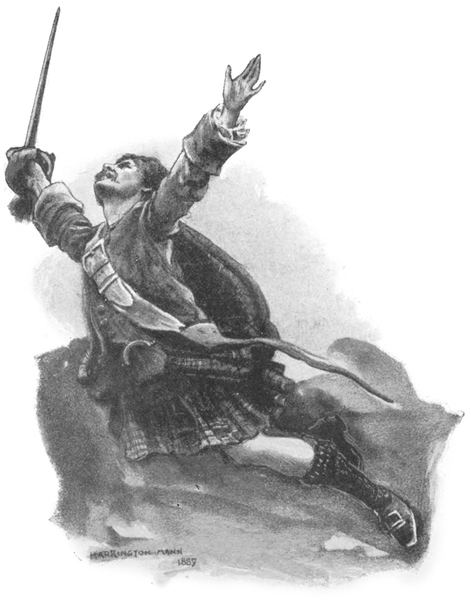
picks his steps; and as the bold Rob Roy strides
past into the shadow, there is heard the tramp
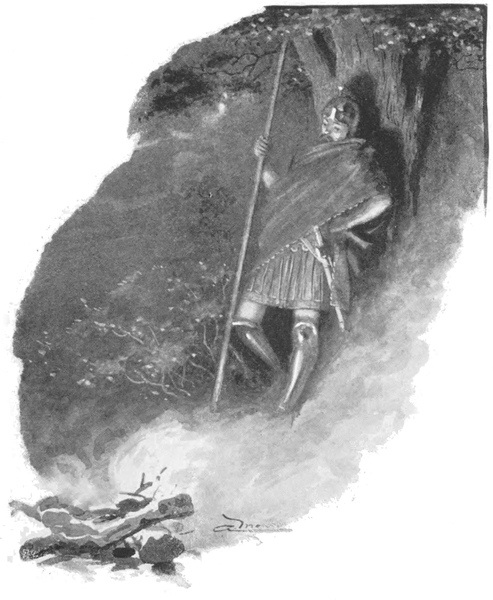
of Cromwell’s bodyguard and the clatter of the
Regent Moray’s cavalry. For it was out by
the Gallowgate here, and across the river by the
Briggate, that the troops of the Protestant lords
marched in 1568 to the battle of Langside; and
at the head of Saltmarket the Protector Cromwell
quartered himself in 1650, issued his orders, and
held levees. In the Gallowgate yet, though sore
transformed from its ancient glory, stands that
once-famous inn, the Saracen’s Head, at which
the learned Dr Johnson put up while passing
through Glasgow on his Hebridean tour. Close
by the Cross, where the street lamps shine on
the shuttered windows of a great east-end warehouse,
stood the town-house of the Earls of
Lennox; and past it, up the gentle hill, and
still wearing something of its old-world look,
bends the High Street with its memories. Out of
sight up there the façade of the venerable College,
alma mater of Campbell the poet, Smollett the
novelist, Archbishop Tait, and a host of great
divines, was wont for over four hundred years
to frown upon the pavement. The Vandal, however,
has at last prevailed against it. A few
paces farther and the gigantic form of Sir William
Wallace still seems to slaughter his enemies at
the Bell o’ the Brae. And beyond all, on the
slope of the hollow where the classic Molendinar
once flowed, surrounded in the darkness by its
city of the dead, stands the grey cathedral of
St Kentigern.
The spot itself, however, has indeed changed
with time, and but few links are left it to recall
bygone days. The loud tramp of Dundee’s
dragoons long since died away in Rottenrow.
No longer do the rustling gowns of bishop and
dean sweep through the cathedral choir. Even
the house from which the ill-fated Lord Darnley,
sick to death, was carried to the lonely Kirk o’
Fields three hundred years ago, has disappeared.
Cavalier and Covenanter and Virginia merchant
have given place to the petty trader and the
artizan. The house at the foot of Glassford
Street, where Prince Charlie put up in the ’45,
has been pulled down; and of the walls which
witnessed the rejoicing bonfires of the Whig
burgesses after the news of Culloden, few are
left but those of the dim cathedral. Even the
Saltmarket at hand has been so altered of late
years, that if worthy Bailie Nicol Jarvie were to
step out again on the causeway he would find
no trace at all of the narrow, ill-paved, unlighted
lane of his day, with its high, rickety houses,
and creaking shop-signs.
Rather must the city pride herself now upon
her glories of the present. Far off, upon the
great Clyde artery at Govan, where the nets of
the salmon-fishers once hung in the sun to dry,
the noise of a myriad hammers has just ceased
for the holiday, and the iron skeletons of a
hundred ships stand silent in the darkness—spectres
not of the past but of the future.
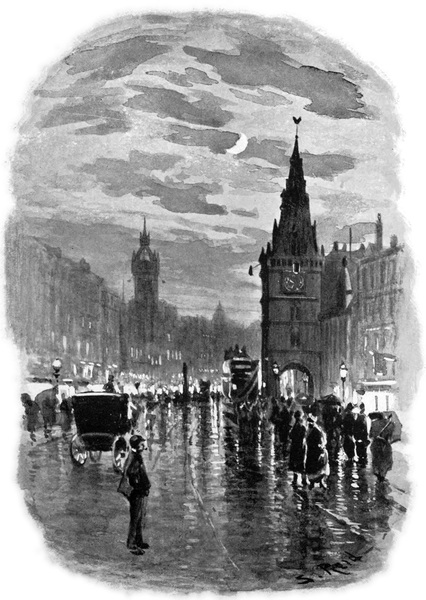
Overhead, between the high house-roofs, the
heaven is very dark, and above the lanterns of
the clock the Tron steeple is hidden from sight;
but one side of the neighbouring tower—that of
the ancient Tolbooth in High Street—reflects the
red glare, from a mile away, of the iron furnaces
at Hutchesontown—those undying vestal fires of
the nineteenth century; and the golden vane
upon the spire shines, strangely lit, alone in the
dark heaven. Significant indications, these, of
the strong modern life that throbs in the veins
of the ancient city.
But the great gilt hand of the clock overhead
is approaching midnight, and along the streets,
from the four points of the compass, comes the
sound of innumerable hastening feet. It is the
crowd gathering to observe this immemorial
ceremony of “bringing in the year.”
Few of the revellers, probably, reflect upon
the antiquity of the custom they are observing;
if they did, it might, perhaps, lend the proceeding
a deeper interest in their eyes. To survive so
many vicissitudes of history, the rite must once
have possessed a solemn religious meaning. On
the bank of the river below, the rough Norse
rover has shouted “Wæs hael” to Thor; on
the crest of the hill above, the Roman warrior
has poured libations to Jove. Bishops of a
feudal church within the storied cathedral walls
have said the mass of Christ; and the spires
of many a Presbyterian kirk now rise round
the ancient Cross. But through all changes,
through the ebb and flow of Faith and Fear,
has come down the relic of an older worship,
and in the mistletoe and the New-Year mysteries
the Druid lives among us still. These people
are gathering now, as for ages their race has
gathered, to bid farewell to the old year and
welcome to the new, and to pour their mystic
sacrifice to Time—not, indeed, as of old, upon
the unconscious earth nor within the stone circle
of a rude astronomy, but at least under the
open sky, and with something of the ancient
wish-rites of the runes.
Hundreds in number they come, and over all
the open space—at corners where in the daytime
knots of loafers are for ever to be seen, as
well as on the Trongate pavement, where, all
day long, recruiting sergeants, splendid in red
and gold, pace magnificently to and fro—in
little groups they wait the stroke of twelve.
Each man has brought with him a bottle, and
in each man’s pocket there is hidden a glass,
one that has seen service and lost its stem being
the popular variety.
Quickly enough the final seconds of the year
run out. The hand of the great clock reaches
and touches the hour. At last it strikes, a
single bell—one, two, three—a bold sound in
the silence; and immediately it is answered by
a bewildering clangour from all the city belfries.
Before the last stroke has died away, a wild
cheer bursts from the throat of the waiting
crowd below. There is a great commotion
among the little groups; and, as cheer after
cheer rings up into the sky, from the belfry
overhead the city chimes ring out upon the
night their welcome to the New Year.
Meanwhile everyone is drinking the health of
everyone else, Celt and Saxon, countryman and
citizen; and as no one can pass an acquaintance
without hospitality offered and taken, and as,
moreover, the dew of Ben Nevis is somewhat
potent, the shaking of hands and wishing of good
luck soon become fairly exuberant. Presently,
however, everyone sets off to first-foot his
friends.
The origin of this ceremony it is difficult to
suggest, unless it be to represent some priestly
visitation, a sacrament assuring to the people
throughout the coming year the blessings of food
and drink. A door-to-door proceeding, at anyrate,
it is—accompanied by much eating of cake
and drinking of whisky, and it will last well into
the morning hours. Lucky, for this performance,
are accounted those dark of skin. If the first-footer
be fair the tradition runs that it bodes
ill-fortune for the year to the house whose
threshold he or she has crossed; and often
enough a door is shut in the face of such a
friend, simply because of his complexion. Moreover,
the visitor must not come empty-handed;
and so the bottle and broken wine-glass which
each carries serve as a double introduction.
And now all who sat up till the city bells
struck twelve, as well in the crowded tenements
here as in the far-off suburbs of the rich, have
wished each other a good New Year, and are
retiring to rest. Among them, doubtless, there
are many thoughts of sadness. Many a widow
was a wife last year; many a ruined home was
prosperous; many a soiled heart still was pure.
But the old year, with its sorrow, has passed
away in the night, and with the New Year’s
dawn a glimmer of hope comes in at the darkest
casement.
Printed by M’Farlane & Erskine, Edinburgh.