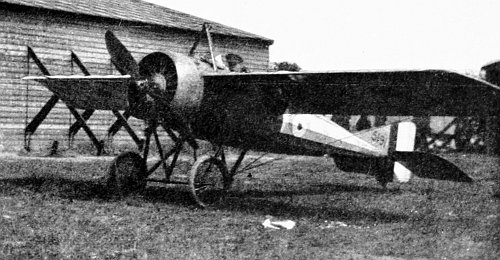
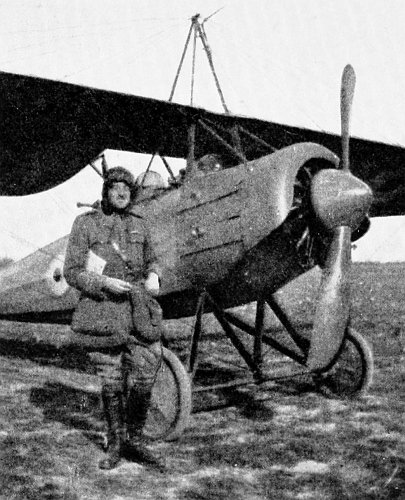
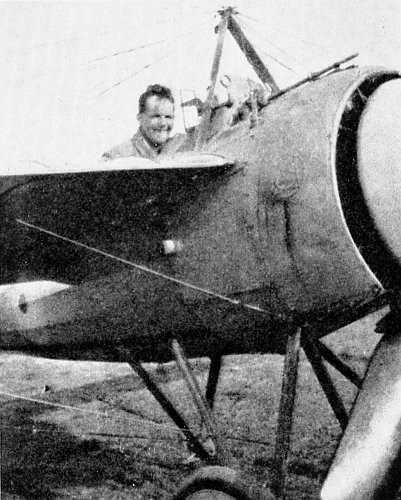
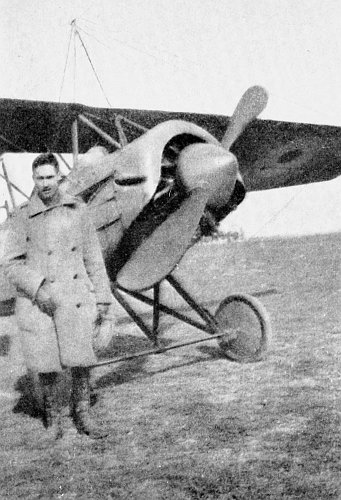
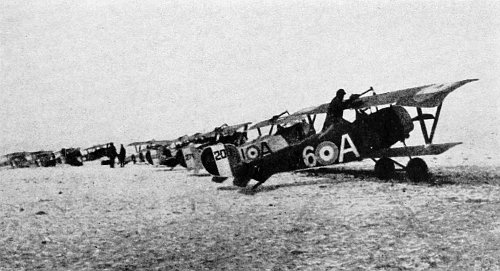
Although this chapter treats of the events of
March 1918 and after, the following letters, which
were written some months earlier, and are all by
Molesworth, are reprinted below because they
give an accurate picture at first hand of the feelings
and emotions of a scout pilot. It must be
remembered that these, as well as the preceding
letters by the same hand, were all written in the
Field, and that they have not been altered or
touched up in any way.
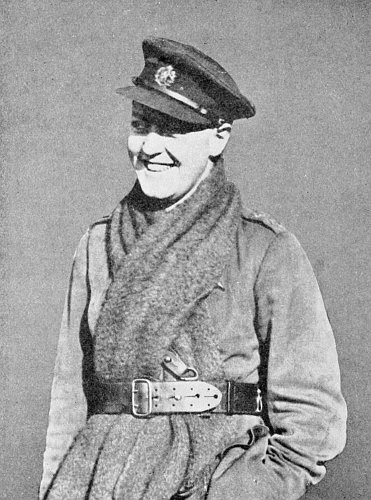
The author, who is a regular soldier, has now
returned to his regiment, the Royal Munster
Fusiliers, but all who knew him in 60 hope that
the future expansion of the Air Force will draw
him back before long to the service in which he
fought so well.
“60 Squadron R.F.C.,
“B.E.F., France.
“June 1917.
“There is no doubt that scout pilots have the
most exciting experiences while flying over Hunland,
and it sometimes happens that these
experiences may be their last. Always they are
face to face with death in one form or another,
always the thread suspending the ‘sword of
Damocles’ may break and they may be hurled
into eternity. However, we do not think of
these sort of things in the air, but instead, we are
filled with the spirit of confidence in our machines,
and the ever-present thought that the best way
to defend is to attack.
“There is the feeling of joy about it all which
is sometimes mixed with loneliness. You are
flying between a huge expanse of earth or sea
below, merging into the vast spaces of the heavens
above. The continuous drone of the engine in
front of you and the whistling of the wind
through the wires all add to this sense of loneliness,
while the bracing air, and the knowledge
that you have some of the finest machines and
companions in the patrol, make you feel that
flying is absolute perfection.
“Sometimes, however, you have a rude awakening,
either in the form of a ‘wop’ from Archie,
or the ‘rat-tat-tat-tat’ of a watchful enemy’s
machine gun, or again a sickening check in the
rhythmic beat of your engine.
“This last experience happened to me a few
days ago when I was leading a patrol of five
machines about three miles over Hunland, at
12,000 feet. No Huns seemed to be about.
Either Archie had forgotten our existence, or
there was too much ground mist for him to see
us. It was a perfect day up top, with a few light
clouds floating about. Away to the north-east
we could just distinguish the town of Douai,
while far below us the intricate system of the
Hindenburg Line, with its Drocourt-Quéant
Switch, stretched like a great ‘T’ over the
shell-marked country.
“We were cruising along quietly, doing about
1,050 revolutions, when suddenly there was a
shattering noise in front of me, and I saw my
cowling break away in bits. Parts of it went
through the planes, luckily doing no vital damage.
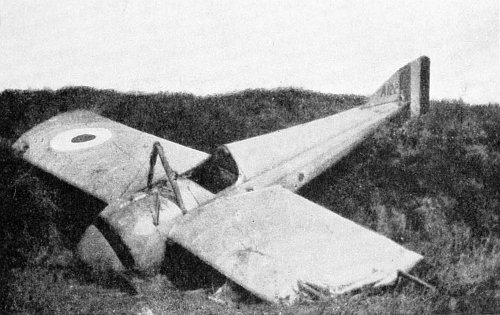
Of course the engine stopped dead, and so I had
to put her nose down for home. It was quite
impossible to reach any of our aerodromes, so I
made towards Bapaume, keeping my eyes open for
a good landing ground all the time. The needle
on my altitude dial began to drop—11,000, 10,000,
9,000—with corresponding wind-up on my part,
until we were about 2,000 feet from the ground.
I knew it meant a crash if I didn’t make a good
landing, as the engine was absolutely hors de
combat. Suddenly I caught sight of a Bessoneau
hangar,43 and near it an F.E. Bird perched on the
ground. I did a side-slip,44 and landed into
wind, putting the machine down with rather a
bump; however, there was nothing seriously
damaged. Luckily the wind was blowing from
the north, otherwise I don’t think I could ever
have got across the lines.
“It turned out that the place where I had
landed was an advanced F.E.8 landing ground.
“After going over my engine, I found that a
tappet rod had broken and stripped the cowling.
I telephoned over to the aerodrome and told them
to bring out a spare engine and cowl. They soon
arrived, and had the machine ready for me by the
afternoon, so I pushed off home and arrived safely
back soon after.”
* * * * *
“60 Squadron R.F.C.,
“B.E.F., France.
“June 1917.
“The heat is simply terrific, and the only ways
of keeping cool are flying or sitting under the trees
in the orchard. We spend most of the day, when
not in the air, in multi-coloured pyjamas, some
lads even going so far as to fly in them.
“Another awfully good way of keeping cool is
to dig a hole about a foot deep and 3 feet
long and cover it with a ground-sheet, pegged
down at the corners, so as to make a bath. You
lie in this with a book and a cooling drink by your
side, and if you are lucky enough to escape the
bombardment of mud, stones, and various other
missiles which are thrown at you by the more
energetic and lively spirits in the camp, you can
really enjoy yourself. These baths have been
such a success that we decided to dig a small
bathing-pool about 20 feet square by 3 feet
deep. When we got this going the whole population
of the nearest village had to come and
watch us. This was rather disconcerting, as we
used to bathe tout à fait nude. Most of the chaps
managed to rig up something in the way of a
bathing-dress by buying various articles of clothing
in the neighbouring village—I was forced to
content myself with a type of female undergarment,
which seemed to cause great amusement
amongst the ack-emmas.45
“The village maidens were highly delighted, and
thought it quite the thing, now that we were
decently clad, to watch us at our aquatic sports.
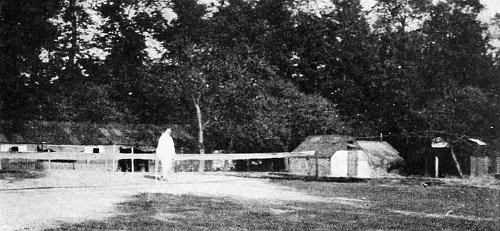
“We three flight commanders have decided to
take over a Nissen hut and knock out the partition
so as to make it into one room; of course, some
wags had to start painting things on the outside.
They began by printing on the window in large
black letters, ‘Saloon Bar’; and ended by naming
the hut the ‘Hôtel du Commerce,’ as most of the
squadron seemed to collect there, including Kate
and Black Boy (the special pet dogs of the
squadron), who made it their abode.
“I don’t think I told you in my last letter that
one of my pilots nearly finished me off. I was
leading a patrol, when, without any warning, he
dived about four yards in front of me. We would
have collided if I hadn’t managed to yank my
machine over on her back. He successfully put
the wind up me, I can tell you, and I gave it to him
pretty hot when we got down.”
* * * * *
“60 Squadron R.F.C.,
“B.E.F., France.
“June 1917.
“I hope it will be ‘dud’ to-morrow, as I want
to supervise the painting of my grids. We have
all got the craze of having them coloured. Mine
are going to have red, white, and blue wheels. Our
crack flight commander46 has had a spinner made
and painted blue, which he says puts the wind up
the Huns. I should think they must be getting
to know him well now, as he has crashed twenty-five
of them, two of which he got in flames
yesterday. He always lets us know when he has
got one by firing a red Very light over the
aerodrome before landing.
“Talking about colours, you ought to see the
Huns. They are just like butterflies, with bright
red bodies, spotted wings, and black and white
squares on their tails, or else a wonderful mauve
colour with green and brown patches.
“It was our day off yesterday, so the Major47
asked me to go for a ride with him. We borrowed
horses from a cavalry depot near-by, and set out
in his car for the rendezvous where we were to
pick them up. We did not intend to go far, but
lost our way in a wood. The Major is a keen
horseman and, consequently, led me over all sorts
of obstacles, such as fallen trees, etc. Not having
ridden for three years, I found it rather a job to
stick on; however, I got used to it. We went up
and down vertical banks, and eventually had to
get the nags over a 3-foot jump, which we
managed to do with a bit of coaxing. Soon after
we arrived at the beautiful old château of Lucheux,
where we were to meet the car. This château was
used by Marlborough during the Flanders Wars.
It is now a Red Cross hospital. We had a talk to
the sisters, and wangled some topping roses out of
them for the mess. The car was waiting for us,
so we got into it and drove home.
“When we arrived back, we found the mess
decorated with branches of trees, which made it
look like a greenhouse. This was to commemorate
the Major’s M.C., which he has just been awarded
for bringing down Huns. We had a tremendous
‘bust’ in the evening in which the Major joined.
Speeches were made wishing him the best of luck,
and then we retired to the ante-room and had a
good old rag.”
* * * * *
“60 Squadron R.F.C.,
“B.E.F., France.
“July 1917.
“Rotten luck!
“Everything is black to-day. The Major48 has
been wounded in the arm; one of my best pilots49
is going off to another squadron as a flight
commander, and I missed an absolute ‘sitter’
this morning on our side of the line. However,
every cloud has a silver lining. This time it is
in the shape of an M.C. for one of our flight
commanders who thoroughly deserves it. He
hasn’t managed to get a big bag yet, but there is
lots of the ‘good stuff’ in him, in both senses of
the word.
“We are going to have a great ‘bust’ to-night to
commemorate it, and to cheer things up a bit.
The show on which the Major was hit was a pretty
hot mix-up. We were in the middle of our tennis
tournament when word came through that a large
formation of Huns was on the line. It was ‘A’
Flight’s turn for a job, so they pushed off, accompanied
by the Major. They got into a big ‘dog-fight,’
and a Hun, who wasn’t in the show at all,
took a pot shot at long range and hit the Major in
the arm, breaking up his switch at the same time.
However, he managed to get back to the aerodrome
all right, and went off to hospital soon after.
“We got into another big show on the 11th,
and scrapped hard for about twenty minutes over
the Hindenburg Line, without any luck. At last
one of the Huns, with more guts than the rest,
came over and began to attack one of our grids. I
nipped in behind him without being seen and gave
him a dose of lead. I must have hit his guns or
something, as he had no ginger left, and simply
flew west across the lines, intending to land on our
side. Of course, my stupid old gun had to stop,
and I discovered, to my annoyance, that there was
no ammunition left. Seeing that I didn’t fire, the
Hun guessed that something was up and turned
back. I felt absolutely wild to see him calmly
sneak off into a cloud on his way home.
“On another occasion, when three of us were
attacking a formation of six Huns, one of us had
a most extraordinary escape. We had our noses
down, going full out to try and catch the blighters,
when suddenly the Hun directly under us did a
sharp turn. The chap on my right yanked his
grid over after him. He pulled her over with such
a jerk that one of his bottom planes came off and
fluttered down to the ground in two bits. I
couldn’t see what happened to him after that, as
we were getting to close quarters with the Huns.
We tried to scrap them, but hadn’t any luck, as
they wouldn’t put up a fight.
“When we arrived home, I reported that one
of my patrol50 had ‘gone west,’ as I had seen him
break up in the air. Hardly had I finished when,
to my amazement, he appeared outside the
window. I could not believe my eyes and thought
it was his ghost, but he turned out to be flesh and
blood, and so we went to the mess and had a drink
on the strength of it.
“He told me that he had managed to fly his
kite back with great difficulty. Luckily the top
planes had held. Of course, when he landed, the
machine turned over and crashed, but he crawled
out unhurt.
“We three flight commanders went to see the
Major in hospital yesterday. He seemed in the
best of spirits, and had been trying to ‘pump’ a
Hun observer, who was in his ward, by asking him
whether he liked doing artillery work on our part
of the front, but the old Boche wouldn’t give him
an answer.
“We all hope to have the Major back with us
soon, as his arm is much better. We miss him
‘some,’ as he often comes with us on our patrols.
“Charlie Chaplin isn’t in it now with us! We
were cinematographed the other day. Some of
us stood in a row and tried to look pleasant and
unconcerned, but this was rather difficult, as
everyone else was making rude remarks about us.
We then bundled into our new grids, which we
have just got, and started off on a stunt formation,
nearly running down the old cinema man to put
the wind up him. After we had done a circuit,
my radiator began to boil, and I was forced to
come down. Thank heavens! it was a good
landing, as the old man was still at it turning the
handle. My part of the show was to be known as
‘Pilot landing for more ammunition after fierce
fight.’”
* * * * *
“60 Squadron R.F.C.,
“B.E.F., France.
“August 1917.
“The new grids51 are a great success, and we
have been hard at work training and doing line
patrols.
“Three of us, led by our famous ‘Hun-strafer,’52
used them over the lines for the first time on the
5th. As a rule we only fight in flights, but on
certain occasions we volunteer for a ‘circus,’ that
is a mixed formation generally composed of the
best pilots in the squadron.
“Our numbers were not overwhelming this
time, but we know that the Huns had got pukka
wind-up by the way they disappeared when we
arrived on the line, so we felt quite confident in
taking on twice as many as ourselves. Of course
we were all out for trouble, as we wanted to show
what the new machines could do. As soon as our
leader spotted a formation of Huns, he was after
them like a flash. I think there were seven of
them, but we were all much too excited to count.
Suddenly they saw us coming, and tried desperately
to escape, but our leader got into his
favourite position, and the rear Hun hadn’t a
ghost of a chance. The next instant he was a
flaming mass.
“We simply had it all over the Boche for speed
and, as we had the height, they could not possibly
get away. I picked my man out as he was coming
towards me, and dived straight at him, opening
fire with both guns at close range. He suffered
the same fate as his companion.
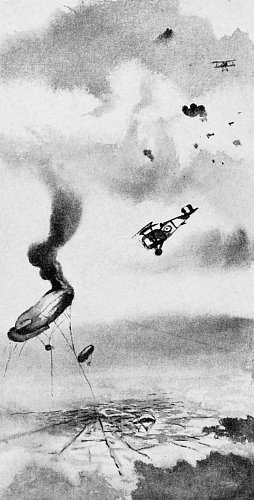
“A burning machine is a glorious but terrible
sight to see—a tiny red stream of flame trickles
from the petrol tank, then long tongues of blazing
petrol lick the sides of the fuselage, and, finally,
a sheet of white fire envelops the whole machine,
and it glides steeply towards the ground in a
zigzag course, leaving a long trail of black smoke
behind it, until it eventually breaks up. There
is no doubt that your first Hun in flames gives you
a wonderful feeling of satisfaction. I can well
imagine what the big-game hunter must think
when he sees the dead lion in front of him.
Somehow, you do not realise that you are sending
a man to an awful doom, but rather your thoughts
are all turned on the hateful machine which you
are destroying, so fascinating to look at and yet so
deadly in its attack.”
* * * * *
“60 Squadron R.F.C.,
“B.E.F., France.
“August 1917.
“Sorry I haven’t written for some time, but we
have been kept awfully busy as the weather has
been so fine. I have been trying hard to get
another Hun, and only succeeded the day before
yesterday, when we had another great scrap.
“Five of us met eight Huns and attacked them
the other side of the line. I missed my man in the
first dive, but turned on another and must have
hit the pilot, as he spun straight into the ground.
One of my patrol also destroyed an Albatros by
shooting him up so that he fell to bits in the air.
The remaining six Huns put up quite a good fight,
and nearly got one of us by doing in his lateral
control. However, he managed to land all right,
as these machines are fairly stable.
“On scanning my kite, I discovered that it had
not escaped scot-free, as a large piece of the tail
plane had been shot away.
“There was tremendous excitement in the
squadron yesterday, as our ‘stunt merchant’53
has been awarded the V.C. for that aerodrome
show that I told you about. We celebrated it
last night by one of the finest ‘busts’ I have ever
had. There were speeches and lots of good
‘bubbly,’ consequently everyone was in the best
of spirits.
“After dinner we had a torchlight procession
to the various squadrons stationed on the aerodrome.
This was led by our Very light experts.
Luckily for us, the night was very dull and cloudy,
or else I expect old man Boche would have had a
hand in it too. We charged into one mess and
proceeded to throw everyone and everything we
came across out of the window. We then went
over to the other squadron. The wretched lads
were all in bed, but we soon had them out, and
bombarded their mess with Very lights, the great
stunt being to shoot one in through one window
and out at the other. I can’t imagine why the
blessed place didn’t go up in flames. After
annoying these people for a bit, we retired to our
own mess, where we danced and sang till the
early hours of the morning. I have still got
a piece of plaid cloth about 6 inches square,
which was the only thing left of a perfectly
good pair of ‘trouse’ that belonged to one of
our Scotch compatriots.
“This morning the C.O. sent for me to go to
the orderly room. He told me that my name had
come through for H.E.,54 and congratulated me
on having been awarded the M.C.
“Later I went round to the sheds to say goodbye
to the men, and finally ended up at the mess
to have a farewell drink with all my old friends.
“I can hardly realise that the time has come
for me to go back to Blighty. I shall be awfully
bucked to see you again in a few days, old chap,
and yet I can’t help feeling sad at leaving this
dear old place—full of memories, sometimes tragic,
sometimes comic. It is very hard to part with
these comrades of mine—‘Knights of the Air,’
who live from day to day facing eternity with a
smile, and laying down their lives, if need be, with
such heroism, for the cause of freedom.”
* * * * *
To return to the squadron which we left at
Marie Capelle. On March 8, 1918, orders arrived
to move up to Bailleul—a good deal nearer the line—where
they remained for over a fortnight. This
aerodrome was shelled every day that they were
there, and on the last two nights was heavily
bombed. On March 27 they were rushed down to
Bellevue, near Doullens, to cope with the offensive
which, as few will have forgotten, began on the
21st. This move brought the squadron back into
the 13th Wing, in which it served, except for the
winter of 1917–18, during the whole of its career
on the Western Front. After three days at Bellevue
another move was ordered to Fienvilliers.
On March 30, in the course of one patrol,
Hammersley, the leader, destroyed two Hun
scouts, putting one on to the roof of a house in
Hem, where it burst into flames; while Copeland,
Hegarty, Duncan, and Griffiths all shot down
hostile machines, the destruction of which was
officially confirmed. Bartlett also shot down one
out of control. Both Copeland and Duncan were
now piling up good scores.
On April 12 there was yet another move, this
time to Boffles, where they stayed until September.
For some time past they had been in tents,
ready to move at a moment’s notice, and by now
all the household goods which a squadron accumulated
during the period of stationary warfare
had disappeared: the bronze figures and silver
basins, brought back as mementoes (on payment)
after celebrations in Amiens and elsewhere; the
original of Fleming Williams’ picture of a Nieuport
scout; the cut-glass reproductions of two of his
father’s valuable decanters, presented to the
squadron by Lord Dalmeny on his departure for
Egypt with General Allenby; the German signboards,
shell-cases, and other trophies; all had
been left behind or were lost long before the March
retreat and the subsequent victorious advance were
over. This was a pity, but could not be helped.
The losses of the Air Force during this retreat
were very heavy indeed. Usually we used to
calculate that the Germans lost twice as many
machines as the British, according to the reports
issued by our Headquarters. This thought was
a comforting one. Under the head of hostile
machines destroyed are not included, for the
purpose of this calculation, those shown as driven
down out of control. It should be remembered
that Headquarters required very clear confirmation
before officially recognising the destruction of an
enemy machine, and that many Huns must have
been destroyed which were not counted. If one
set fire to a Boche machine in the air there was no
difficulty, as the whole sky saw it and confirmation
was readily forthcoming; but where this was not
done, it was not at all easy to watch the victim
glide down from fifteen or sixteen thousand feet,
and to mark the spot at which he crashed. It
takes a long time to reach the ground from nearly
three miles up, and there were always plenty of
watchful enemies in the sky waiting to swoop on
to the overkeen pilot who forgot everything but
his presumably vanquished foe. Once a pilot
took his eyes off a machine, it was by no means
always easy to pick it up again. The best type
was always careful not to claim a doubtful Hun,
and, though there were plenty who would like to
have done so, the other officers of the flight
generally knew pretty well when a doubtful claim
was put in, and soon gave the offender a hint that
such conduct did the squadron no good. It may,
therefore, fairly be assumed that we had destroyed
the full number of machines claimed. The German
method of calculation was somewhat different, as
they counted a two-seater machine as two
“victories,” which made their star pilots appear
to be more successful than ours.
Throughout the war, on the Western Front, the
policy of the R.F.C., as directed by General Sir
Hugh Trenchard, was that our fighters should
engage the enemy over his territory and never
allow him to cross our lines. These orders were
never executed with complete success, as it is not
possible to erect and maintain an aerial barrage,
so to speak, which can completely prevent a
resolute pilot from penetrating it if he really means
to do so, nor can it be said that our patrols kept,
in every case, always on the other side of the line.
Broadly speaking, however, we fought over alien
territory, the Germans over their own. The
effect of this was that many a British machine was
forced to land, disabled by gunfire or through
engine failure, and the occupants, even though
unwounded, were lost to their own side till the
end of the war. The German pilot, on the other
hand, whose engine was put out of action in a
fight might land safely, get another machine, and
be fighting again the same day.
Another circumstance which, in fairness to the
Air Force, should always be borne in mind when
the conditions of fighting in the air are under
discussion, is that on the Western Front the wind
entered very much into all questions of aerial
strategy or tactics. The prevailing wind was
that west wind which Conrad thus describes in a
brilliant passage, and which, though it deals with
the sea, is equally true of the air on the Western
Front:
“The narrow seas around these isles, where
British admirals keep watch and ward upon the
marches of the Atlantic Ocean, are subject to the
turbulent sway of the west wind.
“Call it north-west or south-west, it is all one—a
different phase of the same character, a changed
expression of the same face. In the orientation
of the winds that rule the seas, the north and
south directions are of no importance. The north
and the south winds are but small princes in the
dynasties that make peace and war upon the sea.
In the polity of the winds, as among the tribes of
the earth, the real struggle lies between east and
west. The end of the day is the time to gaze at
the kingly face of the westerly weather, who is the
arbiter of ships’ destinies.
“Benignant and splendid, or splendid and
sinister, the western sky reflects the hidden
purpose of the royal wind.
“Clothed in a mantle of dazzling gold or draped
in rags of black cloud like a beggar, the might of
the westerly wind sits enthroned upon the western
horizon, with the whole North Atlantic as a foot-stool
for his feet and the first twinkling stars
making a diadem for his brow.”
It was this powerful sovereign, this pitiless
potentate who, five days out of seven, fought with
our enemies against us, and it is to be hoped that
he is properly humiliated by the result of the war.
How many curses have been levelled at his careless
head by pilots who, with trailing wires, with
labouring, failing engines, and with tattered planes
have tried, and often tried in vain, to reach that
brown, smoky strip of battered terrain which
marked the lines and safety, after a bitter fight?
How often has a patrol, on a day with the wind at
fifty to sixty miles an hour, at 10,000 feet fought
batch after batch of Huns when on the Mons-Maubeuge
or some other “long reconnaissance,”
only to find that, though every enemy may have
been shot down in flames, though no black-crossed
machines remained to smirch the sky, inexorable
Zephyrus had swept them during the fight so far
towards the Rhine that lack of petrol must force
them to land on hostile ground? Who has not
felt, when turning homewards on a stormy day,
that the machine could make no progress at all
against the wind, but seemed for minutes that
were like hours to stand still over some town or
village? Actually headway was as a rule being
made, but the change in ground speed from flying
down-wind to struggling against it produced this
very powerful illusion, and pilots have often
thrown their guns, ammunition, and even field-glasses
overboard with the frantic hope of
lightening the machine and thus increasing her
speed.
No! Zephyrus, who should have been a Teuton
god, and who beyond question wears the Iron
Cross, was no friend to the Air Force. We
should perhaps have poured out libations to
his eastern brothers—Eurus and Aquilus—or
at very least have recommended them for the
immediate award of the Distinguished Flying
Cross in recognition of their invaluable services
throughout the war.
The struggle wore on through May, and during
the middle of this month the fighting in the air
was terrific.
One hundred and thirty E.A. (enemy aircraft)
were brought down by the Air Force in France
between the 13th and 19th of the month. Belgrave
and Scholte were, perhaps, the most
successful, but I. M. Davies, A. W. Saunders,
Hegarty, V. S. Griffith, W. A. Duncan, were
also very prominent. During one patrol, led
by Belgrave on June 12, in which he shot down
a two-seater, R. G. Lewis, whose engine presumably
had failed, went down and landed,
breaking his under-carriage. H. A. Gordon, a
Canadian whose first trip over the lines this was,
landed beside him and got out of his own machine.
At this point some soldiers appeared and opened
fire. Gordon ran back to his S.E., calling to
Lewis to get in with him, but the latter, apparently
mistaking the troops for friends, walked towards
them. Gordon then took off and circled round,
meaning to fire, but, seeing Lewis in the midst of
them, refrained, and returned home with his
machine very badly shot about. He was killed
two months later.
An S.E.5 has carried two before now, but it is
an unpleasant experience for the passenger, who
has to sit with his legs on each side of the pilot’s
shoulders and to hold on to the top gun-mounting.
By this time, Bishop was back in France
commanding No. 85 Squadron and was doing
wonders. Much of his success was due now, as
always, to his extremely accurate shooting, the
importance of which in aerial fighting it is almost
impossible to exaggerate.
W. H. Saunders did a very good show on July 2,
fighting continuously for forty-five minutes, destroying
two Pfalz scouts and engaging five other
hostile machines.
At the beginning of July, Barry Moore was
promoted to command No. 1 Aeroplane Supply
Depot at Marquise, and J. B. McCudden, V.C.,
D.S.O., M.C., was appointed to succeed him in the
command of the squadron. While flying down to
take over from Moore, he got his machine into a
spin near the ground, crashed, and was killed.
Though he never actually joined 60, and though
this history is concerned only to describe the
exploits of that squadron, a paragraph must,
nevertheless, be devoted to McCudden’s achievements.
He joined the R.F.C. as an air mechanic
before the war, fought as an N.C.O. pilot with
29 Squadron during 1916–17, was then given a
commission and was posted to 56 Squadron, where
he specialised in two-seaters, that variety of two-seater
which the Germans would send over very
high at 20,000 feet or more on clear days to
photograph our back areas, and which were not
easy to bring down. The difficulty was that they
were first seen, as a rule, at a great height, and our
fighting machines had to climb up to them, which
would take fifteen minutes at least. During
this interval which necessarily elapsed before the
attacking machines could get their height, the
Rumpler or L.V.G., which would be flying level,
could usually outdistance the pursuers; if, however,
the British machine contrived, by flying the
inside of the circle, to keep between the Hun and
the lines, the latter, if he was as cunning as they
usually were, would calmly continue his photography
while his adversary was climbing until
the latter was about 1,500 feet below him, and,
when his pursuer was getting close enough to
be dangerous, would put his nose down slightly,
open up his engine and disappear into Hunland,
leaving a streak of blue smoke, but nothing more
tangible, behind him.
McCudden, however, with great resolution and
infinite patience, studied the habits of these folk
and shot down dozens of them. In addition, he
was a brilliant and successful patrol leader and
one whom the Air Force could ill spare. After his
death, C. M. Crowe, M.C., who also had a fine
record both in 56 Squadron and, earlier in the war,
with other units, was given the command. After
a few weeks, Crowe had a serious motor accident
and was “struck off” the strength, to be posted
later to 85 Squadron. He was succeeded by A.
C. Clarke, an old Etonian, who remained in charge
till the end of the war.
On August 1, 60, together with 3, 56, and 11
Squadrons, carried out an extremely successful
raid on Epinoy Aerodrome. Sixteen machines
were believed to have been destroyed as a result
of this operation and two large fires were started,
the smoke of which ascended to a height of over
10,000 feet. 60 and 11 did the “upper guard,”
escorting 3 and 56, who went down and actually
shot up the aerodrome, whilst the two former
squadrons kept off hostile machines who might
have attacked the raiders from above.
Raids of this kind were most successful, but
had only lately become possible on account of the
much larger number of squadrons which were now
available. Up to this time, the number of
machines had been only just sufficient to get
through the ordinary routine work, i.e. low flying
on battle days, offensive patrols for the indirect
protection of the artillery machine, by the destruction
of the enemy scouts who would have
interfered with them, and escorts to bombing
raids and photographic reconnaissances. These
last two duties the improved types of two-seater
fighters now carried out without escorts—the De
Havilland 4s, 9s, and Bristol fighters being quite
capable of operating without protection by scouts.
During August, R. K. Whitney (who had had a
great month in July), Doyle, G. M. Duncan,
Buckley, and A. W. Saunders (who was now a
flight commander), were all fighting well. One
patrol led by the last-named on August 9 accounted
for four enemy aircraft.
Lieut. A. Beck now rejoined the squadron:
he had been with us in June 1917, but was sent
home on the representation of his parents, who
complained that he was only seventeen. Returning
a year later, he speedily showed that his youth
was no disqualification. He remained with the
squadron till the end, was promoted flight commander,
and did extraordinarily good work.
On August 8 we assumed the offensive east of
Amiens. 60 did a great deal of low flying and low
bombing, as well as the usual “scrapping” up
above. The Fokker biplane D.7 first appeared
in numbers at this time. This was an original
type of machine without any external wiring but
with a very thick wing section, which was braced
internally. Its performance was very good, alike
as regards speed, climb, and power to manœuvre.
Their pilots were usually provided with parachutes,
which quite often failed to open. From all along
the line reports now came in showing that the use
of the parachute was becoming fairly general
among German pilots.
In October, while our advance was proceeding,
squadrons of the Air Force dropped some thousands
of boxes of rations and ammunition for Belgian
troops, whose supplies had been held up owing to
the speed of the advance. 60, however, took no
part in this.
The map opposite is reproduced by permission
of Field-Marshal Earl Haig, and is published, I
believe, for the first time. It shows the situation
on September 25, 1918, and makes it clear that
the enemy feared the Amiens sector more than
any other part of their line.
H. C. M. Orpen, I. W. Rayner, S. V. Mason, M.
D. Sinclair, O. P. Johnson, G. M. Duncan, and
McEntegart were, perhaps, the most prominent
and successful pilots during the British advance,
which was a time of continuous and sustained
effort on the part of every officer, N.C.O., and man
in the whole squadron. The strain of sending at
least two full-strength squadron patrols daily over
the line, while moving continually, severely taxed
the endurance of all ranks. They left Boffles for
Baisieux on September 17, Baisieux for Beugnatre
on October 14, and finally moved from the
latter station to Quievy, an old German aerodrome,
on October 31.
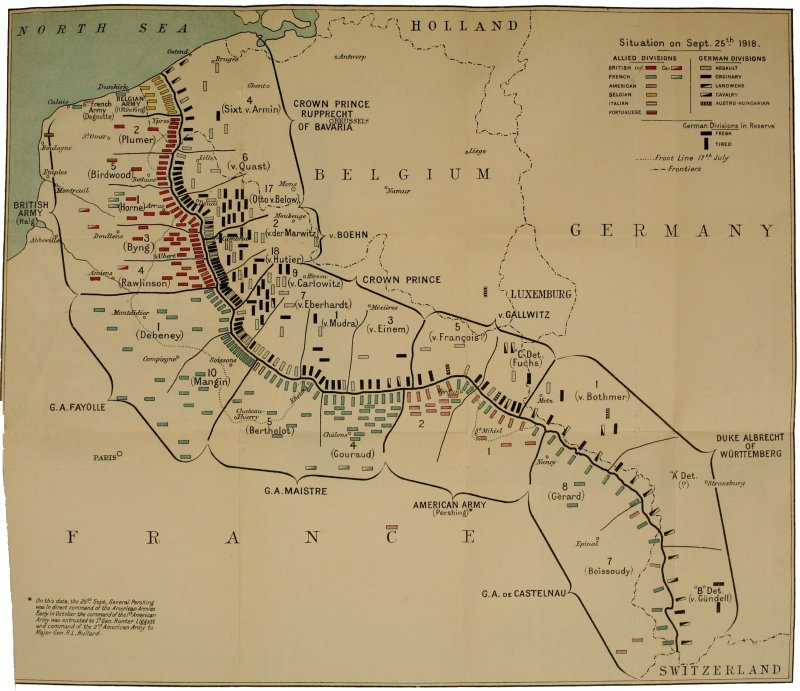
Situation on Sept. 25th, 1918.
On this date, the 25th Sept., General Pershing
was in direct command of the American Armies.
Early in October the command of the 3rd American
Army was entrusted to Lt Gen. Hunter Liggett
and command of the 2nd American Army to
Major Gen. R. L. Bullard.
By October the Air Force mechanical transport
had begun to wear out, nor is this surprising when
the work it had done is remembered; the men
were always working hard to keep the lorries and
light tenders on the road. Moreover, the new
aerodromes were always pitted with shell-holes,
which had to be filled up, and scarcely was
this task completed before orders would arrive to
move again. In spite of these difficulties, the
supplies of rations, ammunition, etc., were maintained
with wonderful regularity by the H.Q.
staffs.
The German Flying Corps continued to fight
hard and well up to the very last day of the war,
and, though their armies on the ground were
retreating fast, no signs of demoralisation in the
air were observed.
During these last days, throughout September
and October, a great deal of work was done with
148—an American Camel squadron—most of
whose pilots had been trained in England. This
unit was also in the 13th Wing, and the two
squadrons moved forward together to the
various aerodromes mentioned above. They did
several good shows together, notably between
September 14 and 17, during the attack on
Havrincourt Wood, when 60 twice a day did the
“upper guard,” while 148 flew low, bombing
troops and attacking low-flying Fokkers. A considerable
amount of damage was done during the
progress of these operations. For example, on
September 26 one patrol of each squadron, working
in the same manner, gave a good exhibition of
combined work: 60’s patrol, led by Rayner, drove
down a flight of Fokkers into the jaws of 148, who
tackled them with such effect that three were
“crashed” and one driven down out of control.
Again, on the next day, during the Bourlon
Wood attack, 148, protected as before by 60,
crashed two enemy two-seaters, the destruction
of which was observed and confirmed by the
latter unit.
During the whole of the advance towards
Cambrai and beyond, the two squadrons did at
least one “show” a day together until October 30,
when the Americans left Beugnatre, near Bapaume,
to go south to join their own army near
Nancy, a very long and tiresome journey. On
the day before leaving, their last patrol with us
“crashed” either four or five Huns.
Their pilots were many of them trained at
London Colney, in Hertfordshire, and Lieuts.
Springs (who accounted for nine enemy machines),
L. K. Callaghan (whose score when they left for
Nancy was eight), and J. O. Creech (who had got
six Huns), were all good advertisements for the
methods adopted at that training station.
Other pilots conspicuous in this squadron were
two of their flight commanders (T. Clay and
F. E. Kindley) and also Lieut. C. T. McLean, all
of whom will no doubt remember a dinner in
Amiens, on October 18, in which 201 Squadron
also joined with 60 in celebrating the turn of
the tide in the Allied fortunes, a change which
148 and 17 American (this latter squadron was
also in the 13th Wing) had certainly done their
share to bring about.
There was great regret on the part of all their
British comrades in arms when these two American
units went away.
One of the pilots of 148, who had been taken
prisoner, told a remarkable story on his return
just after the Armistice. This pilot, who had
served with 56 Squadron, also in the 13th Wing,
some months earlier, was shot down and, after
having landed more or less safely in “Hunland,”
was taken before a German intelligence officer and
asked his name and squadron. Having given his
name and rank only, his examiner said to him,
“But you were in 56—I dined with you in
December last,” and followed this up by asking
the astonished prisoner if he did not remember
a French Breguet (two-seater) landing at 56’s
aerodrome one day with an officer pilot and a
mechanic on board. The American did remember,
and recollected, too, that the pilot announced that
he was coming up from the south to join a French
squadron north of our 2nd Army near Dixmude,
but that his engine was running badly and he had
landed to make some adjustments. No one in 56
at this time knew very much about the French
Flying Corps, but everyone knew that their
machines had often passed over the intervening
British armies in this manner, particularly during
the summer of 1917, prior to the Passchendale
battles, and again in April 1918, when Foch’s
strategical schemes involved the introduction into
the middle of our 2nd Army area of a French
division, which defended Kemmel Hill after the
German break-through on the Lys. The story,
therefore, appeared to be quite a natural one, and
no one suspected for an instant that anything was
wrong. The “repairs” to the 200 h.p. Renault
engine, a type with which none of our mechanics
were very familiar, took longer than was expected,
and the “Frenchman” dined and stayed the night
with the squadron, making himself most agreeable
but refusing to drink much. Not only did he stay
one night, but, the weather next day proving
unfavourable, he remained a second, and on the
third day flew off, it is believed, to another British
aerodrome. There was no question of the truth
of the story because the hero of it showed, when
talking to his prisoner, a knowledge of the officers
in 56, their appearance and nicknames, together
with the details of the camp and aerodrome, which
could only have been obtained at first-hand.
Moreover, the American pilot remembered the
visit quite well, and even recognised his interrogator.
The German also told him that he had
played the same game with the French Flying
Corps, pretending, on a captured British machine,
to be an English pilot making his way down to our
Independent Air Force, which, under General
Trenchard, was stationed opposite Metz, a long
way from the nearest British unit.
It was easier for the Germans to do this kind of
thing than it would have been for the Allies, owing
to the duality of language on our side of the line;
but, nevertheless, it must be reckoned a very fine
performance. Presumably, he left the German
aerodrome before dawn and flew about on our side
of the line until it was light enough to land, but,
even so, he was lucky not to have been attacked on
his return by German machines and anti-aircraft
guns when flying an aeroplane with Allied markings,
as it must have been impossible to warn the
German aviators that one particular Breguet was
not to be molested, mainly because of the impossibility
of distinguishing one machine from another
of the same type in the air, but also because to
circulate general instructions of this kind would
almost certainly have given the whole plan away
to some of the Allied agents who, on the whole,
were much more efficient than the German spies.
After the Armistice, when the question of
demobilisation began to be considered in the Air
Force and particulars of the terms of each officer’s
engagement were scrutinised, it was surprising to
find how many Americans were serving in English
scout squadrons. There seemed to be at least
three or four American citizens in each single-seater
squadron in France, out of a total in such a
squadron of twenty-five officers. Moreover, the
majority of these wore at least one medal for
gallantry, the reason being, no doubt, that these
young men were the very flower of the American
fighting stock, who felt unable to wait until their
country came into the war, but represented themselves
to be Canadian citizens in order to join in
the contest. Had the war lasted a little longer,
most of them would, no doubt, have transferred to
their own squadrons, as some few had already
done, but at the end of 1918 their own air effort
had not yet developed sufficiently to absorb them
all.
To return, however, to 60. The squadron’s
last “confirmed Hun” of the war was secured on
November 1 by Capt. A. Beck, who had lately
destroyed, when flying low, a number of enemy
artillery observation machines (two-seaters).
The arrival at Quievy, halfway between Cambrai
and Le Cateau, where the squadron remained
until after the signing of the Armistice, was most
interesting. Here remained some of the German
semi-permanent hangars, the machine-gun emplacements
on the roofs of the houses surrounding
the aerodrome, and here, too, were people who for
four and a half long years had lived with the pilots
and observers of the German Flying Corps. The
questions asked by our officers—usually in extremely
moderate French—were endless. “How
many jobs a day did they do?” “Were their
casualties heavy?” “Were the pilots usually
officers or N.C.O.s?” “How many machines
did they have in a flight?” are only a few
examples. The answers in most cases were disappointing,
as the Boche seemed to have taken
good care to keep all civilians off his aerodromes.
The plight of the inhabitants of the occupied
territory was wretched; the retreating enemy had
driven off every single head of livestock, taking
even the poultry away over the Belgian border,
and the British forces had to feed them for many
weeks until the French lorry services began to
work and until the railways were restored.
Delay-action mines were left everywhere in this
part of the world, though there were not, perhaps,
as many booby traps as were found after the
Boche retreat of March 1917 to the Hindenburg
or Wotan Line. The bridge at Caudry station, the
railhead from which the squadron drew rations,
went up on November 1, killing and wounding
twenty or thirty men.
The uncultivated state of the land was very
noticeable in this district; for though some poor
root and winter cabbage crops showed here and
there, grown by the inhabitants under German
direction, most of the fields did not appear to have
been tilled at all, though this particular tract had
been a long way behind the line until August 1918.
The last few days’ fighting were marked by no
unusual incidents so far as 60 itself was concerned,
though it was thrilling to be forming part of the
army which was retaking Valenciennes, Le Quesnoy,
Maubeuge, and other towns immediately in
front of us. Thrilling, too, to see the long dingy
columns, already in Belgium, marching east at
last.
On Armistice night, Clarke hurriedly organised
a dinner, to which such old members as were in
the neighbourhood were bidden. It was a good
evening, ending with the invasion of the officers’
mess by the N.C.O.s and men, who drank each
other’s healths—not that there was overmuch
alcohol available—and sang over and over again
those very ordinary music-hall songs which our
people always seem to employ as a medium for
expression in moments of emotional stress.
Officers and men bellowed together “The good
ship Yacki Hicki Doola” and similar classics.
60 was always remarkable for the cordial
relations between the officers and men, due,
perhaps, to the fact that an Air Force scout
squadron during the war was, in Lord Hugh
Cecil’s words, “a natural aristocracy,” in that the
officers flew and fought twice daily while the men
remained on the ground in comparative security.