Although it was 9.25 Tuesday evening when we boarded the train in Wesel
station, en route for the "luxurious hotel where we were to receive
every kindness consistent with the noblest traditions of German honour,"
there did not appear to be any anxiety to part with our company. There
were about sixty of us all told, and we were shepherded with as
pronounced a display of German military pomp and circumstance as would
have been manifested if the All-Highest himself, had been travelling.
Wesel station swarmed with officers and men who apparently had nothing
else to do but to perambulate the platforms, the officers swaggering
with typical Teuton arrogance, and the humble soldiers clattering to and
fro in utter servility, merely emphasising their existence by making
plenty of noise with their cumbrous boots and rifles.
At midnight the train started. The majority of my companions were the
male passengers of military age who had been detained from the pleasure
steamer Krimhilde while travelling up the Rhine. The military
authorities in charge of the train received bulky sheafs of papers, each
of which related to one passenger, and was packed with the most minute
details. I am afraid my record must have been somewhat imposing,
inasmuch as I commanded considerable and unappreciated attention from
the military, while my fellow prisoners regarded me with a keen
curiosity.
I must admit that my personal appearance was far from being attractive.
I looked even more ragged, un-cared for, and ill than I was when facing
my accusers at the midnight trial some days before. I was shirtless,
collarless, and tie-less. My hair was matted and clotted with congealed
blood freely mixed with dirt. My face, in addition to a week's growth of
hair, was smeared with black marks which I had not been able to remove
owing to my inability to get soap to wash myself with. My frock-coat and
trousers, frayed at the bottoms, were sadly soiled and contrasted
strangely with the fancy pattern tops of my patent boots. In fact, I
admitted to the party, that "I must have looked a 'knut' of the finest
type!" All things considered I am not surprised that at first I was
shunned by one and all, both compatriots and the military guards.
Although the distance from Wesel to Paderborn—Sennelager is three miles
outside the latter town—is only about 95 miles as the crow flies, the
railway takes a somewhat circuitous route. Owing to the extensive
movement of the troops we suffered considerable delay, the result being
that we did not reach our destination until about mid-day on the
Wednesday, the journey having occupied nearly twelve hours. The heat was
unbearable, and confinement within the carriages, the windows of which
were kept sedulously closed by order of the military, thus rendering the
atmosphere within stifling, speedily commenced to affect some of the
passengers. Each compartment carried seven prisoners, and the eighth
seat, one of the windows beside the door, was occupied by a soldier—the
guard of the compartment—complete with loaded rifle and fixed bayonet.
Sleep was out of the question, but this did not affect us seriously. We
were somewhat excited, and spent the hours of the night in conversation
and the exchange of experiences. In our party was an English gentleman,
Mr. K——,[3] who held an important position in a large business house
in one of the cities on the Rhine. Somehow he was attracted to me,
moved, no doubt by my general appearance, and because I was now showing
visible signs of my incarceration and experiences in Wesel prison. I may
say that to Mr. K—— I undoubtedly owe my life, and I never can express
my thanks sufficiently for his unremitting attention and kindness during
my subsequent illness, as I narrate in due course. Moreover, during his
sojourn among us he was a tower of strength, having long been resident
in the country, and thoroughly conversant with the language and manners
of the Germans.
It was during this tedious train journey that he related the experiences
of the passengers upon the unfortunate steamer Krimhilde. Many of the
Englishmen who happened to be upon this boat had been held up for a week
in various towns, owing to the stress of mobilisation. But at last
permission was given by the authorities to proceed, and the delayed
travellers were assured of an uninterrupted journey to England.
Unfortunately the passage down the Rhine was impeded by fog, and this
delay proved fatal. When it was possible to resume the journey, and
while the steamer was making a good pace, a river patrol boat dashed up
and ordered the captain of the steamer to stop, the reason being that no
intimation had been received of the vessel's coming.
The captain protested, but at the point of the revolver he was compelled
to turn round and return to the place which he had left only a few hours
previously. The re-arrival of the Krimhilde at this point aroused
considerable interest, and the authorities demanded the reason. The
captain explained, but receiving a re-assurance that everything was in
order and as originally expressed, he was free to travel down the
river.
Again the journey was attempted and all went well until the boat was
approaching Wesel. Then another patrol boat fussed up, the officer of
which boarded the steamer. Again the captain presented his permit and
expressed his determination to go ahead.
"We don't know anything about that," returned the boarding officer,
referring to the permit. "My orders are to stop every vessel carrying
Englishmen!"
The boarding-officer turned and ordered all the male prisoners to
separate themselves from the ladies. Passports were produced upon demand
and closely scrutinised. Then the officer, stepping back a few paces,
beckoned the nearest man. His name was demanded to identify the passport
and then a brief hurried cross-examination proceeded, culminating in the
question:
"How old are you?"
"Thirty-eight!"
"Step this side!" retorted the officer, who proceeded to examine the
succeeding passenger, to whom the self-same questions were repeated, the
final interrogation being the passenger's age.
"Fifty-seven!" came the response.
The officer scanned the passport and finding the answer to be correct
remarked, "Step over there!" indicating his left.
By the time the officer had completed his interrogations the male
passengers were divided into two groups. Meanwhile the women and
children had gathered round, following the proceedings, which appeared
inexplicable to them, with a strange silence and a fearful dread.
"All you men of military age," continued the officer speaking to the
group of younger-looking men, "are to go ashore. You will be detained as
prisoners of war. You have ten minutes to pack your trunks and to say
'Good-bye!' So hurry up!"
At this intelligence a fearful hubbub broke out. The women and children
who were to be separated from their husbands, fathers, and relatives
gave way to lamentation and hysterical raving. While the men packed
their trunks under official supervision their wives and children clung
to them desperately. But the men realising that war is war, accepted the
situation philosophically, even cheerfully. They were buoyed up by the
official assurance that their detention was merely a matter of form, and
that they would soon be released and free to proceed to their homes.
I may say that this is a favourite ruse followed by the Germans in all
the camps in which I was interned, and I discovered that it was general
throughout the country. It is always expressed whenever the Teutons see
trouble brewing. Undoubtedly it is practised to keep the prisoners keyed
up to a feverish pitch of hopefulness. Certainly it succeeded for a
time, although such announcements at a later date, when we had seen
through the subterfuge, were received with ironical cheering and jeers.
At such a sudden and summary cleavage between families many distressing
and pathetic scenes were witnessed. On board there happened to be a
wealthy young member of the Russian nobility—Prince L——. He was
travelling with his sister and friends and was far from well.
The sister approached the officer and pleaded hard for her brother's
release. It was refused. Grief-stricken the Princess fell on her knees
and with tears streaming down her cheeks, kissed the officer's boots and
offered all her jewels—they must have been worth a considerable amount
of money—which she hastily tore off and held in her outstretched hands.
For the moment even the officer was somewhat moved. Then in a quiet,
determined voice he remarked,
"I am exceedingly sorry, but I cannot grant your request. I am merely
acting on my orders. But I can assure you that your brother in common
with all the others here, will be looked after. Not a hair of their
heads shall be injured. They will all be treated according to the best
and noblest traditions of German honour,[4] and the regulations which
have been drawn up among the Powers concerning the treatment of
prisoners of war." With these words the Prince was cast aside with the
others.
In another instance the wife and child of an Englishman, Mr. C——,
refused to be parted. The wife clung round her husband's neck while the
child held to his coat. She expressed her determination to go with her
husband, no matter what might happen, and was on the verge of hysterics.
Every one was moved and strove to coax her into quietness, while an
officer even accompanied her off the boat with her husband. On the quay
efforts were repeated to placate her and to induce her to allow her
husband to proceed. But all in vain. At last, drawing the lady forcibly
away, though with no greater force than was necessary, the officer
himself attempted to console her.
"Do not worry. I will do all I can for you, and will see you do not want
during the time your husband is interned."
What became of Mrs. C—— and her child just then I do not know, because
at that moment the boat sheered off with a sorrowful and crying list of
passengers who waved frantic farewells. Alas! I fear that in some
instances that was the last occasion upon which husband and wife ever
saw one another, and when children were parted from "daddy" for life.
Such was the story related by Mr. K——. After the boat had left, the
detained prisoners, he explained, were formed up on the quay, and
surrounded by an imposing guard with fixed bayonets, were marched off.
It was a sad party. All that was dearest in life to them had been torn
away at a few minutes' notice through the short-sightedness of Prussian
militarism or the desire of the Road-hog of Europe to display his
officialism and the authority he had enjoyed for but a few days. Many of
these tourists, as one might naturally expect, were sorely worried by
the thoughts as to what would become of their loved ones upon their
arrival in England, many without money or friends to receive them. This
was the discussion that occupied their minds when they were marching
towards Wesel Station, and when the tiny party, of which I was one,
being marched from Wesel prison, met them in the street, as already
related.
As for ourselves we were soon destined to taste the pleasures of the
best traditions of German honour. No provisions of any kind whatever had
been placed on the train for our requirements. What was more we were
denied the opportunity to purchase any food at any station where we
happened to stop. At one point a number of girls pressed round the
carriages offering glasses of milk at 20 pfennigs. As we were all
famished and parched there was a brisk trade. But the moment the
officers saw what was happening they rushed forward and drove the girls
back by force of arms.
So far as our compartment was concerned we were more fortunate than many
of our colleagues. Our soldier warden was by no means a bad fellow at
heart. In his pack he carried his daily ration—two thick hunks of black
bread. He took this out and instantly proffered one hunk to us, which we
gladly accepted and divided among ourselves.
Those being the early days of the war the German soldier was a universal
favourite among the civilians. Directly one was espied he became a
magnet. The women, girls and elder men rushed forward and wildly thrust
all sorts of comestibles into his hands. Unhappily we did not stop at
many stations; our train displayed a galling preference for lonely
signal posts, so that the chances of our guard receiving many such gifts
were distinctly limited. But at one station he did receive an armful of
brödchen—tiny loaves—which he divided amongst us subsequently with the
greatest camaraderie.
But his comrades in other compartments were not so well-disposed. With
true Prussian fiendishness they refused to permit their prisoners to buy
anything for themselves, and to drive them to exasperation and to make
them feel their position, the guards would ostentatiously devour their
own meals and gifts. While we did not really receive sufficient to stay
us, still our guard did his best for us, an act which we appreciated and
reciprocated by making a collection on his behalf. When we proffered
this slight recognition of his courtesy and sympathetic feeling he
declined to accept it.
He was one of the very few well-disposed Germans I ever met.
Upon arriving at Sennelager Station we were unceremoniously bundled out
of the train. Those who had trunks and bags were roughly bidden to
shoulder them and to fall in for the march to the camp. The noon heat
was terrible. The sun poured down unmercifully, and after twelve hours'
confinement in the stuffy railway carriages few could stretch their
limbs. But the military guards set the marching pace and we had to keep
to it. If we lagged we were prodded into activity by means of the rifle.
Sennelager camp lies upon a plateau overlooking the railway, and it is
approached by a winding road. The acclivity although somewhat steep is
not long, but we, famished and worn from hunger, thirst, and lack of
sleep, found the struggle with the sand into which our feet sank over
our ankles, almost insuperable. Those burdened with baggage soon showed
signs of distress. Many were now carrying a parcel for the first time in
their lives and the ordeal completely broke them up. Prince L—— had a
heavy bag, and before he had gone far the soft skin of one hand had been
completely chafed away, leaving a gaping, bleeding wound. To make
matters worse the hot sand was drifting sulkily and clogging his wound
set up untold agony.
Prince L—— made a representation to the officer-in-charge, showing his
bleeding hand, but he was received with a mocking smirk and a curt
command to "Move on!" The weaker burdened prisoners lagged, but the
bayonet revived them. One or two gave out completely, but others, such
as myself, who were not encumbered, extended a helping hand,
half-carrying them up the hill.
Reaching the camp the Commanding Officer, a friendly old General whose
name I never heard, hurried up.
"What's the meaning of this?" he blurted out in amazement.
"Prisoners of war for internment!" replied our officer-in-charge.
"But I don't know anything about them. I have received no instructions.
There is no accommodation for them here!" protested the General.
Our officer produced his imposing sheaf of papers and the two
disappeared into the office.
The feelings of the party at this intelligence may be conceived. The
majority dropped, in a state of semi-collapse in the sand, their
belongings strewn around them, utter dejection written on their faces.
After what I had experienced at Wesel I was prepared for anything. I had
already learned the futility of giving way. I felt no inclination to sit
or lie in the blistering sand. I caught sight of a stretch of inviting
turf, made my way to it, and threw myself down upon it. But I was not to
enjoy the luxury of Nature's couch. A soldier came bustling up and
before I grasped his intentions I was hustled off, with the intimation
that if I wanted to lie down I must do so in the sand.
The fact that no arrangements had been made for our reception was only
too obvious. It was about noon when the two officers disappeared into
the official building to discuss the papers referring to our arrival,
and it was six in the evening before they had come to any decision.
Throughout these six hours we were left lying on the scorching sand in
the broiling sun without a bite of food. Seeing that many of us had
eaten little or nothing since the early evening of the previous day it
is not surprising that the greater part were knocked up. One or two of
us caught sight of the canteen provided for the convenience of recruits,
and succeeded in getting a few mouthfuls, but they were not worth
consideration. I myself whiled away the time by enjoying a wash at the
pump and giving myself the luxury of a shave. I bought a small cake of
coarse soap and never enjoyed an ablution so keenly as that al fresco
wash, shave, shampoo, and brush-up at Sennelager. When I came back
thoroughly refreshed I had changed my appearance so completely that I
was scarcely recognised. Even the soldiers looked at me twice to make
sure I was the correct man.
Later a doctor appeared upon the scene. His name was Dr. Ascher, and as
events proved he was the only friend we ever had in the camp. He
enquired if any one felt ill. Needless to say a goodly number, suffering
from hunger, thirst and fatigue, responded to his enquiry. Realising the
reason for their unfortunate plight he bustled up to the Commanding
Officer and emphasised the urgent necessity to give us a meal. But he
was not entirely successful. Then he inspected us one by one, giving a
cheering word here, and cracking a friendly joke there. The hand of
Prince L—— received instant attention, while other slight injuries
were also sympathetically treated. The hearts of one and all went out to
this ministering angel, to whose work and indefatigable efforts on our
behalf I refer in a subsequent chapter.
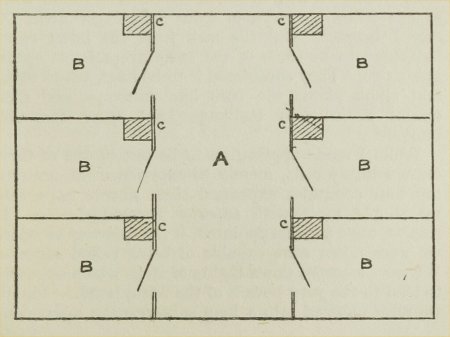
At last we were ordered to the barracks near by. It was a large masonry
building, each room being provided with beds and straw upon the floor.
Subsequently, however, we were moved to less comfortable quarters where
there were three buildings in one, but subdivided by thick masonry
walls, thereby preventing all intercommunication. Here our sleeping
accommodation comprised bunks, disposed in two tiers, made of wood and
with a sack as a mattress.
Whether it is my natural disposition or ancestral blood I do not know,
but it has ever been my practice in life to emulate Mark Tapley and to
see the humorous aspect of the most depressing situation. The "luxurious
hotel," to which we were consigned according "to the best and most noble
traditions of German honour," moved me to unrestrained mirth, when once
I had taken in our surroundings. My levity fell like a cold water douche
upon my companions, while the guards frowned menacingly. But to me it
was impossible to refrain from an outburst of merriment. It was quite in
accordance with German promises, which are composed of the two
ingredients—uncompromising bluff and unabashed deliberate lying,
leavened with a sprinkling of disarming suavity. I had tasted this
characteristic at Wesel and frankly was not a bit surprised at anything
which loomed up, always resolving at all hazards to make the best of an
uncomfortable position.
Upon turning into our unattractive suite our first proceeding was to
elect a Captain of our barrack. Selection fell upon Mr. K——, as he was
an ideal intermediary, being fluent in the language. We turned in, the
majority being too tired to growl at their lot, but there was precious
little sleep. During the day, the heat at Sennelager in the summer is
intolerable, but during the night it is freezing. Our arrival not having
been anticipated, we had nothing with which to keep ourselves warm. A
few days passed before the luxury of a blanket was bestowed upon us.
The morning after our arrival we drew up an imposing list of complaints
for which we demanded immediate redress. We also expressed in detail our
requirements, which we requested to be fulfilled forthwith. Then we
decided to apportion this part of the camp for cricket, that for general
recreation and so forth. By the time we had completed our intentions,
all of which were carried unanimously, several sheets of foolscap had
been filled, or rather would have been filled had we been possessed of
any paper. This duty completed we set out upon an exploring expedition,
intending to inspect all corners of the camp. But if we thought we were
going to wander whither we pleased we were soon disillusioned. We were
huddled in one corner and our boundaries, although undefined in the
concrete were substantial in the abstract, being imaginary lines run
between sentries standing with loaded rifles and fixed bayonets.
One and all wondered how we should be able to pass away the time. We
could neither write nor read owing to a complete lack of facilities.
Idleness would surely drive us crazy. Our recreations were severely
limited, depending upon our own ingenuity. For the first few days we
could do nothing beyond promenading, discussing the war and our
situation. These two subjects were speedily worn thread-bare since we
knew nothing about the first topic and were only able to speculate
vaguely about the second. The idea of being made to work never entered
our heads for a moment. Were we not civilian prisoners of war: the
victims of circumstances under the shield of the best traditions of
German honour?
But we were not the first arrivals at Sennelager. We were preceded by a
few hours by a party of French soldiers—captives of war. They were
extremely sullen. Travel and battle-stained they crouched and stretched
themselves upon the ground. Whence they came I was never able to
discover. One or two of our party who were versed in the French tongue
endeavoured to draw them into conversation, but to no purpose. They
either replied in vague monosyllables or deliberately ignored the
questions. There is no doubt the poor fellows felt their early capture
very sorely, and had accordingly sunk into the depths of despair. Sulky
and morose they glared fiercely upon any approach, and when they did
anything it was with an ill-grace impossible to describe. Indeed, they
were so downcast that they refused to pay the slightest attention to
their personal appearance, which accentuated their forbidding aspect.
Killing time as best we could, doing nothing soon began to reveal its
ill-effects upon those who, like myself, had always led an active life.
I approached Dr. Ascher, explained that idleness would drive me mad, and
petitioned him to permit me to work in the hospital. I did not care what
the job was so long as it effectively kept me employed. He sympathised
with my suggestion and hurried off to the Commanding Officer. But he
came back shaking his head negatively. The authorities would not
entertain the proposal for an instant.
Suddenly we were paraded. Rakes and brooms were served out to every man
and we were curtly ordered to sweep the roads. We buckled into this
task. But the dust was thick and the day was hot. Soon we were all
perspiring freely. But we were not permitted to rest. Over us was placed
a bull-headed, fierce-looking Prussian soldier armed with a murderous
looking whip. I should think he had been an animal trainer before being
mobilised from the manner in which he cracked that whip. When he saw any
one taking a breather up he came, glaring menacingly and cracking the
whip with the ferocity of a lion-tamer. We evinced a quaint respect for
that whip, and I firmly believe that our guardian inwardly fretted and
fumed because he was denied the opportunity to lay it across our backs.
Several of us nearly got it, however.
We were sweeping away merrily when, suddenly, we gave way to a wild
outburst of mirth. One couldn't sweep for laughing. The guards around us
looked on in wonder.
"Christopher! boys!" I at last blurted out, "We were talking just now
about recreation, and were emphatic about what we were, and were not,
going to do. I reckon this wants a lot of beating for recreation!" The
oddity of the situation so tickled us that we had to collapse from
laughter.
But a warning shout brought us to our feet. Mr. Mobilised Lion Tamer was
bearing down upon us waving his whip. He lashed out. We saw it coming
and dodged. By the time the thong struck the road we were brushing up
dense clouds of dust, singing, whistling, and roaring the words,
"Britons never shall be slaves!"
The dust screen saved us. It was so efficient that the furious guardian
with the whip had to beat a hurried retreat.
One morning we were paraded at six o'clock as usual. The adjutant,
another fierce-visaged Prussian, astride his horse, faced us. With
assumed majesty he roared out an order. The guards closed in. What was
going to happen now?
Amid a tense silence he shouted spluttering with rage:—
"You damned English swine! Yes! You English dogs! You are the cause of
this war, and you will have to suffer for it. We could punish you
severely. But that is not the German way. We could make you work. But
the traditions of German honour forbid. Your Government has gouged out
the eyes of German prisoners who have had the misfortune to fall into
their hands. We don't propose to take those measures. While your
Government has stopped at nothing we are going to show you how Germany
fulfils the traditions of her honour, and respects the laws to which all
civilised nations have subscribed. But remember! We are going to bring
England to her knees. Aren't we, men?"
"Ja! Ja!" (Yes! Yes!) came the wild singing reply from the excited
guards.
No doubt the pompous adjutant plumed himself upon his tirade and the
impression it had created among the guards. But at the time it was as so
much Greek to us. We wondered what it all meant and what had prompted
his strange speech.
It was not until my return home that I was able to appreciate the
reason. But the bitterness with which he delivered his harangue
certainly proved that he believed the stories which had evidently been
sedulously circulated throughout Germany relative to the alleged
mal-treatment and torture of German military prisoners by the British.
Unfortunately, no steps apparently were taken to disprove these
deliberate lying statements for which we had to pay the penalty.
But I was not reassured by the Adjutant's honeyed words concerning the
example which Germany proposed to set to the British. I guessed that
something which would not redound to our welfare and comfort was in the
air. It is the German method to preach one thing and to practise
something diametrically opposite. I had already learned this. Nor was I
destined to be mistaken in my surmise.
A little later there was another parade. The officer roared,
"All those who are engineers step out!"
A number, including myself, although absolutely ignorant of the craft,
stepped out, because here was the opportunity to secure some form of
active employment.
"You are engineers?" he shouted.
We nodded assent.
"Can you build a drain?"
Again we nodded affirmatively.
We were marshalled, and one of us, Mr. C——, who was a civil engineer,
was selected as leader. We were marched off and set to work to dig a
drain for the camp.
We built that drain, but it was necessity's labour lost. We were not
provided with proper drain pipes but made an open conduit. We had to go
to the quarry to get the stone, which we broke into small pieces, and
these were set out in concave form at the bottom of the trench we had
excavated after the manner in which cobble stones are laid. I believe it
was considered to be an excellent piece of work, but unfortunately it
was of little use. The first wind and rain that came along dumped the
sand into it with the result that it became filled up.
A day or two later there was another parade. Once more the officer stood
before us with a long sheet of paper in his hand.
"All those who can do wire-pulling stand out!"
Those who knew about what he was talking advanced to form a little
group.
"All those who are gardeners stand out!"
More men advanced and another group resulted.
The officer went right through his list calling out a long string of
trades and callings. The result was our sub-division into a number of
small units, each capable of fulfilling some task. A sentry was
appointed to each group and we were hurried off to the particular toil
for which we considered ourselves to be fitted, and about which I will
say more later.
If the accommodation at the "luxurious hotel" was wretched the routine
and cuisine were worse. We were under military discipline as it is
practised in Prussia, and it was enforced with the utmost rigour. We
were not permitted to speak to an officer under any pretext whatever.
Any complaints or requests had to be carried to the authorities through
our "Captain," who was also the officially recognised interpreter. If we
met an officer we were commanded to raise our hats.
The day started at 6.0 a.m., with parade. If we desired to have a wash
and shave we had to be astir an hour earlier because otherwise we were
not allowed to perform those essential duties until late in the evening.
After parade we had breakfast—a basin of lukewarm "coffee" made from
acorns roasted and ground, which we had to fetch, and with which neither
milk nor sugar was served.
At seven o'clock we started the day's work, which was continued without
respite until mid-day. At least that was the official order, but one or
two of the guards were far from being harsh towards us. In the middle of
the morning, as in our case, the warder, after a wary look round, would
ask if we would like to rest for ten minutes to snatch something to eat
if we had it. Needless to say the slight respite was greatly
appreciated. But it was by no means the general practice. One or two of
the sentries were so deeply incensed against England that they took the
opportunity to bait and badger the men in their charge without mercy.
They kept the prisoners under them going hard without a break or pause.
At noon we returned to barracks for dinner. Arming ourselves with our
basins we scrambled down to the cook-house for our rations. It was
red-cabbage soup, and it was never varied. But it was the strangest soup
I have ever seen made or tasted, more particularly during the early
days.
There was a big cauldron with boiling water. Alongside was a table on
which the cabbages were cut up. A handful of cabbage was picked up and
dumped into the cauldron. Directly it hit the water the cabbage was
considered to be cooked and was served out. Consequently the meal
comprised merely a basin of sloshy boiling water in which floated some
shreds of uncooked red cabbage. Sometimes the first batch of men
succeeded in finding the cabbage warmed through: it had been left in the
water for a few seconds. But the last batch invariably fared badly. The
cooks realising that there would be insufficient to go round forthwith
dumped in two or three buckets of cold water to eke it out. Sometimes,
but on very rare occasions, a little potato, and perhaps a bone which
had once been associated with meat, would be found in the basin lurking
under a piece of cabbage leaf. Ultimately some French and Belgians were
put in charge of the kitchen. Then there was a slight improvement. The
cabbage was generally well-cooked and the soup was hot. But although
these cooks did their best, it did not amount to much, for the simple
reason that the authorities would not permit any further ingredients
whatever.
At 2.0 p.m., there was another parade, followed by a return to work
which was continued without intermission for another four hours. At six
in the evening we returned to barracks for a third parade after which we
were dismissed for tea. This was another far from appetising meal,
merely constituting a repetition of the breakfast ration—a basin of
lukewarm acorn coffee without milk or sugar. In addition to the
foregoing we were served with a portion of a loaf of black bread on
alternate mornings. This supply, if you got it, had to last six meals.
It will be realised that our wardens were far from being disposed to
feed us up. We grumbled against the rations, their monotony and
insufficiency, but we received no amelioration of our condition. In
fact, our petitions were ignored. We were told that if we wanted more or
greater variety of food we must buy it from the canteen. We had to act
upon this recommendation just to keep ourselves alive.
The canteen was run by the most unprincipled scoundrel I have ever met.
He was a civilian speculator who saw the chance to fatten on the
British prisoners. He fleeced us in two ways. Not only were his prices
extortionate, but he gave a ridiculous exchange for British currency,
especially gold. After considerable persuasion and deliberation he would
change a half sovereign for 7½ marks—7s. 6d. We complained but could
get no redress for such a depreciation. Other coins were in proportion.
Brödchen in limited quantities were brought in every day. We could buy
these at 5 pfennigs—one halfpenny—apiece, or in the early days three
for 10 pfennigs. The latter practice was abandoned when the pinch of
flour shortage commenced to be felt. The brödchen came in during the
night, and owing to the totally inadequate quantity purchased to meet
our needs, one had to be about early to secure a supply. I, with others,
have often been up at four o'clock in the morning, lounging around the
canteen, so as to be among the first to be served when it opened at five
o'clock. The scenes which were enacted around the canteen in the early
morning are indescribable. Civilians strangely clad, and later badly
wounded, limping soldiers, sickly and white, waited patiently, no matter
what the weather, to buy a little bread.
The necessity to depend upon the canteen for a sufficiency of food to
keep us alive hit those who were blessed with little money extremely
hard. There was one man—he said he was an Englishman, although I have
my doubts about it—who was brought to the camp. He had not a farthing
in his pocket. He said his home was near the frontier, and that he often
slipped across it for a ride on his bicycle. He related that he had been
caught during one of these excursions, to find himself ultimately at
Sennelager. That man was a mystery. He was kept alive by the others more
or less, and he accompanied us to various prisons. But subsequently he
obtained his papers in a mysterious manner, and was seen no more. He
vanished in the darkness as it were, and the German guards were not
disposed to talk about him. It has always been our suspicion that he
was sent among us with an ulterior motive which it is impossible to
divine.
Those who could not purchase supplies from the canteen were assisted by
their more fortunate comrades. The lucky ones divided their purchases so
that the unfortunate individuals might not feel their position or suffer
want. This practice was tangibly assisted by one or two prisoners who
were well supplied with money, especially Prince L——, who became the
general favourite of the camp from his fellow-feeling, camaraderie,
sympathy, and sportsmanship.
One morning he came across a poor prisoner who looked very ill. He
appeared to be half starved, as indeed he was from his inability to buy
any food. After a short conversation the Prince slipped five sovereigns
into the man's hand and bolted before he could be thanked. Unfortunately
this poor fellow is still in prison, but he has never forgotten the
Prince's kindness.
The day after our arrival at Sennelager the Prince came to me and drew
my attention to my shirtless condition. I explained the reason for its
disappearance and that I could not get another as the authorities were
still holding my heavy baggage containing further supplies. He said
nothing as he went away, but a quarter of an hour later he returned with
a new garment from his own kit which he forced me to accept. Another
day, the party with which I was working were coming in to the evening
meal. He hailed us and invited one and all to accompany him to the
canteen to have a chop with him. That was the finest meal I had tasted
since my feast in Wesel prison. Some time later Prince L—— succeeded
in getting home. Although he was heartily congratulated upon his good
fortune, his absence was sorely felt by those whom he was in the habit
of befriending.
At nine o'clock we had to be in bed. Some of the more untameable spirits
rebelled at the order to extinguish lights at this hour, but in our
barrack Captain K—— rigidly insisted that the regulation should be
observed. He feared the antagonism of the officers might be aroused, in
which event we should be made to suffer for our fractiousness. The
disputes between the prisoners and the sentries over the lights were
interminable. The men would be ordered to extinguish their oil lamp. If
they did not respond with sufficient alacrity the sentry cluttered up
and put it out himself. At a later date, however, the hour for "lights
out" was extended to 10 p.m.
The German nation is ever held up as the world's apostle of hygiene and
sanitary science. However true this may be in regard to civic and rural
life it certainly does not apply to prison and military existence. We
were occupying the quarters normally assigned to recruits. Yet
Sennelager was absolutely devoid of the most primitive features of a
safe sanitary system. There was an open cesspool within a stone's throw
of the barracks, the stench from which, during the heat of the summer,
may be better imagined than described. No disinfectants whatever were
used, and at intervals of three days it was emptied by the crudest means
imaginable, on which occasions the barracks were not only untenantable
but absolutely unapproachable. In fact, the conditions were so primitive
and revolting that the outbreak of an epidemic was momentarily expected,
not only by ourselves but by the authorities as well.
This danger was brought home to us when we were compelled to submit to
the ordeal of vaccination. Even this task was carried out under
conditions which no other civilised country would permit for a moment,
for the simple reason that antiseptic precautions were conspicuous by
their complete absence. The order arrived that we were to be vaccinated
on such and such a morning "in the interests of the camp—both prisoners
and soldiers." We were ordered to line up in a queue outside a small
building which we were to enter singly in succession. We were commanded
to have our arms bared to the shoulder in readiness. Vaccination was not
carried out by Dr. Ascher, the official medical attendant to the camp,
but by a young military doctor who came especially for the purpose.
Whether it was because the temperature within the small building was too
sultry or not I cannot say, but the vaccinator decided to complete his
work in the open air, the fact that a dust-storm was raging
notwithstanding. The military doctor was accompanied by a colleague
carrying a small pot or basin which evidently contained the serum. The
operation was performed quickly if crudely. The vaccinator stopped
before a man, dipped his lance or whatever the instrument was into the
jar, and gripping the arm tightly just above the elbow, made four big
slashes on the muscle. The incisions were large, deep, and
brutal-looking. Then he passed to the next man, repeating the process,
and so on all along the line. He took no notice of the dust which was
driving hither and thither in clouds.
Whether by misfortune or mishap I received four striking gashes, and the
shape of the incisions made me wonder whether the vaccinator thought he
was playing a game of noughts and crosses with a scalpel upon my arm.
After we had been wounded in this manner we were in a quandary. Our arms
were thickly covered with the drifting sand. Our shirt sleeves were
equally soiled. Consequently infection of the wound appeared to be
inevitable whatever we did. In this unhappy frame of mind and dirty
condition we were dismissed. Unfortunately for me I proved resistant to
the serum, and had to submit to the operation a second time with equally
abortive results. One or two of the prisoners suffered untold agonies,
blood-poisoning evidently setting in to aggravate the action of the
serum.
The primitive sanitary arrangements which prevailed brought one plague
upon us. We suffered from a pestilence of flies which under the
circumstances was not surprising, everything being conducive to their
propagation. They swarmed around us in thick black clouds. They recalled
the British housefly, only they were much larger, and extremely
pugnacious. Life within the barracks became almost impossible owing to
their attacks and the severity of their stings, which set up maddening
irritation. We petitioned the authorities to allow us a supply of
fly-papers. After considerable demur they acquiesced, but we could not
use them, or rather they were used up too rapidly. The evening we
received them we decided to attach a few to the ceiling, but before we
could fix them in position their fly-catching capacities were exhausted.
They were covered with a heaving, buzzing black mass of insects within a
minute. So we abandoned fly-catching tactics.
This pestilence harassed us sorely during our meals. They settled
everywhere and upon everything. While butter or margarine were
unobtainable at the canteen we were able to purchase a substance which
resembled honey in appearance, colour, and taste. Indeed we were told
that it was an artificial product of the beehive. When we spread this
upon our bread the flies swarmed to the attack, and before the food
could be raised to our mouths the bread was not to be seen for flies. At
first we spent considerable effort in brushing the insects away, but
their numbers were too overwhelming to be resisted, so we were compelled
to run the risk of the flies, and I, in common with others, have eaten
bread, honey, and flies as well! It took considerable time and effort to
master such a revolting meal, but under these conditions, it was either
flies or nothing, so we ran the risk of the insects, although it cannot
be said that they contributed to the tastiness of an already indifferent
food, or our peace of mind, because we could not dismiss thoughts of the
cesspool which the flies made their happy hunting-ground during the
periods between meals.
Infraction of the rules and regulations were frequent, for the simple
reason that they were never explained to us. We had to learn them as
best we could—invariably through the experience of punishment. This
state of affairs placed us at the mercy of the guards. Those who were
venomously anti-British expended their savagery upon us on every
occasion. For the slightest misdemeanour we were consigned to the cells
for one, two, three, or more days. The cell recalled my domicile in
Wesel, and I must confess that I made the acquaintance of its uninviting
interior upon several occasions through inadvertently breaking some
rule. But the others fared no better in this respect. It was cells for
anything.
This prison was a small masonry building, fitted with a tiny grating. It
was devoid of all appointments, not even a plank bed being provided. To
sleep one had to stretch one's self on the floor and secure as much
comfort as the cold stone would afford. Bread and water was the diet.
All exercise was denied, except possibly for the brief stretch
accompanied by the sentry to fetch the mid-day meal of soup, assuming
the offence permitted such food in the dietary, from the cook-house.
Conversation with a fellow-creature was rigidly verboten. It was
solitary confinement in its most brutal form.
The method of punishment was typically Prussian. If one upset the guard
by word or deed, he clapped you in the cell right-away and left you
there. Possibly he went off to his superior officer to report your
offence. But the probability was that he did not. Indeed it was quite
likely that he forgot all about you for a time, because the sentry at
the door never raised the slightest interrogation concerning a prisoner
within. More than once a prisoner was forgotten in this manner, and
accordingly was condemned to the silence, solitude, and dismal gloom of
the tiny prison until the guard chanced to recall him to mind.
During my period of incarceration at Sennelager the number of civil
prisoners brought in to swell our party was somewhat slender. They came
in small batches of ten or twelve, but were often fewer in number. They
invariably arrived about two o'clock in the morning. Then the sentry
would come thumping into the barrack, his heavy boots resounding like
horse's hoofs and his rifle clanging madly. Reaching the room he would
yell out with all the power of his lungs, thus awaking every one,
"Dolmetscher! Dolmetscher!" (Interpreter! Interpreter!) "Get up!" That
luckless individual had to bestir himself, tumble into his clothes and
hurry to the office to assist the authorities in the official
interrogation of the latest arrivals. This was one of the little worries
which were sent to try us, but we soon became inured to the rude
disturbance of our rest, in which the average sentry took a fiendish
delight.
By the time the first Sunday came round, and having nothing to do—all
labour was suspended, although no religious service was held—I decided
to wash my solitary shirt. I purchased a small cake of cheap rough soap
from the canteen, got a wooden tub, and stripping myself to the waist,
washed out the article in question outside the barrack door to the
amusement of my colleagues. While I was busily engaged in this necessary
occupation I was attracted by tittering and chattering. Looking up I
found I was the object of curiosity among a crowd of civilians dressed
in their Sunday best. Together with my fellow-prisoners I hurriedly
retired to the sanctuary of our barracks.
Later we learned that on Sundays the residents of Paderborn and the
countryside around were free to enter the camp to have a look at the
British prisoners. Indeed they were invited. They stalked and wandered
about the camp in much the same manner as they would have strolled
through the Zoological Gardens in Berlin, looking at us as if we were
strange exotic animals, chattering, laughing, and joking among
themselves at our expense. We considered this an unwarrantable
humiliation, and we countered it by the only means within our power. We
resolutely stayed indoors until the gaping crowds had gone. This
diversion of the German public, if such it may be called, speedily fell
into desuetude, not because the novelty wore off, but because the
"Engländer" were never to be seen, so that the six-mile tramp from
Paderborn to Sennelager and back was merely wasted. It was a bitter
disappointment to the curiosity-provoked crowds, but we scored a
distinct success.
The first Sunday I had to wander about shirtless, the only garment of
this character which I possessed hanging upon the line to dry. But the
sight of a crowd of us, on Sunday mornings, stripped bare to our waists,
washing and scrubbing the only shirts to our backs, became quite a
common sight later, and I must confess that we made merry over this
weekly duty for a time.
We had not been in Sennelager many days before we discovered to our cost
that we were all suffering solitary confinement. We were completely
isolated from the outside world. We were not permitted to receive any
letters or parcels. Neither were we allowed to communicate with anyone
outside. Newspapers were also sternly forbidden. These regulations were
enforced with the utmost rigour during my stay at this camp.
Consequently we knew nothing whatever about the outside world, and the
outside world knew nothing about us. Early in September I did succeed in
getting two post-cards away, but I ascertained afterwards that they did
not reach their destinations until some weeks after I had left
Sennelager. We felt this isolation very keenly because one and all were
wondering vaguely what our wives, families, friends, or relatives were
doing.
About ten days after our arrival at this hostelry there was a parade.
The adjutant strutted before us with the pride of a peacock, and in his
pompous voice cried:
"All prisoners who reside in Germany because of their business
connections, or who are married to German wives, will be permitted to
return to their homes!"
This announcement precipitated wild excitement because it affected from
twenty to thirty prisoners. Needless to say they packed their bags with
frantic speed, as if fearing cancellation of the welcome news, and
emerging from the barracks hastened to receive their passes to make
their way to Paderborn. Among them was the head of our barrack, Captain
K——. A strong friendship had sprung up between him and me, and we
shook hands vigorously though silently. He invited many others and
myself, in the event of our being given permission to move about the
country, to come and stay at his house near C——.
While every man Jack of us who was left behind was heavy in his heart
and became sad because he was not numbered among the privileged few, we
were by no means cast down. As the small party of free men walked
towards the entrance we gave them a frantic and wild parting cheer. It
was the first time we had let ourselves go and we did it with a
vengeance. The German officers and men started as if electrified, and
looked at us in amazement. They thought we had gone mad. Beside us stood
one of the guards. He turned to us, his eyes and mouth wide open, to
mutter:
"My God! You English are a funny race!"
"What's the matter?" we returned.
"What? You cheer those fellows who are going home and yet you are being
left here!"
"Why not? Good luck to them!" and we let fly another terrific huzza to
speed them on their way.
The guard shook his head, thoroughly puzzled. He did not understand the
psychology of the British race any more than his superiors.
"But why do you cheer?" pursued the guard.
"Because we are English," swiftly retorted one of our party. The guard
said no more.
A day or two after the departure of our colleagues there was a change in
the command of the camp. The old General was superseded by a man whose
name will never be forgotten by the British prisoners of Sennelager
Camp. They will ever couple him with the infamous instigator of the
"Black Hole of Calcutta."
This was Major Bach. Upon his assumption of the command he inaugurated
what can only be truthfully described as a Reign of Terror. Tall, of
decided military bearing, he had the face of a ferret and was as
repulsive. With his sardonic grin he recalled no one so vividly as the
"Villain of the Vic!"
The morning after his arrival he paraded us all, and in a quiet suave
voice which he could command at times stated:
"English prisoners! Arrangements are being made for your instant return
to England. A day or two must pass before you can go, to enable the
necessary papers to be completed and put in order. But you will not have
to do any more work."
We were dismissed and I can assure you that we were a merry, excited
crowd. We jumped for joy at the thought that our imprisonment had come
to an end. Like schoolboys we hastened to the barracks and feverishly
set to work packing our bags, whistling and singing joyously meanwhile.
Suddenly the bugle rang out summoning us to parade again. We rushed out,
all agog with excitement, and half hoping that our release would be
immediate. The Adjutant confronted us and in a loud voice roared:
"English prisoners! You've been told that you are going back to England.
That was a mistake. You will get to work at once!"
It was about a fortnight after my arrival at Sennelager. Our rest had
been rudely disturbed about the usual hour of 2 a.m. by the sentry who
came clattering into the barrack roaring excitedly, "Dolmetscher!
Dolmetscher!"
C—— who, after the departure of K——, had been elected Captain of our
barrack and who was also the official interpreter, answered the summons.
He was required to accompany the guards to the station. A further batch
of British prisoners had arrived. By this time we had grown accustomed
to this kind of nocturnal disturbance, so after C—— had passed out the
rest of the barrack re-settled down to sleep.
I was astir just after four o'clock. It was my turn to serve as
barrack-room orderly for the day, and I started in early to complete my
task before 5.30 so as to secure the opportunity to shave and wash
before parade.
I was outside the barrack when my attention was aroused by the sound of
tramping feet. Looking down the road I was surprised to see a huge
column of dust, and what appeared to be a never-ending crowd of
soldiers, marching in column. It was such an unusual sight, we never
having witnessed the arrival of more than a dozen prisoners at a time,
that, especially the moment I descried the uniforms, my curiosity was
aroused. Many of my comrades were astir and partly dressed when I gave a
hail, so they hurried out to join me.
The army, for such it seemed, advanced amidst clouds of dust. As they
drew nearer we identified those at the head as Belgian soldiers. They
swung by without faltering. Behind them came a small army of French
prisoners. We could not help noticing the comparatively small number of
wounded among both the Belgians and the French, and although they were
undoubtedly dejected at their unfortunate capture they were apparently
in fine fettle.
But it was the men who formed the rear of this depressing cavalcade, and
who also numbered several hundreds, which aroused our keenest interest
and pity. From their khaki uniforms it was easy to determine their
nationality. They were British military prisoners.
It was a sad and pitiful procession, and it was with the greatest
difficulty we could suppress our emotion. The tears welled to our eyes
as we looked on in silent sympathy. We would have given those hardened
warriors a rousing cheer but we dared not. The guards would have
resented such an outburst, which would have rendered the lot of the
British, both civilian and military, a hundred times worse.
The soldiers, battle-stained, blood-stained, weary of foot, body and
mind walked more like mechanical toys than men in the prime of life.
Their clothes were stained almost beyond recognition; their faces were
ragged with hair and smeared with dirt. But though oppressed, tired,
hungry and thirsty they were far from being cast down, although many
could scarcely move one foot before the other.
The most touching sight was the tenderness with which the unwounded and
less injured assisted their weaker comrades. Some of the worst cases
must have been suffering excruciating agony, but they bore their pain
with the stoicism of a Red Indian. The proportion of wounded was
terrifying: every man appeared to be carrying one scar or another. As
they swung by us they gave us a silent greeting which we returned, but
there was far more significance in that mute conversation with eyes and
slight movements of the hands than in volumes of words and frantic
cheering.
The brutal reception they had received from their captors was only too
apparent. Those who were so terribly wounded as to be beyond helping
themselves received neither stretcher nor ambulance. They had to hobble,
limp and drag themselves along as best they could, profiting from the
helping hand extended by a comrade. Those who were absolutely unable to
walk had to be carried by their chums, and it was pathetic to observe
the tender care, solicitude and effort which were displayed so as to
spare the luckless ones the slightest jolt or pain while being carried
in uncomfortable positions and attitudes over the thickly dust-strewn
and uneven road. The fortitude of the badly battered was wonderful. They
forgot their sufferings, and were even bandying jest and joke. Their
cheeriness under the most terrible conditions was soul-moving. No one
can testify more truthfully to the Tapley cheeriness of the British
soldier under the most adverse conditions than the little knot of
civilian prisoners at Sennelager when brought face to face for the first
time with the fearful toll of war.
The unhappy plight of our heroic fighting men, as we watched them march
towards what was called the "field," which was nearly a mile beyond our
barracks, provoked an immediate council of war among ourselves. It was
only too apparent that we must exert ourselves on their behalf.
Unfortunately, however, we were not in a position to extend them
pronounced assistance: our captors saw to that. But we divided up into
small parties and succeeded in giving all the aid that was in our power.
The soldiers were accommodated in tents. We had observed the raising of
a canvas town upon the "field," and had been vaguely wondering for what
it was required. Were German recruits coming to Sennelager to undergo
their training, or were we to be transferred from the barracks to tents?
At first we thought the latter the more probable, but as we reflected
upon the size of canvas-town we concluded that provision was being made
for something of far greater importance.
The Belgian prisoners were sent into the stables. These, however, were
scrupulously clean and empty of all the incidentals generally associated
with such buildings, because the civilian prisoners had been compelled
to scour them out a few days before. Consequently the Belgians had no
room for protest against the character of their quarters, except perhaps
upon the ground of being somewhat over-crowded. A number of the French
soldiers were also distributed among the stables, but the surplus shared
tents near their British comrades.
Upon reaching the field the prisoners were paraded. Each man was
subjected to a searching cross-examination, and had to supply his name
and particulars of the regiment to which he belonged. All these details
were carefully recorded. In the preparation of this register the German
inquisitors betrayed extraordinary anxiety to ascertain the disposition
of the British troops and the regiments engaged in the battle-line.
Evidently they were in a state of complete ignorance upon this point.
Nearly every soldier was requested to give the name of the place where
he had been fighting, wounded, and captured. But the British soldiers
did not lose their presence of mind. They saw through the object of
these interrogations and their replies for the most part were extremely
unsatisfactory. The man either did not know, could not recall, or had
forgotten where he had been fighting, and was exceedingly hazy about
what regiments were forming the British army. In some instances,
however, the desired data was forthcoming from those who were most
severely wounded, the poor fellows in their misery failing to grasp the
real significance of the interpellations. It was easy to realise the
extreme value of the details which were given in this manner because
the Germans chuckled, chattered, and cackled like a flock of magpies.
As may be supposed, owing to the exacting nature of the search for
information, the registration of the prisoners occupied a considerable
time.
Later, during the day of their arrival, we civilian prisoners had the
opportunity to fraternise with our fighting compatriots. Then we
ascertained that they had been wounded and captured during the retreat
from Mons. But they had been subjected to the most barbarous treatment
conceivable. They had received no skilled or any other attention upon
the battlefield. They had merely bound up one another's wounds as best
they could with materials which happened to be at hand, or had been
forced to allow the wounds to remain open and exposed to the air.
Bleeding and torn they had been bundled unceremoniously into a train,
herded like cattle, and had been four days and nights travelling from
the battlefield to Sennelager.
During these 96 hours they had tasted neither food nor water! The train
was absolutely deficient in any commissariat, and the soldiers had not
been permitted to satisfy their cravings, even to the slightest degree,
and even if they were in the possession of the wherewithal, by the
purchase of food at stations at which the train had happened to stop.
What with the fatigue of battle and this prolonged enforced abstinence
from the bare necessaries of life, it is not surprising that they
reached Sennelager in a precarious and pitiful condition.
Among our heroes were five commissioned officers, including a major.
These were accommodated at Sennelager for about a fortnight but then
they were sent away, whither we never knew beyond the fact that they had
been condemned to safer imprisonment in a fortress. Among the prisoners
were also about 200 men belonging to the R.A.M.C., taken in direct
contravention of the generally accepted rules of war. They were treated
in precisely the same manner as the captured fighting men. There were
also a few non-commissioned officers who were permitted to retain their
authority within certain limits.
One of the prisoners gave me a voluminous diary which he had kept, and
in which were chronicled the whole of his movements and impressions from
the moment he landed in France until his capture, including the Battle
of Mons. It was a remarkable human document, and I placed it in safe
keeping, intending to get it out of the camp and to send it to my friend
at home upon the first opportunity. But ill-luck dogged this enterprise.
The existence of the diary got to the ears of our wardens and I was
compelled to surrender it.
The next morning the wounded received attention. The medical attendant
attached to the camp for the civilian prisoners, Dr. Ascher, was not
placed in command of this duty, although he extended assistance. A
German military surgeon was given the responsibility. The medical
arrangements provided by this official, who became unduly inflated with
the eminence of his position, were of the most arbitrary character. He
attended the camp at certain hours and he adhered to his time-table in
the most rigorous manner. If you were not there to time, no matter the
nature of your injury, you received no attention. Similarly, if the
number of patients lined up outside the diminutive hospital were in
excess of those to whom he could give attention during the hours he had
set forth, he would turn the surplus away with the intimation that they
could present themselves the next day at the same hour when perhaps he
would be able to see to them. It did not matter to him how serious was
the injury or the urgency for attention. His hours were laid down, and
he would not stay a minute later for anything. Fortunately, Dr. Ascher,
who resented this inflexible system, would attend the most pressing
cases upon his own initiative, for which, it is needless to say, he
received the most heartfelt thanks.
Before the duty of examining the wounded soldiers commenced there was a
breeze between Dr. Ascher and the military surgeon. The former insisted
that the patients should receive attention as they lined up—first come
to be first served, and irrespective of nationality. But the military
doctor would have none of this. His hatred of the British was so intense
that he could not resist any opportunity to reveal his feelings. I
really think that he would willingly have refused to attend to the
British soldiers at all if his superior orders had not charged him with
this duty. So he did the next worse thing to harass our heroes. He
expressed his intention to attend first to the Belgians, then to the
French, and to the British last. They could wait, notwithstanding that
their injuries were more severe and the patients more numerous than
those of the other two Allies put together. This decision, however, was
only in consonance with the general practice of the camp—the British
were always placed last in everything. If the military surgeon thought
that his arbitrary attitude would provoke protests and complaints among
the British soldiers he was grievously mistaken, because they accepted
his decision without a murmur.
The queue outside the hospital was exceedingly lengthy. The heat was
intense and grew intolerable as the day advanced and the sun climbed
higher into the heavens. To aggravate matters a dust-storm blew up. The
British wounded at the end of the line had a dreary, long, and agonising
wait. Half-dead from fatigue, hunger, and racked with pain it is not
surprising that many collapsed into the dust, more particularly as they
could not secure the slightest shelter or relief from the broiling sun.
As the hours wore on they dropped like flies, to receive no attention
whatever,—except from their less-wounded comrades, who strove might and
main to render the plight of the worst afflicted as tolerable as the
circumstances would permit. Dr. Ascher toiled in the hospital like a
Trojan, but the military doctor was not disposed to exert himself
unduly.
To make matters worse this despicable disciple of Æsculapius came out,
and, notwithstanding the drifting and blowing sand, ordered all the
British prisoners to remove their bandages so that there might be no
delay when the hospital was reached. The men obeyed as best as they
could, but in many instances the bandages refused to release themselves
from the wound. The military doctor speedily solved this problem. He
caught hold of the untied end of the bandage and roughly tore it away.
The wounded man winced but not a sound came from his lips, although the
wrench must have provoked a terrible throb of pain, and in some
instances induced the injury to resume bleeding. Finding this brutal
treatment incapable of drawing the anticipated protest he relented with
the later prisoners, submitting the refractory bandages to preliminary
damping with water to coax the dressings free.
With their bandages removed the soldiers presented a ghastly sight.
Their clothes were tattered and torn, blood-stained and mudstained,
while the raw wounds seemed to glare wickedly against the sun, air, and
dust. It was pitiable to see the men striving to protect their injuries
from the driving sand, in vain, because the sand penetrated everywhere.
Consequently the gaping wounds soon became clogged with dust, and it is
not surprising that blood-poisoning set in, gangrene supervening in many
instances. Under these conditions many injuries and wounds which would
have healed speedily under proper attention and which would have left
little or no permanent traces, developed into serious cases, some of
which resisted all treatment, finally demanding amputations. The
mutilation which ensued was terrible, and there is no doubt whatever
that many a limb was lost, condemning the wounded man to be a cripple
for life, just because he happened to be British, incurred the hostility
of the military surgeon, and was intentionally neglected. Matters were
aggravated by the military surgeon coming out of the hospital finally,
after the men had been standing uncomplainingly for several hours in the
baking heat, going a certain distance along the line, and then brutally
telling all those beyond that point that they could re-bind up their
wounds and come to see him the next morning. He had no time to attend to
them that day, he remarked.
I do not know how our wounded heroes from Mons would have got on had it
not been for Dr. Ascher, the R.A.M.C. prisoners, ourselves, and a
British military doctor who happened to be among those captured on the
battlefield. The latter was not discovered for some time because he
refused to reveal his identity. Subsequently, realising the serious turn
which matters were taking, and observing the intentional and systematic
neglect which was being meted out to his unfortunate fellow-countrymen,
he buckled in and did wonderful work. Prince L—— and K—— also toiled
incessantly in the attempt to ameliorate the plight of our wounded. Many
of the soldiers were absolutely without funds, but these two civilians
extended them the assistance so sorely needed out of their own pockets,
purchasing food-stuffs from the canteen, which they distributed together
with other articles which were in urgent request, with every liberality.
The lack of funds hit our wounded exceedingly hard. Although they were
on the sick list they received no special treatment. They were in dire
need of nourishing food suitable for invalids, but they never received
it. They were compelled, in common with ourselves who were in tolerably
good health, to subsist on milkless and sugarless acorn coffee,
cabbage-soup, and black bread, which cannot possibly be interpreted as
an invalid body-restoring dietary. As a result of this insufficient
feeding the soldiers commenced to fall away.
This systematic starvation, for it was nothing more nor less, rendered
the soldiers well-nigh desperate. In order to secure the money wherewith
to supplement their meagre and uninviting non-nutritious food with
articles from the canteen, they were prepared to sell anything and
everything which could be turned into a few pence. Khaki overcoats were
freely sold for six shillings apiece. For sixpence you could buy a pair
of puttees. Even buttons were torn off and sold for what they would
fetch. One morning, on parade, a soldier whose face testified to the
ravages of hunger tore off his cardigan jacket and offered it to any one
for sixpence in order to buy bread. Little souvenirs which the soldiers
had picked up on the battlefield, and which they treasured highly,
hoping to take them home as mementoes of their battles, were sold to any
one who would buy. As a matter of fact some of the soldiers were
prepared to part with anything and everything in which they were
standing in order to get food.
While we fraternised with the soldiers at the very first opportunity to
secure details of their experiences which were freely given and to learn
items of news, the German guards interfered. We had been kept in
complete ignorance of the progress of the war, and now we were learning
too much for our captors. I may say that all we heard about the war was
the occasional intelligence given when we were on parade. Major Bach
would stroll up with German newspapers in his hands and with fiendish
delight would give us items of news which he thought would interest us.
Needless to say the fragments always referred to brilliant German
victories and he used to watch our faces with grim pleasure to ascertain
the effect they produced upon us. At first we were somewhat impressed,
especially when he told us that Paris had been captured. But when he
related ten days later that it had fallen again, and that London was in
German hands, we smiled in spite of ourselves because we had trapped him
in his lying.
We were now separated from our soldier friends, from whom we had gained
a more reliable insight concerning the state of affairs. The German
guards also gave themselves away by relating that they were embittered
against the British soldiers because they had fought like devils and had
wrought terrible havoc among the ranks of the German army. Consequently
the only opportunity which arose for conversation was during the
evenings around the canteen. Even then we had to be extremely cautious.
If the guard saw one or two civilians associated with a group of
Tommies, he would come up, force us apart at the point of the bayonet,
and make us proceed different ways.
Our practice was to mingle singly and discreetly with the soldiers, and
then upon return to barracks exchange news we had gleaned. I may say it
became an unwritten law of the camp that, if a civilian took a soldier
into the canteen and asked him any questions, he was to reciprocate by
treating the Tommy to some little dainty which was obtainable. If we
asked nothing the soldier got nothing. This latter attitude was not due
to our resenting the idea of treating the soldier, but because many of
us were poor, or empty, in pocket ourselves. Although we did a
considerable amount of forced labour we never received a penny for it.
I had a tilt at my guard one day over the payment of prisoners of war.
Although I knew nothing about the International law upon the subject I
made a venture.
"Do you know?" I asked, "that as prisoners of war we are entitled to 60
pfennigs—sixpence—a day for what work we do?"
"Ja! Ja!" he grinned. "But as it costs us 90 pfennigs a day to keep you,
after deducting the 60 pfennigs, you still owe us 30 pfennigs a day!"
The idea of us being in Germany's debt for our board and lodging was
certainly humorous. If any one asked me how much it cost the Teutonic
Government in this direction I should consider a halfpenny a day a very
liberal figure.
The efforts of the prisoners to supplement their meagre and monotonous
official allowance of food by purchases at the canteen were handicapped
by the avariciousness and unprecedented rascality of the unprincipled
rogue who was in charge of this indispensable establishment.
When a soldier had secured a few pence, say a shilling, by the sale of
this or that personal belonging, and proffered the coin to the canteen
proprietor, this worthy would pick it up, shrug his shoulders, and
disdainfully push the shilling back with the remark, "English money? No
good here! I can get very little for it!"
At this pronouncement the soldier's face would fall. But dreading denial
of a "brötchen" of which he was in urgent need he would grow desperate.
He would push the coin across the counter again.
"It must be worth something! Now how much will you give for it?" he
would ask pleadingly.
With further demur, elevation of eyebrows, puckering of brows and
hesitancy the canteen proprietor would complete a mental arithmetical
sum in currency exchange. At last he would reluctantly quote a figure,
and as a rule it was about fifty per cent. below the face value of the
coin. Thus the soldier's shilling would only be valued at sixpence in
German money.
The soldier, satisfied at being able to get a "brötchen" even at such a
sacrifice, would submit. But although the unwarranted depreciation was
robbery it was not the worst feature of the methods of this greedy
money-changer.
The soldier would receive, not five English pennies or 50 German
pfennigs as his change but a French half-franc. Then the next time he
visited the canteen for another "brötchen" or something else, he would
put down the half-franc he had previously received. Again the soldier
received a rude surprise. The canteen proprietor would reluctantly say
that the French money was useless to him. There would be a repetition of
the previous bickering over the British shilling, and at last the
astonished soldier would learn that he could only change the French
half-franc at a discount of forty per cent. In this instance the change
would be the equivalent of twopence in English money, but it would be
given in Belgian coins. Upon the third occasion when the British soldier
visited the canteen to buy a "brötchen" and proffered the Belgian
coinage he would learn that this had also undergone a sudden
depreciation of fifty per cent. So that by the time the soldier had
expended his shilling he had really received goods to the value of about
threepence.
It was a cunning method of conducting business and the canteen
proprietor was a master in keeping the hated currency of the three
nations in circulation among themselves, and always exacted a heavy
charge for its acceptance.
With such a novel means of ringing the changes upon soldiers of the
three nationalities it is not surprising that the canteen proprietor
waxed rich within a very short time.
Such a state of affairs not only adversely affected the soldiers but the
poor civilian prisoners as well. At last things came to such a pass that
one of our interpreters, F. K——, the fellow-prisoner whom I had met in
Wesel prison, tackled the canteen proprietor upon his unfair method of
conducting business, and emphasised how harsh it was upon the prisoners
who were not flush in funds. For this attempt to improve our position F.
K—— had to pay the penalty. The canteen proprietor promptly reported
the interpreter to the Commanding Officer of the camp, who forthwith
sentenced our comrade to three days' cells for daring to interfere with
German organisation!
The Germans, in their determined intention to prevent the British
civilian and military prisoners from mingling, adopted the most drastic
measures. Guards were posted everywhere and we were sternly forbidden to
enter the soldiers' reservation. If we were detected the guards were
instructed to let drive with their rifles without giving any previous
warning. The anti-British sentiment was so acute that any one of our
guards would have only been too delighted to have had the chance to put
this order into effect, and that upon the slightest pretext. As he would
have been upheld in his action we decided to give these amiable wardens
no opportunity to turn us into targets.
There is no doubt that we were regarded as little less than desperadoes
of the worst type. Our troops had given the Germans such a severe
shaking up as to throw our guards into a state of wild panic. This was
proved only too conclusively by an incident which occurred one night.
After we had retired we were not permitted to put our heads out of the
windows. To do so was to court a bullet, also according to instructions.
On this particular night, after we had turned in, one of the prisoners,
unable to sleep owing to mental worry and the heat, strolled to the door
to get a breath of fresh air. As he stepped out into the dusty footway a
terrifying fusillade rang out and continued for several minutes. We all
sprang up wondering what was the matter.
The poor fellow had been spotted coming out of the door by the sentry
who, too excited to recognise the man, had fired his rifle at the
prisoner for all he was worth. Instantly the guard turned out. The
prisoner brought abruptly to his senses had darted back into the barrack
safe and sound but fearfully scared. Only the wild shooting of the
sentry had saved him from being riddled. The guard itself, upon turning
out, evidently thought that a rebellion had broken out or at least that
a prisoner had escaped. Seizing their rifles they blazed away for dear
life. They did not aim at anything in particular but shot haphazardly at
the stars, haystacks, and trees in the most frantic manner imaginable
and as rapidly as their magazine arms would let them. Undoubtedly the
Germans were half-mad with fear. It rained bullets around the barracks
and every man within crouched down on his bed, away from the windows
through which we momentarily expected the bullets to crash. None of us
dared to move for fear that there might be a collision with one or more
of the missiles which pattered around us.
The next morning we were paraded hurriedly. The guard ran about among
us, searching every corner of the barracks, as if bereft. The roll was
called with wild excitement. A prisoner had escaped! Had he not been
seen by every imaginative member of the guard? But when they discovered
that we were all safe and sound, and that we were perfectly composed,
they presented a sorry array of stalwart warders. Their sheepishness
provoked us to laughter when we learned the true reason for all the
bother. But it brought home to us the extreme danger of falling foul of
such a panicky mob.
The military reservation was fenced off from our quarters by barbed
wire. The rule ran that no prisoner on either side of the barrier was to
advance within a metre's distance—about one yard—of the fence. Guards
were on duty to see that this regulation was obeyed. One day a British
Tommy, in a moment of forgetfulness, ventured within the forbidden
distance. With a flash the excited guard standing near by raised his
rifle and jabbed fiercely at the soldier. The bayonet got home in the
luckless Tommy's shoulder and passed clean through from front to back,
the ugly point of the bayonet protruding about three inches.
This incident and unwarranted savagery, although born of "nerves,"
sickened and also roused those of us who had seen it. Seeing that the
soldier was quite unarmed the sentry might have used the butt end of his
weapon just as satisfactorily. But no! It was a swine of an Engländer
who had infringed the rule and the bayonet was the instrument for
correction, to be plied with the utmost effect.
Seeing the desperate condition of the British wounded and the inhuman
manner in which they were treated one might naturally conclude that they
would have died off like flies. Sennelager has the most evil reputation
among the German prison camps for systematic brutality and unprecedented
ferocity. But to levy such an accusation is to bring an immediate German
denial. In reply they turn to the official reports and retort that
conditions could not possibly be so terrible as they are painted,
otherwise the camp would be certain to reveal a high mortality. On the
other hand the death-rate at Sennelager is strikingly low, and the
German officials smile contentedly while the Press comforts itself
smugly.
The presentation of the low death-rate is even likely to arouse doubt in
the minds of the unsophisticated British at home. They are not versed in
German cunning. Sennelager camp carries a low death-rate for the simple
reason that a prisoner is not permitted to die there. When a man has
been reduced to a hopeless condition and his demise appears imminent he
is hurriedly sent off to some other place, preferably a hospital, to
die. By a slice of luck he might cheat Death, in which event, upon his
recovery, he is bundled off to another prison. But he seldom, if ever,
comes back to Sennelager! During my period of incarceration only one
man, B——, who was sent to Paderborn hospital to die as the Germans
thought, but who recovered, returned to Sennelager. When a man was
hastened out of the camp in this manner we never knew his fate. It
became a by-word that few men went from Sennelager but none returned.
Consequently, whenever we saw a sick case leave the camp we surmised
that the poor wretch was making his final journey to the Great Beyond.
We assumed his speedy death from natural causes—as the German
authorities would relate—to be inevitable.
Although we British prisoners, both civilian and military, constituted
the principal butt for the spleen of Major Bach, we never raised the
slightest audible complaint or protest, although inwardly and in the
seclusion of our barracks we chafed at the unrelenting tyranny to which
we were exposed and against which we were completely helpless. In strict
accordance with the instructions of the Commandant we were always the
last to receive attention. If we ever had to go to the hospital to
receive any treatment and were the first to arrive at its doors, we had
to kick our heels outside and possess ourselves in patience as best we
could until all the prisoners of other nationalities had seen the
surgeon. As a rule we had a lost journey. The surgeon in his haste to
get away either would notify us that our cases could not receive enquiry
until the morrow, or he would treat us in a perfunctory manner.
As at the hospital so at the cook-house at meal times. We were never
given our rations until all the others had been satisfied. The
consequence was that we generally went short of food. The first to be
treated received liberal quantities of the cabbage soup. What was left
had to be eked out amongst us.
"The damned English swine can wait!" This was the dictum of those in
authority and the underlings were only too eager to fulfil it to the
letter. If there were the slightest opportunity to deprive us of our
food, on the flimsy pretext that we had not answered the summons with
sufficient alacrity, it was eagerly grasped. Under these conditions we
had to go supperless to bed, unless we could procure something at the
canteen or our more fortunate comrades came to our assistance by sharing
with us the comestibles they had purchased.
Some ten days after the appearance of Major Bach a new target for his
savagery and venom appeared. This was a party of Belgian priests. I
shall never forget their entrance to the camp. We were performing
necessary daily duties outside our barracks when our attention was drawn
to an approaching party surrounded by an abnormally imposing force of
soldiers. Such a military display was decidedly unusual and we naturally
concluded that a prisoner of extreme significance, and possibly rank,
had been secured and was to be interned at Sennelager.
When the procession drew nearer and we saw that the prisoners were
priests our curiosity gave way to feelings of intense disgust. They were
twenty-two in number and were garbed just as they had been torn from
prayer by the ruthless soldiers. Some were venerable men bordering on
seventy. Subsequently I discovered that the youngest among them was
fifty-four years of age, but the average was between sixty and seventy.
The reverend fathers with clasped hands moved precisely as if they were
conducting some religious ceremonial among their flocks in their beloved
churches. But the pace was too funereal for the advocates of the
goose-step. They hustled the priests into quicker movement, not in the
rough manner usually practised with us, but by clubbing the unfortunate
religionists across the shoulders with the stocks of their rifles,
lowering their bayonets to them and giving vent to blood-freezing
curses, fierce oaths, coarse jeers, and rewarding the desperate
endeavours of the priests to fulfil the desires of their captors with
mocking laughter and ribaldry.
The brutal manner in which they were driven into the camp as if they
were sheep going to the slaughter, made our blood boil. More than one of
us clenched our fists and made a half-movement forward as if to
interfere. But we could do nothing and so had to control our furious
indignation.
However, the moment the priests entered Sennelager we received a
respite. Officers and guards turned their savagery and spite from us to
visit it upon these unhappy victims by night and by day and at every
trick and turn. Clubbing with the rifle was the most popular means of
compelling them to obey this, or to do that. More than once I have seen
one of the aged religionists fall to the ground beneath a rifle blow
which struck him across the back. No indignity conceivable, besides a
great many indescribable, was spared those venerable men, and they bowed
to their revolting treatment with a meekness which seemed strangely out
of place.
After one more than usually ferocious manifestation of attack I
questioned our guard to ascertain the reason for this unprecedented
treatment and why the priests had been especially singled out for such
infamous ferocity.
"Ach!" he hissed with a violent expectoration, "They fired upon our
brave comrades in Belgium. They rang the bells of their churches to
summon the women to the windows to fire upon our brothers as they
passed. The dogs! We'll show them! We'll break them before we have
finished. They won't want to murder our brave troops again!"
The words were jerked out with such fearful fury that I refrained from
pursuing the subject. Later I had a chat with one of the oldest priests.
It was only with difficulty we could understand one another, but it was
easy to discover that the charges were absolutely unfounded, and were
merely the imagination of the distorted and savage Prussian mind when
slipped from the leash to loot, assault and kill for the first time in
his life.
A night or two later a few of us were purchasing food at the canteen.
Suddenly four soldiers came tumbling in, dragging with them one of the
most aged of the Fathers. He must have been on the verge of three-score
and ten, and with his long white beard he presented an impressive,
proud, and stately figure. But the inflamed Prussian has no respect for
age. The old man was bludgeoned against the counter and at his abortive
attempts to protect himself the soldiers jeered and laughed
boisterously.
One of the soldiers called for a suit of clothes which was served out to
prisoners, and for which we were supposed to pay six marks—six
shillings. The leader of the party of soldiers grabbed the suit and,
pushing the priest roughly, shouted,
"Here! You can't work in the fields with that garb you are wearing.
You've got to buy these. Six marks! Hurry up! You've got to put them
on!"
The priest, who did not understand a word of German, naturally failed to
grasp the meaning of the command. He promptly received a clout to knock
some sense into him, the soldier meanwhile shaking the prison-like suit
to emphasise what he meant.
In mute protest the priest shook his robes to indicate that he was quite
content with what he was wearing.
"Come on! If you don't change we'll do it for you!"
At this threat there was a wild outburst of demoniacal mirth, in which
the girl behind the counter, a brazen jade, joined uproariously as if in
anticipation of some unusual amusement. She reached over the counter,
craning her neck to secure a better view of an unexpected spectacle.
As the Reverend Father did not respond to the command, the guard
gathered round him. Before we could realise what was happening, his
crucifix and rosary had been roughly torn off, and with his watch and
chain had been thrown upon a table standing alongside. His robe was
roughly whisked away in the twinkling of an eye. But the prisoner did
not move or raise a hand in protest, even when he was bared to his
under-clothing in front of fräulein, who signalled her appreciation of
the sight by wildly clapping her hands, laughing merrily, and giving
expression to ribald jokes.
The proud manner in which the victim surveyed his tormentors only
exasperated them still further. By the threat of the bayonet he was
compelled to stand up in front of these degenerate members of the human
race and the girl behind the counter, whose laughter could now be heard
ringing above the frantic shrieks of the soldiers.
We, who were unwilling witnesses of this revolting spectacle, were
grinding our teeth in ill-suppressed rage. Never during my sojourn in
Sennelager, even when submitted to the greatest torment, have I seen the
British prisoners roused to such a pitch of fury. As a rule we
effectively maintained a quiet, if not indifferent, and tractable
attitude, but this was more than flesh and blood could stand.
But the priest never relaxed his proud composure and self-possession. He
looked so penetratingly at the laughing jade that I think it must have
penetrated into her very soul. Her wild mirth ended abruptly in a
strange semi-hysterical shriek as her eyes met his look of intense
scorn. She winced and was effectively cowed into silence.
I may say that the floor of the canteen was of concrete, but upon this
was a layer of mud, slime, grease, and other filth brought in from
outside upon the boots of those who frequented the establishment. This
was now a noisome muddy carpet some two inches in thickness. The
Germans, one may happen to recollect, have ever paraded their love of
cleanliness before the world, but this floor was the lie direct to their
vain boastings.
At the sight of the old man standing there erect before them, the victim
of unparalleled humiliation, but his spirit as strong and as unyielding
as ever, the fury of the soldiers knew no bounds. One, giving vent to a
fearful curse, placed his hand on the table upon which the crucifix,
rosary, and watch were lying. He gave a swift, fiendish glance at the
priest towering above him, and with a vile oath swept the articles to
the floor, where they ploughed through the greasy revolting slime.
It was then that the badgered and baited Father broke down. As he
watched his beloved and revered crucifix and rosary suffering defilement
and serving as the rude sport for the iron heels of the uncivilised
Huns, the tears coursed down his face copiously. He gave a slight start
as he saw the articles flash through the air, but suppressed the cry of
horror which sprang inadvertently to his lips.
But the soldiers were not yet satisfied with the agony which they had
created in the Father's heart. One grabbed his rifle and lowering the
bayonet in a threatening manner ordered the priest to pick up his sacred
treasures. The priest stooped down to obey the instructions, but this
was not sufficient for his persecutors. He was driven to his knees and
forced to grope among the repulsive mud for his revered religious
tokens. With great difficulty he recovered them, battered, crushed, and
covered with the filthy accumulation upon the floor. As the Reverend
Father drew himself once more to his full height, clasping his treasures
desperately, he brought his hands together, and closing his eyes, we saw
his lips moving in prayer.
This was the last straw. Grating our teeth, our faces white with
passion, and our fingers itching to seize those barbarians round their
throats to choke their lives out of them, we nearly threw discretion to
the winds. Had one of us made a forward movement we should have sprung
upon them with the ferocity of bull-dogs. Those four soldiers never knew
how near they were to meeting their deserts upon that day. As it was we
merely scraped our feet in impotent rage. It was this fidgeting which
aroused their attention. They turned and must have read our innermost
intentions written in our faces, for they instantly grabbed their
rifles and rounded upon us. With a motion which could not be
misunderstood, and uttering fierce curses, they ordered us to get
outside. We refused to move, although confronted by ugly pointed
bayonets. It was a tense and critical moment. The soldiers undoubtedly
saw that we were now thoroughly roused, and, strange to say, they
appeared to lose their heads, for they stood stock still, apparently
frightened by our determined appearance.
One of our party, although as enraged as any of us, yet had maintained
more complete control over his feelings. He saw the utter uselessness of
our making a display of physical protest. With a quiet "Come on, boys!"
he stepped towards the door. It saved an ugly situation; the movement to
the door and the crisis had passed. Fiercely glaring at the soldiers,
with our jaws ominously set, and our fists clenched we retreated. Our
action revived the courage of the guards. They at once sprang forward to
jostle us out, prodding and attempting to club us right and left.
As we hurried through the open door we gave a final glance at the
priest. He had turned his head and was looking steadily at us, and if
ever conversation were carried out by looks there were volumes in his
gaze. His eyes told us how impotent we were in the hands of these brutes
who were brave because they had their loaded rifles. They told us of his
appreciation of our sympathy in his hour of humiliation and torment.
They extended us heartfelt thanks for our willingness to come to his
assistance, combined with a mute instruction not to lift a finger on his
behalf since the plight of one and all would become infinitely worse. We
passed into the street and the door was slammed upon us.
Once outside we allowed our feelings to have full rein. We point-blank
refused to go away and fell to discussing the situation somewhat
fiercely. Evidently the tones of our voices persuaded the soldiers
within that they had gone far enough, because shortly afterwards the
priest re-appeared, and under escort was hurried away to his quarters.
When we next saw him we endeavoured by diplomatic questions to ascertain
the reason why he had been subjected to such torture and indignity. To
him the greatest humiliation was that his torment had occurred before a
woman. But otherwise he refused to refer to the episode. His retort, in
a placid, resigned voice, was, "I only trust that God will have mercy
upon them!"
The priests were denied all opportunity to move about the camp. There
were scores of co-religionists among us, but they were stedfastly
refused the comfort which the Fathers could have given them. The priests
were not permitted to minister to the spiritual welfare of their flocks.
As a matter of fact, by the strict instruction of Major Bach, no
religious services of any description were permitted in the camp, at
least not while I was under his sway.
To the members of the Roman Catholic persuasion the brow-beating,
badgering, baiting and buffeting of the helpless priests acted as a red
rag to a bull. But what could they do? Protest was merely so much wasted
energy. Communication with anyone outside the camp was absolutely
impossible. To have reviled Major Bach for his cruelty and carefully
planned barbarity would only have brought down upon us further and more
terrible punishment of such ferocity as would have made everyone long
for the respite of the grave.
But the priests could not be broken, no matter to what physical and
mental suffering they were subjected. Even Major Bach discovered to his
chagrin that his devilish ingenuity had encountered an insuperable
obstacle. To wreak his revenge he now compelled the Fathers to carry out
all the dirtiest and most revolting work in the camp—duties so
repulsive as to be beyond description. But the good men never murmured.
They did exactly as they were bidden, and even the guards at last
appeared to realise the fact that their fertility in torment was of no
avail in attempting to infuriate their meek charges.
Major Bach, however, was by no means cast down at his failures. One
morning he ordered the twenty-two priests to be paraded. They were then
loaded up with a variety of cumbersome and heavy implements—spades,
picks, shovels, and such like. Each load would have taxed the strength
of a young man in the pink of condition and strength to carry, and yet
here were old men, ranging between sixty and seventy years, compelled to
shoulder such burdens. But they did it.
An order was rapped out, the guard wheeled, and the tiny party moved
off. We discovered afterwards that they were marched three miles along
the sandy road in the blazing sun to a point where they were roughly
bidden to dig a huge pit.
Throughout the morning, and without a moment's respite, they were forced
to ply their tools, their task-masters standing over them and smartly
prodding and threatening them with their rifles if they showed signs of
falling from fatigue, or if they failed to maintain the expected rate of
progress. To such old men, who probably had never lifted the smallest
and lightest tool for many years, if ever, it was a back-breaking task.
However, they clung dutifully to their work until the hour of twelve
rang out.
Now they were re-marshalled, their tools were re-shouldered, and they
were marched back to camp for the mid-day meal. By the time they reached
the barracks all the other prisoners had consumed the whole of the
available soup. There was nothing for the priests. It was explained that
they should have hurried so as to have arrived at an earlier moment.
Then they would have received their due proportion. Meals could not be
kept waiting for dawdlers, was the brutal explanation of the
authorities. The priests must be made to realise the circumstance that
they were not staying at an hotel. This, by the way, was a favourite
joke among our wardens.
The priests bore visible signs of their six miles' tramp through
crumbling scorching sand and under a pitiless sun, as well as of their
laborious toil excavating the large pit. But their distressed appearance
did not arouse the slightest feeling of pity among their tormentors.
Being too late for the meal they were re-lined up, and under a changed
guard were marched back again to the scene of their morning's labour.
Naturally, upon reaching the pit, they concluded that they would have to
continue the excavation. But to their intense astonishment the officer
in charge ordered them to throw all the excavated soil back again into
the hole! This was one of the most glaring examples of performing a
useless task, merely to satisfy feelings of savagery and revenge, that I
encountered in Sennelager, although it was typical of Major Bach and his
methods. He took a strange delight in devising such senseless labours.
Doubtless the authorities anticipated that the priests would make some
demur at being compelled to undo the work which they had done previously
with so much effort and pain. But if this was the thought governing the
whole incident the officials were doomed to suffer bitter
disappointment. The priests, whatever they may have thought, silently
accepted the inevitable, and displayed as much diligence in filling the
pit as they had shown a few hours before in digging it.
Still the afternoon's shovelling caused them greater physical hardship
than the plying of the pick in the morning. They had been denied a
mid-day meal, and their age-enfeebled physique proved barely equal to
the toil. A basin of black acorn coffee and a small fragment of hard
brown bread cannot by any manner of means be construed into strong
sustenance for such a full day's work. During the afternoon one or two
were on the verge of collapse from hunger and fatigue. But their
indomitable spirit kept them up and the pit was duly filled.
By the time the labour had been completed the evening was advancing. For
the fourth time that day they shouldered their burden of tools and set
out on the three miles tramp to camp.
We saw them come in and our hearts went out in pity to them. They
tottered rather than walked, their heads bowed as if in prayer, and
their crosses of tools sinking them nearer to the ground. Seeing that
they had walked twelve miles and had put in some eight hours gruelling
work it was a marvel that the older members of the party had not fallen
by the wayside. Yet, although footsore, weary, worn, and hungry they
retained their characteristic composure. In silence they discussed their
frugal evening meal of lukewarm black acorn coffee and black bread. Some
of us, out of sheer sympathy, secured some "brötchen" for them, but they
accepted our expressions of fellow-feeling very sparingly, although with
extreme thankfulness.
They refused to say a word about their sufferings or the agonies they
had experienced during their labour and long walk. I got the story from
one of the guards who had accompanied them. But even these thick-skinned
disciples of "kultur" and brutality were not disposed to be
communicative. The stoicism, grim determination and placidity of the
Reverend Fathers constituted something which their square heads and
addled brains failed to understand. They had never experienced the like.
While Major Bach never repeated the senseless pit-digging and refilling
programme for the priests, his invention was by no means exhausted.
Direct incentive to rebellion proving completely abortive he now
resorted to indirect pettifogging and pin-pricking tactics, harassing
the unfortunate priests at every turn, depriving them of food or
something else, reducing their rations, giving them the most repulsive
work he could discover, and so forth. But it was all to no purpose.
Those twenty-two priests beat him at every turn. For Major Bach to try
to break their proud spirit was like asking a baby to bend a bar of
steel!
What ultimately became of these prisoners I cannot say. In fact, I do
not think there is any one who can definitely relate their fate. Other
prisoners now commenced to arrive in increasing numbers and the
breaking-in of these crowds to the tyranny and brutal existence of
Sennelager Camp appeared to demand the complete attention of the
authorities. Certainly the new arrivals provided Major Bach with all the
entertainment he desired.
Some say that the priests were distributed among other camps; others
that one or two succumbed to the persistent ill-treatment meted out to
them; and still more that they are yet at Sennelager. No one can say
precisely. Only one fact remains. For a time they occupied the sole
attention of every one in the camp because they constituted the most
prominent target for the fiendish devilry of Major Bach. Then they
suddenly appeared to slip into oblivion. The probability is that they
were swallowed up among the hundreds of French, British, Russians,
Poles, Serbians, and various other races who were now pouring in. Being
somewhat retiring in their nature the probability is that the priests
were overlooked and forgotten in that troublous maelstrom of outraged
humanity known far and wide as Sennelager Camp.
Until the coming of Major Bach at Sennelager confinement to cells
constituted the general punishment for misdemeanours, the sentence
varying according to the gravity of the offence. But mere solitary
confinement in a hole in which perpetual twilight prevailed during the
day did not coincide with Major Bach's principles of ruling with a rod
of iron. It was too humane; even the most savage sentence of "cells" did
not inflict any physical pain upon the luckless prisoner.
Major Bach was a past-master in the grim art of conceiving new and novel
methods to worry and punish those who were so unfortunate as to be under
his thumb. He was devilishly ingenious and fertile in the evolution of
ways and means to make us feel our position as acutely as possible. I
really think that he must have lain awake for hours at night thinking
out new schemes for inflicting punishment upon us, or else must have
been possessed of an excellent and comprehensive encyclopædic dictionary
dealing with the uncanny and fiendish atrocities devised by the Chinese.
I do not doubt for a moment that, if he dared, he would have introduced
some of the most ferocious tortures which for centuries have been
characteristic of the Land of the Dragon. We were absolutely helpless
and completely in his hands. He knew this full well and consequently,
being a despot, he wielded autocratic power according to his peculiar
lights as only a full-blooded Prussian can.
One evening the French military prisoners were being marched into camp
at the conclusion of the day's work. Among them was a Zouave.
Half-starved from an insufficiency of food he could scarcely drag one
foot before the other. At last he dropped out from sheer fatigue. The
guard struck him with the butt end of his rifle and roughly ordered him
to get up and keep step and pace with his comrades. The Zouave pleaded
that he really could not walk another step because he felt so weak and
ill. The guard thereupon pulled the wretched prisoner to his feet and
gave him a heavy blow across his back.
This unwarranted action stung the Zouave to frenzy. Clenching his teeth
he sprung towards his tormentor with his fist raised in the air. But
second thoughts prevailing he refrained from delivering the blow which
he had premeditated. The menace, however, did not fail to exercise its
effect upon the bullying guard who instantly became an arrant coward.
The Zouave's action was so unexpected that the soldier was taken
completely by surprise. He commenced to yell as if he had been actually
struck, and his vociferous curses, reaching the ears of his comrades,
brought speedy assistance. They rushed up, secured the Zouave, who was
glaring fiercely at his tormentor, pinioned his arms behind him, and
then marched him off to the Commanding Officer with all the speed they
could command.
The grave charge of insubordination and attempting to strike the guard
was proffered. Major Bach listened closely and when he had heard the
story, which needless to say was somewhat freely embroidered, curtly
sentenced the Zouave to "four hours at the post!" This was the first
occasion upon which we had heard of this punishment and naturally we
were somewhat agog with curiosity to discover the character of this
latest means of dealing out correction.
Escorted by four guards with loaded rifles and fixed bayonets, the
unhappy Zouave was led to a post just outside our barrack. One of the
soldiers stood on either side of the prisoner ready to run him through
should he make an attempt to escape or to resist. The other two guards,
discarding their rifles, uncoiled a length of rope which they were
carrying.
The prisoner's hands were forced behind his back and his wrists were
tied tightly together, the rope being drawn so taut as to cut deeply
into the flesh and to cause the unhappy wretch to shriek. He was now
backed against the post round which the rope was passed. His ankles were
then tied as tightly as his wrists and also strapped to the post, which
action drew another yell of pain from the victim. Finally another length
of the rope was passed round the upper part of his body, lashing him
firmly to the support to prevent him falling forward.
Trussed and tied the unhappy prisoner was left to undergo his four
hours' sentence of this ordeal. The soldiers returned to their quarters,
but as a preliminary precaution, as we were undeniably showing signs of
resentment against such torturing treatment, we were bustled into our
barracks. But we could not rest or sleep. The hapless man at the stake
was being racked and torn with pain. His shrieks, moans, and groans,
echoing and re-echoing through the still hours of the summer evening,
sounded so weird, uncanny, and nerve-racking as to make our blood run
cold. At each outburst we shivered and strove hard, though vainly, to
shut out the terrible sounds from our ears.
After the Zouave had been strung up for some time I decided to creep out
and up to him to ascertain from direct close observation the effects of
this treatment upon the victim. Stealing out of the barracks, thereby
running the risk of encountering a bullet from the sentry's rifle, I
stealthily made my way to the post. By the time I gained the spot the
weak wretch was in a fearful plight. The ropes had been drawn so tightly
round his wrists and ankles as to cause the circulation of the blood
through the hands and feet to cease, while the flesh immediately above
the knots was swelling up in a fearful manner. All sense of feeling in
the hands and feet having gone, the man was hanging limply, instead of
standing against the post. He writhed and twisted in frenzied efforts to
secure some relief while in this uncomfortable position, but each
movement only caused further pain and the unintentional utterance of
piercing shrieks. Upon the exhaustion of this spasm the upper part of
his body dropped forward slightly so that his head fell down upon his
chest.
For a few seconds he would stand or rather hang, perfectly still and
quiet. Then as he made another attempt to secure a change of position
shafts of pain would shoot through him, causing him to shriek again for
a few seconds in the most agonising manner, which made me start and
shiver. While his shrieks were terrifying it was the long-drawn out wail
and moan in which they ended which were more unnerving. They sounded
like the agonised howls of an animal caught in a trap and suffering
untold torment.
But each successive outburst grew weaker. The body dropped more and more
forward until it could fall no farther owing to the retaining rope. His
head dropped lower and lower upon his chest, which had the effect of
interfering with respiration. The man would throw his head wildly about
in frantic efforts to breathe, but to little purpose. His face commenced
to assume a ghastly bluish colour; his distended eyes almost started
from his head; while his mouth, now wide open, allowed his tongue to
loll and roll in a manner vividly reminiscent of a maniac restrained in
a strait jacket. The struggles and cries grew fainter until at last his
head gave a final jerk to hang limply to one side. He shrieked no more.
Insensibility had come to his relief.
During this period the guard never ventured to come to look at him. His
piercing shrieks, howls, and long-drawn out moans told them that he was
feeling the pinch of his confinement to the post. But when these cries
of agony ceased two of the guards came up. Seen to be unconscious, he
was immediately released to fall like a log to the ground. Buckets of
water were hurriedly fetched and the contents were dashed over the prone
figure until consciousness returned. When he had somewhat recovered,
although still inert and groaning piteously, he was propped up against
the post and re-tied into position.
Every time the man relapsed into insensibility he was released to
undergo drastic reviving by the aid of buckets of water, and directly he
came to he was again strapped up. The sentence was "four hours," and it
was fulfilled strictly to the letter, but only the actual periods of
being tied to the post were taken into consideration. It did not matter
whether the man fainted three or thirty times during his sentence. It
was only the instalments of time against the post which in the aggregate
were taken to represent the full term of the punishment.
As may be supposed, owing to the recurring periods of insensibility, the
duration of the sentence became prolonged. In about two hours after
being strung up for the first time the initial spasm of unconsciousness
would occur, although the intervention of insensibility obviously varied
according to the strength and physical endurance of the prisoner. But
after the first revival, and owing to the man being deprived of the
opportunity to regain his normal condition, the lapses into
unconsciousness occurred at steadily decreasing intervals of time until
at last the man was absolutely unable to battle against his torment and
Nature for more than a very short period.
The first demonstration of this punishment did not fail to exercise a
far-reaching influence upon the other prisoners. Major Bach was beside
himself with delight. Even he, steeped although he was in brutality, was
evidently somewhat surprised by the effectiveness of this penalty, and
he laughed loud and long at the shrieks and misery of the unhappy
Zouave. Henceforth committal to the cells was no longer to constitute a
punishment at Sennelager. Tying to the stake was the most complete means
of subjugating and cowing the prisoners.
As might be expected, one and all of us dreaded such a sentence, and we
were exceedingly diligent and painstaking in our efforts to keep in the
good graces of the Commanding Officer. The dread of being sentenced to a
spell at the post, and submission to the untold agony which it
precipitated, broke us in to all intents and purposes to a degree which
must have exceeded even Major Bach's most sanguine expectations. But now
we were faced with another and far more formidable danger. Most of the
guards enjoyed as enthusiastically as their lord and master the agony of
a luckless wretch who was condemned to this punishment. To them it
afforded amusement of the most exhilarating character. But the
prisoners, now thoroughly intimidated, took every precaution to deny the
guards an opportunity for which they were so much on the alert.
Consequently, being deprived of the chance to have any of us strung up
on legitimate grounds, they commenced to harass and exasperate us in the
hope of provoking some action which would bring us before the Commanding
Officer to receive a sentence to the stake. Then, being completely
foiled in this nefarious practice they did not hesitate to have us
arraigned upon the most flimsy charges. As the prisoner was denied all
opportunity to rebut any charge preferred against him, and as his word
was never accepted before the studiously prepared complaint of the
guard, who was always careful to secure corroborative evidence, the
chances of escaping the sentence were extremely slender.
The second victim of this brutal treatment was a Russian Pole, and no
man ever deserved it less. The Pole was entering his barrack and the
Russian orderly who had just washed and cleaned the floor, upbraided his
compatriot for entering the building with muddy boots. There was a
breezy altercation between the two men for a few minutes, but they were
separated on perfectly friendly terms by one of the soldiers. The
incident was closed and dismissed from the thoughts of one and all. At
least so thought all those who had witnessed it.
But one of the soldiers who had been a spectator saw the opportunity for
which he had long been searching. He hurried to the non-commissioned
officer in charge of the guard to report, exaggeratedly, that two
Russian prisoners had been fighting. The non-commissioned officer, one
of the most brutal and despicable Prussians in the camp, seized his
rifle and hurried to the Russian barrack. Here the two suppositious
delinquents were pointed out. He went up to the Pole, and grabbing him
by the shoulder, roared:
"You've been fighting!"
The Pole protested that he had not been fighting with anyone. He had
forgotten all about the spirited argument with the orderly. Certainly
the altercation was no more serious than thousands of other such
outbreaks which were incidental to the camp. Incidents of this character
occurred every few minutes in every barrack, which was not surprising
seeing that we were all keyed to a high pitch of fretfulness while
tempers were hasty.
"Don't lie to me," shouted the non-commissioned officer, who was
decidedly infuriated by the Pole's complacent attitude. "I say you've
been fighting!"
Again the Pole meekly explained that no such encounter had taken place.
At this protest the officer grabbed the inoffensive prisoner and marched
him off to the office of the Commandant. While hurrying along the main
road through the camp the Prussian, for no reason whatever, raised his
rifle by the muzzle, swung it over his head and brought the stock down
with fearful force upon the Pole's back. The man himself fell like an ox
before the poleaxe, but the rifle flew into two pieces. Seeing that a
rifle is exceedingly strongly made and of hard wood, the fact that it
snapped in twain testifies abundantly to the force of the blow.
The attack was witnessed, not only by several of us, but also by two or
three officers as well. The latter expostulated with the
non-commissioned officer upon his action. As for ourselves our gorge
rose at this savage onslaught, and we hurried to the Commandant with the
object of being first to narrate the incident. He listened to our story
of the outrage but refused to be convinced. We persisted and mentioned
that the officers had been present and could support our statements. But
the latter, naturally perhaps, declined to confirm our story. They
denied having seen the blow struck. Still, we were so emphatic and
persevering that Major Bach, in order to settle the matter, sent for the
non-commissioned officer to whom he referred the accusation we had made.
This worthy listened with a smile lurking round his mouth. When Major
Bach had completed his statement, the non-commissioned officer, with a
mocking laugh, denied the charge, and presented his rifle for Major
Bach's inspection. The rifle was perfectly sound! At the production of
this rebutting evidence Major Bach gave us a queer look, insisted that
we had trumped up the charge, and refused to listen to us any further.
So we were compelled to go away crestfallen and yet amazed as to how the
guilty officer had surmounted his difficulty.
Subsequently we discovered that the non-commissioned officer, thoroughly
alarmed at his rifle snapping in twain, not knowing how he would be able
to explain the circumstance of his weapon being broken, and having heard
that we had hastened to the Commandant to lodge our complaint, darted
into the guard-room, concealed the conclusive evidence of his guilt, and
appropriated the sound rifle of a comrade. This was the weapon he had
produced before Major Bach so triumphantly. We never heard how the
non-commissioned officer ultimately explained away his broken rifle upon
parade when the trick was certain to be discovered, but bearing in mind
the iron method which prevails in the German army he must have been hard
put to it to have advanced a plausible excuse when arraigned. Doubtless
there was considerable trouble over the episode but we never heard
anything more about it, although we would have dearly loved to have been
acquainted with the sequel.
Foiled in our attempt to secure redress for an outraged prisoner we
considered the episode closed. But it was not. Directly we had left the
office Major Bach sent for the Pole who had been attacked. He related
his story which was naturally a confirmation of our charge. But he was
set down as an unprincipled liar, and one of whom an example must be
made. Forthwith he was condemned to four hours at the post on the charge
of fighting and endeavouring to impugn the probity of the German guard,
who can do no wrong.
The misery endured by this poor wretch is indescribable. In this
instance, in order to secure enhanced effect, according to the lights of
Major Bach, the prisoner was forced to stand on tip-toe against the
post, while the upper rope was passed around his neck. This rope was
left somewhat loose, and as nearly as I can describe, was looped in the
form of a double knot. Being on tip-toe the hapless wretch was speedily
transferred, by his toes giving way, to a hanging position. His head
fell forward, as he gradually lapsed into unconsciousness, until it
pressed against the restraining slip-knot. The consequence was that he
suffered the agonies of slow strangulation in addition to the searing of
his hands and ankles, while the weight of his body dragged his neck more
tightly than otherwise would have been the case, against the upper rope.
His face presented a terrifying sight, being quite blue, from his
inability to breathe, except with the greatest difficulty. His mouth was
wide open and his tongue, which protruded, was exceedingly swollen. His
eyes were half out of their sockets. But he had to serve the sentence of
four hours, and although he became unconscious time after time and had
to be released, water always brought him to his senses to undergo a
further spell upon the fiendish rack until the sentence had been well
and truly served.
On one occasion a poor wretch condemned to this torture, after having
become unconscious, was taken down, revived, and incarcerated for the
night in the guard-room. The next morning he was marched out again and
re-tied up to complete his sentence.
Major Bach, as if suddenly inspired, conceived a fiendish means of
accentuating the agony of a prisoner condemned to this punishment. The
man would be tied to the post about the middle of the morning. The
summer sun beat fiercely upon the post and the man's hat was removed.
Consequently, as the poor wretch's head dropped forward on his chest,
its crown became exposed to the fierce heat of the sun. Thus to the pain
of the torture inflicted by the tightly tied ropes, and the strangling
sensation produced by the throat pressing against the restraining rope,
was added the racking torment of intolerable heat playing upon a
sensitive part of the human body. The astonishing wonder is that none of
the unhappy wretches suffered sun-stroke or went crazy while bound up in
this manner, because the sun's heat intensely aggravated the agonies of
thirst. But the sun-bath consummated Major Bach's greatest ambition. It
caused the victim to writhe and twist more frantically, which in turn
forced him to shriek and howl more vociferously and continuously.
When a prisoner was in the height of his torment the eminent Commandant
would stroll up, and from a couple of paces away would stand, legs wide
apart and hands clasped behind his back, surveying the results of his
devilry with the greatest self-satisfaction. As the prisoner groaned and
moaned he would fling coarse joke, badinage, and gibe at the helpless
wretch, and when the latter struggled and writhed in order to seek some
relief, though in vain, he would laugh uproariously, urge the unhappy
man to kick more energetically, and then shriek with delight as his
advice was apparently taken to heart only to accentuate the torture.
Sunday was the day of days which the tyrant preferred for meting out
this punishment. In the first place it was a day of rest, and so a
prisoner's time and labour were not lost. Even if he were strung up to
the post all day he could be turned out to work on the Monday morning as
usual. But the governing reason for the selection of this day was
because it offered such a novel entertainment for the gaping German
crowds. The public, as already mentioned, were invited to the camp on
Sunday mornings to see the prisoners. Young girls and raw recruits
considered a trip to Sennelager on the chance of seeing a writhing,
tortured prisoner as one of the delights of the times, and a sight which
should not be missed on any account.
They clustered on the path on the opposite side of the road facing the
stake, laughing and joking among themselves. The recruits, who openly
manifested their intense amusement, cheered frantically when the trussed
wretch gave an abnormally wild and ear-piercing shriek of pain. At his
moans, groans, and desperate abortive attempts to release himself, the
girls would laugh as gaily as if witnessing the antics of a clown at a
circus, and were quite unrestrained in their jubilant applause. This was
the feature of the punishment which grated upon the nerves of the
prisoners who were unable to lift a finger or voice a word in protest.
That a fellow-prisoner should be condemned to suffer such hellish
torture as was inflicted was bad enough, but that it should offer a
side-show to exuberant Sunday German holiday crowds we considered to be
the height of our humiliation and a crown to our sufferings.
I shall never forget one prisoner. He was one of our loyal dusky
Colonials from the Gold Coast, who had been so unfortunate as to fall
into German hands and to be consigned to imprisonment at Sennelager. He
was a massive and imposing specimen of his race. He fell foul of
authority and incurred Major Bach's displeasure to such a degree as to
receive a sentence of eight hours bound to a tree. He was tied up, and
his pleadings for mercy, prompted by madness produced by the
excruciating pain and semi-consciousness, alternated with loud outbreaks
of long-drawn-out, blood-freezing groans, frenzied shrieks, and
nerve-racking wails.
As the torture increased with the passing of the hours he gave
expression to one solitary cry—"For God's sake shoot me!" The wail,
uttered with parrot-like repetition and in a tone which bored into the
soul, stirred the prisoners within earshot in a strange manner. They
clapped their hands over their ears to shut out the awful sound, and
shut their eyes to prevent the revolting spectacle burning into their
brains. The man's face was livid: terror such as it is impossible to
describe was in his face; the unrelenting clutch of the rope wearing
into his throat caused the veins of his neck to stand out like ropes;
while streams of perspiration poured down his face. As he became weaker
and weaker and the rope ground deeper and deeper into his throat his
fights for breath became maniacal in their fury. Indeed, the revolting
sight so moved some of the prisoners that the tears welled to their
eyes, and it was only by digging their teeth into their lips that they
refrained from succumbing to their emotion.
Subsequently, whenever I mentioned a word about the tying-post or tree,
this Colonial would look round, with the unfathomable fear of a hunted
animal, his nerves would jump and twitch, and the saliva would form like
foam around his mouth. He remarked that he was willing to face any
punishment. But the tying post! An hour in the bonds of those ropes! He
shuddered and entreatingly prayed that if ever again he should be
threatened with this punishment one of the guards would shoot him, or
run him through with the bayonet. I really believe that, if this penalty
had been pronounced on this man a second time, he would have done
something so desperate as would have compelled summary and drastic
retaliation by force of arms.
Major Bach was methodical in his sentences to the tying-post. He drew up
a regular code and the offender was always given a sentence in
accordance with this schedule. The slightest offence brought a sentence
of two hours. Then in stages of two hours it rose to the maximum of
eight hours. I heard that one man had been tied up for twelve hours, but
as I did not actually witness the case I cannot vouch for its
particulars. The instances I have mentioned came before my notice and
can be corroborated by anyone who had the misfortune to be incarcerated
at Sennelager after the coming of Major Bach. But knowing as I do Major
Bach and his inhuman and ferocious ways, I am quite ready to believe
that he did sentence a man to twelve hours at the post. Certainly he
would never have hesitated for a moment to exact such a penalty if he
had felt so disposed.
After a time the single post failed to satisfy the implacable
Commandant. Trees were requisitioned for the punishment, and I have seen
as many as three men undergoing the sentence simultaneously. Their
combined shrieks and agonised cries penetrated to every corner of the
camp. One could not escape them. On one occasion when Major Bach was
standing as usual before one of his victims, laughing and jeering at his
futile writhings and agonised appeals for mercy, a number of British
prisoners who were standing around in mute sympathy for the hapless
comrade could not control their feelings. Suddenly they gave expression
to fierce hissing of disapproval. Major Bach turned, but not with the
mocking triumph that one would have expected. His face wore the look of
the characteristic bully who is suddenly confronted with one who is more
than his match. He was taken completely off his guard, so unexpected and
vigorous was our outburst. But when he saw that he was merely threatened
by a few unarmed and helpless Britishers his sang froid returned,
although it was with a palpable effort. He glared at us. There was no
disguising or possibility of misconstruing the expressions of loathsome
disgust and rage upon our faces. One and all wondered afterwards why he
did not sentence every man of us to a spell at the post. Possibly
anticipating that things might become ugly unless he manifested some
semblance of authority, he assumed an anger which we could easily see
was far from being real, and ordered us to barracks. We moved away
slowly and sullenly, but the guard coming up we were unceremoniously
hurried into our domiciles, although it demanded energetic rifle
proddings and clubbings from the soldiers who swarmed around us in
overwhelming numbers, to enforce the order.
This punishment was by no means confined to the civilian prisoners. It
was meted out whenever the opportunity arose to the British soldiers
with equal impartiality. But for some reason which we could never
fathom, unless it was to cause further pain, torture and humiliation,
mentally as well as physically, the revolting task of tying up an
unfortunate Tommy was entrusted to one of his own sergeants. He had to
perform the repugnant work against his will, but the sergeants eased the
poor fellow's plight as much as they dared by tying them up as leniently
as possible, while they maintained an ever-watchful, although
unostentatious vigilance, over them while suffering the penalty.
By the introduction of this fiendish punishment Major Bach completely
subdued the camp into a colony of crushed men. We all went in dire dread
of him, the fear of being the victim of such brutality cowing us far
more effectively than any other punishment we had encountered. Those
who had undergone the torture recited such harrowing stories of their
sufferings that we were extremely anxious not to incur the wrath of the
devilish Commandant in any way whatever.
One day three of us experienced a narrow escape, which serves to
illustrate how keen were our captors to submit us to this crucial test.
We three had been ordered to the field. We packed our few belongings,
including our tin pails and other indispensable utensils upon our backs.
We were marching abreast and a few paces behind a young German officer,
chatting merrily among ourselves, when we met a French soldier
approaching. He was unusually gay and as he passed he yelled out the
popular enquiry which he had evidently acquired while fraternising with
our Tommies in the camp.
"Air ve do'n harted?" he hailed, and he laughed gaily at the loads with
which we were struggling. To this we returned an emphatic negative to
which one of the party, S——, a schoolmaster who was fluent in French
and German, added a joke. Evidently the Frenchman saw the point of the
jest because he burst out in a fit of unrestrained merriment which was
so infectious as to compel us to participate.
The officer who was ahead of us, whipped round and vehemently declared
that we were laughing at him. S—— protested and explained that such
would be the very last thing we should ever think of doing. The officer
went on ahead quite unconvinced and in high dudgeon. That we should
select one of the myrmidons of the All-Highest as a target for our
banter was the offence of offences in his estimable conceit. When we
reached the entrance to the field we had to pass a small office in which
we were registered and we discovered the immature upstart loudly and
excitedly dwelling upon the enormous indignity to which he had been
submitted by us.
The officer in charge stopped us and repeated the accusation which had
been made. S—— gave a full explanation of the whole incident, but the
upstart who considered that his pride had been vilely outraged would
not listen to it. Then and there he ordered that we should be tied up to
the trees for four hours to give us something to laugh about. I can
assure you that we trembled in our shoes: our fate hung in the balance.
The officer-in-charge of the field, however, was more level-headed and
broader-minded, although he could not calm his excited colleague. At
last he point blank refused to mete out the desired punishment. He
turned to us.
"I accept your explanation. I don't think you would be guilty of such an
offence to German honour and dignity!"
We were more profuse than ever in our humble apologies to the young
cock-of-the-walk for any offence we might have committed unwittingly but
we assured him that our mirth had been entirely provoked by the gay
French soldier's joke.
"I believe you," was the officer's reply, "but be very careful. Don't do
it again. As you see it is likely to be misunderstood!"
With that he dismissed us. We scurried off like startled rabbits,
thankful for our narrow escape, but our last glimpse of the affair was
the two officers who had resumed wrangling. It was an extremely
fortunate circumstance for us that the officer-in-charge of the field
was one of the few reasonable Germans attached to the camp.
The wretches who had to suffer this punishment carried traces of their
experiences for weeks. I examined the wrists and ankles of the Russian
Pole some hours after his final release. The limbs were highly inflamed,
the flesh being puffed out on either side of the deep blue indents which
had been cut by the tightened ropes. The slightest movement of the
affected limbs produced a sharp spasm of pain and it was only with the
greatest difficulty that the poor wretch was able to use his hands and
feet for some hours after removal from the post. In the case of the
Russian Pole many weeks elapsed before all traces of the terrible weals
inflicted by the ropes had disappeared.
When we grasped the depths to which Prussian brutality was ready and
willing to descend, we could not refrain from dwelling upon probable
future tortures which were likely to be in store for us. We were
positive in our own minds that Major Bach would seek other novel and
more revolting and agonising methods to wreak his vengeance upon the
British. We were not left for very long in this maddening uncertainty.
Tying-to-the-stake was but a mild prelude to the "Reign of Terror" which
the ferocious Commandant shortly afterwards inaugurated.
Major Bach, in common with the average Prussian officer, who has
suddenly become invested with a certain degree of authority, evinced a
weird delight in emphasising his power at every opportunity. He was an
unbending apostle of steel-bound discipline, such as is practised in
Germany.
Until his arrival we were in the habit of parading once a day—at 6
a.m.—with evening parades, twelve hours later, upon occasion. But Major
Bach introduced the third mid-day parade. A little later he suddenly
thought that a fourth parade was necessary, the respective hours being
six, twelve, two, and six. Even this programme did not satisfy his love
of power and arrogance, because at frequent intervals he would suddenly
summon two additional parades and for no ostensible reason, except to
harass us.
Parade was probably the most irksome duty we had to fulfil inasmuch as
we were then treated to insults of every description. The Commandant was
a martinet of the worst type. We were supposed to trim ourselves up and
to look as spick and span as we could under the circumstances. This was
more particularly demanded when a notable visitor—visitors were few and
far between—came to the camp to perform a perfunctory inspection to
satisfy the authorities in Berlin that the prisoners of war were being
well and kindly tended. But some of us were not disposed to bow meekly
to the tyrant's despotic orders. Instead of parading upon such occasions
in the white convict-like suits, which by the way we were supposed and
indeed asked to purchase, so that we might present a smart uniform
appearance, we preferred to don our own clothes, although they were now
showing sad signs of wear and tear. Naturally the immaculate Major
resented our refusal to fulfil his bidding, thus producing vivid
blemishes upon the prim appearance of the lines, but we always succeeded
in producing an excuse which was so ostensibly reasonable as to escape
his wrath and consignment to some punishment.
The most irritating feature of these parades was the length of time we
were kept waiting in the scorching sun upon the convenience of his
"Excellency." To him it was nothing that we should be kept standing at
attention for an hour or more, while the guards, steeped in discipline
as they were, took a fiendish pleasure in keeping us up to the mark. I
recall one parade very vividly. The heat was intense: the thermometer
must have been at least 110 degrees in the sun. We paraded at two
o'clock as usual and were brought to attention. Major Bach was
momentarily expected, but he did not come upon the scene until 4.45. For
2¾ hours we were kept in the broiling sun, and none of us being in the
pink of condition owing to the wretched and inadequate food, we soon
commenced to betray signs of fatigue. On this occasion, even the German
guards could not adhere to the disciplinary rule. When we abandoned the
rigid attention attitude for others more or less comfortable they
followed our example, although they maintained a discreet alertness for
the coming of the Commandant so that we might be brought to attention
before he appeared upon the scene.
One of the prisoners had been a Japanese trapezist and juggler. He was
very old. He said, and we agreed, he was about 75 years of age. But the
German authorities arbitrarily assessed his age at 54 years, and such it
had to be so long as it suited their purpose. He had toured the
vaudeville theatres and music halls in Germany for over 20 years, but he
was rounded up, and despite all his protestations concerning his age
was interned at Sennelager.
The age of the poor old fellow was perfectly obvious. He was very weak,
and indeed, quite incapable of performing the most simple duties set by
our Lord and Master. K——, the captain of our barrack—the Jap formed
one of our party—recognising the old man's incapacity and infirmities,
eased his unfortunate position as much as he dared. One man had to be
detached from each party when it went out to work, to serve as orderly
for the day, and his responsibility was to keep the barrack clean and
tidy during our absence. At every available opportunity, especially when
confronted with a severe day's work, K—— told off the old man as
orderly, the light work pertaining to which was within his capacity.
Upon the day of this particular parade the old man, enfeebled with age,
weak from want of food, and debilitated, could not resist the merciless
blazing sun. From sheer fatigue he sank to the ground. We in our pity
left him there, although we closed around him to shield him from the
eagle eyes of the vigilant guard. When Major Bach appeared suddenly we
all sprang hurriedly to attention. But our aged Japanese friend was not
so quick. The Commandant saw him sitting on the ground at the same
moment as the guard, also catching sight of him, rushed forward. The old
fellow was unmercifully hustled to his feet, although it was with only
an extreme effort that he could rise. Then he was treated to an outburst
of bullying and cursing from the Commandant such as we had never heard
before. He was threatened with this, that, and some other frightful
punishment if he dared to disobey any order in future. The old man, his
legs bent and quaking beneath him, listened with a pathetically helpless
demeanour. The tears coursed down his face as he shivered beneath the
string of oaths, curses, and imprecations that were rained upon him.
Many of us feared that he would be condemned for four hours to the tying
post, so infuriated was the despot of the camp, but he escaped this
terrible ordeal.
About four weeks after we had entered Sennelager permission was extended
to those who felt so disposed to enjoy the luxury of an open-air bath.
Seeing that we never had the chance of more than a wash in the bucket at
the pump, and were in urgent need of a dip, we accepted the offer with
alacrity. We were escorted under strong guard to a stream some distance
from the barracks and were given a quarter of an hour for our pleasure.
We hurriedly tore off our clothes and took advantage of every minute to
have a roaring joyous time in the water. Thoroughly refreshed we were
marched back to camp and told off to our various duties.
By this time every man in the camp had been assigned to some particular
task. Major Bach did not encourage idleness; it only fomented brooding
and moping over our position, was his argument. But he was also a
staunch believer in forced labour, which was quite a different thing.
Consequently we found ourselves condemned to some of the most filthy
tasks conceivable. Incidentally, however, these duties only served to
reveal still more convincingly the hollowness of Germany's preachings
concerning the principles of health and hygiene to the whole world while
herself practising the diametrically opposite. We were commanded to
clean out the military hospital.
Now, if there is one building among others in which one would expect to
discover scrupulous cleanliness it is a hospital, but this accommodation
provided for the German recruits was in an indescribably filthy
condition. The conveniences for the patients were in a deplorable state.
They had neither been disinfected nor cleaned for months. Fæcal matter
and other filth had been left to dry, harden and adhere with the
tenacity of glue to the surfaces. Its removal not only taxed our
strength to the supreme degree, but our endurance as well. The stench
was suffocating and nauseating. Even the foul aroma of the strong cheap
German tobacco which we were able to purchase at the canteen and to
smoke while at this task, if our sentry were genial, failed to smother
the more powerful and penetrating foul vapours which arose directly
water was applied.
We were also assigned to the repugnant duty of cleaning out the
latrines, which were of the most primitive character, and which
coincided with the facilities which one might anticipate among savages
but not in such a boasting civilised country as Germany. Both these
duties were loathsome, but I am afraid no one engaged on the tasks would
be able to express a conclusive opinion as to which was the worse.
The duties being so varied, operations often took us a little way from
the camp. The chance to get away even for a brief period from our
depressing and monotonous surroundings was seized with avidity.
Unfortunately, we feared that this system of forced labour would
culminate in our being assigned to the work of tending the crops. But we
made up our minds irrevocably to do no such thing no matter how we might
be punished. The Germans had failed to nourish us in an adequate manner,
and we were certainly not going to enable them to secure a sufficiency
of food at our expense. Indeed, the one or two attempts which were made
to impress us to toil on the land, proved highly disastrous because
considerable damage was inflicted from our ignorance of agriculture and
gardening.
Some of us were given the garden which belonged to the old General who
had been in charge at Sennelager when we first arrived, to keep in
condition. This official was an enthusiastic amateur gardener and
cherished a great love for flowers. Seeing that during his régime we had
received considerate treatment within limitations, we cherished no
grudge against him. Again, the fact that his garden was to be kept going
led us to hope that the duration of Major Bach's reign over us was
merely temporary and that our former guardian would soon be returning.
We knew that in such an event our lot would be rendered far easier, so
we nursed his little plot of ground with every care and displayed just
as much interest in its welfare as if it had been our own. But the old
General never came back to Sennelager, at least not during my period of
imprisonment there.
There was one party of British prisoners whom Major Bach singled out for
especially harsh and brutal treatment. The invincible High Seas Fleet
upon one of its sporadic ventures into salt water during the very
earliest days of the war, stumbled across a fleet of Grimsby trawlers
unconcernedly pursuing their usual peaceful occupation. The whole of the
fishermen were made prisoners and were dispatched to Sennelager.
But Major Bach stedfastly refused to believe that they were simple
fishermen pursuing their ordinary tasks. To his narrow and distorted
mind a man on a trawler was only toiling in the sea for one or both of
two purposes. The one was laying mines; the other was mine-sweeping.
Consequently he decided to mark these unfortunate hardened sea-salts in
a distinguishing manner which was peculiarly his own, thereby rendering
them conspicuous and possible of instant recognition, while in the event
of an escape being attempted, no difficulty would be experienced in
identifying and catching the runaways. Each man was submitted to the
indignity of having one half of his head shaved clean, one half of his
moustache removed, or one half of his beard cut away. The men branded in
this manner presented a strange spectacle, and one which afforded Major
Bach endless amusement. In addition a flaming big "Z" was printed boldly
upon the back of the coat of each man. This letter comprises the initial
of the German word "zivil," and means that the wearer is neither a
criminal nor a military prisoner. It will be observed, however, that
the Commandant declined to recognise these fishermen as being naval
prisoners, which somewhat contradicted his assertion concerning their
alleged crime. At a subsequent date, I might mention, every civilian
prisoner was branded with the "Z" in a similar manner.
These fishermen were watched very closely, were hunted and harassed at
every turn without mercy, and all things considered, experienced an
abnormally hard time. Up to the day of my release from Ruhleben on
December 6, 1915, but one of those old salts had been released, and had
been returned to his country. We were informed at Sennelager that the
authorities were determined, at all hazards, to keep these "diabolical
fiends" as they were termed, in durance vile, until the termination of
the war. However, one of them fell seriously ill after his transference
from Sennelager to Ruhleben. His condition became so serious as to bring
about his hurried exchange, the authorities dreading that he would die
while in their charge, and thus adversely affect the low death-rate
reputation of a German prison camp!
Our hair was growing long, owing to the absence of cutting facilities.
Mine had almost reached my shoulders, but I was extremely careful to
submit it to a thorough wash every morning because I shared the fear of
many of my companions that, owing to the congestion of the camp, we
should be overrun with vermin. Undoubtedly Major Bach also anticipated
such a state of affairs, because one morning he appeared upon parade
with a pair of clippers which he had unearthed from somewhere and curtly
commanded every man to submit to a hair-cut.
The position of official barber to the camp was assigned to an
Englishman named L——, who I think might be accurately described as our
official humorist. Armed with this weapon, and although absolutely
ignorant of the new calling thrust upon him, delighted to secure some
change to the monotonous round of toil, L—— entered upon his work
with commendable zest. But he construed the duty into a form of
amusement, and played sorry tricks with the heads which came into his
hands. Some he shaved so clean as to present the appearance of a
billiard ball, but others he evidently considered to be worthy of French
poodle treatment. He took a humorous delight in executing some of the
most fantastic and weird designs it is possible to imagine, much to the
discomfort and chagrin of his unwilling clients. Still his quaint
expression of craftmanship and artistry contributed somewhat to the
restricted hilarity and mirth of the camp.
I, myself, sternly refused to entrust my head to L——'s hands. I
naturally thought that I should receive a smart punishment for thus
flying in the face of the autocratic order which had gone forth, but
strange to say I found Major Bach somewhat reasonable on this point.
This is about the only redeeming feature I can offer concerning Major
Bach's rule over us. I think, however, that he was somewhat more closely
observant than was generally supposed to be the case, because those of
us who escaped the hair-cutting precaution happened to be the very
prisoners who were unremitting in their efforts to preserve unassailable
personal cleanliness. No doubt L—— was disappointed to be deprived of
a few possible heads upon which to demonstrate his quaint skill, but we
succeeded in escaping from his clutches.
Although vermin did overrun the camps, not only of Sennelager, but of
other prisons of whose interiors I made the acquaintance, I can assert
truthfully that I was never troubled with the unsolicited company of
body lice, and only once or twice discovered one or two unwelcome
strangers in my hair. The coarse and harsh German soap effectively
rendered my hair untenantable. But some of the prisoners were
overwhelmed and presented terrifying spectacles. It was here that the
superiority of the Britisher in matters pertaining to personal hygiene
towered over all the varying races by which he was surrounded, not even
excepting the Germans. From our own experience and observation it was
only too palpable that the Teuton soldiers are quite as careless in this
connection as the less enlightened peoples of south-eastern Europe,
because they were as severely infested—if not more so—with vermin.
One of the jobs set to us was making hay in an adjoining field and for
the purpose of getting away from the camp for a few hours many of us
volunteered for this toil. The hay had to be laden upon huge waggons,
the load thus easily exceeding that incidental to British hay-making
operations, and this had to be hauled to Paderborn for storage in lofts.
Although I was on the sick list at the time I could not resist the
chance to secure a glimpse of new surroundings and a few strange faces.
It was on this occasion that I made my first, but abortive, attempt to
escape. The sentry was dozing in the hot afternoon sun, having found a
soft couch on a haycock. I slunk off towards the trees which surround
the camp. Presently I spotted a sentry. I passed him safely and still
keeping to the trees pushed forward, only to be surprised to discover
another sentry standing on watch with his loaded rifle. Him, too, I
eluded, and was congratulating myself upon my success when I was
disturbed by the clattering of approaching horses. I peered through the
trees and saw a squadron of cavalry trotting towards me. I slipped into
the undergrowth to throw myself prone under a sheltering bush. The
soldiers passed within twelve feet of me. I held my breath half-dreading
that perhaps one of the horses, scenting something unusual, might give a
warning. I kept to my cover until the soldiers had disappeared from
sight. Then I stole out to wander stealthily forward. But I speedily
discovered that the further I got away from the camp the greater the
number of cavalry I encountered. Moreover it was easy to see that
manœuvres and training were proceeding upon an extensive scale.
I realised the hopelessness of attempting to break through such a
cordon, so with extreme regret I decided to make my way back to the
hayfield. But the return was more difficult than the outward journey. I
had to slip the guards, who seemed to be uncannily alert and who, if
they had caught the slightest glimpse of me, would have blazed away with
their rifles without first yelling a challenge. But I dodged them all
and regaining the field sauntered up towards my guard with perfect
composure. He had missed me and had been looking round to see if I were
at a remote part of the field. As I approached he eyed me quizzically
and subjected me to a searching cross-examination to discover where I
had been. But he secured no satisfaction, beyond the sly hint that he
had not noticed me for the simple reason that he had been stealing a
snooze. I know he did not believe the answers I vouchsafed, but I was on
safe ground. Had he hauled me before the Commandant for attempting to
escape he knew very well that I should have retorted with the
countercharge that he had been sleeping at his post, in which assertion
I should have been supported by my friends. I held the trump card and he
was wise enough to realise the fact. Consequently, beyond telling me to
get on with my work he never ventured another word, nor did his attitude
towards me change in any way.
Afterwards I congratulated myself upon having responded to second
thoughts to return to the camp. I learned that the chances of escaping
from Sennelager were most slender. Not only were we interned in the
centre of a big military centre, somewhat comparable to our Aldershot,
but special precautions had been observed to frustrate escape. Sentries
were thrown out at distances of a few hundred yards while the system of
overlapping these guardians was of the most elaborate character. Such a
gauntlet was far too precarious and tight to be run with any chances of
success. The hue and cry would have been raised, and have been
transmitted to the outer rings of sentries before one had covered a
fourth of the danger zone.
We had to bale the hay on the waggon and when a full load had been
stowed aboard it was hauled away to the lofts. But we had no horses or
traction engines to drag the vehicles; every available beast and machine
had been requisitioned for the army. Still this factor did not perturb
our captors. British muscle could be used as a substitute for animals
and engines. Accordingly, about 30 of the imprisoned British tourists
were harnessed up to tug the weighty and cumbersome load over the heavy
three miles of road, badgered and baited by the guards. When we slowed
down under the effort, which was pretty exhausting upon a basin of
cabbage soup, we were spurred into the normal pace by the imprecations
of the soldiers.
In addition to the men tugging at the shafts two had to ride on top of
the load to keep it in order. The road led through a long avenue, the
lower branches of the trees lining which swept the top of the hay. It
taxed all our ingenuity and agility to avoid a mishap. Indeed, my
companion was swept off and thrown into the road with considerable
violence, sustaining severe bruises. It was rather by luck than judgment
that I did not share his fate.
When we reached the outskirts of Paderborn the guards called a halt, in
order to secure refreshment. We were also permitted, within limits, to
purchase eatables from the shops, for which, needless to say, we had to
pay exorbitantly.
we were able to secure a highly appreciated relief to our
monotonous and insufficient fare.
While the guards were enjoying themselves my companion and I, perched on
the top of the load, became the target for the jokes and gibes of the
curious crowd which had collected round the vehicle. One fellow in the
crowd was particularly impertinent and offensive with the result that we
soon became riled. He came close to the side of the wagon to shout some
particularly insulting epithet. With a dexterous movement my friend and
I, who had been watching patiently, severed the band holding a bale and
as it flew apart we gave the bale a smart push. It toppled over the side
to fall upon the head of our tormentor with a crash, felling him to the
ground and burying him completely. The guard, whom it missed narrowly,
gave a savage curse, but the fall appeared to be so obviously accidental
that he never for a moment considered the incident to have been
premeditated. The bullying, raw-boned young Prussian was extricated with
great difficulty and somewhat battered. His mouth, eyes, nostrils and
ears were choked with the hayseeds and he spluttered, coughed and yelled
in a terrifying manner. But he who a minute before had been so ready
with gibes at our expense was now jeered at by his comrades, in which
our guards joined boisterously. We, on the top had to give way to mirth.
Although we were compelled to gather the hay, remake the bale, and
reload it upon the vehicle we were so satisfied with our complete
revenge as to perform the task with a light heart.
Whenever we visited Paderborn, or the village of Sennelager, we never
omitted to load ourselves up with whatever food we could purchase. Those
who did not accompany us invariably gave us the wherewithal to secure
victuals for them.
At first the shop-keepers were not disposed to deal with us, no doubt
fearing that they would be charged with complicity in these
transactions.
As our visits became more frequent all hesitation upon the part of the
tradesmen vanished, and they accepted our money without the slightest
demur. We speedily discovered that the most rabid anti-British and
wildly patriotic German shopkeeper always succumbs to business. When
patriotism is pitted against pounds, shillings and pence, patriotism can
go hang.
One of Major Bach's most diabolical acts of savagery was the closing of
the canteens in the camp to prisoners. This was the last straw, because
now we were compelled to subsist upon the slender and disgusting fare
served from the official cook-house. This doubtless was the express
reason which influenced the Commandant in his action. But we were not
disposed to allow him to have things all his own way. He promulgated the
order but it had to be enforced by his myrmidons. We found that the
canteen was still available to the guards, so forthwith we resorted to
corruption to evade Major Bach's decree. The guards having us in their
mercy, bled us unmercifully, the most trivial articles being procurable
only at an extravagant price. I paid a shilling for a loaf which I could
always obtain before the closing order came into force for twopence!
Other articles were in proportion.
But closing the canteens drew the cordon round our stomachs immeasurably
tighter. It was not long before the fiendish decree betrayed its fruits.
Gaunt figures with pinched faces and staring wolfish eyes slunk about
the camp ready to seize anything in the form of food. Our physique fell
away, and those already reduced to weakness suffered still further
debilitation. Many failed to muster the strength necessary to fulfil the
tasks allotted to them. Gradual, systematic and deliberate starvation of
the prisoners was prosecuted in grim earnest.
Yet the British prisoners accepted the inevitable with a far more
cheerful resignation than the others. Undoubtedly it is a decided trait
of the British character never to be cast down when brought face to face
with disaster. Our boys were quite as resourceful as Major Bach,
although in the opposite direction—to keep ourselves alive. Whenever
any of us went out and came within reach of a field growing vegetable
crops we did not hesitate to raid it. Supplies of raw carrots, onions,
potatoes, turnips and any other roots in the edible line were smuggled
into the barracks. Late at night, after all lights had been extinguished
and we were supposed to be asleep, we were sitting up munching quietly
away at these spoils of war with as much gusto and enthusiasm as if
enjoying a table d'hôte dinner in the luxury of a crack West End
hotel.
One day one of our party came in with a cucumber. Where or how he had
got it we never knew, and what is more we did not trouble to enquire.
The fact that we had come into possession of a dainty sufficed. We fell
upon it with a relish which it is impossible to describe. It was divided
among us in accordance with our accepted communal practice, and I do not
think any article which we secured in Sennelager was ever eaten with
such wholehearted enjoyment as that cucumber. But the incident was not
free from its touch of pathos. When we sat down to the cucumber we
carefully peeled it and threw the rind away. Two days later two others
and myself set out to recover that cucumber rind which had been
discarded, the pinch about the waist-belt having become insistent. We
found it, soiled and shrivelled, but we ate it ravenously.
Major Bach may have wondered why the British civil prisoners did not
reveal signs of semi-starvation so readily as those of other
nationalities. But we had long since discovered that it was useless to
go about the camp with long faces and the bearing of the "All-is-Lost
Brigade." We were almost entirely dependent upon our own ingenuity to
keep ourselves alive, and we succeeded. The methods adopted may be
criticised, but in accordance with the inexorable first law of Nature we
concluded that the end justified any means.
While for the most part we had been compelled to labour upon sundry
duties, we were not hard pushed, being somewhat in the position of the
workmen toiling by the hour, except that our efforts went unrewarded in
a financial sense. But this system did not coincide with the ideas of
Major Bach.
He paraded us one morning and assuming his favourite attitude before us
treated us to a little homily. It was a characteristic tirade delivered
in the conventional Teuton gramophone manner. But it affected us
materially.
Now we were to become slaves in very truth!
The Commandant informed us point-blank that he was extremely
dissatisfied with our manner of working. We were too slow: we nursed our
tasks. Did we think we were being kept at Sennelager for the benefit of
our health or to make holiday? If so that was a fond delusion.
Henceforth he was going to estimate a certain time for each task which
would have to be completed within the period allowed, even if we had to
work every hour God gave us and, if need be, on Sundays as well.
Major Bach never minced matters: he meant every word he said. So upon
being dismissed we returned to our barracks looking decidedly glum.
Pressure was being applied at every turn now, and it was becoming a
pressure which could be felt.
We were soon notified as to the first task which we were to rush through
on "contract" time. A big fence was required to enclose a certain area
of the camp, and this was to be erected, together with the necessary
gates and other details within fourteen days. If we could complete it
within a shorter time no complaint would be raised. But he would not
allow another day beyond his limit. Major Bach must have been a
masterpiece in this particular phase of human endeavour, inasmuch as his
anticipated period, as we learned, could not have been reduced by a
single day.
The prisoners were divided into gangs, each of which was allotted to a
definite operation. Although the erection of this fence constituted the
hardest enterprise which we had ever taken in hand we did not flinch.
Somehow or other we considered that Major Bach had given expression to
an unwarrantable reflection upon our abilities. He practically
considered us to be no more nor less than slackers. Well! We would show
him what we could do, although prisoners, denied every possible comfort,
and half-starved into the bargain. Every man undertook to exert himself
to the utmost and to do his level best.
No facilities whatever were extended to us beyond the most primitive of
tools. One party was sent into the adjacent woods to fell suitable trees
to serve as posts, to trim them of branches, and to the required length
of 10 feet. Then they had to be carried by manual effort into the camp
where the butt was chamfered and charred in a wood fire as a protection
against too rapid decay.
While the posts were being prepared a second party was busily engaged in
digging the holes for them. Each hole had to be of a prescribed
diameter, by one metre—about 3 feet—in depth, and they were set a
certain distance apart. Tree-felling might have been, and undoubtedly
was, hard work to inexperienced hands, but hole digging! That was set
down as the unassailable limit. Driving the pick and shovel in the
rebellious ground was back-breaking in the hot sun and it had to be
maintained without pause or slackening.
When the post had been planted the wire-pulling gang came along. The
wire used for the purpose was galvanised netting such as is used to
enclose chicken runs, game preserves, and tennis grounds, reinforced by
one or two equidistantly spaced lines of ordinary wire. It had to be
stretched taut by hand and moving the heavy roll by manual effort and
uncoiling it as we advanced, demanded not only strength but dexterity.
At each post the wire was attached by the aid of a few staples.
Although we laboured zealously the task proved far more formidable than
we had anticipated. The fence was 7 feet in height, while I should think
that from 600 to 800 yards had to be run. The netting only enclosed
three sides of the desired space, the fourth side being fenced in by a
belt of trees. In order to get the work done on time and to avoid being
compelled to toil on Sundays, we had to labour long and hard. We started
shortly after six in the morning, but it was often about half-past six
in the evening before we knocked off for the day. We took a strange and
inexplicable pride in the enterprise. The fence was not built upon the
typical shoddy German lines, but strictly in accordance with substantial
British ideas. I may mention that we had good reason to regret this
display of zeal and excellent workmanship at a later date.
Seeing that the evening was well advanced before we ceased work we had
little time for relaxation. When we stowed our tools for the day we were
dog-tired and were hustled into barracks. It was work and sleep in
deadly earnest, but we were mighty glad we succeeded in avoiding the
threatened Sunday labour, because this was the only day we could devote
to our own duties such as mending and washing clothes.
While we were pushing ahead with this task we discussed its coming
purposes very animatedly. But none of the guards appeared to have the
slightest inkling of its projected application. However, this was
immaterial to us. A loud cheer of triumph went up when we had hung the
gates, which we had also fashioned at great effort, and the duty was
completed. We were beside ourselves with self-satisfaction and delight
because we had shown the implacable Major Bach what we Britishers could
do when we made up our minds to tackle anything. I very much doubt
whether even an equal number of skilled workmen would have completed the
fence within the stipulated time, and we for the most part were quite
foreign to the trades involved.
When we first entered the camp we were provided with a tolerably
satisfactory area of adjacent space in which to exercise ourselves. But
as additional prisoners came in this limb-stretching promenade became
gradually reduced until at last it was no more than a suburban chicken
run in area, being just as long as our barrack by one-half the space
between the two rows of buildings. These cramped quarters rather
exasperated us because we were denied the pleasure of a little stroll.
The exercise yard was also invariably obstructed by clothes hanging on
the lines to dry or to air, the result being that within a very short
time the British section of Sennelager Camp became vividly reminiscent
of a slum in the densely populated districts off the Mile End Road.
The speedy completion of the "big fence" unfortunately set a bad
precedent. Major Bach, flushed with the success of his first speeding-up
tactics, grew more and more inexorable in this connection. For every job
a rigid time-limit was now set, and he did not hesitate to reduce the
period to an almost impossible point. The cause was perfectly obvious.
He concluded that by setting us an absolutely impossible, though
apparently reasonable, enterprise, he would secure the opportunity for
which he was so sedulously waiting—to mete us out some new punishment.
But somehow or other we always contrived to cheat him in his nefarious
designs.
During this period our guard was changed frequently. Men would be
withdrawn to make up the losses incurred upon the battlefield. Thus we
were brought into contact with the various types of Germans which
constitute the Teutonic Empire. Some were certainly not ill-disposed
towards us. They mounted guard over us according to their own
interpretation of this essential duty. But others slavishly followed the
rigid instructions which were laid down, notably the Prussian guards,
who were about the most brutal and despicable blackguards it is possible
for the whole of Germany to have produced to mount watch and ward over
us. One set of guards was withdrawn to bring a Westphalian regiment to
fighting strength and proceeded to the front. Afterwards we learned that
every man had been lost—killed, wounded or missing.
The severe mauling which the German armies were receiving—we knew
nothing about it at the time—undoubtedly was partly responsible for the
harsh treatment extended to us. Unable to smash the "contemptible little
army," which was certainly proving capable of looking after itself,
vengeance was visited upon our defenceless heads.
One day a huge crowd of prisoners was brought in. Whether the Commandant
had been advised of their coming or not I am unable to say. But one
incontrovertible fact remains—he failed utterly to make any food
arrangements to meet the increase in the camp's population. The
prisoners reached the camp in the usual famishing condition and were
given a small ration. But they were satisfied partially at our expense.
The remaining food was only adequate to give us one-half of our usual
small dole, and we had to rest content therewith. The canteen being
closed we could not make up the deficiency even at our own expense.
My health was now giving way, as a result of my privations in Wesel
prison, accentuated by the indifferent and insufficient food and hard
work at Sennelager. I was assigned to various light duties. One of
these brought me into the cook-house, where I was ordered to cut up the
black bread—one brick loaf into five equal pieces, each of which had to
last a man through six meals. I was either unfitted for kitchen work or
else my presence was resented. At all events I soon realised that my
first day in the cook-house would undoubtedly be my last. I had to serve
out the bread, and ostensibly, either from lack of experience or
nervousness, I bungled my task. The men had to go by the boiler in
single file, passing on to the table to receive the bread, where serving
was carried out so dexterously that the moving line never paused—until
it got to my table. But there was method in my bungling. I was zealously
striving to double the bread ration to the British prisoners.
Consequently the pieces of bread persisted in tumbling to the ground,
thereby hindering and upsetting the steady progress and rhythm of
serving. But each man as he stooped to recover a fallen piece received a
second hunk surreptitiously, as was my direct intention. However,
unfortunately for me, the bread did not go far enough, the outcome being
an outburst of further trouble. As I had expected, my room was preferred
to my company in that kitchen and I was deposed.
While in Sennelager I had been sedulously keeping an elaborate diary in
which I entered details of every incident that befell the camp. I had
also recovered my original diary which had played such a prominent part
at my trial in Wesel prison.
Now diaries were the one thing in Sennelager which were rigorously
debarred. To have been caught with such a record of the doings and my
opinions of the German authorities would have brought me an exemplary
sentence of solitary confinement or penal servitude in a German prison,
if not something worse. Consequently I was compelled to post my diary in
secrecy. I discovered a hiding-place which would never have occurred to
the guards, even if they had gained an inkling that such a document was
in existence.
One of our party fell a victim to chronic asthma, and was isolated,
being given a room under the officer's quarters. Someone was required to
accompany him to extend assistance and constant surveillance, and
selection fell upon me. Locking myself in this room at night, with my
sick companion, I used to while away the time preparing some rough notes
which I was keeping for a specific purpose in addition to the diary
proper, which, however, I left in its original hiding-place.
By some means or other the guard suspected my engagement in some such
task. They made several surprise entrances but failed to catch me in the
act of writing. The heavy tread of their coming feet always gave me
ample warning so that I could get my notes into safe hiding. But one
night they burst open the door suddenly and I was caught red-handed. On
my knees was my pad at which I was writing feverishly. But the pad was
inscribed with notes which I regarded as of an emergency character.
Realising the object of their unexpected entry I clapped the pad on the
table, thus covering up the prepared and detailed notes which I desired
to keep. The guard sprang forward delirious with joy at having made a
capture, snatched the loose sheets from the pad, and went off in high
glee to report my heinous offence. But the man in his haste left the
proper notes on the table. He was too thick-brained to think for a
moment that I should ever trouble to prepare two diaries, one for myself
and one for capture if detected, so I still held the treasured original,
which I instantly hid away safely.
As luck would have it not a word was included in the captured notes to
offer written evidence of my private and candid opinion of my captors,
their methods and our life. The fact that I had written nothing
detrimental to the authorities apparently appeased the Commandant,
notwithstanding the enormity of my delinquency. At all events I received
nothing worse than a stern admonition and threats of severe punishment
if I were caught infringing the regulations again, to all of which I
listened humbly, but with my tongue in my cheek.
My diary was posted up fully in due course, and what is more to the
point I got the voluminous and incriminating evidence away from
Sennelager. At a later date I became somewhat apprehensive as to its
safety, and was anxious to get it to England. For some time I was
baffled in my efforts, but at last a friendly neutral offered to take it
and to see that it was delivered to my friend who has chronicled this
story, to whom I had addressed it. This diary wandered about Germany
considerably, the person in question preferring to make haste slowly to
disarm all suspicion. At last the neutral, after having been searched
several times without yielding anything incriminating, got as far as the
frontier. About to pass into the adjacent friendly country the carrier
was detained, and by some mischance the diary happened to be unearthed.
The neutral was arrested upon some trumped-up charge to afford the
authorities time to peruse the incriminating document. Cross-examined
the go-between protested ignorance of the contents: the parcel was found
just as it had been received from the consignor, the seals were all
intact, and it was under delivery to the person whose address was
written upon the outside. There was nothing attached to associate myself
with the document, although my friend at home would have known instantly
whence it had come. The upshot was that the diary was confiscated. I was
bitterly mortified to learn its fate when within a stone's throw of
safety, because it contained incidents of all descriptions set out in
regular sequence, and in a plain unvarnished manner. Its perusal must
have stung the Germans pretty severely since it was decidedly
unpalatable to Teuton pride. It was a comprehensive indictment of the
German treatment of the British prisoners, relative more particularly to
Sennelager, which the authorities were firmly determined should never
become known to the world at large, and to conceal which they used
unceasing efforts. Had that diary got home it would have created a
tremendous sensation. My vexation was completed by the thought that the
diary contained many episodes and incidents which I can now only recall
hazily, but I thanked my lucky stars that I had taken the precaution to
keep a précis of the contents which I myself brought away with me, and
which has proved of valuable assistance in setting forth this narrative.
A few days after having completed the famous "big fence" we were
paraded. Major Bach strode up, obviously in a terrible temper—it was
the six o'clock parade—and facing us, roared:
"You English dogs! Barracks are too comfortable for you! You should be
made to feed from the swine-tub! Bring all your luggage out—everything
you've got, and your sacks of straw! I'll give you ten minutes to do it.
Then you'll parade again! Hurry up!"
We were thunderstruck at this order. What was in the wind? Major Bach
was adept in springing surprises upon us, but this excelled anything to
which we had been treated hitherto.
Speculation was idle. We had only ten minutes to do as we were bidden,
and we bustled around to be on parade as demanded. The excitement was
intense. We collected every stick to which we could lay a claim, and
with all our worldly belongings, as well as our sack of straw, on our
shoulders, we trotted out and formed up.
As we paraded, the guards made a diligent search of the barracks to see
that we had left nothing behind. Also to make sure that no prisoner was
lurking in hiding.
We received the order to march. We tramped along under our bulky and
ungainly loads, and found we were being escorted to the enclosure which
we had fenced in. We swung through the gate, which was closed behind the
last man, and a soldier mounted guard over it. In a flash the truth
burst upon us.
We were clapped into the barbed wire prison which we had built with so
much energy and in which we had taken such pride!
The look of dismay which settled upon the faces of the more lugubrious
members of our party at this typical Teutonic illustration of adding
insult to injury was perfectly justifiable. Here were we turned into an
open field surrounded by netting, as if we were so many cattle, and in
which there were no tents or other buildings except a single small shed.
Some of us scurried to this little tumbledown shanty to stow our
belongings. We had to parade and were curtly commanded to empty the
straw from our sacks. We did so though our spirits dropped to zero at
this summary deprivation of our beds. We were told to keep the empty
sacks and to secure them against loss or theft, which injunction we did
not fail to take to heart.
Then we were left. No one appeared to know what to do with us. We were
informed that instructions would be given later. We kicked our heels
about in the broiling sun, sprawling here, and lolling there. The hours
passed but there was no further development. When noon came and we
received no summons for the mid-day meal we commenced to grow
apprehensive in spite of ourselves. Fortunately the weather was
glorious, although the hot sun, which we could not escape, proved
distressing.
As the time wore on we spurred our interpreters to exert themselves on
our behalf. They constituted our only means of mediating with our
superiors, and we urged them to go to the Commandant to enquire about
our rations.
The interpreters went off and succeeded in gaining an audience with
Major Bach, who was found in his office conferring with his juniors.
Directly he espied our interpreters he yelled testily:
"Dolmetscher! Dolmetscher! I cannot attend to any Dolmetscher now!"
"But," persisted one of the interpreters, "how about the food for—"
"Don't come worrying me now," was the savage interruption. "Get out!"
Our intermediaries came back and their doleful faces told us more
eloquently than words that their interview had proved barren.
Some of the prisoners were giving way. A basin of acorn coffee and a
small piece of black bread was all we had eaten for breakfast, and we
were commencing to feel the pangs of hunger disconcertingly.
In an adjacent field were some British Tommies from Mons. Some of us,
tiring of sprawling about on the grass, and with a queer pain gnawing at
our stomach, strolled off towards them to secure some distraction and
smother the call of "little Mary." The soldiers were hugely delighted to
see us and we were soon engrossed in a spirited conversation.
Suddenly our fraternising was observed by some officers who came
hurrying up in high dudgeon.
"Here! None of that," they bawled. "Military and civilians must not talk
together!" saying which they bundled the soldiers away and evidently
reported our offence. At least our guards came up shortly afterwards,
marshalled us, and led us through a small wood into a low-lying field.
It was apparently another fiendish inspiration of Major Bach to confine
us here, because the field was nothing but a swamp. It was not so
soddened as to allow the feet to sink ankle deep into the mire, but was
like a wet sponge. It was impossible to sit down or one would have got
wet through.
We were left standing in this uninviting quagmire for four solid hours.
The interpreters were pestered unmercifully to secure us something to
eat and to drink, but they were as helpless as ourselves. They were
well-nigh distracted at the ugly turn which things were taking. Matters
were certainly becoming alarming among the weaker prisoners, who were
now in a pitiable condition.
It was not until five o'clock in the afternoon that the authorities
suddenly remembered us. Then we were lined up to secure some food. But
we passed three hours in that queue only to receive a small dole of
filthy looking thin cabbage soup. This was all that had passed our lips
since the wretched black coffee served fifteen hours before!
Yet we were thankful for such a meagre mouthful. We were all so famished
that we took no heed of the noisomeness of the ration. Now we began to
grow anxious as to the arrangements for enabling us to pass the night.
Our interpreters had been questioning one or two of the younger officers
who were mounting guard over us in this field.
"Oh! That'll be all right," was the retort. "We're going to put you into
tents!"
"But where are the tents?" persisted the interpreters, looking around
wonderingly.
"Oh," was the evasive reply, "they have commenced to put them up. But we
find we shall not get all the tents for a few days. They haven't come in
yet! You'll be a bit crowded at first but it'll soon be straightened
out."
Again our faces fell. We had been turned out of our barracks before our
tents had been procured. This was a dismal look-out, but we hoped that,
as the officers said they were putting up tents, we should be able to
squeeze under cover, if in discomfort.
We were lined up again in the twilight to receive marching orders. We
were escorted into the field, which is set upon the side of a hill, and
as we swung into this space we could not suppress an exclamation. The
field was alive with men. All the other prisoners had been evicted from
their barracks, and had been turned into this open enclosure. The
hill-side was black, with a sullen, heaving, listless mass of humanity,
numbering over 1,500 all told, and of every conceivable enemy (to
Germany) nationality. We scanned the field for a glimpse of the tents,
but the only signs of canvas we could see was one large marquee which
was lying on the ground ready for erection upon the brow of the hill.
We stood wondering how we were going to spend the night when orders were
bawled out that we were to sleep in the open! This intimation was
received with a wailing and groaning which sounded ominous to me. But
the guard, which had been strongly reinforced, was in overwhelming array
so that all discontent and protest counted for naught. A bewildering
string of orders was yelled, the substance of which was that we were to
shake ourselves down upon the grass in long regular rows, with a narrow
passage between each two. I think this was the first occasion upon which
I had ever seen so many prisoners give way, since in the majority of
cases the men were devoid of any means of making themselves comfortable
for the night in the open air. Some of us, including myself, had taken
the precaution to bring our blankets with us: indeed, we considered the
blanket such an inestimable boon and companion that we never parted with
it even for a moment. We rolled ourselves in these, and although the
grumblings and growlings which rose and fell over the field recalled the
angry murmuring of the sea and were disturbing, I was so exhausted that
I soon fell sound asleep.
So far as I was personally concerned I was not particularly sorry that
Major Bach, in his devilish intention to exasperate us, had conceived
the idea of compelling us to sleep in the open. The weather was
intensely hot and the night became insufferably sultry. It must have
been about midnight when I awoke for the first time. For the moment I
could not collect my thoughts and sat up somewhat surprised at the
unusual brilliancy of the light playing upon my face, which was in
striking contrast to the dismal blackness of the barracks. Then I
realised that we were in the open and that a glorious full moon was
shining upon us from a cloudless sky.
I got on my feet and looked around. It was a strange, albeit
extraordinarily impressive sight. Guards were patrolling the lines,
their bayonets flashing sharply as they caught the glittering silvery
light of the moon. My guard came along and ordered me to lie down, but I
refused, and, in fact, walked along between the rows of prostrate forms.
The air was uncannily still, broken only by the twitterings of night
birds, the hooting of the owls, the subdued clanging of rifles, the
footsteps of the guards, and the groans of many of the sleepers who were
twisting and turning upon the ground. The hill-side was crowded with the
restless forms; they seemed so thick and densely packed as to cover
every inch of space.
As I surveyed the scene the loneliness and helplessness of our position
did not strike me. All was so quiet and apparently peaceful. Now and
again a sleeper would stir, mutter something in his sleep about his poor
wife and children at home, and would sit up to ascertain what light was
playing upon his face, would turn to the moon and then completely
satisfied would lie down and relapse into slumber. As I observed the
heavy dew which had dressed the grass and sleeping forms with beads
which sparkled like diamonds I could not repress a feeling of thanks
that the weather was kind to us. Supposing it had rained! I shuddered at
the thought.
At 4.30 we were all roused, lined up, and ordered to prepare to receive
our breakfast. We formed queues as instructed but we had to wait
patiently until eight o'clock before we received our rations—the acorn
coffee looking more sickly and watery than ever. Only a few basins were
available so we had to drink successively out of the self-same vessel,
as rapidly as we could swallow the liquid upon the spot. We closed our
eyes to the fact that a hundred or more people of all nationalities,
from Frenchmen to Poles, German recruits to Slavs, had drunk a few
moments previously from these basins which were not even rinsed after
use. The thought was revolting, but it was either drink with a blind
trust in the Fates or go without.
During that day the erection of the single marquee was hastened. It was
the only tent available, and there were sufficient of us on the field to
have packed it to suffocation ten times over! We were compelled to go
without our mid-day meal, but this did not disconcert us very
pronouncedly. Our peace of mind was being racked by another impending
aggravation of our predicament. Dark heavy clouds were gathering in the
sky. Was the weather which had been merciful to us during the previous
night now going to break?
When the marquee was completed a few trusses of straw were thrown in and
distributed thinly over the ground. Then ensued a wild stampede to
secure a place beneath the canvas, a rabble of several hundreds fighting
frantically among themselves to seek a couch in the absurdly inadequate
temporary canvas dwelling. The men stowed themselves in so tightly in
close serried rows that when lying down they were unable to turn over.
Once a position had been seized the tenant never dared to leave it for
an instant for fear it would be seized by some one else. The guards
demanded and succeeded in maintaining for a time a narrow gangway
between the rows, but the crush became so terrible that even this space
was soon occupied and the soldiers were prevented from moving within the
tent.
The marquee was packed to suffocation, and the fact that the greater
part of the seething mass of humanity was filthy dirty and thickly
infested with lice and other vermin from causes over which they had no
control caused the atmosphere within to become so hot and fœtid as to
make one's stomach jump into one's throat.
One glance at the packed marquee sufficed to make up my mind for me.
Come what might it would never see me within its walls. Were a light
carelessly dropped among the loose straw a fearful holocaust must ensue.
Few if any could have got out alive. This thought haunted me so
persistently that I moved as far away from the tent as I could.
We received no further rations that day until the evening, when another
small dole of watery greasy coffee was handed round as in the morning.
But we never glanced at this noisome liquid. The terror which we had
been dreading so fearfully had burst upon us. It was raining hard! At
first only a gentle refreshing shower, it developed into a torrential
downpour, and gave every indication of lasting for an indefinite period.
Consider the situation—approximately two thousand human beings stranded
upon a bleak exposed field, absolutely devoid of any shelter, except the
solitary paltry marquee. Little wonder that our faces blanched at the
prospect before us. How should we be able to sleep? What horrors would
the dawn reveal? God only knew.
By ten o'clock in the evening the rain was falling in sheets and the
water coursing down the slope to collect in the depression speedily
formed a shallow lake at the bottom end of "the field." No one can form
the slightest impression of the wretchedness of those who were exposed
to the full fury of the elements through the ferocious and brutal
inhumanity of Major Bach. The little food which had been served out to
us so sparingly failed to keep our bodies warm, let alone fortify us
against the visitation by which we were now being overwhelmed.
The wind increased in fury until at last it was blowing with the force
of a gale. The trees creaked and bent beneath its onslaughts, and those
who had ventured to seek the slight protection afforded by the
overhanging branches, trembled with fear lest the trees should be torn
up by the roots or heavy limbs be wrenched free and tossed among them.
Those who had secured the shelter offered by the solitary marquee and
who, notwithstanding the irrespirable and filthy atmosphere, considered
possible suffocation and the danger of fire to be preferable to the
drenching rain, were confronted with a new and far more terrifying
menace.
The wind catching the broad surface which the tent offered commenced to
flap whatever loose ends of the canvas it could pick up, with a wild,
nerve racking noise. The whole marquee swung and reeled to and fro, the
sport of the boisterous gusts. The main poles creaked as they bent
beneath the enormous strains to which they were being put. The guy
ropes, now thoroughly saturated and having contracted, groaned fiercely
as if about to snap. Hurried efforts were made to slacken the ropes
slightly, but the wind, driving rain, and inky blackness of the night,
as well as the swollen hemp, hindered this task very effectively. Indeed
the tension upon some of the stakes became so acute that they either
snapped or else were uprooted.
As the supports gave way the ungainly marquee commenced to totter and
rock far more threateningly. The wind driving into the interior flapped
the roof madly. The herded humanity within feared that the whole of the
canvas above them would be blown off to be carried away by the gale. The
inmates who had fought so desperately among themselves for the shelter
it offered were now crouching and shivering with fear. Some highly
strung individual raised a cry of danger. The next instant there was a
wild panic which lasted a considerable time. There was a wicked combined
rush to get outside, the men fighting among themselves fiercely.
Outside, upon "the field," bedlam was let loose. The seething mass of
humanity was now soaked to the skin. The men walked up and down, their
teeth chattering madly, in a desperate effort to keep warm. Indeed it
was necessary for many of them to persist in unwilling exercise since
this was the only way to keep alive: to stop was to sink down from sheer
fatigue. In the darkness I had discovered and kept company with a South
African, Moresby White.[5] But it was almost impossible to converse,
since we had to shout with all the force of our lungs to make our voices
heard above the roar and rattle of the wind and rain. We were compelled
to tread warily, because in the Cimmerian darkness it was impossible to
distinguish the groaning forms crouching upon the ground.
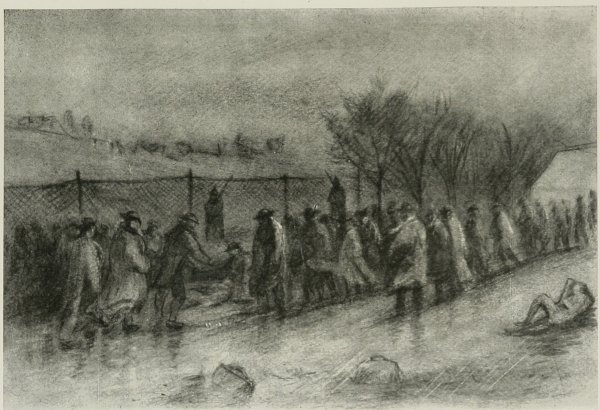 "THE BLOODY NIGHT OF SEPTEMBER 11, 1914."
From a rough sketch made on "the field," by the author during the
night.
We linked our arms tightly together to form mutual support and
persistently plodded hither and thither. The spectacle was terrifying
and tested the nerves of the strongest among us. If ever humanity were
cast adrift and left to its own devices, it was that night upon "the
field." Some of the prisoners were rushing to and fro frantic with fear.
Others huddled together as if to keep one another warm. Some were on
their knees praying fervently, while other parties were singing hymns in
voices which made the strongest-hearted among us blench. Here and there
were men stamping furiously up and down cursing at the top of their
voices, hurling fierce imprecations to the wind and consigning the
Commandant, his superiors, and all their works to everlasting torment.
Some of the most exhausted prisoners had congregated together and
crouched with their heads bowed to the storm, shivering with cold,
afraid to speak, hungry and terror-stricken, yet completely resigned to
the fate which they felt convinced must be theirs and absolutely
inevitable. A few, whose nerves were highly strung, were striding up and
down laughing demoniacally, waving their arms madly, and gesticulating
as if their senses had indeed given way. A few of the rougher spirits
were blaspheming, and to such a tune that even the most hardened among
us were forced to turn our backs to escape their blood-curdling oaths.
As midnight approached the wind and rain increased in fury. Even the
guard failed to stand against it. The sentries were drenched from head
to foot. The conditions became so bad that an order was suddenly
circulated to the effect that the guard was to be changed every two
hours, instead of at four-hour intervals. The sentries were quite
powerless to assist us even if they had been disposed to come to our aid
to mitigate our wretched condition in any way. One guard, his compassion
evidently aroused by a scene such as he had never witnessed before,
secured some thin stakes and thrust them through the wire netting to
form a support to a large blanket. With this he thought that perhaps a
little shelter might be obtained. We crowded beneath this precarious
protection, but the first blast of the gale which swept the field after
its improvisation, whisked the blanket and the stakes into the air. They
were never seen again.
About twelve o'clock I was on the verge of collapse. My friend supported
me, but even he was faint from lack of food and exposure. We decided to
roll our soddened bodies in our saturated blankets, to lie down on the
ground and to strive to woo sleep. We stretched ourselves on the flat,
but the wind and rain beat unmercifully upon us. Although we were
dead-beat the angel of sleep refused to come to us. As a matter of fact,
when we stretched ourselves in the mud we did not care two straws
whether we ever saw the light of day again or not.
After lying about two hours upon the ground I put out my hand to
discover that we were lying in two inches of water. But not only this.
The floodwater, in its mad rush to escape to the depression at the lower
end of the field, had carved a course through the spot where we were
lying. The result was that the rushing water was running down our necks,
coursing over our bodies beneath our clothes, and rushing wildly from
the bottoms of our trousers. We were acting unconsciously as conduits,
but we did not serve in this capacity any longer than we could help.
We regained our feet, our clothes now so water-logged as to bear us down
with their weight. We tramped laboriously to the top of the field and as
the wind bore down upon us it carried upon its bosom a mad madrigal of
hymns, prayers, curses, blasphemy, and raucous shouting. Groups of men
were now lying about thickly, some half-drowned from immersion in the
pools, while others were groaning and moaning in a blood-freezing
manner. Small hand-baggage and parcels, the sole belongings of many a
prisoner, were drifting hither and thither, the sport of rushing water
and wind. At the lower end of the field the water had sprawled farther
and farther over the depression, and therein we could descry men lying
in huddled heaps too weak to rise to their feet.
It was a picture of misery and wretchedness such as it would be
impossible to parallel. I recalled the unhappy scenes I had witnessed
around the railway terminus at Berlin under similar conditions, but that
was paradise to the field at Sennelager Camp on the fateful night of
September 11. It appeared as if the Almighty Himself had turned upon us
at last, and was resolved to blot us from the face of the earth. We were
transformed into a condition bordering on frigidity from rain-soaked
clothes clinging to bodies reduced to a state of low vitality and empty
stomachs. Had we been in good health I doubt whether the storm and
exposure would have wreaked such havoc among us.
While my friend and I were standing on a knoll pondering upon the utter
helplessness and misery around us, singing and whistling were borne to
us upon the wind. We listened to catch fragments of a comic song between
the gusts. There was no mistaking those voices. We picked our way slowly
to beneath the trees whence the voices proceeded, glad to meet some
company which could be merry and bright, even if the mood had to be
assumed with a desperate effort.
Beneath the trees we found a small party of our indomitable compatriots.
They received us with cheery banter and joke and an emphatic assurance
that "it is all right in the summer time." They were quite as wretched
and as near exhaustion as anybody upon the field, but they were firmly
determined not to show it. A comic song had been started as a
distraction, the refrain being bawled for all it was worth as if in
defiance of the storm. This was what had struck our ears.
This panacea being pronounced effective a comprehensive programme was
rendered. Every popular song that occurred to the mind was turned on and
yelled with wild lustiness. Those who did not know the words either
whistled the air or improvised an impossible ditty. Whenever there was a
pause to recall some new song, the interval was occupied with "Rule,
Britannia!" This was a prime favourite, and repetition did not stale its
forceful rendition, especial stress being laid upon the words, "Britons
never, never, never shall be slaves!" to which was roared the eternal
enquiry, "Are we down-hearted?" The welkin-smashing negative, crashing
through the night, and not entirely free from embroidery, offered a
conclusive answer.
It takes a great deal to destroy a Britisher's spirits, but this
terrible night almost supplied the crucial test. We were not only
combating Prussian atrocity but Nature's ferocity as well, and the two
forces now appeared to be in alliance. The men sang, as they confessed,
because it constituted a kind of employment at least to the mind,
enabled them to forget their misery somewhat, and proved an excellent
antidote to the gnawing pain in the vicinity of the waist-belt. Once a
singer started up the strains of "Little Mary," but this was unanimously
vetoed as coming too near home. Then from absence of a better
inspiration, we commenced to roar "Home, Sweet Home," which I think
struck just as responsive a chord, but the sentiment of which made a
universal appeal.
But hymns were resolutely barred. Those boisterous and irrepressible
Tapleys absolutely declined to profane their faith on such a night as
this. It was either a comic song or nothing. To have sung hymns with the
swinish brutal guards lounging around would have conveyed an erroneous
impression. They would have chuckled at the thought that at last we had
been thoroughly broken in and in our resignation had turned Latter Day
Saints or Revivalists. These boys were neither Saints, Revivalists nor
Sinners, but merely victims of Prussian brutality in its blackest form
and grimly determined not to give in under any circumstances whatever.
When at last a suggestion was made that a move would be advantageous,
one shouted "Come on, boys!" Linking arms so as to form a solid human
wall, but in truth to hold one another up, we marched across the field,
singing "Soldiers of the King," or some other appropriate martial song
to keep our spirits at a high level, while we stamped some warmth into
our jaded bodies, exercised our stiffening muscles, and demonstrated to
our captors that we were by no means "knocked to the wide" as they
fondly imagined. Now and again a frantic cheer would ring through the
night, or a yell of wild glee burst out as one of the party went
floundering through a huge pool to land prostrate in the mud. When it is
remembered that some of us had not tasted a bite of food for forty-eight
hours, and had drunk nothing but thin and watery acorn coffee, it is
possible to gain some measure of the indomitable spirit which was shown
upon this desperate occasion. The attitude and persiflage under such
depressing conditions did not fail to impress our guards. They looked on
with mouths open and scratched their heads in perplexity. Afterwards
they admitted that nothing had impressed them so powerfully as the
behaviour of the British prisoners that night and conceded that we were
truly "wonderful," to which one of the boys retorted that it was not
wonderful at all but "merely natural and could not be helped."
Personally I think singing was the most effective medium for passing the
time which we could have hit on. It drowned the volleys of oaths,
curses, wails, groans, sobbings, and piteous appeals which rose to
Heaven from all around us. If we had kept dumb our minds must have been
depressingly affected if not unhinged by what we could see and hear.
Thus we spent the remaining hours of that terrible night until with the
break of day the rain ceased. Then we took a walk round to inspect the
wreckage of humanity brought about by Major Bach's atrocious action in
turning us out upon an open field, void of shelter, and without food,
upon a night when even the most brutal man would willingly have braved a
storm to succour a stranded or lost dog. As the daylight increased our
gorge rose. The ground was littered with still and exhausted forms, too
weak to do aught but groan, and absolutely unable to extricate
themselves from the pools, mud, and slush in which they were lying. Some
were rocking themselves laboriously to and fro singing and whining, but
thankful that day had broken. One man had gone clean mad and was
stamping up and down, his long hair waving wildly, hatless and coatless,
bringing down the most blood-freezing demoniacal curses upon the
authorities and upbraiding the Almighty for having cast us adrift that
night.
The sanitary arrangements upon this field were of the most barbarous
character, comprising merely deep wide open ditches which had been
excavated by ourselves. Those of us who had not been broken by the
experience, although suffering from extreme weakness, pulled ourselves
together to make an effort to save what human flotsam and jetsam we
could. But we could not repress a fearful curse and a fierce outburst of
swearing when we came to the latrine. Six poor fellows, absolutely worn
out, had crawled to a narrow ledge under the brink of the bank to seek a
little shelter from the pitiless storm. There they had lain, growing
weaker and weaker, until unable to cling any longer to their precarious
perch they had slipped into the trench to lie among the human excreta,
urine and other filth. They knew where they were but were so far gone as
to be unable to lift a finger on their own behalf. Their condition, when
we fished them out, to place them upon as dry a spot as we could find, I
can leave to the imagination. I may say this was the only occasion upon
which I remember the British prisoners giving vent to such voluble
swearing as they then used, and I consider it was justified.
In an adjacent field our heroes from Mons were camped and a small party
of us made our way to the first tent. We were greeted by the R.A.M.C.
Water had been playing around their beds, but they acknowledged that
they had fared better because they were protected overhead. The
soldiers, however, made light of their situation, although we learned
that many of the Tommies, from lack of accommodation, had been compelled
to spend the night in the open. Still, as they were somewhat more inured
to exposure than ourselves, they had accepted the inevitable more
stoically, although the ravages of the night and the absence of food
among them were clearly revealed by their haggard and pinched faces.
The men in the tents confessed that they had been moved by the sounds
which penetrated to their ears from the field in which the civilian
prisoners had been turned adrift. They immediately enquired after the
condition of our boys. Unfortunately we could not yield much information
upon this point, as we were still partially in ignorance of the plight
of our compatriots. But there was no mistaking the depth of the feeling
of pity which went out for "the poor devils of civvies," while the
curses and oaths which were rained down upon the head of Major Bach with
true British military emphasis and meaning revealed the innermost
feelings of our soldiers very convincingly.
Seeing that we were exhausted and shivering from emptiness the R.A.M.C.
made a diligent search for food, but the quest was in vain. Their larder
like ours was empty. In fact the Tommies themselves were as hard-pushed
for food as we were.
I witnessed one incident with an English Tommy which provoked tremendous
feeling when related to his comrades. He was walking the field soaked to
the skin, perishing from cold produced by lack of food, continuously
hitching in his belt to keep his "mess-tin" quiet, and on the brink of
collapse. He happened to kick something soft. He picked the object up
and to his extreme delight found it to be a piece of black bread,
soaked with water, and thickly covered with mud. He made his way to the
field kitchen where there happened to be a small fire under the cauldron
in which the rations were prepared. He slipped the soddened bread
beneath the grate to dry it. While he was so doing, the cook, an
insignificant little bully, came along. Learning what the soldier was
doing, he stooped down, raked out the fire, and buried the bread among
the ashes. Then laughing at his achievement he went on his way.
The soldier, without a murmur, recovered his treasure with difficulty.
He moved out into the open, succeeded in finding a few dry sticks, lit a
small fire, and placed his bread on top of it. Again he was caught. His
warder bustled up, saw the little fire, which he scattered with his
feet, and then crunched the small hunk of bread to pieces in the mud and
water with his iron heel.
The look that came over the soldier's face at this unprovoked
demonstration of heartless cruelty was fearful, but he kept his head.
"Lor' blime!" he commented to me when I came up and sympathised with him
over his loss, "I could have knocked the god-damned head off the swine
and I wonder I didn't."
I may say that during the night the guard announced an order which had
been issued for the occasion—no one was to light a fire upon the Field.
Even the striking of a match was sternly forbidden. The penalty was to
be a bullet, the guards having been instructed to shoot upon the
detection of an infraction of the order. One man was declared to have
been killed for defying the order intentionally or from ignorance, but
of this I cannot say anything definitely. Rumour was just as rife and
startling among us on the field as among the millions of a humming city.
But we understood that two or three men went raving mad, several were
picked up unconscious, one Belgian committed suicide by hanging himself
with his belt, while another Belgian was found dead, to which I refer
elsewhere.
At 5.30 we were lined up. We were going to get something to eat we were
told. But when the hungry, half-drowned souls reached the field kitchen
after waiting and shivering in their wet clothes for two and a half
hours, it was to receive nothing more than a small basin of the eternal
lukewarm acorn coffee. We were not even given the usual piece of black
bread.
The breakfast, though nauseating, was swallowed greedily. But it did not
satisfy "little Mary" by any means. During my sojourn among German
prisons I often felt hungry, but this term is capable of considerable
qualification. Yet I think on this occasion it must have been the
superlative stage of hunger. The night upon the Field had come upon my
illness from which I had never recovered completely. It was a feeling
such as I have never experienced before nor since, and I do not think it
can ever be approached again.
It is difficult to describe the sensation. I walked about with a wolfish
startled glance, scanning the ground eagerly, as if expecting Mother
Earth to relieve me of my torment. The pain within my stomach was
excruciating. It was not so much a faint and empty feeling but as if a
thousand devils were pulling at my "innards" in as many different ways,
and then having stretched the organs to breaking point had suddenly
released them to permit them to fly back again like pieces of elastic,
to mix up in an inextricable tangle which the imps then proceeded to
unravel with more force than method. My head throbbed and buzzed,
precipitating a strange dizziness which seemed determined to force me to
my knees. I chewed away viciously but although the movement of the jaws
apparently gave a certain relief from illusion the reaction merely
served to accentuate the agony down below.
As I reeled about like a drunken man, my eyes searching the ground
diligently for anything in the eating line, no matter what it might be,
I found a piece of bread. As I clutched it in my hands I regarded it
with a strange maniacal look of childish delight. But it was a sorry
prize. It was saturated until it could not hold another drop of water,
and I think there was quite as much mud as bread. I wrung the water out
with my hands and then between two of us we devoured it ravenously,
swallowing the mud as contentedly as the bread, and not losing a single
crumb. It was a sparse mouthful, but it was something, and it certainly
stayed the awful feeling in the stomach to a certain degree for a little
while.
No man passed through that awful night without carrying traces of his
experiences. Its memories are burned ineradicably into one's brain.
Whenever we mentioned the episode it was always whispered as "The Bloody
Night of September 11th," and as such it is known to this day. As we
became distributed among other camps the story became noised far and
wide, until at last it became known throughout the length and breadth of
Germany. Whenever one who spent the night upon the field mentions the
incident, he does so in hushed and awed tones.
That night was the culminating horror to a long string of systematic
brutalities and barbarities which constituted a veritable reign of
terror. It even spurred a section of the German public to action. An
enquiry, the first and only one ever authorised by the Germans upon
their own initiative, was held to investigate the treatment of prisoners
of war at Sennelager. The atrocities were such that no German, steeped
though he is in brutality, could credit them. The Commission certainly
prosecuted its investigations very diligently, but it is to be feared
that it gained little satisfaction. The British prisoners resolutely
agreed to relate their experiences to one quarter only—the authorities
at home. The result is that very little is known among the British
public concerning the treatment we experienced at Sennelager, for the
simple reason that but a handful of men who were confined to the camp
during the term of Major Bach's authority, have been released. The
Germans have determined to permit no man to be exchanged who can relate
the details until the termination of the war. Their persistent and
untiring, as well as elaborate precautions to make trebly certain that I
had forgotten all about the period of travail at Sennelager, before I
was allowed to come home, were amusing, and offer adequate testimony to
the fear with which the German Government dreads the light of publicity
being shed upon its Black Hole.
Although Major Bach wielded his power with all the severity and spirit
of a true-blooded Prussian Jack-in-Office, and notwithstanding that we
were forbidden all communication with the outside world, yet we were not
without our "protector."
Our guardian angel was Dr. Ascher, who was responsible for the clean
bill of health among the civilian prisoners. The soldiers were under a
military surgeon, as already explained, but owing to the arbitrary
manner in which this official displayed his authority, and with which
Dr. Ascher did not agree by any means, it was the civilian doctor who
ministered for the most part to Tommy's ills. The result was that his
services were in almost universal demand, and the strenuous work and
long hours which he expended on our behalf were very warmly appreciated.
A short, sturdy, thick-set man, fairly fluent in the English language,
and of a cheery disposition, Dr. Ascher was a true and illuminating
representative of his profession. His mission being frankly one of mercy
he emphatically refused to acknowledge the frontiers of races and
tongues, poverty and wealth, education and ignorance. He was sympathetic
to an extreme degree, and never once complained or proffered any excuse
when called urgently to exert a special effort on behalf of any man.
He became an especial favourite among the British prisoners. The fact
that he came among us immediately upon our arrival at the camp, seeking
to extend relief to the sore, distressed, and suffering; his cheery and
breezy conversation; and his grim though unsuccessful efforts to secure
the food which we so urgently needed upon that occasion, were never
forgotten. He became endeared to one and all. Indeed he was elevated to
such a pedestal of appreciative recognition as to be affectionately
christened "The English Doctor," which he accepted as a signal honour.
He was no respecter of time, neither did he emulate his military
colleague in being a clock-watcher. He informed us that he was at our
disposal at any hour of the day or night, and he never omitted to spend
hours among us every day. Seeing that the camp possessed no resident
medical attendant, either civilian or military, that Dr. Ascher resided
near Paderborn, some three miles away, his readiness to come to our
assistance at any moment, his ceaseless efforts on our behalf, and
repeated attempts to ameliorate our conditions, it is not surprising
that we came to regard him as our one friend in that accursed spot.
The British prisoners, both civilian and military, never failed to
reciprocate whenever an opportunity arose, and this appreciation of his
labours made a deep impression upon him. No attempts were ever made to
encroach upon his generosity and kindness, and if any man had dared to
deceive him he would have been drastically punished by his colleagues.
No man ever essayed to malinger or to shirk a duty to which he had been
allotted by the doctor. If the doctor desired a task to be done, no
matter how repugnant, it was shouldered lightly and cheerfully. Indeed,
there was always a manifestation of keen eagerness among us to perform
some duty as an expression of our heartfelt thanks for what he was doing
among us. It is not an exaggeration to state that had it not been for
Dr. Ascher, his perennial bonhomie and camaraderie, his patience, and
his intimate association with us, many of the weaker British prisoners
and others would certainly have given way and have gone under. But his
infectious good spirits, his abundance of jokes, his inexhaustible
fount of humour, and his readiness to exchange reminiscences effectively
dispelled our gloom and relieved us from brooding over the misery of our
position.
Although the medical officer was charged with the express duty of
keeping the camp healthy and sanitary, unfortunately Dr. Ascher was not
an autocrat in his department. His powers were limited, and he was for
the most part completely subservient to military decrees. Time after
time he protested energetically and determinedly upon the quantity and
quality of the food which was served out to us, and struggled valiantly
to secure more nourishing diet for invalid prisoners than the cuisine of
the camp afforded. But his labour was always in vain; the food which he
laid down as being essential could not be obtained, or else Major Bach
firmly refused to move a finger to get it. As the Commandant's position
was paramount, and nothing could be done without his authority, Dr.
Ascher was denied a court of appeal. At times there were some spirited
breezes between Major Bach and the medical representative, but the
former invariably had the last word. On one occasion, to which I refer
later, Dr. Ascher tackled the Commandant so fiercely upon the sanitary
arrangements of the camp, and was so persistent and insistent upon the
fulfilment of the orders he expressed, as to compel the inexorable
superior to relent.
When a man fell ill and became too weak to perform an exacting task to
which he had been deputed by the tyrant, Dr. Ascher did not fail to
intervene. He could not be deceived as to the true state of a sick man's
health and his physical incapacity. Thereupon he would issue what was
described as a "pass," which excused the man completely from the heavy
work in hand in favour of some lighter duty. The doctor's "pass" was
safe against the Commandant's savagery; even he, with his military
authority, dared not over-ride the doctor's decision. However, the
British prisoners were not disposed to trade upon the doctor's good
nature. They would refuse a "pass" until necessity compelled unequivocal
submission.
Dr. Ascher was also an effective buffer between a prisoner and any
soldier who was disposed to assume an unwarrantably tyrannical attitude.
If he detected any brow-beating which was undeserved he never hesitated
to bring the upstart down to his proper position by severe reprimand,
and a candid reminder that a guard was merely a guard and as such was
not invested with powers akin to those belonging to the Commandant. The
soldier would fume under the castigation, but it was more than he dared
to incur the doctor's wrath and hostility, inasmuch as the latter would
not have hesitated to make the rebellious soldier's life unbearable. In
this manner he undeniably saved us from considerable brutality, which
some of the soldiers would dearly have loved to have expended upon us.
One day Major Bach announced that the clothes of the prisoners
throughout the camp were to undergo a thorough fumigation. For this
purpose a special mechanical disinfecting apparatus had been sent to the
camp. I may say that the instructions were not issued before they became
downright urgent. Some of the garments—not those worn by the British
prisoners—had become infested with vermin to such a degree as to
constitute a plague and were now absolutely repulsive. Two of the
British prisoners, who happened to be engineers, were selected for this
unpleasant task, and it proved to be of such a trying nature that both
men narrowly escaped suffocation in the process.
But the disinfecting apparatus was delivered in what we always found to
be the typical German manner. The fumigator came to hand but without the
engine to drive it. Two or three days later we were informed that there
was a traction engine at Paderborn which was to be brought into
Sennelager Camp to act as the stationary engine to supply power to the
fumigator. But to our dismay we learned that the traction engine in
question could not be driven to the camp under its own power because
some of the vital parts constituting its internals had broken down, and
repairs would be quite out of the question until it reached the camp.
This we were told would demand the towage of the engine over the last
three miles. We learned, moreover, that as horses were absolutely
unobtainable at any price, the prisoners themselves would have to drag
it in. Forthwith thirty men were selected and, equipped with thick,
heavy ropes, were marched off to Paderborn to salvage the derelict.
Our engineering friends, upon discovering the defective engine, and not
appreciating the prospect of the manual haul, set to work feverishly to
see if they could not contrive to complete sufficient repairs to coax
the engine to run the three miles under her own steam. They probed into,
and tinkered with the dark regions of the locomotive, but to no effect.
The defective parts demanded replacement. No doubt the authorities had
declared the engine unfit for service in the army, hence its appearance
at Paderborn for service at Sennelager.
We were faced with a heavy problem; one which would require every ounce
of our combined physical effort, which was low owing to our deplorable
condition, while the sun, heat, and dusty roads would be certain to tax
our endurance to the utmost.
The guards bustled round, supervising the hitching of the towing ropes,
while the men were lined up like oxen with the ropes passed over their
shoulders. The order was given and off we went. But that engine was, or
at least appeared to be, exceedingly heavy, while the roads seemed to be
exasperatingly difficult, the wheels having a magnetic attraction for
the sand. Progress was maddeningly slow, and before many minutes had
passed every man was puffing and blowing like a spent horse. A cup of
acorn coffee and a fragment of brown bread could scarcely be declared
ideal fare upon which to pursue such energy-consuming labour. And we had
three miles to go!
We had covered about half the distance and were nearly done in. The
ponderous, ungainly engine was just moving, and that was about all. The
progress had so fallen that the guards were becoming somewhat alarmed
and doubtless considered that if they only badgered us sufficiently they
would be able to spur us to such a degree as to enable us to reach the
camp.
While tugging for all we were worth we descried a horse flying along the
road at break-neck pace towards us. As it approached we saw it was
carrying Dr. Ascher. When he drew up to us he stopped. The guards were
holding forth in their most truculent manner at the moment. The doctor
rapped out a few words, and the guards instantly dropped their hostility
and arrogance to become as meek as lambs. Turning to us the doctor
ordered every man to drop the ropes. We did so and fell into line at
once of our own accord.
The doctor surveyed us, and we must have looked miserable specimens of
humanity. Our faces were glistening with perspiration which had been
pouring out of us freely, and which, mixing with the grimy sand which
had been enveloping us, had formed runnels wrought into a wild and weird
variety of fantastic designs. One or two of the weaker boys stood
half-bent as if upon the verge of dropping.
Within a few seconds the doctor had taken in the whole situation, and
saw how completely we were played out. With a voice which cut like a
knife he ordered the guard to escort us to a wayside inn. The soldiers,
thoroughly cowed, obeyed his instructions silently. He strode along
beside us, distracting our thoughts by a dissertation concerning the
countryside, which was bathed in the full splendour of its autumn garb,
and which certainly presented a peaceful and entrancing aspect.
Reaching the inn we seated ourselves on the balcony. Then the doctor,
turning, remarked:
"Order what you like! Don't stint yourselves and take your time. Now
then have anything you wish to drink!"
If our guards had been sufficiently relenting, we would willingly have
paid them for permission to have regaled ourselves by the way at our own
expense. We all had money. At the doctor's instructions we dived our
hands into our pockets to extract our worldly wealth to ascertain what
we could afford. The doctor arrested our action.
"No!" he called out, raising his hand in protest. "Put your money back.
You will have this with me. I extended the invitation and I certainly
intend to pay for it!"
If any man had called for cheers for the doctor I think we should have
brought the house down about our ears. But we were so dumbfounded at
this first expression of a "white man's" action which we had encountered
in Germany, that we could not utter a sound. We merely sat like a party
of expectant school-children at a Sunday school treat.
The doctor busied himself seeing that each man received an adequate
quantity of refreshment, and that it was according to his fancy. I
myself being an abstainer, declined the beverage which was popular and
which was being keenly enjoyed. Observing that I was drinking nothing he
hurried over.
"Where's your beer?"
"Sorry, doctor, but I do not take alcohol!"
Without a word he swung on his heel, hailed the landlord, and enquired
for some home-made lemonade. Boniface was sorry but he was unable to
oblige. But the doctor was not to be put off. He curtly ordered the
landlord to prepare some instantly and what is more to the point he
followed him to see that it was brewed correctly.
After the meal he insisted that we should take a brief rest to assist
its digestion, which, owing to the weakened condition of our organs, was
no easy matter. Then, when we all felt fit, we returned to the traction
engine. You can imagine how we clustered round the doctor thanking him
for his kindness, but he would not listen to our expressions of
gratitude. Laughing good-naturedly, he maintained that he had done
nothing beyond what he considered to be his duty, and as we shouldered
the ropes once more, he gave us a parting cheer.
That meal put new life into us, and we towed the load with such gusto
that we covered the second lap of the distance in fine style. When we
reached the camp and were dismissed, the incident about the doctor's
munificence flashed through to its four corners like lightning. It
became the one topic of spirited conversation. We had always voted the
doctor a jolly good fellow, but now he was the hero of the hour. When he
next came into the camp he received such a thundering and spontaneous
ovation as to startle him, until at last the reason for this outburst
dawned upon him. But he turned it off with his characteristic laugh and
joke.
The privations which I had been suffering now began to assert their ill
effects. I felt I was breaking up rapidly, and in this every one
concurred and grew anxious. The doctor took me in hand, placed me on a
"pass" and at last ordered me to lie down in the barrack. Two of my
companions, Ca——, a breezy Irishman who had been arrested while on his
honey-moon, and K——, undertook to look after me. As the night advanced
I rapidly grew worse, until eventually my illness assumed such a turn,
so I was informed afterwards, as to cause my two friends the greatest
alarm. Ca—— went out to the guard with a message addressed to Dr.
Ascher, explaining that Mahoney was very much worse and they feared his
condition was critical. By some means or other the message was got
through to the doctor, possibly by telephone.
It was a vile night. A terrific thunderstorm was raging, and the rain
was falling in torrents. After dispatching their message my two friends
resumed their vigil beside my bed, hoping against hope that Dr. Ascher
would call early the following morning.
About midnight the mad galloping of a horse was heard faintly above the
wail of the wind and the fusillade of the mad downpour upon our
hollow-sounding roof. The sounds drew nearer to stop outside our barrack
door. A hurried conversation was heard, and the next moment, to the
surprise of my two friends, the door opened to admit Dr. Ascher. The
rain was pouring off him in tiny rivulets and he cheerily confessed that
he was soaked to the skin. But he pooh-poohed the idea that he had taken
too much trouble. A fellow-creature was in peril and he could not, as a
doctor, resist the call which had been sent. He stayed with me some
time, told my companions exactly what to do, and then went out again
into the rainstorm with the parting intimation that he would return
within a few hours, and would arrange for my instant transference to the
hospital.
At six he was back again. By this time I had recovered from my delirium
and felt somewhat better, although exceedingly weak. He chatted with me,
told me I was far worse than I either looked or felt, and insisted upon
my going into hospital. I demurred, as I preferred to be among my chums.
But he was not to be gainsaid, and so I had reluctantly to be carried
into bed. He came to see me frequently during the day, and even went so
far as to assume the responsibility of telegraphing to Berlin demanding
my instant release as my demise seemed very probable. But this request
was curtly refused, mainly, so I discovered afterwards, because I was
imprisoned upon the charge of espionage. The circumstance that this
charge was still hanging over my head came as an ugly eye-opener to me.
I thought from my transference from Wesel to Sennelager that I had been
acquitted of this accusation. Of course I had never received any
official intimation to this effect, but on the other hand I had never
received a sentence. This revelation worried me somewhat sorely because
I could see possibilities about which I scarcely dared to think, as well
as complications untold looming ahead.
I must have been in a very precarious condition the previous night
because a member of a well-known British family who had been interned at
Sennelager, but who secured his release about this time, very kindly
sought out one of my relatives upon his return home, to whom he
communicated particulars concerning my illness and serious condition. He
hesitated to notify my wife directly, preferring to leave it to my
relative to convey the unwelcome news in the manner considered to be the
most advisable. For this kindly action, of which I was apprised after my
transference from Sennelager, I have ever been extremely thankful, but
up to the present I have successfully evaded all the most insidious
attempts made by my German captors to secure my premature decease by
undermining my health.
Before leaving me in hospital for the night Dr. Ascher paid me a final
visit to make positive that I was comfortable. But that one night's
sojourn in the hospital almost completely unnerved me. I could not
sleep, and to my alarm I found that no one ever came in to take even a
cursory glance at the patients. I got up in the darkness and went to the
door. To my astonishment I found it to be locked! I turned to one cot.
It contained a French invalid who was jabbering away excitedly to
himself, but I could not understand a single word. I turned to the next
bed and its occupant was half-delirious. With such depressing company
around me I tumbled back into bed and went off to sleep again somehow.
In the morning I learned that there were three intercommunicating wards.
The two inner ones were reserved for patients, upon whom the key was
turned at night, while the third and outer room was occupied by a night
warder who turned in and slept the sleep of the just, although he was
nominally in charge of critical cases. But this was immaterial. If the
patient went under during the night to be found dead in bed in the
morning—well! it was merely a case of Nature having had her own way.
I was so alarmed that the instant the hospital was opened I hurried back
to my barrack. Dr. Ascher, upon reaching the hospital and noting my
absence, wondered what had happened, until at last he found me resting
in my bunk. I resolutely told him that under no circumstances would I
spend another night in that hospital. I had my own way. The crisis had
passed, and if I only took care of myself I would soon be out again, he
said.
Having always led an active life, confinement to bed in utter loneliness
during the day, except for a call now and again from a sympathetic
colleague, soon began to pall. So I dressed and went out to discover Dr.
Ascher. He did not upbraid me for so flagrantly disobeying his orders,
as I had been anticipating, but exhorted me with all the powers of
persuasion he could command, to take the utmost care of myself. In order
to give me something to occupy my mind he attached me to a few other
invalids, who were also on "pass," to light work in cleaning out the
hospitals for the recruits who were evidently coming to Sennelager
within the near future.
Cleaning hospitals might be officially described as light work, but it
was far from being so, although this was not the fault of the doctor but
of our far from amiable Commandant. The tables, beds, chairs and other
portable fixtures had to be taken into the open air to receive a
thorough scrubbing with water and soft soap. We were given buckets, and
were compelled to walk some distance to draw supplies of water from the
pump, to which place we also had to repair to throw away the dirty
liquid, so that we were assured of an exacting load upon both journeys.
The guard supervising us in this work was a despicable young cub. He was
short and stubby. By the way I must relate that this individual
illustrated one of the weird turns of the Wheel of Fortune as revealed
by the war. I have already referred to F—— K——, who had accompanied
me from Wesel prison to Sennelager. What was F—— K——'s amazement to
discover, upon entering the camp, that this man, who formed one of the
guards, had been one of his own van-men before the war. It was a
remarkable instance of the reversal of positions. The erstwhile van-man
was now the top-dog and he did not hesitate to extract endless amusement
and delight from ordering the prisoners, among whom was his former
employer, to despicable duties and harassing them right and left.
I had one bout with this impertinent little bounder which I do not think
he will ever forget. It was the result of exasperation and was
precipitated upon the spur of the moment with subsequent disastrous
results.
I was carrying a bucket of water back to the pump to throw away and to
secure a fresh supply. As I approached the pump, which was near an
adjoining field, and over the fence of which some young girls were
leaning talking to the sentry, I saw that they were having some fun at
my expense. I resented this laughter and merriment, more particularly as
I was feeling very seedy.
The guard, to parade his assumed authority before the girls, drew
himself to the full height of his fifty-four inches or thereabouts,
threw out his chest, and as I was about to empty the bucket, roared in
stentorian tones:
"Take that back again!"
"But I am going to fill the bucket with clean water!" I protested.
"Did you hear what I said? I told you to take it back again!" to which
he added an afterthought which I did not understand, but which induced
the girls to burst out laughing afresh with mad glee.
I ignored his instructions and was about to turn out the dirty contents.
My temper somewhat ruffled by illness and now very hasty was rising
rapidly. He moved forward and thundered:—
"Cannot you obey orders? Take it back again, I tell you!"
I picked up the bucket as if to comply and stepped back a pace or two.
Then lifting it up I shouted back,
"I'll see you damned first!"
With these words I hurled the contents over him. The water was filthy.
It caught him full in the face and smothered him from head to foot.
He was so surprised at this unexpected sequel to his arrogant order that
he merely stood still, spluttering and cursing. Then he grabbed his
rifle. At the same moment I threw the bucket itself at him, catching him
a nasty blow on the shoulder. The girls who had been laughing at me now
chaffed the discomfited sentry unmercifully. Foaming with rage and
swearing terribly he lowered his rifle to run me through with the
bayonet.
It was madness to argue with a bayonet in the hands of an infuriated
German sentry. I turned and fled. Being long of leg, thin, and agile, I
ran with the swiftness of a hare while my pursuer being short-legged and
thick-set came trundling after me like a cart-horse. I tore towards the
hospital, vaulted over the chairs and tables, and darted in and out,
with the sentry, now beginning to blow hard from his unusual exertion,
hot on my trail. In my mad rush I upset some of my companions, but they,
instantly guessing something unusual was afoot as they caught sight of
my flying coat-tails and the heavy-footed soldier chasing me, at once
entered into the spirit of the fun.
L——, our humorist, was one of the party. Jumping on a table he
commenced to yell frantically:
"Sennelager Derby! What's the odds? Twenty to one on Mahoney! Go it,
Tubby! Christopher, but you'll never stay the course!"
The cries were taken up by the other fellows and excitement grew
furious, which only served to exasperate my pursuer still more.
I was flying for dear life. I knew very well, if that sentry got within
bayonet reach of me, that my days were ended. He was seeing red with a
vengeance. Round the hospital, over the tables and chairs, I dashed as
if bereft. I was looking for the doctor. I had long since learned that
in the event of a disagreement with a sentry it was wise to be first
beside the ears of authority and to relate the incident. The first
version, whether from guard or prisoner, was almost certain to be
believed.
Once as I came tearing round the hospital calling for one of the medical
officers, L—— and his companions, now emulating the frenzied language
and manners of racecourse frequenters, and forming field glasses with
their hands, were bawling at the tops of their voices.
"Tattenham Corner! Hooray! Mahoney wins!"
At that moment I ran full tilt, not into Dr. Ascher as I had hoped, but
against a young military doctor. I almost upset him in this spirited
desperate obstacle race.
"What's the matter now?" he asked in surprise.
As this young doctor had always proved to be a decent fellow I stopped
and related my story. He listened very attentively.
"You had no business to do that!" he commented. "You should have obeyed
the order and then have reported it to me or some other officer to be
redressed."
"Well, he just about maddened me to the limit!"
"No matter! It may be a serious thing for you. You shouldn't have thrown
the dirty water over him. You've insulted the uniform!"
By this time my pursuer had arrived. He was puffing heavily and his legs
were bent. He could not have run another hundred yards even if a dozen
battle-maddened Kilties had been after him. Catching sight of the
doctor he pulled himself to "attention" as well as he could. I had to
turn away to laugh. He presented the most ludicrous specimen of a German
soldier that I have ever witnessed. His face was as red as a beet-root
from his exertion, his eyes were wide open, while his mouth was fully
agape. He could not utter a word as he had lost his breath, while being
soddened from head to foot he was commencing to steam merrily.
When he had partially recovered his composure he related his version of
the story in a meek tone, no doubt hoping to excite pity. But I noticed
that the young medical officer had to bite his moustache to maintain a
straight face and I think this practically saved the situation.
"Who gave you permission to give orders to prisoners?" asked the officer
severely.
The sentry's dismay at the officer rounding upon him was so complete
that he could not venture an answer.
"Don't let it occur again or I'll report you!" continued the doctor
sternly. "Don't you know your duty is to obey orders and not to give
them!" he thundered with an effort. The sentry dismissed so
unceremoniously slunk away miserably and absolutely crestfallen.
When the soldier had gone the officer turned upon me and lectured me
severely, though sympathetically, upon the enormity of my offence. While
he was speaking, Dr. Ascher sauntered up and the incident was related to
him. Turning to me with a gravity which I could see was assumed, he
remarked:
"Mahoney, if you get up to such tricks again you'll get into serious
trouble. You must never forget the uniform!"
As I turned to resume work I noticed the two medical men having a hearty
silent laugh over the whole affair, the younger man graphically
describing the blown sentry and race as he had seen it.
But Dr. Ascher did not let the matter rest there. He reported the sentry
for exceeding his orders, which was a serious offence because it
affected the doctor's discipline over prisoners who were under his
charge at the hospitals. All the reward and consolation the insolent cub
received for his parade of assumed authority before his audience of
girls was change to another duty, coupled with severe reprimand. Through
Dr. Ascher's intervention the sentry was deprived of all opportunity to
snatch a revenge upon me. Such actions, however, were characteristic of
Dr. Ascher. It was his love of fair-play which endeared him to every
Britisher in the camp. Whenever one of us left Sennelager there was no
man from whom to part was such a wrench as Dr. Ascher. We all grew to
like and admire him to such a degree that it seemed to be parting from a
very dear and old friend when we shook hands in farewell with him.
As the day of the 12th advanced without bringing any signs of official
intentions to improve our accommodation upon "the field," several of us
decided to do the only thing possible—to help ourselves. It was
perfectly evident that we were not to be taken back to barracks, even
for the time being, while it was equally apparent that no tents were
going to be set up for us. Also it was quite possible that we should be
exposed to another fearful storm, because the season was advancing.
Consequently it was just as well that we should improvise some kind of
shelter over our heads. The issue was where to discover the materials,
since the authorities were not disposed to extend us any assistance
whatever.
The more energetic among us set to work without delay. My South African
friend, Moresby White, and myself unearthed one or two poles lying
forlorn and forgotten among the grass and slush. We secured these, set
them up, and over them stretched our blankets, the improvised dwelling
thus obtained being a crude kind of wigwam. Others built little
domiciles somewhat reminiscent of an Eskimo igloo, and in this field of
endeavour I may say, striking ingenuity and resourcefulness were
displayed.
The prisoners not being provided by the German authorities with any form
of shelter rudely fashioned tiny huts with slabs of earth to secure
slight protection from the fury of the storm. The hut in the foreground
was built by the author and his South African colleague, Moresby White,
who has since been released. An extension was hurriedly made to give
shelter to three Grimsby fishermen.
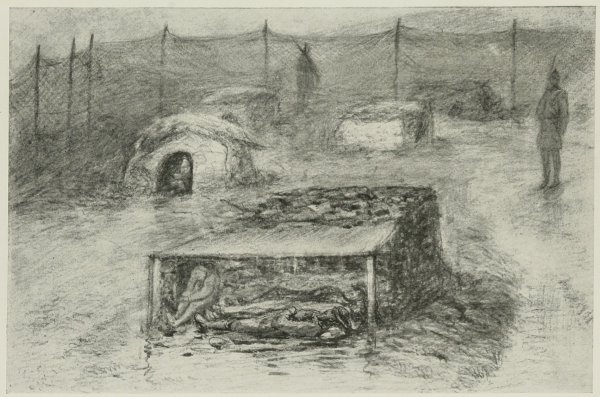 THE AFTERMATH OF THE "BLOODY NIGHT."
From a rough sketch made on "the field" by the author, September 14,
1914.
My friend and I had scarcely finished our dwelling when along came some
officials. They saw what we had done, and then declared that we had
taken Government material, in the form of the neglected poles, to which
we had no manner of right. Forthwith they demolished the shelter.
Intensely disgusted at this turn of events we had another look round for
further material and obtained some tree branches. We fashioned these to
form the skeleton of a hut. The guard hurried up and ordered us to take
it down. For a second time our labour was in vain, but we were grimly
persevering and so ran up a third shelter. This shared the self-same
fate because we had committed a heinous breach of some one or other
official regulation of which we knew nothing.
As we surveyed the ruins of our third attempt to raise something over
our heads my South African friend became exasperated. It was merely
official spite which had provoked the destruction of our little homes.
He gritted his teeth and gave full vent to his innermost feelings which
were by no means complimentary to our German oppressors.
"I'm damned if we don't build something to which they cannot take
exception," blurted my companion. I concurred, but a survey of the field
for materials proving abortive we became somewhat glum. Then I suddenly
hit on an idea which I explained. We would build a mud or turf hut. It
would take a little time but surely they would not knock that to pieces!
We foraged round and happened upon a spade. With this we cut the sods
and built a small square-shaped domicile into which we were able to
crawl. We made it sufficiently large, not only to accommodate our two
selves but for the reception of company if necessary. It was not a
masterpiece by any means, while the interior had the rank aroma of
newly-turned earth, but it was preferable to facing the elements, should
they decide to be against us once more. Other workers in the camp, who
had been foiled similarly in their efforts to fashion a home from poles
and sticks, emulated our example. Consequently within a short space of
time, diminutive huts, some recalling large beehives, were rising all
over the field like mushrooms.
There was keen rivalry in the embellishment of these crude homes. Upon
completing ours I decided upon a "Tradesmen's Entrance" and carved this
out, together with a winding approach, the entrance being flanked by two
mounds on one of which I planted a small flag improvised from a piece of
cardboard which I unearthed. Directly I had set up the little flag I
fell foul of authority. The hated emblem was torn up by an officious
sentry whom it enraged.
These mud huts were speedily christened with high-falutin names. There
were "Sans Souci" villa and the "Haven of Rest" and others equally
wildly and inappropriately named. But we considered this an excellent
chance "to wax sarcastic," and we let ourselves go, although I do not
think that our task-masters, being by nature dense, grasped the purport
of our humour. Our residence rejoiced in the unpretentious designation
of "Camera Villa,"
If the authorities had gleaned an inkling of the circumstance that this
mud hut harboured an incriminating eye they would have spared no effort
to discover it, while I as the unfortunate owner—well! I do not know
what would have happened to me for such a flagrant breach of official
regulations.
It also seemed as if the authorities were going to deprive us of food.
At all events noon passed without any sign of dinner. In the afternoon,
however, we were informed that we were to receive the mid-day meal, but
must go to the cook-house to get it. That was a mile away!
At two o'clock we were lined up, the British at the extreme rear as
usual, and marched off. Upon reaching the kitchen we were alarmed to
learn that there were insufficient basins. Several would have to use the
one utensil successively, and, needless to say, without being washed
after each use. Apart from this repulsive method of feeding us as if we
were dogs, the time occupied in getting one's ration proved maddening.
After one had swallowed the thin cabbage soup hastily, one had to
advance and join the group comprising those who had been served. The
result was that by the time the last of the British prisoners had been
supplied some three hours had passed. Yet this was the first meal which
some of the men had received for three days! I may say that one felt far
from satisfied after swallowing the noisome greasy wash.
In the evening, while working upon our hut to impart the finishing
touches speedily, because rain was falling, I stumbled across three of
the disgraced and disfigured fishermen. They were alone and forlorn.
They had no hut and did not know what would happen if another wet night
swept over them. One happened to be the skipper of one of the trawlers
which had been sunk and he vehemently denied the charge that they had
been guilty of laying or sweeping mines. They were attending to their
trawls when they were surprised and captured.
The skipper was an interesting, typical sea-dog from the waters of the
North Sea, and a thorough God-fearing man. He related a story which made
our blood boil. He said his two companions and himself were summoned by
the guards at mid-day, and instead of receiving the dinner ration had
been taken to a covered hand-cart. The guard told them to push it, and
at the same time handed them shovels and picks. Under escort they
dragged this mysterious load, which was carefully covered with a
tarpaulin, for about three miles to a very lonely spot. At last they
came to a deep hole. They were compelled to back the cart to the brink
of the pit, and were then curtly bidden to tip it sharply.
To the utter amazement of the skipper and his two colleagues the action
of tipping the cart shot into the hole, with considerable force, the
corpse of a Belgian. He was dumped into the hole in this rough and ready
manner, head first, and to the disgust of the Britishers the body was
clothed merely in a shirt! They were then commanded to refill the hole.
Thus, without the slightest burial ceremony, with a brutality which
would not have been shown to a dog, and without the slightest expression
of regret, save one of silence from the three Britishers, the unknown
Belgian was consigned to an unknown grave. Who the Belgian was, or how
he came by his death, no one ever knew, but it is surmised that he died
from exposure upon the field during the night of the 11th.
These three fishermen being friendless and homeless, my chum and I
decided to see what we could do for them. We proposed to attach a
lean-to shelter to our hut. Poles were driven into the ground, and to
these horizontal members were attached, the latter having the inner ends
sunk into our walls. For the roof we used our blankets. It was a
primitive shelter, but it protected the three men from the rain which
again broke over us and for this expression of camaraderie they were
extremely grateful.
Our transference to the field provoked the most spirited bout we had
ever witnessed between the Commandant and Dr. Ascher. The doctor could
do nothing towards securing us shelters: that was exclusively a matter
for Major Bach to decide. But he had control over the sanitary
arrangements, and he condemned these unequivocally. The stench rising
from the open latrines which swept over the field was indescribable. Dr.
Ascher flew into a fierce temper over the shortcomings and detestable
arrangements, which he maintained to be a serious menace to the health
of the camp. We strove desperately to escape the horrible effluvium, but
it could not be avoided unless we buried our heads. Dr. Ascher, by
taking up a firm stand, had his way on this occasion, although the
nature of the improvement I think caused him to despair of securing the
proper amelioration of the conditions. The military authorities did not
appear to know even the rudiments of sanitary science, which, as I found
for myself, are ever indescribably crude away from the show towns which
are patronised by tourists.
I had been hoping that I would be able to shake off my illness. But it
was not to be. The exposure and thorough soaking which I had on the
terrible night of the 11th completely undid all the benefits I had
received from Dr. Ascher's attention and treatment. I cracked up
suddenly. The doctor, seeing how badly things were going with me, gave
me a "pass" excusing me from all work.
But to me it was obvious that to remain on the field was to die from
starvation, especially bearing in mind my precarious health. Yet to get
out of the field was no easy matter. I pondered fretfully over this
issue, and at last resolved to attempt a desperate solution. I marched
boldly to the gate, waved an old, long-since expired "pass" and shouted
to the sentry that I had to go to the doctor's office immediately. Taken
unawares the guard opened the gate without scanning the "pass" and I
walked on to the main road leading to the barracks in which we had lived
previously. The little extra exertion demanded to pass the sentry
without creating any suspicions in his mind now told on me. Once I had
passed out of his sight the reaction set in, and I fell into a clockwork
pace. I was determined to fulfil my mission at all hazards, so plodded
along slowly. I could see nothing, and heeded nothing, being only
conscious of the fact that I was going to get something to eat and to
bring food back for my stranded companions on the field. Soon everything
seemed to grow darker and darker, then came perfect blackness. I
remembered no more.
When I came to my senses I found myself being borne carefully by two
fellow-prisoners—Ca—— and a chum—to the hospital. I was put to bed,
and looking round I saw that I was surrounded by twenty-five other
patients. One and all had dropped down from sheer exhaustion upon the
field during the "Bloody Night," and had been found by the guard in the
morning in an unconscious condition. I heard that there were seventy
such cases brought in—all caused by exposure and the rain. I cannot
testify to that number, but I can swear to the twenty-five cases because
I saw them in the hospital lying in the ward with me. They were then in
a terrible plight, not having recovered from the racking ordeal.
Presently a military doctor came in. I had never seen him before. He
approached my cot.
"Civilian or military?" he asked.
"Civilian!" I replied.
"Ach!" and there was intense disgust and unveiled hostility in his
voice. "Get up! Outside!"
"But he has been brought in unconscious!" persisted Ca——.
"Ach! No matter. Get up. Outside!" he repeated.
"I'll see you damned first!" exploded Ca——, his Irish temper now
roused to bursting point at the inhuman attitude of the military medical
official. Fortunately for my friend the individual in question did not
understand a word of English, or there would have been trouble.
But feeling somewhat better and realising the uselessness of argument I
persuaded Ca—— to obey instructions. Indeed I was bundled out of bed,
and hastily assisted in re-dressing, by the doctor's orders. Passing out
of the hospital I paused to lean against the door, feeling downright ill
and weak. Ca—— ran off to the barrack to fetch Dr. Ascher.
A young medical man came out of the hospital, and seeing my wan and
haggard face, came up to me. He was certainly sympathetic.
"Heavens, man! You look downright ill!" was his comment.
"I reckon I don't look worse than I feel!" I replied caustically. "I've
just been turned out of the hospital. What is going to happen?"
"Oh! You've got to go to Paderborn. You'll go into hospital there. The
van will be up in three hours' time!"
At this intelligence I sank on a wooden seat. I felt, and indeed could
no longer ward off, the belief that everything for me was rapidly
approaching the end. As I sat there a prey to my worst thoughts, a
soldier came out of the hospital and sat beside me. I looked up.
"Hullo! old man! From Mons?" I asked.
"Yes! Going to Paderborn. Says I'm sick," nodding towards the hospital.
The Tommy certainly looked as if the doctor had diagnosed a case
correctly for once in his life.
"What's the matter?"
"Don't know for sure. But I heard the doctor whisper to an assistant
that it was typhus!"
Despite my efforts to control myself I could not suppress a low whistle.
I looked at the soldier, and although my first inclination was to move
away, I felt that, owing to my condition, it really didn't matter, so I
spared the Tommy's feelings. In a few minutes another soldier came out.
He sat on the other side of me.
"Hullo! You from Mons too? You going to Paderborn?" was my query.
"Sure! Doctor says I've got typhus!"
This was alarming news, and I could not resist a feeling of extreme
apprehension. While I was turning things over in my mind a third soldier
came out whom I questioned, but he did not reply.
"He was blinded by a shell at Mons," commented one of the soldiers.
"Guess he's got it too. 'Strewth, isn't this a hell of a hole? I'd
sooner have fifty Mons's for a month than this hell for a day!"
I certainly shared the opinion. But as I sat there I reflected upon the
limited carrying capacity of the Paderborn hospital van, and the
circumstance that I was likely to be crushed in with a host of typhus
cases. I did not like the prospect a little bit. I made up my mind. I
would not go to Paderborn at any cost.
Proffering a palpable excuse I sauntered away, finally entering the
office in which the files of the registration of the British military
prisoners were being prepared. A young German who in pre-war days had
been a baker in Battersea, was in charge. I told him I was sick, but
enquired, if receiving the requisite permission from the doctor, he
would allow me to help him in the office. He agreed. I sought out Dr.
Ascher, explained that I had been consigned to Paderborn, but refused to
go, and explained that I had the offer to go into the office if he would
certify me for such work. After a little deliberation he acquiesced, and
I took up the appointment with the result I have explained in a previous
chapter. After a good night's rest I felt decidedly better. I returned
to the field, only to find that my companions had experienced no
improvement in their conditions, and that food was just as scarce as it
had been since we were turned out of our barracks. I was successful in
getting a little food to them, while another prisoner, now in England,
sent up a little.
Strolling across the field I met a fellow-prisoner, Lord J——'s
secretary. He looked so ill that I suggested he should take my place in
the office, as I was now feeling much better. He refused at first, but
at last I prevailed upon him to go. He would get a well-earned rest at
all events, while the work was light and easy. The exchange of clerks
was effected and with such success that the German in charge never
detected the swop, which proves how imperfectly I had been scrutinised,
and the laxity of the arrangements when you have learned how to
circumvent the pit-falls and red-tape of Prussian organisation.
I was now back upon the field. One night the officers came round bawling
out a request for the names of all prisoners who had friends in Germany.
Seeing that this question, together with a host of others, had been
asked nearly every day, while sheets of papers were filled up at
intervals of every few hours with a bewildering array of particulars, I
ignored the interrogation. But one or two fellow-prisoners recalled the
fact that K——, upon his release, had invited me to come to his home in
Cologne if I ever got the chance. At first I declined to listen to the
recommendations, but finally, in response to the incessant pesterings, I
consented. Then the matter slipped from my mind.
The following morning my attention was arrested by the guard going round
the camp singing at the top of his voice, "Ma-hone-i! Ma-hone-i!"
Surprised, and fearing that trouble was brewing because I had not gone
to Paderborn as ordered by the military doctor, I presented myself. I
was commanded to attend the office at once.
I sauntered off leisurely, and reaching the building, I supplied the
officer in charge with my name and a host of other minute details as
requested. Then turning to me, and holding a paper in his hands, he
remarked:
"Herr Ma-hone-i! You are a free man!"
"What?" I yapped, scarcely believing I had heard aright, "A free man?" I
almost cried with joy at the news. "Free to go home to England?" I asked
excitedly.
"Nein! Nein!! Nein!!! But you have friends in Germany?"
My jaw dropped. I thought for a few minutes, and then I replied slowly,
"Yes! I'll go provided I do not have to give my parole. That I will
never do!"
He glared furiously at me.
"But that is as good as saying you'll try to escape," he went on.
"Exactly!" was my curt retort, and I looked at him defiantly.
The officer informed me that under these circumstances I should be kept
back, but at this moment Dr. Ascher, who had been listening to the
conversation, intervened, and as a result of his mediation I was told
that I was free to go to Cologne, saying which a "pass" permitting me
to travel to, and to move about that city, was proffered. I took the
"pass."
"You've ten minutes to collect your belongings and to get out of the
camp!" was his final abrupt remark. Although I pleaded for a little
longer time in which to say farewell to my friends he was inexorable.
I rushed back to the field to communicate the news to my companions, and
the hand-shaking which ensued was extremely fervent. All the boys
congratulated me upon my good luck, but the tears were in their eyes.
The sympathy moved me, and I felt half-disposed to tear up my "pass" and
stay with them to see it through. But they pushed me off. I had a hearty
hand-shaking with Dr. Ascher, who wished me the best of luck, and
expressed the hope that I would soon get home. Although he never
admitted it I found out for a fact that he had been primarily
responsible for my release. It certainly was characteristic of him. He
cracked a parting joke, which restored the good humour and cheerfulness
of the camp, and with my few parcels under my arm I left the ill-famed
field.
The boys cheered like mad, but I was stirred more particularly by the
roar of cheers which burst from the Tommies, with whom I had fraternised
freely, and with whom a curious chumminess had sprung up. We were all
companions in misfortune, and when the news of my release reached their
field, they clustered along the fence to give me a parting rouser, which
they certainly let go for all they were worth.
I regained the office within the stipulated ten minutes and then to my
intense disgust learned that I had three hours to wait for a train. I
sold my watch to secure a little ready money, and as I moved across the
camps to be abruptly challenged by the sentries I was surprised to see
them change their demeanour when I showed my "pass." They shook hands
heartily and warmly congratulated me upon my good fortune. It was a
strange metamorphosis and it affected me strangely.
Before I left the camp I was ushered into the presence of our
arch-fiend, Major Bach. He rose from his desk and with a suavity and
civility which made my blood surge, he remarked:
"Herr Mahoney, good-bye! I trust you will not think our treatment in the
camp has been unduly severe!"
"I shall certainly not speak well of it," I retorted somewhat cynically.
"I shall never forget my experiences and I shall not omit to relate it
to others. But there! I think my looks are sufficient. I must have lost
three stone in weight during the past two months!"
"Well, I trust you will make allowances," he went on unctuously. "You
must remember the times; that we are at war, and that our arrangements
have not been organised for adequate accommodation!"
He extended his hand.
Shaking my head in a manner which he could not misunderstand I refused
to take it.
He shrugged his shoulders and resumed his work. I left his office
without another word.
Two minutes later I was striding rapidly towards the station,
accompanied by another prisoner, a schoolmaster named E——, who had
also been released on a "pass" and whom I have to thank for much
assistance subsequently offered.
At last I was free from the torment and brutality of Sennelager Camp.
But as I watched the incoming train on that morning of September 16th,
1914, I could not refrain from dwelling upon the lot of the many hapless
friends I had left behind, the agonies, miseries, the hopelessness of
their position, and their condemnation to unremitting brutal travail
which would doubtless continue until the clash of arms had died away. As
Sennelager vanished from sight my companion and I gave deep sighs of
relief. We felt that we had left Hell behind.