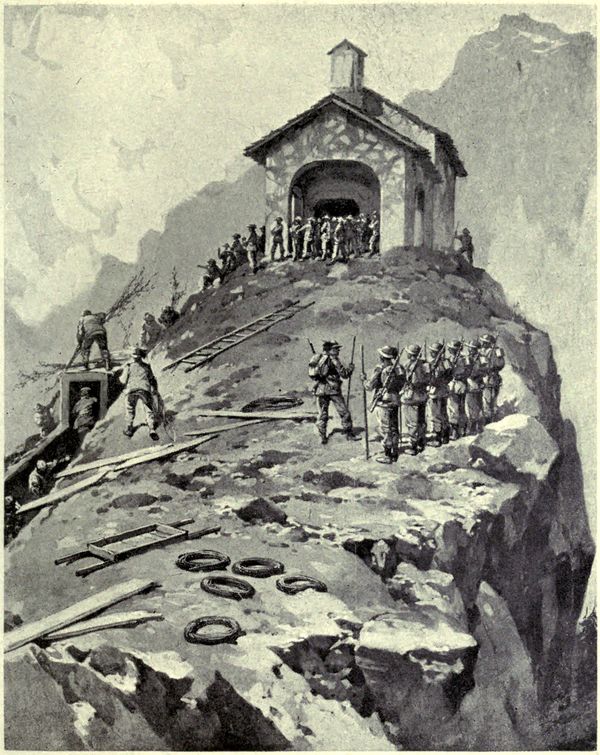
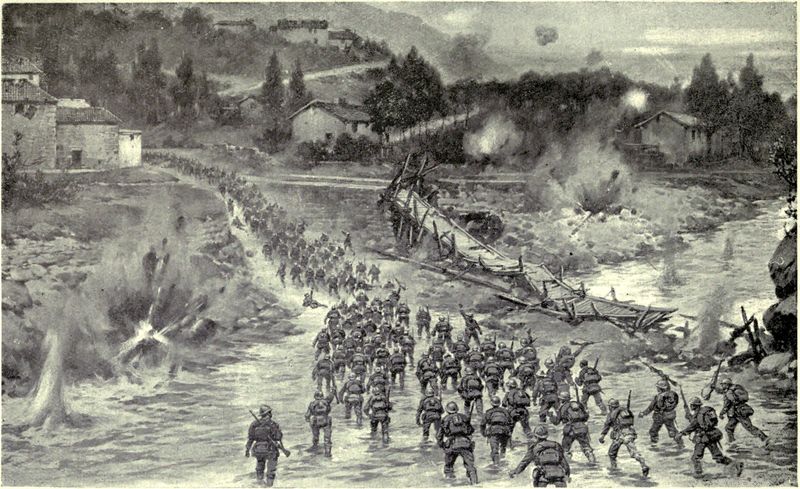
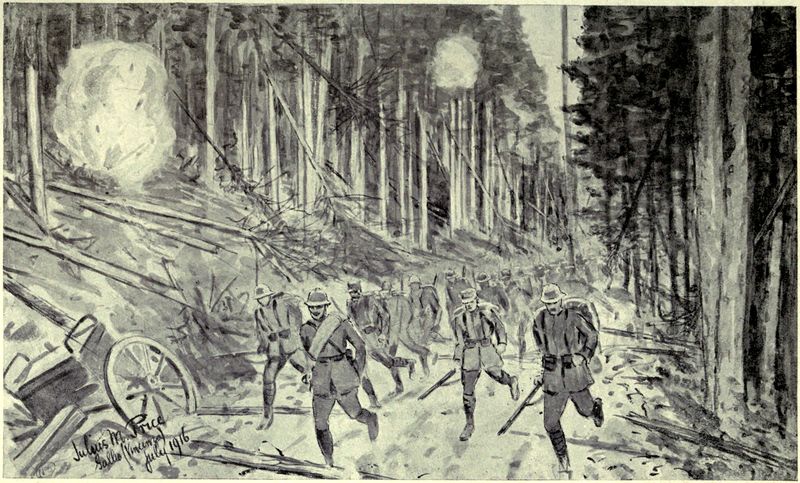
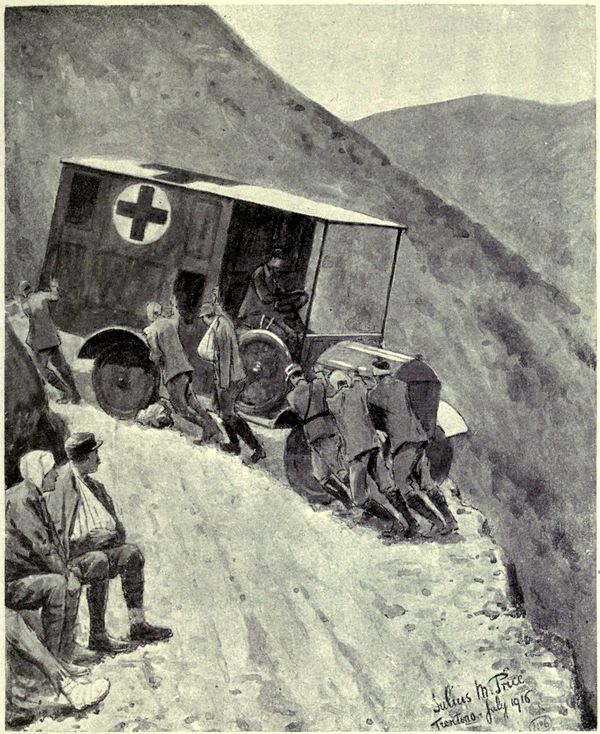
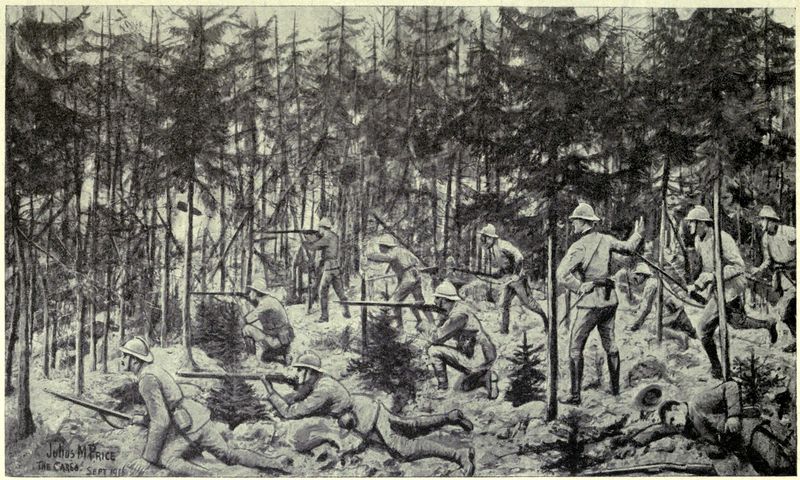
There is only one Footnote in this book, on page 166. This Footnote
has been moved and placed directly under the paragraph that has its
anchor [A].
New original cover art included with this eBook is
granted to the public domain.
Some minor changes to the text are noted at the end of the book.These are indicated by a dashed blue underline.
SIX MONTHS ON THE ITALIAN FRONT
WORKS BY THE SAME AUTHOR
FROM THE ARCTIC OCEAN TO THE YELLOW SEA
THE LAND OF GOLD
FROM EUSTON TO KLONDIKE
DAME FASHION
MY BOHEMIAN DAYS IN PARIS
MY BOHEMIAN DAYS IN LONDON
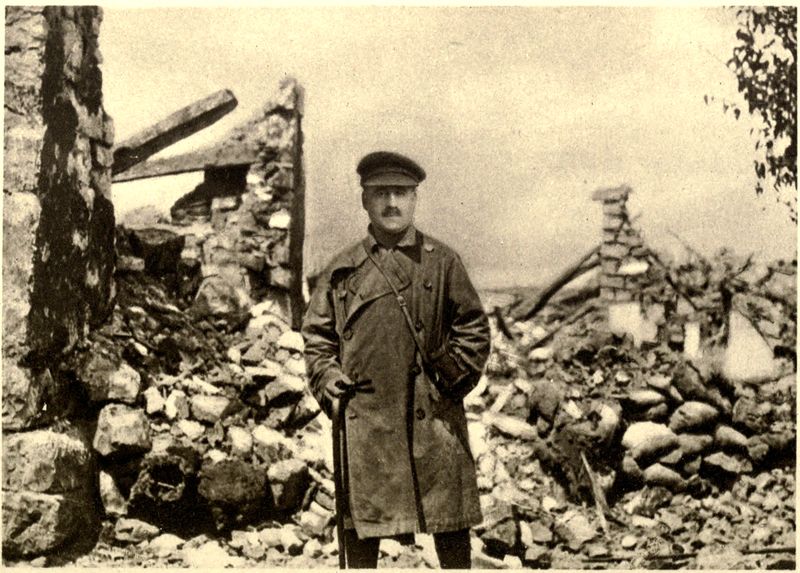
The Author in San Martino del Carso.
From a snapshot by Robert Vaucher. Correspondent of the Paris L’Illustration.
SIX MONTHS ON
THE ITALIAN FRONT
From the Stelvio to the Adriatic
1915-1916
By
Julius M. Price
War-Artist Correspondent of the
“Illustrated London News”
NEW YORK
E. P. DUTTON & COMPANY
681 FIFTH AVENUE
1917
PRINTED IN GREAT BRITAIN BY
THE WESTMINSTER PRESS
411A HARROW ROAD
LONDON W
To the Italian Military Authorities
in recognition of the courtesy and many kindnesses
extended to me during my six months’ work with the
glorious Army of Italy.
NOTE
I am indebted to the Directors of the Illustrated
London News for their kind permission to reproduce
in this book the sketches and drawings I made for
them whilst on the Italian Front, a great many of
which have already been published.
PREFACE
As the reader will discover for himself, I have
no pretensions to pose as a Military Expert.
This book is the result of a few hasty impressions
gathered over a period which, with all its
minor inconveniences and little daily worries, I
look back upon as among the happiest and best
filled of a somewhat varied career. I have not
yielded to the temptation to be interesting at the
expense of veracity; to that fact the indulgent
reader will, I trust, attribute many of the dull
pages. If in the latter half of the book I have laid
particular stress on the operations leading up to
and culminating in the capture of Gorizia, I hope
I may be forgiven, as I had the good luck to be the
only foreign correspondent on the spot at these
scenes of History-making. In my dedication I have
paid a humble tribute to the many kindnesses I
received at the hands of the Military Authorities,
from His Excellency General Cadorna downwards.
I can only repeat it here.
Julius M. Price.
21, Golden Square, London, W.
January, 1917.
CONTENTS
CHAPTER I:
PAGE
Marching orders—I leave for Rome—Paris via Folkestone and Boulogne in war time—My campaigning kit—The war-correspondent’s list—Quaint item—Travelling “light”—A box of
choice Havanas—Boulogne to Paris; well-intentioned ladies and their “Woodbines”—The one and only cigarette—Paris to Turin—Curious order on train—Method and prescience—Few soldiers on
route—Arrival in Rome—A cheap room—No sign of excitement in streets—23rd May—Excitability of the Italian no longer noticeable—Rome unruffled—The declaration of war—On the Corso Umberto
that evening—The Café Aragno—National stoicism—The Day—Business as usual—The general mobilisation—A triumph of organization—At the War Office
My credentials—The War Zone—Italy’s preparedness—The Press Censorship—General Elia’s advice—Disappointment—A pipe in the Pincio—An inspiration—I leave for Venice—Venice
in war time—The lonely pigeons of the Place St. Marc—The Doge’s Palace—The bronze horses—Interior of St. Marc, strange spectacle—First act of war between Italy and Austria—Aeroplane bombs
Venice—French Aviators—Treasures of Venice—Everyday life in Venice during daytime—After nightfall—On the qui vive—Extraordinary precautions—Dangers of the streets—Spy fever—Permis
de séjour—The angry crowd—Defences against air attacks—Venice not a place forte—Nearest point of the Front—The British Vice-Consul, Mr. Beak—A good Samaritan—The letter of
credentials—The Commandant of Venice—More advice—New Rescript of the Generalissimo—Reference to Correspondents—Decide attempt go to Udine—The language difficulty—The waiter at the Hotel
Danielli—His offer to accompany me—Make arrangements at once—Introduced to Peppino Garibaldi—Amusing incident
From Venice to Udine—Reservists rejoining—Interesting crowd—Delays en route—Endless procession of military trains—Drawn blinds—The Red Cross train—Arrived Udine—Scene on
platform—In search of an hotel—A little incident—The well-dressed civilian—The obliging guide—My suspicions—Awkward questions—The best hotel in Udine—A little “Trattoria” close by—A cheap
room—First impressions of Udine—At the Police Office—The permis de séjour—The Carabinieri and the local police—The fascination of the big guns—The “Military Commandant of
Udine”—A difficult proposition—The luck of the undelivered letter—My guide has to leave me—I change my quarters—The Hotel “Tower of London”—Alone in Udine—An awkward predicament—A friend
in need—Still more luck—Dr. Berthod—I am offered a studio—I accept—The delight of having this studio in Udine
The wonderful system on which everything was worked—Udine “the Front”—The commencement of hostilities—The 24th May—The first day of operations auspicious for Italy—Redemption
of the province of Friuli—New Italian Front—Cormons—The inhabitants of Italian origin—A good practical joke—The moral of the troops—Unpretentious attempts at wit—High spirits of the
men—The road from Udine to Cormons—Wonderful sight—Italian flags everywhere—A mystery where they came from—Wild triumphant advance of the Italian troops—Women kiss the ground—But a lever de
rideau—Italians cross the Isonzo—Austrians on Monte Nero—Monte Nero—The capture of Monte Nero—Incredible daring of the Alpini—The story of the great achievement—Number of prisoners
taken—The prisoners brought to Udine—Their temporary prison—The tropical heat—An ugly incident—Austrian attempt to re-take Monte Nero—Success follows success—Capture of Monfalcone and Gradisca;
Sagrado and Monte Corrada—Commencement of the attack on Gorizia—Subjects for my sketch book—Touches of human nature—High Mass in the mountains—The tentes d’abri—Cheerfulness of men in
spite of all hardships
Udine the Headquarters of the Army—The King—His indefatigability—His undaunted courage—A telling incident—The King with the troops—Love and sympathy between Victor Emanuele and
the men—Brotherhood of the whole Army—A pleasant incident—Men salute officers at all times—Laxity shown in London—Cohesion between rank and file—The Italians of to-day—The single idea of
all—Udine crowded with soldiers—The military missions of the allied nations—Big trade being done—Orderly and sedate crowd—Restaurants—The food—The market-place—The Cinemas—Proximity of the
fighting—The Café “Dorta”—Pretty and smartly-dressed women—An unexpected spectacle—The Military Governor—The streets at night—Precautions against “Taubes”—The signal gun—Curiosity of
inhabitants—No excitement—Udine a sort of haven—I remain there six weeks—A meeting with the British Military Attaché, Colonel Lamb—My stay in Udine brought to an abrupt ending—The police
officer in mufti—Am arrested—Unpleasant experience—An agent de la Sureté—At the police station—The commissaire—Result of my examination—Novara—Magic effect of the undelivered letter
again—I write to General Cafarelli—My friends at the “Agrario”—General Cafarelli—His decision—The third class police ticket for the railway—Packed off to Florence—The end of the adventure
Florence in war time—War correspondents to visit the Front—I receive a letter from Mr. Capel Cure of the Embassy—Return to Rome—Signor Barzilai, Head of Foreign Press Bureau—I
am officially “accepted”—Correspondents to muster at Brescia—Rome to Brescia via Milan—The gathering of the correspondents—Names of those present—Papers represented—The correspondent’s armlet—Speech
of welcome by General Porro—Plan of journey announced—Introduced to officers of Censorship—To leave war zone a conclusion of tour of Front—“Shepherding” the correspondents—Censorships established
at various places—Correspondents’ motor cars—Clubbing together—Car-parties—My companions—Imposing array of correspondents’ cars—National flags—Cordiality amongst all correspondents and
Censors—Good-fellowship shown by Italians—Banquet to celebrate the occasion
Brescia—Rough sketch of arrangements—A printed itinerary of tour—Military passes—Rendezvous on certain dates—The “off-days”—Much latitude allowed—We make a start—Matutinal hour—First
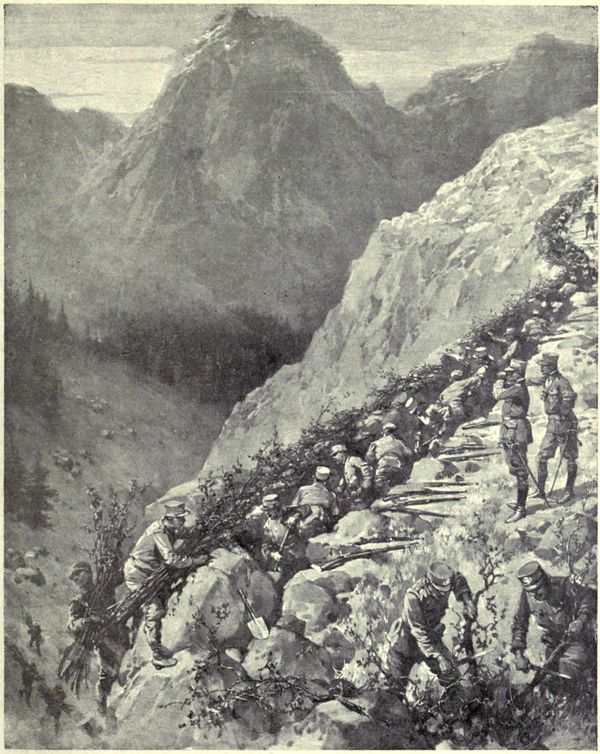
experience of freedom of action—Like schoolboys let loose—In the valley of Guidicaria—First impression of trenches on mountains—A gigantic furrow—Encampments of thousands of soldiers—Like the great
wall of China—Preconceived notions of warfare upset—Trenches on summits of mountains—A vast military colony—Pride of officers and men in their work—Men on “special” work—“Grousing” unknown in Italian
Army—Territorials—Middle aged men—“Full of beans”—Territorials in first line trenches—Modern warfare for three-year olds only—Hardy old mountaineers—Heart strain—The road along Lake Garda—Military
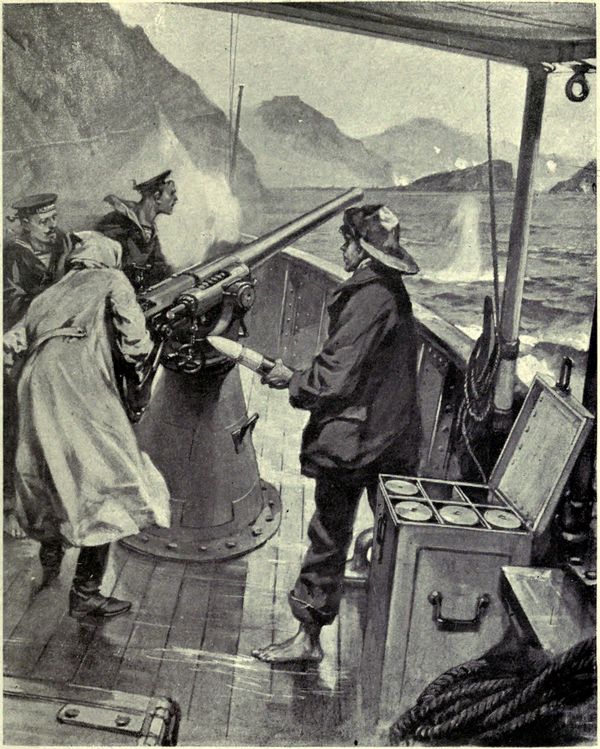
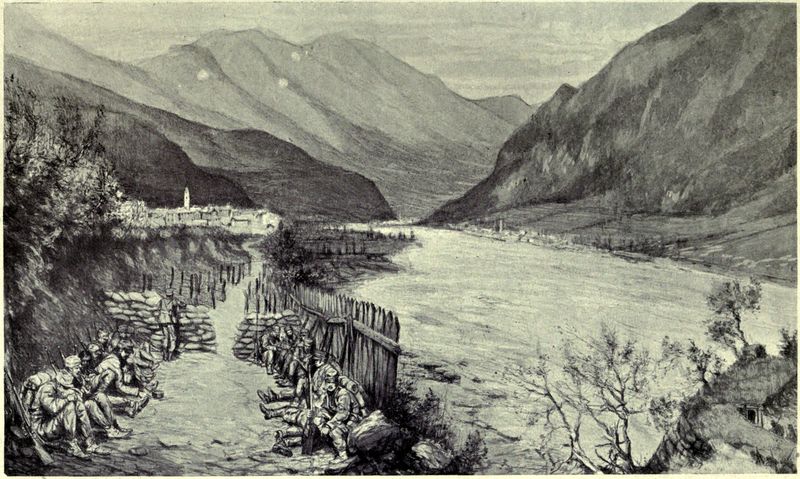
preparations everywhere—War on the Lake—The flotilla of gun-boats—The Perils of the Lake—A trip on the “Mincio” gun-boat—I make a sketch of Riva—A miniature
Gibraltar—Desenzano—Nocturnal activity of
mosquitoes—Return to Brescia—Something wrong with the car—Jules Rateau of the Echo de Paris—Arrange excursion to Stelvio Pass—A wonderful motor trip—The Valley of Valtellino—The corkscrew
road—Bormio—The Staff Colonel receives us—Permits our visiting positions—Village not evacuated—Hotel open—Officers’ table d’hôte—We create a mild surprise—Spend the night at hotel
On the summit of the Forcola—We start off in “military” time—Our guide—Hard climbing—Realize we are no longer youthful—Under fire—Necessary precautions—Our goal in sight—An awful
bit of track—Vertigo—A terrifying predicament—In the Forcola position—A gigantic ant-heap—Unique position of the Forcola—A glorious panorama—The Austrian Tyrol—The three frontiers—Shown round
position—Self-contained arsenal—Lunch in the mess-room—Interesting chat—The “observation post”—The goniometre—Return to Bormio—Decide to pass another night there—An invitation from the
sergeants—Amusing incident
From Brescia to Verona—Absence of military movement in rural districts—Verona—No time for sightseeing—The axis of the Trentino—Roveretto, the focus of operations—Fort Pozzachio—A
“dummy fortress”—Wasted labour—Interesting incident—Excursion to Ala—Lunch to the correspondents—Ingenious ferry-boat on River Adige—The Valley of the Adige—Wonderful panorama—“No sketching
allowed”—Curious finish of incident—Austrian positions—Desperate fighting—From Verona to Vicenza—The positions of Fiera di Primiero—Capture of Monte Marmolada—The Dolomites—Their weird
fascination—A striking incident—The attempted suicide—The Col di Lana—Up the mountains on mules—Sturdy Alpini Method of getting guns and supplies to these great heights—The observation
post and telephone cabin on summit—The Colonel of Artillery—What it would have cost to capture the Col di Lana then—The Colonel has an idea—The idea put into execution—The development of the
idea—Effect on the Col di Lana—An object lesson—The Colonel gets into hot water—The return down the mountain—Caprili—Under fire—We make for shelter—The village muck-heap—Unpleasant position—A
fine example of coolness—The wounded mule—An impromptu dressing
Belluno—Venadoro in the heart of the Dolomites—A fine hotel—Tame excursions—Visit to Cortina d’Ampezzo—Austrian attempts to recapture
it—305mm. guns on the Schluderbach—Long
range bombardment—Austrian women and children in the town—Italians capture Monte Cristallo—Aeroplanes and observation balloons impossible here—Tofana in hands of Italians—Serenity of
garrison—Cortina d’Ampezzo—General invites us to a déjeuner—Living at Venadoro—Delightful camaraderie—Evenings in the big saloon—From Belluno to Gemona—Description of Front in
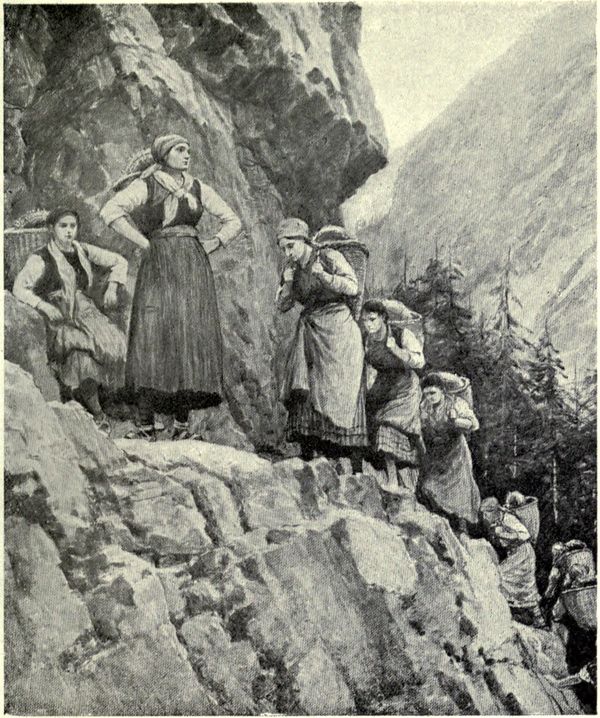
this Sector—Our excursion to Pal Grande—The road—On mules up the mountain—A warning—Rough track—Peasant women carrying barbed wire up to the trenches—Pay of the women—Much competition for
“vacancies”—The climb from Pal Piccolo to Pal Grande—A wonderful old man—“Some” climb—The entrenched position on Pal Grande—Spice of danger—Violent artillery duel—The noise of the passing
shells—Magnificent view—Timau—The Freikoffel—Its capture by the Alpini—Wounded lowered by ropes—Capture of Pal Grande—Presence of mind of a doctor—A telling incident—Extraordinary
enthusiasm of the troops—Food convoys—The soldier’s menu—Daily rations—Rancio; the plat du jour—Officers’ mess arrangements—An al fresco lunch on Pal Grande—The
“mess-room”—“Pot Luck”—A wonderful meal—A stroll round the position—An improvised bowling alley—Use is second nature—In the trenches—A veteran warrior—The pet of the position—Gemona—The list
of lodgings—My landlady—Good restaurants in Gemona—The Alpini quartered there—The military tatoo in the evenings—Reception by the Mayor—A delightful week
Gemona to Udine—Final stage of official journey—Regrets—Arrival at Udine—List of recommended lodgings—My room—My landlady an Austrian woman—I pay my respects to General Cafarelli—My
friend Dr. Berthod—My old studio at the Agrario—The Isonzo Front—Many rumours—Off on our biggest trip; 245 kilometres in the car—Roads excellent and well-looked after—A great change—Cormons quite
an Italian town—Same with other towns in conquered territory—Observatory on Monte Quarin—A splendid bird’s-eye view—The plain of Friuli—Podgora—The Carso—The hum of aeroplanes—The Isonzo Sector—The
immense difficulties—Received by the General—A pleasant goûter—Lieutenant Nathan, Ex-Mayor of Rome—The Subida lines of trenches—Explanation of Italian successes everywhere—Caporetto via
Tolmino—A desolate region—Road along the Isonzo—The mighty limestone cliffs of Monte Nero—The great exploit of its capture recalled—One mountain road very much like another—Nothing to sketch—Perfect
organization—The fog of dust—Caporetto—Not allowed to motor beyond—Important strategic operations—Monte Rombon—Difficulty to locate Austrian guns—A glimpse of Plezzo—The situation here—Excursion to
Gradisca via Palmanova, a semi-French town—Romans—Curious rearrangement of cars—Only two allowed proceed to Gradisca under fire—The Italian batteries at work—The deserted streets—The “observatory”
room—The iron screens—View of Monte San Michele being bombarded—Stroll through the town—A big shell—Excursion to Cervignano, Aquileia and Grado—Peaceful country-side—Grado the Austrian
Ostend—Fish-lunch at a café—The town continually bombarded by aircraft—Arrival of Beaumont, the French airman—Conclusion of official tour of Front—No permission given for correspondents to
remain—Success of tour—Comments on organization, etc.
Conclusion of Correspondents’ tour of Front—I return to London—Awaiting events—Brief official communiqués—Half Austrian Army held up on Italian Front—Harrying tactics—Trench
warfare during the winter—Recuperative powers of the Austrians—Gorizia a veritable Verdun—Italian occupation of Austrian territory—Many thousand square miles conquered—A bolt from the blue—Serious
development—Awakening Austrian activity—400,000 troops in the Trentino—Front from Lake Garda to Val Sugana ablaze—Totally unforseen onslaught—Towns and villages captured—Genius of Cadorna—Menace of
invasion ended—I go and see Charles Ingram with reference going back to Italy—His journalistic acumen—My marching orders—Telegram from Rome—My journey back to Italy—Confidence everywhere—Milan in
darkness—Improvement on the railway to Udine—Udine much changed—Stolid business air—Changes at the Censorship—Press Bureau and club for correspondents—The Censorship staff—Few accredited
correspondents—Remarkable absence of Entente correspondents—Badges and passes—Complete freedom of action given me—I start for Vicenza en route for Arsiero—Scenes on road—From daylight into darkness—Hun
methods of frightfulness—Arsiero—Its unfavourable position—Extent of the Austrian advance—Rush of the Italians—Austrians not yet beaten—Town damaged by the fire and bombardment—Villa of a great
writer—Rossi’s paper-mills—The town
itself—The battlefield—Débris of war—A dangerous souvenir for my studio
The fighting on the Asiago plateau—Brilliant counter-offensive of General Cadorna—I go to Asiago—Wonderful organization of Italian Army—Making new roads—Thousands of labourers—The
military causeway—Supply columns in full operation—Wonderful scenes—Approaching the scene of action—The forest of Gallio—The big bivouac—Whole brigades lying hidden—The forest screen—Picturesque
encampments—The “bell” tent as compared with the tente d’abri—Our car stopped by the Carabinieri—“Nostri Canoni”—We leave the car—The plain of Asiago—The little town of Asiago in
distance—The Austrian and Italian batteries and Italian trenches—Hurrying across—The daily toll of the guns—Asiago in ruins—Street fighting—Importance attaching to this point—An ominous lull—Regiment
waiting to proceed trenches—Sad spectacle—The quarters of the divisional commandant—His “office”—Staff clerks at work—Telephone bells ringing—The commandant’s regret at our coming—Big artillery
attack to commence—A quarter of an hour to spare—A peep at the Austrian trenches—A little, ruined home—All movements of troops to trenches by night—Artillery action about to commence—Not allowed go
trenches—Adventure on way back—Attempt cross no man’s land at the double—My little “souvenir” of Asiago—Bursting shells—Ordered to take cover—The wounded soldiers and the kitten—Anything but a
pleasant spot—The two Carabinieri—Cool courage—In the “funk-hole”—An inferno—My own impressions—Effect on soldiers and our chauffeur—The wounded sergeant—We prepare to make a start
back—Irritating delay—A shrapnel—My companion is wounded—Transformation along road—Curious incident
Slow but certain progress on the Trentino front—An open secret—The mining of the Castalleto summit—Carried out by Alpini—Recapture of Monte Cimone: also by Alpini—Heroic
exploits—Udine one’s pied à terre—An ideal “News centre”—The Isonzo Front—The old days of the war correspondent as compared with the present conditions—Well to be prepared—Returning to Udine
for lunch—Attracting attention—Unjustifiable—Things quiet at the Front—Unusual heat of the summer—Changeable weather at Udine—Early days of August—Increasing activity in the Isonzo Sector—Significant
fact—Communiqué of August 4th—The communiqué of the following day—General attack by Italians all along this Front—Arrange start for scene of action—My car companions 6th August—Magnificent
progress everywhere—Afternoon news—Capture of Monte Sabottina announced—We make for Vipulzano—On the road—Stirring scenes—“New” regiments—“Are we down-hearted”—The penchant for Englishmen—A
cortège of prisoners—Like a huge crowd of beggars—Half-starved and terror-stricken strapping young fellows
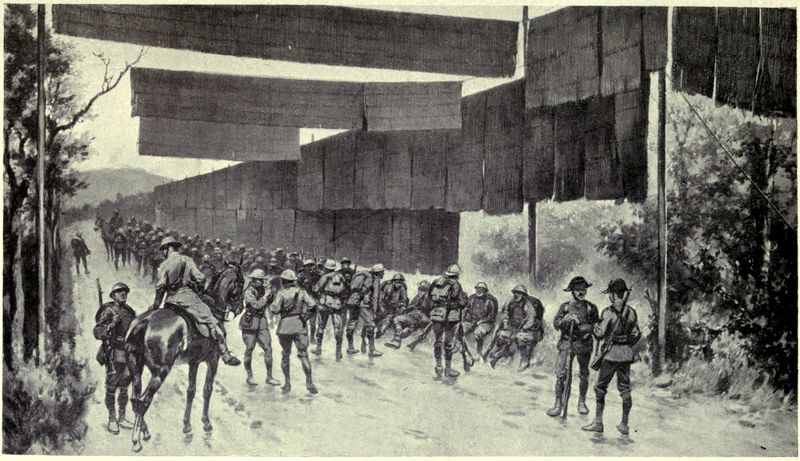
The commencement of the battle for Gorizia—We approach scene of action—Sheltered road—Curious “Chinese” effect—Headquarters of the 6th Corps d’Armée—Cottage of British Red
Cross—Our cordial reception by General Capello—A glorious coup d’oeil—Wonderful spectacle—The Socialist Minister Leonida Bissolati—More good news received—The scene before us—Explanation
of word “Monte”—Continuous line of bursting shells—Country in a state of irruption—No indication of life anywhere—Not a sign of troops—My motor goggles—Curious incidents—“Progress everywhere”—Colonel
Clericetti announces good news—Capture of Gorizia bridge-head—Excited group of correspondents and officers—Arrange start at once with two confrères for fighting Front—Our plan—The thunder of
the guns—The rearguard of advancing army—Our pace slackened—Miles and miles of troops—Wonderful spectacle of war—Mossa—Go on to Valisella—Machine guns and rifle fire—Ghastly radiance—General
Marazzi’s Headquarters—Not allowed proceed further—Decide make for Vipulzano—Arrive Arrive close on 10 o’clock—Bit late to pay visit—General invites us to dinner—Large party of officers—Memorable
dinner—Atmosphere of exultation—News Austrians retreating everywhere—Thousands more prisoners—Dawn of day of victory—I propose a toast—On the terrace after dinner—Battle in full progress—Awe-inspiring
spectacle—Little lights, like Will-o’-the-Wisps—Amazing explanation—Methodical precision of it all—Austrian fire decreasing gradually—Time to think of getting back to Udine and bed
The capture of Gorizia—Up betimes—My lucky star in the ascendant—I am put in a car with Barzini—Prepared for the good news of the capture—Though not so soon—A slice of good fortune—Our
chauffeur—We get off without undue delay—The news of the crossing of the Isonzo—Enemy in full retreat—We reach Lucinico—The barricade—View of Gorizia—The Austrian trenches—“No man’s land”—Battlefield
débris—Austrian dead—An unearthly region—Austrian General’s Headquarters—Extraordinary place—Spoils of Victory—Gruesome spectacle—Human packages—General Marazzi—Podgora—Grafenberg—Dead
everywhere—The destroyed bridges—Terrifying Explosions—Lieutenant Ugo Oyetti—A remarkable feat—The heroes of Podgora—“Ecco Barzini”—A curtain of shell fire—Marvellous escape of a gun-team—In the
faubourgs of Gorizia—“Kroner” millionaires—The Via Leoni—The dead officer—The Corso
Francesco Guiseppe—The “Grosses” café—Animated scene—A café in name only—Empty cellar and larder—Water supply cut
off—A curious incident—Fifteen months a voluntary prisoner—A walk in Gorizia—Wilful bombardment—The inhabitants—The “danger Zone”—Exciting incident—Under fire—The abandoned dog—The Italian flags—The
arrival of troops—An army of gentlemen—Strange incidents—The young Italian girl—No looting—At the Town Hall—The good-looking Austrian woman—A hint—The Carabinieri—“Suspects”—Our return journey
to Udine—My trophies—The sunken pathway—Back at Lucinico—The most impressive spectacle of the day
After Gorizia—Method and thoroughness of General Cadorna—Amusing story—Result of the three days fighting—Employment for first time of cavalry and cyclists—Udine reverts to its usual
calm—Arrival of visitors—Lord Northcliffe and others—Whitney Warren—Changes along the fighting Front—Monte San Michele—A misleading statement—“Big Events” pending—A visit to Gorizia—My companions—Great
change visible on road—Battlefield cleared away—Gorizia—Deserted streets—Rules and regulations for the inhabitants—The two cafés open—Rumours of counter-attack—The General’s Headquarters—Somewhat
scant courtesy—A stroll round—We decide spend night in Gorizia—The deserted Hotel—We take possession of rooms—A jolly supper party—A glorious summer night—One long hellish tatoo—The Austrian
counter-attack—A night of discomfort—The noise from the trenches—The cause of my “restlessness”—The “comfortable” beds—Gorizia in the early morning—Indifference to the bombardment—Back to Udine via
Savogna, Sdraussina and Sagrado—Panorama of military activity—Monte San Michele—Looking for a needle in a bundle of hay—The cemeteries—The pontoon bridge—The Austrian trenches—The cavalry
division—Renewed shelling of Gorizia
Big operations on the Carso—General optimism—No risks taken—Great changes brought about by the victory—A trip to the new lines—Gradisca and Sagrado—A walk round Gradisca—Monte San
Michele—Sagrado—Disappearance of Austrian aeroplanes and observation balloons—Position of Italian “drachen” as compared with French—On the road to Doberdo—Moral of troops—Like at a picnic—A
regiment on its way to the trenches—The Italian a “thinker”—Noticeable absence of smoking—My first impression of the Carso—Nature in its most savage mood—The Brighton downs covered with rocks—Incessant
thunder of guns—Doberdo hottest corner of the Carso—No troops—Stroll through ruins of street—Ready to make a bolt—A fine view—The Austrian trenches—Shallow furrows—Awful condition of trenches—Grim and
barbarous devices—Austrian infamies—Iron-topped bludgeons, poisoned cigarettes, etc.—Under fire—A dash for a dug-out—The imperturbable Carabinieri—Like a thunderbolt—A little incident—Brilliant
wit—The limit of patience—The Italian batteries open fire—No liberties to be taken—On the way back—Effect of the heavy firing—Motor ambulances—Magnified effect of shell fire on Carso—Rock
splinters—Terrible wounds
Difficulties Italians have still to contend with on way to Trieste—Italian superior in fighting quality—Dash and reckless courage—Success reckoned by yards—Total number of prisoners
taken—A huge seine net—The “call of the wild”—A visit to San Martino del Carso—My companion—Our route—The attraction of the road—Early morning motoring—On our own—The unconventional quarters of the
divisional general—The Rubbia-Savogna railway station—The signalman’s cabin—An interesting chat with the General—At our own risk—The big camp on Monte San Michele—The desolate waste of the Carso—An
incident—Nothing to sketch—“Ecco San Martino del Carso”—Shapeless dust-covered rubble—The Austrian trenches amongst the ruins—Under fire—Back to Udine—A pleasant little episode—Déjeuner to Colonel
Barbarich at Grado—A “day’s outing”—The little “Human” touch—The “funk-hole” in the dining room—A trip in a submarine chaser—Things quiet in Udine—A period of comparative inactivity
Declaration of war between Italy and Germany—Effect of declaration at Udine—Interesting incident—General Cadorna consents to give me a sitting for a sketch—The curious
conditions—Methodic and business-like—Punctuality and precision—A reminder of old days—I am received by the Generalissimo—His simple, unaffected manner—Unconventional chat—“That will please
them in England”—My Gorizia sketch book—The General a capital model—“Hard as nails”—The sketch finished—Rumour busy again—A visit to Monfalcone—One of the General’s Aides-de-camp—Start at
unearthly hour—Distance to Monfalcone—Arctic conditions—“In time for lunch”—Town life and war—Austrian hour for opening fire—Monfalcone—Deserted aspect—The damage by bombardment—The guns silent
for the moment—The ghost of a town—“That’s only one of our own guns”—A walk to the shipbuilding yards—The communication trench—The bank of the canal—The pontoon bridge—The immense red structure—The
deserted shipbuilding establishment—Fantastic forms—Vessels in course of construction—A strange blight—The hull of the 20,000 ton liner—The gloomy interior—The view of the Carso and Trieste through
a port-hole—Of soul-stirring interest—Hill No. 144—The “daily strafe”—“Just in time”—Back to Udine “in time for lunch”—Return to the Carso—Attack on the Austrian positions at Veliki Hribach—New
Difficulties—Dense woods—Impenetrable cover—Formidable lines of trenches captured—Fighting for position at Nova Vas—Dramatic ending—Weather breaking up—Operations on a big scale perforce
suspended—Return London await events
Marching orders—I leave for Rome—Paris
via Folkestone and Boulogne in war
time—My campaigning kit—The war-correspondent’s
list—Quaint item—Travelling
“light”—A box of choice Havanas—Boulogne
to Paris; well-intentioned ladies and their “Woodbines”—The
one and only cigarette—Paris to
Turin—Curious order on train—Method and
prescience—Few soldiers on route—Arrival in
Rome—A cheap room—No sign of excitement in
streets—23rd May—Excitability of the Italian
no longer noticeable—Rome unruffled—The
declaration of war—On the Corso Umberto that
evening—The Café Aragno—National stoicism—The
Day—Business as usual—The general mobilisation—A
triumph of organization—At the War
Office.
CHAPTER I
“Gerrard 2575?”
“Hello—Hello!”
“That you, Julius Price? Charles Ingram
speaking—When are you starting for Italy?”
I had only received my marching orders from the
office the previous day, so the thought came to my
mind “Early next week,” but I hadn’t the pluck to
give expression to it. Instead, I compromised lamely
with “As soon as possible.”
“Rubbish!” snapped the voice, “Get off at
once.”
I had known my Charles Ingram—best of chiefs—most
loyal of friends—too long to attempt to
argue. I had started on too many journeys for The
Illustrated London News not to realize that a War-Artist
must have no collars to buy—no friends to
bid farewell to—so there was only one stereotyped
answer possible—“All right, I’ll leave to-morrow
morning.”
“Well, goodbye and good luck to you.”
8.30 the following morning therefore saw me at
Charing Cross, duly passported and baggaged,
bound for Rome.
Although Italy had not yet officially declared her
intention of joining in with the Allies, it was well
known that it was but a matter of a few days before
she would do so. The War fever all over Italy was at
its height, and there seemed no possibility of anything
occurring to influence adversely the decision of the
King. The sands of time were rapidly running out,
while Count Berchtold, the Austrian Chancellor, was
deliberately—for the Allies, fortunately—playing with
the destiny of his nation.
The centre of interest at the moment was obviously
the Capital, so I was anxious to reach it in
time to witness the historic scenes of the near
future. Rumour had it that so eager was the nation
to get to grips with its hereditary foe that a revolution
would ensue were the King to hesitate as to his
course of action, while it had been an open secret
for some weeks that a general mobilisation of the
Army and Navy had been in active progress since
the commencement of the period of tension. Italy,
therefore, was the point de mire of the entire world
on the 20th of May, 1915, when I left London, and
I could congratulate myself that, thanks to the
journalistic flair of Charles Ingram, I should be on
the spot in time for anything that might happen.
At that date one was still able to reach Paris via
Folkestone and Boulogne—England was only just
awakening to the fact she was at war—the popular
short sea-passage route had not yet been taken over
by the military authorities, and although the examination
of passports and passengers was severe,
there was nothing like the difficulty and delay one
now experiences in getting across the Channel.
The scheduled time from London to Paris was a
mere matter of twelve hours, which, of course, was
not excessively long under the circumstances, while
as compared with the time the journey occupies
to-day via Southampton and Havre, it was rapidity
itself.
It had been a bit of a rush to get through all I had
to do in the twenty-four hours I had at my disposal
before leaving London. Consuls will not be hurried
even for War-Correspondents, and one’s passport
nowadays is far and away the most important article
of one’s belongings. There are, moreover, always a
hundred and one things that must be done before
starting on an expedition of indefinite duration. I
know of nothing more irritating when “on the
road” than suddenly to discover you have forgotten
to bring with you some insignificant but invaluable
object which can be easily procured in London but
which is unobtainable abroad.
In common with most Correspondents, I have
always made it a habit to have my kit kept more
or less packed ready for emergency, but not to the
extent of one of the brotherhood, who, in order to
obviate the danger of finding something missing
from his trunks while on the war-path, had lists of
the various items pasted in the lid of each trunk
which he would carefully verify before starting. An
excellent idea, and even amusing in places, as on
the occasion when his old soldier-servant had described
one of the important items in the list,
“False tooth (Supernumerary).”
That the selection of every detail of one’s baggage
when travelling “light” is an all important matter
is incontrovertible, but personal experience and
individual fancy can be the only guide to what one
is likely really to want on a hazardous journey. For
myself, I have contrived to sort things down to an
irreducible minimum, which will go in a car or the
luggage rack of a railway carriage. This, together
with a small attaché case for my books, papers and
spare pipes, constitutes my entire baggage, of which
I never lose sight.
Two pals came to see me off, and one, a connoisseur
in these matters, brought me a box of his
choicest Havanas to smoke en route, and delighted
though I was at his kind thought, I felt I was going
to have trouble with this unexpected addition to
my luggage. And it started when I found that my
bags were so full up that I could find no immediate
home for a box of 100 big cigars, much as I could
appreciate them. I could not help feeling that had
my friend given me a leg of mutton to carry to
Rome it would have been a less awkward parting gift.
The trouble I had with those cigars makes me
smile even now when I think of it—they seemed to
get everywhere—rather than carry the box, I endeavoured
to distribute them in various pockets—with
the result that I was simply overwhelmed with
Corona Coronas, and although I smoked hard all
the way it seemed to make no impression on the
supply, and the thought of what might happen at
the Italian frontier became a positive obsession.
I had already spent six months on the French front,
so was pretty familiar with the warlike scenes that
presented themselves on the other side of the
Channel, but to most of my fellow travellers they
were quite new.
Several well-intentioned ladies in the train from
Boulogne to Paris had provided themselves with
big supplies of “Woodbines,” and all the way to
Etaples, whenever we passed soldiers along the line,
they were busy throwing the small packets of
cigarettes out of the windows to English and French
indiscriminately.
It was Voltaire, I believe, who asserted that
England has sixty religious sects but only one
sauce. I fancy that the French “Poilu” would
now substitute “cigarette” for “sauce,” but
whether they prefer the “one and only” to their
more robust “Caporals” is a matter of doubt.
For my own part, I was too busy that day getting
through with my Coronas to trouble much about
either.
I should have liked to have spent a few hours in
dear old Paris, but the exigency of the situation in
Italy did not permit me to entertain the idea for a
moment. I just had sufficient time to drive to the
Gare de Lyon, dine at a restaurant near the Station,
and catch the Rome express.
The train was not crowded, and the journey till
we reached Turin was quite featureless with the
exception, as far as I could judge, that everyone was
discussing the situation in Italy.
At the frontier station of Modane, where the
examination of luggage was quite perfunctory,
some important news had just come through. The
Parliament, on reassembling, had given to the
Salandra Cabinet by an overwhelming majority a
vote of confidence, which amounted to a declaration
of war against Austria.
At Turin, where we arrived in the afternoon, the
station was buzzing with rumours that war had
already been declared—this, as it turned out, was
not the case, but it showed how acute was the crisis
and the excited state of popular opinion.
This was borne strongly upon me by a curious
order given to the passengers on the train leaving
Turin. In broad daylight all blinds had to be drawn
down and kept down till we had passed a certain
station further on. The reason for this did not
transpire, but it was rigorously enforced.
It was a typical Italian summer afternoon, so the
discomfort thus entailed in the stuffy carriages may
be better imagined than described; but it brought
home to you the seriousness of the situation and the
fact that whatever the outcome the Government
was taking no chances. What was happening in
the district through which we were passing was
none of our business, and they let us know it—thus.
This was actually the first indication of the nearness
of war, and also an illuminating insight of the
“method” and prescience of the war department.
What struck you everywhere was the small number
of soldiers one saw, and you could but conclude that
if movement of troops were taking place they were
perhaps being carried out in the zone where the
blinds had to be drawn, though Turin was so far
from any prospective front that this seemed an
excessive precaution.
Rome, if not exactly deserted, was much emptier
than usual for the time of year; but as it was 84°
in the shade that may have had something to do
with it.
At the Grand Hotel, where I proposed staying,
all the upper floors were closed.
The white waistcoated manager showed me a fine
room on the second floor, and on my enquiring
the price, asked me, as I thought with diffidence,
whether I thought six lires a day was too much. As
I knew the charge in normal times would not have
been less than three times that amount, I told him
I did not—and took it.
A stroll through the principal streets in the cool
of the evening, when one might have expected some
indication of popular feeling, revealed absolutely
no sign of anything abnormal. It was outwardly the
Rome of peace times, not as you would have expected
to find it on the eve of war; yet the Press
was full of the gravity of the impending crisis, and
in the Capital, as on the journey towards it, one was
struck by the remarkable absence of soldiers everywhere.
The following day, Sunday, the 23rd of May, it
was evident from the tenor of the morning papers
that the ultima ratio was in sight, and that it was now
only a question of hours, or even minutes, when
the momentous decision of the King would be
announced. There was a significant calm everywhere
that one could not fail to notice, though
nobody appeared to have any doubt as to what was
pending.
Strangely enough all the old characteristics of
the Latin race seem to be dying out—the excitability,
the hotheadedness, the volubility of the Italian of
the days of yore are no longer en evidence. The men
of Italy of to-day are of a different fibre, and though
the old-time mettle remains, it is shown differently.
There is a growing tendency amongst all classes
towards the imperturbability and placidity one associates
with Northern races. Events are accepted
more dispassionately, and there is far less of the
garrulity and dramatic gesture of twenty years ago.
As was generally anticipated, the fateful decision
was made known towards evening, and the papers
appeared announcing the declaration of war, and
that Baron von Macchio, the Austrian Ambassador,
had been handed his passports at 3.30.
Even then, when one would have expected the
pent up feelings of the people to display themselves
in some form of demonstration, there was no commotion
whatever.
Along the Corso Umberto the gaily-dressed
crowds strolled as leisurely as ever, and the laughter
and merriment were the same as on any ordinary
Sunday evening. There were perhaps more people
about than usual, but this was probably because it
was a delightfully cool evening after an exceptionally
hot day.
The Café Aragno, which is the hub of the political,
journalistic and social life of the Capital, was, of
course, packed, as it always is on Sundays. Groups
of people were standing about in the roadway and
on the pavement reading and discussing the news.
“Extra Special” Editions of the evening papers,
with fresh details of the situation, seemed to be
coming out every few minutes, and the paper boys
did a big trade.
If, however, I had not seen it for myself I should
never have believed that such composure in such
exceptional circumstances could be possible. I
could not help contrasting in my mind this quite
remarkable absence of excitability in Rome with what
I had seen in Paris on the first day of the mobilisation.
When the streets resounded to the cheers of the
Reservists and everywhere was wild excitement.
It may have been that the event had been so long
anticipated in Italy that when the actual moment
arrived its effect was discounted; but nevertheless
stoicism of this remarkable character certainly
struck one as being quite an unexpected trait of the
national temperament.
I was, I must admit, the more surprised and
disappointed, as my instructions from my Editor
were to get to Rome as quickly as possible and make
sketches of the scenes that would doubtless be
witnessed in the streets as soon as war was declared,
but there was no more to sketch in Rome on
that Sunday evening than one would see any day
in London, and there were certainly far fewer
soldiers about.
In fact, it is probably no exaggeration to state
that it was with a sigh of relief that the Italians
learned that hostilities were about to commence
against Austria.
“The Day” that had been looked forward to for
forty-nine years, since peace was forced upon Italy
by Prussia and Austria in 1860 after the Battle of
Sadowa, had at last come, and found the nation
united in its determination to endure anything and
stand any sacrifice in its resolve to conquer its
hereditary foe once and for all.
The absence of outward sign of feeling amongst
the populace was as much marked in the days
following the declaration of hostilities. The object
of the war was well understood, and therefore
popular with all classes—in the Capital at any rate,
and there was in consequence no flurry or appearance
of undue restlessness anywhere—business
went on as usual, and except for the shouting of the
newsboys, one could scarcely have known that war
had commenced.
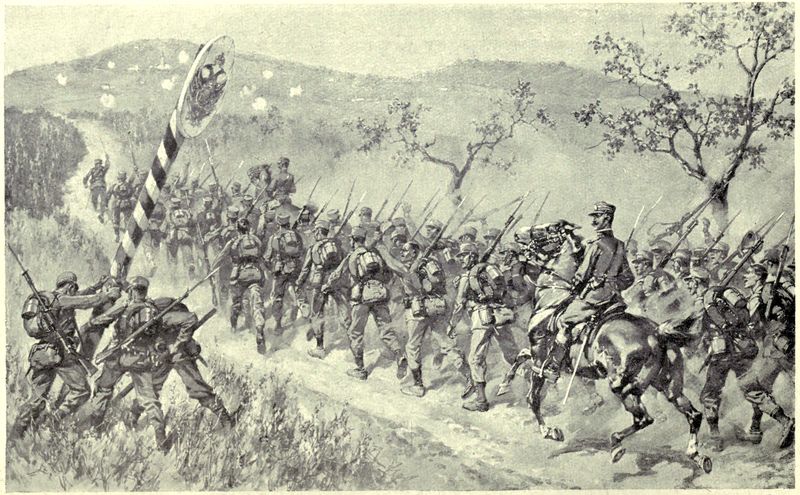
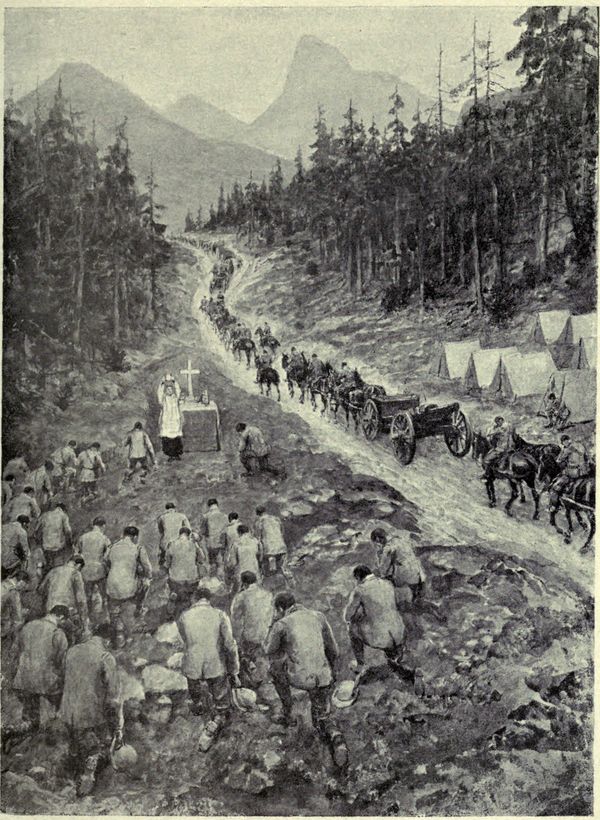
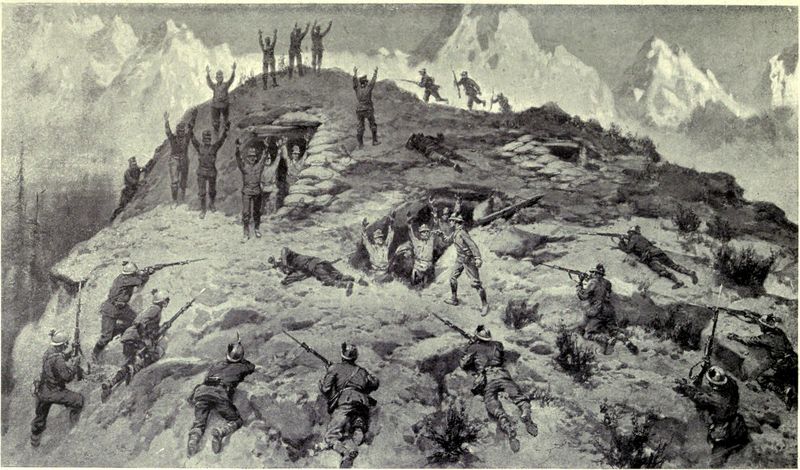
During the entire day the onward march continued (see page 37)
To face page 11
All this was, of course, due to the fact that the
general mobilisation had been gradually and quietly
taking place for some time previously. There were
therefore none of the heartrending scenes such as
one witnessed in the streets and round the railway
stations in Paris after the first flush of excitement
had worn off, for most of the Reservists were well
on the way to the Frontier by the time war was
declared.
It was a veritable triumph of organisation, and
reflected the greatest credit on all concerned.
I had occasion to go to the War Office several
times, and found an air of solid business on all
sides that was very impressive. Everything appeared
to be going on as though by clockwork—a wonderful
testimony to the efficiency of the different departments.
There was not the slightest indication that
anything had been left to chance or to luck in
“muddling through somehow.”
Of course it is incontrovertible that those in
charge of the destinies of the nation had had ample
time to get ready and to profit by the lessons of the
war elsewhere, but this does not alter the fact that
it was only the wonderful state of preparedness in
Italy that enabled her to take the initiative directly
war was declared. It certainly revealed an intuitive
power of grasping the exigencies of the situation on
the part of the Chiefs of the War department that
to my mind presaged victory from the outset.
CHAPTER II
My credentials—The War Zone—Italy’s
preparedness—The Press Censorship—General
Elia’s advice—Disappointment—A
pipe in the Pincio—An inspiration—I leave
for Venice—Venice in war time—The lonely
pigeons of the Place St. Marc—The Doge’s Palace—The
bronze horses—Interior of St. Marc, strange
spectacle—First act of war between Italy and
Austria—Aeroplane bombs Venice—French aviators—Treasures
of Venice—Everyday life in Venice
during daytime—After nightfall—On the qui vive—Extraordinary
precautions—Dangers of the streets—Spy
fever—Permis de séjour—The angry crowd—Defences
against air attacks—Venice not a place
forte—Nearest point of the Front—The British
Vice-Consul, Mr. Beak—A good Samaritan—The
letter of credentials—The Commandant of Venice—More
advice—New Rescript of the Generalissimo—Reference
to Correspondents—Decide attempt go
to Udine—The language difficulty—The waiter at
the Hotel Danielli—His offer to accompany me—Make
arrangements at once—Introduced to Peppino
Garibaldi—Amusing incident.
CHAPTER II
I arrived in Rome armed with sufficient
credentials and recommendations, apparently,
to frank me through every barrier to the Front,
but I was not long discovering that in spite of the
courtesy with which I was received by the officials
to whom I had introductions, it was hopeless to
expect any relaxation, for the time being, of the
stringent decree with regard to the War Correspondents
that had been issued by the Generalissimo.
A “War Zone” was declared at once, and the
most rigorous precautions taken to insure its being
guarded against intrusion. Within its confines were
several important cities, as for instance, Brescia,
Venice, Verona, Vicenza, Belluno, Bologna, Padua
and Udine and the entire area was considered as
in a state of war, and immediately placed under what
was practically martial law. No railway tickets were
obtainable unless one had a permit to travel on the line.
It is of interest to mention all these conditions
ruling at the very beginning of the war as affording
an object lesson in the “method” and foresight
which were displayed in every move of General
Cadorna even to the smallest details.
Italy took a long while making up her mind to
throw in her lot with the Allies, but there was no
losing time once she made a start, as was soon
proved, and her preparedness was evidenced in
every direction.
A censorship of the most drastic character was
established at once, and it looked at one time as if
correspondents were going to have a bad time of it,
and see even less, if possible, than in the other areas
of the war.
“Go and make a journey through Italy; there is
lots to see that will interest you as an artist, and
come back in about three months from now; then
perhaps some arrangements will have been made
with reference to correspondents going to the
Front.” This was all I could get from General Elia,
the genial Under-Secretary of State for War, who
speaks English fluently—when at last, through the
kindly intervention of the British Embassy I managed
to see him and begged to be permitted to
accompany the troops.
This could scarcely be construed as encouraging,
and as I came away from the interview I must admit
I felt the reverse of elated. I had already spent a
week trying to get permission to go to the Front,
and I certainly had not the slightest intention of
playing the “tourist” for the next few months, nor
of idling away my time in Rome if I could help it.
But what was to be done?
I could hardly speak a word of Italian, so knew I
was handicapped terribly for getting about alone. I
strolled up to the solitude of the Pincio, and lighting
my pipe, sat down under the trees to think it out. I
forgot to mention that the decree placing Venice
and other towns within the War Zone was not to
come into force for another twenty-four hours.
Suddenly an idea occurred to me. I knew Venice
well, why not go there; at any rate I should be
quite near the Front, and with luck I might manage
to make my way there. Anyhow it could not fail to
be more interesting so close to the scene of operations
than in Rome.
I made up my mind to start that day if possible,
and, going to Cooks’ office near the hotel, found
that I was in luck’s way—there was a train that
afternoon, and there was not the least difficulty in
getting a ticket, but this was the last opportunity
of doing so without a permit, I was told.
The next day therefore saw me in Venice and
amidst familiar scenes. But it was a very altered
place from the Venice of peace time. It looked very
dreary and lifeless. The week that had elapsed since
the commencement of hostilities had brought about
a great change.
There were no visitors left—only one hotel was
open, Danielli’s—the Grand having been taken over
by the Red Cross Society; the canals, those delightful
arteries
of Venetian life, appeared almost deserted,
although the steam launches were running
as usual; the pigeons had the place St. Marc practically
to themselves, workmen were busy removing
the glorious windows from the Doge’s Palace and
bricking up the supporting arches.
The chapel at the base of the Campanile was
shrouded in thick brickwork; the famous bronze
horses on the portico of St. Marc had been taken down
at once; the interior of the church itself presented a
curious spectacle, as it had several feet of sand on the
floor, and was hidden by a big bastion of sandbags.
It is perhaps of interest to mention that the first
act of war between Austria and Italy took place at
Venice. At 3.30 on the morning of the 24th May
the inhabitants were aroused by the loud boom of a
signal gun—this was immediately followed by the
screech of all the steam whistles in the City and on
the boats.
In a very few minutes the batteries of the Aerial-Guard
Station and machine guns and rifles were
firing as rapidly as they could at the intruders—several
Taubes flying at a great height—without
effect, unfortunately, as they managed to drop several
bombs and get away unscathed. Two of the bombs fell
in the courtyard of the Colonna di Castelpo, one in
the Tana near the Rio della Tana, another in the San
Lucia, and a fourth in the Rio del Carmini.
It was said that an enormous parachute, to which
was suspended incandescent matter to light up the
ground, was released from one of the aeroplanes,
but this was not corroborated; it is certain though
that the bomb that fell in San Lucia was incendiary
and spread lighted petroleum, without effect happily.
Austria, therefore, lost no time in beginning her
war of vandalism.
Every precaution possible was being adopted
while I was there, to protect the city against any
further aeroplane attacks, and there was a contingent
of French aviators—amongst whom was
Beaumont—staying at the hotel, who were constantly
patrolling over the city.
Unfortunately, in a place like Venice, which is
such a veritable conglomeration of artistic treasures,
it is obviously very difficult to protect all, and with
a thoroughly ruthless and barbaric enemy like
Austria it is to be feared that a lot of irreparable
damage will be done before the end of the war.
Life in Venice during the daytime was practically
normal—sunshine engenders confidence; it was
after nightfall that you realised the high state of
tension in which everyone was living; it could
scarcely be described as terror, but a “nervy,”
“jumpy” condition, which was very uncanny.
Everyone seemed to be on the qui vive, though
curiously enough the fear of the Venetians, as far
as I could judge, was not so much for themselves as
for the safety of their beloved city.
The most extraordinary precautions were taken
to ensure its being shrouded in impenetrable obscurity
at night—a ray of light shewing through a
window meant instant arrest for the occupant of
the room. Even smoking out of doors at night was
strictly forbidden. The doorways of restaurants,
cafés, and shops were heavily draped with double
curtains, and after eight o’clock the electric light
was turned off and only candles allowed.
It would be difficult to describe the weird effect
of Venice in total darkness on a moonless night.
It is said that more people have lost their lives by
falling into the canals than through aeroplane bombs,
and I can quite believe it, for it was positively dangerous
to go a yard unless one was absolutely certain
of one’s whereabouts.
Added to this was the risk of being mistaken for
a spy. One had to get a permis de séjour from the
Police, but even with this in your pocket one was
never really safe, for they had “spy fever” very
badly indeed when I was there, and even old and
well-known inhabitants were not immune from
suspicion at times.
I heard of several cases of hair-breadth escapes
from the clutches of the angry crowd which would
gather on the slightest suggestion. To be heard
speaking with a foreign accent was often sufficient
to attract unpleasant attention, so you were inclined
to be chary of venturing far from the Place St. Marc
at any time, however much your papers might be
en règle.
Apart from the defensive work that was being
undertaken to protect Venice from Austrian air
attacks, there was nothing of interest in the way of
military or naval activity to be seen. Destroyers and
torpedo boats occasionally came into the lagoon,
but seldom remained long.
The position of Venice makes it a sort of cul de
sac, and of no importance whatever from the point
of view of land and sea operations, and it is quite at
the mercy of Austrian aeroplanes or seaplanes operating
from Pola or Trieste.
The sole object the Austrians can have in attacking
it therefore is to cause wanton damage to its
historic buildings and art treasures, for it is not a
place forte in any sense of the word; and if there is
one thing more than another calculated to stiffen
the backs of the Italians against their enemy and to
make them the more determined to do all in their
power to crush Austria for ever, it is this cold-blooded
onslaught on their national artistic heirlooms,
for which there is no military justification
whatever.
At that time the nearest point of the Front was
some 40 miles from Venice, in Friuli, and after a
few days marking time, I decided that this was
where I must make for if I wanted to see anything
of what was going on in this early stage of the war.
The courteous and genial British Vice-Consul,
Mr. Beak, who had just taken over the post, proved
a veritable good Samaritan, and did his best to help me.
I have not mentioned, I think, that when in Rome
I had been given an important letter of credentials
by the British Embassy recommending me for any
facilities the Italian military authorities might be
prepared to grant me, and the letter now proved
invaluable. Mr. Beak got a translation made of it, to
which he affixed the consular stamp, and, armed
with this, I paid a visit to the Commandant of
Venice, at the Arsenal.
He received me with the utmost cordiality, but
when I suggested his giving me permission to go to
the Front he informed me that he had no power to
do this; that my best plan would be to go direct to
Headquarters at Udine, where doubtless I would
get what I wanted on the strength of my letter from
the Embassy. I said nothing, but with the recollection
of what General Elia had told me in Rome, I
had my doubts. Anyhow, it gave me the idea of
going to Udine and trying my luck; if the worst
came to the worst, I could but be sent back, and in
the meantime I should have seen something of the
Front.
The following day a new rescript of the Generalissimo
appeared in the papers to the effect that until
further orders no correspondents were allowed in
the War Zone. This was awkward for me, as, of
course, I was already in it, but I made up my mind
to run the further risk of getting up to the actual
Front if it were possible. But how, without speaking
Italian, for, of course, the “interpreter” element
had disappeared from Venice since there were no
longer any tourists to interpret for.
My ever faithful pipe as usual helped me to solve
the difficulty (what I owe to Lady Nicotine for ideas
evolved under her sway I can never be sufficiently
grateful for).
There was a very intelligent young waiter at the
hotel who spoke English fluently, and it occurred to
me that he would make a useful guide if he would
go with me. He not only jumped at the idea, but
actually offered to come for a few days for nothing
if he could get permission from the manager, and
if I paid his expenses, so anxious was he to see something
of the military operations.
There was no difficulty in getting the consent of
the manager as the hotel was practically empty;
and then my friend, the Vice-Consul, again good-naturedly
came to my assistance by giving me a
letter to the Military Commandant of Udine, in
which he stated fully my object in coming to the
front, and the fact that I was carrying a special letter
of credentials from the Embassy.
These two important documents, together with
my passport, were, I felt, sufficient to frank me
some distance unless unforseen trouble arose; so
I made arrangements to start at once; and in order
not to be hampered with baggage, as I did not know
where my venture would take me, decided to leave
my bulky luggage behind at the hotel, only taking
with me what I could carry on my back in my
“ruksak.”
Before I left I was introduced to a very nice
fellow who had just arrived in Venice, and a somewhat
amusing incident occurred. I did not catch
his name at first, and, as he spoke English so fluently
and looked so much like an Englishman, I was
somehow under the impression that he was a correspondent
of a London paper. He appeared mystified
when, after a few casual remarks, I asked him how
long he had been in Italy.
“How long?” he exclaimed. “Why, I live
here.” “But you are not an Italian?” “Well, you
see my grandfather was,” he replied with a touch
of humour which I was only able to appreciate,
when I heard later that my “English journalist”
was Peppino Garibaldi, a nephew of the great
patriot. He had just come from the Front, where he
had been to see the King to offer his services in
raising a regiment of volunteers similar to the one
he had recently commanded on the French front in
the Argonne. His offer, it appeared, was not accepted,
but afterwards I learned he was given a commission
in the Army, and he has since so distinguished
himself in action that he has risen to the rank of
Colonel. I believe his brothers have also done
equally well in the Army, thus proving that they
are all real “chips of the old block.”
CHAPTER III
From Venice to Udine—Reservists rejoining—Interesting
crowd—Delays en route—Endless
procession of military trains—Drawn
blinds—The Red Cross train—Arrival Udine—Scene
on platform—In search of an hotel—A little
incident—The well-dressed civilian—The obliging
guide—My suspicions—Awkward questions—The
best hotel in Udine—A little “Trattoria” close by—A
cheap room—First impressions of Udine—At the
Police Office—The permis de séjour—The Carabinieri
and the local police—The fascination of the big
guns—The “Military Commandant of Udine”—A
difficult proposition—The luck of the undelivered
letter—My guide has to leave me—I change my
quarters—The Hotel “Tower of London”—Alone
in Udine—An awkward predicament—A friend in
need—Still more luck—Dr. Berthod—I am offered
a studio—I accept—The delight of having this
studio in Udine.
CHAPTER III
The train service between Venice and Udine
was apparently running as usual, and there
was no difficulty in getting tickets in spite of
the drastic regulations with regard to passengers.
Possibly it was assumed that anyone already inside
the War Zone had permission to be there, so no
further questions were asked.
My guide, of course, got the tickets, so I had no
trouble in that matter; perhaps if I had gone to
the booking office myself with my limited vocabulary
of Italian it would have been different. As it
was, it all seemed ridiculously simple, and there
appeared to be no difficulty whatever.
In Venice they are so accustomed to Englishmen,
and artists are such “common objects of the seashore,”
that I attracted no particular notice, in
spite of my rucksack and my Norfolk jacket, breeches
and leggings.
The train left Venice at 8 o’clock in the morning,
and was crowded with officers in uniform and
reservists in civilian attire, going to join their regiments.
Every class of Italian life was to be seen
amongst them—from the peasant with his humble
belongings in a paper parcel to the smart young
man from Venice with his up-to-date suit case and
other luggage.
All were in the highest possible spirits, and it
gave me more the impression of a holiday outing of
some big manufacturing company than a troop-train
as it virtually was.
I now began to realize how handicapped I was in
not speaking Italian; it would have been so interesting
to have been able to chat with these enthusiastic
young fellows.
It was supposed to take three hours to get to
Udine, but we were two hours and a half longer, as
we were continually being held up for trains with
troops, artillery and every description of materiel
to pass. It was an endless procession, and the soldiers
in them seemed as happy as sand-boys, and cheered
lustily as they passed us.
The blinds of our windows and doors had to be
kept drawn down the whole way, and no one except
the officers was allowed to get out of the train at the
stations under any pretext. Still there was not much
that we did not see; the blinds did not fit so tight
as all that.
At one place we passed a long Red Cross train
full of badly-wounded men just in from the Front.
This was the first time there had been any evidence
of the fighting that was taking place on ahead. It
was almost a startling sight, and came in sharp
contrast to the cheering crowds of healthy boys in
the troop trains that had gone by a few minutes
previously.
There was a big crowd of officers and soldiers on
the platform at Udine, which was the terminus of
the line, and one realised at once that it was an
important military centre. Outside was a large
assemblage of vehicles, motor waggons, and ambulance
cars, and altogether there was a scene of
military activity that presented a sharp contrast to
sleepy Venice.
Rugged and threatening, visible for miles around is the frowning pinnacle of bare rock
known as Monte Nero (see page 40)
To face page 26
The station is some little distance from the town,
so we set off in search of a small hotel we had been
recommended to where we could get quiet lodgings
for a day or two as I did not want to put up anywhere
where we should attract undue attention. I
had thought it would be advisable to drop the “War
Correspondent” for the time being and to call
myself simply a wandering artist in search of Military
subjects, and my intelligent young guide quite
entered into my idea—it was only a harmless little
fib after all.
A few hundred yards from the station a little
incident occurred which, curiously enough, turned
out to be the commencement of the run of luck
which, with one exception, of which I shall tell
later, I had during the whole of my stay in Udine.
It came about in this wise.
A good-looking, well-dressed man in civilian
attire caught us up as we were walking along, and,
noticing that we seemed uncertain which way to
take, asked pleasantly if we were looking for any
particular street. My companion unhesitatingly
told him we had just arrived in Udine, and were
looking for lodgings.
The stranger, noticing I could not speak Italian,
addressed me in a very good French, and obligingly
offered to accompany us part of the way. I could
not well refuse, but I recollect how the thought
instantly flashed through my mind that he was
perhaps a police official in mufti or a detective, and
my suspicions seemed to be confirmed by a question
he put to me bluntly.
“Are you journalists?” he enquired suddenly.
My first impulse was to ask what business it was
of his what we were, when it flashed through my mind
that it was better not to resent his query, which
might after all mean no harm. So I replied that I
was a travelling artist in search of military subjects,
and that my companion was my interpreter. “But
why do you ask if we are journalists?” I continued.
“Because journalists are forbidden to come to
Udine, and only yesterday the famous Barzini
himself was arrested and sent back to Milan for
coming here without permission. Of course there
may be no objection to you as an artist if all your
papers are in order.”
I assured him they were, but nevertheless I did
not feel very reassured after what he had told me;
it seemed a sort of hint that unless I was very sure
of my position I had better not think of taking
lodgings at Udine, otherwise I was asking for trouble.
However, I had weighed all this in my mind beforehand,
and was well aware of the risk I was taking.
It makes me smile even now when I recall how
curtly I answered him, and how every remark he
made only increased my early doubts as to his bona-fides,
for he turned out to be as good and genuine a
fellow as I ever met, and had it not been for this
chance meeting, my early impressions of Udine
would have been very different to what they were,
apart from the result it had on my work whilst there,
but of all this more anon.
The modest hotel we had been recommended to
put up at was merely modest in comparison with
Danielli’s at Venice, for it was the Hotel d’Italie,
one of the best and most frequented in Udine, and
the very last place I should have chosen for seclusion.
As it turned out, they had not a room vacant,
so we had perforce to seek accommodation elsewhere.
Meanwhile the obliging stranger had left us to
our own devices, much to my relief, as I was not
over keen on his knowing where we put up.
There happened to be a little “trattoria” close
by, and we went in to get something to eat. It was
late for lunch, so we had it to ourselves, and the
proprietor, seeing we were strangers, came and had
a chat with us.
It turned out that he had a room to let for 1.50 per
night with two beds in it; it was large and very
clean, so, to avoid walking about trying to find
something better, I told him that I would take it.
But it was more easily said than done.
“You must go to the Questura (the police) and
get their permission to stay in Udine before I can
let you have it,” he told us. This was a bit awkward,
but there was no help for it but to go at once and get
the ordeal over, so we made our way at once to the
police station.
We had to pass through a main street, and I
realised at once that Udine, although the “Front”
and the Headquarters of the Army, was only a
small Italian garrison town, with perhaps more
soldiers about than there would have been in normal
times.
Considering how close it was at that moment to
the actual opening operations of the war, it was
distinctly disappointing from my point of view,
considering I was looking for military subjects. In
this respect it was even less interesting than many
of the French towns such as, for instance, Epinal or
Langres, I had been in during the early days shortly
after the commencement of hostilities.
This was my first impression of Udine—I had
reason to modify it considerably in a very short time,
in fact during the first day I was there. The echo of
the big guns convinced me that although life in
Udine was outwardly normal, the war was very near
indeed.
At the Questura, to my surprise, the Commissaire
made but little difficulty in giving me a permis de
séjour, on seeing my passport and my last permis
from Venice, and on my guide explaining that I
might be remaining some little time, he readily
made it out for one month.
As I came away I could not help wondering why
it should have been so easy for me to obtain this
permission to remain in Udine when Barzini had
been arrested and sent away a couple of days previously.
I had yet to learn that in the War Zone the civil
authorities and the local police take a very back seat,
and that the permis de séjour I had just been given
would prove of no value whatever if the Carabinieri—i.e.,
the military police—took exception to my
being in Udine. Fortunately I did not learn this
until some days later, and in the meantime, confident
in the possession of my police permit, I had
no hesitation in walking about the town freely.
The sound of the big guns, however, which one
heard unceasingly, soon began to exercise the curious
fascination over me that they always have, and
I was not long making up my mind that I must lose
no time in Udine.
It was a delightfully quaint old town, with cafés
and restaurants, and altogether a pleasant place to
spend a few days in, but this was not what I had
come for. So I immediately set about making
enquiries for the quarters of the “Military Commandant
of Udine” in order to present my letter
from the Consul, and ask for permission to go out
to the scene of operations.
It seemed on the face of it a perfectly simple
matter to find out where he was staying, but we
spent several hours going from place to place without
success.
The long official envelope with “On His Majesty’s
Service” on it proved an open sesame everywhere,
and I was received with marked courtesy by all the
staff officers I showed it to, and the envelope itself
seemed to inspire respect, but not one of them could
(or as I thought “would”) give me the information
of the Commandant’s whereabouts. It struck me as
being very strange all this mystery as it appeared.
Well, after having spent two hours going from
one staff building to another, we had to give it up
as a bad job—it was evidently a very difficult proposition
to present a letter to the “Military Commandant
of Udine”—and the envelope was beginning
to show signs of wear after being handled
so much, so there was nothing for it but to have the
letter always handy and chance coming across him
sometime—in the meantime, if any questions were
asked me as to the reason of my being in Udine I
felt I had always the excuse of this document which
I was waiting to hand personally to the “Military
Commandant.”
As it turned out I owed all my luck in remaining
in Udine as long as I did to this undelivered letter
in its official envelope. Whenever I was asked any
awkward questions as to why I was there, out it
would come, and the mere sight of it seemed to
afford me protection. It was a veritable talisman.
How its spell was eventually broken I will narrate
in due course.
To get out to the scene of operations without a
permit appeared hopeless, for the moment; one
realised it would take some time to work it, so the
only thing to do was to chance it and to remain on
in the hope of something turning up—that Udine
was the place to stay in if one could was evident. I
therefore decided not to budge till they turned me
out, and I never had cause to regret my decision.
My guide had only been given a few days holiday,
so when he saw that there was no immediate chance
of getting out to see anything of the fighting he told
me he thought he had better return to Venice.
This, of course, meant my remaining on alone—a
somewhat dreary prospect, since I knew no one,
and, as I said, could scarcely make myself understood,
but there was no help for it.
Before he left I managed, with his assistance, to
find a better room in a small hotel in the main street
(curiously enough the hotel was named “The
Tower of London”), and arranged to have my
luggage sent from Venice.
It would be difficult to describe my feelings when
I found myself alone outside the station after my
guide had gone. I felt literally stranded, but my
lucky star was in the ascendant, and in a few minutes
a little incident occurred that made me feel that I
might get used to Udine after all.
There is a tramcar running from the station to
the town, so I got on it as a sort of first attempt at
finding my way about without assistance, but when
the conductor apparently asked me where I wanted
to go I was at once non-plussed, and could only
gesticulate my ignorance and offer him a lire to take
the fare out of.
I might have been in an awkward predicament
and have attracted more attention than I desired,
when a big stout man, who was also standing on the
platform of the car, turned to me and in excellent
English asked me where I was going and if he could
be of any assistance since he saw I was an Englishman
and could not speak Italian.
Needless to add, that this led to a conversation,
and I learned that he had lived for many years at
Cairo, hence his speaking English so well. He was a
very genial fellow, and a genuine admirer of the
English nation and our methods in Egypt.
Before we parted it was arranged that I should
meet him the following day at the principal café in
the town, and that he would introduce me to a
young fellow, a friend of his, who also spoke English
fluently, and who would doubtless be glad to show
me around. So within five minutes of the departure
of my guide I had fallen on my feet.
My luck even then was not out: just as I got off
the tram I ran into the affable stranger who had
walked with us from the station on the day of our
arrival. He seemed so genuinely pleased to meet
me again that my suspicions of him vanished at
once, and I unhesitatingly accepted his offer of an
“Americano” at the café close by; the fact of my
being alone seemed to interest him immensely, and
he expressed astonishment at my risking remaining
in Udine without understanding Italian.
In the course of conversation I learned he was
Dr. Berthod, the President of an Agrarian Society,
with a big warehouse and office in Udine. He asked
me where I proposed to do my work, and when I
said in my bedroom at the hotel, he told me that
in his building there was a large room with a north
light which he, speaking on behalf of his members,
would be pleased if I would make use of as a studio
whilst I was in Udine.
This was so unexpected that I was quite taken
aback—such friendliness from a stranger quite
overwhelmed me.
He would take no refusal, and insisted on my going
with him to see if it would suit me.
It turned out to be a capital room, and I told him
it would answer my purpose admirably, so he got
some of his workmen to clear it out for me at once,
in readiness for me to commence work, and promised
to find me an easel and everything I required.
He refused to discuss the idea of my paying anything
for it, saying they were only too pleased to
help an Englishman, and that they would be delighted
if I would consider it as my studio as long
as I was in Udine. This was eighteen months ago,
and the room is still reserved for me.
Without this studio, as I soon realised, life up at
the Front for any length of time would have been
terribly fatiguing and monotonous. It is difficult to
convey an idea of the delight it was, having a quiet
place to come back to work in after rushing about
in a car for hours and probably having been under
fire all the time.
To get away for a while from the turmoil of war
when you were in the midst of it was a relief, like
going from blazing sunshine into the cool interior
of a cathedral.
CHAPTER IV
The wonderful system on which everything
was worked—Udine “the Front”—The
commencement of hostilities—The
24th May—The first day of operations auspicious
for Italy—Redemption of the province of Friuli—New
Italian Front—Cormons—The inhabitants
of Italian origin—A good practical joke—The
moral of the troops—Unpretentious attempts at
wit—High spirits of the men—The road from
Udine to Cormons—Wonderful sight—Italian
flags everywhere—A mystery where they came
from—Wild triumphant advance of the Italian
troops—Women kiss the ground—But a lever de
rideau—Italians cross the Isonzo—Austrians on
Monte Nero—Monte Nero—The capture of
Monte Nero—Incredible daring of the Alpini—The
story of the great achievement—Number of
prisoners taken—The prisoners brought to Udine—Their
temporary prison—The tropical heat—An
ugly incident—Austrian attempt to re-take
Monte Nero—Success follows success—Capture
of Monfalcone and Gradisca; Sagrado and Monte
Corrada—Commencement of the attack on Gorizia—Subjects
for my sketch book—Touches of
human nature—High mass in the mountains—The
tentes d’abri—Cheerfulness of men in spite
of all hardships.
CHAPTER IV
Everything seemed to go as though by
routine in the early operations, and from the
moment war was declared and the Italian
army made its “Tiger spring” for the Passes on
the night of May 23rd-24th it was manifest that
General Cadorna had well-matured plans, and, that
they were being carried out without a hitch anywhere.
During the six weeks I managed to stay in Udine
I had ample opportunity of observing the wonderful
system on which everything was worked, and how
carefully pre-arranged were the movements of
troops and material. Certainly no army—not even
excepting the German—ever started a war under
better conditions.
Udine in the early weeks of the war was right up
at “the Front,” so to speak, and therefore an extremely
important centre. It was practically from
here that the commencement of hostilities was
made.
At four o’clock in the morning of the 24th of May
the Italian army crossed the Indrio, a tributary of
the Isonzo, overcame a feeble resistance and entered
Austrian territory.
During the entire day the onward march continued.
After a preparatory attack in Monte Quirino,
the important town of Cormons surrendered and a
few hours later Caporetto, Cervignano, Terzo,
Medea, the ancient city of Aquileia and Grado, the
“Austrian Ostend,” in the Adriatic. The first day
of operations, therefore, dawned auspiciously for
Italy.
Some fears were expressed at the time that the
hasty withdrawal of the Austrians was a ruse, and
that the Italians might find themselves in a fix later
on, but, as was soon proved, this was not the case,
and nearly the whole of the province of Friuli, that
the Austrians had held since 1866, had been redeemed
with no opposition worthy of the name, and
the Italian front extended from Tolmino to the sea.
I was in Cormons shortly after the entry of the
troops, and it was difficult to realise that the Italians
had not always been there. The inhabitants of Italian
origin helped to remove as many traces as possible
of the Austrian occupancy—the hated names disappeared
as if by magic from shop fronts and street
corners; in fact, in a very few hours it was an
Italian town again, and the good folk of Cormons
had cast off their hated thraldom.
In the centre of the town is a statue of the Emperor
Maximilian (it looks exactly like Beckmesser
in the “Meistersingers” singing his pricelied), and
on the day of the entry of the Italian soldiers some
wag conceived the happy idea of placing a sack over
the head and an Italian flag in one of the hands, an
indignity that must have caused the Austrian inhabitants
to gnash their teeth with impotent rage,
but there were touches of humour discernable
everywhere which conveyed to you more perhaps
than anything else an idea of the moral of the troops.
Notices roughly scrawled on walls in the villages
which one passed—“This way for Trieste,” “Nearest
road to Monfalcone,” “Straight on and the
second to the right for Gorizia,” and so forth—unpretentious
little attempts at wit which have
remade their appearance again and again in every
war probably from time immemorial. All this, added
to the wonderful patriotic ardour and enthusiasm
one saw on all sides, was very impressive.
It meant practically scaling a cliff of rock (see page 41)
To face page 38
It is certain that no troops ever went to battle in
higher spirits than these splendid fellows. One heard
them marching along singing and laughing as though
they had not a care in the world.
The road all the way from Udine to Cormons
was a wonderful sight, and looked like a defile of
troops on some national fête day rather than the
opening of hostilities.
I saw the French armies on their way to the Front
at the beginning of the war, flower-bedecked and
bubbling over with enthusiasm, but somehow that
was different to this advance of the Italians. The
world war had not then commenced; its horrors
were as yet unknown—here there was no question as
to what was going to happen if Italy did not “make
good,” so the confidence and empressment was the
more stirring to my mind.
Italian flags seemed to blossom forth everywhere.
It was quite remarkable the numbers of them one
saw. Where they all came from was a mystery, as it
was well known that the Austrians never tolerated
them anywhere in the province. It was suggested
that the three different colours of material were
purchased separately and in different places so as
not to arouse suspicion, and held in readiness to be
sewn together to form the flags when the time at
last arrived.
The successful operations of the first day of the
war were immediately followed up by a vigorous
offensive, and the Italian troops practically swept
everything before them during the next few days
in their wild triumphant advance, all of which, in
the language of the Ring, proved the value of being
ready and getting in the first blow.
Everywhere the soldiers were received with open
arms by the peasantry of the redeemed province,
and many touching scenes were witnessed in the
villages through which they passed, villages that
had long given up hope of ever being under the
Italian tricolour again. In one place the women said
they would always kiss the ground the Italians were
marching over.
Of course, however, all this was but a lever de
rideau, and the merest prelude to what was going to
take place in the near future when the opposing
armies got to grips. The Austrians did not intend to
submit to a walk over by any means, as was discovered
when, a few days later, the Italians crossed
the Isonzo and endeavoured to establish themselves
on the slopes of Monte Nero preparatory to capturing
the mountain itself, but the Austrians were
found to be formidably entrenched, supported by
heavy artillery and a great number of machine guns.
The chief operations for the next few weeks,
therefore, were confined to the mountainous region
on the left bank of the Isonzo, about six miles west
of Tolmino.
Here, towering nearly 7,000 feet high, rugged
and threatening, visible for miles around, is the
frowning pinnacle of bare rock known as Monte
Nero, for the possession of which so many gallant
lives were to be sacrificed. That it was of the utmost
importance it should without undue delay be captured
was patent from the very start. From its
northern slope the Austrian artillery commanded
the entire zone of operations in the vicinity right
and left.
It is almost impossible to describe the terrible
nature of the enterprise the Italians found themselves
up against, but which had to be carried out
at all costs. One must have seen Monte Nero to
form a conception of the courage that was requisite
to accomplish it, yet it was eventually achieved, and
under conditions which will ever redound to the
glory of the Italian army.
The whole story of the capture of Monte Nero is
a veritable epic of heroism and endurance. It started
with a series of stubborn conflicts for the possession
of the spurs leading to the summit; these were
gradually taken, and then came the crucial moment
when only the actual summit remained in the possession
of the Austrians. This had been transformed
into a veritable fortress, and its eventual capture
was probably one of the most thrilling episodes in
the history of war.
The Austrians were so strongly entrenched and
fortified that they had every reason to consider
themselves in complete security from any attack
except by long range artillery fire, and the front of
their positions was further protected by nature, the
side of the mountain being almost perpendicular for
some distance from the top.
Many an experienced climber would hesitate to
negotiate so precipitous an ascent in daylight. The
Alpini, with almost incredible daring, undertook it
on a moonless night.
It meant practically scaling a cliff of rock in pitch
darkness, encumbered with rifle and munition;
however, amongst the men, all of whom were hardy
mountaineers, there was no hesitancy. In order to
lessen the danger of making any noise which might
arouse the suspicions of the Austrian sentries, they
removed their boots and bound rags round their feet
to prevent them being cut on the rocks.
Up they climbed in the Cimmerian gloom of
midnight like so many panthers stalking their prey;
now and again a rock, dislodged by accident, would
disturb the stillness of the night as it rattled down
into the valley below, and instantly the column
would halt and remain motionless expecting the
next moment the mountain side would be illumined
by the enemy’s flares and their presence discovered,
but their quarry slumbered in blissful ignorance of
their approaching doom, and the sentinels, fortunately,
heard nothing.
Half-an-hour before dawn the various detachments
reached the summit and found themselves within
a few yards of the front line of entrenchments.
These were instantly rushed and captured at the
point of the bayonet within a few minutes, most of
their defenders being killed before they were awake.
The second line shared the same fate after a short
and stubborn fight, for once aroused the Austrians
fought like cornered rats and with the courage of
despair, but they had no chance against the athletic
Alpinist, many of whom had not even troubled to
put on their boots after the long climb.
By the time the summits of the mountains were
illumined by the rays of the rising sun the whole
of the heights and slopes of Monte Nero were in
the hands of the Italians—750 unwounded prisoners,
a large quantity of rifles and ammunition and several
machine guns.
The prisoners were brought to Udine, and made
a sorry spectacle as they marched through the
streets. It was the first time the inhabitants had
seen Austrian captives, and they produced a strange
impression, as what had been seen of the war so
far had been only the troops passing on their way to
the front line.
Most of the men were Hungarians between 17
and 25 years of age; many were slightly wounded,
their uniforms were in tatters, and the majority had
no boots, but wooden shoes fastened to the foot
and ankle by leather straps.
They were confined temporarily in an old building
on the Piazza Garibaldi and I managed to get
in and make a sketch and have a chat with one of
them. He told me that most of them had come
from the Serbian front and had had a very rough
time. Looking round the motley crowd in the
picturesque courtyard, I could quite believe him,
but the men seemed quite reconciled to their fate
and taking it very philosophically.
There was a group playing cards in one corner,
and lying about in the shade were others chatting
and smoking long German pipes, or sleeping peacefully.
The heat that day was terrific, and certainly
the prisoners in their scanty attire had a better time
of it than their guards in full uniform.
Mentioning the tropical heat recalls to my mind
a very curious incident which occurred when the
prisoners were being brought into camp, and which
gave a vivid idea of the awful conditions in the
Austrian positions the suddenness of the Italian
attack had brought about.
Some soldiers were bringing up big canteens
full of water to be served out in due course, when
suddenly there was a veritable stampede amongst
the prisoners, and before it could be stopped there
was a wild fight to get at the water. So overwhelming
was the rush that the carriers were literally
swept aside.
The struggle only lasted a few moments, as it
was, of course, only a question of who was biggest
and strongest; then those who had got at the receptacles
flung themselves on the ground and literally
buried their faces in the water, lapping it up greedily
like so many animals, whilst their weaker comrades
tried madly to drag them away to get at it also. It
was a sickening spectacle, and proved how, under
certain conditions, some human beings revert instantly
to their primordial nature.
The capture of Monte Nero by the Italians appeared
to put the Austrians on their mettle, and
they made every endeavour to re-take it.
Battalion after battalion was thrown against the
position, whole regiments were destroyed in the vain
attempt to dislodge the Alpini, and as a last resource
the Austrians brought up their own mountain troops,
the famous “Kaiser Jagers,” but with no more
success.
Thus the first few weeks of war fully bore out
the expectations of those who were convinced that
the skill of General Cadorna and the spirit of the
Italian army would be more than a match for any
efforts of the Austrians, and justified the confidence
which was felt on all sides.
Events moved rapidly during those early weeks
of the war, and success followed success without
intermission.
Monfalcone, the seaport on the Adriatic, with its
important shipbuilding yards, Gradisca and Sagrado
were added to the list of Austrian towns captured
by the Italians in June, together with the important
position of Monte Corrada. All of which represented
a distinct advance into enemy territory in the direction
of Trieste.
It was not, however, a “walk over,” and the
Italians had to pay dearly in places for their successes.
The fighting for the middle Isonzo continued
fiercely, and there were severe losses round Plava
before the place was taken. The Austrians, however,
lost still more heavily.
The attack on Gorizia, which was to last so many
months, may be said to have commenced about the
middle of June, when the Italians were able to start
bombarding the fortifications of Santa Maria, San
Pietro, San Marco, and Santa Lucia, besides the
Austrian positions dominating the town, especially
Mount San Gabriele.
Of course all this meant long range artillery duels
day after day, which presented but little spectacular
interest, though it was obvious that there was method
in all this vast expenditure of ammunition, purposeless
as it may have appeared to the layman; to me
as an artist, however, there were plenty of subjects
for sketches, and without having to search for them
through field glasses. Not far afield there were
always interesting incidents—little touches of human
nature in the camps and on the road that fortunately
for me had so far escaped the attention of the ubiquitous
photographer.
On one occasion, for instance, I saw Mass being
celebrated in a small encampment in the mountains;
for it must be remembered that the innate piety and
religious spirit of the Italian Army have been evident
in every step of our Ally’s campaign against Austria.
On a road in the wild district near Pontebba a
rude altar of rough boxes was set up—the altar cloth
was a soldier’s blanket—the priest’s assistants were
soldiers.
It was a common soldier who rang the bell at the
Elevation of the Host, and the kneeling troops told
of the devout spirit in which they had entered not
only into the Divine Service but also into the war.
A battery was passing along the road at that
moment, and the artillerymen bared their heads and
piously made the sign of the Cross, whilst a sentry
before a row of grey tents fell on his knees.
Even in the haste of a rapid transport of guns,
reverence was not forgotten, although it was not
possible for the convoy to stop. The kneeling troops
were Alpini, who were encamped in this mountainous
district and had already figured gallantly in
action.
The operations on the frontier in the vicinity
of Pontebba were especially interesting from an
artistic point of view. The scenery here is magnificent,
and much of the fighting took place along the
big military highway constructed by Napoleon to
connect Milan with Vienna.
It was always a pleasure to be amongst the troops,
and it was an endless source of astonishment to me
to see how they had in so short a time settled down
to the irksome daily routine of warfare as it exists at
the rear of the fighting line.
The glorious summer weather doubtless contributed
in no small degree to the high spirits of the
soldiers, for camp life in the Italian army is very
different to that of the English—it is far more picturesque,
but of comfort there is very little, it appeared
to me. The quaint tentes d’abri afford very
slight shelter either against the intense glare and
heat of the Italian sunshine, or the cold and rain in
bad weather, yet the men appeared to be thoroughly
happy and contented under any conditions.
It may be said that it is all a question of habit or
rather custom; but there is no doubt that the
English Tommy expects to be, and is, pampered
in the way of quarters and catering to an extent that
would astonish the Italian soldier if he could see it;
as a matter of fact, it was frequently a revelation to
me what these men had to put up with at times, and
their invariable cheerfulness in spite of all hardships
and discomfort.
CHAPTER V
Udine the Headquarters of the Army—The
King—His indefatigability—His undaunted
courage—A telling incident—The King
with the troops—Love and sympathy between
Victor Emanuele and the men—Brotherhood of
the whole Army—A pleasant incident—Men
salute officers at all times—Laxity shown in
London—Cohesion between rank and file—The
Italians of to-day—The single idea of all—Udine
crowded with soldiers—The military
missions of the allied nations—Big trade being
done—Orderly and sedate crowd—Restaurants—The
food—The market-place—The Cinemas—Proximity
of the fighting—The Café “Dorta”—Pretty
and smartly-dressed women—An unexpected
spectacle—The Military Governor—The streets
at night—Precautions against “Taubes”—The
signal gun—Curiosity of inhabitants—No excitement—Udine
a sort of haven—I remain there six
weeks—A meeting with the British Military Attaché,
Colonel Lamb—My stay in Udine brought to an
abrupt ending—The police officer in mufti—Am
arrested—Unpleasant experience—An agent de la
Sureté—At the police station—The commissaire—Result
of my examination—Novara—Magic effect
of the undelivered letter again—I write to General
Cafarelli—My friends at the “Agrario”—General
Cafarelli—His decision—The third class police
ticket for the railway—Packed off to Florence—The
end of the adventure.
CHAPTER V
Udine, as I have pointed out, was practically
“the Front” in the early weeks of
the war. It was also the Headquarters of the
army, and every building of importance in the town
had been requisitioned for Staff purposes.
It was said that the King and the Generalissimo
were living there; but this, of course, was only
surmise, although one was constantly seeing them
motoring through the streets.
In fact, after a time one got to recognise instantly
the Royal Fiat, however grimy and bespattered with
mud it might be, for the King appeared indefatigable
and was out and about in all weathers, and was said
to have visited all the sectors of the Front and to be
never satisfied unless he saw for himself all that was
going on amongst the troops.
His undaunted courage is proverbial in Italy, and
no danger, however great, deters him going anywhere
if he sets his mind on it, as his personal staff
knows only too well. In this connection I recollect
a story that was told which will illustrate this.
On one occasion His Majesty expressed his intention
of joining the advance guard on a height
just occupied and which was being heavily fired on
by the enemy. An officer of Alpini respectfully
pointed out the danger and difficulty of attempting
it. The King laughingly replied that where the
Alpini could go an old Chamois-hunter like himself
could also go, and insisted on climbing to the
position.
The presence of the King always stimulated
immensely the enthusiasm of the troops, and this
was particularly noticeable when he accompanied
the first brigade which crossed the Isonzo on a
bridge thrown by the Engineers.
It is this desire to be not only with but amongst
his soldiers and sharing their perils that has helped
so much to establish the sort of fraternal love and
sympathy that exists between Victor Emanuele and
me men, which one cannot fail to notice whenever
the word goes round “Here comes the King.”
It was quite touching to hear on all sides the expressions
of affection of the big rough soldiers for
the wiry little man, covered with dust, who saluted
one and all so genially as he whirled past in the big car.
It is this feeling of brotherhood of which the King
sets the example that animates the whole army—one
could not fail to be struck by it—officers, non-commissioned
officers and men are all on the most
friendly terms together and there is probably no
more democratic army in the world to-day than the
Italian.
In this connection I recall a pleasing incident I
witnessed one day on a mountain track; an officer
riding a mule at the head of a small detachment of
soldiers, who were plodding along stolidly in the
intense heat, was reading his newspaper aloud for
the benefit of them all. Curiously enough this
camaraderie leads to no impairment of discipline—rather
the contrary perhaps, as for instance, one sees
men go out of their way, so to speak, to salute officers
at all times, not as a matter of duty only, but to show
their respect for their rank.
I was more particularly reminded of this on my
return to London, where the laxity shewn by the
rank and file towards officers in the matter of
saluting in the streets is particularly noticeable.
A rude altar of rough boxes was set up (see page 45)
To face page 50
The effectual result of this cohesion between the
rank and file in the Italian Army is proved by the
zeal which animates all, and which helps to lighten
the most irksome duties.
During the six weeks I spent in and around Udine
practically alone I had ample opportunity for studying
the character of the Italian officer and ordinary
soldier under true war conditions, and the more I
saw of them the more I liked them and admired
their fine qualities.
These virile, self-possessed specimens of the
Italy of to-day present a remarkable contrast to
those one recollects of the older generation, for in
the matter of physique the Italian army now in the
field can compare favourably in every respect with
any other army in the world.
From the highest officer to the most humble
private, one and all are animated with but a single
idea—that of thrashing the Austrians and restoring
to Italy the territory which is hers by right. But
there is no frothy bombast about them; in the town,
as in the trenches, though the conversation always
reverted to “la guerra,” it was to discuss it in the
sober, self-contained manner of the strong man
who knows his own strength and therefore does not
deem it necessary to insist on it.
As might have been expected, Udine, owing to its
proximity to the enemy’s lines, was crowded with
soldiers, and during the evening, when officers and
men were off duty, it was almost difficult to walk
along the main streets.
The three great allied nations were represented
in the throng also, as “military missions” soon
arrived in the town, and it was very pleasing to see
Russian, French and English officers in their respective
uniforms, fraternising everywhere with
the Italians. Since then Japan, Belgium, and Serbia
have also sent representatives, so there is now quite
a foreign military colony as it were, with officers
and permanent staffs.
The shops, cafés and restaurants were evidently
doing a big trade, but it was always a very orderly
and sedate crowd of young fellows one saw everywhere,
and displayed far less ebullition of animal
spirits than one would see in a French garrison
town.
Although fighting was taking place within an
hour’s motor run, nothing in the usual life of Udine
was changed. There were several good restaurants,
which were crowded for lunch and dinner, the
delightful old twelfth century market-place that is
one of the artistic treasures of the town, presented
every day the customary scene of peaceful animation
and brilliant colour one always associates with
Italy, and which has such charm for the painter;
it was “business as usual,” although you could
generally hear the thunder of the guns quite distinctly.
Nor was amusement lacking of an evening, as
there were two large Cinemas open, and at one a
sort of music-hall entertainment as well; both
these places were so well attended by the civilians,
as well as the military element, that it was always
difficult to get anything but bare standing room.
Here again the proximity of the fighting would
often be vividly brought home to you when the
booming of the guns was audible in an interval of
the performance.
Of course the ordinary soldiers were only allowed
out of barracks up to a certain hour—I forget for
the moment what that was—so the streets looked
comparatively deserted when they had gone.
The principal cafés were, however, well patronised
up till closing time, and “Dorta’s,” in particular,
was always very crowded with officers and
civilians.
It was quite remarkable the number of pretty and
smartly dressed women one saw about of a day—of
course many of these were the wives or daughters
of residents, but there were others also. On a fine
Sunday morning, the Church parade on the Piazza
Vittorio Emanuele and along the Via Mercato
Vecchio was quite one of the sights of Udine, for
it was usually a galaxy of beauty and fashion.
To anyone like myself, newly arrived in the town,
and expecting to find himself in the midst of warlike
scenes considering how close one was to the operations,
this unexpected spectacle came as a positive
shock.
After a week or so, however, this impression of
incongruity wore off, and you ended by feeling that
after all these dainty apparitions in the streets or
the restaurants were not so unpleasant to look on,
and that they served to accentuate the grimness of
the dust-covered warriors around them.
With the general advance of the Army, the
majority of the troops was gradually shifted nearer
the new Front, but the whole district was, and still
is, under the command of a military governor, who
wields the power of a dictator so far as the civilian
element is concerned.
The streets were practically pitch dark on moonless
nights, only the merest pretence of a glimmer
of electric light in blue bulbs being allowed here
and there, though the Stygian gloom was constantly
being illumined by the powerful headlights of military
cars passing through—a curious anomaly which
appeared to me quite inexplicable.
Of course these precautions were taken owing,
as I have said, to the proximity of Udine to the
enemy’s lines and the fact in consequence that
neighbourly visits from “Taubes” were frequently
received, though fortunately they seldom succeeded
in doing any damage or causing loss of life.
On several occasions, though they provided us
with spectacular displays overhead, as there were
always a number of our Capronis in the aerodrome
close by in readiness to go up and tackle these
intruders as soon as they were sighted, and there are
few things more exciting to witness than an aerial
fight.
A signal station was established on one of the
highest buildings, and on the approach of a Taube a
gun was fired to give the inhabitants timely warning,
though the usual effect of this warning at first was
to bring crowds into the streets to catch a glimpse
of what was going on aloft rather than induce the
people to make for safety. After a few of these
alarms the novelty wore off, and though it cannot
be said that scarcely any notice was taken of them,
there was certainly no undue excitement when the
signal gun was heard.
As will be gathered, therefore, the war, beyond
transforming Udine from a picturesque, sleepy,
little provincial town into a bustling and important
military centre, had not effected so much change in
it materially as might have been expected, so it was
a sort of haven to return to after one had been in
the zone of actual operations for a time.
I had now been up at the Front for six weeks, and
was beginning almost to consider myself as settled
permanently at Headquarters. How I managed to
stay so long undisturbed I could not understand,
considering the stringency of the police regulations.
It may have been that the authorities winked
complacently at my presence during all these weeks
in consequence of my being an artist as distinct from
a journalist, for by this time I made no attempt at
secrecy since no one took any notice of me apparently,
and I went about everywhere as freely as if I
had an official permit from the General himself.
I recollect one day meeting Colonel Lamb, the
British Military Attaché, in the street. He had just
arrived from Rome. He expressed his surprise at
seeing me in Udine, and asked how long I had been
there; when I told him he laughingly said: “You’ll
end by being sent to prison and perhaps shot one
day.”
I replied in the same vein that I had been expecting
it to happen every day for weeks past, so should not
be surprised when it did.
Well, whatever the reason, I had no unpleasant
attention shown me until the last few days of my
stay, and then it was suddenly brought home to me
that I had overstayed my welcome.
It was really the last thing I was expecting to
happen, as I had got on quite friendly terms with
the Commandant of the Carabinieri, and only a few
days previously the Commissaire of Police had
given me his official sanction to remain in Udine.
The order for what now took place must therefore
have emanated from someone in higher authority
than either of these gentlemen, so there was absolutely
no appeal from it, as will be seen. It came
about in this wise.
I was leaving the restaurant where I usually
lunched when a tall, well-dressed civilian came up
to me, and, as far as I could make out, since I hardly
understood a word of Italian, asked me if I were
Mr. Price, and if I were that person would I do
him the inestimable favour to walk with him as far
as the Questura, as they had something of importance
they desired to communicate to me at once.
I guessed at once that he was a police officer in
mufti, and that it was not for anything particularly
agreeable to me that he stopped me thus. Thinking
that perhaps he did not know that my papers were
quite in order, I pulled out my police pass and shewed
it to him; but this was not what he meant.
With the old time garrulity of the Italian, and
unctiously wringing his hands as though he was in
mental distress, he made me understand that it was
very distasteful to him to have to interrupt my
walk, but it was merely for a few moments, when I
should be free to resume it, and he would again
offer me his sincere apologies for venturing to accost
me, but it was of sufficient importance for him to
urge me to go with him now, as I was expected and
being waited for. This is what I gathered from the
few words I understood of all this verbosity.
Just at this moment, as luck would have it, someone
I knew came along. He spoke a little French,
so I asked him to tell me what it all meant. It was
as I had guessed: this was an Agent de la Sureté,
and I had to go with him to the police station at
once for reasons which would be explained when I
got there.
Of course there was no arguing the matter; I
realised that it was all mock politeness I had been
treated with, and that if I made any objection I
should be spoken to very differently. At the station
I was asked to produce “all my papers and my
passport”; these were taken into an adjoining
room. In a few minutes they were returned to me,
and I was informed that I would hear further in the
matter. Whereupon I was allowed to go, much
mystified as to what was going to happen next.
The following morning a note was left at my
Hotel to the effect that at 10 o’clock I was called
upon to present myself again with “all my papers
and my passport” at the police station, accompanied
by someone to interpret for me. A young
fellow who spoke French fairly well consented to
accompany me.
I was taken before the Commissaire, the one who
had given me the permis de séjour, and two other
officials, who began to ply me with questions as to
how I came to be in Udine, what I came for, and how
long I had been there, together with a lot of other
questions which were very irritating since the
Commissaire knew all about me already, as he had
his own signature before him on my papers.
There was a short conversation between the
Commissaire and the officials, who looked towards
me meanwhile in a friendly manner as I thought.
I was soon to be undeceived though. They then
turned to my interpreter and announced the upshot
of these mysterious happenings.
“Well, what’s the result of all these proceedings?”
I asked him.
“You are to be sent to Novara,” he replied unconcernedly.
“Be sent to Novara,” I repeated in amazement.
“Where’s Novara?”
“Oh, a long way from here, near the Swiss
frontier—beyond Turin.” He then went on to say
as coolly as though it could be but of little interest
to me.
“They say you must leave Udine by the first
train.”
It suddenly flashed through my memory that I
had heard of Novara as the town where Austrians
and Germans were interned. I was so stupified for
a moment that I did not know what to say. Then I
told him as calmly as I could to ask the Commissaire
what was the good of having a passport and such
papers as I had if I was to be treated the same as an
alien enemy. I could understand being requested
to leave Udine, but not being ignominiously sent
away. The Commissaire merely shrugged his shoulders
and replied those were his orders.
Suddenly I remembered the letter for the Military
Commandant of Udine I had still in my pocket,
fortunately. I pulled it out and asked to be at least
permitted to deliver it before I was sent away.
Its effect was, as it always had been, magical. The
Commissaire looked at the address attentively,
motioned me politely to be seated, then picking up
my passport, took it with the letter into an adjoining
room. He was gone some few minutes.
When he returned he told my interpreter to inform
me that if I would write out at once a full explanation
of my object in coming to the Front and my reasons
for desiring to remain, the letter should be given to
General Cafarelli, who would decide what I had to
do. I was warned, however, that there must be no
delay, the statement must be delivered in a few
hours. My papers were returned to me, and I was
then allowed to leave the office.
My good friends at the “Agrario” came to my
help and got the letter drawn up in Italian and duly
forwarded. The following day I had again to present
myself at the Questura, and I was at once taken to
the General’s offices in the adjoining building.
General Cafarelli, the Governor of Udine, was a
very tall, thin, elderly man, with a grey beard,
strikingly like the popular pictures of Don Quixote.
He held my dossier in his hand, and had evidently
just read it. He received me in the most frigid and
unsympathetic manner, and I felt instantly that if
it depended on him I was done with Udine and the
Front.
Without waiting for anything I might have to
say, he said abruptly in French: “You must leave
Udine at once; you are not permitted to remain.”
I produced the famous letter, and asked if he
could tell me when I could deliver it as it might
perhaps affect his decision.
To my surprise he just glanced at the superscription,
then without hesitating, opened it and
read it through.
“This does not alter your case. You leave to-day,”
he snapped out.
“But not for Novara I hope, mon General,” I
ventured to remark.
“Well, I will make you that concession, but you
must go either to Turin or Florence or Rome by
the first train,” and then he added significantly:
“I hope you will make no difficulty about it.”
There was no mistaking his meaning.
“Of course I will not,” I replied; “my only
regret is that I should have given you any trouble
at all, and I trust you will understand that my
motive in coming here was perfectly innocent.”
This appeared to mollify him considerably.
“Well, it is understood then that you leave to-day;
the police will provide you with a ticket for
whichever of the places I have named you decide
to go to.” Then, to my surprise, he held out his
hand as I turned to leave the room, and said in
almost a friendly manner:
“The question of permitting correspondents to
visit the Front is being considered, and perhaps in
another month or so you will be allowed to return.”
“Then I will say au revoir, not adieu, mon
General,” I said, with an attempt at cheerfulness I
did not feel as we shook hands.
Well, to cut a long story short, I was packed off
to Florence that evening with a third class police
ticket, and with instructions to report myself immediately
on my arrival there to the Commissaire
of Police.
Railway journeys are not pleasant in Italy in
midsummer—and in third class especially—but I
had no option as I was not permitted to go in
another class by paying the difference in the fare.
It was therefore a hot and tiring journey, but not
quite so bad as I expected. True, the carriage was
crowded all the way, but I found the peasant folk
who were my travelling companions kindly unobtrusive
people, and had I been able to converse
with them should probably have found them very
interesting; as it was, when they discovered I was
an Englishman they insisted on giving me a corner
seat—a little touch of good feeling which was as
pleasing as it was unexpected.
At Florence the formalities I had to go through
were soon over. My arrival was evidently expected.
I was given a permis de séjour, with a little note
certifying I had duly reported myself, and then I
was free once more.
CHAPTER VI
Florence in war time—War correspondents
to visit the Front—I receive a
letter from Mr. Capel Cure of the Embassy—Return
to Rome—Signor Barzilai, Head of Foreign
Press Bureau—I am officially “accepted”—Correspondents
to muster at Brescia—Rome
to Brescia via Milan—The gathering of the
correspondents—Names of those present—Papers
represented—The correspondent’s armlet—Speech
of welcome by General Porro—Plan of journey
announced—Introduced to officers of Censorship—To
leave war zone at conclusion of tour of
Front—“Shepherding” the correspondents—Censorships
established at various places—Correspondents’
motor cars—Clubbing together—Car-parties—My
companions—Imposing array
of correspondents’ cars—National flags—Cordiality
amongst all correspondents and Censors—Good-fellowship
shown by Italians—Banquet to celebrate
the occasion.
The King appeared indefatigable and was out and about in all weathers (see page 49)
To face page 62
CHAPTER VI
I stayed in the City of Dante for nearly a
month, and was fully engaged the whole time
working up the sketches I had brought with me
from the Front. It was fortunate, as I soon discovered
that I had plenty to occupy me, for there
was nothing whatever to be seen in Florence that
conveyed any suggestion of war.
As a matter of fact, the war did not appear to
affect the Florentines at all; everything was going
on in the city exactly the same as when I was there
some few years before, and if you did not read the
papers of a day you might have almost forgotten it.
I was glad therefore to be able to keep in touch with
it through the medium of my work, as I had no
desire to live the life of an art student or dilettante
here, delightful as it is under normal conditions.
Towards the end of July it became known that
there was a chance in the near future of a restricted
number of Italian and foreign war correspondents
being officially recognized and permitted to visit
the Front, and I received a friendly letter from Mr.
Capel Cure, at the British Embassy, advising me to
return forthwith to Rome if I wished to be included
in the English group. I left Florence, therefore, by
the first train for the capital.
For the next few days I haunted 11 bis via Pompeo
Magno, the residence of Signor Barzilai, the genial
President of the Italian Press Association, and the
rooms of Signor Baldassarre, the Head of the Foreign
Press Bureau, at the Ministero del Interno, till at
last, to my great relief, I was notified that I was on
the official list of correspondents.
I had been on tenterhooks all the time for fear
my escapade at Udine would militate against my
being accepted.
It was then announced that the chosen few were
to muster at Brescia to meet the officers appointed
to act as censors and to chaperon them during a tour
of the Front, which was to occupy six or seven
weeks, and which would cover at least 3,000 kilometres.
From Rome to Brescia is quite a long journey,
via Milan, where one has to pass a night.
There was quite a big gathering at the reception
of correspondents in the quaint little Town Hall
where we assembled, as, in spite of the weeding-out
process which had taken place in Rome, no fewer
than forty-one papers were represented—twenty-six
Italian, six French, seven English, and two Swiss.
As was to be expected, Italian journalism was
widely represented. It had no less than twenty-six
correspondents, and every town of importance in
Italy appeared to have sent someone.
I cannot recall the names of all the talented
fellows who had been despatched from every corner
of the Peninsula to record the doings on the Italian
Front.
First and foremost, of course, was Luigi Barzini,
without whom the assemblage would have been
quite incomplete, as he is probably the most popular
of press writers in the world to-day. In Italy, in fact,
he is a sort of institution, and it is certainly no
exaggeration to state that he is as well-known by
sight as the King or General Cadorna.
Then there were Benedetti, Baccio Bacci, Fraccaroli,
Gino Piva, Giovanni Miceli, and Aldo
Molinari, the black and white artist and photographer,
to cite only a few names in the brilliant
attroupement of Italian journalistic talent.
The French Press had six representatives: the
Temps, Jean Carrère, one of the best known and
most popular of foreign correspondents, who speaks
Italian like his mother tongue; the Petit Parisien,
Serge Basset; the Echo de Paris, Jules Rateau; the
Journal, Georges Prade; the Illustration, Robert
Vaucher; and the Petit Marseillais, Bauderesque.
As genial and typically French a crew as one could
meet anywhere.
The English Press was also well to the fore. The
Times, as the most powerful of British journals on
the continent, was appropriately represented by a
giant in stature, W. Kidston McClure, as amiable
and erudite a gentleman as ever stood six feet eight
inches upright in his socks, and who, by reason of
his great height, raised The Times a head and shoulders
above the rest of us.
W. T. Massey was the Daily Telegraph, a good
and solid representative of the older type of modern
journalism; J. M. N. Jeffries the Daily Mail young
man, a slender stripling with brains, and bubbling
over with a sort of languid interest in his work, but
who, in his immaculate grey flannels and irreproachable
ties, somehow gave the impression of
just going on or coming off the river rather than
starting on a warlike expedition; Martin Donohoe,
the Daily Chronicle, the very antithesis of Jeffries,
burly and energetic, and in every way a typical representative
of Radical journalism, which was further
represented by Ernest Smith of the Daily News.
Gino Calza Bedolo, one of the youngest and most
talented of rising Italian journalists was “lent” to
the Morning Post for this occasion by his paper, the
Giornale d’Italia, and a very able and spirited representative
did he prove, as the readers of the Morning
Post must have found.
And lastly, the Illustrated London News, by
your humble servant, sole representative of English
pictorial journalism with the Italian Army in the
Field.
There were no Americans, as with the somewhat
curious exception of the two Swiss, only the allied
nations were admitted. I may add that everyone
had to wear a white band round his coat sleeve
bearing the name of the paper he represented.
We were received by General Porro, Sub-Chief
of the Italian General Staff, on behalf of the Generalissimo,
and he made a cordial speech of welcome,
in which he introduced us to the officers of the
censorship and detailed the arrangements that had
been made to enable the correspondents to see as
much as possible of the operations.
Everything for our big journey had been planned
out with true Italian thoroughness, even to providing
every one of us with a set of large and reliable
maps, whilst on the head of giving permission to
see all we desired there was no cause for complaint,
as we were to be allowed to go everywhere along the
Front; the only reason for disappointment being
in the information that immediately after the tour
was finished we should be obliged to leave the war
zone until further orders.
It was therefore to be a modified version of the
modern method of shepherding the war-correspondents
as initiated by the Japanese in the Russo-Japanese
War; however, the latitude given as to
freedom of action was very generous.
Censorships were established at important centres
such as Brescia, Verona, Vicenza, Belluno, and
Udine, and visits to the various positions along the
Front within fairly easy distance of these places
were allowed.
The Correspondents were expected to have their
own motor cars, and, of course, pay all expenses,
but the Government supplied horses or mules for
the mountaineering work whenever necessary. It
had been made known in Rome that we should
have to provide our own transport, so there had
been a general clubbing together with a view to
sharing cars and thus dividing up the expenses
which were bound to be heavy. Little coteries were
thus formed, and, as might have been anticipated,
the three nationalities were segregated.
When I had got to Rome I found the car-parties
were already formed, and there was no room for
me amongst the English, but I was lucky enough
to be introduced to two very nice young fellows,
Italians, Gino Calza Bedolo, of the Giornale d’Italia,
and Aldo Molinari, of the Illustrazion Italiana,
who gladly let me take a share in their car, as they
both spoke French and were very keen on going
everywhere and seeing all there was to see. I felt I
had really fallen on my feet and was going to have
an interesting time, and so it turned out, as will be
seen.
The array of correspondents’ cars was quite
imposing, and as most of them were packed full up
with baggage and decorated with the national flag
of the occupants the effect may be imagined. It was
certainly a memorable occasion for Brescia, and a
crowd assembled outside the Town Hall to watch
the strange scene.
The utmost cordiality sprang up immediately, not
only amongst the Correspondents but with the
Censors also, who were all officers selected for their
thorough knowledge of French and English, and
as, of course, it was also necessary that they spoke
these languages fluently, this in itself helped not a
little to establish at once a friendly relationship between
us all.
The good fellowship shown by the Italian journalists
towards their French and English confrères
was quite remarkable from the very start. On the
evening of the day of the reception at Brescia they
invited us to a banquet to celebrate the occasion,
and gave us a delightful accueil and a splendid dinner.
Belcredi, Vice-President of the Italian Association
of Journalists, was in the chair, and made a great
speech, in which he expressed the pleasure of himself
and his confrères at meeting us at Brescia, and
emphasizing the sincerity of the friendship between
Italy and the Allies.
Jean Carrère, of the Temps, and McClure, of The
Times, responded eloquently in Italian on behalf of
the French and English correspondents, after which
all formality ceased and the utmost camaraderie
ensued, although we had only known each other a
few hours it was also already like a gathering of old
friends. It was an evening to be remembered and
of the happiest augury, as will be seen.
CHAPTER VII
Brescia—Rough sketch of arrangements—A
printed itinerary of tour—Military
passes—Rendezvous on certain dates—The
“off-days”—Much latitude allowed—We
make a start—Matutinal hour—First experience
of freedom of action—Like schoolboys let loose—In
the valley of Guidicaria—First impression
of trenches on mountains—A gigantic furrow—Encampments
of thousands of soldiers—Like
the great wall of China—Preconceived notions
of warfare upset—Trenches on summits of
mountains—A vast military colony—Pride of
officers and men in their work—Men on “special”
work—“Grousing” unknown in Italian Army—Territorials—Middle-aged
men—“Full of
beans”—Territorials in first line trenches—Modern
warfare for three-year-olds only—Hardy
old mountaineers—Heart strain—The
road along Lake Garda—Military preparations
everywhere—War on the Lake—The flotilla of
gun-boats—The Perils of the Lake—A trip on the
“Mincio” gun-boat—I make a sketch of Riva—A
miniature Gibraltar—Desenzano—Nocturnal
activity of mosquitoes—Return to Brescia—Something
wrong with the car—Jules Rateau
of the Echo de Paris—Arrange excursion to Stelvio
Pass—A wonderful motor trip—The Valley of
Valtellino—The corkscrew road—Bormio—The
Staff Colonel receives us—Permits our visiting
positions—Village not evacuated—Hotel open—Officers’
table d’hôte—We create a mild surprise—Spend
the night at hotel.
CHAPTER VII
One was not long realizing that it would have
been impossible to have obtained a real
conception of the terrific character of the
mountain warfare and the indefatigable work of
the soldiers if one had not been enabled to see it for
oneself at close quarters.
A better starting point than Brescia for an extended
tour of the whole of the Front would have
been difficult to find, as it commands comparatively
easy access to the principal positions in this sector.
With a reliable car and no “speed limit” the radius
you could cover in a day was remarkable as we soon
discovered.
It may possibly be of interest at this juncture to
give a rough sketch of the “arrangements” that
we found had been made for us by the Headquarters
Staff. A printed itinerary was given to each correspondent,
from which he could gather at a glance
the programme, subject only to occasional modifications
as events might warrant, for every day of
the tour.
The first impression, of course, was that we were
to be on a sort of “personally conducted tour,”
and no little disappointment ensued, but it was soon
found that, although you had to adhere to it in its
main points, there was really not any irksome restriction,
as will be seen.
The scheme briefly was that the whole party
should assemble at certain dates in the towns where
Press Censorship Headquarters were established,
and then officers were detailed to accompany the
different parties to the positions along the Front
nearest to these centres in order to explain the
nature of the operations going on, and to give any
other information required.
Salvo condotti, i.e., military passes, were issued
to everyone; these passes were for use on the road
and in the positions, and had to be renewed at each
censorship, otherwise they were valueless. Although
therefore it was obligatory to present yourself at all
these points de repère at certain dates, you could
choose your own road to get to them and halt where
you pleased en route.
The “off-days,” when you were not officially
visiting the positions, were to give you the opportunity
of writing your articles and submitting them
to the Censor, as obviously nothing could be posted
without the official visé, though, of course, this did
not prevent you from getting off as soon as you were
through with him and had received your fresh
permit and making for the next stopping place.
The latitude the arrangement gave to each car
was demonstrated at once. We were booked to
remain in Brescia for eight days, during which
period there were to be no “official” excursions
anywhere. Our passes were handed us, and we were
free to go where we pleased so long as we turned up
on time at Verona, the next stopping place.
The reason for this pleasing relaxation at the very
commencement of the tour did not transpire; perhaps
it was an oversight when the programme was
drawn up; anyhow, my companions suggested our
taking advantage of it and getting away from Brescia
as soon as possible and making for the nearest
positions. So we started off the next morning at the
matutinal hour of 5 o’clock.
We had somehow thought our idea was quite
original, but we found that several of our confrères
had gone off even earlier than us, but in another
direction; we therefore had the road we had chosen
all to ourselves.
As there was no particular reason for us to return
that day, we decided to put up somewhere for the
night, and took our handbags with us. The zone of
operations we were going to is a popular region for
tourists in peace time, so there was no fear of not
finding lodgings somewhere.
It was a glorious summer morning, and as we
sped along in the invigorating air through sleepy,
picturesque villages and wide tracts of tranquil
country, covered with vines and maize-fields, towards
the distant mountains, it was difficult to
realize that we were not on a holiday jaunt but on
our way to scenes of war.
To me especially the feeling of entire freedom of
action was particularly delightful after the anxious
weeks I had spent in Udine and on the Isonzo front,
when the mere sight of a carabinieri would make
me tremble in my boots for fear I was going to be
arrested. Now, with my salvo condotto safe in my
pocket and my correspondent’s “brassard” on my
coat sleeve, I could look carabinieri and all such
despots in the face without misgivings of unpleasant
happenings.
There must have been some subtle tonic effect
in the atmosphere that morning, for my companions
were equally elated, and we were positively like
three schoolboys let loose: even the chauffeur was
infected by our boisterous spirits, and for the first
few miles he pushed the car along at its top speed
with reckless impetuosity.
The firing line we were making for was in the
sector comprised between the Stelvio Pass and the
Lake of Garda. In the valley of Guidicaria we
reached the trenches, and had our first impression
of the magnitude of the operations the Italians are
undertaking.
What had been accomplished here during the
three months since the war started was en évidence
before our eyes. I was fully prepared from what I
had seen on the Udine front for something equally
astonishing in this sector, but I must confess the
scenes before me, now that we were in touch with
the troops, filled me with amazement. The achievements
on the middle Isonzo were great, but here
they were little short of the miraculous.
It was almost
unbelievable that what we saw
was only the work of three short months. Trenches
and gun emplacements confronted you on all sides.
A sort of gigantic furrow wound through the
valley and climbed the mountain like some prehistoric
serpent, till lost to view away up on the
summits more than two thousand metres above;
and round about this fantastic thing were numberless
little quaint grey shapes dotted here and there
on the rocks, and often in positions so steep of access
that you wondered how they got up there at all, and
for what purpose.
These were the encampments of the thousands
of Italian soldiers who have accomplished all this
marvel of mountain warfare, and in the teeth of the
Austrians and of nature as it were as well, and have
carried the line of entrenchments across wooded
hills, meadows, torrents and snow-clad slopes.
It is safe to assert that, with the exception perhaps
of the great wall of China, never before in the history
of warfare have operations of such magnitude been
undertaken. In many places the trenches had to be
actually blasted out of the rock, and were reinforced
with concrete or anything that military science or
nature could offer to render them still more invulnerable.
As we advanced further into this impressive zone
of military activity you realized that all your preconceived
notions of mountain warfare were upset.
Along the big military highway constructed by Napoleon (see page 45)
To face page 74
Instead of the fighting taking place in the valleys
and passes as one would have expected, the positions
and even the trenches were frequently on the very
summits of what one would have taken to be almost
inaccessible peaks and crags, and in some places
actually above the snow-line.
The whole region was positively alive with warlike
energy, and what was only a few months previously
a desolate and uninhabited area, had been
transformed into a vast military colony, so to speak.
I was much struck with the pride of both officers
and men in their work, and the evident pleasure it
gave them to shew us everything, though, of course,
our salvo condotti acted as open sesame everywhere.
Visitors, still less pressmen, are not always welcome,
especially when they turn up unexpectedly as we did.
Not the least astonishing feature of all these
operations to my mind was the fact that men of
branches of the service one does not usually associate
with “special” work were working at it as though
to the manner born.
The Bersaglieri, for instance, who are men from
the plains, were doing sappers’ jobs amongst the
rocks, or stationed high up on the mountains where
you would have only expected to find Alpini; but
they were all, I was told, gradually getting accustomed
to their unaccustomed work, and often
developing undreamed of capabilities, while their
cheerfulness under the circumstances was always
astounding, even to their own officers.
“Grousing” appears to be an unknown quantity
in the Italian Army. I had a little chat with a sergeant
of a Territorial regiment. He spoke French fluently,
and told me he had lived several years in Paris. He
was now in charge of a small detachment in a particularly
exposed spot.
To my surprise I learned that the greater part of
his regiment was composed of men well on in years,
as one understands soldier life, most of them being
close on forty, and that in his particular detachment
he had several who were nearer fifty, though they
did not look it. Yet they were as cheery and “full
of beans” as the youngsters, he told me.
The reason for putting men of “territorial” age
in first line trenches I could not manage to ascertain,
for however good physically they may be for
their age, one would have thought that their place
was in the rear and that younger men would always
have been found in the van.
It is indisputable that modern warfare is not for
“veterans,” but, as our friend, Rudyard Kipling,
would put it, for “three-year olds only,” for only
youth can stand for any length of time the terrific
physical and moral strain it entails.
I learned that there are a few hardy old mountaineers
fighting shoulder to shoulder with the
youngsters up on the peaks; but these, of course,
are exceptions such as one will find anywhere, for
the capability of endurance is no longer the same as
it was when on the right side of thirty, and the strain
on the heart at these altitudes especially is enormously
increased. But to revert to our excursion.
Our road for some distance skirted the shore of
Lake Garda, which is intersected by the Austrian
frontier at its northern end, where the important
fortified town of Riva is situated.
Here again the extraordinary preparedness of
Italy was demonstrated. There were military works
everywhere—barricades of barbed wire and trenches
right down to the edge of the water—with men behind
them watching and in readiness for any
emergency.
The war had even been carried on to the Lake
itself, in the form of a flotilla of serviceable gun-boats
which had made its appearance, almost miraculously,
so it is said, within a few hours of the opening of
hostilities, and practically bottling up the Austrians
in their end of the lake.
This “fleet” was continually out patrolling—night
and day and in all weather. What this means
will be realized by anyone who knows Lake Garda,
for there is probably no expanse of water in the
world where navigation is more exposed to sudden
peril than here. It bears the evil reputation of being
the most treacherous of Italy’s inland seas. Owing
to its peculiar configuration and entourage of mountains,
tempests arise so unexpectedly that unless a
vessel is handled by an experienced skipper it has
but little chance to reach its port safely if it is caught
in one of these Lake Garda hurricanes.
A gale from the North-East will raise waves equal
to anything the open sea can produce. Italy’s inland
Navy is therefore exposed to other perils than the
guns of the Austrian batteries.
I was lucky enough to get a trip on the gun-boat
“Mincio,” and saw much of great interest on board.
Everything was carried out on strictly naval lines,
so much in fact that one might have imagined oneself
out at sea, this illusion being heightened by the
strong wind blowing at the time and the unpleasantly
lumpy seas which kept breaking over us.
The officers and crews of these boats are all picked
men from the Royal Navy, and I was told that they
have taken to their novel duties with the greatest
enthusiasm. The “Mincio” which was of about 150
tons, carried a very useful-looking Nordenfeldt
quick-firer, mounted on the fore-deck, and also a big
searchlight apparatus.
There are other boats of the same class, and the
little “fleet” had already given good account of
itself, whilst curiously enough, so far it had escaped
entirely scot free from mishap, in spite of the
endeavours of the Austrian gunners.
We steamed up the Lake till we were as near as
prudence would permit to the fortifications which
protects Riva, for me to make a sketch of it, but
we did not remain stationary long as may be
imagined.
Seen from the Lake, the fortress of Monte Brioni
reminds one singularly of the Rock of Gibraltar in
miniature, and it is said to be so honeycombed with
gun embrasures as to be equally impregnable, and
it is known that this impregnability is further guaranteed
by mining the Lake in its vicinity.
I rejoined my companions in the car at a harbour
some distance down the Lake, and we then made
for Desenzano, where we thought we would spend
the night as it was already late. It is a quaint little
town on the lake shore, and we had no difficulty in
getting rooms. To our surprise a very good hotel
was open, as every place at first sight appeared to
be shut up since there were no tourists to cater for.
There was no sign of military activity here, as it
is many miles from the Front, but whatever was
wanting in this respect was made up for by the
nocturnal activity of the mosquitoes. I don’t think
I ever experienced anything to equal their ferocity
anywhere. I have since been told that Desenzano is
notorious, if only by reason of its annual plague of
these pests of the night, and that they are a particular
tribe indigeneous to the place.
We returned to Brescia the following day. Our
excursion had been very pleasant and instructive in
every respect, but what we had seen only whetted
one’s appetite for more. Life here in this provincial
town seemed very tame when you remembered
what was going on so comparatively short a distance
away.
I should, therefore, have liked to get off again at
once into the mountains, but it was not so easy, and
for a reason that admitted of no argument. Something
had gone wrong with the car, so our chauffeur
told us, and it could not be put right for a few days.
This was only what all motorists have continually
to put up with, so there was nothing for it but to
grin and bear it.
At this juncture one of my French confrères, Jules
Rateau, of the Echo de Paris, a very jovial fellow,
with whom I had become very friendly, and to whom
I had confided my troubles, invited me to go for a
trip with him in his car, his own companion having
had to go to Milan for a few days. I gladly accepted,
and we arranged to attempt to get as far as the
positions on the Stelvio Pass. This meant again
staying away a night, as we learned it was far too
arduous a journey to be done in a single day.
Our intention was to make Bormio our first stage,
sleep there and push on to the Stelvio the following
day.
It would be impossible to conceive a more wonderful
motor trip. For scenery it is probably unsurpassed
in the world. I have never seen anything to
equal it. Our route part of the way went along that
most romantic of lakes Idro. The road, which is
magnificent, follows all the sinuosities of the shore
on the very edge of the water, winding in and out,
and in many places passing through tunnels in the
cliff-like rocks.
You somehow had the feeling that one ought not
to be on a warlike expedition in such glorious surroundings,
for the grandeur of it all overwhelmed
you.
Further on we passed through the valley of Valtellino,
famous for its grape vines, and for several miles
we were driving past the curious terrace-like vineyards
in the mountain side, looking so peaceful in
the glorious sunshine. Then, as we gradually ascended,
the scenery changed, and we were in amongst
gaunt, forbidding mountains, towering above the
road on either side.
All trace of cultivation disappeared by degrees;
nature here no longer smiled, grim pine forests made
black patches against the rugged slopes; there were
traces of early snow on the high peaks, and the air
was becoming chilly. The contrast with the tender
beauty of the lower part of the valley was impressive
in the extreme.
We were now approaching the area of military
operations, and occasionally we heard in the far
distance the dull boom of guns. The ascent became
steeper, and at length the road left the valley and
began to climb up through the mountains by a series
of corkscrew turns that are so familiar in mountainous
districts, but here
the acclivity was so steep that the
turns were correspondingly numerous, and it was a
veritable nightmare of a road.
Our car, a Daimler of an old model, with a big,
heavy tonneau, soon began to feel the test and commenced
to grunt and hesitate in a manner that was
not at all pleasant, considering that we were on the
edge of a precipice and there was no parapet.
The way the chauffeur had to literally coax the
panting engine at each turn makes me shudder even
now to think of—every time I fully expected it would
fail to negotiate it, and we should go backwards and
be over the edge before he could put the break on,
so little space was there to spare. The only thing to
do was to sit tight and trust to luck. However, we
reached the top safely, and at length arrived at
Bormio.
We had been advised that the first thing to do
was to ascertain the whereabouts of the commanding
officer of the division and get his permission to
visit the positions, as it lay entirely within his discretion.
Our Salvo Condotti being subject to such
restrictions as might be deemed necessary at any
place.
There was no difficulty in discovering the Headquarter
Staff building; it was a short distance from
the town, in a big, new hotel and hydropathic
establishment, with fine park-like grounds. In peace
time it must have been a delightful place to stay in.
The General was away, but we were received by
a Staff Colonel, who spoke French. On seeing our
papers he made no objection to giving us permits to
visit any position in this sector, and even went so
far as to suggest that we should go the following day
up to the fort on the Forcola close to the Stelvio
Pass, and that an Alpino could accompany us as
guide. It was probable that we should be under fire
a good part of the way, he added, but what we
should see would be sufficiently interesting to compensate
for the risk.
We gladly accepted his suggestion, so it was
arranged we should start early the next day as we
had a stiff climb before us. We then went back to
the village.
It was getting towards nightfall, and the narrow
main street recalled vaguely Chamonix. It was
crowded with Alpine soldiers, and in the dusk they
conveyed some impression of mountaineering tourists,
the illusion being heightened by the clank of
their hobnailed boots on the cobbles and the alpenstoks
they all carried.
The village had not been evacuated as most of
them are near the Front, so there were women and
children about. The principal hotel was open, and
we got two good rooms for the night, and what was
more to the point, for we were both famished after
our long drive, one of the best dinners I have had
anywhere in Italy, the big cities included. It was a
table d’hôte for the officers, but we were informed
there was “probably no objection” to our dining at it.
Our appearance in the dining room created no
little surprise, as we were the only civilians present,
our Press badges especially exciting much comment, as
this was the first time that correspondents had been
here.
Following the lead of my colleague, I bowed first
to the Colonel, who was at the head of the table,
then to the rest of the officers present, and we sat
down at a small table by ourselves, amidst the somewhat
embarrassing attention we were attracting.
This soon wore off, however, as Italian officers are
gentlemen not Huns, and it was evidently realised
that we had permission to come to Bormio or we
should not have ventured to be there.
CHAPTER VIII
On the summit of the Forcola—We start off
in “military” time—Our guide—Hard
climbing—Realize we are no longer youthful—Under
fire—Necessary precautions—Our
goal in sight—An awful bit of track—Vertigo—A
terrifying predicament—In the Forcola position—A
gigantic ant-heap—Unique position of the Forcola—A
glorious panorama—The Austrian Tyrol—The
three frontiers—Shown round position—Self-contained
arsenal—Lunch in the mess-room—Interesting
chat—The “observation post”—The
goniometre—Return to Bormio—Decide to
pass another night there—An invitation from
the sergeants—Amusing incident.
CHAPTER VIII
The summit of the Forcola is only nine
kilometres as the crow flies from Bormio,
but we were told that it meant covering at
least three times that distance to reach our destination,
and the hard climb would make it appear
much more.
We therefore got off in military time in the
morning, and went a bit of the way in the car till
we came to a sort of wayside châlet, quite Swiss in
appearance, where a detachment of Alpini was
stationed.
On presenting our letter from the Colonel at
Headquarters, the Officer in command ordered one
of his men to accompany us, so leaving the car here
to await our return, we started off without delay.
Our guide, a brawny and typical young Italian
mountaineer, leading the way at a pace that soon
compelled us to ask him to slow down a bit.
We had been advised, as we were unaccustomed
to climbing, not to “rush” it at first, as we had at
least two hours of strenuous plodding to reach the
fort, and it was a very hot day, which would make
us feel the strain the more.
To our athletic cicerone this was evidently but an
ordinary walk in the day’s work; in fact, so light
did he make of it that he obligingly insisted on
carrying our overcoats and other paraphernalia in
spite of his being encumbered with his rifle, ammunition
belt and heavy cape.
We were not long in discovering that the stiffness
of the climb we were undertaking had not been
exaggerated, and also that we were neither of us as
young as we had been. This latter point in particular
I recollect was irritatingly brought home to me at
one time when we were really making splendid
progress as we thought. Some Alpini, in full marching
order, caught us up and passed us as easily as if
we had been standing still. However, it was no good
being discouraged because we were no longer youthful,
and we continued to make our way slowly but
surely up the winding rocky track.
We had got about half way, and so far there had
been nothing in the nature of an incident, and no
indication whatever that we were actually right up
at the Front and within range of the Austrian batteries,
for a dead silence had reigned in the mountains
all the morning.
Suddenly, as we were crossing a comparatively
level bit of boulder-strewn ground, the report of a
big gun resounded in the still air, and in a few seconds
we heard a wailing sort of shriek approaching, and
an instant after the loud crash of a shell bursting a
short distance away.
We stopped and looked at each other, uncertain
what to do as there was no cover anywhere near.
Our guide settled it for us without a moment’s
hesitation.
“The Austrians have seen us, that’s why they
have commenced firing in this direction; they
probably think we may be part of a detachment of
troops going up to the fort—we must hurry on, and
with intervals of a couple of hundred yards or so
between us.”
There was no time to lose, for whilst he was speaking
another shell burst nearer than the previous one.
So off we went again with the Alpino leading the
way. Rateau was in the centre, and I brought up
the rear. Two hundred yards are not much on the
level, but on a steep mountain track the distances
are difficult to estimate, so the soldier was quite out
of sight at times from where I was.
The firing still continued in a desultory manner,
shells dropping aimlessly here and there, with no
particular object so far as one could judge, but
probably with the idea of hampering any movements
of troops on the mountain. Meanwhile there was no
response whatever from the Italian batteries. They
were letting the Austrians waste their ammunition
since they were so minded.
Our goal at last came into view high above on the
summit of a cyclopean wall of rock and seemingly
an inaccessible point to reach. It looked an awful
place to climb up to and only to be tackled by
mountaineers, yet somewhere on that precipitous
height there was surely a means of ascent indistinguishable
from below; and so it proved.
The track now became more and more steep and
zig-zag, till at length the windings terminated, and
there appeared a long straight stretch, going without
a break along the face of the bluff, up to the summit
at an angle of at least 60 degrees. Even now when I
recall it, it makes me shudder.
It was certainly not more than a couple of feet in
width, and overhung an abyss hundreds of feet
deep. The mere aspect of it almost gave me vertigo.
Hesitation, however, was out of the question
after coming so far; moreover, I was now quite
alone, as my companions had already reached our
destination; I had to go on.
Within a few yards of the top I happened unconsciously
to look down. The effect produced by the
sight of the yawning gulf beneath me was terrifying:
a giddiness came over me, my knees began to tremble,
and had I not managed to turn and clutch frantically
at a projecting piece of rock I should have lost my
balance and fallen over.
I shut my eyes and held on for a few minutes,
not daring to stir; then, with a strong effort of will,
I pulled myself together sufficiently to edge along
with my face to the rock and grasp hold of some
barbed wire outside the opening leading into the
fort; then, of course, I was safe.
Almost needless to add that when I got inside I
did not relate my perilous experience. You are not
supposed to be subject to vertigo when you tackle
mountain climbing; it might prove awkward for
your comrades.
A wonderful spectacle confronted me as I looked
round. The Forcola is nearly 10,000 feet high, and
here, right on the summit, was a veritable citadel
in course of construction, with armoured trenches,
sandbag emplacements for big guns, barbed-wire
entanglements; in fact, everything that modern
military science can contrive to insure impregnability.
The whole place was teeming with activity, and
looked like a gigantic ant-heap; on all sides soldiers
were to be seen at work, and it was evident that
those in charge of this important position were
determined to leave nothing to luck. The little that
nature had left unprotected was being made good
by the untiring efforts and genius of the Italians,
and the Austrian chances of ever capturing the
place are practically nil. Its curious configuration
largely contributes to its impregnability and power
of resistance if ever besieged.
Behind its line of armoured trenches is a deep
hollow, which could shelter an army corps if necessary;
and here, under complete cover, are well-built,
barrack-like buildings, in which the troops
can be comfortably quartered during the long
winter months when the fort is buried under yards
of snow and practically isolated from the outer
world.
The position on the Forcola is probably unique
in the world, as it is situated exactly at a point where
three frontiers meet: the Italian, Austrian and
Swiss. From its sandbag ramparts on the front
facing the Austrians one has the most sublime vista
of mountain scenery it would be possible to conceive.
It is impossible in mere words to attempt to
convey anything but the faintest impression of it,
yet it would be a sin of omission not to endeavour
to.
As I gazed in front of me, the marvellous beauty
of the scene held me in rapt suspense, and for a few
moments the war passed from my mind.
The Austrian Tyrol was before me, a panorama
of wondrous mountain peaks stretching away into
the mist of the far distance, and towering above the
highest was the mighty Ortler, crowned with eternal
snow, and positively awe-inspiring in its stately
grandeur.
My reverie was abruptly disturbed by the boom
of a big gun. I was back again amongst realities, yet
how puny did the biggest efforts of mankind at war
appear in comparison with all this splendour of
nature. Had it not been for the echoes produced by
these giant peaks the report of even the heavy
artillery would probably have scarcely been heard.
The Swiss and Austrian frontiers meet on the
summit of a
Brobdingnagian cliff of rock of strange
formation, which towers above the Forcola. Through
field glasses the frontier guards and the blockhouses
are plainly discernable.
This overhanging proximity of the enemy strikes
me as constituting a constant menace to the Italian
position, as every movement within its enceinte is
visible from the height above. The fact also of the
Austrian and Swiss frontier guards being so close
to each other as to be able to fraternise must inevitably
conduce to espionage. Doubtless, however,
all this has been well considered by the Italians, and
they are not likely to be caught napping.
Rateau and I had a very cordial reception, and
the officer in command of the position took a visible
pride in showing us round it and explaining everything,
whilst I made a lot of interesting sketches.
The ability and rapidity with which it had been
constructed and fortified were worthy of the very
highest praise. Such a fortress brought into being in
so short a time and at such an altitude was in itself
such a marvel of military capacity that one was lost
in wonder at it all. Evidently no obstacle presented
by nature deterred its accomplishment.
In the emplacements were guns of a calibre one
certainly never expected to see except in the valley,
and you were lost in conjecture how the feat of
getting them up here was achieved.
Everything was approaching completion, and by
the time the snow set in and the position would be
practically cut off from the lower world it would be
a big, self-contained arsenal with all that was necessary
for carrying on its share of the general scheme
of operations on the Frontier without extraneous
assistance should the rigours of the Alpine winter
render it unapproachable.
In the warfare in the mountains, positions develop
more or less into isolated communities, as the men
seldom have an opportunity of going down to the
busy world below, besides which the summer is so
brief at these altitudes. Even on the date we were
at the Forcola, the twentieth of August, there were
already unmistakable signs of the approach of
winter; the air was decidedly frosty—there had
been a fall of snow a few hours previously, and most
of the peaks were powdered with silvery white.
We gladly accepted the invitation to have some
lunch in the mess-room, for the keen air had given
both of us healthy appetites, and while we were
doing justice to a well-cooked steak with fried
potatoes and a flask of very excellent Valtellino.
I had a chat with some of the younger officers,
and learned to my surprise that they had not stirred
from the place since they had come up nearly three
months before, and they had no hope of getting
leave for a long time to come as things were developing
and the winter coming along. A visit from two
civilians like ourselves, who could give them some
news of the outside world, was therefore a veritable
red-letter day for them.
Yet, in spite of the monotony of their existence,
these cheery fellows did not complain. There was
always plenty to occupy their minds, they said, and
prevent them from brooding over old times. To
defend the Forcola at all hazards was now their
sole pre-occupation; and after all, they added,
with an attempt at mirth, they might easily have
been stationed in a still more isolated spot and with
fewer companions. Such admirable equanimity was
only what I expected to find now that I knew the
Italian soldier, so it did not surprise me at all.
After lunch, as the Austrian batteries seemed to
be getting busier, we strolled up to the “observation
post,” a sort of tunnel in which was a telephone
installation and an instrument known as a “goniometre,”
a powerful telescope in miniature, combined
with a novel kind of range-finder, through
which the slightest movement of the enemy can be
instantly detected and telephoned to the officers in
command of the different gun emplacements. The
machine is always in readiness, as it is so fixed that
once it is focussed it requires no re-adjustment.
There was a small, irregular hole at the end of
the tunnel that faced the enemy’s line, and through
this the goniometre pointed. Two soldiers were on
duty, one to keep his eye on the opposite mountain,
the other to manipulate the telephone. It evidently
required some practice to use the telescope, as I had
a good look through it and could scarcely make out
anything.
When we visited the post the Italian batteries
were not yet replying to what I was informed were
only the usual daily greetings of the Austrians, but
their response would doubtless be sent in due
course, judging from the conversation of the operator
with the telephone.
Everything we saw was so absorbingly interesting
that we should have liked to remain on the Forcola
many hours more, but time was getting on by now,
and we had to think of getting back.
As may be imagined, after my experience coming
up I was particularly dreading this moment to
arrive. I thought it best, however, to say nothing
and trust to luck in getting down without another
attack of vertigo. When we said goodbye to our
genial hosts, several soldiers were about to descend
also, so we were to have company.
“Three minutes interval between each man and
go as fast as possible,” called out an officer, and off
went everyone at a given signal. Rateau was just
before me and, as it turned out, I was last.
I felt like the prisoners in the Conciergerie during
the reign of terror must have felt as they waited
their turn to go out to the fatal tumbril. Through
the opening in the sandbags only a bit of the narrow
pathway was visible, as it turned sharply to the right
and went down the face of the cliff beyond. It was
like looking out on limitless space.
“Well, goodbye and a pleasant journey,” said the
officer to me when my turn came.
Out I went, putting my hand over my left eye to
avoid looking into the void, and I managed to run
like this all the way down.
It was getting late when we got back to Bormio,
so we decided to remain another night, and were
glad we did, as an amusing incident occurred during
the evening.
Whilst we were finishing dinner at the hotel, we
received a note inviting us afterwards to smoke a
cigar and take a glass of wine with the sergeants of
the regiment quartered in the town. Of course we
accepted and duly turned up.
The reception—for such it was—took place in a
large private room of the hotel we were staying in,
and we were greeted with the utmost cordiality.
There was a big display of a certain very famous
brand of champagne on a side table, and the corks
soon began to fly merrily; toasts were given as
usual, and everything was pleasant. During a pause
a sergeant next to me, who spoke French fluently,
asked me how I liked the wine.
In jocular vein I replied that it was excellent, but
it was a pity it is German, as it is well known that
the owner of the vineyards near Rheims is at present
interned in France. To my surprise he took my
words seriously; there was an icy moment as he
communicated my remarks to his comrades, and
then, as though with one accord, there was a crash
of broken glass, and we had to finish up the evening
for patriotic reasons on
Asti Spumante.
CHAPTER IX
From Brescia to Verona—Absence of
military movement in rural districts—Verona—No
time for sightseeing—The
axis of the Trentino—Roveretto, the focus
of operations—Fort Pozzachio—A “dummy
fortress”—Wasted labour—Interesting incident—Excursion
to Ala—Lunch to the correspondents—Ingenious
ferry-boat on River Adige—The
Valley of the Adige—Wonderful panorama—“No
sketching allowed”—Curious finish of
incident—Austrian positions—Desperate fighting—From
Verona to Vicenza—The positions of
Fiera di Primiero—Capture of Monte Marmolada—The
Dolomites—Their weird fascination—A
striking incident—The attempted suicide—The
Col di Lana—Up the mountains on mules—Sturdy
Alpini—Method of getting guns and
supplies to these great heights—The observation
post and telephone cabin on summit—The
Colonel of Artillery—What it would have cost to
capture the Col di Lana then—The Colonel has an
idea—The idea put into execution—The development
of the idea—Effect on the Col di Lana—An
object lesson—The Colonel gets into hot water—The
return down the mountains—Caprili—Under
fire—We make for shelter—The village muck-heap—Unpleasant
position—A fine example of
coolness—The wounded mule—An impromptu
dressing.
CHAPTER IX
It has been said that “who holds the Trentino
holds not merely the line of the Alps and the
Passes, but the mouths of the Passes and the
villages which debouch into the Lombard Plain.”
The significance of this statement was being continually
brought home to me here on this northern
frontier of Italy, and you could not shut your eyes
to the fact that the very safety of the whole country
depended on the army making good its “tiger
spring” in the first hours of the war.
It was not so much the necessity for an aggressive
movement, but for what one might term a successful
defensive—offensive, and it cannot be gainsaid—and
even the Austrians themselves would admit it,
that in this respect the Italians scored everywhere
along the line.
General Cadorna’s remarkable power of intuition
was evidenced by every movement of the army from
the outset, but nowhere more noticeably than in the
Trentino sector at this early stage of the war, when
the slightest miscalculation on his part would most
assuredly have spelt irretrievable disaster for Italy.
We were to have abundant proof of what his
organizing genius, combined with the patriotic
ardour of the troops, had been able to accomplish
in the short space of three months.
After eight days spent in and around Brescia we
motored to Verona, the next stage as arranged on
our programme. Our road was across country, and
therefore some considerable distance from the Front,
so beyond being a delightful trip through glorious
scenery, there was nothing very special about it;
touring motorists having done it hundreds of times.
There was a noteworthy absence of any signs of
military movements in the rural districts, and the
peasants were apparently going about their usual
peaceful avocations as unconcernedly as though the
war were in another country instead of being a comparatively
short distance away. In this respect,
however, one felt that the motor journeys we were
scheduled to make from centre to centre would
prove exceedingly interesting, as they would afford
us an insight of the conditions prevailing in the rear
of the Front, not an unimportant factor in forming
one’s impressions.
In Verona, had one been holiday making, many
hours might have been profitably spent in “doing”
the place. As it was, my time was fully occupied
from the hour we arrived till the moment we left,
and it was, I am grieved to have to confess it, only
by accident that I was able to snatch the time to see
anything of the artistic treasures of the famous old
city.
As a matter of fact, you scarcely had a moment to
yourself if you wanted to get any work done, as we
only remained three days in Verona.
The reason for thus curtailing our stay did not
transpire. In this sector of the Front the most important
operations in the Trentino were taking
place, and the Austrians were straining every nerve
in order to stay the victorious progress of the Italians,
but the lightning rapidity of their advance had
proved irresistible, and had forced a retirement to
their second line. To dislodge them from this was
the tack the Italians had before them when we were
in Verona.
The axis of the Trentino is obviously Trent, and
in due course of time it will doubtless fall into the
hands of the Italians, but the date of that event is on
the knees of the gods.
Meanwhile the focus of the operations in August
1915, was the fortified position of Roveretto, which
has been described as the “strategic heart” of the
Trentino, and which guards the Austrian portion
of the valley of the Adige. Enclosed within several
rings of entrenchments and an outer chain of modern
forts of the most formidable character, it presented
a redoubtable barrier to the advance of the Italians
into the Trentino in this direction.
But the lightning-like strategy of Cadorna upset
all the plans of the Austrian generals and, formidable
though these defences were, they were gradually
being mastered.
Fort Pozzachio, which might have proved the
most serious obstacle of all, and have involved a
long siege before it was captured, turned out to be
little more than a dummy fortress in so far as defensive
possibilities were concerned, and had to be
abandoned at the commencement of the war. This
step being decided on by the Austrians in consequence,
as they stated in their communiqué, of its
not being in readiness to offer any prolonged
resistance if besieged.
It transpired later that, although years had been
spent working on it and vast sums of money expended,
it was so far from being completed when
war was declared that its heavy armament had not
yet arrived. It had been intended to make of it a
stronghold which would be practically impregnable.
Even now, it is a veritable modern Ehrenbreitstein,
but with this difference: it is not built on a
rock but excavated out of the summit of a lofty
craig, which is quite inaccessible from the Italian
side. Although only about four miles from Roveretto,
its surrender did not help the Italians over much,
in so far as the operations in that zone were immediately
concerned, but its loss must have been a severe
blow to Austrian pride.
It was said that it had been the intention of the
Austrians to blow it up rather than let the Italians
reap the advantage of all the labour that they had
wasted on it, and in this connection there was a story
going round at the time that seemed circumstantial
enough to be worth recounting.
On the day of the occupation of the fortress an
engineer officer, strolling about examining the
construction of the place, happened to catch his foot
in what he took to be a loose telephone wire, which
had apparently been accidentally pulled in from
outside.
In disengaging it his attention was attracted by a
peculiar object attached to the wire, when to his
surprise he found that it was an electrical contrivance
connected with a live fuse leading to a
positive mine of dynamite in one of the lower
galleries.
A small splinter of rock had somehow got mixed
up with the detonator, and thus, as though by a
miracle, the fortress and the Italian troops in it had
been saved from destruction. Almost needless to
add, the wire led from the nearest Austrian position.
We only made one excursion from Verona, but it
was of extreme interest in view of what was taking
place at the time in this sector of the Front. It was
to Ala, a small Austrian town in the valley of the
Adige, which had been captured a few weeks previously.
There had been some sharp fighting in the streets,
as many of the houses bore witness to, but its chief
interest to us lay in the fact that it was in redeemed
territory, and actually within the portals of Austrian
Trentino. Like, however, most of the liberated towns
I had visited, Ala was more Italian than Austrian.
The whole region was positively alive with warlike energy
(see page 75)
To face page 100
The Mayor offered a lunch to the correspondents,
and the usual patriotic toasts followed. Afterwards
we motored to the nearest position, which was only
a short distance from the town. Crossing the river
Adige on our way by an ingenious ferry-boat, constructed
by the engineers, the Austrians having
destroyed the only bridge in the vicinity. The
“ferry” consisted of two big barges clamped
together, then boarded over and steered by an
immense paddle projecting from the after part. It was
worked on the fixed-rope and sliding-pulley principle,
the swift current supplying the motive power.
We had all been looking forward to getting a good
conception of the operations, which just then were
of vital importance, but we were to be disappointed;
we were only to be permitted a long range view.
On reaching a small hamlet on the bank of the
river a few hundred yards further on we were
informed we could not proceed beyond this point.
We had, therefore, to be content with what we could
see from the roadway, which overlooked the river.
The coup d’oeil was magnificent, though not so
impressive as what we had seen previously. Before
us stretched the broad valley of the Adige; its
swiftly running stream divided up here by numerous
gravel islets. On the opposite bank was the railway
line to Trent and the town of Seravalle; whilst
facing it on our side was Chizzola.
Away in the distance bathed in the effulgence of
the glorious summer afternoon, were the Stivo and
other high hills, on which are the forts guarding
Roveretto, hidden from our view by a bend in the
river.
Now and again one saw a tiny piff of white smoke,
and heard the muffled boom of artillery, but this
was the only indication that any operations were in
progress. It was all so vast and so swamped as it
were by the immensity of the landscape that it was
difficult to grasp what was taking place.
A few hundred yards further down the road where
we were standing was the picturesque village of
Pilcante, almost hidden in luxuriant foliage.
In the immediate foreground and standing out in
discordant detail was a barbed-wire entanglement
barricading the road, and guarded by a detachment
of infantry; whilst immediately below the parapet
which skirted the pathway, a cottage and a small
garden on a spot of ground jutting into the river had
been transformed into a sort of miniature “position”
with an armoured trench, disguised by small trees
stuck in the walls.
It occurred to me that all this would make an
interesting sketch; as a matter of fact, it was the
only subject that had appealed to me that day, so I
got out my book, and had just finished it when I felt
a touch on my shoulder and someone whispered in
my ear:
“Be careful, sketching is not allowed here.” I
looked round—it was one of the officers accompanying
us.
“Not allowed?” I queried; “surely there must
be some mistake.”
“Not at all,” he replied; “special instructions
were issued by the General that no sketches or photographs
were to be made here.”
As this was the first time I had heard of any restrictions
since we had started on the tour, my
surprise may be imagined, and the more especially
as nothing apparently could have been more innocent
than the subject I had chosen.
“Well, I’m sorry, but what you tell me comes too
late as I have already made a sketch,” said I, showing
it to him. “What shall I do?”
The officer, a very good fellow, laughed and
shrugged his shoulders: “Put your book back in
your pocket and don’t let anyone see it; there are
several staff officers about.”
The finish of the incident was equally curious. I
worked up a double page drawing from the sketch
in question, and, of course, submitted it to the
censors. It aroused a good deal of comment, but it
was eventually “passed” on condition that I altered
the title and took out all the names of the towns,
mountains, etc.; only the vaguest suggestion as to
where I had made it being permitted.
In spite of the fact that the Austrians had the
geographical advantage of position almost everywhere,
and that their frontier was comparatively so
close to many important Italian cities, the intrepid
advance of the Italian troops upset all the calculations
of the Austrian generals, and, instead of
advancing into Italian territory, they found themselves
forced to act on the defensive some distance
to the rear of their first line positions, and well inside
their own frontier. But it was no easy task for the
Italians, and tested their valour and endurance to
the utmost.
The fighting in the ravines and on the sides of the
mountains was of the most desperate character, for
in this warfare at close quarters it is man to man, and
individual courage tells more than it does down on
the plains.
Here, in the fastnesses of nature, every clump of
trees or isolated rocks are potential ambuscades. So
it requires the utmost caution, combined with
almost reckless daring, to advance at any time.
The Austrians, though well provided with heavy
artillery, were quite unable to hold on to their
positions. It was brute force pitted against skill and
enthusiastic courage, and brute force was worsted
as it generally is under such conditions.
Our two next “stages,” Vicenza and Belluno,
brought us into the very heart of the fighting on the
line of the Italian advance in the Eastern Trentino
towards Bolzano and the region round Monte
Cristallo.
We halted a couple of days at Vicenza to enable
us to visit the positions of Fiera di Primero. The
Italian lines here were some distance inside Austrian
territory, so we had a good opportunity of judging
for ourselves the difficulties that had to be overcome
to have advanced so far, as well as the preparations
that had been made by the Austrians for their proposed
invasion of Italy.
Cunningly concealed trenches, barbed-wire entanglements
and gun emplacements commanded
every approach, whilst protecting the advance of
troops. It seemed incredible that such well planned
works should have been abandoned.
But here as elsewhere the lightning strategy of
Cadorna left the Austrian commanders no option.
Monte Marmolada, 11,000 ft. high, and other
mountains on which the Austrians had placed heavy
artillery, were captured by degrees. The strategic
value of these positions was incontestable.
Unless one has seen the Dolomites it is impossible
to form any conception of what these successes mean
or the terrible difficulties that had to be surmounted
to gain them.
Neither Dante nor Doré in their wildest and most
fantastic compositions ever conceived anything more
awe-inspiring than warfare amidst these towering
peaks.
At all times they exercise a kind of weird fascination
which is positively uncanny; add the thunder of
modern artillery and the effect is supernatural. You
try hard to realize what it means fighting amongst
these jagged pinnacles and on the edges of the awful
precipices.
Death, however, has little terror for the men,
judging from the look on the faces of the mortally
wounded one saw from time to time brought down
from the trenches.
A little incident related to me by Calza Bedolo
brings home the spirit of Italy’s soldiers.
He had shortly before come upon a stretcher-party
carrying down from the mountains a very dangerously
wounded man. Upon enquiry as to how the wound
had been caused he was informed that it was a case
of attempted suicide.
What had led up to this desperate act? It appeared
that for some trivial breach of discipline the man had
been deprived of the privilege of a place in the front
trenches and sent to a position in the rear!
The most important of all the strategic points at
that time was the Col di Lana, which dominates the
Falzarego and Livinallongo passes, close to Cortina
d’Ampezzo. Here the Austrians were putting up a
defence which was taxing the strength and resources
of the Italians, to their utmost, but it was gradually
being overcome.
Every mountain which commanded the position
was being mounted with guns of the heaviest calibre,
and big events were said to be looming in the near
future.
As a matter of fact, it was only six months later
that the Italians succeeded in capturing the Col di
Lana, so strongly were the Austrians entrenched on
it. A young engineer conceived the idea of mining
it, and so successful was he that the entire summit
of the mountain, with the Austrian positions, was
literally blown away.
One of the most interesting of the excursions the
English group of correspondents made was to the
top of a mountain facing it. As it would have been
a very trying climb for amateur mountaineers like
ourselves, mules were considerately supplied by the
General of the division. So we accomplished the
ascent in easy fashion, for it was certain that very
few of us would have tackled it on foot.
The sturdy Alpini who accompanied us treated
the excursion as a good sort of joke apparently, and
plodded steadily alongside us in the test of spirits,
laughing now and again at our vain efforts to keep
our steeds from walking on the extreme edge of the
precipices.
This ride gave us a splendid opportunity of seeing
how the Italians have surmounted the difficulty of
getting heavy artillery to the very summits of
mountains, where no human foot had trodden before
the war broke out. Rough and terribly steep in
places though the road was, still it was a real roadway
and not a mere track as one might have expected
to find considering how rapidly it had been
made. Men were still at work consolidating it at the
turns on scientific principles, and in a few weeks, with
the continual traffic passing up and down it, it
would present all the appearance of an old established
road.
It is the method of getting the guns and supplies
up these great heights in the first instance that
“starts” the road as it were. Nothing could be
simpler or more efficacious.
It consists in actually cutting the track for the
guns just in advance of them as they are gradually
pushed and hauled forward. The position and angle
of the track being settled before starting by the
engineers.
This, of course, takes time at first, especially when
the acclivity is very steep, but it has the advantage
of breaking the way for whatever follows. The rough
track is then gradually improved upon by the succeeding
gun teams, and so a well constructed zig-zag
military roadway gradually comes into being.
We left the mules a short distance from the summit
and had to climb the rest of the way. Instead of an
artillery position as we expected to find, it was an
observation post, with a telephone cabin built in a
gap in the rocks, and a hut for half a dozen soldiers
on duty.
The little station was quite hidden from the
Austrians, although only a couple of thousand yards
distant. It was a most important spot, as from here
the fire of all the batteries round about was controlled.
We were received by the Colonel commanding
this sector of the artillery, a grizzled warrior, wearing
a knitted woollen sleeping cap pulled well down
over his ears, which gave him a somewhat quaint and
unmilitary appearance.
The “observation post” was merely a small hole
through the rocks, and so awkward to get at that
only two people could look through it at the same
time. Immediately facing you across a shallow valley
was a barren hill of no great elevation (of course it
must be remembered we were here several thousand
feet up). There was no sign of life or vegetation, and
it looked so singularly bare and uninteresting that
unless you had been told to look at it your attention
would never have been attracted to it.
Yet this was the much talked of Col di Lana.
Seen, however, through field glasses its aspect
altered considerably, and you could not fail to
notice what appeared to be row upon row of battered
stone walls, and also that the ridge was very much
broken up, shewing patches everywhere of red sand.
The “stone walls,” the Colonel told us, were
what remained of the Austrian trenches and the
patches of sand were caused by the incessant bombardment
by the Italians. At that moment there
was not the slightest sign of military activity anywhere,
no sound of a gun disturbed the still air.
It seemed incredible that we were gazing on the
most redoubtable position on the whole Front, and
one that for weeks had barred the Italian advance in
this direction.
Someone remarked that it did not look so very
formidable after all, and asked the Colonel if it
would really mean a very big effort to capture it.
“To take that innocent looking summit now,”
he replied gravely, “would necessitate attacking it
with a couple of hundred thousand men and being
prepared to lose half of them. We shall get it by
other means, but it will take some time; meanwhile
every yard of it is covered by my batteries.”
We continued to gaze on the silent landscape
with increasing interest, when suddenly, as though
an idea had occurred to him, the Colonel said that
if we did not mind waiting twenty minutes or so he
would show us what his gunners could do. Of course
we asked for nothing better. So he went up to the
telephone cabin and was there a little while; he
then came back and told us to follow him.
He led the way down a ravine enclosed by lofty
cliffs close by. At the foot of it were large boulders,
some with sandbags spread on them. This was his
sharpshooter’s lair, he informed us, but for the
moment they were not there.
We were then told to hide ourselves as much as
possible behind the rocks and watch what was going
to happen on the Col di Lana, which was in full
view from here.
“We are right under fire here, but you are fairly
safe if you keep well under cover,” he added, as a
sort of final recommendation when he saw us all
placed.
The stillness of death reigned for the next ten
minutes perhaps. We kept our eyes glued on the
fateful hill opposite, not exactly knowing what was
going to happen, when all of a sudden there was the
crash of a big gun and we heard the shriek of a shell
as it passed overhead; then, with scarcely an interval
this was followed up by such a succession of firing
that it sounded like a thunderstorm let loose.
The effect on the Col di Lana was startling:
it was as though a series of volcanoes had started
activity, all along the summit and just below it
fantastic columns of smoke and dust rose high into
the air. As the Colonel had truly said, every yard
of the hill was under the fire of his batteries.
It was an object lesson in precision of aim, and
one almost felt sorry for the men who were thus,
without the slightest warning, deluged with high
explosives. Meanwhile the Austrian batteries did
not fire a shot in reply.
The bombardment lasted exactly ten minutes,
and ceased as abruptly as it had started.
“Wonderful,” we all exclaimed when we were
reassembled at the station. The Colonel looked
delighted with the way his instructions had been
carried out.
At that moment we heard the telephone bell ringing
violently; he excused himself and hurried to
the box, and was there some minutes. When he
returned the look of elation on his face had disappeared.
“That was the General ringing up,” he explained.
“He heard the firing and wanted to know what had
happened suddenly. He is in an awful rage at my
giving you this entertainment.”
Of course we were all very sorry that he should
have got into trouble on our account, but he seemed
to make light of it, and evidently had no fear of
unpleasant consequences. We then left the place
and retraced our footsteps.
There was no mule-riding going down the mountain
unless you wanted to break your neck. It was far
too steep, therefore we had to walk the whole way,
a very long and tiring job.
In the valley below was the village of Caprile,
where we had arranged to meet our cars. A mountain
stream ran past the village, and there was a broad,
open space of ground facing the houses, in which
was a large encampment with long sheds and hundreds
of horses and mules picketted.
As we were walking across to the inn, where we
were going to lunch, we heard the dull boom of a
gun in the distance, and in a few seconds the approaching
wail of a projectile, followed by the report
of the explosion a short distance away, and we saw
the shell had burst on the hillside a few feet from
the Red Cross Hospital.
We had been remarking how quietly the Austrians
had taken our artillery attack. This was evidently
the commencement of their reply.
The report had scarcely died away than there was
a general scurrying of everyone for shelter; mules
and horses were rapidly released and hurriedly led
away. Then another report was heard in the distance.
This time there was no doubt we were in for a
regular bombardment. So with one accord we all
made for a low parapet skirting the river, which
would afford some cover, and without stopping
to look what was behind it, leaped over like two-year-olds
just as another shell burst in the open
close by.
I don’t think I am ever likely to forget where we
found ourselves: below the parapet was the village
muck-heap, and we were in the very midst of it.
Unsavoury though the recollection is, it makes me
smile when I recall it and the look on the faces of
everyone who had taken refuge there.
If there was any luck as to position I perhaps,
with two others, had the best of it, for we were only
in manure and rotten straw, though we were in it
up to our waists.
So soon as the report of the guns reached us we
all listened intently till we heard the approaching
shell, then crouched down as low as possible in the
filth, and waited till the explosion was over. I remember
I found myself thinking at these moments
that it could not have been worse out in the open.
After some minutes in this unpleasant predicament
there was a lull in the firing, so a dash was made for
the village, and in company with a crowd of soldiers
we took refuge behind a house.
Whilst there we witnessed a fine example of coolness.
A white-moustached old Colonel, a splendid
looking fellow, kept pacing up and down out in the
open regardless of the bursting shells, in order to
make sure all his men were keeping under cover,
and worked himself quite into a rage because some
of them would persist in exposing themselves.
The bombardment only lasted about an hour,
and then gradually died out. As far as I could
ascertain, no one was killed, and no great damage
done, but several animals were wounded; one, a
mule, was badly injured in the side, and the way the
ambulance men gave it a sort of temporary dressing
was quite curious, and showed much resource on
their part. They fastened up the gaping wound with
ordinary safety pins, using nearly a dozen for the
purpose, whilst soldiers held on the animal’s tail
and fore leg to prevent its taking objection to the
treatment.
A very useful-looking Nordenfeldt quick-firer mounted on the
fore-deck (see page 77)
To face page 112
CHAPTER X
Belluno—Venadoro in the heart of the
Dolomites—A fine hotel—Tame excursions—Visit
to Cortina d’Ampezzo—Austrian
attempts to recapture it—305mm. guns
on the Schluderbach—Long range bombardment—Austrian
women and children in the town—Italians
capture Monte Cristallo—Aeroplanes and
observation balloons impossible here—Tofana in
hands of Italians—Serenity of garrison—Cortina
d’Ampezzo—General invites us to a déjeuner—Living
at Venadoro—Delightful camaraderie—Evenings
in the big saloon—From Belluno to Gemona—Description
of Front in this Sector—Our excursion
to Pal Grande—The road—On mules up
the mountain—A warning—Rough track—Peasant
women carrying barbed wire up to the trenches—Pay
of the women—Much competition for “vacancies”—The
climb from Pal Piccolo to Pal Grande—A
wonderful old man—“Some” climb—The
entrenched position on Pal Grande—Spice of
danger—Violent artillery duel—The noise of the
passing shells—Magnificent view—Timau—The
Freikoffel—Its capture by the Alpini—Wounded
lowered by ropes—Capture of Pal Grande—Presence
of mind of a doctor—A telling incident—Extraordinary
enthusiasm of the troops—Food convoys—The
soldier’s menu—Daily rations—Rancio; the
plat du jour—Officers mess arrangements—An al
fresco lunch on Pal Grande—The “mess-room”—“Pot
Luck”—A wonderful meal—A stroll round
the position—An improvised bowling alley—Use is
second nature—In the trenches—A veteran warrior—The
pet of the position—Gemona—The list of
lodgings—My landlady—Good restaurants in
Gemona—The Alpini quartered there—The
military tatoo in the evenings—Reception by the
Mayor—A delightful week.
CHAPTER X
The military authorities had arranged for the
correspondents and the staff of the censorship
to be quartered in the big modern
hydropathic establishment and hotel in the heart of
the Dolomites, known as Venadoro, some eight
kilometres from Belluno, and we remained there ten
days, making frequent visits to the Front of this
sector and into Austrian territory.
Although these excursions were extremely interesting
many of them were very tame, and there
were days when we did not hear a gun fired. This
though of course disappointing, was quite comprehensible.
Important operations were being carried
out everywhere, but these did not of necessity entail
daily conflict.
We happened to visit Cortina d’Ampezzo, for
instance, at a moment when its aspect was so peaceful
that the war seemed to have given it the go-by;
yet the guns were only silent by accident, as it were,
for the Italian offensive was being pursued without
intermission, and only a short distance from here
fighting was taking place night and day. It was,
therefore, somewhat difficult to realize from its
tranquility the enormous importance attaching to
this picturesque little Alpine township.
Its loss had been a terrible blow to Austrian pride,
and several efforts had been made to recapture it,
but as these had failed they had endeavoured to
destroy it and thus prevent the Italians from profiting
by its possession.
With this object in view, so typical of Hun
methods, they had succeeded in placing several
305mm. guns on the heights along the Schluderbach
valley, from which they could bombard Cortina
d’Ampezzo at long range, and had already done so
on one or two occasions, but, fortunately, without
causing any loss of life or doing much damage.
The hellishness of this procedure will be more
fully grasped when it is remembered that the
majority of the inhabitants were only women and
children, and mostly Austrians at that.
The continued successes of the Italians, and the
rapidity of their advance was, however, gradually
but irresistibly pressing the Austrians back, and it
was expected that within a very short while Cortina
d’Ampezzo would be freed from the menace of the
big projectiles.
With dogged courage and endurance which could
not be surpassed by any troops in the world, the
Italians stormed Monte Cristallo, 10,600 feet high,
thus capturing a position which commands the
valley of Schluderbach, and forcing the enemy to
retreat towards Colfreddo and Croda Rosso (Hohe
Gaisl), some ten kilometres to the north, where new
defensive works were being hastily improvised.
In this mountain warfare where it is impossible
to make use of aeroplanes and observation balloons
owing to the configuration of the country, it is
obvious that the initial operations are mainly directed
towards gaining positions which can be utilized for
the purposes of watching the movements of the
enemy and directing artillery fire.
In this respect the Italians have scored all along
the line, for the superior skill of their artillerymen
is incontestable, apart from which the quality of
their ammunition appears to be far ahead of anything
the Austrians have been using.
At the time of our visit all the heights encircling
the Cortina Valley were already in the hands of the
Italians, including Tofana, 10,700 feet high, which
dominates the Eastern end of the
Falzarego Pass,
and is in a way a factor in the operations against the
Col di Lana on the other side. So that the chances
of the Austrians ever recapturing Cortina d’Ampezzo
are absolutely nil.
That the serenity of its garrison is in no way
disturbed by an occasional visit from a long range
shell was pleasingly evidenced by the General inviting
us all to a déjeuner at one of the big hotels which was
still open. It could not have been better served or
more copious in peace time.
Our comparatively long stay at Venadoro was not
without its compensations, in spite of the fact that
there was little to be seen on the neighbouring Front.
We were all living together in a well-appointed
hotel, so it afforded an opportunity of getting to
know and appreciate each other in a way that never
occurred in the other places we stopped at, where
everyone was on his own, so to speak, and when
you scarcely met, except by chance for a few moments
at the Censorship.
Here, at Venadoro, Italian, French and English
fraternised in a delightful spirit of healthy camaraderie
and although we all shut ourselves up in our
rooms during the daytime when we were not on an
excursion, in order to get on with our work undisturbed,
we all met for lunch, and the evenings after
dinner saw us united in the big saloon, where with
music, billiards, and bridge the time passed very
cheerily.
Knowing the wonderful organization of the
Italian Headquarters Staff, I was sometimes tempted
to wonder whether the assembly of the Allied correspondents
at Venadoro was not something more
than a mere casual arrangement for the convenience
of the Censorship.
Whatever was missing in the shape of military
spectacle on the Belluno Front was amply made up
for by what we were able to see at the next stage of
our journey, the little town of Gemona. From here
we made what was undoubtedly the most interesting
of all our excursions.
The Front on this sector is in the Upper But
mountain group on the Frontier, which comprises
Monte Timau, Montecroce, the Freikoffel, Pal
Grande and Pal Piccolo—every one of them a
position of first-class importance, and the scene of
desperate fighting and deeds of valour probably
unsurpassed in the annals of mountain warfare.
Our road lay through Venzone, Tolmezzo and
Paluzza, and there was sufficient military movement
all the way to prove we were in a zone of active
military operations, even if the booming of the guns
in the distance had not borne this out.
A little beyond Paluzza, just outside the village
of Muse, we found mules waiting for us, and we
commenced a long, steep ascent which was to land
us at the foot of Pal Piccolo, beyond which point
the climb had to be made on foot. We were quite a
small party, mostly English I may add.
About half way up we arrived at a hut where we
were met by the Colonel of the Artillery, who
courteously explained the nature and scope of the
operations, concluding by warning us that we were
going up at our own risk, as the whole of this particular
sector was constantly under fire.
It had been but the merest pretence at a road so
far, but beyond there it became but little better
than a rough goat track, and terribly trying for our
animals.
On one of the worst portions we passed a gang of
peasant women carrying barbed wire up to the
trenches. I knew that everybody in the war zone
is doing his or her bit, but I must confess I was
somewhat surprised to see women engaged on so
arduous a task as this, which calls for unusual
muscle and nerve, apart from an exceptionally
hardy physique. This will be realised when one
learns that each of these apparently insignificant
coils of barbed wire weighs close on fifty pounds
dead weight.
When we passed this convoy, although it was
high up in the mountains, and the women must
have been tramping for some hours, they were all
as cheerful as possible, and appeared to regard
their job as a sort of pleasure jaunt. Considering
also that the big guns were thundering close by and
shells bursting in somewhat close proximity, it was a
good example of use being second nature.
Girls as well as women are employed. They are
paid two lires a day and their food is provided. It is
a condition that they must come from the villages
round about the sector in which they are employed,
and there is, I learn, always keen competition for
any “vacancies.”
Many of the girls I saw were distinctly good-looking,
and the bright tones of their picturesque
costumes made a cheerful and unexpected note of
colour against the dull grey of the wild mountain
pass.
At the foot of Pal Piccolo our party divided. It
looked like a terrific climb up to the summit of Pal
Grande, and most of the men thought “it wasn’t
good enough,” and decided to explore the lesser
peak only. Five of us, including myself, went
on: Jeffries, Bedolo, Molinari, another Italian
whose name I forget for the moment, and, of course
one or two officers.
I am sorry I cannot recall the name of the other
Italian correspondent, as he was a perfect wonder.
Although quite an old man—he was close on
seventy if he was a day—he was certainly the coolest
and most unconcerned of the party.
The stiff climb did not appear to trouble him in
the least, nor did the bursting shells. He simply
strolled up ahead of us all as though he was taking a
constitutional, with his hands in his pockets, disdaining
the assistance of an alpenstock. Dressed in
an ordinary tweed suit, and wearing a straw hat, his
appearance was singularly out of keeping with the
surroundings. His nonchalance was positively irritating,
and he reached the top without turning a
hair.
It was indeed “some” climb, though fortunately
for me there were no hair-raising bits to bring on
mountain vertigo. It meant simply plodding up and
up amongst loose boulders at an angle of 75 degrees.
But if there were no perilous edges of precipices
to negotiate, it was none the less nerve-racking, as
we were under shell fire more or less the whole way,
and many of the projectiles, which were of heavy
calibre, burst in unpleasant proximity to the track
we were mounting.
The last bit up into the trenches had to be done
at the double, and crouching down, as we were here
in full view of the Austrian lines, and snipers were
constantly at work. Once inside the sand-bag ramparts
we were in comparative security.
The entrenched position on Pal Grande was
undoubtedly the most interesting and impressive of
all we had visited so far, and amply repaid one for
the tiring climb to get to it. Perhaps the contrast it
presented to the somewhat tame excursions we had
previously made had something to do with this impression,
but it is certain that here we were in the
very midst of the “real thing,” and were sharing the
same perils as the officers and soldiers around us.
It was the spice of ever-present danger that gave,
as it were, an extra zest to being there, and made
one the more appreciate all one saw. The Austrian
artillery was firing continuously over us, and there
was an
incessant fusillade from their trenches, which
were not more than a couple of hundred yards away—so
close in fact that you could have plainly seen
the men in them had they shewn themselves.
The difference between this entrenched position
in the mountains and others we had been into was
very great; in fact, it struck me as being unlike
anything I had seen elsewhere.
Here the enemy’s trenches were below us, and
we were midway between the Austrian and Italian
batteries, so that in the violent artillery duel which
was going on all the time we were on Pal Grande
the projectiles were passing overhead continuously,
with a noise reminding one of a big railway junction
with an endless succession of express trains going
by.
Of course all the shells did not pass over us, but
exploded round about on the mountain side, too
near in several instances to be pleasant, especially
when their objective appeared to be the direction
in which we had come up.
At times, in fact, one began to wonder if it would
not be too “hot” for us to get back that day, and
that a big attack was developing. Fortunately, the
Austrian gunners did not know how close to the
Italian position they were dropping their shells, as
they were only firing blindly in our direction.
The view one got from here was magnificent.
Towering above us on our right, as we faced the
Frontier, was Timau, nearly 10,000 feet high; in
the near distance, and just behind it, across the
Frontier was Avostaunis, only slightly less in height.
Almost facing us to the left were the precipitous
slopes of the Freikoffel, which the Alpini had captured
at the point of the bayonet, and under the
fire of the Austrian guns a short time previously.
How mortal man could be found to scale these
giddy heights at all, leave alone under such awful
conditions, baffles me. There are no tracks at all to
ascend by it, so it is a mystery how it was accomplished.
The Austrians abandoned all their positions here
so precipitately that they left their wounded behind,
who, together with those of the Italians, had to be
actually lowered by ropes from the summit, there
being no other means of bringing them down to the
ambulances.
Pal Grande had been the scene of several
sanguinary fights before its final capture by the
Italians not long before our visit to it; at one
moment, in fact, the Austrians looked like re-taking
it, so desperate and reckless was the counter-attack.
It is said that had it not been for the presence of
mind and initiative of one of the military doctors it
was practically lost.
He was attending the wounded in a temporary
ambulance station at the back of the firing line when
he realised the danger of the situation. Men and
officers were falling all along the line, and it was
imperative that their places should be immediately
occupied if the position was to be held. On the spur
of the moment it occurred to him to call on the least
wounded of the men he was looking after to try and
help.
Explaining to them how critical was the situation,
and also what was likely to happen to them if the
Austrians recaptured the place, he stirred up such
excitement and ardour that, regardless for the
moment of the pain they were suffering from their
wounds, those that were able sprang to their feet
and returned to the trenches where, seizing the
rifles of their fallen comrades, they managed to continue
to defend the position till reinforcements
arrived.
If there was one thing more than another that
struck me whilst amongst the troops in the mountains,
it was the extraordinary enthusiasm displayed
everywhere, even here in this bleak and exposed
position; the moral of the men was incomparable,
and they seemed to be blessed with an inexhaustible
stock of good humour and the power of taking things
cheerfully. It was indeed impossible to mix with
them and not feel the influence of their youthful
eagerness and their confidence in ultimate victory.
Napoleon’s well known aphorism that an army
fights on its belly is well borne out in the Italian
Army; and even on these lofty peaks the soldier,
whatever he may have to endure in the shape of
inevitable hardship, never suffers from want of food
and well-cooked meals.
The food convoys make their journeys with unfailing
regularity, for there must be no hitch in the
commissariat arrangements—and it is safe to assert
that there is not a single soldier, no matter how
isolated he may be, who does not receive every day
his regulation allowance of 400 grammes of meat
(about half a pound), a kilo and a half of bread,
macaroni or polenta, coffee, tobacco, and half a litre
of wine.
Of course the menu is not very varied, but neither
is the national Italian cuisine at any time. Rancio, a
soup-like stew, made of meat and macaroni or some
similar pasta, with a sufficiency of good, wholesome
bread and a drink of red wine, should be sufficient
to satisfy the appetite of any soldier.
I made a meal of rancio on many occasions after
a long and cold motor run, and always found it so
appetising and comforting that I wished I could
have got it every day. This stew is the usual plat du
jour of the Italian soldier as is the stchi in the Russian
Army, and is always served out steaming hot.
In advanced trenches, outposts or similar exposed
positions, where culinary operations are, of course,
impossible, the rancio is taken to the men after dark
in special receptacles for keeping it hot, known as
Cassette di Cottura, which are constructed on the
Thermos principle. The men would indeed begin
to think things were going badly if the “food party”
could not succeed in reaching them.
So far as the officers are concerned, these mess
arrangements, when up in the fighting line, of
course, depend largely on circumstances, though
these do not seem to be always governed by the
difficulty of access to the position or its remoteness
from the base.
I had a pleasant proof of this at Pal Grande. The
officers hospitably insisted on our taking “pot luck”
with them, as they were just going to have lunch,
and it turned out one of the best al fresco repasts I
have ever sat down to.
The “mess-room” was a well-protected dug-out
which had been fitted up in somewhat similar fashion
to a settler’s hut in the Far West; it was quite snug,
in fact, and we were a merry party crowded round
the table that occupied nearly the whole of the interior,
in spite of the continuous booming of the guns
and the screech of the shells overhead.
I had quite expected to get the roughest of meals
in the circumstances; imagine, therefore, my
surprise when we started with a fine macaroni soup;
this was followed by beef steaks and fried potatoes;
then came a jam omelette, and we finished up with
cheese and fruit, the whole being washed down with
excellent Verona wine. Black coffee was then
brought in, and one of our hosts produced a bottle
of cognac and a box of cigars.
You could not have wished for a more delightful
meal: it made one feel that even life in an entrenchment
8,000 feet up has its compensations at times.
Of course it would not do to infer that in all
positions the officers were able to indulge in so
sumptuous a “pot luck” repast, but I gathered
that whenever it is possible a mess is formed, a cook
found from amongst the men, and meals served
comfortably.
Before us stretched the broad valley of the Adige (see page 101)
To face page 124
In outlying positions, where frequently everything
is, so to speak, stagnant for weeks at a time,
this messing arrangement goes a long way towards
relieving the inevitable monotony and weariness of
trench life and the strain on the nerves caused by
the constant vigil.
After lunch we went out for a stroll round the
position, passing on our way an improvised bowling
alley, where a crowd of soldiers off duty were interestedly
watching a match in progress. Had it not
been for the sand-bag breastworks around us and
the incessant noise of the guns, it would have been
hard to realise that we were in one of the most
exposed positions on this Front, and were actually
under fire the whole time. That one can get accustomed
to anything was exemplified here, as the
officers and men were quite unperturbed by what
was to them merely a daily contingency.
There was no heavy artillery on the Pal Grande
when we were there; only a few machine guns, as
the place was for the moment but an entrenched
outpost, which had to be constantly on the alert
against a surprise attack from the enemy’s lines below.
I had a walk along the trenches where the men
were firing through the loopholes as unconcernedly
as though at a shooting competition instead of
having human beings for their target.
The Austrians were scarcely a hundred yards
away in places, so it did not require to be an expert
marksman to hit anything at that range; but it was
not often that anything shewed itself above the
parapets, either on the Austrian or the Italian side;
still the men kept up a
constant fusillade, for what
reason I could not ascertain, except that perhaps it
was to prove that no liberties were possible.
Whilst in the trenches I was introduced to two
important characters of the position. One, a white-haired
old veteran well over sixty years of age, who
was serving as a volunteer. A fearless, wiry old chap
I was told, and who could hold his own even now
with any individual Austrian if ever he had the
opportunity.
The other character was the pet of the position,
a jolly little fox terrier that had, I was told, gone
through all the fighting, and had now the run of the
place and was looked upon as a mascot by the
officers and men; in fact, there would be much
perturbation if any harm came to it; curiously
enough this was the only occasion that I saw a dog
in the trenches.
Gemona was a quaint little town, or rather big
village, and the inhabitants were delighted to see
us, and proved it by not overcharging in the least.
When we arrived and reported at the Censorship,
which was established in the Town Hall, we were
given a list of houses where lodgings could be
obtained, with the prices affixed. This was a capital
idea, and worked out admirably; it saved a lot of
time running about hunting for rooms, and as only
those lodgings recommended by the Mayor were in
the lists there was no risk of unpleasant surprises.
I got fixed up at a very nice house, and the landlady,
a delightful old person, did her utmost to make
me comfortable, as I used my room for a studio
also. Considering she only charged one lire and a
half a day it could not be considered excessive.
For our coffee in the morning we usually used to
meet at a café; for lunch and dinner there was no
lack of choice, as curiously enough for so small a
place, there were several really good restaurants.
There was a regiment of Alpini quartered there,
a splendid body of men, giving one the impression
of picked athletes all, and of an evening their band
always gave a
military tatoo, wet or fine, marching
through the main streets with torches and finishing
on the Place with a short concert. A very inspiriting
procedure, which considerably helped to liven us
all up, and the more especially as this was the only
place on the Front where we had heard military
music.
The night before we left, the Mayor gave
us a reception and vin d’honneur, which further
helped to emphasise the good feeling which existed
between us all. We had spent a delightful week in
Gemona.
CHAPTER XI
Gemona to Udine—Final stage of official
journey—Regrets—Arrival at Udine—List
of recommended lodgings—My room—My
landlady an Austrian woman—I pay my
respects to General Cafarelli—My friend Dr.
Berthod—My old studio at the Agrario—The
Isonzo Front—Many rumours—Off on our biggest
trip; 245 kilometres in the car—Roads excellent
and well-looked after—A great change—Cormons
quite an Italian town—Same with other towns in
conquered territory—Observatory on Monte Quarin—A
splendid bird’s-eye view—The plain of Friuli—Podgora—The
Carso—The hum of aeroplanes—The
Isonzo Sector—The immense difficulties—Received
by the General—A pleasant goûter—Lieutenant
Nathan, Ex-Mayor of Rome—The
Subida lines of trenches—Explanation of Italian
successes everywhere—Caporetto via Tolmino—A
desolate region—Road along the Isonzo—The
mighty limestone cliffs of Monte Nero—The great
exploit of its capture recalled—One mountain road
very much like another—Nothing to sketch—Perfect
organization—The fog of dust—Caporetto—Not
allowed to motor beyond—Important strategic
operations—Monte Rombon—Difficult to locate
Austrian guns—A glimpse of Plezzo—The situation
here—Excursion to Gradisca via Palmanova, a
semi-French town—Romans—Curious rearrangement
of cars—Only two allowed proceed to Gradisca
under fire—The Italian batteries at work—The
deserted streets—The “observatory” room—The
iron screens—View of Monte San Michele being
bombarded—Stroll through the town—A big shell—Excursion
to Cervignano, Aquileia and Grado—Peaceful
country-side—Grado the Austrian Ostend—Fish-lunch
at a café—The town continually
bombarded by aircraft—Arrival of Beaumont, the
French airman—Conclusion of official tour of Front—No
permission given for correspondents to remain—Success
of tour—Comments on organization,
etc.
CHAPTER XI
We were now nearing the final stage of our
official journey along the Front, as there only
remained the Isonzo Sector to complete the
scheduled tour.
Although I was looking forward to revisiting
Udine and seeing my friends there again, there was
the feeling that the end of our sojourn amongst
these cheery Italian soldiers was approaching, and
the recollection of the decree that we were all to
leave the war zone directly the tour was finished
loomed up in one’s mind as a sort of bugbear.
One would have liked to spend an indefinite time
in these scenes of warlike activity; there was so
much to see, and we had really had so little time to
see it in, and now, as we were getting into the
“hang” of it all we had to think of leaving.
It was very irritating, and marred a good deal of
the pleasant impression one had received during the
tour. However, there was no help for it. We knew
when we started that we were only invited on this
understanding, so there was an end of it.
Udine is quite close to Gemona, so it only took a
short time to motor there. On our arrival we found
that following the example of the Mayor of Gemona,
the Censorship had arranged for a list of recommended
lodgings to be prepared for us.
I had at first intended returning to my old quarters
at the Torra di Londra, but decided that it was
perhaps better not, so took a room in the same
house as my car companions.
Strange to relate, this room was in a flat rented
by a young and good-looking Austrian woman, a
dressmaker, who was married to an Italian. She was,
to a certain extent, under police surveillance, I was
told, but had not been interfered with otherwise.
It struck me as a curious state of affairs, considering
how strict were the police regulations with regard
to foreigners, though there may have been some
special motive in allowing an alien of her nationality
to remain here unmolested.
Almost the first thing I did when I was settled
was to go and pay my respects to General Cafarelli,
the Military Governor of Udine, who, as may be
remembered, had had me arrested and sent away to
Florence some ten weeks previously. I sent in my
card, and he received me very graciously for a man
of his stern demeanour. He congratulated me on
my altered circumstances, and we had almost a
friendly chat anent the incident.
My friend, Dr. Berthod at the “Agrario,” told
me my studio was still at my disposal; other people
I met seemed pleased to see me back, so I felt quite
at home again in a very short time.
A very full programme had been arranged for the
correspondents during their stay here; the Isonzo
Front being very much to the fore at the moment,
in the direction of Gorizia especially, and all sorts of
rumours were in the air with regard to coming events
in the near future.
If, as it is said, coming events cast their shadows
before, how long those shadows must have been if
one only had known, and how despondent everyone
would have been if it could have been realised then
how many months would have to elapse before the
coming events so freely prophesied would materialise.
Although I already knew a good deal about the
Friuli Sector, there had been so much progress since
I had been away from Udine that most of what we
were going to see would be new to me. Moreover,
it was a very different proposition being permitted
to visit it to going about furtively and under
constant fear of arrest.
The Isonzo Front now extended over a very large
area, and was a long way inside Austrian territory.
Roughly speaking, from Tirnova, in the valley of
the Isonzo, a few miles above Caporetto, to Monfalcone
on the Adriatic.
We were only to remain a week in Udine, so in
order to obtain even the most cursory impression, in
the short time at our disposal, of what was taking
place in this wide zone of operations, entailed some
long motor journeys. This was evidently the plan
of the authorities, as they allowed us to lose no time
in making a start.
At 6 o’clock in the morning following on our
arrival we were off on what turned out to be the
biggest trip we had made hitherto, and when we got
back in the evening we had covered no less than 245
kilometres in the car, and without a hitch or contretemps.
It spoke volumes for the excellent manner in
which the roads in the war zone are looked after.
Heavy as military traffic was, seemingly endless,
everywhere one saw gangs of men at work making
repairs, where the surface had got broken up.
The three months that had elapsed since I was
first on this Front, had effected a great change, but
nowhere was it more marked than on the road to
and beyond Cormons. The redeemed territory had
now so completely settled down that it was hard to
realise one was on Austrian territory, or rather, what
had been so short a time previously.
Cormons had become quite an Italian town, and
a very busy one at that. And the same could be said
of Cervignano, Civiedale, Brazzano, Terzo, and
every village where the Italians had passed. An extremely
valuable slice of whilom Italian territory
had passed back to its old allegiance and with but
little fighting. And no damage had been done to
either the maize crop or the vines.
Our programme for the day’s run was very comprehensive,
and provided the car did not break
down, we were certain to see much of absorbing
interest.
Just beyond Cormons, on the summit of Mount
Quarin, a wooded hill which dominates the town,
and where an observatory had been established, you
get a splendid bird’s-eye view of the whole of this
important section of the Front.
Spread out at our feet, as it were, was the vast
fertile plain of Friuli, every yard of which appeared
to be under cultivation. The straight outlines of the
fields were fringed by trees and presented a curious
doll’s house and chequered appearance from this
elevation.
On the far side of this plain, about four and a half
miles distant from where we stood, were the hills
enclosing the valley of the lower Isonzo, a curious
succession of undulating ridges rising in places to a
considerable height. There was a good deal of smoke
and mist hanging about, and standing out in sharp
relief against it was the peculiar hog-back contour
of the blood-soaked ridge of Podgora bristling with
the charred and shattered stumps of trees.
Even as we gazed, the distant boom of artillery
reached our ears, and we saw shells bursting constantly
along the summit and we knew that the
attack which was costing so many gallant lives, was
being vigorously pursued.
To the right of Podgora lay the Carso, and in the
hollow between was Gorizia, the goal towards which
all thoughts in Italy were then turned. Three eminences
loomed up in the mist beyond: Monte Kuk,
Monte Sabotino, and Monte Santo, the last-named
being destined to play important rôles in the future.
In the far distance, and only faintly distinguishable,
towered the Mountains of Ternova.
The hum of aeroplanes was heard on all sides,
and cleverly concealed anti-aircraft guns started
firing viciously from time to time, more, however,
with the object of keeping the enemy planes up as
high as possible, then hitting them, as they seemed
to run little or no risk, judging from the serene
manner they hovered around.
The conditions along the Isonzo Sector are practically
the antithesis of those prevailing in the
mountainous regions of the Cadorre, Trentino, and
Carnia. Here the low foothills and plains present
opportunities for operations which remind one of
those being carried out in Flanders and Northern
France; armoured trenches, of course, playing the
principal part everywhere.
Every attempt, therefore, by General Cadorna
at a forward move in this direction had to be backed
up, as it were, by defensive as well as offensive
precautions, with the result that the entire Front of
this region presents a series of lines of entrenchments
and barbed-wire entanglements that are
designed to afford an immediate protection should
the advance fail, and a retirement prove necessary.
Prescience is evidently an innate characteristic of
the Italian Generals of to-day, and I was continually
noting it along the Front, but nowhere was it more
impressed on me than in this particular area. Between
Cormons and Brazzano, at a place called
Subida, is a veritable masterpiece of military engineering
work.
It consists of a vast series of elaborately constructed
covered-in armoured trenches with protective
wire entanglements, and would shelter
several army corps at a pinch, though fortunately
there has not been the slightest fear of their being
requisitioned, and all the time and expense expended
on them will, it is to be hoped, have been
precautionary measures.
In years to come these miles of covered-in trenches
will doubtless prove of intense interest to the military
student, and though they may not present the
picturesque aspect of a Vauban fortification, they
are certainly none the less impressive.
It is certain they will long remain as evidence of
the determination and method with which Italy
took her part in the great war.
All this, though only a side issue, serves further
to convince you that in carrying out her part of the
operations, she has undertaken everything in a thoroughly
well-considered and skilful manner that
cannot fail to have a very cogent bearing on the
ultimate issue of the Allied policy of co-ordinated
strategy.
Before continuing on our journey we were received
most hospitably by the Divisional General.
In the garden of a fine old house, which he was
using as his headquarters, an al fresco, stand-up
goûter awaited us.
Tables had been placed under the trees on the
lawn, and there were piles of dainty sandwiches,
cakes and fruit, together with wines and tea, and
coffee, cigars and cigarettes, all very acceptable
considering how early we had started out.
Amongst the group of officers with the General
was Lieutenant Nathan, the wonderfully popular
ex-Mayor of Rome. I had heard so much of
him that I seized the opportunity of introducing
myself, and found him a very cheery and sympathetic
personality, speaking English as fluently as a Cockney—so
well, in fact, that it seemed strange to see him
in the uniform of an Italian officer.
On one of the worst portions we passed a gang of peasant women
carrying barbed wire up to the trenches (see page 118)
To face page 136
From Cormons we proceeded to Caporetto via
Tolmino, and thence through the valley of the
Isonzo, a desolate mountainous region, which had
been the scene of desperate fighting in the early
weeks of the war. Now it was relatively calm, and
only once and again was the silence of nature
disturbed by the reverberation of a big gun in the
distance.
The long-prepared defensive positions of the
Austrians, of which one has heard so much, availed
them naught against the strategy of Cadorna and
the daring of his troops. One by one they were captured,
and by attacking them from the very side
where attack was least expected.
The principal explanation of the victorious advance
of the Italians was undoubtedly that it was
made from a direction where it was not looked for
and which, therefore, quite upset the plans of the
Austrian General.
Only the most reliable and enthusiastic of soldiers
could have been asked for so determined an effort
and such sacrifices as the advance in this region was
bound to entail under any conditions, but without
wavering it was undertaken and eagerly at that.
It was perhaps to a certain extent but a repetition
of the tactics in the mountain warfare all along the
Front, but it was so glorious that no excuse is
necessary for again dilating upon it.
Through a pathless wilderness of shrub or bare
precipitous rocks the men made their way forward
unhesitatingly, cutting a roadway as they advanced,
dragging the heavy artillery with them and consolidating
each yard behind them with barbed-wire
entanglement and trench work in case the apparent
weakness of the Austrian was but a ruse.
But there was no ruse, and nothing arrested the
delirious rush of the Italians at the commencement
of hostilities along the left bank of the Isonzo.
It was like an avalanche in its irresistibility, and
the Austrians were completely non-plussed by such
unusual military evolutions, with the result that
three of their most important positions on the Front—Monte
Nero, Tolmino and Plava—were already
in the hands of the Italians before it was realised
how important was the movement in this direction.
The heroic feat of the capture of Monte Nero
by the Alpini in the month of June I have already
described. In spite of every endeavour to re-take it,
the Austrians had not made a yard of progress since
then, except in a
retrograde direction.
The Italians had immediately fortified every
position they had gained, and the chances of the
enemy ever recapturing them were practically nil.
Our road passed by the scene of many heroic
exploits. As we motored through the frowning ravine
along a winding road which skirted the swiftly-flowing
Isonzo, between Tolmino and Caporetto
the mighty limestone cliffs of Monte Nero gradually
came into view, its towering bulk illumined by the
rays of the afternoon sun.
Unconsciously one’s thoughts reverted to the
events of the early days of the war, and you endeavoured
to picture to yourself what had taken place
hereabouts, the onward rush of the Italian troops,
undeterred by the most terrible obstacles nature
opposed to them, fording or swimming the treacherous
river by night and scaling the heights on the
opposite bank, and all this in the face of the Austrian
fire.
You had an involuntary shudder as you gazed up
at these gaunt rocks, where now an almost death-like
silence reigned. You felt it must require the fanatic
courage of a Dervish and to be cast in different
mould to every-day mortals to have accomplished
such exploits.
The road we were following was particularly interesting,
inasmuch as it was in the immediate rear
of the fighting line the whole way, and we were
therefore, right in the midst of every description of
military traffic and movement all the time.
It was quite remarkable considering this how
little there was in the shape of incident to record, or
for the matter of that, to sketch either. Everything
appeared to be so perfectly organized that it worked
like a big well-oiled machine. It reminded me not a
little of a road in China with its endless stream of
human beings.
One mountain road is very much like another,
and to me on the look-out for subjects for my sketch
book, there was a very great sameness everywhere,
except the dust, which was worse than I have seen it
anywhere, even in South Africa. It could have given
points to the densest London fog and won easily.
The big military motor Camions, raised such clouds
of it that progress at times was almost impossible.
You could scarcely see a yard ahead, and where
you knew that the roadway ended abruptly on one
side, it was not altogether pleasant to reflect that
your safety depended solely on the skill or luck of
your chauffeur—
a speck of grit in his eye, a momentary
lapse of “nerve,” and you might find yourself
in “Kingdom Come.” In fact, it always struck me
that the risk you ran from shell-fire was infinitesimal
as compared with that of motoring on these mountain
roads.
We were only permitted to go a little way beyond
Caporetto, the General having given instructions
that he did not desire any motor traffic further along
the road as it might interfere with his “arrangements.”
As we were quite exposed to the Austrian batteries
this appeared reasonable enough, so, accompanied
by a very amiable and learned Staff Officer as guide
we ascended a hill close by from which we were able
to gain some idea of what was going on.
Facing us were being carried out the most important
strategic operations on the whole of the
Italian Front.
We were looking up the valley of the Isonzo River,
here somewhat narrowed; the stream, from the
height where we were standing, looking like a dark
blue ribbon laid across white gravel.
Precipitous mountains rose abruptly from either
side of the valley, and towering above all was Monte
Rombon, 10,000 feet high, at the very summit of
which the Austrians had their most strongly fortified
position in the Front.
This position was the key of the Austrian defences
in the sector, and to capture it the Italians, at the
time of our visit, were putting out every effort.
It was already completely invested, and the Italians
were bombarding it with heavy artillery, placed on
Mount Svinjak opposite.
We could see the shells bursting high up on the
precipitous slopes of the mountain. The report of
the guns echoed and re-echoed grandly, but the tiny
puffs of smoke looked ridiculously insignificant in
comparison to the volume of sound.
The difficulty for the Italian artillery was, we
learned, to locate the emplacement of the Austrian
guns, as they were hidden in caves and all manner
of unwonted places on the mountain side. Still, they
were gradually being discovered and silenced, and
at any moment the Alpini might be called upon to
try and repeat their previous deeds of valour by
scaling the mountain and capturing the position à
l’arme blanche. Meanwhile the artillery duel between
Rombon and Svinjak proceeded without intermission.
At the foot of the mountains, in the valley on the
right bank of the Isonzo, at its junction with the
Koritnica, one could just distinguish the first house
of the town of Plezzo and its fortress. Through one’s
glasses you saw that little but ruins now remained of
what had been one of the most picturesque and
prosperous towns in the Carniola.
Plezzo was now but a sort of “no man’s land,”
and though practically in the possession of the Italians,
was for the moment uninhabitable, being directly
under the fire of the guns of Monte Rombon. The
Austrians, with their customary “kultured” amenity
were continually bombarding it in order to prevent
the Italians from installing themselves there, with
the result that the town was slowly but surely being
wiped out of existence.
As a matter of fact, at that time it would have been
impossible for the Italians to have attempted, except
at very heavy and needless sacrifices of life, any
thing but a “Moral” occupation of Plezzo, as
although the Austrians had evacuated the town they
were very strongly fortified and entrenched on
several of the surrounding eminences.
The whole situation here at the moment, however,
was, so far as one could gather, dependent on
the success of operations being carried out in the
direction of Tolmino. So that it could be safely left
to work itself out here, and there appeared to be no
doubt whatever from what we learned that everything
was developing as satisfactorily as possible.
We then returned to Udine via Savogna and Cividale.
Another excursion we made to Gradisca was also
particularly interesting, and very exciting as well.
Gradisca, at that time, had only recently been
abandoned by the Austrians, and a somewhat
similar state of affairs existed there as in Plezzo.
That is, it was continually under fire from the
Austrian batteries on the Carso, and many houses
had already been destroyed. There was, however,
this difference, that there were soldiers in the town,
not many, perhaps, but sufficient for it to be considered
“occupied.”
It is only a short run of about 30 kilometres from
Udine. En route we drove through Palmanova, a
delightful old semi-French town, dating from the
time of Napoleon I, and which reminded me a little
of Vitry-le-Francois. Its star-shaped setting of old
ramparts with moat and drawbridge and archways
entrance, with big doors, presented a strange contrast
to the up-to-date military traffic passing
through.
A little beyond Palmanova, at a village named
Romans, we were informed that all the cars could
not be allowed to go to Gradisca, which was some three
kilometres further on, as the road was under
fire, and a procession of half-a-dozen vehicles
would attract still more attention from the Austrian
batteries.
It was proposed, therefore, that we should all
squeeze into two of the biggest cars and make a dash
along the road, with an interval of twenty minutes
between us. It was an uncomfortably tight fit, as
may be imagined, and we were packed like sardines.
The car I was in, a very high-powered one, surely
did those three kilometres in record time. I never
motored at such a speed before.
As we neared Gradisca the shells began bursting
with unpleasant frequency in the fields, quite close
to the road, and I feel sure that everyone experienced
a sense of relief when we reached the shelter
presented by the first house.
The town, which was not very much damaged,
was typically Austrian, and in the bright sunshine
looked a very pretty and quaint little place.
There was a nice park with fine old trees, and in
the centre was a bandstand, so it was evidently a
pleasant place in pre-war time, but now it was
absolutely deserted, and the streets presented a
very forlorn and ghostly appearance, which was
heightened by the fact of all the shutters of the
houses being closed and grass growing in the roadways
everywhere.
There were Italian batteries on the hills just outside,
and they were firing continuously and with a
regularity which almost savoured of clockwork.
The Austrians were only replying in a desultory
manner.
The report of the guns, and the shriek of the
projectiles passing overhead, echoed through the
empty streets with weird effect. It is difficult to
describe the uncanny feeling all this produced on
one: it was as though you were walking in a dream,
but the reality of it all was soon brought home to
you when a shell burst amongst the houses.
An officer conducted us into the centre of the
town, through an archway and up to the first floor
of an old building. Here a large room, with three
windows, was used as a sort of observatory-post, as
it directly faced the Austrian lines about fifteen
hundred yards away on M. St. Michael.
The sashes of the windows had been removed,
and big panels of sheet iron, painted black, were
propped up in front of the openings, so that one
could get a sideways glimpse outside without exposing
one’s self to view.
The room was bare of furniture, with the exception
of some armchairs, placed where one could sit
comfortably and observe at one’s ease what was going
on. There would have been almost a touch of the
theatrical in it all had it not been for the occasional
ping of bullets striking the iron screens.
One got a remarkable view of this much talked
about corner of the Carso, for the possession of
which the Italians were staking so much.
We saw the shells bursting with mechanical
precision, and in endless succession, along the summit,
which was being gradually pounded to bits.
Through your binoculars you searched in vain
for some sign of life or man’s handiwork on the
desolate ridge, and it was difficult to realize the
importance attached to it. Yet it was certain that
the enemy was concealed there, and in great strength
otherwise this incessant and methodical bombardment
would not have been deemed necessary.
We had a bit of a stroll round on our way back to
the car, and found that, considering the town was
midway between the Italian and Austrian batteries,
remarkably little damage had been done. What
struck me as particularly interesting was that many
of the heavy calibre Austrian shells had failed to
explode.
There was a huge one I was shown that had
wrecked a small house simply by its weight alone.
It was lying on the ground amongst a heap of débris,
quite unimpaired except for a few small scratches.
If it had exploded it would probably have destroyed
half the side of the street. One had heard so many
rumours of the deterioration in the quality of the
Austrian projectiles that you wondered whether
this was a proof of it.
The visit to Gradisca practically concluded our
tour of the fighting Fronts. We made another excursion
to Cervignano Aquileia and Grado, but this
was practically outside the range of military operations,
so it was more in the nature of a pleasure
trip than anything else. Still it helped to convey a
good idea of what had already been accomplished
in the conquered area.
Cervignano, a rather large and important town,
was full of troops, but I learned that these were only
“resting” there after a long spell of the trenches.
It looked a very pleasant place to “rest” in, and,
judging from the cheery looks of the men, they
thoroughly appreciated the change, though it was
not always peace and quietude even here, as
Austrian aircraft had a nasty habit of paying unexpected
visits every now and then, I was told. Several
women and children had already been killed by
aeroplane bombs and a few houses damaged.
Aquileia, the ancient capital of Venetia, was
only interesting from an archæological point of
view, as it presented no military features.
A learned officer showed us over the museum and
the fine church, with its Roman pavement, and both
were, doubtless, interesting and instructive from a
student point of view, mais ce n’était pas la guerre. I
loathe sightseeing, but I suppose it would have been
sacrilege if we had missed seeing them since we
were there.
From Aquilei we had a pleasant motor run
through a peaceful countryside to Belvedere, a tiny
“port” at the head of the Adriatic, where we
embarked on a Government launch for Grado,
which is situated on an island a couple of miles
away.
There was not a sign of warfare here. It was
a little seaside town, which reminded somewhat of
Blankenbergh, but the place was well worth seeing,
as it has been called the Austrian Ostend, and the
Casino was its principal attraction during the season.
Of course all the hotels and the bathing establishments
were closed, but we were able to get an
excellent fish luncheon at a café facing the quay.
The town was continually being subjected to
bombardment by Austrian seaplanes operating from
Trieste, some twenty miles distant.
Many people, chiefly women and children, had
been killed and a number of houses destroyed.
Energetic measures were being adopted for the
defence of the town, and whilst we were there a
seaplane, with Beaumont, the famous French airman
as passenger, arrived from Venice.
Our excursion to Grado concluded the official
tour of the Front, and much to the regret of us all,
we had to make our preparations for leaving the
war zone; three days were given us to complete
any work we might have in hand and get it passed
by the Censor.
It is almost needless to add that every effort was
made by us to obtain permission to remain for a
time, if only in Udine, but in vain—for reasons best
known to those in authority, no further publicity
was desired for the moment.
With the conclusion, therefore, of the correspondents’
tour along the Front, the veil of secrecy
was once more drawn over the operations, and was
not to be lifted again except for the issue of the brief
“Official” communiqués till such time as it might
be decided to allow representatives of the Press to
return to the war zone.
That the tour had been a great success was incontrovertible.
The good fellowship shown to the
foreign correspondents everywhere was quite one
of its most memorable features, and one was continually
experiencing it in some form or other.
Although perhaps, in consequence of the operations
being in a state of preparation only, we had
not seen so much of active warfare as we should
have wished; what we had seen had opened our
eyes to the resource and courage of the Italian
officers and soldiers and the marvellous organization
of the Army.
The progress that was being made in every part
of the Front was, in my opinion, convincing proof
that Italy’s share in the Allied operations is likely
to be a very important factor in every phase of the
conflict, and subsequent events have strengthened
my conviction.
CHAPTER XII
Conclusion of Correspondents’ tour of
Front—I return to London—Awaiting events—Brief
official communiqués—Half Austrian
Army held up on Italian Front—Harrying
tactics—Trench warfare during the winter—Recuperative
powers of the Austrians—Gorizia a
veritable Verdun—Italian occupation of Austrian
territory—Many thousand square miles conquered—A
bolt from the blue—Serious development—Awakening
Austrian activity—400,000 troops in
the Trentino—Front from Lake Garda to Val Sugana
ablaze—Totally unforseen onslaught—Towns and
villages captured—Genius of Cadorna—Menace
of invasion ended—I go and see Charles Ingram
with reference going back to Italy—His journalistic
acumen—My marching orders—Telegram from
Rome—My journey back to Italy—Confidence
everywhere—Milan in darkness—Improvement on
the railway to Udine—Udine much changed—Stolid
business air—Changes at the Censorship—Press
Bureau and club for correspondents—The Censorship
staff—Few accredited correspondents—Remarkable
absence of Entente correspondents—Badges
and passes—Complete freedom of action
given me—I start for Vicenza en route for Arsiero—Scenes
on road—From daylight into darkness—Hun
methods of frightfulness—Arsiero—Its unfavourable
position—Extent of the Austrian advance—Rush
of the Italians—Austrians not yet beaten—Town
damaged by the fire and bombardment—Villa
of a great writer—Rossi’s paper-mills—The
town itself—The battlefield—Débris of war—A
dangerous souvenir for my studio.
One would have liked to spend an indefinite time at these
scenes of warlike activity (see page 131)
To face page 148
CHAPTER XII
There were rumours that within a very short
time the correspondents would be permitted
to return to the Front, but it was very uncertain
when this would be, so I decided, since we
all had to leave the war zone, to return for the
time being to London where I could find better
employment in my studio, than playing the tourist
in Italy.
For several months, however, no permission was
given, and during this time, owing to the fact that
there were no correspondents with the Army, little
or nothing was known of what was taking place;
the brief official communiqués conveying but the most
meagre details.
That the Italians were marking time meanwhile
was, however, in the last degree improbable, of
that I felt convinced; General Cadorna is not made
of that fibre. When he is apparently doing nothing
of importance it is certain he is preparing some coup
and waiting a favourable opportunity
to develop it.
In the meantime practically half the Austrian
Army and the pick of the troops at that was being
held up on the Italian Front, and not in a state of
immobility by any means; one was able to judge
if one read between the lines of the Communiqués
that day by day almost, and all through the winter,
harrying tactics were being successfully carried on
all along the Front. So much so, in fact, that the
Austrian Generals must have often found themselves
in a quandary for satisfactory matter for their
daily reports.
The winter passed with ding-dong trench warfare,
when the rate of progress could at times be only
reckoned by yards in a week. Still, it was progress,
and every yard was bringing the Italians nearer to
their immediate objective, Gorizia.
Meanwhile the extraordinary and quite unexpected
recuperative power of the Austrians was
becoming more and more en evidence as was also
the fact, unfortunately demonstrated by the heavy
losses of the Italians, that they were putting up a
desperate fight.
Gorizia had proved a veritable Verdun. Every
hill and bluff being found to be fortified and honeycombed
with deep entrenchments, which would
have entailed enormous sacrifice of life to capture
at this stage of the operations.
It looked, therefore, like taking months to accomplish
what the Italians had fondly hoped would be
but an affair of weeks, though considering the
unforseen difficulties that had to be overcome, it
redounded to the credit of General Cadorna and
his lieutenants that so much could be recorded as
actually compassed.
The occupation of two thousand square miles of
Austrian territory with a population of over 300,000,
was an achievement which in itself was sufficient
answer to those captious stay-at-home arm-chair
critics who were continually asking “What is Italy
doing?”
Then suddenly—as a bolt from the blue—something
totally unexpected happened, and developed
into a crisis of so serious a nature that it called for
the exercise of all the genius and resource of Cadorna,
combined with the devotion of his troops, to master,
and which might conceivably have altered the whole
outlook of the war had it not been successfully
handled.
On the 15th May the Italian communiqué, to the
surprise of most of us, who followed with interest
the fighting on this front, announced that on the
previous day the Austrians had started a heavy
bombardment on the positions on the Trentino
Front near Roveretto which the Italians were expecting
to capture at any moment.
This piece of news, after months of comparative
quiescence, was sufficiently startling to attract
immediate attention to the Italian Front, and the
London papers actually began to mention Italy
again.
The communiqués of the following days stated
that the activity of the Austrian batteries continued,
but gave no suggestion of anything untoward happening,
so it was generally thought that the first
intimation was perhaps somewhat exaggerated, and
that there was “nothing much in it.”
But this sudden awakening of activity was, as it
turned out, the first rumbling of the approaching
storm, and, instead of dying out, as had previous
artillery demonstrations, it gradually increased in
intensity, until May 23rd, the anniversary of the
declaration of war, when the burst came.
It was then discovered that the Austrians had
concentrated no less than 400,000 troops in the
Trentino sector at a point where they were protected
by a series of powerful forts. This particular
sector had all along been recognized as the weakest
point on the Italian Front, but as there had been no
indication of an offensive impending in this direction
no steps had been taken to meet it.
In a few hours the 50 mile front from the Lake
Garda to Val Sugana was ablaze, and the Italians
were defending themselves for all they were worth
against a heavy and determined Austrian thrust
that tried their endurance to the utmost limit.
So totally unforseen was the onslaught that although
the Italian wings on the Brenta and the
Adige held firm, the centre was practically crumpled
up by sheer weight of numbers, and the Austrians
advanced victoriously into Italian territory. The
towns of Arsiero, and Asiago, and many villages
were captured, and it looked for a short time as if
the plains of Venetia lay at the mercy of the invaders.
The genius and resource of General Cadorna
saved the situation.
Brigades of infantry were hurried up to the
threatened area in motor lorries and other vehicles,
together with guns and huge quantities of ammunition.
In incredibly short time an army of nearly
100,000 men were on the spot. The Italian line was
consolidated and a counter-offensive begun.
Within four days the Italians had recovered the
whole of the lost positions, including Arsiero and
Asiago, and the menace of invasion was ended.
For some time previously I had been in daily
expectation of receiving my marching orders to go
back to Italy, and at the height of the crisis I went
down to see Charles Ingram and again pressed him
to let me start forthwith. He didn’t exactly say no,
but was inclined to temporize.
Later I gathered that with true journalistic acumen
he had in his mind that the British public were
not exactly hungering after pictorial representation
of Italian reverses. There was no hesitation on his
part as soon as the first indication of the successful
“push” arrived. My marching orders then were as
peremptory as on previous occasions. I forgot to
mention that I had received a telegram from the
Ministero del Interno in Rome telling me I was
permitted to return to Headquarters when I wished;
so I had no anxiety on that score.
I got back to the Italian Front, therefore, in time
to witness the expiring effort of the Austrian thrust.
On my journey across Italy I found everywhere
a refreshing calm and confidence and not the slightest
indication of any nervousness. Milan had had one
or two visits from Taubes, so was in darkness at
night, otherwise there was no reminder of the
war; the life and gaiety of the city was the same
as ever, and it was apparently bubbling over with
prosperity.
There was a noticeable improvement in the railway
service to Udine. Instead of a rough and ready
journey there were now a sleeping car and restaurant
attached to the train, so one travelled in comfort.
Udine appeared to me much changed. There
were far fewer soldiers to be seen in the streets,
owing probably to the fact that the fighting lines
were now so much farther away, and the old time
bustling military activity was no longer noticeable.
An air of stolid business seemed to have taken its
place. Many of the big public buildings that had
been temporarily utilized for staff purposes, and
which used to overflow with martial activity were
now closed; more convenient quarters having been
found elsewhere.
To anyone, therefore, arriving in Udine now for
the first time the little town must have appeared
quite commonplace, apart from its historical and
architectural features.
But the greatest change was at the Censorship. It
had been improved beyond all recognition, and it
was evident that the Government no longer regarded
the representatives of the fourth estate as
interlopers, but as honoured guests.
A fine, roomy old palace had been rented and
transformed into a Press Bureau and club for the
war-correspondents. The Censorship staff, consisting
of three officers—Colonel Barbarich, Lt.-Colonel
Clericetti, and Captain Weillschott, three courteous
and genial gentlemen—did their utmost to make the
lot of the correspondents as pleasant as possible.
They were good friends rather than mentors, and
you could not help having the greatest regard and
esteem for them.
In addition to the spacious and comfortable club-room,
where writing paper and other requisites
were provided, and soldiers were on duty as club
servants, the Government had gone one better than
any club I know of, for, with true Italian hospitality,
black coffee after lunch or dinner, afternoon tea
with cakes, and “soft” drinks in the evening were
provided free of charge.
Before lunch or during the afternoon one was
pretty sure to meet here everyone who was in Udine
in connection with journalism, or who was visiting
the Front; as Udine was still the starting point for
expeditions to the lines, and it was only here that the
military passes were issued.
The Censorship, therefore, had grown into a permanent
and well-organized institution, but it had
dwindled to insignificant proportions so far as the
number of accredited correspondents was concerned,
as compared with what it had been the
previous year.
I was much surprised to find when I returned to
Udine that there were not more than ten Italian
pressmen there, and that I was the only foreign
representative. As a matter of fact, during the whole
of the three months I was at the Front this year I
practically had the whole field to myself.
Considering the magnitude of the operations
which culminated in the fall of Gorizia, it is scarcely
to be wondered at that this remarkable absence of
Entente correspondents excited much comment at
Headquarters.
The Italian correspondents wore an enamel badge
to indicate their profession, and military passes,
“Salvo Condotti,” were issued to everyone. These
passes were for fourteen days only, in the case of
the foreign correspondents, who were not allowed
to go anywhere unless accompanied by an officer
deputed by the Censor.
I was shown particular courtesy and latitude, and
all irksome restrictions waived in this respect,
probably on account of my being an artist, as distinct
from a journalist. I had moreover no difficulty
whatever in remaining up at the Front as long as I
chose, and on leaving was informed I was at liberty
to return whenever I wished and without any further
formality.
The complete freedom of action this gave me was
particularly delightful, and was in marked contrast
to what I had experienced on the Western Fronts.
I found several old friends amongst the Italian
correspondents established permanently at Headquarters,
so there was no difficulty in making arrangements
with regard to a car, as, of course, one could
go nowhere without one.
It may be of interest to mention that only military
chauffeurs were allowed to drive in the zone of
operations, and their permits had to be renewed at
stated intervals.
On arriving in Udine everybody in
the newspaper line was away in the Trentino, as obviously all interest
centred there for the moment; the Censorship
building was, therefore, very forlorn and deserted
looking.
I duly reported myself and was given my “pass”
to go on to the scene of action at once if I chose;
not the slightest difficulty was placed in my way;
in fact, everything was done to facilitate my work,
even to providing me with a car and an officer to act
as my guide.
So without delay I started for Vicenza, the nearest
important place to the fighting. Everything was very
calm and peaceful there, no sign of anything out of
the common happening. Yet the Austrians had got
within 25 miles of the city and less than five from
the Venetian Plain, which surrounds it. Truly the
Latin temperament has undergone a wonderful
metamorphosis in the last decade.
We stayed the night in Vicenza, and started the
following morning for Arsiero, the Italian town in
Schio, occupied by the Austrians, and which had
only a few days previously been recaptured. For the
first fifteen miles or so there was nothing of particular
interest along the road except the endless
defile of troops and transport of every description,
such as might have been expected; but in the villages
the daily life of the peasants appeared to be going
on as usual, with women and children everywhere.
Then one appeared to cross an invisible line of
demarcation, and once beyond it, all was changed.
It was like going from daylight into darkness.
The smiling villages were deserted, save where some
of the cottages were occupied by soldiers. Through
the open windows one saw that not only were the
inhabitants gone, but that they had removed most
of their household goods and chattels with them.
In several places were indications of panic—articles
lying about as though dropped in flight,
even washing abandoned by a stream. The sadness
of it all was most impressive, but worse was to come.
As we neared the scene of the Austrian thrust there
was abundant evidence of the fate that would have
been in store for any hapless folk whose homes
happened to be in reach of the Austrian guns.
Up till now what had impressed me perhaps most
of all in the war on the Italian Front was the entire
absence, so to speak, of the horrors of war in the
shape of devastated towns, villages and country sides,
such as one got so hardened to in France and
Belgium. This impression was now to be rudely
dispelled.
Once inside the radius of the big guns the spectacle
was but a repetition of what I had seen on the
Western Front; heaps of shapeless rubble and
smouldering ruin on all sides bore witness to Hun
methods of frightfulness.
We at length came in sight of Arsiero and had
to leave the car as the road, which had been getting
more and more choked with débris, now became
impassible. Moreover, big shells were coming over
with persistent frequency, and we could not afford to
take any risk of our transport being injured. We had
no desire to walk back.
One must have seen the Front here for oneself
in order to form any conception of what the Austrian
thrust meant, and how near it was to succeeding.
Arsiero is situated in the valley of Astico; behind
it is the semi-circle of mountains which form the
boundary of the tableland
of the Altopiano, so close
as to dominate it completely, foremost amongst
these mountains being M. Cenzio and M. Cimone,
standing up like colossal barriers above the valley.
From the point of view of an artist it would be
difficult to conceive a more delightful panorama than
one had before one’s eyes: it was a glorious picture
waiting to be painted in peace time, but you felt that
there was nothing attractive
about it from the military
point of view. If an enemy were in possession of all
these superb heights, then the positions in the valley
below would be very undesirable, to say the least of
it; and without any knowledge of military matters
you realised that the valley and all that it contained—towns,
villages, vineyards and what not—was
completely at the mercy of the men who manned
the guns up above, and also that under cover of
these guns immense masses of troops could be
safely brought down the side of the mountains on to
the plains, and established there pending further
movements.
Following up your thoughts as an amateur strategist,
you could not fail to come to the conclusion
that the valley was as good as lost if such a contingency
came to pass, unless the defenders could
achieve what looked like a sheer impossibility, and
drive the invaders from their positions on the plain
and back again up the mountain side.
The idea of such a possibility was too fantastic
to waste a thought on it. Yet this is actually what
happened during that fateful week when Italy was
on the brink of disaster.
On the road leading to the town there were signs
everywhere of the Austrians, and of the desperate
fighting that had taken place here only a few days
previously. I had thought that there might be a
certain amount of panicky exaggeration in the reports
of the extent of the Austrian advance towards
the place, but there were incontestable proofs in
the shape of trenches, barbed wire and so forth
pushed forward well in front of Arsiero.
Every yard of the enemy’s advance had been
methodically consolidated, but nothing had stopped
the rush of the Italians—their blood was up for
vengeance—they were fighting on Italian soil and
on their way here had passed through the devastated
villages and ruined countryside, and had
heard tales of outrage and infamy.
It was a case of God help the Austrians if they
caught up with them, for along the whole Front
there had been considerable evidence of the enemy’s
barbaric methods; in one place, for instance, near
Magnaboschi, hundreds of naked corpses of Italian
soldiers were found in the mire.
With the knowledge of what they might expect if
the Italians got to grips with them, the Austrians,
once they got on the run, never stopped till they were
safely back in their old positions, and here they were
putting up a stubborn fight when I was in Arsiero.
They were not beaten by any means, although
driven from Italian soil. That General Cadorna
was evidently aware that any relaxation of pressure
would have brought them on again was substantiated
by the number of troops he was keeping in this
sector.
Arsiero had suffered considerably, and although
not entirely in ruins, as has been stated, was more
damaged by fire and shell than any place in Italy
I had yet seen.
On the outskirts of the town the gairish nouvel art
villa of the famous Italian writer, Antonio Fogazzaro,
which must have cost him a little fortune to build
was now but an unsightly ultra-modern ruin standing
in the midst of a wilderness of park-like grounds.
One of the most advanced of the Austrian communication
trenches leading into the valley started
from here.
A little distance further down the road were the
immense paper-mills of Rossi and Co., said to have
been the largest in Europe, and which employed
hundreds of workpeople.
The buildings were absolutely wiped out. They
had been deliberately set fire to by the Austrians
before they evacuated the town. Nothing remained
now but acres of crumbling walls, smouldering
timber, and twisted débris of machinery, over which
hung a pall, as it were, of smoke, a pitiful spectacle
of wanton, insensate destruction.
The town itself, a picturesque, rambling, up-hill
and down-dale sort of place was only destroyed in
patches, but with the shells still coming over there
was yet a possibility of its utter destruction.
As the gun-fire seemed to have lulled a bit, we had
a stroll up to the battlefield on the hill beyond the
houses. There a barrage of shell-fire had evidently
been attempted, judging from the fragments of
shell-cases of all calibres lying about. In places the
ground was littered with the detritus of war, and
looked like an old-iron and rag-refuse heap. Here
and there were interesting curios and many unexploded
projectiles in perfect condition. It occurred
to me that I would take one of these away with me
as a souvenir for my studio, and was stooping down
to pick up one when a soldier, who was passing,
rushed towards me yelling out at the top of his voice,
“Non toccate! non toccate! Signore.”
I did not understand much Italian, but I knew
enough to comprehend that I was not to touch it,
and thought it strange that with all this rubbish
lying about I could not take something if I fancied
it.
My companion came up at that moment and
explained to me that it was most dangerous to handle
these unexploded live shells—even walking too
close to them has been known to cause them to
explode. I did not want any further telling, and
contented myself with taking an empty .77 as a
souvenir.
But nothing had stopped the rush of the Italians (see page 158)
To face page 160
CHAPTER XIII
The fighting on the Asiago plateau—Brilliant
counter-offensive of General Cadorna—I
go to Asiago—Wonderful organization of
Italian Army—Making new roads—Thousands
of labourers—The military causeway—Supply
columns in full operation—Wonderful scenes—Approaching
the scene of action—The forest of
Gallio—The big bivouac—Whole brigades lying
hidden—The forest screen—Picturesque encampments—The
“bell” tent as compared with the
tente d’abri—Our car stopped by the Carabinieri—“Nostri
Canoni”—We leave the car—The
plain of Asiago—The little town of Asiago in
distance—The Austrian and Italian batteries and
Italian trenches—Hurrying across—The daily
toll of the guns—Asiago in ruins—Street fighting—Importance
attaching to this point—An
ominous lull—Regiment waiting to proceed to
trenches—Sad spectacle—The quarters of the
divisional commandant—His “office”—Staff
clerks at work—Telephone bells ringing—The
commandant’s regret at our coming—Big artillery
attack to commence—A quarter of an hour to
spare—A peep at the Austrian trenches—A little
ruined home—All movements of troops to trenches
by night—Artillery action about to commence—Not
allowed to go to trenches—Adventure on way
back—Attempt cross no man’s land at the
double—My little “souvenir” of Asiago—Bursting
shells—Ordered to take cover—The wounded
soldiers and the kitten—Anything but a pleasant
spot—The two Carabinieri—Cool courage—In the
“funk-hole”—An inferno—My own impressions—Effect
on soldiers and our chauffeur—The
wounded sergeant—We prepare to make a start
back—Irritating delay—A shrapnel—My companion
is wounded—Transformation along road—Curious
incident.
CHAPTER XIII
The Austrian thrust was not confined to the
Arsiero sector, although it was undoubtedly
there that they made their greatest effort in
men and guns. The Asiago plateau in the district
of the Sette Communi was the scene of desperate
fighting simultaneously with that around Arsiero.
The counter-offensive of General Cadorna in this
direction was, if anything, more brilliantly conceived
and carried out than in the Astico valley, and
that is saying a great deal. But here again, although
driven back, the enemy was by no means beaten,
and continued to fight sullenly for every yard he
was forced to yield. Although the Italians were
pressing closely on the enemy’s heels, it was a tough
job to keep him on the move, as I was able to judge
for myself.
I went up to Asiago on my return from Arsiero,
and must admit I was astounded at all I saw; it
was inconceivable that so much could have been
accomplished in so short a time.
I have so often insisted on the wonderful organization
of every branch of the Italian Army that I
hardly like to revert to it again, but I had just returned,
after having been away for several months,
and I found that my impressions were precisely the
same as in the beginning of the war; preparedness
is still the mot d’ordre. An instance of this will serve
to convey my meaning.
It is uphill most of the way to the tableland where
Asiago is situated, and before the Austrian onslaught
the roads to the plateau were of so rough and primitive
a description as to be quite inadequate to meet
the requirements of the immense transport service
of the army being sent up.
In order to cope with the exigencies of the situation
drastic measures had to be adopted, which
were evidently foreseen and arranged for in the event
of certain contingencies such as the present one
arising.
Thousands of labourers, young and old, of the
military classes not yet called up, but who undoubtedly
had been warned for this duty, were
brought from all over the country, provided with
picks and shovels and sent here by express trains.
Without the delay of an hour practically, they were
set to work to cut down obstructing trees and widen,
build up and level the existing roads.
Of course they were well paid: five lires a day
and their food provided, but it was not a mere
question of pay—of that you cannot fail to be convinced—only
men working with their hearts in their
job could have accomplished what these gangs of
men did in the time. It is truly an object lesson in
the value of organized labour.
The fine broad highway, complete in every necessary
detail, such as stone parapets at the curves, and
walling-up where there is risk of landslides, came
into being as though by the touch of a magician’s
wand, and proved of incalculable value in the counter-attack
which was meanwhile preparing. The transport
of the masses of troops synchronizing with the
completion of the roads.
Certain it is that without such organization it
would have required many weeks to have carried
out what was done in a few days, and in the meantime
the invaders, it is to be assumed, would not
have been idle on their side.
When I motored up to Asiago, had I not been
told how long this roadway had been in existence I
should have said it was years old, instead of days.
Along this military causeway was as busy and
animated a scene as could be imagined. The Italians
had already recaptured all the positions in the Sette
Communi, and were pushing steadily on towards
the Altopiano beyond Asiago.
The supply columns were, therefore, now in full
operation, and one passed what was practically an
endless convoy of munition trains, motor lorries,
picturesque carts from every corner apparently of
the peninsula, and long strings of pack horses and
mules. In and out of this imposing column and up
the steepest parts of the road dispatch riders on
motor bicycles dashed along with reckless speed
and marvellous dexterity.
It was a wonderfully inspiriting scene, and this
was accentuated as one gradually began to hear the
booming of the Italian guns in the distance. We were
rapidly approaching the scene of action, and the
Austrians were being given no respite.
The effect of all this, together with the glorious
air of the mountain, was as exhilarating as champagne—one
felt years younger. The car seemed
to go too slowly, so eager were you to get on, and be
in the thick of it all.
The mountain side was bare and bleak, with
scarcely a vestige of tree or shrub—but on the tableland
beyond the crest it gradually changed, and we
entered a belt of pine forest, dark and gloomy.
This was the forest of Gallio. The road wound
in and out of the dense trees, and only a short distance
ahead could be seen. We had now passed the
head of the transport convoys, and came up with
reinforcements hurrying forward.
A remarkable scene now presented itself. The
forest on either side of the road was a big bivouac.
The gloom under the trees was alive with troops as
far back as one could see. Every yard of ground
appeared to be occupied, whole brigades were lying
hidden here waiting the order to advance. No more
effective screen could have been wished for than
this belt of forest, and it must have been a continual
source of anxiety to the Austrian generals to know
what it concealed.
It was probably for this reason that the forest of
Gallio was the hottest section of this Front, as it
was continually being shelled, and the casualties
were always correspondingly heavy.
There was something singularly reminiscent of
mining scenes in the Far West in all I saw around
me as many of the men had erected their picturesque
little tentes d’abri and formed little encampments
in all sorts of out-of-the-way corners. The soldiers
were apparently allowed considerable latitude in
this respect, possibly because these tents are so easily
handled, and by reason of their small dimensions
are easily disguised with foliage.
The big and cumbersome “bell” tent so fondly
adhered to by the British Army Authorities under all
circumstances would have looked very out of date
here, where initiative not dogma reigned supreme!
After passing through what gave the impression
of miles and miles of encampment, we approached
the confines of the trees, and were suddenly hailed
by two Carabinieri standing under the trees just off
the road, and informed that the car was not allowed
to proceed any further.[A]
[A] The Carabinieri have a special status in Italy, and only men of the
very highest character are accepted for the corps. In peace time they
are country constabulary, and patrol the rural districts; in war they
automatically become military police and are exclusively employed in
the immediate rear of the fighting line, watching for deserters, looking
after prisoners, carrying despatches, and so forth. They only take
orders from their own officers, and never do any military service. On
but one occasion have they become combatants, and that was at the
battle of Palestro in 1859, when they saved the life of King Humbert by
forming a square to protect him. Their war footing is 50,000, of whom
8,000 are mounted.
Of course our chauffeur pulled up without hesitating:
he knew that Carabinieri have to be obeyed
without parley. My companion got out, and I was
following him when, scarcely had I got my foot off
the step, than there was a deafening report like a
thunderclap a few yards away. For a moment I
thought my head had been blown off.
“Sonoi Nostri Canoni,” remarked my companion,
who had been there before, and who knew of an
Italian big gun hidden in the trees within a few
yards of us; one of many along the outskirts of the
forest, I was told later, and which were giving the
Austrians much trouble. We left the car here to
await our return and walked on. A hundred yards or
so and we were clear of the forest, which ended
abruptly on the edge of a slight acclivity.
A little below us was a wide expanse of grass-covered
plain, and in the centre of it, about a mile away,
were the white houses of the little town of Asiago, of
which one had read so much during the past few weeks.
Just beyond the town a line of low-lying hills
stood out against the horizon. On the crest of one
of these hills—Monte Interrotto—about two and a
half miles distant were the Austrian batteries, and
on the slopes below were the Austrian and Italian
trenches. In the far distance to the North, Monte
Zebio stood out amongst some rugged peaks.
For the moment the scene was fairly peaceful,
that is to say the guns on either side were only firing
in a desultory way; but, of course, one could not tell
how long this would last and what might “come
over” at any moment; however, as we had come
here with the intention of going right into Asiago,
this had to be chanced. My companion advised
hurrying across as quickly as possible as there was
no cover anywhere, and the road was quite exposed
to the view of the Austrian gunners.
It was a typical summer morning, with the birds
singing merrily on all sides, so it was somewhat
difficult to realize that there was danger in strolling
along leisurely, but before we had gone far we met
stretcher-bearers coming towards us with their sad
burdens, and quite a number of soldiers carrying
wounded men on their backs.
No big engagement was in progress we learned,
but the guns and rifles were taking their steady and
relentless daily toll all the time.
This constant stream of wounded ended by
getting on one’s nerves, and made you wonder what
the fates had in store for you.
The town, from a distance, appeared to be quite
undamaged, but on getting near to it one found it
was in a sad state of ruins. Very few of the houses
had escaped the ravages of fire or bombardment.
The position of Asiago, midway between the
opposing batteries, had, of course, in a great measure
brought this about, and was responsible for its
gradual destruction.
There was a great deal of street fighting before
the invaders were driven out and back to the hills,
and in several places were hastily erected barricades
formed with broken furniture and other miscellaneous
articles. Barbed wire entanglements of a novel
construction were also placed in some of the streets
in case the Italian cavalry attempted to force a way
through.
So Asiago was very closely connected with the
stirring events that were taking place, and from
being an unheard of little frontier town, had become
one of the most spoken of places in Italy.
The fact that the communiqués referred to it almost
daily is proof of the importance attaching to this
point, and it required ceaseless vigilance on the part
of the Italians to retain their foothold in its ruined
streets. But no attempt has been made to fortify
the place, its defences are the trenches on the hills
beyond, and which, at the time I was there, were
gradually being pushed forward.
Any troops in the town itself were only there de
passage for a few hours. It would have been risking
unnecessary sacrifice of life to have kept them there
for any length of time.
We were in about as exposed a position as could
probably have been found on any front, but for the
moment there was an ominous lull which portended
no good, and so it turned out. The respite was not
to last long; the Asiago plateau is far too important
a sector of the front to be left long in quietude.
The little town must have been a delightful place
before the war, and even now, destroyed though it
mostly is, there are a few picturesque corners which
the bombardment has spared. There were comparatively
very few soldiers about, and the deserted,
ruined streets looked unutterably sad; but right
in the centre, on an open piece of waste ground,
sheltered by some tall houses and a roughly made
“screen” of odd pieces of corrugated iron, a regiment
was waiting for nightfall to proceed to the
trenches outside the town.
I had a good look through an aperture in the
screen: the men were noticeably subdued in their
demeanour, as well they might be, considering that
at any moment they might be under a hail of projectiles
and with no means of escaping it.
They had evidently been on the road for some
time, as they all looked grimy with dust and dirt and
tired out, judging from the way most of them were
lying about sleeping. It was an extremely sad spectacle,
and I had no inclination to make a sketch of it,
novel though it was.
We enquired our way to the quarters of the Divisional
Commandant, as my companion had a letter
to deliver to him, and an officer we met sent some
one with us to show us the house, as outwardly
there was no indication of its being occupied. The
number of deep dug-outs protected with sand-bags
one saw everywhere was sufficient proof of the
awful time the men stationed here went through. As
we went along we were constantly meeting stretcher-bearers
bringing along wounded men. At the corners
of streets men were sheltering close up to the walls
as though expecting at any moment something to
happen.
The Commandant’s “office” was in a house
that had suffered badly: there were gaping cracks
in the walls, and it looked as if any explosion near
it would bring it down with a run.
There were quite a number of staff clerks at work
in the ground-floor rooms, and the telephone bells
were ringing incessantly.
We were received by the Commandant with
much cordiality, and the position of affairs in the
immediate vicinity explained to us very lucidly by
means of a big military chart fastened to a table in
one of the rooms, but he expressed regret at our
having come just on that particular day as a big
attack by the artillery was timed to commence at
eleven o’clock (it was then 10.45), and he feared we
should not be able to get back so soon as we wished.
As though in defiant response to his statement,
there was at that moment a loud report from an
Austrian battery, and a big shell screeched by overhead.
There was still a quarter of an hour to spare before
the Italian guns were to start off, so the Commandant
suggested our going upstairs to the third floor to
have a peep at the Italian and Austrian trenches
through a shell-hole in the roof. The house was
quite new and built in flats, which had evidently
been occupied by fairly well-to-do people.
The room we went into had evidently been a sort
of bedroom and nursery combined: it was in a complete
state of ruin, furniture smashed, women’s
clothes jumbled up all over the floor, with tiles and
bricks and mortar, here and there among the débris
a child’s toy, a broken doll, and what not, letters and
papers strewn everywhere, and all sodden with rain.
There was something inexpressibly pathetic in this
little ruined home.
The Italian and Austrian trenches were but a
few hundred yards away, and only quite a short
distance separated them. There was, however, very
little to see even through our powerful binoculars.
The whole hillside was very bare, and the trenches
looked like mere furrows in it, and yet one knew
that these furrows were full of men waiting the
opportunity to get out and kill each other.
There was not a sign of life anywhere, as it meant
certain death to show yourself if only for an instant,
the Commandant told me; even where we were in
this third floor room we ran the risk of being spotted
by some vigilant sniper, for the dilapidated roof
offered very little shelter.
All movements of troops up to the trenches were
made by night, and once the men were in position
they were completely isolated, it only being possible
to take them their food once during the day, after
dark.
On the crest of Monte Interrotto opposite us,
about fifteen hundred yards distant, was a curious
little squat-looking building which had, I was told,
been originally erected as a fort, but now it was
merely a landmark probably, and abandoned, or it
would have certainly been obliterated by the Italian
artillery.
It was just upon eleven o’clock when we came
down, and the telephone bells were ringing furiously—the
artillery action was evidently about to commence.
My companion, who, by the way, had a camera
with him, suggested our going out to the trenches,
but when he mentioned it to the Commandant he
was told that he, as an officer, could of course go
if he wished; there was nothing to stop him, but I
could not be allowed to accompany him under any
circumstances.
The reason for this interdiction was not explained
as far as I could gather. There was, however, no
arguing the matter, so rather than leave me he
decided that since that was the case, and there was
nothing more to see here it would be better if we
chanced it and made a dash back to the car whilst
there was yet perhaps time.
Whilst we were talking, the Italian batteries were
already opening fire all along the line, though apparently
only in a tentative range-finding sort of way
to start with, and the Austrians were beginning to
reply by dropping shells round Asiago, several big
projectiles bursting in the outskirts of the town.
It looked, therefore, as though we were going to
have an exciting time getting back, and so it turned
out. The Commandant grimly wished us luck, and
off we went.
We had not got far when our adventures commenced.
A big shrapnel bursting right over us.
Fortunately we had heard it coming, so had time
to get behind a wall. The fragments of the shell
beat down on the ground like Brobdingnagian hailstones.
After that the firing from both sides seemed to
become general, and it was evident that the attack
was developing seriously.
Out in the open, as I have said, there was no cover
whatever, so there was nothing for it but to attempt
to get across the mile of “No man’s land” at the
double.
Some soldiers, who were going across also, set
the pace to start with. I must regretfully confess,
however, that I am long past athletics, and even
in my best days was never much of a pedestrian,
so I very soon had to give in and take it easily.
And came up with reinforcements hurrying forward (see page 165)
To face page 172
My companion, who was quite a young man,
could without a doubt have run the whole distance,
but he good-naturedly slowed down to remain with
me.
Apart from my lack of stamina, I was somewhat
severely handicapped for sprinting, as, at the Commandant’s
quarters I had been given the butt-end
of a big shell as “a little souvenir” of my visit to
Asiago.
It certainly was an interesting trophy, though a
trifle weighty, as may be imagined, and I did not
want to leave it behind if I could help it, as I have a
mania for collecting war “curios” for my studio;
but it was a terrible temptation to drop it now and
chance getting another later on. However, I stuck
to it like grim death and, I may add, eventually
brought it to London.
The idea of a man of my years and experience
attempting to run a mile in a blazing hot sun and
under fire with a piece of iron weighing some 12lbs.
under his arm was doubtless ridiculous, and probably
my companion thought so, though he said nothing.
We had just got out in the open when we heard a
terrific explosion and, looking back, we saw that a
shell of the biggest calibre had burst in the town.
An immense column of white smoke and dust
rose high in the air, and in it you saw fragments of
timber and other débris suspended by the force of
the explosion in the still atmosphere for what
seemed a few seconds—so long, in fact, that my
companion actually had time to get his camera out
of its case and take a snapshot.
The artillery duel was now spreading ominously,
and we could see that shells were bursting unpleasantly
near the spot where we had left the car,
the objective of the Austrians being, of course, the
Italian batteries along the edge of the forest.
About half way across was what looked like a railway
embankment or something of that sort, the road
passing under it by a low archway. There was a
cottage close by, and when we got up to it we found
that it was a sort of infantry post in charge of a non-commissioned
officer, and that the soldiers who had
preceded us had been ordered to take cover here for
a time—and we had to do the same—the object of
this evidently being to prevent too much movement
being seen on the road.
The cottage was little better than a shanty, and
afforded no protection whatever. In the one room
were several badly-wounded men lying on stretchers
on the ground.
The thunder of the guns and the bursting shells
outside did not appear to affect them at all; in fact,
two of the most heavily bandaged were actually
playing with a pretty little tabby kitten that, strangely
enough, was there. It was a curiously homely note,
and singularly out of keeping with its surroundings.
The sergeant detained us some little time, and then
only allowed us to go on singly and with intervals
between. He evidently was using his own judgment
in the matter.
When we reached the forest the shells from the
Austrian batteries appeared to be passing overhead
in a continuous flight, their wailing screech sounding
like a high wind in the tree-tops.
It was as if a gale were raging, accompanied by
incessant crashes of thunder. Branches of trees were
being brought down by the shells in every direction,
and altogether it was anything but a pleasant spot
to find oneself in.
Yet close by, standing as calmly as though waiting
for the storm to pass, were the two Carabinieri we
had previously seen, and who were evidently on
guard here.
In all my war experiences I have never witnessed
anything to surpass the sangfroid displayed by these
two men. Neither the bursting shells nor the falling
trees appeared to perturb them in the least. They
were as unruffled as a London policeman on point
duty. It was a display of cool courage I shall long
remember. Their horses, standing just behind, shared
their master’s composure; they showed no signs of
nervousness, and were not even fastened up.
I shall have occasion later to again refer to the
remarkable fearlessness of the Carabinieri—it was
one of the things that impressed me most on the
Italian Front.
The car was not where we had left it, and the
Carabinieri told us that the chauffeur had thought it
advisable to move it to a less exposed place further up
the road so as not to risk its being smashed to pieces.
We hurried on and soon found the car, but no
chauffeur. After calling out for some minutes and
with difficulty making ourselves heard above the
din going on; we saw him coming up from what
looked like a cellar under the trees.
This was a “dug-out” or what our English Tommies
have humourously designated as a “funk-hole,”
and was constructed of heavy timber covered
with turf and several layers of sandbags. It was
entered by a short flight of steps, so we went down
to have a look at it. One might have been in a settler’s
hut out in the wilds somewhere, though for the matter
of that all log shanties convey that impression.
It was a very rough and gloomy place, but I was
told that the King had taken “cover” here only the
day before, and had been forced to stay in it for
several hours.
Some soldiers were there, so we sat down with
them and had a chat, and it was well we did, for the
firing increased in intensity every moment, and
heavy projectiles began to burst on the roof of the
“dug-out” with such terrific force that one expected
at any moment the whole place would be
blown to atoms.
The very ground trembled under the shock of
the explosions. I never thought that human ears or
nerves could stand such an inferno as we were in for
during the next hour.
The effect on me personally was at first a sort of
atrophy of my senses—a feeling came over me that
if this was to be my end, well let it be a quick and
complete finish, no blinding or maiming or other
drawn out agony. Next a sensation of extreme hunger,
which at the time I felt inclined to pat myself
on the back for, as indicating heroic indifference
to my surroundings, but which later I learned, to
my disappointment, is a well-known manifestation
of “funk,” a form of nervous dyspepsia—“fringale,”
the French call it. But gradually these impressions
wore off, and I looked around with curiosity to see
how the young soldiers around me bore themselves.
Several were in a state of absolute terror at each
explosion, and were wringing their hands and ejaculating
under their breath “Oh, Dio—Oh, mamma!”
whilst others sat stock still and gazed in front of
them in moody silence.
Our chauffeur was very much upset and made no
attempt to disguise it; so much so, in fact, that I
wondered how on earth he would be able to drive
us back; his nerve seemed to be quite gone, and his
face was ghastly white.
Suddenly a soldier rushed down the steps calling
out frantically that the sergeant was mortally wounded
and asking if anyone had any brandy. No one had
any, and I made a mental note never again to be
without a flask of it in my pocket. The poor fellow
was lying just outside the dug-out with his leg badly
smashed up by a big fragment of shell.
He was losing consciousness and kept sobbing and
crying out for his mother. Fortunately some stretcher-bearers
were near by, so in a very few minutes
he was bound up with an improvised tourniquet to
stop the hemorrhage and hurried off to the nearest
ambulance station, though I doubt whether he ever
reached it alive.
We returned to the dug-out as the firing shewed
no signs of abatement; but my companion began
to get fidgetty, and at last said we might have to
stay there for hours if we waited till all was quiet,
and suggested our risking it and making a start.
Of course I could only agree; but the chauffeur
was not so anxious. He was, if anything, still more
upset by what had just happened; however, a few
kind but forcible words brought him to his senses,
and with an effort he managed to pull himself together.
So we all went out somewhat anxiously to see if
the car was still in existence, and found that, fortunately,
it had passed through its ordeal of fire unscathed
and had not been touched.
There was no time to lose, as may be imagined,
with shells bursting all round us, but as might have
been expected, because we were in a hurry to get
away there was an irritating delay, and this delay
was directly the cause of an incident that now
occurred, and which might very easily have had a
fatal result.
The car had to be turned round, not a quick
operation at the best of times, and especially in a
narrow road, but under fire, a decidedly nerve-testing
job.
We were standing in the roadway watching with
impatience the apparently awkward manœuvres of
the chauffeur when there was a flash like lightning,
a loud report and a shrapnel burst right over our
heads not more than twenty feet up.
Instinctively I raised my arm to shield my eyes,
as I always do; almost at the same moment I heard
my friend, who was just by, call out that he had been
hit in the shoulder.
Looking round I saw him stoop down and gingerly
pick up a long, jagged fragment of shell lying at his
feet. This was the piece that had struck him—it was
almost too hot to touch.
He said he did not think he was much hurt, and
that it was no use waiting there to do anything for it.
So we lost no time in getting off before something
more serious happened; we were only asking for
trouble every moment we delayed.
As a matter of fact, although he made light of it,
he had a nasty flesh wound; it turned out that the
strap of his camera case, together with his thick
overcoat and tunic, had undoubtedly saved his arm.
We had only gone a few yards when a remarkable
state of affairs revealed itself: the road had disappeared,
so completely was it hidden by trees and
branches brought down by the shells.
It was positively startling to see such a transformation
in the comparatively short time that had
elapsed since we had come along it.
Here was a pretty fix, but luck favoured us in the
shape of a soldier, who saw our predicament and
indicated a way of getting round the obstacles and
regaining the road further on.
I will candidly confess that I was not altogether
sorry when we at length got out of range of the
Austrian guns.
We had been under fire for more than four hours,
and I had had about enough of it for one day.
There was a big stir amongst the troops bivouacked
in the forest, and we passed several regiments on
the road, which led one to infer that the artillery
duel was to be followed up by an infantry attack on
a large scale at nightfall, and so it turned out, as I
afterwards learned.
But these operations on the Asiago plateau were
then, and are still, of almost daily occurrence, and,
serious though they may appear when seen at close
range as on this particular occasion, are evidently but
a side issue in General Cadorna’s main plan of
campaign.
We witnessed a somewhat curious incident on
our way back. Going down the steep zig-zag road
a big motor ambulance waggon failed to take one
of the sharp curves sufficiently to get on to the
straight run beyond, and was only brought up by
the brake on the extreme outer edge of the road,
which, as it happened, had no parapet at this particular
spot. It was in imminent danger of going
over, a drop of at least a hundred feet.
There was no lack of help, as there was an endless
line of traffic going both ways, and it was, of course,
all held up by the occurrence, so many willing hands
were forthcoming. Big stones were carefully placed
under the wheels to prevent any forward movement
of the heavy vehicle.
Then suddenly, to the surprise and amusement
of everyone, the least severely wounded occupants
jumped out of the wagon, and, in spite of their
bandaged condition, vigorously assisted in pushing
it back to safety.
CHAPTER XIV
Slow but certain progress on the Trentino
front—An open secret—The mining of the
Castalleto summit.—Carried out by Alpini—Recapture
of Monte Cimone; also by Alpini—Heroic
exploits—Udine one’s pied à terre—An
ideal “News centre”—The Isonzo Front—The
old days of the war correspondent as compared
with the present conditions—Well to be
prepared—Returning to Udine for lunch—Attracting
attention—Unjustifiable—Things quiet at
the Front—Unusual heat of the summer—Changeable
weather at Udine—Early days of August—Increasing
activity in the Isonzo Sector—Significant
fact—Communiqué of August 4th—The
communiqué of the following day—General attack
by Italians all along this Front—Arrange start
for scene of action—My car companions 6th
August—Magnificent progress everywhere—Afternoon
news—Capture of Monte Sabottina announced—We
make for Vipulzano—On the road—Stirring
scenes—“New” regiments—“Are we
down-hearted”—The penchant for Englishmen—A
cortège of prisoners—Like a huge crowd of beggars—Half-starved
and terror-stricken strapping young
fellows.
CHAPTER XIV
The success of the counter-offensive of
General Cadorna in the Trentino had a cogent
bearing on the stirring events which were to
take place a few weeks later. Meanwhile, as I have
pointed out, the Austrians, although pushed back,
were by no means beaten, and during the whole of
the month of July the Trentino Front loomed large
in the communiqués.
Slow but certain progress was continually being
reported, and if nothing startling in the shape of an
advance could be recorded, it was satisfactory to note
that the Italians were without a doubt holding up
the greater part of the entire Austrian Army on this
Front alone.
This has been demonstrated beyond controversy,
and in itself was no mean achievement, and spoke
volumes for the tenacity and endurance of the Italian
soldier, for it must not be overlooked that this Army
was not composed of the offscourings of the Dual
Empire, but its crack regiments, and commanded
by its most distinguished officers.
It was an open secret that had it not been for an
error of judgment and generalship on the Italian
side, the Austrians would never have been so near
achieving success.
The sudden mise en retraite of one of the best
known generals, together with several divisional
officers, bore this out, and proved that General
Cadorna will not overlook incompetency at a critical
moment, however high-placed may be the offender,
or what his previous record may be. This faculty,
if one can so term it, of coming to rapid decisions
and holding by them is one of the most characteristic
traits of the Italian Generalissimo.
In the Trentino the weeks following the great
push may, therefore, have appeared quiet in comparison
with what had taken place during these
exciting days, but they were by no means uneventful;
on the contrary, they were marked by two
exceptionally brilliant exploits which, as was seen,
had considerable influence on operations elsewhere,
and went far to consolidating the Italian gains.
The mining and blowing up of the important
Austrian position on the Castalleto summit, east of
the peak of Col dei Bos, was one of these feats.
The work was entrusted to the Alpini, and was
brilliantly carried out, as may be imagined, for
the Alpini never do things by halves. With infinite
perseverence, and in the face of continual difficulty,
and peril, a tunnel some twelve hundred yards in
length was bored, an immense charge of dynamite
was exploded, and the whole of the Austrian force
that occupied the summit was buried in the wreckage.
This success restored to the Italians the command
of the Dolomites Road, and enabled them to resist
all attempts on the part of the Austrians to regain
the position.
The other great event of the month was the recapture
of Monte Cimone, the mountain which
towers above Arsiero. This exploit was also accomplished
by the Alpini.
The table-like summit had been in the possession
of the Austrians since the latter part of May, and
had been transformed by them into a veritable
citadel, and one of the strongest points on their line
of defence in this region.
The Alpini, as was to be expected from these
mountaineering athletes, set out without hesitation
to accomplish what must have looked like the impossible
to the ordinary soldier, though it was really
but a repetition of previous heroic exploits of a like
nature.
It appeared to me as a layman, incredible that
anything but a chamois could clamber up the cliff-like
front of Cimone—that any human being could
do it never occurred to me for a moment.
It looked a sheer impossibility, yet the Alpini did
it, and in spite of the plunging fire from machine
guns on the summit, and the shells from flanking
batteries at Settecase further up the valley of the
Astico.
Verily these soldier mountaineers have well merited
the eagle plumes that adorn their Tyrolean hats.
I have recounted these exploits, because they
appeared to me to exemplify the burning enthusiasm
that animated the troops, and made them eager
to undertake anything that was asked of them.
From what one could gather, scarcely a day passed
without some unrecorded deed of daring being
accomplished.
Of course it was not possible for a correspondent
to learn beforehand any details of the operations
about to be carried out, so, in the event of anything
big happening, it was purely a matter of luck
being on the spot or anywhere near it.
For this reason one made of Udine a pied à terre,
as it was obvious there was nothing to be gained by
motoring from place to place on the offchance of
seeing something dramatic. At Headquarters one
got to know anything there was in the shape of news,
and one could arrange one’s movements accordingly.
From the point of view of the journalist, the
Censorship Club-room was an ideal “news” centre,
since it is not absolutely necessary for him to see
what he writes about—so much can be done from
hearsay—but for me, as an illustrator, it was obviously
a very different matter, and doubtless I
missed many a good subject for my pencil through
not being fortunate enough to be in the vicinity
when some dramatic incident was taking place.
It has always struck me that a pen picture has
therefore an advantage over a pencil one. You can,
if forced to, make it through the medium of your
ears, and your eyes are not essential for its accuracy,
as is the case with an artist’s notes.
For several weeks the correspondents were all
gathered together at Udine, and only left it occasionally
for short excursions.
The Isonzo Front was, from the motoring point
of view, so short a distance away that you could
start off in the car at six o’clock in the morning, be
right up to the firing line by half-past seven, see all
there was to see and be back in Udine easily in time
for lunch. This, of course, would not have been
possible before the advent of the petrol engine.
In the old days of the war correspondent, when he
could only get about by means of horses, a “trip”
such as is now made easily in a morning would have
meant a real “journey” of probably a couple of
days, and providing himself with food and probably
sleeping outfit as well, so as to be prepared against
all contingencies.
With the car we could, bar accidents, time our
return to a minute almost, if we wanted to; and it
was really remarkable how seldom any contretemps
occurred on the road—an occasional puncture,
nothing more.
Such confidence, in fact, did the Italian correspondents
place in their cars, or the offchance of
“getting something somewhere,” that they hardly
ever guarded against accidents by providing themselves
with food and drink when on an excursion,
and my companions were always surprised when I
insisted on taking a parcel of creature comforts for
us all, in case we wanted them, for I had discovered
what it meant to be really hungry and thirsty.
The least severely wounded occupants jumped out of the wagon
(see page 179)
To face page 186
One day, when visiting a position, I had forgotten
to take anything with me, but consoled myself with
the idea that I should at least be able to get a crust
of bread and a drink of wine on the way.
But it turned out that we were in an outlying
district, so I had to pay the penalty of my forgetfulness
by being famished all day, as one does not like
to ask anything of the soldiers if one can help it:
they usually only have sufficient for themselves,
and would be too good-natured to refuse you.
Returning to Udine for lunch, to my mind, always
gave a touch of the unreal to the scenes you had just
witnessed.
There were, as I have said, several really decent
restaurants in the town, where everything was well
served, and the appointments were quite good.
These would be crowded of a day, and one always
saw many ladies at lunch-time and dinner.
At one or other of these places you could be sure
of meeting friends, and as one was usually much
too hot and tired after a long motor drive to trouble
to go back to one’s rooms to change, you would
drop into a restaurant just as you were, in campaigning
kit, and covered with dust or mud.
It generally happened, therefore, that you attracted
as much attention amongst the well-dressed habitués
of the place as if you were “got up” for a fancy-dress
ball.
At times, when one came back after a surfeit of
horrors, it almost seemed unjustifiable to be sitting
down to a civilised meal in a cheerful restaurant.
Of course it goes without saying that Udine was
not by any means inclined to be light-hearted, and
usually the sole topic of conversation everywhere
was “la Guerra” and the operations on the different
Fronts.
There was an entire absence of excitement at all
times, in spite of the daily thrills provided us by
the local press, and the arrival in the evening of the
big daily papers of Milan, Rome, etc.
When things were quiet at the Front, life in Udine
was stagnant, and I often used to wonder what the
Italian correspondents could find to write or wire
about every day, for they always seemed to be hard
at it, even when the communiqués were of the very
briefest character.
Meanwhile events were undoubtedly shaping
well, and day by day one heard of minor successes
in Trentino, and steady Italian progress all along
the line.
It was only what we all expected, but there was
nothing yet of a sufficiently startling nature going
on anywhere to induce one to start on motor trips
to witness long range artillery duels.
Moreover, you had got to know every mile almost
of the road leading to the front lines, and it ended
by becoming as monotonous as it had been interesting
at first, as you seldom saw any change.
The guns were always booming in the distance,
the “drachen” hung motionless in the still air,
and Taubes came over and were fired on assiduously
but generally without result by the anti-aircraft
guns.
Fresh subjects for one’s sketch book became more
and more difficult to find. It was a period of comparative
suspense so far as one was able to judge,
and as combined with this, it was a summer of
unusual heat even for Italy, a good deal of superabundant
energy was necessary to rouse you to
activity when there was so little to call for it.
Udine was also bearing out its evil reputation of
having the most changeable weather of any place
in Italy. Three fine days and a thunderstorm became
a bit monotonous, however much you might
get used to it.
In the early days of August there was every indication
that the period of quiescence was coming
to an end, and the communiqués began to refer
persistently to increasing activity in the Isonzo sector,
and the Trentino was barely mentioned.
The atmosphere for some days past had been
charged with rumours that big events were impending,
but one got so used to rumours here that
no undue importance was attached to the latest.
You could only hope that there was some truth in
it, as one was beginning to get heartily sick of doing
nothing.
Still it was a significant fact that the King and
General Cadorna had been frequently seen in this
sector during the preceding week and that important
movements of troops and materiel were
taking place daily.
It was not, however, till the 4th August that there
were any real indications that rumour for once was
true.
In his communiqué of that date the Generalissimo
concluded with a line which, read in the light of
subsequent events, was pregnant with historic
interest: “On the Isonzo, commencement of very
active fire with heavy shells.”
The communiqué of the following day gave the
welcome intelligence that there had been a vigorous
attack in the Monfalcone sector, and that 145
prisoners, amongst whom were four officers, had
been taken.
After this there appeared no doubt that something
really important was afoot, and this was confirmed
by news that came in during the day that a general
attack by the Italians all along this Front was
rapidly developing.
There was no hesitation about leaving Udine now,
and the correspondents prepared to start at once. I
arranged for a seat in the car of Gino Piva, of the
Resto del Carlino, of Bologna, and with us was
Roberto Cantalupo, of the Corriere d’Italia, of Rome.
Meanwhile one could hear the thunder of the
guns in Udine, and from the terrace of the castle
the smoke of the bursting shells on the hills was
quite distinctly visible, although forty miles away,
and during the night the flashes from the guns
looked like distant lightning.
On the 6th of August the whole town was agog
with excitement all day, and news arrived almost
every hour with the welcome intelligence of magnificent
progress everywhere.
As it was already rather late to make a start, we
decided to wait till the following morning before
leaving, in order to be better able to judge from the
news that came in the meantime which would be
the best point to make for, a somewhat important
consideration.
We did not want to waste time and petrol rushing
about all over the country, and one knew from
previous experience that it was generally only at
Headquarters that reliable information could be
obtained.
Out in the country nobody ever seemed to know
anything of what was going on a mile away from his
own section. As it turned out, it was particularly
fortunate we deferred our departure.
Late in the afternoon the news reached Udine
that the first line of the Austrian defences from
Monte Sabottina to Monte San Michele had been
completely destroyed by the terrific bombardment
of the Italian artillery, and that the infantry were
preparing to advance.
Later it was announced that Monte Sabottina
itself, the key of the defences of Gorizia, had been
captured and many prisoners taken. Events were
indeed marching with startling rapidity.
We got away shortly after five in the morning, as
there was no time to lose, the way things were
shaping. I learned we were to make for Vipulzano,
the Headquarters of General Capello, the commander
of the sixth corps d’armée operating in the Sabottina
zone, and where from all accounts, we should
get a capital point de vue if the attack developed
further, as it is only three miles from Monte Sabottina
itself.
We went via Cormons, and, as might have been
expected, there was a big movement of troops all
along the road. The offensive had evidently been so
well timed and pre-arranged that everything was
already on the spot and in readiness to proceed
anywhere at a moment’s notice. The capture of
Sabottina was no haphazard slice of luck, but the
result of a well-matured coup.
We passed several “new regiments” of infantry
on their way to the trenches, and one could not fail
to be greatly impressed by their smart appearance.
Well clothed and shod, their accoutrements and
arms in perfect condition, they looked fit to go anywhere
and capable of holding their own against any
troops Austria could put up. The men were bubbling
over with animal spirits and enthusiasm, and we came
in for a lot of good-natured banter as we drove past.
As I was in khaki there was no mistaking my
nationality, and they seemed delighted to see an
Englishman. In fact, I heard several real cockney
remarks made for my benefit by fellows who had
evidently lived in England, such as:
“Are we down-hearted?”
“Give my love to London,” which elicited much
laughter from their comrades, and cries of viva
l’Inghilterra.
In this connection I must say that the penchant
for Englishmen and everything English was quite
remarkable amongst the soldiers everywhere at the
Front, and I am convinced that most of the good-fellowship
shewn to me whilst in Italy was chiefly
by reason of this sympathy rather than from anything
personal.
In a village through which we had to pass we were
held up for nearly three-quarters of an hour, whilst
a long column of prisoners from Sabottina passed.
There must have been over three thousand, and
it would be difficult to imagine a more depressing
spectacle than this long cortège of weary, dispirited
men, plodding moodily through the ruined village.
The convoy was guarded by soldiers, and the inevitable
carabinieri on horseback.
Had it not been for the uniformity of colour,
which was, however, but a semblance of the original
field-grey, and their head-gear, there was scarcely
anything to indicate that only a few hours previously
these had all been fully armed and equipped
soldiers.
It looked almost like a huge crowd of beggars
going past, for most of the bedraggled men were in
rags, and very few had any belongings, and all had
a half-starved, terror-stricken appearance that was
pitiable.
As a matter of fact, many of them we learned had
not eaten or drunk anything for several days, the
awful intensity of the fire of the Italian Artillery
having prevented any supplies reaching them.
Several were badly wounded, and limped along
painfully or were assisted by their comrades.
So many stories have been going around the Press
of the degeneration of the Austrian Army, that I was
astonished to see that most of the prisoners were
strapping young fellows. From what I had read, I
should have expected a preponderance of old men
and weedy youths.
If these were specimens of the troops Austria is
still able to put in the field, then she cannot yet be
in such a condition of délabrement as has been
stated.
CHAPTER XV
The commencement of the battle for
Gorizia—We approach scene of action—Sheltered
road—Curious “Chinese” effect—Headquarters
of the 6th Corps d’Armée—Cottage
of British Red Cross—Our cordial reception
by General Capello—A glorious coup
d’oeil—Wonderful spectacle—The Socialist Minister
Leonida Bissolati—More good news received—The
scene before us—Explanation of
word “Monte”—Continuous line of bursting shells—Country
in a state of irruption—No indication of
life anywhere—Not a sign of troops—My motor
goggles—Curious incidents—“Progress everywhere”—Colonel
Clericetti announces good news—Capture
of Gorizia bridge-head—Excited group
of correspondents and officers—Arrange start at
once with two confrères for fighting Front—Our
plan—The thunder of the guns—The rearguard
of advancing army—Our pace slackened—Miles
and miles of troops—Wonderful spectacle of
war—Mossa—Go on to Valisella—Machine guns
and rifle fire—Ghastly radiance—General Marazzi’s
Headquarters—Not allowed proceed further—Decide
make for Vipulzano—Arrive close on 10
o’clock—Bit late to pay visit—General invites us
to dinner—Large party of officers—Memorable
dinner—Atmosphere of exultation—News Austrians
retreating everywhere—Thousands more prisoners—Dawn
of day of victory—I propose a toast—On
the terrace after dinner—Battle in full progress—Awe-inspiring
spectacle—Little lights, like Will-o’-the-Wisps—Amazing
explanation—Methodical precision
of it all—Austrian fire decreasing gradually—Time
to think of getting back to Udine and bed.
CHAPTER XV
As we got nearer the scene of action it was as
though we were approaching a thunderstorm;
the roar of the guns was absolutely
continuous.
The road now began to present a very curious
appearance. For several miles it was bordered on
either side with high screens of straw matting hung
from poles, and wide strips of the same material
were hung across the centre; the object of this being
to hide movements of troops and convoys from the
view of the Austrian gunners or the prying eyes of
airmen.
Quite a “Chinese” effect was produced by this
curious screening of the road. These “postiches,”
as I believe they are called, have long been used on
the Western Front, but it was the first time I had
seen them here.
The sensation of driving through these “sheltered”
roads was almost eerie, as you knew that
any moment a shell fired at random might come
through the matting, as it was all in full view of the
Austrian batteries.
This, in fact, not infrequently happens, I was
told, when the artillery is particularly active. The
idea of the enemy evidently being to attempt to
create a feeling of insecurity and check the va et
vient along the road, but in this they have not succeeded,
as the roads are used as freely as ever.
In other places the screens and traverses were
made of brushwood, which appeared to me to be
perhaps more effective, as they were not so
visible at a distance as the square patches of yellow
matting.
The headquarters of General Capello, the commander
of the 6th Corps d’armée, were in a large
and picturesque house standing in its own grounds
on a slight acclivity off the road, and about as near
to the operations as one could get that day; in fact,
a battery was stationed in a vineyard within a hundred
yards of the building, and was firing with clockwork
regularity the whole time we were up there, whilst
the Austrian shells in reply were bursting much too
near to us to be pleasant.
A cottage on the opposite side of the road had
been taken by the British Red Cross Society, and
fixed up as an emergency station. One of their big
ambulance waggons, with an English chauffeur in
khaki, was waiting outside.
The General received us with marked cordiality,
and readily gave his permission for us to go wherever
we chose in the vicinity, but there was no need to
go far, for, as it turned out, one could not have hit
on a spot better situated for getting a panoramic
view of the battlefield.
There was a broad terrace at the back of the house,
from which one obtained a glorious coup d’oeil of
the whole area from Monte Sabottina to the Carso,
and here we found a group of staff officers keenly
watching the wonderful spectacle with the aid of a
powerful telescope on a tripod.
There were two civilians amongst them who
looked strangely out of keeping with the martial
surroundings. One of these, an elderly man, was the
famous Socialist Deputy, now a Cabinet Minister,
Leonida Bissolati, who was making a tour of the
Front, accompanied by his private secretary, Cavaliere
Eusebio Allamandola. There was also another
Deputy present, Signor Arci, but he was in the
uniform of a sub-lieutenant of artillery.
Everyone was very elated, as well they might have
been considering the way things were shaping for
the Italians, the General telling us that further good
news had been received that morning and that still
more prisoners had been taken.
So far as one could judge the action was still in
the nature of a colossal artillery duel, but the scene
before us was so vast that it took some little time to
grasp the full import of what was taking place. I will
depict it roughly in order to convey some idea of
our position.
On our left was Monte Sabottina. In front of us was
Monte San Gabriele. The richly wooded undulating
plain of Friuli, dotted with villages, stretched away
from below the terrace.
In the distance, a couple of miles or so away, was
the Podgora Ridge, bristling with gaunt tree-stumps;
beyond it you could just distinguish the
houses of Gorizia. To the right was the Carso and
Monte San Michele, some five miles away.
It may be mentioned here that the word “Monte”
in Italian does not necessarily signify a “mountain”
as it is understood in English. The Italian “Monte”
is a very elastic term, and, according to the dictionary,
may mean a mountain, a hill, or a heap. Monte
San Michele in the Carso, for example, is an ant-heap
as compared with, say, Monte Cristallo in the
Alps, but they are both referred to as “Monte.”
I mention this because so many people I have
met speak of the Carso and the lower Isonzo round
Gorizia as a mountainous region, whereas the
elevations there are merely in the nature of “foothills.”
However, to revert to the spectacle we had before
us at Vipulzano.
From Monte San Gabriele to Monte San Michele,
a distance of, roughly, nine miles, was one continuous
line of bursting shells of every calibre; it never ceased
for a moment, and this we were told had been going
on without a lull for forty-eight hours.
The whole country appeared to be in a state of
irruption, and columns or smoke of various colours
and fantastic shapes were to be seen rising everywhere
like embryo volcanoes.
All this, combined with the incessant thunder of
the guns near and far, and the crash of the explosions,
was positively blood-curdling.
Meanwhile the Austrian artillery was returning
shell for shell apparently, and the Italians were not
having it all their own way, though, as it turned out,
the Austrian defensive had no backbone to it, and
its weakness was becoming more and more evident
as time went on.
Seen through the telescope, the desolation of the
countryside was revealed in all its horrors. At a first
glance it was a rich and smiling landscape bathed
in the glorious sunshine of an Italian summer
morning, but one soon discovered that the white
houses of the villages were now but heaps of ruins.
There was no indication of life in them anywhere—the
God of war reigned supreme.
Along the roads there was not a sign of troops
nor of any military activity, yet hidden in the dense
woods, we were told, masses of troops were concealed
waiting the signal to advance as soon as the
artillery had finished its work.
I was making a sketch when a shell burst somewhat
nearer to the terrace than was agreeable, and
shortly after came another.
To my surprise then an officer hurried across to
us and said, in French, that the General would feel
very much obliged if I would sit in a less exposed
position, as the sun was catching the glass of the
motor goggles I was carrying on my cap, and was
attracting the attention of an Austrian battery
opposite.
And day by day one heard of minor successes in Trentino (see page 188)
To face page 198
I did not require to be asked twice; one well-aimed
shell of the calibre they were using would, I
knew, have made short work of the Headquarter
chateau.
There is a certain monotony in watching an
artillery duel, and as it was quite uncertain how
long this one would last, my companions, after we
had been there about a couple of hours, decided that
the best thing to do was to return to Udine to get
off their “copy,” and as I had some sketches I
wanted to work up this suited me also.
“Progress everywhere” was reported the following
morning, and there was an air of suppressed
excitement in the town. Everyone seemed to have
the idea that we were on the eve of important events.
And so it turned out.
About four o’clock in the afternoon I went to the
Censorship to have tea, and on the stairs I met
Colonel Clericetti; he was positively beaming with
joy. “Have you heard the news?” he exclaimed
in English and wringing me effusively by the hand
(for two pins I think he would have embraced me!)
“We have captured the Gorizia bridgehead, and
it is rumoured that at any moment the troops may
get into Gorizia itself.”
This was indeed wonderful tidings, and I felt I
must be off again at once if possible to get some
sketches. In the Press-room there was an excited
group of correspondents and officers discussing the
victory.
My confrères with whom I had made the excursion
the previous day were not there for the moment, so
in order not to lose time, I looked round for someone
else who might have a vacant seat in his car, and was
not only lucky enough to find one, but also with
two men who were starting immediately.
I hastened back to my lodgings to put together a
few things in my rucksack, as one could not tell how
long we might be away or what might happen.
The news was spreading like wildfire through the
town. On the place Vittorio Emanuele, a crowd
was beginning to gather; on all sides one heard
the name of Gorizia.
In the main street the inhabitants were already
preparing to put up flags. It was like the sun coming
out after a storm; an air of relief after the tension
of so many long months was discernible on every
face.
Owing to some trouble with the car and my companions
being delayed by telegrams they had to
send, it was getting towards evening by the time we
got away, but we found the road was pretty free to
start with; so we made up for lost time by dashing
along at top speed.
My car mates were Rino Allessi, of the Secolo, of
Milan, and Giovanni Miceli, of the Prensa, of
Buenos Ayres also an Italian correspondent, but for
the nonce representing this South American paper.
Both of them spoke French and were jolly good
fellows, though for the matter of that, all the Italian
correspondents up at Udine were charming, and
one could not have come across a more genial and
good-natured group of men anywhere.
Our plan was, of course, to get as near the fighting
as possible, and with this idea we were making
for Mossa, which is about a mile and a half from the
Gorizia bridgehead, and where we had been informed
we should find the Headquarters of General
Marazzi, the Divisional Commander, from whom
we hoped to get permission to go on further.
When we had passed Cormons the thunder of
the guns, which we had heard all the way, appeared
to increase in intensity till it resembled a continuous
roll of thunder, and always getting nearer.
The road now began to be congested, clouds of
dust told us we had caught up with the rearguard
of the advancing army, and our speed had to be
slackened considerably. In places, in fact, we were
hung up altogether, but it was no use worrying
about it; our pace was being regulated, we found,
by a monster gun just ahead, drawn by a traction
engine.
There seemed to be miles and miles of troops,
infantry, cavalry, and artillery.
The sun was setting, and in the waning light the
interminable column presented a spectacle of war
that I shall never forget.
We were challenged by a patrol just before we
got to Mossa, but had no trouble whatever, as our
passes were quite in order.
We learned that the Divisional Headquarters
were at Valisella, quite close by, but away from the
main road, so we made our way there. To get away
from the dust for a little while was indeed a relief;
we had been almost choked with it, and looked like
millers.
It was now almost dusk, and we were so close to
the fighting that we could hear the machine guns
and rifle fire in between the reports of the guns.
Every now and again what appeared to be fireworks
lit up the scene with ghostly radiance.
At the General’s quarters, which were in a fine
old house, the courtyard was crowded with officers
and motor cyclists. Someone came and asked our
business. We explained our object in coming, so
he took in our cards and we waited outside for his
reply.
After being kept waiting some little time, a staff
officer, accompanied by an orderly carrying a lantern,
came up from some underground part of the building.
He told us briefly that the General said it was
impossible to allow us to proceed any further.
Moreover, the road was quite blocked with troops
a little further on, the bridge had been destroyed,
and fighting was still proceeding.
There was no arguing the matter—that would
not have helped us—so we got back into the car
glum with disappointment. We motored slowly for
some distance, whilst my companions were examining
the map with the aid of a lighted match,
and discussing what was best to be done, as we did
not feel inclined to return to Udine yet.
Then suddenly it occurred to them to make for
Vipulzano and see if General Capello, whom one
of them knew, would help us.
It was only a run of about four miles, but it was
across country and away from the troops, so it
was a bit difficult to find our way in the dark; but
we managed after some delays to get there somehow,
though it was close on ten o’clock when we
arrived. It struck me as rather a coincidence my
returning at such an hour to the place I had left only
the day before.
Not a light was to be seen in the house, and had
it not been for the soldiers on sentry duty outside
one might have thought it was uninhabited.
It was a bit late to pay a visit, but we had come
so far that we decided to risk it, and groped our way
up through the garden to the front door. There we
found an orderly, who took our cards in.
It was pitch dark where we stood in the shadow
of the house, but the sky was illumined every now
and then by fitful flashes of light from the battlefield.
The thunder of the guns was still as terrific
here as on the previous day, but you could not fail
to note that the firing was now of greater volume
from the Italian side.
We were not kept waiting long. The orderly
returned, accompanied by an officer.
The General, he told us, was only just sitting
down to dinner, and would be very pleased if we
would join him.
Of course there was no refusing, though we felt
a bit diffident as we were white with dust. However,
à la guerre, comme à la guerre, so we followed the
officer in.
The contrast between the darkness and gloom
outside and the brightness within was startling: a
corridor led into a large central hall, such as one
sees in big country houses in England. This was
evidently used as a staff-office, and was lighted by
several shaded lamps, which gave it quite a luxurious
appearance. The dining room was off the hall.
There was a large party at dinner, amongst whom
Signor Bissolati and several of the officers I had met
the previous day.
Everyone appeared unfeignedly pleased to see
us, and the General, doubtless out of compliment
to me as an Englishman, seated me next to him.
That dinner party will long live in my memory.
It is difficult to describe the atmosphere of exultation
that pervaded the room; it positively sent
a thrill through you. As may be imagined, everyone
was in the highest spirits.
We learned that the latest news was that the
Austrians were retreating everywhere, that thousands
more prisoners had already been taken, and that the
troops were only waiting for daylight to make the
final dash for Gorizia.
The day of victory so long waited for was soon to
dawn. The incessant thunder of the guns now
sounded like music, for it was mainly that of Italian
guns now, and we knew they were moving forward
all the time towards the goal.
I am usually painfully nervous when I attempt
to make a speech, however short, but this was an
occasion when nervousness was impossible, so I
got up, and raising my glass towards the General,
asked to be permitted to drink to the Glory of the
Italian Army! Needless to add, that the toast was
received with a chorus of applause.
The dinner consisted of five courses, and was
excellent; in fact, the chef must have tried to
surpass himself in honour of the victory.
The conversation was almost entirely confined
to war subjects, and I was surprised to find how
well-informed my neighbours were in regard to
England’s great effort. I could not help thinking
how very few English officers could tell you as much
about Italy’s part in the war.
After dinner we all went out on to the terrace,
and the sight that met our eyes beggars description.
It was now past eleven o’clock, but the battle was
still raging furiously from San Floriano to the Carso.
From end to end of the line the crests of the hills
were illuminated by the lightning-like flashes of exploding
shells, and the rays of powerful searchlights.
The still night air seemed as though to vibrate
with the continuous crash of field-pieces. Every
now and again “Bengal lights” and “Star shells”
rose in the sky like phantom fireworks, and shed a
weird blue light around.
We stood for some time in wrapt silence, spellbound
by the awe-inspiring spectacle, for it was
certain that nothing living could exist in that inferno
on the hills.
The wooded plain below the terrace had the
appearance of a vast black chasm from where we
stood. It was studded curiously here and there with
little lights like Will-o’-the-Wisps that were moving
forward in unison.
From what I had seen for myself the previous
day I knew that the whole countryside was uninhabited,
so I asked an artillery officer standing by
me if he could let me know what they were.
To my amazement he told me that they were the
guiding lanterns of Italian batteries advancing—to
enable the officers to keep touch and alignment in
the darkness.
There were, he added with dramatic impressiveness,
at that moment over six hundred guns converging
on the Austrian positions.
The methodical precision of it all was simply
marvellous; even here, not even the smallest detail
of organization had been left to chance.
Meanwhile the Austrian fire was noticeably
decreasing, till at last the crash of the guns came
from the Italian batteries only; the “Bengal
lights” and “Star shells” were less frequent, and
only one solitary searchlight remained.
We had seen probably all there was to see that
night, and it was about time to think of getting back
to Udine for a few hours sleep, if we were to return
to see the big operations in the early morning, so
we made our way back to the house to take our leave
and fetch our coats.
In the corridor an orderly asked us courteously
to make as little noise as possible, the General
having gone to bed. We looked at our watches: it
was getting on for one o’clock, and we had a thirty
mile drive before us.
CHAPTER XVI
The capture of Gorizia—Up betimes—My
lucky star in the ascendant—I am put
in a car with Barzini—Prepared for the good
news of the capture—Though not so soon—A slice
of good fortune—Our chauffeur—We get off without
undue delay—The news of the crossing of the
Isonzo—Enemy in full retreat—We reach Lucinico—The
barricade—View of Gorizia—The Austrian
trenches—“No man’s land”—Battlefield débris—Austrian
dead—An unearthly region—Austrian
General’s Headquarters—Extraordinary place—Spoils
of victory—Gruesome spectacle—Human
packages—General Marazzi—Podgora—Grafenberg—Dead
everywhere—The destroyed bridges—Terrifying
explosions—Lieutenant Ugo Oyetti—A
remarkable feat—The heroes of Podgora—“Ecco
Barzini”—A curtain of shell fire—Marvellous
escape of a gun-team—In the faubourgs of
Gorizia—“Kroner” millionaires—The Via Leoni—The
dead officer—The Corso
Francesco Guiseppe—The “Grosses” café—Animated scene—A
café in name only—Empty cellar and larder—Water
supply cut off—A curious incident—Fifteen months
a voluntary prisoner—A walk in Gorizia—Wilful
bombardment—The inhabitants—The “danger
Zone”—Exciting incident—Under fire—The abandoned
dog—The Italian flags—The arrival of
troops—An army of gentlemen—Strange incidents—The
young Italian girl—No looting—At the Town
Hall—The good-looking Austrian woman—A hint—The
Carabinieri—“Suspects”—Our return
journey to Udine—My trophies—The sunken pathway—Back
at Lucinico—The most impressive
spectacle of the day.
CHAPTER XVI
As may be imagined, I had no inclination to
lie in bed the next morning; in fact, it
seemed to me a waste of time going to bed
at all in view of what was likely to happen in the early
hours. Still there was no help for it since one could
not stay at the fighting Front all night, so the only
remedy was to be up and out as soon as possible.
I was, therefore, down at the Censorship betimes
on the chance of finding an officer or a confrère who
was going in the direction of the operations, and who
would let me have a seat in his car.
My lucky star happened to be in the ascendant,
for shortly after my good friend, Colonel Clericetti,
turned up, beaming with good humour, and on
seeing me exclaimed:
“You are the very man I am looking for; Barzini
is leaving in a car I am letting him have, as his
own has broken down, and if you like I will put you
with him. I thought you would want to get some
sketches as the troops will be entering Gorizia this
morning.”
Of course I had been somewhat prepared for this
news from what I had learned overnight, but I
certainly had never expected it would come so soon,
although I had long had the conviction that when
Gorizia was captured it would be in dramatic
fashion.
I was therefore delighted to have a chance of being
on the spot when it happened, and was now on
tenterhooks to get off at once; every minute of
delay meant perhaps missing seeing something important,
for on such an occasion every detail would
doubtless be of absorbing interest.
It was indeed a slice of good fortune to be going
with Barzini, as he is certainly the best known and
most popular of Italian war correspondents, and
where he can’t manage to go isn’t worth going to.
His genial personality is an open sesame in itself, as
I soon found. Curiously enough, as it turned out,
we were the only correspondents to leave Udine
that morning. Whether it was that the others did
not realise the importance of what was likely to
happen or did not learn it in time, I could not
understand; but it was certainly somewhat strange.
Our car was driven by a very well-known journalist
of the staff of the Corriere della Sera, named
Bitetti, who is doing his military service as a chauffeur
and is a very expert one at that, and with him was
a friend, also a soldier chauffeur, so we were well
guarded against minor accidents to the car en route.
Well, Barzini and I got off without undue delay,
and I soon discovered that with him there would
be no “holding up” the car on the way. We made
straight for Mossa, which is close to the Gorizia
bridgehead. There we got some great news.
During the early part of the night detachments
of the Casale and Pavia brigades had crossed the
Isonzo and consolidated themselves on the left bank,
and the heights west of Gorizia were completely
occupied by the Italian infantry. The enemy was
in full retreat, and had abandoned large quantities
of arms, ammunition and materiel. Over 11,000
prisoners had been taken, and more were coming
in. Everything was going à merveille, and Austria’s
Verdun was virtually in the hands of the Italians
already.
The object of this being to hide movements of troops and convoys (see page 195)
To face page 210
There was no time to lose if we were to be in “at
the death.” Half a mile further on we reached
Lucinico. The Italian troops had only passed through
a couple of hours before, so we were close on their
heels. The village was in a complete state of ruin,
hardly a house left standing, and reminded one of
what one got so accustomed to see on the Western
Front.
The car had to be left here, the road being so
blocked that driving any further was out of the
question; so, accompanied by two officers and our
chauffeur and his friend, we set off on foot with the
idea of attempting to cross the battlefield.
Beyond Lucinico we were right in the very thick
of it. The railway line to Gorizia ran through the
village, but just outside the houses the rails had
been pulled up and a solid barricade of stones had
been erected across the permanent way.
We got a splendid view of Gorizia from here—it
looked a beautiful white city embowered in foliage,
with no sign at all of destruction at this distance.
On the high hills beyond, which one knew to be
Monte Santo and Monte San Gabriele, little puffs
of smoke were incessantly appearing—these were
Italian shells bursting—the booming of the guns
never ceasing.
The Austrian trenches commenced a few hundred
yards beyond Lucinico, and we were now walking
along a road that for fifteen months had been “No
man’s land.”
The spectacle we had before us of violence and
death is indescribable. Everything had been levelled
and literally pounded to atoms by the Italian
artillery.
The ground all around was pitted with shell-holes,
and strewn with every imaginable kind of débris:
the remains of barbed-wire entanglements in such
chaotic confusion that it was frequently a matter of
positive difficulty to pass at all; broken rifles, unused
cartridges by the thousand, fragments of shell-cases,
boots, first-aid bandages, and odds and ends
of uniforms covered with blood.
We had to pick our way in places along the edge
of the communication trenches, which were very
deep and narrow, and looked very awkward to get
into or out of in a hurry.
We had to jump across them in places, but otherwise
we endeavoured to give them as wide a berth
as possible, as the stench was already becoming
overpowering under the hot rays of the summer sun.
It only needed a glance to see for yourself what
caused it.
The Austrian dead were literally lying in heaps
along the bottom. They were so numerous in places,
that had it not been for an occasional glimpse of an
upturned face, or a hand or a foot, one might have
thought that these heaps were merely discarded
uniforms or accoutrements.
It produced an uncanny sensation of horror walking
alongside these furrows of death, and this was
heightened by the fact that at the time we were the
only living beings here; the troops having advanced
some distance, we had the battlefield quite to ourselves.
I recollect I had the strange impression of being
with a little band of explorers, as it were, in an
unearthly region.
Shells were coming over pretty frequently, but
it was not sufficiently dangerous for us to think of
taking cover, though I fancy that had it been necessary
we should all have hesitated before getting
down into one of these trenches or dug-outs.
Curiously enough, there were very few dead lying
outside the trenches. I imagine the intensity of the
fire prevented any men from getting out of them.
The railway line traverses the plain on a very high
embankment just before Podgora is reached, and
the roadway passes under it by a short tunnel.
Here was, perhaps, one of the most interesting
and remarkable sights of the whole area. The
Austrian General had transformed this tunnel into
his headquarters, and it was boarded up at both
ends, and fitted internally like a veritable dwelling-place,
as, in fact, it was to all intents and purposes.
You entered by a tortuous passage, which from
the outside gave no idea of the extraordinary arrangements
inside. There were two storeys, and these
were divided off into offices, dining rooms, sleeping
quarters for the officers, bath room and general
offices. All were well and almost luxuriously furnished;
in fact, everything that could make for
comfort in view of a lengthy tenancy.
On the side which was not exposed to the Italian
fire, a wooden balcony with carved handrail, had
been put across the opening, so from the road it
presented a very quaint and finished appearance.
Of course these quarters were absolutely safe against
any shells, however big, as there was the thickness
of the embankment above them.
There was a well-fitted little kitchen with wash-house
a few yards away, so that the smell of cooking
did not offend the cultured nostrils of the General
and his staff, who evidently knew how to do themselves
well if one could judge from the booty the
Italians captured here in the shape of wines, tinned
food, coffee, etc.
But the spoils here consisted of much more important
materiel than “delicatessen,” and proved
how hastily the Austrians took their departure. In
a building adjoining the kitchen, which was used
as a store-house, was a big accumulation of reserve
supplies of every description, together with hundreds
of new rifles, trenching tools, coils of barbed wire,
and stacks of boxes of cartridges. There was little
fear, therefore, of a shortage of anything.
This big store-house was also utilized for another
purpose thoroughly “Hun-like” in its method. At
one end of the building was a gruesome spectacle.
Lying on the ground, like so many bundles of
goods, were about forty corpses tied up in rough
canvas ready to be taken away. I don’t think I have
ever seen anything quite so horrible as these human
packages. They were only fastened in the wrappers
for convenience in handling as there was no attempt
to cover the faces. The callousness of it gave me
quite a shock. Of course it was not possible to ascertain
what was going to be done with them, but there
was no indication of a burial ground anywhere near.
In the roadway opposite the entrance of the
“Headquarters” was another motley collection of
spoils of victory: rifles, bayonets, ammunition
pouches, boxes of cartridges, and a veritable rag heap
of discarded uniforms, coats, caps, boots, and
blankets.
There was also a real “curio” which I much
coveted, but which was too heavy to take as a souvenir,
in the shape of a small brass cannon mounted
on wheels. What this miniature ordnance-piece
was used for I could not make out, as I had never
seen one before. All this booty, of course, only
represented what the Austrians had abandoned
near here. The amount of rifle ammunition captured
must have been enormous.
General Marazzi, with several of his staff officers,
were using the entrance of the arch as a temporary
orderly room, with table and armchairs. Though
he was, of course, much occupied, he courteously
gave us any information we wanted. He even went
further by presenting us with an Austrian rifle apiece
as souvenirs of the victory.
The roadway from here passed along the foot of
Podgora, the ridge of sinister memories. Every yard
of the ground here had been deluged with blood,
and had witnessed some of the most desperate fighting
in the war. It had once been thickly wooded
but now nought remains of the trees on its hog-back
and slopes but jagged and charred stumps.
There was not a trace of vegetation, and one could
see that the surface had been literally ground to
powder by high explosives. Shells were still bursting
over it, but they appeared to raise dust rather than
soil, so friable had it become.
In the long, straggling and partially destroyed
village of Grafenberg through which we now
wandered, there were some Italian soldiers, but so
few that one might have wondered why they had
been left there at all. A tell-tale odour on all sides
conveyed in all probability one of the reasons.
The dead were lying about everywhere and in all
sorts of odd places, in the gutters alongside the road,
just inside garden gates, anywhere they had happened
to fall. There was a ghastly object seated in
quite a life-like position in a doorway, with a supply
of hand-grenades by its side. Grafenberg was distinctly
not a place to linger in.
Meanwhile we were walking parallel with the
Isonzo, which was only a hundred yards or so away;
and the Austrians, though in full rout, were keeping
up a terrific flanking fire with their heavy artillery,
placed on Monte Santo and Monte San Gabriele
with the idea undoubtedly of destroying the bridges.
Two were already wrecked beyond immediate repair,
one of the arches of the magnificent railway
viaduct had been blown up, and the long wooden
structure just above Grafenberg had been rendered
useless for the moment.
There were two others still intact: an iron bridge
the artillery and cavalry were crossing by and a
small foot-bridge we were making for. To demolish
these, and so further delay the Italian advance, was
now the object of the Austrians. To effect this they
were sending over projectiles of the biggest calibre.
The terrifying noise of the explosion of these enormous
shells would have sufficed to demoralise most
troops.
At last we came to a pathway leading to the small
bridge we hoped to cross by. It was a pretty and
well-wooded spot, and the trees had not been much
damaged so far. A regiment of infantry was waiting
its turn to make a dash forward. We learned that the
bridge had been much damaged in the early morning,
but had been repaired under fire and in record
time by the engineers.
A friend of mine, Lieutenant Ugo Oyetti (the
well-known art critic in civil life), did some plucky
work on this occasion, for which he received a well-deserved
military medal a few days later.
Whilst the repairs were being carried out, two
infantry regiments, the 11th and 12th, forded and
swam across the river; a remarkable feat, as it is
here as wide as the Thames at Richmond, though it
is broken up with gravel islets in many places. It is
frequently ten feet deep, and the current is very
strong and treacherous.
We pushed our way through the soldiers who
filled the roadway, and got to the bridge, which was
a sort of temporary wooden structure built on trestles
known in German military parlance, I am told, as
a “behielfs brücken,” and evidently constructed
to connect the city with Podgora.
A continuous rain of shells was coming over and
bursting along the bank or in the river, and we
looked like being in for a hot time. At the commencement
of the bridge two carabinieri stood on
guard as placidly as if everything were quiet and
peaceful. There was no objection to our crossing,
but we were told we must go singly and run the
whole way. The screech of the projectiles passing
overhead, and the terrific report of explosions close
by, made it a decidedly exciting “spurt,” and I, for
one, was not sorry when I got across.
The opposite bank was steep and rocky, in curious
contrast to the Grafenberg side, and was ascended
by a narrow gully. The bridge ended with a wide
flight of steps leading to the water’s edge, where
there was a strip of gravel beach, and seen from
below the structure had quite a picturesque appearance.
The high banks made fine “cover,” and under
their shelter troops were resting.
These were some of the courageous fellows who
had forded the river, after having stormed the
positions at Podgora. Their eyes were bloodshot,
they looked dog-tired, and they were, without exception,
the dirtiest and most bedraggled lot of
soldiers it would be possible to imagine.
The uniforms of many of them were still wet,
and they were covered with mud from head to foot.
Yet in spite of the fact that they had probably
all of them been on the move the whole night, and
under fire most of the time without a moment’s
respite, they looked as game and cheerful as ever,
and most of them seemed to be more anxious about
cleaning the dirt from their rifles than resting. The
shell-fire did not appear to trouble them in the
least.
As we got amongst them, Barzini, with true Latin
impulsiveness, shook hands effusively with all those
around him, and complimented them on their plucky
achievement. It was this little touch of human
nature that explained to me the secret of his popularity
with the soldiers.
Word was passed round “Ecco Barzini,” and the
men crowded round to get a glimpse of the famous
war correspondent.
Under cover of the overhanging rocks one was
able to observe the curtain of shell-fire in comparative
security, though at any moment one of
these shells might drop “short” and make mincemeat
of us.
The Austrians had got the range wonderfully,
and every shell burst somewhere along the river
which was really good shooting, but their real object
was, of course, to endeavour to destroy the bridges
and for the moment they were devoting all their attention
to the iron one, which was about four hundred
yards below where we were standing, and across
which a stream of artillery and munition caissons
was passing.
It was truly astonishing how close they got to it
each time, considering they were firing from Monte
Santo, nearly four miles away, and a slender iron
bridge is not much of a target at that distance.
I have never seen such explosions before. They
were firing 305mm. shells, and the result was appalling
to watch. They might have been mines exploding,
the radius of destruction was so enormous.
It brought your heart into your mouth each time
you heard the approaching wail of a shell, for fear
this might be the one to “get home.” You watched
the bridge and waited in a state of fascination as it
were.
Suddenly, as we were gazing with our eyes glued
to our field glasses, someone called out in a tone of
horror, “they’ve hit it at last.”
A shrapnel had burst low down, right in the centre
of the bridge, and just above a gun-team that was
going along at the trot.
For a moment, till the smoke lifted, we thought
that men, horses, and guns were blown to pieces;
it looked as though nothing could escape, but when
it had cleared off we saw that only one of the horses
had been killed.
In incredibly quick time the dead animal was cut
loose and the team continued on its way. There was
no sign whatever of undue haste or excitement; it
was as though an ordinary review manœuvre was
being carried out. The coolness of the drivers was
so impressive that I heard several men near me exclaim
enthusiastically “Magnifico! magnifico!!”
I made up my mind to go later on to the spot and
make a careful sketch of the surroundings with the
idea of painting a picture of the incident after the war;
but I never had an opportunity, as, a few days after,
the Austrians succeeded in destroying the bridge.
It was very palpable that at any moment one really
unlucky shot could hold up the entire line of communications
and prevent supplies from coming up
for hours.
In this particular instance there was no doubt
that the “hit” was signalled to the Austrian batteries
by a Taube which was flying overhead at a great
height at the moment, for the gunners redoubled
their efforts, and it was only sheer luck that helped
the Italians out.
Time to make good their retreat was what the
Austrians wanted: they knew perfectly well that with
Monte Santo, Monte San Daniele, and Monte San
Gabriele still in their possession they could yet give
a lot of trouble. Fortunately, however, for the Italians,
as it turned out, they had not sufficient guns on these
heights to endanger the position at Gorizia.
The soldiers round us now began to move forward,
and we were practically carried up the gully
with them. At the top was level ground, with
grass and bushes and some cottages mostly in ruins.
We were in the outskirts of Gorizia.
Another large body of troops was apparently resting
here, and the soldiers were snatching a hasty meal
before advancing into the city, though there was
probably some other reason beyond giving the men
a “rest,” for keeping them back for the moment.
There had been some desperate fighting round
these cottages, judging from the broken rifles and
splashes of blood amongst the ruins. Now and then,
also, one caught glimpses of the now familiar bundles
of grey rags in human form.
A few hundred yards farther on, across the fields,
the faubourgs of the city commenced, and one found
oneself in deserted streets.
There were numbers of fine villas, many of considerable
architectural pretention and artistic taste,
standing in pleasant gardens.
These were evidently the residences of Gorizia’s
“Kroner” millionaires. Most of these villas were
considerably damaged by shells and fire—some, in
fact, were quite gutted.
Nearly all the street fighting took place in this
particular quarter, and along the Via Leoni especially
all the houses were abandoned. Inside these deserted
homes were doubtless many gruesome tragedies.
One we discovered ourselves. Our young soldier
friend, out of boyish curiosity, went into one of the
houses to see what it looked like inside. He came
out very quickly, and looking as white as a ghost.
I went to see what had scared him. Just behind
the door was a dead Austrian officer lying in a most
natural position; he had evidently crawled in here
to die.
The guns were booming all around, and we could
see the shells bursting among the houses a short
distance from where we were, yet we had not met
a soul since we had left the river banks. This seemed
so strange that we were almost beginning to think
that the troops must have passed straight through
without stopping when we saw a soldier coming
towards us.
We learned from him that the city was by no
means deserted, as we should see, and that a short
distance further on would bring us out into the
Corso Francesco Giuseppe, the principal thoroughfare
of the city. Then, to our astonishment, he
added, as though giving us some really good news,
that we should find a big café open, and that we
could get anything we liked to eat or drink there.
We could scarcely credit what he said.
It seemed a mockery of war—surely it could not
be true that the cafés in Gorizia were open and
doing business whilst the place was being shelled,
on the very morning, too, of its occupation by the
Italians, and with the dead still lying about its
streets.
We hurried on, anxious to witness this unexpected
sight. The bombardment appeared to have affected
only a certain zone, and there were but few signs of
destruction as one approached the centre of the city,
but all the houses were closely shuttered and apparently
deserted.
A big screen made of foliage was hung across the
end of the street, on the same principle as those one
saw along the roads, and evidently with the same
object: to hide the movements of troops in the
streets from observers in “Drachen” or aeroplanes.
The Corso Franscesco Guiseppe is a fine broad
boulevard, and reminded me very much of certain
parts of Rheims, it still had all the appearance of
being well-looked after, in spite of the vicissitudes
through which it had passed.
There were detachments of soldiers drawn up
on the pavement close to the houses, and already
the ubiquitous carabinieri were en evidence, as they
are everywhere along the Front. It seems strange
that no military operation in Italy seems possible
without the presence of carabinieri.
Of civilian life there was not a trace so far; the
city was quite given up to the military.
The “Grosses” Café faced us, a new and handsome
corner building. It was very up-to-date and
Austro-German in its interior decoration and furniture.
German newspapers in holders were still
hanging on the hooks, and letters in the racks were
waiting to be called for.
Although the place was crowded with officers,
there was quite a noticeable absence of any
excitement.
Signor Bissolati and his secretary had just
arrived, so we made a little group of four civilians
amongst the throng of warriors.
As may be imagined, it was a very animated and
interesting scene, and every table was occupied.
Little did the Austrians imagine a week before that
such a transformation would come about.
Our informant had exaggerated somewhat when
he gave us to understand that the café was open
and business going on “as usual.”
The Grosses Café was certainly “open,” but it
was only a café in name that morning, as there was
really nothing to be got in the way of drink or food;
not a bottle of wine or beer or even a crust of bread
could be had for love or money.
The Austrians had cleared out the cellars and
larder effectually before taking their departure. I
am, however, somewhat overdrawing it when I state
there was nothing to be got in the way of liquid
refreshment. The proprietor discovered that he
happened to have by him a few bottles of a sickly
sort of fruit syrup, and also some very brackish
mineral water to put with it, and there was coffee if
you didn’t mind its being made with the mineral
water.
It appeared that the Austrians had thoughtfully
destroyed the water supply of the city when they
left, indifferent to the fact of there being several
thousand of their own people, mostly women and
children, still living there.
It makes me smile when I recall how we ordered
the Austrian proprietor about, and with what blind
confidence everyone drank the syrup and mineral
water, and the coffee. They might easily have been
poisoned; it would only have been in keeping with
the Austrian methods of warfare.
Two infantry regiments, the 11th and 12th, forded and swam across the river (see page 216)
To face page 222
The big saloon of the café was quite that of a first-class
establishment; there were cosy corner seats
in the windows looking on the Carso, and as you
sat there and listened to the thunder of the guns so
close by, it was difficult to realise what a wonderful
thing it was being there at all; and also that at any
moment the Austrians might make a successful
counter-attack and get back into the city. Our lives,
I fancy, would not have been worth much if this
had happened.
A somewhat curious incident occurred whilst a
little party of us was seated at one of these tables.
A very shabbily-dressed civilian, wearing a dirty
old straw hat, and looking as if he hadn’t had a
square meal or a good wash for weeks, came in a
furtive way into the café and, seating himself near
us, tried to enter into conversation.
With true journalistic flair Barzini encouraged
him to talk, and it turned out that he was an Italian
professor who had lived many years in Gorizia,
where he taught Italian in one of the colleges.
When the war broke out the Austrians called on
him to join the Austrian Army. He could not escape
from the city, so rather than fight against his own
countrymen, he determined to hide till an opportunity
presented itself for him to get away.
An Italian lady, also living here, helped him to
carry out his resolve, and for fifteen months he never
once moved outside the little room he slept in.
His friend would bring him by stealth food and
drink once a week, and so cleverly did she manage
it, that no one in the house even knew he was still
there. Of course it would have meant death for her
if she had been caught helping him to evade fighting
in the Austrian Army.
His feelings, he told us, were indescribable when
he learned that at last the Italians were approaching
and his deliverance was at hand.
No wonder the poor fellow wanted to have a talk
with someone; he had not spoken to a living soul
all those long months when Gorizia was being bombarded
daily.
He offered to act as our guide and show us round,
and we gladly accepted, as it was a chance to see
something of the city before its aspect was changed
by the Italian occupation.
The Corso and the adjoining streets were still
almost deserted, but there were indications that
this was not going to last long, and that more troops
would shortly be arriving.
We learned that the regiments that had first entered
the city had scarcely remained an hour. No sooner
did they arrive than they were off again, as it was
hoped to cut off the retreat of the flying Austrians.
Only a rearguard had been left to await the arrival
of reinforcements to take possession of the city
itself.
An order had been immediately issued that the
inhabitants were to remain indoors, the severest
penalty being threatened for any breach of this
mandate.
It was somewhat surprising, considering how
deserted the streets appeared, to learn that there
were several thousand inhabitants still there.
We had thought we had the streets quite to ourselves
as we strolled along in the middle of the roadway,
our footsteps awakening the echoes; so it
came as a nasty shock to suddenly realise that all the
time we were thinking this we were being glared at
from the little lattices in the shuttered windows
above us on either side.
Hundreds of eyes full of malevolence followed
our every movement. You had, after this, the uncanny
sensation that at any moment you might be
shot at from some upper storey.
The city was quite attractive, and one was not
surprised it was called the “Austrian Nice,” and
that it had been a very delightful and gay place to
live in. There were several fine buildings, and a
park with the inevitable bandstand.
It was to a great extent an Italian city of some
25,000 inhabitants, and its picturesque surroundings
and genial climate made it a favourite health resort.
Our guide told us that it was largely inhabited by
retired Austrian officers with their families, many
having built themselves villas in the faubourgs.
The story of Gorizia being in ruins in consequence
of the Italian bombardment was evidently
spread by the Austrians. There was, of course, a
good deal of damage done, but nothing like one had
been led to expect. I should say that on the day it
was captured not more than a hundred houses had
suffered at all.
Since then, of course, its wilful bombardment
with shells of heavy calibre by the Austrians is
causing an immense amount of damage, and exacting
a daily toll of death among the inhabitants, most
of whom, as I have pointed out, are actually Austrians.
Whilst we were taking our walk, the Austrian
guns had not been idle by any means, and the crash
of explosions in the streets around indicated that
the peril of the women and children living in the
houses was actually accentuated by the entry of the
Italians. It was a glaring instance of the mentality
of the pure-bred Austrian or German.
Our newly-found Italian friend suggested that
probably from the Castle we could obtain a fine
view of the positions and the fighting north of the
town. So we went in that direction.
The Castle, or as it is called there, the “Schloss,”
of Gorizia, stands on a steep hill which dominates
the older part of the city; steep, narrow, cobble-paved
streets lead up to it. We soon found that this
quarter was the “danger zone,” and that one ran
more risk here than anywhere else.
The shells were bursting all around, and one
could not help a feeling of deep pity for the unfortunate
people who were thus suffering at the hands
of their own people.
The Austrians might have averred, and I believe
they afterwards did, that they were firing on the
Castle, though with what object it is difficult to
understand, since it is merely an archæological
monument; anyhow, every time they missed it they
hit the town, so there is nothing more to be said.
It was a bit of a climb, and as I had hobnails in
my boots I was sliding all over the road.
One part of the street was very old and picturesque,
with a low parapet on one side and a fine view from
it towards the Austrian positions.
It was a very hot corner to get past as it was quite
exposed to rifle fire, so we had to take it singly,
crouching down and at the double, an awkward and
undignified performance when one is inclined to
embonpoint.
The street now narrowed considerably, with lofty
houses on either side. We stopped for a few moments
in the middle of the road to get our breath. Just
behind us was a house built on low solid arches
such as one sees everywhere in Italy.
Suddenly we heard the screeching wail of a big
shell approaching.
With one accord we made a bolt for the shelter
of the arches, and were only just in time; with a
report like a thunderclap the projectile burst on the
house above us, and a huge mass of masonry and
bricks came tumbling down with a crash in the
roadway just where we had been standing.
A cloud of dust blotted out everything, and for a
moment I thought that the whole building would
come down and bury us all under it, but fortunately
it was stout enough to withstand the shock.
We waited a moment, on the alert, in case another
shell came over, and then, without further ado, we
deferred our visit to the Castle and made a dash
down the street for the comparatively safe regions
below.
But our adventures were not yet over even here.
We were walking through one of the wide main
streets when we heard bombs exploding close by—there
is no mistaking the difference between the
explosion of a shell and that of an aeroplane bomb.
We looked up—a “Taube” had spotted us and
was slowly circling overhead directly above us. Just
where we happened to be at that particular moment
there was not a recess or a corner anywhere near
where we could take shelter; we tried the doors of
the houses but they were all locked.
There was nothing for it therefore but to chance
to luck, and we stood gazing up as though transfixed
at the beastly thing hovering above us like
some bird of prey.
Then suddenly we saw something bright drop
from it. Instinctively we flattened ourselves against
the wall. There was the loud report of an exploding
bomb in an adjoining street—it had missed us by a
great many yards.
The machine then veered off in another direction,
and we were not under its “fire” again, but it was
a real bit of a “thrill” while it lasted.
As we then made our way back towards the café,
we heard the plaintive whining of a dog abandoned
inside one of the big houses. We stopped and called
it. Its efforts to get out were pitiful, but there was
no chance of its being rescued as the door was a
massive porte-cochère, and the ground-floor windows
were heavily barred.
There was nothing to be done. We walked on,
one of my comrades calling out in a husky voice,
with the genuine feeling of a lover of dumb animals:
“Que veux tu mon pauvre vieux? C’est la guerre!”
A great change had already come over the central
part of the city even during the time we had been
for our walk.
The Italian flag had been run up on all the principal
buildings. Troops were evidently being brought
up as quickly as possible, and the Corso was blocked
with cavalry.
In all the streets leading from the river, infantry
in full campaigning kit was advancing in Indian file
and keeping as close up to the walls as they could.
The lines of soldiers on both sides of the street
seemed positively interminable, and the men appeared
to be in the highest spirits.
It was all deeply stirring, and you could not help
having the feeling that you were witnessing history
being made before your eyes.
The soldiers behaved magnificently, as however
might have been expected of the heroes they were.
There was not the slightest sign anywhere of any
disposition to “swagger” or show off either on the
part of the officers or men; they simply came in
quietly and took possession of Gorizia like an army
of gentlemen.
To the inhabitants caged up in their houses, and
peeping from their shuttered windows, the remarkable
scene could have been little short of a revelation.
This unostentatious entry of the Italian
troops must indeed have been very different to what
they had expected.
I tried to picture in my mind what would have
taken place had the Austrians succeeded in getting
into Vicenza!
Strange and unexpected incidents could be witnessed
everywhere. In a narrow side street I saw a
regiment coming along, the men marching like
athletes; at their head was the Colonel, a fine,
grey-haired old fellow as alert in bearing as any of
his subalterns.
The men were halted, and there was a hurried
consultation of the map. The Colonel was evidently
in a quandary. I understood he was in doubt as to
which was the quickest way out of the city to get to
San Marco.
To my surprise, then, a young Italian girl came
from one of the houses and boldly gave him the
necessary information, whilst out of the windows
all round one saw eyes glaring down on her with
impotent fury.
In the street where this took place many of the
houses had been damaged by shells, and in several
instances the shop fronts were so wrecked that
everything that was left intact could have been easily
got at through the broken windows; it only meant
putting your hand in and helping yourself, since
there was no one that day to stop you, and several
of the shops had quite tempting displays of goods,
yet I did not hear of a single case of looting; this,
I fancy, was evidence of a remarkable state of affairs,
and which reflected additional credit on the soldiers.
A curious little scene was witnessed at the Town
Hall when the representatives of the Italian Government
took over the place and the municipal
archives.
A number of Gorizia’s civil dignitaries, together
with their womenfolk, put in an appearance. Many
of the people had not seen each other for days
during the height of the fighting, and their joy at
meeting again, though under such altered circumstances,
was quite touching, and there was a lot of
embracing and weeping.
One or two of the younger women were smartly
dressed and very good looking. They looked a bit
nervous at first, but this soon wore off when they
found we meant them no harm.
One in particular, with whom I had a chat, as
she spoke French fluently, was distinctly an attractive
personality, and was dressed as daintily as any
Parisienne.
I asked if she and her girl friends were not horribly
frightened by the noise of the battle and the arrival
of the Italian troops.
No, they were not, she replied emphatically,
because the Austrian officers, before going away,
had told them they had nothing to fear, as they
would be back within a week with half a million
troops and drive the Italians out again.
She was so good looking, and was so confident
this would really happen, that we had not the heart
to try and convince her otherwise.
She was beginning to tell us some of her experiences
during the bombardment when one of the
staff officers came up and whispered to us that it
was not advisable that day to talk too much with the
inhabitants. Almost needless to add we took the
hint.
Carabinieri were already on guard here at the
entrance to the building, and from their stolid,
impassive demeanour one would have thought they
were part and parcel of the municipality of Gorizia.
Here is an example of their all-round handiness.
In an adjoining street a big house had been set
on fire by a shell, and had been burning for three
days we were told. There was no water available to
put it out with, and the inhabitants of the houses
round were in terror in case it should spread.
The Carabinieri did not stand looking on, but
took the matter in hand without hesitation, found
out where the fire pump was kept, cleared the
street, and in a very short time were fixing up a
water supply.
But the occasions when the Carabinieri were en
evidence were legion.
On the broad pavement outside the Café during
the hot afternoon their Colonel and one of his
officers held a sort of rough-and-ready court of
enquiry. Chairs were brought out and placed under
the trees, and three civilian “suspects” were brought
up to undergo a summary sort of cross-examination.
It was a very unconventional and curious scene,
and brought significantly home to one the tragic
power that can be wielded by a conqueror.
In this instance, however, there was no fear of
any injustice or cruelty being inflicted on prisoners.
They would get a fair trial at the hands of the
Italians, no matter what they had done to warrant
their being arrested.
The three “suspects” in this instance—a man,
a woman and a little girl—did not look very terrible,
rather the contrary in fact, and one wondered what
they were “suspected” of doing.
The man, a tall, young fellow with long hair, was
dressed in such extraordinary fashion that this in
itself may have caused him to be looked on with
suspicion. He had a panama straw hat, a dark
Norfolk jacket, white shirt with very large, low-cut
collar outside his coat collar, and no tie, white flannel
knickerbockers, blue socks, and black side-spring
boots. The woman and the little girl were typically
Austrian.
I could not find out why they had been arrested,
but as they were taken away by the Carabinieri
after their examination it was presumably a somewhat
serious matter. It was certain beforehand that
the city would be infested with spies, so no chances
were to be taken, and rightly so.
During the course of the afternoon the city was
completely occupied by troops, and there had not
been a hitch in the victorious advance. One saw
soldiers everywhere—cavalry, infantry, Bersaglieri
cyclists; in fact, almost every branch of the Army.
In every open space and in the courtyards of the
principal public buildings were bivouacs, all being
carried out in the usual methodic manner of the
Italians. The troops had the streets entirely to themselves,
as no civilians were allowed out of doors
that day, and none of the shops were open.
Towards evening the Austrians recommenced
heavily shelling the city, aeroplanes began to put in
an appearance, as if a big counter-attack was coming,
but it died out suddenly for some unexplained
reason.
It was now time for us to be thinking of getting
back to Udine, as Barzini had to send off his despatch
and I had my sketches to work up. We had a longish
walk before us to Lucinico, but there was no particular
need to hurry, so we made our way slowly to
the wooden bridge we had crossed in the morning.
I was loaded with trophies I hoped to take back
to London; a rifle slung over my shoulder, an
Austrian knapsack full of heavy rubbish on my back,
and in my hand a much battered Gorizia policeman’s
helmet, something like a pickelhaube, in black
with a silver spike, which we had picked up in the
street.
There were a good many soldiers round about the
bridge, and my appearance between our soldier
chauffeur and his friend excited much unpleasant
comment as we elbowed our way through the
crowd. I was evidently mistaken for an Austrian
spy in custody.
It was much quieter now along the river. The
firing which continued in a desultory way being
directed further down stream, so there was no
necessity to rush across the bridge this time, though
it was advisable not to dally, as one could not
tell what might come screeching over at any
moment.
We retraced our steps by the road we had previously
come. Nothing was changed yet: the dead
were still lying about everywhere, but at the archway
under the railway embankment soldiers were
already beginning to clear the place.
General Marazzi, who was still there,
advised us not to take the road across the battlefield, as it was
being heavily shelled at the moment; in fact, had
it not been for the protection afforded by the high
embankment, it would have been very uncomfortable
here; as it was, every moment I quite expected
something to burst over us.
We made our way, therefore, by a sunken pathway
amongst the bushes and small trees that skirted the
foot of the embankment for some distance; a
procession of soldiers, carrying wounded men, leading
the way. This gulley had evidently been exposed
to the full fire of the Italian batteries during the
battle.
From end to end it was a gruesome spectacle of
foulness and death. The Austrians had evidently
used it as a sort of back exit from their trenches, and
whilst beating a retreat in this direction had found
it a veritable cul de sac, from which there was no
escape.
Lucinico was full of movement when we got back
there: troops coming in, motor ambulances arriving,
and numbers of officers’ cars waiting. A start
had also been made at clearing the débris of ruin
from the road, so no time was being lost. Wounded
were being brought in continually, and one saw
them lying about on stretchers everywhere, waiting
for the Red Cross men to come along.
With difficulty we managed to get our car through
the block of vehicles and masses of soldiers, and
headed for Udine. Then commenced what, to my
mind, was the most impressive spectacle of this
wondrous day.
For the next thirty miles along the road there
was an unbroken line of troops and military transport
of every conceivable description coming towards
us through a dense haze of dust in the golden light
of the setting sun.
It was a victorious army advancing slowly but
irresistibly, like a flow of lava, and made a glorious
finale to a page of history.
The soldiers round us now began to move forward, and we were practically carried up the
gully with them (see page 219)
To face page 234
CHAPTER XVII
After Gorizia—Method and thoroughness
of General Cadorna—Amusing story—Result
of the three days fighting—Employment
for first time of cavalry and cyclists—Udine
reverts to its usual calm—Arrival of visitors—Lord
Northcliffe and others—Mr. Whitney Warren—Changes
along the fighting Front—Monte San
Michele—A misleading statement—“Big events”
pending—A visit to Gorizia—My companions—Great
change visible on road—Battlefield cleared
away—Gorizia—Deserted streets—Rules and
regulations for the inhabitants—The two cafés
open—Rumours of counter-attack—The General’s
Headquarters—Somewhat scant courtesy—A stroll
round—We decide spend night in Gorizia—The
deserted Hotel—We take possession of rooms—A
jolly supper party—A glorious summer night—One
long hellish tatoo—The Austrian counter-attack—A
night of discomfort—The noise from
the trenches—The cause of my “restlessness”—The
“comfortable” beds—Gorizia in the early
morning—Indifferent to the bombardment—Back
to Udine via Savogna, Sdraussina and
Sagrado—Panorama of military activity—Monte
San Michele—Looking for a needle in a bundle
of hay—The cemeteries—The pontoon bridge—The
Austrian trenches—The cavalry division—Renewed
shelling of Gorizia.
CHAPTER XVII
To describe what took place during the next
few days might appear somewhat in the nature
of an anti-climax were it not that there was
no standing still on the part of the Italians. The
Austrians would doubtless have gladly welcomed
some respite, but they were not going to get it, as
was soon realised.
The method and thoroughness of General Cadorna
were displayed in every move, and it is probably
no exaggeration to state that even in the most minute
details everything had been reckoned upon, so that
had the unexpected unfortunately happened, he
would not have been taken unawares at any point.
I was told an interesting and amusing incident
which conveys a good idea of this method and
thoroughness, which is so characteristic of the
Generalissimo.
On July 17th, 1915, the Mayor of Pavia, who is
at present a captain of artillery, wrote to General
Cadorna offering to present a silk Italian flag to the
city of Gorizia the day it was occupied by the
Italians. General Cadorna replied humorously:
“Keep it in pepper for the present.” (Evidently
as a preservative against moth).
The Mayor had quite forgotten the incident,
when to his surprise, on the 10th August, 1916, the
day after the fall of Gorizia, he received the following
telegram from General Cadorna:
In reference to your letter of the 17th July, 1915,
if you like you can send or bring what you offer. Salutations.
Cadorna.
Every hour almost brought further confirmation
of the magnitude of the victory that had been achieved
by the Duke of Aosta’s third army. During the three
days fighting, 15,393 prisoners, including 350
officers, amongst whom were 20 senior officers, had
been taken; 16 guns, a large number of machine
guns, and an immense quantity of ammunition and
materiel of every description.
Nor was this all; the entire front was now re-adjusted,
and the Austrians driven out of positions
they had got to look upon as impregnable. They
had paid particular attention to the fortifications of
Gorizia, and had made the place a strategic centre
round which they had concentrated important
forces.
It transpired that orders were given for the evacuation
of the city some twenty-four hours before the
bridge-head, the key to the whole position, was lost,
which proved they realized the straits they were in;
and it is certain that this state of affairs was pretty
well known to General Cadorna.
Not the least interesting feature of the operations
was the employment for the first time of masses of
cavalry and the famous Bersaglieri cyclists, who
preceded the advance of the main body of troops
beyond the Isonzo, and from all accounts did most
excellent work. I was fortunate enough to get some
interesting sketches of the cavalry crossing the river
under fire.
In Udine, after the first flush of excitement had
worn off, everything reverted to its usual calm. The
inhabitants took a remarkably sober view of the
situation, and it was realized that the victory of
Gorizia, glorious though it undoubtedly was, was
but a step further on the hard uphill road to final
victory, and the flags were therefore not left up
more than 48 hours.
The importance of what Italy is doing was evidently
being realized now, as several English visitors
arrived in Udine during the next few days
on flying visits; amongst others Lord Northcliffe,
Mr. H. G. Wells, and Mr. Harold Cox, also
a group of Spanish correspondents, and a very
charming and erudite American citizen, Mr. Whitney
Warren, the distinguished New York architect and
membre de l’Institut de France.
He was bubbling over with enthusiasm for the
cause of the Entente, and had a grip of the aims and
doings of the war that made him at once a delightful
and sympathetic comrade and a distinct addition to
the Censorship Club.
The fall of Gorizia brought about such changes
along the fighting front that there was little fear, for
the present at any rate, of any further period of
stagnation so far as work for the correspondents
was concerned; we looked like being “full up” for
some time.
On the Carso, Monte San Michele had been
captured after a desperate assault and hand to hand
fighting, simultaneously with the Gorizia bridge-head,
so the long-standing menace and which had
hitherto barred any possibility of an advance in this
direction was removed.
The potentialities opened up therefore by the
conquest of the portal, as it were, of the Carso, were
immense; and it is certain that no one knew this
better than the Austrians themselves, for next to the
actual bridge-head there was no position to which
they attached more importance than that of Monte
San Michele.
I regret to have to be at variance with the distinguished
English correspondent who wrote of the
“towering mountains” and “beetling crags” of
the Carso; but I must point out, if only to convey
some sense of proportion, that Monte San Michele
which is the highest point in this part of the Carso,
is only 275 metres in altitude, and cannot therefore
by the wildest stretch of imagination be described
as anything but a lofty hill; as a matter of fact,
there are no greater eminences in the entire Carso
area than 450 metres.
Monte San Michele, in spite, however, of not
being a “mountain,” dominated the whole of this
portion of the valley of the lower Isonzo, so it would
be difficult to overestimate what its loss meant to
the Austrians.
Its elimination form their line of defence in this
direction gave the Italians a secure tenure of the
towns of Gradisca and Sagrado, which for fifteen
months had only nominally been in their possession
owing to their being constantly under the fire of the
Austrian batteries on its crest. These two towns
now became habitable for troops and available as
centres for Red Cross work.
It was rumoured that more “big events” were
pending in the near future in this quarter; one
was therefore constantly motoring out there in
order to gain a clear conception of what was taking
place. There was now so much of interest along the
new line of Front that I did not remain in Udine
any longer than was necessary to work on my sketches
and get them passed by the Censor.
A few days after the fall of Gorizia I motored
over there with Baccio Bacci, of the Nuovo Giornale,
of Florence, and with Bitetti, of the Corriere della
Sera (of whom I have already spoken), as chauffeur,
to see how things were looking there. Not a week
had elapsed since the victory, yet the changes along
the road were simply incredible, and reflected
enormous credit on the organization of the troupes
sanitaires (the sanitation brigade). The iron bridge
had been so damaged by the Austrian curtain fire
that it was out of commission for the time being, so
we had perforce to go by the road Barzini and I had
taken.
I therefore had an opportunity of judging for
myself what had been accomplished in five days.
The village of Lucinico had now been so cleared of
débris that there was no longer any occasion to leave
the car. We found to our surprise that the road was
quite open all the way to Gorizia, across the battlefield
round by Podgora and through Grafenberg.
The Austrians were still busy sending big shells
over at intervals, and a car just ahead of us had a
very narrow escape; it was little short of a miracle
it was not blown to pieces, and it makes me feel cold
when I think of it.
The change everywhere was positively bewildering;
if I had not seen it for myself I should never
have believed it possible. With the exception of the
ruined houses and the shattered trunks of the trees
there was no trace remaining of the battle.
The trenches had been filled in, thus forming
ready-made graves for the dead; the wreckage of
barbed-wire entanglements; the shell-holes, the
gruesome litter of blood-stained garments; all had
disappeared as though by magic.
Perhaps, though, the most startling transformation
was to be seen at the archway under the
railway I described in a previous chapter. It was
positively unrecognizable.
Everything had been cleared away. Unless you
had seen it before, you would never have believed
that this very commonplace tunnel for the road
under the embankment, such as one sees everywhere
and through which we drove without stopping,
was less than a week before the elaborately fitted-up
Headquarters and domicile of an Austrian
General and his staff.
The store-house in which I had seen the ghastly
array of human packages was now but an ordinary
empty shed, the kitchen close by only a simple
wooden hut, the very last place one would have
expected to find an elaborate cuisine in.
To my companion this meant nothing, as it was
the first time he had come this way, but I must
confess to a slight feeling of disappointment that
there should have been so much haste to remove
all traces of Austrian Military Kultur.
I felt I should have liked to see it all again, though
I suppose had I been able to, the impression would
not have been the same as it was on that morning
when the place had only just been vacated by the
Austrians and the battlefield was, as it were, still
red-hot.
There was nothing to stop for in Grafenberg, so
we drove straight on till we came to a wooden bridge
which brought us right into Gorizia. This was one
of the bridges which had been partially destroyed
on the day of the battle, but was now repaired.
With the exception of soldiers, the streets were
deserted; there was not a civilian to be seen anywhere,
and the shops were still closed, the inhabitants,
it appeared, only being allowed out of
doors a few hours during the daytime. I think it was
for two hours in the morning, and the same in the
afternoon; after dark no inhabitant was allowed
in the streets under any pretext. This system saved
a lot of difficult policing, and gave the troops greater
freedom of movement.
We found that two cafés were open now, the
“Grosses” and another next to the Theatre, but
they were practically deserted. Coffee was about all
you could get to drink; wine and beer being quite
out of the question, and food also, as we discovered
later.
We arrived somewhat late in the afternoon, but
the evenings were still long, and there was a full
moon, so we knew there would be no difficulty in
getting back to Udine even if we remained till after
dark.
It was rumoured that the Austrians were going
to make a big counter-attack on Gorizia that night,
and it was with the idea of perhaps seeing something
interesting and getting some good “copy” that we
had come. Luckily, as will be seen, we ran across a
confrère, Arnaldo Fraccaroli, of the Corriere della
Sera, who had driven in earlier in the afternoon
with the same idea as ourselves, and he joined us, as
the man he had come with was returning to Udine
at once.
But for reasons which we were unable to fathom,
it was soon pretty evident that we were not wanted
in Gorizia that day.
At the Headquarters of the General in a big house
on the Corso, we were received by an aide-de-camp
with but scant courtesy; in fact, this was my first
experience of anything of the kind in Italy, and was
the more surprising as we all represented important
papers, and our passes were in order in every respect.
We were curtly informed, after being kept waiting
in the street for some time, that the General was
“out”; so we decided to go for a walk and return
later.
Except that more damage had been done by
shells, there was little or no change in the streets,
and from what we could gather there was little
likelihood of the city resuming its normal aspect for
a very long time; such of the inhabitants as could
get away were doing so, and the Italian authorities
were putting no obstacles in their way; as a matter
of fact, Gorizia was not a place for non-combatants,
as it was continually being bombarded.
When we got back to the General’s Headquarters
we found he had returned, but it was, however, one
thing finding him in, quite another matter getting
him to receive us.
After again being kept waiting outside the garden
gate till it was almost dark, we were coolly told by
a sergeant that the General had nothing to tell us,
so could not receive us. This was very disappointing,
but there was no help for it. He was evidently
peevish about something and did not want visitors.
We walked away slowly through the deepening
gloom. There was not a light to be seen anywhere.
Now and again the loud report of a big gun awakened
the echoes of the empty streets.
My companions were much upset at the reception
we had received, and were discussing the matter at
great length as we went along; meanwhile I was
gradually feeling very hungry and tired and heartily
sick of this aimless wandering along in the obscurity.
Suddenly they came to a decision, and announced
to me that we were going to spend the night in
Gorizia, as it would be a pity to return to Udine
and perhaps just miss something important, as
there was no doubt, they explained to me, there
was something en l’air.
Of course I had no opinion to offer in the matter
as I understood so little Italian, so there was nothing
for it but to fall in with their views. Moreover, there
was no possibility of my getting away without them
since the car was theirs.
It having, therefore, been decided to remain in
Gorizia, the next important question was where to
put up for the night.
There was, as I have said, not a light to be seen
anywhere; not a soul was about, the soldiers having
long since returned to their quarters. The two cafés
were closed, and we were prowling along in the
dark like a lot of tramps in a city of the dead.
Had I been able to join in the conversation of my
companions I might perhaps have found the adventure
amusing, but as it was, from my point of view,
it was deadly dull and uninteresting; however, I
tried to buck myself up with the idea that something
exciting might happen later, and so it did, as
will be seen.
Our car, it appeared, had been left in the entrance
of an hotel opposite the theatre, so we made our
way there to make sure it was safe. The hotel we
found was not locked up, although it was quite
deserted. On a table in the vestibule we, fortunately,
discovered a piece of candle, and, lighting
it, we started to explore the place to see if there was
a chance of fixing ourselves up for the night in any
of the rooms.
It was a curious experience, and one that I shall
long remember. The hotel was quite a large one,
and to our astonishment all the rooms were in perfect
order, with beds made, water in the jugs and bottles,
and soap, towels, everything in fact in readiness for
visitors. We could have wished for nothing better,
except, perhaps, to have found a whole candle instead
of a piece of one; for the idea of being left in
the dark in a short time rather nullified the comfort
by which we were surrounded.
There were so many rooms to choose from that
we were inclined to be fastidious; it is not often
that one has the run of a whole hotel, and gratis at
that; however, we settled on two, with a sitting
room in between and with two beds in each.
Now came the vital subject of supper. My car
mates, with their usual inconsequence, had brought
nothing at all in the shape of food or drink with
them, always relying on “something turning up.”
I had as usual taken the precaution of putting in my
haversack a box of sardines, bread, cheese, chocolate,
and my water flask was filled with wine; but, of
course, this was not sufficient for us all.
Then it turned out that after all we were in luck’s
way. Fraccaroli suddenly recollected that he had
had the happy thought of bringing a hamper with
him in case of accident, and we found that it had
been put in our car when he had joined us.
It was brought in amidst general acclamation,
and on opening it we saw that whoever had packed
it had, fortunately for us, had broadminded views
as to what one man’s appetite should be like. There
was ample for four people. Cold meat, cooked ham,
butter, bread, fruit, and last, but certainly not least,
a magnum bottle of excellent wine.
One could not have wished for a better supper
anywhere, and the mere sight of it, when I had
arranged it artistically on sheets of newspaper, put
us in the highest spirits, and the empty corridors
echoed with our laughter as we tackled it, for we
were pretty ravenous by now. I am sure that no
jollier supper party than ours that night ever took
place in Gorizia.
After we had finished, Fraccaroli and Bitetti
suggested, as the moon was now up, our having
another attempt at seeing the General. Bacci and
I, however, thought we had done enough walking
for one day, so decided to remain where we were and
have a quiet smoke before turning in. The two men,
therefore, went out, and we heard their footsteps
resounding through the empty corridor and down
the staircase with ghostly effect.
We filled our glasses again and lit up our pipes,
and then Bacci suggested that as there was only a
tiny bit of candle left we might dispense with it for
a while as it was brilliant moonlight, so we extinguished
it and sat by the open window enjoying the
cool breeze. The room looked on to a small courtyard,
and facing us was a high wall, so we could not
see far.
It was a glorious summer night, and all was so
quiet and peaceful that it was difficult for the moment
to realise how near were the horrors of war.
I was fortunate enough to get some interesting sketches of the cavalry crossing the river under fire
(see page 238)
To face page 246
It was just the sort of night to engender depth of
thought, and we were both in poetic vein, and
soliloquizing on the iniquity of warfare while nature
was always so beautiful, when the loud report of a
gun rang out in the stillness of the night and brought
us back to stern reality. It was so close that had it
not been for the wall in front of us we could have
seen where it came from.
There were a few seconds of dead silence, and
then there broke out the most terrific fusillade it
would be possible to imagine; machine gun and
rifle fire mixed up in one long hellish tatoo; whilst,
as though to punctuate the unearthly music, at intervals
one heard the isolated bang of trench mortars
and the sharp detonation of hand-grenades.
The extraordinary suddenness of it all was so
remarkable that it was as if it had been timed to
commence at a certain minute.
All quietude was now at an end, and although the
firing varied in intensity it never ceased. At moments
there would be a lull, and it appeared as though
about to die out, and then it would recommence
with renewed violence.
It could certainly not have been more than a few
hundred yards away, so near in fact that now and
again one heard shouts and yells, and several stray
bullets actually struck the upper part of the hotel.
The fighting was still continuing when our companions
returned. They told us that they had found
out that this was the commencement of the expected
counter-attack, but that so far it was not developing
to any serious extent, though what the night might
bring forth might alter matters considerably; anyhow,
the Italians were not being taken unawares as
the Austrians were discovering.
This was interesting news, and made one feel
that we were not spending the night in Gorizia for
nothing, and that we might have an exciting time
before the morning. For the moment, however,
since there was nothing to be seen, we thought the
best thing to do was to lie down and have a rest for
an hour or so.
Our companions had had an extra bit of luck
whilst they were out, in the shape of a whole candle
which had been given them, so we ran no further
risk of being left in darkness.
Of course we all lay down in our clothes, boots
and all, ready for any emergency; when big “counter-attacks”
are on the tapis it is as well to take no
chances.
The beds looked very comfortable, and had clean
sheets and pillow cases, but although I was very
tired, I could not somehow get to sleep for a long
while. I felt a sensation of discomfort which was
almost unbearable, and had it not been that I did
not wish to disturb my companions, I should have
got up and walked about the room.
It is not pleasant lying on a soft bed with all your
clothes on, including field boots, on a hot night, and
I put my restlessness down to this. However, I
managed to doze off fitfully after a while, though
for what appeared to be hours I was being continually
woke up by what I took to be the noise made
by men wearing heavy boots running down the stone
stairs and slamming the street door.
This at last woke me completely, when I realized
that the noise came from the trenches, and was
caused by the rattle of machine guns and rifles and
the booming of mortars. I managed to get to sleep
after this; the monotony of the noise ended by
exercising a sedative effect on my nerves.
When I awoke it was quite early, but to my surprise
I had the rooms to myself, my companions
having already gone out. I found them downstairs,
and learned that they had passed the night seated
in the car; they had decided that anything
was preferable to the “comfortable” beds of the
hotel.
I then comprehended the cause of my “restlessness.”
It was a striking instance of “Where
ignorance is bliss,” etc., for I had managed to have
a good sleep in spite of it all.
Gorizia, in the early morning sunshine, looked
delightful, and everybody we met seemed bright
and cheerful like the weather; and quite indifferent
to the bombardment which still continued at intervals.
An officer told me that one often ended by
trying mentally to calculate what all this senseless
waste of ammunition was costing per hour.
Nothing had come of the counter-attack, except
to give the Italians a chance of further consolidating
their front here, and as there appeared no likelihood
of anything important happening that day we
arranged to return to Udine forthwith.
Instead, however, of going via Grafenberg, we
took the road which follows the left bank of the
Isonzo and goes through Savogna, Sdraussina, and
Sagrado, as Bacci was anxious to shake hands with
a doctor friend of his who was with a field hospital
somewhere this way.
This gave us an opportunity of seeing the wonderful
cantonments of the troops waiting to advance on
the Carso.
From Savogna right on to Sagrado, a distance of,
roughly speaking, six miles, was one continuous
encampment on either side of the road. A whole
army corps must have been gathered here, cavalry,
artillery, infantry, motor transport, cyclists and
motor ambulances, in endless encampments.
It was as interesting a panorama of military activity
as I had seen anywhere on the Italian Front, and was
alone worth coming here to see. The troops were fully
protected from shell fire, as the road all the way is
sheltered by Monte San Michele and the adjacent hills,
which tower above the route, so it was possible to
construct permanent huts on the slopes of the hill,
and also to take advantage of the many caves which
are a feature of this region, to quarter the men in.
Monte San Michele, as I shall describe in my
next chapter, was captured simultaneously with
Gorizia, and one saw from here the formidable
series of trenches the Italians, with a courage which
will pass into history, constructed and gradually
pushed forward up the hill, under the fire of the
Austrian guns, until the final assault, when the
whole position was taken.
Unless this operation had been successful, no
troops would have been here now, as this road was,
prior to the victory, a “No man’s land.”
One saw every phase of soldier life along this
interesting road, and one could not fail to be deeply
impressed by the extraordinary “completeness,”
I can think of no other word, of the arrangements
on all sides, and the business-like air of readiness to
go anywhere at a moment’s notice of every unit.
Certain it is that the Austrians had no conception
of what was ready for them behind these hills.
It was like looking for a needle in a bundle of hay
to find any particular field ambulance amongst such
a multitude, and the more specially as these ambulance
stations are continually being shifted as necessity
arises. So, after trying for some time and going
backwards and forwards up and down the road in
the vicinity of Sdraussina, where we hoped to come
across it, we had to give it up as a bad job.
A somewhat striking feature of this vast camping
area were the military cemeteries, where hundreds
of soldiers’ graves were crowded together in serried
lines. Of course there is no sentiment in warfare,
and soldiers live in the midst of death, but it struck
me as somewhat unnecessary putting this burial
ground alongside a road so frequently traversed by the
troops when there is so much space elsewhere.
The Isonzo, which here is a broad, pelucid and
swiftly running stream much divided up with gravel
islets, presented a scene of much animation;
hundreds of soldiers were taking advantage of a few
hours peaceful interregnum to have a bath and do
a day’s washing.
We continued on past Sagrado, crossing the river
lower down by a newly-placed pontoon bridge
below San Pietro dell Isonzo. Here there was no
regular road, but merely a rough track leading to
the river, and it was only by the skilfulness of our
chauffeur friend that the car was got through at all
without accident.
Round about here were many Austrian trenches
that had been hastily abandoned, so we had a good
opportunity for examining them.
They struck me as being constructed on the most
approved principles, and were finished in elaborate
style with wicker work lining to the walls and along
the floors. None of these trenches, however, had
ever been used, so it was only possible to hazard
conjectures as to their utility.
Just here we met the cavalry division advancing
dismounted in Indian file. A fine lot of well-equipped
men with very serviceable looking horses.
It may be of interest to mention here that most
of the Italian cavalry officers who, as is well known,
are magnificent horsemen, ride thoroughbreds of
Irish descent.
When we got back to Udine we learned that
Gorizia was being heavily shelled from Monte
Santo, so it looked as if the Austrians were attempting
to destroy it by degrees, as the Huns are doing
with Rheims in revenge for losing it.
CHAPTER XVIII
Big operations on the Carso—General
optimism—No risks taken—Great changes
brought about by the victory—A trip to
the new lines—Gradisca and Sagrado—A walk
round Gradisca—Monte San Michele—Sagrado—Disappearance
of Austrian aeroplanes and observation
balloons—Position of Italian “drachen”
as compared with French—On the road to
Doberdo—Moral of troops—Like at a picnic—A
regiment on its way to the trenches—The
Italian a “thinker”—Noticeable absence of
smoking—My first impression of the Carso—Nature
in its most savage mood—The Brighton
downs covered with rocks—Incessant thunder of
guns—Doberdo hottest corner of the Carso—No
troops—Stroll through ruins of street—Ready
to make a bolt—A fine view—The Austrian trenches—Shallow
furrows—Awful condition of trenches—Grim
and barbarous devices—Austrian infamies—Iron-topped
bludgeons, poisoned cigarettes,
etc.—Under fire—A dash for a dug-out—The
imperturbable Carabinieri—Like a thunderbolt—A
little incident—Brilliant wit—The limit
of patience—The Italian batteries open fire—No
liberties to be taken—On the way back—Effect
of the heavy firing—Motor ambulances—Magnified
effect of shell fire on Carso—Rock
splinters—Terrible wounds.
CHAPTER XVIII
All the big operations were now taking
place on the Carso, and scarcely a day passed
without news of progress in that direction.
The official communiqués were, therefore, of the
most cheery description, and their cheerfulness
was reflected all over the town.
Everybody was optimistic, and one was continually
hearing rumours of the surprises in store
for the Austrians during the next few weeks.
That many of these rumours materialised was
undeniable, but it was soon realised that the conquest
of the Carso is a very tough job, and will
require a lot of patience and necessitate much hard
fighting for every yard of ground; which obviously
also meant much great sacrifice of gallant lives
unless the advance is carried out methodically and
without undue haste. In this respect General Cadorna
may be relied on, and also to take no risks of failure.
The Carso, therefore, presented the chief point
of interest after the fall of Gorizia, as every advance
there means progress towards the main objective,
Trieste. Scarcely a day passed now without a car
from the Censorship going in the direction of the
fighting line. I was therefore constantly able to make
excursions, and was gradually filling up my sketch
book with interesting subjects.
I may mention that no difficulty whatever was
put in my way, and so long as I could find a car to
take me, I was at liberty to go where I chose and
stay away as long as I liked; it would have been
impossible to have been treated with greater courtesy
and regard, and I shall never be sufficiently grateful
for it.
The changes brought about by the victory and
the brilliant strategy of General Cadorna were so
widespread that they would have been unbelievable
if one had not seen it all for oneself a few days after
the battle. In fact, it was almost at once that the
results were discernable. You realized it yourself
as soon as you reached certain well-known points
which had hitherto been inside the danger zone.
The sense of relief at being able to move about
freely and without having to keep your ears cocked
all the time, listening for shells coming over, was
very pleasant.
With a little party of confrères I motored out to
the new Italian lines within a few hours of their
re-adjustment.
Most of the places we went through in order to
get close up to the fighting had only become accessible
since the fall of Gorizia, whilst others, as for
instance Sagrado, and Gradisca, were now almost
peaceful after months of constant bombardment.
Gradisca interested me very particularly, as I
had lively recollections of the flying visit I had paid
to it the preceding year when, as I have described
in a previous chapter, our cars to get there had to
run the gauntlet of the fire of the batteries on Monte
San Michele.
Now the Austrian guns were well out of range,
and the little town was quite delightfully peaceful
in comparison, and you could wander as you pleased
under the big trees in the park, round the bandstand,
and fancy you were waiting for the music to
commence; or through the grass-grown, deserted
streets and take note of the wanton damage done
by the Austrians to their own property.
Monte San Michele, at the back of the town, was
now but a very ordinary and unpicturesque hill in
the distance, and from the military standpoint no
longer of any importance whatever.
The town itself was rapidly being occupied, and
inhabited; several of the big buildings were being
transformed into first line hospitals, and the General
of the division had already fixed up his headquarters
here.
All these changes conveyed more to me than any
communiqués had done; I saw for myself what had
been accomplished since I was last there, and there
was no doubting the evidence of my own eyes.
At Sagrado, on the lower Isonzo, a similar condition
of affairs existed; but here it was my first
visit, as it was inaccessible the previous year. A
one-time beautiful little town, I should say, typically
Austrian, it is true, but nevertheless from all accounts
a very pleasant place to live in.
All the river frontage at the present time is nothing
but a shapeless heap of ruins; the magnificent
bridge and the elaborate system of locks are irreparably
damaged.
Fortunately a considerable portion of the town
escaped damage by the shells, and this was now
crowded with troops. Yet, barely a week before, it
was practically uninhabitable except at enormous
risk.
Not the least significant of changes one noticed
on the way to the lines was the complete disappearance
of Austrian aeroplanes. There had been a
few over Gorizia on the great day, but here there
appeared to be none at all, and the “Caproni”
now held undisputed sway in the air.
As to the observation balloons, the “Drachen,”
they had all along been noticeable by their absence;
as a matter of fact, I don’t recollect ever seeing any
of these aerial look-outs over the Austrian lines at
any time, the reason for this deficiency being perhaps
that they were not found to sufficiently fulfil their
purpose.
The Italians evidently thought differently, and
their “drachen” were to be seen everywhere, and
along this front in particular.
In this connection I could not fail to note how
much further behind the lines they are stationed
here as compared with their usual position on the
French Front. There may be some very simple
explanation of this, but it appeared to me as a layman
that they lost a lot of their utility by being always
so distant from the Austrian lines.
We were bound for Doberdo, the village on the
Carso that was being mentioned every day in the
communiqués. From Sagrado we went by way of
Fogliano, the road skirting the railway most of the
way. We were now on the confines of a region of
universal havoc and desolation.
War had swept across the country-side with the
devastating effect of a prairie fire. Nothing had
escaped it. All the villages we passed through were
only names now, and nothing remained but ruins
to indicate where they had been; of inhabitants,
of course, there was not so much as a trace.
In spite, however, of the general devastation,
troops were to be seen everywhere, and numbers
were camping even among the ruins with the utmost
unconcern; in fact, you couldn’t fail to notice that
the moral of the men was wonderful, and that they
seemed as cheerful as if at a picnic.
The Italian soldier struck me as having a happy
faculty for making the best of everything, so hardships
do not seem to trouble him, and the equivalent
of “grousing” is, as I have already stated, an unknown
word in his vocabulary.
This was particularly observable here, though,
of course, the glorious weather may have had some
thing to do with it; but the fact remained that they
were supporting exceptional hardships with a stoicism
that was quite remarkable, I thought.
The only difficulty the officers experienced was in getting them to advance with caution (see page 273)
To face page 258
Along the road at one place we passed a regiment
halted on its way to the trenches. The men, all
apparently very young, were sitting or lying about
on either side of the road. We had to slow down in
order to get past, so I had an opportunity to take a
mental note of the scene.
It was the more interesting to me as I knew that
these men were fully aware that in a couple of hours
or so they would be in the thick of the hottest fighting.
Nevertheless, I could see no trace of any nervous
excitement, though the guns were booming in the
distance; they might have all been case-hardened
old warriors, so far as you could outwardly judge
from their stolid demeanour.
Many were taking advantage of the halt to snatch a
few minutes sleep, whilst others were writing letters.
There was very little of the grouping together or
chatting one would have expected to see. The
Italian of to-day is becoming a “thinker.”
But what struck me perhaps most of all was the
quite noticeable absence of smoking. Probably every
other man in an English or French regiment under
the circumstances would have had a pipe or a cigarette
in his mouth, and would have considered the
hardships increased tenfold if he hadn’t been able
to enjoy a smoke. Here the men in the field don’t
seem to look upon tobacco as an absolute necessity;
so far as I could judge; and one seldom sees them
smoking on the march, like the French poilu, or the
English Tommy.
About a mile and a half past Fogliano we took a
road that went by an archway under the railway
embankment, and brought us a few hundred yards
on to a heap of rubble that had once been a little
village named Redipuglia, if I remember rightly.
On our right was the much talked of Monte
Cosich, a hill that had been the scene of innumerable
desperate fights, and facing us was the commencement
of the Carso.
I shall never forget my first impression of this
shell-swept waste; for what I had already seen of
it was only from a distance, and though through
powerful binoculars, one was not really able to form
any conception of what it is like in reality. I had
been prepared to see Nature in its most savage mood,
but the scene before me was so terrible in its utter
desolation as to inspire a sense of awe.
Imagine the Brighton downs covered from end
to end with colourless stones and rock instead of
turf; no sign of vegetation anywhere; ribbed in
every direction with trenches protected by low,
sand-bagged walls; bristling with wire entanglements,
and everywhere pitted with huge shell-craters.
Even then you have only a faint conception of
what war means on the Carso, and the awful character
of the task the Italians have had before them
for the past eighteen months.
There is certainly nothing to compare with it on
any of the other Fronts; for here nature appears
to have connived at the efforts of man, and every
hollow and every hummock form as it were potential
bastions. The incessant thunder of the guns in the
distance seemed, as it were, to be in keeping with
the utter desolation of the scene.
The road gradually ascended for about a couple
of miles, till we at last arrived on the plateau of
Doberdo, and close to all that remains of the village.
Fighting was going on only a short distance away
in the direction of Nova Vas, so we were under fire
here, as shrapnel was bursting all round the village,
and at times in amongst the ruins as well.
Doberdo was then reputed to be the hottest corner
of the Carso, and one literally took one’s life into
one’s hands when going there.
But it was, nevertheless, so absorbingly interesting
that it compensated for the risk one was taking,
and there was a weird sort of fascination in listening
to the booming of the guns and watching the shells
bursting.
There were no troops here, only some officers
and a few soldiers, for the village was far too much
exposed for actual occupation; but it was on the
road to the trenches, so it was to a certain extent
“occupied” for the moment. There was also a
Field Dressing Station, where a few devoted Red
Cross men were working under conditions of ever-present
peril.
Every yard almost of the ground had been shelled,
and it was pock-marked with craters of all sizes. In
fact, the wonder was that even a particle of the
village was left standing.
We left the car under the shelter of the remnant
of a wall, and strolled along what had evidently
been the main street; but it was not altogether
what one would term a pleasant stroll, for the stench
of unburied dead was in the air, and horrible sights
faced you on all sides.
We proceeded very gingerly and ready to make a
bolt for cover whenever we heard the warning screech
of an approaching shell. There was really not more
to see at one end of the street than the other, but
one feels just a little bit restless standing still under
fire, so we started off on a look round.
At the end of the village there was a fine view
looking towards Oppachiasella on the left, and
Monte Cosich and the road by which we had come
up on the right. One was, therefore, able to judge for
oneself what fighting in this arid wilderness means.
You had the impression of gazing on the scene of
an earthquake, so little semblance to anything
recognizable was there in sight. Here and there a
black and gaping hole on the hillside indicated the
entrance to one of the famous Carso caves, which
are so characteristic a feature of the region.
What was left of the Austrian trenches after the
Italian artillery had done with them was sufficient
to convey an idea of the awful time their occupants
must have passed through; you had the idea that
any human beings who survived after being in such
an inferno deserved peace and quietude to the end
of their days.
In many cases these trenches were only a few
yards apart, so the courage necessary to take them
by direct assault must have been extraordinary.
One could see the dead lying in between them. The
peculiar rock formation of the whole area precludes
any making of actual trenches except with enormous
labour; to obviate this shallow furrows are formed
and protected with stone parapets, finished with
sand-bags (or rather bags of small stones, as, of
course, there is no sand here).
The condition of these parapets and “trenches”
after continual pounding with high explosives may
be left to the imagination. A gruesome detail must
be mentioned: so difficult is it to excavate the ground
here that the dead are not being “buried” but simply
covered over with stones.
Many grim and barbarous devices for causing
death in the most horrible and unexpected form
were discovered in the Austrian trenches here on
the Doberdo plateau, and the mere sight of them
was often sufficient to rouse the Italian soldiers to
a pitch of frenzy.
One is apt to forget at times that the Austrian is
by nature quite as callous and inhuman a creature
as the Hun, but here one had ample reminder of
what he is capable of when he realises that he is up
against a better man than himself.
It is of historic interest in this connection to recount
a few of the new infamies these apt disciples
of the Hun have introduced: the poisoned cigarettes
and shaving brushes left in the trenches; the
bombs under dead bodies; explosive bullets;
baccilli of typhoid dropped from aeroplanes; and
the iron-topped bludgeons.
The latter instrument of torture, for it is nothing
less, is quite one of the latest devices of Austrian
“Kultur” for putting a wounded adversary to
death. The iron head is studded with jagged nails,
and has a long spike let into the end. No South Sea
cannibal ever devised a more awful weapon.
I was lucky enough to get one and brought it
back to London, where it makes a fitting pendant
in my studio to another barbaric “souvenir” of the
war, one of the Hun “proclamations” put on the
walls in Rheims before the battle of the Marne.
However, to revert to Doberdo. We stood for
some little while at the end of the village endeavouring
to grasp the import of the various strategic
points we could discern from here, when all of a
sudden the Austrian batteries started a furious
bombardment in our direction with apparently no
object whatever, except perhaps that our car had
been seen, and they hoped to stop any further movement
on the road.
We could see shell after shell bursting with wonderful
precision on either side, and in the centre, of
the road. Then they must have spotted our little
group, for the range was shortened and we found
ourselves apparently receiving the polite attention
of all the guns.
My two companions made a dash for a sort of
dug-out which was close by, and I was about to
follow them when I happened to glance round and
saw a carabinieri standing right out in the road a
few yards away, as imperturbably as though it was
a slight shower of rain passing over. He was looking
in my direction, and I fancied I caught a twinkle of
amusement in his eyes at my hurry.
In an instant the thought flashed through my
mind: if it doesn’t matter to him remaining in the
open why should it to me? So I climbed back on
to the road, trying the while to appear as though I
had never really intended to take shelter.
I had scarcely regained my feet when I heard the
wail of an approaching shell, and then the peculiar
and unmistakable sound of a big shrapnel about to
burst overhead.
I only just had time to put my arm up to protect
my eyes when it exploded. It was like a thunderbolt,
and so close that I heard pieces of metal strike the
ground all round me.
A moment elapsed and footsteps approached.
Turning round I saw a soldier I had not noticed
before; he was fumbling with something in his
hands which appeared too hot to hold easily.
Then to my astonishment he said to me with a
laugh, and in perfect English: “I think this was
addressed to you, Sir,” at the same time handing me
a jagged little piece of shell.
I was so taken aback at hearing English spoken
just at that particular moment that all I found to say
to him in reply to his brilliant wit was the idiotic
commonplace “Thanks very much,” as I took the
interesting fragment.
It occurred to me afterwards that he must have
thought me a very taciturn and phlegmatic Englishman,
but I had just had a very narrow escape
and felt a bit shaken up, as may be imagined,
so was scarcely in the mood for conversational
effort.
We had hoped to have a look at the trenches
round the lake of Doberdo, about three-quarters of
a mile away from the village, but with the firing so
intense and showing every sign of increasing rather
than diminishing, it would have been madness to
have attempted to get there, as it was right out in
the open. In fact, there was considerable doubt as
to the advisability of starting on the return journey
yet, as the road was in the thick of it.
We had only just been remarking on the extraordinary
quiescence of the Italian guns which had
not fired a shot since we had been up here, when
scarcely were the words out of our mouths than
suddenly, as though the limit of patience had been
reached, with a terrifying crash, all the batteries
near us opened fire.
The result was positively magnificent, and roused
one to the pitch of enthusiasm. We could see the
shells bursting along the crest of a hill some two
thousand yards away with such accuracy of aim that
in a few moments there was probably not a yard of
the ground that had not been plastered with high
explosives; and anything living that was there
must have been battered out of existence.
The Italian Commander had no intention of
wasting ammunition, however; he only wished to
show he was allowing no liberties to be taken with
him; for in less than a quarter of an hour the Italian
fire ceased with the same suddenness it had started,
and notwithstanding that the Austrian guns were
still going it as hard as ever.
There was no use waiting indefinitely for the
chance of getting away in quietude, so we started
off on our return to Sagrado. We had extra passengers
in the car now, three officers having asked us
to give them a lift part of the way. One could not
very well refuse, but it made it a very tight fit.
The road was downhill all the way, and there
were one or two awkward turns. The effect of the
heavy firing was visible all the way. There were big
shell-holes and stones everywhere, so it was impossible
to go at any speed, much as we should
have liked it.
The only thing to do, therefore, was to sit
still and trust to luck. One or two shells burst quite
close by us, but we managed to get out of range
safely.
We passed some motor ambulances full of serious
casualties from the plateau round Doberdo. Even
when there was no actual battle proceeding never a
day passed I learned without a constant stream of
wounded coming down. The promiscuous shell fire
of the Austrians continually taking toll somewhere
and helping to keep the ambulances busy and the
hospitals full.
I was told in Udine that the wounded coming in
from the Carso are usually found to be more seriously
injured than those from any other Front; the explanation
of this being that owing to the peculiar
character of the rocky surface the effect of a shell
exploding is, as it were, magnified several times.
Wounds, therefore, are caused as often by the
splinters of rock flying upwards, and ricochets, as
from the actual fragments of the projectile itself. It
is certain that the majority of the terrible facial injuries
are more frequently caused by re-percussion
than by direct hits.
As will have been gathered, therefore, the soldiers
of Italy in this region of desolation are fighting
against two enemies, the Austrians and the Carso.
CHAPTER XIX
Difficulties Italians have still to contend
with on way to Trieste—Italian superior in
fighting quality—Dash and reckless courage—Success
reckoned by yards—Total number of
prisoners taken—A huge seine net—The “call of
the wild”—A visit to San Martino del Carso—My
companion—Our route—The attraction of the road—Early
morning motoring—On our own—The
unconventional quarters of the divisional general—The
Rubbia-Savogna railway station.—The
signalman’s cabin—An interesting chat with the
General—At our own risk—The big camp on Monte
San Michele—The desolate waste of the Carso—An
incident—Nothing to sketch—“Ecco San Martino
del Carso”—Shapeless dust-covered rubble—The
Austrian trenches amongst the ruins—Under
fire—Back to Udine—A pleasant little episode—Déjeuner
to Colonel Barbarich at Grado—A “day’s
outing”—The little “Human” touch—The “funk-holes”
in the dining room—A trip in a submarine
chaser—Things quiet in Udine—A period of comparative
inactivity.
CHAPTER XIX
A single glance at the map to-day—I am
writing this in January—is sufficient to give
an idea of the enormous difficulties the Italians
have still to contend against and surmount in forcing
their way across the formidable barrier of stony
wilderness between their present position and their
obvious objective—Trieste.
It is said that they will find that apart from the
terrible character of the natural obstacles, which,
as I have endeavoured to show, they are up against,
the Austrians have series after series of entrenched
lines, each of which will have to be captured by
direct assault.
Although it has been seen that man for man the
Italian is far and away superior in fighting quality
to the Austrian, it cannot be denied that when well
supplied with machine guns, and behind positions
which afford him almost complete protection, the
Austrian soldier will put up a very determined
resistance before he gives in. This factor must,
therefore, be reckoned with in any commencement
of an attempt at an advance.
The dash and reckless courage of the Italians,
whilst thoroughly to be relied upon under any
circumstances however trying, must always be held,
as it were, in leash, otherwise even the smallest
forward move will be only achieved at an awful
sacrifice of gallant lives. The utmost caution, moreover,
will have to be exercised, so as not to fall into
a guet apens, and every step forward must be fully
protected.
When success, therefore, can only be reckoned
on, as it were, by yards, it is not surprising to find
on examining the map how slow apparently has been
the progress during the past four months; but it
is progress nevertheless, and the most tangible
proof of it is contained in the concluding lines of
the brief summary issued by the Italian supreme
command of the operations from September to
December:
“The total of prisoners taken on the Julian Front
(i.e., the Isonzo and the Carso) from August to
December was 42,000, and the guns numbered 60
and the machine guns 200.”
The gradual advance has not been confined to
any one particular sector of this Front, but was
part of the general scheme which is operating like
a huge seine net over this part of the Carso. The
interest, therefore, was entirely concentrated in
this zone after the fall of Gorizia, and I never missed an
opportunity of going in that direction on the chance of
getting some good subjects for my sketch book.
I remember some years ago when I was crossing
the Gobi desert, I discovered that the desolation of
the scene around me exercised an inexplicable sort
of fascination, and at times I would have a strange
longing to wander away alone into the wilderness.
I experienced somewhat the same sensation on
the Carso. It is most probably what Jack London
designated the “call of the wild.” In this case,
however, the fascination was tempered by the
knowledge that one’s wandering fit might be cut
short by an Austrian bullet, so one’s peregrinations
had perforce to be somewhat curtailed.
There was, of course, much of great interest to
see and sketch in the area where active operations
were in progress, whilst every day almost there
seemed to be something, either in the shape of a
rumour, or in the official communiqué, that formed
a good excuse for getting into a car and heading for
the “sound of the guns” again.
They came racing across the stretch of “No man’s land” (see page 294)
To face page 270
On one of these occasions I had as my companion
Robert Vaucher, the correspondent of the Paris
Illustration, who had just arrived at the Front for a
short visit.
We decided to make for San Martino del Carso,
the first village captured by the Italians on the Carso,
as it was quite close to the fighting then going on
round Oppachiassella.
Our route was via Palmanova, Romans and Sagrado
a road one had got to know by heart, so to speak,
but of which one never tired, for somehow, curiously
enough, everything always seemed novel although
you had seen it many times before.
There was also the charm of starting off in a car
just after sunrise; it had a touch of adventure about
it that made me feel quite youthful again. I never
tired of the long drives; and in the early morning
the air was like breathing champagne.
One frequently had the road to oneself at this
hour, and you could have imagined you were on a
pleasure jaunt till you heard the booming of the
guns above the noise of the engine; for it did not
matter how early one was, the guns never seemed
to be silent. With a sympathetic companion in the
car these runs out to the lines were quite amongst
the pleasantest features of one’s life up at the Front.
On this particular occasion the fact of being with
someone with whom I could converse freely made
it still more agreeable. We went off quite “on our
own,” as Vaucher speaks Italian fluently; and as
our soldier chauffeur knew the road well, there was
not much fear of our getting lost.
We decided that it was advisable for form’s sake to
call on the Divisional General, and ask for his permission
to pass through the lines. With some little difficulty
we succeeded in discovering his Headquarters.
These were, we learned, on the railway, close to the
Rubbia-Savogna Station, on the Trieste-Gorizia line.
It turned out to be about the last place where one
would have expected to unearth a General. The
station itself was in ruins, and presented a pathetically
forlorn appearance, with posters and time-tables
hanging in tatters from the walls; no train had
passed here for very many months.
We left the car on the permanent way alongside
the platform, and picked our way along the track
through the twisted and displaced rails to the signalman’s
“cabin,” which had been converted into the
Headquarters pro tem.
It was as unconventional and warlike as could
well be imagined, and as a subject for a picture
would have delighted a military painter.
The General was a well set up, good-looking
man of middle age, and quite the most unassuming
officer of his rank I have ever met. After carefully
examining our military permits to come there, he
received us with the utmost cordiality. He spoke
French fluently, and was apparently much interested
in our work as war correspondents.
There was no difficulty, he said, about our going
to San Martino, but we did so at our own risk, as it
was his duty to warn us that it was still being constantly
shelled; in fact, he added, the whole neighbourhood
was under fire, and he pointed out a
gaping hole a few yards away where a shell had burst
only an hour before our arrival, and had blown a
small hut to atoms.
The railway station was being continually bombarded,
and he was sorry to say that he had lost a
good many of his staff here.
No strategic object whatever was attained by this
promiscuous shelling; the only thing it did was to
get on the men’s nerves and make them fidgetty.
“They want to be up and doing instead of waiting
about here when their comrades have gone on
ahead.”
We had quite a long talk with him, and gathered
some interesting details of the fighting that had
taken place round here. He was most enthusiastic
about the moral of his troops, that no fatigue or pain
can quell.
The only difficulty the officers experienced was
in getting them to advance with caution. “Ils
deviennent des tigrés une fois lancés; c’est difficile
de les retenir.”
As we bade him adieu, he asked us as a personal
favour not to mention him in any article we might
write, adding modestly: “Je ne suis qu’un soldat
de l’Italie, et ne désire pas de réclame.”
There was a turning off the main road beyond
Sdraussina that passed under the railway embankment,
and then went up to San Martino del Carso.
Here there was an animated scene of military
activity. A battalion of infantry was bivouacing,
and up the side of the hill, which was one of the
slopes of Monte San Michele, there was a big camp
with tents arranged in careful alignment. I mention
this latter fact as it was an unusual spectacle to see
an encampment so well “pitched.”
Both the bivouac and the tents were quite protected
from shell-fire by the brow of the hill, but
they would have made an easy target had the
Austrians had any aeroplanes here; doubtless,
though, all precautions had been taken by the Italian
Commander in the event of this.
Over the crest of the hill the scene changed as
though by magic, and all sign of military movement
disappeared.
The desolate waste of the Carso faced us, and we
were in the zone of death and desolation. The road
was absolutely without a vestige of “cover”; it was
but a track across the rocky ground, and now wound
over a series of low, undulating ridges, on which one
could trace the battered remains of trenches.
Huge shell-craters were visible everywhere, and
the road itself was so freshly damaged in places that
I involuntarily recalled what the General had told
us, and wondered whether we should get back
safely.
The country was so open and uninteresting that
one could see all that there was to see for several
miles ahead; it was therefore certain no scenic surprises
were awaiting you.
Meanwhile shells were bursting with unpleasant
persistency round about the road; it was not what
one could term an inviting prospect and recalled
an incident that had occurred a few days previously
on this very road.
There was a good deal of firing going on as usual,
and the chauffeur of an officer’s car suddenly lost
his nerve and became completely paralysed with
fear, not an altogether unusual case, I believe.
It was a very awkward situation, as the officer
knew nothing about driving, so he was obliged to
sit still for over an hour, when, fortunately for him,
a motor lorry came along, and he was extricated
from his predicament.
It seemed to me to be very purposeless going on
further, since there was absolutely nothing to sketch
and still less to write about. Since, however, we
could not be far from our destination now, I thought
it best to say nothing.
But where was the village? I knew by what we
had been told that we must be close to it by now;
yet there was no trace of habitation anywhere.
The chauffeur suddenly turned round and, pointing
to what appeared to be a rugged slope just ahead,
said quietly, “Ecco San Martino del Carso.”
I am hardened to the sight of ruins by now after
more than two years at the war, but I must admit I
had a bit of a shock when I realized that this long,
low line of shapeless, dust-covered rubble actually
bore a name, and that this was the place we had
risked coming out to see.
No earthquake could have more effectually wiped
out this village than have the combined Italian and
Austrian batteries.
We drove up the slope to what had been the commencement
of the houses. To our surprise a motor
lorry was drawn up under the shelter of a bit of wall;
two men were with it. What was their object in
being there one could not perceive, as there was no
other sign of life around.
We left the car here, and I went for a stroll round
with my sketch book, whilst Vaucher took his camera
and went off by himself to find a subject worth a
photograph.
The Austrian trenches commenced in amongst
the ruins: they were typical of the Carso; only a
couple of feet or so in depth, and actually hewn out
of the solid rock, with a low wall of stones in front
as a breastwork.
So roughly were they made that it was positively
tiring to walk along them even a short distance. To
have passed any time in them under fire with splinters
of rock flying about must have been a terrible
ordeal, especially at night.
San Martino was certainly the reverse of interesting,
and I was hoping my comrade would soon
return so that we could get away, when the distant
boom of a gun was heard, followed by the ominous
wail of a big shell approaching.
The two soldiers and our chauffeur, who were
chatting together, made a dash for cover underneath
the lorry; whilst I, with a sudden impulse I cannot
explain, flung myself face downwards on the ground,
as there was no time to make for the shelter of the
trench.
The shell exploded sufficiently near to make one
very uncomfortable, but fortunately without doing
us any harm. A couple more quickly followed, but we
could see that the gunners had not yet got the range, so
there was nothing to worry about for the moment.
Vaucher soon returned, having had a futile walk;
so we made up for it all by taking snapshots of ourselves
under fire, a somewhat idiotic procedure.
As we drove back to Udine, we were agreed that,
considering how little there had been to see, le jeu
ne valait pas la chandelle, or rather ne valait pas le
petrole, to bring the saying up to date.
A very pleasant little episode a few days later
made a welcome interlude to our warlike energies.
The Director of the Censorship, Colonel Barbarich,
received his full colonelcy, and to celebrate the
event the correspondents invited him and his brother
officers to a fish déjeuner at Grado, the little quondam
Austrian watering place on the Adriatic.
We made a “day’s outing” of it; several of the
younger men starting off early so as to have a bathe
in the sea before lunch.
It was glorious weather, and we had a “top hole”
time. It all went off without a hitch; the déjeuner
was excellent; I don’t think I ever tasted finer fish
anywhere; the wine could not have been better,
and, of course, we had several eloquent speeches to
wind up with.
There was just that little “Human” touch about
the whole thing that helped to still further accentuate
the camaraderie of the Censorship, and the good
fellowship existing between its officers and the
correspondents.
Grado, though at first sight not much damaged
since our visit on the previous year, had suffered
very considerably from the visits of Austrian aircraft.
They were still constantly coming over, in
spite of the apparently adequate defences, and many
women and children had been killed and many
more houses demolished.
There was a curious sight in the dining room of
the hotel where we gave the lunch. The proprietor
had built a veritable “funk-hole” in a corner of the
room. It was constructed with solid timber, and
covered in with sand-bags in the most approved
style.
Inside were a table, chairs, large bed, lamp, food,
drink, etc.; in fact, everything requisite in case a
lengthy occupation was necessary; and there the
proprietor and his wife and children would take
refuge whenever the enemy was signalled.
After lunch we were invited to make a trip in one
of the new type of submarine chasers, which are
said to be the fastest boats afloat anywhere, and went
for an hour’s run at terrific speed in the direction
of Trieste; in fact, had it not been for a bit of a sea
fog hanging about we should have actually been
well in sight of it. Perhaps it was fortunate for us
there was this fog on the water.
Things were a bit quiet in Udine now. Stirring
incidents do not occur every week, and the usual
period of comparative inactivity had come round
again whilst further operations were in process of
development; there was but little inducement,
therefore, to spend money on petrol just for the
sake of verifying what one knew was happening up
at the lines.
But I had plenty to occupy me in my studio,
working on the numerous sketches the recent doings
had provided me with, till something worth going
away for turned up again.
In the interim an event of historic importance
occurred.
CHAPTER XX
Declaration of war between Italy and
Germany—Effect of declaration at Udine—Interesting
incident—General Cadorna
consents to give me a sitting for a sketch—The
curious conditions—Methodic and business-like—Punctuality
and precision—A reminder of old
days—I am received by the Generalissimo—His
simple, unaffected manner—Unconventional
chat—“That will please them in England”—My
Gorizia sketch book—The General a capital
model—“Hard as nails”—The sketch finished—Rumour
busy again—A visit to Monfalcone—One
of the General’s Aides-de-camp—Start at
unearthly hour—Distance to Monfalcone—Arctic
conditions—“In time for lunch”—Town life
and war—Austrian hour for opening fire—Monfalcone—Deserted
aspect—The damage by bombardment—The
guns silent for the moment—The
ghost of a town—“That’s only one of our
own guns”—A walk to the shipbuilding yards—The
communication trench—The bank of the
canal—The pontoon bridge—The immense red
structure—The deserted shipbuilding establishment—Fantastic
forms—Vessels in course of
construction—A strange blight—The hull of the
20,000 ton liner—The gloomy interior—The
view of the Carso and Trieste through a port-hole—Of
soul stirring interest—Hill No. 144—The
“daily strafe”—“Just in time”—Back to
Udine “in time for lunch”—Return to the
Carso—Attack on the Austrian positions at
Veliki Hribach—New difficulties—Dense forest—Impenetrable
cover—Formidable lines of trenches
captured—Fighting for position at Nova Vas—Dramatic
ending—Weather breaking up—Operations
on a big scale perforce suspended—Return
London await events.
CHAPTER XX
On the 28th August, 1916, Italy declared
war on Germany. The declaration had,
however, been so long anticipated that, so
far as one was in a position to judge, it made little
or no difference in the already existing state of
affairs; since the two nations had to all intents and
purposes been fighting against each other for months,
and at Udine, at any rate, it scarcely aroused any
comment outside the Press.
However, it settled any doubts that might have
existed on the subject, and henceforth the Italians
and the Huns were officially justified in killing each
other whenever they got the chance.
Curiously enough, it was through General Cadorna
himself that I learned that war had been declared.
It was under somewhat interesting circumstances,
which I will relate.
I had always desired to make a sketch of the
Commander-in-Chief of the Italian Army, and with
this idea had asked Colonel Barbarich at the Censorship
if he would try and arrange it for me.
He willingly agreed, but a few days after he told
me that he had done the best he could for me, but
that the General had said that for the moment he
was far too occupied, but perhaps he would accede
to my desire a little later. I must therefore have
patience.
This looked like a polite way of putting me off,
and I accepted it as such.
Gorizia and other subjects engaged my attention,
and I had forgotten the incident when, to my surprise,
one day Colonel Barbarich came up to me and
said that if I still wished to make the sketch of the
General, His Excellency would be pleased to receive
me on the following Monday morning at eleven
o’clock precisely, and would give me a sitting of
exactly half-an-hour.
“But,” added Colonel Barbarich, “you must
clearly understand it is only half-an-hour, and also
that the General will not talk to you as he will not
be interviewed.”
The “following Monday” was nearly a week
ahead, so this was methodic and business-like indeed.
Of course, in spite of all the conditions attaching
to the sitting, I was delighted to find that my request
had not been overlooked, so I replied jocularly to
the Colonel that failing an earthquake or the ill-timed
intervention of an Austrian shrapnel, I would
certainly make it my duty to keep the appointment.
Well, the auspicious day arrived in due course,
and so did I in good time at the Censorship to meet
Colonel Barbarich, who was to take me on to the
General, whose quarters were in a palace originally
intended for the Prefect of Udine, only a short
distance away.
With the knowledge of the punctuality and precision
of the General, at l’heure militaire, that is to
say, as the clock was striking eleven, we made our
way up the grand staircase to the first floor where
the General resided and had his offices.
In a large anti-chamber, with a big model of the
Isonzo Front occupying the whole of the centre,
we were received by an aide-de-camp, who evidently
expected us exactly at that moment. Colonel
Barbarich briefly introduced me, then to my surprise
left at once.
The Aide-de-camp took my card into an adjoining
apartment, and returning immediately, said
that His Excellency General Cadorna was waiting
for me, and ushered me in.
A grey-haired officer of medium height, whom I immediately
recognised as the Generalissimo, was reading an official document
To face page 283
Up till then nothing could have been more matter-of-fact
and business-like. It reminded me of the old
days when I sought journalistic interviews with
city magnates. But the business-like impression
vanished as soon as I was inside the door.
I found myself in a very large room, well but
scantily furnished. Standing by a table, which was
covered with maps, a grey-haired officer of medium
height, whom I immediately recognised as the
Generalissimo, was reading an official document.
He came forward and cordially shook hands with
me in the most informal way. I began to thank him
for his courtesy in receiving me, and was apologising
for not being able to speak Italian, when he cut me
short, saying with a laugh:
“I speak but very leetle English,” but “Peut-être
vous parlez Français.” On my telling him I did
he exclaimed genially:
“A la bonheur, then we will speak in French.
Now what do you want me to do? I am at your
service.”
His simple and unaffected manner put me at
once at my ease and made me instantly feel that this
was going to be a “sympathetic” interview, and
not a quasi official reception.
I must mention that I had asked Colonel Barbarich
to explain that I did not want to worry the
General, but would be quite content if I were permitted
to make a few jottings in my sketch book of
him at work and some details of his surroundings.
This, as I have explained, was granted, but with
the curious proviso that I was not to talk whilst I
was there.
It came, therefore, as a very pleasant surprise to
find myself received in this amicable fashion, and
the ice being thus broken, I said, I should like to
sketch him reading a document, as I found him on
entering the room. He willingly acquiesced, and I
at once started my drawing as there was no time to
lose.
With the recollection of the stipulation that I
was not to open my mouth during the sitting, and
that I was only allowed half-an-hour I went on
working rapidly and in silence.
But I soon found that the General was not inclined
to be taciturn, and in a few moments we were
chatting in the most unconventional manner as if
we were old friends. As a matter of fact, I shrewdly
suspected him of interviewing me.
When he learned how long I had been on the
Italian Front he was much interested, and was
immediately anxious to know what I thought of his
soldiers. Were they not splendid? He put the
question with all the enthusiasm and affection of a
father who is proud of his children.
As may be imagined, I had no difficulty in convincing
him that I have a whole-hearted admiration
for the Italian Army after what I had seen of its
wonderful doings at Gorizia and elsewhere.
It was then that he gave me the news of the
declaration of war between Italy and Germany;
the morning papers had not published it in the early
editions.
“That will please them in England,” he remarked
with a laugh. I agreed with him that it would,
although it had long been expected.
The mention of England reminded me that he
had just returned from the war conference in
London, so I asked if he had ever been there before.
“Yes,” he replied with a humorous twinkle in
his eye, “forty years ago; but I do not remember
much of it; although my father was ambassador
to England I only lived with him in London for a
short while. It is, of course, much changed since
then.”
Whilst thus chatting I was working with feverish
haste at my sketch.
I now noticed he was getting a bit impatient at
keeping the same position, so I suggested a few
moments rest. He came over to see how I had got
on, and asked if he might look through my sketch
book.
It happened to be the one I had used at Gorizia,
and the sketches I had made that day pleased him
very much.
“You were fortunate, you were able to see
something; I never see anything,” he remarked
quite pathetically.
I felt there was no time to lose if I wanted to get
finished in the half-hour, so hinted at his resuming
the pose for a few minutes longer. He did so at once,
and I ventured to tell him in a joking way that he
would make a capital model.
“Well, I am as active now as I ever was,” he
replied, taking me seriously, “and I can ride and
walk as well now as I could when I was a young
man.”
This I could well believe, because he looks as
“hard as nails,” and chock full of energy and determination,
as the Austrian generals have discovered
to their undoing.
I had now completed my rough sketch sufficiently
to be able to finish it in the studio.
The General expressed his gratification at my
having done it so rapidly, so I suggested another ten
minutes some other day to put the finishing touches.
“Come whenever you like, I shall always be
pleased to see you,” replied His Excellency genially.
Although, as I have said, there was no outward
evidence of the declaration of war making any
difference in the conduct of the campaign, rumours
soon began to be persistently busy again, and it
became pretty evident that something big was going
to happen on the Carso before the weather broke
up and the autumn rains set in and put a stop to
active operations for some time.
There had been a good deal of talk of operations
pending in the vicinity of Monfalcone, so I got
permission to accompany a Staff Officer who was
going there one morning. I had always wanted to
see the place and its much talked of shipbuilding
yards, but curiously enough this was the first opportunity
I had had of going there.
My companion was one of General Cadorna’s
aides-de-camp, so we went in one of the big cars
belonging to Headquarters. We started at the usual
unearthly hour to which one had become accustomed
and which, as I have pointed out, is delightful
in the summer, but is not quite so fascinating on a
raw autumn morning before sunrise.
I was very disappointed when I learned that we
should probably be back in Udine “in time for
lunch” unless something untoward occurred to
force us to stay away longer; as I had been looking
forward to an extended run that would last the
whole day, but as I was practically a guest on this
occasion I could say nothing. My companion, like
so many Italian officers, spoke French fluently, and
turned out to be a very interesting fellow; and as
he had been stationed for some time at Monfalcone
before going on the Staff, he knew the district we
were making for as well as it was possible to know it.
The distance from Udine to Monfalcone is,
roughly, the same as from London to Brighton,
and we went via Palmanova, Cervignano, and
Ronchi.
It was a bitterly cold morning, with an unmistakable
nip of frost in the air, so although I was muffled
up to my ears I was gradually getting frozen, and
my eyes were running like taps. It may be imagined,
therefore, how I was envying my companion his
big fur-lined coat.
I had arrived at the Front in the hottest time of
the year, so had taken no precautions against Arctic
conditions. Motoring in Northern Italy in an open
car during the winter months must be a very trying
ordeal indeed, if what I experienced that morning
was any criterion of it.
As we sped along I asked the Aide-de-camp if
there was any particular reason for his starting off
so early, and if it was absolutely necessary for us to
be back “in time for lunch.” To my mind the very
thought of it took the interest off the trip and
brought it down to the level of an ordinary pleasure
jaunt, which was to me particularly nauseating.
After all these months at the Front I have not
yet been able to accustom myself to the combination
of every-day town life and war, and I am afraid shall
never be able to. Doubtless it is a result of old time
experiences.
My companion treated my query somewhat
lightly. “You will be able to see all there is to see
in and round Monfalcone in three hours,” he
replied, “so what is the use therefore of staying
longer? Moreover,” he added seriously, “the
Austrian batteries have made a practice of opening
fire every morning at about eleven o’clock, and
usually continue for some hours, so there is the risk
of not being able to come away when one wants to.”
There was, of course, no reply possible, and the
more especially as I am not exactly a glutton for
high explosives, as will have been remarked.
Monfalcone is a nice bright little town, typically
Austrian, and before the war must have been a very
busy commercial centre.
When I was there it was absolutely deserted, with
the exception of a few soldiers stationed there. The
shops were all closed, grass was growing in the
streets, and it presented the usual desolate appearance
of a place continually under the menace of
bombardment.
The damage done to it up till then was really
unimportant considering the reports that had been
spread as to its destruction. Many houses had been
demolished, as was to be expected, but I was surprised
to find how relatively undamaged it appeared after
the months of daily gun-fire to which it had been
subjected.
We left the car in a convenient courtyard where
it was under cover, and made our way to the Headquarters
of the Divisional Commandant, where, as
a matter of etiquette I had to leave my card.
For the moment the guns were silent, and there
was a strange quietude in the streets that struck me
as being different to anything I had noticed anywhere
else, except perhaps in Rheims during the
bombardment when there was an occasional lull.
One had the feeling that at any moment something
awful might happen. Even the soldiers one
met seemed to me to have a subdued air, and the
drawn expression which is brought about by constant
strain on the nerves.
Instinctively one walked where one’s footsteps
made the least noise, in order to be able to hear in
good time the screech of an approaching shell.
It had turned out a lovely day, and in the brilliant
sunshine Monfalcone should have been a bright and
cheerful place, instead of which it was but the ghost
of a town with the shadow of death continually
overhanging it.
The peaceful stillness was not to be of long
duration. Silence for any length of time had been
unknown in Monfalcone for many a long day.
Whilst we were having a talk with the officers at
Headquarters there was a loud detonation, apparently
just outside the building. To my annoyance I could
not restrain an involuntary start, as it was totally
unexpected.
“That’s only one of our guns,” remarked, with
a smile, a Major with whom I was chatting, and who
had noticed the jump I made. “The Austrians
won’t commence for another couple of hours at
least,” he added.
My companion and I then started off to walk
down to the shipbuilding yard, about a mile and a
half from the town, and which was, of course, the
principal sight of the place.
One had not gone far when one had some idea
how exposed was the position of Monfalcone. A
deep communication trench commenced in the
main street and continued alongside the road the
whole way down to the port—no one was allowed to
walk outside it.
The object of this was to prevent any movement
being seen from the Austrian batteries, which were
only a comparatively short distance away, though
it must have been no secret to them what was going
on in Monfalcone.
The Italian guns were now getting busy, and the
noise was deafening, but still there was no response
from the enemy; it was evidently true that he
worked to time, and it was not yet eleven o’clock.
Although only a mile and a half, the walk seemed
longer because one could see nothing on either side,
the walls of the trench being quite six feet high;
but at last we came out on the bank of what looked
like a broad canal. This is part of a waterway constructed
to connect up the port with the railway.
The communication trench now took the form of
a sunken pathway winding along the bank under
the trees, and was quite picturesque in places.
At last we reached the end, and facing us was the
Adriatic as calm as a lake, and away on the horizon
one could see the hills that guard Trieste.
We crossed the mouth of the canal by a pontoon
bridge, which I believe had been abandoned by the
Austrians when they evacuated Monfalcone at the
beginning of the war.
A short distance ahead, towering above a conglomeration
of long sheds on the low-lying ground,
was an immense red structure, the outlines of which
recalled something familiar. As one got nearer one
saw that it was the unfinished steel hull of a gigantic
ocean liner, and that the red colouring was caused
by the accumulation of rust from long exposure.
We soon reached the entrance to a vast shipbuilding
establishment. There were no bolts or bars
to prevent our walking in.
The whole place was deserted, and all around us
was a spectacle of ruin and desolation that was more
impressive than actual havoc caused by bombardment.
In the immense workshops the machinery was
rotting away; on the benches lay the tools of
workmen; strange metal forms, portions of the
framework of big ships lay here and there on the
sodden ground like huge red skeletons of ante-deluvian
animals.
Many vessels had been in the course of construction,
mostly for the Mercantile fleet of Austria,
though there were some destroyers and war-craft
on the stocks as well. Rust, of a weird intensity of
colour. I had never seen before, was over everything
like a strange blight.
Alongside the sheds was the hull of the big liner
one had seen in the distance. A 20,000 ton boat, I
was told, which was being built for the Austrian
Lloyd Line.
The wooden slipway and the cradle supports had
caught fire and had been destroyed, and this I was
told had caused the keel to break, so that the hull
was now but a derelict mass of steelwork which
could never be floated.
To advance through this jungle called for all the cool, disciplined courage of the Italian soldier (see page 293)
To face page 298
Had it not been for the satisfaction one felt in
gazing on the ruins of a prospective addition to the
Mercantile Navy of the enemy, this leviathan of
wasted industry and material would have appeared
quite tragic.
The companion-way used by the workmen was
still in position, so we clambered up into the gloomy
interior and had a walk round, our footsteps echoing
mournfully along the cavernous emptiness of the
decks.
Through a port-hole we got a very fine view of
the Carso and the Italian and Austrian positions in
between Monfalcone and Duino; whilst in the
distance, some fifteen miles away, one could distinctly
see with the glasses the white buildings of
Trieste, so near and yet so far!
There was evidently a big fight going on at that
moment in the direction of a hill not far away from
Monfalcone, known as No. 144, which had been
frequently referred to in the communiqués, and you
could see the bursting shells and hear the booming
of the guns.
It was a panorama of soul-stirring interest, and
one could have spent hours gazing on it; but time
was flying and we had to be thinking of returning.
I had not attached much credence to the statement
that the Austrians had established a sort of
precedent as to time with regard to opening fire
every day, but out of curiosity I glanced at my
watch as we started back.
It may have been a mere coincidence, but it was
just on eleven o’clock. Beyond, however, the dull
booming of the guns in the direction of Hill No. 144,
there was no sign yet of artillery activity anywhere
near Monfalcone.
We had crossed the pontoon bridge and were
making our way along the canal bank when there
was the report of a gun not very far away in the
enemy’s lines, and the screech of a shell passing
over our heads proved beyond a doubt that the
“Daily Strafe” was about to commence.
The shell burst on the outskirts of the town and
in the direction in which we were going. My companion,
who was walking on ahead, called out
jocularly that we should be “just in time.”
From now the firing increased every minute, and
it seemed to me that the sole objective of the Austrian
gunners was the place where we had left our car.
We met several groups of soldiers as we went
along, and I noticed that if a shell happened to be
coming over just then, the majority of the men
always stopped and crouched down against the
protecting wall of the trench.
This prompted my asking my companion what
he considered to be the best thing to do when under
fire. “Take no notice of it,” was his laconic reply.
In Monfalcone the streets were nearly deserted,
though whether in consequence of the shelling commencing
or some other cause, I could not tell; anyhow,
as there was nothing further to see that day
we returned to Udine “in time for lunch.”
A couple of days later I was back again on the
Carso. A big attack on the Austrian positions at
Veliki Hribach, near Doberdo, having suddenly
developed.
Difficulties had to be surmounted here which
were totally different to any previously encountered,
as the offensive was made through close-growing
woodland.
An important sector of the Carso district to the
north of Trieste consists of wooded country, and
directly bars the Italian advance in that region.
The ground in question was artificially planted by
the Austrian Government some years ago under a
scheme to reclaim the Carso and convert it into
forest tracts.
Plantations of fir trees were laid out over a large
area, and these are now grown into the woods,
which present a very serious obstacle to the Italians.
Sheltered by the almost impenetrable cover which
the dense growth of immature trees offers, the
Austrians had constructed Torres-Vedras-like series
of fortified positions among the trees along the ridges
that intersect the district. In the Veliki Hribach
stretch of woods alone no fewer than eleven formidable
lines of trenches have been captured.
The trees are of too young growth to stop bullets;
and hidden in their trenches the Austrians could
sweep the approaches at ground level, lying low
behind abattis and a mass of wire entanglements.
The whole aspect of the country here reminded
me strangely of parts of the West Australian “bush,”
with, of course, the exception that these are fir
trees.
Still, there was so much resemblance that it
would have been as easy to lose oneself here in the
dense growth as it is in the “bush.”
To advance through this jungle called for all the
cool disciplined courage of the Italian soldier. There
was no opportunity for a wild headlong assault on
the Austrian trenches; they had to be virtually
“stalked,” as the cover afforded by the saplings was so
illusory as to give practically no protection at all.
The wood in which I made my sketch had been
“blazed” beforehand by a handful of the most daring
spirits among the men; not by “barking” the trees,
which would have taken too long, but by means of
whitened stones dropped on the ground at intervals
to indicate the direction the troops were to follow.
The capture of the Veliki Hribach position proved
that the Italian soldier can be relied on under any
circumstances, however trying.
The day following the offensive developed in the
direction of Nova Vas, about a mile and a half east
of Doberdo, on the heights of San Grado di Merna,
and near Lokvica, with continued success for the
Italians.
The fighting for the position at Nova Vas on
September 15th in particular ended in so dramatic
a fashion that it will long be remembered by all who
witnessed it.
After a furious preparatory bombardment for hours
by the Italian heavy guns, to which the Austrians
replied vigorously, there was a sudden cessation of
the Italian fire.
The crisis had come: the infantry were to attack.
But while waiting word from elsewhere, there was a
brief pause.
Next, suddenly, to the general amazement, within
six minutes of the guns ceasing, one saw hundreds
of men abandoning the Austrian front trenches.
They held up their hands and waved handkerchiefs
wildly in token of surrender.
Out they poured, like driven rats stampeded by
terriers from a barn. They came racing across the
stretch of “No man’s land” between the opposing
trenches, straight for the Italians, taking their chance
amidst the Austrian shells, still falling briskly.
The spectacular effect of the grey-coated figures,
without arms or accoutrements, running towards
them, hands up, and frantically shouting “Kamerad!
Kamerad!” was startlingly dramatic.
The Italian soldiers were so amazed at the sight
that, regardless of the risk of exposing themselves,
they showed themselves over their own parapets
and stood gazing at what was taking place.
In all, 2,117 Austrian prisoners mere made that
day, including 71 officers.
Torrential rain set in during the night, and the
captured trenches were found to be in so complete
a state of ruin and afforded so little shelter that the
troops were brought back to their original positions.
After this offensive the weather showed unmistakable
signs of breaking up; bitterly cold winds
with heavy rains every day put a stop to all military
movements of any importance. Although it is certain
that no weather, however bad, will entirely arrest
the activity of General Cadorna for even 24 hours,
it was apparent, however, that the resumption of
operations on anything like a big scale would have
to be suspended bon gré mal gré till the early spring.
To spend the winter in Udine, therefore, presented
no particular attraction for me, so I decided
to return to London and there await events, in
readiness to go back if necessary at a moment’s
notice.
It was certainly with regret that I was leaving the
Italian Front, for I had spent many glorious days
with King Victor Emmanuel’s heroic soldiers, but
my regret was softened by the thought that I should
soon be returning to assist at the final victory.
Obvious typographical errors and punctuation errors have been
corrected after careful comparison with other occurrences within
the text and consultation of external sources.
Some hyphens in words have been silently removed, some added,
when a predominant preference was found in the original book.
Some missing — (mdash) separators have been inserted in the Table of Contents.
Except for those changes noted below, all misspellings in the text,
and inconsistent or archaic usage, have been retained.
Table of Contents: Pg xii: ‘Descenzano’ replaced by ‘Desenzano’. Pg xiii: ‘305mn. guns’ replaced by ‘305mm. guns’. Pg xvi: ‘The battlefiield’ replaced by ‘The battlefield’. Pg xviii: ‘Francesco Guiseppi’ replaced by ‘Francesco Guiseppe’. Pg xxiv: ‘298’ replaced by ‘270’.
Main text: Pg 17: ‘of Venetain life’ replaced by ‘of Venetian life’. Pg 74: ‘unbelieveable that’ replaced by ‘unbelievable that’. Pg 80: ‘the aclivity was’ replaced by the ‘acclivity was’. Pg 89: ‘Brobdignagian cliff’ replaced by ‘Brobdingnagian cliff’. Pg 93: ‘Asti Spamanti’ replaced by ‘Asti Spumante’. Pg 116: ‘Falzarrego Pass’ replaced by ‘Falzarego Pass’. Pg 120: ‘incessant fusilade’ replaced by ‘incessant fusillade’. Pg 125: ‘constant fusilade’ replaced by ‘constant fusillade’. Pg 126: ‘military tattoo’ replaced by ‘military tatoo’. Pg 138: ‘retrogade direction’ replaced by ‘retrograde direction’. Pg 139: ‘a spec of grit’ replaced by ‘a speck of grit’. Pg 140: ‘Rombon and Svenjak’ replaced by ‘Rombon and Svinjak’. Pg 149: ‘to develope it’ replaced by ‘to develop it’. Pg 155: ‘the newpsaper line’ replaced by ‘the newspaper line’. Pg 157: ‘of the Altepiano’ replaced by ‘of the Altopiano’. Pg 157: ‘about if from’ replaced by ‘about it from’. Pg 165: ‘the Altepiano beyond’ replaced by ‘the Altopiano beyond’. Pg 207: ‘Francesco Guiseppi’ replaced by ‘Francesco Guiseppe’. Pg 222: ‘Signor Bisolati’ replaced by ‘Signor Bissolati’. Pg 233: ‘advisd use not’ replaced by ‘advised us not’. Pg 261: ‘Monte Cossich’ replaced by ‘Monte Cosich’.
Index: Pg 297: ‘Altepiano, Tableland’ replaced by ‘Altopiano, Tableland’. Pg 297: ‘Bersagheri, the’ replaced by ‘Bersaglieri, the’. Pg 298: ‘Descenzano’ replaced by ‘Desenzano’. Pg 299: ‘Monte Cristello’ replaced by ‘Monte Cristallo’. Pg 300: ‘Svenjak’ replaced by ‘Svinjak’.