One might think that the accident at the old house would have been
excitement enough for the six little Bunkers for one forenoon. But Russ
and Rose, at least, and soon all the other children, were bubbling with
the thought of Daddy Bunker's going West again to look into a big ranch
property to which one of his customers had recently fallen heir.
To travel, to see new things, to meet wonderfully nice and kind people,
seemed to be the fate of the six little Bunkers. Russ and Rose were sure
that no family of brothers and sisters ever had so much fun traveling
and so many adventures at the places they traveled to as they did. Russ
and Rose were old enough to read about the adventures of other
children—I mean children outside of nursery books—and so far the
older young Bunkers quite preferred their own good times to any they had
ever read about.
"Why!" Russ had once cried confidently, "we have even more fun than
Robinson Crusoe and his man Friday. Of course we do."
"Yes. And they had goats," admitted Rose thoughtfully.
The thought of daddy's going away from them, in any case, would have
excited the children. But the opening of their school had been postponed
for several weeks already, and Russ and Rose, at least, thought they saw
the possibility of their father's taking Mother Bunker and all the
children with him to the Southwest.
"Only," Russ said gravely, "I don't much care for the name of that man.
He sounds like some kind of a foreign man—and you know how those
foreign men were that built the railroad down behind our house in
Pineville."
"What makes 'em foreign? Their whiskers?" asked Vi, her curiosity at
once aroused. "Do all foreigners have whiskers? What makes whiskers
grow, anyway? Daddy doesn't have whiskers. Why do other folks?"
"Mother doesn't have whiskers, either," said Margy gravely.
"Say! Why?" repeated Violet insistently.
"Daddy shaves every morning. That is why he doesn't have whiskers," said
Rose, trying to pacify the inquisitive Violet.
"Well, does mother shave, too?" immediately demanded Vi. "I never saw
her brush. But I've played with daddy's. I painted the front steps with
it."
"And you got punished for it, you know," said Russ, grinning at her.
"But we were not talking about whiskers—nor shaving brushes."
"Yes we were," said the determined Vi. "I was asking about them."
"Is that man father is going to see an awful foreigner, Russ?" Rose
wanted to know.
"I guess not. Father says he's a nice man. He has met him, he says. But
his name—oh, it's awful!"
"What is his name?" asked Vi instantly.
If there was a possible chance of crowding in a question, Vi had it on
the tip of her tongue to crowd in. This was an hour after the "thunder
stroke" had caused such damage to the old house, and Vi was quite her
inquisitive little self again.
"His name——" said Russ.
Then he stopped and began to search his pockets. The others waited, but
Violet was not content to wait in silence.
"What's the matter, Russ? Do you itch?"
"No, I don't itch," said the boy, with some irritation.
"Well, you act so," said Vi. "What are you doing then, if you're not
itching?"
"She means scratching!" exclaimed Rose, but she stared at Russ, too, in
some curiosity.
"Oh! I know!" cried Laddie. "It's a riddle."
"What's a riddle?" asked his twin sister eagerly.
"What Russ is doing," said the little boy. "I know that riddle, but I
can't just think how it goes. Let's see: 'I went out to the woodpile and
got it; when I got into the house I couldn't find it. What was it?'" and
Laddie clapped his hands delightedly to think that he had asked a real
riddle.
"Oh, I know! I know!" shouted Margy eagerly.
"You do?" asked Laddie. "What is it, then?"
"My Black Dinah dolly that I lost somewhere and we never could find."
"That isn't the whole of that riddle, Laddie," said Russ. "You ought to
say: 'And I had it in my hand all the time.' Then you ask 'What was
it?'"
"Well, then," said Laddie, rather disappointed to think he had made a
mistake in the riddle after all. "What was it, Russ?"
"It was a splinter," said Russ, now drawing a scrap of paper from one
pocket. "And here it is——"
"Not the splinter?" gasped Rose.
"No. It was this piece of paper I was hunting for. I wasn't scratching,
either. Here it is. This is that foreign man's name."
"What man's name?" asked Vi, who by this time had forgotten what the
main subject of the discussion was.
"Cowboy Jack's name!" cried Rose.
"Has he got more names than that?" asked Vi. "Isn't Cowboy Jack enough
name for him?"
"His name," said Russ, reading what he had scribbled down on the paper,
"is 'Mr. John Scarbontiskil.' That's foreign."
"Oh!" gasped Rose. "I shouldn't think Daddy Bunker would want to go to
see a man with a name like that."
"I don't suppose," said Russ, "that he can help his name being that."
"Couldn't he make his own name—and make it a better one?" demanded Vi.
"You know, Mun Bun made his name for himself."
"I could not pronounce that name at all," said Rose to Russ. "I guess,
after all, maybe we'd better not go to that place."
"What place?"
"Where daddy is going. To that—that Cowboy Jack's place."
"Why not?" asked Russ, almost as promptly as Vi might have asked it had
she heard Rose's speech.
"Because," said Rose, who was a thoughtful girl, "of course they don't
call him Cowboy Jack to his face, and I should never be able to say
Scar—Scar—Scar—whatever it is to him. Never!"
"Nonsense! You can learn to say anything if you try," declared Russ
loftily.
"No," sighed Rose, who knew her limitations, "I can't. I can't even
learn to say Con-stan-stan-stan-ple—You know!"
"Con-stan-ti-no-ple!" exclaimed Russ with emphasis.
"Yes. That's it," Rose said. "But, anyway, I can't say it."
"I'd like to know why not?" demanded her brother scornfully.
"'Cause I get lost in the middle of it," declared Rose, shaking her
head. "It's too long, Russ."
"Well, 'Mr. John Scarbontiskil' is long," admitted Russ. "But if you
practise from now, right on——"
"But what is the use of practising if we are not going there with
daddy?"
"But maybe we'll go," said Russ hopefully.
"We have got to go to school. I don't mind," sighed Rose. "Only I do so
love to travel about with daddy and mother."
"You can practise saying it on the chance of our going," her brother
advised.
But Rose did not really think there was much use in doing that. She said
so. She was not of so hopeful a disposition as Russ. He believed that
"something would turn up" so that the six little Bunkers would be taken
with daddy and mother to the far Southwest. Grandma Bell often spoke of
a "silver lining" to every cloud, and Russ was hoping to see the silver
lining to this cloud of Daddy Bunker's going away.
At any rate, the fact that Mr. Bunker had to go to Cowboy Jack's (we'll
not call him Mr. Scarbontiskil, either, for it is too hard a name) was
quite established that very afternoon. Daddy received another letter
from his Pineville client, and he at once said to Mother Bunker:
"That settles it, Amy." Mrs. Bunker's name was Amy. "Golden is
determined that nobody but me shall do the job for him. He offers such a
good commission—plus transportation expenses—that I do not feel that I
can refuse."
"Oh, Charles," said Mrs. Bunker, "I don't like to have you go so far
away from us. It really is a great way to that town of Cavallo that you
say is the nearest to Cowboy Jack's ranch."
"I'll take you all home to Pineville first. Then you will not be quite
so far away from me," Daddy Bunker said reflectively.
So daddy and mother were no more happy at the prospect of his being
separated from the family than were the children themselves. The six
talked about the prospect of daddy's going a good deal. But, of course,
they did not spend all their time bewailing this unexpected separation.
Not at all! There was something happening to the six little Bunkers
almost all the time, and this time was no exception.
The equinoctial storm seemed to have blown itself out by the next
morning. As soon as the roads were dried up Daddy Bunker said they would
have to leave Captain Ben and start back for Pineville. Meanwhile the
children determined to have all the fun possible in the short time
remaining to them at Grand View.
Bright and early on this morning appeared Tad Munson. Tad was the
"runaway boy" in a previous story, and all those who have read "Six
Little Bunkers at Captain Ben's" will remember him. He was a very
likable boy, too, and Russ liked Tad particularly.
"They told me you Bunkers were going home soon, so I asked my father to
let me come over once more to see you," Tad said, by way of greeting.
"There's a lot of things you Bunkers haven't seen about here, I guess. I
know you haven't seen Dripping Rock."
"What is Dripping Rock?" Vi promptly wanted to know. "What does it
drip?"
"Not milk, anyway, or molasses," laughed Tad.
"It drips water, of course," Russ explained. "I have heard of it. You go
up the road past the swamp. I know."
"That's right," said Tad. "It's not far."
"I want to go, too, to D'ipping Wock," Mun Bun declared.
"Of course you do," Rose told him. "And if mother lets us go——"
Mother did. As long as Tad was along and knew the way, she was sure
nothing would happen to her little Bunkers. At least, nothing worse than
usual. Something was always happening to them, she told daddy, whether
they stayed at home or not.
"Don't go into the swamp, that is all," said Mother Bunker.
"Why not?" asked Vi.
"I know a riddle about a swamp," said Laddie eagerly. "Why is a swamp
like what we eat for breakfast?"
"Goodness!" cried Rose. "That can't be. I had an egg and two slices of
bacon for breakfast, and that couldn't be anything like a swamp."
"But you ate something else," cried Laddie delightedly. "You ate mush.
And isn't a swamp just like mush?"
"Huh! You wouldn't think so if you ever tasted swamp mud," said Tad.
"But I guess that is a pretty good riddle after all," Russ told the
little boy kindly. "For the mush and the swamp are both soft."
"And—and mushy," said Margy. "I think that's a very nice riddle,
Laddie. Why do we eat swamps for breakfast?"
"Goodness! We don't!" exclaimed Rose. "Now, come along. If we are going
to the Dripping Rock, we'd better start."
It was not far—not even in the opinion of Mun Bun. They took a road
that led right back from the shore, and you really would not have known
the sea was near at all when once you got into that path. For there were
trees on both sides, and for half the way at least there were no open
fields.
"I hear somebody calling," said Russ suddenly, as he led the way with
Tad.
"Somebody shouting," said Tad. "I wonder what he wants!"
"I hear it," cried Rose suddenly. "Is he calling for help?"
"Hurry up," advised Tad. "I guess somebody wants something, and he wants
it pretty bad."
"Well," said Russ, increasing his pace, but not so much so as to leave
Mun Bun and Margy very far behind, "if he wants help, of course he wants
it bad. Oh! There's the swamp."
They came to the opening. There were a few trees here on either side of
the road, which was now made of logs laid down on the soft ground. Grass
grew between the logs. There were pools of water, and other pools of
very black mud with only tufts of tall grass growing between them.
"Oh!" cried Rose, who had very bright eyes, "I see him!"
"Who do you see?" demanded Tad, who was turning around and trying to
look all ways at once.
"There! Can't you see him?" demanded Rose, with growing excitement. "Oh,
the poor thing!"
Just then an unmistakable "bla-a-at!" startled the other children—even
Tad Munson. He brought his gaze down from the trees into the branches of
which he had been staring.
"Bla-a-at!" was the repeated cry, which at first the children had
thought had been "Help!"
"And sure enough," Russ said confidently, "he is saying 'help!' just as
near as he can say it."
"The poor thing!" sighed Rose again.
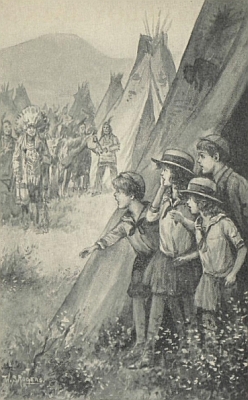 BLACK BEAR CAME TOWARD THE CHILDREN.