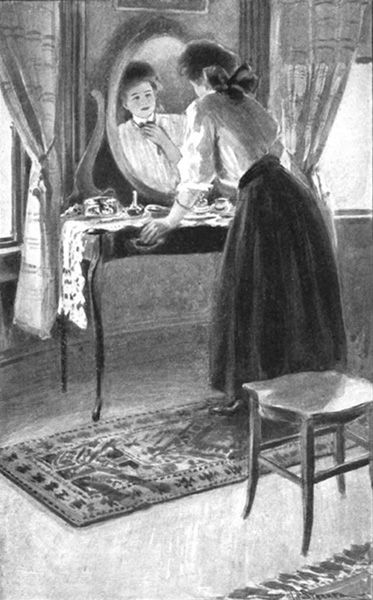
"I wonder what it all means," said Happie, as she turned from the glass
to let Margery button the middle buttons of her waist. "We are giving
a party to-day in the tea room; next week we intend to close it for
three days. It seems to me it isn't as much like a real business as
it should be, not a businesslike business. I meant to go into it in a
life-or-death way. Just as if I were all the time reciting, 'Give me
three grains of corn, mother,' and the tea room were the three grains
of corn; all there was between us and starvation, I mean. But it is
rather like a playhouse tea room. I wonder why?"
"It's Miss Bradbury's fault," said Gretta before Margery could answer.
"First she paid the rent ahead, now she invites us up——"
"To your house!" Margery laughingly interrupted.
"Well!" admitted Gretta. "Only it never can seem mine. Up to the Ark,
anyway, and tells you to close the tea room. I think she makes us all
feel as though the tea room weren't necessary, somehow."
"Gretta's right," said Margery. "There is something in the air that
makes the tea room seem like a side issue. Yet no one could have been
more in earnest than we were about it. And we have helped mother a
great deal with its results this winter. Oh, I suppose we imagine
it. It really isn't important that we close the room for those three
days. It will go on just the same, and we are a little tired. That is
what Aunt Keren saw, probably. Yet there is a stir in the air—as if
something were going to happen."
Margery pinned a long-stemmed American Beauty rose on her breast as she
spoke, having shaken it out of the box where it lay with twenty-three
of its sisters, and smiled at her reflection, without seeing it.
"Something good, I hope," said Happie.
"Good? Oh, yes! Nothing but the best of good things happens to the
Scollards lately! I hope we are grateful enough. I don't feel as though
there were enough of me to be as grateful as I ought to be," Margery
responded.
"A full teacup is as full as a full ocean, Margery. I think we're
grateful in the best way when we're happy," said Happie, perhaps more
wisely than she knew. "Now if you two big girls are ready we'll go and
help motherums with the little girls, and be off to our mixed-tea room
party, as Bob calls it."
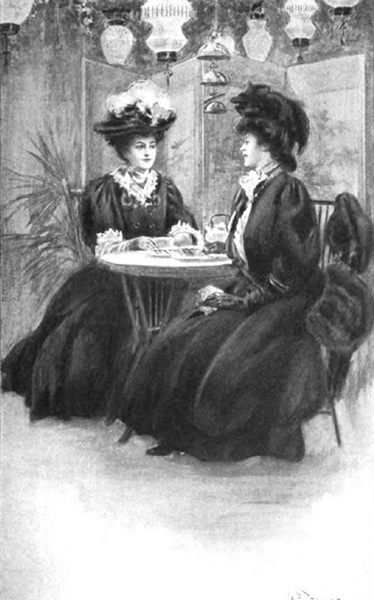
It was an unusual party, "but that was no harm," as Polly sensibly
pointed out. In the first place parties are not usually held in tea
rooms, nor do they combine the oldest with the youngest child, and
all the ages between, flanked by two mothers, as in this case. Mrs.
Charleford came with Edith. Mrs. Scollard accepted her invitation with
more pleasure than any one else, perhaps, because she "so rarely had a
chance to see her flock frolic by daylight," as she said herself.
Mrs. Gordon was asked, but could not come. Ralph and Snigs represented
the family, unsuspecting Margery's plot to increase their family joy,
or rather to widen it. Happie had caught all three of her E's without
an engagement, as it chanced. Little Serena Jones-Dexter came with her
nurse, looking very white and pathetic. She had sprained her ankle and
could not enjoy the party except as a spectator. She had so strongly
set her heart upon coming that her doting grandmother had not had the
courage to say her nay, so Serena came in state, borne in by a footman,
attended by her nurse. She was ensconced in pillows in the very centre
of the room in the biggest of chairs where she could see everything,
poor little patient bit of childhood, with the big eyes and the
beautiful little white face.
It was a holiday, of course, and the girls had felt sure that no one
would try to visit the tea room, but hardly had the guests all arrived
when some one did turn the door handle and in walked Hans Lieder. He
stopped short as he saw the assemblage and took off his wide brimmed
hat with a profound bow.
"A thousand pardons, young ladies," he said. "I see that this room is
not this room to-day. I did not know."
"Oh, if he would play!" whispered Laura to Margery.
"We are having a party, Herr Lieder," Margery said, stepping forward,
looking so pretty in her pale green gown with the American beauties
against her golden hair and nestling close to her fair skin, that Herr
Lieder's gloomy eyes lightened involuntarily as they rested on her. "It
is a party of all ages and sizes, rather a frolic than a party. Would
you care to watch our games?"
"If my music would give you or your guests any pleasure, mademoiselle,
I should gladly remain to play to you," said the man who still was a
person of mystery to the six maidens.
"Pleasure! It would be more than that, Herr Lieder. Only we could not
play games; we could do nothing but listen, if you were playing," said
Margery.
"No," said Hans Lieder, throwing his hat down in the corner and
following it with his cloak as he divested himself of it. "No. I can be
the Pied Piper when I will, and set your pulses throbbing beyond the
possibility of doing anything else but frolic."
"This is our mother, Mrs. Scollard, Herr Lieder," said Happie, bringing
her mother up to this unexpected addition to the party, "and my
brother. You are very kind, but we should be sorry to have you tire
yourself for us, or——"
"Fräulein Glücklich," said Hans Lieder, and Happie laughed in pleased
appreciation of this variation on her name, "Fräulein Glücklich, there
is nothing rests me, nothing interests me, nothing helps me to forget,
save music. It will give me pleasure to play for you until you beg me
to stop. This piano is a sort of miracle to me, and it is my greatest
pleasure to touch it. I once had a piano of this make, this action,
this same case; in short, it is identically my piano again, and I play
on it wondering at the similarity, and dreaming that the impossible has
happened and that all that I have thrown away is restored to me."
Happie glanced around to see who had heard these strange words that
thrilled her with a feeling of fear and awe. Her mother had moved away
after the bow with which she had acknowledged Happie's introduction;
Bob had gone; no one had heard what this singular man had said, and he
went immediately to the piano and began to play.
Ralph, Bob and Snigs had never heard him before. "The moment he begins
you have to sit up and take notice," remarked Bob to Ralph, who nodded
with all his might, being too engrossed in the "notice" he was taking
to reply otherwise.
The girls had not intended to have a dancing party, but there was no
resisting the waltz into which the long fingers fell, inviting the keys
to magic, all feet to motion.
Ralph danced, with Happie first, with Laura, and then with Happie's
friends, but as he turned, with Edith Charleford as a partner, his
eyes caught little Serena's across Edith's shoulder, so bright, so
unchildlike in their beauty and wistfulness that Ralph's big heart went
out to her with a bound.
"Poor little thing! Sitting there so patiently!" he thought. "The
girls say she is a fairy dancer! I wonder why I shouldn't be decent to
her as I would be to any other forlorn mite? She can't help being my
cousin, and she doesn't know she is; she's too little to know about
family feuds anyway. She looks as though she were bearing the burden of
Mrs. Jones-Dexter's misbehavior. I should think the Jewish scapegoat
might have looked like that when it was a kid. I never saw such wistful
eyes." Ralph laughed at his fancy about the youthful scapegoat, and
Edith stopped dancing imperatively.
"I wonder what you will be when you are an old man?" she exclaimed
pettishly, being accustomed to attention whenever her prettiness
demanded it. "You are as absent-minded as if you had been vivisected,
and your mind taken out. I have spoken to you three times and you
haven't heard me! and just how you laughed, when there was nothing to
laugh at!"
"There certainly isn't, when a fellow is rude to a girl, and Happie's
best friend at that," said Ralph contritely, though his implication
that Edith derived part of her importance from Happie was not
flattering. "I beg your pardon, but the truth is I was engrossed in
that little girl over there, the child that isn't well, and if you
will excuse me I think I'll go over and try to get her to look less
like sixty and more like six, which is her age, I believe."
He led Edith to a chair with perfect certainty that he was to be
released, and Edith stared at him in amazement. "Well, you are an
extraordinary boy!" she gasped. "But I don't mind your rudeness at all.
I think it is rather nice of you to be interested in that child. Yes,
I'll excuse you."
"Thank you," said Ralph calmly, and walked over to little Serena.
"Not much fun sitting still, is it, little lady?" he asked in a way he
had which made all children go to him like butterflies to blossoms, the
secret of the true child-lover which cannot be imitated nor taught.
"I love to dance," said Serena wistfully.
"Will you dance with me?" asked Ralph.
"I can't, not to-day. I have sprained my ankle," said Serena.
"Ah, but I haven't!" cried Ralph. "Let me take you for a waltz. My feet
are so much bigger than yours that one pair like them will take the
place of yours and of the little partners you have when you are dancing
up-stairs. Come, your Serene Highness!"
Serena looked up with a delighted laugh. "That's my dearest pet name!
How did you know it?" she cried, and held up her hands for Ralph to
lift her. "I'm going to dance with this nice, this very nice big boy,
Mary," she added to her nurse.
Ralph lifted her carefully. "I'll not harm her," he said to the
doubtful Mary, and adjusting Serena to his broad shoulder Ralph began
to dance with his little cousin, quite unmoved by what the other boys
and girls might think of the queer performance. What Margery thought of
it would be hard to say. She caught Robert Gaston's sleeve, he being
nearest to her as usual, and her eyes shone like stars.
"Look!" she whispered. "Do look at Ralph! It's the most fortunate thing
that little Serena happened to be hurt! Ralph can hardly resist a sweet
child at any time, but one that is suffering is wholly irresistible to
him. And Serena is such a lovely child!"
"Fortune is favoring you, Lady of the Deep-laid Plots," smiled Robert.
"I am not surprised. I felt almost sure that the lion and the lamb
would lie down together if you led them up."
"Oh, they haven't done that yet, but I can't help hoping!" cried
Margery.
"Never try to help hoping, it's the best thing that one can do—I think
I hope a little, wee bit myself these pleasant days, Margery."
Margery looked straight before her, trying to hide the tumult of her
pulses as she heard her name without the prefix for the first time from
Robert's lips, and guessed his meaning—as she easily might do.
In the meantime Ralph circled around the room with his small cousin
whose pale face was rosy from laughing at this kind big boy's nonsense.
He stopped at last before her chair and deposited Serena in it. She
looked up at him from its depths with affectionate admiration.
"I've had a perfectly lovely waltz," she said fervently.
"So have I," echoed Ralph. "I think henceforth I shall never dance
with a partner who is too big to be carried—saves all the bother
of steering. They're going to play a game—try to cut down George
Washington's cherry tree over there. How would you like to play it
too instead of watching them? In my arms, you know. You will be
blindfolded, and so shall I, and you shall tell me where to go, but you
shall make your own chop at the tree and try for a prize as well as the
rest who haven't sprained their ankles. What do you say to that idea,
your Serene Highness?"
Serena clapped her hands, then her bright face clouded. "I'd love
it!" she cried. "But it would be hard for you to carry a great girl
six years old, and I wouldn't like to spoil your party—not anybody's
party, but specially anybody so dearly good."
"And so goodly dear," said Ralph. "Little Serene Highness, don't you
worry over that. I'd be playing the game double, twice blindfolded,
twice chopping, with you in my arms, so I'd have twice as much fun,
don't you see?"
"You must be fond of children, sir," said the nurse, looking curiously
at Ralph.
Ralph caught the suspicious note of the lower order of mind, which is
apt to doubt the motives of unusual kindness, as well as the jealous
note of the nurse for her nursling.
He smiled at Mary, and Ralph's smile generally inspired confidence.
"There isn't anything much nicer than little people, is there?" he
asked. "And this little person has a look that seems to make one want
her to have as good a time, for as long a time, as she can. I'm glad to
carry her around and let her get into things."
Mary's eyes suddenly filled. "I know the look; they don't see it,"
she said very low. "You're a fine boy, whoever you are, and I hope
you'll be sent good times of your own for the interest you take in this
darling."
"Thank you," said Ralph. "Why, here's my Polly!"
"She's my Polly too," cried Serena. "And Penny's my Penny, but most of
all Miss Margery's my Miss Margery."
"I didn't know you knew our Ralph, Serena," cried Polly, running up to
take possession of Ralph's hand. "Happie sent me to tell you she wants
you to help stand the tree up, Ralph."
"I'll be back for you, little Serene Highness, when we've propped the
tree," said Ralph hastening to obey.
They put the tree into its place and distributed hatchets to all
the company. "First, the national parade!" shouted Bob, under an
inspiration. "Shoulder arms!"
Everybody shouldered his tiny hatchet, Herr Lieder began to play a
medley of national airs in march time. Ralph rushed over, caught Serena
up on his left arm, fell into place, and all the company, large and
small, marched around and around the tea room, brandishing hatchets and
trying to sing familiar words that no longer fitted familiar airs when
played in marching time, regardless of the original tempo.
"The first chop is Auntie Cam's!" cried Happie. "Come and be
blindfolded, auntie. And next motherums!"
Mrs. Charleford submitted to the bandage over her eyes, while Herr
Lieder played the queerest sort of music, so humorous that everybody
laughed at it just as they would have laughed at funny words. When Mrs.
Charleford was safely blindfolded and Bob turned her around three times
to the left, and thrice to the right Herr Lieder played something that
Laura correctly described as "dizzy." It was full of hints of tunes,
none of which developed. "Don't you see?" cried Laura in ecstasy. "It
means you don't know where you are!"
Then to the accompaniment of soft running arpeggios Mrs. Charleford
went slowly forward, hesitated, turned, went in the opposite direction,
raised her hatchet, put out her other hand gropingly, stopped when
everybody cried, "No fair; no fair feeling!" and struck—to a crashing
chord of Herr Lieder's—a valiant blow directly at Elsie Barker's head,
who dodged it by throwing herself on Eleanor Vernon. "She thought you
were a cherry, Elsie!" cried Edith amid the applause that greeted this
first blow. Elsie was so proud of her red hair that there was no danger
in teasing her about it.
Mrs. Scollard walked without a moment's hesitation to the portière and
struck her hatchet deep into its folds. "Mother is trying to bury the
hatchet," said Bob, untying the handkerchief that hid her eyes. "Come,
Eleanor! you might bear in mind that it is the tree, and not the tea
room or its friends that we are after."
Eleanor seemed to heed the warning, for a shout of applause greeted her
as she aimed a blow at the tip-most top of the little tree, and Robert
Gaston pinned on the spot the first numbered slip the tree had received.
Margery followed. She walked directly to the book-shelf and struck her
blow on the back of "Lady Baltimore."
"Oh, come now, Margery! You don't want to hit anything that is stamped
Baltimore!" protested Snigs.
"I don't know about that special kind of cake, the Lady Baltimore of
the novel, but Margery thinks Baltimore things take the cake," said
Elsie Barker.
There were some of the players who could keep their bearings, or were
more lucky than the first ones. Gradually the little cherry tree began
to blossom with white strips, and the Scollards were reassured by
seeing that some one could take a prize, which seemed doubtful at first
while everybody was aiming wide of the tree.
Ralph came up with Serena to be blindfolded. He had played for himself
and had deposited his record on a table nearest to the window and
farthest from the tree. Now he had to be blindfolded again, to be
sure that he was really guided by Serena and playing fair, and Serena
herself had a handkerchief bound around her fair hair, hiding her
excited eyes.
"That way, Ralph, walk that way!" she cried, pointing directly to the
tree. Ralph obeyed. The child pushed and pressed him from side to side;
it was a hard matter to be certain what she wanted him to do, but Ralph
patiently did his best, and stopped when Serena gave the order. "Now!"
she whispered, drawing in her breath.
She struck a mighty blow, using all her strength as if it had been a
veritable tree chopping, and her blow went home, right above the mark
on the tree which had been made to designate the spot used as the
standard for prize winning.
"Hurrah for little Serena!" shouted Bob hurrying up to uncover the
child's eyes and her bearer's. "Nobody else has come near you, Serena,
and I'm sure nobody will. You're the one who has done it with your
little hatchet; you've won the prize, sure thing."
Serena turned and hugged Ralph frantically. "Oh, you dear, dear,
darling big boy!" she cried, to everybody's amusement. "I love you and
I love you! I never won a prize in all my life, and I'm six. I'm going
to give half of it to you!"
There were not many more to try their skill after Serena, and the
interest in the game flagged a little with the certainty that the best
possible blow had been struck. Serena had won the first prize, Robert
Gaston the second, with a mark to his credit on a short lower limb,
near the test mark on the trunk of the tree.
The consolation prize had to be drawn for by five, Mrs. Charleford
and Ralph among them. Mrs. Charleford won it, a little Japanese hen
standing on a card bearing the inscription "A hatch it you may count
on."
Serena was given a candy box in the shape of a tree trunk, tied with
red, white and blue ribbon, finished with a bunch of artificial
Japanese cherry blossoms, and filled with candied cherries.
She beamed at it and at Margery who brought it to her.
"I'm so glad it's something I can divide with my nice boy," she said.
"I'm going to give him 'most all the cherries. Maybe he won't mind if I
keep the box and the flowers and the ribbon? Oh, he's right here! Will
you, Ralph, care if I keep what's outside and give you the inside?"
"Not a bit, little Serene Highness! I don't want more than one bite of
a cherry from the inside. I'm just your horse that you drove to win the
race, you know."
"Didn't we have fun?" sighed Serena contentedly. "I never went to so
nice a party, Miss Margery, and I'm six. Grandma said, 'What's the use
of going, Serena, when you can't move about one bit?' But I was crazy
to come. She didn't know Ralph was here. Neither did I. We didn't know
there was a Ralph. Isn't it funny how you don't know people till you do
know them, and then you love them?"
"It's wonderful, little Serena!" Margery assented with fervor. "And
then you can't imagine how your old world used to look without them!
I'm glad that you had such a happy time, dear. I'm very glad Ralph gave
it to you!"
She smiled on Ralph, and he turned away. "I'm not feuding on my own
account, you know, and anyway it wouldn't be this child's fault," he
murmured.
"I must take you home, Miss Serena," said Mary. "Mrs. Jones-Dexter said
not later than five."
"I don't believe she knew how early five would be here," sighed Serena,
submitting to the decree meekly. "I wish you'd come and see me, my nice
Ralph."
"I'm afraid I can't do that, little Serene Highness, but maybe we'll
meet again. Life is long and very queer in its ways. Good-bye, sweet
little lady."
Serena said good-bye wistfully and watched Ralph walk away with longing
in her eyes. Not because life is long, but because it is short, Serena
was soon to see again the cousin whom she did not know.
The frolic broke up by seven. It had been a pleasant afternoon to
everybody who had accepted Margery's peculiar invitation. Even Herr
Lieder seemed to have enjoyed making music for the young people, and
watching the fun. Certainly he had added a great deal to the success of
the afternoon.
Margery, walking down the street behind the rather long procession
of her family and guests, with Robert Gaston beside her, sang in her
heart as she brooded over the real success which she believed she had
attained.
It could not be, she felt sure, that Ralph's kindness to little Serena,
given without a thought of consequences beyond making the ailing child
happy for a few hours, could be without fruit. Some day, she felt sure,
his goodness of heart would win him further friendship from Serena, who
would not forget "her kind, big boy."
Margery knew how hard it was going to be for Mrs. Gordon to send Ralph
to college the coming year and yet how certainly she was going to
struggle to do so, and how Ralph was planning to help himself through
the course. "If only Serena should beg to see the 'big boy' again, if
she should grow deeply fond of him, if for her sake Mrs. Jones-Dexter
should do what she easily could do for her niece and her grandnephew,
if as years went by Serena, growing fonder and fonder of Ralph——"
"What are you dreaming of, Margery? I have spoken to you twice, and you
did not hear me!" complained Robert Gaston at her elbow.
"Oh, I beg your pardon! I was dreaming of the possible fruit of the
little tree at which we have all been vainly chopping this afternoon,"
Margery answered. "I do think it's heavenly to fancy you see a sweet
story working itself out, and to feel as though you had contributed one
tiny page of it yourself!"