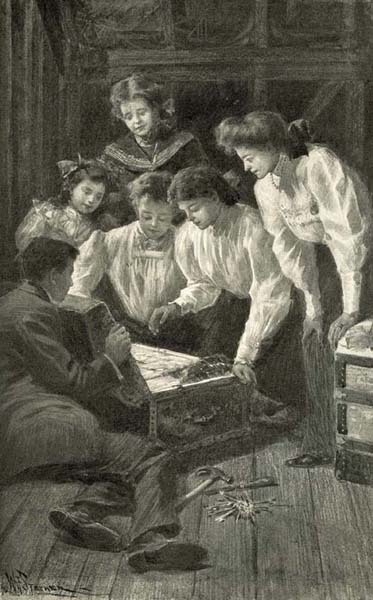
"I wish you and Gretta had not forgotten my pup," said Miss Bradbury
coming into the dining-room the morning after the departure of Margery.
"I still hear queer noises at night. I'm going to send down to town for
a good dog. Jake Shale has offered me a beagle, and Peter Kuntz assures
me the one thing on earth I need is his old dog, half shepherd and
seven-eighths cur, but I'm not convinced."
"What a very fractional dog, Miss Keren!" laughed Mrs. Scollard.
"Let me send down to mother to get a dog a friend of mine has,
Miss Bradbury," suggested Ralph. "He's about two years old, and
thoroughbred, a fine watchdog. They want to get him into the country,
or they'd never give him up; he is out of place in New York, they
think."
"Everything is that wants to run and play," agreed Miss Bradbury.
"Two-legged or four. What sort of dog is this one?"
"A beauty collie," said Ralph. "I'm sure he can be had for the
asking. His owners won't sell him, because they want to be sure of
the sort of hands he falls into. I'll write Snigs to go ask for
him, if you'll take him."
"I'll take him," said Miss Bradbury. "Tell Snigs to come up in time
for the Fourth, and bring him."
Ralph colored with pleasure. "Thanks, Miss Bradbury; you're awfully
good. Snigs would be delighted to come."
"And we to have him!" cried Happie. "You really are good, Aunt
Keren!"
"At least that's better than being awful, as Ralph accuses me of
being. Though you do seem to feel it necessary to affirm my goodness,
which is not complimentary," said Miss Bradbury. "I shall be obliged to
Snigs if he can get the dog; I don't intend to hear noises dogless any
longer."
"I wish, Laura, you'd come fix my torn buttonhole," said Polly from
the doorway. "Happie's going to do Margery's work and her own too, and
I can't keep my skirt fastened."
"Indeed I can't," said Laura, leaving the room before her mother
could interfere to stop her. "I've got to go out."
Far away as Laura had always been from practical, every-day matters,
of late she had been miles above the heads of her family, "soaring
down the milky way," Bob said, "when there were milk pails down below
needing scalding." Bob had scant patience with Laura's nonsense at any
time, and he was working rather hard that summer.
It was trying; for at neither work nor play was Laura any use. She
had a secret. What it was nobody knew—which was not strange,
considering that it is the nature of secrets not to be known—but
nobody could conjecture what it was.
If her mother and Miss Keren has guessed, it is highly probable
that they would have interfered with her plan, but Laura, intent on
proving to the world, and to her own family in particular, her entire
competence to succeed in whatever she undertook, kept her own counsel
and went her mysterious way.
Up on the edge of the extreme boundary of Crestville stood a little
chapel served by a well-meaning, but illiterate young "preacher," as
they called him in the village. He it was whom Laura had selected as
the instrument of her plan, and to it the young man lent himself with
an enthusiasm most refreshing to a lady of scarce thirteen, accustomed
to the ridicule of a large and unappreciative home circle.
It was an extraordinary plan for a little girl to have laid, but
then Laura never did anything that one would expect from a girl of her
age, and she had sufficient self-confidence to have equipped an Arctic
exploring party.
The first requisite for her scheme was a place, a setting, and Laura
pitched upon the little church on the edge of the woods as the best for
her purpose.
So one day she had attired herself in her most becoming muslin,
took a book under her arm, and a roll of music in her hand—not
that she needed them, but for dramatic effect—and sallied
forth to win the young preacher to her way of thinking.
He lived not far from his church; when Laura knocked at the door his
girl-wife opened it with her right hand, holding her baby in the hollow
of that arm, while the left hand held a yellow bowl full of potatoes
which she had just fetched from the cellar.
"See Mr. Buck?" she repeated after Laura, but with a strong
Pennsylvania Dutch accent that rendered the name "Book." "Yes, I guess.
He's in the room. You go in through if you want. Wait a little; I'll
call him."
She disappeared, leaving Laura standing just across the threshold,
and returned followed by a young man with beady black eyes, who looked
as if he could not have been more than twenty-two years old.
He greeted Laura with respect most cheering to her soul, and invited
her into "the room," which the little girl had already learned was
short for "the best room," or "the sitting-room."
Laura placed herself with much dignity upon the figured lounge,
which was arrayed in the brightest shades of all colors, deposited her
roll and book beside her, crossed her feet, folded her hands and began
with the utmost self-possession to unfold her errand. "Mr. Buck," she
said. "I am the daughter of Mrs. Scollard, the lady from New York who
is staying with her friend who owns the Bittenbender place."
"Yes, I know," said Mr. Buck. "I have seen you and
your sisters and brothers already; we look in when we go by, my wife
and I. You have it good there yet."
"Oh, we don't like it!" returned Laura with a toss of her head.
"It is better than it was, though. I came to talk to you about a
plan I have for entertaining the people of the—the people all
around here who want to improve themselves. I thought I would give an
entertainment on the Fourth of July, and invite everybody; just let
everybody know they can come if they want to."
"Free?" inquired the young preacher, as Laura paused for an instant
for breath.
"Oh, of course!" exclaimed Laura impatiently. "You know there isn't
anything here to improve people; you don't have any lectures, nor
music, nor pictures, nor anything at all. I am—well, you see I
write music and poetry, and I play and sing, and I want to do something
for these poor people. I want to give an entertainment on the Fourth of
July, and I want you to help me. Will you?"
"What a good girl you must be, and ain't you smart!" exclaimed the
young man admiringly.
He was very simple, and it never occurred to him to question the
ability of this girl who spoke so beautifully, and was so very easy
in her manners, to do exactly what she said she could do, and he
was honestly grateful for her desire to do something for his flock.
"What should I do?" he asked. "Should I speak for you? I
might make a speech after your songs; should I? I guess that would go
good."
"No, I don't think so," said Laura positively. Then, seeing the
disappointment in the young man's face, and not being without tact
when she had an end in view, she added: "In entertainments they don't
have speeches; not in this kind of entertainment. What I want to do is
improve people, don't you see?"
Laura herself did not see the suggestion latent in her remark that
Mr. Buck's speech might not be improving. Nor did he, for he accepted
her decision meekly, and asked: "What then should I do?"
"You can let me give the entertainment in your chapel, please," said
Laura grandly. "And you can let me come here to practice every day, so
they won't know at home that we are going to have this entertainment.
You won't tell any one till just before the Fourth, will you?"
"No," said the little preacher. Then looking puzzled he inquired:
"Don't they know at your house what you're doing? Ain't they going to
help you yet?"
"No, indeed," cried Laura. "If they did I could give—no, I
couldn't give the entertainment at home, because there wouldn't be
room for all the people who would come, but I could practice at home.
It is to be a secret, so I want you, please, to let me practice on
the organ, or whatever you have in the church——"
"It's an organ," interrupted the little preacher, looking hurt for
the first time. "The ladies of my congregation bought it saving up egg
money and doing washing for city boarders one summer. It cost thirty
dollars; it's a regular parlor organ, a good one. It sounds 'most so
good as a big organ; wait till you hear it once!"
"Yes," said Laura, a trifle impatiently, for she was not interested
in the organ, except as it served her end. "I'm glad it is a good one.
I'd like to practice every day till the Fourth, and I came up to ask
you if you didn't think my plan a beautiful one, and if you wouldn't
be kind enough to help me? I knew that a minister would want to do
anything he could to improve people, and to make them happy," she added
artfully.
"Of course," assented Mr. Buck heartily. "I'll give you the key to
the church, and you can practice all the days you want. And you can
give the entertainment here. You must be smart if you can do it all
alone, and sing, and make up poetry yet! And you are a kind young lady
to want to amuse folks."
Laura tried to look modest, but succeeded only in dropping her eyes
in the semblance of modesty; in her heart she felt that this praise was
merited.
She arose to go with what she felt sure was a graceful, dignified
and entirely grown-up manner.
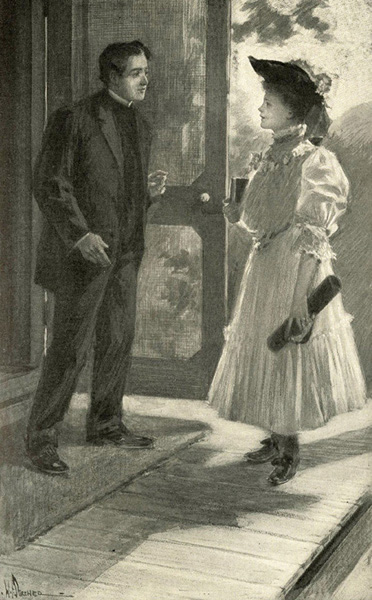
"HE FOLLOWED LAURA TO THE FRONT DOOR"
"Oh," she said, "I am glad to give the poor people a chance to
hear good music. And I am not smart to make up music and poetry;
it is a talent of mine, that's all. Good-bye, Mr. Buck. Thank you for
helping me, but of course I knew you would want to."
She gathered up the music and book which she had carried with a
vague intention of letting them prove her claim to music and poetry,
and extended her hand with the air of an empress as she moved towards
the door.
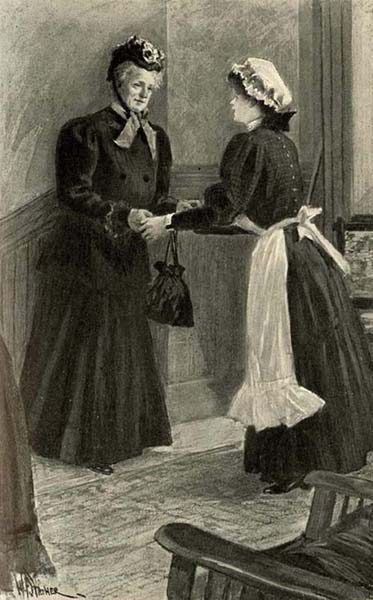
The honest little preacher grasped the hand heartily. "Good-bye," he
said. "I am obliged to you for letting me help you out."
He followed Laura to the front door where he halted as a thought
struck him.
"Will it be funny, your show on the Fourth?" he asked. "Our folks
like funny things. Shall they laugh at it, say not?"
"Dear me, no," cried Laura, sincerely shocked. "They must learn
to like something higher than funny things! Funny things are not
improving."
Which statement proved how much she knew of human nature.
The little preacher looked wistful. "They gets pretty tired," he
said doubtfully. "It's hard work farming, and these fields are stony
yet! In my county we don't have to pick stones three days before we can
plough one day."
Laura smiled in a superior way, and turned to go. "I shouldn't
feel like doing funny things, Mr. Buck," she said. "Good music is
the saddest thing! And all my poetry is very deep." With which
statement she went out of the little gate.
The awe-struck Bucks watched her depart. "How much would you give
her, Anna?" asked the young husband. "She writes music and poetry,
and she's going to give folks a free concert, or something, in the
church on Fourth of July. For a little I thought she hadn't fourteen
years."
"She ain't," said the nineteen-years-old wife positively.
"Do you guess she could do such a thing if she ain't?" queried her
husband.
"I guess. In New York girls get smart early, maybe. I wish you could
get a church there once, Alvah, when the baby's big enough. I'd like to
have her grow up with such smartness."
The object of these flattering remarks went her homeward way
rejoicing, and it had been from that hour that her family had noticed
that she was uplifted higher than ever above their heads. Every day she
had gone up the road carrying a mysterious package, and had refused to
explain the mystery when Happie had tried to investigate it.
"Yes, I have a secret," Laura said, in reply to her sister's
question. "But that's the very reason I won't tell you; people
generally don't tell secrets. If you can wait a while, you will know
what it is, and you will find it was something worth waiting for."
"I don't know, motherums, but I imagine she carries
her books and paper off into the dampest, darkest spot by the brook and
composes poetry and music out of doors. It would be just like her, and
her packages look like papers," said Happie, divided in her mind as
usual between disgust, and sisterly pride in her talented junior.
This was before Margery had gone away, and the secret had not leaked
out on the morning when Miss Bradbury had again announced her longing
for a dog. It was three days before the Fourth, and on that day,
obedient to Laura's instructions, Mr. Buck began notifying the public
which he met on his way to and from the post-office, that Miss Scollard
was going to give an entertainment in the chapel on the evening of the
Fourth, without money and without price, solely for the love of her
fellow creatures, who were invited to gather in large numbers to share
her bounty.
The first that her family knew of Laura's undertaking was when Bob
returned from the post-office, fuming with rage, yet convulsed with the
fun of it, burdened with the following announcement which he had found
tacked up in the post-office:
"Miss Laura Scollard announces to the people in Crestville that she
will give an entertainment in Mr. Buck's chapel on Fourth of July at
half-past seven P. M. She will sing and play
and read and give them a chance to hear good things, so she hopes they
will all come. FREE."
"The last word was in big letters," said Bob as he finished reading
his copy of the impressive announcement, and Ralph took a header
into the couch in fresh enjoyment of it. "And you can bet the very
last thing that you have, or ever hope to have that they'll come all
right!"
"Come!" echoed Rosie. "Why, you couldn't keep 'em away! They'll
think it's goin' to be something great, and that you all had a hand in
it. What in creation do you s'pose she's a-goin' to do?"
"Sing and play, just as she says she is, and read to the
audience—from her own poems, most likely. Oh, mother, isn't
it awful?" cried Happie, her sense of humor so overwhelmed by her
mortification that she was unable to get even as much as Bob's divided
amusement out of the discovery of Laura's scheme.
"It is the most absurd thing!" cried Mrs. Scollard, flushed and
annoyed, yet half laughing. "I feel that I ought not to let the absurd
child go on; she is sure to make a little goose of herself, and the
village people will take it all seriously, for they will certainly
think that I have helped her! Yet Laura's conceit needs a sharp
lesson, and she must be punished, in one way or another, for utterly
ignoring her elders in this way. I feel confident that she will be
punished if we leave her to her own destruction, for she is abnormally
thin-skinned. I really don't know what to do!"
"Let her go, mother; we can stand it, and I think she deserves to
be called down—the conceited little ninny!" said Bob
vigorously. "And if she doesn't take a tumble this time, I'm no
prophet."
"Don't you boys help her to 'take a tumble.' If we let her alone to
go on, we must also let her alone to succeed, if she can," interposed
Mrs. Scollard, mistrusting the boys' strength to resist the temptation
to tease, and dreading Laura's punishment, after all.
"Don't harbor misgivings, Charlotte," advised Miss Bradbury. "Let
Laura learn by experience. Country people are not the dunces she
evidently thinks them; if I'm not mistaken she will be both sadder and
wiser on the fifth of July."
"Yes, let her alone," Rosie said decidedly. "I'll see to it the
place knows you hadn't nothin' to do with this affair. Just see what
she'll make of it. My days, what kind o' jedgment has Preacher Buck to
leave her have the church?"
Ralph and Bob went down in the afternoon to bring up
from the station Snigs and the dog. It was a jubilant
trio—quartette—that entered the Ark in time for supper.
Dundee, the collie, was nervous and tired, but he was a beauty beast,
and Miss Bradbury actually hurried through her supper to make him a bed
outside her door, "in case of further noises," she explained.
No one spoke of the entertainment to Laura, but at dinner on the
Fourth, she officially announced it. "I suppose," she said graciously,
"you have already heard of it, though we have not mentioned it. You
will all come, won't you?"
"You bet your life!" cried Bob irrepressibly. But with that one
exception, the family received Laura's announcement as gravely as it
was made.
It was a group struggling hard to preserve its gravity that issued
from the Ark and wended its way to the chapel after tea. Laura's family
seated themselves far enough back to be able to retreat if the ordeal
proved too trying.
Mrs. Scollard and Happie sympathized with each other's uneasiness
and mortification, Miss Bradbury sat erect with a blank countenance,
but the three boys gave themselves up to unreserved glee, leaning on
the big sticks with which they had provided themselves for applause.
Gretta came late, and joined Happie in the seat which the latter had
saved for her.
"Don't you worry," whispered Gretta. "Maybe she won't be so bad
when she is giving an entertainment; maybe folks won't think she is
silly."
This was the first intimation that Happie had received that her
friend had been privately regarding her gifted sister as foolish, when
that young person herself had fondly believed that she was impressing
the country girl.
Laura came before the audience with a most serious face, but looking
her best, with her cheeks red from excitement, and her eyes shining.
"Ladies and gentlemen," she said with a little bow,
"this is the Fourth of July. I think we ought to begin by singing 'My
Country, 'Tis of Thee.'"
"That is a good beginning," whispered Mrs. Scollard, with a breath
of temporary relief.
The audience arose and sang the first stanza of the national hymn
with gusto, but in the second stanza very few were singing the words,
and in the third they gave up humming the air, and only Laura and Mr.
Buck, who had books, were left singing.
"It's like the Peterkins and the Declaration of Independence,"
whispered Ralph, and Bob nudged him joyfully.
"I will sing for you a hymn I wrote myself for this day," announced
Laura, seating herself at the organ.
The air had seemed to her when she was practicing it, sublime; now,
heard with the consciousness of less partial ears, it developed a
lack of variety, and the accompaniment left much to be desired. More
than that, in spite of her daily practice on that organ, now, in the
excitement of giving her composition to the public, Laura sometimes
forgot to pump, and what accompaniment there was went off into a feeble
squeak.
The audience behaved beautifully; it sat solemnly listening,
believing that the tenants of the Ark, through their youthful
representative, were trying to entertain it, and it politely tried to
look entertained.
But somehow, probably through Rose Gruber, it began to be
whispered about that the elder Scollards had nothing to do with
the present occasion, and the attitude of the audience became less
respectful.
When Laura came forward and recited an original poem, however, her
hearers veered again towards respect for her. They were not critical;
the lines rhymed; it seemed to them very wonderful that a girl scarcely
in her 'teens could write rhymes, and Laura was applauded heartily.
But when she returned to music, and especially when she prefaced her
next number by the information that she had taken pity on Crestville's
darkness, the village people altered their minds about Laura and were
ready to poke fun at whatever she might do. There was no doubt that
there was plenty of chance for ridicule. The foolish little girl began
a song of Gottschalk's—and broke down. Then, nothing daunted, she
essayed a solo on the organ, forgot to pump, lost her place, remembered
to pump, but forgot her fingers, struck false notes, and ended by
knocking her music off the rack with such force that a whole snarl of
keys growled at once, and an irreverent boy in the audience cried: "Sic
'em! Catch 'em, Towse!" to the indecorous delight of all around him.
"I am not used to parlor organs," said Laura with tearful dignity
and purpling face.
"Only to hand organs?" inquired someone in the audience, and a
woman's voice said:
"Shame! Don't tease the little girl!" But several tittered.
"I'm going to recite a great poem for you," said Laura rallying to
her programme with what really was pluck, though misdirected. "Poetry
is good for you to hear, because you all work so hard, and hear so
little that is fine."
"How can she? How can a child of mine be so pompous and so foolish?"
groaned her mother.
"It is only the artistic temperament, my dear," said Miss Bradbury
philosophically, her keen eyes twinkling.
Then Laura began to recite Paul Revere's ride; she explained
afterwards that she had selected that because it was patriotic for the
Fourth of July, and that she thought she would throw in a smattering
of historical teaching with the poetical training she was giving the
Crestvillians.
What was her amazement to hear three voices join with hers in the
recitation, and an additional voice occasionally shout out a word
at the end of a line, as if some of her audience knew what rhyme to
expect!
"It's in the Reader," whispered Gretta to Happie, and then Happie
understood.
As Laura's voice faltered on the last syllable of the familiar poem,
a big boy jumped up on the platform and bowed ironically to Laura.
"I am appointed by the residents of Crestville to thank you
for improving them so much," he said. Then he turned to the
audience, and added: "Ladies and gentlemen, considering you
live so far from the city, and are a lot of hayseeds anyhow,
I will recite for you a few poems, because poetry's good for you after
haying. 'Hickory, dickory dock, the mouse ran up——'"
He could get no further. Instantly all the younger portion of the
audience was on its feet shouting Mother Goose rhyme after Mother Goose
rhyme, sometimes in chorus, more often raggedly, each one, apparently,
saying whatever rhyme presented itself, and young and old shouting with
laughter the while.
"Now don't you mind 'em!" whispered a kindly old lady to the
Scollards. "They don't mean nothin' hard—they're kinder making
fun of your girl, but they don't mean nothin'!"
Mrs. Scollard smiled back, though a trifle tremulously. "It's hard
on the child—she took it all so seriously—but she needs
being laughed at; I'm glad they are laughing. And they are not unkind.
She deserves a lesson for being so conceited with her elders! Please
tell everybody the child did not consult us, we did not help her with
this, and that we are grateful to Crestville for the way it is teaching
her a few important facts."
For a few moments Laura stood facing her mocking audience,
now turned entertainers in her stead. She could not grasp what
had happened. At last the truth dawned upon her that she, Laura,
the gifted, was being ridiculed, handled with no respect for her
talents, nor for her social superiority.
When she realized this painful fact, she turned as white as a little
ghost, and fled from the church, the laughter of her audience following
her down the road as she ran towards home.