“WAVERLEY”
“Waverley” is not, perhaps, the novel with which one would recommend a
person anxious to find out whether or not Sir Walter can still be read,
to begin his studies. The six chapters written in 1805 are prolix and
unnecessary. A modern narrator would commence with Chapter VIII. “It was
about noon when Captain Waverley entered the straggling village or
rather hamlet of Tully-Veolan,” and would find easy means of
enlightening us as to who Captain Waverley was. One sentence in the long
preliminary account of the hero refers to Scott himself. “He would
exercise for hours that internal sorcery, by which past or imaginary
scenes are presented, in action as it were, to the eyes of the muser.”
Like Dickens and Thackeray, Scott was a natural “visualizer,” seeing in
his mind’s eye the aspects of his characters, and hearing their voices.
Perhaps there is no poetic genius without this gift, which Mr. Galton
has found almost absent among, and unknown to men of science, though
the presence of the power of visualization by no means implies that it
is accompanied by genius. Scott’s friends did not conceal from him that
they were little interested in his tale, before they entered the village
and château of Tully-Veolan. From that point all was new to most of
them, while no romance of the Forty-Five, a theme now so hackneyed, or
of Highland life and manners at the date of Sixty Years Since had ever
been offered to the world. Indeed the death of the last of the male line
of Stuart was almost contemporary with the year in which Scott began his
romance, and while there remained a shadowy King over the water, a
Jacobite romance might seem a thing in doubtful taste. We cannot, after
a century, feel the absolute freshness of impression which the novel
made on contemporary readers.
“GUY MANNERING”
We know, in one way or another, all that can be said about Highland and
Lowland life in 1745, and there are passages of Waverley in which we
are almost reminded of Becker’s Charicles, and other instructive
pictures of classical manners. Scott, of course, was accused of
“slandering the Highlanders,” because he described the cattle stealings
which, as contemporaries assert, were regularly organized by the furtive
genius of Macdonnell of Barisdale, with intermediaries among the broken
clan of the Macgregors, and the less reputable of the dwellers in
Rannoch. The relations of Cluny Macpherson with the independent Highland
companies had been not unlike those of Fergus MacIvor, a chief quite as
much impelled by personal ambition, and the promise of a Jacobite
earldom (Lovat was to be a duke, Glengarry an earl), as by any
disinterested devotion to the White Rose. There were chiefs like
Lochiel, as there were Lowlanders like the Oliphants of Gask, who fought
purely for the sake of honour and devotion. The mass of the Jacobite
clansmen were notoriously as loyal as steel to their Prince. But there
are black sheep in every flock. “There is something,” says Scott, “in
the severe judgment passed on my countrymen, that if they do not prefer
Scotland to truth, they will always prefer it to inquiry.” Scott
preferred inquiry, and gave us the results in Callum Beg and in the
darker side of the character of Fergus MacIvor, which irritated some of
the fiery Celts. Fergus redeems himself by the courage of his end, but
the favourite characters of the novel are, as usual, the subordinates,
that gallant, prosy, honourable pedant, the Baron Bradwardine, Davy
Gellatley with his songs, Balmawhapple, Baillie Macwheeble, Evan Dhu
Maccombich, the Gifted Gilfillan, the Prince himself, and how many
others! The pictures of Holyrood and the Prince’s Court, of the rout of
Prestonpans, and the march into England, are as brilliant as they then
were unhackneyed, and though Waverley is not the best of the series of
novels, it made an excellent beginning.
Meanwhile stern necessity urged Scott to that grinding of verses,
invita Minerva, to which he said that “the peine forte et dure is
nothing in comparison,” and his mood was “devilish repulsive” to the
task of working on The Lord of the Isles. So he wrote the last three
cantos in five weeks, and set out for Abbotsford to “refresh the
machine” by writing Guy Mannering in six! He had only gleaned the
story of the Astrologer on November 7, from Mr. Train, and between that
date and some time in February 1815, he had finished both The Lord of
the Isles and the novel of The Astrologer. He announced to Mr.
Morritt at once that “The Lord of the Isles closes my poetic labours
upon an extended scale,” this before the book proved not quite
satisfactory to the public. He was wont to say that he abandoned poetry
“on an extended scale” because Byron “beat” him, but he was now
forty-five, was confessedly weary of “grinding verses,” and had found an
easier, a more congenial, and a more lucrative form of work, one which
suited his genius better, and was of a more permanent appeal than the
romance in verse. Since his time, setting apart the temporary vogue of
Byron’s Giaours and Laras, rhymed romances on Oriental themes, the
world has steadily declined to read long narrative poems. Mr. William
Morris alone, for a while, won some readers back to his peculiar form of
this genre. In The Lord of the Isles we remember little but the Battle
of Bannockburn, which has all the fiery energy of Scott in his Homeric
mood, and makes a fit pendant to his Flodden Field. Though Scott, before
he learned from Ballantyne that the book was a comparative failure, had
meant to abandon rhymed romances, he was a little damped by knowledge of
the fact, and, pointing to The Giaour, which Byron had sent to him, he
remarked, “James, Byron hits the mark where I don’t even pretend to
fledge my arrow.” Says Lockhart, “he always appeared to me quite blind
to the fact that in The Giaour, in The Bride of Abydos, in
Parisina, and indeed in all his early serious narratives, Byron owed
at least half his success to clever though perhaps unconscious imitation
of, Scott.” He also owed much to his Oriental themes, to the vogue of
his beauty and life of adventure, and to his fluttering of the dovecotes
of propriety. Byron spoke as generously of Scott as Scott did of Byron:
neither felt for the other the indifference of Wordsworth nor the
contempt of Coleridge. In contact with Scott all that is finest in
Byron’s character glows like the diamond in the presence of radium.
“GUY MANNERING”
Guy Mannering made up for Scott’s disappointment. His advisers, from
the first, deemed it “more interesting” than Waverley, perhaps because
it dealt with their own times and manners, for the topic is not in
itself nearly so rich in romance. The strength of the book is in the
characters, the donnert good humoured laird, that customary villain, the
attorney, the smugglers, the gipsies, Meg Merrilees, honest Dandie
Dinmont, and the lawyers whether at high jinks or in more sober mood,
while the scene of the old maid’s funeral and the reading of her will
cannot be surpassed. Dominie Sampson was a great favourite, though a
sample of “Scott’s bores,” and too apt to return like a refrain, with
his peculiarities, in the manner of some of Dickens’s characters.
Scott went up to London with his laurels fresh, and met Byron; the pair,
in Homeric fashion, exchanged gifts, Scott offering a gold-hilted
Oriental dagger, and Byron a silver vase, containing the dust of
Athenian men of old. Scott remarked in Byron a trait of Rousseau’s,
starts of suspicion, when he seemed to pause and consider whether there
had not been a secret, and perhaps offensive, meaning in something
casually said to him. At times he was “almost gloomy,” and, in short, he
must have been “gey ill to live with.” But Scott quietly allowed the
black dog to leave his shoulder, and consoled himself with the less
perilous gaieties of the Prince Regent. Scott always denied the story
that the Prince asked him point blank whether he was the author of
Waverley. The Duke of York, however, said “my brother went rather too
near the wind about Waverley, but nobody could have turned the thing
more prettily than Walter Scott did.” In fact his reply sailed as near
the wind as the insinuation of the Prince.
The news of Waterloo, the triumph of his nation, allured Scott to the
scene of the battle. He left London for the Continent a month after the
fight. His expenses and more were paid by Paul’s Letters to his
Kinsfolk, journal letters written to the Abbotsford circle. These
contain so perfect a picture of the man at this juncture that, if people
had time to read Lockhart’s Life of him, the book might well be added
to it as a supplementary volume of autobiography. Scott’s enthusiasm for
the national victory did not swallow up his observation of every trait
of foreign life, or his excitement over “the tiniest relics of feudal
antiquity.” He saw the battlefield under the guidance of Costar, the
peasant who, according to his own account, accompanied Napoleon, a point
on which there were sceptics.
WATERLOO
Already the British myth of the battle was current, and is reported by
Scott in a letter to the Duke of Buccleuch. The legend was that the
Prussian fire was not heard, nor did the Prussian columns appear from
within the woods, till the moment when a part of the French Imperial
Guard made the last attack on our position. Now the Prussians really
made themselves felt on the French right about four or half-past four
o’clock, and three hours were occupied by them in furious fighting at
Planchenoit, while the French captured La Haye Sainte on our front; and
the Prussians, in reinforcements constantly coming up, were doing the
business on the French right, and beginning to menace the French rear,
when the last charge by a portion of their Guard was made and failed.
Scott understands all this in his Life of Napoleon, though even there
he does not quite make clear the length and severity of the Prussian
task. But even British officers engaged at Waterloo seem to have gravely
misconceived the magnitude of Blücher’s share in the victory.
“France is not, and cannot be crushed,” said Scott, and, in 1815, he
foresaw the Orleanist conspiracy of fifteen years, and the fall of the
Bourbons. On meeting the Duke of Wellington he felt those emotions of
awe which he attributes to Roland Graeme in the presence of the Regent
Moray, “the eminent soldier and statesman, the wielder of a nation’s
power, and the leader of its armies.” “To have done things worthy to be
written was, in his eyes, a dignity to which no man had made any
approach, who had only written things worthy to be read.” The gallant
Wolfe expressed the converse opinion, when he recited Gray’s Elegy in
the boat, on the way to the capture of Quebec, and to his death, Scott’s
belief in doing as far superior to writing, embraced the achievements of
peace as well as of war. He “betrayed painful uneasiness when his works
were alluded to as reflecting honour on the age that had produced Watt’s
improvement of the steam engine, and the safety lamp of Sir Humphry
Davy.” In brief, Scott was a born man of action, and only the accident
of his lameness prevented him from being the mate of Hill and Picton in
the field, and perhaps the rival of Napier as the historian of warfare.
That gift of seeing with the mind’s eye, which was noted in Wellington
as well as in Napoleon, would have served his purposes as a general.
He came home, with presents for all the people on his estate, and with
that poem of Waterloo which was the subject of amusing banter,
None, by sabre or by shot,
Fell half so flat as Walter Scott.
“THE ANTIQUARY”
The emendations made by John Ballantyne on the proof sheets of this
effort show considerable intelligence and taste, and in several cases
were approved of and accepted by the author, though he once said that he
was “the Black Brunswicker of literature who neither took nor gave
criticism.” In fact he took rather too much, in some cases, as in St.
Ronan’s Well, altered and spoiled to please the prudery of James
Ballantyne. The profits of the first edition of Waterloo went to the
fund for the widows and orphans of soldiers. By December 1815, Paul’s
Letters to his Kinsfolk were published, and the “sweet heathen of
Monkbarns,” The Antiquary, was in hand.
In this novel Scott wrote of his own day, and with one or two old
friends, was himself the composite model for The Antiquary. As usual,
the reader cares not much for Lovel and his lady, Miss Wardour, but the
humour of the portraits of the sturdy Whig antiquary, his sense, and his
foibles, and of his rival and friend the foolish Tory, Sir Arthur
Wardour, are perennially delightful. Perhaps only archæological amateurs
can thoroughly appreciate the learning of which Monkbarns is so profuse,
and this, no doubt, is a drawback to the popularity of the tale. The
charlatan, Dousterswivel, is in a rather forced vein of humour, but the
figures of Edie Ochiltree, of the gossips in the village post-office, of
the barber, and all the country folk, with the incident of the escape
from the rising tide, and the romance of Elspeth of the Burnfoot and
the stoicism of Mucklebackit, are, in their various ways, examples of
Scott at his very best, while the ballad of the Red Harlaw stands
absolutely alone, far above all modern attempts to imitate ancient
popular Volkslieder.
Now haud your tongue, baith wife and carle,
And listen, great and sma’,
And I will sing of Glenallan’s Earl
That fought on the red Harlaw.
The cronach’s cried on Bennachie,
And doun the Don and a’,
And hieland and lawland may mournfu’ be
For the sair field of Harlaw.
They saddled a hundred milk-white steeds,
They hae bridled a hundred black,
With a chafron of steel on each horse’s head,
And a good knight upon his back.
They hadna ridden a mile, a mile,
A mile, but barely ten,
When Donald came branking down the brae
Wi’ twenty thousand men.
Their tartans they were waving wide,
Their glaives were glancing clear,
The pibrochs rung frae side to side,
Would deafen ye to hear.
HARLAW
The great Earl in his stirrups stood
That Highland host to see;
“Now here a knight that’s stout and good
May prove a jeopardie:
“What wouldst thou do, my squire so gay,
That rides beside my reyne,
Were ye Glenallan’s Earl the day,
And I were Roland Cheyne?
“To turn the rein were sin and shame,
To fight were wondrous peril,
What would ye do now, Roland Cheyne,
Were ye Glenallan’s Earl?”
“Were I Glenallan’s Earl this tide
And ye were Roland Cheyne,
The spur should be in my horse’s side,
And the bridle upon his mane.
“If they hae twenty thousand blades,
And we twice ten times ten,
Yet they hae but their tartan plaids,
And we are mail-clad men.
“My horse shall ride through ranks sae rude,
As through the moorland fern,
Then ne’er let the gentle Norman blude
Grow cauld for Highland kerne.”
In this novel Scott began his practice of inventing mottoes, mainly from
“Old Plays,” for the headings of his chapters, and among these scraps
are plain warrants for his title of poet. When they were collected into
a little volume he owned that he could not, in all cases, profess to be
certain of his authorship. His memory of the works of others was better
than his memory of his own. “Pretty verses these, are they Byron’s?” he
said, on hearing some lady sing Cleveland’s song from The Pirate. Of
his memory Hogg tells the following anecdote, which may be given
verbatim, as Hogg’s Domestic Manners of Sir Walter Scott is a rather
rare little book.
“He, and Skene of Rubislaw, and I were out one night about midnight,
leistering kippers in Tweed, about the end of January, not long after
the opening of the river for fishing, which was then on the tenth, and
Scott having a great range of the river himself, we went up to the side
of the rough haugh of Elibank; but when we came to kindle our light,
behold, our peat was gone out. This was a terrible disappointment, but
to think of giving up our sport was out of the question, so we had no
other shift save to send Bob Fletcher all the way through the darkness,
the distance of two miles, for another fiery peat.
HOGG
“The night was mild, calm, and as dark as pitch, and while Fletcher was
absent we three sat down on the brink of the river, on a little green
sward which I will never forget, and Scott desired me to sing them my
ballad of ‘Gilman’s-cleuch.’ Now, be it remembered that this ballad had
never been printed, I had merely composed it by rote, and, on finishing
it three years before, had sung it once over to Sir Walter. I began it,
at his request, but at the eighth or ninth stanza I stuck in it, and
could not get on with another verse, on which he began it again and
recited it every word from beginning to end. It being a very long
ballad, consisting of eighty-eight stanzas, I testified my astonishment,
knowing that he had never heard it but once, and even then did not
appear to be paying particular attention. He said he had been out with a
pleasure party as far as the opening of the Frith of Forth, and, to
amuse the company, he had recited both that ballad and one of Southey’s
(‘The Abbot of Aberbrothock’), both of which ballads he had only heard
once from their respective authors, and he believed he recited them both
without misplacing a word.”
In May 1816 The Antiquary appeared; in April he had begun The Tales
of my Landlord, he wrote the historical part of The Annual Register,
and he trifled with Harold the Dauntless, while as busy as ever with
official duties, society, and sport, adding 850 acres to his estate, by
purchases of small farms at exorbitant prices. Meanwhile he did not
clear off the cargoes of encumbrances of useless books, and wind up the
Ballantyne affairs. Instead of making a firm bargain with Constable,
John Ballantyne negotiated the business of The Black Dwarf and Old
Mortality with Mr. Blackwood and Mr. Murray—the volumes were not to
bear the name of “the Author of Waverley.” Now Mr. Blackwood, very
naturally, did not care for The Black Dwarf, and “without seeking any
glossy periphrase,” spoke out his demand for alterations to James
Ballantyne. Scott’s temper was not governed on this occasion, but James
did not report to Mr. Blackwood the very unparliamentary terms of the
reply to his “most impudent proposal.”
“OLD MORTALITY”
Old Mortality and The Black Dwarf came out, at the end of 1816, in
four volumes. The Black Dwarf is of little account, but Old
Mortality is in the first three of the Waverley novels in merit.
Scott knew the Covenanting literature well, and, if he has made errors,
for example where he writes as if the English Liturgy were in use, in
the Scotland of the Restoration, he may be merely seeking effect. But
the learned Dr. M’Crie, the biographer of Knox, a most painful student
of manuscript sources, published a long set of criticisms historical, in
an Edinburgh serial, to which Scott thought fit to reply in a review of
the romance in The Quarterly. Erskine wrote the literary parts of the
criticism, while Scott replied, with much humour and great good humour,
to his clerical censor. The Covenanters of the Restoration were a
peculiar people. In 1660, when the King came to his own, the leaders of
the milder party were ready to abate the claims of the preachers to
“rule the roast” in politics; and one of the leaders wished to see the
preachers of the fiercer party banished to the Orkneys. The zealots, on
the other hand, desired Charles II to put down the Church of England in
England, which meant civil war. But both parties were equally struck at
by the introduction of Episcopacy without a Liturgy. Like the zealots on
divers occasions, the Governors under Charles II expelled the
Non-conformists from their pulpits. A rising followed, and then a
skimble-skamble Government which offered “Indulgences” to Presbyterians.
The milder sort were satisfied with being tolerated, the wilder sort
wished to be intolerant, and the Kirk split into divers sections, hating
each other nearly as much as they hated prelatists. Strange wandering
prophets, prophesying balderdash, scoured the country, pursued by
dragoons, and in their utterances are many ludicrous things and anarchic
doctrines, reprobated by the more peaceful section.
Scott knew all the parties, and was not tender to the absurdities. He
had written a novel, not a history, and had used the licence of a
novelist. Meanwhile in the beautiful character of Bessie Maclure, Scott
surely made amends for his maniac preacher, his indulged preacher, and
the rest of his warring Covenanters. The Claverhouse of the novel is
not, of course, the actual Claverhouse of history, but he is more like
the man than the absurd Claverhouse of Macaulay. One fault is attributed
to the gallant Graham which he did not possess. Far from being reckless
of plebeian as opposed to “gentle” blood, he urged the policy of sparing
the multitude and punishing their “gentle leaders.” It is improbable
that Claverhouse was given to quoting Froissart, as in the novel, but he
did quote Lucan, an author admired by Scott.
“OLD MORTALITY”
We cannot go into a criticism of the historical accuracy of a novel.
Old Mortality is not only one of Scott’s most stirring tales, but it
contains even an unusual number of his most admirable characters, Cuddie
and Mause Headrigg, Gudyill, the Major, Goose Gibbie, Old Milnwood (a
true “Laird Nippy”), the murderer Burly, Bessie Maclure, Jenny Dennison,
that unscrupulous coquette, Milnwood’s housekeeper, the fallen Bothwell,
the fanatics of every shade, and Claverhouse himself. Indeed, be the
inaccuracies of detail what they may, and they are trivial, no romance
based on book knowledge displays so correct a general picture of the
men and the times.
Old Mortality himself, about whom Scott heard much from his friend, Mr.
Train (who suggested the novel), had been met by the author in his youth
at Dunottar Castle among the graves of the Covenanters who died of
ill-usage in the castle dungeons. That a number of soldiers in like
manner perished of hunger when the Whigs got the upper hand at Edinburgh
in 1688 is a circumstance generally omitted by the Whiggish Muse of
Modern History. What would not have been said had hundreds of prisoners
taken by Montrose been starved to death? Yet even Mr. Gardiner does not
mention the hundreds of Royalist prisoners taken by Cromwell at Dunbar,
immured in Durham Cathedral, and there permitted to die of hunger. To be
sure the levies of Montrose took very few prisoners indeed, but settled
all scores with the claymore.
Old Mortality contains a striking scene in which the appearance of
Henry Morton is taken by Edith for his apparition, after or at the
moment of death. The novels, like the poems, are seldom without a touch
of “the supernatural,” which, in the case of Morton’s appearance, was
the normal. In Waverley there is the death warning to Fergus MacIvor;
in Guy Mannering there is the fulfilled horoscope: in The Antiquary
the apparition to the hero is explained away, to some extent, but yields
the desired effect. Scott was very much interested in phantasms and
witchcraft, his library is rich in rare old books full of ghostly
narratives, Bovet, Lavaterus, Sinclair, Petrus Thyraeus and crowds of
others. Neither his friends nor he himself knew the precise frontiers of
his belief and disbelief. At an inn he slept soundly in one bed of a
double-bedded room, while a dead man occupied the other. He was
insensible to fear, in these airy matters, and says that he had only
twice in his life felt “eery.” Once it was at Glamis Castle, haunted for
long by a legend of a Presence in a secret chamber. The secret of the
chamber is no secret, and the Presence is borrowed bodily from a story
current, in the eighteenth century, about Vale Royal in Cheshire. The
other occasion on which Scott felt “eery” is not given by Lockhart, but
is probably revealed by this anecdote of Gillies.
GHOST STORIES
“The most awkward circumstance about well-authenticated hobgoblins,”
said he, “is that they, for the most part, come and disappear without
any intelligible object or purpose, except to frighten people; which,
with all due deference, seems rather foolish! Very many persons have
either seen a ghost, or something like one, and I am myself among the
number; but my story is not a jot better than the others I have heard,
which, for the most part, were very inept. The good stories are sadly
devoid of evidence; the stupid ones only are authentic.
“There is a particular turning of the high road through the Forest near
Ashestiel, at a place which affords no possible means of concealment;
the grass is smooth, and always eaten bare by the sheep; there is no
heather, nor underwood, nor cavern, in which any mortal being could
conceal himself. Towards this very spot I was advancing one evening on
horseback—please to observe it was before dinner, and not long after
sunset, so that I ran no risk either of seeing double, or wanting
sufficient light for my observations. Before me, at the distance of
about a quarter of a mile, there stood a human figure, sharply enough
defined by the twilight. I advanced; it stalked about with a long staff
in its hand, held like a wand of office, but only went to and fro,
keeping at the same corner, till, as I came within a few yards, my
friend all in an instant vanished. I was so struck with his eccentric
conduct, that although Mrs. Scott was in delicate health, and I was
anxious to get home to a late dinner, I could not help stopping to
examine the ground all about, but in vain; he had either dissolved into
air, or sunk into the earth, where I knew well there was no coal-pit to
receive him. Had he lain down on the greensward, the colour of his
drapery, which was dusky brown, would have betrayed him at once, so that
there was no practicable solution of the mystery.
“I rode on, and had not advanced above fifty yards, when, on looking
back, my friend was there again, and even more clearly visible than
before. ‘Now,’ said I to myself, ‘I most certainly have you!’ so wheeled
about and spurred Finella; but the result was as before, he vanished
instantaneously. I must candidly confess I had now got enough of the
phantasmagoria; and whether it were from a love of home, or a
participation in my dislike of this very stupid ghost, no matter,
Finella did her best to run away, and would by no means agree to any
further process of investigation. I will not deny that I felt somewhat
uncomfortable, and half inclined to think that this apparition was a
warning of evil to come, or indication, however obscure, of misfortune
that had already occurred. So strong was this impression, that I almost
feared to ask for Mrs. Scott when I arrived at Ashestiel; but, as Dr.
Johnson said on a similar occasion, ‘nothing ever came of it.’”
SECOND SIGHT
The strange disturbances at Abbotsford, as if all the heavy furniture
were being moved about, did not make Scott “eery.” He arose,
Bolt upright
And ready to fight,
armed for war with the sword of his Jacobite ancestor, Auld Beardie. But
when the noises, never accounted for, were found to have been coincident
with the death of the purveyor of the furniture, Mr. Bullock, in London,
Lockhart admits that Scott was not only puzzled but considerably
impressed.
Such rackets, preceding or accompanying a death, are familiar to writers
whom he knew well, Lavaterus, Thyraeus, Theophilus Insulanus on the
Second Sight, and the rest, and persist among the beliefs of Highlands
and Lowlands. There is always a hammering in the shop of a certain
Highland carpenter, on the night before a coffin is ordered. On the
whole Scott’s frame of mind was akin, on this point, to that of Kant,
who did not believe in any special ghost story, but did not disbelieve
in ghost stories in general. He would say that the only men known to him
who had seen ghosts were either mad, or later went mad, yet he had seen
some kind of apparition himself. Everything connected with hypnotism
(then styled Animal Magnetism) he dismissed as part of “the peck of
dirt,” which each generation must eat in its turn. Yet he was anxious to
investigate the ink-gazing of Egypt, which he could easily have done,
with a glass ball, at home. In short he enjoyed the human thrill which
is awakened by good stories of the “supernormal,” and communicated the
thrill in Wandering Willie’s Tale, in the appearance of the death wraith
of old Alice to the Master of Ravenswood (the best wraith in fiction),
in My Aunt Margaret’s Mirror, and in the terrible story, gleaned from
Hannah More, of The Tapestried Chamber. His Letters on Demonology and
Witchcraft are the work of his declining age, and adopt the dull line
of sturdy common-sense. But his explanation of the information received
in a dream, in The Antiquary, is that of St. Augustine, and even, in
many cases, of Mr. F. W. H. Myers, with his theory of the more normal
workings of the “Subliminal Self.”
HEALTH
For more than twenty years Scott had enjoyed unbroken health, and had
treated “the machine,” his body and brain, as few men except Napoleon
have overtaxed that engine. In Edinburgh he lived, he says, “too
genially.” Lockhart has described his plain but Gargantuan breakfasts;
he took little or no exercise, driving to court with other advocates,
and we must remember that the dinner parties of that age began early and
ended late, while the champagne and sherry and port and Burgundy were
followed by a “shass caffy” (as Mr. Henry Foker calls it), in the shape
of rummers of whisky and water, “hot, with.” A healthier generation is
justly horrified by these excesses of conviviality, in which Scott took
his part, like other advocates and judges of his time, rising at five
o’clock next morning to write twenty or thirty printed pages of his
novel. At Abbotsford, he said, he never sat down, as in Edinburgh he was
always seated, at one kind of table or another. His task done before
breakfast, he rode or drove, or worked in his plantations, or underwent
the toil of receiving bores, he coursed, he passed the midnight hours in
“burning the water,” that is, spearing salmon by torchlight, a
picturesque but now, happily, an illegal pastime.
The refreshment of the machine was writing at a furious pace, and, in
1817, the longsuffering mechanism resented its treatment. Scott had
still eight years of apparent prosperity before him, but he had no more
years of unbroken health. Violent “cramps in the stomach,” as they were
called, seized him, and drove this stoic, “bellowing like a bull,” forth
from the guests at his own table. He tells us, and Hogg tells us, that
heated salt, which burned his shirt to ashes, was applied to the seat of
his malady, “and I hardly felt it,” says the sufferer. Then came the
heroic remedies of profuse bleeding and blistering, and diet of toast,
with only three glasses of wine daily. It was in tormentis that he
finished Rob Roy and dictated The Bride of Lammermoor, the story
being often interrupted by his outcries of pain. Fortunately he now had
Will Laidlaw with him as amanuensis. That he undertook Rob Roy (for
once “writing up to a name,” to please Constable) in such circumstances
of recurring agony and weakness, was an example, perhaps of his courage,
certainly, in the words of St. Francis, an instance of his hardness on
“his brother the ass,” his fleshly body. Much heavy labour on history
for The Annual Register, and on other essays, accompanied his work in
fiction, and he was reduced to a state of languor in which, for once in
the tone of self pity, he wrote the beautiful lines beginning
The sun upon the Weirdlaw hill,
In Ettrick’s vale is sinking sweet.
Scott was still adding acre to acre, but Rob Roy and the gallant price
offered by Constable, enabled him to redeem the bond for £4,000 of which
the Duke of Buccleuch was guarantor. At this time Lockhart and
Blackwood’s Magazine came into his life. In Lockhart he was to find a
son rather
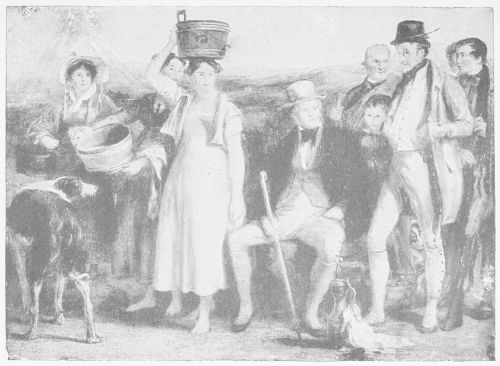
“The Abbotsford Family.”
After the painting by Sir David Wilkie, R.A.
LOCKHART
than a son-in-law, though he could not wean him from that perilous
enchantress, Maga, which was then in the wild heyday of its stormy
youth. He declared that Rob Roy (December 1817), “smells of the
cramp”; he had to wind it up more rapidly than he intended, but his
fatally buoyant spirits led him to hope that in four or five years he
might add the considerable estate of Faldonside to his acres, a dream
which haunted his enfeebled mind in his ultimate decrepitude. Meanwhile
expense on the estate of Abbotsford, and on the acquisition of curios
for the collection, went on briskly, Scott paying prices probably too
high, and conducting his affairs with the people on his land with a
profuse but judicious generosity. He discovered, as others have done,
real taste and artistic power amongst the craftsmen in wood and stone in
the district, and encouraged it to the best of his power. His gold was
not spent in vain, but the need for money grew with every year, and he
did not measure his own labour by his failing strength.
Rob Roy, whether it “smelled of the cramp” or not, was as popular as
its hero has ever been in Scotland, where he has the same sort of
reputation as Robin Hood. The novel is unusually defective in
composition, the mystery of Rashleigh’s compound of commercial
malfeasance with bills, and of treacherous Jacobitism has always baffled
the reader. The melodrama of Helen Macgregor is, in Mr. Stevenson’s
phrase, “too steep,” and the whole plot is not more lucid than some
plots of Dickens. While Diana Vernon[1] is, by popular acclaim, peerless
among the heroines of Scott, while her love story is a real love story,
her wooer is not more interesting than the general run of Scott’s
heroes. The book is saved by Diana, by the reiver himself, by the
delightful Baillie, and by that flower of serving Men, the canny
Scottish gardener Andrew Fairservice. In this novel the secret of
authorship was let out, but passed unobserved. The long lecture by the
Baillie on the state of the Highlands is taken straight from a
manuscript of Graham of Gartmore, from whom Scott purchased his most
authentic relic, the sword of the great Montrose. Scott lent the
manuscript to Jamieson, who published it in his edition of Burt’s
Letters from the North, acknowledging his debt to Scott. Now as Scott
used his manuscript in Rob Roy, here was a plain pièce de
conviction, but no hunter after proof of authorship of the Waverley
novels ever detected the facts, in fact I believe that I was the first
person who observed them!
[Foonote 1: That Diana Vernon is drawn from Scott’s friend, Miss
Cranstoun, the Countess von Purgstall, is an uncertain theory of Basil
Hall’s.]
“ROB ROY”
“HEART OF MIDLOTHIAN”
The next novel, perhaps less permanently popular (for Rob Roy holds
the stage in London as I write), but more excellent, was The Heart of
Midlothian (June 1818). Lady Louisa Steuart wrote that she “was a
little tired of your Edinburgh lawyers in the Introduction,” and they
are fatiguing; not so the lawyers of whom Saddletree converses with so
much freedom. English people are welcome to be impatient of the passages
alluding to Scottish law throughout, but Scottish readers cannot weary
of these admirably humorous pictures of the jovial and learned old
national Bar, one of the few institutions not denationalized by the
Union of 1707. The lover of Effie Deans is by far too melodramatic, too
“satanic.” For once, in this failure of a character, Scott was imitating
Byron’s heroes, whether he knew it or not, as Byron imitated figures
like the Schedoni of Mrs. Radcliffe. The story does break down at
Rosneath, as Lady Louisa said: that portion is only redeemed by “the
gracious Duncan,” a most amusing “slander on the Highlanders.” Then we
have Dumbiedykes, and Rory Bean, and the very pearl of belated
Covenanters Davie Deans. He is “lifted” straight from that honest,
brave, absurd Peter or Patrick Walker, who suffered torture as a mere
boy during the Restoration, and lived well into the eighteenth century,
compiling his biographies of Covenanting characters, such as Cameron and
Peden. Walker was to them what Izaak Walton was to the great divines of
the Church of England in his long and well-contented day. How true Davie
Deans is to his model the reader may discover in Mr. Hay Fleming’s
Saints of the Covenant, a reprint of Walker’s Biographies with notes.
When we add Ratclifte, the pleasing rogue, the wild singer, Madge
Wildfire, the thrilling interest of the Porteous mob, the study of the
great Duke of Argyll, the scene with the Queen, the adventures of the
road, and the matchless character of Jeanie Deans, with her foil in the
pretty wilful Effie, we must acknowledge that, if The Heart of
Midlothian is not absolutely the first, alone in place, of the
Waverley novels, it is certainly second to none. “I should have found
you out,” wrote Lady Louisa, in that one parenthesis, “for the man was
mortal and had been a schoolmaster.” No number of formal histories can
convey nearly so full and true a picture of Scottish life about 1730-40,
as The Heart of Midlothian. As social history it is unrivalled. In
Edinburgh Lockhart had never witnessed “such a scene of all engrossing
enthusiasm,” in any literary matter, as on the appearance of this novel.
To think of it is to wish to throw down the pen, and take the book again
from the shelf, as Thackeray says when he chances to mention Dugald
Dalgetty. But young people now, as they did in 1818, according to Lady
Louisa, “never heard of the Duke of Argyll before. ‘Pray who was Sir
Robert Walpole?’ they ask me, ‘and when did he live?’ or, perhaps, ‘was
not the great Lord Chatham in Queen Anne’s days?’” Readers who are
exhaustively ignorant of and unconcerned about the past, cannot be
expected to read Scott, and such readers were common in his own time,
not to speak of our educated age.
The Bride of Lammermoor appears to have been begun before The Heart
of Midlothian was published. At the end of 1818 Scott received a
baronetcy, and though he at once anticipated the quotation (which Hogg
incontinently made),
I like not
Such grinning honour as Sir Walter hath,
no doubt he liked very well the revival of the old Border name, “Sir
Walter Scott.” That he should enjoy the title was perfectly natural, and
its gift, as the Prince Regent really was fond of literature, seems no
less in nature.
With the winter, and with the sedentary life of Edinburgh, the terrible
cramps returned. He sold his copyrights to Constable for £12,000, and
had Constable paid, before 1826, the bond of 1818, Scott would have had
no later interest in this valuable property. But, characteristically,
the debt was not fully discharged before Constable’s ruin in 1826. The
spring of 1819 was passed under torment, and under the medical artillery
of bleeding, blistering, calomel, and ipecacuanha. As a better remedy
Scott’s Highland piper selected twelve stones from twelve southward
running streams; on these the patient was to sleep. Scott, however, said
that the charm stones only worked if wrapped in the petticoat of a widow
who had never wished to marry again, and Science, in the person of the
piper, abandoned the case. Removal to Abbotsford did not alleviate the
pangs, but here Scott dictated The Bride of Lammermoor to Will Laidlaw
and John Ballantyne. He was interrupted by cries wrung from him in
agony, and it is not wonderful, perhaps, that when he saw the book in
print, he could not remember a single line of it, but read in fear and
trembling, for who knew what absurdity it might contain? Thackeray had
the same experience as to part of Pendennis, written before a serious
illness. In Scott’s case perhaps the incredible amount of opiates with
which he was drugged may explain his forgetfulness. “As to giving over
work,” he said to Laidlaw, “that can only be when I am in woollen.”
“BRIDE OF LAMMERMOOR”
When Lockhart visited Scott, in May 1819, the colour of his hair had
changed from a brindled grey to snow white, at the age of forty-seven.
His face “was meagre, haggard, and of the deadliest yellow of the
jaundice.” That night, in a fresh fit of pain, his cries were distinctly
audible at a considerable distance from the house, but by eleven o’clock
next day he mounted his horse and rode with Lockhart past Philiphaugh
and up Yarrow, discoursing of Montrose’s defeat, and in high spirits
about a pending election. Yet, a month later, when The Bride of
Lammermoor and The Legend of Montrose appeared, Scott was believed to
be on his deathbed. One night he took leave of his family, expressing in
simple terms his Christian faith, “and now leave me that I may turn my
face to the wall.” He slept, and the crisis passed over. By July 19 he
had nearly finished a volume of Ivanhoe, which he expected to complete
in September. Such enthusiasm of industry, in such circumstances, is
without parallel in literary history. The Bride of Lammermoor is a
subject which leaves an author no choice; he must make his novel end
badly: he cannot avoid the tragic, and tragedy scarcely suits the genius
of Scott. He knew the tale of the mysterious death of Stair’s daughter,
from tradition in his family, and, after his illness, he remembered the
legend as well as ever: of his own handling of the tale he could
remember nothing. As to the real facts of the case, Dr. Hickes heard
them from the Duke of Lauderdale, and, again, from the father of the
Bride himself, but Hickes declined to write the story down, lest his
memory might be at fault. Scott was not aware of these historical facts,
which are certainly tantalizing, as the real facts are unknown.
“BRIDE OF LAMMERMOOR”
Not only are the data of the story things of unrelieved gloom, but Scott
has chosen to show Fate dealing with a heroine gentle, innocent, and
weak. Of all heroes of novels, perhaps only two frankly tell their lady
loves that their fathers are not gentlemen! One of these candid wooers
is Darcy, in Pride and Prejudice, and Elizabeth causes him to rue his
candour. The other is the Master of Ravenswood, and Lucy Ashton does not
resent his words. It is on this poor pathetic broken creature, as
harmless as Rose Bradwardine, that Fate deals a blow which might have
crushed these old Royal Greek protagonists, whom Aristotle deemed the
only proper central figures of tragedy. The results are really rather
miserable than tragic in the strict sense of the word, the victim only
ceases to be feeble when she ceases to be sane. Her lover, again, the
Master, is a personage quite alien to the nature of Scott. The Master,
to be sure, is very unfortunate indeed, a disinherited knight, like
Ivanhoe, but he is not more bereaved and impoverished than Quentin
Durward is at the opening of his tale. But Quentin bears a merry heart,
and goes all the way, like hundreds of his countrymen through several
centuries, finding fortune, honour, and a bride in French service. The
Master, on the other hand, mopes in his gloomy tower, thinks of
assassinating his supplanter, Sir William Ashton, but declines into
saving him from a bull, like Johnny Eames in The Small House at
Allingham, and falls in love with the daughter of his supplanter.
Tennyson chose to revive the set of situations in his Maud, where the
hero is much more peevish and hysterical than the Master of Ravenswood,
while of the heroine we practically know nothing, except that, at
sixteen, Maud was tall and stately, and had a classical profile. The
situations were not, we repeat, adapted to Scott’s genius, but they were
congenial to the foreseen and inevitable conclusion of the story, as
given by history. Lockhart tells us that Caleb Balderwood was never
regarded as a successful humorous character, and we fall back on Bucklaw
and that inimitable captain, Craigingelt, for humorous relief, while the
genuine tragic element is supplied by old Alice, by the eery scene in
which her wraith appears to the Master, and by the Chorus, as it were,
of the poor old envious women, suspected of sorcery, the watchers of the
dead. Scott never surpassed his dealings with these horrible creatures.
The conclusion when
The last Lord of Ravenswood to Ravenswood doth ride,
To woo a dead maiden to be his bride,
with the mystery of all that befell in the bridal bower and the ride of
Lucy to church, her hand clay cold in that of her boyish brother,
himself admirably sketched, are entirely worthy of the genius of the
author. When we consider the circumstances in which he dictated the
tale, we may well marvel that he could rise to such height of power. But
otherwise the novel is not to be reckoned among his best: it lacks much
of the usual happy humour. Yet it has had admirers among good judges who
set it in the forefront of his romances.
DUGALD DALGETTY
Thackeray, an excellent judge, greatly preferred to the sombre Master
the redoubted Rittmeister, Dugald Dalgetty, of the Legend of Montrose,
which was published in company with The Bride of Lammermoor. Dugald is
a garrulous pedant, and may be styled “one of Scott’s bores,” but he
never bores us, whether when he sets forth his simple reasons for
serving with the King’s army, not with the Covenanters; or criticises
the various services of Europe, or lectures on the propriety of
fortifying the sconce of Drumsnab, or faces Argyll in Inveraray, or
masters him in the dungeon, or wheedles the Presbyterian chaplain, or
mocks the bows and arrows of his allies the Children of the Mist: or
does deeds of derring do at Inverlochy, or swaggers about in the fresh
glories of his title of Knight Banneret. Dugald is always a perfect joy,
even if we be little interested, as we are, in the loves of Annot Lyle
and in the second-sighted man with his gloom and his visions. It is
difficult to guess what Scott may have originally meant to do with
Montrose, the most sympathetic figure in the long pageant of Scottish
history. With the romance of his life and character fiction cannot cope:
nothing can match his actual history. In Argyll, again, Scott
encountered a personage whose psychology was too intricate for his hasty
methods. But his fingers, as he says in a letter of this period,
sometimes seemed to him to work automatically, against his conscious
purpose. There was, as has been said of Molière, a lutin that rode his
pen. The good horse Gustavus, in fact, “with Dalgetty up,” ran away with
Scott, and the romance became practically the story of one man, the
Rittmeister.
In the whirl of his multifarious activities, Scott remained canny enough
to consider his profession of romance as a manufactory subject to
changes of fashion and taste. His “tweeds,” so to speak, his tales of
Scottish manners, might go out of vogue, though there was as yet little
competition on the part of other makers. Deliberately, therefore, so he
declares, he determined to turn out a new article of a nature as remote
as possible from his Scottish fabrics, a romance of English mediaeval
life. In that period no character is so romantic and popular as Richard
I, and there is no more popular figure in legend than Robin Hood, though
his date (if he be more than a mere ideal outlaw) is unknown, some facts
point vaguely to his era as that of Edward II. Again, there was the
picturesque contrast between the manners of the conquered English and
conquering Normans, which, once pointed out by Scott, attracted the
studies of Thierry, the French historian. A forgotten play, Runimede,
by the half-forgotten and “unfortunate Logan,” had been seen by Scott,
and, he says, suggested his idea, while the old rhyme of “Tring, Wing,
and Ivanhoe” gave him a sonorous name which (a great point with Scott)
revealed nothing of the nature and scope of his narrative. He disliked
“writing up” to names of familiar associations, such as “Rob Roy” and
“Kenilworth.” With “Ivanhoe” people did not know what to expect, and
could not be disappointed.
“IVANHOE”
Mr. Freeman spoke severely of the incorrect history and archaeology of
Ivanhoe. There can be no such name as Cedric, the Confessor had no
“sprouts”—of whom Athelstane, in some mysterious way, is a survivor.
But these were matters of indifference to the novelist, as he candidly
explained, and he gratified Ulrica with heathen deities, not familiar to
her remotest ancestors, but preferred by her to the Christian creed. In
fact he sounded his kettle drums by night, like Claverhouse’s troopers
in Old Mortality, for the sake of the effect, and careless of the
circumstance that, at night, the kettle drums do not clash on the march,
just as he gave Claverhouse a post of command which he did not hold. He
admitted that he had blended the manners of several distinct centuries,
but what matter? “Such errors will escape the general class of readers,”
and the author helps himself from Froissart, when The Monk of Croyland
does not serve his turn. Here is “confession and avoidance,” and the
general reader, any reader of sense, cares no more for Mr. Freeman’s
censures than for the precise truth about the palisade at Senlac. Sir
Walter was really hit by a criticism of one of his blazons, metal upon
metal, but he found an authentic parallel case, and remarked that
heraldry was in its infancy, and had not developed half of its rules. An
account of the German Jews, given by Skene of Rubislaw, suggested Isaac
of York and Rebecca, the sudden death of an advocate in court gave the
hint which, in the very unlooked for demise of The Templar, rescues
Ivanhoe from a situation out of which the reader sees “no outgait.” But
surely we should have had some previous warning that the hardy Templar
suffered from a cardiac affection? Scott did not think of that, and
caught at a kind of miracle, which, I own, seemed to me far fetched and
unsatisfactory at the uncritical age of ten. A thunderstorm over the
lists and lightning attracted by The Templar’s lance appeared an
“outgait” more picturesque, and, considering the robust health of The
Templar, rather more probable, while vindicatory of divine justice to a
remarkable degree. Cannot you see the combatants clashing in the mirk,
unbeheld by the spectators; you see the flash descend with the
torrential rain, and the marshals of the lists, penetrating the veil of
mist, find The Templar a clay cold corpse, and the Disinherited Knight
“quite safe, though very wet,” like the people in the play of The
Stranger.
However, Scott was otherwise inspired! The appearance of Ivanhoe, in
December 1819, marked the flood-tide of his popularity. The English
rejoiced at being freed from “the dialect,” which was and remains to
them a stumbling block, though they find no difficulty in the lingo of
the modern “Kailyard.” Lockhart says that, after Ivanhoe, the sale of
Scott’s novels fell off, though Constable managed to conceal the
circumstance from the author, an ill-judged proceeding.
“THE MONASTERY”
As Lockhart says, the next three or four years were the most expensive
in Scott’s life, through his ignorance of the truth, whereas they should
have been years of retrenchment. It became proportionately difficult for
Sir Walter to “pull up” in his expenditure, and the mine was laid that
exploded seven years later. Ivanhoe remains one of the best known of
Scott’s novels, probably because it is precisely suited to the taste of
boyhood, when the eyes of studious boys can be diverted from the
mysteriously bewitching romances of the late Mr. Henty. We have all
sighed with Rebecca, we have all been of Thackeray’s opinion about the
“very English” respectable Rowena, we have all hated Front de Boeuf;
“amo Locksley,” says Thackeray, and so say all of us; we have
delighted in Friar Tuck, laughed with Wamba, and over the
much-criticised scene, due to Scott’s good nature, of the resurrection
of a trencherman so resolute as Athelstane. No mere knock on the head
could get rid of so thick-skulled a thane as the lord of Coningsburgh.
While Scott’s health was recovered, while Abbotsford was full of guests,
and the Abbotsford Hunt was, as the farmer said, the thing worth living
for in the year, The Monastery was being written, and proved a not
undeserved failure, relatively speaking. The only disaster of Scott, in
his treatment of visionary things, is the White Lady of Avenel, and of
all his bores, the Euphuist, Sir Percy Shafton is the least humorous,
and was regarded as the most tedious. The business of the bodkin, and
the tailor ancestry of the really gallant though rather distraught
knight, did not amuse, and the historical setting is not handled in a
manner worthy of the opportunity, the sudden fall of the ancient Church.
“THE ABBOT”
Never, surely, was such a bouleversement as the religious revolution
taken so quietly as in Scotland. The only change, said the keeper of a
hostel at St. Andrews, was that where the Dean had sat and called for
claret, the Moderator sat and shouted for more toddy! This is a story of
Scott’s, probably apocryphal, for toddy did not come in with
Presbyterianism, and Darnley is the only whisky drinker whom I have
remarked in the documents of the period. The truth is that, in many
districts of the South, Catholicism was dead before it fell. The love of
“a new day,” as they called it, and relief from priestly dues, with the
fun of havoc and pillage, were universally attractive, and only a
remnant, in outlying parishes, mourned for the Mass that had become a
capital offence. Very few sentimental regrets accompanied the flight of
the ancient faith, and the Abbot of Unreason jigged joyously through the
roofless cathedrals. Thus perhaps the dramatic opportunity of Scott was
less excellent than it seems at a first glance. Only Knox’s “rascal
multitude” began to discover, after they had helped to wreck the
monasteries, that life was as hardly ground down by lay as by clerical
landlords, that gaiety was gone, that holidays were curtailed, that the
penances of the new Kirk were harsher than those of the old, and that
Sunday, from a feast, had become a day of gloom. Under James VI a
preacher observed that he feared the rabble more than he did the
Catholic earls, but rabble and earls were alike brought under the yoke.
All this had not been foreseen, and thus the Reformation was taken
lightly, not with the terrible struggles of contemporary France.
Far from being depressed, and abandoning his theme, Scott deliberately
reverted to it, continuing some of the characters of The Monastery in
The Abbot. To Lockhart, now his son-in-law, he sent a copy, with the
inscription,
Up he rose in a funk, lapped a toothful of brandy,
And to it again ... any odds upon Sandy?
The Introduction to Nigel contains, with the rest of Scott’s Ars
Poetica, a half apology for “The White Lady of Avenel.” She disappears
from The Abbot, which, by virtue of the picture of Queen Mary and her
Loch Leven adventures, and of Catherine Seyton, with all the lively
scenes in old Marian Edinburgh, helped to restore the author’s shaken
popularity.
John Ballantyne had ventured a “Novelists’ Library,” heavy books in
double columns, and Scott contributed charming introductory essays, but
in the summer of 1821 he lost this favourite henchman, and remarked that
the sun would never shine so brightly again for himself. John clearly
was no man of business, his possessions were a minus quantity, though he
believed himself to have some property, and bequeathed a visionary
£2,000 to Scott.
“KENILWORTH”
Sir Walter went to London for the Coronation of George IV. Others, “the
non est tanti men,” might sneer, he said, at such pageants, might be
“crucified to them”—as the Covenanting Laird of Brodie prayed to be
crucified to the glories of the Lord Mayor’s Show—but Scott defended
“the natural and unaffected pleasure which men like me receive from
sights of splendour and sounds of harmony.” The Coronation wholly
pleased him, but for the error of the Champion, who used a Highland
target, “instead of a three-cornered or beater shield, which, in time
of tilt, was suspended round the neck.” Scott had made the Highland
target too fashionable: hence the heresy of the Champion. Scott was
recognized by the Scots Greys with cries of “God bless Sir Walter,” and
was allowed to pass on foot through the tabooed space which they
guarded on the outside of the Abbey. At this time was executed the bust
of Scott by Chantrey, no doubt by far the best representation of the
man. Raeburn, as Scott remarked, painted him as “a somewhat
chowder-headed” person. Indeed no portrait caught the vivacity of his
changeful expression, all, except the bust, are more or less
“chowder-headed.”
Before John Ballantyne’s death Scott had begun Kenilworth. Constable
appears to have suggested The Armada as a subject, and to have
collected many rare Elizabethan books for Sir Walter’s use. Then he
preferred the title of The Nunnery, while Scott’s fancy went back to
his favourite lines in Meikle’s ballad, and to the title of Cumnor
Hall. But he chose Kenilworth, to please Constable. His motto, “No
scandal about Queen Elizabeth,” directed his course. Though a patriotic
Scot, he was too chivalrous to avenge on Queen Elizabeth the wrongs of
Mary Stuart. By the most daring of anachronisms he deserted the real
period of the affair of Amy Robsart, when scandal, not unprovoked, about
Elizabeth was rife in the popular mouth and in every Court of Europe
(1560). In the mystery of Amy Robsart’s death, Scott had a psychological
subject. Leicester and Amy had been married, not secretly but publicly,
in the reign of Edward VI. During that of Mary Tudor a strong
attachment sprang up between Elizabeth and Leicester, then Lord Robert
Dudley. On Elizabeth’s accession to the throne she loaded her favourite
and Master of the Horse with unprecedented honours. Dudley was ever at
Court, his wife lived retired at Cumnor Hall, and it was now said that
she had a fatal disease, now that attempts were being made to poison
her.
“KENILWORTH”
Meanwhile the triumphant Scottish Protestants, with the leader of the
conquered Catholics, Archbishop Hamilton, were united for once in
proposing that the Queen of England should marry the next heir to the
throne of Scotland, the Earl of Arran, a Protestant, the friend of Knox.
But, not to speak of other reasons, the favour of Dudley with Elizabeth
stood in the way. Cecil spoke of the danger of Lady Robert Dudley in the
gloomiest terms, to the Spanish ambassador. To the English agent in
Scotland, Randolph, Cecil wrote a letter, which has been destroyed, but
which chilled Randolph’s heart. The death of Darnley was not more
clearly foreseen, in 1567, than the death of Dudley’s wife in 1560.
Then, a few days after Cecil’s letter to Randolph, news of Lady Robert’s
death came to Windsor. How she died no man knows to this day. The
verdict of the coroner’s jury, an open verdict apparently, cannot be
discovered. Amy had sent all her household except two or three ladies
to a fair at Abingdon. Their story was that, on returning, they found
their mistress lying dead, with a broken neck, at the foot of a flight
of stairs. She had suddenly left her ladies, who made no inquiries, and
now she was dead. Elizabeth told an envoy of her ambassador at Paris
that there had been “an attempt” at Cumnor Hall, but that none of
Leicester’s retainers was present. We know no more, but Mr. Froude, by a
misunderstanding of the evidence, made it seem almost impossible to
doubt that Elizabeth had what could not be guiltless foreknowledge of
the catastrophe. This is an error; this is not warranted by the
evidence. The behaviour of Dudley, again, on receiving the news of his
wife’s death, was that of an innocent man: he did all that he could to
secure an investigation without favour.
So the case stands, and Sir Walter might have avenged Mary Stuart by
showing that Elizabeth was in no better position, as regards the death
of Amy, than is Mary as regards the death of Darnley. But Scott rejected
the temptation: he chose to say that Dudley’s marriage was a secret, and
unknown to Elizabeth, and by keeping Amy alive for many years after her
death, he contrived a meeting between the unconscious rivals, the Queen
and the bride, at the festivals of Kenilworth. Such is his audacious
handling of the facts, and he has given Elizabeth a more dignified part
than she was wont to play, where Leicester was concerned: he has made
her a right royal lady. She is magnificent in the meeting with Amy, and
in her challenge of Leicester. The novel has thus always been a
favourite in England, and there are even critics who put this romance
based on bookwork before the best of all in which Scott delineates the
manners best known to him, those of his own countrymen. Yet the novel is
far better than many other critics admit. Amy is a spirited, lovely, and
interesting heroine. Leicester is flattered, but the portrait is fine.
The village humours, and the ruffianly soldier of fortune, Mike
Lambourne, are very happily handled. Varney comes as near Iago in his
resolute wickedness as it was in the power of Scott to go; and there is
good in Flibbertigibbet, though we see too much of him; and more good in
Tony Fire the Faggot, though Tony’s character, in real life, appears to
have escaped censure: his epitaph, at least, is alive to testify to
that, though the rewards heaped by Leicester on the occupant of Cumnor
Hall “do something smack.”


