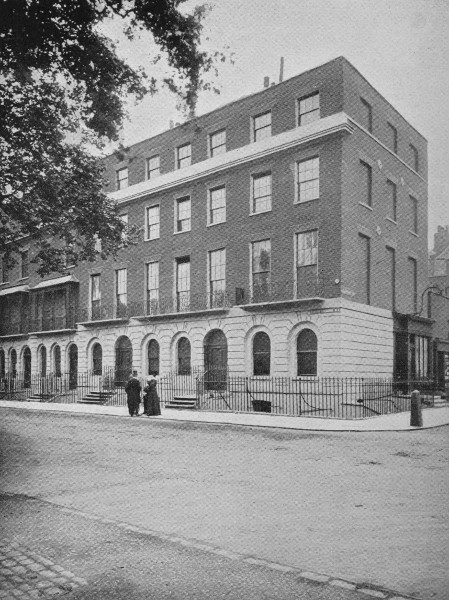
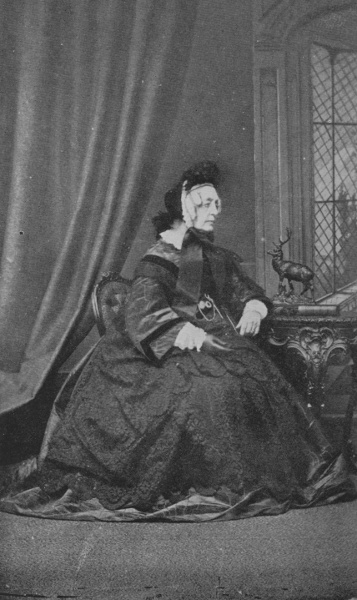
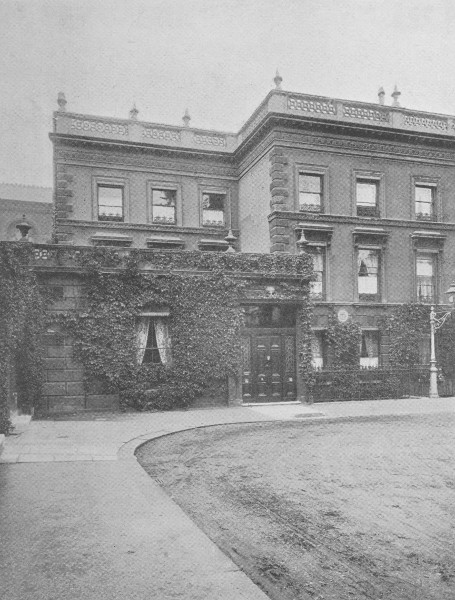
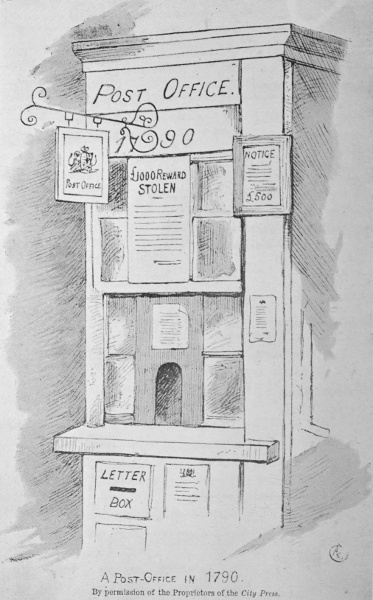
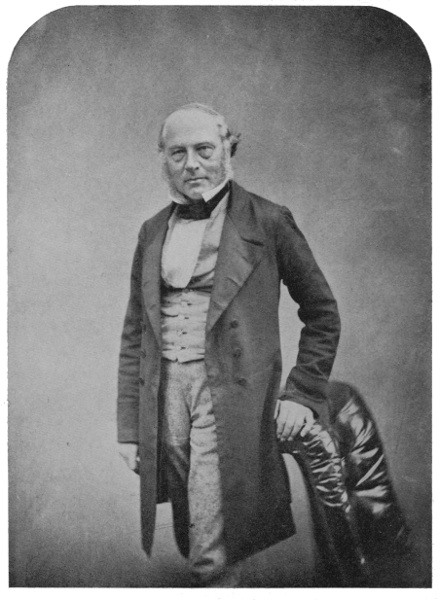
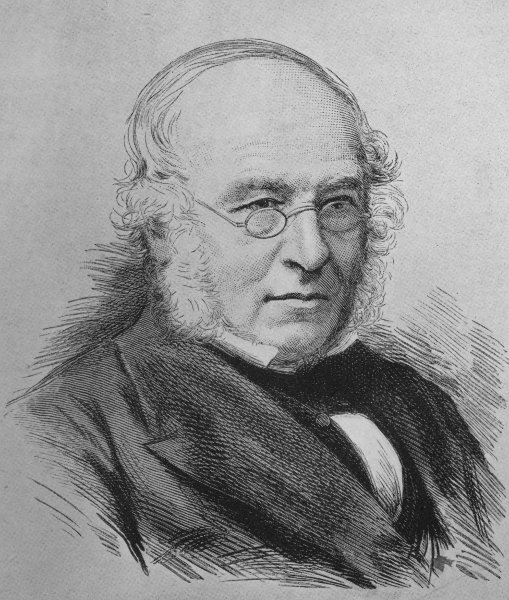
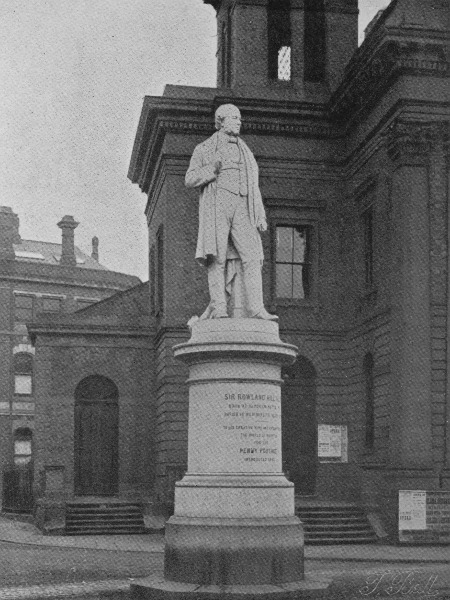
The earliest of the postal reformer's forefathers to
achieve fame that outlives him was Sir Rowland Hill,
mercer, and Lord Mayor of London in 1549, a native
of Hodnet, Shropshire, who founded a Grammar School
at Drayton, benefited the London Blue Coat School,
was a builder of bridges, and is mentioned by John
Stowe. From his brother are descended the three
Rowland Hills famous in more modern times—the
preacher, the warrior, and the author of Penny Postage.
Some of the preacher's witticisms are still remembered,
though they are often attributed to his brother cleric,
Sydney Smith; Napier, in his “Peninsular War,”
speaks very highly of the warrior, who, had Wellington
fallen at Waterloo, would have taken the Duke's place,
and who succeeded him as Commander-in-Chief when,
in 1828, Wellington became Prime Minister. A later
common ancestor of the three, a landed proprietor,
married twice, and the first wife's children were thrown
upon the world to fight their way as best as they could,
my paternal grandfather's great-grandfather being one
of the dispossessed. But even the blackest cloud has
its silver lining; and the fall, by teaching the young
people self-help, probably brought out the latent good
stuff that was in them. At any rate, family tradition
preserves memory of not a few men and women—Hills,
or of the stocks with which they married—of
whom their descendants have reason to be proud.
There was, for example, John Hill, who served
among “the twelve good men and true” on a certain
trial, was the only one of them who declined to accept
a bribe, and, the fact becoming known, was handsomely
complimented by the presiding judge. Thenceforth,
whenever the Assizes in that part of the country came
round again, John used to be asked after as “the
honest juror.” At least two of my father's forebears,
a Symonds and a Hill, refused to cast their political
votes to order, and were punished for their sturdy
independence. The one lived to see a hospital erected
in Shrewsbury out of the large fortune for some two
hundred years ago of £30,000 which should have come
to his wife, the testator's sister; the other, a baker and
corn merchant, son to “the honest juror,” saw his
supply of fuel required to bake his bread cut off by
the local squire, a candidate for Parliament, for whom
the worthy baker had dared to refuse to vote. Ovens
then were heated by wood, which in this case came
from the squire's estate. When next James Hill made
the usual application, the faggots were not to be had.
He was not discouraged. Wood, he reflected, was
dear; coal—much seldomer used then than now—was
cheap. He mixed the two, and found the plan succeed,
lessened the proportion of wood, and finally dispensed
with it altogether. His example was followed by other
people: the demand for the squire's firewood languished,
and the boycotted voter was presently requested to
purchase afresh. “An instance,” says Dr Birkbeck
Hill, “of a new kind of faggot vote.”
Another son of “the honest juror” was the first
person to grow potatoes in Kidderminster. Some two
centuries earlier “the useful tuber” was brought to
England; but even in times much nearer our own,
so slowly did information travel, that till about 1750
the only denizen of that town who seems to have known
of its existence was this second John Hill. When the
seeds he sowed came up, blossomed, and turned to
berries, these last were cooked and brought to table.
Happily no one could eat them; and so the finger of
scorn was pointed at the luckless innovator. The
plants withered unheeded; but later, the ground being
wanted for other crops, was dug up, when, to the
amazement of all beholders and hearers, a plentiful
supply of fine potatoes was revealed.
On the spindle side also Rowland Hill's family
could boast ancestors of whom none need feel ashamed.
Among these was the high-spirited, well-dowered
orphan girl who, like Clarissa Harlowe, fled from home
to escape wedlock with the detested suitor her guardians
sought to force upon her. But, unlike Richardson's
hapless heroine, this fugitive lived into middle age,
maintained herself by her own handiwork—spinning—never
sought even to recover her lost fortune, married,
left descendants, and fatally risked her life while preparing
for burial the pestilence-smitten neighbour
whose poor remains his own craven relatives had abandoned.
Though she perished untimely, recollection
of her married name was preserved to reappear in
that of a great-grandson, Matthew Davenport Hill.
The husband of Mrs Davenport's only daughter,
William Lea, was a man little swayed by the superstitions
of his time, as he showed when he broke through
a mob of ignorant boors engaged in hounding into a
pond a terrified old woman they declared to be a
witch, strode into the water, lifted her in his arms,
and, heedless of hostile demonstration, bore her to
his own home to be nursed back into such strength
and sanity as were recoverable. A son of William
Lea, during the dreadful cholera visitation of 1832,
played, as Provost of Haddington, a part as fearlessly
unselfish as that of his grandmother in earlier days,
but without losing his life, for his days were long in
the land. His sister was Rowland Hill's mother.
On both sides the stocks seem to have been of
stern Puritan extraction, theologically narrow, inflexibly
honest, terribly in earnest, of healthy life, fine physique—nonagenarians
not infrequently. John Symonds, son
to him whose wife forfeited succession to her brother,
Mr Millington's fortune, because both men were
sturdily obstinate in the matter of political creed, was,
though a layman, great at extempore prayer and
sermon-making. When any young man came a-wooing
to one of his bonnie daughters, the father would
take the suitor to an inner sanctum, there to be tested
as to his ability to get through the like devotional
exercises. If the young man failed to come up to the
requisite standard he was dismissed, and the damsel
reserved for some more proficient rival—James Hill
being one of the latter sort. How many suitors of the
present day would creditably emerge from that
ordeal?
Through this sturdy old Puritan we claim kinship
with the Somersetshire family, of whom John
Addington Symonds was one, and therefore with the
Stracheys; while from other sources comes a collateral
descent from “Hudibras” Butler, who seems to have
endowed with some of his own genuine wit certain
later Hills; as also a relationship with that line of
distinguished medical men, the Mackenzies, and with
the Rev. Morell Mackenzie, who played a hero's part
at the long-ago wreck of the Pegasus.
A neighbour of James Hill was a recluse, who,
perhaps, not finding the society of a small provincial
town so companionable as the books he loved, forbore
“to herd with narrow foreheads,” but made of James
a congenial friend. When this man died, the task fell
to his executors, James Hill and another, to divide his
modest estate. Among the few bequests were two
books to young Tom, James's son, a boy with a
passion for reading, but possessed of few books, one
being a much-mutilated copy of “Robinson Crusoe,”
which tantalisingly began with the thrilling words,
“more than thirty dancing round a fire.” The fellow
executor, knowing well the reputation for uncanny
ways with which local gossip had endowed the
deceased, earnestly advised his colleague to destroy
the volumes, and not permit them to sully young
Tom's mind. “Oh, let the boy have the books,” said
James Hill, and straightway the legacy was placed
in the youthful hands. It consisted of a “Manual of
Geography” and Euclid's “Elements.” The effect of
their perusal was not to send the reader to perdition,
but to call forth an innate love for mathematics, and,
through them, a lifelong devotion to astronomy, tastes
he was destined to pass on in undiminished ardour
to his third son, the postal reformer.
Thomas Wright Hill was brought up in the
straitest-laced of Puritan sects, and he has left a
graphic description of the mode in which, as a small
boy of seven, he passed each Sunday. The windows
of the house, darkened by their closed outside shutters,
made mirrors in which he saw his melancholy little
face reflected; his toys were put away; there were
three chapel services, occupying in all some five and
a half hours, to which he was taken, and the intervals
between each were filled by long extempore prayers
and sermon-reading at home, all week-day conversation
being rigidly ruled out. The sabbatical observance
commenced on Saturday night and terminated on
Sunday evening with “a cheerful supper,” as though
literally “the evening and the morning were the first
day”—an arrangement which, coupled with the habit
of bestowing not Christian but Hebrew names upon
the children, gives colour to the oft-made allegation
that our Puritan ancestors drew their inspiration from
the Old rather than from the New Testament. The
only portion of these Sunday theological exercises
which the poor little fellow really understood was the
simple Bible teaching that the tenderly-loved mother
gave to him and to his younger brother. While as
a young man residing in Birmingham, however, he
passed under the influence of Priestley, and became
one of his most devoted disciples, several of whom, at
the time of the disgraceful “Church and King” riots
of 1791, volunteered to defend the learned doctor's
house.[1]
But Priestley declined all defence, and the
volunteers retired, leaving only young Tom, who would
not desert his beloved master's threatened dwelling.
The Priestley family had found refuge elsewhere, but
his disciple stayed alone in the twilight of the barred
and shuttered house, which speedily fell a prey to
its assailants. Our grandfather used often to tell us
children of the events of those terrible days when
the mob held the town at their mercy, and were
seriously opposed only when, having destroyed so
much property belonging to Nonconformity, they next
turned their tireless energy towards Conformity's possessions.
His affianced wife was as courageous as he,
for when while driving in a friend's carriage through
Birmingham's streets some of the rioters stopped
the horses, and bade her utter the cry “Church and
King,” she refused, and was suffered to pass on unmolested.
Was it her bravery or her comeliness,
or both, that won for her immunity from harm?
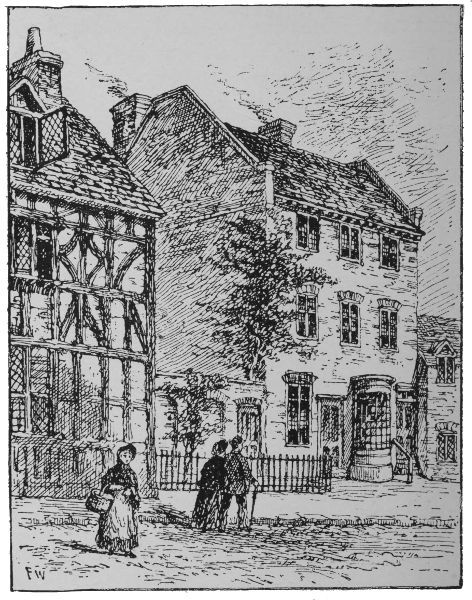
ROWLAND HILL'S BIRTHPLACE, KIDDERMINSTER.
By permission of the Proprietors of the “Illustrated
London News.”
The third son of this young couple, Rowland,
the future postal reformer, first saw the light in a
house at Kidderminster wherein his father was born,
which had already sheltered some generations of
Hills, and whose garden was the scene of the potato
story. The child was weakly, and, being threatened
with spinal trouble, passed much of his infancy in
a recumbent position. But the fragile form held a
dauntless little soul, and the almost abnormally large
brain behind the too pallid forehead was a very active
one. As he lay prone, playing with the toys his
mother suspended to a cord stretched within easy
reach above him; and, later, working out mental
arithmetical problems, in which exercise he found
delight, and to the weaving of alluring daydreams,
he presently fell to longing for some career—what
it should be he knew not—that should leave his
country the better for his having lived in it. The
thoughts of boys are often, the poet tells us, “long,
long thoughts,” but it is not given to every one
to see those daydreams realised. Though what is
boy (or girl) worth who has not at times entertained
healthily ambitious longings for a great future?
As he grew stronger he presently came to help
his father in the school the latter had established at
Birmingham, in which his two elder brothers, aged
fifteen and fourteen, were already at work. The
family was far from affluent, and its young members
were well aware that on their own exertions depended
their future success. For them there was no royal
road to learning or to anything else; and even as
children they learned to be self-reliant. From the
age of twelve onwards, my father, indeed, was self-supporting.
Like Chaucer's poor parson, the young
Hill brothers learned while they taught, even sometimes
while on their way to give a lesson, as did my
father when on a several miles long walk to teach
an equally ignorant boy the art of Navigation; and
perhaps because life had to be taken so seriously, they
valued the hardly-acquired knowledge all the more
highly. Their father early accustomed his children to
discuss with him and with each other the questions of
the time—a time which must always loom large in the
history of our land. Though he mingled in the talk,
“it was,” my Uncle Matthew said, “a match of mind
against mind, in which the rules of fair play were
duly observed; and we put forth our little strength
without fear. The sword of authority was not thrown
into the scale.... We were,” added the writer, “born
to a burning hatred of tyranny.”[2] And no wonder,
for in the early years of the last century tyranny was
a living, active force.
If, to quote Blackstone, “punishment of unreasonable
severity” with a view to “preventing crimes and
amending the manners of a people” constitute a
specific form of tyranny, the fact that in 1795, the
year of Rowland Hill's birth, the pillory, the stocks,
and the whipping-post were still in use sufficiently
attests this “unreasonable severity.” In March 1789,
less than seven years before his birth, a yet more
terrible punishment was still in force. A woman—the
last thus “judicially murdered”—was burnt at the
stake; and a writer in Notes and Queries, of 21st
September 1851, tells its readers that he was present
on the occasion. Her offence was coining, and she was
mercifully strangled before being executed. Women
were burnt at the stake long after that awful death
penalty was abolished in the case of the more favoured
sex. The savage cruelty of the criminal code at this
time and later is also indicated by the fact that
over 150 offences were punishable by death. Even
in 1822, a date within the recollection of persons still
living, and notwithstanding the efforts made by Sir
Samuel Romilly and others to humanise that code,
capital punishment was still terribly common. In that
year, on two consecutive Monday mornings, my father,
arriving by coach in London from Birmingham, passed
within sight of Newgate. Outside its walls, on the
first occasion, the horrified passengers counted nineteen
bodies hanging in a row; on the second, twenty-one.
During my father's childhood and youth this
country was almost constantly engaged in war.
Within half a mile of my grandfather's house the
forging of gun barrels went on all but incessantly,
the work beginning before dawn and lasting till long
after nightfall. The scarcely-ending din of the
hammers was varied only by the occasional rattle
from the proof shed; and the shocks and jars had
disastrous effect upon my grandmother's brewings of
beer. Meanwhile “The Great Shadow,” graphically
depicted by Sir A. Conan Doyle, was an actual dread
that darkened our land for years. And the shadow
of press-gang raids was a yet greater dread alike
to the men who encountered them, sometimes to
disappear for ever, and to the women who were
frequently bereft of their bread-winners. It is,
however, pleasant to remember that sometimes the
would-be captors became the captured. A merchant
vessel lying in quarantine in Southampton Water,
her yellow flag duly displayed, but hanging in the
calm weather so limply that it was hardly observable,
was boarded by a press-gang who thought to do a
clever thing by impressing some of the sailors.
These, seeing what was the invaders' errand, let
them come peaceably on deck, when the quarantine
officer took possession of boat and gang, and
detained both for six weeks.
For those whose means were small—a numerous
class at that time—there was scant patronage of public
conveyances, such as they were. Thus the young
Hill brothers had to depend on their own walking
powers when minded to visit the world that lay beyond
their narrow horizon. And to walking tours, often of
great length, they were much given in holiday time,
tours which took them to distant places of historic
interest, of which Rowland brought back memorials
in his sketch book. Beautiful, indeed, were the then
green lanes of the Midlands, though here and there
they were disfigured by the presence of some lonely
gibbet, the chains holding its dismal “fruit” clanking
mournfully in windy weather. Whenever it was
possible, the wayfarer made a round to avoid passing
the gruesome object.
One part of the country, lying between Birmingham
and Wolverhampton, a lonely heath long since
covered with factories and houses, known as the
“Lie Waste,” was also not pleasant to traverse, though
the lads occasionally had to do so. A small collection
of huts of mud-and-wattle construction sheltered some
of our native savages—for they were nothing else—whose
like has happily long been “improved off the
face” of the land. These uncouth beings habitually
and literally went “on all fours.” Whether the attitude
was assumed in consequence of the low roofs of
their dwellings, or the outcasts chose that mode of
progression in imitation of the animals which were
their ordinary companions, history does not say, but
they moved with wonderful celerity both in and out
of doors. At sight of any passer-by they were apt
to “rear,” and then oaths, obscene language, and
missiles of whatever sort was handy would be their
mildest greeting, while more formidable attack was
likely to be the lot of those who ventured too near
their lairs. Among these people the Hill boys often
noticed a remarkably handsome girl, as great a savage
as the rest.
As the three elder brothers grew well into their
teens, much of the school government fell to their
lot, always with the parental sanction, and ere long
it was changed in character, and became a miniature
republic.[3] Trial by jury for serious offences was
instituted, the judge being my grandfather or one
of his sons, and the jury the culprit's fellow-pupils.
Corporal punishment, then perhaps universal in
schools, was abolished, and the lads, being treated
as reasonable creatures, early learned to be a self-respecting
because a self-governing community. The
system, which in this restricted space cannot be
described in detail, was pre-eminently a success,
since it turned out pupils who did it and themselves
credit. “All the good I ever learned was learned at
Hazelwood,” I once heard say a cheery old clergy-man,
probably one of the last surviving “boys.” The
teaching was efficiently carried on, and the development
of individual talent was wisely encouraged, the
pupils out of school hours being allowed to exercise
the vocation to which each was inclined, or which,
owing to this practice, was discovered in each.
Thus in boyhood Follet Osler, the inventor of
the anemometer and other scientific instruments, was
enabled to bring to light those mechanical abilities
which, till he exhibited their promise during his
hours of voluntary work, were unsuspected even by
his nearest of kin. Again, Thomas Creswick, R.A.,
found an outlet for his love of art in drawing, though,
being a very little fellow when he began, some of
these studies—of public buildings in Birmingham—were
very funny, the perspective generally having
the “Anglo-Saxon” peculiarities, and each edifice
being afflicted with a “list” out of the perpendicular
as pronounced as that of Pisa's leaning tower—or
nearly so.
The fame of the “Hazelwood system” spread
afar, and many of our then most distinguished fellow-countrymen
visited the school. Among the rest,
Bentham gave it his hearty approval; and Captain
Basil Hall, the writer of once popular books for boys,
spoke of the evident existence of friendly terms
between masters and pupils, declared the system to
be “a curious epitome of real life,” and added that
the boys were not converted into little men, but
remained boys, only with heads and hands fully
employed on topics they liked.
Visitors also came from foreign lands. Bernadotte's
son, Prince Oscar, afterwards first king of
Sweden of that name, travelled to Hazelwood,
examined the novel system, and, later, established
at Stockholm a “Hillska Scola.” From France,
among other people, came M. Jullien, once secretary
to Robespierre—what thrilling tales of the Great
Revolution must he not have been able to tell!—and
afterwards a wise philanthropist and eminent
writer on education. He sent a son to Hazelwood.
President Jefferson, when organising the University
of Virginia, asked for a copy of “Public Education,”[4]
the work describing the system and the joint production
of Rowland, who found the ideas, Matthew,
who supplied the composition, and, as regards a few
suggestions, of a younger brother, Arthur. Greece,
Spain, far-off Mexico even, in course of time sent
pupils either to Hazelwood or to Bruce Castle,
Tottenham, to which then picturesque and somewhat
remote London suburb the school was ultimately
transferred. “His Excellency, the Tripolitan
Ambassador,” wrote my father in his diary of 1823,
“has informed us that he has sent to Tripoli for six
young Africans; and the Algerine Ambassador, not
to be outdone by his piratical brother, has sent for
a dozen from Algiers.”[5] Happily, neither contingent
put in an appearance. In both cases the enthusiasm
evoked seems to have been short-lived.
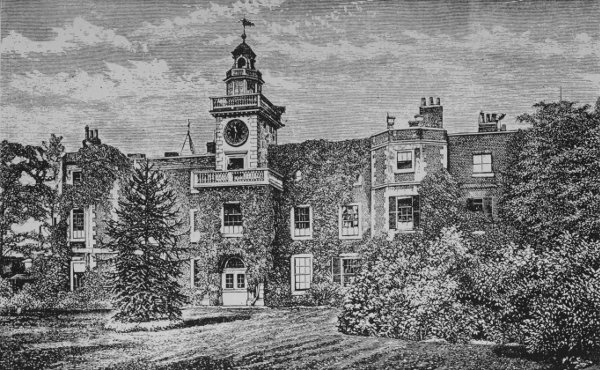
BRUCE CASTLE SCHOOL, TOTTENHAM.
By permission of Messrs. De La Rue.
An old Hazelwood pupil, Mr E. Edwards, in his
written sketch of “Sir Rowland Hill,” said of the
school that no similar establishment “in the world,
probably at that time, contained such an array of
costly models, instruments, apparatus, and books.
There was an observatory upon the top of the house
fitted with powerful astronomical instruments. The
best microscopes obtainable were at hand. Models
of steam and other engines were all over the place.
Air-pumps and electrical machines were familiar
objects. Maps, then comparatively rare, lined the
walls. Drawing and mathematical instruments were
provided in profusion. Etching was taught, and a
copper press was there for printing the pupils' efforts
in that way. A lithographic press and stones of
various sizes were provided, so that the young artists
might print copies of their drawings to send to their
admiring relatives. Finally, a complete printing press
with ample founts of type was set up to enable
the boys themselves to print a monthly magazine
connected with the school and its doings.” Other
attractions were a well fitted-up carpenter's shop;
a band, the musicians being the pupils; the training
of the boys in vocal music; a theatre in which the
manager, elocution teacher, scene painter, etc., were
the young Hill brothers, the costumière their sister
Caroline, and the actors the pupils; the control of
a sum of money for school purposes; and the use
of a metallic coinage received as payment for the
voluntary work already mentioned, and by which
certain privileges could be purchased.[6]
My grandfather inspired his sons and pupils with
a longing to acquire knowledge, at the same time so
completely winning their hearts by his good comradeship,
that they readily joined him in the long and
frequent walks of which he was fond, and in the course
of which his walking stick was wont to serve to make
rough drawings of problems, etc., in road or pathway.
“His mathematical explanations,” wrote another old
pupil in the “Essays of a Birmingham Manufacturer”
(W. L. Sargent), “were very clear; and he looked
at the bearings of every subject irrespective of its
conventionalities. His definition of a straight line
has been said to be the best in existence.”[7]
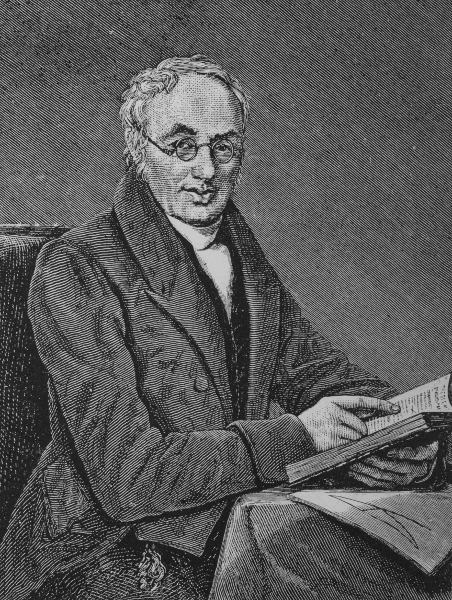
THOMAS WRIGHT HILL.
By permission of Messrs. Thos. De La Rue.
In my father's “Life,” Dr Birkbeck Hill, when
writing of his recollections of our grandfather, said
that it seemed “as if the aged man were always seated
in perpetual sunshine. How much of the brightness
and warmth must have come from his own cheerful
temperament?... His Sunday morning breakfasts
live in the memory like a landscape of Claude's.” At
these entertainments the old man would sit in his easy-chair,
at the head of the largest table the house could
boast, in a circle of small, adoring grandchildren, the
intervening, severe generation being absent; and of
all the joyous crowd his perhaps was the youngest
heart. There were other feasts, those of reason and
the flow of soul, with which he also delighted his
young descendants: stories of the long struggle in the
revolted “American Colonies,” of the Great French
Revolution, and of other interesting historical dramas
which he could well remember, and equally well
describe.
His old pupils would come long distances to see
him; and on one occasion several of them subscribed
to present him with a large telescope, bearing on it
a graven tribute of their affectionate regard. This
greatly prized gift was in use till within a short time
of his last illness.
Young Rowland had a strong bent towards art,
as he showed when, at the age of thirteen, he won the
prize, a handsome box of water-colour paints, offered
by the proprietor of the London School Magazine for
“the best original landscape drawing by the youth of
all England, under the age of sixteen.” He painted
the scenery for the school theatre, and made many
water-colour sketches in different parts of our island,
his style much resembling that of David Cox. He
was an admirer of Turner long before Ruskin “discovered”
that great painter; and, as his diary shows,
marvelled at the wondrous rendering of atmospheric
effects exhibited in his idol's pictures. Nearly all my
father's scenery and sketches perished in a fire which
partially burnt down Hazelwood School; and few are
now in existence. After the age of seventeen he
gave up painting, being far too busy to devote time
to art, but he remained a picture-lover to the end of
his days. Once during the long war with France he
had an adventure which might have proved serious.
He was sketching Dover Castle, when a soldier came
out of the fortress and told him to cease work. Not
liking the man's manner, the youthful artist went on
painting unconcernedly. Presently a file of soldiers,
headed by a corporal, appeared, and he was peremptorily
ordered to withdraw. Then the reason for the
interference was revealed: he was taken for a spy.
My father at once laid aside his brush; he had no
wish to be shot.
In 1835 Rowland Hill resigned to a younger
brother, Arthur,[8] the head-mastership of Bruce Castle
School, and accepted the post of secretary to the
Colonisation Commissioners for South Australia,
whose chairman was Colonel Torrens.[9] Another
commissioner was John Shaw Lefevre, later a famous
speaker of the House of Commons, who, as Lord
Eversley, lived to a patriarchal age. But the prime
mover in the scheme for colonising this portion of
the “Island Continent” was that public-spirited man,
Edward Gibbon Wakefield. William IV. took much
interest in the project, and stipulated that the chief
city should bear the name of his consort—Adelaide.
The Commissioners were capable men, and were
ably assisted by the South Australian Company,
which much about the same time was started mainly
through the exertions of Mr G. F. Angas. Among
the many excellent rules laid down by the Commissioners
was one which insisted on the making of
a regular and efficient survey both of the emigrant
ships and of the food they carried. As sailing vessels
were then the only transports, the voyage lasted
several months, and the comfort of the passengers
was of no small importance. “When,” said my father
in his diary, “defects and blemishes were brought to
light by the accuracy of the survey, and the stipulated
consequences enforced, an outcry arose as if the
connection between promise and performance were
an unheard-of and most unwarrantable innovation.
After a time, however, as our practice became recognised,
evasive attempts grew rare, the first expense
being found to be the least.” He often visited the
port of departure, and witnessed the shipping off of
the emigrants—always an interesting occasion, and
one which gave opportunities of personal supervision
of matters. Being once at Plymouth, my mother and
he boarded a vessel about to sail for the new colony.
Among the passengers was a bright young Devonian,
apparently an agriculturist; and my father, observing
him, said to my mother: “I feel sure that man will do
well.” The remark was overheard, but the Devonian
made no sign. He went to Australia poor, and
returned wealthy, bought an estate close to his birth-place
which was in the market, and there settled.
But before sailing hither, he bought at one of the
Adelaide banks the finest one of several gold nuggets
there displayed, and, armed with this, presented himself
at my father's house, placed his gift in my
mother's hand, and told how the casual remark
made forty years before had helped to spur him on
to success.
The story of Rowland Hill and a mysteriously
vanished rotatory printing press may be told
here.
In 1790 Mr William Nicholson devised a scheme
for applying to ordinary type printing the already
established process of printing calico by revolving
cylinders. The impressions were to be taken from
his press upon successive sheets of paper, as no means
of producing continuous rolls had as yet been invented;
but the machine worked far from satisfactorily, and
practically came to nothing. A quarter of a century
later Mr Edward Cowper applied Nicholson's idea to
stereotype plates bent to a cylindrical surface. But
till the advent of “Hill's machine” (described at the
Patent Office as “A.D. 1835, No. 6762”) all plans for
fixing movable types on a cylinder had failed. It is
therefore incontestable that the first practical scheme
of printing on a continuous roll of paper by revolving
cylinders was invented and set to work by Rowland
Hill in the year named. The machine was intended
mainly for the rapid printing of newspapers, but the
refusal of the Treasury to allow an arrangement by
which the Government stamp could be affixed by
an ingenious mechanical device as the scroll passed
through the press—a refusal withdrawn later—deferred
for many years the introduction of any rotatory
printing machine.
The apparatus was kept at my Uncle Matthew's
chambers in Chancery Lane, and was often shown to
members of the trade and others. Although driven
by hand only, it threw off impressions at the rate of
7,000 or 8,000 an hour, a much higher speed than
that hitherto attained by any other machine. But
from 1836 onwards my father's attention was almost
wholly taken up with his postal reform, and it was
only after his retirement from the Post Office in 1864
that his mind reverted to the subject of the printing
press. Several years before the latter date his brother
had left London; but of the rotatory printing machine,
bulky and ponderous as it was, a few small odds and
ends—afterwards exhibited at the Caxton Exhibition
in 1877—alone remained.
In 1866 the once well-known “Walter Press” was
first used in the Times office. Of this machine my
father has said that “except as regards the apparatus
for cutting and distributing the printed sheets, and
excepting further that the 'Walter Press' (entered
at the Patent Office as “A.D. 1866, No. 3222”) is
only adapted for printing from stereotype plates, while
mine would not only print from stereotype plates,
but, what is more difficult, from movable types also,
the two machines are almost identical. ” He added
that “the enormous difficulty of bringing a complex
machine into practical use—a difficulty familiar to
every inventor—has been most successfully overcome
by Messrs Calverley and Macdonald, the
patentees.”
By whom and through what agency the machine
patented in 1835 was apparently transported from
Chancery Lane to Printing House Square is a
mystery which at this distant date is hardly likely
to be made clear.
It has always been a tradition in our family that
the courtship between Rowland Hill and Caroline
Pearson began when their united ages amounted to
eleven years only, the boy being by twelve months the
elder. The families on both sides lived at the time
at Wolverhampton, and the first kiss is said to have
been exchanged inside a large culvert which crossed
beneath the Tettenhall Road in the neighbourhood
of the Hills' house, and served to conduct a tiny
rivulet, apt in wet weather to become a swollen
stream, into its chosen channel on the other side the
way. The boy delighted to creep within this shelter—often
dry in summer—and listen to the rumbling overhead
of the passing vehicles. Noisy, ponderous wains
some of these were, with wheels of great width and
strength, and other timbers in like proportion; but
to the small listener the noisier the more enjoyable.
These wains have long vanished from the roads they
helped to wear out, the railway goods trains having
superseded them, although of late years the heavy
traction engines, often drawing large trucks after them,
seem likely to occupy the place filled by their forgotten
predecessors. Little Rowland naturally wished to
share the enchanting treat with “Car,” as he generally
called his new friend, and hand in hand the “wee
things” set off one day to the Tettenhall Road.
Many years later the elderly husband made a sentimental
journey to the spot, and was amazed at the
culvert's apparent shrinkage in size. Surely, a most
prosaic spot for the beginning of a courtship!
The father of this little girl was Joseph Pearson,
a man held in such high esteem by his fellow-citizens
that after the passing of the great Reform
Bill in 1832 he was asked to become one of
Wolverhampton's first two members.[10] He was, however,
too old for the wear and tear of Parliamentary
life, though when the General Election came on he
threw himself with all his accustomed zeal into the
struggle, and was, as a consequence, presently laid
up with a temporary ailment, which caused one of
his political foes to declare that “If Mr Pearson's
gout would only last three weeks longer we might
get our man in.” These words coming to Mr
Pearson's ears, he rose from his sick-bed, gout or
no gout, and plunged afresh into the fray, with so
much energy that “we” did not “get our man in,”
but the other side did.
“He was,” once said a many years old friend,
“conspicuous for his breadth of mind, kindness of
heart, and public spirit.” He hated the cruel sports
common in his time, and sought unceasingly to put
them down. One day, while passing the local bull-ring,
he saw a crowd of rough miners and others
preparing to bait a bull. He at once strode into
their midst, liberated the animal, pulled up or broke
off the stake, and carried it away on his shoulder.
Was it his pluck, or his widespread popularity
that won the forbearance of the semi-savage by-standers?
At any rate, not a hostile finger was
laid upon him. Meanwhile, he remembered that if
brutalising pastimes are put down, it is but right that
better things should be set in their place. Thus the
local Mechanics' Institute, British Schools, Dispensary,
and other beneficent undertakings, including rational
sports for every class, owed their origin chiefly to
him; and, aided by his friend John Mander, and
by the Rev. John Carter, a poor, hard-working
Catholic priest, he founded the Wolverhampton Free
Library.
Joseph Pearson was one of the most hospitable
and genial of men, and, for his time, a person of
some culture. He detested cliques and coteries, those
paralysing products of small provincial towns, and
would have naught to do with them. Men of great
variety of views met round his dinner-table, and
whenever it seemed necessary he would preface the
repast with the request that theology and politics
should be avoided. With his Catholic neighbours—Staffordshire
was a stronghold of the “Old Religion”
—the
sturdy Nonconformist was on the happiest of
terms, and to listen to the conversation of the often
well-travelled, well-educated priests was to him a
never-failing pleasure. For Catholic Emancipation
he strove heartily and long. With all sects he was
friendly, but chiefly his heart went out to those who
in any way had suffered for their faith. One effect
of this then not too common breadth of view was
seen when, after his death, men of all denominations
followed him to his grave, and the handsomest of the
several journalistic tributes to his memory appeared
in the columns of his inveterate political and theological
opponent, the local Tory paper. A ward in
the Hospital and a street were called after the
whilom “king of Wolverhampton.”[11]
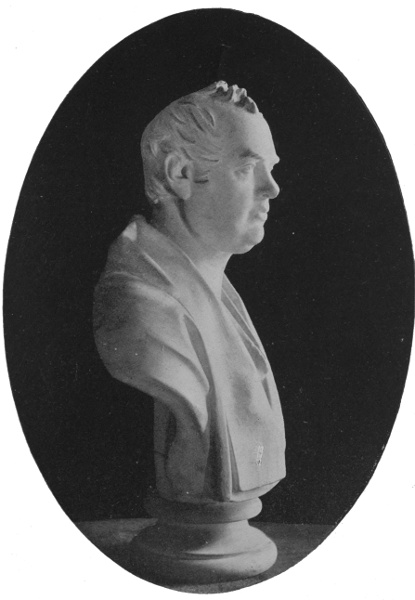
JOSEPH PEARSON.
From a Photograph by Messrs. Whiteley & Co.
The bust was the last work of Sir Francis Chantry.
He had three daughters, of whom my mother
was the eldest. His wife died young, and before
her sixteenth year Caroline became mistress of his
house, and thus acquired the ease of manner and
knowledge of social duties which made of her the
charming hostess who, in later years, presided over
her husband's London house. She will make a brief
reappearance in other pages of this work.
Joseph Pearson's youngest daughter, Clara, was a
beautiful girl, a frequent “toast” at social gatherings
in the three counties of Stafford, Warwick, and
Worcester—for toasts in honour of reigning belles
were still drunk at festivities in provincial Assembly
Rooms and elsewhere, what time the nineteenth
century was in its teens. When very young she
became engaged to her cousin, Lieutenant (afterwards
Captain) Alexander Pearson, R.N., who at
the time of Napoleon's sojourn at St Helena was
stationed there, being attached to the man-of-war
commanded by Admiral Plampin. One gift which
Lieutenant Pearson gave my aunt she kept to the end
of her life—a lock of Napoleon's hair. Lieutenant
Pearson often saw the ex-Emperor, and, many years
after, described him to us children—how, for instance,
he would stand, silent and with folded arms, gazing
long and fixedly seaward as though waiting for the
rescue which never came. The lieutenant was one
of the several young naval officers who worshipped
at the shrine of the somewhat hoydenish Miss
“Betsy” Balcombe, who comes into most stories of
St. Helena of that time. Wholly unabashed by
consideration of the illustrious captive's former
greatness, she made of him a playmate—perhaps a
willing one, for life must have been terribly dreary
to one whose occupation, like that of Othello, was
gone. Occasionally she shocked her hearers by
addressing the ex-Emperor as “Boney,” though it
is possible that the appellation so frequently heard
in the mouths of his British enemies had no osseous
association in his own ears, but was accepted as an
endearing diminutive. One day, in the presence of
several witnesses, our cousin being among them,
she possessed herself of a sword, flourished it playfully
before her, hemmed Napoleon into a corner,
and, holding the blade above his head, laughingly
exclaimed: “Maintenant j'ai vaincu le vanqueur du
monde!” But there was no answering laugh; the
superstitious Corsican turned pale, made some short,
unintelligible reply, left the room, and was depressed
and taciturn for the rest of the day. It was surmised
that he took the somewhat tactless jest for an omen
that a chief who had been beaten by a woman
would never again lead an army of men.
During Rowland Hill's prime, and until the final
breakdown of his health, our house was a favourite
haunt of the more intimate of his many clever friends.
Scientific, medical, legal, artistic, literary, and other
prominent men met, exchanged views, indulged in
deep talk, bandied repartee, and told good stories
at breakfast and dinner parties; the economists
mustering in force, and plainly testifying by their
bearing and conversation that, whatever ignorant
people may say of the science they never study, its
professors are often the very reverse of dismal. If
Dr Southwood Smith[12] and Mr (later Sir Edwin)
Chadwick's talk at times ran gruesomely on details
of “intramural interment,” the former, at least, had
much quaint humour, and was deservedly popular;
while Dr Neil Arnott, whose chief hobbies were
fabled to be those sadly prosaic things, stoves, water-beds,
and ventilation, but who was actually a distinguished
physician, natural philosopher, author, and
traveller, was even, when long past sixty, one of the
gayest and youngest of our guests: a mimic, but
never an ill-natured one, a spinner of amusing yarns,
and frankly idolised by the juvenile members of the
family whose minds he mercifully never attempted
to improve.
Charles Wentworth Dilke,[13] founder of the
Athenæum newspaper, a famous journalist and
influential man of letters, at whose house one met
every writer, to say nothing of other men and
women, worth knowing, was another charming old
man, to listen to whose talk was a liberal education.
Did we walk with him on Hampstead Heath,
where once he had a country house, he became an
animated guide-book guiltless of a dull page, telling
us of older times than our own, and of dead and
gone worthies who had been guests at “Wentworth
House.” On this much worn, initial-carven, wooden
seat used often to sit Keats listening to the nightingales,
and, maybe, thinking of Fanny Brawne. At
another spot the weakly-framed poet had soundly
thrashed a British rough who was beating his wife.
Across yonder footpath used to come from Highgate
“the archangel a little damaged,” as Charles Lamb
called Coleridge. At that road corner, in a previous
century, were wont to gather the visitors returning
from the Well Walk “pump-room,” chalybeate spring,
and promenade, till they were in sufficient force to be
safe from highwaymen or footpads who frequented
the then lonely road to London. In a yet earlier
century certain gallant Spanish gentlemen attached
to Philip and Mary's court, rescued some English
ladies from molestation by English ruffians; and
memorials of this episode live in the still traceable
circle of trees whose predecessors were planted by
the grateful ladies, and in the name of the once quaint
old hostelry hard by, and of the road known as the
Spaniards.
Another wanderer about Hampstead's hills and
dales was the great Thackeray, who was often
accompanied by some of the family of Mr Crowe,
a former editor of the Daily News, and father to
Eyre Crowe, R.A., and Sir Joseph Archer Crowe.
These wanderings seem to have suggested a few of
the names bestowed by Thackeray on the characters
in his novels, such as “Jack Belsize” and “Lord
Highgate,” while the title of “Marquess of Steyne”
is reminiscent of another Thackerayan haunt—“Dr”
Brighton. Hampstead still better knew Dickens,
who is mentioned later in these pages. The two
writers are often called rivals; yet novels and men
were wholly unlike. Each was a peerless genius in
his own line, and each adorned any company in
which he moved. Yet, while Dickens was the life
and soul of every circle, Thackeray—perhaps the
only male novelist who could draw a woman absolutely
true to life[14]—always struck us as rather silent and
self-absorbed, like one who is studying the people
around him with a view to their reproduction in
as yet unwritten pages. His six feet of height
and proportionate breadth, his wealth of grey hair,
and the spectacles he was said never to be seen
without, made of him a notable figure everywhere.
Yet, however outwardly awe-inspiring, he was the
kindliest of satirists, the truest of friends, and has
been fitly described as “the man who had the heart
of a woman.”[15] At the Athenæum Club he was often
seen writing by the hour together in some quiet
corner, evidently unconscious of his surroundings, at
times enjoying a voiceless laugh, or again, perhaps
when telling of Colonel Newcome's death, with “a
moisture upon his cheek which was not dew.”
Another literary friend—we had many—was
William Henry Wills, also mentioned later: a kind
friend to struggling authors, who did not a little to
start Miss Mulock on her career as authoress, and
who made her known to us. He once told us a
curious story about an old uncle with whom as a
lad he used to stay in the days before the invasion
of the west country by railways with their tendency
to modernisation of out-of-the-way places. This
ancient man lived in a large ancestral mansion, and
literally “dined in hall” with his entire household.
There was a sanded floor—formerly, no doubt, rush-strewn—and
the family and their “retainers” sat
down together at a very long table to the midday
repast, the servants taking their place literally “below
the salt,” which was represented by a large bowl filled
with that necessary concomitant. In how many other
country houses did this mediæval custom last into the
first third of the nineteenth century?[16] Mrs Wills—only
sister to the Chambers brothers, William and
Robert, who, together with our other publisher friend,
Charles Knight, did so much to cheapen the cost
and in every way to raise the tone of literature—was,
in addition to possessing great charm of manner,
an admirable amateur actress, and an unrivalled singer
of Scottish songs.
Hampstead, midway in the nineteenth century,
was still a picturesque little town, possessed of several
stately old houses—one known as Sir Harry Vane's—whose
gardens were in some cases entered through
tall, wide, iron gates of elaborate design which now
would be accounted priceless. It was still the resort of
artists, many of whom visited the pleasant house of
Edwin Wilkins Field, conspicuous among the public-spirited
men who rescued from the builder-fiend the
Heath, and made of it a London “lung” and a joy for
ever; himself a lawyer, the inspirer of the Limited
Liability Act, and an accomplished amateur water-colour
painter. His first wife was a niece of Rogers,
the banker-poet, famous for his breakfast parties
and table talk. At Mr Field's house we came first
to know Clarkson Stanfield, R.A., the famous sea-scape
painter, and his family, who were musical as well
as artistic, and gave delightful parties. It was said
that Stanfield was familiar with the build and rig of a
ship down to its minutest detail, because he and his
lifelong friend and fellow Royal Academician, David
Roberts, ran away from school together to sea at a
time when life on the ocean wave seemed to most
boys the ideal existence. To the last, Stanfield
looked like an old sea-dog, and was bluff, hearty
and genial. Hampstead still remembers him with
pride; and “Stanfield House,” wherein the first
really good local Free Library was sheltered, is so
called because for nearly twenty years it was his
dwelling.
At the Fields' house, among other celebrities,
artistic, literary and legal, we also met Turner;
and it was to “Squire's Mount,” and at a crowded
evening party there that a characteristic anecdote of
this eccentric, gifted painter belongs. The taciturn,
gloomy-looking guest had taken an early farewell of
host and hostess, and disappeared, only to return some
minutes later, wonderfully and fearfully apparelled,
and silently commence a search about the drawing-room.
Suddenly he seemed to recollect, approached
a sofa on which sat three handsomely-attired ladies,
whose indignant countenances were a sight for gods
and men when the abruptly-mannered artist called on
them to rise. He then half dived beneath the seat, drew
forth a dreadfully shabby umbrella of the “Gamp”
species, and, taking no more notice of the irate three
than if they had been so many chairs, withdrew—this
time for good. Turner had a hearty contempt
for the Claude worship, and was resolved to expose its
hollowness. He bequeathed to the nation two of his
finest oil paintings on condition that they were placed
in the Trafalgar Square Gallery beside two of Claude's
which already hung there, and to this day act as foils.
A custodian of the Gallery once told me that he was
present when Turner visited the room in which were
the two Claudes, took a foot-rule from his pocket
and measured their frames, doubtless in order that
his own should be of like dimensions.
Other artists whom we knew were Mulready,
Cooke—as famous for his splendid collection of old
Venetian glass as for his pictures—Creswick and
Elmore; but much as Rowland Hill loved art, the
men of science, such as Airy, the Astronomer Royal;
Smyth, the “Astronomical Admiral”; Wheatstone,
Lyell; Graham, the Master of the Mint; Sabine, the
Herschels, and others were to him the most congenial
company. After them were counted in his regard the
medical men, philosophers and economists, such as
Harley, Coulson, Fergusson, the Clarkes, Sir Henry
Thompson—the last to die of his old friends—and
Bentham, Robert Owen, James and John Stuart Mill—these
last four being among the earliest great
men he knew, and counting in some ways as his
mentors.
Of his literary friends no two held a higher place
in his esteem than Maria Edgeworth and Harriet
Martineau. Of the latter and of her able, untiring
help in promoting the cause of Penny Postage, mention
will appear later. The former, my father, and his
brother Arthur, as young men, visited at her Irish
home, making the pilgrimage thither which Scott and
many other literary adorers had made or were destined
to make, one of the most interesting being that of Mrs.
Richmond Ritchie, Thackeray's daughter, of which
she tells us in her editorial preface to a recent edition
of “Castle Rackrent.” The two brothers had looked
forward to meet a charming woman, but she exceeded
their expectations, and the visit remained in the
memory of both as a red-letter day.[17]
Among literary men, besides those already mentioned,
or to be named later, were Leigh Hunt, De
Quincey—who when under the influence of opium
did the strangest things, being one day discovered by
my father and a friend hiding in some East End slum
under the wholly erroneous impression that “enemies”
were seeking to molest him—Sir John Bowring, Dr
Roget, author of “The Thesaurus,” and the Kinglakes.
“Eothen,” as the writer of that once famous
book of travels and of “The Invasion of the Crimea,”
was habitually called by his friends, was a delightful
talker; and his brother, the doctor, was equally
gifted, if less fluent, while his sister was declared by
Thackeray to be the cleverest woman he ever met.
Dr Roget was a most cultivated man, with the
exquisite polish and stately bearing of that now wholly
extinct species, the gentlemen of the old school. He
was one of the many tourists from England who,
happening to be in France after the break-up of the
short-lived Peace of Amiens, were detained in that
country by Napoleon. Though a foreigner, Dr Roget
had lived so long in England, and, as his book
proves, knew our language so well, that he could
easily have passed for a native of these isles;
and thus readily fell a victim to the Corsican's
unjustifiable action. Happily for himself, Dr Roget
remembered that Napoleon had recently annexed
Geneva to France; and he therefore, as a Genevese,
protested against his detention on the ground that the
annexation had made of him a French subject. The
plea was allowed; he returned to England, and finally
settled here; but the friend who had accompanied
him on the tour, together with the many other
détenus, remained in France for several years.
Political friends were also numerous, some of
whom will be mentioned in later pages. Of others,
our most frequent visitors were the brilliant talker
Roebuck, once known as “Dog Tear 'Em” of the
House of Commons; the two Forsters, father and
son, who, in turn and for many years, represented
Berwick-upon-Tweed; J. B. Smith (Stockport); and
Benjamin Smith (Norwich), at whose house we met
some of the arctic explorers of the mid-nineteenth
century, congenial friends of a descendant of the
discoverer of Smith's Sound, and with whose clever
daughters, Madame Bodichon being the eldest, we of
the younger generation were intimate. At one time
we saw a good deal also of Sir Benjamin Hawes, who,
when appointed Under-Secretary to the Colonies in
Lord John Russell's Administration of 1846, said to
my parents: “Heaven help the Colonies, for I know
nothing at all about them!”—an ignorance shared by
many other people in those days of seldom distant
travel.
My father's legal friends included Denman, Wilde,
Mellor, Manning, Brougham, and others; and racy
was the talk when some of these gathered round “the
mahogany tree,” for the extremely small jokes which
to-day produce “roars of laughter” in Court were then
little in favour, or failed to reach the honour of
reproduction in print.
Quite as interesting as any of the other people we
mingled with were the foreign political exiles who
became honoured guests in many households; and
some of these terrible revolutionists were in reality the
mildest mannered and most estimable of men. Herr
Jansa, the great violinist, was paying a visit to this
country in 1849, and out of pure kindness of heart
volunteered to play at a concert at Willis's rooms got
up for the benefit of the many Hungarian refugees
recently landed here. For this “crime” the then
young Emperor Francis Joseph caused the old man
to be banished; though what was Austria's loss was
Britain's gain, as he spent some years among us
respected and beloved by all who knew him. We
met him oftenest at the house of Sir Joshua Walmsley,
where, as Miss Walmsley was an accomplished pianist,
very enjoyable musical parties were given. The
Hungarian refugees, several of whom were wonderful
musicians, were long with us; and some, like Dr
Zerffi, remained here altogether. The Italian exiles,
Mazzini, Rufini, Gallenga, Panizzi—afterwards Sir
Antonio, Principal Librarian at the British Museum,
and planner of the Reading Room there—and others
came to speak and write English better than many
English people. Poerio, Settembrini, and other
victims of King “Bomba”—whose sufferings inspired
Gladstone to write his famous “Two Letters”—were
not here long; Garibaldi was an infrequent bird of
passage, as was also Kossuth. Kinkel, the German
journalist, a man of fine presence, had been sentenced
to lifelong incarceration at Spandau after the Berlin
massacre—from which Dr Oswald and his sister with
difficulty escaped—but cleverly broke prison and took
refuge in England; Louis Blanc, historian and most
diminutive of men, made his home for some years
among us; and there were many more. Quite a
variety of languages was heard in the London drawing-rooms
of that time, conversation was anything but
commonplace; and what thrillingly interesting days
those were!
The story of my father's connection with the
London, Brighton, and South Coast Railway, and of
that portion of his life which followed his retirement
from the Post Office, will be alluded to later in
this work.
As it is well not to overburden the narrative with
notes, those of mere reference to volume and page
of Dr Hill's “Life” of my father are generally
omitted from the present story; though if verification
of statements made be required, the index to my
cousin's book should render the task easy, at least
as regards all matter taken from that “Life.”