Of my life at Lindean for the next three days I have no clear remembrance.
The weather was dry and languid, as often follows a spell of rain, and the
long hills which huddled around the house looked near and imminent. The
place was so still that if one shouted it seemed almost a profanation.
'Twas so Sabbath-like that I almost came to dislike it. Indeed, I doubt I
should have found it irksome had there not been a brawling stream in the
glen, which kept up a continuous dashing and chattering. It seemed the one
link between me and that far-away world in which not long agone I had been a
dweller.
The life, too, was as regular as in the king's court. Sharp at six I was
awakened, and ere seven we were assembled for breakfast. Then to prayers,
and then to the occupations of the day. The minister would be at his books
or down among his people on some errand of mercy. The church had been long
closed, for the Privy Council, seeing that Master Lambert was opposed to
them, had commanded him to be silent; and yet, mark you, so well was he
loved in the place that they durst set no successor in his stead. They
tried it once and a second time, but the unhappy man was so taken with fear
of the people that he shook the dust of Lindean off his feet, and departed
in search of a more hospitable dwelling. But the minister's mouth was shut,
save when covertly, and with the greatest peril to himself, he would preach
at a meeting of the hill-folk in the recesses of the surrounding uplands.
The library I found no bad one—I who in my day have been considered to
have something of a taste in books. To be sure there was much wearisome
stuff, the work of old divines, and huge commentaries on the Scriptures,
written in Latin and plentifully interspersed with Greek and Hebrew. But
there was good store of the Classics, both prose and poetry,— Horace, who
has ever been my favorite, and Homer, who, to my thinking, is the finest
of the ancients. Here, too, I found a Plato, and I swear I read more of
him in the manse than I have done since I went through him with M.
Clerselier, when we were students together in Paris.
The acquaintance which I had formed with Master Semple speedily ripened
into a fast friendship. I found it in my heart to like this great serious
man—a bumpkin if you will, but a man of courage and kindliness. We were
wont to take long walks, always in some lonely part of the country, and we
grew more intimate in our conversation than I should ever have dreamed of.
He would call me John, and this much I suffered him, to save my name from
the barbarity of his pronunciation; while in turn I fell to calling him
Henry, as if we had been born and bred together. I found that he loved to
hear of my own land and my past life, which, now that I think of it, must
have had no little interest to one dwelling in such solitudes. From him I
heard of his father, of his brief term at the College of Edinburgh, which
he left when the strife in the country grew high, and of his sorrow and
anger at the sufferings of those who withstood the mandate of the king.
Though I am of the true faith, I think it no shame that my sympathy was all
with these rebels, for had I not seen something of their misery myself? But
above all, he would speak of la belle Anne as one gentleman will tell
another of his love, when he found that I was a willing listener. I could
scarce have imagined such warmth of passion to exist in the man as he
showed at the very mention of her name.
"Oh!" he would cry out, "I would die for her; I would gang to the world's
end to pleasure her! I whiles think that I break the first commandment
every day of my life, for I canna keep her a moment out of my thoughts, and
I fear she's more to me than any earthly thing should be. I think of her at
nicht. I see her name in every page of the Book. I thought I was bad when I
was over at Clachlands, and had to ride five miles to see her; but now I'm
tenfold worse when I'm biding aside her. God grant it be not counted to me
for sin!"
"Amen to that," said I. 'Tis a fine thing to see the love of a maid; but I
hold 'tis a finer to witness the passion of a strong man.
Yet, withal, there was something sinister about the house and its folk
which to me was the fly in the ointment. They were kindness and charity
incarnate, but they were cold and gloomy to boot, lacking any grace or
sprightliness in their lives. I find it hard to write this, for their
goodness to me was beyond recompense; yet I must set it down, since in some
measure it has to do with my story. The old man would look at me at times
and sigh, nor did I think it otherwise than fitting, till I found from his
words that the sighs were on account of my own spiritual darkness. I have
no quarrel with any man for wishing to convert me, but to sigh at one's
approach seems a doleful way of setting about it. Then he would break out
from his wonted quietness at times to rail at his foes, calling down the
wrath of Heaven to blight them. Such a fit was always followed by a painful
exhaustion, which left him as weak as a child, and shivering like a leaf. I
bitterly cursed the state of a country which could ruin the peace of mind
of a man so sweet-tempered by nature, and make him the sport of needless
rage. 'Twas pitiful to see him creep off to his devotions after any such
outbreak, penitent and ashamed. Even to his daughter he was often cruelly
sharp, and would call her to account for the merest trifle.
As for Master Henry, what shall I say of him? I grew to love him like my
own brother, yet I no more understood him than the Sultan of Turkey. He had
strange fits of gloom, begotten, I must suppose, of the harsh country and
his many anxieties, in which he was more surly than a bear, speaking
little, and that mainly from the Scriptures. I have one case in my memory,
when, had I not been in a sense his guest, I had scarce refrained from
quarreling. 'Twas in the afternoon of the second day, when we returned
weary from one of our long wanderings. Anne tripped forth into the autumn
sunlight singing a catch, a simple glee of the village folk.
"Peace, Anne," says Master Henry savagely; "it little becomes you to be
singing in these days, unless it be a godly psalm. Keep your songs for
better times."
"What ails you?" I ventured to say. "You praised her this very morning for
singing the self-same verses."
"And peace, you," he says roughly, as he entered the house; "if the lass
hearkened to your accursed creed, I should have stronger words for her."
My breath was fairly taken from me at this incredible rudeness. I had my
hand on my sword, and had I been in my own land we should soon have settled
it. As it was, I shut my lips firmly and choked down my choler.
Yet I cannot leave with this ill word of the man. That very night he talked
with me so pleasingly, and with so friendly a purport, that I conceived he
must have been scarce himself when he so insulted me. Indeed, I discerned
two natures in the man—one, hard, saturnine, fanatically religious; the
other, genial and kindly, like that of any other gentleman of family. The
former I attributed to the accident of his fortune; the second I held to be
the truer, and in my thoughts of him still think of it as the only one.
But I must pass to the events which befell on the even of the third day,
and wrought so momentous a change in the life at Lindean. 'Twas just at the
lighting of the lamp, when Anne and the minister and myself sat talking in
the little sitting room, that Master Henry entered with a look of great
concern on his face, and beckoned the elder man out.
"Andrew Gibb is here," said he.
"And what may Andrew Gibb be wanting?" asked the old man, glancing up
sharply.
"He brings nae guid news, I fear, but he'll tell them to none but you; so
hasten out, sir, to the back, for he's come far, and he's ill at the
waiting."
The twain were gone for some time, and in their absence I could hear high
voices in the back end of the house, conversing as on some matter of deep
import. Anne fetched the lamp from the kitchen and trimmed it with
elaborate care, lighting it and setting it in its place. Then, at last, the
minister returned alone.
I was shocked at the sight of him as he re-entered the room. His face was
ashen pale and tightly drawn about the lips. He crept to a chair and leaned
his head on the table, speaking no word. Then he burst out of a sudden into
a storm of pleading.
"O Lord God," he cried, "thou hast aye been good to us, thou has kept us
weel, and bielded us frae the wolves who have sought to devour us. Oh,
dinna leave us now. It's no' for mysel' or Henry that I care. We're men,
and can warstle through ills; but oh, what am I to dae wi' the bit helpless
lassie? It's awfu' to have to gang oot among hills and bogs to bide, but
it's ten times waur when ye dinna ken what's gaun to come to your bairn.
Hear me, O Lord, and grant me my request. I've no' been a' that I micht
have been, but oh, if I ha'e tried to serve thee at a', dinna let this
danger overwhelm us!"
He had scarcely finished, and was still sitting with bowed head, when
Master Henry also entered the room. His eyes were filled with an austere
frenzy, such as I had learned to look for.
"Ay, sir," said he, "'tis a time for us a' to be on our knees. But ha'e
courage, and dinna let us spoil the guid cause by our weak mortal
complaining. Is't no' better to be hunkering in a moss-hole and communing
with the Lord than waxing fat like Jeshurun in carnal corruption? Call on
God's name, but no' wi' sighing, but wi' exaltation, for He hath bidden us
to a mighty heritage."
"Ye speak brave and true, Henry, and I'm wi' your every word. But tell me
what's to become o' my bairn? What will Anne dae? I once thought there was
something atween you——" He stopped abruptly and searched the face of the
young man.
At his words Master Semple had started as under a lash. "Oh, my God," he
cried, "I had forgotten! Anne, Anne, my dearie, we canna leave ye, and you
to be my wife. This is a sore trial of faith, sir, and I misdoubt I canna
stand it. To leave ye to the tender mercies o' a' the hell-hounds o'
dragoons—oh, I canna dae't!"
He clapped his hand to his forehead and walked about the room like a man
distraught.
And now I put in my word. "What ails you, Henry? Tell me, for I am sore
grieved to see you in such perplexity."
"Ails me?" he repeated. "Aye, I will tell ye what ails me"; and he drew his
chair before me. "Andrew Gibb's come ower frae the Ruthen wi' shure news
that a warrant's oot against us baith, for being at the preaching on
Callowa' Muir. 'Twas an enemy did it, and now the soldiers are coming at
ony moment to lay hands on us and take us off to Embro'. Then there'll be
but a short lease of life for us; and unless we take to the hills this very
nicht we may be ower late in the morning. I'm wae to tak' sae auld a man as
Master Lambert to wet mosses, but there's nothing else to be dune. But
what's to become o' Anne? Whae's to see to her, when the dragoons come
riding and cursing about the toon? Oh, it's a terrible time, John. Pray to
God, if ye never prayed before, to let it pass."
Mademoiselle had meantime spoken never a word, but had risen and gone to
her father's chair and put her arms around his neck. Her presence seemed
to cheer the old man, for he ceased mourning and looked up, while she sat,
still as a statue, with her grave, lovely face against his. But Master
Semple's grief was pitiful to witness. He rocked himself to and fro in his
chair, with his arms folded and a set, white face. Every now and then he
would break into a cry like a stricken animal. The elder man was the first
to counsel patience.
"Stop, Henry," says he; "it's ill-befitting Christian folk to set sic an
example. We've a' got our troubles, and if ours are heavier than some, it's
no' for us to complain. Think o' the many years o' grace we've had.
There's nae doubt the Lord will look after the bairn, for he's a guid
Shepherd for the feckless."
But now of a sudden a thought seemed to strike Henry, and he was on his
feet in a twinkling and by my side.
"John," he almost screamed in my ear, "John, I'm going to ask ye for the
greatest service that ever man asked. Ye'll no' say me nay?"
"Let me hear it," said I.
"Will you bide wi' the lass? You're a man o' birth, and I'll swear to it,
a man o' honor. I can trust you as I would trust my ain brither. Oh, man,
dinna deny me! It's the last hope I ha'e, for if ye refuse, we maun e'en
gang to the hills and leave the puir thing alane. Oh, ye canna say me nae!
Tell me that ye'll do my asking."
I was so thunderstruck at the request that I scarce could think for some
minutes. Consider, was it not a strange thing to be asked to stay alone in
a wild moorland house with another man's betrothed, for Heaven knew how
many weary days? My life and prospects were none so cheerful for me to
despise anything, nor so varied that I might pick and choose; but yet 'twas
dreary, if no worse, to look forward to any length of time in this desolate
place. I was grateful for the house as a shelter by the way, yet I hoped
to push on and get rid, as soon as might be, of this accursed land.
But was I not bound by all the ties of gratitude to grant my host's
request? They had found me fainting at their door, they had taken me in,
and treated me to their best; I was bound in common honor to do something
to requite their kindness. And let me add, though not often a man subject
to any feelings of compassion, whatever natural bent I had this way having
been spoiled in the wars, I nevertheless could not refrain from pitying the
distress of that strong man before me. I felt tenderly toward him, more so
than I had felt to anyone for many a day.
All these thoughts raced through my head in the short time while Master
Henry stood before me. The look in his eyes, the pained face of the old
man, and the sight of Anne, so fair and helpless, fixed my determination.
"I am bound to you in gratitude," said I, "and I would seek to repay you. I
will bide in the house, if so you will, and be the maid's protector. God
grant I may be faithful to my trust, and may he send a speedy end to your
exile?"
So 'twas all finished in a few minutes, and I was fairly embarked upon the
queerest enterprise of my life. For myself I sat dazed and meditative; as
for the minister and Master Semple, one-half of the burden seemed to be
lifted from their minds. I was amazed at the trusting natures of these men,
who had habited all their days with honest folk till they conceived all to
be as worthy as themselves. I felt, I will own, a certain shrinking from
the responsibility of the task; but the Rubicon had been crossed and there
was no retreat.
Of the rest of that night how shall I tell? There was such a bustling and
pother as I had never seen in any house since the day that my brother
Denis left Rohaine for the Dutch wars. There was a running and scurrying
about, a packing of food, a seeking of clothes, for the fugitives must be
off before the first light. Anne went about with a pale, tearful face; and
'twas a matter of no surprise, for to see a father, a man frail and fallen
in years, going out to the chill moorlands in the early autumn till no man
knew when, is a grievous thing for a young maid. Her lover was scarce in so
dire a case, for he was young and strong, and well used to the life of the
hills. For him there was hope; for the old man but a shadow. My heart grew
as bitter as gall at the thought of the villains who brought it about.
How shall I tell of the morning, when the faint light was flushing the
limits of the sky, and the first call of a heath-bird broke the silence!
'Twas sad to see these twain with their bundles (the younger carrying the
elder's share) creep through the heather toward the hills. They affected a
cheerful resolution, assumed to comfort Anne's fears and sorrow; but I
could mark beneath it a settled despair. The old man prayed at the
threshold, and clasped his daughter many times, kissing her and giving her
his blessing. The younger, shaken with great sobs, bade a still more
tender farewell, and then started off abruptly to hide his grief. Anne and
I, from the door, watched their figures disappear over the crest of the
ridge, and then went in, sober and full of angry counsels.
The soldiers came about an hour before mid-day—a band from Clachlands,
disorderly ruffians, commanded by a mealy-faced captain. They were a
scurrilous set, their faces bloated with debauchery and their clothes in no
very decent order. As one might have expected, they were mightily incensed
at finding their bird flown, and fell to cursing each other with great
good-will. They poked their low-bred faces into every nook in the house and
outbuildings; and when at length they had satisfied themselves that there
was no hope from that quarter, they had all the folk of the dwelling out on
the green and questioned them one by one. The two serving-lasses were
stanch, and stoutly denied all knowledge of their master's
whereabouts—which was indeed no more than the truth. One of the two, Jean
Crichope by name, when threatened with ill-treatment if she did not speak,
replied valiantly that she would twist the neck of the first scoundrelly
soldier who dared to lay finger on her. This I doubt not she could have
performed, for she was a very daughter of Anak.
As for Anne and myself, we answered according to our agreement. They were
very curious to know my errand there and my name and birth; and when I bade
them keep their scurvy tongues from defiling a gentleman's house, they were
none so well pleased. I am not a vain man, and I do not set down the thing
I am going to relate as at all redounding to my credit; I merely tell it as
an incident in my tale.
The captain at last grew angry. He saw that the law was powerless to touch
us, and that nought remained for him but to ride to the hills in pursuit of
the fugitives. This he seemed to look upon as a hardship, being a man to
all appearance more fond of the bottle and pasty than a hill gallop. At any
rate he grew wroth, and addressed to Anne a speech so full of gross
rudeness that I felt it my duty to interfere.
"Look you here, sir," said I, "I am here, in the first place, to see that
no scoundrel maltreats this lady. I would ask you, therefore, to be more
civil in your talk or to get down and meet me in fair fight. These
gentlemen," and I made a mocking bow to his company, "will, I am assured,
see an honest encounter."
The man flushed under his coarse skin. His reputation was at stake. There
was no other course open but to take up my challenge.
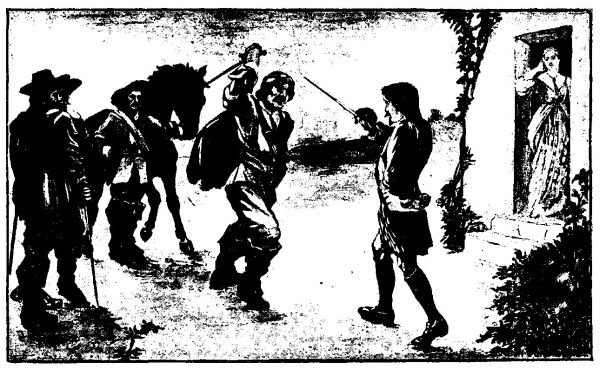
"You, you bastard Frenchman," he cried, "would you dare to insult a captain
of the king's dragoons? I' faith, I will teach you better manners;" and he
came at me with his sword in a great heat. The soldiers crowded round like
children to see a cock-fight.
In an instant we crossed swords and fell to; I with the sun in my eyes and
on the lower ground. The combat was not of long duration. In a trice I
found that he was a mere child in my hands, a barbarian who used his sword
like a quarter-staff, not even putting strength into his thrusts.
"Enough!" I cried; "this is mere fooling;" and with a movement which any
babe in arms might have checked, twirled his blade from his hands and sent
it spinning over the grass. "Follow your sword, and learn two things before
you come back—civility to maids and the rudiments of sword-play. Bah!
Begone with you!"
Some one of his men laughed, and I think they were secretly glad at their
tyrant's discomfiture. No more need be said. He picked up his weapon and
rode away, vowing vengeance upon me and swearing at every trooper behind
him. I cared not a straw for him, for despite his bravado I knew that the
fear of death was in his cowardly heart, and that we should be troubled no
more by his visitations.