3]
HEARKEN to me and ye shall
hear how the good King
Arthur and his knights
went forth to the wood
for archery, and how at
vesper-tide they gat them
homeward right joyfully.
The knights rode gaily
ahead, holding converse
the one with the other,
and behind them came the king, on a tall
and prancing steed. He ware no robe
of state, but a short coat, which became
him right well.
Behind all his men he rode, pensive and
frowning, as one lost in thought. And as
he thus lagged behind Sir Gawain looked
back, and saw the king riding alone and
pensive, and he bade his comrades draw
rein and wait for their lord. And as the
king came anigh he drew his steed beside
him, and stretched out his hand, laughing,
and laid hold on the bridle, and said, “Sire,
tell us, for the love of God, of what ye
may now be thinking? Sire, your
thoughts should be of naught but good, for
4]
there is no prince in this world equal to ye
in valour or in honour, therefore should ye
be very joyful!”
The king made answer courteously,
“Fair nephew, an I may be joyful I will
tell ye truly that whereon I thought.
There is no king living on earth who hath
had such good and such great service from
his men as I; it seemeth to me now right
and fitting that I should give to them that
which they have deserved for the toil they
have suffered for me, whereby I be come
to such high estate. Fair nephew, I
bethought me that my riches would avail
little if through sloth I failed to reward
the good service of these my knights, who
have made me everywhere to be obeyed
and honoured. Now without delay will I
tell ye that I am minded to hold, at
Pentecost, a far greater court than is my
wont, and to give to each and all such
gifts as shall be well pleasing to them, so
that each may be glad and joyful, and ever
hereafter of good will towards me.”
Swiftly, and before all the others, Sir
Gawain made answer, “Fair Sire, blessed
be the thought into which ye have fallen,
for ’tis so fair and so good that neither
5]
kaiser nor king nor count might think a
better.”
And the king asked, “Nephew, tell me
straightway where do ye counsel that this
my court be held?”
“Sire, at Carnarvon; there let all your
knighthood assemble, for there is not in all
your kingdom a fairer place, nor nobler
halls, and it lieth in the marches of Wales,
and of the land of Britain.”
The king and all his company rode
back joyfully, and that selfsame night did
the king Arthur give command that all
the knights and all the barons throughout
the land should be summoned by letter to
come to him at Pentecost.
That great knighthood came thither,
that famous knighthood came thither, even
so have I heard, and assembled for this
court at Carnarvon.
Ah God! from what far-off lands did
they come. Thither were come the men
of Ireland, and of Scotland, of Iceland, of
Wales, and of Galvoie (a land where
many a man goeth astray). From Logres
they came, and from Escavalon; men of
Norway, Bretons, Danes, and they of
Orcanie. Never was so great a knighthood
6]
assembled at any court as that which the
good king Arthur summoned to him.
The day of the Holy Feast, when he
had worn his crown at the high procession,
knights and barons conducted him with
joy to his palace; and therewith Kay, the
seneschal, bade them sound the trumpets
and bring water. First the king washed,
and thereafter sat down aloft, on the high
daïs, so that all who sat there at meat
might see him. Four hundred knights,
save three, sat themselves down at the
Round Table; at the second were seated
the thirty peers. Crowded were the ranks
of the other knights who were seated
throughout the hall, as was fitting, on daïs,
and at tables on the ground. Then quickly
Kay the seneschal bare the first meat, and
the service was made throughout the hall,
in joyful wise, as befitted such high festivity.
Now as the king ate, he looked towards
the Round Table, even as one who would
take knowledge of all, and by hap his eye
fell on the seat of a knight good and
true, which was void and lacking its
rightful lord. Then so great a pity and
tenderness took him that the tears rose
from his heart to his eyes, and thence
7]
welled forth, and he sighed a great and
piteous sigh when he remembered him of
that knight. He took a knife which
Yones held (nephew was he to king Ydier,
and carved before Arthur), and, frowning
and thoughtful, smote the blade through
the bread which lay on the board. Then
he rested his head on the one hand, even
as one whose thoughts are troubled by
anger or grief, and unheeding, ran the
palm of the other adown the sharp knife,
so that he was somewhat wounded. At
sight of the blood he bethought himself,
and left hold of the knife and taking the
napkin, wrapped it swiftly around his hand,
so that they who ate in the hall below
might not see. And with that he fell
once more into thought and bowed down
his head, and as he mused the tears came
again to his eyes.
When Sir Gawain beheld this he marvelled
much, and therein was he right, for
to all who were in the hall it seemed but
folly. Then he rose up straightway, and
passed between the ranks till that he came
before the daïs, and saw that the king was
again lost in thought. He hasted not to
speak till that he saw him raise his head, but
8]
so soon as he lifted up his face Sir Gawain
spake right courteously; “Sire, Sire, ’tis
neither right nor fitting that ye should have
such wrath or displeasure as should make
ye thus moody in the sight of so many high
and noble barons as ye may see here around
ye; rather should their solace and their
company please and rejoice ye.”
“Gawain, will ye that I tell ye whence
came the thought which has made me thus
sad and silent?”
“Yea, Sire, that do I pray of ye.”
“Fair nephew, know of a truth that I will
tell ye willingly, in the hearing of all these
good knights. My thoughts were of ye, and
of many another whom I see here, of the
wickedness of which ye are full, and of the
envy and the treason long time hid, and
now made manifest.” With that the king
held his peace, and said no more.
Sir Gawain grew crimson with anger
and shame, and throughout the palace all
held their peace, for much they marvelled
that the king spake thus evilly to his nephew,
calling him in the hearing of all a traitor
proven, and all were wroth therefor.
Then he to whom the ill words were said
answered as best he might, “Sire, that was
9]
an ugly word; for your honour bethink ye
of what ye have said in the hearing of all
who be here within.”
“Gawain,” answered the king, “’tis no
empty word, thus of a truth do I repeat it,
and Ywain may well take heed and know
that I thought of him but now, when I sat
silent and pensive, here within have I not
one single comrade whom I do not accuse
of treason and too great felony!”
With that I know not how many sprang
to their feet, and a great clamour filled the
hall. “Lords,” cried Tor fis Ares, “I conjure
ye by the oath which ye and I alike sware
to king Arthur that ye restrain yourselves,
and act as is befitting; he accuses ye all of
treason—these be right evil tidings!” In
like wise also spake Sir Ywain. “Ah God,”
quoth Sir Gawain, “with what joy was all
this great court summoned and assembled,
and in what grief shall it be broken up!”
The king heard, and, sighing, spake,
“Gawain, I have spoken but the truth!”
“Fair Sire, for the love of God, and for
honesty, tell us after what manner and in
what fashion we be felon and traitorous?”
Quoth the king, “An ye will I will tell
ye; now hearken. Ye know of a truth that
10]
aforetime there reigned in this land a folk
who built castles and cities, strong towers
and fortresses, and the great Chastel Orguellous
did they fortify against us. When
we heard tell thereof ye, my knights, delayed
not to go thither, not with my will! There
did I lose so many of my folk that the
thought thereof yet grieveth my heart; the
greater part were slain, but some among
them were made captive. They took one
of my companions, three years long have
they held him in prison, and thereof have
I great grief at heart. Here within do I
see no better knight; he was beyond measure
valiant, fair of face and form, and very
wise was he in counsel. But now, when
all this great lordship was set down here to
meat, I beheld that knight’s seat void and
lacking its lord, and for sorrow and grief
was my heart heavy and troubled when I
saw him not in his place in your ranks; it
lacked but little that I were distraught.
Therefore, my lords, do I arraign ye all of
treason; Giflet fis Do is he named that good
and gentle knight, three whole years have
gone by since he was imprisoned in that
tower, and ye be all traitors who have left
your comrade three years and have not
11]
sought for or freed him! Yea, and I who
have blamed ye, I be even more the traitor in
that I ever ware crown, or made joy, or held
high feast before I knew if he might be
restored to me, or where he now may be,
whether dead or living! Now on this have
I set my heart,—by the faith I owe to that
Heavenly Lord who hath bestowed on me
earthly honour, and kingdom, and lands,
that for no hap that may befall me will I
delay to set forth in search of him, be it in
never so distant a land. For verily I tell ye
all that the king who loseth so good a knight
by wrongful deed or by sloth, he hath right
neither to lands nor to honour, nor should
he live a day longer, an he deliver not that
knight who for his honour suffered toil and
was made captive. In the ears of ye all do
I make a vow that I will lie not more than
one night in any place till that I know
whether he be dead, or may be freed.”
Then all cried with one voice, “Shame
upon him, Sire, who will not plead guilty
to this treason, for ye speak with right and
reason; by overmuch sloth have we delayed
to ride forth and seek him far hence, even
at the Chastel Orguellous.”
“Lords,” quoth the king, “I tell ye
12]
here and at once that I shall set forth to-morrow,
but by the faith that I owe to
Saint Germain I must needs proceed with
wisdom, for here is force of no avail.”
“True, fair Sire,” answered Sir Gawain.
“Know for sooth that the roads ’twixt here
and the Chastel Orguellous be passing hard
and difficult; ’tis a good fifteen days ere ye
be come thither; longer days have ye never
ridden! ’Tis best that one tell ye the
truth! And when ye be come thither,
fair Sire, then shall ye have each day battle,
as I know right well, one knight against
the other, a hundred against a hundred,
that shall ye find truly. Now take good
counsel for the journey, what folk ye may
best take with ye.”
“Lords,” said the king, “now let us to
meat, and afterward will I see by aid of your
counsel whom I take with me, and whom
I leave to guard my land and my folk.”
With that all in the palace, great and
small, ate as quickly as might be; and so
soon as the king saw that ’twas time and
place to speak he bade remove the cloths,
which they did without delay. Thereafter
they brought water, and bare round the
wine in cups of fine gold. Then, it seemeth
13]
me, there sprang to their feet at once more
than three thousand knights, who cried the
king mercy, and prayed that he would take
them with him on this adventure, for right
willingly would they go.
“Lords,” quoth the king, “they whom
my barons elect, those will I take, and the
others shall remain to keep my kingdom in
peace.”
Then first, before all others, spake king
Urien, a very wise knight was he. “My
Lord king, ye have no need to take with
ye too great a force; take with ye rather a
few, but good, men, so to my thinking will
ye more swiftly free Giflet, our good comrade,
from his prison. Take with ye the
best of your knights, ’twill be for your
greater honour, and your foes will be the
more speedily vanquished; knight against
knight must ye fight there, and I think me
that such of their men shall there be worsted
that they shall that same day yield ye
Giflet the good and valiant knight. Have
no doubt for the when or how, but bid
them make ready. I can but praise the folk
who shall go with ye.”
Then quoth the king, “What say ye,
Lords? I await your counsel!”
14]
King Ydier spake. “Sire, none of us
should give ye praise, or speak other than
the best he knoweth. Shamed be he who
should give ye counsel wherein ye may find
no honour. I know full well that the
more part of your folk would gladly go
with ye, but if ye take them, Sire, ’twill
not be for your honour, but believe king
Urien, for he hath given good counsel so I
tell ye of a truth.”
“Certes,” saith Sir Gawain, “he would
be false and foolish who should give other
rede!” And all said, “Let it be as the
king will; let him take those whom he
please, and leave the others in the land.”
“Ye have said well,” said the king;
“now go ye to your lodging, and prepare
to depart, and I will cause to be made
ready a pennon of silk for each of those
whom I shall lead with me.” As he said,
so it was done, and all betook them to
their lodging.
The king forthwith sent the pennons,
and bade them without fail be armed and
ahorse at dawn.
What more shall I tell ye? At sunrise
were all the knights armed, even as the
king commanded, all they who had received
15]
the pennons came together ahorse before
the hall.
Now will I tell ye their names: there were
Sir Gawain, king Ydier, Guengasoains, Kay,
and Lucains, the butler. The sixth was
Tors. Then Saigremors, and Mabonagrain,
who was nephew unto king Urien. Eight
have I now named unto ye, counting the
kinsman of king Urien. The ninth was
Lancelot du Lac; the tenth Ider, son of
Nut; the Laid Hardi, the eleventh; with
Doon l’Aiglain have we twelve, all very
courteous knights. Galegantins the
Galois, and the brave Carados Briefbras,
who was a right cheery comrade, made
fourteen, and the fifteenth was the good
Taulas de Rogemont: so many were they,
nor more, nor less.
All ready armed were they before the
hall the while they awaited the king, ere
he came forth armed from his chamber.
Then he mounted his steed, and I tell ye
that, to my knowledge, was never king so
richly armed afore, nor ever hereafter shall
there be such. The queen bare him company
even to the entrance of the palace,
then she turned her back.
Then the king bade his companions
16]
march, and they began to move as swiftly
as might be on the highway, but so great
a folk convoyed them that hardly might
they depart or go forth from the burg.
And when the king had ridden three miles
he drew rein in the midst of a meadow,
and there he bade farewell to his folk, who,
sad and sorrowful, gat them back to the
burg. And the king and his fifteen comrades
rode on their way; they passed even through
the land of Britain, so I think me, and
hasted them much to ride quickly.
One day the king, fasting, came forth
from a very great forest, on to a heath of
broom; the sun was hot, and burning, and
the country over large and waste. The
king was so wearied by the heat, in that he
rode fasting, that he had much need of rest,
could he but find a fitting spot. By chance
they found a great tree, where they drew
bridle; beneath was a spring, and for heat
and for weariness they bared their heads
and their hands, and washed their faces and
their mouths. I know well that one and
all had much need of food, but they had
naught with them, and all were sore vexed
for the king, who suffered over much from
the fast.
17]
Sir Gawain gazed into the plain, far
below, ’neath the forest, and he showed
unto the seneschal a house of thatch, well
fenced about; “Kay,” quoth he, “methinks
under that roof there must be folk!”
“’Tis true,” said Kay; “I will go and see
if I may find victual, and ye shall await
me here.” With that he departed from
them, and went straightway to the house;
within he found an old woman, but nothing
of what he sought; food was there none.
The crone spake and said, “Sir, so God
help me, for twenty miles round about are
naught but waste lands, know that well,
save only that the king of Meliolant has
built there below ’neath the trees a forest
lodge. He cometh thither ofttimes privately
with his hounds. There, Sir, will
ye be well lodged, an ye find him; from
that tree yonder may ye see the house on
the hill.”
The seneschal straightway went even as
the crone had said, and he saw the dwelling,
right well enclosed with orchards, vineyards
and meadows. Ponds were there, lands,
and fish-tanks, all well fenced about. In
the midst was a tower; ye might ask
no better, no defence was lacking to it.
18]
Beholding it the seneschal stayed not, but
passed the roadway, and the gate, and the
chief drawbridge, and thus came to the foot
of the tower. There did he dismount, but
he found no living soul of whom he might
ask concerning the dwelling and who might
be within. Then he entered a hall, very
high and long and wide. On a great
hearth he saw a goodly fire alight, but he
found no man save a dwarf, who was
roasting a fat peacock (’twere hard to find
a better!), well larded, on a spit of apple-wood,
which the dwarf knew right well
how to turn.
Kay came forward quickly, and the
dwarf beheld him with evil countenance.
“Dwarf,” quoth the seneschal, “tell me
if there be any here within save thyself?”
But the wretch would not speak a word.
Kay would have slain him there and
then, if he had not thought to be shamed
thereby, but he knew right well that
twere too great villainy.
“Miserable hunchback,” quoth he, “I
see none here in this house save thee and
this peacock, which I will now have for
my dinner; I will share it as shall seem me
good.”
19]
“By the King Who lieth not,” quoth
the dwarf, “ye shall neither eat thereof
yourself nor share it with others; I
counsel you to quit this hostel, or know ye
well, and without doubt, that ye shall be
right shamefully thrust out!”
This vexed Kay mightily, and he
sprang forward to smite him; with his
foot he thrust him against the pillar of the
hearth so that the stone thereof became
bloody. The dwarf bled freely for the
heat, and made loud lament, for he feared
lest he should be slain.
Then on the left the seneschal heard a
door shut-to sharply, and there came forth
a knight, tall and strong, and of proud
countenance, and very fair and goodly to
look upon; he might not be above thirty
years old. He ware a vest of new samite,
furred with ermine for warmth; ’twas not
long, but wide, and of ample folds. Thus
was he well clad and cunningly shod;
and I tell ye truly that he ware a fair
girdle of golden links; no treasury hath a
richer. All uncovered he came forth, in
guise of a man greatly wroth, leading two
greyhounds by a fair leash of silk which
he held in his hand. When he saw that
20]
his dwarf bled, he spake, “Ye who be
come all armed into this hall, wherefore
have ye slain this my servant?”
“A curse upon such a servant,” quoth
Kay, “from this day on, for in all the world
is there not one so evil, so small, or so misshapen!”
Then the knight answered, “By all the
saints, but ye say ill, and I challenge ye for
it, fair sir.”
Quoth the seneschal, “Many a goodly
knight have I seen, to the full as noble as ye
may be, and ye be evil and vexatious, even
if I have smitten this servant who roasted
here this peacock, to speak thus concerning
the matter.”
The knight answered frankly, “Sir, ye
speak not courteously, but for God’s sake
I would ask ye a mere nothing, even that
ye vouchsafe to tell me your name.”
Kay spake in great wrath, “I will tell ye
willingly, so help me God I have told it ere
this to five hundred knights better than ye
be; know of a truth that my name is Kay.”
“Certes, sir, I may well believe that ye
speak truly; by your speech alone may one
quickly know ye. This lad refused ye the
peacock; ’tis not the custom of my house
21]
that meat be refused to any who may ask
for it; ye shall have your share of the peacock,
and that right swiftly, so God help
me!” With that he seized the spit, and
raised it aloft, and with great strength and
force smote Sir Kay therewith, so that he
well nigh slew him, and know that he
smote him on the neck so that he must
needs fall, he had no foot so firm that it
might keep him upright. And as the
peacock burst asunder, the hot blood thereof
ran between the links of his hauberk in
such wise that Sir Kay bare the mark
thereof all the days of his life. Then the
knight threw the peacock to his two
hounds, and spake, “Sir Kay, rise, that be
your share, ye shall have no more; now get
out of my sight quickly, I am over wroth
when I behold ye!”
With that came quickly two sergeants,
fully armed, and led the seneschal forth
from the hall. He mounted his steed, and
turned him back, passing the bridge and
the plain, and came to where the king had
dismounted.
Then his comrades asked him, “Seneschal,
have ye found nothing of that which
ye went to seek?”
22]
“Not I, my lords; ’tis a right evil land
here wherein to seek for food; it behoveth
us to ride far, for here may we find nor
hostelry, nor victual—so hath it been told
to me.”
Quoth Sir Gawain, laughing, “Certes,
he with whom ye spake lives by meat,
even as we; without meat might he
not dwell in this great and well wooded
land.”
“By my faith, no,” answered Kay, “but
I tell ye truly, ’tis so proud a vassal that
for naught that we may say will he give us
shelter.”
The king said, “Then is he right discourteous,
and I counsel that we send
Gawain to him. Fair nephew, go, and we
will wait ye here.”
Sir Gawain mounted forthwith. What
more shall I tell ye save that he came
straight to the dwelling, and when the
knight saw him he made marvellous joy of
him, and asked his name, and he answered
that men called him Gawain, and straightway
the knight knew him.
Then he told him his errand, saying,
“The king is not far distant, and would
fain lodge with ye.” This was well
23]
pleasing to the knight, and he said, “Fair
Sir, go, bring the king hither.”
Then Sir Gawain rode swiftly back, and
brought Arthur with him to the hostel; but
ere they might enter all the waters were
set free and the fountains ’gan to play.
For joy and in honour of the king the
knight had assembled all his folk, and
received him with very great honour, and
led him into the tower. The hounds were
yet there, devouring the flesh of the peacock.
The king looked at Taulas, and quoth,
“Body of Saint Thomas, these two hounds
have fared better than we to-day!” The
knight heard, and laughed to himself.
Kay saw that, but said naught.
From thence they passed into the hall,
and when they had disarmed the meat was
made ready, the knight bade bring white
napkins, and pasties. After dinner he
made them wash their heads, and their
necks, and their feet, which were sorely
bruised. Then he caused them to rest in
fair beds, covered with cloth of samite, and
they slept even to the morrow without
stirring. But when they were awakened
the host had prepared for them a right
plenteous meal, this he did of his good will.
24]
They sat them down joyfully, and were
richly served. I would weary ye if I told
all the dishes. The knights made much
mirth of the seneschal’s burn, for the
dwarf would not keep the tale secret from
them, but began to speak thereof. Never
would it have been known through Kay,
if the dwarf had not brought it to mind,
for he was over bent on hiding it, and the
host even more than he; all that night his
comrades mocked and made sport of him
even till they betook them to rest.
Next morn, without delay, the king arose
at daybreak, and likewise did all the
others, and armed themselves. Then the
king thanked his host for the good lodging
he had given them.
Why should I make long telling thereof?
The king saith, “Hide not from me how
ye be called.”
“Sire, my name is Ydier the fair, and,
Sire, this castle is mine own.”
Then Ydier prayed the king that of his
kindness he would take him with him, but
Arthur said he might not lead with him
other save those whom he had brought from
his own land; and he took leave of the
knight since he might no longer abide in his
25]
hostelry, and went forth with his companions.
The tale is here over long, but I will
shorten it for ye. Two days did they ride
without food, for they might not sooner
find place where they might win food or
seek lodging. Thus must they needs ride
till they came to the Orchard of the
Sepulchres, where adventures be found oft
and perilous. There they ate with the
hermits, of whom there were a hundred and
more. Here ’tis not fitting to tell of the
marvels of the cemetery, so diverse they be,
and so great that there is no man living on
earth who could think, or believe, that the
tale be true. Since ’twas made and established
never has the tale been told whence
came those graves, nor the custom which
the hermits observed; to my mind ’twould
take too long did I tell it ye ere the fitting
time and place be come. But this will I
tell ye of a truth, when the king had sojourned
two days, and beheld the Orchard,
on the third, after meat, he departed, and
took the road once more.
On the morrow he came to a wondrous
fair land; small need to seek a richer in
meadows, forests, or orchards planted with
26]
rare and diverse trees. In the forest ways
the grass grew green and tall, reaching even
to the horses’ girths. Towards even-tide
they came to a trodden way, where the tall
grass was beaten to earth, and trampled
down by horses, even for the length of a
bowshot. “A hundred and more have
passed this way,” quoth the king’s men.
Sir Gawain spake to the king, “Fair
Sire, follow me gently with these my comrades
on this wide road. I will ride on
ahead, and seek out, and ask whether there
be near at hand hostel where we may lodge
this night, for of lodging have we great
need. Yet, Sire, I pray that ye leave not
the road for word of any.”
With that he set spurs to his steed, and
rode swiftly on his way; nor had he ridden
long ere he was free of the forest, and saw
before him a hill, and a company of well-nigh
a hundred horsemen, who rode in
knightly guise; ’twas on their track he followed.
Sir Gawain pressed on his steed, but
when he had crossed the valley and
mounted the hill there was never a man in
sight. But he saw before him a castle;
none so fair had he beheld afore, which
27]
stood on the bank of a broad river; ’twould
take me over long to tell the fashion thereof,
but this and no more will I say, ’twas
the fairest ever seen.
Then Sir Gawain looked toward the
river, and beheld two maidens, in very fair
vesture of purple, bearing pitchers of fine
gold, wherein they had drawn water, and
he quoth, “Maidens, God save ye, and
give ye good speed!” and they answered,
as was fitting, “Fair sir, God bless ye!”
“Maidens, by the faith ye owe me answer
me, and hide it not, what bear ye in those
pitchers?”
Quoth the one, “No need have we to
hide aught; ’tis but water, wherewith the
good knight shall wash his hands.”
“Of a faith,” quoth Sir Gawain, “courteously
have ye named him; great honour
is there in such a name!”
The second maiden answered, “Sir,
she hath spoken truth; ye will not lightly
find a fairer, or a better, knight. See, but
now doth he enter within his burg.”
Then Sir Gawain hasted, and spake no
more with the maidens, but rode over the
bridge, and entered the castle by the gateway.
Since the hour of his birth never
28]
had he seen one so fair, nor, I think me, so
long as he live shall he see a fairer. All
the way by which he passed was hung with
curtains richly wrought, whereat he marvelled
strangely. ’Twas closed all along
with fair buildings of diverse fashions. In
long rows adown the street Sir Gawain
beheld rich booths of changers, wherein on
many-coloured carpets were set forth vessels
of gold and silver (no treasury ever held
richer), cups, tankards, and dishes, the
fairest ever seen, with money of all lands:
esterlins, besants, deniers of Africa, and
treasure trove. Every kind of money was
there, and much the good knight marvelled
thereat.
Stuffs there were too, of all colours, the
cost whereof was past his telling. All the
doors stood open; but one thing troubled
Sir Gawain sore: there was never a living
soul to be seen.
Then he said within himself, “Of a
sooth, for love and kindness do they bear
their lord, who but now hath entered the
burg, company to the little castle yonder.”
Thus he went his way straight to that castle,
and came within a goodly hall, both high
and wide, and in length equal to a bowshot.
29]
On every daïs a linen cloth was spread, and
sure never king nor count might eat off
fairer or better wrought. All was made
ready for meat, and the bread and wine set
in readiness on the tables; but never a living
soul was there. In a side chamber he
beheld on grails of silver more than a hundred
boars’ heads, with pepper beside them,
dressed for the serving. Sir Gawain beheld,
and crossed himself with lifted hand, but
would no longer abide, finding no man
with whom he might have speech.
He turned him again through the castle,
thinking to find at the bridgehead the
maidens of whom I told but now, whom
he had left bearing the water in golden
pitchers, but nowhere might he find them,
and it vexed him sore that he saw them
not, since he thought within himself that
they would surely have told him the truth
concerning their lord, whom he had seen
but now enter the burg.
Much he mused thereon, repenting him
that he had not longer spoken with them,
but now would he make no more abiding,
but set him speedily on his way, to meet
the king. Nor did he draw bridle till he
came unto him.
30]
“Fair nephew,” quoth Arthur, “shall
we to-day find hostel where we may take
rest, for we have sore need thereof?”
“Fair Sire, be at rest; food shall ye have
now,” answered Sir Gawain.
“’Tis a good word,” quoth Kay; “right
gladly will I serve the first course unto the
king, and to my comrades after!”
“Kay,” saith Sir Gawain “not for all
the world might ye guess the marvels I have
found!” Then he told unto them the
adventure, even as it had fallen out, the
while he guided them to the burg. As
they rode adown the street the king
marvelled greatly at the riches he beheld,
and Kay spake a courteous word,
“Castle, he who hence might bear ye
Would do ill an he should spare ye!”
Thus came they all into the inner burg,
and, still ahorse, into the great hall, but they
found no man to whom they might speak,
or to whose care they might give their
steeds. Then they said to each other,
“’Twere ill to let them fast,” and the king
spake, “I counsel that after supper we go
forth into yonder fair meadow.”
This they held for good rede, and
31]
dismounted, making fast their steeds to the
stag’s antlers on the wall. Then they
washed their faces and their hands in a bowl
of silver, and the king sat himself down
first, and his knights after.
With no delay Kay set the first course
before the king; ’twas a great boar’s head,
and he bare it joyfully, and thereafter swiftly
served the rest, saying an any found cause
for plaint, there was no lack, he could have
at his will. “The food hath cost me
naught and I give it freely; nay, of a verity
we might, an we were so minded, feed our
steeds on boars’ heads; this is no niggard
hostelry! See ye the fair couches in yonder
chamber?” And he pointed to an open
doorway.
Sir Gawain looked, and saw a shield
hanging on the wall, and within the shield
yet stood the fragment of a mighty lance,
with a silken pennon hanging from it. I
tell ye of a truth, so soon as he was ware
thereof the blood stirred in his veins; he
spake no word, but swiftly as might be he
sprang up from meat, casting aside the
knife he held, and gat him to his steed, and
girthed him tightly, and set his helmet on
his head, and sat him down again on a
32]
bench near by the daïs, his shield beside
him.
The king marvelled greatly, and the
knights said the one to the other, “Ha, God,
what aileth Sir Gawain?” Each would
fain know wherefore he had armed himself
thus swiftly; they thought of a surety his
head had grown light through over much
fasting and the great heat of the day.
They were sore dismayed thereat, for they
had seen and heard naught that might give
occasion for arming, and they might not
guess the cause.
The king spake simply, “Fair nephew,
say, wherefore have ye ceased to eat? And
wherefore thus arm in haste? Ye make
us much to marvel; tell me, I pray, doth
aught ail ye?”
“Naught, Sire, save that I pray ye to eat
quickly, an ye love me!”
“How,” quoth Arthur, “without ye, who
have fasted even as we? Methinks that
were ill done!”
“By God and Saint Thomas, to eat here
will profit me naught; ye are wrong, Sire!”
Thus answered Sir Gawain, swearing that
for naught in the world would he eat in
this hostelry, neither might he be joyful or
33]
at ease so long as they abode therein. “But
I pray ye, Sire, hasten and eat.”
Then the king in the hearing of all
sware straitly by Him who lieth not, that
he would eat naught till that he knew
wherefore his nephew had thus donned his
helmet.
“Sire,” quoth Sir Gawain, “ill and
falsely should I have wrought if for the
telling of so slight a matter I should make
ye fast this day; certes I will tell ye, and
lie not. Ye know well how five years
agone ye led an army great and strong
against the city of Branlant; many a king,
many a baron, with twenty thousand men
all told, with ye laid siege to the city.
Within were many of great valour to aid the
lord who held the seignorie of that land.
One morn, at break of day, they made a
sortie on our host; the cry and clamour
were so great that I took no leisure to arm
me, but mounted my steed and rode forth,
even as I was, to learn the cause of the
tumult, bearing with me but shield and
lance. Thus I rode forth from the camp,
and came straightway on the men of the
city, who were hasting to return with their
spoil. I followed them, wherein I did
34]
foolishly, since I came near to lose my life
thereby, for I was wounded by a spear in
the shoulder, as ye know, so that I was like
to die, and must needs lie sick four months
and more ere that I was whole and sound.
“One morning, as I lay in my tent, I
bade them raise the hangings around that I
might look on the land, and I beheld one
of my squires, mounted on the Gringalet,
making his way from the stream where he
had watered the steed. I called him, and
he came to me, and I bade him without
delay saddle the good horse, and he did my
bidding. I clad me swiftly the while, and
bade them bring me my armour secretly,
and when I had armed me I mounted, and
rode alone out of the camp. Fair Sire, ye
followed me, ere I came beyond the tents,
praying me straitly to return, but I entreated
ye gently that since I had lain overlong
sick ye would grant me to go forth into
the fields to disport myself, and to test if I
were in very truth healed of my wound,
promising to return speedily to camp. By
this covenant, Sire, ye granted me to ride
forth.
“Thus I went my way till I came to a
leafy grove, beset with flowers, and abounding
35]
in birds, which sang loud and clear. I
stayed my steed to hearken, and for the
sweetness of the song my heart grew light,
and I felt nor pain nor ill. Then I set spurs
to my steed, and galloped adown the glade.
I found myself hale and strong, and feared
no longer for my wound.
“Thus I hearkened to the sweet song of
the birds till that I forgat myself, and passed
a second grove, and a third, and a fourth,
ere that I bethought me of returning. Thus
I rode till I came to a clearing fair and wide,
where I saw beside a fountain a pavilion,
richly fashioned. I rode even to the doorway,
and looked within, and there on a
couch I beheld so wondrous fair a maiden
that I was abashed for her great beauty.
Sire, I dismounted, and fastened my steed
without the tent and entered and saluted
the maiden; but, Sire, first she greeted Sir
Gawain ere that she made answer to me.
“Then I asked her wherefore she did thus,
and she answered that she held Sir Gawain
in honour above all knights, and therefore
she first gave him greeting. And when I
heard this I spake saying that I was indeed
Sir Gawain, and her most true knight, but
scarce would the maiden believe me. I
36]
must needs unhelm, and from an inner
chamber she brought forth a silken ribbon,
whereon a Saracen maiden of the queen’s
household had wrought my semblance.
And when she had looked thereon, and
beheld me disarmed, and knew of a verity
that I was he whom she desired, then she
threw her arms around me, and kissed me
more than a hundred times, saying that she
was mine even as long as she might live.
“Then I took that fair gift right joyfully,
and we spake together long, and had our
will the one of the other. And this I tell
ye that ere we parted I sware to her that
other love would I never have. Then when I
had armed me again, and mounted my steed,
I took leave of the maid right lovingly, and
turned me again for the camp, joyful of
this my fair adventure.
“Thus I rode swiftly through one grove,
but had gone scarce a bowshot beyond
when a knight came fast behind me,
marvellous well armed, and bearing a
lance with a fair pennon. He cried loudly
upon me, ‘Traitor, ye may go no further;
ye must pay dearly for my brother, whom
ye slew, and for this my daughter, whom
ye have now dishonoured.’ Then I
37]
answered him, ‘Sir Knight, ye might
speak more courteously, for I have done ye
neither shame nor evil; an I had, I were
ready to give ye what amends might seem
good to ye and to my lady; treason have I
not done.’
“With that I set spurs to my steed, and
he likewise, and we came fast the one
against the other, and his lance was
shivered on my shield, but my blade
pierced him through shield and hauberk,
so that he fell to the ground sore wounded.
Sire, I pray ye eat, for an I tell ye more it
may turn to evil.” And the king quoth,
“Nephew, say on speedily, and delay not.”
Then spake Sir Gawain, “Sire, I left
the knight lying, and went my way, but
ere I had gone far I heard one cry upon
me, ‘Traitor, stay; ye must pay for my
uncle and this my father, whom ye have
wrongfully slain, and for my sister, whom
ye have dishonoured!’ Then I stayed
my steed, and prayed him to speak more
courteously, for that I was ready to make
amends an I had done wrong, but that I
was no traitor.
“Then we set ourselves to joust, and I
tell ye, Sire, we came so hard together that
38]
we were borne both of us to the earth.
Then we betook us to our swords, and
dealt many a blow the one to the other;
but in the end, in that I was scarce healed
of my wound, he dealt me more harm
than I might deal him; in this I lie not, I
was well-nigh worn down, and put to the
worse. Then I bethought me, Sire, and
prayed him to tell me his name since I
was fain to know it; and he told me he
was Bran de Lis. Ider de Lis, the good
and valiant, was his father, and Melians de
Lis his uncle, and he said did I get the
better of him, then had I slain the three
best knights in any land, yet he deemed
well, an God would help him, that he
might even avenge the twain; for he quoth,
‘I know well that a combat betwixt us
may not endure over long, but that one of
us must needs be slain.’ And I answered,
‘Sir, let us do otherwise, for an ye put me
to the worse but few will believe the tale,
for in this land it were not lightly held
that any man may vanquish me. Methinks
’twere better that our combat be fought in
the sight of many, who shall bear true
witness as to the which of us comes off
the better.’ Thus, Sire, we made
39]
covenant together by token that in what
place soever he should find me, whether
armed or unarmed, there we should fight.
This we sware, the one to the other. By
the love I bear ye, Sire, never since that
day have I heard aught of him in any land
where I might be. Thus was our combat
ended, as I tell ye, and of a truth I saw
him no more.
“But even now, Sire, as I sat at meat,
from which I arose in wrath and misease
(willingly would I have eaten an I might),
this is what chanced: I saw in yonder
chamber the selfsame shield which Bran
de Lis bare the day we did combat together;
full well I remember it, and there it
hangeth on the wall. Fair lord king, an
God help me ’tis no lie; there in the
shield standeth fast my pennon, and a
great splinter of my lance; by that token,
Sire, Bran de Lis doth haunt this country,
since his shield be here. Therefore am I
vexed and wrathful, and therefore I arose
from meat, since I feared to be taken at a
loss; in sooth, I somewhat fear him, for so
good a knight I never saw! Sire, now
have I told ye the truth, and wherefore I
have donned my helmet, ye need press me
40]
no further, since not for the kingdom of
Logres would I be found unarmed in such
place as he may be. Fair Sire, I pray ye
hasten, otherwise, an there be long abiding,
I may chance to pay over dear for my meat.”
Quoth the king, “Fair nephew, sit ye
down again, nor have fear of any foe. He
cometh not.”
But Sir Gawain answered, “Sire, for
naught that ye may say will I eat in this
hostel!”
“So be it,” quoth the king, “an ye
will do naught for my prayer.” With
that all the others betook them to meat in
good fellowship.
After no long time they beheld a little
brachet, which ran out from a side
chamber and came into the hall. A long
leash trailed behind it, and round its neck
was a collar of gold, wherein were many
precious stones, red, and green as ivy leaves.
The brachet was white as snow, and
smoother than any ermine. I tell ye of a
truth ’twas not ugly, but very fair and
well shapen, and the king gazed long at it.
It barked loudly at the knights on the daïs,
and made small joy of them, I tell ye.
Then Kay the seneschal coveted it, and
41]
spake to the king, “Sire, I will keep this
brachet, and take it hence, an ye grant me
this gift; ’twill be a comrade for Huden.”
And the king said, “Take it, seneschal,
and bear it hence.”
With that the brachet turned tail, and
Kay with no delay sprang up and thought
to seize it, but the dog would not await
him, but fled on through a chamber
wrought in marble, and the leash which
was long fell about the feet of Kay, who
would fain have caught it but might not
come at it. Might he set foot on the
leash he could have held it, but he failed to
catch it.
Thus the chase went from chamber to
chamber till five were passed, and the
seneschal came into a fair garden set with
olive trees and pines, wherein were more
folk than in a city. They were playing
at diverse games, and making such joy and
festivity as ’twere overlong to recount, for
that day they were keeping the feast of a
saint of that land.
Beneath the shade of a laurel in the
midst of an orchard a knight was disarming;
tall he was and strong, valiant and proud,
and to serve him and honour him the best
42]
and most renowned of the folk stood and
knelt around waiting on his disarming.
The brachet which Kay was chasing stayed
not till it came to the knight, and took shelter
betwixt his legs, barking loudly at the
pursuer.
Kay stayed his steps, abashed at the
sight and sound of this folk, and thought
to return swiftly, and with no delay; but
the knight looked on his people and said,
“There is a stranger among us, whoever
he may be!” Then beholding Kay, who
would turn him again whence he came, he
spake, “See him there, take him, and bring
him hither!”
This they did swiftly, and brought Kay
before him, and when the knight beheld
him he said joyfully, “Sir Kay, ye are
right welcome as my friend and comrade;
where is the king, your master?”
“Sir, he is within, on the daïs, and with
him many a valiant knight; they are even
now at meat!”
“And is the king’s nephew, Gawain,
there? Fain would I be assured thereof.”
And Kay answered, “The best knight in
the world is in the king’s company; without
him would he go nowhither!”
43]
Now when the knight heard this he was
like to fly for joy. Half armed as he was he
sprang to his feet, and for very gladness
stayed not to finish his disarming. A rich
mantle had they hung on his shoulders,
but the neck was yet unfastened, nor
would he tarry to clasp it, for haste and
joy. And know that one leg was still
shod with iron, which hung downward,
half unlaced, nor would he stay to rid
himself thereof. Thus he sped in all haste
to the hall, and his folk after him, and
without slacking speed he ran into the hall,
followed by so great a crowd that the king
was sore abashed when he heard the
tumult.
The knight went forward even to the
daïs, and saluted the king courteously, and
commanded the folk to bring torches, for
’twas scarce light therein, and they did at
his pleasures, and he bade bring other
meats, so that Arthur, the valiant and
courteous, was well served as befitting a
king.
The knight was very joyous, and quoth,
“Sire, now hath God done me great
honour, for never before might I do ye
service; now am I right glad and joyful
44]
that ye be lodged here! I have greeted ye
in all fair friendship without thought of ill,
ye and this goodly company, save one
whom as yet I see not!”
With that there entered men bearing
torches and tapers, so that the hall, which
before was dark and dim, became light and
clear. The folk who had come thither
that they might look upon the king, of
whom they had oft heard tell, made such
haste to see him that there was no space to
sit down, and all the palace was but a sea
of heads.
The lord was sore vexed. He held in his
hand a little round staff, short and heavy,
and being chafed with anger in that he saw
not Sir Gawain, and knew not where he
might be, began laying about him to part
the crowd, making them by force to mount
on the daïs, and sills of the windows, and
buttresses of the walls, since he might not
drive them from the hall.
When Sir Gawain saw that the folk was
thus parted asunder, without delaying he
mounted him on his steed. Then first the
lord of the castle beheld him, and was sore
vexed that he had not come upon him disarmed.
Scowling for very anger, he threw
45]
his staff aside, and when he had somewhat
bethought him he lifted his head, and gat
him to Sir Gawain, and laid hold of his
bridle, saying, “Fair sir, hearken, are ye
ready to keep the covenant ye made with
me? It vexeth me that ye are so far quit
that I have failed to find ye disarmed, as I
fain had done; I had better have been
slain the day I made this compact, for then,
verily, ye too had died, had I not granted
the respite, but now I deem our battle shall
last the longer!”
Sir Gawain straightway granted him his
battle, and the knight bade bring more
torches, for the stars already shone forth.
Then they brought them in great plenty,
and he told off folk to hold them by the
fist full, so that one might see far and near,
as clearly as might be. Then the lord of
the castle seated himself in the midst of the
hall, on a great carpet, which a squire
spread swiftly at his bidding, and he bade
them bring thither all that was needful to
the rightful arming of a knight desirous of
battle rather than of aught beside. He
donned a greave of iron, and relaced that
which hung loose; then he bade them bring
armpieces, and he laced them on his arms,
46]
and when he had done this he came before
the king and said, “Eat joyfully, and be
not dismayed; behold me, that I am strong
and bold, hale and swift. Your nephew
on his part is even as I am; I know not if
he hath told ye how the matter be come
to this point that the one of us must needs
die ere we be parted. ’Twere hard to think
this morn that the one of us was so nigh
unto his end!”
Then the king’s eyes filled with tears,
and the knight, beholding, spake in his
pride: “Certes, Sire, I prize ye less than
afore; ye are but half-hearted who are thus
compassionate for naught; by all the Saints
in the calendar, ye be like unto him who
crieth out afore he be hurt! Never before
did I set eyes on a king who wept, and
knew not wherefore! By my faith, this
cometh of a cowardly heart!”
He turned him again without further
word, and armed him swiftly, and did on his
harness, and when he was armed he
mounted his steed, and bade bring a lance,
stout and strong, with shining blade. Then
he hung his shield on his neck by a
broidered band, and settled him well in his
saddle, and called unto Sir Gawain, and
47]
quoth, “Here in this house is the lordship
mine by right of heritage, yet would I do
no outrage nor take vantage thereof; the
rather do I bid and conjure ye to take that
part of the hall which seemeth best; now
look well where ye will make your stand.”
Sir Gawain hearkened, but stirred not,
save that he drew somewhat back, and
lowered his lance, and his foe, on his part,
did likewise. I testify of a truth, and tell
ye, that they rode over hard a joust, for as
they came together at their horses’ full speed
the one smote the other so fiercely on the
shield that both alike were split asunder, so
that the sharp blade passed right through,
yet they harmed not the hauberks which
clung close and tight. Thus as they sped
on the lances bent and brake, yet the steeds
stayed not, and the knights who bestrode
them were naught dismayed, but when they
would have passed each other in their course
they came together with such weight of
body and shield, and full front of the
horses, that they smote each other to the
ground, and all four fell on a heap, the
good steeds undermost. But the knights
lightly sprang to their feet, and threw aside
their lances, and drew their good swords,
48]
and dealt each the other so mighty a blow
on the shining helm that it was well indented.
The king and they who looked
on were sore anguished and afraid, but the
twain, ’twixt whom there was such enmity,
ran again on each other in such fashion
that, I tell ye and lie not, never was so
fierce a mêlée of two knights beheld.
They made sparks to spring from the
helmet and smote the circlets asunder as
those who make no feint to fight. When
the good swords smote the shields they
made the splinters to fly apace: so eager
was each to put the other to the worse that
they ceased not nor slackened this the first assault
till that both were covered with blood.
Then the heat which vexed them mightily
made them perforce draw asunder, to recover
breath. Too heavy and too sore had
been their combat for those who loved them
to behold; never day of his life had King
Arthur so feared for his nephew.
Now at the head of the master daïs was
a door, opening into an inner chamber, and,
as the tale telleth, in a little space there
came forth a damosel, so fair of face and
form that Christendom might not show
her peer. She was clad in fair and fitting
49]
fashion, in a vesture richly broidered in gold,
and had seen, perchance, some twenty
summers. She was so fair, so tall and
gracious, that no woman born might equal
her, and all marvelled at her beauty.
She leant awhile on the head of the daïs,
beholding the two knights, who strove hard
to slay each the other. They had returned
to the onslaught in such pride and wrath
that verily I tell ye they might not long
endure. Such blows they dealt on helm
and shield with their naked blades that they
made the splinters fly, and the crimson
blood welled from their wounds and
streamed through the mail of their hauberk
down on to the pavement. Nor was the
fight equal, for Sir Gawain had broken the
laces of his helm, so that ’twas no longer
on his head, but lay on the ground at his
feet. Yet he covered himself full well
with his shield, as one who was no child
in sword play. But his foeman pressed him
sore, and oft he smote him with hard and
angry blows; Sir Gawain defended himself
right valiantly, but it went too ill with him
in that he had lost his helm, therefore as
much as might be he held himself on the
defensive. But once, as he made attack,
50]
Bran de Lis smote him so fierce and heavy
a blow at his head that, but that it fell first
on the shield, it had then and there ended
the matter, and all said that without fail
he had been a dead man. Bran de Lis
spake wrathfully, “Take this blow for
mine uncle; ye shall have one anon for my
father; if I may, it shall be the last!”
Sir Gawain struck back, but he was sore
hindered by the blood which ran down
into his eyes (’twas that which vexed him
the most); he would fain have drawn him
back, but Bran de Lis left him no space, so
wrathfully did he run upon him, and Sir
Gawain withstood him sturdily, yet so
hardly was he pressed that whether he
would or no he must needs yield ground.
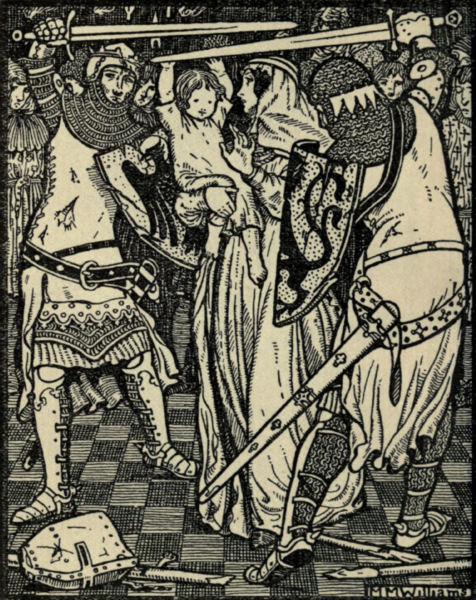
Then the damosel of whom I spake but
now turned her, and ran swiftly into the
inner chamber, and in a short space came
forth with a little child, whom she set upon
the daïs. He wore a little coat of red samite,
furred with ermine, cut to his measure; and
of his age no fairer child might be seen.
His face was oval and fair, his eyes bright
and laughing; he was marvellous tall and
strong for his age, which might not be more
than four years; and by the richness of his
51]
clothing ’twas clear that there were those
who held him dear.
The knights who fought below still dealt
each other such mighty blows that all who
beheld them had dole and wrath. I can
tell ye each was weak and weary enow,
but verily Sir Gawain had yielded ground
somewhat, and would fain have wiped away
the blood which ran adown his face and
into his eyes, but he might in no wise do
so, since Bran de Lis held him so close,
doing what he might to slay or wound
him.
Then without delay the damosel took
her child, there where he stood before her,
and said very softly, “Fair little son, go
quickly to yonder tall knight, ’tis thine
uncle, doubt it not, fall at his feet, little
son, and kiss them, and pray for God’s
sake the life of thy father that he slay him
not!”
Straightway she set him on the ground,
and the child ran, and clasped his uncle by
the right leg, and kissed his foot, and said,
“My mother prays ye for the love of God,
that ye slay not my father, fair sweet uncle;
she will die of grief an ye do!”
Great pity fell upon the king when he
52]
heard the child speak thus, and all who
hearkened and beheld were filled with
wrath and anguish. All had compassion
on the child, save Bran de Lis alone, for he
quoth in wrath and anger, “Get thee hence,
son of a light woman!” and he withdrew
his foot so swiftly from the child’s clasp that,
whether he would or no, he fell, and smote
face and forehead hard on the stone of the
pavement, so that he grazed mouth and face,
and lay senseless and bleeding on the floor.
Then King Arthur sprang from the daïs,
and caught the child to him, and kissed it
twenty times on face and eyes and mouth,
and wept for very anger; nor for the blood
on the child’s face would he cease to caress
it, so great love had he towards it, for he
thought of a truth that he held again
Gawain, whom he now counted for lost.
He quoth, “Sir Bran de Lis, this little child
is very fair; never in your life did ye do
such villainy as to go near to slay so sweet
a child, nor ought ye to have denied the
request he made, for he asked naught outrageous.
Nor will I have him slain, for he
is my joy and my solace; henceforward
know well that for naught will I leave him
in your care!”
53]
Quoth Bran de Lis, “Sire, ye are less
courteous than I had heard tell, and ye make
overmuch dole and plaint for the life of a
single knight; ye should not so be dismayed,
this is naught but feebleness of heart.”
As Bran de Lis thus spake to the king
Sir Gawain wiped off the blood which ran
down his face, and bound up his wounds,
the while he had respite; the king, who
was wise enow, held his foeman the longer
in speech that his nephew might be the
more refreshed, for the strength and valour
of that good knight doubled as midnight
passed. For this was the custom of Sir
Gawain: when as ever midnight had struck
his strength was redoubled and he waxed
in force even until noon.
Now so soon as his strength came again,
and he saw the king, and his love, and
the great folk who beheld them, then a
mighty shame overtook him, and he ran
in wrath on his foe, and assailed him
straitly, but the other yielded not, crying,
“Honour to ye that ye thus seek me!”
Then might ye see them smite blows
great and fierce, with the swords they
wielded, so that they were well nigh
beaten down. Sir Bran de Lis smote a
54]
mighty blow, thinking to catch Sir Gawain
on the head, but that good knight, who
knew right well how to cover himself, held
his shield in such wise that the stroke fell
upon it, and split it adown the midst; so
hard had he smitten that the blade entered
even to the hilt, and his body following
the blow he bent him forwards, and ere he
might recover him Sir Gawain smote him
full on the helm, so that the laces brake,
and it flew off adown the hall, leaving the
head bare. And ere Sir Bran de Lis was
well aware he followed up the blow with
one above the ventaille so that he bled
right freely. Now were they again on a
par, so that one might scarce tell the which
of them had the better. In great pride
and wrath they ran each on the other, so
that in short space of time they had lost
overmuch blood. Mightily each strove to
put his foe to the worse, and all who looked
upon them waxed strangely pitiful, and
would fain have parted them asunder had
they dared.
Now might ye have seen that gentle
knight, who full oft had made offering of
good deeds and alms, right well acquit himself,
for so sorely he vexed his foeman that he
55]
hacked his shield all to pieces, and he
might no longer hold his ground, but
whether he would or no he must yield
place, and wavered backward adown the
hall. Then he smote him again, so that
he tottered upon his feet, and Sir Gawain
hasted, and threw himself upon him with
such weight of body and of shield that he
well nigh bare him to earth, so he drave
him staggering adown the hall till he fell
against a daïs.
When the damosel saw this she tare her
child from the king’s arms, and ran
swiftly, and threw herself right valiantly
betwixt the two, so that she came nigh to
be cut in pieces, and cried, “Son, pray thy
father that he have pity on thy mother,
and stay his hand ere he slay my brother,
whom I love more than mine own life!”
But the child spake no word, but looked
up at the glancing sword blades, and
laughed blithely. And all were moved to
pity and wrath who saw him anon
bleeding and now laughing for very
joy.
Then Sir Gawain, of right good will,
drew himself aback, but he whom he had
thus hard pressed drave forward at him,
56]
like one reft of his senses, and came nigh
to doing him a mischief in that Sir Gawain
was off his guard. Then she who held
the child sprang swiftly betwixt them, and
cried, “Now by God I will see the which
of ye twain will slay him, for he shall
be cloven asunder ere that I take him
hence.”
The swords clashed together aloft, but
wrought no ill, for neither might come at
the other for fear of the child whom they
were loth to harm, and for fear of her who
held him. And the child laughed gaily at
the glancing swords, and stretched up his
hands to his own shadow, which he saw
on the shining blade, and showed it with
his finger to his father when he saw it
come anear, and had fain sprung up and
caught the blades, sharp though they
might be. And many a man wept, and
there arose within the hall a great cry, as
of one voice, “Good lord king, stay the
fight; we will all aid thee thereto, for no
man should longer suffer this!”
Then Arthur sprang up swiftly, and
seized his sword and shield, and came unto
the twain, and parted them asunder,
whether they would or no, and said to the
57]
knight ye have heard me praise, “Sir, take
the amends offered, and I tell ye truly I
will add thereto, for I myself will do ye
honour, and become your man, for the
sake of peace.” And all cried with one
voice, “Sir, by God and by the True
Cross, ye shall not refuse this, for the
king has spoken as right valiant man.”
Then the knight held his hand, hearing
that which pleased him.
Thus was peace made, and the battle
parted asunder, and Sir Bran de Lis did
right sagely, for he spake, “Sire, it were nor
right nor reason that ye should become my
man, hence will I do ye true homage, but
for hostage will I ask the knights of the
Round Table, who are the most valiant in
the world; also shall your nephew do other
amends, even as he promised me, in abbey
and nuns, for the repose of my father’s
soul, and ye shall free one hundred serfs
with your own hand.” And the king
answered, “Know of a truth that all shall
be done at my charges.”
Then Bran de Lis did homage to the
king, and kissed him in all good faith, and
then came forward Sir Gawain, and he
humbled himself before him, kneeling at his
58]
feet, and praying that he would pardon his
ill will; and Sir Gawain took him by the
hand, and raised him up, and quoth, “I
pardon thee all, and henceforth will I be
your friend in all good faith and courage,
nor will I fail ye for any harm ye may
aforetime have done me.”
Both were sore faint and feeble, and void
of strength by reason of the blood they had
lost, so that scarce might they stand on
their feet without falling to the ground.
They bare them to an inner chamber; never
knight nor maiden entered within a fairer,
for I tell of a truth there was no good herb
in Christendom with which it was not
strewn. ’Twas richly garnished, and four
great tapers, cunningly placed, gave fitting
light. Then leeches searched their wounds
and said there was no need for dismay, for
neither was wounded to the death, and
within fifteen days both might well be
healed, and all were joyful at the tidings.
The king and his barons abode the
fifteen days at the castle of Lys, nor departed
therefrom; in all the world was neither fish
nor fowl, fruit nor venison, of which the
king might not each day eat in plenty if he
so willed. But he was loth to part from
59]
Sir Bran de Lis, by reason of the good tales
which he told concerning the folk of the
Castle Orguellous, whereat the king
rejoiced greatly.
“Sire,” quoth Bran de Lis, “I myself will
go with ye, and we will take with us squires
and footmen. My pavilion is large and
fair, and by faith, we will carry that too
along with us; and also a pack of hounds,
the best we may find, for there be thick
forests all around, where we may hunt at
our will, and go a-shooting too, an it please
us, for we shall find great plenty of deer
and other game.”
Sir Gawain took little heed of all he said,
so wholly was he taken up with his lady,
and she forgat him not, but was ever at his
service, at any hour that might please him;
’twas all gladness, and no ill thought.
Nor did Sir Gawain mislike his fair son,
whom he caressed right often. Fain would
he have tarried long time with them. Nor
marvel at that, my masters, for he was there
at ease, and he who hath whatsoever he
may desire doeth ill methinks to make over
haste to change, nor will he make plaint,
since he suffereth nor pain nor ill.
But when the fifteen days came to an
60]
end, then did the king bid make ready, for
he had no mind to tarry longer; well I
know ’twas a Tuesday morn that they set
them on their way, and with them went
that good knight, Sir Bran de Lis.