EDWIN HENRY LANDSEER—EARLY DRAWINGS—PICTURES OF DOGS—HAYDON’S
STUDIO—MR. RUSKIN’S CRITICISM.
Edwin Henry Landseer was, as stated above, born in 1802—the year before
another animal painter of modern note, Mr. T. S. Cooper—and that event
happened at his father’s house, No. 83,[12] Queen Anne Street East (not
Turner’s Queen Anne Street), and consequently at his death he was in his
seventy-second year. For the greater part of this long period he
retained far more health and activity than are commonly vouchsafed to
those who pass the allotted term of human life. How that life was
spent, what are the pictures he produced, and under what circumstances
they were executed, I have now, to the best of my means, to inquire and
detail. The best living authority avers that our subject was by no means
diligent at school, in fact, he was “always running away from his
teachers, and always drawing.” His artistic education was begun by his
father at a very early age, but not before natural ability had made
itself evident in sketching and drawing. Training of the best sort was
soon afforded by the judicious care of John Landseer, who directed his
son’s practice, after the mode of the greatest masters, to Nature, so
that “as soon as he could hold a pencil with some steadiness,” says Mr.
R. N. Wornum, the biographer of Landseer in the “English Cyclopædia,”
the boy was sent or accompanied into the fields to draw from sheep,
goats, and donkeys; and especially did he find space for this mode of
study on Hampstead Heath, where the creatures grazed or stood as nearly
in a state of nature as civilization permits to any of their kind in
England; and certainly in that condition of their existence which is
familiar to us. The following account, obligingly furnished to me by the
late Miss Meteyard, at once confirms and illustrates this early
history:—
“In 1849—1850 the Howitts resided in Avenue Road, St. John’s Wood,
and the father of Edwin Landseer no great way off. William Howitt
and Mr. John Landseer being well acquainted, and often meeting in
their walks, would go and return together; sometimes one way,
sometimes another, but generally in the direction of Hampstead. One
evening, in passing along the Finchley Road towards Child’s Hill,
Mr. Landseer stayed by a stile of ancient look, and said to his
friend, ‘These two fields were Edwin’s first studio. Many a time
have I lifted him over this very stile. I then lived in Foley
Street, and nearly all the way between Marylebone and Hampstead was
open fields. It was a favourite walk with my boys; and one day when
I had accompanied them, Edwin stopped by this stile to admire some
sheep and cows which were quietly grazing. At his request I lifted
him over, and finding a scrap of paper and a pencil in my pocket I
made him sketch a cow. He was very young indeed then—not more than
six or seven years old. After this we came on several occasions,
and as he grew older this was one of his favourite spots for
sketching. He would start off alone, or with John (Thomas?) or
Charles, and remain till I fetched him in the afternoon. I would
then criticize his work, and make him correct defects before we
left the spot. Sometimes he would sketch in one field, sometimes in
the other; but generally in the one beyond the old oak we see
there, as it was more pleasant and sunny.’
“Those acquainted with Hampstead and its environs will know these
two fields at once. They lie nearly opposite what is now the
Finchley Road Station of the North London Railway, and open out
into West End Lane, a little below Frognal and the parish church.
The old oak is still standing, though in withered decrepitude.[13]
Indeed, till almost recent years, this was a region of oak-trees,
and the whole neighbourhood was picturesque in the extreme. But
much of this beauty is now effaced.
“Belonging to Sir John Maryon Wilson, Lord of the Manor of
Hampstead, and abutting the corner of West End Lane, these fields
will, at no late date, be covered with ‘villas’ and other
buildings. But the fact that the site was Edwin Landseer’s first
studio may be preserved by in some manner naming it after the
illustrious painter.
“This interesting fact was told me by Mr. Howitt whilst walking
through these fields about twenty years ago.
“Eliza Meteyard.”
The representation of animals in that mode of life in which the
creatures existed, is that practice which, being best understood by the
common world, would best sustain the objects of an artist who had to do
with so many beasts which were but semi-barbarous, and not in a state of
natural fierceness and wildness. The reader who wishes to see what was
the merit of studies thus pursued, is referred to the South Kensington
Museum, British Art Collection, where a series of nine drawings,
executed at a very early period of his life by Edwin Landseer, and duly
marked with the dates of their production, will not alone evoke
admiration for the nature-given ability of the draughtsman, but testify,
that with such ability to back the practice his father devised, the son
was fortunate in receiving that father’s counsel. Further, the observer
will note how zealously the boy-pupil bent his mind to the task with all
the pleasantness
which attends the exercise of natural powers. This is enforced by Miss
Meteyard’s communication. Be it remembered that even such natural
ability as that of Landseer was not trained without strenuous and
long-continued labours.[14] The same course was pursued by him in
painting, and he never, during this early stage, drew without nature;
not, probably, carrying the principle of study in this fashion to the
virtuous excess of William Henry Hunt, his contemporary, of whom it is
said that he would not draw a pin without a model; a saying which
implies the devotion of the man to truth, rather than that he refused to
avail himself of his own experience. That the one would not paint a pin
without a model is as true as that the other painted dogs best because
he relied on nature from the first, and succeeded most in painting them
while he relied most on nature. The drawings and sketches which are
referred to were reserved by John Landseer from a much larger number of
his son’s productions, and by means of notes in that father’s
hand—notes written in affectionate pride, indicating that some of them
were made when the boy was but five years old—declare the progress and
precocity of their subject; so that we see how in the fifth year of his
age Landseer drew well, and thoroughly studied animal character and
humour.[15]
Landseer’s precocity exceeded that of Lucas van Leyden, one of the great
artists whose early skill has made them wonderful, and added interest
to their after-glory. Lucas van Leyden etched designs of his own when he
was but nine years of age. When he was fourteen appeared his famous
print of Mahomet killing Sergius the Monk. When Van Leyden was twelve he
painted “St. Hubert,” thereby beating Edwin Landseer in pictorial
progress, if not in precocity of draughtsmanship. To have been so nearly
neck-and-neck in early development with such a magnificent genius as
that of Lucas van Leyden, and to have maintained that remarkable
position through a long life, was a singular fortune. Van Leyden,
however, died at thirty-nine years of age. Sir Edwin’s years attained to
nearly double that period.
At the sale of Mr. M. W. Simpson’s pictures, in 1848 (Mr. Simpson was an
early friend and patron of Landseer’s), a considerable number of the
artist’s youthful productions were disposed of, many of which were, we
believe, painted at about this period of his career. Of those probably
executed a little later, but which for convenience sake we may as well
refer to here, if it were but to declare how these pictures have risen
in value, the following were examples:—“A Scotch Terrier with a Rat in
his mouth,” sold for, although not more than four inches by five inches,
sixty-eight guineas, and would now, twenty-five years later, produce
treble that sum. This work has been engraved, we believe, by Mr. T.
Landseer. “Waiting for Orders,” a full length portrait of Mr. Simpson’s
coachman, sold for thirty-two guineas. This was not that portrait of a
deer-hound which is now called “Waiting,” and was engraved by J. C.
Webb. “The Paddock,” an old chestnut horse, and a white Scotch terrier
near it, with a distant view of Windsor Castle, sold for one hundred
guineas. If this could happen twenty-five years ago, with regard to
unexhibited pictures of comparatively small account, what could be
expected now, although the artist was most prolific, and not, like
Mulready, accustomed to confine his labours to a few canvases or panels?
For this question of the comparative prices of old and later pictures
by Landseer we shall enable the reader to form an answer for himself ere
our task is complete.
Among the minor works of the painter, none have so much interest as
examples of the etchings which were produced when he was little more
than an infant. The inherent ability of the man’s mind is more
distinctly and decidedly marked in these comparatively unimportant works
than in those which received the benefit of years of study and of craft,
and were produced when his natural powers had been consummated by
practice upon a score of pictures, being the fruits of an intelligence
developed to the utmost in that way which these very etchings, more than
any other means, declare to be proper, apt and natural to it. Edwin
Landseer continued the practice of etching, and made the results of
these labours proportionately as valuable and meritorious as his
pictures. It is not, however, to the products of his perfected skill
that we now address our remarks, so much as to the works of his infancy,
boyhood, and youth. As some of these juvenile productions are very rare,
and consequently little studied, although much admired in artistic
circles, our readers will not be sorry to have an account of a
collection of them, including works duly annotated with the age, of the
artist at the time they were executed.[16]
The first etching on our list is said to be also that which was produced
before all others by “Master E. Landseer,” and to have been wrought five
years ere he appeared in the Royal Academy display as an “Honorary
Exhibitor;” doubtless the youngest of his class before or since that
date. It was done in his eighth year, and one plate comprises several
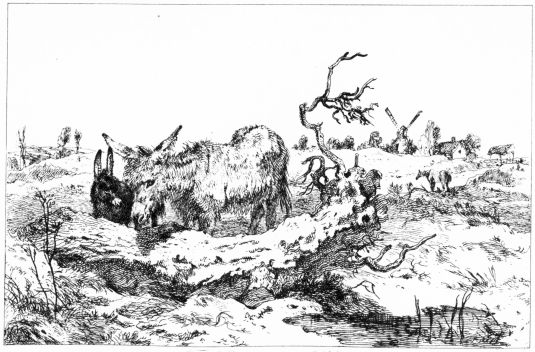
subjects, thus:—1. The Head of an Ass; which, by the way, is not
thoroughly understood, if one may so write of the production of so
capable an artist; for the head is not well articulated with the neck,
or complete in drawing as to placing the eyes on a level with each
other. Yet it is full of truth in the rendering of texture and
expression, as the beast bites sideways at the large-leaved herbage; his
ears are standing well above his head, and one eye is turned towards us
in a very asinine fashion, steadfastly watching, while the other is
directed downwards as the animal’s wrenching nibble goes on. 2. Is the
Head of a Shorthorned Sheep, with the exact expression of nature in its
ever mobile and quivering lips; the eye is that of the timid creature,
yet seems to meditate. The foreshortening of the horns is astonishing as
the workmanship of a child-draughtsman. 3. Is the Head of a Sheep in the
act of browsing; this calls for no remark, except that of general
admiration for its excellent drawing. 4. Is the Head, on a larger scale
than the others, of a long-tusked, deep-snouted Boar, while dozing in
the sun. Besides these, and probably of even earlier origin, is a not
very well-drawn Head of a Sheep in full-face; here the eyes are a little
out of drawing. On this account, although the defect may be due to the
greater difficulty of the subject when so placed, we are inclined to
believe this etching to be more remote in execution than the
above-described examples, which are, as the productions of a boy of
eight years of age, so far wonderful that they are really better drawn
and more truly expressive than the work of most adult artists. On the
same plate with the sheep’s head in front view is (1) a Donkey, at full
length, so to say, i.e., standing on all fours, and biting at his
leg—a capital study, full of action and spirit; (2) a Donkey and her
Foal.
On another plate are the heads of a lion and tiger (see the last note),
in which the differing characters of the beasts are given with
marvellous craft, that would honour a much older artist than the
producer. The drawing of the tiger’s whiskers—always difficult things
to manage—is admirable in its rendering of foreshortened curves. Then
comes a drawing of a young bull, wrought by Edwin Landseer at nine
years of age, and etched by his by no means very distant senior brother
Thomas; this brute’s walk, the peculiar shouldering, lounging way of his
kind, rolling from shoulder to shoulder, is here in perfection; the bull
whisks his tail lightly from side to side.
Next is another specimen, but on a larger scale than those which are
above described. It exhibits an extraordinarily finely drawn bull, the
foreshortening and handling of whose form is perfect; his expression is
that of a rigid conventionalist—for bulls are not unlike men in these
matters of temperament—a thoroughly old-fashioned John Bull. Behind
this is a foreshortened view of a horse reclining, and, in the distance
of the field, which supplies a landscape-background to the composition,
is a goat. The work of the young artist’s tenth year shows great
progress to have been made, for he wrought the whole design, and
entirely etched the next plate, which represents two groups of cattle
placed one above the other on the paper, which is disposed, as artists
say, upright-fashion, and of about the size and proportion of a large
octavo book. In the lower section is the representation of a ponderous
beast, couched at ease, yet with all his strength drawn together by the
attitude of resting with his limbs beneath his bulky body; he has
downward-pointing horns. He is a surly “oldish” bull, who breathes the
breath of content in summer, but with possibilities of fury in his
irritable moodiness; not a stupid bull, although terrible when
exasperated; he is evidently apt to lose his temper on slight occasions.
Behind this surly monster stands an intensely stupid brute, one who is
evidently given up to all sorts of self-indulgences, and who in every
possible fashion spoils himself; his countenance is absolutely besotted;
he has a hog-like air, and his very tail hangs heavily straight down
from his back; with these is grouped a maternal cow, who is large, if
not like Byron’s “Dudu,” “languishing and lazy.”
Executed in the same year of the draughtsman’s life we have another
group, drawn on the same plate with the above-named studies of animals.
This is a bovine family. Maternity itself appears in the shape of a
stumpy-footed cow; fatherhood, in the portly figure of a bull whose knit
brows and self-satisfied look about his chaps, his broad bowed neck and
vast chest, are honoured by imitation in the little bull-calf which
reclines before its parents, ruminating, if not meditating, and “the
picture of his father.” Produced at about the same period as the last is
an admirable etching of a cow and bull-calf. The former, by the leanness
of her haunches and flanks, shows the stress of the debt of milk she is
paying to the latter, or to the more exacting pail: on her back a ridge
of spines is distinct; large aspiring promontories of bone crop up in
the rearward regions of the milky mother, not unlike, in their
ruggedness and the slopes which form their sides, the steep forms of
granite mountains as they are thrust through sedimentary deposits of a
later date. At her feet lies the blunt-nosed bull-calf of her heart.
Next, in the same collection, and said to be of still earlier origin,
comes a much larger production, etched by Mr. Thomas Landseer from a
drawing by his brother, our subject. This noble plate represents an
Alpine mastiff of the great St. Bernard breed, which had been in the
second decade of this century imported to this country by a gentleman of
Liverpool.[17]
An inscription at the foot of the plate informs us that, at a year old,
this magnificent creature was six feet four inches long; and, at the
middle of his back, stood two feet seven inches in height. The note in
question adds that the animals of this breed are employed by the
fraternity of Mont St. Bernard, not only in the rescue of travellers
from snowdrifts, in which the latter may have been engulfed, but as
beasts of burthen, and that they are capable of carrying a
hundredweight of provisions from the town on which the monks rely, to
the hospice, a distance of eighteen miles. The drawing was done by Sir
Edwin Landseer when he was about thirteen years of age, that is, in the
year 1815.
It is really one of the finest drawings of a dog that has ever been
produced; we do not think that even the artist at any time surpassed its
noble workmanship. In its form are reproduced all the characteristics of
such a beast. The head, though expansive and domical in its shape, is
small in proportion to that of a Newfoundland dog; the brow is broad and
round; the eyes, according to the standard commonly assumed for large
dogs, are far from being large, and are very steadfast in their look,
without fierceness; the ears are pendulous, placed near to the head, and
fleshy in substance. This St. Bernard dog has a great hanging jowl and
finely formed nose; which last, as is commonly the case with creatures
whose sense of smell is delicate, tapers slightly to the nostrils. The
chest is broad and square, but by no means heavy; the forelegs are
brawny, yet elegant, with broad and firmly placed feet. The body is
comparatively long and rather slender in its contours, the belly is
hollow, and the hind legs nervously lean and remarkably muscular.
Withal, this beast has a grave and dignified walk which is pleasant to
see.
Next, and returning to early examples in the same collection, we have an
etching of some sheep, “Southdowns,” which is comparatively
unsuccessful. After this comes the “Head of a Ram,” of about half
life-size, with doubly voluted horns, pointing downwards. To an artist’s
eyes, or those of one who is capable of truly appreciating this superb
drawing, the real proof of the draughtsman’s power is to be seen in the
foreshortening of the twisted and wreathed horns; the execution of these
parts is marvellous for precision and “clearness” of line, for the
elaborate involuting of the protuberances, and the manner in which
perspective of very delicate and intricate nature has been expressed by
the deft craftsmanship.
A Group of Lions in a hollow on a mountain side supplied the subject of
the next example in our series of illustrations. Etched by Thomas
Landseer is a copy of a retriever lying down, and behind him another
dog, whose features recall “Brutus,” the artist’s very old
favourite,[18] and the subject of several works by him, to one of which
we elsewhere more particularly allude. Next are heads of a pointer and a
spaniel, both of great beauty as to the execution—an extraordinarily
brilliant production of the engraver. Here we shall place the fore-part
of a tiger, crouching and seeking prey. Finally, two admirable prints,
the one representing a gaunt French hog, standing munching before its
sty, and having an elaborate landscape background. A plate of this was
published with a slight modification, and styled “A French Hog, the
property of Mr. Bacon, of the Black Boy Inn, near Chelmsford.” By way of
fellow appeared “An English Hog.” The French Hog is a ludicrous beast,
antithetical to its companion subject, and one of the most uncouth,
long-legged, swift-looking, sharp-nosed, flat-sided, hollow-bellied of
animals, covered with bristles that recall a porcupine’s quills, which
are gathered in lines on his flanks, and project from his limbs like
ragged old thatch on a ruined cottage roof. The English Boar looks a
mere round barrel of lard mounted on two pairs of wonderfully short
legs, with a head stuck on one of its ends, and a tail attached to the
upper part of the other.[19]
Almost every place where animals might be seen to advantage was visited
by Edwin Landseer during this period, the Tower among them. At this
time was observed the incident which furnished a capital subject of “a
lion’s and a dog’s friendship,” which is reproduced, with three others,
in Thomas Landseer’s book, “Twenty Engravings of Lions, Panthers, &c.”
The story is briefly this: a lioness, an orphan of course, had been
captured in very early cub-hood and brought on board ship, and was
suckled by a bitch, for whom, although she soon surpassed her nurse in
size and strength, she ever retained the utmost affection, and some
respect. The attached couple being shown in Exeter Change menagerie,
attracted much admiration, and were the source of delight to thousands.
The other three works by Edwin Landseer in this collection are “A Combat
between a Lion, Tiger, and a Panther, contending for a dead Fawn,” “A
Tiger tearing the carcase of an Indian Bullock,” and “The Frontispiece.”
Spilsbury, an artist of considerable ability, contributed modifications
of designs by Rubens, Rembrandt, Stubbs, and others; there is likewise
one by T. Landseer, representing “A Tigress defending her Cubs from a
Snake.”
Ere this period of his studies was past, “Master Edwin Landseer”
justified so much public interest that his doings were chronicled by his
father; and in Elmes’s well-known “Annals of Art” he was referred to as
a promising student. Some of his early studies appeared in “The Sporting
Magazine,” whence they were, as stated above, collected and republished.
Incessantly he drew and painted from nature, without reference to
copies; in this was the source of his knowledge of life, truth in
design, and mastery of the forms of animals, and of their varied
coverings.
The first appearance of the painter, then only thirteen years of age,
occurred in 1815, and is thus recorded in the Catalogue of the Royal
Academy Exhibition of that year: “Master E. Landseer, H.; 33, Foley
Street.”[20] The subjects of the pictures contributed to the annual
gatherings of works of art indicate very clearly what had been the
youthful painter’s studies. As is not commonly the wont of young
artists, “Master Edwin Landseer” did not aspire to a subject. Nothing
heroic, pathetic, or dramatic came from his easel at that date, but
simply two portraits of animals. They are thus described:—“No. 443.
Portrait of a Mule, the property of W. H. Simpson, Esq., of Beleigh
Grange, Essex;” and, “No. 584. Portraits of a Pointer Bitch and Puppy.”
The latter was painted for the owner of the mule, and both pictures
appeared among those early works of Sir Edwin’s which were, as before
stated, sold in 1848, after the death of Mr. Simpson. James Ward, being
essentially a cattle painter, these examples are important, because they
are the first seriously studied pictures by the first English painter
who, since Hogarth, had painted a dog with due regard to individuality
and character, to say nothing of pathos and dramatic expressiveness,
passion, energy, and humour. Hogarth had painted several dogs with
admirable skill, e. g., the telling portrait of “Trump” in his own
likeness, now in the National Gallery, and there are dogs in “A Rake’s
Progress.” John Wooton was the fashionable dog painter of Hogarth’s day,
who did many canine portraits, notably that of Horace Walpole’s
“Patapan,” as recorded in his master’s letter to Mann, Ap. 25, 1743.
Stubbs painted several capital dogs, as accessories to his horses. Both
Gainsborough and Romney used dogs in like situations. Nevertheless, it
is true that between Snyder’s and Landseer’s days the “friend of man,”
as an independent subject of study, was neglected by artists.
Another artist of great note was beginning to make a mark which is
likely to grow deeper as the world grows older, for in the man were
many fine powers of art and criticism. He was closely associated with
our subject. This was Leslie, who arrived in England in 1811, and was at
this time, 1815, residing next door to Flaxman, i.e., at No. 8,
Buckingham Place, or Street, Fitzroy Square. In 1816 Leslie, eight years
Landseer’s senior, made a bold attempt with a congenial theme from
English poetical history, a class of subject which he affected warmly,
being “The Death of Rutland,” from “The Third Part of Henry VI.,” Act i.
Scene 3, where Clifford murders the youth. Edwin Landseer sat for the
young victim, kneeling, with a rope round his wrists, being then “a
curly-headed youngster, dividing his time between Polito’s wild beasts
at Exeter Change and the Royal Academy Schools.”[21] The picture, after
appearing at the Academy in 1816 (No. 518), was sent to America, and
purchased by the Academy of Philadelphia, where it probably still is. It
contains a very early portrait of our painter. But this was not the
first likeness of Landseer exhibited; for “Master J. Hayter,” afterwards
a portrait-painter of considerable note and some cleverness, although
then but a youngster, painted “Master E. Landseer” as “The Cricketer,”
and sent the work to the Royal Academy in 1815 (No. 450). “Master J.
Hayter” died, an old man, not many years ago.[22]
That an artist so eminent as Landseer should have first presented
himself to the public, or by his father have been so presented, in the
ranks of the honorary exhibitors, is curious. The suffix “H.” to the
name, and his being included with the class in question, leaves no doubt
on the subject. It is understood that pictures by exhibitors of this
class are not for sale, and the privilege of thus showing works is, or
was, considered a compliment to persons of distinction. Thus we find
among the honorary exhibitors of 1815, Sir George Beaumont; the
Rev. W. Holwell Carr, a benefactor to the National Gallery; J. Britton,
the antiquary; and the Hon. Mary J. Eden. That a picture by a boy of
twelve should be so exhibited is among the curiosities of Academy
displays. Though in itself more meritorious, it is not less remarkable,
than the fact that George Morland, in 1778, sent to the Academy a
picture drawn with a poker, or that similar gatherings formerly
comprised flower-pieces in human hair, and the like “works of art.”
The year 1816 witnessed the second appearance of our painter, and with a
picture the title of which affirms his previous practice. This happened
at “the Great Room in Spring Gardens,” then, and long before, a frequent
place of exhibition, not unlike the present Egyptian Hall, Piccadilly,
that could be hired for all sorts of shows, and afforded many curious
illustrations of the uses to which such a gallery could be put. In the
year in question this “Great Room” was in the occupancy of the Society
of Painters in Oil and Water Colours—that is, the same association
which now flourishes as the Society of Painters in Water Colours, its
original title, which had for a time given way to the first-named
designation, in consequence of a difficulty about dividing profits among
the members, a considerable number of whom seceded, leaving those who
remained unable to cover the walls with pictures. In this strait the
remaining members invited a certain number of oil painters to contribute
to the exhibition, and called the persons who consented to do so
Associate-Exhibitors. The seceders comprised J. J. Chalon, De Wint,
Gilpin, Hills, Reinagle, and Pugin the elder. David Cox had joined the
Society shortly before, and “came to the rescue with a host of
pictures;” but these did not suffice, and the expedient of inviting
Associate-Exhibitors was employed to increase the popularity of the
exhibitions.
It is noteworthy that among these “outsiders” who were taken in as
stop-gaps was William Henry Hunt, one of the most artistic of English
painters; he made his début to the Society, of which he became one of
the most distinguished members, in 1814, with two landscapes in oil.
Hunt, like Landseer, had previously exhibited in the Royal Academy; he
did so in 1807, when Sir Edwin was five years of age. The Society
continued to use, until 1824, its style of the times of difficulty, and
thereafter reverted to its former title and limits. It is worthy of note
that this interval of disturbance had much to do with the bringing out
of painters so diverse in their modes of thought as Hunt and Landseer.
Haydon also found a field for the exhibition of his power in the gallery
of the divided Society. In 1814 the last-named artist sent there “The
Judgment of Solomon,” a picture which is admitted to be the best he
painted, and to it the attention of Landseer’s biographer is directed,
as having probably been purchased, as it was certainly long retained, by
his pupil in memory of Haydon. The work passed from Sir Edwin’s
possession to that of Lord Ashburton.
The connection between the Landseers and Haydon is close. Haydon was, at
least in some degree, Edwin Landseer’s third teacher, if we put Nature
before his father. In his peculiar way, which has to be taken into
account ere we can appreciate the true sense of the following passage,
Haydon describes the first entry of John Landseer’s sons to his
charge:—
“In 1815, Mr. Landseer, the engraver, had brought his boys to me and
said, ‘When do you let your beard grow, and take pupils?’ I said, ‘If my
instructions are useful and valuable, now,’ ‘Will you let my boys come?’
I said, ‘Certainly.’ Charles and Thomas, it was immediately arranged,
should come every Monday, when I was to give them work for the week.
Edwin took my dissections of the lion, and I advised him to dissect
animals—the only mode of acquiring [a knowledge of] their
construction—as I had dissected men, and as I should make his brother
do. This very incident generated in me a desire to form a school; and as
the Landseers made rapid progress, I resolved to communicate my system
to other young men, and endeavour to establish a better and more regular
system of instruction than even the Academy afforded.” It would appear
from this account that Edwin Landseer was not a pupil of Haydon’s in the
sense of that term, which is applicable to his brothers’ studies, This
notion seems to be supported, if not confirmed, by what is recorded
hereafter.[23] It will not be forgotten that long before this date all
the Landseers had made very considerable progress under their father,
and so far as regards Edwin this is affirmed by Haydon.[23]
The pupils who followed the Landseers to Haydon’s studio were, Bewick,
son of an upholsterer of Darlington, who died in 1866, without making
any deep sign in art, and is the subject of Mr. T. Landseer’s biography,
above mentioned; Harvey, the author of so many thousand designs for
woodcuts, familiar to all headers of the “Penny Magazine,” and the by no
means happy illustrator of the “Arabian Nights;” Edwin Chatfield, who
died young; and George Lance, the popular fruit-painter. Of Thomas
Christmas, another of Haydon’s pupils, we speak elsewhere. Before the
Landseers studied under Haydon’s directions, Charles Lock Eastlake, the
late President of the Royal Academy, had received invaluable counsel
from a man whose broken career and hapless fortunes—which were,
doubtless, in no small degree, of his own producing—are among the sad
facts in the history of English painting. Haydon goes on: “All these
young men looked up to me as their instructor and their friend. I took
them under my care, taught them everything I knew, explained the
principles of Raphael’s works in my collection of his prints, and did
the same thing over again which I had done to Eastlake, without one
shilling of payment from them, any more than from him. They improved
rapidly. The gratitude of themselves and of their friends knew no
bounds.” So far, so good; what follows of the writer’s career concerns
us not now. Haydon was painting “Christ’s Entry into Jerusalem,” and
occupied a position which is rather difficult for men of another day
fairly to appreciate. He had finished, with extraordinary éclat, “The
Judgment of Solomon,” and, on account of the success this obtained,
fancied himself at the top of the tree. He had certainly begun well for
himself, and his earnest advocacy of the Elgin Marbles was honourable to
him. To this advocacy he attributed an importance that was in excess of
the fact, although it was of great service. He was a valuable champion
in art by means of these marbles, and the studies which he made his
pupils produce from them, to say nothing of the effect of his
introducing to other countries casts of the statues, and promoting the
bringing to London several of the Cartoons of Raphael, which his pupils
Charles and Thomas Landseer drew manfully at the British Institution.
Edwin Landseer made studies from the same works.
The catalogues of pictures exhibited in various galleries show that
Edwin Landseer was at this period domiciled with his father and
brothers, and Mr. Henry Landseer, his uncle, at 33, Foley Street or
Foley Place. A few doors off, at No. 30, lived Thomas Campbell, a
fellow-lecturer with John Landseer at the Royal Institution, where he
delivered “Discourses on English Poetry.” This house was of much
superior character to that which its present appearance indicates; the
whole of the Foley Street region has “gone down” in the world within the
writer’s memory of forty years’ duration.[24]
Haydon’s studio, at 41, Great Marlborough Street, was near for a youth’s
walk; and that artist, with ill-concealed difficulties gathering around
him, struggled yet against them without a sign of failure. Burlington
House, where the Elgin marbles were placed while critical combats were
waged about them ere they found a home in the British Museum, was close
at hand, and the noblest academy for study. Independently of Haydon’s
declaration, there can be no doubt that the Landseers derived immense
benefit from the study of those models, even if they have shown nothing
that can be directly referred to them. It is in the formation of style
that one would expect benefit from these types, rather than in mere
copying their characteristics. We fancy that in Landseer’s dogs, such as
“A Distinguished Member of the Humane Society,” “Suspense,” and wherever
breadth and grandeur of elements are involved, are results of
impressions thus made. We cannot conceive a student who is familiar with
these examples losing the ideas he had obtained from them. Not only did
these works afford lessons which occurred fortunately with studies from
Nature, but the advice of Haydon, that his pupils should dissect, was
the sure guide to success. Having received such instructions from John
Landseer as fixed Nature in his mind as the ever-present and
indisputable director; and from Haydon the injunction to study the
marbles as models of style, together with counsel and aid in dissecting
human and leonine subjects, Edwin Landseer’s powers were in the fairest
way of development. Ability and energy must have done the rest; they
were all-sufficient to bring that reputation which is so widely spread.
To a mere painter of portraits of animals, no such fame, no such
abundance of thanks as are due to Landseer would have accrued. A picture
of Mr. So-and-So’s favourite mastiff, nay, a mere likeness of a
favourite lap-dog, would, except to a few of the enthusiastic, have been
nought to mankind; worse than nought for the reputation of the painter
who failed to impart pathos and character to his productions, and so
make, in one of them, the hat and gloves of a gentleman not unwelcome
to
those who looked for nobler works from such masterly hands.[25] Yet
there were not wanting men who, when the hat and gloves in question
occupied prominent positions in a fine picture by Landseer, demurred
greatly to his expending time on these objects, which had been better
otherwise employed. To a hat and gloves could not, by any process known
to humanity, be imparted either pathos or character. Even Edwin Landseer
failed in this, and there were those who distinguished between the more
heartily wrought and truly pathetic pictures, and such representations
of domesticities. The distinction which many professed to draw between
these pieces of genre painting and “A Dialogue at Waterloo,” which
represents the Duke of Wellington and his daughter-in-law, was that in
the one the painter’s heart was set open by his subject, whereas in the
others there was nothing to open the heart. Although produced with but
few years between them, the style of the former is weak, timid, and
thin; that of the latter, solid, masterly, and broad. It has been said,
doubtless by way of apologizing for the shortcomings of the
domesticities, that the inspiration of the inferior works was a graceful
one. Although later in its origin, we saw more of the studies to which
we just referred in the “Waterloo,” than in the intermediary genre
pictures. Here, then, are examples (1) of mere portraiture, lacking
pathos, and failing even in Landseer’s hands; (2) a pathetic, grand
subject moving him when the Duke of Wellington was in question and
Waterloo to aid, in forming a contrasted subject with that of a lady’s
chamber and other scenes of his work. Experts could hardly believe their
eyes when the unfortunate pictures appeared with Landseer’s name to
them. It was not, then, in mere portraiture that success was to be
looked for when neither pathos nor character are present. Yet these
pictures are recognized as the failures of our artist; and we refer to
them here, because they are no less antipathetic and antithetical to
many others which we have yet to describe, than to the studies we have
just indicated. As to Landseer’s studies, Mr. Ruskin wrote, in
“Pre-Raphaelitism,” p. 30:—“Edwin Landseer is the last painter but one
whom I shall name: I need not point out to any one acquainted with his
earlier works the labour, or watchfulness of nature they involve, nor
need I do more than allude to the peculiar faculties of his mind. It
will at once be granted that the highest merits of his pictures are
throughout to be found in those parts of them which are least like what
had been before accomplished; and that it was not by the study of
Raphael that he attained his eminent success, but by a healthy love of
Scotch terriers.” Undoubtedly Landseer learned next to nothing from
Raphael. In the next chapter we shall show that he enjoyed facilities
for studying the “Cartoons,” i.e. those examples of Raphael’s art
which are greatest in style. By means of the Elgin marbles Landseer was
imbued with that care for style which distinguished his best works, from
“Fighting Dogs,” to the “Swannery Invaded,” one of his earlier, and one
of his later pictures.