Footnote anchors are denoted by [number],
and the footnotes have been placed at the end of the book.
The Appendix had several passages marked with a vertical bar in the
margin, indicating that the passages so marked were omitted from the
published dispatches in 1900. In this etext these passages are
enclosed in double parentheses {{ ... }} with a light gray background
color.
The cover image was created by the transcriber
and is placed in the public domain.
Some minor changes to the text are noted at the end of the book.
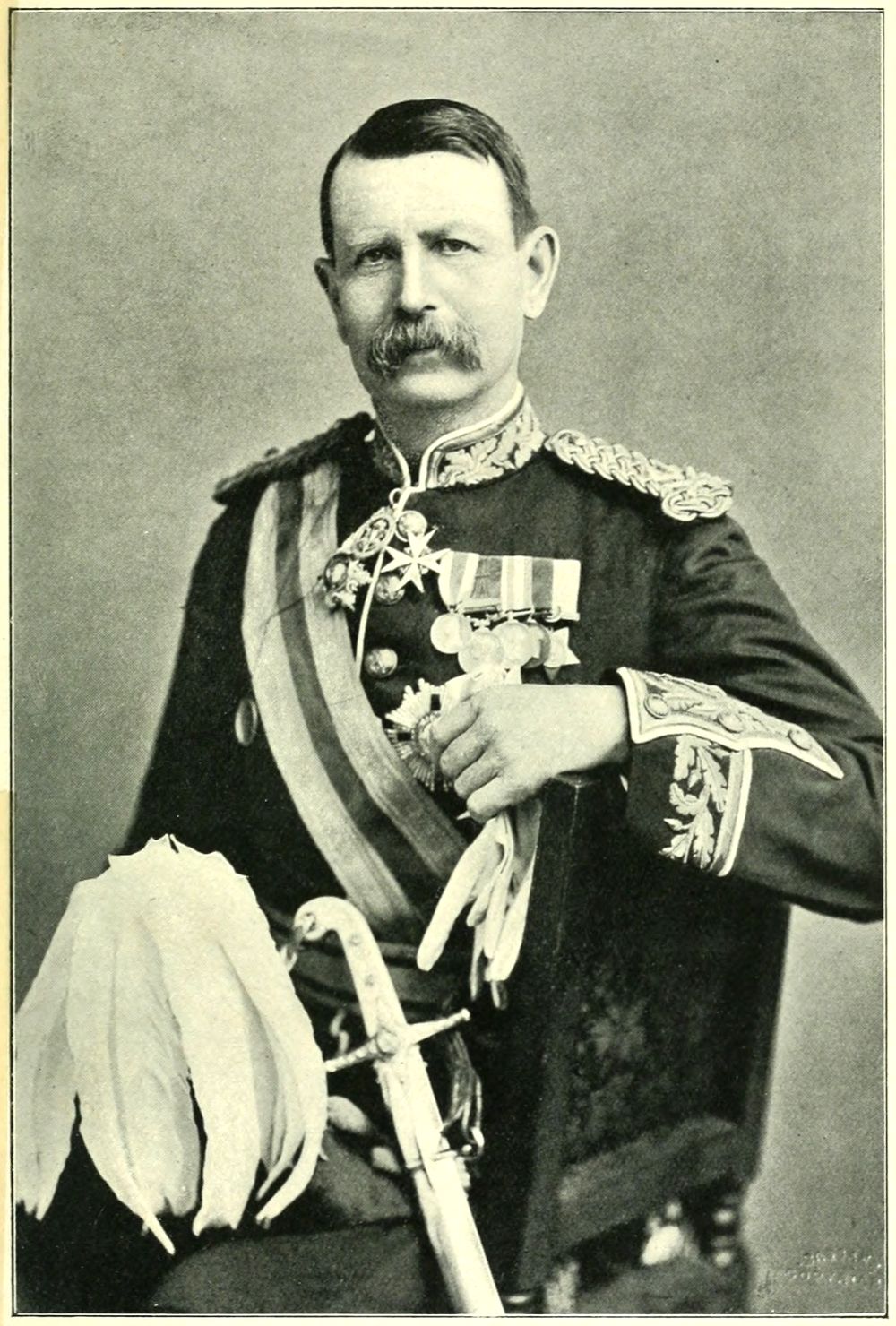
From a photograph by A. Bassano
Signature of Sir Charles Warren
SIR CHARLES WARREN
AND
SPION KOP
A VINDICATION
BY
‘DEFENDER’
WITH A BIOGRAPHICAL SKETCH, PORTRAIT
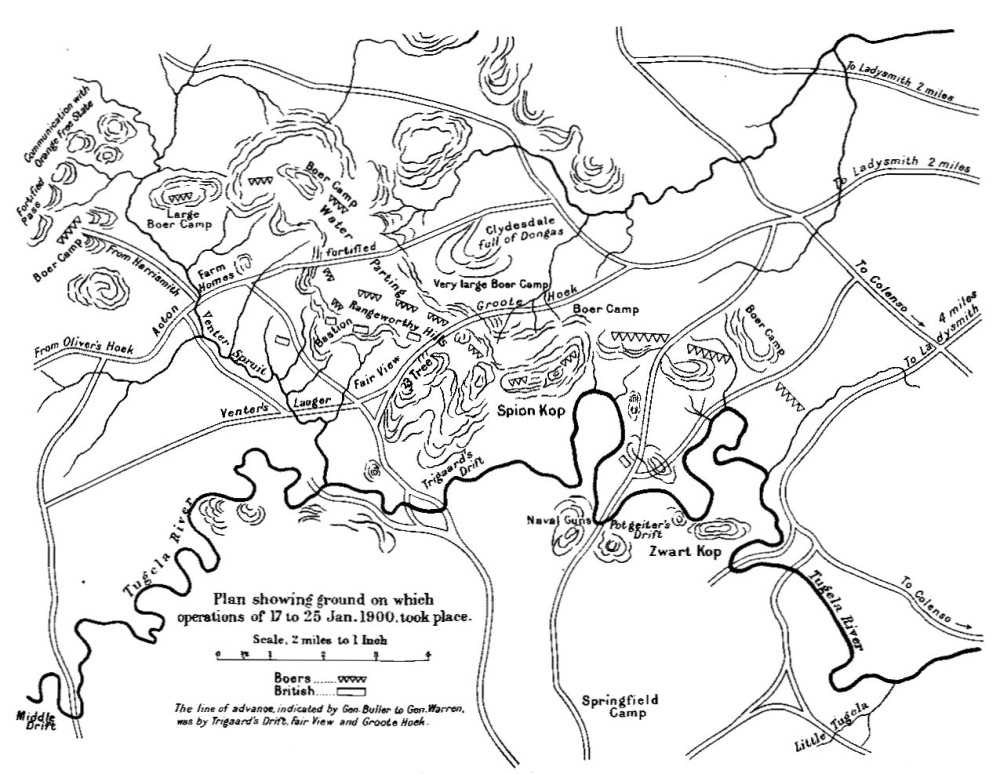
AND MAP
LONDON
SMITH, ELDER, & CO., 15 WATERLOO PLACE
1902
[All rights reserved]
PREFACE
It is now more than two years since the operation
took place on the Tugela River in Natal,
that ended in the capture and the unwarrantable
abandonment the same day of the position of
Spion Kop. The lapse of time since these events
occurred naturally caused a loss of interest in
this chapter of the history of the war in South
Africa; but the recent publication of portions of
the despatches omitted in the ‘Gazette’ of 1900,
and also of other documents received at the time
by the War Office but not disclosed, has again
brought the subject into prominence, revived
public interest in it, and offered an opportunity
which we gladly seize to vindicate the conduct of
an officer who has been condemned without being
heard.
Whether Sir Charles Warren will be allowed
any opportunity of defending himself against
the strictures passed upon him by Sir Redvers
Buller, either now or when the war is over,
is doubtful; but at length, having before us
all the documents received at the War Office, it
is proposed to show in the following pages that,
in spite of the difficult circumstances in which
he found himself, Sir Charles Warren did his
duty, and that, had Spion Kop not been recklessly
abandoned by a subordinate, there is every reason
to suppose that he would have gained a great
success.
The publication of the despatches on Spion
Kop in the parliamentary Easter recess of 1900
took the world by surprise—so much so, indeed,
that a story was current that it was due to the
mistake of a War Office clerk. It did not commend
itself as either a useful or a desirable proceeding
to publish to the whole world the
strictures passed by the General in command in
Natal upon his second-in-command, and those of
the Commander-in-Chief in South Africa upon
both, especially as those officers were still serving
their country in the field.
The political mistake made by the Government
was speedily demonstrated by the debates
that took place on the reassembling of Parliament;
but it now appears that a greater want of judgment
was shown than was then supposed, and
that having decided, however wrongly, to publish
the despatches the Government would have done
better to have published them in full. And this
for several reasons—it would have made little
difference to those censured, would have enabled
the public to understand the Spion Kop operations,
which could not be understood from the
incomplete documents, and would have prevented
a distinguished officer lying for two years
under the shadow of unjust accusations.
Much capital was made by the Opposition in
Parliament out of the suggestion of the Secretary
of State for War that Sir Redvers Buller should
rewrite his despatch, or rather should write a
separate despatch for publication; but any one
who has tried to get to the bottom of the business
from the material available must have felt that
Lord Lansdowne was perfectly right in suggesting
that what was wanted was a simple statement
from Sir Redvers Buller of what he intended to
do, and how it was done or not done. Instead
of this there were despatches giving formal cover
to other despatches from Sir Charles Warren, and
then criticising that officer’s actions unfavourably.
No statement was to be found anywhere indicating
what Sir Redvers Buller had intended
to do, and as the instructions he issued were not
published, the operation which Sir Charles
Warren was directed to execute could only be
gathered from the references he made to them in
his reports. These reports were evidently written
to his chief in the belief that the General
commanding would write a full account of
what he had proposed to do, and how far his
orders had been successfully carried out, or
otherwise.
To most men, conscientiously compelled to
censure in an official despatch those employed
under them, the suggestion from the War Office
that such censure should be confined to a confidential
communication, and that some account
of the operation and the cause of failure should
be written for publication, would have come as a
welcome relief; and had Sir Redvers Buller seen
his way to comply with it and at the same time
to send copies to Sir Charles Warren of the confidential
despatches, he would have placed himself
in an unassailable position, he would have given
Sir Charles Warren an opportunity of confidentially
justifying himself, if he could do so, to the
Secretary of State for War and the Commander-in-Chief,
he would have enabled his countrymen
to know more about the operations than was
otherwise possible, and the world would have
been spared a very painful exhibition.
To this course, however, Sir Redvers Buller
would not consent. He prided himself on his
integrity in resisting such a proposal, and has
been much praised for refusing to write a despatch
for publication, having already written one,
which was mainly an indictment of his second-in-command,
on whom he threw the responsibility
for the failure of the operations.
It is the custom of the Service—and a very
fair and proper custom it is—that an unfavourable
confidential report made upon a junior
officer by his superior shall be communicated to
him before it is sent forward, so that he may
have an opportunity either of excusing himself
or of amending his conduct, and may have no
reason to complain that advantage has been taken
of a confidential communication to make unfavourable
reports behind his back, of which he
remains in ignorance.
Sir Redvers Buller does not appear to have
been mindful of this custom, when, instead of
writing a simple account of what he proposed to
do, and how it failed of accomplishment, he
used the opportunity to criticise most unfavourably
the conduct of the distinguished officer, his
second-in-command, still serving under him in
face of the enemy, and left him in complete
ignorance of the accusations made against him.
This ignorance he knew must last in any case
until the despatches were published, and, if they
were not published, would never be removed.
But Sir Redvers Buller went beyond this, for he
attached to his despatch a separate memorandum,
‘not necessarily for publication,’ in which
he reiterated his complaints of the conduct of Sir
Charles Warren and accused him of such incapacity
as unfitted him for independent command.
But not a word of this reached Sir Charles
Warren, whose exertions in the field during the
succeeding month under Sir Redvers Buller
contributed so greatly to the victory of Pieters
and the relief of Ladysmith; and it was not until
he saw the despatches in the newspapers, long
after this campaign was over, that he knew of
the secret stab his reputation had received at the
hand of his commander. Two years later the
recently published omissions have informed him
how seriously the attack upon his reputation as
a soldier was intended.
A correspondence between Mr. Henry Norman,
M.P., and the Right Hon. A. J. Balfour,
First Lord of the Treasury, published on 21st
February last, contains some observations by the
latter very much to the point on the want of any
narrative of the Spion Kop operations in Sir
Redvers Buller’s despatches. Mr. Balfour points
out, as was done two years before in the parliamentary
debates, that the General in command,
‘in accordance with the Queen’s Regulations,
with the best precedents, and with public convenience,’
should have furnished a simple narrative,
unencumbered by controversy, of the
operations which took place. To this Sir Redvers
Buller objected, in a letter published on the
26th March last, that he was not in command,
that he was not present, and that therefore it
was not his duty to write such a narrative. The
reply of Mr. Balfour, from which an extract is
appended, will be found to be fully borne out
in the pages of this book.
Extract from a letter from Mr. A. J. Balfour
to Sir Redvers Buller dated 10th March 1902.
‘You say that, not being in chief command,
you were not the proper person to write an
account of what took place. But can this be
sustained? I find that on 15th January you
ordered Sir Charles Warren to cross the Tugela
to the west of Spion Kop; on the 21st and 22nd
you gave him personal instructions as to the disposal
of his artillery; on the latter day you
agreed with him, after discussion, that Spion
Kop would have to be taken; on the 23rd you
definitely decided upon the attack; you selected
the officer who was to lead it, detailing one of
your Staff to accompany him; it was by your
orders that on the 24th Lieut.-Colonel Thorneycroft
assumed command on the summit of Spion
Kop after General Woodgate was wounded, and
all heliographic messages between the officers in
the fighting line and Sir Charles Warren passed
through your camp, and were seen by you before
they reached their destination. As you were
thus in constant touch with the troops actually
engaged on the top of the hill, so also you kept
general control over the movements of the
co-operative forces under General Lyttelton, with
whom you were in communication during both
the morning and the afternoon of the 24th. It is,
of course, true that you were not present at the
actual Spion Kop engagement. But if this was
a reason for not writing an account of it, it was a
reason equally applicable to Sir Charles Warren,
whose headquarters, as I am informed, were very
little nearer to the scene of action than were
your own. It was on these grounds that I did
not draw any distinction between your position
during the days of Spion Kop and that of any
other general conducting operations over an
extended field, at every part of which he could
not, from the nature of the case, be present.
You were responsible for the general plan of
action; you intervened frequently in its execution;
you were not prevented either by distance
or any other material obstacle from intervening
more frequently still, had you deemed it expedient
to do so. Was I wrong, then, in pointing
out that it would have been in accordance both
with precedent and the Queen’s Regulations for
you to have supplied the Commander-in-Chief
with a narrative of these important military
events based on your own observations and on
the reports of those of your officers who were
immediately engaged with the enemy?’
We have never been able to understand why
the orders given to Sir Charles Warren were not
published with the despatches two years ago.
True they were called secret instructions, but of
course the secrecy was a temporary matter, and
they ceased to be secret when the operations
were over. Without them there was no way for
the public to learn officially, except in the most
general way, what the General in command in
Natal desired to do, and probably, owing to the
wording of Lord Roberts’s despatch, a misconception
arose, widely entertained in the army
and highly prejudicial to Sir Charles Warren.
This misconception was that Sir Redvers
Buller instructed Sir Charles Warren to make
his turning movement by way of Acton Homes,
instead of which Warren obstinately preferred the
route by Groote Hoek. It was supposed that by
the first of these two routes the force might have
marched a long way round, but would have got
into Ladysmith with little difficulty, whereas the
(hypothetical) substitution by Warren of the
Groote Hoek road had necessitated the capture of
Spion Kop. The publication of the instructions
upsets this theory. The Acton Homes road
is never mentioned. The only references to the
direction of the turning movement are vague—‘to
the West of Spion Kop’—‘acting as circumstances
require’—‘refusing your right and
throwing your left forward’—and it now appears
that Sir Redvers Buller intended Warren to go
by the Groote Hoek route.
In vain has the Government endeavoured to
shield the military reputation of Sir Redvers
Buller at the expense of others. He has been
consistent in his efforts to get the despatches
published in full, even to the memorandum ‘not
necessarily for publication’—a severe condemnation
of Sir Charles Warren’s incapacity, but
a more damning one of his own—and by his
attitude has compelled the Government to give
way. How truly applicable is an epigram of
Mr. Henry Sidgwick, quoted by Sir Henry
Howarth in a recent letter to the ‘Morning Post’:
‘The darkest shadows in life are those which
a man makes when he stands in his own
light.’
In addition to the official documents on the
subject of Spion Kop much information of a
very varied character has accumulated during the
last two years, and besides invaluable verbal observations
and descriptions gathered from conversation
with officers from the front who took
part in the operations, there is a whole library of
books by newspaper correspondents, officers, and
others, which bear upon these operations and
throw light upon much that is obscure in the
official papers. Among many others may be
mentioned ‘My Diocese during the War,’ by
Bishop Baynes of Natal; ‘The Relief of Ladysmith,’
by Mr. J. B. Atkins; ‘The Natal Campaign,’
by Mr. Bennet Burleigh; ‘London to
Ladysmith via Pretoria,’ by Mr. Winston
Churchill, M.P.; ‘The History of the War in
South Africa,’ by Dr. Conan Doyle; ‘The
Relief of Ladysmith,’ by Captain Holmes Wilson;
‘Buller’s Campaign: With the Natal Field
Force of 1900,’ by Lieutenant E. Blake Knox,
Royal Army Medical Corps.
Magazine articles have also appeared from
time to time, some commenting on the operations
themselves, others filling up gaps in the narrative,
and others again incidentally referring to
facts in connection with the operations. Among
these last may be mentioned: (1) A series of
articles contributed by Sir Charles Warren himself
to the ‘National Review’ entitled ‘Some
Lessons from the South African War’; (2) Mr.
Oppenheim’s defence of Lieut.-Colonel Thorneycroft
in the ‘Nineteenth Century’; (3) An instructive
diary of Dr. Raymond Maxwell, who
was serving with the Boers, in the ‘Contemporary
Review’ for December 1901; and (4)
‘The Diary of a Boer Officer,’ by another of
them, in the ‘United Service Magazine’ for
February this year. Some reference should
perhaps be made to one of a series of articles in
‘Blackwood’s Magazine’ by ‘Linesman,’ which
was headed ‘Dies Iræ,’ and dealt with Spion
Kop, because these articles have attracted a good
deal of attention, are cleverly written, and have
since been republished in book form. They do
not, however, impress the military reader as very
accurate descriptions, but rather as war pictures,
in which the colour is laid on with no sparing hand
to obtain the highest effect, the aim being to
please the sensation-loving reader. The value of
the account of Spion Kop given in ‘Blackwood’
is discounted by ‘Linesman’ himself, who, having
told us that ‘what the writer saw of the fight
on the summit of Spion Kop was little enough’;
that he had learnt ‘to describe—nay, believe
nothing that one has not seen with one’s own
eyes’; and that, ‘if the tongue is an unruly
member, much more so is the ear’; nevertheless
proceeds to describe in blood-curdling language
what he did not see with his own eyes, and
must have heard with ‘unruly’ ears.
The general result of all the information is
to make it clear that Spion Kop was the key of
the position dominating the country, and that the
holders of it opened the way to Ladysmith; that
no one was more astonished at its unauthorised
abandonment than Sir Charles Warren, except
the Boers themselves, who refused to credit the
evidence of their senses, and at first believed its
forsaken condition to be a trap! No longer,
indeed, is it possible to regard the unwarrantable
surrender of this position as a fortunate accident
preventing an actual and impending disaster on
the morrow, or, as Lieut.-Colonel Thorneycroft is
reported to have said, ‘a mop up in the morning.’
Rather its abandonment was the blundering
relinquishment of a hardly won and well assured
success, only to be compared with the fatuous withdrawal
in the morning of the storming parties
which made the brilliant night attack and surprised
the fortress of Bergen op Zoom on 8th
March 1814.
BIOGRAPHICAL SKETCH — PARENTAGE — EARLY SERVICE—GIBRALTAR AND CHATHAM — JERUSALEM, 1867 TO 1870 — DOVER, SHOEBURYNESS, AND THE ORDNANCE FACTORIES, 1871 TO 1876 — SOUTH AFRICA, 1876 TO 1879 — Griqualand West and the Orange Free State Boundary — Griqualand West Land Claims — Meeting with Mr. Cecil Rhodes — The Gaika War, 1878 — Native Rebellion in Griqualand West and Troubles with the Bechuanas, 1878–9 — CHATHAM, 1880 TO 1882 — EGYPT AND ARABIA PETRÆA, 1882 TO 1883 — CHATHAM, 1883–4 — BECHUANALAND EXPEDITION, 1884–5 — CANDIDATE FOR PARLIAMENT, 1885 — SUAKIN, 1886 — CHIEF COMMISSIONERSHIP OF POLICE, 1886 TO 1888 — STRAITS SETTLEMENTS, 1889 TO 1894 — THAMES DISTRICT, 1895 TO 1898
SIR CHARLES WARREN
AND
SPION KOP
A short sketch of the career of Sir Charles
Warren is an appropriate introduction to his
appearance in South Africa as the leader of the
5th Division of the army in the Natal campaign,
and as the Commander of the Field Force
in the operations on the Tugela between 15th
and 25th January 1900.
Lieut.-General Sir Charles Warren, G.C.M.G.,
K.C.B., F.R.S., is the son of the late Major-General
Sir Charles Warren, K.C.B., Colonel of
the 96th Foot, by his first wife, Mary Anne,
daughter of William Hughes, Esq., of Dublin
and Carlow, and grandson of the Very Rev.
John Warren, Dean of Bangor, North Wales.
His father served under the Duke of Wellington
in the march to Paris after the battle of
Waterloo, in India, and in South Africa, and
the notes and sketches he there made upon
expeditions into the interior were made use of by
his son fifty years later, when reporting on the
Bechuana and Griqua territories in 1876. He
saw active service during a second tour in India,
in China, and in the Crimean war, and was
several times wounded. He retired after holding
the command of the Infantry Brigade at Malta
for five years, and was created a Knight Commander
of the Bath. He had a natural turn for
science, mathematics, and adventure, which,
together with his love of soldiering, was inherited
by his son Charles.
Lieut.-General Sir Charles Warren was born
at Bangor, North Wales, on 7th February 1840.
His early education took place at the Grammar
Schools of Bridgnorth and Wem, and at
Cheltenham College. He then entered the
Royal Military College at Sandhurst, and from
that passed through the Royal Military Academy
at Woolwich and received a commission as lieutenant
in the Royal Engineers on 23rd December
1857. After the usual course of professional
instruction at Chatham, Warren went to Gibraltar,
where he spent seven years, and, in
addition to the ordinary duties of an Engineer
subaltern—looking after his men and constructing
or improving fortifications and barrack buildings—he
was employed on a trigonometrical survey of
the Rock, which he completed on a large scale.
He constructed two models of the famous fortress,
one of which is now at the Rotunda at
Woolwich, and the other at Gibraltar. He was
also engaged for some months in rendering the
eastern face of the Rock inaccessible by scarping
or building up any places that might lend a
foothold to an enemy. He was selected in 1865
to assist Professor Ramsay in a geological survey
of Gibraltar, but it fell through. While at this
station he invented a fitment to gun carriages
to supersede the truck levers of the Service; an
invention objected to at the time because it was
made of iron, but subsequently adopted into the
Service.
In 1864 Lieut. Warren married Fanny
Margaretta Haydon, a daughter of the late
Samuel Haydon, Esq., of Guildford. On the
completion of his term of service at Gibraltar
he returned to England in 1865, was appointed
Assistant Instructor in Surveying at the School
of Military Engineering at Chatham, and a year
later his services were lent by the War Office to
the Palestine Exploration Fund.
The object of the Palestine Exploration Fund
was the illustration of the Bible, and it originated
mainly through the exertions of Sir George
Grove, who formed an influential committee,
of which for a long time Sir Walter Besant was
secretary. Captain (afterwards Sir) Charles
Wilson and Lieut. Anderson, R.E., had already
been at work on the survey of Palestine, and, in
1867, it was decided to undertake excavations at
Jerusalem to elucidate, if possible, many doubtful
questions of Biblical archæology, such as the
site of the Holy Sepulchre, the true direction of
the second wall and the course of the first, second,
and third walls, involving the sites of the towers
of Hippicus, Phasælus, Mariamne, and Psephinus,
and many other points of great interest
to the Biblical student.
The task was entrusted to Lieut. Warren,
who was assisted by non-commissioned officers
of Royal Engineers. The difficulties in the way
of carrying it out were great—obstruction on the
part of the Pashas, physical dangers, and want
of money. As regards the first, only great tact
and firmness prevented the complete suspension
of the work. ‘Indeed,’ says Major-General
Whitworth Porter in his ‘History of the Corps
of Royal Engineers,’ ‘the Vizierial letter, under
which the party was supposed to be acting,
expressly forbade excavations at the Noble
Sanctuary and the various Moslem and Christian
shrines. How, in spite of this, Warren succeeded
in his object is well told in his “Underground
Jerusalem.”’
With regard to physical danger Dean Stanley
wrote: ‘In the plain and unadorned narrative
of Captain Warren,[1] the difficulties and dangers
of the undertaking might almost escape notice.
Yet the perils will appear sufficiently great to
any one who draws out from the good-humoured
story the fact that these excavations were
carried on at the constant risk of life and limb
to the bold explorers. The whole series of their
progress was a succession of “lucky escapes.”
Huge stones were day after day ready to fall,
and sometimes did fall, on their heads. One of
the explorers was “injured so severely that he
could barely crawl out into the open air”; another
extricated himself with difficulty, torn and
bleeding, while another was actually buried
under the ruins. Sometimes they were almost
suffocated by the stifling heat; at other times
they were plunged for hours up to their necks in
the freezing waters of some subterranean torrent;
sometimes blocked up by a falling mass
without light or escape.’
The third difficulty was want of money; for
when Warren left London he carried off all the
money of the Fund (300l.) for the expenses of
the party, the Committee hoping that, as the
excavations proceeded, public interest would be
shown by a flow of subscriptions. The Committee
said: ‘Give us results and you can have
money.’ Warren replied: ‘No money, no results.’
In fact, however, he had at one time advanced
no less than 1,000l. out of his own resources.
The work went on for some three years with
occasional interruptions. Warren returned home
in 1870, and spent the following year in preparing
the results of his work for the Committee of
the Fund and for the Press.
Sir Walter Besant, in his ‘Twenty-one Years’
Work in the Holy Land,’ writes:
‘It is impossible here to do more than to
recapitulate the principal results of the excavations,
which are without parallel for the difficulties
presented and the courage displayed in
overcoming them.... It is certain that
nothing will ever be done in the future to
compare with what was done by Warren....
It was Warren who restored the ancient city to
the world; he it was who stripped the rubbish
from the rocks and showed the glorious temple
standing within its walls 1,000 feet long, and
200 feet high, of mighty masonry: he it was
who laid open the valleys now covered up and
hidden; he who opened the secret passages, the
ancient aqueducts, the bridge connecting the
temple and the town. Whatever else may be
done in the future, his name will always be
associated with the Holy City which he first
recovered.’
So much was this the case that for a long
time he was known as ‘Jerusalem Warren.’
In addition to ‘Underground Jerusalem’ he
wrote ‘The Temple or the Tomb.’
What high value was placed upon Captain
Warren’s services by the Administration of the
Fund may be gathered from the following quotation
from ‘Our Work in Palestine,’ published by
Bentley & Son in 1875, a book which had then
reached its eighth thousand:—
‘Let us finally bear witness to the untiring
perseverance, courage, and ability of Captain
Warren. Those of us who know best under
what difficulties he had to work can tell with
what courage and patience they were met and
overcome. Physical suffering and long endurance
of heat, cold, and danger were nothing.
There were besides anxieties of digging in the
dark, anxieties as to local prejudice, anxieties
for the lives of brave men—Sergeant Birtles and
the rest of his Staff—anxieties which we may
not speak of here. He has his reward, it is true.
So long as an interest in the modern history
of Jerusalem remains, so long as people are
concerned to know how sacred sites have been
found out, so long will the name of Captain
Warren survive.’
In 1871 Warren returned to military duty,
and was posted to Dover in command of the 10th
Company of Royal Engineers, and for the next
year was employed on the fortifications of the
fortress, principally at Dover Castle and Castle
Hill and Fort (Fort Burgoyne). He was then
transferred, in 1872, to the School of Gunnery
at Shoeburyness, where he remained for three
years, and was very successful in his administration
of the Engineer duties in regard both to
the barracks and the experiments with big
guns and iron plates carried out by the Ordnance
Committee. He had also Engineer charge of the
gunpowder magazine at Purfleet.
On his departure, in 1875, to take Engineer
charge of the Gunpowder and Small-arm Factories
at Waltham Abbey and Enfield, he received
the highest commendation from the Commandant
of the School of Gunnery, who wrote to the War
Office that Captain Warren’s professional reputation
as a highly instructed and accomplished
officer was so well established that it was unnecessary
to refer to it, beyond stating that the
station had benefited largely by his administration
in carrying out the important duties entrusted
to him, and that he placed on record
not only the support and assistance received
from him in all official matters, but that his
social relations with the Commandant and all
other officers of the establishment rendered his
departure a subject of sincere regret to all.
He was a candidate in 1876 for the secretaryship
of the Royal Engineers’ Institute, when
Colonel (afterwards Sir) Peter Scratchley observed
in his recommendation: ‘Captain Warren
has been under my command for four and a half
years, and is, in my opinion, a most able, conscientious,
indefatigable officer, and one who
would do credit to the Corps wherever employed.
His literary tastes, general experience, and qualifications
particularly fit him for the appointment
he is desirous of obtaining.’
Although unsuccessful his services were to
be utilised in a wider sphere than his own Corps.
In October 1876 he was asked by the Colonial
Office to undertake the duty of laying down the
boundary line between Griqualand West and
the Orange Free State, and his services were at
once lent by the War Department. On leaving
England he received a letter from Lord Carnarvon’s
private secretary saying how much the
Colony was to be congratulated on having
obtained his services, and another from his late
chief, Colonel Scratchley, regretting his departure
and expressing his belief that he ‘would
never meet an abler officer or a better fellow.’
The necessity for laying down a boundary
line between Griqualand West and the Orange
Free State had arisen from the rival claims
of the Chief Waterboer of the Griquas and of
President Brand of the Orange Free State to
the Diamond Fields. The British Government
acquired the rights of the Waterboer, and, after
some protracted negotiations, it was arranged
that the Orange Free State should abandon its
claim on receiving from Griqualand West the
sum of 90,000l. Mr. de Villiers was the expert
nominated by the Orange Free State to be associated
with Captain Warren in laying out the
boundary.
Warren, with two non-commissioned officers
of Royal Engineers, arrived at Cape Town towards
the end of November, and, after an interview with
the Governor, Sir Henry Barkly, proceeded to
Port Elizabeth by steamer, and thence by coach,
via Graham’s Town and Cradock, to Kimberley,
where Major Owen Lanyon, the Administrator,
introduced him to his colleague, Mr. Joseph E.
de Villiers, Government Surveyor. After an
interview with President Brand at Bloemfontein
he went into camp outside Kimberley towards
the end of December, measured his base, took
observations, and elaborated his general scheme
of operations.
The heat was intense, the shade temperature
being over 100° Fahr. for hours together, the
atmosphere was highly charged with electricity,
and the thunderstorms were often terrific, the
lightning playing all round the encampment or
party, and the ground being struck in all directions.
Mosquitoes and flies were also a great
nuisance.
The work, however, proceeded satisfactorily
and expeditiously, and on 18th April 1877 was
completed and ready for inspection. A party
composed of the two Commissioners and officials
of the two States formally inspected the line
from the Vaal to the Orange River, 120 miles,
and an official notification of the completion of the
work was made to the respective Governments.
The plans were then drawn on a scale of three
miles to the inch and completed before 15th May.
Captain Warren was entertained by President
Brand at Bloemfontein to meet the Volksraad
at dinner. Votes of thanks from the Legislatures
of Griqualand West and the Orange
Free State were presented to each of the Commissioners,
the former illuminated and very
handsomely got up.
Sending his party home, Warren went to
Kimberley, and thence to Pretoria and the Gold
Fields and on to Delagoa Bay, intending to go to
England by Zanzibar. An interesting account
of this journey appeared in ‘Good Words’ two
years ago. From Delagoa Bay, however, he was
directed to return to Cape Town to see Sir
Bartle Frere, and on arrival there was appointed
Special Commissioner in Griqualand West for
six months to investigate and arrange the various
land cases in appeal before the High Court of
Griqualand West. This delicate mission he
accomplished with great ability, tact, and judgment,
settling 220 out of 240 cases to general
satisfaction, except that of the lawyers, and avoiding
a great amount of litigation. He was made a
Companion of St. Michael and St. George for
his work on the boundary, and received a letter
from H.R.H. the Duke of Cambridge, Commander-in-Chief,
expressing his great satisfaction
at the efficient manner in which he had performed
the duties entrusted to him of marking off the
boundary between the Orange Free State and
Griqualand West, and also of the settlement
of the land claims in the latter province.
It was on his way to Kimberley from Cape
Town viâ Port Elizabeth on this land claim
business in Griqualand that he had the late
Mr. Cecil Rhodes as his travelling companion.
As they were driving over the brown veldt from
Dordrecht to Jamestown, Warren noticed that
Mr. Rhodes, who sat opposite to him, was
evidently engaged in learning something by
heart, and offered to hear him. It turned out
to be the Thirty-nine Articles of the Church of
England. In the diary of this journey, also published
in ‘Good Words’ of 1900, Warren relates:
‘We got on very well until we arrived at the
article on predestination, and there we stuck.
He had his views and I had mine, and our
fellow-passengers were greatly amused at the
topic of our conversation—for several hours—being
on one subject. Rhodes is going in for
his degree at home, and works out here during
the vacation.’
In January 1878 Warren proceeded to the
Gaika war in command of the Diamond Fields
Horse, raised at Kimberley, and was engaged for
six months in Kaffraria. He bought his mounts
and drilled his men on the way, and infused his
own indomitable energy into every member of his
command. He took part in numerous engagements,
among which may be mentioned the action
of Perie Bush in March, when he was injured by
the falling of the bough of a tree, and the action
at Debe Nek on 5th April, where with seventy-five
of the Diamond Fields Horse he met 1,200 armed
Kafirs of Seyolo’s tribe in the open, and gained a
complete victory. The Governor-in-Chief telegraphed
his congratulations on this brilliant
success. A few weeks later Warren had another
successful fight at Tabi Ndoda on 29th April, when
he was slightly wounded. He was frequently
mentioned in despatches, and his conspicuous
personal bravery, no less than his skill as a
commander, was brought to the notice of the
Secretary of State for War. The Governor-in-Chief
especially commended him in his
despatches for ‘energy, ability, and resource displayed
under most trying circumstances.’ He
had been promoted to be Major on 10th April
1878, and his services in the campaign were recognised
by a brevet-lieutenant-colonelcy, dated
11th November 1878, and the South African
medal.
Early in May the whole native population of
Griqualand West, west of the Vaal river, broke
out in rebellion and, joining their former enemies,
the Kaal Kafirs (refugees from Cape Colony),
commenced depredations to the west of Griquatown.
In consequence of this critical state of
affairs in Griqualand West the Executive Government
telegraphed for the assistance of Warren
and the Diamond Fields Horse from the Cape
Colony. The regiment left King William’s
Town on 14th May and arrived at Griquatown
on 10th June.
While Colonels Lanyon and Warren were
fighting the rebels in the far west the Bechuanas
made incursions over the northern border,
murdering the white residents at Daniel’s Kuil
and Cornforth Hill, wrecking the mission station
at Moteto in Bechuanaland, and threatening
the lives of the traders and missionaries in
Kuruman itself. Lanyon and Warren fought
several successful actions with the insurgent
Griquas and Kaal Kafirs, particularly that at
Paarde Kloof on 18th June. Lanyon then
returned to Kimberley, leaving Warren in command
of the Field Force with instructions to
proceed to the northern border in case assistance
were required there. Commandant Ford had
been sent to the northern border for the express
purpose of saving the Kuruman mission station,
and on 2nd July met with a repulse at Koning
(close to the border of Griqualand), but defeated
the enemy at Manyering on 8th July, and the
following day arrived at Kuruman. His force,
however, was too small to do more than act on the
defensive, and he asked for assistance. Warren
arrived with the Field Force at Kuruman on
14th July, and Lanyon with a detachment of
troops on the 16th. On the 18th Warren’s force
attacked Gomaperi successfully, and on 23rd July
carried Takoon by assault; and in August the
force returned to Kimberley, leaving a garrison
to protect Kuruman.
In consequence of the rebels joining with
the Bechuanas it was found necessary to continue
the war, for Kuruman and Griqualand
were both threatened. Warren was again entrusted
with the command of the Field Forces on
21st September, and signally defeated the combined
forces of the Griquas, Bechuanas, and Old
Colony Kafirs on 11th, 12th, and 14th October
at Mokolokue’s Mountain. He then issued a
proclamation, which exhibited both firmness and
tact, and offered an amnesty to all but the ringleaders
and murderers. This had a good effect.
Hostilities recommenced on the northern
border (Cape Colony) in January 1879, and subsequently
in Bechuanaland and the Keate Award,
and the Griqualand West forces were ordered to
co-operate with those of the Cape Colony. On
11th February Warren was appointed Acting
Administrator of Griqualand West and disarmed
all the natives. During this and the following
month the whole country was disturbed in consequence
of the disaster at Isandhlwana, and
Warren offered to take 500 white troops to the
assistance of Lord Chelmsford, but it was not
considered desirable to take 500 white men away
from Kimberley at so critical a time. As Special
Commissioner Warren inquired into the land
question of the Bloemhof districts, and in April
commanded the Griqualand West Field Forces in
the northern border of Cape Colony, and made
arrangements to prevent the rebels breaking
through again into Griqualand West. They were
thus forced into Bechuanaland, and in conjunction
with the Bechuanas again threatened Kuruman.
The Bechuana and Griqua ringleaders and
the Cape Colony rebels were defeated and captured
by the Griqualand West forces in August,
and Warren was able to reduce the strength of his
columns in the field. He was invalided home in
the autumn on account of the hurt he sustained
from the falling tree. He left the Cape much
to the regret of the South African people, among
whom his name had become a household word,
and his departure was regarded by them in the
light of a personal loss. For his services during
the past year he received a clasp to his South
African medal and nothing more.
The Colonial Office made a strenuous but
unsuccessful endeavour to procure for him a
brevet-colonelcy, and made the following representation
to the War Office in December
1879:
‘Until August 1878 Colonel Lanyon appears
to have remained in the field, but Lieut.-Colonel
Warren, though not occupying a higher
position than that of Chief of Colonel Lanyon’s
Staff, appears to have acted to a great extent independently
and not under his immediate supervision;
and when, at the close of the engagement
of 18th June at the Paarde Kloof, Colonel
Lanyon arrived with the Southern Column, he
left Lieut.-Colonel Warren in command to
complete the victory, considering that the entire
credit of the brilliant success then attained was
due to Lieut.-Colonel Warren.
‘In the operations at Kuruman and the
capture of Litako and Takoon Lieut.-Colonel
Warren not only behaved with dashing personal
bravery as on previous occasions, but contributed
materially to the success of an operation
which in many particulars clearly resembled
those just concluded against Morosi’s Mountain
and Sekukuni’s Town.
‘In September 1878 Colonel Lanyon, being
fully occupied with the civil duties of his office, despatched
Lieut.-Colonel Warren in independent
command of a Colonial force organised by him,
to operate against a combination of Griquas,
Korannas, and Bechuanas who were assembled
at the Mokolokue’s Mountain on the confines
of the Kalahari desert, and were threatening
the province with invasion. It will be seen
from the Reports that Lieut.-Colonel Warren
had here again to deal with the problem
of capturing a fortified mountain, which had
proved so difficult in recent South African warfare;
and he effected his object by a brilliant
strategical movement, taking the enemy in
reverse, and driving them at once from their
most formidable lines of defence, the work of
clearing them from krantzes, in which they
subsequently took up position, being successfully
accomplished on the same day.
‘In January 1879 Warren succeeded Colonel
Lanyon in the civil administration of Griqualand
West, but still retained the military command
in the province, and either personally
conducted or directed further operations in the
south of the province, and to the north and
north-west, beyond the provincial border....
‘Not only were Lieut.-Colonel Warren’s
military operations successful throughout, but
they were accompanied by a large measure of
political success; his tact, humanity, and moderation
in victory having done much to convert our
enemies into friends, and to promote the permanent
pacification of the districts to the north
of the Orange River, over which our influence
extends.
‘Lieut.-Colonel Warren has already been rewarded
for his services in the Gaika war by the
brevet of lieut.-colonel, but his subsequent
services in Griqualand West form a distinct and
very creditable episode in the history of the
recent South African warfare, for which Sir
Michael Hicks-Beach hopes that he may be considered
entitled to fresh recognition in the form
of the brevet of colonel, or such other mark of
approbation as Colonel Stanley and H.R.H. the
Field-Marshal Commanding-in-Chief may think
proper to recommend.
‘The operations of 1878–9 throughout South
Africa should be regarded as a whole, and Sir
Michael Hicks-Beach trusts that officers of the
Regular Army who have organised and led to
victory the Colonial Levies in separate commands
may be thought not less deserving of the usual
military rewards than officers who have served
under the immediate direction of the General
Commanding-in-Chief in leading her Majesty’s
Regular Troops; indeed, those of the former class
have some special claims to consideration on
account of the difficulties which they had to overcome;
and in organising not only a combatant
force, but also the Transport, Commissariat,
Pay and Hospital Departments of that force,
Lieut.-Colonel Warren displayed a general knowledge
of his profession which marks him as an
especially intelligent and valuable servant of the
Queen.’
The voyage home from South Africa was
very beneficial to Warren’s health, and early in
1880 he was able to take up the duties of the
post of Instructor of Surveying at the School of
Military Engineering at Chatham, to which he
had been appointed. It would be too little to
say he entered with his usual zest into his new
duties, because he delighted in surveying, and
nothing pleased him better than to have a
number of young officers to train in all its
branches, and to instruct in practical astronomy
after Mess in the R.E. Observatory, to say nothing
of the large classes of officers of the Line
which passed through his hands and the training
of the Sappers of his own Corps. In 1881 Warren
contributed to the Professional Papers of the
Royal Engineers a paper on the Boundary Line
between the Orange Free State and Griqualand
West.
But the even tenor of his way was broken
in upon suddenly in the summer of 1882. It
may, perhaps, be remembered that when events
in Egypt in 1882 made it likely that we should
have to undertake military operations in that
country, Professor Palmer, Professor of Arabic
at Cambridge, who was well acquainted with
Syria and Arabia, and Captain Gill, R.E., a distinguished
traveller, were sent in June to win
over the chiefs of the Bedouin tribes in the South
of Syria and on the borders of the Suez Canal.
They successfully accomplished their journey
and arrived at Suez on 1st August. Professor
Palmer reported that the Bedouins were favourably
disposed, and that plenty of camels could
be procured for the army. On 8th August he
left Suez to go to Nakhl in the desert, half way
between Suez and Akaba, to procure camels for
the Indian contingent. He was accompanied by
Captain Gill, who was attached to the Intelligence
Department, and whose mission was to
cut the telegraph line in the desert, and by
Lieut. Charrington, R.N., flag-lieutenant to
Admiral Sir William Hewett. The party carried
3,000l. in gold, and, although provided with a
guide, no escort was taken, as no danger was
apprehended. Soon after the party left Moses
Wells opposite Suez, rumours reached Suez that
their baggage had been plundered. Inquiries
were set on foot in all directions with no definite
result, and the country and the Government were
alarmed and feared that some disaster had
occurred.
Lieut.-Colonel Charles Warren, whose experience
and qualification for dealing with an
inquiry among Arabs were highly thought of,
was selected by the Government to go on special
service under the Admiralty and take charge of
a search expedition, and, should the rumours of
the murder of the party prove true, to bring the
murderers to justice. The task was a difficult
and an exceptionally dangerous one—to go into
the desert and search among the wild Bedouin
tribes for the ill-fated expedition, with no loyal
Arabs who could be called upon to assist.
Warren went off in August at twelve hours’
notice to Egypt, and, after reporting to the Admiral,
proceeded to Tor, and at a later date to Akaba
by steamer. He found the Arabs at both places
singularly indisposed to enter into any communications;
but up to the end of September, and
even later, he did not despair of the travellers
being still alive, and it was not until 24th October
that he could report with certainty the story of
their tragic deaths on the previous 10th August,
and that he had found their remains.
Having no friendly Arabs to depend upon,
Warren had to resort to the expedient of suddenly
swooping down on some Bedouins about Zagazig,
who had been fighting against us a week
before, and capturing several hundreds of them.
These he sorted out, imprisoning some as hostages,
and taking 220, selected from various tribes,
with him as an escort into the desert. He was
accompanied by Lieutenants Burton and Haynes
and Quartermaster-Sergeant Kennedy, all of the
Royal Engineers. After ascertaining that Professor
Palmer had been murdered, the expedition
entered the desert in search of the murderers;
Warren made his arrangements for their capture,
and succeeded in taking eight out of fifteen.
These were brought to trial, convicted, and
hanged.
During his hazardous operations Warren
visited Akaba, where Arabi’s flag was flying, and
reduced it to submission. He also captured
Nakhl in the desert, which he reduced by surrounding
it and cutting off supplies; this caused
a mutiny in the garrison and they capitulated.
In the House of Commons on 16th November
Mr. Gladstone said that ‘Colonel Warren
had performed the task of investigating the circumstances
of the murders with great energy
and judgment, as well as knowledge.’
On 27th November Admiral Sir Beauchamp
Seymour conveyed to Warren by letter his entire
approbation of the means he had adopted ‘at
much personal danger to ascertain the fate of
Professor Palmer and his comrades. The perseverance
and zeal,’ he says, ‘manifested by you
and by the subaltern officers of the Royal Engineers
under your orders, more especially during
the trying march between Nakhl and the Suez
Canal, reflect the greatest credit on the noble
Corps to which you belong.’
An Admiralty letter of 4th December 1882 to
Lord Alcester desires him to inform Colonel
Warren that the Lords of the Admiralty ‘are
very grateful to him for the energy, courage,
and good judgment with which he has prosecuted
the inquiry, under circumstances of considerable
difficulty and danger.’ And again on
1st January 1883 Captain Stephenson, the
senior naval officer, conveyed their Lordships’
‘high appreciation of the manner in which
Colonel Warren had performed the difficult task
of ascertaining the fate of Professor Palmer’s
party.’ Captain Stephenson, who was at Suez
when the search was going on, added: ‘I wish
to add my testimony to the patient, but energetic
and persevering, manner in which you have
traced the sad fate of the missing party, against
many adverse circumstances in a part of the
country so desolate that assistance from me
would have been of no avail had any untoward
circumstances occurred to your party.’
On 22nd January the Admiralty renewed
their expression of their very high appreciation
of Warren’s services, and the Commander-in-Chief
of the army, H.R.H. the Duke of Cambridge,
informed him of his high satisfaction at
receiving a very favourable report from the Admiralty
on the able manner in which he had
carried out the duty entrusted to him, and his
own appreciation of the ‘hazardous services’ he
had performed. Warren, who was already a
brevet-colonel,[2] was promoted to be a Knight
Commander of St. Michael and St. George on
the Queen’s birthday, 24th May, and the Admiralty
congratulated him in a letter of 25th
May 1883, expressing the gratification felt by
the Board at this mark of the Queen’s approval
of the most valuable services which he had
rendered to her Majesty’s Government throughout
the whole time he was engaged in investigating
the circumstances of the murder of
Professor Palmer and his party, and in bringing
the guilty persons to justice. Lieut.-General Sir
Andrew Clarke, Inspector-General of Fortifications,
wrote to him in January 1883: ‘You are
doing your mission right well; we are all proud of
you.’ Lord Northbrook wrote in the same sense,
and afterwards told Sir Charles Warren that his
exertions had saved the country an expenditure
of at least two millions on an expedition into
the desert, which must have been undertaken
had he been unsuccessful. Warren received the
Egyptian medal and bronze star, and was also
decorated by the Khedive with the third class of
the Order of the Mejidie.
On his return home he resumed his duties at
Chatham as the head of the Surveying School.
In 1884, when General Gordon was shut up
in Khartoum and completely cut off by the
Mahdi, Warren volunteered to go through
Abyssinia and open communication with his old
friend. He was for some time in correspondence
with Mr. W. E. Forster on the subject,
and Lieut.-General Sir Andrew Clarke highly
approved of the proposal, and wrote a minute in
favour of it. In the end, however, the idea was
abandoned when it was decided to send a relief
expedition under Lord Wolseley. Warren found
time during 1883 to write a pamphlet giving a concise
account of the military occupation of South
Bechuanaland in 1878–9, and he also contributed
to the Professional Papers of the Corps
of Royal Engineers ‘Notes on Arabia Petræa
and the Country lying between Egypt and Palestine.’
In that part of Bechuanaland lying to the
north of Griqualand West, the white man had
been rapidly encroaching upon native territory
since the days when Warren commanded the
Field Force of Griqualand West and prevented
the Bechuanas invading the province. Two
republics had been established in Bechuanaland;
one, called Stellaland, in which English and
Dutch adventurers had already taken possession
of the land, ‘eaten up’ the native tribes, and
become to some extent a settled people; the other,
named Goshenland, in which Transvaal filibustering
Boers plundered and oppressed the native
race, and treated it with cruelty. These raiding
Boers were supported by the Transvaal Government,
which, since the so-called ‘magnanimous’
settlement, after the Majuba defeat of the
British, and the exposure of the weak and
vacillating policy of the British Government in
the South African Colonies, had steadily set
before it the substitution of a Dutch South Africa
for a British, and had exhibited a contempt for
the Queen’s authority which was rapidly developing.
All attempts to arrange with Mr. Kruger,
President of the Transvaal Republic, for an
equitable settlement of the Bechuanaland questions
having failed, and further negotiations
being useless, the Government had nothing left
to them but to employ force. It was, however,
desirable, in sending troops into the country to
enforce the views of the Government, that the
commander should be a man who had not only
a thorough knowledge of the country and of the
questions in dispute, but was also regarded as
an authority in the settlement of land questions
by both the British colonists and the Boers. In
this way it was hoped that perhaps the moral
support of an adequate force might enable him
to settle matters satisfactorily, without having
recourse to fighting.
Colonel Sir Charles Warren was the man
who best fulfilled the required conditions, and
was selected for the command of the expedition,
given the local rank of Major-General, and appointed
Special Commissioner.
A force of 5,000 men was raised and equipped,
and supplemented by special troops and corps
from home, one of which was Methuen’s Horse.
Warren’s instructions were to remove the filibusters
from Bechuanaland, to restore order in
the territory, to reinstate the natives in their
lands, to take measures to prevent further depreciation,
and finally to hold the country until
its further destination was known. As Special
Commissioner he was to be under the directions
of Sir Hercules Robinson, Governor of the Cape
Colony and High Commissioner in South Africa,
but was to be left a large discretion as regards
local matters. In regard to operations in the
field, he was to be responsible to the Secretary
of State for War and the General Commanding
in South Africa, and was not to be accountable
to the Colonial Government or the High Commissioner.
Sir Charles Warren landed at Cape Town on
4th December 1884, and soon pushed his force
up country into the disputed territory. The
promptness with which he moved, and the
efficiency of his force gave him the moral support
which he required in carrying on negotiations
with Mr. Kruger, and in these diplomatic
dealings he exhibited the ability and tact which
had distinguished him on previous occasions when
called upon to settle disputes of a similar kind.
An officer of the expedition wrote home in
August 1885:
‘Immediately after I despatched my last, it
became evident that this Bechuanaland business
was practically played out as a campaign. I
should think there never before was such a case
of a brilliantly executed advance into a distant
country, followed by such complete inanition, as
has fallen upon everybody (except, of course, the
General Officer Commanding, who has had plenty
to do politically) as took place here. By 2nd April
the General and Headquarters Staff were fully
established up at Mafeking (Rooi Grond), with
telegraphic communication—220 miles, working
without a hitch, I am glad to say—from end to
end of the occupied country, and stores enough
along the whole length of line to feed the entire
army for three months. It really was a master
stroke, considering the slowness of transport,
the sandy state of much of the road, and the
scarcity of water. But when one has said that
one has said everything—since that time we, as
an expedition, have simply been standing still.’
But ‘they also serve who only stand and
wait,’ and while the expedition was chafing at
being kept idle, with no fighting to do, and the
prospect of rewards and distinctions for the
campaign fading away, the moral effect of its
presence made itself felt. The Transvaal Government,
finding itself unprepared to fight,
changed its attitude and Sir Charles Warren
was able to make a peaceful settlement with Mr.
Kruger, though not without many difficulties.
He returned to England after a bloodless campaign,
receiving the thanks of Parliament and of
the Colonial Legislature, and promotion to the
Grand Cross of the Order of St. Michael and St.
George. But he was not made a supernumerary
major-general after holding that rank in
the field, and, on his return, reverted to the
rank of colonel.
At the General Election of the autumn of 1885
Sir Charles Warren was invited to stand as a
candidate for Parliament to represent the Hallam
division of Sheffield in the Liberal interest, and
in his address he took an independent position,
making no mention of any party leader.
The principal points he laid stress on were:
(1) The Empire could not stand still. ‘Forward’
must be the motto.
(2) The prosperity of the nation depended on
the moral tone of the people continuing at a high
standard, which could only be maintained by unremitting
attention to the religious education
of the children. Instruction, therefore, in the
truths of Christianity must be real and efficient.
(3) Education must be sound both as to mind
and body, and in elementary schools must be
free, and the greatest attention paid to physical
training.
(4) The connection between the Mother
Country and the Colonies must be strengthened,
a fixed colonial policy should be established
clear of party politics, and a federal parliament
of the Empire should be looked forward to.
(5) Ireland must remain part of the United
Kingdom, but the greatest amount of self-government
practicable should be accorded to it.
(6) County Councils should be established.
(7) Disestablishment of Church with State
only desirable if wanted by both sides.
(8) Local option.
(9) Reforms regarding land tenure.
(10) Reform of House of Lords.
(11) Reforms in House of Commons to prevent
obstruction.
Sir Charles was unsuccessful at the poll, but
he had so won the hearts of the Liberal constituents
that they paid the whole of his election
expenses, and, on his leaving the constituency,
presented him with an address and a handsome
case of Sheffield plate and cutlery.
In January 1886 Sir Charles Warren was
appointed to command the troops at Suakin, with
the rank of Major-General on the Staff, and to be
Governor of the Red Sea Littoral. On arrival
at his headquarters, Suakin, he was greeted
by a telegram from Simla containing congratulations
on his appointment from Lord Dufferin,
under whom he had served diplomatically when
he was engaged in the Palmer Search Expedition.
Warren found that the Suakin garrison was
composed of three nationalities—British, Indian,
and Egyptian—all acting under different regulations,
and he at once set to work to introduce
a better organisation into the garrison, and to
have a mobile force to drive inland the Hadendowa
Arabs, who were in the habit of firing into
Suakin every night. He took the friendly
natives into service and put them in the field
against the Hadendowas, and in a few days had
a clear zone of several miles round the town.
He also commenced arrangements to open up
the country as far as Berber and to start commercial
operations at various ports on the Red
Sea, to open up salt works, &c.; but he found no
response from the Egyptian authorities at Cairo,
and soon discovered that they did not wish to
encourage trade by Suakin, as it would reduce
that going through Cairo.
After three months in this appointment,
when he was beginning to find that there was
nothing to do but to sit down and hold the
place, he received a telegram from Mr. Childers,
the Home Secretary, offering him the Chief
Commissionership of the Metropolitan Police, at
a time when there had been a considerable
panic in London, and Sir Edmund Henderson
had resigned the office. He accepted the offer,
and left Suakin at the end of March. Before
leaving he received a very sympathetic address
from the merchants in Suakin, recognising the
effort he had made on behalf of trade with the
interior and along the coast.
In his new position Warren had several
difficult and complicated problems to deal with.
During the very first year of office the Trafalgar
Square demonstrations, permitted by a weak Government,
tested the powers of the police under
their new chief to preserve public order. The
Liberal party abused their own nominee, but he
was firm. Then there were all the arrangements
for the preservation of order at the
Queen’s Jubilee in 1887, which were so ably
carried out. He received many complimentary
letters: one from the Home Secretary expressing
her Majesty’s entire approbation of the excellent
manner in which the arrangements for preserving
good order were made by him; another from
the Commander-in-Chief, H.R.H. the Duke of
Cambridge, congratulating him on the admirable
manner in which they were carried out, which
in his opinion left nothing to be desired, and
reflected the greatest credit on the Metropolitan
Police Force; in a third the Prince of Wales,
as Chairman of the Children’s Jubilee Festival,
caused his thanks to be conveyed to him for the
invaluable assistance he lent on the occasion;
and finally Lord Salisbury informed him that
he was very glad to be the medium of acquainting
him that the Queen had been pleased to
confer upon him, in special recognition of his
exertions in maintaining order in the metropolis
during the past difficult year, and of his services
at the Jubilee celebrations, a Knight Commandership
of the Order of the Bath.
In July appeared a cartoon in ‘Punch’ with
the following legend:
All honour to your management, my Warren,
All honour to the force you featly led!
And that honour, Punch opines, should not be barren
(May he hear hereafter more upon that head).
’Midst the Jubilee joyous pageantry and pother,
(Though ’tis common of our Bobbies to make fun)
‘Taking one consideration with another,’
The Policemen’s work was excellently done.
Other difficulties he had to try him during
his term of office were an outbreak of burglaries,
the muzzling of dogs, and the Whitechapel
murders, all of which irritated the public and
caused the police to be abused. He was not
the man to stand by and hear his force unjustly
criticised without defending it, and he contributed
an article to ‘Murray’s Magazine’ on the
subject.
In the spring of 1888 he did not think the
Home Secretary, Mr. Matthews, gave him sufficient
support, but rather endeavoured to minimise
his authority as head of the force, and he tendered
his resignation. This was not accepted, and he
continued in his post until the autumn, when
he decided that he could no longer hold the
appointment with due regard to the good of the
force and his own credit.
The resignation was fully debated in the
House of Commons on 14th November 1888,
when the Home Secretary said:
‘He was glad to have the opportunity furnished
by what fell from the Hon. Member for
the Horsham Division, to do the fullest justice
to Sir Charles Warren. Sir Charles Warren
was a man not only of the highest character,
but of great ability. During his tenure of the
office he had displayed the most indefatigable
activity in every detail of the organisation and
administration of the force. By his vigour and
firmness he had restored that confidence in the
police which had been shaken—he believed with
the right hon. gentleman, unjustly shaken—after
the regrettable incident of 1886.... Sir
Charles Warren had shown conspicuous skill
and firmness in putting an end to disorder in
the metropolis, and for that he deserved the
highest praise.’
Again there appeared a cartoon in ‘Punch’
entitled ‘Extremes Meet,’ in which Sir Charles
Warren and his predecessor were depicted exchanging
views:
Sir Edmund: My dear Warren, you did too much. Sir Charles: And you, my dear Henderson, did too little. Mr. Punch: H’m! Sorry for the new man.
It was during his police work that he attended
the meeting of the British Association
at Manchester in 1887 as President of the Geographical
Section and gave a very practical and
useful opening address.
After some months of leisure Warren was
appointed to command the troops in the Straits
Settlements in April 1889, as a Colonel on the
Staff with the rank of Major-General. Hitherto
this command had been one with that of Hong-Kong,
where the Headquarters were; but,
owing to friction arising in 1888 between the
civil and military authorities in the Straits
Settlements, it was decided to send out an
officer to Singapore in independent command
to endeavour to make things work smoothly.
The difficulties arose from the peculiar nature
of the agreement which had been made with the
Straits Settlements when they were detached
from India and established as a Crown
Colony.
Sir Charles Warren soon found that the
existing system was impracticable for efficiency,
and it was altered, but in carrying out the
alteration there arose a good deal of difference of
opinion between the civil and military authorities.
Moreover, as a member of council, Sir Charles
Warren came to the conclusion that the annual
military contribution should be a sum calculated
pro rata to the revenue up to the
amount required. This gave great offence to
the colonists, who wished for a fixed sum,
which was finally agreed to. But in two years
the revenue of the Colony rapidly diminished
owing to changes in the opium farming, &c.,
and the people found themselves paying a much
higher sum than they would have done according
to Sir Charles Warren’s proposal. Then they
recognised his foresight, and popular feeling
changed in his favour.
During the five years Sir Charles was in the
Straits Settlements he did much travelling and
occupied in the aggregate ten months (his two
months’ leave per annum) in seeing India, Ceylon,
Burma, Siam, Java, Japan, and some of the
seaports of China. The Straits Settlements
being within his command, he visited the several
States as a duty, and, by request, inspected the
armed constabulary (Sikhs) of Perak and Selangor
and the troops of the Sultan of Johore. He
penetrated into the uncivilised parts of the
Straits Settlements and traversed the peninsula
from east to west, over the mountains from
Selangor to Pahang, through the Sakai country.
At the time of the Pahang outbreak he was
ready with his troops for all emergencies, and
prepared and printed a field book for use in the
jungle, should circumstances require it.
He encouraged sports among officers and men,
and did much to keep up a good feeling between
the troops and the inhabitants, and established
(under the Garrison Sports Committee) four
yearly events, for which he gave suitable challenge
shields. The contests for these prizes had a
stimulating effect on sport in the Malay peninsula.
In addition to his military duties he was for
several months chairman of a committee to
inspect and report on the police of the Straits
Settlements. As District Grand Master of the
Eastern Archipelago, he visited the several
Masonic Lodges, presided at various functions,
and, on his leaving the Settlements, was presented
by the fraternity with a full-sized portrait of
himself and a very handsomely illuminated
address.
The readiness of the garrison of Singapore
for defence was brought to a high pitch of
perfection during his tenure of command.
When he first arrived it took several weeks to
mobilise, and, after much practice, he reduced
the time to three days; when he arrived at this,
he saw it was not perfect unless it could be done
in three hours, and this was accomplished eventually.
A practical test of this was given. One
evening, when he was dining at Government
House to meet the Admiral Commanding-in-Chief,
the latter began to chaff at the unreadiness
of the army in comparison with the navy,
and asserted his opinion that Singapore could
not mobilise under three weeks. Sir Charles
said that the Admiral would have to admit that
it could be done in three hours, and guaranteed
that, if the Admiral would be out at 6 A.M. at
the jetty, he would find all the troops in their
places, although some of them would have to
march six miles or more in the dark, and cross
the water in launches. The only point that
would not be the same as in time of war was the
getting the launches into their places, as they
were in peace positions at the time. At 11 P.M.
Sir Charles Warren ordered the launches to
be in position at 3 A.M. and sent word to the
troops to get ready at 1 A.M. They marched
down from Tanglin and Fort Canning Barracks
to the wharf, were taken across in launches
and submarine miners, and were all in their
places at 6 A.M., when the Governor and Admiral
visited them in company with Sir Charles
Warren. The Admiral gave the highest praise
a sailor could give—that it had been done as
well as if it had been done by the navy.
His services at Singapore are summed up in
an article in the ‘Straits Times’ of 2nd April
1894, from which the following is an extract:
‘It is no new thing to speak praise of Sir
Charles Warren; and in trying to estimate the
services that he has rendered to the Colony it is
difficult to do more than repeat ourselves. We
have already said he found in Singapore a
number of soldiers and some forts, while he
leaves at Singapore a garrison in a fortress. He
leaves a fortress that is one of the strongest in
Asia, and he leaves a garrison whose readiness
and perfection of mobilisation cannot be surpassed.
But on that it does not seem necessary
to enlarge, since it is a service that any soldier
of first-rate capacity would have done, and all
competent persons knew that Sir Charles Warren
would do it. It is, perhaps, more interesting to
record that in his time Sir Charles Warren has
been the best abused man in the Colony, while
at his departure he is as universally esteemed as
any man could be. It is but a couple of years
ago that he was the subject of persistent slander
at the hands of persons who now sing his praises
and lament his departure. That conquest of
enmity Sir Charles has achieved by means at
once simple and wise. When he was the subject
of detraction he paid no attention, but proceeded
quietly about the affairs he had in hand.
When the persons who had attacked him repented
of their methods, he ignored that he had been
attacked, and dealt with the advances of his new
friends as if he had not known that they had been
unfriendly. To put it briefly, he proceeded on
the path of duty regardless either of praise or
blame, until better knowledge rendered it impossible
for any one to persist in detraction.
Sir Charles leaves the Colony amidst a universal
chorus of friendly greetings. To have achieved
such a conquest of public opinion amidst so
small a community is a great result. For the
community is so small that no man can live in
it for a number of years without giving ample
opportunity to see his character in all its moods
and tenses. From that scrutiny Sir Charles
Warren has emerged with success. The community
of the Straits feels that in losing him it
loses not only a soldier and a scholar, but also
a most excellent example of a kindly and simple-hearted
gentleman.’
At one of the many farewell dinners in his
honour Sir Charles Mitchell, the Governor, said:
‘Each man in his turn played many parts, but of
all men he had known through his experience of
this somewhat difficult world, he knew none who
in these times had played so many parts, and
played all those parts so well, as their distinguished
guest, Sir Charles Warren. As a man of
letters, and as a man of action, Sir Charles
Warren had distinguished himself.’
Although, when Sir Cecil Smith was Governor,
official difficulties occurred between him and Sir
Charles Warren on matters which could not
readily be settled, yet the differences were solely
official, and Sir Cecil Smith was one of the first
to send Sir Charles Warren, when he was leaving
England in November 1899 for Natal, hearty
good wishes for his success and safe return with
added glory to the high reputation he had
already gained. Sir Charles Warren left the
Straits Settlements on his return to England in
April 1894, and he travelled by way of Vancouver
and the American Continent, spending some
weeks in exploring the Western States of the
Union.
In 1895 Sir Charles Warren was appointed
Major-General commanding the Thames District,
and was told that he was to organise the mobilisation
of the Thames District for defence on
the same model he had so successfully established
at Singapore. He took it in hand at once,
and in two years had so perfected the system
that all troops coming into the district were
enabled on sudden mobilisation to find their
places and take up their duties immediately.
He was busily engaged, during his term of
command, in the problem of defence of the
Thames and Medway, in which a great advance
was made, and in examining into the efficiency of
the Royal Engineers for active service in all their
branches, and frequently inspected them with
this object in view.
He instituted field days between the various
garrisons; marched all the infantry to Sheerness
during the spring months, and practised defence
of the coast there.
He took great interest in the various new
regulations for the canteen system, and pointed
out the difficulty of having one contractor of
groceries. He favoured the tenant system for
the dry canteen, while keeping the wet canteen
in the hands of the military.
During the autumn of 1896 he commanded a
division at the New Forest autumn manœuvres.
He established a District Rifle Association
at Gravesend, and himself gave two shields for
annual competition: one for rifle shooting and
one for carbine shooting. He evinced great
interest in the town of Chatham and worked, in
conjunction with the Mayor and Corporation, to
ameliorate its condition for the benefit both of
the soldiers and of the inhabitants.
On leaving the command in 1898 he was
entertained at a public dinner given by the
Mayor, and presented with a silver salver
bearing an inscription, and with an address from
which the following is an extract:—
‘We sincerely thank you for the valuable
services you have rendered to our town; and
whilst we much regret that we are losing from
our midst the presence of one so distinguished
as a scholar, scientist, and soldier, we rejoice
that whilst here you greatly promoted cordial
relations between the military and civic authorities,
and took great interest in the moral
and intellectual welfare of the inhabitants of
Chatham.’
Warren was now on the shelf, and took a
house at Ramsgate, where he resided until his
services were again required by his country, and
he was appointed to the command of the 5th
Division and embarked with it for South Africa
on 25th November 1899.
CHAPTER I — THE BEGINNING OF THE WAR — WARREN CROSSES THE TUGELA — 2nd Division and attached Troops — 5th Division and attached Troops
The last year of the nineteenth century opened
at a period of intense gloom for the British
nation. The war in South Africa had found us, as
most wars do, quite unprepared. The little force
in Natal, under Sir George White, had been
speedily surrounded by the mobile Boers, its line
of communication had been cut, and it was itself
shut up in an unfavourable position for defence
at Ladysmith, and blockaded by a Boer force.
Large reinforcements were pouring into
South Africa from England, and Sir Redvers
Buller, who had arrived at Cape Town on 31st
October to take supreme command, had gone to
Natal. Here he made his first strategical mistake;
and just as Sir George White, induced
by political pressure, occupied positions in the
extreme North of Natal, which he was not strong
enough to hold, and had the consequences of
this departure from sound strategy burnt into
him by the siege of Ladysmith, so Sir Redvers
Buller, moved by clamours for the relief of Ladysmith
and Kimberley, divided his force, sending
part under Lord Methuen to relieve Kimberley,
and himself taking the remainder to relieve
Ladysmith, and learned a similar lesson.
Such inattention to the very elements of
strategy might have speedily led to overwhelming
disaster and to the triumph of the Boer States,
and would undoubtedly have done so, had the
Boers possessed a general worthy of the name.
With what surprise and satisfaction would such
a commander have observed the disposition of
the British force in the North of Natal, with
what rapidity would he have masked Sir
George White’s division, and, crossing the
Tugela, seized the railway at its mouth, and, by
the capture of Durban, have held Natal in the
hollow of his hand! But, although the generalship
of the Boers was hopelessly timid, and they
lost the opportunity of carrying all before them
at the outset, and driving the British into the
sea, the neglect of sound strategy on our side
made itself seriously felt, and it was not until
Lord Roberts, at a later date, having collected
and organised a large force, moved steadily on
his objective—the capital of the Orange Free
State—that either Kimberley or Ladysmith was
relieved.
At the end of 1899 disaster after disaster had
caused the public spirit at home to be much
depressed, and men began to ask one another
what was the reason. Was it the fault of our
generals? or were the pluck and splendid bravery
of our troops—so much in evidence—impotent,
in these days of smokeless powder and quick-firing
and long-range guns, against white men,
equally well if not better armed, accustomed
from their childhood to ride and shoot, stalk
game, and avail themselves of cover, knowing the
country and using every device to fight without
endangering their own lives?
But to whatever depths the spirit of the
nation sank at that terrible Christmas of 1899,
however freely it was confessed that we had
been too cocksure of success, had too much
forgotten the God of battles, had despised our
enemy, and arrogantly assumed that the war
would be a walk-over; however much mothers
and sisters, widows and orphans, plunged into
saddest mourning by the losses under Lord
Methuen at Belmont, Eslin, the Modder River,
and Majesfontein, under Major-General Gatacre
at Stormberg, and under Sir Redvers Buller
at Colenso, might bewail their loved ones who
had died for their country on the battlefield,
there was a most notable, a most wonderful,
self-control among the people generally. Subdued
by a distinct sense of disappointment
and humiliation as one disaster after another
occurred, there was no hesitation, no acceptance
of defeat, but a dogged determination that the
war, being a righteous war, must at any sacrifice
be carried to a victorious conclusion. The
national honour had been wounded by the impudent
invasion of British dominions beyond the
seas, and that wound could only be healed by
the complete subjugation of the invader. The
galling remembrance of the disasters of the
previous Boer war—never retrieved—of the overbearing
insolence and ingratitude which had
rewarded the pusillanimous policy of so-called
magnanimity, had formed amongst all classes
a determination that there must be no more
Majuba treaties. Never again must a British
defeat by Boers be allowed to conclude the
matter, to rankle and fester in a way so difficult
for a high-spirited people to bear, even when
disguised under the name of magnanimity.
Defeat must only mean renewed effort and
determination to succeed. We were in the
hands of God, but, so long as we could send out
a man to fight, we were determined to go on,
and, God willing, at whatever cost to end the
matter, once for all, in such a way that our
wounded honour should be healed, the susceptibilities
of our invaded Colonies soothed, and the
Boer taught to know his proper place, but as
a member of a free and world-wide Empire and a
subject of the Queen.
Such were the feelings of disappointment and
sorrow, and yet of determination, by which the
majority of people at home were animated
when the last year of the nineteenth century
commenced, and the successes of Major-General
French at Colesberg, and of Colonel Pilcher at
Douglas on New Year’s Day, cheered despondent
hearts, and inspired a hope that the luck was
about to turn.
At this time Lord Roberts, who, after the
disasters of the first half of December 1899, had
been sent out to take supreme command, was,
with Lord Kitchener, still on the high seas;
Lord Methuen was holding a position at the
Modder River, waiting for reinforcements before
taking further action; Sir Redvers Buller, after
the failure of the attack on Colenso on 15th
December 1899, had withdrawn his whole force
(two divisions) to Chieveley, there to mature his
plans for a second advance. Time was passing,
Sir George White was hardly pressed in Ladysmith
by the investing Boers, and the 5th
Division, commanded by Sir Charles Warren,
had not yet arrived at the Cape. Three days
after the battle of Colenso Sir Redvers Buller
had sent orders to the Cape that this division
was to be sent on to him at once, and he awaited
its arrival before making his next move.
It was no wonder then that, in the state of
public feeling at home at this time, the chief
interest centred in the Natal Field Force, and
great expectations were formed of what Sir
Redvers Buller, whose reputation as a man of
exceptional power and ability stood high in the
official world, would do when reinforced by the
5th Division under so capable a commander as
Sir Charles Warren. This officer, as we have
seen, had recently commanded the Thames District
and had gained much experience in South
African warfare twenty years previously, while
some years later he was entrusted with the
command of the Bechuanaland Expedition, and
carried through the campaign so successfully that
the Boers yielded all the main issues without
fighting. When he was nominated to the
command of the 5th Division in November
every one rejoiced, wondering only that he had
not been among the first generals to be sent out.
When he landed with his division in Natal on
the first day of the New Year, and by his seniority
became second in command to Sir Redvers
Buller, great hope was entertained that the
combined wisdom of these two distinguished
men would soon solve the difficulty of the relief
of Ladysmith, and the operations immediately
after his arrival were watched at home with
hopeful if critical eyes.
On the disembarkation of the 5th Division at
Durban at the beginning of 1900 it at once
entrained for Estcourt, where it arrived on
3rd January, adding to the strength of the Natal
Field Force about 50 per cent. of both field
artillery and infantry. Three days later Sir
Charles Warren went to Frere to report to Sir
Redvers Buller that his division was mobilised
and ready to march.
Sir Redvers Buller had now decided to make
another attempt to relieve Ladysmith, and this
time he proposed to cross the Tugela higher up
than Colenso, and force a way through the hills
opposite Potgieter’s Drift. Accordingly an army
order was issued on 8th January directing
the following moves to take place under the
orders of Lieut.-General Sir C. F. Clery, K.C.B.,
on the night of the 9th to 10th January.
(a) Major-General Hildyard’s Column
Mounted Brigade: 400 of all ranks (including
one squadron 13th Hussars).
2nd Infantry Brigade.
Divisional Troops: a battery of Royal Field
Artillery.
Corps Troops: 2 naval 12-pr. guns.
To move from Chieveley by the south of
Doorn Kop to the camp already selected in
the vicinity of Pretorius Farm.
(b) Major-General Hart’s Column
Mounted Brigade: 400 of all ranks.
5th Infantry Brigade.
73rd Battery Royal Field Artillery.
17th Field Company Royal Engineers.
Corps Troops: 6 naval 12-pr. guns.
To move from Frere by the Frere-Springfield
road to the camp selected south of Pretorius
Farm.
(c) Headquarters and Divisional Troops
2nd Division
Mounted Brigade: Headquarters and main
body Supply Column (from Frere), Medical unit.
Divisional Troops: a battery of Royal Field
Artillery, Ammunition Column, Supply Column
(from Frere), Field Hospital (from Frere).
Corps Troops: 2 squadrons 13th Hussars,
2 guns 66th Battery Royal Field Artillery, 2
naval 4·7-inch guns, Supply Column (from Frere).
To move from Chieveley (except where otherwise
mentioned) by the Frere-Springfield road to
the camp south of Pretorius Farm, except that
one squadron 13th Hussars for the 5th Division
and 2 guns 66th Battery Royal Field Artillery
will be left at Frere.
The following troops will move on the
evening of 10th January from Frere to Springfield,
under the orders of the Lieutenant-General
Sir C. Warren, G.C.M.G., K.C.B.:—
5th Division
4th Infantry Brigade.
11th Infantry Brigade.
Divisional Troops.
Corps Troops
10th Brigade.
Artillery—
61st Battery Royal Field Artillery
(Howitzer).
78th Battery Royal Field Artillery.
Ammunition Column.
Engineers—
Pontoon Troop.
Balloon Section.
Section Telegraph Division.
Supply Park.
On 9th January the following explanatory
memorandum was issued from Frere Camp:—
1. The General proposes to effect the passage of
the River Tugela, in the neighbourhood of Potgieter’s
Drift, with a view to the relief of Ladysmith.
2. Forces (already detailed) will be left at Chieveley
and Frere to hold these points, while the remainder of
the army is operating on the enemy’s right flank.
3. Springfield will be seized and occupied, and the
march of the main body and supplies to that point
will be covered by a force encamped about Pretorius
Farm.
4. With reference to Field Orders, dated 8th instant,
paragraph 2 (a), the primary duty of Major-General
Hildyard’s column is to protect the march
of the troops from Frere to Springfield during the
formation of a supply depôt at Springfield, but he will
also operate so as to induce the enemy to believe that
our intention is to cross the River Tugela at Porrit’s
Drift.
5. As stated in paragraph 2 (b) and (c) of the Field
Order above quoted, the remainder of Lieut.-General
Clery’s force will encamp south of Pretorius Farm.
Major-General Hart will, under General Clery’s orders,
assist in every way the supply columns as they pass
his camp, and he will also be prepared to support
Major-General Hildyard, if necessary.
6. On the afternoon of the 10th instant General
Clery will send a sufficient force from the Mounted
Brigade, with Artillery, to reconnoitre, and, if possible,
occupy Springfield.
7. The force under General Warren’s command
(Field Order, dated 8th instant, paragraph 3) will
reach Springfield on the morning of the 11th instant,
in support of the mounted troops referred to in paragraph
6 of this order.
8. The General Commanding-in-Chief will proceed
to Springfield on the 11th instant.
Between 10th and 13th January the whole
Natal Field Force, except the 5th Brigade
covering Colenso, was in motion from Chieveley,
Frere, and Estcourt, concentrating on Springfield
within five miles of Potgieter’s Drift (Spearman’s
or Mount Alice). This position was seized by
the cavalry on 11th January, on which day
General Buller telegraphed home that he had
occupied the south bank of the Tugela at
Potgieter’s Drift, and seized the pont, that the
river was in flood, and the enemy strongly
intrenched four and a half miles to the north.
The objective was the advance to Ladysmith
by forcing the passage of the Tugela at Potgieter’s,
and, with this in view, maps of the
country about the drift were issued, with an
account of the road from Potgieter’s to Ladysmith.
Upon reconnoitring the Boer positions
on the hills in front of Potgieter’s Sir Redvers
Buller, however, came to the conclusion that
they were too strong to be taken by direct attack,
and on 14th January he directed Sir Charles
Warren to reconnoitre Trichard’s Drift, some
six miles higher up the river to the westward,
with a view to the possibility of crossing there
and advancing to the west of Spion Kop and
getting round to the north of that hill.
On 15th January the following secret orders
were issued by Sir R. Buller to Sir C. Warren:—
1. The enemy’s position in front of Potgieter’s
Drift seems to me to be too strong to be taken by
direct attack.
2. I intend to try and turn it by sending a force
across the Tugela from near Trichard’s Drift, and up
to the west of Spion Kop.
3. You will have command of that force, which
will consist of the 11th Brigade of your Division, your
Brigade Division, Royal Field Artillery, and General
Clery’s Division complete, and all the mounted troops
except 400.
4. You will of course act as circumstances require,
but my idea is that you should continue throughout,
refusing your right and throwing your left forward
till you gain the open plain north of Spion Kop. Once
there you will command the rear of the position facing
Potgieter’s Drift, and I think render it untenable.
5. At Potgieter’s there will be the 4th Brigade,
part of the 10th Brigade, one battery Royal Field
Artillery, one howitzer battery, two 4·7-inch naval
guns. With them I shall threaten both the positions
in front of us, and also attempt a crossing at Skiet’s
Drift, so as to hold the enemy off you as much as possible.
6. It is very difficult to ascertain the numbers of
the enemy with any sort of exactness. I do not think
there can be more than 400 on your left, and I estimate
the total force that will be opposed to us at about
7,000. I think they have only one or at the most two
big guns.
7. You will take two and a half days’ supply in
your regimental transport, and a supply column holding
one day more. This will give you four days’ supply,
which should be enough. Every extra wagon is a
great impediment.
8. I gathered that you did not want an ammunition
column. I think myself that I should be inclined to
take one column for the two Brigade Divisions. You
may find a position on which it is expedient to expend
a great deal of ammunition.
9. You will issue such orders to the Pontoon Troop
as you think expedient. If possible, I should like it to
come here after you have crossed. I do not think you
will find it possible to let oxen draw the wagons over
the pontoons. It will be better to draw them over by
horses or mules, swimming the oxen; the risk of
breaking the pontoons, if oxen crossed them, is too
great.
10. The man whom I am sending you as a guide is
a Devonshire man: he was employed as a boy on one
of my own farms; he is English to the backbone, and
can be thoroughly trusted. He thinks that if you cross
Springfield flat at night he can take you the rest of the
way to the Tugela by a road that cannot be overlooked
by the enemy, but you will doubtless have the road
reconnoitred.
11. I shall endeavour to keep up heliographic communication
with you from a post on the hill directly in
your rear.
12. I wish you to start as soon as you can. Supply
is all in, and General Clery’s Division will, I hope,
concentrate at Springfield to-day. Directly you start
I shall commence to cross the river.
13. Please send me the 10th Brigade, except that
portion which you detail for the garrison at Springfield,
as soon as possible; also the eight 12-pr. naval
guns, and any details, such as ammunition column, &c.,
that you do not wish to take.
On the same day Sir Redvers Buller issued
a spirited appeal to the troops in which he said
‘We are going to the relief of our comrades in
Ladysmith; there will be no turning back.’ Great
was the rejoicing of the men, and Sir Redvers
was greeted with cheers wherever he showed
himself and shouts of ‘No turning back this
time.’
Sir Charles Warren’s force was in fact a
flying column consisting of 1,500 mounted
troops, 12,000 infantry, and 36 field guns, carrying
with it three and a half days’ provisions. The
wagons, guns, and wheeled vehicles of this force
(leaving all tents, camp equipage, and stores
behind) formed a column fifteen miles in length.
The whole of the long-range guns, the
howitzer battery, the mountain battery, and
two brigades of infantry (8,000 men) remained
with Sir Redvers Buller at Potgieter’s.
The force thus placed under Sir Charles
Warren’s command was hastily put together,
and he could not even see them all before they
started. The 5th Division had but recently
arrived—some of the battalions having just
landed from a long sea voyage—had been
hurriedly mobilised, and was not acclimatised
to the heat of Natal in midsummer. The 2nd
Division had only just arrived from Chieveley
and was unknown to General Warren until he
met it on the line of march on 16th January,
while the mounted troops he only saw in detail,
as they did not join his command until the 17th
of the month. No extra Staff was allotted to
the force as a whole, and upon the Staff of the
5th Division were thrown the additional staff
duties of the flying column, for no regimental
officers were available, all being required with
their units.
Sir Charles Warren was ordered to move as
soon as supplies were all in and the 10th Brigade
had removed from Springfield Bridge to Spearman’s
Hill. He tells us in his despatch that he
made his arrangements for getting supplies on
15th January, moved the 10th Brigade on the
following day, and on the evening of that day
left Springfield with a force under his command
which amounted to an army corps (less one
brigade), and by a night march arrived at
Trichard’s Drift, and took possession of the
hills on the south side of the Tugela river.
The officers detailed for intelligence were
as yet all with Sir Redvers Buller, and therefore
Sir Charles Warren, once he started, had to
rely for local information entirely on the mounted
troops not yet under his command. They had
had only a short march, while the infantry
marching from Springfield had had a very long
day’s march. The cavalry should therefore have
been able to carry out some reconnaissances, but
no information could be obtained from them
during the night. On the 17th they came under
Sir Charles Warren’s command, and soon after
reported that Wright’s farm was occupied by
Boers. At dawn on the 17th Warren commenced
throwing his pontoons across the Tugela
at Trichard’s Drift; but the infantry, crossing
by punts, first Major-General Woodgate’s
brigade and then Major-General Hart’s, got
across. Sir Redvers Buller was himself present
in the middle of the day and addressed Major-General
Woodgate’s brigade, giving also directions
to that officer as to his attack. The
mounted troops passed over principally by the
drift, and went over the country as far as Acton
Homes. By evening Major-Generals Woodgate
and Hart had their brigades with a battery of
artillery lining the crests of the foothills facing
Spion Kop.
The crossing of the fifteen miles of wagons
could not be carried out under thirty-six hours,
and occupied the night of the 17th and the
whole of 18th January. While this operation
was in progress it was necessary to employ one
brigade to protect the convoy to the south to
prevent an incursion of Boers from Middle Drift,
and two brigades to the front. A demonstration
was also made by Major-General Lyttelton at
Potgieter’s. By the evening of the 18th the
passage of the river was successfully accomplished
by the whole force with all its impedimenta.
The wagons, however, could not be kept in
the hole where the crossing was effected, and
orders were given that they should march on
the following morning to Venter’s Laager, before
the attack on the Rangeworthy hills was commenced.
In the meantime the question of
attacking the Boer positions in front of them
was considered by Major-Generals Woodgate
and Hart, who reported that it was too hazardous
in the daytime.
During the afternoon of the 18th intelligence
was received that a detachment of our mounted
troops had had a successful engagement with
a party of Boers at Acton Homes and that
support was required. Sir Charles Warren sent
on the whole of his remaining cavalry (300), and
Major-General Hildyard’s brigade was ordered to
march early the following morning. The engagement
resulted in the capture of thirty-one
Boers.
Sir Redvers Buller telegraphed to the Secretary
of State for War on the 18th from Spearman’s
Hill:
‘A battery of field artillery, howitzer battery,
and Lyttelton’s brigade are across the Tugela
River at Potgieter’s Drift. The enemy’s position
is being bombarded by us. Five miles higher
up Warren has crossed the river by a pontoon
bridge, eighty-five yards long, and hopes that
his force will, by this evening, have advanced
five miles from the river. To his right front the
enemy are busily intrenching.’
CHAPTER II — POSITION OF AFFAIRS
Leaving Sir Charles Warren on the north side
of the Tugela in advance of Trichard’s Drift
and Sir Redvers Buller at Spearman’s Hill, with
Major-General Lyttelton at Potgieter’s, let us
pause to consider the general position of affairs.
In order to understand it we must know the features
of the country between the Tugela and
Ladysmith, the relief of which was the object of
the operations; the numbers of the forces employed
on each side; the positions occupied by
the enemy, and the ways in which they could best
be attacked.
We cannot do better, in the first instance, than
quote from Sir Charles Warren himself as to the
country between the Tugela and Ladysmith and
the strategy adopted. The extract is from a
contribution last autumn to the ‘National Review’
entitled ‘Lessons from the South African
War.’
‘If the Colonial farm map[3] is examined it
will be seen that immediately south of Ladysmith
is the rugged country of Grobelaar’s Kloof, extending
to the Tugela and Colenso, some twelve
miles from Ladysmith, and that the only practicable
directions of advance within easy access
of the rail-head at Frere were that to the right,
following the line of railway to Pieters through
very rugged mountains, and that to the left, by
Potgieter’s and Skiet’s Drifts, through comparatively
open country, with a fairly good wagon
road of sixteen miles from Frere to Potgieter’s
Drift, and a good wagon road of fourteen miles
into Ladysmith over open country, the only hills
to be met with being those commanding Potgieter’s
Drift from the south, and Lancers Hill, held
by the Boers investing Ladysmith and six miles
from that city. This open country is, however,
commanded on the south by the Doorn Kloof
range resting on the Tugela.
‘It was the left-hand advance that was chosen,
but, though the Boer lines on the north side of
the Tugela about Potgieter’s Drift and Vaalkrantz
were commanded by the high ground of Mount
Alice and Zwart Kop, 1,000 feet above the
Tugela, the attack was not at once made upon
their position. Again, there was a choice of
making a détour, either to the right by Doorn
Kloof, or to the left over the Spion Kop range and
its adjuncts.
‘So far as the map will indicate there is much
in favour of an advance by Doorn Kloof, particularly
because its possession seemed to be a
necessity to cover the advance over the open
country between Potgieter’s Drift and Lancers
Hill.
‘On the left is the Spion Kop range, stretching
ten miles north from the Tugela and separating
the open country about Acton Homes from the
open country about Potgieter’s. This range is
1,000 to 1,500 feet above the Tugela, and behind
it lay the principal camps of the Boer army.
The result of taking the left-hand route would
very much increase the distance for wagons into
Ladysmith.
From Potgieter’s Drift
to Lancers Hill, 8 miles.
”
”
”
past Fair View to Lancers Hill, 24 miles
”
”
”
past Acton Homes to Lancers Hill, 35 miles.
Moreover, Acton Homes was on the line of communication
of the Orange Free State Boers
with some of their mountain passes, and they
kept a large force in the hills above to secure
their retreat.’
As to the strength of the Boer force opposed
to the British on the Tugela there is the greatest
difference of opinion. Sir Redvers Buller has put
it at some 7,000 men, a Boer writer says it was
little over half that number, while Sir Charles
Warren thinks it was much greater than 7,000.
It is generally agreed that the British Intelligence
Office rightly estimated the combined
forces of the enemy at about 60,000, increased
probably by foreigners and rebels to 80,000, and
that about half of that number were in Natal.
If, then, a very liberal allowance be made for the
numbers required to guard the lines of communication
to the Orange Free State and the
Transvaal, to carry on the investment of Ladysmith,
to patrol and reconnoitre the country, a
very large force would still be available for
watching the British Brigade at Chieveley and
opposing the British forces at Potgieter’s and
Trichard’s Drifts; and whatever the number may
have been on the Tugela the Boers were all
mounted and acting on interior lines, and could
easily and rapidly concentrate a large force in any
direction on the Tugela front.
It is not unreasonable to suppose that during
the month which had elapsed since the battle of
Colenso the Boers had largely increased their
forces on the Tugela, and we know that they had
been busy preparing long lines of intrenchment
in favourable positions right away beyond Acton
Homes to the positions defending the roads
leading to the passes to the Orange Free State.
All round the Acton Homes basin the hills had
been fortified, pom-poms and guns were in position
along the western slopes of the Rangeworthy
hills, and guns and rifles on the road to the
Harrismith Pass. The Boers were quite prepared
all along the line, and, although they were
uncertain where the British were going to cross
the river and strike, and were so badly commanded
that they allowed the crossings to be
made without serious resistance, they were quite
ready with camps in sheltered positions, with retired
‘schanzes’ on the hills, with outposts on the
slopes to the river, to concentrate a large front
in any direction from which they might be
attacked.
Mr. Winston Spencer Churchill, in his
‘London to Ladysmith via Pretoria,’ thus describes
the position in front of Sir Redvers Buller
and Sir Charles Warren:—
‘When Buller had arrived at Potgieter’s he
found himself confronted by a horseshoe position
of great strength, enclosing and closing the
debouches from the ford where he had secured
a practical bridgehead. He therefore masked
Potgieter’s with seven battalions and twenty-four
guns, and sent Warren with twelve battalions
and thirty-six guns to turn the right, which
rested on the lofty hill—almost mountain—of
Spion Kop. The Boers, to meet this turning
movement, extended their line westwards along
the heights of the Tugela valley almost as far as
Acton Homes. Their whole position was therefore
shaped like a note of interrogation laid on
its side, —◠, the curve in front of General
Lyttelton, the straight line before Sir Charles
Warren. At the angle formed by the junction
of the curve and the line stands Spion Kop—“Look-out
Hill.” The straight position in front
of Sir Charles Warren ran in two lines along the
edge and crest of a plateau which rises steeply
two miles from the river, but is approachable by
numerous long arêtes and dongas.’
Let us now consider what were the operations
Sir Redvers Buller proposed to execute. The
instructions[4] he issued to Sir Charles Warren are
necessarily the official record of what was in his
mind at the time. But they are vague where
they should be definite, and definite where they
should be elastic. They tell Sir Charles Warren
that, finding the Boers in front of Potgieter’s too
strongly posted to allow of a direct attack upon
their positions, his chief has decided to send
him with the larger part of the army to turn
their flank by crossing the Tugela near Trichard’s
Drift and ‘moving up to the west of Spion
Kop.’
But what the west of Spion Kop meant,
whether the road by Acton Homes, or that by
Fair View and Groote Hoek or Rosalie, the
former twice as long as the latter, is not explained
and it is impossible to gather from these instructions.
Lord Roberts, in his despatch, though
evidently in some perplexity, seems to think it
meant the Acton Homes road.
Next Sir Charles Warren was instructed to
act as circumstances require, but he was to continue
to refuse his right and throw his left
forward till he gained the open plain north of
Spion Kop, where he was told he would command
the rear of the position facing Potgieter’s Drift,
which he would be able to render untenable.
While Sir Charles Warren was so employed, Sir
Redvers Buller undertook to threaten both of the
positions in front of Potgieter’s and also to
attempt a crossing at Skiet’s Drift, so as to hold
the enemy off Sir Charles Warren as much as
possible.
But the turning force of 12,000 men had
fifteen miles of wagons accompanying it, and was
to take with it only four days’ provisions, which,
of course, could be filled up by Sir Redvers
Buller so long as it was in road communication
with him; but, as soon as this was broken, Sir
Charles Warren’s operations were limited to what
he could do in four days. And that Sir Redvers
Buller intended the road communication to be
broken is shown by his request in the instructions
that as soon as Sir Charles Warren had made
the passage of the river he should, if possible, send
the pontoons to him. Finally, Sir Charles
Warren was directed by these instructions to
send the eight naval 12-pr. guns to Sir Redvers
Buller, a step which had a very important bearing
upon the final issue of the undertaking.
The success of Sir Charles Warren, therefore,
depended upon his being able to accomplish his
flanking movement in four days from the time
of leaving his temporary base, upon his having
no necessity for long-range guns, and upon the
right flank of the Boers, which he was to turn,
being within easy reach.
It is, however, well to read the views of others
on the spot of the intentions of Sir Redvers
Buller.
Thus Bishop Baynes of Natal, in ‘My Diocese
during the War,’ gives some information on the
subject, which was obtained at first hand from
Major-General Lyttelton. On pages 180 and
181 he says:
‘Tuesday, Jan. 16th.—I went up the hill
after breakfast: when I came back to lunch I
found the camp in a stir. At last the orders had
come to move, and the plan of campaign was
declared, and General Lyttelton explained it to
me. Our brigade is to move off about 2.30 to
the river, and two battalions are to cross
Potgieter’s Drift to-night and the rest to-morrow.
To-morrow our big guns will open on the Boers
and we shall make a big demonstration. Meanwhile
Sir Charles Warren, with his other brigade
(General Woodgate’s), and with General Clery’s
Division (consisting of General Hildyard’s and
General Hart’s brigades), is to move away to
a point five or six miles higher up the river, cross
there, and approach the flank of the Boer position
up the slopes of Spion Kop. The hope is that
the Boers will not be able to spare men enough
from here (besides Colenso and Ladysmith) to
offer effective opposition to Sir Charles Warren,
or, if they do, then we may get through their
defences here. General Lyttelton called the
colonels of his battalions together and explained
the plan to them.’
Mr. J. B. Atkins, in his ‘Relief of Ladysmith,’
writes:
‘On Friday, January 19, I crossed Waggon
Drift and rode some five miles further to the
advanced position of Sir Charles Warren, who
was now marching west. Obviously the plan
was this: Warren was to make a long march
round and attack the Boer hills in the rear, and
the force remaining at Potgieter’s Drift would
simultaneously attack them in front. Warren’s
troops were, in a word, to become a detached
force; they would disappear round the stretching
hills, and when we heard them banging
away behind Spion Kop, we, who stayed behind,
would have our signal to advance.’
Mr. Bennet Burleigh, in ‘The Natal Campaign,’
says:
‘Whilst this demonstration was proceeding
near Potgieter’s, Sir Charles Warren, with his
guns and part of Clery’s division, advanced
towards a drift near Trieghardt’s Farm, commonly
so called, six miles west of Mount Alice.[5]
It was upon the direct Acton Homes road and
led to the rough ground, foothills, and detached
ranges behind, on the west of Spion Kop. The
possession of these, it was trusted, would drive
the Boers from the vicinity of Potgieter’s, and
Spion Kop must fall into our hands.’
It is now understood that Sir Redvers Buller
intended Sir Charles Warren to advance by the
Fair View and Groote Hoek or Rosalie road,
because he says in the memorandum ‘not necessarily
for publication,’ just published: ‘From
the first there could be no question but that the
only practicable road for his column was the
one by Fair View. The problem was to get rid
of the enemy who were holding it.’ And it
seems more likely he would call the Fair View
road that from Fair View to Groote Hoek
than that to Acton Homes, which he would
probably call the Acton Homes road. And,
indeed, there is this corroboration—that the
troops were furnished with a list of the wells of
water on the road from Trichard’s Drift to Groote
Hoek, or Rosalie, by Fair View Farm. The
length of the road from Fair View to a point
near Groote Hoek is nine miles, and the length
of the road to the same point by way of Acton
Homes is twenty miles, more than double the
length. Yet Lord Roberts had both Buller’s
memorandum and also his secret instructions to
Warren before him when he wrote in his covering
despatch:
‘The plan of operations is not very clearly
described in the despatches themselves, but it
may be gathered from them and the accompanying
documents that the original intention was
to cross the Tugela at or near Trichard’s Drift,
and thence, by following the road past Fair
View and Acton Homes, to gain the open plain
north of Spion Kop, the Boer position in front
of Potgieter’s Drift being too strong to be taken
by direct attack.’
The truth is that the information possessed
as to the country was extremely small. No
general description of it was available. There
were no road reports, no reconnaissances—in fact,
it was to all intents and purposes ‘an unknown
country.’ From the high ground on the south
side of the Tugela the hills to the north could
be scanned, and it could be seen that to the west
of Spion Kop the Rangeworthy hills appeared to
terminate abruptly in the Bastion or Sugar Loaf
Hill. Here it was supposed that the Boer
trenches ended and were held by only a small
force. It was this range that Sir Charles
Warren was directed to attack, by pivoting the
right of his line on Spion Kop and swinging
round his left until he gained the so-called open
country to the north of Spion Kop.
Beyond, towards Acton Homes, other hills
could be seen, but nothing was known about
them. It was generally supposed that the
ground was good for cavalry for a certain distance;
but the information given was that the
Acton Homes road, leading through Clydesdale,
passed through a country full of dongas and
small kopjes, and passed eight or nine miles
north of Potgieter’s. The open country immediately
north of Spion Kop could only be reached
by wagons by the road leading past Fair View
to Groote Hoek. The farm map, procured from
the office of the Surveyor-General of Natal and
available for the troops, gave a fairly good idea
of the ground about Spion Kop; but it was uncertain
how far it could be relied upon. It
showed that mountain ranges beyond Spion
Kop extended to the west, range after range,
with a large hill both to the north and north-east
of Acton Homes, the high road from Acton
Homes to Ladysmith passing up a valley between
high hills. It was also evident, from the
lines taken by the rivers and streams, that the
water-parting continues from Spion Kop several
miles to the north-east of Acton Homes.
The Orange Free State Boers encamped on
the Tugela drew their supplies from Harrismith.
Their communications were by two roads leading
through the Drakensberg mountains to the
south of Van Reenan’s pass, the more southerly
passing Oliver’s Hoek. These two roads meet
at Acton Homes. Acton Homes, which lies in
a basin, is surrounded on three sides by hills,
and these hills formed an important strategic
position. On the north and north-east they
guarded the investing lines of Ladysmith, and
on the north-west and west the communications
of the Orange Free State Boers with their base.
It was not difficult to believe that these hills
were covered with intrenchments strongly held,
or able at short notice to be strongly held.
In regard both to the positions held by the
Boers and the numbers of the enemy there was
a good deal of information which must have
been at the disposal of Sir Charles Warren; but
the difficulty would no doubt have been to know
how much of it was reliable.
It seems to have been certainly known that,
since the troops had marched westwards to
Potgieter’s on 10th January, large bodies of
Boers had been moving up the river from the
neighbourhood of Colenso, and massing behind
Spion Kop and Acton Homes, and that near the
latter place there was a large Boer camp which
supplied the camp behind Spion Kop with provisions.
It was also understood that the Orange Free
State Boers were posted along the right of the
line as far as Spion Kop, and that thence the
Transvaal Boers were extended to the left or
eastward; that, in the vicinity of Spion Kop
and Groote Hoek, there were five or six large
camps, their position being very central, as from
that point the Boers could easily go in an hour
either west to Acton Homes on the one side, or
east to Doorn Kloof on the other.
Thus, in whatever direction our troops
marched along the Boer lines, they were always
confronted by a large body of Boers.
A trench had been cut along the Boer lines
behind Potgieter’s Drift as far west as Spion
Kop, with a number of men always in it so long
as the main body of the British force faced
them. On Spion Kop itself, on the east side,
were four guns, which, it was said, would rake
Trichard’s Drift at long ranges, while to the
west of Spion Kop, on the Rangeworthy hills,
an intrenchment had been made and was held
by the enemy, who could be readily reinforced
should the British cross the drift.
It must not, however, be supposed that Boers
can fight only behind prepared trenches. They
are experts at quickly raising up ‘schanzes,’
which they make in a few minutes, and they
only construct regular trenches when they have
considerable time at their disposal, or when
there is no natural material lying handy on the
ground. On Spion Kop, and to the west over
the Rangeworthy hills and beyond, the Boers
did not require trenches to make an effectual
resistance. There was plenty of material to
enable them to hold the crests of the hills
against a far superior force; but they preferred
to make their position almost impregnable by
selecting continuous grassy slopes, over which
an advance would be impracticable in daylight.
From such positions nothing but artillery fire
could drive them out.
CHAPTER III — ADVANCE TO VENTER’S LAAGER AND ATTACK OF THE RANGEWORTHY HILLS — ATTACK OF THE RANGEWORTHY HILLS
At the end of Chapter II we left Sir Charles
Warren across the Tugela with all his force, including
his wagons, on the night of 18th
January and ready to march to Venter’s Laager
on the following morning.
As the wagons marched on the morning of
the 19th in four or five parallel columns, in
length about three miles or so, the brigades
commanded by Major-Generals Hart and Woodgate
also kept pace with them until opposite
Fair View, where the right of the line was to
rest in the attack of the Rangeworthy hills.
The two brigades then occupied the slopes of the
adjoining hills. This march was a very remarkable
one, and it is to be doubted whether there
is another instance on record of such a force,
forming a length of three or four miles, with
wagons four or five deep on the column’s reverse
flank, being successfully led by a flank march
right along the face of commanding hills held
by an enemy strongly intrenched and provided
with long-range guns, on a road just out of range
of effective rifle fire, and with a rapid river on
its reverse flank. It was in accordance with the
instructions, but it was a most hazardous proceeding,
and it was owing to the careful management
of Sir Charles Warren, as well as the
want of initiative or military instinct on the
part of the Boer commander, that there was no
disaster.
General Warren had reconnoitred the Fair
View-Groote Hoek road, and found that it led
within effective rifle range round the west flank
of Spion Kop, and was therefore an undesirable
road so long as Spion Kop was held by the
enemy. He then crossed the Venter’s Spruit,
near Venter’s Laager, and examined the other
road by Acton Homes. He ascertained that it
led through a strongly defended pass at the
water-parting, and that on both sides it was
held by the Boers, while it was twice the length
of the first road. The length was the great
defect. There was only one road leading to it,
and the wagons could only go singly. The force
could not possibly watch a front of fifteen miles
occupied by the enemy. The result would be
that each day’s march must be limited by the
length of road that could be watched. The
force was to be provisioned for only four days,
and, even if everything went successfully, it
would take three days to get from Venter’s
Spruit by Acton Homes to the point near Groote
Hoek. It was therefore evident that the road
could not be used, even if it were not so strongly
held by the enemy.
In the evening Sir Charles Warren assembled
his General and Staff Officers and the Officers
Commanding Royal Artillery and Royal Engineers,
and pointed out to them that there were
only two roads by which the wheeled transport
and guns could proceed: (1) by Acton Homes, and
(2) north of Fair View by Rosalie or Groote
Hoek. He informed them that he rejected the
Acton Homes road because time would not allow
of it, and his subordinate commanders concurred
unanimously. He then pointed out that the
only possible way of all getting through by the
road north of Fair View would be by taking three
or four days’ food in their haversacks and sending
all their wagons back across the Tugela; but
before this could be done the position in front
of them must be captured.
Although Sir Redvers Buller does not mention
in his despatches what information he possessed,
either as to the routes to Ladysmith or
as to the measures taken by the Boers to prevent
them to him, he quotes incidentally, and in
quite a different connection, the following
message which Sir Charles Warren telegraphed
to him the same evening:
‘(Sent 7.54 P.M., received 8.15 P.M.) Left flank, 19th January.
‘To the Chief of the Staff
‘I find there are only two roads by which we
could possibly get from Trichard’s Drift to Potgieter’s,
on the north of the Tugela—one by
Acton Homes, the other by Fair View and
Rosalie; the first I reject as too long, the second
is a very difficult road for a large number of
wagons, unless the enemy is thoroughly cleared
out. I am therefore going to adopt some special
arrangements which will involve my stay at
Venter’s Laager for two or three days. I will
send in for further supplies and report progress.
‘C. Warren.’
This is not the sort of message he would
have sent if he had been ordered to take the
Acton Homes-Ladysmith road, and it shows
unquestionably that, as to the roads and the
country, very little was known.
The reply to the message was that three
days’ supply was being sent.
It has been supposed by some writers on the
subject—and the popular notion at the time
certainly was that the mountainous country
suddenly ended at the western slopes of the
Rangeworthy hills to the west of Spion Kop—that
Acton Homes was situated on a level plain,
and that Sir Charles Warren had only to march
round by Acton Homes, keeping the Rangeworthy
hills and Spion Kop at a respectful
distance, and he would be able with little delay
to take the lines opposing Potgieter’s Drift in
reverse. It does not appear whether Sir Redvers
Buller entertained this idea; if he did, he
gave no definite instructions, apparently, in that
sense to Sir Charles Warren; but if he did not,
then he must have supposed that the Boer right
flank rested on the Rangeworthy hills and could
be turned, and was unaware that it extended to
Acton Homes and the roads to the Orange Free
State. We can hardly suppose that when he
wrote of sending Sir Charles Warren to turn the
Boer flank he expected Sir Charles Warren to
accomplish on the Rangeworthy hills, with
12,000 men and no long-range guns, what he
himself had been unwilling to attempt a week
before at Potgieter’s Drift with 20,000 men and
long-range guns. If he did, he was sending him
on a hazardous undertaking, and yet this was
what opening the Fair View and Rosalie road
practically meant—an attack on the centre of
the Boer position.
We have already alluded to the prejudice
created against Sir Charles Warren by the unfortunate
suggestion that while Sir Redvers
Buller desired him to go by the Acton Homes
road, he preferred the nearer road to Groote
Hoek and Rosalie. It is now clear that, if Lord
Roberts had not alluded to Acton Homes in this
connection, the idea would never have entered
any one’s head, because such a route in the
circumstances was impossible. It might have
been the conception of a military genius to have
thought that the best way of relieving Ladysmith
would be to strike at the communications
of the Orange Free State Boers on the Harrismith
and other roads; but this we need not
consider, as it certainly did not suggest itself to
Sir Redvers Buller. Had Sir Charles Warren’s
force been composed mainly of well-trained
mounted troops, and had the country been less
hilly, possibly the aspect of affairs would have
been changed, and he might have made a real
wide turning movement; but he had hardly any
mounted troops, and the country was very hilly.
He was, in fact, told to do an impossible thing—to
turn a flank at a point where there was no
flank to turn. As Mr. J. B. Atkins observes in
his ‘Relief of Ladysmith’: ‘It had been discovered
that after all there was no way round
to the back of Spion Kop through open country.
The hills in which the Boers were are, in fact, a
spur of the Drakensberg mountains: wherever
Sir Charles Warren might go, he must go through
mountains.
Sir Charles Warren was not consulted as to
the plan of operations, or as to the supplies, or
impedimenta to accompany him, and it was
generally understood that on his arrival at Frere
he had advocated the attack of the Boers
intrenched on the south of the Tugela at Colenso,
and proceeding on the lines which were eventually
successful. But, if the suggestion was made, it
was not approved. Instead, Sir Redvers Buller
proposed to break through the Boer line at Potgieter’s,
just as he had tried to do at Colenso.
On 11th January his force, assembled at Potgieter’s,
was stronger by two brigades of infantry
and a brigade division of artillery than it was at
Colenso, and yet he hesitated, after the experience
of Colenso, to attack the Boer positions.
Nevertheless, he seems to have expected to be
able to relieve Ladysmith by sending Sir Charles
Warren with 12,000 men and thirty-six field
guns to attack the Boer position in the Rangeworthy
hills west of Spion Kop, while he held a
certain number of Boers in front of him by
making a demonstration at Potgieter’s.
With the map before us there is but one
solution to Sir Redvers Buller’s directions. He
assumed that the Boer right rested in the
vicinity of Bastion Hill, a spur of the Rangeworthy
hills, and he wished Sir Charles Warren,
pivoting on Spion Kop, to sweep round his left
to overlap that position.
Sir Charles was given no long-range guns
with which to reply to those of the Boers. He
had to deal with an enemy already confident
with the victory gained at Colenso, and he was
doomed to failure if he attempted to advance
before he had demoralised the enemy by a continuous
and effective artillery fire.
Had Sir Charles Warren been so ill-advised
as to try to advance by the Acton Homes road
to Ladysmith, it is not difficult to prophesy
what would most probably have occurred. The
Boers had strongly fortified the hills all round
the Acton Homes basin, pom-poms and guns
were in position along the western slopes of the
Rangeworthy hills, and guns and rifles on the
road to the Harrismith pass. Any force attempting
to proceed by that route would no doubt
have been allowed by the Boers to enter the
basin, and then would have been cut off from
Trichard’s Drift by the closing of the road below
Bastion Hill. The column, thus hemmed in
and caught in a trap, would have been compelled
either to fight its way down to the Middle Drift
or to surrender. In either case Natal would
have been at the mercy of the Boers.
Sir Charles Warren had assured himself by
his reconnaissance that no wide outflanking
movement was possible, and he had come to the
conclusion that the only way to carry out his
instructions was to capture the positions in front
of him, creeping up the dongas and long arêtes,
alluded to by Mr. Winston Spencer Churchill,
and getting his artillery to work so as to bring
an effective fire on the Boer trenches, and, after
a complete artillery preparation, to make an
infantry attack—certainly in the first instance
a frontal attack, because it always must be a
frontal attack when an enemy defending a
position and acting on interior lines is more
mobile than the attacking force—to break
through the Boer lines, rolling them up from
each flank, and, having cleared the front, and
opened the road from Fair View to Rosalie, to
send the wagons back, and, with supplies for four
days in the haversacks, to march round Spion
Kop to the appointed position. These were the
‘special arrangements’ to which he referred
in his telegram to the Chief of the Staff on
19th January.
Looking at matters as we now know them, it
seems a foolhardy proceeding to send a general
with 12,000 infantry and guns inferior in range
to those of the enemy to attack a large force
strongly intrenched on commanding positions,
flanked by infantry fire and long-range guns, and
at the same time to issue an order that there
must be no turning back.
Sir Charles Warren believed that by adopting
a plan which he employed later successfully at
Pieters—a continuous fire of artillery for some
days in order to demoralise the enemy, and an
attack with a long line, with very weak supports,
because the Boers have none, every man being
in the fighting line—he might be successful. At
Pieters the artillery fire on the Boer lines was
continuous from 22nd to 27th February—that
is, five or six days—and with as long a period
of artillery fire on the Rangeworthy hills, it is
probable that the Boers would have retired, as
it is known they were getting demoralised on
23rd January and had begun to move their
wagons to the west.
Sir Charles Warren lost no time after his
reconnaissances in making his dispositions for
attack, and issued the following instructions
to Lieut.-General Sir C. F. Clery dated 19th
January:
‘General Officer Commanding 2nd Division
‘I shall be glad if you will arrange to clear the
Boers out of the ground above that at present
occupied by the 11th Brigade, by a series of outflanking
movements. In the early morning an
advance should be made as far as the Hussars
reconnoitred to-day, and a shelter-trench there
made across the slope of the hill. A portion of
the slopes of the adjoining hill to the west can
then be occupied, the Artillery assisting, if
necessary, in clearing the western side and upper
slopes. When this is done I think that a battery
can be placed on the slopes of the western hill
in such a position that it could shell the schanzes
of the Boers on Spion Kop and the upper portion
of the eastern hill. When this is done a further
advance can be made on the eastern hill, and
artillery can be brought to bear upon the upper
slopes of the western hill. It appears to me that
this might be done with comparatively little loss
of life, as the Boers can in each turn be outflanked.
The following Cavalry are at your
disposal: two squadrons Royal Dragoons and
5th Divisional Squadron.’
General Clery accordingly moved at 3 A.M. on
20th January with a force of four batteries Royal
Field Artillery and the 5th and 11th Brigades
of Infantry to occupy the heights to the west and
north-west of Spion Kop. The eastern spur[6] was
occupied with two battalions of the 11th Brigade,
and the spur immediately to the west of the
latter with the two remaining battalions of the
11th Brigade. On occupying these heights Lieut.-General
Clery found himself in front of a semicircular
range of heights completely overlooking
the heights he had arrived on. The left of this
high ridge almost rested on Spion Kop, while the
right extended to the spur overlooking Fair View
Farm. The road which would have to be used
for wagons in the advance passed on the left of
this position, but the enemy’s position was very
strong, with a glacis reaching down to the heights
occupied by Lieut.-General Clery. The ground
on the other flank (left) afforded a good deal more
cover for advance, and Lieut.-General Clery
hoped, if he succeeded in occupying that flank of
the ridge, to swing round to the right and take the
remainder of the enemy’s position in flank. He
therefore moved up the artillery to the eastern
spur and moved the 5th Brigade to reinforce the
two battalions of the 11th Brigade already on
the western spur, placing the whole of this
latter force under Major-General Hart, and
directing him to move forward against the left
flank of the enemy’s position. This was done,
and a series of kopjes was occupied in succession,
which brought the force that evening within
reach of storming the enemy’s position.
In a despatch dated 20th January 1900 Sir
Charles Warren says:
‘After successfully carrying some of the hills
General Clery reported that he had now reached
a point which it would be necessary to take by
frontal attack, which he did not think would be
desirable. To this I replied: “I quite concur
that a frontal attack is undesirable, and that a
flank attack is more suitable. I intended to
convey that we should hold what we get by
means of intrenchments when necessary, and
not retire, continuing the advance to-morrow if
it cannot be done to-night; frontal attack, with
heavy losses, is simply playing the Boer game.”’
On the same day Sir Redvers Buller telegraphed
to the Secretary of State for War:
‘General Clery with part of Warren’s force
has been in action from 6 A.M. till 7 P.M. to-day.
By judicious use of his artillery he has fought
his way up, capturing ridge after ridge, for about
three miles. Troops are now bivouacking on the
ground he has gained, but main position is still
in front of them.’
Bishop Baynes of Natal, in ‘My Diocese
during the War,’ writes: ‘Saturday, January 20th.—The
fighting is continuous, but the real battle
is on the other side of the hill, where Sir Charles
Warren is swinging his line round. His right
wing, which is only some five miles from us over
the ridge of Spion Kop, is the pivot, and while
that remains more or less stationary, a long line
is gradually swinging round to his left, so bringing
the Boers into a V.’
On 20th January ‘the cavalry on the
extreme left, under Lord Dundonald, demonstrated
effectively,’ says Mr. Winston S.
Churchill, ‘and the South African Light Horse,
under Colonel Byng, actually took and held,
without artillery support of any kind, a high hill
(Sugarloaf Hill), called henceforward Bastion
Hill, between the Dutch right and centre.’
Mr. Bennet Burleigh says: ‘Warren prosecuted
his turning movement, sending his right
and centre well in, whilst Hildyard on the left
with Hart’s Brigade moved forward. Clearly
the object in view was to seize Bastion Hill, as
we have dubbed it from its shape, and roll up
the Boer right towards Spion Kop over the direct
Ladysmith road viâ Potgieter’s.... Still, it was
with his left that he pushed hardest with
Hildyard’s and Hart’s Brigades—the latter
thrown further forward.’
On 21st January it was found that the
enemy had evacuated the position during the
night, and it was occupied by Major-General
Hart’s Brigade in the morning. Two battalions
had been detached from the 2nd Brigade on the
previous evening to assist the troops on the
heights, and were directed to co-operate with
Major-General Hart by attacking the enemy’s
right flank. When the enemy’s position of the
previous day had been thus occupied it was discovered
that the enemy had fallen back to a second
strong position in near, the advance to which was
over open ground and entailed a frontal attack.
Sir Redvers Buller, who went over to see
Sir Charles Warren on the 21st, warned him
that the enemy had received large reinforcements,
some 2,500 men, to strengthen their
right flank, and ordered two batteries to move
from the hill on the right to ground on the left,
where they came into action against the enemy’s
right flank. A fire was kept up all day, but it
was not considered advisable to make a frontal
attack on his position.
It is only reasonable to suppose that Sir
Charles Warren explained verbally to Sir
Redvers Buller, on this first occasion of meeting
him since his reconnaissance, what his plans
were—i.e. the ‘special arrangements’ he had
alluded to in his telegram of 19th January—the
continual bombardment, the advance on
both sides of an arête, and the alternate turning
of the Boer position on the right hand and on
the left, with the ultimate intention, when the
position was gained, of sending the wagons back
and advancing in light order with provisions
carried in the haversack.
Sir Charles Warren, on 21st January,
asked to be supplied with another infantry
brigade to extend his line to the left, with
howitzers and long-range guns. The infantry
brigade and howitzers were sent to him, but not
the long-range guns.
Sir Redvers Buller telegraphed to the Secretary
of State for War on 21st January:
‘Warren has been engaged all day, chiefly
on his left, which he has swung round about a
couple of miles. The ground is very difficult,
and, as the fighting is all the time up-hill, it is
difficult exactly to say how much we gain, but
I think we are making substantial progress.’
Early on the morning of the 22nd four
howitzers arrived, and Sir Redvers Buller, who
came over about the same time, gave directions
where they were to be placed. Two were
brought into action on the height close to the
batteries already in action there; the others
came into action on the left to keep down the
Boer fire from Acton Homes. They were all
effective in reaching the enemy’s position, and
fire was kept up by both sides until near sundown.
Both sides retained generally the same
positions at the close of the day.
It was on the 22nd that Sir Redvers Buller
held a consultation with Sir Charles Warren
and his Generals on the situation. Sir Charles,
it is understood, pointed out that it would be
impossible to get the wagons through by the
road leading past Fair View, unless Spion Kop
were first taken; and Sir Redvers, who, it is
believed, strongly objected to the wagons being
sent back, agreed that Spion Kop would have to
be taken; but he preferred to make an attack
from the British left flank from Bastion Hill, and
proposed that it should be made that night. Both
Sir Charles Warren and Lieut.-General Clery
were, it is gathered, opposed to the proposal as
a hazardous proceeding, because, if successful, it
would mean to take the whole line of the enemy’s
position, which they might not be able to hold.
We learn from Sir Redvers Buller’s own
despatch that he was impatient of delay, and
wanted an immediate attack, either to the right
or to the left, preferably to the left, but an attack
at once. It would seem that, in deference to the
opinions expressed at the conference, Sir Redvers
did not further press the attack from the left
on that day, and Sir Charles Warren decided to
attack Spion Kop that night, because, if the force
must take the wagons, it was only possible to do
so by making the road from Fair View to Groote
Hoek safe for them, and the road could only be
made safe for them by the capture of Spion Kop,
which, as Sir Redvers Buller has observed, was
evidently the key of the position.
We now see why Spion Kop was attacked.
The Acton Homes route was out of the question,
and there remained three courses or lines of
action for consideration:
(1) The attack from the left, on Salient,
from Bastion Hill (favoured by Sir
Redvers Buller, but deemed to be very
hazardous by Sir Charles Warren and
other generals);
(2) The attack from the right, on Spion Kop,
which, if successful, would turn the
enemy’s position and the Boers would
have to go;
(3) Continuous long-range and high-angle
artillery fire on the Boer positions and
trenches, by which the Orange Free
Staters would be worn out and demoralised,
leaving only the Transvaal Boers
to be dealt with.
Sir Redvers Buller, commanding in chief,
advocated the first. Sir Charles Warren, second
in command, was in favour of the third. But
as Sir Redvers Buller insisted on either the first
or second, and Sir Charles Warren objected to
the first, the second—that is, the attack from
the right on Spion Kop—was decided upon.
Sir Charles Warren had been reinforced at
noon of the 22nd by the 10th Brigade under
Major-General Talbot Coke. The Brigades of
both Major-Generals Hildyard and Hart were
on the hills, as we have seen, in touch with the
enemy. The choice, therefore, of a column for
the assault of Spion Kop was limited to the 11th
Brigade forming the right attack, or the 10th
Brigade just arrived. Sir Charles Warren
selected the latter, and put Major-General Coke
in orders to command the attack that same night.
General Coke, however, asked for a delay of
twenty-four hours to enable him to reconnoitre
the position with the officers commanding the
battalions to be employed in the assault, and to
this Sir Charles assented.
On 23rd January Sir Redvers Buller again
visited Sir Charles Warren, and, as he states in
his despatch, again advocated an attack from
the left. This, we have seen, Sir Charles Warren
and his Generals had deemed too hazardous
when considered on the previous day; and in
the light of Sir Redvers Buller’s memorandum
‘not necessarily for publication,’ in which he
mentions how he went over to tell Sir Charles
Warren that the Boer right was being strongly
reinforced on the 21st, and also of his Vaal
Krantz despatch of 8th February, in which he
again mentions that the Boer right had been
considerably strengthened, so much so that on
25th January any attempt to advance his left
would probably have been unsuccessful, it is
strange that he should on 23rd January have been
so desirous to try his fortune in that direction.
Finding that his proposal to attack from the
left was not concurred in by his juniors, Sir
Redvers Buller would not take upon himself the
responsibility of ordering it, and gave no direction
to Sir Charles Warren beyond that which
he mentions in his despatch—that he must
either attack or his force would be withdrawn.
Retirement was the last thing to be thought of,
especially bearing in mind the general order to
the troops in which Sir Redvers Buller told
them there would be no turning back. Sir
Charles Warren states in his despatch that,
being given the alternative to attack or retire,
he replied that he should prefer to attack Spion
Kop to retiring, showed the Commander-in-Chief
the orders of the previous evening, and
explained the reason of the postponement of the
attack for twenty-four hours.
On this same 23rd January Sir Redvers
Buller telegraphed to the Secretary of State for
War the following despatch, and it is a matter
to note as we go along that in no one of these
telegraphic despatches is there the slightest hint
or expression that would lead the reader to suppose
Sir Redvers Buller had any cause of
dissatisfaction, or that Sir Charles Warren was
not carrying out the operations in accordance
with his wishes:
‘Warren holds the position he gained two
days ago. In front of him, at about 1,400 yards,
is the enemy’s position west of Spion Kop. It
is on higher ground than Warren’s position, so
it is impossible to see into it properly. It can
only be approached over bare, open slopes. The
ridges held by Warren are so steep that guns
cannot be placed on them, but we are shelling
the enemy’s position with howitzers and field
artillery, placed on the lower ground behind the
infantry. Enemy reply with Creusot and other
artillery. In the duel the advantage rests with
us, as we appear to be searching his trenches,
and his artillery fire is not causing us much loss.
An attempt will be made to-night to seize Spion
Kop, the Salient which forms the left of the
enemy’s position facing Trichard’s Drift, and
divides it from the position facing Potgieter’s.
It has considerable command over all the
enemy’s intrenchments.’
It was on 23rd January that Sir Redvers
Buller altered Sir Charles Warren’s disposition,
and directed him to hand over to Major-General
Coke the command of the 5th Division, retaining
the command of the whole force across the
Tugela. This step was no doubt taken to
relieve Sir Charles Warren from over-work, and
to free his hands for the more important duties
of the general command; but at such a time any
change of the kind was unfortunate, and such a
change naturally caused an entire alteration of
arrangements, because there was no Staff supplied
for the commander of the whole force, and the
Staff of the 5th Division had carried on both
the divisional duties and those for the whole
force.
He had now to improvise a Staff for himself,
and as he could get no regimental officers, as all
regiments were short, he had to work with a
very attenuated Staff.
‘The Commander-in-Chief,’ says Sir Charles
Warren, ‘then desired that I should put General
Woodgate in command of the expedition’ to
attack Spion Kop.
Sir Redvers Buller says he ‘suggested that
as General Coke was still lame from the effects
of a lately broken leg, General Woodgate, who
had two sound legs, was better adapted for
mountain climbing.’
Whether the word ‘desired’ or ‘suggested’
was used, it was regarded as an order, and
Major-General Woodgate was detailed for the
duty, while Lieutenant-Colonel àCourt—an officer
of Sir Redvers Buller’s Staff—was directed to
accompany him.
Now Major-General Talbot Coke was well
known as an intelligent officer, much impressed
with the use of the spade in war, and the importance
of intrenching, and it was doubtless on this
account that, in spite of his being slightly lame,
he was selected by Sir Charles Warren for the
command of the assaulting column.
It has been asked why Sir Charles Warren,
whose activity and energy are so marked a
feature of his character, did not lead the attack
in person, and Lord Roberts regrets that he did not
visit Spion Kop during the afternoon or evening
of the 24th. It is stated on very good authority
that he proposed to command the attack in
person, but was forbidden by Sir Redvers Buller
on the very reasonable and proper ground that,
as commander of the whole force across the
Tugela, it was not his province to lead a portion
of it: that he might have to give orders to his
left as well as to his right, and for this reason he
should not go up Spion Kop, but occupy a
central position, whence he could issue orders to
right and left, and be in communication with
the Commander-in-Chief.
CHAPTER IV — BOER DEMORALISATION—TACTICAL IMPORTANCE OF SPION KOP
Before relating the capture of Spion Kop and
the events of 24th January, it will not be
amiss to see how the other side regarded the
British operations up to this time, and what importance
they attached to the position of Spion
Kop; and, further, how far it was tactically sound
to occupy the hill in the circumstances.
In the diary of Mr. Raymond Maxwell, published
in the ‘Contemporary Review’ of March
1901, we have the daily notes of a busy doctor
in the Boer ambulance, who jots down shortly
any scraps of information he hears about the
operations going on. The doctor was not a Boer,
nor even a naturalised burgher of the Transvaal,
but a British subject who for three years had
practised as a medical man in the Transvaal and,
when war became imminent, was asked to take
the place of his colleague, Dr. Everard, who
was down with malaria, in charge of a Boer
ambulance, until Dr. Everard should be well
enough to relieve him. As refusal meant expulsion
and the loss of all his property, he
consented to act, considering that at any rate
under the Red Cross flag he was in a neutral
position. His diary, which extends from
28th September 1899 to 20th February 1900,
when Dr. Everard was well enough to relieve
him, is instructive and illuminating, and from
it we quote the following extracts, made during
some of the days we have been considering:
‘January 20th.—The English are now trekking
for Acton Homes, and have occupied Mount
Alice, on which they have posted artillery to
cover the advance. A patrol from the Pretorian
commando was surprised and cut off—forty-eight
killed, wounded, and missing.
‘The two forces are now getting into touch,
and the English are evidently going to try and
obtain the
Thaba Njama (Black Mountain) ridge.
‘January 21st.—Severe fighting going on.
The English have got on to the ridge, and have
put up schanzes all along it, and at some points
are only eight hundred to nine hundred yards
from our trenches. Our men are beginning to
get very jumpy and nervous, as their trenches
are lying mostly in open rolling country, and,
according to many of the Burghers, could be
rushed. There has been continuous rifle fire
from the various schanzes and trenches all
day. Two Ermelo men have been killed and
five wounded. Total Boer casualties up there,
so far, are sixty. The English artillery is
magnificent, so much so that our guns can only
be worked at intervals.
‘January 22nd.—All eyes are now directed
to the Upper Tugela, and there is no doubt
affairs there are becoming critical. The strain
of the continuous fighting is beginning to tell on
the Burghers, more especially as there are every
day more or less casualties in the trenches.
The Burghers get into the trenches before daylight,
and then have to remain in them till they
are relieved the next morning before daybreak.
The country is too open and exposed for
them to leave the trenches, unless it is dark.
Moreover, they are expecting a rush some
morning early, or a night attack.
‘January 23rd.—Excitement everywhere is
intense, and if things continue like this for
a few days longer, the Boers will break and
run. Things are hanging in the balance,
and the officers and burghers are looking more
anxious now than when retreating through
Weenen. The English have only to win
through our trenches to the Ladysmith-Van
Reenen road, i.e. about one mile of open rolling
country, and then Ladysmith is practically
relieved.
‘Owing to the Boer trenches not being “cast-iron”
positions, and chiefly because they have no
good back door to them, the Boers do not like
them, and I verily believe the English are going
to break through at last. The wear and tear
and strain of the last two days’ fighting is telling
very much on the burghers.’
Here we have evidence that Sir Charles
Warren’s plan of advancing step by step after
periods of continuous bombardment was demoralising
the Boers, and that another day or
two of such bombardment would have enabled
the British to rush the Boer trenches with
success.
A writer of a paper entitled ‘Pages from the
Diary of a Boer Officer,’ by another of them,
contributed to the ‘United Service Magazine’
of February 1902, says, in reference to the importance
of Spion Kop:
‘The centre and key of the line of defence
was Spion Kop, a flat-topped hill, which through
its height dominated all the federal positions....
Besides being the central position this hill
was the key of the federal line of defence and
thus most important—the taking and the holding
of Spion Kop by the English meaning the
defeat of the Republicans and the relief of
Ladysmith.’
With regard to the question—Was it tactically
right to capture this hill?—said by both sides
to be the key of the position, it seems an absurd
question to ask; for if the advance could have
been accomplished without taking it, it could not
rightly be called the key of the position. Nevertheless,
some critics have maintained that its
capture was a blunder, and that, had it not been
abandoned, our chances of success would have
been no greater.
Sir Charles Warren has discussed this question
in one of his contributions to the ‘National
Review’ in 1901 on ‘Some Lessons from the
South African War,’ and it will not be out of
place to quote his views on the subject which
are given in the following extract:
‘The Capture of a Hill.—Commanding sites
in the vicinity of contending troops must always
attract attention, because there is a natural
impulse in man to strive for the higher ground.
Recent criticisms, however, have rather deprecated
this longing and have minimised the
advantages the higher ground presents from
a failure to comprehend the principles which
govern the subject.
‘It is quite true that in the defence of flat-topped
hills, such as are found in South Africa,
it is difficult to obtain a good fire down the steep
slopes from trenches running along the edge
or outer crest, without partly exposing the
defenders. It is also admitted that strong positions
can be taken up in gently swelling low
ground with good glacis, or flat surfaces, for
frontal fire; but the command of view from the
summits of hills, and the immunity from being
seen, must for a long time to come be powerful
factors in the choice of defensive lines.
‘The Boers, with a shrewdness and skill
which smacks somewhat of European military
aid, have, in cases where practicable, taken
advantage of both conditions, by holding the
outer edges, or crests, of flat-topped hills lightly,
and by placing their main trenches about a mile
behind on the hill’s comparatively flat surface.
They thus derived all the advantage of the
smooth glacis for frontal fire, while they had
command of view without being seen into, could
not in many instances be touched by long-range
guns, and in a great measure debarred the attack
from using field guns against them, because the
only positions they could be placed in were under
rifle fire.
‘For example, we may refer to the two Boer
positions in front of Potgieter’s and Venter’s
Spruit. The former was strongly situated in
the low swelling ground north of the Tugela, but
it could be seen into and bombarded by long-range
guns at 7,000 yards, at a height of some
600 feet above it, and from as many field guns as
could be brought together at 3,500 yards in the
lowland north of the Tugela. The Venter’s Spruit
position, on the other hand, extending from the
Rangeworthy farm round by Acton Homes, and
thence into the Drakensberg, was quite as strongly
situated on the swelling ground of the comparatively
flat hill-top; but it also possessed the
enormous advantage that the hills on which it
was situated were over 1,000 feet above the
Tugela, and thus it could not be seen into or
dominated by our long-range guns, and with
difficulty could field guns be brought against
it: moreover, from it could be seen the movements
of our troops. The main camps of the
enemy were behind Spion Kop and Acton Homes,
and were thus nearer the western position than
the eastern. It is not too much to say that,
had there been a high hill or a balloon in the
vicinity overlooking the Venter’s Spruit position
as Zwart Kop does that of Potgieter’s, the great
strength of that position would have been more
fully appreciated.
‘Let us now consider the advantage of
occupying hills in the line of the advance of
an attack. They are obvious, both on account
of the command of view they afford of the
enemy’s position, and because they screen from
view and from fire a portion of the attack; but
it is to be noted that the reverse slopes only
of those hills can be securely held, not the flat
summits. The only case in which it may be
generally disadvantageous to hold a hill is when
it is in such proximity to the enemy’s lines
that it can be taken in reverse or all round by
the enemy’s fire.
‘A most conspicuous instance of the secure
holding of a hill within the enemy’s lines occurred
on 24th February, after the failure of the
attack on the isolated position of Hart’s Hill.
During the retirement the 1st Battalion Durham
Light Infantry kept possession of a nook or
kloof on the side of that hill which could
not be reached by the enemy’s fire, and from
which neither rifle fire nor shell could dislodge
them. To the eye from afar they seemed
to be in a perilous position, but they were
secure.
‘The holding of such a position is not
alluded to in our drill-book or in tactical works,
nor is it likely to be in favour with book tacticians
for a long time to come; it is of too
practical a character—the natural outcome of
our troops returning to primitive ways and
instinctively securing a position they could
hold under stress of severe fire. The tactics
of the future must eventually recognise the
importance of the method of holding a hill, for
it was by clinging to the reverse slope of hills
that we were enabled to relieve Ladysmith with
so comparatively small a loss when advancing
against a superior force.
‘It was in this manner that we held our
ground against superior numbers on the hills
above Venter’s Spruit from 17th to 25th January
1900. Sir R. Buller describes our troops on
this occasion as perched on the edge of an almost
precipitous hill, admitting of no second line,
and in his telegram of 27th January he says,
“The actual position held was perfectly tenable.”
Mr. Winston Churchill describes the position as
follows: “The infantry had made themselves
masters of all the edge of the plateau, and the
regiments clustered in the steep re-entrants like
flies on the side of a wall.” All through our
advance on Ladysmith the reverse slopes of hills
we captured sheltered our forces.
‘Let us consider Spion Kop as a hill on the
line of our advance—was its capture likely to be
advantageous or not?
‘The summit at its southern extremity (the
highest point of all the range) outflanked and
could see down into our position at Three
Tree Hill, and though just out of rifle range this
was an undoubted advantage to the enemy.
Moreover, it was higher by about 150 feet than
any portion of the enemy’s lines, and could
enfilade their trenches at long rifle range, and
could see into their works, and also dominate
their camps to the north.
‘Evidently it was a desirable position for
either side to hold; but while the enemy could
not (according to their mode of fighting) put
guns upon it, it could, if in our possession, be so
utilised. Our guns, placed on the lower slopes,
could search out some of the enemy’s guns
behind the Rangeworthy hills, and guns placed
on the summit (as they might have been ultimately)
would have forced the enemy to retire
from the Rangeworthy position, not necessarily
altogether, but to take up a new position they
had prepared further to the east. It was thus
desirable as a possession if it were not an absolutely
necessary objective in our advance.’
Captain Holmes Wilson in his ‘Relief of
Ladysmith’ states that only the passive occupation
of Spion Kop was contemplated, that
‘the passive occupation of Spion Kop could
never have led to anything,’ that Spion Kop
should not have been occupied unless it was
intended to make at the same time a general
advance along the whole line, and that ‘the
mere fact of going to the top of a high hill cannot
constitute a tactical success as long as the
enemy’s moral courage lasts; when, however,
the movement draws the fire of the whole of the
opposing army it is more likely to end in a
disaster than in defeat.’
These statements of Captain Wilson bristle
with misapprehensions and misconceptions, and
may be resolved into seven points on which
explanations are necessary.
(1) As to the advantages or disadvantages
of holding a hill in the line of advance of an
attacking force, the advantages are: (a) that
the hill may give command of fire and a view of
part of the enemy’s line; (b) that it cannot so
readily be seen into or commanded by fire; and
(c) that it gives protection from the enemy’s fire
to troops properly placed behind it. The disadvantages
arise when the hill projects so far
into the enemy’s line that it can be taken in
flank or in reverse by the enemy’s fire.
(2) The advantages of the occupation of hills
during the war are exemplified in the following:
Rangeworthy, Mount Alice, Zwart Kop, Hussar
Hill, The Gomba, Monte Christo, Llangwani,
Colenso Hills, Hart’s Hill, and Pieters, with
many others. In all these cases the hill was
more or less exposed, but there were not such
strenuous endeavours on the part of the Boers,
and the British troops had learnt their lesson
and knew how to dispose of themselves.
(3) Had Spion Kop been within the enemy’s
line of defence so that the enemy could fire
along its front or into its front, i.e. get a fire on
it of an arc of 180° or more, a passive occupation
could not have been carried out, and a general
advance would have been required. But Spion
Kop was actually within the British line. The
arc of the enemy’s fire directed on Spion Kop
did not exceed 100°, i.e. not more than on any
other position we held in our advance. The
statement that it drew the fire of the whole Boer
army is ludicrously impossible. The whole rifle
fire of the enemy at short range was confined to
an arc of about 100°, and could not have been
from more than about 500 Boers. At long
ranges it was confined to a hill in one direction
at 2,000 yards distance. The guns that could
fire on to it were from (i) a position in front of
Three Tree Hill, (ii) east of Spion Kop, (iii) hill
behind Spion Kop. Spion Kop was perfectly
tenable, quite as tenable as any of the hills
already named. The only difference was that
in the case of Spion Kop the troops were all
new, in the other cases they had learnt their
severe lesson. It is impossible to compare the
action of the troops on Spion Kop with their
action subsequently.
(4) Spion Kop is not abnormally high. It is
1,500 feet above the Tugela, while the general
line of Boer trenches on the Rangeworthy hills
is about 1,200 to 1,300 feet above the Tugela.
Spion Kop, when it was occupied by us, was
about 150 feet above the point—400 yards distant,
occupied by the Boers. The Spion Kop
range shelves down gradually to the east. It is
about 500 feet above Three Tree Hill, and 500
to 600 feet above the neck, where it becomes
steep. It is not a very formidable hill. It is
about the height above the Tugela that the Rock
gun at Gibraltar is above the level of the sea;
but then the point where the ascent was commenced
was 400 feet above the Tugela, and carts
could go some 400 feet higher, so that the climb
at most was only 700 feet, or half the height of
Gibraltar. A man in good condition could walk
up and down several times during the day without
fatigue. There was nothing formidable in
the climb.
(5) The statement that the passive occupation
of Spion Kop could not lead to anything is not
borne out by the facts. The troops on Spion
Kop had already outflanked the Boer position,
and the Boer camp at the front of the hill had
to be moved.
(6) Moreover, it is incorrect to say that only
a passive occupation of Spion Kop was contemplated.
The occupation of Spion Kop was
necessary before an advance could take place,
but when it was captured the advance could be
made, and would have been made if the hill had
not been abandoned.
(7) The position occupied by the troops on
the top of Spion Kop is described elsewhere, and
was, no doubt, wrong. The inner crest should
have been occupied in the first instance.
To sum up:
(1) There are decided advantages in the
occupation of a hill in line of the advance to
attack, if it be not abnormally high.
(2) The advantage was practically shown by
the occupation of hills in similar positions to
Spion Kop all through the war.
(3) Spion Kop was advantageously placed
for occupation.
(4) It was not abnormally high.
(5) A passive occupation of it was sufficient
at first, and in itself caused the Boers to shift
their camp and turned their positions.
(6) The passive occupation would have given
place to an active one on the following day, when
the Boers could not have held their trenches.
(7) The position was one that should have
been held.
CHAPTER V — CAPTURE OF SPION KOP AND ITS ABANDONMENT
On 23rd January the command at the front
was divided into two attacks under Sir Charles
Warren; the left attack under Lieutenant-General
Clery, with his two brigades, the 2nd
and 5th; and the right attack under Major-General
Talbot Coke with the 10th and 11th
Brigades. Thus Major-General Coke had the
command of the attack on Spion Kop and orders
were issued by him and made to him in reference
to the column of attack.
Major-General Woodgate having been selected
for the command of this column, it devolved
upon Major-General Coke as commander of the
5th Division and of the right attack to make
all the arrangements in connection with it in
consultation with Sir Charles Warren. He gave
orders that the column should consist of two and
a half battalions of Major-General Woodgate’s
Brigade, the 2nd Royal Lancaster, 2nd Lancashire
Fusiliers, and two companies South Lancashire,
to which Sir Charles Warren added 200
of Thorneycroft’s Mounted Infantry, half the
17th Company Royal Engineers, and two companies
of the Connaught Rangers to intrench
half-way up in case of a check during the
assault.
All the arrangements for the water supply,
food, ammunition, Artillery and Engineers’ services
and for the wounded were arranged between
Sir Charles Warren and Major-General Coke,
with the aid of the officers commanding the
Army Service Corps and the Royal Artillery,
the Commanding Royal Engineer and the Principal
Medical Officer. Sir Redvers Buller was
asked by telegram to send over the mountain
guns and also the East Indian water-carriers
who were said to be in his camp. Sir Charles
Warren had a long interview with Major-Generals
Talbot Coke and Woodgate, in which, it is
understood, the subjects of the attack and the
intrenchments were discussed, and the orders
to Major-General Woodgate for the attack,
founded on those of the previous day, were
issued by Major-General Talbot Coke.
At seven o’clock in the evening of 23rd
January Major-General Woodgate started with
the column for the attack, the troops carrying
rations for the following day with them.
Mr. Bennet Burleigh in ‘The Natal Campaign’
gives the following graphic account of the march:
‘The force proceeded in the gloaming down
the slope, moving rearward along the deep dongas
to get upon the south side of Thaba Emanyama.
Painfully going forward, scrambling over boulders
and rocks in the darkness, the column, in two
thin lines, silently, slowly neared the mountain.
No smoking, no talking—the orders not to fire
but to use the bayonet—the men held grimly
onward. Almost every man carried a rifle,
including General Woodgate.... Whenever a
difficult part was reached Thorneycroft went
ahead with two or three of his men to discover
the best way of surmounting the obstacle, or
ascertaining if Boers lay behind interposing
ledges. General Woodgate, though far from
well, persisted in leading his men. In steep
places he had in several instances to be pushed
and pulled to assist him onward.’
The column arrived half-way up at half-past
one o’clock in the morning of the 24th, and
carried the summit at half-past three, some of
Thorneycroft’s men and of the Royal Engineers
and South Lancashires rushing the position with
fixed bayonets with a loss of only three men
wounded. The cheers of the successful assailants
were heard at the bivouac at Three Tree Hill,
and when day broke the summit of Spion Kop
was seen to be enveloped in thick mist, which
no doubt had assisted the assaulting column to
arrive at the top undiscovered.
Early in the morning the troops intrenched
themselves as well as the darkness would admit,
and from the bottom of the hill the Sappers
commenced making a zigzag path to the
summit for the water mules and the mountain
battery to ascend, and later straight slides at
the steep places for the naval 12-pr. guns
which Sir Redvers Buller was to send over.
About half-past five o’clock in the morning
the Boers, who had fled at the first assault,
returned with strong reinforcements, and, as
the mist lifted from time to time, commenced
firing at our troops from a kopje to the north,
some 400 or 500 yards away. Our trenches,
owing to the rocky nature of the plateau on the
top, were very shallow, and, owing probably to
the darkness and fog, were wrongly placed in the
middle of the plateau.
At 7 A.M. Sir Charles Warren rode over from
Three Tree Hill to the foot of Spion Kop, whence
the ascent of the column had taken place,
examined the approaches, and gave the Imperial
Light Infantry instructions how they should
advance to the support of the column without
attracting the fire of the enemy. He then
returned to Three Tree Hill, but the mist still
prevented any signalling from the top of Spion
Kop, and it was not until after nine o’clock that
Sir Charles Warren received by the hands of
Lieut.-Colonel àCourt, who had returned from
the top, the following letter from Major-General
Woodgate, written about two hours before:
‘Spion Kop: 24th January 1900.
‘Dear Sir Charles,—We got up about four
o’clock, and rushed the position with three men
wounded. There were some few Boers, who
seemed surprised, and bolted after firing a round
or so, having one man killed. I believe there
is another somewhere, but have not found him
in the mist. The latter did us well, and I
pushed on a bit quicker than I perhaps should
otherwise have done, lest it should lift before
we got here. We have intrenched a position,
and are, I hope, secure; but fog is too thick to
see, so I retain Thorneycroft’s men and Royal
Engineers for a bit longer. Thorneycroft’s men
attacked in fine style. I had a noise made later
to let you know that we had got in.
‘Yours &c.,
‘E. Woodgate.’
Lieut.-Colonel àCourt expressed himself as
quite satisfied that the summit could be held—‘held
till doomsday against all comers,’ he said
to Mr. Bennet Burleigh.
Not long after General Woodgate had written
his letter to Sir Charles Warren the Boer fire
grew very hot, and he fell mortally wounded.
Colonel Blomfield of the Lancashire Fusiliers
was also wounded soon after, and Colonel Crofton
of the Royal Lancasters, as senior officer, then
assumed the command.
As the mist cleared, it became evident to
those below and on Three Tree Hill that the
schanzes held by our men on the top were
exposed to both frontal rifle fire and to shell
fire from the left front, and that a good deal of
fighting was going on. Sir Charles Warren
therefore directed Major-General Coke to send up
the Imperial Light Infantry, who were posted at
the foot of the hill, to reinforce Colonel Crofton,
the Dorset Regiment taking their place at the foot.
A little before ten o’clock a message was
received by Sir Charles Warren from Colonel
Crofton which ran as follows:
‘Reinforce at once or all lost. General dead.’
Sir Charles Warren replied:
‘I am sending two battalions, and the
Imperial Light Infantry are on their way up.
You must hold on to the last. No surrender.’
It is due to Colonel Crofton to state that the
message he ordered to be sent was, he says:
The message was not written down by him,
or by the signalling officer, and it is impossible
to trace how the alteration occurred.
The Dorset Regiment was then sent up, and
subsequently the Middlesex Regiment. Sir
Charles Warren went over to see Major-General
Coke and directed him to go up himself to Spion
Kop and, as Commander of the 5th Division and
of the right attack, take command of the troops
there—some 5,500 men. Major-General Coke
left for Spion Kop about 11 A.M., and arrived on
the slopes, some 600 feet below the summit, at
noon.
At noon a message arrived from Sir Redvers
Buller ordering Sir Charles Warren to place
Lieut.-Colonel Thorneycroft in command on the
summit. Sir Redvers Buller says he telegraphed
to Sir Charles Warren: ‘Unless you
put some really good hard-fighting man in command
on the top you will lose the hill. I suggest
Thorneycroft.’ Sir Charles Warren, though so
much nearer the scene of operations than Sir
Redvers Buller, was in a much inferior position
for seeing what was going on at the top of Spion
Kop, and, astonished though he may have been
at the selection of this gallant young officer to
supersede the colonels commanding brigades
and regiments, he regarded the intimation as an
order—in fact, he says in his despatch it was an
order—and he at once signalled to Colonel
Crofton: ‘With approval of the Commander-in-Chief
I place Lieutenant-Colonel Thorneycroft
in command of the summit with the local rank
of Brigadier-General.’
The confusion consequent upon this order
will be considered further on.
At the same time Major-General Lyttelton,
who had been bombarding all the morning with
his artillery at Potgieter’s, apprised by Sir
Charles Warren of Colonel Crofton’s telegram
and asked to give assistance on his side of Spion
Kop, demonstrated strongly by sending two squadrons
of Bethune’s Horse and the Scottish Rifles
to reinforce the extreme right on the top of the hill,
while later the King’s Royal Rifles crossed the
river and moved against a high point of Spion Kop.
These troops did very good work, and in the afternoon
Sir Charles Warren wired to Major-General
Lyttelton: ‘The assistance you are giving most
valuable. We shall try to remain in statu quo
during to-morrow. Balloon would be of incalculable
value.’
In the meantime all available sandbags and
tools for intrenching were sent by the hands of
the troops going up, each man carrying something.
Two hundred gallons of water were well
on their way, some springs near the top were
developed by the Engineers, the zigzag pathway
was completed, and coils of 3-inch cable got
ready for hauling up the naval guns.
Then followed an anxious time for Sir Charles
Warren. The rifle and shell fire of the Boers was
extremely hot on the top, the signallers had been
hit and some of their apparatus destroyed, and for
some two or three hours he was unable to get
any replies to repeated inquiries. There was no
news of the mountain guns or the naval 12-pr.
guns, which Sir Redvers Buller was to send
across the river to him—in fact, the former only
left Springfield at eleven o’clock that morning.
A little after two o’clock in the afternoon news
of the situation was received, sent an hour or so
earlier by Major-General Coke, who was then on
the plateau of the slopes below Spion Kop. The
report was that the top of the hill was crowded
with men exposed to shell fire, but holding on
well, that General Coke had stopped further
reinforcements beyond the point where he was,
at the same time letting the troops on the top
know that help was close at hand, and ammunition
being pushed up. From the report
of Major-General Coke, recently published, it
appears that on his way up he found the track
very much congested with men, and, on hearing
that the troops were crowded together on the
top in a small space exposed to shell fire, very
judiciously stopped the reinforcements that had
not passed him; unfortunately he received
urgent requests from the top soon after for more
men, and allowed them to proceed.
Major-General Coke seems to have started
from the plateau for the summit about three
o’clock and to have reached it half an hour later,
and was then de facto in command there over
every one. For some time he was unable to find
any one in command on the summit, or in touch
with the signalling station at the Hospital
Sangar. He was unaware that Lieut.-Colonel
Thorneycroft had been placed in command on
the summit with the rank of Brigadier-General,
although on his way up he had received a report
from that officer which he forwarded with remarks
to Sir Charles Warren, and which will
be referred to later. Failing to find any one in
command he passed over to the right and met
Colonel Hill, who with the leading companies of
the Middlesex Regiment got to the summit about
noon, and, understanding that Colonel Crofton
had been wounded, told Colonel Hill that the
command devolved upon him as the next senior
officer, and gave him detailed instructions as to
intrenching at sundown. An hour later, while
still on the top, but separated from Colonel Hill,
he received the following message from him,
sent at 5.5 P.M.:
‘We have now plenty of men for firing
line, but the artillery fire from our left (west) is
very harassing. I propose holding out till dark
and then intrenching.’
The selection of Lieut.-Colonel Thorneycroft
to take command over his seniors in the heat of
action was a signal example of the danger of a
serious departure from precedent at such a time.
The difficulty of making a selection known and
understood by all concerned was enormous, and
the risks of mistakes most serious. Lieut.-Colonel
A. W. Thorneycroft was only a major
of six months’ standing in the Royal Scots
Fusiliers, who held the local rank of Lieut.-Colonel
while in command of a special corps.
Brave and active to a degree, he was selected
by Sir Redvers Buller because he was known as
‘a good hard-fighting man,’ and right well
had he maintained his reputation during that
morning; but, just because he was such a man,
he was at the front in the thick of the fight.
‘The fight was too hot, too close, too interlaced
for him to attend to anything but to support this
company, clear those rocks, or line that trench.’[7]
But the commander on the top should have been
out of the thick of it, able to direct the general
conduct of matters and to keep in touch with
his General below, leaving the actual fighting to
his many able subordinates; this meant a man
of some experience in command, and this Lieut.-Colonel
Thorneycroft, whatever else he was,
certainly was not. Thus, although both the
Officers Commanding Artillery and Engineers at
the top of Spion Kop knew about the arrangements
for bringing up guns and intrenching at
night, he seems to have heard nothing about it,
and so also about water, food, ammunition, &c.
After General Coke’s arrival on the summit
many of the troops who had formed the storming
party were allowed to go down the hill to get
water and food.
About half-past four o’clock in the afternoon
Sir Charles Warren received Lieut.-Colonel
Thorneycroft’s message, sent from the top
two hours before, in which the situation was
described as follows:
‘Hung on till last extremity with the old force.
Some of the Middlesex here now, and I hear
Dorsets are coming up, but force really unable
quite to hold so large a perimeter. Enemy’s
guns on north-west sweep the whole of the top
of the hill. They also have guns to east.
Cannot you bring artillery fire to bear on north-west
guns? What reinforcements can you send
to hold the hill to-night? We are badly in want
of water. There are many killed and wounded.
If you wish to really make a certainty of the
hill for the night, you must send more infantry
and attack the enemy’s guns.’
Major-General Coke saw this message at his
position at the signal station about three
o’clock, just before leaving for the summit, and
added the following observation:
‘I have seen the above and have ordered the
Scottish Rifles and the King’s Royal Rifles to
reinforce the Middlesex Regiment. The Dorset
Regiment and the Imperial Light Infantry have
also gone up. We appear to be holding our own
at present.’
At six o’clock, before it got dark, Major-General
Coke on the summit wrote an account
of the situation (received by Sir Charles Warren
at half-past seven), and having personally handed
over command on the summit to Colonel Hill,
and assured himself that he understood his
duties and responsibilities, went back to the
reserves half-way down the hill which he chose
for the command post. There he remained until
half-past nine in the evening, when, in obedience
to an order from Sir Charles Warren, he went
down to see him, leaving his deputy-assistant
adjutant-general at the post to carry on the
routine duties of the command in his name
during his absence. Some hours before he
started down the hill, water and provisions were
arriving regularly at the signal station and being
passed to the top.
Down below Sir Charles Warren had been
busy with arrangements for sending up at night
all that was necessary to enable the position to
be held next day. The mountain battery and
naval 12-pr. guns, however, only arrived at
Trichard’s Drift between five and six o’clock in
the afternoon.
Colonel Wood, R.E., who was on the top
during the day, was fully informed of all that
was to be done at sundown, although, of course,
it was not possible to know precisely when the
guns would reach the top until they actually came
in from Trichard’s Drift.
The mountain battery arrived at the foot of
Spion Kop about half-past seven in the evening,
completely tired out with their long march, and
it was arranged that they should rest there
until midnight, when the moon rose, and there
would be plenty of time for them to ascend and
get their guns into position on the top before
daybreak. Notice of this was sent to Lieut.-Colonel
Thorneycroft by the hand of a scout.
Major-General Coke could hardly have left
the summit at 6.30 P.M. when Lieut.-Colonel
Thorneycroft, as night was closing in, made
up his mind that the hill was untenable. He
sent the following message to Sir Charles
Warren, which was not received that night:
‘The troops which marched up here last
night are quite done up. They have had no
water, and ammunition is running short. I consider
that, even with the reinforcements which
have arrived, it is impossible to permanently
hold this place so long as the enemy’s guns
can play on the hill. They have three long-range
guns, three of shorter range, and several
Maxim-Nordenfeldts, which have swept the whole
of the plateau since 8 A.M. I have not been able
to ascertain the casualties, but they have been
very heavy, especially in the regiments which
came up last night. I request instructions as to
what course I am to adopt. The enemy are now
firing heavily from both flanks, while a heavy
rifle fire is being kept up in the front. It is all
I can do to hold my own. If my casualties go
on at the present rate I shall barely hold out the
night. A large number of stretcher-bearers
should be sent up, and also all the water
possible. The situation is critical.’
But he did not wait for a reply. At the
time he despatched this message the intention
to abandon the position had already been taken,
for at half-past six o’clock the companies of the
Royal Lancaster Regiment were ordered to form
up near the dressing station preparatory to retirement
and Lieut.-Colonel Thorneycroft himself
says in his report:
‘When night began to close in I determined
to take some steps, and a consultation was held.
The officer commanding Scottish Rifles and
Colonel Crofton were both of opinion that the
hill was untenable. I entirely agreed with their
view, and so I gave the order for the troops to
withdraw on to the neck and ridge where the
hospital was.’
By seven o’clock orders were issued for the
troops to retire on the Hospital Sangar, and the
collecting of the men and bringing in of the
wounded commenced. It is said that Colonel
Hill had a warm discussion with Lieut.-Colonel
Thorneycroft, who, however, asserted his right
as brigadier-general commanding on the summit
to order a retirement. He neither sent word to
Major-General Coke nor to Sir Charles Warren.
Why Colonel Hill did not tell Lieut.-Colonel
Thorneycroft that the former had only just left
the hill remains unexplained.
At the time that Major-General Coke left his
post in charge of his Staff Officer the preparations
for retirement had been in full swing for
three hours.
The first intimation that Captain Phillips,
Major-General Coke’s Staff Officer, had of the
retirement was being awakened at the command
post by the sound of men moving at 11.30 P.M.
He then found a general retirement proceeding.
He at once stopped the flow of men down the
hill—the Scottish Rifles and a large number of
stragglers of the Dorset, Middlesex, and Imperial
Light Infantry, whom he collected. The reserves—Bethune’s
Mounted Infantry and the
bulk of the Dorsets—remained in position as
posted in support of the front line. The other
corps had gone down the hill, and Lieut.-Colonel
Thorneycroft with them. Captain Phillips promulgated
the following memorandum to all
commanders, but they did not act on it, urging
that they had distinct orders from Lieut.-Colonel
Thorneycroft:
‘The withdrawal is absolutely without the
authority of either Major-General Coke or Sir
Charles Warren. The former was called away
by the latter a little before 10 A.M. When
General Coke left the front about 6 P.M. our
men were holding their own, and he left the
situation as such, and reported that he could
hold on. Some one, without authority, has
given orders to withdraw, and has incurred a
grave responsibility. Were the General here,
he would order an instant reoccupation of the
heights.
‘H. E. Phillips,
‘Deputy-Assistant Adjutant-General.’
At that time, 11.30 P.M., the spur was still
held to within about 300 yards of the summit,
but the summit itself was evacuated. Signalling
communication could not be established because
the oil had run out.
In the meantime, at nine o’clock, Colonel Sim,
R.E., with 200 men of the Somersetshire Regiment,
carrying tools, started to construct the
emplacements for the naval guns. Sir Charles
Warren gave him a letter to Lieut.-Colonel
Thorneycroft explaining the work Colonel Sim
had to do and telling him it was of vital importance
that the summit should be held.
When the troops were being marched off to
go down the hill by Lieut.-Colonel Thorneycroft
about 10 P.M., Mr. Winston Spencer
Churchill arrived with the information that
the mountain guns and a naval 12-pr. gun were
coming up during the night. As Lieut.-Colonel
Thorneycroft was going down the hill
about midnight he met Lieut.-Colonel Sim, who
gave him Sir Charles Warren’s letter. He said
it was too late, as the men, unsupported by guns,
could not stay. He ordered Lieut.-Colonel Sim
to take his party back. Lieut.-Colonel Sim sent
them back and himself went on to ascertain if
the retirement was general, and, finding it was
so, he walked up the valley to warn the officer
in command of the naval gun of the altered
situation, and prevent him risking his gun by
moving it to the evacuated hill-top.
Half-past two on the morning of 25th January
was an hour to be remembered by many of the
actors in this abortive enterprise. Captain
Phillips at the Commanding General’s post had
managed to get the signals to work and sent the
following message:
‘Spion Kop: 25th January 1900. 2.30 A.M.
‘General Officer Commanding Three Tree Hill:
‘Summit of Spion Kop evacuated by our
troops, which still hold lower slopes. An unauthorised
retirement took place. Naval guns
cannot reach summit before daylight; would be
exposed to fire if attempted to do so by day.’
About 2.30 A.M. the following message from
Lieut.-Colonel Thorneycroft reached Sir Charles
Warren:
‘24th January 1901 (no hour fixed).
‘Regret to report that I have been obliged
to abandon Spion Kop, as the position became
untenable. I have withdrawn the troops in
regular order, and will come to report as soon as
possible.
‘Alec Thorneycroft, ‘Lieut.-Colonel.’
No messenger was sent down to acquaint
Sir Charles Warren of the intention to retire
taken as early as 6.30 P.M.; no heed was paid to
the vigorous protests of either Colonel Hill or
Captain Phillips, and Sir Charles Warren’s
positive instructions received on the way down
by the hand of Colonel Sim were treated with
scant respect—in fact, were ignored; and so it
came to pass that Major-General Coke, summoned
by Sir Charles Warren at nine o’clock, and Lieut.-Colonel
Thorneycroft, unsummoned, arrived together
at Sir Charles Warren’s headquarters
about 2.30 A.M. on the 25th, and for the first
time he heard of the abandonment of the hill
after the retirement had been completed, and
found all his plans at once swept away.
Mr. Bennet Burleigh says in ‘The Natal
Campaign’:
‘Had the troops but waited throughout the
night until the guns and Engineers arrived, the
whole situation of affairs would have been completely
changed. I met the mountain battery,
on the evening of the battle, on its way up.
The naval guns were a little farther off, and the
Engineers were also on the march. Then I and
everybody thought that the firing had been
practically finished for the day, and that Warren’s
preparations for the absolute holding of Spion
Kop would be carried through before morning.
That, in that event, the Boers must beat a
retreat all along the line none could doubt.’
After a careful consideration of all the circumstances
who can wonder that Lord Roberts
stated in his despatch of 13th February 1900
that he was unable to concur with Sir Redvers
Buller in thinking that Lieut.-Colonel Thorneycroft
exercised a wise discretion in ordering the
troops to retire, or can fail to agree with Lord
Roberts that his assumption of responsibility
and authority was wholly inexcusable?
CHAPTER VI — AFTER WITHDRAWAL—BOER COMMENTS
On the morning of 25th January Sir Redvers
Buller went over to see Sir Charles Warren and
decided to assume command and to withdraw to
the south side of the Tugela. Then General
Warren ‘made his retirement memorable for
speed and orderliness,’ and by 8 A.M. on 27th
January ‘the force was concentrated south of
the Tugela, without the loss of a man or a pound
of stores.’ That the retirement was effected
without molestation by the Boers is evidence
that the capture of Spion Kop had surprised
them and the week’s fighting and bombardment
had demoralised them.
But if the retirement from Spion Kop was a
surprise to Sir Charles Warren and to Sir Redvers
Buller, it was equally so to the Boers. Mr.
Bennet Burleigh tells us:
‘In the morning, after daybreak, the enemy
could scarcely credit their senses that our
soldiers had left the hill-top. “Where are the
soldiers?” the few Boer scouts who rode forward
under the white flag asked our surgeons
and ambulance men. “Gone!” “What for?”
And subsequently it leaked out from several
of them that they had thought the position was
lost and they had begun trekking.’
It is interesting to note the views of those
on the Boer side. For instance, in the article in
the ‘United Service Magazine,’ giving the diary
already referred to of a Boer officer, we find the
following observations:
‘The English had employed the night (23rd
to 24th January) in making some wide but low
shallow trenches, with corresponding parapets
of stones, earth, and sods to shelter behind....
These trenches had been established more or
less in the centre of the plateau, which was a
fatal blunder, this being the very spot where, in
the circumstances, a concentrated artillery fire
would tell with the deadliest effect.
‘The fight dragged on until the evening, and
the position was not recaptured. Those Federals
who left the hill at dark thought that the
effort to dislodge the English had been a failure—that
the fight was lost. It seemed a Platrand
fiasco over again, notwithstanding the fine work
done by the Federal artillery, and the fact that the
retaking of a position like Spion Kop was an easier
task than the storming of a defence like Platrand.
‘The night of the 24th to the 25th was one
of confused and chaotic panic, which strongly
savoured of the beginning of a rout. In the
estimation of many the hour of hasty retreat
had no doubt sounded, and horses’ heads were
turned Ladysmithwards without waste of time.
It was expected that the English would make
an attack in force next morning, or perhaps
in the night, but the demoralisation was so
great that no regular watches were kept all
along the line of defence in the proximity of
Spion Kop. Here and there, it is true, some
determined fellows clubbed together with the
resolve to have one more trial the next morning,
but there is no doubt that if the British had
attacked that night the Federals would have
made but poor resistance at the utmost, and
that their rout would have been a matter of
course. Had the English only held the Spion
Kop in force until the morning, a second struggle,
weakened as the Federals were, would have
meant an heroic effort, a short fight, and the
success of the English.
‘It was with feelings of blended wonder and
thankfulness that some of the Pretoria men and
some Free Staters under Commandant Cronje,
on climbing the Kop at daybreak, found it
tenanted only by corpses and some wounded.
Lo! the English had gone! Was it possible?
It might be a trap! But no, it was the truth:
no soldiers, with the exception of the harmless
dead and crippled Khakis, were in sight. The
incredible news spread.
‘The exultation of the foreigners at the new
gift of victory made to the Federals by English
incompetency was great. The remarks uttered in
different languages may be condensed in the words
of a German officer whose critical judgment was
short and to the point: “Wahrhaftig! Dummheit
gegen Unwissenheit.” (“Truly, stupidity
against ignorance.”) The Boers, hardly knowing
what exultation means, were less loud and
less given to criticise, but the astonishment they
manifested was a censure not to be gainsaid.... Why
the English abandoned the Kop in
the night from the 24th to the 25th is for me and
many others somewhat of a mystery.’
Mr. Raymond Maxwell, in the Boer ambulance,
records in his diary:
‘January 24th.—It was rumoured last night
that Kimberley had fallen, but this is most likely
spread about owing to the critical position at
Upper Tugela.
‘Fighting began to be very heavy at Upper
Tugela early this morning, and a very big affair
is going on. At mid-day news came that the
English had occupied Spion Kop, a high ridge to
the left of the Boer positions, and completely
commanding them, during the night. The
Boers stormed the hill at daylight, and got to
the ridge, and then fearful fighting began at
practically point-blank ranges. Our artillery
and pom-poms were posted so as to shell the
top, and the English are suffering severely,
though still sticking to the position. After sundown
news came that somewhere about 1,000
troops were taken prisoners on the top. At dark
the burghers decided that they had had enough
of it, and retired and left the troops in possession
of the Kop. Wild rumours are flying about,
and everything is beginning to point to a general
retirement on to Ladysmith, or possibly to the
Biggarsberg. It is even said that the Upper
Tugela laagers have begun to pack up and prepare
to trek. Boers killed said to number forty.
‘Owing to the confusion it is impossible to get
authentic news. Two light carriages arrived to-day
to transport my wounded, but no mules were
sent to drag them.
‘January 25th.—All the morning the excitement
has been terrible. This evening news
came that for some inscrutable reason the
English retired from Spion Kop the night of the
fight or early this morning. The burghers are
wild with delight, and are now beginning to
claim a great and glorious victory. The English
have suffered heavy losses, and then go and
throw up a hard-won position—a position which
practically meant the relief of Ladysmith. From
it they could have flanked all the Lower Tugela
positions, i.e. if the burghers had remained in
them to be flanked. Between Spion Kop and
Ladysmith is country easy to negotiate, with
good roads and good enough water. With
Spion Kop and the Acton Homes positions
being held, it would have been possible to make
use of the Van Reenen main road to bring the
convoys up. Goodness only knows what will
happen now, though they still hold the Thaba
Nyama ridges and may be able to break through
from there.
‘Prisoners number 250, mostly Lancashire
Fusiliers. The Boer loss is 200 certain, and an
uncertain number unaccounted for. The English
loss must have been very heavy, as our artillery
was playing on to them all the time. General
Woodgate is said to have been killed.
‘The rumour of Kimberley’s surrender is now
denied.
‘January 26th.—It now appears that the
English made a great blunder in the manner in
which they took up their positions on the top
of the hill. They surprised and drove off the
Boer picket, and then started to intrench.
Instead of intrenching along the front ridge,
they threw up trenches in the middle of the
top; and varying from fifty to 150 yards
from the edge. The Boers were thus enabled
to climb up their side of the hill without
being fired on, and as soon as they reached the
ridge the positions of the two forces were equal,
or, rather, the Boers had the better of it, as the
English artillery could not get at them.
‘If the trenches had been at the front edge,
not a Boer could have got up, as the ascent is
very, very steep.
‘January 31st.—I rode over and saw the
schanzes, trenches, &c., of our men, and the
English at Thaba Nyama. The two positions
extend for a long way, nearly parallel to each
other. The Boer positions consisted of long
isolated trenches dug in the bare veldt, and for
Boer positions were undoubtedly weak and unsatisfactory.
The English had schanzed the
long ridge for a great distance. The schanzes
were beautifully made, and in many places were
compartments large enough to hold three men
lying down. The distance between the positions
varied from 1,000 yards in some places to 1,800
in others. In front of the English left was a
sort of kloof. Between one edge of this and the
schanzes was a flat of about eighty yards.
Between the other edge and a long Boer trench
was an open slope of about 100 yards. For some
reason the English would jump out from the
schanzes in batches of twenty-five or thirty men,
and make a run for the kloof, and it was while
doing this that most of the English were shot.
If they had waited till dark, as many men as
required could have got into the kloof without
any risk, and then a night attack or a rush
on the trench could have been made at daylight.
This was what the Boers were afraid of for five
or six days. The country at the back of the
trench is often rolling veldt, affording no cover
for any retiring force, and if an attack had been
made the Boers would have had to have stopped
and made a fight of it. There were millions
of empty cartridges lying about, and also several
unburied soldiers.
‘February 2nd.—I rode up to the top of
Spion Kop and had a good look round. General
Botha had obtained a twenty-four hours’ armistice,
so that the English dead might be properly
buried, as our men had to hold the position
and the stench was too dreadful.
‘In some places the English trenches were
just behind one another, and quite parallel, and
in the flurry and excitement of the fight it would
be surprising if some of the men in the front
trenches were not shot from behind. From the
Kop we could also see Chieveley and Ladysmith,
and the people in the latter must have been able
to see the fight and the Boer retreat, and what
they must have suffered the next day, when
it dawned on them that the English were not
going to hold the position after having won it,
can be easily imagined.’
CHAPTER VII — SOME CRITICISMS — PRECAUTIONS TAKEN AND ARRANGEMENTS MADE
If we inquire what was thought at home of the
failure at Spion Kop after the high hopes which
the advent of Sir Charles Warren in Natal had
raised, we must look back for a moment to the
beginning of the operations and note the great
interest with which the news from Natal was
day by day eagerly read by the public. The
excitement caused by the second attempt of Sir
Redvers Buller to relieve Ladysmith by a turning
movement to the left of Potgieter’s Drift was
greatly increased when his telegram, dated 23rd
January, 6.30 P.M., was received, stating that
General Warren held the position he had gained
two days before, and that ‘an attempt will be
made to-night to seize Spion Kop, the Salient
which forms the left of the enemy’s position
facing Trichard’s Drift and divides it from the
position facing Potgieter’s.’
The public remained in suspense until the
announcement came that Spion Kop had been
captured and that Warren considered it tenable.
Then there were loud rejoicings everywhere, too
soon, alas, disturbed by sinister rumours of failure,
coming in some mysterious way from the Continental
Press, and then the brief telegram of
25th January: ‘Warren’s garrison, I am sorry
to say, I find this morning had in the night
abandoned Spion Kop’; followed subsequently
by another exonerating Colonel Thorneycroft
from all blame.
The position in consequence thus presented
itself to the public: The attack on Spion Kop
had for some unknown reason proved a failure,
and the relief of Ladysmith had been thereby
indefinitely postponed. Somebody was to blame.
Sir Redvers Buller said Warren’s garrison had
abandoned Spion Kop, but he exonerated Thorneycroft.
The natural inference was that Warren
was the man to be hanged. Then came the reaction,
and the fickle public turned to rend the
unsuccessful Generals. This state of feeling was
not improved by the publication, after many weeks’
delay, of the despatches in which Sir Redvers
Buller throws the whole blame upon Sir Charles
Warren, and not only exonerates Thorneycroft but
considers that he saved the situation; in which
also Lord Roberts is of opinion that Lieut.-Colonel
Thorneycroft’s assumption of responsibility and
authority was needless, unwarrantable, and wholly
inexcusable; that Sir Charles Warren should have
visited Spion Kop during the afternoon or evening;
that ‘there was a want of organisation and
system which acted most unfavourably on the
defence’; and that the failure of the attempt to
relieve Ladysmith was probably in part due to
errors of judgment and want of administrative
capacity on the part of Sir Charles Warren; but
that it must also be ascribed to Sir Redvers
Buller’s disinclination to assert his authority.
With the dismay felt at the folly of the
Government in making such a wanton exhibition
to the world of the shortcomings of our commanders
in the field there was mingled a grim
satisfaction that in censuring all concerned the
public disappointment was avenged. Lord
Roberts had administered a rough sort of
justice. There had been a failure, and all the
leading actors in the business were blamed; but
the one who came off worst was Sir Charles
Warren. Sir Redvers Buller had thrown the
blame on Sir Charles Warren, but had supported
Lieut.-Colonel Thorneycroft. No one spoke for
Sir Charles Warren, who was not allowed to
speak for himself. Consequently the critics took
up the parable, and Sir Charles Warren was
blamed for everything that occurred.
We doubt very much whether, if Spion Kop
had been held and the relief of Ladysmith had
followed, we should have heard much of the
criticism that has been freely used; its seizure
would have been regarded as a brilliant tactical
success, as indeed it was regarded at the time,
and it is only necessary to point to the English
newspapers and the letters of the Press correspondents
before the abandonment was known to
show this.
Now a tactical operation cannot be right or
wrong merely because some subsequent action
makes it futile. We have the evidence of the
Boers that they considered Spion Kop the key of
the position and that, had it been held, Ladysmith
would probably have been won. Surely, then, the
blame of failure should not be thrown upon the
General who ordered it to be taken, but on
the officer who abandoned it without sufficient
reason and without consulting him.
Mr. Oppenheim has written a defence of this
officer in the ‘Nineteenth Century,’ in which he
says that Lieut.-Colonel Thorneycroft had to come
to some decision, and that he had held on all day
hoping for the presence or intervention of a
superior officer. But Lieut.-Colonel Thorneycroft
was himself a brigadier-general commanding
the colonels in command of two brigades,
and the only use he made of this position was to
force them to withdraw; while Major-General
Coke, his superior officer, was on the summit from
half-past three to half-past six, and Lieut.-Colonel
Thorneycroft does not appear to have made any
effort to get instructions from him or to refer to
him before ordering a retirement at dark.
Mr. Oppenheim states that Lieut.-Colonel
Thorneycroft did not know that stores of ammunition,
water, food, &c., were on their way up;
but this is no excuse, because, if he had gone to
his proper post of command, he would have
known it; but he stuck to his own corps, and
never really exercised the command until he
decided to retire. He also states that all agreed it
was impossible to hold the hill. But Colonel Hill
and Major-General Coke evidently did not agree.
Colonel Hill had made preparations for intrenching,
and knew where the tools and sandbags
were, although Colonel Thorneycroft did not.
Two great faults were committed on the
summit of Spion Kop, for neither of which can
Sir Charles Warren be held responsible. The
one was the position of the intrenchments, with
regard to which Sir Charles Warren had given
special instructions. There are two methods
adopted for intrenching a hill when attacked by
an advancing force. The usual method is to
intrench the crest nearest to the enemy, but this
involves moving across the top of the hill without
cover. The other method is to intrench the crest
farthest away from the enemy in the first place,
as this gives complete security to the attack,
neither rifle nor shell fire being able to touch
it, and when opportunity offers, after artillery
cannonading, or at night, to advance to the other
crest nearest the enemy and intrench there; but
at Spion Kop, owing perhaps to the fog, neither
one nor the other method was adopted, the
trenches were placed in the middle of the plateau,
and, as made, were not of much use—too little
earth was thrown up, and a little earth will not
resist a Mauser bullet. If earth is used it must
be in considerable quantity, and there was not
much available. There were, however, plenty
of stones, with which the Boers soon construct
their cover. Badly-made trenches placed in an
absolutely wrong and a most exposed position,
contrary to Sir Charles Warren’s instructions,
constituted the first fault.
The second fault committed on the summit
was crowding line upon line to give the firing
line moral support. The result was carnage.
The officers commanding brigades and Colonel
Thorneycroft clamoured for reinforcements to
give this moral support. Major-General Coke
several times checked the upward move of reinforcements,
but in the end gave way to urgent
messages and let them go on until by 3.30 P.M.
the small summit was crowded with five battalions
besides details. Sir Redvers Buller, Sir
Charles Warren, Major-Generals Coke and
Lyttelton, and Colonel àCourt all thought two
battalions on the top sufficient.
Both these faults were due to want of proper
training of both officers and men.
We shall now consider Sir Redvers Buller’s
despatches and memorandum of 30th January
1900 in some detail, and make some very adverse
criticisms. It is with reluctance that we do so,
but it must be remembered that Sir Redvers has
no one but himself to blame that these despatches
are before the public. It was his own
doing that they saw the light in the first
instance, and it is equally his own doing that
the portions omitted in the first instance have
lately been published too. It is only, therefore,
in justice to Sir Charles Warren, who has not
been allowed to reply, that we examine these
despatches critically.
It will not be forgotten that a despatch written
a month earlier on the Zoutspan Drift action was
perused by critics at home with amazement and
perplexity. The easy insouciance with which
the late Adjutant-General of the Forces, who for
seven years had been primarily responsible for
the training of the officers and men of the army,
referred to their want of training when tried in the
field, it was felt, could not easily be surpassed.
‘I suppose,’ he wrote, ‘our officers will learn
the value of scouting in time, but in spite of all one
can say, up to this our men seem to blunder into
the middle of the enemy, and suffer accordingly.’
But his despatches of 30th January throw
this one into the shade in their complete detachment
from all responsibility, and recall, more than
anything else, the reports of an umpire at peace
manœuvres, which praise this side and blame
that, with the comfortable assurance that the
writer is an independent observer, on whom no
one can turn the tables.
In the first of the two despatches of 30th
January Sir Redvers Buller gives no indication,
as we have already pointed out, of what he
intended Sir Charles Warren to do when he sent
him across the Tugela. He merely regrets that
an expedition, which he thinks should have succeeded,
failed, and refers to Sir Charles Warren’s
despatch for particulars. The only comment on
Sir Charles Warren’s dispositions was that he had
‘mixed up all the brigades, and the positions he
held were dangerously insecure.’
In the second despatch, while maintaining
the same attitude of irresponsibility, he adopts
the rôle of the captious critic. He objects to
Sir Charles Warren’s statement that three and
a-half days’ supplies were insufficient to advance
by the left through Acton Homes, because, he
says, he had promised to keep—and was actually
keeping—Sir Charles filled up. As if this in any
way affected the amount of provisions he could
carry with him when once he had cleared the
position in front and moved forward and away
from the Tugela.
From this trivial and futile criticism Sir
Redvers jumps suddenly to 23rd January, on
which day, he says, he went over to see Sir
Charles Warren and pointed out that he had no
further report, and no intimation of the special
arrangements foreshadowed in a telegram from
him on the 19th. It might from this be supposed
that since the 19th Sir Redvers had had
no communication with Sir Charles Warren, was
getting anxious, and thought it time after four
days’ silence to inquire what he was doing; it
would hardly occur to any one that he was
in constant telegraphic communication with
Warren, and that he had been with him both on
the 21st and the 22nd of the month.
What were the special arrangements referred
to in Sir Charles Warren’s letter of the 19th, and
why is it suggested that they were kept, so to
speak, up his sleeve, until his Commander could
stand it no longer?
‘On January 20th,’ said Sir Redvers Buller
in his telegraphic despatch of 27th January, ‘Sir
Charles Warren, as I have reported, drove back
the enemy and obtained possession of the
southern crests of the higher tableland, which
extends from the line Acton Homes-Honger’s
Poort to the Western Ladysmith Hills.’ We
may conclude, therefore, that on the 20th Sir
Charles Warren was too fully occupied to telegraph
what were the special arrangements he
had mentioned in his telegram of the night
before. On the 21st Sir Redvers Buller saw
him and was able to discuss the matter verbally
with him, and if he did not do so surely it was
his own fault, as he might very easily have asked
him anything he wanted to know.
These special arrangements were apparently
three:
(1) Continual bombardment; then
(2) To advance on both sides of an arête or
gully, outflanking the enemy on either side as he
advanced; and finally
(3) To proceed without wagons when he had
driven the enemy out.
They resulted, as we have seen, from the
reconnaissances of the 18th, which impressed
Sir Charles Warren with the difficulties of any
advance with fifteen miles of wagons. He therefore
proposed to keep the wagons at Venter’s
Laager until he was able to advance, and then
send them back across the river. There was no
great secret about these proposals. With the first
and second Sir Redvers apparently concurred,
and with the third he did not. If he thought
Sir Charles had anything else in view, why did
he not ask him?
Sir Redvers Buller, in his despatch of
30th January, then goes on to say that he
further pointed out to Sir Charles Warren
‘that for four days he had kept his men continuously
exposed to shell and rifle fire, perched
on the edge of an almost precipitous hill, that
the position admitted of no second line and the
supports were massed close behind the firing line
in indefensible formations, and that a panic or
sudden charge might send the whole lot in disorder
down the hill at any moment. I said it
was too dangerous a situation to be prolonged,
and that he must either attack, or I should withdraw
his force. I advocated, as I had previously
done, an advance from his left.’
One has really to call to mind that it is Sir
Charles Warren’s commanding officer who gives
utterance to these observations, that he personally
saw the troops under Warren cross the
Tugela, that he issued to them the ‘no turning
back’ order, that he addressed General Woodgate’s
Brigade when it had crossed and gave
that General instructions as to his attack, that
from day to day he telegraphed home encouraging
accounts of the operations being carried
out, that he made no sign of disapproval, that
he was in telegraphic communication with Sir
Charles Warren all the time and many messages
passed to and fro, that on three days out of the
four—viz. on the 21st, 22nd, and 23rd—he was
personally present with the force and the dispositions
of the troops were made subject to his
approval, that he had himself given directions
how the howitzers were to be disposed, and that in
his telegraphic despatch of 27th January, when
all was over, he had stated that ‘the actual
position held was perfectly tenable but did not
lend itself to advance.’ It was surely unfair to
himself as well as to Sir Charles Warren to make
out that for four days the troops remained in
one position, and that a dangerous one.
But if the dispositions were those of Sir
Charles Warren, and he alone was responsible for
them, did they merit the disapproval with which
his chief stigmatises them? Is not the attack
of a hill, whose top is exposed to the enemy’s
artillery fire and affords barely any cover, best
undertaken by seizing and holding the near crest
line—in other words, ‘perching on its edge’? If
the attack intrench this near crest, their reserves
can remain lower down under cover; any shell
fire which does not hit the trench passes harmlessly
over; reliefs, also, can be safely carried
out, and supplies of ammunition, water, and food
brought up to the firing line without exposure.
As we have already observed, and perhaps
may be permitted to repeat in this connection,
had Sir Charles Warren’s instructions been
carried out at Spion Kop—and probably the fog
made it difficult to do so—his firing line would
have been on the outer edge of the hill, that
farthest from the enemy, and not on the plateau,
and what better position could it have had? A
small body could have held it, which could have
been relieved from time to time, and at nightfall
the other crest nearest to the enemy could
have been seized and intrenched. Then again
reserves massed behind a hill are not in so bad
a position as Sir Redvers Buller’s despatch would
imply, and when he speaks of the danger of a
possible sudden charge of the Boers driving the
whole lot of our men in disorder down the hill,
he does not appear to appreciate the distinctive
qualities either of the foe or of our own men.
What would Tommy Atkins have more warmly
welcomed, or the Boers have more disliked, than
a contest at close quarters with cold steel?
Unfortunately, the feeble intrenchments
which were constructed on Spion Kop were too
far advanced on the plateau of the hill, so that the
approach to them from the edge of the hill was
exposed to the shell and rifle fire of the enemy,
and, equally unfortunately, neither mountain
battery nor naval guns were sent over by Sir
Redvers Buller in time to be of use in opposing
the Boer fire.
In a previous chapter we noted that no sign
of dissatisfaction with Sir Charles Warren’s conduct
appeared in any of Sir Redvers Buller’s
telegrams during the operations, and if these
telegrams are compared with the despatches
they will be found to be glaringly inconsistent.
We find, further, that while in large matters,
such as the attack from the left, in which the
strategy of the Commander-in-Chief might be
involved, Sir Redvers Buller contented himself
with advocating the course he preferred, and
abstained from giving any order for its adoption,
in comparatively small matters, which would
more obviously lie within the province of the
subordinate commander to determine, he, on
several occasions, caused his own views to be
carried out. Thus he substituted Major-General
Woodgate for Major-General Coke in the command
of the column for the assault of Spion
Kop, because the one was able to climb better
than the other; and he nominated over the
heads of experienced colonels Lieut.-Colonel
Thorneycroft, a young and inexperienced major
of a year’s standing, holding the local rank of
lieut.-colonel, to command on Spion Kop
after Major-General Woodgate was wounded,
because he was a good hard-fighting man.
Neither physical strength and ability to climb
nor the gallantry of a fighting man are, however,
the main qualifications of a commander,
and these efforts of the Commander-in-Chief to
assert himself in minor matters had, it would
seem, something to say to the failure of the
enterprise.
That Sir Redvers Buller should endeavour
to justify the retirement of Lieut.-Colonel
Thorneycroft is not difficult to understand; that
he should attempt to do so at the expense of his
second-in-command is inexplicable. It was only
human nature that he should wish to support
the action of the gallant young officer, specially
selected by himself to command over the head
of his seniors, who had fought like a lion and
had kept up the spirit of his men in depressing
circumstances.
But had the same warm and generous sentiment
animated him towards his second-in-command
he could not have supported the retirement
by disparaging the work done by Sir Charles
Warren, and by belittling or ignoring altogether
the efforts he had made to enable the garrison
of Spion Kop to hold on to the position.
Probably the unkindest cut of all, though no
doubt the result of thoughtlessness, was Sir
Redvers Buller’s telegram of 25th January:
‘Warren’s garrison, I am sorry to say, I find this
morning had in the night abandoned Spion Kop.’
He might have said ‘Thorneycroft’s garrison,’
and he could well have afforded to say ‘my
garrison,’ but this would have been to abandon
the rôle of the irresponsible critic.
So also he declined to hold any investigation
into the circumstances of the withdrawal as
proposed by Sir Charles Warren. He says in
his despatch:
‘I have not thought it necessary to order
any investigation. If at sundown the defence
of the summit had been taken regularly in hand,
intrenchments laid out, gun emplacements prepared,
the dead removed, the wounded collected,
and, in fact, the whole place brought under
regular military command, and careful arrangements
made for the supply of water and food to
the scattered fighting line, the hills would have
been held, I am sure.
‘But no arrangements were made. General
Coke appears to have been ordered away just as
he would have been useful, and no one succeeded
him; those on the top were ignorant of the fact
that guns were coming up, and generally there
was a want of organisation and system that
acted most unfavourably upon the defence.’
Such a string of inconsistencies and erroneous
statements only shows that not only did Sir
Redvers Buller not think it necessary to order an
official investigation, but that he did not even
think it necessary before writing his despatch to
take the trouble to ascertain the facts for himself.
At sundown, before any defence could be
taken regularly in hand, the abandonment had
not only been decided upon by Lieut.-Colonel
Thorneycroft, but the preparations for retirement
were actually commenced. This he might have
gathered from Lieut.-Colonel Thorneycroft’s report,
in which he says: ‘When night began to
close in I determined to take some steps,’ &c.,
and there must have been other reports, which
have not been published, before him from which
he could have known the precise time when the
retirement was arranged.
After categorically enumerating the various
arrangements that should have been made at
nightfall in order to hold the position on the
following day, Sir Redvers Buller writes: ‘But
no arrangements were made.’ He does not say
who should have made them, or who should
have carried them out, but the inference from
what he says is that as ‘General Coke appears
to have been ordered away just as he would have
been useful,’ he considers that Major-General
Coke should have made them.
But Major-General Coke did not receive the
order to go and see Sir Charles Warren until
9.30 P.M., some three hours after nightfall, and
after the order for withdrawal had been given.
In refutation of Sir Redvers Buller’s assertion
that no arrangements were made, in face of
all the reports he had before him, some of which
have been published, showing what arrangements
were made, let us see if it can be ascertained
what actually was done.
Hospital and Ambulance Work.—A field
hospital was established at Wright’s farm and
all the available ambulance and stretcher bearers
were assembled at the foot of Spion Kop ready
for action. Mr. Winston Spencer Churchill
says that in ascending Spion Kop on the afternoon
of 24th January he passed through the
ambulance village. Every available stretcher
belonging to every brigade was in use on Spion
Kop.
It may be here observed that the casualties
of Spion Kop itself were not so great as at
Colenso, although, if the whole week’s fighting
is considered, they were greater.
Food.—The troops went up Spion Kop with
one day’s rations in hand, and during the day
the regimental wagons were collected at the foot,
within 600 feet of the summit. So that the
troops on Spion Kop were quite as near their
food as they had been at Three Tree Hill.
Ammunition.—Mr. Winston S. Churchill
relates how he found a man dragging down a
box of ammunition all by himself. There was
plenty of ammunition on the summit at sunset,
and it was unfortunate that Lieut.-Colonel
Thorneycroft did not ascertain this.
Sir Charles Warren, in his despatch of 1st
February 1900 (Blue Book, p. 76), states that
the Dorset Regiment carried down a large quantity
of ammunition in the dark, which otherwise
would have fallen into the hands of the enemy.
Water Supply.—Majors H. N. Sargent and
E. J. Williams were in charge of the water
supply, and their reports of 28th January have
been published. The former says:
‘All the available pack mules which could
be procured, viz. 25, were utilised in carrying
biscuit tins filled with water up the hill, the
tins being refilled from water carts placed at the
foot of Spion Kop. Each tin contained 8½ to 9
gallons of water. An officer was placed in
charge of the water carts, and had a plentiful
supply of spare tins, in addition to those carried
by the mules. The mules were divided into two
sections, each under an officer. These two
sections of mules conveyed to the troops up the
hill at each trip 425 gallons of water.
‘The water supply was kept going continuously
during the day and late at night, with
the exception of one break, caused by an order
being given for one section of mules to bring up
ammunition. In addition to the water conveyed
on mules, there was a spring at the top of
the hill under Royal Engineers’ charge, which
yielded a fair supply. I superintended generally
the water supply myself, and made frequent
inquiries as to whether the troops were getting
sufficient quantity on top of the hill, and was
told they were.’
Major Williams states that he took twelve
mules with water to the trees near the top of the
hill, arriving there about noon, and established a
water depôt there; that the mules made a second
trip, and were then taken for ammunition;
that the Royal Engineers successfully dug for
water at a place three quarters of the way up
the hill, that it was thick but fairly plentiful;
that from 3 P.M. to 8 P.M. he impressed more
mules and continued to hurry up water to the
water depôt, while men were also sent up with
filled water bottles for distribution to the fighting
line. At 8 P.M. it was too dark for the mules to
work, and although several fell over the cliff in
getting up, there were at that time several full
boxes of water at different spots on the hill.
He also says that supplies of all kinds were
plentiful at the foot of the hill.
Colonel A. W. Morris, Assistant Adjutant-General,
who accompanied Major-General Coke
up Spion Kop, saw the water depôt supply by
the trees—some twenty tins of water. He says
in his report of 28th January:
‘Personally, I do not think the men were
suffering very badly from want of water. I
consider that under the circumstances nothing
could have been better than the very difficult
arrangements made for water supply: it was not
plentiful, but sufficient for the purpose required.’
It seems clear from the above that there was
a larger supply of water on Spion Kop than
there was at any other hill action in Natal.
Guns.—Major-General Coke attempted to
take up a machine gun, but unfortunately it
overturned. The mountain guns, the only guns
that Sir Redvers Buller could spare for the
summit of Spion Kop, were, it is believed, at
Frere; at any rate, they were not in any way
in Sir Charles Warren’s command and did not
arrive at the foot of Spion Kop until 7.30 P.M.
and then the men required rest. Shortly before
noon on the 24th Sir Redvers Buller offered to
send over two naval guns from Potgieter’s Drift,
an offer which Sir Charles Warren accepted.
They arrived at Spion Kop long after dark.
At 4 P.M. Sir Charles Warren sent Captain
Hanwell, R.A., up Spion Kop to arrange about
placing these naval guns, and had Lieut.-Colonel
Thorneycroft been properly exercising command
he should have learnt all about the guns from
this officer. Slides were made in the morning in
the hillside in case the naval guns should arrive,
and 3-inch cable was got ready for hauling
them up. These guns could have been got up,
but even if they had been placed on the slopes
they would have knocked out the pom-poms.
An Artillery officer, Lieutenant Dooner, was
also on Spion Kop all day telegraphing information
to the Officer Commanding Royal Artillery
as to the effect of his fire.
Two guns of the 19th Battery Royal Field
Artillery were ordered up the hill to the lower
slopes, and had just started when they were
met by the retiring force and turned back. Lord
Dundonald also had orders to take his machine
gun up.
Engineer Operations.—These seem to have
been very complete. Lieut.-Colonel Wood and
his Staff Officer, Lieut.-Colonel Sim and his
Staff Officer, and the 17th Company of Royal
Engineers were engaged about Spion Kop all
the time, and the 37th Company, sent from Potgieter’s,
arrived at midnight of 24th January.
During the 24th the whole of the picks,
shovels, and sandbags in possession of the force
were carried up to the summit of Spion Kop,
and were there ready to be made use of at
sundown. Colonel Hill knew where they were
deposited; Lieut.-Colonel Thorneycroft apparently
did not.
The 17th Company R.E. made the mule
path and the gun slides, which were ready the
one at noon, the others in the afternoon. This
company and others were employed in developing
the springs on the sides of Spion Kop, and also
made a dam. In the afternoon a message was
sent to the half of the 17th Company R.E. on
the top of Spion Kop directing the officer in
command to be ready to make entrenchments
there at nightfall, and Colonel Sim was ordered
to go up with a working party of the Somersetshire
Regiment.
It is not too much, then, to say that so far as
Sir Charles Warren was concerned everything
was ready, and action would have been taken
during the night in regard to all the points
mentioned by Sir Redvers Buller had not the
retirement prevented it.
Sir Redvers Buller was therefore mistaken
when he wrote, ‘No arrangements were made.’
Arrangements were made, as stated in Sir Charles
Warren’s despatch and corroborated from so
many sources. It was known on the top of Spion
Kop that the guns were to go up, but quite
possibly Lieut.-Colonel Thorneycroft did not
know it, as he did not place himself in a
position to know anything but what was going
on in the firing line, and at sundown, when
everything should have been done and could
have been done, he ordered the withdrawal.
And yet this is the one act which Sir Redvers
Buller singles out for special commendation.
Colonel Thorneycroft, he says, ‘saved the situation’
and ‘exercised a wise discretion.’
Now, no one will withhold from this officer
the praise due to his gallantry, but his determination
to retire from Spion Kop, in spite of
the ‘No surrender’ order sent to Colonel
Crofton, in spite of the protests of Colonel Hill,
in spite of the remonstrances of other officers, and
in spite of the explicit orders of Sir Charles Warren
conveyed to him on the way down by Colonel
Sim, was not so much an error of judgment as
an assumption of responsibility which, had it
been a determination to advance in spite of
orders, might perhaps have been justified by
success, but as a determination to retire was
perfectly unjustifiable and led to the abrupt termination
of an enterprise which had been boldly
commenced by the seizure of the key of the
position, and which, in the opinion of Lord
Roberts, ought to have succeeded.
If, then, the chief blame for this failure must
lie upon the officer who ordered and carried out
the retirement from Spion Kop, the officer in
chief command, who assumed so detached a
position in his orders and despatches, and yet so
constantly interfered when he should have given
his second-in-command a free hand, seems to be
rightly dealt with in the observations of Lord
Roberts.
Had he furnished Sir Charles Warren with
naval guns, with mountain guns, and with a
balloon in time to be of use, and not on urgent
request at the last moment; had he allowed
Sir Charles Warren time to continue his bombardment
and supplied him with longer-ranging
guns, instead of urging him to attack on the
threat of withdrawing the force; had he even,
after the decision to attack Spion Kop, at once
sent over the naval 12-prs. and another company
of Royal Engineers to help to get them up at sundown,
the story might have been different. But
he did none of these things. He only appointed
an inexperienced young officer to take command
at the top of Spion Kop over all his seniors,
and thinks that officer saved the situation by
the wise discretion he exercised in abandoning
the position he was chosen to defend.
If the memorandum ‘not necessarily for
publication’ recently published does not, to our
mind, add much to the blame Sir Redvers Buller
had already thrown upon Sir Charles Warren, it
certainly puts more definitely the opinion the
senior had formed of his junior, and, in this
light, should not have been concealed from the
latter for two years; but, on the other hand,
the memorandum tends to lessen our already
waning confidence in Sir Redvers Buller.
The same sort of inconsistencies run through
it that we have noticed in the despatches. Thus
he says: ‘On the 19th he (Sir Charles Warren)
attacked and gained a considerable advantage.
On the 20th, instead of pursuing it, he divided
his force and gave Clery a separate command.’
But there is no sort of agreement between this
statement and the telegram he sent at 9.15 P.M.
on the 20th, wherein he relates how Clery by
judicious use of his artillery had fought his way
up, capturing ridge after ridge for about three
miles, and the troops were bivouacking on the
ground he had gained.
So in the next sentence of the memorandum:
‘On the 21st I find that his (Warren’s) right
was in advance of his left, and that the whole of
his batteries, six, were crowded on one small
position on his right, while his left was unprotected
by artillery, and I had come out to
tell him that the enemy on that flank had
received a reinforcement of at least 2,500. I
suggested a better distribution of his batteries,
which he agreed to to some extent, but he would
not advance his left.’ How is it possible to
reconcile this statement with his telegram of
21st January, in which he said: ‘Warren has
been engaged all day, chiefly on his left, which he
has swung round about a couple of miles. The
ground is very difficult, and, as the fighting is all
the time up-hill, it is difficult exactly to say how
much we gain, but I think we are making
substantial progress’?
Finally his memorandum says: ‘On the
19th I ought to have assumed command myself;
I saw that things were not going well—indeed,
every one saw that. I blame myself now
for not having done so.’ It was on the 19th
that Warren made his flank march to Venter’s
Laager, that he occupied the lower slopes of the
Rangeworthy Hills, and that he reported the
result of his reconnaissances. What was not
going well? He had not been attacked, happily,
in his flank march, he had decided that the road
by Fair View to Groote Hoek must be the route—and,
as we understand, Sir Redvers Buller says
there can be no question that was the only
route—and he had captured positions on the
hills. Only a few paragraphs before in this same
memorandum Sir Redvers Buller says that
on the 19th Sir Charles Warren attacked and
gained a considerable advantage. Is a considerable
advantage indicative of things not going
well? Instances of these apparent contradictions
and inconsistencies in the actions, telegrams,
and despatches of Sir Redvers Buller could be
multiplied. What does it all mean? Why this
sudden change of bearing towards his principal
General? We cannot say; but there is the
painful fact that after the abandonment of
Spion Kop by the commander nominated by
Sir Redvers Buller this change of attitude
is evident on comparing the telegrams with the
despatches.
In conclusion, whatever faults Sir Charles
Warren may have exhibited, we can only say
that the accusations made against him, and of
which for months he was kept in ignorance,
do not stand the investigation we have given
them.
It has been stated in Parliament that in
August 1900 Sir Charles Warren, on his return
home, wrote his own answer to the accusations,
of which he was then aware from the published
despatches. Since then the Government has
been worried by Sir Redvers Buller into publishing
further accusations against Sir Charles
Warren, who tells us, in his recent letter to the
newspapers, that he has asked the Government
in common justice to give his refutation the
same publicity. At present the Government has
decided not to publish it, in order that the
personal controversy involved between two distinguished
Generals may not be prolonged. But
is this quite fair to Sir Charles Warren?
Having made public all that is to be said against
him, might he not be allowed to show that he
can justify himself?
APPENDIX — EXTRACTS FROM DESPATCHES [8] — A
From Field-Marshal Lord Roberts to the
Secretary of State for War
Army Headquarters, South Africa, Camp,
Dekiel Drift, Riet River: 13th February, 1900.
My Lord,—I have the honour to submit, for your
Lordship’s information, despatches from General Sir
Redvers Buller, describing the advance across the
Tugela River on the 17th and 18th January, 1900, and
the capture and evacuation of the Spion Kop position
on the 23rd and 24th January, as well as certain minor
operations between the 19th and 24th January on the
right or eastern line of advance.
2. The plan of operations is not very clearly described
in the despatches themselves, but it may be
gathered from them and the accompanying documents
themselves that the original intention was to cross the
Tugela at or near Trichard’s Drift, and thence by
following the road past ‘Fair View’ and ‘Acton
Homes,’ to gain the open plain north of Spion Kop,
the Boer position in front of Potgieter’s Drift being
too strong to be taken by direct attack. The whole
force, less one brigade, was placed under the orders of
Sir Charles Warren, who, the day after he had crossed
the Tugela, seems to have consulted his General and
principal Staff Officers, and to have come to the
conclusion that the flanking movement which Sir
Redvers Buller had mentioned in his secret instructions
was impracticable on account of the insufficiency of
supplies. He accordingly decided to advance by the
more direct road leading north-east, and branching off
from a point east of ‘Three Tree Hill.’ The selection
of this road necessitated the capture and retention of
Spion Kop, but whether it would have been equally
necessary to occupy Spion Kop, had the line of
advance indicated by Sir Redvers Buller been followed,
is not stated in the correspondence. As Sir Charles
Warren considered it impossible to make the wide flanking
movement which was recommended, if not actually
prescribed, in his secret instructions, he should at once
have acquainted Sir Redvers Buller with the course of
action which he proposed to adopt. There is nothing
to show whether he did so or not, but it seems only
fair to Sir Charles Warren to point out that Sir Redvers
Buller appears throughout to have been aware of what
was happening. On several occasions he was present
during the operations. He repeatedly gave advice to
his subordinate commander, and on the day after the
withdrawal from Spion Kop he resumed the chief
command.
{{3. In his note[9] on Sir Charles Warren’s report,
accompanying despatch of 30th January 1900,[10] Sir
Redvers Buller expresses a very adverse opinion on
the manner in which Sir Charles Warren carried out
the instructions he had received. Without a knowledge
of the country and circumstances it is difficult to
say whether the delay, misdirection, and want of
control, of which Sir Redvers Buller complains, were
altogether avoidable; but, in any case, if he considered
that his orders were not being properly given effect
to, it appears to me that it was his duty to intervene
as soon as he had reason to believe that the success of
the operations was being endangered. This, indeed,
is admitted by Sir Redvers Buller himself, whose
explanation of his non-interference can hardly be
accepted as adequate. A most important enterprise
was being attempted, and no personal considerations
should have deterred the officer in chief command
from insisting on its being conducted in the manner
which, in his opinion, would lead to the attainment of
the object in view, with the least possible loss on our
side.}}
As regards the withdrawal of the troops from the
Spion Kop position, which, though occupied almost
without opposition in the early morning of the 24th
January, had to be held throughout the day under an
extremely heavy fire, and the retention of which had
become essential to the relief of Ladysmith, I regret
that I am unable to concur with Sir Redvers Buller in
thinking that Lieut.-Colonel Thorneycroft exercised a
wise discretion in ordering the troops to retire. Even
admitting that due preparations may not have been
made for strengthening the position during the night,
reorganising the defence, and bringing up artillery—in
regard to which Sir Charles Warren’s report does not
altogether bear out Sir Redvers Buller’s contention—admitting
also that the senior officers on the summit
of the hill might have been more promptly informed
of the measures taken by Sir Charles Warren to
support and reinforce them, I am of opinion that
Lieut.-Colonel Thorneycroft’s assumption of responsibility
and authority was wholly inexcusable. During
the night the enemy’s fire, if it did not cease altogether,
could not have been formidable, and, though lamp
signalling was not possible at the time, owing to the
supply of oil having failed, it would not have taken
more than two or three hours at most for Lieut.-Colonel
Thorneycroft to communicate by messenger
with Major-General Coke or Sir Charles Warren, and
to receive a reply. Major-General Coke appears to
have left Spion Kop at 9.30 P.M. for the purpose of
consulting with Sir Charles Warren, and up to that
hour the idea of a withdrawal had not been entertained.
Yet almost immediately after Major-General Coke’s
departure Lieut.-Colonel Thorneycroft issued an order,
without reference to superior authority, which upset
the whole plan of operations, and rendered unavailing
the sacrifices which had already been made to carry
it into effect.
On the other hand, it is only right to state that
Lieut.-Colonel Thorneycroft appears to have behaved
in a very gallant manner throughout the day, and it
was doubtless due, in a great measure, to his exertions
and example that the troops continued to hold the
summit of the hill until directed to retire.
5. The conduct of Captain Phillips, Brigade-Major
of the 10th Brigade, on the occasion in question, is
deserving of high commendation. He did his best to
rectify the mistake which was being made, but it was
too late. Signalling communication was not re-established
until 2.30 A.M. on the 25th January, and
by that time the naval guns could not have reached
the summit of the hill before daybreak. Major-General
Coke did not return, and Lieut.-Colonel
Thorneycroft had gone away. Moreover, most of the
troops had begun to leave the hill, and the working
parties, with the half company of Royal Engineers, had
also withdrawn.
6. It is to be regretted that Sir Charles Warren
did not himself visit Spion Kop during the afternoon
or evening, knowing as he did that the state of affairs
there was very critical, and that the loss of the position
would involve the failure of the operations. He was,
consequently, obliged to summon Major-General Coke
to his headquarters in the evening in order that he
might ascertain how matters were going on, and the
command on Spion Kop thus devolved on Lieut.-Colonel
Thorneycroft; but Major-General Coke was
not aware of this. About midday, under instructions
from Sir Redvers Buller, Sir Charles Warren had
directed Lieut.-Colonel Thorneycroft to assume command
on the summit of the hill, with the temporary
rank of Brigadier-General, but this order was not
communicated to Major-General Coke, who, until he
left the position at 9.30 P.M., was under the impression
that the command had devolved on Colonel Hill, as
senior officer, after Colonel Crofton had been wounded.
Omissions or mistakes of this nature may be trivial in
themselves, yet may exercise an important influence
on the course of events; and I think that Sir Redvers
Buller is justified in remarking that ‘there was a want
of organisation and system which acted most unfavourably
on the defence.’
7. The attempt to relieve Ladysmith, described in
these despatches, was well devised, and I agree with
Sir Redvers Buller in thinking that it ought to have
succeeded. That it failed may, in some measure, be
due to the difficulties of the ground and the commanding
positions held by the enemy—probably also
to errors of judgment and want of administrative
capacity on the part of Sir Charles Warren. But
whatever faults Sir Charles Warren may have committed,
the failure must also be ascribed to the
disinclination of the officer in supreme command to
assert his authority and see that what he thought best
was done, and also to the unwarrantable and needless
assumption of responsibility by a subordinate officer.
8. The gratifying feature in these despatches is
the admirable behaviour of the troops throughout the
operations.
I have the honour to be, My Lord,
Your Lordship’s most obedient Servant, Roberts, Field-Marshal, Commanding-in-Chief, South Africa.
B
From General Sir Redvers Buller to the
Secretary of State for War.
(Through Field-Marshal Lord Roberts, G.C.B.,
Commander-in-Chief, Cape Town.)
Spearman’s Hill: 30th January, 1900.
Sir,—I have the honour to report that General Sir
Charles Warren’s Division having arrived at Estcourt,
less two battalions, 10th Brigade, which were left at
the Cape, by the 7th January, it moved to Frere on
the 9th.
{{I attach a copy of Natal Army Orders of the 8th
January,[11] giving full particulars of the intended
move and organisation of the force.}}
The column moved as ordered, but torrents of rain
fell on the 9th, which filled all the spruits, and, indeed,
rendered many of them impassable for many hours.
To forward supply alone took 650 ox wagons, and as
in the 16 miles from Frere to Springfield there were
three places at which all the wagons had to be double
spanned, and some required three spans, some idea may
be formed of the difficulties, but these were all successfully
overcome by the willing labours of the troops. {{I attach
a statement of the supply trains.}}
The 4th Brigade reached Springfield on the 12th,
in support of the mounted troops who had surprised
and seized the important position of Spearman’s Hill,
commanding Potgieter’s Drift, on the 11th.
By the 13th all troops were at Springfield and
Spearman’s Hill, and supply was well forward.
On the 16th, a reserve of 17 days’ supply having
been collected, General Sir C. Warren, in command of
the 2nd Division, the 11th Brigade of the 5th Division,
the Brigade Division Royal Field Artillery, 5th Division,
and certain corps troops, including the Mounted
Brigade, moved from Springfield to Trichard’s Drift,
which is about six miles west of Potgieter’s.
{{I attach a copy of the orders[12] under which Sir
C. Warren acted, and enclose his report of his operations
(C).}}
On the night of the 23rd, General Warren attacked
Spion Kop, which operation he has made the subject
of a special report. On the morning of the 25th, finding
that Spion Kop had been abandoned in the night,
I decided to withdraw General Warren’s force; the
troops had been continuously engaged for a week, in
circumstances entailing considerable hardships, there
had been very heavy losses on Spion Kop. General
Warren’s dispositions had mixed up all the brigades,
and the positions he held were dangerously insecure.
I consequently assumed the command, commenced the
withdrawal of the ox and heavy mule transport on the
25th; this was completed by midday the 26th; by
double spanning the loaded ox wagons got over the
drift at the rate of about eight per hour. The mule
wagons went over the pontoon bridge, but all the
mules had to be taken out and the vehicles passed over
by hand. For about seven hours of the night the drift
could not be used as it was dangerous in the dark,
but the use of the pontoon went on day and night.
In addition to machine guns, six batteries of Royal
Field Artillery, and four howitzers, the following
vehicles were passed: ox wagons, 232; 10-span mule
wagons, 98; 6-span, 107; 4-span, 52; total, 489
vehicles. In addition to these, the ambulances were
working backwards and forwards evacuating the sick
and wounded.
By 2 P.M., the 26th, all the ox wagons were over,
and by 11.30 P.M. all the mule transports were across
and the bridge clear for the troops. By 4 A.M., the 27th,
all the troops were over, and by 8 A.M. the pontoons
were gone and all was clear. The troops had all
reached their new camps by 10 A.M. The marches
averaged for the mounted troops about 7 miles, and
for the infantry and artillery an average of 5 miles.
Everything worked without a hitch, and the
arrangements reflected great credit on the Staff of all
degrees; but I must especially mention Major Irwin,
R.E., and his men of the Pontoon Troop, who were
untiring. When all men were over, the chesses of the
pontoon bridge were so worn by the traffic that I do
not think they would have lasted another half hour.
Thus ended an expedition which I think ought to
have succeeded. We have {{suffered heavily (for casualty
return, seeK), very heavy losses, and}} lost many
whom we can ill spare; but, on the other hand, we
have inflicted as great or greater losses upon the enemy
than they have upon us, and they are, by all accounts,
thoroughly disheartened; while our troops are, I am
glad and proud to say, in excellent fettle.
I have the honour to be, Sir,
Your obedient Servant, Redvers Buller, General Officer Commanding.
C
From Lieut.-General Sir Charles Warren to
the Chief of the Staff
Hatting’s Farm: 29th January, 1900.
Sir,—I have the honour to make the following report
on the operations on the north side of the Tugela,
west of Spion Kop, from the 17th to the 27th of
January, 1900:—
1. On the 8th January field orders were published
constituting the 10th Brigade of the 5th Division a
Corps Brigade, and placing the 4th Brigade in the 5th
Division. The 5th Division thus constituted marched
from Frere on the 10th instant, arriving at Springfield
on the 12th instant.
2. On the 15th January I received your secret
instructions to command a force to proceed across the
Tugela, near Trichardt’s Drift, to the west of Spion
Kop, recommending me to proceed forward refusing
my right (namely, Spion Kop), and bringing my left
forward to gain the open plain north of Spion Kop.
This move was to commence as soon as supplies were
all in, and the 10th Brigade (except two companies)
removed from Springfield Bridge to Spearman’s Hill.
3. I was provided with 4 days’ rations, with which
I was to cross the Tugela, fight my way round to
north of Spion Kop, and join your column opposite
Potgieter’s.
4. On the 15th January I made the arrangements
for getting supplies, and moved the 10th Brigade on
the following day; and on the evening of the 16th
January I left Springfield with a force under my command,
which amounted to an Army Corps (less one
brigade), and by a night march arrived at Trichardt’s
Drift, and took possession of the hills on the south
side of the Tugela.
5. On the 17th January I threw pontoon bridges
across the Tugela, passed the infantry across by ponts,
and captured the hills immediately commanding the
drift on the north side with two brigades commanded
by Generals Woodgate and Hart. The Commander-in-Chief
was present during part of the day, and gave
some verbal directions to General Woodgate.
The Mounted Brigade passed over principally by
the drift, and went over the country as far as Acton
Homes, and on the following day (18th) had a successful
action with a small party of Boers, bringing in 31
prisoners.
During the night of the 17th, and day of the 18th,
the whole of the wagons belonging to the force were
brought across the Tugela, and the artillery were in
position outside of Wright’s Farm.
6. On the 19th two brigades advanced, occupying
the slopes of the adjoining hills on the right, and the
wagons were successfully brought to Venter’s Spruit.
In the evening, after having examined the possible
roads by which we could proceed, I assembled the
General Officers and the Staff, and the Officer Commanding
Royal Artillery, and Commanding Royal Engineer,
and pointed out to them that of the two roads by
which we could advance the eastern one, by Acton
Homes, must be rejected, because time would not
allow of it, and with this all concurred. I then
pointed out that the only possible way of all getting
through by the road north of Fair View would be by
taking 3 or 4 days’ food in our haversacks, and sending
all our wagons back across the Tugela; but before
we could do this we must capture the position in front
of us.
7. On the following day, 20th January, I placed
two brigades and six batteries of artillery at the disposal
of General Sir C. F. Clery, with instructions to
attack the Boer positions by a series of outflanking
movements (copy of instructions herewith[13]), and by
the end of the day, after fighting for 12 hours, we
were in possession of the whole part of hills, but
found a strongly entrenched line on the comparatively
flat country beyond us.
8. On the 21st the Boers displayed considerable
activity on our left, and the Commander-in-Chief
desired me to move two batteries from right to left.
At a subsequent date, during the day, I found it impossible
to proceed without howitzers, and telegraphed
for four from Potgieter’s. These arrived early on the
morning of the 22nd, and the Commander-in-Chief,
arriving about the same time, directed me to place
two of these howitzers on the left, two having already
been placed on the right flank. I pointed out to the
Commander-in-Chief that it would be impossible to
get wagons through by the road leading past Fair
View unless we first took Spion Kop, which lies
within about 2,000 yards of the road. The Commander-in-Chief
agreed that Spion Kop would have
to be taken. Accordingly that evening orders were
drawn up giving the necessary instructions to General
Talbot Coke to take Spion Kop that night, but, owing
to an absence of sufficient reconnaissance, he requested
that the attack might be put off for a day.[14]
9. On the 23rd January the Commander-in-Chief
came into camp, the attack on Spion Kop was
decided upon, and Lieut.-Colonel àCourt, of the Headquarters
Staff, was directed by the Commander-in-Chief
to accompany General Woodgate, who was detailed to
command the attacking column. The account of the
capture of Spion Kop is given in another report.
10. On the morning of the 25th January the Commander-in-Chief
arrived, decided to retire the force,
and assumed direct command. The whole of the
wagons of the 5th Division were got down to the drift
during the day, and were crossed over before 2 P.M. on
the 26th January.
11. The arrangements for the retirement of the
5th Division were exceedingly well got out, and the
retirement was made in good order during the night of
the 26th, the whole of the troops crossing to the south
side of the Tugela before daylight, and the wagons
were packed, and the troops bivouacked near the spruit
about 2 miles to the east of the pontoon bridges.
About 10 P.M., previous to the retirement, heavy
musketry was heard to the north of our position,
which has been attributed to a Boer commando thinking
we were going to make a night attack.
{{12. I append reports[15] from Lieut.-General Sir C. F.
Clery, K.C.B., on the operations conducted by him on the
20th, 21st, and 22nd, also from Major-General Hildyard,
C.B., for his operations on those dates.
13. I propose to forward as soon as possible a more
detailed report of the movements of brigades and units,
and acts of individuals.}}
C. Warren, Lieut.-General, Commanding 5th Division.
D
Sir Redvers Buller’s Memorandum ‘not
necessarily for Publication.’
{{Spearman’s Camp: 30th January, 1900.
Secretary of State,—In forwarding this report[16] I
am constrained to make the following remarks, not
necessarily for publication:
I had fully discussed my orders with General
Warren before he started, and he appeared entirely to
agree that the policy indicated of refusing the right
and advancing the left was the right one. He never,
though, attempted to carry it out. From the first
there could be no question but that the only practicable
road for his column was the one by Fair View. The
problem was to get rid of the enemy who were
holding it.
The arrival of the force at Trichard’s was a surprise
to the enemy, who were not in strength. Sir C.
Warren, instead of feeling for the enemy, elected to
spend two whole days in passing his baggage. During
this time the enemy received reinforcements and
strengthened his position. On the 19th he attacked
and gained a considerable advantage. On the 20th,
instead of pursuing it, he divided his force, and gave
General Clery a separate command.
On the 21st I find that his right was in advance of
his left, and that the whole of his batteries, six, were
crowded on one small position on his right, while his
left was unprotected by artillery, and I had come out
to tell him that the enemy on that flank had received
a reinforcement of at least 2,500. I suggested a better
distribution of his batteries, which he agreed to, to
some extent, but he would not advance his left, and I
found that he had divided his fighting line into three
independent commands, independent of each other and
apparently independent of him, as he told me he could
not move any batteries without General Clery’s consent.
The days went on. I saw no attempt on the part
of General Warren either to grapple with the situation
or to command his force himself. By the 23rd I
calculated that the enemy, who were about 600 strong
on the 16th, were not less than 15,000, and General
White confirmed this estimate. We had really lost
our chance by Sir C. Warren’s slowness. He seems
to me a man who can do well what he can do himself,
but who cannot command, as he can use neither his
Staff nor subordinates. I can never employ him again
on an independent command.
On the 19th I ought to have assumed command myself;
I saw that things were not going well—indeed, every
one saw that. I blame myself now for not having done
so. I did not, because I thought that if I did I should
discredit General Warren in the estimation of the troops;
and that if I were shot, and he had to withdraw across
the Tugela, and they had lost confidence in him, the
consequences might be very serious.
I must leave it to higher authority whether this
argument was a sound one. Anyhow, I feel convinced
that we had a good chance on the 17th, and that we
lost it.
Redvers Buller, General.}}
E
From the General Officer Commanding, Natal,
to the Secretary of State for War
(By the Field-Marshal Commanding-in-Chief, Cape Town)
Spearman’s Hill: 30th January, 1900.
Sir,—In forwarding Lieut.-General Sir C. Warren’s
report on the capture and evacuation of Spion Kop, I
have the honour to offer the following observations.
{{The figures in my report refer to those in margin:—}}
1. Sir C. Warren is hardly correct in saying that
he was only allowed 3½ days’ provisions. I had told
him that transport for 3½ days would be sufficient
burden to him, but that I would keep him filled up as
he wanted it. That he was aware of this is shown by
the following telegram which he sent on the day in
question. It is the only report I had from Sir C.
Warren:—
(Sent 7.54 P.M. Received 8.15 A.M.)
‘Left Flank: 19th January.
‘To Chief of the Staff,—I find there are only two
roads by which we could possibly get from Trichard’s
Drift to Potgieter’s, on the north of the Tugela—one
by Acton Homes, the other by Fair View and Rosalie;
the first I reject as too long, the second is a very
difficult road for a large number of wagons, unless the
enemy is thoroughly cleared out. I am, therefore,
going to adopt some special arrangements which will
involve my stay at Venter’s Laager for 2 or 3 days. I
will send in for further supplies and report progress.
‘C. Warren.’
The reply to this was that 3 days’ supply was
being sent.
2. I went over to Sir C. Warren on the 23rd.
I pointed out to him that I had no further report
and no intimation of the special arrangements foreshadowed
by this telegram of the 19th; that for four
days he had kept his men continuously exposed to
shell and rifle fire, perched on the edge of an almost
precipitous hill; that the position admitted of no
second line, and the supports were massed close
behind the firing line in indefensible formations, and
that a panic or a sudden charge might send the whole
lot in disorder down the hill at any moment. I said
it was too dangerous a situation to be prolonged, and
that he must either attack or I should withdraw his
force. I advocated, as I had previously done, an
advance from his left. He said that he had the night
before ordered General Coke to assault Spion Kop, but
the latter had objected to undertaking a night attack
on a position the road to which he had not reconnoitred,
and added that he intended to assault Spion
Kop that night.
3. I suggested that as General Coke was still lame
from the effects of a lately broken leg, General Woodgate,
who had two sound legs, was better adapted for
mountain climbing.
4. As no heliograph could, on account of the fire,
be kept on the east side of Spion Kop, messages for
Sir C. Warren were received by our signallers at
Spearman, and telegraphed to Sir C. Warren; thus I
saw them before he did, as I was at the signal station.
The telegram Sir C. Warren quotes did not give me
confidence in its sender, and, at the moment, I could
see that our men on the top had given way, and that
efforts were being made to rally them. I telegraphed
to Sir C. Warren: ‘Unless you put some really good
hard-fighting man in command on the top you will lose
the hill. I suggest Thorneycroft.’
{{5. This is a mistake. SeeA in Sir C. Warren’s
report. Colonel àCourt was sent down by General
Woodgate almost as soon as he gained the summit.}}
6. I have not thought it necessary to order any
investigation. If at sundown the defence of the
summit had been taken regularly in hand, entrenchments
laid out, gun emplacements prepared, the dead
removed, the wounded collected, and, in fact, the whole
place brought under regular military command, and
careful arrangements made for the supply of water and
food to the scattered fighting line, the hills would have
been held, I am sure.
7. But no arrangements were made. General Coke
appears to have been ordered away just as he would
have been useful, and no one succeeded him; those on
the top were ignorant of the fact that guns were coming
up, and generally there was a want of organisation
and system that acted most unfavourably on the
defence.
It is admitted by all that Colonel Thorneycroft
acted with the greatest gallantry throughout the day,
and really saved the situation. Preparations for the
second day’s defence should have been organised during
the day, and have been commenced at nightfall.
As this was not done, I think Colonel Thorneycroft
exercised a wise discretion.
Our losses, I regret to say, were very heavy, but the
enemy admitted to our doctors that theirs were equally
severe, and though we were not successful in retaining
the position, the losses inflicted on the enemy and the
attack generally have had a marked effect upon
them.
I cannot close these remarks without bearing testimony
to the gallant and admirable behaviour of the
troops: the endurance shown by the Lancashire
Fusiliers, the Middlesex Regiment, and Thorneycroft’s
Mounted Infantry was admirable, while the efforts of
the 2nd Battalion Scottish Rifles and 3rd Battalion
King’s Royal Rifles were equally good, and the Royal
Lancasters fought gallantly.
I am writing to catch the mail, and have not any
particulars yet to enable me to report more fully on
details.
I have the honour to be, Sir,
Your obedient Servant, Redvers Buller.
F
Report by Lieut.-General Sir Charles Warren,
K.C.B., upon the Capture and Subsequent
Evacuation of Spion Kop
Capture and Evacuation of Spion Kop
Chief of the Staff,—I make the operations against
Spion Kop in a separate report, because they did not
enter into my original plans.
Under the original instructions of the General
Officer Commanding-in-Chief, of 15th January, 1900,
I was to act as circumstances required, but, according
to instructions, was generally to continue throughout
refusing my right, and throwing my left forward until
I gained the open plain north of Spion Kop.
1
Upon the 19th of January, on arrival at Venter’s
Laager, I assembled all the General Officers, Officers
Commanding Royal Artillery and Royal Engineers of
Divisions, and Staff Officers together. I pointed out
to them that, with the three and a-half (3½) days’1
provisions allowed, it was impossible to advance by the
left road through Acton Homes. In this they unanimously
concurred. I showed them that the only
possible road was that going over Fair View through
Rosalie, but I expressed my conviction that this could1
not be done unless we sent the whole of our transport
back across the Tugela, and attempted to march
through with our rations in our haversacks—without
impedimenta.
The hills were cleared on the following day,
and very strong entrenchments found behind them.
The Commander-in-Chief was present on the 21st and
22nd January, and I pointed out the difficulties of
marching along the road, accompanied by wagons,
without first taking Spion Kop.
Accordingly, on the night of the 22nd, I ordered
General Coke to occupy Spion Kop. He, however,
desired that the occupation might be deferred for a day
in order that he might make a reconnaissance with the
Officers Commanding battalions to be sent there.
2
On the 23rd January the Commander-in-Chief
came into camp, and told me that there were two
courses open—(1) to attack, or (2) to retire. I replied
that I should prefer to attack Spion Kop to retiring,
and showed the Commander-in-Chief my orders of the
previous day.
3
The Commander-in-Chief then desired that I
should put General Woodgate in command of the
expedition, and detailed Lieut.-Colonel àCourt to
accompany him as Staff Officer.
The same evening General Woodgate proceeded
with the Lancashire Fusiliers, the Royal Lancaster
Regiment, a portion of Thorneycroft’s Horse, and half
company Royal Engineers, supported by two companies
of the Connaught Rangers and by the Imperial
Light Infantry, the latter having just arrived by
Trichardt’s Drift.
The attack and capture of Spion Kop was entirely
successful. General Woodgate, having secured the
summit on the 24th, reported that he had entrenched
a position and hoped he was secure, but that the fog
was too thick to permit him to see. The position was
rushed without casualties, other than three men
wounded.
A
Lieut.-Colonel àCourt came down in the morning
and stated that everything was satisfactory and secure,
and telegraphed to the Commander-in-Chief to that
effect. Scarcely had he started on his return to headquarters
when a heliogram arrived from Colonel
Crofton (Royal Lancaster). The message was:
‘Reinforce at once, or all lost. General dead.’
He also sent a similar message to headquarters.
I immediately ordered General Coke to proceed to his
assistance, and to take command of the troops. He
started at once, and was accompanied by the Middlesex
and Dorsetshire Regiments.
I replied to Colonel Crofton: ‘I am sending two
battalions, and the Imperial Light Infantry are on
their way up. You must hold on to the last. No
surrender.’
This occurred about 10 A.M.
4
Shortly afterwards I received a telegram from the
Commander-in-Chief, ordering me to appoint Lieut.-Colonel
Thorneycroft to the command of the summit.
I accordingly had heliographed: ‘With the approval
of the Commander-in-Chief, I place Lieut.-Colonel
Thorneycroft in command of the summit, with the
local rank of Brigadier-General.’
For some hours after this message I could get no
information from the summit. It appears that the
signallers and their apparatus were destroyed by the
heavy fire.
I repeatedly asked for Colonel Thorneycroft to
state his view of the situation. At 1.20 P.M. I heliographed
to ascertain whether Colonel Thorneycroft had
assumed command, and at the same time asked
General Coke to give me his views on the situation on
Spion Kop. Still getting no reply, I asked whether
General Coke was there, and subsequently received his
view of the situation (copy attached). He stated that,
unless the artillery could silence the enemy’s guns, the
men on the summit could not stand another complete
day’s shelling, and that the situation was extremely
critical.
At 6.30 P.M. I asked if he could keep two battalions
on the summit, removing the remainder out of reach of
shells; also whether two battalions would suffice to
hold the summit. This was in accordance with a
telegram on the subject sent me by the Commander-in-Chief.
Later in the evening I made arrangements
to send two (naval) 12-prs. and the Mountain Battery
Royal Artillery to the summit, together with half
company Royal Engineers (and working parties, two
reliefs of 600 men each), to strengthen the entrenchments
and provide shell covers for the men. I may
here mention that the 17th Company Royal Engineers
proceeded at the same time as General Woodgate’s
force, and were employed until daylight upon the entrenchments,
then upon road making and water supply.
Sandbags were sent up early on the 24th instant.
While Colonel Sim was, with this party, ascending
the hill, he met Colonel Thorneycroft descending,
having evacuated the position. {{For the remainder of
the account of the proceedings I attach the reports
made to me by Colonel Thorneycroft[17] and by General
Coke,[18] together with reports on the supply of food and
water rendered by officers thus engaged. The supply
of ammunition was ample.}}
I wish to bring to notice that I heard from all but
one expression of the admirable conduct and bravery
shown by officers and men suffering under a withering
artillery fire on the summit of the slopes, and also of
those who, with so much endurance, persisted in
carrying up water and food and ammunition to the
troops during this day.
5
During the day a Staff Officer of the Headquarters
Staff was present on the summit, and reported direct
to the Commander-in-Chief.
At sunset I considered that the position could be
held next day, provided that guns could be mounted
and effective shelter provided. Both of these conditions
were about to be fulfilled, as already mentioned.
In the absence of General Coke, whom I ordered to
come to report in person as to the situation, the
evacuation took place under orders, given upon his
own responsibility, by Lieut.-Colonel Thorneycroft.
This occurred in the face of the vigorous protests of
General Coke’s Brigade-Major, the Officer Commanding
the Middlesex Regiment, and others.
6
It is a matter for the Commander-in-Chief to decide
whether there should be an investigation into the
question of the unauthorised evacuation of Spion Kop.
Charles Warren, Lieut.-General.
G
{{From Lieut.-Colonel A. W. Thorneycroft,
Thorneycroft’s Mounted Infantry, Commanding
on Spion Kop, to the Chief Staff Officer
to General Sir C. Warren.
Camp, Trichard’s Drift: 26th January, 1900.
Sir,—On the night of the 23rd January, 1900, I
rendezvoused with 18 Officers and 180 men, Thorneycroft’s
Mounted Infantry, 2nd Bat. Lancashire Fusiliers,
2nd Bat. Royal Lancaster Regiment, and half company
Royal Engineers, the whole under the command of
General Woodgate. At 9 P.M. we started to march to
the top of Spion Kop. I led the way with a small
advanced party, crossed the dongas and advanced up
the hill; on reaching the first plateau the force closed
up in formation, and went on again. As the front
broadened I got the Thorneycroft’s Mounted Infantry
into line, right across the hill, and the remainder
followed in successive lines up the last slope, when we
were suddenly challenged. I had ordered the men to
lie down when challenged; they did so. The Boers
opened fire from magazines. When I thought that they
had emptied their magazines I gave the order to
charge; an officer on my left gave the order to charge
also, and the whole line advanced at the double and
carried the crest line at 4 A.M., when I halted and reformed
the line. There were about ten men wounded
altogether. Orders were immediately given by General
Officer Commanding to form a trench and breastwork.
There was a mist on the hill, and in the darkness and
mist it was difficult to get the exact crest line for a
good field of fire, and the boulders made it difficult to
dig, but we made a rough trench and breastwork. At
4.30 a few Boers came up and began firing. The men
lined the trench, but the picquets in front replied to
the fire, and firing ceased for a time. The Boers then
returned with strong reinforcements from their camp,
which lay concealed in a hollow on the side of the
hill, and which was obscured in the mist; we sent
out men in front to enable them to get a better field
of fire; with two lulls in the firing the mist rose about
8 A.M., when the rifle fire on both sides became heavy
and the Boers opened fire from three guns and
a Maxim-Nordenfelt. The shrapnel fire was very
accurate and burst well, sweeping the whole plateau.
General Woodgate was wounded early in the action
and Colonel Blomfield assumed command, but he, too,
was wounded. At this time I was directing the movements
of the Thorneycroft’s Mounted Infantry, and
sent out reinforcements to the firing line which was
in advance of the trench; word was sent to me that
General Sir C. Warren had heliographed that I was
to assume command. I sent out more men to the
flanks as the Boers were working round, and the replacing
of casualties gradually absorbed all the men of
the force. The firing became hotter on both sides, the
Boers gradually advancing; twice the men charged
out from the entrenchments in the centre and kept
them back, but at length the entrenchment became
the firing line in the centre (the left maintained their
advanced position).
The Boers closed in on the right and centre. Some
men of mixed regiments at right end of trench got up
and put up their hands; three or four Boers came out
and signalled their comrades to advance. I was the
only officer in the trench on the left, and I got up and
shouted to the leader of the Boers that I was the Commandant
and that there was no surrender.
In order not to get mixed up in any discussion I
called on all men to follow me, and retired to some
rocks further back. The Boers opened a heavy fire on
us. On reaching the rocks I saw a company of the
Middlesex Regiment advancing, I collected them up to
the rocks, and ordered all to advance again. This the
men did, and we re-occupied the trench and crest line
in front.
As the companies of the Middlesex arrived I pushed
them on to reinforce, and was able to hold the whole
line again. The men on the left of our defence, who
were detached at some distance from the trench, had
held their ground. The Imperial Light Infantry reinforced
this part. The Boers then made a desperate
endeavour to shell us out of the position, and the fire
caused many casualties. The Scottish Rifles came up,
and I pushed them up to the right and left flanks as
they arrived. There was some discussion at this time
as to who was in command, and the Officer Commanding
Scottish Rifles said he would go and see General
Talbot Coke, who was reported to be at the foot of the
hill, to get orders. Up to this I had issued the orders,
but as I only got a verbal message I did not understand
that I had the temporary rank of Brigadier-General.
I continued to direct operations while the
Officer Commanding Scottish Rifles went to see
General Talbot Coke. General Coke said that Colonel
Hill was in command, but I could not find him. The
heavy fire continued, and the Boers brought a gun and
Maxim-Nordenfelt to bear on us from the east, thus
sweeping the plateau from the east, north, and north-west,
and enfilading our trenches. The men held on
all along the line, notwithstanding the terrific fire
which was brought to bear on them, as the enemy’s
guns (which now numbered five and two Nordenfelts)
were absolutely unmolested. When night began to
close in I determined to take some steps, and a consultation
was held. The Officer Commanding Scottish
Rifles and Colonel Crofton were both of opinion that
the hill was untenable. I entirely agreed with their
view, and so I gave the order for the troops to withdraw
on to the neck and ridge where the hospital was.
It was now quite dark, and we went out to warn all to
come in. The enemy still kept up a dropping fire.
The regiments formed up near the neck, and marched
off in formation, the Scottish Rifles forming the rear
guard. I was obliged, owing to want of bearers, to
leave a large number of wounded on the field.
In forming my decision as to retirement I was
influenced by the following:—
1. The superiority of the Boer artillery, inasmuch
as their guns were placed in such positions as to
prevent our artillery fire being brought to bear on
them from the lower slopes near camp, or indeed from
any other place.
2. By my not knowing what steps were being taken
to supply me in the morning with guns, other than the
mountain battery which, in my opinion, could not have
lived under the long-range fire of the Boer artillery,
and their close-range rifle fire.
3. By the total absence of water and provisions.
4. By the difficulty of entrenching on the top of
hill, to make trench in any way cover from artillery
fire with the few spades at my disposal, the ground
being so full of rocks.
5. Finally, I did not see how the hill could be held
unless the Boer artillery was silenced, and this was
impossible.
Lieutenant Winston Churchill arrived when the
troops had been marched off.
{{Report of Major-General Talbot Coke, Officer
Commanding 10th Brigade
Attack on Spion Kop, 23rd, 24th, 25th January, 1900
Pontoon Bridge: 25th January, 1900.
In accordance with your orders, General Woodgate
assumed command of the column for the night attack,
and settled his rendezvous near the Royal Engineer
bivouac, for 7 P.M., 23rd instant. I bivouacked on the
hill upon which the Connaught Rangers’ picquets are
south of Three Tree Hill.
The first shots were fired at 3.40 A.M.
The valley between my position and Spion Kop,
and also the top of that feature itself, was enveloped in
mist until about 8 A.M., when it could be seen that our
force held the schanzes on the summit. Shortly after
it was seen to be exposed to a frontal fire from rifles,
and to shell fire from its left front.
In accordance with orders communicated to me by
you, to send a battalion to reinforce, a signal message
was sent to the Imperial Light Infantry, which
occupied a covering position towards Wright’s Farm,
to proceed at once to support, moving by the right flank
of the kop. The 2nd Battalion Dorsetshire Regiment
was ordered to the place vacated by the Imperial
Light Horse.
The position of Spion Kop was now seen to be
exposed to a cross fire of artillery, and by your instructions
I sent the Middlesex Regiment in support.
About 11.10 A.M., in consequence of the regrettable
news about General Woodgate, at your order I proceeded
to the kop myself. On arrival there, I found
the track leading up very much congested, and, from
information received, I formed the opinion that too
many men were getting into the trenches and stone
cover above, and becoming exposed to the artillery
fire; I accordingly checked reinforcements. Soon
after this, on my way up, an urgent message was
received from Colonel Hill, who commanded at this
time on the right, calling for reinforcements, as his
line had actually fallen back before, and lost some
prisoners to the Boers, who were pressing on in front.
I accordingly sent up the rest of the Imperial Light
Infantry available.
I now met Major Bayly, a Staff Officer, from the
4th Brigade, who informed me that an urgent message
for help had been received from Colonel Crofton, who
commanded on Spion Kop after General Woodgate
was wounded. General Lyttelton had accordingly
despatched the Scottish Rifles as an actual reinforcement,
and a battalion of the King’s Royal Rifles
against the hill to the north-west of Spion Kop. It
was on the further slope of this hill that one of the
Vickers-Maxim guns was placed. (This battalion
worked its way some distance up the hill, but its action
did not materially affect the situation.)
I now again received an urgent appeal for support,
this time for the centre and left. I sent the Scottish
Rifles.
I now had only as a reserve Bethune’s Mounted
Infantry and the Dorsetshire Regiment. These I retained
and they were not engaged at the actual front.
The shell fire was most galling, and was aimed not
only at the summit, but at the crest of the spur leading
up, along which reinforcements and parties bringing
back wounded had to pass. The fire came—
1. From field guns firing shrapnel and common
shell, situated, as I endeavoured to point out in a
signal message to you, north-west of our position.
2. From a Vickers-Maxim, in about the same
direction.
3. From a similar gun to the north-east.
All these were beyond the effective rifle fire, and
our supporting artillery on and about Three Tree Hill
and on the Dragoon’s Maxim position apparently could
not see them; consequently they poured, unchecked, an
uninterrupted cross fire on to our position from about
8 A.M. till dark—ten hours.
Losses were very heavy, owing to the numbers
necessarily assembled to hold back the Boer frontal
attack, established under cover, and in which they
showed gallantry in pushing forward to our lines.
Colonel Crofton was now reported wounded, and the
command of the troops in front devolved on Colonel
Hill, Commanding 10th Brigade.
So the situation continued until 6 P.M., when I
wrote a report and despatched it to you by Colonel
Morris, A.A.G. (I request that this document, to save
labour, may be attached). I first showed this to
Colonel Hill, and he concurred, even taking exception
to my reference to a retirement. I had no doubt that
the infantry, which had so gallantly held its own all
day, would be able to continue to do so when the shell
fire abated at nightfall.
I accordingly went back to my reserves, having
personally handed over command at the summit to
Colonel Hill.
About 9.30 P.M., in consequence of your orders, I
left for your camp, leaving a Staff Officer (Captain
Phillips) behind. The narrative must now be his.
About 11.30 P.M. this officer, who was sleeping,
was awakened by the sound of men moving, and found
a general retirement proceeding.
He allowed no one to pass after this, stopped the
Scottish Rifles, and collected a large number of
stragglers of the Dorset, Middlesex, and Imperial Light
Infantry. Bethune’s Mounted Infantry and the bulk of
the Dorsets remained in position as posted in support to
the front line. The other corps had gone down the hill.
He then published memorandum attached,[19] to
all commanders, except Lieut.-Colonel Thorneycroft,
who had gone on; but they did not act upon it, urging
that they had had distinct orders from Lieut.-Colonel
Thorneycroft, who, as far as I knew, was only assisting
Colonel Crofton in a portion of the front line, to retire.
We now held the spur to within about 300 yards of
the summit, but the summit itself was evacuated.
Signal communication could not be established at the
moment, as the lamp which the signalling officer
counted upon ran out of oil, and some time was lost in
obtaining another.
About 1.30 A.M. a person, not by his speech an
Englishman, was brought in on suspicion by a picquet.
He made a statement to the effect that a naval gun
would shortly be brought up, and requested that it
might not be fired on. This was the first intimation
of any naval gun coming to Spion Kop.
About 2.20 A.M. a naval officer reported that he
had one 12-pr. gun below Spion Kop, near the donga
on the west. He said he had orders to take this up to
the summit. When asked whether he could do so
before daylight, he said he could not. As it would be
impossible to move the gun in any line after daybreak,
on account of hostile fire, he was told to stand by in a
place of safety. Signalling communication was now
opened, and the attached message[20] sent.
As Captain Phillips got no instructions, about 2.30
A.M. he ordered vehicles back to a place of safety. All
regimental wagons had been sent across by the Deputy-Assistant
Adjutant-General (B), 5th Division.
Shortly after 4 A.M., there still being no orders, and
a mass of transport, small-arm ammunition carts, &c.,
at the donga, steps were taken to cover this passage, and,
with the concurrence of the Officer Commanding Dorsetshire
Regiment, and Officer Commanding Scottish
Rifles, certain dispositions were made with the latter
battalion and about half the former. The other half of
the Dorsetshire Regiment were employed in carrying
away a large number of boxes (about 80) of small-arm
ammunition, brought back from the front and elsewhere.
The Imperial Light Infantry, Middlesex, and
Thorneycroft’s had apparently gone home. Bethune’s
were dismissed.
It was now light, and Boer ‘sniping’ commenced.
Captain Phillips reported to me at the donga, about
4.45 A.M., when I was in possession of your order as to
the pontoon crossing.
Talbot Coke, Major-General, Commanding Right Attack.}}
{{CASUALTIES
Officers
Men
Date
——
Killed
Killed
Wounded
Wounded
Missing
Missing
January
17th to 20th
5th Division
1
12
—
26
178
—
20th
2nd ”
—
8
—
4
102
2
21st
2nd ”
1
8
—
13
131
5
22nd
2nd ”
—
1
—
1
19
1
23rd
2nd ”
—
—
—
1
14
—
24th
2nd ”
1
1
—
4
12
—
24th
5th ”
21
22
—
139
388
279
24th
4th Brigade
6
11
6
32
120
2
25th
2nd Division
—
—
—
—
10
—
26th
2nd ”
—
—
—
—
3
—
21st, 22nd, 23rd, 25th, 26th, 27th
5th ”
—
1
—
1
33
—
Totals
30
64
6
221
1,010
289
\
/
\
/
100
1,520
23rd
General Barton’s force is not included in above. He lost
1
1
—
4
5
11
20th
Lost by General Lyttelton, not shown above
—
1
—
2
13
1
1
2
—
6
18
12
\
/
\
/
Grand Totals
103
1,556
Losses on 24th (included above)
28
34
6
175
520
281
\
/
\
/
Totals
68
976
There are said to have been 243 buried on Spion
Kop, so no doubt many of those shown missing were
killed.}}
The Chief of Staff,—With reference to my report on the operations
on the Tugela, already forwarded, will you please attach the accompanying
addition?
C. Warren, Lieut.-General,
Commanding 5th Division.
Hatting’s Farm: 30th January, 1900.
I omitted to state that during the afternoon of the 22nd the Commander-in-Chief
proposed an attack upon the enemy’s position on our
left flank that night. I summoned at once the General Officers available—namely,
Generals Clery, Talbot Coke, and Hildyard. General Clery,
who was in command of the left attack, did not consider it advisable to
make this attack, because, if successful, it would commit us to taking
the whole line of the enemy’s position, which he considered a hazardous
proceeding, as we might not be able to hold it. In this I concurred,
more particularly as it was evidently too late in the day to carry the
operation out effectively.
C. Warren, Lieut.-General,
Commanding 5th Division.
I continually proposed to General Warren that he should attack the
enemy’s right, which was en l’air and not strong, and which it was part
of the original programme to try and turn, but I never suggested doing
this hurriedly or without adequate forethought and preparation.—R. B.}}
[15] See pages 104 and 105 for substance of Sir C. F. Clery’s Report.
The Report of Major-General Hildyard is not reprinted.
Section F in the Appendix is a reproduction of a Report by Sir
Charles Warren and has several sidenotes in the margin. The Sidenote
‘A’ is referenced from Section E. Sidenote ‘1’ appears twice in one
paragraph.Sidenote ‘1’ appears twice in one paragraph but is shown only once on handheld devices.
Obvious typographical errors and punctuation errors have been
corrected after careful comparison with other occurrences within the
text and consultation of external sources.
Except for those changes noted below, all misspellings in the text,
and inconsistent or archaic usage, have been retained.