The leaves of the cottonwoods along the stream were falling; high up in
the blue sky geese and swans and ducks were honking and trumpeting and
whistling and quacking as they winged their way southward toward the
land of Us-kus-sai Ne-po-yi: always summer. Milk River was not a good
place to winter, because there was nowhere along its upper stretches
much fuel; so the chiefs held a big council one day to decide where the
cold season should be passed. After a whole afternoon's talk it was
found that most of them preferred the upper Two Medicine River, and
there the camp was moved after a couple of days' travel. The lodges were
set up in a very heavily timbered bottom that was sheltered on the
north by a high sandstone cliff several miles long.
This place the Blackfeet called the Pis-kan, or, as we would say, "The
Trap": for here they were wont to decoy and kill—when everything was
right—a whole herd of buffalo at one time. The last time the tribe had
been there, Sinopah was so young that he did not know what was being
done, but since then he had heard of the wonderful way in which the
animals were there lured to their death, and he was very anxious to see it all.
After the camp was well settled, preparations were made for decoying or
trapping a herd of buffalo. Only a few men in the whole tribe were able
to do this, and so they were believed to have great "medicine": that is,
mysterious power given them by the gods. One of these men was White
Wolf, the father of Sinopah.
White Wolf came into his lodge one evening after a visit to the other
chiefs, and said to old Red Crane: "There is not much meat left in the
lodges: we have decided that it is best to try to make a big killing
to-morrow; you are asked to decoy a herd."
"Hah! That all depends on many things," the old man answered. "There
must be a herd in the right place out there on the plain; the wind must
not be in the south; and my medicine has to be right, else I will fail
to do the work. I will begin now, however, and try my best to bring
meat. Send the camp crier around at once to notify the hunters to sing
the coyote song before they sleep."
Old Four Bears was the camp crier. As soon as a horse could be saddled
he mounted it and rode among the lodges from one end of the camp to the
other, shouting: "Listen! Listen, O ye hunters. If all be right, Red
Crane will bring meat tumbling down over the cliff to-morrow. Pray then
to the gods for success; sing, all of ye, the lucky hunter's song, the
song of the coyote—greatest hunter of all; sing it this night before
you sleep."
As he went his way, prayer and song were started in every lodge, and
within a short time several thousand men's deep voices were intoning
prayers and quavering the strange, staccato tune of the song. Powerful
and weird was the sound of it all in the still, frosty night. Outside
the lodges the dogs sat up on their haunches and howled; and from
beetling cliffs and the far reaches of valley and plain the wolves
joined in with long-drawn, melancholy cry. Had you been there, as I was,
you too would have been strangely affected by it all. It was a very
solemn and sacred time: men, women, children, even the very animals,
were united in beseeching their gods for food.
Sinopah sat very quiet and wide-eyed watching his grandfather. The old
man first got out his paint-bag and rubbed reddish-brown ochre, color
best loved by the gods, on face and hands; then he sang the coyote song;
and lastly, having filled and lighted a pipe, blew smoke toward the four
corners of the earth, toward sky and ground, and prayed.
"Hai-yu, all-powerful Sun! Hai-yu, Old Man! Hai-yu, thou little
under-water creature," he began, "have pity on us and give us food. I
pray you to give me power to bring much food to all your children here."
And so he went on, praying and singing for a long time. Before the old
man finished, Sinopah became very sleepy, but kept his eyes wide open
and would not lie down: there was something in that prayer he wanted to
know about:
"Grandfather," he cried, when the old man was done, "you prayed also to
a little under-water creature. What animal is that—a mink—a
muskrat—and is it very powerful?"
Red Crane reached over and took the boy in his arms: "Little one, that
is the one thing I may not tell you," he replied. "The little animal is
my medicine; my dream animal. Like all other Blackfeet youths, and as
you must do some day before you are grown and start out to war, I went
away from the camp by myself and fasted many days and nights in order to
get a vision; that is, to get a medicine, a secret helper to guide me
safely through the dangers of life.
"From long fasting my body became weak, and at last it slept soundly.
Then it was that I—my shadow—left the body and traveled far, and asked
all whom I met for help. It was while I lay by the side of a stream that
this certain little creature came up out of the water and sat on the
shore near me. 'I heard your call for help,' it told me, 'and I have
come to help you. When you pray to the Sun and Old Man, pray also to me
and I will be your friend, your helper, coming often to you when your
body sleeps and telling you what to do, and what not to do. But you must
never tell any one my name.'
"So it was, little Sinopah, that I got my medicine, my secret helper. I
am old; I have been through many battles; through dangers of all kinds;
and have suffered no harm. And many, many times this little under-water
creature has come to me in my dreams and given me warnings. Truly, it is
a powerful secret helper that I have."
"Grandfather, when can I go fast and get my medicine?" Sinopah asked
when the old man had finished.
"Oh, not for a long time. Not until you have seen sixteen or eighteen
winters," he replied.
And then, tucked under warm, soft buffalo robes by his mother, the boy
almost at once fell asleep.
The next morning every one was up before sunrise and ready for the
trapping of the buffalo. Some young men had slept out on the plains back
of the cliffs, and hurrying into camp they reported that a band of five
or six hundred of the animals were grazing on the second ridge north of
the valley. Old Red Crane said that his dream had been favorable. He
tossed up a feather, found that the wind was from the northwest, and
gave orders for the people to go to the rock-piles. In a few minutes
several hundred men and women, girls and boys, were climbing a trail out
of the valley at the lower end of the cliffs. They went on foot,
Sinopah's father leading him and helping him up over the hardest places.
Not until all of the climbers had reached the top of the cliff, and
disappeared out on the plain, did old Red Crane start. He rode a small,
swift horse that was covered with a buffalo robe, and himself wore a
robe of the same kind. He went some distance down the valley and climbed
out of it by an easy, sloping trail.
Meantime Sinopah, with his father and the other people, had come to the
top of the cliffs at their eastern end, and then turned westward along
the edge of them. After walking a half-mile or more, they came to where
they were highest and steepest, there being in that place a straight
drop of more than a hundred feet to the boulder-covered slope below.
Here on top of the cliff, a little way back from the brink and a hundred
yards apart, began two ever-widening rows of rock-piles that extended
out on the plain for more than a mile like an enormous letter V. Beyond
them was a low ridge, and still farther north another ridge, on which a
large herd of buffalo were feeding.
White Wolf now turned to the people and told them to hurry and conceal
themselves behind the piles of rock, and they scattered out along the
two lines of the V, one or two and sometimes three people stopping and
lying down beside each pile. Sinopah was very impatient: he kept jerking
his father's hand and asking questions, but for what seemed to him a
long time the chief would not answer.
At last not one person was to be seen out there on the plain: nothing
was in sight but the rows of rock-piles, and far away the black mass of
feeding buffalo. Then White Wolf lifted the boy up on his shoulder and
began to explain: "Pretty soon you will see your grandfather riding out
toward that first ridge," he said, "so watch for him."
Sinopah looked for the old man; looked so hard that water came to his
eyes and he had to wipe it away. When he looked off again, he saw what
appeared to be a small, single buffalo climbing the first ridge out
toward the buffalo herd. His father told him that the object was his
grandfather on horseback. The old man was lying down on the animal, so
as to make it appear that it had a high, humped back, and covered as
both he and the horse were with buffalo robes, they did, indeed,
together look like a small buffalo.
From the top of the ridge the plain extended out with an even rise to
the next ridge, on which the herd was feeding. As soon as the old man
reached it, he began to ride in circles, each time nearer and nearer
those whose attention he sought to attract. And quite often he tickled
the horse between the legs with a stick, making it kick up its heels in
a very funny manner.
"If you were there," the chief told Sinopah, "you would hear your
grandfather making a very queer moaning sound—m-m-m-ah!
m-m-m-ah!—just as a buffalo calf does when it is in pain, or is
frightened."
"M-m-m-ah! m-m-m-ah!" Sinopah repeated. "I will learn to do that
well," he said, "and when I am grown up I will call the buffalo to the pis-kan."
"Well, then, watch! Watch closely: you are going to see a very strange
thing pretty soon," his father told him.
At first the big herd of buffalo feeding on the far ridge paid no
attention to the object circling toward them, thinking, no doubt, that
it was one of their own kind just wandering around. But when it kicked
up its heels, first one of the old bulls and then another raised its
head and began to stare. Then, when it was close enough for its
plaintive m-m-m-ah cries to be heard, the cows began to take notice,
thinking that what they saw was a calf in distress. Several of them
walked toward it a little way, sniffing the air, but the wind was wrong
for them and their noses could get no scent of it.
"Now! Now watch closely, little son," said father, and the boy stared
harder than ever.
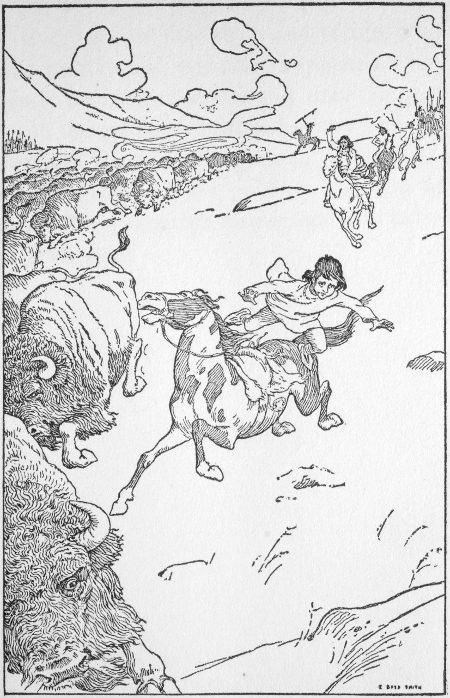
One of the big cows suddenly started and ran forward a few rods, and the
whole herd moved, too, and gathered in a close bunch behind her. Thus
they stood for a few moments, staring and tossing their heads, and then,
led by the big old cow, down the ridge they came with a tremendous
rattle and thunder of hoofs, and raising a thick cloud of dust behind them.
This was what old Red Crane on his little horse had been praying for,
and now he turned and rode swiftly toward the wide gap of the V-shaped
rock-piles. And swift as he rode, the buffalo were swifter and gained on
him steadily.
"Oh! Oh! They will catch up with him and trample him to death," Sinopah
cried in terror.
"No, no, he is not in danger," his father answered; "watch closely now."
In a few minutes Red Crane rode within the V, the buffalo right after
him, and soon the whole herd was in it, too. Then, as the tail end of
the band passed rock-pile after rock-pile, the people lying behind the
heaps sprang up and shouted, and wildly waved their robes. That scared
the rear animals, that alone could see and hear the people, and they ran
harder than ever, so crowding those in front to run faster and faster.
The band was nearing the cliff now, and were almost on top of Red Crane
and his little horse. Then it was that he suddenly turned and rode
straight east between two of the rock-piles of that side of the great V.
Turning to follow him,—the lead cows still thought they were running to
the rescue of a calf in trouble,—the herd saw people jump up from
behind the rocks, and were now for the first time as badly frightened as
were those in the rear. Quick as a flash they turned from that danger
and headed west, only to be confronted with people rising from the
rock-piles on that side of the V. Here, now, were people on each side,
and people back whence they had come. But none were to be seen to the
south, and southward they turned, running faster than ever in their
great terror. Red Crane was now safe. Sitting on his dripping horse, he
watched the animals go, and raised a prayer to the gods and his little
secret helper, asking that the buffalo should keep straight on.
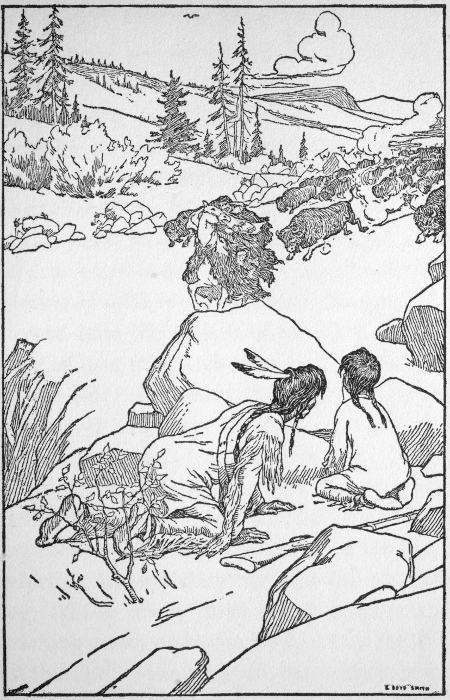
THEN IT WAS THAT HE SUDDENLY TURNED
In the mean time White Wolf had run with Sinopah to the edge of the
cliff, and several hundred yards east of the place where the two lines
of the V came close together, and there the two waited to see the end of it all.
Here, now, was the most anxious moment and the greatest danger; the
leaders of the herd might turn before coming to the cliff, trample the
people behind one or the other of the rows of rock-piles, and so circle
back to the plain in safety. But no! They kept straight on; and Sinopah,
watching them with staring eyes and open mouth, was never so excited in
his life: he felt as if he was going to burst from the dreadful danger
of it all; the terrible thunder of hoofs; the wicked gleams of wild
black eyes set in shaggy hair.
And now the leaders of the herd saw the edge of the cliff, and tried to
stop and turn to one side. But those behind them could not see it and
kept pressing forward with tremendous and irresistible force. There
could be no stopping. The leaders were swiftly pushed off from the
cliff, and following them went the living stream of the herd, whirling
and whirling through the air, falling, falling from that sheer height,
and crashing down onto the boulders at the foot of the cliff. Hundreds
of the buffalo went over the ledge, and only the last end of the herd,
just a few animals, turned at the last moment and escaped through the
people to the plain.
Most of those that went over the cliff were killed outright by the fall,
and those only crippled were soon put out of their misery by the hunters
down there. Then began the skinning of the animals and the cutting-up of
the meat and carrying it to the lodges in the camp. When night came the
work was all done and the people rested and were happy. Pretty soon the
moon came up and old Red Crane took Sinopah outside. Over at the foot of
the cliff wolves and coyotes and foxes were howling and yelping as they
fed on the bones and bits of meat that had been left there. "Listen to
our little brothers," he said. "It is a great feast that we are giving
them this night."
In some such way in the long ago, our own ancestors used to trap their
food. That was when they had no weapons but the bow and arrow and flint
knife, and meat and wild berries were all they had to eat.