He slept lightly. Julie woke again, an hour before dawn, and they made
love in a dreamy, unreal way, and then she subsided into sleep once
more. At eight, Durward quietly left the bed. Julie didn't stir. She
was far away, in a deep, unshakable slumber.
So much the better, Durward thought.
Going into his study, he wrote out a little note for her. Julie: I've
gone out on an important business matter. Forgot to tell you about it
last night. I'll be back here no later than ten or ten-thirty, provided
all goes well.
He left the note on his pillow, hoping she'd notice it when she
awakened. He dressed, without waking her, and closed the bedroom door.
Finding Finch-Starrett's address was no problem. Durward kept a file of
the home addresses of friends and foes, anyone he might want to contact
in a hurry over some news development. Finch-Starrett was there. He
lived in Brompton, on the south side of the Park, near all the museums.
A dreary though not slummy neighborhood, Durward thought. No doubt
Finch-Starrett had plans for moving to a more exclusive neighborhood,
like Durward's own Mayfair, or Belgrave Square, once he cashed in on
Durward's seventy thousand pound bribe.
He took the Rolls. The Jaguar would have been out of key, this early
on a Sunday morning in a quiet residential district. Traffic was light
enough to justify using the bigger car. And the Jag, he thought, was
likely to be more conspicuous. Durward glanced at himself in the
rear-view mirror as the big car came to powerful, smoothly-throbbing
life. His face was pale, but otherwise did not look at all unusual.
Portrait of a murderer setting out on his morning rounds, Durward
thought.
He drove down Park Lane, down to where Piccadilly met Knightsbridge,
then made the right turn that took him into Brompton. It was quiet,
quiet as the tomb down here. The endless rows of identical houses
slumbered. The museums were dark and silent.
He turned into Finch-Starrett's street, which was so hushed it might
have been a museum display of a typical London residential street, and
not the street itself. He eased the Rolls into a spot near the corner.
Number 77, Beauchamp Place. He glanced at the house in front of him.
Number 63. He kept walking, and the numbers rose.
77. There it was. A gray stone front, the usual Victorian style of
architecture, functionless pillars decorating the outbellying front
of the building. Careful now, Durward thought. Don't want to run into
any of the neighbors. It was a three-story building, and the directory
plate out front told him that Finch-Starrett lived on the topmost
floor. Durward tried the door to the vestibule, and it opened without
his having to ring a bell.
So far, so good.
Up the stairs, now. Quietly, quietly. Not even a creak, please. Past
the sleeping neighbors (who ought to be getting up, getting out to
church by this time, Durward thought. It's past nine in the morning.)
Second landing. Pause a moment, listen.
All clear.
On to the third floor.
Top of the stairs. A door.
Finch-Starrett's door.
Durward's throat was cottony-dry. He was right at the brink, now. In a
few moments, the world would be rid of a nuisance, and he would be free
to live and love as he pleased. The relief, the lifting of this heavy
burden from his back—it would be worth the risks involved in murder,
Durward thought.
He was surprised at his own calmness.
He looked around. Then he knocked at Finch-Starrett's door, gently, not
wanting to send the sound of it down through the entire house.
No answer.
Finch-Starrett was still asleep, then. All right. Not surprising.
He knocked again, louder.
Come on, you devil, wake up and answer the door! Wake up and let me
kill you!
Durward rehearsed the scene in his mind. Nothing protracted, he
thought, nothing drawn out with sneers and hamminess. Just step inside
when Finch-Starrett appears, grab him, slam him in the throat with the
edge of the hand. A quick stiff karate chop that would crumple his
windpipe and send him reeling bluefaced and bugeyed to the floor. Then
a quick check to make sure of death, and then, the job done, a rapid
exit. Perhaps they wouldn't find Finch-Starrett's putrefying body for
months.
Durward knocked again, as loud as he dared.
This time there was an answer, thin-voiced and indistinct and hesitant.
"Come—in—"
Durward frowned. That hadn't been Finch-Starrett's voice.
"Come—in—"
Louder, now, though still shaky. Durward knew the voice.
It was the voice of Lucien D'amato!
Puzzled, Durward tried the handle, found that the door was unlocked. He
pushed it inward and stepped inside, finding himself in a sunlit foyer
that gave onto a sitting-room piled high with books and manuscripts.
Durward gasped in shock.
D'amato lay sprawled almost at his feet, his body bent at a grotesque
angle and held stiffly rigid, as though he had been folded by some
giant hand and left to solidify in that position. Across the room
from him, lying face down in a weltering pool of blood, was Harold
Finch-Starrett.
D'amato's plump face was grayish. His soft eyes rolled wildly in his
head.
A bloody knife lay by the strip-club proprietor's side.
"D'amato! What are you doing here?"
"Came here—last night—" D'amato's voice was a barely audible croak.
"Why—why are you here, Durward?"
"Never mind that. What's gone on here?"
D'amato managed a feeble smile. "Came here—after the club closed.
To talk with him." Eyeballs rolled toward the bloody figure of
Finch-Starrett. "Told you—told you I'd take care he didn't print
anything. Didn't really think I'd—have to kill him."
"D'amato!"
"We argued. I told him not to print the piece about you. He refused.
We—shouted. Fought. He pulled a knife on me. Dirty buggering swine,
pulled a knife. Right out of that desk. Only—only I had a blade too.
Ripped his buggering throat open. But—but he got his knife into my
back—"
"Good Lord," Durward muttered. He knelt, saw the ragged tear in
D'amato's shirt, saw the dark ugly slit going deep into his back.
"Been here all night," D'amato whispered. "Can't move. Must have—must
have done something to spine. I pulled the knife out but—but can't
move legs or anything now. Getting stiffer. Like stone. Touch me.
Durward. Touch my arm."
Durward did. D'amato's eyes closed a moment. "Can't feel it," he said
hoarsely. "Can't feel a thing. Can't even shake my head. Getting hard
to move my lips. Can't—can't last much longer. Hard to breathe.
Paralysis—all over. Y'think the bugger cut my spine, Durward?"
"We'll get you to hospital right away," Durward said. "Why'd you do it,
D'amato? You shouldn't have—risked yourself—"
"Had to. He'd hurt Julie. And you. Couldn't allow that. Couldn't."
Durward chewed savagely at his lip. Crossing the room, he prodded with
the tip of his foot at the face-down body of Finch-Starrett until the
corpse turned over. Durward shuddered. D'amato had done an expert job.
He had slashed a ragged criss-cross into Finch-Starrett's throat,
cutting a gaping hole that nearly severed his head, and then had
embedded the knife hilt-deep into the journalist's chest. It was still
there. Durward drew his foot away, letting the body flop downward again.
The job had been done for him.
"Where's the phone?" Durward asked.
"Next to the window—on the desk—"
Durward nodded. "I'll get an ambulance. We'll get you the best medical
care there is, D'amato."
"No—use. Can't last. Chest getting paralyzed now. Won't—won't be able
to breathe—hard to talk—like a ruddy claw round my throat—"
Durward spun the telephone's dial.
"Hello. Operator. Operator, listen, there's been a murder and an
attempted murder at 77 Beauchamp Place. Yes, in Brompton. I want an
ambulance here right away—a man's still alive, but he's critical—yes,
get the police too, but first an ambulance—top floor, 77 Beauchamp
Place, and hurry it."
He put down the phone.
"No—use—" D'amato wheezed.
Durward knelt over him. The plump man was bizarrely stiffened, now.
His facial muscles seemed to have gone out of his control; his cheeks
sagged, and there was an idiot's droop to his lips.
"We'll have an ambulance here in a matter of minutes," Durward said.
"Just try to keep hanging on, D'amato. You've lasted all night—just a
little longer—"
"Can't—"
Durward clenched his fists. There was nothing he could do, nothing but
to wait. Here was this man, this gentle man, who had committed the
murder another man should have committed, and who had been stabbed
himself in the bargain, and had lain here six, seven, eight hours
paralyzed, unable to speak above a whisper, unable to move, even to
crawl—
"Durward—" came the thick, scarcely intelligible gasp.
"Durward—listen—"
"I'm listening, D'amato!"
"Take—take care of Julie—don't ever hurt her—give her the best—the
best of everything." A long wheezing pause. "I—loved that girl,
Durward. Like—like my own daughter, I loved her. I—"
"D'amato!"
Durward watched, his flesh crawling, as he saw the life leave D'amato.
The eyes remained open; apparently even the eyelids no longer responded
to the brain's command. But one moment the eyes had been alive, full of
pain and suffering, and the next they were calm and inert, two gleaming
glassy ovals without life, without sentience. The passage from life
into death had been unmistakable.
Alone with the two corpses, Durward prowled the room. He walked to
Finch-Starrett's desk, and spied a sheet of yellow foolscap that had
been folded. It was unfolded now, and Durward looked down and read:
Industrialist Howard Durward "he's top man of Durward Ventures,
Ltd., hard-driving takeover outfit" forms half of one of the most
ill-assorted twosomes in town these days....
Durward snatched the sheet up in horror. It was all he needed, to have
the police find that paper lying out in the open that way, and to begin
connecting possible links. He didn't want to be arrested for a murder
he hadn't committed. But what to do with the sheet? He couldn't very
well burn it without arousing suspicions on the part of some keen-nosed
detective.
He carried it into the bathroom, read it through one last time, and
began to shred it. When he had ripped it into fragments the size of
postage stamps, he threw a handful into the toilet bowl, flushed them
away, waited a minute, threw the rest in. That was the end of them.
Doubtless Finch-Starrett had a carbon of the passage somewhere in the
files, but by the time that came to light, if ever, nobody would think
of making the connection, Durward hoped.
He went back into the sitting-room.
Minutes later, he heard the sound of sirens, saw an ambulance and a
police lorry pulling up in front of the house, as windows began to open
all up and down the street and inquisitive heads started to appear.
The ambulance boys were the first ones up the stairs. Durward opened
the door and greeted them with, "Sorry, but I'm afraid you're too
late."
"Where's the body?"
"Two bodies," Durward said. "This is the man I summoned you about. He
died soon after I put in the phone-call."
The ambulance crew swarmed around D'amato and Finch-Starrett. Someone
recognized the newspaperman and said, "I knew someone would slit his
lousy neck before too many more years went by."
The police came streaming into the room a moment later. Durward tried
to remain calm.
He picked out the officer in charge and said, "I'm Howard Durward,
officer. I think I can explain some of what's happened here."
The policeman looked at Durward out of squinting eyes. "The fellow who
takes over companies, that Durward?"
"That's the one, yes," Durward said.
"Okay. What's the story, then?" He glanced at the bodies. "Both dead,
eh?"
"Both dead," one of the ambulance crew said.
Durward moistened his lips and said, "I drove over here about nine
this morning to see Mr. Finch-Starrett. I had some important business
to discuss with him—something he was supposed to put in his column
concerning me."
"Something that had to be talked about at nine o'clock Sunday morning?"
Durward shrugged. "I asked to see him, and that was the time he gave
me. But when I got here, I found him dead, and this man paralyzed and
dying."
"You know who he is?"
Durward nodded. "He's Lucien D'amato. Owner of the Merriment Revue
Club."
The policeman whistled softly. "Go on."
"D'amato said he'd come here after the Merriment closed last night.
That would be around one or two in the morning. He told me that he and
Finch-Starrett had quarreled and then had fought."
"Over what?"
"He didn't say. I guess Finch-Starrett was going to say nasty things
about the Merriment. He was investigating it, you know, for Major
Jarrell and the reforming bunch."
A stenographer's pencil scribbled tirelessly.
Durward went on, "According to D'amato, Finch-Starrett pulled a knife.
D'amato did the same. They jumped at each other, and D'amato got
stabbed in the back, but he managed to slash Finch-Starrett's throat,
and plant the knife in his heart. Then D'amato staggered over there and
fell down, got the knife out of his back, and found he couldn't move
the lower half of his body. The paralysis increased, and by the time I
got here he could barely talk or move his head. He died soon after I
arrived."
There were questions. There were questions for an hour or more, as
higher police officials arrived when the growing importance of the case
became apparent. Durward began to regret that he had not simply slipped
away. His name was bound to be mixed into this in the papers, now. It
wasn't the sort of publicity a gentleman wanted. He doubted that they'd
book him for the actual murder, but the mere fact of his presence here
so early on a Sunday morning seemed to arouse a good deal of suspicion.
But he had no choice but to stay around. D'amato had still been alive
when he had phoned for help, and had to be watched. And it would have
been very very bad if he had tried to leave the moment of D'amato's
death, and had been nabbed by the arriving police.
At the end of an hour's questioning, though, it was decided that they'd
had enough from him. They thanked him very kindly, with great deference
to his importance and position, and let him go.
Durward felt as though he'd been awake for days. It was only ten
minutes of eleven, though. Nervelessly, almost numbly, he drove back to
Park Lane.
Julie was still asleep when he entered the bedroom. She stirred, moaned
sleepily.
"That you?" she said. "Howard?"
"Yes."
"You went somewhere."
"I'm back now."
She sat up, an enchanting figure in her nudity. Her breasts rose
steeply as she put her knuckles to her eyes and yawned.
"Where have you been?" she asked.
Durward managed a faint smile and slipped his jacket off. He sat down
on the edge of the bed, letting his hand rest lightly on her bare thigh.
"It's a long story," he said quietly. "A long, long, very surprising
story. But we're free from Finch-Starrett, darling. Free for good."
It was Thursday, now.
Harold Finch-Starrett had been unmourned in his grave since Monday
afternoon. The newspaper that would have carried the column exposing
Howard Durward's illicit affair carried Finch-Starrett's obituary
instead.
At his office, at three o'clock Thursday afternoon, Durward put his
signature to the articles of agreement covering a merger between
Durward Ventures, Ltd., and Dynamic Automation, Ltd. The deal had
been worked out yesterday, across the lunch table, in face-to-face
confrontation between Durward and Sir Ronald Walters.
Durward had been afraid that the scandal of having been around on
the murder morning would ruin the merger. But the publicity had been
surprisingly easy-going. There was a good deal of talk, of course,
since so important and well-known a figure had been the one to discover
the bodies. But he was beyond suspicion, and nobody seemed to question
his presence there. The merger had gone off smoothly enough, at the
original price. 50,000 shares of DV to be exchanged for the entire
capital stock of Dynamic Automation, subject to ratification by the
stockholders of both corporations. And said ratification was a foregone
conclusion, since the heads of the corporations held controlling
interests in their respective firms.
The telephone rang.
"Mr. Martlett calling, sir."
Durward took the call. "Good afternoon, Martlett. What's the news?"
"The news is splendid. DV shares are up one-and-sixpence, and they'll
be going higher. The merger is definitely coming off, is it?"
"As definite as anything is in this world, Paul."
"I suppose. Have you heard about the Merriment Club yet?"
"What about it?" Durward said.
"Our friend Puddy is taking it over. He called me a short while ago to
arrange for the financing. He's buying it from the D'amato estate and
is going to operate it himself."
"I'll be damned," Durward said. "Puddy's going into business!"
"And wouldn't you know what sort of business," Martlett said,
chuckling. "He'll spend more time backstage pinching his stars than
anywhere else."
Confirmation of the story came from Laughton himself, a short while
later. He sounded overjoyed.
"Everything's all agreed, Howard. I'm taking title on Friday, and we'll
re-open the place Saturday night. I do hope you'll be there. I'll give
you a life membership, of course. It's the least I can do."
"Well, thank you, Puddy. But I'm afraid I've got a bit of bad news for
you."
"Oh?"
"You're going to lose one of your star turns. Julie won't be able to
appear at the Merriment any more."
"Why not?" Laughton asked. "I'll give her more than D'amato was paying
her! I'll—"
"You can't possibly meet the price," Durward said. "I just won't permit
it. It wouldn't be seemly, would it, for the wife of Howard Durward to
appear three times a night in a strip-club, would it?"
"The wife of—"
"I'm announcing it over the weekend," Durward said. "You can whisper it
around, if you like. And let it be known that the future Mrs. Durward's
past is never, mark you never, to be discussed within her husband's
hearing."
"Howard, are you sure this is right? She's a charming girl and all, but
won't it touch off a bit of a scandal if you—"
"I don't care," Durward said firmly. "I can survive any scandal. Her
past will be forgotten. And anyone who drops us socially simply wasn't
worth knowing in the first place. Oh, and Puddy—"
"Yes?"
"We're leaving for Spain on Monday. Any souvenirs you'd like us to send
you?"
"A dark-haired senorita," Laughton said promptly. He laughed. "Getting
married. Good old Durward. I'll be damned. I'll be everlastingly
damned!"
"You probably will be," Durward said.
"You'll come around to the old Merriment, won't you? You and your
bride?"
"From time to time," Durward said. "Just for sentimental reasons."
He put down the phone. It was still early in the afternoon, but he
had done all the work he cared to do. Julie was waiting. She had been
living at his flat since Sunday, when the Merriment had closed after
D'amato's death, and each day he started for home a bit earlier, so he
could be with her longer. He could picture her there now, relaxing in
his home, perhaps darning his socks, preparing something delectable for
dinner. And he'd come home, and drag her away from whatever she'd be
doing, and carry her into the bedroom and peel off her clothes and kiss
her swelling breasts and hold her body against his, and then they'd
make love, as though love were being prohibited as of tomorrow—
He nudged his interphone.
"Miss Parkes?"
"Yes, Mr. Durward?"
"I'm leaving now. If there are any calls for me, take messages."
"But it's only three o'clock, Mr. Dur—"
"Yes, I know," he said crisply. "I'm leaving, all the same. See that
everything's in order when you leave, Miss Parkes."
He got his hat and umbrella from the office closet, and his paper.
He walked to the door. Everything was fine, he thought. It was a
gorgeous spring day, and in a few days more he'd be in Spain, on
his—his honeymoon. Let tongues wag. He didn't care. Let people whisper
that Howard Durward had married a retired stripper. To hell with them.
Durward smiled and stepped out into the hallway to ring for the
elevator.
He was on his way home.
Home to Julie.
THE END
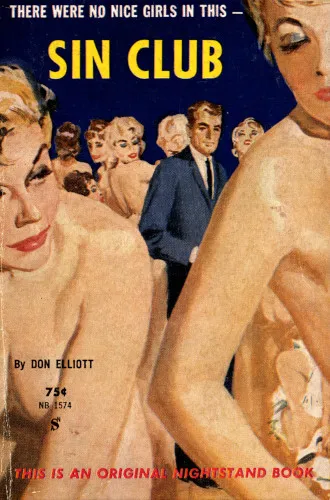
IN THE NUDE ...
was the way he first saw her. Stark naked on the stage of the
Merriment Revue Club, one of London's most exclusive Soho flesh-dens.
He saw her prancing undressed, and his eyes fastened on her and would
not tear away from her beauty. He had to know her, possess her, and
later, when he had tasted the fruits of his desire he was shocked to
find that he loved this sin club dancer, and she returned his love with
a violent passion. Now they were trapped in a vicious web of their own
making, for the affair could only ruin his life of respectability and
denounce her as a shameful wanton. For the press would soon scream that
Howard Durward was living in sin with—
... A NAKED LOVELY!