It was a practice with us for many years to arrange a special
evangelistic medical trip in the spring of the year. Sometimes Mrs.
Nelson and I would join Dr. Harris in a journey of two or three weeks,
and sometimes the doctor and I would go alone. One of the most memorable
of these journeys was in the spring of 1893, in the month of May. We had
our tent and camp outfit and the large chests of medical supplies
carried on mules and were accompanied by our cook, with his portable
kitchen packed away under him, and the Syrian assistant of the doctor,
so that we made quite a party altogether. We started along the shore
north from Tripoli, making our first camp about ten miles out of the
city. The next day's journey brought us to Tartoose on the shore
opposite the island of Arvad. Ezek. 27:8. This island lies only a short
distance from the shore, but I have never yet been able to reach it
because of the violent west wind on each occasion of a visit to
Tartoose. The island is wholly covered by the town, which is occupied by
sturdy sailors and fishermen. There are many interesting relics of
ancient times in Tartoose, though it is possible that many of the coins
offered to the credulous public may have been produced recently in the
place itself.
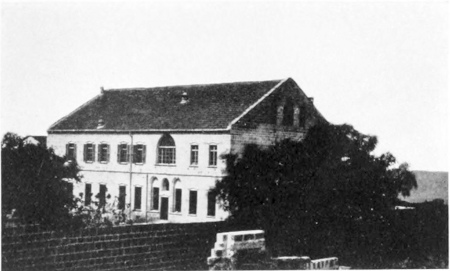
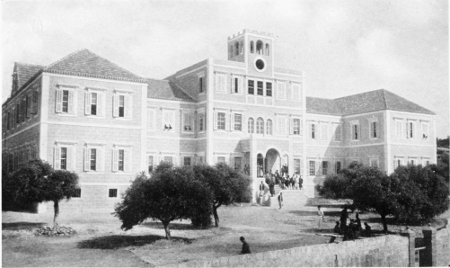
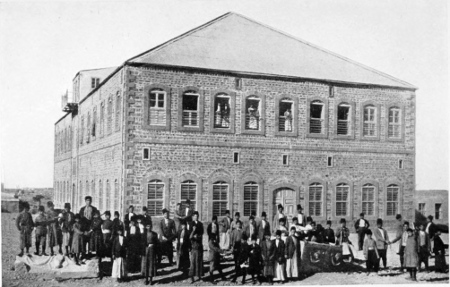
LATAKIA BOYS' SCHOOL
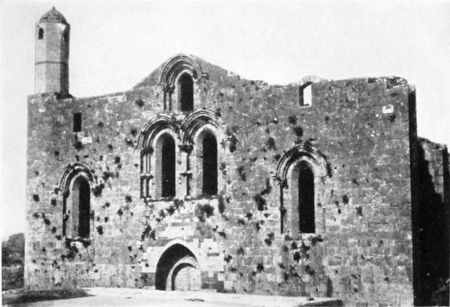
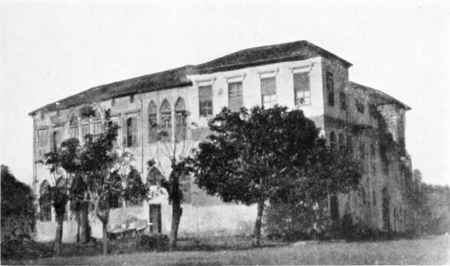
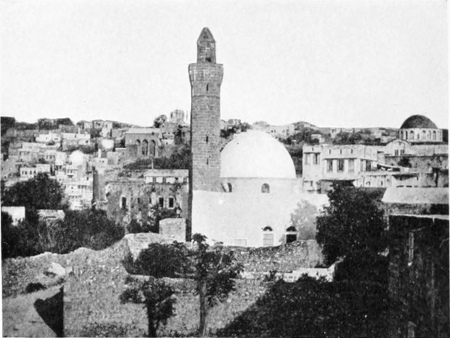
TARTOOSE
Crusaders' Church
At the edge of the town stands a fine Gothic church, whose substantial
walls and graceful arches are a pleasure to the eye. The empty windows
make one feel lonesome as he approaches the building, and the bare
interior speaks of a decadent Christianity that adds to the sadness.
But, worst of all, is the minaret crudely built on the corner of the
roof, for this is another of the many Christian churches in Turkey which
have been transformed into mosques.
At another of our camping places we found, near at hand, an old Roman
amphitheater, where it was not difficult to imagine a concourse of
pleasure seekers seated on the stone benches watching some exhibition of
strength or skill in the arena below. Wherever one goes in Syria, he is
reminded of an ancient glory and power, in close and vivid contrast to a
present state of decay and weakness.
Our first Sabbath, on this journey, found us at Latakia, where we spent
the day with our neighbors and fellow workers of the Reformed
Presbyterian mission. This mission was started especially to reach the
Nusairiyeh people of north Syria. Because of the persistent interference
of the Turkish Government, their work has been greatly hampered and
their efforts largely restricted to the training of boys and girls in
the boarding institutions in the city, and ministration to the sick in
the hospital. It was a great pleasure to have this break in our journey
and the pleasant intercourse with those engaged in the same kind of
service as our own, and to have the privilege of speaking to the young
people in their schools.
On Monday we went a short distance from the city, pitching our tent near
a village of considerable size on the plain some miles back from the
sea. As I sat in the moonlight at the door of the tent, a man wearing
the white turban of a Moslem scholar approached me. He seated himself
near me after a pleasant greeting and we fell into agreeable
conversation. After some time, this man took the opportunity, when no
one was near enough to overhear him, to ask most earnestly that we
should send them a teacher for their children. I was surprised at the
request from such a source and turned the conversation so as to make
sure that he understood who we were and what kind of schools we
conducted. He showed that he understood the matter fully, and that he
really desired a Protestant Christian teacher for his town. I then asked
him directly, "Are you not a Moslem?" Looking about again, to make sure
no one should hear him, he said, "Yes, I am a Moslem now," with an
emphasis on the last word which revealed the facts in the case. He was
of a Nusairiyeh family but had yielded to the persistent pressure of the
government so far as to accept the form of adherence to Islam, though in
his heart he hated the system and its followers most cordially.
A long day's ride brought us through the wild and tortuous valley of the
Nahr-ul-Kandil, up the slope of Mount Cassius to the town of Kessab,
some four thousand feet above the sea, where the Latakia missionaries
have their summer homes. It was a most beautiful though rugged ride, and
would have been thoroughly enjoyable in good weather. The wild flowers
were in full bloom, and every turn in the road brought into view a new
combination of varied and bright colors, where the little blossoms
clustered amid the green foliage, among the gray rocks. The great
drawback to our enjoyment lay in the fact that for a large part of the
distance we rode in a heavy and most unexpected rainfall. We were not
prepared for such an experience in the month of May, and so reached our
destination soaked and cold. We had been directed to take possession of
one of the cottages belonging to the missionaries in Latakia, and it was
certainly a most welcome haven. We were able to light a fire in the
kitchen stove and spread out our wet garments to dry, while we warmed
ourselves in the grateful heat.
It was a disappointment the next day that the top of Cassius was
enveloped in heavy cloud, forbidding an ascent. This mountain is about
five thousand feet in height, rising directly from the sea, and so is a
conspicuous object from every direction and gives an extensive view from
its summit. We could tarry but one day, and descended to the old site of
Seleucia, at the mouth of the Orontes, and saw some remnants of the old
harbor from which Paul set sail more than once. The Orontes is quite
wide and deep near its mouth and we crossed it on just such a wire ferry
as I had seen many years before on the Connecticut River in
Massachusetts. The gardens of Swadia were most refreshing with their
green verdure, cool shade and rich fruit, after a long day's ride in the
heat, and again we had the pleasure of missionary fellowship, for our
friends of the Reformed Presbyterian mission have a station here also.
Another easy stage brought us to old Antioch, so closely associated with
the beginning of Christian history. It is not an attractive city in
outward appearance and has suffered much at different times from
earthquake.
From Antioch we followed the Orontes Valley up to Hamath, where we were
once more among our own organized stations. Such journeys give us an
acquaintance with the country and the people, which is of the most vital
importance in planning for the proper expansion of the work.
Once, on a pleasant summer evening, we were encamped near a Nusairiyeh
village. Among those gathered about us were an elderly peasant and his
son, a well-built, sturdy youth of seventeen or eighteen years. As he
sat before us this young man appeared to be in perfect health and vigor,
but when he rose to walk, his awkward gait revealed his misfortune, for
both feet were so badly deformed that he walked on his ankles and not on
the soles of his feet. The doctor was asked whether this defect could be
remedied. After a careful examination the lad was told that the
operation would be painful, and that some time would be required, but
that if he would come to the hospital, prepared to stay as long as
should be necessary, he would be able to come away, walking erect, like
other people. The faces brightened at once, and we shared in their
pleasure at the prospect of this deliverance. The next morning, however,
we were told that the family had talked over the matter and decided not
to have the operation performed. We assured them there should be no
expense, but they said it was not the matter of expense. Then we told
them of similar cases which had been successfully treated, but they
assured us they had no doubt of the doctor's skill. We encouraged the
young man to bear the pain for the sake of increased enjoyment in life
afterwards, but he said he was not afraid of the pain. What then was the
trouble? At last we learned the truth. So long as the lad could show two
such clubbed feet, he would be excused from military service; but if
they were made straight he would be called to the army; and he would
rather go through life a cripple than to give several years of his vigor
to service in the Turkish army. And he is no exception.
We were approaching a large town of bigoted people, wondering how we
should secure an opening for our message. I was riding slightly in front
of the doctor, occupied with plans for securing access to the people.
Suddenly I heard the doctor's voice behind me saying, "Boy, do you want
your eye straightened?" On looking back I saw a lad of about fifteen
years, with a decidedly crossed eye, beside the doctor's horse. He
promptly accepted the offer, and we hastened to dismount and tie our
horses. A table in the little roadside café was quickly cleared, while
the doctor got out his case of instruments from his saddlebags. The boy
was placed on the table and in an incredibly short time the cords were
severed so that the eyeball took its proper position, and we were
thoroughly advertised. By the time our camp equipage came up, we had
been provided with an excellent place to camp, and had nothing to
complain of in the reception of the people.
A memorable experience was in the neighborhood of a large village whose
gardens are said to be watered by three hundred springs. Whatever the
correct number may be, there is no question about the abundance of
water and the luxuriance of the gardens. We had three tents, one for
medical clinics and one apiece for our two households, and settled down
for a fortnight's work. Every day we had crowds about the tent for
medical attention and for religious services. The evenings gave abundant
opportunity for work among those who gathered about us after their day's
work was done. They were glad to join in the hymns of praise, and
listened earnestly to the spoken message and read word. One evening, the
boys who gathered about the tent told me that the superintendent of
their school was in town and had begun an examination, to be finished
the next day. I decided to go to the school the next morning to make the
acquaintance of the superintendent and to see what the school was doing.
When I arose the following day, I found many of the boys about the tent,
and asked them why they were not at school for the examination. "Oh,"
they said, "there is no examination to-day. Early this morning, the
superintendent, the teachers and the headman of the village took their
horses, a large bottle of spirits and a young kid, and went up to the
top of the mountain to a famous spring to spend the day in a drinking
spree."
One of the pleasantest evenings I remember in my regular routine touring
was spent in this same village. We had brought our party to a garden,
owned by one of our friends who was always glad to have us make it our
headquarters. We had eaten our supper and were seated on the ground,
under a high, branching tree into which was trained a huge grapevine.
Behind us was a little hut, in which the caretaker slept in stormy
weather. At one side was a rude booth where the owner slept during the
summer. An oil lantern gave some light. One by one quite a group of
neighbors and friends assembled and, after some general conversation,
we sang some hymns. Then I opened the Bible for a little reading, with
simple exposition. As I read and talked to them, the row of dark faces
was turned toward me with an intentness and eagerness to hear that made
me hope they might not see me or hear my words, but hear those words of
life spoken so many years ago in Palestine, and see that Face from which
alone shines the true light.
We are not always left to do as we please on these trips, for the
paternal Turkish Government sometimes takes an unnecessary interest in
our plans and shows an excessive concern for our safety. We had crossed
a rugged section of the mountains and come down to a walled town, which
is a government center. Here we camped near the town and were promptly
favored with a call from officials, sent by the governor to find out who
we were. We paid a formal call on his Excellency and were allowed to
remain quietly as long as we desired. When we broke camp a polite
message came from the governor, asking where we were going and offering
a guard and escort. We returned a grateful acknowledgment of his
courtesy, but assured him that we were familiar with the roads and would
not trouble him to send an escort. It was only after some difficulty
that we succeeded in getting away alone. We learned afterwards that we
were followed, and that, in accordance with instructions from
headquarters, word was sent from place to place to keep watch of us. At
one large town we had large crowds about our camp and large audiences
for evening services for several days, when suddenly there was a change
and no one came near us. Apparently the sick were all healed and all
interest in singing and conversation had ceased. It developed that word
had been sent to the nearest government center, and orders had come back
at once, not to interfere with our comfort but to notify the people to
have nothing to do with us. At one of these places, which were all
occupied by Nusairiyeh and Ismaeliyeh people, Mrs. Nelson was talking
with some of the women about religion. They said, "Do Christian women
have any religion?" When assured that we believe religion to be for
everyone, whether male or female, rich or poor, wise or ignorant, they
replied: "It is not so with us. A woman with us can have no share in
religion. If one of us should accidentally overhear the men talking
about religious beliefs, so that she unintentionally learned some
religious doctrine, she ought to acknowledge it and be put to death. And
it is right to be so, for a woman must know nothing of religion."
On another occasion, quite a party of us stopped to spend the night in
one of these towns. While I was busy with arrangements for the night
other members of the party went to look about the little castle at the
edge of the town. Our presence was reported to the acting governor.
Unfortunately he was a man of surly disposition and anxious to magnify
his office. He demanded our Turkish passports, which he had a technical
right to do. Unfortunately some of the party had failed to provide
themselves with these documents as they were seldom called for. It gave
our little governor a chance and he used it, insisting that he must send
us to Hamath, practically under guard, but nominally under military
protection. We were intending to go to Hamath, but not directly, and so
it was finally agreed that the horseman go with us to Mahardeh where we
were to lodge, and accompany us the following day to Hamath. When we
started out the next morning, it was ludicrous to see the haughty airs
of this soldier who was sent with us. He acted as if he really believed
these foreigners were committed to his absolute control and carried his
head very high. Before going many miles we had succeeded, by pleasant
conversation, in limbering him up considerably, and by noon, when we
stopped for luncheon, he displayed his power in our behalf by ordering
the villagers to serve us in every way possible. By evening, when we
entered Mahardeh, he was quite cringing in his servility, for now he
realized that he was alone and we were among friends, so it was worth
while to be genial and submissive. When I informed him that I was not
going with the party the next day, he claimed to be greatly terrified
and begged me most humbly not to subject him to such peril. "For," said
he, "the number of foreigners is mentioned in the governor's letter, and
if I do not produce the full number, I shall be held responsible." I
said, "Be that as it may, I must stay here over Sunday and on Monday
morning I will follow and report myself to his Excellency if necessary."
He went away, apparently in much uncertainty. I knew, however, that the
matter was a mere formality and would bring no risk either to him or to
me; and so it proved, for the governor took no interest in the matter at
all.
On a warm summer evening, Dr. Harris and I rode up to the sheik's house
in a village I have never visited before or since. As strangers we were
welcomed to the public room. It was soon discovered that a doctor was
present, and immediately all who were diseased came about us. It was a
marvel to see men lie down before this stranger with perfect confidence
and allow him to cut about their eyes or put drops in them. It does
happen, alas, too often, that this credulity costs them dear, for many
an eye has been ruined by conscienceless quacks who trade on the
simplicity of the people. It is a pleasure, however, to see them place
themselves in the hands of the skillful and honest missionary physician,
who will help them, if possible, or tell them truthfully if there is no
remedy. At sunset a large dish of wheat, boiled with some meat, was
brought out, and cakes of barley bread placed about it. All who were
present were bidden to partake, and we did the best we could to satisfy
our hunger. After a social evening we spread our beds and made ready for
sleep, if possible. As I lay on my bed, I could hear those who sat about
discussing us. They told of the doctor's famous skill and what he had
done there before them. I was glad to find that I held the humble
position of doctor's assistant in their estimation. But I could not help
wondering then and since about that village. So far as I know that is
the only missionary visit ever made there. Is it enough?
ALEPPO MINARET