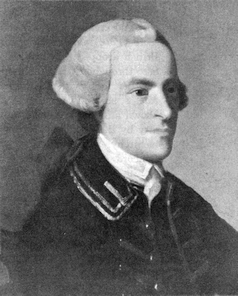
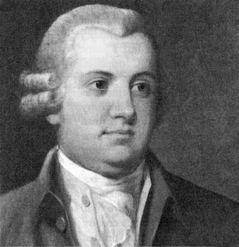
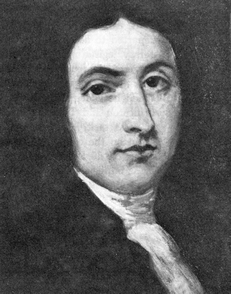
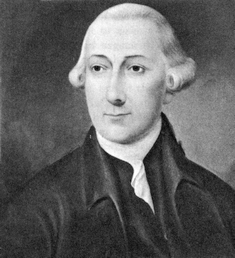
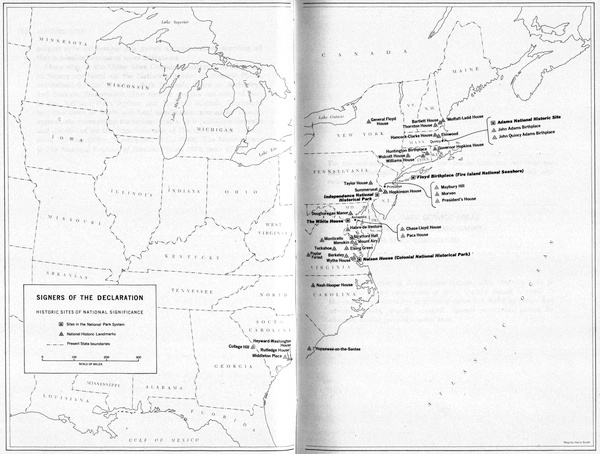
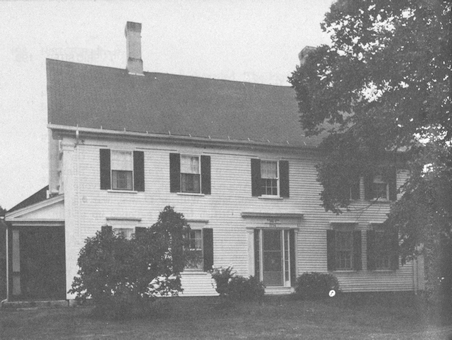
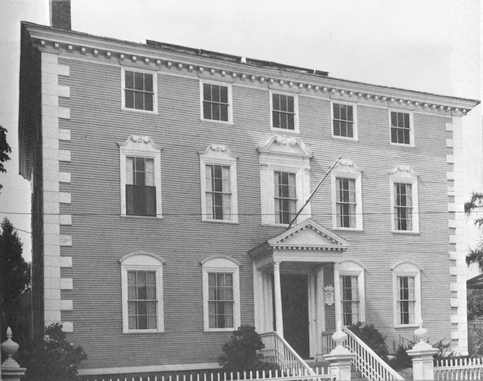
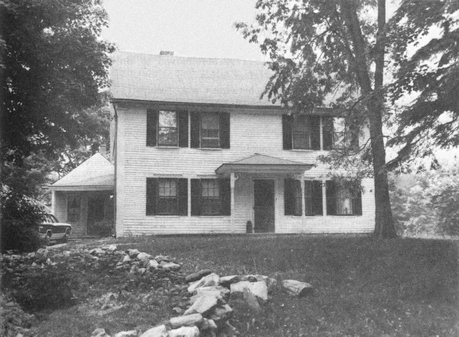
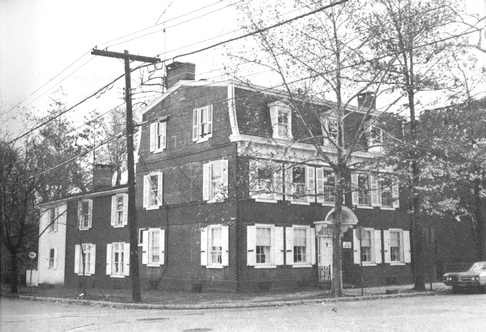
Signers of the Declaration — Foreword — Preface — Contents — Part One Signers of the Declaration: Historical Background — Part Two Signers of the Declaration: Biographical Sketches
Transcriber’s Note
Cover created by Transcriber and placed in the Public Domain.
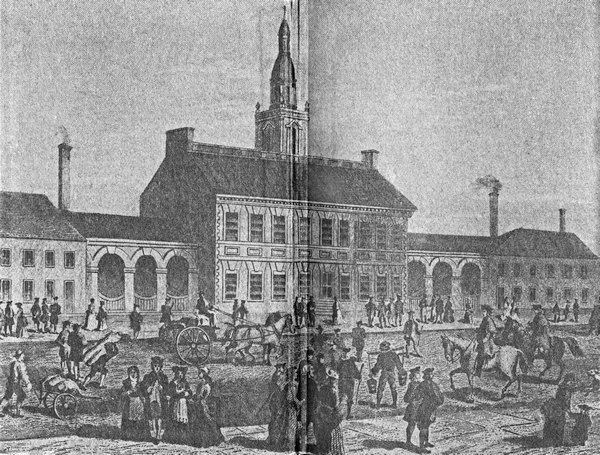
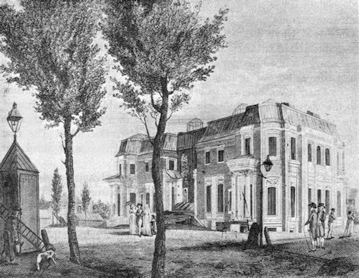
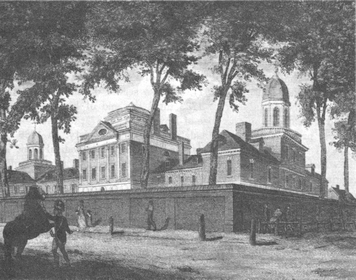
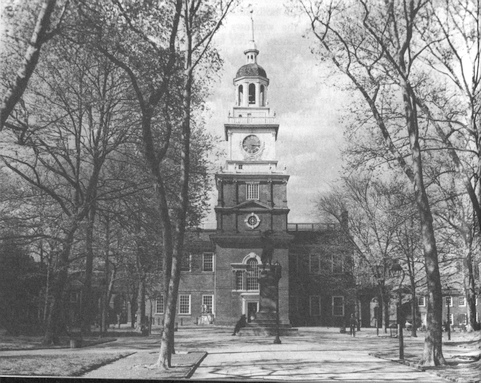
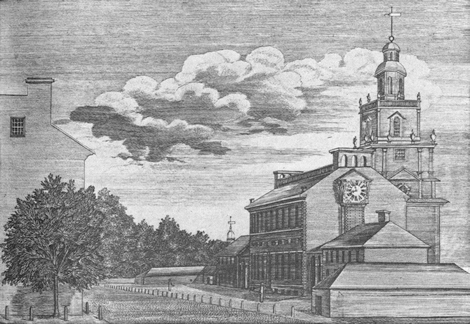
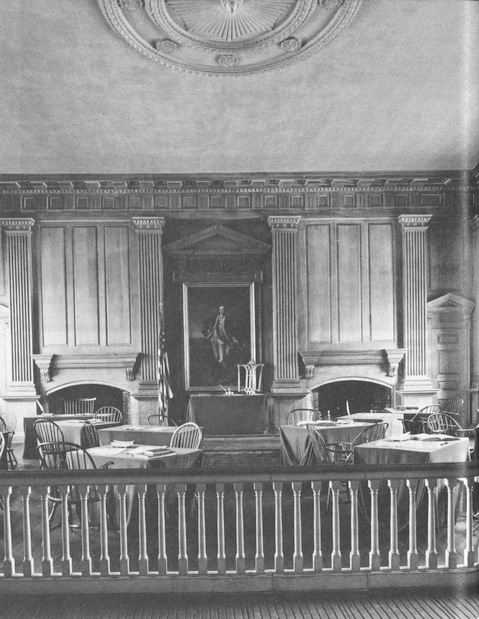
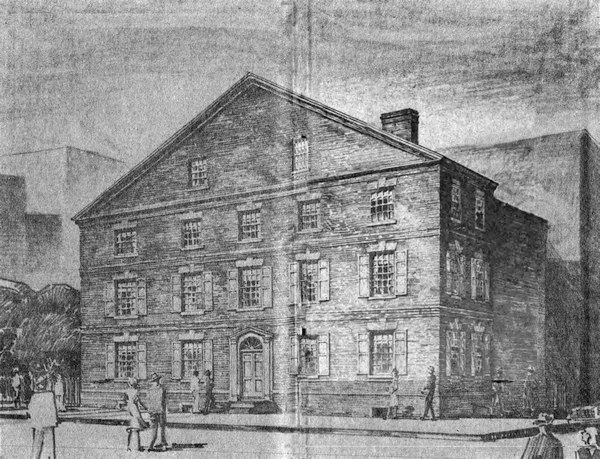
Independence Hall in 1776. Here the Continental Congress adopted
and signed the Declaration of Independence.
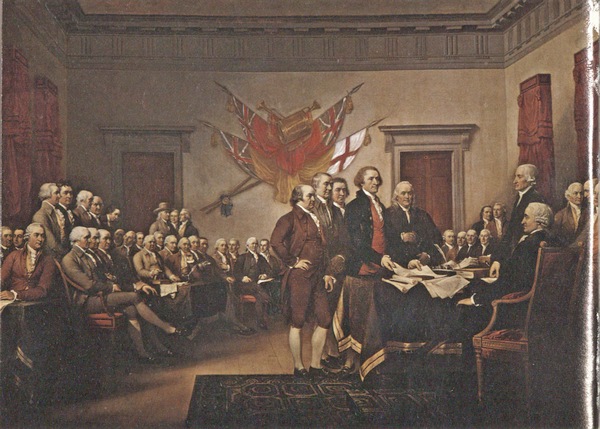
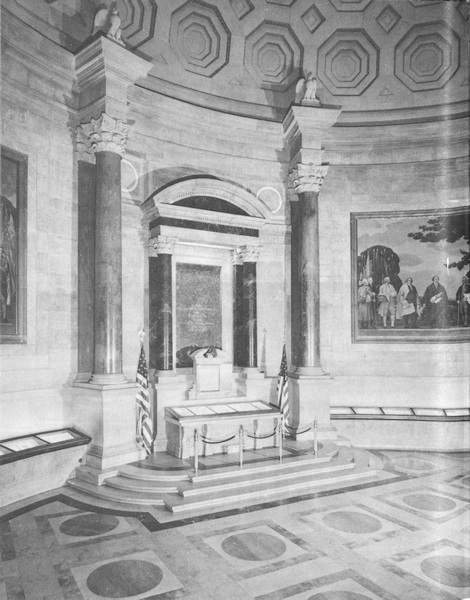
John Trumbull’s “The Declaration of Independence” hangs in the rotunda
of the U.S. Capitol. Depicting the drafting committee presenting the
document to the Continental Congress, the painting commemorates
the signers.
THE NATIONAL SURVEY OF HISTORIC SITES AND BUILDINGS • VOLUME XVIII
Signers OF THE DECLARATION
Historic Places Commemorating the Signing
of the Declaration of Independence
ROBERT G. FERRIS Series Editor
UNITED STATES DEPARTMENT OF THE INTERIOR
NATIONAL PARK SERVICE
Washington, D.C. 1973
ASSOCIATE DIRECTOR FOR PROFESSIONAL SERVICES
Ernest A. Connally
OFFICE OF ARCHEOLOGY AND HISTORIC PRESERVATION
Robert M. Utley, Director
DIVISION OF HISTORY
A. Russell Mortensen, Chief
HISTORIC SITES SURVEY
Horace J. Sheely, Jr., Chief
This volume incorporates a comprehensive survey of sites and buildings
associated with the signers accomplished by Charles W. Snell and the
late John O. Littleton. Also utilized were survey and evaluation reports
authored by the following individuals: S. Sydney Bradford, Charles E.
Hatch, Jr., W. Brown Morton III, Denys Peter Myers, John D. R. Platt,
Frank B. Sarles, Jr., Charles E. Shedd, Jr., Horace J. Sheely, Jr., and
Martin I. Yoelson. These surveys and reports were reviewed by the Advisory
Board on National Parks, Historic Sites, Buildings, and Monuments.
Members of this group are listed in the Acknowledgments. Directly
involved in all aspects of the preparation of this book were Assistant
Editor Richard E. Morris and Editorial Assistant James H. Charleton.
It was designed by Gary Gore.
THIS BOOK IS ISSUED AS PART OF THE NATIONAL PARK SERVICE
OBSERVANCE OF OUR NATION’S BICENTENNIAL.
As the Nation’s principal conservation agency, the Department of the Interior
has basic responsibilities for water, fish, wildlife, mineral, land, park, and
recreational resources. Indian and Territorial affairs are other major concerns
of America’s “Department of Natural Resources.” The Department works to
assure the wisest choice in managing all our resources so each will make its
full contribution to a better United States—now and in the future.
LIBRARY OF CONGRESS CATALOG CARD NUMBER: 73-600028
For sale by the Superintendent of Documents, U.S. Government Printing
Office, Washington, D.C. 20402 · Price $5.65
Stock Number 2405-00496
As we approach the two hundredth anniversary of the signing of
the Declaration of Independence, each of us is stirred by the memory
of those who framed the future of our country.
In the coming years we will have many opportunities to refresh
our understanding of what America means, but none can mean more
than personal visits to the sites where freedom was forged and our
founding fathers actually made the decisions which have stood the
severest tests of time.
I remember my reactions, for example, when I visited Independence
Hall in Philadelphia in 1972 to sign the new revenue sharing legislation.
Walking into the building where that small group of patriots
gathered some two centuries ago, I thought back to what it must
have been like when the giants of our American heritage solemnly
committed themselves and their children to liberty. The dilemmas
they faced, the uncertainties they felt, the ideals they cherished—all
seemed more alive to me than ever before, and I came away with
an even stronger appreciation for their courage and their vision.
As people from all over the world visit the places described in this
valuable book, they, too, will feel the excitement of history and relive
in their minds the beginnings of a great Nation.
I commend this book to your attention and encourage all people,
Americans and foreigners alike, to make a special effort to visit our
historic sites during these Bicentennial years.
The White House Washington, D.C.
Richard Nixon
Nearly two hundred years have passed since America proclaimed
her independence. Yet this action and the beliefs and hopes motivating
those responsible for it are as central to us as a people today as
they were to Abraham Lincoln, whose words still remind us that “...
our fathers brought forth upon this continent, a new nation, conceived
in Liberty, and dedicated to the proposition that all men are
created equal....”
To understand what we have become, we must know what we have
been. This volume illuminates the role of those who framed the Declaration
of Independence and took the bold risk of putting their signatures
to it, thus bringing into being a new Nation on a new model
of stated principle. It will stimulate our visual memory of the persons
and events that cast this Nation upon its course, and I commend it
to all who would more fully appreciate that heritage.
Rogers C. B. Morton Secretary of the Interior
It is my hope that this volume will not only increase popular
knowledge of the Declaration of Independence and its signers, but
that it will also undergird the efforts of historic preservationists to
protect sites and buildings associated with them. Written records
alone cannot convey the appreciation and understanding that come
from personal acquaintance with historic places. Thus, while we preserve
and study the documents of the American Revolution, we must
also save and experience what physical evidences remain to illustrate
the lives of those who so boldly brought it about. With the assistance
of this book, many more Americans may come to know the sites and
structures frequented by the signers of the Declaration, to visit them
personally, and to appreciate more deeply the importance of their
preservation.
Credit for the preparation of this volume is shared widely by
persons both in and out of the National Park Service. The historic
preservation activities of the Service have particularly benefited from
the assistance of the National Trust for Historic Preservation in the
United States, cosponsor of the National Survey of Historic Sites and
Buildings. The Survey is authorized by the Historic Sites Act of 1935.
At Philadelphia in the summer of 1776, the Delegates to the
Continental Congress courageously signed a document declaring the
independence of the Thirteen American Colonies from Great Britain.
Not only did the Declaration of Independence create a Nation, but it
also pronounced timeless democratic principles. Enshrined today in
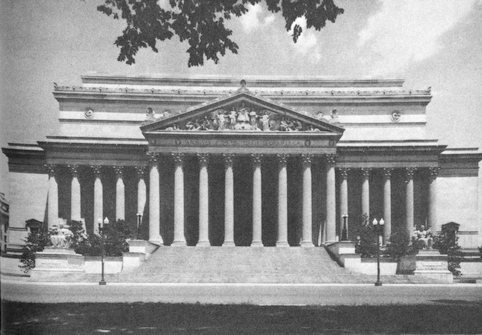
the National Archives Building at Washington, D.C., it memorializes
the founding of the United States and symbolizes the eternal freedom
and dignity of Man.
* * * * *
By the time the Continental Congress adopted the Declaration in
July 1776, the War for Independence had been underway for more
than a year. Failing to obtain satisfactory redress from the mother
country for their economic and political grievances during the previous
decade, the colonists had finally resorted to armed conflict.
These grievances had come to a head shortly after the French and
Indian War (1754–63). Long and costly, the war depleted the royal
treasury and added the financial burden of administering the vast
territory acquired from France. Britain levied new, direct taxes in the
Colonies and tightened customs controls.
The colonists, accustomed to considerable economic freedom, resented
these measures. A number of Americans also felt that some
sort of conspiracy existed in England to destroy their liberties and
self-government. They believed that the mission of the large force of
redcoats assigned to the Colonies actually was internal suppression
rather than protection from a nonexistent external threat, especially
since the French had been expelled. Particularly aggravating was the
realization that the new tax levies supported the force. Some of the
discontent was regional in nature. Indebtedness to British creditors
irritated Southern planters. Commercial interests in the Middle Colonies
disliked the prohibition on manufacturing certain products. Frontier
settlers and speculators were irked at restrictions on westward
expansion and the Indian trade.
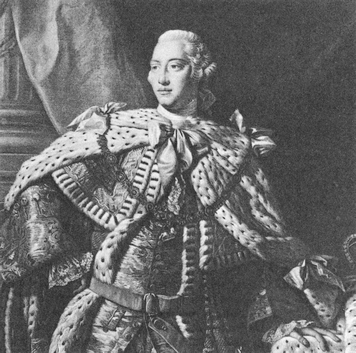
George III, King of England during the War for Independence,
was the focus of colonial hatred.
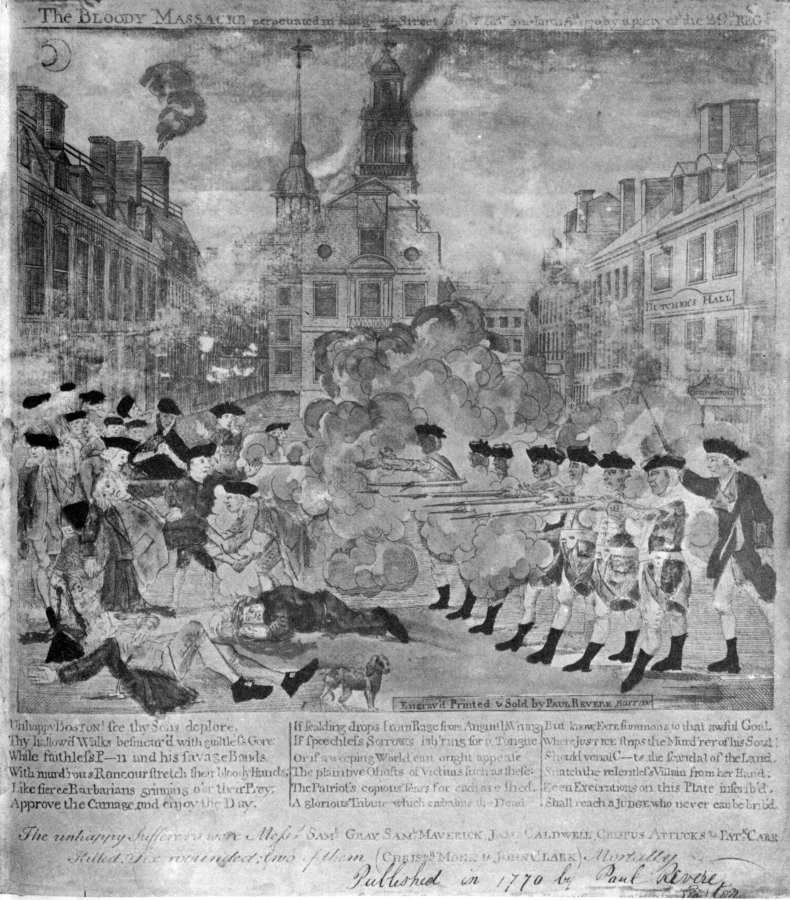
The Revolutionaries utilized this exaggerated version of the Boston
Massacre (1770) by Paul Revere to nourish resentment of British troops.
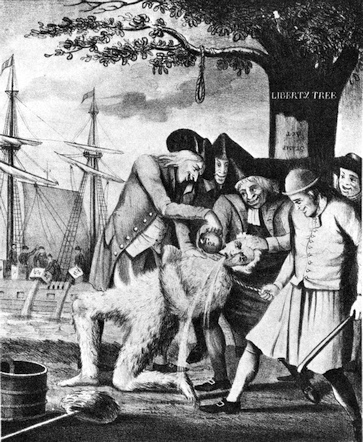
“The Bostonians Paying the Excise-Man or Tarring & Feathering,”
a British cartoon satirizing colonial methods of protest.
In various places, peaceful protest and harassment of tax and customs
collectors gave way to rioting and mob violence. In New York
and Massachusetts, clashes with British troops culminated in bloodshed.
Realizing that some of these disturbances stemmed from agitation
in the colonial assemblies, which had enjoyed wide autonomy,
the Crown tightened its control over them. Disputes between legislators
and the King’s officials, once spasmodic, became commonplace.
In some instances, notably in Virginia and Massachusetts, the Royal
Governors dissolved the assemblies. In these and a few other provinces
the Whigs separated from their Tory, or Loyalist, colleagues,
met extralegally, and adopted retaliatory measures. Nearly all the Colonies
formed special “committees of correspondence” to communicate
with each other—the first step toward unified action.
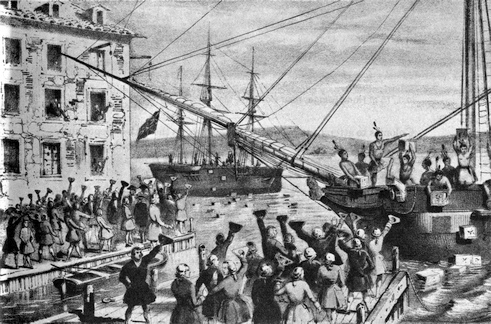
In retaliation for the Boston Tea Party (1773), the Crown imposed rigid
limitations on the freedom of Massachusetts citizens.
In May 1774, in retaliation for the “Boston Tea Party,” Parliament
closed the port of Boston and virtually abolished provincial self-government
in Massachusetts. These actions stimulated resistance
across the land. That summer, the Massachusetts lower house,
through the committees of correspondence, secretly invited all 13
Colonies to attend a convention. In response, on the fifth of September,
55 Delegates representing 12 Colonies, Georgia excepted, assembled
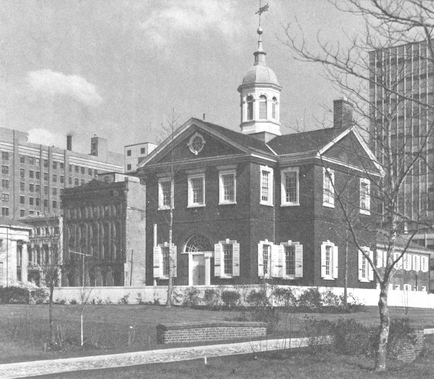
at Philadelphia. They convened at Carpenters’ Hall and organized
the First Continental Congress.
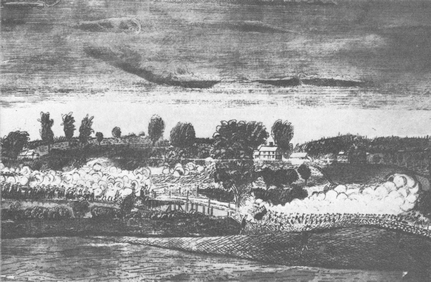
A rare contemporary engraving of the British-American clash
in 1775 at North Bridge, near Concord, Mass.
Sharing though they did common complaints against the Crown,
the Delegates propounded a wide variety of political opinions. Most
of them agreed that Parliament had no right to control the internal
affairs of the Colonies. Moderates, stressing trade benefits with the
mother country, believed Parliament should continue to regulate commerce.
Others questioned the extent of its authority. A handful of
Delegates felt the answer to the problem lay in parliamentary representation.
Most suggested legislative autonomy for the Colonies.
Reluctant to sever ties of blood, language, trade, and cultural heritage,
none yet openly entertained the idea of complete independence
from Great Britain.
After weeks of debate and compromise, Congress adopted two
significant measures. The first declared that the American colonists
were entitled to the same rights as Englishmen everywhere and
denounced any infringement of those rights. The second, the Continental
Association, provided for an embargo on all trade with Britain.
To enforce the embargo and punish violators, at the behest of Congress
counties, cities, and towns formed councils, or committees, of
safety—many of which later became wartime governing or administrative
bodies. When Congress adjourned in late October, the Delegates
resolved to reconvene in May 1775 if the Crown had not
responded by then.
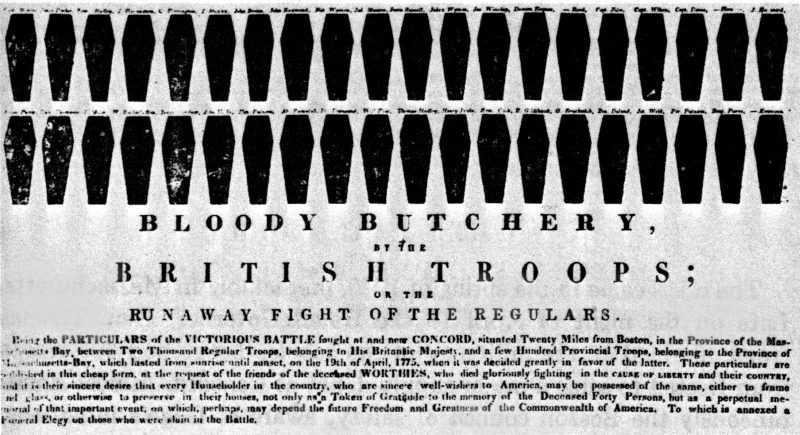
Headlines of a broadside showing American alarm over the Battle of
Concord. The two rows of coffins at the top represent slain militiamen.
In a sense the Continental Congress acted with restraint, for while
it was in session the situation in Massachusetts verged on war. In
September, just before Congress met, British troops from Boston had
seized ordnance supplies at Charlestown and Cambridge and almost
clashed with the local militia. The next month, Massachusetts patriots,
openly defying royal authority, organized a Revolutionary provincial
assembly as well as a military defense committee. Whigs in
three other colonies—Maryland, Virginia, and New Hampshire—had
earlier that year formed governments. By the end of the year, all the
Colonies except Georgia and New York had either set up new ones
or taken control of those already in existence. During the winter of
1774–75, while Parliament mulled over conciliatory measures, colonial
militia units prepared for war.
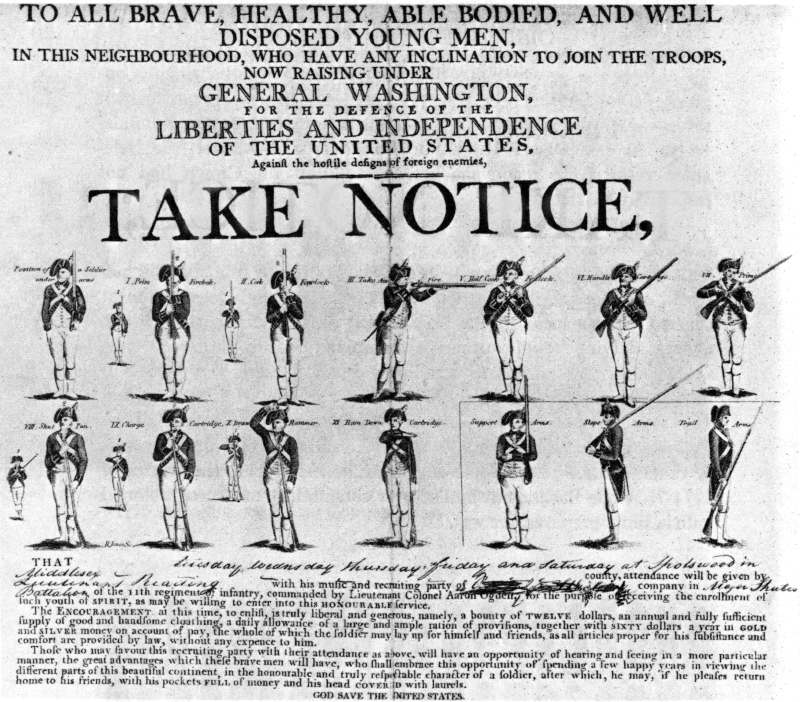
Continental Army recruiting poster.
The crisis came in the spring of 1775, predictably in Massachusetts.
Late on the night of April 18 the Royal Governor, Gen. Thomas
Gage, alarmed at the militancy of the rebels, dispatched 600 troops
from Boston to seize a major supply depot at Concord. Almost simultaneously
the Boston council of safety, aware of Gage’s intentions,
directed Paul Revere and William Dawes to ride ahead to warn militia
units and citizens along the way of the British approach, as well
as John Hancock and Samuel Adams, who were staying at nearby
Lexington. Forewarned, the two men went into hiding.
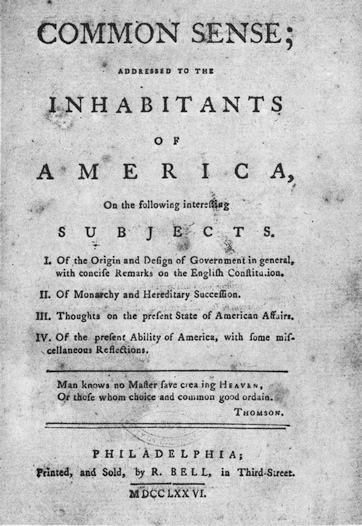
Title page of Common Sense, the anonymously written and widely
distributed pamphlet that converted thousands of colonists to the
Revolutionary cause.
About 77 militiamen confronted the redcoats when they plodded
into Lexington at dawn. After some tense moments, as the sorely
outnumbered colonials were dispersing, blood was shed. More flowed
at Concord and much more along the route of the British as they
retreated to Boston, harassed most of the way by an aroused citizenry.
What had once been merely protest had evolved into open
warfare; the War for Independence had begun.
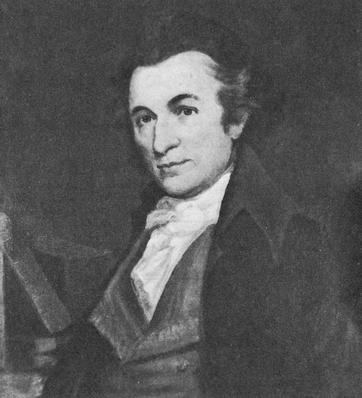
Thomas Paine, author of Common Sense, did not emigrate to America
from England until 1774, but he became an ardent patriot.
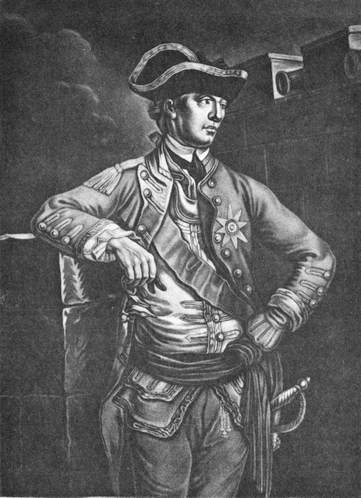
Sir William Howe, British commander in chief in America from 1776
until 1778.
The Second Continental Congress convened in the Pennsylvania
State House at Philadelphia on May 10, 1775. Burdened by wartime
realities and the need to prepare a unified defense, it created a Continental
Army, unanimously elected George Washington as commander
in chief, appointed other generals, and tackled problems of
military finance and supply. Yet, despite these warlike actions, many
Delegates still hoped for a peaceful reconciliation.
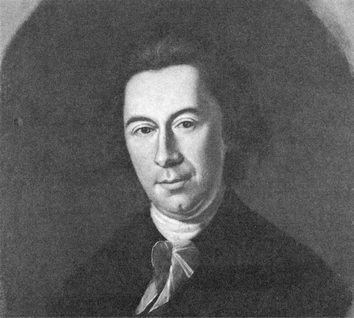
Robert R. Livingston of New York, the most conservative member of the
drafting committee, neither voted on independence nor signed the
Declaration.
In July Congress adopted the Olive Branch Petition, a final
attempt to achieve an understanding with the Crown. The petition
appealed directly to King George III to cease hostilities and restore
harmony. But, unwilling to challenge the supremacy of Parliament,
he refused to acknowledge the plea and proclaimed the Colonies to
be in a state of rebellion.
During the winter of 1775–76, as the war intensified, all chance for
accommodation vanished. Congress, for the first time representing
all Thirteen Colonies because Georgia had sent Delegates in the fall,
disclaimed allegiance to Parliament, created a navy, and appointed
a committee of foreign affairs. Nevertheless the patriots, despite their
mounting influence in the provincial assemblies, felt they needed
more public support and hesitated to urge a final break with the
Crown.
The turning point came in January 1776 with publication in Philadelphia
of the pamphlet Common Sense, authored anonymously by
the recent English immigrant Thomas Paine. Attacking the “myth”
of an evil Parliament and a benevolent King, he denounced George
III for creating the Colonies’ miseries, condemned the British constitution
as well as monarchy in general, and exhorted his fellow Americans
to declare independence immediately. The pamphlet, widely
reprinted, was purchased by many thousands of people and read by
thousands more. It created a furor. From Georgia to New Hampshire,
independence became the major topic of discussion and debate. The
Revolutionaries won thousands of converts.
In May Congress took a bold step toward political freedom by
authorizing the Colonies to form permanent governments. Those that
had not done so began to oust Crown officials and draft constitutions.
Independence, though not yet officially declared, was for all practical
purposes a reality.
* * * * *
The official movement for independence took root in the provincial
assemblies. The North Carolina assembly in April 1776 instructed its
congressional Delegates to vote for the issue should it be proposed.
The next month, on May 4, Rhode Island announced its independence
publicly—the first colony to do so. But it was Virginia that
prodded Congress to action. On May 15 a Williamsburg convention
declared Virginia independent and authorized its delegation at Philadelphia
to propose a similar course for the Colonies. On June 7 the
delegation’s leader, Richard Henry Lee, introduced the following
resolution:
That these United Colonies are, and of right ought to be, free and
independent States, that they are absolved from all allegiance to the
British Crown, and that all political connection between them and
the State of Great Britain is, and ought to be, totally dissolved.
The resolution also incorporated proposals to form foreign alliances;
and to devise a plan for confederation, which would be submitted to
the Colonies for their approval.
Despite the enthusiastic response of many Delegates, some of them,
though they foresaw the inevitability of independence, objected to
the timing. They believed the decision should reflect the desires of
the people as expressed through the provincial assemblies and
pointed out that the Middle Colonies, not yet ripe for freedom,
needed more time for deliberation. On June 10 the moderates obtained
a postponement of consideration of the Lee resolution until
July 1.
On June 11 the Revolutionaries, undaunted by the delay and
convinced of their ultimate victory, persuaded Congress to appoint a
committee to draft a declaration of independence. Three of its five
members, John Adams, Benjamin Franklin, and Thomas Jefferson,
were Revolutionaries. Roger Sherman disliked extremism but had
recently backed the independence movement. The most unlikely
member, Robert R. Livingston, had stood in the front ranks of opposition
to Lee’s resolution. Possibly he was appointed to exert a moderating
effect on its supporters or, conversely, in the hope that his
membership would help swing over the conservative New York
delegation.
At the time Lee had introduced his resolution, seven of the Colonies—New
Hampshire, Rhode Island, Massachusetts, Connecticut,
Virginia, North Carolina, and Georgia—favored independence. New
York, New Jersey, Pennsylvania, Delaware, South Carolina, and
Maryland were either opposed or undecided. Throughout the month,
Revolutionaries in those provinces labored to gain control of the
assemblies. Delaware and Pennsylvania, unable to reach a decision,
instructed their representatives to vote in their colonies’ “best interests.”
New Jersey issued similar directions, but also elected an entirely
new and Whig-oriented slate of Delegates. The Maryland
assembly, largely through the persuasion of Samuel Chase, Charles
Carroll of Carrollton, and William Paca, voted unanimously for
independence and so charged its Delegates. The South Carolinians,
though they had been authorized months before to cast their lot with
the majority, vacillated. The New Yorkers impatiently awaited
instructions.
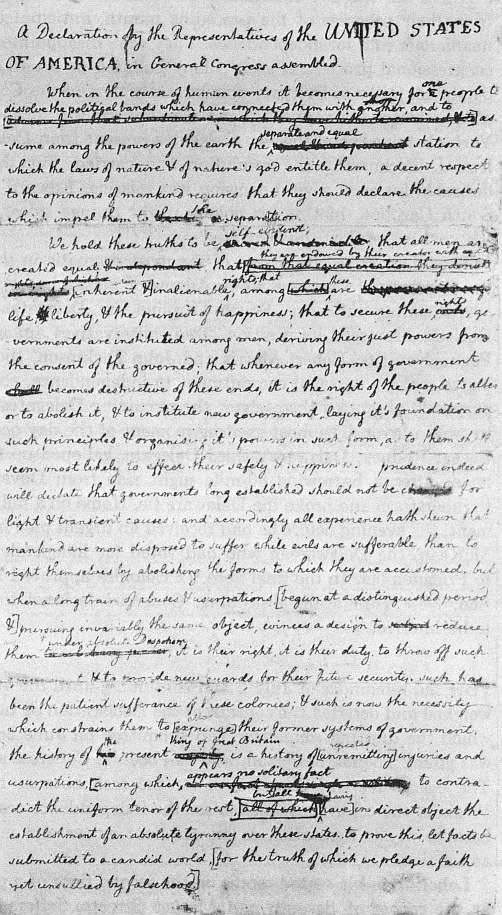
First page of Jefferson’s rough draft of the Declaration.
July 1 was the day of decision. The Revolutionaries, overconfident
from their progress of the preceding month, anticipated an almost
unanimous vote for independence. They were disappointed. Following
congressional procedure, each colony balloted as a unit, determined
by the majority of Delegate opinion. Only nine of the Colonies voted
affirmatively; Pennsylvania and South Carolina, negatively; New
York abstained; and the two Delegates present from Delaware deadlocked.
Technically the resolution had carried, but the solidarity
desirable for such a vital decision was missing. Edward Rutledge of
South Carolina, hinting his colony might change sides, moved that
the vote be retaken the next day.
That day proved to be one of the most dramatic in the history of
the Continental Congress. John Adams of Massachusetts exerted an
overwhelming influence. South Carolina, its Delegates swayed by
Rutledge, reversed its position. Two conservatives among the seven
Pennsylvanians, Robert Morris and John Dickinson, though unwilling
to make a personal commitment to independence, cooperated by
purposely absenting themselves; the remaining Delegates voted three
to two in favor. The most exciting moment of the day occurred when
Caesar Rodney, Delaware’s third Delegate, galloped up to the statehouse
after a harrowing 80-mile night ride from Dover through a
thunderstorm and broke the Delaware tie. Home on a military assignment,
the evening before he had received an urgent plea from Thomas
McKean, the Delawarean who had voted for independence, to rush
to Philadelphia. In the final vote, 12 Colonies approved Lee’s resolution,
New York again abstaining. Congress declared the resolution
to be in effect.
* * * * *
For the remainder of July 2 and continuing until the 4th, Congress
weighed and debated the content of the Declaration of Independence,
which the drafting committee had submitted on June 28. Its author
was young Thomas Jefferson, who had been in Congress about a year.
The committee had chosen him for the task because he was from
Virginia, the colony responsible for the independence resolution, and
because of his reputation as an excellent writer and man of talent
and action.
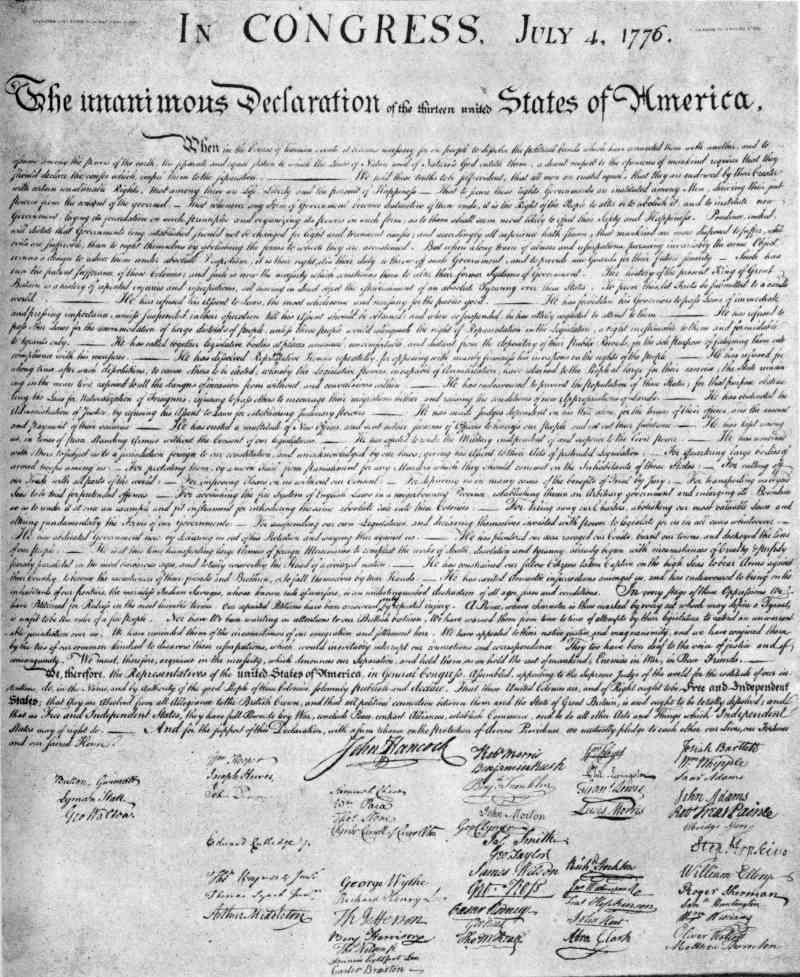
Facsimile of the Declaration of Independence, engraved in 1823 while
the document was still in relatively good condition.
Laboring in his rented rooms on the second floor of a private home
at the corner of Seventh and Market Streets, Jefferson had completed
a rough draft in about 2 weeks. Apparently Franklin and
Adams made some minor changes, and Livingston and Sherman
expressed no reservations so far as is known. To Jefferson’s irritation,
however, Congress altered the final draft considerably. Most of the
changes consisted of refinements in phraseology. Two major passages,
however, were deleted. The first, a censure of the people of Great
Britain, seemed harsh and needless to most of the Delegates. The
second, an impassioned condemnation of the slave trade, offended
Southern planters as well as New England shippers, many of whom
were as culpable as the British in the trade.
* * * * *
The first official document of the American Republic and one of the
most influential in human history, the Declaration expressed the
spirit of human freedom and affirmed Man’s universal rights. Jefferson’s
goal in drafting it was not, he said, to invent “new ideas” but
to compose “an expression of the American mind” in a tone and
spirit suitable for the momentous occasion. Stylistically, the Declaration
resembled his own preamble to the Virginia constitution and
contained an almost identical list of grievances. Its political philosophy,
reflecting the Lockean concepts espoused by many intellectuals
of the day, was certainly not new. Jefferson himself had touched on
the basic points in previous writings, and in essence he echoed George
Mason’s “Declaration of Rights,” which some of the Philadelphia
newspapers had published early in June. In other words, the Declaration
assimilated existing concepts into a concise statement of national
doctrine.
Jefferson began the preamble with the oft-quoted and stirring
words, “When in the course of human events, it becomes necessary
for one people to dissolve the political bands which have connected
them with another....” He then listed a series of “self-evident”
truths—that “all men are created equal” and that they are “endowed
by their creator with certain unalienable rights,” particularly “life,
liberty, and the pursuit of happiness.” Governments, “deriving their
just powers from the consent of the governed,” are instituted by men
to insure these rights. When they fail to do so, it is the “right of the
people to alter or to abolish” them and to institute new governments.
Men should not carelessly change governments, but should only take
such action after a long series of abuses and usurpations lead to
“absolute despotism.” Then it becomes their duty to do so. The
longest portion of the Declaration is a list of colonial grievances and
examples of the King’s tyranny. The final section includes a restatement
of Lee’s resolution and a pledge by the signers of their lives,
their fortunes, and their sacred honor to the cause of independence.
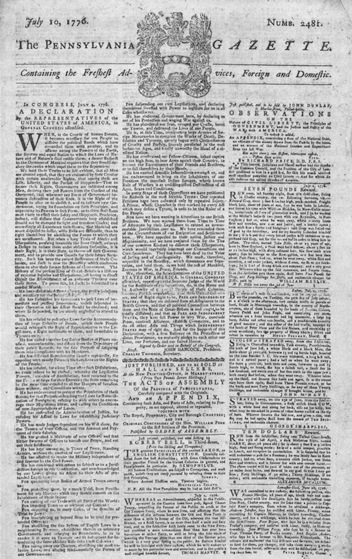
The Declaration first appeared in newspapers on July 9, the day after
the official announcement in Philadelphia.
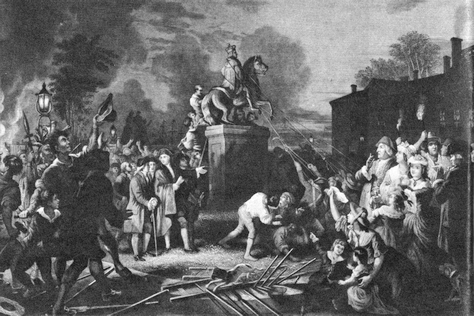
The New York City Sons of Liberty celebrated independence by pulling
down a statue of George III, which they later melted and molded into bullets.
* * * * *
On July 4 all the Colonies except New York voted to adopt the
Declaration. Congress ordered it printed and distributed to colonial
officials, military units, and the press. John Hancock and Charles
Thomson, President and Secretary of Congress respectively, were the
only signers of this broadside copy. On July 8, outside the Pennsylvania
State House, the document was first read to the public. During
the ensuing celebration, people cheered, bells rang out, and soldiers
paraded. At other cities, similar celebrations soon took place. Yet
many citizens—the Loyalists, or Tories—could not accept independence
now that it had been declared any more than previously when
it had been merely a concept. Some of them would continue to dream
of reconciliation. Others would flee from or be driven out of the
country. In addition, another sizable group of citizens remained
noncommittal, neither supporting nor opposing independence.
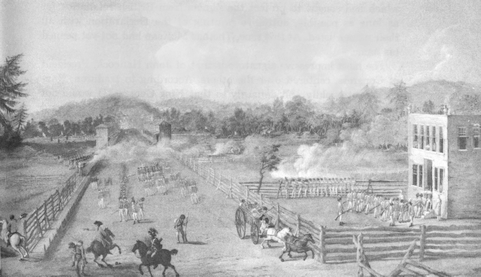
Artist’s rendition of the Battle of Germantown (October 1777).
Four days after obtaining New York’s approval of the Declaration
on July 15, Congress ordered it engrossed on parchment for signature.
At this time, indicative of unanimity, the title was changed
from “A Declaration by the Representatives of the United States of
America in General Congress Assembled” to “The Unanimous
Declaration of the Thirteen United States of America.”
* * * * *
Contrary to a widespread misconception, the 56 signers did not
sign as a group and did not do so on July 4, 1776. The official event
occurred on August 2, 1776, when 50 men probably took part. Later
that year, five more apparently signed separately and one added his
name in a subsequent year. Not until January 18, 1777, in the wake
of Washington’s victories at Trenton and Princeton, did Congress,
which had sought to protect the signers from British retaliation for
as long as possible, authorize printing of the Declaration with all
their names listed. At this time, Thomas McKean had not yet penned
his name.
The most impressive signature is that of John Hancock, President
of Congress, centered over the others. According to tradition, Hancock
wrote boldly and defiantly so that King George III would not
need spectacles to identify him as a “traitor” and double the reward
for his head. The other Delegates signed in six columns, which ran
from right to left. They utilized the standard congressional voting
order, by colony generally from north to south: New Hampshire,
Massachusetts, Rhode Island, Connecticut, New York, New Jersey,
Pennsylvania, Delaware, Maryland, Virginia, North Carolina, South
Carolina, and Georgia.
Those who signed on August 2 undoubtedly did not realize that
others would follow them and thus allowed no room to accommodate
the signatures of the later six men. Two of them, George Wythe and
Richard Henry Lee, found ample room above their fellow Virginians.
One, Elbridge Gerry of Massachusetts, crowded his name into the
space between the Massachusetts and Rhode Island groups. Two of
the others—Thomas McKean and Oliver Wolcott—signed at the bottom
of columns following their State delegations. Only Matthew
Thornton of New Hampshire needed to add his name separately
from his colleagues—at the bottom of the first column on the right
at the end of the Connecticut group.
* * * * *
Independence had been declared; it still had to be won on the
field of battle. The War for Independence was already underway, but
5 more years of struggle and bloody campaigning lay ahead. In 1781
the Colonies achieved military victory, and 2 years later Britain in
the Treaty of Paris officially recognized the independence they had
proclaimed in 1776. The building of the Nation could begin.
Liberally endowed as a whole with courage and sense of purpose,
the signers consisted of a distinguished group of individuals.
Although heterogeneous in background, education, experience, and
accomplishments, at the time of the signing they were practically all
men of means and represented an elite cross section of 18th-century
American leadership. Every one of them had achieved prominence in
his colony, but only a few enjoyed a national reputation.
The signers were those individuals who happened to be Delegates
to Congress at the time. Such men of stature in the Nation as George
Washington and Patrick Henry were not then even serving in the
body. On the other hand, Jefferson, the two Adamses, Richard Henry
Lee, and Benjamin Rush ranked among the outstanding people in the
Colonies; and Franklin had already acquired international fame.
Some of the signers had not taken a stand for or against independence
in the final vote on July 2. For example, Robert Morris of
Pennsylvania had purposely absented himself. Others had not yet
been elected to Congress or were away on business or military matters.
Some were last-minute replacements for opponents of independence.
The only signer who actually voted negatively on July 2 was
George Read of Delaware.
* * * * *
The signers possessed many basic similarities. Most were American-born
and of Anglo-Saxon origin. The eight foreign-born—Button
Gwinnett, Francis Lewis, Robert Morris, James Smith, George
Taylor, Matthew Thornton, James Wilson, and John Witherspoon—were
all natives of the British Isles. Except for Charles Carroll, a
Roman Catholic, and a few Deists, every one subscribed to Protestantism.
For the most part basically political nonextremists, many at
first had hesitated at separation let alone rebellion. A few signed
only reluctantly.
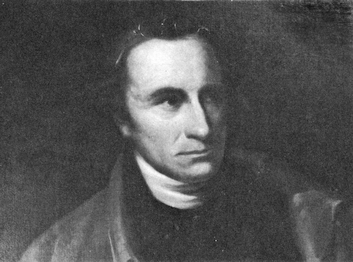
Fervid Revolutionary Patrick Henry numbered among those patriots of
national reputation who were not Members of Congress at the time of
the signing of the Declaration.
The majority were well educated and prosperous. More than half
the southerners belonged to the planter class and owned slaves,
though Richard Henry Lee, Thomas Jefferson, and others heartily
opposed the institution of slavery, as did also several of the signers
from the North. On the other hand, William Whipple, as a sea captain
early in his career, had likely sometimes carried slaves on his
ship.
Although the signers ranged in age at the time from 26 (Edward
Rutledge) to 70 (Benjamin Franklin), the bulk of them were in their
thirties or forties. Probably as a result of their favored economic
position, an amazingly large number attained an age that far exceeded
the life expectancy of their time; 38 of the 56 lived into their sixties
or beyond and 14 into the eighties and nineties.
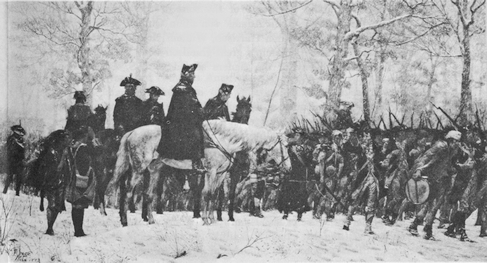
George Washington inspecting his troops at Valley Forge. Busy serving
as commander in chief of the Continental Army, he did not sign
the Declaration.
With few exceptions, those who subscribed to the Declaration
continued in public service under the new Federal and State Governments.
John Adams and Thomas Jefferson became President; they
and Elbridge Gerry, Vice President. Samuel Chase and James Wilson
won appointment to the Supreme Court. Others served as Congressmen,
diplomats, Governors, and judges. Six of the signers—George
Clymer, Benjamin Franklin, Robert Morris, George Read, Roger
Sherman, and James Wilson—also signed the Constitution. Sixteen
of them underwrote the Articles of Confederation. Only two,
Roger Sherman and Robert Morris, affixed their signatures to the
Declaration, Constitution, and Articles.
Caesar Rodney and Joseph Hewes were the only bachelors in the
group. All but five fathered children. Carter Braxton sired no fewer
than 18, but 10 others each had at least 10 offspring. The average
number was about six. Some of the sons of the signers attained
national distinction. John Adams’ son John Quincy became President;
the son of Benjamin Harrison, William Henry, won the same
office, as did also Benjamin’s great-grandson with the same name.
Other male progeny of the signers served as U.S. Congressmen,
Governors, and State legislators.
* * * * *
Yet the group manifested diversity. Each man tended to reflect the
particular attitudes and interests of his own region and colony.
Fourteen represented New England; 21, the Middle Colonies; and 21,
the South. The largest number, nine, came from Pennsylvania; the
least, two, from Rhode Island. All those from three Colonies (Georgia,
New Hampshire, and North Carolina) were born elsewhere.
About half of the men received their higher education in colonial
colleges or abroad; most of the others studied at home, in local
schools or private academies, or with tutors. A few were almost
entirely self-taught.
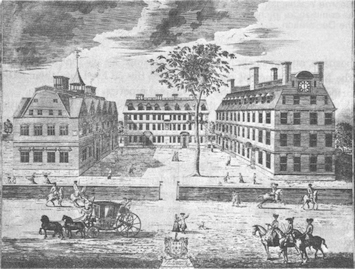
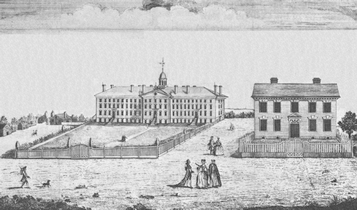
Harvard College, about 1725. Indicative of the favored economic
circumstances of the signers, about half of them enjoyed a higher education.
Eight, including all five from Massachusetts, attended Harvard.
In wealth, the signers ranged from Charles Carroll, one of the
wealthiest men in the Colonies, to Samuel Adams, whose friends
supplied money and clothes so he could attend Congress. About one-third
were born into wealth; most of the others acquired it on their
own. Some were self-made men. A few were of humble origin; one,
George Taylor, had come to America as an indentured servant.
Many pursued more than one vocation. More than half were
trained in the law, but not all of them practiced it. Some won a livelihood
as merchants and shippers. Roughly a quarter of the group
earned their living from agriculture, usually as wealthy planters or
landed gentry, but just a few could be called farmers. Four—Josiah
Bartlett, Benjamin Rush, Lyman Hall, and Matthew Thornton—were
doctors. Oliver Wolcott also studied medicine for awhile, but
never entered the profession. George Taylor’s occupation was ironmaster.
Of the four trained as ministers—Lyman Hall, William
Hooper, Robert Treat Paine, and John Witherspoon—only the latter
made it his lifetime vocation. William Williams received some theological
training. Samuel Adams followed no real occupation other than
politics.
* * * * *
For their dedication to the cause of independence, the signers
risked loss of fortune, imprisonment, and death for treason. Although
none died directly at the hands of the British, the wife of one, Mrs.
Francis Lewis, succumbed as a result of harsh prison treatment.
About one-third of the group served as militia officers, most seeing
wartime action. Four of these men (Thomas Heyward, Jr., Arthur
Middleton, Edward Rutledge, and George Walton), as well as Richard
Stockton, were taken captive. The homes of nearly one-third of
the signers were destroyed or damaged, and the families of a few
were scattered when the British pillaged or confiscated their estates.
Nearly all of the group emerged poorer for their years of public
service and neglect of personal affairs. Although a couple of the
merchants and shippers among them profited from the war, the
businesses of most of them deteriorated as a result of embargoes on
trade with Britain and heavy financial losses when their ships were
confiscated or destroyed at sea. Several forfeited to the Government
precious specie for virtually worthless Continental currency or made
donations or loans, usually unrepaid, to their colonies or the Government.
Some even sold their personal property to help finance the war.
Certainly most of the signers had little or nothing to gain materially
and practically all to lose when they subscribed to the
Declaration of Independence. By doing so, they earned a niche of
honor in the annals of the United States. Whatever other heights
they reached or whatever else they contributed to history, the act of
signing insured them immortality.
* * * * *
The following biographical sketches are arranged alphabetically by
last name. Readers interested in signers for a certain State should
consult the Index under the appropriate State.
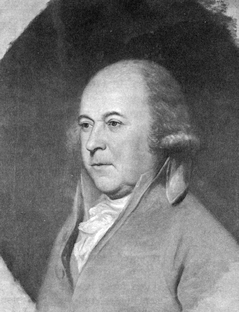
John Adams
MASSACHUSETTS
Few men contributed more to U.S.
Independence than John Adams, the
“Atlas of American Independence”
in the eyes of fellow signer Richard
Stockton. A giant among the Founding
Fathers, Adams was one of the
coterie of leaders who generated the
American Revolution, for which his
prolific writings provided many
of the politico-philosophical foundations.
Not only did he help draft
the Declaration, but he also steered
it through the Continental Congress.
The subsequent career of Adams—as a diplomat and first Vice President
and second President of the United States—overshadows those of
all the other signers except Jefferson. Adams was also the progenitor
of a distinguished family. His son John Quincy gained renown as diplomat,
Congressman, Secretary of State, and President. John’s grandson
Charles Francis and great-grandsons John Quincy II, Charles Francis,
Jr., Henry, and Brooks excelled in politics, diplomacy, literature,
historiography, and public service.
Adams, descended from a long line of yeomen farmers, was born
in 1735 at Braintree (later Quincy), Mass. He graduated from Harvard
College in 1755, and for a short time taught school at Worcester,
Mass. At that time, he considered entering the ministry, but
decided instead to follow the law and began its study with a local
lawyer. Adams was admitted to the bar at Boston in 1758 and began
to practice in his hometown. Six years later, he married Abigail
Smith, who was to bear three sons and a daughter. She was also the
first mistress of the White House and the only woman in U.S. history
to be the wife of one President and the mother of another.
Adams, like many others, was propelled into the Revolutionary
camp by the Stamp Act. In 1765 he wrote a protest for Braintree that
scores of other Massachusetts towns adopted. Three years later, he
temporarily left his family behind and moved to Boston. He advanced
in the law, but devoted more and more of his time to the patriot
cause. In 1768 he achieved recognition throughout the Colonies for
his defense of John Hancock, whom British customs officials had
charged with smuggling. Adams later yielded to a stern sense of legal
duty but incurred some public hostility by representing the British
soldiers charged with murder in the Boston Massacre (1770). Ill
health forced him to return to Braintree following a term in the
colonial legislature (1770–71), and for the next few years he divided
his time between there and Boston.
A 3-year stint in the Continental Congress (1774–77), punctuated
by short recuperative leaves and service in the colonial legislature in
1774–75, brought Adams national fame. Because he was sharply
attuned to the temper of Congress and aware that many Members
resented Massachusetts extremism, he at first acceded to conciliatory
efforts with Britain and restrained himself publicly. When Congress
opted for independence, he became its foremost advocate, eschewing
conciliation and urging a colonial confederation.
Adams was a master of workable compromise and meaningful debate,
though he was sometimes impatient. He chaired 25 of the more
than 90 committees on which he sat, the most important of which
dealt with military and naval affairs. He played an instrumental part
in obtaining Washington’s appointment as commander in chief of the
Continental Army. Adams was a member of the five-man committee
charged with drafting the Declaration in June of 1776, though he
probably made no major changes in Jefferson’s draft. But, more
directly involved, he defended it from its congressional detractors,
advocated it to the wavering, and guided it to passage.
The independence battle won, exhausted by the incessant toil and
strain and worried about his finances and family, Adams in November
1777 retired from Congress—never to return. He headed back to
Braintree intending to resume his law practice. But, before the month
expired, Congress appointed him to a diplomatic post in Europe—a
phase of his career that consumed more than a decade (1777–88).
Adams served in France during the period 1778–85, interrupted
only by a visit to the United States in the summer of 1779, during
which he attended the Massachusetts constitutional convention. Independent-minded
and forthright, as well as somewhat jealous of the
fame and accomplishments of others, he frequently found himself at
odds with fellow diplomats Benjamin Franklin and Arthur Lee, as
well as French officials, whose policies toward the Colonies he mistrusted.
He joined Franklin and John Jay, however, in negotiating the
Treaty of Paris (1783), by which Britain recognized the independence
of the United States.
Meanwhile, during the preceding 3 years, Adams had persuaded
the Dutch to recognize the Colonies as an independent Nation, grant
a series of loans, and negotiate a treaty of alliance. As the first
American Envoy to Great Britain (1785–88), he strove to resolve
questions arising from the Treaty of Paris and to calm the harsh
feelings between the two countries.
Back in the United States, Adams was soon elected as the first
Vice President (1789–97), an office he considered insignificant but
in which he emerged as a leader of the Federalist Party. During his
stormy but statesmanlike Presidency (1797–1801), he inherited the
deep political discord between the Hamiltonians and Jeffersonians
that had taken root during Washington’s administration. Adams pursued
a neutral course without abandoning his principles. He kept the
United States out of a declared war with France and achieved an
amicable peace. But he proved unable to unite his party, divided
by Hamilton’s machinations and the ramifications of the French
Revolution.
The Jeffersonians drove the Federalists out of office in 1800, and
Adams retired to Quincy, where he spent his later years quietly. The
death of his wife in 1818 saddened him, but he never lost interest in
public affairs and lived to see his son John Quincy become President.
John died at the age of 90 just a few hours after Jefferson, on July
4, 1826—dramatically enough the 50th anniversary of the adoption
of the Declaration. Except for Charles Carroll, who was to live until
1832, Adams and Jefferson were the last two surviving signers. The
remains of John and Abigail Adams are interred in a basement crypt
at the United First Parish Church in Quincy.
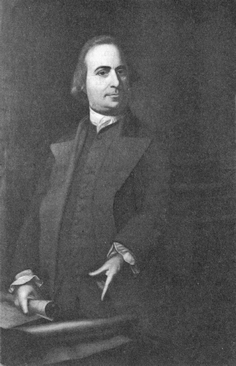
Samuel Adams
MASSACHUSETTS
“Firebrand of the Revolution,” Samuel
Adams probably more than almost
any other individual instigated and
organized colonial resistance to the
Crown. A talented polemicist and
agitator-propagandist who relied more
on his facile pen than the podium in
behind-the-scenes manipulation of
men and events, he religiously
believed in the righteousness of his
political causes, to which he persistently
tried to convert others. He
failed in business, neglected his
family, gained a reputation as an
eccentric, and demonstrated as much
indifference to his own welfare
as he did solicitousness for that of
the public. His second cousin John
Adams, more of a statesman,
eclipsed him in the Continental Congress,
though Samuel signed both the
Declaration and the Articles of
Confederation. In his later years, the
Commonwealth of Massachusetts
bestowed on him many high offices,
capped by the governorship.
Adams was one of 12 offspring of a prosperous and politically
active brewer and landowner. He was born at Boston in 1722 and
enjoyed an excellent education at the Boston Latin School and Harvard
College. Upon his graduation in 1740, he first demonstrated his
lifelong aversion to normal employment. He studied law for awhile
and then skipped from job to job, working for a time in his father’s
brewery as well as in a counting house and dissipating a paternal
loan in an unsuccessful business venture.
When his father died in 1748 and his mother soon afterwards,
Adams inherited a sizable estate, including the family home and
brewery. By 1764, when the colonial quarrel with Britain began, he
had long since lost the latter. And, during the previous 8 years as
city tax collector, he had fallen in arrears about £8,000 in his collections.
At the age of 42, unable to support a new wife and two children
from his first marriage and residing in his rundown birthplace, he
was destitute and besieged by creditors. He subsisted mainly on gifts
and donations from loyal friends and neighbors.
Adams was a failure by most standards, but he had long before
found the only meaningful “occupation” he ever pursued. For almost
two decades he had been active in local political clubs, where he
earned a reputation as a writer and emerged as leader of the “popular”
party that opposed the powerful conservative aristocracy controlling
the Massachusetts government. As clerk in the colonial
legislature (1765–74), he drafted most of the body’s official papers
and quickly seized the tools of power. He pounced on the taxation
issue raised by the Sugar and Stamp Acts (1764–65), and within a
year he and his party fanned popular hatred of the conservatives and
gained control of the legislature. He also spurred organization of the
militant Boston Sons of Liberty, a secret society. As time went on,
the stridency of his anti-British harangues escalated and sometimes
became shrill enough to distress John Hancock and John Adams.
The Townshend Acts (1767), imposing a series of taxes on imports,
provided Adams with a new cause for dissent. He urged merchants
not to purchase goods from Britain, fomented opposition toward customs
officials, inflamed the resentment toward British troops stationed
in the colony that led to the Boston Massacre (1770), and
humiliated the Royal Governor so much that he was recalled. Adams
also authored a circular letter protesting British taxation and advocating
united opposition. When, in 1768, the Massachusetts legislature
sent it to the 12 other colonial assemblies, the Royal Governor
dissolved the legislature, soon a common British practice in America.
All these activities, coupled with authorship of scores of newspaper
articles and extensive correspondence with prominent persons in the
Colonies and England, brought Adams fame.
The conservative reaction on the part of merchants, the legislature,
and the populace that surfaced after the repeal of practically all the
Townshend Acts in 1770 failed to stifle Adams, though his popularity
and influence declined. Relentlessly, in perhaps his chief contribution
to the Revolution, he kept the controversy alive by filling the columns
of the Boston newspapers with reports of British transgressions
and warnings of more to come. Furthermore, in 1772 he began constructing
the framework of a Revolutionary organization in Massachusetts.
Drawing on a similar scheme he had proposed for all the
Colonies 2 years earlier but which had come to naught, he convinced
Boston and other towns to create committees of correspondence. The
next year, he was appointed to the Massachusetts committee, formed
in response to a call from the Virginia House of Burgesses.
Passage of the Tea Act (1773) provided the spark Adams was
seeking to rekindle the flame of rebellion. He helped to incite and
probably participated in the “Boston Tea Party,” which engendered
a series of rebellious incidents throughout the Colonies and pushed
them closer to war. Parliament retaliated the next spring by passing
a series of acts designed to punish Massachusetts.
Adams, recognizing that the other Colonies would only adopt non-intercourse
measures in concert, urged an intercolonial congress to
discuss mutual grievances and plan a united course of action. Subsequently,
in June, the Massachusetts house of representatives,
meeting behind locked doors to prevent interference by the Royal
Governor, resolved to invite the other 12 Colonies to send representatives
to Philadelphia in September and also appointed five Delegates,
including Adams. That same day, the Royal Governor disbanded the
legislature for the last time. Before heading for Philadelphia, outfitted
in new clothes supplied by friends, Adams helped organize the
convention that adopted the Suffolk Resolves, which in effect declared
Massachusetts to be in a state of rebellion.
Adams served in the Continental Congress until 1781, longer than
most other Delegates, but his role was less conspicuous than his
preceding career augured. In the early sessions, most of the time he
shrewdly stayed in the background with his fellow Massachusetts
Delegates, whose radicalism offended most of their colleagues. And,
throughout the Congress, he walked in the shadow of John Adams,
who dominated the proceedings.
But nothing in the latter’s career could match the drama of an
episode involving Samuel in the interim between the First and Second
Continental Congresses. Back at Lexington, Mass., one night in April
1775, he and Hancock had barely escaped the British force seeking
to capture the colonial supply depot at Concord. The outbreak of
armed conflict the next dawn—a “glorious morning” for Adams—marked
the beginning of the War for Independence.
While still in Congress, in 1779–80 Adams participated in the
Massachusetts constitutional convention. He returned to Boston for
good the next year and entered the State senate (1781–88), over
which he presided. He refused to attend the Constitutional Convention
of 1787 because of his objection to a stronger National Government,
and the following year unenthusiastically took part in the
Massachusetts ratifying convention. A lifetime of public service culminated
in his election as Lieutenant Governor (1789–93), interim
Governor in the latter year upon Hancock’s death, and Governor
(1794–97). Still living in “honest poverty,” he died at Boston in 1803
at the age of 81 and was buried in the Old Granary Burying Ground.
Josiah Bartlett
NEW HAMPSHIRE
Thanks to the voting order in the
Continental Congress, Josiah Bartlett
of New Hampshire was probably the
first Delegate to vote for independence,
the second to sign the Declaration
(after President John Hancock), and
the first to ballot for and pen his
name to the Articles of Confederation.
He also has the distinction of being
one of several physician signers. His
State service, more extensive than the
National, included the governorship.
Bartlett was born in 1729 at Amesbury, Mass. At the age of 16,
equipped with a common school education and some knowledge of
Latin and Greek, he began to study medicine in the office of a relative.
Five years later, in 1750, he hung out his shingle at nearby
Kingston, N.H. He quickly won a name not only as a general practitioner
but also as an experimenter and innovator in diagnosis and
treatment. Marrying in 1754, he fathered 12 children.
During the decade or so preceding the outbreak of the War for
Independence, Bartlett held the offices of justice of the peace, militia
colonel, and legislator. In 1774 he cast his lot with the Revolutionaries.
He became a member of the New Hampshire committee of
correspondence and the first provincial congress, which came into
being when the Royal Governor disbanded the colonial assembly.
Bartlett was elected that same year to the Continental Congress,
but tragedy intervened and kept him at home. Arsonists, possibly
Loyalists, burned his house to the ground. Discouraged but
undeterred, he immediately constructed a new one on the very same
site.
While in Congress (1775–76), Bartlett also served on the New
Hampshire council of safety. Although he rarely participated in
congressional debates, whose seeming futility vexed him, he sat on
various committees. He was reelected in 1777, but was too exhausted
to attend. He nevertheless managed in August to lend his medical
skills to Gen. John Stark’s force of New Hampshire militia and
Continental troops. They defeated a predominantly German element
of Gen. John Burgoyne’s command in the Battle of Bennington,
N.Y.—one of the reverses that helped force him to surrender 2
months later at Saratoga, N.Y. Bartlett’s last tour in Congress was
in 1778–79, after which he refused reelection because of fatigue.
Bartlett spent the remainder of his life on the State scene. Despite
his lack of legal training, he sat first as chief justice of the court of
common pleas (1779–82), then as associate (1782–88) and chief
(1788–90) justice of the Superior Court. Meantime, in 1788, he had
taken part in the State convention that ratified the Federal Constitution,
which he strongly favored. The next year, probably on account
of his age and the weight of his judicial duties, he declined
election to the U.S. Senate. The following year, he became chief
executive, or president, of the State. He held that title for 2 years,
in 1793–94 being named the first Governor, as the newly amended
constitution redesignated the position.
Despite all his political activities, Bartlett had never lost interest
in the field of medicine. In 1790 Dartmouth College conferred on him
an honorary degree of Doctor of Medicine. The next year, he founded
the New Hampshire Medical Society and became its first president.
In 1794, the year before he died in Kingston at the age of 65, ill
health forced his retirement from public life. His remains lie in the
yard of the Universalist Church in Kingston.
Carter Braxton
VIRGINIA
Carter Braxton, an aristocratic
planter and probably the most conservative
of the seven Virginia
signers, originally opposed independence
but later changed his mind
and signed the Declaration. His tour
in the Continental Congress lasted
less than a year, but he held State
office for most of his life. His two
wives bore him 18 children, more
than any other signer fathered.
Braxton was born in 1736 at Newington Plantation, on the Mattaponi
River, in King and Queen County, Va. His father was a wealthy
and politically influential planter. His mother, who died at his birth,
was the daughter of Robert “King” Carter, a prominent landowner
and politician.
In 1755, the same year Braxton graduated from the College of
William and Mary, he married. His bride died in childbirth 2 years
later. The following year, he left for an extended visit to England.
He returned to Virginia in 1760 and moved into Elsing Green, an
estate overlooking the Pamunkey River, in King William County,
that his brother George had apparently built for him in 1758 during
his absence. At the age of 25, in 1761, Carter remarried and entered
the House of Burgesses. He served there, except for a term as county
sheriff in 1772–73, until 1775. Meantime, in 1767, he had erected a
new home, Chericoke, a couple of miles northwest of Elsing Green.
When the trouble with Great Britain erupted, Braxton, like many
other conservatives, sided with the patriots, though he did not condone
violence. In 1769 he signed the Virginia Resolves, a document
protesting parliamentary regulation of the colony’s affairs, and the
Virginia Association, a nonimportation agreement. During the period
1774–76, he attended various Revolutionary conventions. In 1775,
upon dissolution of the royal government, he accepted a position on
the council of safety, the temporary governing body.
In the spring of that year, Braxton was instrumental in preventing
the outbreak of war in Virginia. On April 20, the day after the clashes
at Lexington and Concord, Royal Governor Lord John M. Dunmore
seized the gunpowder in the Williamsburg magazine. Several colonial
militia units prepared to retaliate, but moderate leaders such as
George Washington and Peyton Randolph restrained them. Patrick
Henry, however, refusing to be pacified, led a group of the Hanover
County militia into Williamsburg and demanded the return of the
gunpowder or payment for it. Before any hostilities occurred, Braxton,
as spokesman for Henry, met with crown official Richard Corbin,
his father-in-law, and convinced him to pay for the powder.
In the fall of 1775 Braxton was selected to fill a vacancy in Congress
caused by the death of Peyton Randolph. Arriving at Philadelphia
early in 1776, he at first sharply criticized the independence
movement, but eventually yielded to the majority and backed the
Declaration. That same year, apparently both in writing and in a
speech at a Virginia convention, he urged adoption of a conservative
form of State government and expressed such a mistrust of popular
government that he lost his congressional appointment. The conservatives,
however, elected him to the new State legislature, in which he
sat for the rest of his life. For many years, he was also a member of
the Governor’s executive council.
The War for Independence brought financial hardships to Braxton.
At its beginning, he had invested heavily in shipping, but the British
captured most of his vessels and ravaged some of his plantations and
extensive landholdings. Commercial setbacks in later years ruined
him. In 1786, though he retained Chericoke, he moved to Richmond,
where he died in 1797 at the age of 61. He was buried in the family
cemetery adjacent to Chericoke.
Charles Carroll
MARYLAND
As one of the wealthiest men in
America, Charles Carroll III of Carrollton
risked his fortune as well as his
life when he joined the Revolutionaries.
Possessing one of the most
cultivated minds of any of the signers,
he achieved remarkable success as
planter, businessman, and politician.
He was the only Roman Catholic
signer, the last to survive, and the
longest lived.
Of Irish descent, Carroll was born in 1737 at his father’s townhouse,
Carroll Mansion in Annapolis. Jesuits educated him until he
reached about 11 years of age. He then voyaged to Europe and
studied the liberal arts and civil law at various schools and universities
in Paris, elsewhere in France, and in London.
Carroll sailed home in 1765 at the age of 28, and built a home at
Carrollton Manor, a 10,000-acre estate in Frederick County newly
deeded to him by his father. At that time, he added “of Carrollton”
to his name to distinguish himself from relatives of the same name.
For most of his life, however, he preferred for his country residence
the family ancestral home, Doughoregan Manor, in Howard County;
when in Annapolis, he usually resided at his birthplace. For almost
a decade after his return from Europe, barred from public life by his
religion, he lived quietly. During that time, in 1768, he married. His
offspring numbered seven, three of whom lived to maturity.
In 1773 Carroll became a champion of the patriots through his
newspaper attacks on the Proprietary Governor. The latter was
opposing reforms in officers’ fees and stipends for Anglican clergy
that the lower house of the legislature had proposed. From then on,
Carroll took a prominent part in provincial affairs. In the years
1774–76 he supported nonimportation measures, attended the first
Maryland Revolutionary convention, and served on local and provincial
committees of correspondence and the council of safety. In
1776 he and his cousin John, a priest—chosen because of their religion
and knowledge of French—traveled to Canada with Benjamin
Franklin and Samuel Chase on a congressionally appointed committee
that sought but failed to obtain a union of Canada with the
Colonies.
Carroll and Chase arrived back in Philadelphia on June 11 that
same year, the day after Congress had postponed the vote on Richard
Henry Lee’s independence resolution (June 7) until July 1. Maryland
had refused to commit herself. Carroll and Chase rushed to
Annapolis, recruited William Paca’s aid, and conducted a whirlwind
campaign that persuaded the provincial convention to pass a unanimous
independence resolution. It reached Congress just in time to
put the colony in the affirmative column on July 1, the day of the
first vote. Three days later, Carroll himself became a Delegate and
functioned in that capacity until 1778.
Two years before, Carroll had also been elected to the State
senate, a seat he retained until just after the turn of the century.
Along with fellow signers Chase and Paca, he was a member of the
committee that in 1776 drafted Maryland’s constitution. Elected to
but not attending the Constitutional Convention of 1787, he nevertheless
allied himself with the Federalists and helped bring about his
State’s ratification of the Constitution. In the years 1789–92, while
also in the State senate, he served as a U.S. Senator, one of
Maryland’s first two.
Not reelected to the State senate in 1804, the 67-year-old Carroll
retired from public life and concentrated on managing his landholdings,
consisting of about 80,000 acres in Maryland, Pennsylvania, and
New York, and his business interests. The latter included investments
in the Patowmack (Potowmack) Company, which established
a canal system in the Potomac and Shenandoah Valleys, and its
successor the Chesapeake and Ohio Canal Company. Carroll was also
a member of the first board of directors of the Baltimore and Ohio
Railroad.
In his final years, revered by the Nation as the last surviving
signer of the Declaration, Carroll spent most of his time at Doughoregan
Manor. But he passed the winters in the home of his youngest
daughter and her husband in Baltimore. There, in 1832, he died at
the age of 95. His body was interred in the family chapel at
Doughoregan Manor.
Samuel Chase
MARYLAND
Fervid Revolutionary Samuel Chase
led the campaign that crushed conservative
opposition and alined his
colony with the others in the independence
struggle. Labeled the
“Demosthenes of Maryland” for his
fancy albeit effective oratory, he also
demonstrated skill as a writer. But his
independent attitude, stormy disposition,
and outspokenness diluted his
political effectiveness. As an Associate
Justice of the U.S. Supreme Court,
he became a controversial figure.
Chase was the son of an Anglican clergyman. He was born in
1741 at the farmhouse of his mother’s parents on Maryland’s Eastern
Shore near the city of Princess Anne. His mother had come there
from her home at nearby Allen for a visit. She died at or soon after
the birth. Likely Chase’s grandparents cared for him at least a few
years, until about the time his father took over a parish in Baltimore.
The latter provided the youth with his initial education, mainly in
the classics.
Between the ages of 18 and 20, Chase read law with an Annapolis
firm and joined the bar in 1761. The next year, he married; his wife
bore at least two sons and two daughters. Two years after his marriage,
he entered the colonial/State legislature and retained membership
for two decades. From the beginning, he opposed the royal
government. Annapolis officials denounced him for his participation
in the violent protests of the Sons of Liberty in 1765 against the
Stamp Act. In 1774–75 he took part in the Maryland committee of
correspondence, council of safety, and the provincial convention.
In the former year, Chase had joined the Continental Congress.
He advocated an embargo on trade with Britain, showed special
interest in diplomatic matters, early urged a confederation of the
Colonies, defended George Washington from his congressional detractors,
and in 1776 journeyed to Montreal with a commission that tried
but failed to achieve a union with Canada. When he returned to
Philadelphia around the middle of June, Congress had just postponed
the vote on the Lee independence resolution. Realizing that
Maryland was straddling the fence on the issue, Chase rushed home.
Along with Charles Carroll of Carrollton and William Paca, he
labored for 2 weeks to overcome opposition and won a committal to
independence from the convention. The Maryland Delegates registered
it in time for the first congressional vote, on July 1. In 1778
Chase lost his office because of adverse publicity generated by the
advantage he had taken of knowledge gained in Congress to engage
in a profiteering scheme.
In 1783–84 Chase traveled to London as a State emissary on an
unfruitful mission to recover Maryland stock in the Bank of England
from two fugitive Loyalists. Upon his return apparently, his first wife
having died, he remarried; resumed his law practice; and engaged
in various unsuccessful business enterprises that led to bankruptcy in
1789. Meantime, he had reentered politics. In 1785 he had represented
Maryland at the Mount Vernon (Va.) Conference, forerunner
of the Annapolis Convention. The next year, he moved his family
from Annapolis to Baltimore, where he soon became chief judge of
the Baltimore County criminal court (1788–95). As a delegate to the
Maryland ratifying convention in 1788, he strongly opposed the
Constitution, though he later became a staunch Federalist. From
1791 until 1794, while still a county judge, he also held the position
of chief justice of the Maryland Superior Court.
Chase achieved his greatest fame as an Associate Justice of the
U.S. Supreme Court (1796–1811). He was one of the ablest jurists
in the body prior to Chief Justice John Marshall (1801–35), and
delivered many influential opinions. His inability to control his political
partisanship while on the bench—a trait he shared with some
other judges of his time—led to various judicial improprieties and
impeachment proceedings against him in 1805. But Congress acquitted
him.
Still a Justice, Chase died in Baltimore 2 months after he
celebrated his 70th birthday. His grave is in St. Paul’s Cemetery.
Abraham Clark
NEW JERSEY
Abraham Clark—farmer, surveyor,
self-taught lawyer, and politician—typifies
those signers who dedicated
most of their lives to public service
but never gained national renown.
An only child, Clark was born in 1726 at his father’s farm in what
is now Roselle, N.J. In his boyhood, he was too frail for farmwork.
He received only a minimum of formal education, but in his independent
study demonstrated a bent for mathematics. When he
reached manhood, besides farming his father’s land, he took up
surveying and informally read law to aid in mediating land disputes.
Although probably never admitted to the bar, he gained a reputation
as the “poor man’s counselor” for his willingness to dispense
free legal advice or accept produce or merchandise in lieu of a fee.
He married in 1749, and fathered 10 children.
Clark followed his father’s example by taking an active part in
civic affairs. For many years, he served the Crown as high sheriff of
Essex County and as clerk in the colonial legislature. The exact date
of his entry into the patriot ranks is not known, but in the period
1774–76 he became a member and secretary of the New Jersey
council of safety, attended several Revolutionary conventions, and
won election to the provincial assembly. In June of the latter year,
he and four other men replaced the existing congressional Delegates,
who were opposing independence.
Despite poor health and deep concern for the welfare of his family
and the safety of his home, located not far from an area of British
occupation, Clark stayed in Congress throughout the War for Independence
and sometimes sat concurrently in the State legislature.
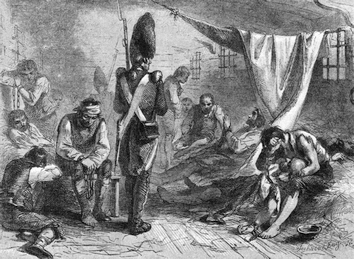
He suffered additional anxiety when the British captured his two
soldier sons and incarcerated them for a time on the prison ship
Jersey, where hundreds of captives perished.
Thousands of American soldiers, including two of Abraham Clark’s sons,
endured the agonies of captivity on the British prison ship Jersey.
At the end of the war in 1783, Clark resumed his life back in New
Jersey. The next year he began a 3-year tour in the State legislature,
which he represented at the Annapolis Convention (1786). The following
year, ill health prevented his attendance at the Constitutional
Convention. He subsequently opposed the Constitution until it incorporated
the Bill of Rights. In 1787–89 he returned to the Continental
Congress, but in 1789–90 remained in New Jersey as commissioner to
settle his State’s accounts with the Federal Government. In 1791–94
he climaxed a long career of alternating State-National service as a
Representative in the Second and Third Congresses.
Clark was stricken with a sunstroke in 1794 at his birthplace in
Roselle, where he had lived all his life except when political duty
called him away. He died a few hours later, at the age of 68, in the
nearby town of Rahway and was buried there in the Presbyterian
Cemetery.
George Clymer
PENNSYLVANIA
George Clymer, a leading Philadelphia
merchant, rendered long years of
service to his city, State, and Nation.
He signed the Constitution as well
as the Declaration, and applied his
commercial acumen to the financial
problems of the Colonies and the
Confederation.
Clymer was orphaned in 1740, only a year after his birth in Philadelphia.
A wealthy uncle reared and informally educated him and
advanced him from clerk to a full-fledged partner in his mercantile
firm, which on his death he bequeathed to his ward. Later, Clymer
merged operations with the Merediths, prominent businessmen, and
cemented the relationship by marrying his senior partner’s daughter.
Motivated at least partly by the impact of British economic
restrictions on his business, Clymer early adopted the Revolutionary
cause and was one of the first to recommend independence. He
attended patriotic meetings, served on the Pennsylvania council of
safety, and in 1773 headed a committee that forced the resignation
of Philadelphia tea consignees appointed by Britain under the Tea
Act. Inevitably, in light of his economic background, he channeled
his energies into financial matters. In 1775–76 he acted as one of the
first two Continental treasurers, even personally underwriting the
war by exchanging all his own specie for Continental currency.
In the Continental Congress (1776–77 and 1780–82) the quiet and
unassuming Clymer rarely spoke in debate but made his mark in
committee efforts, especially those pertaining to commerce, finance,
and military affairs. During and between his two congressional tours,
he also served on a series of commissions that conducted important
field investigations. In December 1776, when Congress fled from
Philadelphia to Baltimore, he and fellow signers George Walton and
Robert Morris remained behind to carry on congressional business.
Within a year, after their victory at the Battle of Brandywine, Pa.
(Sept. 11, 1777), British troops advancing on Philadelphia detoured
for the purpose of vandalizing Clymer’s home in Chester County,
about 25 miles outside the city, while his wife and children hid
nearby in the woods.
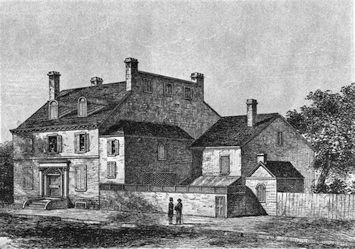
George Clymer lived in this Philadelphia townhouse during the
Revolutionary period.
After a brief retirement following his last tour in the Continental
Congress, Clymer was reelected in the years 1784–88 to the Pennsylvania
legislature, where he had also served part time in 1780–82
while still in Congress. As a State legislator, he advocated reform of
the penal code, opposed capital punishment, and represented Pennsylvania
in the Constitutional Convention (1787). The next phase
of his career consisted of service as a U.S. Representative in the First
Congress (1789–91), followed by appointment as collector of excise
taxes on alcoholic beverages in Pennsylvania (1791–94). In 1795–96
he sat on a Presidential commission that negotiated a treaty with
the Indians in Georgia.
During his retirement, Clymer advanced various community projects,
including the Philadelphia Agricultural Society, the Philadelphia
Academy of Fine Arts, and the Philadelphia Bank. At the age
of 73, in 1813, he died at Summerseat, an estate a few miles outside
Philadelphia at Morrisville that he had purchased and moved to in
1806. His grave is in the Friends Meeting House Cemetery at
Trenton, N.J.
William Ellery
RHODE ISLAND
One of a small group of lesser
known signers whose achievements
were comparatively modest, William
Ellery gained little fame beyond his
hometown—in sharp contrast to
fellow Rhode Island signer Stephen
Hopkins. The office of Delegate to
the Continental Congress was the
only significant position, State or
National, to which Ellery ever won
election, but he occupied it for a far
longer period than most other
Members.
The second son in a family of four, Ellery was born in 1727 at
Newport, his lifelong residence. He followed in the footsteps of his
father, a rich merchant and political leader, by attending Harvard.
On his graduation in 1747, he returned home. During the following
two decades or so, he tried his hand at several occupations, eventually
taking up the study of law, which he began practicing in 1770.
Meantime, he had married twice and was to rear two sons and three
daughters. Among his grandchildren were William Ellery Channing,
influential theologian and apostle of Unitarianism, and Richard
Henry Dana, Sr., noted poet and essayist.
By May 1776, when the colonial legislature sent Ellery to the Continental
Congress, he had already earned a reputation for his work
on local patriotic committees. Tradition records that, at the formal
signing of the Declaration on August 2, he placed himself beside the
Secretary and observed “undaunted resolution” on every face as the
Delegates subscribed to their “death warrant.” The next year,
Rhode Island initiated popular election of congressional Delegates,
and Ellery’s Newport constituency maintained him in office until
1786 except for the years 1780 and 1782. In 1780 he remained in
Philadelphia as an ex officio member of the board of admiralty, on
which he had been sitting. His other committee assignments included
those dealing with commercial and naval affairs. On occasion, to
entertain himself and others, he wrote witty epigrams about various
speakers. In 1785 he turned down the chief justiceship of the Rhode
Island Superior Court to remain in Congress, where he had attained
commanding seniority.
The very next year, Ellery terminated his congressional career to
accept an appointment as commissioner of the Continental Loan
Office for Rhode Island (1786–90). Probably the need to straighten
out his finances compelled him to accept. British troops in 1778,
during their 3-year occupation of Newport, had destroyed his home
and property, and he had been too busy to rebuild his fortune. In
1790 President Washington appointed Ellery as customs collector
for the district of Newport, a position he held for three decades.
Although he was a Federalist, he managed to retain office during the
Democratic-Republican administrations, probably because of his
Revolutionary record and competence.
In his later years, Ellery prospered. He kept active in public affairs
and spent many hours in scholarly pursuits and correspondence.
Living to 92, a more advanced age than all the signers except Charles
Carroll, he died in 1820 at Newport. His remains rest there in the
Common Ground Cemetery.
William Floyd
NEW YORK
William Floyd, a wealthy landowner-farmer,
belongs to the category of
signers who played only a peripheral
part in the Revolution. Nevertheless,
he suffered anguish when British
troops and Loyalists ravaged his
estate during the war and drove his
family into a 7-year exile in Connecticut.
He also climbed to the rank of
major general in the State militia,
and served in the U.S. First Congress.
Floyd was born in 1734 at present Mastic, Long Island, N.Y., in
Brookhaven Township. He was the second child and eldest of two
sons in a family of nine. His father, a prosperous farmer of Welsh
ancestry, kept the youth busy with chores. As a result, his education
consisted only of informal instruction at home. When Floyd reached
his 20th year, his father and mother died within 2 months of each
other, and he inherited a large estate along with the responsibility of
caring for his brothers and sisters. Six years later, he married. His
bride helped care for the family and assisted in managing the farm,
for which slaves supplied most of the labor. A community stalwart,
Floyd also devoted considerable time to the affairs of the Brookhaven
church, occupied the position of town trustee (1769–71), and moved
up in the ranks of the Suffolk County militia to a colonelcy in 1775.
The Revolutionary movement in New York was much less fervent
and started later than that in the other Colonies. The spirited Massachusetts
opposition to the Tea Act in the later half of 1773 and in
1774 created the first major ferment in New York. One of the scattered
focal points was eastern Long Island, where Floyd lived. He
and many of his neighbors attended meetings that extended sympathy
and aid to Massachusetts and protested the closing of the port
of Boston by the British. Despite such local outbursts, by the end
of 1774 New York was one of only two Colonies, Georgia being the
other, in which the patriots did not control the government. For this
reason, the Revolutionaries operated mainly on a county basis.
In 1774 Suffolk County sent Floyd to the Continental Congress.
He remained there until 1777, returned in the period 1779–83, and
in the interim served in the State senate and on the council of safety.
Yielding the floor of Congress to the other New York Delegates, he
labored without special distinction on a few committees. But worry
about the welfare of his family presented a major distraction. In
1776, when British forces occupied Long Island, his wife, son, and
two daughters fled northward across the sound and took refuge in
Middletown, Conn. His wife died there in 1781. To make matters
worse, the redcoats used his home at Mastic for a barracks, and
Loyalists plundered his lands and belongings. When he brought his
children back in 1783, he found the fields and timber stripped, the
fences destroyed, and the house damaged.
After the war, Floyd sat for several terms in the State senate,
attended the constitutional convention of 1801, supported the Federal
Constitution, won election in the years 1789–91 as a Representative
in the First Congress, served as presidential elector on four
occasions, and became a major general in the New York militia. His
second wife, whom he had married in 1784, bore him two daughters.
About this time, Floyd acquired an interest in western lands. The
year of his marriage, he purchased a tract in central New York at
the headwaters of the Mohawk River in the environs of present
Rome; he supplemented this 3 years later by obtaining a State grant
of more than 10,000 acres in the area. He spent most of his summers
visiting and developing the acreage.
In 1803, in his late sixties, at a time when most men possess lesser
ambitions, Floyd deeded his Long Island home and farm to his son
Nicoll, and set out with the rest of his family to make a new life on
the frontier. During the first year, he built a home at present
Westernville, N.Y. There he succumbed, at the age of 86 in 1821,
and was buried in the Presbyterian Cemetery.
Benjamin Franklin
PENNSYLVANIA
Benjamin Franklin, elder statesman
of the Revolution and oldest signer of
both the Declaration and the Constitution,
sat on the committee that
drafted the Declaration, attended the
Constitutional Convention, and distinguished
himself as a diplomat.
But he was a self-made and self-educated
intellectual colossus whose
interests far transcended politics.
He won international renown as a
printer-publisher, author, philosopher,
scientist, inventor, and philanthropist.
On both sides of the Atlantic he
mingled with the social elite, whom
he impressed with his sagacity, wit,
and zest for life.
Franklin was born in 1706 at Boston. He was the tenth son of a
soap- and candle-maker. He received some formal education but was
principally self-taught. After serving an apprenticeship to his father
between the ages of 10 and 12, he went to work for his half-brother
James, a printer. In 1721 the latter founded the New England
Courant, the fourth newspaper in the Colonies. Benjamin secretly
contributed to it 14 essays, his first published writings.
In 1723, because of dissension with his half-brother, Franklin
moved to Philadelphia. He spent only a year there, and then sailed
to London for two more years. Back in Philadelphia, he rose rapidly
in the printing industry. He published The Pennsylvania Gazette
(1730–48), which had been founded by another man in 1728, but
his most successful venture was annual Poor Richard’s Almanac
(1733–58). It won a popularity in the Colonies second only to the
Bible, and its fame eventually spread to Europe.
Meantime, in 1730 Franklin had taken a common-law wife, who
was to bear him a son and a daughter, as was another woman out of
wedlock. By 1748 he had achieved financial independence and gained
recognition for his philanthropy and the stimulus he provided to such
worthwhile civic causes as libraries, educational institutions, and
hospitals. Energetic and tireless, he also found time to pursue his
deep interest in science, as well as enter politics.
Franklin served as clerk (1736–51) and member (1751–64) of the
colonial legislature, and as deputy postmaster of Philadelphia
(1737–53) and deputy postmaster general of the Colonies (1753–74).
In addition, he represented Pennsylvania at the Albany Congress
(1754), called to unite the Colonies during the French and Indian
War. The congress adopted his “Plan of Union,” but the colonial
assemblies rejected it because it encroached on their powers.
During the years 1757–62 and 1764–75, Franklin resided in England,
originally in the capacity of agent for Pennsylvania and later
for Georgia, New Jersey, and Massachusetts. During the latter period,
which coincided with the growth of colonial unrest, he underwent
a political metamorphosis. Until then a contented Englishman
in outlook, primarily concerned with Pennsylvania provincial politics,
he distrusted popular movements and saw little purpose to be served
in carrying principle to extremes. Until the issue of parliamentary
taxation undermined the old alliances, he led the conservative
Quaker party in its attack on the Anglican proprietary party and
its Presbyterian frontier cohorts. His purpose throughout the years
at London in fact had been displacement of the Penn family administration
by royal authority—the conversion of the province from a
proprietary to a royal colony.
It was during the Stamp Act crisis that Franklin evolved from
leader of a shattered provincial party’s faction to celebrated spokesman
at London for American rights. Although as agent for Pennsylvania
he opposed by every conceivable persuasive means enactment
of the bill in 1765, he did not at first realize the depth of colonial
hostility. He regarded passage as unavoidable and preferred to submit
to it while actually working for its repeal. His nomination of a
friend and political ally as stamp distributor in Pennsylvania, coupled
with his apparent acceptance of the legislation, armed his
proprietary opponents with explosive issues. Their energetic exploitation
of them endangered his reputation at home until reliable
information was published demonstrating his unabated opposition.
For a time, mob resentment threatened his family and new home
in Philadelphia until his tradesmen supporters rallied. Subsequently,
Franklin’s defense of the American position in the House of Commons
during the debates over the Stamp Act’s repeal restored his prestige
at home.
Benjamin Franklin being arraigned in 1774 by a committee of Lords of
Parliament for disloyalty to the Crown. The following day, he was dismissed
as deputy postmaster general of the Colonies.
Franklin returned to Philadelphia in May 1775, and immediately
became a Member of the Continental Congress. Thirteen months
later, he served on the committee that drafted the Declaration.
According to a traditional anecdote, when he finished signing he
declared, “Gentlemen, we must now all hang together, or we shall
most assuredly all hang separately,” He subsequently contributed
to the Government in other important ways, and took over the
duties of president of the Pennsylvania constitutional convention.
But, within less than a year and a half after his return, the aged
statesman set sail once again for Europe, beginning a career as diplomat
that would occupy him for most of the rest of his life. In
1776–79, one of three commissioners, he directed the negotiations
that led to treaties of commerce and alliance with France, where the
people adulated him, but he and the other commissioners squabbled
constantly. While he was sole commissioner to France (1779–85),
he and John Jay and John Adams negotiated the Treaty of Paris
(1783), which ended the War for Independence.
Back in the United States, in 1785–87 Franklin became president
of the Supreme Executive Council of Pennsylvania. At the Constitutional
Convention (May 1787), though he did not approve of
many aspects of the finished document, he lent his prestige, soothed
passions, and compromised disputes. In his twilight years, working
on his Autobiography, he could look back on a fruitful life as the
toast of two continents. Active nearly to the last, in 1787 he was
elected as first president of the Pennsylvania Society for Promoting
the Abolition of Slavery—a cause to which he had committed himself
as early as the 1730’s. His final public act was signing a memorial
to Congress recommending dissolution of the slavery system.
Shortly thereafter, in 1790 at the age of 84, Franklin passed away
in Philadelphia and was buried in Christ Church Burial Ground.
Elbridge Gerry
MASSACHUSETTS
During an extended and controversial
career, Elbridge Gerry experienced
many triumphs and disappointments.
A prosperous merchant who worked
alongside the two Adamses and John
Hancock in the cause of independence,
he integrated personal interests
with public service and translated
them into wartime profits. In the
course of his long tenure in the
Continental Congress, he signed both
the Declaration and Articles of Confederation.
But throughout his years
in office, which crested in the U.S.
Vice-Presidency, his inconsistencies,
ambivalence, and truculence stirred
up animosity among his colleagues—though
he usually managed to muster
enough party and popular support to
win reelection.
Gerry was born in 1744 at Marblehead, Mass., the third of 12
children. His mother was the daughter of a Boston merchant; his
father, a wealthy and politically active merchant-shipper who had
once been a sea captain. Upon graduating from Harvard in 1762,
Gerry joined his father and two brothers in the family business,
which consisted of exporting dried codfish to Barbados and Spain.
In 1772–74 he entered the colonial legislature, where he came under
the influence of Samuel Adams, and took part in the Marblehead
and Massachusetts committees of correspondence. In June of the latter
year, when Parliament closed Boston Harbor and Marblehead
became a major port of entry for supplies donated by patriots
throughout the Colonies to relieve the Bostonians, he aided in the
transshipment.
Between 1774 and 1776, Gerry attended the first and second
provincial congresses; served with Samuel Adams and John Hancock
on the council of safety, which prepared the colony for war; and, as
chairman of the committee of supply, a job for which his merchant
background ideally suited him, raised troops and dealt with military
logistics. During the night of April 18, 1775, he barely eluded capture
by the British troops marching on Lexington and Concord. Following
the adjournment of a meeting of the council of safety at an inn in
Menotomy (Arlington), on the road from Cambridge to Lexington,
he had retired for the night but responded to the alarm and fled.
Gerry entered the Continental Congress in 1776 and voted for
independence in July, but his absence at the formal ceremonies on
August 2 necessitated his signing the Declaration later in the year.
His congressional specialties were military and financial matters, in
both of which he demonstrated a duality of attitude that was to become
his political trademark. He earned the nickname “soldiers’
friend” for his advocacy of better pay and equipment, yet he vacillated
on the issue of pensions. Despite his disapproval of standing
armies, he recommended long-term enlistments. Although mistrustful
of military officials, he befriended both George Washington and
Thomas Conway, two generals who were implacable enemies.
Until 1779 Gerry sat on and sometimes presided over the congressional
treasury board, which regulated Continental finances.
An Army procurement agent as well as a merchant-supplier, he
utilized information he obtained in Congress to benefit his lucrative
business. On the other hand, he denounced profiteering and personally
adhered to a fair-price schedule. In 1780, as wartime financial
problems mounted, however, the Delegates resolved to revise the
schedule. Gerry’s vehement objections led to a quarrel, and he
stormed out of Congress. Although nominally a Member, he did not
reappear for 3 years. During the interim, he engaged in trade and
privateering and saw duty in the lower house of the State legislature.
Back in Congress in 1783–85, Gerry numbered among those Representatives
who had possessed talent as Revolutionary agitators and
wartime leaders but who could not effectually cope with the painstaking
task of stabilizing the National Government. He was experienced
and conscientious, but created many enemies with his lack
of humor, suspicion of the motives of others, and obsessive fear of
political and military tyranny. In 1786, the year after leaving Congress,
his fortune well established, he retired from business, married,
and took a seat in the State legislature. The next year, he moved
from Marblehead to Cambridge and purchased a confiscated Loyalist
estate, where he was to reside for the rest of his life.
Gerry was one of the most vocal of the delegates at the Constitutional
Convention of 1787. He antagonized practically everyone by
his inconsistency and, according to a colleague, “objected to everything
he did not propose.” At first he advocated a strong Central
Government, but ultimately rejected and refused to sign the Constitution,
especially because it lacked a bill of rights and because he
deemed it a threat to republicanism. He led the drive against ratification
in Massachusetts. In 1789, when he changed his mind and
announced his intention to support the Constitution, he was elected
to the First Congress, where to the chagrin of the Antifederalists he
championed Federalist policies.
Gerry left Congress for the last time in 1793 and retired for 4
years. During this time, he came to mistrust the aims of the Federalists,
particularly their attempts to nurture an alliance with Britain,
and sided with the pro-French Democratic-Republicans. In 1797
President John Adams appointed him as the only non-Federalist
member of a three-man commission charged with negotiating a
reconciliation with France, on the brink of war with the United
States. During the ensuing XYZ affair (1797–98), Gerry tarnished
his reputation. The French foreign minister duped him into believing
that his presence in France would prevent war, and he lingered on
long after the departure of the other disgusted commissioners.
Finally, the embarrassed Adams recalled him, amid Federalist
vituperation.
In 1800–03 Gerry, never very popular among the Massachusetts
electorate because of his aristocratic haughtiness, met defeat in four
bids for the Massachusetts governorship, but finally triumphed in
1810–12. Near the end of his two terms, scarred by partisan controversy,
the Democratic-Republicans passed a devious redistricting
measure to insure their domination of the State senate. In response,
the Federalists heaped ridicule on Gerry and punningly coined the
term “gerrymander” to describe the salamander-like shape of one of
the redistricted areas.
Despite his advanced age, frail health, and the threat of poverty
brought on by neglect of personal affairs, in 1813 Gerry accepted the
Vice-Presidency in James Madison’s Democratic-Republican administration.
In the fall of 1814, the 70-year-old politician was stricken
fatally while on the way to the Senate. He left his wife, who was to
live until 1849, the last surviving widow of a signer, as well as three
sons and four daughters. Gerry is buried in Congressional Cemetery
at Washington, D.C.
Button Gwinnett
GEORGIA
Tempestuousness and ill-fortune
marked the destiny of uniquely named
Button Gwinnett, whose forename is
that of a branch of his mother’s family.
The second signer to die, he met a
tragic end in a duel while only in his
forties. The only highlight of his brief
tour in the Continental Congress
was signing the Declaration. Even
in Georgia, where he rose to the
acting governorship, controversy
and failure usually dogged him.
Financial misfortunes were continual
distractions, and he found that his
paltry rewards as a merchant and
planter matched his disappointments
in politics.
Gwinnett was likely born in 1735, at the village of Down Hatherly,
Gloucestershire, England. The second male in a family numbering
at least seven, he was the son of an Anglican vicar of Welsh ancestry
and a mother with English ties. He probably learned trade and
finance from an uncle, a Bristol merchant, and in 1757 moved to
Wolverhampton, Staffordshire. He married a grocer’s daughter, who
was to bear three girls, and for a time he joined her father in a
partnership. In 1759, however, Gwinnett entered the export shipping
business and built up an extensive trade with the American Colonies,
possibly sometimes visiting them himself.
The date of Gwinnett’s emigration to Savannah, Ga., is not known
but in 1765 he purchased a store there. Later that same year, for
some reason, he sold it and abruptly switched vocation. Apparently
dazzled by visions of a planter’s life on a great estate but undeterred
by his lack of capital, experience, and training, he borrowed £3,000
and purchased large St. Catherine’s Island. It was located off the
Georgia coast not far from the busy mainland port of Sunbury, a
rival of Savannah. At this time, he probably erected a home on the
island. Before long, though already deep in debt, he also purchased
some coastal lands on credit and received grants of others from the
colony; and bought large numbers of slaves to work his holdings.
Poachers aggravated his problems by raiding the island’s livestock.
Fanciful depiction of Button Gwinnett’s duel with Gen. Lachlan McIntosh
in 1777 that resulted in the former’s death.
Gwinnett’s land, slaves, and other possessions were soon gobbled
up by creditors. Finally, in 1773, they took over the island, but
allowed Gwinnett to maintain his home there. He did so for the rest
of his life. During the war, however, the approach of British vessels,
who replenished their food supplies from the livestock on the exposed
island, sometimes forced him and his family to scurry over in their
boat to Sunbury for temporary refuge.
Meantime, Gwinnett had long since entered politics. In 1768–69
he had been designated as one of His Majesty’s justices of the peace
and as a local pilotage commissioner. In the years 1769–71 the voters
of St. John’s Parish elected him to the colonial assembly at Savannah,
but he attended only spasmodically because of his financial
woes. When they worsened, he left public office for 5 years.
Gwinnett returned on the national level. Unlike the other two
Georgia signers, Lyman Hall and George Walton, he belatedly joined
the patriot side—apparently held back for some time by his English
birth and close family connections in England. His friend Hall, a
Sunbury resident and fellow member of the Midway Congregational
Church, swung him over, probably beginning in the summer of 1775.
The next February, the provincial congress named Gwinnett to the
Continental Congress, though he did not arrive in Philadelphia until
May. He attended for only about 10 weeks. Right after he signed
the Declaration on August 2, he trekked back to Georgia, where he
hoped but failed to win at least an Army colonelcy in one of the units
the State was forming.
In October Gwinnett was reelected to the Continental Congress,
but chose not to attend. Instead, during the next 5 months, he
played a key role in drafting the State’s first constitution, in the
course of which he helped thwart a proposed union of South Carolina
and Georgia. Upon the death of the Governor, or president of the
Executive Council, in March 1777 the council commissioned Gwinnett
as Acting Governor for 2 months, but he failed to achieve
reelection. Before leaving office, he had clashed with controversial
Gen. Lachlan McIntosh, an old rival. The result was a pistol duel
in May just outside Savannah. Both men suffered wounds, but
Gwinnett died a few days later of a gangrenous infection in his leg.
Colonial Park Cemetery in Savannah contains a grave reputed to
be his.
Lyman Hall
GEORGIA
Lyman Hall was one of the four
signers originally trained as ministers.
He eventually found his pulpit in
politics, though he had to preach
vigorously to inspire the “congregation”
of Georgia. He enthusiastically
sparked the slow-developing independence
movement there with George
Walton and recruited Button Gwinnett,
the third Georgia signer. Somehow
Hall also managed to pursue careers
as doctor, planter, and Governor.
A native of Wallingford, Conn., Hall was born in 1724. He graduated
from Yale College in 1747 at the age of 23, returned home, and
heeded a family call to the Congregational ministry. An uncle,
Rev. Samuel Hall, trained him in theology. In 1749 he began preaching
in Bridgeport and adjacent towns. Young and immature, he
probably entrapped himself in the middle of a liberal-conservative
schism and in some way alienated his congregation, but repentance
brought quick reinstatement from dismissal in 1751, and for a couple
of years he temporarily filled vacant pulpits.
During this period, in 1752, Hall married, but his wife lived only a
year; about 2 years later he remarried, a union that was to bring
forth a son. Meantime, Hall had become disillusioned by his ministerial
experiences. He studied medicine with a local doctor, partially
supporting himself by teaching. When his medical training was
completed, he moved back to Wallingford and hung out his shingle.
In 1757 the 33-year-old Hall, seeking brighter fields, emigrated
to Dorchester, S.C., a settlement of New England Puritans not far
from Charleston. Within a few months, he joined some of the residents
in a relocation that had been underway since 1752. They were
pushing southward to Georgia’s coastal Midway District, in St.
John’s Parish (present Liberty County). This area provided more
land and a healthier climate.
In 1758 the colonists finished their emigration and founded Sunbury.
It evolved into the thriving seaport-hub of the surrounding
slave-based, rice-indigo economy. Like many other planters, Hall
maintained a home there, where it was healthier than inland, as well
as at Hall’s Knoll, the plantation just north of the present town of
Midway that he had purchased shortly after arriving in the area.
Because its plantations skirted malarial swamps, Hall kept busy
providing medical treatment, as well as managing his estate.
St. John’s Parish became the wealthiest in Georgia. This was not
its only uniqueness, for the populace was steeped in the New
England tradition of independence. When the trouble with Britain
erupted in the mid-1760’s the parish, guided by Hall, stood apart in
its opposition from virtually all the rest of the colony except for
another cluster of Revolutionaries at Savannah led by George Walton
and others. Georgia, which was to be the last of the Colonies to join
the Continental Association, was the youngest, most remote, and
most sparsely settled. Also the poorest, it felt less the impact of
British economic restrictions. The Loyalist ruling aristocracy of
Georgia, regarding the tiny band of Revolutionaries with contempt,
resisted their every move.
Hall was appalled by the poor representation of the parishes as a
whole and the indecisiveness of Revolutionary conventions he attended
at Savannah in the summer of 1774 and the next January,
especially by their failure to send Delegates to the Continental Congress.
He dejectedly returned to St. John’s Parish. It was ready to
secede from the colony, and proposed an alliance to South Carolina,
which refused. Not to be denied, in March 1775 the parish held
its own convention and sent Hall as its own “delegate” to the
Continental Congress.
Two months later, Congress admitted Hall as a nonvoting member.
In July, Georgia, finally coming into the fold, sanctioned Hall’s
presence in Congress and appointed four other Delegates. Hall
served until 1780. Two years earlier, he had moved his family
somewhere to the north just before British troops ravaged and conquered
the Georgia coast. In the process, they destroyed Hall’s
Knoll and Hall’s Sunbury residence and confiscated his property.
When the British evacuated Savannah in 1782, Hall settled there
and resumed his medical practice to mend his fortune. The next
January, St. John’s Parish, where he had maintained ties, elected
him to the State legislature. That body, in turn, awarded him the
governorship (1783–84). His reconstruction-oriented administration,
though marred by his purchase of and speculation in lands confiscated
from Loyalists, rehabilitated the wartorn State and laid
foundations for future growth.
In Hall’s final years he acted for a time as a judge of the inferior
court of Chatham County and as a trustee of a proposed State
university (to be called first Franklin College and later the University
of Georgia). But his duties as executor of Button Gwinnett’s
tangled estate required years of legal wrangling. In 1785 he sold his
Hall’s Knoll land. Five years later, he moved from Savannah to
Burke County and purchased Shell Bluff Plantation, on the Savannah
River about 25 miles below Augusta. A few months hence he
died and was buried there. His remains are now interred at the
Signers’ Monument in Augusta.
John Hancock
MASSACHUSETTS
One of the fathers of U.S. independence,
John Hancock helped spearhead
the pivotal revolt in
Massachusetts, presided as President
of Congress during the voting
for independence and adoption of
the Declaration, and boldly penned
the first signature on the document.
Subsequently he served as the first
and longtime Governor of his Commonwealth.
Despite all these achievements
and the persistent loyalty of his constituents,
whom he wooed with lavish
expenditures for public projects, his
vanity, ostentation, and regal way of
life irked many of his professional
associates.
Hancock, born in 1737 at Braintree (present Quincy), Mass., lost
his father, a Congregational pastor, at the age of 7. He spent the
next 6 years with his grandparents at Lexington before joining his
guardian, Thomas Hancock, a childless uncle who was one of the
richest merchant-shippers in Boston. After studying at Boston Latin
School and graduating from Harvard College in 1754, John began
working as a clerk in his uncle’s business and learned it rapidly. In
1760–61, while visiting London to observe the English side of the
business, he attended the funeral of George II and the coronation of
George III, who apparently granted him an audience. In 1763 he
became a partner of his uncle, who died the next year and willed
him the firm, a fortune that was probably the greatest in New
England, and a luxurious house on Beacon Street.
Hancock allied with other merchants in protesting the Stamp
Act (1765), and the next year inaugurated a long legislative career.
But he did not strongly identify with the patriots until 2 years
later. At that time, British customs officials, their courage bolstered
by the arrival of a warship in Boston Harbor, charged him with
smuggling and seized one of his ships. During the ensuing riots, the
terrified customs officials fled to an island in the harbor. A few
months later, the first major contingent of British troops sailed into
port and created a tense situation that resulted in the Boston Massacre
(1770). John Adams ably defended Hancock in court until the
British dropped the smuggling charge, but the episode made him a
hero throughout the Colonies.
Other factors tied Hancock to the patriots. Samuel and John
Adams, shrewdly perceiving the advantages of such a rich and well-known
affiliate, welcomed him into their ranks, encouraged his idolatry
by the populace, and pushed him upward in the Revolutionary
hierarchy. When the first provincial congress met at Salem and
Concord in 1774, he acted as its president as well as chairman
of the vital council of safety. The second provincial congress,
convening the next year at Cambridge and Concord, elected him to
the Continental Congress.
On April 18, only 3 days after the provincial congress adjourned,
British troops marched from Boston to seize rebel stores at Concord.
Warned of their approach during the night by Paul Revere, Hancock
and Samuel Adams, who were visiting at nearby Lexington, escaped.
But the British-American clashes at Lexington and Concord marked
the outbreak of war. The two men avoided Boston and hid at various
places for 2 weeks before proceeding to Philadelphia. Later that
summer, Hancock married, siring a daughter who died in infancy
and a son, John George Washington Hancock, who lived but 9 years.
From 1775 until 1777 Hancock presided over the Continental
Congress. The very first year, his egotism, which regularly aroused
the antipathy of many Members, created personal embitterment as
well. Blind to his own limitations, particularly his lack of military
experience, he unrealistically entertained the hope that he, instead
of Washington, would be appointed as commander in chief of the
Continental Army. Hancock also provoked ill will among his fellow
New Englanders, especially Samuel Adams, by courting moderates
such as John Dickinson and Benjamin Harrison. Hancock believed
that Samuel Adams was responsible in 1777 for blocking a
congressional vote of thanks for his services and never forgave him.
Only Hancock and Charles Thomson, the President and Secretary
of Congress, signed the broadside copy of the Declaration, printed
the night of its adoption, July 4, 1776, and disseminated to the
public the following day. At the formal signing of the parchment copy
on August 2, tradition holds that Hancock wrote his name in large
letters so that the King would not need spectacles to recognize him
as a “traitor.” After resigning as presiding officer in 1777, he remained
a Member of Congress until 1780, though he spent much of
his time in Boston and for the rest of his life solidified his political
position in Massachusetts. In 1778, as a major general in the militia,
he commanded an expedition that failed to recapture Newport, R.I.,
from the British. He made a more tangible contribution to the war
by accepting Continental currency from his debtors, even though his
fortune had already been dented by wartime-induced reverses.
In 1780, the same year Hancock gave up his seat in Congress and
attended his Commonwealth’s constitutional convention, he was
overwhelmingly elected as first Governor (1780–85). He won reelection
in 1787–93. In the interim (1785–86), he once again sat in
Congress. In 1788 he chaired the Massachusetts convention that
ratified the U.S. Constitution, which he favored.
While still Governor, in 1793 at the age of 56, Hancock died at
Boston. His funeral, one of the most impressive ever held in New
England, culminated in burial at Old Granary Burying Ground.
Benjamin Harrison
VIRGINIA
Benjamin Harrison, the most conservative
of the Virginia signers except
for Carter Braxton, was a member of
one of the most prominent planter
families in the South and was the
fifth in a line of active politicians
bearing the same name. Because of
his rotundity, joviality, love of good
foods and wines, and fondness for
luxury, he acquired the nickname
“Falstaff of Congress.” His son,
William Henry, and his great-grandson,
Benjamin, served as the ninth and 23d
Presidents of the United States.
Harrison was born in 1726 at his father’s estate, Berkeley, in
Charles City County, Va. He matriculated at the College of William
and Mary, but left before graduating in 1745 upon the death of his
father in order to assume management of the family plantation.
Shortly thereafter he married; seven of his children were to survive
infancy. In time, his landholdings grew to include eight plantations
and other properties, and he also expanded into shipping and shipbuilding.
Following the precedent set by his forebears, about 1749
he gained admission to the House of Burgesses. He sat there, frequently
as speaker, until 1774, when the Royal Governor disbanded
the body.
Harrison’s conservatism manifested itself early in the Revolutionary
movement. In 1764 the burgesses, learning about the Stamp Act,
impending in Parliament, named a committee to draw up a protest.
As one of the committeemen, Harrison helped pen the document.
The very next year, however, when the act went into effect, he
refused to endorse Patrick Henry’s resolutions urging civil disobedience
as a countermeasure. Forced to take a stand as the rift with the
Crown widened, Harrison cast his lot with the patriots. Between
1773 and 1776, he shared in the tasks of the Revolutionary conventions,
the committee of correspondence, and the provincial congresses.
Meantime, in 1774, Harrison had been appointed to the First
Continental Congress. Although usually silent on the floor, he made
valuable contributions on the foreign affairs, marine, military, and
financial committees. As chairman of the committee of the whole
(1776–77), he chaired the deliberations leading up to the adoption of
the Declaration and the early debates on the proposed Articles of
Confederation.
In 1777, the same year Harrison withdrew from Congress, he
entered the lower house of the Virginia legislature, where he presided
as speaker in the years 1778–81. His three terms as Governor (1781–84)
reflected the ascendancy in Virginia of the conservatives, who
included in addition to Harrison and Braxton such former extremists
as Patrick Henry and Richard Henry Lee. Succeeded by Henry,
Harrison rejoined the legislature (1784–91), holding the speakership
part of the time. In 1788 at the Virginia ratifying convention he
objected to the Federal Constitution because it lacked a bill of
rights. Once ratification had occurred, however, he supported the
new Government. Three years later, Harrison died in his mid-sixties
at Berkeley and was buried there in the family cemetery.
John Hart
NEW JERSEY
Signing the Declaration represented
John Hart’s one significant act during
an ephemeral tour in the Continental
Congress, his only role in national
politics. Yet, like most of the signers,
he was dominant in community and
State affairs. And he and his family
directly experienced the tragedy of
the war. Unfortunately, he died before
the attainment of victory.
The year after Hart’s birth in 1711 at Stonington, Conn., his
parents emigrated to New Jersey and settled on a farm in the Hopewell
vicinity. Hart was to live there and till the soil all his life. In
1740 he married and began raising a family of 13. In time, while
gaining the sobriquet “Honest John,” he acquired considerable property,
including grist, saw, and fulling mills, and emerged as a civic
leader. From the 1750’s until the outbreak of the War for Independence
in 1775, despite a paucity of education, he worked his way up
the political ladder in Hunterdon County and the State. He held the
offices of justice of the peace, county judge, colonial legislator
(1761–71), and judge of the New Jersey court of common pleas.
In the legislature’s dispute with the Royal Governor, Hart opposed
parliamentary taxation and the stationing of British troops in the
colony. During the years 1774–76, he attended the New Jersey provincial
congresses, where he achieved the vice-presidency, and won
appointment to the council of safety and the committee of correspondence.
In June 1776 he and four other Delegates were chosen to
replace the incumbent conservatives in the Continental Congress.
The new delegation arrived at Philadelphia just a few days before
the votes for independence on July 1 and 2 and cast affirmative
ballots.
In August 1776, just after Hart signed the Declaration, he
departed to accept the speakership in the lower house of the New
Jersey legislature. That winter, during the British invasion of the
province, the redcoats wreaked havoc on his farm and mills and drove
him into hiding among the hills surrounding the Sourland Mountains.
When he ended his exile in the wake of the American victories at
Princeton and Trenton, he discovered that his wife, ill at the time
of the attack, had died and his family scattered. In 1777–78 he sat
again on the council of safety, but failing health forced his retirement.
He died the next year, at the age of 69, on his Hopewell farm.
He is buried in the yard of the First Baptist Church at Hopewell.
Joseph Hewes
NORTH CAROLINA
Even in an age and land of such
unlimited opportunities as 18th-century
America, few men attained such success
as merchant Joseph Hewes. He
was rarely thwarted in his ambitions
and enjoyed wealth and social prestige,
reflected in political
conservatism.
Born in 1730 at Maybury Hill, an estate on the outskirts of
Princeton, N.J., Hewes was the son of a pious and well-to-do Quaker
farmer. He received a strict religious upbringing, and studied at a
local school. After learning trade from a Philadelphia merchant, he
entered business for himself. About 1760, anxious to expand his
modest fortune, he moved to the thriving seaport town of Edenton,
N.C. There, where he was to reside for the rest of his life, he founded
a profitable mercantile and shipping firm and gained prominence.
Only one fateful event marred his life. A few days before his intended
wedding date, his fiancée suddenly died. Hewes remained a bachelor
for the rest of his life.
As a member of the North Carolina assembly (1766–75), the
committee of correspondence (1773), and the provincial assemblies
(1774–75), Hewes helped the Whigs overthrow the royal government.
Elected to the Continental Congress in 1774, he vigorously supported
nonimportation measures even though it meant personal
financial loss. By the time of the outbreak of the War for Independence,
the next year, anathema to the pacifistic Quakers, he had
rejected the faith altogether—culminating a trend that had been
evolving because of his love of dancing and other social pleasures, as
well as his Revolutionary activities.
Joseph Hewes sponsored the American career of his friend John Paul Jones,
who became the most famous naval officer of the Revolution.
Hewes was one of those who originally opposed separation from
Great Britain. Thus it was a disagreeable task for him, in May 1776,
to present the Halifax Resolves to the Continental Congress. Enacted
the month before by the provincial assembly, they instructed the
North Carolina Delegates to vote for independence should it be
proposed. Hewes, who considered the resolves premature, ignored his
State’s commitment and at first opposed Richard Henry Lee’s June
7 independence resolution. According to John Adams, however, at
one point during debate a transformation came over Hewes. “He
started suddenly upright,” reported Adams, “and lifting up both his
hands to Heaven, as if he had been in a trance, cried out, ‘It is done!
and I will abide by it.’”
One episode involving Hewes illustrates the recurring problem of
sectional rivalries among the Delegates. As key members of the
marine committee, Hewes and John Adams were instrumental in
establishing the Continental Navy. When the time came to appoint
the Nation’s first naval captains, the two men clashed. For one of
the positions, Hewes nominated his friend John Paul Jones, an
experienced seaman who had recently emigrated to Virginia from
Scotland. Adams, maintaining that all the captaincies should be
filled by New Englanders, stubbornly protested. New England had
yielded to the South in the selection of a commander in chief of the
Continental Army and Adams had fostered the selection of the able
Virginian George Washington, so he was not now about to make a
concession on the Navy. Hewes, sensing the futility of argument,
reluctantly submitted. Jones, who was to become the most honored
naval hero of the Revolution, received only a lieutenant’s commission.
In 1777 Hewes lost his bid for reelection to Congress, one of the
few failures in his life, and in 1778–79 he found solace in the State
legislature. In the latter year, despite health problems, he accepted
reelection to the Continental Congress. A few months after arriving
back in Philadelphia and not long before his 50th birthday, overworked
and fatigued, he died. His grave is in Christ Church Burial
Ground there.
Thomas Heyward, Jr.
SOUTH CAROLINA
An aristocratic planter, lawyer, and
jurist, Thomas Heyward, Jr., sat in
the State legislature and the Continental
Congress and commanded a militia
battalion. He was one of three South
Carolina signers captured and
imprisoned by the British.
The eldest son of one of the wealthiest planters in South Carolina,
Heyward was born in 1746 at Old House Plantation, in St. Helena’s
Parish (later St. Luke’s Parish and present Jasper County) near the
Georgia border about 25 miles northeast of Savannah. In 1771, following
5 years of study in London, he began practicing law. The next
year, his parish sent him to the colonial legislature (1772–75), which
was feuding with the Royal Governor over parliamentary taxation.
During that period, in 1773, he married and settled down at White
Hall Plantation, only a couple of miles from the residence of his
father.
While a legislator, Heyward apparently joined the Revolutionaries,
for in the summer of 1774 he attended a provincial convention that
chose Delegates to the Continental Congress. During 1775–76 he was
active in the first and second provincial congresses and on the council
of safety and the committee that drafted a State constitution. In
the Continental Congress (1776–78), he signed the Articles of Confederation
as well as the Declaration. At the end of his tour, he
journeyed to Charleston and took up residence in the townhouse he
had inherited from his father the year before. He became a circuit
court judge; represented Charleston in the State legislature, which
convened in the city; and held a militia captaincy.
In 1779 Heyward was wounded during Brig. Gen. William
Moultrie’s repulse of a British attack on Port Royal Island, along
the South Carolina coast near Heyward’s home. The following year,
the British plundered White Hall and carried off all the slaves.
When they took Charleston, they captured Heyward, who was helping
defend the city. He was imprisoned at St. Augustine, Fla., until
July 1781. Shortly before his release, he celebrated Independence
Day by setting patriotic verses to the British national anthem. “God
save the King” became “God save the thirteen States,” a rendition
that soon echoed from New Hampshire to Georgia.
From 1782 until 1789 Heyward resumed his position of circuit
court judge, concurrently serving two terms in the State legislature
(1782–84). In 1785 he helped found and became the first president
of the Agricultural Society of South Carolina. The following year,
his wife passed away and he remarried; apparently only one child
from his two marriages reached maturity. He devoted most of his
remaining days, except for attendance in 1790 at the State constitutional
convention, to managing his plantation; he sold his Charleston
townhouse in 1794. The last to survive among the South Carolina
signers, he died in 1809 at the age of 62 and was interred in the
family cemetery at Old House Plantation.
William Hooper
NORTH CAROLINA
The ambivalence of William Hooper’s
convictions prevented him from ever
carving a solid niche in the field of
politics. His youthful choice of occupation
and political affiliation brought
estrangement from his family and
emigration from Massachusetts to
far-off North Carolina. Motivated
sometimes by self-interest and sometimes
by intense patriotism, he
flourished in law and politics. He
originally supported the royal government,
but became a Whig leader
during the Revolution. After the war,
his aristocratic leanings caused him
to lose favor among the electorate.
Hooper was born in Boston, Mass., in 1742, the first child of
William Hooper, a Scotch immigrant and Congregationalist clergyman
who 5 years later was to transfer to the Anglican Church.
Groomed for the ministry in his youth, Hooper undertook 7 years of
preparatory education at Boston Latin School. This qualified him in
1757 to enter Harvard College in the sophomore class. He graduated
3 years later, but much to the chagrin of his father rejected the
ministry as a profession. The next year, he further alienated his
Loyalist father and isolated himself from his family by taking up
the study of law under James Otis, a brilliant but radical lawyer.
Partly to ameliorate family strife and partly to better his legal
opportunities, about 1764 Hooper sought his fortune at Wilmington,
N.C. Three years later, he married the daughter of an early settler,
by whom he was to have two sons and a daughter. He resided either
in Wilmington or at his nearby estate, Finian, about 8 miles away on
Masonboro Sound, rode the circuit from court to court, and built
up a clientele among the wealthy planters of the lower Cape Fear
region. Ambitious, he harbored political aspirations and by 1770–71
had obtained the position of deputy attorney general of North
Carolina.
In this capacity, protecting his own economic interests and political
goals, Hooper sided with Royal Governor William Tryon in a
conflict between the government and a group of North Carolina
frontiersmen known as the Regulators. They were rebelling against
governmental corruption and oppression and high legal and other
fees. Hooper urged the use of force to quell the rebellion, and in 1771
accompanied the government forces that defeated the rebels in the
Battle of Alamance.
Within a few years, Hooper’s allegiance to the royal government
waned. At the time of his election to the colonial assembly (1773–75),
the act providing for the colony’s court system was about to
expire. The assembly attempted to attach to the new court act a
clause by which the colony could confiscate American property
owned by foreign debtors, including inhabitants of Great Britain.
When the Royal Governor blocked the bill, a 4-year struggle for
control of the colony ensued. Hooper, though deprived of a source
of income as a lawyer and dependent upon his wife’s small fortune
for subsistence, championed the cause of the assembly.
Hooper rose to a position of leadership among the Whigs, though
he disapproved of extremism. In a letter dated April 1774 to his
friend James Iredell, he prophesized the Colonies’ break with Great
Britain—the earliest known prediction of independence, which won
for Hooper the epithet “Prophet of Independence.” In the summer,
after the Royal Governor had dissolved the colonial assembly, he
helped organize and presided over an extralegal conference at Wilmington.
It voted to convene a provincial assembly, which met in
August at New Bern and elected Delegates, one of whom was
Hooper, to the Continental Congress. Later that same year, he
became a member of the committee of correspondence.
During the period 1774–77, Hooper divided his time between Congress,
where he gained a reputation as an orator, and the North
Carolina provincial assembly, in which he labored to set up a State
government. In 1777, however, the financial difficulties with his law
practice and a desire to be near his family prompted him to resign
from Congress and return to Wilmington. He was immediately
elected to the State legislature and served there almost continuously
until 1786.
In 1780 the British invaded North Carolina. Hooper moved his
family from Finian into Wilmington for safety, but in January 1781,
while he was away on business, the city fell to the enemy. Separated
from his loved ones for more than 10 months and often destitute, he
depended upon friends in Edenton and vicinity for shelter and food.
On one occasion, taken violently ill with malaria, he was nursed
back to health by Iredell’s wife. Upon the British evacuation of the
Wilmington area, in November, Hooper returned to find most of his
property, including Finian, in ruins. Shortly thereafter he rejoined
his wife and children, who had fled to Hillsborough, which he made
his home for the rest of his life.
During the aftermath of the Revolution, Hooper, despite continuing
political aspirations, lost favor with the public. Unable to adjust
to the rise of republicanism in the State, he adopted a conservative
stance. His aristocratic pretensions, forgiving attitude toward Loyalists,
and lack of faith in the common people undermined his popularity.
In 1788 he strenuously campaigned for State ratification of
the Federal Constitution, which occurred early the next year. By
this time, he was in ill health and despondent, but lingered on for
nearly 2 years. He died in 1790 in his late forties. His remains,
moved from the Hillsborough town cemetery in 1894, rest today at
Guilford Courthouse National Military Park near Greensboro.
Stephen Hopkins
RHODE ISLAND
This signer, the second oldest next
to Benjamin Franklin, is noted for his
tremulous signature. Aged 69 and
afflicted with palsy, according to
tradition he declared, “My hand
trembles, but my heart does not!”
Before, during, and after a comparatively
brief stretch of congressional
service, he occupied Rhode Island’s
highest offices and fostered the cultural
and economic growth of
Providence.
Hopkins attained success purely by his own efforts. Born in 1707
at Providence and equipped with but a modicum of basic education,
he grew up in the adjacent agricultural community of Scituate,
earned his living as a farmer and surveyor, and married at the age of
19. Five years later, in 1731, when Scituate Township separated from
Providence, he plunged into politics. During the next decade, he held
the following elective or appointive offices: moderator of the first
town meeting, town clerk, president of the town council, justice of
the peace, justice and clerk of the Providence County court of
common pleas, legislator, and speaker of the house.
In 1742, about 2 years after he and his brother Esek founded a
mercantile-shipping firm, Stephen moved back to Providence. For
the next three decades, he built up his business and would probably
have acquired a fortune had he not at the same time supported a
variety of civic enterprises and broadened his political activities.
He continued in the legislature, served as assistant and chief justice
of the Superior Court and ten-time Governor, and represented Rhode
Island at various intercolonial meetings. At the Albany Congress
(1754), he cultivated a friendship with Franklin and assisted him
in framing a plan of colonial union that the congress passed but
the Colonies rejected. The next year, 2 years after the demise of his
first wife, who had given birth to five sons and two daughters, he
remarried.
About this time, Hopkins took over leadership of the colony’s
radical faction, supported by Providence merchants. For more than
a decade, it bitterly fought for political supremacy in Rhode Island
with a conservative group in Newport, led by Samuel Ward, a
political enemy of Hopkins.
Hopkins was a man of broad interests, including humanitarianism,
education, and science, and exerted his talents in many fields. About
1754 he helped set up a public subscription library in Providence.
He acted as first chancellor of Rhode Island College (later Brown
University), founded in 1764 at Warren, and 6 years later was instrumental
in relocating it to Providence. He also held membership in
the Philosophical Society of Newport. Strongly opposing slavery,
in 1774 he authored a bill enacted by the Rhode Island legislature
that prohibited the importation of slaves into the colony—one of the
earliest antislavery laws in the United States.
Long before, Hopkins had sided with the Revolutionaries. In 1762
he helped found the influential Providence Gazette and Country
Journal. Two years later, he contributed to it an article entitled
“The Rights of the Colonies Examined,” which criticized parliamentary
taxation and recommended colonial home rule. Issued as a
pamphlet the next year, it circulated widely throughout the Colonies
and Great Britain and established Hopkins as one of the
earliest of the patriot leaders. He also sat on the Rhode Island committee
of correspondence and carried on with his duties in the
legislature and Superior Court while a Member of the Continental
Congress (1774–76). He served on the committees that prepared
the Articles of Confederation and that created the Continental Navy
and appointed Esek Hopkins as its commander in chief. Ill health
compelled Stephen to retire in September 1776, a month after he
signed the Declaration.
Hopkins declined subsequent reelections to Congress, but sat in
the State legislature for a time and took part in several New England
political conventions. He withdrew from public service about 1780
and died 5 years later in Providence at the age of 78. He was interred
in the North Burial Ground.
Francis Hopkinson
NEW JERSEY
The literary and artistic talents of
this versatile signer brought him
more acclaim than his political and
legal activities. Although a lawyer
and judge by profession, he achieved
more eminence as an essayist, poet,
artist, and musician. His verse and
satirical essays rank among the better
literary efforts of the Revolutionary
and early Federal periods, and he
was one of America’s first native composers.
His eldest son, Joseph (1770–1842),
wrote “Hail Columbia” and
won distinction as a lawyer, jurist,
U.S. Congressman, and patron of
the arts.
Hopkinson was born at Philadelphia in 1737, the eldest of eight
children. His father, who died when he was 14, was a prominent
lawyer-jurist, politician, and civic leader. Upon graduation from the
College of Philadelphia (later part of the University of Pennsylvania)
in 1757, young Hopkinson studied law under Benjamin Chew,
attorney general of the province, and 4 years later joined the bar.
In 1763 he obtained the position of customs collector at Salem, N.J.
Three years hence, after failing in business, he sailed to England to
seek an appointment as colonial customs collector through the influence
of friends and relatives. During his yearlong stay, though
unsuccessful in his vocational quest, he visited Benjamin Franklin,
Lord North, and other prominent people, and may have studied
under artist Benjamin West.
Back in Philadelphia, Hopkinson operated a store and married in
1768. Four years later he became the customs collector at New Castle,
Del. About 1774 he took up residence at the home of his father-in-law
in Bordentown, N.J., practiced law, and began a 2-year tour in
the legislature. As a Member of the Continental Congress for only
a few months in 1776, he relieved his ennui by drawing caricatures
of his colleagues. His later offices included: chairman (1777–78) of
Philadelphia’s Continental Navy Board, treasurer of loans (1778–81),
judge of the admiralty court of Pennsylvania (1779), and Federal
circuit judge for the eastern district of the State (1789–91).
During his busy public career, the ambitious Hopkinson managed
to leave his stamp on the fields of music, art, and literature. His
“My Days Have Been So Wondrous Free” (1759) probably represents
the first American composition of secular music; his “Temple
of Minerva” (1781), the first American attempt at opera. In art,
he was noted particularly for his crayon portraits and his work on
heraldic emblems. But his literary attainments surpassed all his
others.
Between 1757 and 1773, Hopkinson contributed numerous poems
and essays, many of them in a humorous and satirical vein, to various
periodicals. The following year, he began advancing the patriot
cause. A profusion of widely read and influential pamphlets, essays,
and letters, often presented in an allegorical style, derided and ridiculed
the British and the Loyalists, outlined colonial grievances, and
encouraged the colonists. The Prophecy, written in 1776 before the
adoption of the Declaration of Independence, predicted that event.
After the war, Hopkinson continued to treat political and social
themes, and became one of the best known writers in the United
States.
While a Federal circuit judge, Hopkinson died in Philadelphia at
the age of 53. He was laid to rest in Christ Church Burial Ground.
Surviving him were his widow and five children.
Samuel Huntington
CONNECTICUT
Several of the signers were self-made
men. One of the most successful of
them was Samuel Huntington. Reared
amid humble surroundings, he educated
himself in the law and, despite
recurring health problems, climbed
to the pinnacles of the State and
National Governments.
Born into a large family in 1731 at Windham (present Scotland),
Conn., Huntington grew up on a farm, received a limited education,
and at the age of 16 began work as a cooper. But his ambition soon
pushed him onward. He independently studied borrowed legal tomes,
won admittance to the bar about 1758, and set up practice. Two
years later, he moved to nearby Norwich. The next year, he married;
he and his wife, who were to be childless, later adopted three
children. As time went on, he prospered in the law and became a
community leader.
In 1764 Huntington began his public career, in the Connecticut
legislature. The next year, he was appointed as King’s Attorney of
the colony and won election as justice of the peace for New London
County. He occupied these positions for practically the entire
decade or so prior to the outbreak of the War for Independence, in
1775. Meantime, 2 years earlier, the colonial legislature had named
him as a judge of the Connecticut Superior Court, an appointment
renewed annually for a decade.
In 1774 Huntington, registering his growing sympathy for the
Colonies in their struggle against the Crown, resigned as King’s Attorney
and joined the front ranks of the Revolutionaries. The next
year, he became a member of the upper house of the legislature
(1775–84), and entered national politics when he became a Delegate
to the Continental Congress. His committee assignments included
those dealing with Indian affairs, ordnance supply, and marine
matters. In the fall of 1776, fatigue and health worries caused him
to return to Connecticut. Between then and 1783, plagued with
spells of illness, he attended congressional sessions intermittently
(1778, 1779–81, 1783), often returning home to recuperate. Despite
this burden, he assumed the heavy responsibilities of President of
Congress (1779–81), presiding on March 1, 1781, when the Articles
of Confederation were adopted.
Huntington’s well-earned “retirement” when he returned to Connecticut
in 1783, after 8 years of service to the Nation, turned out
to involve 12 years of vigorous activity—despite his waning health.
Even while he had been in Congress, he had served his State in
various other ways, and all his legislative and other positions had
been held open for him. A succession of appointive and elective
offices followed: chief justice of the Superior Court (1784), Lieutenant
Governor (1785), and Governor (1786–96). In the latter capacity,
he led the battle for Connecticut’s ratification of the Federal
Constitution and improved the educational system. As one of Connecticut’s
seven first presidential electors, in 1789 he won two
“favorite son” votes for the Presidency.
Ever interested in education, despite his own lack of a college
degree, in the 1780’s Huntington received honorary degrees from
Princeton, Yale, and Dartmouth; and was appointed one of the
original trustees of Plainfield (Conn.) Academy. Before that time, he
had acted as adviser to the president of Yale.
In 1796 at the age of 65, still Governor, he died at his home in
Norwich and was interred in the Old Burial Ground.
Thomas Jefferson
VIRGINIA
An intellectual and political titan
who ranked among the most brilliant
men of his time, Thomas Jefferson
richly contributed to his State and
Nation—as statesman, diplomat,
scientist, architect, author, and educator.
Graced with a wide-ranging
and probing mind, he also delved into
linguistics, law, art, geography,
ethnology, music, agriculture, paleontology,
botany, meteorology, geology,
parliamentary practice, and invention.
As author of the Declaration of Independence, influential political
theorist, cofounder of the Democratic-Republican Party, Virginia
legislator and Governor, first U.S. Secretary of State, second Vice
President, and third President, Jefferson has left an indelible impression
on our political system and philosophy. Beyond that, he
laid the basis for the westward expansion of the Nation; and two
of his disciples, Madison and Monroe, followed him into the White
House.
Like most successful politicians, however, Jefferson created his
share of enemies and felt the sting of failure. Inability to reconcile
his contradictory traits of idealism and pragmatism resulted in
inconsistencies that rendered him vulnerable. He lacked the aggressiveness
and charisma of many leaders. To compensate for his basic
shyness and his deficiencies as a speaker, he mastered written expression
and learned to exercise administrative power. His governorship
ended ignominiously. And his vision of an agricultural America,
peopled by well-educated and politically astute yeomen farmers was
never to be realized. Yet none of these factors diminishes his stature
or undermines his achievements.
The eldest of two sons in a family of ten, Jefferson was born in
1743 at Shadwell, a frontier plantation in Goochland (present Albemarle)
County, Va. But 2 years later his father, Peter, a self-made
surveyor-magistrate-planter who had married into the distinguished
Randolphs, moved his family eastward to Tuckahoe Plantation, near
Richmond. His reason for doing so was a promise he had made to
his wife’s newly deceased first cousin, William Randolph, to act as
guardian of his son, Thomas Mann Randolph. Young Jefferson
passed most of his boyhood in the Randolph home, beginning his
elementary education with private tutors. In 1752, when he was
about 9 years old, the family returned to Shadwell. His father died
5 years later and bequeathed him almost 3,000 acres.
In 1760, at the age of 17, Jefferson matriculated at the College of
William and Mary, in Williamsburg. An incidental benefit was the
chance to observe the operation of practical politics in the colonial
capital. Jefferson graduated in 1762, studied law locally under the
noted teacher George Wythe, and in 1767 was admitted to the bar.
At Shadwell, Jefferson assumed the civic responsibilities and
prominence his father had enjoyed. In 1770, when fire consumed
the structure, he moved to his nearby estate Monticello, where he
had already begun building a home. In 1772 he married Martha
Wayles Skelton, a widow. During their decade of life together, she
was to bear six children, but only two daughters reached maturity.
Meanwhile, in 1769 at the age of 26, Jefferson had been elected to
the House of Burgesses in Williamsburg. He was a member continuously
until 1775, and alined himself with the anti-British group.
Unlike his smooth-tongued confreres Patrick Henry and Richard
Henry Lee, Jefferson concentrated his efforts in committee work
rather than in debate. A literary stylist, he drafted many of the
Revolutionary documents adopted by the House of Burgesses. His
A Summary View of the Rights of British America (1774), one of the
most influential essays of the era, disavowed parliamentary control of
the Colonies and contended that they were tied to the King only by
their own volition and recognition of mutual benefits.
First page of Thomas Jefferson’s pamphlet A Summary View (1774),
one of the earliest and most influential Revolutionary tracts.
Jefferson utilized the same working methods in the Continental
Congress (1775–76), where his decisiveness in committee contrasted
markedly with his silence on the floor. His colleagues, however, rejected
several of the documents he drafted his first year because of
their extreme anti-British tone. But, by the time he returned the
following May, after spending the winter in Virginia, the temper of
Congress had changed drastically. The very next month, though
only 33 years old, he was assigned to the five-man committee chosen
to draft the Declaration of Independence, a task his colleagues
assigned to him. In September, not long after Congress had adopted
the draft with modifications and most of the Delegates signed it,
Jefferson returned to Virginia—anxious to be nearer home and
feeling he could make a deeper political mark there.
A notable career in the House of Delegates (1776–79), the lower
house of the legislature, followed. There Jefferson took over leadership
of the “progressive” party from Patrick Henry, who relinquished
it to become Governor. Highlights of this service included revision
of the State laws (1776–79), in which Jefferson collaborated with
George Wythe and Edmund Pendleton; and authorship of a bill for
the establishment of religious freedom in Virginia, introduced in
1779 but not passed until 7 years later.
Although hampered as Governor (1779–81) by wartime conditions
and constitutional limitations, Jefferson proved to be a weak executive,
even in emergencies hesitating to wield his authority. When
the British invaded the State in the spring of 1781, the situation
became chaotic. On June 3, while the legislature was meeting in
Charlottesville because the redcoats held Richmond, Jefferson
recommended the combining of civil and military agencies under
Gen. Thomas Nelson, Jr., and virtually abdicated office. The next
day, British raiders almost captured him and a group of legislators
he was entertaining at Monticello. Although later formally vindicated
for his abandonment of the governorship, the action fostered a conservative
takeover of the government and his reputation remained
clouded for some time.
Jefferson stayed out of the limelight for 2 years, during which
time his wife died. In 1783 he reentered Congress, which the next
year sent him to Paris to aid Benjamin Franklin and John Adams
in their attempts to negotiate commercial treaties with European
nations. During his 5-year stay, Jefferson succeeded Franklin as
Minister to France (1785–89), gained various commercial concessions
from and strengthened relations with the French, visited
England and Italy, absorbed European culture, and observed the
beginnings of the French Revolution.
The University of Virginia in 1826, the year of the death of founder
Jefferson.
In the years that followed, interspersed with pleasant interludes
at Monticello, Jefferson filled the highest offices in the land: Secretary
of State (1790–93), Vice President (1797–1801), and two-term
President (1801–9). Ever averse to political strife, he occupied these
positions as much out of a sense of civic and party duty as personal
ambition. Aggravating normal burdens and pressures were his bitter
feuds with Alexander Hamilton on most aspects of national policy,
and the vindictiveness of Federalist attacks. Jefferson took considerable
satisfaction, however, from his many accomplishments. Among
these was the cofounding with James Madison of the Democratic-Republican
Party, which in time drove the Federalists out of power.
Physically and mentally exhausted, in 1809 Jefferson retired for
the final time to Monticello. He retained his health and varied
interests and corresponded with and entertained statesmen, politicians,
scientists, explorers, scholars, and Indian chiefs. When the
pace of life grew too hectic, he found haven at Poplar Forest, a
retreat near Lynchburg he had designed and built in 1806–19. His
pet project during most of his last decade was founding the
University of Virginia (1819), in Charlottesville.
Painfully distressing to Jefferson, however, was the woeful state
of his finances. His small salary in public office, the attendant neglect
of his fortune and estate, general economic conditions, and debts he
inherited from his wife had taken a heavy toll. He lived more
frugally than was his custom in an attempt to stave off disaster
and sold off as many of his lands and slaves as he could. But when
a friend defaulted on a note for a large sum, Jefferson fell hopelessly
into debt and was forced to sell his library to the Government. It
became the nucleus of the Library of Congress.
Jefferson died only a few hours before John Adams at the age of
83 on July 4, 1826, the fiftieth anniversary of the adoption of the
Declaration of Independence. For his tombstone at Monticello,
ignoring his many high offices and multitudes of other achievements,
he chose three accomplishments that he wanted to be remembered
for: authorship of the Declaration of Independence and the Virginia
Statute for Religious Freedom and the founding of the University
of Virginia.
Francis Lightfoot Lee
VIRGINIA
No less a patriot than his dynamic
elder brother Richard Henry and his
gifted younger brothers Arthur and
William, Francis Lightfoot Lee preferred
the uneventful life of a country
squire to the public spotlight and
chose to follow rather than to lead.
Despite his shyness and weakness
as a speaker, he exercised extensive
political influence, took an active
part in the Revolution, and signed
both the Declaration and the Articles
of Confederation.
Lee, a member of one of the most famous families in Virginia and
U.S. history and the sixth son and eighth child of planter Thomas
Lee, was born in 1734 at the family estate, Stratford Hall, in Westmoreland
County, Va. He was educated by a private tutor and never
attended college. In 1750, upon the death of his father, he inherited
Coton, an estate in Fairfax County. Seven years later, newly created
Loudoun County absorbed Coton. At that time, the colonial legislature
nominated him as Loudoun lieutenant. The next year, he moved
to Coton and became trustee of the newly incorporated village of
Leesburg, named after him or his brother Philip Ludwell, both local
landowners. For the next decade, Francis Lightfoot represented the
county in the House of Burgesses.
In 1769 Lee married socialite Rebecca Tayloe of Richmond
County. The newlyweds resided at Mount Airy estate with Rebecca’s
parents for a few months until Menokin, a new home that Colonel
Tayloe was building nearby for them, was completed. From then
until 1774, Lee sat again with the burgesses.
Lee had joined the Revolutionary movement at an early date.
From the time of the Stamp Act (1765) until the outbreak of war
a decade later, he participated in most of the Virginia protests and
assemblies. He rarely debated on the floor in Congress (1775–79),
but often opposed the position of his brother Richard Henry, and
served on the military and marine committees as well as that charged
with drafting the Articles of Confederation.
In 1779, weary of office and longing for the peace and quiet of
Menokin, Lee left Congress. Except for a few years in the State
legislature, he abandoned public service altogether and lived quietly.
In 1797, only a few months after the death of his childless wife, at
the age of 62 he succumbed. Burial took place in the Tayloe family
graveyard at Mount Airy.
Richard Henry Lee
VIRGINIA
Richard Henry Lee, brilliant orator
and fiery Revolutionary leader, introduced
the independence resolution
in the Continental Congress, served
for awhile as its President, and later
became a U.S. Senator. Fearing undue
centralization of power, he fought
against the Constitution and led the
campaign that brought inclusion of
the Bill of Rights. Throughout his
life, he strenuously opposed the
institution of slavery. He and Francis
Lightfoot Lee were the only brothers
among the signers.
Fifth son and seventh of 11 children, Lee was born in 1732 along
the Potomac shore at Stratford Hall. His initial tutorial education
was supplemented by extensive study at Wakefield Academy, in
Yorkshire, England, and a tour of northern Europe. He sailed home
about 1751 at the age of 19, the year after his father’s death, and
resided with his eldest brother Philip Ludwell at Stratford Hall. In
1757 Richard Henry married. About this time, he began building
and soon occupied Chantilly, about 3 miles to the east on land leased
from his brother. In 1768 Richard Henry’s wife died, leaving four
children; the next year, he remarried, a union that yielded five more
offspring.
Lee meantime, following family tradition, had committed himself
to politics. In 1757, at the age of 25, he became justice of the peace
for Westmoreland County. The following year, he moved up to the
House of Burgesses and sat there until 1775. One of the first to
oppose Britain, he early allied with Patrick Henry. As a protest
against the Stamp Act (1765), Lee drew up the Westmoreland Association
(1766), a nonimportation agreement signed by some of the
citizens of his county. The next year, he denounced the Townshend
Acts. And a year later he proposed in a letter to John Dickinson of
Pennsylvania that the individual colonies set up committees to
correspond with each other—an idea that did not come to fruition
for 5 years.
In 1769, when Lee and Henry penned an address to the King protesting
several actions of Parliament, the Royal Governor disbanded
the House of Burgesses. Lee thereupon met with other patriots at
Raleigh’s Tavern and helped frame the Virginia Association, a
nonimportation agreement. Many other colonies formed similar associations,
but in 1770 Parliament repealed most of the duties and the
protest spirit subsided.
In March 1773, when anti-British feeling flared once again, Lee,
Henry, and Jefferson, who had entered the House of Burgesses in
1769, organized a Virginia committee of correspondence and invited
the other colonies to do likewise. Learning of the British closing of
Boston Harbor in May 1774, they persuaded their colleagues to
declare, as a protest, a day of fasting and prayer. The Royal Governor
again dissolved the burgesses. The Revolutionaries reconvened
at Raleigh’s Tavern, drew up a new nonimportation agreement, and
resolved to appeal to the other colonies for an intercolonial congress.
But, before such action could be taken, Virginia received an
invitation from Massachusetts to send representatives to a congress
to be held in September at Philadelphia—the First Continental Congress.
Virginia’s first provincial assembly met in August and
designated seven Delegates, including Lee and Henry.
Lee’s outstanding congressional act was the introduction on June
7, 1776, of the resolution for independence from Britain, seconded
by John Adams. This document, Lee’s condensed redraft of one
forwarded him by a convention that had met in Williamsburg on
May 15, proposed severing relations with Britain, the forming of
foreign alliances, and preparation of a plan for confederation. On
June 13, or 2 days after a committee was appointed to draft the
Declaration, Lee journeyed back to Virginia, apparently because of
illness in the family. He did not return and sign the Declaration
until sometime subsequent to the formal ceremony on August 2.
Like his brother Francis Lightfoot, in 1777 he also subscribed to the
Articles of Confederation. After 1776, however, his influence in
Congress waned, and 3 years later ill health forced his resignation.
As a State legislator (1780–84) Lee joined the conservative faction,
which represented the interests of the large planters. A Member
of Congress again in the period 1784–89, he served in 1784–85 as
its President. In 1787, though elected to the Constitutional Convention,
he refused to attend and led congressional opposition to the
Constitution, especially because of the absence of a bill of rights.
Although he was well aware of the deficiencies of the Articles of
Confederation, he and others feared a stronger Central Government.
Lee’s “Letters of the Federal Farmer to the Republican,” the collective
title for two pamphlets outlining his objections to the
Constitution, epitomized antifederalist sentiment.
In 1789 Lee entered the U.S. Senate, but because of failing health
resigned in 1792, the year after the Bill of Rights was incorporated
into the Constitution. He died in 1794, aged 62, at Chantilly. His
grave is in the Lee family cemetery near Hague, Virginia.
Francis Lewis
NEW YORK
Few other signers felt the tragedy of
the War for Independence more directly
than Francis Lewis, whose wife died
as a result of British imprisonment.
To further the cause, he also expended
a considerable portion of the
fortune he had acquired as a
merchant.
Lewis was the only child of a minister. He was born in 1713 at
Llandaff, Glamorganshire, Wales. Orphaned at an early age and
raised by relatives, he studied at Westminster School in London and
then took employment with a local firm. In 1738, deciding to go into
business for himself, he set up branches in New York and Philadelphia
and for a few years shuttled between those cities and northern
European ports. In 1745 he married a New York girl, his partner’s
sister.
During the French and Indian War, in 1756, while functioning as
a clothing contractor for British troops at Fort Oswego, in present
New York, Lewis was taken captive and sent to France for imprisonment.
Upon his release, apparently in 1763, as a recompense the
British Government awarded him a large land grant in America. He
returned to New York City, reentered business, and quickly earned
a fortune. In 1765 he retired to the village of Whitestone (now part
of Flushing), on Long Island, but in 1771 he temporarily returned
to New York City to help his son enter the business world, even
probably making a voyage to England with him.
Back home, Lewis devoted most of his energies to the Revolutionary
movement, which he had joined in 1765 by attending the
Stamp Act Congress. He was also likely one of the leaders of the
New York Sons of Liberty. In 1774 he became a member of the New
York Revolutionary committees of fifty-one and sixty, the next year
attended the provincial convention, and subsequently helped set up
the State government.
In the Continental Congress (1775–79), Lewis rarely took the floor
but served on the marine, foreign affairs, and commerce committees,
as well as sitting on the Board of Admiralty and engaging in troop
supply matters. He defended Gen. George Washington from the
attacks of the Conway Cabal. Because of Tory dominance in New
York, Lewis and the other Delegates were instructed not to vote
for independence on July 1 and 2, 1776, but Lewis signed the
Declaration on August 2.
That same year, when the British invaded Long Island, they
destroyed Lewis’ home in Whitestone and took his wife into custody.
She was eventually released in an exchange for wives of British
officials, but the hardships she had endured ruined her health and
brought about her death in 1779. The grief-stricken Lewis immediately
left Congress, but remained on the Board of Admiralty until
1781, at which time he abandoned politics altogether. He lived in
retirement with his sons, and died in 1802 at the age of 89 in New
York City. He was buried there in an unmarked grave in the yard of
Trinity Church.
Philip Livingston
NEW YORK
A member of the landed gentry,
merchant Philip Livingston lived a
princely life and devoted much energy
to civic affairs and philanthropic
enterprises. He was a conservative
in politics, and at first opposed
independence. On the other hand,
despite wartime business reverses,
he contributed generously to the
Revolutionary effort and continued
in public service until the day he died.
Livingston was the fifth son of Philip Livingston, second lord of
Livingston Manor, of Scotch descent, and Catherine Van Brugh, of
Dutch lineage. Young Livingston was born in 1716 at his father’s
townhouse in Albany and spent most of his childhood there or at
the family manor at Linlithgo, about 30 miles to the south.
Upon receiving a degree from Yale in 1737, Livingston entered
the import business in New York City. Three years later, he married
and moved into a townhouse on Duke Street in Manhattan; he
was to sire five sons and four daughters. As time went on, he built
up a fortune, particularly as a trader-privateer during the French
and Indian War (1754–63). In 1764, though retaining his Duke
Street home, he acquired a 40-acre estate on Brooklyn Heights
overlooking the East River and New York Harbor.
While prospering as a merchant, Livingston devoted many of his
energies to humanitarian and philanthropic endeavors. Among the
organizations he fostered, financially aided, or helped administer
were King’s College (later Columbia University), the New York
Society Library, St. Andrew’s Society, the New York Chamber of
Commerce, and New York Hospital.
Livingston was also a proponent of political and religious freedom.
As a New York City alderman (1754–63), he identified with the
popular party that opposed the aristocratic ruling class of the colony.
In a decade of service (1759–69) in the colonial legislature, he stood
behind the Whigs in their quarrel with the Royal Governor and
attended the Stamp Act Congress in 1765. But, a believer in the
sort of dignified protests mounted by lawyers and merchants, he
resented the riotous behavior of such groups as the Sons of Liberty.
The Brooklyn home of Philip Livingston from 1764 until his death in 1778.
When the British occupied New York, they used it as a hospital. In 1811
fire destroyed it.
In the 1769 elections the Tories gained control of the legislature.
In his bid for reelection, Livingston, fearful of the rise of extremism
among the populace, attempted to unite the moderate factions.
Defeated in New York City, which from then on was Tory-dominated,
he managed to obtain reelection from the Livingston
Manor district. The new assembly, claiming he could not represent
an area in which he did not reside, unseated him.
In 1774 Livingston became a member of the committee of fifty-one,
an extralegal group that selected New York City Delegates to the
Continental Congress, one of whom was Livingston. He also served
on the committee of sixty, formed to enforce congressional enactments.
The next year, he won election to the committee of one
hundred, which governed New York City temporarily until the first
provincial congress of the colony met later that year.
Between 1774 and 1778 Livingston divided his time between the
Continental Congress and the New York provincial assembly/legislature.
In Congress he sat on committees dealing with marine,
commerce, finance, military, and Indian matters. He was absent on
July 1–2, 1776, perhaps on purpose even though the New York
Delegates abstained from voting on the independence issue, but on
August 2 he signed the Declaration.
After their defeat in the Battle of Long Island (August 27, 1776),
Washington and his officers met at Livingston’s residence in Brooklyn
Heights and decided to evacuate the island. Subsequent to the
ill-fated peace negotiations at Staten Island in September between
Admiral Lord Richard Howe and three representatives of the Continental
Congress, the British occupied New York City. They
utilized Livingston’s Duke Street home as a barracks and his
Brooklyn Heights residence as a Royal Navy hospital, as well as
confiscating his business interests. He later sold some of his remaining
property to sustain public credit. With the advance of the
British, Livingston and his family had fled to Esopus (later Kingston),
N.Y., where the State capital was temporarily located before
moving to nearby Poughkeepsie.
Livingston passed away at the age of 62 in 1778, the third earliest
signer to die (after John Morton and Button Gwinnett). At the time,
though in poor health, he was still in Congress, then meeting at
York, Pa. He is buried in Prospect Hill Cemetery in that city.
Thomas Lynch, Jr.
SOUTH CAROLINA
Like two of the three other South
Carolina signers, Heyward and
Middleton, Thomas Lynch, Jr., was
an aristocratic planter. But, despite
his wealth and social position, he
experienced one of the most tragic
lives of all the signers. He was stricken
by illness in the midst of his
political and military labors for his
State, never fully recovered his health,
and perished at sea in his 30th year.
He died at a younger age than any
other signer, though a couple succumbed
at an earlier date. He was
also the second youngest in the
group, next to fellow South Carolinian
Edward Rutledge.
The only son of Thomas Lynch, Sr., a rich rice planter, Lynch
was born in 1749 at Hopsewee Plantation, located at Winyaw on
the North Santee River in Prince George’s Parish (present Georgetown
County), S.C. After attending the Indigo Society School at
nearby Georgetown, from 1764 until 1772 he studied abroad at Eton
and Cambridge and read law in London. Upon his return home, deciding
not to engage in the law, he married and settled at Peach Tree
Plantation. A gift from his father, it was situated in St. James
Parish (present Charleston County) on the South Santee River
about 4 miles south of Hopsewee.
As the heir of one of the most fervent Revolutionaries and influential
men in the colony, Lynch naturally took a deep interest in
politics and enjoyed strong support from the electorate. During the
years 1774–76, while his father served in the Continental Congress,
he labored on the home front, attending the first and second provincial
congresses as well as the first State legislature and sitting on
the State constitutional committee.
In 1775, however, fate dealt Lynch a cruel blow. He accepted a
captaincy in the First South Carolina Regiment of Continentals—to
the dismay of his father who had hoped to use his position to obtain
a higher rank for him. On a recruiting trip to North Carolina, young
Lynch contracted bilious fever. This ended his military days and
rendered him a partial invalid for his few remaining years.
Early in 1776 at Philadelphia the elder Lynch suffered a stroke
that virtually incapacitated him for further public service. In the
spring, his concerned colleagues in South Carolina elected his son to
the Continental Congress, probably so that he could care for his
father and act officially on his behalf. Although ill himself, Lynch
made the onerous trip to Philadelphia. He stayed there throughout
the summer, long enough to vote for and sign, at the age of 27, the
Declaration of Independence. His father was unable to take part in
the ceremony. The two were the only father-son team that served
concurrently in the Continental Congress.
By the end of the year, the failing health of both men compelled
them to start homeward. En route, at Annapolis, Md., a second
stroke took the life of the senior Lynch. His son, broken in spirit and
physically unable to continue in politics, retired to Peach Tree. Late
in 1779 he and his wife, heading for southern France in an attempt
to regain his health, boarded a ship bound for the West Indies that
foundered. The couple died childless.
Thomas McKean
DELAWARE
Lawyer-jurist Thomas McKean stands
out from the other signers in a variety
of ways. He was the last to pen his
signature to the Declaration, sometime
after January 18, 1777. Although
many Delegates simultaneously took
part in State affairs, none did so as
extensively as McKean—and he
figured prominently in not one but
two States, Delaware and Pennsylvania.
He was also the only signer
to be the chief executive of
and concurrent officeholder in two
States. Furthermore, he numbered
among those who also subscribed to
the Articles of Confederation, and he
served a long tour in Congress.
Of Scotch-Irish ancestry, McKean was born in 1734. He was the
second son of a farmer-tavernkeeper who lived in New London
Township, in Chester County, Pa., near the New Jersey and Delaware
boundaries. After studying for 7 years at Rev. Francis Alison’s
academy at nearby New London, McKean read law with a cousin at
New Castle, Del. In 1754, at the age of 20, he was admitted to the
Delaware bar and soon expanded his practice into Pennsylvania and
New Jersey.
During the next two and a half decades, McKean occupied an
array of appointive and elective offices in Delaware, some simultaneously:
high sheriff of Kent County; militia captain; trustee of the
loan office of New Castle County; customs collector and judge at
New Castle; deputy attorney general of Sussex County; chief notary
officer for the province; and clerk (1757–59) and member (1762–79)
of the legislature, including the speakership of the lower house
(1772–73). In 1762, he had also helped compile the colony’s laws.
McKean’s Revolutionary tendencies had first revealed themselves
during the Stamp Act (1765) controversy. He was one of the most
vociferous of the delegates at the Stamp Act Congress. In 1774, a
year after the death of his wife, whom he had wed in 1763, he remarried
and established his home in Philadelphia. He nevertheless
retained membership in the Delaware legislature, which that same
year elected him to the Continental Congress. Except for the period
December 1776-January 1778, when conservative opposition unseated
him, he stayed there until 1783 and served as President for a
few months in 1781. He played a key role in the Revolutionary program,
at the same time fostering the establishment of governments
in Delaware and Pennsylvania.
Furthermore, it was McKean who was responsible for breaking
the Delaware tie in the congressional vote for independence. On July
1, 1776, date of the first vote, the two Delaware representatives
present, McKean and George Read, deadlocked. McKean, who had
balloted affirmatively, dispatched an urgent message to the third
Delegate, Caesar Rodney, who was at his home near Dover, Del.,
on military matters, to rush to Philadelphia. Rodney, making an
80-mile horseback ride through a storm, arrived just in time to
swing Delaware over to independence on July 2.
During the hiatus in his congressional career, from late 1776 until
early in 1778, McKean had remained in the lower house of the
Delaware legislature, of which he became speaker once again. In
that capacity, in September-November 1777, he temporarily replaced
the president of Delaware, whom the British had captured. In vain
they also pursued McKean, who was forced to move his family
several times. Meantime, in July, he had been appointed chief
justice of the Pennsylvania Superior Court, a position he was to hold
for 22 years.
After 1783, when his congressional service ended, McKean focused
his political activities in Pennsylvania. As a Federalist, in 1787 he
was instrumental in that State’s ratification of the U.S. Constitution.
In the State constitutional convention of 1789–90 he demonstrated
mistrust of popular government. During the 1790’s, disenchanted
with Federalist foreign policy, he switched to the Democratic-Republicans.
While Governor for three terms (1799–1808), McKean was the
storm center of violent partisan warfare. Although he exercised
strong leadership and advanced education and internal improvements,
his imperiousness infuriated the Federalists, alienated many
members of his own party, and resulted in an attempt to impeach
him. Especially controversial were his rigid employment of the
spoils system, including the appointment of friends and relatives,
and his refusal to call a convention to revise the constitution. As a
result, he won reelection only with the support of members of both
parties who opposed the revision.
McKean lived out his life quietly in Philadelphia. He died in 1817
at the age of 83, survived by his second wife and four of the 11
children from his two marriages. He was buried in Laurel Hill Cemetery.
His substantial estate consisted of stocks, bonds, and huge
tracts of land in Pennsylvania.
Arthur Middleton
SOUTH CAROLINA
Despite long years of study in England,
exceptional wealth, and social eminence,
Arthur Middleton evolved into
an avid Revolutionary. Because of
preoccupation with State matters,
particularly military defense, his
attendance in Congress was spasmodic.
The British captured him
during their attack on Charleston and
ravished his estate.
Middleton was born in 1742 at Middleton Place, the family estate
on the Ashley River near Charleston. His father, who owned a score
of plantations comprising 50,000 acres and employing some 800
slaves, ranked among the wealthiest and most politically active men
in the province. While still a young boy, Arthur sailed to England
for an education. He attended Hackney School, graduated from
Cambridge University, and studied law in London. In 1764, the
year after his return, he wed the woman who was to bear him nine
children, and embarked on a career as justice of the peace and
colonial legislator. In the years 1768–71, however, he and his wife
made an extended tour of Europe.
Reelected the next year to the legislature, Middleton joined the
Revolutionaries in their campaign against the Royal Governor.
While sitting in the first and second provincial assemblies (1775–76),
Middleton aided in organizing a night raid on public arms stores at
Charleston before the Governor could seize them, raised money for
armed resistance, recommended defense measures for Charleston
Harbor, served on the council of safety, and urged tight enforcement
of the Continental Association. An extremist, he advocated
the tarring and feathering of Loyalists and confiscation of the estates
of those who had fled the country.
In 1776, while engaged in helping draft a State constitution,
Middleton was chosen to replace his more conservative father in the
Continental Congress. Two years later, when young Middleton
declined reelection, he also rejected an offer of the governorship of
South Carolina by the legislature, which had enacted a new constitution
that he opposed. In 1779 and 1780, though reelected to the
Continental Congress, Middleton failed to attend, probably because
of concern over the British threat to his State. While serving in the
militia during the siege of Charleston in 1780, along with fellow
signers Heyward and Rutledge he was captured by the British and
imprisoned at St. Augustine, Fla., until July 1781.
Two months later, Middleton returned to Congress and served
throughout 1782. He then retired to Middleton Place, which had
been ravaged by the British. He rehabilitated it, resumed his life as
a planter, sat intermittently in the State legislature, and accepted
assignment as one of the original trustees of the College of Charleston.
He died in 1787 at the age of 44. His remains rest at Middleton
Place.
Lewis Morris
NEW YORK
Although Lewis Morris was a wealthy
landowner who enjoyed the prestige
of the social elite, he represented the
patriot element in Tory-dominated
New York. The British sacked his
estate during the war, and his three
eldest sons fought under Washington.
Born in 1726, Morris was the eldest son of the second lord of the
vast manor of Morrisania, in Westchester (present Bronx) County,
N.Y. Upon graduating from Yale College in 1746, he helped manage
the estate. Three years later, he married, siring 10 children. In 1762,
when his father died, he inherited Morrisania and became its third
lord. About this time, he gained an interest in local politics, and in
1769 served a term in the colonial legislature.
As time went on, though residing in a pro-Loyalist county, Morris
became increasingly critical of British policy. In 1775 he helped
organize a meeting at White Plains that overcame strong opposition
and chose county delegates, including Morris as chairman, to New
York’s first provincial convention. It elected him to the Continental
Congress (1775–77), where he specialized in military and Indian
affairs. For most of 1776, he was absent from Philadelphia, serving
as a brigadier general in the Westchester County militia. During the
British invasion of New York that year, the redcoats ravaged
Morrisania, and forced Morris’ family to flee.
When his career in Congress ended, Morris rose to the rank of
major general in the militia and became a county judge (1777–78)
and State senator (1777–81 and 1784–88). After war’s end in 1783,
when he was able to return to Morrisania, he devoted much of his
time to rehabilitating it. In 1784 he sat on the first board of regents
of the University of New York. And 4 years later, at the State ratifying
convention in Poughkeepsie, he strongly supported Alexander
Hamilton’s successful drive for approval of the U.S. Constitution.
Morris died in 1798 at Morrisania at the age of 71. His grave is
in the family vault in the yard of St. Ann’s Church in the Bronx.
Robbert Morris
PENNSYLVANIA
Merchant Robert Morris was a man
of many distinctions. One of the
wealthiest individuals in the Colonies
and an economic wizard, he won the
accolade “Financier of the Revolution,”
yet died penniless and forgotten.
He and Roger Sherman were the
only signers of all three of the Nation’s
basic documents: the Declaration of
Independence, Articles of Confederation,
and Constitution. Morris, who
turned down appointment as the first
Secretary of the Treasury, also served
as a Senator in the First Congress.
Morris was born in or near Liverpool, England, in 1734. At the
age of 13, he emigrated to Maryland to join his father, a tobacco
exporter at Oxford, Md. After brief schooling at Philadelphia, the
youth obtained employment with Thomas and Charles Willing’s
well-known shipping firm. In 1754 he became a partner, and for
almost four decades was one of the company’s directors as well as
one of Philadelphia’s most influential citizens. Marrying in 1769 at
the age of 35, he fathered five sons and two daughters.
During the Stamp Act turmoil in 1765, Morris had joined other
merchants in protest, but not until the outbreak of hostilities a
decade hence did he fully commit himself to the Revolution. In 1775
the Continental Congress contracted with his firm to import arms
and ammunition; and he was elected to the Pennsylvania council of
safety (1775–76), the committee of correspondence, the provincial
assembly (1775–76), the State legislature (1776–78), and the Continental
Congress (1775–78). In the latter body, on July 1, 1776, he
voted against independence, which he personally considered premature,
but the next day purposely absented himself to facilitate an
affirmative ballot by his State.
Morris, a key Member of Congress, specialized in financial affairs
and military procurement. Although he and his firm profited handsomely,
had it not been for his assiduous labors the Continental
Army would probably have needed to demobilize. He worked closely
with General Washington, wheedled money and supplies from the
States, borrowed money in the face of overwhelming difficulties, and
on occasion even obtained personal loans to further the war cause.
Immediately following his congressional service, Morris sat for two
more terms in the Pennsylvania legislature in the period 1778–81.
During this time, Thomas Paine and others attacked him for profiteering
in Congress, which investigated his accounts and vindicated
him. Nevertheless, his reputation slipped.
In 1794 Robert Morris began building this palatial townhouse in Philadelphia.
After his imprisonment for debt in 1798, the unfinished house came to be
known as “Morris’ Folly.” It stood until 1800.
Morris embarked on the most dramatic phase of his career by
accepting the office of Superintendent of Finance (1781–84) under
the Articles of Confederation. Congress, recognizing the perilous
state of the Nation’s finances and its impotence to remedy it, granted
him dictatorial powers and acquiesced to his condition that he be
allowed to continue his private commercial enterprises. He slashed
all governmental and military expenditures, personally purchased
Army and Navy supplies, tightened accounting procedures, prodded
the States to fulfill quotas of money and supplies, and when
necessary strained his personal credit by issuing notes over his own
signature or borrowing from friends.
To finance Washington’s Yorktown campaign in 1781, in addition
to the above techniques Morris obtained a sizable loan from France.
He used part of it, along with some of his own fortune, to organize
the Bank of North America, chartered that December. The first
Government-incorporated bank in the United States, it aided war
financing.
Although Morris was reelected to the Pennsylvania legislature in
1785–86, his private commercial ventures consumed most of his
time. In the latter year, he attended the Annapolis Convention, and
the following year the Constitutional Convention, where he sympathized
with the Federalists. In 1789, declining Washington’s offer of
appointment as the first Secretary of the Treasury, he took instead
a senatorial seat in Congress (1789–95).
During the later years of his public life, Morris speculated wildly,
often on overextended credit, in lands in the West and at the site of
Washington, D.C. To compound his difficulties, in 1794 he began
constructing on Philadelphia’s Chestnut Street a palatial townhouse
designed by Maj. Pierre Charles L’Enfant. Not long thereafter,
Morris attempted to escape creditors by retreating to The Hills, the
country estate along the Schuylkill River on the edge of Philadelphia
that he had acquired in 1770.
Arrested at the behest of creditors in 1798 and forced to abandon
completion of the townhouse, henceforth known in its unfinished
state as “Morris’ Folly,” Morris was thrown into the Philadelphia
debtors’ prison, where he was well treated. Nevertheless, by the time
he was released in 1801, under a Federal bankruptcy law, his property
and fortune had vanished, his health deteriorated, and his spirit
been broken. He lingered on amid poverty and obscurity, living in a
simple Philadelphia home on an annuity Gouverneur Morris had
obtained for his wife. He died in 1806 in his 72d year. He was
buried in the yard of Christ Church.
John Morton
PENNSYLVANIA
John Morton, one of the nine signers
from Pennsylvania, is better known
there than in the Nation, but he
rendered meritorious service to both.
He cast the decisive ballot that swung
his State over to an affirmative vote
for independence in the Continental
Congress. He was the first signer
to die.
Morton was born of Finnish-Swedish descent in 1725, shortly after
the death of his father, on a farm in Ridley Township, Chester
(present Delaware) County. John Sketchley, an Englishman who
subsequently married the widowed mother of the youth, reared and
educated him. Their relationship was apparently close, for Morton
later named his eldest son Sketchley. The stepfather, learned in
mathematics, taught the boy the three R’s as well as surveying. He
practiced that profession on and off all his life, as well as farming,
politics, and jurisprudence. He married in his early 20’s, in 1748 or
1749, and fathered five daughters and four sons.
At the age of 30, Morton entered politics, which from then on
absorbed most of his energies. From 1756 until a few months before
he died in 1777, he served 18 terms in the colonial/State legislature
(1756–66 and 1769–76), which he presided over during the last year
and a half. In 1774 he won appointment as an associate justice of
the Pennsylvania Supreme Court.
Meantime, despite his rise in State circles, Morton had always
maintained strong ties with his own county. He resided there all
his life, remained active in civic and church affairs, and stayed close
to the people. Between terms of office as county justice of the peace
(1757–64 and 1770–74), he worked in a tour as sheriff (1766–69).
Morton’s service to the Nation began in 1765, while he was a
member of the Pennsylvania legislature. He and two colleagues
represented the colony at the Stamp Act Congress in New York.
His most dramatic act as Delegate to the Continental Congress
(1774–77), in which he numbered among the moderates, was his
sudden and crucial switch on July 1, 1776, to the side of his friend
Benjamin Franklin and James Wilson in the vote for national independence.
On the final vote the next day, these three ballots outweighed
those of Thomas Willing and Charles Humphreys. Robert
Morris and John Dickinson being purposely absent, Pennsylvania
registered a “yea.” Less glamorously, Morton was a member of many
committees, in 1777 chairing the committee of the whole on the
adoption of the Articles of Confederation, finally ratified after his
death.
Within a year of signing the Declaration, in the spring of 1777,
Morton fell ill and died on his farm at the age of 51. A few months
earlier, he had bequeathed his land and property, including a few
slaves, to his wife and five daughters and three surviving sons. But
he could not will them security; shortly after his demise they had to
flee from their home in the face of an imminent British attack.
Morton’s grave is located in Old St. Paul’s Cemetery in Chester, Pa.
Thomas Nelson, Jr.
VIRGINIA
Thomas Nelson, Jr., a rich planter-merchant
who at one time owned
more than 400 slaves, was one of the
most active of the Virginia patriots.
Mainly because of health problems,
however, his career in Congress was
brief and undistinguished, though he
made great financial sacrifices during
the war and won fame as a militia
commander and State politician.
The eldest of five sons, Nelson was born at Yorktown, Va., in
1738. At the age of 14, he sailed to England to supplement his initial
tutorial education. In 1761, after graduating from Hackney School
and Cambridge University, he returned to Virginia to help his father
manage his plantation and mercantile business. The next year, young
Nelson married; he and his wife were to have 11 children.
In 1764 Nelson became a justice of the peace for York County
and entered the House of Burgesses. He served in the house until
May 1774, when Royal Governor Lord Dunmore, provoked at its
protests over the Boston Port Act, dissolved it. That year and the
next, Nelson attended three of the Virginia provincial assemblies,
where he worked closely with Patrick Henry. The last assembly
elected Nelson to the Continental Congress, at which time he resigned
his colonelcy in the Virginia militia.
In Congress, Nelson was outspoken in his desire to sever the bonds
with England. He journeyed to Virginia in the spring of 1776. At a
convention held in Williamsburg in May, he introduced and won
approval for a resolution recommending national independence,
drafted by Edmund Pendleton. Nelson carried it to Philadelphia and
presented it to Richard Henry Lee, who redrafted and condensed it
into his June 7 resolution. Not long afterward, Nelson’s health began
to decline. Subsequently, he divided his time between Philadelphia
and Virginia, and in the spring of 1777 resigned from Congress.
Back in Virginia, Nelson was awarded the rank of brigadier general
in the militia and was elected to the lower house of the legislature.
In the spring of 1778 Congress appealed to men of means in the
Colonies to form troops of light cavalry. Nelson, partially at his own
expense, raised, outfitted, and trained such a unit. In July he marched
it northward to Philadelphia. The next month, Congress decided it
was not needed and it returned home.
Nelson served in Congress again for a short time in 1779, but poor
health forced him to retire once more. Nevertheless, the next year
he obtained munitions and supplies for the militia, commanded
troops, attended the legislature, and raised money to help subsidize
the war. He was particularly effective in soliciting funds from wealthy
plantation owners, to whom he pledged to repay the loans personally
if the State should fail to do so.
When the British invaded Virginia in 1780–81, civilian control
seriously hampered Nelson’s effectiveness as a militia commander.
Consequently, in the latter year the legislature elected him as
Governor and granted him powers approaching those of a military
dictator. Although still bothered by bad health, he kept the government
intact and strengthened defenses. In September-October 1781,
while taking part in the Yorktown siege, according to family tradition
he ordered troops to shell his own mansion when he learned it was
a British headquarters. Soon after the victory at Yorktown, overwhelmed
by the burdens of office and still in poor physical condition,
he resigned the governorship.
This painting commemorates one of the highlights of the siege of Yorktown
(1781). Thomas Nelson, Jr., commander in chief of Virginia troops,
took an active part.
That same year, Nelson partially retired to Offley Hoo, a modest
estate in Hanover County that his father had willed to him on his
death in 1772. In financial distress from his wartime sacrifices, the
younger Nelson lacked money to renovate his Yorktown home,
where he had lived since 1767. Except for occasional tours in the
legislature and visits to Yorktown, he devoted the rest of his life to
his business affairs. He died at Offley Hoo in 1789 at the age of 50.
His grave is at Yorktown in the yard of Grace Episcopal Church.
William Paca
MARYLAND
William Paca was one of the earliest
Revolutionaries in a conservative
colony. A wealthy planter and eminent
lawyer and judge, he held numerous
State offices, including the governorship,
but his role in national affairs
was limited.
The second son of a prominent planter-landowner, Paca was born,
probably of Italian descent, in 1740 at Chilbury Hall, near Abingdon
in Harford County, Md. He received his early education from private
tutors and at the age of 15 matriculated at the College of Philadelphia
(later part of the University of Pennsylvania). Upon graduating,
he studied with an attorney in Annapolis and read law in London.
In 1763, the year before initiating his practice in the former city, he
married a local girl from a wealthy family and began building a
home, completed 2 years later. When in the country, he resided at
Wye Plantation, in Queen Annes County, which he had purchased
about 1760.
In 1768 Paca won a seat in the colonial legislature, where he soon
alined himself with Samuel Chase and other Whigs in protesting the
powers of the Proprietary Governor. In the early 1770’s Paca joined
other Maryland patriots in urging governmental regulation of fees
paid to civil officers and in opposing the poll tax, used to pay the
salaries of Anglican clergy, representing the established church. In
1773 he became a member of the Maryland committee of correspondence.
The following year, along with Samuel Chase and Thomas
Johnson, he acted as counsel for fellow legislator Joseph H. Harrison,
who had been jailed for refusing to pay the poll tax. All three men
also attended the first provincial convention that same year and
received appointments to the First Continental Congress. About this
time, Paca’s wife died.
Although he sat in Congress until 1779, Paca’s most noteworthy
efforts were on the State level. In the spring and early summer of
1776, the provincial convention, a relatively conservative body,
refused to authorize its congressional Delegates to vote for independence.
Paca, aiding Chase and Carroll, drummed up enough support
on the home front to persuade the convention to change its mind
and bring Maryland into the affirmative column in the congressional
voting on July 1–2, 1776. A few months later, he helped draft a
State constitution. The next year, he began a 2-year term in the
Maryland senate and saw militia duty. In addition, he sat on the
council of safety and spent large amounts of his own money outfitting
troops.
Between the years 1778 and 1782, Paca distinguished himself first
as chief justice of the State Superior Court and then as chief judge
of the circuit court of appeals in admiralty and prize cases. During
that time, in 1780, a few months after the demise of his second wife,
whom he had married 3 years earlier, he sold his home in Annapolis
and moved permanently to Wye Plantation. In 1782 he raised funds
for Washington College, founded that same year in Chestertown as
the first institution of higher learning in Maryland, and served on
its board of visitors. As Governor of Maryland (1782–85), he concerned
himself with the welfare of war veterans and other postwar
problems.
A delegate to the State convention to ratify the Federal Constitution
in 1788, Paca urged its adoption if amended and helped draw
up a list of proposed amendments. In 1789 President Washington
appointed him as Federal district judge. He held this position until
1799, the year of his death at the age of 58, at Wye Hall, on Wye
Island across the narrows from his own home, Wye Plantation. The
former was the home of his son John, probably the only one of his
five children from his two or possibly three marriages who reached
maturity. At first interred at Wye Hall, Paca’s remains now rest in
the family burial ground near Wye Plantation.
Robert Treat Paine
MASSACHUSETTS
A clergyman turned lawyer-jurist,
Robert Treat Paine spent only a short
time in Congress but enjoyed considerable
political prestige in Massachusetts.
His second son (1773–1811)
and great-grandson (1835–1910),
both bearing exactly the same names
as he, gained fame respectively as
poet and businessman-philanthropist.
Among the ancestors of Paine, who was born at Boston in 1731,
were many New England religious and political leaders. His father
was a merchant who had once been a clergyman. Young Paine led
his class at Boston Latin School and graduated from Harvard in
1749. He then taught school for a time before yielding to family
tradition and entering the ministry.
In 1755, during the French and Indian War, he served as chaplain
on a military expedition to Crown Point, N.Y. To improve his health,
he made a voyage to the Carolinas, England, Spain, and Greenland.
About this time, he decided to forsake the ministry for the law, in
which he had become interested during his theological studies.
Admitted to the Massachusetts bar in 1757, he opened an office in
Portland but in 1761 moved to Taunton.
Paine, a friend of John Adams and John Hancock, early became
involved in the patriot movement. As a result, he was chosen in
1770 as one of the prosecuting attorneys in the Boston Massacre trial
and thus gained recognition throughout the Colonies. That same
year, he married, siring eight children. Between 1773 and 1778,
except in 1776, he served in the Massachusetts legislature, in 1777
being speaker of the lower house. He was one of the first five Delegates
sent by Massachusetts to the Continental Congress (1774–76),
where he specialized in military and Indian affairs. He gained the
nickname “Objection Maker” because he argued against so many
proposals.
Although reelected to Congress in 1777, Paine chose to stay in
Massachusetts. In addition to his legislative speakership, he was
elected as the first attorney general, a position he held until 1790.
Between 1778 and 1780 he played a prominent role in drafting the
Massachusetts constitution. From 1790 until 1804, appointed by his
old friend Hancock, he sat as an associate justice of the Superior
Court.
Meantime, in 1780, Paine had moved from Taunton to Boston and
become active in civic affairs. Indicative of his lifelong interest in
science, that same year he was one of the founders of the American
Academy of Arts and Sciences. In religion, he broke away from
Calvinism and embraced Unitarianism. Politically, he alined himself
with the Federalists. In 1804 increasing deafness brought about his
retirement from the Superior Court, and he died a decade later at
the age of 83 in Boston. He was buried in the Old Granary Burying
Ground.
John Penn
NORTH CAROLINA
Like fellow signers Joseph Hewes
and William Hooper, John Penn
adopted North Carolina as his home.
Except for a 5-year stint in the Continental
Congress and a brief career
in State service, he passed the years
peacefully as a country lawyer far
from the clamor of the public forum.
Penn was born in 1740 or 1741 in Caroline County, Va. His father
was a well-to-do farmer, and his mother the daughter of a prominent
county judge. Despite the family’s social position, Penn received only
a few years of formal schooling. At the age of 18, when his father
died, he inherited a sizable estate. But he was dissatisfied with the
prospects it offered, and decided to continue his education. Encouraged
by a relative, Edmund Pendleton, a well-known lawyer who
made available his personal library, Penn studied law on his own and
within 3 years gained admittance to the bar. Soon thereafter he
married; he and his wife reared three children.
In 1774, at the end of more than a decade of successful law practice
in Virginia, Penn journeyed to Granville County, N.C., and made
his home near Stovall. The next year, he was elected to the provincial
assembly and only a few weeks later to the Continental Congress
(1775–80). In 1777, upon the retirement of Hewes and Hooper, he
inherited the leadership of his State’s delegation. He was one of the
16 signers of the Declaration who also signed the Articles of
Confederation.
Unobtrusive and unassuming but remarkably efficient, likeable,
and discreet, Penn quickly won the respect of his congressional
colleagues. He rarely disputed with others, but when he did his good
humor and peaceful manner saved the day. On one occasion, he
feuded with President of Congress Henry Laurens of South Carolina
over a personal matter. He accepted Laurens’ challenge to a duel, but
en route to the proposed site convinced Laurens that they should
bury their differences and drop the matter.
Late in 1780 the Governor of North Carolina recalled Penn from
Congress to sit on the emergency Board of War, created by the legislature
in September to share with the Governor responsibility for
military affairs. The three-man board, of which Penn became the
leading member, in effect soon assumed control of all military matters.
The Governor and military officials, resenting the infringement
upon their prerogatives and their loss of authority, persuaded the
legislature to abolish the board in January 1781.
His health declining, the following July Penn declined an appointment
to the Governor’s Council. With the exception of a short tour
in 1784 as State tax receiver for the Confederation, he apparently
devoted his last years to his law practice. In 1788, only in his late
forties, he died at his home near Stovall. Originally buried in the
family graveyard adjacent to his home, his remains now rest in
Guilford Courthouse National Military Park near Greensboro.
George Read
DELAWARE
Conservative lawyer George Read
was the only signer who voted against
independence in the final congressional
vote on July 2, 1776. In addition
to attaining many prominent State
offices, he attended the Constitutional
Convention, where he defended the
rights of the smaller States, and
subsequently served as a Senator in
the First Congress.
Read’s mother was the daughter of a Welsh planter, and his Dublin-born
father a landholder of means. Soon after George’s birth in 1733
near North East in Cecil County, Md., his family moved to New
Castle, Del., where the youth grew up. He attended school at Chester,
Pa., and Rev. Francis Alison’s academy at New London, Pa., and
about the age of 15 began reading law with a Philadelphia lawyer.
In 1753 he was admitted to the bar and began to practice. The next
year, he journeyed back to New Castle, hung out his shingle, and
before long enlisted a clientele that extended into Maryland. In 1763
he wed the widowed sister of future fellow signer George Ross, and
she bore him four sons and a daughter.
While crown attorney general (1763–74) for the Three Lower
Counties (present Delaware), Read protested against the Stamp Act.
In 1765 he began a career in the colonial legislature that extended
for more than a decade. A moderate Whig, he supported nonimportation
measures and dignified protests. His attendance in Congress
(1774–77) was irregular. Like his friend John Dickinson, he was
willing to protect colonial rights but was wary of extremism. He
balloted against independence on July 2, 1776, apparently either
bowing to the strong Tory sentiment in Delaware or believing
reconciliation with Britain was still possible.
That same year, Read gave priority to State responsibilities. He
presided over the Delaware constitutional convention, in which he
chaired the drafting committee, and began a term as speaker of the
legislative council, which in effect made him vice president of the
State. When the British captured Wilmington the next fall, they
captured the president, a resident of the city. At first, because Read
was away in Congress, Thomas McKean, speaker of the lower house,
took over as acting president. But in November, after almost being
captured himself while he and his family were en route to Dover from
Philadelphia, newly captured by the British, Read assumed the office
and held it until the spring of 1778.
During 1779, in poor health, Read resigned from the legislative
council, refused reelection to Congress, and began a period of inactivity.
In the years 1782–88, he again sat on the council, and concurrently
held the position of judge of the court of appeals in
admiralty cases. Meantime, in 1784, he had served on a commission
that adjusted New York-Massachusetts land claims. In 1786 he
attended the Annapolis Convention. The next year, he participated
in the Constitutional Convention. He later led the ratification
movement in Delaware, the first State to ratify.
In the U.S. Senate (1789–93), Read’s attendance was again spasmodic,
but when present he allied with the Federalists. He resigned
to accept the post of chief justice of Delaware. He held this office
until his death at New Castle 5 years later, just 3 days after he
celebrated his 65th birthday. His grave is located there in the
Immanuel Episcopal Churchyard.
Caesar Rodney
DELAWARE
Self-educated Caesar Rodney climbed
to high State and National offices,
but his military-political duties in
Delaware spared him little time for
the affairs of Congress. He is noted
mainly for his emergency ride to
Philadelphia that broke his State’s
deadlock in the vote for independence,
but he was also one of two bachelor
signers and the only native of the three
from Delaware.
Rodney was born in 1728 on his father’s 800-acre plantation,
Byfield, near Dover in Kent County. In 1745, as the eldest child, he
inherited the plantation. Despite a lack of formal and legal education,
a decade later he accepted the first of a series of county offices: high
sheriff, register of wills, recorder of deeds, clerk of the orphans’ court,
justice of the peace, militia captain, and cotrustee of the loan office.
On the provincial level, for most of the period 1758–76 Rodney
functioned as a justice of the Superior Court for the Three Lower
Counties (present Delaware) and as a legislator in the lower house,
including many tours as speaker. Between 1765 and 1774, he owned
and occupied a townhouse that he used while in Dover. He and
Thomas McKean compiled the colony’s laws, and they both attended
the Stamp Act Congress (1765). Three years later, the two of them
and George Read, all three later to sign the Declaration, drafted a
protest to the King concerning the Townshend Acts. In 1774, after
Parliament closed Boston Harbor, Rodney usurped the prerogative
of the Proprietary Governor by calling a special meeting of the legislature
at New Castle, the first Revolutionary convention in the State.
Rodney, McKean, and Read were sent to the First Continental
Congress.
Although a congressional Member for 2 years, Rodney was often
absent in Delaware, sometimes presiding over the legislature and
sometimes meeting military responsibilities. In May 1775 he was
elected a colonel in the militia, and in September moved up to
brigadier general. Late the next June, while the independence resolution
was pending in Congress, he was investigating Loyalist agitations
in Sussex County. On the evening of July 1, after his return to
Byfield, he received McKean’s dispatch pointing out that Read had
voted against independence that day and pleading with Rodney to
hurry to Philadelphia to break the tie. Riding all night through a
thunderstorm and stopping only to change horses, he completed the
80-mile trip just in time to make possible an affirmative vote for
Delaware.
This brought down the wrath of the Kent County conservatives on
Rodney, who was not reelected to Congress nor to the legislature and
not appointed to the State constitutional convention. Out of office,
that fall and the next year he turned to military affairs, recruiting
troops and taking part in minor actions in Delaware and New Jersey.
In September 1777 acting State president McKean commissioned
him as a major general.
That spring, the legislature had designated Rodney as an admiralty
judge. In December it reelected him to the Continental Congress.
The next year, it nominated him as State president (1778–81), in
which capacity he stimulated the Delaware war effort. When he left
office, he belatedly sought medical treatment in Philadelphia for a
cancerous growth on his face, which had been bothering him for a
decade and which he had covered with a green silk veil. In 1783,
though a dying man, he entered the State senate and accepted the
speakership, but passed away the next year at the age of 55. Interred
originally at Byfield Plantation, his remains are now buried in the
yard of Christ Episcopal Church in Dover.
George Ross
PENNSYLVANIA
A few of the signers, such as George
Ross, were latecomers to the Revolutionary
cause. Like many others, he
exerted more influence in State than
national affairs.
The oldest son of an Anglican clergyman who had immigrated
from Scotland, Ross was born in 1730 at New Castle, Del. After a
preliminary classical education, he read law with his stepbrother John
at Philadelphia and in 1750 entered the bar. Settling the next year
at Lancaster, Pa., where he married and fathered two sons and a
daughter, he built up a successful law practice and served as crown
prosecutor for Cumberland County (1751–63). A member of the
colonial legislature from 1768 until 1775, he sometimes joined in its
disputes with the Proprietary Governor and demonstrated an interest
in Indian affairs.
Meantime, in 1774, despite his Loyalist leanings, a provincial convention
to which Ross had been elected sent him to the Continental
Congress. The next year, by which time he had for some reason
decided to affiliate with the Revolutionaries, he also served on the
Pennsylvania council of safety and held a militia colonelcy. In 1776
he assisted in negotiating a peace treaty with the Indians in northwestern
Pennsylvania, and acted as vice president of the State constitutional
convention, for which he helped draft a declaration of
rights. Not a Member of Congress during the voting for independence
on July 1–2, 1776, he received his appointment soon enough to sign
the Declaration on August 2. He won a reputation among his colleagues
for his eloquence, wit, and conviviality, but made no noteworthy
contributions to congressional proceedings. Illness brought
about his resignation in January 1777.
In 1778, while Ross was acting as admiralty judge in Pennsylvania,
a congressional court of appeals overruled his decision in a case
involving a dispute between a citizen of Connecticut and the State
of Pennsylvania. Ross, refusing to acknowledge the authority of the
higher court to counter State decisions, initiated a dispute between
Pennsylvania and the Central Government that represented an early
manifestation of the States rights controversy and did not subside
until 1809. But Ross did not live to see the outcome, for he died in
Philadelphia in 1779 at the age of 49. He was buried in Christ Church
Burial Ground.
Benjamin Rush
PENNSYLVANIA
Doctor, medical educator, chemist,
humanitarian, politician, author,
reformer-moralist, soldier, temperance
advocate, abolitionist—Benjamin
Rush was all of these. One of the
younger signers, only 30 years of
age at the time, he was already a
physician of note.
Rush, the fourth of seven children, was born in 1745 at Byberry
(“The Homestead”), near Philadelphia. At the age of 5, his farmer-gunsmith
father died. The youth obtained a sound education at West
Nottingham Academy, in Rising Sun, Md., operated by an uncle, and
graduated from the College of New Jersey (later Princeton University).
Returning to Philadelphia in 1760, he apparently first considered
studying law but chose medicine. In 1766, at the end of a
5-year apprenticeship to a local physician, he sailed to Scotland,
where 2 years later the University of Edinburgh awarded him a
medical degree.
While there, assisted by a fellow college alumnus and one-day
fellow signer, Richard Stockton, Rush helped overcome the objections
of John Witherspoon’s wife and persuaded Witherspoon to
accept the presidency of the College of New Jersey. In 1769, after
further training in London, where Rush made the acquaintance of
Benjamin Franklin, and a short visit to Paris, he came back to
Philadelphia and set up practice. Before the year was out, he obtained
the first professorship of chemistry in the country at the
College of Philadelphia, and wrote the first American textbook on
the subject.
While prospering as a physician, Rush cultivated the friendship of
such men as Thomas Jefferson, John Adams, and Thomas Paine. In
fact, Rush suggested to the latter that he write his famous tract
Common Sense (1776), supplied the title, and aided in its publication.
He also contributed political articles to the press. That same
year, he married Stockton’s eldest daughter, Julia.
Rush’s tour in the Continental Congress was brief. In June 1776
he attended a Pennsylvania conference of patriots and helped draft
a declaration of the colony’s support for national independence. In
recognition of these services, the following month the provincial
convention sent him to Congress—after the adoption of the Declaration.
In December, Philadelphia threatened by British invasion, the
Government fled to Baltimore. Rush apparently, however, did not
spend much time there. That same month, he relocated his wife at
the home of a relative in Cecil County, Md., and took part in General
Washington’s New Jersey campaign as a surgeon in the Philadelphia
militia.
In April 1777, not reelected to Congress because of his opposition
to the Pennsylvania constitution of the previous year, Rush accepted
the position of surgeon general in the Middle Department of the
Continental Army. Abhorring the deplorable conditions prevailing in
the medical service, in a complaint to Washington he accused his
superior, Dr. William Shippen, of maladministration. Washington
referred the matter to Congress, which vindicated Shippen. In January
1778 Rush angrily resigned. His subsequent criticisms of Washington
and his participation in the Conway Cabal, a movement to
replace General Washington, ended his military and, for a time, his
political career. He resumed his medical practice in Philadelphia.
Benjamin Rush long served on the staff of Philadelphia’s Pennsylvania
Hospital, shown here in 1799. Founded in 1751 and still in use today, it is
the oldest hospital in the United States.
In 1787 Rush wrote tracts in the newspapers endorsing the U.S.
Constitution. In the Commonwealth ratifying convention that same
year, he aided James Wilson in the struggle for its adoption. In
1789–90 Rush attended the Pennsylvania constitutional convention.
From 1797 until 1813 he served as Treasurer of the U.S. Mint.
Meantime Rush, through his writings and lectures, had become
probably the best known physician and medical teacher in the land,
and he fostered Philadelphia’s ascendancy as the early medical center
of the Nation. His students, who idolized him, came from as far away
as Europe to attend his classes at the College of Philadelphia, and its
successors the University of the State of Pennsylvania and the University
of Pennsylvania (1791). He also served on the staff of the
Pennsylvania Hospital from 1783 until the end of his life, helped
found the Philadelphia College of Physicians (1787), and held office
as first president of the Philadelphia Medical Society. In 1786 he
founded the Philadelphia Dispensary, the first free medical clinic in
the country. His work among the insane at the Pennsylvania Hospital
resulted in Medical Inquiries and Observations Upon the Diseases
of the Mind (1812), which to some degree foreshadowed modern
psychiatric techniques.
Rush won much less favor from his professional peers than he did
from his students. His critics particularly attacked his theory of bleeding
and purging for the treatment of disease. Although he was one of
the few doctors who remained in Philadelphia during the devastating
yellow fever epidemics of 1793 and 1798, his opponents criticized his
methods of treatment.
Aroused by the idealism of the Revolution as well as the plight of
the poor and sick he encountered in his medical practice, Rush helped
pioneer various humanitarian and social movements that were to
restructure U.S. life in the 19th century. These included abolition of
slavery and educational and prison reform. Rush also condemned
public and capital punishment and advocated temperance. Many of his
reform articles appeared in Essays: Literary, Moral, and Philosophical
(1798).
Finally, Rush helped organize and sat as a trustee of Dickinson
College (1783); aided in founding the Pennsylvania Society for
Promoting the Abolition of Slavery (1787) and later served as its
president; enjoyed membership in the American Philosophical Society;
and was a cofounder and vice president of the Philadelphia Bible
Society, which advocated the use of scripture in the public schools.
A typhus epidemic claimed Rush’s life at the age of 67 in 1813.
Surviving him were six sons and three daughters of the 13 children
he had fathered. His grave is in Christ Church Burial Ground at
Philadelphia.
Edward Rutledge
SOUTH CAROLINA
Edward Rutledge, at the age of 26,
was the youngest of the signers.
Despite his youth, he had already
made a name for himself in South
Carolina as a lawyer-politician and
had assumed leadership of his congressional
delegation. A moderate,
he at first fought against the independence
resolution but finally submitted
to the majority and voted for
it. His later State career, which
included combat action in the
militia, culminated in the governorship.
The fifth son and youngest child of an Irish immigrant and physician,
Rutledge was born in 1749 at or near Charleston, S.C. Like
Middleton, Lynch, and Heyward, the other South Carolina signers,
as a young man he studied law in England. In 1773, during his first
year of practice on his return to Charleston, he won Whig acclaim by
obtaining the release of newspaper publisher Thomas Powell, who
had been imprisoned by the Crown for printing an article critical of
the Loyalist upper house of the colonial legislature. The next year,
the grateful Whigs named Rutledge as one of five Delegates to the
First Continental Congress; and he married Henrietta Middleton, his
colleague’s sister. The Rutledges were to have three children.
Rutledge spent his first congressional term in the shadow of the
more experienced South Carolina Delegates, among them his older
brother, John, and his father-in-law, Henry Middleton. During
1775–76, however, both in Congress and in two South Carolina provincial
assemblies, his increasing self-confidence and maturation of
judgment brought him the esteem of his associates. In the latter year,
two of the senior South Carolina Delegates, Christopher Gadsden
and Henry Middleton, retired from Congress and Thomas Lynch, Sr.,
suffered an incapacitating stroke. Rutledge, his brother absent on
State business, found himself the delegation leader.
On June 7, 1776, when Richard Henry Lee of Virginia proposed
national independence, Rutledge led the moderates in securing a
delay in the voting. He knew that independence was inevitable. In
March his colony, preceded only by New Hampshire, had adopted a
constitution. Moreover, that same month the provincial assembly had
empowered its Delegates to vote for independence if they so desired.
Yet Rutledge firmly believed that the Colonies should first confederate
and nurture foreign alliances to strengthen themselves for the
perilous step they were about to take. When the vote on independence
came up on July 1, he refused to yield and South Carolina
balloted negatively. But nine of the Colonies voted affirmatively.
Rutledge, realizing that the resolution would probably carry anyway,
proposed that the vote be recast the following day. He persuaded the
other South Carolina Delegates to submit to the will of the majority
for the sake of unanimity, and South Carolina reversed its position.
Rutledge’s last important assignment occurred in September, when
he accompanied John Adams and Benjamin Franklin on a vain peace
mission to Staten Island to negotiate with British Admiral Lord
Richard Howe, who in union with his brother, Gen. William Howe, was
belatedly and idealistically trying to resolve the differences between
the Colonies and the mother country. Two months later, Rutledge
departed from Congress in order to resume his law practice in
Charleston.
In 1778 Rutledge accepted a seat in the State legislature and the
next year won reelection to Congress, though military duties prevented
his attendance. As a militia captain, in February 1779 he took
part in Gen. William Moultrie’s defeat of the British at Port Royal
Island, S.C. But in May, 1780, during the siege of Charleston, the
redcoats captured Rutledge, as well as Heyward and Middleton, and
imprisoned them at St. Augustine, Fla., until July 1781.
From 1782 until 1798 Rutledge sat in the State legislature, which
on three occasions designated him as a presidential elector. During
this period, his mistrust of unbridled republicanism reinforced his
conservatism and brought him into the Federalist Party. In private
life he flourished, his wealth increasing through his law practice and
investments in plantations. In 1792 his first wife died and he remarried.
To crown his achievements, 6 years later the people of South
Carolina chose him as Governor. But, his health poor, he died at
Charleston early in 1800 at the age of 50, nearly a year before the
end of his term. The yard of St. Philip’s Episcopal Church is the site
of his grave.
Roger Sherman
CONNECTICUT
By dint of self-education, hard work,
and business acumen, Roger Sherman
soared above his humble origins to
prominence in local, State, and
National political affairs. He was a
member of the committee that drafted
the Declaration of Independence. He
and Robert Morris were the only men
to sign the three bulwark documents
of the Republic: the Declaration of
Independence, Articles of Confederation,
and Constitution. Twice married,
Sherman fathered 15 children.
In 1723, when Sherman was 2 years of age, his family relocated
from his Newton, Mass., birthplace to Dorchester (present Stoughton).
As a boy, he was spurred by a desire to learn, and read widely
in his spare time to supplement his minimal education at a common
school. But he spent most of his waking hours helping his father with
farming chores and learning the cobbler’s trade from him. In 1743,
or 2 years after his father’s death, Sherman joined an elder brother
who had settled at New Milford, Conn.
Purchasing a store, becoming county surveyor, and winning a
variety of town offices, Sherman prospered and assumed leadership
in the community. Without benefit of a legal education, he was
admitted to the bar in 1754 and embarked upon a distinguished
judicial and political career. In the period 1755–61, except for a brief
interval, he served as a representative in the colonial legislature and
held the offices of justice of the peace and county judge. Somehow
he also eked out time to publish an essay on monetary theory and a
series of almanacs incorporating his own astronomical observations
and verse.
In 1761, abandoning his law practice, Sherman moved to New
Haven, Conn. There he managed a store that catered to Yale students
and another one in nearby Wallingford. He also became a
friend and benefactor of Yale College, functioning for many years
as its treasurer.
Residence of Roger Sherman, in New Haven, Conn., from 1768 until
his death in 1793.
Meanwhile, Sherman’s political career had blossomed. He rose from
justice of the peace and county judge to an associate judge of the
Connecticut Superior Court and to representative in both houses of
the colonial assembly. Although opposed to extremism, he early
joined the fight against Britain. He supported nonimportation
measures and headed the New Haven committee of correspondence.
Sherman was a longtime and influential Member of the Continental
Congress (1774–81 and 1783–84). He won membership on the committees
that drafted the Declaration of Independence and the Articles
of Confederation, as well as those concerned with Indian affairs,
national finance, and military matters. To solve economic problems,
at both the National and State levels, he advocated high taxes rather
than excessive borrowing or the issuance of paper currency. While in
Congress, Sherman remained active in State and local politics, continuing
to hold the office of judge of the Connecticut Superior Court,
as well as membership on the council of safety. In 1783 he helped
codify Connecticut’s statutory laws. The next year, he was elected
mayor of New Haven (1784–86).
Sherman could not resist the lure of national service. In 1787 he
represented his State at the Constitutional Convention, in which he
played a major role. He conceived and introduced the Connecticut,
or so-called Great, Compromise, which broke a deadlock between the
large and small States by providing for a dual legislative system—representation
by proportion of population in the lower house and
equal representation in the upper house. He was also instrumental
in Connecticut’s ratification of the Constitution.
Sherman capped his career by serving as U.S. Representative
(1789–91) and Senator (1791–93), espousing the Federalist cause. He
died at New Haven in 1793 at the age of 72 and is buried in the
Grove Street Cemetery.
James Smith
PENNSYLVANIA
James Smith, a lawyer who had
emigrated from Ireland to the Colonies,
represented the Pennsylvania back-country
in Revolutionary conventions
and the Continental Congress. He
also helped draft the Pennsylvania
constitution.
Smith, the second son in a large family, was born in northern
Ireland about 1719. When he was around 10 years old, his father
emigrated to America and settled on acreage west of the Susquehanna
River in York County, Pa. James studied surveying and
classical languages at Rev. Francis Alison’s academy in New London,
Pa., and then read law in the office of his elder brother at Lancaster.
He was admitted to the bar in 1745 and moved westward to the
Shippensburg vicinity in Cumberland County. A lack of clients and
surveying work caused him about 1750 to relocate eastward to York,
where he married a decade later. Although he was the only lawyer in
town until 1769, he experienced difficulty in recruiting clients. Probably
for this reason, during the years 1771–78 he undertook iron
manufacturing, but the venture failed and he lost £5,000.
Smith early emerged as a local Whig leader. In 1774, at a provincial
convention in Philadelphia, he supported nonimportation measures
and advocated an intercolonial congress. That same year, at
York he raised a militia company, in which he served as captain and
later honorary colonel. At two provincial meetings in 1775–76, he
championed the interests of the western counties and helped formulate
resolutions calling for independence, the strengthening of
defenses, and establishment of a new provincial government. During
the latter year, he sat on the drafting committee in the State constitutional
convention. Elected to Congress (1776–78) on July 20,
1776, after the vote on independence had been taken, he arrived in
Philadelphia in time to sign the Declaration. Among his colleagues
he gained a reputation as a wit, conversationalist, and eccentric.
During the period 1779–82 Smith held various State offices: one-term
legislator, judge of the Pennsylvania high court of errors and
appeals, brigadier general in the militia, and State counselor during
the Wyoming Valley land dispute between Pennsylvania and Connecticut.
In 1785 he turned down reelection to Congress because of
his age. His major activity prior to his retirement in 1801 was the
practice of law. Smith died at about the age of 87 in 1806 at York,
survived by two of his five children. His grave is in the First
Presbyterian Church Cemetery.
Richard Stockton
NEW JERSEY
Circumstances of the times draw
some men into public life who otherwise
might avoid its burdens—and
sorrows. One of these was Richard
Stockton, whose wartime detention
by the British contributed to his
untimely death.
Stockton, son of a wealthy landowner and judge, was born in 1730
at Morven, the family estate and his lifelong home, at Princeton, N.J.
After a preparatory education at West Nottingham Academy, in
Rising Sun, Md., he graduated in 1748 from the College of New
Jersey (later Princeton University), then in Newark but relocated 8
years hence at Princeton. In 1754 he completed an apprenticeship
with a Newark lawyer and joined the bar. The next year, he wed
poetess Annis Boudinot, by whom he had two sons and four daughters.
By the mid-1760’s he was recognized as one of the ablest
lawyers in the Middle Colonies.
Like his father a patron of the College of New Jersey, in 1766
Stockton sailed on its behalf to Scotland to recruit Rev. John Witherspoon
for the presidency. Aiding in this endeavor, complicated by
the opposition of Witherspoon’s wife, was Benjamin Rush, a fellow
alumnus then enrolled at the University of Edinburgh. In 1768, the
year after Stockton’s departure, Witherspoon finally accepted.
Stockton resumed his law practice, spending his spare hours at
Morven breeding choice cattle and horses, collecting art objects, and
expanding his library. Yet, though he had some time before expressed
disinterest in public life, in 1768 he began a 6-year term on the
executive council of New Jersey and then sat on the provincial
Supreme Court (1774–76).
Stockton became associated with the Revolutionary movement
during its initial stages. In 1764 he advocated American representation
in Parliament, but during the Stamp Act crisis the next year
questioned its right to control the Colonies at all. By 1774, though
dreading the possibility of war, he was espousing colonial self-rule
under the Crown. Elected to Congress 2 years later, he voted for
independence and signed the Declaration. That same year, he met
defeat in a bid for the New Jersey governorship, but rejected the
chance to become first chief justice of the State Supreme Court to
remain in Congress.
Late in 1776 fate turned against Stockton. In November, while
inspecting the northern Continental Army in upper New York State
with fellow Congressman George Clymer, Stockton hurried home
when he learned of the British invasion of New Jersey and removed
his family to a friend’s home in Monmouth County. While he was
there, Loyalists informed the British, who captured and imprisoned
him under harsh conditions at Perth Amboy, N.J., and later in New
York. A formal remonstrance from Congress and other efforts to
obtain his exchange resulted in his release, in poor physical condition,
sometime in 1777. To add to his woes, he found that the British had
pillaged and partially burned Morven. Still an invalid, he died at
Princeton in 1781 at the age of 50. He is buried at the Stony Brook
Quaker Meeting House Cemetery.
Thomas Stone
MARYLAND
By the time the Continental Congress
voted for independence from Great
Britain on July 2, 1776, only a handful
of conservatives remained in the
body. Included in this group were
Thomas Stone of Maryland, Carter
Braxton of Virginia, George Read of
Delaware, and Edward Rutledge
of South Carolina—erstwhile opponents
of independence who, except
for Read, submitted to the will
of the majority and balloted for it.
Stone, a rich planter-lawyer of retiring
disposition, preferred to stay in the
background during his long but limited
political career.
Stone was born in 1743 at Poynton Manor, his father’s plantation
near the village of Welcome in Charles County, Md. He enjoyed all
the advantages that accrued to the eldest son. Following tutorial
instruction in the classics as a youth, he apprenticed himself to an
Annapolis lawyer and in 1764 joined the bar. For the first 2 years
he practiced at Frederick, Md., and then settled in his home county.
He married 2 years later. Apparently with part of his wife’s dowry,
he purchased land a few miles to the northeast of his birthplace.
There, near Port Tobacco, in 1771 he built Habre-de-Venture, his
home and principal residence for the rest of his life.
Stone entered politics in 1773 as a member of the Charles County
committee of correspondence. The next year, on behalf of the Proprietary
Governor, he helped prosecute Joseph H. Harrison, a Maryland
legislator who had refused to pay the poll tax for the support of
the Anglican clergy. This action, despite its legal ethicality, did not
endear Stone to the patriots. His opponents, counsel for the defense,
consisted of Thomas Johnson, Samuel Chase, and William Paca—all
three of whom later became his congressional colleagues.
That same year, 1774, Stone won appointment to the provincial
convention, which the following year sent him to Congress. A far less
enthusiastic Revolutionary than most Congressmen, he heartily
favored reconciliation almost up to the time of the vote on independence
and was one of the few Delegates who favored peace negotiations
with Britisher Lord Richard Howe in September 1776, some
2 months after the adoption of the Declaration. A poor speaker,
Stone rarely participated in debates but sat on the committee that
drafted the Articles of Confederation, though he did not sign the
document. He remained in Congress until 1778.
Meantime, a couple of years earlier, Stone had begun a tour in the
State senate that was to last for practically the remainder of his life.
In 1784 he also returned to the Continental Congress, where he
served for a few days as acting President but resigned before the year
expired to resume his law practice. His last act of public service
occurred the following year, when he and two others represented
Maryland at the Mount Vernon Conference.
In 1787 Stone’s wife, whose health had been failing for more than
a decade, passed away at the age of 34. The grief-stricken Stone
abandoned his work, declined to attend the Constitutional Convention
to which he had been elected, and decided to visit England. A
few months later, though only in his mid-forties, he died suddenly
while awaiting a vessel at Alexandria, Va. Three of his children
survived him. Stone is buried in the family graveyard adjacent to
Habre-de-Venture.
George Taylor
PENNSYLVANIA
Surmounting the poverty that forced
him to come to the American Colonies
from Ireland as an indentured servant
to an ironmaster, George Taylor
climbed to the top of the industry.
In the process, merging politics
with commerce, he gained enough
distinction in county and State affairs
to win election to the Continental
Congress—his only service on the
national level. Even then, he attended
only a few months, just long enough
to sign the Declaration. He contributed
more directly to the cause of liberty
as an ironmaster, producing ordnance
for the Continental Army.
When Taylor was about 20 years of age, he indentured himself
and emigrated from northern Ireland, where he had been born in
1716, to Pennsylvania. He began as a laborer and then became a
clerk at Warwick Furnace, in Chester County, and within 3 years
rose to bookkeeper-manager of nearby Coventry Forge, another
enterprise of his employer. In 1742, the year after the latter died,
Taylor acquired his business when he married his widow; she bore
him a son and daughter.
In the mid-1750’s Taylor moved northeastward to Bucks County,
where he and a partner leased Durham Furnace, about 2 miles south
of the Northampton County line and 10 miles south of Easton.
Apparently after 1763 Taylor lived much of the time at or near
Easton and acquired property there. In 1768 his wife died; he subsequently
sired five children by his housekeeper out of wedlock. The
year of his wife’s death, he built a home about 15 miles west of the
city on a 331-acre tract he had purchased the year before. In 1771
he leased most of the land out as a farm, and 5 years later sold the
house and land.
Taylor had begun his public life in 1747, when he took a commission
as a captain in the Chester County militia. In 1761 he was
appointed as justice of the peace for Bucks County, but devoted most
of his energies to Northampton County, which he served as justice of
the peace (1764–75) and representative in the colonial legislature
(1764–70). In 1774 Taylor, a political moderate, became a member
of the Northampton County committee of correspondence. The next
year, he attended a provincial Revolutionary convention, was elected
to the provincial assembly, served on the council of safety, and
became a colonel in the Bucks and Northampton County militias.
In July 1776 the Pennsylvania assembly selected Taylor as one
of its new Delegates to the Continental Congress. His only noteworthy
action there was signing the Declaration. The next January,
however, he and fellow signer George Walton of Georgia negotiated
a peace treaty with the Six Indian Nations (Iroquois) at Easton, Pa.,
but Congress did not ratify it. In March the voters of Northampton
County elected Taylor to the new Supreme Executive Assembly of
Pennsylvania, but illness and financial difficulties restricted his participation
to only 6 weeks, at the end of which he retired from public
life.
By this time, Taylor’s Durham Furnace was turning out grapeshot,
cannonballs, bar shot, and cannon for the Revolutionary army—for
which Taylor was ill-compensated. In 1778 the State dispossessed
him of his lease on the Durham Furnace, owned by the Philadelphia
Loyalist John Galloway and confiscated by the State. Taylor then
moved to Greenwich Township, N.J., and leased Greenwich Forge,
which he operated until his death at the age of 65 in 1781. The year
before, his health failing, Taylor had returned to Easton and leased
a home. Originally buried in the yard of the German Evangelical
Lutheran Church at Easton, his body was later moved to the Easton
Cemetery.
Matthew Thornton
NEW HAMPSHIRE
Probably six of the 56 signers belatedly
penned their signatures, eight of
them were foreign-born, and four
were physicians. Matthew Thornton
belongs in all three categories. Less
exclusively, he ranks among the
substantial number of signers whose
national service was brief or
relatively insignificant.
Thornton was born in Ireland about 1714. Approximately 4 years
later, his Scotch-Irish parents emigrated with their family to America,
settling first at Wiscasset, in present Maine, and then near Worcester,
Mass. Young Thornton, after attending common schools, undertook
the study of medicine with a local doctor. In 1740 he began what
proved to be a thriving practice in the Scotch-Irish town of Londonderry
(present Derry Village), N.H. Five years later, as a surgeon in
the New Hampshire militia during King George’s War (1740–48), he
participated in the British expedition from New England that
captured Louisbourg, the French fortress in Nova Scotia.
By 1758 Thornton was representing Londonderry in the colonial
legislature and stayed there until 1775. During the long interim,
about 1760 he married and began a family of five; and throughout
the period he figured prominently in New Hampshire politics and
Revolutionary activities. In 1775–76 he held the offices of president
of the provincial assembly and constitutional convention, chairman
of the council of safety, and member of the upper and lower houses
of the legislature, as well as speaker of the former. Although he did
not enter Congress until November 1776, or 3 months after the
formal signing of the Declaration, he was granted permission to affix
his signature.
About a year later, Thornton left Congress to devote his time to
his duties as associate justice of the State Superior Court. Despite
a lack of legal education, he had acquired this position in 1776. He
held it until 1782, some 2 years after he retired from his medical
practice in Londonderry and settled on a farm he purchased near
Merrimack, N.H. Later, in 1784–86, he completed a tour in the
State senate. He spent his last years farming and operating a ferry—Lutwyche’s
(later Thornton’s) Ferry—across the Merrimack River.
Thornton died in 1803 at about the age of 89 while visiting his
daughter in Newburyport, Mass. His grave is in Thornton’s Ferry
Cemetery, near the site of his Merrimack home.
George Walton
GEORGIA
Like signers Button Gwinnett and
Lyman Hall a nonnative of Georgia,
George Walton fought hard to win
independence for his adopted State
and his Nation—both in the political
arena and on the battlefield. He was
wounded in the British siege of
Savannah late in 1778 and endured
captivity for almost a year. He evinced
the same kind of tenacity in all his
other endeavors and conquered a
string of adversities in his ascent
from humble origins to the highest
National and State offices.
Born sometime in the 1740’s near Farmville, Va., Walton was
orphaned early and reared by an uncle, who apprenticed him to a
carpenter. Walton supplemented extensive independent study with
some formal schooling. In 1769 he moved to Savannah, Ga., read
law under a local attorney, and 5 years later joined the bar.
That same year, Walton plunged into politics. Rallying Revolutionaries
at Savannah as did Lyman Hall in St. John’s Parish—the
two Whig hotbeds in a lukewarm colony—Walton helped organize
and played a key part in meetings at Savannah in July and August
1774 and the first provincial congress the next January. But these
meetings, to which only a few parishes sent representatives, hardly
set the dissent in motion. The divided delegates, aware of their
limited constituency, failed to send Delegates to the Continental
Congress, as had all the other Colonies, and thus alienated St. John’s
Parish. Except for creation of a committee of correspondence, to
which Walton was appointed, the conferees for the most part substituted
patriotic talk for action. During this period, Walton,
blending political activism with romance, took a bride. She later
gave birth to two sons.
By July 1775, when the second provincial congress convened and
designated Walton as secretary, apathy in the Revolutionary ranks
had given way to aggressiveness. The congress dispatched four Delegates
to the Continental Congress to join Hall, already an unofficial
“delegate” from St. John’s Parish. The next year, the third
provincial congress elected Walton, by this time chairman of the
council of safety, as a Delegate (1776–81). In this capacity, he sat
on committees dealing with western lands, national finance, and
Indian affairs. His only lapse in attendance occurred in 1778–79, when
the military defense of his own State took precedence over his congressional
obligations. As a colonel in the Georgia militia, he was
wounded and captured during the siege of Savannah in November-December
1778—the beginning of the British invasion of the South.
He was imprisoned until the following September, when he was
exchanged for a navy captain.
Right after his release, at Augusta Walton became involved in a
factional dispute between two groups of Revolutionaries. Walton’s
group, irritated because their conservative opponents had taken
advantage of the confusion generated by the British occupation of
Savannah by putting their own “governor” into office without
benefit of a general election, countered by selecting Walton as its
“governor” (November 1779-January 1780). In January the new
legally elected legislature picked a Governor, another anti-conservative.
Walton returned to the Continental Congress in
1780–81, after which he headed back to Georgia.
Walton’s subsequent career suffered no diminution. His offices
included those of chief justice (1783–89) and justice (1790–95 and
1799–1804) of the State Superior Court; delegate to the State
constitutional convention (1788); presidential elector (1789); Governor
(1789–90); and U.S. Senator (1795–96), filling out an unexpired
term. Meantime, he had been elected as a delegate to the U.S.
Constitutional Convention (1787), but did not attend. An advocate
of higher education, he was also a trustee and founder of Richmond
Academy, in Augusta, and Franklin College (later the University of
Georgia), in Athens.
About 1790 while Governor, changing his residence from Savannah
to the capital of Augusta, Walton built “Meadow Garden” cottage
on the northern edge of the city on confiscated Loyalist lands he
had acquired. He lived in the cottage for 5 years, when he moved to
College Hill, a country estate he erected on the western outskirts.
He died there in 1804. Assigned first to the Rosney Cemetery in
Augusta, his remains now rest at the Signers’ Monument in that
city.
William Whipple
NEW HAMPSHIRE
William Whipple, a sea captain turned
merchant, retired from business to
further the Revolution. In addition
to sitting in Congress, he commanded
New Hampshire militia in two major
campaigns and held various State
offices.
Whipple, the eldest of five children, was born in 1730, at Kittery,
in present Maine. He attended local schools and went to sea while
still a boy. In his early twenties he became a shipmaster, and later
probably sometimes engaged in the slave trade. About 1760 he gave
up the sea and founded a mercantile firm at Portsmouth, N.H., with
his brother Joseph. In 1767 he married the daughter of a wealthy
merchant-sea captain; their only child died in infancy.
By the outbreak of the Revolution, Whipple had become one of the
leading citizens of Portsmouth. In 1775, his fortune well established,
he left business to devote his time to public affairs. That year, he
represented Portsmouth in the provincial assembly at Exeter, and
served on the New Hampshire council of safety. The following year,
he won seats in the upper house of the State legislature and in the
Continental Congress. His congressional tour, interrupted intermittently
by militia duty, lasted until 1779. He concerned himself
mainly with military, marine, and financial matters. A tough-minded,
independent individual, he recommended military aggressiveness in
the war instead of diplomacy and favored severe punishment of
Loyalists and speculators.
In the fall of 1777 Whipple, a brigadier general in the New Hampshire
militia, led four regiments to upper New York State and helped
encircle and besiege the British army at Saratoga. He was present on
October 17 at the surrender of Gen. John Burgoyne; signed the Convention
of Saratoga, ending the New York campaign; and helped
escort the British troops to a winter encampment near Boston to await
embarkation for England. In 1778 he led another contingent of New
Hampshire militia into Rhode Island on a campaign that sought but
failed to recapture Newport from the British.
During his last years, Whipple held the offices of State legislator
(1780–84), associate justice of the New Hampshire Superior Court
(1782–85), receiver of finances for Congress in New Hampshire
(1782–84), and in 1782 president of a commission that arbitrated the
Wyoming Valley land dispute between Connecticut and Pennsylvania.
Ill the remaining few years of his life, he passed away in 1785 at the
age of 55 at Portsmouth, where he was buried in Union Cemetery.
His wife survived him.
William Williams
CONNECTICUT
Merchant William Williams was prominent
in Connecticut politics, but never
won national fame except for signing
the Declaration.
A Congregational pastor’s son, Williams was born in 1731 at
Lebanon, Conn., his lifelong home. After graduating from Harvard in
1751, he began studying for the ministry under his father. Four
years later, during the French and Indian War (1754–63), he accompanied
a British expedition to Lake George, in northeastern New
York, that won a victory. Back home, he became a merchant. In
1771 he married a daughter of Jonathan Trumbull, Royal Governor
of Connecticut; they had three children.
During his long political career, Williams held a myriad of local,
provincial, and State offices: town clerk (1752–96) and selectman
(1760–85); member, clerk, and speaker of the lower house of the
colonial legislature (1755–76); State legislator (1781–84); member
of the Governor’s council (1784–1803); judge of the Windham
County court (1776–1805); and probate judge for the Windham
district (1775–1809). He also represented Connecticut at various
New England meetings, and attended the 1788 convention that
ratified the Federal Constitution, of which he approved.
Upon the outbreak of the Revolution, Williams threw his weight
behind the cause. Besides writing tracts for the press expressing the
colonial viewpoint, he prepared Revolutionary state papers for
Governor Trumbull. Williams also raised money for and personally
contributed to the war effort. Between 1773 and 1776 he held a
colonelcy in the Connecticut militia and served on the provincial
council of safety. In Congress (1776–78 and 1783–84), he sat on the
Board of War and helped frame the Articles of Confederation, though
he did not sign them. During the winter of 1780–81, while a French
regiment was stationed in Lebanon, he moved out of his home and
turned it over to the officers.
Williams died at the age of 80 in 1811. His grave is in the Trumbull
Cemetery, about a mile northeast of town.
James Wilson
PENNSYLVANIA
Brilliant yet enigmatic James Wilson
possessed one of the most complex
and contradictory personalities of all
the signers. Never able to reconcile
his strong personal drive for wealth
and power with his political goals nor
to find a middle road between conservatism
and republicanism, he alternately
experienced either popularity
or public scorn, fame or obscurity,
wealth or poverty. Yet his mastery of
the law and political theory enabled
him to play a leading role in framing
the U.S. Constitution and to rise
from frontier lawyer to Justice of the
Supreme Court.
Wilson was born in 1741 or 1742 at Carskerdo, near St. Andrews,
Scotland, and educated at the universities of St. Andrews, Glasgow,
and Edinburgh. He then emigrated to America, arriving in the midst
of the Stamp Act agitations in 1765. Early the next year, he accepted
a position as Latin tutor at the College of Philadelphia, but
almost immediately abandoned it to study law under John Dickinson.
From 1778 until 1790 James Wilson resided in this Philadelphia
residence, which became known as “Fort Wilson” in 1779, when a mob
of citizens and militiamen attacked it.
In 1768, the year after his admission to the bar, Wilson set up
practice at Reading, Pa. Two years later, he moved westward to the
Scotch-Irish settlement of Carlisle, and the following year took a
bride. He specialized in land law and built up a broad clientele. On
borrowed capital, he also began to speculate in land. In some way he
managed, too, to lecture for many years on English literature at the
College of Philadelphia.
Wilson also became involved in Revolutionary politics. In 1774 he
took over chairmanship of the Carlisle committee of correspondence,
attended the first provincial assembly, and completed preparation
of Considerations on the Nature and Extent of the Legislative
Authority of the British Parliament. This tract circulated widely
in England and America and established Wilson as a Whig leader.
It denied Parliament’s authority over the Colonies, though it did
not question their allegiance to the Crown, and recommended a
reorganization of the imperial structure similar to the later British
Commonwealth of Nations.
The next year, Wilson was elected to both the provincial assembly
and the Continental Congress, where he sat mainly on military and
Indian affairs committees. In 1776, reflecting the wishes of his
constituents, he joined the moderates in voting for a 3-week delay
in considering Richard Henry Lee’s resolution of June 7. On July 1,
however, Wilson dissented from the majority of the Pennsylvania
delegation and balloted with John Morton and Benjamin Franklin
for independence. On July 2 the three men, representing a majority
of the Commonwealth’s Delegates present, voted the same. Wilson’s
strenuous opposition to the republican Pennsylvania constitution of
1776, besides indicating a switch to conservatism on his part, led
to his removal from Congress the following year. To avoid the clamor
among his frontier constituents, he repaired to Annapolis during
the winter of 1777–78, and then took up residence in Philadelphia.
Wilson affirmed his newly assumed political stance by closely
identifying with the aristocratic and conservative republican groups,
multiplying his business interests, and accelerating his land speculation.
He also took a position as Advocate-General for France in
America (1779–83), dealing with commercial and maritime matters,
and legally defended Loyalists and their sympathizers.
In the fall of 1779, during a period of inflation and food shortages, a
mob, including many militiamen and led by radical-constitutionalists,
set out to attack the republican leadership. Wilson was a prime
target. He and some 35 of his colleagues barricaded themselves in
his home at Third and Walnut Streets, henceforth known as “Fort
Wilson.” During a brief skirmish, several people on both sides were
killed or wounded. The shock cooled sentiments and pardons
were issued all around, though major political battles over the
Commonwealth constitution still lay ahead.
During 1781 Congress appointed Wilson as one of the directors of
the Bank of North America, newly founded by Robert Morris with
the legal advice of Wilson. In 1782–83, by which time the conservatives
had regained some of their power, he was reelected to Congress,
as well as in the period 1785–87.
Wilson reached the apex of his career in the U.S. Constitutional
Convention (1787), in which he was one of the leaders, both in the
floor debates and the drafting committee. That same year, overcoming
powerful opposition, he led the drive for ratification in
Pennsylvania, the second State to ratify. The new Commonwealth
constitution, drafted in 1789–90 along the lines of the U.S. Constitution,
was also primarily Wilson’s work and represented the climax of
his 14-year fight against the constitution of 1776.
For his services in the formation of the Federal Government,
though Wilson expected to be appointed Chief Justice, in 1789
President Washington named him as an Associate Justice of the
Supreme Court. He was chosen that same year as the first law professor
at the College of Philadelphia. Two years hence, he began
an official digest of the laws of Pennsylvania, a project he never
completed, though he carried on for awhile after funds ran out.
Wilson, who wrote only a few opinions, did not achieve the
success on the Supreme Court that his capabilities and experience
promised. Indeed, during those years he was the object of much
criticism and barely escaped impeachment. For one thing, he tried
to influence the enactment of legislation in Pennsylvania favorable
to land speculators. Between 1792 and 1795 he also made huge but
unwise land investments in western New York and Pennsylvania,
as well as in Georgia. This did not stop him from conceiving a
grandiose but ill-fated scheme, involving vast sums of European
capital, for the recruitment of European colonists and their settlement
on western lands. Meantime, in 1793, a widower with six
children, he had remarried; the one son from this union died in
infancy.
Four years later, to avoid arrest for debt, the distraught Wilson
moved from Philadelphia to Burlington, N.J. The next year, apparently
while on Federal circuit court business, he arrived at
Edenton, N.C., in a state of acute mental stress and was taken into
the home of James Iredell, a fellow Supreme Court Justice. He died
there within a few months. Although first buried at Hayes Plantation
near Edenton, his remains were later reinterred in the yard of
Christ Church at Philadelphia.
John Witherspoon
NEW JERSEY
Rev. John Witherspoon, the only active
clergyman among the signers,
achieved a greater reputation as a
religious leader and educator than as
a politician. Emigrating from Scotland
to America in the midst of the controversy
between the Colonies and
the Crown, he took part in the Revolution,
lost a son during the war, and
signed the Articles of Confederation
as well as the Declaration. He is
better known, however, for his role
in the growth of the Presbyterian
Church and for his distinguished
presidency of the College of New
Jersey (later Princeton University).
The son of a Calvinist minister, Witherspoon was born in 1723 at
the village of Gifford, near Edinburgh. He attended grammar school
at the neighboring town of Haddington and won master of arts
(1739) and divinity (1743) degrees from the University of Edinburgh.
In 1743 the Haddington Presbytery licensed him to preach.
He was ordained 2 years later at Beith, where he occupied a pulpit
until 1757. He then transferred to Paisley, not far from Glasgow.
Meantime, in 1748, he had married; only five of his ten children
survived childhood.
Over the years, Witherspoon attained leadership of a group of
conservative clergymen who were engaged in a prolonged struggle
with a group of their colleagues to maintain the “purity” of orthodox
Church doctrine. Witherspoon penned a stream of sermons and
tracts attacking the opposition and denouncing moral decay in
Scotland. He also defended the traditional prerogative of the people
to choose their own ministers, a right ecclesiastical authorities had
taken from them.
In 1768 Witherspoon channeled his energies in a new direction. He
gave up his post at Paisley and accepted the presidency of the
College of New Jersey, after two representatives of the college had
visited him and finally at the end of 2 years of effort overcome
the objections of his wife. He sailed to America with his family. The
college bloomed under his direction. He increased the endowment,
instituted new methods of instruction, and broadened and revitalized
the curriculum. Continuing also as a minister and church leader, he
patched up a major schism in the Presbyterian Church; stimulated
its expansion, especially in the Middle Colonies; and worked closely
with the Congregationalists.
The College of New Jersey (later Princeton University) in 1764.
Rev. John Witherspoon served as its president from 1768 until 1794. The
main building, Nassau Hall, is on the left; the President’s House,
on the right.
The Revolution fanned Witherspoon’s hatred of the English, which
had originated in Scotland. By 1770 his students were openly demonstrating
in favor of the patriot cause. In a commencement oration
he advocated resistance to the Crown, which became his favorite
theme in sermons and essays. In 1774–76 he represented his county
in the New Jersey provincial assemblies, and sat on local committees
of correspondence. In the latter year he figured prominently in the
agitations that led to the removal from office and imprisonment of
the Royal Governor, and then received an appointment to the
Continental Congress.
On July 2, 1776, in a congressional speech urging independence,
Witherspoon declared that the Colonies were “not only ripe for the
measure but in danger of rotting for the want of it.” In November,
when the British invaded New Jersey, he closed the College of New
Jersey. The redcoats occupied its major building, Nassau Hall,
burned the library, and committed other acts of destruction. The
next year, Witherspoon’s son James lost his life at the Battle of
Germantown, Pa.
Witherspoon stayed in Congress until 1782. His main committee
assignments dealt with military and foreign affairs. He also participated
in the debates on the Articles of Confederation, aided in setting
up the executive departments, and argued for financial stability.
Meantime, in 1779, he had moved from the President’s House at
Princeton to Tusculum, a country home he had earlier built nearby.
He left the Rev. Samuel S. Smith, his son-in-law and the college vice
president, in charge of the nearly defunct institution.
Witherspoon devoted most of his effort during the postwar years
to rebuilding the college, which never fully recovered its prewar
prosperity during his lifetime. In addition, during the years 1783–89
he sat for two terms in the State legislature, attended the New
Jersey (1787) convention that ratified the Federal Constitution,
participated in the reorganization of the Presbyterian Church, and
moderated its first general assembly (1789). In 1791, at the age
of 68, Witherspoon took a second wife, a 24-year-old widow, who
bore him two daughters. Blind his last 2 years, he died in 1794,
aged 71, at Tusculum. His remains rest in the Presidents’ Lot at
Princeton Cemetery.
Oliver Wolcott
CONNECTICUT
Oliver Wolcott, as much a soldier as
a politician, helped convert the concept
of independence into reality on
the battlefield. He also occupied
many local, provincial, and State
offices, including the governorship.
One of his five children, Oliver, also
held that position and became U.S.
Secretary of the Treasury.
Wolcott was the youngest son in a family of 15. Sired by Roger
Wolcott, a leading Connecticut politician, he was born in 1726
at Windsor (present South Windsor), Conn. In 1747, just graduated
from Yale College at the top of his class, he began his military career.
As a militia captain during King George’s War (1740–48), he accompanied
an unsuccessful British expedition against the French in
New France. Back home, he studied medicine for a time with his
brother before deciding to turn to law.
In 1751, when Litchfield County was organized, Wolcott moved
about 30 miles westward to the town of Litchfield and immediately
took over the first of a long string of county and State offices:
county sheriff (1751–71); member of the lower house (1764,
1767–68, and 1770) and upper house (1771–86) of the colonial
and State legislatures; and probate (1772–81) and county (1774–78)
judge. By 1774 he had risen to the rank of colonel in the militia.
The next spring, the legislature named him as a commissary for
Connecticut troops and in the summer the Continental Congress
designated him as a commissioner of Indian affairs for the northern
department. In that capacity he attended a conference that year with
the Iroquois (Six Nations) at Albany, N.Y., that temporarily gained
their neutrality in the war. Before the year was out, he also aided
in arbitrating land disputes between Pennsylvania and Connecticut
and New York and Vermont.
Wolcott sat in Congress from 1775 until 1783 except for the year
1779. In June 1776 illness caused him to return to Connecticut.
Absent at the time of the voting for independence the next month
and at the formal signing of the Declaration in August, he added his
signature sometime after his return to Congress in October. Throughout
his tour, Wolcott devoted portions of each year to militia
duty, highlighted by participation as a brigadier general in the
New York campaigns of 1776–77 that culminated in the surrender of
Gen. John Burgoyne in October of the latter year at Saratoga
(Schuylerville). During 1779, as a major general, Wolcott defended
the Connecticut seacoast against the raids of William Tryon, Royal
Governor of New York.
Wolcott’s postwar career was varied. On the national level, he
helped negotiate two Indian treaties: the Second Treaty of Fort
Stanwix, N.Y. (1784), in which the Iroquois ceded to the United
States some of their lands in New York and Pennsylvania; and
another (1789) with the Wyandottes, who gave up their tract in the
Western Reserve, in present Ohio. On the State level, Wolcott continued
his long period of service in the upper house of the legislature
(ended 1786); enjoyed a lengthy stint as Lieutenant Governor
(1787–96); attended the convention (1788) that ratified the U.S.
Constitution; and, like his father before him and his son after him,
held the office of Governor (1796–97).
While occupying the latter position, Wolcott died, aged 71, at East
Windsor. His remains rest in the East Cemetery at Litchfield.
George Wythe
VIRGINIA
Virginia’s George Wythe spent only
about a year in the Continental Congress,
never aspired to any other
national office, and played a minor
part in the Constitutional Convention.
But he made a deep impress on legal
education in the Nation and strongly
influenced the government and jurisprudence
of his State. A brilliant
classical scholar and the first professor
of law in an American college,
he instructed scores of young lawyers.
Included among them were Thomas
Jefferson, James Monroe, John
Marshall, and Henry Clay.
Wythe was born in 1726, the second of three children, on his
father’s plantation on the Back River in Elizabeth City County, Va.,
within the confines of present Hampton. He lost his parents at an
early age and grew up under the guardianship of his older brother,
Thomas. George acquired a knowledge of the classics from his well-educated
mother before her death, and he probably attended for a
time a grammar school operated by the College of William and Mary.
Wythe’s brother later sent him to Prince George County to read
law under an uncle. In 1746, at the age of 20, he joined the bar,
moved to Spotsylvania County, and became associated with a lawyer
there. In December 1747, he married his partner’s sister, but she
succumbed the next year. In 1754 Lt. Gov. Robert Dinwiddie
appointed him as acting colonial attorney general, a position he held
for a few months and which likely required that he spend some time
in Williamsburg. The next year, Wythe’s brother died and he
inherited his birthplace. He chose, however, to live in Williamsburg
in the house that his new father-in-law, an architect, designed and
built for him and his betrothed, whom he married about 1755. Their
only child died in infancy.
At Williamsburg, Wythe immersed himself in further study of the
classics and the law and achieved accreditation by the colonial
Supreme Court. Like his father, he served in the House of Burgesses
(mid-1750’s until 1775), first as delegate and after 1769 as clerk.
During this period, in 1768 he held the mayorship of Williamsburg,
and the next year sat on the board of visitors of the College of
William and Mary. He also had found time during the years 1762–67
to train youthful Thomas Jefferson in the law. The two men, at
first as mentor and pupil and later as political allies, maintained a
lifetime friendship.
Wythe first exhibited Revolutionary leanings in 1764 when Parliament
hinted to the Colonies that it might impose a Stamp Tax. By
then an experienced legislator, he drafted for the House of Burgesses
a remonstrance to Parliament so strident that his fellow legislators
modified it before adoption. Wythe was one of the first to express
the concept of separate nationhood for the Colonies within the
British Empire.
Although elected to Congress in 1775–76, Wythe exerted little
influence in that body. He spent considerable time helping draft a
State constitution and design a State seal, and was not present at
the time of the formal signing of the Declaration in August 1776.
Furthermore, within a few months, Wythe, Jefferson, and Edmund
Pendleton undertook a 3-year project to revise Virginia’s legal code.
In 1777 Wythe also presided as speaker of the lower house of the
legislature.
An appointment as one of the three judges of the newly created
Virginia high court of chancery followed the next year. Sitting on it
for 28 years, during 13 of which he was the only chancellor, Wythe
charted the course of Virginia jurisprudence. In conjunction with
these duties, he was an ex officio member of the State Superior
Court.
Wythe’s real love was teaching. In 1779 Jefferson and other
officials of the College of William and Mary created the first chair
of law in a U.S. institution of higher learning and appointed Wythe
to fill it. In that position, he educated America’s earliest college-trained
lawyers, among them John Marshall and James Monroe.
To supplement his lectures, Wythe introduced the use of moot
courts and legislatures, in which students could put their knowledge
into actual practice. In 1787 he also demonstrated his love of the
classics and literature by offering free to anyone interested a class
in Latin, Greek, and English literature. That same year, he attended
the U.S. Constitutional Convention, but played an insignificant
role and did not sign the Constitution. The following year, however,
he was one of the Federalist leaders at the Virginia ratifying
convention.
In 1791, the year after Wythe resigned his professorship, his
chancery duties caused him to move his home to Richmond, the
State capital. But he was reluctant to give up his teaching and
opened a private law school. One of his last and most promising
pupils was a teenager named Henry Clay.
In 1806, in his eighth decade, Wythe died at Richmond under
mysterious circumstances—probably of poison administered by his
heir, a favorite grandnephew. Reflecting a lifelong aversion to slavery,
Wythe emancipated his slaves in his will. His grave is in the yard
of St. John’s Episcopal Church at Richmond.
Part Three Signers of the Declaration: Survey of Historic Sites and Buildings
Over the decades that separate present-day America from the
early periods of its history, a large number of the structures commemorating
those periods have been marred or obliterated. Those
relating to the signers of the Declaration of Independence have not
been spared. The ravages of war, urbanization, fire, aging, weathering,
neglect, and vandalism have destroyed all the residences of 21
of these 56 men and seriously impaired some of those that have
survived.
Beyond those factors detrimental to all historic buildings are two
special ones that have hampered the marking and preserving of
signers’ homes and other sites. For decades following adoption of
the Declaration, these individuals were not accorded the reverence
bestowed on them in modern times. Secondly, many of them have
received only slight historical recognition because they lacked
national reputations other than as signers.
Yet among the residences and buildings that remain are many
of major significance. As a whole, they reveal much about the way
of life of the signers and illuminate the events involved in the
creation of the Declaration. Of outstanding significance is Independence
National Historical Park, Pa. Within its boundaries the
document was written, debated, approved, and signed. The National
Park Service administers the park in cooperation with the city of
Philadelphia and various private agencies. Three residences of signers
are also units of the National Park System: Adams National Historic
Site, Mass.; the Floyd House, in Fire Island National Seashore,
N.Y.; and the Nelson House, part of Colonial National Historical
Park, Va.
Almost half the extant homes of the signers are owned by private
individuals, many of whom personally reside in them and a few of
whom are descendants of the signers. The rest of the residences
are owned and maintained by States, cities, and a wide variety
of nongovernmental institutions, such as patriotic-civic organizations,
memorial associations, local historical societies, foundations,
universities, churches, and corporations and business firms.
Reflecting the dedicated efforts of many of the above individuals
and agencies, a considerable number of the buildings and residences
provide fine examples of historic preservation and restoration.
Unfortunately, some structures have badly deteriorated. But the increased
recent interest in the signers has enhanced the identification,
renovation, and preservation of pertinent sites and buildings.
In addition to the preservation of sites and buildings, the subject
of this book, the signers have been honored in many other ways.
Commemoration varies widely, however, from State to State and from
signer to signer. Some have been recognized in a major way; others
hardly at all.
In the forefront of the groups that have marked extant homes
and buildings, as well as the sites of former structures and graves,
or otherwise memorialized the signers are: Daughters of the American
Revolution; Daughters of the Revolution; Colonial Dames of America;
National Society of Colonial Dames of America; Sons of the
American Revolution; Sons of the Revolution; and the Descendants
of the Signers of the Declaration of Independence, Inc., chartered
by Congress in 1907.
A major share of the sites of residences with no physical remains
has been marked. The 20 signers for whom no existing homes have
been located are: Samuel Adams, Abraham Clark, William Ellery,
Benjamin Franklin, Lyman Hall, John Hart, Francis Lewis, Philip
Livingston, Thomas McKean, Lewis Morris, Robert Morris, John
Morton, Robert Treat Paine, John Penn, George Read, Caesar
Rodney, George Ross, Benjamin Rush, Roger Sherman, and James
Smith. Another signer, Samuel Chase, is represented in this volume
only by a structure (Chase-Lloyd House) that he began building but
never resided in.
Monuments and memorials range from simple plaques to the
Thomas Jefferson Memorial, D.C., in the National Park System.
Statues of several signers are located in the U.S. Capitol. Special
monuments have been erected to those from two States. The
Founders’ Monument, in Augusta, Ga., is dedicated to the three
signers from that State (Gwinnett, Hall, and Walton) and contains
the burial places of the latter two. A monument to the three North
Carolina signers (Hewes, Hooper, and Penn) at Guilford Courthouse
National Military Park, in Greensboro, N.C., includes the tombs of
Hooper and Penn.
Described in the following pages are the principal buildings
associated with the signers of the Declaration. They are comprised of
three categories: National Park Service Areas, National Historic
Landmarks, and Other Sites Considered.
The principal aim of the National Survey of Historic Sites and
Buildings is to identify nationally important sites that are not
National Park Service Areas, but no survey of historic places would
be complete without including them. This is particularly true
because many of them were designated as National Historic Landmarks
before they became part of the National Park System.
Further information about a particular area may be obtained by
writing directly to the park superintendent at the address listed
immediately following the location.
National Historic Landmarks are those sites judged by the Advisory
Board on National Parks, Historic Sites, Buildings, and
Monuments to meet the criteria of national significance in commemorating
the history of the United States (pp. 270–271). They
have been declared by the Secretary of the Interior to be eligible for
designation as National Historic Landmarks. Final designation occurs
when the owners apply for such status. They receive certificates and
bronze plaques attesting to the distinction.
Other Sites Considered consist of those sites deemed by the Advisory
Board to possess noteworthy historical value but not national
significance. The list of sites included in this category does not
purport to be exhaustive; it is merely a representative sampling, all
that is possible because of space limitations.
Many sites in the Other Sites Considered category in all phases
of history are listed on the National Register of Historic Places,
maintained by the National Park Service’s Office of Archeology
and Historic Preservation. The register consists not only of sites
in the National Park System and National Historic Landmarks
but also those of State and local significance, nominated through
appropriate channels by the various States. It is published biennally
and distributed by the Superintendent of Documents, U.S. Government
Printing Office, Washington, D.C., 20402. The latest volume
is The National Register of Historic Places, 1972, price $7.80.
For the convenience of users of this volume, sites and buildings are
listed alphabetically by State. The following code indicates site
categories:
Site Categories
☑ NATIONAL PARK SERVICE AREAS
∆ NATIONAL HISTORIC LANDMARKS
⊗ OTHER SITES CONSIDERED
NOTE: The following descriptions indicate sites that are open to
the public. Before visiting any of them, inquiry should be made to
the owners or custodians concerning dates and hours of access and
admission costs, usually nominal. Special permission should be
obtained to visit privately owned sites.
Huntington Birthplace, Connecticut ∆
Location: Windham County, on the north side of Conn. 14, about 2 blocks
west of its junction with Conn. 97, Scotland.
This plain but charming farmhouse on the bank of Merrick’s Brook
was the birthplace and home of Samuel Huntington through his boyhood
and early manhood. He lived in it from 1731 probably until
1760, the year he moved to Norwich.
The house, built in the period 1700–22, is shaded by huge trees
and fronted by a spacious lawn. It is a large, two-story, clapboarded-frame
structure of saltbox design. The gable roof slopes steeply at the
rear. Exterior windows are topped by projecting cornices; the center
door, by a rectangular transom. A one-story kitchen wing with front
porch at the northeast end of the house along the main axis was
added early in the 19th century.
Huntington Birthplace.
The floor plan is typical of a central chimney New England dwelling.
Behind a short central entrance hall, which contains an L-shaped
stairway, is a large stone central chimney with three fireplaces. Two
of these heat the parlor and dining room, entered from the hall; a
huge third one serves the large original kitchen, which ranges across
the rear two-thirds of the house behind the dining room and chimney.
A small bedroom is situated back of the parlor alongside the original
kitchen, between it and the one-story new kitchen addition. Three
additional bedrooms, one of which has a fully paneled fireplace wall,
are located upstairs. Wallpaper has been added to some of the rooms,
but the fireplaces, wainscoting, and wide-board floors are original.
The privately owned house, which is in good condition and little
altered, has never been restored, though some modern conveniences
have been installed. It is not open to the public.
Huntington House, Connecticut ⊗
Location: New London County, 34 East Town Street, Norwich.
Samuel Huntington erected this house in the years 1783–85 and lived
in it until his death in 1796. Since that time, the frame dwelling has
been extensively modified on both the exterior and interior and a
major addition made at the rear.
Huntington House.
Originally the residence was a large, two-story, rectangular structure
with a gable roof, two interior chimneys, tall corner pilasters,
and triangular pediments above the first-story windows. By the
middle of the 19th century, however, the structure had been remodeled
in Greek Revival style, including the construction of a two-story
portico across the entire front, or north, side, and in the center
of this facade a central two-tiered porch. Later in the century, the
portico and the two interior chimneys were removed. Sometime
during the century, a large two-story section was added to the rear
of the house, and a projecting two-story bay on the west side.
The present two-tiered porch at the entrance is a modern replacement
whose design differs considerably from the earlier one. Four
large Doric columns support it, and a railing runs around the second-story
level. The east entranceway consists of a one-story portico with
an elliptical plan and Doric columns. Other modern features include
clapboarding and window sash.
The central hall, extending from the entranceway through the rest
of the house and rear addition, has always dominated the floor plan,
which otherwise has been completely obliterated. Interior partitions
have either been removed to create larger rooms or added to make
smaller ones. Stairs are located in the front and rear of the hall.
Little, if any, of the original interior finish remains.
The house, also known as the Governor Huntington House, in
excellent condition, is owned and occupied by a charitable organization
and is not open to the general public. Huntington’s remains rest
in the adjacent Old Burial Ground.
Williams Birthplace, Connecticut ⊗
Location: New London County, on the west side of Conn. 87 at the south
end of the commons, Lebanon.
William Williams was born in this house in 1731 and lived in it until
1755, when his father gave him a residence elsewhere in Lebanon.
Constructed about 1712 by Rev. Samuel Welles, a Congregational
minister, it later came into the possession of Rev. Solomon Williams,
the signer’s father, and is also known as the Welles-Williams House.
Over the years, considerable alteration has occurred.
The rectangular frame structure is two stories high with a gable
roof. Exterior louvered shutters flank the windows on both stories.
The Greek Revival architrave of the central door was added about
1830. A one-story ell, containing a kitchen and part of the dining
room, is located at the rear southwest corner of the house. A barn
has been built on the end of the ell. A more recent one-story frame
wing extends from the southeast rear corner. The residence was
recently covered with clapboard.
Williams Birthplace.
In modern times the original large central stone chimney has been
replaced by a much smaller brick one, which provides a fireplace for
the present living room. This has resulted in a major revamping of
the typical central chimney floor plan. It once consisted of two tiers
of four rooms but today is divided into large living room, dining
room, and parlor, plus a bath, and three bedrooms upstairs. Two of
the latter originally had fully paneled walls. Only one is paneled
today.
The house, a private residence not accessible to the public, is in
good condition.
Williams House, Connecticut ∆
Location: New London County, southeast corner of the junction of
Conn. 207 and Conn. 87, Lebanon.
Of the two extant residences of William Williams, this house, where
he lived the greater part of his life, is less altered. His father, Rev.
Solomon Williams, acquired it in 1748 and 7 years later presented
it to William, who resided there until his death in 1811.
The dwelling is a two-story, rectangular frame building. A long,
1½-story service wing extends from the center of the rear of the
house. The original clapboard siding, covered with asbestos shingles
in the 1930’s, has recently been reexposed. The front entranceway, in
the Greek Revival style, was probably constructed about 1830. Other
exterior changes to the main house are limited to the lowering of the
two original interior chimneys on the back side of the ridge of the
gabled roof, the addition of a brick chimney at the north end, and
the insertion of a one-story bay window in the living room at the
south end.
Williams House.
The central hall divides each floor into two large rooms. Downstairs,
to the north of the hall, which incorporates the original stairway,
is a parlor, whose entire fireplace wall is still covered with the
old paneling; to the south of the hall is the living room. Its entranceway
from the hall has been widened and two columns inserted.
Upstairs are two bedrooms with fully paneled fireplace walls. The
six original fireplaces, except for the one in the kitchen, have been
closed up, but their mantels have been left in place. All the original
wide floorboards remain. The rear service wing contains a dining
room and kitchen on the first floor and four small bedrooms above.
The well-preserved house is today a private home and is not open
to the public.
Wolcott House, Connecticut ∆
Location: Litchfield County, on the east side of South Street nearly
opposite its intersection with Wolcott Avenue, Litchfield.
Oliver Wolcott erected and occupied this residence in 1753, some
2 years after he moved from Windsor to Litchfield, and lived in it
until he died in 1797. Except for a major rear addition, it has been
only slightly altered.
Wolcott House.
The two-story, frame structure has a gable roof, a large central
chimney, and slight overhangs at the gable ends. Attached to the
south end of the house on the main axis is a small, 1½-story frame
wing with gambrel roof. A one-story porch, added by Wolcott about
1783, extends across this wing. The roof of the porch is of the coved,
or “barrow,” type. The walls of the main house and wing are
covered with clapboards, and the windows have louvered shutters.
Triangular pediments cap the first-story windows. The center door,
topped by a round arch fanlight, is sheltered by a Federal period
broken-pediment portico supported by two fluted columns.
Later additions include small bay windows on each side of the
chimney in the south end wall of the south wing; a wide dormer in
the west, or front, upper story of the wing; and a two-story, frame,
clapboard-covered service wing, added in the 1880’s at the northeast
corner on the rear of the main house, which gave the structure its
present L-shape. The service wing, which cannot be seen from the
street, contains the present kitchen and servants’ workrooms and
bedrooms.
The floor plan of the main house is the central chimney type. To
the rear of the short central hall, which is equipped with the
original L-shaped stairway and divides this portion of the house into
two tiers of rooms, is the central chimney. On the first floor, to the
north of the hall, is the dining room; to the south, the parlor. The
fireplace walls in both rooms are fully paneled, and the floors have
wide boards. Back of the parlor, a hall leads on the south to the
morning room, or bedroom, in the south wing; and on the north, to
the original kitchen, which contains a large fireplace. Four bedrooms
occupy the second story of the main house, two of them featuring
paneled overmantels, and one bedroom is located on the second floor
of the south wing.
One of Wolcott’s descendants, who acquired and restored the
house about 1920, resides in it today. In excellent condition, it is
the oldest extant structure in Litchfield Historic District, a National
Historic Landmark relating primarily to colonial architecture. The
house is not accessible to the public.
Signers John Adams and Thomas Jefferson were the first two occupants
of the White House, official residence of our Nation’s
Presidents since 1800. It is a national shrine that symbolizes the
honor and dignity of the highest office in the land, and has been
the scene of many historic events and brilliant social affairs. Like
the Nation itself, it bears the influences of successive Chief Executives.
Although rebuilt and modernized, it retains the simplicity and
charm of its original appearance.
South facade of the White House.
President George Washington approved the plans for the White
House, drawn by Irish-born James Hoban, winner of the prize competition.
Maj. Pierre Charles L’Enfant, the French artist-engineer,
located the mansion in his plan of the Federal City, in which it and
the Capitol were the first public buildings erected. The cornerstone
was laid on October 13, 1792. Workmen used light gray sandstone
from the Aquia Creek Quarries, in Virginia, for the exterior walls.
During the course of construction or soon thereafter, they apparently
were painted white. The building was thus unofficially termed the
“White House” from an early date, but for many years it was
usually referred to as the “President’s House” or the “President’s
Palace.”
North facade of the White House in 1807.
In the Palladian style of architecture, the main facade resembles
the Duke of Leinster’s mansion in Dublin. Hoban probably derived
the details of other faces and the interior arrangement from other
contemporary European mansions. He supervised the original construction;
the rebuilding after the burning by British forces, in
1814; and the erection of the north and south porticoes, some years
later. Over the course of time, however, various architects modified
Hoban’s original plans, notably Benjamin H. Latrobe during and
after the Jefferson administration.
President and Mrs. John Adams were the first occupants, in
November 1800 when the Government moved from Philadelphia to
Washington. The interior had not yet been completed, and Mrs.
Adams used the unfinished East Room to dry the family wash.
During Jefferson’s administration the east and west terraces, or
pavilions, were built. Jefferson, who practiced democratic simplicity
in his social life, opened the mansion each morning to all arrivals.
During the War of 1812, British forces captured the city and set
the torch to the White House, the Capitol, and other Government
buildings in retaliation for the destruction by U.S. troops of some
public buildings in Canada. Only the partially damaged exterior walls
and interior brickwork of the White House remained in the spring
of 1815 when reconstruction began. In 1817 the recently elected
President, James Monroe, was able to occupy the structure. In 1824
builders erected the south portico; and in 1829, the large north
portico over the entrance and driveway. The west wing, including
the President’s oval office, was added during the first decade of the
20th century. The east wing was built in 1942.
Over the years, the White House proper has been extensively renovated
and modernized on various occasions. The old sandstone walls
have been retained, however. The aim has been to keep the historical
atmosphere while providing a more livable home for the President
and his family.
Located on the first floor of the main building are the East Room,
Green Room, Blue Room, Red Room, State Dining Room, and
Family Dining Room. These richly furnished rooms are open to the
public on a special schedule. The ground and second floors are
restricted to the use of the presidential family and guests. On the
ground floor are the Diplomatic Reception Room, Curator’s Office,
Vermeil Room, China Room, and Library. The second floor contains
the Lincoln Bedroom, Lincoln Sitting Room, Queens’ Bedroom (Rose
Guest Room), Treaty Room, Yellow Oval Room, and Empire Guest
Room. Neither of the wings, reserved for the President and his
staff, are ordinarily accessible to the public.
The simple dignity of the White House is enhanced by the natural
beauty of its informal but carefully landscaped grounds.
College Hill, Georgia ∆
Location: Richmond County, 2216 Wrightsboro Road, Augusta.
In 1795 George Walton built this house on the western outskirts of
Augusta on land that had been granted him by the State of Georgia
in 1787. He lived in it until his death in 1804.
College Hill.
The handsome, two-story, frame structure features weatherboarded
and clapboarded walls, a gable roof, and a brick chimney at
each end. Of special interest is the two-tiered veranda extending
across the entire main facade. At its front and sides on both levels are
a series of segmental arches supported by delicate square columns
on high pedestals. The fine balustrade is composed of delicate, sheaf-like
balusters. Central double doors are located on the front of both
stories. The doors are framed by pilasters and sidelights and topped
by segmental fanlights. The windows have exterior louvered shutters.
A one-story kitchen, added in 1898, extends from the southwest rear
corner of the house.
The central hall, which contains a U-shaped stairway, divides the
main section of the structure into two pairs of rooms. The larger
front two are equipped with fireplaces and have original mantels
decorated in the Adam style. Behind the main hall is a smaller rear
hall. The hall walls are plastered, and the board walls of the principal
rooms are covered with paper and wainscoting. Five bedrooms
occupy the second floor. The original kitchen was situated in a
separate building that is no longer extant.
Known today as the Walton-Harper House, since 1885 College
Hill has been owned by the Harper family, descendants of Walton.
Little altered but never restored, it is a private residence and is not
shown publicly.
Meadow Garden, Georgia ⊗
Location: Richmond County, 1320 Nelson Street, Augusta.
About 1790 Gov. George Walton moved from Savannah to Augusta,
then the capital. At that time, he built Meadow Garden cottage at
the northern edge of the city, on confiscated Loyalist lands in his
possession. He resided in it until 1795, the year he constructed and
occupied a larger home, College Hill, just west of Augusta. He deeded
Meadow Garden under trusteeship to Thomas Watkins, who later
conveyed it to George Walton, Jr. Over the years, it has been
doubled in size and otherwise altered.
Meadow Garden.
Meadow Garden was originally a modest 1½-story cottage of
frame construction built over a high brick basement. The gable roof
was pierced by two front dormers and an interior central chimney.
Windows were located in the gable ends. An entrance door and hall
were situated on the western bay of the south facade, which had
three bays. Two rooms on the first floor opened off the east of the
hall, and the basement contained two more finished rooms.
Sometime after 1800 the house was enlarged and converted into a
central hall type by a major three-bay wide extension to the west of
the side hall, which became the central hall. The gable roof of the
original building was extended over the new portion, which was
also equipped with an interior chimney. About 1903 a single
dormer was added to the extension. The two first-floor rooms in the
addition, which lacks a cellar, are about two steps lower than the
two in the original structure. The second floor of the present house
contains four bedrooms. A one-story porch, probably not original,
extends across the front, or south, side. Its Doric columns rest on
square pedestals and are linked by a light balustrade. About 1903
a one-story kitchen was added to the rear northwest corner of the
house.
Many interior features are intact, but the plaster walls are covered
with paper. The southwest room, or library, located in the 1800
addition and restored in 1969, contains an excellent late Georgian
mantel and overmantel. The building has been roofed with modern
material.
The National Society of the Daughters of the American Revolution
acquired the residence in 1900, and the following year opened it
to visitors. In 1960 the National Society presented it to the State
Society. It is currently operated as a historic house museum by the
Augusta Chapter. A caretaker’s residence is located on the grounds.
Tabby Cottage, Georgia ⊗
Location: Liberty County, on St. Catherines Island, which is located
about 10 miles off the Georgia coast southeast of Midway between St.
Catherines and Sapelo Sounds.
The original portion of this structure, today an eight-bedroom house
and the main building on St. Catherines Island, may have been built
by Button Gwinnett in 1765 when he purchased the island, on which
he resided until his death in 1777 at Savannah. In 1929 the owner
of the island extensively remodeled the gable-roofed building. He
retained its basic shape and preserved many of its features, including
mantels, stair rail, and wide-board, hand-pegged floors. To the rear
at a right angle on one side he added a 1½-story wing, also with
gable roof, which more than doubled the floor space. The original,
or front, section of the house, also 1½ stories in height, was constructed
of “tabby,” a mixture of lime, ground from burned oyster
shells, with sand, shells, and water. The wing is of frame with a
stucco finish. Both parts of the residence are now roofed with Ludowici
tile and feature dormers, interior chimneys, and shuttered exterior
windows.
Other tabby structures on the island include seven guest cottages
and about a dozen slave quarters, all probably dating from the early
19th century. Many of them are in ruins but some are in good condition.
Elsewhere are four present employee residences, as well as
several barns and maintenance buildings. Boundaries of old cotton
and tobacco fields are discernible, as well as dozens of Indian burial
mounds. Of special interest, between Persimmon Point and Wamassee
Head, is the undisturbed site of the Mission of Santa Catalina
(1566-ca. 1684), a Spanish mission. None of the buildings remain,
but potsherds and other surface debris are plentiful.
When this volume went to press, the National Survey of Historic
Sites and Buildings was making a further study of Tabby Cottage
to determine the exact degree of its authenticity in relation to
Gwinnett. Privately owned St. Catherines Island, not accessible to
the public, has already been accorded National Historic Landmark
status because of its associations with Spanish exploration and
settlement.
Whipple Birthplace, Maine ⊗
Location: York County, 88 Whipple Street, Kittery.
William Whipple, a signer from New Hampshire, was a native of Kittery,
now in Maine but then in Massachusetts. Born in this house
in 1730, he probably lived in it until, like many boys of the locality,
he went to sea. About 1760 he abandoned his life as a seaman and
took up residence in Portsmouth, N.H.
This handsome frame residence, the only one extant associated
with a signer in Maine, occupies a picturesque setting on a small
cove along the Piscataqua River. The two-story building has been
considerably altered and enlarged over the years, but it is in excellent
condition and rests on original foundations. It has been painted
red since at least 1873.
Whipple Birthplace.
In its present form the house is Georgian in style with a central
hall plan. The exterior walls are clapboarded. On the east, or front,
elevation a round arch window on the second story sits over a pedimented
center door. The ell at the rear is a 20th-century addition.
A slight overhang on the south end of the house indicates that it
may once have been a garrison house, and that the upper story projected
over the first. This portion of the house was constructed of
hemlock, square-dovetailed at the corners. At some later date, the
structure was enlarged, and in the mid-19th century the exterior was
completely renovated.
The residence originally featured a center chimney floor plan. In
the 19th century the central chimney was removed and a center hall
with stairway added, as well as two small interior chimneys with fireplaces,
one at each side of the hall. On the first floor, to the south
of the hall, is the bedroom where Whipple was born; to the north, a
large parlor. The original kitchen is located to the rear, or west, of
the center hall and parlor.
Privately occupied, the house is not open to the public.
Carroll Mansion, Maryland
Location: Anne Arundel County, Duke of Gloucester Street, between
Newman and St. Marys Streets, Annapolis.
Charles Carroll III of Carrollton was born in 1737 at this townhouse,
which his father had probably built about 1735. Around the age of
11, young Carroll traveled to Europe for an education and did not
return to Maryland until 1765. Thereafter, he lived mainly at Doughoregan
Manor but utilized his birthplace, which he inherited from
his father, when in Annapolis. In 1804, when he retired from public
life, he closed it up. In 1870 one of his granddaughters deeded the
house and property to the Redemptionist Fathers of St. Mary’s
Catholic Church, which had been built in 1858–60 on adjacent lands
also donated by the Carrolls.
Carroll Mansion.
Carroll Mansion, a brick rectangular structure constructed in
Flemish bond, rises 2½ stories over a basement. Belt courses mark
the first- and second-floor levels on the north and south sides. Segmental
arches head the windows. Two massive chimneys penetrate
the slate-covered gable roof. They are located at what may have
been the original gable ends. Five gabled dormers protrude from
the south side of the roof; four from the north. A wood cornice with
dentils and modillions extends along the sides and up the gables
at the ends.
Exterior alterations include the addition of a one-story basement
at the east, or present rear, end of the residence and a one-story
porch and entrance at the west end. The front entrance, probably
dating from the early or mid-19th century, is highlighted by a
rectangular transom and sidelights. The original entrance was apparently
located in the center of the north side of the house, where
a passageway, erected in 1858, now connects it to St. Mary’s Church.
Interior alterations have practically obliterated the original floor
plan. A stair hall occupies a central compartment at the north side,
and the stairs appear to be original. Only two major rooms retain
some of their original finish. A large one on the south side of the
first floor, now used as a chapel, has walls paneled in plaster and a
plaster cornice. Another, at the east end, features a plaster cornice,
a ceiling divided by triple panels, and a wooden mantelpiece.
The building, in fair condition, is used as a residence by the Redemptionist
Fathers and is not accessible to the public. It is part
of Colonial Annapolis Historic District.
Carrollton Manor, Maryland ⊗
Location: Frederick County, on the south side of Manor Wood Road,
immediately east of the East Alco Aluminum Company Plant, just west
of Buckeystown.
In 1765 Charles Carroll, returning to Maryland after completing his
extensive education in Europe, built this home near the mouth of
the Monocacy River along Tuscarora Creek on a 10,000-acre tract of
land he had acquired from his father. Young Carroll never spent
much time at Carrollton Manor. Shortly after he had constructed
it, his father died, and he preferred to spend his time at Doughoregan
Manor, the ancestral family home in Howard County.
The rectangular manor is constructed of native limestone. It
rises 2½ stories above an elevated basement. A pair of chimneys
are located at the west end of the gable roof, and a single chimney at
the east end. A later one-story addition extends from the east end.
The central door, sheltered by a one-story porch on the north, is
topped by a rectangular transom and flanked by sidelights, both
probably dating from the Greek Revival period. Dating from the
same time are the two triple windows in the first story at the rear of
the house. A one-story porch that once extended across that
elevation has been removed.
Carrollton Manor.
The house contains four rooms on each floor. East of the front
entrance is a stair hall and a spacious dining room; to the west, a
library and living room. Large double doors connect the living and
dining rooms. The second floor contains four bedrooms; the attic,
four more.
Upon Carroll’s death, his descendants inherited the manor. In
1968 an aluminum company bought the property and erected a large
office and plant buildings and a spur railroad track to the west of the
house. In excellent condition, though never restored, it is today
used as a company residence and is not open to visitors. A nearby
chapel, erected by Carroll, is still used as a parish church.
Chase-Lloyd House, Maryland ∆
Location: Anne Arundel County, 22 Maryland Avenue, Annapolis.
Although Samuel Chase began building this house in 1769 while he
was a young lawyer, he never resided in it, for he sold it unfinished
in 1771 to Edward Lloyd IV, a wealthy Maryland planter and politician.
Lloyd immediately engaged architect William Buckland, newly
arrived in Annapolis, to continue construction, completed 3 years
later with the aid of local architect William Noke.
Chase-Lloyd House.
The structure, one of the first three-story Georgian townhouses
erected in the American Colonies, ranks among the finest of its type
in the United States and is one of the major attractions in Colonial
Annapolis Historic District. The house rises three full stories over
a high basement. Two massive interior chimneys protrude through
the broad, low, hip-on-hip roof. The brick walls are laid in Flemish
bond and adorned by belt courses of rubbed brick at the second- and
third-floor levels. An enriched cornice embellishes the roofline. At
the front, or east, facade the axial line features a tall, projecting
central pavilion and entranceway, an arched window on the third
floor, and crowning pediment with a small bull’s-eye window.
Of particular note is the entranceway, in essentially a Palladian
motif. The three-section composition was rarely used in Georgian
houses before the Revolution. The door is topped by a fanlight and
flanked by two panels of sidelights. The three openings are framed
by two engaged Ionic columns and two Ionic pilasters which support
an entablature that becomes an open pediment over the door. The
triple windows on the second floor over the entrance door and the
arched windows in the center of the three on the third are also
unusual.
The sides of the house lack architectural distinction, but in the
rear a large Palladian window within a brick arch ornaments and
lights the interior stair landing. The only exterior alterations are
a three-story wooden screened porch and adjoining steel fire escape
on the south side of the structure near the west corner.
The floor plan is typical of the center hall type of house, with
four rooms on each floor, except that lateral halls divide the front
and rear rooms. The unusually large center hall is dominated by a
magnificent stairway and a pair of free-standing Ionic columns bearing
a full entablature. A parlor, large dining room, sitting room, and
breakfast room are located on the first floor, which has been only
slightly altered. A small back stairway is adjacent to the breakfast
room. Ornamentation of the plaster ceilings and doorways is outstanding.
The dining room, the most elaborate room, contains an
imported Italian mantelpiece that is richly decorated. The second
floor is also exquisitely ornamented.
The Lloyd family owned the house until 1847, when Chase’s descendants
acquired it. In 1888 one of them bequeathed it to the
Protestant Episcopal Church for use as a home for elderly women.
It is in excellent condition and is well maintained. The first floor
is open to visitors and contains some items that belonged to the
Lloyds or to the later Chase owners. The upper two floors are
utilized for the ladies’ home.
Deshon-Caton-Carroll House, Maryland ⊗
Location: 800 East Lombard Street, Baltimore.
This was the winter home of Charles Carroll of Carrollton during
his twilight years and the site of his death in 1832. Christopher
Deshon, a Baltimore merchant, built it in 1811–12, and in 1818 sold
it to Richard Caton, husband of Carroll’s youngest daughter, Mary.
Carroll spent the winters there with the couple until his demise. The
rest of the time, he resided at Doughoregan Manor in Howard
County.
The Deshon-Caton-Carroll House, a good example of Classic Revival
architecture, is constructed of brick laid in Flemish bond. It
stands 3½ stories high. Six pedimented dormers—three each at the
south (front) and north elevations—as well as a central chimney
and two end chimneys pierce the low gable roof. A belt course at
the second-floor line and dentil cornice at roof level, both of sandstone,
extend across the north and south elevations. Recessed
rectangular panels of wood are inserted between the second- and
third-story windows of the south and west elevations. A large semicircular
window is located in the west gable of the attic story. The
wide-paneled center door at the main entrance to the house is
sheltered by an Ionic marble portico surmounted by an iron railing.
Deshon-Caton-Carroll House.
The central hall plan provides for four large rooms, two on each
side of the hallway on each of the first three floors. The front
entrance opens into a stair hall, in which an elegant spiral stairway
rises in an open well up through the three stories. A counting room
for business purposes, family dining room, breakfast room, and study
occupy the first floor. The second floor, once used primarily for
recreation and formal entertainment, contains a large parlor, formal
dining room, music room, and library. Bedrooms occupy the third
floor, and the attic at one time contained slave quarters.
The house remained in the Caton family until 1856. During the
last quarter of that century, a furniture store occupied the first
floor, and the owner divided the upper floors into apartments. In
1914 the city of Baltimore acquired the building, and 3 years later
put it to use as the “Carroll Vocational School.” From about 1930
until 1956 the structure served as a recreation center. Subsequently
the house faced the threat of demolition, prevented by the efforts of
the Charles Carroll American Heritage Association, Inc. In 1963 the
mayor of Baltimore decided that the residence should be preserved.
Upon completion of restoration and renovation, in 1967, it was
placed under the Municipal Museum, a nonprofit corporation. This
organization operates it today for the city as a historic house
museum.
Doughoregan Manor, Maryland ∆
Location: Howard County, on the west side of Manor Lane, about 1
mile south of Md. 144 and 8 miles west of Ellicott City.
Charles Carroll III of Carrollton preferred this manor, the ancestral
family home, over his other residences. He lived in it for most of the
period 1766–1832 rather than at Carrollton Manor or his Annapolis
townhouse. In 1717 Charles Carroll I had acquired the 10,000 acres
that originally comprised the estate. His son Charles II probably
built the main section of the mansion about a decade later. In the
1760’s Charles III inherited it. In the 1830’s, after his death in
1832, it was greatly enlarged. It is still owned and occupied by the
Carroll family.
Doughoregan Manor.
Much changed over the years, Doughoregan Manor is now an
architecturally distinguished complex of buildings united into one
long structure, about 300 feet in extent. The original manor was a
Georgian, 1½-story, brick structure with gambrel roof and two
pairs of end chimneys. A kitchen-servants’ quarters and a chapel,
both probably one-story and constructed of brick about 1780, stood
detached from the house, on the south and north respectively.
In the 1830’s Charles Carroll V undertook a comprehensive expansion
in the Greek Revival style that converted the manor to its
present five-part composition. He raised the main house to two
stories and cut off the gable roof to form a flat deck, which was
balustraded and surmounted by an octagonal cupola. At the front
(east) center door he added a one-story portico with four Doric
columns. To the rear of the residence, he attached another portico,
over which he erected a room. Along both sides of the rear portico,
he constructed a covered, one-story veranda with iron columns that
extended the length of the main house. The heights of the kitchen-servants’
quarters and the chapel were raised and they were connected
to the main house by two-story wings, topped by unifying
wooden walkways.
Inside the central part of the mansion, an oak-paneled central hall
extends from front to rear. The principal stairway is located in a
small side hall adjacent to the front of the main hall. On one side of
the main hall in the 1727 portion of the house are library and large
parlor; on the other, small parlor and dining room. The second-floor
bedrooms, remodeled in the 1830’s, were completely renovated and
redecorated about 1915. The chapel, refurbished in the 1830’s and
again after the Civil War, is in good condition and is still used as
a parish church. It is one of the few surviving private chapels in the
United States dating from the 18th century. The grave of Charles
Carroll III is located next to the altar.
The estate, comprising 2,800 acres, and mansion are well maintained.
They are not open to the public.
Habre-de-Venture, Maryland ∆
Location: Charles County, on the west side of Rose Hill Road, which
connects Md. 6 and Md. 225, about 1 mile north of Port Tobacco.
In 1771 Thomas Stone built this plantation house near the busy
riverport town of Port Tobacco, Md. He lived in it during his most
politically active years, and on his death in 1787 was buried in the
adjacent family graveyard.
Habre-de-Venture.
A Georgian structure of brick and frame, Habre-de-Venture consists
of five parts: a central house connected to two wings by two
covered passageways, or “hyphens.” The hyphens and wings extend
southward to form a semicircle. The main building is a 1½-story
structure over an elevated basement. It has a dormered gambrel
roof flanked by external end chimneys. The brick walls are laid in
Flemish bond with glazed headers. Center doors and full-length, one-story
porches are located at the front and rear of the house.
A center hall, with stairs set against its west wall, divides the
central unit into dining and living rooms. In 1928 the Baltimore
Museum of Art removed the elaborate hand-carved paneling in the
living room; it was subsequently replaced with a replica. The fireplace
wall in the dining room protrudes out into the room, and the
flue curves back to the wall and up to the ceiling.
To the west of the central house is the kitchen wing, a low, two-story,
gable-roofed structure with brick ends and frame sides. Its
second story, added about 1820, contains two bedrooms. The connecting
hyphen, originally gabled roof and one story in height and
containing a breakfast room, was increased to 1½ stories by the
addition of a gambrel roof with dormers to provide bathrooms for
the second floor of the main house. The east wing, a gambrel-roofed,
low, 1½-story frame structure that has one room on each floor,
served as Stone’s law office. A one-story gabled brick hyphen
connects it to the main house.
Except for the alterations mentioned above, Habre-de-Venture
has changed but slightly through the years. In excellent condition
and carefully restored, it now serves as a private residence and is not
shown publicly.
Paca House, Maryland ∆
Location: Anne Arundel County, 186 Prince George Street, Annapolis.
William Paca, a young, newly married lawyer, built this townhouse
in the years 1763–65 as his principal residence and occupied it until
1780. At that time, a few months after the death of his second wife,
he sold the house and moved to Wye Plantation, a country estate in
Queen Annes County he had acquired about 1760.
Paca House.
The Paca House is a large, five-part Georgian structure, today
part of Colonial Annapolis Historic District. Two brick wings (kitchen
and office) sit at right angles to the main axis of the central
house, to which they are connected by brick passageways, or hyphens.
The central unit is a gable-roofed brick structure of 2½ stories over
an elevated basement. The front facade is laid in all-header bond,
and the ends in Flemish bond. The window arches, of rubbed brick,
are flat. A small, one-story frame porch, which is pedimented and
done in modified Roman Doric style, provides access to the central
entrance.
Large brick chimneys rise from both ends of the central house, and
smaller ones from the wings. Three gabled dormers are situated in
the front of the main roof and two in the rear. The 1½-story wings
are also gable-roofed. The west wing and both of the hyphens had
been raised to two stories in the 19th century, but were recently
lowered to their original height.
On each side of the center hall in the main house are two rooms.
The interior has been greatly altered over the years, and portions of
the original wood and plaster finish remain only in the center hall,
the stair hall behind it, and the parlor. The main stairway is
equipped with the original Chinese Chippendale balustrade.
In 1899 the Paca House became the Carvel Hall Hotel, enlarged
in 1906 by rear additions that completely hid the back of the original
house. In 1964, when the structure faced demolition, Historic Annapolis,
Inc., purchased the Paca House portion. The next year, the
State of Maryland acquired the entire property. In 1967–69 it razed
the 1906 hotel additions and restored the gardens. Presently, the
Maryland Historical Trust, a public agency, holds title to the house,
but Historic Annapolis, Inc., retains all the responsibilities and rights
of ownership and administration. When this volume went to press,
the residence was undergoing an extensive restoration program and
was not accessible to the public. Historic Annapolis, Inc., plans to
utilize it as a guesthouse for visiting dignitaries, though the first
floor will be open to visitors.
Peggy Stewart House, Maryland
Location: Anne Arundel County, 207 Hanover Street, Annapolis.
Thomas Stone purchased this Georgian residence in 1783 and until
his death 4 years later occupied it while in Annapolis, though he
maintained his home at Habre-de-Venture in Charles County. The
Peggy Stewart House was built sometime between 1761 and 1764
by Thomas Rutland. Its owner in the period 1772–79 was Anthony
Stewart, an Annapolis merchant. In 1774 Revolutionaries forced him
to burn his ship, the Peggy Stewart, when he attempted to land a
cargo of tea on which he had paid taxes. Five years later, he fled to
England.
Peggy Stewart House.
Over the years, the rectangular brick house has been substantially
modified on both the exterior and interior. Its 2½ stories rest on an
elevated basement. At the time of a major alteration in 1894, the
gable roof was replaced by the present hip roof, which has a cutoff
deck and balustrade, and the chimneys were rebuilt in their current
form. Two gabled dormers are located at the front of the roof and
one at each side. Highlighting the ends of the house are central pavilions,
which have triangular pediments with round center windows.
The chimneys cut through the front corners of the pediments. A
wooden box cornice with frieze board below extends around the
eaves. A large wing at the rear is a later addition.
The front facade of the house is comprised of all-header bond and
the sides of English bond. The basement and first-story windows are
topped by segmental arches, but the second-story windows have flat
ones. The sills are of stone, and louvered shutters flank the first- and
second-floor windows. The front entranceway, sheltered by a small
wooden porch with a triangular broken pediment, has a paneled door
that is surmounted by a rectangular glazed transom.
In 1837 the house had 12 rooms, eight of which were equipped with
fireplaces. The original portion of the house, excluding the rear addition,
has a center hall floor plan. The stairs are set against the east
wall, beyond which is a large living room. A parlor and dining room
are situated to the west of the hall. Five bedrooms are located upstairs.
The interior of the house has been extensively remodeled in
recent times. Only one fireplace, in the southeast front room on the
second floor, retains its original mantel.
The Peggy Stewart House, also known as the Rutland-Peggy
Stewart House and the Rutland-Stewart-Stone House, is privately
owned and is not open to the public. It is part of Colonial Annapolis
Historic District.
Adams (John) Birthplace, Massachusetts ∆
Location: Norfolk County, 133 Franklin Street, Quincy.
This was the original homestead of the Adams family and the birthplace
of John Adams. Although not architecturally impressive, it is
historically notable as the place where John Adams grew to
manhood. It is adjacent to the John Quincy Adams Birthplace.
The original house, a typical New England saltbox structure of
frame construction with a massive central chimney, was probably
built about 1681. It consisted of two lower and two upper rooms.
Extensive alterations were made over the years. The rear lean-to,
built at some unknown date in the 18th century, added two
downstairs rooms and two small upper ones, separated by a large
attic.
In 1720 John Adams’ father, “Deacon” John Adams, purchased
the house, where in 1735 young John was born. He lived there until
his marriage in 1764. He and his bride moved into a residence next
door that he had inherited from his father in 1761 and 6 years later
was to be the birthplace of his son John Quincy. In 1774 John
bought his birthplace home from his brother. His public duties and
legal business kept him away most of the time. By 1783, when he
and his family were in Europe, tenants resided in both the John
Adams Birthplace and the John Quincy Adams Birthplace. In 1788,
when John Adams sailed home, he settled at “Peacefield,” or the
“Old House,” now Adams National Historic Site, in another part
of Quincy. In 1803 he sold both birthplaces to his son John Quincy.
John Adams and John Quincy Adams Birthplaces.
The John Adams Birthplace remained in the possession of the
Adams family until 1940, when they deeded it to the city of Quincy.
In 1896 they had given the Adams Chapter, Daughters of the American
Revolution, permission to restore the residence, which the next
year was made accessible to the public. When the Adams Chapter
dissolved in 1950, the Quincy Historical Society took over the administration.
In excellent condition and still owned by the city, the
house is open to the public.
Adams (John Quincy) Birthplace, Massachusetts ∆
Location: Norfolk County, 141 Franklin Street, Quincy.
This frame structure was John Adams’ residence and law office
during the War for Independence and the birthplace of his son John
Quincy. In 1744 “Deacon” John Adams had acquired the residence,
the oldest part of which may date from 1663. In 1761 he bequeathed
it to young John. At the time of the latter’s marriage 3 years later,
he moved into it from his neighboring birthplace so that he could
better accommodate his library and set up a law office. In 1767 John
Quincy was born in the house.
Shortly thereafter, John’s growing law practice and role in public
affairs made it convenient for him to live in Boston most of the time,
but his wife and son remained in the Quincy home until after the
War for Independence. By 1783, when the family was in Europe,
tenants were occupying it. After coming back to the United States in
1788, John Adams took up residence at “Peacefield,” or the “Old
House,” now Adams National Historic Site. In 1803 John Quincy
purchased both birthplaces from his father, and from 1805 to 1807
lived in his own birthplace.
The John Quincy Adams Birthplace is well preserved. Like the
John Adams Birthplace, it is of typical New England saltbox design,
originally comprised of two upper and two lower rooms arranged
around a huge central chimney, and has been extensively altered.
John Adams added a lean-to of two rooms at the back for use as a
new kitchen during the time he used the original kitchen as a law
office-library.
In 1897 the Quincy Historical Society, aided by Adams heirs,
restored and opened the John Quincy Adams Birthplace to the public.
In 1940 the Adams family turned it over to the city of Quincy.
Administered by the Quincy Historical Society, it is accessible to
the public.
Adams National Historic Site, Massachusetts ☑
Location: Norfolk County, bounded by Adams Street, Furnace Brook
Parkway, and Newport Avenue, Quincy; address: 135 Adams Street,
Quincy, Mass. 02169.
Featuring the Adams Mansion, this site is a memorial to four generations
of the distinguished Adams family, who resided in it from
1788 until 1927.
John Adams (1735–1826), signer of the Declaration of Independence,
diplomat, the first Vice President, and the second President,
founded a long line of men who were outstanding in politics and
intellectual life. John Quincy (1767–1848), his son, won fame as
a diplomat, U.S. Congressman, Secretary of State, and sixth President.
Charles Francis Adams (1807–86), son of John Quincy,
became a U.S. Congressman, diplomat, and author. His four sons—John
Quincy II (1833–94), Charles Francis, Jr. (1835–1915), Henry
(1838–1918), and Brooks (1848–1927)—made notable marks in
politics, literature, and historiography.
Adams Mansion.
The Adams Mansion, named “Peacefield” by John Adams but
known to some as the Vassall-Adams House and later to the Adams
family as the “Old House,” was dear and close to all of them. In
1730–31 Maj. Leonard Vassall, a wealthy West Indian sugar planter
who had come to Massachusetts some 8 years before, built the oldest
part of the building. Comprising the front western section of the
present residence, it was a 2½-story frame structure of Georgian
design with clapboarded walls and gambrel roof. The first floor contained
two rooms separated by a central stair hall; the second floor,
two bedrooms and center hall; and the dormered attic, three
smaller chambers. The kitchen and servants’ quarters were detached.
John Adams, while still Minister to Great Britain, bought the
house in September 1787 from Vassall’s grandson, Leonard Vassall
Borland, and on his return the next year took possession. At that time,
he apparently attached the 2½-story kitchen and servants’ quarters
to the rear, or northwest, corner of the main structure. In 1800,
near the end of his Presidency, he doubled the size of the residence
by adding a large, 2½-story, L-shaped wing of frame at the east end.
It was constructed in the same Georgian style as the original house
and contained on the first floor a second entry hall and staircase and
the “Long Room” to the east of the hall. Adams’ large study-library
was located on the second floor.
Other additions were made in the 19th century. In 1836 John
Quincy Adams built the passage along the back, or north, side of the
structure connecting the two rear service ells. In 1869 Charles
Francis added 30 feet to the kitchen ell for additional servants’
quarters; the following year, a detached stone library overlooking
the garden; and in 1873, the stone stable. Brooks constructed the
present entrance gates in 1906.
After retiring from the Presidency in 1801, John Adams lived in
the house year round until his death in 1826. Subsequently, until
Brooks’ death in 1927, other family members resided in it full time
or spent their summers there. The furnishings, to which each generation
contributed, reveal the continuity of life in the residence and the
tastes of the Adams family.
In 1946 the Adams Memorial Society donated the property to the
Federal Government. Consisting of almost 5 acres, it includes the
well-maintained house, library, garden, and stables. It may be
visited from spring until the fall.
Elmwood, Massachusetts ∆
Location: Middlesex County, 33 Elmwood Street, Cambridge.
This impressive 18th-century mansion, also known as the Oliver-Gerry-Lowell
House, was the residence of three men prominent in
American history: Andrew Oliver, royal Lieutenant Governor of
Massachusetts (1771–74); Elbridge Gerry, politician, diplomat, Governor
of the Commonwealth, signer of the Declaration, U.S. Representative,
and Vice President; and James Russell Lowell, author,
poet, teacher, and statesman.
In 1767 Andrew Oliver, while serving as royal secretary of Massachusetts,
erected the building. An ex-stamp tax collector and a firm
Tory, he aroused the hatred of the Whigs, who on at least one occasion
attacked his home. He died in 1774 while serving as royal
Lieutenant Governor. Some time during the War for Independence,
Oliver’s estate including the mansion, was confiscated.
Elmwood.
In 1787 Elbridge Gerry, who the previous year had retired from
business in Marblehead, Mass., moved to Cambridge and purchased
the estate. He lived there for the rest of his long career in public
service. In March 1813 he took the oath of office as Vice President
in his home. Because of heavy debts, on his death in Washington,
D.C., in 1814, his Cambridge residence remained his sole real estate
holding.
The mansion was also the birthplace and lifelong home of James
Russell Lowell (1819–91), one of the most distinguished men of letters
of his era, as well as a prominent U.S. diplomat. Except during the
period 1877–85, when he served as Minister to Spain and Great
Britain, he lived at his birthplace, which he named “Elmwood.”
Elmwood is a large, square, clapboarded-frame structure in Georgian
style with brick-lined walls and two interior chimneys. The
first- and second-story windows are topped by cornices. Above the
foreshortened third-story windows, typical in three-story Georgian
houses, runs a boldly modillioned cornice. A balustrade encloses the
low-pitched hip roof. The most striking exterior feature, however, is
the entranceway, which is flanked by Tuscan pilasters supporting
a classic entablature decorated with a frieze. A large window rests
on the entablature parapet motif and is flanked by Ionic pilasters
and topped by a triangular pediment.
A one-story porch with balustraded roof deck on the north
side of the house, as well as a terrace on the south side, are later
additions. Located in the rear, at the northwest corner, is a two-story
service wing; in the rear, at the southwest corner, a one-story
wing. Both of them are of frame construction. All three floors in the
main section are bisected into two rooms on either side by a central
hall. Portions of the interior have been altered and modernized.
Donated to Harvard University in 1962 and now used as the
presidential residence, Elmwood is not open to the public. The house
and grounds are in fine condition.
Gerry Birthplace, Massachusetts ⊗
Location: Essex County, 44 Washington Street, Marblehead.
Elbridge Gerry was born in this framehouse and resided in it until
1787, when he moved to Cambridge, Mass. His father, Thomas, had
built it about 1730, and it remained in possession of the Gerry family
until 1820.
Architectural evidence strongly suggests that the L-shaped building
was originally a two-story Georgian structure. About 1820 the
two stories were apparently raised and a third one built underneath.
Since that time, changes have been slight. The original interior finish
of the first story is entirely 19th century, and the original paneling
on the walls of the second story is clearly 18th century.
Gerry Birthplace.
Today, the exterior is clapboarded. The long arm of the ell faces
north toward the street. A central hall divides the first floor of the
long arm into two rooms, the east and west parlors, both with 19th
century mantels, fireplaces, and flanking arched alcoves. The west
parlor opens into the short arm of the ell, which extends southward
to the rear and contains the dining room. Attached to the rear of the
short arm is a small rear service wing containing an L-shaped, one-story
kitchen. A one-story open veranda runs around the east and
south elevations of the long side of the ell, and a small porch flanks
the dining room on its west side. The second story contains three
bedrooms, all displaying the original 18th-century paneling on the
fireplace walls. The third floor consists of four bedrooms.
The house and grounds, privately owned and not open to the
public, are well maintained.
Hancock-Clarke House, Massachusetts ∆
Location: Middlesex County, 35 Hancock Street, Lexington.
The only extant residence associated with John Hancock, this was
his boyhood home. In 1744, upon the death of his father at Quincy,
the 7-year-old boy came to live at this house with his grandfather,
Rev. John Hancock. In 1750 the lad joined his childless uncle,
Thomas Hancock, a wealthy Boston merchant who adopted him.
Hancock-Clarke House.
By the time of the Revolution, Rev. Jonas Clarke, a relative by
marriage of the Hancocks, occupied the house, which had been built
as a parsonage by Rev. John Hancock. Clarke encouraged Revolutionaries
to use his home as a meetingplace and refuge. On the
evening of April 18, 1775, patriot leaders Hancock and Samuel
Adams were visiting there. Around midnight, after everyone had
gone to bed, Paul Revere and later William Dawes, warning the
countryside of the approach of British troops, galloped up and informed
the household. A few hours later, Hancock and Adams fled
northward to Burlington, Mass. They later moved from place to
place, staying away from Boston, until they proceeded to Philadelphia
to attend the Continental Congress, which convened the next
month.
The Hancock-Clarke House consists of two frame sections, erected
by Rev. John Hancock at different times. The original one, built in
1698, presently forms the small rear ell, 1½ stories high with gambrel
roof. A living room-kitchen and tiny study are located downstairs
and two low-studded chambers upstairs. The 2½-story front, or
main, section of the house dates from 1734 and was financed by
Thomas Hancock for his father. It has a large central chimney and
contains a short center hall and two rooms on each of the two floors.
In 1896, when the building faced demolition, the Lexington Historical
Society acquired it and moved it from across the street to its
present location. In 1902 the society constructed a rear brick
addition containing a fireproof vault to protect its more valuable
possessions. Restored to its 18th-century appearance and well maintained,
the Hancock-Clarke House is open to the public and serves
as headquarters of the society. Recently the society purchased the
original site of the house, where foundations are visible.
Bartlett House, New Hampshire ∆
Location: Rockingham County, on the west side of N.H. 111, opposite
the town hall, Kingston.
This is the only extant structure closely associated with Josiah Bartlett.
He built it in 1774, after fire consumed his earlier home on the
same site, and lived in it until his death in 1795.
Bartlett House.
The rectangular frame residence is clapboarded and two stories in
height. Two interior chimneys pierce the gabled roof. Exterior
louvered shutters border the windows. Many of the house’s existing
features date from the second third of the 19th century, when it
was remodeled in the Greek Revival style. They include the giant
corner pilasters; cornices over the first-story windows; the center
door with cornice, sidelights, and pilasters; and the one-story porch
across the south end of the structure. Another addition, at the
southwest corner, was the two-story frame ell, which gave the
building its present L-shape. This ell contains a summer kitchen and
workroom on the first floor and four bedrooms on the second.
Center halls bisect the rooms on both stories of the main house into
pairs. The downstairs hall is divided into two sections, each containing
a stairway set against the north wall. To the south of the hall on
the first floor are the living room and the dining room, originally the
kitchen. These rooms are equipped with the original chimneys and
fireplaces. North of the hall is a parlor and behind it a bedroom.
Around 1860 the chimney for these rooms and the fireplace in the
parlor were rebuilt, and two closets that flanked the parlor fireplace
were converted into the existing arched alcoves. The second floor
contains four bedrooms, two on each side of the central hall. The
original wide floorboards are still in place throughout the residence.
The house, in excellent condition, is still in the possession of
Bartlett descendants and is not open to the public. It has never been
restored, but is furnished with some original Bartlett pieces, including
a medical table and instruments.
Moffatt-Ladd House, New Hampshire ∆
Location: Rockingham County, 154 Market Street, Portsmouth.
An outstanding example of a late Georgian mansion, this impressive
three-story structure was the longtime residence of William Whipple.
Ship carpenters constructed it in 1763 for John Moffatt, a sea
captain and wealthy merchant. He presented it the following year
as a wedding gift to his son, Samuel, a merchant-shipowner. In 1768,
after the latter had failed in business and fled to the West Indies
to escape creditors, Captain Moffatt reacquired it and lived in it
for the rest of his life. Whipple and his wife, Catherine, Moffatt’s
daughter, moved into the house the same year as the captain.
Whipple resided there until his death in 1785; his wife and
apparently his father-in-law, too, survived him.
Moffatt-Ladd House.
The square, clapboarded building stands on a slight elevation
overlooking old Portsmouth Harbor. Noteworthy features of the
elaborate exterior include white corner quoins and richly pedimented
first- and second-floor windows. The third-story windows, smaller in
size, abut the distinctive cornice. Side windows, like those on the
third-floor front, lack pediments. Rear windows on the first two
stories have flat arches with lengthened keystones. The hip roof,
flanked by three end chimneys, is cut off to form a flat deck, or
captain’s walk, which is enclosed by an attractive balustrade with urn
finials. A delicate fence with large ornamental posts, also topped by
urn finials, spans the front of the house, which is approached by a
flight of granite steps that lead up to the portico-covered entranceway.
Near the front northeast comer of the residence is the
countinghouse, or office (1810), a small, square building with a hip
roof.
The interior of the house is as highly embellished as the exterior.
The outstanding room on the first floor is the unusually spacious
entrance hall, one of the finest in New England. Its carved cornice
is handsome, and the walls are covered with rare imported French
wallpaper of the early 19th century. The beautiful and finely carved
flight of stairs is lighted by a roundheaded window in the side wall
above the landing. Except for the simple detail in the drawing room,
that in other first-floor rooms—dining room and pantry—is rich.
Four bedrooms are located on the second floor, and five additional
chambers on the third. Three of the second-floor bedrooms have
richly carved overmantels.
The carefully restored house and grounds were owned by the
Ladd family, descendants of the Moffatts through marriage, until
1969. From 1913 until 1969, they leased the house to the Colonial
Dames of America, which maintained it for public display. In 1969
the Colonial Dames acquired full title to the property. The first
two floors of the house are furnished in period pieces, and the third
floor is not open.
Thornton House, New Hampshire ∆
Location: Rockingham County, 2 Thornton Street, Derry Village.
Matthew Thornton lived in this residence, which has since been
considerably altered, during his medical and most of his political
career. He probably acquired it in 1740, the year he moved from
Worcester, Mass., to present Derry Village (then a part of Londonderry)
to set up his medical practice. He resided in it until about
1780, when he retired as a doctor and moved to a farm near
Merrimack, N.H.
The gable roof of the two-story frame structure, of the saltbox
type, slopes steeply to the rear, or north, and forms a one-story
lean-to. Two interior chimneys sit behind the ridge of the roof. The
exterior, remodeled in the Greek Revival style probably in the mid-19th
century, features giant pilasters on the front corners and a one-story
portico over the center door. The clapboarding is a replacement
of the original. All windows, including those in the gable ends, have
exterior louvered shutters, and flat cornices surmount those on the
first floor. A one-story frame service ell, extending from the northwest
corner and giving the house its present L-shape, contains the
modernized kitchen and what were once workrooms for servants.
Thornton House.
Inside the house, a center hall bisects the rooms into two pairs and
is divided into two sections, each with its own stairway on the east
wall. To the east of the hall are the living room and modern laundry
room; to the west, dining room and present family room. The two
chimneys, built between the pairs of rooms to provide four fireplaces,
one for each room, were rebuilt on a smaller scale in the early 19th
century for use with Franklin stoves. Thus none of the original
fireplaces and mantels exist any longer, but a 19th-century mantel
remains in the dining room. The opposite fireplace in the family
room, however, is modern. Features dating from the 18th century
include the framing and wide floorboards, visible in all rooms except
the family room where they are covered. The second floor contains
three bedrooms.
The Thornton House, in fair condition, is used as a private
residence and is not open to the public. Its present owner hopes to
restore it.
Hopkinson House, New Jersey ∆
Location: Burlington County, 101 Farnsworth Avenue, Bordentown.
Owned by the Hopkinson family for several generations, this house
was the residence of signer Francis Hopkinson from 1774 until his
death in 1791. It was built in 1750 by merchant John Imlay (Emley),
who used part of it as a store. Sometime before 1768 Joseph Borden,
a prominent New Jersey citizen, acquired it. Hopkinson married his
daughter at Philadelphia in 1768, and, after a tour as customs collector
at New Castle, Del. (1772–74), moved to Bordentown and
took up residence with his father-in-law.
Upon Hopkinson’s death, his eldest son, Joseph (1770–1842), inherited
the house. He achieved fame as composer, lawyer, judge,
and politician. Among his distinguished guests were Irish poet
Thomas Moore, Thomas Paine, and Joseph Bonaparte, Napoleon’s
brother. The Hopkinson family retained possession of the property
until 1915; since then, it has been owned by the Wells family.
The Hopkinson House is an L-shaped, brick and frame structure
with a gambrel, dormered roof. The main 2½-story section is constructed
of brick. The center door is topped by a rectangular transom,
flanked by sidelights, and sheltered by a segmental hood. A central
hall, divided into two sections by means of a wide folding door with
an arched fanlight above, bisects the first floor into two large rooms,
living room and library. Both of these are currently used by the
Bordentown Chamber of Commerce as an office and museum, open
to the public. The front portion of the central hall serves as an
entrance hall; the rear section, as the stair hall. A narrow hall extends
from the stair hall south across the rear of the main house. The
second and third floors, each containing four bedrooms, are used as
apartments.
Hopkinson House.
A two-story brick wing extends to the rear from the northeast
corner of the main section. Its first-floor dining room and the two
bedrooms comprising the second floor form an apartment unit.
Attached to this wing at the rear of the brick arm is a two-story
frame wing that once contained the kitchen and servant’s bedroom.
The exterior of the house, except for the metal roof, appears to
be little altered. Interior features are plastered walls, wide floorboards,
and 19th-century mantels. Much of the original woodwork
and trim has apparently been replaced, but the basic floor plan has
not been greatly changed. The residence is in good condition.
Maybury Hill, New Jersey ∆
Location: Mercer County, 346 Snowden Lane, Princeton.
Maybury Hill, built about 1725, was the birthplace and boyhood
home of North Carolina signer Joseph Hewes. His father leased it
from 1730 until 1755.
The house provides a fine example of Georgian architecture. It was
originally a small, two-story stone structure with gable roof. A short
distance away, at the northeast corner, stood a detached kitchen
building. In 1735, following a fire, the main house was rebuilt. In
1753 a major addition was made on the north side connecting it
with the kitchen building. This resulted in an L-shaped, two-story
structure with gabled roof and three end chimneys. The only
alteration of consequence since that time occurred about 1900, when
the fieldstone exterior walls were covered with concrete.
Flat brick arches top the windows. Second-story windows have
exterior louvered shutters; those on the first, paneled shutters. Today
the house has a center hall floor plan. To the south of the hall is
the large parlor, which dates from 1725. To the north are the dining
and living rooms, added in 1753. Both of them have paneled walls,
shell cabinets, and exposed ceiling beams. The kitchen, dating from
1725, is still in the northeast corner of the building. The dining
room fireplace is faced with tile. Four bedrooms occupy the upstairs.
All the floors are constructed of wide boards.
Little-altered Maybury Hill was renovated in 1920, and is still in
excellent condition. A private residence, it is not open to visitors.
Maybury Hill.
Morven, New Jersey ∆
Location: Mercer County, 55 Stockton Street, Princeton.
Morven was the birthplace and lifelong home of Richard Stockton
(1730–81). In the summer of 1783 it was also the official residence of
his brother-in-law Elias Boudinot, President of the Continental Congress,
which was then meeting in Princeton. That same year, many
Revolutionary leaders gathered at the mansion to celebrate the
signing of the Treaty of Paris, which ended the War for Independence.
Between 1701 and 1709 Stockton’s grandfather, also named
Richard, built the earliest section of Morven. It grew in a series of
stages until about 1775, when its exterior appearance approximated
that of today. Because fires in 1776, set by the British during the War
for Independence, and 1821 necessitated extensive repairs, the
interior dates from the late 18th or early 19th century.
Morven.
A large Georgian mansion of brick, Morven consists of three
sections: a main central, two-story section over a raised basement
and two lower, attached, two-story wings. The facade of the main
section, although basically early Georgian in style, was altered in
the 19th century by the addition of a wide, one-story, Greek
Revival porch. A central hall divides the section into a large dining
room and the Gold Room. Fireplace walls in these rooms are fully
paneled. The central hall intersects a stair hall, which runs across
the rear of the main portion of the house and connects with the
two wings. On the first floor of the east wing are two large family
rooms, the Red Room and library. This wing was partially burned
by the British. The west service wing includes the kitchen. The
only recent change, in 1945–54, was the addition of a solarium, or
Green Room, at the rear of the main section; a one-story porch was
enclosed to form the new room.
Morven remained in possession of the Stockton family until 1945,
when Gov. and Mrs. Walter E. Edge acquired it. Nine years later,
they donated it to the State of New Jersey. Since that time, it has
been the official residence of the Governor. It is not accessible to the
public.
President’s House, New Jersey ∆
Location: Mercer County, on Nassau Street just northwest of Nassau
Hall, on the Princeton University campus, Princeton.
From 1756 until 1879 this house was the official residence of the
president of the College of New Jersey (Princeton University after
1896). In 1768, when John Witherspoon emigrated from Scotland to
America to assume the presidency, he occupied it. While living there,
he represented New Jersey in the Continental Congress and signed
the Declaration. In 1779 he moved to his nearby farm, Tusculum.
From then until 1794 his son-in-law Samuel S. Smith, vice president
of the college, resided in the President’s House. From 1879 until
1968 it was the home of the Dean of the Faculty and was known as
the “Dean’s House.” Since 1968, it has been called the Maclean
House and has been used by the Princeton Alumni Council.
President’s House.
The Georgian building was designed and constructed in 1756 by
Robert Smith, a master carpenter of Philadelphia. Both on the
exterior and the interior, it has changed only slightly throughout the
years. It was originally a two-story brick structure, rectangular in
shape, with gable roof. A one-story polygonal bay extends westward
from the rear southwest comer. Near the same corner, a two-story
service wing of brick and stone runs southward. Above the windows
of the main facade are flat stone winged arches with keystones.
Over the center door is a fanlight surmounted by a triangular
pediment. The exterior has retained its original appearance and
arrangement except that small double dormers were later inserted
in the center of the front and rear roofs to create a third level.
Additions in 1868 were a wide one-story frame porch on the front
of the residence and a one-story frame, polygonal bay on the east
side near the northeast front corner.
The center door opens into a central hall that extends through
the house to rear stairs, against the east wall. To the east of the
hall are a library and study. The fireplace wall in the library is fully
paneled. To the west of the hall are a parlor and dining room. The
second floor of the main house contains four bedrooms; the third
floor, three additional rooms. Two bedrooms are located on the
second floor of the service wing. In excellent condition, the house
is open to the public.
Tusculum, New Jersey ⊗
Location: Mercer County, 166 Cherry Hill Road, Princeton.
John Witherspoon made this his home from 1779 until his death in
1794. In 1773, while serving as president of the College of New Jersey
(later Princeton University), he acquired some farmland near
Princeton and built Tusculum. For several years he leased out
the house and farm, but in 1779 he moved from the President’s
House to Tusculum.
The two-story Georgian structure of fieldstone with gabled roof
and two pairs of end chimneys originally had only one extension, a
lower, two-story, stone and frame wing attached to the west end of
the house along its main axis. First-story windows of both sections
have exterior paneled shutters; second-story windows, louvered
shutters. In later years, two additional wings, both of frame and two
stories in height, were added to the east and west ends of the
structure. Designed in the same style as the rest of the house, they
do not seriously alter the original appearance of the front elevation.
Tusculum.
The stairway is located in an ell at the rear portion of the center
hall along the east wall. To the east of the hall lie the living room
and study; to the west, a large dining room, which occupies the
entire west half of the main house. Four bedrooms are upstairs. The
finish in two of them date from about 1825. The original service
wing, on the west side, contains a kitchen on the first floor and two
bedrooms on the second.
Tusculum has never undergone any major alterations and it is in
excellent condition. In 1924 the present owner acquired it. Under
his supervision, a Philadelphia firm restored it to its 18th-century
appearance. The major changes were the removal of 19th-century
porches at the front, or south, and elimination of a partition wall
in the dining room. The structure continues to serve as a private
residence and is not shown to visitors.
Floyd Birthplace (Fire Island National Seashore), New York ☑
Location: Suffolk County, 20 Washington Avenue, Mastic, Long Island;
address: Fire Island National Seashore, P.O. Box 229, Patchogue, N.Y.
11772.
This farmhouse, which stood on a large estate the Floyd family had
acquired in 1718, was the birthplace in 1734 of William Floyd and
his residence for the greater part of his life—though he and his
family were forced to abandon it in the period 1776–83 and flee to
Middletown, Conn. During that time, British troops and Loyalists
considerably damaged the estate. In 1803 Floyd presented the house
to his son Nicoll and moved to present Westernville, N.Y.
Floyd Birthplace.
The earliest section of the large, frame Georgian building, which
was enlarged several times along its west side during the 18th
century, dates from about 1724. The structure now consists of a
two-story main section and three wings. The former, entered
through a Dutch door, is laid out in central hall fashion. To the
west of the hall are a parlor and back of that an office; to the east,
a dining room, behind which are a gunroom and pantry side by side.
Interesting features on the first floor are exposed ceiling beams and
wide floorboards. Seven bedrooms occupy the second floor.
Extending from the rear of the central hall is a two-story north
service wing, probably added about 1900. A 1½-story east service
wing, with a dormered, gable roof, dates from the 18th century. At
the rear, or to the north, of this wing, is a third service wing, 1½
stories high. It contained the original kitchen and was once located
at the west end of the main house. Except for this relocation and the
addition of the north wing, the main house and east wing are basically
unchanged from their 18th-century appearance. The overall
structure is in good condition and is furnished with many original
pieces belonging to the Floyd family.
In 1965 Floyd descendants donated 613 acres of the estate to the
U.S. Government for inclusion in Fire Island National Seashore, but
retained use and occupational rights to 43 acres and the house for a
period of 25 years. Thus the residence will not be open to the public
until 1990.
General Floyd House, New York ∆
Location: Oneida County, on the west side of Main Street opposite
Gilford Hill Road, Westernville.
William Floyd lived in this home from 1803 until his death in 1821.
In 1784 he had begun purchasing frontier land near present Rome
in western New York, and 3 years later the State granted him
10,240 acres in the same area. During the summers, he visited and
developed his tracts. In 1803, nearly 70 years of age, he deeded his
residence at present Mastic, on Long Island, N.Y., to his son Nicoll
and moved the rest of his family to present Westernville, where he
constructed this farmhouse. He spent the remainder of his life
farming and improving his wilderness lands.
General Floyd House.
Constructed of frame, the Georgian-style residence consists of
a large, two-story main section with gable roof and a lower, two-story
service wing attached to the west end. A center door, flanked
by a pair of small windows, opens into a central hall that extends
through the house to another door on the north side. The stairs
are set against the west wall of the hall. To the east of the hall are
two large parlors containing cupboards and paneled fireplace walls.
To the west of the hall is a dining room and behind that a study. The
rooms have plastered walls and ceilings and wide floorboards. Four
bedrooms occupy the second floor, and the attic is unfinished.
The service wing, which includes the kitchen, is located to the west
of the dining room.
The structure, unaltered except for metal roofs and modern
plumbing, is in excellent condition. It remained in the possession of
Floyd descendants until 1956. Still privately owned, it is not open
to the public.
Iredell House, North Carolina ⊗
Location: Chowan County, 107 East Church Street, Edenton.
Early in 1798, in a state of extreme mental anguish because of mounting
debts brought on by unwise speculation in lands, James Wilson,
probably while visiting North Carolina on Federal circuit court
matters, took refuge in this house. It was the home of his friend and
fellow U.S. Supreme Court Justice James Iredell. Within a few
months, Wilson died there.
Iredell House.
The little-altered Iredell House is a large L-shaped structure. It
is constructed of frame and is two stories in height with gable roof.
Two-story verandas span the front, or south, and rear elevations of
the long arm of the ell. The building was erected in three stages.
The earliest, the present short, or east, arm of the ell, was built in
1759 by John Wilkins, with its narrow gable end fronting on the
street. In 1776 Joseph Whedbee enlarged the structure by adding to
its west side the two easternmost bays of the present five-bay
long arm. In 1810 Iredell’s widow extended the arm by three bays
to its present size and added the verandas.
The original section of the house contains a living room and one
other room on the first floor and two bedrooms on the second. The
first floor of the 1776 section consists of the dining room; the second
floor, a large bedroom. These two sections are furnished as a historic
house museum and are open to the public. The remaining section of
the long arm, dating from 1810, serves as the caretaker’s quarters.
The State owns and administers the residence.
Nash-Hooper House, North Carolina ∆
Location: Orange County, 118 West Tryon Street, Hillsborough.
The Nash-Hooper House is the only extant residence that can be associated
with William Hooper and is the only surviving home of a signer
in the State. It was built in 1772 by Francis Nash, who later
attained the rank of brigadier general in the Continental Army and
lost his life in the War for Independence. In 1782, after the British
had driven Hooper into hiding and destroyed his estate Finian near
Wilmington, he moved to Hillsborough, where his family had fled. He
purchased the Nash-Hooper House and resided in it until his death
in 1790. Subsequently, from 1869 until 1875, it was the home of
William A. Graham, former Governor of North Carolina.
The original portion of the rectangular, two-story house was
constructed with a braced oak frame that was held together by pegs
and pins. It rests on shale foundations over an elevated basement, in
which are located two rooms and a center hall. The roof is gabled,
with a chimney at each end. A one-story, frame, “sitting room”
(later dining room) wing, added in 1819 on a log base, extends from
the rear, or north, of the house and creates its present L-shape.
Weatherboarded siding covers both sides of the wing and the front
of the main section. All the windows are flanked with exterior
louvered shutters. The one-story porch spanning the front of the
house dates from the late 19th century. A detached kitchen, erected
in 1819 just east of the house adjacent to the storeroom and dining
room in the north wing, was demolished in 1908. Sometime during
the period 1939–59, the dining room in the north wing was converted
into the present kitchen, and bathrooms were installed in the
residence.
Nash-Hooper House.
The center hall of the main house is divided into two sections by
means of an arch near the rear. West of the hall are a large library
and a small study or bedroom; to the east, a large parlor and in the
rear corner a narrow, lateral stair hall, with the stairs set against
the north wall. Three bedrooms are located on the second floor, and
the attic is unfinished. Wide floorboards are exposed throughout most
of the main house. An original pine mantel remains in the dining
room.
Although the little-altered Nash-Hooper House is structurally
sound, it has never been restored, and extensive painting and plastering
will be required to return it to good condition. It is privately
owned and is not open to the public.
Hooper was buried to the east of his home in the garden. That
part of the garden was later absorbed by the town cemetery, behind
the Presbyterian Church. In 1894 Hooper’s remains were reinterred
at Guilford Courthouse National Military Park, N.C., though his
original gravestone remains in the Hillsborough cemetery.
Independence National Historical Park, Pennsylvania ☑
Location: Philadelphia County, in downtown Philadelphia; address: 313
Walnut Street, Philadelphia, Pa. 19106.
This park in the old part of Philadelphia is not only preeminent
among the sites associated with the signers of the Declaration of
Independence, but also notably commemorates other major aspects
of the Nation’s founding and initial growth and many momentous
national events. These include meetings of the First and Second
Continental Congresses; adoption and signing of the Declaration,
which marked the creation of the United States; and the labors of
the Constitutional Convention of 1787, which perpetuated it. As
historian Carl Van Doren has said: “On account of the Declaration
of Independence, [Independence Hall] is a shrine honored wherever
the rights of man are honored. On account of the Constitution, it
is a shrine cherished wherever the principles of self-government on a
federal scale are cherished.”
Independence Hall.
Independence Hall was originally the State House for the Province
of Pennsylvania. In 1729 the provincial assembly set aside funds
for the building, designed by lawyer Andrew Hamilton. Three years
later, construction began under the supervision of master carpenter
Edmund Wooley. In 1736 the assembly moved into the statehouse,
which was not fully completed until 1756.
As American opposition to British colonial policies mounted,
Philadelphia became a center of organized protest. To decide on a
unified course of action, in 1774 the First Continental Congress met
in newly finished Carpenters’ Hall, whose erection the Carpenters’
Company of Philadelphia had begun 4 years earlier. In 1775 the
Second Continental Congress, taking over the east room of the
ground floor of the statehouse from the Pennsylvania assembly,
moved from protest to resistance. Warfare had already begun
in Massachusetts. Congress created an Army and appointed
George Washington as commander in chief. Yet the final break with
the Crown had not come; not until a year later would independence
be declared.
On July 2, 1776, Congress passed Richard Henry Lee’s resolution
of June 7 recommending independence. The Delegates then turned
their attention to Thomas Jefferson’s draft of the Declaration, which
had been submitted on June 28. After modification, it was adopted
on July 4. Four days later, in Independence Square, the document
was first read publicly, to the citizens of Philadelphia. In a formal
ceremony on August 2, about 50 of the 56 signers affixed their
signatures to the Declaration; the others apparently did so later.
Long, hard years of war ensued. In the late autumn and winter
of 1776–77, the British threatened Philadelphia and Congress moved
to Baltimore. Again in the fall of 1777 it departed, this time for
York, Pa. During the British occupation of Philadelphia that winter
and the next spring, the redcoats used Independence Hall as a barracks
and as a hospital for American prisoners. In the summer of
1778, the Government returned. On November 3, 1781, Congress
officially received news of Cornwallis’ surrender at Yorktown.
Independence practically had been won.
Earlier that same year, the Articles of Confederation and Perpetual
Union had gone into effect. Under the Confederation, Congress
stayed in Philadelphia until 1783, and later met in other cities. In
1787 the Constitutional Convention also held its highly secret
sessions in Independence Hall, in the same chamber in which the
Declaration had been adopted.
About the same time that Philadelphia became the second Capital
(1790–1800) under the Constitution, after the Government had
moved from New York City, Independence Hall acquired three new
neighbors in Independence Square: City Hall (1791), on the east;
County Court House (1789), on the west; and American Philosophical
Society Hall, on the southeast. Beginning in 1790, Congress met
in the County Court House (subsequently known as Congress Hall).
The following year, after sitting for a few days in Independence
Hall, the U.S. Supreme Court moved to City Hall. In 1793 George
Washington was inaugurated for his second term as President in Congress
Hall, and 4 years later President Adams also took his oath of
office there.
In 1799 the State government vacated Independence Hall and
moved to Lancaster. The next year, the Federal Government relocated
to Washington, D.C. The city of Philadelphia then used City
Hall and Congress Hall, and various tenants occupied Independence
Hall until the city acquired it in 1818. For example, during the period
1802–27 artist Charles Willson Peale operated a museum there. He
and his son painted many of the signers and heroes of the War for
Independence. These portraits form the nucleus of the park’s present
collection, which is exhibited in the Second Bank of the United States
Building; a special room is devoted to the signers.
Stately and symmetrical Independence Hall, a 2½-story red brick
structure that has been carefully restored, is the most beautiful 18th-century
public building of Georgian style in the United States. The
tall belltower, reconstructed along the original lines in 1828 by
architect William Strickland, dominates the south facade. Smaller
two-story, hip-roofed, brick wings, erected in 1736 and 1739 and
restored in 1897–98, one of which serves as a park information center,
are connected to the main building by arcades.
Independence Hall in 1778.
The interior focus of interest in Independence Hall is the Assembly
Room, the eastern one on the first floor. Probably no other room in
the United States has been the scene of such political courage and
wisdom. In this chamber, members of the Continental Congress
and the Constitutional Convention formulated and signed the
Declaration of Independence and Constitution. The room is about
40 feet square and 20 feet high. Twin segmental-arched fireplaces
along the east wall flank the speaker’s dais. Massive fluted pilasters
raised on pedestals adorn the paneled east wall. The other three walls
are plastered. A heavy Roman Doric entablature borders the plaster
ceiling. The furniture arrangement at the time of the Continental
Congress has been duplicated. The only original furnishings are the
“Rising Sun” chair and the silver inkstand with quill box and shaker
used by the signers of the Declaration and the Constitution.
Restored Assembly Room, Independence Hall, where Members of the
Continental Congress adopted and signed the Declaration of Independence.
The other large room on the ground floor, where the U.S. Supreme
Court held sessions for a few days in 1791 and again in August 1796,
housed the Supreme Court of Pennsylvania and later other State and
local courts. The paneled walls are decorated with massive fluted
pilasters of the Roman Doric order. The central hall between this
room and the Assembly Room is richly adorned with a Roman
Doric order of columns and entablature, fully membered. On the
second floor are the Long Room, Governor’s Council Chamber, and
Committee Room. These are furnished to represent the activities
of the Pennsylvania legislature and government prior to 1775.
The Liberty Bell, a worldwide emblem of freedom, is displayed in
the tower stair hall on the south end of the first floor. [When this
volume went to press, the bell was scheduled to be moved in the
near future to a newly constructed belltower, part of the park
visitor center, located 2 blocks from Independence Hall.] The source
of the 2,080-pound bell’s name is the “Proclaim Liberty” inscription,
engraved on it to commemorate the 50th anniversary of
William Penn’s Charter of Privileges (1701). In 1750 the Pennsylvania
assembly authorized erection of the Independence Hall belltower,
and the next year ordered a bell from England. After it
arrived in 1752, it was cracked during testing and was twice recast
by local workmen. As the official statehouse bell, it was rung on
public occasions. In 1777, before the British occupied Philadelphia,
the Government moved it temporarily to Allentown, Pa. Traditionally
the bell cracked once again, in 1835, while tolling the death
of Chief Justice John Marshall. The exterior appearances of City
Hall and Congress Hall have changed little since the 1790’s, when
many of the signers served in the Government. The interior of
Congress Hall has been restored and refurnished as the meetingplace
of Congress in the 1790’s. Exhibits in City Hall describe the
activities of the U.S. Supreme Court during the same period of time,
and portray Philadelphia life during the late 18th century. Carpenters’
Hall, a block east of Independence Square, is still owned
and operated by the Carpenters’ Company of Philadelphia. The
hall memorializes the First Continental Congress and possesses
architectural significance.
The American Philosophical Society, founded in 1743 by
Benjamin Franklin and the oldest learned society in the United
States, still maintains its headquarters in Philosophical Hall. Its
distinguished membership once included 15 of the signers. The
society’s collections also contain furniture and documents associated
with them.
In the years 1789–91, the Library Company of Philadelphia (organized
in 1731), one of the first public libraries in the United
States, erected Library Hall, across from Independence Square on
the corner of Library and Fifth Streets. Numbering among the
members were 11 signers, including company founder Franklin.
Library Hall, reconstructed by the American Philosophical Society,
now serves as its library. The Library Company is quartered
elsewhere in the city.
In addition to the preceding buildings, numerous sites associated
with the signers have also been identified within the park. Many of
them have been marked. On some, later buildings now stand. In a
few instances, the National Park Service has excavated and stabilized
foundations. Outstanding among the sites is that of the Jacob
Graff, Jr., House, two blocks from Independence Hall on the southwest
corner of Seventh and Market Streets. Jefferson was occupying
the second floor of the 3½-story brick house when he wrote the
Declaration in June 1776. His rented quarters consisted of a bedroom
and parlor. He likely did much of his writing on a portable writing
desk of his own design. In 1791 the Graff House was also the
residence of signer James Wilson. It was demolished in 1883.
Other sites include those of the home (1766–90) and other
structures associated with Franklin, on Franklin Court in the block
south of Market Street between Third and Fourth Streets; two
adjoining homes (1785–90 and 1790–95) of Robert Morris, on the
southeast corner of Market and Sixth Streets, one of which was the
unofficial Presidential Mansion (1790–1800), where John Adams
resided (1797–1800) while President; Clarke Hall, on the southwest
corner of Chestnut and Third Streets, the residence of
Samuel Huntington (1779–81) and Thomas McKean (1781);
Benjamin Rush’s home (1791–93), on the northwest corner of Walnut
and Third Streets; the James Wilson home (“Fort Wilson”) (1778–90),
on the southwest corner of the same intersection; and City
Tavern, near Walnut and Second Streets, a gathering place for
members of the Continental Congress and Constitutional Convention,
as well as other Government officials.
In connection with the U.S. Bicentennial commemoration, the
National Park Service plans to reconstruct the Graff House and
the City Tavern.
Congress Hall, seat of the U.S. Congress from 1790 until 1800.
The graves and tombs of seven signers are also located in the
park. Five (Franklin, Hewes, Hopkinson, Ross, and Rush) are in
Christ Church Burial Ground, at the southeast corner of Fifth and
Arch Streets; and two (Wilson and Robert Morris) in the yard of
Christ Church, on Second Street between Church and Filbert Streets.
The graves of Hewes and Ross are unmarked. A rose garden,
dedicated in January 1971 to the memory of the signers of the
Declaration by the Daughters of the American Revolution, is
situated in a plot in the area between Walnut and Locust and Fourth
and Fifth Streets.
Carpenters’ Hall, meetingplace in 1774–75 of the First
Continental Congress.
Buildings and sites in the park that are mainly of interest in other
themes of history than that treated in this volume include: the First
Bank of the United States; the Second Bank of the United States
(Old Custom House); New Hall (Marine Corps Museum); the
Pemberton House (Army-Navy Museum); the Philadelphia (Merchants’)
Exchange; the Bishop White House; the Deshler-Morris
House, in Germantown; the Todd House; St. George’s Church; St.
Joseph’s Church; St. Mary’s Church; Mikveh Israel Cemetery; and
Gloria Dei (Old Swede’s) Church National Historic Site.
The Graff House about 1855. By this time, alterations had rendered it
almost completely unrecognizable from its original appearance. Among
other changes, it had been joined to an adjacent building and raised
a story higher, more than doubling its size.
The structures and properties in 22-acre Independence National
Historical Park, most of which are open to the public, include those
owned by the city of Philadelphia, but administered by the National
Park Service. These consist of Independence Hall, Congress Hall,
City Hall, and Independence Square. In recent years, to enhance the
setting of the area, the Commonwealth of Pennsylvania has created
Independence Mall in the three blocks directly north of Independence
Hall. Federally owned buildings include the First and
Second Banks of the United States; the Deshler-Morris House,
administered by the Germantown Historical Society; Todd House;
Bishop White House; New Hall; Pemberton House; and the
Philadelphia Exchange.
Among those privately owned buildings whose owners have cooperative
agreements with the National Park Service are Carpenters’
Hall and Christ Church, both National Historic Landmarks. The
American Philosophical Society owns Philosophical Hall, another
Landmark and the only privately owned building on the square, but
also operates Library Hall, on federally owned land.
In 1948, upon recommendation of the Philadelphia National
Shrines Park Commission, Congress created Independence National
Historical Park. This act specified the Federal Government’s role
in the commemoration of existing historic sites and buildings and the
acquisition and management of others. The entire undertaking is
guided by an advisory commission of distinguished citizens. Many
individuals and private and civic organizations have contributed to
the preservation and beautification of the park.
Parsons-Taylor House, Pennsylvania ⊗
Location: Northampton County, northeast corner of Fourth and Ferry
Streets, Easton.
This house, built by William Parsons in 1757, was leased by George
Taylor during the last year of his life and was the site of his death
in February 1781. His health failing and his iron business declining,
he had moved there the previous April from Greenwich Township,
N.J.
Parsons-Taylor House.
The residence, a small, two-story Georgian structure constructed
of fieldstone, has a steep gable roof and a pent roof extending along
the front at the second-floor level. A single chimney is located in the
north sidewall. The front door is surmounted by a rectangular
transom; the center door, in the south side, is sheltered by a hood.
A frame attachment to the house, probably existing in 1780, no
longer stands.
A single large room containing stairs and a fireplace on the north
wall make up the first floor. The walls are plastered, and the joists
are supported by heavy, exposed beams. Bedrooms occupy the
second floor and attic. Restored about 1906, the structure is in fine
condition and is owned by the George Taylor Chapter, Daughters
of the American Revolution, which uses it as a meetingplace. It is
not usually open to visitors.
Shippen-Wistar House, Pennsylvania ⊗
Location: Philadelphia County, southwest corner of Fourth and Locust
Streets, Philadelphia.
Meetingplace of medical and political dignitaries, this townhouse
was the residence of three eminent doctors and was visited by some
of the signers and other key governmental officials. It was erected
about 1750 by Dr. William Shippen, Sr. (1712–1802). A prominent
medical man of his day, he also served in the Continental Congress
and contributed to Philadelphia’s cultural life. His son, Dr. William
Shippen, Jr. (1736–1808), won distinction as a teacher as well as a
practitioner, helped found the University of Pennsylvania Medical
School, and in the period 1777–81 directed medical services in the
Continental Army. He and his father apparently shared the residence
part of the time during their careers. Like the Shippens,
Dr. Caspar Wistar (1761–1818), who acquired the house in 1798, was
distinguished in medical and intellectual circles.
Various signers and other Delegates to the Continental Congress
paid visits to the home. Richard Henry Lee, brother-in-law of young
Shippen, stayed there. Francis Lightfoot and Arthur Lee likely often
made calls. On occasion John Adams and John Witherspoon stopped
by. Other notables who did so later were George Washington, while
presiding over the Constitutional Convention (1787); Benjamin
Rush, before his clash with Shippen, Jr., over medical conditions in
the Continental Army; Robert R. Livingston, who had served on the
Declaration drafting committee, in the 1780’s; John Adams, while
Vice President; and Jefferson, as Secretary of State.
The exterior of the house is in good condition, but the interior has
been extensively altered. A 3½-story building in the colonial Philadelphia
architectural style, it is constructed in Flemish bond with
red bricks and black headers. The windows are shuttered. Notable
are a high gable on the Fourth Street side and brick parapet walls
on the roof joining the two end chimneys, one on each side of the
roof near the peak of the ridge. A garden extends along the Locust
Street side at the original rear of the house, which is now entered
from that side rather than from Fourth Street. The building is
owned and occupied by an insurance company, which has built a
passageway between it and the adjacent Cadwalader House on the
south. Access to the two structures is limited to the company’s
customers.
Summerseat, Pennsylvania ∆
Location: Bucks County, on Clymer Street in the block bounded by
Morris and Hillcrest Avenues, Morrisville.
Summerseat was erected in the 1770’s by Thomas Barclay, a Philadelphia
merchant. In 1806 George Clymer acquired it and resided in
it until his death in 1813. It is a two-story, brick and stone Georgian
structure over an elevated basement. The roof is gabled and slate-covered.
The wall of the front, or east, facade is brick; the end walls,
probably also of brick, are covered with cement; the rear wall is of
fieldstone. Front first- and second-story windows are topped by flat
arches of gauged brick; rear windows on both levels and all the basement
windows, by segmental arches, also of gauged brick. Exterior
solid shutters flank the first- and second-story windows.
A rectangular transom and triangular pediment surmount the front
center door. Central halls divide the four rooms on each floor into
pairs. Each of the rooms is equipped with a fireplace. The stairs,
located at the rear of the hall along the south wall, are lighted by a
large window over the landing. The walls, floors, and some of the
woodwork appear to be original. Restored in 1931 and renovated 4
years later, the house is owned by the Morrisville School District and
is used for educational purposes. It is open to the public only on a
restricted basis.
Summerseat.
Taylor House, Pennsylvania ∆
Location: Lehigh County, on Front Street, Catasauqua.
In 1768 George Taylor employed Philadelphia carpenters to build
this stone residence on the east bank of the Lehigh River, about 15
miles west of Easton at the site of present Catasauqua. The structure
was located on a 331-acre tract of land, known as the “Manor of
Chawton,” which he had acquired the previous year. In 1771 he
leased out most of the manor as a farm, and 5 years later sold the
house and land to Philadelphia merchant John Benezet.
The rectangular residence is Georgian in style and consists of two
stories over an elevated basement. The thick walls are built of stone
masonry rubble faced with a whitish, slaked-lime stucco. Over the
windows are flat arches of gauged brick. First-floor windows have
exterior solid-panel shutters; those on the second floor, louvered.
A heavy, overhanging cornice surrounds the truncated hip roof.
The brick chimneys at both ends are symmetrically paired. A two-story
stone kitchen wing, dating from about 1800, adjoins the house
at the south end.
Taylor House.
At the center of the front, or west, facade, a flight of marble
pyramidal steps lead up to a double door, over which are a rectangular
transom and triangular pediment. The central hall, which extends
to the rear of the house toward the stairway, is divided by an archway,
with fluted pilasters. Situated to the north of the hall are living
room and parlor; to the south, dining room and reception, or service,
room. Of special interest in the dining room, parlor, and living room
are the finely executed door pediments and fully paneled fireplace
walls. Other walls in these rooms have paneled wainscots and finely
detailed chair rails. The fireplace paneling and mantel in the dining
room date from the 19th century and represent the Greek Revival
style, but the rest of the first-floor paneling and mantels are original,
as are also the wide pine floorboards and iron hardware.
The second floor consists of four bedrooms and two small dressing
rooms. The fireplace paneling in the two bedrooms on the front side
of the house is almost as elaborate as that downstairs. A 1½-story,
brick summer kitchen, near the rear of the house, dates from about
1850.
The slightly altered Taylor House, acquired in 1945 by the Lehigh
County Historical Society and restored in 1966–68, is in excellent
condition and is open to the public.
Governor Hopkins House, Rhode Island ∆
Location: Providence County, 15 Hopkins Street, Providence.
Stephen Hopkins bought this framehouse in 1742 and resided in it
until his death in 1785. It is the only extant structure closely associated
with him. The oldest section, the lower level of the present
southwest rear ell, dates from about 1707, when the small dwelling
comprised two first-floor rooms and an attic. As soon as he acquired
the building, Hopkins enlarged and remodeled it into its present
L-shaped, two-story form.
The Georgian building, which has a gabled roof and two chimneys,
is clapboarded. Cornices decorate the first-story windows. In 1928,
during a major restoration, a reconstructed door, with triangular
pediment and pilasters typical of the 18th century, was inserted in
place of one of the four windows along the present front elevation.
This door, the only major alteration in the house, became the main
entrance. It replaced a door on the west side, which opens into the
original kitchen and is still extant.
The central hall, along the east wall of which is the main stairway,
divides the front of the residence into two rooms, study and parlor.
The recessed parlor bookshelves, set in paneling above the hearth, are
distinctive. The paneling of the two fireplaces in the study and ell is
simpler. A passageway leads from the parlor to the southwest ell,
which consists of the original kitchen and in the southeast corner a
small bedroom. Five bedrooms, two of which are equipped with fireplaces,
are located upstairs. The interior of the house, including stairs,
woodwork, floors, and fireplaces, is largely original. The fine garden
was designed by a descendant of Stephen Hopkins, the late Alden
Hopkins, prominent landscape architect.
Governor Hopkins House.
The Governor Hopkins House, first located on the northeast
corner of Hopkins and South Main Streets, was moved eastward in
1804 along the north side of and about halfway up Hopkins
Street. In 1927, to make way for the construction of a new courthouse,
the building was again relocated eastward along the same
street, to its present site, and the next year was restored. Since that
time, the State of Rhode Island has owned the house and maintained
the exterior and grounds. The Society of Colonial Dames in the
State of Rhode Island maintains and administers the interior as a
historic house museum.
Heyward-Washington House, South Carolina ∆
Location: Charleston County, 87 Church Street, Charleston.
From 1778 until 1794 this townhouse was the principal residence of
Thomas Heyward, Jr. During this period, however, he also spent
considerable time at White Hall, his country estate near that of his
father about 25 miles northeast of Savannah, and in 1780–81 was
imprisoned by the British at St. Augustine. In 1770 his father,
Daniel, a rice planter, had purchased the lot and a two-story house
standing on it. Within 2 years, he probably demolished it and erected
the present one. Thomas inherited it in 1777, and moved in the
following year, upon completion of his tour in the Continental
Congress. In 1780, when the British took Charleston, they captured
him and forced his family to flee from the townhouse. For a week in
1791 the city rented it for use of President Washington, who was
visiting Charleston while touring the Southern States. Three years
later, Heyward sold the property and retired to White Hall.
Heyward-Washington House.
A slightly altered Georgian structure, the residence is a superb
example of a Charleston “double house.” The floor plan is the
typical Georgian center hall type, with four rooms on each floor. Two
interior chimneys allow for two fireplaces in pairs set back to back
on all floors. The first-floor rooms are simple; those on the second,
elaborate, for entertaining. The downstairs hall, divided by an arch
at midpoint, extends to a rear door. A Palladian window lights the
stairway, located at the rear of the hall against the north wall.
The large second-floor drawing room, the most elaborate room in
the house, features paneled walls, pedimented doors, interior paneled
shutters, an elaborate ceiling cornice, and a fireplace with a magnificent
carved mantel. In addition to the drawing room, the second
floor contains a smaller parlor and two bedrooms, each of which has
a paneled fireplace wall. Four more rooms are located on both the
first and third floors. Except for reconstruction in 1929 of one front
room and the front of the hall on the first floor, the structure is
largely original.
The brick house is square and rises three stories. The hipped
roof is pierced by a single front dormer and ornamented by a narrow,
denticulated cornice. Brick flat arches head the windows. The upper
windows have louvered shutters; those on the first floor, paneled
shutters. The center entrance, a reconstruction, consists of a fan-lighted
door surmounted by a pediment and flanked by Roman Doric
columns. A rear courtyard contains a brick kitchen-laundry with
slave quarters above, a carriage house, wood and tool sheds, a
necessary, and garden.
Subsequent to Heyward’s ownership, the house passed through
several hands until rescued from the threat of demolition in 1929
by the Charleston Museum. After restoration and furnishing with
period pieces, it was opened to the public. A collection of china
once owned by Heyward is on display, as well as portraits of the
Heyward family.
Hopsewee-on-the-Santee, South Carolina ∆
Location: Georgetown County, on an unimproved road just west of
U.S. 17, about 13 miles southwest of Georgetown.
Erected by his father during the 1740’s, this house on the north
bank of the North Santee River was the birthplace in 1749 and the
boyhood home of Thomas Lynch, Jr. He lived in it until his father
sold it in 1763, the year before young Lynch sailed to Europe to
continue his education. It is the only surviving residence closely
associated with him.
Hopsewee-on-the-Santee.
The 2½-story framehouse rests on a brick foundation, which is
covered with scored tabby. Two front dormers and two interior
chimneys protrude from the hip roof. A broad, two-story porch, or
piazza, with square columns extends across the front of the building.
The frame, comprised of black cypress, is of mortise-and-tenon
construction, and the walls are clapboarded. Exterior paneled shutters
flank the first- and second-story windows. Except for the present
metal roof and the screening of the front porch, the outside of the
structure has not been appreciably altered.
The central hall arrangement divides four rooms into pairs on the
first two floors. All the rooms are equipped with fireplaces. Throughout,
the mantels, wainscoting, cornice mold, and heart pine floors are
original and excellently crafted. The full cellar is constructed of brick
and divided into rooms. Two one-story, cypress, shingled outbuildings,
located to the northeast and northwest of the main house,
probably once served as kitchens. About 1948, by which time the
house had fallen into decay and the grounds were overgrown, the
present owner acquired the property, restored the garden, and
repaired the residence. In fine condition, it is privately occupied, but
is shown to the public part of the week.
Middleton Place, South Carolina ∆
Location: Dorchester County, on an unimproved road just east of S.C.
61, about 13 miles northwest of Charleston.
This mansion, of which only the south wing stands today, was the
birthplace and lifelong home of Arthur Middleton (1742–87). About
1738 his grandfather had built a 3½-story brick house at the site.
Some 3 years later, Arthur’s father began laying out the surrounding
gardens that have since won international fame as Middleton Place
Gardens. More than 100 slaves labored for a decade to complete the
45-acre gardens and 16-acre lawn. In 1755 the mansion was enlarged
by the addition of two two-story brick flankers, or detached wings,
on the north and south sides of the original structure, for use respectively
as a library-conservatory and guest quarters.
During the War for Independence, British troops pillaged the
residence and despoiled the plantation. In 1865, as Union soldiers
approached during the Civil War, the slaves set the mansion to the
torch, which left only the walls standing. In 1868 William Middleton
erected a roof over the south wing, the least damaged section
of the three, and reoccupied it. In 1886 an earthquake felled the
ruined walls of the north wing and central section.
The south wing (1755) of Middleton Place, the only 18th-century
section of the mansion that has survived.
In the 1930’s the two-story, brick south wing was renovated and
enlarged. The major additions, both two-story brick and executed
in an 18th-century manner, were a service wing along the main axis
of the wing at the south end; and, on the west side, a right-angled
entrance wing, containing a vestibule and stairway, and constructed
with a stepped and curvilinear gable roof to match those on the ends
of the original south wing. A third addition in the 1930’s was a one-story
brick porch on the east, or river, elevation. All the brickwork
is Flemish bond, the shutters are paneled, and a louvered circular
window decorates the gable end of the new entrance wing. The
interior chimneys are three in number. A parlor, dining room, and
living room are located on the first floor of the original south wing
and three bedrooms on the second. The interior finish dates from
the mid-19th century, but many of the furnishings are original
18th-century Middleton pieces.
To the east and north of the present house and ruins of the central
block and north wing are the famous gardens, which have been enlarged
and perfected over the years. They extend from the Ashley
River and the paired butterfly lakes at their foot west toward
the residence and beyond in sweeping terraces. To the northwest
of the house, in another 18th-century formal garden, is the family
graveyard, containing the mausoleum of Arthur Middleton.
The estate comprises 7,000 acres and is still owned by Middleton
descendants. They occupy the south wing, which is not open to the
public, unlike the gardens. According to present plans, about 110
acres, embracing the gardens, burial plot, plantation house, and reconstructed
outbuildings, will be donated to a nonprofit organization
that will preserve them and keep them open to the public.
Rutledge House, South Carolina ∆
Location: Charleston County, 117 Broad Street, Charleston.
The residence of Edward Rutledge during his later years, this building
is the only existing one that can be identified with him. Unfortunately
the construction date and the exact years of his residence
cannot be determined, though he was definitely the occupant in 1787.
The large, rectilinear, clapboarded, frame structure is two stories
high over a basement. The roof is hipped. A bilevel porch, supported
by columns, extends across the west side and around the south, or
rear, side of the house. A central modillioned pediment with circular
window fronts the main roof and is “supported” by consoles. Exterior
louvered shutters flank the corniced windows. The center doorway,
once crowned by a cornice, now has a triangular pediment. A small,
two-story clapboard wing, added to the front of the east end along
the main axis in the late 19th century, is the only definite major
exterior alteration. Behind it, runs a two-story porch.
Rutledge House.
A center hall extends about halfway through the house. On one
side are two rooms with fireplaces; on the other, a front stair hall
containing a curved stairway. Behind this is a large room, accessible
only from the entrance hall. The kitchen, possibly another later
addition, is located in a wing that projects from the rear of the house
at the southeast corner. The interior woodwork appears to date from
the 1880’s, and partition walls now subdivide the large original
rooms into smaller ones.
The Rutledge House, known in modern times as the Carter-May
House, is now a Roman Catholic home for elderly women. Portions
of the first floor may be visited upon request. A large garden is
located at the rear of the building.
Berkeley, Virginia ∆
Location: Charles City County, on the south side of Va. 5, about 8 miles
west of Charles City.
In historical interest this fine mansion has few rivals among the
James River plantations. It was the birthplace and lifelong home of
Benjamin Harrison V (1726–91), signer of the Declaration and
three-term Governor of Virginia, as well as the birthplace and boyhood
residence of his son, William Henry (1773–1841), ninth President
of the United States and grandfather of Benjamin (1833–1901),
the 23rd President. William Henry probably wrote his 1841 inaugural
address at Berkeley in the room in which he had been born.
Berkeley.
Benjamin Harrison IV, the signer’s father, built the structure in
1726. In 1781 British troops under Benedict Arnold plundered the
plantation, but did not seriously harm the mansion. In the 1790’s
one of the Harrisons, probably Benjamin VI, made some architectural
alterations and redecorated the interior in the Adam style. By the
time of the Civil War, the plantation was known as Harrison’s
Landing. In 1862 it served as a supply base and camp for the Union
Army of the Potomac following its retreat from the Battle of Malvern
Hill, Va., which ended the Peninsular Campaign. Gen. George B.
McClellan utilized the mansion as his headquarters. While quartered
nearby, Gen. Daniel Butterfield composed the famous bugle call
“Taps.”
The early Georgian mansion has been altered somewhat over the
years, but retains much of the original structure and character. It is
2½ stories high and has a dormered, gable roof with two tall interior
ridge chimneys, and distinctive pedimented gable ends, including
modillioned cornice. The brick walls are laid in Flemish bond. Gauged
brick is employed in the flat window arches, the belt course, and
door pediments. The broad-piered central doors on the north and
south elevations, with pediments in gauged brick, are reconstructions.
Two detached, two-story, brick dependencies, set slightly south of
the house on the river side, were built in the 1840’s to replace similar
structures that had been erected sometime before 1800.
The center hall plan has been slightly modified. The hall bisects
the four rooms on the first floor into pairs. A small stairs in the
northwest corner was probably inserted about 1800. Most of the
interior finish clearly reflects the Adam alterations of the 1790’s.
By 1915 the mansion was in poor condition. Subsequent owners
have reconstructed and restored it to its 18th-century appearance.
This included removal of a 19th-century porch on all four sides,
replacement of the window sash and exterior door framings, and reconstruction
of the center stairs. The upper floors are used as a
private residence, but the basement and first floor may be visited.
The unmarked grave of signer Benjamin Harrison is located in the
family cemetery, a quarter of a mile southeast of the plantation
house.
Elsing Green, Virginia ∆
Location: King William County, on a private road about 1 mile
southwest of Va. 632, some 10 miles southwest of King William Court
House.
In 1758, while Carter Braxton was visiting in England, his brother
George probably built for him this impressive plantation home on a
high bluff overlooking the Pamunkey River. Upon his return in
1760, Carter took up residence in it and lived there until 1767. He
then moved to a new residence, Chericoke, a few miles to the
northwest.
Elsing Green.
The exterior is original, but about 1800 a fire destroyed the interior.
The present 18th-century style woodwork is a 20th-century
reconstruction. The Georgian structure of brick, laid in Flemish
bond, is U-shaped. Two wings project to the north, or rear, of the
central section. The large building is two stories in height and has
a hip roof and four tall chimneys. Side doors are centered in each
wing, and there are also central doors in the front and rear
facades of the main house. The door on the front, or river, facade,
with gauged brick triangular pediment, is a reconstruction.
The flat window arches are constructed of splayed brick. The
second-floor level is marked by a strong course of gauged brick, unmolded
and four courses high. Two old, detached, brick dependencies,
1½ stories high, flank the mansion. The eastern one may date from
1719; the western contains a restored kitchen. A reconstructed
smokehouse and dairy rest on their original, symmetrically located,
foundations.
An off-center hall extends northward halfway through the main
arm of the U from the south, or front, entrance and intersects with
an east-west lateral hall running the length of the main mansion. The
ends of this long cross hall each contain a stairway set against the
south wall. The southeast comer of the residence is occupied by a
large parlor; the southwest corner, by a smaller living room; and each
of the north wings, by a single large room. Four bedrooms are
upstairs, which has the same general plan as the ground floor.
The carefully restored house and well maintained estate, which now
includes about 3,000 acres, are in excellent condition but are privately
occupied and not open to visitors.
Menokin, Virginia ∆
Location: Richmond County, on an unimproved road about 1 mile west
of County Route 690, some 4 miles northwest of Warsaw.
Menokin, completed in 1769 by Col. John Tayloe of nearby Mount
Airy as a wedding gift for his daughter and her husband,
Francis Lightfoot Lee, was the home where they spent most of their
lives and the one Lee loved best. He died there in 1797.
This late Georgian house, similar in many respects to Mount Airy
though much smaller, was likely constructed by the same architect-builder,
probably John Ariss. The exterior possesses the qualities
of a large mansion, though the actual dimensions are rather modest.
Ruins of Menokin.
The residence, constructed of local brown sandstone, is two stories
high with hip-on-hip roof and two large interior chimneys. Its exterior
walls are covered with plaster. The stone trim—quoins, belt
courses, and window and door trim—is elaborate. Two stone belt
courses, one at the second-floor line and the other at the sill level of
the upper windows, divide the main, or north, facade horizontally.
The upper course is eliminated on the other three facades. No longer
standing are two two-story, gable-roofed, detached, symmetrical
service buildings, a kitchen to the east and office to the west, which
once stood in the forecourt at right angles to the main house. They
undoubtedly heightened the impression of the mansion’s large size.
A center hall extends halfway through the first floor, which contains
dining room, living room, kitchen, and bedroom. Four bedrooms,
divided into pairs by a central hall, are located on the second
floor.
Unoccupied for many years, Menokin is in ruinous condition. The
roof and walls on the southeast side have collapsed. The yard and
grounds, part of a 590-acre farm, are overgrown with vegetation and
small trees. The owner has removed and stored the original interior
paneling. Extensive reconstruction would be required to restore the
structure to its original condition. It is not open to the public.
Monticello, Virginia ∆
Location: Albemarle County, just off Va. 53, about 2 miles southeast of
Charlottesville.
“Monticello,” Italian for “Little Mountain,” is an enduring tribute to
the genius and versatility of Thomas Jefferson, who personally designed
and supervised erection of the splendid mansion. He resided
in it for many years of his long life, his spirit lives on in its architectural
perfection and the ingenious devices with which he equipped
it, and he is buried nearby. Sitting amid pleasant gardens and lawns
on a hilltop, the residence overlooks Charlottesville; the University of
Virginia, which Jefferson founded and some of whose buildings he
designed; and the green rolling hills of the surrounding countryside.
Especially after his retirement from public life in 1809 until his
death, at the age of 83 on July 4, 1826, the prominent men of his
age made pilgrimages to Monticello. To this day it is visited by the
humble, as well as the great—all who admire Jefferson’s character
and accomplishments.
Monticello.
In 1757 Jefferson’s father died and passed on the property, 2,750
acres, to him. Eleven years later, he began leveling the hilltop. To
make all parts of it accessible, he built paths, or roundabouts, as he
called them, on its slopes at four different levels; remains of these
are visible today. In 1770 fire destroyed Jefferson’s modest residence,
his birthplace Shadwell, and he moved to Monticello, where he had
already begun building a mansion. The first part of it completed
was the small southwest pavilion, which Jefferson occupied as a
bachelor’s quarters until January 1772, when he brought his bride,
Martha Wayles Skelton, to share it with him. It is still known as
“Honeymoon Cottage.”
The first Monticello, vastly different from the present one, was
probably completed in 1775. Constructed of brick with cut-stone
trim, it consisted of a central two-story unit, with pedimented gable
roof running from front to rear and one-story gabled wings, set
perpendicularly to the central block. The chief architectural accent
was the main two-story portico, Doric below and Ionic above. Small
polygonal bays projected from the ends of the wings. Jefferson made
numerous alterations and major changes after the War for Independence.
The present two-wing structure, built between 1793 and
1809, incorporates the rooms of the original house at its rear. It also
reflects a shift in architectural preference in the United States from
Georgian to Roman Revival—elements of both of which are represented.
Jefferson was almost entirely responsible for starting the
Roman Revival.
The mansion consists of 2½ stories over a basement and contains
35 rooms. The dominating feature is the central dome, over an
octagonal room. The house is furnished largely with Jefferson
belongings, including a replica of the small portable desk on which
he probably wrote the Declaration of Independence. Some of the
clever devices in the residence are a 7-day calendar-clock and a
dumbwaiter. One room contains one of the first parquet floors in the
United States. The upper levels, accessible only by narrow staircases,
are not shown to the public.
Before Jefferson built Monticello, every plantation had a group of
small outbuildings such as the laundry, smokehouse, dairy, stable,
weaving house, schoolhouse, and kitchen. Jefferson sought to render
these as inconspicuous as possible and increase the efficiency of the
facilities they provided by constructing two series of rooms for these
purposes beneath the outer sides of two long L-shaped terraces
extending from the house. Below the south terrace, beyond the angle
of the ell, are the kitchen, the cook’s room, servants’ rooms, room
for smoking meat, and the dairy. At the end of this terrace, stands
“Honeymoon Cottage.” Under the far side of the north terrace are
the stables, carriage house, icehouse, and laundry. Jefferson used the
small building terminating this terrace, adjacent to which is the
paddock, as an office. An underground passageway—containing
storage rooms for wine, beer, cider, and rum—connects the basement
of the main house with the series of service rooms along the outer
sides of the ells. Jefferson is buried in the family graveyard, which
is adjacent to the road leading from the house.
Upon Jefferson’s death in 1826, his daughter Martha inherited
Monticello, but was soon forced to sell it, to the first of a series of
private owners. In 1923 the newly organized Thomas Jefferson
Memorial Foundation purchased the estate, the following year
opened it to the public, and has retained ownership to the present
day.
Mount Airy, Virginia ∆
Location: Richmond County, on the north side of U.S. 360, about 1½
miles west of Warsaw.
Francis Lightfoot Lee resided in this beautiful mansion for a short
time in 1769, while its owner, his new father-in-law, Col. John Tayloe,
completed building Menokin nearby as a residence for him and his
bride.
Mount Airy, which sits on a ridge overlooking the Rappahannock
Valley, is one of the finest late Georgian mansions to be erected in
America. Built in the years 1758–62, it is attributed to noted Virginia
architect John Ariss, and is considered to be his best work. It was
the first residence in the English Colonies to carry out completely
a full five-part Palladian villa plan: a main house connected to two
dependencies by quadrant passageways that partially enclose a
forecourt. The massive main section, standing over an elevated
basement, and the two dependencies are two stories high and of
dark brown sandstone construction trimmed in light-colored limestone.
The one-story passageways curve from the main house to the
dependencies and enclose a semicircular forecourt on the north, or
entrance, facade.
Mount Airy.
Prominent characteristics of the main building are front and rear
central projecting pavilions of rusticated limestone, both having
loggias, three windows in the second story, and crowning triangular
pediments; limestone belt course; rusticated angle quoins; and two
pairs of interior chimneys near the ridge of the hip roof, which was
rebuilt after a fire in 1844 and may have replaced a hip-on-hip roof.
The four square piers gracing the front loggia are faced with Roman
Doric pilasters. The rear loggia has three round arches topped with
heavy, marked, voussoired keystones.
The two dependencies have hip roofs and central chimneys, and
their corner quoins match those of the main house. The connecting
passageways, also of stone, are covered with shed roofs concealed
from the front. At the point where they connect with the main house,
which rests on an elevated basement, they are stepped up to allow
entrance to the first floor.
Fire destroyed the probably fine wooden interiors in 1844, but
the original floor plan was retained in the reconstruction. A magnificent
central hall extends through the house between the front and
rear loggias. Full-height windows flank both central entrance doors.
The elliptical stairway in the front northwest corner room, in which
there is also a pantry, dates from the 19th century, but the original
stairs may have been in the present cross hall between the two east
drawing rooms, lighted by the central arch of a Palladian window in
the east end wall. In the southwest corner is a large dining room.
Mount Airy, in good condition, is still used as a residence by Tayloe
descendants and is not open to the public. Francis Lightfoot Lee is
buried with his wife in the Tayloe family cemetery, located about
300 yards northwest of the mansion.
Nelson House (Colonial National Historical Park), Virginia ☑
Location: York County, northwest corner of Main and Pearl Streets,
Yorktown; address: Colonial National Historical Park, P.O. Box 210,
Yorktown, Va. 23490.
Thomas Nelson, Jr., may have been born in this house in 1738,
resided fulltime in it from 1767 until 1781, and probably stayed in it
on occasion during the following 8 years prior to his death. During
the latter period, he was living in partial retirement at his Hanover
County estate, Offley Hoo.
The probable builder, between 1732 and 1741, was Thomas
(“Scotch Tom”) Nelson, Sr., the signer’s grandfather. Thomas Jr.’s
father, William, lived in the residence until about 1738, the year
of his marriage, when he moved to his own house across the street.
Thomas, Jr., could have been born at either place. After “Scotch Tom”
died, in 1745, his widow continued in residence. Upon her death in
1766, Thomas, Jr., who since his marriage 4 years earlier had apparently
lived with his father, acquired her home and moved in the
next year.
Nelson House.
According to family tradition, the Nelson House served as the
second headquarters of Gen. Charles Cornwallis during the siege of
Yorktown (September-October 1781), and with Nelson’s permission
American artillery shelled and hit the house. The historical record
indicates that both British and French military personnel likely used
it, but their identities cannot be definitely ascertained. And the
southeast face of the residence does show evidence of damage from
cannon fire. The Marquis de Lafayette, who revisited the United
States in 1824–25, was quartered there when in the former year he
attended the celebration of the anniversary of the Battle of Yorktown,
in which he had played a key role.
The Nelson House is an impressive specimen of early Georgian
architecture, though the four south and five north dormers added in
the 1920’s detract from the original design. The broad roof is
gabled and pedimented at the ends, with two massive interior chimneys
and strongly dentiled cornice. The Flemish bond brickwork
includes gauged belt course, water table, and flat window arches
with segmental soffits. Corner quoins, as well as the window sills and
lintels and their tall keystones, are of stone. The quoins and two
levels of tall windows give the house a strong vertical effect. The
north center door has simple gauged and molded brick piers that are
topped by a brick pediment. Destroying the symmetry of the south
facade is the off-center door, enclosed in a vestibule. A more elaborate
door on the west side is modern, replacing an original untrimmed
service opening.
On one side of the off-center hall are two small rooms, with a lobby
and service stairs between them; on the opposite side of the hall, are
two larger rooms, divided by a tiny one, probably a pantry. The
general plan is repeated upstairs, where there are four bedrooms.
Most of the original interior woodwork, highlighted by the first-floor
wall-to-ceiling paneling, is still intact. From a decorative standpoint,
the most striking chamber is the northeast drawing room. All the
fireplaces in the residence are apparently reconstructions, as are also
the balusters and handrails of the stairs.
The house remained in possession of the Nelson family until 1914.
In 1920–21 its owners rehabilitated and restored it and renamed it
York Hall. In 1968 the National Park Service acquired it. When this
volume went to press, an extensive research and restoration program
was being carried out preparatory to opening the building to the
public.
Poplar Forest, Virginia ∆
Location: Bedford County, on the east side of County Route 661, about
6½ miles west of Lynchburg.
In 1806–19 Thomas Jefferson designed and built this architecturally
significant octagonal house on his 4,000-acre Bedford County plantation
as a summer home and retreat. He occupied it intermittently
until his death in 1826.
The plantation came into the possession of Jefferson through
Martha Wayles Skelton, whom he married in 1772. For many years,
whenever he visited it to superintend its management, he resided in
a two-room cottage, the only dwelling. In June 1781, just after abdicating
the governorship and narrowly escaping capture with a group
of legislators during a British raid on Charlottesville, he temporarily
moved his family to the cottage. Before the month was out, a horse
threw and injured him. During his recuperation, he wrote Notes on
the State of Virginia, a study of social and political life in 18th-century
Virginia. In 1806–19 he erected Poplar Forest, whose completion
coincided with his retirement from public office. When visitors
became too numerous at Monticello or the fancy struck, he took up
residence at his retreat for a month or two, usually twice a year. As
the years went on, he refined the structure.
Poplar Forest.
In 1845 a fire destroyed the roof and interior, leaving only the four
chimneys, the brick walls, and possibly the portico columns. That
same year, the present unadorned roof, octagonal and hipped like
its predecessor, and dormers were added. Prior to the fire, there was
a skylight and balustraded deck at the edge of the roof, with a Tuscan
cornice below that extended around the building. The one-story brick
building is set over a high basement. Because of the sloping ground
on the rear side, the structure is two stories high there. One- and
two-story tetrastyle Tuscan porticoes are attached to the front and
rear of the house respectively. The front one is pedimented; the
unpedimented rear one is built over a one-story arcade.
The original interior plan is unchanged. Four elongated octagonal
rooms are grouped symmetrically around the present dining room,
a square central room that was once lighted from above by the central
skylight, not replaced in 1845. No aboveground traces remain of
a flat-roofed office wing, referred to by Jefferson, but a kitchen and
smokehouse still stand.
Poplar Forest, in good condition, is a private residence and is not
open to the public.
Stratford Hall, Virginia ∆
Location: Westmoreland County, just north of Va. 214, about 1 mile
northeast of Lerty.
This architecturally outstanding mansion along the Potomac River
was the ancestral home of the Lee family. It was the birthplace and
boyhood home of two signers of the Declaration of Independence,
Richard Henry and Francis Lightfoot Lee, as well as their three distinguished
brothers, Arthur, William, and Thomas Ludwell. A later
resident was Col. Henry “Lighthorse Harry,” hero of the War for
Independence. His son, Robert E., Confederate leader during the
Civil War, was born in the house in 1807.
Stratford Hall.
Thomas Lee—planter, merchant, shipowner, and politician—built
the mansion in the years 1725–30 on his 16,000-acre plantation. Upon
his death in 1750, the residence passed to his eldest son, Philip
Ludwell. Meantime, Richard Henry had been born there in 1732 and
Francis Lightfoot 2 years later. They maintained residence until
1757 and 1758 respectively, when they moved to their own estates.
In 1782 Philip Ludwell’s oldest daughter, Matilda, wife of
“Lighthorse Harry,” her cousin, inherited the mansion. In 1790 she
died, and 3 years later her husband remarried. One of his sons by
that union was Robert E. Lee, who lived in the house only 3 or 4
years, at the end of which his parents moved to Alexandria.
Stratford Hall is a magnificent and rare example of an H-shaped
residence and illustrates the transition from the 17th-century William
and Mary style of architecture to early Georgian. The mansion is
one story high over an elevated basement and has a hip roof.
Variations in color and size between the Flemish bond brickwork in
the basement and upper story soften the austerity of the bold mass
of the house. In the central connecting arm, the flights of stone steps
leading up to the north and south entrances, which diminish in width
as they ascend to the main floor level and are flanked by ponderous
balustrades, are conjectural reconstructions, erected in 1929. Twin
sets of four huge chimney stacks are centered over the east and west
wings. The stacks are connected by arches and encompass balustraded
roof decks, from which the Lees could view navigation on the
Potomac River.
“Lighthorse Harry” Lee made many changes. By 1800 he had
altered or replaced the exterior stairs and changed most of the
interior trim, except that in the central block’s great hall, to the
Adam style. The floor plan is unusual in colonial dwellings. The two
wings each have four rooms, divided laterally by a central hallway
on the main floor. The connecting central block consists of the fully
paneled great hall, or salon—one of the most formal and monumental
rooms of the early Georgian period in the English Colonies. The
basement contains service rooms and some bedrooms; the main floor,
living quarters and bedrooms. In the east wing’s dining room is a
service alcove, common in Virginia mansions. The 18th-century
stairway was removed during the 1929 restoration. The only access
between floors is now a small stairway in the east wing.
The mansion is built in the center of a square parterre, a service
building being located at each corner of the square. Flanking the
entrance forecourt are the kitchen and library, 1½-story brick
structures with jerkin-head roofs. At the rear corners are a school
and office, with hip roofs. Outside the square are balanced brick
buildings: a stable on one side and smokehouse on the other. Seven
of the 12 original structures that were still standing in 1929 have
been restored. They provide an excellent picture of plantation life
in the 18th century. Farther removed from the house, near the wharf
on the river, is the reconstructed mill.
In 1929 the Robert E. Lee Memorial Foundation, Inc., acquired
the mansion and 1,100 acres. Besides reconstructing the exterior
stairs, the foundation restored the library and library closet in the
west wing, as well as the dining room and service alcove in the east
wing, to their 18th-century appearance. The east and west corridors,
parlor in the west wing, Robert E. Lee’s birthplace room, and an
adjoining bedroom in the east wing were left as they appeared about
1800. The formal garden, just east of the mansion, has also been
restored. The foundation today operates Stratford Hall as a historic
house museum.
Tuckahoe, Virginia ∆
Location: Goochland County, on the south side of Va. 650, about 13
miles west of Richmond.
Tuckahoe, situated along the James River, was the boyhood home of
Thomas Jefferson for 7 years and the place where he obtained his
elementary education. The mansion, outbuildings, and surrounding
gardens and lands constitute an outstanding example of a Southern
colonial plantation.
Tuckahoe.
The land on which Tuckahoe stands was patented in 1695 by
William Randolph. His son Thomas inherited the plantation and
built the north wing of the mansion about 1712. Sometime between
1730 and 1745, William Randolph II enlarged the residence to its
present proportions. When Randolph died in 1745, Peter Jefferson
moved his family, including 2-year-old Thomas, from Shadwell to
Tuckahoe to fulfill a promise Peter had made to Randolph, his wife’s
cousin, to act as guardian of his son, Thomas Mann Randolph. In
1752 the Jeffersons returned to Shadwell.
Like Stratford Hall, the house is an outstanding and rare example
of an H-shaped structure of early Georgian style in the Colonies. It
is a large, two-story frame structure lined with brick nogging and
exterior weatherboarded walls, except for the two solid brick ends
of the south wing. Two long gabled wings are connected by a broad
central block. Tall slender chimneys accentuate the narrow gable ends
and the marked verticality of the structure, which is further enhanced
by the high brick foundations. The chimneys in the frame ends of the
north wing project, but those in the south brick ends are flush with
the walls. The second-floor level is marked by a wooden belt course
and the roofline by a modillioned cornice.
The central doorways on the north and south sides have low
porches with square posts supporting gable roofs. The south porch is
approached by a long flight of stone steps, splayed but lacking a
balustrade; the north porch is near ground level. The doors in the
center block, on the east and west elevations, are sheltered by
pedimented hoods. All four exterior doors, one in each wing and two
in the central block, are original, as are also the weatherboarding and
sash.
On the first floor of each of the wings are two rooms, divided by
a center cross hall. The north wing contains two parlors; the south,
a dining room and “children’s” room. The central connecting block
contains one large room, or salon. The second floor repeats the plan
of the first floor except that, of the original five bedrooms, the one
in the central block has been modernized and subdivided into several
rooms.
The interior decoration and trim, of the finest workmanship, is
remarkably unaltered and in fine condition. All the walls are covered
with simple paneling. The original wide floorboards remain throughout
the structure. The hall stairways, especially the north one, with
elaborately turned and spiraled balusters, are outstanding examples
of early Georgian style. Mantels throughout the house date from the
19th century, but the marble fireplace facing in the west bedroom
of the north wing is original.
East of the mansion is the small, one-room, brick, one-story
schoolhouse attended by Jefferson, as well as fine boxwood gardens.
A short distance to the west of the main house is a plantation street,
containing a complex of eight early 18th-century buildings, all in
excellent condition and little altered. They include kitchen, tobacco
house, three slave quarters, smokehouse, and barn.
Since Tuckahoe passed out of the possession of the Randolph
family in 1830, a succession of individuals have owned it. It is still a
private residence, not open to the public.
Wythe House, Virginia ∆ — Appendix The Declaration and Its History — History of the Document — Suggested Reading — Criteria for Selection of Historic Sites of National Significance — Acknowledgments — Art and Picture Credits — Index
Location: On the west side of the Palace Green, between Duke of
Gloucester and Prince George Streets, Williamsburg.
This house in Colonial Williamsburg is a superb example of a
Georgian brick house. It was the residence of George Wythe from
around 1755 until 1791, a period that spanned some of his most
active years in politics and jurisprudence. His father-in-law, the
noted Virginia architect Richard Taliaferro, designed and built it for
him and his second wife about 1755. When Taliaferro died two
decades later, Wythe inherited it and resided in it until 1791, when
he moved to Richmond. A decade earlier, the house had served
as Gen. George Washington’s headquarters prior to the siege of
Yorktown.
The outstanding aspects of the little-altered early Georgian
structure are its good lines and fine brickwork, in Flemish bond. It
is two stories high over a basement and has a hip roof and two
interior chimneys. Smaller windows on the upper level create an
illusion that the modestly sized house is larger than it actually is.
The simple facade is enriched mainly by the broad muntins and wide
frames of the windows and a fine paneled double door with rectangular
transom. The flat window arches are constructed of gauged
brick. Windows, doors, and house corners have rubbed dressings,
and a modillioned cornice decorates the eaveline.
Wythe House.
Each floor consists of four rooms bisected into pairs by a central
hall. Chimneys between each of the pairs afford fireplaces for all
eight rooms. The handsome but unpretentious stairway contains the
only elaborate woodwork. Plaster dadoes, however, are found in
every room, with chair rails on plasterboard, and single molded
cornices. On the first floor are study, parlor, students’ room, and
dining room; on the second, four bedrooms. The existing mantels
are replacements. Furnishings are of the late 18th century or earlier
and represent American craftmanship. Extending behind the house is
the formal garden; along the north, the kitchen, smokehouse,
laundry, lumberhouse, and stable.
In 1926, when Bruton Parish acquired the residence, it was in
poor condition. By 1931 the parish had repaired and restored it, and
utilized it as a parish house for 6 years. Colonial Williamsburg then
acquired it, and in 1939–40 accomplished additional restoration.
Today the building is one of the main attractions at Colonial
Williamsburg and is part of Williamsburg Historic District, a
National Historic Landmark.
Text of the Declaration
IN CONGRESS, JULY 4, 1776.
The unanimous Declaration of the thirteen united States
of America,
When in the Course of human events, it becomes necessary for one
people to dissolve the political bands which have connected them with
another, and to assume among the powers of the earth, the separate
and equal station to which the Laws of Nature and of Nature’s God
entitle them, a decent respect to the opinions of mankind requires that
they should declare the causes which impel them to the separation.
We hold these truths to be self-evident, that all men are created equal,
that they are endowed by their Creator with certain unalienable Rights,
that among these are Life, Liberty and the pursuit of Happiness.——That
to secure these rights, Governments are instituted among Men,
deriving their just powers from the consent of the governed.——That
whenever any Form of Government becomes destructive of these ends,
it is the Right of the People to alter or to abolish it, and to institute
new Government, laying its foundation on such principles and organizing
its powers in such form, as to them shall seem most likely to effect
their Safety and Happiness. Prudence, indeed, will dictate that Governments
long established should not be changed for light and transient
causes; and accordingly all experience hath shewn, that mankind are
more disposed to suffer, while evils are sufferable, than to right themselves
by abolishing the forms to which they are accustomed. But when
a long train of abuses and usurpations, pursuing invariably the same
Object evinces a design to reduce them under absolute Despotism, it is
their right, it is their duty, to throw off such Government, and to
provide new Guards for their future security.——Such has been the
patient sufferance of these Colonies; and such is now the necessity
which constrains them to alter their former Systems of Government. The
history of the present King of Great Britain is a history of repeated
injuries and usurpations, all having in direct object the establishment of
an absolute Tyranny over these States. To prove this, let Facts be
submitted to a candid world.
He has refused his Assent to Laws, the most wholesome and necessary
for the public good.
He has forbidden his Governors to pass Laws of immediate and
pressing importance, unless suspended in their operation till his Assent
should be obtained; and when so suspended, he has utterly neglected to
attend to them.
He has refused to pass other Laws for the accommodation of large
districts of people, unless those people would relinquish the right of
Representation in the Legislature, a right inestimable to them and
formidable to tyrants only.
He has called together legislative bodies at places unusual, uncomfortable,
and distant from the depository of their public Records, for
the sole purpose of fatiguing them into compliance with his measures.
He has dissolved Representative Houses repeatedly, for opposing with
manly firmness his invasions on the rights of the people.
He has refused for a long time, after such dissolutions, to cause others
to be elected; whereby the Legislative powers, incapable of Annihilation,
have returned to the People at large for their exercise; the State remaining
in the meantime exposed to all the dangers of invasion from without,
and convulsions within.
He has endeavoured to prevent the population of these States; for that
purpose obstructing the Laws for Naturalization of Foreigners; refusing
to pass others to encourage their migrations hither, and raising the
conditions of new Appropriations of Lands.
He has obstructed the Administration of Justice, by refusing his
Assent to Laws for establishing Judiciary powers.
He has made Judges dependent on his Will alone, for the tenure of
their offices, and the amount and payment of their salaries.
He has erected a multitude of New Offices, and sent hither swarms of
Officers to harass our people, and eat out their substance.
He has kept among us, in times of peace, Standing Armies without the
Consent of our legislatures.
He has affected to render the Military independent of and superior
to the Civil power.
He has combined with others to subject us to a jurisdiction foreign to
our constitution, and unacknowledged by our laws; giving his Assent to
their Acts of pretended Legislation:
For Quartering large bodies of armed troops among us:
For protecting them, by a mock Trial, from punishment for any
Murders which they should commit on the Inhabitants of these States:
For cutting off our Trade with all parts of the world:
For imposing Taxes on us without our Consent:
For depriving us in many cases, of the benefits of Trial by Jury:
For transporting us beyond Seas to be tried for pretended offences:
For abolishing the free System of English Laws in a neighbouring
Province, establishing therein an Arbitrary government, and enlarging
its Boundaries so as to render it at once an example and fit instrument
for introducing the same absolute rule into these Colonies:
For taking away our Charters, abolishing our most valuable Laws, and
altering fundamentally the Forms of our Governments:
For suspending our own Legislatures and declaring themselves invested
with power to legislate for us in all cases whatsoever.
He has abdicated Government here, by declaring us out of his Protection
and waging War against us.
He has plundered our seas, ravaged our Coasts, burnt our towns, and
destroyed the lives of our people.
He is at this time transporting large Armies of foreign Mercenaries
to compleat the works of death, desolation and tyranny, already begun
with circumstances of Cruelty & perfidy scarcely paralleled in the most
barbarous ages, and totally unworthy the Head of a civilized nation.
He has constrained our fellow Citizens taken Captive on the high
Seas to bear Arms against their Country, to become the executioners of
their friends and Brethren, or to fall themselves by their Hands.
He has excited domestic insurrections amongst us, and has endeavoured
to bring on the inhabitants of our frontiers, the merciless Indian Savages,
whose known rule of warfare, is an undistinguished destruction of all
ages, sexes and conditions.
In every stage of these Oppressions we have Petitioned for Redress
in the most humble terms: our repeated Petitions have been answered only
by repeated injury. A Prince, whose character is thus marked by every
act which may define a Tyrant, is unfit to be the ruler of a free people.
Nor have we been wanting in attention to our British brethren. We
have warned them from time to time of attempts by their legislature to
extend an unwarrantable jurisdiction over us. We have reminded them
of the circumstances of our emigration and settlement here. We have
appealed to their native justice and magnanimity, and we have conjured
them by the ties of our common kindred to disavow these usurpations,
which, would inevitably interrupt our connections and correspondence.
They too have been deaf to the voice of justice and of consanguinity. We
must, therefore, acquiesce in the necessity, which denounces our Separation,
and hold them, as we hold the rest of mankind, Enemies in War,
in Peace Friends.
We, therefore, the Representatives of the united States of America,
in General Congress, Assembled, appealing to the Supreme Judge of the
world for the rectitude of our intentions, do, in the Name, and by
Authority of the good People of these Colonies, solemnly publish and
declare, That these United Colonies are, and of Right ought to be
Free and Independent States; that they are Absolved from all Allegiance
to the British Crown, and that all political connection between them and
the State of Great Britain, is and ought to be totally dissolved; and
that as Free and Independent States, they have full Power to levy War,
conclude Peace, contract Alliances, establish Commerce, and to do all
other Acts and Things which Independent States may of right do.
And for the support of this Declaration, with a firm reliance on the
protection of divine Providence, we mutually pledge to each other our
Lives, our Fortunes and our sacred Honor.
The best known of all the copies of the Declaration of Independence
is the parchment copy, engrossed by Timothy Matlack.
This one, signed by 56 Delegates of the Continental Congress on and
after August 2, 1776, is displayed today in Exhibition Hall at the
National Archives Building. Jefferson’s final draft of the Declaration,
known as the “rough draft,” cumulatively bearing the corrections,
amendments, and deletions of the drafting committee and of Congress
as a whole, as well as Jefferson’s marginal and textual notes, is preserved
among the Jefferson Papers at the Library of Congress. The
revised draft, adopted by the Delegates on July 4, 1776, and signed
only by John Hancock and Charles Thomson, President and Secretary
of the Continental Congress, is known as the broadside copy.
It was sent to the printer and has never been located. Sixteen copies
of the printed broadside have survived. In addition to the “rough
draft,” as least six other handwritten contemporary copies of the
Declaration, one fragmentary, have survived and are in various
archival collections. Five were made by Jefferson and one by
John Adams.
The history of the parchment copy of the Declaration is fascinating.
From 1776 until 1789, along with other important national
papers, it was safeguarded by Secretary of Congress Thomson, who
carried it with him as Congress, at first to escape British troops and
later for other reasons, convened in various cities: Philadelphia,
Baltimore, Lancaster, York, Princeton, Trenton, Annapolis, and
New York.
When the Constitution took effect in 1789 and Thomson left
office, he relinquished the Declaration to the newly created Department
of State, which was under the temporary stewardship of Acting
Secretary John Jay. Its offices were in New York’s old City Hall
(Federal Hall). The next March, Thomas Jefferson became the first
Secretary of State and custodian of the instrument he had created.
Later that year, Philadelphia became the seat of the Federal Government
and the Declaration returned to its birthplace. There it
remained for a decade, until 1800, when the Government moved to
the new national Capital of Washington.
Secretary of State John Marshall apparently at first stored the
Declaration in his Department’s temporary offices in the old
Treasury Building, at 15th Street and Pennsylvania Avenue NW.,
and possibly then at Seven Buildings, 19th Street and Pennsylvania
Avenue NW. After a few months, likely in 1801, the document
was transferred to the War Office Building, at 17th Street and
Pennsylvania Avenue NW., where the Department of State moved
its offices. The Declaration remained there until the summer of
1814, during the War of 1812, when British troops invaded the
Capital. Shortly before they arrived, Secretary of State James Monroe
packed the instrument and other state papers in linen sacks and sent
them by wagon to a barn on the Virginia side of the Potomac 2 miles
above Chain Bridge for one night, and then to a clergyman’s home
in Leesburg, Va. Within a few weeks, after the British threat had
subsided, the documents were brought back to Washington and
probably temporarily kept in various structures because of the
burning of the War Office Building by the British.
In 1820 the Department of State moved the Declaration to its
headquarters at 15th Street and Pennsylvania Avenue NW. Stored
for years in scroll fashion, the document had already been damaged
by numerous unrollings, other handling, and frequent moves. In the
period 1820–23 the use of a “wet” copying process to produce a
facsimile apparently divested the parchment of some of its ink,
especially that of the signatures.
Subsequently the Declaration remained relatively undisturbed
until 1841, when Secretary of State Daniel Webster, concluding that
it should be on public view, ordered that it be mounted, framed, and
moved to the newly constructed Patent Office, in the block bounded
by Seventh, Ninth, F, and G Streets NW. The Patent Office was then
part of the Department of State. Placed beside George Washington’s
commission as commander in chief of the Continental Army in a
large frame on a wall of the second floor hall opposite a window, for
35 years the Declaration endured exposure to glare, summer heat,
and winter cold. The text retained its legibility, but the parchment
faded and yellowed, cracked and warped. Many of the signatures had
faded, some becoming blurred or almost invisible.
The Federal Government in 1876 lent the Declaration to the city
of Philadelphia, site of the national Centennial Exposition. On July
4 Richard Henry Lee, grandson of the signer, read it publicly. It was
then exhibited in a fireproof safe behind a plate glass window and
seen by more people than ever before. Philadelphians, deploring its
condition, fought to retain it and only reluctantly returned it to
Washington. Heeding the outcry of those who had viewed the timeworn
parchment, a Government commission studied the possibility
of restoration and in time concluded that such an attempt might be
damaging.
Meantime, in 1877, as a safeguard the Declaration was moved from
the Patent Office to a more fireproof building at 17th Street and
Pennsylvania Avenue NW. shared by the State, War, and Navy
Departments. It had narrowly escaped destruction, for only a few
months later fire gutted the Patent Office. Finally, in 1894, for
protection from the light, State Department officials sealed the
118-year-old sheet between two glass plates and locked it in a safe
in the basement. There it lay, except for rare occasions, in darkness
and unobserved for more than a quarter of a century.
In 1921 the Department of State, responding to the recommendation
of a special commission, relinquished custodianship of the
Declaration to the Library of Congress. The transfer was made
personally by Herbert Putnam, the Librarian, using a library mail
truck, a Model T Ford. At first he kept the document in his office.
In 1924, however, he placed it together with the Constitution, on
public exhibition in a bronze-and-marble shrine on the second floor.
At this time, the Declaration was encased between heavy glass
panes specially treated to keep out harmful rays of light.
The Declaration and the Constitution remained there until the
outbreak of World War II. On December 26, 1941, just 19 days
after the Japanese attack on Pearl Harbor, they left Washington
under heavy guard by train en route to Fort Knox, Ky., where they
arrived the following day. Specialists took advantage of the opportunity
and cleaned and restored the Declaration to the maximum
degree. In 1944 both it and the Constitution were taken back to the
Library of Congress. They remained there until 1952, at which time
a tank under military escort carried them to Washington’s National
Archives Building, repository of the Nation’s permanent records,
which are under the jurisdiction of the National Archives and Records
Service of the U.S. General Services Administration.
Constitution Avenue entrance of the National Archives Building,
Washington, D.C.
This marble shrine at the rear center of Exhibition Hall, National Archives
Building, contains the Declaration of Independence, the Constitution,
and the Bill of Rights.
* * * * *
Still enshrined there today, along with thousands of other
priceless national records, is the parchment copy of the Declaration.
The massive bronze doors at the Constitution Avenue entrance to
the building lead to the circular Exhibition Hall. At its rear center
stands a marble shrine containing the Declaration of Independence,
the Constitution, and the Bill of Rights. They are sealed in helium-filled
bronze and glass cases, screened from harmful light rays by
special filters, and can be lowered within seconds into a large
fireproof, shockproof, and bombproof vault.
The hall also features a “Formation of the Union” exhibit, a
collection of documents illustrating the evolution of the U.S. Government
from 1774 until 1791. They include the Articles of Association
(1774), the Articles of Confederation (1777), the Treaty of Paris
(1783), and Washington’s inaugural address (1789). Above the
exhibits are two murals. In one, Jefferson is presenting the
Declaration to John Hancock, President of the Continental Congress;
in the other, James Madison is submitting the Constitution to
George Washington, President of the Constitutional Convention.
BECKER, CARL L. The Declaration of Independence: A Study in the
History of Political Ideas. New York: rev. ed., Harcourt, Brace,
1942. A classic and scholarly study, originally published in 1922,
that analyzes the Declaration in terms of its political background,
philosophical origins, and literary merit, and discusses subsequent
reaction to it.
BOYD, JULIAN P. The Declaration of Independence: The Evolution of
the Text as Shown in Facsimiles of Various Drafts by Its Author,
Thomas Jefferson. Princeton, N.J.: Princeton University Press,
1945. This valuable work is a revised edition of a study published
by the Library of Congress in 1943 in connection with the bicentennial
celebration of Jefferson’s birth. Examines the nature and
evolution of the various drafts.
BURNETT, EDMUND C. The Continental Congress. New York: Macmillan,
1941. Although written in a cumbersome style, this book
remains one of the best on its subject. Includes chapters dealing
with the events surrounding adoption of the Declaration.
DUMBAULD, EDWARD. The Declaration of Independence and What
It Means Today. Norman, Okla.: University of Oklahoma Press,
1950. Phrase-by-phrase study of the contents of the document
and differences in the several drafts. Also treats the underlying
intellectual and political influences.
MALONE, DUMAS. The Story of the Declaration of Independence. New
York: Oxford University Press, 1954. Enhancing this readable
account of the early phases of the Revolution and biographical
sketches of the signers is a fine collection of illustrations assembled
by Hirst Milhollen and Milton Kaplan.
McGEE, DOROTHY H. Famous Signers of the Declaration. New York:
Dodd, Mead, 1955. One of a series oriented to young readers, this
volume presents biographies of selected signers.
NATIONAL ARCHIVES. The Formation of the Union. Washington:
National Archives and Records Service (Pub. No. 70-13), 1970.
A handsome but moderately priced brochure that consists of a brief
history of the period 1774–91 and facsimiles of key documents.
WHITNEY, DAVID C. Founders of Freedom in America: Lives of the
Men Who Signed the Declaration of Independence and So Helped
to Establish the United States of America. Chicago: J. G. Ferguson,
1964. This superbly illustrated work is one of the best popular
versions of the events of the Revolutionary period and those associated
with the signing. Includes biographies of the signers and
patriots Patrick Henry and James Otis.
A. National significance is ascribed to buildings, sites, objects, or
districts which possess exceptional value or quality in illustrating or
interpreting the historical (history and archeology) heritage of our
Nation, such as:
1. Structures or sites at which events occurred that have made a significant
contribution to, and are identified prominently with, or which
outstandingly represent, the broad cultural, political, economic, military,
or social history of the Nation, and from which an understanding and
appreciation of the larger patterns of our American heritage may be
gained.
2. Structures or sites associated importantly with the lives of persons
nationally significant in the history of the United States.
3. Structures or sites associated significantly with an important event
that outstandingly represents some great idea or ideal of the American
people.
4. Structures that embody the distinguishing characteristics of an
architectural type specimen, exceptionally valuable for a study of a
period, style, or method of construction; or a notable structure representing
the work of a master builder, designer, or architect.
5. Objects that figured prominently in nationally significant events;
or that were prominently associated with nationally significant persons;
or that outstandingly represent some great idea or ideal of the American
people; or that embody distinguishing characteristics of a type specimen,
exceptionally valuable for a study of a period, style, or method
of construction; or that are notable as representations of the work of
master workers or designers.
6. Archeological sites that have produced information of a major
scientific importance by revealing new cultures, or by shedding light
upon periods of occupation over large areas of the United States. Such
sites are those which have produced, or which may reasonably be
expected to produce, data affecting theories, concepts, and ideas to a
major degree.
7. When preserved or restored as integral parts of the environment,
historic buildings not sufficiently significant individually by reason of
historical association or architectural merit to warrant recognition may
collectively compose a “historic district” that is of historical significance
to the Nation in commemorating or illustrating a way of life in its
developing culture.
B. To possess national significance, a historic or prehistoric structure,
district, site, or object must possess integrity. For a historic or prehistoric
site, integrity requires original location and intangible elements of feeling
and association. The site of a structure no longer standing may possess
national significance if the person or event associated with the structure
was of transcendent importance in the Nation’s history and the association
consequential.
For a historic or prehistoric structure, integrity is a composite quality
derived from original workmanship, original location, and intangible
elements of feeling and association. A structure no longer on the original
site may possess national significance if the person or event associated
with it was of transcendent importance in the Nation’s history and the
association consequential.
For a historic district, integrity is a composite quality derived from
original workmanship, original location, and intangible elements of feeling
and association inherent in an ensemble of historic buildings having visual
architectural unity.
For a historic object, integrity requires basic original workmanship.
C. Structures or sites which are primarily of significance in the field
of religion or to religious bodies but are not of national importance in
other fields of the history of the United States, such as political, military,
or architectural history, will not be eligible for consideration.
D. Birthplaces, graves, burials, and cemeteries, as a general rule, are
not eligible for consideration and recognition except in cases of historical
figures of transcendent importance. Historic sites associated with the
actual careers and contributions of outstanding historical personages
usually are more important than their birthplaces and burial places.
E. Structures, sites, and objects achieving historical importance within
the past 50 years will not as a general rule be considered unless
associated with persons or events of transcendent significance.
Advisory Board on National Parks, Historic Sites,
Buildings, and Monuments (1971)
Durward L. Allen, Purdue University.
Hon. E. Y. Berry, Rapid City, S. Dak.
Anthony A. Buford, Clayton, Mo.
Loren C. Eiseley, University of Pennsylvania.
Mrs. Lyndon B. Johnson, Stonewall, Tex.
Peter C. Murphy, Jr., Springfield, Oreg.
Nathaniel A. Owings, San Francisco, Calif.
Melvin M. Payne, National Geographic Society.
Linden C. Pettys, Ann Arbor, Mich.
Steven Rose, Arcadia, Calif.
William G. Shade, Lehigh University.
Elisha Walker, Jr., New York, N.Y.
James W. Whittaker, Seattle, Wash.
National Park Service
Edwin C. Bearss, Historian, Historic Preservation Project (East), Denver
Service Center.
S. Sydney Bradford, Chief, Plans and Grants, National Register of
Historic Places.
George S. Cattanach, Jr., Program Coordinator, National Register of
Historic Places.
Henry A. Judd, Chief, Park Historic Architecture, Division of Historic
Architecture.
Herbert E. Kahler, Chief (retired), Division of History and Archeology.
Ronald F. Lee, Special Assistant to the Director.
John Luzader, Historian, Historic Preservation Project (East), Denver
Service Center.
Warren A. McCullough, Management Assistant, Independence National
Historical Park, Pa.
John D. McDermott, Assistant Executive Secretary, Advisory Council on
Historic Preservation.
Thomas W. Mullen, Student Research Assistant (Northeastern University),
Division of History.
Denys Peter Myers, Architectural Historian, Division of History.
John D. R. Platt, Historian, Independence National Historical Park, Pa.
Charles W. Porter III, Chief Historian (retired), Division of History.
Charles W. Snell, Historian, Division of History.
Martin I. Yoelson, Supervisory Interpretive Specialist, Independence
National Historical Park, Pa.
Other Individuals
Roland A. Block, Regional Director, Taconic State Park Commission,
Staatsburg, N.Y.
Jerry M. Bloomer, Secretary-Registrar, R. W. Norton Art Gallery,
Shreveport.
Edwin Cox, President, Virginia Historical Society, Richmond.
Alonzo T. Dill, West Point, Va.
Educational Programs Staff, National Archives and Records Service, U.S.
General Services Administration.
Ms. Constance M. Greiff, Vice President, Historical Society of Princeton,
N.J.
Ms. Virginia Gunter, Curator, New Hampshire Historical Society,
Concord.
Edgar R. Lafferty, Jr., Elsing Green, King William, Va.
Charles H. McCormick, Assistant Professor of History, Fairmont State
College, Fairmont, W. Va.
Ms. Mildred Steinbach, Librarian, Frick Art Reference Library, New
York.
E. Berkeley Tompkins, Director, Division of Historical and Cultural
Affairs, Department of State, State of Delaware, Dover.
The National Park Service gratefully acknowledges the assistance of agencies
and individuals furnishing illustrations and granting permission to reproduce
them.
Page
ii Oil (1817) by John Trumbull, after his earlier painting of the same name
(1786–95). Color separations courtesy United States Capitol Historical Society
and Eastern National Park and Monument Association. Of the 48
individuals in the painting, 44 are signers. The likenesses were the basis
for many later portraits by other artists.
4 Oil (date unknown) by Allan Ramsay. Library of Congress.
5 Engraving (1770) by Paul Revere. Library of Congress.
6 Lithograph (1830) by either William or John Pendleton, after a cartoon
(1774) published in London. Library of Congress.
7 Lithograph (1846) by Nathaniel Currier. Library of Congress.
8 Engraving (1775) by Amos Doolittle. National Park Service.
9 Detail from broadside, publisher unknown. National Park Service.
10 Engraving (ca. 1776) by an unknown artist. Library of Congress.
22 Engraving (1859) by John C. McRae, after Johannes A. S. Oertel. Library
of Congress.
23 Oil (date unknown) by Xavier D. Gratta. Valley Forge (Pa.) Historical
Society.
28 Oil (before 1897) by an unknown artist, after Thomas Sully. Independence
National Historical Park.
29 Oil (date unknown) by W. Trego. Valley Forge (Pa.) Historical Society.
30 Engraving (ca. 1725–26) by William Burgis. Library of Congress.
33 Oil (ca. 1791–94) by Charles Willson Peale. Independence National
Historical Park.
36 Oil (1873) by Nahum B. Onthank, after John S. Copley. Independence
National Historical Park.
39 Oil (1871) by Caroline Weeks, after John Trumbull. Independence
National Historical Park.
41 Oil (1901) by Albert Rosenthal, after a miniature by an unknown artist.
Independence National Historical Park. In 1913 Charles H. Hart, an authority
on historical portraits, maintained that this likeness was not Carter
Braxton but was that of his brother George.
43 Oil (1823) by Charles Willson Peale, after Rembrandt Peale. Independence
National Historical Park.
45 Oil (1819) by Charles Willson Peale, after his 1773 painting. Independence
National Historical Park.
47 Oil (1873) by James R. Lambdin, after John Trumbull. Independence
National Historical Park.
48 Wood engraving by an unknown artist, after F. O. C. Darley, from Henry
Howe, Life and Death on the Ocean (1855). Library of Congress.
49 Oil (1872) by Edward D. Marchant, after Charles Willson Peale.
Independence National Historical Park.
50 Pen and ink drawing by an unknown artist, from Magazine of American
History (September 1880). Library of Congress.
51 Oil (1876) by Samuel B. Waugh, after John Trumbull. Independence
National Historical Park.
53 Oil (1874) by Edward L. Henry, after Ralph Earl (Earle). Independence
National Historical Park.
55 Oil (date unknown) by David Martin. Pennsylvania Academy of Fine
Arts, Philadelphia.
57 Engraving (1859) by Robert Whitechurch, after Christian Schussele.
Library of Congress.
59 Oil (1861) by James Bogle, after John Vanderlyn. Independence National
Historical Park.
62 Detail from the lithograph “Signers of the Declaration of Independence,”
published in 1876 by Ole Erekson. Library of Congress. The detail is a
conjectural representation; no portrait or reliable likeness of Button
Gwinnett is known to exist.
63 Lithograph, probably by an artist named Ferris, from William Brotherhead,
The Book of the Signers (1861). Library of Congress.
65 Detail from the lithograph “Signers of the Declaration of Independence,”
published in 1876 by Ole Erekson. Library of Congress.
67 Oil (1816) by Samuel F. B. Morse, after John S. Copley. Independence
National Historical Park.
70 Oil (1873) by James R. Lambdin, after John Trumbull. Independence
National Historical Park.
71 Oil (ca. 1884) by Herman F. Deigendisch, after Henry Bryan, Jr. Independence
National Historical Park. Some authorities have questioned the
authenticity of this likeness.
73 Oil (before 1893) by an unknown artist, after Charles Willson Peale.
Independence National Historical Park.
74 Engraving by James B. Longacre, after Charles Willson Peale, from James
Herring and James B. Longacre, The National Portrait Gallery of
Distinguished Americans (1836). Library of Congress.
75 Oil (before 1851) by Charles Fraser, after Jeremiah Theus. Independence
National Historical Park.
77 Oil (1873) by James R. Lambdin, after John Trumbull. Independence
National Historical Park.
79 Oil (1873) by James R. Lambdin, after John Trumbull. Independence National
Historical Park. According to one authority, Trumbull based his
likeness on the features of Hopkins’ eldest son, Rufus, who bore a close
resemblance to his father.
81 Oil (before 1854) by Dubois (probably Samuel T.), after Robert E. Pine.
Historical Society of Pennsylvania and Independence National Historical
Park.
83 Oil (1783) by Charles Willson Peale. Independence National Historical
Park.
85 Oil (1791) by Charles Willson Peale. Independence National Historical
Park.
89 Engraving (1826) by Benjamin Tanner. Library of Congress.
90 Detail from the lithograph “Signers of the Declaration of Independence,”
published in 1876 by Ole Erekson. Library of Congress.
92 Oil (1784) by Charles Willson Peale. Independence National Historical
Park.
94 Oil (1906) by Albert Rosenthal, after an engraving from John Sanderson,
Biography of the Signers to the Declaration of Independence (1824).
Independence National Historical Park.
96 Oil (ca. 1770) probably by Abraham Delanoy, Jr. Frick Art Reference
Library, New York City, and Taconic State Park Commission, Staatsburg,
N.Y.
97 Pen and ink drawing by an unknown artist, from Magazine of American
History (December 1885). Library of Congress.
99 Oil (1875) by Anna Lea, after John Trumbull. Independence National
Historical Park.
100 Oil (1797) by Charles Willson Peale. Independence National Historical
Park.
103 Oil (1872) by Philip F. Wharton, after Benjamin West. Independence
National Historical Park.
104 Oil (1873) by Charles N. Flagg, after John Trumbull. Independence
National Historical Park.
106 Oil (ca. 1872) by Charles Willson Peale. Independence National Historical
Park.
107 Engraving by William Birch, from The City of Philadelphia (1800).
Independence National Historical Park.
109 Watercolor (ca. 1765) by Pierre Eugene Du Simitière. The R. W. Norton
Art Gallery, Shreveport, La.
110 Oil (ca. 1876) by William L. Sheppard, after Mason Chamberlin.
Independence National Historical Park.
112 Oil (date unknown) by Louis E. Lami. Hangs in the Virginia State Capitol.
National Park Service.
113 Oil (date unknown) by Francis B. Mayer, after Charles Willson Peale.
Independence National Historical Park.
115 Oil (1876) by Richard M. Staigg, after Edward Savage. Independence
National Historical Park.
116 Detail from the lithograph “Signers of the Declaration of Independence,”
published in 1876 by Ole Erekson. Library of Congress.
118 Oil (1860) by Thomas Sully, after Robert E. Pine. Independence National
Historical Park.
120 Detail from the lithograph “Signers of the Declaration of Independence,”
published in 1876 by Ole Erekson. Library of Congress.
122 Oil (1873) by Philip F. Wharton, after Benjamin West. Independence
National Historical Park.
123 Oil (1783) by Charles Willson Peale. The Henry Francis du Pont
Winterthur Museum, Winterthur, Del. Gift of Mrs. Julia B. Henry.
125 Engraving (1799) by William Birch & Son. Library of Congress.
127 Oil (1873) by Philip F. Wharton, after James Earl (Earle). Independence
National Historical Park.
129 Oil (1874–75) by Thomas Hicks, after Ralph Earl (Earle). Independence
National Historical Park.
130 Lithograph by an unknown artist, from William Brotherhead, The Book
of the Signers (1861). Library of Congress.
132 Watercolor (ca. 1760) by an unknown artist. The R. W. Norton Art
Gallery, Shreveport, La.
133 Oil (1873) by George W. Conarroe, after John Wollaston. Independence
National Historical Park.
137 Oil (1912) by Laura J. Schneider, probably after George T. Pool.
Independence National Historical Park.
139 Oil (date unknown) by an unknown artist. New Hampshire Historical
Society, Concord.
140 Oil (1874) by Samuel B. Waugh, after Charles Willson Peale. Independence
National Historical Park.
142 Oil (1888) by Ulysses D. Tenney, after John Trumbull. Hangs in the
Moffatt-Ladd House, Portsmouth, N.H. Photographer, Douglas Armsden,
Kittery Point, Maine.
144 Oil (1873) by James J. Sawyer, after John Trumbull. Independence
National Historical Park.
145 Oil (1873) by Philip F. Wharton, after a miniature attributed to James
Peale. Independence National Historical Park.
146 Sketch (date unknown) by C. A. Poulson. Historical Society of
Pennsylvania and Independence National Historical Park.
149 Oil (ca. 1783) by Charles Willson Peale. Independence National Historical
Park.
150 Engraving by Henry Dawkins, after W. Tennant, from An Account of the
College of New Jersey (1764). Library of Congress.
152 Oil (1873) by James R. Lambdin, after Ralph Earl (Earle). Independence
National Historical Park.
154 Oil (1876) by John F. Weir, after John Trumbull. Independence National
Historical Park.
Morris, Robert (signer) (“Financier of the Revolution”), career of and sites associated with, 18, 27, 28, 29, 50, 106–108, 110, 129, 147, 160, 222, 224
Politics, politicians, political parties, and political theory, see particular political parties, colonies/States, signers, other individuals, and appropriate topics throughout this index
Representation, political, and representative government, see specific governmental bodies, colonies/States, and appropriate topics throughout this index
Republicans and republicanism, 61, 79, 128, 145, 147
Residences of signers, condition and status of, 31 (and see particular residences)
Yorktown and Battle (siege) of Yorktown, Va., 108, 111, 112, 218, 248, 255
☆ U.S. GOVERNMENT PRINTING OFFICE: 1974 O-477-940
Sketch of proposed reconstruction of the Graff House, where
Thomas Jefferson wrote the Declaration of Independence.
Transcriber’s Notes
Punctuation and spelling were made consistent when a predominant
preference was found in this book; otherwise they were not changed.
Simple typographical errors were corrected; occasional unbalanced
quotation marks retained.
Ambiguous hyphens at the ends of lines were retained; occurrences
of inconsistent hyphenation have not been changed.
Text on the obverse of many illustrations appeared in the
scans of those pages and could not be removed, resulting in
mottled dark bands across those images. Also, most of the
images were slightly distorted (non-rectangular): small,
non-essential edges of those images have been omitted here.
For compatibility with various display devices,
the symbols for Site Categories beginning on page 163 are
slightly different from the ones used in the original book.
Index not checked for proper alphabetization or correct page references.