RELIGIOUS FORCES IN CHINA
Chinese efforts to propitiate their gods—Figures of men on roofs of
houses—Stone tiger—Fung-Shuy—The “Mountain City”—The county of
“Peaceful Streams”—Density of population—The “dead hand”—Ancestral
worship—Idolatry—Koan-Yin—Heaven—Description of a scene in a
popular temple.
The Chinese are an exceedingly superstitious people, but they are capable
of being intelligently religious when they become acquainted with the
truths of the Gospel. Until then all their offerings and ceremonies and
ritual are performed, either to avert the sorrows that the supernatural
beings might bring upon them, or for the purpose of putting the minds of
their gods into such a pleasing state of satisfaction that they will be
ready to send sons into the family and prosperity into the business, and
riches and honour and a continued stream of blessings upon the home. The
spirits and the gods of all denominations are credited with having
unlimited wealth at their command, which they can dispose of to any one
who has gained their favour, without in the least degree impoverishing
themselves. They are also believed to be high-spirited, easily offended
and vindictive, and careless as to the moral qualities of those who
worship them. The great thing is to keep these capricious beings in a good
humour by making them constant offerings, which though comparatively
valueless in themselves, by some sort of a hocus-pocus during the process
of reaching the idols, become worth large sums of money to them.
Evidences of superstition abound in almost any direction in which one may
turn. Looking at the roofs of the houses, one is struck with the large
numbers of miniature figures of men, in all kinds of fantastic shapes and
attitudes, armed with bows with which they seem to be shooting at the sky.
These are supposed to be fighting with the invisible forces that are
flying through the air, seeking for opportunities to descend into the
houses and to bring plague or pestilence upon the people residing within
them. Were it not for these little warriors it is believed that human life
could not exist, and the homes that are now happy and prosperous would be
filled with mourning and lamentation.
Walking along a straight street that terminates in another that is at
right angles to it, one is surprised at seeing in the wall of the house at
the extreme end of this road a rough slab of stone about three feet high
and one in breadth, with the three words cut into it, “I dare defy.” Where
the road is winding, or deviates from the straight, no such stone is ever
found.
The reason for its existence at all is simply a superstitious belief that
everywhere prevails that evil spirits who are at war with mankind have
special power to work mischief along roads that have no turnings in them.
Mad with glee, they fly swifter than the wind along them, and woe betide
anything that lies in their course whilst they are careering along. It is
for this reason that the owners of the house that abuts on this racecourse
of the gods hasten to put up the stone with its three-worded inscription
in order to avoid the baleful effects of their coming full tilt against
it. Some calamity, they believe, would certainly be the result, but no
sooner do the spirits see the words “I dare defy,” than, paralyzed with
fear, and trembling at the mystic words that have struck terror into them,
they fly in disorder from the scene.
The Chinese on the whole are endowed with broad common-sense, and in
anything that has to do with money-making or with commercial matters they
are as wideawake and as shrewd as a canny Scotsman or a Yorkshireman.
They are gifted, too, with a keen sense of humour, and yet when they come
to deal with the question of spirits and ghosts and ogres, they seem to
lose their reasoning faculties, and to believe in the most outrageous
things that a mind with an ordinary power of perception of the ludicrous
would shrink from admitting.
Quietly sauntering along by a road that skirts a hill, a rock is pointed
out that plays an important part in the fortunes of the town that may be
seen stretching away over the plain in front of us. Looked at from a
certain angle it certainly conveys to one the impression that it is a huge
crouching tiger. It has a defiant look about it, and an air of alertness,
as though some enemy were about, that it must be on its guard against. Its
gaze is fixed on the smokeless city, from which no sound can be heard and
which would seem to be a veritable abode of the dead.
It turns out that this great stone brute that nature has so deftly
chiselled is the presiding genius of the city that lies so silently in
front. The Chinese believe that objects in natural life which, by a freak
of fortune, have any resemblance to bird or beast are inhabited by the
spirits of that animal, and have all the natural powers of such, only in a
greatly intensified degree. The physical strength of the tiger and its
naturally ferocious character make it an object of dread, and so when a
district is found to possess the figure of such, only in an immensely
exaggerated size, then it is seized upon as the embodiment of physical and
supernatural forces that can be used for the protection of a city or
sometimes of a whole region many miles square.
In this particular instance, the stone tiger, with its massive jaws and
huge body that seems to be vibrating with nervous energy, is looked upon
as the real protector of the town and region which it overlooks. Through
its mysterious influence plague and pestilence are kept away, and trade
prospers, and twin sons appear in certain families, and boys are born and
the ratio of girls is kept down, whilst a general air of prosperity
pervades the city and the villages and hamlets on the plain beyond. This
is not the casual belief of a few cranks. It is the profound conviction of
the scholars and literary men, who are the leaders of thought. It is also
one of the articles in the creed of the working men, and of the coolies
and labourers, and it is tenaciously held by every woman in all the
region. If any one should have the daring to suggest that this impostor of
a tiger should be blown up by dynamite to see what it was made of, he
would be looked upon as a dangerous heretic who ought to be put into a
lunatic asylum, only there does not happen to be such a thing in the whole
of China.
This form of superstition meets one in every direction, and is popularly
called “Fung-Shuy,” which means “Wind and water,” chiefly, I presume,
because in the province of the natural world these are the two agencies
that seem to have a tremendous power in producing changes on the earth’s
surface.
We have another instance of its dominating influence in this beautiful
valley before us. More exquisite scenery one could hardly find in the
whole of China than that which has been grouped here by Nature’s artistic
hand. A mountain stream runs right through the centre of it, and night and
day the sounds of its music break upon the air. The hamlets and villages
scattered over it add to the beauty of the scene, for they give the charm
of life to the silent forces that lie around.
The most beautiful feature about the whole, however, is the hills, which
group themselves so artistically around this charming valley. They seem
like colossal walls that mighty heroes built in ancient days to turn it
into a city of which they should form the battlements. So obviously does
this seem to have been the purpose, that the place has been called the
“Mountain City.” Now the stone of which these hills are composed is a
beautiful granite, that is specially adapted for house-building, and one
would naturally imagine that the houses in the valley and in the city
which lies just over the hills would all be built of the stone that is
found in such abundance around.
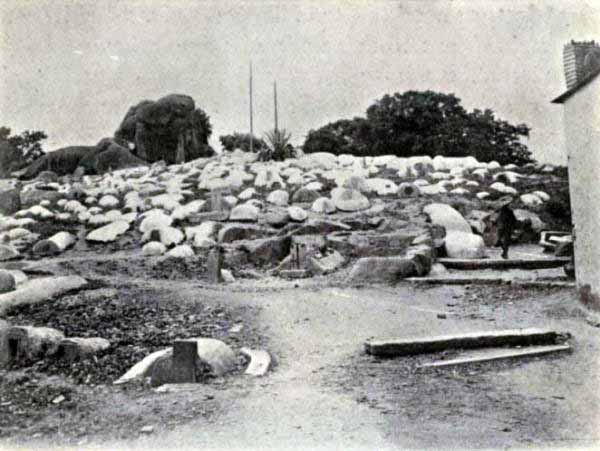
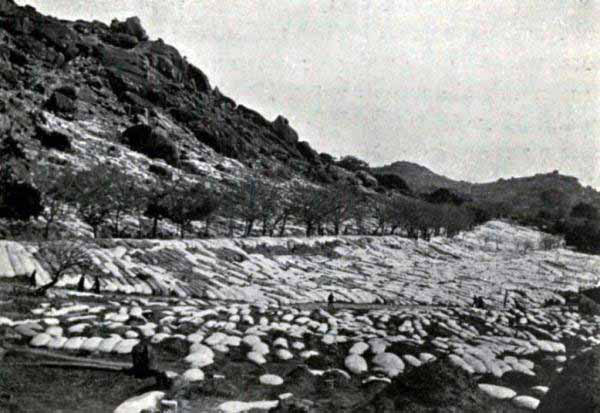
But such was not the case. A tradition has come down from the past that
underneath these hills are mighty spirits who would never tolerate that
the granite they contained should ever be quarried, and that should any
one dare to lay a chisel upon these rocks they would send disease and
death upon the valley and exterminate every human being in it.
The result was that all the stone that was used in this region had to be
carried up the river from some place fifty or sixty miles distant, where
the geomancers had declared that no spirits were to be found. Such is the
force of superstition that all the rocks and boulders and stones of this
region are absolutely safe from the chisel of the mason, and the people
prefer to go to the expense of importing the material for their homes and
bridges, rather than incur the anger of the spirits, who would use all the
terrible power they possess to avenge themselves upon them.
Superstition has been a most potent force during the whole course of
Chinese history in preventing the development of the nation. The mineral
resources of the country are exceedingly abundant, and if they had been
rightly exploited, would have been the means of enriching great masses of
people who are now in extreme poverty. To understand this let us come in
imagination to one district in the county of “The Peaceful Streams.” As we
stand gazing upon the scene before us, we are struck with the grandeur and
magnificence of its scenery. In the far-off distance the mountains are
piled up, one range higher than another, till the last with its lofty
peaks seems to be resting against the sky.
In the foreground are countless hills along whose sides the tea plants
flourish, and there are undulating plains, and miniature valleys, and
gently flowing streams that have come from the distant mountains, and
which have lost a good deal of their passion as they have travelled away
from them. The soil is poor, and the farmers have to expend the severest
toil upon it to be able to extract out of it enough to keep their families
from starvation. The struggle for existence is so severe that large
numbers every year have to leave their homes and their farms and emigrate
to other countries, where they hope to make sufficient money to be able in
the course of a few years to return to the old homesteads and start a new
life of independence and comfort.
Now, but for a wretched superstition, this region ought to be one of the
richest in China, and its people should be living in affluence; and
instead of having to desert the land and being scattered in Singapore, and
Penang and the Malay Peninsula, toiling to save their ancestral homes from
perishing through poverty, every man would be called back in hot haste to
share in the wealth that would be enough to enrich ten times the number of
people that now exist on the land struggling to make ends meet.
The land that stretches before us is rich in coal, and one hill at least
contains such a large percentage of the finest iron, that one engineer who
examined it reported that there was enough of the ore in it to “supply the
whole world for a thousand years,” and still it would remain unexhausted.
Expert after expert has visited this region, and with unvarying unanimity
they have declared that seams of coal abound throughout it that if worked
would turn this poverty-stricken district into one of the great workshops
of the South of China, and would give employment not only to its own
population, but also to large numbers from the adjoining counties.
Now the one controlling reason why this great natural wealth, that God has
put into the soil of this beautiful county for the service of man, is left
untouched is because it is believed that there are huge slimy dragons who
lie age after age guarding the treasures of coal and iron, and that any
attempt to take them from them would end in the destruction of the people
of the whole region. The pickaxe and the shovel and the dynamite would
disturb their slumbers, and, filled with passion and mad with anger, they
would hurl plague and sickness and calamities upon the unfortunate
dwellers on the land. These unseen terrors, more potent than hunger and
poverty and famine, have kept the mines unopened and the iron from being
smelted, and have driven thousands of people into exile, very few
comparatively of whom have ever come back to look upon the land of great
mountains and peaceful streams, where untold riches lay ready for the
gathering.
China is a country that is distinguished for its dense population.
Wherever you travel you never seem to be able to get away from the human
Celestial. The great cities and market towns and public thoroughfares
present a never-ending succession of Chinese forms and faces that becomes
absolutely monotonous. It is natural to expect them in these great centres
of population, but you go into the most out-of-the-way places, and even
there you are confronted with the same perplexing problem.
You wish, for example, to be alone, absolutely alone for a time, where no
Mongolian visage with its acres of features and its yellow bilious-looking
smile shall gaze upon you. There is a hill near by that you believe to be
entirely deserted, and you think if you could only get up there, the
desire of your heart would be gratified.
You walk briskly down the street, as though you were projecting a good
long constitutional, in order that no one may be mad enough to think of
following you. By and by you make a sudden flank movement that takes you
into a lane leading off from the main road. Casting hurried glances back
on the way you have just travelled to see that no one is watching you, you
make rapid strategic doubles in the direction of the hill, till you find
yourself calmly and with a contented mind slowly rising higher and higher,
until at last you have fairly left all traces of human life behind you,
and you are actually alone.
Seating yourself on a grassy mound, you look out on the broad expanse
before you, and you breathe a sigh of content. No mechanical sounds of
voices, as though they were being ground out by some creaking machinery,
fall upon your ears. You hear the sighing of the wind and you see the
grasses waving their heads as though they would talk in dumb show with
you. You look down at the river, that winds like a silver thread along the
plain, and you feel that this contact with nature is a most delightful
break on the eternal monotony of faces that may suggest humour and pathos
and lurking fun behind a yellow exterior, but never beauty.
All at once you receive a shock. You catch the gleam of an eye through an
opening in two or three bushes that you never dreamed of concealing
anything human behind them. You are startled, for you feel that the
Chinaman has outwitted you. You turn round and cast suspicious glances
towards a hedge, where wild flowers are growing and that you thought to be
the very picture of sylvan solitude, and you see several figures dodging
behind it.
The delightful sense of being alone vanishes, and you realize that that is
an impossibility in China. You stand up disgusted, but with the feeling of
amusement predominant, and one after another comes out of his
hiding-place, where the black, piercing eyes have been scanning your
every movement for the last ten minutes, and at least a dozen ungainly
forms creep up to you and with smiling faces try to make friends with you.
Now, mighty and overwhelming though the living force of Chinese life may
be, it is an undoubted fact that the dead and sleeping nation, as a
religious factor, in many respects controls and dominates the living tides
of men that impress us so vividly with their vast numbers. Even the casual
traveller in China cannot help but be impressed with the way in which the
graves of the dead thrust themselves upon the attention of the living.
There is no getting away from them. The mountain sides very often are so
thickly covered with them that one has to tread upon them if one would
pass from one part to another. Every uncultivated spot on the lower levels
has been eagerly seized upon as spaces where to bury the dead. Even the
cultivated fields have been invaded by them, and mounds right in the
centre of some diminutive rice or potato patches show how the little farm
has been narrowed down in order to make room for some members of the
family that have passed away. These graves thrust themselves up to the
edge of the great roads, and seem to be prevented from grasping even them
only by the incessant march of the countless feet that hurry along them
from dawn till dark. The clearings and little hills outside the cities
that cannot be used for cultivation are all seized upon as unprotected
cemeteries for the dead, and the little mounds like tidal waves advance up
to the very edge of the walls of the town, and are stayed in their
progress only by these huge bulwarks.
But it is not simply by the signs that appeal to the eye that one gets an
idea which is apt to appal one of the vast problem of the dead in China.
In countless houses throughout the land, and more especially in those of
the rich, one is astonished to find how many lie in their coffins,
hermetically sealed, for weeks and months, without being buried. It is a
most gruesome sight, and would give an Englishman the shivers to have the
dead in the next room for many months and sometimes for years.
Now, it is an unquestionable fact that the “dead hand” is a most mighty
and a most potent factor in the religious life of the people of China. All
the gods and goddesses that are worshipped throughout the Empire are not
believed to have the same influence over human life in sending misery or
in bestowing happiness as the dead members of a family have in regard to
their relatives that are still alive on the earth. A man, for example,
dies. He was a poor worthless fellow when he left the earth, and his life
was a constant record of failure and incapacity. He never accomplished
anything, and he was a mere nonentity not only in society but also in his
own home till the very last. All that is changed now, and as he lies in
his tomb he has acquired a new power that, in conjunction with the unseen
forces that are supposed to gather round the grave, will enable him to
pour riches and power upon the home he has left.
The dead to-day all over China hold the living within their grip. They are
believed in some mysterious way of having the ability to change the
destinies of a family. They can raise it from poverty and meanness to
wealth and to the most exalted position, but if they are neglected and
offerings are not made to them at the regular seasons, they will take away
houses and lands from it, and turn the members of it into beggars.
A man died in a certain village. He was so poor that a grave was dug for
him by the roadside and he was buried with but the scantiest of ceremony.
He had never shown any ability in the whole course of his life, and he
seemed in no way different from the ordinary commonplace looking men that
one meets in shoals anywhere.
The eldest son who buried him was a young man of exceptional ability. He
was rough and overbearing in his manners and a very unpleasant man to have
to oppose, but he had the keen passion of the trader, and seemed to know
by instinct every phase of the market, and what it was safe for him to
speculate in. As he had no capital of his own, he was compelled to begin
his life at the very bottom and to work his way up. This he did with great
success, so that in the course of time he amassed a considerable fortune,
and his name was known as that of one of the merchant princes in the
region in which he lived.
Now, this man’s steady rise from poverty to wealth was not put down to his
own ability or to any skill that he had shown in the management of his
business affairs, but almost entirely to the old father who lay buried at
the crossroads. It was he, the son believed, that guided the golden stream
that flowed into his life, and it was his mysterious hand that had so
prospered the combinations which the son had made, that the firm was built
up till it was distinguished for the magnitude of its transactions. So
convinced was he of this that he would never allow the grave to be
touched, and he would never have a stone put up to show to whom this
common-looking, neglected mound of earth belonged. He was afraid lest
careless hands should break the spell that hung around it, and perhaps
annoy the old man so that the run of prosperity should be broken, and in
anger he should send misfortune instead.
Countless instances could be given similar to the above, all illustrating
the profound faith that the Chinese have in the power of the dead to
influence the fortunes of the living either for weal or for woe. From this
has arisen the most powerful cult, ancestor worship, that at present
exists in China. Its root lies neither in reverence nor in affection for
the dead, but in selfishness and in dread. The kindly ties and the tender
affection that used to bind men together when they were in the world and
to knit their hearts in a loving union seem to vanish, and the living are
only oppressed with a sense of the mystery of the dead, and a fear lest
they should do anything that might incur their displeasure and so bring
misery upon the home.
Looked at from a sentimental point of view, ancestor worship seems to be
very beautiful and very attractive, but it is not really so. The unselfish
love that is the charm that binds the members of a family to each other,
and the willingness to endure and suffer for each other, are entirely
absent in the worship that the living offer to their dead friends. The
bond that binds them now is a vague and a misty one, and exists solely
because there are hopes that lands and houses and wealth may come in some
mysterious way from the unseen land, and sorrow and pain and disaster may
be driven from the home. It is no wonder that this worship has such a
powerful hold on the faith and practice of the Chinese, when it is
considered how much that men hold dear is involved in it. It is the
greatest religious force in the land, and will survive in some form or
other even when all the others that are at present recognized have passed
away from the hearts of the people.
We now turn to what to a casual onlooker might naturally seem to be the
dominant and most powerful factor in the religious life of the people of
this Empire of China, and that is idolatry. This popular and universal
form of worship meets one everywhere and is practised by every class and
condition of people throughout the country. The rich and the poor, the
learned and the unlearned, the common coolie who earns his living in the
streets and the most learned scholar who has risen to the highest rank in
his profession, men and women of all grades, good, bad, and indifferent,
all more or less believe in the idols and worship them.
That this is so, is evident from the almost universal presence of the
idols. Every house has at least one, which is the household god of the
family, whilst the more religious and devout will have several others as
well. Then the cities abound with temples dedicated to certain well-known
gods that have been built, some of them at great expense, and are kept in
constant repair by the free-will offerings of the people. The villages,
too, not to be outdone by the towns, have each of them at least one public
temple where the people can make their offerings to their patron god, and
where on the birthday of the idol the whole population gather to witness
the play which is performed in honour of it.
Then, again, there are monasteries scattered very liberally through the
provinces, some of them so large that they will have over a hundred
resident priests, all engaged in the one duty of chanting the praises of
the various gods in them, and in superintending the worship of the throngs
of people who crowd to such places to make their offerings to the
different idols. There are also numerous nunneries where women devote
their lives exclusively to the service of the Goddess of Mercy, and spend
their years in trying to get from her the peace of mind they have not been
able to obtain in their own homes. The inhabitants of these establishments
are nearly always widows whose homes are unhappy, or married women who,
dissatisfied with life, and with the consent of their husbands, have
retired to the quiet and solitude of these retreats, in the hope that by
prayer and meditation the unrest of spirit that has made life intolerable
may be exchanged for one of calmness and contentment.
In addition to the above, there are mountain temples that abound in all
the hilly regions, and little shrines built by the roadsides, where
passing travellers may offer up their devotions to the gods enshrined
within them, and a multitude of devices for drawing the attention of men
and women to the duty of remembering the services they ought to pay to
the gods of the land they live in. The more one studies this question, the
more one is impressed with the fact that idolatry is a huge system that
completely covers the whole of the Empire with its ramifications. If the
faith of the Chinese is to be measured by the money that they are willing
to put out for its support, then it must be profound indeed. When one
considers the innumerable number of temples of all sizes and description
that meet one in every direction, and that the expense of building them
and keeping them in repair falls entirely upon the people, one cannot but
be struck with the sacrifices they are willing to make for the sake of
their gods. But when one considers further that the huge armies of
Buddhist and Tauist priests who are connected with these religious
establishments are all supported by voluntary gifts freely bestowed upon
them, one stands amazed at the amount of money that must be annually
expended throughout the Empire upon a system that has no State endowment,
but which depends entirely upon the spontaneous offerings of the people at
large for its very existence.
But it is now time to go into detail with regard to the working of
idolatry in order to understand what is its exact effect on the masses who
practise it, and in order to make the picture as vivid as possible, I
shall first describe how the home is affected by this form of religion.
Any house taken at random will do equally well for our purpose, for, like
the Chinese themselves, they are all built on the same general model, and
a description of one would do for all the rest.
As we pass through the courtyard and enter in at the front door which
stands open all day long, no matter what the weather may be, the first
thing that we catch sight of is an oblong table on which is seated the
family idol. The most popular and the most generally worshipped is
Kwan-Yin, or the Goddess of Mercy. Her face is placid, and there is a
look of tenderness about it that has won the hearts of the millions of
China so that in nearly every home in the land her image is found as the
one conspicuous object towards which all hearts are drawn.
Her whole attitude and the air of benevolence that sits so naturally upon
her agree well with the beautiful story we have of her life, and the
reason why she, an Indian woman, should have become almost the national
goddess of the Chinese nation.
Kwan-Yin was the daughter of an Indian prince, and as a child she showed
herself to be possessed of a most loving heart. As a girl she used to run
in and out of the houses of the common people that stood near her father’s
palace, and she was so distressed at the sights of poverty and sorrow that
she constantly witnessed that she made a vow that when she became a woman
she would never marry, but would devote her life to alleviate the miseries
that the women of India were compelled to endure.
This vow she carried out to the very letter, and her days were spent in
ministering to the wants and ailments of women, no matter how low in
society they happened to be. Her fame spread far and near, and the story
of her devotion and self-denial touched every one that heard it. With true
Oriental imagination people declared that she was a fairy that had been
born into the world in human shape, for never had such tenderness and
compassion been shown by any human being, and therefore her home must
originally have been amongst the gods and the goddesses that lived in the
land of eternal sunshine, where no shadow ever fell upon their hearts to
dim the happiness that perpetually filled their lives.
When she died it was felt that such a woman should be deified, and that
her name and image should be added to the list of those that were
worshipped by the nation. The story of this beautiful life somehow or
other travelled over the mountains and plains and deserts that divide
India from China, and the “Black-haired race” became so enamoured with it,
that those who heard it declared that she was worthy, even though she were
a foreigner, of being placed amongst the gods that they trusted in. With
wonderful rapidity her cult was adopted by all classes, but especially by
the women, till to-day her image is found in nearly every home in the
Middle Kingdom.
The recognized place where the idol is enshrined is in the living-room of
the family. It thus becomes a silent member of the home and a witness of
the daily life of its worshippers. It seems to be treated with but scant
courtesy, however, for no care whatever is bestowed upon it, and the dust
that comes in at the doors, and that rises from the earthen floors, falls
thickly on its head and makes it have a grimy, disreputable appearance.
The furniture in the room and the table on which the idol rests may be
cleaned and dusted, but no damp cloth may ever be used to relieve it of
the dust that has accumulated upon it, lest it should consider itself
insulted by such familiarity and express its resentment by sending down
some calamity upon the family. The gods are believed to be very human, and
to be liable to fits of passion, and to be very anxious to maintain their
dignity, and to be cruel and merciless with those that offend against
them.
A general theory with regard to the idols is that they have to be
propitiated in order that they may exercise their power in the protection
of the home. For this reason they are never formally approached on any
occasion without at the very least an offering of incense or of paper
money burned in front of the idol, which it is believed find their way to
the spirit of the god, who can appropriate and use them for his own
benefit. It is customary on the days of the new and full moon to burn a
number of sticks of incense, just to keep the idol in a good humour, on
the principle that a man makes a present to another, in the hope that
should circumstances demand it, he will show himself friendly when he is
appealed to.
The one great occasion in the year when the idol is worshipped with great
ceremony is its birthday. Then special preparations are made to do it
honour, and offerings of roast fowl and duck and boiled ducks’ eggs, and
certain vegetables, are placed in front of it, and it is called upon to
partake of the good things that its worshippers present to it. In the more
wealthy homes, where money is plentiful, in addition to the usual
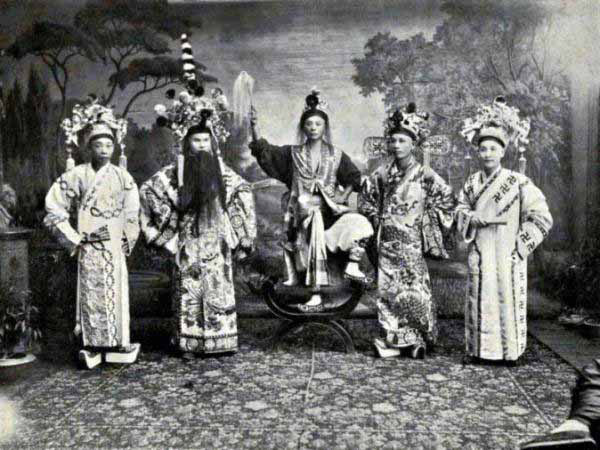
offerings of food, the head of the house will engage a band of
play-actors, and selecting some popular piece, he will have it performed
in the courtyard right in front of the idol, so that it can be amused by
the merry performers and be made to remember its birthday with feelings of
pleasure and satisfaction.
There is one feature about idolatry that is very striking, and that is
that it never proposes to have any effect on character. The theory seems
to be that its help is only available when men are in trouble or want to
get rich, or when they wish to be avenged on an enemy, or the business is
failing and they desire that it should prosper, and so be relieved from
the dread of poverty in the future. There may be a thousand things in the
same line as these, and it is believed that the idols have resources at
their command that enables them to meet all such contingencies in human
life and to fill men’s hearts with content.
The idols, however, are never supposed to have any influence for good on
the characters of those that worship them. A man never feels that as he
has just been making an offering to the household god, he must therefore
be a better man. Such a thought never occurs to a Chinaman. The connection
between a lavish service to the idols and a life altered for the better is
never dreamed of in this land. A man, for example, is an opium-smoker, and
every day the habit grows upon him till at last he is perfectly powerless
under its grip. He becomes indisposed to work and gradually the home
becomes impoverished. The opium craving that comes over a man when the
hour for smoking arrives is so intolerable that at all hazards it must be
satisfied, but this man has stripped his home of everything he can pawn,
and now only a bare and desolate house is left, and his wife is almost
starving. Driven almost to despair by the awful pains that fill every
joint and muscle of his body with the most exquisite agonies, he sells his
wife, and she, only too glad to escape her wretched life, willingly
consents.
Now, during the whole time that this gradual descent in the man’s
character has been going on, the idol has been a daily witness of his
conduct, but it has never entered the thoughts of the opium-smoker that
the god that sits on the oblong table and gazes calmly upon him without a
wink cares anything at all whether he smokes or not, or is concerned in
the slightest degree whether he lives a moral life, or whether he wrecks
it by the grossest iniquities.
I once said to a man who looked like an animated skeleton, though not half
so cheerful, “Are you not afraid that the idol that is so close to you,
and that sees how wretchedly you are living, may punish you for the great
wrongs you are committing?” He smiled a grim and sickly smile, as though I
was perpetrating a huge joke, and he was vastly amused at it. The idol had
no concern with human character, and it was only a barbarian that would
ever dream in his unsophisticated nature that such a thing was possible.
Again, a mistress of a home, who was a devout and earnest believer in the
Goddess of Mercy, had a young slave girl about fourteen years of age.
Whilst drawn by the beautiful and benevolent-looking face of Kwan-Yin to a
keener belief and worship of her, she was daily treating this poor child
in the most savage and brutal manner. Her body and her legs were all
covered with scars caused by the beatings she had received. One of her
eyes was nearly torn out of the socket, and she was brought to the
hospital, so maimed and wounded that the doctor feared she could never be
cured.
It never occurred to this cruel woman that the savage way in which she was
murdering her slave girl, in the very presence of an idol who owed her
power to the reputation she had universally gained for mercy and
compassion, would so set the goddess against her that her prayers and her
offerings would be rejected. What had her conduct got to do with the
favour of the goddess? Absolutely nothing. The gods have no concern about
human motives and mundane morality. They have other things to attend to,
and certainly no time to give to such complex questions, and so men and
women are left very much to themselves, and if in the cycles of time
retribution comes upon men for their evil lives, it is not the gods and
the goddesses that men worship that will see to the ordering of that.
That the Chinese have profound faith in their idols is a fact that cannot
for a moment be questioned. China is a nation of idolaters, and neither
learning nor intelligence nor high birth tends to quench the belief that
has come down from the past that these wooden gods have a power of
interfering in human life, and of being able to bestow blessings or to
send down curses upon men.
There are times, however, in the life of the people when the gods seem to
vanish out of their sight, and they turn to a great power which they call
Heaven for deliverance or protection. In the very earliest days of Chinese
history, ages before idolatry was introduced into China from India (A.D.
61), there is no doubt but that the people worshipped the true God. In the
course of time the word for God became mixed up with certain heroes that
were deified by successive emperors, and so the monotheistic craving of
the nation took refuge in the word Heaven. The Chinese character for that
is composed of two words, “one” and “great.” The combination then means,
“The One Great,” which truly expresses the thought that men have of the
Great and the Mighty One whose power is absolute and whose decisions are
final throughout the whole of creation.
That this belief is no mere abstract one is seen in many instances in
ordinary life where men appeal directly to Heaven instead of to the idols.
The country, for example, is suffering from the want of rain. Months have
gone by and the rainy season has come and passed away without the usual
rainfall, the crops are withering in the fields, and there is a prospect
of hunger and famine unless the clouds send down of their richness and
revive the drooping forces of nature.
The priests of a certain temple notify that on a certain day a procession
will be formed to march through the city to beseech Heaven to pour down
the much-needed rain upon the land. The people gladly respond to this
appeal, and on the day appointed, scholars dressed in their long robes,
and priests in their yellow dresses, and the common people in the clothes
that they wear only on special occasions, all turn out and join in the
long line that winds its way along the narrow unsavoury streets to
intercede with Heaven, that it will send down copious showers on the
thirsty earth.
One singular feature in this public demonstration is the attendance of the
idols. They are brought out from their temples and carried in the solemn
procession to join with the people in the universal prayer for rain. Every
ten yards or so the slowly-moving line makes a halt, and every one kneels
down and a piteous cry is raised to Heaven, that it would have pity upon
the land, so that the crops may not perish and the poor may not die of
hunger and starvation. It is intensely interesting to watch the long line
of suppliants at this stage in their supplications. Many of them, in order
to show the intensity of their purpose, have come dressed in sackcloth;
others who are musical have brought their instruments with them, and as
they walk with a solemn step they play a sombre funereal air that is
intended to show to Heaven with what sorrow their hearts are filled at the
calamity that threatens to overwhelm the people if the rain is withheld.
Now the music is stopped and the whole procession is on its knees, and
even the idols, as it were, with silent supplications join in the mournful
confession of sin and in the agonized entreaties to Heaven to have pity
upon the people.
Heaven is recognized as being supreme in power. In the mottoes that the
Chinese paste on their doorposts and lintels at the beginning of the year
are several that show the popular thought on this great subject. “May
Heaven send down upon our home peace and happiness”: “Life and Death,
adversity and happiness are all decided by Heaven”: “Honour and wealth as
well as poverty and lowly station are in the hands of Heaven”: “Men may
plan, but it is Heaven that decides what the result shall be.”
There is no reference to the idols here. In fact, when Heaven is mentioned
they are never referred to as having any authority in the great movements
and principles by which human life is controlled and influenced. Heaven to
the Chinese is a great impersonal power, so far exalted and so mysterious
that in despair they have adopted the idols as a means by which they can
communicate with the unseen. And yet there are occasions when men seem to
lose their dread of Heaven, and they appeal to it, as Christians do to
God. Heaven, for instance, is believed to have a stern sense of justice
and of righteousness. It is also the redresser of wrongs, which it
invariably puts right, upholding the innocent and bringing swift judgment
on the guilty. Its government is one that is founded on great principles
of right, that work automatically in the destruction of all that is evil
and in the furtherance of all that is good.
There are many times in the life of this people when Heaven becomes to
them a veritable Person, who can hear their cry when they are in distress
and who, they believe, is ready to vindicate their character when it has
been unjustly assailed.
One day, in passing through one of the side streets of a great town, a
crowd was observed standing with a kind of shocked look upon their faces
gazing upon a woman that seemed to be raving mad. It turned out that she
was a poor woman living down the street, who had gone to assist in the
household work of the family opposite to where she was now standing. Some
trifling thing had been missed in the house, and she had been accused of
stealing it. She defended herself passionately and with all the eloquence
at her command, but without avail. Being originally of a high temper and
of a hasty, fiery disposition, she was enraged beyond measure not only at
the false accusation that had been levelled against her, but also because
the woman refused to accept her defence of herself, and still reiterated
her firm conviction that it was she that had stolen the missing articles.
Feeling that there was no other way of clearing her character except by
appealing to Heaven, she rushed out into the street, and letting down her
long hair till it fell in thick tresses over her shoulders, she looked up
at the sky where the Power she called Heaven was, and she poured out the
grievance that was filling her heart almost to bursting. She told how she
had been falsely accused, and how every attempt to right herself had been
listened to with scorn and contempt. Then with tears streaming down her
face, she called upon Heaven to avenge her and show to the neighbourhood
that she was guiltless of the charges that had been made against her. With
a rush and a torrent of imprecations that positively made one shudder she
then prayed “The Great One” to hurl down upon the woman that had injured
her all the miseries and woes that poor human nature has ever been called
upon to endure. Her vocabulary of evils was amazing in its luxuriance, and
as each was shot forth from her passionate lips, some of the onlookers
actually shuddered with horror at the awful sorrows that she wished her
enemy to have to suffer.
In studying the religious forces that are in operation amongst the
Chinese, one is deeply impressed with the illogical position that is
maintained in regard to each of them. “Fung-Shuy,” for example, especially
when it is acting in conjunction with the graves of the dead, is declared
to be able to fill a home with boundless wealth, and to secure that sons
shall be born into the family and the highest honours of the State be
bestowed upon the sons and grandsons. The idols again are credited with
the most marvellous powers. They can get men out of scrapes, and they can
build up businesses so that colossal fortunes shall be made. They can fill
the desolate homes with troops of children. They have the power, when they
are enraged at the neglect of the people of any particular district in
paying them proper honour, of sending cholera and deadly fevers that shall
carry them off by the hundreds. All these are firmly believed in by
priests and gentle-faced looking nuns, and fortune-tellers will all prove
to you that the popular faith is founded in philosophy and experience. You
retort to all the laboured arguments of these various interested parties
by asking them whether it is not a fact that life and death, and
prosperity and adversity, and kingly honours as well as the meanest
station in society, are all decided by Heaven, and that they are its
special gift. There never is any other answer to that question but one,
and yet five minutes after the same person will be as enthusiastic as ever
in his glorification of the idols, and in his profound belief that some
favourite god has the power of bestowing every blessing that the heart
longs to possess.
I have described the idol in the home, and I will conclude now by giving a
description of a temple scene such as may be witnessed on the birthday of
the chief idol or on the first or the fifteenth of the moon, which days
are supposed to be specially lucky for those who wish to make their
offerings to the gods.
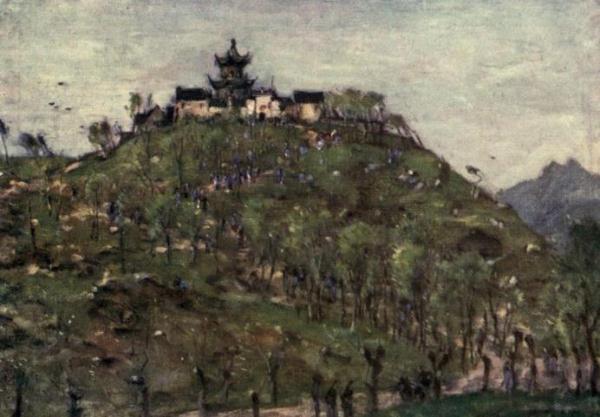
The temple I am about to describe is situated on a rising hill that has an
outlook of great natural beauty. Immediately below it and stretching
considerably in the distance is a large city containing over one hundred
thousand inhabitants, that live in the confined streets that look from the
temple like narrow arteries along which the human tide ebbs and flows
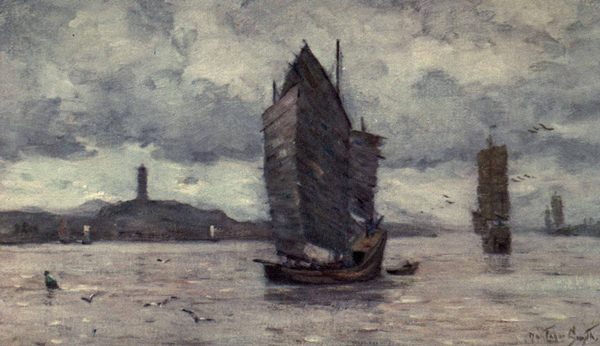
without cessation. Beyond the town there runs an arm of the sea, dotted
with numerous islets and sparkling with the rays of the great Eastern sun,
which he flashes on islands and capes, and the sails of the junks that are
passing up and down from the inland waters to the coast. Further on and
completely filling up the background are ranges of mountains with the
great shadows resting on them and their lofty peaks bathed in sunlight,
whilst here and there the floating clouds rest like beautiful crowns upon
the summits of some that tower the highest amongst them towards the blue
sky.
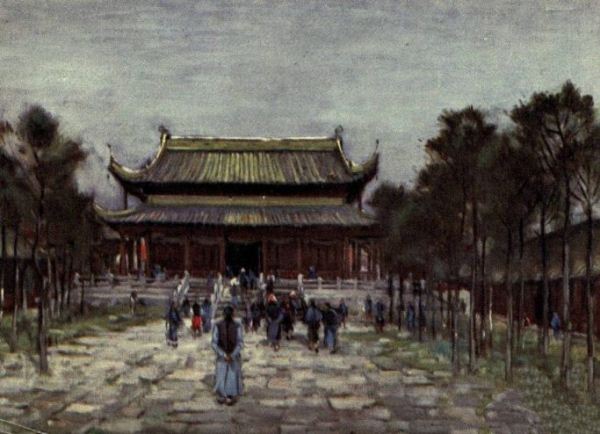
The scene in the temple and its surroundings was very charming and
attractive, for the sun shone upon the temple, and played amongst the
solemn-looking pine-trees, and sent his rays down courtyards that seemed
to delight in shadow, till everything appeared to be laughing for very
joy. Even the idols looked as though they had caught the spirit of the
day, and the “God of War” appeared to be less stern and bloodthirsty than
was his wont, and the “God of Literature” had put on a light and jaunty
air, hardly in keeping with the profound subjects that ever claim his
attention.
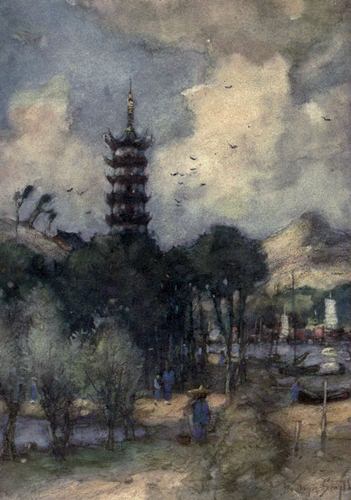
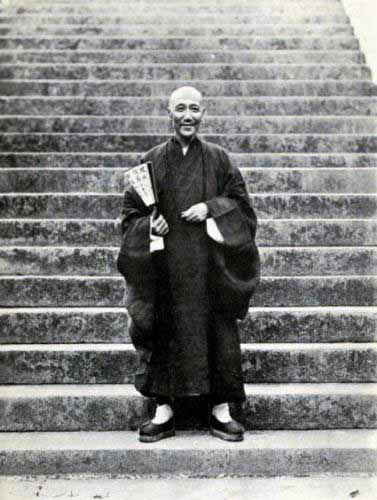
THE WHITE STAR TEMPLE
(NANKIN).
But see! here come the people from the great city below, slowly winding
their way up the stone steps that the feet of countless worshippers in the
years gone by have worn smooth and thin. Some few are coming with purposes
intent upon appealing to the “Goddess of Mercy,” for their faces are
sombre, and the shadows of troubles from which they hope the idol may
deliver them, cover them with a sad and sorrowful aspect. Others, again,
have come for an outing and to get out of their monotonous surroundings,
to catch a glimpse of the far-off hills, and to see the sun as he puts
forth his powers to turn the world into a thing of beauty.
Here is a jolly little party that has almost reached the top. It consists
of an old lady whose hair is completely grey, but whose face is made
beautiful by as sunny a smile as ever lighted up a human face. With her
are two lads, evidently her grandsons, full of life and fun, and wild with
the excitement that the mountain air has put into their blood. They race
and chase each other up and down the steps, and round the huge boulders
that lie on the roadside, and they dodge behind the old granny, who seems
as if she would like to be a girl again and join them in their mad romps.
Whilst she is standing taking breath, and gazing with rapture upon the
distant hills flooded with great waves of light, and upon the waters of
the sea that are sparkling with sunbeams, a woman of about forty with slow
and sorrowful motion climbs up the steep ascent. She has a slave girl with
her, and she leans one hand upon her shoulder to support her as she walks.
She is a widow, and evidently has some sorrowful story that she is going
to tell the goddess. One is struck with the pallor of her face, and the
utterly hopeless air that rests on every feature in it. She hardly looks
at the pleasant-looking old lady, but passes up with downcast eyes till
she reaches the open space that is in front of the temple.
Immediately behind these people I have been describing, there appears a
party of young fellows of the better class. They are well dressed, and
have an air of refinement about them. There is no sign of trouble or
sorrow among them, for they laugh and chat and joke with each other,
whilst the road resounds with the echo of their merry voices. Their visit
to the temple to-day is merely one of pleasure. The streets below are
grimy and evil smelling, and in order to have some object in view they
have determined to spend the afternoon in a picnic to the well-known
temple on the mountain side.
The temple as a whole consists not simply of one large room where the
image of the goddess is enshrined, but is made up of a number of smaller
buildings connected with each other in a cunning and artistic fashion by
winding ways that nature seems to have devised in order to add to the
attractions of the place. In each of these lesser temples there are placed
images of some of the more commonly worshipped idols, a veritable kind of
Pantheon where each visitor can find the particular god that he deems the
most suitable for his individual requirements. Leading to these various
buildings, there are little grottoes, and covered pathways, and natural
adjustments of rocks, in which stone seats and granite tables have been
arranged, and where the crowds of worshippers, tired with their climb up
the mountain path and anxious to get out of the glare of the great sun,
can sit and enjoy the refreshing coolness that these recesses in the
hillside naturally give.
But let us take our stand a little to the side of the goddess and watch
the worshippers as they come in turn and take their position in front of
her to offer their petitions to her. The widow with the sorrowful face,
whom we saw climbing the hill, without one thought of the glorious scenery
that filled the landscape with its beauty, comes in with the shadow
deepening on her face, and lifting up her folded hands in the attitude of
devotion to the goddess begins to mutter to her the story of the trouble
that is weighing on her heart. The sight is truly a most pathetic one. The
face is in agony, and the eyes are turned with an intensity of gaze upon
the calm face of the wooden image before her. The faith expressed in the
impassioned look is profound, for it would seem as though her whole soul
was absorbed in the telling of her story and in her wish to touch the
heart of the placid image of the goddess.
After a few minutes, anxious to know what the answer of the idol is going
to be, she takes up two pieces of bamboo that are lying on the table in
front of it, and throws them up in the air. With a clatter they fall on to
the tiled floor, and by the way they lie she learns that her prayer has
been granted, and that the goddess will give her the desire of her heart.
A smile like a flash of sunlight in a winter sky fleets across her pale
thin face, and one can see what a sweet one it might be, were her heart
relieved of the sorrow that has painted it with such sombre colours.
Her place is taken by another who has been standing by waiting her turn.
Evidently her business is not a very pressing one, or such as to cause her
much trouble at heart, for after a few seconds of muttering she tosses up
with almost an irreverent fling the two divining bits of bamboo, and looks
with a casual air at the position they take on the floor. The answer they
give is No—her prayer is not granted—so with a bow to the goddess, and a
kind of pout upon her lips, she passes out into the open air. Her matter
could not have been of any importance whatever, for in a moment she is
laughing and gossiping with her friends, as though her visit to the
goddess had been a joke that was now ended.
And so one after another come and take their stand before the idol. Some
have a free-and-easy air about them, whilst others are intense and
impassioned. Some accept at once the answer of the goddess as final,
whilst others again continue to fling up the two coarse pieces of bamboo
until they give the reply that they wish to have. One young lad about
eighteen attracts my attention. For fully a minute, with calm and
untroubled face, his lips keep moving and his gaze is concentrated on
Kwan-Yin. I ask him when he is finished what he has been asking of her. “I
have been out of employment for some time,” he replies, “and I have been
round to several temples and entreated the gods there to find me a place;
but they have done nothing for me, so I thought I would come here and see
if I should be more successful with the idol of this temple.”
As the evening sun began to set behind the mass of clouds that seemed to
gather on the Western mountains to catch the last glimpse of him before he
disappeared, we began to descend the hill. Numbers of those that I had
seen standing with devout faces and uplifted hands before the idol were
fellow-travellers. Others, again, who had ascended the hill for an outing,
and whom I had watched sitting in the grottoes, eating peanuts, and deftly
cracking dried melon seeds, and sipping tea, moved down at the same time.
The wooden gods were left behind in the gathering gloom of their shrines,
and the only figures they saw were the opium-visaged priests that flitted
about like ghosts. The people at any rate had had a pleasant day, and a
breath of pure air, and a vision of nature in her most beautiful aspect,
but nothing more. “What have you gained to-day in your appeal to the
goddess?” I asked of a man that I had seen very devout in his prayers. He
looked at me with a quick and searching glance. “You ask me what answer I
have got to my petition to the goddess?” he said. “Yes,” I replied, “that
is what I want to know from you.” “Well, you have asked me more than I can
tell you. The whole question of the idols is a profoundly mysterious one
that no one can fathom. Whether they do or can help people is something I
cannot tell. I worship them because my fathers did so before me, and if
they were satisfied, so must I be. The whole thing is a mystery,” and he
passed on with the look of a man who was puzzled with a problem that he
could not solve, and that look is a permanent one on the face of the
nation to-day.