“Prima sedes, corona regis, et regni caput.”
As we approached Palermo the pulse of life quickened; at every station
carloads of merchandise awaited transportation, golden oranges, paler
gold citrons, sacks of almonds, casks of wine, vast quantities of
sumach.
At Castel Termini, near the great sulphur mines, stood long freight
trains laden with huge fragments of beautiful yellow sulphur.
“Remember that day the smoke lifted and we got a good look into the
crater of Vesuvius?” said Patsy. “You were very much taken up with the
pale yellow velvet lining of the crater, and wanted to rip it out for an
opera cloak. That brimstone is exactly the same color; I suppose it’s
the same stuff.”
At Acquaviva there were more freight trains loaded with blocks of
sparkling rock salt.
“Salt must be cheaper here than in Rome,” said Patsy. “When I asked your
Agnese for a handful to put in the electric battery, she was horrified
at my extravagance.”
“Agnese buys it by the pound at the tobacconist’s; it costs like gold
dust.”
Here a fat gentleman reared up from his nest of newspapers in the
corner. “Salt is free in Sicily,” he said; “we do not tax it as they do
in Italy. For a few soldi you can buy a kilo of the best, the most
fine. What you see is mineral salt, virgin salt, and comes from a cave
in the top of the mountain; there is none to compare with it!”
“There is no salt tax in Sicily,” said a small neat man who looked an
avvocato. “It would be useless; each one would then make his own. You
need only take water from the sea, put it in a pan, set it in the
sun—via! the water evaporates, and leaves salt as good as this!”
“Not so good!” roared the fat man, “miserable, inferior salt!” The veins
in his neck swelled with anger.
“Isn’t all salt pretty much alike?” Patsy put in soothingly.
“Per Bacco, no! It is all different. The salt from the sea, who knows
what nastiness gets into it? This salt, pure and fresh from the bowels
of the earth, has soda and other valuable minerals mixed with it; there
is no comparison, me spiego?” (Do I explain myself?) “Here, go thou,
Teodoro; bring a little bit of salt that these signori may know I speak
the truth!”
Teodoro, a handsome bearded young man in high brown shooting boots, had
just entered the carriage; we had noticed him walking up and down the
platform with a pair of pointers in leash.
“Va bene.” Teodoro nodded good-naturedly to the fat man, evidently his
father, left the car, and walked leisurely across the tracks to the
freight train, followed by a porter. He touched a cake of shining
crystalline salt too big for one man to carry.
“Pronto!” cried the guard, lifting his horn.
“Wait,” roared the angry man, thrusting his head from the window. “Che
animale! don’t you see my son?”
“Break it, corpo di Bacco! break it,” laughed Teodoro. The porter
pushed the glittering block of salt from the truck. It crashed on the
pavement broken in two. Teodoro picked up the larger piece, dusted the
splinters from his coat, then without a sign of haste stepped on board.
“They must be great chiefs,” murmured Patsy, as the guard tootled his
horn, and the train crawled out of the station.
“A thousand thanks,” I said to Teodoro, as he put the salt in the net
over our heads.
“It’s too bad to give so much trouble.”
“Nothing—a pleasure!” Teodoro had the nicest laugh, the whitest teeth.
He and Patsy made friends on the spot. They sat chatting gaily by the
further window while the angry father wrangled with the little
avvocato, who exasperated him more and more every time he spoke. They
were in the midst of a hot dispute when the angry man broke off to point
out a trolley that runs from the top of the mountain to the station
where the salt is loaded on the trains.
“Guardi, Signora, there is the place where this pure, this exquisite
salt is excavated from the entrails of the earth. Me spiego?”
We had just reached a white river. Its banks were lined with nespole,
palms, fig trees, gray asphodels, bushes of green carob. From the top of
the mountain one cobweb line of black crossed another; two iron baskets
passed each other on the aerial railway, one ascending empty, the other
descending laden with shining salt.
“What a pleasure to see life, movement, activity after the desolation of
Calabria and Messina!” Patsy exclaimed.
“Davvero! This should be a rich country; our people are hard working,
frugal. We need only a little foreign capital to restore La Sicilia to
her ancient greatness. Crispi[1] saw that—if we only had a few such men
today!”
“I have heard Crispi speak in the Camera—what an orator! Once at Baron
Blanc’s I talked with him,” I murmured.
“As to capital,” said Patsy, “are your taxes favorable to foreign
investors? I met a man last winter from New York representing a
syndicate; he had five millions to invest in Sardinian mines. He looked
into it, found the taxes prohibitive, and left Italy without spending a
cent. All that good money is now invested in the Argentine.”
“Taxes! We do not tax lemons as you do in the United States; on the
contrary in the summer, when they are necessary to the health of the
people, they are sold in our great cities by the Government at less than
cost!”
“Has us there!” said Patsy. “People in New York are paying forty cents a
dozen for lemons while millions of them rot on the trees of Sicily
because—on account of our damnable tariff—it’s not worth while to
gather them!”
We were passing a small forlorn station without stopping.
“Behold!” The angry man pointed to a lemon grove that bordered the
track. “What a beautiful picture!”
The trees were bowed down with the weight of lemons; the ground beneath
was yellow with the precious fruit that would lie there till it had
turned black with decay.
“We have to thank America for that,” said the angry man.
“Say something to that rude person,” I whispered to Patsy.
“There’s nothing to say; he has us on the hip.”
“What does it mean?”
“How can you expect a waif of the universe, just back from the
Argentine, to know the ins and outs? It’s some beastly log rolling. The
lemon-growers in Florida, California,—how do I know what States have
swapped votes with some of the big fellows,—you protect me, I’ll
protect you!”
“Politics, all politics,” roared the father of Teodoro. “Una
porcheria, mud, mud! I know; my son here has just been defeated at the
election by an animal! This one gave each voter five francs. ‘Elect me,’
he said; ‘when I am elected, come back; I will give you five francs
more.’ This piggery all comes to us from America. The Signori can tell
us. Is there not bribery and rioting at your elections?”
“As to bribery,” said Patsy, “I suppose that has existed since the
beginning of time. Rioting? The elections go off quietly enough in our
town.”
“Quietly, per Dio! Last night I was at the Café Greco when Z., who
writes the articles signed Piff Paff, was there. Tale came in and said
to him: ‘So it is you who please yourself in writing lies about me?’
This one took a chair, that one a bench—pim poom! Mirrors were smashed,
bottles broken, a farce—piggery—me spiego?”
“The elections should have been put off,” said the small avvocato.
“We in Sicily have enough at this moment without that business; but no,
the politicians care more about keeping their men in than about their
distracted country, desolated, ruined by the most consummate disaster
the world has seen!”
Grudgingly Teodoro’s father agreed; he would have preferred to disagree.
A man of intelligence, feeling, sentiment, not a man of power.
He had a low forehead, dark, angry eyes, a swart color that showed
Saracen descent. All his good qualities—I am sure there were many—were
nullified by his volcanic temper, that without rhyme or reason burst
forth, devastating the hour as an eruption of Etna blasts the lovely
vineyards and olive groves, and turns them into burnt lands that produce
nothing.
In the silence that followed, Teodoro’s gay lilting voice was heard
imparting advice to Patsy.
“For Palermitan dishes? Go to the Ristorante Trinacria, order pasta con
sarde, baccalà à ghiotto, melone d’inverno, zibibbi, a fiasco
of Vino di Zucco—Ah, behold us arrived at Termini—here is made the
best pasta (macaroni) in Sicilia.”
At Trabia the little avvocato hopped briskly off the train and
returned carefully carrying his bandana handkerchief filled with eggs.
“They cost a horror at Palermo; my wife always asks me this favor,” he
explained, as he stowed away three dozen eggs in his lawyer’s bag.
After Trabia our fellow travelers fell asleep worn out by much
conversation, and we were left to enjoy the marvelous scenery as we
approached the Conca d’Oro, the Golden Shell in whose midst stands
Palermo, the old Panormus—all-haven—of the Greeks. The road runs
between the mountains on the right and the sea on the left,—a narrow
strip of land ’twixt yellow sands and gray-green hills. Now and then we
caught a glimpse of some valley of paradise, with locust and Judas trees
among the groves of oranges and lemons with their “golden lamps in a
green night.” We passed many Saracen water-wheels with irrigating
trenches running through fertile fields. Between the exquisite airy blue
hills that jut out into the sea and the emerald valleys, the way crossed
many torrenti, dry stony water-courses descending from the mountains
to the shore. These torrenti (the first we saw was the Torrente Zaera
at Messina) are characteristic of Sicily. For a short time in early
summer, when the snows on Etna and the Madonia mountains are melting,
there is water in them, but for the greater part of the year they are
empty ravines. J. saw them used in turn for roads—he even went through
one in an automobile—for stone quarries, for gravel and sand pits, and
for the washing and drying of clothes.
Sicily, the granary of the Romans, still bears three simultaneous crops
in the neighborhood of Palermo. We saw olive groves planted with grape
vines and wheat,—all three seeming to thrive. The suicidal destruction
of the forests has had the same terrific effect upon Sicily that we saw
in Spain, that we see today in the United States. After the arid, poorly
cultivated regions we had passed through, it was comforting to rest our
eyes on the lovely verdure, that, thanks to the Arabs, still surrounds
Palermo. The innumerable wells, pumping machines, norias, the
astonishing richness of the soil, reminded us at every step of Granada,
the lost paradise of the Moor. Here, in the Conca d’Oro, as in Granada,
the labor of those truly great agriculturalists, the Arabs, still
beautifies and enriches the land they loved.
Looking down upon the Golden Shell from a height, the plain seems
literally paved with the gold of oranges, lemons, mandarins and citrons.
It is one immense continuous fruit grove of the orange tribe, intermixed
with Japanese medlars, mulberries, almonds, figs and olives. The Conca
d’Oro takes its name not only from its extraordinary fertility, but from
its shape. Behind Palermo the airy mountains draw together, the plain
narrows almost to a vanishing point; as it approaches the sea it widens
out into what is variously called a shell or a cornucopia.
Palermo is alive! When still far off we had felt its life pulse
throbbing stronger and stronger; when we were in its midst, we knew this
was the heart of Sicily. We arrived at the Hotel des Palmes in good time
for dinner. The fine dining-room was filled with gaily dressed
Palermitans. After the loneliness of Syracuse and Girgenti it was
pleasant to find ourselves again among people full of the business life.
Even at the Timeo in Taormina, we had been in the shadow of the
disaster; all the Sicilians there were in deepest mourning; the few
foreigners were all connected in one way or another with the earthquake.
At the next table to ours sat General Mazza, his wife and their charming
young son. There was much jesting, and we heard the words Pesce
d’Aprile continually. Across the room at another table sat a pair of
beauties in blue and rose color, the center of attraction. Young Mazza
was called away in the middle of dinner by a message that a lady must
speak to him at the telephone. Looking very important, the boy left the
room. Then the word was passed (all the guests seemed to know each other
well) that this was a Pesce d’Aprile. The young fellow returned to
find the pretty girls scoffing, the elders on a broad grin. He blushed
furiously as he sat down at the table again, where the General, his
father, very gorgeous in a handsome uniform, and his vivacious mother
received him with jeers. He made an amusing gesture to his tormentors,
hammering one thumbnail upon the other.
“Hello, it’s the first of April; Pesce d’Aprile is their name for
April fool!” said Patsy.
How good it was to hear their merry laughter, to see these young people
brimming over with the joy of life!
After dinner we sat in the long corridor and, while the Palermitans read
their papers, flirted, drank coffee, and smoked cigarettes, Patsy and I,
like two traveling merchants, took account of our stock of knowledge.
“What do we know about Palermo?”
First of all we know its agony. A city, like a man, is remembered
longest for what it has suffered. Sicily has had three great agonies;
they loom large through the mists of history as the three promontories
of Trinacria loom out through the sea mists to the sailor feeling his
way around the island.
First: The Athenian defeat at Syracuse.
Second: The Sicilian Vespers at Palermo.
Third: The great earthquake at Messina.
The Sicilian Vespers is the name given to that terrible uprising of the
Sicilians in the year 1282, when the people turned against their French
king, Charles of Anjou. The fire of revolt had long smouldered, and it
was blown to a flame on Easter Monday when a French officer named Drouet
grossly insulted a Sicilian woman. Her husband avenged the outrage by
killing the officer. Just as the bells of Santo Spirito, a church of
Palermo, rang for the vesper service, the voice of the angry husband
roused the holiday crowd:
“Now let these Frenchmen die at last!”
The cry echoed through the length and breadth of Sicily, and every
French man, woman, and child in the island was massacred; the insult was
wiped out in seas of blood!
Palermo, or Panormus, never amounted to much in the old Greek time when
Syracuse was mistress of Sicily. It’s so alive now, because, like Rome,
it has lived a long life and is still vigorous. Its greatness really
began when, in the ninth century of our era, the Saracens came, saw, and
conquered the island and made Palermo their capital. First the Saracen,
then the Norman, last the Spaniard, have held and loved Palermo; these
three have ruled her, made her what she is, left their mark upon her. We
have already seen the Moor’s vivifying touch, in the springs that
murmur, the fountains that dance, in the earth still bright with flower
and fruit he planted, rich with the wheat he watered!
The Normans! Their conquest of Sicily is just as remarkable, quite as
romantic as their
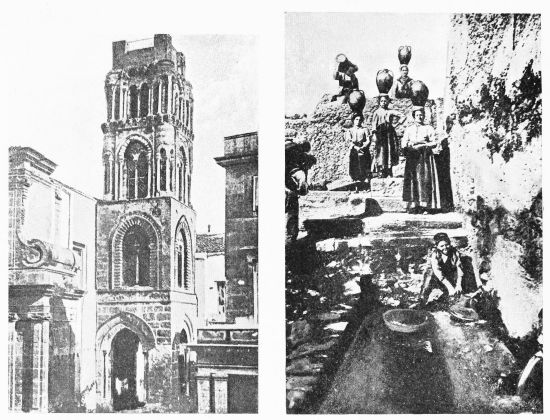
|
PALERMO. TOWER OF THE MARTORANA. Page 391.
|
WATER CARRIERS, TAORMINA.
|
conquest of England. We know comparatively little about it, because we
have not the same keen interest in what befell Sicily as in all that
happened to mother England, but for their contemporaries there must have
been little to choose between the importance of William the Conqueror
and his strong breed, and those twelve stout sons of old Tancred de
Hauteville who, from the condition of Norman squires of Cotentin, became
in one generation, kings of Sicily, the richest island of the
Mediterranean. The Battle of Hastings took place in 1066; in 1061 Robert
Guiscard, and his brother Roger, the Great Count, sons of old Tancred,
conquered Sicily and made Palermo their capital. What have the Normans
left behind them? A great art: Churches, cloisters, mosaics, tombs,
monuments worthy to stand on the island of the Greek temples, still
reckoned among the wonders of the world.
Our first days in Palermo were mild and cloudy—good sightseeing
weather; on the golden days that followed it would have been hard to
remain indoors, even within such splendid interiors as the cathedral of
Monreale and the church of the Martorana. We went first to the Capella
Palatina in the royal palace, the finest royal chapel in Europe. A
certain stately order, an aristocratic atmosphere, recalled the chapel
royal in Madrid, probably because we were more familiar with that than
any other. The Capella Palatina is far handsomer and as different from
the Madrid chapel as possible. The walls are entirely covered with fine
gold mosaics, the floor with rich marble mosaic, porphyry, serpentine,
Africano, cipolino, verde antique, all our favorite marbles, inlaid and
enlaced in the most entrancing patterns. “All this marble must have come
from the Greek temples and the Roman palaces,” Patsy reminded me.
“Let us enjoy it where it is!”
The beautiful wooden roof covered with Arabic inscriptions is connected
with the walls by a stalactite vaulting like the ceilings of the
Alhambra. The gold mosaics of the walls recalled the mosaics of Ravenna;
this blending of Arabic and Byzantine decorations with Norman
architecture is perfectly harmonious; the result is a unique chapel, one
of the jewels of Sicily, the treasure house. The good smell of incense,
the low voice of a priest in the confessional muttering words of good
counsel to a kneeling penitent, made the place warm, alive, part of
today.
“That’s either a great swell or a great sinner,” whispered Patsy. “No
one else would deserve so much attention from a royal chaplain. I wonder
which it is. Not that it matters much. I once asked the verger of
Salisbury cathedral if people ever came there to pray. ‘I sometimes
catches ’em at it!’ he answered fiercely. That’s the spirit that makes
the English cathedrals seem like so many museums! This chapel has
something of the same defect; that swell or sinner just saves it!”
In Palermo we felt the influence of the Arab everywhere, in the streets
as well as in churches and palaces. The gravity of the people, their
stern flashing eyes, something in their bearing as if they were never
without a sense of what is due them, recalls not only the Arab, but the
Spaniard who has been so much influenced by him. The women of the lower
class have the same magnificent black hair as the Syracusans. Few of
them wear hats; there is some picturesque dressing, but the bright
handkerchiefs worn over the head, and the pretty lace aprons, are the
last trace of the native costume that has practically disappeared from
the city. We saw few beggars. If we asked our way we were always
answered with politeness, ceremony even.
In a shop where we went to buy gloves we found the same indifference of
the seller to the buyer that we noticed in Madrid—a take-it-or-leave-it
spirit—not encouraging to trade.
“These gloves are rather light for traveling,” I said. “Show me some
darker ones.”
“They may soil,” said the dealer truculently; “they will never wear
out.”
“Are they of Sicilian make?”
“They were made in this shop.”
The gloves proved all their maker claimed; indeed they still survive.
“That standoffishness is, I suppose, the result of Sicilian omertà!”
said Patsy. “I like these people, though I don’t understand them; you
miss that jolly flash of sympathy the Italian gives you. They’re very
different—Sicilians; they’re not quite Italian, I think!”
We walked in the Corso every afternoon at the fashionable driving hour.
Though the weather was mild the smart people all drove in closed
carriages, sometimes with one window partly open as they do in Madrid.
The carriages were mostly of an antiquated shape much to our liking; a
sort of cross between a landau and a barouche; the coachmen all wore
caps. The finest turnout we saw had blue and red wheels; the lining and
liveries were brown, and coachman and footman wore caps to match with a
gold crown embroidered over the visors. We were standing at the Quattro
Canti, the bull’s-eye of Palermo, where the Corso and the Via Macqueda
cross, when this carriage passed.
“Some one’s bowing to you!” Patsy exclaimed.
I caught a flash of spectacles from the dark interior, the flourish of a
hat, nothing more.
“That,” cried Patsy, “was the father of Teodoro. I told you they were
great chiefs!”
We went to Monreale by an electric tram; it cost ten cents to go (the
distance is only five miles) and eight to return. On account, Patsy
“supposed,” of Monreale standing on a high hill, and the fact that it
takes more electricity to pull the car up than to let it down. The
country people in the car were coldly polite to us but they argued
sharply among themselves. As we passed the old city wall we noticed the
washing hung out to dry. All the way to Monreale there was the same
frank display of linen and underclothes. The sheets and table linen,
even outside the poorer houses, were extremely handsome, often trimmed
with beautiful lace. Before going into the cathedral we loitered about
the little town of Monreale.
“May the lady sit here and rest a moment?” Patsy asked a tailor sewing
in the doorway of his shop.
The man gravely motioned me to a chair, then asked a question.
“The Signorino is Americano? Has he ever seen Kicago?” Patsy said he
knew Chicago well.
“I am thinking of going there,” said the tailor. “I have a good little
business, nothing to complain of, all the best people in Monreale wear
my clothes, but there is no great future, no prospect of laying anything
by. My neighbor, Ludovico, has been in Kicago twenty years; he has done
very well. He has merely come back here to wait till his poor father
dies—the old man’s past praying for—then he
returns to Kicago. He asks me to go with him. What does the Signorino
advise?”
Over a barber’s shop hung a sign with the words “Tonsorial Artist;” this
evidently was the establishment of Ludovico.
Below lay the Golden Shell. As he sat at his door, the tailor could see
Palermo with its domes and turrets, Monte Pellegrino, a vast blue
mountain rising from the bay on one side, Monte Catalfano on the other.
Behind him rose an amphitheatre of aerial blue mountains; close at hand
towered the grand cathedral of Monreale, that pilgrims cross the world
to visit.
“It depends,” Patsy for once spoke with hesitation, all his cocksureness
gone. “Chicago is a fine city, great opportunities there, but the
climate’s not just what you’re used to here; there are no mountains, no
sea.”
“The matter of climate is important,” said the tailor; he waxed his
thread, doubled it and began to sew a button on the coat he was making.
“As to mountains, what matters it? One cannot eat them! I have ten
children—not an easy thing to fill so many mouths; they eat and they
eat. I do not wish to die in the albergo dei poveri! Ludovico is rich!
He has two stores in Kicago. When he was a boy his father could only
earn ten soldi a day; his poor mother could not always give her
children polenta; they must often dine on dandelions and herbs of that
sort! Now, when his parents are old, Ludovico takes good care of them.
His father wrote that he was dying; Ludovico came back to Monreale; that
was two years ago—the old man is still alive. The brother of Ludovico
has a fruit store in Kicago; he takes care of the business, sends him
the rent of the shops,—two hundred scudi a month. I have seen the
money!”
I hurried Patsy away at this point; he was becoming too much interested
in the tailor’s affairs; in another minute he would be writing letters
of introduction to Chicago magnates.
In the sunny space outside the barber’s door sat a silver haired
patriarch wrapped in a shawl—Ludovico’s father.
“The old gaffers wear shawls here,” said Patsy, “as they do in Patras.
These folk seem more like Greeks than Italians; a trifle grouty, but
with a certain fibre, something bold yet reserved, that makes you want
to know them better.”
“Spend the day gossiping with tailors and barbers if you like; I’m for
the cathedral.” I flung off towards the church; Patsy followed slowly.
It is the only way to take him when he’s in that
little-friend-of-all-the-world mood.
The cathedral of Monreale, and the adjacent cloister of the old
Benedictine monastery are the crowning glory of that city of wonders,
Palermo.
The Capella Palatina, the cathedral of Palermo, the Martorano and the
other churches of the city proper hardly prepare one for the
magnificence of this gorgeous church that stands, glowing with the
golden stain of time, on a hill between the Conca d’Oro and its
enfolding mountains. It is the work of Saracen architects, who built for
Norman Kings and Christian prelates, with Byzantine, Italian, Greek,
Arab, and Norman artists and workmen to help them! The result, instead
of being an architectural Babel, is the world’s most truly cosmopolitan
cathedral, one of the most stupendous and glorious of existing
sanctuaries. The cathedral is in the shape of a Latin cross with three
apses. The façade is flanked by two square towers, handsome and imposing
enough; the great beauty of the exterior, however, is the outside of the
choir, at the back of the church. The lovely pattern of inlaid lava
stone in two colors is the fullest, most splendid expression of this
style of decoration we first saw on the façades of the palaces at
Taormina.
The interior—it is a place to pass hours, days, alone. Here set ajar
the door of your soul, let the wind of the ages blow through, as you
have done in the Parthenon at Athens, or the great Egyptian temple of
Karnak. Drink from the cup of beauty, bathe in the well of light and
glory, so shall an echo of that thrill of passionate love for their art
that moved the artists who wrought this gemmed casket of delight vibrate
through your inmost being.
Every inch of wall space is covered by gold Byzantine mosaics with
jewelled pictures representing the whole of Christian history. You may
read here as in a book the great scenes from the Old Testament, the
story of the life and passion of the Saviour, the history of the Virgin,
and of the Apostles. The central figure that dominates the whole
cathedral, that you
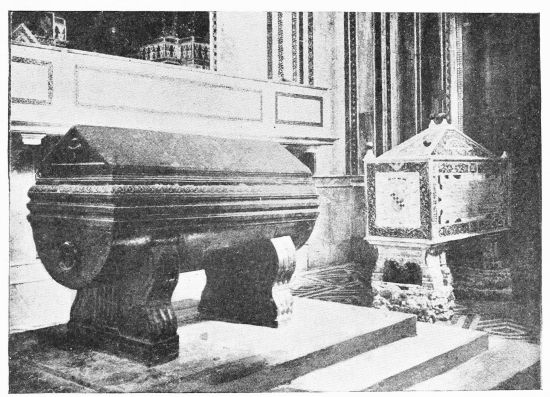
MONREALE. THE CATHEDRAL. TOMBS OF WILLIAM I. AND WILLIAM
II. Page 399.
must look at first on entering and last on leaving, is the majestic
half-length figure of Christ, over the high altar. The right hand is
raised in the act of blessing; the left holds an open book, with the
words in Greek and Latin: “I am the Light of the World.”
The face is severe in expression and very Oriental in type; it is the
face of the judge rather than the Saviour of mankind, with nothing of
that super-sweetness introduced by the Italian artists of the
Renaissance who produced what we now call the Christ-like type.
In my diary for this day I find three words: “Monreale; past belief!”
Later visits made us familiar with the wonderful massively built church
inlaid with Oriental stones, fretted with Oriental carving. We each
found our favorite pictures in the three different series of mosaics
blazing on the walls—“An open book of history, theology, and ethics for
all men to read.”
For me the quaint Old Testament scenes are the most interesting. Dearest
of all, the story of Noah, the first character in sacred history with
whom I became acquainted. The naïve simplicity with which the story is
told recalls the Noah’s ark dramas of the nursery, with the dear
familiar figures of Noah, Ham, Shem, Japhet, their wives, their animals,
their round green trees made of a shaving and looking like Italian stone
pines. The very smell of those freshly painted animals, the taste of a
certain yellow camel came back to me in the cathedral of Monreale in one
lightning flash of memory. Here they are, the dear companions of
childhood, the consolers of long rainy days, when the children in the
nursery knew exactly how the people in the ark felt on the fortieth day
of the deluge. The building of the ark is a most spirited mosaic
picture; so is the taking on board of the animals. Noah walks with a
horse on one side and a lion, smaller than himself, on the other. The
scene when the dove is first let loose is very fascinating; you feel the
crowding and fatigue of the too large family party in the ark. In the
scene where the dove returns with the olive branch, the sea is depicted
in delightful hummocky waves. Two swimmers, apparently sinners, are
struggling in the water; on the shoulder of one perches a crow,
evidently about to peck out the sinner’s eyes. The scene of the landing
on Mt. Ararat is supremely spirited; the gesture of relief with which
Noah lets the lion go is masterly.
Patsy’s favorite scene is Rebecca giving the camels of Abraham water
from the well. One of the most haunting pictures is the expulsion from
the Garden of Eden of our first parents, dressed in sheepskin. The
cherubim here is lovely, and the vigorous angel driving the unhappy pair
forth with a flaming sword, terrifying.
The death of the Virgin is one of the most primitive and touching of the
whole series. The body of the Virgin lies on a couch surrounded by the
Apostles; Peter leans over her listening to her heart—this simple human
touch makes the whole scene vivid and alive, in spite of its extreme
primitiveness. Beside the bed stands Christ, with Mary’s new fledged
soul dressed in swaddling bands like a new born infant in his hands. As
she received Him into this world, so He receives her into the next. As
this picture is part of the story of the Virgin, she is made the most
prominent figure. The figure of the Son is much smaller than that of his
dead mother on the couch.
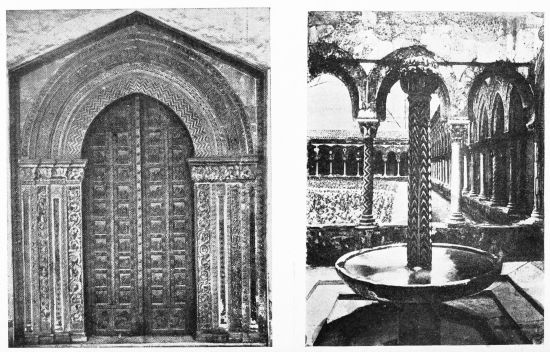
In the cloister of Monreale we were again possessed by haunting
memories of Spain. The place is like some supremely beautiful Andalusian
patio. It is surrounded by slender Arabic paired columns, some with
twisted shafts, some inlaid, some of plain alabaster with amazing
fretted capitals, the heads of men and animals carved in the midst of
the foliage of acanthus and palm. The center is cunningly laid out by
some wise gardener, monk or layman. At each corner is a mass of yellow
wall-flowers with alternate clumps of white stocks, purple flags, and
lavender hyacinths. Among the ornamental trees we found one new to
us—the flowering peach. The blossoms are shaped like a red camellia,
with softer, more gracious petals.
“The peaches?” Patsy asked the guardiano.
“Small and not at all good to eat,” he made a face; “sour in fact as
unripe grapes. You see that other tree, with the insignificant blossoms?
That bears peaches fit for the King!”
“Look at these violets!” Patsy brought me the largest Parma violets I
ever saw. “This fellow says they begin to bloom in November. Here they
are still going it for all they’re worth in April. One of those chaps in
Taormina gave
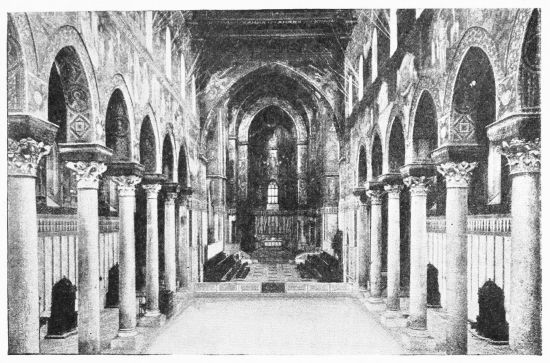
MONREALE. INTERIOR OF THE CATHEDRAL. Page 400.
|
MONREALE. BRONZE DOOR OF THE CATHEDRAL. Page 399
|
MONREALE. THE ARAB FOUNTAIN. Page 405.
|
as the reason he had chosen Sicily as a home, that the violets bloom
longer here than any place he had ever known.”
Overhead the sky was a flawless sapphire vault, broken only in one
corner by a mountain that looked like transparent amethyst. The perfume
of the orange and the lemon blossoms was intoxicating as sweet wine; the
comfortable hum of bees made a low undersong to the music of the magic
fountain in the corner of the cloister. It is not Italian, it is not
Sicilian. What manner of fountain can it be? Listen! Its language is
softer than any now spoken in Trinacria!
“Allah il Allah!” The fountain still murmurs the old cry of the
muezzin.
From a large basin rises a high carved shaft of rich topaz colored
marble, supporting a curiously wrought ball with sculptured figures,
foliage, and the alternate heads of men and lions. From their mouths
drips and drips, but never spurts, a slow soft shower of diamond drops.
It is as different from the noisy splurging fountains of Naples, as the
slow soft-spoken tongue of the Arabian sage is different from the
strident scolding of those men on the train, the father of Teodoro and
the little avvocato.
“A place of mystery and beauty beyond belief.”
So the record of Monreale ends as it began—“past belief!”
“It’s good enough just to be alive today,” Patsy declared one ecstatic
morning; “I’m off for the market and the Marina!”
To reach the Piazza Caraccioli, the market-place, we threaded a maze of
narrow dark alleys full of Rembrandtesque lights and shadows. In the
very heart of this labyrinth stands an old macaroni mill.
“We may enter and see the works?”
“Benvenuto!” The voice was less welcoming than the word. “They don’t
make macaroni where the Signorino comes from?”
“Not like yours!” Patsy magicked the peevish proprietor into good humor,
and we were free to enter the dark cavern. Two half naked fellows stood
at a deep trough kneading flour and water to a paste. A pair of barefoot
men, harnessed to a heavy wooden pole that turned a press, trod their
weary round. The paste was put into this press, and came out in long
strips. A fifth youth cut the strips into the proper lengths and hung
them to dry over bamboo canes.
“These might be the serfs of Roger the Norman making pasta for his
army,” said Patsy; “it’s positively mediæval!”
The rude interior was like an ancient cave,—floor, walls, ceiling were
all of stone; the men worked in a dull heavy-hearted way that hurt you.
There was none of the joyous thrill of labor lightly carried; it was a
grievous place.
“The pasta made in America is villainous; I have eaten it,” said the
capo. “It is made of wheat flour; bah! Semolina is the only flour fit
to make macaroni for Christians.”
“Un bicchiere di vino,” Patsy gave the money to the elder of the men
harnessed to that heavy pole. The fellow threw back his beautiful plume
of hair out of his gray-blue eyes and thanked Patsy awkwardly.
“Grazie, beviamo a vostro salute.”
The second-hand boot-store next door was a much gayer place than the
mill.
“What can I sell you?” said the jolly proprietor, evidently the buffo of
the quarter. “Riding-boots good as new? Fishermans’ boots? They will
keep you dry to the knee!”
The riding-boots at once dainty and sportsman like, looked
extraordinarily like Teodoro’s; the heavy hobnailed fisherman’s boots
leaned fraternally against them.
“I do not buy today,” laughed Patsy; “perhaps I may sell tomorrow.”
“I will give you better prices than any man in Palermo!”
Where the market-place broadens to its widest, stands a friggetoria.
On its marble counter lay a vast copper basin of crisp fried fish that
looked like whitebait.
“What does the Signorino desire?” asked the fishwife, a tall woman with
a superb coiffure and piercing black Saracen eyes. “Scoponi? that is
good to make zuppa alla marinaia, calamaretti, gamberi?”
“Which is the scoponi?”
She picked up a big, very handsome blood-red fish, and held it out to
Patsy to show how fresh it was.
Leaving him to deal with the fishwife I passed on to the fruit stall.
It was a bad season, the fruttaiuola said. Here were precious
mandarins and oranges; she held one up.
“Behold; you can see the blood through the skin; they are all like
this.” She showed an orange cut in half, the pulp ruby as a pomegranate.
“Oh, the blood oranges of Palermo are famous, they bring a great price
at Naples.”
I bought a basket like a net; my fruttaiuola filled it with citrons,
lemons, oranges,—adding one of those rare winter melons Teodoro had
recommended. From the market we made our way to the Marina, a beautiful
curving avenue with fine palaces and gardens fronting the sea.
“The Marina at Messina once looked like this,” sighed Patsy.
Beyond the fashionable Marina we came upon a little fishing village. We
peeped into one poor hut; it was filled with fisherman’s tools, fishing
reels, lobster pots, old nets, broken oars. On the sunny outer wall hung
a tiny crate filled with orange parings.
“Every scrap of lemon, orange, or mandarin skin is saved, dried in the
sun, and sold to make candied peel or mandarin liqueur,” Patsy pointed
out. “Teodoro’s father was right. The Sicilian really is economical.
Palermo could live on what spendthrift New York throws away!”
The nets were spread on the sand to dry; the first catch of the day had
been made; two old fishermen were busy weighing the silver fish from the
boat drawn up on the beach. We watched a barchetta come in; she danced
prettily over the water, curtseying to the craft home before her. On her
prow was painted a picture of the Madonna; the big brown sail had a red
cross for luck.
“Spugni! spugni di Trapani!” A gobbo with a crate of sponges stopped
to show us his wares.
“Sponges of Trapani!” cried Patsy; “why that Trapani is Drapana, where
the old Anchises died, where pious Aeneas founded the games in his
memory. As we can’t get to Trapani, let’s have one of its sponges!”
He laid in a supply, not yet exhausted. How precious now is every little
thing from Sicily—even the outworn gloves, even the fine pear-shaped
sponge from Trapani.
“Have you noticed the street shrines?” Patsy pointed to a majolica
medallion of Santa Rosalià let into the wall of a house. Two lighted
candles and a mass of fresh violets stood before it.
“I have not seen one neglected shrine in all Palermo; they are better
kept than in any Italian city I know; we might be in Bavaria.”
The busy gay streets of Palermo are filled with familiar names and
escutcheons. Under a fine stone stemma bearing the arms of Charles the
Fifth (the Pillars of Hercules and the enlacing scroll) appear the magic
names of Edison and Singer.
During those first happy days at Palermo, we forgot (or pretended to)
the one absorbing preoccupation of the last three months; behaved, Patsy
said, as if there had never been an earthquake; inevitably we were
brought back to it as children after a holiday must return to school. At
the Quattro Canti we met two sandwich men parading the streets with
flaming signs on their backs.
“Seconda gita a Messina, 8 francs!”
Luckless Messina! For eight francs the Palermitans can make a trip to
see the wreck of the proud city once Palermo’s rival!
“Poor devils—to be made a spectacle of!” sighed Patsy. “Still it helps
to have anybody make money! The railroad will get something out of
these special trips; any movement is better than none.”
Outside a large dry-goods shop an immense placard called our attention.
“Bazar Messinesi. Bankrupt stock from Messina, to be sold out below
cost.”
In the Via Marquada, a fine bustling modern street, I found my friend
Palladia the milliner. She welcomed me cordially though I saw she looked
ill and care-worn.
When the serious business of choosing straw, shape, and flowers for a
new hat was over, we spoke of other things.
“How are thy affairs going, Palladia?”
“Badly, Signora. It is a dreadful season. No one buys anything new. See
that mass of old hats my customers have brought me to make over! It is a
miracle the Signora should come today; she can perhaps help me? I have
had an idea. The ladies of Taormina have always served themselves at
Messina (there is no serious milliner at Taormina). Now that the
milliners of Messina are no more,—how if I went to Taormina with hats
for Easter? Mostly mourning hats of course—but a little lighter,
via, second mourning for the young ladies at least!”
“What a good notion!”
“If the Signora would give me two lines to one who might assist me?”
Introductions were written on the spot. Palladia, the valorous, had come
from Rome to Palermo, a stranger, with only her old mother to help her,
had set up her shop, and so far had “made good.” Surely she deserved
what help an old customer could afford her!
Next day Patsy, insatiate sightseer, went off to Segesta and Selinus.
Left alone I hunted up our friends Dr. Parlato Hopkins and his wife.
Thanks to them I was translated from a lone traveler’s solitude to a
cordial circle of old and new friends. It all began with the tea-party
in the doctor’s study, where I met Mrs. Bishop, the wife of our Consul
(an old friend), and Canon and Mrs. Skeggs of the English Church.
“What a tempting cake!” one of the party exclaimed, as we drew up to the
table.
“I hope it’s good as it looks;” said Mrs. Parlato Hopkins; “for I made
it.”
“Did I help?” asked the doctor. “Could you have baked that cake if I
had not made the baking powder?”
Voted that it was “both of their cake,” and that the Canon should cut
it. He began by “counting noses.”
“You’re too extravagant,” his wife exclaimed as the Canon cut the first
slice. His triumph came when every one of us asked for a second piece.
“A little marmalade?” urged the doctor; “home-made also. My wife is a
good housewife in spite of being a good doctor.”
“I can recommend that marmalade,” said the Canon’s wife; “the oranges
came from our garden.”
While at table we spoke of joyous things; as the afternoon passed, the
talk waxed serious, laughter ceased, faces grew earnest, voices grave.
This little group of friends, exiles all, living in Palermo, bound
together by a thousand kindnesses, had passed through deep waters. The
faithful almoners of England and America, they too had worked early and
late for the profughi. Here, as at Messina, and Syracuse, the most
precious contribution was the moral, not the material aid. Order,
discipline, in that welter of chaos were worth more than money or
stores.
“These poor souls will not go to work while they are being fed, housed,
and clothed by charity,” said the Canon. “When they ask me for work I am
in a quandary. The working people of Palermo are all against
them—naturally; there isn’t enough work to go around!” Exactly what
Ignazio had said.
“Why not colonize?” I proposed. “England would do that. There must be
parts of Italy where prosperous colonies might be founded. I myself have
seen practically deserted villages both in the Abruzzi mountains and in
the Sorrentine peninsula, where whole populations have emigrated to the
Argentine Republic or to the United States.”
“This is not England!” sighed the Canon.
I said to Mrs. Bishop how much I wished to see her husband.
“Another day,” she answered. “He is still very busy with the Petrosino
murder.”
“Petrosino!” Another tragedy—as if Sicily had not had enough that
dreadful year. From one source and another I learned the story of the
murder.
Lieutenant Giuseppe Petrosino, a detective of the New York police force,
came to Palermo to look up the records of some criminals. A curious law,
made in the humane intention of helping reform criminals, is in force in
Italy. By this statute, passed in 1902, a discharged criminal, after a
certain number of years of good behavior, is given certain papers by the
authorities by which it is made to appear that there has never been a
criminal charge against him. With this clean bill of health, he is given
another chance to start life over again in a new country. At the same
time a careful secret record of his case is kept by the authorities.
In the United States we have a law that forbids the emigration into our
country of all criminals, except so called “political” criminals.
The equitable adjustment of the two conflicting statutes has been, and I
believe is still, the subject of grave consideration by both
Governments.
Meanwhile, when it became necessary for our police to gain knowledge of
certain secret criminal records, a request was made of the Italian
police for copies of them. The Italian authorities, on demand, furnished
the American authorities with these copies. So far, so good. There came
a time when some mysterious influence was felt to be at work, due to the
agency of the Mafia, a secret society affiliated with the Camorra, whose
members exist in every class of society. It somehow became known that
copies of the secret records were being called for, and supplied from
various communities all over Sicily. The wheels of justice became
clogged; it was to help set them in motion that Petrosino, with the
approval of the Italian police, came to Palermo.
Two years before, Petrosino had arrested Erricone, the Chief of the
Camorra in New York, and handed the arch criminal over to the
Carabinieri, the royal police force of Italy. From that day every
Cammorista in the world knew that the Camorra had condemned Petrosino to
death. How was it that Petrosino did not know it? That is the most
puzzling phase of the whole affair. Probably the man was too much
absorbed in his work to think about himself at all. He went about
Sicily, where a price was set on his head, unarmed and unafraid.
He registered at his hotel under an assumed name; otherwise he took few
precautions to conceal his identity. His mail came to the general
post-office addressed to his real name. He was careless in a hundred
ways about preserving his incognito. Petrosino was a perfectly fearless
man, though he was often warned; from the first he exposed himself
recklessly. One night on his way home from the Caffè Orete, he was
surprised, set upon from behind, and shot to death in the back.
No one saw the murder; no one could even guess who the murderers were.
“It would have been the same,” it was said, “if the murder had taken
place at high noon at the Quattro Canti, instead of nine o’clock at
night in the empty Piazza Marina; no one would have seen the murder, no
one could have guessed who the murderers were, though the Italian
Government offered a large reward.”
They gave Petrosino a great funeral, with military honors at the expense
of the State. The hearse was draped by the American flag and covered
with beautiful wreaths from the city, the province, the police and the
Department of Justice. Our Consul walked behind it as the first mourner
with Doctor Parlato Hopkins at his side. The procession passed the
Consulate, where Canon and Mrs. Skeggs bore Mrs. Bishop company through
the trying hours.
The streets and balconies were packed with people, a silent
unsympathetic crowd. There was no disorder. The Mafia made no sign. Its
work was done, the man was dead; let them give him all the honors they
cared to pay for. The feeling expressed by those thousands of silent
spectators was indifference. There were many who would not uncover as
the coffin passed.
“He was a spy; he got what he deserved!” said the faces of the silent
Palermitans,—grave, sinewy, fierce-eyed men, dark as Arabs.
“Petrosino must have been a very uncommon man, from all you tell me,” I
said; “what did he look like?”
“He was a fine man,” one of the company answered, “so handsome, so
remarkable looking. He had a Napoleonic head.”
“Yes,” said the doctor, “he had indeed.”
“But you never saw him!”
A queer look came into the doctor’s eyes; he did not answer.
“Where could you have seen him?”
“I never saw him alive,” said the doctor, “you forget, I embalmed
Petrosino.”
One of the newspapers had a caricature by Piff Paff of the Prefect of
Palermo with his arm about Mr. Bishop, pointing to a long line of
criminals.
“Here they are, caro mio, take your choice of them;” says the Prefect.
The paper was quickly suppressed. I tried in vain to buy a copy.
None of my friends in Palermo by the way had seen or heard of the
profane poem supposed to have been printed in a Messina newspaper,
calling upon the Saviour to prove He could work miracles by sending a
good earthquake. Mr. Bishop never heard the story till he went to Rome.
I asked many people about this; no one had seen it, no one could give
the name of the newspaper in which it was printed.
Agnese and Napoleone both had assured me that the earthquake was sent as
a punishment for the poem. According to Agnese it was written by an
anarchist; Napoleone held that it was by a free mason. I have come to
the conclusion that the whole matter is an entire invention.
At our hotel I made the acquaintance of a lady whose name I never
learned. When I spoke of our Consul she told me what admirable service
he had rendered.
“It was Mr. Bishop’s idea to set the profughi in the different
ricoveri to work,” she said. “At first all the rest of the Committee
were opposed to it. He tried first one, then another; at last he found a
priest, an admirable man, who backed him. I don’t know what they would
have done without him.”
How Griscom’s slogan “We help these people to help themselves!” rings
out. I heard its echo in Palermo, Syracuse, Messina, wherever one of his
staff has been.
Mr. Bishop spoke with the greatest cordiality of the Palermitan
Committee. “They have done fine work,” he said. He mentioned the wife of
General Mazza as one of the most earnest of the leaders.
There were still 7,000 profughi in Palermo at this time. I went with
Canon Skeggs and Dr. Parlato to visit one of the largest ricoveri. It
was admirably arranged in a big garden surrounded on three sides by an
arcade like a wide cloister. This had been boarded in, and divided off
into neat little dwellings where the refugees lived in families. They
all had good beds and were fairly well clothed. The Canon had a word for
every one.
To this man he promised employment, to that he gave news of a lost
daughter separated from the rest of the family and traced to a
ricovero in Syracuse. In one room I talked with an elderly woman and
her unmarried daughter, a pretty creature who said she was thirteen and
looked it; her mother claimed that she was sixteen. She was very calm
looking, said she felt perfectly well, but that she was to go to the
lying-in hospital the next day. Poor child, her lover was killed at
Reggio.
I talked with an old woman who had lost every member of her family.
“Sono troppo impressionata!” she cried, “tremo sempre!”
She showed a tiny empty snuff-box.
“I have not a soldo to buy snuff!”
“Here are two soldi,” said Dr. Parlato, “cheer up, mother, we will
find some of your people yet; you promised you would not cry, if I kept
you in snuff!”
A brave smart looking woman sewing on a Singer sewing machine told us
proudly that she was paid for her work by the day; the others were so
lazy they were paid by the piece.
The Director, an able excellent man, told us his profughi were now
earning money by making clothes for the prisons, but that the future of
the poor people under his charge was a grave problem. The central
committee had agreed to send him 300,000 lire more. “After that, there
will be no more! What will become of them?”
I talked with a shop-keeper of Messina, one of the few profughi I met
who wished to go back.
“So you wish to return to Messina?”
“Why not? It is the mother land; I cannot live in any other. I am not so
fortunate as some; after three months I am still idle, who would so
gladly work. If the money subscribed were given out pro rata, so much a
head, say one thousand francs apiece, a family of five, like mine, by
putting their money together could have a little capital to begin with.
The Government makes a mistake to spend so much money in building
houses; it was not given with that scope, but to feed, clothe, and
start again in life such of us unfortunates as escaped! If I were the
Prefetto I would call in some great firm from England, America, Russia,
and make a contract with them to excavate Messina. If it were let out to
some great contractors, responsible people who could bring the machinery
necessary, Messina might be excavated in six months, or at most in a
year!”
How easy it is to criticize, how hard it is to do!
My last morning in Palermo was spent at the Canon’s house. The parsonage
is close by the charming Gothic church, largely maintained by the
Whittakers, an English family long resident in Palermo. The parsonage
had been turned into a store-house.
“I have very little left now,” said Mrs. Skeggs. “Here are some nice
woolen skirts from England. A friend who owns a large woolen mill gave
the flannel, the mill operatives, women who had worked all day, put in
extra time, sat up at night to make these garments for us! We have had
some American contributions too from Rome. Such good stuff in all the
clothes they sent. And their admirable little work-bags, each holding
good scissors, thimble, needles, thread, buttons, hooks and eyes. I have
only one left.”
I asked if she had succeeded in getting employment for her refugees. She
could find plenty of good situations for the young women as servants
among responsible people, but the girls’ parents would not let them take
positions for fear of their coming to harm.
The parsonage hall was full of profughi. One had come for a bed, one
for a blanket, one for a dress. The Canon had promised to show me the
church. As he led the way there, his wife came after him to ask a last
question.
“May I give Ginocchio a small bed?”
“What has he had?” asked the Canon.
“Oh, a great deal; but he has nine children, and they only have two beds
between them all.”
“Then let him have it!”
The good earnest face of the Canon’s wife, frowning slightly with
perplexity, looking out of the parsonage door, as the Canon and I
hurried off through the pretty garden to the English church, is the last
picture of Palermo that remains! The garden was full of English
flowers, blooming luxuriantly side by side with those famous orange
trees whose blossoms perfumed the air.
“Blue sky arching o’er me,
Keen winds piercing through me,
Waves lapping my feet—
White clouds sailing swiftly,
Bright sun laughing roundly—
O, Earth, thou art sweet.”
(Helen Lee.)
XIV MR. ROOSEVELT AT MESSINA
Tuesday, the sixth of April, six weeks after work began at the American
camp, the German East African steamer “Admiral,” having on board Mr.
Roosevelt, Mr. Griscom and Captain Belknap, entered the harbor of
Messina. More than a month before, on the fourth of March, Mr.
Roosevelt’s term of office as President of the United States came to an
end. The last months of a retiring president are always arduous, and Mr.
Roosevelt must have found them peculiarly so. Besides the endless
knotting up of the ordinary executive business, there was all the extra
labor connected with the Italian Relief. Now he was off for a holiday in
the African jungle. On his way, he looked in at Messina, to see how
things were going on at the Camp. Work had been pushed at the Mosella,
at Reggio, Sbarre, Palmi, Ali, all along the line; the rumor that Mr.
Roosevelt was coming spurred every man to his best pace.
“We must have something worth while to show him!” said Belknap.
“All right!” the Camp answered as one man. The very hammers sang it, the
saws shrieked it, the true hearts beat the gay refrain: “All right!”
As the “Admiral” passed the Faro, Belknap, who had joined the party at
Naples, pointed out the royal standard flying at the masthead of a
man-of-war. “That means the King and Queen are here!” They had timed
their visit to Messina so as to meet the ex-President there. As the
“Admiral” slowed down, a launch from the King’s ship came alongside, a
dapper young officer ran up the gangway and saluted.
“His Majesty was about to go on shore; learning of the steamer’s
arrival, he has delayed in the expectation of seeing Mr. Roosevelt on
board.”
Mr. Roosevelt and Mr. Griscom immediately embarked on the launch and
went with the Italian officer to the King’s ship. So at this old “Four
Corners” of the earth, Victor Emmanuel and Theodore Roosevelt met. What
did they say to each other?
They probably shook hands, they may have talked about the weather, or
the price of oranges (sixty cents a dozen in New York at the present
writing and a drug in the markets of Sicily). Their meeting is none the
less significant because we know nothing about it; the circumstances
make it momentous. Though Mr. Roosevelt was no longer in office, in a
certain sense, at all events, in the eyes of the Italians, he
represented the American people. It was under his administration that
the earthquake occurred, that the relief work was planned and started;
he himself had given the impetus. Morally, if not technically, this was
a meeting of the representatives of the two great allies, Italy and the
United States, bound together by the strongest of all alliances, the
need of each other’s help.
What would America do without the skill of the Italians? What would
Italy do without the gold of the Americans? May neither ever have to
stand the test!
The interview over, the King took the ex-President and the Ambassador on
shore in his launch. At the landing they parted, King Victor going off
with Captain Bignami to the Villaggio Regina Elena, the others starting
for the Camp. On their way they passed two of our steamers unloading
lumber. Mr. Roosevelt stopped and shook hands with the sailors in charge
of the job. No holiday for them! Though little else went on in the way
of work that afternoon, the unloading could not be delayed. The
nightmare of demurrage, forfeit money paid the ship owners for every
day’s delay in unloading the cargo, haunted Belknap, sleeping or waking.
The carriage with the Roosevelt party drove up the Viale San Martino,
past the Tell Tale Tower, to the Camp. Though it was raining in
torrents, the road was in good condition; the Italians, like the
Americans, had been “rushing work.” At the Camp the party was received
by Buchanan and Brofferio. The sailors were lined up; the officers,
volunteers and carpenters were assembled. There was a great gathering of
the clan; from Reggio came Ensign Wilcox, Gerome Brush, Robert Hale and
the head carpenter. From Taormina came Mr. Bowdoin and Mr. Wood. Mr.
Chanler was with the Roosevelt party, together with Avvocato Giordano
who had been on the “Bayern,” Commendatore Salvatore Cortesi of the
Italian Associated Press, Mr. Lloyd Derby, and Mr. Robert Bacon, Jr.
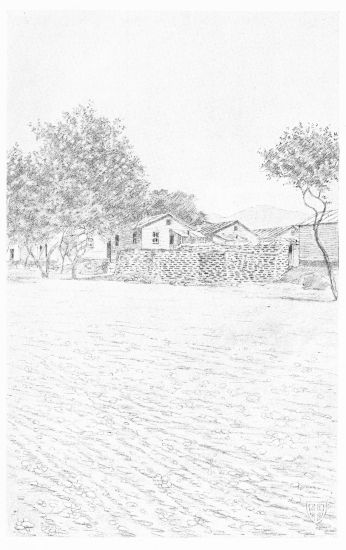
The visitors walked through Viale Taft, Viale Roosevelt and Viale Stati
Uniti (the streets in the American Village are all named for men who had
some part in building it). Mr. Roosevelt was keen to see every detail:
the ice house, the kitchen, the neat offices, the comfortable bedrooms,
and finally the “mess-room,” gay with bunting. Gasperone had set the
tables with fresh linen, and decorated them with wild hyacinths and
acanthus. Such hospitality as the Camp could afford was offered. The
cook had baked a cake; Mr. Buchanan’s “boy,” the giant negro from
Florida, had prepared a vast quantity of sandwiches. Though nobody was
hungry, the good cheer must be sampled.
Mr. Roosevelt made a short speech, then, raising his glass, gave the
toast:
“To every man of every nation engaged in this great work!”
They drank the toast standing.
“What did he say about every civilized nation owing a debt to Italy?”
whispered a reporter to J.
“You’ve got the gist of it,” said J., “and it’s true as Gospel, too!”
All too soon it was time to go! The three hours were up! Down in the
harbor the “Admiral” was blowing off steam; this was a non-schedule
stop, made out of courtesy to a distinguished passenger; privileged
persons must be punctual. The return to the landing was a triumphal
progress. During the last year and a half Mr. Roosevelt has had many
such, he has heard a deal of cheering. None, it would seem, can have
moved him so profoundly as the cheers of the Messinesi, the brave
remnant of a brave people!
The letters and diaries of this time ring with the echoes of those
shouts.
Extract from Mr. Elliott’s Diary
“The Camp, Messina, April 6.
“Mr. Roosevelt was most cordial to us all. After saying lots and
lots about the splendid work of the officers, sailors, and
carpenters, he spoke of the rest of us volunteers who, he said,
have given our time and energies to help a philanthropic work. The
Italians cried: ‘Long live our President,’ and ran along holding on
to the carriage and cheering him—a moving sight. The Queen is
worshipped by the people in these parts and deserves to be. Women
in
AMERICAN VILLAGE MESSINA. THE CELTIC’S CARPENTER
COOK AND TWO “SCORPIONS” MEASURING OFF THE LAND. Page 438.
WING OF ELIZABETH GRISCOM HOSPITAL, VILLAGGIO REGINA
ELENA. Page 434.
their petticoats, half dressed, evidently in the act of doing their
hair, raced after her carriage with the ends of their hair held
between their teeth. Somehow this was curiosity, admiration, and
awe—even worship, that seemed to be expressed. The same might be
said of their attitude towards the King. I thought they really
seemed to worship him, and perhaps love him, too—but with
Roosevelt the feeling expressed was different. It seemed to be
admiration and brotherly affection—that was pleasant to see.”
Some of the visitors were quite unprepared for the magnitude of the work
undertaken. They had received the impression that the building party had
very little to do, except put together the portable houses (there were
only forty-nine of them) that, it was commonly supposed at home,
composed the larger part of the cargo of the lumber ships.
“As if,” Belknap exclaimed, “you could pick a portable house from a tree
like a lemon!” In a letter to the Ambassador, Belknap gives some
interesting details about the hospital.
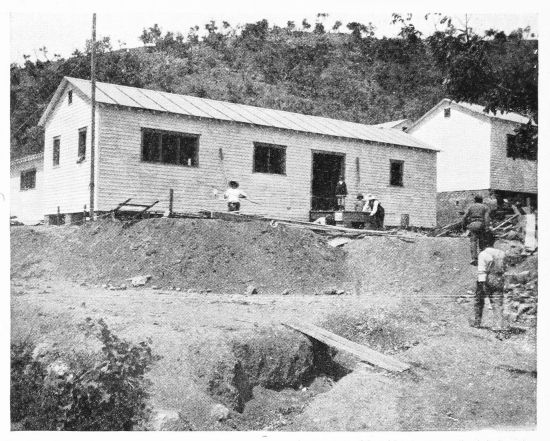
“The hospital referred to was one that the Queen desired to be built at
Villaggio Regina Elena. Like the hotel, it began as a combination of
several standard cottages, but, as Mr. Elliott was never content with a
makeshift when he could improve upon it, a plan was ultimately evolved
which embodied all of her Majesty’s ideas, and at the same time made the
most of the ground area that would be available to cover. The Queen had
stipulated for kitchen, laundry and servants to be in a building
separate from the hospital proper, and for a detached house to be
available close at hand. Mr. Elliott’s plan was of a large, main
building, forty by sixty feet, containing three wards, dining-room and
pantry, bath, office, dispensary, and linen closet, with a wing thrown
out on the north containing operating-room, sterilizing-room, and
emergency ward, and another wing on the south for doctors’ rooms and
bath, and nurses’ rooms and bath. In the rear were to be kitchen,
laundry and dining-room, with servants’ sleeping-rooms and storeroom in
a semi-detached building in one corner, and, symmetrically placed in the
opposite corner, a small isolated building for a contagious ward. With
the hospital, also, our part was at first limited to the contractor
work, her Majesty sending an engineer down to arrange for plumbing,
drainage, lighting and furnishing; but later we arranged for, and
carried through, the plastering and tiled flooring.
“In submitting the two floor plans of the hotel, it is requested that
the Ambassador take such steps as may be necessary for obtaining her
Majesty’s sanction for the use of her name for the hotel.
“It is only intended to build a two-story structure, having about
eighty-four rooms available for guests, and a dining-room and its
accessories amply large for about two hundred at one time.
“Since we have been at work about the hotel site, several persons have
approached me about undertaking to manage the hotel when completed. My
reply has been that I should refer all such questions to the Ambassador,
as I did not feel myself in a position to decide any matter not
connected strictly with the construction. The interest in the hotel is
spreading.”
The sixth of April was a red-letter day. In the morning the King came to
the Camp; in the afternoon Mr. Roosevelt and the Ambassador made their
long expected visit, and in the evening J. was summoned on board the
Italian man-of-war, to show his plans of the hospital to the Queen.
Extract from Mr. Elliott’s Diary
“The Camp, Messina, April 7.
“Yesterday the King arrived unexpectedly at the Camp at 9 A.M.
Buchanan, Brofferio and I accompanied him and his staff through the
village. They came into my small office. I showed the King my
designs for the hospital and the cottages we are to build at
Villaggio Regina Elena, a model village the Queen has built on the
other side of Messina. He liked the plans very much. When I spoke
of the great disaster the King said that the American duty put on
lemons was almost as great a disaster for Sicily as the earthquake.
Though, he added, ‘America is perfectly right.’ At 7 P.M. I was
taken on board the ‘Umberto I’ by the steam pinnace of the
‘Dandolo.’ I was received by the Queen, a most fascinating lady.
She thanked me many times, till I felt quite embarrassed. She was
really very enthusiastic about the plans for the hospital and the
cottages. The subject of the allotment of the houses came
VIALE GRISCOM, AMERICAN VILLAGE, MESSINA. Page
431.
up. I said I thought the plan the King had spoken of as his
idea—the drawing of the cottages by lots—was the only way, in
spite of the fact that some undeserving people might be housed
while people of higher grade, really the greatest sufferers, might
get nothing.”
The day after Mr. Roosevelt’s visit the Camp was astir early. The
Ambassador breakfasted with the officers and master carpenters in the
mess-room; in spite of the pouring rain, he was off before eight o’clock
with Belknap on a tour of inspection. He was delighted with everything,
had a good word for everybody. More than twelve hundred men were now
employed at Messina, Reggio, Sbarre and the smaller places, where our
Lilliputian “wooden palaces” were going up. The Ambassador, who had kept
in touch with every step of the work, now saw it “in full swing,” saw
the working of the system, the organization of the army of labor. There
were corps for clearing the ground, stacking the lumber, delivering the
building materials, and for cleaning up. There were interpreters, mostly
Sicilians, who had been in America, carters and water-boys. The Sicilian
and Calabrian carpenters all served an apprenticeship in the “shop.”
Here under the keen eye of Phillips, the carpenter in charge, each man
was tested, and then taught to do one thing,—whatever he proved fittest
for. To build one hundred houses a week was Belknap’s ambition;
sometimes he fell short, oftener he exceeded the number. This is the way
the thing was done:
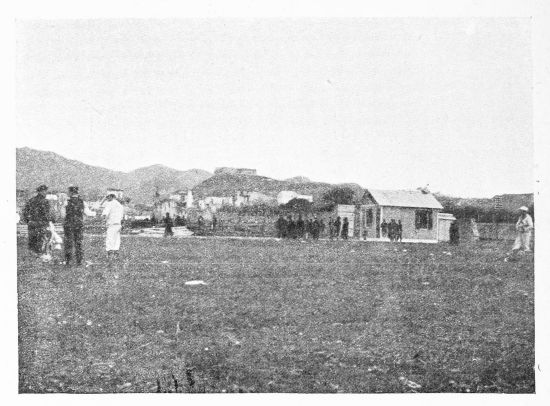
First on the ground came Cook—ship’s carpenter from the “Celtic,” a
Boston man—with his gang. They cleared the land (the peasants had
already cut down the lemon trees), smoothed and leveled the soil, drove
the foundation posts, laid the sills.
Second, came Emerson, the Philadelphian, and his gang of framers. They
put up the side studs, the roof frame, the gable ends (made in the
shop), and laid the floor joists.
Third, came Cox of Brooklyn with his gang. They placed the end studs,
the door and window frames, their “cripples,” and the kitchen framing.
When the work of these two framing gangs was done, they passed on,
leaving a skeleton house behind them.
Now came one of the four enclosing gangs, organized by Neil Mackay, a
canny Scot, king of carpenters they called him. There were fifty men in
each enclosing gang, with one of their own number for leader, who was
made responsible for the tools. At seven every morning each gang was
given its tool-box; a close tally of the contents was kept, and at night
the precious tools must be returned intact. The enclosing gang made more
of a showing than the others. They took a skeleton house and clothed it
with clapboards and floors; so that the roofers—who came next with
their Sicilian capo (boss), Ferrara—found something that looked a
good deal like a house. After the roofers had put on the roof, the
finishers came. They hung the doors, fitted and glazed the windows, put
on locks and fastenings, added the steps. When the carpenters were done
with the house, the bricklayers and masons took hold and built the
famous kitchen, putting in a stovepipe to make all complete, and in
their turn making room for the painters. These men gave each cottage two
coats of white paint, green doors and trimmings and dark neutral-colored
base, “so that the mud splashed up by the rain would not show.”
When Mr. Griscom had seen the different gangs at work, he went to
inspect the foundations of the hotel. While he was admiring the neat
brick arches, the royal automobile whizzed up to take the Ambassador,
Belknap and J. to the Villaggio Regina Elena, to meet the Queen. Having
seen and approved the plans for the hospital and houses the Ambassador
had promised to build in the American quarter of her model village, she
wished to see the site the buildings would occupy.
They found the Queen already there; in spite of the torrential
“earthquake rain,” she was determined to see every detail of her
village. The Ambassador walked with her and Captain Bignami; the others
fell in behind and followed with the lady-in-waiting, Brofferio and the
Italian officers.
“This is the bakery!” said the Captain. “This is the baker; he himself
built his oven. Your Majesty can see how light the bread is!”
Her Majesty said something kind to the baker, then crossed the street to
the butcher’s shop, neat as wax, with all the latest sanitary
contrivances; next to the school, then to the church, last of all to the
industrial school,—a busy hive of working women and girls.
“The Queen was perfectly delighted,” writes
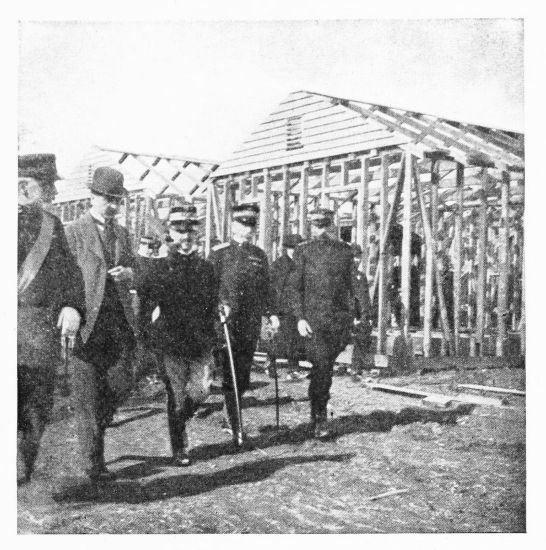
THE KING, ESCORTED BY BUCHANAN, BROFFERIO AND ELLIOTT,
VISITS AMERICAN VILLAGE, MESSINA. Page 436.
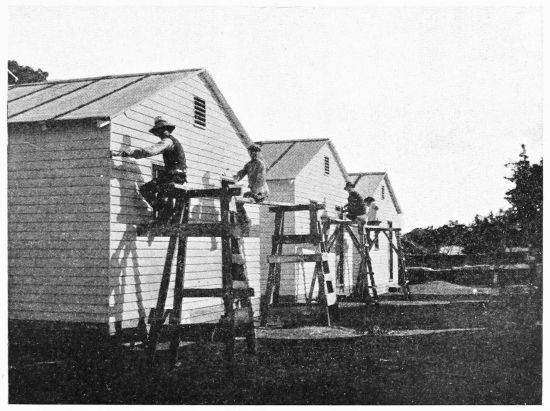
MESSINA. PAINTING THE AMERICAN COTTAGES. Page 439.
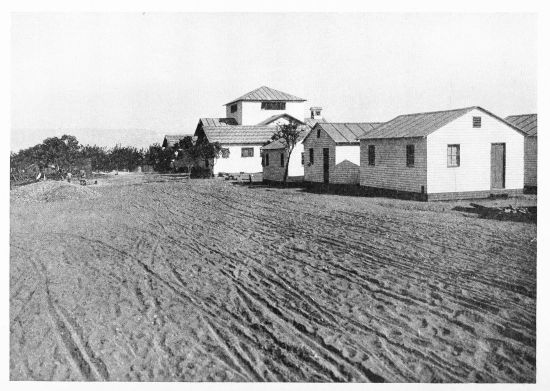
CHURCH OF SANTA CROCE, AMERICAN VILLAGE, MESSINA. Page
451.
J. “The place fairly hummed with the noise of machinery. Everything was
going at full blast; women were making stockings and weaving
underclothes; there must have been twenty of them at least stitching on
Singer sewing-machines (the Singer people, by the way, sent a good
subscription). The Queen went into several of the houses, and found them
all in apple-pie order; Captain Bignami insists on perfect cleanliness.”
As they left the building a little girl, escaping from the guards who
kept the people back from pressing too closely on the royal party, threw
herself at the Queen’s feet and kissed the hem of her dress. Many
petitions were made, some of them for perfectly unreasonable things.
“It is so hard,” said the Queen; “these poor people think I can give
them whatever they ask me for.”
“That is not wonderful, considering all that your Majesty has given
them.”
“The hospital will stand here;” Captain Bignami pointed out the site on
the hillside above the village, commanding a magnificent view.
“You have heard,” it was whispered, “her Majesty names it the Elizabeth
Griscom Hospital?”
“What a good idea!”
The Queen now disappeared, and the Americans returned to Messina. The
Ambassador soon after took the ferry-boat for Reggio. Here he looked
over the work with Ensign Wilcox, and later went with Mr. Chanler to
Sbarre, to see the buildings put up there under Chanler’s direction.
Timothy, the carpenter, writing to his wife, says:
“The Ambassador, Captain Belknap and several other gentlemen came. My
men was working, though the mud was ears deep and one could not keep
looking well. The Captain introduced me to Mr. Griscom, who highly
commended me on the mill and its workings. They all took dinner with us
that evening, and we was twelve at table. When we got good and started
and was about half-way through, Mr. Chanler came in late and made
thirteen. He did not mind. Some of the boys kicked but we laughed them
out of it. Many funny stories was told. Finally broke up, singing
America on the party’s leaving; it was raining very hard.”
“I had hoped,” writes Belknap, “that Mr. Roosevelt might see what was to
me the best feature of the whole enterprise, the hundreds of men busily
employed, earning good wages, making the air ring with the noise of
their saws and hammers; but it would have been futile to try and keep
the men at their places while he was passing. The men were in sight, to
be sure, by the hundreds, fresh from their work, with tools in hand,
nail aprons on. I doubt if much work was done the whole afternoon,
notwithstanding that Mr. Roosevelt was in the Camp only an hour; yet the
time lost was more than made up afterwards by the enthusiasm and
stimulus that the visit gave.”
So ended the meeting of the Triumvirs, Roosevelt, Griscom and Belknap.
To those who helped them in their work it was of such profound interest,
that the sixth of April remains the culminating point of the whole
Messina business.
What did it mean to them?
All three are men of action, who delight too much in doing to waste much
time in talking about what they have done. They felt it none the less
for all that. A single sentence from a letter of Mr. Griscom’s tells us
more than a volume of official reports.
“I may say personally, I have had the most valuable and interesting
experience of my lifetime.”
We said at the time that the rain was the only drawback to the complete
success of Mr. Roosevelt’s visit. Looking back at that memorable sixth
of April, we are not so sure of this. Was it not really best things
happened as they did? All the distinguished visitors received a more
exact idea of the actual conditions under which the work they planned
was carried out, than if the day had been fair. For more than three
months that cruel earthquake rain continued, with only a few rare days
of fair weather. The peculiar rain may in some measure have been due to
the fine dust discharged into the atmosphere, since every drop of rain
is formed around such a particle. This may, the scientists say, account
for the rain at Messina. Peculiar rains have been observed after other
earthquakes. The trouble is that earthquakes are so rare that the
scientists cannot tell whether the rain was a mere coincidence or due in
some measure to the disturbance. “The change of the electrical
potential due to the earthquake might serve to start a rain, and
altogether one is inclined to suspect that the rain was at least started
by the earthquake,” writes one expert. The truth is the scientists
themselves are all “up a tree” about that mysterious rain. Rosina
Calabresi, Timothy, and all the simple people who endured it, have no
such doubts. To them, to us, perhaps to Mr. Roosevelt, it remains a rain
apart, unlike all others!
XV EASTER
“Oggi il Signor è morto.”
“Dead? Impossible, we heard he was better!”
Gasperone smiled patiently, pointed to heaven and repeated the greeting
that, in Sicily, people give each other on Good Friday: “Today our Lord
is dead.”
I had come to spend Easter at Camp; Gasperone met me at the station. His
words brought a faint uneasiness that returned whenever the greeting was
repeated: I heard it many times that day—from Caterina, Zenobia, Zia
Maddalena, a dozen others—and always it brought that faint shock, as if
there was something especially significant to us in the words.
On our way to Camp we met Timothy, the carpenter. I stopped to ask how
things were going on.
“Badly!” said Timothy. “Ain’t it a pity? Such a fine day at last after
all this rain! It’s a holiday; the men don’t want to work. We’re short
of hands all round. I have only fifteen out of my gang of twenty-seven,
and they are working under protest.”
“This is a festa?” I asked Gasperone.
“No, not a feast; rather a great fast,” said Gasperone.
“First thing I knew of it’s being Good Friday,” said Timothy, “was the
hot cross buns for breakfast—the best bread I have eaten since I left
home. You ought to look into the church they rigged up; it’s like a
tempor’y railroad station. It certainly is cheerful to see them poor
devils hanging round the statuary—touching, too.”
It was well for all concerned that the men refused to work, that the
great “drive” was relaxed for a breathing space. They had all been
working over time, “on a spurt” to get things as far advanced as
possible for the visitors.
Saturday morning I went with Signor Donati and J. to call on the
Archbishop at his palace, one of the few habitable buildings in Messina;
it had been only slightly damaged by the earthquake. The handsome
courtyard was filled with wooden shanties, the lower halls, the very
stairs were crowded with families camping out. The palace had become an
asylum for the homeless, a storehouse for the treasures saved from
cathedral, church and monastery. While waiting for the Archbishop, we
were entertained by a Jesuit priest who spoke good English.
“You shall see all our precious things,” he said, “if you will send some
more blankets for our poor people and some vulgar shoes.”
The Jesuit, a lean virile man in a shabby cassock, took a big bunch of
keys from his belt and led the way to a distant wing of the palace. He
unlocked a heavy iron-barred door, motioned us to pass through, and
locked the door behind us. We were in a vast room, smelling faintly of
stale incense and wax candles, filled with the spoil of churches. There
were statues of saints, plaster angels, paintings of the Madonna,
crucifixes, fragments of rich altar cloths, embroidered vestments,
priceless old laces, gold and silver vessels for the mass, painted
missals, candlesticks, lamps, all carefully sorted and laid in piles. We
passed through room after room,
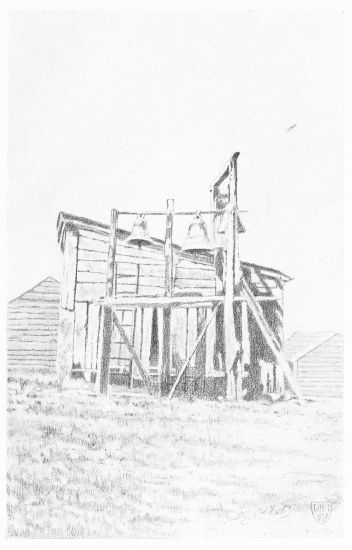
filled with this strange wreckage of the churches, to an inner
apartment, double locked, a high vaulted chamber where the most precious
treasures were kept, the gold and the silver mantas of the Madonna
della Lettera. The gold manta is an exquisite piece of goldsmith’s
work, beautifully chased and set with gorgeous jewels, most of them
royal gifts. We admired an emerald ornament offered by Queen Isabel of
Spain (the modern Isabel), who greatly affected emeralds, and a diamond
brooch given by Queen Margherita.
“Nothing is missing,” said the Jesuit; “if the soldiers overlooked
anything, the people found it and brought it to us—all the jewels of
the Madonna della Lettera, even the precious letter itself, are here.”
“The epistle,” Signor Donati explained, “written by the Virgin to the
people of Messina, and brought here by Saint Paul, who, as you know,
came to Sicily in the year 42.”
The Archbishop received us in his study, a big bare room filled with
supplicants, all talking at once. In order that we might hear each other
speak, he led the way to a smaller apartment next door. The Archbishop
is a tall handsome man, with a direct, forcible manner. We heard from
Sicilian friends that he had spent the whole of his large private
fortune for the benefit of his people and his church. The Archbishop
wasted no time; after thanking us for what had already been done, he
spoke of what was nearest his heart.
“Build us a church! That is our first need; then build us a barrack,
large enough to house eighteen priests. Out of my one hundred and five,
eighty were killed; but first of all the church, that is our greatest
need!”
“You shall have your church, be not afraid,” said Signor Donati.
“Behold, the Signor architetto has brought his plans to show you!”
J. unrolled the plans with his neat drawings, and spread them out on the
writing table, using the ancient sand boxes of the silver inkstand to
hold down the corners:
“Notice that the church is to be in the shape of the Red Cross.”
“Admirable!” said the Archbishop. “Be seated.” With a gracious gesture
of authority, he motioned J. to a chair, seated himself at the table,
and bent over the plans.
Point by point, they went over the ground-plan, elevation, and all the
rest of it. The Archbishop was delighted; every ingenious detail pleased
him. His earnest, worn face relaxed; he really smiled, waxed
enthusiastic. Nothing, he declared, could have been better devised. This
was the attitude of the churchmen throughout. Whatever was done for them
was well done. The plans for the church were much more elaborate than I
had supposed from J.’s letters. Instead of a mere roofed-in shed, it was
to be a very solidly built wooden church on concrete foundations; it was
even to have a belfry.
“By grouping together the ordinary cottage windows, we have here a rose
window!”
“What a good idea!”
“By a miracle, enough red glass has been found in Messina to make a red
cross for the centre of the rose window—nothing is lacking, you see,
not even a stained glass window.”
“Capital!”
“If we succeed in getting your church built for you, there are two
requests we make in return.”
“Requests? Let us hear them.”
“First, that the church be called Santa Croce; this because, if built,
it will be by a gift of the American Red Cross.”
“A good name,” the Archbishop nodded; “it shall certainly be called
Santa Croce. The second request?”
“The Signor Comandante asks for the use of a bell one of our carpenters
saw lying on the ground outside a ruined church.”
“For what will the bell be used?”
“To call the men to work.”
“That is a good use. Laborare est orare. Send your men for the bell
when you like.”
The Archbishop rose as he said it, and the interview was over; a busy
man, he had given us all the time he could spare. The Jesuit came with
us to the door of the palace.
“The Signora will not forget? Vulgar shoes. Some were sent with high
heels, pointed toes—no use for us. Vulgar shoes for men and women. It
is understood?”
Grass was not allowed to grow under the feet at Belknapoli (so Mrs.
Griscom christened the Camp); that very afternoon they sent for the
bell. It came in a cart, drawn by a pair of swift red oxen, surrounded
by an enthusiastic crowd of Messinesi. With a deal of laughter and
shouting, the church bell was hung between two trees outside the
“pay-window.” From that day on, it called the men to labor and to rest,
morning, noon and night.[2]
On Saturday afternoon Gasperone knocked at my door. “Behold,” he said,
“the package from Rome the Signora expected. It seems in good
condition.” He laid down a big bundle that had come by post.
We had telegraphed Agnese from Palermo, to send some clothing to the
Camp to distribute for Easter. Agnese had been faithful, the post-office
prompt, the clothes had come in time. It cost twenty cents to send the
telegram, a very small sum to transport the package. In Italy the people
own their telegraph and express; they pay the minimum price for both
services. When shall we do as much?
The news that there were clothes to be had for the asking spread
rapidly; a line formed outside the guest house. The dresses, alas, did
not begin to “go round.” With the doctor’s help, we gave them to the
most needy, thwarting Gasperone, who wanted them all for his family. At
the end of the distribution Caterina arrived, out of breath, leading the
raggedest barefoot child in all ragged Messina. Nothing remained for her
but a bright blue dress and a buff silk handkerchief.
“It is finished, away, away!” Gasperone drove the grateful, gossiping
crowd before him. “The Comandante does not allow loafing about the Camp;
be off!”
On Easter morning the Camp slept late; it was to be a real holiday, for
the men at least. The matins of the birds began before dawn. At sunrise
the world was one great opal; as the sun grew stronger, the opalescent
mists disappeared; by the time the goats came rambling to the kitchen
door, the earth was an emerald between a sapphire sea and sky. Caterina
was the first to give me the lovely Easter greeting:
“Oggi il Signor non è morto!” (Today our Lord is not dead.)
A little girl in a pretty blue dress, a buff handkerchief tied over her
rippling bronze hair, shyly held out a lilac lily as she
lisped:—“Blessed be thou!”
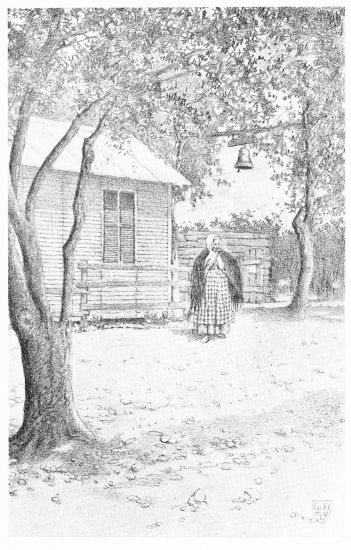
PAY-WINDOW AND THE ARCHBISHOP’S BELL. Page 453.
“Don’t you know her?” cried Caterina. “It’s Teresa; the dress suits her,
yes?”
Teresa, the ragged little witch of last night, was transformed into a
neat demure child! All that bright beautiful Easter day I kept meeting
one and another of the girls and women, who the night before had been so
forlorn, so bedraggled. Today they were neat and freshly dressed for
Pasqua. How did they do it? In the streets, in the church, wherever you
met the women, you felt that effort at festive dress for the great feast
of the year, the world-old festival, that from the beginning of time we
have celebrated by one name or another.
The services in Messina this Easter Sunday were far more impressive than
any I ever saw at Rome or even at Seville. The pontifical mass was said
by the Archbishop in a small wooden theatre that had escaped
destruction. The congregation was large; there were now forty thousand
persons in Messina. Many of the congregation were maimed or crippled. A
man with a bandaged right arm at the elevation of the Host struck his
breast three times and murmured low, “Mea culpa, mea culpa, mea maxima
culpa.” Poor soul! whatever his sins have been, his sufferings must
have matched them! In the afternoon the images of the Saviour and of
Mary the Mother were carried in procession through Messina. Cries of
“Viva Maria!” followed the figures. A young girl took her earrings from
her ears, and one of the bearers climbed up and hung the offering in
Mary’s girdle.
“Ah, Santissima Maria!” cried a poor old woman with tear-worn eyes, “you
have nothing, not even a drum, to do you honor! Ah! the band that went
before you a year ago! The musicians are all dead. I lost my two
daughters. They are under the ruins; may I meet them in Paradise! See,
this is my husband; he is blind; we two old ones were saved; all the
children and the grandchildren were taken.”
As the figure of the Christ passed, the old blind man fell on his knees,
stretching out his arms and crying in a terrible voice: “Santissimo
padre, help us, help us!”
“This is the first real Sunday we have had at Camp,” said the doctor
that evening.
No one was ever obliged, or even asked, to work on Sunday, I think; our
men had caught the fever of work, it was the labor microbe that pushed
them on. The desolate people, the sad women with their wonderful
children, who came from their little wretched huts and looked with
longing eyes at the baracche Americane, stirred and stimulated our men
to toil through the bitter days of rain, and the dreadful days of wind,
when the pestilential dust of the city, that vast charnel house, was
driven into the eyes and throat.
Easter Monday was a festa, and the men did not work. Some of the
carpenters went for a long bicycle ride. Signor Donati appeared at
breakfast in a fine sportsmanlike costume with gaiters, cartridge belt
and game bag. We heard him blazing away all day with his gun. He shot
one swallow. The tiny scrap of a bird was brought in on a plate at
dinner, offered to me, then to the Captain, and finally sent to
Brofferio, who was ill in his room.
At the Villaggio Regina Elena there was a pretty ceremony that Easter
Monday. On Sunday a poor blind woman, Giuseppa Lo Verde, gave birth to a
little girl, the first child born in the Queen’s village. The child was
baptized the next day and given the name of Elena. The ceremony took
place at the tiny church the dear sailors built. Captain Bignami
holding the little one in his arms at the baptismal font.
One of the most popular places in the Camp was Dr. Donelson’s office, a
tiny surgery, not more than eight feet square. The poor people had soon
found him out—the unofficial work of this good physician deserves a
whole chapter to itself. The doctor’s patients were not ungrateful; that
Easter he had as thank offering a basket of golden citrons; a blue
heron, warranted “good eating,” a handful of coppers from Zia Maddalena,
whose grandchild he had cured. Though little was said of illness, there
was plenty of it about. I was warned not to go near certain hovels,
where scarlet fever was raging. The doctor was a daily visitor here; he
nursed and tended the little children with a tenderness they will not
forget. His office was rarely empty; during the half hour before dinner,
when work for the day was over, the officers gathered here to talk
things over. Sometimes the tinkle of Spofford’s guitar or the notes of
the doctor’s flute came from the little office, with its neat shelves of
bottles and faint odor of carbolic acid.
On Monday evening, wishing to consult the doctor about a new
installment of clothing, I went to his door. There were voices in the
office; the doctor had a patient, so I sat down outside to wait. It was
a perfect evening; the sky was still flushed with sunset, the first star
stood over the tall spire of the little Gothic church at the campo
santo. The dusk fell softly; on the heights above Messina, the outlines
of the old Saracen fort were blurred in the violet afterglow. The tramp
of the sentinel marked time. Another sound broke the twilight stillness,
the sound of the royal march played by a band. Where could it come from?
In all Messina there had not been found so much as a drum for the
procession. The music came nearer and nearer, a new sound mingled with
it, the sound of voices singing and cheering. Lanterns were brought out,
the mess-room door thrown open. By the light that streamed out I saw a
cab, decked with green branches, drawn by a horse gay with white ostrich
plumes. Two of our carpenters sat in the cab, which was followed by a
pair of ox-carts, filled with chairs occupied by the carpenters’ guests.
The three vehicles were surrounded by a crowd of people, singing and
cheering.
“Long live the American carpenters!”
Some of our men had spent the day at a neighboring village, that had
escaped the earthquake; they had been escorted home by the whole
population. The band departed playing the merry march; the sound grew
fainter and fainter in the distance. A bright fire lighted up the dark
interior of the little shanty, opposite the Camp, built by Zia Maddalena
and Cousin Sofia; the tinkle of Spofford’s guitar repeated the gay notes
of the march—how good it was to hear the joyous sounds!
“Will you please tell this woman,” the doctor spoke sternly to his
interpreter, “that this child has small-pox. If she doesn’t report it
immediately to the health authorities it will go hard with her. She may
be fined, or imprisoned for neglecting to do so and it may prove fatal
to her child. It’s a menace to the community. Please make her understand
this fully, as I shall immediately report the case myself.”
The poor mother, dazed and sorrow-stricken, buried her face in the
little bundle in her arms and went weeping to the hospital, where the
child—all that the earthquake had left to her—would be taken away
from her—perhaps never to be returned.
The next morning at breakfast an unmistakable hint was dropped that my
visit had best come to an end. Nothing was said about smallpox—it may,
indeed, have had nothing to do with the hint. I have always believed,
however, that had it not been for the sick baby, I might have enjoyed a
few more days at the Mosella.
That day news came to the Camp of Marion Crawford’s death.
It was known that he was ill, but hopes had been held out of his
recovery. He had written lately about the profughi he had sheltered in
his villa at Sorrento. In these last months, though suffering greatly,
he worked early and late for these poor people. He wrote often
concerning them. There was no sign of weakness, either in his firm
beautiful handwriting or in his brave cheerful words.
It was strange to read the story of his death, sympathetically as it was
told, in an Italian paper. He died, at sunset on Good Friday, sitting in
his chair looking out over the Bay of Naples towards Vesuvius, just as
the procession of Mary the Mother, returning from her search for her
lost Son, passed his door. The news that his strong heart had ceased to
beat cast a shadow over the Camp. Though not one of the company except
ourselves had any personal friendship with him, each one felt that he
had lost a friend.
Our great story-teller had told his last story. Not many men have served
their generation as well as he. A wonderful man, more romantic than his
romances, more poetic than his poetry, more dramatic than his dramas,
his death was in keeping with all the rest—he was an idealist to the
last!
XVI MESSINA Ave atque Vale!
As the steamer bore me away from Messina and towards Naples, I looked my
last on the old sickle-shaped harbor of Zancle, on Cape Faro, where the
current sweeping through the narrow straits was full of bewildering
purple, blue, and green tints like a piece of shot silk. We passed a
fishing boat with a man standing on a stunted mast above his fellows at
the oars, on the lookout for swordfish; above boat and fishermen towered
the crag and castle of Scylla. To the left the glass showed a blur of
green—was it a new-leaved fig tree—a descendant of the tree Ulysses
clung to as his boat slid by “Scylla’s dread abode?” Why not? Sailor,
soldier, traveler, king, vagrants, all come and go; the island and its
people remain unchanged. I have bought in a market of Trinacria the
“hardening cheese heaped in a wicker basket” that Ulysses saw the
Cyclops make from the milk of his sheep and goats. I have heard in the
olive groves the shepherd’s flute, the neatherd’s song Theocritus heard
and preserved for all time in his verse. As the little steamer churned
her way through the Tyrrhene Sea, the sun set, the sky flushed and faded
again, the stars came out. Little by little the lights on the shore
dwindled to mere diamond points, then in a minute they were gone, and
with them that faint perfume of the lemon and orange blossoms that had
gone along with us while the breeze was from the land.
I have never seen the wonder island again; what remains to tell of the
American work there, must be told by others.
Extracts from J.’s Letters
“Zona Case Americane, April 28, 1909.
“The rush is increasing every minute. I cannot get the drawings
done fast enough for the carpenters at the hotel, and the sill
layers are howling for ground plans of the schools. I have tried to
do all these things and get some sketching done for myself. In the
latter I have pretty well failed,—you see I have got hold of a
live wire and can’t let go!”
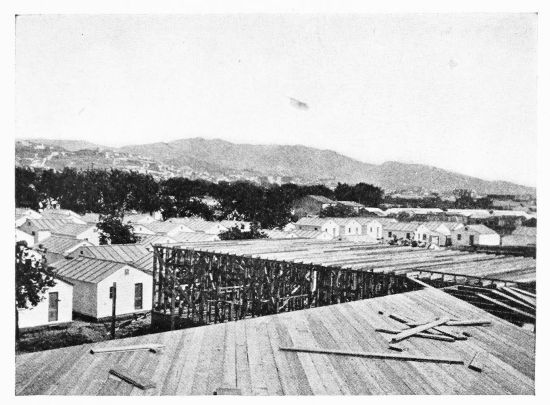
AMERICAN VILLAGE, MESSINA. HOTEL IN CONSTRUCTION. Page
464.
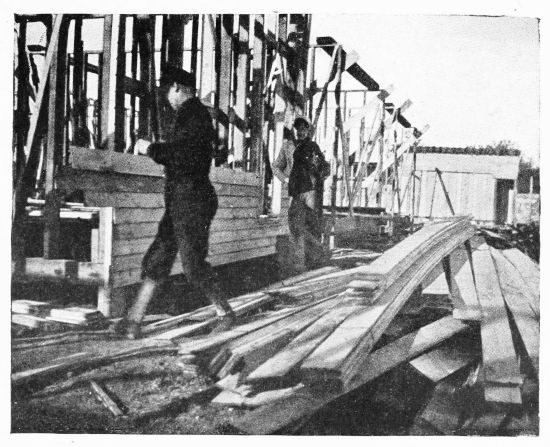
AMERICAN VILLAGE, MESSINA. ENCLOSING GANG AT WORK. Page
438.
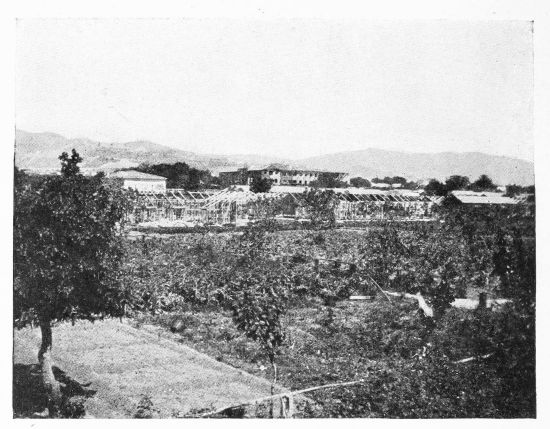
GRAND HOTEL REGINA ELENA FROM THE RAILROAD. Page 475.
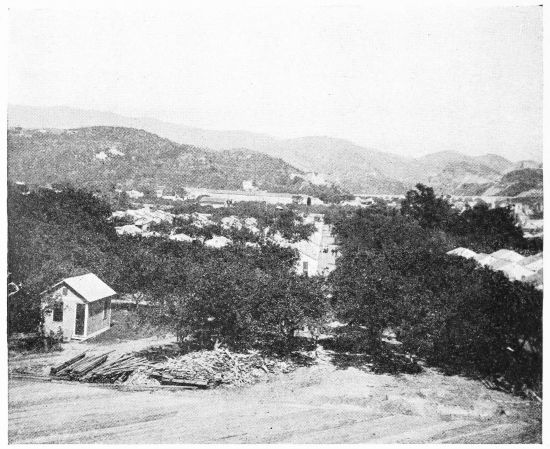
AMERICAN VILLAGE, MESSINA. VIEW FROM THE HOTEL. Page
475.
“May 2, 1909.
“The rush has been growing greater every day; it has been
impossible to find a minute save in the evening, when I have taken
a short walk with Brofferio and gone to bed beaten out, so much so
that I slept through one of the worst earthquakes from all
accounts. We have had five very severe ones since you were here,
two of which succeeded each other within a few minutes and toppled
over a whole lot of ruins along the Marina so that it was blocked
again for a day or two. I heard a soldier exclaim, ‘Oh, my poor
dancing land!’”
“May 25, 1909.
“I am sitting on the sand by the sea, with the wonderful mountains
across the straits. There is a delightful breeze blowing. The sea
is like sapphire and emerald, and not at all beautiful to look
upon, oh no! On the other side of me looms up the roof of the
hotel; it’s above the railroad embankment and everything. It is
covered in and the clapboards are being put on. Yesterday was
Sunday. Brofferio got the loan of a Red Cross auto and we had a
magnificent spin,—the captain, Brofferio, Buchanan and I. We went
through the torrente for miles. I find that nearly all of them
can be used as roads; they are picturesque to a degree. An auto is
the greatest thing in the world for seeing the country. Next
Sunday, I believe the auto is going to take us to Taormina; if not,
Derby and I are going to have a sail with Brofferio, which we
should enjoy immensely. All your boys you have sent down here have
turned out splendidly. Brush is doing finely at Reggio; I don’t
know what we should do without McGoodwin. He came in when
everything was decided, and has cheerfully taken up the hardest job
in the world, helping to carry out other people’s plans when all
the fun of making them is over! Rodolfo Serrao has become quite a
pet with every one. He makes wonderful caricatures, and has made
them of all the party. I am keeping all I can get to bring back to
you.
“The hospital at Regina Elena and all the houses are nearly
finished. Here the hotel will be finished as far as we are
concerned in a few days, and the church and schools. There are no
more houses being put up just now. I wish I could tell you how many
houses are inhabited—a great many I know. The workshop opposite
the camp that you remember, disappeared long ago and cottages are
standing on the site, so we are all shut in and living in a common
street called Via Bicknell. There is to be a street named for me
which I share with the captain. The captain does things his own way
and he says the plan (which I have drawn with all these names) is
the record of the thing that will be sent to Washington, but even
there it will be looked at once and then thrown aside.”
Extract from Captain Belknap’s Journal, and Letters to the
American Ambassador
“With a large increase of the force, and at the same time of the
work, especially as the hotel began to assume considerable
proportions, this tallying of the workmen took more of the head
carpenter’s time than could be spared. Opportunely, Mr. J. Lloyd
Derby, Harvard ’08, who had been one of Mr. Roosevelt’s guests in
the party visiting Messina, had accepted the invitation to join us.
He had first gone back to Rome, with the two chums with whom he had
made a trip around the world, and I had almost given him up, when
he telegraphed that he was coming and, evidently recalling our
previous shift to find accommodation for our guests, should he
bring bedding? I replied no, but asked him to call at the Embassy
and at the ‘Scorpion’ at Naples, to bring anything they might have
to send. The Embassy entrusted him with some cigars and champagne,
which was all right; but the ‘Scorpion’ produced fifty thousand
lire, which was startling. However, another means of sending the
money appeared, and Derby arrived with his other charge safe. He
stepped right in as Buchanan’s assistant, taking over Mr. Phillips’
work of tallying the men, and shortly after, as he found time for
more, he was made the inspector of kitchens. The shop made him a
measuring, or ‘divining’ rod, and he fared forth among the masons,
who soon found out that poor workmanship was no match for his
muscle.
“We were fortunate in gaining accessions to our managing staff just
when it would seem impossible to carry it on longer without more
help. The first one was Mr. Gerome Brush, son of the painter, whom
we sent to Reggio just as Wilcox was finding more than he could
attend to unaided. As interpreter, accountant,
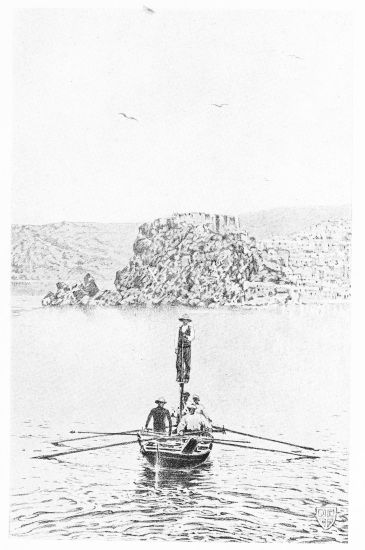
and factotum, Mr. Brush made himself invaluable. Then early in
April came Avvocato F. Saverio Donate, who had been in Messina and
lived in our camp before, as Mr. Bicknell’s secretary. He was a
faithful and untiring worker, and, with Avvocato Rodolfo Serrao,
son of the former Prefect of Rome and Messina, who joined about the
first of May, took over entirely the harassing duties attendant on
the assignment of the houses for occupancy. The last to join the
camp was Mr. R. R. McGoodwin, a young architect who was studying in
Rome. When he came, we had already begun on the hotel, church,
school-houses, laboratory, and dormitory at Messina, and the
six-building hospital group at Villaggio Regina Elena. All these
were on the lines laid out by Mr. Elliott and the work was
progressing well; but without complete plans—which were more than
one man could accomplish with so many other things to do—questions
of detail were continually arising, which Mr. McGoodwin was able in
large measure to settle. Mr. Elliott, McGoodwin and I made the
traditional three required for every good firm of architects; but
in justice to them it must be said that, on account of our
exceptional circumstances, I assumed to outvote them occasionally,
to the detriment of artistic effect.
“Two English ex-soldiers applied for work about the same time, and
proved good hands, remaining until the last of our party left.”
“April 18, 1909.
“An urgent request having come from the Genio Civile and from Mr.
Bowdoin, for a man to help erect the portable houses at Ali, Mr.
Dowling, superintendent carpenter, was sent to Ali, to superintend
that work, and assist in any way he could. He was glad to have the
detail; Mr. Bowdoin writes me that he has taken hold well; and it
will prevent the pieces of those portable houses from being
mismated and so going to waste.
“In general since you left here, events have been thick and
important.”
“April 26, 1909.
“I shall reserve the cigars and champagne Derby brought for an
appropriate occasion, perhaps to celebrate the completion of the
hospital, or of the work. Of the cigars, I took one box over to
Reggio and told the mess there that it was sent with your
compliments, and did the same with the other box here. Thank you
also for the newspaper extracts about Mr. Roosevelt’s visit.
“The past two weeks have been very full ones, so that I have not
been able to get the time necessary to draw up a money statement,
but that I hope to do in a day or two. All or most of us have had a
little touch of stomach or bowel trouble, rather disturbing to
work, due to flies or meat probably; but now all of our fly screens
have come and been put in place, and we have cut the meat out of
our bill of fare almost entirely, so that I hope we may get on
without any further sick days.
“The food question really gave us a good deal of trouble and some
uneasiness, as soon as the supply of pork loins and turkey had been
consumed. These had been loaded on board the ‘Celtic’ for the
delectation of our men on board of the world-circling fleet; but we
enjoyed them just as much, as they certainly did taste good after a
long day’s work in the open. By the beginning of April, however, we
had to depend on the local markets for meat. Fish was good and
poultry killed in the camp was safe enough, and all meat offered
for sale bore the stamp of inspection; but when half the table was
dining on soft-boiled eggs, something had to be done, and we could
not quite determine what. Dr. Donelson was in charge of our mess
and of sanitary supervision in the camp generally; but a steady
stream of native patients, from early until late, of all ages and
conditions and ailments, left him little time to experiment with
the bill of fare. Had it not been for the spaghetti family of
dishes, we might have been in a bad way. Our Sicilian cook’s
repertoire was limited too; but when the Reggio camp was broken up,
we took on Baker, ship’s cook, who immediately gave us a change and
some familiar dishes.
“The water was good, and we found that we could freely use it
without boiling. Our supply was so convenient for the neighbors
that our one outside faucet for general use was, in fact, nearly
worn out, before the city water supply reached our camp.
“Notwithstanding indifferent fare, our mess was a jolly one. Our
latest accession, Avvocato Serrao, contributed much entertainment.
He was a talented caricaturist and often, during the
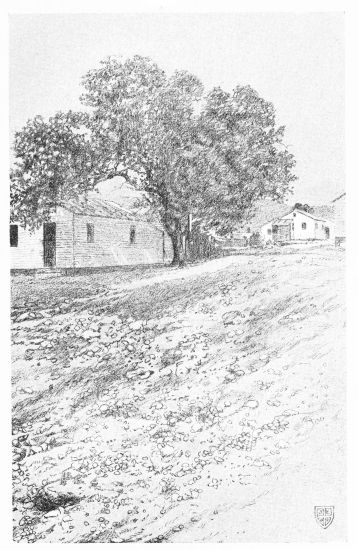
VIA BELKNAP, AMERICAN VILLAGE, MESSINA. Page
467.
course of the day, would disappear to his room for a while,
evidently to record his impressions pictorially. Nearly every
evening he would produce one or two caricatures at the dinner
table, setting forth the latest camp event. Mr. Elliott managed to
capture all these,—sometimes, unfortunately, failing to do so
before they got into the butter,—and it is hoped that some day we
may have them all reproduced.
“One evening there was an alarm of fire during dinner, and every
one rushed to the scene with whatever water receptacle lay nearest
to his hand. It proved to be not smoke, only the dust of a heated
domestic argument; but it gave Serrao a fine opportunity to portray
each one of us. Mr. Elliott was always represented with a roll of
the hotel drawings in his hand; and Dr. Donelson with a squalling
baby on his arm.
“For our beds, or bunks, we had sea-grass mattresses, of the kind
used in steamer steerages, costing forty or fifty cents apiece, and
cheap cotton blankets, at two dollars or less each. I have felt
softer and warmer beds, yet we soon get accustomed to conditions;
and the fact that we lived comfortably in our own cottages for
three months, is a good proof of their habitability. There were
some leaky roofs; but this is a fault shared by some more expensive
structures; and in the heat of the day, they were hot, as all
unceiled structures must be. The ventilators in the gable ends
helped this much, but of course the best remedy was to ceil the
interior, which some of the occupants assigned to the houses very
sensibly proceeded at once to do.
“Earthquakes were of frequent, almost daily, occurrence. A severe
one came as we sat at our first dinner in camp, and the jar and
loud rumbling were rather startling, though we had nothing to fear.
There were some casualties in the city, however, and our Sicilian
servants were frightened and anxious for the safety of their
families.
“In the middle of May we had a severe shock about 9 o’clock, our
little frame structures quivering for nearly half a minute. It
caused a small panic among our workmen, a stream of them leaving
their work and coming to the office for their discharge, saying
they were not going to work in Messina any more. An hour or so
later, one of the engineers passed by, with the news that Palermo
was destroyed. He belonged there and seemed much disturbed.”
“May 10, 1909.
“So far, only white paint has been put on; yet the improvement is
so great that we have great difficulty in restraining an impatient
populace from rushing the uncompleted houses. When the green
trimmings and brick-colored base go on, we may need a regiment. The
cottages do look very attractive, especially in many places where
they are nested among the trees; and there is nothing anywhere
around that can touch their appearance. The white color marks them
out from a good distance.
“Our other work at Mosella is progressing well, especially the
hotel, which will have the second story begun in a day or two. It
is a larger building than any one had thought it was going to be
and has aroused a good deal of interest. It is being well
constructed throughout.
“After much consideration, the idea has occurred to me that about
the best disposition to make of our camp and camp outfit here would
be to turn the whole establishment over to the Little Sisters of
the Poor. Yesterday I sent Mr. Elliott and Mr. Phillips, head
carpenter here, out to examine their former building, to see
whether we could do anything to help them; but it is in complete
ruin, requiring to be rebuilt from the ground up—an undertaking of
course beyond us. They still have the property and garden, and in
time their house could be rebuilt. Meantime if they want this camp
and its equipment as a temporary dwelling, it would be suitable and
available. I know of no other charitable disposition equally good;
and as the Little Sisters are indeed poor, it would not trouble
them much to move what little they own in, as we move out. Of
course all we take will be our personal belongings, and everything
else—bedding, table gear, lamps, and such furniture as we have,
would be theirs.
“One of the houses near the camp has a family recently moved in, in
direct competition with the one in the Queen’s house in Reggio, for
the first baby born in an American house. I shall telegraph the
arrival, whether it occur here or at Reggio.
The same day also the Pro-Sindaco came, Commendatore Martino, who
expressed much
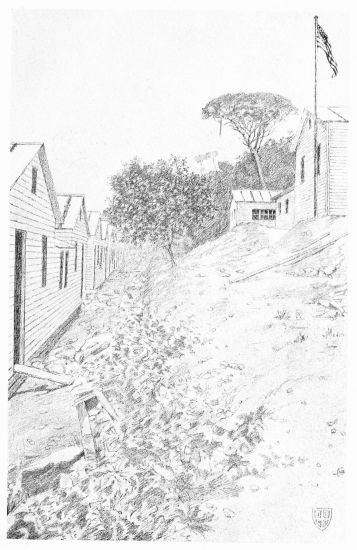
ELIZABETH GRISCOM HOSPITAL, VILLAGGIO REGINA ELENA.
Page 469.
satisfaction with all he saw, and was very complimentary, even
intimating that he would become a siren to endeavor to retain our
party here, to continue such energetic work.
“In fact the work has spread so since you were here that what you
saw is comparatively insignificant. Mr. Derby said this morning
that, remembering how comparatively little there was when he was
here in April, six weeks ago, he can hardly realize that it is the
same place. The growth, the white paint, and the clearing up of the
streets, have made a complete transformation; and from the top of
the hotel one gets a view of the whole settlements that gives an
idea not to be gained in any other way.
“At Villaggio Regina Elena, all our houses were finished on Friday
afternoon; the door and window hanging and the kitchens will
probably be done by the end of this week; and a contract has been
given to another painter to paint them by the end of this month.
The job has been done very well and quickly, and when the white
paint is on the appearance will be all that could be desired.
“The foundation for the main buildings of the hospital is
finished, and the framing is beginning today. I will push that work
all possible, so that we may leave a cleanly finished set of
buildings. The roofing, foundation, and plastering will each cost
more than I had estimated, considerably; and the hardware for doors
and windows must be bought.
“Here at Messina, we are on the last week of cottage building, all
houses being framed that we are going to build. I have told the
Prefect that I would leave here on June 12th.
“As the houses are completed, after Mr. Derby has inspected the
kitchens and passed them, Lieutenant Brofferio and Avvocato Donate
go over them, note whether they are ready for occupancy, or whether
some minor repairs are needed, and then, on the revised list given
by Brofferio, I report to the Prefect that the houses specified are
ready for occupation. After the Prefect’s Committee have assigned a
house, the applicant brings the written authorization here, and
Donate installs him, or, generally, her.
“The new aspect of the settlement, since the painting began, and
the towering bulk of the hotel, have brought a steady stream of
visitors; and on Sunday there were crowds, all over the place and
through the hotel. These conditions are gratifying, but they make
it difficult for us to remain and work; so that the date, June
12th, must be regarded as definitely fixed.”
Translation of an inscription on a visiting card
left in camp office
(Crown)
“Comm. Luigi Majolino
“Messina.
“Having the concession for the American house of A-7, No.
11,—before occupying it, I feel it due to salute the Egregious
Doctor Donelson, Commandant Belknap, Lieutenant Buchanan, and
Sub-Lieutenant Spofford, who, with love and self-sacrifice, have
borne in among us for all time the good will of the great nation of
the United States of America.
“(Signed) Luigi Majolino.
“Our last Sunday in camp, June 6th, the great Italian national festival,
was celebrated at Villaggio Regina Elena, by throwing open the bridge
which had been jointly built by the Italian and American working
parties, connecting our respective quarters in the village. A very
festal occasion was made of this, the children marching around the
village in procession, guided by the teachers of the schools provided
for them by the Queen, all of them dressed in clothes made in the
village laboratorio, and waving paper flags of all sizes and
nationalities, the Stars and Stripes being prominent.
“On the day of departure of the main body from Messina, June 11, I gave
a lunch in the dining-room of the hotel we had built, to which were
invited Lieutenant-General Del Rosso, commanding the division, with his
brigadiers and chief of staff, Major Andrea Graziani (since promoted to
lieutenant-colonel, for exceptional services rendered at the time of the
earthquake), the new Prefect, Commendatore Buganza, Pro-Sindaco
Commendatore Martino, Captain Pericoli, the senior naval officer,
representatives of the Genio Civile, other officials of the Government,
our own party, including Mr. Bowdoin and Mr. Wood, from Taormina, and
our faithful contractors, Signor Pella and Signor Saraconi, the painter.
In all, about seventy persons sat down to a horseshoe table built for
the occasion. The room was freely decorated
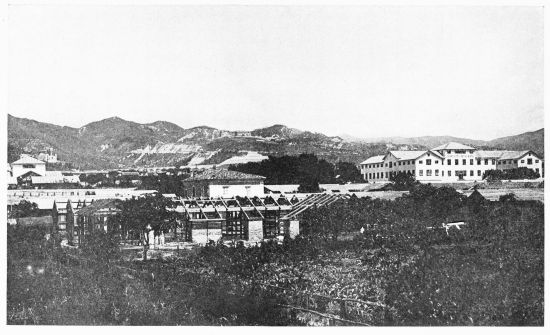
GRAND HOTEL REGINA ELENA AND CHURCH OF SANTA CROCE,
AMERICAN VILLAGE, MESSINA. Page 478.
with flowers and green, the two national ensigns draped together at the
head of the table; and, barring a rather slow service, due to the fact
that the cooking was done in our camp kitchens four hundred yards away,
this first meal in the hotel was a success. It being our last in
Messina, there was a warm interchange of sentiments of the most friendly
nature, the Prefect saying that the occasion marked the beginning of a
new life in Messina, and the Pro-Sindaco, in the name of the Municipal
Council, conferring the honorary citizenship of Messina upon Lieutenant
Buchanan, Ensigns Wilcox and Spofford, Dr. Donelson, Mr. Elliott, and
myself. When I rose to bid them farewell and to commend to their kind
offices Ensign Spofford, who was remaining behind for a little while,
General Del Rosso rose and stretched his hand across the table to
Spofford, saying: ‘You are our comrade.’
“The main body, however, left Messina shortly after our farewell lunch,
by the five o’clock ferry, amid a popular and official demonstration
that will never be forgotten by any of us.
“What our American party built in the earthquake area may be seen in
the following summary; and to quote some of the things said of it, a
translation of the decree of honorary citizenship, and a letter lately
received from the Little Sisters of the Poor, are added.
“Allowing an average of six to a family, which is not high for the
people who occupy our cottages, the number we built would house twelve
thousand; and six thousand more could be provided for by the remaining
thousand for which material was provided.
“The church would easily hold three hundred or three hundred and fifty
people; fifty or sixty sewing women or other people could work in the
laboratorio, comfortably; and seventy-five to eighty children in each
schoolhouse. The laboratorio and schools were ceiled and plastered,
and built on concrete foundations. All these large buildings are
permanent structures, and should last for years.
“The Hospital Elizabeth Griscom, at Villaggio Regina Elena, especially
is a worthy group of buildings, based on a substantial concrete
foundation, strongly framed, and well finished, all corners rounded in
the wall plastering, tiled floors in the surgical rooms, bathroom, and
kitchen, and roofed first with rubberoid, then with artificial slate.
Painted white, with red roof, and situated high up on the hillside, it
stands out from its surroundings, as seen from the harbor, most
attractively, while from the windows of the wards of the hospital itself
the view is unsurpassed.
“The hotel building was turned over to the authorities with all the
wood-working part finished, and in such general condition that a
concessionaire could in a short time complete and open it. The form is
a wide H, the central part one hundred feet long by thirty-two wide, and
each wing one hundred and thirty-two feet by thirty-two feet wide. It is
arranged for seventy-five bedrooms, of several sizes, and thirteen or
fourteen bathrooms, so grouped as to minimize the amount of branch
piping necessary. Great care was taken with the foundation and to make a
strongly built structure; and also to make one that should be in some
degree worthy of the beautiful site on which it stands.
“Nothing but cottage-building had been contemplated when we went to
Messina, and this task had been accomplished at the rate of fifteen
cottages built for every day we spent there, including Sundays,
holidays, and days of rain. The other work—schools, workroom, church,
hotel, hospital—were all additional, their undertaking made possible by
the allotment of more funds by the American Red Cross.
“To mark the givers, each house completed bore on the door a plate,
reading, ‘U Italy S, 1909,’ or ‘American Red Cross for Italy, 1909.’
These were placed on the cottages, in the proportion of three to one,
which was about the ratio of the respective expenditures of the U. S.
Government and the Red Cross for this particular work,—roundly $450,000
and $150,000.
“As nearly as could be figured, the whole cost of each cottage came to
not more than $235, of which about $35 represented the cost to the
Italian Government.”
Thanks from the Little Sisters of the Poor
“To the Directing Manager and Gentlemen engaged in the erection of
Barracks at Messina.
“Gentlemen:—I, the undersigned, Provincial Superior of the Little
Sisters of the Poor, having been apprised of your approaching departure
from Messina, feel it my duty to thank you for the great kindness shown
to our sisters in that unfortunate country; no words can express our
gratitude for the noble manner in which you have treated us.
“We have every reason to hope that our Home will be soon reopened, as it
is the desire of our Holy Father, Pius X, that the aged poor should be
taken care of.
“Gentlemen, you may rest assured that your benevolence for our work will
never, never be forgotten; you will always be considered as our first
benefactors and our prayers and the prayers of our dear poor will follow
you everywhere. If you come back to visit this desolated country of
Messina, we hope you will come at once to see us, as we are really your
‘protegées.’
“Receive, Gentlemen, my most grateful homage, and believe me
“Your most humble servant
“In Christ our Lord,
“St. Aimée de la Providence,
“Provinciale des Petites S’re. des Pauvres.
“Piazza, San Pietro in Vincoli, Roma.
“August 8th, 1909.”
COMMUNE OF MESSINA
Date June 9, 1909.
Subject
Honorary citizenship of the Commandant and Officers of the Navy of the
United States of America, who directed the construction of the American
houses.
Extract from the Deliberations of the Municipal Council.
The year nineteen hundred nine, the ninth day of the month.
The Municipal Council of Messina, being called together by a notice of
meeting, sent by the Mayor, dated the seventh of May, convened today in
a hall of the Palazzo Comunale, with the following present:
1. Commendatore Antonio Martino, Mayor, Presiding.
2. Avvocato Auguste Bette, Alderman.
3. Cav. Avvocato Francesco Martino, Alderman.
4. Cav. Ingegnere Amilcare Martinez, Alderman.
5. Cav. Ingegnere Arturo Lella, Alderman.
6. Dottore Orazio Ciraolo, Alderman.
The Secretary-General, Avvocato Giacomo Crisafulli, assisted at the
meeting.
The President at 1 o’clock P.M. declared the session open.
On the motion of the President,
The Municipal Council considering that, in the tremendous disaster of
the 28 December et seq., all the civilized nations of the world,
sympathizing in the distress of the surviving Messinesi, united in
various ways, to relieve and mitigate their sufferings, considering that
the Republic of the United States of America chose to take part in this
great affirmation of the solidarity of humanity by means of enduring
works, namely, by the construction of one thousand five hundred houses,
for the shelter of a good portion of the surviving population, a
magnificent hotel, a church, and three school buildings; considering
that this new proof of affection furnished by the worthy American people
merits being signalized, and that a tribute is due in equal measure to
those also, who, with so much zeal and affection, have devoted their
energy and activity to this work for several months; convinced in
consequence that the executive body interprets the voice and feeling of
the entire populace, in solemnly expressing the most sincere sentiment
of gratitude, at the moment in which the gallant officers and sailors of
the glorious American Navy are leaving these shores, tried by suffering;
assuming on account of urgency, the power of the community, the Council,
by unanimous vote
DETERMINES
a) to communicate to His Excellency the President of the United
States of America, through His Excellency the Ambassador, resident
at Rome, the profound gratitude of the survivors of Messina for
this proof of the common bonds of humanity, furnished on the
occasion of the tremendous disaster of the 28 December.
b) to confer the honorary citizenship of Messina upon Messrs.
1) Lieutenant Commander Reginald Rowan Belknap.
2) Lieutenant Allen Buchanan.
3) Ensign John W. Wilcox.
4) Ensign Robert W. Spofford.
5) Assistant Surgeon Martin Donelson.
6) John Elliott.
c) to make the aforesaid Commandant Mr. Belknap the warmest
expression of appreciation for the kindly care with which he
assumed a difficult undertaking, and carried through an extensive
and complicated work.
d) to recognize also the zealous efforts, effective and
harmonious, of the other officers and of the Engineer Elliott, who
contributed their co-operation to such a degree.
After being read, the present proceeding is approved and signed.
The Mayor.
(Signed) A. Martino.
The Senior Assessor.
(Signed) A. Martinez.
The Secretary General.
(Signed) G. Crisafulli.
The present document has been published in the pretorial bulletin
of this Community on the feast day tenth of June, and no objection
has reached this Office.
The Secretary General.
(Signature) G. Crisafulli.
The present copy conforms to the original, and is furnished solely
and exclusively for administrative uses.
At the Municipal Residency, the 11 June, 1909.
Compared, [SEAL]
(Signature) C. Largaro.
The Secretary General.
(Signature) G. Crisafulli.
Visé The Mayor.
(Signature) A. Martino.
On their way to the ferry-boat the newly made citizens of Messina passed
through the Piazza del Duomo and by the ruin of an old Norman cathedral,
whose foundations were laid in the year 1098, by order of Roger II. The
noble central doorway is still standing; over it is a marble bas-relief
of the Madonna. The child has dropped from her arms. Then comes a great
rent, for the upper part of the façade has fallen. The mighty columns
of the nave (they once upheld the roof of the temple of Poseidon at Faro
Point) are snapped like pipestems. Two only remain upright and
uninjured. The high altar, a marvel of jasper, chalcedony, and
lapis-lazuli, has fallen, broken into a thousand pieces. The splendid
gold mosaics of the apse, so hard to see in the old days, are now easily
visible. In the central arch over the ruined altar the figure of the
Christ is almost intact. From the rich gloom of the mosaics His grave
face looks out on the ruins of Messina, upon His world. For the world
has never been so truly Christian as it is today; not even when Richard
of the Lion Heart wintered in Messina on his way to Palestine to fight
for the Holy Sepulchre, that same winter he took to wife the lovely
Berengaria. A new name is added to the long list of those who have made
their camp beside Charybdis, opposite Scylla, on the most beautiful, the
most deadly coast in all the world—the Americans, who came not to
conquer or to ravage, but to help and to save. The little boy who
greeted Captain Belknap on Easter morning with the words, “Be thou
blessed!” expressed the general sentiment of the Sicilians towards the
Americans.
In our bustling young country we are so busy looking forward and looking
backward that we sometimes lose sight of the only thing that is really
ours to make or to mar—today. In Sicily there is more time, and, in the
years to come, the old men and old women of Messina will tell the tale,
hand down the story of those latter-day Crusaders, Captain Belknap and
his men, and what they did in their camp beside the Torrente Zaera.
There was a certain exaltation in all the people who worked for Sicily
and Calabria that seemed to lift them above the smallnesses of every day
existence. They saw each other transfigured, they lived the heroic life.
Each was eager to do the other’s work,—all were quick to sacrifice
themselves to the others, as well as to the cause. It was a time when
men and women seemed purged of meanness and jealousy. Each saw the god
in the other. There was hardly a discordant note. It was like the time
of our Civil War, when a breath of heroism passed through the country.
No matter what might follow of discord and jealousy, the men and women
who passed through that fire of sympathy will never again be quite the
same. All their lives they will yearn for the glorified vision of those
days; their eyes will never quite lose the keener insight of the
mysteries they then attained.
THE END.