From War to Gentle Peace.
Book III.
FROM WAR TO GENTLE PEACE.
THE DUKE OF KENT AS GRANDFATHER KNEW HIM—DISCIPLINE
AND THE LASH IN THE BRAVE DAYS OF OLD—TONAL'S
DILEMMA, AND HOW HE GOT OUT OF IT.
A beautiful village on the eastern shores
of Kent, a village that partly and chiefly
went straggling up a little cosy dingle or
dell, and partly rested on two high cliffs
that—one especially—descended sheer down
towards the dark and heaving ocean, which in stormy
weather spent its fury against its sides: such was
Ramsgate in the early part of this century.
There were churches on the cliffs and in the hollow;
there was also a naval outlook or coastguard station; and
there were barracks for soldiers. A bracing town then
as now. Perhaps even more so, for it was hardly in
those days a sea-side watering-place. There were no
noisy trains, no factories worth the name, few vessels in
the harbour save those of fisher-folks, and far less bustle
and stir. In fact a kind of Sabbath-calm rested here
eternally. To be sure, the coming and going of the
soldiers occasioned a little excitement, so did the arrival
of a man-o'-war, especially if she stayed long enough to
give the sailors a spell on shore. Then, indeed, the peace
was broken in more ways than one. For Jack and
Tommy Atkins might be seen linking arm in arm along
the street, or streets, singing together, drinking together,
and, alas! often fighting together. In this latter upshot
the Jacks generally, if not invariably, had the best
of it.
I do not mean to say that a sailor is, on the whole,
braver than a soldier, but in times of peace he probably
is, for then Tommy Atkins rests at home—languishes in
barracks, let us say—while Jack is ever facing danger
and death afloat on the ocean wave.
It was in the autumn of 1801 that my grandfather,
with his regiment, or a portion of it, lay here, and just
about this time his Royal Highness the Duke of Kent
took the command of the Royals, vice Lord Adam
Gordon, D.D.*
The Duke was, it must be remembered, the father of
our good and illustrious Queen Victoria.
It was here at Ramsgate that my grand-dad first had
the honour of coming under his Royal Highness's notice,
and was taken on his staff.
In those days the pay of a company passed through
the captain thereof, but this had fallen into my
grandfather's hands in the following way: He was possessed of
a little money, and this, or a portion of it, he had lent to
his captain. He never got it back, for the officer was
impecunious, but he had the pay of the company turned
over to him, and in those days in foreign lands the men
were paid in the coin of the country in which they
served. A captain therefore, in paying his men, had
usually some pickings left for himself, as English coin
was more valuable than foreign.
It was—I may say it. I trust, without appearing boastful—my
grandfather's smartness, sobriety, strict attention
to duty and discipline, and his love of order and cleanliness,
that first attracted the notice of the Duke, and that
his Grace was pleased with him goes without saying.
From my grand-dad's account of him, the Duke was
a noble-looking man, a capital soldier, and a most rigid
disciplinarian, but withal most humane and kindly, not
only to every officer and man under him, but to every
animal as well.
The Duke was never known to tread upon a worm;
this is not figurative, but simply the truth.
Drake and O'Reilly used to go shooting sea-birds, and
brought home the spoils of sport—as they facetiously
called the beautiful dead.
"How came it here? Who so cruel as shoot it?" The
speaker was the Duke. He had picked up a lovely
gull, its feathers dyed in blood, its breast still warm.
"I'm afraid I did, sorr," said O'Reilly, walking up and
saluting his Royal Highness.
"Sir, this is not sport—it is murder!"
The Duke turned on his heel and walked away.
There were no more gulls killed on the cliffs by the
officers of the Royals.
* * * * *
The following anecdote of the Duke's kind-heartedness
was believed in the sergeants' mess. It is possibly true;
I cannot say farther.
However, as the story goes, the Duke of Kent one day
called a sergeant towards him, while walking on the
square or parade.
"Sergeant," he said, "I have several times noticed
lights in the men's quarters, even at midnight. What is
the meaning of it?"
"I beg your pardon, your Royal Highness, but the men
occasionally light a clip to hunt for fleas."
"What are they, Sergeant?"
"Little animals, sir, that haunt the rooms, and bite."
"Not—eh—bats, Sergeant?"
"No, sir."
"Bring me one to look at."
Unfortunately a pulex irritans was not difficult to
find, for the little blood-sucker was a plague in the
barracks.
The sergeant rolled the specimen with a wetted finger
to make it lie still for the Duke's inspection.
His Royal Highness turned it over once or twice with
his finger, then—
"Poor little fellow! poor little fellow!" he said; "he is
still alive. Put him up; put him up."
And the sergeant, accustomed to obey carefully,
returned the flea to the soldier's bed.
* * * * *
Well, the Duke was a very strict disciplinarian, but
I doubt if he was ever really cruel.
Discipline had to be strict in those old days, in the
army as well as in the navy. The men were, as a rule,
a rough and careless lot, and as they took almost every
opportunity of drinking that they could find, it is no
wonder that they needed careful handling at times. But
when it is remembered that in drinking they were only
taking example from the officers who led them, it will be
admitted that the punishment for intoxication was
sometimes cruel in the extreme.
An officer before whom a man might be brought up
of a morning, charged with drunkenness, might not
himself be sober. Yet he would order that man to the
halberts to be flogged, then wend his way unsteadily
to his mess.
The punishment was a fearful one. Three hundred
lashes were sometimes given for insubordination, after
which the unfortunate fellow would be handed over to
the surgeon, more dead than alive. An offender would
sometimes faint under the punishment. If the doctor
advanced, the officer might say, "Stand back, Doctor,
please. We'll flog the faint out of him."
It was not uncommon for a man to die after such
brutal punishment—sometimes, I am sorry to add, by his
own hand.
Even sergeants, at certain times, had power to order a
man to be flogged.
Malingering, that is, pretending to be sick in order to
procure a discharge from the service, was rife at this time.
Some strange stories could be told concerning this. A
man, for example, pretended to be paralysed. The
surgeon pronounced him a malingerer. The captain
doubted the doctor's diagnosis.
"And I'll prove it to you, McLeod," said the officer.
"How, sir?"
"Well, that man is one of the finest swimmers in the
regiment. We shall take him out to sea and drop him
into deep water. He'll quickly strike out to save
himself."
This was really done. The man perhaps preferred
death to the punishment he knew he would receive if he
moved a limb, which he did not. He sank like a stone,
and it was with some difficulty that his life was saved.
He was discharged, and that same evening recovered
the use of his limbs sufficiently to walk, or rather stagger
about the streets, for he was not sober.
* * * * *
A man was brought before O'Reilly, charged with being
a malingerer. He was apparently as deaf as a post, and
Dr. McLeod only suspected, but could not swear he was
shamming.
O'Reilly cleverly made assurance doubly sure. "How
long have you been like this, my poor fellow?" he
whispered by his ear.
"More than a fortnight, sir," said the man, completely
taken off his guard.
"Then I'm glad you're better, poor fellow. Twelve
dozen at the halberts and a week in the black-hole will
complete the cure. Sergeant Robertson, see to this."
Just one other case. This was feigned paralysis of the
right arm. Incredible as it may seem, the man was
hoisted off his feet by the left hand, and flogged in this
position, without even moving the right arm.
"That will stimulate the system," said O'Reilly, who
was convinced the fellow was shamming. "Bring him
up in ten days' time, Sergeant, if not better, and we will
give him three hundred."
Next day this man came to my grandfather.
"See what I can do, Sergeant," he said, lifting the
"paralysed arm" about a foot from his side.
He was sent to duty next day.
There was in another regiment, the 54th, if I remember
rightly, a man flogged terribly for being intoxicated and
riotous, although his character for ten years was all that
could be desired. He was a strong, robust man, and bore
his punishment well, though his back was slashed and
bleeding.
The colonel* was considered by the men—and with
some just cause, perhaps—to be tyrannical.
Anyhow, no sooner had this man been released, than
he snatched up a large cannon-ball from a pyramid near
by, and hurled it with fearful force at the colonel's
head.
The escape was a narrow one, for the missile grazed his
cheek.
"Your musket! Your musket!" cried the colonel,
springing towards the sentry.
The sentry, out of humanity, dared to disobey. But
without doubt, had he given the musket up, the colonel
would have shot the culprit on the spot.
He cooled down almost immediately.
But, addressing the man as calmly as he could, "I'll
send you where you'll never see England again," he said.
The man was banished to India, sent to what the
soldiers called the Rogues' Regiment.
He was married and had two children, and the parting
from those dear ones, whom he ne'er should see again,
was said to be sad in the extreme.
Flogging, on a very extensive scale indeed, was to have
been carried out once upon a time. The weather was
very hot, the regiment abroad. The company who
disobeyed orders had been ordered to parade in heavy
marching order. But they had cut their blankets,
retaining only a small portion to protrude during inspection.
The fraud was discovered at night, and so incensed
was the colonel that he threatened to flog the whole
company next morning.
But far too early for the punishment to be carried out
the French attacked them.
At a most critical moment the company stopped and
refused to advance.
"Three cheers for the colonel and the blankets," cried
a voice in their midst.
The colonel rode back. He was pale as death.
"For Heaven's sake, my brave fellows, come on. You
shall never hear about the blankets again."
Then there was a shout and a cheer of a different sort,
and on they dashed with a vim and vigour that turned
the scale of victory.
I think this proves that officers may easily be merciful
as well as just.
* * * * *
Poor Dominie Freeschal, of the school on the Braes,
might, if he were living in our time, set up a college for
preparing young officers for the army. At least three of
his pupils did well as soldiers, my dear grand-dad, honest
Tom Grahame, and Touvil, the boy who assisted at that
dark orgie in the Highland forest, when the dominie's
tawse was committed to the flames.
He rose as he had hoped, and as he said he was determined
to do, to the leadership of his regiment's band.
He was transferred into the Royals, on a vacancy
occurring in the brigade to which my grandfather
belonged, and glad indeed were the two old schoolfellows
to meet again once more.
"Indeed, Ian," he said—"or is it John I must be calling
you now?—I managed my own transferment. I'll tell you
more about that same again, but it was all through my
love and regard for my old schoolfellow, Ian Robertson."
From that day forward Tonal and John continued to
be fast friends and companions.
It was about this time that the event occurred that led
my grandfather ever after to say, and with truthfulness
too, that the Queen's father had saved his life.
A detachment of the Royals was ordered abroad for
foreign service—out west, to America, I think. The
names of the officers and non-commissioned officers had
to be previously submitted to the Duke of Kent, for his
sanction.
As soon as his eye caught sight of my grand-dad's
name, he drew his pen through it.
"No!" he said; "he is much too good a man to lose."
The vessel grandfather ought to have sailed in had not
gone far before she encountered a terrible gale off the
coast. She was driven on the rocks on a lee shore,
stove, and sunk in a few minutes.
Not a soldier or sailor was saved.
Tonal became a great favourite with all the officers,
especially with those of the company to which my
grandfather belonged.
He was an excellent piper, and though it was not his
duty to play at all, he often did so at the mess, and this
greatly delighted the Scottish element, especially the
honest giant, Dr. McLeod.
Now Tonal was a strict "Auld Kirk," and if he did
deign at times to enter the portals of an English church,
it was only because he was obliged to.
One day a dignitary of the Church sent to beg assistance.
The organ was out of order, and there would be
no music for some weeks unless the band of the Royals
could kindly condescend to conduct it.
Tonal was thunderstruck. He would have to rehearse
for the occasion, and he would have to obey orders. He
was in despair.
"Och!" he told McLeod mournfully, "it is only
half-papists they are anyhow, and sure if my poor mother,
rest her soul, knew I'd be playing to them, it's her ghost
that would rise and come all the way from the old kirkyard
of R—— to haunt me."
McLeod himself was a member of the Church of
Scotland, so he felt sorry for Tonal.
He pondered over it, and he consulted some other
members of the mess, and at last they got up a
conspiracy.
I have no desire to defend the conspirators, reader; I
but record facts.
Tonal was delighted when the plan was laid before him.
There were more people that first Sunday than usual.
The band was a great attraction. Perhaps some of them
would have stayed away had they known what was to
transpire.
However, everything went well till the time of
departure, when something soft and low ought to have
been played as the people rose to leave the church.
Now I do not myself know a more emphatic, more
merry, or blood-stirring strathspey to dance to than the
old air called "The Miller o' Drone," if given with a good
bass and a touch of the drum. In its very gleefulness
you can hear in every bar the thud, thud, of the jolly old
mill as the air runs merrily on.
My readers may judge of the consternation of the
parson and people when the band struck up the grand
old tune as they rose to go.
It was played with vim, and vigour too, to the very last
note. For Tonal was on his mettle.
I need hardly tell you that the band was never
again requested to officiate.
But Tonal was more a hero in the mess than ever.
AWFUL CONDITION OF GIB—GRANDFATHER STABBED—A
VENDETTA—THE DUKE WAS THE BEST-HATED MAN ON
THE ROCK.
The scene of our story shifts away now to
a far-off land.
In imagination I walk or wander with
my gallant grandfather from point to point
of the most famous rock that history can
boast of. It is almost the first name that a child learns
to lisp at school, when commencing to learn geography,
and has been so for the last hundred years.
Personally speaking, when I myself first visited it,
many years ago, I was astonished at everything I saw
around me and above me. I had been taught to believe
that it was but a lonesome rock, like a lion couchant,
almost isolated from everything worth beholding; a rock
that, though armed, was of no use to us, but only held in
a spirit of bravado, a kind of clenched fist held up as a
menace before the face of any or every other nation in
the world, a John Bull fist, a British fist, saying as well
as words could express it:
"Here I am, and I've come to stay, and the fate
of the foe that would dare to face me is a foregone
conclusion."
But I did not quite understand this. We Britons are
proud of our great history, it is true, proud of our
associations with an almost forgotten past, and with
these may, and doubtless does, mingle a little romance.
We bear no great goodwill for the iconoclast, the
snivelling, snarling, unpatriotic idiot who would smash
the people's idols, and trample them in the dust, who
would hardly leave us a museum of antiquities, or
relics that fathers may point to with pride, as he tells
his children the story of the half-forgotten past. These
relics may sometimes be but symbols, as, for instance,
says the great Carlyle, "the clouted shoe that the
peasants bore aloft as ensign in their Bauernkrieg, or
Peasant's War. Or the wallet and staff, round which
the Netherland Gueux, glorying in that nickname of
beggars, heroically rallied, and prevailed, though against
King Philip himself. Intrinsic, significance these had,
not only extrinsic, as the accidental standard of
multitudes, more or less sacredly uniting together, in which
union itself there is ever something mystical, and
borrowing of the god-like. Under a like category,
too, stand or stood the stupidest heraldic coats of arms;
military banners everywhere. Nevertheless, through all
there glimmers something of a divine idea; as, through
military banners themselves, the divine idea of duty,
of heroic daring, in some instances of freedom, of right."
But these iconoclasts would tear the shot-rent
standards or flags, around which so many heroes bled and
fell, from the very walls of Windsor Castle itself; but
a few years ago they would have deprived us of that
nation's pride, the grand old ship Victory, on whose
blood-slippery deck the hero Nelson fell. And they
would deprive us of Gibraltar also.
Yet, though we Britons are thus proud of our blood-stained
symbols and relics, we are also just, and would
retain no portion of any nation's territory it has a
legal right to, and would not use against ourselves, or
hand over to our enemies.
If you disarm a burglar, are you to give him back the
pistol with which he tried to blow your brains out? Or
are you to hand it over to the burglar's friend, who must
be your foe?
No, and so we shall stick to Gibraltar.
What we have we mean to hold,
Though pretended friends at home may scowl:
Though blood be shed,
And men fall dead,
And savage foes around us howl,
Still, what we have we'll stick to,
As in the dashing days of old.
I am not at all proud of my composition, reader. The
verse may be doggerel, but there is truth in it.
Well, I had not been a day in Gibraltar, or Gib as we
call it for short, before I found out it was by no means
so barren a rock as had been represented.
There is a great town there now, though the streets
be narrow, and here you may meet people of all nationalities,
and in almost every garb, from the felt-hatted
cute and clever Yankee to the Arab himself, or even
the dastardly Turk. Vegetables of almost all sorts
grow here. It is the paradise of fruit, and on the
mountain-slopes, as well as in the cultivated gardens,
grow flowers of every hue and shape.
Both the Horse Guards and the Duke of York placed
unbounded confidence in the Duke of Kent. His former
good conduct as a soldier, his hatred of intoxicants, and
his skill as a disciplinarian, all told in his favour, and
unlimited powers were placed in his hands. He was
expected to reduce the Rock to a condition of greater
sobriety, and to restore discipline. Nay, more, he was
commanded to do so.
Hard indeed and thankless was the task he had
before him.
Put not your trust in princes, nor in those in high
places, either. Fine clothes never make the man. As
true and loyal a heart may beat beneath a jacket of
fustian as beneath the ermine-trimmed robes of a peer.
Kings and queens, or their ministers, make many
"nobles." Nature makes a few, but she takes infinitely
more pains with them than does royalty, and I know to
which category I would rather belong. It may be
treason to speak thus, but it is also the truth. And
having said so boldly, I shall be all the more readily
believed when I say also that I consider the Duke of
Kent to have been one of the grand men of the early
part of this century.
"Much exertion"—thus spoke the Horse Guards, or
the Commander-in-Chief, the Duke of York—"will be
necessary on your part, in order to restore a due degree
of discipline among the troops."
And the Duke of Kent left England on the 27th
of April, 1802, to take command of the historic fort,
determined to do his duty, and relying on the promise
that he would be supported by the high authorities at
home.
Put not your trust in princes!
Arrived at Gib, the Duke commenced work at once.
There were all kinds of reforms to make among the
rock scorpions, as soldiers who had been here a long
time were called. Even the officers, as well as the men,
were simply giving themselves up entirely to having
what the Americans call a real good time of it. If
drunkenness and every vice that follows in its train
could be called happiness, then these men were happy.
It was then considered no crime to be intoxicated
while off duty. But officers were too unsteady sometimes
to walk straight or talk plainly, even on parade. This
state of things led to much illness among all hands, in
addition to extreme slovenliness.
It has been said that, even in the public streets, the
men, and sometimes their superiors, might be seen at
any hour of the day so clothed as to resemble a roving
horde of lawless plunderers, rather than drilled and
organised soldiers.
I can believe that.
It is, however, stated that the Duke laboured cheerfully
seventeen hours a day.
This is an exaggeration.
My grand-dad, however, has assured me that, what with
office work and other duties, he himself was never harder
worked even while campaigning.
It is sad to have to add that the Duke came to Gib
with the character of a martinet and a man who carried
discipline, even over his officers, to the extent of positive
tyranny. This is not true. I have what I consider
good authority for stating that he was a man of mild
mien, though bold and brave as a lion when occasion
demanded it.
Swearing and the use of terribly vulgar expressions
were considered quite the thing in those days. A bad
word was never heard on the Duke's lips. He would
reason with his officers rather than lose his temper and
scold them for what he considered conduct—in private
life—that did not accord with the grand old title of
"gentleman."
He was as fair also in his dealings with the sergeants
or men, or between officers and men, as any judge could
have been.
I will give but one instance of this. My grandfather,
who now in a great measure took his ideas of strict
discipline from the Duke himself, one day when on duty
did a daring thing. He found two friends—not males—of
an officer of pretty high rank quarrelling and fighting
near the door of the officers' mess. I am sorry to say
that neither was sober, but glad to add they did not
belong to my gallant progenitor's company. He, however,
had them both arrested and confined to separate rooms,
placing a sentry at the door of each compartment. The
wrath of the officer, when this was reported to him, knew
no bounds.
"I'll do for your career," he cried.
My grand-dad answered never a word, but he was
reported to the Duke as having been guilty of
insubordinate, almost mutinous conduct.
Some men would have taken that officer's word, and
a really painstaking sergeant would have been lost to the
company. Not so the kindly Duke. He investigated
the case, with the result that the officer was quietly but
sternly reprimanded.
Returning from town about a week after this with
letters for headquarters, just in the dusk of the evening,
two men rushed suddenly out from a drinking-booth, and
attacked my grandfather might and main. The sergeant,
however, had not forgotten the use of his fists, and one
of the would-be assassins speedily found himself in the
filthy gutter. He would have settled the other fellow
just as quickly, but a third Spaniard appeared upon the
scene.
The mêlée now became general—a kind of civil and
military riot. It might have been bad indeed for the
sergeant, had not Drake himself appeared on the scene,
and with a few of his men speedily cleared the decks.
But grandfather had been wounded with a stiletto, and,
although he insisted on carrying the letters to
headquarters, he lost so much blood that it was weeks before
he was able to resume duty.
"That looked like a vendetta,* Sergeant, did it not?"
said the Duke quietly when he resumed work.
"I'm afraid, your Royal Highness," was the reply, "I'm
afraid I dare not say so."
"Humph!" said the Duke. "You see, Sergeant, one
may do what is right, and yet receive no reward in this
world."
As the Duke therefore was no favourite, even the
officers did as much as they could to thwart all his
endeavours to curb vice and drunkenness.
His Royal Highness, however, was not to be curbed,
and many of his reforms were excellent indeed. He
diminished the number of wine-shops by one-half—humanely,
however. It is not said, even by his enemies,
that he turned the families of wine-shopkeepers adrift to
starve. In fact it was quite the reverse, for he often
supported some of them out of his own pocket. He
weeded out the worst of those dens, especially those
that were down narrow lanes, and in which foul murder
itself was often committed. Nor would he have
wine-shops near to the barracks or guardrooms.
Idleness is oftentimes the parent of vice, just as sorrow
may be the parent of genius, hard work, and fame. The
Duke was a man of the world, and knew this. He
therefore instituted extra drills and dress parades, and
even confinement to barracks after the second evening
gun-fire.
He also established regimental canteens, and made
many other reforms that soon began to work for the
good not only of the soldiers, but of the civilians
themselves.
All these reforms took time and very hard work, and
though the Duke got himself well hated by the Rock
scorpions—both officers and men—he persevered and did
his duty right honourably and according to his light.
It is no wonder, therefore, that he became about the
best-hated man on the Rock.
All this could have but one ending.
The men mutinied at last.
MYSTERY—A GRUESOME BOX—A MEETING OF
CONSPIRATORS—TERRIBLE THREATS—THE MUTINY.
There are slums in Gibraltar to this day.
But they are nothing to the lanes and
courts that used to exist at the time the
Duke of Kent commanded here. Narrow
were most of these; dark even in daylight;
reeking with filth and all abomination. Reeking with
vice also, and filled with wine-shops.
No well-dressed man could have entered one of these
after sunset with any certainty of ever coming out alive
again.
Men who had been missing for weeks were often found
in the water with ugly wounds in them. They had been
enticed into some den of iniquity, robbed, and murdered.
Sailors often suffered thus after landing from a long
voyage and coming on shore to see the sights.
The victim's body had to be disposed of in some way,
and some methods of disposal were as original as they
were ghastly.
I will give but one instance.
Mr. Myers was first mate of a ship called The Bonito,
outward bound for the Mauritius. His sailors all liked
him, and called him a real jolly gentleman and full of
fun. It seems, however, that on shore he was sometimes
full of something else, quite the reverse of fun when it
overpowers a man.
Myers busied himself getting cargo on board and on
shore—the ship was only touching at Gib on her way
out—and everything was nearly ready. On the third day,
however, the mate went on shore. He would be off by
midnight, he told the captain. But he did not come.
For two days an unavailing search was made for the poor
fellow, then he was given up for lost. He might have
fallen over a cliff, or been drowned. Nobody could tell
or guess. It was one of the mysteries of the Rock, and
his ship must sail without him.
The last morning on board a vessel all but ready for
sea is always a busy one, and The Bonito had still many
cases and packages to hoist in. A man, about ten o'clock,
might have been seen with a heavy box on a kind of
trolley, coming down one of the steep streets towards
the harbour. It was almost all the fellow could do to
keep the trolley from taking charge, but when half-way
down a waggon overtook him. This was half loaded
with cases for The Bonito. The waggoner was hailed
and bargained with to take the other box also, which was
duly lettered and labelled, and it was soon after hoisted
on board and stowed below with others.
The ship had been at sea a whole week before the hold
was overhauled, owing to sickly odours that emanated
therefrom. I need go no farther, for every reader will
guess that the mysterious box contained the corpse of the
unfortunate Mr. Myers.
In slums like these, then, it may easily be credited
that it is just as easy to foster a mutiny as to commit
murder.
It was within about a fortnight of Christmas that, in
a back upstairs-room in one of these streets or slums,
a party of soldiers were assembled. These men, I am
sorry to say, belonged for the most part to the Royals.
I am just as proud to say that not a man there belonged
to my grandfather's company. At this meeting there
were present delegates from several other regiments,
notably the 25th. The company here did not stand by
privates. Indeed there were but few of these here;
they were, for the most part, non-commissioned officers
and—will it be believed?—officers in mufti of the highest
grades.
The supper was of the best quality that the Rock
could afford, and the wines of the choicest. But it was
noticeable that few partook of much wine. They but
tasted. There was an ominous quiet brooding over the
whole company, and until the table was cleared and
relaid with fruit and wine the conversation was limited
to a painful degree.
I can give but the briefest account of the transactions
of this meeting of grim-visaged mutineers.
The first to speak was a gentleman in mufti.
"Gentlemen," he said, "fill your glasses and drink to the
health of Mr. Milan, who has invited us here at his own
expense, and set before us a most excellent meal.
Mr. Milan, gentlemen, is a wine merchant, and one who with
many others has been thrown into the street, figuratively
speaking, by the uncalled-for interference of the tyrant
K. (Muttered growls and oaths.) We all feel sorry for
Mr. Milan, and wish him health and hopes of better
times to come, when——"
This officer, for officer he was, drew his finger
significantly across his throat and sat quietly down.
"The whole history of the world," said Mr. Milan in
reply, "proves that the throne of a tyrant is but an
insecure one at the best; that it is ever surrounded by
enemies, even in the guise of friends; and that sooner or
later it is bound to fall and bury the tyrant himself in its
ruins. I can say, gentlemen, that you have done me
much honour in coming here to-night. And I can say
for myself and my numerous friends, many of whom
have been ruined by this tyrannical Pharisee, that if we
did not know that, in trying to redress our grievances,
you were also redressing your own, we would rise and
raise the people, who would respond to our appeal as one
man, and come to your assistance, even if it should
terminate in dragging the tyrant from his bed at
midnight, and hurling his body over the Rock."
Boom! It was like the sound of a far-off gun, though
in reality it came from a gong.
But it was followed by
"A silence deep as death,
And the boldest held his breath."
And every eye was turned to a door in the end of the
room, which was now quickly opened and reclosed.
A masked and hooded figure, draped in black, carrying
a Book, a cross, and a dagger, advanced slowly and took
a place at the head of the table.
Further than to tell you that the Book was solemnly
put down and flanked by the cross and the dagger, the
latter darkly marked with what appeared to be blood,
I need not describe the fearful ceremony of "swearing in." It
was too dreadful, too sacrilegious and awe-inspiring, to
mention here.
Boom! Once more that mournful sound—once more
the door was opened, and the masked figure glided
silently out and away.
The mutineers seemed relieved, but they applied
themselves to the wine now, and as their tongues were let
loose their courage rose.
Pitiful indeed is the courage that is born of the
wine-cup.
Grievances caused by the Duke were now most freely
talked over—grievances of men and officers, and those of
civilians to boot.
The grievances of men and officers were much the
same. They were treated no longer as soldiers, but
simply as slaves. There was no rest for either night or
day—thus spoke the head mutineer, an officer of very
high rank on the Rock, but burned up with a hatred of
the Duke which from the first was fostered by jealousy.
The officers could not engage in the most harmless game
of either cards, billiards, or dice with the certainty that
they would not be called away in the midst of it by
command of this "cow-lipped, goggle-eyed tyrant, who
was undoubtedly mad—mad over his plans of reform,
his shabby canteen, his reforms, his stupid general orders,
and cursed parades."
The men were treated even worse than the officers;
were denied all fun and pleasure; were locked up at
night like a parcel of schoolboys; were black-holed for
the slightest offence, and flogged almost to the death for
frolics that would have been laughed at in days gone by,
when soldiers were soldiers and not Sunday-school
children, as K. had made them now.
Were war proclaimed, they said, they would fight like
Britons, fight like heroes for their country and their King,
but not under such a humbugging, sycophantic, Father
Mathew Rock-scorpion as he who now held the sceptre
in one hand and the cat-o'-nine-tails in the other.
There was but little of the Demosthenic about this
speech, but such as it was it roused the men to fury, and
without doubt, could they have laid hands at that moment
on the Duke, they would have torn him limb from limb.
When quietness was restored, a proposal was made and
carried unanimously, somewhat to the following effect:
The Duke, some time soon—the date was not agreed upon
that night—was to be seized and conveyed on board one
of his Majesty's ships of war, with orders not to return
on pain of death, and that his Royal Highness the Duke
and Governor was to be sent off from the Ragged Staff.
"Sent off from the Ragged Staff," asked one mutineer,
"but dead or alive?"
"I do not counsel violence," said the head mutineer,
"but——"
He was interrupted.
"Kill him!"
"Twist his neck!"
"Drown him in his own canteen!"
"Help him over the Rock!"
"Hush, friends, and hear me. I do not counsel violence,
I say, but if an accident should happen to the tyrant, his
blood be on his own head."
"Amen!" from many of the conspirators.
* * * * *
The Duke's enemies in town, among the civilians that
is, spoiled their own plans.
They had an idea that to stir up mutiny, or to bring
it to a head, drink was necessary. No greater mistake
could they have made in their own vile cause. Conspiracies
are only successfully hatched in the dark. The
mutineers must be clear-brained and as silent as the
grave. A drunken mob is a headless one; an intoxicated
regiment has neither power to act, nor will to govern.
It was the evening of the 24th December, and it was
or had been pay-day, a busy day with my grandfather,
as well as with other pay-sergeants, and he noticed
nothing unusual.
Drake, who was still my grand-dad's best friend, was
that day acting as adjutant. Some suspicion that
everything was not right had entered his mind, and rightly
or wrongly, I cannot say which, he had given orders
that the soldiers should not be allowed to go into the
town.
This order was disobeyed, however, and in the low
drinking-places they proceeded to squander their pay
just as soldiers did in those days. But louder than ever
now, and on all sides, rose expressions of discontent
against some of their officers, but especially against the
Duke himself.
It was evident that mischief was brewing, and that
the time had come when the mutiny should break out.
That day the civilian enemies of his Grace plied the
men of the Royals with wine until they were more like
maniacs than soldiers. They overdid it.
It was quite dusk, yet my grandfather was still busy
writing, when a sentry brought him a note which had
been thrown into the passage.
The words were meant as a warning, and a warning
they proved.
"Your Major Drake and the Adjutant will lie
duly murdered to-night. Beware!—A FRIEND."
Grand-dad lost no time in finding out his friend and
showing him the note.
"Done for a lark, I suppose, Sergeant," he said.
However, he looked grave.
The time flew by. Grandfather heard the second evening
gun fired, but the corps had not returned, or only a
few. This looked ominous, and the gates were closed.
The officers were still at dinner—and more than one of
these seemed unusually quiet and subdued to-night, and
were evidently ill-at-ease, nervous, and expectant—when
shouting was heard.
It emanated from the drunken mutineers, who were
encouraging each other as they dashed on and up to
the barrack gate.
These they smashed in.
"To arms! To arms!" was now the wild cry, and
speedily indeed did they seize their muskets and bayonets.
"To death with the adjutant! let us begin with him,
who would stop our leave! Hurrah! lads. Hurrah!"
The 25th were in barracks.
The 54th were in barracks, and though the former
regiment could not be trusted—thanks to the warning
received—the grenadier company there were under arms
and prepared.
The adjutant would certainly have been killed if
found. So too Drake and Blood. The former had gone
to the barracks of the 54th. Blood was not to be found.
O'Reilly rushed out to meet the infuriated soldiers,
after him went Dr. McLeod, followed by my grandfather.
O'Reilly had a narrow escape. He was mistaken for
the Duke.
"It's the Duke. It's the Duke. Down with him!
Kill him!"
O'Reilly was speedily thrown down, but next moment
the doctor was knocking the men about right and left,
with those brawny fists of his.
"Would you kill your own O'Reilly? Back, you
drunken squabs! I tell you it's not the Duke."
"Follow me, men," cried a ringleader next, "on to the
barracks of the jolly 25th. Then for the tyrant Duke!"
On they sped or staggered, but to their intense surprise,
the 25th refused to come and join them.
A move was next made towards the barracks of the
54th. They at all events would join the mutiny.
About half of the Royals were left, trying to persuade
the 25th to turn out. The grenadiers gave the others
so warm a reception, that their Dutch courage* began
rapidly to evaporate, as courage of this sort always does,
and when met with a galling fire from the barracks
of the 54th, with men in their midst falling here and
there—dead, wounded, or drunk, they knew not which—these
mutineers speedily retreated.
But the worst had yet to come.
WARNED BY A DYING SOLDIER—MORE MUTINY—HE FELL
FORWARD DEAD—WAR BREAKS OUT ONCE MORE—NAPOLEON'S
PLANS AND MOVEMENTS—MURDER!
In a couple of hours at most the first mutiny
was quelled.
So quiet and apparently contrite were
the men of the Royals, that the
kind-hearted Duke addressed them, and in a
short speech, after commenting strongly upon the
heinousness of their crime, told them that as this was
Christmas, a holy and forgiving time, he freely forgave
them, and hoped they would be as good men and true in
the future as they had been in the past.
The soldiers raised a cheer, though I am afraid it
was not altogether a hearty one, and were then allowed
to return to duty.
But there was anger at the hearts of the Royals against
the men of the 25th, among whom, by the way, were
a great many foreigners. The Royals hissed them as
they passed, and roundly rated them for being cowards
and traitors to their cause.
Several stand-up fights were the result, and more than
one man was removed bleeding to the guardroom. It
was probably this disaffection betwixt the Royals and the
25th that after all saved the Duke's life.
But he had been warned in a strange way of the
fate that was impending over him, and it would really
thus appear that it was the very disinterestedness and
kindness to those under him that resulted in his life
being saved. The Duke was a man of such activity and
spirit that he in person would often visit rooms in the
barracks to inspect their sanitary condition, for well
he knew that health and cleanliness go hand-in-hand.
He was also a constant visitor to the hospital. One day,
some time before the mutiny, the Duke was walking
through the hospital, attended by Dr. McLeod himself,
who was pointing out to him with honest pride many
little improvements he had made. He was telling him
also the story of every important case, and the Duke had
many a kindly word to say to the suffering patients.
"I think, sir," said McLeod presently, "that man,"
pointing to a bed in a distant corner, "would like to speak
with your Royal Highness."
"But," he added, "let me first tell you that he is
dying, and dying from the effects of drunkenness and evil
living."
"Poor, unhappy man! Is there no hope, Surgeon?"
"None, I fear."
The dying soldier's voice was little more than a
whisper, but the Duke bent over him to listen.
"What can I do for you, soldier?"
"Ah! Governor, sir," replied the man, speaking with
nervousness and difficulty, "you can do nothing for me.
I'm in the clutches of death, but I can do much for you,
if you'll take warning and hear the truth from a dying
mar's lips."
He paused for a moment.
"Go on, my good fellow, I am listening."
"I have been one of the worst and most reckless of
men in your regiment, and I have done the most I could
to excite my comrades to mutiny. I was, till laid down
here with sickness, one of the committee sworn to seize
you on parade and eject you from the Rock, or throw you
headlong from it. Can you forgive me? I can die in
peace if you do."
"I forgive you, my poor fellow, as I myself hope to be
forgiven," said the Duke solemnly.
"God bless you. God bless you. I can now go before
the great court-martial, but I'll say the Duke forgave me,
and may God forgive me too."
His Royal Highness just patted the dying man's hand,
and silently left the ward.
But to return to the would-be mutineers. It was
usual for each man to receive a shilling on Christmas
Day in addition to his pay.
On the 26th, having spent their money, or "wetted
Christmas," as they called it, the 25th, being still taunted
and even assaulted by the men of the Royals, determined
to stand it no longer. They would kill the Duke, and
they would kill a few of the Royals also.
As night drew in, therefore, they could no longer be
restrained.
A third of the whole regiment flew to arms, and with
terrible yells and imprecations rushed to attack the
barracks of the Royals.
There was much more bloodshed that night, but, to
their honour be it credited, the Royals showed their
contrition by nobly defending the person of his Royal
Highness.
The artillery, too, did the same, and so also the King's
and the 54th, so that before morning the mutiny was
quelled. Many were wounded, and some were killed.
But although the Duke could be as forgiving as any
general that ever lived, he felt now that the time had
come to make an example of some of the ringleaders of
this horrible mutiny. Ten of these were therefore tried
by court-martial and condemned to die.
The sentences on all but three, however, were commuted
to banishment from the Rock—perhaps to India, I do not
know.
But the other three, two foreigners and an Irishman
called Reilly, as reckless a young fellow, we are told, as
ever presented arms or drew a trigger, expiated their
crimes at the musket's mouth.
All three, I was given to understand, refused to have
their eyes bandaged.
Reilly bared his chest and stood as firm as a rock.
"Aim here, comrades," he cried, "Reilly forgives you.
He fears not death——"
The muskets rang out clear and sharp in the morning
air, and he fell forward dead. Just one or two slight
quivering or convulsive motions, and all was over.
So ended the mutiny at Gibraltar, a mutiny from which
the youngest reader may learn, methinks, a lesson. For
hard it is to reform a people, an army, or even oneself, if
evil habits have once been formed.
* * * * *
In the year eighteen hundred and three, and in the
spring of that year, war once more broke out between
Britain and France, and was continued with many a
desperate and bloody encounter onwards to the bitter
end. Those were stirring days again at home, as well as
abroad. Throughout every town and city, ay, and even
village, the recruiting-sergeant was busy indeed, and not
only was the usual shilling given, but free kit, bounty
and all.
The country would sink more deeply into debt than
ever. But what signified it? Soldiers would have asked
you, Aren't we going to thrash the French? The French
were our hereditary enemies. We hated them—there is
no other name for it—and they hated us. Happily, we
nowadays bear none of that hatred to, and mistrust of,
our Gallic neighbours. And did we not fight shoulder
to shoulder with them in the war against Russia?
I was but a boy when this Crimean war commenced,
but well do I remember the anger of my grand-dad when
we formed an alliance with France. Sooner far, he told
me, would he have joined hands with Russia itself. The
thoughts of such an alliance seemed to embitter his old
age.
"Depend upon it, boy," he said to me, "it is an
alliance that never will work us any good."
Malta was, as far as my reading goes, the first bone of
contention between the French and ourselves in the
renewed struggle, or rather let me call it the first cause
of that struggle.
Malta was considered to be the key to Egypt, and the
French were once more casting eagle-glances towards that
much-coveted country.
The First Consul, Napoleon, in spite of the remonstrances
of Prussia, whose political status had at this time sunk to
a very low ebb, occupied Hanover, and despatched a fleet
to blockade the Elbe at Cuxhaven, to stop the trade
between this country and Prussia. As a reprisal, we
told the Prussians that unless the French withdrew
we should blockade, not only the Elbe, but the Weser
as well. But Prussia's remonstrances with Napoleon
were all in vain.
For two long years the Hanoverians suffered all the
penalties and indignities inseparable from the usurpation
of their country by a domineering nation like the French.
In the end, however, their sufferings bore fruit, for
they and the whole of Germany north were at length
aroused from the lethargy into which they had sunk, and
compelled to take up arms against the oppressor.
But Russia now became displeased at this French
occupation of Hanover. What might it not end in?
Hitherto Russia had been little better than a tool in
Napoleon's hand. So the Great Bear of the North began
to growl.
The outbreak of war betwixt this country and France
made the ambitious Napoleon, or First Consul, a greater
hero than ever in the eyes of the French. It needed but
the occurrence of some plot against his life, and in favour
of the old royal family, to ensure his being placed upon
the throne. Such a conspiracy had actually existed for
some time. Then quickly followed the execution or
murder of the chief conspirators, some of whom were
actually strangled at night in prison, so horrible were the
times. This dreadful fate happened to Pichegru, a
general.
Hardly less terrible was the murder of the Duke of
Enghien. Exiled from his country, this man—although
he had fought for his own in the first coalition against
France—was now living peacefully in Baden; but
him the First Consul determined to sacrifice. He was
surrounded with spies of the low-caste or Communistic
order, who regard neither God nor man, and having no
consciences are prepared to swear anything if it serves
their turn. On the 10th of March, 1804, while sitting
quietly reading in his home at Ettenheim, a troop of
soldiers who had crossed the Rhine from France suddenly
surrounded the house. Resistance, or even remonstrance,
was in vain. He was hurried away without being able to
bid farewell to his weeping relatives. His poor dog, who
would have followed his master, was bludgeoned before
his eyes.
In five days' time he arrived at the fortification of
Vincennes, and hardly allowed rest or refreshment ere
he was hurried—at night it was—before a mock tribunal
of six officers. The trial lasted but a few minutes. He
was beckoned away, his arms pinioned, and shot beside
his already-dug grave.
Through rivers of blood, on stepping-stones of murders
like these, Napoleon crossed to the site of his further
ambitions and glories, and was proclaimed Emperor of
the French.
Alas! we are too prone even now to associate civilization
with urbanity of manners, with regal pomp and
state, with riches, with gaiety, and with dresses loaded
with gems rich and rare. This is human nature. But
Paris, even at this time, when such fearful murders as
those I have described were taking place in her very
midst, was as gay and careless as is our London of
to-day.
* * * * *
To follow the undoubtedly great but heartless Emperor
of France through all his series of victories and defeats,
even in epitome, would be a task for which my readers,
I fear, would scarcely thank me, especially as history is
making itself every day around us with a speed we scarce
can follow. But even as I write these lines in early
January, our fleets are re-forming, our armies are being
re-massed, and there is the terrible possibility hovering
around us of an invasion of our shores by a powerful
foreign foe, it is well we should remember something of
Napoleon's pet scheme to carry the war into our native
land. This, indeed, was his greatest ambition. Could he
have dictated his terms of peace with Britain from the
Tower of London or Windsor Palace, with his foot upon
the British lion, he would, I believe, have died contented.
He concentrated an army at Boulogne that was powerful
enough to have overwhelmed all the forces of fencibles
and regulars we could have opposed to it on English
ground. The only difficulty was how to land them.
But the very thought that he might be able to do
so cast a cloud of gloom and fear over all our land, from
England's southermost shores far north to the Scottish
Highlands themselves.
In Scotland north at this time things were about as
bad as they could be. There was poverty as well as doubt;
the crops failed in many places, the oats were blighted,
starvation stared the people in the face, and grim death
seemed to stalk about the streets of hamlets and villages.
From the far-off Braes of R——, where the effects of
cruel war were felt, as in other places, many a prayer
rose up morn and even from Robertson's hearth for the
preservation of the boy whom fate had made a soldier.
All Napoleon needed, so he believed, was the possession
of the Channel for a few days. At the present time,
reader, the possession of the silver streak of sea that
guards us—for even a few hours—would suffice to land
an enemy upon our coast. And a fog might at any time
favour one.
Napoleon's plan was clever. He would endeavour to
lure our great commander, Nelson, away across the
ocean, by means of a fleet which should pretend to
sail for the purpose of making war against our
possessions in the West Indies.
Admiral Villeneuve was, therefore, ordered off to
Martinique. He was there to join with other ships,
and return with all haste to free the French fleet,
blockaded at Brest and other parts of the coast.
Villeneuve did succeed in luring Nelson after him,
and the French admiral had a sixteen days' start
homeward, before Nelson had an inkling of his designs.
Now came the extreme danger. It was impossible for
Nelson to overtake and smash Villeneuve, for fleets
cannot rush across the ocean with the speed of a single
ship. They are bound to keep together.
Knowing this, Nelson at once chose the fastest, fleetest
brig in his squadron, and sent her off in all haste with
despatches for England.
Only think of it, reader. The whole fate of this
mighty nation depended, for the time being, on the
quickness with which one little British ship could cross
the ocean.
A single accident; the carrying away of a spar while
cracking on; a white squall; the shot of the enemy;
the springing of a leak, would have meant the triumphant
ending of Napoleon's schemes and the conquest of
Merrie England.
Was not this indeed a race for life, a race for the life
of our own dear fatherland?
Would the brave little brig win?
NAPOLEON'S SCHEME FOR INVADING BRITAIN—A BRIGHT
PROMISE—GRANDFATHER MEETS HIS FATE.
By God's blessing, the brig did win. The
very winds seemed to favour her, and, in
a few hours after receiving the message
of our hero Lord Nelson, orders were sent
to Sir Robert Calder, who was at that time
blockading the French in the harbours of Ferrol and
Rochefort, to raise the blockade and hasten to meet
Villeneuve, or lay wait for him off Cape Finisterre.
On July the 22nd, 1805, to his astonishment, the
French admiral met the British fleet.
What a hearty welcome they gave him!
What a hearty hiding!
This would have been worse had Villeneuve stayed,
but he ran, and managed in a crippled condition to make
an entrance into Ferrol.
But even yet Napoleon must play another card, his
last, and the French admiral received orders to attempt
a movement on Brest and Rochefort. He tried to obey,
but our strength was beyond his power and courage, so
he fled to Cadiz, without attempting to fight us.
Britain was saved!
Napoleon was furious!
But the great army with which he had designed to pay
us so unwelcome a visit, he now let loose upon Austria.
The capitulation of the Austrians at Ulm, a bloodless
capitulation of twenty-five thousand men, put the people
of Paris mad with rejoicing. Their Emperor was ten
times a hero! What had they to fear now, even if the
whole world were in arms against them?
The French always were an ebullient nation, but their
ebulliency received a sad check only two days after the
victory of Ulm and the bombastic despatch of forty
Austrian standards to Paris.
Trafalgar was fought.
That great naval victory of ours, in which the fleets of
France and Spain were smashed, and Britannia crowned
once more Queen and Mistress of the Seas, was decided
on the 21st of October.
Alas! that in the hour of triumph our hero should
have fallen on the blood-slippery, fiery deck of the
far-famed flagship, Victory.
The news of this wonderful battle spread like wildfire
over Britain, ay, and over Europe itself.
"Trafalgar," says Fyffe, "was not only the greatest
naval victory, it was the greatest and most momentous
victory won either by land or by sea, during the whole of
the Revolutionary War. No victory, and no series of
victories, of Napoleon produced the same effect upon
Europe. Austria was in arms within five years of
Marengo, and within four years of Austerlitz. Prussia
was ready to retrieve the losses of Jena in 1813, but a
whole generation passed before France could again
seriously threaten Britain at sea.
"The prospect of crushing the British Navy, so long
as we had the means to equip a navy, vanished. Napoleon
henceforth set his hopes on exhausting our resources
by compelling every State on the Continent to exclude
our commerce.
"Trafalgar forced him, therefore, to enforce his yoke on
all Europe, or to abandon the hope of conquering Great
Britain."
* * * * *
Have you ever looked down into the crater of a great
volcano, reader mine? I dare say not. It is a pleasure
of a somewhat awesome nature, that you still have before
you. The volcano must not be in an active state when
you peer fearfully over its brink. But if it be but
semi-quiescent, the sight that meets your eyes is indeed a
wonderful one, especially if the crater be one of
considerable extent, like that of Kalakahui, in the Fiji
Islands. It is a sight that will be photographed, as it
were, on the tablets of your memory, indelible for ever
and a day—a sight you may dream of many a night
in bed, and yet if you were asked to describe it, or
picture it in words to any of your friends, you would
probably remain silent. No language could bring before
the mind's eye of another person that seething, bubbling,
ever-changing lake of fire; its mysterious chasms
opening up for a moment or two, to vomit forth flames
and steam, and then closing as suddenly as if swallowed
up in the waves of liquid lava; the strange, bright colours
of the flames, or the streaks of bright crimson, blue, or
green fire that creep hither and thither, and turn, and
twist, and coil like hissing snakes; the clouds of smoke
and steam that settle here and there, but vanish as you
look at them; little conical hills that rise in this place
or that, higher and higher, and higher, till they burst at
last and spue forth their boiling contents, then collapse
as quickly and change into lakes!
No wonder that the ancients looked upon such a place
as this with fear and trembling, and considered it the
gates of the evil place, that led downwards into the
bottomless pit.
But, in reading the history of Europe that for the next
ten years succeeded Trafalgar, anyone who has ever
looked into such a crater as I have tried, though in
vain, to describe, cannot help comparing the condition
of the Continent and the great Powers—its battles, its
sieges, its bloodshed, fire, thunder, and strife—with the
volcano's molten, seething sea.
It is a relief to turn for a time from this turmoil
of war, of intrigue, and murder, to more peaceful scenes
at home.
Battalions, companies, and draughts of our regiments
were, in those days, beings lifted about here, there, and
everywhere, like men and knights on a chess-board. In
the summer of 1807 my grandfather was not at all
surprised or displeased to find himself back once more in
Dublin barracks. Both he and his company.
Some changes, however, had taken place among the
officers. Drake was still here, so was O'Reilly, and
Dr. McLeod also.
There was never wanting plenty of work for McLeod
to do, and, if he was not labouring in hospital, or among
his own men, his services were in request in some other
corps lying at the same barracks.
But Blood died in battle, fighting against fearful odds,
sword in hand, on a parapet. In the same action fell
Captain Jones, the brave Welshman. A round shot
carried his leg away above the knee.
Only the Royals and one or two other regiments were
engaged in this skirmish with the French, and they were
victorious.
I have observed that my grandfather, like many other
old heroes who have fought in great battles, talked of
lesser engagements as mere "skirmishes." This seems
odd, when you find out that the so-called skirmish lasted
perhaps three or four hours, with much loss on either
side.
Again, old heroes are in the habit of referring to
a wound that has not actually severed a limb, or cut
a man in two, as "only a scratch."
My grand-dad had a terrible scar on the left shoulder
that must have cut far into the deltoid muscle. I
remember well that when I first saw it, while the old
warrior, stripped to the waist, was enjoying his morning
ablution, I cried out in childish terror, "O, Auld-da, look
at your shoulder. What a terrible cut! Didn't you cry
awfully?"
He smiled, but went on towelling.
"Only a scratch, dear boy. Only a scratch!"
Well, during this spell in Dublin, my hero undertook
recruiting duties. The fact is that smart, handsome men
were usually picked out for work of this kind, and were
proud of it. I dare say that they received pickings and
perquisites more than enough to buy the ribbons of red,
white, and blue, that fluttered so gaily from their caps.
On a market-day it was nothing unusual for a dashing
young sergeant to enlist half a dozen or more.
Major Drake drew my grandfather aside one day, and
had a quiet talk with him about several things.
"Now, Sergeant," he said at last, "our regiment, they
tell me"—here he read a portion of a letter he had
received from headquarters—"needs filling up to its full
strength, and you are the man to help to do it. You
generally bring in three recruits to any other sergeant's
one. Well, there is a great fair to take place near
Dundalk, and I'm going to send you round, and I expect
you to return here with quite a haul of young fellows. I
believe in a mixture of blood myself, and that is why we
are recruiting here, but at that fair at Dundalk you'll
find plenty of good honest Irish and Scots, and you're to
do your best to bring at least a round dozen. And you
needn't spare expense."
My grand-dad saluted, and said, "Certainly not, sir."
"But," added Drake, "if I have a fault to find with
you, it is this——" He paused and looked comically for
a few seconds at my worthy progenitor, as if not sure
how he would take it.
"Well, sir?"
"You're a pleasant sight too honest, Sergeant."
"But I draw them all the same."
"You would draw more if you told a white lie now and
then. And, Sergeant——"
"And what, Major Drake?"
"All lies told for the benefit of your King and country
are white lies."
"The regiment is soon to go abroad again, I suppose, sir?"
"That's so, I think."
"I'm glad to hear it."
"And why?"
"Because I think cutting throats for your King and
country is far more honest and honourable than telling
lies, however white they may be."
Drake laughed heartily.
"O, Robertson, Robertson, you'd make a capital captain
of a company, but you'd never do for a general."
"By the way," he added, "there is something I ought
to have told you years ago. Although we have been
separated often enough, you having been so ubiquitous, I
had plenty of opportunities. Before he left the Rock,
the Duke informed me in conversation that he never had
an orderly or staff-sergeant under him that pleased him
better than you."
"Did he really?"
Grand-dad's eyes were sparkling with pleasure.
"Yes, but he told me more. There is to be a Highland
battalion of the Royal Scots,* if his Royal Highness can
manage it."
"So he has hinted to me himself, sir."
"Did he tell you anything else?"
"No."
"Well, he assured me that you would be one of the
first appointed to it as ensign, and I'll be happy, Sergeant
Robertson, when that day comes, to welcome you as a
brother officer."
He extended his hand, and my grandfather shook it
warmly.
Now although, innocently enough, I asked him if he
had cried when he received that awful slash across the
shoulder, and although not even the "pandés" of Dominie
Freeschal could make my grandfather cry, there had been
tears in his eyes when his officer spoke thus kindly.
They came up with a gush and a rush, and it was a
wonder they didn't overflow.
"Major Drake," he said, "you've been always a friend
to me on sea and land, and we have fought shoulder to
shoulder many a time, and I declare to you honestly,
I've always felt happy when I saw your sword waving
through the smoke of battle. But now you've made me
the happiest man in all the regiment. I've always tried
to do my duty, and henceforward, wherever I am, be the
danger what it may, I shall ever remember what the
dear Duke said, and that ensign's sword will seem to
guide me on."
"Bravely spoken, Robertson. Now off you go and get
ready for Dundalk."
"I'm off, sir. O, by the way," he said, turning back,
"my old friend Tonal is on furlough, and will be here
to-morrow. He'll have his bagpipes. Shall I take him
with me?"
"Most certainly."
* * * * *
It was not "to-morrow," however, but that very afternoon
that Tonal and my grand-dad met. The latter was
walking across the bridge with the ribbons fluttering gaily
from his hat, as he swung his dainty cane, and looked as
gay as a goldfinch, when a voice said behind him, "I
want to enlist," at the same time he received a slap on
the back that made him jump.
"Take that, you spalpeen," roared grandfather, rounding
briskly on his assailant with uplifted cane.
But the blow never fell.
For there was Tonal himself as large as life, and
laughing all down both sides, apparently.
"Well, I am glad."
"And so am I."
"But, Tonal, man, what a terribly hard fist you have!"
They adjourned together to a quiet inn at which my
grandfather was wont to treat the men whom he hoped
to enlist.
There was no recruiting in his head now, however, and
it was two whole hours before those two friends and
cronies made their exit, so much had they to speak about
and tell each other.
A day or two after this happy meeting, both were off
and en voyage for Dundalk.
And now I have to tell you how my grandfather won
his wife.
How my hero won my grandmother. Is that a better
way of putting it? I'm sure I don't know. You see
she couldn't have been my grandmother then, because I
wasn't born. I was dead then, as the children say.
Besides, a girl of seventeen isn't very often a grandmother,
is she? Heigho! I always did get ravelled in reckoning
or counting kith and kin.
But one day, a week or two before this momentous
visit to Dundalk, he was returning to Dublin from
Booterstown. He was admiring the quiet villas, that
even at that distant date were springing up, here and
there, not far from the water's edge.
The bay was very blue and beautiful, and afar off were
the bonnie green hills and the rocks that, together,
seemed to float in the gloaming haze.
Somehow or other, grandfather's thoughts, just then,
were reverting to the braes where his father and mother
lived, and to his old schooldays, when little innocent
Rachel Freeschal was his boyhood's idol. He had sunk
into a kind of reverie, which, though just tinged with
a little sadness, was far indeed from being unpleasant,
when he heard the rattle of wheels some distance behind
him.
He looked quickly round, and noticed a pony and
trap rapidly advancing, the occupants of which—an
elderly lady and a young—had evidently lost all control
over the steed.
This was a moment for action, and grand-dad was
ready for it. Though not tall, he was very powerfully
built, an athlete to all intents and purposes.
This catching of a runaway horse is by no means so
easy as it seems. And it is, moreover, attended with
considerable danger.
In pictures we sometimes see the action represented as
if the hero thereof had caught the nag, and forced him
on his haunches. It never was like this. Donald Dinnie
himself could not do it.
The man is invariably dragged some little way unless
he can keep his feet.
On the present occasion my gallant grandfather was
most successful, and Mrs. Stapleton and her daughter
were most grateful.
The frightened pony had taken them some distance
past their cottage, and grandfather led him back.
He would have taken his leave then.
"Sergeant," said the elder lady, "we are presently
going to dine; you must come and join us."
"Ladies," was the reply, "I am but a simple soldier."
"And we're but simple people. Peter, take the pony.
Scold him a little, but don't beat him. This is the gate,
Sergeant. Come."
And as the girl's eyes said "Come" also, what could he
do?
But those eyes, ay, and the beautiful face as well,
reminded him so of Rachel that non-compliance was
out of the question.
"Obedience to orders," he said, smiling, "is the first
duty of a soldier. I follow."
He unpinned the ribbons from his hat, however, and
placed them in his pocket.
The ladies lived here all alone, with a single servant
ind the boy Peter.
Mrs. Stapleton* was the widow of a doctor once well
known in Dublin, and although comfortably off, they
were by no means wealthy. She was by no means
averse to talking about her past life, nor Eleanor about her
dead-and-gone father, but all in such a quiet way that
my grandfather felt perfectly at home. He was a
simple-minded and truthful man, and although those were the
days of effusive compliments, strange to say, he never
paid even a lady one.
But he told them much of his strange, romantic life,
and especially his early adventures, which made both
ladies laugh.
Eleanor played prettily on the harp, and sang sweetly too.
Grandfather, in the course of the evening, blurted out
the following remark:
"How like your daughter's eyes and looks are to—to
one I knew."
"Aha! a sweetheart. O, you soldiers!" said Mrs. Stapleton.
"Yes, a—sweetheart. It is long, long ago. She is
dead. I was thirteen, she was twelve."
Some impulse made him show the ladies his amulet,
Rachel's letter, and the sadly-faded four-bladed clover.
Eleanor smiled when she read it. But her bonnie blue
eyes were swimming in tears.
* * * * *
"If ever I marry," said my grandfather to himself as
he walked homewards, "that sweet girl shall be my
bride. But, heigho! I'm only a soldier, and—they did
not even say, 'Come back and see us.'"
AN IRISH FAIR AT DUNDALK—GREAT FUN AND NO END
OF FIGHTING—THE BOMBARDMENT OF
COPENHAGEN—GRANDFATHER GETS MARRIED.
That little cruise round to Dundalk and
back was to be big with my grandfather's
fate, though he did not know this at the
time he started.
He voyaged, with his friend Tonal, in a
small but comfortable trading schooner, the St. Patrick.
She was well decked, and though her cabin or cuddy
was small, it and everything else were beautifully clean.
The skipper was likewise the owner of the craft, and
as soon as the vessel had cleared the bay, and established
a good offing—for the wind, though light, was dead on to
the rocky shore, a shore on which many a good ship has
left her ribs—all three got talking.
The skipper told his passengers that he made many a
journey to Liverpool, and even Glasgow, and that being
his own master he could go wherever he pleased.
"My little ship is almost like a yacht, you see," he
said, looking round the deck with pardonable pride. "If
she weren't my own, perhaps I wouldn't take so much
pains with her."
"I don't know who it can be," said my grandfather
presently, "but you are very like someone I know."
"I am said to be very like my elder sister at
Booterstown, Sergeant; but you would hardly know
Mrs. Stapleton. She and her daughter have a cottage there,
and, as I always tell them, are buried alive among the
trees."
"But, sir, I do know them. What a strange meeting,
to be sure!"
Then he told the skipper the story of the runaway
pony, and the pleasant evening he had spent at the
cottage.
"The first and the last," he added with half a sigh.
"Don't be too sure, young Sergeant," said the skipper;
"for troth, then, I took Eleanor to Dundalk with me
only a week ago, to see another uncle, and it is back with
me she'll be coming same time as yourself.
"If you've no objection, Sergeant."
This was said with a sly and merry twinkle of the eyes.
"Ah!" he added, "you needn't be looking at the seagulls,
Sergeant. Sure it is myself that can see as far
into a stone as a mason himself. Or free-mason."
He held out his hand.
"Shake, brother, shake."
* * * * * *
That was a merry fair indeed. And when Tonal blew
up the bagpipes—he was dressed in full Highland
costume—the two of them had a very pretty following,
I assure you.
I really cannot say whether my grandfather was guilty
of overpraising his Majesty's service or not. Perhaps
he was.
He and Tonal were very lordly, however, and tossed
coins upon the counters in a way that struck awe into
the hearts of the simple lads they treated.
"Faix!" said one fellow. "Faix, Sergeant agra, you
must know where them things is dug."
Grand-dad took him aside for a few moments, and
talked to him. In that brief time he had gained a
recruit.
A fine, strapping, fair-haired lad he was, and when he
had got a few ribbons attached to his cap he was proud
indeed, and, marching off behind Tonal, became a kind of
nucleus to draw other recruits. That first day the haul
was seven.
More ribbons were bought, and more recruits were got
next forenoon.
Why, Tonal really seemed the "pied piper," whom the
rats all followed.
Anyhow, it was recruits, not rats, that were wanted,
and by the end of the third day they had scored nineteen
good men and true.
There was great fun at the fair, and no end of
fighting.
His recruits begged my grandfather, late on the last
day, just to let them have a little scrimmage, and he
hadn't the heart to refuse.
And, with their shillalahs, those nineteen recruits
quickly cleared the market-place. There were many
constables there, and they alleged that, "on their honour,
they couldn't have done it more nately themselves."
On the evening of the fourth day, my grandfather
marched proudly down to the harbour at the head of
his men, Tonal on the other side, playing a right lively
pibroch.
Here there was much sad leave-taking, sisters,
sweethearts, and aged mothers crying and wringing their
hands, as if broken-hearted, because their boys were
going off to the wars.
But they were all safely shipped at last, and then the
schooner set sail.
My grandfather felt strangely sad, for he saw no signs
of Eleanor there. She could not have come, then; but
his sadness disappeared like dark clouds at daybreak
when the skipper went down below, and presently
returned leading Ellen by the hand.
"Is this the young lady?" said that sly and wicked old
skipper. "She was baptized Eleanor as certain as sunrise,
but she's called Eleanora, Leonora, Ellen, or Nora,
according to taste, and answers to any or all of them
together. I'll leave the two of you together till dinner
time. Sure, sodgers never need prompting to talk."
* * * * *
I'm sorry, for my reader's sake, that no wild storm
arose during the voyage of the St. Patrick back to
Dublin, or that the ship didn't founder, leaving them
all to escape in the boats, or float for days on a stormy
sea, or that they weren't attacked by a French
brig—sorry, in a word, that nothing happened to give my
grand-dad and Tonal a chance of showing off their
gallantry and bravery.
But nothing did. That is the worst of writing a true
story. Had this been fiction, I should easily have known
how to dispose of the Sergeant and Nora, if I had had to
sink the ship and drown everybody else.
Well, nothing did happen just then, but I'll tell you
what did happen a few months after this, if you'll wait
a few minutes.
We are in the officers' mess again, then, and listening
to the conversation of an animated little group who are
sitting by themselves near a window, through which are
peeping the red rays of the setting sun.
"You may say what you like, Drake, but I don't think
it's altogether a fair action on the part of the British
Government."
"I can't say it is, either," said big McLeod, "but it
serves Boney (Bonaparte) right, though I pity the poor
Danes that were killed. The women and the bairns.
Yet how! Seems to me that Boney is the devil
incarnate, and that he is not only unscrupulous and sinful
himself, but manages to stir up evil in every nation he
enters or places his black foot upon."
"Well, perhaps you're right, Doctor."
"O, I'm sure I am."
"Just like a medico. Anyhow, I'd believe any evil
you like to tell me about Boney. Why he has been let
loose on earth, goodness only knows."
"When taken to be well shaken."
"Yes, till the life is out of him. But here is, or was,
Doctor, the state of the case. Russia has proved about as
much a rogue as France. For we find the Bear and the
Eagle hugging each other for their mutual benefit.
"Says the Eagle: 'If you'll be on my side, we'll play
fair. You shall have the rich and splendid provinces of
Finland and the Danube.'
"'Yes, yes,' says the Bear, 'and what am I to do for all
these fine things?'
"'O, hardly anything, only in case of Britain refusing
the terms of peace that I offer, you, Mr. Bruin, and I,
Mr. Eagle, will bring matters to a head. It will be fine
fun. Denmark and Portugal are neutral, but we'll force
them to join us against England. See?'
"'Yes,' grunted the Bear; 'but suppose the Sultan cuts
up rusty and says——'
"'O, bother! what does the Sultan signify? I can take
him by the nose and force him to give up every bit of
European territory he holds, bar Roumelia and
Constantinople, and this we would divide between us.'
"Says the Bear: 'Couldn't I have Constantinople? It
would——'
"'No, no, no; that is, not at present. But won't we
laugh to see the fall of prideful, boasting, blessed
Britain?'
"'Ha, ha, ha!' roared Bruin.
"'And I can then have a castle in Spain,' says the
Eagle.
"'And I, you said (didn't you?), would have the city of
Constanti——'
"'No. You're joking, Bruin.'
"Well, this was the secret arrangement between the
two nations that were pretending to wish for peace with
us. Were we going to permit them to walk away with
that splendid fleet of Denmark's, that should help them
to come thundering to our gates? Perish the thought!
We should have it, and not they."
"And yet," said O'Reilly, "you say England isn't a
grasping nation. Faith, it's myself that differs from you
entirely. I say that England would rather smash an egg
than let any other old hen sit on it."
"Anyhow, the thing's done," said Drake. "We sent a
fine fleet and a fine army out, and it got there in the
middle of August.
"'Hand over these ships,' said the British Lion, 'else
the Eagle will float them.'
"'We won't,' was the reply.
"'They'll only be in pawn till peace is proclaimed,
you know, and we can protect you from the wrath of
France——'"
"Yes, indeed," sneered O'Reilly, "and what did brave
Denmark reply? She told them (didn't she?) that she
wasn't sure the wrath of the Eagle wasn't less to be
dreaded than the friendship of England. 'Why,' says
the Dane, 'there is more honour to be expected from the
pirates of Barbary than from you British.'"
"And a very insolent remark it was," said Drake,
"and I don't wonder that the Lion growled."
"'If you don't shut up, and hand over your ships,'
cried the Lion, 'I'll blow you sky-high off the face of
the earth.'
"'Then I shan't,' cried Denmark.
"So, men, the bombardment of Copenhagen commenced."
"Ay," said Dr. McLeod, "and a terrible one it must
have been. A feu d'infer that lasted three days and
nights. Eighteen hundred houses levelled to the ground.
The city on fire, here, there, and everywhere; even the
women and children perishing in the flames, and not
knowing where to turn or run to. Awful!"
"But," said Drake, "not only was the fleet then
handed over to us, but all the stores in the arsenal as
well."
"To be kept in pawn? Eh?"
"No, no, not now. What we've got we mean to hold."
O'Reilly jumped up, and walked away laughing, but ha
turned in the doorway, and said—
"English fair-play? Eh? O, sure, it's a beautiful
thing entirely. English fair——ha, ha, ha!"
And off went O'Reilly.
"I beg your pardon, Sergeant Robertson," he said, as he
nearly tumbled over my grandfather in the passage.
"It was to see Major Drake I came," said my grand-dad.
"Knock and go right in, my boy; you'll find him
by the window, talking—nonsense."
My grandfather told me he felt very shy. But he
broke the ice at last.
He wanted to get married, and wanted the commanding
officer's leave; and would Major Drake——
Of course he would.
"Of course he will," added McLeod also. "We'll be
proud to have your wife join the Royals."
* * * * *
So grandfather got married.
Or, in more poetical language, grandfather made this
sweet young girl—my grandmother—his bride, which was
very good of him.
The marriage was a very quiet one—Presbyterian,
of course, my gallant grand-dad being a Scot as well
as a Royal Scot.
Honeymoons were not in those days considered an
indispensable appendix to a wedding. Nevertheless, my
grand-dad got a fortnight's furlough, to say nothing of
a lot of old shoes and handfuls of rice as he drove
off in a carriage and pair, en route for the Lakes of
Killarney.
By the way, I am not much of an antiquarian, else
I would pause here to wonder what is the reason annexed
to throwing old shoes—not hob-nailed ones—after a happy
pair, plus handfuls of rice.
I suppose—but I don't know—that the old shoes
mean: "May you never go barefooted."
And the rice: "May you never go hungry!"
I think that fortnight's furlough must have been spent
most blissfully, because one of the few snatches of song
that ever I heard the old man sing, was this:
"Did e'er you hear tell of Kate Kearney?
She lives by the banks of Killarney.
From the glance of her eye
Shun danger, and fly,
For fatal's the glance of Kate Kearney."
THE FRENCH IN SPAIN AND PORTUGAL—BRITISH TO THE
RESCUE—SIR ARTHUR—SIR JOHN MOORE—SPLENDID
GENERALSHIP OF NAPOLEON.
Bold Bonaparte—for bold as well as wicked
he was—commanded Portugal to declare
war against England, and to confiscate all
British property she could lay her hands
on. The first part of this order Portugal
did not mind obeying, but the last she would not comply
with. Perhaps she feared reprisals.
Now this refusal was just what Napoleon had wished
for. Fact is, he wanted to add Portugal to his own
territory.
So now he recalled his ambassador from Lisbon, and
marched Junot right away down at the head of a large army.
The Royal Family fled when this army drew near,
all their valuables being already on board ship. This
was what the Scourge of Europe called a reprisal for our
having taken the Danish fleet.
If Bonaparte's real aims were not at first suspected
by Spain, they very soon became apparent enough. He
had established himself at the head of the Portuguese
Government, but Spain, after all, was the big target he
was aiming at.
The Queen of Spain and her head minister expected
that Napoleon would clear out of Spain, having taken
Portugal. Napoleon had no such intention. Now the
Queen had a husband, King Charles IV., but he was
a mere noodle, and did not count. She also had a son,
Ferdinand, who was, for various reasons, at enmity with
her. It was put into this noodle-king's head that his son
wanted to usurp his throne, and he wrote a simple letter
to Bonaparte, telling him that Ferdinand and his accomplices
had been put under arrest, and would be tried and
excluded from the succession.
This was really playing into Napoleon's hand, who
seized the pretext of throwing a great army on the border,
nominally to protect the royal rights of Ferdinand, the
Crown Prince. This army entered Spain in the end
of December, 1807, and the Spaniards welcomed it with
joy. At last they would be delivered from the thraldom
of the hated minister and the Queen.
Meanwhile Ferdinand and his father became friendly.
The French army continued to march south and
south, and one way or another got hold of the frontier
fortresses. Then they marched towards Madrid itself,
and the terrified King abdicated in favour of his son
Ferdinand.
To make a long story short, the Spaniards at length
discovered—when too late—what sort of a man they had
to deal with. Riots broke out in Madrid, and Frenchmen
to the number of about a hundred were killed.
Murat, who commanded the army of occupation, exacted
a terrible vengeance on the unfortunate insurgents. They
were driven into the square, and, while they tried to
defend themselves as brave men will, they were slain by
repeated charges of Murat's horse. When they laid down
their arms they were shot in cold blood.
The wolf Napoleon now threw off the sheepskin, and
it ended in both the King and his son being exiled.
But the wolf had still to deal with the patriotic and
brave people—patriotic to a degree. This people rose en
masse, and a war of independence was proclaimed by the
Spaniards against the invader, from end to end of their
ancient and heroic land.
* * * * *
The noble struggle of Spain and Portugal for freedom
forms one of the romantic dramas in the history of this
nineteenth century.
I wish it were mine to tell my readers the whole sad
and glorious story, not in the ponderous English that
historians deem it the correct thing to use, but in
language—-simple, terse, and plain, yet pleasant—that
even a boy might read.
I do not wonder at my grandfather saying to me so
often, "O laddie, war is a terrible, terrible thing." I was
but a child then, and could only see the glory-side of
war.
What a fiend in human form the French General
Loison must have been! At Evora, we are told,* "he
acted like the lowest bandit. He robbed the convents
with his own hands. He ransacked the bishop's library,
with some of his officers, to discover concealed valuables
behind the books, tore off the gold and silver clasps, and,
on finding but little treasure, destroyed piles of valuable
manuscripts. They took away gold and silver coins out
of the cabinet of medals, and the jewels that adorned
statues and relics, and Loison even filched the
archbishop's ring from his table.
"Never was there a nation, calling itself civilized,
which so universally carried robbery and licentiousness
into the countries which they wantonly invaded."
But while Loison was carrying on thus at Evora,
another officer, called Margaron, was butchering the
inhabitants of Leiria.
There they not only killed all they could find—men,
women, and children—but even tore open the graves in
search of pillage.
In fact, wherever the French appeared, they appeared
as agents of lust, rapine, and destruction; and the
peasantry, roused by their conduct to a fury of
vengeance, fell on them wherever they could find them, and
massacred them without mercy.
But the hour of retribution was at hand.
Probably, reader, being more used to fighting, the
people of these islands were more courageous then than
they are now.
In these days, we can hear the screams and wails of
men, women, and children, as they are murdered
wholesale in Christian Armenia, without even dreaming of
going to assist them. Their heart-rending appeals arouse
in us not half the sympathy that the pitiful squeals of
a pig being slaughtered do.
But in those sad days the people of these islands
responded to the cry of Spaniards and Portuguese at
once.
They would make no more war in either country, but
do their best by sea and land to extinguish the terrible
fire-brand Napoleon, who had set the whole of Europe in
a blaze.
Sir Arthur Wellesley, who became afterwards the great
and famous Duke of Wellington, arrived at Corunna, and
concerning his doings and successes there against the
French I must refer you to history.
But Sir Arthur was a soldier born, if ever there was
one. It was not simply that he was brave, which he was.
A savage may be brave, and generally is. This general
possessed tact and the genius of painstaking. Had we
been as careful with our commissariat during the
Crimean war as Wellesley was with his, our poor troops
would not have died like rotten sheep, succumbing to
cold and hunger and disease.
* * * * *
The happy life that my grandfather had led for many
months had all too soon to come to an end. Leonora and
he must bid each other farewell—a long and eternal
farewell, it might be. He was going to take part in the
great Peninsular war, and do his duty as no one doubted
for a moment that he would.
So Leonora once more took up her abode with her
mother in the cosy little cottage at Booterstown, and
John, her hero, went away to fight the French.
From his great intimacy with Wellesley's private as
From his great intimacy with Wellesley's private as
well as public character, I think my grandfather must
have served for a time under him. Never could there
have been a stricter officer than this general. Yet for
all that he was trusted and beloved by his men, whom he
so often led to battle and to victory.
It is with Sir John Moore's expedition, however, we
have at present most to do.
This brave general had been ordered to advance with
his 20,000 men into Spain as far as Burgos, and there
assist the armies to expel the French. They were, he
was given to understand, to receive, later on, a
reinforcement of 10,000 men, then sailing from England to take
part in this unhappy war.
This was in October, 1808.
In the following mouth Napoleon himself crossed the
Pyrenees. The Spaniards had been so far victorious
during the previous summer that they had compelled the
enemy to fall back upon and cross the river Ebro.
Napoleon considered that he himself alone was equal
to a whole army, and there is no doubt this was true
enough.
The beaten forces that he would now join lay between
the Pyrenees and the Ebro. He would soon change the
tune of the haughty Spaniards, penetrate the centre of
their army and defences, hurl it to right and to left of him,
then advance in a bee-line to Burgos and Madrid itself.
As an example of what the great game of war is, I
may instance Napoleon's advance upon Burgos. No
doubt he had spies everywhere, and knew where the
Spanish armies lay as well as they did themselves. As
in the simple game of draughts, so in the game of war,
you must think ahead. You must think, as it were,
with your opponent's mind. "If I move there," you
will say, "what will my opponent do, and what will
be the consequence?"
Napoleon said to himself, "As soon as I reach Vittoria,
General Blake, with the left wing of the Spanish army,
will move from the Ebro, and try to outflank me and cut
me off from the Pyrenees. I hope he will."
Blake did, and marched eastwards.
Had he gone far enough, or so far as to lose his line of
retreat, he would have been surrounded by the French,
and his army massacred to a man.
Luckily for him, the French themselves attacked too
soon, and although Blake was badly beaten at Espinosa,
on the upper waters of the Ebro, he was able to retreat
with his sadly beaten forces into the mountains of
Asturias.
Marshal Soult, the great French general, now charged
the centre of the Spanish lines. The battle was bloody
while it lasted, but victory fell to Soult, and Burgos was
captured.
General Ney was next despatched to attack the
remainder of the Spanish forces that, like a new broom,
were to have swept the enemy clean out of Spain.
On the 4th of December Napoleon captured Madrid itself.
The Emperor of the French had therefore carried out
his little programme with beautiful tact and precision
and completely destroyed the great Spanish line of
defence long before it could be reinforced by British
troops.
Having read so far, you will easily understand the
why and the wherefore of Sir John Moore's unfortunate
campaign.
To begin with, this expedition of Moore's was at least
a month too late in starting, and it had difficulties to
contend with from the very first, that were almost
insurmountable.
Probably Sir Arthur Wellesley might have made a
quicker and more dashing march, and a better-conducted
one. As it was, when Sir John started from Lisbon he
found that he could not procure sufficient conveyances for
his baggage and impedimenta, so that these had to be cut
down to the lowest figure.
Many of the women and children were left behind. It
was the custom in those days to permit the most
deserving soldiers' wives to accompany their husbands,
a custom that we nowadays cannot but marvel at.
Women on the war-path make the worst of all species
of baggage.
The army was ordered to pay the utmost respect to the
people, and to treat none of their ways and customs with
anything like disdain.
The next difficulty was that of provisions. This
caused much trouble and delay, because the French
had harried the country through which they must pass.
The army then had to advance in divisions and by
different routes.
The weather was rainy—wet and bad. The roads were
in a fearful condition to drag artillery over, or even for
men to march through.
It was not until the 11th of November that Sir John
managed to drag his army across the frontier and reach
Ciudad Rodrigo. Two days after this he entered Salamanca.
At Salamanca Sir John Moore had to make a halt, for
two reasons. First, owing to the abominable condition of
the roads, he had been obliged to send the most of his
artillery round by Elvas, and he must here wait till they
joined. Secondly, he had to wait for the reinforcements
which, after innumerable delays, had been permitted to
land at Corunna. These were the 10,000 men under
Baird, including those of the Royals my grandfather was
attached to, and which also included the 42nd—the
"gallant Forty-twa."
Ill-luck seemed to cloud, then, this expedition from the
very first. Sir John had expected that he would speedily
join the already victorious armies of Spain, and assist in
sweeping the French back across the Pyrenees. Where
were those armies? With what or whom was he to
co-operate?
But he could get no correct information. The Spanish
Junta were taking it easy. They vainly imagined that
they hardly now required the assistance of the British.
Were their own victorious troops not lying defensively on
the frontiers? Were not these able to overthrow the
French?
How little they knew the French, or rather Napoleon.
At Salamanca Sir John Moore seemed to be completely
befogged, and the state of his mind at this time was
certainly not an enviable one. Just think of it for a
moment, reader. The French were within twenty leagues
of him, having captured—so he was told—Valladolid.
Mr. John Hookham Frere at this time—worse luck—was
ambassador at Madrid. From him poor Sir John
Moore could get no information. Sir David Baird had
not got away from Corunna, and Sir John Hope had
not yet got past Madrid with the guns. In fact Moore
was isolated.
TREACHERY AND FOOLERY—A RACE FOR LIFE AND A RUN
FOR THE SEA—TOM GRAHAME'S BABY—SORROW, SUFFERING,
AND DANGER—IT MUST BE DEATH OR VICTORY.
It was the want of proper information as to
what was really going on that caused the
ruin of the unfortunate Sir John Moore.
That information ought to have come to
him from Frere, the British ambassador at
Madrid. Not only did this fellow not trouble himself
to communicate with Moore, but he scarcely bothered
to find out the real state of matters himself. He was
led by the nose by the plausible traitor, Morla, who
was in communication with the French.
Had a fellow like Frere belonged to the French army,
he would have been shot—or hanged, for shooting was
really too good for him.
From the little he did know, more by chance than
anything else, he concluded he must retreat into Portugal.
Both Sir David Baird and his corps, as well as Sir John
Hope with the artillery, were still at a distance. Moore
sent messengers to both. Baird was to fall back on
Corunna, and sail with his army to Lisbon; Hope was
to meet him at Ciudad Rodrigo.
Pity indeed these arrangements were not carried out.
And why were they not? Simply because Moore was
out-generalled by means of the treachery of Morla, and
the blank idiocy of the ambassador, Frere.
The latter wrote to Sir John from Avanjuez, on
November 30th, and earnestly protested against his
proposed retreat. Nothing, he said, could beat the
splendid valour of the Spaniards. Moore, if he marched
to Madrid, could save Spain by repulsing the French
before they received reinforcements!
This letter, as we know, was written just as Napoleon
was dashing down upon Madrid, after scattering the
Spanish frontier lines into mist. At the very time that
Moore received the communication, the French were
lying in wait for the general, and a day or two after
Frere himself was fleeing for his life to Badajoz.
Frere took no trouble even now to send to warn
Moore. But he did worse, for the scoundrel
Morla—instigated by the French—also wrote to Sir John Moore
urging him to come on. He even sent a messenger
after Frere, and this letter was endorsed by the British
minister.
The desire of Morla was, of course, to make our
hero, Moore, believe that Madrid would fight to the
last if he would hurry up to their assistance. But
at this very time Napoleon was in possession of Madrid!
And instead of fighting, the nobles had fled, thinking
more about saving their lives and their jewellery than
of becoming patriots.
It was all clearly a plot to lead Moore into a disaster
that would have been infinitely more terrible than that
which did take place.
Moore, however, still thought he could beat the French
general, Soult, before Napoleon could come up. He was
finally reinforced by Baird and Hope, and had now
altogether about 25,000 men, with more regiments
coming on.
He was obliged, however, to halt at Sahagan, to wait
for his baggage and supplies, and Soult was only a day's
march distant.
It was now that for the first time, and that too by
the merest chance, Moore learnt that Napoleon himself,
with 40,000 picked men, was on his trail, having
crossed a ridge of mountains by forced marches through
sleet and snow.
Everything depended now on whether Napoleon's
vanguard or Moore's army should reach the bridge at
Benavente, that spans the river Esla.
Moore won this, and blew it up immediately after he
got his army over.
What was the odds, as regards numbers, between
Moore's force and that of the enemy? Why, the French
numbered altogether 100,000 men.
There was nothing for it now but a retreat upon
Corunna, but Napoleon felt certain that Moore and all
his men would speedily fall into his hands.
The Emperor, after following Moore for a day or two,
left the rest for his marshals to do. It was easy work,
of this he was confident.
But Soult, with his great army of three to one of the
British, still followed on.
On the very last day of December, 1808, Napoleon
was close to the rear of the flying army of Britain.
On the 1st of January, 1809, he was at Astorga,
and this ambitious man, who seemed neither to fear
God nor regard the sufferings and torture he was
causing to writhing millions, must needs climb an
adjacent hill to see the last of Moore and his men,
to feast his eyes, as it were, upon the sight of the
already tired and weary rear-guard, that dragged on
after the main body.
He was required elsewhere.
"Soult," he said to himself, "will settle with them.
My guiding star leads me back to fair France, which is
all my own. Ay, and my own it must be, despite the
news that these despatches bring me."
The news he referred to was that Austria had gone on
the war-path.
So next day he hurried away from Spain, back again
over the Pyrenees, with far greater speed than he had
come.
Everything depended on his presence in Paris, and
at the seat of this new war.
Let us follow Moore, then.
Words, of course, are useless to describe the retreat of
this general and his now disorganised army.
A beaten or retreating army is ever a demoralised one,
and the British, in this case, was no exception.
The retreat was indeed a race for life on a gigantic
scale.
A race for life, a run for the sea.
For the first few days the retreat was conducted in as
orderly a manner as possible. Some of the French,
however, had crossed the stream, and, making a dash for
Moore's rear, succeeded in capturing many hundreds of
the sick and stragglers. These they despatched with
scant ceremony.
It was pitiful indeed that the sick should be thus
ruthlessly murdered; but as for the other stragglers,
I fear they had only themselves to blame, for these
men had weakened their constitutions with wine.
Some, indeed, were found by Soult's men drunk on the
hills or in the woods, and subjected to unheard-of
atrocities.
But the torrents of rain, that left off only to change to
pelting snow, and the terrible condition of the roads they
had to traverse, soon began to tell upon the very best and
bravest of the men, and they became gloomy, hopeless,
and, in not a few instances, reckless.
The women and children—more of whom had been
taken along with the army than Sir John Moore had
sanctioned—were, perhaps, in a more terrible plight than
even the men, being, of course, more feeble and less able
to bear hardships and exposure to the elements.
These, with the sick, which every day increased in
numbers, were kept as well in front as possible, but it
is not going too far to say that the very helplessness
of these poor creatures often inspired our fellows
with courage, even when themselves sinking with
fatigue.
Moore was making all haste, but so was Soult, and ever,
as he pressed too closely in the rear, Sir John would
single out his best regiments and companies, and while
the main portion of his retreating army, with baggage
and women, hurried on, he turned like a very lion in
the face of Soult's men.
Did they fight despairingly?
No, Britons never despair when fighting.
Had you, reader, but heard the wild cheers of the
English at such times, the terrible slogan of the
Highlanders, and the inspiriting notes of the bagpipes, you
would have been proud of your country. Nothing could
have satisfied you but drawing your sword, taking up the
battle-cry, and dashing on with our troops to face the
French.
And not only was my grandfather's great friend, Tonal,
in this retreat, but Sergeant Tom Grahame also.
In the dusk, one evening, my grand-dad met Tom
carrying something in the folds of his plaid.
The honest fellow was bending down over it, and
singing—mirabile dictu!
"Why, Tom," cried my grandfather, "what have you
got there?"
"A poor wee lassie, John. She belonged to Jack
Burns, of ours."
"And what are you going to do with her?"
"Why, Lord love the bairn; I dare say I'll have to
adopt her."
"But her mother and father, Sergeant?" said Major
Drake, who came up at this moment.
"Hush, sir, hush."
Then in a whisper: "I found the bairn beneath a bush
out yonder, beside her dead mother. The father fell
to-day in the rush back against Soult. She's an orphan.
Sleep, dearie, sleep."
And he swung her back and forwards.
"A pretty child, indeed," said Drake.
The wee thing looked up into his face, and smiled.
"I'se dot (got) some suga' candy," she said, "and I'se
going to keep a big, big piece for dear daddy and ma."
"Tom," said Major Drake, "however are you going to
fight with a child in your arms?"
"O, I'll find a way," said Tom gaily; "but anyhow
I'll stick to her till we get to Corunna."
"If ever we do get, lad," said grand-dad.
"Don't you go despairing next, John."
"O, I never despair."
Drake walked on. The halt had been called, and soon
some food was brought—the sort it was.
"Why here comes Tonal, bagpipes and all."
"Well, it isn't me, John, that's going to play to-night.
Man, I wouldn't play to wake the childer' (children) and
the poor women for anything."
"Sit down, Tonal. Sentries are set, and I'm off duty,
in a way of speaking. We'll spend the night together.
Raise a fire, Tonal."
"I will with pleasure. And glad I am to be with you,
och! and och! the scenes, on in front yonder, where
Dr. McLeod is labouring, like the big, good-hearted giant
he is, are just too awful for anything. And is it a little
child you've got, Tom?"
Tom laughed.
"It's my little daughter," he said, and then told the
sad story.
The fire was soon lighted, and the wee one was fed
and dried. Then Tom rolled her in his plaid again, and
she went to sleep in his arms.
"I think," said Tonal, thoughtfully gazing at the fire,
"that it's myself can find you a nurse for the wee
thing."
"Yes, Tonal?"
"O, it is just a little Spanish lassie of sixteen, but an
angel for all that; so brave, too, though you wouldn't
think it to look at her. And so bonnie, I—I—I think,
man, I've sort of lost my heart to the girl."
"Well," said my grandfather, "I thank Heaven, Tonal,
that my heart is far away, near Dublin Bay. And my
wife, too, was sick to come with me. Maybe, Tonal, she
is praying for us now."
Tonal simply said:
"Well, John, and we'll pray for her and for the dear
souls on the peaceful Braes of R——. It's well they
don't know to-night of our sorrows, or sufferings, or
dangers."
Then they got talking together of far-off homes and
times long gone by, till, wearied at last, they fell sound
asleep.
The dark day had not yet broken, however, before the
retreat was once more commenced.
As long as the marching continued, Tom Grahame
stuck to his prize—the little orphan.
But things grew worse and worse, and the waysides or
hills were littered with the weary and dying or dead.
Especially did the women and children suffer. Alas! these
were only too often left to be mutilated and torn to
pieces by Soult's savage soldiers.
But on the day when Colbert, the French general, was
killed by our maddened though flying forces, and seven
squadrons of cavalry that he led cut to pieces, Tom
Grahame entrusted Annie, as he called the child, to
the care of the girl who had so captivated poor Tonal.
Poor Tonal, I well may say; for that day, while leading
a stirring charge, or cheering the men, at all events, with
the sound of the sweet Highland bagpipe, he was struck
down with a bullet, that not only went through his
shoulder, but through the bagpipes as well.
I really think Tonal was more vexed at the accident
to his pipes than that to himself.
My grandfather helped to carry Tonal off the field,
and to place him under the care of McLeod. Nor did
he leave him until assured by the doctor that his friend's
wound was not mortal.
"Och!" said Tonal, "but the wound to my poor pipes
is mortal, Dr. McLeod, and it isn't you yourself that can
mend that same."
The girl had now to nurse both the orphan and her
lover, Tonal. As often as not the child and she were
borne in the same litter.
Almost daily the fighting continued, and Soult soon
came to the conclusion that in the British, despite
the fact that they were a retreating or flying army, he
had no mean foe to deal with.
I am sorry to add, so demoralized did many of our
troops become, that they frequently broke the ranks,
and rushed pell-mell to seize food and wine from the
Spanish villages, or wherever else it could be found.
Many thus lost their lives who might otherwise have
been spared.
The night of the eighth was a memorable one. On
the previous day, so fearful was the onslaught of the
British on the advancing foe, that about five hundred
French lay dead on the field, and so disheartened was
Soult, that he refused battle.
This night there was no rest for the wounded and
weary, except the eternal rest, into which many sank.
For after a hurried supper the march was resumed.
Afar off they could see the camp-fires of the French,
and their own the British left burning to deceive the
foe.
When, on the 13th day of January, they came near to
Corunna at last, their spirits rose to a joy almost akin to
deliverance at the sight of the sea. But, alas! they sank
again almost as speedily, for here was no British fleet to
receive them.
Now at last it must be death or victory.
FIGHTING AGAINST FEARFUL ODDS—DEATH OF MOORE—THE
EMBARKATION—A WIFE AND A NEW SET OF BAGPIPES.
At Corunna Sir John Moore quickly
established his troops. He found plenty of
ammunition here that the careless, stupid
Spanish authorities had not troubled
themselves to send on.
At Corunna he determined to defend himself till the
transports came up; they really had been detained at
Vigo by stress of weather.
However, on the very next day after their arrival,
the ships did arrive, and no time was lost in getting
the wounded, the sick, the women and children, and
even the horses, on board, for Sir John was a humane
man.
But already Soult was close to the town, and skirmishing
had commenced.
Sir John had blown up a magazine only the day before,
that was built on a hill overlooking the town. It is said
that in this magazine were about 4000 barrels of
gunpowder that had been sent from England. In this very
spot Soult had some of his guns planted, and, in seizing
these, brave Colonel McKenzie and many of his men
were killed by the French.
Our troops occupied the village of Elima, and to
command this Soult had erected a formidable battery.
Opposite this battery, and not far off, were Sir David
Baird and his men.
About twelve o'clock on the 15th of January, the
terrible but glorious battle began in earnest.
I am not going to describe it in detail. It was a fight
that every British schoolboy should know as much about
as any novelist can tell him.
We fought a desperate battle, though not a despairing
one.
Defeat would have meant for us utter annihilation.
Yet we fought against fearful odds.
I—a Scot—would naturally like to claim the greatest
honours for my own countrymen, notably the gallant
Forty-twa, and my grand-dad's regiment. O, it is only
natural. But, my brave English lads and lasses who do
me the honour of reading my books, I am going to do
nothing of the sort. Let us say honours were divided
'twixt Scotch, English, and Irish.
Just a word about the numerical strength of the
opposing hosts.
Soult, then, had fully twenty thousand men, and Sir
John but little over fourteen thousand. Moreover, our
general had shipped all his artillery with the exception
of a few small cannons.
Many a gallant charge was made that day, and again
and again was the village taken and lost. Many a brave
man and officer fell too. But we were not to be denied,
not to be beaten.
Poor Sir John Moore! his last heroic words, his last
wild shout, were addressed to the 42nd.
This was a critical time, for Sir David Baird's arm was
broken by a cannon-ball. Major Stanhope was killed,
and the well-known Sir Charles Napier, at this time a
major, was wounded, and Paget was borne back on the
right wing.
It was then that, seeing the critical state of affairs,
Sir John Moore, who, you will remember, led the
Highlanders at Alexandria, galloped up to the 42nd.
"Hurrah! my lads," he shouted; "remember Egypt!
Down with the foe!"
Surely a wilder slogan had never been heard before
in any battle-field than that which answered Sir
John.
"That we will!" roared Tom Grahame. "Forward!"
Then the cheer and the slogan, and those sturdy
mountaineers seemed to carry everything before them.
The Highlanders were bravely supported by men
brought up by Hardinge.
But, alas! it was then that, while waiting for this
officer, brave Sir John Moore was struck. He fell from
his horse.
But, with his terrible wound bleeding, he sat up once
more and gazed after the 42nd, who were driving the
enemy before them.
Of two things the hero now felt certain. First, that
the victory was ours, and secondly, that he himself had
received his death-wound.
Like the immortal Nelson—
"In honour's cause his life had passed,
In honour's cause he fell at last
For England, Home, and Beauty."
Sergeant Tom Grahame, with two other soldiers,
making a hammock of a Highland plaid, carried the
poor bleeding general to the rear, though more than
once, so great was his anxiety to see how things were
going on, he caused them to halt, that he might catch
one more glimpse of the battle-field.
Sir John Moore's wounds were mortal, and by sunset
he was dead.
But our troops were victorious all along the line and
in every line.
There was no coffin to lay the remains of the hero in.
He was just buried at midnight, in the uniform he had
worn when shot down, wrapped in martial cloak, as
Wolfe in his poem describes it, and without either pomp
or ceremony. He had endeared himself, however, to his
soldiery, and had it been daylight, many a tear might
have been seen glistening in the eyes of the rough and
weather-beaten soldiers, who placed him in his narrow
bed.
"Not a drum was heard, not a funeral note,
As his corse to the rampart we hurried;
Not a soldier discharged his farewell shot
O'er the grave where our hero we buried
"We buried him darkly at dead of night,
The sods with our bayonets turning;
By the struggling moonbeam's misty light,
And the lantern dimly burning.
"No useless coffin enclosed his breast,
Not in sheet nor in shroud we wound him;
But he lay like a warrior taking his rest,
With his martial cloak around him.
"Few and short were the prayers we said,
And we spoke not a word of sorrow;
But we steadfastly gazed on the face that was dead,
And we bitterly thought of the morrow.
"We thought as we hollowed his narrow bed,
And smoothed down his lonely pillow,
That the foe and the stranger would tread o'er his head,
And we far away on the billow!
"Lightly they'll talk of the spirit that's gone,
And o'er his cold ashes upbraid him;
But little he'll reck, if they let him sleep on
In the grave where a Briton has laid him.
"But half our heavy task was done,
When the clock struck the hour for retiring;
And we heard the distant and random gun
That the foe was sullenly firing.
"Slowly and sadly we laid him down,
From the field of his fame fresh and gory;
We carved not a line, and we raised not a stone—
But we left him alone with his glory."
It was not without danger and difficulty, to say
nothing of accident, that the troops were finally
embarked.
General Soult may have imagined we were going to
keep the lines we had so gallantly won, and remain
for a time at Corunna. When, therefore, he found
next morning that these were deserted, and our ships
making off to sea, he caused great guns to be dragged
to the tops of the hills, and endeavoured to sink the
vessels.
Three or four of these got on shore, but although they
had to be abandoned, those on hoard were saved by
the boats; and so ended this ill-fated expedition.
* * * * *
Once fairly at sea, there was time for our brave fellows
to think and talk of all the fearful sufferings they had
come through. Not that these were quite all over yet.
The transports were but small, and were painfully
over-crowded.
Moreover, in the hurry of embarkation, women got
separated from their children, and knew not whether
they were dead or alive. Nor could wives tell the fate
of their husbands.
Many mourned as dead those they joyfully met again
on shore, and, alas! not a few felt certain their husbands
were safe on board some other transport, though they
were lying stark and stiff on the battle-field where they
had so gallantly fought and fallen.
Neither O'Reilly nor Drake, though bravely indeed
had they led their men on, had received a scratch, nor
had my grandfather. These two officers, however, were
on board another ship; while once again, as fate would
have it, Tom Grahame, Tonal, and my grand-dad found
themselves together—thanks to careful nursing, for the
Spanish girl had embarked with the others, bringing
Tom's baby, as little Annie was called, along with her.
The child had taken a very great fancy for the burly
sergeant, and screamed with delight when she saw him
again.
"What are you going to do with her, Tom?" asked my
grand-dad again.
"Well, Preen Mhor," was the reply, "I haven't just
made up my mind yet. If I can get a furlough, I'll just
take her home to my mother on the braes. If not, she
must follow a soldier's fortunes."
"Well, Tom, you have a great big heart of your own,
to be sure. But as for Tonal, it is very evident what
he means to do."
"To be sure, to be sure, Tonal has a soft heart of
his own, and now that he has lost his bagpipes, nothing
but a wife can take their place."
"A good exchange, Tom; and when he comes to have
a few bairns, faix! he won't miss the pipes."
Tom laughed.
But it turned out much as was predicted. Tonal did
get married. At Dover, I believe, the happy event took
place. And Tonal was doubly delighted, because on that
same day the officers and non-commissioned officers
presented the honest fellow with a splendid stand of
bagpipes, brent new from Inverness.
No wonder Tonal was happy. Many a man gets a wife,
but probably not one in ten thousand gets a wife and
a stand of bagpipes both in the same day. That was
where the laugh came in.
"I'M A SOLDIER'S WIFE, I'LL SHARE A SOLDIER'S TOILS"—GIRL
HEROINES—STORMING OF BERGEN-OP-ZOOM—STRANGE
ADVENTURES—BORN ON A BATTLE-FIELD.
I need scarcely tell you that, as soon as
he could get a furlough, nay grandfather
hurried off to Dublin.
What a pleasure, and what a change
from the terrible toils of battle and retreat,
was the seat by the fireside of Mrs. Stapleton's cottage!
"Ellen," my grandfather said, "looked prettier than
ever." Had his name been William instead of Ian or
John, I dare say the following lines would have been
appropriate to their meeting:
"She gazed, she reddened like a rose,
Then pale as any lily;
Then sank into his arms and cried,
'Are ye my ain dear Willie?'"
"O John, John," she told him when they were alone
that first evening, "what a sad and weary time it has
been to me, and never, never, did I expect to see you
more! But, John——"
"Yes, dear."
"You shall not leave me again. I shall go with you."
"Child, child, you little know what a terrible thing
war is. O, had you but seen how some of those poor
women, the soldiers' wives, suffered in that awful retreat,
dragging on, on, on, day after day, through slush and
mud, in rain and cold, and sleeping by the camp-fires at
night, with scarce even a plaid to cover them, and never
knowing the moment the enemy would attack! Then
the weariness, the cold, the hunger. O, don't think of
it, Ellen, agra'."
"But, John, your Ellen has already thought about it."
She stood up as she spoke, and with one loving hand
upon his shoulder and her eyes looking straight into
his:
"John, listen to me. English women and Scottish
followed their husbands through all the horrors, and toils,
and terrors of that sad retreat. What a Scotch or English
lass can do an Irish lass can do as well! Besides," she
added, with a smile, "the motto of the British army is
'Advance!' and not 'Retreat!'"
Then, more seriously, but with pretty determination:
"John, mavourneen, I'm a soldier's wife. I'll share
a soldier's toils."
What could grand-dad say or do?
Ellen had her own way, and all was arranged.
* * * * *
I dare say my girl readers will think that last line
of asterisks represents kisses. They may if they choose.
But it really is only my way of dividing periods and
paragraphs.
Never, then, during the next six years, in which she
followed his fortunes, did my grandfather repent having
taken his wife with him. But those were indeed stirring
days!
Stirring days for Europe, stirring days for Britain from
Land's End to John O' Groats. For our country was
being drained of its best and bravest men to fight the
French in far-off foreign lands, or upon the ocean itself.
Some women are cut out for soldiers' wives, and are
heroines noble, faithful, and true. The times in which
they live and the scenes they see around them in war
times make heroines of even girls, or, let us say, bring
to the fore all of the heroic that had hitherto lain latent
in their natures.
Remember, for instance, the story of Joan of Arc,
and that of the Maid of Saragossa. Was she a beautiful
lunatic? Some have dared to say so, just as those who
are "stirks" and asses themselves tell you that genius
is akin to madness.
Ah! we need the example of such lunatics, even in
Britain, to stir our blood and clear it. But when the
French, under Napoleon himself, were besieging Saragossa—when,
at a certain place, the fire of mortars, howitzers,
and cannon was so terrible that nothing could stand
before it; when, as fast as the sand-bag batteries could
be built, they were scattered to the winds, and the
soldiers torn in pieces; when the citizens at last refused
to re-man the guns—this girl seized a match from a dead
artilleryman, sprang over the bodies of the slain who lay
in heaps, and fired a cannon at the foe. She then leapt
upon the gun-carriage and, waving her arms aloft, vowed
she would never leave it till the men resumed their
duties. Her courage fired the soldiers; they answered
her with a cheer, and never were more noble deeds done
than those at this terrible siege.
So numerous were my grand-dad's adventures during
the Napoleonic wars that I cannot relate a tithe of them.
Not in all his marches did my grandmother accompany
him. But she was never far away. She was not far
off when her gallant husband took part in that wonderful
fight, the storming of Bergen-op-Zoom.
While in a town once by herself, and living not far
from the harbour, when a powder-ship blew up that
seemed to shake the city to its very foundations, the
windows in the rooms where she then was were shattered
almost into dust.
Strange to say, a cat belonging to this ship had that
very morning run aloft and found its way to the main
truck—that is the highest point, as a landsman would
call it, or tip of the main-topgallant mast. There this
prescient pussy sat, to the astonishment of all, till, with
the ship and all on board, she was blown to pieces.
But about Bergen-op-Zoom. At the time of our
extraordinary action there the whole of Austrian Flanders,
except this stronghold, with Antwerp and three other
places, was in the hands of the British and their allies.
"Bergen-op-Zoom," Alison tells us, "was in every
respect the worthy antagonist of Antwerp, to which it was
directly opposite at a distance of only fifteen miles. On
its works the celebrated Cohern had exhausted all the
resources of his art.... And the works were so
extensive that they could only be adequately manned by
twelve thousand men. In addition to this, an immense
system of mines and subterranean works rendered all
approach by an enemy hazardous in the extreme."
There are three gates to the place. The garrison was
about five thousand strong.
It was in the winter of 1814 that, some of the ditches
being frozen over and some of the scarps out of repair,
General Lord Proby determined to take the place by
assault, with a little over three thousand troops that he
divided into four columns.
It was a most daring undertaking; and I mention
it only to show the intrepidity and valour of our soldiers
of the days of yore.
Bergen-op-Zoom was stormed at every gate, though
at one the attack was a mere feint.
The place was considered impregnable, and, had the
guard shown as much tact as daring courage, the end
might have been far different.
The place, wonderful to say, was carried by escalade,
or considered to be carried.
Even the force that had made the false attack retired
to their cantonments, and a brigade of Germans, that
had advanced on hearing the firing, returned.
The French troops retired to the centre of the town,
making sure that they would be made prisoners at break
of day.
But, before then, the British soldiers, considering
themselves victorious, broke into the gin-shops and
drank to excess. There was even a ball got up among
the sergeants, and they were still dancing when, at break
of day, they were called to arms.
Then the fight was, indeed, a furious one. Our forces
were divided, and one portion was all but annihilated.
My grandfather fought on the summit of the Antwerp
bastions, and long and bloody was the contest, as may be
understood from the fact that we lost in killed and
wounded nearly one thousand men.
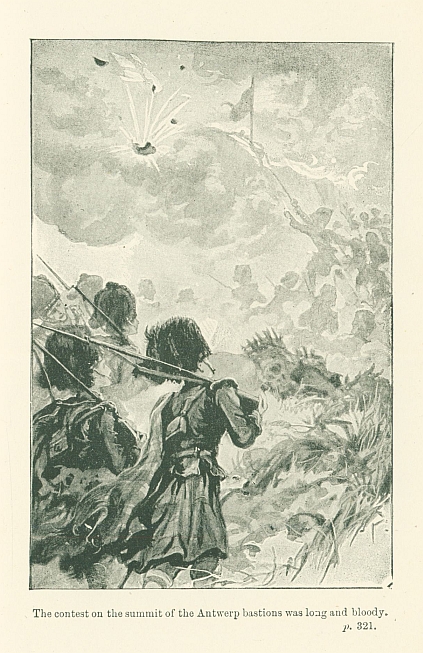
The contest on the summit of the Antwerp bastions was long and bloody.
The rest of our troops were taken prisoners.
My grand-dad, with several hundred men, were
marched into a church, and there confined for, I believe,
over four-and-twenty hours without food or water.
Then, it is said by historians, they were exchanged.
But the soldiers themselves believed that no exchange
would have been made had the French been able to feed
their prisoners.
My grand-dad's uniform was so soiled with blood
and mud, that on being freed he stripped off his outer
garments and washed them at a pump.
As his name was entered on the list of the dead, my
grandmother's grief may be better imagined than
described. Major Drake himself came to break the news
to her.
She seemed to know by his face what he had come for.
"O, John, John!" she cried, in an agony of grief.
"He is dead! He is dead!"
Major Drake could only shake his head in sad confirmation.
But that evening John himself turned up, and her
grief was changed to joy.
This puts one in mind of the lines in the old stage
doggerel song, "Jack Robertson ":
"O, someone to me said,
In a paper he had read,
That Jack Robertson was dead.
'I was never dead at all,'
Cried Jack Robertson!"
* * * * * *
My grand-dad fought side by side with the Russians
against the French. And with the Austrians, too.
Once, when crossing the ice on the Danube, the ice
gave way, and many women and children were drowned
before their husbands' eyes. This waggon was supposed
to have on board not only my grandmother, but her child
Robert. It was her turn to be reported dead. Luckily,
however, she had been changed into another conveyance
that got safely over.
This Robert Robertson was, of course, my baby uncle.
If ever anyone was a soldier born, it was he. For, after
an engagement that our fellows had gallantly won, they
encamped on the very ground on which they fought.
That night he made his first appearance on the stage of
life.
Born on a battle-field, he died on a battle-field—died,
sword in hand, fighting by a gun in India.
Strange indeed were the adventures of the wives who
elected to follow their husbands to the seat of war in
those days.
I have one more to tell of my grandmother, who
was undoubtedly one of the most courageous girls that
ever went upon the war-path.
It was after an action—a skirmish my bold grand-dad
called it—with the French, which had been fought on a
braeside sparsely covered with bush. If skirmish it was,
it was a long and bloody one, but we had succeeded in
beating the foe from the field, and retired some distance
to bivouac for the night.
Grand-dad did not return with his company. The
wounded were brought in, the dead left on the brae to be
buried next morning, in which sad ceremony the French,
under flag of truce, would also take part.
The Irish are, or were in those days, somewhat
superstitious, and dreamers of dreams.
Anyhow, my dear, brave young granny had cried
herself to sleep by the camp-fire. It was about midnight
when, she assured me herself, she heard her name called
distinctly enough three times.
"Ellen, mavourneen! Ellen! Ellen!"
The voice was that of her husband.
It was but a dream, perhaps, but she sprang from her
pallet, and passing the sentries, who tried to dissuade her,
went straight to the battle-field to look for her husband.
"Take this with you, anyhow," said one young sentry,
handing her a pistol.
This she placed in the belt she wore, and, muffling her
head and shoulders in a little Highland plaid, set out
upon her ghastly mission.
Dead, dead, all seemed dead here under the moonlight,
which made their faces uncanny to look at.
"O," she said to herself, "if I can but find him, I'll lie
down and die by his side."
Dead? Yes, but not all, for yonder from behind a
bush appears the figure of a woman.
Some poor creature, perhaps, come like herself—to
search for a husband among the slain.
But O, horror! she sees this fiend in woman's shape
swirl something quickly round her head, and then she
hears a groan, as the harpy bends down to rifle the
pockets of a man she has murdered.
The sight makes my grandmother almost sick, and
a terrible fear gets hold of her heart, and for a moment
she feels ready to faint.
She quickly hides behind a bush.
She sees the harpy finish off another poor fellow in
whom some spark of life remained.
"Ellen! Ellen!"
It is—it is her husband's voice, coming from near the
bush behind which she hides.
But the harpy has heard it too.
"Coming, John! coming, mavourneen!"
She rushes out now from the place of concealment,
just as the she-fiend approaches from the other side, and
both meet almost at the spot where my grandfather lies,
so terribly wounded that he had been left for dead.
There is no more fear in the heart of that soldier's
wife now. She stands face to face with the murderess—a
peasant woman belonging to the district.
"You would kill my husband as you killed the others?"
The pistol rings out clearly on the still air. They
hear it even in camp, and soldiers are despatched to the
battle-field to find out the cause.
They find my grandmother kneeling by the side of her
husband.
And just a little way off lies the murderess—dead.
In her pocket were found both silver and gold, and
many watches and rings.
The weapon she had been using to complete her awful
work was a strange one—a cannon-ball in a stocking.
My grandfather's wound was not so dangerous as first
anticipated, and, with careful nursing, and the kind
attention of stalwart Dr. McLeod, in a month's time he
was able once more to take the field.
The dream my grandmother dreamt is the strangest
part of this story; but is it not true that
"There are more things in heaven and earth
Than we dream of in our philosophy"?
ACROSS THE WIDE ATLANTIC—A STRANGE PARADE—THE
BAREFOOT SQUAD—SHIPWRECK—A FEARFUL FIGHT.
It is quite early on the morning of a bright
and lovely summer's day.
On board the brave old transport Salamanca
seven bells have only just been
struck. The officers are briskly walking
about the quarter-deck, up and down, up and down, in
that eager and hungry expectancy with which Britons,
be they soldiers or sailors, await a summons to
breakfast.
The sea is almost calm now. Only a gentle breeze
ruffles its waters, and the sunshine is sparkling on every
wave.
But only yesterday, and down to yester eve, it blew
so fiercely that the good ship was scudding along almost
under bare poles, and rolling and plunging enough—the
seamen said—to drag the masts out of her and haul them
overboard. There was one consolation, however, even
when the gale was at its worst. The Salamanca had
plenty of sea-room, for she is crossing the wide Atlantic
with troops to assist in the American war, in Canada.
Far too much elated at the success of the first great
War of Independence, the Americans had gone to war
with us again, and would not be content, so they vowed,
until they had captured Canada, and thus "cabbaged," as
they termed it, "the whole boundless continent."
Pity indeed that two nations such as America and
Britain, speaking the same language, holding fast by the
same religion, brothers in every sense of the beautiful
word, should ever long to imbrue their hands in each
others blood.
The Salamanca is under easy sail this morning, for she
is a fast ship of her kind, and the captain judged, rightly
too, that she must be far ahead of the other transports,
and of the line-of-battle ship the Warrior, which was
acting as their convoy.
But hark! there is a hail from the main-top-mast
cross-trees.
"Sail in sight!"
"Can you make her out?"
There is a long pause, while the out-look scans her.
And there is anxiety visible enough on every
countenance; for the vessel is three-quarters of the way
across, and this sail may be a Yankee cruiser.
"Can't you make her out?" was shouted a second
time.
One moment.
"Yes, sir; it is the Warrior."
A cheer rises from the deck fore and aft, then the
steward's bell rings, and the officers go tumbling down to
breakfast.
A little child, three years of age—a sailor's pet she
is, if ever sailors had a pet—is perched high up on the
shoulders of sturdy, giant McLeod. In fact, she has
a little leg, with well-bronzed knee, over each shoulder,
as if she were a kind of top-gallant bulwark to the bold
doctor.
The doctor has been her horse for the last half-hour,
and she has been riding him up and down the deck.
But now her excitement knows no bounds, and she
clutches the doctor by the hair with one hand, while with
the other she waves on high a little flag that one of the
men made for her.
"Hillo! the Walliol," she cries.
But now Dr. McLeod lowers her from her perch, for
she, too, is ready for breakfast.
"Good-morning, Sergeant," he says, as he meets my
grandfather. "Here is your little daughter. We have
been having such glorious fun, but if it continues like
this every morning, I won't have a hair on my head!
How do you get on with the women, Sergeant?"
continued the doctor. "Better, I trust. Have you got
them to wash their faces every morning yet?"
He referred to the soldiers' wives.
"Just hold on half a minute," said grandfather, laughing,
"and you'll see the strangest parade, perhaps, you
ever clapped eyes on. You see," he explained, "I have
ordered every woman on board to appear on deck for
inspection, bareheaded, with bare necks and naked feet."
The latter would be called "Trilbies" nowadays.
"And to show there is no unfairness," he continued,
"I have put my own wife at the head of them."
Next minute about thirty soldiers' wives appeared on
deck just as my grand-dad described, and at their head,
in the same strange deshabille, my grandmother.
They were drawn up like so many Amazons, their own
husbands laughing and chaffing a little.
"Chin up, Maria!" cried one soldier.
"Attention! Jeannie, my lass!" came from another.
"Dress, Betsy," said a third.
"Dress, indeed!" answered Betsy with a saucy toss
of her head. "I wish we could."
"Silence! Attention!"
That was my grand-dad's voice.
"Now, Mrs. Robertson," he said, "do your duty!"
Armed with a sergeant's pike, my grandmother commenced
the inspection, and, stopping for a few seconds in
front of every woman, carefully scrutinised her, literally
from top to toe.
Had any one of them appeared even with unclean
hands, either she herself would have been punished by
being kept below, or punished by proxy—namely, by
the stopping of her husband's grog.
When Dr. McLeod went below and reported what he
had seen, there was a good deal of laughing.
The adjutant, however, approved of the plan, and
complimented grandfather on his originality.
It certainly was successful, for the women after this
took much more interest in their personal appearance.
But the "barefoot squad," as Jack Tar called them, was
drilled just the same all throughout the voyage.
* * * * *
In those days there were no ocean greyhounds, as
our fleetest Atlantic liners are now called. The voyage
across the sea was therefore a long and a weary one.
The Salamanca, however, did not get out without
adventure, for in the gulf of the St. Lawrence she was
separated from the other transports in a dense fog, and
for many a week saw no more of the Warrior or any
other ship.
Finally, in the darkness of a wild and stormy night,
they ran on the rocks off the island of Anticosti.
Daylight revealed the peril of their situation, for both
wind and waves were high, and there was every sign that
the vessel would soon break up. It was a terrible time
and a trying.
At last a boat was lowered and manned by bold
British bluejackets, who pulled shorewards and round
a little cape to seek for a landing-place.
How long the time seemed! Hours and hours passed
by, and yet there were no signs of their return. The
soldiers and their wives were huddled together under the
lee of the bulwarks forward, and the children crouched
beneath their shawls and plaids.
At long last there was a cheer. The boat could be
seen coming round the point.
Luckily their report was a good one. They had found
a spot where a landing could be effected.
The women and children were sent off first, then the
soldiers, then stores, and last of all, just as the vessel was
slipping off the rock, the sailors left her.
Far over the wooded western shore the sun was setting
and daylight would soon be at an end.
The last boat was not sixty yards away from the vessel
when she slipped back. For a moment or two her
jib-boom was stretched high in the air like the naked arm of
a drowning man extended in agony, then she went down
with a sullen boom like the roar of a distant gun.
"How, brothers, row; the stream runs fast,
The rapids are near, and the daylight is past."
The stream did run high, or rather the tide, and
although there were no rapids, there were rushing waves,
and breakers too.
The last boat rounded the point safely, however, and
presently they could see the lights waving on shore to
guide them on.
And never, perhaps, were tired sailors more glad to get
on shore, and seat themselves around a cheerful campfire.
I cannot remember how many days or weeks these
shipwrecked men and women remained here, but it was
a dismal time, for the fogs closed around them again and
buried all the distant shores.
Moreover, the bears were in scores, and the poor
children were nearly frightened to death; for so bold did
the brutes become that they made dashes at night, and
carried away provisions in the very glare of the campfires.
They were rescued at last, however, and taken on board
another transport.
Then they were hurried on up into the interior, where
fighting was going on, and where their services were very
much needed indeed.
* * * * * *
Although geography ought to be studied from globes,
still maps are very useful, although at times puzzling, as
they very often give wrong impressions of the lay of the
land and the bearings of one country to another. I
should always take the part of that boy or girl who
hated geography or history, for this reason: it is taught—if
teaching one can call it—from a wrong basis at our
schools and seminaries. It is rendered neither pleasant
nor interesting, but, on the contrary, hateful. I should
just as soon expect a youngster to get by heart the first
chapter of the Book of Numbers, and feel interested in
that, as in the geography and history as taught in schools.
I will tell you, however, where a map becomes a
comfort and a necessity, and that is when a war is on.
Indeed, I believe that war teaches most people about all
they know about any place.
I have mentioned the river St. Lawrence. Now
although some little boys may imagine that the
St. Lawrence is somewhere down in Surrey or up Yorkshire
way, I can assure them it is in no such place.
Just for once in a way take a glance at your map.
What a mighty ocean that is which stretches right
away, without bounds or limits or even an island to break
its monotony, from the south of England to Newfoundland.
Some idiots call it the herring-pond, in an off-hand
kind of way as if such an ocean were a mere
mill-dam compared to the seas they have crossed. Such
people have probably never been a mile from a cow's tail
in all their low little lives.
The Atlantic is a mighty and wonderful expanse of
water, and although crossed by thousands of ships, I
have sailed in a bee-line on this great world of waters for
a whole week without seeing a craft of anything.
Only the dark heaving waves, only the boundless
horizon, only the sky. Its very lonesomeness has made
me feel eerie.
O, if that ocean had a voice other than that of its
booming billows, what a story it could tell! What
sufferings it has seen, what founderings, what battles,
what agonies! And what strange mysteries! So pray
do not talk of it slightingly, if you wish to lay claim to
having more brains than could be held in a walnut-shell.
But when going to the St. Lawrence you sail on and on
till at long last you round the great Bank of Newfoundland,
then bear north and west, till you skirt the huge
island itself, which is as large as the whole of Ireland
itself.
When past this you are in the Gulf, and so you sail on
and past Anticosti, where my grandfather, grandmother,
and my three-year-old mammy were wrecked. You are
in the river now, but still a mighty long way from
Quebec itself. But, if you clap your eagle eye on the
map, you may be surprised to know that the distance
from Toronto to the mouth of the St. Lawrence is nearly
as far as from Cork to the middle of the Atlantic, and
Lake Erie farther still. You will note also that New
York itself is far nearer to Toronto than Quebec itself.
Well, the United States had been casting sheep's-eyes
at our big sister Canada. But Canada is our love,
not theirs. She belongs to this other boy—to John,
and not to Jonathan—and if John catches Jonathan
making love to his sister Canada, O my! won't Jonathan
catch it, that is all! The boundary-line of the United
States is a perfectly straight one from the shores of the
Pacific to the Lake of the Woods in Upper Canada.
Well, all Jonathan wanted was to extend that line on
the straight to the Atlantic Ocean.
But Sister Canada wouldn't have it.
"If you come a step nearer, Mr. Jonathan," she says,
"I'll scream, and wild cats won't be in it."
You see, reader, it is not a very difficult thing to make
a map on paper with pen and ink. But when the same
job is attempted on terra firma, with a sword for a pen
and blood instead of ink, why the case is considerably
altered.
Such a map, however, the Americans determined to
make, a year before my grandfather's battalion crossed
the ocean.
At this time, instead of having ships on the great
lakes and soldiers on shore, we had neither to speak of.
So, in the early part of 1813, General Dearborn, who
commanded the American forces, had set the ball in
motion. He advanced upon York—a town and stronghold
on Lake Ontario.
We had barely a thousand men there, and, as the
Yankee was supported by a flotilla of gunboats, the
Canadians decamped, leaving their military stores for
Dearborn.
"That is a good beginning," he said to himself. So,
in his flotilla, he loaded up those stores, and with artillery,
cavalry, and infantry—about seven thousand all told—he
set sail for Niagara, and, after some hard fighting,
captured Fort George. General Vincent, of the British or
Canadian side, had only a handful of troops, so could not
well oppose Dearborn. But Vincent, after clearing out
of Fort George, collected all the troops he could find,
to the number of about eighteen hundred, and determined
to make a stand fifty miles up the strait at Burlington
Bay.
This was another chance for Dearborn to annihilate
a few more Britishers; so he marched to attack brave
Vincent with nine guns and three thousand men. But
Vincent himself did the attacking this time; and Colonel
Harvey, of ours, was chosen to lead a midnight bayonet
charge on Dearborn's camp. It was an awful fight, but
it did not last long. Harvey was victorious; though he
had only seven hundred men, he scattered the enemy in
all directions, littered the ground with their dead and
wounded, and took four guns and over one hundred
prisoners.
This, then, was the beginning of this new American
war; and, though it must be admitted the Yankees
fought bravely at times and met with many successes,
they really had reckoned without their host. That host
was Canada; and so pluckily did she fight that they
were utterly beaten.
They had run up a heavy bill which it would take
a long time for their country to clear; they had lost in
all over fifty thousand men, and last, but not least, they
had earned for themselves the hatred of every man and
woman in Canada, and that hatred, I fear, is a fire that
is smouldering till this very day, as the extraordinary
activity of the Canadians and their splendid rush to arms
during the-war scare in January, 1896, fully prove.
The word "never" is a long one, for neither men nor
nations know what may be in store for them in the
future, or how near to them the future that shall work
such changes may be; but it is the general opinion, both
here and in Canada, that America will never be able to
conquer Canada. She will never be a great naval Power
either. She certainly will not be if she crosses arms
with Britain. It will add to her wealth, as well as her
power, to keep the peace with her old mother, Britain.
And now, my intelligent reader, I consider that there
has been blood enough spilt in these pages of mine
to satisfy any gore-loving lad that ever sat by a cosy fire
on a winter's evening.
But I must give you a sketch of just one fight that
occurred on the Canadian frontier, and, after you have
read it, I wish you to ask yourself the question: Ought
two nations, who can fight so terribly as this, to be other
than friendly?
The fight was about a battery that the British had
erected on a commanding hill at the battle of Chippewa.
"The action," says Alison, quoting from General Drummond's
official account, "began about six in the evening,
and the whole line was soon warmly engaged, but the
weight of the conflict fell upon the British centre and
left."
Notwithstanding the utmost efforts, the latter was
forced back, and our General Riell was severely wounded
and made prisoner. The 89th, Royals, and King's
regiments opposed a determined resistance, and the guns
on the hill, which were worked with prodigious rapidity,
occasioned so great a loss to the attacking columns, that
General Brown (American) soon saw that there was
no chance of success until that battery was carried; and
a desperate effort was resolved on to obtain the mastery
of it.
The Americans, under General Millar, advanced with
the utmost resolution, and with such vigour that five
of the British cannon at first fell into their hands.
So desperate was the onset, so strenuous the resistance,
that the British artillerymen were bayoneted by the
enemy in the act of loading, and the muzzles of their
guns were advanced to within a few yards of the English
battery.
This dreadful conflict continued till after dark, with
alternate success, in the course of which the combatants
fought hand to hand, by the light of the discharges of the
guns, and the artillery on both sides was repeatedly taken
and retaken.
At length the combatants sank to rest, from pure
mutual exhaustion, within a few yards of each other, and
so intermingled that two of the American guns were
finally mastered by the British, and one of the British
by the Americans.
During the period of repose the loud roar of the battle
was succeeded by a silence so profound, that the dull roar
of the Falls of Niagara, interrupted at intervals by the
groans of the wounded, was distinctly heard.
Over the scene of this desperate strife the moon threw
an uncertain light, which yielded occasionally to the
bright flashes of musketry and cannon when the combat
was partially renewed.
But British Drummond took advantage of the lull
in the awful storm to bring up his right, so as to support
the centre.
The American general now saw that all his efforts
were in vain, and at midnight the bugles sounded the
retreat; the blood-red hill and their guns were left to the
British who had so manfully defended them.
I think you will agree with me that the answer to the
question I requested you to put to yourself must be:
"No—No—No."
"I re-echo," said a well-known man on January 25th,
1896 (Burns' birthday), "I re-echo and I reciprocate,
from the bottom of my heart, the noble words which
were spoken by the American Senator Walcott, amidst
uwonted applause, in the hall of the Capitol at
Washington, when he said: 'Blood is thicker than water, and
until a just quarrel divides us, which Heaven forbid,
may these two great nations, of the same speech, lineage,
and traditions, stand as brothers shoulder to shoulder in
the interests of humanity by a union compelling peace.' That
always has been, that always will be, the wish of
every Briton. The two nations are allied, and more
closely allied in sentiment and in interest than any
other two nations on the earth. While I should look
with horror upon, anything in the nature of a fratricidal
strife, I should look forward with pleasure to the
possibility of the Stars and Stripes and the Union Jack
floating together in defence of a common cause sanctioned
by humanity and by justice."
In God's name, then, let us have peace with our
brother Jonathan, and heartily shake
HANDS ACROSS THE WATER.
RED-EYE, THE INDIAN CHIEF—A TERRIBLE ADVENTURE
WITH A BEAR—BAD NEWS!—STOLEN OR KILLED BY
INDIANS.
The war in Upper Canada may be said to
have ended before the winter of 1814-15.
Ended indeed in General Drummond's
terrible but abortive attack or assault
on Fort Erie, in which he lost about
five hundred in killed and wounded.
The general, although reinforced, dared not attack
again, "but," as Alison says, "contented himself with
drawing closer the investment, and cooping the large
American army up in a corner of British territory,
where they were rendered perfectly useless during the
remainder of the campaign."
Meanwhile, however, ships were being built, and gunboats
too, both for the British and Americans to float and
fight on the great inland seas and lakes, and this with
the intention on the American side to make one more
effort to conquer Canada in the ensuing spring.
If, however, I were to tell you of the battles, by land
and sea, which took place this year between Britain and
America, further south than Canada, although I might
succeed in interesting some of my readers on this side of
the Atlantic, I might irritate my good friends on the
other.
While the good weather lasted, and the bright and
beautiful Indian summer, life in camp, in log huts, or
in houses was delightful enough to my grandfather and
his wife, with my little mother, Mary Robertson, to say
nothing of Tonal's Spanish wife herself.
The woods and forests, the lakes and streams, and the
rugged hills were clad in all the glory and colour of a
late autumn.
My mother was a true fille du regiment, and continued
to be as much a favourite and as much beloved by officers
and men on shore as she had been at sea.
The Indians in those times were far more numerous in
the forests and hills, in the great lake districts, than they
are now. Neither British nor Americans have ever
meted out to them any very great measure of justice.
In fact it has been very much the reverse. We have
driven them back, back, back, before us; we have taken
their territories over and over again; we have cheated
and robbed them, and when they have retaliated and
taken the revenge that red men always will, we have
declared against them a war of extermination, or almost;
we seemed to forget that they were human beings, and
shot them down like wolves.
These poor, brave creatures assisted us greatly in the
war against America. But they fought in a savage way,
and mutilated even the wounded in a shocking and
fearful manner. For the braves must have scalps to hang
on poles, far away where their wigwams stood in forest
glade, or by the peaceful streams that meandered through
their territory.
These Indians, now that comparative peace had come,
still lingered around our camps. They were, alas! too
often led into excesses by the fire-water of the pale-faces.
Strangely enough, the child Mary exhibited not the
slightest trace of fear in the company of these dusky
warriors. She would even toddle off at times to their
camp, and not be seen again for hours, when some of the
Royal Scots, being sent in search of her, were sure to
find her chatting gaily to squaws or braves, in their
tents or by the log-fires.
But there were Indians also who hated the British,
and hated also those tribes who had fought for the pale-faces,
such as the Chippawas, the Wyandottes, and Minsees.
With these, I believe, we were friendly on the whole, but
far away in the west and north, was a tribe or branch of
the Micmacs, whose hand appeared to be turned against
everyone, and who were constantly on the war-path.
They lived chiefly by their bows and arrows or spears,
but of late years had made use of guns also, so that
they were now considered still more dangerous and
deadly.
Their wigwams stood on the shores of a beautiful,
lonesome sheet of water, embosomed by woods, and to
which they had given the euphonic name Eeowreeva, or
Yewreeva, the Great Pike Lake. Here these red men
had lived for many generations, more than Red-Eye, a
friendly Micmac, who often visited the camp, could count
on his fingers. They loved their home in the wild west,
Red-Eye said, because no pale-face had ever yet come to
see and seek their land.
This land, and all the hills and forests around it, was
no reservation. It was simply a country into which the
pale-face had not as yet penetrated.
But Red-Eye, or Led-Eye, as Mary called him, was no
beauty to gaze upon. On the contrary, it was believed
that, although he prided himself on the distance he
could throw a spear, or his skill with a tomahawk,
his chief pride lay in his stern and dreadful face, and
in the number of scars he had on his body, many of
which, he assured my grandmother, whom he often
visited, had been received in fights and encounters with
wild beasts, with bears and panthers, that he had followed,
even to their very dens, and killed. In his own country
he had been a chief.
Little Mary, my mother, used to listen with rapt
attention to this semi-civilised savage's account of his
adventures, as he squatted near the fire, wrapped in
his great striped blanket.
But she must have been too young to understand
much of what was said.
A strange sort of friendship, however, sprang up
between the two.
Their love-making, if so it could be called, was droll
in the extreme.
"Po' Led-Eye," she said one day, as she stood beside
him, nursing one of his hands, on which were the marks
left by a panther's teeth. "Po' Led-Eye. And the
nasty wild beast cut you so! Did you kill the big cat,
Led-Eye?"
"Ugh! child, yes, I kill he quick. With my spear I
kill he. Hold my spear so."
"Ah! Ah! wild cat was all toveled (covered) wi'
blood, wasn't he, Led-Eye?"
"Blood in streams!" said Red-Eye.
"O, how nice! Anazle (another) big tut (cut) on
'oo blow (your brow), po' Led-Eye, what make that
tut?"
"The spear of a chief, child of my heart."
He smoothed her long fair hair as he spoke, and
glanced lovingly into her blue eyes.
"Child of my heart! Hair like sunset clouds. Eyes
and cheeks like stars and flowers. Child of my love!"
"'Oo iss, of tourse. Child of oor love. But 'oo kill
the tief (chief) that troo the spear and cuttit oo blow.
You kill him, quick, quick?"
"I kill him, plenty quick."
"And he bleeded all over?"
"Ugh! I wash my hands in his blood."
My little mother jumped for joy.
"How nice! how nice!" she cried, clapping her hands.
"Tell the chile of oo love mo' stolies."
"Mary, Mary," cried my grandmother, "come here this
instant, till I get you ready for bed."
"I think," said Tonal to my grandfather, as they lay on
their blankets by the fire, "I think that Mary would
grow up a splendid savage. Come here, Mary, and sit on
my knee. Your mother won't put you to bed for just a
little while, I'm sure."
"Not if she's good."
"I sit on oo knee bymeby, when po' Led-Eye does
(goes) away to feep (sleep)."
"You like Red-Eye best, then?"
"Of tourse. Led-Eye mo' ugly as you.
"Nevah mind," she continued, patting the savage's
cheek, "when I dlows (grows) up, I lun (run) away to
the woods and be oo queen."
"It's all settled then, John," said Tonal.
"It would seem so, Tonal."
But Red-Eye's love-making did not end in mere
words. Words are only froth, acts alone are solid, and
he used to bring the "child of his love" many beautiful
things from the forest—flowers, skins of beasts, and
feathers of birds.
Once he brought her a live humming-bird, or one of an
allied species. It soon died, however. Then he took
much pains to cure it for her. He opened it slightly,
and stuffed it with strange spices and musk. Then
he rolled it in leaves, and laid it on a stone near the
fire, and behold! in an hour it was embalmed and
cured.
That little bird, in a tiny glass case, is on my table as
I write. I would not part with it for all the world. All
the world would be nothing to me, as I should not know
what to do with it, but this little case, ah! what
gladsome memories it brings me back.
Tonal and my grandfather used often to accompany
Major Drake or Dr. McLeod in long rambles into the
forests.
They would be away for two or even three days sometimes,
and never return without the spoils of the chase,
to the great delight of my little mother, Mary.
Part of these excursions was by boat, the other on
shore.
Their guide was invariably Red-Eye.
He was a fearless fellow, and often led them into
adventures that it would have been as well for them
had they avoided.
On one of these occasions McLeod fired upon a great
bear on a hillside. The brute was but grazed, and came
rushing down upon him with a roar that seemed to rend
the very rocks. Both man and bear went rolling down
the brae, and powerful though the doctor was, he never
could have come out of the adventure alive, had not
Red-Eye been there. The Indian buried his tomahawk in
the monster's neck. With a yell the bear now sprang
at him, and had not O'Reilly, who was near, placed
the muzzle of his gun close to the bear's ear and fired,
poor Red-Eye would have told my little mother no
more terrible stories.
Though badly bruised,
"Unwounded from the dreadful close
But breathless all McLeod arose."
Red-Eye appeared none the worse. He just shook
himself and said, pointing to O'Reilly's gun:
"Ugh! Much good fire-stick."
But the spoils of the chase did not invariably consist
of bears, or any other of the feræ, but game and pigeons.
The latter were seen sometimes, not in flocks only, but in
clouds, so that it was no uncommon thing for our heroes
to bring them down with bullets.
I do not mean to say that the very bird that was
aimed at always fell—-though with a good modern rifle
and a good modern marksman this might have been the
case—but so numerous were they that it was almost
impossible to fire without hitting.
Some of the streams, away in the backwoods, teemed
with fish. In fact, so numerous were these that one
could scarcely call it sport to catch them.
One day, while my grandfather and Drake were in the
woods, they got talking together about home, and the old
scenes they had passed through, and the battles in
which they had fought shoulder to shoulder.
Both had received letters only the day before.
"O, by the way, Sergeant," said Major Drake suddenly,
"I have something to tell you.
"I had a letter from H——. You know he is a friend
of the Duke—our particular Duke."
"The Duke of Kent?"
"Yes; and it seems H—— was telling his Royal
Highness how your wife shot that terrible harpy on the
battle-field, and saved your life.
"The Duke," continued Drake, "was enthusiastic, and
he does not take wine to make him so, either.
"'Robertson,' he said, 'was one of the best
non-commissioned officers I ever had on my staff, and right
bravely but coolly he could do his duty in his regiment
also.
"'And, H——,' he continued, 'the Highland battalion.
of the Royal Scots will soon be au fait accompli, and I
shan't forget my promise to Robertson.'"
"Thank Heaven," said my grandfather, "for that news!
It has been my dream for years. Could I afterwards
gain a captaincy in my company, and once lead it into
action against the French, I would die happy. And you
know, sir, I am no mere romancist.
"But, sir," he added, "with the fall of Napoleon and
the restoration of the Bourbons, don't you think wars will
cease all over the world, and that there won't be
anymore use for Highland battalions?"
Drake laughed.
"Listen, Sergeant John," he said. "Mind, I'm no
prophet, and never was, but—Napoleon is scotched, not
killed."
"And pray, sir—who—or where——"
"Where did I get my information?"
"I fear I'm rude, sir, but that is what I was about
to ask."
"Well, my good follow, a wee birdie told me."
That was a happy day all through for my grandfather.
Happy, that is, until eventide.
But as he was going singing up to his own log hut, with
a bundle of birds over his left shoulder, he was surprised
to find the men standing here and there in little groups.
And he could not help imagining that they were looking
at him in a kind of pitying way.
I have said little about Tonal's Spanish wife for the
simple reason that there was little to tell; yet she
had followed his fortunes all through the war, and
proved a very great boon to the pipe-major, as he was
now called.
She was here in camp.
Instead of little Mary running as usual to meet her
father, it was poor Mrs. Tonal that came.
Her large, dark eyes were swimming in tears.
"O, Sergeant Robertson," she began, but the grief
seemed to choke her utterance.
"Good heavens, girl, speak!" cried my grandfather.
"Speak, I entreat of you! Has anything happened to
my dear wife?"
"No, no," gasped the girl, for girl she was to all
appearance. "She is gone to the Indian camp, but my
husband has gone."
"Tonal gone?—dead?"
"Oh!" she cried, "we do not know, Mr. Robertson,
but Mary, little Mary, too, has gone."
For a moment, forest, lake, and hill seemed to spin
round, and my grandfather had almost fainted.
His daughter, whom he adored, lost, gone! It was
too awful to think about.
He threw down his gun, threw down his game, and
next moment was hurrying off to the Indian camp.
He would now, at all events, hear the very worst.
"WHERE IS RED-EYE? I WILL KILL HIM!"—A SOLEMN
SCENE—THE MOONLIT FOREST.
On his way to the wigwam camp, as that
of the Indians was called, he met stalwart McLeod.
"Ah!" said the soldier-surgeon, "I see
you have heard the bad news."
My grandfather's face was set and stern, but very pale.
"No, Doctor," he replied. "Tonal's wife could tell
me nothing, only that her husband and my child have
disappeared."
"Yes, and—but can you bear the evil news, my good
fellow?"
"I can bear anything—anything except suspense."
"Well, the facts, as far as we know them, are these.
Our friendly Indians had arranged to-day to hold a feast
far away in the forest. They went off in their war-paint.
The pipe-major, with one man—Roberts, of your
company—went with them, and poor wee Mary would not be
left behind. You know your wife will trust her
anywhere with Tonal."
"Yes, yes. O Doctor, pardon my impatience, but go
on—go on."
"The Indians went off with great rejoicing, Tonal
good-naturedly playing in front of them.
"At three o'clock the scattered remains of our Indians
came into the camp by twos and threes, some sadly
wounded, but no Tonal, no Mary, and no Roberts."
"Killed?"
"Roberts was killed at the first volley. For the
Micmacs are on the war-path, and have come from
afar to take revenge on our Indians. They seem to
have known the very day they would hold this feast."
"Dr. McLeod, there is treason in the camp.
"Where is Red-Eye? I will kill him!"
"Stay, stay," cried the doctor; "do not be rash. I
believe Red-Eye to be as faithful as he is simple and
brave."
"Where is he, I say?"
"He has gone alone into the forest to seek for your
child. If there is any man in our camp who can pick up
a trail, it is he."
"Dr. McLeod, sir, he will never return; and I here
make a vow—and let it be registered in heaven—I
will follow him to the wilds of the farther west, and,
when I find him, will slay him in his tracks."
"Robertson, my boy," said the kind-hearted doctor—"for
you are but a boy to me—Red-Eye may be a savage,
but he is also a Christian, and to the lake-side, after
sunset, he has gone every night to pray. I happened to
be there but two nights ago, when he stalked silently
down, and knelt with his face to the west. Me he could
not see, Robertson. I have heard eloquent prayers from
many a pulpit, and at many a humble fireside far away
in bonnie Scotland, but I never listened to so simple yet
heart-o'erflowing prayer before. And you and your little
daughter were prayed for in words of such passionate
tenderness that I shall ne'er forget them."
There was a reaction now.
"God forgive me, Doctor, if I wrong the man."
Then he covered his face with his hands.
"Come, come, Robertson, do not take on so. There yet
is hope, you know. Come, I shall have your wife and
yourself on my hands as patients, if you break down
thus."
* * * * *
A party, that had gone out to bury the dead and bring
in more of the wounded, now came in. They bore, on a
litter of branches, the lifeless body of Roberts, a young
fair-haired lad, who had joined in Canada.
His terrible wounds were all in front, showing how
well he had fought.
He, like all the other dead, and some of the wounded
had been scalped.
The assault by the Micmacs, it seems, had been terribly
sudden.
It was a wild mêlée, and terrible tulzie, but soon over.
As neither Tonal nor the child was found in the forest,
it was evident that they had been taken prisoners.
Tonal would doubtless be tortured at the stake, but
how about Mary? She would either be flung into the
river or over the cliff, or stripped and dressed as a
papoose, then handed over to the tender mercies of some
horrid squaw, to be reared as a little savage.
Poor wee wonder! she had often expressed her wish to
become a savage, and roam through the woods and wilds
with the braves. Little did she know then what was
about to befall her.
There would be no sleep for grandfather to-night, and
little for anyone else.
Preparations were being hastily made, however, for an
expedition against the Micmacs. It was hoped that,
secure in the depth of the forests, and in their mountain
fastnesses, they would not hurry homewards, but follow
the chase for a time. But this was only conjecture. If
they went directly towards their own country, there was
but little chance of our people being able to overtake
them.
Besides, there were no good guides. The knowledge of
even the friendly Indians, concerning this hostile tribe,
was but small, but they would do all they could.
The expedition would not start until daybreak; so it
was at first arranged. Without proper guides, rashness
would only mean disaster.
My grandfather lay down for a time, but sleep was, for
once, banished from his eyes.
He was restless, wildly restless. So he got up and
left the hut. He left his wife asleep, for sorrow, in some,
often causes drowsiness.
He would have bent down and kissed her, had he not
feared it would wake her, for her cheeks were even
now wet with tears.
Grandfather passed the sentry, and went on towards
the lake. The sight of a placid sea or lake seems to
have a soothing effect upon the nerves.
What a beautiful night it was! Not a breath of wind!
The great round moon was struggling up through a
ghostly fog, and her red beams turned the waves to a
yellow-pinkish hue. The forest all around looked like
rolling clouds of vapour, and the ground itself was so
white, that at a little distance it seemed covered with
snow. It was a solemn scene!
Nothing was heard, except now and then the mournful
cry of a night-bird, and the shout of a watchful sentry.
But the drone of the distant waterfall filled all the air,
and the very trees appeared to vibrate to its rhythm.
No life was visible anywhere.
Grandfather was alone. Alone with his grief. Alone
with God.
Yes, He could see him. He loved him still.
A very bright star shone high up in the east, and
appeared to look down on the sorrowing father with
kind and pitying eye.
He knelt near the lake to pray. It was no presumptuous
prayer.
"If it be Thy will, O Father, who have always been
my Guide and Friend——"
That was the first of it.
"If it be Thy will."
And prayer should never go further than this.
As he still knelt there, and the waters of the lake grew
more and more silvery every minute, as the moon rose
higher and higher, a tall figure came gliding from the
forest, walking in its moccasins as silently as, they tell
me, ghosts walk.
"Ugh!"
Grandfather started to his feet.
The moon shone full now in the face of the Indian, Red-Eye.
"Red-Eye, it is you. What is it you carry?"
Red-Eye held his burden by the hair aloft.
An Indian head, with half-open eyes and drooping jaw.
"Red-Eye, how came you by that ghastly trophy?"
The Indian only pointed to the west, threw the head
down carelessly, and sat down.
"I tire, much tire," he said, as he leant on one arm
and commenced to fill his wooden pipe.
Grandfather sat down beside him and waited. He
knew the habits of Indian warriors.
He felt sure the man would speak anon.
The moon was in full silver flood now, and grandfather
could watch Red-Eye, and note every expression on
his wild uncouth face.
"Red-Eye's heart is heavy," he said at last.
"And my heart is heavy, Red-Eye."
"Indian can love more—much more than pale-face.
I loved your lost child."
Grandfather drew nearer to him. He felt he could
trust this strange man. He felt that now, for the first
time.
"Long ago—long before the pale-face was sent by your
great white chief to fight bad 'Merican man—I live in
the sunset west. Soon quarrels rise. I love one Indian.
Grat Pike love her too. We fight. All braves fight—but
I kill my chief. Then I fly and live in the forest.
Every man want to kill Red-Eye then. For years I
live so. Meemee come too, but one night she die."
He paused for a minute, as if the memory of his grief
had made him dumb.
"Then when pale-faces come, I come to your camp-fire.
You not trust me. You think poor Red-Eye
traitor and thief. You think I steal the child for my
tribe."
"No, no, no, Red-Eye! I did doubt you, but now
I think my eyes have been opened."
Red-Eye pointed with his pipe to the ghastly head.
"He one scout. One spy. Yes, he belong to my
tribe. Ugh! He not tell more tale."
"And whither, think you, have they taken my child
and my friend?"
"When I kill he, I go after my tribe. Your child I
cannot see. Your friend play in my tribe's camp."
"Tonal playing! He must be mad!"
"No. Suppose not play, then——"
Red-Eye touched his neck with the point of his finger.
This was significant enough.
Then up sprang Red-Eye, tall, defiant, determined.
"Your men ready?"
"They will start to-morrow morning early."
"Too late! They start now!"
He pulled out his knife and quickly scalped the
hideous head.
The scalp he hung to his girdle.
"Come," he said.
And grandfather followed mechanically, as it were.
His head was bent downwards. He walked as soldiers
walk at the funeral of a well-beloved friend.
But he was hopeless. He would never see his little
Mary-again. Of this he felt certain.
The Indian led the way to the hut occupied by Major
Drake, and quickly that gallant officer responded to the
summons.
Dr. McLeod came out with him. Both started when
they saw the tall Indian with scalp and tomahawk in his
girdle.
"Red-Eye, I am happy to see you," said the doctor.
"Come now," said Red-Eye, pointing to the moon.
"I will guide you to the camp of the Micmacs. Come
quick."
In less than half an hour O'Reilly, Drake, and McLeod,
with fully half of my grandfather's company, had fallen
in.
They were silent and grave, but the look of sternness
on each face told that they meant business.
My grandfather ran in to say good-bye, and bid his
wife and Tonal's be of good cheer and—just pray!
Then, in double file, and still in silence, men and
officers marched away, guided by Red-Eye, and soon
were lost to view, swallowed up, as it were, in the
depths of that great white, moonlit forest.
THE FIGHT WITH SAVAGES—A LONE GRAVE IN THE
FOREST—RETURN OF SPRING—NAPOLEON AT ST. HELENA.
At first the half-frozen leaves rustled crisp
beneath the men's feet, but Red-Eye led
them through the darkness of the great
forest, into which hardly a ray of
moonlight could find its way, and here the
ground was soft, and the leaves made no noise.
Red-Eye believed he had the scalp of the only spy
hanging at his girdle; but he might be mistaken, so every
precaution was taken to maintain an unbroken silence.
Ten of the friendly Indians, by Red-Eye's desire, had
accompanied the expedition, and these he spread out on
both flanks and ahead, so that if an enemy appeared they
could give timely warning, and our fellows would be
ready to fight.
On and on they marched, for many weary hours; then
at last, when near daybreak, Red-Eye ordered a halt.
The camp of the enemy was not far distant.
Leaving the scouts well spread out, the guide now
went on by himself.
He would soon return, he told the officers.
"I dare say it is safe enough, O'Reilly," said Major
Drake, "but precaution is part of a soldier's duty. We
will keep our fellows well together, and post sentries.
This may be an ambuscade, you know."
Daybreak was already spreading up in the east-by-south,
when Red-Eye once more glided into the camp.
"No good news," he said. "Red man's camp-fires are
cold. But I find the trail."
He now rolled himself in his blanket, and was soon
fast asleep.
The wearied men, by Major Drake's advice, did the
same, and the needful rest was taken that should prove
of so much importance when they got, at last, hand to
hand with the Indian foe.
Weary men sleep soundly, and three hours' slumber
to a soldier on the war-path will make him as fresh and
strong as ten hours taken in a stuffy room.
On again; on and on all that day, through woods and
wilds, sometimes climbing wooded hills, in the sides
of which many huge bears had their caves, and into
which they retreated, growling and threatening, as our
men walked past.
Great was the temptation to Drake and O'Reilly
to try conclusions with some of the monsters. But the
sound of a gun in these forests, where, as Red-Eye
expressed it, the very trees have ears and tongues, might
have given an alarm that would have rendered the
expedition all in vain.
Red-Eye himself said but little. He was too busily
engaged, sticking to the trail as a pointer follows the
scent of game. This trail was at times so much in
evidence that even a white man could make it out; at
others difficult even for the red man himself to descry.
Sometimes it was divided and subdivided, seeming to
go in a hundred different directions, and it required
the utmost skill then to discover which was the right
one.
There were rivers to be forded, also deep morasses to
be crossed, while at times a lake caused a long detour
to be made.
Sometimes a strange Indian was met with, and was
invariably made prisoner.
At nightfall a halt was again called, and rest and food
taken.
But Red-Eye seemed to need neither rest nor food.
He left his party once more, telling Major Drake he
would return at moonrise.
How he could find his way through the dark of the
forest, with nothing save the stars to guide him, it is
impossible to say.
The men lay down by their arms. No one was inclined
to talk. They were tired, and sleep alone could do them
good.
It was midnight before Red-Eye once more glided into
camp.
My grandfather, who had slept but for a very short
time, was up and watching for him.
His report was this:
"I travel many, many miles. Then I come to big, big
hill. This I climb and look far to the west. Ugh! I can
see plenty camp-fires light the sky, and my heart rejoices.
I go nearer and nearer. Then cat-music fall upon my
ear, and I rejoice more."
"Cat-music, Red-Eye?"
"Cat-music—the wild music of your people."
"You mean the great Highland bagpipes."
"It is that. It is that. Your Tonal play to the chief,
and they much rejoice."
"With God's help," said my grandfather, "we'll change
their tune."
The whole camp was speedily astir now. According
to Red-Eye, they would have only about seven miles
to traverse, but, at the slow and creeping pace they needs
must travel, it would take them about three hours at least
to do the journey, for they would have to be as silent and
cautious as panthers.
It was midnight when they started, and the moon
shone bright in every clearing. But they still had to
keep well into the darkling of the woods, for it was
unlikely that a savage tribe of Indians like the Micmacs
would squat around their tent-fires without posting
sentries and scouts.
This made one of the chief difficulties in the way
of effecting a rescue.
Another difficulty was even more formidable. So, at
all events, it appeared to grandfather. It lay in the fact
that, if the enemy's camp was not captured by very
sudden surprise, the savages would, doubtless, spear poor
Tonal, while they who had possession of little Mary
would strangle her.
This last thought was a horror of horrors that made
my grandfather almost delirious.
If anything happened to his child, he determined that
he would never return. He would follow the savages
alone. Without doubt, he would pay the penalty of such
rashness with his life: but he would sell this dearly.
Without adventures of any sort, though often startled
by the growling of some bear, or the mournful cry of the
great brown owl, they crept stealthily on. After a time,
however—and how very long that time had seemed to my
poor grandfather it need scarcely be told—a sound of
another sort fell on the listening ears of the Royal Scots.
It was the wail of the bagpipe playing a coronach, or
lament.
How solemn and sad it was, rising thus from the
depths of the midnight forest!
It stopped suddenly; and once more the little army
marched onwards.
They could not be far off now, so double caution must
be exercised.
Red-Eye soon lifted his hand as a signal for the halt.
Then he touched Major Drake and my grandfather on the
shoulder, and beckoned to them to follow.
When about seventy yards off, Red-Eye lay down for
a moment with one ear close to the ground.
This is the savages' telephone, and it is wonderful what
sounds they can thus hear.
The very earth seems to talk to them, and confess its
secrets.
He crept forward now on hands and knees, the others
following his example.
Suddenly a glimmer of light could be seen rising high
up on the pine-trees beyond, and next moment they
were looking down over a rock into the camp of the
red men.
If the Indians have more acute hearing than we pale-faces,
they have also better eyesight. Neither Drake nor
my grandfather could distinguish anything very well in
the uncertain light of the camp-fires, that darted up
through the rolling clouds of smoke, and struggled
confusingly with the moonbeams.
There were but two tents in the camp, which was
pitched low down in an open glade, near to a little lake
or pool. Both were made of green pine-boughs. The
larger, near to which lay poor Tonal, now bound hand
and foot, no doubt belonged to the chief and his squaw.
The other, it was equally certain, contained Mary and
her attendant.
Red-Eye and his companions now drew back a little,
and held a whispered conversation—a council of war.
My grandfather wished to make a sudden dash on the
foe, but Red-Eye shook his head.
"No, no, no," he said: "Indian too quick—kill Tonal,
kill child of my heart too."
Then he proposed his own plan.
He would creep snake-like towards the camp, cut the
cords that bound poor Tonal, then dash straight to the
smaller tent, and seize the child.
By this time the camp would be roused, and the
soldiers must come to the rescue.
This plan was adopted, and away glided Red-Eye on
his truly dangerous mission.
The men were brought as close to the camp of the
enemy as safety would admit of, and my grandfather
and Major Drake once more took up their position on
the rock from which they could see the camp-fires.
For the present, all they could do was to wait and
watch.
At no period of his life, my grandfather has told me,
did he ever experience such terrible anxiety as that
which he now felt.
How very, very long the time seemed!
At last his head sank on the moss. He could bear to
look no longer.
What a blessing it is that God is near us wherever we
go, and that we can always pray.
But hark!
There is the sound of a musket far down beneath.
Then a yell.
"Like the wild scream of the curlew,
From crag to crag the signal flew."
The whole camp down yonder is in motion, the savages
are rushing hither and thither like a nest of hornets.
The fires are being rapidly extinguished—this is the work
of the squaws. But as yet no savage knows whence the
danger will come. They are already armed, however,
with bow and spear and musket.
See! see!
The retreating figure of an Indian can be distinguished
by them, making his way eastwards, and bearing
something in his arms.
Twang go the bows, muskets are discharged, but still
he hurries on.
But now, high above the ear-splitting yells of the
savage foe, rises the war-cry of our men, as they dash
down to the charge with bayonets fixed.
That was an ugly fight while it lasted.
A battle bloody but brief.
Our fellows spared none, their bayonets doing the
work until the savages broke and fled. Then volley
after volley was fired, until all had disappeared in
the depths of the forest.
Dr. McLeod had fought his way to the chief's tent, and
near it he found Tonal, still bound, for Red-Eye had been
discovered before he had had time to cut his bonds.
"God bless you! God bless you, Dr. Mac!" he cried,
as the giant lifted him on his back as deftly as one
might lift a child.
"But man! man! the pipes! I'll no go a single inch
without my bagpipes."
Hastily Dr. McLeod picked up the bagpipes, then
speedily rushed back in the direction Red-Eye had
taken.
Little Mary was running to meet him. Safe and sound
she was, but crying bitterly.
"Po' Led-Eye! O, po' Led-Eye! He is all blooded
and dead."
Dr. McLeod now cut Tonal's cords, then hurried to the
spot where the poor faithful fellow lay. It was evident
that life was fast ebbing away, but the doctor did what
he could to stanch the bleeding.
He administered a little brandy, and Red-Eye seemed
to revive. It was but as the glimpse of sunshine that
precedes the summer storm, and of this Red-Eye appeared
to be fully aware.
When my grandfather and the others ran up after the
savages had fled, they found Tonal supporting Red-Eye
on his breast, and the child sitting near, quietly weeping.
She rushed into her father's arms.
"But O, daddy," she entreated, "tan oo save po'
Led-Eye, 'fore he dies, and does (goes) away to a dark
hole?"
"He is sinking fast," said Dr. McLeod, as my grandfather
knelt beside the dying man.
"I will take little Mary away."
"No, no, no," cried the child; "I sit by po' Led-Eye
all the time." And down she sat.
Red-Eye tried to lift his hand towards Mary. She
took the poor scarred hand that she had often nursed
before, and the faithful fellow seemed more peaceful
now.
"Lead me—through—the darkness," he murmured—"to
the land of the Great White Spirit."
These were the last words he spoke. His own spirit
fled.
Grandfather closed his eyes.
His bitterest thought at that moment was that he had
ever doubted this poor Indian, who had given his life to
save the child.
* * * * *
So sudden had been the attack upon the savages that
few of our fellows were wounded—none dangerously—and
no one was killed.
The nearest route was now taken towards the camp.
So a litter of boughs was made, and the corpse of
Red-Eye, covered with leaves, was borne along with them.
They would not bury him at a place where there was
the slightest chance of the savages desecrating his
grave.
But when they got once more within sight of the
Fort, and not far from the camp, a grave was dug, and
the Indian hero laid to rest.
Accompanied by Tonal, every morning, as long as a
wild flower was to be had, my wee mother visited the
grave, to place on the green mound some little floral
tribute to the memory of her never-to-be-forgotten
playmate and friend.
But winter came at last, and covered all the land in
robes of white. As severe a winter, probably, as ever
had been experienced in Canada.
But British soldiers are capable of roughing it in any
climate, and few, if any, fell victims to the terrible
frost.
Winter wore away, and one day Mary, the daughter of
the regiment, rushed to tell her mother that flowers were
growing in the woods, and that once more Red-Eye's
grave was green.
* * * * *
* * * * *
If I happened to come across a village school
anywhere, during my summer rambles in my caravan, in
which there were boys who had never heard of Quatre
Bras, of Napoleon's return from the beautiful and
romantic island of Elba, and of the memorable battle
of Waterloo, I should borrow the teacher's tawse or cane,
and lay it on unmercifully. Not on the boys—pray do
not mistake me—but on the teacher himself, unless he
happened to be a much bigger and more active man than
myself, in which case I—I—well, discretion, you know,
is the better part of valour!
It was a lasting sorrow with my dear grandfather that
the transport in which he and the rest of his company
recrossed the Atlantic did not get home in time to give
them a chance of sharing in the glories of Waterloo.
This was partly owing to stress of weather, but mostly
to the fact that she got her fore-foot on a sand-bank, and
there lay for a week. This one single week made all the
difference 'twixt glory and the loss of it.
Peace was proclaimed at last, and a lasting peace it
proved.
The Highland battalion was no more thought of, and
shortly after the war was over, not only my grandfather,
but his two friends, Tom Grahame and Tonal, left the
army and returned to their own country. For many
years they lived within easy hail of each other, and met
together, to talk of old times and of the future, almost
every night.
Tonal's bonnie black-eyed bairns, and "Tom Grahame's
baby," as Annie continued to be called, were brought up
at the same school, and although changes came and
separation too, they were friends as long as they lived.
Both O'Reilly and Major Drake retired shortly before
my grandfather left the Service, and brave, sturdy
Dr. McLeod took up a practice in Glasgow. His name
had been mentioned in many a despatch; that was all, for
in those days there were no Victoria Crosses.
One day—how well I remember it, though but a child—a
hale, hearty old man came to see my grandfather, at
his cottage, and a right merry afternoon and evening they
spent.
"They fought their battles o'er again,
And thrice they slew the slain."
* * * * * *
Napoleon Bonaparte was sent, as you all know, to
spend the remainder of his days and chafe his life away
on a sea-girt rock, called St. Helena.
It is really one of the most charming islands in the
tropical ocean.
It is a long time now since his grave, down in a cool,
green hollow, in a grove of trees, was vacated, for the
French were permitted at last to take their dead hero
home.
The house, a far from pretentious one, stood and stands
on a bold, bare bluff, out-looking as blue a sea as anyone
ever beheld. To the left, as you approach the house,
far down beneath, is the green glen where the grave was
dug; but behind you, if you turn your gaze, the scenery
is well-wooded and mountainous.
Truly a lovely island, but this end of it is lonesome
in the extreme, and surely in such a place as this,
watched night and day by ships and soldiers, this
eagle-hearted genius of war must have found his punishment
almost greater than he could bear.
Before visiting the house, I went to the grave, and
was permitted to cull some large pink flowers, which
were afterwards stolen from my cabin on board
H.M.S. Valorous.
The interior of the house itself, and its rooms,
reminded me of hospital wards.
Hung up near to a bed was a placard, worded
somewhat as follows:
"If these walls could speak, and tell the story of the
great man's sufferings in this room, it would melt the
hardest heart to tears."
And this, then, was the end of a life of cruelty and
ambition.
Heigho!
"So sinks the pride of former days,
When glory's thrill is o'er,
And hearts that then beat high with praise
Now feel that pulse no more."
THE END