In the plain text version text in italics is enclosed by underscores
(_italics_), small caps are represented in upper case as in SMALL
CAPS and words in bold are represented as in =bold=.
A number of words in this book have both hyphenated and non-hyphenated
variants. For the words with both variants present the one more used
has been kept.
Obvious punctuation and other printing errors have been corrected.
The book cover was modified by the Transcriber and has been added to
the public domain.
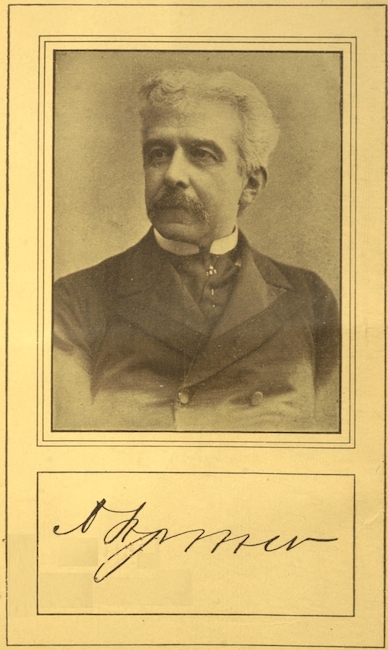
Fogazzaro
SHORT STORY CLASSICS
(FOREIGN)
VOLUME TWO
ITALIAN AND
SCANDINAVIAN
EDITED BY
William Patten
WITH
AN INTRODUCTION
AND NOTES
P. F. COLLIER & SON
NEW YORK
Copyright 1907
By P. F. Collier & Son
The use of the copyrighted translations in this
collection has been authorized by the
authors or their representatives. The
translations made especially for
this collection are covered
by the general
copyright.
Enrico Castelnuovo, who was born at Florence
in 1839, is one of the earliest of Italian
writers of the modern short story, and a link
between the group of poets, dramatists, and
novelists, beginning with Manzoni (1785-1873),
and the group of his own immediate contemporaries,
including Carducci, Fogazzaro, Barrili,
Farina, Verga, D’Annunzio, De Amicis, Serao,
and other disciples of Carducci.
His literary career began with a little romance
called “Il quaderno della zia”; it
struck not only his first note of popularity,
but the rich vein of his talent, which consists
in minute observation and keen dramatic insight,
softened by a sympathetic, almost sentimental,
style—a rare combination traced from
his first little romance to his later volumes of
short stories, and especially marked in the
story given here, “The Lost Letter.”
THE LOST LETTER A STORY OF WHAT MIGHT HAVE BEEN
BY ENRICO CASTELNUOVO
Translated by Florence MacIntyre Tyson. Copyright, 1903, by The Current
Literature Publishing Company.
Professor Attilio Cernieri, distinguished
Egyptologist, Senator of the Kingdom,
commander of numerous orders, active member
of the Lincei, Corresponding Fellow of an infinite number
of Italian and foreign societies and academies, was
having his servant, Pomponio, open two cases of books
arrived the evening before from Padua.
The books were the residue of a library that he had
gathered at Padua when, twenty years before, he had
filled the chair of neo-Latin in that university. Afterward
he had traveled much for scientific purposes, had
been called successively to the institute of higher learning
in Florence, to the University of Naples, and finally
the Ministry had solicited his presence in Rome, at the
Sapienza, creating a chair especially for him, and offering
him high emoluments.
For some time, during the Professor’s peregrinations,
the library, packed up and left with a colleague,
had remained undisturbed at Padua. Then Cernieri
had sent for a part of it when he was in Florence;
another part later on when in Naples. Now having
to come to Rome, with the intention of fixing there his
permanent residence, he had determined to send for
the two last cases.
To be sure, these books were not absolutely necessary
to a man who, besides having recently refurnished
his own library, had at his disposition the public and
private libraries of the capital.
We live in a century in which everything proceeds
by steam, even science. What is true to-day can readily
be false to-morrow; and a volume runs the risk of
being useless over night.
But in spite of its ten years of life, the monograph
in which our hero had demonstrated, with ponderous
arguments, relegated to the Finnish Family a group
of roots hitherto believed to be of Celtic origin, had
not grown old. The book, small in weight, but heavy
in thought, had been translated into all the languages
of Europe, and the genial information had placed our
professor “at the top of the scientific pyramid,” to
quote the words of an enthusiastic disciple, by the side
of the principal living philologist, the famous Lowenstein
of the University of Upsala. But whether because
the top of a pyramid is an uncomfortable place
for two or not, Cernieri and Lowenstein had at first
offered the interesting spectacle of two contestants who
are vigorously striving to throw one another off, until,
finally convinced of the uselessness of their struggles,
they had changed rivalry into friendship.
The two learned men were, of course, two strugglers
in the scientific arena, but instead of struggling
with each other, they struggled with the world at large.
If by chance any mortal could be found rash enough
to raise this crest and dare to endeavor to seat himself,
too, on the top of the famous pyramid; had it been
possible to penetrate the depths of the minds of the
two “chers confrères,” as they styled themselves in
correspondence, it would probably have been discovered
that each placed a very moderate estimate upon
the virtues of the other. Lowenstein had very little
faith in the Finnish roots; and Cernieri believed still
less in the revolution brought about by Lowenstein in
the study of the Hindu-Persian.
But let us leave Lowenstein in peace in distant Norway
and turn our attention entirely to our illustrious
compatriot. And, to begin with, upon the afternoon
in which Pomponio is opening the case of books, the
Professor was but forty, though looking much older.
He was slightly stoop-shouldered and his ample
forehead was seamed with premature wrinkles; his
near-sighted eyes were hidden behind glasses, and were
generally half-closed, like those of a sleepy pussy-cat.
His hair was thin and gray, his beard straggling, ill-cared
for, and nearly white. When he was young,
Cernieri used to shave; but after it had happened several
times that he in his absent-mindedness had shaved
but half his face, and in that unusual condition had
entered his classes, he had thought best to leave well
enough alone. For the rest, the abstraction of professors
is proverbial, and need not be dwelt on here,
though upon one occasion he had lost his train by persisting
in looking through the whole station at Bologna
for a package he had in his hand.
Absent-minded people are generally very good-natured,
but our professor was an exception to the
rule. Ordinarily his lips were visited but by the
scientific smile, made up of the superiority and commiseration
with which a learned man hears of the
absurdities committed by a brother colleague or the
world at large. In society, upon the rare occasions he
forced himself to enter it, he preferred standing aside,
avoiding women with horror, for he had not the faintest
idea what to say to them, and the dear creatures
themselves were equally at a loss what to say to him,
though five or six years ago, owing to the scarcity of
husbands in this vale of tears, more than one mother
had cast her eyes over him as a convenient parti for
one of her daughters.
So at one time the Countess Pastori had been brave
enough to invite him to dinner, hoping to make him
marry her second daughter, who had bad teeth and
weak eyes, and had not found any one who would have
her. The young girl, properly coached, had received
the professor with marked deference, had prepared
with her own hand an exquisite peach marmalade, and
had even gone to the length of evincing interest in
Finnish roots. Cernieri, however, did not take the
bait; but, at once on guard, shortened his visit and was
careful never to set foot inside the doors of the Pastori
mansion until the little Countess was betrothed to an
importer of salt fish, who joined the cultivation of
salmon with veneration for the titled nobility.
So warned by experience, he became gruffer than
before, and more than ever inaccessible to any ideas
of gallantry.
Every man has in the book of his life a secret page
that a woman has made joyous or gloomy; as far as
Professor Cernieri was concerned, this page had remained
a blank. At least so his friends said; so would
he have answered himself had he been asked, and he
would have spoken in good faith. Absorbed as he was
in research, he forgot things near at hand. Oh, why
must he be made to remember the distant past?
“Mercy on us!” exclaimed Pomponio, who had begun
to take the books out of the box. “Mercy on
us, what a dust!” Then added: “Really, it would be
much better if you would let me take them all downstairs,
and dust them there.”
But the Professor vigorously opposed the proposition.
He wished it all to take place in his study, under
his own eyes. He wanted, after they were dusted,
himself to put the books in a case ready for their reception.
And Pomponio, resigned to the inevitable,
continued taking them out, dusting them as best he
could, and handing them to his master, who, having
glanced at the title, put them in place.
The air was surcharged with dust, which covered
the furniture, penetrated the pores, making both master
and servant cough and sneeze constantly. “There is
a spider’s web on this,” said Pomponio as he lifted a
large folio. It proved to be an antique atlas of the
world, printed at Gotha by Justus Perthès; and it so
happened that while the man was dusting it a little
square envelope, yellowed with age, dropped from its
leaves and fell upon the floor.
“Gracious, what is that?” said Pomponio. “It looks
like a letter.” And putting down the atlas, he stooped
to pick it up.
But the Professor had anticipated him, and, half-dazed,
was turning the letter round and round. Without
doubt it was a letter, and one of his own at that,
still sealed, the stamp uncanceled, addressed in his own
writing; the heavy, weighty writing of a man born to
be a cavaliere of many orders; a fellow of many societies.
It was a too distinct hand, giving assurance that
the letter should reach its destination if it had been
mailed!
“Alla gentile Signorina Maria Lisa Altavilla, Firenze,
Via dei Servi, No. 25—1 Floor.”
That name appearing so unexpectedly under his
eyes carried Professor Cernieri back twenty years,
forcing from the mists of oblivion a slender, graceful
girl, whose lovely countenance was crowned with an
expression of rare sweetness. For her alone had his
heart ever quickened. For her sake alone had he once
for one day, for an hour, thought seriously of taking
a wife. And then?—
Pomponio, who was consumed with curiosity, had
noiselessly approached the professor and murmured:
“But how in the world did it get hidden in that book?”
Cernieri turned briskly—“What business have you
here? Leave the room.”
“Shall I not go on?”
“No, not now. Go away.”
“Has anything happened?”
“Nothing. If I need you, I will ring.”
Pomponio reluctantly retired. He would have given
anything to know what sort of a letter that was which
had so disturbed his employer.
When he was gone, the Professor sat down in his
great armchair, and, with trembling fingers, broke the
seal that Maria Lisa Altavilla had never been allowed
to do. And this was what he had written in Padua,
October 15, 1875:
“Cara Signorina—I have just received the sad announcement,
and hasten to assure you of my sincere
sympathy in your great grief. Last July, when I had
the honor in Venice of being often with your father
and yourself, I was a witness of your solicitude for
that precious, highly esteemed soul.
“Do you remember (I can never forget it) that
morning’s trip to the sea? We had first visited San
Lazzaro, where he had been good enough to listen with
interest to my explanation in regard to the mummy,
preserved in the Museum of the Mechitaristi Fathers;
then having crossed to Sant’ Elizabeth on the Lido,
we repaired to the baths lately established there. Your
father, feeling rather tired, remained in the hotel with
a friend while we went to walk on the beach.
“The day was deliciously balmy, the sun’s rays tempered
behind little clouds, so that you closed your red
silk umbrella. The wavelets lapped the shore softly
at our feet where our footprints marked the sand. You
confided to me that for several years your father’s
Health seemed to grow worse; how the various doctors,
who had been called in, had suggested this remedy
and that without being at all able to arrest the
course of the disease, which was overwhelming you
with terror. You told me of the tender affection that
led him to hide his suffering from you; he who had
never before concealed anything. Growing more confidential,
you told me of your happy home life, of the
full accord of your mutual thoughts and feelings, of
your deep love each for the other, cemented by sorrow;
for, from a large family, there now remained but you
two in the world. Then, overcome by emotion, you
ceased speaking, your eyes full of tears.
“What words struggled for utterance on my part!
I can not express all that was in my heart. I am naturally
timid, and I will acknowledge a great horror of
anything that will distract me from my studies or interfere
with my habits; but I feel sure I made you
understand, Signorina, how deeply I sympathized with
you. I know I told you I was at your service whenever
you might choose to call upon me. 'Thanks,’
you murmured gently while your hand trembled in
mine. Then you insisted upon going back to your
father.
“We spoke no word as we went, but it seemed to
me that our souls understood one another. In a day
or two you had quitted Venice without my having the
opportunity of seeing you again alone.
“Now, Signorina, the greatest of sorrows has come
to you. Now is the time for you to test the true value
of your friends.
“I would wish to come myself to Florence, but I am
forced to leave in a few hours for London, in order to
be present at the Congress of Orientalists, which opens
there on the 19th inst.
“From England I may possibly start on a long journey
out of Europe. My movements will depend upon
you; one word from you will take me back to Italy.
In any event, I shall be in London all October, and I
beg you will let me have a line from you, Poste Restante.
Think that I, too, and for a much longer
period than you, have been alone in the world. Believe
me always,
Yours sincerely, Attilio Cernieri.”
Twice the Professor read the four pages through,
forcing himself to recall the day, the hour, the place in
which he had written it; seeking to explain to himself
how he could have forgotten to post it, as well as
that the absolute silence of Maria Lisa Altavilla had
not aroused some suspicion in his mind; why he had
never written again to make sure. And this is what
he remembered.
The mortuary notice had arrived one morning as he
was in the midst of packing, and his thoughts had
turned persistently to the young girl he had known
three months before in Venice, and who had shown
such perfect confidence in him. All day he had debated
within himself whether he should merely send
her his condolences or if he ought to say something
more in regard to the sentiments with which she had
inspired him, in which perhaps she shared. She was
not an ordinary girl, this Maria Lisa. She seemed
created to be the companion of a scholar.
Had she not been her father’s secretary and could
she not be his? To learn two or three languages so
that she might help him; to take notes for him; to keep
his work in order; to correct printer’s proofs, and
when he was leaving for a congress or scientific mission,
to pack his trunks and accompany him to the
station; perhaps sometimes go along to look after the
nuisance of tickets, to treat with hotel proprietors,
cabmen, et cetera. Viewed in this light, matrimony
did not seem such a terrible abyss; but a tranquil port,
in which to take shelter from storms. And that evening,
at the same time with other letters, he had written
that one to Maria Lisa; had written with an expansion
and an abandon that had filled him with wonder; even
now he was amazed, as he felt once again the unaccustomed
sweetness of the thing.
Once again he was in his little room in his apartment
at Padua; on the table an oil lamp was burning;
spread out before him lay the atlas of Menke at the
page that told of “Egyptus ante Cambysii tempus.”
He had been consulting it before answering his friend
Morrison of the University of Edinburgh, who was
insisting that they should together visit the ruins of
Thebes in Upper Egypt, and he leaving his decision
until after the Congress had, on the chance of the
journey, corrected and amplified the itinerary to take
in Ithaca, Apollonapolis, Syene, and then Cernieri remembered
his landlady had knocked at his door to tell
him the carriage was there and that she had already
put his luggage, his plaid, and his umbrella in. He
had shut the atlas and put it back upon the shelf hurriedly,
hurriedly he had pushed the letters already
stamped into his pocket; hurriedly had rushed down
and thrown himself into the cab.
By what strange fate had one of the letters been
shut in the atlas? By what carelessness, in putting
the rest in the mail-box, had he not noticed that one
was missing, the most important of all, was an enigma
the learned professor was unable to solve? He was
ready to swear that never for an instant had the
thought occurred to him that he had not posted the
letter; indeed, he remembered, how for a number of
days he was dumbfounded at his own rashness.
Why had he not considered the matter more fully?
Why, with one of those words which can not be taken
back, had he run the risk of sacrificing that greatest
of blessings—independence? Why had he played all
his future on one card? He was a man of honor; had
he received a favorable reply from Maria Lisa, nothing
would have induced him to draw back. If she
said no, then he had invited a needless repulse.
Dio buono, what madness had taken possession of
him? It was more than likely that a girl, who was
not beautiful and hadn’t a penny of dot, would remain
single for two or three years at least and then he
could have sought opportunities of seeing her and
knowing her better, and of weighing the pros and
cons.
So during the first week in London, while the temptation
was increasing for the journey to the Orient
with Morrison and a young “docente” from Heidelberg,
who had offered himself as a companion, he was
upset and nervous, and trembled at every distribution
of letters, not knowing what he wished or feared.
Then as time passed and he read his two theses, and
became absorbed in the work of the Congress and
drawn within the circle of illustrious scholars, who
were greeting him as a new luminary in the world of
science, the image of the poor absent orphan faded
gradually away and a secret hope sprang up in his
heart that he had regained his liberty through the continued
silence of Maria Lisa without the humiliation
of a refusal.
He could always remember he had done his
duty; it was not his fault if his offer had not been
accepted.
So one day, early in November, he could exclaim
with Julius Cæsar:
“Alea jacta est.”
A rapid flight through Europe brought him with his
companions to Brindisi, whence they embarked for
Alexandria. Two years were passed in Upper Egypt
and Abyssinia in the study of hieroglyphics and ruins,
and in sending learned treatises to the principal European
Reviews. Magazines, journals, letters from men
of science, elections to academies poured in from Italy,
from France, from Germany; some silly letters even
came from his landlady in Padua. From Florence,
from Maria Lisa Altavilla not a word. Then when
he got home, he almost forgot all about her. Only
two years had passed, but they were worth a century
to him, and preceding events assumed to his eyes a
vague, nebulous distance. So when he had heard that
three months before Maria Lisa had married a “Pretore
residente” in an out-of-the-way corner of Sicily,
he had not troubled himself more than he could help
about it. He had to choose from the various offers of
the Ministry, he had to write an article for the
“Edinburgh Review” on Assyrian Antiquities; finally,
he had to finish a weighty thesis on those Finnish and
Celtic roots, for whose sake he had resolved to devote
himself entirely to philology at the expense of everything
else.
Maria Lisa was so small in comparison and matrimony
might have been such a nuisance. Only some
time afterward, as he was on the point of accepting
a Chair in Florence, he was assailed with scruples.
Suppose through the changing of her husband’s
jurisdiction the lady were now in Tuscany? How
ought he to act? To seem indifferent and pretend
not to recognize her, or to reproach her with the rudeness
with which she had treated him?
Alas! the professor was soon relieved of all doubts.
La Maria Lisa Altavilla? the daughter of the
Chevalier Altavilla? Who had married the pretore
Carlucci? Poor thing! she had died in Sicily of
malarial fever before she had been married more than
ten months.
Dead! Attilio Cernieri felt penetrated through with
pity and regret. Dead, so young; she, who might have
been his wife! Then he would now be alone with his
life all wrecked about him! Ah! it was indeed a thousand
times better that Maria Lisa had not answered
him! Better not to have gotten into habits that would
now have to be broken! Better not to have grown
accustomed to having a woman by his side. Those
who know declare it is difficult to do without them
then.
In a word, Cernieri had not been slow to comfort
himself. And then, too, Time had fulfilled her part,
spreading a thick veil over the fleeting episode; covering
even the name of Maria Lisa with oblivion.
Now the old letter found within the pages of the
ancient atlas had brought it all back. Before the
middle-aged man, grown old in study, hardened with
egotism, rose an enchanting picture of youth, clothed
in shining colors, full of intangible sweetness. Pressing
the poor, little yellow sheet between his hands, he
beheld once more Maria Lisa’s sweet face. As she
sadly gazed at him she seemed to say: “Why in my
hour of need did you not send me a word of sympathy?
Chance acquaintances pitied my grief; thou,
who hadst let me believe didst love me, alone remained
mute and insensible. I called upon thee too. Ah!
wretched indeed is she who trusts in a man!”
Cernieri seemed to hear Maria Lisa’s voice pronounce
the words.
And she had died without hearing his vindication,
without knowing the truth. It is indeed, “Sorrow’s
crown of sorrow,” to be faded with the irrevocable,
to be tormented with wrongs that can not be repaired,
with misunderstandings that can not be removed.
But the letter, which the grave professor continued
to hold unfolded before him, told, not only that Maria
Lisa was dead, believing him worse than he deserved,
but also that in his life there had been a moment of
poetry, of abandon, and of love, and that that moment
had remained barren. Never again could life bring
him such another. Never again would his heart
quicken for a woman’s sake. Never again could flow
from his pen words which might seem to us cold and
conventional, but to him seemed burning with ardor
and love. And he asked himself: “Suppose the letter
had gone, had arrived at its destination and Maria
Lisa had answered: 'I understand what thou wishest;
I consent. I love thee and am willing to be thine.
Come.’” Then certainly, he should not have undertaken
his great journey to Egypt and Assyria. Would
not have deciphered hieroglyphics or interpreted the
language of the ruins. Perhaps, though, he would
have had sons of his own. Perhaps domestic cares
might have retarded his fame, his activity might have
been clogged and honors and decorations might not
have fallen so abundantly upon his head. He might
not even have made his luminous discovery about the
Finnish roots. Perchance another would now occupy
his enviable position on the very top of the scientific
pyramid by the side of Lowenstein of the University
of Upsala. If all that might have happened, a man
like Professor Attilio Cernieri ought to rejoice that it
had not. And still—and still!—A persistent, hungry
doubt would not allow him to quiet his soul with this
philosophic consolation. Would it not have been better
to have sacrificed a little glory to have had a little
love?
The Professor Attilio Cernieri lacked courage to
tear or destroy the letter. He placed it in his desk,
recalled Pomponio, and desired him to resume his interrupted
labor.
But that evening in his study, the temptation to
again behold those words of twenty years ago overcame
him anew. And afterward there did not pass
a day in which he did not take the poor little worn
sheet from its envelope and read it over and over.
Then he would look at the envelope, at the stamp,
upon which the Post had impressed no mark and murmur
once more:
“If the letter had only gone!”
CAVALLERIA RUSTICANA
BY GIOVANNI VERGA
Giovanni Verga was born at Catania, Sicily,
in 1840. He was at first a romanticist, carrying
on the traditions of Manzoni. Between
1874 and 1880, he produced two masterpieces,
dealing with the life of the Sicilian peasant, in
which he found his true bent, abandoning his
earlier romanticism. With his fellow townsman,
Capuana, he now stands at the head of
the Italian “veristi,” or naturalists, often compared
with Zola. His style is singularly vigorous
and sincere, especially in describing the
customs and analyzing the souls of the Sicilian
peasants. But his plots are often confusing
and long drawn out; he has attempted drama,
but with little success. Yet, strangely enough,
his short story, “Cavalleria Rusticana,” which
he afterward developed into a novel, has been
made into one of the most popular, dramatic,
concentrated one-act operas of the world—the
“Cavalleria Rusticana” of the composer
Mascagni.
CAVALLERIA RUSTICANA
BY GIOVANNI VERGA
Translated by Frederic Taber Cooper. Copyright, 1907, by P. F. Collier & Son.
After Turridu Macca, Mistress Nunzia’s son,
came home from soldiering, he used to strut
every Sunday, peacock-like, in the public
square, wearing his rifleman’s uniform, and his red
cap that looked just like that of the fortune-teller
waiting for custom behind the stand with the cage of
canaries. The girls all rivaled each other in making
eyes at him as they went their way to mass, with their
noses down in the folds of their shawls; and the young
lads buzzed about him like so many flies. Besides, he
had brought back a pipe, with the king on horseback
on the bowl, as natural as life; and he struck his
matches on the back of his trousers, raising up one
leg as if he were going to give a kick. But for all
that, Master Angelo’s daughter Lola had not once
shown herself, either at mass or on her balcony, since
her betrothal to a man from Licodia, who was a carter
by trade, and had four Sortino mules in his stable.
No sooner had Turridu heard the news than, holy
great devil! but he wanted to rip him inside out, that
was what he wanted to do to him, that fellow from
Licodia. However, he did nothing to him at all, but
contented himself with going and singing every scornful
song he knew beneath the fair one’s window.
“Has Mistress Nunzia’s Turridu nothing at all to
do,” the neighbors asked, “but pass his nights in singing,
like a lonely sparrow?”
At last he came face to face with Lola, on her way
back from praying to Our Lady of Peril; and at sight
of him she turned neither white nor red, as though he
were no concern of hers.
“It is a blessing to have sight of you!” said he.
“Oh, friend Turridu, I was told that you came back
around the first of the month.”
“And I too was told many other things besides!” he
answered. “So it is true that you are going to marry
Alfio the carter?”
“If such is the will of God!” answered Lola, drawing
together beneath her chin the two corners of her
kerchief.
“You do the will of God by taking or leaving as it
pays you best! And it was the will of God that I
should come home from so far away to hear such fine
news, Mistress Lola!”
The poor fellow still tried to make a show of indifference,
but his voice had grown husky; and he walked
on ahead of the girl with a swagger that kept the tassel
of his cap dancing back and forth upon his shoulders.
It really hurt the girl to see him with such a
long face, but she had not the heart to deceive him
with fair words.
“Listen, friend Turridu,” she said at length, “you
must let me go on to join the other girls. What would
folks be saying if we were seen together?”
“That is true,” replied Turridu; “now that you are
to marry Alfio, who has four mules in his stable, it
won’t do to set people talking. My mother, on the
other hand, poor woman, had to sell our one bay mule,
and that little bit of vineyard down yonder on the high-road,
during the time that I was soldiering. The time
is gone when the Lady Bertha span; and you no longer
give a thought to the time when we used to talk together
from window to courtyard, and when you gave
me this handkerchief just before I went away, into
which God knows how many tears I wept at going so
far that the very name of our land seemed forgotten.
But now good-by, Mistress Lola, let us square accounts
and put an end to our friendship.”
Mistress Lola and the carter were married; and on
the following Sunday she showed herself on her balcony,
with her hands spread out upon her waist, to
show off the big rings of gold that her husband had
given her.
Turridu kept passing and repassing through the
narrow little street, with his pipe in his mouth and
his hands in his pockets, pretending indifference and
ogling the girls; but inwardly he was eating his heart
out to think that Lola’s husband had all that gold,
and that she pretended not even to notice him as he
passed by.
“I’d like to take her from under his very eyes, the
dirty dog!” he muttered.
Across from Alfio’s house lived Master Cola, the
vine-grower, who was rich as a porker, so they said,
and had an unmarried daughter. Turridu said so
much, and did so much, that Master Cola took him
into his employ; then he began to haunt the house and
make pretty speeches to the girl.
“Why don’t you go and say all these fine things to
Mistress Lola?” Santa answered him.
“Mistress Lola is a big lady! Mistress Lola is wife
of one of the crowned heads now!”
“I suppose I am not good enough for the crowned
heads.”
“You are worth a hundred such as Lola; and I know
one fellow who would never so much as look at Mistress
Lola or her patron saint when you are around.
For she isn’t fit even to carry your shoes for you,
indeed she isn’t!”
“When the fox found that he couldn’t reach the
grapes—”
“He said, 'how lovely you are, you sweet little
grape!’”
“Oh! come, hands off, friend Turridu.”
“Are you afraid I am going to eat you?”
“No, I am not afraid of you nor of him you serve.”
“Ah! your mother was from Licodia, we all know
that. Your blood boils quickly! Oh! I could eat you
up with my eyes!”
“Then eat me up with your eyes, and leave no
crumbs; but meanwhile pick up that bundle of twigs
for me.”
“For your sake I would pick up the whole house,
that I would!”
To hide her blushes, she threw at him the fagot
she happened to have in her hands, but for a wonder
missed him.
“Cut it short! Talking doesn’t bind fagots.”
“If I was rich, I should be looking for a wife just
like you, Santa!”
“I shall not marry a crowned head, as Mistress Lola
did; but I shall have my dower, as well as she, when
the Lord sends me the right man.”
“We know that you are rich, yes, we know that!”
“If you know so much, then stop talking, for my
father will soon be here, and I don’t care to have him
catch me in the courtyard.”
The father began to make a wry face, but the girl
pretended not to notice, for the tassel of the rifleman’s
hat had set her heart-strings quivering and was forever
dancing before her eyes. After the father had
put Turridu out of the door, the daughter opened her
window to him, and would stand chatting with him all
the evening, until the whole neighborhood could talk
of nothing else.
“I am crazy about you,” Turridu would say; “I am
losing my sleep and my appetite.”
“I don’t believe it!”
“I wish I was the son of Victor Emanuel, so that I
could marry you!”
“I don’t believe it!”
“By our Lady, I could eat you up, like a piece of
cake!”
“I don’t believe it!”
“On my honor!”
“Oh, mother mine!”
Lola, listening night after night, hidden behind a pot
of sweet basil, turning first pale and then red, one day
called down to Turridu: “How is it, friend Turridu,
that old friends no longer greet each other?”
“Alas!” sighed Turridu, “blessed is he who may
greet you!”
“If you care to give me greeting, you know where
my home is,” answered Lola.
Turridu came back to greet her so often that Santa
took notice of it, and closed her window in his face.
The neighbors pointed him out with a smile or a nod
of the head when he passed by in his rifleman’s uniform.
Lola’s husband was away, making a circuit of
the village fairs with his mules.
“On Sunday I mean to go to confession, for last
night I dreamt of black grapes,” said Lola.
“Wait a while! wait a while!” begged Turridu.
“No, now that Easter is so near, my husband would
want to know why I have not been to confession.”
“Ahah!” murmured Master Cola’s Santa, waiting
for her turn on her knees before the confessional where
Lola was washing herself clean of her sins. “On
my soul, it is not to Rome I would send you to do
penance!”
Friend Alfio came home with his mules and a pretty
penny of profit, and brought his wife a present of a
fine new dress for the holidays.
“You do well to bring her presents,” his neighbor
Santa said to him, “for while you are away
your wife has been trimming up the honor of your
house!”
Master Alfio was one of those carters who wear the
cap well down over one ear, and to hear his wife talked
of in this fashion made him change color as though
he had been stabbed. “Holy big devil!” he exclaimed,
“if you have not seen aright, I won’t leave you eyes
to weep with, you and your whole family!”
“I have forgotten how to weep!” answered Santa;
“I did not weep even when I saw with these very eyes
Mistress Nunzia’s son, Turridu, go in at night to your
wife’s house.”
“Then it is well,” replied Alfio; “many thanks to
you.”
Now that the husband was home again, Turridu no
longer wasted his days in the little street, but drowned
his sorrow at the tavern with his friends; and on
Easter eve they had on the table a big dish of sausage.
When Master Alfio came in, just from the way he
fastened his eyes upon him, Turridu understood what
business he had come on, and laid his fork down upon
his plate.
“How can I serve you, friend Alfio?” he asked.
“Nothing important; friend Turridu, it is some time
since I have seen you, and I wanted to talk with you
of the matter that you know about.”
Turridu had at once offered him a glass, but Alfio
put it aside with his hand. Then Turridu arose and
said to him: “Here I am, friend Alfio.”
The carter threw an arm around his neck.
“If you will come to-morrow morning down among
the prickly pears of Canziria, we can talk of this affair,
friend Turridu.”
“Wait for me on the high-road at sunrise, and we
will go together.”
With these words they exchanged the kiss of
challenge. Turridu seized the carter’s ear between
his teeth, and thus solemnly bound himself not to
fail him.
The friends had all silently withdrawn from the dish
of sausage, and accompanied Turridu all the way to his
home. Mistress Nunzia, poor woman, was accustomed
to wait for him late every night.
“Mother,” said Turridu, “do you remember when I
went away to be a soldier, and you thought that I
was never coming back! Give me a kiss, such as you
gave me then, for to-morrow I am going on a long
journey!”
Before daybreak he took his clasp-knife, which he
had hidden under the straw at the time he went away
as a conscript, and started with it for the prickly pears
of Canziria.
“Holy Mother, where are you going in such a
rage?” sobbed Lola in terror as her husband started
to leave the house.
“I am not going far,” answered Alfio, “but it will
be far better for you if I never come back.”
Lola, in her night-gown, prayed at the foot of her
bed, and pressed to her lips the rosary which Fra
Bernadino had brought her from the Holy Land,
and recited all the Ave Marias that there were
beads for.
“Friend Alfio,” began Turridu after he had walked
quite a bit of the way beside his companion, who remained
silent, with his cap drawn over his eyes, “as
true as God himself, I know that I am in the wrong,
and I ought to let you kill me. But before I came here,
I saw my old mother, who rose early to see me start,
on the pretext that she had to tend the chickens; but
her heart must have told her the truth. And as true
as God himself, I am going to kill you like a
dog, sooner than have the poor old woman weeping
for me.”
“So much the better,” replied Master Alfio, stripping
off his jacket, “strike your hardest, and so
will I.”
They were both worthy foes. Turridu received the
first thrust, and was quick enough to catch it on his
arm. When he paid it back, he gave good measure,
and aimed for the groin.
“Ah, friend Turridu, you have really made up your
mind to kill me?”
“Yes, I told you so; ever since I saw my old mother
going out to feed the chickens, her face floats all the
time before my eyes.”
“Then open your eyes wide,” Alfio called to him,
“for I am going to square accounts with you.”
And as he stood on guard, crouching ever, so as to
hold his left hand upon his wound which was aching,
and with his elbow almost touching the ground, he
suddenly caught up a handful of dust and threw it into
his opponent’s eyes.
“Oh!” howled Turridu, “I am done for!”
He sought to save himself by making desperate leaps
backward; but Alfio overtook him with another blow in
the stomach and a third in the throat.
“And the third is for the honor of my house, that
you made free with. Now, perhaps, your mother will
forget to feed her chickens.”
Turridu stumbled about for a moment, here and
there among the prickly pears, and then fell like a log.
The blood gurgled in a crimson foam out of his throat,
and he had no chance even to gasp out, “Oh, mother
mine!”
THE SILVER CRUICIFIX
BY ANTONIO FOGAZZARO
Fogazzaro is the author of the most discussed
of modern Italian novels, “The Saint.”
This poet, novelist, orator, and senator was
born at Vicenza in 1842. He studied law at
Turin, and by a collection of lyrics in 1876
established his reputation as a poet, drawing
from the spirit of the past, as opposed to
D’Annunzio, who draws from the future.
Though thoroughly modern in his prose, in
his novel, “Piccolo Mondo Antico,” he makes
a link with the romantic school of Manzoni,
many considering this story a companion
piece to the latter’s “I Promessi Sposi.”
Though frank in tone and tendency, Fogazzaro’s
writings always aim at the highest
morality. His most striking quality, perhaps,
is love of the beautiful in nature.
Between 1887 and 1894 he published two
volumes of short stories, from which “The
Silver Crucifix” has been selected as, on the
whole, the best representative.
THE SILVER CRUCIFIX
BY ANTONIO FOGAZZARO
Translated by Lionel Strachey. Copyright, 1907, by P. F. Collier & Son.
“Your coffee, milady,” said the maid.
The Countess did not reply. But although
the curtains were closed, her handsome
young face could be dimly discerned on the
white pillow. The maid, standing tray in hand at
the foot of the bed, repeated more loudly:
“Your coffee, milady.”
The Countess sat up, while she yawned, with eyes
still unopened, “Let in some light.”
Her maid went to the window without putting down
the tray, and, in turning the handle of the shutters,
managed to knock over the empty cup on its saucer.
“Keep quiet!” whispered the mistress in a tone of
irritation. “What is the matter with you this morning?
Don’t you see you are waking the baby?”
And as a matter of fact the infant was now awake
and crying in its crib. The lady turned toward the
child’s bed, and peremptorily called out “Hush!”
This silenced her offspring at once, excepting for a
few faint moans.
“Now, then, I will have my coffee,” commanded the
Countess. “Have you seen your master yet? Why,
you are trembling all over! What is the matter with
you?”
What, indeed, ailed the girl? Cup, saucer, sugar-bowl
and coffee-pot were rattling on the tray. “What
is it?” repeated the Countess.
If the maid’s face showed signs of alarm, no less
was the mistress disturbed by doubts and fears.
“Nothing,” replied the servant, still trembling.
The Countess hereupon seized her by the arm, shook
it roughly, and exclaimed:
“Tell me!”
Meanwhile the pretty little head of a child of four
was peering over the edge of the crib.
“It’s a case,” said the maid, half in tears, “it’s a
case of cholera.”
Pale as death, the lady started up, and instinctively
looked at her listening son. She jumped out of bed;
by a single gesture she imposed silence on the girl,
while motioning her to go into the next room. Then
she darted to her child’s crib.
The little fellow had begun to cry again, but his
mother kissed and petted him, played and laughed with
him until he forgot his woes, and stopped weeping.
She pulled on her dressing-gown in great haste, and
joined the servant, shutting the door behind her.
“Oh, my God, my God!” lamented the girl between
her sobs, while the other woman too began to shed
tears.
“Hush, for Heaven’s sake! On no account must
baby be frightened! What about this case—where
is it?”
“Here, milady! Rosa, the steward’s wife. She was
taken ill at midnight.”
“Heavens! And now—?”
“She is dead. She died half an hour ago.”
The baby was shrilly clamoring for his mother.
“Go,” said the Countess; “go in and play with him.
Keep him happy; do anything you like. Be quiet, darling!”
she exclaimed. “I shall be back in a moment.”
Upon which she rushed to the Count’s room.
The lady was blindly, insanely afraid of the cholera;
nothing but her passion for her child could have been
more intense than this feeling. At the first rumors of
the epidemic she and her husband had fled the city,
escaping to their splendid country seat—her marriage
portion—in the hope that the disease would not spread
thither. The place had been spared in 1836, and had
even remained untouched in 1886. And now there it
was, in the farmyard attached to the villa.
Disheveled and untidy, she flew into her husband’s
room. Before speaking she gave two violent tugs at
the bell rope.
“Have you heard?” she said, with flaming eyes.
The Count, who was phlegmatically shaving his
beard, turned round, inquiring, with the soapy brush
in his hand: “What?”
“Don’t you know about Rosa?”
“Oh, yes, I know,” was his calm response.
If, in the first place, the Count had cherished some
vague illusion that his wife was ignorant of Rosa’s
death, it now also seemed proper to reassure her by
his cool demeanor. Instead, however, her ladyship’s
eyes shot fire, and her features were savage with anger.
“What!” she shouted, “you know, and you can
think of nothing better to do than shave? What sort
of man are you—what sort of father—what sort of
husband?”
“Good Lord!” cried the Count, throwing up his
arms.
But before the poor man, soaped up to the eyes, and
wrapped round with a towel, could add another word,
in came the valet. Her ladyship commanded that not
a peasant from the farmyard should be admitted to
the house, and that no one should go thence to the
farmyard. After this she gave orders for the coachman
to be ready within an hour; he must harness to
the landau the horses which his lordship would select.
“What are you going to do?” asked the latter, who
had recovered himself meanwhile. “Nothing rash, I
must insist.”
“Rash—how dare you say that? I am willing to
be obedient to you in everything, but when it comes
to a question of life and death—my son’s life, you
understand—then I will listen to no parley from any
one. I wish to leave here at once. Order the horses,
please.”
The Count grew annoyed. How could matters have
come to such a pass as this? Was there any propriety
in running away after such a fashion? And then, what
about business affairs? In two days, or one day, or
maybe in twelve hours, he would be ready to start.
But not before—no. His wife, however, interrupted
him violently: “Propriety, indeed, and business! For
shame!”
“And clothes?” objected the husband. “We must
certainly take some with us. You see, we shall really
need more time.”
The Countess made some contemptuous answer.
She would see to it, she assured him, that the trunks
were packed in an hour.
“But where do you expect to go?” persisted the
Count.
“To the railway station, first of all, and then wherever
you like. Now order the horses.”
“I have had enough of this!” cried the other. “I’ll
give such orders as I choose! I’ll let the business
affairs go, and everything else! Your clothes, too!
The sorrels,” he added, enraged, to the domestic who
was standing by impassively.
The Countess dressed and did her hair with the
utmost speed, at moments clasping her hands in silent
prayer, distributing commands, summoning servants
from various parts of the house by frantic pulls at the
bell. There was running up and down stairs, banging
of doors, shouting, laughing, calling out of names,
suppressed swearing. All the windows facing the fatal
farmyard were immediately closed. Thus the cries of
the unfortunate children who had lost their mother
were shut out; besides a disagreeable odor of chlorin
had penetrated into the villa, and even into the Countess’s
room, smothering the delicate Viennese perfume
she habitually used.
“Heavens!” she exclaimed angrily, “now they are
doing their best to ruin everything! Pack up quickly,
and get those trunks locked! This frightful smell is
enough to kill one! Don’t they know that chlorin
has no effect? They ought to burn the things. The
steward will be dismissed if any thieving goes on.”
“Some things are being burnt already, milady,” observed
one of the maids. “The doctor is having sheets,
coverlid, and mattress burnt.”
“That’s not enough!” snapped the Countess.
Here the Count, shaved and dressed, entered his
wife’s apartment. He began talking to her aside.
“What shall we do with these servants? We can’t
take all of them with us.”
“Anything you please. Send them away. Nothing
will be safe in the house if they remain. I don’t want
them to get the cholera, and then fumigate the rooms
with that vile chlorin, and perhaps burn up some of
my best gowns. They have no respect whatever for
their masters’ property, and—”
Furious at having yielded, the Count now broke in
with:
“A pretty state of things! A shame, I tell you, a
scandal, to sneak off like this!”
“That’s it!” retorted the woman. “That’s just how
you men always are! To appear strong and courageous
is more important to you than the life and safety
of your family. You are afraid of becoming unpopular.
Well, if you want to keep up your reputation,
why don’t you send for the mayor, and present him
with a hundred lire for the cholera patients of the
place?”
He thereupon suggested that he would stay at the
villa alone, and that she should go with the child. Only
he had not enough stability to carry out his own idea.
During this conversation the trunks were being
filled. The little boy’s playthings, his most expensive
apparel, prayer-books, bathing-suits, jewelry, crested
note-paper, furs, underlinen, many superfluous and few
necessary articles were thrown in helter-skelter, and
the lids closed down by sheer force. Then the Countess,
followed by her spouse—who made a great show
of activity, but really accomplished nothing—hurried
through the whole house, opening drawers and cupboards,
taking a last look into them, and locking them
up with their own hands. The Count stated his
opinion that it might be advisable to partake of some
refreshment before commencing the journey.
“Yes, yes!” ironically said his consort, “we’ll take
some refreshment! I’ll show you what to take!”
And she drew up her husband and all the servants,
including those who were going home for a holiday,
and dosed each one with ten drops of laudanum. Her
son she regaled with some chocolates.
At last the landau stood before the door. Prior to
actually departing, her ladyship, who was extremely
pious, withdrew to the seclusion of her bedchamber
for a final prayer. Kneeling at a chair, in her tight-fitting
costume of white flannel, her black, eight-button
gloves reaching to the elbows, and her gold and platinum
bracelets, she raised her eyes devoutly to heaven—under
the overshadowing plume of her black velvet
hat—and murmured a feverish supplication. Not a
word did she say to God about the poor wretches who
had lost their mother; nor did she ask that the cholera
might spare the humble workers chained to the rich
soil which had given her this house, her jewels, clothes,
Viennese perfume, her education, her dignity, her husband
and child, her accommodating God. Neither did
she ask anything for her own person. She, who already
saw herself and her family smitten down with
the dread disease on the journey, offered up no prayers
excepting for her son. In fact, her lips simply muttered
Paters and Aves and Glorias, while her mind
was altogether with the child, thinking of the fearful
fate which might befall him, of the danger to his health
in this precipitate journey, of his possible loss of appetite,
sleep, spirits, or color. Oh, if he could but be kept
unconscious of any peril or pain assailing others!
Rapidly she crossed herself, donned a long, gray
cloak, and shut a window that had remained open.
Before the strong morning breeze clouds were chasing
across the sky, the grass was bending on the lawn, and
the tall poplars were swaying in the avenue leading to
the villa. But the Countess, though brought up on
family traditions, had no thought for reminiscences of
her youth belonging to this country estate. She merely
closed the window and went downstairs.
The mayor was conversing with his lordship by the
carriage door.
“Have you just come from there?” she asked the
official, and, being informed that he had come from his
home, she upbraided him for not having kept off the
epidemic. He excused himself with polite smiles, to
which the lady confusedly replied: “Never mind,
then; never mind,” as she hastened her child into the
vehicle.
“Did you give him the money?” she whispered to
her husband as soon as she was seated beside him. He
made a sign in the affirmative.
“I should like to thank her ladyship, too,” began
the obsequious mayor, “for the generosity with
which—”
“Oh, it was nothing—nothing!” interrupted the
Count, scarcely knowing what he said.
Established in the carriage, the Countess made a
rapid survey of bags and boxes, coats and shawls, umbrellas
and parasols. Her husband in the mean time
turned round to see if all the luggage was in its place
in the barouche, which had been fastened on behind
to the landau. “But,” he suddenly remarked, “what
is the matter with that little boy?”
“Yes, who is that crying?” excitedly called out the
Countess, leaning far out of the carriage.
“All ready!” exclaimed the peasant who had been
assisting the servants with the luggage, and to whose
side clung a small, ragged urchin. “Stop, can’t you?”
his father bade him, sharply, then repeating the words,
“All ready!”
The Count, with his eye on the boy, plunged into
one of his pockets. “Don’t give way, my boy; you
shall have a soldo all to yourself.”
“Mother is ill,” whined the lad sorrowfully; “mother
has the cholera.”
Up jumped the Countess. Her face livid and contorted,
she brought down her folded sunshade across
the coachman’s back:
“Drive on!” she shrieked; “drive on—quick!”
The menial whipped up the horses. They began to
prance, and then went off at a gallop. The mayor
barely had time to leap out of the way, and his lordship
to fling out a handful of coppers, which scattered
on the ground at the peasant’s feet. He stood motionless—while
the boy continued weeping—and stared
after the flashing wheels of the carriage that rolled
swiftly away, whirling up the dust.
“Damn those rich pigs!” he said.
Pretending not to hear, the mayor discreetly
departed.
The peasant, a man of middle age and stature, pale,
meagre, evil-looking, and as rugged as his offspring,
made the youngster pick up the coins. Then they went
home together.
They inhabited, in the yard belonging to one of the
Countess’s farmhouses, a tumble-down, unplastered
brick hovel, situated between a dunghill and a pigsty.
Before the door gaped a dark ditch, from which issued
an indescribable stench, and which was bridged by a
single rough plank. Upon entering, one found one’s
self in a dingy, unpaved sort of cavern. There was
no flooring, either wood or stone, but there was an
irregular brick fireplace, and in front of it the ground
had been depressed by poor wretches kneeling to cook
their mess of cornmeal. A wooden stair—three steps
missing—conducted to the room, foul with dirt and
rubbish, where father, mother, and son were wont to
pass the night in a single bed. Standing by this article
of furniture, one might look down into the kitchen
below through the broken boards. The bed occupied
the only spot not soaked by the rain that dripped from
the roof.
Crouching on the floor, her head leaning against the
edge of the bed, sat the peasant’s cholera-stricken wife.
Although but thirty, she looked old; at twenty she had
been a blooming girl, and even now preserved remnants
of mild beauty. At the first glance her husband
understood; he swallowed an imprecation. The child,
frightened by his mother’s discolored face, kept in the
doorway.
“For Christ’s sake, send him away,” she moaned
feebly. “I have the cholera; send him away. Go to
your aunt’s, dear. Take him away, and send me the
priest.”
“I’ll go,” said the man to her; and to the boy, motioning
toward the farmyard gate, “You go to your
aunt’s.”
From the porch of the yard he fetched an armful
of straw, carried it into the kitchen, and went upstairs
to his wife, who by exerting all her strength had contrived
to get on the bed.
“Listen,” said the man, in accents of unusual tenderness;
“I am sorry, but if you die in the bed it will
have to be burnt. You understand, don’t you? I
have brought some straw into the kitchen—a nice
lot.”
Too weak to answer, she made a mute signal of
assent, and then a faint effort to rise from her couch.
But the man took her up in his arms. By a gesture
she begged him to reach first for a small silver crucifix
hanging on the wall; she pressed it fervidly to her
lips while her husband carried her down to the kitchen.
Here he made her as comfortable as he could on the
straw, before going for the priest.
And now she, too, this poor creature lying alone
like a beast in a cage on the already infected straw—she,
too, before departing to an unknown world, began
to pray. She prayed for the salvation of her soul,
convinced that she was guilty of many sins, and tormented
by her inability to remember them.
When the timid doctor, sent by the mayor, arrived,
he asked in great fright whether there was any rum
or marsala in the house. There was neither; so he
recommended hot bricks for her stomach, put up a
notice of quarantine, and left her. The priest, who
knew no fear, carelessly reeled off what he termed
“the usual things,” obscuring the divine message with
words of his own. Nevertheless, though benighted and
ignorant, the dying woman derived comfort and serenity
therefrom.
His task done, the priest went. Meanwhile the husband
had put a few more handfuls of straw under her
back, and lit the fire to heat the bricks. His wife went
on praying—less for her child than for the man whom
she had pardoned so often, and who was embarked
on the road to perdition. Finally, kissing the cross,
her mind turned to its giver. She had received it sixteen
years back, at her confirmation, from the Countess,
the mistress of the splendid manor where it was
a joy to live and of the wretched hovel where it was
a joy to die. At that time the Countess was a young
girl, and had presented the silver crucifix to the
laborer’s daughter at the suggestion of her mother,
then mistress of the estate, a kind, gentle lady, long
dead, but unforgotten by her humble tenants.
The dying woman acknowledged having thought ill
of the new mistress, of having complained sometimes,
so that her husband had cursed because, despite repeated
petition, neither roof, nor flooring, nor staircase
had ever been repaired, and because the window
frames had not been filled with linen panes. Feeling
truly penitent, in her heart she implored forgiveness
of his lordship and her ladyship; and she besought the
Holy Virgin to bless them both.
At the moment when her husband placed the scorching
bricks on her stomach, a spasm ran through her
body, and she gave up the ghost. The man flung
some straw over her blackening face, wrenched the
little cross out of her hand, stuffed it into his pocket
with a scowl at its small value, mumbling some customary
pious sentiment the while.
But he did not say, for he did not know, and we
do not know, how much good this poor woman’s crucifix
had done, invoked and kissed by her on so many
occasions. Still less can we tell how much benefit may
yet spring from that charitable thought of an old
lady, descending to an innocent child, and afterward
reascending as a prayer from a pure heart to the
Throne of Infinite Mercy.
The same evening the servants at the villa, who
had been given leave of absence during the journey of
the Count and Countess, got drunk in the drawing-room
on rum and marsala.
THE LITTLE SARDINIAN DRUMMER
BY EDMONDO DE AMICIS
Edmondo de Amicis, Italian publicist with a
military training, born in 1846, is principally
known as the author of “Il Cuore” (“The
Heart of a Boy”), a simple classic intended
for children, and which has had an incredible
influence on school life in Italy. It pretends
to be a child’s own day to day record of his
school year.
His style has not crystallised into originality—it
suggests on one page Washington Irving,
with gentle, smooth, playful humor, broad tolerance,
and on the next it suggests the word-painters
like Théophile Gautier, with their
keen observation and warm, rich coloring.
THE LITTLE SARDINIAN DRUMMER
BY EDMONDO DE AMICIS
Translated by Clou. E. Hard. Copyright, 1898, by The Current Literature
Publishing Company.
On the 24th of July, 1848, the first day of the
battle of Custoza, sixty soldiers belonging
to one of our regiments of infantry, ordered
to garrison a lonely house on a height near by, were
suddenly attacked by two companies of Austrians,
who, assaulting them on several sides, scarcely gave
them time to take refuge within the house, and hastily
barricade the door, leaving their dead and wounded
on the field.
The door being well secured, our soldiers hastened
to the windows on the ground floor, as well as to those
on the upper floor, and opened a deadly fire on the
besiegers, who replied vigorously as they slowly approached
in the form of a semicircle.
The sixty Italian soldiers were commanded by two
subaltern officers, and by a tall, silent, grim old captain,
with white hair and whiskers.
With them was a little Sardinian drummer,
a boy scarcely more than fourteen years old, but
who did not look even twelve, with his dark,
olive skin, and black, deep-set eyes that flashed
fire.
From a room on the upper story the captain directed
the defense, every order sounding like a pistol shot, his
iron countenance showing not the slightest emotion.
The little drummer, pale, but with his feet firmly
planted on the table, and holding fast to the walls,
stretched out his head and neck to look from the window,
and saw through the smoke the Austrians steadily
advancing over the fields.
The house was near the top of a very steep hillside,
so that but one small high window in the upper story
looked out over the crest. The Austrians did not
threaten that side, nor was there anybody on the hilltop.
The fire was directed against the front and the
two sides.
The firing was infernal—a close, heavy hailstorm
of balls rained upon the walls and through the broken
roof, tearing out the ceiling, shattering the beams,
doors, furniture, filling the air with fragments, plastering,
and clouds of lime and dust, utensils and broken
glass whizzing, clattering over their heads, rebounding
from the walls with a noise and clash that made the
hair stand on end.
Now and then a soldier stationed at the windows
fell inward, and was pushed one side; others staggered
from room to room, stanching their wounds with
their hands. In the kitchen lay one soldier, pierced
through the forehead. The enemy was closing in. At
last the captain, until then impassible, began to show
signs of uneasiness, and hurriedly left the room, followed
by a sergeant. In a few moments the sergeant
came rushing back, called the drummer, telling him
to follow.
The boy raced up the stairs after him, and entered
a dilapidated garret, in which he saw the captain
with pencil and paper in hand, leaning on the
window sill, and lying on the ground at his feet was
a rope belonging to the well.
The captain folded the paper, and, fixing on the boy
those cold, gray eyes before which every soldier trembled,
said abruptly:
“Drummer!”
The little drummer’s hand went up to his cap.
The captain said:
“Thou art brave.”
The boy’s eyes flashed.
“Yes, captain,” he answered.
“Look down yonder,” said the captain, taking him
to the window, “on the ground, near the house of
Villafranca, where those bayonets glisten. There is
our regiment, motionless. Take this paper, grasp this
rope, let yourself down from the window, cross the
hill like lightning, rush through the fields, reach our
men, and give this paper to the first officer you see.
Take off your belt and knapsack.”
The drummer took off his belt and knapsack, and
hid the paper in his breast pocket; the sergeant threw
out the rope, holding fast one end; the captain helped
the boy jump through the window, his back toward
the fields.
“Be careful,” said he, “the salvation of this detachment
depends on thy valor and thy legs.”
“Trust me, captain,” said the drummer, sliding
down.
“Crouch low when you drop,” again said the captain,
taking hold of the rope, too.
“Have no fear.”
“God speed thee!”
In a few moments the boy was on the ground, the
sergeant drew up the rope, and disappeared, while
the captain hastened to the little window, and saw the
drummer racing down the hill. He now hoped he
would escape unseen, but five or six little clouds of
dust rising from the ground warned him that the boy
had been discovered by the Austrians, who were firing
down from the top of the hill. Those little clouds were
the earth torn up by the balls. But the drummer continued
running at full speed. After a while the captain
exclaimed in consternation: “Dead!” but scarcely was
the word out of his mouth when he saw the little
drummer rise.
“Ah, it was but a fall!” said he, and breathed
again.
The drummer again ran on, but he limped.
“He has sprained his foot,” said the captain.
A little cloud of dust rose here and there around
the boy, but always farther from him.
He was beyond their reach. The captain uttered
a cry of triumph; but his eyes followed him, tremblingly,
for it was a question of minutes. If he did
not soon reach the regiment with the note, asking for
immediate succor, all his soldiers would be killed, or
he would be obliged to surrender, and become a prisoner
of war with them.
The boy ran for a while rapidly, then he stopped
to limp; again he ran on, but every few minutes he
stopped to limp.
“Perhaps a ball has bruised his foot,” thought the
captain, and he tremblingly noted all his movements,
and in his excitement he talked to the drummer as if
he could hear him. Every moment his eyes measured
the distance between the boy and the bayonets that
glistened below on the plain, in the midst of the golden
wheat fields.
Meantime he heard the whistling and the crash of
the balls in the rooms below, the voice of command,
the shouts of rage of the officers and sergeants; the
sharp cries of the wounded, and the noise of broken
furniture and crumbling plaster.
“Courage! Valor!” he cried, his eyes following the
drummer in the distance. “Forward! Run! Malediction!
He stops! Ah, he is up again, forward!”
An officer out of breath comes to tell him that the
enemy, without ceasing the fire, wave a white handkerchief,
demanding their surrender.
“Let no one answer!” shouts the captain, without
taking his eyes from the boy, who was now in the valley,
but who no longer ran, and who seemed hopeless
of reaching the regiment.
“Forward! Run!” cried the captain with teeth and
fists clenched. “Bleed to death, die, unfortunate boy,
but reach your destination!” Then he uttered a horrible
oath. “Ah, the infamous idler has sat down!”
In fact, up to that moment the boy’s head, that
could be seen above the wheat, now disappeared as if
he had fallen. After a moment his head was again
seen, then he was lost behind the wheat field, and the
captain saw him no more.
Then he hastened down. The balls rained, the
rooms were full of wounded, some of whom rolled
over like drunken men, catching at the furniture: the
walls and floors were covered with blood. Dead
bodies lay across the threshold; the lieutenant’s arm
was broken by a ball. Smoke and powder filled the
rooms.
“Courage!” shouted the captain. “Stand to your
post! Succor is coming! Courage a little longer!”
The Austrians had approached closer. Their disfigured
faces could be seen through the smoke. Through
the crash of balls could be heard the savage cries insulting
them, demanding their surrender, and threatening
to cut their throats. A soldier, terrified, withdrew
from the window, and the sergeants again pushed
him forward.
The fire of the besieged slackened. Discouragement
showed on every face; resistance was no longer possible.
The moment came when the Austrians redoubled
their efforts, and a voice thundered, at first in
German, then in Italian:
“Surrender!”
“No!” shouted the captain from a window. The
fire became more deadly, more furious on both sides.
Other soldiers fell. There were more than one window
without defenders. The fatal moment was imminent.
The captain’s voice died away in his throat as
he exclaimed:
“They do not come! They do not come!”
And he ran furiously from side to side, brandishing
his sabre convulsively, ready to die. Then a sergeant,
rushing down from the garret, shouted with stentorian
voice:
“They come!”
“Ah, they come!” joyfully shouted the captain.
On hearing that cry all—the well, the wounded, sergeants
and officers—crowded to the windows and again
the fierceness of the defense was redoubled. In a short
while there was noticed among the enemy a species of
vacillation and a beginning of disorder. Suddenly the
captain gathered a few soldiers together on the lower
floor to resist with fixed bayonets the impetuous attack
on the outside. Then he went upstairs. Scarcely had
he mounted when he heard the sound of hurried footsteps,
accompanied by a formidable “Hurrah!” and the
pointed hats of the Italian carbineers appeared through
the smoke, a squadron at double-quick, a brilliant flash
of swords whirled through the air above their heads,
their shoulders, their backs; then out charged the little
detachment, with fixed bayonets, led by the captain.
The enemy wavered, rallied, and at last began to retreat.
The field was evacuated, the house was saved,
and shortly after two battalions of Italian infantry and
two cannon occupied the height.
The captain and the surviving soldiers were incorporated
with their regiment, fought again, and the
captain was slightly wounded in the hand by a spent
ball during the last bayonet charge. The victory on
that day was won by the Italians.
But the following day the battle continued. The
Italians were conquered, in spite of their heroic resistance,
by superior numbers, and on the morning of the
26th they were in full retreat toward the Mincio.
The captain, though wounded, marched at the head
of his company, weary and silent, arriving at sunset
at Goito on the Mincio. He immediately sought his
lieutenant, who, with his arm broken, had been picked
up by the ambulance, and who must have arrived before
he did. They pointed out to him a church in
which the field hospital had been installed. He went
there, the church was filled with the wounded lying
in two rows of cots, and mattresses laid on the floor.
Two physicians and several practitioners were busily
coming and going, and nothing was heard but groans
and stifled cries.
Scarcely had the captain entered when he stopped
and glanced around in search of his subordinate.
At that moment he heard, near by, his name called
faintly:
“Captain!”
He turned. It was the little drummer. He was
stretched upon a wooden cot, covered up to the neck
with a coarse old red and white check window curtain,
his arms lying outside, pale and thin, but with
his eyes burning like two coals of fire.
“What! is it thou?” asked the captain in a surprised,
abrupt manner. “Bravo! thou hast fulfilled thy duty.”
“I did all that was possible,” replied the drummer.
“Art thou wounded?” asked the captain, glancing
around at the beds, in search of his lieutenant.
“What could you expect?” replied the boy, who was
eager to speak of the honor of being wounded for the
first time, otherwise he would not have dared to open
his lips before his captain.
“I ran as long as I could with my head down, but,
though I crouched, the Austrians saw me immediately.
I would have arrived twenty minutes earlier had they
not wounded me. Fortunately I met a captain of the
general’s staff, to whom I gave the note. But it
was with great effort I got along after that. I was
dying with thirst. I was afraid I could not arrive in
time. I cried with rage, thinking that every minute’s
delay sent one of ours to the other world. But at
last I did all I could. I am content. But look, captain,
and excuse me, you are bleeding!”
In fact, from the palm of the badly bandaged hand
the blood was flowing.
“Do you wish me to tighten the bandage, captain?
Let me have it for a moment.”
The captain gave him his left hand, and stretched
out his right hand to help tie the knot; but scarcely
had the little fellow risen from the pillow when he
turned pale, and had to lie back again.
“Enough! enough!” said the captain, looking at
him, and withdrawing his bandaged hand, which the
drummer wished to retain. “Take care of yourself
instead of thinking of others, for slight wounds, if
neglected, may have grave consequences.”
The little drummer shook his head.
“But thou,” said the captain, looking attentively at
him, “thou must have lost much blood to be so weak.”
“Lost much blood?” repeated the boy, smiling.
“Something more than blood. Look!” and he threw
down the coverlet The captain recoiled in horror.
The boy had but one leg; the left leg had been
amputated above the knee. The stump was wrapped
in bloody cloths.
Just then a small, fat army physician in shirt-sleeves
passed.
“Ah, captain,” said he rapidly, pointing out the little
drummer; “there is an unfortunate case. That leg
could have been easily saved had he not forced it so
much, caused inflammation; it was necessary to amputate
it. But he is brave, I assure you. He shed
not a tear, nor uttered a plaint. I was proud, while
operating, to think he was an Italian boy, my word
of honor. Faith, he comes of good stock.”
And he went on his way.
The captain wrinkled his bushy white eyebrows,
and looked fixedly at the little drummer while covering
him up with the coverlet. Then, slowly, almost
unconsciously, yet still looking at him, his hand went
to his képi, which he took off.
“Captain!” exclaimed the astonished boy. “What,
captain, for me?”
Then that rough soldier, who had never spoken a
gentle word to an inferior, replied in a soft and exceedingly
affectionate voice:
“I am but a captain, thou art a hero.”
Then he threw his arms about the little drummer
and kissed him with all his heart.
LULU’S TRIUMPH
BY MATILDA SERAO
Matilda Serao was born in 1856 at Patras,
Greece. She is Italy’s foremost woman writer,
adopting a career very unusual with her countrywomen.
Up to her thirtieth year she contributed
sketches to periodicals.
In her early work she distinctly shows the
influence of French realists like Zola. Few
writers know Balzac as she does. Later she
developed a liking for the psychological problem
novel, and later still, in “Christ’s Country,”
she seems to have joined that neomystic
school represented in Italy by Fogazzaro, especially
in his “Saint.” Her style is slovenly,
and, though not strong-minded, more like that
of a man. But her stories are told with great
spirit. The heroine of one of her very latest
stories is an American, but she does not at
all sympathise with the American reader’s
“absurd wish for happy endings.” “Lulu’s
Triumph” combines the singular merits of a
“happy ending” according to the American idea,
with a sad ending according to the author’s.
LULU’S TRIUMPH — I — II — III — IV — V
BY MATILDA SERAO
Translated by Elise Lathrop. Copyright, 1907, by P. F. Collier & Son.
Sofia did not raise her eyes from her work,
and her slim fingers fairly flew over the delicate
lace. But Lulu wandered about the room,
moving the ornaments on the shelves or opening a
drawer to gaze absently into it. It was clear that she
wished either to do or to say something, but was
abashed by her elder sister’s grave manner. She
hummed a few bars of a song, recited a verse, but
Sofia appeared not to hear. Then Lulu, who was not
blessed with too much patience, decided to put the
question boldly, and, planting herself in front of her
sister, she asked:
“Sofia, do you know what Mademoiselle Jeannette
told me?”
“Assuredly nothing very interesting.”
“Now that is an answer dry and cold enough to
give one a chill even in summer! Where do you get
your ice, oh, my glacial sister?”
“Lulu, you are a veritable baby!”
“Now, that is just where you mistake, idol of my
heart. I am not a baby, for I am going to be married.”
“What?”
“And that is just what Jeannette told me.”
“What nonsense! I do not understand a word of
what you are saying.”
“Very good, I will now tell you all, as they say in
plays. It will be a narrative—but will Your Seriousness
lend me your whole attention?”
“Yes, yes, but be quick.”
“The day of the races at the Field of Mars is the
time and place. You were not there; you preferred
your everlasting books.”
“If you wander so from the subject I will not listen
to you any longer.”
“You must listen to me; this secret is suffocating
me, killing me.”
“Are you beginning again?”
“I will stop, I will stop. Well, then, at the races we
sat in the front row on the grand stand. Paolo Lovato
came and presented a handsome young man to us,
Roberto Montefranco. After the usual greetings and
vague compliments, they found places directly behind
us; we exchanged a few words until the signal for the
start of the horses was heard. You remember that I
favored Gorgon, without foreseeing how ungrateful
she was to be to me—one must resign one’s self to
ingratitude even with beasts. A cloud of dust quite
hid the horses. 'Gorgon wins!’ I cried. 'No,’ said
Montefranco, smilingly, 'Lord Lavello.’ I was vexed
at his contradiction; but he continued smiling and contradicting
me; we ended by making a wager. Finally,
after half an hour of palpitation and anxiety, I learned
that Gorgon had played me false, that I had lost and
Montefranco had won; only fancy! I tell him that I
will pay at once; he bows and replies that there is
plenty of time. I meet him on the Chiaja, throw him
an interrogative glance, and he contents himself with
bowing and smiling in a mysterious manner. It is the
same at the theatre, everywhere. I live in the greatest
curiosity. Roberto is handsome, twenty-six years old,
and this morning Montefranco père, my future father-in-law,
had a two hours’ conference with mama.”
“Oh!”
“Signs of attention on the part of my audience?
Well, I knew about his visit from Jeannette. So the
marriage is arranged. One momentous detail remains
to be settled; when shall I go to the mayor’s office, and
shall I wear a gray or a tan colored gown? Shall I
wear a hat with streamers or without?”
“How you run on!”
“Run? Why, of course; there are no obstacles.
Roberto and I will love each other madly, our parents
are content—”
“And you would marry a man that way?”
“What does 'that way’ mean? It is such an elastic
word.”
“Without knowing him, without loving him?”
“But I do know him, I have seen him at the races
and when out walking. I adore him! Day before
yesterday I refused to take luncheon because I had
not seen him, and instead drank three cups of coffee,
trying to commit suicide.”
“And he?”
“He wishes to marry me, therefore he loves me!”
replied Lulu, triumphantly. But seeing Sofia’s face
pale, she repented of this imprudent remark, and bending
over her sister, asked affectionately:
“Have I said anything wrong?”
“No, dear, no; you are right. When one loves one
marries. It is difficult to awaken love,” and she sighed
softly.
“Awaken love, awaken love!” repeated Lulu, in an
irritated manner. “It is very easy, Sofia; but when
one has a serious brow, like you, sad eyes, and unsmiling
lips; when one goes and sits in a corner thinking,
while every one else is dancing and jesting; when
one reads instead of laughing, and instead of living,
dreams; and when one cultivates an old and lackadaisical
manner, though still young, then it is difficult
to be loved.”
Sofia lowered her head and made no reply. Her
lips quivered slightly, as though she were suppressing
a sob.
“Have I hurt you again?” asked Lulu. “It is because
I should like to see you beloved, surrounded with
affection, to see you a bride—. How nice it would be
if we were to be married on the same day!”
“That is foolish; I shall be an old maid.”
“No, miss, I forbid it, you wicked creature. If
Roberto is a nice fellow he absolutely must have a
bachelor brother; I wish it!”
At this moment their mother entered the room in
walking dress.
“Are you going out, mama?” asked Lulu.
“Yes, dear, I am going to the notary’s.”
“Oh! to the notary’s. That is a serious business.”
“You will soon learn, Miss Tease. Sofia, come
with me for a moment.”
“And has Sofia, too, some dark dealings with the
notary?”
“Lulu, when will you learn to be serious?”
“Very soon, mama; you will see.”
She opened the door for her mother and sister to
pass out, made two low courtesies, murmuring: “Madame,
Mademoiselle!” When they had left the room
she called to them from the threshold, with a burst of
laughter:
“Talk, talk away! I will pretend that I know nothing
about it.”
As a general thing Roberto Montefranco was not a
great thinker; he had not time to be. What with
luncheons, horseback rides, calls, and dinners, his days
flew by, and his evenings he passed pleasantly with
his fiancée, Lulu. Then there were tiresome matters
to be attended to, some appointments with his lawyer,
contracts to be signed, some old debts to be settled, to
say nothing of preparations for his house and for the
wedding trip. He had barely time even for his half-hour’s
reading and fifteen minutes’ loitering at the
door of his café. So he was never seen absorbed in
profound reflection, nor was he ever known to be engaged
in solving some social problem, for Roberto
had nothing of the tragic or heroic in his character.
Rather, he was of a serene temperament, and many
envied him for it.
But this afternoon he lay stretched out in an armchair,
one leg crossed over the other, a book in his
hand, with the fixed determination of reading. The
book was interesting; yet, new and strange as it may
seem, the reader had become very absent-minded. In
fact, he was more than that; he was nervous and restless.
He never turned a page, because after reading
a couple of lines the letters seemed to leave their
printed places, to dance about, become confused, disappear.
Roberto had involuntarily taken a journey into
the unknown regions of thought.
“Papa is satisfied, my aunts all have sent me their
blessings, my girl cousins are angry, my friends at the
café congratulate me ironically, my true friends clasp
my hand; therefore I am doing well to marry. I can
not deny that Lulu is very pretty; when she fixes her
eyes so full of mischief upon me, when she laughs and
shows her little white teeth, I want to take her charming
little head between my hands and kiss her over and
over again. And she has an excellent disposition, a
character of gold, always merry, good-natured, ready
for a jest, witty, full of pranks, never melancholy.
We shall agree excellently. I can not endure serious
looks, especially in people I love. It always seems to
me that such looks conceal a secret grief, a grief with
which I am unacquainted, and which I can not alleviate,
or of which I am perhaps the involuntary cause.
Sofia, my future sister-in-law, has the faculty of irritating
me with her cold, impassive face. Whenever
she appears my intelligence seems to shrivel up, the
smile leaves my lips; and even should the most beautiful
spring sun be shining, for me it turns into a gray
November day. I no longer have the courage to joke
even with Lulu; that Sofia drives all joy away. She
may have noticed the unpleasant impression she makes
upon me, for she speaks to me without looking at me,
does not shake hands, answers in the fewest possible
words. She has noticed my dislike for her. Perhaps
she is offended by it.
“Lulu always laughs. She is very young. She
never says a serious word to me, and even if she
wishes to it always seems as though she were ridiculing.
She loves me, but not madly. To be frank,
mine is not a mad passion either; better so. For my
part, I have two theories firmly established in my
mind: an engaged couple should be of like dispositions,
and, secondly, they should never begin with a
violent passion. This is our case, and Lulu and I will
be very happy. We shall take a trip through Italy,
but without haste, taking short journeys, enjoying
every comfort, stopping where we please, seeing even
the most insignificant things. We will thus occupy
three months; no, that will not be enough, let us say
four months; I shall be glad to get Lulu away for a
certain time from the doleful society of Sofia. But,
I ask, is it natural that that girl should be so serious
at her age? She must be twenty-three. She is not
plain. In fact, she has beautiful eyes, and the carriage
of a queen. If she were not so severe she would
please. I wager that she will be an old maid; perhaps
that is her secret torment, perhaps a love affair, some
unfortunate love affair—I am curious to know the
cause of her seriousness—I shall ask Lulu when we
are alone—
“Lulu is fond of bonbons, she told me so that second
evening I went to her house. How she nibbles
them! How they disappear between her little red lips,
and after a moment what a false air of compunction
she assumes—because there are no more. She is
dear, dear, dear! She confided to me in a low tone
that when it thunders she is frightened, and goes and
hides her head among the pillows; that she has always
dreamed of having a gown of black velvet, with a very
long train, and with white lace at the neck and sleeves.
She assures me that she shall be jealous, jealous as a
Spaniard, and that she shall buy a little dagger with a
handle inlaid with gold, with which to take vengeance.
She is adorable when she repeats these absurdities to
me, with her childish air of conviction. Even Sofia
is forced to smile sometimes, and how it brightens her
face! That Sofia, that Sofia! who will ever learn to
know her!”
The book fell from his knees to the floor, the young
man started at the sound, looked about in surprise, as
though unable to recognize himself. It was actually
he, Roberto Montefranco, caught in flagrante delicto,
meditating.
Twilight was descending like a rain of gray ashes.
Sofia, standing at the window that opened out on to
the balcony, was gazing down into the crowded, noisy
street. It was the hour in which the Via Toledo becomes
dangerous because of the great number of
large and small carriages that pass up and down in a
continuous stream. Sofia seemed looking for some
one; suddenly a vivid flush passed over her face, she
bent her head slightly, then suddenly paled, and turned
back into the room. A minute later Lulu entered like
a whirlwind, slamming doors, overturning chairs that
she might hurry the more.
“What are you doing here, Donna Sofia Santangelo?
Are you reading?”
“Yes, I was reading.”
“And you did not even care to stand on the balcony?”
“And if I had?”
“Pshaw! I had to stay upstairs, for Albina, the
dressmaker, had brought my gown for this evening,
and all the while I was trembling with impatience, for
I wanted to be here. Yesterday evening I told Roberto
to wear his gray overcoat, to have Selim harnessed to
the cart, and to pass at half-past six. Who knows if
he obeyed me!”
“Roberto passed here in the cart, and wearing his
gray overcoat.”
“Good gracious! How do you know all this? I
thought you were reading?”
“I was in the window.”
“And you recognized Roberto, although you never
look at him? Wonderful! Did he bow to you?”
“Yes.”
“How did he take off his hat?”
“Why—as he always does.”
“And you bowed to him?”
“Do you think me lacking in manners?”
“At least you smiled at him?”
“No—that is, I do not know.”
“You are not nice, Sofia. And yesterday evening
Roberto spoke to me about you.”
“Telling you that I was not nice?”
“No, but asking me the cause of your reserved
character, so different from mine. Then I recited a
fine panegyric to him; I told him that you were better,
more amiable, more loving than I, that your
only fault was in concealing all these good qualities.
Only fancy, he listened to me with the greatest
interest; finally, he asked me about your aversion
to him—”
“Aversion!”
“That is what he said, and, do you know, he is not
so entirely wrong; you treat him with so little cordiality.
But even on this point I defended you; I told
a fib, for I said that you liked him very much indeed,
and that you esteemed him greatly—”
“Lulu!”
“I know that it is not true, but Roberto is so fond
of you, is it not ungrateful of you to treat him like a
stranger?”
Sofia threw her arms around her sister’s neck and
kissed her; Lulu held her for an instant, and murmured
in a caressing voice:
“Why do you not love Roberto a little?”
The other made a sudden abrupt movement and
drew away, without saying a word.
“Oh, well!” said Lulu, shrugging her shoulders and
changing the subject. “Are you really not coming
with us this evening?”
“No, I have a headache; you can go with mama.”
“As usual. I shall go just the same, because I shall
have a very good time.”
“Is—Roberto going with you?”
“No; he is going to his club, where there is a directors’
meeting. I am going to profit by it and go to
the Dellinos’ ball, and shall dance until to-morrow
morning.”
“And when he knows of it?”
“So much the better. He will learn from now on
to leave me free; I do not wish him to acquire bad
habits.”
“You love him very little, it seems to me.”
“Very much, in my own way. But I must hurry
away to dress. It will take me at least two hours.”
Sofia stood listening to the noise of the departing
carriage which bore away her mother and sister. She
was left alone, quite alone, as she had always wished
to be left. As a child, when some wrong or injustice
had been done her, she had cried all alone, when she
was in bed, in the dark, and the habit had remained
with her. Now, alone in the great drawing-room, beneath
the brightly lighted chandelier, her hands inert,
her head resting against the back of her chair, her
face wore an expression of great sorrow, the vivid
reflection of a serious inward conflict. Certainly in
these moments of complete solitude the consciousness
of a great grief came over her; the sentiment of the
reality, long repulsed, became clear, distinct, cruel.
The sound of footsteps startled her. It was Roberto.
Seeing her alone, he paused, hesitating; but supposing
the rest of the family to be in another room, he advanced.
Sofia had risen at once, agitated.
“Good evening, Sofia.”
“Good evening—”
They were both embarrassed.
“Heavens, how unpleasant this Sofia is!” thought
Roberto.
Meanwhile the girl recovered herself, composing
her features, which once more took on a severe expression.
They sat down at some distance from each
other.
“Your mother is well?”
“Quite well, thank you.”
“And—Lulu?”
“She, too, is very well.”
There was silence. Roberto experienced a strange
sensation as of joy filled with bitterness.
“Lulu is occupied?” he asked.
Sofia checked a slight movement of impatience.
“She is at the Dellinos’ ball with mama,” she continued
rapidly, as if to anticipate other questions.
Since Sofia was alone, then, and if he did not wish
to be the most discourteous of men, he ought to remain
and chat with her. At this thought Roberto was
seized with an almost irresistible desire to flee. Yet
he did not move.
“I came here because there was not the required
number of us at my club,” he finally said, as if to
excuse his presence.
“Lulu did not expect you—I am sorry—”
“Oh, it does not matter,” interrupted Roberto.
The interruption was too quick, and hardly flattering
to the absent one.
“And you did not go?” he resumed.
“No, you know I am not very fond of balls.”
“Do you prefer reading?”
“Yes, very much.”
“Are you not afraid of doing yourself harm?”
“I have good eyes,” replied Sofia, raising them to
the face of her questioner.
“And beautiful ones,” thought Roberto, “but expressionless.
I meant—”
“Moral injury, perhaps. I do not think so. From
the books that I read I always derive great peace.”
“Do you need peace?”
“We all need peace.”
Sofia’s voice was grave, resonant. Roberto took
pleasure in it, as though he were hearing it for the
first time. He seemed to find himself face to face with
a woman hitherto unknown to him, and who was revealing
herself to him in every word and gesture.
Sofia had lost her coldness, she even looked at him,
smiled at him, and spoke to him as to a friend. What
had been between them before this? What was happening
now?
“When I like a book,” continued Roberto, “I always
feel the greatest desire to know the author, to know if
he or she is good, if he has suffered, if he too has
loved—”
“Perhaps you would be disillusioned. Authors
always describe the love of others, never their own.”
“Possibly out of respect?”
“From jealousy, I think. There are cases in which
love is the only treasure hidden in a soul.”
But the voice of Sofia did not change as she said
these words. Her face wore such a frank expression,
her tone was so simple, so pure, so convinced, that
Roberto felt no surprise at hearing her discuss love
with such sureness. Nothing now surprised him;
everything seemed natural, to be expected. Even
this evening, passed alone with this strange girl,
seemed to him something predestined and long awaited.
When they separated they gazed directly into each
other’s faces, as though they wished to be sure of
recognizing each other again. Sofia held out her
hand, Roberto took it and bowed over it; a portière
fell heavily behind him. They were parted.
When the charm of Sofia’s presence and conversation
had ceased, Roberto felt confused, his brain in a
turmoil. He was both gay and melancholy, would
have liked to die, and was yet full of life. He did
not know what to think of Lulu, of himself, or of his
future.
Sofia was very happy, very happy. For this reason
she wept, sobbing heartily, her head buried in her
pillow.
Three months had passed, Lulu’s marriage was still
postponed. Every once in a while her mother, who
did not understand this delay, would call her daughter
aside and ask her the cause.
“I wish to wait,” Lulu always replied; “I need to
know Roberto better.”
In fact, the girl had become observing. She went
about as usual, sang as usual, laughed, joked, but
often interrupted these pleasant occupations to study
her sister, or to listen closely to Roberto’s every
word. The former was often seen with lips compressed,
her eyebrows drawn together with an air
of great attention.
Then Lulu looked about her. And about her strange
things were happening. Roberto was no longer serene
and hilarious as usual, but thoughtful, pale, and agitated.
He spoke briefly and absently; to many things
in which he had formerly been interested he now
seemed quite indifferent; sometimes with a great effort
he succeeded in controlling himself, and becoming
once more what he had been before, but only for a
short time. He had never been accustomed to dissimulation,
and succeeded badly; his passion and inner
torment were revealed in his eyes.
A different Sofia, too, made her appearance at this
time; that is to say, a nervous, restless Sofia, who at
times embraced her sister with effusion, sometimes remained
for hours without seeing her, rather avoiding
her. Fleeting blushes rose to her cheeks, feverish
flushes; a flame burned in her eyes; her voice was now
deep and full of emotion, now dry and strident; her
hands shook. At night she did not sleep. Lulu often
rose, and went with bare feet to listen at her door and
heard Sofia toss about and weep. If questioned, Sofia
declared that there was nothing the matter; always
the same reply.
When Roberto and Sofia met—and this happened
every day—the change that had taken place in both
of them became evident. Remarks were rare, replies
were either too prompt or too vague, there were odd
glances; sometimes for whole evenings they did not
speak, but each studied the movements of the other.
They never sat beside each other; yet Roberto always
found an excuse for picking up the work or the book
that Sofia had touched. Sometimes when she did not
come into the room, Roberto, always more and more
uneasy, stared at the closed door, answering absently
to what was said. Sometimes only five minutes after
Sofia’s appearance he would take his hat and leave.
The girl was growing pale, black circles appeared
under her eyes. Finally, she decided not to let herself
be seen. Every evening for a week she shut herself
in her room, trembling with impatience, trying to
smother her unhappiness.
One evening Lulu entered her room. “Will you do
me a favor?” she asked.
“What do you want?”
“I have a note to write,” said Lulu. “Roberto is
alone, out on the terrace. Will you go and keep him
company?”
“But I—”
“Do you wish to stay shut up here? Does it cost
you so much to please me?”
“Will you come back soon?”
“I only want time to write four lines.”
Sofia turned toward the terrace, trying to summon
courage for the ordeal. She paused on the threshold.
Roberto was walking up and down; she went up to
him.
“Lulu sends me,” she said in a low voice.
“You forced yourself to come?”
“Forced—no.”
She trembled throughout her whole frame; Roberto
was near her, his face transfigured with passion.
“What have I done to you, Sofia?”
“Nothing, you have done nothing. Do not look at
me like that,” she implored, terrified.
“You know then, Sofia, that I love you very
dearly?”
“Oh! hush, Roberto, for pity’s sake hush! If Lulu
were to hear us!”
“I do not love Lulu. I love you, Sofia.”
“That is treachery.”
“I know it, but I love you. I will go away—”
“Well?” cried Lulu in the distance, appearing from
another door. “Well, have you two made peace?”
But there was no reply. Sofia fled, hiding her face
in her hands; and Roberto remained motionless, silent,
as though stunned.
“Roberto!” cried Lulu.
“Lulu.”
“What has happened?”
“Nothing; I am going.”
And without even taking leave of her, he too
went away with a despairing gesture. Lulu followed
him with her eyes, and stood there absorbed in
thought.
“One here, the other there,” she murmured; “and
previous to that? Enough! I must take a hand in it.”
“And so for all these excellent reasons I can not
marry Roberto Montefranco,” Lulu finally said to her
mother.
“They are absurd reasons, my daughter,” replied
the mother, shaking her head.
“In short, must I tell you frankly and plainly that
Roberto does not please me, and that I am not going
to marry him?”
“It is at least frank; but it is no more than a whim.
Roberto loves you.”
“He will console himself.”
“You have exchanged promises.”
“We can retract them. We are no longer living in
the days when people were married by force.”
“What will the world say?”
“Mother, let us define the world.”
“People.”
“And who is Mr. People? I do not know him; I
am not obliged to be unhappy for the sake of Mr.
People.”
“You are a terrible girl! But how am I to arrange
it with Roberto? What am I to say to him?”
“What you wish. That is what you are my mother
for.”
“Oh, indeed! To remedy the wrongs you have
done. There will be a scandal.”
“I do not think so; you can say it politely, with
pretty manners. Indeed, I think you might even speak
badly of me—call me capricious, frivolous, childish;
say that I would be a very bad wife, that I am not at
all serious, that I am lacking in dignity, that my sister
is—”
“Your sister? Are you losing your mind, Lulu?”
“Pshaw! you could easily say that. At present
Roberto and Sofia are indifferent to each other, but
if they come to know each other better they might
appreciate each other, and then—who can say? You
would be praised as a good mother for having married
off the elder daughter first.”
“In fact—”
“I shall not go husbandless; I am barely eighteen
years old. And I wish to amuse myself; I wish to
dance a great deal; I wish to enjoy my happy youth
with my dear, kind little mother—”
“You are a little rogue,” replied the mother, moved,
and embracing her daughter.
“Then we understand each other? Announce the
ugly news to Roberto politely, but add that we must
always be friends, that we hope to see him often. If
these two are to fall in love with each other they will
do so; it is predestined.”
“But do you believe, naughty Lulu, that matters
will all come right? You know that I hate quarrels.”
“Oh, unconvinced mother! Oh, mother, more unbelieving
than Saint Thomas! Yes, yes, out of my
wide experience I assure you that there will be no
scandal. Roberto is a gentleman, and will not expect
me to marry him without loving him.”
“What seems to me impossible is the affair with
Sofia—”
“Nothing is more possible than the impossible,”
gravely replied Lulu.
“My dear, so many axioms! Enough. Let us
leave it all to time; perhaps time will regulate our
affairs. All of which does not change the fact that
you are a scatterbrain.”
“And very capricious—”
“Lacking in judgment—”
“And a whimsical creature. I am everything you
like; lecture me, I deserve it. Come; have you nothing
to say? I am waiting.”
“Give me a kiss, and go to bed. Good night, baby.”
“Thank you, mama. Good night.”
“It is better so,” thought the good mother. “Lulu
is too young yet. Every day one sees the sad consequences
of these marriages of convenience. May
Heaven free us from them! It is better so.”
“Uff!” said Lulu, taking a deep breath. “What
diplomacy I was forced to use, what art in order to
convince mama! I would make a perfect ambassador.
What a triumph! Not like a triumph of love, to be
sure, but it is Lulu’s triumph!”
She paused outside her sister’s door and listened.
She heard every now and then a repressed sigh. Poor
Sofia had lost her peace of mind.
“Sleep, Sofia, sleep,” Lulu murmured softly, kissing
the lock of the door almost as though she were kissing
her sister’s brow; “calm yourself and rest. I have
worked for you this evening.”
And the generous girl fell asleep, happy and content
in the thought of the happiness of the sister she loved.
Time, good old time, the eternal wise old gentleman,
accomplished his task. Lulu asked herself
whether this unmarried sister who acted as bridesmaid
should wear a gown of blue silk or a simple one
of straw-colored foulard with lace. She asked Roberto
if there would be a great many bonbons for her, and
Sofia if she would give her that pretty embroidered
handkerchief that was like a zephyr, a cloud. Roberto
and Sofia, knowing what the girl’s heart was capable
of, smiled at her gay thoughtlessness, and loved her,
and looked upon her as their Providence.
“For I have always maintained,” said Roberto
Montefranco to a friend, speaking of his marriage,
“that a couple should be of opposite tastes. Extremes
touch. Thus they will understand each other, will
mingle, will form a complete whole, while those of
similar tastes are like two parallel lines; they walk on
together, but never meet. And then when there is
love—! I have always said so.”
THE END OF CANDIA
BY GABRIELE D’ANNUNZIO
Gabriele d’Annunzio, Italian poet and novelist,
whose real name is Rapagnetta, was born
on the Adriatic in 1864. In 1898 he was
chosen member of the Chamber of Deputies,
when he announced himself a social democrat.
His first poems, which appeared in
1879, showed great talent, but it is as a
writer of richly colored, vivid, voluptuous
prose, which is at the same time classic in
form and correct, almost finikin, in its perfect
style, that he ranks among the best of Italy’s
authors. His later stories grow deeper, more
sombre, and unpleasant in theme, and are full
of gruesome realism, borrowed from the modern
French and Russian. He is a symbolist
whose love of musical cadence sometimes
leaves little room for sound thinking. But he
is a master of style. His earlier stories, one of
which is given here, are not so unpleasant as
the later ones, and are frank imitations of De
Maupassant—in this case of “The String.”
THE END OF CANDIA — I — II — III
BY GABRIELE D’ANNUNZIO
Translated by Frederic Taber Cooper. Copyright, 1907, by P. F. Collier & Son.
Three days after the Easter banquet, which
was traditionally a great occasion in the
Lamonica household, both in its lavishness
and in the number of its guests, Donna Cristina Lamonica
was counting the table linen and silver service,
and replacing them one by one, methodically, in drawer
and cupboard, in readiness for future banquets.
As usual, she had with her, to help in the task, the
chambermaid, Maria Bisaccia, and the laundress, Candida
Marcanda, familiarly known as Candia. The
huge hampers, filled with fine linen, stood in a row
upon the floor. The silver platters and other table service
gleamed brightly from the sideboard—massive
vessels, somewhat crudely wrought by rustic silver-smiths,
and of more or less liturgical design, like all
the plate which rich provincial families hand down
from generation to generation. A fresh fragrance of
soapy water pervaded the room.
From the hampers Candia took tablecloths, napkins,
and towels; she made the mistress take note that each
piece was intact, and then passed them over to Maria,
who laid them away in the drawers, while the mistress
sprinkled lavender between them and entered the numbers
in a book. Candia was a tall, lean, angular woman
of fifty, with back somewhat bent from the habitual
attitude of her calling, with arms of unusual length,
and the head of a bird of prey mounted on a turtle’s
neck. Maria Bisaccia was a native of Ortona, a trifle
stout, with a fresh complexion and the clearest of
eyes; she had a soft fashion of speech, and the light,
leisurely touch of one whose hands were almost always
busy over cakes and sirups, pastry and preserves.
Donna Cristina, also an Ortonese, and educated in a
Benedictine convent, was of small stature, with a somewhat
too generous expanse of bosom, a face overstrewn
with freckles, a large, long nose, poor teeth,
and handsome eyes cast downward in a way that made
one think of a priest in woman’s clothing.
The three women were performing their task with
the utmost care, giving up to it the greater part of the
afternoon. All at once, just as Candia was leaving
with the empty baskets, Donna Cristina, in the course
of counting the small silver, found that a spoon was
missing.
“Maria! Maria!” she cried, in utter dismay, “count
these! There’s a spoon missing! Count them yourself!”
“But how could it? That’s impossible, Signora!”
replied Maria, “let me have a look.” And she in turn
began to count the small pieces, telling off the numbers
aloud, while Donna Cristina looked on, shaking her
head. The silver gave forth a clear, ringing sound.
“Well, it’s a fact!” Maria exclaimed at last, with a
gesture of despair; “what’s to be done about it!”
She herself was safe from all suspicion. For fifteen
years she had given proofs of her fidelity and honesty
in this very household. She had come from Ortona
together with Donna Cristina at the time of the wedding,
almost as though she were a part of the marriage
settlement; and from the first she had acquired a certain
authority in the house, through the indulgence of
her mistress. She was full of religious superstitions,
devoted to the saint and the belfry of her birthplace,
and possessed of great shrewdness. She and her mistress
had formed a sort of offensive alliance against
Pescara and all pertaining to it, and more particularly
against the saint of the Pescarese. She never missed
a chance to talk of her native town, to vaunt its beauty
and its riches, the splendor of its basilica, the treasures
of San Tommaso, the magnificence of its religious
ceremonies, as compared with the poverty of San
Cetteo, that possessed only one single little silver cross.
Donna Cristina said:
“Take a good look in there.”
Maria left the room to extend the search. She explored
every nook and corner of the kitchen and the
balcony, but in vain. She came back empty-handed.
“It isn’t there! It isn’t there!”
Then the two together tried to think, to make conjectures,
to ransack their memories. They went out
upon the balcony that communicated with the court,
the balcony back of the laundry, to make one last research.
As they talked together in loud tones, women’s
heads began to appear at the windows of the surrounding
houses.
“What has happened, Donna Cristina? Tell us
about it.”
Donna Cristina and Maria related the occurrence
with many words and many gestures.
“Lord, Lord! Then there have been thieves here?”
In a moment the report of the theft had spread
through the neighborhood, through all Pescara. Men
and women fell to discussing, to imagining who could
have been the thief. By the time the news had reached
the most distant houses of Sant’ Agostino, it had gathered
volume; it was no longer a question of a mere
spoon, but of all the silver plate in the house of
Lamonica.
Now, since the weather was fine and roses were beginning
to bloom upon the balcony, and a pair of linnets
were singing in their cage, the women lingered at
their windows, for the pleasure of gossiping across the
grateful warmth of the outdoor air. Female heads
continued to appear from behind the pots of sweet
basil, and a chatter arose that must have rejoiced the
cats upon the housetops.
Clasping her hands, Donna Cristina asked: “Who
could it have been?”
Donna Isabella Sertale, nicknamed the Pole-cat, who
had the lithe and stealthy movements of a beast of
prey, asked in a strident voice: “Who did you have
with you, Donna Cristina? It seems to me that I saw
Candia on her way—”
“Ahah!” exclaimed Donna Felicetta Margasanta,
nicknamed the Magpie because of her continuous
garrulity. “Ahah!” repeated the other gossips.—“And
you hadn’t thought of it?”—“And you never noticed?”—“And
you don’t know about Candia?”—“We can
tell you about Candia!”—“Indeed we can!”—“Oh, yes,
we can tell you about her!”
“She washes clothes well, there is no denying it.
She is the best laundress in Pescara, there’s no question
about it. But the trouble with her is that she is
too light-fingered—didn’t you know that, my dear?”
“She got a couple of towels from me once.”—“And
a napkin from me.”—“And a night-gown from me.”—“And
three pairs of stockings from me.”—“And a
new petticoat from me.”—“And I never got them back
again.”—“Nor I.”—“Nor I.”
“But I didn’t discharge her. Whom could I get?
Silvestra?”
“Oh! oh!”
“Angelantonia? The African?”
“Each one worse than the other!”
“We must put up with it.”
“But it’s a spoon this time!”
“That’s a little too much!”
“Don’t you let it pass, Donna Cristina, don’t you
let it pass!”
“Let it pass, or not let it pass!” burst forth Maria
Bisaccia, who in spite of her placid and benign appearance,
never let an opportunity pass for displaying her
superiority over her fellow servants. “That is for us
to decide, Donna Isabella, that is for us to decide!”
And the chatter continued to flow back and forth
from windows to balcony. And the accusation spread
from lip to lip throughout the whole countryside.
The following morning, Candia Marcanda already
had her arms in a tubful of clothes, when the village
constable, Biagio Pesce, nicknamed the Little Corporal,
appeared at her door.
“His Honor, the mayor, wants you up at his office
right away,” he told the laundress.
“What’s that?” demanded Candia, wrinkling her
brows into a frown, yet without interrupting the task
before her.
“His Honor, the mayor, wants you up at his office,
right away.”
“Wants me? What does he want me for?” Candia
demanded rather sharply, for she was at a loss to
understand this unexpected summons, and it turned
her as stubborn as a horse balking at a shadow.
“I can’t tell you what for,” replied the Little Corporal,
“those were my orders.”
“What were your orders?” From an obstinacy
that was natural to her, she would not cease from
asking questions. She could not convince herself that
it was a reality. “The mayor wants me? What for?
What have I done, I should like to know? I’m not
going. I haven’t done anything.”
The Little Corporal, losing his temper, answered:
“Oh, you won’t go, won’t you? We’ll see about that!”
and he went off, muttering, with his hand upon the
hilt of the ancient sword he wore.
Meanwhile there were others along the narrow
street who had overheard the conversation and came
out upon their doorsteps, where they could watch
Candia vigorously working her arms up and down
in the tubful of clothes. And since they knew about
the silver spoon, they laughed meaningly and interchanged
ambiguous phrases, which Candia could not
understand. But this laughter and these phrases
awoke a vague foreboding in the woman’s mind. And
this foreboding gathered strength when the Little Corporal
reappeared, accompanied by another officer.
“Step lively,” said the Little Corporal peremptorily.
Candia wiped her arms, without replying, and went
with them. In the public square, people stopped to
look. One of her enemies, Rosa Panura, called out
from the door of her shop, with a hateful laugh:
“Drop your stolen bone!”
The laundress, dazed by this persecution for which
she could find no reason, was at a loss for a reply.
Before the mayor’s office a group of curious idlers
had gathered to watch her as she went in. Candia, in
an access of anger, mounted the steps in a rush and
burst into the mayor’s presence, breathlessly demanding:
“Well, what is it you want of me?”
Don Silla, a man of peaceful proclivities, was for
the moment perturbed by the laundress’s strident
tones, and cast a glance at the two faithful custodians
of his official dignity. Then, taking a pinch of
tobacco from his horn snuff-box, he said to her: “My
daughter, be seated.”
But Candia remained standing. Her beak-like nose
was inflated with anger, and her wrinkled cheeks
quivered curiously. “Tell me, Don Silla.”
“You went yesterday to take back the wash to
Donna Cristina Lamonica?”
“Well, and what of it? What of it? Was there
anything missing? All of it counted, piece by piece—and
not a thing missing. What’s the matter with
it now?”
“Wait a moment, my daughter! In the same room
there was the table silver—”
Candia, comprehending, turned like an angry hawk,
about to swoop upon its prey. Her thin lips twitched
convulsively.
“The silver was in the room, and Donna Cristina
found that a spoon was missing. Do you understand,
my daughter? Could you have taken it—by mistake?”
Candia jumped like a grasshopper before the injustice
of this accusation. As a matter of fact she had
stolen nothing.
“Oh, it was I, was it? I? Who says so? Who
saw me? I am astonished at you, Don Silla! I am
astonished at you! I, a thief? I? I?”
And there was no end to her indignation. She was
all the more keenly stung by the unjust charge, because
she knew herself to be capable of the action they
attributed to her.
“Then it was you who took it?” interrupted Don
Silla, prudently sinking back into the depths of his
spacious judicial chair.
“I am astonished at you!” snarled the woman once
more, waving her long arms around as though they
had been two sticks.
“Very well, you may go. We will see about it.”
Candia went out without a salutation, blindly bumping
into the doorpost. She had turned fairly green;
she was beside herself. As she set foot in the street
and saw the crowd which had gathered, she realized
that already public opinion was against her; that no one
was going to believe in her innocence. Nevertheless,
she began to utter a vociferous denial. The crowd
continued to laugh as it dispersed. Full of fury, she
returned home, and hopelessly began to weep upon her
doorstep.
Don Donato Brandimarte, who lived next door, said
mockingly: “Cry louder, cry louder! There are people
passing by!”
Since there were heaps of clothing still waiting for
the suds, she finally calmed herself, bared her arms,
and resumed her task. As she worked, she thought
out her denials, elaborated a whole system of defense,
sought out in her shrewd woman’s brain an ingenious
method of establishing her innocence; racking her
brain for specious subtleties, she had recourse to every
trick of rustic dialectic to construct a line of reasoning
that would convince the most incredulous.
Then, when her day’s work was ended, she went out,
deciding to go first to see Donna Cristina.
Donna Cristina was not to be seen. It was Maria
Bisaccia who listened to Candia’s flood of words, shaking
her head but answering nothing, and withdrawing
in dignified silence.
Next, Candia made the circuit of all her clients. To
each in turn she related the occurrence, to each she
unfolded her defense, continually adding some new
argument, amplifying her words, growing constantly
more excited, more desperate, in the face of incredulity
and distrust. And all in vain; she felt that from
now on there was no further defense possible. A sort
of blind hopelessness took possession of her—what
more was there to do? What more was there to say?
Meanwhile Donna Cristina Lamonica gave orders
to send for Cinigia, a woman of the people, who practised
magic and empirical medicine with considerable
success. Cinigia had several times before discovered
stolen goods; and it was said that she was secretly in
league with the thieves.
“Find that spoon for me,” Donna Cristina told her,
“and you shall have a big reward.”
“Very well,” Cinigia replied; “twenty-four hours
are all I need.”
And twenty-four hours later she brought back her
answer; the spoon was to be found in a hole in the
courtyard, near the well.
Donna Cristina and Maria descended to the courtyard,
made search, and, to their great amazement,
found the spoon.
Swiftly the news spread throughout Pescara.
Then triumphantly Candia Marcanda went the
rounds of all the streets. She seemed to have grown
taller; she held her head erect; she smiled, looking
every one straight in the eye, as if to say, “I told you
so! I told you so!”
Gabriele D’Annunzio
The people in the shops, seeing her pass by, would
murmur something and then break forth into a significantly
sneering laugh. Filippo La Selvi, who sat
drinking a glass of liqueur brandy in the Café d’Ange,
called Candia in.
“Another glass for Candia, the same as mine!”
The woman, who was fond of strong spirits, pursed
up her lips covetously.
“You certainly deserve it, there’s no denying that!”
added Filippo La Selvi.
An idle crowd had gathered in front of the café.
They all had the spirit of mischief in their faces.
While the woman drank, Filippo La Selvi turned and
addressed his audience:
“Say, she knew how to work it, didn’t she? Isn’t
she the foxy one?” and he slapped the laundress familiarly
upon her bony shoulder.
The crowd laughed. A little dwarf, called Magnafave,
or “Big Beans,” weak-minded and stuttering,
joined the forefinger of his right hand to that of his
left, and striking a grotesque attitude and dwelling
upon each syllable, said:
“Ca—ca—ca—Candia—Ci—ci—Cinigia!” and he
continued to make gestures, and to stammer forth vulgar
witticisms, all implying that Candia and Cinigia
were in league together. His spectators indulged in
contortions of merriment.
For a moment Candia sat there bewildered, with the
glass still in her hand. Then in a flash she understood—they
did not believe in her innocence. They accused
her of having brought back the silver spoon secretly,
by agreement with the sorceress, to save herself further
trouble.
An access of blind anger came upon her. Speechless
with passion, she flung herself upon the weakest
of them, upon the little hunchback, in a hurricane of
blows and scratches. And the crowd, at the sight of
this struggle, formed a circle and jeered at them in
cruel glee, as at a fight between two animals, and egged
on the two combatants with voice and gesture.
Big Beans, badly scared by her unexpected violence,
tried to escape, hopping about like a little ape; and held
fast by the laundress’s terrible arms, whirled round
and round with increasing velocity, like a stone in a
sling, until at last he fell violently upon his face.
Some of the men hastened to pick him up. Candia
withdrew in the midst of hisses, shut herself within
her house, and flung herself across her bed, sobbing
and gnawing her fingers, in the keenness of her suffering.
The new accusation cut her deeper than the first,
and all the more that she knew herself capable of such
a subterfuge. How was she to clear herself now?
How was she to establish the truth? She grew hopeless
as she realized that she could not allege in defense
any material difficulties that might have interfered
with carrying out the deception. Access to the courtyard
was perfectly simple; a door, that was never
fastened, opened from the ground floor of the main
stairway; people came and went freely through that
door, to remove the garbage, or for other causes. So
it was impossible for her to close the lips of her accusers
by saying, “How could I have got in?” The
means of successfully carrying out such a plan were
many and easy.
Candia proceeded to conjure up new arguments to
convince them; she sharpened up her wits; she invented
three, four, five different cases to prove that
the spoon never could have been found in that hole in
the courtyard; she spilt hairs with marvelous ingenuity.
Next she took to making the rounds of the shops
and the houses, seeking in every possible way to overcome
the people’s incredulity. They listened to her,
greatly entertained by her captious reasoning; and they
would end by saying, “Oh, it’s all right!”
But there was a certain tone in their voice that left
Candia annihilated. So, then, all her trouble was for
nothing! No one would believe her! Yet with marvelous
persistence she would return to the attack,
spending whole nights in thinking out new arguments.
And little by little, under this continued strain, her
mind gave way; she could no longer follow any sustained
thought but that of the silver spoon.
Neglecting her work, she had sunk to a state of
actual want. When she went down to the river bank,
under the iron bridge, where the other wash-women
congregated, she would sometimes let slip from between
her fingers the garments that the current swept
away forever. And she would talk continually, unweariedly,
of the one single subject. In order not to
hear her, the young laundresses would begin to sing,
and would mock her with the improvised rimes of their
songs. And she meanwhile would shout and gesticulate
like a crazy woman.
No one could give her work any longer. Out of
pity, some of her former employers would send her
food. Little by little she fell into the habit of begging,
and wandered through the streets, bowed over,
unkempt, and all in rags. The street urchins would
tag behind her, shouting: “Tell us the story of the
spoon, 'cause we never heard it, Auntie Candia!”
She would stop strangers sometimes as they passed
by, to tell them the story and to argue out her defense.
Young fellows would sometimes send for her, and
pay her a copper to tell it all over, two, three, or four
times; they would raise up difficulties against her arguments;
they would hear her all the way through, and
then at last stab her with a final word. She would
shake her head, and go on her way; she found companionship
among other beggars and would reason
with them endlessly, indefatigably, invincibly. Her
chosen friend was a deaf woman, whose skin was a
mass of angry blotches, and who limped on one leg.
In the winter of 1874 she was at last stricken with
serious illness. The woman with the blotches cared
for her. Donna Cristina Lamonica sent her a cordial
and a scuttle of coals.
The sick woman, lying on her pallet, still raved of
the silver spoon. She would raise herself on her elbow
and struggle to wave her arm, to give emphasis to her
fevered arguments.
And at the last, when her staring eyes already
seemed overspread with a veil of troubled waters
that rose from within, Candia gasped forth:
“It wasn’t I, madam—because you see—the spoon—”
SIGNORA SPERANZA
BY LUIGI PIRANDELLO
Luigi Pirandello, master of style, the humorist
of a group of young Italian writers
who are said to be inaugurating a renaissance
in Italian literature, was born at Girgenti,
Sicily, in 1867. He appeared first as a
poet, pure in style, severe in inspiration, but
later “found himself” in the writing of humorous
tales. His humor, though at bottom
sad and almost pessimistic, is not of the quiet
sort. To him man appears as a creature more
miserable than grotesque, eternally made sport
of by the irony of fate. Such is the philosophy
in his lugubriously fanciful “Mathias
Pascal,” skeptical in spirit, in “Il Turno,”
with its cruel pictures of Sicilian peasant life,
and in “Signora Speranza,” one of the latest
and most characteristic of his novelettes. For
the purpose of this work the discursive passages
have been here and there condensed and
made more direct.
SIGNORA SPERANZA — I — II — III — IV — V — VI — VII — VIII
BY LUIGI PIRANDELLO
Translated by Elise Lathrop. Copyright, 1907, by P. F. Collier & Son.
The family boarding-house of Signora Carolina
Pentoni (Big Carolini, or Carolinona,
as she was called, because of the excessive
flesh which distressed her) was patronized by certain
scatterbrains, droll fellows, who were the delight of
the well-behaved who frequented the table, not so
much because of the good cooking perhaps, but that
they might be present at the gratuitous gaiety offered
them during the meals.
One of these excellent, well-mannered people, without
the least suspicion that he might be included
among the so-called amusing types of the pension, had
been for some time the butt of the scatterbrains, Biagio
Speranza and Dario Scossi, who played all sorts of
tricks on him; but he remained calm; so calm and
obstinate that they were finally forced to let him alone.
“Laughter is healthy. You gentlemen make me laugh,
so I shall remain.”
And he did remain, cordially disliked by all. His
name was Cedebonis; he was a physician, professor of
philosophy in the liceo, and of pedagogy in a normal
school for girls; he was a Calabrian, short, thick-set,
dark, bald, with an oval-shaped head, with no neck
to speak of; mulish, with a leather-colored face,
enormous bushy eyebrows, and mustache the color of
ebony. As the resigned victim of his many scientific
doctrines, both philosophical and pedagogical, he had
come to live almost automatically, with a brain like
a warehouse, in which his thoughts, precise, well-weighed,
and classified, were arranged in perfect
order according to their various categories. Possibly
his robust and vigorous body would gladly have lent
itself to violent exercises, but Cedebonis made himself
a storehouse for archives, or so said Scossi, and did
not permit himself any expansiveness that was not
according to the dictates of science, philosophy, and
pedagogy. “To live is not enough; live to do good,”
he used to say placidly, in his big, oily voice. And he
would ask: “Reason, reason, gentlemen, for what was
it given us?”
“That we might be worse than beasts,” once replied
scornfully the music teacher Trunfo, who could not
endure him.
Separated with much scandal from his wife, always
scowling, gloomy, grumbling, and at times explosive,
Trunfo passed almost the whole day in the house of
Carolinona, in the dining-room there, intent, like a dog
who licks the bruises he has received, on correcting
and rewriting the most hissed parts of his opera, for
the production of which he had half beggared himself.
He smoked continually. Biagio Speranza called him
“Vesuvius.”
Sometimes Cedebonis would go quietly up behind
him, and sit beside him in order to inhale the odor of
the tobacco, which he delighted in. Trunfo, grumbling,
would squint at him a couple of times, then
fuming, fidgeting with annoyance, would draw a cigar
from his pocket, and offer it to him rudely: “Pray take
it. Smoke, for Heaven’s sake!”
“No, thank you,” Cedebonis would reply, without
the least discomfiture. “You must know that nicotine
is very injurious. I only like to inhale the smoke, to
smell its fragrance.”
“At my expense,” Trunfo would then burst out furiously.
“How about the damage to my health? Get
out of here, I say! Shame on you! If you want your
pleasure you can pay for it!”
“Cedebonis,” said Scossi—who every time he began
to speak would shove out the tip of his terrible tongue
like an arrow-head—“Cedebonis, with that face of
his, like a happy monk, would be quite capable of
presenting himself calmly in the house of our dear
Martinelli, and, with the pretext that woman, like
nicotine, is injurious, ask him to lend him, yes, I say,
for a moment—”
“His wife?” asked Biagio Speranza.
“Oh, shocking! Her powder puff.”
“But what has my wife to do with the matter?” exclaims
harmless Martino Martinelli, hit when least
expecting it, his eyelashes quivering rapidly over his
round, owl-like eyes, very close together, separated by
an extremely long, thin nose, and which seemed to
draw up and leave his upper lip suspended in the air.
“Calm yourself,” replied Scossi; “I merely mentioned
her because I know that your excellent wife is
in Sicily, Signor Martinelli.” And good Martinelli
became calm, sighed, and shook his head bitterly.
Ah, he thought continually of his poor wife, banished
to a normal school in Sicily, and he spoke of her always
in his own peculiar manner, groping along in his
discourse, half helping himself, half covering every
pause with a “Yes, I say,” an interjection which they
all imitated, without his perceiving it. The poor fellow
could not resign himself to the bureaucratic
cruelty which, at a blow and without cause, had separated
him at sixty-four from his wife, thus destroying
his home and family, forcing him to live alone,
in a furnished lodging, and to dine there at the
boarding-house of Carolinona, whom he alone called
Signora Carolina.
King of Romancers was Momo Cariolin, a little
dwarf, who seemed like a living joke. To look at
him, it seemed impossible that such a tiny frame could
conceive such enormous lies, uttered imperturbably,
with the air of a diplomat.
“But tell me,” Biagio Speranza once asked him seriously,
“have you ever looked in a mirror?” because
Momo Cariolin boasted with particular pride of the
favor which women showed him. They had been
women of his own rank at the very least, or ladies
of the nobility; or they were of royal blood or imperial
archduchesses (notably Austrian), these victims
of Cariolin. And such adventures had befallen him
during the various congresses of Orientalists in the
capitals of Europe! For Cariolin professed himself,
although a dilettante, a profound student of Oriental
languages.
“But for Heaven’s sake, look at Martino’s nose!”
Biagio Speranza would suddenly cry out, interrupting
the marvelous narrations of Cariolin. And good
Martinelli, abruptly roused amid the laughter of the
others, would begin to smile.
Biagio Speranza’s jokes, Dario Scossi’s sarcasms,
Trunfo’s outbursts and sneers did not disturb Martino
Martinelli. But another of the boarders frightened
him, and this was none other than the poet Giannantonio
Cocco Bertolli, who undoubtedly was the
most ridiculous type of the house. But the poet had
been absent for nearly a month, owing to a serious
misfortune which had befallen him. A single one?
No. All the misfortunes in the world had befallen
the poor poet Cocco Bertolli, who for this reason was
given to railings against injustice, both human and
divine. What worse misfortune could befall him than
this? To defend himself from celestial and terrestrial
perfidies he had had only his powerful voice, his
tongue of fire, and now he could not even whisper.
Everybody knew it; those who had declared they were
his friends had even done it purposely; they had teased
him, tormented him, that they might utterly ruin him,
might actually kill him; he roared, roared, until it
seemed as though his enormous bovine eyes would
burst out of his congested face. His bile accumulated.
“My muse is bile! It was with bile that Shakespeare
created Othello, King Lear!”
And he prepared a poem, “Erostratus,” a tremendous
poem. Ah, the magnificent temple of Imposture,
the temple of so-called Civilization, where infamous
Hypocrisy was enthroned and adored, he would kindle
it with his verses. But as soon as people knew that he
was at work on this poem he was attacked on all sides.
Though deprived of his professorship at the ginnasio
because of these tragic bestialities, thrown out on the
streets, until a short time before, Giannantonio Cocco
Bertolli had not been cast down. Sleep? Why, for
two cents he could sleep at a resort of beggars and
of sublime, ragged, louse-covered fellows. Eat? Good
Carolinona had given him credit for more than a year
already. “And I, Carolina, I will make you immortal,”
he would repeat to her. “You only love me, you
who beneath a rough exterior conceal a heart of gold,
a most noble soul, Carolina!”
“Yes, sir, do not worry,” Carolina would hasten to
reply, for she, like good Martinelli, was afraid of
those great eyes which opened so widely whenever he
began to speak, while his mouth wore so complacent
a sneer that one never knew, even when he paid a
compliment, but that he was satirizing in his own
way.
Signora Pentoni also feared that her other patrons,
those who paid, would stay away because of him,
would be annoyed or disgusted by his presence at
table; and although, whether from good-heartedness
or from fear, she could not show him the door, she
lovingly advised him to be calm, prudent, sought with
all politeness to tame him, and also took care of him
and the garments in which he draped himself, mended
them, brushed them, and finally even made him cravats
out of the ribbons from her discarded hats.
Not understanding why all this care was taken of
him, Giannantonio Cocco Bertolli finally—and why
not?—fell in love with Signora Pentoni. He took to
composing odes, sonnets, anacreonic songs, and read
them while she sewed buttons on his coat or vest, or
brushed them. Carolinona did not comprehend that
these verses were addressed to her, and why he read
them; but since she thought him mad, she did not ask
for a reason, and allowed him to read on.
Giannantonio Cocco Bertolli, violent and bestial in
everything else, was most timid in love. Not knowing
how to confess directly to Pentoni the passion she
had inspired, he poured it out in poetry, hoping to
arrive by means of the monstrous flowery paths of his
limping metaphors. But seeing that Carolinona remained
impassive, he became frenzied, violent.
“And what is the matter with you now?” the poor
woman asked him in amazement.
“What?” cried Cocco Bertolli in a trembling voice,
folding the paper on which he had scrawled the poetry,
and opening his eyes very wide, as usual, and stamping
his feet. “You ask me? Nothing! But I know!
This is to be my lot! Thus my accursed fate has
decreed! I am to be understood by no one! Not
even by you!”
“I? Why?”
“She does not even say that she seems to understand!”
“Understand what? The poetry? But good gracious!
I understand nothing. You know that. Be
good, come now! Why do you act thus?”
“Because—because—” In vain! He could not
pour out his heart in a declaration.
For this was needed the impelling force of an
odious suspicion that came upon him suddenly, during
one of these scenes, while poor Pentoni was urging
him to be quiet, at least to speak softly, since
nearby was the musician correcting his music.
“Ah, so it is for him?” Cocco Bertolli had thundered
forth. “You love him? He is your lover?
Confess! Viper, viper, viper—and why, then, have
you flattered me until now?”
“I? Leave me!” Pentoni had cried, trembling with
fear. “You are mad!”
“Cry; yes, cry out so that he will hear! I wish to
see your knight; he too is a viper!”
“But be quiet, hush!” Carolinona had implored him.
“Are you speaking seriously, Signor Bertolli? What
do you want of me? Let me alone!”
“I can not! I love you. Do you love another? We
shall see.”
“But I love no one. Are you trying to make fun
of me? At my age? This is the last straw! And
pray who would fall in love with me, Signor Bertolli?”
“I! And I have told you so!”
“Pardon me, but this is madness. And not even
laughable. Let me be—I am a poor woman.”
The Pentoni knew very well the vile calumnies
which had been circulated about her, but she had not
even tried to contradict them. What did it matter
to her? She was conscious of her virtue, long resigned
to discretion because of her sad lot, and that
sufficed her. And how could calumnies harm her
now? She knew that she was ugly; she was already
thirty-five years old, and might have been fifty as far
as she was concerned; she had never flattered herself
that a man could fall in love with her; she had never
even had the time to think that fate might perhaps
concede her a different lot, the compensation of some
affection in the dark poverty which had always oppressed
her, weighed upon her, and against which she
had sought courageously to defend herself with every
means in her power. Did people believe that in her life
there had been some slip from the path of virtue, or
even more than one? Very well, let them believe it!
At heart this not only no longer offended her, but
almost flattered her self-love, her deep-rooted feminine
instinct. She closed her eyes. But it was not
true. No one had ever cared for her, save this insane
Cocco Bertolli. It would have been laughable had the
poor fellow not worn such a tragic expression.
“Must I go away then?” he asked.
“Why, no; stay!” she hastened to reply. “But you
must think no more of such madness.”
“I can not help it! When an idea has taken root
here, it will not leave me, even if my head were to
be broken open with Vulcan’s hammer. You know
that. And know that my proposals were honest, and
always will be. Carolina, will you be my wife?”
She had begun to laugh at such a precipitate proposal,
but Cocco Bertolli, furious, checked the laugh
on her very lips.
“Do not laugh, do not laugh, by Heaven! At least
believe me, you who are a woman of heart. Save me!
I have need of some one who loves me and calms me.
I will resume my position as professor; you shall be
the wife of a great poet, who is now miserably wasting
his talent. And if you do not understand the poet,
no matter; you shall be the wife of a professor; does
that content you? and I will liberate you from all these
good-for-nothings who came to play the buffoon at
your table. Listen; I will give you the greatest proof
of my love, of the seriousness of my proposal. When
I leave here I must go to the hospital and submit myself
to a terrible operation. The doctors have told me that
it may kill me. So be it! But if I recover, I will be
yours, Carolina. Leave me this hope. Farewell!”
And he rushed away without giving the poor woman
time even to try to dissuade him.
At the hospital he had compelled the physicians to
risk the terrible operation, declaring: “I neither can
nor will go on living thus. It would kill me! Therefore
operate on me without fear, without remorse. At
the worst I am but anticipating my death by a few
days.”
Two days after the operation good Martinelli, to
whom Pentoni had weepingly confided this fresh
outburst of madness on the part of Bertolli, was
despatched to the hospital for news. Poor Signor
Martinelli returned with his great nose pale with
terror, his eyes round and glassy.
Cocco Bertolli was dying, and had asked him as a
favor to persuade “his” Carolina to see him for the
last time. The physician had assured Martinelli that
the dying man would not outlive the night. Signora
Pentoni, overcome with pity, had gone to the hospital,
and there had been obliged to promise, solemnly to
swear to the dying man, that if he should escape death
she would be his wife.
“But there will be no danger, you will see, there
will be no danger!” good Martinelli had said to her,
reassuringly, as they were returning from this visit.
“Because—yes, I say—”
And he had raised one hand as though to bless the
dying man.
All the boarders were at table when Biagio Speranza
entered the dining-room, announcing gaily:
“Safe! Sound! I come from the hospital. In about
three weeks we shall once more have at our table the
magnificent poet. Gentlemen, I invite you to cry: Long
live Giannantonio Cocco Bertolli!”
No one echoed this cry. Signor Martinelli bent his
long nose over his plate. Trunfo cast a side glance,
and went on eating. Signora Pentoni wept.
Cedebonis was the only one who rejoiced at sight
of Biagio Speranza, who made him laugh quite as
much as hygiene required, and exclaimed: “Oh, bravo!
Now you must tell us all about it.”
But Biagio Speranza did not assent. He looked at
the mistress of the house.
“In Heaven’s name!” implored Signora Pentoni,
“leave me in peace this evening!”
Biagio Speranza glanced round at his friends, and
with a gesture asked what had happened.
“Martinelli,” explained Cariolin, “has been to the
hospital before you to get news, and Carolinona has
learned—”
“And regrets it?” cried Biagio Speranza, feigning
surprise. “Ah, excuse me, Carolinona; what ingratitude!
I have seen your poet, and by a miracle restrained
myself from kissing his brow. What a hero
of love! He spoke to me only of you. He asked
me—”
Signora Pentoni rose to her feet, convulsed; she
pressed her handkerchief to her eyes, tried to say
“Excuse me,” but a burst of sobs smothered the words
in her throat, and she rushed toward the door of
her room.
Cariolin, Scossi, ran forward and stopped her; all
except Cedebonis and Trunfo rose to their feet and
surrounded the weeping woman.
“Rubbish! Absurd!” sneered Trunfo from the
table.
But the others, all in chorus, exhorted Carolinona
to be of good courage. Was she really afraid that
Cocco Bertolli would compel her to marry him? Preposterous,
if she did not wish to! Disturbances? But
were there not the police to keep him in order? Her
promise as he lay at the point of death? What promise?
Oh, nonsense! He should be made to understand,
willy-nilly, that she had but uttered a pious lie.
No? How was that?
“See here!” Biagio Speranza cut short the discussion,
becoming fervent. “Be quiet, Carolinona, I will
marry you myself.” All burst out laughing.
“What is there to laugh at?” cried Speranza, in
earnest. “I am speaking seriously. Are we, or are
we not, gentlemen? A hawk, gentlemen, threatens this
dove; I will defend her. I shall marry her, I tell you.
Who wishes to wager on it?”
“I do; a thousand francs!” suddenly proposed Cariolin.
And Biagio Speranza cried as promptly: “Out
with your thousand francs!” Then Cedebonis too rose
from the table, rubbing his hands with delight: “Excellent!
Excellent! Do you wish me to hold the stakes,
gentlemen?”
“Out with the thousand francs!” repeated Biagio
Speranza more emphatically.
“I have not got them with me,” said Cariolin, feeling
in his pockets. “But I give my word. Here is
my hand on it. A thousand francs and the wedding
breakfast.”
“You will lose!” affirmed Speranza, clasping Cariolin’s
hand. “All of you gentlemen are witnesses of the
wager: I shall marry Carolinona. Come, come, hush,
my betrothed. Dry your tears, smile, look at me! Do
you not like me?”
With affectionate violence he drew her fat, puffy
hands from her face. Pentoni smiled amid her tears.
Applause and cries of “Bravo!” broke forth. Biagio
Speranza, growing more and more ardent, embraced
his betrothed, who struggled: “In Heaven’s name, let
me go! let me go!”
“Let the engaged couple sit side by side!” some
of them proposed. “Here, here! at the head of the
table!” And Biagio Speranza and Carolinona were
escorted in triumph, and made to sit side by side.
Good Martinelli was confounded. His nose seemed
to grow visibly. Trunfo continued to sneer. “Rubbish!
Rubbish!”
“Are you jealous perhaps?” Biagio cried to him,
rising to his feet, and striking his fist on the table.
“Will you do me the great favor of stopping that?
If you gentlemen believe that at this moment I am
jesting, you are mistaken. If you think that I am committing
a mad act in marrying Carolinona, I have the
honor of telling you that you are crazy yourselves. I,
who know my poor clay, am aware that at this moment
I am wiser than I have ever been before in my
life. I am a poor man, gentlemen, who, as a punishment
from God, must fall in love with every beautiful
woman I see. In love I at once become capable of
the greatest follies. Quite different from Cariolin’s
lies. Twice, gentlemen, twice I have been at the point—I
shudder to think of it—at the point of really
marrying. I must escape as soon as possible, at any
cost, from this terrible catastrophe which continually
threatens me. I profit by this moment, in which, fortunately,
I am not in love, and shall marry Carolinona.
A flash of genius, gentlemen. A true inspiration from
heaven!”
“It is necessary to see,” objected Scossi, “whether
Carolinona consents.”
Biagio Speranza turned toward his betrothed.
“Would you do me such a wrong? To such a
good-looking young fellow as me? No, no; you see?
My bride laughs, and the world laughs. It is settled,
gentlemen!”
At this point Trunfo leaped to his feet, furiously
tearing the napkin from his neck.
“Let us make an end to it once for all! This senseless,
stupid jest gets on my nerves; this jest on a subject
which you do not understand, and which I will
tell you about, by Heaven!”
At thought of Trunfo’s matrimonial disaster there
was a moment of embarrassment. All the faces became
fixed in the act of laughing, then the laughter
suddenly ceased.
“Pardon me,” said Biagio Speranza pacifically.
“Why do you persist in believing that this is a joke
of mine? I know better than you what an enormous
folly it is to marry, and repeat that it is to prevent
myself from committing such an act that I am marrying
Carolinona.”
“The reasoning could not be more logical,” remarked
Dario Scossi, again provoking all to mirth. “And I
appeal to Cedebonis, professor of logic.”
“Most logical, most logical!” the latter affirmed.
“Signor Speranza is, in fact, marrying so to escape
the temptation of marrying.”
“Exactly!” replied Biagio Speranza. “And this is
no joke. For Carolinona is seriously afraid of the
poet Cocco Bertolli, and I am seriously afraid of losing
my liberty some day or other. By marrying, we are
both saving ourselves; she from that kind of a husband,
I from a feared reality of a future wife. Married, we
are both of us absolutely free to do whatever we please.
She here, and I in my own home. In the eyes of the
law, we have but the name in common, which is not
properly a name at all, I beg you to observe, gentlemen.
Speranza[1], just a common noun; I do not know
what to do with it, and I cede it voluntarily. What
do you say, Carolinona?”
“As far as I am concerned,” said Pentoni, smiling
and shrugging her shoulders, “if you do not regret
it—”
New applause, new congratulations, amid bursts of
laughter.
The following day the whole city was filled with
the amazing news. Biagio Speranza, stroking his fine
blond beard with his fat, white hand, laughed with his
limpid blue eyes, and from time to time his hand passed
quickly, with a gesture habitual with him, from his
beard upward and beneath his bold nose. He was
most content with the great folly he was about to commit.
Folly in the opinion of stupid people, be it understood.
He was conscious of acting well. He had
thought it over all night long, and had almost died of
laughing. “Carolinona, my wife!”
Friends and acquaintances stopped him on the
streets. “You are joking, then?”—“No; I mean to
marry, really to marry. But as a precaution, you
understand? To protect myself from taking a wife,
that is all.”—“What! But you are marrying!”—“Why,
yes! I shall stay in my own home; I shall do
as I please. I shall only go to her home as I do now,
to dine. I shall not give her anything except the price
of my meals, as usual. Well?”—“And your name?”—“But
if she is willing, why not? It does not seem to
me such a serious thing.”
And he left his questioner planted there in the middle
of the street.
He had an appointment with Dario Scossi at the
pension, to go over Carolinona’s papers together. At
the pension besides Scossi, a witness for the groom, he
found the timorous Martinelli, a witness for the bride,
who had come purposely first of all to dissuade Signora
Pentoni from lending herself to this highly scandalous
proceeding.
“But do you think so?” she had replied, with a sad
smile. “They are merry young fellows, let them alone.
They were joking, and by this time think no more of
it. I, on the other hand, have not been able to close
my eyes all last night, thinking of that other in the
hospital.”
But at the arrival of Scossi she had been amazed.
“What is this all about? Really? Again?”
Biagio Speranza found her obstinate in her refusal.
“Oh, do not let us have any nonsense,” said he to
her. “Do you wish to make me lose the thousand
francs of the wager?”
“What thousand francs? Nonsense, say no more
about it, Signor Biagio.”
“What?” said the latter. “Did we not come to an
agreement yesterday evening? Have you repented?
You are then no longer afraid of Cocco Bertolli? You
will see that he will seriously wish to marry you
then.”
And once more he began to discuss the terms of the
bargain, and dilate upon the reciprocal advantages of
this marriage, at once serious and burlesque. “We,
Carolinona, should not ascribe any importance to this
our marriage, is it not so? and therefore for us it is
not a serious affair.”
“Now, perhaps not,” remarked Signora Pentoni.
“But what if later you repent it?”
“But undoubtedly I shall repent it!” admitted Biagio.
“And just when I repent it I shall feel the advantage
of it. Do you understand? That is why I am taking
this step.”
“You understand then?” said Pentoni in conclusion.
“If I offer opposition it certainly is not for myself.
What have I to lose by it? I have everything to gain
and nothing to lose. While you—”
“Do not think of me,” said Biagio Speranza, cutting
short the discussion. “I know what I am doing.
Come, let us get on, Scossi, it is getting late. But
come then, answer, Carolinona: Name (I know that),
paternity—age—place of birth—state; maid, widow,
nothing; it is not necessary to tell the truth on this
point. But the age, yes, be accurate; I beg of you.”
“Thirty-five,” replied Carolinona.
“There now!” exclaimed Biagio, shrugging his
shoulders. “Do not begin at once!”
“Thirty-five, I assure you; I was born in 1865 at
Caserta.”
“Good gracious! So you are still young and tender?
Oh, my dear! One would never have thought
it. And—well, shall we say a maid?”
“Most assuredly, yes, sir!”
“I believe you. Let us then write to Caserta for
the birth certificate. Come, Scossi, let us hasten
to the City Hall for the announcement.”
There were two reasons for hastening this memorable
marriage: first, Giannantonio Cocco Bertolli was
leaving the hospital, cured; secondly, Biagio Speranza
had as usual fallen in love in the mean time with
a seductive woman. During these days, in order to
escape temptation, he walked the streets with his eyes
on the ground and his nose in the air.
But the Pentoni had wished for time at least to have
a new gown made for the ceremony. White? Oh, no
indeed. Modest, suitable to her age, but new. Could
she go to the City Hall otherwise? “And what do you
care about it?” Biagio had asked her.
“Nothing for my own sake, of course. But for you,
Signor Speranza. What would people say?”
“Let them talk. What does it matter to me? Dress
as you like. I do not want you to throw away money
needlessly.”
And what pains the choice of the gown cost her!
Although so long subdued and resigned to her lot, she
felt her heart oppressed that day by a strange anguish,
which brought to her lips an unusual desire to laugh,
to her eyes a longing to weep.
Though without wishing to ascribe importance to
this buffoonery, yet the mere idea, the word “marriage,”
instinctively awoke in her weary frame a certain
sense of her real womanhood; not enough to cause
her self-love to rebel against the part she was to play,
yet enough to make her feel the bitterness, almost
scorn, of it: and so she was to be married as a joke!
And she laughed at it with the others, and still more
than the others. Bah!
When the wedding day arrived, before the little procession
started for the City Hall, for they would not
perpetrate the joke in church, Biagio Speranza declared
that he did not wish to take the thousand francs
of the wager: he did not wish it to be said that this
marriage had put money in his pocket; Cariolin should,
therefore, buy with it a gift for the bride according to
the bride’s own taste.
The bride objected to this. She did not wish anything
either. But they all protested, Cariolin more
loudly than any, for he had lost the thousand francs,
and being at a ball, as the saying goes, wished to
dance. “No, no, I will attend to it! I have already
thought of something; you will see, Signora Speranza,
a fine present, and very useful. Let me attend
to it!”
He was in full dress, as he had promised, this tiny
Cariolin, and wore an elegant black velvet vest.
Scossi, too, was in evening dress. Cedebonis remembering
at the last moment that he was professor of
philosophy and pedagogy, came in a frock coat. The
most dismal of all was good Martinelli, with his shiny
coat, his light trousers, and his time-yellowed white
cravat. Trunfo was the only one absent from the festive
group.
Although the dining-room was all decked with
flowers, a present from the boarders, and the long table
in the middle was splendidly arranged by two hotel
waiters hired for the occasion by Cariolin, who was to
pay for the wedding repast, the merriment that each
one had promised himself for this great day was lacking.
Laughter was forced. How could that Carolinona
have chosen material of such an incredible
shade for her wedding gown! And why was not
Biagio Speranza in evening dress? Good gracious!
Was he or was he not going to be married? Biagio
Speranza felt a sinking in his stomach, listening to
Cariolin’s silly jests, who wished—so Biagio fancied—to
avenge himself for the money he had lost, by
calling Carolinona “Signora Speranza.” He now
wished to get through with the ceremony as soon as
possible, that he might think no more of it, that he
might think of other things.
“Come, come! Let us get through with it all!”
“Wait a moment,” said Carolinona, her hat already
on her head; “I want to take a look at the kitchen—”
There was a general exclamation of horror at so
commonplace a thought thus ingenuously expressed at
such a moment. Cariolin rushed forward ahead of
them all, and, with the gracious bow befitting the conqueror
of an Austrian archduchess, offered his arm
to the bride.
The ceremony over, Cariolin rushed away to purchase
the gift, begging then to wait a little for
him before sitting down to the table. He wished to
keep the secret absolutely dark.
At table they at last began to be merry. Biagio
Speranza, who could now see the end of this carnival,
was most gallant to his bride. The dinner was choice,
delicious, abundant. With the champagne, toasts began.
Toasts of all shades and to every one. Among
others, one of Dario Scossi’s to Martinelli’s absent
wife was so positively unfortunate that it made Martino,
who, contrary to custom, had buried his nose
somewhat too deeply in his glass, weep. While they
were at table Cariolin’s long-expected gift arrived.
“There’s a couple of porters outside,” one of the
hotel waiters announced.—Everybody became interested.—“Porters?
So the gift had come in a cart?”—“And
what then is the gift?”
They all rose and rushed out into the hall. There
stood a magnificent double bed of inlaid wood, with
complete furnishings. Biagio Speranza was annoyed.
“What a pity!” cried Carolinona, wringing her
hands, sorry that a thousand francs should be so
wasted.
But all the others applauded Cariolin’s magnificent
idea. Cariolin himself was radiant. “Gentlemen,
help me to set up this bed.”
Carolinona interposed, mortified, unhappy: “Where
do you wish to put it, Signor Cariolin?”—“Where?
In your room?”—“But it would not go in, pardon me.
And besides, what do you think I could do with it?”—“Do
you ask me?” cried Momo Cariolin.
These last words caused a fresh burst of applause
and confused outcries. The pieces of the bed were
taken by assault, and carried into Carolinona’s room.
Her own bed was quickly pulled apart, and the new
one, the nuptial couch, set up in its place.
She laughed, poor thing, at sight of these inexpert
men laboring so hard, first at placing the mattress,
then the first sheet, the second embroidered one, then
putting the pillows in their slips, and finally covering
the bed with a splendid silk cover. They were all perspiring.
But where was Biagio Speranza? Oh, rascal!
He had quietly stolen away.
It was already evening. Carolinona, although tired
after the tumultuous day, must spend several hours in
putting the house in order. Finally, having dismissed
the waiters and cook and sent her own servant to bed,
she retired to her room. And the bed? Certainly she
was not going to sleep in that new bed. She went and
examined it closely, and first passed her hand gently
over the pink silk coverlet; but against the soft, delicate,
rose-colored material she suddenly noticed how
dark her fat hand looked, disfigured by hard work,
with short, rough nails, and instinctively she drew it
back, murmuring anew: “What a pity!” She stooped
down to examine the embroidery of the sheet, but no
longer noticed the beauty of the bed; she was thinking
of herself, thinking that if she had been pretty this
ridiculous marriage would not have occurred; if she
had been pretty she would have been married long
ago. And yet, how many of her former friends, certainly
not prettier than she, had married, and now had
homes of their own, position, while she—as a joke—married,
and no wife! “Fate!”
She started, looked around; saw in a corner, rolled
up, the mattress of her bed, the iron framework leaning
against the wall. She stood for a moment perplexed
whether or not to call the servant to help her.
What should she do? She moved toward the corner
where stood the mattress, but passing before the mirror
of her wardrobe, she caught sight of herself and
paused. From the attentive examination of herself
in the mirror there arose in her a lively dislike for the
task of making up her bed. No, she would not do it!
She would sleep in the armchair. So much the worse
for her that at her age, to amuse others, she had lent
herself to such folly, ridicule, mockery.
But immediately the instinctive need for excusing
herself called up the reasons that had led her to be
persuaded; namely, her fear of being bound to that
other crazy man, who wished to become her husband
by force; the pitying promise which she had allowed
her lips to utter that day in the hospital because of
having listened to that fool Martinelli. “Bah!” she
thought. “And when that crazy man comes out of the
hospital furious, he, my husband, will defend me, recognizing
the reason for which I consented to play the
buffoon.”
She began to unfasten her gown. Suddenly she
stopped; it was useless, since she was to sleep sitting
in the chair. Another lie this, unearthed to prevent
herself from acknowledging a foolish hope which she
knew could not be realized even in a dream. She extinguished
the lamp, she seated herself in the armchair.
Through the silence that reigned in the street
below she listened intently, unconsciously. Where
was he at this hour? Perhaps in some café with his
friends. And she imagined the room of a café, illuminated,
and saw them all, her boarders, seated there
at little tables, and he was laughing, laughing, and answering
witticisms. Certainly her name was in every
one’s mouth, and derided. What did it matter to her?
She waited for the noisy reunion to come to an end
that she might see him alone. Where would he go?
Home? Or would he perhaps—perhaps go elsewhere?
At this thought she paused, as before an
unexpected abyss, taken aback. Why, yes, yes! Was
he not absolutely free?
And she was seated there in the armchair. Oh, fool,
oh, madwoman! And she found sleep impossible.
No, Biagio Speranza had not gone to the café, as
Carolinona had imagined.
Annoyed by the jokes of his friends, he had gone
home, with the firm determination of setting out for
Barcelona the next day, and making an end of it.
He had begun preparing what he needed for the
journey, when he thought that he had not enough
money for this hastened departure. And then, confronted
with this material obstacle, he agreed that, on
the whole, flight was not worthy of him. Yes, yes;
he had really done wrong to be annoyed, to sneak
away thus. And he must not abandon to the wrath
of Cocco Bertolli that poor woman who had nothing
to do with these pranks, who would keep to her agreement,
and would never annoy or molest him; of that
he was sure.
“Poor Carolinona!” he thought with a smile.
“With what a look she pronounced that 'yes’ with a
glance at the official, as much as to say: 'You see what
value that can have! For my part, I do not think that
one should jest thus, but these young fellows thought
that there was no harm in it, and here I am to satisfy
them. What else could I do? I must write too?
Sign my name?’”
He went to bed, and was not long in falling asleep.
He had bad dreams! Carolinona would not listen to
reason; was she or was she not his wife? And she
wished to enjoy all her rights—ready, oh, most ready,
to take upon herself all her duties. She seized him
by the arm and did not intend to let him go. But how
about their agreement? It was all a joke! Joke?
She had really signed the contract. And therefore he
must stay here with her. Infamy, treachery! All the
doors closed? Kicks, pinches, blows at each door.
In vain! Oh, what grief, what rage, what agony!
Behind those closed, bolted doors the friends laughed
as though they would split their sides: Cariolin,
Scossi, Cedebonis, and even Martinelli. Trunfo
sneered. An infamous conspiracy! Did they then
wish his death? No, no, even if it cost him his life,
no; he would not be made to sleep in that bed. Ah,
they would take him by force? They were binding
him? Cowards! So many against one! Softly,
softly! There at the throat, no—Ah, they were
suffocating him—
He rose late, and in the worst of humors. He
would go to the pension as usual that day, and by his
manner would make his friends understand that it
was time to be done with the whole affair.
That evening all the other boarders, including
Trunfo, arrived at the house. Then Biagio Speranza
arrived, and was at once assailed with questions.
“Why, of course! Naturally!” he answered with
a gay face. “When did I return? Exactly at midnight.
The hour of fantasy. The door was closed,
and she, the very one who has been denying it, threw
me down the key from her window. Why deny it,
my wife? We owe this satisfaction to our friends
who are so interested in our conjugal felicity. And
this evening you will see me remain here at my post,
as master of the house; and I hope that this will
satisfy you, and that from now on you will allow me
to enjoy the pleasures of married life in peace. Is
it agreed?”
He seated himself beside Carolinona; during the
meal he ostentatiously displayed, amid general merriment,
all the attentions, the manners of an enamored
monkey which a newly married man should show to
his bride, and Carolinona let him have his way, and
laughed too.
At a certain point Trunfo gruffly asked Biagio
Speranza: “Will you permit me to continue correcting
my papers here?”
“No, no!” Biagio hastened to reassure him. “You,
dear maestro, are free to suit your own convenience
here by day or night. Am I not right, Carolinona?”
“The maestro,” said she, somewhat quietly, “has
never caused me the least annoyance.”
“Very well then!” concluded Trunfo, rising.
He made a quick, slight bow, with his hands resting
on the back of his chair, and left the room, suffocated
with bile.
“My friends,” remarked Biagio Speranza, a little
later, “in the interest of my wife, I advise you to
stop, if you do not wish to make her lose a client.
A joke is all very well, but it should not be allowed
to injure the pocket—”
“Oh, as for you, joking aside,” declared Cariolin,
rising from the table with the others, “keep your
promise, and do not take this excuse. We are going,
and wish you a pleasant evening.”
“I,” added Scossi, “shall remain with Cedebonis
outside the door on guard; and you may be sure that
I will not let you escape.”
“You may all be sure that I shall not escape,”
replied Biagio Speranza, accompanying his fellow
boarders to the door.
Carolinona began to feel uneasy, not knowing what
this crazy fellow would do next.
“What fools, eh?” said Biagio, once more entering
the dining-room. “And they are really capable of
waiting outside in the street, do you know it?”
Carolinona tried to smile and look at him, but she
lowered her eyes promptly.
“Do you know that our position is actually ridiculous?”
resumed Biagio, breaking out into his sonorous
laughter. “But we must do this in order to have
peace. Otherwise they will never have done. I will
wait a half hour before I go; you must have patience.”
“Oh, as for me, of course,” said she, without raising
her eyes, and faintly.
Biagio Speranza looked at her. He was very calm
himself, and thought that she ought to be so, too. But
noting Carolinona’s embarrassment he laughed again.
Wounded by this laugh, she raised her eyes, and, trying
as best she could to hide the bitterness with a
smile, said:
“You are a man, and they all know that you are
only doing this to make them laugh. Although, if I
am to tell the truth, I do not see that it is a joke any
longer, now that it has arrived at this point—They
are all laughing at you and me—”
“Let us laugh too!” concluded Biagio. “Why not?”
“Because I can not,” promptly replied Carolinona.
“Pardon me, but you must understand that it can not
please me that you, to make an end to an annoying
joke, are forced to make me play a part that does
not suit me—”
“What!” exclaimed Biagio. “The rôle of wife!
By heavens, you ought to thank me.”
Carolinona took fire. “Pardon me, and am I to
thank you also for the words you said to Trunfo on
my account? Your wife for a joke I understand; but
since you have committed the folly of giving me your
name in the eyes of the law, it seems to me, I do not
know, but it seems to me that you ought at least to
show that you do not believe certain calumnies, and
not make a jest of them. Because they are calumnies
I would have you to know! The vilest calumnies! I
have always attended to my own business. I am poor,
yes, but honest, honest! It is well that you should
know it. And you may set your mind at rest on this
point—”
Biagio looked at her and let his arms fall. “You
alarm me, Carolinona! I did not believe you capable
of telling the truth with such insistence and such
warmth. I believe you, I believe you—but let me
look out of this window and see if those tiresome fellows
are gone, and we will make an end to this at
once.”
He went to the window and looked out into the
street. “No one,” said he, turning away. “I am sorry
that the joke has finished really badly. Enough; the
thing is done, and we must think no more about it.
Good-by, eh?”
He held out his hand; the Pentoni hesitatingly laid
her own, fat and black, in it, murmuring: “Good-by.”
Then, all vibrating with emotion, she shut herself up
in her room, and burst into tears.
Biagio Speranza, having taken a few steps, saw,
spying in the shadows of the little square opposite the
door, instead of Scossi and Cedebonis, Signor Martinelli,
who was rubbing his hands with the cold. The
good man was quite robbed of breath at hearing his
name called. Then a hand smote him sharply on the
shoulder.
“What are you doing here, my fine fellow? Tell
me, were you perhaps waiting until I should have
gone away to—”
“May Heaven forbid! What are you saying, Signor
Speranza?” stammered poor Martinelli, so tremblingly
that Biagio could not keep from laughing. “I—I
was just going—”
“And meanwhile you are here!” replied Biagio,
recovering himself, and pretending to be severe. He
took him by the arm, and added as they moved away:
“Come, let us go, and explain to me—”
“But, sir—” Martinelli hastened to reply, greatly
embarrassed, “I confess—since you, yes, I say—since
you suspected me—(May Heaven defend me!) I
confess that I remained here, not so much out of curiosity,
as because—yes, I say—to congratulate myself
that finally you had recognized the—the—the sacredness
of the bond, because—”
“And am I really to believe you?” Biagio interrupted
him, standing still. “You stood there in the
shadow like a vile deceiver; you can not deny it.”
“But pray do not say that even in jest!” cried Signor
Martinelli, his eyes turned heavenward, and
forcing himself to smile. “Pardon me, but at my
age? And then she—a thoroughly virtuous woman,
I would swear it—And she has always been so—so
good to me, has always confided—yes, I say—confided
so many things to me, poor thing—And I stood
there, believe me, congratulating myself—that—”
“You must excuse me! Good-by!” Biagio Speranza
hastily interrupted him, withdrew his arm, and hurried
after a flashily dressed woman who at that moment
emerged from a café.
Martino Martinelli stood there, abandoned in the
middle of the street; involuntarily he raised his hand
to his hat, then his eyes followed for a time the couple
who went away together laughing loudly, perhaps at
him, perhaps at the Pentoni; and he shook his head
sorrowfully, wounded.
Neither the next evening nor the following ones did
Biagio Speranza come to the pension.
Momo Cariolin and Dario Scossi ceased teasing
Carolinona after the first evening, and, truth to say,
she was somewhat distant with them. Trunfo tried
to take his revenge by reminding them how he had
warned them not to joke stupidly in a matter that had
no joke in it. Cedebonis gave himself no peace, thinking
that with this marriage had been celebrated the
funeral of mirth, and for several evenings he repeated
this phrase, which seemed to him particularly felicitous.
He alone, with his Calabrian obstinacy, continued
fuming; he fumed because the fire would not
once more burst forth with the fine witticisms of former
days. But no one paid any attention to him, and
he consoled himself after a fashion, thinking that a
renewal of this huge joke was inevitable, in one way
or another, as soon as Cocco Bertolli should leave the
hospital.
Trunfo, meanwhile, who had resumed his former
habits, between one note and another of his hissed
opera, instigated Carolinona to avenge herself.
At these vindictive exhortations of his a desire for
vengeance flamed in the heart of the Pentoni; but soon
after, suffocated, as though the flame had suddenly
become smoke—a slow, dense smoke—she buried her
face in her hands, and shook her head bitterly.
“Make good your rights,” said Trunfo. “A woman
never lacks for means.” But she really recognized no
rights of hers, and saw no means. He had made the
terms of the agreement plain to her in advance. It
was true, they were injurious, even shameful for her,
but had she not accepted them? And if there arose in
her heart a sentiment she had never before felt, and
which she was not capable of explaining to herself,
but which tormented her, and which she blushed for
without respite, what fault was it of his? He had
given her but a single cause for offense; he did not
wish to believe in her honesty. What vengeance could
she take for that? Possibly, if she felt herself capable
of it, she might actually deceive him—But no, never!
She inclined rather toward the advice of Martinelli, who
counseled her to win him by fair means, to soften him.
“Write to him,” finally advised Martinelli. “Ask
him to come as before, to do at least—yes, I say—his
duty, now that that other—yes, I say—that example
of the wrath of God is about to leave the hospital.”
“Have you news of him?” asked Carolinona.
Yes, Signor Martinelli had news, but he gave it
to her with compunction, anxiously. Unfortunately,
that “wrath of God” would be discharged in two or
three days—the beast! One of the nurses had told
him that while he was already convalescent he heard
of this marriage and had had a relapse. “A dangerous
fellow, dangerous!” finished Signor Martino. “So
much so that I would almost advise you to go to the
police without further delay.” Poor Pentoni stood
pondering for a moment, then smiled.
“Signor Martino, do you know what I have decided?
I shall not do anything. I will not move even
a finger. Let Bertolli come and beat me. Or perhaps
he will wish to kill me? It would really be laughable.
Let us leave it to God!”
Now that is all very well; God is great, omnipotent,
watches over all, protects the good and the oppressed.
Nevertheless, Martinelli thought it well to inform
Scossi and Cedebonis of the violent designs with which
Cocco Bertolli would leave the hospital. It was therefore
decided, after a long confabulation, to send Scossi
to the home of Biagio Speranza, whom no one had
seen since that day he had disappeared; and if he was
not at home, a note was to be left, warning him of the
Pentoni’s danger; if he was away, Scossi was to learn
his address and telegraph him.
He was neither at home nor out of town. Dario
Scossi was obliged to hire a cab and repair to a farm
belonging to Speranza’s old landlady, some three kilometers
outside of the city gates. Yes, Biagio had been
there for four days and was to remain until his departure
for Barcelona; he had warned his landlady
not to tell any one where he had taken refuge, and
the landlady, as we have seen, had kept her promise.
But it really was a question of something serious?
“Most serious! Most serious!” Scossi reassured
her.
Having thus forced the citadel, Scossi began to feel
the real necessity for believing in the danger that threatened
Carolinona, and in the dreadfulness of Cocco
Bertolli, so that he might have courage enough to face
Biagio Speranza. The cab finally stopped before a
rustic gate, consisting of a single bar, supported on
posts not less rustic, behind which rose two tall cypress
trees. A narrow path led up from the gate, between
the vines, to the little knoll, on the summit of which
stood the small house, amid trees. What poetry!
What a dream! What quietude!
Before ringing the bell, Scossi glanced up the path
for a few minutes; suddenly he heard the shrill squawks
of geese, then the voice of Biagio Speranza, calling
gaily: “Nannetta! Nannetta!”
Oh, wretch; Oh, renegade! A true idyl! He began
to regret having come. “Shall I wait?” asked the
driver.
“Yes, wait. I will ring.” He rang very softly; the
tongue of the bell barely touched the edge, without
giving a sound. Suddenly he pulled the chain, and
the bell rang furiously. “It is done! Now the deluge!
By Jove!”
Up at the end of the path an old peasant shortly
afterward presented himself, who, seeing the cab outside
the gate, hastened to come down. “What do you
wish, sir?”
“Speranza.”
“What do you mean? Oh, yes, sir, you mean the
young gentleman. He is here.” He opened the gate,
and Scossi entered. Again the geese squawked from
above, and the old peasant began to laugh, shaking
his head. “Biagio!” exclaimed Scossi. “What is he
doing?”
“Oh, he does and thinks of a hundred things,” replied
the peasant. “Come and see. He has put soldiers’
caps on the poor geese, and drives them thus
toward the lady who stands down there by the garden
fountain.”
“Nannetta, Nannetta!” once more cried Biagio from
above. “Look at Carolinona, who comes at a run! I
have made her corporal.”
“Horrible!” cried Dario Scossi, presenting himself
on the level stretch of ground.
“Dario!” exclaimed Biagio Speranza, amazed.
“What! You here?” And he came toward him.
But Scossi drew back a step, and gazed at him
severely.
“You give a goose the name of your wife?”
“Oh, be quiet!” replied Biagio, shaking himself.
“Have you come even out here to annoy me? How
did you know?”
Scossi then explained the reasons for his coming,
told him that it was neither just nor fair for him to
leave that poor woman yonder in her embarrassment,
and that his presence at the pension was urgently required
for three or four days at least. Biagio Speranza
grew discouraged.
Suddenly there arrived at a run, her face crimson,
a straw hat on her beautiful, ruffled, tawny hair, Nannetta,
the same woman whom Signor Martinelli had
seen coming out the café that evening.
“Well, Biagio? Oh, pardon me, how do you do,
sir—”
“Good day, my dear,” replied Scossi, holding out
his hand.
But Nannetta held her own in the air.
“I can not. They are dripping wet. If you like,
with his permission, you may give me a little kiss
here.” And she offered her flaming cheek.
“Do you permit?” asked Scossi, moved to compunction.
“Her hands are wet—”
“One only,” replied Biagio gloomily. “There is
nothing to be said. I shall have to go.”
“Is your wife sending for you?” asked Nannetta
sadly, her cheek still upturned, upon which Scossi was
all the while imprinting a series of soft kisses. “Oh,
that is enough, sir; one only, I beg of you. Your wife,
then?”
“Oh, do not you too annoy me!” cried Biagio, exasperated.
“You may thank your God, Scossi, that I
have not a stick in my hand. Get out at once. I shall
return to the city to-morrow. This evening I am going
to make up for it all by staying here. I shall wring
the neck of the goose that looks so like her and eat
it all for supper, with the appetite of a cannibal. Get
out!”
But Nannetta wished to keep Scossi for dinner. At
table Biagio explained to him why he had escaped.
“I do not say that she actually loves me; but it is
near, do you know? Who would ever have expected
it? Of course I understand that I am a very good-looking
fellow, agreeable—” Nannetta protested with
a laugh.
“And I assure you that she gave me a veritable
lecture like a real wife.”
“Poor woman!” cried Nannetta. “If what you say
is true, then all of you, especially you, Biagio, have
been cruel beyond comparison. Go, make up to her
for it now. Believe me, it is the best thing that you
can do.”
Biagio Speranza did not open his lips, but opened
his eyes very wide, and stared at Nannetta with such
an expression that she smiled, and repeated: “Poor
woman!”
“Enough, enough, my dear!” interrupted Scossi.
“Or you will keep him from ever returning to the
city.”
“No, no,” said Biagio seriously. “I have promised,
and I will come. To think of it! For the diversion
of humanity, Destiny had contrived a truly ideal marriage:
Cocco Bertolli and Carolinona. I, fool, stupid,
imbecile, go and interfere with her plans. I must pay
for it. That great man loved her, his dove, and now
I must show him the door. I feel remorseful, I assure
you, but I have promised, and I will keep my word.”
The evening of the same day Dario Scossi related to
the friend of the pension what he had done, where he
had found Speranza, and in whose company. Cedebonis
feigned to be scandalized at such immediate infidelity;
but Scossi, who, in relating the affair, had allowed this
information to escape him without intending it, replied
that Carolinona should not take it amiss in him. Wives
were made purposely to be deceived by their husbands,
and vice versa, except in the case of the Martinelli
couple, of course, who were unique beneath the heavens.
Finally he announced that Biagio Speranza would return
without fail the evening of the following day.
“The sheep will return to the fold.”
Biagio Speranza came somewhat late, saluted the
lady of the house and his friends, and seated himself
in his usual place. Some embarrassment was felt at
first, but gradually conversation became more or less
general. Only Martinelli kept his round, owl-like eyes
fixed on Speranza as though expecting any moment
some explanation of his unworthy manner of acting,
some sign of repentance.
Carolinona sat with lowered eyes; but from time
to time she would look about her, and if she saw that
no one was looking, give a rapid side glance at Speranza,
and become greatly moved. She suffered; she
felt that she suffered, but still she controlled herself so
that no one noticed it. She had given orders to the
servant not to open the door without first looking
through the peep-hole. If Cocco Bertolli came in the
daytime she was to tell him that her mistress was not
at home; if in the evening, while the boarders were
at table, before opening the front door she was to come
into the dining-room and give warning.
At every ring of the bell they all stopped to listen,
and the poor woman felt her heart almost burst with
agitation until they went on talking.
After an unusually loud ring, Cedebonis remarked:
“You will see that that is not he. He certainly will
first try to get in by day, and not succeeding in this
will return in the evening.” And this would undoubtedly
have been the more logical method; but one thing
Cedebonis did not take into account; Cocco Bertolli
was mad. And so it happened that it was just he who
rang the bell. The servant rushed into the room in
alarm to announce him.
All rose in consternation, save Biagio Speranza.
“I beg you,” said he calmly, “to remain seated. I
alone must go. You go on chatting here quietly.
You will see; two peaceful words, and I shall make
him reasonable.”
He rose and moved toward the door; but before
leaving the dining-room he turned and added, raising
one hand: “I beg you, then.” But the Pentoni, who
until then had controlled herself with difficulty, burst
into tears. Some surrounded her, trying to comfort
her; others went on tiptoe to listen outside the drawing-room
door.
Biagio Speranza himself went to open the door,
resolutely; but at sight of Cocco Bertolli he stood
as though turned to stone. The unfortunate fellow
seemed to have scarcely an ounce of flesh on his bones,
and his enormous ox-like eyes in his wasted, cadaverous
face were positively terrifying. He paused at
sight of Biagio Speranza, and twisted his mouth into
a ferocious sneer. “Ah, you!” he murmured.
“Pardon me, what do you want?” asked Biagio.
“Now!” Cocco Bertolli clenched his fist, his eyes
almost bursting from their sockets, “I merely wish to
say two words to the lady in yonder, and to cut off
her ears and nose.”
“Good Heavens! You would spoil her for me!”
cried Biagio, laughing. “Come, come, my dear poet;
you must know that I am now master of this house,
and you shall enter it neither now nor at any other
time.”
Cocco Bertolli, all of a tremor, drew down his loosely
hanging vest, and said: “Very good. We will see
about that. I merely wished to remind that good lady
of a certain promise.”
“But pardon me, do you not understand,” Speranza
tried to persuade him, “that the lady of whom you
speak hoped, or rather was sure, that you—pardon me—that
you were dying?”
“But I am not dead!” cried Cocco Bertolli, with
fierce joy. “And I would have you understand that
for her I have defied death!”
“Too bad!” exclaimed Biagio. “Too bad! Come
now, if you will permit me to say so, do you really
think that was worth while?”
“Ah, do you too know,” sneered Cocco Bertolli,
“that your wife is a shameless woman?”
Biagio Speranza spread out his hands. “A stout
woman, pardon, let us rather say a stout woman, so
as not to offend her.”
“But I wish to offend her!” replied Cocco Bertolli,
raising his arms, terrible in his wrath. “I wish to
offend her before you, her worthy husband. Buffoon!”
Biagio Speranza paled, closed his eyes, then said
mildly: “Listen, Cocco. Go away peaceably, or I will
kick you out.”
“Me?”
“You. Or rather, see; I shut the door in your
face to keep myself from kicking a poor madman, for
you are nothing more than that.” And he closed the
door.
“Vile clown!” roared Cocco Bertolli outside the
door. “But I shall wait in the street for you, do you
hear? I will make you pay for this!”
Biagio Speranza returned to the dining-room, still
pale and trembling with the effort he had made to
control himself. “Well?” asked all anxiously.
“Nothing,” he replied, with a nervous smile. “I
have sent him away.”
“And he is waiting outside for you!” added Carolinona,
who had heard in the hall the madman’s threat.
“Oh, Heavens!” moaned Carolinona, her face hidden
in her handkerchief. “For my sake!” This weeping
irritated Biagio Speranza; he felt an aversion for
the part he was about to play, and shrugged his shoulders
angrily. “Let him wait. I will go and give him
what he deserves now!” And he looked for his hat
and stick.
Then the Pentoni, as though impelled by a force
stronger than her nature, started to her feet. “I implore
you! For pity’s sake! Do not have anything
to do with that madman. Let the others go first!
Listen to me!”
All save Martinelli, who was shaking like a leaf,
and the scornful Trunfo, echoed Carolinona’s words,
and offered to go. But Biagio Speranza made way
for himself violently, and crying, “Pray, what do you
take me for?” he went out. The others followed him.
At the foot of the stairs he turned, and again begged
them to be good enough to remain behind.
“You make me lose my patience by acting thus,” he
called to them. “Do you seriously believe that I will
lift my hand against that poor unfortunate who has
just left the hospital, unless he actually drives me to
the wall? So stay where you are, I beg of you! Do
not let him see you, for if he does he will begin haranguing.
Do not aggravate the ridiculousness of my
position.”
Dario Scossi then made a sign to the others to stop,
and let Speranza go on alone. Shortly after they continued
downstairs and paused in the hall to spy. Cariolin,
who was slightly in advance, put his head a little
way out of the front door. Biagio and Cocco Bertolli
were talking vigorously, a slight distance apart; but
suddenly Cariolin saw Cocco Bertolli raise one hand
and solemnly administer a blow upon Speranza. At
that they all rushed forward. Carolinona, who was
standing at a window, gave a scream and fell back
fainting in the trembling arms of Martinelli, while
Trunfo, attracted by the cries from the street, rushed
to the entrance, repeating scornfully: “This is too
much! A fight! Clowns!”
Biagio Speranza, tearful with rage, and struggling
to free himself, cried out to the friends who were holding
him: “Let me go! Let me go!”
“At your disposal!” roared Cocco Bertolli as they
dragged him away, amid the crowd which was flocking
from every direction. “At your disposal! The
Caffè della Svizzero!”
Dario Scossi, Cedebonis, and Cariolin finally succeeded
in leading Biagio Speranza away, while he cried
furiously: “I must kill him! I must kill him! Two
of you, you, Scossi, and you, Cariolin, go at once to
find him. Ridiculous as it is, atrociously ridiculous,
a duel with that wretch, because of that woman in
yonder, I must fight, for otherwise when I see him
I should kill him like a dog. Go, go, I will await you
at my home.”
The three friends sought to dissuade him, to persuade
him not to attach any importance to what had
occurred. After all it was but the onset of a madman.
But Biagio Speranza would not listen to reason.
“He has struck me, do you understand?” And he
sprang into a cab to go home, while Scossi and Cariolin,
followed by Cedebonis, serious, placid, and curious,
repaired to the Caffè della Svizzero.
They found Cocco Bertolli there, swelling with
pride, while he narrated the adventure amid the
laughter of the crowd that had followed him.
“At once! At your service!” he called, coming
toward them. “Pistols, swords, daggers; what you
please, at your choice! Or even with hands and feet;
but at once!”
Scossi made him understand that two more men
were needed, with whom they could discuss the details
of the meeting.
“I know no one,” protested Cocco Bertolli. “I
would like to send Signor Speranza my two friends,
Nero and Erostratus, but unfortunately they are both
dead. So, pray, find me two living wretches; I do not
wish to trouble myself with such paltry details.”
“I would assist in my quality of physician,” said
Cedebonis. “But what can I do? I have lessons at
the liceo.”
So Dario Scossi and Cariolin, together with Cocco
Bertolli, set out in search of two seconds other than
Erostratus and Nero.
Biagio Speranza, trembling with impatience, waited
in his home for almost an hour. Then the doorbell
rang, but instead of Scossi and Cariolin appeared Nannetta,
who, having heard at the café about the quarrel,
had come for news.
“Why, yes, I have been struck!” said Biagio. “Come
in, Nannetta. We were so comfortable in the country,
we two, were we not? I have acted foolishly, but
what will you? I must pay for it, as I told you—”
“A duel?” Nannetta asked him, terrified.
“Of course. Struck, I tell you.”
“Where?”
“Here.”
Nannetta kissed his cheek. “Dear, and if they kill
you? Have you thought of that?”
“No, really I have not!” said Biagio, shrugging his
shoulders, and he continued staring impatiently out of
the window.
Nannetta followed him, but instead of staring down
into the street she began gazing up at the stars, which
glowed thickly in the moonless sky. She sighed, and
said: “Do you know, Biagio, that I really wish you
would not fight this duel?”
Struck by the strange tone of her voice, Biagio asked
her with a forced smile: “Are you so fond of me?”
Nannetta shrugged her shoulders, smiling mournfully;
she closed her eyes, and replied: “How do I
know?—I do not want—”
“Come!” cried Biagio, with a start, “no melancholy!
I have here some marsala; let us drink it! I must have
some biscuits too—then you shall help me pack my
valises. To-morrow, after giving that dog a good lesson,
I shall be off!”
“For always?”
“For always!” He took the bottle of marsala, the
biscuits, and invited Nannetta to sit down and drink.
There was another ring at the door. It was Signor
Martino Martinelli, reduced to the very shadow of himself,
as though a breath could blow him away like a
feather. “Come in, come in, my very dear Signor
Martino!” cried Biagio, slapping him on the back.
“Who sent you, eh? I bet you I can guess. My
wife!” Nannetta burst out laughing at seeing the man
with his huge nose standing there, petrified at sight
of her.
“Do not laugh, Nannetta,” said Biagio. “Allow me
to present to you the prototype of faithful husbands,
Signor Martino Martinelli, famed for the biggest nose
in the world. Signor Martinelli, tell my esteemed wife
that you found me safe and sound, with a good bottle
of wine in front of me, and a charming little lady at
my side. Do not sneeze! Will you have something
to drink?”
“Par—pardon me,” stammered Signor Martinelli
thickly and indignantly; “permit me to tell—to tell you
that you—yes, sir—that—you—misjudge, yes, I say,
unworthily—yes, sir—a heart—a heart of gold, which
at this moment beats—yes, I say—beats for you. Good
evening.”
The laughter of Biagio and Nannetta followed him
to the door. Signor Martinelli felt relieved after this
outburst, and, elevated to a sphere of heroism, went
away with his nose high in the air, like a war trumpet.
Giannantonio Cocco Bertolli arrived first at the place
appointed for the meeting, accompanied by the physician
and two artillery officers, friends of Cariolin, who
had volunteered to act as seconds. He was most calm.
Like a true poet, he praised the mild April morning.
“The zephyr returns, bearing with it fair weather—”
He praised the trilling of the birds, saluting the sun;
inhaled voluptuously the resinous odor which the pine
trees gave out, and the cypresses of the handsome villa
nearby; recited an ode of Anacreon which he had
translated, and finally told the two officers that they
were enjoying the apologue of the geese and the migrating
crane. He was the crane; that is to say, according
to the geese, a madman. “For I have neither
overeaten nor drunk too much, you must know. Since
yesterday, gentlemen, food has not entered my disheartened
stomach. Water; I have drunk water at
the public fountain. Diogenes, gentlemen, had a cup,
but when he saw a boy drinking out of his own hand,
he broke his own cup and he too drank out of his own
hand. I do the same. I do not know whether I shall
eat to-day, or where I shall sleep. Perhaps I will present
myself to some farmer in the country. I will dig.
Then I shall eat; but free from all ties in this absolute,
sublime liberty which intoxicates me, and which must
naturally seem like madness to the slaves of the law,
of necessity, of social conventions. In a short time
I shall break the head of the imbecile who has tried
to cross my path, and then I shall work on my great
poem, 'Erostratus.’”
A little later Biagio Speranza, Dario Scossi, and
Momo Cariolin arrived with another physician. Biagio
Speranza was very nervous; the thought of fighting
with this madman, who had struck him, seemed to
degrade him. But he tried to appear hilarious, so as
not to lend too much importance to this duel, the grotesque
epilogue of a silly prank. His valises and everything
for his departure were ready, prepared at home.
Now he would either give or receive a scratch, and
all would be over. And by Jove, it was time!
The direction of the duel fell by lot to the young
officer who acted as first second. But already it appeared
that everything was being arranged most
amicably. The ground being chosen and measured,
the adversaries were then invited to take their places
opposite each other. “If you please,” said the officer
to Cocco Bertolli, “you must remove your coat.”
Cocco took it off furiously and flung it far from him.
At sight of his ragged and soiled shirt, torn at the
elbows, all received a most painful impression; repulsion,
disgust, and pity, all in one; they looked in each
other’s eyes, questioning if this were not a case that
should be brought to an end at once. But Cocco Bertolli,
who already had his sword in hand, and quivered
with impatience, demanded with proud indignation:
“Well?”
“On guard!” said the officer.
Immediately Cocco Bertolli leaped forward like a
tiger with terrible fury, flourishing his sword, and
howling, upon his adversary. Thus attacked, Biagio
Speranza, still under that painful impression, started
back, parrying the storm of blows as well as he could.
He might easily have run Cocco through the body
simply by holding his sword stiff, straight out, with
a sudden lunge; but he banished the temptation, and
continued parrying the attacks. Suddenly, in his fury,
the sword fell from Cocco Bertolli’s hand. “Enough!”
cried the officer who was directing the encounter.
“What do you mean by enough?” cried Cocco Bertolli,
out of breath. “Do you wish to profit by my
misfortune? I appeal to my adversary, who surely
can not consider such paltry satisfaction 'enough.’”
Biagio Speranza stooped and picked up the fallen
sword, and offered it courteously to Cocco Bertolli.
“Here it is. On guard!” Then he glanced at his
friends, as much as to say: “You see to what you
have brought me?” And his nervous irritation increased.
“If the other evening, after that blow, you
had allowed me to give him a sound beating, I should
not now have found myself under the hard necessity
of killing this poor madman, so forlorn and miserable,
or of letting him kill me.”
At the second command for attack, Speranza was
resolved to oppose his adversary seriously. But without
warning Cocco Bertolli was upon him again with
redoubled fury. “Stop!” cried the officer.
But already, in this lightning-like assault, Biagio
Speranza had been wounded, for he suddenly fell to
the ground, his hands clenched to his breast. A sneer
choked in his throat. He looked at the four seconds
and the physicians, tried to say: “It is nothing!” but
instead of words blood gushed from his mouth, and he
sank back, terrified.
Having recovered from their first feeling of horror,
the others bent over him, lifted him cautiously, and
carried him with the greatest care into the house of
the keeper of the villa, where they deposited him on
a bed. The doctors thought at first that he had but a
few minutes to live; nevertheless, they administered
the first remedies, and waited, anxious, terrified. An
hour passed, two, and one of the physicians proposed
to send some one to the city for a stretcher. So,
toward evening, Biagio Speranza was carried home,
between life and death. The Pentoni, his old landlady,
and Nannetta were waiting for him, all bathed in
tears. But the latter, shortly after, when the first confusion
was over, was politely sent away by Scossi. “It is
not proper for you to stay here, my dear.” She made
no reply, but under Carolinona’s very eyes wished to
imprint a kiss upon the brow of the wounded man, who
lay unconscious, flushed with fever.
“Ah,” she then said weeping to Scossi, “if you had
only left us there in the country! Poor Biagio! My
heart told me this would happen. But at least take
away this unfortunate woman from his side; if he
opens his eyes he will die of despair at seeing her
beside him.” Then she went away.
While Nannetta was saying this, Carolinona had
left the head of his bed, understanding herself that the
sight of her in these first moments would not be
acceptable to the wounded man. She had desired so
ardently that he might return to the pension, but she
had not said even a word to that effect, nor taken a
single step to urge him to return. It would be most
unjust to hold her responsible for the misfortune that
had happened; and he should be the first to admit it,
he who had forced her, actually forced her, to commit
this folly. So he ought not to feel horror at sight of
her there by his bed, nor cherish any rancor. But
Carolinona at heart felt the positive necessity, almost
instinct, to ascribe to others the fault of our own
misfortunes; so she drew back into the shadow to
watch, to give him the most passionate care, without
any flattering hope of recompense. She merely
wished, longed, and prayed that he might recover; she
wished nothing for herself, not even gratitude, not even
that he should know that she had secretly nursed him.
Dario Scossi, Cariolin, and Cedebonis, after the first
few days, seeing that the wound began to improve, began
to insist that she should take some hours of rest.
But they insisted in vain. “It will do me no harm;
I am accustomed to it,” Carolinona would reply.
One day Dario Scossi looked at her, and she no
longer appeared so ugly to him. Grief and love, both
despairing, seemed to have transfigured her. Those
eyes, for instance, so intense with passion; she did not
know it, but they were actually beautiful at that moment.
Seeing herself gazed at kindly, Carolinona
smiled faintly at him, while her eyes filled with tears.
And to Dario Scossi that smile seemed sublime.
The vigils continued heroically for about a month,
during which time Carolinona, like mother and sweetheart
in one, watched anxiously at the sick man’s bedside
while he slept, ready to retire into shadow as soon
as he awoke. She actually lost flesh, but, illuminated
from within by the joy of knowing him safe at last,
she became beautiful—really beautiful? No, but—in
the opinion of all—more than possible as a wife.
“And then,” they added, “if she has won out, that is
saying very little. Has she not actually restored him
to the world? Biagio is her own from now on.”
But she could not believe in her own happiness until
one day Biagio, still in bed, but already convalescent,
called her to him, and said in a voice trembling with
tenderness, gazing into her eyes, and pressing her
hand: “My good Carolina!”
FOOTNOTES:
[1] Speranza, in the Italian language, means “hope.”—Translator.
TWO MEN AND A WOMAN
BY GRAZIA DELEDDA
Grazia Deledda was born at Nuoro, Sardinia,
in 1872. Until her marriage in 1900 she
lived in her native province. At scarcely
twenty years of age she published a volume
of Sardinian tales, and in 1900 obtained her
first great success with “Elias Portolù,” which
gave her fame throughout Europe. Besides
these two volumes, her works consist so far
of two collections of short stories, eight romances,
and an exquisite drama. Her chief
characteristics as a writer are spontaneity of
inspiration, truth of observation, and a simplicity
of style most refreshing after the labored
subtleties of the psychologists. Her characters,
all drawn from the surroundings of her
early youth, are generally simple souls, living
next to nature and full of violent passions.
TWO MEN AND A WOMAN A STORY OF ITALIAN PRISON LIFE
BY GRAZIA DELEDDA
Translated by Florence MacIntyre Tyson. Copyright, 1903, by The Current
Literature Publishing Company.
Among the prisoners who arrived at the Penitentiary
on the 23d of March, as the setting
sun was flooding with crimson its cold, grim
walls, was a young man of distinguished appearance;
he was dressed in gray, and the folds of his large, soft
gray hat, adorned with a knot of gray ribbon, quite
hid his pale, thin face, with its aquiline nose and carefully
kept pointed beard. During the journey he had
not spoken once, but sat with bent head and knitted
brows, his eyes intently fastened upon his thin, nervous
hands with their long, polished nails, enclosed in
the shining bands of the steel handcuffs. On reaching
the Penitentiary he had for an instant raised his head
and fixed his shining, burning eyes upon the countenance
of the Direttore, who on his side returned the
gaze coldly and at length. By a queer coincidence,
the prisoner and the Direttore had the same name—Cassio
Longino! And they both knew it; and the
prisoner, who in his distant country across the sea
where “Cassio” means “a white petticoat,” had often
been the subject of many a caricature, experienced
now a sort of bitter satisfaction, on seeing himself on
that account sought by the cold, scornful glance of the
Signore Direttore. With the first glance, the two men
hated each other. The Direttore was approaching
middle life, was small and stooped a little. His feet
and hands were small, and the latter were always
plunged in the pockets of his long, black overcoat.
His clean-shaven face bore the marks of physical suffering,
which was accentuated in deep lines about the
pale, thin lips; his eyes were small and green and full
of an almost cruel indifference; his hair was blond
and short, and his ears large and prominent. For all
these reasons, but chiefly because he was the commandant
of the prison, he was exceedingly displeasing
to No. 245; and No. 245 was displeasing to the commandant
on account of his haughty manner, the fiery
look with which he observed him, and especially on
account of his vigorous, superb youth.
While the prisoners were being consigned to their
quarters, the Direttore did not open his mouth, and
for several days Cassio, shut up in a private cell, did
not again see him. His cell faced the east, and
through the tiny aperture pierced in the great stone
rampart he could see the distant Apennines, still covered
with snow, and the Tuscan landscape, over which
the early spring was scattering a vivid green sward,
and the pale, tender coloring of bursting twig and
blossom. In the Penitentiary garden, which was cultivated
by prisoners clad in white linen suits and red
caps, Cassio, who by especial permission of the Government
retained his gentleman’s clothes, watched the
peach trees burst into a glory of intensest pink, and
the apple trees toss their delicate bloom in rich masses
through the balmy fragrant air.
A prey to keen anguish and despair, he never wandered
far from his cell. The long, silent evenings
overwhelmed him with despair; often he did not sleep
at night, but tossed feverishly upon his hard straw
pallet. When, in the morning, the guard, a great, tall
fellow, whose red head brushed against the ceiling of
the cell, would come in to make up the bed, Cassio was
always dressed and standing before his tiny, barred
window.
Outside the swallows were wheeling and fluttering
about, their wings and breasts flashing in the sunshine.
The prisoner did not deign to speak a word to the
guard, nor did he take the slightest notice of the continual
complaints, whistles, or gestures of his neighbor
on the right; but when the exercise hour arrived and
he was allowed to walk in the courtyard, he paced in
haughty indifference, without even a glance at his companions,
up and down the sad, dew-covered pavement.
The rumor spread through the prison that he was
a very rich lord from Sardinia, a relation of the Direttore,
and since the Direttore was feared and hated
(though none of the prisoners knew the reason of this
hate and fear, for the poor man had never done them
any evil, except with his look of icy indifference), No.
245, within a week after his arrival, was hated, and
strange to say, was feared.
Having requested permission to write, the first of
April he was sent for into the office; through the
barred window there penetrated a ray of pale sunshine,
in whose light danced the shadows of a distant
treetop. The Direttore, bent more than usual, was
working at a gray table; he neither moved nor spoke
for a long time, during which Cassio, standing upright
and stiff, his eyes fixed on the branches trembling in
the sunshine, grew hot with humiliation.
Ah! in the presence of the others, of that crowd of
criminals, and the vile guards, he could at least give
himself the satisfaction of taking refuge in a certain,
scornful dignity; he was stronger than those who
bound him, greater than those whom he would not
even deign to call companions in misfortune, but in
the presence of this little man, so ill and full of
disdain, he must bow, must reply, must humiliate
himself.
“You,” said the Direttore bruskly, turning around,
but not rising, “are condemned to three years of simple
detention for forgery; and you may write only once
a month.”
His voice was rather weary, but the tone was pure
Tuscan.
“I know it,” replied Cassio, “but I have not asked
to be allowed to write to my own home, but on my
own account, in my own cell.”
“It is not possible. Why do you not ask to be
placed in the office of the clerks?”
“Is there chance of being allowed to do so?”
“Yes, there is every chance.”
That very day Cassio proffered his request, and on
the next was placed in the office, where a great quantity
of work was badly executed by three other prisoners.
The room, which was next to that of the Direttore,
was even more desolate and gloomy, and the three
clerks, the first, fat and bald, with small, bleared eyes;
the second, fair, pale, and with a transparent look,
and the third a tall muscular young man, with black
curly hair, and the face of a Roman emperor, made a
bad impression on the new arrival.
They appeared resigned to, and even contented
with, their melancholy fate. Cassio, on the other hand,
experienced a profound disgust, which was but accentuated
by the stupid resignation of his companions in
misfortune—a very anguish of impotent desperation,
and regretted his request. Better to have remained
alone in his cell, with his hands clasping the bars of
the little window, and before him the distant Apennines,
that brought to him memories of his own native
mountains, resounding with the neighing of his black
charger, dashing in pursuit of the straying sheep—alone
with his sentence and his sorrow!
He of the curly head, bolder than the other two, who
contented themselves with casting stealthy glances at
him, sought promptly, though respectfully, to make
his acquaintance. (They knew that he had the same
name as the Direttore, and so it was told among the
other prisoners.)
“Are you a Sardinian?”
“Yes,” replied he coldly.
“Since Fate has sent you to this place, allow me—”
“A beautiful Fate!” interrupted Cassio bitterly, and
cut off sharply the compliment the unfortunate man
was about to present to the presumed great Sardinian
signore. But he said nothing more himself, nor asked
anything of the others.
Three days later, there arrived for him from Sardinia
a letter bearing an air of indefinable elegance.
The handwriting was large and firm, while a delicious,
almost imperceptible fragrance escaped from
the sheets.
The Direttore opened it, and read it with a certain
hesitation and half feeling that he had been expecting
it.
After all, he was a man who was still young; he
had suffered much and loved much, and if his own
sufferings had produced that profound indifference
which passed for cruelty among the unhappiness it
was his fate to control, there still remained in his
heart something of sympathy and compassion. Had
No. 245 been a poor devil, like almost all the other
prisoners, instead of a most interesting personality,
the Direttore, after the first day, would never have
given him another thought. But this handsome young
stranger, with his haughty, distinguished air, who had
arrived surrounded by a romantic mystery, had attracted
the attention of every one, as well as his own.
The queer stories current in the gloomy cells and
dark corridors had also reached his ears.
The thought that there might be something of truth
in them had even begun to pierce his customary indifference
with a faint interest, which was augmented as
he perused the letter.
Not that it contained anything of especial interest.
It was written by a half-sister of Cassio.
An intense affection manifested itself through all
the four sheets, a certain nameless sweetness, and
exquisite suggestion of comfort and resignation.
“Have courage, Cassio, do not despair nor suffer
too much; remember that we two are alone in the
world, alone to love and believe in one another. The
time will pass, and when God reunites us I will know
how to recompense thee for the immense sacrifice thou
hast made for me. Do not feel humiliated nor cast
down; the good know that thy fault was an act of
heroism—”
“Indeed,” thought the Direttore, “prisoners are always
innocent, generally are victims, but that they
should be heroes!”
This letter, so different from the vulgar epistles that
were accustomed to come to the Penitentiary; so good,
delicate, and loving, gave him food for reflection.
A sort of morbid curiosity took possession of him,
against which he struggled in vain, to find out, to
know everything. So that in spite of himself, though
not contrary to the regulations of the establishment,
which he scrupulously observed, he sent for No. 245,
and on his arrival, he opened the conversation by explaining
some difficult work to be done in the office,
and then, fixing a look of close scrutiny upon him,
said:
“Here is a letter for you.”
Cassio proffered never a word, but raised his head,
and his face turned red to the tips of his ears.
And for the second time a wonderful thing
happened. The Direttore of the Penitentiary envied
his prisoner. For to the prisoner in his profound
wretchedness had come a voice of comfort and affection,
illuminating his dark horizon with a glory that
was mirrored on his countenance, and to him, free and
powerful, alone and lost in the infinite sadness of deep
suffering, there never came one word of tenderness,
one ray of light.
In spite of his emotion, Cassio perceived something
abnormal was passing in the mind of the Direttore,
and, astute Sardinian that he was, he took advantage
to ask eagerly if he might not have the letter at once
and read it there in the office.
Better there, under the badly concealed indifference
of the little green eyes, than in the repulsive surroundings
of his workroom, subject to the vulgar curiosity
of the three clerks.
From that day he became more sociable, more resigned,
and the Signore Direttore showed him a certain
deference which did not escape the eyes of the
others, and but confirmed the report of an assumed
relationship.
“But still he did not receive permission to write until
he had been there a month, though on the very day
he was given two sheets. And his letter was not less
affectionate than had been his sister’s, though less
sweet and delicate; in every line was displayed the
agony of helplessness:
“I have been here but a month, though it seems
thirty years. I am beginning to be more resigned.
They have put me in the clerk’s office, with three terrible
strangers [this the Direttore erased], the work
is hard, but it helps to pass the time. At first I could
not accustom myself to it, now I am less desperate.
The Signore Direttore is very kind to me. Yes, I
know the time will pass somehow or other, but still
I feel as if my sentence would be eternal; that the 987
days yet remaining are as boundless as the waves; but
most of all do I suffer when I think of thee; and yet
the thought brings me much comfort. Thou art so
good. Please do not forget me and get married when
I am away! But I am ashamed, my dear Paola, such
a thing I well know is impossible. How could a good
sister forget her unhappy brother? But all the same,
when I am tossing sleeplessly on my narrow bed, the
thought fills me with terror. Who could believe such
a thing possible?
“Though I am now resigned to all, I did once believe
in the justice of men. But what have they done
to me? Write very soon and do not forget me. If
that were to happen I would soon find a termination
to my sufferings.”
Not a word nor thought for any one else, only for
her! The answer arrived by return mail, together
with clothes, books, and money.
The Signore Direttore felt anew the strange fascination
of envy and longing, as he read the delightful,
tender letter of Paola. She had not a word of reproach
for the lack of confidence the unhappy man had
shown in her, but said how grieved she was that he
should be so sad, and assured him she would never
marry until his return. She had, too, a good word
for the Signore Direttore. “Love and respect him;
he can do much for thee; can be like a father to thee”
[“a brother, young lady,” thought the Direttore]. “I
pray for thee and for him.”
“Thanks,” he murmured rather bitterly.
In the third letter, Cassio having asked what she
was doing and how she passed the days:
“The days pass sadly in thy absence. I look after
my affairs as well as I can, and often go into the
country with my foster-parents. Poor things, they
are a great comfort to me! We go on horseback,
and these trips are my only diversion. In the house
nothing new has happened. I am embroidering the
tapestry I began at school, when my dreams were so
different from the present reality. I am working into
it certain rich Sardinian embroideries ferreted out by
the foster-mother.
“I never see any one, but am always thinking of
thee and counting the days.”
“Why in the world do not these people, who seem
rich and cultivated, think of asking for a pardon?” the
Direttore asked himself, and, rising, he went into the
garden—where the Tuscan spring was rioting amid
a very glory of roses, crimson, white, and yellow;
while gleaming among the deep green of the shrubbery,
like brilliant butterflies, moved about the little
red caps of the prisoner gardeners—and fell into a
strangely sweet strain of thought of which the tender,
strong sister of No. 245 was the subject. In fancy
he saw her, tall and dark, like her brother, with the
pallor and distinguished appearance so marked in the
prisoner; or bending patiently over her embroidery;
or else trotting on her little Sardinian horse, her eyes
half closed as she faced the ardent beams of the mid-day
sun. Then, lost in wonder, he took himself to
task for such boyish romance, till he worked himself
into quite a frenzy of anger at his foolishness, which
left him exhausted and more indifferent even than was
his wont.
And so the months rolled by, bringing three or four
more letters from Paola. In the last she promised to
send her picture, if Cassio was quite sure he would be
allowed to receive it.
“It is allowed,” wrote the Direttore at the bottom
of the page before sending it to the prisoner.
For one, two, three weeks, in that great pile, under
the overarching blue sky and ardent sunshine that
turned it into a very furnace, two souls were awaiting
with passionate eagerness, though under different aspects,
that picture of a woman.
The waiting of Cassio was sweet and full of peace,
amid the passive resignation that habit and hope had
begun to plant in his heart. The pleasure of anticipation
brought him almost a sentiment of happiness;
he would rise up early in the morning with the
thought that perhaps to-day he would receive it, and
as he waited for the guard who came to conduct him
to the office, he would turn to his little window and
reach out his hands as if striving to gather in some
of the freshness of the morning; and he was always
thinking of the picture.
Outside the swallows were flitting and wheeling as
they sang, their wings and tails gleaming in the sunshine;
the yellow corn surrounded with its golden
glory the shining green of the distant vineyards, while
farther away, the watching Apennines shone in the
luminous morning air. The prisoner called to mind
the crimson dawns of his native mountains, brilliant
with flowering yellow broom, then his thoughts turned
to the expected picture, till he felt a vague feeling that
was almost happiness.
The Direttore quitted his bed with a face even
paler than was its wont, and he, too, thought of the
picture; but his waiting was made up of a strange
mingling of restlessness, bitterness, and anger against
himself, because he could not overcome his foolish
curiosity, his foolish sentimentalism, the foolish interest
“these people” awakened in him.
He went into the garden, and then into his bureau,
and did his duty, performing all his tiresome work,
and with cold eyes, and hands in his pockets, inspected
those men clad in their prison garb of shame, but all
the time he was waiting for the picture. In the bottom
of his heart, under his anger and cruel indifference,
there glimmered a spark of joy, from which a
tiny ray sprang into his eyes and stayed there. And
this spark, this hidden ray of light, burst into brilliant
flame on the arrival of the picture, so instinct
with life and loveliness and charm. She was not in
the least as his fancy had pictured her; for hers was
a blond and delicate loveliness. The beautiful dark
eyes, and the delicately curved lips and dimpled chin
were suffused with an infinite sweetness. It was the
same ineffable sweetness as filled her letters, a fragrance
exhaled from every word and this mysterious
and suggestive fascination it was which had conquered
the soul of this silent man, who was thought cruel and
was feared and hated only because he was a poor
dreamer.
The letter accompanying the photograph was, as
usual, full of sweetness and charm.
“I was thinking of thee and smiling when the picture
was taken; may it bring thee a little joy and comfort
in hoping for better days. Read in my eyes all
that I would fain say to thee.”
Just here, the Direttore, too, looked into the eyes of
the picture, then finished reading the letter, only to
return to gaze on the picture, turning it so the full
light should fall upon it, until the face seemed to assume
a sort of reality, the lovely eyes to shine, the lips
to smile.
“Oh, Dio! What a fool I am!” said Signore Longino
to himself; but in his heart he was thinking:
“How would this exquisite creature write to her lover,
if she writes thus to her brother!” And then he fell
to thinking sadly, that he was small, ugly, almost old,
hated and feared by all those unfortunates whom his
cold eyes dominated.
Once more he read the letter and gazed at the glowing
picture, and—and that day neither the one nor the
other were given to the prisoner.
That night the Signore Direttore had a queer
dream; he thought a mutiny had broken out among
the prisoners and they yelled and shook their chains
and rushed upon him. He held Paola’s picture in his
hands and could neither move nor defend himself, for
then the picture would fall to the ground and No. 245
would know that he had stolen it. But just as he was
about to be killed by the prisoners, Cassio threw himself
between, crying: “Leave him alone, for he is to
marry my sister, and then he will become good because
she is so good.”
He waked up bathed in perspiration, and passed the
rest of the night sleeplessly tossing about his bed.
Cassio, in the meanwhile, was waiting patiently,
though as the days passed a vague anxiety disposed
his new-found repose. A week went by and still no
picture came, and he had waited so long! so long!
What could be happening over yonder, beyond the
sunlit sea among the purple solitudes of the fragrant
thyme-scented mountains? Paola must be ill—or had
she forgotten him? Cassio fell back into the agonized
despair of his first days. He asked, but was refused,
permission to telegraph. With difficulty he got permission
to write two days sooner than his allotted
month.
His letter was so sad and full of despair that the
Direttore felt more than ever ashamed of his deed;
for two weeks he had lived in torment, and while he
seemed more cruel and hard than ever, his little, green
eyes fell sadly upon the prisoners, for at last he understood
how, against his will, a man might be led into
crime. As he read the sad letter of No. 245, he murmured
again: “But why do not they ask for pardon?”
And he became aware that with the new-found pity
awakened for No. 245 mingled a certain egotism of
hope, that then he could speak frankly to the prisoner—one
no longer—and say: “Signore, I may be a
fool, but all the same I have fallen desperately in love
with your sister, whom I have never seen. Will you
give her to me for my wife?”
Paola telegraphed at once that she had sent another
photograph by registered mail. In the eagerness for
the peace of her poor prisoner, she pretended she had
not sent a picture, and had been unable to write on
account of a lot of reasons, which she detailed at
length, principally she had been unable to be photographed
before.
“How good she is!” thought the Direttore in admiration,
and he felt inclined to write and tell her everything.
But of course he did not do so. “She will think I
am mad, and will fear for her brother.”
And so the summer passed and autumn approached;
prisoners came and went. In the office the three clerks
were not only resigned, but even happy, but showed an
ill-concealed dislike for the haughty Sardinian, who,
to an extent, was himself resigned. Only amid the
sweetness of the autumn, when the dawn flooded the
pure sky with crimson and gold or the setting sun
threw his red beams on the sad walls, he was tortured
with longing for freedom and home; and he
fretted like a horse taken from his free pastures and
shut up in confinement; but he was learning to control
these rebellions and to immerse himself to the lips in
hope and dreams of the future, till the present seemed
scarcely a reality. But when winter came and the
Apennines were black with storm clouds, and the angry
rain pelted incessantly the grim fortress, Cassio felt
his nerves snap like cords stretched too far. During
the day the three heads of the clerks, pinched with
cold, the blear blue eyes, the transparent profile, the
head like the Roman emperor, appeared to him as in
some tortured vision, awakening within him a brutal
desire to seize some object and crush them to pieces.
This desire increased from day to day, and was at
times so intense that Cassio experienced the strange
sensation of having realized it. Once in his cell he
would come to himself and understand that he hated
the three unfortunate clerks because they represented
during those terrible winter days all the human power
that was torturing him, against which his inmost soul
revolted. His nights were almost sleepless. Outside
the wind was roaring with a suggestion of distant torrents.
Amid the darkness and roar of elements Cassio
lost all perception of time, and as he tossed on his
narrow bed, blessed visions came at last to his storm-tossed
heart. The sighing of the wind in his distant
well-loved mountains; the prints of the wild boar
among the green ferns; the noisy stream bounding
from rock to rock; the partridges flitting among the
flowering oleanders; the joyful neighing of his black
horse, and, above all else, the smile of Paola.
But with the gray dawn the sweetness of dreams
was turned into bitter reality, and no one knows what
might have happened to the three clerks had he not
been one day providentially summoned to the Direttore’s
office.
The Signore Direttore deigned to ask a favor. He
had been sent a little fragrant plant with a few slender,
dry branches; it had come from Sardinia, and he
wanted to know if the prisoner could tell him anything
about it.
Cassio took the slender branches in his long, delicate
hands, and inhaled its fragrance with closed eyes.
The perfume brought him a vision of the green
mountains of Gennargentu. An intense homesickness
thrilled him.
“It is the tirtillo.”
“The tirtillo. I thought so. The precious secret
of the Sardinian shepherds that gives its especial aroma
to the Sardinian cheese.”
Cassio bowed in assent.
“The famous tirtillo,” continued the Direttore, “the
new cure for epizootic.”
“In Sardinia it has been used for centuries,” replied
Cassio humbly. “Many things that on the continent
pass for discoveries are well known on the island.”
The Direttore did not reply, but turned his back
and resumed his writing, and apparently all was over,
when, suddenly turning around, he addressed Cassio
without looking at him.
“Has a pardon been asked for you?”
“Yes; after the sentence in the Court of Cassation
I appealed in the Giudiziarie of Cagliari.”
“To whom did you appeal?”
“To the Ministry.”
“That was unfortunate. The Ministry when appealed
to never decides. Often the prisoner has
finished his term before they arrive at any conclusion.”
Cassio looked very grave.
“It would be better to send your request to the
Queen; it would sooner be obtained.”
“Pardon me,” returned Cassio, bowing his head,
“but is there a chance that it would be obtained?”
“If the request should be made by your sister, it
would be granted.” answered the other bruskly, and
again he turned his back so that he should not see
the prisoner’s emotion, and the latter should not see
the Direttore’s confusion.
This time the conversation was really over, and
Cassio was reconducted to his office. But he was
really another man; the presence of his three unhappy
companions aroused his compassion, but no longer his
hatred. Around his thin fingers still lingered the fragrance
of the tirtillo, and, raising them to his mouth,
he inhaled the fresh sweetness of his distant meadows.
And probably for the first time, the Direttore was
sincerely loved by one of his prisoners.
Cassio wrote to Paola begging her to ask the Queen
for a pardon.
“You can make the request for yourself, without
having recourse to the formal process of the law. Explain
things as they are. I hope and bless him who
has counseled it.”
And so the winter passed. In the limpid dawn of
a February day, Cassio was standing before his grated
window; his face was pale and bloodless, but his eyes
were shining with hope. From the Apennines, which
raised their lofty, white crests into the crystal azure
of the sky, there came a delicious odor of snow; long
strips of vivid green were scattered over the valley,
and already in the garden the apricot trees were displaying
their rosy blossoms.
Cassio felt his blood dance through his veins with
the mysterious expectation of coming happiness; all
the glories of the opening spring seemed reflected in
his soul.
Another man, free, in his cold and melancholy
rooms, felt the same tumultuous, though sweet sensation;
his green eyes reflected the tender splendor of
the budding season, his heart enclosed a precious
shrine.
There came a day when the inquiry of the Ministry
into the conduct of the prisoner, Cassio Longino de
Isidoro, reached him. The Direttore’s reply was of
the best. He did not know why No. 245 had been
guilty of forgery, but he believed him to be an honest
young man, of fine morals and excellent education.
By the same mail he also sent to an intimate in the
Bureau a letter that, coming from such a person as
Signore Longino, could not fail to effect.
Whether it was instrumental in bringing about the
result or not, the decree of pardon and order for freedom
arrived very soon after—when Cassio had been
there just a year.
Once more he was summoned to the Direttore’s
office. Outside, the air was balmy and fragrant, and
the sky of deepest blue. Inside, the shadows of distant
branches trembled in the sunshine that poured in
through the barred window. The Direttore was seated
at his table, but this time he rose as Cassio entered.
The youth noticed it, but did not dare to give words
to the wild hope that sprung up within him, but he
felt his heart beat with a violence that well-nigh
choked him.
“The decree has arrived,” said the Direttore, and he
was holding something in his hand.
“The decree?”
“The decree of pardon.”
“For whom?” asked Cassio eagerly.
The Direttore began to lose patience.
“For whom but for you?” And he rejoiced in the
deep emotion shown by the young man. So much the
better; if the thing was so great as to seem impossible,
so much the greater would be his gratitude. But then
he thought sadly: Suppose his efforts should result in
failure! If in the excess of his gratitude Cassio
should give him false hopes!
“For me! for me!” stammered the poor youth. “For
me! For how long?”
“For all the rest of your sentence. You are free—that
is, not at once, but after a few formalities, in a
week at most.”
Gradually Cassio pulled himself together. At first
he had gazed at the Direttore without seeing him.
Now he began to look at him. He observed his
pale face was flushed, that the air of physical suffering
had disappeared, that the small, green eyes
were shining.
He, on the other hand, was trembling violently, his
face was ashy, his hands cold, and a mist floated before
his eyes.
“This man is fine, when he is rejoicing in the happiness
of another. How I have misjudged him,” he
thought. Then he asked himself: “But why did he
do it?”
He was to know very soon.
The Direttore begged him to be seated; he showed
him the decree, and profited by the moment in which
Cassio was looking at the King’s signature to begin:
“Now, I have something else to tell you. Listen
and do not judge hastily. I have long been awaiting
this moment, and the thing seemed easy, but now I see
I need great courage and you great indulgence if we
are to understand each other.”
He smiled sadly, and the old expression of suffering
returned once more.
Cassio looked at him stupidly, still confused with
the weight of his happiness, but beginning to gain his
self-control. The other understood that his opportunity
was slipping away and hastened to speak, though,
in spite of every effort, his voice trembled.
“I scarcely know how to express myself so you may
understand everything; but I have confidence in your
intelligence. Listen. I have done everything in my
power to obtain that piece of paper there”—and he
pointed to the decree, and Cassio, following his gesture,
sat gazing at the sheet—“and, above all, I did
so because I felt you deserved it.” (“Does he know
my story?” Cassio asked himself, feeling that his
deserts in prison had been very few.) “I do not ask
for gratitude, indeed I will be thankful if you will
not allow that sentiment to influence you at all. I
wish to speak to you as one gentleman to another.”
(“Heavens! does he think me a grand Signore and
wish to ask me for money?” thought Cassio. “I am
not ungrateful, but what can he want of me?”) “Now
you are free and are at liberty to act as seems good to
you.”
“Speak,” returned the other, with a sad impatience,
“whatever lies in my power—”
“I do not know if it lies in your power.”
“Speak! Speak!”
“Listen, but do not ill-judge me, nor think me
insane. While reading your sister’s letters, I have
learned to appreciate so good and noble a soul, and—”
(“Oh, Dio mio! he has fallen in love with her!” cried
Cassio to himself, and the world grew suddenly dark.)
“I have learned to love her. Do not laugh at me. I
am still young!”
But Cassio felt small inclination to laugh.
“Have you written to her?” he asked bruskly.
“No, certainly not. Pray do not be offended. I
have not allowed myself so great a privilege. Only
to you—”
“But it is impossible, not to be thought of—impossible!”
interrupted Cassio, striking as he spoke the
paper which was lying on his knees, till it rustled.
“It seems impossible, but it is true; and though it
may be strange, it is not the first time it has happened.
My demand is serious, Signore Longino. Can your
sister accept it?”
“What demand?”
The other thought a moment. “This young man is
laboring under too much excitement; I was wrong to
speak to him so suddenly. He is not in a state to
hear it.”
“My proposal of marriage.”
Cassio did not reply at once. By a terrible effort
he controlled himself. When the mist cleared from his
eyes he turned and looked at the Direttore, and beheld
him as in the past, pale, suffering, and ugly and into
his terrible pain there fell one drop of comfort—she
would not accept him, he felt sure.
“But,” he asked, “have you reflected what you are
doing? Have you written to my country and obtained
information? In such cases—”
“I have not written. What would be the good? I
know your sister, that she is good and noble, I desire
nothing more. I, too, am all alone.”
“You are too good. I do not know how to properly
express my gratitude. Do not fear you are not
understood. I both understand and admire you. I feel
myself greatly honored by your offer, and if it remained
with me—but let me assure you I will do all
in my power. Do not despair.”
He rose and rolled up the pardon, looking at it with
ill-concealed bitterness as he towered over the small
person of the Direttore, who approached with extended
hand to express his thanks. He asked permission to
return to his cell and unroll his bed. Everything was
granted him. As he threw himself on his comfortless
cot he groaned in agony. Paola was not his sister,
but his fiancée. For her he had soiled his honor, compromised
his future, and broken with his family. She
alone remained to him. She had feigned to be his
sister in order that she might write to him. And must
he lose her now? That other possessed a splendid position,
was good and noble. Had he a right to snatch
such a brilliant future from Paola? He had sacrificed
to her his honor and well-nigh two years of liberty,
but she had not asked the sacrifice of him, and was it
right that in exchange he should ask for her whole
life? In any case she must decide for herself, and at
the bottom of his heart he felt secure of her—but it
made him wretched to think he had deceived and was
still deceiving so noble and excellent a man.
“I will tell him everything, come what may,” he
decided after an hour of anxious thought, then uncertainty
took possession of him once more. “No, I will
say nothing. After all he has no right to know, and
I will write when I reach home. After all he did it
only because he wanted to on his own account. His
cat-like eyes fill me with distrust; perhaps he would
do me some harm.”
Later he grew ashamed of his distrust, and cried out
loud in his lonely cell, “Am I indeed vile?”
Approaching the grating, he stood gazing at the
white, diaphanous clouds piled up on the horizon; they
had assumed the shape and coloring of an alabaster
staircase whose luminous steps disappeared into the
unsealed heights. Cassio, as he looked, was overwhelmed
with an intense homesickness, and suddenly
he felt good and pure, as if he had indeed mounted to
the last step of those silver stairs and caught from that
height a glimpse of his beloved native land. He
murmured:
“Had it not been for him I should have languished
here for yet a weary time. I might have died or committed
some madness. I will tell everything, let the
result be what it may.”
He waited anxiously the hour when it would be possible
for him to see the Direttore, then addressed him
in clear tones:
“See, Signore Direttore, I have been thinking of
what you were very good enough to tell me this
morning.”
“Very well,” answered the other, though he feared
for the result.
“Before entering upon the subject, please allow me
to tell you in a few words of the strange circumstances
of my condemnation for,” he added, smiling sadly,
“I am bold enough to believe you do not think me
guilty.”
The other man said never a word.
“Listen. For ten years I have loved a maiden of
my own country. She was rich, but an orphan living
with her guardian. I was sent away to college and
was absent many years. On my return I learned that
the poor girl, although she had attained her majority,
was kept in subjection and badly treated by her guardian,
who had possessed himself of all her property.
He gave her nothing, but kept her shut up and frightened
with terrible threats. I succeeded in communicating
with her, and, finding that she loved me, I
vowed to free her and restore her property. 'Let us
be married,’ she said, 'and I will fly with you.’ But
as my intentions might involve me in many difficulties,
I would not accept her offer. I assisted her to take
refuge with friends, and when she was in safety I
began my operations.
“And can you guess what I did? I almost think so.
I forged the name of her guardian, and since he was
very rich and well known at home and abroad, and
his credit was illimitable, I obtained a good deal of
money. I placed all in the name of the young girl and
waited. When the notes fell due, all became known.
I had foolishly hoped I should be considered a hero.
Instead I was seized, vilified, condemned. My little
property was taken, my family disowned me. She,
alone of all the world, remains to me, and she, Signore
Direttore, is Paola.”
The Signore Direttore remained absolutely silent.
What, indeed could he say? He only felt that Cassio’s
story and his own seemed impossible, though he knew
but too well it was but too true. Cassio understood
him perfectly.
“It is strange, impossible, is it not? Had I been
told it, I would not have believed it.”
“Life is strange,” said the other at last, and he
clenched his hands till the nails penetrated the flesh.
“The ways of destiny are indeed mysterious.”
“He is resigned,” thought Cassio, and he hazarded
another remark.
“Life is often a terrible romance.” But looking the
Direttore in the face he saw an expression of such
agony imprinted as caused him to retract his thought of
a moment before.
“But see,” he continued, “in spite of everything I
will do all in my power to prove my gratitude.”
“What do you mean?”
“Let me speak. It was my duty to let you know
the exact truth, but you have been so good to me that
I give you my word of honor, as a gentleman, that I
will do everything—”
“What are you saying? What are you saying?”
repeated the other in a strange tone, as if he were
listening to distant voices, and not to Cassio’s words.
“After all, Paola alone can decide. I will tell her
everything, as if I were indeed her brother and nothing
more.”
“Oh, no! No! What are you saying?”
“Nay, if you will allow it I will write this very day,
and we will await her reply. Perhaps when it comes
I will not need to return to my own country.”
“What are you saying?” repeated the Direttore;
but now his voice had regained its strength, and, raising
his eyes, he looked Cassio full in the face. “You
must not write, but return at once to your home, where,
I prophesy, every happiness awaits you. From the
bottom of my heart I hope so. And yet, who would
ever have imagined it! You are right. Life is a
terrible romance.”
“But,” Cassio persisted, “let me write. I beg it of
you as a personal favor. You will see the debt I owe
you can never be canceled, and duty should be stronger
than love. Paola will be much more fortunate with
the Direttore than with me, and above all things I
desire her happiness and well-being.”
The other listened patiently; once his eyes flashed
with a vivid light, but he remained immovable.
“See,” he concluded, after having expressed his appreciation
of Cassio’s generosity, “if your duty is to
prove yourself grateful and generous toward the signorina,
her duty is no less to make you happy and
recompense you for all you have suffered.”
“But—” interrupted Cassio.
“One moment—let me finish, please. If the signorina
were to act otherwise, she would not be the
noble, lofty being I have imagined her, and then my
offer would no longer exist. Do you understand?
Am I not right?”
But Cassio answered never a word, and the Direttore
turned toward the window. And the soul of each was
full to overflowing. Cassio thought but of his happiness,
and the Direttore reminded himself with bitterness
that in any case his dream was lost to him forever.
RAILROAD AND CHURCHYARD
BY BJÖRNSTJERNE BJÖRNSON
Björnson, said to be the first great figure
in Norway to teach the bourgeoisie to rise by
their own efforts, was born in 1832. In 1860
appeared his epoch-making story of peasant
life, “Arne,” and the trilogy, “Sigurd Slembe,”
and other plays. Declaring for the separation
of Norway and Sweden, he became chief of
the Republican Party. The critic Brandes says:
“The mention of his name among his countrymen
is like running up the national flag.”
Two sharply marked periods appear in
Björnson’s literary career—the first, romantic,
religious, in which he wrote, among other
things, Norway’s national hymn; the second,
from 1874 on, being realistic, critical, aggressive.
His vigorous imagination, love of truth, excessive
yet sincere enthusiasm, are in a style
so compressed as to be at times almost obscure.
Björnson has been called the “Creator of the
National Drama in Norway,” the “Great Rival
of Ibsen,” the “Victor Hugo of Norway.”
RAILROAD AND CHURCHYARD — I
BY BJÖRNSTJERNE BJÖRNSON
Translated by Rasmus B. Anderson. Copyright, 1882, by Houghton, Mifflin
& Co. All rights reserved.
Knud Aakre belonged to an old family in
the parish, where it had always been renowned
for its intelligence and its devotion to the public
welfare. His father had worked his way up to
the priesthood, but had died early, and as the widow
came from a peasant stock the children were brought
up as peasants. Knud had, therefore, received only
the education afforded by the public schools of his day;
but his father’s library had early inspired him with a
love of knowledge. This was further stimulated by
his friend Henrik Wergeland, who frequently visited
him, sent him books, seeds, and much valuable counsel.
Following some of the latter, Knud early founded a
club, which in the beginning had a very miscellaneous
object, for instance: “to give the members practise in
debating and to study the constitution,” but which later
was turned into a practical agricultural society for the
entire bailiwick. According to Wergeland’s advice, he
also founded a parish library, giving his father’s books
as its first endowment. A suggestion from the same
quarter led him to start a Sunday-school on his gard,
for those who might wish to learn writing, arithmetic,
and history. All this drew attention to him, so that he
was elected member of the parish board of supervisors,
of which he soon became chairman. In this capacity
he took a deep interest in the schools, which he brought
into a remarkably good condition.
Knud Aakre was a short man, brisk in his movements,
with small, restless eyes and very disorderly
hair. He had large lips, which were in constant motion,
and a row of splendid teeth which always seemed
to be working with them, for they glistened while his
words were snapped out, crisp and clear, crackling like
sparks from a great fire.
Foremost among the many he had helped to gain
an education was his neighbor Lars Högstad. Lars
was not much younger than Knud, but he had developed
more slowly. Knud liked to talk about what he
read and thought, and he found in Lars, whose manner
was quiet and grave, a good listener, who by
degrees grew to be a man of excellent judgment. The
relations between them soon became such that Knud
was never willing to take any important step without
first consulting Lars Högstad, and the matter on hand
was thus likely to gain some practical amendment. So
Knud drew his neighbor into the board of supervisors,
and gradually into everything in which he himself took
part. They always drove together to the meetings of
the board, where Lars never spoke; but on the way
back and forth Knud learned his opinions. The two
were looked upon as inseparable.
One fine autumn day the board of supervisors convened
to consider, among other things, a proposal from
the bailiff to sell the parish grain magazine and with
the proceeds establish a small savings-bank. Knud
Aakre, the chairman, would undoubtedly have approved
this measure had he relied on his unbiased
judgment. But he was prejudiced, partly because the
proposal came from the bailiff, whom Wergeland did
not like, and who was consequently no favorite of
Knud’s either, and partly because the grain magazine
had been built by his influential paternal grandfather
and by him presented to the parish. Indeed, Knud
was rather inclined to view the proposition as a personal
insult, therefore he had not spoken of it to any
one, not even to Lars, and the latter never entered on a
topic that had not first been set afloat by some one else.
As chairman, Knud Aakre read the proposal without
adding any comments; but, as was his wont, his
eyes sought Lars, who usually sat or stood a little
aside, holding a straw between his teeth—he always
had one when he took part in a conversation; he either
used it as a toothpick or he let it hang loosely in one
corner of his mouth, turning it more rapidly or more
slowly, according to the mood he was in. To his surprise
Knud saw that the straw was moving very fast.
“Do you think we should agree to this?” he asked.
Lars answered dryly:
“Yes, I do.”
The whole board, feeling that Knud held quite a
different opinion, looked in astonishment at Lars, but
the latter said no more, nor was he further questioned.
Knud turned to another matter, as though nothing had
transpired. Not until the close of the meeting did he
resume the subject, and then asked, with apparent indifference,
if it would not be well to send the proposal
back to the bailiff for further consideration, as it
certainly did not meet the views of the people, for the
parish valued the grain magazine. No one replied.
Knud asked whether he should enter the resolution in
the register, the measure did not seem to be a wise one.
“Against one vote,” added Lars. “Against two,”
cried another, promptly. “Against three,” came from
a third; and before the chairman could realize what
was taking place, a majority had voted in favor of the
proposal.
Knud was so surprised that he forgot to offer
any opposition. He recorded the proceedings, and
read, in a low voice: “The measure is recommended—adjourned.”
His face was fiery red as he rose and put up the
minute-book; but he determined to bring forward the
question once more at the meeting of the representatives.
Out in the yard, he put his horse to the wagon,
and Lars came and took his seat at his side. They
discussed various topics on their way home, but not
the one they had nearest at heart.
The next day Knud’s wife sought Lars’s wife to
inquire if there was anything wrong between the two
men, for Knud had acted so strangely when he came
home. A short distance above the gard buildings she
met Lars’s wife, who was on her way to ask the same
question, for her husband, too, had been out of sorts
the day before. Lars’s wife was a quiet, bashful person,
somewhat cowed, not by harsh words, but by
silence, for Lars never spoke to her unless she had
done something amiss, or he feared that she might do
wrong. Knud Aakre’s wife, on the other hand, talked
more with her husband, and particularly about the
board, for lately it had taken his thoughts, work, and
affection away from her and the children. She was
as jealous of it as of a woman; she wept at night over
the board and quarreled with her husband about it
during the day. But for that very reason she could
say nothing about it now when for once he had returned
home unhappy; for she immediately became
more wretched than he, and for her life she could not
rest until she had discovered what was the matter. Consequently,
when Lars’s wife could not give her the
desired information, she had to go out in the parish
to seek it. Here she obtained it, and of course was
at once of her husband’s opinion; she found Lars incomprehensible,
not to say wicked. When, however,
she let her husband perceive this, she felt that as yet
there was no breach between Lars and him; that, on
the contrary, he clung warmly to him.
The representatives met. Lars Högstad drove over
to Aakre in the morning; Knud came out of the house
and took his seat beside him. They exchanged the
usual greetings, spoke perhaps rather less than was
their wont on the way, and not of the proposal. All
the members of the board were present; some, too,
had found their way in as spectators, which Knud did
not like, for it showed that there was a stir in town
about the matter. Lars was armed with his straw,
and he stood by the stove warming himself, for the
autumn was beginning to be cold. The chairman read
the proposal, in a subdued, cautious manner, remarking
when he was through that it must be remembered
this came from the bailiff, who was not apt to be very
felicitous in his proposals. The building, it was well
known, was a gift, and it was not usual to part with
gifts, especially when there was no need of doing so.
Lars, who never before had spoken at the meetings,
now took the floor, to the astonishment of all. His
voice trembled, but whether it did so out of regard
for Knud, or from anxiety lest his own cause should
be lost, shall remain unsaid. But his arguments were
good and clear, and full of a logic and confidence
which had scarcely been heard at these meetings before.
And when he had gone over all the ground, he
added, in conclusion:
“What does it matter if the proposal does come
from the bailiff? This affects the question as little
as who erected the building, or in what way it came
into the public possession.”
Knud Aakre had grown very red in the face (he
blushed easily), and he shifted uneasily from side to
side, as was his wont when he was impatient, but none
the less did he exert himself to be circumspect and to
speak in a low voice. There were savings-banks
enough in the country, he thought, and quite near at
hand, he might almost say too near. But if, after all,
it was deemed expedient to have one, there were surely
other ways of reaching it than those leading over the
gifts of the dead and the love of the living. His voice
was a little unsteady when he said this, but quickly
recovered as he proceeded to speak of the grain magazine
in itself, and to show what its advantages were.
Björnson
II — III
Lars answered him thoroughly on the last point,
and then added:
“However, one thing and another lead me to doubt
whether this parish is managed for the sake of the living
or the dead; furthermore, whether it is the love
and hatred of a single family which controls matters
here, or the good of the whole.”
Knud answered quickly: “I do not know whether he
who has just spoken has been least benefited by this
family—both by the dead and by him who now lives.”
The first shot was aimed at the fact that Knud’s
powerful grandfather had saved the gard for Lars’s
paternal grandfather, when the latter, on his part, was
absent on a little excursion to the penitentiary.
The straw which long had been in brisk motion
suddenly became still.
“It is not my way to keep talking everywhere about
myself and my family,” said Lars, then turned again
with calm superiority to the subject under discussion,
briefly reviewing all the points with one definite object.
Knud had to admit to himself that he had never viewed
the matter from such a broad standpoint; involuntarily
he raised his eyes and looked at Lars, who stood before
him, tall, heavily built, with clearness on the vigorous
brow and in the deep eyes. The lips were tightly
compressed, the straw still played in the corner of his
mouth; all the surrounding lines indicated vigor. He
kept his hands behind him, and stood rigidly erect,
while his voice was as deep and as hollow as if it proceeded
from the depths of the earth. For the first time
in his life Knud saw him as he was, and in his inmost
soul he was afraid of him; for this man must always
have been his superior. He had taken all Knud himself
knew and could impart; he had rejected the tares
and kept what produced this strong, hidden growth.
He had been fostered and loved by Knud, but had
now become a giant who hated Knud deeply, terribly.
Knud could not explain to himself why, but as he
looked at Lars he instinctively felt this to be so, and
all else becoming swallowed up in this thought he
started up, exclaiming:
“But Lars! Lars! what in Heaven’s name is the
matter with you?” His agitation overcame him—“you,
whom I have—you who have—”
Powerless to utter another word, he sat down; but
in his effort to gain the mastery over the emotion he
deemed Lars unworthy of seeing, he brought his fist
down with violence on the table, while his eyes flashed
beneath his stiff, disorderly hair, which always hung
over them. Lars acted as if he had not been interrupted,
and turning toward the others he asked if this
was to be the decisive blow; for if such were the case
there was no need for further remarks.
This calmness was more than Knud could endure.
“What is it that has come among us?” cried he.
“We who have, until to-day, been actuated by love
and zeal alone, are now stirred up against each other,
as though goaded on by some evil spirit,” and he cast
a fiery glance at Lars, who replied:
“It must be yourself who bring in this spirit,
Knud; for I have kept strictly to the matter before
us. But you never can see the advantage of anything
you do not want yourself; now we shall learn what
becomes of the love and the zeal when once this matter
is decided as we wish.”
“Have I then illy served the interests of the
parish?”
There was no reply. This grieved Knud, and he
continued: “I really did persuade myself that I had
accomplished various things—various things which
have been of advantage to the parish; but perhaps I
have deceived myself.”
He was again overcome by his feelings; for his was
a fiery nature, ever variable in its moods, and the
breach with Lars pained him so deeply that he could
scarcely control himself. Lars answered:
“Yes, I know you appropriate the credit for all that
is done here, and if one should judge by the amount
of speaking at these meetings, you certainly have accomplished
the most.”
“Is that the way of it?” shouted Knud, looking
sharply at Lars. “Is it you who deserve the entire
honor?”
“Since we must finally talk about ourselves,” said
Lars, “I am free to admit that every question has
been carefully considered by both of us before it was
introduced here.”
Here little Knud Aakre regained his ready speech:
“Take the honor, in God’s name; I am able to live
without it; there are other things harder to lose!”
Involuntarily Lars evaded his gaze, but said, as he
set the straw in very rapid motion:
“If I were to express my opinion, I should say that
there is not very much to take credit for. No doubt
the priest and the schoolmasters are content with what
has been done; but certainly the common people say
that up to the present time the taxes of this parish have
grown heavier and heavier.”
Here arose a murmur in the crowd, and the people
grew very restless. Lars continued:
“Finally, to-day we have a matter brought before
us that might make the parish some little amends for
all it has paid out; this is perhaps the reason why it
encounters such opposition. This is a question which
concerns the parish; it’s for the good of all; it is our
duty to guard it from becoming a mere family matter.”
People exchanged glances, and spoke in half-audible
tones; one of them remarked, as he rose to go for his
dinner-pail, that these were the truest words he had
heard in these meetings for many years. Now all rose
from their seats, the conversation became general, and
Knud Aakre, who alone remained sitting, felt that all
was lost, fearfully lost, and made no further effort to
save it. The truth was, he possessed something of the
temperament attributed to Frenchmen: he was very
good at a first, second, or even third attack, but poor
at self-defense, for his sensibilities overwhelmed his
thoughts. He was unable to comprehend this, nor
could he sit still any longer, and so resigning his place
to the vice-chairman, he left. The others could not
refrain from a smile.
He had come to the meeting in company with Lars,
but went home alone, although the way was long. It
was a cold autumn day, the forest was jagged and
bare, the meadow gray-yellow, frost was beginning
here and there to remain on the roadside. Disappointment
is a terrible companion. Knud felt so small, so
desolate, as he walked along; but Lars appeared everywhere
before him, towering up to the sky, in the dusk
of the evening, like a giant. It vexed him to think
it was his own fault that this had been the decisive
battle; he had staked too much on one single little
issue. But surprise, pain, anger, had mastered him;
they still burned, tingled, moaned, and stormed within
him. He heard the rumbling of cart-wheels behind
him; it was Lars driving his superb horse past him,
in a brisk trot, making the hard road resound like distant
thunder. Knud watched the broad-shouldered
form that sat erect in the cart, while the horse, eager
for home, sped onward, without any effort on the part
of Lars, who merely gave him a loose rein. It was
but a picture of this man’s power: he was driving onward
to the goal! Knud felt himself cast out of his
cart, to stagger on alone in the chill autumn air.
In his home at Aakre, Knud’s wife was waiting for
him. She knew that a battle was inevitable; she had
never in her life trusted Lars, and now she was positively
afraid of him. It had been no comfort to her
that he and her husband had driven away together;
it would not have consoled her had they returned in
the same way. But darkness had fallen and they had
not come. She stood in the doorway, gazing out on
the road in front of the house; she walked down the
hill and back again, but no cart appeared.
Finally she hears a rattling on the hard road, her
heart throbs as the wheels go round, she clings to the
casement, peering out into the night; the cart draws
near; only one is in it; she recognizes Lars, who sees
and recognizes her, but drives past without stopping.
Now she became thoroughly alarmed. Her limbs gave
way under her, she tottered in and sank down on the
bench by the window. The children gathered anxiously
about her, the youngest one asked for papa; she
never spoke with them except of him. He had such a
noble disposition, and this was what made her love
him; but now his heart was not with his family, it
was engrossed in all sorts of business which brought
him only unhappiness, and so they were all unhappy.
If only no misfortune had befallen him! Knud was
so hot-tempered. Why had Lars come home alone?
Why did he not stop? Should she run after him, or
down the road after her husband? She was in an
agony of distress, and the children pressed around her,
asking what was the matter. But this she would not
tell them, so rising she said they must eat supper alone,
then got everything ready and helped them. All the
while she kept glancing out on the road. He did not
come. She undressed the children and put them to
bed, and the youngest repeated the evening prayer
while she bowed over him. She herself prayed with
such fervor in the words which the infant lips so soothingly
uttered that she did not heed the steps outside.
Knud stood upon the threshold, gazing at his little
company at prayer. The mother drew herself up; all
the children shouted: “Papa!” but he seated himself at
once, and said, softly: “Oh, let him say it once more!”
The mother turned again to the bedside, that he,
meanwhile, should not see her face, for it would have
seemed like intruding on his grief before he felt the
need of revealing it. The little one folded its hands
over its breast, all the rest did likewise, and it repeated:
“I, a little child, pray Heaven
That my sins may be forgiven;
With time, I’ll larger, wiser grow,
And my father and mother joy shall know,
If only Thou, dearest, dearest Lord,
Will help me to keep Thy precious word!
And now to our Heavenly Father’s merciful keeping
Our souls let us trust while we’re sleeping.”
What peace now fell upon the room! Not a minute
had elapsed ere all the children were sleeping as in the
arms of God; but the mother moved softly away and
placed supper before the father, who was, however,
unable to eat. But after he had gone to bed, he said:
“Henceforth I shall be at home.”
And his wife lay at his side trembling with joy
which she dared not betray; and she thanked God for
all that had happened, for whatever it might be it had
resulted in good!
In the course of a year Lars had become chairman
of the parish board of supervisors, president of the
savings-bank, and leading commissioner in the court of
reconciliation; in short, he held every office to which
his election had been possible. In the board of supervisors
for the amt (county) he was silent during the
first year, but the second year he created the same sensation
when he spoke as in the parish board; for here,
too, coming forward in opposition to him who had
previously been the guiding power, he became victorious
over the entire rank and file, and was from that
time himself the leader. From this his path led him
to the storthing (parliament), where his fame had preceded
him, and where consequently there was no lack
of challenges. But here, although steady and firm, he
always remained retiring. He did not care for power
except where he was well known, nor would he risk
leadership at home by a possible defeat abroad.
For he had a pleasant life at home. When he stood
by the church wall on Sundays, and the congregation
walked slowly past, saluting him and stealing side
glances at him, and one after another paused in order
to exchange a few words with him—then truly it
might be said that he controlled the entire parish with
a straw, for of course this hung in the corner of his
mouth.
He deserved his honors. The road leading to the
church, he had opened; the new church they were
standing beside, he had built; this and much more was
the fruit of the savings-bank which he had founded
and now managed himself. For its resources were
further made fruitful, and the parish was constantly
held up as an example to all others of self-management
and good order.
Knud Aakre had entirely withdrawn from the field,
although at first he attended a few of the meetings of
the board, because he had promised himself that he
would continue to offer his services, even if it were not
altogether pleasing to his pride. In the first proposal
he had made he became so greatly perplexed by Lars,
who insisted upon having it represented in all its details,
that, somewhat hurt, he said: “When Columbus
discovered America he did not have it divided into
parishes and deaneries: this came gradually;” whereupon
Lars, in his reply, compared the discovery of
America with Knud’s proposal—it so happened that
this treated of stable improvements—and afterward
Knud was known by no other name in the board than
“Discovery of America.” So Knud thought that as
his usefulness had ceased, so too had his obligations to
work, and he refused to accept further reelections.
But he continued to be industrious; and in order
that he might still have a field for usefulness, he
enlarged his Sunday-school, and placed it, by means
of small contributions from the attendants, in communication
with the mission cause, of which he soon
became the centre and leader in his own and the
surrounding counties. Thereupon Lars Högstad remarked,
that if ever Knud undertook to collect money
for any purpose, he must know beforehand that it
was to do good thousands of miles from home.
There was, be it observed, no more strife between
them. To be sure, they no longer associated with each
other, but they bowed and spoke when they met. Knud
always felt a little pain at the mere thought of Lars,
but strove to suppress it, and persuade himself that
matters could not have been otherwise. At a large
wedding-party, many years afterward, where both
were present and both were in good spirits, Knud
mounted a chair and proposed a toast for the chairman
of the parish board, and the first representative
their amt had sent to the storthing! He spoke until
he became deeply moved, and, as usual, expressed
himself in an exceedingly handsome way. Every one
thought it was honorably done, and Lars came up to
him, and his gaze was unsteady as he said that for
much of what he knew and was he was indebted to him.
At the next election of the board of supervisors
Knud was again made chairman!
But had Lars Högstad foreseen what now followed,
he would certainly not have used his influence for this.
“Every event happens in its own time,” says an old
proverb, and just as Knud Aakre again entered the
board, the best men of the parish were threatened with
ruin, as the result of a speculation craze which had
long been raging, but which now first began to demand
its victims. It was said that Lars Högstad was
the cause of this great disaster, for he had taught the
parish to speculate. This penny fever had originated
in the parish board of supervisors, for the board itself
was the greatest speculator of all. Every one down to
the laboring youth of twenty years desired in his transactions
to make ten dollars out of one; a beginning of
extreme avarice in the efforts to hoard, was followed
by an excessive extravagance, and as all minds were
bent only on money, there had at the same time developed
a spirit of suspicion, of intolerance, of caviling,
which resulted in lawsuits and hatred. This also was
due to the example of the board, it was said, for among
the first things Lars had done as chairman was to sue
the venerable old priest for holding doubtful titles.
The priest had lost, but had also immediately resigned.
At that time some had praised, some censured this
suit; but it had proved a bad example. Now came the
consequences of Lars’s management, in the form of
loss to every single man of property in the parish, consequently
public opinion underwent a sharp change!
The opposing force, too, soon found a leader, for Knud
Aakre had come into the board, introduced by Lars.
The struggle began forthwith. All those youths to
whom Knud in his time had given instructions, were
now grown up and were the most enlightened men in
the parish, thoroughly at home in all its transactions
and public affairs. It was against these men that Lars
now had to contend, and they had borne him a grudge
from their childhood up. When of an evening after
one of these stormy proceedings he stood on the steps
in front of his house, gazing over the parish, he could
hear a sound as of distant rumbling thunder rising
toward him from the large gards, now lying in the
storm. He knew that the day they met their ruin, the
savings-bank and himself would be overthrown, and
all his long efforts would culminate in imprecations on
his own head.
In these days of conflict and despair, a party of railroad
commissioners, who were to survey the route for
a new road, made their appearance one evening at
Högstad, the first gard at the entrance to the parish.
In the course of conversation during the evening, Lars
learned that there was a question whether the road
should run through this valley or another parallel to it.
Like a flash of lightning it darted through his mind
that if he could succeed in having it laid here, all property
would rise in value, and not only would he himself
be saved but his fame would be transmitted to the
latest posterity! He could not sleep that night, for
his eyes were dazzled by a glowing light, and sometimes
he could even hear the sound of the cars. The
next day he went himself with the commissioners while
they examined the locality; his horse took them, and
to his gard they returned. The next day they drove
through the other valley; he was still with them, and
he drove them back again to his house. They found
a brilliant illumination at Högstad; the first men of the
parish had been invited to be present at a magnificent
party given in honor of the commissioners; it lasted
until morning. But to no avail, for the nearer they
came to a final issue, the more plainly it appeared that
the road could not pass through this locality without
undue expense. The entrance to the valley lay through
a narrow gorge, and just as it swung into the parish,
the swollen river swung in also, so that the railroad
would either have to take the same curve along the
mountain that the highway now made, thus running
at a needlessly high altitude and crossing the river
twice, or it would have to run straight forward, and
thus through the old, now unused churchyard. Now
the church had but recently been removed, and it was
not long since the last burial had taken place there.
If it only depended on a bit of old churchyard,
thought Lars, whether or not this great blessing came
into the parish, then he must use his name and his
energy for the removal of this obstacle! He at once
set forth on a visit to the priest and the dean, and
furthermore to the diocese council; he talked and he
negotiated, for he was armed with all possible facts
concerning the immense advantage of the railroad on
one hand, and the sentiments of the parish on the
other, and actually succeeded in winning all parties.
It was promised him that by a removal of part of the
bodies to the new churchyard the objections might be
set aside, and the royal permission obtained for the
churchyard to be taken for the line of railroad. It was
told him that nothing was now needed but for him to
set the question afloat in the board of supervisors.
The parish had grown as excited as himself: the
spirit of speculation which for many years had been
the only one prevailing in the parish, now became
madly jubilant. There was nothing spoken or thought
of but Lars’s journey and its possible results. When
he returned with the most magnificent promises, they
made much of him; songs were sung in his praise;
indeed, if at that time the largest gards had gone to
destruction, one after another, no one would have paid
the slightest attention to it: the speculation craze had
given way to the railroad craze.
The board of supervisors assembled: there was presented
for approval a respectful petition, that the old
churchyard might be appropriated as the route of the
railroad. This was unanimously adopted; there was
even mention of giving Lars a vote of thanks and a
coffee-pot in the form of a locomotive. But it was
finally thought best to wait until the whole plan was
carried into execution. The petition came back from
the diocese council, with a demand for a list of all
bodies that would have to be removed. The priest
made out such a list, but instead of sending it direct,
he had his own reasons for sending it through the
parish board. One of the members carried it to the
next meeting. Here it fell to the lot of Lars, as chairman,
to open the envelope and read the list.
Now it chanced that the first body to be disinterred
was that of Lars’s own grandfather! A little shudder
ran through the assembly! Lars himself was startled,
but nevertheless continued to read. Then it furthermore
chanced that the second body was that of Knud
Aakre’s grandfather, for these two men had died within
a short time of each other. Knud Aakre sprang from
his seat; Lars paused; every one looked up in consternation,
for old Knud Aakre had been the benefactor of
the parish and its best beloved man, time out of mind.
There was a dead silence, which lasted for some minutes.
At last Lars cleared his throat and went on
reading. But the further he proceeded the worse the
matter grew; for the nearer they came to their own
time, the dearer were the dead. When he had finished,
Knud Aakre asked quietly whether the others did not
agree with him in thinking that the air about them was
filled with spirits. It was just beginning to grow dark
in the room, and although they were mature men, sitting
in numbers together, they could not refrain from
feeling alarmed. Lars produced a bundle of matches
from his pocket and struck a light, dryly remarking
that this was no more than they knew before.
“Yes, it is,” said Knud pacing the floor, “it is more
than I knew before. Now I begin to think that even
railroads can be purchased too dearly.”
These words sent a quiver through the audience,
and, observing that they had better further consider
the matter, Knud made a motion to that effect.
In the excitement which had prevailed, he said,
the benefit likely to be derived from the road had
been overestimated. Even if the railroad did not pass
through this parish, there would have to be stations
at both ends of the valley; true, it would always be
a little more troublesome to drive to them than to a
station right in our midst, yet the difficulty would not
be so very great that it would be necessary because of
it to violate the repose of the dead.
Knud was one of those who when his thoughts were
once in rapid motion could present the most convincing
arguments; a moment before what he now said had not
occurred to his mind, nevertheless it struck home to all.
Lars felt the danger of his position, and concluding
that it was best to be cautious, apparently acquiesced
in Knud’s proposition to reconsider. Such emotions
are always worse in the beginning, he thought; it is
wisest to temporize with them.
But he had miscalculated. In ever-increasing waves
the dread of touching the dead of their own families
swept over the inhabitants of the parish; what none
of them had thought of as long as the matter existed
merely in the abstract, now became a serious question
when it was brought home to themselves. The women
especially were excited, and the road near the courthouse
was black with people the day of the next meeting.
It was a warm summer day, the windows were
removed, and there were as many without the house
as within. All felt that a battle was to be fought.
Lars came driving up with his handsome horse, and
was greeted by all; he looked calmly and confidently
around, not seeming to be surprised at anything. He
took a seat near the window, found his straw, and a
suspicion of a smile played over his keen face as he
saw Knud Aakre rise to his feet to act as spokesman
for all the dead in the old Högstad churchyard.
But Knud Aakre did not begin with the churchyard.
He began with an accurate exposition of how greatly
the profits likely to accrue from having the railroad
run through the parish had been overestimated in all
this turmoil. He had positive proofs for every statement
he made; he had calculated the distance of each
gard from the nearest station. Finally he asked:
“Why has there been so much ado about this railroad,
if not in behalf of the parish?”
This he could easily explain to them. There were
those who had occasioned so great a disturbance that
a still greater one was required to conceal it. Moreover,
there were those who in the first outburst of
excitement could sell their gards and belongings to
strangers who were foolish enough to purchase. It
was a shameful speculation which not only the living
but the dead must serve to promote!
The effect of his address was very considerable.
But Lars had once for all resolved to preserve his
composure let come what would. He replied, therefore,
with a smile, that he had been under the impression
that Knud himself was eager for the railroad,
and certainly no one would accuse him of having any
knowledge of speculation. (Here followed a little
laugh.) Knud had not evinced the slightest objection
to the removal of the bodies of common people for
the sake of the railroad; but when his own grandfather’s
body was in question then it suddenly affected
the welfare of the whole community! He said no
more, but looked with a faint smile at Knud, as did
also several others. Meanwhile, Knud Aakre surprised
both him and them by replying:
“I confess it; I did not comprehend the matter until
it touched my own family feelings; it is possible that
this may be a shame, but it would have been a far
greater one not to have realized it at last—as is the
case with Lars! Never,” he concluded, “could this
raillery have been more out of place; for to people
with common decency the whole affair is revolting.”
“This feeling is something that has come up quite
recently,” replied Lars; “we may, therefore, hope that
it will soon pass over again. May it not perhaps help
the matter a little to think what the priest, dean, diocese
council, engineers, and government will all say
if we first unanimously set the ball in motion, then
come and beg to have it stopped? If we first are jubilant
and sing songs, then weep and deliver funeral
orations? If they do not say that we have gone mad
in this parish, they must at all events say that we have
acted rather strangely of late.”
“Yes, God knows, they may well think so!” replied
Knud. “We have, indeed, acted very strangely of late,
and it is high time for us to mend our ways. Things
have come to a serious pass when we can each disinter
his own grandfather to make way for a railroad; when
we can disturb the resting-place of the dead in order
that our own burdens may the more easily be carried.
For is not this rooting in our churchyard in order to
make it yield us food the same thing? What is buried
there in the name of Jesus, we take up in Moloch’s
name—this is but little better than eating the bones of
our ancestors.”
“Such is the course of nature,” said Lars, dryly.
“Yes, of plants and of animals.”
“And are not we animals?”
“We are, but also the children of the living God,
who have buried our dead in faith in Him: it is He
who shall rouse them and not we.”
“Oh, you are talking idly! Are we not obliged to
have the graves dug up at any rate, when their turn
comes? What harm if it happen now?”
“I will tell you. What was born of them still draws
the breath of life; what they built up yet remains;
what they loved, taught, and suffered for, lives about
us and within us; and should we not allow them to
rest in peace?”
“Your warmth shows me that you are thinking of
your own grandfather again,” replied Lars, “and I
must say it seems to me high time the parish should
be rid of him. He monopolized too much space while
he lived; and so it is scarcely worth while to have him
lie in the way now that he is dead. Should his corpse
prevent a blessing to this parish that would extend
through a hundred generations, we may truly say that
of all who have been born here, he has done us the
greatest harm.”
Knud Aakre tossed back his disorderly hair, his eyes
flashed, his whole person looked like a bent steel spring.
“How much of a blessing what you are speaking
about may be, I have already shown. It has the same
character as all the other blessings with which you
have supplied the parish, namely, a doubtful one. It
is true, you have provided us with a new church, but
you have also filled it with a new spirit—and it is not
that of love. True, you have furnished us with new
roads, but also with new roads to destruction, as is
now plainly manifest in the misfortunes of many.
True, you have diminished our public taxes, but you
have increased our private ones; lawsuits, promissory
notes, and bankruptcies are no fruitful gifts to a community.
And you dare to dishonor in his grave the
man whom the whole parish blesses? You dare assert
that he lies in our way; ay, no doubt he does lie in
your way, this is plain enough now, for his grave will
be the cause of your downfall! The spirit which has
reigned over you, and until to-day over us all, was not
born to rule but to enter into servitude. The churchyard
will surely be allowed to remain in peace; but
to-day it shall have one grave added to it, namely, that
of your popularity, which is now to be buried there.”
Lars Högstad rose, white as a sheet; his lips parted,
but he was unable to utter a word, and the straw fell.
After a few vain efforts to find and recover his powers
of speech, he burst forth like a volcano with:
“And so these are the thanks I get for all my toil
and drudgery! If such a woman-preacher is to be
allowed to rule—why, then, may the devil be your
chairman if ever I set my foot here again! I have
kept things together until this day, and after me your
trash will fall into a thousand pieces, but let it tumble
down now—here is the register!” And he flung it on
the table. “Shame on such an assembly of old women
and brats!” Here he struck the table with great violence.
“Shame on the whole parish that it can see a
man rewarded as I am now.”
He brought down his fist once more with such force
that the great courthouse table shook, and the inkstand
with its entire contents tumbled to the floor, marking
for all future generations the spot where Lars Högstad
fell in spite of all his prudence, his long rule, and
his patience.
He rushed to the door and in a few moments had
left the place. The entire assembly remained motionless;
for the might of his voice and of his wrath had
frightened them, until Knud Aakre, remembering the
taunt he had received at the time of his fall, with beaming
countenance and imitating Lars’s voice, exclaimed:
“Is this to be the decisive blow in the matter?”
The whole assembly burst into peals of merriment
at these words! The solemn meeting ended in laughter,
talk, and high glee; only a few left the place, those
remaining behind called for drink to add to their food,
and a night of thunder succeeded a day of lightning.
Every one felt as happy and independent as of yore,
ere the commanding spirit of Lars had cowed their
souls into dumb obedience. They drank toasts to their
freedom; they sang, indeed, finally they danced, Knud
Aakre and the vice-chairman taking the lead and all
the rest following, while boys and girls joined in, and
the young folks outside shouted “Hurrah!” for such a
jollification they had never before seen!
Lars moved about in the large rooms at Högstad
without speaking a word. His wife, who loved him,
but always in fear and trembling, dared not come into
his presence. The management of the gard and of the
house might be carried on as best it could, while on
the other hand there kept growing a multitude of
letters, which passed back and forth between Högstad
and the parish, and Högstad and the post-office; for
Lars had claims against the parish board, and these
not being satisfied he prosecuted; against the savings-bank,
which were also unsatisfied, and so resulted in
another suit. He took offense at expressions in the
letters he received and went to law again, now against
the chairman of the parish board, now against the
president of the savings-bank. At the same time there
were dreadful articles in the newspapers, which report
attributed to him, and which were the cause of
great dissension in the parish, inciting neighbor against
neighbor. Sometimes he was absent whole weeks, no
one knew where, and when he returned he lived as
secluded as before. At church he had not been seen
after the great scene at the representatives’ meeting.
Then one Saturday evening the priest brought tidings
that the railroad was to run through the parish
after all, and across the old churchyard! It struck like
lightning into every home. The unanimous opposition
of the parish board had been in vain, Lars Högstad’s
influence had been stronger. This was the meaning of
his journeys, this was his work! Involuntary admiration
of the man and his stubborn persistence tended to
suppress the dissatisfaction of the people at their own
defeat, and the more they discussed the matter the more
reconciled they became; for a fact accomplished always
contains within itself reasons why it is so, which gradually
force themselves upon us after there is no longer
possibility of change. The people assembled about the
church the next day, and they could not help laughing
as they met one another. And just as the whole congregation,
young and old, men and women, ay, even
children, were all talking about Lars Högstad, his ability,
his rigorous will, his immense influence, he himself
with his whole household came driving up in four conveyances,
one after the other. It was two years since
his last visit there! He alighted and passed through
the crowd, while all, as by one impulse, unhesitatingly
greeted him, but he did not deign to bestow a glance
on either side, nor to return a single salutation. His
little wife, pale as death, followed him. Inside of the
church the astonishment grew to such a pitch that as
one after another caught sight of him they stopped
singing and only stared at him. Knud Aakre, who sat
in his pew in front of Lars, noticed that there was
something the matter, and as he saw nothing remarkable
in front of him, he turned round. He saw Lars
bowed over his hymn-book, searching for the place.
He had not seen him since that evening at the meeting,
and such a complete change he had not believed
possible. For this was no victor! The thin, soft hair
was thinner than ever, the face was haggard and emaciated,
the eyes hollow and bloodshot, the giant neck
had dwindled into wrinkles and cords. Knud comprehended
at a glance what this man had gone through;
he was seized with a feeling of strong sympathy, indeed,
he felt something of the old love stirring within
his breast. He prayed for Lars to his God, and made
a resolute vow that he would seek him after service;
but Lars had started on ahead. Knud resolved to call on
him that evening. His wife, however, held him back.
“Lars is one of those,” said she, “who can scarcely
bear a debt of gratitude: keep away from him until he
has an opportunity to do you some favor, and then
perhaps he will come to you!”
But he did not come. He appeared now and then
at church, but nowhere else, and he associated with no
one. On the other hand, he now devoted himself to
his gard and other business with the passionate zeal of
one who had determined to make amends in one year
for the neglect of many; and, indeed, there were those
who said that this was imperative.
Railroad operations in the valley began very soon.
As the line was to go directly past Lars’s gard, he
tore down the portion of his house that faced the road,
in order to build a large and handsome balcony, for he
was determined that his gard should attract attention.
This work was just being done when the temporary
rails for the conveyance of gravel and timber to the
road were laid and a small locomotive was sent to the
spot. It was a beautiful autumn evening that the first
gravel car was to pass over the road. Lars stood on
his front steps, to hear the first signal and to see the
first column of smoke; all the people of the gard were
gathered about him. He gazed over the parish, illumined
by the setting sun, and he felt that he would be
remembered as long as a train should come roaring
through this fertile valley. A sense of forgiveness
glided into his soul. He looked toward the churchyard,
a part of which still remained, with crosses
bowed down to the ground, but a part of it was now
the railroad. He was just endeavoring to define his
own feeling when the first signal whistled, and presently
the train came slowly working its way along,
attended by a cloud of smoke, mingled with sparks,
for the locomotive was fed with pine wood. The wind
blew toward the house so that those standing without
were soon enveloped in a dense smoke, but as this
cleared away Lars saw the train working its way down
through the valley like a strong will.
He was content, and entered his house like one who
has come from a long day’s work. The image of his
grandfather stood before him at this moment. This
grandfather had raised the family from poverty to
prosperity; true, a portion of his honor as a citizen
was consumed in the act, but he had advanced nevertheless!
His faults were the prevailing ones of his
time: they were based on the uncertain boundary lines
of the moral conceptions of his day. Every age has
its uncertain moral distinctions and its victims.
Honor be to him in his grave, for he had suffered
and toiled! Peace be with him! It must be good to
rest in the end. But he was not allowed to rest because
of his grandson’s vast ambition; his ashes were
thrown up with the stones and the gravel. Nonsense!
he would only smile at his grandson’s work.
Amid thoughts like these Lars had undressed and
gone to bed. Once more his grandfather’s image
glided before him. It was sterner now than the first
time. Weariness enfeebles us, and Lars began to reproach
himself. But he defended himself also. What
did his grandfather want? Surely he ought to be satisfied
now, for the family honor was proclaimed in
loud tones above his grave. Who else had such a
monument? And yet what is this? These two monstrous
eyes of fire and this hissing, roaring sound belong
no longer to the locomotive, for they turn away
from the railroad track. And from the churchyard
straight toward the house comes an immense procession.
The eyes of fire are his grandfather’s, and the
long line of followers are all the dead. The train
advances steadily toward the gard, roaring, crackling,
flashing. The windows blaze in the reflection of the
dead men’s eyes. Lars made a mighty effort to control
himself, for this was a dream, unquestionably.
There, now I am awake. Come on, poor ghosts!
And lo! they really did come from the churchyard,
overthrowing road, rails, locomotive, and train, so that
these fell with a mighty crash to the ground, and the
green sod appeared in their stead, dotted with graves
and crosses as before. Like mighty champions they
advanced, and the hymn, “Let the dead repose in
peace!” preceded them. Lars knew it; for through all
these years it had been sighing within his soul, and
now it had become his requiem; for this was death
and death’s visions. The cold sweat started out over
his whole body, for nearer and nearer—and behold,
on the window pane! there they are now, and he heard
some one speak his name. Overpowered with dread
he struggled to scream; for he was being strangled, a
cold hand was clenching his throat, and he regained
his voice in an agonized “Help me!” and awoke. The
window had been broken in from the outside; the pieces
flew all about his head. He sprang up. A man stood
at the window, surrounded by smoke and flames.
“The gard is on fire, Lars! We will help you out!”
It was Knud Aakre.
When Lars regained his consciousness, he was lying
outside in a bleak wind, which chilled his limbs. There
was not a soul with him; he saw the flaming gard to
the left; around him his cattle were grazing and making
their voices heard; the sheep were huddled together
in a frightened flock; the household goods were scattered
about, and when he looked again he saw some
one sitting on a knoll close by, weeping. It was his
wife. He called her by name. She started.
“The Lord Jesus be praised that you are alive!”
cried she, coming forward and seating herself, or
rather throwing herself down in front of him. “O
God! O God! We surely have had enough of this
railroad now!”
“The railroad?” asked he, but ere the words had
escaped his lips a clear comprehension of the case
passed like a shudder over him; for, of course, sparks
from the locomotive that had fallen among the shavings
of the new side wall had been the cause of the
fire. Lars sat there brooding in silence; his wife, not
daring to utter another word, began to search for his
clothes. He accepted her attentions in silence, but as
she knelt before him to cover his feet, he laid his hand
on her head. Falling forward she buried her face in
his lap and wept aloud. Many eyed her curiously. But
Lars understood her and said: “You are the only
friend I have.”
Even though it had cost the gard to hear these
words, it mattered not to her; she felt so happy that
she gained courage, and rising up and looking humbly
into her husband’s face, she said:
“Because there is no one else who understands you.”
Then a hard heart melted, and tears rolled down
the man’s cheeks as he clung to his wife’s hand.
Now he talked to her as to his own soul. Now too
she opened her mind to him. They also talked about
how all this had happened, or rather he listened while
she told about it. Knud Aakre had been the first to
see the fire, had roused his people, sent the girls out
over his parish, while he had hastened himself with
men and horses to the scene of the conflagration, where
all were sleeping. He had engineered the extinguishing
of the flames and the rescuing of the household
goods, and had himself dragged Lars from the burning
room, and carried him to the left side of the house
from whence the wind was blowing and had laid him
out here in the churchyard.
And while they were talking of this, some one came
driving rapidly up the road and turned into the churchyard,
where he alighted. It was Knud, who had been
home after his church-cart—the one in which they had
so many times ridden together to and from the meetings
of the parish board. Now he requested Lars to
get in and ride home with him. They grasped each
other by the hand, the one sitting, the other standing.
“Come with me now,” said Knud.
Without a word of reply, Lars rose. Side by side
they walked to the cart. Lars was helped in; Knud
sat down beside him. What they talked about as they
drove along, or afterward in the little chamber at
Aakre, where they remained until late in the morning,
has never been known. But from that day they were
inseparable as before.
As soon as misfortune overtakes a man, every one
learns what he is worth. And so the parish undertook
to rebuild Lars Högstad’s houses, and to make them
larger and handsomer than any others in the valley.
He was reelected chairman, but with Knud Aakre at
his side; he never again failed to take counsel of
Knud’s intelligence and heart—and from that day
forth nothing went to ruin.
BJÖRN SIVERTSEN’S WEDDING TRIP
BY HOLGER DRACHMANN
By general consent Drachmann fills a niche
in the temple of fame as introducer of the
modern “short story” into Denmark. He was
born at Copenhagen in 1846, and is a man of
extraordinary versatility both in accomplishment
and temperament. Besides being a marine
painter of some note, and, before he
joined with the conservative party of thinkers
in 1880, the most conspicuous of the new realistic
school of writers in Denmark, he has
been at various times royalist, socialist, realist,
romanticist, radical, orthodox, national, cosmopolitan.
With his volume of poems, published in
1872, followed by skilful, realistic tales of fisherman
life, the revolutionary march in Danish
literature began, with Brandes as drum-major.
Drachmann’s stories are marked by sudden
outbursts of real inspiration—by impulses
rather than by principles—curiously combined
with a strong feeling for form.
BJÖRN SIVERTSEN’S WEDDING TRIP
BY HOLGER DRACHMANN
Translated by Grace Isabel Colbron. Copyright, 1907, by P. F. Collier & Son.
The “strong Björn” was about to be married.
The usual signs of such an occurrence had
come to pass, even to the most important of
them all; he had become engaged.
Exactly how this happened, however, history does
not state. After the death of the head fisher-master
he had inherited the house, and had paid off his brother
Niels for his share with a good sum of money, so that
the latter could build his own home farther off in the
village. There sat Björn then with his house and his
sail-maker’s outfit, very lonely in all his new glory.
He got into the habit of sauntering more frequently
than usual down to the inn, to get his short pipe filled,
to drink a glass and spin a yarn. The jolly innkeeper
had been married about a year, and was as busy as
could be, running in at the door of the inner room
every few minutes “to look after something.”
“What is the matter there?” asked Björn. “Can’t
you let the women attend to the child?”
The innkeeper explained it was the “teeth” that he
was so interested in.
“Teeth?”
“Yes, Björn. When the teeth come the crying stops.”
“Is that so? Say, tell me, could I see the child?”
The father escorted him proudly into the nursery
where the young wife sat at a window with the child
on her lap. She was bending over it, and was also
looking for “the teeth.”
Björn saluted and came slowly nearer.
“Come and look at him,” she said, smiling.
The giant bent his head, but the child became frightened
at the heavy hair and beard and screamed. Björn
drew back in alarm, but during his retreat he turned
several times and looked back at the window.
When he and the innkeeper were alone in the latter’s
private room Björn stood a while in thought,
scratching with his thick finger in his mane.
“Say, innkeeper, what a wonderful thing such a little
fellow is! He had real nails on his fingers, and he
looked at me.”
The young father grew knock-kneed with pleasure,
and, rubbing his hands, answered: “You ought to have
just such a one yourself. You have a house and money.”
“Yes. But it is not so easy to find a wife, friend.”
Björn sat down, lost in thought, and when the innkeeper
touched his glass with his own, he looked up
absently. “Do you know what I am thinking of, innkeeper?”
“No. Let us hear it.”
“I was wondering if at any time I could really have
been as small as that.”
“I hope, for your mother’s sake,” said the innkeeper,
laughing, “that when you were born you were a good
deal smaller than my baby now is.”
Then there was no more talk on that subject.
Several days later Björn set out in his good old boat
with a load of potatoes for the nearest town.
The boat was known as “The Pail.”
Heaven knows where it got the name; probably
from some nickname given in mockery—people are so
wicked. But, as it often happens, the nickname had
become a pet name, and the boat was always called
“The Pail.” Red Anders, a relative, went along with
him, and after having sold their potatoes—and sold
them well at that—they were now lying alongside the
wharf waiting for a little more wind. Then it happened
that an old skipper of the town, who had retired,
but could not altogether keep away from the
water, came sauntering down to the dock, his hands
in his pockets and his little twinkling eyes on the lookout
for something of interest. He stopped on the
dock, blinking still more, and seemed to be taking the
measure of “The Pail.”
“Heh, boys, where are you from?”
Björn looked up, surprised at this question about
anything so well known.
“From Fiskebäk, of course.”
“Are you the owner?”
Björn looked up at the skipper, with his hand behind
his ear.
“I am a little deaf; but if you are speaking of the
boat, it is 'The Pail,’ and I am the owner.”
“Why do you call her 'The Pail’?”
“That is her name.”
“Has she any faults?”
“We all have faults ourselves, and so do boats.”
“She is not very new?”
Björn began to get somewhat impatient.
“See here, my man, how old are you yourself?”
The skipper laughed and took his hands from his
pockets.
“Will you sell your boat?”
Björn looked at Red Anders, and Red Anders
looked at Björn. Then they both looked up at the
questioner, and at last they looked around at the boat.
“What do you say, Anders?” asked Björn.
Björn was in good humor. The potato transaction
had gone off famously, and the buyer had, over and
above, treated them well. Finally he slapped his leg
and said, with a broad grin:
“My soul. Why shouldn’t I sell her?”
“Yes, why not? Then you can buy a new one.”
“That’s so,” said Björn, and nodded to the skipper.
“How much do you want for her?” asked the latter.
“Two hundred dollars as she swims now.”
“One hundred and eighty,” was bidden.
Björn did not answer, but prepared to let go the
mooring.
“Who made her sails?” was asked.
“The man with the rudder,” answered Björn, and
cut the after-ropes loose.
“All right. Tie up again and let me come aboard.”
Then came a turning upside down and a ransacking
of everything inside “The Pail.” The bulkheads, the
flooring, the combing, the seats, nails, cleats, and
painting, masts and oars were examined, and about
an hour later Björn and Anders stood outside the
tavern, where the bargain had been sealed with a
drink. The summer sun shone down on their burning
faces and beaming eyes, but when Björn looked toward
the harbor and saw “The Pail” being taken away from
its place his expression changed, and, turning to
Anders, he asked: “What do you think they will say
when we come home without 'The Pail’?”
Anders put on a thoughtful mien. “I don’t know.
But, anyway, it was your boat, and the skipper promised
to be good to her, and keep her scraped and tarred
and painted when she needs it.”
“You are right,” said Björn. “But are we to walk
home?”
It was very hot and the sun burned. It was a good
twelve miles to the fishing village, and the road was
for the most part flat, sandy, and open.
“Do you want to ride?” asked Anders. “I am
afraid the most of the wagons have gone home, unless
you want to hire one.”
Björn stood a moment without answering. It was
perhaps not such a bad idea to postpone the home-coming
and the explanations for a little.
“I propose we go to the capital.”
“Do you treat?” asked Anders, cautiously.
“Certainly,” answered Björn, and slapped his pocket
where the money lay. They went through the town
to the railway station, where a train was just about
to start. The two were like two big children. They
had been to the capital already, but neither of them
had ever ridden on the railroad.
Someone showed them the way to the ticket office.
Björn planted himself in front of the opening, with
his pocketbook in his hands.
“Can I get a cabin for two men to the capital?” he
asked, in a tone which he took for a whisper, but
which could be heard throughout the hall. “Return?”
was asked.
“What’s that he says?” asked Björn of his comrade.
“Second or third?” came again from the office, in
rather an angry tone.
“Take what you can get,” whispered Anders, who,
as his expenses were paid for him, saw no reason for
being economical.
“All right, give me the whole thing,” said Björn,
and pushed a bill in at the impatient voice.
“Two excursions, second. You can come back on
the evening train, do you hear?” said the voice.
Björn received a number of silver coins for his bill.
He took it all but one piece. “We can afford to tip
to-day,” he said to his cousin, in the same loud voice.
The ticket seller put his head out of the opening.
“Take your money!” he called angrily.
“All right,” said Björn, crestfallen. He put the
coin in his pocket, and as they walked through the
waiting rooms to the platform he muttered: “That villain
of an innkeeper at home told me that if you want
to ride comfortably on the railroad you must tip the
conductors. But it doesn’t seem to go here.”
They entered the compartment, where sat a stout
man, with close cropped hair, white neckband, and
long black coat. His face was red and good-natured.
“Whew, it’s warm here,” said Björn, and opened
a window. The stout man coughed. The engine whistled,
and the train began to move.
“There she goes, d—— me,” said Anders.
“Some speed in her,” answered Björn with a similar
oath as the car began to lurch.
“Open the other porthole,” cried Björn, after a while.
“I’ll suffocate in this box. This is a new sort of sailing
on dry land.” The stout man coughed still more.
“Does it trouble you, sir?” asked Björn, politely.
“Yes.”
Björn gave orders for Anders to close the porthole.
The stout gentleman eyed him sharply.
They came to a sharp curve in the road, the car
swung round, and Björn nearly fell off his seat.
“Well, I’ll be blasted eternally,” he cried, half surprised
and half in sly cunning. “Do you think they’ll
send us to hell in this hurry, Anders?”
“Do you always swear like this, my man?” asked the
stout gentleman. Björn looked at him with a wink.
“That’s as it happens, my good sir, but I generally
do when on shore. Meat goes with bread, as the
baker’s dog said when he stole the steak.”
“I do not think it is quite necessary,” said the stout
gentleman. “I know, for I am a clergyman.”
“A clergyman?” repeated Björn, looking at him.
“Beg pardon, but will you swear to that?”
The stout gentleman looked severely at him at first.
But the big child was in such a good humor that day
that he was quite irresistible, with his half-simple,
half-roguish smile, and his good-nature, from which
all severity ran off like water from a duck’s back.
In five minutes they were the best of friends. Björn
told, in his own style, his story of “The Pail,” and the
jolly priest laughed until his asthma nearly choked
him, and before they reached the capital he had Björn’s
promise to visit him next day in his little village rectory
near the city.
Anders went home that night on his excursion
ticket, and Björn set out alone next day for the
country. Then it happened that after that day Björn
undertook several excursions to Copenhagen with corresponding
journeyings to the rectory, until, according
to his own version, he was “caught by a petticoat.”
But this was all he would say about it. He went
around wearing a broad, shining gold ring, which
pinched his fat finger. How the ring was ever
squeezed on that finger in the beginning was a mystery,
but there it sat, and there sat Björn.
All winter long he pondered over his thoughts of
marriage. The innkeeper and his wife teased him, at
which he grew angry in jest and then in earnest. And
then, when his anger had passed, he showed them
first the photograph of a girl with a very dark face
and two bright pink hat ribbons. The picture appeared
to need much polishing of Björn’s coat sleeve,
to give it, as he said, “the proper point of view.” He
did not at all like any sport being made of this picture,
but was honest enough to acknowledge that it looked
more like “the portrait of a nigger than of a respectable
country girl.”
During the winter he bought himself a new boat.
With all necessary ceremonies this boat was christened
the “Flying Fish”. But during the christening
feast there was considerable of a row. The otherwise
so good-natured Björn fired up about some chance
teasing words, some mocking nickname given the boat.
Without knowing just why the matter excited him so,
he became first sarcastic, and then rude and threatening.
Next day, however, he was much dissatisfied
with himself, and went to consult with his friend the
innkeeper, accusing himself of having forgotten his
duties as host. But the innkeeper comforted him, and
told him that was all the fault of his approaching marriage.
A man in that condition can’t keep the right
balance, and is liable to slop over either way on the
slightest provocation. That was always so. The
thing to do was to close the matter as soon as possible.
Björn did not answer. He muttered something
about spring, and sheets and linen, etc., and then went
for a sail in his new boat. She was a flyer and no
mistake, he could prove that to the scoffers on shore
any day!
Then spring came at last, and now “this nonsense
should have an end.” He had a good new boat; all he
wanted was a wife, so Björn swore to himself.
Thus the marriage came about.
The ceremony, naturally, was to be held in the little
country church. A relative of Stine—Stine was the
bride—had suggested that as Stine’s parents were both
dead, and he himself was an innkeeper in Copenhagen,
he should give the wedding feast in his house.
Björn protested vigorously against this. He and his
brother were to sail to the city, and lay up the boat at
Kroyer’s Wharf. Niels would take care of the boat,
and he himself would “play monkey just long enough
for the splice”; then back to the city, and on board the
boat to take his wife home.
Stine and her party protested against this arrangement
with equal energy, if not with equal warmth of
expression. A wedding without a feast was an impossibility,
and there would always be time enough for
the sail, thought Stine to herself. So she clung to her
decision, supported by her cousin of the Gilded Tarpot,
and for the first time in his life, even before the
“splice,” Björn learned what unlooked-for obstacles
can be put in our way by the so-called weaker sex. At
least, so the old poets call it.
Björn grumbled, but was clever enough to hold his
peace. In all secrecy he laid a counter-mine, telling
his brother to take the “Flying Fish” out as far as the
custom-house and lay her up in the ferry harbor, with
all ropes clear for sailing, and when that was done to
come himself to the Gilded Tarpot, which was a favorite
place of refreshment for country people, soldiers,
and petty officials.
In this way each party felt sure of the eventual victory,
and the marriage could come off. The minister
tied the knot in his little country church and gave them
a glass of sherry and a silver soup-ladle in the rectory.
Björn put both “inside his vest,” and then the innkeeper
drove them into town. The village people gave
them a hurrah, and finally the merry company sat
down in the Gilded Tarpot’s basement rooms to a
board laden with roasts of lamb and pork, ham and
vegetables, and all manner of other good things.
Sweet cordials were there for the ladies, and French
wines, while for the men there was brandy and punch.
Through the basement window one could see a high
brick wall, gleaming in the strong sunlight, and if one
laid one’s self over the table, with one’s head in the
neighbor’s lap, ’way high up one could see a tiny piece
of blue sky as large as a handkerchief perhaps, with
feathery clouds driving over it.
Some of Stine’s female relatives were there, and the
innkeeper’s family and best friends. Among the family
was a ship’s-joiner, who proved his sympathetic
comprehension of the importance of the occasion by
getting drunk at once and making pathetic speeches.
And among the good friends was a “former officer of
justice,” as he called himself, a man with a decoration
in his buttonhole; also a drunken-looking jailer, who
wore a stiff collar and his service medal to remind
the world that he had once been a non-commissioned
officer. He looked as if he had his serious doubts
about the company, and expected the one or the other
of them to make away with the spoons. Probably
because of this doubt therefore he kept a distance
between himself and the rest of the company, and
poured out an endless series of small whiskies for himself,
“on the top of the glass,” as he expressed it, without
any appreciable effect. He laughed a sudden and
ferocious-sounding laugh, drank half his glass, cleared
his throat, poked his elbows in the host’s ribs, and
said: “Old comrade, here’s to the good old times.”
This for him was the height of sociability.
He called Björn “Captain,” but after a few repetitions
of the word the bridegroom laid down his fork,
with a large slice of beet on it, and remarked:
“Port your helm, friend, and let up on that 'Captain,’
if you don’t want to make me angry.”
After this admonition he compromised on “Boatsman.”
Björn was decidedly out of sorts. He had the impression
of being left out in the cold, which was probably
due to his deafness. He certainly filled his place
in the literal sense, but Niels did not come, and Stine,
the bride—well, Stine sat there at his side in a black
merino gown, with wreath and veil, her red hands in
her lap, as straight up and down in her chair as if she
had swallowed a yardstick.
That was probably the correct thing to do, for a
northern bride should not be too vivacious. But there
seemed to be in her nature a certain dignity, which
would be a good thing in a home no doubt, but which
seemed out of place here between roast and cordial.
“One certainly could not call her too affectionate,”
Björn said afterward, when describing the occasion.
He sat alone and she sat alone. She ate very little;
he ate enough for two. The ship’s-joiner made one
speech after another, the sun shone down on the brick
wall, and Björn leaned over on Stine and looked up
out of the window.
Stine pulled her veil aside, smoothed her dress, and
asked: “What are you looking at?”
“Fine opportunity that,” said Björn. Her eyes
followed his.
“You mean that fourth story to let up there? Yes,
I would rather like to live there. Then one would not
have to be on the water so much.”
“A fine opportunity to sail home, I mean,” explained
Björn. “The wind is strong from the south.”
Stine glanced at him uneasily, and then at the innkeeper.
“A stiff south breeze,” continued Björn. “It has
been a north wind for some time, and will be to-night
again. We don’t have a chance like this every day.”
At a glance from Stine the innkeeper proposed a
“good, old-time Danish cheer” for Björn, in the attempt
to change the train of his thoughts, and the
ship’s-joiner made his fifth speech.
Then mine host proposed a song, in which all
joined, even the jailer, who held second voice and
tooted like a clarinet.
After that, in spite of some objection, the ship’s-joiner
rose, and, supporting himself by his neighbors’
shoulders, began, with tears in his eyes:
“Good friends and hearers, we are all that, I
think—”
“Yes, yes,” they answered.
“We will now—something must be said to them before
they leave father and mother—I mean before
they leave the circle of these kind friends—”
“They don’t go until to-morrow,” said mine host.
“No,” said Björn, banging the table with his fist.
“He’s right,” said Niels, coming in just then. “The
wind is fresh from the south, Björn.”
“I know,” said Björn, getting up.
“Hush!” whispered the innkeeper. “Let the joiner
finish his speech.”
“Listen, dear friends,” continued the joiner, reeling
from side to side. “We are all mortal, and we all love
our native country. I do not say fatherland; I say
native country. We do not know where our fathers
came from, but we know where we were born ourselves—”
“What nonsense is this?” whispered Niels, who
grasped the situation and was ready to fight.
“Who is that man?” asked the joiner, trying to fix
his bleary gaze on Niels and holding fast to his neighbor’s
shoulder. “Is that a man who will not drink
to his native country? If he is, then I say: 'Fie, for
shame,’ say I.”
Niels looked meaningly at Björn.
“Shall we clear the place and take Stine with us?”
Björn motioned to him. But one of the guests who
supported the joiner heard what Niels said. He drew
away his shoulder, the joiner fell to the floor, and in
a minute the place was in an uproar. Every one spoke
or screamed at once. Niels had already collared the
jailer. Then, at this highly critical moment, the sense
of duty of the women of the old days awoke in Stine.
She placed herself by the side of her chosen lord and
master and announced that “she would sail to Jutland
with him rather than have a fight on her wedding
day.” That settled the matter. The joiner was carried
into the next room and put to bed, the guests
shook hands cordially and drank one another’s health.
Niels and Björn became most amiable at once, and
Niels ordered more punch. The innkeeper made the
best of a bad business, and peace settled down on the
spirits of the company.
Then the party broke up.
In his delight at his victory Björn invited the entire
party, even to the jailer, to take a sail on the “Flying
Fish.” He would put them ashore at the limekilns
when they had had enough, he said.
The invitation was accepted, probably in the desire
not to disturb the nearly sealed peace. But when
they all came up out of the Gilded Tarpot, the fresh
air and the sunshine, or the joy of his own victory,
or the feelings of a bridegroom, or all of them at once,
so overcame Björn that he took Stine round the waist
and swore he would dance a waltz with her then and
there. Which he did, in spite of her obstinate protest,
to the great delight of the passers-by. Then he
dropped Stine, and, seizing the jailer, danced a polka
with him. He next insisted upon carrying off a sentry-box
to try the sentry’s gun on the Amalienplads.
But this last was too much for the military feelings of
the jailer. He declared it “scandalous” and walked
away as red in the face as a lobster, and took the innkeeper
with him. At the next corner was a flaring
menagerie poster, with pictures of elephants, monkeys,
and bears. These last caught Björn’s attention; he
declared that he must go and see his cousins perform,
and the wedding guests had difficulty in getting him
away safely. By this time quite a crowd had collected,
which listened with interest to the lively remarks made
by the big fisherman, and when at last, to the immense
delight of the crowd, he gave a plastic imitation of a
dancing bear, the rest of the invited guests fled, and
an assemblage of those not invited followed Björn,
Niels, and Stine down to the harbor.
“Come, now, Björn, keep quiet,” said Niels, soothingly,
as a policeman appeared interested in their
movements.
“Shouldn’t I be merry on my wedding day?”
queried Björn, looking around beamingly.
Stine was ready to cry, but held out heroically.
She had chosen her lot in life, and was ready to take
whatever came.
“It will be better later,” was her consoling thought.
They got down to the harbor somehow and into the
boat.
“You’ll have to reef,” said the ferry-keeper.
“Full sail!” called Björn. “This is my wedding
trip.”
“All right,” said the ferryman. But he whispered
aside to Niels: “Can he sail a boat?”
“Well, rather,” laughed Niels.
“All ready, Niels?” asked Björn.
“Yes.”
“Stine stowed away safely?”
“Yes.”
“All off then; let go!”
“Hurrah!” called the ferrymen, but shook their
heads nevertheless.
“That will be a wet wedding trip if he doesn’t take
in some of that sail,” they commented.
And it certainly was wet.
Stine will never forget it, and Björn tells the story
himself in this wise:
“We just skipped through the water. I must say
the 'Flying Fish’ did fly that day. As we went past
the ferry-boats and the pilot-boats they called out to us,
but I waved my hat and asked if they could see the
color of her bottom.
“'I hope she will stand it,’ said Niels.
“'She’ll have to,’ I answered.
“Stine lay in the bottom of the boat and gave up all
the good dinner they served us in the inn. It was a
good thing she had not eaten more.
“I tried to cheer her up, but I don’t think she
heard me.
“Niels and I were dripping wet, the sails were dripping
wet, and so was Stine. I haven’t sailed like that
before or since.
“I didn’t dare sail all the way home with her like
that, so put up at the dock of the town.
“The old skipper who bought 'The Pail’ came down
to the water. 'What sort of weather is that for full
sail?’ he asked. 'Have you a cargo?’
“'A wedding cargo,’ I answered, 'but it’s more
dead than alive, I guess. Come, help us get the old
woman ashore, or she will give up the ghost right
here.’ We handed Stine up. She couldn’t stand on
her legs at all, and we had to leave her at the house
of a good friend in the town. She stayed there three
days and nights, and I had to go round with dry
mouth, couldn’t get even so much as a kiss.
“It was all right afterward, but she was angry at
me for some time because I had 'made a fool of her in
that way.’ What can one expect from such land lubbers,
who have never seen more water than a pool in
a village street in all their lives?
“Whenever I speak of that day Stine gets cross, but
I rub my nose with the back of my hand and say:
'Well, anyway, that was the most wonderful wedding
trip I ever heard of.’
“And that is why I haven’t made any more like it.”
JALO THE TROTTER
BY JOHANN JACOB AHRENBERG
Among Scandinavians it seems to be a common
thing for the artistic impulse to drive in
many directions at once. The Swedish-Finnish
novelist Ahrenberg is architect as well as
writer. He was born in 1847 at Wiborg, and
studied in Helsingfors and at the Art Academy
in Stockholm. He is now chief Government
architect for his state. The first novels
and tales that brought him into literary prominence
were published in 1880, followed since
then by many other East Finland pictures.
Among these, “Jalo the Trotter,” the story
of a superb horse and his two masters, is
characteristic not only of the author’s style,
but of his country as well.
JALO THE TROTTER A FINNISH TALE
BY JACOB AHRENBERG
Translated by Mary J. Safford. Copyright, 1902, by The Current Literature
Publishing Company.
It was late in the afternoon of an August day, but
the sun was still pouring its hot slanting rays
into Christian’s sitting-room. The flies were
buzzing merrily around the head of the landlord, who
sat by the window, apparently watching the two balsams
blooming in broken china pots on the sill. Christian
had been there a long time, staring between the
leaves and flowers of the plants at the little gate of
the fence, as if he was expecting some one.
He had already reached middle life, but looked considerably
older. His eyes were sunk deep in their
sockets, and wrinkles seamed his face. His wife, who
was working busily at the loom, did not seem to have
her mind wholly on her task; for, whenever Christian
made the slightest movement, she glanced anxiously toward
the door as if she, too, was expecting somebody.
Suddenly Laurikamen, the assessor of the district
court, entered, greeted the couple, and shook hands
ceremoniously with them. This guest, whose visit
seemed to afford neither pleasure nor surprise, sat
down at the table, and, after a short silence, lighted
his pipe, and finally remarked that it really was far
too hot for five o’clock in the afternoon, to which
undeniably truthful remark Christian replied that
the heat would at least do the oats good. Gradually
the conversation grew more fluent; they discussed
the questions of the day, the fall of stocks, the price
of grain at home and in Russia, and the sessions of
the court. Then the assessor had reached the point
at which he was aiming. Rising deliberately, he went
to the hearth, knocked the ashes from his pipe, and
remarked, as if casually:
“By the way, you are summoned there.”
“I? To the court? By whom?”
“By Jegor Timofitsch Ivanov, your neighbor.”
“H’m! What is he after? Is it about the beating
I gave him last spring?”
“Not at all; he must put up with that. It’s the
affair of Jalo, his trotter, you know.”
“Well, what’s that to me?”
“I don’t know. Come to-morrow, and you’ll find
out.”
The assessor uttered a sigh of relief, rose, took his
leave, and went away.
Christian scratched himself behind the ear, and went
out thoughtfully. Sighing heavily, he wandered restlessly
over the pastures and meadows until late in the
evening.
As it was still too warm in the room, he sat down
on the steps to enjoy the cool evening air. It was a
damp, hot night; the stars shone dimly through the
air, which lay like a thin veil on the horizon. The
full moon was rising in majesty above the moor, looming
in a large, reddish gold disk through the firwood,
which grew sparse and stunted upon the moss-covered
hill. The last birds were twittering sleepily, and the
night-jar flew clumsily, as if drunk, first to the right,
and then to the left, sometimes vanishing in the gloom.
Country folk hate the night-jar, and this aversion
probably made Christian’s whole surroundings suddenly
seem unspeakably desolate. His mood was
transmitted to the scene about him. He could not
possibly drive that business of Jalo the trotter out
of his head. All the memories of his life were associated
with the name. Everything he had dreamed
and hoped, everything which had disturbed and
alarmed him, had revolved wholly around Jalo. How
well he recollected the day Jegor Timofitsch Ivanov
opened his shop in the village of Tervola. Everything
that previously was brought from the city could now
be bought at Jegor Timofitsch’s. How humble and
cringing the fellow had been then; how well he
understood how to ingratiate himself with everybody.
At that time Jalo was nearly three years old.
Jegor had been everybody’s most humble servant.
Doubling up like a pocket-knife in his obsequiousness,
he had treated his customers to tobacco and sbitin,[2]
promised them unlimited credit, and thereby won all
hearts. “You haven’t any money? Oh, that makes
no difference—we’ll charge it; you can pay another
time.” It was all so easy and simple, but when a
year had gone by, Jegor’s account book was full,
and all the insignificant entries were found to amount
to an enormous sum.
If anybody needed a loan, who but Jegor had the
money? True, he asked twelve per cent, but then
there was no bothering with lawyers, judges, assessors,
and such people. And who did not need money in
these times? Everybody wanted it, and Christian,
perhaps, most of all.
But when four years had passed, Jegor Timofitsch
from being everybody’s servant had become everybody’s
master. Now he carried his back as stiff as
a ramrod; now he used a very different tone: “Lout,
do you mean to sow rye? No, you must sow oats;
I can’t sell rye in these times. You want money to
buy a cow? You have scarcely enough feed for the
one you own. No, that won’t do.”
He sold the peasant’s grain from the fields before
it was mowed. He felled their woods for fuel and
lumber, without any further ceremony than to notify
them of his intention. And yet, how the terrible debt
grew! It was as insatiable as the Moloch of the Philistines.
Everything disappeared in its mighty jaws.
It was never settled, in spite of all the sacrifices and
payments in the shape of tar, wood, tallow, sheep,
crabs, game-birds, and oats.
If any one had cause to suffer from this neighbor
it was Christian. Their farms adjoined, and he knew
better than all the rest what it means to be a debtor.
It seemed as though the flesh was being gnawed from
his body and the marrow sucked out of his bones. He
often felt utterly defenseless against the cruel foe, and
thought seriously of going out to beg his way from
door to door, if only he could be a free man once
more.
But in the hour of his sorest need help came. And
his deliverer was Jalo, who had reached his sixth
year at Michaelmas.
Oh, what an animal this Jalo was! His black coat
shone like silk. Looking at his side, darker and
lighter circles appeared on his back and thighs. What
a tail, and what a mane he had, both so thick and
long! His hoofs were like steel, his broad breast inhaled
the air like bellows. His eyes were those of a
sea-eagle. He not only saw at a distance, but in the
mist, in the whirling snow, and in the dark. But of
even greater worth than his strength and his beauty
was his noble nature. He was proud. A blow from
a whip was an insult that drove him nearly frantic.
He was docile with all his strength, loving with all his
spirit. And what a grateful heart he had! How he
would rub his velvety muzzle on Christian’s arm when
he offered him salt and bread, oats, or a bit of sugar.
This animal was better than many a human being, certainly
better than his disobedient daughter and his
ungrateful son-in-law. Had anybody ever seen Jalo
shy? Never—he would not fear Satan himself. Had
he ever stumbled? Never, no matter how steep might
be the descent of the hill. Everybody was obliged to
admit that Jalo was the finest animal in all Finland.
His equal could scarcely be found in Russia. When
Christian’s debts weighed heavily upon him, when
Moloch opened his jaws and demanded fresh sacrifices,
Christian went to the stable, curried his Jalo, blackened
his hoofs, braided his mane, and patted his back.
And he always felt lighter-hearted.
When Jegor Timofitsch’s demands had gone far beyond
Christian’s powers to meet, and he saw no way
of shaking off this vampire, he harnessed Jalo into a
light sleigh and set off for Wiborg, to consult a distinguished
lawyer. He could not believe that Jegor
had written things down correctly. His poor little
purchases, some tobacco and grain, coffee and sugar,
could never amount to so large a sum. Something
was surely wrong, and there was Jegor’s usurious
interest into the bargain!
How vividly he remembered that journey. It was
a clear, cold day in January. The snow lay on the
fields and meadows as smooth and level as the surface
of the lake. The shadows of the fences, hayricks,
and rollers lay like blue spots upon the white surface.
The snow-birds hopped across the road, and the magpies
chattered joyously as they ran up and down the
fences. Sipi, the bear-dog, with pointed ears and
woolly tail, dashed at full gallop before Jalo, who
with a dainty movement of his hoofs, as if it were
mere play, rushed forward at lightning speed. It was
all so cheering that Christian’s depression began to
pass away. He had almost reached the Papula quarter,
when suddenly he heard some one calling and
shouting. Taking the pipe from his mouth, he leaned
out of the sleigh and looked behind him. A man in
a little racing sleigh was following at full gallop, waving
his hand in its fur-edged gauntlet glove. Christian
stopped, and the traveler, a short, stout man
dressed in furs, driving a mouse-colored horse, soon
reached him.
“Good morning, Landlord. That is a trotter you
have!” he said eagerly, biting his frozen mustache.
“To tell the truth, I’ve been driving behind you at
least a quarter of an hour without being able to overtake
you. Where did you get the animal? What is
his pedigree? How old is he? Just look at that chest
and those thighs!”
The stranger left his sleigh as he spoke to examine
Jalo more closely. Christian was pleased and proud,
answered to the best of his ability, and praised the
horse to the newcomer, who seemed to be perfectly
delighted with him.
“Well, of course, you’ll come to the trotting races
day after to-morrow. As the owner of an animal like
yours, it’s your duty to do it. I am Captain T., one
of the judges. Remember the first prize is a thousand
marks.”
Christian had already heard of the races and even
thought of them; but in the country people usually
learn facts only after they have occurred. But now—why
not, since he was already in the city?
Christian promised to come, and the men clasped
hands on the agreement. Jalo, who was already impatient
to go on, vanished from the Captain’s admiring
gaze beyond the next hill like a streak of lightning.
Christian entered his horse for the races. What
glorious days, what a season of triumph and honor
for Jalo and his master! There was not a newspaper
in the whole country which did not mention Jalo and
his owner. Telegrams announcing the horse’s wonderful
deeds flew from city to city. His victory was
extraordinary; he carried off the first prize, outstripping
famous old trotters. Even now, as Christian
sat depressed and sorrowful in his entry, a bright
smile flitted over his face as he recalled that glorious
time. How distinctly everything rose before his mind:
the golden sunlight, the blue sky, the light snow-flakes
carried by the winter wind, the music and the
cheering, the heating drinks, and Jalo, the hero of the
day. It had undoubtedly been the brightest and happiest
of his life. But as the highest surges sink the
lowest, and the tallest pine trees cast the longest shadows,
it also happened that the day when Jalo and his
master reached the giddy heights of joy was followed
by very sad consequences.
Nothing favorable was obtained from the lawyer.
Instead of encouraging counsel he informed Christian
that Jegor had already obtained the final judgment
from the Governor. Christian’s debt must be paid,
principal and interest. There was no resource except
to sell Jalo, and even that would not completely cover
the amount. Christian drank till he was completely
dazed, wept, sobered up again, and, during all these
varying moods, constantly tried to raise the price. At
last the bargain had to be closed. Jalo was sold to
a Russian merchant, and Christian returned home,
deeply saddened and frantic with rage, driving a mare
which he detested from the first moment. It was small
consolation that his pocketbook was stuffed with hundred-mark
notes, the farewell gift Jalo’s victory had
brought to his master.
Christian was inconsolable, and it seemed downright
madness to pay Jegor so much good money. It
was just like throwing it into the sea. But at last
he was obliged to make up his mind to it, and went
to Jegor’s shop at an hour when he was sure of finding
him alone, paid his debt, and received his note and
other papers. Jegor was incautious enough to let
some offensive words escape his lips, and nothing more
was required to bring Christian’s repressed fury to
utterance. If the former had never known before
what a drubbing means, he understood it when his
neighbor left the shop. From that day there was the
bitterest enmity between the two men.
Christian was free; but though he bragged of it in
Jegor’s hearing, his heart bled. What did he care for
liberty without Jalo? True, he had escaped an impending
danger, but in exchange had sacrificed all the
happiness of his life. Existence had lost all charm
for him; he had no more debts to trouble him, but
also no Jalo to love. The occasional notices of the
animal which he read in the newspapers were like salt
in an open wound. “The famous trotter Jalo, that
won the first prize at Wiborg, has again covered himself
with glory,” or “the well-known trotter Jalo has
again carried off a prize at the races at Savastehus.”
On such days Christian was like a madman. Either he
sat sullen and silent like a chaffinch in the rain, or
he was angry and irritable, blazing out at the least
provocation like Juniper in the flames.
Gradually the resolution to get possession of Jalo
again at any cost became fixed in his mind. What
was the use of saving and gathering to spend his life
in joyless longing? His daughter and son-in-law were
waiting impatiently for his death, that they might inherit
his property. He had no grandchildren, so, as
matters stood, the best thing he could do would be to
try to get possession of Jalo once more.
After much difficulty, he found bondsmen, and
pledged his land. Now he need only secure the money,
and then set off to bargain for the horse. Even in
the worst case, it could not be “dearer than gold.”[3]
His present owner in Wiborg had many horses, and
would surely be willing to give up Jalo for a satisfactory
price. The day of his departure was already
fixed when one beautiful morning in July, just as
Christian was in the act of removing a few stubbly
gray hairs from his chin, he heard a familiar neigh.
There was no mistake; it must be Jalo, that was just
the way he always called his master when he went into
his stable late in the morning. Christian threw down
the razor and rushed out. There behind the corner
of his own stable, to which Jegor’s pasture extended,
stood Jalo with dilated nostrils, tossing his head up
and down. In a second he flew over the fence, and
stood upon the ground of his former owner. Christian
felt as though he was paralyzed in every limb. He
could only utter a gasp of astonishment. A joyful
smile flitted over his face like sunshine over the moorland,
while all the tales of witchcraft he had overheard
flashed through his excited brain. While he still stood
there, rubbing his eyes, to convince himself that he was
not dreaming, Jegor, his enemy, entered the yard,
bridle and whip in hand. “The horse belongs to me,”
he said; “beware of luring him here.”
Jegor seized Jalo by the lock of hair on his forehead,
put on the bridle, and, swearing violently, protested
that he would cure him of leaping the fence. Poor
Jalo was roughly dragged away to his own barn, and
after a time Christian heard the horse snorting and
stamping under the blows of Jegor’s whip. To beat
Jalo, to abuse such an animal—who ever heard of
such a thing?
From that day Christian’s life was a hell. To be
compelled to do without the horse was torture enough,
but to know that it was in the hands of his worst
enemy, that he could never own it again, to see it
daily without being able to go near it, was far worse.
Everything that Jegor could think of to do to the
horse in Christian’s presence to torment him he conscientiously
did. Every blow he had himself received
he returned to Jalo. And when, as sometimes happened,
the horse came dashing at a gallop to his old
master, as if seeking protection, Christian could be
certain that thick wales on Jalo’s sides would show
how Jegor Timofitsch rewarded faithful friendship.
Several weeks passed in this way. It was a hot
August day when the baked clods of earth cracked
with the heat, and the air quivered and shimmered
under the burning sunshine. Even the village dogs
had stopped barking and fled to the shade under steps
and outbuildings. The cows stood knee-deep in the
water beneath the shelter of the dark alders. Only
the gnats enjoyed the fierce heat of the sun; the dragon-flies
flew through the air in shimmering circles. Christian
lay stretched on the wooden bench in his house
watching Jalo with burning eyes as he stood opposite
to him in Jegor’s meadow in the shade of a gnarled
old elm. Christian was dreaming of the happy days
when Jalo still belonged to him. How insignificant
appeared the troubles of those times, and how great
their joys. He was just falling into a light slumber
when he was roused by three huntsmen from Wiborg
inquiring eagerly for the landlord. They had been in
pursuit of hares when they unexpectedly encountered
a lynx engaged in the same chase. For two days they
had followed the trail of the wild beast, which became
greatly exhausted, when unluckily their dog hurt its
paw and had to be left behind. The hunters now
asked where they could borrow one to continue the
chase. Christian owned such a dog. His Sipi could
be used to track sea-fowl, hares, and bears. The gentlemen,
accompanied by Christian and Sipi, hurried
back to the moor where they had last seen the trail of
the lynx. Within fifteen minutes Sipi found it and,
amid joyous barking and waving of his bushy tail,
ran toward the woods. Soon furious baying announced
that the lynx was either caught or had climbed
a tree. When the hunters reached the spot, Sipi was
executing a wild war-dance around a pine tree, of
whose boughs lay the wild beast, gnashing its teeth
at its enemy. With ears laid back smoothly against
its head, and eyes glittering with rage, it seemed on
the point of leaping down on its shaggy foe. But
before determining to commence the fray, it fell under
the bullet of the first of the approaching hunters. Its
paws were bound together, a pole thrust through them,
and it was carried in triumph back to Christian’s farm.
There the weary men ate a country luncheon, and celebrated
their luck thoroughly by consuming plenty of
brandy and rum. The heating drinks went to their
heads, and by twilight Christian and his guests had
become very excited and garrulous.
“Listen to me, Christian,” said his wife, who was
made somewhat anxious by the noisy company, “I
won’t have any loaded guns in the house: go and fire
the bullets out of those barrels.”
Christian rose slowly, remarking that women were
always great cowards; took the guns from the bench,
and went out. Daylight was failing, but darkness had
not yet closed in; the perfume of new-mown clover
drifted in on the breeze. From the distance echoed
the notes of the cowherds’ horns, and the crickets
were chirping loudly in the courtyard.
Christian staggered down the steps. Suddenly he
stopped. There by the corner of the stable again stood
the dream of his nights and the longings of his days.
Jalo raised his delicately formed head, shook his floating
mane, and uttered a low, mysterious neigh, as if
calling his former master.
Christian went to him and patted his neck. The
animal put his velvety muzzle over the low fence into
Christian’s pocket. The latter, deeply moved, threw
his arm over the horse’s neck. It was so long since
he had caressed Jalo, stroked his soft skin, and spoken
to him. While thus passing his hand along the beautiful
creature’s back, he suddenly felt the wales of
Jegor’s lashes. The blood surged hotly in his veins.
“Miserable brute,” he muttered, shaking his fist savagely
at Jegor’s house. “My poor friend, I’ll free you
forever from his whip, his cruelty, and tyranny.”
Almost before he himself was aware what he was
doing, he had snatched the gun from his shoulder—one
shot, and the noble creature fell moaning; one
sorrowful glance from the glazing eyes, and Jalo lay
lifeless behind the fence which separated him from his
former owner. Christian fled into the forest like a
murderer. Half an hour later he returned to his home
perfectly sober. The hunters had gone to look for
their dog. He was alone with his wife. Deeply agitated,
he told her what he had done.
“Well, what do you mean to do?” asked Christian’s
wife when her husband returned late in the evening
from Laurikamen’s. “There are no witnesses.”
“No, there are no witnesses; but whatever they may
do to me, I will tell them at any rate the whole story
of Jalo.”
FOOTNOTES:
[2] A Russian national drink, very popular among the lower
classes, made of syrup, thin beer, and water.
Jacobsen is now considered to be the supreme
Danish exponent of the artistic creed
of the great critic Brandes, and next to
Brandes the most potent influence among
his country’s writers of fiction. He was born
in 1847 and died in 1885. In his youth he followed
the methods and style of Hans Andersen.
In later years he studied natural science
with conspicuous success and became
absorbed in the theories of Darwin. Later
still he found his permanent way into literature
with that wonderful story “Mogens,” said
to be the first specimen of realistic fiction in
Denmark. Jacobsen’s great aim seems to be
the reconciliation of man’s psychological sensations
with his psychological surroundings.
He is a true scientist and a true poet.
THE PLAGUE AT BERGAMO
BY JENS PETER JACOBSEN
Old Bergamo lay up there at the top of
a squatty mountain encircled by walls and
towers. New Bergamo lay below at the foot
of the mountain, exposed to every wind that blows.
In the new town the plague broke out and wrought
havoc indescribable. Many died, and the rest fled across
the plains to every point of the compass. The men of
Old Bergamo set fire to the deserted town, to disinfect
the air. In vain. Men began to die on the mountain,
also; at first one a day, then five, then ten, then a
dozen.
There were many who sought to escape, but they
could not flee as those in the new town had done;
they lived like hunted beasts, hiding in tombs, under
bridges, behind hedges, and in the tall grass of the
green fields. For the peasants stoned all strangers
from their hearths, or beat them as they would mad
dogs, cruelly, pitilessly—in self-protection, as they
thought, for the first fugitives had brought with them
the pestilence into their houses.
So the people of Old Bergamo were as prisoners in
their own town. Day by day the sun blazed hotter,
and day by day the terrible infection carried off more
victims.
In the very beginning, when the plague came among
them, they bound themselves together in unity and
peace, and had taken care to decently bury the dead,
and had kindled great fires in the markets and open
places, so that the purging fumes might be blown
through the streets. Juniper and vinegar had been
given to the poor. Above all they had gone to church,
early and late, singly and in processions; each day they
lifted their voices in prayer. As the sun sank behind
the mountains the church bells tolled their dirge from
a hundred hanging mouths. Days were set aside for
fasting, and the relics were placed upon the altars.
At last, in their extremity, amid the blare of trumpets
and tubas, they proclaimed the Holy Virgin forevermore
Podesta of the city.
All this was of no help. And when the people saw
that nothing could aid them, that Heaven either would
not or could not send them relief, they did not fold
their hands together and say, “God’s will be done.”
It was as if sin, growing by a secret, stealthy sickness,
had flared into an evil, open, raging pestilence,
stalking hand in hand with the body’s disease, the one
to kill their souls, even as the other defiled their flesh—so
incredible were their deeds, so monstrous their
cruelty.
“Let us eat to-day, for to-morrow we die!” It was
as if this theme, set to music, were played in an endless,
devilish symphony on instruments without number.
The most unnatural vices flourished among them.
Even such rare arts as necromancy, sorcery, and devil
worship became familiar to them; for there were many
who sought from the powers of hell that protection
which Providence had not been willing to accord them.
Everything that suggested charity and sympathy had
vanished; each thought only of himself. If a beggar,
faint with the first delirium of the plague, fell in the
street, he was driven from door to door with sharp
weapons and with stones. From the dead that lay rotting
in the houses, and from the bodies hastily buried
in the earth, arose a sickening stench that mingled with
the heavy air of the streets, and drew ravens and crows
hither in swarms and in clouds, so that the walls and
housetops were black with them. And about the town
walls great strange birds perched here and there—birds
that came from afar, with rapacious beaks and talons
expectantly curved; and they sat and stared with their
quiet, hungry eyes as if awaiting the moment when the
doomed town would be reduced to a heap of carrion.
Eleven weeks had passed since the plague had first
broken out. Then the tower watchman and others
who chanced to be on high ground perceived a singular
procession winding from the plains into the narrow
streets of the new town, between the smoke-blackened
stone walls and the charred frames of houses. A great
throng! Assuredly six hundred and more, men and
women, young and old. Some among them bore large,
black crosses, and some held above their heads broad
banners, red as blood and fire. They sang as they
marched, and strange, despairingly plaintive melodies
rose in the still, oppressively hot air.
Brown, gray, black, were the colors these people
wore. Yet all had a red sign on their breasts. As they
came nearer and nearer this was seen to be the sign
of the cross. They crowded up the steep, stone-girt
space that led to the old town. Their faces were as
waves of white sea; they bore scourges in their hands;
a rain of fire was painted on their banners. And in
the surging mass the black crosses swung from side to
side. Face after face plunged into the gloom of the
tower gate and emerged into the light on the other side
with blinking eyes.
Then the chant was taken up anew—a miserere.
They grasped their scourges and marched even more
sturdily than if their chant had been a battle song.
Their aspect was that of a people who had come from
a starving town. Their cheeks were sunken; their
cheek-bones protruded; their lips were bloodless, and
dark rings encircled their eyes. All the scourges were
stained with blood.
With astonishment and uneasiness all Bergamo
flocked together to gaze upon them. Red, bloated
faces stood out against those that were pale; heavy,
lust-weary eyes were lowered before the keen, flashing
glances of the pilgrims; grinning, blasphemous mouths
were struck dumb by these chants. The townspeople
were spellbound.
But it was not long before the pall was shaken off.
Some recognized among the cross-bearers a half-crazed
cobbler of Brescia, and in a moment the procession became
a butt of ridicule. Moreover, this was something
new, a diversion from the monotony of every-day life,
and as the strangers marched on to the cathedral, they
were followed as a band of jugglers might be or as
a tame bear is followed.
But soon anger seized the jostling crowd. It was
clear that these cobblers and tailors had come to convert
them, to pray, and to speak words that none
wished to hear. Two gaunt, grizzled philosophers
who had formulated blasphemy into a system incited
the populace out of sheer wickedness of heart, so that
the mob grew more threatening as the procession
marched to the church, and more fiercely enraged.
Bergamo was about to lay hands on these singular,
scourge-bearing tailors. Not a hundred paces from
the portal of the church a tavern opened its doors
and a whole band of roisterers poured out, one on the
shoulders of another. And they took their places at
the head of the procession, singing and howling, assuming
a mock-religious mien—all save one, who
jerked his thumbs contemptuously toward the grass-grown
steps of the church. Rough laughter then
arose, and pilgrims and blasphemers entered the sanctuary
in peace.
It was strange to be in that place again, to roam
through the great cool nave, in air heavy with the stale
fumes of snuffed wax tapers, over sunken flagstones
so familiar to the foot, and over stones with their worn
ornaments and polished inscriptions, in contemplation
of which the mind had often grown so weary. And
while the eye, half curiously, half involuntarily rested
in the dim half-light of the vaults or strayed over the
mellow gaudiness of dusty gold and grimy colors, or
began to lose itself in the grotesque shadows of the
apse, a kind of longing arose, not to be suppressed.
Meanwhile the tavern roisterers played their pranks
on the main altar itself. A tall, strong young butcher
removed his white apron and wound it about his neck
so that it hung at his back like a cloak. Thus arrayed,
he celebrated mass, with the wildest and most shocking
words of sacrilege. A small, elderly, round-bellied
fellow, lively and agile in spite of his fat, with the
face of a peeled pumpkin, played sexton and responded
with ribald songs; he made his genuflexions and turned
his back upon the altar, and rang his bell like a clown;
and the other tipplers, as they made their genuflexions,
threw themselves flat on the ground and roared
with laughter, hiccuping drunkenly.
All within the church laughed, hooted, and jeered
at the strangers, and bade them notice how God was
esteemed in Old Bergamo. Yet they wished not so
much to mock God as to rack the souls of these penitents
with their impiety.
In the centre of the nave the pilgrims halted and
groaned, such was their anguish. Their blood boiled
with hate, and they thirsted for vengeance. They
prayed to God, with hands and eyes uplifted, that He
might smite His blasphemers for the mockery offered
Him in His house. Gladly would they perish with the
presumptuous infidels, if He would but show His
might; blissfully would they be crushed beneath His
feet, if He would but triumph, and if these godless
throats might be made to shriek in agony and despair.
They lifted up their voices in a miserere, each note
of which rang like a prayer for that rain of fire that
once swept over Sodom, for the strength that was
Samson’s when he grasped the pillars of the Philistine
temple. They prayed with words and with song; they
bared their shoulders and prayed with their scourges.
Kneeling, row on row, stripped to the waist they
whirled stinging, knotted cords over their backs.
Frantically they scourged, until the blood spurted
under their hissing lashes. Each stroke was an offering
to God. Stroke on stroke came down, until arms
sank or were cramped into knots. Thus they lay, row
on row, with frenzied look and foaming mouth, blood
dripping from their bodies.
And those that saw this of a sudden felt their hearts
beat, felt the blood mount to their temples, their
breathing grow hard. Their knees shook. To be the
slave of a powerful, stern divinity, to fling one’s self at
the feet of the Lord, to be His own, not in mute devotion,
not in the mild inefficacy of prayer, but in a fury
of passion, in the intoxication of self-humiliation, in
blood and lamentation, and smitten with the moist,
glistening tongues of scourges—this they could understand.
Even the butcher held his peace; and the toothless
philosophers bowed their grizzled heads.
Silence reigned in the church; only a gentle breathing
passed through the multitude.
Then one of the strangers, a young friar, rose and
spoke. His was the pallor of bloodless flesh; his black
eyes glowed; and the sad lines of his mouth were as
if cut with a knife in wood, and not mere furrows in
a human face.
He lifted up his thin, suffering hands in prayer to
Heaven, and the black sleeves of his gown slipped back
from his lean arms.
Then he spoke—of hell, of its eternity, of the eternity
of Heaven, of the solitary world of pain which each
of the damned must suffer and must fill with his cries of
agony. In that world were seas of sulphur, meadows
of wasps, flames to be wrapped about them like a cloak,
and hard flames that would pierce them like a probe
twisting in a wound.
Breathlessly all listened to his words; for he spoke
as if he had seen these things with his own eyes. And
they asked themselves: “Is this man not one of the
damned, sent to us from the mouth of hell, to testify?”
Then he preached long of the commandments and
their rigor, of the need of obeying them to the very
letter, and of the dire punishment that awaited him
who sinned against them. “'But Christ died for our
sins,’ ye say. 'We are no longer bound by the Word.’
But I say that hell will not be cheated of one of you,
and not one of the iron teeth of hell’s wheel will your
flesh escape. Ye build upon Calvary’s cross? Come!
Come and see it! I will lead you to its foot. It was
on a Friday, as ye know, when they cast Him from
their gates and laid the heavier end of a cross upon
His shoulders and suffered Him to bear it to a barren
and naked hill without the city; and they walked beside
Him and stirred up the dust with their feet, so
that it rested over them like a red cloud. And they
tore His garments from Him, even as the lords of
justice strip a criminal before all eyes, that all might
see His body. And they threw Him down upon His
cross, and stretched Him upon it, and drove an iron
nail through each of His unresistant hands and a nail
through His crossed feet. And they raised the cross
in a hole dug in the earth; but it would stand neither
firm nor upright. So they shook it and drove wedges
and blocks around it. And those that did this turned
down the brims of their hats so that the blood of His
hands might not drip into their eyes.
“And He from on high looked down upon the soldiers
casting dice for His seamless coat, and down
upon all the howling mob for whose salvation He suffered.
Not one tearful eye was there in all the multitude.
And those who were below looked up at Him,
hanging from the cross, suffering, and faint. They
read the inscription above His head: 'King of the
Jews,’ and they mocked Him and called up to Him:
'Thou that destroyest the temple, and buildest it in
three days, save Thyself. If Thou be the Son of God,
come down from the cross.’
“Then God’s noble Son waxed wroth and saw that
these were unworthy of salvation, this mob that
swarmed over the earth; and He wrenched His feet
from the nail, and He clenched His fingers and tore
His hands away, so that the arms of the cross bent
as a bow. And He leaped to the earth and caught
up His garment, so that the dice rolled over the precipice
of Golgotha, and threw it about His person with
the righteous wrath of a king, and ascended into
heaven. And the cross stood bare; and the great work
of atonement remained unfulfilled. No mediator stands
between us and God. No Jesus died for us on the
cross! No Jesus died for us on the cross!”
He ceased.
As he uttered the last words he bent toward the
multitude and with his lips and hands flung his words,
as it were, upon their heads. A groan of fear ran
through the church. Sobs could be heard.
Then the butcher with uplifted, threatening hands,
pallid as a corpse, stepped forward and commanded:
“Monk, nail Him to the cross again, nail Him—!”
And from all lips, pleadingly, threateningly, a storm
of voices rolled to the vault above: “Crucify Him!”
But the monk looked down upon these fluttering, uplifted
hands, upon these distorted faces with the dark
openings of their screaming mouths, from which the
teeth flashed like those of tormented beasts of prey;
and in the ecstasy of the moment he extended his arms
toward Heaven, and laughed. Then he descended;
and his people raised the banners of the fiery rain and
their plain, black crosses and pushed out of the church.
Once more they marched, singing, across the marketplace,
and once more they passed through the mouth
of the tower gate.
And the people of Old Bergamo stared after them,
as they proceeded down the mountain. The steep,
wall-girt road was obscured in the uncertain light of
the setting sun, and the procession could be only half
seen in the glare. Their huge crosses, swaying in the
crowd from side to side, cast sharp, black shadows on
the glowing walls of the town.
In the distance a chant could be heard. A banner
or two gleamed red from the charred site of the new
town, and the pilgrims vanished into the bright plain.
KAREN
BY ALEXANDER LANGE KIELLAND
Kielland, son of a rich and aristocratic
merchant, was born at Stavanger, Norway,
in 1849. He studied law in Christiania, but
preferred the management of a brick and tile
kiln. His appointment as burgomaster of Stavanger
in 1891 cut short a brilliant poetical career,
and he turned to prose. The autobiographical
“Garman and Worse” soon gave the
public such a series of Norwegian peasant pictures
that he was acclaimed one of the four great
Norwegians, with Ibsen, Björnson, and Lie.
Kielland’s “novelettes,” or short stories, pictures
of prince and peasant, are universally
acknowledged to be his best work. They are
modeled after the French realists, especially
Daudet, as may be seen in “Karen.” He is
always protesting against the conventional religion
and smug optimism of the conservative
class. His style, though frequently lacking in
force, is graceful in form and full of biting
satire and fresh humor, and his subjects are
always well chosen and artistically worked out.
KAREN
BY ALEXANDER KIELLAND
Translated by Leonora Teller. Copyright, 1898, by The Current Literature
Publishing Company.
There was once upon a time in Kraruper
Inn a maiden named Karen. She attended
to the serving of the guests herself, for the
landlady lived among her pots and pans in the kitchen.
And many people came to Kraruper Inn—neighbors
who collected there when the autumn evenings began
to darken and sat in the warm room, and drank unlimited
quantities of coffee punch. Travelers and
wanderers, too, who came in blue with cold, stamping
their feet and calling for something hot, that would
enable them to reach the next station.
Karen went about silently, without haste, serving
each in his turn. She was small and delicate, only
a child, earnest and reserved, and the young fellows
did not notice her. But she was very dear to the
older customers, to whom a visit to the Inn was
an event of importance. She prepared their coffee
quickly, and served it seven times hot. When she
moved about among the guests with her waiter the
burly, coarsely dressed men stood aside and made
place for her, and every one looked admiringly after
her. Karen had great, gray eyes that took in everything,
and seemed to look far, far away, and her eyebrows
were arched in surprise and wonder. Strangers
thought she did not understand their orders; but
Karen heard it all, and made never a mistake. She
had a way all her own, whether she gazed off into
the distance, or listened, or waited, or dreamed. The
west wind blew strong; it threw up long, heavy waves
from the west sea. Salt and damp, with froth and
foam it threw them on the sands. But when the
wind reached Kraruper Inn it had only strength
enough left to tear open the stable door, and then that
which connected the kitchen with the stable. It burst
in, filled the space, swung the lantern that hung from
the roof back and forth; tore off the hostler’s cap and
rolled it out into the darkness; threw the horses’
blankets over their heads, and finally blew a white hen
from her perch into the water trough. The hen
squawked frightfully, the hostler swore, the chickens
cackled. The kitchen was full of smoke; the horses
grew restless and beat sparks of fire from the stones
with their hoofs. Even the ducks which were gathered
quacking together near the manger to be at hand
when the oats were scattered, began to chatter, and
through it all the wind roared fearfully. At last two
men came out of the inn parlor and, putting their
broad backs against the door, pushed it shut, while
a shower of sparks rained from their pipes over their
dark beards. Having done all the mischief possible
the wind fled back over the plain, crossed the great
pond, and shook the mail coach that rolled majestically
along about half a mile from the inn.
“What terrible haste he always makes to reach
Kraruper Inn,” muttered the postilion, Anders, cracking
his whip over the smoking horses. For the twentieth
time the conductor had let down the window to
call to him. At first it had been a friendly invitation
to take a coffee punch with him, then little by little
the good-nature disappeared. Finally the window
went down with a bang, and remarks far from conciliating
were showered on driver and horses.
The wind swept low on the ground, and long, mysterious
sighs murmured through the heather bushes.
The moon was full, but thick clouds obscured its light.
Behind Kraruper Inn lay the gloomy moor, covered
by black heaps of peat and deep, treacherous holes.
And between the heather bushes wound a strip of
grass that looked like a path, but it was no path, for
it came to a sudden end at the brink of a hole deeper
than the others, and filled with water. In the grass
a sleek fox crouched and waited, and a hare hopped
softly over the plain. The fox could reckon with certainty
that the hare would not make a long circuit
so late in the evening. He stretched out a cautious
nose, and, as he sniffed in the direction of the wind
and sought a secure post of observation, he thought
how wise foxes always were and how stupid the hares.
Yonder in the inn there was an unusual commotion.
A couple of traveling men had ordered roast hare.
The landlord had gone to an auction at Thisted, and
his wife was used only to the responsibilities of her
kitchen. Now it happened unfortunately that the Advocate
would speak with the host on business, and
because he was not at home the good woman must
listen to a long speech and take charge of an important
letter, a proceeding that sadly disturbed her composure.
A stranger, who was waiting for a bottle of
soda water, stood by the stove in greasy sailor clothes.
Two fish pedlers had three times ordered brandy for
their coffee. The stable boy stood with an empty lantern
and waited for a candle, and a tall, rough farmer
followed Karen with longing eyes—she owed him
change for a crown he had just given her. Karen
came and went without haste, without error. One
would hardly imagine she could attend to so many
things at once. The great eyes and the high arched
brows were full of wonder and expectation. The fine
little head was held straight and still. If she would
make no mistakes she must keep her thoughts collected.
Her blue woolen dress was too small for her.
The tight neckband wrinkled her flesh just under the
hair. “The maiden from Agger has a white skin,”
said one fish pedler to the other. They were young
people and spoke of Karen as connoisseurs.
Some one stood near the window, and looking at
the clock said: “The post is early to-night.” It rattled
over the pavement, the doors were thrown open,
and the wind blew the smoke from the stove. Karen
entered from the kitchen just as the conductor stepped
into the door and greeted the company with a hearty
“Good evening!” He was a tall, handsome man, with
dark eyes, a crisp brown beard framed his face, and
curly brown hair covered his small head. His long
heavy mantle of beautiful red royal Danish cloth
was trimmed with black fur, and hung from his
shoulders. The entire light of the two dim paraffin
lamps that were suspended from the wall over the
table centred itself on this spot of glorious crimson,
as if it loved it, and left all the black and gray of the
room to grow still grayer and blacker. And the tall
figure with the fine, dark curly head, the long folds
of the crimson cloak shone like a very marvel of
splendor and color.
Karen came in quickly from the kitchen with her
waiter. She bent her head so no one could see her
face, as she hastened from one guest to the other.
She set the roast hare before the fish pedlers, and
brought the commercial traveler, who sat in an adjacent
room, the bottle of soda water. She gave the
anxious farmer a tallow candle, and, slipping to the
stranger by the stove, she thrust the change from
the crown in his hand.
The hostess was in the deepest despair. Everything
had gone wrong in her kitchen. She had lost the
advocate’s letter, and boundless confusion filled the
inn. The traveler pounded the table with the bell
loudly; the fish pedlers laughed until they were half
dead over the hares spread before them; the bewildered
farmer tapped the landlady on the shoulder
with the candle and puffed himself out like a turkey
cock.
And amid all this maddening confusion Karen had
disappeared. The postilion Anders sat on the driver’s
seat; the stable boy stood ready to open the door; the
travelers in the mail coach were impatient and so were
the horses, although they had nothing pleasant to look
forward to, and the wind still rattled and whistled
through the stable. At last the conductor, whom they
all awaited, came. He carried his mantle over his
arm as he stepped into the coach and excused his
delay with a few curt words. He laughed to himself
as he drew his cloak about him and took his seat.
The door was closed; the mail coach rolled on. Anders
let the horses trot gently, now there was no more
need of haste. From time to time he glanced slyly
at the conductor, who still laughed to himself, while
the wind ruffled his hair. The postilion laughed, too.
He suspected something. The wind followed the
coach to a turn in the road, then threw itself again
over the plain and sighed mysteriously through the
heather bushes.
The fox lay at his post. All was ready now, the
hare must soon come. Yonder at the inn harmony
was restored, the anxious farmer was relieved of his
candle, and received his change, and the travelers
consumed their hare. The hostess complained a little,
but she did not blame Karen. No one in all the
world had ever scolded Karen. Quietly, unconsciously
she hastened from one to the other, and the serene
satisfaction that always followed her footsteps spread
through the cozy half-dark inn parlor.
The two fish peddlers that had ordered a second cup
of cognac and coffee, to follow the first, were specially
pleased with her. A soft pink flush rested on her
pale cheek, the glimmer of a smile on her lip, and once
when she raised her eyes their light was dazzling.
When she felt the men’s eyes followed her she went
into the next room where the travelers sat, pretending
that she wanted some teaspoons from the cupboard.
“Did you notice the conductor?” asked one of them.
“No; not till he went out. He left very quickly,”
answered the other with his mouth full of roast hare.
“A devilish handsome fellow. I attended his wedding.”
“So, is he married?”
“Yes, indeed; his wife is the daughter of the landlord
at Ulstrup, and I got there the night of the wedding.
That was a jolly time, I assure you. They have
two children, I believe.”
Karen dropped the teaspoons and went out. She
heard nothing that was called after her from the inn.
She went across the court to her room and began
mechanically to make her bed. Her eyes stared into
the darkness. She pressed her hands to her head, to
her breast; she groaned. She could comprehend
nothing—nothing! She heard the landlady’s complaining
voice: “Karen, dear Karen!” it called. She
ran out across the court, behind the inn, across the
moor.
The winding strip of grass glimmered in the half-light
as if it were a path, but it was no path. No one
dared to follow it, for it led abruptly to the brink of
the great pond. The hare quickened his steps. He
heard a rustling. He gave long jumps as if he were
mad to escape; not knowing what he feared, he fled
over the plain. The fox stretched out his sharp nose
and stared in surprise at the hare. He had heard nothing.
According to the instincts of his kind he had
crouched there in the hollow—he was conscious of
no error. He could not understand the action of the
hare. He stood long with outstretched head and
slinking body. His bushy tail was hid by the heather
bushes, and he began to wonder if foxes were getting
duller or hares wiser. But when the west wind had
run its long course it turned into a north wind, and
then into an east wind, and then into the south wind,
and at last came back over the sea as the west wind
again, threw itself upon the dunes, and long, mysterious
sighs moaned through the heather bushes.
But there were wanting in Kraruper Inn two wondering
gray eyes, a little blue woolen gown that had
grown too small, and the hostess complained more
than ever. She could not understand it at all. No
one could understand it, save the postilion Anders,
and one other!
LOVE AND BREAD
BY JEAN AUGUST STRINDBERG
Strindberg, renovator of the literary language
of Sweden, one of the most conspicuous,
prolific, and versatile of the newer realists
of that country, was born in 1849, at
Stockholm. In spite of early struggles he obtained
an education at Upsala, and eventually
the post of Orientalist at the Royal Library.
It was his “Red Room,” written in 1879,
that is supposed to have introduced naturalism
into Swedish literature; at any rate, it
helped the author to his first literary honors.
It is a picture of Stockholm bohemianism, a
satire on all artistic hypocrisy, as his later
book, “The New Kingdom,” was a satire on
social hypocrisy that raised a scandal which
drove him abroad for a while.
Strindberg has formulated no philosophy, but
he is thought to be an atheist, a misogynist,
and has more than once proved himself an enemy
to all tyranny of the majority. His books
breathe violence, sarcasm, melancholy. And as
such Strindberg appears in “Love and Bread.”
LOVE AND BREAD
BY AUGUST STRINDBERG
Copyright, 1907, by P. F. Collier & Son.
When young Gustaf Falk, the assistant
councilor, made his ceremonial proposal
for Louise’s hand to her father, the old
gentleman’s first question was: “How much are you
earning?”
“Not more than a hundred kroner[4] a month. But
Louise—”
“Never mind the rest,” interrupted Falk’s prospective
father-in-law; “you don’t earn enough.”
“Oh, but Louise and I love each other so dearly!
We are so sure of one another.”
“Very likely. However, let me ask you: is twelve
hundred a year the sum total of your resources?”
“We first became acquainted at Lidingö.”
“Do you make anything beside your government
salary?” persisted Louise’s parent.
“Well, yes, I think we shall have sufficient. And
then, you see, our mutual affection—”
“Yes, exactly; but let’s have a few figures.”
“Oh,” said the enthusiastic suitor, “I can get enough
by doing extra work!”
“What sort of work? And how much?”
“I can give lessons in French, and also translate.
And then I can get some proofreading.”
“How much translation?” queried the elder, pencil
in hand.
“I can’t say exactly, but at present I am translating
a French book at the rate of ten kroner per folio.”
“How many folios are there altogether?”
“About a couple of dozen, I should say.”
“Very well. Put this at two hundred and fifty
kroner. Now, how much else?”
“Oh, I don’t know. It’s a little uncertain.”
“What, you are not certain, and you intend to
marry? You seem to have queer notions of marriage,
young man! Do you realize that there will be
children, and that you will have to feed and clothe
them, and bring them up?”
“But,” objected Falk, “the children may not come
so very soon. And we love each other so dearly, that—”
“That the arrival of children may be prophesied
quite safely.” Then, relenting, Louise’s father
went on:
“I suppose you are both set on marrying, and I don’t
doubt but what you are really fond of each other. So
it seems as though I should have to give my consent
after all. Only make good use of the time that you are
engaged to Louise by trying to increase your income.”
Young Falk flushed with joy at this sanction, and
demonstratively kissed the old man’s hand. Heavens,
how happy he was—and his Louise, too! How proud
they felt the first time they went out walking together
arm in arm, and how everybody noticed the radiant
happiness of the engaged couple!
In the evenings he came to see her, bringing with
him the proof-sheets he had undertaken to correct.
This made a good impression on papa, and earned the
industrious young man a kiss from his betrothed. But
one evening they went to the theatre for a change, and
drove home in a cab, the cost of that evening’s entertainment
amounting to ten kroner. Then, on a few
other evenings, instead of giving the lessons, he called
at the young lady’s house to take her for a little walk.
As the day set for the wedding drew near, they had
to think about making the necessary purchases to furnish
their flat. They bought two handsome beds of
real walnut, with substantial spring mattresses and
soft eiderdown quilts. Louise must have a blue quilt,
as her hair was blond. They, of course, also paid a
visit to the house-furnishers’, where they selected a
lamp with a red shade, a pretty porcelain statuette of
Venus, a complete table service with knives, forks, and
fine glassware. In picking out the kitchen utensils
they were benefited by mama’s advice and aid. It was
a busy time for the assistant councilor—rushing about
to find a house, looking after the workmen, seeing that
all the furniture was got together, writing out checks,
and what not.
Meanwhile it was perfectly natural that Gustaf
could earn nothing extra. But when they were once
married he would easily make it up. They intended
to be most economical—only a couple of rooms to start
with. Anyhow, you could furnish a small apartment
better than a large one. So they took a first-floor
apartment at six hundred kroner, consisting of two
rooms, kitchen, and larder. At first Louise said she
would prefer three rooms on the top landing. But
what did it matter, after all, so long as they sincerely
loved each other?
At last the rooms were furnished. The sleeping
chamber was like a small sanctuary, the beds standing
side by side like chariots taking their course along
life’s journey. The blue quilts, the snowy sheets, and
the pillow-spreads embroidered with the young people’s
initials amorously intertwined, all had a bright
and cheerful appearance. There was a tall, elegant
screen for the use of Louise, whose piano—costing
twelve hundred kroner—stood in the other chamber,
which served as sitting-room, dining-room, and study,
in one. Here, too, stood a large walnut writing-desk
and dining-table, with chairs to match; a large gilt-framed
mirror, a sofa, and a bookcase added to the
general air of comfort and coziness.
The marriage ceremony took place on a Saturday
night, and late on Sunday morning the happy young
couple was still asleep. Gustaf rose first. Although
the bright light of day was peering in through the
shutters, he did not open them, but lit the red-shaded
lamp, which threw a mysterious rosy glow over the
porcelain Venus. The pretty young wife lay there
languid and content; she had slept well, and had not
been awakened—as it was Sunday—by the rumbling
of early market wagons. Now the church bells were
ringing joyfully, as if to celebrate the creation of man
and woman.
Louise turned over, while Gustaf retired behind the
screen to put on a few things. He went out into the
kitchen to order lunch. How dazzlingly the new copper
and tin utensils gleamed and glistened! And all
was his own—his and hers. He told the cook to go
to the neighboring restaurant, and request that the
lunch be sent in. The proprietor knew about it; he
had received full instructions the day before. All he
needed now was a reminder that the moment had come.
The bridegroom thereupon returns to the bedchamber
and taps softly: “May I come in?”
A little scream is heard. Then: “No, dearest; just
wait a minute!”
Gustaf lays the table himself. By the time the lunch
arrives from the restaurant, the new plates and cutlery
and glasses are set out on the fresh, white linen cloth.
The bridal bouquet lies beside Louise’s place. As she
enters the room in her embroidered morning wrapper,
she is greeted by the sunbeams. She still feels a little
tired, so he makes her take an armchair, and wheels
it to the table. A drop or two of liqueur enlivens her;
a mouthful of caviar stimulates her appetite. Fancy
what mama would say if she saw her daughter drinking
spirits! But that’s the advantage of being married,
you know; then you can do whatever you please.
The young husband waits most attentively upon his
fair bride. What a pleasure, too! Of course he has
had good luncheons before, in his bachelor days; but
what comfort or satisfaction had he ever derived from
them? None. Thus he reflects while consuming a
plate of oysters and a glass of beer. What numbskulls
they are, those bachelors, not to marry! And how
selfish! Why, there ought to be a tax on them, as on
dogs. Louise is not quite so severe, urging gently and
sweetly that perhaps the poor fellows who elect the
single state are subjects of pity. No doubt if they
could afford to marry, they would—she thinks. Gustaf
feels a slight pang at his heart. Surely happiness
is not to be measured by money. No, no; but, but—Well,
never mind, there will soon be lots of work, and
then everything will run smoothly. For the present
there is this delicious roast partridge with cranberry
sauce to be considered, and the Burgundy. These
luxuries, together with some fine artichokes, cause the
young wife a moment’s alarm, and she timidly asks
Gustaf if they can afford living on such a scale. But
Gustaf pours more wine into the glass of his little
Louise, reassuring her and softening those groundless
fears. “One day is not every day,” he says; “and
people ought to enjoy life when they can. Ah, how
beautiful life is!”
At six o’clock an elegant carriage, with two horses,
pulls up before the door, and the bridal pair take a
drive. Louise is charmed as they roll along through
the park, reclining there so comfortably, while they
meet acquaintances on foot, who bow to them in obvious
astonishment and envy. The assistant councilor
has made a good match, they must think; he has chosen
a girl with money. And they, poor souls, have to walk.
How much pleasanter to ride, without effort, leaning
against these soft cushions! It is symbolical of agreeable
married life.
The first month was one of unceasing enjoyment—balls,
parties, dinners, suppers, theatres. Still, the time
they spent at home was really the best of all! It was
a delightful sensation to carry Louise off home, from
her parents, at night, when they would do as they
pleased under their own roof. Arriving at the flat,
they would make a little supper, and then they would
sit comfortably, chatting until a late hour. Gustaf was
all for economy—the theory of it, that is to say. One
day the young bride and housekeeper tried smoked
salmon with boiled potatoes. How she relished it, too!
But Gustaf demurred, and when smoked salmon day
came round again he invested in a brace of partridges.
These he bought at the market for a krone, exulting
over the splendid bargain, of which Louise did not
approve. She had once bought a pair for less money.
Besides, to eat game was extravagant. However, it
would not do to disagree with her husband about such
a trifling matter.
After a couple of months more Louise Falk became
strangely indisposed. Had she caught cold? Or had
she perchance been poisoned by the metal kitchen utensils?
The doctor who was called in merely laughed,
and said it was all right—a queer diagnosis, to be sure,
when the young lady was seriously ailing. Perhaps
there was arsenic in the wall-paper. Falk took some
to a chemist, bidding him make a careful analysis.
The chemist’s report stated the wall-paper to be quite
free from any harmful substance.
His wife’s sickness not abating, Gustaf began to
investigate on his own account, his studies in a medical
book resulting in a certainty as to her ailment.
She took warm foot-baths, and in a month’s time her
state was declared entirely promising. This was sudden—sooner
than they had expected; yet how lovely
to be papa and mama! Of course the child would be
a boy—no doubt of that; and one must think of a name
to give him. Meanwhile, though, Louise took her husband
aside, and reminded him that since their marriage
he had earned nothing to supplement his salary, which
had proved far from sufficient. Well, it was true they
had lived rather high, but now a change should be
made, and everything would be satisfactory!
Next day the assistant councilor went to see his
good friend the barrister, with a request that he indorse
a promissory note. This would allow him to
borrow the money that would be needed to meet certain
unavoidable forthcoming expenses—as Falk made
clear to his friend. “Yes,” agreed the man of law,
“marrying and raising a family is an expensive business.
I have never been able to afford it.”
Falk felt too much ashamed to press his request, and
when he returned home, empty-handed, was greeted
with the news that two strangers had been to the house,
and had asked for him. They must be lieutenants in the
army, thought Gustaf, friends belonging to the garrison
of Fort Vaxholm. No, he was told, they could
not have been lieutenants; they were much older-looking
men. Ah, then they were two fellows he used to
know in Upsala; they had probably heard of his marriage,
and had come to look him up. Only the servant
said they were not from Upsala, but were Stockholmers,
and carried sticks. Mysterious—very; but no
doubt they would come back.
Then the young husband went marketing again.
He bought strawberries—at a bargain, of course.
“Just fancy,” he triumphantly exclaimed to his
housewife, “a pint of these large strawberries for a
krone and a half, at this time of year!”
“Oh, but Gustaf dear, we can’t afford that sort of
thing!”
“Never mind, darling; I have arranged for some
extra work.”
“But what about our debts?”
“Debts? Why, I’m going to make a big loan, and
pay them all off at once that way.”
“Ah,” objected Louise, “but won’t this simply mean
a new debt?”
“No matter if it does. It will be a respite, you
know. But why discuss such unpleasant things?
What capital strawberries, eh, dear? And don’t you
think a glass of sherry would go well now after the
strawberries?”
Upon which the servant was sent out for a bottle
of sherry—the best, naturally.
When Falk’s wife awoke from her afternoon nap
on the sofa that day, she apologetically reverted to
the subject of debt. She hoped he would not be angry
at what she had to say. Angry? No, of course not.
What was it? Did she want some money for the
house? Louise explained:
“The grocer has not been paid, the butcher has
threatened us, and the livery-stable man also insists
on having his bill settled.”
“Is that all?” replied the assistant councilor. “They
shall be paid at once—to-morrow—every farthing.
But let’s think of something else. How would you
like to go out for a little drive to the park? You’d
rather not take a carriage? All right, then, there’s
the tramway; that will take us to the park.”
So they went to the park, and they had dinner in
a private room at the Alhambra Restaurant. It was
great fun, too, because the people in the general dining-room
thought they were a frisky young pair of lovers.
This idea amused Gustaf, though Louise seemed a
trifle depressed, especially when she saw the bill. They
could have had a good deal at home for that amount.
The months go by, and now arises the need for
actual preparation—a cradle, infant’s clothing, and so
forth.
Falk has no easy time raising the money. The
livery-stable man and the grocer refuse further credit,
for they, too, have families to feed. What shocking
materialism!
At length the eventful day arrives. Gustaf must
secure a nurse, and even while holding his new-born
daughter in his arms is called out to pacify his creditors.
The fresh responsibilities weigh heavily upon
him; he almost breaks down under the strain. He
succeeds, it is true, in getting some translation to do,
but how can he perform the work when at every touch
and turn he is obliged to run errands? In this frame
of mind he appeals to his father-in-law for help. The
old gentleman receives him coldly:
“I will help you this once, but not again. I have
little enough myself, and you are not my only child.”
Delicacies must be provided for the mother, chicken
and expensive wine. And the nurse has to be paid.
Fortunately, Falk’s wife is soon on her feet again.
She is like a girl once more, with a slender figure.
Her pallor is quite becoming. Louise’s father talks
seriously to his son-in-law, however:
“Now, no more children, if you please, unless you
want to be ruined.”
For a brief space the junior Falk family continued
to live on love and increasing debts. But one day
bankruptcy knocked at the door. The seizure of the
household effects was threatened. Then the old man
came and took away Louise and her child, and as they
rode off in a cab he made the bitter reflection that he
had lent his girl to a young man, who had given her
back after a year, dishonored. Louise would willingly
have stayed with Gustaf, but there was nothing more
to subsist upon. He remained behind, looking on while
the bailiffs—those men with the sticks—denuded the
flat of everything, furniture, bedding, crockery, cutlery,
kitchen utensils, until it was stripped bare.
Now began real life for Gustaf. He managed to
get a position as proofreader on a newspaper which
was published in the morning, so that he had to work
at his desk for several hours each night. As he had
not actually been declared a bankrupt, he was allowed
to keep his place in the government service, although
he could hope for no more promotion. His father-in-law
made the concession of letting him see his wife and
child on Sundays, but he was never permitted to be
alone with them. When he left, in the evening, to go
to the newspaper office, they would accompany him to
the gate, and he would depart in utter humiliation of
soul. It might take him perhaps twenty years to pay
off all his obligations. And then—yes, what then?
Could he then support his wife and child? No, probably
not. If, in the mean time, his father-in-law should
die, they would be left without a home. So he must
be thankful even to the hard-hearted old man who had
so cruelly separated them.
Ah, yes, human life itself is indeed hard and cruel!
The beasts of the field find maintenance easily enough,
while of all created beings man alone must toil and
spin. It is a shame, yes, it is a crying shame, that in
this life everybody is not provided with gratuitous
partridges and strawberries.
Bang was born in Seeland in 1858. During
his sojourn among foreigners he has been at
various times journalist, author, playwright,
until he now stands first among Danish writers
of the modern realistic school, for Drachmann
can not be accounted to any school for any
length of time.
Outside of his critical writings his works
form a series of naturalistic romances and
novels, showing a deep knowledge of the sad
side of life, all the way from his first novel,
called “Hopeless Struggle,” published in 1880,
to “Alive or Dead,” published in 1900, including
the very remarkable play, “Ellen Urne,”
and his short stories. “Irene Holm” is as inconclusive
as life itself, and that is what it
is intended to be; that is the author’s conception
of art when dealing with life.
IRENE HOLM — I — II — III
BY HERMANN BANG
Translated by Grace Isabel Colbron. Copyright, 1907, by P. F. Collier & Son.
One Sunday morning, after service, the bailiff’s
son announced to the gathering at the
meeting-stone outside the church that Miss
Irene Holm, dancer from the Royal Theatre in Copenhagen,
would open a course for dancing and deportment,
for children, ladies, and gentlemen, if a sufficient
number of subscribers could be found. The
lessons would begin the first of November, in the
inn, and the price would be five crowns for each child,
with a discount for several in the same family.
Seven names were signed. Jens Larsens put up his
three on the discount.
Miss Irene Holm considered the number sufficient.
She arrived toward the end of October, and stopped
in at the Inn with her only baggage, an old champagne
basket tied up with a cord. She was little and wearily
meagre in form, had a childish face with the lines of
forty years in it under her fur cap, and she wore old
handkerchiefs wrapped about her wrists, because of the
gout. She pronounced all the consonants most carefully,
and said, “Oh, thank you, I can do it myself,”
for everything, looking very helpless the while. She
wanted nothing but a cup of tea, and then crept into
her bed in the tiny room, trembling in fear of ghosts.
Next morning she appeared with a head full of
curls, her figure encased in a tight-fitting, fur-trimmed
coat, much the worse for wear. She was going to
call upon the parents of her pupils. She inquired the
way timidly. Madam Henriksen came out to the door
with her, and pointed over the fields. At every step
Miss Holm bowed once in her gratitude. “Such a
looking creature!” thought Madam Henriksen, and
stood in the doorway looking out after her. Miss
Holm walked toward Jens Larsens’, choosing the
dike path to save her shoes. Miss Holm was wearing
leather shoes and fancy knit stockings.
When she had visited all the parents—Jens Larsens
gave nine crowns for his three children—Miss Holm
looked about for a place to live. She hired a tiny
whitewashed room at the smith’s, the window looking
out over the level fields. The entire furnishing consisted
of a bed, a bureau, and a chair. The champagne
basket was placed between the bureau and the
window.
Miss Holm moved into her new quarters. Her
mornings were given up to busy handling of curling
tongs and pins, and much drinking of cold tea. When
her hair was dressed she tidied up her room, and then
she knitted all the afternoon. She sat on her basket
in the corner, trying to catch the last rays of light.
The smith’s wife would drop in, sit down on the chair
and talk, Miss Holm listening with a pleasant smile
and a graceful nod of her curly head.
The hostess spun out her stories until it was time
for supper. But Miss Holm seldom knew what she
had been talking about. With the exception of dance,
and positions, and the calculation for one’s daily bread—a
tiresome, never-ending calculation—the things of
this world seldom filtered into Miss Holm’s brain.
When left alone she sat silent on her basket, her hands
in her lap, gazing at the narrow strip of light that
came in under the door.
She never went out. The level, dreary fields made
her homesick, and she was afraid of wild horses.
When evening came, she cooked her simple supper,
and then busied herself with her curl papers. When
she had divested herself of her skirts she practised her
“pas” beside the bedpost, stretching her legs energetically.
The smith and his wife clung to the keyhole
during this proceeding. They could just see the high
kicks from behind, and the curl papers standing
up on the dancer’s head like quills on a porcupine.
She danced so eagerly that she began to hum
gently as she hopped up and down in the little
room, the whole family outside hugging the keyhole
closely.
When Miss Holm had practised her accustomed
time, she crept into bed. While she practised her
thoughts would wander back to the time “when she
was at dancing school.” And she would suddenly
laugh, a gentle, girlish laugh, as she lay still in the
darkness. She fell asleep thinking of that time—that
happy, merry time—the rehearsals, when they pricked
each other in the calves with pins—and screamed so
merrily—And then the evenings in the dressing-rooms,
with the whir and tumult of voices, and the
silence as the stage-manager’s bell shrilled out—Miss
Holm would wake up in a fright, dreaming that she
had missed her entrance.
“Now, then—one—two”—Miss Irene Holm raised
her skirt and put out her foot—“feet out—one—two—three—” The
seven pupils toed in, and hopped
about with their fingers in their mouths. “Here, little
Jens—toes out—one, two, three—bow—one, two,
three—now once more.” Jens bowed, his tongue
hanging out of his mouth. “Now, Maren, left—one,
two, three; Maren turns to the right—once more—one,
two, three—” Miss Holm sprang about like a kid, so
that one could see long stretches of fancy stockings.
The dancing lessons were in full swing, and were
held three times a week in the hall of the inn, under
the two old lamps that hung from the beams. The
long, undisturbed dust in the cold room whirled up
under their feet. The seven pupils flew about wildly
like a flock of magpies, Miss Holm straightening their
backs and bending their arms. “One, two, three—battement—one,
two, three—battement.” The seven
bobbed at “battement” and stepped out energetically.
The dust gathered in Miss Holm’s throat as she
called out her orders. Now the pupils were to dance
a round dance in couples. They held their partners
at arm’s length, stiff-armed and embarrassed, and
turned in sleepy circles. Miss Holm swung them
around, with encouraging words. “Good—now
around—four, five—turn again—good—” She took
hold of Jens Larsen’s second, and little Jette, and
turned them as one would turn a top.
Jette’s mother had come to look on. The peasant
women would drop in for the lessons, their cap-bands
tied in stiff bows, and sit motionless as wooden figures
against the wall, without speaking a word even to each
other. Miss Holm addressed them as “Madame,” and
smiled at them as she skipped about.
Now it was the turn of the lanciers. “Ladies to
the right—good—now three steps to the left, Jette—good—”
The lanciers was more like a general skirmish
than a dance.
Miss Holm groaned from her exertions. She leaned
against the wall, her temples beating with hammer-strokes.
“Good—this way, Jette—” The dust hurt
her eyes, as the seven hopped about in the dusk.
When Miss Holm came home after her dancing lessons,
she wrapped her head up in a handkerchief.
But in spite of this, she suffered from an everlasting
cold, and sat, most of her leisure hours, with her head
over a bowl of hot water.
Finally, they had music for their lessons—Mr.
Broderson’s violin. Two new pupils, a couple of half-grown
young people, joined the class. They all hopped
about to the tune of tailor Broderson’s fiddle, as the
dust flew up in clouds, and the old stove seemed to
dance on its rough carved feet.
They had spectators, too, and once the young people
from the rectory, the pastor’s daughter and the curate,
came to look on. Miss Holm danced out more energetically
under the two dim lamps, threw out her
chest, and arched her feet. “Throw out your feet like
this, children—throw out your feet—” She threw out
her feet proudly and raised the hem of her skirt—now
she had an audience!
Every week Miss Holm sent a package of knitting
to Copenhagen. The teacher took charge of the package.
Each time it was clumsily wrapped or addressed
wrong, and he had to put it to rights himself. She
stood watching him with her girlish nod and the smile
of faded sixteen. The newspapers that had come by
the mail lay ready for distribution on one of the
school-tables. One day Miss Holm asked timidly if she
might look at the “Berlinske.” She had gazed longingly
at the bundle for a week before she could pluck
up courage enough to proffer her request. After that
she came every day, in the noon pause. The schoolteacher
soon came to recognize her timid knock.
“Come in, little lady, the door is open,” he would call.
She tripped across the schoolroom and took her
chosen paper from the bundle. She read the theatrical
advertisements, the repertoire, and the criticisms, of
which she understood but little. But it was about
“those over there.” She needed a lengthy time to go
the length of a column, following the words with one
gracefully pointed finger. When she had finished
reading she crossed the hall and knocked once more
at the other door. “Well?” said the teacher. “Anything
new happened in the city?”
“It’s only about—those over there—the old
friends—” she would answer.
The schoolteacher looked after her, as she wandered
home to her knitting. “Poor little creature!”
he sighed. “She’s really quite excited about her
dancing master—” It was the news of a new ballet,
by a lately promoted master of the ballet, that had
so excited her. Miss Holm knew the list of names
by heart, and knew the names of every solo dance.
“We went to school together,” she would say.
And on the evening when the ballet was performed
for the first time she fevered with excitement, as if
she were to dance in it herself. She lit the two candles,
gray with age and dust, that stood one on each side
of a plaster cast of Thorwaldsen’s Christ on the
bureau, and sat down on her champagne basket, staring
into the light. But she couldn’t bear to be alone
that evening. All the old unrest of theatrical life
came over her. She went into the room where the
smith and his wife were, and sat down beside the tall
clock. She talked more during the next hour than she
had talked for a whole year. She talked about the
theatre and about first nights; she talked about the
big “solos” and the famous “pas.” She hummed and
she swayed in her chair while she talked.
The novelty of it all so excited the smith that he
began to sing an old cavalry song, and finally called
out: “Mother, shan’t we have a punch to-night?”
The punch was brewed, the two candles brought out
from the little room, and they sat there and chatted
merrily. But in the midst of all the gaiety, Miss
Holm grew suddenly silent, and sat still, great tears
welling up in her eyes. Then she rose quietly and
went to her room. In there she sat down on her
basket and wept quietly and bitterly, before she undressed
and went to bed. She did not practise her
steps that evening. She could think of but one thing.
He had gone to school with her.
She lay sobbing gently in the darkness. Her head
moved uneasily on the pillow as the remembered voice
of the old dancing master of the school rang in her
ears, cross and excited: “Holm has no élan—Holm
has no élan—” He cried it out for all the hall to
hear. How plainly she could hear it now—how
plainly she could see the great bare hall—the long
rows of figurantes practising their steps—she herself
leaning for a moment against the wall with the feeling
as if her tired limbs had been cut off from her
body altogether—and then the voice of the dancing
master: “Haven’t you any ambition, Holm?”
Then she saw her little home, her mother shrunken
down into the great armchair, her sister bending over
the rattling sewing-machine. And she heard her
mother ask, in her asthmatic voice: “Didn’t Anna
Stein dance a solo?”—“Yes, mother.”—“Did they
give her 'la grande Napolitaine’?”—“Yes, mother.”—“You
both entered the school at the same time,” she
asked, looking over at her from behind the lamp.
“Yes, mother.” And she saw Anna Stein in her
gay-colored skirts, with the fluttering ribbons on her
tambourine, so happy and smiling in the glare of the
footlights as she danced her solo.
And suddenly the little woman in the darkness
buried her head in her pillow and sobbed convulsive,
heart-breaking, unchecked sobs of impotent and despairing
grief. It was dawn before she fell asleep.
The new ballet was a success. Miss Holm read the
notices, and two little, old woman’s tears fell softly
down upon the printed page as she read.
Letters came now and then from her sisters, letters
about pawn-tickets and dire need. The days such letters
came Miss Holm would forget her knitting and
sit with her hands pressed to her temples, the open
letter lying before her. Finally, one day, she made
the round of the homes of her pupils, and begged
shyly, with painful blushes, for the advance of half
her money. This she sent home to her family.
So the days passed. Miss Irene Holm went back
and forth to her dancing lessons. More pupils came
to her, a half-score young peasants formed an evening
class that met three times a week in Peter Madsen’s
big room on the edge of the woods. Miss Holm
walked the half mile in the darkness, timid as a hare,
pursued by all the old ghost stories of the ballet school.
At one place she had to pass a pond deeply fringed
with willows. She would stare up at the trees that
stretched their great arms weirdly in the blackness,
her heart hanging dead as a stone in her breast.
They danced three hours each evening. Miss Holm
called out, commanded, skipped here and there, and
danced with the gentlemen pupils until two deep red
spots appeared on her withered cheeks. Then it was
time to go home. A boy would open the gate for her,
and hold up a lantern to start her on the way. She
heard His “Good night” behind her and then the locking
of the gate, as it rasped over the rough stone pavement.
Along the first stretch of the path was a hedge of
bushes that bent over at her and nodded their heads.
It was nearly spring when Miss Holm’s course of
lessons came to an end. The company at Peter Madsen’s
decided to finish off with a ball at the inn.
It was quite an affair, this ball, with a transparency,
“Welcome,” over the door, and a cold supper at two
crowns a plate, with the pastor’s daughter and the
curate to grace the table.
Miss Holm wore a barège gown much betrimmed,
and Roman bands around her head. Her fingers were
full of keepsake rings from her ballet-school friends.
Between the dances she sprinkled lavender water
about the floor, and threatened the “ladies” with the
bottle. Miss Holm never felt so young again on any
such festive occasion. The ball began with a quadrille.
The parents of the pupils and other older people stood
around the walls, each looking after his own young
ones with secret pride. The young dancers walked
through the quadrille with faces set as masks, placing
their feet as carefully as if they were walking on peas.
Miss Holm was all encouraging smiles and nods as
she murmured her French commands. The music was
furnished by Mr. Broderson and his son, the latter
maltreating the piano kindly lent for the occasion by
the pastor.
Then the round dances began, and the tone grew
more free and easy. The elder men discovered the
punch bowl in the next room, and the gentlemen pupils
danced in turn with Miss Holm. She danced with
her head on one side, raising herself on her toes, and
smiling with her faded grace of sixteen years. After
a while the other couples stopped dancing to watch
Miss Holm and her partner. The men came out of
the other room, stood in the doorway, and murmured
admiration as Miss Holm passed, raising her feet a
little higher under her skirt, and rocking gracefully
in the hips. The pastor’s daughter was so amused
that she pinched the curate’s arm repeatedly. After
the mazurka, the schoolteacher cried out, “Bravo!”
and they all clapped hands. Miss Holm bowed the
elegant ballet courtesy, laying two fingers on her heart.
When supper-time came, she arranged a polonaise
and made them all join in. The women giggled and
nudged each other in their embarrassment, and the
men said: “Well—let’s get in line—” One couple
began a march song, beating time with their feet.
Miss Holm sat next the schoolteacher, in the place
of honor under the bust of his Majesty the King.
They all grew solemn again at the table, and Miss
Holm was almost the only one who conversed. She
spoke in the high-pitched tone of the actors in the
modern society dramas of Scribe. After a while the
company became more jovial, the men began to laugh
and drink toasts, touching glasses across the table.
Things were very lively at the end of the table where
the young people sat, and it was not easy to obtain
quiet for the schoolmaster, who rose to make a speech.
He spoke at some length, mentioning Miss Holm and
the nine Muses, and ending up with a toast to “The
Priestess of Art, Miss Irene Holm!” All joined in
the cheers, and everybody came up to touch glasses
with Miss Holm.
Miss Holm had understood very little of the long
speech, but she felt greatly flattered. She rose and
bowed to the company, her glass held high in her
curved arm. Her face-powder, put on for the festive
occasion, had quite disappeared in the heat and exertion,
and two deep red spots shone on her cheeks.
The fun waxed fast and furious. The young people
began to sing, the old men drank a glass or two extra
on the sly, and stood up from their places to hit each
other on the shoulder, amid shouts of laughter. The
women threw anxious glances at the sinners, fearing
they might indulge too deeply. Amid all the noise
Miss Holm’s laugh rang out, a girlish laugh, bright
and merry as thirty years before in the ballet school.
Then the schoolmaster said that Miss Holm ought
to dance. “But I have danced.” Yes, but she should
dance for them—a solo—that would be fine.
Miss Holm understood at once—and a great desire
grew up in her heart—she was to dance—a solo! But
she pretended to laugh, and smiling up at Peter Madsen’s
wife, she said: “The gentleman says I ought to
dance,” as if it were the most absurd thing in the
world.
Several heard it, and they all called out in answer,
“Yes, yes, do dance.”
Miss Holm blushed to the roots of her hair, and
said that she thought the fun was getting just a little
too outspoken. “And, besides, there was no music;
and one couldn’t dance in long skirts.” A man somewhere
in the background called out: “You can lift them
up, can’t you?” The guests all laughed at this, and
began to renew their entreaties.
“Well, yes, if the young lady from the rectory will
play for me?—a tarantella.” They surrounded the
pastor’s daughter, and she consented to lend her services.
The schoolmaster rose and beat on his glass:
“Ladies and gentlemen,” he announced, “Miss Holm
will do us the honor to perform a solo dance for us.”
The guests cheered, and the last diners arose from the
table. The curate’s arm was black and blue where the
young lady from the rectory had pinched him.
Miss Holm and the pastor’s daughter went to the
piano to try the music. Miss Holm was feverish with
excitement, and tripped back and forth, trying the
muscles of her feet. She pointed to the humps and
bumps in the floor: “I’m not quite used to dancing in
a circus.” Then again: “Well, the fun can begin
now;” her voice was hoarse with emotion. “I’ll come
in after the first ten bars,” she said to the pianist;
“I’ll give you a sign when to begin.” Then she went
out into a little neighboring room and waited there.
The audience filed in and stood around in a circle, whispering
and very curious. The schoolmaster brought
the lights from the table, and stood them up in the
windows. It was quite an illumination. Then there
came a light knock at the door of the little room.
The rector’s daughter began to play, and the guests
looked eagerly at the closed door. At the tenth bar
of the music it opened, and they all clapped loudly.
Miss Holm danced out, her skirt caught up with a
Roman scarf. It was to be “la grande Napolitaine.”
She danced on toetips, she twisted and turned. The
audience gazed, dumbfounded, in admiration at the
little feet that moved up and down as rapidly as a
couple of drumsticks. They cheered and clapped wildly
as she stood on one leg for a moment.
She called out “Quicker,” and began to sway again.
She smiled and nodded and waved her arms. There
was more and more motion of the body from the waist
up, more gestures with the arms; the dance became
more and more mimic. She could no longer see the
faces of her audience; she opened her mouth, smiling
so that all her teeth, a few very bad teeth, could be
seen; she began to act in pantomime; she felt and
knew only that she was dancing a solo—at last a solo,
the solo for which she had waited so long. It was no
longer the “grande Napolitaine.” It was Fenella who
knelt, Fenella who implored, Fenella who suffered,
the beautiful, tragic Fenella.
She hardly knew how she had risen from the floor,
or how she had come from the room. She heard only
the sudden ceasing of the music, and the laughter—the
terrible laughter, the laughter she heard and the
laughter she saw on all these faces, to which she had
suddenly become alive again.
She had risen from her knees, raised her arms mechanically,
from force of habit, and bowed amid shouting.
In there, in the little room, she stood, supporting
herself on the edge of the table. It was all so
dark around and in her—so empty. She loosened
the scarf from her gown with strangely stiff hands,
smoothed her skirts, and went back again to the room
where the audience were now clapping politely. She
bowed her thanks, standing by the piano, but she did
not raise her eyes. The others began to dance again,
eager to resume the fun. Miss Holm went about
among them, saying farewell. Her pupils pressed the
paper packages containing their money into her hands.
Peter Madsen’s wife helped her into her cloak, and at
the door she was met by the pastor’s daughter and the
curate, ready to accompany her home.
They walked along in silence. The young lady from
the rectory was very unhappy about the evening’s occurrence,
and wanted to excuse it somehow, but didn’t
know what to say. The little dancer walked along at
her side, pale and quiet.
Finally the curate, embarrassed at the silence, remarked
hesitatingly: “You see, miss—these people—they
don’t understand tragic art.” Miss Holm did
not answer. When they came to her door she bowed
and gave them her hand in silence. The rector’s
daughter caught her in her arms and kissed her.
“Good night, good night,” she said, her voice trembling.
Then she waited outside with the curate until
they saw a light in the little dancer’s room.
Miss Holm took off her barège gown and folded
it carefully. She unwrapped the money from the
paper parcels, counted it, and sewed it into a little
pocket in her bodice. She handled the needle awkwardly,
sitting bowed over the tiny light.
The next morning her champagne basket was lifted
onto a wagon of the country post. It rained, and
Miss Holm huddled down under a broken umbrella.
She drew her legs up under her, and sat on her basket
like a Turk. When it was time to leave, the
driver ran alongside. The young lady from the rectory
came running up bareheaded. She had a white
basket in her hands, and said she had brought “just
a little food for the journey.”
She bent down under the umbrella, caught Miss
Holm’s head in her hands, and kissed her twice. The
old dancer broke into sobs, and grasping the young
girl’s hand, she kissed it violently.
The rector’s daughter stood and looked for a long
time after the old umbrella swaying on top of the
little cart.
Miss Irene Holm had announced a “spring course
in modern society dances” in a little town nearby.
Six pupils were promised. It was thither she was
going now—to continue the thing we call Life.
THE OUTLAWS
BY SELMA LAGERLÖF
Selma Lagerlöf, at one time teacher at
Landskrona, has just recently been crowned
the people’s favorite authoress at the national
Swedish festival held in 1907. She was born
in 1858, on the ancestral estate of Wärmland,
where she found the material for her first
stories, “Gösta Berling’s Saga,” a fantastic
collection of child-reminiscences modeled after
the problem-literature then in vogue, and rendered
enormously popular by reason of a
happy linking of the old romanticism with the
new realistic truthfulness to nature.
In 1895 she traveled abroad, and soon after
produced her famous Sicilian tales. Her “Memoirs
of Madame Ristori,” the great Italian
tragic actress, containing important pictures
of Madame Ristori’s contemporaries, Tommaso
Salvini, Dumas Père, and others, have
lately been translated into English.
Selma Lagerlöf’s style, ideally represented
in “The Outlaws,” the best of her tales, is
calm, sure, broad, and poetic.
THE OUTLAWS
BY SELMA LAGERLÖF
Translated by Grace Isabel Colbron.
A peasant had killed a monk and fled to the
woods. He became an outlaw, upon whose
head a price was set. In the forest he met
another fugitive, a young fisherman from one of the
outermost islands, who had been accused of the theft
of a herring net. The two became companions, cut
themselves a home in a cave, laid their nets together,
cooked their food, made their arrows, and held watch
one for the other. The peasant could never leave the
forest. But the fisherman, whose crime was less serious,
would now and then take upon his back the game
they had killed, and would creep down to the more
isolated houses on the outskirts of the village. In return
for milk, butter, arrow-heads, and clothing he
would sell his game, the black mountain cock, the moor
hen, with her shining feathers, the toothsome doe, and
the long-eared hare.
The cave which was their home cut down deep into
a mountain-side. The entrance was guarded by wide
slabs of stone and ragged thorn-bushes. High up on
the hillside there stood a giant pine, and the chimney
of the fireplace nestled among its coiled roots. Thus
the smoke could draw up through the heavy hanging
branches and fade unseen into the air. To reach their
cave the men had to wade through the stream that
sprang out from the hill slope. No pursuer thought
of seeking their trail in this merry brooklet. At first
they were hunted as wild animals are. The peasants
of the district gathered to pursue them as if for a
baiting of wolf or bear. The bowmen surrounded
the wood while the spear carriers entered and left
no thicket or ravine unsearched. The two outlaws
cowered in their gloomy cave, panting in terror and
listening breathlessly as the hunt passed on with noise
and shouting over the mountain ranges.
For one long day the young fisherman lay motionless,
but the murderer could stand it no longer, and
went out into the open where he could see his enemy.
They discovered him and set after him, but this was
far more to his liking than lying quiet in impotent
terror. He fled before his pursuers, leaped the streams,
slid down the precipices, climbed up perpendicular walls
of rock. All his remarkable strength and skill awoke
to energy under the spur of danger. His body became
as elastic as a steel spring, his foot held firm, his hand
grasped sure, his eye and ear were doubly sharp. He
knew the meaning of every murmur in the foliage;
he could understand the warning in an upturned
stone.
Selma Lagerlöf
When he had clambered up the side of a precipice
he would stop to look down on his pursuers, greeting
them with loud songs of scorn. When their spears
sang above him in the air, he would catch them and
hurl them back. As he crashed his way through tangled
underbrush something within him seemed to sing
a wild song of rejoicing. A gaunt, bare hilltop
stretched itself through the forest, and all alone upon
its crest there stood a towering pine. The red brown
trunk was bare, in the thick grown boughs at the top
a hawk’s nest rocked in the breeze. So daring had the
fugitive grown that on another day he climbed to the
nest while his pursuers sought him in the woody slopes
below. He sat there and twisted the necks of the
young hawks as the hunt raged far beneath him. The
old birds flew screaming about him in anger. They
swooped past his face, they struck at his eyes with
their beaks, beat at him with their powerful wings,
and clawed great scratches in his weather-hardened
skin. He battled with them laughing. He stood up
in the rocking nest as he lunged at the birds with his
knife, and he lost all thought of danger and pursuit
in the joy of the battle. When recollection came again
and he turned to look for his enemies, the hunt had
gone off in another direction. Not one of the pursuers
had thought of raising his eyes to the clouds to
see the prey hanging there, doing schoolboy deeds of
recklessness while his life hung in the balance. But
the man trembled from head to foot when he saw that
he was safe. He caught for a support with his shaking
hands; he looked down giddily from the height to
which he had climbed. Groaning in fear of a fall,
afraid of the birds, afraid of the possibility of being
seen, weakened through terror of everything and anything,
he slid back down the tree trunk. He laid himself
flat upon the earth and crawled over the loose
stones until he reached the underbrush. There he hid
among the tangled branches of the young pines, sinking
down, weak and helpless, upon the soft moss. A
single man might have captured him.
Tord was the name of the fisherman. He was but
sixteen years old, but was strong and brave. He had
now lived for a whole year in the wood.
The peasant’s name was Berg, and they had called
him “The Giant.” He was handsome and well-built,
the tallest and strongest man in the entire county. He
was broad-shouldered and yet slender. His hands
were delicate in shape, as if they had never known
hard work, his hair was brown, his face soft-colored.
When he had lived for some time in the forest his
look of strength was awe-inspiring. His eyes grew
piercing under bushy brows wrinkled by great muscles
over the forehead. His lips were more firmly set than
before, his face more haggard, with deepened hollows
at the temples, and his strongly marked cheek-bones
stood out plainly. All the softer curves of his body
disappeared, but the muscles grew strong as steel. His
hair turned gray rapidly.
Tord had never seen any one so magnificent and so
mighty before. In his imagination, his companion
towered high as the forest, strong as the raging surf.
He served him humbly, as he would have served a
master, he revered him as he would have revered a
god. It seemed quite natural that Tord should carry
the hunting spear, that he should drag the game home,
draw the water, and build the fire. Berg, the Giant,
accepted all these services, but scarce threw the boy
a friendly word. He looked upon him with contempt,
as a common thief.
The outlaws did not live by pillage, but supported
themselves by hunting and fishing. Had not Berg
killed a holy man, the peasants would soon have tired
of the pursuit and left them to themselves in the mountains.
But they feared disaster for the villages if he
who had laid hands upon a servant of God should go
unpunished. When Tord took his game down into the
valley they would offer him money and a pardon for
himself if he would lead them to the cave of the Giant,
that they might catch the latter in his sleep. But the
boy refused, and if they followed him he would lead
them astray until they gave up the pursuit.
Once Berg asked him whether the peasants had ever
tried to persuade him to betrayal. When he learned
what reward they had promised he said scornfully
that Tord was a fool not to accept such offers. Tord
looked at him with something in his eyes that Berg,
the Giant, had never seen before. No beautiful woman
whom he had loved in the days of his youth had
ever looked at him like that; not even in the eyes of
his own children, or of his wife, had he seen such
affection. “You are my God, the ruler I have chosen
of my own free will.” This was what the eyes said.
“You may scorn me, or beat me, if you will, but I
shall still remain faithful.”
From this on Berg gave more heed to the boy and
saw that he was brave in action but shy in speech.
Death seemed to have no terrors for him. He would
deliberately choose for his path the fresh formed ice
on the mountain pools, the treacherous surface of the
morass in springtime. He seemed to delight in danger.
It gave him some compensation for the wild ocean
storms he could no longer go out to meet. He would
tremble in the night darkness of the wood, however,
and even by day the gloom of a thicket or a deeper
shadow could frighten him. When Berg asked him
about this he was silent in embarrassment.
Tord did not sleep in the bed by the hearth at the
back of the cave, but every night, when Berg was
asleep the boy would creep to the entrance and lie
there on one of the broad stones. Berg discovered
this, and although he guessed the reason he asked the
boy about it. Tord would not answer. To avoid
further questions he slept in the bed for two nights,
then returned to his post at the door.
One night, when a snow-storm raged in the tree-tops,
piling up drifts even in the heart of the thickets,
the flakes swirled into the cave of the outlaws. Tord,
lying by the entrance, awoke in the morning to find
himself wrapped in a blanket of melting snow. A day
or two later he fell ill. Sharp pains pierced his lungs
when he tried to draw breath. He endured the pain
as long as his strength would stand it, but one evening,
when he stooped to blow up the fire, he fell down
and could not rise again. Berg came to his side and
told him to lie in the warm bed. Tord groaned in
agony, but could not move. Berg put his arm under
the boy’s body and carried him to the bed. He had a
feeling while doing it as if he were touching a clammy
snake; he had a taste in his mouth as if he had eaten
unclean horseflesh, so repulsive was it to him to touch
the person of this common thief. Berg covered the
sick boy with his own warm bear-skin rug and gave
him water. This was all he could do, but the illness
was not dangerous, and Tord recovered quickly. But
now that Berg had had to do his companion’s work
for a few days, and had had to care for him, they
seemed to have come nearer to one another. Tord
dared to speak to Berg sometimes, as they sat together
by the fire cutting their arrows.
“You come of good people, Berg,” Tord said one
evening. “Your relatives are the richest peasants in
the valley. The men of your name have served kings
and fought in their castles.”
“They have more often fought with the rebels and
done damage to the king’s property,” answered Berg.
“Your forefathers held great banquets at Christmas
time. And you held banquets too, when you were at
home in your house. Hundreds of men and women
could find place on the benches in your great hall, the
hall that was built in the days before St. Olaf came
here to Viken for christening. Great silver urns were
there, and mighty horns, filled with mead, went the
rounds of your table.”
Berg looked at the boy again. He sat on the edge
of the bed with his head in his hands, pushing back
the heavy tangled hair that hung over his eyes. His
face had become pale and refined through his illness.
His eyes still sparkled in fever. He smiled to himself
at the pictures called up by his fancy—pictures of the
great hall and of the silver urns, of the richly clad
guests, and of Berg, the Giant, lording it in the place
of honor. The peasant knew that even in the days of
his glory no one had ever looked at him with eyes so
shining in admiration, so glowing in reverence, as this
boy did now, as he sat by the fire in his worn leather
jacket. He was touched, and yet displeased. This
common thief had no right to admire him.
“Were there no banquets in your home?” he asked.
Tord laughed: “Out there on the rocks where father
and mother live? Father plunders the wrecks and
mother is a witch. When the weather is stormy she
rides out to meet the ships on a seal’s back, and those
who are washed overboard from the wrecks belong
to her.”
“What does she do with them?” asked Berg.
“Oh, a witch always needs corpses. She makes
salves of them, or perhaps she eats them. On moonlit
nights she sits out in the wildest surf and looks for the
eyes and fingers of drowned children.”
“That is horrible!” said Berg.
The boy answered with calm confidence: “It would
be for others, but not for a witch. She can’t help it.”
This was an altogether new manner of looking at
life for Berg. “Then thieves have to steal, as witches
have to make magic?” he questioned sharply.
“Why, yes,” answered the boy. “Every one has to
do the thing he was born for.” But a smile of shy
cunning curled his lips, as he added: “There are
thieves who have never stolen.”
“What do you mean by that?” spoke Berg.
The boy still smiled his mysterious smile and seemed
happy to have given his companion a riddle. “There
are birds that do not fly; and there are thieves who
have not stolen,” he said.
Berg feigned stupidity, in order to trick the other’s
meaning: “How can any one be called a thief who
has never stolen?” he said.
The boy’s lips closed tight as if to hold back the
words. “But if one has a father who steals—” he
threw out after a short pause.
“A man may inherit house and money, but the name
thief is given only to him who earns it.”
Tord laughed gently. “But when one has a mother—and
that mother comes and cries, and begs one to
take upon one’s self the father’s crime—and then one
can laugh at the hangman and run away into the
woods. A man may be outlawed for the sake of a
fish net he has never seen.”
Berg beat his fist upon the stone table, in great
anger. Here this strong, beautiful boy had thrown
away his whole life for another. Neither love, nor
riches, nor the respect of his fellow men could ever
be his again. The sordid care for food and clothing
was all that remained to him in life. And this fool
had let him, Berg, despise an innocent man. He
scolded sternly, but Tord was not frightened any
more than a sick child is frightened at the scolding
of his anxious mother.
High up on one of the broad wooded hills there lay
a black swampy lake. It was square in shape, and its
banks were as straight, and their corners as sharp as
if it had been the work of human hands. On three
sides steep walls of rock rose up, with hardy mountain
pines clinging to the stones, their roots as thick
as a man’s arm. At the surface of the lake, where the
few strips of grass had been washed away, these naked
roots twisted and coiled, rising out of the water like
myriad snakes that had tried to escape from the waves,
but had been turned to stone in their struggle. Or
was it more like a mass of blackened skeletons of long-drowned
giants which the lake was trying to throw
off? The arms and legs were twisted in wild contortions,
the long fingers grasped deep into the rocks, the
mighty ribs formed arches that upheld ancient trees.
But now and again these iron-hard arms, these steel
fingers with which the climbing pines supported themselves,
would loosen their hold, and then the strong
north wind would hurl the tree from the ridge far out
into the swamp. There it would lie, its crown burrowing
deep in the muddy water. The fishes found
good hiding places amid its twigs, while the roots
rose up over the water like the arms of some hideous
monster, giving the little lake a repulsive appearance.
The mountains sloped down on the fourth side of
the little lake. A tiny rivulet foamed out here; but
before the stream could find its path it twisted and
turned among boulders and mounds of earth, forming
a whole colony of islands, some of which scarce offered
foothold, while others carried as many as twenty trees
on their back.
Here, where the rocks were not high enough to shut
out the sun, the lighter foliaged trees could grow.
Here were the timid, gray-green alders, and the willows
with their smooth leaves. Birches were here, as
they always are wherever there is a chance to shut
out the evergreens, and there were mountain ash and
elder bushes, giving charm and fragrance to the place.
At the entrance to the lake there was a forest of
rushes as high as a man’s head, through which the
sunlight fell as green upon the water as it falls on the
moss in the true forest. There were little clearings
among the reeds, little round ponds where the water
lilies slumbered. The tall rushes looked down with
gentle gravity upon these sensitive beauties, who closed
their white leaves and their yellow hearts so quickly
in their leather outer dress as soon as the sun withdrew
his rays.
One sunny day the outlaws came to one of these
little ponds to fish. They waded through the reeds
to two high stones, and sat there throwing out their
bait for the big green, gleaming pike that slumbered
just below the surface of the water. These men,
whose life was now passed entirely among the mountains
and the woods, had come to be as completely
under the control of the powers of nature as were the
plants or the animals. When the sun shone they were
open-hearted and merry, at evening they became silent,
and the night, which seemed to them so all-powerful,
robbed them of their strength. And now the green
light that fell through the reeds and drew out from
the water stripes of gold, brown, and black-green,
smoothed them into a sort of magic mood. They
were completely shut out from the outer world. The
reeds swayed gently in the soft wind, the rushes murmured
and the long, ribbon-like leaves struck them
lightly in the face. They sat on the gray stones in
their gray leather garments, and the shaded tones of
the leather melted into the shades of the stones. Each
saw his comrade sitting opposite him as quietly as a
stone statue. And among the reeds they saw giant
fish swimming, gleaming and glittering in all colors
of the rainbow. When the men threw out their lines
and watched the rings on the water widen amid the
reeds, it seemed to them that the motion grew and
grew until they saw it was not they themselves alone
that had occasioned it. A Nixie, half human, half
fish, lay sleeping deep down in the water. She lay
on her back, and the waves clung so closely to her
body that the men had not seen her before. It was her
breath that stirred the surface. But it did not seem
to the watchers that there was anything strange in the
fact that she lay there. And when she had disappeared
in the next moment they did not know whether
her appearance had been an illusion or not.
The green light pierced through their eyes into their
brains like a mild intoxication. They saw visions
among the reeds, visions which they would not tell
even to each other. There was not much fishing done.
The day was given up to dreams and visions.
A sound of oars came from among the reeds, and
they started up out of their dreaming. In a few moments
a heavy boat, hewn out of a tree trunk, came
into sight, set in motion by oars not much broader
than walking sticks. The oars were in the hands of a
young girl who had been gathering water-lilies. She
had long, dark brown braids of hair, and great dark
eyes, but she was strangely pale, a pallor that was not
gray, but softly pink tinted. Her cheeks were no deeper
in color than the rest of her face; her lips were scarce
redder. She wore a bodice of white linen and a
leather belt with a golden clasp. Her skirt was of
blue with a broad red hem. She rowed past close by
the outlaws without seeing them. They sat absolutely
quiet, less from fear of discovery than from the
desire to look at her undisturbed. When she had
gone, the stone statues became men again and smiled:
“She was as white as the water-lilies,” said one.
“And her eyes were as dark as the water back there
under the roots of the pines.”
They were both so merry that they felt like laughing,
like really laughing as they had never laughed in
this swamp before, a laugh that would echo back from
the wall of rock and loosen the roots of the pines.
“Did you think her beautiful?” asked the Giant.
“I do not know, she passed so quickly. Perhaps she
was beautiful.”
“You probably did not dare to look at her. Did
you think she was the Nixie?”
And again they felt a strange desire to laugh.
While a child, Tord had once seen a drowned man.
He had found the corpse on the beach in broad daylight,
and it had not frightened him, but at night his
dreams were terrifying. He had seemed to be looking
out over an ocean, every wave of which threw a dead
body at his feet. He saw all the rocks and islands covered
with corpses of the drowned, the drowned that
were dead and belonged to the sea, but that could
move, and speak, and threaten him with their white
stiffened fingers.
And so it was again. The girl whom he had seen
in the reeds appeared to him in his dreams. He met her
again down at the bottom of the swamp lake, where
the light was greener even than in the reeds, and there
he had time enough to see that she was beautiful. He
dreamed that he sat on one of the great pine roots in
the midst of the lake while the tree rocked up and
down, now under, now over the surface of the water.
Then he saw her on one of the smallest islands. She
stood under the red mountain ash and laughed at him.
In his very last dream it had gone so far that she had
kissed him. But then it was morning, and he heard
Berg rising, but he kept his eyes stubbornly closed that
he might continue to dream. When he did awake he
was dazed and giddy from what he had seen during
the night. He thought much more about the girl than
he had done the day before. Toward evening it occurred
to him to ask Berg if he knew her name.
Berg looked at him sharply. “It is better for you to
know it at once,” he said. “It was Unn. We are
related to each other.”
And then Tord knew that it was this pale maiden
who was the cause of Berg’s wild hunted life in forest
and mountain. He tried to search his memory for
what he had heard about her.
Unn was the daughter of a free peasant. Her
mother was dead, and she ruled in her father’s household.
This was to her taste, for she was independent
by nature, and had no inclination to give herself to any
husband. Unn and Berg were cousins, and the rumor
had long gone about that Berg liked better to sit with
Unn and her maids than to work at home in his own
house. One Christmas, when the great banquet was
to be given in Berg’s hall, his wife had invited a
monk from Draksmark, who, she hoped, would show
Berg how wrong it was that he should neglect her for
another. Berg and others besides him hated this monk
because of his appearance. He was very stout and
absolutely white. The ring of hair around his bald
head, the brows above his moist eyes, the color of his
skin, of his hands, and of his garments, were all white.
Many found him very repulsive to look at.
But the monk was fearless, and as he believed that
his words would have greater weight if many heard
them, he rose at the table before all the guests, and
said: “Men call the cuckoo the vilest of birds because
he brings up his young in the nest of others. But here
sits a man who takes no care for his house and his
children, and who seeks his pleasure with a strange
woman. Him I will call the vilest of men.” Unn rose
in her place. “Berg, this is said to you and to me,”
she cried. “Never have I been so shamed, but my
father is not here to protect me.” She turned to go,
but Berg hurried after her. “Stay where you are,”
she said. “I do not wish to see you again.” He
stopped her in the corridor, and asked her what he
should do that she might stay with him. Her eyes
glowed as she answered that he himself should know
best what he must do. Then Berg went into the hall
again and slew the monk.
Berg and Tord thought on awhile with the same
thoughts, then Berg said: “You should have seen her
when the white monk fell. My wife drew the children
about her and cursed Unn. She turned the faces of
the children toward her, that they might always remember
the woman for whose sake their father had
become a murderer. But Unn stood there so quiet and
so beautiful that the men who saw her trembled. She
thanked me for the deed, and prayed me to flee to the
woods at once. She told me never to become a robber,
and to use my knife only in some cause equally just.”
“Your deed had ennobled her,” said Tord.
And again Berg found himself astonished at the
same thing that had before now surprised him in the
boy. Tord was a heathen, or worse than a heathen;
he never condemned that which was wrong. He
seemed to know no sense of responsibility. What
had to come, came. He knew of God, of Christ, and
the Saints, but he knew them only by name, as one
knows the names of the gods of other nations. The
ghosts of the Scheeren Islands were his gods. His
mother, learned in magic, had taught him to believe
in the spirits of the dead. And then it was that Berg
undertook a task which was as foolish as if he had
woven a rope for his own neck. He opened the eyes
of this ignorant boy to the power of God, the Lord
of all justice, the avenger of wrong who condemned
sinners to the pangs of hell everlasting. And he
taught him to love Christ and His Mother, and all
the saintly men and women who sit before the throne
of God praying that His anger may be turned away
from sinners. He taught him all that mankind has
learned to do to soften the wrath of God. He told
him of the long trains of pilgrims journeying to the
holy places; he told him of those who scourged themselves
in their remorse; and he told him of the pious
monks who flee the joys of this world.
The longer he spoke the paler grew the boy and
the keener his attention as his eyes widened at the
visions. Berg would have stopped, but the torrent of
his own thoughts carried him away. Night sank down
upon them, the black forest night, where the scream
of the owl shrills ghostly through the stillness. God
came so near to them that the brightness of His throne
dimmed the stars, and the angels of vengeance descended
upon the mountain heights. And below them
the flames of the underworld fluttered up to the outer
curve of the earth and licked greedily at this last
refuge of a race crushed by sin and woe.
Autumn came, and with it came storm. Tord went
out alone into the woods to tend the traps and snares,
while Berg remained at home to mend his clothes.
The boy’s path led him up a wooded height along
which the falling leaves danced in circles in the gust.
Again and again the feeling came to him that some
one was walking behind him. He turned several times,
then went on again when he had seen that it was only
the wind and the leaves. He threatened the rustling
circles with his fist, and kept on his way. But he had
not silenced the sounds of his vision. At first it was
the little dancing feet of elfin children; then it was the
hissing of a great snake moving up behind him. Beside
the snake there came a wolf, a tall, gray creature,
waiting for the moment when the adder should strike
at his feet to spring upon his back. Tord hastened
his steps, but the visions hastened with him. When
they seemed but two steps behind him, ready for the
spring, he turned. There was nothing there, as he had
known all the time. He sat down upon a stone to
rest. The dried leaves played about his feet. The
leaves of all the forest trees were there: the little yellow
birch leaves, the red-tinged mountain ash leaves,
the dried, black-brown foliage of the elm, the bright
red aspen leaves, and the yellow-green fringes of the
willows. Faded and crumpled, broken and scarred,
they were but little like the soft, tender shoots of green
that had unrolled from the buds a few months ago.
“Ye are sinners,” said the boy. “All of us are sinners.
Nothing is pure in the eyes of God. Ye have
already been shriveled up in the flame of His wrath.”
Then he went on again, while the forest beneath him
waved like a sea in storm, although it was still and
calm on the path around him. But he heard something
he had never heard before. The wood was full
of voices. Now it was like a whispering, now a gentle
plaint, now a loud threat, or a roaring curse. It
laughed, and it moaned. It was as the voice of hundreds.
This unknown something that threatened and
excited, that whistled and hissed, a something that
seemed to be, and yet was not, almost drove him mad.
He shivered in deadly terror, as he had shivered before,
the day that he lay on the floor of his cave, and
heard his pursuers rage over him through the forest.
He seemed to hear again the crashing of the branches,
the heavy footsteps of the men, the clanking of their
arms, and their wild, bloodthirsty shouts.
It was not alone the storm that roared about him.
There was something else in it, something yet more
terrible; there were voices he could not understand,
sounds as of a strange speech. He had heard many
a mightier storm than this roar through the rigging.
But he had never heard the wind playing on a harp
of so many strings. Every tree seemed to have its
own voice, every ravine had another song, the loud
echo from the rocky wall shouted back in its own
voice. He knew all these tones, but there were other
stranger noises with them. And it was these that
awoke a storm of voices within his own brain.
He had always been afraid when alone in the darkness
of the wood. He loved the open sea and the
naked cliffs. Ghosts and spirits lurked here in the
shadows of the trees.
Then suddenly he knew who was speaking to him in
the storm. It was God, the Great Avenger, the Lord
of all Justice. God pursued him because of his comrade.
God demanded that he should give up the murderer
of the monk to vengeance.
Tord began to speak aloud amid the storm. He told
God what he wanted to do, but that he could not do
it. He had wanted to speak to the Giant and to beg
him make his peace with God. But he could not find
the words; embarrassment tied his tongue. “When I
learned that the world is ruled by a God of Justice,”
he cried, “I knew that he was a lost man. I have wept
through the night for my friend. I know that God
will find him no matter where he may hide. But I
could not speak to him; I could not find the words because
of my love for him. Do not ask that I shall
speak to him. Do not ask that the ocean shall rise to
the height of the mountains.”
He was silent again, and the deep voice of the storm,
which he knew for God’s voice, was silent also. There
was a sudden pause in the wind, a burst of sunshine,
a sound as of oars, and the gentle rustling of stiff reeds.
These soft tones brought up the memory of Unn.
Then the storm began again, and he heard steps
behind him, and a breathless panting. He did not dare
to turn this time, for he knew that it was the white
monk. He came from the banquet in Berg’s great hall,
covered with blood, and with an open ax cut in his
forehead. And he whispered: “Betray him. Give him
up, that you may save his soul.”
Tord began to run. All this terror grew and grew
in him, and he tried to flee from it. But as he ran
he heard behind him the deep, mighty voice, which he
knew was the voice of God. It was God himself pursuing
him, demanding that he should give up the murderer.
Berg’s crime seemed more horrible to him than
ever it had seemed before. A weaponless man had
been murdered, a servant of God cut down by the steel.
And the murderer still dared to live. He dared to
enjoy the light of the sun and the fruits of the earth.
Tord halted, clinched his fists, and shrieked a threat.
Then, like a madman, he ran from the forest, the realm
of terror, down into the valley.
When Tord entered the cave the outlaw sat upon
the bench of stone, sewing. The fire gave but a pale
light, and the work did not seem to progress satisfactorily.
The boy’s heart swelled in pity. This superb
Giant seemed all at once so poor and so unhappy.
“What is the matter?” asked Berg. “Are you ill?
Have you been afraid?”
Then for the first time Tord spoke of his fear. “It
was so strange in the forest. I heard the voices of
spirits and I saw ghosts. I saw white monks.”
“Boy!”
“They sang to me all the way up the slope to the
hilltop. I ran from them, but they ran after me, singing.
Can I not lay the spirits? What have I to do
with them? There are others to whom their appearance
is more necessary.”
“Are you crazy to-night, Tord?”
Tord spoke without knowing what words he was
using. His shyness had left him all at once, speech
seemed to flow from his lips. “They were white
monks, as pale as corpses. And their clothes are
spotted with blood. They draw their hoods down
over their foreheads, but I can see the wound shining
there. The great, yawning, red wound from
the ax.”
“Tord,” said the giant, pale and deeply grave, “the
Saints alone know why you see wounds of ax thrusts.
I slew the monk with a knife.”
Tord stood before Berg trembling and wringing his
hands. “They demand you of me. They would compel
me to betray you.”
“Who? The monks?”
“Yes, yes, the monks. They show me visions. They
show me Unn. They show me the open, sunny ocean.
They show me the camps of the fishermen, where there
is dancing and merriment. I close my eyes, and yet I
can see it all. 'Leave me,’ I say to them. 'My friend
has committed a murder, but he is not bad. Leave me
alone, and I will talk to him, that he may repent and
atone. He will see the wrong he has done, and he will
make a pilgrimage to the Holy Grave.’”
“And what do the monks answer?” asked Berg.
“They do not want to pardon me. They want to torture
me and to burn me at the stake.”
“'Shall I betray my best friend?’ I ask them. He
is all that I have in the world. He saved me from the
bear when its claws were already at my throat. We
have suffered hunger and cold together. He covered
me with his own garments while I was ill. I have
brought him wood and water, I have watched over his
sleep, and led his enemies off the trail. Why should
they think me a man who betrays his friend? My
friend will go to the priest himself, and will confess
to him, and then together we will seek absolution?”
Berg listened gravely, his keen eyes searching in
Tord’s face. “Go to the priest yourself, and tell him
the truth. You must go back again among mankind.”
“What does it help if I go alone? The spirits of
the dead follow me because of your sin. Do you not
see how I tremble before you? You have lifted your
hand against God himself. What crime is like unto
yours? Why did you tell me about the just God? It
is you yourself who compel me to betray you. Spare
me this sin. Go to the priest yourself.” He sank
down on his knees before Berg.
The murderer laid his hand on his head and looked
at him. He measured his sin by the terror of his comrade,
and it grew and grew to monstrous size. He saw
himself in conflict with the Will that rules the world.
Remorse entered his heart.
“Wo unto me that I did what I did,” he said. “And
is not this miserable life, this life we lead here in terror,
and in deprivation, is it not atonement enough?
Have I not lost home and fortune? Have I not lost
friends, and all the joys that make the life of a man?
What more?”
As he heard him speak thus, Tord sprang up in wild
terror. “You can repent!” he cried. “My words move
your heart? Oh, come with me, come at once. Come,
let us go while yet there is time.”
Berg the Giant sprang up also. “You—did it—?”
“Yes, yes, yes. I have betrayed you. But come
quickly. Come now, now that you can repent. We
must escape. We will escape.”
The murderer stooped to the ground where the
battle-ax of his fathers lay at his feet. “Son of a
thief,” he hissed. “I trusted you—I loved you.”
But when Tord saw him stoop for the ax, he knew
that it was his own life that was in peril now. He
tore his own ax from his girdle, and thrust at Berg
before the latter could rise. The Giant fell headlong
to the floor, the blood spurting out over the cave.
Between the tangled masses of hair Tord saw the
great, yawning, red wound of an ax thrust.
Then the peasants stormed into the cave. They
praised his deed and told him that he should receive
full pardon.
Tord looked down at his hands, as if he saw there
the fetters that had drawn him on to kill the man he
loved. Like the chains of the Fenrir wolf, they were
woven out of empty air. They were woven out of
the green light amid the reeds, out of the play of
shadows in the woods, out of the song of the storm,
out of the rustling of the leaves, out of the magic
vision of dreams. And he said aloud: “God is great.”
He crouched beside the body, spoke amid his tears
to the dead, and begged him to awake. The villagers
made a litter of their spears, on which to carry the
body of the free peasant to his home. The dead man
aroused awe in their souls, they softened their voices
in his presence. When they raised him on to the bier,
Tord stood up, shook the hair from his eyes, and spoke
in a voice that trembled:
“Tell Unn, for whose sake Berg the Giant became
a murderer, that Tord the fisherman, whose father
plunders wrecks, and whose mother is a witch—tell
her that Tord slew Berg because Berg had taught him
that justice is the corner-stone of the world.”