In the plain text version text in italics is enclosed by underscores
(_italics_), small capitals are represented in upper case as in SMALL
CAPS, text in bold is represented as in =text in bold=.
A number of words in this book have both hyphenated and non-hyphenated
variants. For the words with both variants present the one more used
has been kept.
During the review process it was brought to the Transcriber's attention
that the edition used to create this project has some text missing in
the story "The Queen of Spades". A search made has confirmed the issue.
According to the version of this story included in "The Prose Tales
of Alexander Pushkin", translated by Thomas Keane, and posted also in
Project Gutenberg, the following text is missing at the end:
Lizaveta Ivanovna has married a very amiable young man, a son
of the former steward of the old Countess. He is in the service of the
State somewhere, and is in receipt of a good income. Lizaveta is also
supporting a poor relative.
Tomsky has been promoted to the rank of captain,
and has become the husband of the Princess Pauline.
Obvious punctuation and other printing errors have been corrected.
SHORT STORY CLASSICS
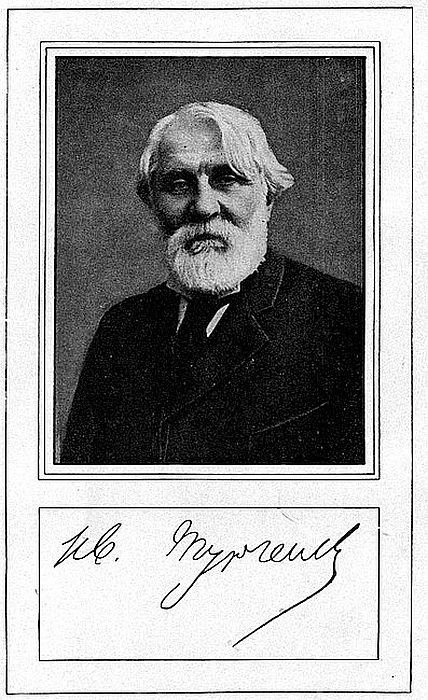
Turgenev
(FOREIGN)
VOLUME ONE RUSSIAN
Edited by
William Patten
With an Introduction
and Notes
P. F. COLLIER & SON
NEW YORK
Copyright 1907
By P. F. Collier & Son
The use of the copyrighted translations in
collection has been authorized by the
authors or their representatives. The
translations made especially for
this collection are covered
by the general
copyright
CONTENTS—VOLUME I
RUSSIAN
PAGE
THE QUEEN OF SPADES Alexander Sergeievitch Poushkin
NAPOLEON AND POPE PIUS VII Alfred Victor, Comte de Vigny
1067
CLAUDE GUEUX Victor Marie Hugo
1083
A BAL MASQUÉ Alexandre Davy de la Pailleterie Dumas
1105
HOW THE REDOUBT WAS TAKEN Prosper Mérimée
1121
THE VENDEAN MARRIAGE Jules Gabriel Janin
1131
THE MARQUISE George Sand
1149
THE BEAUTY-SPOT Alfred Louis Charles de Musset
1185
THE MUMMY’S FOOT Théophile Gautier
1237
CIRCÉ Octave Feuillet
1257
THE HANGING AT LA PIROCHE Alexandre Dumas, Fils
1269
THE DEAN’S WATCH Erckmann-Chatrian
1289
AT THE PALAIS DE JUSTICE Alphonse Daudet
1319
BOUM-BOUM Jules Claretie
1327
CONTENTS—VOLUME V
FRENCH
PAGE
LA BRETONNE André Theuriet
1339
WHICH WAS THE MADMAN? Edmond About
1349
THE GRAND MARRIAGE Ludovic Halévy
1379
THE ACCURSED HOUSE Émile Gaboriau
1415
THE FÊTE AT COQUEVILLE Émile Zola
1427
THE LOST CHILD François Coppée
1471
PUTOIS Anatole France
1495
SAC-AU-DOS Joris Karl Huysmans
1515
“BONJOUR, MONSIEUR” Jean Richepin
1559
THE BIT OF STRING Guy de Maupassant
1571
THE NECKLACE Guy de Maupassant
1581
THE WALL OPPOSITE Pierre Loti
1595
THE ANCESTOR Paul Bourget
1605
WHEN HE WAS A LITTLE BOY Henri Lavedan
1639
A GENTLEMAN FINDS A WATCH Georges Courteline
1651
A YOUNG GIRL’S DIARY Marcel Prévost
1659
THE SIGN OF THE KEY AND THE CROSS Henri de Régnier
1671
THE TELEGRAPH OPERATOR Alphonse Allais
1685
PREFACE
When the five-volume collection known as
“Short Story Classics (American)” was planned,
it was entirely evident that it should be supplemented
by a collection of the best examples of the
short story to be found in foreign literatures.
The five volumes now offered to the public are designed
to supply this lack. They contain seventy-eight
short stories, chosen from the literatures of France, Russia,
Germany, Italy, Norway, Sweden, Denmark, and
Finland—works of importance that have made their
mark in the literary world.
The aim has been not only to represent the most
widely sympathetic writers, but to select their most
generally interesting as well as characteristic stories.
The stories have all been written within the last seventy-five
years, which has this advantage for the reader, that
the scope of the collection may be said to lie within
present-day interests.
None of the stories by the following authors appear
in any other collection:
FRENCH
Honoré de Balzac, Eugène Scribe, Alfred de Vigny,
Victor Hugo, Alexandre Dumas, Prosper Mérimée, Jules
Janin, George Sand, Alfred de Musset, Théophile Gautier,
Octave Feuillet, Alexandre Dumas (Fils), Erckmann-Chatrian,
Alphonse Daudet, André Theuriet,
Ludovic Halévy, Émile Gaboriau, Émile Zola, Jules
Claretie, François Coppée, Anatole France, Joris Karl
Huysmans, Jean Richepin, Pierre Loti, Paul Bourget,
Henri de Régnier, Henri Lavedan, Marcel Prévost,
Georges Courteline, Alphonse Allais.
Enrico Castelnuovo, Giovanni Verga, Antonio Fogaszaro,
Edmondo de Amicis, Matilda Serao, Gabriele
d’Annunzio, Luigi Pirandello, Grazia Deledda, Björnson,
Holger Drachmann, Jacob Ahrenberg, Jens Peter Jacobsen,
Alexander Kielland, August Strindberg, Hermann
Bang, Selma Lagerlöf.
GERMAN
Heinrich Zschokke, Wilhelm Heinrich von Riehl, Paul
Heyse, Ferdinand von Saar, Leopold von Sacher-Masoch,
Rudolf Baumbach, Ernst von Wildenbruch, Max Nordau,
Hermann Sudermann, Gabriele Reuter, Ludwig
Fulda, Arthur Schnitzler, and Clara Viebig.
About half of the stories have been especially translated
for this collection, and some of them now appear
in English for the first time. Among these will be found
some by the more recent writers in Germany and Russia,
two very interesting groups of moderns whose work
has not received as much attention at the hands of the
public as it would seem to merit.
In only two or three cases, where the point of view
was likely to fail of appreciation by American readers,
have the stories been abbreviated or otherwise altered;
and attention has been called to this in the accompanying
note.
The notes which preceded the stories in “Short Story
Classics (American)” proved to be an appreciated and
even popular feature, and it is hoped that those written
for the present collection may prove equally acceptable.
If any one country more than another can be said to
excel in the use and development of the modern short
story form, it is France. The literatures of Russia, Italy,
Germany, Norway, Sweden, and Denmark, as well as
that of the United States, have all been influenced to a
greater or lesser extent by the art of Balzac, Gautier,
Mérimée, and De Maupassant, for in France short story
writing may be said to be based on a theory of art, and
to be, consequently, the result of conviction.
This theory of art, apart from the questions of form
which it involves, in themselves important considerations,
affords great freedom to the writer in the choice
of subject-matter and the method of treatment. It presupposes
the artist’s right to his point of view. It
presupposes an audience more keenly alive to life and
the manifestations of life than is characteristic of the
general reading public in America at the present time.
Generalizations like these are at the best unsatisfactory,
since the differences alluded to must be apprehended and
can not be well expounded; they will have abundantly
served their purpose if they awaken curiosity and prompt
the reader unfamiliar with the short story in foreign
literatures, and especially in the literature of France, to
make his own comparisons.
All over the world the literary main current seems to
be toward the development of the realism of twenty-five
years ago. From Denmark, where the trace is slightest,
to Russia, where it is most brutal, the best work is apparently
being done by the realists. In France there is
a decided reaction against strenuous realism, but it is
principally the reaction of a few individuals, and among
these the most prominent is Anatole France. He is not
any the less a realist, in the sense of being true to nature,
because his intelligence is concerned with an appreciation
of something else besides the material side of life.
To those who are familiar with the work of Émile
Zola, it seems desirable to explain that “Jacques Damour,”
a really great story, was too long to be included
in this collection. An interesting comparison can be
made between “The Bit of String,” by Guy de Maupassant,
and the two stories which it inspired, “The Slanderer,”
by Anton Chekhov, and “The End of Candia,”
by Gabriele d’Annunzio.
Even the most casual reader must surely be impressed
with the extraordinary vitality of these stories and their
likeness to life. It is a likeness that is not always optimistic,
it is true, as in the case of many of the Russian
writers, for example, but it seldom depends on a misstatement
of the facts of experience to create its effect,
and is seldom lacking in integrity of workmanship.
I am glad of an opportunity to record my appreciation
of the intelligent and interested assistance rendered
by Mr. R. W. Howes 3d, in preparing these volumes for
the press.
William Patten.
THE QUEEN OF SPADES
BY ALEXANDER SERGEIEVITCH POUSHKIN
Alexander Poushkin (born 1799, died 1837)
was the greatest genius among the Russian
poets. Though born of a noble family, thick
lips and crisp, curly hair showed his descent
from an Abyssinian negro slave ancestor on
his mother’s side. As a poet his work has
been compared with that of Byron, of which
he was frankly a close student. Chronologically
he comes first in the list of Russian
prose writers, a list that includes Gogol,
Turgenev, Dostoievski, and Tolstoi. “The
Queen of Spades” is one of the best and
most characteristic of his short stories.
THE QUEEN OF SPADES
BY ALEXANDER POUSHKIN
Translated by H. Twitehell. Copyright, 1901,
by The Current Literature Publishing Company.
At the house of Naroumov, a cavalry officer, the
long winter night had been passed in gambling.
At five in the morning breakfast was
served to the weary players. The winners ate with
relish; the losers, on the contrary, pushed back their
plates and sat brooding gloomily. Under the influence
of the good wine, however, the conversation
became general.
“Well, Sourine?” said the host inquiringly.
“Oh, I lost as usual. My luck is abominable. No
matter how cool I keep, I never win.”
“How is it, Herman, that you never touch a card?”
remarked one of the men, addressing a young officer
of the Engineering Corps. “Here you are with the
rest of us at five o’clock in the morning, and you have
neither played nor bet all night.”
“Play interests me greatly,” replied the person addressed,
“but I hardly care to sacrifice the necessaries
of life for uncertain superfluities.”
“Herman is a German, therefore economical; that
explains it,” said Tomsky. “But the person I can’t
quite understand is my grandmother, the Countess
Anna Fedorovna.”
“Why?” inquired a chorus of voices.
“I can’t understand why my grandmother never
gambles.”
“I don’t see anything very striking in the fact that
a woman of eighty refuses to gamble,” objected
Naroumov.
“Have you never heard her story?”
“No.”
“Well, then, listen to it. To begin with, sixty years
ago my grandmother went to Paris, where she was all
the fashion. People crowded each other in the streets
to get a chance to see the ‘Muscovite Venus,’ as she
was called. All the great ladies played faro, then.
On one occasion, while playing with the Duke of
Orleans, she lost an enormous sum. She told her
husband of the debt, but he refused outright to pay
it. Nothing could induce him to change his mind on
the subject, and grandmother was at her wits’ ends.
Finally, she remembered a friend of hers, Count Saint-Germain.
You must have heard of him, as many
wonderful stories have been told about him. He is said
to have discovered the elixir of life, the philosopher’s
stone, and many other equally marvelous things. He
had money at his disposal, and my grandmother
knew it. She sent him a note asking him to come to
see her. He obeyed her summons and found her in
great distress. She painted the cruelty of her husband
in the darkest colors, and ended by telling the Count
that she depended upon his friendship and generosity.
“‘I could lend you the money,’ replied the Count,
after a moment of thoughtfulness, ‘but I know that
you would not enjoy a moment’s rest until you had
returned it; it would only add to your embarrassment.
There is another way of freeing yourself.’
“‘But I have no money at all,’ insisted my grandmother.
“‘There is no need of money. Listen to me.’
“The Count then told her a secret which any of us
would give a good deal to know.”
The young gamesters were all attention. Tomsky
lit his pipe, took a few whiffs, then continued:
“The next evening, grandmother appeared at Versailles
at the Queen’s gaming-table. The Duke of
Orleans was the dealer. Grandmother made some excuse
for not having brought any money, and began
to punt. She chose three cards in succession, again
and again, winning every time, and was soon out of
debt.”
“A fable,” remarked Herman; “perhaps the cards
were marked.”
“I hardly think so,” replied Tomsky, with an air of
importance.
“So you have a grandmother who knows three winning
cards, and you haven’t found out the magic
secret.”
“I must say I have not. She had four sons, one of
them being my father, all of whom are devoted to
play; she never told the secret to one of them. But
my uncle told me this much, on his word of honor.
Tchaplitzky, who died in poverty after having squandered
millions, lost at one time, at play, nearly three
hundred thousand rubles. He was desperate and
grandmother took pity on him. She told him the
three cards, making him swear never to use them
again. He returned to the game, staked fifty thousand
rubles on each card, and came out ahead, after
paying his debts.”
As day was dawning the party now broke up, each
one draining his glass and taking his leave.
The Countess Anna Fedorovna was seated before
her mirror in her dressing-room. Three women were
assisting at her toilet. The old Countess no longer
made the slightest pretensions to beauty, but she still
clung to all the habits of her youth, and spent as much
time at her toilet as she had done sixty years before.
At the window a young girl, her ward, sat at her
needle-work.
“Good afternoon, grandmother,” cried a young officer,
who had just entered the room. “I have come to
ask a favor of you.”
“What, Pavel?”
“I want to be allowed to present one of my friends
to you, and to take you to the ball on Tuesday night.”
“Take me to the ball and present him to me there.”
After a few more remarks the officer walked up to
the window where Lisaveta Ivanovna sat.
“Whom do you wish to present?” asked the girl.
“Naroumov; do you know him?”
“No; is he a soldier?”
“Yes.”
“An engineer?”
“No; why do you ask?”
The girl smiled and made no reply.
Pavel Tomsky took his leave, and, left to herself,
Lisaveta glanced out of the window. Soon, a young
officer appeared at the corner of the street; the girl
blushed and bent her head low over her canvas.
This appearance of the officer had become a daily
occurrence. The man was totally unknown to her,
and as she was not accustomed to coquetting with the
soldiers she saw on the street, she hardly knew how
to explain his presence. His persistence finally roused
an interest entirely strange to her. One day, she even
ventured to smile upon her admirer, for such he seemed
to be.
The reader need hardly be told that the officer was
no other than Herman, the would-be gambler, whose
imagination had been strongly excited by the story
told by Tomsky of the three magic cards.
“Ah,” he thought, “if the old Countess would only
reveal the secret to me. Why not try to win her
good-will and appeal to her sympathy?”
With this idea in mind, he took up his daily station
before the house, watching the pretty face at the window,
and trusting to fate to bring about the desired
acquaintance.
One day, as Lisaveta was standing on the pavement
about to enter the carriage after the Countess, she felt
herself jostled and a note was thrust into her hand.
Turning, she saw the young officer at her elbow. As
quick as thought, she put the note in her glove and
entered the carriage. On her return from the drive,
she hastened to her chamber to read the missive,
in a state of excitement mingled with fear. It was
a tender and respectful declaration of affection, copied
word for word from a German novel. Of this fact,
Lisa was, of course, ignorant.
The young girl was much impressed by the missive,
but she felt that the writer must not be encouraged.
She therefore wrote a few lines of explanation and,
at the first opportunity, dropped it, with the letter, out
of the window. The officer hastily crossed the street,
picked up the papers and entered a shop to read
them.
In no wise daunted by this rebuff, he found the
opportunity to send her another note in a few days.
He received no reply, but, evidently understanding
the female heart, he persevered, begging for an interview.
He was rewarded at last by the following:
“To-night we go to the ambassador’s ball. We
shall remain until two o’clock. I can arrange for a
meeting in this way. After our departure, the servants
will probably all go out, or go to sleep. At half-past
eleven enter the vestibule boldly, and if you see
any one, inquire for the Countess; if not, ascend the
stairs, turn to the left and go on until you come to
a door, which opens into her bed-chamber. Enter this
room and behind a screen you will find another door
leading to a corridor; from this a spiral staircase leads
to my sitting-room. I shall expect to find you there
on my return.”
Herman trembled like a leaf as the appointed hour
drew near. He obeyed instructions fully, and, as he
met no one, he reached the old lady’s bed-chamber
without difficulty. Instead of going out of the small
door behind the screen, however, he concealed himself
in a closet to await the return of the old Countess.
The hours dragged slowly by; at last he heard the
sound of wheels. Immediately lamps were lighted and
servants began moving about. Finally the old woman
tottered into the room, completely exhausted. Her
women removed her wraps and proceeded to get her
in readiness for the night. Herman watched the proceedings
with a curiosity not unmingled with superstitious
fear. When at last she was attired in cap and
gown, the old woman looked less uncanny than when
she wore her ball-dress of blue brocade.
She sat down in an easy chair beside a table, as she
was in the habit of doing before retiring, and her
women withdrew. As the old lady sat swaying to and
fro, seemingly oblivious to her surroundings, Herman
crept out of his hiding-place.
At the slight noise the old woman opened her
eyes, and gazed at the intruder with a half-dazed
expression.
“Have no fear, I beg of you,” said Herman, in a
calm voice. “I have not come to harm you, but to ask
a favor of you instead.”
The Countess looked at him in silence, seemingly
without comprehending him. Herman thought she
might be deaf, so he put his lips close to her ear and
repeated his remark. The listener remained perfectly
mute.
“You could make my fortune without its costing you
anything,” pleaded the young man; “only tell me the
three cards which are sure to win, and—”
Herman paused as the old woman opened her lips
as if about to speak.
“It was only a jest; I swear to you, it was only a
jest,” came from the withered lips.
“There was no jesting about it. Remember Tchaplitzky,
who, thanks to you, was able to pay his debts.”
An expression of interior agitation passed over the
face of the old woman; then she relapsed into her
former apathy.
“Will you tell me the names of the magic cards, or
not?” asked Herman after a pause.
There was no reply.
The young man then drew a pistol from his pocket,
exclaiming: “You old witch, I’ll force you to tell me!”
At the sight of the weapon the Countess gave a
second sign of life. She threw back her head and put
out her hands as if to protect herself; then they dropped
and she sat motionless.
Herman grasped her arm roughly, and was about to
renew his threats, when he saw that she was dead!
Seated in her room, still in her ball-dress, Lisaveta
gave herself up to her reflections. She had expected
to find the young officer there, but she felt relieved to
see that he was not.
Strangely enough, that very night at the ball, Tomsky
had rallied her about her preference for the young
officer, assuring her that he knew more than she supposed
he did.
“Of whom are you speaking?” she had asked in
alarm, fearing her adventure had been discovered.
“Of the remarkable man,” was the reply. “His
name is Herman.”
Lisa made no reply.
“This Herman,” continued Tomsky, “is a romantic
character; he has the profile of a Napoleon and the
heart of a Mephistopheles. It is said he has at least
three crimes on his conscience. But how pale you are.”
“It is only a slight headache. But why do you talk
to me of this Herman?”
“Because I believe he has serious intentions concerning
you.”
“Where has he seen me?”
“At church, perhaps, or on the street.”
The conversation was interrupted at this point, to
the great regret of the young girl. The words of
Tomsky made a deep impression upon her, and she
realized how imprudently she had acted. She was
thinking of all this and a great deal more when the
door of her apartment suddenly opened, and Herman
stood before her. She drew back at sight of him,
trembling violently.
“Where have you been?” she asked in a frightened
whisper.
“In the bed-chamber of the Countess. She is dead,”
was the calm reply.
“My God! What are you saying?” cried the girl.
“Furthermore, I believe that I was the cause of her
death.”
The words of Tomsky flashed through Lisa’s mind.
Herman sat down and told her all. She listened
with a feeling of terror and disgust. So those passionate
letters, that audacious pursuit were not the result
of tenderness and love. It was money that he desired.
The poor girl felt that she had in a sense been an accomplice
in the death of her benefactress. She began
to weep bitterly. Herman regarded her in silence.
“You are a monster!” exclaimed Lisa, drying her
eyes.
“I didn’t intend to kill her; the pistol was not even
loaded.”
“How are you going to get out of the house?” inquired
Lisa. “It is nearly daylight. I intended to
show you the way to a secret staircase, while the
Countess was asleep, as we would have to cross her
chamber. Now I am afraid to do so.”
“Direct me, and I will find the way alone,” replied
Herman.
She gave him minute instructions and a key with
which to open the street door. The young man pressed
the cold, inert hand, then went out.
The death of the Countess had surprised no one, as
it had long been expected. Her funeral was attended
by every one of note in the vicinity. Herman mingled
with the throng without attracting any especial attention.
After all the friends had taken their last look at
the dead face, the young man approached the bier. He
prostrated himself on the cold floor, and remained motionless
for a long time. He rose at last with a face
almost as pale as that of the corpse itself, and went
up the steps to look into the casket. As he looked down
it seemed to him that the rigid face returned his glance
mockingly, closing one eye. He turned abruptly away,
made a false step, and fell to the floor. He was picked
up, and, at the same moment, Lisaveta was carried out
in a faint.
Herman did not recover his usual composure during
the entire day. He dined alone at an out-of-the-way
restaurant, and drank a great deal, in the hope of stifling
his emotion. The wine only served to stimulate
his imagination. He returned home and threw himself
down on his bed without undressing.
During the night he awoke with a start; the moon
shone into his chamber, making everything plainly visible.
Some one looked in at the window, then quickly
disappeared. He paid no attention to this, but soon
he heard the vestibule door open. He thought it was
his orderly, returning late, drunk as usual. The step
was an unfamiliar one, and he heard the shuffling
sound of loose slippers.
The door of his room opened, and a woman in white
entered. She came close to the bed, and the terrified
man recognized the Countess.
“I have come to you against my will,” she said
abruptly; “but I was commanded to grant your request.
The three, seven, and ace in succession are the
magic cards. Twenty-four hours must elapse between
the use of each card, and after the three have been
used you must never play again.”
The fantom then turned and walked away. Herman
heard the outside door close, and again saw the
form pass the window.
He rose and went out into the hall, where his orderly
lay asleep on the floor. The door was closed. Finding
no trace of a visitor, he returned to his room, lit
his candle, and wrote down what he had just heard.
Two fixed ideas can not exist in the brain at the
same time any more than two bodies can occupy the
same point in space. The three, seven, and ace soon
chased away the thoughts of the dead woman, and all
other thoughts from the brain of the young officer.
All his ideas merged into a single one: how to turn
to advantage the secret paid for so dearly. He even
thought of resigning his commission and going to Paris
to force a fortune from conquered fate. Chance rescued
him from his embarrassment.
Tchekalinsky, a man who had passed his whole life
at cards, opened a club at St. Petersburg. His long
experience secured for him the confidence of his companions,
and his hospitality and genial humor conciliated
society.
The gilded youth flocked around him, neglecting
society, preferring the charms of faro to those of their
sweethearts. Naroumov invited Herman to accompany
him to the club, and the young man accepted the
invitation only too willingly.
The two officers found the apartments full. Generals
and statesmen played whist; young men lounged
on sofas, eating ices or smoking. In the principal salon
stood a long table, at which about twenty men sat playing
faro, the host of the establishment being the banker.
He was a man of about sixty, gray-haired and respectable.
His ruddy face shone with genial humor;
his eyes sparkled and a constant smile hovered around
his lips.
Naroumov presented Herman. The host gave him
a cordial handshake, begged him not to stand upon
ceremony, and returned to his dealing. More than
thirty cards were already on the table. Tchekalinsky
paused after each coup, to allow the punters time to
recognize their gains or losses, politely answering all
questions and constantly smiling.
After the deal was over, the cards were shuffled and
the game began again.
“Permit me to choose a card,” said Herman, stretching
out his hand over the head of a portly gentleman,
to reach a livret. The banker bowed without
replying.
Herman chose a card, and wrote the amount of his
stake upon it with a piece of chalk.
“How much is that?” asked the banker; “excuse me,
sir, but I do not see well.”
“Forty thousand rubles,” said Herman coolly.
All eyes were instantly turned upon the speaker.
“He has lost his wits,” thought Naroumov.
“Allow me to observe,” said Tchekalinsky, with his
eternal smile, “that your stake is excessive.”
“What of it?” replied Herman, nettled. “Do you
accept it or not?”
The banker nodded in assent. “I have only to remind
you that the cash will be necessary; of course
your word is good, but in order to keep the confidence
of my patrons, I prefer the ready money.”
Herman took a bank-check from his pocket and
handed it to his host. The latter examined it attentively,
then laid it on the card chosen.
He began dealing: to the right, a nine; to the left,
a three.
“The three wins,” said Herman, showing the card
he held—a three.
A murmur ran through the crowd. Tchekalinsky
frowned for a second only, then his smile returned.
He took a roll of bank-bills from his pocket and
counted out the required sum. Herman received it
and at once left the table.
The next evening saw him at the place again. Every
one eyed him curiously, and Tchekalinsky greeted him
cordially.
He selected his card and placed upon it his fresh
stake. The banker began dealing: to the right, a nine;
to the left, a seven.
Herman then showed his card—a seven spot. The
onlookers exclaimed, and the host was visibly disturbed.
He counted out ninety-four thousand rubles
and passed them to Herman, who accepted them without
showing the least surprise, and at once withdrew.
The following evening he went again. His appearance
was the signal for the cessation of all occupation,
every one being eager to watch the developments of
events. He selected his card—an ace.
The dealing began: to the right, a queen; to the
left, an ace.
“The ace wins,” remarked Herman, turning up his
card without glancing at it.
“Your queen is killed,” remarked Tchekalinsky
quietly.
Herman trembled; looking down, he saw, not the
ace he had selected, but the queen of spades. He
could scarcely believe his eyes. It seemed impossible
that he could have made such a mistake. As he stared
at the card it seemed to him that the queen winked one
eye at him mockingly.
“The old woman!” he exclaimed involuntarily.
The croupier raked in the money while he looked on
in stupid terror. When he left the table, all made way
for him to pass; the cards were shuffled, and the gambling
went on.
Herman became a lunatic. He was confined at the
hospital at Oboukov, where he spoke to no one, but
kept constantly murmuring in a monotonous tone:
“The three, seven, ace! The three, seven, queen!”
THE CLOAK
BY NIKOLAI VASILIEVITCH GOGOL
The naturalistic movement, which took its
rise in France with Balzac and Mérimée, was
represented in Russia by Gogol (born 1809,
died 1852), who has been called the true
founder of the Russian school of fiction. He
undoubtedly derived some inspiration from
the romantic Poushkin, but, unlike Poushkin,
he was of Cossack origin—that is, not pure
Russian; he was born in Southwestern Russia,
on the borders of Poland. His writings have
exerted a great influence on both French and
Russian writers. Zola frankly confesses him
as his master, and Turgenev has said: “We
all came from Gogol’s ‘Cloak.’” Over and
above the constant observation of life on
which his work is based, and the remarkable
ability he possessed to present his facts in a
simple, natural manner, there is always the
understanding and sympathy of a big-hearted
man of the people.
THE CLOAK
BY NIKOLAI GOGOL
In the department of—but it is better not to
mention the department. There is nothing more
irritable than departments, regiments, courts of
justice, and, in a word, every branch of public service.
Each individual attached to them nowadays thinks all
society insulted in his person. Quite recently a complaint
was received from a justice of the peace, in
which he plainly demonstrated that all the imperial
institutions were going to the dogs, and that the Czar’s
sacred name was being taken in vain; and in proof he
appended to the complaint a romance, in which the
justice of the peace is made to appear about once in
every ten lines, and sometimes in a drunken condition.
Therefore, in order to avoid all unpleasantness, it will
be better to designate the department in question as a
certain department.
So, in a certain department there was a certain
official—not a very high one, it must be allowed—short
of stature, somewhat pock-marked, red-haired,
and short-sighted, with a bald forehead, wrinkled
cheeks, and a complexion of the kind known as sanguine.
The St. Petersburg climate was responsible
for this. As for his official status, he was what is
called a perpetual titular councilor, over which some
writers make merry and crack their jokes, obeying the
praiseworthy custom of attacking those who can not
bite back.
His family name was Bashmatchkin. This name is
evidently derived from bashmak (shoe); but when, at
what time, and in what manner, is not known. His
father and grandfather, and all the Bashmatchkins,
always wore boots, which only had new heels two or
three times a year. His name was Akakiy Akakievitch.
It may strike the reader as rather singular and
far-fetched; but he may rest assured that it was by
no means far-fetched, and that the circumstances were
such that it would have been impossible to give him
any other.
This was how it came about.
Akakiy Akakievitch was born, if my memory fails
me not, in the evening on the 23d of March. His
mother, the wife of a Government official, and a very
fine woman, made all due arrangements for having the
child baptized. She was lying on the bed opposite
the door; on her right stood the godfather, Iván
Ivanovitch Eroshkin, a most estimable man, who
served as presiding officer of the senate; and the godmother,
Anna Semenovna Byelobrushkova, the wife
of an officer of the quarter, and a woman of rare virtues.
They offered the mother her choice of three
names, Mokiya, Sossiya, or that the child should be
called after the martyr Khozdazat. “No,” said the
good woman, “all those names are poor.” In order to
please her, they opened the calendar at another place;
three more names appeared, Triphiliy, Dula, and
Varakhasiy. “This is a judgment,” said the old
woman. “What names! I truly never heard the like.
Varadat or Varukh might have been borne, but not
Triphiliy and Varakhasiy!” They turned to another
page and found Pavsikakhiy and Vakhtisiy. “Now
I see,” said the old woman, “that it is plainly fate.
And since such is the case, it will be better to name
him after his father. His father’s name was Akakiy,
so let his son’s be Akakiy too.” In this manner he
became Akakiy Akakievitch. They christened the
child, whereat he wept, and made a grimace, as though
he foresaw that he was to be a titular councilor.
In this manner did it all come about. We have
mentioned it in order that the reader might see for
himself that it was a case of necessity, and that it was
utterly impossible to give him any other name. When
and how he entered the department, and who appointed
him, no one could remember. However much the
directors and chiefs of all kinds were changed, he was
always to be seen in the same place, the same attitude,
the same occupation; so that it was afterward affirmed
that he had been born in undress uniform with a bald
head.
No respect was shown him in the department.
The porter not only did not rise from his seat when
he passed, but never even glanced at him, any more
than if a fly had flown through the reception-room.
His superiors treated him in coolly despotic fashion.
Some subchief would thrust a paper under his nose
without so much as saying “Copy,” or “Here’s a nice,
interesting affair,” or anything else agreeable, as is
customary among well-bred officials. And he took
it, looking only at the paper, and not observing who
handed it to him, or whether he had the right to do
so; simply took it, and set about copying it.
The young officials laughed at and made fun of him,
so far as their official wit permitted; told in his presence
various stories concocted about him, and about his
landlady, an old woman of seventy; declared that she
beat him; asked when the wedding was to be; and
strewed bits of paper over his head, calling them snow.
But Akakiy Akakievitch answered not a word, any
more than if there had been no one there besides himself.
It even had no effect upon his work: amid all
these annoyances he never made a single mistake in a
letter. But if the joking became wholly unbearable,
as when they jogged his hand, and prevented his attending
to his work, he would exclaim, “Leave me
alone! Why do you insult me?” And there was
something strange in the words and the voice in which
they were uttered. There was in it something which
moved to pity; so much that one young man, a newcomer,
who, taking pattern by the others, had permitted
himself to make sport of Akakiy, suddenly
stopped short, as though all about him had undergone
a transformation and presented itself in a different
aspect. Some unseen force repelled him from the comrades
whose acquaintance he had made, on the supposition
that they were well-bred and polite men. Long
afterward, in his gayest moments, there recurred to
his mind the little official with the bald forehead, with
his heart-rending words, “Leave me alone! Why do
you insult me?” In these moving words, other words
resounded—“I am thy brother.” And the young man
covered his face with his hand; and many a time afterward,
in the course of his life, shuddered at seeing
how much inhumanity there is in man, how much
savage coarseness is concealed beneath delicate,
refined worldliness, and even, O God! in that
man whom the world acknowledges as honorable
and noble.
It would be difficult to find another man who lived
so entirely for his duties. It is not enough to say that
Akakiy labored with zeal: no, he labored with love.
In his copying he found a varied and agreeable employment.
Enjoyment was written on his face: some
letters were even favorites with him, and when he
encountered these he smiled, winked, and worked with
his lips, till it seemed as though each letter might be
read in his face, as his pen traced it. If his pay had
been in proportion to his zeal, he would, perhaps, to
his great surprise, have been made even a councilor
of state. But he worked, as his companions, the wits,
put it, like a horse in a mill.
Moreover, it is impossible to say that no attention
was paid to him. One director, being a kindly man,
and desirous of rewarding him for his long service,
ordered him to be given something more important
than mere copying. So he was ordered to make a
report of an already concluded affair to another department;
the duty consisting simply in changing the
heading and altering a few words from the first to the
third person. This caused him so much toil that he
broke into a perspiration, rubbed his forehead, and
finally said: “No, give me rather something to copy.”
After that they let him copy on forever.
Outside this copying, it appeared that nothing existed
for him. He gave no thought to his clothes; his
undress uniform was not green, but a sort of rusty-meal
color. The collar was low, so that his neck, in
spite of the fact that it was not long, seemed inordinately
so as it emerged from it, like the necks of
those plaster cats which wag their heads and are carried
about upon the heads of scores of image sellers.
And something was always sticking to his uniform,
either a bit of hay or some trifle. Moreover, he had
a peculiar knack, as he walked along the street, of
arriving beneath a window just as all sorts of rubbish
was being flung out of it; hence he always bore about
on his hat scraps of melon rinds and other such articles.
Never once in his life did he give heed to what
was going on every day in the street; while it is well
known that his young brother officials train the range
of their glances till they can see when any one’s
trouser-straps come undone upon the opposite sidewalk,
which always brings a malicious smile to their
faces. But Akakiy Akakievitch saw in all things the
clean, even strokes of his written lines; and only when
a horse thrust his nose, from some unknown quarter,
over his shoulder, and sent a whole gust of wind down
his neck from his nostrils, did he observe that he was
not in the middle of a page, but in the middle of the
street.
On reaching home he sat down at once at the table,
supped his cabbage-soup up quickly, and swallowed a
bit of beef with onions, never noticing their taste, and
gulping down everything with flies and anything else
which the Lord happened to send at the moment. His
stomach filled, he rose from the table and copied papers
which he had brought home. If there happened to be
none, he took copies for himself, for his own gratification,
especially if the document was noteworthy, not
on account of its style, but of its being addressed to
some distinguished person.
Even at the hour when the gray St. Petersburg sky
had quite disappeared, and all the official world had
eaten or dined, each as he could, in accordance with
the salary he received and his own fancy; when all
were resting from the departmental jar of pens, running
to and fro from their own and other people’s
indispensable occupations, and from all the work that
an uneasy man makes willingly for himself, rather
than what is necessary; when officials hasten to dedicate
to pleasure the time which is left to them, one
bolder than the rest going to the theatre; another into
the street, looking under all the bonnets; another wasting
his evening in compliments to some pretty girl,
the star of a small official circle; another—and this
is the common case of all—visiting his comrades on
the fourth or third floor, in two small rooms with an
anteroom or kitchen, and some pretensions to fashion,
such as a lamp or some other trifle, which has cost
many a sacrifice of dinner or pleasure trip; in a word,
at the hour when all officials disperse among the contracted
quarters of their friends, to play whist as they
sip their tea from glasses with a kopek’s worth of
sugar, smoke long pipes, relate at times some bits of
gossip which a Russian man can never, under any circumstances,
refrain from, and, when there is nothing
else to talk of, repeat eternal anecdotes about the commandant
to whom they had sent word that the tails of
the horses on the Falconet Monument had been cut off,
when all strive to divert themselves, Akakiy Akakievitch
indulged in no kind of diversion. No one could
ever say that he had seen him at any kind of evening
party. Having written to his heart’s content, he lay
down to sleep, smiling at the thought of the coming
day—of what God might send him to copy on the
morrow.
Thus flowed on the peaceful life of the man, who,
with a salary of four hundred rubles, understood how
to be content with his lot; and thus it would have continued
to flow on, perhaps, to extreme old age were it
not that there are various ills strewn along the path
of life for titular councilors as well as for private,
actual, court, and every other species of councilor,
even for those who never give any advice or take any
themselves.
There exists in St. Petersburg a powerful foe of all
who receive a salary of four hundred rubles a year,
or thereabouts. This foe is no other than the northern
cold, although it is said to be very healthy. At
nine o’clock in the morning, at the very hour when
the streets are filled with men bound for the various
official departments, it begins to bestow such powerful
and piercing nips on all noses impartially that the
poor officials really do not know what to do with them.
At an hour when the foreheads of even those who
occupy exalted positions ache with the cold, and tears
start to their eyes, the poor titular councilors are sometimes
quite unprotected. Their only salvation lies in
traversing as quickly as possible, in their thin little
cloaks, five or six streets, and then warming their feet
in the porter’s room, and so thawing all their talents
and qualifications for official service which had become
frozen on the way.
Akakiy Akakievitch had felt for some time that his
back and shoulders suffered with peculiar poignancy
in spite of the fact that he tried to traverse the distance
with all possible speed. He began finally to wonder
whether the fault did not lie in his cloak. He
examined it thoroughly at home, and discovered that
in two places, namely, on the back and shoulders, it
had become thin as gauze; the cloth was worn to such
a degree that he could see through it, and the lining
had fallen into pieces. You must know that Akakiy
Akakievitch’s cloak served as an object of ridicule to
the officials; they even refused it the noble name of
cloak, and called it a cape. In fact, it was of singular
make; its collar diminishing year by year, but serving
to patch its other parts. The patching did not exhibit
great skill on the part of the tailor, and was, in fact,
baggy and ugly. Seeing how the matter stood, Akakiy
Akakievitch decided that it would be necessary to take
the cloak to Petrovitch, the tailor, who lived somewhere
on the fourth floor, up a dark staircase, and
who, in spite of his having but one eye, and pock-marks
all over his face, busied himself in repairing
the trousers and coats of officials and others; that is
to say, when he was sober, and not nursing some other
scheme in his head.
It is not necessary to say much about this tailor;
but, as it is the custom to have the character of each
personage in a novel clearly defined, there is no help
for it, so here is Petrovitch the tailor. At first he was
called only Grigoriy, and was some gentleman’s serf;
he commenced calling himself Petrovitch from the
time when he received his free papers, and further
began to drink heavily on all holidays, at first on the
great ones, and then on all church festivals without
discrimination, wherever a cross stood in the calendar.
On this point he was faithful to ancestral custom; and
when quarreling with his wife he called her a low
female and a German. As we have mentioned his wife,
it will be necessary to say a word or two about her.
Unfortunately, little is known of her beyond the fact
that Petrovitch has a wife, who wears a cap and a
dress, but can not lay claim to beauty; at least, no one
but the soldiers of the guard even looked under her
cap when they met her.
Ascending the staircase which led to Petrovitch’s
room—which staircase was all soaked with dish-water
and reeked with the smell of spirits which affects the
eyes, and is an inevitable adjunct to all dark stairways
in St. Petersburg houses—ascending the stairs, Akakiy
Akakievitch pondered how much Petrovitch would ask,
and mentally resolved not to give more than two
rubles. The door was open; for the mistress, in cooking
some fish, had raised such a smoke in the kitchen
that not even the beetles were visible. Akakiy Akakievitch
passed through the kitchen unperceived, even by
the housewife, and at length reached a room where he
beheld Petrovitch seated on a large unpainted table,
with his legs tucked under him like a Turkish pasha.
His feet were bare, after the fashion of tailors as they
sit at work; and the first thing which caught the eye
was his thumb, with a deformed nail thick and strong
as a turtle’s shell. About Petrovitch’s neck hung a
skein of silk and thread, and upon his knees lay some
old garment. He had been trying unsuccessfully for
three minutes to thread his needle, and was enraged
at the darkness and even at the thread, growling in a
low voice, “It won’t go through, the barbarian! You
pricked me, you rascal!”
Akakiy Akakievitch was vexed at arriving at the
precise moment when Petrovitch was angry; he liked
to order something of Petrovitch when the latter was
a little downhearted, or, as his wife expressed it,
“when he had settled himself with brandy, the one-eyed
devil!” Under such circumstances, Petrovitch
generally came down in his price very readily, and
even bowed and returned thanks. Afterward, to be
sure, his wife would come, complaining that her husband
was drunk, and so had fixed the price too low;
but if only a ten-kopek piece were added, then the
matter was settled. But now it appeared that Petrovitch
was in a sober condition, and therefore rough,
taciturn, and inclined to demand, Satan only knows
what price. Akakiy Akakievitch felt this, and would
gladly have beat a retreat; but he was in for it. Petrovitch
screwed up his one eye very intently at him; and
Akakiy Akakievitch involuntarily said: “How do you
do, Petrovitch?”
“I wish you a good-morning, sir,” said Petrovitch,
squinting at Akakiy Akakievitch’s hands, to see what
sort of booty he had brought.
“Ah! I—to you, Petrovitch, this—” It must be
known that Akakiy Akakievitch expressed himself
chiefly by prepositions, adverbs, and scraps of phrases
which had no meaning whatever. If the matter was
a very difficult one, he had a habit of never completing
his sentences; so that frequently, having begun a
phrase with the words, “This, in fact, is quite—” he
forgot to go on, thinking that he had already finished it.
“What is it?” asked Petrovitch, and with his one
eye scanned Akakievitch’s whole uniform from the
collar down to the cuffs, the back, the tails, and the
button-holes, all of which were well known to him,
since they were his own handiwork. Such is the habit
of tailors; it is the first thing they do on meeting one.
“But I, here, this—Petrovitch—a cloak, cloth—here
you see, everywhere, in different places, it is quite
strong—it is a little dusty, and looks old, but it is new,
only here in one place it is a little—on the back, and
here on one of the shoulders, it is a little worn, yes,
here on this shoulder it is a little—do you see? that is
all. And a little work—”
Petrovitch took the cloak, spread it out, to begin
with, on the table, looked hard at it, shook his head,
reached out his hand to the window-sill for his snuff-box,
adorned with the portrait of some general, though
what general is unknown, for the place where the face
should have been had been rubbed through by the
finger, and a square bit of paper had been pasted over
it. Having taken a pinch of snuff, Petrovitch held
up the cloak, and inspected it against the light, and
again shook his head. Then he turned it, lining upward,
and shook his head once more. After which he
again lifted the general-adorned lid with its bit of
pasted paper, and, having stuffed his nose with snuff,
closed and put away the snuff-box, and said finally,
“No, it is impossible to mend it; it’s a wretched
garment!”
Akakiy Akakievitch’s heart sank at these words.
“Why is it impossible, Petrovitch?” he said, almost
in the pleading voice of a child; “all that ails it is
that it is worn at the shoulders. You must have some
pieces—”
“Yes, patches could be found, patches are easily
found,” said Petrovitch, “but there’s nothing to sew
them to. The thing is completely rotten; if you put
a needle to it—see, it will give way.”
“Let it give way, and you can put on another patch
at once.”
“But there is nothing to put the patches on to;
there’s no use in strengthening it; it is too far gone.
It’s lucky that it’s cloth; for, if the wind were to blow,
it would fly away.”
“Well, strengthen it again. How this, in fact.”
“No,” said Petrovitch decisively, “there is nothing
to be done with it. It’s a thoroughly bad job. You’d
better, when the cold winter weather comes on, make
yourself some gaiters out of it, because stockings are
not warm. The Germans invented them in order to
make more money.” Petrovitch loved, on all occasions,
to have a fling at the Germans. “But it is plain
you must have a new cloak.”
At the word “new,” all grew dark before Akakiy
Akakievitch’s eyes and everything in the room began
to whirl round. The only thing he saw clearly was
the general with the paper face on the lid of Petrovitch’s
snuff-box. “A new one?” said he, as if still
in a dream: “why, I have no money for that.”
“Yes, a new one,” said Petrovitch, with barbarous
composure.
“Well, if it came to a new one, how it?”
“You mean how much would it cost?”
“Yes.”
“Well, you would have to lay out a hundred and
fifty or more,” said Petrovitch, and pursed up his lips
significantly. He liked to produce powerful effects,
liked to stun utterly and suddenly and then to glance
sidewise to see what face the stunned person would
put on the matter.
“A hundred and fifty rubles for a cloak!” shrieked
poor Akakiy Akakievitch, perhaps for the first time in
his life, for his voice had always been distinguished
for softness.
“Yes, sir,” said Petrovitch, “for any kind of cloak.
If you have a marten fur on the collar, or a silk-lined
hood, it will mount up to two hundred.”
“Petrovitch, please,” said Akakiy Akakievitch in a
beseeching tone, not hearing, and not trying to hear,
Petrovitch’s words, and disregarding all his “effects,”
“some repairs, in order that it may wear yet a little
longer.”
“No, it would only be a waste of time and money,”
said Petrovitch; and Akakiy Akakievitch went away
after these words, utterly discouraged. But Petrovitch
stood for some time after his departure, with
significantly compressed lips, and without betaking
himself to his work, satisfied that he would not be
dropped, and an artistic tailor employed.
Akakiy Akakievitch went out into the street as if
in a dream. “Such an affair!” he said to himself:
“I did not think it had come to—” and then after a
pause he added: “Well, so it is! see what it has come
to at last! and I never imagined that it was so!”
Then followed a long silence, after which he exclaimed:
“Well, so it is! see what already—nothing
unexpected that it would be nothing—what a strange
circumstance!” So saying, instead of going home, he
went in exactly the opposite direction without himself
suspecting it. On the way a chimney-sweep bumped
up against him and blackened his shoulder, and a whole
hatful of rubbish landed on him from the top of a
house which was building. He did not notice it; and
only when he ran against a watchman, who, having
planted his halberd beside him, was shaking some
snuff from his box into his horny hand, did he recover
himself a little, and that because the watchman said,
“Why are you poking yourself into a man’s very face?
Haven’t you the pavement?” This caused him to look
about him, and turn toward home.
There only he finally began to collect his thoughts
and to survey his position in its clear and actual light,
and to argue with himself, sensibly and frankly, as
with a reasonable friend, with whom one can discuss
private and personal matters. “No,” said Akakiy Akakievitch,
“it is impossible to reason with Petrovitch
now; he is that—evidently his wife has been beating
him. I’d better go to him on Sunday morning; after
Saturday night he will be a little cross-eyed and sleepy,
for he will want to get drunk, and his wife won’t give
him any money; and at such a time a ten-kopek piece
in his hand will—he will become more fit to reason
with, and then the cloak, and that—” Thus argued
Akakiy Akakievitch with himself, regained his courage,
and waited until the first Sunday, when, seeing
from afar that Petrovitch’s wife had left the house,
he went straight to him.
Petrovitch’s eye was, indeed, very much askew after
Saturday: his head drooped and he was very sleepy;
but for all that, as soon as he knew what it was a
question of, it seemed as though Satan jogged his
memory. “Impossible,” said he; “please to order a
new one.” Thereupon Akakiy Akakievitch handed
over the ten-kopek piece. “Thank you, sir; I will
drink your good health,” said Petrovitch; “but as for
the cloak, don’t trouble yourself about it; it is good
for nothing. I will make you a capital new one, so
let us settle about it now.”
Akakiy Akakievitch was still for mending it; but
Petrovitch would not hear of it, and said: “I shall certainly
have to make you a new one, and you may
depend upon it that I shall do my best. It may even
be, as the fashion goes, that the collar can be fastened
by silver hooks under a flap.”
Then Akakiy Akakievitch saw that it was impossible
to get along without a new cloak, and his spirit
sank utterly. How, in fact, was it to be done? Where
was the money to come from? He might, to be sure,
depend, in part, upon his present at Christmas; but
that money had long been allotted beforehand. He
must have some new trousers, and pay a debt of long
standing to the shoemaker for putting new tops to his
old boots, and he must order three shirts from the
seamstress, and a couple of pieces of linen. In short,
all his money must be spent; and even if the director
should be so kind as to order him to receive forty-five
rubles instead of forty, or even fifty, it would be a
mere nothing, a mere drop in the ocean toward the
funds necessary for a cloak; although he knew that
Petrovitch was often wrong-headed enough to blurt
out some outrageous price, so that even his own wife
could not refrain from exclaiming, “Have you lost
your senses, you fool?” At one time he would not
work at any price, and now it was quite likely that
he had named a higher sum than the cloak would cost.
But although he knew that Petrovitch would undertake
to make a cloak for eighty rubles, still, where was
he to get the eighty rubles from? He might possibly
manage half; yes, half might be procured, but where
was the other half to come from? But the reader must
first be told where the first half came from. Akakiy
Akakievitch had a habit of putting, for every ruble he
spent, a kopek into a small box, fastened with lock
and key, and with a slit in the top for the reception
of money. At the end of every half-year he counted
over the heap of coppers, and changed it for silver.
This he had done for a long time, and in the course
of years the sum had mounted up to over forty rubles.
Thus he had one-half on hand; but where was he
to find the other half? where was he to get another
forty rubles from? Akakiy Akakievitch thought and
thought, and decided that it would be necessary to
curtail his ordinary expenses for the space of one year
at least—to dispense with tea in the evening, to burn
no candles, and, if there was anything which he must
do, to go into his landlady’s room and work by her
light. When he went into the street he must walk as
lightly as he could, and as cautiously, upon the stones,
almost upon tiptoe, in order not to wear his heels down
in too short a time; he must give the laundress as little
to wash as possible; and, in order not to wear out his
clothes, he must take them off as soon as he got home,
and wear only his cotton dressing-gown, which had
been long and carefully saved.
To tell the truth, it was a little hard for him at
first to accustom himself to these deprivations; but he
got used to them at length, after a fashion, and all
went smoothly. He even got used to being hungry in
the evening, but he made up for it by treating himself,
so to say, in spirit, by bearing ever in mind the
idea of his future cloak. From that time forth his
existence seemed to become, in some way, fuller, as
if he were married, or as if some other man lived in
him, as if, in fact, he were not alone, and some pleasant
friend had consented to travel along life’s path
with him, the friend being no other than the cloak,
with thick wadding and a strong lining incapable of
wearing out. He became more lively, and even his
character grew firmer, like that of a man who has
made up his mind and set himself a goal. From his
face and gait, doubt and indecision, all hesitating
and wavering traits, disappeared of themselves. Fire
gleamed in his eyes, and occasionally the boldest and
most daring ideas flitted through his mind; why not,
for instance, have marten fur on the collar? The
thought of this almost made him absent-minded. Once,
in copying a letter, he nearly made a mistake, so that
he exclaimed almost aloud, “Ugh!” and crossed himself.
Once in the course of every month he had a
conference with Petrovitch on the subject of the cloak,
where it would be better to buy the cloth, and the color,
and the price. He always returned home satisfied,
though troubled, reflecting that the time would come
at last when it could all be bought, and then the
cloak made.
The affair progressed more briskly than he had
expected. Far beyond all his hopes, the director
awarded neither forty nor forty-five rubles for Akakiy
Akakievitch’s share, but sixty. Whether he suspected
that Akakiy Akakievitch needed a cloak, or whether it
was merely chance; at all events, twenty extra rubles
were by this means provided. This circumstance hastened
matters. Two or three months more of hunger
and Akakiy Akakievitch had accumulated about eighty
rubles. His heart, generally so quiet, began to throb.
On the first possible day he went shopping in company
with Petrovitch. They bought some very good cloth,
and at a reasonable rate too, for they had been considering
the matter for six months, and rarely let a
month pass without their visiting the shops to inquire
prices. Petrovitch himself said that no better cloth
could be had. For lining, they selected a cotton stuff,
but so firm and thick that Petrovitch declared it to
be better than silk, and even prettier and more glossy.
They did not buy the marten fur because it was, in
fact, dear, but in its stead they picked out the very
best of cat-skin which could be found in the shop, and
which might, indeed, be taken for marten at a distance.
Petrovitch worked at the cloak two whole weeks,
for there was a great deal of quilting; otherwise it
would have been finished sooner. He charged twelve
rubles for the job; it could not possibly have been done
for less. It was all sewed with silk, in small, double
seams; and Petrovitch went over each seam afterward
with his own teeth.
It was—it is difficult to say precisely on what day,
but probably the most glorious one in Akakiy Akakievitch’s
life, when Petrovitch at length brought home
the cloak. He brought it in the morning, before the
hour when it was necessary to start for the department.
Never did a cloak arrive so exactly in the nick
of time, for the severe cold had set in, and it seemed
to threaten to increase. Petrovitch brought the cloak
himself as befits a good tailor. On his countenance
was a significant expression, such as Akakiy Akakievitch
had never beheld there. He seemed fully sensible
that he had done no small deed, and crossed a gulf
separating tailors who only put in linings and execute
repairs from those who make new things. He took
the cloak out of the pocket-handkerchief in which he
had brought it. The handkerchief was fresh from
the laundress, and he put it in his pocket for use.
Taking out the cloak, he gazed proudly at it, held it
up with both hands, and flung it skilfully over the
shoulders of Akakiy Akakievitch. Then he pulled it
and fitted it down behind with his hand, and he draped
it around Akakiy Akakievitch without buttoning it.
Akakiy Akakievitch, like an experienced man, wished
to try the sleeves. Petrovitch helped him on with
them, and it turned out that the sleeves were satisfactory
also. In short, the cloak appeared to be perfect
and most seasonable. Petrovitch did not neglect to
observe that it was only because he lived in a narrow
street, and had no sign-board, and had known Akakiy
Akakievitch so long, that he had made it so cheaply;
but that if he had been in business on the Nevsky
Prospect he would have charged seventy-five rubles
for the making alone. Akakiy Akakievitch did not
care to argue this point with Petrovitch. He paid
him, thanked him, and set out at once in his new
cloak for the department. Petrovitch followed him,
and, pausing in the street, gazed long at the cloak in
the distance, after which he went to one side expressly
to run through a crooked alley and emerge again into
the street beyond to gaze once more upon the cloak
from another point, namely, directly in front.
Meantime Akakiy Akakievitch went on in holiday
mood. He was conscious, every second of the time,
that he had a new cloak on his shoulders; and several
times he laughed with internal satisfaction. In fact
there were two advantages, one was its warmth, the
other its beauty. He saw nothing of the road, but
suddenly found himself at the department. He took
off his cloak in the anteroom, looked it over carefully,
and confided it to the especial care of the attendant.
It is impossible to say precisely how it was that every
one in the department knew at once that Akakiy Akakievitch
had a new cloak, and that the “cape” no longer
existed. All rushed at the same moment into the anteroom,
to inspect it. They congratulated him and said
pleasant things to him, so that he began at first to smile
and then to grow ashamed. When all surrounded
him and said that the new cloak must be “christened,”
and that he must give a whole evening at least to this,
Akakiy Akakievitch lost his head completely, and did
not know where he stood, what to answer, or how to
get out of it. He stood blushing all over for several
minutes, and was on the point of assuring them with
great simplicity that it was not a new cloak, that it
was so and so, that it was in fact the old “cape.”
At length one of the officials, a subchief probably,
in order to show that he was not at all proud, and on
good terms with his inferiors, said: “So be it, only I
will give the party instead of Akakiy Akakievitch;
I invite you all to tea with me to-night; it happens
quite à propos, as it is my name-day.” The officials
naturally at once offered the subchief their congratulations,
and accepted the invitation with pleasure.
Akakiy Akakievitch would have declined, but all declared
that it was discourteous, that it was simply a
sin and a shame, and that he could not possibly refuse.
Besides, the notion became pleasant to him when he
recollected that he should thereby have a chance of
wearing his new cloak in the evening also.
That whole day was truly a most triumphant festival
day for Akakiy Akakievitch. He returned home
in the most happy frame of mind, took off his cloak,
and hung it carefully on the wall, admiring afresh the
cloth and the lining. Then he brought out his old,
worn-out cloak for comparison. He looked at it and
laughed, so vast was the difference. And long after
dinner he laughed again when the condition of the
“cape” recurred to his mind. He dined cheerfully,
and after dinner wrote nothing, but took his ease for
a while on the bed, until it got dark. Then he dressed
himself leisurely, put on his cloak, and stepped out
into the street. Where the host lived, unfortunately,
we can not say; our memory begins to fail us badly;
and the houses and streets in St. Petersburg have become
so mixed up in our head that it is very difficult
to get anything out of it again in proper form. This
much is certain, that the official lived in the best part
of the city; and, therefore, it must have been anything
but near to Akakiy Akakievitch’s residence. Akakiy
Akakievitch was first obliged to traverse a kind of
wilderness of deserted, dimly lighted streets; but in
proportion as he approached the official’s quarter of
the city the streets became more lively, more populous,
and more brilliantly illuminated. Pedestrians began
to appear; handsomely dressed ladies were more frequently
encountered; the men had otter-skin collars
to their coats; peasant wagoners, with their grate like
sledges stuck over with brass-headed nails, became
rarer; while, on the other hand, more and more drivers
in red velvet caps, lacquered sledges, and bear-skin
coats began to appear, and carriages with rich hammercloths
flew swiftly through the streets, their wheels
crunching the snow. Akakiy Akakievitch gazed upon
all this as upon a novel sight. He had not been in the
streets during the evening for years. He halted out of
curiosity before a shop-window, to look at a picture
representing a handsome woman, who had thrown off
her shoe, thereby baring her whole foot in a very
pretty way; while behind her the head of a man with
whiskers and a handsome mustache peeped through
the doorway of another room. Akakiy Akakievitch
shook his head and laughed, and then went on his way.
Why did he laugh? Either because he had met with
a thing utterly unknown, but for which every one
cherishes, nevertheless, some sort of feeling; or else
he thought, like many officials, as follows: “Well, those
French! What is to be said? If they do go in anything
of that sort, why—” But possibly he did not
think at all.
Akakiy Akakievitch at length reached the house in
which the subchief lodged. The subchief lived in fine
style; the staircase was lit by a lamp, his apartment
being on the second floor. On entering the vestibule,
Akakiy Akakievitch beheld a whole row of goloshes
on the floor. Among them, in the centre of the room,
stood a samovár, or tea-urn, humming and emitting
clouds of steam. On the walls hung all sorts of coats
and cloaks, among which there were even some with
beaver collars or velvet facings. Beyond, the buzz of
conversation was audible, and became clear and loud
when the servant came out with a trayful of empty
glasses, cream-jugs, and sugar-bowls. It was evident
that the officials had arrived long before, and had
already finished their first glass of tea.
Akakiy Akakievitch, having hung up his own cloak,
entered the inner room. Before him all at once appeared
lights, officials, pipes, and card-tables; and he
was bewildered by a sound of rapid conversation rising
from all the tables, and the noise of moving chairs.
He halted very awkwardly in the middle of the room,
wondering what he ought to do. But they had seen
him. They received him with a shout, and all thronged
at once into the anteroom, and there took another look
at his cloak. Akakiy Akakievitch, although somewhat
confused, was frank-hearted, and could not refrain
from rejoicing when he saw how they praised his
cloak. Then, of course, they all dropped him and his
cloak, and returned, as was proper, to the tables set
out for whist.
All this, the noise, the talk, and the throng of people
was rather overwhelming to Akakiy Akakievitch.
He simply did not know where he stood, or where to
put his hands, his feet, and his whole body. Finally
he sat down by the players, looked at the cards, gazed
at the face of one and another, and after a while began
to gape, and to feel that it was wearisome, the more
so as the hour was already long past when he usually
went to bed. He wanted to take leave of the host;
but they would not let him go, saying that he must
not fail to drink a glass of champagne, in honor of
his new garment. In the course of an hour, supper,
consisting of vegetables, salad, cold veal, pastry, confectioner’s
pies, and champagne, was served. They
made Akakiy Akakievitch drink two glasses of champagne,
after which he felt things grow livelier.
Still, he could not forget that it was twelve o’clock,
and that he should have been at home long ago. In
order that the host might not think of some excuse for
detaining him, he stole out of the room quickly, sought
out, in the anteroom, his cloak, which, to his sorrow,
he found lying on the floor, brushed it, picked off every
speck upon it, put it on his shoulders, and descended
the stairs to the street.
In the street all was still bright. Some petty shops,
those permanent clubs of servants and all sorts of folks,
were open. Others were shut, but, nevertheless, showed
a streak of light the whole length of the door-crack,
indicating that they were not yet free of company, and
that probably some domestics, male and female, were
finishing their stories and conversations, while leaving
their masters in complete ignorance as to their whereabouts.
Akakiy Akakievitch went on in a happy frame
of mind: he even started to run, without knowing why,
after some lady, who flew past like a flash of lightning.
But he stopped short, and went on very quietly as before,
wondering why he had quickened his pace. Soon
there spread before him those deserted streets, which
are not cheerful in the daytime, to say nothing of the
evening. Now they were even more dim and lonely:
the lanterns began to grow rarer, oil, evidently, had
been less liberally supplied. Then came wooden houses
and fences: not a soul anywhere; only the snow sparkled
in the streets and mournfully veiled the low-roofed
cabins with their closed shutters. He approached the
spot where the street crossed a vast square with houses
barely visible on its farther side, a square which seemed
a fearful desert.
Afar, a tiny spark glimmered from some watchman’s
box, which seemed to stand on the edge of the
world. Akakiy Akakievitch’s cheerfulness diminished
at this point in a marked degree. He entered the
square, not without an involuntary sensation of fear,
as though his heart warned him of some evil. He
glanced back and on both sides, it was like a sea about
him. “No, it is better not to look,” he thought, and
went on, closing his eyes. When he opened them, to
see whether he was near the end of the square, he
suddenly beheld, standing just before his very nose,
some bearded individuals of precisely what sort he
could not make out. All grew dark before his eyes,
and his heart throbbed.
“But, of course, the cloak is mine!” said one of
them in a loud voice, seizing hold of his collar. Akakiy
Akakievitch was about to shout “watch” when the
second man thrust a fist about the size of a man’s head
into his mouth, muttering, “Now scream!”
Akakiy Akakievitch felt them strip off his cloak and
give him a push with a knee; he fell headlong upon
the snow, and felt no more. In a few minutes he
recovered consciousness, and rose to his feet; but no
one was there. He felt that it was cold in the square
and that his cloak was gone; he began to shout, but his
voice did not appear to reach to the outskirts of the
square. In despair, but without ceasing to shout, he
started at a run across the square, straight toward the
watch-box, beside which stood the watchman, leaning
on his halberd, and apparently curious to know what
kind of a customer was running toward him and
shouting. Akakiy Akakievitch ran up to him, and
began in a sobbing voice to shout that he was asleep
and attended to nothing, and did not see when a man
was robbed. The watchman replied that he had seen
two men stop him in the middle of the square, but
supposed that they were friends of his; and that, instead
of scolding vainly, he had better go to the police
on the morrow, so that they might make a search for
whoever had stolen the cloak.
Akakiy Akakievitch ran home in complete disorder;
his hair, which grew very thinly upon his temples and
the back of his head, wholly disordered; his body,
arms, and legs covered with snow. The old woman,
who was mistress of his lodgings, on hearing a terrible
knocking, sprang hastily from her bed, and, with
only one shoe on, ran to open the door, pressing the
sleeve of her chemise to her bosom out of modesty;
but when she had opened it she fell back on beholding
Akakiy Akakievitch in such a state. When he told
her about the affair she clasped her hands, and said
that he must go straight to the district chief of police,
for his subordinate would turn up his nose, promise
well, and drop the matter there. The very best thing
to do, therefore, would be to go to the district chief,
whom she knew, because Finnish Anna, her former
cook, was now nurse at his house. She often saw him
passing the house; and he was at church every Sunday,
praying, but at the same time gazing cheerfully
at everybody; so that he must be a good man, judging
from all appearances. Having listened to this opinion,
Akakiy Akakievitch betook himself sadly to his
room; and how he spent the night there any one who
can put himself in another’s place may readily imagine.
Early in the morning he presented himself at the
district chief’s; but was told that this official was
asleep. He went again at ten and was again informed
that he was asleep; at eleven, and they said, “The superintendent
is not at home;” at dinner time, and the
clerks in the anteroom would not admit him on any
terms, and insisted upon knowing his business. So that
at last, for once in his life, Akakiy Akakievitch felt an
inclination to show some spirit, and said curtly that he
must see the chief in person; that they ought not to
presume to refuse him entrance; that he came from
the department of justice, and that when he complained
of them, they would see.
The clerks dared make no reply to this, and one of
them went to call the chief, who listened to the strange
story of the theft of the coat. Instead of directing his
attention to the principal points of the matter, he began
to question Akakiy Akakievitch: Why was he going
home so late? Was he in the habit of doing so,
or had he been to some disorderly house? So that
Akakiy Akakievitch got thoroughly confused, and left
him without knowing whether the affair of his cloak
was in proper train or not.
All that day, for the first time in his life, he never
went near the department. The next day he made
his appearance, very pale, and in his old cape, which
had become even more shabby. The news of the robbery
of the cloak touched many; although there were
some officials present who never lost an opportunity,
even such a one as the present, of ridiculing Akakiy
Akakievitch. They decided to make a collection for
him on the spot, but the officials had already spent a
great deal in subscribing for the director’s portrait,
and for some book, at the suggestion of the head of
that division, who was a friend of the author; and
so the sum was trifling.
One of them, moved by pity, resolved to help Akakiy
Akakievitch with some good advice at least, and told
him that he ought not to go to the police, for although
it might happen that a police officer, wishing to win
the approval of his superiors, might hunt up the cloak
by some means, still his cloak would remain in the
possession of the police if he did not offer legal proof
that it belonged to him. The best thing for him, therefore,
would be to apply to a certain prominent personage;
since this prominent personage, by entering into
relations with the proper persons, could greatly expedite
the matter.
As there was nothing else to be done, Akakiy Akakievitch
decided to go to the prominent personage.
What was the exact official position of the prominent
personage remains unknown to this day. The reader
must know that the prominent personage had but recently
become a prominent personage, having up to
that time been only an insignificant person. Moreover,
his present position was not considered prominent
in comparison with others still more so. But there is
always a circle of people to whom what is insignificant
in the eyes of others is important enough. Moreover,
he strove to increase his importance by sundry
devices; for instance, he managed to have the inferior
officials meet him on the staircase when he entered
upon his service; no one was to presume to come
directly to him, but the strictest etiquette must be
observed; the collegiate recorder must make a report
to the government secretary, the government secretary
to the titular councilor, or whatever other man
was proper, and all business must come before him in
this manner. In Holy Russia all is thus contaminated
with the love of imitation; every man imitates and
copies his superior. They even say that a certain
titular councilor, when promoted to the head of some
small separate room, immediately partitioned off a private
room for himself, called it the audience chamber,
and posted at the door a lackey with red collar and
braid, who grasped the handle of the door and opened
to all comers; though the audience chamber would
hardly hold an ordinary writing table.
The manners and customs of the prominent personage
were grand and imposing, but rather exaggerated.
The main foundation of his system was strictness.
“Strictness, strictness, and always strictness!” he generally
said; and at the last word he looked significantly
into the face of the person to whom he spoke. But
there was no necessity for this, for the half-score of
subordinates, who formed the entire force of the office,
were properly afraid; on catching sight of him afar
off, they left their work, and waited, drawn up in line,
until he had passed through the room. His ordinary
converse with his inferiors smacked of sternness, and
consisted chiefly of three phrases: “How dare you?”
“Do you know whom you are speaking to?” “Do you
realize who stands before you?”
Otherwise he was a very kind-hearted man, good
to his comrades, and ready to oblige; but the rank of
general threw him completely off his balance. On
receiving any one of that rank he became confused,
lost his way, as it were, and never knew what to do.
If he chanced to be among his equals, he was still a
very nice kind of man, a very good fellow in many
respects, and not stupid; but the very moment that he
found himself in the society of people but one rank
lower than himself, he became silent; and his situation
aroused sympathy, the more so as he felt himself that
he might have been making an incomparably better
use of his time. In his eyes there was sometimes visible
a desire to join some interesting conversation or
group; but he was kept back by the thought, “Would
it not be a very great condescension on his part?
Would it not be familiar? and would he not thereby
lose his importance?” And in consequence of such
reflections he always remained in the same dumb state,
uttering from time to time a few monosyllabic sounds,
and thereby earning the name of the most wearisome
of men.
To this prominent personage, Akakiy Akakievitch
presented himself, and this at the most unfavorable
time for himself, though opportune for the prominent
personage. The prominent personage was in his cabinet,
conversing very gaily with an old acquaintance
and companion of his childhood, whom he had not
seen for several years, and who had just arrived,
when it was announced to him that a person named
Bashmatchkin had come. He asked abruptly: “Who
is he?” “Some official,” he was informed. “Ah, he
can wait! this is no time for him to call,” said the
important man.
It must be remarked here that the important man
lied outrageously: he had said all he had to say to his
friend long before; and the conversation had been interspersed
for some time with very long pauses, during
which they merely slapped each other on the leg, and
said: “You think so, Iván Abramovitch?” “Just so,
Stephan Varlamovitch!” Nevertheless, he ordered
that the official should be kept waiting, in order to
show his friend, a man who had not been in the service
for a long time, but had lived at home in the country,
how long officials had to wait in his anteroom.
At length, having talked himself completely out,
and more than that, having had his fill of pauses, and
smoked a cigar in a very comfortable armchair with
reclining back, he suddenly seemed to recollect, and
said to the secretary, who stood by the door with
papers of reports, “So it seems that there is a tchinovnik
waiting to see me. Tell him that he may come
in.” On perceiving Akakiy Akakievitch’s modest mien
and his worn undress uniform, he turned abruptly to
him and said: “What do you want?” in a curt, hard
voice, which he had practised in his room in private,
and before the looking-glass, for a whole week before
being raised to his present rank.
Akakiy Akakievitch, who was already imbued with
a due amount of fear, became somewhat confused;
and, as well as his tongue would permit, explained,
with a rather more frequent addition than usual of the
word “that,” that his cloak was quite new and had
been stolen in the most inhuman manner; that he had
applied to him in order that he might, in some way,
by his intermediation—that he might enter into correspondence
with the chief of police, and find the cloak.
For some inexplicable reason this conduct seemed
familiar to the prominent personage. “What, my dear
sir!” he said abruptly, “are you not acquainted with
etiquette? Where have you come from? Don’t you
know how such matters are managed? You should
first have entered a complaint about this at the court
below: it would have gone to the head of the department,
then to the chief of the division, then it would
have been handed over to the secretary, and the secretary
would have given it to me.”
“But, your excellency,” said Akakiy Akakievitch,
trying to collect his small handful of wits, and conscious
at the same time that he was perspiring terribly,
“I, your excellency, presumed to trouble you because
secretaries—are an untrustworthy race.”
“What, what, what!” said the important personage.
“Where did you get such courage? Where did you
get such ideas? What impudence toward their chiefs
and superiors has spread among the young generation!”
The prominent personage apparently had not
observed that Akakiy Akakievitch was already in the
neighborhood of fifty. If he could be called a young
man, it must have been in comparison with some one
who was seventy. “Do you know to whom you speak?
Do you realize who stands before you? Do you realize
it? do you realize it? I ask you!” Then he stamped
his foot and raised his voice to such a pitch that it
would have frightened even a different man from
Akakiy Akakievitch.
Akakiy Akakievitch’s senses failed him; he staggered,
trembled in every limb, and, if the porters had
not run in to support him, would have fallen to the
floor. They carried him out insensible. But the
prominent personage, gratified that the effect should
have surpassed his expectations, and quite intoxicated
with the thought that his word could even deprive a
man of his senses, glanced sidewise at his friend in
order to see how he looked upon this, and perceived,
not without satisfaction, that his friend was in a most
uneasy frame of mind, and even beginning, on his part,
to feel a trifle frightened.
Akakiy Akakievitch could not remember how he descended
the stairs, and got into the street. He felt
neither his hands nor feet. Never in his life had he
been so rated by any high official, let alone a strange
one. He went staggering on through the snowstorm,
which was blowing in the streets, with his mouth wide
open, the wind, in St. Petersburg fashion, darted upon
him from all quarters, and down every cross street.
In a twinkling it had blown a quinsy into his throat,
and he reached home unable to utter a word. His
throat was swollen, and he lay down on his bed. So
powerful is sometimes a good scolding!
The next day a violent fever showed itself. Thanks
to the generous assistance of the St. Petersburg climate,
the malady progressed more rapidly than could
have been expected; and when the doctor arrived, he
found, on feeling the sick man’s pulse, that there was
nothing to be done, except to prescribe a fomentation,
so that the patient might not be left entirely without
the beneficent aid of medicine; but at the same time he
predicted his end in thirty-six hours. After this he
turned to the landlady, and said: “And as for you,
don’t waste your time on him: order his pine coffin
now, for an oak one will be too expensive for him.”
Did Akakiy Akakievitch hear these fatal words? And
if he heard them, did they produce any overwhelming
effect upon him? Did he lament the bitterness of his
life? We know not, for he continued in a delirious
condition. Visions incessantly appeared to him each
stranger than the other. Now he saw Petrovitch and
ordered him to make a cloak with some traps for robbers
who seemed to him to be always under the bed;
and cried every moment to the landlady to pull one of
them from under his coverlet. Then he inquired why
his old mantle hung before him when he had a new
cloak. Next he fancied that he was standing before
the prominent person listening to a thorough setting-down
and saying: “Forgive me, your excellency!” but
at last he began to curse, uttering the most horrible
words, so that his aged landlady crossed herself, never
in her life having heard anything of the kind from
him, the more so, as those words followed directly
after the words “your excellency.” Later on he talked
utter nonsense, of which nothing could be made: all
that was evident being that his incoherent words and
thoughts hovered ever about one thing, his cloak.
At length poor Akakiy Akakievitch breathed his last.
They sealed up neither his room nor his effects, because,
in the first place, there were no heirs, and, in
the second, there was very little to inherit beyond a
bundle of goose-quills, a quire of white official paper,
three pairs of socks, two or three buttons which had
burst off his trousers, and the mantle already known
to the reader. To whom all this fell, God knows. I
confess that the person who told me this tale took no
interest in the matter. They carried Akakiy Akakievitch
out, and buried him.
And St. Petersburg was left without Akakiy Akakievitch,
as though he had never lived there. A being
disappeared, who was protected by none, dear to none,
interesting to none, and who never even attracted to
himself the attention of those students of human
nature, who omit no opportunity of thrusting a pin
through a common fly, and examining it under the
microscope. A being who bore meekly the jibes of
the department, and went to his grave without having
done one unusual deed, but to whom, nevertheless, at
the close of his life, appeared a bright visitant in the
form of a cloak, which momentarily cheered his poor
life, and upon whom, thereafter, an intolerable misfortune
descended, just as it descends upon the heads of
the mighty of this world!
Several days after his death, the porter was sent
from the department to his lodgings with an order for
him to present himself there immediately; the chief
commanding it. But the porter had to return unsuccessful,
with the answer that he could not come; and
to the question, “Why?” replied, “Well, because he
is dead! he was buried four days ago.” In this manner
did they hear of Akakiy Akakievitch’s death at the
department; and the next day a new official sat in his
place, with a handwriting by no means so upright, but
more inclined and slanting.
But who could have imagined that this was not
really the end of Akakiy Akakievitch, that he was destined
to raise a commotion after death, as if in compensation
for his utterly insignificant life? But so it
happened, and our poor story unexpectedly gains a
fantastic ending.
A rumor suddenly spread through St. Petersburg
that a dead man had taken to appearing on the Kalinkin
Bridge and its vicinity, at night, in the form of a
tchinovnik seeking a stolen cloak, and that, under the
pretext of its being the stolen cloak, he dragged, without
regard to rank or calling, every one’s cloak from
his shoulders, be it cat-skin, beaver, fox, bear, sable; in
a word, every sort of fur and skin which men adopted
for their covering. One of the department officials
saw the dead man with his own eyes, and immediately
recognized in him Akakiy Akakievitch. This, however,
inspired him with such terror that he ran off with
all his might, and therefore did not scan the dead man
closely, but only saw how the latter threatened him
from afar with his finger. Constant complaints poured
in from all quarters, of those who were exposed to the
danger of a cold, on account of the frequent dragging
off of their cloaks.
Arrangements were made by the police to catch the
corpse, alive or dead, at any cost, and punish him as an
example to others, in the most severe manner. In this
they nearly succeeded; for a watchman, on guard in
Kirushkin Alley, caught the corpse by the collar on
the very scene of his evil deeds, when attempting to
pull off the frieze cloak of a retired musician. Having
seized him by the collar, he summoned, with a shout,
two of his comrades, whom he enjoined to hold him
fast, while he himself felt for a moment in his boot,
in order to draw out his snuff-box, and refresh his
frozen nose. But the snuff was of a sort which even
a corpse could not endure. The watchman, having
closed his right nostril with his finger, had no sooner
succeeded in holding half a handful up to the left than
the corpse sneezed so violently that he completely filled
the eyes of all three. While they raised their hands to
wipe them, the dead man vanished completely, so that
they positively did not know whether they had actually
had him in their grip at all. Thereafter the watchmen
conceived such a terror of dead men that they were
afraid even to seize the living, and only screamed from
a distance: “Hey, there! go your way!” So the dead
tchinovnik began to appear, even beyond the Kalinkin
Bridge, causing no little terror to all timid people.
But we have totally neglected that certain prominent
personage, who may really be considered as the
cause of the fantastic turn taken by this true history.
First of all, justice compels us to say that after the
departure of poor, annihilated Akakiy Akakievitch, he
felt something like remorse. Suffering was unpleasant
to him, for his heart was accessible to many good impulses,
in spite of the fact that his rank often prevented
his showing his true self. As soon as his friend had
left his cabinet he began to think about poor Akakiy
Akakievitch. And from that day forth poor Akakiy
Akakievitch, who could not bear up under an official
reprimand, recurred to his mind almost every day.
The thought troubled him to such an extent that a
week later he even resolved to send an official to him,
to learn whether he really could assist him; and when
it was reported to him that Akakiy Akakievitch had
died suddenly of fever, he was startled, harkened to
the reproaches of his conscience, and was out of sorts
for the whole day.
Wishing to divert his mind in some way, and drive
away the disagreeable impression, he set out that evening
for one of his friends’ houses, where he found
quite a large party assembled. What was better,
nearly every one was of the same rank as himself,
so that he need not feel in the least constrained. This
had a marvelous effect upon his mental state. He
grew expansive, made himself agreeable in conversation,
in short, he passed a delightful evening. After
supper he drank a couple of glasses of champagne—not
a bad recipe for cheerfulness, as every one knows.
The champagne inclined him to various adventures;
and he determined not to return home, but to go and
see a certain well-known lady, of German extraction,
Karolina Ivanovna, a lady, it appears, with whom he
was on a very friendly footing.
It must be mentioned that the prominent personage
was no longer a young man, but a good husband, and
respected father of a family. Two sons, one of whom
was already in the service; and a good-looking, sixteen-year-old
daughter, with a rather retroussé but
pretty little nose, came every morning to kiss his hand,
and say: “Bon jour, papa.” His wife, a still fresh and
good-looking woman, first gave him her hand to kiss,
and then, reversing the procedure, kissed his. But the
prominent personage, though perfectly satisfied in his
domestic relations, considered it stylish to have a friend
in another quarter of the city. This friend was scarcely
prettier or younger than his wife; but there are such
puzzles in the world, and it is not our place to judge
them. So the important personage descended the
stairs, stepped into his sledge, said to the coachman,
“To Karolina Ivanovna’s,” and, wrapping himself luxuriously
in his warm cloak, found himself in that delightful
frame of mind than which a Russian can
conceive nothing better, namely, when you think of
nothing yourself, yet when the thoughts creep into
your mind of their own accord, each more agreeable
than the other, giving you no trouble either to drive
them away or seek them. Fully satisfied, he recalled
all the gay features of the evening just passed, and all
the mots which had made the little circle laugh. Many
of them he repeated in a low voice, and found them
quite as funny as before; so it is not surprising that
he should laugh heartily at them. Occasionally, however,
he was interrupted by gusts of wind, which, coming
suddenly, God knows whence or why, cut his face,
drove masses of snow into it, filled out his cloak-collar
like a sail, or suddenly blew it over his head with supernatural
force, and thus caused him constant trouble to
disentangle himself.
Suddenly the important personage felt some one
clutch him firmly by the collar. Turning round, he
perceived a man of short stature, in an old, worn
uniform, and recognized, not without terror, Akakiy
Akakievitch. The official’s face was white as snow,
and looked just like a corpse’s. But the horror of
the important personage transcended all bounds when
he saw the dead man’s mouth open, and, with a terrible
odor of the grave, give vent to the following remarks:
“Ah, here you are at last! I have you, that—by
the collar! I need your cloak; you took no
trouble about mine, but reprimanded me; so now give
up your own.”
The pallid prominent personage almost died of
fright. Brave as he was in the office and in the
presence of inferiors generally, and although, at the
sight of his manly form and appearance, every one
said, “Ugh! how much character he has!” at this
crisis, he, like many possessed of a heroic exterior,
experienced such terror that, not without cause, he
began to fear an attack of illness. He flung his cloak
hastily from his shoulders and shouted to his coachman
in an unnatural voice: “Home at full speed!”
The coachman, hearing the tone which is generally
employed at critical moments, and even accompanied
by something much more tangible, drew his head
down between his shoulders in case of an emergency,
flourished his whip, and flew on like an arrow. In a
little more than six minutes the prominent personage
was at the entrance of his own house. Pale, thoroughly
scared, and cloakless, he went home instead of
to Karolina Ivanovna’s, reached his room somehow
or other, and passed the night in the direst distress;
so that the next morning over their tea his daughter
said: “You are very pale to-day, papa.” But papa
remained silent, and said not a word to any one of
what had happened to him, where he had been, or
where he had intended to go.
This occurrence made a deep impression upon him.
He even began to say: “How dare you? do you realize
who stands before you?” less frequently to the under-officials,
and, if he did utter the words, it was only
after first having learned the bearings of the matter.
But the most noteworthy point was that from that day
forward the apparition of the dead tchinovnik ceased
to be seen. Evidently the prominent personage’s cloak
just fitted his shoulders; at all events, no more instances
of his dragging cloaks from people’s shoulders
were heard of. But many active and apprehensive
persons could by no means reassure themselves, and
asserted that the dead tchinovnik still showed himself
in distant parts of the city.
In fact, one watchman in Kolomna saw with his
own eyes the apparition come from behind a house.
But being rather weak of body, he dared not arrest
him, but followed him in the dark, until, at length, the
apparition looked round, paused, and inquired: “What
do you want?” at the same time showing such a fist
as is never seen on living men. The watchman said:
“It’s of no consequence,” and turned back instantly.
But the apparition was much too tall, wore huge mustaches,
and, directing its steps apparently toward the
Obukhoff Bridge, disappeared in the darkness of the
night.
THE RENDEZVOUS
AND
THE COUNTING-HOUSE
BY IVAN TURGENEV
The greatest of Russian authors was born
in 1818, and, expatriated from Russia, died in
the suburbs of Paris in 1883. His literary method
reversed the usual process. The plot of a story was
something he never thought of. His short stories
are wonderful character drawings of individuals
or groups that show a complete, a brooding absorption
in his subjects. The spirit of the great Slav
race lives in his work, and though his stories are
sombre his characters have a vitality that only
genius can give. An aristocrat, and possessed
of some means, Turgenev’s stories concern themselves
with the old racial traits of character, but
do not touch on the revolutionary element.
THE RENDEZVOUS
BY IVAN TURGENEV
Translated by Herman Bernstein. Copyright, 1907,
by P. F. Collier & Son.
I was sitting in a birch grove in autumn, near the
middle of September. It had been drizzling ever
since morning; occasionally the sun shone warmly—the
weather was changeable. Now the sky was
overcast with watery white clouds, now it suddenly
cleared up for an instant, and then the bright, soft
azure, like a beautiful eye, appeared from beyond the
dispersed clouds. I was sitting looking about me and
listening. The leaves were slightly rustling over my
head; and by their very rustle one could tell what season
of the year it was. It was not the gay, laughing
palpitation of spring; not a soft whispering, nor the
lingering chatter of summer, nor the timid and cold
lisping of late autumn, but a barely audible, drowsy
prattle. A faint breeze was whisking over the tree-tops.
The interior of the grove, moist from the rain,
was forever changing, as the sun shone or hid beyond
the clouds; now the grove was all illuminated as if
everything in it had burst into a smile; the trunks of
the birch trees suddenly assumed the soft reflection
of white silk; the small leaves which lay scattered on
the ground all at once became variegated and flashed
up like red gold; and the pretty stalks of the tall,
branchy ferns, already tinted in their autumn hue, resembling
the color of overripe grapes, appeared here
and there tangling and crossing one another. Now
again everything suddenly turned blue; the bright
colors died out instantaneously, the birch trees stood
all white, lustreless, like snow which had not yet
been touched by the coldly playing rays of the winter
sun—and stealthily, slyly, a drizzling rain began to
sprinkle and whisper over the forest. The leaves on
the birches were almost all green yet, though they
had turned somewhat pale; only here and there stood
a solitary young little birch, all red or all golden, and
one should have seen how brightly these birches
flushed in the sun when its rays suddenly appeared
gliding and flashing through the dense net of the thin
branches which had just been washed around by the
sparkling rain. Not a single bird was heard; all had
found shelter, and were silent; only rarely the mocking
voice of the bluebird sang out like a little steel
bell. Before stopping in this birch forest I passed
with my dog through a poplar grove. I confess I am
not very fond of the poplar tree with its pale lilac-colored
trunk and its grayish-green, metallic leaves,
which it lifts high and spreads in the air like a trembling
fan—I do not like the constant shaking of its
round, untidy leaves, which are so awkwardly attached
to long stems. The poplar is pretty only on certain
summer evenings when, rising high amid the low
shrubbery, it stands against the red rays of the setting
sun, shining and trembling, bathed from root to
top in uniform yellowish purple—or when, on a clear
windy day, it rocks noisily, lisping against the blue
sky, and each leaf seems as if eager to tear itself
away, to fly and hurry off into the distance. But in
general I do not like this tree, and, therefore, not stopping
to rest in the poplar grove, I made my way to
the birch forest, and seated myself under a tree whose
branches started near the ground, and thus could protect
me from the rain. Having admired the surrounding
view, I fell asleep—I slept that tranquil, sweet
sleep which is familiar to hunters only.
I can not say how long I slept, but when I opened
my eyes the entire interior of the forest was filled
with sunshine, and everywhere the bright blue sky
was flashing through the cheerfully droning leaves;
the clouds disappeared, driven asunder by the wind
which had begun to play; the weather was clear now,
and one felt in the air that peculiar, dry freshness
which, filling the heart with a certain vigorous sensation,
almost always predicts a quiet, clear night after
a rainy day. I was about to rise and try my luck at
hunting again, when my eyes suddenly fell on a motionless
human figure. I gazed at it fixedly; it was
a young peasant girl. She was sitting some twenty
feet away from me, her head bowed pensively and her
hands dropped on her knees; in one hand, which was
half open, lay a heavy bunch of field flowers, and every
time she breathed the flowers were softly gliding over
her checkered skirt. A clear white shirt, buttoned at
the neck and the wrists, fell in short, soft folds about
her waist; large yellow beads were hanging down
from her neck on her bosom in two rows. She was
not at all bad-looking. Her heavy fair hair, of a
beautiful ash color, parted in two neatly combed half-circles
from under a narrow, dark-red head-band,
which was pulled down almost to her ivory-white
forehead; the rest of her face was slightly tanned
with the golden sunburn peculiar to a tender skin. I
could not see her eyes—she did not lift them; but I
saw her thin, high eyebrows, her long lashes; these
were moist, and on her cheek gleamed a dried-up teardrop,
which had stopped near her somewhat pale lips.
Her entire small head was very charming; even her
somewhat thick and round nose did not spoil it. I
liked especially the expression of her face; it was so
simple and gentle, so sad and so full of childish perplexity
before her own sadness. She was apparently
waiting for some one. Something cracked faintly in
the forest. Immediately she raised her head and
looked around; her eyes flashed quickly before me in
the transparent shade—they were large, bright, and
shy like a deer’s. She listened for a few seconds, not
moving her wide-open eyes from the spot whence the
faint sound had come; she heaved a sigh, turned her
head slowly, bent down still lower and began to examine
the flowers. Her eyelids turned red, her lips
quivered bitterly and a new teardrop rolled down
from under her heavy eyelashes, stopping and sparkling
on her cheek. Thus quite a long while passed;
the poor girl did not stir—only occasionally she moved
her hands and listened—listened all the time. Something
cracked once more in the forest—she startled.
This time the noise did not stop, it was becoming
more distinct, it was nearing—at last firm footsteps
were heard. She straightened herself, and it seemed as
if she lost her courage, for her eyes began to quiver.
The figure of a man appeared through the jungle.
She looked fixedly, suddenly flushed, and, smiling
joyously and happily, seemed about to rise, but she
immediately cast down her head again, turned pale,
confused—only then she lifted her quivering, almost
prayerful, eyes to the man as he paused beside her.
I looked at him from my hiding-place with curiosity.
I confess he did not produce a pleasant impression
upon me. He was, by all appearances, a spoiled
valet of some rich young man. His clothes betokened
a claim to taste and smart carelessness. He wore a
short top-coat of bronze color, which evidently belonged
to his master, and which was buttoned up to
the very top; he had on a pink necktie with lilac-colored
edges; and his black velvet cap, trimmed with
gold stripes, was pulled over his very eyebrows. The
round collar of his white shirt propped his ears up
and cut his cheeks mercilessly, and the starched cuffs
covered his hands up to his red, crooked fingers,
which were ornamented with silver and gold rings,
set with forget-me-nots of turquoise. His red, fresh,
impudent face belonged to those countenances which,
as far as I have observed, are almost always repulsive
to men, but, unfortunately, are often admired by
women. Apparently trying to give an expression of
contempt and of weariness to his rough features, he
was forever closing his small, milky-gray eyes, knitting
his brows, lowering the corners of his lips, yawning
forcedly, and, with careless, although not too clever,
ease, now adjusting his reddish, smartly twisted
temple-curls, now fingering the yellow hair which
bristled upon his thick upper lip—in a word, he was
making an insufferable display of himself. He started
to do this as soon as he noticed the young peasant
girl who was awaiting him. He advanced to her
slowly, with large strides, then stood for a while,
twitched his shoulders, thrust both hands into the
pockets of his coat, and, casting a quick and indifferent
glance at the poor girl, sank down on the
ground.
“Well?” he began, continuing to look aside, shaking
his foot and yawning. “Have you waited long?”
The girl could not answer him at once.
“Long, Victor Alexandrovich,” she said at last, in
a scarcely audible voice.
“Ah!” He removed his cap, majestically passed
his hand over his thick, curly hair whose roots
started almost at his eyebrows, and, looking around
with dignity, covered his precious head again cautiously.
“And I almost forgot all about it. Besides,
you see, it’s raining.” He yawned again.
“I have a lot of work to do; you can’t look after
everything, and he is yet scolding. We are leaving
to-morrow—”
“To-morrow?” uttered the girl, and fixed a frightened
look upon him.
“To-morrow.—Come, come, come, please,” he replied
quickly, vexed, noticing that she quivered, and
bowed her head in silence. “Please, Akulina, don’t
cry. You know I can’t bear it” (and he twitched
his flat nose). “If you don’t stop, I’ll leave you right
away. What nonsense—to whimper!”
“Well, I shan’t, I shan’t,” said Akulina hastily,
swallowing the tears with an effort. “So you’re
going away to-morrow?” she added, after a brief
silence. “When will it please God to have me meet
you again, Victor Alexandrovich?”
“We’ll meet, we’ll meet again. If it isn’t next year,
it’ll be later. My master, it seems, wants to enter the
service in St. Petersburg,” he went on, pronouncing
the words carelessly and somewhat indistinctly. “And
it may be that we’ll go abroad.”
“You will forget me, Victor Alexandrovich,” said
Akulina sadly.
“No—why should I? I’ll not forget you, only you
had rather be sensible; don’t make a fool of yourself;
obey your father.—And I’ll not forget you.—Oh,
no; oh, no.” And he stretched himself calmly and
yawned again.
“Do not forget me, Victor Alexandrovich,” she resumed
in a beseeching voice. “I have loved you so
much, it seems—all, it seems, for you.—You tell
me to obey father, Victor Alexandrovich.—How am
I to obey my father—?”
“How’s that?” He pronounced these words as if
from the stomach, lying on his back and holding his
hands under his head.
“Why, Victor Alexandrovich—you know it yourself—”
She fell silent. Victor fingered his steel watch-chain.
“Akulina, you are not a foolish girl,” he said at
last, “therefore don’t talk nonsense. It’s for your
own good, do you understand me? Of course, you
are not foolish, you’re not altogether a peasant, so to
say, and your mother wasn’t always a peasant either.
Still, you are without education—therefore you must
obey when you are told to.”
“But it’s terrible, Victor Alexandrovich.”
“Oh, what nonsense, my dear—what is she afraid
of! What is that you have there,” he added, moving
closer to her, “flowers?”
“Flowers,” replied Akulina sadly. “I have picked
some field tansies,” she went on, with some animation.
“They’re good for the calves. And here I have some
marigolds—for scrofula. Here, look, what a pretty
flower! I haven’t seen such a pretty flower in all my
life. Here are forget-me-nots, and—and these I have
picked for you,” she added, taking from under the
tansies a small bunch of cornflowers, tied around with
a thin blade of grass; “do you want them?”
Victor stretched out his hand lazily, took the
flowers, smelt them carelessly, and began to turn them
around in his fingers, looking up with thoughtful
importance. Akulina gazed at him. There was so
much tender devotion, reverent obedience, and love in
her pensive eyes. She at once feared him, and yet she
dared not cry, and inwardly she bade him farewell,
and admired him for the last time; and he lay there,
stretched out like a sultan, and endured her admiration
with magnanimous patience and condescension.
I confess I was filled with indignation as I looked
at his red face, which betrayed satisfied selfishness
through his feigned contempt and indifference. Akulina
was so beautiful at this moment. All her soul
opened before him trustingly and passionately—it
reached out to him, caressed him, and he.... He
dropped the cornflowers on the grass, took out from
the side-pocket of his coat a round glass in a bronze
frame and began to force it into his eye; but no matter
how hard he tried to hold it with his knitted brow,
his raised cheek, and even with his nose, the glass
dropped out and fell into his hands.
“What’s this?” asked Akulina at last, with surprise.
“A lorgnette,” he replied importantly.
“What is it for?”
“To see better.”
“Let me see it.”
Victor frowned, but gave her the glass.
“Look out; don’t break it.”
“Don’t be afraid, I’ll not break it.” She lifted it
timidly to her eye.
“I can’t see anything,” she said naively.
“Shut your eye,” he retorted in the tone of a dissatisfied
teacher. She closed the eye before which she
held the glass.
“Not that eye, not that one, you fool! The other
one!” exclaimed Victor, and, not allowing her to
correct her mistake, he took the lorgnette away
from her.
Akulina blushed, laughed slightly, and turned away.
“It seems it’s not for us.”
“Of course not!”
The poor girl maintained silence, and heaved a deep
sigh.
“Oh, Victor Alexandrovich, how will I get along
without you?” she said suddenly.
Victor wiped the lorgnette and put it back into his
pocket.
“Yes, yes,” he said at last. “At first it will really
be hard for you.” He tapped her on the shoulder
condescendingly; she quietly took his hand from her
shoulder and kissed it. “Well, yes, yes, you are
indeed a good girl,” he went on, with a self-satisfied
smile; “but it can’t be helped! Consider it yourself!
My master and I can’t stay here, can we? Winter is
near, and to pass the winter in the country is simply
nasty—you know it yourself. It’s a different thing
in St. Petersburg! There are such wonders over
there that you could not imagine even in your dreams,
you silly.—What houses, what streets, and society,
education—it’s something wonderful!—” Akulina
listened to him with close attention, slightly opening
her lips like a child. “However,” he added, wriggling
on the ground, “why do I say all this to you?
You can’t understand it anyway!”
“Why not, Victor Alexandrovich? I understood, I
understood everything.”
“Just think of her!”
Akulina cast down her eyes.
“You did not speak to me like this before, Victor
Alexandrovich,” she said, without lifting her eyes.
“Before?—Before! Just think of her!—Before!”
he remarked, indignantly.
Both grew silent.
“However, it’s time for me to go,” said Victor, and
leaned on his elbow, about to rise.
“Wait a little,” said Akulina in an imploring voice.
“What for? I have already said to you, Good-by!”
“Wait,” repeated Akulina.
Victor again stretched himself on the ground and
began to whistle. Akulina kept looking at him steadfastly.
I could see that she was growing agitated by
degrees—her lips twitched, her pale cheeks were reddening.
“Victor Alexandrovich,” she said at last in a broken
voice, “it’s a sin for you, it’s a sin, Victor Alexandrovich,
by God!”
“What’s a sin?” he asked, knitting his brows. He
raised his head and turned to her.
“It’s a sin, Victor Alexandrovich. If you would only
say a good word to me before leaving—if you would
only say one word to me, miserable little orphan that
I am—”
“But what shall I say to you?”
“I don’t know. You know that better than I do,
Victor Alexandrovich. Here you are going away—if
you would only say one word.—What have I done
to deserve this?”
“How strange you are! What can I say?”
“If only one word—”
“There she’s firing away one and the same thing,”
he muttered with vexation, and got up.
“Don’t be angry, Victor Alexandrovich,” she added
hastily, unable to repress her tears.
“I’m not angry—only you are foolish.—What do
you want? I can’t marry you! I can’t, can I? Well,
then, what do you want? What?” He stared at
her, as if awaiting an answer, and opened his fingers
wide.
“I want nothing—nothing,” she replied, stammering,
not daring to outstretch her trembling hands
to him, “but simply so, at least one word, at parting—”
And the tears began to stream from her eyes.
“Well, there you are, she’s started crying,” said
Victor indifferently, pulling the cap over his eyes.
“I don’t want anything,” she went on, sobbing and
covering her face with her hands; “but how will I
feel now at home, how will I feel? And what will
become of me, what will become of me, wretched one
that I am? They’ll marry the poor little orphan
off to a man she does not like. My poor little
head!”
“Keep on singing, keep on singing,” muttered Victor
in a low voice, stirring restlessly.
“If you only said one word, just one: ‘Akulina—I—’”
Sudden heart-rending sobs interrupted her. She fell
with her face upon the grass and cried bitterly, bitterly—All
her body shook convulsively, the back of
her neck seemed to rise.—The long-suppressed sorrow
at last burst forth in a stream of tears. Victor
stood a while near her, then he shrugged his
shoulders, turned around and walked off with
large steps.
A few moments went by. She grew silent, lifted
her head, looked around and clasped her hands; she
was about to run after him, but her feet failed her—she
fell down on her knees. I could not endure it
any longer and rushed over to her; but before she
had time to look at me, she suddenly seemed to have
regained her strength—and with a faint cry she rose
and disappeared behind the trees, leaving the scattered
flowers on the ground.
I stood a while, picked up the bunch of cornflowers,
and walked out of the grove to the field. The sun
was low in the pale, clear sky; its rays seemed to have
faded and turned cold; they did not shine now, they
spread in an even, almost watery, light. There was
only a half-hour left until evening, and twilight was
setting in. A violent wind was blowing fast toward
me across the yellow, dried-up stubble-field; the small
withered leaves were carried quickly past me across
the road; the side of the grove which stood like a wall
by the field trembled and flashed clearly, but not
brightly; everywhere on the reddish grass, on the
blades, and the straw, innumerable autumn cobwebs
flashed and trembled. I stopped. I began to feel
sad; it seemed a dismal fear of approaching winter
was stealing through the gay, though fresh, smile of
fading nature. High above me, a cautious raven flew
by, heavily and sharply cutting the air with his wings;
then he turned his head, looked at me sidewise, and,
croaking abruptly, disappeared beyond the forest; a
large flock of pigeons rushed past me from a barn,
and, suddenly whirling about in a column, they came
down and stationed themselves bustlingly upon the
field—a sign of spring autumn! Somebody rode by
beyond the bare hillock, making much noise with an
empty wagon.
I returned home, but the image of poor Akulina did
not leave my mind for a long time, and the cornflowers,
long withered, are in my possession to this
day.
THE COUNTING-HOUSE
BY IVAN TURGENEV
Translated by Constance Garnett.
It was autumn. For some hours I had been strolling
across country with my gun, and should probably
not have returned till evening to the tavern
on the Kursk high-road, where my three-horse trap
was awaiting me, had not an exceedingly fine and persistent
rain, which had worried me all day with the
obstinacy and ruthlessness of some old maiden lady,
driven me at last to seek at least a temporary shelter
somewhere in the neighborhood. While I was still
deliberating in which direction to go, my eye suddenly
fell on a low shanty near a field sown with peas. I
went up to the shanty, glanced under the thatched roof,
and saw an old man so infirm that he reminded me at
once of the dying goat Robinson Crusoe found in some
cave on his island. The old man was squatting on his
heels, his little dim eyes half closed, while hurriedly,
but carefully, like a hare (the poor fellow had not a
single tooth), he munched a dry, hard pea, incessantly
rolling it from side to side. He was so absorbed in
this occupation that he did not notice my entrance.
“Grandfather! hey, grandfather!” said I. He ceased
munching, lifted his eyebrows high, and with an effort
opened his eyes.
“What?” he mumbled in a broken voice.
“Where is there a village near?” I asked.
The old man fell to munching again. He had
not heard me. I repeated my question louder than
before.
“A village?—But what do you want?”
“Why, shelter from the rain?”
“What?”
“Shelter from the rain.”
“Ah!” He scratched his sunburnt neck. “Well,
now, you go,” he said suddenly, waving his hands indefinitely,
“so—as you go by the copse—see, as you
go—there’ll be a road; you pass it by, and keep right
on to the right; keep right on, keep right on, keep right
on.—Well, there will be Ananyevo. Or else you’d
go to Sitovka.”
I followed the old man with difficulty. His mustaches
muffled his voice, and his tongue too did not
obey him readily.
“Where are you from?” I asked him.
“What?”
“Where are you from?”
“Ananyevo.”
“What are you doing here?”
“I’m watchman.”
“Why, what are you watching?”
“The peas.”
I could not help smiling.
“Really!—how old are you?”
“God knows.”
“Your sight’s failing, I expect.”
“What?”
“Your sight’s failing, I daresay?”
“Yes, it’s failing. At times I can hear nothing.”
“Then how can you be a watchman, eh?”
“Oh, my elders know about that.”
“Elders!” I thought, and I gazed not without compassion
at the poor old man. He fumbled about, pulled
out of his bosom a bit of coarse bread, and began
sucking it like a child, with difficulty moving his
sunken cheeks.
I walked in the direction of the copse, turned to the
right, kept on, kept right on as the old man had advised
me, and at last got to a large village with a
stone church in the new style, i. e., with columns, and
a spacious manor-house, also with columns. While still
some way off I noticed through the fine network of
falling rain a cottage with a deal roof, and two chimneys,
higher than the others, in all probability the
dwelling of the village elder; and toward it I bent my
steps in the hope of finding, in this cottage, a samovár,
tea, sugar, and some not absolutely sour cream. Escorted
by my half-frozen dog, I went up the steps into
the outer room, opened the door, and instead of the
usual appurtenances of a cottage, I saw several tables,
heaped up with papers, two red cupboards, bespattered
inkstands, pewter boxes of blotting sand weighing half
a hundred-weight, long penholders, and so on. At one
of the tables was sitting a young man of twenty with a
swollen, sickly face, diminutive eyes, a greasy-looking
forehead, and long, straggling locks of hair. He was
dressed, as one would expect, in a gray nankeen coat,
shiny with wear at the waist and the collar.
“What do you want?” he asked me, flinging his head
up like a horse taken unexpectedly by the nose.
“Does the bailiff live here—or—”
“This is the principal office of the manor,” he interrupted.
“I’m the clerk on duty.—Didn’t you see the
sign-board? That’s what it was put up for.”
“Where could I dry my clothes here? Is there a
samovár anywhere in the village?”
“Samovars, of course,” replied the young man in the
gray coat with dignity; “go to Father Timofey’s, or to
the servants’ cottage, or else to Nazar Tarasitch, or to
Agrafena, the poultry woman.”
“Who are you taking to, you blockhead? Can’t you
let me sleep, dummy!” shouted a voice from the next
room.
“Here’s a gentleman’s come in to ask where he can
dry himself.”
“What sort of a gentleman?”
“I don’t know. With a dog and a gun.”
A bedstead creaked in the next room. The door
opened, and there came in a stout, short man of fifty,
with a bull neck, goggle eyes, extraordinarily round
cheeks, and his whole face positively shining with
sleekness.
“What is it you wish?” he asked me.
“To dry my things.”
“There’s no place here.”
“I didn’t know this was the counting-house; I am
willing, though, to pay—”
“Well, perhaps it could be managed here,” rejoined
the fat man; “won’t you come inside here?” He led
me into another room, but not the one he had come
from. “Would this do for you?”
“Very well.—And could I have tea and milk?”
“Certainly, at once. If you’ll meantime take off
your things and rest, the tea shall be got ready this
minute.”
“Whose property is this?”
“Madame Losnyakova’s, Elena Nikolaevna.”
He went out. I looked round: against the partition
separating my room from the office stood a huge
leather sofa; two high-backed chairs, also covered in
leather, were placed on both sides of the solitary window
which looked out on the village street. On the
walls, covered with a green paper with pink patterns
on it, hung three immense oil paintings. One depicted
a setter dog with a blue collar, bearing the inscription:
“This is my consolation”; at the dog’s feet flowed a
river; on the opposite bank of the river a hare of quite
disproportionate size, with ears cocked up, was sitting
under a pine tree. In another picture two old men
were eating a melon; behind the melon was visible
in the distance a Greek temple with the inscription:
“The Temple of Satisfaction.” The third picture represented
the half-nude figure of a woman in a recumbent
position, much foreshortened, with red knees and
very big heels. My dog had, with superhuman efforts,
crouched under the sofa, and apparently found a great
deal of dust there, as he kept sneezing violently. I
went to the window. Boards had been laid across the
street in a slanting direction from the manor-house
to the counting-house—a very useful precaution, as,
thanks to our rich black soil and the persistent rain,
the mud was terrible. In the grounds of the manor-house,
which stood with its back to the street, there
was the constant going and coming there always is
about manor-houses: maids in faded chintz gowns
flitted to and fro; house-serfs sauntered through the
mud, stood still, and scratched their spines meditatively;
the constable’s horse, tied up to a post, lashed
his tail lazily, and, with his nose high up, gnawed at
the hedge; hens were clucking; sickly turkeys kept up
an incessant gobble-gobble. On the steps of a dark,
crumbling out-house, probably the bath-house, sat a
stalwart lad with a guitar, singing with some spirit
the well-known ballad:
“I’m leaving this enchanting spot To go into the desert.”
The fat man came into the room.
“They’re bringing you in your tea,” he told me, with
an affable smile.
The young man in the gray coat, the clerk on duty,
laid on the old card-table a samovár, a teapot, a tumbler
on a broken saucer, a jug of cream, and a bunch
of Bolhovo biscuit rings. The fat man went out.
“What is he?” I asked the clerk; “the steward?”
“No, sir; he was the chief cashier, but now he has
been promoted to be head clerk.”
“Haven’t you got a steward, then?”
“No, sir. There’s an agent, Mihal Vikulov, but no
steward.”
“Is there a manager, then?”
“Yes; a German, Lindamandol, Karlo Karlitch; only
he does not manage the estate.”
“Who does manage it, then?”
“Our mistress herself.”
“You don’t say so. And are there many of you in
the office?”
The young man reflected.
“There are six of us.”
“Who are they?” I inquired.
“Well, first there’s Vassily Nikolaevitch, the head
cashier; then Piotr, one clerk; Piotr’s brother, Iván,
another clerk; the other Iván, a clerk; Konstantin Narkizer,
another clerk; and me here—there’s a lot of us,
you can’t count all of them.”
“I suppose your mistress has a great many serfs in
her house?”
“No, not to say a great many.”
“How many, then?”
“I dare say it runs up to about a hundred and
fifty.”
We were both silent for a little.
“I suppose you write a good hand, eh?” I began
again.
The young man grinned from ear to ear, went
into the office and brought in a sheet covered with
writing.
“This is my writing,” he announced, still with the
same smile on his face.
I looked at it; on the square sheet of grayish paper
there was written, in a good bold hand, the following
document:
“Order: From the Chief Office of the Manor of
Ananyevo to the Agent, Mihal Vikulov. No. 209.
“Whereas, Some person unknown entered the garden
at Ananyevo last night in an intoxicated condition,
and with unseemly songs waked the French governess,
Madame Engêne, and disturbed her; and whether the
watchman saw anything, and who were on watch in the
garden and permitted such disorderliness: as regards
all the above-written matters, your orders are to investigate
in detail, and report immediately to the Office.”
“Head Clerk, Nikolai Hvostov.”
A huge heraldic seal was attached to the order, with
the inscription: “Seal of the chief office of the manor
of Ananyevo;” and below stood the signature: “To
be executed exactly, Elena Losnyakova.”
“Your lady signed it herself, eh?” I queried.
“To be sure; she always signs herself. Without that
the order would be of no effect.”
“Well, and now shall you send this order to the
agent?”
“No, sir. He’ll come himself and read it. That’s
to say, it’ll be read to him; you see, he’s no scholar.”
The clerk on duty was silent again for a while. “But
what do you say?” he added, simpering; “is it well
written?”
“Very well written.”
“It wasn’t composed, I must confess, by me. Konstantin
is the great one for that.”
“What?—Do you mean the orders have first to be
composed among you?”
“Why, how else could we do? Couldn’t write them
off straight without making a fair copy.”
“And what salary do you get?” I inquired.
“Thirty-five rubles, and five rubles for boots.”
“And are you satisfied?”
“Of course I am satisfied. It’s not every one can
get into an office like ours. It was God’s will, in my
case, to be sure; I’d an uncle who was in service as a
butler.”
“And you’re well off?”
“Yes, sir. Though, to tell the truth,” he went on,
with a sigh, “a place at a merchant’s, for instance, is
better for the likes of us. At a merchant’s they’re very
well off. Yesterday evening a merchant came to us
from Venev, and his man got talking to me.—Yes,
that’s a good place, no doubt about it; a very good
place.”
“Why? Do the merchants pay more wages?”
“Lord preserve us! Why, a merchant would soon
give you the sack if you asked him for wages. No, at
a merchant’s you must live on trust and on fear. He’ll
give you food, and drink, and clothes, and all. If you
give him satisfaction, he’ll do more.—Talk of wages,
indeed! You don’t need them.—And a merchant,
too, lives in plain Russian style, like ourselves; you go
with him on a journey—he has tea, and you have it;
what he eats, you eat. A merchant—one can put up
with; a merchant’s a very different thing from what
a gentleman is; a merchant’s not whimsical; if he’s out
of temper, he’ll give you a blow, and there it ends. He
doesn’t nag nor sneer.—But with a gentleman it’s a
woeful business! Nothing’s as he likes it—this is not
right, and that he can’t fancy. You hand him a glass
of water or something to eat: ‘Ugh, the water stinks!
positively stinks!’ You take it out, stay a minute outside
the door, and bring it back: ‘Come, now, that’s
good; this doesn’t stink now.’ And as for the ladies,
I tell you, the ladies are something beyond everything!—and
the young ladies above all!—”
“Fedyushka!” came the fat man’s voice from the
office. The clerk went out quickly. I drank a glass
of tea, lay down on the sofa, and fell asleep. I slept
for two hours.
When I woke I meant to get up, but I was overcome
by laziness; I closed my eyes, but did not fall asleep
again. On the other side of the partition, in the office,
they were talking in subdued voices. Unconsciously
I began to listen.
“Quite so, quite so, Nikolai Eremyitch,” one voice
was saying; “quite so. One can’t but take that
into account; yes, certainly! Hm!” The speaker
coughed.
“You may believe me, Gavrila Antonitch,” replied
the fat man’s voice; “don’t I know how things are done
here? Judge for yourself.”
“Who does, if you don’t, Nikolai Eremyitch?
You’re, one may say, the first person here. Well,
then, how’s it to be?” pursued the voice I did not
recognize; “what decision are we to come to, Nikolai
Eremyitch? Allow me to put the question.”
“What decision, Gavrila Antonitch? The thing depends,
so to say, on you; you don’t seem overanxious.”
“Upon my word, Nikolai Eremyitch, what do you
mean? Our business is trading, buying; it’s our business
to buy. That’s what we live by, Nikolai Eremyitch,
one may say.”
“Eight rubles a measure,” said the fat man emphatically.
A sigh was audible.
“Nikolai Eremyitch, sir, you ask a heavy price.”
“Impossible, Gavrila Antonitch, to do otherwise; I
speak as before God Almighty; impossible.”
Silence followed.
I got up softly and looked through a crack in the
partition. The fat man was sitting with his back to
me. Facing him sat a merchant, a man about forty,
lean and pale, who looked as if he had been rubbed with
oil. He was incessantly fingering his beard, and very
rapidly blinking and twitching his lips.
“Wonderful the young green crops this year, one
may say,” he began again; “I’ve been going about
everywhere admiring them. All the way from Voronezh
they’ve come up wonderfully, first-class, one may
say.”
“The crops are pretty fair, certainly,” answered the
head clerk; “but you know the saying, Gavrila Antonitch,
autumn bids fair, but spring may be foul.”
“That’s so, indeed, Nikolai Eremyitch; all is in
God’s hands; it’s the absolute truth what you’ve just
remarked, sir.—But perhaps your visitor’s awake
now?”
The fat man turned round—listened—
“No, he’s asleep. He may, though—”
He went to the door.
“No, he’s asleep,” he repeated, and went back to
his place.
“Well, so what are we to say, Nikolai Eremyitch?”
the merchant began again; “we must bring our little
business to a conclusion.—Let it be so, Nikolai Eremyitch,
let it be so,” he went on, blinking incessantly;
“two gray notes and a white for your favor, and there”
(he nodded in the direction of the house), “six and a
half. Done, eh?”
“Four gray notes,” answered the clerk.
“Come, three, then.”
“Four grays and no white.”
“Three, Nikolai Eremyitch.”
“Three and a half, and not a farthing less.”
“Three, Nikolai Eremyitch.”
“You’re not talking sense, Gavrila Antonitch.”
“My, what a pig-headed fellow!” muttered the
merchant. “Then I’d better arrange it with the lady
herself.”
“That’s as you like,” answered the fat man; “far
better, I should say. Why should you worry yourself,
after all? Much better, indeed!”
“Well, well! Nikolai Eremyitch. I lost my temper
for a minute! That was nothing but talk.”
“No, really, why—”
“Nonsense, I tell you—I tell you I was joking.
Well, take your three and a half; there’s no doing
anything with you.”
“I ought to have got four, but I was in too great
a hurry—like an ass!” muttered the fat man.
“Then up there at the house, six and a half, Nikolai
Eremyitch; the corn will be sold for six and
a half?”
“Six and a half, as we said already.”
“Well, your hand on that then, Nikolai Eremyitch.”
The merchant clapped his outstretched fingers into the
clerk’s palm. “And good-by, in God’s name!” The
merchant got up. “So then, Nikolai Eremyitch, sir,
I’ll go now to your lady, and bid them send up my
name, and so I’ll say to her, ‘Nikolai Eremyitch,’ I’ll
say, ‘has made a bargain with me for six and a
half.’”
“That’s what you must say, Gavrila Antonitch.”
“And now, allow me.”
The merchant handed the manager a small roll of
notes, bowed, shook his head, picked up his hat with
two fingers, shrugged his shoulders, and, with a sort
of undulating motion, went out, his boots creaking
after the approved fashion. Nikolai Eremyitch went
to the wall, and, as far as I could make out, began
sorting the notes handed him by the merchant. A
red head, adorned with thick whiskers, was thrust in
at the door.
“Well?” asked the head; “all as it should be?”
“Yes.”
“How much?”
The fat man made an angry gesture with his hand,
and pointed to my room.
“Ah, all right!” responded the head, and vanished.
The fat man went up to the table, sat down, opened
a book, took out a reckoning frame, and began shifting
the beads to and fro as he counted, using not the
forefinger, but the third finger of his right hand, which
has a much more showy effect.
The clerk on duty came in.
“What is it?”
“Sidor is here from Goloplek.”
“Oh! ask him in. Wait a bit, wait a bit.—First
go and look whether the strange gentleman’s still
asleep, or whether he has waked up.”
The clerk on duty came cautiously into my room.
I laid my head on my game-bag, which served me as
a pillow, and closed my eyes.
“He’s asleep,” whispered the clerk on duty, returning
to the counting-house.
The fat man muttered something.
“Well, send Sidor in,” he said at last.
I got up again.
A peasant of about thirty, of huge stature, came
in—a red-cheeked, vigorous-looking fellow, with
brown hair, and a short curly beard. He crossed
himself, praying to the holy image, bowed to the
head clerk, held his hat before him in both hands,
and stood erect.
“Good day, Sidor,” said the fat man, tapping with
the reckoning beads.
“Good day to you, Nikolai Eremyitch.”
“Well, what are the roads like?”
“Pretty fair, Nikolai Eremyitch. A bit muddy.”
The peasant spoke slowly and not loud.
“Wife quite well?”
“She’s all right!”
The peasant gave a sigh and shifted one leg forward.
Nikolai Eremyitch put his pen behind his ear, and blew
his nose.
“Well, what have you come about?” he proceeded
to inquire, putting his check handkerchief into his
pocket.
“Why, they do say, Nikolai Eremyitch, they’re asking
for carpenters from us.”
“Well, aren’t there any among you, hey?”
“To be sure there are, Nikolai Eremyitch; our place
is right in the woods; our earnings are all from the
wood, to be sure. But it’s the busy time, Nikolai Eremyitch.
Where’s the time to come from?”
“The time to come from! Busy time! I dare say
you’re so eager to work for outsiders, and don’t care
to work for your mistress.—It’s all the same!”
“The work’s all the same, certainly, Nikolai Eremyitch—but—”
“Well?”
“The pay’s—very—”
“What next! You’ve been spoiled; that’s what it is.
Get along with you!”
“And what’s more, Nikolai Eremyitch, there’ll be
only a week’s work, but they’ll keep us hanging on a
month. One time there’s not material enough, and
another time they’ll send us into the garden to weed
the path.”
“What of it? Our lady herself is pleased to give the
order, so it’s useless you and me talking about it.”
Sidor was silent; he began shifting from one leg to
the other.
Nikolai Eremyitch put his head on one side, and
began busily playing with the reckoning beads.
“Our—peasants—Nikolai Eremyitch—” Sidor began
at last, hesitating over each word, “sent word to
your honor—there is—see here—” He thrust his big
hand into the bosom of his coat, and began to pull out
a folded linen kerchief with a red border.
“What are you thinking of? Goodness, idiot, are
you out of your senses?” the fat man interposed hurriedly.
“Go on; go to my cottage,” he continued,
almost shoving the bewildered peasant out; “ask for
my wife there—she’ll give you some tea; I’ll be round
directly; go on. For goodness’ sake, I tell you, go on.”
Sidor went away.
“Ugh!—what a bear!” the head clerk muttered after
him, shaking his head, and set to work again on his
reckoning frame.
Suddenly shouts of “Kuprya! Kuprya! there’s no
knocking down Kuprya!” were heard in the street and
on the steps, and a little later there came into the
counting-house a small man of sickly appearance, with
an extraordinarily long nose and large, staring eyes,
who carried himself with a great air of superiority.
He was dressed in a ragged little old surtout, with a
plush collar and diminutive buttons. He carried a
bundle of firewood on his shoulder. Five house-serfs
were crowding round him, all shouting, “Kuprya!
there’s no suppressing Kuprya! Kuprya’s been turned
stoker; Kuprya’s turned a stoker!” But the man in
the coat with the plush collar did not pay the slightest
attention to the uproar made by his companions, and
was not in the least out of countenance. With measured
steps he went up to the stove, flung down his
load, straightened himself, took out of his tail-pocket
a snuff-box, and with round eyes began helping himself
to a pinch of dry trefoil mixed with ashes. At
the entrance of this noisy party the fat man had at
first knitted his brows and risen from his seat, but,
seeing what it was, he smiled, and only told them not
to shout. “There’s a sportsman,” said he, “asleep in
the next room.”
“What sort of sportsman?” two of them asked with
one voice.
“A gentleman.”
“Ah!”
“Let them make a row,” said the man with the
plush collar, waving his arms; “what do I care, so
long as they don’t touch me? They’ve turned me into
a stoker—”
“A stoker! a stoker!” the others put in gleefully.
“It’s the mistress’s orders,” he went on, with a shrug
of his shoulders; “but just you wait a bit—they’ll turn
you into swineherds yet. But I’ve been a tailor, and
a good tailor too, learned my trade in the best house
in Moscow, and worked for generals—and nobody can
take that from me. And what have you to boast of?
What? you’re a pack of idlers, not worth your salt;
that’s what you are! Turn me off! I shan’t die of
hunger; I shall be all right; give me a passport. I’d
send a good rent home, and satisfy the masters. But
what would you do? You’d die off like flies, that’s
what you’d do!”
“That’s a nice lie!” interposed a pock-marked lad
with white eyelashes, a red cravat, and ragged elbows.
“You went off with a passport sharp enough, but never
a halfpenny of rent did the masters see from you, and
you never earned a farthing for yourself; you just
managed to crawl home again, and you’ve never had
a new rag on you since.”
“Ah, well, what could one do, Konstantin Narkizitch?”
responded Kuprya; “a man falls in love—a
man’s ruined and done for! You go through what I
have, Konstantin Narkizitch, before you blame me!”
“And you picked out a nice one to fall in love with!—a
regular fright.”
“No, you mustn’t say that, Konstantin Narkizitch.”
“Who’s going to believe that? I’ve seen her, you
know; I saw her with my own eyes last year in
Moscow.”
“Last year she had gone off a little, certainly,” observed
Kuprya.
“No, gentlemen, I tell you what,” a tall, thin man,
with a face spotted with pimples, a valet probably,
from his frizzed and pomatumed head, remarked in
a careless and disdainful voice; “let Kuprya Afanasyitch
sing us his song. Come on, now; begin, Kuprya
Afanasyitch.”
“Yes! yes!” put in the others. “Hoorah for Alexandra!
That’s one for Kuprya; ‘pon my soul.—Sing
away, Kuprya!—You’re a regular brick, Alexandra!”
(Serfs often use feminine terminations in referring
to a man as an expression of endearment.) “Sing
away!”
“This is not the place to sing,” Kuprya replied
firmly; “this is the manor counting-house.”
“And what’s that to do with you? you’ve got your
eye on a place as clerk, eh?” answered Konstantin
with a coarse laugh. “That’s what it is!”
“Everything rests with the mistress,” observed the
poor wretch.
“There, that’s what he’s got his eye on! a fellow
like him! oo! oo! a!”
And they all roared; some rolled about with merriment.
Louder than all laughed a lad of fifteen, probably
the son of an aristocrat among the house-serfs;
he wore a waistcoat with bronze buttons, and a cravat
of lilac color, and had already had time to fill out his
waistcoat.
“Come, tell us, confess now, Kuprya,” Nikolai
Eremyitch began complacently, obviously tickled and
diverted himself; “is it bad being stoker? Is it an easy
job, eh?”
“Nikolai Eremyitch,” began Kuprya, “you’re head
clerk among us now, certainly; there’s no disputing
that, no; but you know you have been in disgrace yourself,
and you too have lived in a peasant’s hut.”
“You’d better look out and not forget yourself in
my place,” the fat man interrupted emphatically; “people
joke with a fool like you; you ought, you fool, to
have sense, and be grateful to them for taking notice
of a fool like you.”
“It was a slip of the tongue, Nikolai Eremyitch;
I beg your pardon—”
“Yes, indeed, a slip of the tongue.”
The door opened and a little page ran in.
“Nikolai Eremyitch, mistress wants you.”
“Who’s with the mistress?” he asked the page.
“Aksinya Nikitishna, and a merchant from Venev.”
“I’ll be there this minute. And you, mates,” he
continued in a persuasive voice, “better move off out
of here with the newly appointed stoker; if the German
pops in, he’ll make a complaint for certain.”
The fat man smoothed his hair, coughed into his
hand, which was almost completely hidden in his coat-sleeve,
buttoned himself, and set off with rapid strides
to see the lady of the manor. In a little while the
whole party trailed out after him, together with Kuprya.
My old friend, the clerk on duty, was left alone.
He set to work mending the pens, and dropped asleep
in his chair. A few flies promptly seized the opportunity
and settled on his mouth. A mosquito alighted
on his forehead, and, stretching its legs out with a
regular motion, slowly buried its sting into his flabby
flesh. The same red head with whiskers showed itself
again at the door, looked in, looked again, and then
came into the office, together with the rather ugly body
belonging to it.
“Fedyushka! eh, Fedyushka! always asleep,” said
the head.
The clerk on duty opened his eyes and got up from
his seat.
“Nikolai Eremyitch has gone to the mistress?”
“Yes, Vassily Nikolaevitch.”
“Ah! ah!” thought I; “this is he, the head cashier.”
The head cashier began walking about the room.
He really slunk rather than walked, and altogether
resembled a cat. An old black frock-coat with very
narrow skirts hung about his shoulders; he kept one
hand in his bosom, while the other was forever fumbling
about his high, narrow horse-hair collar, and he
turned his head with a certain effort. He wore noiseless
kid boots, and trod very softly.
“The landowner, Yagushkin, was asking for you
to-day,” added the clerk on duty.
“Hm, asking for me? What did he say?”
“Said he’d go to Tyutyurov this evening and would
wait for you. ‘I want to discuss some business with
Vassily Nikolaevitch,’ said he, but what the business
was he didn’t say; ‘Vassily Nikolaevitch will know,’
says he.”
“Hm!” replied the head cashier, and he went up to
the window.
“Is Nikolai Eremyitch in the counting-house?” a
loud voice was heard asking in the outer room, and
a tall man, apparently angry, with an irregular but
bold and expressive face, and rather clean in his dress,
stepped over the threshold.
“Isn’t he here?” he inquired, looking rapidly round.
“Nikolai Eremyitch is with the mistress,” responded
the cashier. “Tell me what you want, Pavel Andreitch;
you can tell me.—What is it you want?”
“What do I want? You want to know what I
want?” The cashier gave a sickly nod. “I want to
give him a lesson, the fat, greasy villain, the scoundrelly
tell-tale!—I’ll give him a tale to tell!”
Pavel flung himself into a chair.
“What are you saying, Pavel Andreitch! Calm
yourself.—Aren’t you ashamed? Don’t forget whom
you’re talking about, Pavel Andreitch!” lisped the
cashier.
“Forget whom I’m talking about? What do I care
for his being made head clerk? A fine person they’ve
found to promote, there’s no denying that! They’ve
let the goat loose in the kitchen garden, you may say!”
“Hush, hush, Pavel Andreitch, hush! drop that—what
rubbish are you talking?”
“So Master Fox is beginning to fawn? I will wait
for him,” Pavel said with passion, and he struck a
blow on the table. “Ah, here he’s coming!” he added
with a look at the window; “speak of the devil. With
your kind permission!” He got up.
Nikolai Eremyitch came into the counting-house.
His face was shining with satisfaction, but he was
rather taken aback at seeing Pavel Andreitch.
“Good day to you, Nikolai Eremyitch,” said Pavel
in a significant tone, advancing deliberately to meet
him.
The head clerk made no reply. The face of the merchant
showed itself in the doorway.
“What, won’t you deign to answer me?” pursued
Pavel. “But no—no,” he added; “that’s not it; there’s
no getting anything by shouting and abuse. No, you’d
better tell me in a friendly way, Nikolai Eremyitch;
what do you persecute me for? what do you want to
ruin me for? Come, speak, speak.”
“This is no fit place to come to an understanding
with you,” the head clerk answered in some agitation,
“and no fit time. But I must say I wonder at one
thing: what makes you suppose I want to ruin you, or
that I’m persecuting you? And if you come to that,
how can I persecute you? You’re not in my counting-house.”
“I should hope not,” answered Pavel; “that would
be the last straw! But why are you humbugging, Nikolai
Eremyitch?—You understand me, you know.”
“No, I don’t understand.”
“No, you do understand.”
“No, by God, I don’t understand!”
“Swearing, too! Well, tell us, since it’s come to
that: have you no fear of God? Why can’t you let
the poor girl live in peace? What do you want of
her?”
“Whom are you talking of?” the fat man asked with
feigned amazement.
“Ugh! doesn’t know; what next? I’m talking of
Tatyana. Have some fear of God—what do you want
to revenge yourself for? You ought to be ashamed:
a married man like you, with children as big as I am;
it’s a very different thing with me.—I mean marriage:
I’m acting straightforwardly.”
“How am I to blame in that, Pavel Andreitch? The
mistress won’t permit you to marry; it’s her seigniorial
will! What have I to do with it?”
“Why, haven’t you been plotting with that old hag,
the housekeeper, eh? Haven’t you been telling tales,
eh? Tell me, aren’t you bringing all sorts of stories
up against the defenseless girl? I suppose it’s not your
doing that she’s been degraded from laundrymaid to
washing dishes in the scullery? And it’s not your
doing that she’s beaten and dressed in sackcloth?—You
ought to be ashamed, you ought to be ashamed—an
old man like you! You know there’s a paralytic
stroke always hanging over you.—
answer to God.”
“You’re abusive, Pavel Andreitch, you’re abusive—You
shan’t have a chance to be insolent much
longer.”
Pavel fired up.
“What? You dare to threaten me?” he said passionately.
“You think I’m afraid of you. No, my
man, I’m not come to that! What have I to be afraid
of? I can make my bread everywhere. For you,
now, it’s another thing! It’s only here you can live
and tell tales, and filch—”
“Fancy the conceit of the fellow!” interrupted the
clerk, who was also beginning to lose patience; “an
apothecary’s assistant, simply an apothecary’s assistant,
a wretched leech; and listen to him—fie upon you!
you’re a high and mighty personage!”
“Yes, an apothecary’s assistant, and except for this
apothecary’s assistant you’d have been rotting in the
graveyard by now.—It was some devil drove me to
cure him,” he added between his teeth.
“You cured me?—No, you tried to poison me;
you dosed me with aloes,” the clerk put in.
“What was I to do if nothing but aloes had any
effect on you?”
“The use of aloes is forbidden by the Board of
Health,” pursued Nikolai. “I’ll lodge a complaint
against you yet.—You tried to compass my death—that
was what you did! But the Lord suffered
it not.”
“Hush, now, that’s enough, gentlemen,” the cashier
was beginning—
“Stand off!” bawled the clerk. “He tried to poison
me! Do you understand that?”
“That’s very likely.—Listen, Nikolai Eremyitch,”
Pavel began in despairing accents. “For the last time,
I beg you.—You force me to it.—I can’t stand it
any longer. Let us alone, do you hear? or else, by
God, it’ll go ill with one or other of us—I mean with
you!”
The fat man flew into a rage.
“I’m not afraid of you!” he shouted; “do you hear,
milksop? I got the better of your father; I broke his
horns—a warning to you; take care!”
“Don’t talk of my father, Nikolai Eremyitch.”
“Get away! who are you to give me orders?”
“I tell you, don’t talk of him!”
“And I tell you, don’t forget yourself.—However
necessary you think yourself, if our lady has a choice
between us, it’s not you’ll be kept, my dear! None’s
allowed to mutiny, mind!” Pavel was shaking with
fury. “As for the wench, Tatyana, she deserves—wait
a bit, she’ll get something worse!”
Pavel dashed forward with uplifted fists, and the
clerk rolled heavily on the floor.
“Handcuff him, handcuff him,” groaned Nikolai
Eremyitch—
I won’t take upon myself to describe the end of this
scene; I fear I have wounded the reader’s delicate susceptibilities
as it is.
The same day I returned home. A week later I
heard that Madame Losnyakova had kept both Pavel
and Nikolai in her service, but had sent away the girl
Tatyana; it appeared she was not wanted.
THE THIEF
BY FEODOR MIKAILOVITCH DOSTOIEVSKI
Dostoievski, the son of a Moscow physician,
was born in 1821 and died of consumption in
1881. For his connection with a revolutionary
plot he was condemned to death in 1849, but
on the scaffold his sentence was commuted to
hard labor in Siberia. While his writings are
not distinguished in form or style, the author’s
intimate knowledge of the life he portrays and
his wonderful power of analysis unite to create
an impression of life that is all the more poignant
because it is so scientifically accurate.
The degree of relationship between “The
Thief” and Gogol’s “The Cloak” will be readily
perceived.
“Crime and Punishment” is the only one of
the few of his books translated into English
that is at all well known to American readers.
THE THIEF
BY FEODOR DOSTOIEVSKI
Translated by Lizzie B. Gorin. Copyright, 1907,
by P. F. Collier & Son.
One morning, just as I was about to leave for
my place of employment, Agrafena (my
cook, laundress, and housekeeper all in one
person) entered my room, and, to my great astonishment,
started a conversation.
She was a quiet, simple-minded woman, who during
the whole six years of her stay with me had never
spoken more than two or three words daily, and that
in reference to my dinner—at least, I had never heard
her.
“I have come to you, sir,” she suddenly began,
“about the renting out of the little spare room.”
“What spare room?”
“The one that is near the kitchen, of course; which
should it be?”
“Why?”
“Why do people generally take lodgers? Because.”
“But who will take it?”
“Who will take it! A lodger, of course! Who
should take it?”
“But there is hardly room in there, mother mine,
for a bed; it will be too cramped. How can one
live in it?”
“But why live in it! He only wants a place to sleep
in; he will live on the window-seat.”
“What window-seat?”
“How is that? What window-seat? As if you did
not know! The one in the hall. He will sit on it and
sew, or do something else. But maybe he will sit on
a chair; he has a chair of his own—and a table also,
and everything.”
“But who is he?”
“A nice, worldly-wise man. I will cook for him
and will charge him only three rubles in silver a
month for room and board—”
At last, after long endeavor, I found out that some
elderly man had talked Agrafena into taking him into
the kitchen as lodger. When Agrafena once got a
thing into her head that thing had to be; otherwise I
knew I would have no peace. On those occasions when
things did go against her wishes, she immediately fell
into a sort of brooding, became exceedingly melancholy,
and continued in that state for two or three
weeks. During this time the food was invariably
spoiled, the linen was missing, the floors unscrubbed;
in a word, a lot of unpleasant things happened. I had
long ago become aware of the fact that this woman
of very few words was incapable of forming a decision,
or of coming to any conclusion based on her
own thoughts; and yet when it happened that by some
means there had formed in her weak brain a sort of
idea or wish to undertake a thing, to refuse her permission
to carry out this idea or wish meant simply
to kill her morally for some time. And so, acting in
the sole interest of my peace of mind, I immediately
agreed to this new proposition of hers.
“Has he at least the necessary papers, a passport,
or anything of the kind?”
“How then? Of course he has. A fine man like
him—who has seen the world.—He promised to pay
three rubles a month.”
On the very next day the new lodger appeared in
my modest bachelor quarters; but I did not feel annoyed
in the least—on the contrary, in a way I was
glad of it. I live a very solitary, hermit-like life. I
have almost no acquaintance and seldom go out. Having
led the existence of a moor-cock for ten years, I
was naturally used to solitude. But ten, fifteen years
or more of the same seclusion in company with a person
like Agrafena, and in the same bachelor dwelling,
was indeed a joyless prospect. Therefore, the presence
of another quiet, unobtrusive man in the house
was, under these circumstances, a real blessing.
Agrafena had spoken the truth: the lodger was a
man who had seen much in his life. From his passport
it appeared that he was a retired soldier, which
I noticed even before I looked at the passport.
As soon as I glanced at him in fact.
Astafi Ivanich, my lodger, belonged to the better
sort of soldiers, another thing I noticed as soon as I
saw him. We liked each other from the first, and
our life flowed on peacefully and comfortably. The
best thing was that Astafi Ivanich could at times tell
a good story, incidents of his own life. In the general
tediousness of my humdrum existence, such a narrator
was a veritable treasure. Once he told me a
story which has made a lasting impression upon me;
but first the incident which led to the story.
Once I happened to be left alone in the house, Astafi
and Agrafena having gone out on business. Suddenly
I heard some one enter, and I felt that it must be a
stranger; I went out into the corridor and found a
man of short stature, and notwithstanding the cold
weather, dressed very thinly and without an overcoat.
“What is it you want?”
“The Government clerk Alexandrov? Does he live
here?”
“There is no one here by that name, little brother;
good day.”
“The porter told me he lived here,” said the visitor,
cautiously retreating toward the door.
“Go on, go on, little brother; be off!”
Soon after dinner the next day, when Astafi brought
in my coat, which he had repaired for me, I once more
heard a strange step in the corridor. I opened the
door.
The visitor of the day before, calmly and before
my very eyes, took my short coat from the rack, put
it under his arm, and ran out.
Agrafena, who had all the time been looking at him
in open-mouthed surprise through the kitchen door,
was seemingly unable to stir from her place and
rescue the coat. But Astafi Ivanich rushed after the
rascal, and, out of breath and panting, returned empty-handed.
The man had vanished as if the earth had
swallowed him.
“It is too bad, really, Astafi Ivanich,” I said. “It
is well that I have my cloak left. Otherwise the
scoundrel would have put me out of service altogether.”
But Astafi seemed so much affected by what had
happened that as I gazed at him I forgot all about
the theft. He could not regain his composure, and
every once in a while threw down the work which
occupied him, and began once more to recount how
it had all happened, where he had been standing, while
only two steps away my coat had been stolen before
his very eyes, and how he could not even catch the
thief. Then once more he resumed his work, only to
throw it away again, and I saw him go down to the
porter, tell him what had happened, and reproach him
with not taking sufficient care of the house, that such
a theft could be perpetrated in it. When he returned
he began to upbraid Agrafena. Then he again resumed
his work, muttering to himself for a long time—how
this is the way it all was—how he stood here,
and I there, and how before our very eyes, no farther
than two steps away, the coat was taken off its hanger,
and so on. In a word, Astafi Ivanich, though he
knew how to do certain things, worried a great deal
over trifles.
“We have been fooled, Astafi Ivanich,” I said to
him that evening, handing him a glass of tea, and
hoping from sheer ennui to call forth the story of the
lost coat again, which by dint of much repetition had
begun to sound extremely comical.
“Yes, we were fooled, sir. It angers me very much,
though the loss is not mine, and I think there is nothing
so despicably low in this world as a thief. They
steal what you buy by working in the sweat of your
brow.—Your time and labor.—The loathsome creature!
It sickens me to talk of it—pfui! It makes me
angry to think of it. How is it, sir, that you do not
seem to be at all sorry about it?”
“To be sure, Astafi Ivanich, one would much sooner
see his things burn up than see a thief take them. It
is exasperating—”
“Yes, it is annoying to have anything stolen from
you. But of course there are thieves and thieves—I,
for instance, met an honest thief through an accident.”
“How is that? An honest thief? How can a thief
be honest, Astafi Ivanich?”
“You speak truth, sir. A thief can not be an honest
man. There never was such. I only wanted to say
that he was an honest man, it seems to me, even
though he stole. I was very sorry for him.”
“And how did it happen, Astafi Ivanich?”
“It happened just two years ago. I was serving as
house steward at the time, and the baron whom I
served expected shortly to leave for his estate, so that
I knew I would soon be out of a job, and then God
only knew how I would be able to get along; and just
then it was that I happened to meet in a tavern a poor
forlorn creature, Emelian by name. Once upon a time
he had served somewhere or other, but had been driven
out of service on account of tippling. Such an unworthy
creature as he was! He wore whatever came
along. At times I even wondered if he wore a shirt
under his shabby cloak; everything he could put his
hands on was sold for drink. But he was not a rowdy.
Oh, no; he was of a sweet, gentle nature, very kind
and tender to every one; he never asked for anything,
was, if anything, too conscientious.—Well, you could
see without asking when the poor fellow was dying
for a drink, and of course you treated him to one.
Well, we became friendly, that is, he attached himself
to me like a little dog—you go this way, he follows—and
all this after our very first meeting.
“Of course he remained with me that night; his
passport was in order and the man seemed all right.
On the second night also. On the third he did not
leave the house, sitting on the window-seat of the corridor
the whole day, and of course he remained over
that night too. Well, I thought, just see how he has
forced himself upon you. You have to give him to
eat and to drink and to shelter him. All a poor man
needs is some one to sponge upon him. I soon found
out that once before he had attached himself to a man
just as he had now attached himself to me; they drank
together, but the other one soon died of some deep-seated
sorrow. I thought and thought: What shall I
do with him? Drive him out—my conscience would
not allow it—I felt very sorry for him: he was such
a wretched, forlorn creature, terrible! And so dumb
he did not ask for anything, only sat quietly and
looked you straight in the eyes, just like a faithful
little dog. That is how drink can ruin a man. And
I thought to myself: Well, suppose I say to him: ‘Get
out of here, Emelian; you have nothing to do in here,
you come to the wrong person; I will soon have nothing
to eat myself, so how do you expect me to feed
you?’ And I tried to imagine what he would do after
I’d told him all this. And I could see how he would
look at me for a long time after he had heard me,
without understanding a word; how at last he would
understand what I was driving at, and, rising from
the window-seat, take his little bundle—I see it before
me now—a red-checked little bundle full of holes, in
which he kept God knows what, and which he carted
along with him wherever he went; how he would
brush and fix up his worn cloak a little, so that it
would look a bit more decent and not show so much
the holes and patches—he was a man of very fine feelings!
How he would have opened the door afterward
and would have gone forth with tears in his eyes.
“Well, should a man be allowed to perish altogether?
I all at once felt heartily sorry for him; but
at the same time I thought: And what about me, am
I any better off? And I said to myself: Well, Emelian,
you will not feast overlong at my expense; soon
I shall have to move from here myself, and then you
will not find me again. Well, sir, my baron soon left
for his estate with all his household, telling me before
he went that he was very well satisfied with my services,
and would gladly employ me again on his return
to the capital. A fine man my baron was but he died
the same year.
“Well, after I had escorted my baron and his family
a little way, I took my things and the little money
I had saved up, and went to live with an old woman I
knew, who rented out a corner of the room she occupied
by herself. She used to be a nurse in some well-to-do
family, and now, in her old age, they had pensioned
her off. Well, I thought to myself, now it is
good-by to you, Emelian, dear man, you will not find
me now! And what do you think, sir? When I returned
in the evening—I had paid a visit to an acquaintance
of mine—whom should I see but Emelian
sitting quietly upon my trunk with his red-checked
bundle by his side. He was wrapped up in his poor
little cloak, and was awaiting my home-coming. He
must have been quite lonesome, because he had borrowed
a prayer-book of the old woman and held it upside
down. He had found me after all! My hands
fell helplessly at my sides. Well, I thought, there is
nothing to be done, why did I not drive him away first
off? And I only asked him: ‘Have you taken your
passport along, Emelian?’ Then I sat down, sir, and
began to turn the matter over in my mind: Well,
could he, a roving man, be much in my way? And
after I had considered it well, I decided that he would
not, and besides, he would be of very little expense to
me. Of course, he would have to be fed, but what
does that amount to? Some bread in the morning
and, to make it a little more appetizing, a little onion
or so. For the midday meal again some bread and
onion, and for the evening again onion and bread, and
some kvass, and, if some cabbage-soup should happen
to come our way, then we could both fill up to the
throat. I ate little, and Emelian, who was a drinking
man, surely ate almost nothing: all he wanted was
vodka. He would be the undoing of me with his
drinking; but at the same time I felt a curious feeling
creep over me. It seemed as if life would be a burden
to me if Emelian went away. And so I decided then
and there to be his father-benefactor. I would put
him on his legs, I thought, save him from perishing,
and gradually wean him from drink. Just you wait,
I thought. Stay with me, Emelian, but stand pat
now. Obey the word of command!
“Well, I thought to myself, I will begin by teaching
him some work, but not at once; let him first enjoy
himself a bit, and I will in the mean while look around
and discover what he finds easiest, and would be capable
of doing, because you must know, sir, a man must
have a calling and a capacity for a certain work to be
able to do it properly. And I began stealthily to observe
him. And a hard subject he was, that Emelian!
At first I tried to get at him with a kind word. Thus
and thus I would speak to him: ‘Emelian, you had better
take more care of yourself and try to fix yourself
up a little.’
“‘Give up drinking. Just look at yourself, man,
you are all ragged, your cloak looks more like a sieve
than anything else. It is not nice. It is about time
for you to come to your senses and know when you
have had enough.’
“He listened to me, my Emelian did, with lowered
head; he had already reached that state, poor fellow,
when the drink affected his tongue and he could not
utter a sensible word. You talk to him about cucumbers,
and he answers beans. He listened, listened to
me for a long time, and then he would sigh deeply.
“‘What are you sighing for, Emelian?’ I ask him.
“‘Oh, it is nothing, Astafi Ivanich, do not worry.
Only what I saw to-day, Astafi Ivanich—two women
fighting about a basket of huckleberries that one of
them had upset by accident.’
“‘Well, what of that?’
“‘And the woman whose berries were scattered
snatched a like basket of huckleberries from the other
woman’s hand, and not only threw them on the
ground, but stamped all over them.’
“‘Well, but what of that, Emelian?’
“‘Ech!’ I think to myself, ‘Emelian! You have lost
your poor wits through the cursed drink!’
“‘And again,’ Emelian says, ‘a baron lost a bill on
the Gorokhova Street—or was it on the Sadova? A
muzhik saw him drop it, and says, ‘My luck,’ but here
another one interfered and says, ‘No, it is my luck!’
I saw it first....’”
“Well, Emelian?”
“‘And the two muzhiks started a fight, Astafi
Ivanich, and the upshot was that a policeman came,
picked up the money, handed it back to the baron, and
threatened to put the muzhiks under lock for raising
a disturbance.’
“‘But what of that? What is there wonderful or
edifying in that, Emelian?’
“‘Well, nothing, but the people laughed, Astafi
Ivanich.’
“‘E-ch, Emelian! What have the people to do
with it?’ I said. ‘You have sold your immortal soul for
a copper. But do you know what I will tell you,
Emelian?’
“‘What, Astafi Ivanich?’
“‘You’d better take up some work, really you
should. I am telling you for the hundredth time that
you should have pity on yourself!’
“‘But what shall I do, Astafi Ivanich? I do not
know where to begin and no one would employ me,
Astafi Ivanich.’
“‘That is why they drove you out of service, Emelian;
it is all on account of drink!’
“‘And to-day,’ said Emelian, ‘they called Vlass the
barkeeper into the office.’
“‘What did they call him for, Emelian?’ I asked.
“‘I don’t know why, Astafi Ivanich. I suppose it
was needed, so they called him.’
“‘Ech,’ I thought to myself, ‘no good will come of
either of us, Emelian! It is for our sins that God is
punishing us!’
“Well, what could a body do with such a man,
sir!
“But he was sly, the fellow was, I tell you! He
listened to me, listened, and at last it seems it began
to tire him, and as quick as he would notice that I was
growing angry he would take his cloak and slip out—and
that was the last to be seen of him! He would
not show up the whole day, and only in the evening
would he return, as drunk as a lord. Who treated him
to drinks, or where he got the money for it, God only
knows; not from me, surely!...
“‘Well,’ I say to him, ‘Emelian, you will have to
give up drink, do you hear? you will have to give it
up! The next time you return tipsy, you will have
to sleep on the stairs. I’ll not let you in!’
“After this Emelian kept to the house for two days;
on the third he once more sneaked out. I wait and
wait for him; he does not come! I must confess that
I was kind of frightened; besides, I felt terribly sorry
for him. What had I done to the poor devil! I thought.
I must have frightened him off. Where could he have
gone to now, the wretched creature? Great God, he
may perish yet! The night passed and he did not
return. In the morning I went out into the hall, and
he was lying there with his head on the lower step,
almost stiff with cold.
“‘What is the matter with you, Emelian? The
Lord save you! Why are you here?’
“‘But you know, Astafi Ivanich,’ he replied, ‘you
were angry with me the other day; I aggravated you,
and you promised to make me sleep in the hall, and
I—so I—did not dare—to come in—and lay down
here.’
“‘It would be better for you, Emelian,’ I said, filled
with anger and pity, ‘to find a better employment than
needlessly watching the stairs!’
“‘But what other employment, Astafi Ivanich?’
“‘Well, wretched creature that you are,’ here anger
had flamed up in me, ‘if you would try to learn the
tailoring art. Just look at the cloak you are wearing!
Not only is it full of holes, but you are sweeping the
stairs with it! You should at least take a needle and
mend it a little, so it would look more decent. E-ch,
a wretched tippler you are, and nothing more!’
“Well, sir! What do you think! He did take
the needle—I had told him only for fun, and there
he got scared and actually took the needle. He
threw off his cloak and began to put the thread
through; well, it was easy to see what would come of
it; his eyes began to fill and reddened, his hands trembled!
He pushed and pushed the thread—could not
get it through: he wetted it, rolled it between his
fingers, smoothed it out, but it would not—go! He
flung it from him and looked at me.
“‘Well, Emelian!’ I said, ‘you served me right! If
people had seen it I would have died with shame! I
only told you all this for fun, and because I was angry
with you. Never mind sewing; may the Lord keep
you from sin! You need not do anything, only keep
out of mischief, and do not sleep on the stairs and put
me to shame thereby!’
“‘But what shall I do, Astafi Ivanich; I know myself
that I am always tipsy and unfit for anything!
I only make you, my be-benefactor, angry for
nothing.’
“And suddenly his bluish lips began to tremble, and
a tear rolled down his unshaven, pale cheek, then
another and another one, and he broke into a very
flood of tears, my Emelian. Father in Heaven! I felt
as if some one had cut me over the heart with a
knife.
“‘E-ch you, sensitive man; why, I never thought!
And who could have thought such a thing! No, I’d
better give you up altogether, Emelian; do as you
please.’
“Well, sir, what else is there to tell! But the whole
thing is so insignificant and unimportant, it is really
not worth while wasting words about it; for instance,
you, sir, would not give two broken groschen for it;
but I, I would give much, if I had much, that this
thing had never happened! I owned, sir, a pair of
breeches, blue, in checks, a first-class article, the devil
take them—a rich landowner who came here on business
ordered them from me, but refused afterward to
take them, saying that they were too tight, and left
them with me.
“Well, I thought, the cloth is of first-rate quality!
I can get five rubles for them in the old-clothes
market-place, and, if not, I can cut a fine pair of pantaloons
out of them for some St. Petersburg gent, and
have a piece left over for a vest for myself. Everything
counts with a poor man! And Emelian was at
that time in sore straits. I saw that he had given up
drinking, first one day, then a second, and a third,
and looked so downhearted and sad.
“Well, I thought, it is either that the poor fellow
lacks the necessary coin or maybe he has entered on
the right path, and has at last listened to good sense.
“Well, to make a long story short, an important
holiday came just at that time, and I went to vespers.
When I came back I saw Emelian sitting on the
window-seat as drunk as a lord. Eh! I thought, so
that is what you are about! And I go to my trunk
to get out something I needed. I look! The breeches
are not there. I rummage about in this place and
that place: gone! Well, after I had searched all over
and saw that they were missing for fair, I felt as if
something had gone through me! I went after the old
woman—as to Emelian, though there was evidence
against him in his being drunk, I somehow never
thought of him!
“‘No,’ says my old woman; ‘the good Lord keep
you, gentleman, what do I need breeches for? can I
wear them? I myself missed a skirt the other day.
I know nothing at all about it.’
“‘Well,’ I asked, ‘has any one called here?’
“‘No one called,’ she said. ‘I was in all the time;
your friend here went out for a short while and then
came back; here he sits! Why don’t you ask him?’
“‘Did you happen, for some reason or other, Emelian,
to take the breeches out of the trunk? The ones,
you remember, which were made for the landowner?’
“‘No,’ he says, ‘I have not taken them, Astafi
Ivanich.’
“‘What could have happened to them?’ Again I
began to search, but nothing came of it! And Emelian
sat and swayed to and fro on the window-seat.
“I was on my knees before the open trunk, just in
front of him. Suddenly I threw a sidelong glance
at him. Ech, I thought, and felt very hot round the
heart, and my face grew very red. Suddenly my
eyes encountered Emelian’s.
“‘No,’ he says, ‘Astafi Ivanich. You perhaps think
that I—you know what I mean—but I have not taken
them.’
“‘But where have they gone, Emelian?’
“‘No,’ he says, ‘Astafi Ivanich, I have not seen them
at all.’
“‘Well, then, you think they simply went and got
lost by themselves, Emelian?’
“‘Maybe they did, Astafi Ivanich.’
“After this I would not waste another word on him.
I rose from my knees, locked the trunk, and after I
had lighted the lamp I sat down to work. I was remaking
a vest for a government clerk, who lived on
the floor below. But I was terribly rattled, just the
same. It would have been much easier to bear, I
thought, if all my wardrobe had burned to ashes.
Emelian, it seems, felt that I was deeply angered. It
is always so, sir, when a man is guilty; he always
feels beforehand when trouble approaches, as a bird
feels the coming storm.
“‘And do you know, Astafi Ivanich,’ he suddenly
began, ‘the leach married the coachman’s widow
to-day.’
“I just looked at him; but, it seems, looked at him
so angrily that he understood: I saw him rise from
his seat, approach the bed, and begin to rummage in
it, continually repeating: ‘Where could they have gone,
vanished, as if the devil had taken them!’
“I waited to see what was coming; I saw that my
Emelian had crawled under the bed. I could contain
myself no longer.
“‘Look here,’ I said. ‘What makes you crawl under
the bed?’
“‘I am looking for the breeches, Astafi Ivanich,’ said
Emelian from under the bed. ‘Maybe they got here
somehow or other.’
“‘But what makes you, sir (in my anger I addressed
him as if he was—somebody), what makes you trouble
yourself on account of such a plain man as I am; dirtying
your knees for nothing!’
“‘But, Astafi Ivanich.—I did not mean anything—I
only thought maybe if we look for them here we
may find them yet.’
“‘Mm! Just listen to me a moment, Emelian!’
“‘What, Astafi Ivanich?’
“‘Have you not simply stolen them from me like
a rascally thief, serving me so for my bread and salt?’
I said to him, beside myself with wrath at the sight
of him crawling under the bed for something he knew
was not there.
“‘No, Astafi Ivanich.’ For a long time he remained
lying flat under the bed. Suddenly he crawled out and
stood before me—I seem to see him even now—as terrible
a sight as sin itself.
“‘No,’ he says to me in a trembling voice, shivering
through all his body and pointing to his breast with
his finger, so that all at once I became scared and could
not move from my seat on the window. ‘I have not
taken your breeches, Astafi Ivanich.’
“‘Well,’ I answered, ‘Emelian, forgive me if in my
foolishness I have accused you wrongfully. As to the
breeches, let them go hang; we will get along without
them. We have our hands, thank God, we will not
have to steal, and now, too, we will not have to sponge
on another poor man; we will earn our living.’
“Emelian listened to me and remained standing
before me for some time, then he sat down and sat
motionless the whole evening; when I lay down to
sleep, he was still sitting in the same place.
“In the morning, when I awoke, I found him sleeping
on the bare floor, wrapped up in his cloak; he
felt his humiliation so strongly that he had no heart
to go and lie down on the bed.
“Well, sir, from that day on I conceived a terrible
dislike for the man; that is, rather, I hated him the
first few days, feeling as if, for instance, my own son
had robbed me and given me deadly offense. Ech,
I thought, Emelian, Emelian! And Emelian, my
dear sir, had gone on a two weeks’ spree. Drunk
to bestiality from morning till night. And during
the whole two weeks he had not uttered a word. I
suppose he was consumed the whole time by a deep-seated
grief, or else he was trying in this way to make
an end to himself. At last he gave up drinking. I
suppose he had no longer the wherewithal to buy vodka—had
drunk up every copeck—and he once more took
up his old place on the window-seat. I remember that
he sat there for three whole days without a word; suddenly
I see him weep; sits there and cries, but what
crying! The tears come from his eyes in showers,
drip, drip, as if he did not know that he was shedding
them. It is very painful, sir, to see a grown man
weep, all the more when the man is of advanced
years, like Emelian, and cries from grief and a sorrowful
heart.
“‘What ails you, Emelian?’ I say to him.
“He starts and shivers. This was the first time I
had spoken to him since that eventful day.
“‘It is nothing—Astafi Ivanich.’
“‘God keep you, Emelian; never you mind it all.
Let bygones be bygones. Don’t take it to heart so,
man!’ I felt very sorry for him.
“‘It is only that—that I would like to do something—some
kind of work, Astafi Ivanich.’
“‘But what kind of work, Emelian?’
“‘Oh, any kind. Maybe I will go into some kind of
service, as before. I have already been at my former
employer’s asking. It will not do for me, Astafi
Ivanich, to use you any longer. I, Astafi Ivanich, will
perhaps obtain some employment, and then I will pay
you for everything, food and all.’
“‘Don’t, Emelian, don’t. Well, let us say you committed
a sin; well, it is all over! The devil take it all!
Let us live as before—as if nothing had happened!’
“‘You, Astafi Ivanich, you are probably hinting
about that. But I have not taken your breeches.’
“‘Well, just as you please, Emelian!’
“‘No, Astafi Ivanich, evidently I can not live with
you longer. You will excuse me, Astafi Ivanich.’
“‘But God be with you, Emelian,’ I said to him;
‘who is it that is offending you or driving you out of
the house? Is it I who am doing it?’
“‘No, but it is unseemly for me to misuse your
hospitality any longer, Astafi Ivanich; ‘twill be better
to go.’
“I saw that he had in truth risen from his place and
donned his ragged cloak—he felt offended, the man
did, and had gotten it into his head to leave, and—basta.
“‘But where are you going, Emelian? Listen to
sense: what are you? Where will you go?’
“‘No, it is best so, Astafi Ivanich, do not try to
keep me back,’ and he once more broke into tears;
‘let me be, Astafi Ivanich, you are no longer what you
used to be.’
“‘Why am I not? I am just the same. But you
will perish when left alone—like a foolish little child,
Emelian.’
“‘No, Astafi Ivanich. Lately, before you leave the
house, you have taken to locking your trunk, and I,
Astafi Ivanich, see it and weep.—No, it is better
you should let me go, Astafi Ivanich, and forgive me
if I have offended you in any way during the time we
have lived together.’
“Well, sir! And so he did go away. I waited a
day and thought: Oh, he will be back toward evening.
But a day passes, then another, and he does not return.
On the third—he does not return. I grew frightened,
and a terrible sadness gripped at my heart. I stopped
eating and drinking, and lay whole nights without closing
my eyes. The man had wholly disarmed me! On
the fourth day I went to look for him; I looked in all
the taverns and pot-houses in the vicinity, and asked
if any one had seen him. No, Emelian had wholly
disappeared! Maybe he has done away with his miserable
existence, I thought. Maybe, when in his
cups, he has perished like a dog, somewhere under
a fence. I came home half dead with fatigue and
despair, and decided to go out the next day again to
look for him, cursing myself bitterly for letting the
foolish, helpless man go away from me. But at dawn
of the fifth day (it was a holiday) I heard the door
creak. And whom should I see but Emelian! But in
what a state! His face was bluish and his hair was
full of mud, as if he had slept in the street; and he
had grown thin, the poor fellow had, as thin as a rail.
He took off his poor cloak, sat down on my trunk, and
began to look at me. Well, sir, I was overjoyed, but
at the same time felt a greater sadness than ever pulling
at my heart-strings. This is how it was, sir: I
felt that if a thing like that had happened to me, that
is—I would sooner have perished like a dog, but would
not have returned. And Emelian did. Well, naturally,
it is hard to see a man in such a state. I began to
coddle and to comfort him in every way.
“‘Well,’ I said, ‘Emelian, I am very glad you have
returned; if you had not come so soon, you would
not have found me in, as I intended to go hunting for
you. Have you had anything to eat?’
“‘I have eaten, Astafi Ivanich.’
“‘I doubt it. Well, here is some cabbage soup—left
over from yesterday; a nice soup with some meat
in it—not the meagre kind. And here you have some
bread and a little onion. Go ahead and eat; it will do
you good.’
“I served it to him; and immediately realized that
he must have been starving for the last three days—such
an appetite as he showed! So it was hunger
that had driven him back to me. Looking at the poor
fellow, I was deeply touched, and decided to run
into the nearby dramshop. I will get him some vodka,
I thought, to liven him up a bit and make peace with
him. It is enough. I have nothing against the poor
devil any longer. And so I brought the vodka and
said to him: ‘Here, Emelian, let us drink to each
other’s health in honor of the holiday. Come, take
a drink. It will do you good.’
“He stretched out his hand, greedily stretched it
out, you know, and stopped; then, after a while, he
lifted the glass, carried it to his mouth, spilling the
liquor on his sleeve; at last he did carry it to his
mouth, but immediately put it back on the table.
“‘Well, why don’t you drink, Emelian?’
“‘But no, I’ll not, Astafi Ivanich.’
“‘You’ll not drink it!’
“‘But I, Astafi Ivanich, I think—I’ll not drink any
more, Astafi Ivanich.’
“‘Is it for good you have decided to give it up,
Emelian, or only for to-day?’
“He did not reply, and after a while I saw him lean
his head on his hand, and I asked him: ‘Are you not
feeling well, Emelian?’
“‘Yes, pretty well, Astafi Ivanich.’
“I made him go to bed, and saw that he was truly
in a bad way. His head was burning hot and he was
shivering with ague. I sat by him the whole day;
toward evening he grew worse. I prepared a meal
for him of kvass, butter, and some onion, and threw
in it a few bits of bread, and said to him: ‘Go ahead
and take some food; maybe you will feel better!’
“But he only shook his head: ‘No, Astafi Ivanich,
I shall not have any dinner to-day.’
“I had some tea prepared for him, giving a lot of
trouble to the poor old woman from whom I rented
a part of the room—but he would not take even a
little tea.
“Well, I thought to myself, it is a bad case. On the
third morning I went to see the doctor, an acquaintance
of mine, Dr. Kostopravov, who had treated me
when I still lived in my last place. The doctor came,
examined the poor fellow, and only said: ‘There was
no need of sending for me, he is already too far gone,
but you can give him some powders which I will
prescribe.’
“Well, I didn’t give him the powders at all, as I
understood that the doctor was only doing it for
form’s sake; and in the mean while came the fifth day.
“He lay dying before me, sir. I sat on the window-seat
with some work I had on hand lying on my lap.
The old woman was raking the stove. We were all
silent, and my heart was breaking over this poor,
shiftless creature, as if he were my own son whom I
was losing. I knew that Emelian was gazing at me
all the time; I noticed from the earliest morning that
he longed to tell me something, but seemingly dared
not. At last I looked at him, and saw that he did not
take his eyes from me, but that whenever his eyes met
mine, he immediately lowered his own.
“‘Astafi Ivanich!’
“‘What, Emelian?’
“‘What if my cloak should be carried over to the
old clothes market, would they give much for it, Astafi
Ivanich?’
“‘Well,’ I said, ‘I do not know for certain, but three
rubles they would probably give for it, Emelian.’ I
said it only to comfort the simple-minded creature;
in reality they would have laughed in my face
for even thinking to sell such a miserable, ragged
thing.
“‘And I thought that they might give a little more,
Astafi Ivanich. It is made of cloth, so how is it that
they would not wish to pay more than three rubles
for it?’
“‘Well, Emelian, if you wish to sell it, then of
course you may ask more for it at first.’
“Emelian was silent for a moment, then he once
more called to me.
“‘Astafi Ivanich!’
“‘What is it, Emelian?’
“‘You will sell the cloak after I am no more; no
need of burying me in it, I can well get along without
it; it is worth something, and may come handy to
you.’
“Here I felt such a painful gripping at my heart
as I can not even express, sir. I saw that the sadness
of approaching death had already come upon the man.
Again we were silent for some time. About an hour
passed in this way. I looked at him again and saw
that he was still gazing at me, and when his eyes met
mine he immediately lowered his.
“‘Would you like a drink of cold water?’ I asked
him.
“‘Give me some, and may God repay you, Astafi
Ivanich.’
“‘Would you like anything else, Emelian?’
“‘No, Astafi Ivanich, I do not want anything,
but I—’
“‘What?’
“‘You know that—’
“‘What is it you want, Emelian?’
“‘The breeches.—You know.—It was I who took
them—Astafi Ivanich—’
“‘Well,’ I said, ‘the great God will forgive you,
Emelian, poor, unfortunate fellow that you are! Depart
in peace.’
“And I had to turn away my head for a moment
because grief for the poor devil took my breath away
and the tears came in torrents from my eyes.
“‘Astafi Ivanich!—’
“I looked at him, saw that he wished to tell me
something more, tried to raise himself, and was moving
his lips.—He reddened and looked at me.—Suddenly
I saw that he began to grow paler and paler; in
a moment he fell with his head thrown back, breathed
once, and gave his soul into God’s keeping.”
Tolstoi
THE LONG EXILE
BY COUNT LEO NIKOLAIEVITCH TOLSTOI
Count Tolstoi, the son of a Russian nobleman,
was born in 1828, so he is to-day an old
man. The greatest book that has come out
of Russia is the tragic but intensely lifelike
“Anna Karenina,” published when Tolstoi was
forty-seven years old. Much of his early work
is extremely interesting and valuable, for artistic
reasons, but his late years have been devoted
almost entirely to moralising and speculating.
A consensus of opinion among students
of Russian literature shows that they consider
“The Long Exile” to be the author’s best short
story.
THE LONG EXILE
BY COUNT LEO TOLSTOI
Translated by Nathan Haskell Dole. Copyright, 1888,
by Thomas V. Crowell & Co.
“God sees the truth, but bides his time.”
Once upon a time there lived in the city of
Vladímir a young merchant named Aksénof.
He had two shops and a house.
Aksénof himself had a ruddy complexion and curly
hair; he was a very jolly fellow and a good singer.
When he was young he used to drink too much, and
when he was tipsy he was turbulent; but after his marriage
he ceased drinking, and only occasionally had a
spree.
One time in summer Aksénof was going to Nízhni[1]
to the great Fair. As he was about to bid his family
good-by, his wife said to him:
“Iván Dmítrievitch, do not go to-day; I had a
dream, and dreamed that some misfortune befell
you.”
Aksénof laughed at her, and said: “You are always
afraid that I shall go on a spree at the Fair.”
His wife said: “I myself know not what I am afraid
of, but I had such a strange dream: you seemed to be
coming home from town, and you took off your hat,
and I looked, and your head was all gray.”
Aksénof laughed. “That means good luck. See, I
am going now. I will bring you some rich remembrances.”
And he bade his family farewell and set off.
When he had gone half his journey, he fell in with
a merchant of his acquaintance, and the two stopped
together at the same tavern for the night. They took
tea together, and went to sleep in two adjoining
rooms.
Aksénof did not care to sleep long; he awoke in the
middle of the night, and in order that he might get a
good start while it was cool he aroused his driver and
bade him harness up, went down into the smoky hut,
settled his account with the landlord, and started on
his way.
After he had driven forty versts,[2] he again stopped
to get something to eat; he rested in the vestibule of
the inn, and when it was noon, he went to the doorstep
and ordered the samovár[3] got ready; then he
took out his guitar and began to play.
Suddenly a troïka[4] with a bell dashed up to the inn,
and from the equipage leaped an official with two
soldiers; he comes directly up to Aksénof and asks:
“Who are you? Where did you come from?”
Aksénof answers without hesitation, and asks him
if he would not have a glass of tea with him.
But the official keeps on with his questions: “Where
did you spend last night? Were you alone or with a
merchant? Have you seen the merchant this morning?
Why did you leave so early this morning?”
Aksénof wondered why he was questioned so
closely; but he told everything just as it was, and he
asks: “Why do you ask me so many questions? I am
not a thief or a murderer. I am on my own business;
there is nothing to question me about.”
Then the official called up the soldiers, and said: “I
am the police inspector, and I have made these inquiries
of you because the merchant with whom you
spent last night has been stabbed. Show me your
things, and you men search him.”
They went into the tavern, brought in the trunk and
bag, and began to open and search them. Suddenly
the police inspector pulled out from the bag a knife,
and demanded: “Whose knife is this?”
Aksénof looked and saw a knife covered with blood
taken from his bag, and he was frightened.
“And whose blood is that on the knife?”
Aksénof tried to answer, but he could not articulate
his words:
“I—I—don’t—know.—I.—That knife—it is—not
mine—”
Then the police inspector said: “This morning the
merchant was found stabbed to death in his bed. No
one except you could have done it. The tavern was
locked on the inside, and there was no one in the tavern
except yourself. And here is the bloody knife in your
bag, and your guilt is evident in your face. Tell me
how you killed him and how much money you took
from him.” Aksénof swore that he had not done it,
that he had not seen the merchant after he had drunken
tea with him, that the only money that he had with
him—eight thousand rubles—was his own, and that
the knife was not his.
But his voice trembled, his face was pale, and he
was all quivering with fright, like a guilty person.
The police inspector called the soldiers, commanded
them to bind Aksénof and take him to the wagon.
When they took him to the wagon with his feet
tied, Aksénof crossed himself and burst into tears.
They confiscated Aksénof’s possessions and his
money, and took him to the next city and threw him
into prison.
They sent to Vladímir to make inquiries about Aksénof’s
character, and all the merchants and citizens of
Vladímir declared that Aksénof, when he was young,
used to drink and was wild, but that now he was a
worthy man. Then he was brought up for judgment.
He was sentenced for having killed the merchant and
for having robbed him of twenty thousand rubles.
Aksénof’s wife was dumfounded by the event, and
did not know what to think. Her children were still
small, and there was one at the breast. She took them
all with her and journeyed to the city where her husband
was imprisoned.
At first they would not grant her admittance, but
afterward she got permission from the chief, and was
taken to her husband.
When she saw him in his prison garb, in chains together
with murderers, she fell to the floor, and it
was a long time before she recovered from her swoon.
Then she placed her children around her, sat down
amid them, and began to tell him about their domestic
affairs, and to ask him about everything that had happened
to him.
He told her the whole story.
She asked: “What is to be the result of it?”
He said: “We must petition the Czar. It is impossible
that an innocent man should be condemned.”
The wife said that she had already sent in a petition
to the Czar, but that the petition had not been granted.
Aksénof said nothing, but was evidently very much
downcast.
Then his wife said: “You see the dream that I had,
when I dreamed that you had become gray-headed,
meant something, after all. Already your hair has
begun to turn gray with trouble. You ought to have
stayed at home that time.”
And she began to tear her hair, and she said:
“Vanya,[5] my dearest husband, tell your wife the truth:
Did you commit that crime or not?”
Aksénof said: “So you, too, have no faith in me!”
And he wrung his hands and wept.
Then a soldier came and said that it was time for
the wife and children to go. And Aksénof for the last
time bade farewell to his family.
When his wife was gone, Aksénof began to think
over all that they had said. When he remembered
that his wife had also distrusted him, and had asked
him if he had murdered the merchant, he said to
himself: “It is evident that no one but God can
know the truth of the matter, and He is the only
one to ask for mercy, and He is the only one from
whom to expect it.”
And from that time Aksénof ceased to send in petitions,
ceased to hope, and only prayed to God. Aksénof
was sentenced to be knouted, and then to exile
with hard labor.
And so it was done.
He was flogged with the knout, and then, when the
wounds from the knout were healed, he was sent with
other exiles to Siberia.
Aksénof lived twenty-six years in the mines. The
hair on his head had become white as snow, and his
beard had grown long, thin, and gray. All his gaiety
had vanished.
He was bent, his gait was slow, he spoke little,
he never laughed, and he spent much of his time
in prayer.
Aksénof had learned while in prison to make boots,
and with the money that he earned he bought the
“Book of Martyrs,”[6] and used to read it when it
was light enough in prison, and on holidays he
would go to the prison church, read the Gospels, and
sing in the choir, for his voice was still strong
and good.
The authorities liked Aksénof for his submissiveness,
and his prison associates respected him and called
him “Grandfather” and the “man of God.” Whenever
they had petitions to be presented, Aksénof was
always chosen to carry them to the authorities; and
when quarrels arose among the prisoners, they always
came to Aksénof as umpire.
Aksénof never received any letters from home, and
he knew not whether his wife and children were
alive.
One time some new convicts came to the prison. In
the evening all the old convicts gathered around the
newcomers, and began to ply them with questions as
to the cities or villages from which this one or that
had come, and what their crimes were.
At this time Aksénof was sitting on his bunk, near
the strangers, and, with bowed head, was listening to
what was said.
One of the new convicts was a tall, healthy looking
old man of sixty years, with a close-cropped gray
beard. He was telling why he had been arrested.
He said:
“And so, brothers, I was sent here for nothing. I
unharnessed a horse from a postboy’s sledge, and they
caught me in it, and insisted that I was stealing it.
‘But,’ says I, ‘I only wanted to go a little faster, so
I whipped up the horse. And besides, the driver was
a friend of mine. It’s all right,’ says I. ‘No,’ say
they; ‘you were stealing it.’ But they did not know
what and where I had stolen. I have done things
which long ago would have sent me here, but I was
not found out; and now they have sent me here without
any justice in it. But what’s the use of grumbling?
I have been in Siberia before. They did not keep me
here very long though—”
“Where did you come from?” asked one of the
convicts.
“Well, we came from the city of Vladímir; we are
citizens of that place. My name is Makár, and my
father’s name was Semyón.”
Aksénof raised his head and asked:
“Tell me, Semyónitch,[7] have you ever heard of
the Aksénofs, merchants in Vladímir city? Are they
alive?”
“Indeed, I have heard of them! They are rich
merchants, though their father is in Siberia. It
seems he was just like any of the rest of us sinners.
And now tell me, Grandfather, what you were sent
here for?”
Aksénof did not like to speak of his misfortune; he
sighed, and said:
“Twenty-six years ago I was condemned to hard
labor on account of my sins.”
Makár Semyónof said:
“But what was your crime?”
Aksénof replied: “I must, therefore, have deserved
this.”
But he would not tell or give any further particulars;
the other convicts, however, related why Aksénof
had been sent to Siberia. They told how on the road
some one had killed a merchant, and put the knife
into Aksénof’s luggage, and how he had been unjustly
punished for this.
When Makár heard this, he glanced at Aksénof,
clasped his hands round his knees, and said:
“Well, now, that’s wonderful! You have been
growing old, Grandfather!”
They began to ask him what he thought was wonderful,
and where he had seen Aksénof. But Makár
did not answer; he only repeated:
“A miracle, boys! how wonderful that we should
meet again!”
And when he said these words, it came over Aksénof
that perhaps this man might know who it was that had
killed the merchant. And he said:
“Did you ever hear of that crime, Semyónitch, or
did you ever see me before?”
“Of course I heard of it! The country was full of
it. But it happened a long time ago. And I have
forgotten what I heard,” said Makár.
“Perhaps you heard who killed the merchant?”
asked Aksénof.
Makár laughed, and said:
“Why, of course the man who had the knife in his
bag killed him. If any one put the knife in your things
and was not caught doing it—it would have been impossible.
For how could they have put the knife in
your bag? Was it not standing close by your head?
And you would have heard it, wouldn’t you?”
As soon as Aksénof heard these words he felt convinced
that this was the very man who had killed the
merchant.
He stood up and walked away. All that night he
was unable to sleep. Deep melancholy came upon him,
and he began to call back the past in his imagination.
He imagined his wife as she had been when for the
last time she had come to see him in the prison. She
seemed to stand before him exactly as though she were
alive, and he saw her face and her eyes, and he seemed
to hear her words and her laugh.
Then his imagination brought up his children before
him; one a little boy in a little fur coat, and the other
on his mother’s breast.
And he imagined himself as he was at that time,
young and happy. He remembered how he had sat
on the steps of the tavern when they arrested him, and
how his soul was full of joy as he played on his guitar.
And he remembered the place of execution where
they had knouted him, and the knoutsman, and the
people standing around, and the chains and the convicts,
and all his twenty-six years of prison life, and
he remembered his old age. And such melancholy
came upon Aksénof that he was tempted to put an
end to himself.
“And all on account of this criminal!” said Aksénof
to himself.
And then he began to feel such anger against Makár
Semyónof that he almost fell upon him, and was crazy
with desire to pay off the load of vengeance. He repeated
prayers all night, but could not recover his calm.
When day came he walked by Makár and did not look
at him.
Thus passed two weeks. Aksénof was not able to
sleep, and such melancholy had come over him that he
did not know what to do.
One time during the night, as he happened to be
passing through the prison, he saw that the soil was
disturbed under one of the bunks. He stopped to examine
it. Suddenly Makár crept from under the bunk
and looked at Aksénof with a startled face.
Aksénof was about to pass on so as not to see him,
but Makár seized his arm, and told him how he had
been digging a passage under the wall, and how
every day he carried the dirt out in his boot-legs
and emptied it in the street when they went out to
work. He said:
“If you only keep quiet, old man, I will get you out
too. But if you tell on me, they will flog me; but
afterward I will make it hot for you. I will kill
you.”
When Aksénof saw his enemy, he trembled all over
with rage, twitched away his arm, and said: “I have
no reason to make my escape, and to kill me would
do no harm; you killed me long ago. But as to
telling on you or not, I shall do as God sees fit to
have me.”
On the next day, when they took the convicts out to
work, the soldiers discovered where Makár had been
digging in the ground; they began to make a search,
and found the hole. The chief came into the prison
and asked every one, “Who was digging that hole?”
All denied it. Those who knew did not name
Makár, because they were aware that he would be
flogged half to death for such an attempt.
Then the chief came to Aksénof. He knew that
Aksénof was a truthful man, and he said: “Old
man, you are truthful; tell me before God who
did this.”
Makár was standing near, in great excitement, and
did not dare to look at Aksénof.
Aksénof’s hands and lips trembled, and it was some
time before he could speak a word. He said to himself:
“If I shield him—But why should I forgive
him when he has been my ruin? Let him suffer for
my sufferings! But shall I tell on him? They will
surely flog him? But what difference does it make
what I think of him? Will it be any the easier
for me?”
Once more the chief demanded:
“Well, old man, tell the truth! Who dug the
hole?”
Aksénof glanced at Makár, and then said:
“I can not tell, your Honor. God does not bid me
tell. I will not tell. Do with me as you please; I am
in your power.”
In spite of all the chief’s efforts, Aksénof would say
nothing more. And so they failed to find out who dug
the hole.
On the next night as Aksénof was lying on his bunk,
and almost asleep, he heard some one come along and
sit down at his feet.
He peered through the darkness and saw that it was
Makár.
Aksénof asked:
“What do you wish of me? What are you doing
here?”
Makár remained silent. Aksénof arose, and said:
“What do you want? Go away, or else I will call
the guard.”
Makár went up close to Aksénof, and said in a
whisper:
“It was I who killed the merchant and put the knife
in your bag. And I was going to kill you too, but
there was a noise in the yard; I thrust the knife in your
bag, and slipped out of the window.”
Aksénof said nothing, and he did not know what
to say. Makár got down from the bunk, knelt on the
ground, and said:
“Iván Dmítritch, forgive me, forgive me for Christ’s
sake. I will confess that I killed the merchant—they
will pardon you. You will be able to go home.”
Aksénof said:
“It is easy for you to say that, but how could I
endure it? Where should I go now? My wife is
dead! My children have forgotten me. I have nowhere
to go.”
Makár did not rise; he beat his head on the ground,
and said:
“Iván Dmítritch, forgive me! When they flogged
me with the knout, it was easier to bear than it is now
to look at you. And you had pity on me after all
this—you did not tell on me. Forgive me for
Christ’s sake! Forgive me though I am a cursed
villain!”
And the man began to sob.
When Aksénof heard Makár Semyónof sobbing,
he himself burst into tears, and said:
“God will forgive you; maybe I am a hundred times
worse than you are!”
And suddenly he felt a wonderful peace in his soul.
And he ceased to mourn for his home, and had no
desire to leave the prison, but only thought of his last
hour.
Makár would not listen to Aksénof, and confessed
his crime.
When they came to let Aksénof go home, he was
dead.
[8] Son of Dmitry (or Dmítrievitch; see page 137).
EASTER NIGHT
BY VLADIMIR GALAKTIONOVITCH KOROLÉNKO
Twenty-five years separate Korolénko from
Tolstoi, and a new and more modern point of
view becomes apparent in the work of the
younger man. “Easter Night” is distinguished
from its predecessors in this volume
by a romantic note of imaginative dramatic interest
that shows the developed artistic temperament
of the author.
Korolénko was born in 1853, made his literary
début in 1879, and with “The Blind Musician,”
in 1886, rose to the front rank among
the younger generation of writers. It is the
story of the life of a boy who has been blind
from birth who becomes a musician under the
tender care of his father and mother.
EASTER NIGHT
BY VLADIMIR KOROLÉNKO
Translated by Mrs. Aline Delano. Copyright, 1887,
by Thomas Y. Crowell & Co.
It was Holy Saturday in 188-.
Evening had long since enfolded the silent
earth. The ground, warmed during the day by
the rays of the sun, was now cooling beneath the invigorating
influence of the night-frost. It seemed like
one sighing, while its breath, forming a silvery mist,
rose glistening in the rays of the starlit sky, like clouds
of incense, to greet the approaching holiday.
All was still. In the cool night-breeze the small
provincial town of N—— stood silent, waiting to hear
the first stroke of the bell from the high cathedral
tower. But the town was not sleeping; a spirit of
expectancy brooded beneath the veil of darkness,
breathing through the shadows of the silent and deserted
streets. Now and then a belated workman, who
had but just escaped from his servile task ere the holiday
began, passed, hurrying on his way; once in a
while a droshky rattled by, leaving silence behind it.
Life had fled indoors and hidden itself, in palace and
hovel, from whose windows the lights shone far out
upon the street, while over the city and the fields
hovered the spirit of Resurrection.
Although the moon stood high above the horizon,
the town still rested in the broad, deep shadow of a
hill, crowned by a gloomy and massive edifice, whose
peculiarly straight and severe outlines were sharply
defined in the golden ether. The sombre gates were
hardly to be distinguished amid the gloom of its deeply
shadowed walls, while the towers on the four corners
stood out boldly against the azure sky, and gradually
over all the moon poured its flood of liquid gold.
Suddenly on the sensitive air of the expectant night
came the first stroke from the high cathedral belfry;
then another, and still another. A minute later and
the whole air throbbed and swelled, as the countless
bells rang out, uniting in one harmonious peal. From
the gloomy building overshadowing the town there
came a faint, broken harmony, that seemed to flutter
helplessly in the air, and thence to rise into the ethereal
light, and join the mighty chord. The singing ceased,
the sounds dissolved in air, and the silence of the night
gradually resumed its sway; a faint echo seemed to
hover for a while, like the vibration of an invisible
harp-string. Now the fires were gradually extinguished,
the church windows shone forth brightly,
and the earth seemed ready to proclaim once more
the old tidings of peace, love, and good-will.
The bolts of the dark gates in the gloomy building
creaked, and a band of soldiers, with clanking arms,
sallied forth to relieve the night sentinels; on approaching
the corners, they would halt, and a dark form,
with measured steps, would detach itself from the rest,
while the former sentinel took his place in the ranks,
and the soldiers went on their way, skirting the high
prison wall, that glistened in the moonbeams.
As they reached its western side, a young recruit
stepped forward from the ranks to relieve the sentry
who was posted there; a rustic awkwardness still
showed itself in his movements, and his young face
betrayed the absorbed attention of a novice who was
to occupy for the first time a responsible post. He
faced the wall, presented arms, made two steps forward,
and, shouldering his musket, stood beside the
sentry he was to replace. The latter, turning slightly
toward him, repeated the usual formula, in the singsong
tone of discipline.
“From corner to corner—Look out! Do not sleep
or doze!” He spoke rapidly, while the recruit listened
with close attention, and a peculiar expression of anxiety
and sadness in his gray eyes.
“You understand?” asked his superior.
“Yes, sir!”
“Then, look out!” he added, sharply; but, suddenly
changing his tone, he said, good-naturedly:
“Don’t be afraid, Faddeyef; you are not a woman!
I hope you are not afraid of the Lyeshy!”
“Why should I be afraid of him?” replied Faddeyef.
Then he added: “But I tell you, my good fellows, I
have a misgiving.”
This simple and almost childish confession made the
soldiers laugh.
“There’s simplicity for you!” exclaimed the leader,
in tones of contempt. Then giving the order, “Shoulder
arms! March!” the sentries, with measured tread,
disappeared around the corner, and the sound of their
footsteps was soon lost in the distance. The sentinel
shouldered his musket, and began to pace along the
wall.
Inside the prison, at the first stroke of the bell, all
was in motion. It was long since the sad and gloomy
prison night had witnessed so much life. It seemed
as if the church bells had really brought tidings of
liberty; for the grimy doors of the cells opened in turn,
and their occupants, clad in long gray garments, the
fatal patches on their backs, filed in rows along the
corridors, on their way to the brilliantly lighted
prison church. They came from all directions—from
right and left, descending and ascending the stairway—and
amid the echoing footsteps rang the sound of
arms and the clanking of chains. On entering the
church, this gray mass of humanity poured into the
space allotted to them, behind the railing, and stood
there in silence. The windows of the church were
protected by strong iron bars.
The prison was empty, except in the four towers,
where, in small, strongly bolted cells, four men, in solitary
confinement, were restlessly pacing to and fro,
stopping once in a while to listen at the keyhole to the
snatches of church singing that reached their ears.
And, beside these, in one of the ordinary cells, in
a bunk, lay a sick man. The overseer, to whom this
sudden illness had been reported, went into his cell as
they were escorting the prisoners to church, and,
leaning over him, looked into his eyes, that were gazing
fixedly before him, and in which shone a peculiar
light.
“Ivanof! Ivanof!” he called out to the invalid.
The convict never turned his head, but continued
muttering something unintelligible, moving his parched
lips with difficulty.
“Carry him to the hospital to-morrow!” said the
overseer, as he left the cell, appointing a sentry to
guard the door. The latter, after a close examination
of the delirious patient, shook his head, saying as he
did so: “A vagrant! Poor fellow! you are not likely
to tramp any more!” The overseer continued his way
along the corridor, and entered the church, taking up
his post by the door, where, with frequent genuflections,
he listened devoutly to the service. Meanwhile
the mutterings of the unconscious man filled the empty
cell.
He did not seem old; on the contrary, he looked
strong and muscular. He was delirious, apparently
reliving his recent past, while a look of distress disfigured
his face. Fate had played him a sorry trick.
He had tramped thousands of versts through the Siberian
forests and mountains, had suffered countless
dangers and privations, always urged onward by a
consuming homesickness, and sustained by one hope—that
he might live to see his native place, and be
once more with his own people, if it were but for a
month, or even a week. Then he would be resigned,
even if he had to go back again. But it chanced
that when only a few hundred versts from his native
village he had been recaptured, and confined in
this prison. Suddenly his mutterings ceased. His
eyes dilated, and his breathing became more even—Brighter
dreams flitted across his fevered brain—The
forest soughs—He knows it well, that soughing;
monotonous, musical, and powerful—He can distinguish
its various tones; the language of each tree:
the majestic pine, dusky green, rustling high overhead—the
whispering cedars—the bright, merry birch, tossing
its flexible branches—the trembling aspen, fluttering
its timid, sensitive leaves—The free birds sing;
the stream rushes across the stony chasm; and a
swarm of gibbering magpies, detectives of the forest,
are soaring in the air over the path followed by the
vagrant through this almost impenetrable thicket.
It seemed as if a breeze from the free forest were
wafted through the prison cell. The invalid sat up
and drew a long breath, gazing intently before him,
while a sudden gleam of consciousness flashed into his
eyes—The vagrant, the habitual fugitive, beheld before
him an unaccustomed sight—an open door?
In his frame, enfeebled by disease, a powerful instinct
sprang to life. His delirium either disappeared,
or centred itself on one idea, which, like a ray of sunlight,
illumined the chaos of his thoughts. Alone! and
with an open door! In a moment he was on his feet.
It seemed as if the fever had left his brain, and was
only perceptible in his eyes, which had a fixed and
menacing expression.
Some one had just come out from the church, leaving
the door ajar.
The strains of the harmonious singing, subdued by
the distance, reached the ear of the vagrant, and then
died away. His face softened, his eyes grew dim, and
his imagination reproduced a long cherished scene:
A mild night, the whisper of the pines, their branches
swaying above the old church of his native village—a
throng of countrymen; the lights reflected in the river,
and this same chant—He must make haste with his
journey, that he may hear this at home, with his
family!
All this time, in the corridor, near the church door,
the overseer prayed devoutly, kneeling, and touching
his forehead to the ground.
Meanwhile, the young recruit paced to and fro on
his beat along the prison wall, which glowed with a
phosphorescent light. A broad, level field, recently
freed from snow, lay before him.
A light wind rustled through the tall grass, inclining
him to a sad and pensive mood.
The moon hung high above the horizon; the expression
of anxiety had vanished from Faddeyef’s
face. He stopped by the wall, and, setting his musket
on the ground, rested his hand on the muzzle, on which
he leaned his head, falling into a deep reverie. He could
not yet wholly grasp the idea of his presence in this
place, on this solemn Easter night, beside the wall, with
a musket in his hand, and opposite the vacant field.
He had by no means ceased to be a peasant; many
things clear to a soldier were to him incomprehensible;
and he was often teased by being called “a
rustic.” But a short time ago he was a free man, had
the care of a household, owned a field, and was at liberty
to labor when and where he pleased. Now, an
indefinite, inexplicable fear beset his every step and
movement, forcing the awkward young rustic into the
groove of strict discipline. At this moment he was
alone—the bleak landscape before him, and the wind,
whistling through the dry grass, made him dreamy;
and memories of familiar scenes passed through his
mind. He seemed to see his native village! The
same moon shone above it, the same breeze blew over
it; he saw the lighted church, and the dark pines
tossing their green heads—
Suddenly he became conscious of his present surroundings,
and surprise kindled his blue eyes, as though
he were questioning, “What are these? this field, this
wall, and musket?” For an instant he realized where
he was, but in another moment the whistling breeze
wafted him back to familiar scenes; and again the
soldier dreamt, leaning on his musket.
All at once, close beside him, appeared a head over
the top of the wall—the eyes glimmering like two coals.
The vagrant peered into the open field, and beyond it
to the shadowy line of the distant forest—his chest
expanded as he greedily inhaled the refreshing breath
of “mother night.” He let himself down by his hands,
gently gliding along the wall.
The joyful ringing had awakened the slumbering
night. The door of the prison church was opened, and
the procession moved into the yard. In waves of melody
the singing poured forth from the church. The
soldier started, lifted his cap, and was about to make
the sign of the cross, when he suddenly stopped, with
his hand raised in the act of prayer, while the vagrant,
having reached the ground, swiftly started on a run
toward the tall grass.
“Stop, pray, stop, my dearest fellow!” exclaimed the
soldier, in a terrified voice, as he raised his musket.
At the sight of this gray figure fleeing from pursuit,
all his shapeless and terrible fears took a definite form.
“Duty—responsibility!” flashed across his mind, and,
raising his musket, he aimed at the fugitive. But before
pulling the trigger he pitifully shut his eyes.
Meanwhile, above the town there rose, hovering in
the ether, a harmonious and prolonged chime, marred
only by the prison bell, that trembled and fluttered like
a wounded bird; and from beyond the wall the sounds
of the joyous chant, “Christ is risen,” reached far
into the field. Suddenly, above all other sounds, came
the report of a musket, followed by a faint, helpless
groan, like a plaintive and dying protest. Then for a
moment all was still; and only the distant echoes of
the vacant field repeated with a sad murmur the last
reverberation of the shot amid the silence of the
terror-stricken night.
THE SIGNAL
BY VSEVOLOD MIKAILOVITCH GARSHIN
Garshin, who may be said, for purposes of
comparison, to belong to the school of Dostoievski,
was all his life subject to attacks of
melancholia. Despite the careful nursing of
his wife, who was a physician, he threw himself
over the stairs of his house in St. Petersburg
in 1888, and died from the effects. His
first important story, “Four Days,” appeared
in 1876, and was the outcome of his experiences
in the Servian and Turkish Wars. It
is a powerful but gruesome Verestchagin-like
study of the horrors of war, and reminds one
of Stephen Crane’s “Red Badge of Courage.”
In 1883 he was appointed Secretary to the
Congress of Russian Railroads, and it was
probably at that time that he gained the experience
which led to the writing of “The
Signal.”
THE SIGNAL
BY VSEVOLOD GARSHIN
Translated by Lizzie B. Gorin. Copyright, 1907,
by P. F. Collier & Son.
Semen Ivanov served as trackman on the
railroad. His watch-house was twelve versts
(nearly eight miles) distant from one station
and ten from the other. The year before a large
weaving mill had been established about four versts
away; and its tall chimneys looked black from behind
the trees of the wood; and nearer than this, apart from
the other watch-houses, there was no human habitation.
Semen Ivanov was a sickly, broken-down man. Nine
years before he had gone to the war: he served as orderly
to an officer and had remained with him during
the whole campaign. He starved and froze, and baked
in the hot sun, and marched from forty to fifty versts
in the frost or in the burning heat. It also happened
that he was often under fire, but, thank God, no bullet
ever touched him.
Once his regiment was in the first line; for a whole
week the firing was kept up constantly on both sides:
the Russian line on this side of the hollow and the
Turkish lines just across, and from morning till
night the firing was going on. Semen’s officer was
also in the front lines, and three times a day, from
the regiment kitchens in the hollow, Semen carried
the hot samovár and the food. Semen walked through
the open space while the bullets whistled over his head
and cracked the stones. Semen was afraid, but he went
on—wept, and went on. The officers were very much
satisfied with Semen’s services: the officers always had
their hot tea.
Semen returned from the war without a wound, but
with a rheumatic pain in his legs and arms. And he
had suffered a good deal of sorrow since that time.
His old father died soon after his return, then his
little son—a boy of four—also died from some throat
trouble; and Semen was left alone in the world with
his wife.
Their work on the little piece of land allotted to
them also proved unsuccessful, it being too hard for
a man to till the soil with swollen arms and legs. And
so they could not get along in their native village, and
decided to go into new places in search of better luck.
Semen lived with his wife on the Done for some time,
and in the Government of Cherson; but they somehow
could not get along very well anywhere. At last his
wife went into service, and Semen continued his roving
life as heretofore.
Once he happened to go by rail, and on one station
he noticed the station-master, who seemed rather familiar
to him. Semen looked at him intently, and the
station-master also peered into Semen’s face. They
recognized each other: it was an officer of his regiment.
“Is it you, Ivanov?” said the man.
“Yes, your honor, my very self.”
“How did you get here?” And so Semen told him:
such and such were the circumstances.
“Well, where are you going now?”
“I can not say, your honor.”
“How is that, you fool, you can not say?”
“Just so, your honor, because I have nowhere to go
to. I must look for some kind of employment, your
honor.”
And the station-master looked at him for a moment
and fell to thinking, then he said to him: “Well,
brother, stay here on the station in the mean time. But
it seems to me that you are a married man? Where is
your wife?”
“Yes, sir, I am married; my wife is serving at the
house of a merchant at Kursk.”
“Well, then, write to your wife to come here. I
shall get a free ticket for her. We will soon have a
vacant watch-house here, and I will ask the division-master
to give you the place.”
“Many thanks, your honor,” replied Semen.
And so he remained on the station, helping in the
station-master’s kitchen, cutting wood, sweeping the
courtyard and the railway platform. In two weeks
his wife arrived, and Semen went on a hand-car to
his new home.
The watch-house was new and warm, wood he had
in plenty, the former watchman left a small garden,
and there was a little less than one and a half acres
of arable land on the two sides of the railroad-bed.
Semen was overjoyed: he began to dream of a little
homestead of his own, and of buying a horse and
a cow.
He was given all the necessary supplies: a green
flag, a red flag, lanterns, a signal-pipe, a hammer,
a rail-key for tightening the screw-nuts, a crowbar,
shovel, brooms, clinch-nails, bolts, and two books with
the rules and regulations of the railroad. At first
Semen did not sleep at night, for he continually repeated
the regulations. If the train was due in two
hours, he had already gone his rounds, and would sit
on the little bench at the watch-house and look and
listen: were not the rails trembling, was there no noise
of an approaching train?
At last he learned by heart all the rules; though he
read with difficulty and had to spell out each word,
nevertheless he did learn them by heart.
This happened in summer: the work was not hard,
there was no snow to shovel, and, besides, the trains
passed but rarely on that road. Semen would walk
over his verst twice in twenty-four hours, would
tighten a screw here and there, pick up a splinter,
examine the water-pipes, and go home to take care
of his little homestead. The only thing that bothered
him and his wife was: no matter what they made
up their minds to do, they had to ask the permission
of the track-master, who again had to lay the matter
before the division-master, and when permission was
at last given the time had already passed, and it was
then too late to be of any use to them. On account
of this, Semen and his wife began, at times, to feel
very lonely.
About two months passed in this way; Semen began
to form acquaintance with his nearest neighbors—trackmen
like himself. One was already a very old
man, whom the railway authorities had long intended
to replace; he could hardly move from his watch-house,
and his wife attended to his duties. The other
trackman, who lived nearer to the station, was still a
young man, thin and sinewy. Semen met him for the
first time on the railroad-bed half-way between their
watch-houses, while they were making their rounds;
Semen took off his cap and bowed. “Good health to
you, neighbor,” he said.
The neighbor looked at him askance. “How are
you?” he replied, turned, and went his way.
The women also met afterward. Arina, Semen’s
wife, greeted her neighbor affably, but this neighbor,
also not of the talkative kind, spoke a few words and
walked away. On meeting her once, Semen asked:
“Why is your husband so uncommunicative, young
woman?” After standing for some time in silence,
she said: “But what should he talk to you about?
Everybody has his troubles—God speed you.”
But after another month had passed, their intimacy
grew. Now, when Semen and Vasili met on the road-bed,
they sat down on the edge, smoked their pipes,
and told each other of their past life and experiences.
Vasili spoke but little, but Semen told of his campaign
life and of his native village.
“I have seen plenty of sorrow in my time, and God
knows I am not so very old either. God has not
given us much luck. It just depends: the kind of a
lot the dear Lord portions out to one—such he must
have. This is the way I make it out, Vasili Stepanich,
little brother.”
And Vasili struck the bowl of his pipe on the rail to
empty it, and said:
“It isn’t luck nor fate which is eating your life and
mine away, but people. There is not a beast more
cruel and rapacious than man. A wolf does not devour
a wolf—but man eats man alive.”
“Well, brother, wolf does eat wolf—that is where
you are wrong.”
“It came to my tongue, so I said it; anyhow there
is not a more cruel beast. If it were not for man’s
viciousness and greed—’twould be possible to live.
Every one is on the lookout to grasp at your vitals,
tear off a piece, and gobble it up.”
“I don’t know, brother,” said Semen after thinking
a bit. “Maybe it is so—but if it is really so, then
the great God ordained it in this way.”
“And if it is so,” spoke Vasili, “then there is no
use of my speaking to you. A man who attributes
to God every kind of iniquity, and himself sits and
patiently bears it, can not be a man, brother mine—but
an animal. Here you have my whole say!”
And he turned and went off without even saying
good-by. Semen rose also and called after him;
“Neighbor, and what are you abusing me for?”
But the neighbor did not even turn around, and
went his way.
Semen looked after him till he was lost from
sight at the turn of the road, then he returned
home and said to his wife: “Well, Arina, what a
venomous man that neighbor of ours is!”
Nevertheless they were not angry with each other;
and when they met again they spoke as if nothing had
happened and on the very same topic.
“Ei, brother, if not for the people—we would not
sit here in these watch-houses,” spoke Vasili.
“Well, what if we do live in a watch-house? It is
not so bad to live in one, after all.”
“Not so bad to live, not so bad—Ech, you! You
lived long, but gained little; looked at much, but saw
little. A poor man, no matter where he lives, in a
railway watch-house or in any other place, what sort
of a life is his? Those fleecers are eating your life
away, squeeze all your juice out, and when you have
grown old they throw you out like some swill, for the
pigs to feed on. How much wages do you get?”
“Well, not much, Vasili Stepanich, twelve rubles”
(about seven dollars and a half).
“And I thirteen and a half. Allow me to ask you
why! According to the rulings of the administration,
every one of us is supposed to get the same amount—fifteen
rubles a month, and light and heat. Who
was it that allotted you and me twelve, or say, thirteen
and a half rubles? Allow me to ask you?—And
you say it is not so bad a life? Understand me
well, it is not about the three or one and a half
rubles I am wrangling about—but even if they paid
me the whole amount—Last month I was at the
station when the director happened to pass. I saw
him there. Had the honor. He occupied a whole
private car by himself—on the station he alighted and
stood on the platform, looking—no, I will not stay
here long; I shall go where my eyes will lead me.”
“But where will you go, Stepanich? Let well alone,
you will not find it much better anywhere. You have
a home here, warmth, and a bit of land. Your wife
is an able workwoman—”
“Land! You ought to see the land I have—why,
there isn’t a stick on it. This spring I planted some
cabbages. Well, one day the track-master passed:
‘What is this?’ he says. ‘Why did you not report it?
Why not have waited for permission? Dig it out at
once and not a vestige should be left of it.’ He was in
his cups. At another time he would not have said a
word, and here he got it into his head—Three rubles
fine!—”
For some moments Vasili pulled at his pipe in
silence, then he said in a low voice: “It wanted but
little more, and I would have made short work of
him.”
“Well, neighbor, you are a hot-head, I can tell you.”
“I am not hot, I am only speaking and considering
everything from the point of justice. But he will get
it from me yet, the red-mug; I shall make a complaint
to the master of the division in person. We
shall see!”
And he really complained.
Once the master of the division came to make a
preliminary inspection of the road. In three days’
time very important gentlemen were expected from
St. Petersburg to make an inspection of the road:
everything had to be made ship-shape; some new
gravel was ordered before their arrival, added, leveled,
and smoothed out, the sleepers were examined,
the nuts tightened, the verst-posts newly painted, and
the order was given that some fine yellow sand be
strewn over the crossings. A track-woman even
drove her old man out of the nearest watch-house,
which he almost never left, in order to trim a little
the tiny grass-plot. Semen worked a whole week to
bring everything into first-rate order, even mended
his coat and burnished his brass shield till it shone.
Vasili also worked hard.
At last the division master arrived in a buzzing
draisine (hand car), worked by four men and making
twenty versts an hour. It came flying toward
Semen’s watch-house, and Semen sprang forward
and reported in military fashion. Everything appeared
to be correct.
“Are you long here?” asked the master.
“Since the second of May, your honor.”
“Very well, thank you. And who is at Number
164?”
The track-master who rode with him on the draisine
replied: “Vasili Spiridov.”
“Spiridov, Spiridov.—Oh, the one you reported?”
“The very same.”
“Very well, let us have a look at Vasili Spiridov.
Go ahead.”
The workmen leaned upon the handles and the draisine
flew farther. “There will be a fight between them
and the neighbor,” thought Semen, looking after the
disappearing draisine.
About two hours later Semen went on his rounds.
He saw that some one was coming toward him, walking
over the railroad bed, and there was something
white visible on his head. Semen strained his eyes to
see who it was—Vasili; in his hand he carried a stick
and a small bundle was slung across his shoulders, and
one cheek was tied up with a white kerchief.
“Where are you going, neighbor?” Semen shouted
to him.
When Vasili approached him closer, Semen saw
that he was as pale as chalk and wild-eyed; and when
he started to speak his voice broke.
“I am off to the city,” he said, “to Moscow—to the
main office of the administration.”
“To the administration—Is that it! You are
going to make a complaint, are you? Better not,
Vasili Stepanich, forget it—”
“No, brother, I will not forget it. It is too late to
forget. You see, he struck me in the face, beat me till
the blood flowed. As long as I live, I will not forget
it, nor let it go at this.”
“Give it up, Stepanich,” Semen spoke to him, taking
hold of his hand. “I speak truth: you will not
make things better.”
“Who speaks of better! I know myself that I will
not make them better; you spoke truly about fate—you
did. I shall not do much good to myself, but one
has to stand up for justice.”
“But won’t you tell me how it all came about?”
“How it all came about—Well, he inspected
everything, left the draisine on purpose to do so—even
looked inside the watch-house. I knew beforehand
that he would be strict—so I had everything in first-class
order. He was already going to leave when I
came forward with my complaint. He immediately
burst forth: ‘Here,’ he said, ‘is to be a government
inspection, you—so and so—and you dare come forward
with your complaints about your vegetable garden!
We are expecting privy councilors and he comes
with his cabbages!’ I could not control myself and
said a word—not so very bad either, but it seemed to
offend him and he struck me—And I stood there, as
if it was the most usual thing in the world to happen.
Only, when they went off, I came to my senses, washed
off the blood from my face and went away.”
“And what about the watch-house?”
“My wife is there, she will take care; and besides,
the devil take their road, anyway!”
“Good-by, Ivanich,” he said to Semen on taking
leave of him; “I don’t know if I shall find justice for
myself.”
“You don’t mean to tell me that you will go on
foot?”
“I shall ask them at the station to let me ride in a
freighter; to-morrow I shall be in Moscow.”
The neighbors took leave of each other and each
went his way. Vasili stayed away for a long time.
His wife did all the work for him, sleeping neither
night nor day, and looked very worn and exhausted.
On the third day the inspectors passed: an engine,
freight-car, and two private cars, and Vasili was still
absent. On the fourth day Semen saw Vasili’s wife;
her face was swollen with incessant weeping and her
eyes were very red. “Has your husband returned?”
he asked her. She only waved her arm, but did not
utter a word.
When still a little boy Semen had learned how to
make willow pipes. He burnt out the pith, drilled
out where necessary the tiny finger-holes, and finished
up the end of the pipe so artistically that almost anything
could be played on it. At odd moments he now
made lots of such pipes and sent them with an acquaintance
of his, a freight conductor, to the city,
where they were sold at two copecks[9] a pipe. On the
third day after the inspection he left his wife at home
to meet the six o’clock train, took his knife and went
into the woods to cut his willow sticks. He came to
the end of his section, where the road made a sharp
turn, descended the embankment and went up the hill.
About a half verst farther was a large bog, around
which grew splendid shrubs for his pipes. He cut a
whole heap of sticks and went home, again walking
through the wood. The sun was already low; and a
death-like quiet reigned all about, only the chirping of
the birds could be heard and the crackling underfoot
of the wind-fallen wood. A little more and he would
reach the railroad bed; suddenly it seemed to him as
if he heard coming from somewhere the clang of iron
striking on iron. Semen hurried his steps. “What
can it be?” he asked himself, knowing that no repairs
were going on in that section at that time. He reached
the edge of the wood—before him rose high the embankment
of the railway; and he saw on the top—on
the railroad bed—a man squatting down at work on
something. Semen began to ascend the embankment
very quietly, thinking that some one was trying to
steal the screw-nuts. He saw the man rise; in his
hand he held a crowbar; he quickly shoved the crowbar
under the rail and gave it a push to one side—Semen
felt everything grow dim; he tried to shout,
but could not. He saw that it was Vasili, and made
a dash for the embankment, but Vasili was already
rolling down the other side of the embankment with
the rail-key and crowbar.
“Vasili Stepanich! Little father, friend, come back!
Give me the crowbar! Let us put the rail in place; no
one will ever know. Come back, save your soul from
a great sin!”
But Vasili did not even turn round, and went on
into the woods.
Semen remained standing over the dislocated rail,
his sticks lying in a heap at his feet. The train which
was due was not a freighter, but a passenger train,
and he had nothing to stop it with: a flag he had none.
He could not put the rail into its right place; with bare
hands one can not fasten in the rail spikes. He had
to run, run for dear life into his watch-house for the
necessary implements! God give him strength!
And Semen started to run breathlessly toward his
watch-house. He ran—now, now he would fall—at
last he left the wood behind, he had only about seven
hundred feet left to his watch-house—suddenly he
heard the factory whistle. Six o’clock, and at two
minutes past six the train would pass. Great God!
Save the innocent souls! And before his eyes he
seemed to see how the left wheel of the engine would
strike the cut rail, quiver, slant to one side, and tear
the sleepers, knock them all to slivers, and just here—is
the rounded curve, and the embankment—and the
engine, the cars, all—would go pell-mell down, down
from the height of seventy-seven feet, and the third-class
cars were jammed full of people, little children
among them. Now they were sitting tranquilly, not
thinking of anything. O Lord, teach him what to
do! No, he would not be able to get to the watch-house
and return in time.
Semen gave up his intention of running to the
watch-house, turned and ran back quicker than he had
come, his head in a whirl; not knowing himself what
would happen he ran up to the cut rail: his sticks lay
scattered all around. He bent down and took one of
the sticks, not understanding himself why he did it;
and ran farther. And it seemed to him that the train
was already approaching. He heard a far-away
whistle, heard the rails begin to quiver measuredly and
quietly: he had no more strength left to run. He
stopped about seven hundred feet from the fatal spot:
suddenly he became illuminated, as it were, by a
thought.
He took off his hat, took from it a handkerchief;
took out his knife from his boot-leg and crossed himself.
God’s blessing!
He slashed his left arm a little above the elbow with
his sharp knife; the blood spurted down in a hot
stream; he dipped his handkerchief in it, smoothed it
out, tied it to his stick, and displayed his red flag.
He stood waving the flag; the train was already in
sight. The engineer did not see him, he would come
nearer, but at a distance of seven hundred feet he
would not be able to stop the heavy train!
And the blood was pouring and pouring—Semen
pressed his hand to his side, but the blood would not
stop; evidently he had made too deep a cut into the
arm; his head was beginning to turn; he was getting
dizzy, as if black flies were swimming in his eyes; then
everything became altogether dark, and loud bells were
ringing in his ears—He no longer saw the train, no
longer heard the noise: only one thought predominated:
“I will not be able to keep on my feet, will
fall down, drop the flag; the train will pass over me?—Dear
God, succor, send some one to relieve me—”
His soul became a void, and he dropped the flag. But
the bloody flag did not fall to the ground: some one’s
hand caught it and raised it aloft in front of the oncoming
train. The engineer saw him and brought the
engine to a stop.
The people came rushing from the train; soon they
gathered into a crowd; before them lay a man, unconscious,
covered with blood; another man stood beside
him with a bloody rag tied to a stick.
Vasili surveyed the crowd and lowered his head.
“Bind me,” he said; “it was I who cut the rail.”
FOOTNOTES:
[9] A copeck is a little more than half a cent. 100 copecks make
a silver ruble, or 60 cents.
THE CURSE OF FAME
BY IGNATIY NIKOLAIEVITCH POTAPENKO
Potapenko was born in 1856 and received
a university education at Odessa and at St.
Petersburg. In 1881 he made his first mark
as an author with a series of short stories
and sketches. Since then he has contributed
to Russian literature many romances, novels,
tales and plays. Like the Belgian dramatist,
Maeterlinck, he seems to select a few insistent
notes with masterly judgment, and then strikes
these over and over again until the overtones
are heard and produce of themselves the full
effect of harmony.
The general opinion among critics of Russian
literature is that Potapenko, though ranking
by no means with the first of Russian writers,
has reached in this single instance of “The
Curse of Fame” a high-water mark equal to
the best.
THE CURSE OF FAME
BY IGNATIY POTAPENKO
Translated by A. Lionel. Copyright, 1896,
by the Current Literature Publishing Co.
The small Hall of the Conservatory of Music
was but half illuminated. Along the walls
only alternate sconces were lighted, and only
those jets of the great chandelier nearest the platform
were burning. On this particular evening—a private
“Students’ Recital”—none but fellow pupils and near
relatives of the performers were admitted. The Hall
was rather empty. The visitors sat near the platform,
and the students were in possession of the back seats.
This arrangement enabled the young women to gossip
among themselves, or to flirt with the young men, and
gave the latter an opportunity to besiege and conquer
the young women’s hearts. In fact it seemed as if the
entire interest of the young people at these “Students’
Recitals” centred in this occupation. The performers
were students of mediocre talent, or sometimes children
who gave promise of future proficiency, but the
pieces they played had long since ceased to arouse
interest.
The nights of the “Grand Concerts” are quite
a different matter. The public is then admitted,
a struggle for seats takes place, the Hall is fully
lighted, and the platform is occupied by the favorite
pupils of the professors—those idols of the Conservatory,
who are some day to make the institution
famous. On these occasions the students turn out in
great numbers, and unable to find room in the crowded
Hall, they squeeze into the corridors, treading on one
another’s toes.
An adult flautist with yellow mustaches has just
concluded his number, and, with a face flushed from
exertion, has stepped off the platform and disappeared
in the corridor. No one has noticed whether his playing
was good or bad. He has managed to get through
the piece assigned him by his master without a mistake
in the tempo. That at least is commendable.
Presently a boy came on the platform. He appeared
to be about twelve years of age. His small, oval face
was pale, and his fair hair carefully brushed and
parted on one side. In one hand he held a violin,
somewhat smaller than the usual size, and in the other
hand the bow. He was dressed in a short, dark gray
coat and knickerbockers. Probably neither the appearance
nor the playing of this boy would have attracted
any more attention than that of the flautist had the
professor not followed him on the platform, and seating
himself at the piano, commenced a little preliminary
improvisation. He evidently intended to play
the boy’s accompaniment. This caused some surprise
and stir in the back rows.
“Who is the boy? Onkel himself is going to play
his accompaniment!” queried the young lady pianists
of their neighbors, the barytones.
These barytones were the acknowledged irresistibles
of the institution. They sat in studied attitudes and
answered questions loftily, scarcely deigning to open
their teeth. But this time they could make no reply.
“What? Don’t you know?” respectfully asked the
trombone player who sat in front, turning his head.
Trombone players are generally of awkward, timid
disposition, and while barytones, tenors, basses, and
violinists revel in dreams of future greatness, the
trombonist’s aspirations rise no higher than the
back row of the orchestra. This must account for
the lady pianists’ hardness of heart toward them, not
to speak of the indifference of the lady singers, who
are so constantly devoured by the ardent fire of their
ambition.
“It is Spiridonoff, who is full of brilliant promise,”
explained the trombonist. “Onkel says he’ll be a
second Paganini, and he hopes to make his own name
famous through the boy.”
“Oh, Spiridonoff! Is that he?”
For the last year all have heard and spoken of
Spiridonoff. The boy had made marvelous progress.
Even now he could have played in public and put
many a grown violinist to shame. But Onkel would
not allow it. He guarded his young talent with the
utmost care.
“Why is he so pale, poor little fellow?” asked the
florid soprano, whose interest had been aroused by
the words of the trombonist.
“Pallor is an attribute of true talent,” stated the
baritone. He had a pale face surmounted by a shock
of black hair.
The trombonist, overwhelmed by the remark—he
possessed neither pallor nor talent—again turned his
face to the platform.
Among the friends of the performers, in the second
row, on the last chair to the left, sat a man whose
eyes were riveted on the boy with unswerving attention.
He was tall and slender. His thin hair was
combed over from the right temple to the left, and
stuck down with pomatum in an evident desire to
hide a conspicuous baldness. He must have been over
fifty years of age, as there were many and deep
wrinkles in his forehead, and his cheeks, and around
his eyes and chin. His thin hair too was thickly
streaked with gray. The strongly marked eyebrows
expressed determination and obstinacy, yet there was
a look of gentleness in the eyes. At the present
moment he was evidently in an excited, emotional
and expectant frame of mind. He wore a long, old-fashioned,
black coat, carefully buttoned up to the
chin.
The pale boy played. The audience particularly
liked the unusual firmness with which he held his
violin, and that he used his bow like a familiar
weapon. Professor Onkel had acted boldly in selecting
a showy concert piece instead of a pupils’ “study.”
But what would you? The old professor was greedy
for notoriety, and anxious to display the result of
his style of teaching. He succeeded well, for Spiridonoff
played splendidly. He executed the difficult
passages with great precision, and when feeling was
to be expressed, he pressed his bow on the string with
laudable correctness. Onkel in his piano accompaniment
introduced every variety of light and shade. His
whole body assisted in the work. He would straighten
himself, stretch his neck, or slowly throw himself back
in his chair; at other times he would suddenly fling
himself over the keys—in short he played with his
entire being, which of course deepened the impression
produced by the performance. All admired the
young virtuoso, whose thin little legs seemed hardly
able to support his fragile frame. When he finished
playing the applause resounded. This was against the
rules, but what rules can control outbursts of wonder
and delight?
Spiridonoff made a hasty, awkward little bow, and
left the platform, followed by Onkel, swelling with
pride and pompousness.
While the next aspirant to fame tortured his instrument
on the platform, a small crowd gathered in the
corridor and surrounded the boy. The grand Mæcænas
with the long gray beard was there. This
patron of the institution never missed a single free
concert; in fact, he knew the secret of making them
all “free” to himself by procuring ingress to the Hall
through the dressing-room. He patted young Spiridonoff
patronizingly on the head, and disarranged his
carefully combed hair.
“You have great talent. You will make the reputation
of the Conservatory, the fame of Russia,” he
said, gulping his words as if in the act of hastily swallowing
hot tea.
The young ladies gazed tenderly at the boy, and
sighed pityingly at his emaciation and pallor.
Professor Brendel passed by. He, too, was a violinist,
but very unlike Onkel. Brendel was tall and
slim, Onkel was short and stout. Brendel came from
Leipsic, Onkel came from Munich. Brendel hated
Onkel, because he was a violinist, and according to
Brendel there should be but one violinist in the world,
and that one—Brendel. Secondly, he hated Onkel,
because this wonder, this little Spiridonoff of whom
every one was talking, had been discovered in Onkel’s
class, and not in his—Brendel’s. Lastly, he hated
Onkel because the latter dared to exist. Brendel
stopped by Spiridonoff and tapped him on the shoulder.
“Not bad!” he said with a Leipsic accent. “Your
technique is good for your age, but why did you make
so many mistakes?”
This was untrue, and against his own conscience,
but he wished to say something disagreeable in the
presence of Onkel.
“He made fewer mistakes than Professor Brendel
does in making that remark,” replied Onkel with a
Munich accent.
Brendel pretended not to hear as he disappeared at
the end of the corridor.
Little Spiridonoff was tormented on all sides. They
peered into his eyes, they slapped him on the shoulder,
they patted his head, stroked his cheeks, chucked him
under the chin, every one encouraged him and predicted
future greatness.
He looked at them all sadly, and received their
praises with indifference. He apparently felt shy and
weary amid all these ebullitions of feeling. His eyes
searched anxiously for some one, and finally rested
reassured on the wrinkled face of the tall man, who
some minutes before had sat at the end of the second
row, and listened to him with such close attention.
The man eagerly noted all the compliments showered
on the boy. He was leaning against the half-open
door of a classroom, which was this evening serving
for a green room, and holding a child’s thick overcoat
in one hand and in the other a violin case. He approached
the boy, relieved him of his violin and bow,
and placed them in the case with care. Then, after
putting on the boy’s overcoat, and muffling a white
silk handkerchief around his neck, he took him by the
hand, and led him downstairs.
“Spiridonoff,” Onkel called, arresting their steps,
“prepare yourself for the Grand Concert.”
The man in the black, buttoned-up coat made a bow,
and then continued downstairs, solicitously assisting
the boy at every step.
“That’s his father,” somebody remarked.
“Fortunate father,” exclaimed Onkel, much elated
at Spiridonoff’s success.
It was a winter morning, and that early hour when
the cold is even severer than during the night. The
streets were still dark, and the lamps burning. None
but belated pleasure seekers hastening to reach home,
or factory workmen wrapped in sheepskins hurrying
to their work, were to be seen about. While the rest
of the population were yet lost in sleep, a fire was
lighted in the small, dingy house of the government
clerk, Spiridonoff. He had risen at six o’clock,
washed and dressed, said his prayers, and cautiously
tiptoed into the hall. The house was terribly cold.
Mrs. Spiridonoff, who was twenty years younger than
her husband, lay sleeping in a large bed with two of
her children. Her head was swathed in a cloth, and
a mass of clothing was piled on the top of the blanket.
This was the only way in which they could keep themselves
warm. Old Spiridonoff went through the hall,
and feeling for the kitchen door, opened it and entered.
A burning lamp emitted an unbearable odor. The
cook, like her mistress, was covered over head and
ears in rags. It was difficult to tell her head from
her feet.
“Arina! Arina!” called Spiridonoff in a low voice,
shaking her with both hands. “Get up, it is past six
o’clock.”
A sigh issued from the rags. Arina was evidently
still sleepy, and unwilling to exchange the warmth of
the bed for the outside cold.
“Arina, have we any wood?”
“Wood?” answered a voice as if from a tomb, “perhaps
enough to heat one stove.”
“Good. Get up and light the fire in Mitia’s room.
At once, do you hear? He’ll be getting up soon.”
Arina’s nose appeared from under the bedclothes.
“In Mitia’s room? His was heated yesterday.
Perhaps it would be better to have a fire in the bedroom.
It hasn’t had one for two days.”
“No, no, no. Mitia’s, do you hear? Mitia’s room
must be warm.”
Arina growled her disapproval, nevertheless she got
up as soon as Spiridonoff left the room, and after putting
on all the rags which had served as her bed covering,
she collected the wood which lay under the
kitchen table.
“Devils—Anathemas,” she grunted, but in such
tones that no one could hear her. “Call themselves
gentlefolks—keep a cook indeed—haven’t money
enough to buy a log of wood. Mitia is the only one
who is kept warm.”
Spiridonoff went into the bedroom, and letting
down the cambric bed-curtain, lit a candle. He had
on a coat of fox fur, so old that it hung in tatters,
and could only be worn for domestic work. He sat
down by the table, took a pen, and began writing with
half frozen fingers. From time to time he laid down
his pen, breathed on his hands, warmed them by the
candle flame, and then resumed his work. In half an
hour he went to see how Mitia’s stove was getting on.
It was beginning to feel warm.
“Arina!” again ordered Spiridonoff, “take a piatak”
(about three cents). “Here is a piatak. Run to the
little store and buy some milk and boil it. Mitia is
going to get up, and it must be ready.” Arina muttered
that she didn’t care, milk or no milk, boil or
not boil—yet she started off to buy it just the same.
Spiridonoff continued to write, warm his hands by the
candle, and write again. Arina came to announce that
the milk was boiling.
“Aha! Good!”
The old man rose and softly opened the door to the
left. The dim light thrown by the candle from the
bedroom disclosed a very small room containing only
three articles of furniture—a child’s bed, a chair, and
a music-stand. In the bed the little virtuoso of last
night, Mitia Spiridonoff slumbered sweetly with the
blanket drawn up to his chin. The chair served to
hold his clothes, the stand his music, while on the floor
stood the case containing his violin. The room was
not cold. The stove had not had time to get chilled
off after yesterday’s fire, before the warmth of the
new fire made itself felt. Spiridonoff took the candle,
and shutting the bedroom door, cautiously sat down
on the little bed. “Mitenka, Mitenka!” he called in
a tender low voice.
Mitia opened his eyes with an effort, but immediately
closed them again.
“Mitenka, don’t you want to get up? Eh? Won’t
you take some hot milk? Eh?”
Mitia again opened his eyes. At first he looked surprised,
as if he didn’t understand what was wanted
of him. Then he recognized his father, and made a
pathetic grimace, expressing great disinclination to be
roused from his sleep.
“You don’t want to? Wish to sleep? Well, sleep,
sleep. The milk can wait.”
Mitia turned over on his side and hid his face from
the old man. But the old man did not leave him. He
sat still for a moment, then stretched out his hand and
patted the boy on the back.
“But perhaps you will get up, eh? Mitenka! It’s
nearly seven o’clock, and at ten you have to go to your
class. When will you do your practising? You’d better
get up, Mitenka, and drink some warm milk.”
Mitia stretched himself, raised his arms, made another
pitiful grimace, and finally sat up in bed.
“There’s a bright boy! Good Mitenka! There,
there, I’ll dress you, wash you. You’ll say your
prayers, drink your milk, and then you’ll practise.
Mr. Onkel, you know, said you must prepare for
the Grand Concert. You must exert yourself to the
utmost. There’ll be a crowd of people there, and the
Prince will come, and ah, we shall be proud of ourselves.
Here are your trousers—put them on—That’s
it! and here’s your shirt. What’s the matter,
Mitenka darling? What is it?”
Mitia with his father’s assistance had donned his
knickerbockers, and one sleeve of his shirt, when he
suddenly burst out crying.
“I am sleepy, Papa dear,” he whined in a sad, faint
little voice.
On his return home yesterday evening he had played
for an hour and a half, and on going to bed had
dreamt all night long of a gigantic violin. In his
dream his father kept saying to him: “Ah, when you
have played on this instrument, then you will be an
artist.” And now he was so sleepy, and there again
he was tormented by the violin.
The old man wiped away the child’s tears with his
own handkerchief. The boy shook himself, threw off
the blanket, and began to dress briskly. He drank the
milk, and in ten minutes stood before the low music-stand,
and scraped and scraped and scraped on the violin.
About nine o’clock the mother awoke. Her name
was Anna Nikitischna. She was of a contented nature,
by reason of a robust, healthy body, which was easily
kept warm. The woman and the children flung back
the bedclothes and other coverings, and ran from the
cold room into Mitia’s small one. Old Spiridonoff was
horrified.
“How dare you? Mitenka is practising. Oh, my
God! my God!”
“But what are we to do, Anton Egoritsch? It is so
cold the children will freeze.”
“But, my God! Mitenka must prepare for the Grand
Concert.”
“Well, let him do so. In what way do we hinder
him? May we not stay, Mitenka?”
“Certainly, mother,” answered Mitia sweetly, smiling
at his youngest sister who, happy in feeling warm,
had begun to play, and was trying to creep into the
violin case.
At half-past nine Anton Egoritsch himself brought
him an omelet, and taking the violin from his hand,
placed it in the case. Mitia hastily ate the omelet,
his father almost feeding him while drawing on an old
uniform. Anton Egoritsch was soon due at his post
in the Chancery Department, where he occupied the
lowest and worst paid position—that of copyist. He
intended to hand in the work he had done at home,
for which he hoped to get extra pay. In that case a
fire would be lighted in the bedroom, and the little girls
would have breakfast. Now they could only have weak
tea and rye bread, and gaze at Mitia’s omelet with
hungry eyes. Mitia would gladly share it with them,
but Anton Egoritsch was inexorable.
“Have patience, children, have patience. Father will
get some extra money, and then you shall breakfast
too. Mitenka must eat. He needs all his strength.
He’ll be an artist, and provide for us all, and make us
famous. That’s what he’ll do, children.”
Anna Nikitischna, who never contradicted her husband,
looked sadly at her son. Her heart contracted
painfully at the sight of his thin body, his pale little
face, and hollow cheeks. “The food does him no
good,” she thought, “and whatever the future may
bring, at present he looks wretched.” It was not that
she doubted Mitia’s future fame; on the contrary her
heart joyfully inclined to the belief when Anton Egoritsch
related to her how surprised and delighted the
audience had been last night, and how they had vied
with each other in treating Mitia as a phenomenon.
She simply understood nothing about it all, and when
she listened to the monotonous exercises her son was
constantly practising, she couldn’t tell whether the
playing was good or bad.
After the omelet was finished, Anton Egoritsch
wrapped up his son and took him to the Conservatory.
Mitia not only studied music there, but also other subjects.
The first lesson to-day happened to be “the Russian
language.” There were about thirty boys in the
class. The teacher had not yet arrived, and Mitia
found himself in the midst of a scrimmage, which
turned out to be a game. He joined in the romp, and
was soon jumping and turning somersaults with unusual
activity and liveliness. What the others did, he
did. He felt cheerful and unrestrained. The deep depression
which fell on him in consequence of incessant
and hard practising instantly vanished. The boys paid
him no especial attention, but just treated him like one
of themselves. No one seemed to remember the laurels
he had won last night, or dwell upon the fact that he
was the most talented student of the Conservatory.
They were all aware of it, but there was no time to
give it a thought at such a moment. The game was
a very close one, and the combat of the contending
parties very sharp.
The teacher entered, every boy scrambled to his
place, and quiet was restored.
Mitia breathed hard, his cheeks burned hotly, and a
pleasant warmth diffused itself over his small frail
body, a sensation due to the exercise and healthy
fatigue of all his muscles.
“If mother could see me now, how pleased she would
be!” thought the boy, remembering how frequently she
would sigh when she looked at him and say, “Poor
child, why are you so pale?”
The lesson over, another recess, another game—more
movement, noise, laughter—the free expansion
of childhood! These times were Mitia’s hours of rest.
Let it not be imagined he did not love his work. The
violin was his vocation. Three years ago, when he
was nine years old, he had begged his father to buy
him one, and was very happy when a friend of his
father, a fifth-rate musician, taught him how to hold
the violin and bow. He began to scrape from morning
to night, profiting by the few hints from the musician.
He was quick to comprehend and apply the
advice given him. Anton Egoritsch at first regarded
it as a simple, childish amusement; then an agreeable
uncertainty pervaded his mind. His son might possibly
have talent—great talent! He had often heard
stories of great musicians, who had sprung from poor
and obscure origin. What if his son were destined to
greatness, to make his family famous—the poor insignificant
Spiridonoff—and, above all, destined to make
a fortune, and to lift them all out of this miserable
poverty! The idea entirely possessed him, and a year
later he took the boy to the Conservatory. He returned
after Mitia’s first examination with whirling
brain. The committee were delighted with the child.
His style of playing, acquired from the fifth-rate musician,
broke every artistic rule, yet the boy’s talent was
so evident it showed in every movement of the bow.
Onkel emphatically declared he would give up Spiridonoff
to nobody, and that he, Onkel, as the oldest professor
of the institution, had the right of choice. This
Brendel denied, asserting that Onkel had already ruined
more than one pupil’s talent, that he did nothing but
ruin, in fact couldn’t do otherwise, as he taught the
Munich method—that is to say, a bad method. Then
Onkel in his turn derided the Dresden method, proclaiming
there was but one method in the world—the
Munich.
Their altercation, conducted in Russian, grew loader
and louder, and at last when it reached the shooting
stage, lapsed into German, Onkel using epithets peculiar
to Munich, and Brendel those distinctive of Leipsic.
The dispute had to be settled by the Advisory Committee,
who assigned Mitia Spiridonoff to Onkel. From
that moment Brendel doubted Mitia’s talent. But this
did not trouble Anton Egoritsch. He was convinced
of his son’s future fame and wealth, and felt grateful
to fortune for sending him such good luck. His whole
soul became centred in rearing up the prospective greatness
of the Spiridonoff family. He wanted to coerce
fate. His scant earnings were all spent on Mitia. Of
the two rooms occupied by the family, one was given
to Mitia, because he needed pure air and quiet. The
rest were crowded in the other room, which served as
bedroom, nursery, workroom, dining-room, and parlor.
Mitia was well and warmly clad, while the little
girls ran around in anything. Mitia’s food was unlike
theirs. He had breakfast, and a different piece of meat
for his dinner, also milk and sweetmeats. Mitia had
a comfortable little bed, a soft coverlet, and clean and
whole linen. Mitia was treated like a well-paying
boarder in a poor family. Anton Egoritsch was so
absorbed in his enthusiastic cultivation of the boy’s
talent, and the glory it would bring to the Spiridonoffs
that he often forgot the very existence of the other
members of his family. Mitia on his part was forced
to pay for all this attention. Every step he took was
watched, every minute of his time was taken possession
of by his father. The old man entrusted him
solely to the Conservatory, believing that every second
spent there brought his son nearer to the goal.
But as soon as Mitia returned from the Conservatory,
and had had his dinner, the old man would fondle him
with one hand and with the other pass him the violin.
“Play a little, dear heart. Mr. Onkel gave you the
second movement to study. Play, darling.”
And Mitia played. The candles were lighted, he
rested for half an hour, drank tea and there! Anton
Egoritsch lovingly put his arm around him again and
said:
“Well, Mitenka, won’t you try this twenty-first exercise?
What is it like?—Well? What is the good
of wasting time?”
Mitia never refused, because Anton Egoritsch never
ordered or compelled him to work. The old man would
always ask with a caress or a joke and look affectionately
into his eyes. Yet he crushed the child, ground
him down with his zealous care and eternal supervision.
And Mitia practised and practised. His progress was
a surprise to the Conservatory. They found it extraordinary,
unnatural. It did not occur to them that Mitia’s
violin and bow were never out of his hands from seven
in the morning till twelve at night, except when walking
to the Conservatory or when eating his breakfast
or his dinner. It never occurred to them that this wonderful
progress was poisoning the life of this child, and
was gradually producing a hatred in him of the very
instrument for which he had such a calling. Least of
all did his father suspect it. His fanatical devotion to
the future greatness of the Spiridonoffs blinded him
to all else. The apathy, the languor, expressed in the
boy’s face when he took up the violin and placed himself
before the low music-stand, were ignored by him.
He was impervious to the looks of envy that Mitia,
while practising the everlasting exercises, would cast
through the open door into the next room, where his
little sisters were playing. He would not notice how
the boy, unknown to himself, would stop in the midst
of a trill and stand idly, lost in thought. The father
did not perceive that the boy was fading away and
becoming silent, indolent, and morose. Anton Egoritsch
beheld only the future, and would see and admit
nothing in the present that did not tend toward the
realization of his dream. The fulfilment of his ambition
did not seem far distant now that the whole city
was discussing his son’s genius. He mused: “The
Grand Concert! Mitenka will surprise them. They’ll
invite him to their fine houses, and bestow presents on
him. He will give his own concerts, and then, with
Heaven’s help, he will go abroad and astound the
world.”
After his other classes Mitia had a lesson with
Onkel. Onkel praised him for yesterday’s performance,
but added impressively: “You must not fail at
the Grand Concert. You must work hard for it.”
When Anton Egoritsch returned from the office,
where he had succeeded in obtaining the extra money,
he called at the Conservatory for Mitia. Onkel repeated
to him: “He must work much and earnestly.”
These words caused Anton Egoritsch to double his
watchfulness. Hardly had Mitia finished his dinner
that day when the violin was gently pushed into his
hands. Anton Egoritsch encouraged him to work by
giving him cakes and sweets, producing them from
time to time from his pocket. By every art he could
devise he prolonged the child’s practising till one
o’clock in the morning. Then he undressed him, put
him to bed, and softly left the room. Mitia buried
his face in the pillow, and burst into tears from sheer
fatigue and weariness of spirit. That Grand Concert,
which the imagination of Anton Egoritsch painted in
such glowing colors, in the child’s mind loomed forth
as something gloomy, hateful, disgusting.
The Grand Concert was to take place on Saturday.
On Friday morning Anton Egoritsch was up at five
o’clock instead of six, and bustling around. He dressed
in an absent-minded sort of way, putting on his clothes
in a totally different order than that to which he had
been accustomed for fifty years of his life. First came
his vest, then his trousers, and dressing gown. He
splashed the wall badly while washing, and used the
sheet instead of the towel, although the towel hung
close to his hand. He woke Arina without the slightest
ceremony. He just tore the rags off her, and the
cold made her promptly leap out of bed.
“Milk,” he ordered curtly, and went to Mitia’s room
to light the fire. At a quarter past six Mitia stood
ready before the music-stand. His face, habitually
serene and sweet, was dark and angry. He did not
look at his father, and complied with all his requests
in a mechanical manner.
“Mitenka, darling,” rang in his ear the tender,
wearying voice of Anton Egoritsch. “Mitenka, my
little dove, work on. The day after to-morrow you
shall sleep long, but to-day and to-morrow you must
work, my dear heart. Onkel is going to have a rehearsal
to-day, and you must do your very best.”
Mitia fixed his eyes on the music with an effort.
They felt like closing all the while. Never had he so
longed to return to his warm bed as this morning.
But on he played in order not to hear his father’s
persistent entreaties. He did not understand why, but
every time the pleading “Mitenka darling” struck his
ear he shuddered from head to foot, and his heart beat
as if in fright. He played badly, out of time, out of
tune, slurred notes, still on he went unceasingly, only
to avoid that endlessly repeated “Mitenka, little love,
little darling. Mr. Onkel said—”
Anton Egoritsch did not go to his office. He sent
Arina with a note excusing himself on the plea of illness.
How could he think of his work to-day, when
the rehearsal, so to say, of the fame of the Spiridonoffs,
was to take place? He had no doubt of Onkel’s complete
satisfaction, but he could not endure the thought
of Mitia mounting the last steps to glory except in his
presence. Mitia played until the time came for the
omelet. The dish was nauseating to him to-day. All
that caused his isolation, all that was connected with
to-morrow’s event, all that deprived him of sleep, rest,
childhood’s play, childhood’s freedom, fresh air, sunshine—Anton
Egoritsch, the violin, Onkel, the omelet—the
whole combination seemed to him strange
and antagonistic, and he would gladly have run away
from it all. Anton Egoritsch muffled him up and conducted
him to the Conservatory, but this time he did
not leave him there alone. He asked Onkel’s permission
to remain in the class during the rehearsal.
“It is against my principles to allow parents to
be present during the lessons, but I can not refuse a
Spiridonoff,” said Onkel.
The rehearsal was appointed at eleven o’clock, and
an hour intervened. While Anton Egoritsch and Onkel
were discussing the various means whereby renown
would come to them both through Mitia, the latter
made his way to the large corridor on the upper floor,
where the boys of his own age were noisily at play.
But to-day the game did not attract him. He stood
under a low arch, leaning against the wall, and looked
on with an unusually serious countenance. He felt
a weariness, an exhaustion through his whole being,
and a conviction that were he to mingle with the crowd
of boys he would quickly be carried off his feet, thrown
down, and jeered at. The hustling, the rough handling
to which the children were treating each other,
and which in their excitement they scarcely heeded, it
seemed to him would be impossible for him to endure.
He knew the first push would make him cry out.
A pretty, fair, clean little fellow ran up to him.
There was a tacit friendship between him and Mitia.
They were drawn to each other, and liked to sit together
in class, and walk about hand in hand during
recess. Ernst Klaider was the son of the organist of
the Catholic Church, and was destined for his father’s
profession. He was a kind, good boy, with gentle blue
eyes and a pretty smile on his rosy lips. He never
joined in the boisterous games. He was a German,
therefore Onkel would pat him on the cheek when he
met him on the stairs, although young Klaider was
not a violinist.
“Spiridonoff,” said the embryo organist, “are you
going to play to-morrow?”
“Yes, I’m to play,” answered Mitia sadly.
“Then you have a holiday to-day?”
Mitia looked at him inquiringly. What did he mean
by holiday? He never had a holiday.
“I don’t know,” he said vaguely.
“Do me a favor. It’s my little sister’s Saint’s Day,
and we’re going to have a little party this evening.
Pikoloff is coming, and Kapustin and Kirik and Rapidoff.
Do come too. We’ll have a dance. Won’t you
come?”
“A dance?” again asked Mitia vaguely.
It seemed an unheard-of possibility to him. No,
never would he be allowed to dance. He would have
that violin forced upon him all day, and then all night,
and again all day. Ah! just as these thoughts were
crossing his mind, and he was preparing to shake his
head and say that his father would never permit it, he
was seized by the hand, and compelled to turn away.
“Mitenka, little dove, Mr. Onkel is inquiring for
you,” said Anton Egoritsch.
Mitia shuddered and meekly followed his father.
Klaider gravely went up to Anton Egoritsch. “Mr.
Spiridonoff, won’t you let your son come to us this
evening? We’ve invited some friends, and we are to
have great fun.”
Anton Egoritsch smiled politely and indulgently.
“No, dear boy. Mitenka can not come. He has to
play to-morrow,” he said.
Klaider walked away and the others went downstairs.
In Onkel’s classroom there were only grown-up
pupils, but, in spite of his age, Mitia had gained
admittance, because of his extraordinary talent.
“Ah, ah, Paganini!” exclaimed Onkel on his appearance.
He often called him by that name. “Well, well,
play your number. But why are you so pale?”
“He wasn’t very well in the night, professor,” Anton
Egoritsch hastened to reply, but without adding how
many hours the boy had been at work. This he considered
innocent and justifiable in the interest of Mitenka’s
future success. Had Onkel known the truth,
he would probably have been less amazed at the progress
of young Spiridonoff. The boy pulled himself
together, summoned up his courage, and played with
firmness and confidence. Had it not been for his youth
they would certainly have adjudged his playing dry,
lifeless, studied, forced. But everybody’s attention
was held by the rapidity with which the small fingers
moved, and the decision with which the bow was
guided by the feeble, childish hand. No one sought
for deep feeling or soul in one so young.
“What technique, what a grand technique for such
a boy!” cried Onkel, pointing out Mitia with emotion
and pride to the older pupils, and these, influenced by
his words, spread Mitia’s fame throughout the Conservatory.
The Director himself came into the classroom
to listen. He shook his head: “Incomprehensible,
how could a boy play like that!” The plaudits
passed by Mitia unheeded, but sank deep into the heart
of Anton Egoritsch. On their way down the stairs
Anton Egoritsch said softly:
“You see, Mitenka darling, how good it was you
listened to me. See how surprised they were.”
When they were preparing to depart, and Anton
Egoritsch was busied in wrapping up Mitia as if he
were a delicate flower, which had to withstand the
frost, Klaider, who was also getting ready to go out,
approached them.
“Mr. Spiridonoff, won’t you please let your son come
to us to-day?” entreated the fair boy.
Anton Egoritsch grew red. This time he was
angry, and would not even give an answer. He took
Mitia into the street, carrying his violin-case, and they
stepped into a hired sleigh. Klaider gazed after them
and thought, “What a stern father Spiridonoff has.”
When they reached home, Mitia greatly pleased his
father. Hardly had he eaten his dinner, when, of his
own accord, he snatched up his violin, and commenced
playing with a zeal Anton Egoritsch had not observed
in him for a long time. The child played without stopping.
If now and then he allowed himself a moment’s
pause, as soon as the door would open, and Anton
Egoritsch appear on the threshold, he would convulsively
seize his bow and play on faster. Mitia did not
himself realize what made him do this. He was only
conscious that if he heard the usual “Mitenka darling,
little dove, you must do your best. You must surprise
everybody to-morrow,” his hands would begin to tremble,
and he would drop the violin to the floor. Therefore
he continued to play on and on—to exhaustion,
to stupefaction, only not to hear those or any other
words from Anton Egoritsch. But when night set in,
and the candles were lit, Mitia suddenly put down the
violin, and said: “I am sleepy, papa.”
“But how so, Mitenka? You mustn’t go to bed like
this. You must first drink some tea and get warm.”
“No, I want to sleep,” declared Mitia, sitting on
the side of his bed, and taking off his boots. Anton
Egoritsch was going to assist him as was his wont,
but Mitia said:
“It’s not necessary, father. I will do it myself,”
and he quickly slipped off his clothes and crept under
the blanket, adding: “Father, put out the candle.”
Anton Egoritsch was somewhat taken aback by this
uncommon behavior. He always undressed Mitia and
put him to bed; however, he did not venture to disturb
the hero of to-morrow by further questions. He bent
down to kiss him good night, but Mitia covered his
head, and Anton Egoritsch had to content himself with
making the sign of the cross over him and saying:
“Well, sleep, little dove, sleep,” thinking meanwhile
that the boy was displaying the capricious nature
of the artist. He placed the candle on the chair by the
bedside with some matches, and then withdrew on tiptoe,
carefully closing the door.
For a long time Mitia lay motionless, huddled under
the bedclothes. His limbs felt paralyzed, his nerves
blunted, no thought was in his head, no desire in his
heart, only an indistinct rumbling in his ears, tedious,
continuous. In a measure as he got warmed through
he came to himself. He felt oppressed and threw
back the blanket. His little sisters were going to bed.
They were whimpering and Anton Egoritsch silenced
them with: “Hush! Keep quiet. You will wake
Mitenka.” The boy shudders at the voice, at the
words. In the darkness he imagines that very soon
his father will cautiously open the door, come in on
his toes, and say in caressing tones: “Mitenka, are you
rested, darling? Well, then, dear, get up and practise;
you know you must surprise everybody to-morrow.”
The words terrify him and he hides his head
fearfully under the coverings. Oh, that cursed to-morrow!
Not one of his playfellows has such a “to-morrow”
to look forward to. Only grown people are
to perform. He will be the only child, and he has to
appear at this Grand Concert because he is something
wonderful. Were it not for this “to-morrow” he could
play with the boys in the morning, and run and jump
and laugh as they do. He could be happy this evening
at the Klaiders’, where there is always so much
brightness and heartiness, where there are so many
pleasant faces and such sounds of merry laughter.
He can see it all. There is Klaider’s fair little sister,
whose Saint’s Day it is, dressed in a white frock,
and there are many other small boys and girls all playing,
chattering, and dancing. Not one of them is
forced to achieve success in anything, or expected to
astound anybody. To-morrow! He will step on the
platform looking pale, tired, and with that nagging
pain at his heart of which no one knows, and of which
no one takes any heed. If he should succeed it will
only make matters worse. He will be taken to receptions,
concerts, dragged from city to city. His father
has said so. He dreams of it. Then he will never
again be free from the violin. The very thought of
the violin fills him with hatred and disgust. It is the
violin which has deprived him of all that brings joy
to other children. There was a time when he loved
it, but it has tormented the life out of him, and now
he detests it. He experiences an inexpressible relief
at the thought that it could be shattered, cut in pieces,
and flung into the gutter. He opens his eyes and
looks keenly in the direction where the violin stands.
His room, and the one next to it, where everybody is
now asleep, are perfectly dark. But what of that?
He can discern that dreadful violin. He fancies it
is a living being, a wicked one, whose aim in existence
is to crush the life out of him while he is small, and
to give him no chance to grow and become a strong
man. Yes, he can see it to its minutest detail! Were
the darkness a million times greater still he would not
cease to see it. Its outlines are too deeply impressed
on his memory, for has he not passed every minute,
not spent in eating and sleeping, in its company? It
clung to his arm, it rent his heart with its monotonous
squeaking. And so it will be all his life. He is
doomed to this.
Mitia fell into a troubled sleep. In his dreams
strange visions come to him. At one time an
enormous violin of impossible dimensions with a
tiger’s head moves toward him, opening its monstrous
jaws to devour him. At another, he beholds his own
violin, but it is no longer in its case. It has grown
fast to his chest, he tries with all his might to wrench
it off, but in vain; it is part of himself, like his arm,
his leg, or his head. And Anton Egoritsch is pushing
the bow into his hand and whispering: “Play, Mitenka,
play, little dove, now it has grown part of you, you
can’t help yourself.” He would like to join in the
games of the little girls and boys who are moving
around merrily in their light holiday dresses in the
brightly illumined room. But it is impossible, the
violin is part of himself, and Anton Egoritsch is leading
him on the platform. The Hall is full of people,
great ladies and fine-looking gentlemen; and there in
the front row sits the Prince fixing him with his single
eyeglass. A great stillness prevails in anticipation of
his playing. Anton Egoritsch is at his back and
whispers in his ear: “Play, Mitenka, and play to
astonish them all. Then there will be fame and
wealth.” No, he will not play. He wants no fame,
no wealth. All he wants is freedom—freedom to live
as other children live—to play, to rejoice, to laugh—“Play,”
whispers Anton Egoritsch, “dearest little one,
play.” “No, I won’t, I won’t. There.” With both
hands Mitia grasps the violin grown to his breast,
summons all his strength, and with a cry tears it
away, and with it a portion of his body. A river of
blood flows from the wound. The audience, the
Prince, all are wildly applauding and calling “Bravo!
Bravo!”
Anton Egoritsch, beaming with gratification, is
loudest in his applause. Onkel steps on the platform
and shouts: “It is I who have made so superb a
musician of him. His fame is my fame!”
“No,” says Anton Egoritsch. “It is my fame.
Mine, mine, mine.” They quarrel, they fight, and no
one notices that meanwhile he is bleeding to death.
Mitia awakes in terror. He clutches at his chest,
which aches unbearably. The dawn is breaking. He
can faintly distinguish the objects in the room. The
first to meet his eye is the violin peeping from its open
case, the first thought to strike his mind—to-day’s
Grand Concert. Success, universal admiration, invitations,
parties, concerts, and at home the never-ending
practising. The more his fame increases, the more
frequent, unceasing, will be the demands of Anton
Egoritsch. “Mitenka, little dove, play the twenty-third
exercise. Mr. Onkel says—”
A feeling of despair comes over him. Life to him
seems but a narrow, dark dungeon from which he is
released only that he may show the public what progress
he has made—then he must back to prison. The
violin is an instrument of torture, Anton Egoritsch
and Onkel are jailers, hangmen, who watch his every
breath. He turns his head toward the door, and listens
with beating heart. Seven o’clock strikes—he will
soon be here, will bring the milk, will say: “Mitenka,
play, apply yourself, little dove. To-day is the Grand
Concert.”
He hears a match struck, he hears the flip-flop of
slippers, the jailer is coming! No, he has gone to the
kitchen for the milk. In half an hour he will be here,
then the violin, the practising, the endless, never varying
scraping for ever and ever—and all for the sake
of a something called fame. Mitia gets up and presses
his teeth into his lower lip till the blood comes. “Wait,
dear Papa, wait. I will arrange a fame for you.” He
is as pale as his sheet. His eyes are wandering and
full of tears. His frail body is shaking with fever.
He has but one thought in his mind: “I must be
quick—in half an hour the jailer will be here.” He
hastens his actions. With trembling hands he grasps
his leather belt and fastens one end to the hook which
holds the towel. Then he makes a loop and pauses.
He signs himself with the cross ardently and firmly.
Big tears course down his cheeks unrestrainedly. He
is intensely sorry for some one. Somebody beckons
to him—is it his mother or his little sisters? But the
jailer is coming. There is not a moment to lose.
Again he makes the sign of the cross, closes his eyes,
and puts his head into the noose.
At ten o’clock, on the morning of the same day, a
woman rushed into the Conservatory. Her hair was
disheveled, and in spite of the cold she was very thinly
clad. She cried, screamed, wrung her hands, but
could find no words to give expression to her sorrow.
She was taken to the Director, who placed her in a
chair and said:
“Calm yourself, Madam, and tell us what is the
matter. We will do all we can for you.”
But he felt ashamed of these politely sympathetic
words when he finally succeeded in learning that the
woman was the mother of Mitia Spiridonoff, and that
the hope and future pride of the Conservatory had that
morning hanged himself in his room by a leather belt.
He was further shocked to learn that Anton Egoritsch,
that honorable elderly man, whom they had all
so often seen leading his son by the hand, had lost his
reason, that he neither saw nor heard, but sat hugging
Mitia’s violin, kissing it and saying: “This is my son,
my son. He will make us famous.”
When Onkel heard of the catastrophe, he staggered
and fell back heavily in his chair. He narrowly escaped
a paralytic stroke. Through Mitia’s death the
greatest chance of his life to acquire fame was lost.
In half an hour the Conservatory was in a state of
horror. The terrible news had rapidly spread from
mouth to mouth. The ladies cried, fainted, or went
into hysterics.
The following day the entire Conservatory was at
the funeral of Mitia Spiridonoff. His playfellows carried
the small coffin, followed by his grief-stricken
mother and little sisters. Anton Egoritsch alone was
not there. They had been compelled to send him to
the asylum. He had broken into ravings and cursings
by Mitia’s coffin.
A WORK OF ART
AND
THE SLANDERER
BY ANTON PAVLOVITCH CHEKHOV
Chekhov, who has been called the Russian
De Maupassant, was born of humble parents
in the suburbs of Moscow in 1860, and died of
consumption in 1904. Though he received the
degree of M.D., he never practised medicine.
His was a nature far more poetical than that
of De Maupassant, and it would perhaps be
nearer right to call him a Russian Stevenson,
for, like him, he had a lifelong struggle against
illness, and, like him, illness and suffering mellowed
and sweetened his character. Chekhov
was an artist to his finger-tips, in a sense
and to a degree beyond that of any of his
Russian predecessors.
A WORK OF ART
THE STORY OF A GIFT
BY ANTON CHEKHOV
Translated by Archibald J. Wolfe. Copyright, 1905,
by the Short Stories Co., Limited.
Alexander Smirnoff, the only son of his
mother, holding in his hand some object carefully
wrapped in a newspaper, an angelic smile
on his youthful face, entered the consulting-room of
Dr. Koshelkoff.
“Ah, dear youth!” exclaimed the doctor, “how are
you? What is the good news?”
Confused and excited, the young man replied:
“Doctor, my mother is sending her regards—I
am her only son, you know—You saved my life.
Your skill—We hardly know how to thank you!”
“Say no more, dear boy!” said the doctor, beaming
with delight. “I have only done my duty. Anybody
else would have done the same.”
“I am the only son of my mother. We are poor,
and, of course, can not repay you for your labors as
you have deserved—and we feel it deeply. At the
same time my mother—I am her only son, doctor—my
mother humbly begs you to accept as a token
of our gratitude a little statuette she values very
highly. It is a piece of antique bronze, and a rare
work of art.”
“My good fellow—” commenced the physician.
“No, doctor, you must not refuse,” continued Alexander,
unfolding his parcel. “You will deeply offend
mother and myself, too. It is a little beauty. A rare
antique. We have kept it in memory of father, who
was a dealer in antique bronzes. My mother and
myself continue the business.”
Finally the youth succeeded in freeing his present
from its wrappings, and placed it on the table with
an air of great solemnity. It was a moderately tall
candelabrum of antique bronze and of artistic workmanship.
It represented two female figures somewhat
scantily attired, and bearing an air of frivolity to
describe which I have neither the required daring nor
the temperament. The figures smiled coquettishly,
and looked as if they were ready to jump on the
floor and to engage in some wild frolic, were they
not restrained by the task of supporting the candle
holder.
The doctor regarded his present for a few moments
in silence, then scratched his head and coughed irresolutely.
“A beautiful article, to be sure,” he finally said.
“But you know—what shall I say? Why, it is hardly
the thing, you know. Talk of déshabillé! This is beyond
the bounds of propriety. The devil!”
“W-w-why?”
“Now, how could I put a thing like that on my
table? It will corrupt my residence.”
“Doctor, you surprise me,” answered Alexander,
with an offended tone, “What queer views of art!
This is a work of art! Look at it! What beauty,
what delicacy of workmanship! It fills the soul with
joy merely to look at it; it brings tears to one’s
eyes. Observe the movement, the atmosphere, the
expression!”
Anton Chekhov
“I fully appreciate it, my boy,” interrupted the
physician. “But you know I am a man of family. I
have children. A mother-in-law. Ladies call here.”
“Of course, if you look at it from the point of view
of the common herd, you might regard it in a different
light. But I beg of you, rise above the mob. Your
refusal would hurt the feelings of my mother and of
myself. I am her only son. You saved my life. We
are asking you to accept something we hold very dear.
I only deplore the fact that we have no companion
piece to it.”
“Thank you, dear fellow, and thank your mother.
I see that I can not reason with you. But you
should have thought of my children, you know, and
the ladies. But I fear you will not listen to arguments.”
“No use arguing, doctor,” replied the grateful patient,
made happy by the implied acceptance. “You
put it right here, next to the Japanese vase. What
a pity I have not the pair. What a pity!”
When his caller departed the doctor thoughtfully
regarded his unwelcome present. He scratched his
head and pondered.
“It is an exquisite thing, without doubt. It would
be a pity to throw it into the street. It is quite impossible
to leave it here, though. What a dilemma to
be in. To whom could I give it? How to get rid
of it?”
Finally he bethought himself of Ukhoff, a dear
friend of his school days, and a rising lawyer, who
had just successfully represented him in some trifling
case.
“Good,” said the doctor. “As a friend he refused
to charge me a fee, and it is perfectly proper that I
should make him a present. Besides, he is a single
man and tremendously sporty.”
Losing no time, the doctor carefully wrapped up
the candlestick and drove to Ukhoff.
“There, old chap,” he said to the lawyer, whom he
happily found at home; “there I have come to thank
you for that little favor. You refused to charge me
a fee, but you must accept this present in token of my
gratitude. Look—what a beauty!”
On seeing the present the attorney was transported
with delight.
“This beats everything!” he fairly howled. “Hang
it all, what inventive genius! Exquisite, immense.
Where did you get such a little gem?”
Having expressed his delight, the lawyer anxiously
looked at his friend and said:
“But, you know, you must not leave this thing here.
I can not accept it.”
“Why?” gasped the doctor.
“You know my mother calls here, clients, I would
not dare to look my servants in the face. Take it
away.”
“Never! You must not refuse,” exclaimed the
physician with the energy of despair. “Look at the
workmanship! Look at the expression! I will not listen
to any refusals. I will feel insulted.”
With these words the doctor hurried out of the
house.
“A white elephant,” the lawyer mumbled sadly,
while the doctor, rubbing his hands with glee, drove
home with an expression of relief.
The attorney studied his present at length and wondered
what to do with it.
“It is simply delicious, but I can not keep it. It
would be vandalism to throw it away, and the only
thing to do is to give it away. But to whom?
“I have it now,” he fairly shouted. “The very
thing, and how appropriate. I will take it to Shashkin,
the comedian. The rascal is a connoisseur in
such things. And this is the night of his jubilee.”
In the evening the candelabrum, carefully wrapped,
was taken to Shashkin’s dressing-room by a messenger
boy. The whole evening that dressing-room was
besieged by a crowd of men who came to view the
present. An incessant roar of delight was kept up
within, sounding like the joyous neighing of many
horses. Whenever an actress approached the door
leading to the sanctum, and curiously knocked, Shashkin’s
hoarse voice was heard in reply:
“No, my dear, you can’t come in, I am not fully
dressed.”
After the performance Shashkin shrugged his
shoulders and said:
“What on earth shall I do with this disreputable
thing? My landlady would not tolerate it in the
house. Here actresses call to see me. This is not
a photograph, you can’t hide it in the drawer.”
The hair-dresser listened sympathetically while arranging
the comedian’s hair.
“Why don’t you sell it?” he finally asked the actor.
“A neighbor of mine, an old lady, deals in such things,
and she will pay you a good price for it. An old
woman by the name of Smirnoff, the whole town
knows her.”
Shashkin obeyed.
Two days later Dr. Koshelkoff sat peacefully in his
study, enjoying his pipe and thinking of things medical,
when suddenly the door of his room flew open,
and Alexander Smirnoff burst upon his sight. His
face beamed with joy, he fairly shone, and his whole
body breathed inexpressible content.
In his hands he held an object wrapped in a newspaper.
“Doctor,” he began breathlessly, “imagine my joy!
What good fortune! Luckily for you my mother has
succeeded in obtaining a companion piece to your candelabrum.
You now have the pair complete. Mother
is so happy. I am her only son, you know. You
saved my life.”
Trembling with joy and with excess of gratitude,
young Smirnoff placed the candelabrum before the
doctor. The physician opened his mouth, attempted
to say something, but the power of speech failed him—and
he said nothing.
THE SLANDERER
BY ANTON CHEKHOV
Translated by Herman Bernstein. Copyright, 1901,
by the Globe and Commercial Advertiser.
Sergey Kapitonich Akhineyev, the
teacher of calligraphy, gave his daughter Natalya
in marriage to the teacher of history and
geography, Iván Petrovich Loshadinikh. The wedding
feast went on swimmingly. They sang, played,
and danced in the parlor. Waiters, hired for the occasion
from the club, bustled about hither and thither
like madmen, in black frock coats and soiled white
neckties. A loud noise of voices smote the air. From
the outside people looked in at the windows—their
social standing gave them no right to enter.
Just at midnight the host, Akhineyev, made his way
to the kitchen to see whether everything was ready
for the supper. The kitchen was filled with smoke
from the floor to the ceiling; the smoke reeked with
the odors of geese, ducks, and many other things.
Victuals and beverages were scattered about on two
tables in artistic disorder. Marfa, the cook, a stout,
red-faced woman, was busying herself near the loaded
tables.
“Show me the sturgeon, dear,” said Akhineyev, rubbing
his hands and licking his lips. “What a fine odor!
I could just devour the whole kitchen! Well, let me
see the sturgeon!”
Marfa walked up to one of the benches and carefully
lifted a greasy newspaper. Beneath that paper,
in a huge dish, lay a big fat sturgeon, amid capers,
olives, and carrots. Akhineyev glanced at the sturgeon
and heaved a sigh of relief. His face became radiant,
his eyes rolled. He bent down, and, smacking his
lips, gave vent to a sound like a creaking wheel. He
stood a while, then snapped his fingers for pleasure,
and smacked his lips once more.
“Bah! The sound of a hearty kiss. Whom have
you been kissing there, Marfusha?” some one’s voice
was heard from the adjoining room, and soon the
closely cropped head of Vankin, the assistant school
instructor, appeared in the doorway. “Whom have
you been kissing here? A-a-ah! Very good! Sergey
Kapitonich! A fine old man indeed! With the female
sex tête-à-tête!”
“I wasn’t kissing at all,” said Akhineyev, confused;
“who told you, you fool? I only—smacked my lips
on account of—in consideration of my pleasure—at
the sight of the fish.”
“Tell that to some one else, not to me!” exclaimed
Vankin, whose face expanded into a broad smile as
he disappeared behind the door. Akhineyev blushed.
“The devil knows what may be the outcome of this!”
he thought. “He’ll go about tale-bearing now, the
rascal. He’ll disgrace me before the whole town, the
brute!”
Akhineyev entered the parlor timidly and cast furtive
glances to see what Vankin was doing. Vankin
stood near the piano and, deftly bending down, whispered
something to the inspector’s sister-in-law, who
was laughing.
“That’s about me!” thought Akhineyev. “About
me, the devil take him! She believes him, she’s laughing.
My God! No, that mustn’t be left like that. No.
I’ll have to fix it so that no one shall believe him. I’ll
speak to all of them, and he’ll remain a foolish gossip
in the end.”
Akhineyev scratched his head, and, still confused,
walked up to Padekoi.
“I was in the kitchen a little while ago, arranging
things there for the supper,” he said to the Frenchman.
“You like fish, I know, and I have a sturgeon
just so big. About two yards. Ha, ha, ha! Yes,
by the way, I have almost forgotten. There was a
real anecdote about that sturgeon in the kitchen. I
entered the kitchen a little while ago and wanted to
examine the food. I glanced at the sturgeon and for
pleasure, I smacked my lips—it was so piquant! And
just at that moment the fool Vankin entered and says—ha,
ha, ha—and says: ‘A-a! A-a-ah! You have
been kissing here?’—with Marfa; just think of it—with
the cook! What a piece of invention, that blockhead.
The woman is ugly, she looks like a monkey,
and he says we were kissing. What a queer fellow!”
“Who’s a queer fellow?” asked Tarantulov, as he
approached them.
“I refer to Vankin. I went out into the kitchen—”
The story of Marfa and the sturgeon was repeated.
“That makes me laugh. What a queer fellow he
is. In my opinion it is more pleasant to kiss the dog
than to kiss Marfa,” added Akhineyev, and, turning
around, he noticed Mzda.
“We have been speaking about Vankin,” he said to
him. “What a queer fellow. He entered the kitchen
and noticed me standing beside Marfa, and immediately
he began to invent different stories. ‘What?’ he
says, ‘you have been kissing each other!’ He was
drunk, so he must have been dreaming. ‘And I,’ I
said, ‘I would rather kiss a duck than kiss Marfa. And
I have a wife,’ said I, ‘you fool.’ He made me appear
ridiculous.”
“Who made you appear ridiculous?” inquired the
teacher of religion, addressing Akhineyev.
“Vankin. I was standing in the kitchen, you know,
and looking at the sturgeon—” And so forth. In
about half an hour all the guests knew the story about
Vankin and the sturgeon.
“Now let him tell,” thought Akhineyev, rubbing his
hands. “Let him do it. He’ll start to tell them, and
they’ll cut him short: ‘Don’t talk nonsense, you fool!
We know all about it.’”
And Akhineyev felt so much appeased that, for joy,
he drank four glasses of brandy over and above his fill.
Having escorted his daughter to her room, he went to
his own and soon slept the sleep of an innocent child,
and on the following day he no longer remembered
the story of the sturgeon. But, alas! Man proposes
and God disposes. The evil tongue does its wicked
work, and even Akhineyev’s cunning did not do him
any good. One week later, on a Wednesday, after
the third lesson, when Akhineyev stood in the teachers’
room and discussed the vicious inclinations of the pupil
Visyekin, the director approached him, and, beckoning
to him, called him aside.
“See here, Sergey Kapitonich,” said the director.
“Pardon me. It isn’t my affair, yet I must make it
clear to you, nevertheless. It is my duty—You see,
rumors are on foot that you are on intimate terms
with that woman—with your cook—It isn’t my
affair, but—You may be on intimate terms with her,
you may kiss her—You may do whatever you like,
but, please, don’t do it so openly! I beg of you. Don’t
forget that you are a pedagogue.”
Akhineyev stood as though frozen and petrified.
Like one stung by a swarm of bees and scalded with
boiling water, he went home. On his way it seemed
to him as though the whole town stared at him as at
one besmeared with tar—At home new troubles
awaited him.
“Why don’t you eat anything?” asked his wife at
their dinner. “What are you thinking about? Are
you thinking about Cupid, eh? You are longing for
Marfushka. I know everything already, you Mahomet.
Kind people have opened my eyes, you barbarian!”
And she slapped him on the cheek.
He rose from the table, and staggering, without cap
or coat, directed his footsteps toward Vankin. The
latter was at home.
“You rascal!” he said to Vankin. “Why have you
covered me with mud before the whole world? Why
have you slandered me?”
“How; what slander? What are you inventing?”
“And who told everybody that I was kissing Marfa?
Not you, perhaps? Not you, you murderer?”
Vankin began to blink his eyes, and all the fibres of
his face began to quiver. He lifted his eyes toward
the image and ejaculated:
“May God punish me, may I lose my eyesight and
die, if I said even a single word about you to any one!
May I have neither house nor home!”
Vankin’s sincerity admitted of no doubt. It was
evident that it was not he who had gossiped.
“But who was it? Who?” Akhineyev asked himself,
going over in his mind all his acquaintances, and
striking his chest. “Who was it?”
FAUST
BY EUGENE NIKOLAIEVITCH CHIRIKOV
Chirikov was born in 1864. He comes of a
noble family from the Province of Smibirsk.
Though he began to write while still a law
student and worked a long time for the provincial
press, his real literary career dates
from 1893.
In later years Chirikov abandoned his didactic
themes and devoted himself entirely to
purely psychological studies of provincial life
which he knows so well and of which “Faust”
is a good example.
One of his plays, “The Chosen People,” was
produced in America by the Orleniev Company
of Russian actors, of which Mme. Nazimova
was a member.
FAUST
BY EUGENE CHIRIKOV
Translated by Lizzie B. Gorin. Copyright, 1907,
by P. F. Collier & Son.
When Iván Mikhailovich awoke one morning,
the whole household was already long
up, and from the distance came the ringing
voices of the children, the rattling of the breakfast
dishes, the commanding voice of Maria Petrovna, his
mother-in-law, and from the drawing-room the chirping
of the canary, which sounded to his ears like a
policeman’s whistle. He did not feel like getting up—he
felt like lying a bit longer, too lazy to dress,
therefore he smoked a few cigarettes before getting
up strength for the ordeal.
He usually rose dissatisfied and out of sorts, because
he did not much fancy the rules of life by which one
had to hurry with ablutions, toilet, breakfast, and then
go to the bank.
“Go and see if papa has awakened yet!” he heard
his wife’s voice, and a moment afterward a round,
little head was thrust through the doorway, and a
child’s treble chimed in:
“Papa! Are you up?”
“I am, I am!” Iván Mikhailovich replied, ill-pleased,
and angrily rinsed his mouth, gurgling, sputtering, and
groaning.
At the breakfast table he sat sulky and preoccupied,
as if wholly taken up with some very important
thoughts, and did not deign to pay the least attention
to any one. His wife, casually glancing up at him,
thought: “He must have lost at cards at the club last
night, and does not know now where to get the money
to pay up.”
At ten, Iván Mikhailovich went to the bank, from
which he returned at four, tired, hungry, and out of
sorts. Sitting down to the table, he tucked his napkin
under his chin, and ate with a loud smacking of the
lips; after he had filled himself, he invariably grew
good-natured, and said: “Well, now we shall take a
little nap,” and went into his study, in which were displayed
a bearskin, a pair of reindeer antlers, and a
rifle from which he had never fired a shot. There
he coughed and spat for a long time, and afterward
snored so loudly that the children feared to approach
too near the door of the study, and when the nurse
wished to stop a fight or a quarrel between them, she
would say: “There—the bear is asleep in papa’s room—I
will let the bear out after you!”
Iván Mikhailovich was usually awakened about
eight in the evening, when he would once more grow
angry and shout: “Yes, yes, I hear,” immediately falling
asleep again. Afterward he came out of the study
puffy and heavy-eyed, looking indeed very much like
a bear, and began to shout in a husky voice:
“I would like to know why I was not awakened
in time?”
“You were, and you replied, ‘I hear!’”
“I did! Well, what of it? A person is not supposed
to be responsible for what he says when half
asleep. Is the samovár ready?”
Then he went into the dining-room, and sat down
to the tea-table with his paper—and again with the
appearance of a man whose thoughts are wholly occupied
with very serious and important matters. His
wife, Xenia Pavlovna, poured out the tea, and he
could hardly see her face from behind the samovár.
Maria Petrovna sat at the other end of the table, with
a child’s stocking in her hand, which she was forever
darning.
They were generally silent, only rarely exchanging
laconic questions and answers: “More tea?”—“Please”—“Again
there is no lemon?”—“Why, it is
lying before your very nose!”
After tea Iván Mikhailovich went to his club, where
he played cards, after which he had his supper there,
and coming home about two past midnight, he found
his wife already sleeping. Only Maria Petrovna was
still up, and she usually met him in déshabillé, with
an old wrap thrown over her shoulders, her hair in
disorder, and with sighs. Iván Mikhailovich understood
but too well the hidden meaning of these sighs:
they expressed silent reproaches and indirect disapproval
of his conduct. Therefore, while taking off
his rubbers, Iván Mikhailovich said: “Please spare me
your sighs!”
Xenia Pavlovna never reproached her husband.
She had long ago become accustomed to either Iván
Mikhailovich’s snoring or being away. Only Maria
Petrovna could not become resigned to it.
“What kind of a husband is he! All you see of
him is his dressing-gown on the peg,” she said.
“Oh, don’t say that, mother. All husbands are like
that,” remarked Xenia Pavlovna, but her face became
sad and clouded, and at last a sort of concentrated
musing settled upon it. Walking up and down the
salon in the twilight, she would keep thinking about
something or other, and sing in a low, sweet voice:
“Beyond the distant horizon there is a happy land.”
Then she shook her head with a jerk and went into
the nursery. Here she played dolls with the children,
romped about with them, and told them fairy-tales
about Sister Alenushka and Brother Ivanushka.
The older boy was very like his father before the
latter got into the habit of snoring and spitting and
appearing before Xenia Pavlovna in his shirt-sleeves.
Gazing at this boy of hers, Xenia Pavlovna was carried
away into the past, and the dreams of her far-away
youth, dimmed and partly obscured by time, drove out
of her heart the feeling of emptiness, oppressive ennui,
and dissatisfaction.
“Mama! Mamochka! Now tell us about Baba
Yaga! Good?”
“Well, very good. Once there was a Baba Yaga,
with a bony leg—”
“Did she snore?” asked the little girl, and her blue
eyes opened wide, resting with fear and expectation
on her mother’s face. Xenia Pavlovna broke out in a
hearty laugh, caught her girlie in her arms, and, kissing
her, forgot everything else in the world.
About twice a month they received. All their
guests were sedate, respectable, and dull; people
whose whole life ran smoothly, monotonously, without
a hitch, through the same deep rut; they were
all very tiresome, and loved to tell the same things
over and over, and behave and act as if by long-established
rule. First they sat in the drawing-room
and spoke of their dwellings, of the weather, and while
Xenia Pavlovna entertained them with conversation,
her mother set the tea things, and while she filled the
dishes with preserves she looked apprehensively into
the jars and muttered: “It’s lasting so well that fresh
fruit is not even to be thought of. The Lord grant
it lasts till Easter.” And putting the sugar from
the large paper bag into the cut-glass sugar-bowl, she
thought aloud: “Twenty pounds, indeed! Why, even
forty would not suffice!”
“Please come and have some tea!” she said invitingly,
with an amiable, pleasant smile on her face.
In the dining-room, where tea was served, they all
took their places in a staid and dignified manner,
making fun of those who were unlucky enough to get
places at the table corners, telling them that they would
not marry for seven years; and playing with their teaspoons,
they said: “Merci,” and “Ach, if you will be
so kind!” And then they once more returned to the
talk about their apartments, the high price of provisions,
and the ailments of the little ones. Tea finished,
they repaired to the drawing-room, in which the little
card-tables had already been placed, and provided with
candles, cards, and chalk; everybody became livelier,
and the oppressive frame of mind, under which people
always labor when they are called upon to do something
they had not come to do, was dispelled.
The gentlemen and ladies sat down at the tables,
quarreled, disputed, reproached one another, and broke
out simultaneously into peals of merriment; in the
main, they all seemed now the most happy people in
the world. They were so much engrossed with the
play that they resembled maniacs, who could with
difficulty understand if an outsider, there by some
chance, not playing cards, and therefore suffering with
ennui, spoke to them about some outside matter.
Xenia Pavlovna did not play: she and her mother
were wholly taken up with the preparations for supper,
while the guests were occupied with the whist-tables.
She and Maria Petrovna quarreled a little on
such occasions, but always managed to hide their differences
from their guests.
When supper was announced all the guests sprang
from their seats, pushed back their chairs, and laughingly
went to the table. Only two of the most enthusiastic
would remain in their places, and continue
to wrangle and to gesticulate over the Knave of
Spades, seeming not to care whether they had their
supper or not, if only they could prove to each other
the truth of their own assertions. The master of
the house would put his arm about the waist of each
and carry them off.
“Well, let us have a tiny one!” Iván Mikhailovich
generally began. A few “tiny” ones were drunk without
any well-wishing, then they drank the health of
Xenia Pavlovna and the other ladies present. Their
faces reddened, their eyes became languishing, and
from across the table was continually heard: “Please
pass the caviar this way, Peter Vasilievich!” or “Please
send those delicious herrings our way, Nicolai Gregorievich!”
Bon mots, jests, and anecdotes were incessantly
exchanged, some of them very stale and told for the
fiftieth time at that very table. On these occasions
Iván Mikhailovich never failed to recount with evident
pride that he and Xenia had married for love.
“Ours was a love match. I can almost say that I abducted
Xenia Pavlovna.”
“Is that so?”
“Yes, just so! I remember it as if it happened to-day.
I nearly committed suicide! Yes! We had an
appointment in the garden (a luxurious garden it was!
They very foolishly sold both the house and garden!)
Well, so I stand there in the old arbor, stand and wait.
And my heart is beating so loudly that it seems to
me that a train must be passing somewhere—tock-tock-tock!”
Here Iván Mikhailovich began to tell in
detail how it all happened, and Xenia Pavlovna listened
to his narrative from where she sat, slightly
blushing, with half-closed eyes, and a little shiver.
“At last she arrived in a carriage!”
“Came on foot, not in a carriage!” Xenia Pavlovna
unexpectedly corrected him, because every stroke, every
detail of these far-away recollections was inexpressibly
dear to her.
“Well, in a carriage or on foot. What material difference
does it make!” angrily remarked Iván Mikhailovich,
greatly displeased at being interrupted, and continued
his story, totally ignoring the correction as well
as Xenia Pavlovna herself, as if this Xenia Pavlovna
and—that other one—about whom he was telling his
guests had nothing whatsoever in common.
After supper they once more drank tea, yawned, covering
the mouth with the hand, or with the napkin,
and breathed hard, looking at their watches, and exchanging
glances with their wives. “Yes, it is about
time!” replied the wives, and the guests began to take
their leave, the women kissed good-by, the men looked
for their rubbers and hats, and again joked.
After the guests had gone, leaving behind them tobacco
smoke, glasses half-full of undrunk tea, and the
scraps of the supper, the house suddenly subsided into
quiet and peace, and Xenia Pavlovna sank into a chair,
and remained motionless in a silent antipathy to her
surroundings. She rested from the idle talk, noise,
amiable smiles, and entertaining, and felt as if she were
just recovering from a serious illness or had had to go
through some severe penance. The mother, passing
through the drawing-room, quickly threw open the
ventilators, and remarked: “Just like a barrack,” pulling
out of the jardinieres the cigarette-stubs which
had been stuck into the earth by the smokers, and,
waxing angry: “I purposely placed two ash-trays on
each card-table, but no! they must go and stick their
cigarette-stubs into the flower-pots!” Then she began
to set the house to rights and clear the tables; and all
this she did with irritation. Iván Mikhailovich threw
off his coat, opened his vest, and, walking through the
rooms, yawned, opening his mouth wide and displaying
his teeth. Then he went into the bedroom, undressed,
and stretched himself comfortably on the soft mattress
of the splendid, wide bed.
“Can’t you leave off putting the things in order till
morning! Eh, how cleanliness has suddenly taken hold
of them!” he shouted through the whole house, and
listened: “Well, now the babes have revolted!”
From the nursery came the crying of the children
and the soothing voice of his wife. Well, now he
knew that the racket would go on for a long time—she
would not get away from them so soon. And,
turning to the wall, he pulled the coverlet higher.
Once or twice during the month they went visiting.
And there the same story was repeated: conversations
about the health of the little ones, the dwelling-houses,
servants, the green tables, cigarette smoke, disputes
about the Knave of Spades, and a supper with vodka,
cheap wine, caviar, pickled herrings, and the indispensable
cutlets and green pease. And after they left
here, too, no doubt, was an opening of ventilators, and
a perfect enjoyment of the ensuing quiet and peace.
And so their life went on from day to day, monotonous
and tiresome, like a rainy evening, when everything
is wet, gray, and cloudy—an oppressive, colorless
life. “We live just as if we were turning over the
pages of a cook-book. One day only differs from
another in so far as that yesterday we had rice soup
and cutlets for dinner, and to-day cabbage soup and
cutlets,” sometimes thought Xenia Pavlovna, and a
kind of despair suddenly took possession of all her
being, and it seemed to her that she must decide on
something, do something. But what should she do?
And in reply to this a sad smile appeared on her lips—gentle
and helpless—and her eyes filled with unbidden
tears.
Then she would get a fit of the blues. Everything
suddenly began to bore her, she did not care to see
any one, nor talk to any one; it seemed to her that
people spoke not of what they thought, nor of what
interested them, but were, on the contrary, doing their
best to hide their real thoughts; that they laughed at
things not because they thought them laughable, but
simply from politeness and wishing to appear amiable.
And that all of them were only pretending to be good
and clever, while in reality they were trivial, stupid,
and unbearably tiresome.
She sat down at the window, resting her head on
her hand, and looked out upon the street, where the
tiresome, hateful day was dying away in a gray twilight.
She remembered her youth, when life had
seemed so big, with immeasurable horizons enveloped
in an alluring, dove-colored mist, so interesting in its
endless variations, so enigmatic and incomprehensible;
when it seemed that the most important and wished-for
thing was still before her, when her maiden heart
stood still with fear and curiosity before the unknown
future, when her heart was filled with a vague alarm
in the expectation of a great happiness, perhaps the
happiness of a triumphant love. And here it is—real
life. The horizon ends with the grocery store across
the street and is enveloped in the poesy of the cook-book.
All of them live from day to day, are bored,
gossip, speak of their dwellings, servants, occupations,
play cards, bear children, and complain—the husbands
about their wives and the wives about their husbands.
And there is no triumphant love anywhere—but only
triumphant triviality, rascality, and ennui. All that
was interesting in life was already a thing of the past,
it had all happened long before; then she had been
supremely happy, and that happiness—which is given
to one only once in life—passed away imperceptibly,
and would nevermore return.
It grew darker; on the streets appeared timidly
blinking yellow lights. The bells rang for vespers,
and this ringing of the church-bells awakened in her
soul something vague and alarming: a sad longing for
something which had gone forever; or was it that it
reproached the soul soiled by life? “Evening bells,
evening bells!” Xenia whispered with a deep sigh.
Suddenly in the dim drawing-room appeared a whitish
figure: it was Iván Mikhailovich, who came out of
his study without a vest. He stretched, yawned, let
out an “O-go-go-go!” and remarked: “I dined well and
enjoyed a splendid snooze. What are you dreaming
about?”
“Oh, just so, I was thinking what a tiresome affair
it is to live in this world!”
“How is that! After you have given birth to three
children you all at once begin to find life tiresome?”
“Oh, how commonplace and trivial this is!”
“Well, you are again in the dumps!” Iván Mikhailovich
spoke angrily and turned away. Xenia Pavlovna
broke into a laugh, then this laugh became intermixed
with crying, and ended in hysterics.
“W-ell! The devil is loose!” muttered Iván Mikhailovich,
and rang for the maid, whom he ordered
to fetch some water. “Cold, from the faucet.”
His mother-in-law, rushing into the room, cried:
“What is the matter? What have you done to her?”
The whites of her eyes glittered in the dark, and her
whole demeanor expressed a thirst for revenge and
complete redress. “What have you done to her?”
“I have done absolutely nothing to her! And I do
not know, absolutely do not know, why she started all
this comedy! She is simply an unbalanced woman,
your daughter is, absolutely unbalanced!”
“You have offended her?”
“Neither by word nor intention! I came into the
drawing-room and found her moaning at the window;
all at once, without provocation, she began to laugh,
then to cry,” said Iván Mikhailovich, shrugging his
shoulders and gesticulating, and Maria Petrovna,
whom Iván Mikhailovich, in moments of exasperation,
sometimes called “the old witch,” did not believe
him, and insistently demanded an explanation: “Don’t
you tell me that. Where did you get it that she is
unbalanced? We never had any one of an unbalanced
mind in our family—every one was healthy and sane.
What have you been doing to her?”
“All right, then! All right, if they were all sane
and normal! I am glad to hear it!” said Iván Mikhailovich
angrily, and speedily left the house. He
went to the club, where he played cards, playing high
from pure spite, and losing also from pure spitefulness.
In the mean time Maria Petrovna walked around
with a pained expression on her face, not being able
to understand what had passed between the two. Several
times she approached Xenia Pavlovna, and began:
“Why is all this quarreling going on in the house
lately? What is the reason for it? Have you found
out anything wrong about him, or what?”
“I have found out nothing!”
“Has he offended you in any way?”
“No, no, what makes you think so?”
“You do wrong to hide it from me. It will leak out
somehow, do not fear. I shall find out everything,
my lady!” Then she suddenly changed her tone and
approached the matter from a different side:
“He is jealous. You should not provoke him.”
“Oh, please don’t! He is simply stupid, that is all!”
Xenia Pavlovna interrupted her, laughing through her
tears, and Maria Petrovna grew angry.
“If a wife speaks like that about her husband, no
good will ever come of it!” And she began to defend
her son-in-law with all her might, and in the end it
appeared, according to her own words, that a better
man than Iván Mikhailovich could not be found the
world over. “Just look at others, little mother! Take,
for instance, the husband of Kapitolina Ivanovna! And
it is nothing to her, my lady. She does not complain—she
suffers in silence, and would not even think of
dubbing her husband ‘stupid’—as you are doing. Of
course, what we have we are careless of—and once we
lose it—we cry!”
Nevertheless she could get no explanation of what
had occurred, and could only take refuge in guesswork
and supposition.
She did not go to sleep till the return of her
son-in-law, and, sitting in the drawing-room on the
sofa, she continually pondered over what now most
interested her, letting escape from time to time an
“M’m.”
And Iván Mikhailovich, after he had supped and
taken an extra glass or two, came home and announced
himself by a ring so angry and imperious
that it sounded noisily through the quiet rooms, and
frightened Maria Petrovna. “He must be drunk,” she
thought, and, opening the door, she did not even sigh
as usual, but spoke lovingly. “There is some supper
left for you in the dining-room.”
Iván Mikhailovich did not reply. He passed through
the rooms with protesting step, banged the doors,
coughed loudly, and, in general, gave one to understand
that he was his own master. And to still more
emphasize his independence, he did not go to sleep in
the superb double bed with its silver ornaments, but
lay down on the sofa in his study under the reindeer
antlers and the rifle from which he had never fired
a shot.
“Here, take at least a pillow!” came Maria Petrovna’s
meek voice from the other side of the door,
and the white corner of a pillow was thrust through
the slightly open door of the study. Her son-in-law
did not reply. “It is uncomfortable to lie that way,
your neck will pain you.”
“Don’t you trouble yourself about my neck!” came
from the cabinet.
But Maria Petrovna threw the pillow on an easy
chair, and the door closed. Iván Mikhailovich was a
man who prided himself on the strength of his character,
and, therefore, he did not take the pillow, but
supported his head with his fist and puffed while he
thought of the oppressive disagreeableness of married
life.
The dog Norma evidently took the part of the husband,
and whenever the couple quarreled and occupied
different sleeping rooms, the dog would not stay with
the woman.
Opening the door of the study with her paw, she
approached the sofa, placed her black muzzle on Iván
Mikhailovich’s breast, and gazed at him with eyes
that wished to say: “What hags they are, all of
them! They even do not know how to appreciate
a man like you!” Iván Mikhailovich felt a silent
gratitude toward Norma, and patted her with his hand,
pulling lovingly at her long ears. But the door of
the study again opened slightly, and from the other
side came the whisper of Maria Petrovna: “Norma!
Norma!” But Norma did not go. Iván Mikhailovich
held her by the collar and patted her with redoubled
energy. “She will let in fleas,” again came
the low voice. “Norma! Norma!”
Iván Mikhailovich sprang from the sofa, closing the
door tightly, and the melodious sound of the lock-spring
ended the diplomatic overtures of his mother-in-law.
“Sleeps with the dog. A fine thing this!” spoke the
grumbling voice behind the door, and all became quiet.
These were scenes with dramatic elements and effects
in them. But there were other scenes of the
ordinary sort, so to speak, without the dramatic effects,
scenes which were repeated regularly in the same form
and in the very same expressions.
These scenes always took place on the twentieth of
the month, when Iván Mikhailovich received his salary,
and the large number of small creditors had to
be paid. Somehow there was never sufficient money
to settle all the bills, and each time Iván Mikhailovich
thought that the money ought to be enough to
cover all expenses, and railed at the womenfolk who
dreamed so much about the emancipation of women,
while they did not even know how to regulate their
own household. “Emancipation,” he grumbled, taking
the money from his pocket-book and throwing it on
the table.
“But what has emancipation to do with this matter?”
“They go and teach you the devil-knows-what—all
kinds of geography, algebra, trigonometry, but
you do not know how to make both ends meet—emancipation!”
“And you should go a little less to the club, Iván
Mikhailovich; then probably the income would cover
the expenditures!” replied Maria Petrovna, bitingly.
“And where, pray, can I get it for you? I am
not coining money. I suppose you know I am not
a counterfeiter?”
And all three started to upbraid and reproach each
other, and for a moment they became submerged in
such trivialities and unpleasantness that they were
afterward thoroughly ashamed of themselves. After
every twentieth of the month there remained in the
soul of Xenia Pavlovna a kind of soot, and this greasy
soot dimmed her eyes, made her apathetic and slow,
and it seemed as if she had all at once become old,
ill-looking, and disheartened. This young and very
charming woman looked at such times like a beautiful
bouquet of flowers that had withered and been thrown
out of the window. So they lived day after day,
months and years, and when an acquaintance asked,
“How are you getting along?” they invariably replied:
“Very well, thank you!”
It sometimes became necessary to refresh themselves
after this kind of life—to depart, at least for
a day, from the beaten track—and so Iván Mikhailovich
went on a short spree two or three times a year.
“One must overhaul himself thoroughly from time to
time; it is not only useful, but also necessary,” he usually
said on the next day after such an exploit.
The only thing that ever brightened Xenia Pavlovna’s
life a little was going to the theatre. This happened
so seldom, however, that she looked upon such
rarely occurring occasions in the light of important
events. Iván Mikhailovich did not like to go to the
theatre, and when Xenia Pavlovna said, “We ought to
go to the theatre and refresh ourselves a little,” Iván
Mikhailovich was sure to remember how, ten years
before, when they visited St. Petersburg on their
honeymoon, they had been to the opera and the drama,
and would reply: “After seeing Figner and Mme.
Savina, it is not worth while, my dear, to go to
see such small fry, and it only spoils an impression
for us!”
But whenever “Faust” was presented on the stage
of the local theatre, no pleadings were necessary: Iván
Mikhailovich never failed to take seats in the third
row of the orchestra for himself and Xenia Pavlovna.
“To-day we go to see ‘Faust,’” he said in an angry
tone on returning from the bank, carelessly throwing
two colored tickets upon the table.
“‘Faust’?” joyfully exclaimed Xenia Pavlovna, and
her face became radiant with joy.
Gay and exalted with the pleasure that awaited her,
Xenia Pavlovna usually began to get ready very early.
And while she was dressing and combing her hair,
Iván Mikhailovich stood close by to see that it was
all done properly, because when he appeared with his
wife in society he liked everything to be “just so,”
and was pleased to have every one think, as they saw
her pass on his arm, “A charming woman that! Really
charming!” Therefore he was a very stern critic, and
while she dressed he continually vexed her by his remarks:
“Your coiffure is too small! You have the
face of a Marguerite, and you dress your hair to make
you look like a Jewess!”
“It is not true!”
“A curious thing, really: women understand less
than any one else what is becoming to them, and
they care less than all to win the admiration of their
husbands!”
Xenia Pavlovna also wished to look well, but she
did not trust overmuch to the good taste of Iván Mikhailovich,
and at the same time she distrusted herself,
too, and the upshot of it all was that they invariably
quarreled, and left the house sulking and displeased
with each other. Deeply aggravated and disheartened,
they went to the theatre without any pleasurable
anticipation, as if some one were driving them thither.
First they walked arm in arm, feeling angry with each
other, and longing to pull their arms away and walk
apart; then Iván Mikhailovich called a cabman in an
angry voice that seemed to hate all the cabbies in the
world. Having helped his wife into the sleigh, he sat
down by her side and placed his arm around her waist.
The whole way they never exchanged a word, but Iván
Mikhailovich gave vent to his irritation in a shower
of abuse directed at the poor cabby: “Careful there!
Don’t you see the hollows, you stupid!”—“To the
right, you dolt!”
The orchestra played the overture from “Faust.”
Iván Mikhailovich and his wife walked arm in arm
through the long, carpeted aisle between two long
rows of orchestra chairs toward their seats. Iván
Mikhailovich felt as if all eyes were directed toward
him, and he tried to walk with greater dignity, with
his head proudly thrown back and his rounded paunch
thrown forward. Xenia Pavlovna walked with downcast
eyes and a face which looked rigidly cold and
offended, as if she had been sentenced to die and were
walking toward the gallows. The electric lights went
out; the curtain rose upon a sea looking very much
like a sky and a sky very much like a sea, with some
sort of fantastic ruins and tropical vegetation. The
traditional Faust, in his brown dressing-gown, nightcap,
and long, gray beard, sang in his metallic tenor
voice, smoothing his beard with his hand:
“Accursed be human science, human prayer, human
faith!”
At first Xenia Pavlovna was not much affected by
either the music or the singing. She looked more
than she listened. When the red Mephistopheles appeared
and sang that everything was well with him,
and that he had plenty of money, Xenia Pavlovna
remembered that it would soon be the twentieth and
that they owed the butcher for two months. “Emancipation!”
she seemed to hear Iván Mikhailovich exclaiming,
and when she stopped thinking of the
butcher and emancipation, Faust had already thrown
off his dressing-gown and beard, and had changed
from a decrepit old man into a handsome, strong
youth, and this unexpectedness called forth the first
smile upon her lips.
“To me returned lovely youth!” victoriously sang
Faust, approaching the footlights and raising his hand,
and Xenia Pavlovna began to think how old she was
and how old Iván Mikhailovich was; that their youth
had already passed, and would nevermore return.
Xenia Pavlovna sighed and stealthily glanced at Iván
Mikhailovich’s face. He sat deep in his chair, with
head bent to one side and his hands locked over his
paunch, and in his well-groomed face, with its waxed
and twisted mustaches, there was so much of that self-sufficiency
and well-bred sleekness of the native that
Xenia Pavlovna hurriedly turned away.
During the first entr’acte they went into the lobby
of the theatre, she leaning on his arm, and he feeling
uneasy the whole time at the thought that his
wife’s hair was badly dressed and that her face was
not alight with the joy and rapture of the other women,
who, with their sparkling eyes and rustling skirts,
laughed and talked incessantly in their ringing, happy
voices.
After walking a little up and down the spacious lobby,
engrossed in their own thoughts, the pair returned
to their seats. Under the cascades of light falling
from the electric lustre, the orchestra dazzled the eyes
with the beautiful dresses of the ladies, and buzzed
like a beehive from the multitude of noises, motions,
and rustling, but this talk, glitter, and dazzle seemed
to Xenia Pavlovna distant and strange, and the walls
of people, the boxes resembling rich bouquets of
flowers, awakened in her a feeling of loneliness and
remoteness. She sat with her hands lying listlessly on
her lap and with downcast eyes; she did not wish to
be disturbed in her present brooding mood, and feared
that some acquaintance might approach them and ask
how they were, or that Iván Mikhailovich might suddenly
begin to compare the singers with those they had
once heard.
When the lights went out and the curtain rose
again, she felt a great relief, and it suddenly seemed
to her that she was once more in her maiden bower
and had locked the door on the outside world. Gazing
at the scene before her, she was gradually carried away
into the realm of sound and melody, and wholly surrendered
herself to the vague, disturbing emotions
that had arisen in her soul under the influence of
music and song. The rancor and vexation she had
felt toward her husband gradually subsided, and the
memory of the harsh wrangles, petty disputes, all the
tiresome prosiness of her daily life, vanished, and an
exquisite calm and tranquillity took possession of her
soul, brightening and clearing up everything within
her. In the third act the soul of Xenia Pavlovna flew
away from her native town, and she forgot herself
and everybody else, and wholly surrendered herself
to the power of music and song, to the moonlit night,
the silvery shimmer of the stars, and the contemplation
of a happy love, which waxed stronger and
stronger, seemingly measureless and all-powerful, but
at the same time full of a sadness and pensiveness
as quiet and gentle as this moonlit night itself, and as
this exquisite young girl before her, with her thick,
long braid of golden hair, who, with the sincerity and
straightforwardness of a child, was kneeling before
her handsome, youthful lover, pleading with him for
mercy. Here she stands flooded by the radiant moonlight,
trembling with fear and happiness, her head
resting on the shoulder of the handsome youth. Here
she sings at the wide-open window, telling the stars,
the quiet night, and the slumbering old garden, that
seems to have been enchanted by dreams of love, of
her happiness; and her song, pure and sacred like a
prayer, soars upward to the starry, blue heavens.
How very dear and near this is to people who have
lived through the fantom of happiness. She, Xenia
Pavlovna, had once been just such a sweet girl, with
a thick, golden braid hanging down her back; she
had been just as happy and carefree, and sang just
as sweetly to the stars and the silent garden flooded
with the mysterious, sad moonlight, and she also, just
as this maiden, had trembled with fear and pleaded
with the man she loved for mercy.
“Ha! ha! ha! ha!” rolled the thundering laugh of
Mephistopheles—such pitiless, powerful, and provoking
laughter—and the chord, which echoed in Xenia
Pavlovna’s heart with inexpressible tenderness and
sadness, broke and grew silent, leaving room only for
this laughter, oppressive and revolting in its triumphant
triviality and truth. And reality suddenly
broke into the realm of dreams and fancies. Xenia
Pavlovna lowered her eyes, compressed her lips, and
a smile passed over her face, the strange smile of a
person who has been caught unawares.
“He laughs first rate!” remarked Iván Mikhailovich
in an earnest voice, slightly moving in his
chair.
Xenia Pavlovna looked at her husband and sighed
sorrowfully. She had already resigned herself to
Iván Mikhailovich, to his pompous solemnity, and
his hands crossed over his paunch. Those hands no
longer awakened her ire. Once this very same man
who now sat by her side was her Faust, and with him
was closely bound up her love-drama. Even if it had
been a mirage, a mistake, it was the mistake of her
whole life, a mistake which would never be repeated—like
youth itself.
The curtain came down. The noise of applause,
resembling a rainstorm, and the wild roar of the over-enthusiastic
gallery filled the theatre from top to bottom.
The curtain rose once more on the sea and the
ruins, and Faust, Marguerite, and Mephistopheles appeared
holding each other’s hands, bowing and smiling
to the public, and Xenia Pavlovna felt as if she had
been suddenly awakened from a sleep full of tender,
delicious dreams, vague and enchanting, but already
forgotten, and she felt vexed because she was awakened,
and was now possessed by a tormenting longing
to recall and bring back the frightened-off dreams.
She did not want to look at Marguerite, who had
suddenly turned into an actress, thirsting for hand-clapping
and making eyes at that huge monster—the
public; at Mephistopheles, who stood with his
right hand pressed to his breast as a token of gratitude
and sincere pleasure, nor at Faust, who suddenly
looked very much like a hair-dresser, and who was
sending in all directions sweetish, airy kisses.
“Come, Vania!”
Iván Mikhailovich rose and offered her his arm, and
they once more repaired to the lobby. Here he treated
her to tea and fruits. “It is splendid for allaying
thirst!” he said, handing her an orange. And from
this moment all animosity was forgotten, and peace
reigned once more between them.
“Not sour, I hope?”
“No, it is very good.”
Xenia Pavlovna ate her orange, and gazed at the
men who passed them. “They are all different here
from what they are at home,” she thought; “they are
all rude, all go to their clubs, and my Vania is in reality
much better than many of these men.”
“How did you like Marguerite, Vania?”
“Pretty well—though, after Alma Fostrem, she is,
of course—”
“Have you heard Alma in that rôle?”
“Well, I like that, really! Did we not hear her
together at St. Petersburg! Have you forgotten
already?”
“Ach, that was so long ago.”
“Though this opera is immortal by itself, I have
seen it over a hundred times, and will be glad to see
it as many times more. Here one sees life as in a
mirror—Yes—Do you remember—in the garden?”
he concluded in a low voice, leaning toward his wife.
Xenia Pavlovna’s face was covered with a slight
blush, and her eyes had a thoughtful, far-away look
in them, which gradually grew sad and dreamy.
“All this was, but it has passed as if in a dream,”
her lips whispered, and her head swayed on her beautiful
bare neck.
Here some acquaintances passed and, pressing their
hands warmly, inquired:
“How are you?”
“Very well, thank you. And you?”
“Pretty well, as usual. But you, Xenia Pavlovna,
still continue to grow more beautiful!”
Xenia Pavlovna blushed, and a hardly perceptible
shade of pleasure flitted over her face, and made it
sweet and strong and proud.
“What are you saying!” she replied, slightly screwing
up her eyes and coquettishly fanning herself. “On
the contrary, I think I am growing worse looking with
each passing day!”
Then all the men began to protest in chorus, and
the women silently fixed their coiffures with their
fingers, while Iván Mikhailovich looked at his wife
and thought that she was really a very lovely woman,
probably one of the loveliest in the whole theatre, and
he also began to feel very pleased, and twirling his
mustaches, he spoke proudly:
“You ought to see her portrait when she was my
fiancée! It hangs over my desk. She had a braid
twice as thick as this Marguerite’s—”
In the last scene a whole revolution took place in the
soul of Iván Mikhailovich. He began to imagine
Xenia Pavlovna overtaken by the sad fate of Marguerite,
and himself in the rôle of Faust, and grew
very sorry for Xenia Pavlovna. The gloomy arches
of the prison, on the gray stone floor some straw, and
on it this woman, outraged, criminal, insane, and
nevertheless so pure and saintly; the low melodies so
full of sadness and tenderness in which arose hazy
memories of past happiness, made Iván Mikhailovich’s
breath come faster. He looked at Xenia Pavlovna,
and noticing tears in her eyes, felt that this
woman was very dear to him and that he was somehow
very guilty toward her.
Iván Mikhailovich sadly gazed upon the stage, listened
to the low strains of music, and it seemed to him
at times that it was his Xenia thrown into prison, and
he recalled how they first met at a ball and how he at
the conclusion of it sang: “Amidst the noisy ball,” and
how they afterward sat in the dark garden listening
to the singing of the nightingale and gazing at the
silvery stars.
All this was, but it had passed as if in a dream.
They returned from the theatre with souls refreshed,
overfilled with sadness mingled with joy, and
it seemed to both as if all their former disputes and
frictions over trivialities had vanished forevermore,
and a part of their former happiness had returned to
them. They rode home dashingly in a light, new
sleigh over the well-beaten road, and Iván Mikhailovich
had his arm round Xenia Pavlovna’s waist as
tightly as if he feared to lose her on the way. Xenia
Pavlovna hid her face in the soft white fur of her
collar, and only her sparkling eyes were visible from
under a very becoming little hat of the same white fur,
like two coals, dark and moist.
Iván Mikhailovich wished to kiss her, forgetting
that they were in the open road, but Xenia Pavlovna
screwed up her eyes, in which lurked silent laughter,
and slightly shook her white fur hat.
At home the samovár and Maria Petrovna awaited
them.
The samovár gurgled joyfully, rising importantly
in all its beauty and sparkle from the snow-white of
the table-cloth; the nice white loaves of bread smelt
good and very tempting; and fresh, soft-boiled eggs
seemed just waiting to be cracked over the nose with
a spoon. And Maria Petrovna, sailing out of the
nursery with her old wrap over her shoulders, spoke
kindly: “Well, children, you must be quite hungry?”
Iván Mikhailovich did not reply. He entered the
dimly lighted salon and paced it with a slow tread,
smoothed his hair with the palm of his hand and
purred: “Angel, Angel Marguerite!”
Then he returned to the dining-room, approached
Xenia Pavlovna, silently kissed her on the head, and
again went into the salon, where he continued purring.
“You had better eat and leave ‘Angel Marguerite’
for after,” said Maria Petrovna, thrusting her head
into the doorway of the salon.
“In a moment! In a moment!” Iván Mikhailovich
replied with vexation, and continued walking, wholly
surrendering himself to vague emotions and recollections
and the feeling of tender sadness for the past.
Afterward they all three had tea and spoke very
amiably, and a good and peaceful feeling filled their
hearts. Xenia Pavlovna changed her evening dress
for a white capote with sleeves resembling wings, and
let down her hair. She visited the nursery several
times, and, sinking on her knees before the three little
beds, she gazed with a mother’s passion and tenderness
at the sleeping babies with their full, chubby little
arms and sweet, carefree faces, and it seemed to her
that here were sleeping the little angels, pure, gentle,
helpless, and great in their purity, that had carried
Marguerite into heaven.
“You look like Marguerite in prison,” remarked her
husband, leaning on his arm and gazing at his wife
long and attentively, and it seemed to him as if a whole
chapter of his life had disappeared and before him was
a sweet, young maiden with golden hair, whom one
longed to love, to adore forever.
And under this glance Xenia Pavlovna lowered
her eyes, smiled, and felt that somewhere far down
at the very bottom of her soul the broken, unfinished
song of her youthful heart sounded like a
mountain echo.
Iván Mikhailovich who, generally supping at home
in his shirt-sleeves, now felt constrained to take off his
coat, endeavored to lend to his gestures and motions
as much elegance and grace as possible, and was
amiable and courteous at table, even to his mother-in-law.
“Shall I hand you the butter?” he asked, anticipating
her wish.
“You are acting just as if you had come on a visit,”
Maria Petrovna remarked, and, taking the butter with
a pleasant smile, said: “Merci!”
“Well, good night, my Marguerite!” said Iván Mikhailovich,
approaching his wife and once more gazing
attentively into her eyes; then he kissed her hand
and cheek.
“Good night, my Faust!” jokingly replied Xenia
Pavlovna, kissing her husband on the lips.
Then Iván Mikhailovich pressed Maria Petrovna’s
hand and went into the bedroom.
The blue hanging-lamp flooded the chamber with a
soft, tender, soothing, bluish light, and it was so peaceful
and cozy. Iván Mikhailovich undressed, and, taking
off his boots, still continued to sing from “Faust”
in a tender falsetto:
“’Tis life alone to be near thee,
Thine only, all thine own!”
THE DUEL
BY NIKOLAI DMITRIEVITCH TELESHOV
Teleshov was born in 1867 and studied at the
Moscow Academy of Applied Sciences. He
started on his literary career in 1884 and met
with almost immediate recognition.
In his choice of subjects, as well as in the
strong objective way in which he treats them,
Teleshov is a disciple of Anton Chekhov, and
his affinity with that great artist has been
pointed out by the foremost Russian critics.
Unlike some of the other younger Russian
writers, Teleshov is wholly sound, sympathetic,
and gentle in his writings. He takes his subjects
wherever he can most easily lay his hand
upon them—in the petty, gray, every-day life of
the tradesman or from among the loose, unrestrained
half-Bohemianism which is found
in every great city.
THE DUEL
BY NIKOLAI TELESHOV
Translated by Lizzie B. Gorin. Copyright, 1907,
by P. F. Collier & Son.
It was early morning—
Vladímir Kladunov, a tall, graceful young man,
twenty-two years of age, almost boyish in appearance,
with a handsome face and thick, fair curls,
dressed in the uniform of an officer and in long riding
boots, minus overcoat and cap, stood upon a meadow
covered with new-fallen snow, and gazed at another
officer, a tall, red-faced, mustached man, who faced
him at a distance of thirty paces, and was slowly lifting
his hand in which he held a revolver, and aimed
it straight at Vladímir.
With his arms crossed over his breast and also holding
in one hand a revolver, Kladunov, almost with
indifference, awaited the shot of his opponent. His
handsome, young face, though a little paler than usual,
was alight with courage, and wore a scornful smile.
His dangerous position, and the merciless determination
of his adversary, the strenuous attention of the seconds
who silently stood at one side, and the imminence
of death, made the moment one of terrible intensity—mysterious,
almost solemn. A question of honor was
to be decided. Every one felt the importance of the
question; the less they understood what they were
doing, the deeper seemed the solemnity of the moment.
A shot was fired; a shiver ran through all. Vladímir
threw his hands about, bent his knees, and fell. He
lay upon the snow, shot through the head, his hands
apart, his hair, face, and even the snow around his
head covered with blood. The seconds ran toward
him and lifted him; the doctor certified his death, and
the question of honor was solved. It only remained
to announce the news to the regiment and to inform,
as tenderly and carefully as possible, the mother, who
was now left alone in the world, for the boy that had
been killed was her only son. Before the duel no one
had given her even a thought; but now they all became
very thoughtful. All knew and loved her, and
recognized the fact that she must be prepared by degrees
for the terrible news. At last Iván Golubenko
was chosen as most fit to tell the mother, and smooth
out matters as much as possible.
Pelageia Petrovna had just risen, and was preparing
her morning tea when Iván Golubenko, gloomy and
confused, entered the room.
“Just in time for tea, Iván Ivanovich!” amiably exclaimed
the old lady, rising to meet her guest. “You
have surely called to see Vladímir!”
“You will have to excuse him, he is still asleep. He
walked up and down his room the whole of last
night, and I told the servant not to wake him, as
it is a—holy day. But probably you came on urgent
business?”
“No, I only stepped in for a moment in passing—”
“If you wish to see him, I will give the order to
wake him up.”
“No, no, do not trouble yourself!”
But Pelageia Petrovna, believing that he had called
to see her son on some business or other, left the room,
murmuring to herself.
Golubenko walked excitedly to and fro, wringing
his hands, not knowing how to tell her the terrible
news. The decisive moment was quickly approaching,
but he lost control of himself, was frightened,
and cursed fate that had so mixed him up with the
whole business.
“Now! How can a body trust you young people!”
good-naturedly exclaimed Pelageia Petrovna to her
guest, reentering the room. “Here I have been taking
care not to make the least noise with the cups and
saucers, and asking you not to wake my boy, and he
has long ago departed without leaving a trace! But
why do you not take a seat, Iván Ivanovich, and have
a cup of tea? You have been neglecting us terribly
lately!”
She smiled as with a secret joy, and added in a low
voice:
“And we have had so much news during that
time!—Vladímir surely could not keep it. He
must have told you all about it by this; for he is very
straightforward and open-hearted, my Vladímir. I
was thinking last night, in my sinful thoughts: ‘Well,
when my Vladímir paces the room the whole night—that
means that he is dreaming of Lenochka!’ That
is always the case with him: if he paces the room the
whole night, he will surely leave to-morrow—Ah,
Iván Ivanovich, I only ask the Lord to send me this
joy in my old age. What more does an old woman
need? I have but one desire, one joy—and it seems to
me I shall have nothing more to pray for after Vladímir
and Lenochka are married. So joyful and happy
it would make me!—I do not need anything besides
Vladímir; there is nothing dearer to me than his
happiness.”
The old lady became so effected that she had to wipe
away the tears which came to her eyes.
“Do you remember,” she continued, “things did not
go well in the beginning—either between the two or
on account of the money—You young officers are
not even allowed to marry without bonds—Well,
now everything has been arranged: I have obtained
the necessary five thousand rubles for Vladímir, and
they could go to the altar even to-morrow! Yes, and
Lenochka has written such a lovely letter to me—My
heart is rejoicing!”
Continuing to speak, Pelageia Petrovna took a letter
out of her pocket, which she showed to Golubenko,
and then put back again.
“She is such a dear girl! And so good!”
Iván Golubenko, listening to her talk, sat as if on
red-hot coals. He wanted to interrupt her flow of
words, to tell her that everything was at an end, that
her Vladímir was dead, and that in one short hour
nothing would remain to her of all her bright hopes;
but he listened to her and kept silent. Looking upon
her good, gentle face, he felt a convulsive gripping in
his throat.
“But why are you looking so gloomy to-day?” the
old lady at last asked. “Why, your face looks as black
as night!”
Iván wanted to say “Yes! And yours will be the
same when I tell you!” but instead of telling her anything,
he turned his head away, and began to twirl his
mustaches.
Pelageia Petrovna did not notice it, and, wholly
absorbed in her own thoughts, continued:
“I have a greeting for you. Lenochka writes that
I should give Iván Ivanovich her regards, and should
compel him to come with Vladímir and pay her a
visit—You know yourself how she likes you, Iván
Ivanovich!—No, it seems I am not able to keep
it to myself. I must show you the letter. Just see
for yourself how loving and sweet it is.”
And Pelageia Petrovna again took out the package
of letters from her pocket, took from it a thin letter-sheet,
closely written, and unfolded it before Iván
Golubenko, whose face had become still gloomier, and
he tried to push away with his hand the extended note,
but Pelageia Petrovna had already started to read:
“Dear Pelageia Petrovna—When will the time arrive
when I will be able to address you, not as above,
but as my dear, sweet mother! I am anxiously awaiting
the time, and hope so much that it will soon come
that even now I do not want to call you otherwise than
mama—”
Pelageia Petrovna lifted her head, and, ceasing to
read, looked at Golubenko with eyes suffused with
tears.
“You see, Iván Ivanovich!” she added; but seeing
that Golubenko was biting his mustaches, and that his
eyes too were moist, she rose, placed a trembling hand
upon his hair, and quietly kissed him on the forehead.
“Thank you, Iván Ivanovich,” she whispered, greatly
moved. “I always thought that you and Vladímir
were more like brothers than like simple friends—Forgive
me—I am so very happy, God be thanked!”
Tears streamed down her cheeks, and Iván Golubenko
was so disturbed and confused that he could
only catch in his own her cold, bony hand and cover
it with kisses; tears were suffocating him, and he
could not utter a word, but in this outburst of motherly
love he felt such a terrible reproach to himself
that he would have preferred to be lying himself upon
the field, shot through the head, than to hear himself
praised for his friendship by this woman who would
in half an hour find out the whole truth; what would
she then think of him? Did not he, the friend, the
almost brother, stand quietly by when a revolver was
pointed at Vladímir? Did not this brother himself
measure the space between the two antagonists and
load the revolvers? All this he did himself, did
consciously; and now this friend and brother silently
sat there without having even the courage to fulfil
his duty.
He was afraid; at this moment he despised himself,
but could not prevail upon himself to say even one
word. His soul was oppressed by a strange lack of
harmony; he felt sick at heart and stifling. And in
the meanwhile time flew—he knew it, and the more
he knew it the less had he the courage to deprive Pelageia
Petrovna of her few last happy moments. What
should he say to her? How should he prepare her?
Iván Golubenko lost his head entirely.
He had had already time enough to curse in his
thoughts all duels, all quarrels, every kind of heroism,
and all kinds of so-called questions of honor, and he
at last rose from his seat ready to confess or to run
away. Silently and quickly he caught the hand of
Pelageia Petrovna, and stooping over it to touch it
with his lips, thus hid his face, over which a torrent
of tears suddenly streamed down; impetuously, without
another thought, he ran out into the corridor, snatching
his great coat, and then out of the house without
having said a word.
Pelageia Petrovna looked after him with astonishment,
and thought:
“He also must be in love, poor fellow—Well,
that is their young sorrow—before happiness!” ...
And she soon forgot him, absorbed in her dreams of
the happiness which seemed to her so inviolable and
entire.
BOLESS
BY MAXIM GORKI
Alexei Maximovitch Pyeshkov, otherwise
“Gorki,” or the “Bitter One,” was born in
1868, in the house of his grandfather, the
dyer Kaschirin. A shoemaker’s apprentice
at five years of age, his life has been a continued
series of experiments and struggles—at
one time gardener, at another, painter of icons,
scullery boy on a Volga steamship, shoemaker,
sawyer of wood, apple-seller, baker, and railroad
porter. His first pictures of the life of
the under-dog, based on his own experiences,
were so masterly that he became in a surprisingly
short time one of the most popular of
Russian authors.
BOLESS
BY MAXIM GORKI
Translated by Lizzie B. Gorin. Copyright, 1907,
by P. F. Collier & Son.
An acquaintance of mine once told me the following
story:
“While still a student at Moscow I happened
to be living alongside one of those—well, she was
a Polish woman, Teresa by name. A tall, powerfully
built brunette with heavy, bushy eyebrows, and a large
coarse, vulgar face, as if carved out with an ax—the
animal gleam of her eyes, the deep bass voice, the
gait and manners of a cabman, and her immense
strength like that of a market-woman, inspired me with
an inexpressible horror. I lived in the garret of the
house, and her room was opposite mine. I never
opened my door when I knew that she was in. But
this, of course, happened very rarely. Sometimes I
chanced to meet her on the landing, staircase, or in the
yard, and she would look at me with a smile which
seemed to me cynical and rapacious. Occasionally I
saw her in her cups, with bleary eyes, her hair and
clothes in disorder and with a particularly loathsome
smile. On such occasions she would meet my eye with
an impudent stare and say:
“And her stupid laugh would increase my dislike for
her still more. I would have liked nothing better than
to change my quarters in order to get rid of her proximity,
but my room was so nice, and the view from my
window was so fine, the street below so quiet and peaceful,
that I concluded to endure it.
“One morning after I had dressed and was sprawling
on the cot, trying to invent some sort of an excuse for
not attending my classes, the door of my room suddenly
opened, and the disgusting bass voice of the
Polish woman sounded from the threshold:
“‘Good morning, Pan Student!’
“‘What is it you wish?’ I asked her. I saw she
looked confused and had in her face a kind of pleading
expression, something unusual with her.
“‘You see, Pan Student, I came to beg you to do
me a great favor. Don’t refuse me, please!’
“Lying there on my cot I thought that it was just
some pretext or other to make my further acquaintance.
Take care, my boy!
“‘You see, I have to send a letter to my native
country,’ she continued in a supplicating, low, tremulous
voice.
“‘Well,’ I thought, ‘the devil take you. If you
wish I will write it for you.’ And springing to my
feet I sat down to the table, took some paper and said:
‘Well, come nearer; sit down and dictate.’
“She came over; sat down cautiously on the edge
of the chair and looked at me in rather a guilty
way.
“‘To whom shall I write?’
“‘To Boleslav Kapshat, in the town Sventsiani, on
the Warsaw railroad.’
“‘Well, what shall I write? Speak.’
“‘My dearest Boless, my heart’s delight, my beloved.
May the Mother of God protect you! My golden
heart, why have you not written for so long a time
to your sorrowing dove, Teresa—’
“I could hardly keep from laughing. A sorrowing
dove, indeed! Almost six feet tall, with the fists of
a prize-fighter, and a face so black that it seemed as
if the ‘dove’ had been sweeping chimneys all her life
and had never thoroughly washed herself. But I
somehow kept my face straight and asked:
“‘Who is this Bolesst?’
“‘Boless, Pan Student,’ she replied seemingly offended
because of my mispronouncing the name.
‘He is my affianced.’
“‘Affianced!’
“‘And why are you so astonished? Can not I, a
girl, have an affianced?’
“She—a girl! well, this beats everything I ever
heard. Oh, well, who can tell about such matters!
Everything is possible in this world.
“‘And have you been long engaged?’
“‘The sixth year.’
“‘Oh, oh!’ I thought and then said aloud: ‘Well,
go ahead with your letter.’
“And I must confess—so tender and loving was this
message—that I would have willingly exchanged
places with this Boless had the fair correspondent been
any one else but Teresa.
“‘I thank you from my inmost soul for your favor,
Pan Student,’ Teresa said, bowing low. ‘Can I in
any way be of service to you?’
“‘No, thank you.’
“‘But maybe the Pan’s shirts or trousers need
mending?’
“This made me quite angry. I felt that this mastodon
in petticoats was making the blood mount to my
cheeks, and I told her quite sharply that her services
were not required; and she departed.
“Two weeks or so passed. One evening I was sitting
at my window, softly whistling and thinking hard
how to get away from myself. I felt very bored. The
weather was as nasty as it could be. To go out that
evening was out of the question, and having nothing
better to do I began from sheer ennui a course of self-analysis.
This proved dull enough work, but there
was nothing else to do. Suddenly the door opened,
thank God! Some one was coming to see me.
“‘Are you very busy just now, Pan Student?’
“‘Teresa! H’m—’ I thought I would have preferred
any one at all to her. Then I said aloud:
“‘No, what is it you want now?’
“‘I wish to ask the Pan Student to write me
another letter.’
“‘Very well. Is it again to Boless you wish me to
write?’
“‘No, this time I want you to write a letter from
Boless to me.’
“‘Wha-at?’
“‘I beg your pardon, Pan Student. How stupid of
me! It is not for me, this letter, but for a friend of
mine, a man acquaintance; he has a fiancée. Her name
is like mine, Teresa. He does not know how to write,
so I want the Pan Student to write for him a letter
to that Teresa—’
“I looked at her. She seemed very confused and
frightened, and her fingers trembled. And though I
failed at first to understand what was the matter with
her I at last understood.
“‘Look here, my lady,’ I said to her. ‘You have
been telling me a pack of lies. There are no Bolesses
nor Teresas among your acquaintances. It is only a
pretext for coming in here. I tell you outright that
there is no use of coming sneaking around me, as I
do not wish to have anything to do with you. Do
you understand?’
“She grew very red in the face and I saw that she
was strangely frightened and confused, and moved
her lips so oddly, wishing to say something, without
being able to say it. And somehow I began to think
that I had misjudged her a little. There was something
behind all this. But what?
“‘Pan Student,’ she suddenly began, but broke off,
and turning toward the door walked out of the room.
“I remained with a very unpleasant feeling in my
heart. I heard her shut her own door with a bang;
evidently the poor girl was very angry—I thought the
matter over and decided to go in to her and induce
her to return; I would write her the letter she wished.
“I entered her room. She was sitting at the table
with her head pressed in her hands.
“‘Teresa,’ I said, ‘will you listen to me a moment?’
“Whenever I come to this turn of the story I always
feel very awkward and embarrassed. But let us return
to my narrative. Seeing that she did not reply
I repeated:
“‘Listen to me, my girl—’
“She sprang to her feet, came close up to me, with
eyes flashing, and placing her two hands on my
shoulders she began to whisper, or rather to hum in
her deep bass voice:
“‘Look you here, Pan Student. What of it, what
of it if there is no Boless? And what if there is no
Teresa? What difference does it make to you? Is
it so hard for you to draw a few lines on the paper!
Oh, you! And I thought you such a good fellow,
such a nice fair-haired little boy. Yes, it is true—there
is no Boless, and there is no Teresa, there is only me!
Well, what of it?’
“‘Allow me,’ I said greatly disconcerted by this
reception. ‘What is it you are saying? Is there no
Boless?’
“‘Yes, there is none. But what of it?’
“‘And no Teresa either?’
“‘No, no Teresa either; that is, yes, I am her.’
“I could not understand a word. I stared straight
into her eyes, trying to determine which of us two
had lost our reason. And she returned once more
to the table, rummaged for some time in the drawer,
and coming back to me said in an offended tone:
“‘Here is the letter you wrote for me, take it back.
You do not wish to write me a second one anyway.
Others will probably be kinder than you and would
do so.’
Maxim Gorki
“I recognized the letter she held out to me as the
one I wrote for her to Boless. Humph!
“‘Look here, Teresa,’ I said to her. ‘Will you
please explain to me what it all means? Why do you
ask people to write letters for you when you do not
find it necessary even to post them?’
“‘Post them? Where to?’
“‘Why, to this Boless, of course.’
“‘But he does not exist!’
“I really could not understand a word. There was
nothing left for me to do but to spit and walk out of
the room. But she explained herself.
“‘Well, what of it?’ she began in an offended voice.
‘He does not exist. He does not, so,’ and she extended
her hands as if she could not herself clearly
understand why he did not exist in reality. ‘But I
want him to. Am I not as much of a human being
as the others? Of course I—I know.—But it does
no harm to any one, that I am writing to him.—’
“‘Allow me—to whom?’
“‘To Boless, of course.’
“‘But he does not exist.’
“‘Oh, Mother of God! What if he does not exist?
He does not; still to me he does. And Teresa—this
is myself, and he replies to my letters, and I write to
him again.’
“I understood. I felt so sick at heart, so ashamed of
myself to know that alongside of me, only three paces
removed, lived a human being who had no one in the
whole world to love and sympathize with her, and
that this being had to invent a friend for herself.
“‘Here you have written a letter from me to Boless,
and I gave it to another to read, and when I hear it
read it really begins to seem to me as if there is a
Boless. And then I ask that a letter be written from
Boless to Teresa—that is to me. And when such a
letter is written and is read to me then I am almost
entirely convinced that there is a Boless, and that makes
my life easier.’
“Yes, the devil take it all,” continued my acquaintance.
“To make a long story short I began from that
time on to write with the greatest punctuality twice a
week letters to Boless and vice versa. I wrote splendid
replies to her. She used to listen to my reading of
those epistles and to weep in her bass voice. In return
for this she used to mend my clothes and darn my
socks.
“Three months later she was thrown into prison for
some reason or other and by now she must surely
be dead.”
My acquaintance blew the ashes from his cigarette,
looked thoughtfully at the sky, and concluded:
“Y-e-s, the more a human being has drunk of the
cup of bitterness the more ardently he longs for sweetness.
And we, enveloped in our worn-out virtues and
gazing at each other through the haze of self-sufficiency
and convinced of our righteousness, fail to
understand it.
“And the whole affair turns out very stupid, and
very cruel. Fallen people we say—but who and what
are those fallen ones? First of all they are human
beings of the very same bone and blood, of the very
same flesh and nerves as ourselves. We have been told
the very same thing for whole ages, day in and day
out. And we listen and—and the devil alone knows
how stupid it all is! In reality we, too, are but fallen
people and more deeply fallen too, probably—into the
abyss of self-sufficiency, convinced of our own sinlessness
and superiority, the superiority of our own
nerves and brains over the nerves and brains of those
who are only less crafty than we are, and who can
not, as we can, feign a goodness they do not possess—but
enough of this. It is all so old and stale—so old
and stale indeed that one is ashamed to speak of it—”
“Skitalitz,” meaning “wanderer,” is the
nom de plume of a very talented young author
by the name of A. Petrov. He is about 36 years
old and a native of Nijni-Novgorod. Students
of Russian literature have generally thought
“Skitalitz” to be a nom de plume of Leonid
Andreiev, but that is incorrect. Nearly all
his works have been published by the “Znaniye”
Company, which is backed by Gorki, and which
until lately was the standard of Russian literature.
“Skitalitz” writes poetry as well as
prose. His works have been translated into the
chief European languages, English included.
THE LOVE OF A SCENE-PAINTER
BY “SKITALITZ”
Translated by Lizzie B. Gorin. Copyright, 1907,
by P. F. Collier & Son.
The scene-painter Kostovsky had gone on a
spree just at a time when he should not have
done so: preparations were afoot for the
presentation of a spectacular play, the success of
which wholly depended upon the beauty of the decorations.
The posters were already scattered all over the
city; it was necessary to hurry forward the different
arrangements and to paint the new scenery, and
now something happened that the stage-manager had
feared all along: Kostovsky went on a spree.
This always occurred just at a time when he was
indispensable. As if an evil spirit prompted him just
at such time and the forbidden liquid became more
tempting than ever, he felt an unconquerable longing
to experience a feeling of guilt, to act against the
will of every one, against his own interests, but
certainly not against the promptings of the Evil One,
who had, for the time being, wholly taken possession
of him.
His impetuous nature, full of talent, could not exist,
it seemed, without powerful impressions—and he
found them only in carousing. The days of revelry
were for him always full of interesting encounters
and strange adventures peculiar only to himself. But
as soon as he came to his senses and sobered up, he
took to his work with a sort of furious energy: everything
around him at such times was at a fever-heat of
excitement and he himself was burning with the fire
of inspiration. Only because he was a wonderful
scene-painter, a genius of his craft, he was not discharged.
He hurt the reputation of the company with
his scandals, adventures, and careless, soiled dress, his
whole plebeian appearance; but for all that, from
under his brush came the most exquisite, artistically
executed decorations, for which the public often called
the “decorator” before the curtain, and about which
the press remarked afterward.
Behind the scenes the members of the company kept
aloof from Kostovsky, and no one wanted to be on intimate
terms with him; the chorus-singers “drank,”
too, but considered themselves of a higher breed than
the workman-decorator, and did not want him in their
society, and the chorus-girls and ballet-dancers treated
him like some sexless being, kept aloof from him, and
looked at him with a grimace of disgust. He, on his
part, also took little interest in them.
He admired only Julia, a little ballet-dancer, and
even her he loved only as an artist, when she danced
on the stage enveloped in the electric rays of the reflector
which he himself manipulated. He liked the turn
of her pretty little head, and he admired her, distinguishing
her in the crowd of the other ballet-dancers
by an exceptionally bright ray. “In life” he never
spoke to her, and she pretended that she did not notice
his attentions at all.
Living in a strange solitude, without love or friends,
not having the sympathy of any one in the company,
but being at the same time “indispensable” to it, he
experienced an immeasurable feeling of “offense,” and
caroused, as happened now when he was so badly
“needed.”
The stout stage-manager stood on the stage after
the rehearsal and spoke about Kostovsky with the
business-manager of the troupe, an elegant, dark-complexioned
man of the Hebrew type.
The broad, fat face of the stage-manager expressed
restrained wrath, anxiety, and sorrow.
“Well, just tell me, please,” he spoke tearfully, while
in his heart a storm was raging, “what am I to do
now? What am I to do n-o-w?”
And, crossing his fat hands helplessly on his paunch,
he wrathfully and sorrowfully looked at his companion.
“Hoggishness, that is all!” replied the business-manager.
“He started to drink on the steamer when
we were coming here and has not sobered up yet.
And do you know, he fell into the sea on the way
here! That was a joke. I was suddenly awakened by
the cry: ‘Man overboard!’ I sprang to my feet. ‘Who
is it?’ ‘Kostovsky!’ ‘Ah, Kostovsky, and I thought
it was—some one else!’ And I again went to bed as
if nothing had happened, because, in my opinion, Kostovsky
is not a man, but a pig.”
“How did he come to fall into the water? Was he
drunk?”
“Of course he must have been drunk. He fell
asleep on the deck and was forgotten. The vessel
lurched and he rolled over.”
“Ho-ho-ho!” the stage-manager’s deep laugh rang
out.
“He-he-he!” chorused the business-manager in his
thin, piping laugh. “But what is still funnier, the sea
would have none of him, and he was fished out even
before he had time to become entirely awake. A
wonderful accident, really! The sea even refused to
swallow such a rascal!”
“But where is he now?” inquired the stage-manager
after he had ceased laughing, and a little softened
by the story of Kostovsky’s mishap at sea.
“Here. He is sobering up a little in the wardrobe.
They searched for him all over town, and at last they
found the darling in a tavern engaged in a hot battle
with some apprentice; they did not even allow him to
finish the fistic argument, but pulled them apart, and
brought him here. Now he is nursing a beautiful
black eye.”
“Bring him in here, the rascal.”
The young man ran briskly across the stage and
vanished behind the scenes. And immediately the
empty theatre loudly resounded with his piping
voice:
“Kostovsky! Kostovsky!”
“He will come at once,” the man said on returning,
and winked his eye as if wishing to say: “The comedy
will start immediately.”
A slow, unsteady step was heard approaching, and
upon the stage appeared the man who had caused so
much bad blood and ill-feeling and whom the sea would
not accept.
He was of middle height, sinuous, muscular, and
slightly round-shouldered, dressed in a coarse blue
blouse full of paint spots and girded by a leather
strap; his trousers, bespattered with paint, he wore
tucked into his tall boots. Kostovsky had the appearance
of a common workman, with long, muscular
hands like those of a gorilla, and probably of great
strength; his far from good-looking but very characteristic
face, with its prominent cheek-bones and long,
reddish mustaches, breathed of power. From under
knitted brows gloomily, and at the same time good-naturedly,
looked out a pair of large blue eyes. The
main peculiarity of this face was an expression of impetuousness
and energy; his left eye was embellished
by a large discoloration—the mark of a well-aimed
blow—and his coarse, reddish locks bristled out rebelliously
in all directions. On the whole, Kostovsky
impressed one as a bold, untamable being.
He bowed, at once shamefacedly and proudly, and
did not offer any one his hand.
“What are you up to now, Kostovsky? Eh?” the
stage-manager spoke in a freezingly cold manner.
“The play is announced for to-morrow and we
shall have to revoke it! What are you doing me
all this injury for? Is it honest of you? Why
are you drinking? Just look what an ornament you
have under the eye! You ought to be ashamed of
yourself!”
Kostovsky took a step backward, thrust his long
fingers through his locks, and suddenly became alight
with a passionate, indomitable emotion:
“Mark Lukich!” he exclaimed in a dull, husky, but
convincing voice: “I drank! That is true! But now—basta!
I will make everything necessary! To-day
is Saturday and there is no performance, I shall not
go out of here till to-morrow! I shall work the whole
night through! I! I—Ach, thou great God!”
Kostovsky waved his hands in the air, and it seemed
that he was suddenly possessed with a desperate
energy. He longed for work as for expiation.
“But do you understand what there is to be done?
Entirely new scenery must be painted. And painted
good! Do you understand? Painted g-o-o-d!”
“I shall paint it well, no fear of that!” exclaimed
Kostovsky enthusiastically, once more running all his
ten fingers through his coarse locks. After musingly
pacing the stage for some moments, he stopped before
the stage-manager.
“Please tell me all about it, what sort of scenery is
wanted, and for what it is needed,” he said in a more
calm voice.
“You see, this will be the second act. Two people
are lost in the steppe at night. The place must be
a dull, obscure wilderness, a terrible fear possesses
them, and supernatural things take place there.
You must paint for us this steppe; everything must be
in it: the impression of remoteness, the darkness and
clouds, and so vividly that a shiver of dread should
run through the public.”
“That is enough!” interrupted Kostovsky. “I shall
paint you the steppe. I will work the whole night on
the stage by lamplight and to-morrow everything will
be ready. Have you the necessary material?”
“Everything is ready, all that is necessary is to
work!” put in the business-manager.
But Kostovsky already felt the inspiration of the
decorator. He turned away from his superiors, no
longer even aware of their presence, and, standing in
the centre of the stage, he shouted in a powerful, imperious
voice:
“Here, Pavel, hurry there! Vanka, here with you!
Lively there, you sons of the devil, Kostovsky means
to work now!”
The stage-workman Pavel and the apprentice Vanka,
a nimble, slouchy fellow, passionately devoted to the
stage, came rushing in and immediately began to
bustle about, spreading the enormous canvas and
bringing forward the paints and brushes.
“Well,” said the business-manager to the stage-manager,
“thank God, he has come to his senses at
last; we will not be compelled now to revoke the play!
Let us go and have our dinner. He must not be interfered
with now.”
The whole night the stage was brightly illuminated,
and in the empty theatre reigned the quiet of the grave.
Only the tread of Kostovsky could be heard as, with
his long brush in his hand, he continually approached
and retreated from his canvas; all around stood pails
and pots of paint.
He made rapid strides in his work. With a
blue mark under his eye, dirty with paint, with
bristling hair and mustaches, he accomplished with
his enormous brush a titanic kind of work. His eyes
were ablaze and his face looked inspired. He created.
At eleven o’clock in the morning the whole company,
which had gathered for the rehearsal, stood
agape before the creation of Kostovsky. The actors,
chorus-singers, male and female, and the ballet-dancers
gazed at the enormous canvas from the stage and
afterward from the orchestra, and freely expressed
their opinions. The whole background of the stage
was occupied by the gigantic picture. It was the
steppe. On the edge it was overgrown with tall,
dense burdocks and other steppe-grass, farther could
be seen a desolate-looking steppe-grave, thickly overgrown
with grass, and still farther unrolled the cheerless,
dull steppe with a wonderful, immeasurable perspective,
a steppe out of the fairy-tales, out of the times
of knighthood—pathless and unpeopled. It seemed to
the onlookers that suddenly the famous Knight of the
Russian fairy-tale, Ilia Muromets, would appear from
behind the mound and would bawl out: “Is there a live
man in this field?” But the bleak steppe was silent,
terribly, gloomily silent; looming up against the sky
were dark grave-mounds, and sinister, black, bushy
clouds were gathering. There was no end to these
clouds and grave-mounds, and the measureless vista
of this steppe. The whole picture breathed gloom and
oppressed the soul. It seemed as if something terrible
would immediately take place, that the grave-mounds
and the clouds had a symbolic meaning, that they were
in a way animated. True, when one stepped up too
close to Kostovsky’s scenery he could not make out
anything: he saw before him a mere daub and splash
made with the large brush—hasty, bold strokes, and
nothing more. But the farther the spectator retreated
from the canvas the clearer appeared the picture of the
enormous steppe, spiritualized by a powerful mood,
and the more attentively he looked at it, all the more
was he possessed by the feeling of uncanny dread.
“Well, what do you say to this!” hummed the
crowd. “Devilish fellow, Kostovsky! A real talent!
Just see what deviltry he has let loose!”
“Well, that is nothing!” he replied naively. “We
are simple workmen: when we work we work, but
when once we are bent on having a good time we
take our fill—that is how we are!”
They all laughed at him, but they spoke about him
the whole day: he had never succeeded so well as at
this time.
And he continued at his work; it seemed as if his
energy had only just now become aroused. While the
rehearsal was going on, he painted a “Hindu Temple,”
shouted at his helpers, and in the heat of inspiration
even railed at the stage-manager, who wanted to draw
his attention to something.
He was untamable, irresponsible, and great. Dirtier
and more unkempt than ever, he strutted through his
workroom at the back of the stage, painted the superbly
beautiful, fantastic “Temple,” and lived through the
happiness of inspiration. His whole appearance, excited
by the sleepless night full of inspiration, was the
embodiment of power and passionate energy: the pale
face with the blue discoloration under the eye, the
bristling locks, and the flaming eyes that seemed to
emanate blue rays—all this showed that the inspiration
of Kostovsky did not flash up for a moment, but that
it burned long and steadily with an inexhaustible,
even light.
He was wholly engrossed by his “Temple,” when he
suddenly felt close to him some one’s light step, and
an exquisite perfume was wafted to where he stood.
He turned around—before him stood Julia.
She wore the costume of a ballet-dancer, that is, almost
no costume, as she had to dance at the rehearsal.
She was a pretty little thing in pink tights, white
satin slippers, and short gauze skirts; her high, strong
bosom heaved tranquilly and peacefully, and her
creamy face smiled. Her black, almond-shaped, languid
eyes looked tenderly and promisingly at Kostovsky.
In the costume of a ballet-dancer she looked
like a being just out of fairyland, and it was difficult to
imagine a being so totally different from Kostovsky
as was this fairy. She was all exquisite grace and
litheness; he, ungainly, dark, and big, stood before her
abashed and confused, and gazed at her with delight
and admiration; the long brush was lowered to the
floor to her feet.
Kostovsky forgot his work, and Julia broke into a
ringing laugh, and, sparkling with her sharp little
teeth, she came nearer to him with her light, graceful
step, and, stretching out to him her beautiful little
hand, she boldly said: “How do you do, Kostovsky!”
Several months passed. The enormous opera-house
was crowded to the doors. Behind the scenes they
were hot at work, crowding one another, bustling and
pushing. Through the curtain came the hum of the
public and the solemn waves of the orchestra music.
The stage-workmen ran about like men possessed,
adjusting and shifting the scenery, and from somewhere
in the darkness above rose and descended
enormous canvases, the walls of temples, steeples,
woods, and sea-waves.
All this work was superintended by Kostovsky. He
was unrecognizable, his face looked years younger and
brighter, his blue eyes were alight with joy and happiness,
his feet were encased in shiny patent-leather
boots, and he wore a well-fitting, elegant velvet jacket;
his fair locks were no longer bristling.
“Let down the bottom of the sea!” he commanded
in a ringing voice.
The enormous canvas on which was depicted the
bottom of the sea was lowered. The decorator retreated
a few steps and once more looked lovingly at
the “sea bottom.” This was his latest creation.
“Listen, Pavel!” he shouted, “when the mermaids
begin to swim, you will let Julia come first and lower
than all the rest; let her down to the very bottom!”
“It shall be done!”
At last everything was ready for the mermaids to
swim through the bottom of the sea. Kostovsky was
already on the elevation, with the electric reflector
turned on the stage; he himself had to manage the
lighting up of the scenery and the actors. The “Bottom
of the Sea” became suffused with a tender, poetic
light. This greenish-silvery light seemed to penetrate
the water as if with the bright sunlit day above. And
here at the bottom everything lived, knowing no light.
In the distance stood a coral-reef, and everywhere half-alive
vegetation greedily stretched its branches over
the water, and all around floated slimy medusæ.
Underneath, the first thing to meet the eye was the
yawning mouth of a submarine cave, from which were
thrust out the arms of a hideous, enormous devil-fish
that, without moving, glared out of its two green eyes.
And from amid this primitive, abnormal world appeared
a wonderfully beautiful woman with flowing
hair and bare shoulders, with the form of a fish below
the waist, covered with shining, silvery scales. The
loveliness of her head and the beauty of her shoulders
was enhanced by the ugliness of the submarine world.
She swam like a fish, easily and gracefully, turning
and twisting, her scales sparkling and glittering; she
was followed by another mermaid, a whole school.
Lighted by the rays of the reflector, at the will of
Kostovsky, they became marvelous, fairy-like beauties.
But they were all eclipsed by one. She swam lower
than all, and was distinguished from all by the radiance
of her beauty. She was lighted better and more
alluringly than the rest, the tenderest rays of the reflector
warmly and lovingly fell upon her, ran after
her, and lovingly caressed her graceful body, adding a
seductive expression to her face and making her eyes
shine like stars. She seemed to be created of light,
and this light changed with every moment, and she
changed with it, garbed in thousands of different tints.
A veritable queen of the deep. She felt that the enchanter
decorator had bestowed on her a marvelous
loveliness, that the delighted public was ready to break
forth into a storm of applause in honor of this beauty,
and, swimming close to the decorator, she gratefully
waved her sparkling fish-tail, over which, by the will
of the generous, enamored decorator, suddenly fell a
shower of many-colored diamonds.
She swam behind the scenes, and he, rising on tiptoe
and smiling happily, sent her an airy kiss from
behind the reflector.
All in the company knew of this love affair behind
the scenes: Julia always left the theatre in the company
of Kostovsky, they stayed at the same hotel, and
his room adjoined hers. Kostovsky was always with
her, enjoying to the full the pleasure that the contemplation
of her beauty afforded him, while she willingly
allowed him to pay court to her. He followed
her like a faithful dog, and waited long and patiently
at the door of the women’s dressing-room while she
leisurely removed the make-up from her face, dressed,
and chatted with the other girls.
This time, after the conclusion of the performance,
he had to wait particularly long at the foot of the
stairs; one after another the closely wrapped little
figures came down the stairs and went off with the
men who were awaiting them, just as the scene-painter
was awaiting Julia. But “she” was not to be seen.
Sad and troubled, Kostovsky stood at his place, looking
about him indifferently and continually throwing
expectant glances at the door of the dressing-room.
And the door opened less and less often, as almost all
the women had already departed.
At last Rosa, a vivacious Jewish chorus girl, came
out. “What are you standing here for?” she drawled,
lifting her brows in surprise and making a sly grimace.
“I am the very last one, there is no one else, and Julia
left long ago. It seems you did not notice when she
went out.”
“What, is she gone?” asked Kostovsky, and on his
face appeared a pained expression.
“Ha-ha-ha!” Rosa’s silvery laugh rang out; “very
simple, she left before the end of the performance in
the company of her new admirer, and you, my sweet
one, have tired her long ago!”
The scene-painter stepped back and caught himself
by the head. “It is not true!” he said in a dull voice.
“Well, I like that!” Rosa said excitedly, “and it is
your own doing, too! She only wished to be pushed
ahead. You always light her up so that the whole
front row is after her! She has made a career for
herself, and does not need you any longer.” And Rosa
ran laughingly down the stairs.
Kostovsky stood long motionless on the same place,
and, enveloped in the quiet and darkness of the empty
theatre, he felt that, little by little, then stronger and
stronger, his breast was filled with acute pain.
When Kostovsky knocked at the door of Julia’s
room she received him very coldly. Her moist
eyes looked indifferently and tranquilly from under
her thick, black eyelashes; her black hair, carelessly
pinned, lay like a luxurious crown, and two
thick curls fell over her full cheeks. She wore
a wide kimono of some cheap sheer material, and
light slippers.
“Julia,” whispered Kostovsky, breathless with excitement.
“Sit down!” she said carelessly, not noticing anything
especial in his appearance, and added: “And try
to occupy yourself with something. I really haven’t
any time to entertain you.”
“Julia!”
She half-leaned upon the bed and became wholly
absorbed in her book.
He was irritated by this woman’s unnecessary artfulness;
why use these artifices, which offended him
the more, because she could easily tell him outright
and settle it?
“Julia, you speak to me as to a visitor who has to
be entertained? Why this ceremony?”
“There is no ceremony about it!” she replied in a
displeased tone. “It—simplifies our relations, that is
all: every one occupies himself—with what he pleases.
I am—reading. And you occupy yourself with something
else, and if you feel ennui—go away.”
She was driving him out.
Kostovsky was beside himself with rage at this “simplifying
of relations,” and at her sudden leaving off
of the familiar “thou” and adopting the more conventional
“you.”
“Listen to me,” he said, in a voice full of irritation,
and likewise availing himself of the term “you.” “I
wish to speak to you, and will not wait till you finish
reading.”
She did not reply, and, half-reclining on the bed,
she continued looking at the open book. A painful
silence ensued.
Kostovsky sat at the table and quietly gazed at
Julia. Leaning on her elbows on the pillow, she had
thrown herself into a graceful, kittenish pose, her little
feet encased in their tiny, light slippers, impishly hid
under the folds of her kimono, and from their hiding-place
teased Kostovsky. The lovely curves of her
body showed through the thin dress, the wide sleeves
left visible her chubby arms to the elbow; and she was,
as a whole, so sweet and graceful that Kostovsky,
hating her at this moment, longed to take her in
his arms.
He turned his eyes away from her. The room was
poorly furnished—a cheap hotel room, lighted by electricity.
Near the door stood the wardrobe with her
costumes, in the centre the table, and near the window
the dresser and a mirror. On a rack close to the entrance
into the room hung her plush jacket, trimmed
with tiny cats’ paws. He looked long and with hatred
at this jacket with its cats’ paws, and recalled how
amiably she used to meet him before, forcing him into
a chair and smoothing his bristly locks tenderly, and
how pleasant it was to feel the tender touch of the
little hand.
She quickly flung away her book, and angrily rose
from the bed. “You have nothing to speak to me
about!” she exclaimed, reddening. “Everything has
been said already! It is time to end this spoony love
affair, this sentimental driveling!”
“Spooniness—sentimental driveling,” he bitterly repeated.
“Julia! What has come between us?”
“There is nothing between us, nothing could be!”
she energetically declared. “We have nothing in common—nothing
whatsoever—and—we must put an end
to our acquaintanceship!”
She gave the table a push and sat down in the darkest
corner of the room, looking at him from there with
her large, black eyes. Her eyes had always the same
expression; no matter at whom they looked, they
seemed to be inviting and promising something without
the knowledge of their possessor. Spurning him,
she at the same time lured him on.
“I understand!” he spoke sadly, and pushed his
chair close to her. “You wish to part with me; they
say you have another—some one from the first row
of the orchestra. Well, let us part. But why all this
subterfuge and why quarrel? I do not wish that all
this should end so badly—with a quarrel. I wish at
least to keep the memory. But, Julia, know that all
those—from the first row—despise you—humiliate you—love
in you only the flesh. And I—Why I—l-o-v-e
you, the devil take you, accursed one!”
He grasped her arm above the elbow and shook her
with his large paws.
“Phui! How rude! He abuses me! Let me
go! Let me go, I say; you will dislocate my arm!
Ruffian!”
She longed to quarrel with him. And he, on his
part, felt an influx of ferocious wrath, a passionate
longing to tear, lacerate, beat, and throw her out.
He grasped her arms still tighter. His eyes turned
a greenish color, his teeth gave out a grating sound.
“Ai!” she cried. But he fell on his knees before her.
“Sweetest, dearest, my golden one, my sun, my
joy! You are my—all; all my thoughts, all my feelings,
everything is for you, from you, and—about
you! Oh, I am rude; I am—a brute, but I love
you! Without you there is no life for me; I will
again sink to the bottom from which you raised me!
Well, darling, well, my happiness, forgive me.
You see I kiss your hands, your dress. Forgive!”
And on his bent knees this big, powerful man caught
the tiny hands of the tiny woman and kissed them,
kissed her dress, and wept.
When he lifted his head he suddenly caught her
glance directed toward him, a strange, attentive glance.
In this glance of her moist, black eyes there was no
love, nor pity for him; nor even contempt, but something
offensive, resembling curiosity, but more heartless
than curiosity. It was the curiosity of a vivisectionist,
the curiosity he exhibits when dissecting a live
rabbit, or that of a naturalist when he sticks his pin
through a rare beetle, and looks on at its contortions.
He even now interested her—but only as something
primitive, original: his sharp transitions from rudeness
to tenderness, the strangeness of the declaration, the
sudden fits of ferocious rage only to humble himself
before her and to weep a moment later—all this was
very interesting.
But Kostovsky’s mind was suddenly illuminated, as
if by lightning: he understood all at once the real relation
of Julia toward him, and felt that he had received
a deadly wound at her hands, that she was only interested
in him, but she had never loved him, could not
love him; that she was a being from a world other
than his—that he was a total stranger to her. The
words died away in his heart. He grew silent, caught
his hat, and without another glance at Julia rushed
out of the room and the hotel.
Kostovsky found himself suddenly in a dirty dramshop,
where his steps had almost unconsciously led
him. He had not drunk for a long time, but now he
felt a terrible necessity for the dramshop, the noise, the
clinking of the glasses, and the smell of bad vodka.
He sat in a corner of the dramshop, alone, at a small
table. Before him stood a large bottle of vodka and
the noxious side-dishes peculiar to such resorts. The
dirty table-cloth was stained with vodka and beer, and
the kerosene hanging-lamp dimly lighted the room,
filled with tipsy people. They were all bawling, drinking,
and clinking their glasses; the pale-faced waiters
ran around, serving the drinks, and in the adjoining
room cracked the billiard-balls, and some one of the
players, whenever he hit the ball, sang out in a merry
tenor voice a popular song: “Wherever I go, or stroll,
I see only Ju-li-a, only Ju-li-a.”
“Oh, the devil!” muttered Kostovsky, pouring out
the tenth glass, and gloomily draining it. He was
irritated because even here in the dramshop “she” was
persecuting him. He had decided to “forget” her for
evermore: he hated and despised her, and did not wish
to remember her at all.
The dramshop enveloped him in its sounds and
smells, and eased his suffering with its well-known coloring
of something intimate, free, something he had
lived through in the past.
But, little by little, his thoughts withdrew from the
dramshop, and “she” appeared once more, and would
no longer leave him.
She was now in the costume of a “mermaid,” with
the body of a fish covered with silver scales, radiant
under the many colored rays of the reflector, seductively
beautiful. She lured him after her with her
enticing smile, and swam away far, far into the boundless
sea. And the man in love with a mermaid felt
that he was perishing, that he would never more return
to his former carelessness, power, and strength
of soul. And he recollected his former life before he
knew the mermaid and her kisses. True, he had
caroused then, but that was not drunkenness, it was
dare-deviltry, his power was seeking a free outlet. His
heart was athirst for dash and merriment. So, like
the legendary fisherman, he had found in his net a mermaid.
He lifted her in his arms, kissed and caressed
her, and—good-by to carefree life! The man was
ruined by the mermaid!
“Oh, devil!” Kostovsky roared, draining his glass,
and thinking thereby to drive off the troublesome
thoughts; but “she” continued to torture him pitilessly,
appearing before him every moment in another
costume, now as a fairy, a shepherdess, and again as
a mermaid, or she swam close to him in a wide house-gown,
and her thick, black curls fell over her forehead
and upon her full, pink cheeks. And her whole figure
was as if flooded by radiant, poetic rays.
“And when with friends I drain the heady cup, I
see before me all the while Julia, Julia,” came from
the billiard-room the merry, tenor voice. Gradually
the dramshop filled with a mist, through which the
lights burned very low, and the noise of the revelers
reached but indistinctly and seemed far off, resembling
far-away sea-breakers. The dramshop filled with
sea-waves, which rose and fell. And from the waves
swam out a mermaid who was laughingly luring Kostovsky
to her.
For a moment he lifted his head, and again saw
before him the bottle, poured out another glass, and
drained it; the mist became denser, rolled before his
eyes. But he still saw, rising amidst the wine-vapors
high over the bottle, her poetic, sweet image.
When Kostovsky was at last found again after a
search of several days in the different dramshops of
the city, and brought to his senses, the opera, with its
“sea-bottom” and mermaids, was again produced.
Now Kostovsky once more looked his old self:
the unkempt, carelessly dressed scene-painter was even
more gloomy than before; his locks bristled and his
mustaches stood on end worse than ever.
He stood gloomily on his elevation behind the
scenes, lighting up the mermaids with the rays from
his reflector. His soul was filled with cold and gloom
and obduracy. Now he himself kept aloof from everybody,
hated the whole troupe, and lived alone.
And the “mermaids” swam over the “sea-bottom.”
But it was no longer the former radiant, poetic light
which shone upon them; the light which the decorator
threw upon them now was a sad, pale light, and under
its rays they seemed inanimate, sickly, and half-dead.
But when Julia appeared—swimming as formerly
lower than the rest—sinister, dark-blue rays came
pouring upon her, and she looked more like a fury
than a mermaid. Her face was blue, horrible, with
black lips and black cavities instead of eyes, and the
slippery fish-body was as if covered with a loathsome
slime.
A mutter of disgust ran through the theatre.
And the decorator also lit up with the same light
the “sea-bottom” with all its monsters; and like a
symbol of nightmare and sadness the green-eyed devil-fish
came out of the darkness, and the noxious medusas
began to move around.
The blue body of Julia seemed to swim in this loathsome
mass, and at last blended with it into one living,
monstrous, deformed creature.
The scene-painter slowly turned the glasses of the
reflector, gazed upon the work of the light he had
created, and it seemed to him that he had destroyed
forever the former charm of the woman—that she
whom he had loved had never been beautiful; and it
seemed to him that now only he saw her in her real
light, and that she only became divinely beautiful when
lighted by the bright rays of his love.
VALIA
BY LEONID ANDREIEV
Leonid Andreiev is a talented member of the
youngest school of Russian literature. He was
born at Oriol in 1871. He studied law at the
universities of St. Petersburg and Moscow and
graduated in 1897. He wrote some stories
while still a student, but did not meet with
recognition until 1898, when he wholly abandoned
his unsuccessful career as a lawyer and
devoted himself to literature.
Andreiev, like some of the other young
Russian writers, Gorki included, is groping
his way—his talent has not yet adopted a permanent
manner. He has two distinctly different
styles, one symbolic and elusive, the other clear
and sane, though melancholy. It may interest
some readers to compare his “Valia” with
Frapié’s story in the volume of French short
stories in this series.
VALIA
BY LEONID ANDREIEV
Translated by Lizzie B. Gorin. Copyright, 1907,
by P. F. Collier & Son.
Valia was reading a huge, very huge book,
almost half as large as himself, with very
black letters and pictures occupying the
entire page. To see the top line Valia had to stretch
out his neck, lean far over the table, kneeling in his
chair, and putting his short chubby finger on the letters
for fear they would be lost among the other ones
like it, in which case it was a difficult task to find them
again. Owing to these circumstances, unforeseen by
the publishers, the reading advanced very slowly, notwithstanding
the breath-catching interest of the book.
It was a story about a very strong boy whose name
was Prince Bova, and who could, by merely grasping
the legs or arms of other boys, wrench them away
from the body.
But Valia was suddenly interrupted in his reading;
his mother entered with some other woman.
“Here he is,” said his mother, her eyes red with
weeping. The tears had evidently been shed very
recently as she was still crushing a white lace handkerchief
in her hand.
“Valichka, darling!” exclaimed the other woman,
and putting her arms about his head, she began to
kiss his face and eyes, pressing her thin, hard lips to
them. She did not fondle him as did his mother,
whose kisses were soft and melting; this one seemed
loath to let go of him. Valia accepted her pricking
caresses with a frown and silence; he was very much
displeased at being interrupted, and he did not at all
like this strange woman, tall, with bony, long fingers
upon which there was not even one ring. And she
smelled so bad: a damp, moldy smell, while his mother
always exhaled a fresh, exquisite perfume.
At last the woman left him in peace, and while he
was wiping his lips she looked him over with that
quick sort of glance which seemed to photograph one.
His short nose with its indication of a future little
hump, his thick, unchildish brows over dark eyes,
and the general appearance of stern seriousness, recalled
some one to her, and she began to cry. Even
her weeping was unlike mama’s: the face remained
immovable while the tears quickly rolled down one
after the other—before one had time to fall another
was already chasing after it. Her tears ceased as
suddenly as they had commenced, and she asked:
“Valichka, do you know me?”—“No.”
“I called to see you. Twice I called to see you.”
Perhaps she had called upon him, perhaps she had
called twice, but how should Valia know of it? With
her questions she only hindered him from reading.
“I am your mama, Valia!” said the woman.
Valia looked around in astonishment to find his
mama, but she was no longer in the room.
“Why, can there be two mamas?” he asked. “What
nonsense you are telling me.”
The woman laughed, but this laugh did not please
Valia; it was evident that the woman did not wish
to laugh at all, and did it purposely to fool him. For
some moments they were both silent.
“And what book is it you are reading?”
“About Prince Bova,” Valia informed her with serious
self-esteem and an evident respect for the big book.
“Ach, it must be very interesting! Tell me, please!”
the woman asked with an ingratiating smile.
And once more something unnatural and false
sounded in this voice, which tried to be soft and round
like the voice of his mother, but remained sharp and
prickly. The same insincerity appeared also in all the
movements of the woman; she turned on her chair
and even stretched out her neck with a manner as
if preparing for a long and attentive listening; and
when Valia reluctantly began the story, she immediately
retired within herself, like a dark-lantern on
which the cover is suddenly thrown. Valia felt the
offense toward himself and Prince Bova, but, wishing
to be polite, he quickly finished the story and added:
“That is all.”
“Well, good-by, my dear, my dove!” said the
strange woman, and once more pressed her lips to
Valia’s face. “I shall soon call again. Will you
be glad?”
“Yes, come please,” politely replied Valia, and to
get rid of her more quickly he added: “I will be
very glad.”
The visitor left him, but hardly had Valia found
in the book again the word at which he had been interrupted,
when mama entered, looked at him, and
she also began to weep. He could easily understand
why the other woman should have wept; she must
have been sorry that she was so unpleasant and tiresome—but
why should his mama weep?
“Listen, mama,” he said musingly, “how that
woman bored me! She says that she is my mama.
Why, could there be two mamas to one boy?”
“No, baby, there could not; but she speaks the truth;
she is your mother.”
“And what are you, then?”
“I am your auntie.”
This was a very unexpected discovery, but Valia
received it with unshakable indifference; auntie, well,
let it be auntie—was it not just the same? A
word did not, as yet, have the same meaning for him
as it would for a grown person. But his former
mother did not understand it, and began to explain
why it had so happened that she had been a mother
and had become an aunt. Once, very long ago, when
Valia was very, very little—
“How little? So?” Valia raised his hand about
a quarter of a yard from the table. “Like Kiska?”
Valia exclaimed, joyfully surprised, with mouth half
opened and brow lifted. He spoke of his white kitten
that had been presented to him.
“Yes.”
Valia broke into a happy laugh, but immediately resumed
his usual earnestness, and with the condescension
of a grown person recalling the mistakes of his
youth, he remarked: “How funny I must have been!”
When he was so very little and funny, like Kiska,
he had been brought by that woman and given away
forever, also like Kiska. And now, when he had
become so big and clever, the woman wanted him.
“Do you wish to go to her?” asked his former
mother and reddened with joy when Valia resolutely
and sternly said: “No, she does not please me!” and
once more took up his book.
Valia considered the affair closed, but he was mistaken.
This strange woman, with a face as devoid
of life as if all the blood had been drained out of it,
who had appeared from no one knew where, and
vanished without leaving a trace, seemed to have set
the whole house in turmoil and filled it with a dull
alarm. Mama-auntie often cried and repeatedly
asked Valia if he wished to leave her; uncle-papa
grumbled, patted his bald pate so that the sparse, gray
hair on it stood up, and when auntie-mama was absent
from the room he also asked Valia if he would like
to go to that woman. Once, in the evening, when
Valia was already in his little bed but was not yet sleeping,
he heard his uncle and auntie speaking of him and
the woman. The uncle spoke in an angry basso at
which the crystal pendants of the chandelier gently
trembled and sparkled with bluish and reddish lights.
“You speak nonsense, Nastasia Philippovna. We
have no right to give the child away.”
“She loves him, Grisha.”
“And we! Do we not love him? You are arguing
very strangely, Nastasia Philippovna. It seems as
if you would be glad to get rid of the child—”
“Are you not ashamed of yourself?”
“Well, well, how quick you are to take offense.
Just consider this matter cold-bloodedly and reasonably.
Some frivolous thing or other gives birth to
children, light-heartedly disposes of them by placing
them on your threshold, and afterward says: ‘Kindly
give me my child, because, on account of my lover
having abandoned me, I feel lonesome. For theatres
and concerts I have no money, so give me the child
to serve as a toy to play with.’ No, madam, be
easy, we shall see who wins in this case!”
“You are unjust to her, Grisha. You know well
how ill and lonely she is—”
“You, Nastasia Philippovna, can make even a saint
lose patience, by God! And the child you seem to
have forgotten? For you is it wholly immaterial
whether he is brought up an honest man or a scoundrel?
And I could bet my head that he would be
brought up by her a scoundrel, rascal, and—scoundrel.”
“Grisha!”
“I ask you, for God’s sake, not to irritate me!
And where did you get this devilish habit of contradicting?
‘She is so lonely.’ And are we not lonely?
The heartless woman that you are, Nastasia Philippovna!
And why the devil did I marry you!”
The heartless woman broke into tears, and her
husband immediately begged her pardon, declaring
that only a born fool could pay any attention to the
words of such an old ass as he was. Gradually she
became calmer and asked: “What does Talonsky say?”
“And what makes you think that he is such a clever
fellow?” Gregory Aristarchovich again flew into a passion.
“He says that everything depends on how the
court will look at it.... Something new, is it not, as if
we did not know without his telling that everything
depends on how the court will look at it! Of course it
matters little to him—what does he care?—he will
have his bark and then safely go his way. If I had
my way, it would go ill with all these empty talkers—”
But here Nastasia Philippovna shut the dining-room
door and Valia did not hear the end of the conversation.
But he lay for a long time with open eyes,
trying to understand what sort of woman it was who
wished to take him away from his home and ruin him.
On the next day he waited from early morning
expecting his auntie to ask him if he wished to go to
his mother; but auntie did not ask. Neither did his
uncle. Instead of this, they both gazed at Valia as
if he were dangerously ill and would soon die; they
caressed him and brought him large books with colored
pictures. The woman did not call any more, but it
seemed to Valia that she must be lurking outside the
door watching for him, and that as soon as he would
pass the threshold she would seize him and carry
him out into a black and dismal distance where cruel
monsters were wriggling and breathing fire.
In the evenings while his uncle Gregory Aristarchovich
was occupied in his study and Nastasia
Philippovna was knitting something, or playing a
game of solitaire, Valia read his books, in which the
lines would grow gradually thicker and the letters
smaller. Everything in the room was quiet, so quiet
that the only thing to be heard was the rustling of the
pages he turned, and occasionally the uncle’s loud
cough from the study, or the striking of the abacus
counters. The lamp, with its blue shade, threw a
bright light on the blue plush table-cover, but the
corners of the room were full of a quiet, mysterious
gloom. There stood large plants with curious leaves
and roots crawling out upon the surface and looking
very much like fighting serpents, and it seemed as if
something large and dark was moving amidst them.
Valia read, and before his wide-open eyes passed terrible,
beautiful and sad images which awakened in
him pity and love, but more often fear. Valia was
sorry for the poor water-nymph who so dearly loved
the handsome prince that for him she had given up
her sisters and the deep, peaceful ocean; and the
prince knew nothing of this love, because the poor
water-nymph was dumb, and so he married a gay
princess; and while great festivities in honor of the
wedding were in full swing on board the ship, and
music was playing and all were enjoying themselves,
the poor water-nymph threw herself into the dark
waves to die. Poor, sweet little water-nymph, so quiet
and sad, and modest! But often terrible, cruel, human
monsters appeared before Valia. In the dark nights
they flew somewhere on their prickly wings, and the
air whistled over their heads, and their eyes burned
like red-hot coals. And afterward, they were surrounded
by other monsters like themselves while a
mysterious and terrible something was happening
there. Laughter as sharp as a knife, long and pitiful
wailing; strange weird dances in the purplish light
of torches, their slanty, fiery tongues wrapped in the
red clouds of smoke; and dead men with long, black
beards.—All this was the manifestation of a single
enigmatic and cruel power, wishing to destroy man.
Angry and mysterious spectres filled the air, hid
among the plants, whispered something, and pointed
their bony fingers at Valia; they gazed at him from
behind the door of the adjoining unlit room, giggled
and waited till he would go to bed, when they would
silently dart around over his head; they peeped at
him from out of the garden through the large, dark
windows, and wailed sorrowfully with the wind.
In and out among all this vicious and terrible throng
appeared the image of that woman who had come
for Valia. Many people came and went in the house
of Gregory Aristarchovich, and Valia did not remember
their faces, but this face lived in his memory. It
was such an elongated, thin, yellow face, and smiled
with a sly, dissembling smile, from which two deep
lines appeared at the two corners of the mouth. If
this woman took Valia he would die.
“Listen,” Valia once said to his aunt, tearing himself
away from his book for a moment. “Listen,” he
repeated with his usual earnestness, and with a glance
that gazed straight into the eyes of the person with
whom he spoke: “I shall call you mama, not auntie.
You talk nonsense when you say that the woman—is
mama. You are mama, not she.”
“Why?” asked Nastasia Philippovna, blushing like
a young girl who had just received a compliment. But
along with her joy there could also be heard in her
voice the sound of fear for Valia. He had become so
strange of late, and timid; feared to sleep alone, as
he used to do, raved in his sleep and cried.
“But, Valichka, it is true, she is your mother.”
“I really wonder where you get this habit of contradicting!”
Valia said after some musing, imitating the
tone of Gregory Aristarchovich.
Nastasia Philippovna laughed, but while preparing
for bed that night she spoke for a considerable time
with her husband, who boomed like a Turkish drum,
abused the empty talkers, and frivolous, hair-brained
women, and afterward went with his wife to see Valia.
They gazed long and silently into the face of the
sleeping child. The flame of the candle swayed in
the trembling hand of Gregory Aristarchovich and
lent a fantastic, death-like coloring to the face of
the boy, which was as white as the pillows on
which it rested. It seemed as if a pair of stern, black
eyes looked at them from the dark hollows, demanding
a reply and threatening them with misfortune and
unknown sorrow, and the lips twitched into a strange,
ironic smile as if upon his helpless child-head lay a
vague reflection of those cruel and mysterious spectre
monsters that silently hovered over it.
“Valia!” whispered the frightened Nastasia. The
boy sighed deeply but did not move, as if enchained
in the sleep of death.
“Valia! Valia!” the deep, trembling voice of her
husband was added to that of Nastasia Philippovna.
Valia opened his eyes, shaded by thick eyelashes;
the light of the candle made him wink, and he sprang
to his knees, pale and frightened. His uncovered,
thin little arms, like a pearl necklace encircled his
auntie’s full, rosy neck, and hiding his little head upon
her breast and screwing up his eyes tight as if fearing
that they would open of themselves, he whispered: “I
am afraid, mama, I am afraid! Do not go!”
That was a bad night for the whole household; when
Valia at last fell asleep, Gregory Aristarchovich got
an attack of asthma. He choked, and his full, white
breast rose and fell spasmodically under the ice compresses.
Toward morning he grew more tranquil,
and the worn Nastasia fell asleep with the thought
that her husband would not survive the loss of the
child.
After a family council at which it was decided that
Valia ought to read less and to see more of children of
his own age, little girls and boys were brought to
the house to play with him. But Valia from the first
conceived a dislike for these foolish children who,
in his eyes, were too noisy, loud and indecorous. They
pulled flowers, tore books, jumped over chairs, and
fought like little monkeys; and he, serious and thoughtful,
looked on at their pranks with amazement and displeasure,
and, going up to Nastasia Philippovna, said:
“They tire me! I would rather sit by you.”
And in the evenings he once more took up his book,
and when Gregory Aristarchovich, grumbling at all
the deviltry the child read about, and by which he
was losing his senses, gently tried to take the book
from Valia’s hands, the child silently and irresolutely
pressed it to himself. And the improvised pedagogue
beat a confused retreat and angrily scolded his wife:
“Is this what you call bringing up! No, Nastasia
Philippovna, I see you are more fit to take care of
kittens than to bring up children. The boy is so spoiled
that one can not even take a book away from him.”
One morning while Valia was sitting at breakfast
with Nastasia Philippovna, Gregory Aristarchovich
suddenly came rushing into the dining-room. His hat
was tilted on the back of his head, his face was
covered with perspiration; while still at the other side
of the door he shouted joyfully into the room:
“Refused! The court has refused!”
The diamond earrings in Nastasia Philippovna’s ears
began to sparkle, and the little knife she held in her
hand dropped to the plate with a clatter.
“Is it true?” she asked, breathlessly.
Gregory Aristarchovich made a serious face, just
to show that he had spoken the truth, but immediately
forgetting his intention, his face became covered with
a whole network of merry wrinkles. Then once more
remembering that he lacked that earnestness of demeanor
with which important news is usually imparted,
he frowned, pushed a chair up to the table,
placed his hat upon it, forgot that it was his hat, and
thinking the chair to be already occupied by some one,
threw a stern look at Nastasia Philippovna, then on
Valia, winked his eye at Valia; and only after all these
solemn preliminaries did he declare:
“I always said that Talonsky was a devilish clever
fellow; can’t fool him easily, Nastasia Philippovna.”
“So it is true?”
“You are always ready with your eternal doubts. I
said the case of Mme. Akimova is dismissed. Clever,
is it not, little brother?” he turned to Valia and added
in a stern, official tone: “And that said Akimova is
to pay the costs.”
“That woman will not take me, then?”
“I guess she won’t, brother mine! Ach, I have entirely
forgotten, I brought you some books!”
Gregory Aristarchovich rushed into the corridor,
but halted on hearing Nastasia Philippovna’s scream.
Valia had fallen back on his chair in a faint.
A happy time began for the family. It was as if
some one who had lain dangerously ill in the house
had suddenly recovered and all began to breathe more
easily and freely. Valia lost his fear of the terrible
monsters and no longer suffered from nightmares.
When the little monkeys, as he called the children,
came to see him again, he was the most inventive of
the lot. But even into the most fantastic plays he introduced
his habitual earnestness and staidness, and
when they played Indians, he found it indispensable
to divest himself of almost all his clothing and cover
his body with red paint.
In view of the businesslike manner in which these
games were conducted, Gregory Aristarchovich now
found it possible to participate in them, as far as his
abilities allowed. In the rôle of a bear he did not
appear to great advantage, but he had a great and well
deserved success in his rôle of elephant. And when
Valia, silent and earnest as a true son of the Goddess
Cali, sat upon his father’s shoulders and gently tapped
upon his rosy bald pate with a tiny toy hammer, he
really reminded one of a little Eastern prince who despotically
reigns over people and animals.
The lawyer Talonsky tried to convey a hint to Gregory
Aristarchovich that all was not safe yet, but the
former could not comprehend how three judges could
reverse the decision of three other judges, when the
laws are the same here and everywhere. And when
the lawyer insisted, Gregory Aristarchovich grew
angry, and to prove that there was nothing to be feared
from the higher court, he brought forward that same
Talonsky on whom he now implicitly relied:
“Why, are you not going to be present when the
case is brought before the court? Well, then what is
there to be talked about. I wish you, Nastasia Philippovna,
would make him ashamed of himself.”
Talonsky smiled, and Nastasia Philippovna gently
chided him for his purposeless doubts. They also
spoke of the woman who had caused all the trouble,
but now that she could menace them no more, and the
court had decided that she must bear all the costs of
the trial, they often dubbed her “poor woman.”
Since the day Valia had heard that the woman had
no longer any power to take him, she had lost in his
eyes the halo of mysterious fear, which enveloped her
like a mist and distorted the features of her thin
face, and Valia began to think of her as he did of all
other people. He now repeatedly heard that she was
unhappy and could not understand why; but this pale
bloodless face grew more simple, natural and near
to him, the “poor woman,” as they called her, began
to interest him, and recalling other poor women of
whom he had read, he felt a growing pity and a
timid tenderness for her.
He imagined that she must sit alone in some dark
room, fearing something and weeping, always weeping,
as she had wept then when she had come to see
him. And he felt sorry that he had not told her the
story of Prince Bova better than he had at the time.
It appeared that three judges could, after all, disagree
with the decision of three other judges. The
higher court had reversed the decision of the district
court, the child was adjudged to his real mother. And
the appeal was not considered by the senate.
When the woman came to take Valia away with her,
Gregory Aristarchovich was not at home, he was at
Talonsky’s house and was lying in Talonsky’s bedroom,
and only the bald, rosy pate was visible above
the sea of snow-white pillows.
Nastasia Philippovna did not leave her room, and
the maid led Valia forth from it already dressed for
the road. He wore a fur coat and tall overshoes in
which he moved his feet with difficulty. From under
his fur cap looked out a pale little face with a frank
and serious expression in the dark eyes. Under his
arm Valia carried a book in which was the story of
a poor water-nymph.
The tall, gaunt woman pressed the boy to her
shabby coat and sobbed out: “How you have grown,
Valichka! You are unrecognizable,” she said, trying
to joke, but Valia adjusted his cap and, contrary to
habit, did not look into the eyes of the one who from
this day on was to be his mother, but into her mouth.
It was large, but with beautiful, small teeth; the two
wrinkles on the corners of the mouth were still on the
same place where Valia had seen them first, only now
they were deeper.
“You are not angry with me?” asked mama; but Valia,
not replying to her question, said: “Let us be gone.”
“Valichka!” came a pitiful scream from Nastasia
Philippovna’s room, and she appeared on the threshold
with eyes swollen from weeping, and clasping
her hands she rushed toward the child, sank on her
knees, and put her head on his shoulder. She did not
utter a sound, only the diamonds in her ears trembled.
“Come, Valia,” sternly said the tall woman, taking
his hand. “We must not remain any longer among
people who have subjected your mother to such torture—such
torture!”
Her dry voice was full of hatred and she longed to
strike the kneeling woman with her foot.
“Ugh! heartless wretches! You would be glad to
take even my only child from me!” she wrathfully
whispered, and pulled Valia away by his hand.
“Come! Don’t be like your father, who abandoned me.”
“Ta-ke ca-re of him,” Nastasia called after them.
The hired sleigh which stood waiting for them flew
softly and lightly over the snow and noiselessly carried
Valia away from the quiet house with its wonderful
plants and flowers, its mysterious fairy-tale world,
immeasurable and deep as the sea, with its windows
gently screened by the boughs of the tall trees of the
garden. Soon the house was lost in the mass of other
houses, as similar to each other as the letters in Valia’s
book, and vanished forever from Valia.
It seemed to him as if they were swimming in a
river, the banks of which were constituted of rows of
lanterns as close to each other as beads on a string, but
when they approached nearer, the beads were scattered,
forming large, dark spaces and merging behind
into just such a line of light. And then Valia thought
that they were standing motionless on the very same
spot; and everything began to be like a fairy tale—he
himself and the tall woman who was pressing him to
her with her bony hand, and everything around him.
The hand in which he carried his book was getting
stiff with cold, but he would not ask his mother to
take the book from him.
The small room into which Valia’s mother had
taken him was untidy and hot; in a corner near the
large bed stood a little curtained bed such as Valia
had not slept in for a long, long time.
“You are frozen! Well, wait, we shall soon have
some tea! Well, now you are with your mama. Are
you glad?” his mother asked with the hard, unpleasant
look of one who has been forced to smile beneath blows
all her life long.
“No,” Valia replied shyly, frightened at his own
frankness.
“No? And I had bought some toys for you. Just
look, there they are on the window.”
Valia approached the window and examined the
toys. They were wretched paper horses with straight,
thick legs, Punch with a red cap on, with an idiotically
grinning face and a large nose, and little tin
soldiers with one foot raised in the air.
Valia had long ago given up playing with toys and
did not like them, but from politeness he did not show
it to his mother. “Yes, they are nice toys,” he said.
She noticed the glance he threw at the window, and
said with that unpleasant, ingratiating smile:
“I did not know what you liked, darling, and I
bought them for you a long time ago.”
Valia was silent, not knowing what to reply.
“You must know that I am all alone, Valia, all alone
in the wide world; I have no one whose advice I could
ask; I thought they would please you.” Valia was silent.
Suddenly the muscles of the woman’s face relaxed
and the tears began to drop from her eyes, quickly,
quickly, one after the other; and she threw herself on
the bed which gave a pitiful squeak under the weight
of her body, and with one hand pressed to her breast,
the other to her temples, she looked vacantly through
the wall with her pale, faded eyes, and whispered:
“He was not pleased! Not pleased!—”
Valia promptly approached the bed, put his little
hand, still red with the cold, on the large head of his
mother, and spoke with the same serious staidness
which distinguished this boy’s speech:
“Do not cry, mama. I will love you very much. I
do not care to play with toys, but I will love you ever
so much. If you wish, I will read to you the story
of the poor water-nymph.”