Two-columns text has been converted to a single column.
Blank pages have been eliminated.
Variations in spelling and hyphenation have been left as in the
original.
A few typographical errors have been corrected.
The cover page was created by the transcriber and can be considered public domain.
A MUSICAL PEN
Have you ever heard of one? If you have a gramophone you should
have done, for this music pen is the super gramophone needle—its
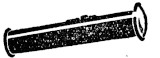
proper name being Tone Pen, and it is a tiny hollow pen of specially
tempered metal. The reason why the Tone Pen is hollow is important.
The solid needle dulls the tone, and after a while wears out the record.
The hollowness of the Tone Pen enables it to translate the most exquisite and
delicate tones. By fixing the Tone Pen point outwards you get the greatest
volume of sound, by turning it sideways you get a softer, mellower tone.
And, above all, you can play from 80 to 100 records with one Tone Pen.
You can keep the gramophone going the whole evening without bothering
to change the needle. You have to change the ordinary needle with
every record. That means constant jumping up and down and fiddling
with the gramophone. The Tone Pen saves you, saves your gramophone,
gets the very best out of the records, and makes the words of
songs beautifully clear, which are often unintelligible with other needles.
THREE TONE PENS ARE EQUAL TO THREE HUNDRED ORDINARY
NEEDLES, AND ONLY COST ONE SHILLING THE CARD OF THREE
Postage 1-1/2d.
J. H. NICHOLSON, 26-28 Audrey House, Ely Place, Holborn, London, E.C.1.
LISTEN IN!
If you are interested in wireless,
or have a wireless set of your own,
or want to try a set and are not
sure how to start about it, get
RADIO BROADCAST
the Wireless Magazine
1/- MONTHLY
Specimen copy 3d. stamps
The World's Work, 20, Bedford St., W.C.2
Two Books on Radio
RADIO FOR
AMATEURS
By A. HYATT VERRILL.
Cr. 8vo. 7s. 6d.
With about 200 illustrations and diagrams
An up-to-date, concise, simply written book
covering every phase of radio communication,
with particular attention devoted to radio or
wireless telephony.
THE RADIO
PATHFINDER
By RICHARD H. RANGER.
Cr. 8vo. 7s. 6d.With numerous illustrations.
The book is written in simple, non-technical
language that has the rare quality of being
scientifically accurate yet intriguingly interesting.
The illustrations are exceptionally good.
Readers of "Short Stories" are probably aware that "Short Stories"
is only one of a family of magazines. The demand for specimen
copies in answer to our advertisements of our other magazines, shows
that our readers are eager to read the magazines published by the
same House that publishes "Short Stories."
The other magazines are "The World's Work," 1/- monthly,
"Radio-Broadcast," 1/- monthly, "The Health Builder," 1/- monthly,
and "The Garden Magazine," 1/- monthly, and I think a short description
will be much more useful and interesting to our readers than
any number of advertisements.
To many thousands of readers "The World's Work" is an old friend, and we
receive many letters of appreciation from readers all over the world, who have subscribed
for years, and would not be without their "World's Work" for anything.
If a number goes astray, we get no peace until they get their copy.
"The World's Work" seems to appeal strongly to people who live in the lonely
parts of the world. It seems to keep them in touch with the world—with
England. No story magazine can have the same link, but a magazine like "The
World's Work" tells people what is going on everywhere.
Last year the famous Walter H. Page's Letters were published in "The
World's Work," and caused an immense sensation. The exciting series of big-game
hunting in Central Africa by Carl Akeley, the famous explorer, was
also hugely appreciated. This year we started with the inner history of the
Irish Rebellion, by Darrell Figgis, who knows, if any man does, the secret
workings of the campaign, and who was closely associated with Michael Collins
and Arthur Griffiths in the guerilla warfare against the British Government.
"The World's Work" deals with every kind of work and every kind of worker:
with science, industry, agriculture, adventure, travel, politics, motoring—in
fact it is a live wire between the world and the reader. It is written for the
thinking man and woman, but not for the high-brow; it does not use too
technical language, but, on the other hand, it goes far deeper than the
information of the cheap, popular magazine.
THE WORLD'S WORK
1/- monthly
Specimen copy 3d. from
The World's Work (1913) Ltd., 20 Bedford St., London, W.C. 2
THE IRON CHALICE — I
By HAPSBURG LIEBE
Author of "The Clan Call," "Alias Arizona Red," etc.
A STORY OF THE TENNESSEE MOUNTAINS THAT TAKES YOU INTO THE
HEARTS AND LIVES OF BIG-HEARTED, QUICK-TEMPERED CLANSMEN; INTO
A BITTER FEUD, AND INTO THE WAR THAT STARTED WHEN LITTLE
BUCK WOLFE BROUGHT HIS LOGGING RAILROAD INTO WOLFE'S BASIN
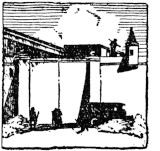
The county's prisoners were passing
the gate where Alice Fair
and Arnold Mason were standing.
They were going jailward,
their hands and faces sweat-stained
and begrimed from long hours at
hard labor. The rattle of picks and shovels
and irons drowned out entirely the
sounds their weary feet made on the pavement.
Arnold Mason saw only the pitiful
lack of spirit in their downcast eyes.
It touched deeply the sympathetic heart of
this man who was of mountain blood, but
to whom the Masons had given a city
home. He had that tender and magnificent
understanding of human sorrows that
is so rare except in those who themselves
have suffered.
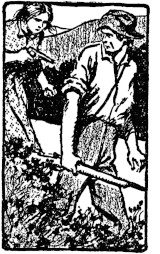
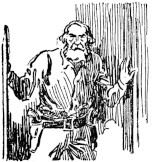
But there was one of the passers-by who
walked with his head proudly erect. He
was very tall, rawboned and sunburned,
and in his dead-black eyes shone the light
of an anguish deep and sullen. His great
right hand gripped the handle of the pick
he carried over his shoulder as though it
would crush the wood. He turned his
pale, hard face toward the pair of lovers
at the gate. Arnold Mason and the girl
he hoped to marry saw that three parallel
lines, three bow-shaded scars, stood out
on his right cheek like streaks of white
paint.
They were the marks of a wildcat's
claws, put there years before. And it was
by those marks, chiefly, that young Mason
recognized the man as his own mother's
son and her first born.
"Oliver!" he exclaimed.
The big mountaineer centered his gaze
upon his youngest brother. To him, also,
recognition had dawned. A queer smile
parted his beard and mustaches and
showed a flash of strong, white teeth.
"Hello thar, Little Buck Wolfe!" he
cried sharply. "Leadin' a high life now,
hain't ye?"
Mason stood there, as silent and as motionless
as a stone, and watched the clanking
line of prisoners until friendly trees along
the street blotted out the sight. When he
faced Alice Fair, he noted a decided change
in her manner.
"He called you 'Little Buck Wolfe,'"
she observed coldly. "Was that your
other name?"
"Yes."
"I think it's horrid. Who was that?"
He told her. She winced, but he continued,
"My father's given name was Buck.
He was a giant of a man, and he was my
boyhood's ideal of what a man should be—naturally.
I wanted to be named for
him; I went without a name until I was
nine. So they called me 'Little Buck.'"
"You told me that your people——"
"Were upright and honorable in their
way," Mason cut in gloomily. "As I knew
them, they were, certainly. I've never
been back there. I had to study almost
day and night, because I started to school
so late. I—I guess I was so much interested
in myself that I forgot them."
"And you didn't know until just now,"
pointedly, "that you had a brother in
jail?"
"I've been out of town for three weeks,
Alice, you'll remember," he muttered. "I
came home only yesterday."
"Well," frowning, "what's the good of
going over it? You can't expect me to
marry you when you've got a brother in
jail, here under our very noses. Honestly,
can you?"
She held out to him the diamond ring
he had given her an hour before. He accepted
it mechanically, and mechanically
put it into his pocket. Without another
word, she went rapidly toward the house.
Arnold Mason, Little Buck Wolfe that
was, walked slowly, with no clear thought
as to direction, up the shadowy street. If
there is anything that can change the gold
of goodness in the mountain heart to iron,
it is—this.
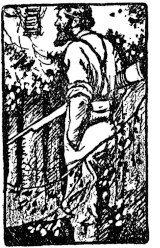
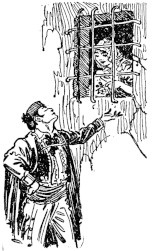
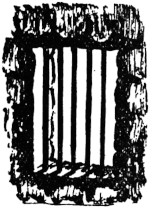
The high, barred window of Oliver
Wolfe's cell opened to
the east. At that window,
his bearded face
pressed against the bars,
his eyes longingly watching
the dim shape of
Buffalo Mountain fade
into the night, stood Oliver
Wolfe. He did this
every evening now,
watched Buffalo Mountain,
which was hardly more than a foothill,
fade into the night.
Came the sound of footfalls in the corridor,
and he turned his head. Just beyond
the iron-latticed door, he saw the
shapes of two tall men. A key grated in
the lock, and he heard a voice.
"I'd like to be alone with him, Sheriff
Starnes."
"Certainly, Mr. Mason," the officer answered
courteously. "Call me when you
want to go out."
The door opened and closed, the key
grated in the lock again, and Oliver Wolfe
stood face to face with his brother.
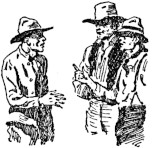
"Why did they put you here, Oliver?"
"For a-provin' I was the best man in
town, surlily."
"I see. Assault and battery."
"With attemp' to kill," the prisoner added
with a certain pride. "'Leven months
and twenty-nine days, and eight o' the days
done gone."
He put a hand on his brother's shoulder
and shook him roughly.
"Nobody sent fo' you to come here," he
said hotly. "Hain't ye afeard ye'll dirty
them fine clo'es o' yore'n? You mis'able
town dude, whyn't ye be a man, like I am?"
Arnold Mason said nothing to that. A
moment of silence passed. Oliver Wolfe's
black eyes ceased to stare contempt; perhaps
some tender memory of their boyhood
days together was at work in his
brain.
"But mebbe you ain't as rotten as I
thought ye was, Little Buck," he went on.
"I thought you was pow'ful stuck-up, y'
see. I'm a-goin' to tell ye somethin', and
you listen:
"You know pap he used to be the law
and its enfo'cement out at home. You
know he used to deal out jestice wi' his
fists when anybody done wrong, and you
know he was allus square. He was king
o' the section then. But he hain't no more.
He's only the leader o' the Wolfe clan now,
Little Buck. He—"
"The Wolfe clan!" Mason exclaimed
surprisedly.
"The Wolfe clan," Oliver repeated impatiently.
"Well, them Singletons, 'at
lives at the upper end o' the basin, has been
a-fightin' us fo' a long time. Tuck he's
dead, and Biddle, and Simon, and Cousin
Lije's Buster, and Aunt Jinny's Simmerly—every
one of 'em buried wi' Singleton
bullets in 'em. When I left home, pap he
was a-layin' on the flat o' his back wi' a
bullet in his shoulder. But le' me tell ye
this right now—the Wolfe's they hain't
a-goin' to quit fightin' ontel they hain't able
to crook a trigger-finger no more!"
Oliver Wolfe clicked his teeth together
savagely, clenched his fists, and began to
pace the cell floor. After a minute spent
thus, he went back to Mason and pursued.
"I was a dang fool. I slipped down to
town here to buy some ca'tridges, got in a
rucus, and got arrested—but it took three
good men to do it, and don't ye fo'git that—and
them a-needin' every Wolfe by name
out thar to fight Singletons! The's a good
many more Singletons an' the' is Wolfes,
y'see, and the' hain't but dang few Singleton's
'at cain't cut down a hangin' hosshair
with a bullet. And so I'll come to the
p'int at last.
"Little Buck Wolfe, yore people needs
you. You quit these here fool ways o'
yore'n, and git ye a rifle, and go out thar
and fight wi' yore own flesh and blood!"
Mason straightened as though he had
been struck. Just then a lamp was lighted
in the corridor, and its rays showed the
face of Oliver Wolfe to be jerking under
stress of emotion.
"Well," Oliver demanded, "are you
a-goin' to wear the boots of a man?"
The other turned toward the iron-latticed
door, and called to the sheriff to come
and let him out.
"Is yore name, dahlin' brother," sneered
the jailbird, "Wolfe, or is it Mason?"
"Wolfe," answered the stalwart young
man at the door. "Wolfe. Now and forever."
II
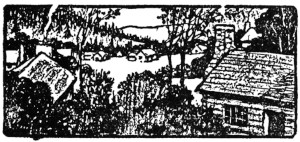
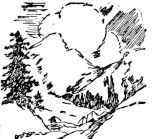
The bottom of Wolfe's Basin is two
miles in length, one mile in breadth,
and as level as a prairie. The rockbound
and majestic Big Blackfern Mountain
makes the eastern wall; the western
wall is formed by great Lost Trail Mountain,
which lifts high toward the heavens
a bald peak called Pickett's Dome. A
crystal-clear creek gushes from under a
rugged gray cliff at the junction of the Big
Blackfern and the Lost Trail, splits the
basin's bottom in the centre, and flows out
through a dizzily-portaled pass, the same
being known as Devil's Gate.
Old Alex Singleton and his people lived
in twenty-two low and rambling log cabins
near the south end of the basin. Old Buck
Wolfe and his people occupied eighteen
cabins of the same kind near the basin's
north end, near the pass. Old Buck's
mother lived alone save for a little black
dog named Wag. She was sixty-nine,
white-headed, as wrinkled as parchment,
very sharp of feature and of tongue; she
was called wise in her understanding of
the curative properties of herbs, and she
was a firm believer in supernatural tokens.
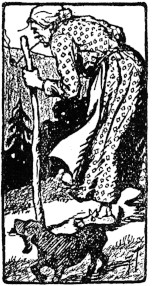
Granny Wolfe rose early on this fine
summer morning. She slipped her bent
old body into a dark-figured calico dress,
tied a pair of coarse shoes on her rheumatic
feet, wound a red bandana about her
white head, bathed her face and hands and
dried them on a hempen towel. She filled
her clay pipe with homegrown tobacco,
lighted it with a coal from the yawning
stone fireplace, and took up a long sourwood
staff. Another moment saw her entering
the crooked, grass-lined path her
feet had worn to the home of her favorite
son.
A sharp yowl caused her to stop, face
about, and bring her staff down hard.
"Durn ye, Wag, ye little devil," she muttered,
"I left ye shet up inside! But it's
bad luck to turn back, and I jest hain't
a-goin' to do it. So yap as much as ye
please, ye little devil!"
Now Old Buck Wolfe was a fiddler as
well as a fighter, and when his mother had
reached a point some seventy yards from
his primitive house she was startled by
hearing Buffalo Gals fiddled as she had
rarely or never heard it fiddled before.
Thereupon Granny Wolfe's seamed countenance
showed signs of a great chagrin,
and she began to talk to herself:
"I'll—be—durned! Ef the durned fool
hain't got out o' bed and went to fiddlin'!
Wisht I may drap dead in my tracks, ef he
hain't! And he'll be a-fightin' them 'ar
Singletons afore night, as shore as the Old
Scratch hain't a grashopper! Well, I kep'
him in bed as long as I could. The bullethole
it's done healed over. Now, I
shore do wonder what makes menfolks be
allus a-wantin' to kill each other? The
Lord ha' mussy on us!"
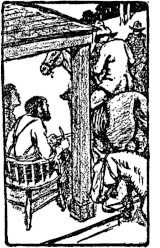
The fiddler sat in a crude, homemade
chair in the cabin's front doorway. He
was a huge man, and gaunt, and his long
black hair and beard were not without
threads of silver. His mother halted a
few feet from him, and leaned heavily on
her staff; she stared at him quite as though
she had never seen him before.
"Reckon ye'd know my hide in a tan-yard?"
laughed Old Buck Wolfe, dropping
the instrument to his knee.
"Hain't you a purty thing, now—jest
hain't you!" cried the old woman, with her
own particular brand of scorn.
Her son's keen black eyes twinkled.
"What's got the matter o' you?"
"You git back in bed!" snapped Granny
Wolfe.
Old Buck narrowed his eyes. "When
I'm able to fiddle," he said, "I'm able to
fight. Stick that in yore pipe and smoke
it, mother. Hey?"
"I'll be durned!" shrilled Granny Wolfe.
"You wildcat, ye're a fixin' to go fightin'
ag'in! Sech a durned fool! And when
is it ye're a-goin' to commencet a-fightin,'
Buck Wolfe?"
"Us Wolfes," soberly, "is to meet here
at dinner-time, and start fo' t'other end o'
the basin. It'll be the last fight; d'ye onderstand
that?"
The old hillwoman's voice was soft when
she spoke again.
"Don't do it, honey," she pleaded, almost
pitifully. "Don't. I wisht I may
drap dead in my tracks ef I didn't see a
star fall over this here house last night,
honey; and that 'ar is a shore sign o' death.
And I dreamp' o' seein' muddy water,
and that's a bad sign, too. Don't do it
honey!"
The giant in the doorway laughed outright.
He didn't believe in the supernatural.
"My nose itches," he said, winking;
"what's that a sign of?"
"Heh? Why, Buck Wolfe, it's a sign
somebody is a-comin' hongry! Jest wait
and see ef it don't come true. But them
'ar Singletons, don't tackle 'em ag'in!"
"I'd give a mule ef Oliver was here,"
her son muttered. He turned to address
a meek little woman who had come up behind
his chair. "Sary, that 'ar damned
old blue-tailed hen's a-scratchin' up yore
merrygolds ag'in."
Then he rose, kicked his chair over, and
threw fiddle and bow to a nearby bed. He
stepped to the ground, took his mother by
her lean shoulders, and shook her slightly.
His whole countenance
was terrible.
"The Wolfes settled
here fust!" he roared.
"When I thrashed old
Alex Singleton fo' a-sellin'
me a jug o' cawn
whisky wi' a leaf o'
burley tobacker in it,
he needed it. Ha! you
fo'got pore little Tuck,
brother Brian's boy, and the rest of 'em,
a-layin' up thar in the old Blackfern's
breast wi' hunks and hunks o' Singleton
lead in 'em? Mother, ha' you fo'got?"
"But Tuck he'd killed one o' the Singletons,
which was the very fust killin' of it
all, too," Granny Wolfe returned sharply.
"Asides, the Wolfes has put as many Singletons
in the Lost Trail as the Singletons
has put Wolfes in the Blackfern, and rickollect
'at! You'd shorely better let it lay
right whar it's at, Buck Wolfe."
He glowered down upon her. "The
Singleton had called Tuck a liar, mother,
and you know it!" he snorted. "Now
save yore breath, is my advice. The fight
is to be, and it will be."
The old woman limped into the cabin,
where she tried to comfort Sarah Wolfe,
mother of Little Buck, the Arnold Mason
that was.
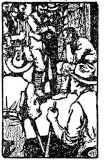
Noontime came, and twenty Winchester
rifles were brought and stacked against a
cedar in the narrow yard. Twenty men,
some of them barely grown, sat here and
there, on the doorstep, on the woodpile, on
the ground; they were waiting for their
leader to finish his mid-day meal, and Old
Buck was showing his contempt for danger
by eating more than usual.
When the Wolfes started toward the
south end of the basin, the Singletons
moved toward the north end. Like the
Wolfe chief, Alex Singleton—a big-boned,
broad-bodied man with deep, dark eyes
and straggling, sunburned black hair and
beard—was not without some of the qualities
of a general and strategist. A Singleton
sentinel on the side of Pickett's Dome
gave the alarm by waving a red bandana,
then raced down to join his kinsmen. A
woman followed each of the sets of fighters.
One of them was old Granny Wolfe.
The other was the Singleton leader's only
daughter.
The Wolfes' one-man advance guard
ran back with the intelligence that the
enemy was just ahead. Old Buck rushed
his little force to the left, meaning to make
a surprise attack on the Singleton's flank.
Oddly enough, Alex Singleton gave the
same order at the same time, with the result
that the two sides lost each other, and
spent hours in maneuvering more or less
blindly; not a shot was fired, and the silence
in the basin was the silence of the
tomb.
Buck Wolfe's anxious mother saw that
the shadow of bald Pickett's Dome was
reaching for the fringe of jackpines that
grew on the jagged crest of the Big Blackfern,
and she knew it was almost four
o'clock. Then, there broke out ahead of
her the keen, sharp thunder of rifles—the
two factions had met where there was no
cover save for puny bushes, and it would
probably be a battle of extermination. She
forgot her rheumatism, dropped her long
staff, and ran toward it.
Two others reached the midway point
before Granny Wolfe reached it. One of
the two was a slender, barefooted young
woman with deep blue eyes, copper-colored
hair that hung down her back in a
single thick plait, and a face that was quite
finely handsome in spite of its tear-stains.
The other sat astride a rearing, plunging
black horse; he was young and stalwart,
and an officer's shield gleamed over his
heart.
"What's the big idea?" he was shouting.
"What's the big idea, anyway?"
The daredevil personality of the newcomer
awed the fighters. Even if they
might have counted him out, there would
have been no possibility of going on with
the battle without danger to the two women.
And to continue the fighting there
in the open, where they had met by accident—well,
the hillman is no coward, but
he wants cover when he fights.
The two little clans acted wisely. As
though by a common agreement, they crept
off homeward without a word.
The old woman caught the rein of the
now quiet horse.
"And who might you be, stranger," she
cackled, "'at comes a-ridin' in here like a
angel o' the Lord?"
He smiled very pleasantly. "Don't you
know me?"
"Not from Adam's off ox, nor a side o'
sole-leather!" declared Granny Wolfe.
"I know who it is," said the other of the
three left upon the scene. "Granny, it's
Little Buck!"
"La, la, la! You don't tell me it's Little
Buck. I be consarned ef I'll believe
it!" She shook her white head.
"And I know
you, too," Wolfe
said to the
young woman.
"Your name is
Louisiana Theodosia
Singleton,
but they call you
'Tot.' You—er,
you were my
sweetheart when
I was a boy.
Don't you remember,
Tot?
Surely, you
haven't forgotten
the time
when I thrashed
Cat-Eye Mayfield
and threw
him into the
creek—there at the sand-bar under the willow—for
sticking pine-resin chewing gum
into your hair! Don't you remember,
Tot? Afterward, when we'd disposed of
the villain," and here Wolfe's dark eyes
twinkled engagingly, "you kissed me as a
reward for my—er, gallantry!"
Louisiana Theodosia Singleton blushed
and said nothing. Little Buck's grandmother
was now convinced.
"Well ef it ain't you, shore enough," she
cried. "Now didn't I tell yore contrary
old pap 'at somebody was a-comin' hongry?
But who'd ever ha' dreamp' you'd
grow from the pesky boy you used to be
into the fine-lookin' man ye are! You
shore do 'mind me o' yore pore grandpap
when he used to come to see me afore we
was married. Look at him, Tot Singleton;
don't you reelly think he's jest grand-lookin'?"
"You—you're a-doin' the talkin' now,
Granny," said Tot Singleton, visibly embarrassed.
Wolfe smiled. But only for a moment.
There came from somewhere near the foot
of Lost Trail Mountain an old and broken
voice that seemed a part of the peacefulness
of the eternal hills; an old and broken
voice that was filled with the holiness of a
benediction:
"'And, lo, the star, which they saw in
the East, went before them——'"
III
"That was pore Grandpap Bill Singleton
'at hollered," explained the
old woman, putting her right hand
up to meet that of her kinsman. "We
calls him the 'Prophet', Little Buck."
She emitted a tiny shriek at his grip; he
had forgotten her rheumatism. He apologized
quickly, and held his hand down
toward the young woman who had been
his boyhood sweetheart. Tot Singleton
glanced straight into his eyes, seemed suddenly
afraid of him, and ran swiftly homeward.
Wolfe faced his garrulous grandmother
again and opened his lips to speak,
but she cut him off short.
"Now don't that beat the devil? She
acted like as ef she was afeared ye'd bite
her head off, didn't she? Atwixt me and
you, Little Buck, wimmen is sawt o'
strange critturs. Say, dad-burn it, you
jest wait here ontel I step back yander to
the aidge o' the basin and git my stick,
which same I draped—it lays at that 'ar
slim poplar thar—and me and you we'll go
to yore pap's house."
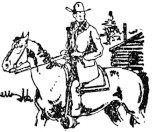
Her grandson rode to the foot of the
Lost Trail, recovered the sourwood staff
and brought it to her. He dismounted
then, and the two walked toward the settlement
of the Wolfes, the horse following
at the end of its rein.
"And so you're a real, shore-enough officer
o' the United States law!" proudly
observed Granny Wolfe as they picked
their way through a thin copse of sumach.
"A deputy-sheriff, made that at the special
request of the new Unaka Lumber
Company, of which I am general manager,"
said Wolfe. He went on, "It was
done in order that I might better protect
the company's interests in the mountains.
What lucky fellow got Tot Singleton,
Granny?"
"Lumber was Colonel Mason's line; I
might ha' knowed it'd be yore line, too,"
muttered the old woman. "Hey? Now
hain't Tot purty! She hain't a bit like the
rest o' the Singletons. Bless yore soul,
Tot hain't never married nobody! And
her mighty nigh it as old as you, Little
Buck. Some says one thing about that,
and some another; but me, I say it's acause
she han't never seed nobody 'at was quite
as good as the boy who beat the devil out
o' Cat-Eye Mayfield and throwed him in
the creek for a-stickin' pine rawzum chewin'
gum in her hair! Ye see, honey, a
mountain gyurl at sixteen is mighty nigh
it a woman—why, I was married at sixteen—whilst
a boy at the same age is gen'ally
a durned fool. Hey?"
Wolfe laughed. "And what became of
Cat-Eye Mayfield?"
"Him? Huh!" She turned up her
thin old nose. "He still lives with his pap
up whar the two mountains j'ines at. And
he still pesters Tot half to death a-tryin' to
git her to marry him. Tot she hates him
wuss'n the Old Scratch. And she's been
a-havin' a sight o' trouble wi' her heatherns,
the same as I have wi' mine. She
jest cain't stand the idee o' her people
a-fightin' like they does. Some says it was
Grandpap Bill Singleton 'at put it into her
head; but me, I say it's jest natchelly the
goodness of her, Little Buck.
"I know you've come back to he'p yore
people, Little Buck," Granny Wolfe ran
on. "You seed whar at yore duty laid.
Well, we've got me and you, and Tot and
her grandpap, on the right side o' the fence.
But we'll have a awful time of it, shore.
Yore pap he's turrible, turrible! It's allus
him who begins the fightin' atwixt us
and the Singletons. Them Singletons,
'cept Tot and her grandpap, the Prophet,
is as quick to fight as a wildcat; but they
don't never take the fust step at it,
never."
Twilight, soft and peaceful, had set in
when the pair arrived at Old Buck's low
and rambling log cabin. Standing or sitting
here and
there in the
yard, all of them
grave and silent,
was a score of
men of the name
Wolfe—one of
their unwritten
laws was that
when an outsider
married a
Wolfe he lost
his surname and
took that of his
wife; it was like
that with the
Singletons, too,
that other wild,
princely clan. The house was packed with
women and children; and they, also, were
grave and silent, save for one babe in arms
that whimpered softly because its mother
wouldn't give it the clock for a plaything.
The returned son of the Wolfe chief
threw his horse's rein over one of the rotting
gateposts, and entered the yard with
his grandmother limping close behind him.
"I'll bet ye cain't guess who this here
feller is!" the old woman chuckled—and
told them in the same breath. "It's Little
Buck!"
Little Buck had been recognized already.
The clan favored him with one quick,
sharp glance. There was no other demonstration
just then.
Young Wolfe stopped before the doorstep,
on which his huge, gaunt father sat
as still as a stone image. Old Buck's elbows
rested on his knees; his bearded chin
was almost hidden in his great, knotty
hands. The son who had been named for
him saw that a tiny streak of dried blood
ran from a wound somewhere under his
left shirtsleeve straight to the point of his
left little finger.
Then the man of the officer's shield put
out his hand and said cordially, "How are
you, father?"
The clan leader seemed not to have
heard. The silence became oppressive.
Little Buck Wolfe's lips quivered, and he
saw his father dimly. Granny Wolfe made
a choking sound in her leathery throat, and
raised her sourwood staff threateningly.
"Buck Wolfe, you old fool," clipped her
quick tongue, "you git right up from thar
and shake hands wi' yore own flesh and
blood, him 'at is a credit to you and me and
every other Wolfe 'at ever slapped the face
o' the earth wi' a shoe-bottom."
The stern old mountaineer did not even
change his stare.
"How are you, father?" again.
Wolfe the elder suddenly leaped to his
feet, seized Little Buck's hand and wrung
it savagely, and growled, "I'm all right,
damn it; how're you?"
"All right," very quietly. Little Buck's
face had brightened.
His mother, who never dared to speak
ahead of her iron-hearted husband, came
out to meet him then. He kissed her reverently
on the forehead, and it brought to
her mind an avalanche of memories of
happier days; she stole hurriedly back into
the cabin, in order that the menfolk might
not see signs of the weakness that had
come over her. Her son began a round of
handshaking with his kinsmen. The ice
was broken.
"Nath," bellowed the old clan leader,
"you bring him a chair out here! The'
hain't no room in the house; the wommen
and young'uns is as thick in thar as fiddlers
in Tophet. Set the chair so's he can
lean back ag'in the wall and rest hisself,
Nath. And bring me that 'ar jug o' yaller
cawn licker out o' the cubb'ard, too,
Nath—the visitor licker. Boy," to Little
Buck, "ye'll have to look over my cussfired
onperliteness, I reckon. I've been so
cussfired mad all day 'at my dang breath
would wilt fullgrown pizen-vine."
He dropped back to the doorstep. A
few seconds later Little Buck accepted the
chair his big and bearded brother Nathan
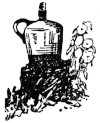
brought for him. Old Buck then drew the
corncob stopper from a one-gallon jug
with his teeth, and held the jug toward his
fifth son. The latter refused it courteously,
and it was not pressed upon him.
He saw Nathan smile good humoredly.
"Mebbe you're sawt o' like me," said
Nathan, as he passed the jug to his Cousin
John Ike. "I got on a rip-roarin' big dido
last summer—I was so loaded I wouldn't
ha' knowed a lightnin'rod agent from a
beauty doctor. Whilst I was in that glorious
fix, I drunk a bottle o' hawg cholery
medicine by mistake, and so I jest hain't
had no hankerin' 'atter licker sence."
This elicited a low rumble of laughter.
The earthenware receptacle went around,
and was returned to Old Buck almost
empty. Old Buck raised it to a level with
his eyes, looked toward Little Buck, and
drawled the only toast he knew.
"'Here's to you, as good as you are, and
to me, as bad as I am; and as bad as I am,
and as good as you are, I'm as good as you
are, as bad as I am!'"
Young Wolfe only smiled. Nathan responded
for him, "Drink hearty."
Old Buck went on. "When a feller can
say that 'ar toast straight, he natchelly
hain't loaded. I don't never 'low none o'
my people to git loaded. I tests 'em by
that toast; and ef they cain't say it straight,
I thrashes 'em. I thrashed Nath atter he'd
got over his dido and his mistake last summer.
Ax him, ef ye don't believe it."
Nathan pulled at his silky black beard,
grinned, and changed the subject, "What'n
Tophet brung ye back, Little Buck?" he
asked.
The man addressed swept the half-circle
before him with his eyes. They were all
smiling upon him now, and he was glad
indeed to note that they were disposed to
be so friendly. He moistened his lips and
began.
"I decided some little time ago to come
back. I had heard, through Oliver, about——"
"How's Oliver?" broke in his father.
"Oliver's all right. I had heard, through
Oliver, about the fighting, and I wanted to
see——"
"You say Oliver he's all right?" interrupted
his mother, who now stood in the
doorway.
"Absolutely. The fighting didn't seem
worth while to me, and I wanted——"
"I'm shore glad pore Oliver he's all
right," said Oliver Wolfe's wife.
"——To see if I could do anything to
stop it," Little Buck pursued doggedly.
"When I was ready to start out here, I
learned that the Thorntons, some of whom
have owned the basin land since the days
of the old North Carolina land grant, were
about to sell out to some cattlemen, who
wanted the basin
for grazing purposes.
I investigated,
and found
out that the cattlemen
hadn't offered
a very good
price because of
the trouble they expected to have with the
Wolfes and Singletons——"
"Them cattlemen," his father cut in
grimly, "had right good hoss sense."
"Well, I knew the basin better than any
of them, and I knew the coves of the inner
sides of the two mountains were filled
with virgin white oak and yellow poplar,
timber without a peer in the world. I organized
a company—lumber was Colonel
Mason's line, you know, and it's mine, also—and
we bought both timber and land
from mountain's crest to mountain's crest
at a very reasonable figure. Then we
ordered machinery for a big sawmill, a
geared locomotive and cars, and enough
light steel rails to run a narrow-gauge
road over the six miles that lie between
this point and the new C. C. & O. Railway.
Everything is in our favor. The logging
is all either down grade or on a level;
there never was a finer location for a mill
and yards than can be had here in the basin;
and the little railroad can follow the
creek all the way down to the C. C. & O."
A number of the faces before him had
hardened. He rose; it was like him to
meet the adverse on his feet.
"But I haven't told you the best of it,"
he went on convincingly. "I have an
agreement with the other members of the
company by which I am to have any of the
land that I may want, when the sawing is
done, at two dollars an acre, and I'm willing
to pass it on to you at the same price;
also, I am willing to give you all work at
good wages. I say I'm willing; I mean
that I'm anxious. It's for you, my own
people, that I'm doing—what I'm doing.
"I want to see every Wolfe by name living
in his own comfortable cottage home,
on his own little farm, here in Wolfe's
Basin. I want us to have a school for the
children, a little church, and a post office.
I want us to have an ideal community here
in this, one of the finest spots on the Almighty's
earth. If you'll all stick to me,
we'll have it. Now, men, I want to know
who's going to stick?"
The eyes of all were turned upon Old
Buck Wolfe. When he spoke, he would
speak for the others. He sat with his
shaggy head bent, a huge and actionless
figure in the deepening dusk.
"Ef we don't fall in wi' yore idee, then
what?" he asked, without raising his head.
"It's like this," Little Buck told him in
a very businesslike voice: "my foster-parents,
the Masons, sold every dollars'
worth of property they had—except their
home, and they even mortgaged that as
heavily as it would stand—to get money
enough to back me up, such was their faith
in me. I've given them my promise that
they shan't lose a single penny. If I don't
get your help, I—I'll have to develop the
timber interest without it. But I want
your help!"
"Son," and the stern old mountaineer sat
up straight, "onless the' happens to be
somethin' ahind of it that I cain't yit see,
we're all with ye, lock, stock, ramrod, barrel,
and sights!"
"And I say God bless ye, Buck Wolfe!"
cried a creaking, but happy old voice from
behind him. "Nath, run to my house and
let my little dawg out; he's been shet up all
day, pore little devil."
Before he went in to super, the Arnold
Mason that was exacted an ironclad promise
from his father. Old Buck gave his
word that, no matter what might happen,
the Wolfes would nevermore take the first
step in a fight with the Singletons.
The young general manager of the
newly organized Unaka Lumber Company
refused the visitor-bed that night, and
crept up to his boyhood bed in the loft.
His dreams were filled with dazzlingly
pretty women who kept giving him back
diamond rings.
IV
Shortly after daybreak on the following
morning, Little Buck Wolfe
woke, sat up, reached for his clothing—and
thought of Tot Singleton. He
kept thinking of her. He caught himself
saying aloud as he drew on his boots that
she would never have turned him down
because he had a brother in the county's
chain-gang. Why, Tot would have clung
to him but the closer on that account!
He meant to spend the morning in looking
over the central part of the basin,
where the big sawmill was to be built.
After breakfast was over, he talked with
his father for an hour; then he set out up
the creek, on foot and alone.
When he came in sight of the gnarled
old willow that
shaded the sand-bar,
he halted
very suddenly.
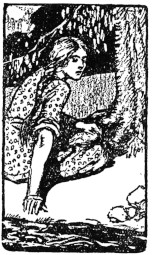
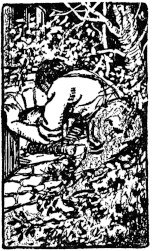
Sitting at the
base of the tree
was Tot! Her
head was bent
low, and there
was an indescribable
air of
loneliness about
her. He stood
there and
watched her
thoughtfully for
a full minute.
She did not
move even a finger.
He had reached a point behind a clump
of blooming laurel a dozen paces from her
when she lifted her head. But she didn't
look toward him. She went to dreaming
again, and he was saddened by the signs
of unhappiness he saw on her countenance.
Just when he was about to make his
presence known to her, an angular, slouching
figure stepped before her from the
bushes beyond. The newcomer was
dressed in run-over cowhide boots, blue
denim trousers baggy at the knees and
held in place by a pair of homemade suspenders,
a striped cotton shirt without buttons,
and a worn black hat with its rim
pinned up desperado fashion in front. His
black eyes were lustreless, opaque, and uncanny.
His thin lips were twisted in a
smile that was decidedly unpleasant.
"Hi thar, Tot!" he sneered. "Waitin'
here fo' that 'ar town smarty, like ye used
to, I reckon; hain't ye?"
Wolfe's strong, smooth face lost a part
of its healthy color. Tot made no reply;
it seemed almost that she did not know that
Mayfield, her tormentor, was there.
"He throwed me in the creek oncet,"
Mayfield went on, "but he cain't do it
now. I was jest a boy then. I'm a man
now. I wisht he'd come along and try it
ag'in!"
At last the young woman gave him her
attention.
"Little Buck was a boy then, too," she
said; "and he wasn't no bigger'n you was,
neither. And he's a man now, too—you
bet."
"I jest wisht he'd happen along——"
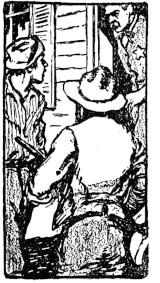
Wolfe had stepped from behind the
clump of laurel, and Cat-Eye Mayfield had
seen him.
"Well, Cat-Eye," Little Buck said
evenly, "you've got your wish."
Mayfield's manner became one of defiance,
bitterness, and desperation. He
took from a pocket in his blue denim trousers
a lump of sticky pine resin wrapped
in a green poplar leaf; he threw the leaf
aside, and in one quick movement deliberately
pressed the resin deep into Tot Singleton's
copper-colored hair!
And Tot, her blue eyes glowing and triumphant,
had not lifted a hand to prevent
it.
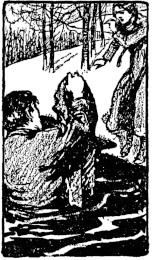
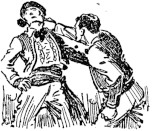
The mountain blood leaped madly in the
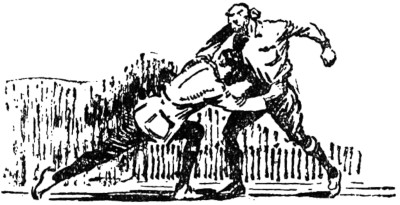
heart of Little Buck Wolfe. He rushed
at Mayfield like an enraged panther. His
blows, the blows of a primitive man, fell
upon Mayfield's sallow face like the pounding
of a riveting-hammer, completely stunning
him. Then he gathered the angular
body up in his arms, bore it across the bar
of sand, and hurled it into the water—just
as he had done on that red-letter day of his
boyhood.
Mayfield crawled sullenly out on the
other side, gave the man who had whipped
him a look of poisonous black hate, and
slouched off up the creek's bank. Wolfe
watched him until he was a good hundred
yards away to see that he did not find a
repeating rifle somewhere in the bushes;
then he turned toward Tot.
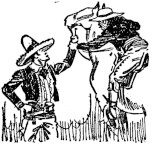
In another moment he was standing face
to face with her—smiling, blushing, finely
handsome, barefooted Tot Singleton. He
realized that the entire repetition of the little
drama of his youth lacked but the climax—a
kiss from Tot as a reward for his
gallantry. She was looking straight into
his eyes. Her slender, sunburned hands
crept slowly to his shoulders. She stood
on her toes, lifted her lips, and offered him
his reward.
For she had no way of knowing that he
had outgrown their juvenile affair; that he
was for the present heart-broken because of
the shallowness of another woman. He
had fought for her, and he never could
have made a stronger declaration that he
still cared for her—it is a law of the cave.
Besides, if he hadn't come there to meet
her, as of old, why had he come?
Wolfe was not without chivalry. He
could not strike down, like an assassin, the
glory of her beautiful eyes; it was a glory
that awed him, that could have come into
being only after the longing, and the faith,
and the waiting of years. He bent his
head, and kissed her.
But he knew it was unfair, and he
blamed himself heavily. He caught her
hands as they were about to clasp at the
back of his neck, and put them gently from
him. She stepped backward, wondering,
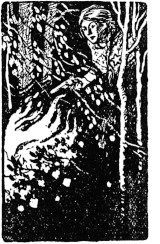
somehow pitiful. A disc of yellow sunlight
fell through the branches of the willow,
and burnished the copper of her hair.
"What made you do that, Little Buck?"
she asked in the tiniest of voices.
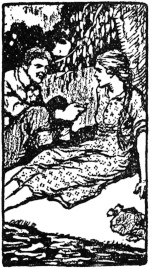
He led her to the base of the tree, and
they sat down together on the pure white
sand. It seemed better to tell her the
whole truth, and he told her the whole
truth. Of every momentous thing that
had occurred to him since his going away
with the Masons to be their son, he told
her; and he saw on her now slightly pale
face more sympathy for him than disappointment
for herself. Some there are
who are built for sacrifice, but more there
are who are not. Tot Singleton was.
When he had finished, he took from his
pocket the ring that Alice Fair had given
back to him, and showed it to her. She
merely glanced at it; she knew nothing
whatever of the value, intrinsic or sentimental,
of diamonds.
"Ef—ef I had that fool woman here,"
she said, her words fairly throbbing, "I—I'd
whip her!"
To Wolfe the ring was in a manner sacred
because of the memories associated
with it; but it was a link that bound him to
something that was lost and gone, and he
decided that he had best do away with that
link. Perhaps his inborn pride, the pride
of the hillpeople, had its influence in the
matter—he smiled a mirthless little smile,
and flung the
ring into the
centre of the
pool before him,
the pool that
used to be eight
feet in depth
and now was
only two.
"And now I'll
have to tell you
good-by," he
said, going to
his feet. "I start
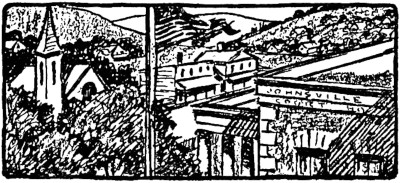
back to Johnsville
at noon,
and I've a good
deal of looking
around to do
here before I
go."
Tot rose, said good-by to him, and went
homeward.
A few rods down the creek, Wolfe came
abruptly upon his father. The iron-hearted
old hillman's face was ashen under
his beard, and his black eyes were like two
points of flame. He had followed his son.
He had seen the kiss, from his little distance,
though he had heard none of that
which they said.
Old Buck waited until Tot Singleton
was well out of hearing before he spoke.
"Mr. Mason," he announced, "listen to
me. I said we was all with ye ef the'
wasn't somethin' ahind of it 'at I couldn't
see. The' is somethin' ahind of it 'at I
couldn't see—mixin' up wi' that lowdown
Singleton set. I promised I wouldn't start
a fight with 'em no more, I know, and I
won't. The feud it's dead, as dead as hell.
And so are you. To me, you're dead.
Acause I seed you kiss a lowdown Singleton."
"But——"
"Now le' me tell ye this here: you cain't
never darken the door of a Wolfe no more,
and you cain't bring no railroad nor no
sawmill into this here basin ontel atter
you've killed me. You've got my word
fo' that, and it's the word of a Wolfe!"
The younger man shook his head dejectedly.
"Dad," he began, "you don't
know what you're talking about. I——"
"Hack it off right whar you're at!" Old
Buck blazed. "I don't never want to hear
the sound o' yore voice no more as long as
the breath o' life's in me. You're dead, so
far's I'm consarned."
The son tried hard to reason, tried
harder to explain, all to no avail. The unlettered
giant would listen to nothing. It
angered Little Buck in spite of himself.
"I've given my word, just as you've
given yours," he said spiritedly; "and, as
I'm a Wolfe, just as well as you are, I'll
keep my word if I live. The lumber track
and the mill are coming, and it doesn't
greatly matter who likes it or who doesn't."
Old Buck stalked off. His son then regretted
that he had lost his temper.
V
Tot Singleton didn't go home
just then. There was nothing she
could do at home. Her mother was
a very strong, stout woman who didn't
want any "dreamin' gyurls a-piddlin'" in
her household affairs; who sometimes
worked in the woods with an ax, or hoed
corn, or helped to make a run of whisky;
and who lightened her daily burdens by
the constant whistling of old-fashioned
hymns.
The young woman absentmindedly destroyed
a hundred or so of black-eyed
mountain daisies by pulling off their defenseless
heads between her bare toes;
then she went back to her shrine—it was
just that to this unspoiled creature who
had been half child and half woman at sixteen
and was very nearly the same today.
She stood leaning against the body of
the willow, and thought over all that had
happened there; looked at the marks Little
Buck Wolfe's high-laced boots had
made in the sand, at the marks of the
struggle that had been so short and so one-sided.
Soon she went to the edge of the
creek, and peered into the crystal water.
He hadn't known about the pool's being so
shallow now, when he had thrown the ring
into it.
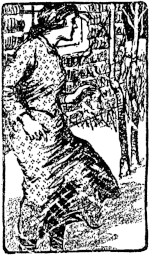
She gathered up her calico skirts in one
hand, waded in, found the ring, and hastened
back to the sand-bar.
Tot looked at it closely now. It sparkled
so in the same yellow disc of sunlight
that had burnished the copper of her hair
a little while before; almost it hurt her
eyes! Wonderment and something very
different from wonderment wrote their
signs alternately on her countenance. She
pressed the ring on her engagement finger,
and tried to imagine that it was her own
engagement ring; but the iron truth
wouldn't be forgotten even for a moment,
and a wee smile of intense hurt came to
the lips that the sweetheart of those happy
other days had so recently kissed in so
chivalrous a manner.
When she tried to get the ring off, it
wouldn't come! Perhaps she didn't try
very hard. Anyway, she laughed a little
to herself, and her blue eyes were as
bright as stars.
Tot Singleton went slowly up the bank
of the creek, going homeward by instinct
rather than by design. And she had not
covered half of the mile when she met her
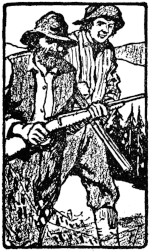
father and the
slouching young
man they called
Cat-Eye, both
of whom were
armed with rifles.
With a little
gasp, she stopped
suddenly
and hid her left
hand behind her.
Her father was
very angry, angrier
than she
had ever seen
him before; she
knew it the moment
she saw
his bearded face. It was all plain to her
immediately. Mayfield had told her father
that she had met one of the hated Wolfes
halfway for the purpose of making love.
Her face whitened with scorn.
"Well?" she asked.
"Le's see what ye've got on that 'ar third
finger o' yore left hand, Louisiany," demanded
Alex Singleton, slipping the butt
of his repeater to the ground.
Tot remembered that she had been
watching the changing colors of the stone
when they came upon her. She stared silently
and defiantly, and made no move
toward obedience.
"It's his'n, that 'ar ring," frowned Mayfield.
"He——"
"You shet yore snaky mouth!" Tot interrupted
desperately.
"Le's see it, Louisiany!" Old Singleton's
voice trembled now.
Still no move whatever from the young
woman. The Singleton chief stepped to
her, caught her left forearm in his big
and sinewy hand, and brought the shining
stone up near his eyes by force. The clear,
pure beauty of the diamond held his attention
for a few seconds; then he threw
his daughter's arm from him roughly, as
though the bare touch of it were a contamination.
"Take it off!" he blared.
"I—I cain't git it off!" cried Tot, a pink
splotch in either of her cheeks.
"Then cut yore finger off!"
Cat-Eye Mayfield chuckled, and it maddened
Tot Singleton.
"I don't want it off!" she declared.
The old mountaineer shot upward two
inches. "You—you say you don't want it
off?" he roared. "You say you don't want
it off? By the Etarnal, you shain't never
take that 'ar thing into no house o' mine
as long as ye live! You're the only gyrul
I got, but I'd ruther bury ye, 'an to see ye
wi' that 'ar damned thing on yore finger!"
Being her father's daughter, Tot also
straightened. She, too, could be obstinate.
She pushed the ring a little farther up.
Her voice was low and pinched.
"Ef you had ha' come to me and said,
'Louisiany, honey, I'd ruther ye wouldn't
wear that,' I'd shorely ha' took it off don't
matter how much trouble it was to me.
But you a-sayin' what ye said, and the way
ye said it, with Cat-Eye thar all a-grinnin'
and a-gloatin'—well, pap, I shorely
wouldn't be no kin to you ef I was to take
it off now."
"All right. You cain't never darken the
door o' none o' yore people no more," decreed
Alex Singleton, shaking with a great
rage. "Any o' yore kin 'at harbors ye
will shore haf to reckon wi' me, and I'm
a hard man to reckon with—you know
that."
"I hain't a-goin' to take it off."
"All right!"
Old Singleton turned upon his heel with
almost military precision, jerked his rifle
into the hollow of his arm and strode away.
When he had gone, Cat-Eye Mayfield
smirked and gave an exhibition of miserably
poor judgment by trying to take Tot's
hand. Tot struck him across the cheek
so hard that her fingers left purplish red
bars under the sunburn of his skin. For
it was because of him that she was cast
out, homeless, without a place to lay her
head.
"You'd better take yoreself away from
here!" She clenched her hands and
stamped one little foot. "You shorely better
had! I'm done wi' you a-taggin' atter
me, you—you sneakin' old rattlesnake of
a tattle-teller! I wouldn't marry you to
save yore life and mine, too. And this is
the last time I'm a-goin' to take the trouble
o' tellin' ye, Cat-Eye. Git."
Mayfield quailed before the fire of her
finely glittering eyes. He took a few steps
backward, watching her as though he
feared she would spring upon him and
rend his loosely knit body to pieces; then
he turned and went straight toward the
foot of Lost Trail Mountain. After he
had gone a hundred yards, Tot saw him
make a careful examination of his rifle.
Now one doesn't examine a gun like that
when he means to shoot squirrels, not when
he knows already that the gun is loaded
and in order. Tot Singleton fell upon the
idea that Cat-Eye Mayfield meant to watch
the gate for Little Buck Wolfe, and shoot
him from ambush. Mayfield was as unscrupulous
a man as ever drew life's
breath, and this was just the thing for him
to do under the circumstances, she knew.
And Little Buck would start for Johnsville
at noon!
After having searched the central part
of the basin in vain, she decided that to
protect him from the danger would be
more sensible than to try to warn him of it.
Of course, she couldn't go to the Wolfes'
settlement. Besides, there was a strong
chance of his being killed while trying to
protect himself.
In another moment
she was
running hard toward
the nearest
cabin, which was
Grandpap Singleton's,
and which,
she thanked whatever
gods there
were, was not
more than a quarter of a mile away; and
she kept well to cover, in order that her
irate father might not see her.
When she burst into the poor little
house, the white-headed, white-bearded old
hillman was poking the embers in the wide
stone fireplace for a baked potato; he, like
Granny Wolfe, lived alone and did for
himself because he didn't want to be in the
way. He looked around and slowly
straightened his lean figure, and the fire-blackened
hickory stick fell clattering from
his unsteady hand.
"Tot Singleton," he demanded anxiously,
"what in the name o' Fiddlin' Bob Taylor
is the matter o' you?"
"I want yore old rifle, Grandpap,"
panted Tot.
"Now jest what're you a-plannin' to
shoot wi' my old rifle, I'd like to know?"
"A rattlesnake—mebbe."
"A rattlesnake—mebbe! Heh! Take
the rifle out o' the rack up thar over the
mantel." He motioned toward it. "My
pore old arms is so stiff and screaky wi'
the rheumatiz 'at I cain't hardly reach up
far enough fo' to scratch my pore old head
no more."
His granddaughter stood on her bare
toes and took down the long-barreled Lancaster
muzzle-loader. She ignored the
powderhorn and leathern bullet-pouch the
Prophet had taken from a peg in the log
wall and was holding out to her. The one
load that was in the rifle would be enough.
Tot, like the rest of the Singletons, didn't
miss.
But as she turned toward the door, her
grandfather caught her by an arm and held
her firmly. His suspicions were at work.
"Wait, Tot, honey," he said. "You've
got to tell me about it fust. It hain't no
common rattler you're a-goin' to shoot—mebbe!"
She had been afraid to let him know,
because of his strict religiousness. The
earnest pleading, the deep love for her in
his old eyes, now urged her to confide in
him. She told it in a few words, for there
was precious little time to be wasted.
"And so he's come back here to save
his people, Little Buck has." Grandpap
Singleton seemed very much affected. "I
tell ye, Tot, honey, they needs him, as
shorely as you're a foot high. Well, we'll
he'p him ef we can. Shorely, a man ort
to believe in a-fightin' fo' the right as well
as prayin' for it. Heh?"
The Prophet certainly was not in one
of his wandering fits now. He caught up
a worn felt hat and pulled it low on his
white head, and took the rifle masterfully
from Tot's hands.
"Come wi' me," he ordered, almost with
the snap of youth.
The pair of them hurried across the little
vegetable plot, and were soon swallowed
up by the trees and laurels of the mountainside.
"Ef the's any killin' to be done," muttered
the aged mountaineer, "I'll do it
myself. You're young, Tot, honey, whilst
I'm as old, mighty nigh it, as Methusalem's
house cat. But I can yit see how to shoot
purty tol'able straight. Heh! Do ye
know what they used to call me fo' a nickname
when I was a young man?
'Cracker,' that's what. Acause I was a
crack shot. It was said I was the man
who invented shootin' squirrels in the middle
o' the eye!"
Considering that he had long been a sufferer
from rheumatism, that scourge of
the aged, the pace that Grandpap Singleton
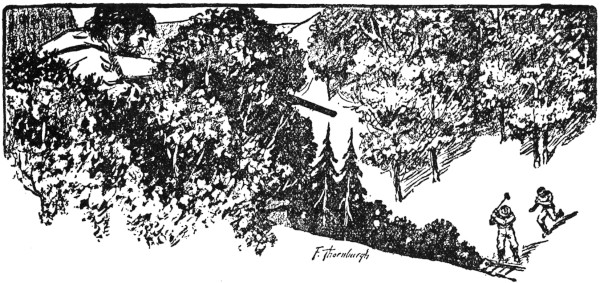
set and kept was truly surprising.
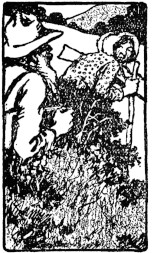
When they drew up stealthily behind a
scrubby oak and peered down the Lost
Trail's side of Devil's Gate, they saw just
what they had expected to see. Crouched
above a stone the size of a barrel, on which
lay his repeating rifle on its side, was Cat-Eye
Mayfield, motionless, waiting in a
diabolical patience.
"We've got to ketch him mighty nigh
in the act itself," whispered Grandpap Singleton,
"so's the'll be enough real proof to
send him to jail. We hain't got no real
proof as yit, ye know, Tot. We'll jest
wait here ontel he picks up his rifle, which
same he'll do when Little Buck comes in
sight, and 'en we'll make him put up his
hands and call Little Buck up to arrest
him. Heh? Shorely. He's a-plannin'
to let Little Buck have it when he slows
his hoss to ford the creek down thar."
Tot kept a watch on the trail below,
which lay in plain view before her for
several hundred yards. A few silent minutes
went by; then she motioned to her
kinsman to get ready.
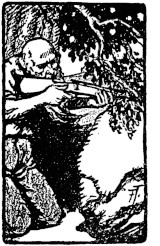
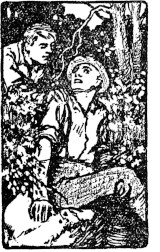
She saw him kneel, lay the long barrel
across a moss-covered
stone,
rest one shoulder
against the
scrubby oak's
body, and bend
his head until
his right cheek
touched the
rifle's stock. After
he had trained
the old weapon
properly, he
raised his white
head and turned
his eyes upward
without spoiling
his aim; and
Tot heard him
speak in the lowest of undertones:
"Lord, ef I haf to do it, You'll onderstand,
won't Ye? And ef I am in the
wrong, which I'm purty shore I hain't, I
ax Ye to fo'give me. Aymen."
The young woman wiped a dimness
from her blue eyes, and looked toward the
trail again. She bent and whispered nervously:
"He's a-comin' fast. He hain't more'n
a hundred steps from the Gate. Now you
watch Cat-Eye Mayfield, Grandpap Singleton,
and don't you let him k-k-kill Little
Buck!"
"You leave it to me!"
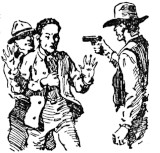
Mayfield picked up his rifle, drew the
hammer back, and began to settle himself
like a cat settling for a spring.
"Drap that 'ar gun, Cat-Eye!" cried
Grandpap Singleton.
Tot pulled aside a laurel branch, in order
that the would-be assassin might see
the frowning muzzle that bore upon him.
Mayfield was in no haste to turn his sallow
face toward them; he looked at them
only long enough to see who they were, and
did not drop his rifle. Perhaps it was because
he did not believe the religious old
man would shoot; perhaps it was because
his thirst for revenge was so great at that
moment that his narrow mind had in it
no room for any other thought.
"Drap that rifle, Cat-Eye!" Grandpap
Singleton cried again.
Still Mayfield did not obey. The horseman
was now almost to the ford, and reining
in. Mayfield's round head seemed to
sink halfway into his shoulders—he began
to look along the sights.
"Shoot!" Tot urged frantically.
The old Lancaster cracked like a giant's
whip. Cat-Eye Mayfield dropped his
rifle now. He turned a dumfounded,
ashen face toward the two Singletons, and
babbled something unintelligible. Then—although
the bullet had only passed through
the upper part of his right arm, thanks
either to Providence or to a dimness in the
old mountaineer's eyes—Mayfield sank to
the stones. The sight of his own blood
had made him limp.
The Prophet rose unsteadily. The
strain on his feeble mind was telling. He
stretched wide his lean arms, and the bright
sun threw his shadow down the incline in
the form of an inverted cross.
He called to the man in the Gate, "Come
up here, Little Buck Wolfe," thickly, "and
arrest me fo' mudder!"
VI
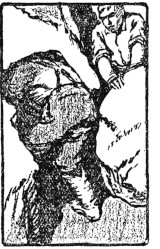
At the sound of the shot, Wolfe
looked up quickly. He saw the
gaunt old man go tottering to his
feet, saw Tot standing with her hands
clutching at her calico dress below her
throat; but because of the creek's dashing
he did not hear the Prophet's agonized cry.
Wolfe dismounted, fastened his horse's
reins to a sapling, and hurried up the
rocky steep.
The young woman and her grandparent
had come down to where Mayfield lay
groaning.
"He hain't dead," said Tot. "He's jest
bad hurt. And you'd shore better take
him along to town with ye, Little Buck,
and jail him, ef ye don't want to be ambushed
some other time."
Poor old Grandpap Singleton fell to his
knees beside the man he had shot. "He
hain't dead!" he rejoiced. "He hain't
dead!" His hands were clasped against
his hollow breast. His joy was even more
pathetic than his grief had been before it.
Wolfe understood fully. He touched
the now quiet figure on the ground with
the toe of his boot.
"Get up!" he ordered.
Mayfield rose, his right arm hanging
limp at his side. Wolfe ripped the shirtsleeve
from the injured member, folded
one of his own white handkerchiefs and
placed it over the wound, and used the
torn-out sleeve for a bandage. Mayfield,
who was fast recovering from his fit of
weakness, watched every move of the deft,
strong fingers with old hatred in his lusterless,
uncanny eyes.
The first-aid work was barely finished
when the high-pitched
voice of
Granny Wolfe
came from a
point a few rods
above:
"La, la, la!
And so ye got
him, durn him,
did ye, Grandpap
Bill Singleton!"
She limped
down to them,
her little dog,
Wag, happy at
her heels.
"Ye needn't to
mind a-tellin'
me about it, Bill
Singleton," she
chattered, "a-cause
I already know, me a-bein' a good
guesser. And so the rawzum-chawin'
devil's pup—was a goin' to layway Little
Buck, was he? You, Cat-Eye Mayfield,
quit that a-lookin' at me like as ef ye could
bite my whole head off."
She turned toward her grandson, who
greeted her gravely.
"I tried to find you before I left," he
said, and then told her of his father's
change of heart.
"Consarn his old fool hide!" the old
woman exploded.
Wolfe picked up Mayfield's rifle, threw
the loaded cartridge out of the chamber,
and let the hammer down carefully. Then
he held the weapon out toward Tot Singleton.
"Take that home with you," he requested.
"Mayfield can get it when he
comes back."
Tot didn't take the rifle. Her lower lip
began to quiver, and she looked away. "But
I cain't never go home no more, Little
Buck," she murmured.
"You can't go home!" he exclaimed in
amazement.
She told him haltingly why. A very little
smile curled Wolfe's mouth at the corners.
"So you, too, are an outcast," he said,
half-sympathetically, half-resentfully. "But
don't feel so badly about it! We always
have our compensations, little girl. I
wonder if—will you go along with me,
Tot?"
She answered simply, "I'd go anywhar
with you."
Grandpap Singleton took the rifle.
Granny Wolfe addressed her kinsman:
"Ef you're a-goin' to town, you'd shore
better start. I seed yore pap's old blue-tailed
hen a-settin' on the fence a-pickin'
her feathers this mornin', and I've heerd
two treefrogs a-hollerin', and them's all
good signs o' rain."
Wolfe shook hands with the two old
people, and escorted his prisoner and her
who had been his boyhood sweetheart
down to the Gate trail, where his horse
stood pawing the black earth impatiently.
"Get in the saddle, Cat-Eye," he said.
"You're not able to walk."
"I hain't a-goin' to Johnsville—" Mayfield
began, when Wolfe tapped his
deputy's badge with a forefinger and cut
in, "Get in the saddle!"
He pushed his coat back far enough to
reveal the butt of a revolver that the high
sheriff had found for him and urged him
to wear. Mayfield obeyed awkwardly and
ungraciously. With Tot Singleton walking
trustfully beside him, Wolfe led the
horse down the winding Gate trail, which
soon entered a dark green tunnel formed
of laurel, giant ferns, and hemlock
branches.
When they had put three miles behind
them, Wolfe said to his companion, "I suppose
you've guessed where I'm taking
you."
"Yes," with a sidewise glance of admiration
at his clearcut profile. "You're a-takin'
me to them folks who 'dopted you,
over in town. And ef they can make me
over into the same sawt they made you
into, I—I'll swaller all o' my feelin's
ag'inst bein' a charity objeck, and he'p
'em all I can."
"That's the spirit!" he said with a good
deal of enthusiasm. "You stick to that!"
Wolfe hired a light vehicle at the first
farmhouse, and they reached quiet, lazy
Johnsville an hour after the fall of darkness.
It was a fine, starry night; contrary
to Granny Wolfe's prediction, it hadn't
rained. They
went straight to
the big, old-fashioned
white
house of the
Masons, which
lifted its gables
so proudly above
its setting of
maples that one
was inclined to
wonder whether
it wasn't scoffing at the heavy mortgage
that was upon it!
The colonel and his wife were sitting
on the unlighted veranda. He was tall,
straight, gallant, courteous. She was
rather little, gentle, sweet, a born mother
who had never had any children. They
were of the old South.
"Father," said the adopted son, as the
trio reached the foot of the veranda steps,
"here's a man with a pretty bad arm. Call
Doctor Rice, won't you?"
Colonel Mason didn't wait to ask questions.
He ran toward the phone, switching
on the veranda lights as he passed
through the hallway. The trio walked up
the steps. Tot Singleton blinked in the
strange white glow that shone from two
frosted globes on the veranda ceiling.
Cat-Eye Mayfield glared like an animal in
a corner. Wolfe approached Mrs. Mason,
who was at the same time approaching
him.
"This is Miss Singleton, mother," he
said. "I—I thought you wouldn't mind
caring for her a little while as you cared
for me for so long."
The colonel's little wife turned to Alex
Singleton's daughter, took her hands, bent
forward and kissed her on the brow. Tot
stared; then a tear traced a crooked line
down the road-dust of either cheek. No
other woman had ever kissed her, not even
her own stout, whistling mother, that she
remembered. In that instant her whole
weary, fiery mountain heart gave itself in
everlasting love and devotion to Mrs. Mason.
"Let's go into the house, dear," softly
said the older woman.
They went in. The colonel hastened
back to the veranda.
"Rice is coming," he announced. To
Mayfield, "Please sit down, sir."
The three of them sat down. The
colonel slyly studied the wounded man's
face, and he found it interesting. Soon
the doctor arrived.
Rice dressed the hillman's arm in record
time, and was paid on the spot for his
services—by the young fellow he had always
known as Arnold Mason. Wolfe
then went with Mayfield into the dining room,
where they had supper. Immediately
after they had finished the meal,
Mayfield was shown to a bedroom upstairs
and in the back half of the house.
"Don't bother to run away," and Wolfe
smiled a very pleasant smile. "You may
go home tomorrow. I won't give you any
trouble over trying to pot me; you see, I
understand fully just how hard a prison
term is for any mountain man! You
won't try to do me harm in the future,
will you? I want you to promise me
that."
"Shore," Mayfield nodded. "I promise.
You're a good feller, Little Buck, a dang
good feller."
Mayfield had expected anything but
mercy. But he was not too bewildered to
grind his teeth and fling a vile, whispered
curse at the door when Wolfe closed it
behind him.
When Wolfe went back to the veranda,
the lights had been cut off to keep away a
swarm of annoying summer beetles. He
saw that the colonel and a slender figure
in white sat in rockers near the front
steps.
"Miss Singleton—who wants me to call
her Tot, like everybody else does—" began
Colonel Mason, "has told me about
the difficulties you had and—er, expect to
have. It looks bad, Arnold; there's no
denying it. You can't arrest and imprison
your own people, of course. Frankly, I
don't quite see how you're going to manage
it, son."
Wolfe stepped to the veranda post and
put his back to it.
"You've always believed in me," he said
earnestly. "I want you to continue to believe
in me. I'm not to the barrier yet.
There are six miles of narrow-gauge road
to be built before the barrier is reached—the
Devil's Gate, you know. No use worrying
over things in the distance, father,
eh? This is what I've got to do—when I
get to the barrier, I'll cross it, or go under
it, around it, or through it. I don't
know how. I know only that it must be
done."
"By George, sir!" The colonel brought
a hand down on his knee for emphasis. "Of
course, I'll keep faith in you! That pass—the
Devil's Gate—was beautifully named,
wasn't it? But there's one thing, Arnold,
I must ask you to remember. That your
life is of more value to us, infinitely, than
our money. Don't forget it, son."
There followed a few minutes of silence
save for the night song of a mocking
bird somewhere in the maples. Then Tot
Singleton, who now wore shoes and stockings
and a white dress that Mrs. Mason
had found for her, sat up straight in her
chair and addressed the dimly-shining officer's
shield.
"Let me tell you, Little Buck," she said,
"you'll shorely wish you'd put Cat-Eye
Mayfield in jail the minute you got to
town. I'd bet my life ag'in a safety-pin
'at Cat-Eye Mayfield ain't in the house
right now. As long as he can go whar he
pleases, yore life ain't wo'th nothin'. I
tell you, after you've done what you've
done tonight fo' him, he'd foller you to
the bottomest hole in Tophet to git to
shoot you in the back. Hate you? Why,
he's hated you ever sence he can rickollect.
It's all the' is to him, that hate fo' you.
As Grandpap Singleton says, the sourest
vinegar in the world is made out o' molasses—a-meanin',
o' course, hate made out
o' l-love. Cat-Eye thinks he l-loves me,
y' know——"
If the lights had been on, they would
have seen that she was blushing terribly;
she had made a bad mess, she thought, of
telling them how it was.
The last word had barely left her lips
when there came from the velvety darkness
of the lawn the voice of an eavesdropper,
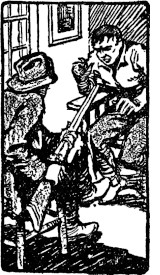
a snake, Mayfield himself, who had stolen
out by way of the back stairs:
"Ef ever she told the truth in all o' her
borned days, Little Buck Wolfe, she told
it then. Ye might as well make yore fun'ral
'rangements afore ye come into the
hills ag'in, acause I'll certainly git you!"
Wolfe ran
down the steps
and disappeared
in the blackness.
Colonel Mason
flashed on the
veranda lights,
and brought out
a shotgun. But
Mayfield and the
night were too
closely akin, and they failed to catch even
a glimpse of him.
"I have always held out," muttered the
colonel, when they had again gathered on
the veranda, "that there was no man without
a little that was good somewhere in
his make-up. I admit now that I was mistaken."
Little Mrs. Mason came out then. She
put a hand on Tot's arm.
"I've got a room ready for you upstairs,"
she said. "Would you like to go
to bed now? You must be pretty tired."
"Yes'm," Tot replied absentmindedly.
She displayed no interest whatever in
the beautiful blue-and-white bedroom that
the good woman at her side told her to
consider her own. She barely noticed the
dainty night-dress that Mrs. Mason took
from a drawer and hung across the back of
a chair for her. Wondering at her sudden
abstraction, the colonel's wife smiled a
gentle, "Good night, my dear!" and left
her to herself.
Tot Singleton was thinking of Mayfield.
She had long ago given up trying
to stop hating him; he wouldn't let her
stop hating him. For years he had dogged
her like a shadow; she hadn't been able
to go anywhere, it seemed, without his following
her. A thousand times he had profaned
the sacred spot under the whispering
willow—with his feet, with his voice, with
his opaque and uncanny eyes, with his
thoughts. Over and over she had tried to
insult him, in order that she might be rid
of him; but there was, apparently, nothing
about him that could be insulted. No,
he wouldn't let her leave off hating him!
And now Mayfield was free again; free
to wait in the laurels beside the trail, or
behind a stone above it, with his coward's
soul red with the spirit of murder, and a
rifle in his hands.
Little Buck Wolfe would go to the
mountains in the morning to bring Mayfield
back; he would be shot from ambush;
the cost of his kindliness and his fearlessness
would be his life. She was absolutely
sure of it, and her conclusion was certainly
not far-fetched. Well, she would save
Wolfe again. She was one of the very
few persons in the world who could approach
Cat-Eye Mayfield, now that he
knew the hand of the law was against him,
without great danger of being killed. She
herself would arrest Cat-Eye. If he
didn't submit to arrest, she would—but he
would submit. It would be easy enough to
find him. The mountains and their dense
forests were as an open book to her; no
man of the Wolfes Basin country knew
them better.
To the outsider, the decision of this unlettered,
but strong-souled young daughter
of the hills is perhaps rather startling.
But to Tot there was nothing so very extraordinary
about it. To her, duty was
duty, and nothing more—or less.
When Mrs. Mason rapped lightly at the
door of the blue-and-white bedroom on
the following morning, she received no
response. She opened the door and went
in, and found the bed not only empty, but
undisturbed. Shortly afterward, the colonel's
wife found that Tot's calico dress
was gone; and in its place lay the white
garments and the shoes and stockings that
Tot had worn the evening before.
Mrs. Mason hurried downstairs and met
Wolfe in the hallway. He seemed anxious.
"Mother," his voice troubled, "when I
woke this morning, my revolver was gone
from my holster, and the deputy shield
from my coat. What do you suppose became
of them? Do you think Mayfield——?"
"I believe I can explain, Arnold," she interrupted
breathlessly. "The girl, too, is
gone!"
"After Mayfield!" he cried.
"I have no doubt of it, Arnold. She
probably thinks your officer badge gives
her plenty of authority!"
VII
There was a heavy step on the
veranda. A big and poorly-dressed
man, wearing a sunburned black
beard and carrying a rifle by its muzzle, appeared
on the threshold.
"Whar's my little gyurl?" he asked jerkily.
The colonel's wife looked with instant
pity upon him. There was something very
forlorn about Alex Singleton, the repentant.
His gaunt and haggard face, his ragged
clothing, his run-over cowhide boots,
all were covered with the dust of travel.
Just under his eyes, which were wide and
hungry-looking, his cheeks were mottled
faintly, and it was chiefly by this pathetic
little token that Mrs. Mason read the story
of his remorseful sorrow. He stared
straight at her; he appeared to be wholly
unaware of the presence beside her of old
Buck Wolfe's son.
"Whar is she at?" he asked again, this
time almost in a whisper.
"She went back to the hills last night,"
Mrs. Mason answered kindly.
"I'd ort to be shot fo' a-runnin' her off,"
muttered Alex Singleton.
In louder tones,
"Might I ax ye fo' a
big drink o' whisky,
mis'?"
Mrs. Mason's eyes
twinkled. "I think
we have some. Sit
down and wait, and
I'll go for it."
It was then that she
noticed that his left shirtsleeve had been
ripped open to the shoulder; that a rawhide
thong did service as a tourniquet just
above his left elbow; and that his left
forearm, wrist and hand were swollen and
discolored.
"Copperhead bit me as I was a-creepin'
through a fence jest outside o' town," the
mountaineer explained apologetically. "Got
me afore I knowed it was anywhar nigh
me. That's what I wanted with a big
drink o' whisky, mis', it a-bein' good fo'
snakebite."
"Oh, you must have Doctor Rice!" the
little woman cried frightenedly. Already
she was fairly pushing him toward a
veranda chair that Wolfe had hurriedly
provided; he sat down as obediently as a
child would have done. "Arnold, phone
Doctor Rice——"
"But there's no time to be lost in waiting
for Rice, mother," said Wolfe. "Look
at that arm! I can treat snakebite; I've
got some potassium permanganate that I
bought to take to the hills with me——"
He ran to his bedroom and returned
with a small bottle. Alex Singleton rose
angrily.
"I hain't a-goin' to let you do it!" he
declared.
"You'll have to," replied Wolfe. "You
don't want to die, do you?"
"But thar's whisky——"
"Whisky," old Buck Wolfe's son interrupted,
"is as bad as it is good. It stimulates
the heart action, but it spreads the
poison through the system rapidly. This
permanganate—we just cut right through
the marks of the fangs with a knife; then
we draw out as much poison as will come;
then we fill the wounds with this stuff, and
pretty soon you'll be as good as new. You
see, you evidently got the tourniquet on
quick, which is a big thing."
"Me, a Singleton, and you, a Wolfe?"
The mountain man was suffering much.
He was a stranger in a strange land, dazed
and bewildered, and heart-broken because
of his treatment of his only daughter. He
weakened.
"You'd do that fo' me, a Singleton? Ef
you would, I hain't a-goin' to be lowdown
enough to keep ye from it. Yank out yore
knife and cut the whole danged arm off,
Little Buck, ef ye want to!"
He held out the swollen, discolored
hand. Wolfe took a sharp knife from his
pocket, and with it split the fang-marks
two ways. With his mouth he succeeded
in drawing out some of the virulent yellow
poison. After that he filled the wounds
with permanganate crystals. The colonel
came up and tried to help.
"We'll loosen your thong at intervals,"
smiled Wolfe. "There's some poison in
that arm that the permanganate won't
reach, but it won't hurt much if we let it
into the circulation a little at a time. It's
the shock of the whole dose, you know,
that kills."
Some hours later, the leader of the Singletons
put out his good right hand.
"Boy," he said with a great deal of feeling,
"you've got one friend, anyhow, which
no time, nor no change, nor no thing on
earth can ever take away from ye. I want
ye to shake wi' me, Little Buck."
They shook.
"Now will ye please tell me, ef ye
know," Singleton went on, "how come it
Louisiany left here in the night?"
Wolfe told him briefly.
"Cat-Eye Mayfield!" growled the big
hillman. "Well, I reckon I'm a-goin' to
haf to kill Cat-Eye sometime. Goodness
knows I hates to do it, but fo' pore little
Louisiany I will, as shore as green apples.
Le' me tell ye this here, folks—thar's the
lowdownest man 'at ever stuck a boot-track
on the face o' the world."
After two more hours, the rawhide
thong was removed entirely. Singleton's
constitution was like iron. He rose, and
took up his rifle and hat.
"I guess I'll be a-movin' toward home,"
he drawled softly. "I feel good enough
to thrash my weight in wildcats now. I
shore won't fo'git this."
"Better wait until tomorrow," advised
the always hospitable colonel.
"I'll go with you," said Wolfe. "Tot
may need help, you know. We'll separate
at the Gate, in order that my people——"
"No!" old Alex broke in stoutly. "You
cain't go to the mountains now. Mayfield
would be plumb shore to snipe ye off,
plum' shore. You must stay here fo'
three days, at least. I tell you, I knows
jest edzactly what I'm a-talkin' about, Little
Buck."
"But he wouldn't have got away, if I
hadn't been such a boob!" frowned Wolfe.
"It's up to me, as the saying is, to bring
him back."
Singleton shook his head. "Oh, no! Ef
I'm a-goin' to be yore friend, you must
le' me have my way about it. Don't be a-skeered
but what Louisiany can take
blamed good keer o' herself. Cat-Eye, he
wouldn't hurt her, anyhow. He knows
me too dang well to hurt her. And so
good-by to ye all!"
Half a minute later, he had left the house
and was hurrying toward the great, dim-blue
ranges.
The young general manager of the new
Unaka Lumber Company began immediately
the building of his toy railroad. Before
twilight of the next day, more than a
dozen tents had been staked on a level spot
near where
Wolfes Creek
flowed under the
C. C. & O., and
the mountain air
was filled with
the songs of
weary negro laborers.
Early
on the following
morning, under
the supervision
of a young foreman
named
Weaver, the
narrow roadbed
began to creep
toward the basin.
The hills everlastingly rang with the
staccato of the axe, the keen tenor of the
saw, and the low bass thunder of exploding
dynamite as tree after tree and ledge
after ledge of stone fell victims of the
hand of progress.
Late in the afternoon of the day following,
Wolfe left the work entirely in
charge of his foreman, and started to
Johnsville for news. No person had
passed by way of the trail that led down
the creek from Devil's Gate, but those for
whom he had been watching might possibly
have taken another trail.
He found no news awaiting him in
Johnsville. Nothing more had been seen
or heard of the Singletons or of Mayfield.
Wolfe feared that some evil had befallen
Tot. Before he went to bed that night,
he decided that he would be in the hills at
daybreak on a search for her.
Colonel Mason wished to accompany
his foster-son, but he awoke too late.
Whereupon he gallantly wagered his wife
a silk dress against a peach pie that he
would overtake Arnold before he reached
Devil's Gate—and he won the peach pie.
VIII
A slender, barefooted feminine
figure in a torn and bedraggled, blue-dotted
calico dress stood motionless
behind the twisted body of a wind-swept
jackpine on the crest of a baby mountain
miles from Wolfe's Basin. Her face was
thin from starving, and her coppery hair
matted and tangled, but in the depths of
her blue eyes there was fire. An Army-type
revolver hung heavily from her right
hand. Over her heart shone an officer's
shield. She was slyly watching the side of
another baby mountain, on the crest of
which lay lightly the dying, golden summer
sun.
The yellow disc sank out of sight, and
shadows began to thicken in the valley before
her. Still she stood motionless behind
the wind-swept pine, too full of her
purpose to sit down and rest. Darkness
came on out of the east, and a little brown
owl somewhere below her cried a mournful
welcome to it. A nighthawk cut the air
over her head with its knife-sharp wings;
its shriek was like the dying note of a
steamer's siren. From far across the
other mountain came the shrill sound of
a panther's scream, imitating the call of a
woman in mortal distress.
Then there was silence, a deep and awesome
silence. The earth, the sky, and all
between, formed one vast and hollow loneliness.
But Tot did not feel it. She herself
was loneliness.
At last she sat down on the pine needles.
Her weariness, the weariness of long hours
of tramping without food, of long vigils
on mountain tops, forced her to rest.
What a game of hide-and-seek it had been!
Half a dozen times she had been almost
upon him. His way of eluding her was
both uncanny and maddening. He had
really seemed to be enjoying it!
Again the owl cried out; again the nighthawk
shrieked; again the panther
screamed. And again did Tot Singleton
pay no attention to the gruesome trinity.
Some time later, she saw on the side of
the other mountain a tiny point of light.
It brought a cold but triumphant smile to
her lips. How sure of himself he was!
She rose, and began to move swiftly and
noiselessly down through the scrubby
laurel and ivy, going as straight toward
the point of light as the slopes of the valley
would allow.
After nearly
an hour, she divided
a wall of
rank green undergrowth
and
stepped into a
little, round
patch of huckleberry
bushes, in
the center of
which was a
small brushwood
fire—and beyond
the fire,
eating berries,
his rifle lying
across his knees,
sat Cat-Eye
Mayfield, who also was pale and haggard.
He looked up. His jaws stopped their
movement as though they had been that
moment paralyzed. He stared at her half-defiantly
and half-reproachfully.
She went closer to him, the big revolver
ready in her hand, her gaze riveted on
his.
"You're onder arrest fo' tryin' to kill
Little Buck Wolfe," she said in a low voice
that carried the ring of ice. With the
forefinger of her left hand she pointed to
the officer's shield that she wore over her
heart like a target and a dare.
"Ye don't say!" he sneered.
"But I do say!" she replied.
"Depity-Sheriff Tot Singleton!" grinned
Mayfield.
"C'rect, sir!" boldly. "It's jest what I
am. I'll haf to ax ye to pass that 'ar rifle
acrost to me, Mister Cat-Eye."
"Humph!" scornfully.
"Pass me that 'ar rifle, butt fust—pass
it, quick!"
Mayfield saw, or imagined he saw, her
finger tighten on the trigger. He gave her
the gun, butt first, reluctantly. She lifted
it in her left hand and brought it down
hard on a stone, disabling the mechanism
of the breech. Mayfield muttered an oath
and leaped to his feet, but the revolver's
muzzle held him off.
"You better hadn't!" she warned, her
finger now so hard on the trigger that the
cylinder trembled. "I've got the whole
United States ahind o' me now, and I
shore hain't afeared to shoot. Ef you
think I am, try me and see!"
The other prepared to play his last card.
He had some faith in it. He tucked his
thumbs under his homemade suspenders,
and cocked his bullet-shaped head to one
side.
"We've had a fine time a-playin'
whoopy-hide, hain't we?" He tried to
laugh, and failed. "But it's all come to a
show-down now, I reckon. You've sp'iled
it all; the fun's all over. Tot Singleton,
you won't want me to go to jail when I've
told ye what I've got to tell ye!"
"Tell it!" impatiently.
"All right. Well," leered Mayfield,
"you rickollect 'at time me and yore pap
went over to Shelton Laurel and stayed a
week at the big shootin'-match, sev'ral year
ago? And you rickollect yore pap acted
pow'ful strange fo' a long time atter we'd
got back? It was the talk o' the whole
Singleton tribe. You rickollect, Tot?"
"Yes. Shorely," she nodded. "Git the
rest of it out o' ye quick."
"All right. Well, yore pap he killed a
man named Mort Gibson over thar," Cat-Eye
Mayfield went on, "and I seed him do
it. I was the only witness. I'm the only
pusson on earth 'at knows who done it—'ceptin'
yore pap. Take me to jail, and I'll
shore tell who it was killed Mort Gibson.
Then yore pap he'll land in the penitenchy
even ef he don't hang!"
Tot Singleton saw light in a place that
had been mysteriously dark to her for years.
"So that," she cried, shaken hard, "is
why pap never would make you stop a-pesterin'
me to marry you! He was
afeard to make you mad, acause he was
afeard you'd tell! But," with fine scorn,
"he knowed he could trust me never to tie
up to sech as you, o' course. Do ye
reckon, Cat-Eye Mayfield, they'd take yore
word about the killin', and you in jail?"
"Tumph! I'd jest tell 'em to ax yore
pap about it, and he'd give hisself away.
He hain't got over it yit. It's nigh driv'
him crazy."
It was all too true. Then the young
woman's countenance took on an expression
that fascinated Mayfield because he
couldn't begin to guess what it meant.
"You turn yore back to me, quick!" she
ordered.
The revolver threatened. The firelight
gleamed on the deputy's badge she wore.
Mayfield lost faith in his last card. He
turned his back to Tot, and bent his head
dejectedly. She stepped to him, gripped
the waistband of his blue denim trousers
in her left hand, and shoved him forward.
"Move on!" she said, bleakly but desperately,
and he moved on. "Try anything
I don't like the looks of, and see ef
I don't shoot—then you cain't tell on pap.
I—I've got the whole United States ahind
o' me now."
They reached the crest of a high
and rugged mountain just before
daybreak. Tot decided to halt there
and wait for the dawn to show her the surrounding
country, in order that she might
get her bearings again.
When the gray light came, she found
that the great pile of earth and stone under
her feet was the Big Blackfern, the
eastern wall of Wolfe's Basin!
"Listen, Cat-Eye," she said wearily.
"This is what we're a-goin' to do. We're
a-goin' straight down the mountainside to
the aidge o' the basin; then we're a-goin'
to sneak out to the right under cover o' the
trees ontel we're to the Gate. Anything
about that you don't onderstand?"
"Yes," growled her prisoner, "I onderstand
ye."
"Rickollect, ef you try to run, I'll shoot."
She released her hold on his clothing,
now that he no longer had darkness for a
friend. She followed him doggedly, fighting
for strength to keep on her feet. Before
they were halfway to the basin's edge,
she was stumbling, and the trees were beginning
to run
grotesquely together
like
drunken monsters,
and there
was in her eyes
a light closely
akin to that of
delirium. Mayfield
knew that
she soon would
be completely exhausted,
and upon
this he was
depending for
his escape. Now
and then he cast
a sly glance over
his shoulder,
and with each succeeding glimpse of her
his countenance grew a degree less heavy.
When they had come to a point a hundred
yards from the level ground of the
basin's bottom, Mayfield halted suddenly
and began to stare ahead of him. His captor
thrust the muzzle of the revolver weakly
against his back. Still he didn't move.
His immobility was like that of an evil bird
that a snake holds charmed.
"Go on!" mumbled Tot. "Go on!"
"Looky thar!" exclaimed Mayfield. He
pointed.
"What is it?"
She saw that they were standing at the
lower side of the family burying-ground
of the Wolfes.
"Thar!" Mayfield growled, pointing
again.
At last she saw. "It was you," she
gasped, "that done it!"
A thick, black mist was already settling
down before her. She couldn't see anything
at all now. Mayfield seized the revolver
and tore it from her weakened grip.
She made no attempt to recover it, for
nothing mattered; the universe had become
one great, dark void; it was finished. She
staggered and fell prostrate, with her arms
flung out helplessly. There she lay quite
still, with the officer's shield pressed close
to the earth and no more like a target, no
more like a dare.
In the basin below were two men, one
of whom was mounted, who had been
watching with rising interest the progress
of the pair down the rugged slope of the
Blackfern. They had recognized Tot and
Mayfield only when the latter-named halted
suddenly and pointed; captor and captive
had come into plain view at that moment.
Colonel Mason uttered an exclamation
that was half-oath, and spurred his horse
forward. The man on foot also was an
elderly man, and he was tired and worn
from days and nights of fruitless searching
through the mountain wilderness. He
thought that Mayfield had struck Tot
down. He choked back a sob and cried
out a whole oath instead, and ran, not toward
his daughter, his one little girl, but
after Cat-Eye Mayfield.
The colonel dismounted and with infinite
tenderness gathered Tot's limp body up
from the new mound of black earth on
which it had fallen. He shook his head
sorrowfully, regretfully, at sight of the
new slab of sandstone that had been put at
the head of the mound only that morning.
For on it had been chiseled crudely this
pitiful inscription:
Hear Lays Little Buck Wolfe
IX
Granny Wolfe had signally
failed to soften her son, Old Buck.
She had talked to him until she
was hoarse, now pleading, now threatening
him, now browbeating him with her sharp
and ready tongue. Several times he had
walked off to keep from hearing her;
twice he had seized his fiddle and gone to
playing "Buffalo Gals" wildly to shut her
up.
But her spirits were not so low this
morning. She had put on her red flannel
petticoat wrong side out by mistake, and
that certainly meant better luck in the future.
It was a sign that never failed.
She had gone out, with her little black
dog at her heels, to weed a bed of sky-colored
ragged-robins. Her gaze sought
out the not far distant family burying-ground
instead. That which she saw
caused her to drop her sourwood staff and
step on her little dog's foot.
"Wag, ye black devil!" she creaked in
response to the canine howl.
She recovered her staff, took her clay
pipe from her almost toothless jaws,
shaded her eyes with one hand, and looked
toward the side of the Blackfern again.
That which she had seen before had become
an indistinct blur.
"I wonder what!" she muttered.
The eyes of Old Buck Wolfe were
keener. He threw a last clod at a
marauding hen, snatched up his always
ready rifle, and hurried toward the mountain.
As he passed his mother's cabin, she
hailed him shrilly, "Wait thar, and I'll go
'long wi' ye!"
He didn't even turn his head.
"You'd ort to be skun alive!" and she
limped after him, Wag following at her
heels.
Colonel Mason looked for water
with which to revive Tot and, it
being unfamiliar territory to him,
failed to find any. Wondering whether
he could mount unassisted with the young
woman in his arms, he went back to his
horse. Then he saw, standing less than
two rods away, as motionless as the trees
about him, the bearded, hard-eyed, giant
mountaineer, Old Buck Wolfe.
"You're a terrible man, Buck," the colonel
observed bitingly.
Wolfe changed not one feature.
"Will you be so kind, sir," and the old
Southerner's voice was now not so cold,
"as to hold this girl until I can get on my
horse, and then
pass her up to
me?"
Still no word,
no move, from
the hillman. His
mother arrived,
panting heavily.
She went
straight to Colonel
Mason. A
great deal was
plain to her already.
"Le' me take
keer o' Tot," she
said, fumbling at
the bandana corners
that were knotted under her chin,
"ontel you can chase out the mountain thar
about half a quarter and wet this here
handkercher in a little spring ye'll find.
Hey?"
The colonel returned not long afterward
with the bandana soaking wet. Tot opened
her eyes the moment the water touched her
face. Granny Wolfe smiled, swept the
matted and tangled hair back from the
high, smooth brow and crooned:
"Now don't you worry yore little self
no more, Tot, honey. Why, the' hain't a
blessed thing to worry about! Little Buck
ain't dead at all! His pap thar, the cross-grained
old fool, he made that 'ar grave
thar, and set up a tombstone to it, as a
sign to the whole world 'at his best son
was dead to him. Don't ye see, Tot,
honey? Why, it's as plain as yore nose!"
"Cat-Eye didn't kill him?" Tot breathed
uncertainly.
"Shorely not!" the old woman assured
her.
"I thought Cat-Eye—had got him," Tot
mumbled weakly, and slowly closed her
eyes.
Colonel Mason rose and faced Old Buck
Wolfe squarely.
"You could be a mighty good man," said
he, "if you would. I know you've got
plenty of chances to be bad; still, that's a
very fine reason why you shouldn't be. I
tell you, sir, there's nothing much coming
to the fellow who is good simply because
he hasn't any chance to be bad—and don't
you ever forget that. Come, now! Help
your son instead of hindering him. Be
what you ought to be to him. You owe
him your——"
"I don't owe nobody nothin'!" cut in
the man who kept his word, told the truth,
and paid his debts; who bent his knees
only to a woodchuck's den, a ginseng root,
or the furnace of a moonshine still; and
who believed in nothing that he couldn't
see with his temporal eyes.
Old Kirby Mason drew himself up
straight, as straight as he had stood at
Chickamauga when a general had complimented
him to his face. But he was pale
now, instead of flushed.
"By George, sir!" he bellowed.
With that he sprang to the head of the
new black mound, tore away the slab of
sandstone, lifted it in both hands and
brought it down hard against the stump
of a tree, breaking it into half a dozen
pieces. The mountaineer went toward
him, his rifle ready. The colonel looked into
the barrel of the weapon without flinching.
"You ort to be hung as high as Haman
or higher, Buck Wolfe!" the old woman
cried. "You go home! Some says a old
fool is the biggest fool on earth, and some
says a young fool is the biggest; but me, I
say you settle the question forever. Now
you go on home!"
"Nobody hain't axed you fo' none o'
yore edvice," growled her son.
"By gyar," Granny Wolfe retorted
witheringly, "you need edvice, as shore as
the Old Scratch hain't a jaybird."
Colonel Mason turned to his waiting
horse, and swung himself into the saddle
with the agility of a cavalryman. Tot
seemed only half-conscious, only half-alive,
and it was with some difficulty that
the colonel and Granny Wolfe lifted her
to the saddlefront. The grizzled mountain
man stood and watched it with a face
like a mask of stone.
Then the horseman left the old hillwoman
berating her son mercilessly, and rode
toward the basin's bottom.
"Now, little lady," he said when they had
come to level ground, "I'll take you to
your mother in short order. I'm afraid
to try to take you to Johnsville; it would
probably be too much for you. It'll be all
right for you to go home. Your father is
sorry he was so hasty with you."
Tot stared wide-eyed into his patrician
old face. Her spirit fluttered up quickly.
"I want to go back to Mis' Mason," she
told him.
"Oh!" smiled the colonel. "Back to
Mrs. Mason, eh? Very well. Perhaps it
would really be better. You may need the
services of a doctor, and you couldn't get
one out here—though I'd never dare to
tell Granny Wolfe that! And I fancy,
little lady," he added pleasantly, "that Mrs.
Mason will be right glad to have you
back."
They soon met young Wolfe, who had
just ridden through Devil's Gate. He
heard the story as they rode toward Johnsville,
and made no comment, though there
was a glint in his eyes that his foster-father
hadn't been accustomed to seeing
there.
Mrs. Mason saw them
coming, and called the
doctor by phone. Then
she ran to make ready
the bed in the blue-and-white
room upstairs.
It was a case of utter
physical exhaustion and
high nervous strain, the
doctor said; there was some fever now,
and would doubtless be more before morning.
Tot watched him as though she were
not the least interested. After an hour,
Doctor Rice left medicine and directions
for giving them, and turned homeward.
Another hour went by. The patient
spoke to the anxious-faced little woman
who sat at her bedside.
"That tombstone. I can see it as plain
as daylight. Ef I look somewhar else, it
moves whar I look. 'Hear lays Little
Buck Wolfe.' Are you shore he ain't
dead, Mis' Mason, plum' shore?"
"Very sure," promptly. "He's perfectly
safe."
"Ef you don't keer, Mis' Mason," and
Tot strove to lift herself to an elbow, "I'll
jest step downsta'rs and see."
"Delirium," the colonel's wife whispered
to herself. Aloud, "No, you mustn't get
up! Wait, dear; I'll call him."
Wolfe entered the blue-and-white bedroom
a minute later. He went to the bedside
and knelt there, took one of the hot
and fluttering hands and caressed it awkwardly.
"I'm all right," he told her over and
over. "Don't you see? Everything is all
right."
She appeared to be satisfied, and accepted
a teaspoonful of queer-tasting liquid
without a murmur.
But the fever kept going higher in spite
of the queer-tasting liquid, and the doctor
was summoned again. He gave a powder,
left others, and departed. Out in the
hallway, Wolfe paced the floor anxiously.
On the veranda the colonel sat smoking
and swearing under his breath at the forces
that had brought themselves together in a
mighty attempt to crush him that was as
flesh and blood of his own.
Wolfe stopped his nervous pacing at
the sound of soft footfalls behind him,
turned, and faced his foster-mother.
"I don't think you need worry yourself
like this, Arnold; the case isn't so desperate,"
said Mrs. Mason, half-whispering.
She went on smilingly, "If you hadn't told
me about Alice, I'd think you were about
to fall in love with Tot—or that you'd already
fallen in love with her! She's handsome,
honey boy, isn't she?"
"Very," he agreed, "but I'm not in love
with her, mother."
Mrs. Mason gave him a wise look. "Of
course, you aren't, not yet. It's gratitude
and appreciation, now. But a man of your
make-up could hardly help caring for a
girl like Tot—after she has had a little
polish, you know. That was a boyish affair
you had with Alice, a sort of flashlight
affair; you hadn't been much used to women,
and she dazzled you. You'll see the
day, dear boy, when you'll be quite thankful
that Alice wouldn't have you. Now
go straight off to bed, Arnold!"
"You'll call me if she gets worse?"
The colonel's wife promised. Wolfe
went to his room. He shook his head and
smiled a trifle bitterly at that which Mrs.
Mason had said concerning "a flashlight
affair." He thought she didn't understand.
But she did.
At noon of the next day, Sheriff
Alvin Starnes, tall and lank, brave
and illiterate, rose from his office
chair and went to a telephone instrument
on the wall. He asked for Colonel Mason's
residence.
"This is Sheriff Starnes," he growled
into the transmitter. "Is the young lady
still improvin'?"
"Doing finely, thank you, Sheriff." It
was Little Buck Wolfe talking. "The
colonel told you about her, eh?"
"This mornin', sir. I think I'd better
go after Mayfield, Mr. Mason. I ain't
forgot that I promised to let you run that
end o' the county, on account o' your kinfolks;
but Mayfield ain't your kinfolks."
"Go ahead!" laughed Wolfe. "Hope
you catch him."
"Startin' right now," replied Starnes.
"Goo'-by!"
He hung up the receiver, rang off,
crossed the room and took his broad-brimmed
black hat from a nail that had been half
driven up in the corner of a board lettered
boldly: NO SWARING ALOUD. He buckled
on a revolver-laden cartridge-belt, and
took a pair of buckskin riding gloves from
a drawer of his desk.
Just then there came a slow, heavy rapping
at the door, the rapping of a rifle's
butt.
The sheriff's lean face showed signs of
annoyance. He went to the door. Two
men stood a few
feet from the
steps. One of
them was loosely-built,
angular,
and bullet-headed;
the other
was a big,
square-chested
man with
sunburned
black hair and
beard. Only the
big man was
armed.
"You're the
high sheriff o'
this here county;
hey?" said
Alex Singleton.
"I am, sir."
"Then you arrest this here rattlesnake—take
him off o' my hands afore I lose what
little holt I've got on myself and put out
his blasted light!" old Singleton roared.
His voice was hoarse, rasping, like the
sound a dull file makes when drawn across
a thin steel edge. "He tried his best to
kill a man I call my friend, Little Buck
Wolfe; and the damned yaller dawg"—he
was blind with rage, choking full—"he
struck the one and only gyurl I've
got——"
"Shet yore mouth!" cried Singleton. His
eyes blazed gloriously now, and his voice
held a note of triumph. He wheeled and
faced Sheriff Alvin Starnes again.
"And arrest me," he said, "fo' a-killin'
Mort Gibson in a cyard game, over on
Shelton Laurel, five year ago come eight
o'clock o' the night o' next September the
thirteenth!"
Alex Singleton, winner as well as loser,
passed the officer his rifle and a revolver,
and held out his wrists for manacles.
X
It was the third of August, and one
of the warmest days of the summer.
The extremely dry weather had withered
all small vegetation; even the leaves of
the laurel, that evergreen chaplet of the
hills, were curled into little tubes and drooping.
The majestic bald peak called Picketts
Dome shimmered in the pale blue
heat-haze. The ragged fringe of jackpines
on the uneven, rockbound crest of
the Big Blackfern stood motionless for
lack of a breeze, seeming much like soldiers
turned to stone in a battle-line that
had previously suffered from the galling
fire of some invincible enemy.
Grandpap Singleton, the Prophet,
mopped his old brow frequently with a
faded bandana as he followed the Devil's
Gate trail, going northward. He walked
with a dogwood cane, his other hand resting
on his rheumatic left hip; but in spite
of his decrepitude there was about his
movements an eagerness that suggested an
objective point of no little importance.
When he was barely through the Gate,
he came upon old Granny Wolfe, who was
kneeling beside the trail and trying to tie
the ends of a 'coonhide shoestring that
was somewhat too short.
Before she knew that he was anywhere
near her, he leaned over, touched her
lightly on the shoulder, and cried out like
some mischievous boy, "Boa!"
The old hillwoman, startled, went stiffly
to her feet.
"Well, I wisht I may never! My sakes,
Grandpap Bill Singleton, you skeered me
mighty durned nigh it to death! Now
what'n Tophet do ye mean, anyhow, a-slippin'
up on folks that a-way?" She
tried to appear very angry, and failed altogether.
"Huh-huh!" laughed Grandpap Singleton,
tugging at his long white beard.
"How's yore old bones this mornin', Jane
Wolfe?"
Granny Wolfe smiled the smile she had
been holding in with difficulty for half a
minute.
"Bill Singleton," she said, bending
toward him, "ef it wasn't fo' the dad-burned
old rheumatiz', I'd feel like a yearlin'
colt! I've been a-totin' a buckeye-nut
in my pocket, but it never done me a hoot's
wo'th o' good. 'Bout the onliest thing 'at
ever helped me any was good luck, lampile,
and tarpentine. Ever try it, Bill,
honey?"
Some thirty feet back in the laurel, a
huge and gaunt man whose black hair and
beard were not without threads of silver,
knelt before a ginseng plant. He had
been listening, and he had heard every
word of the little conversation that had
just passed between his mother and the
father of his bitterest enemy. Once he
had whispered to himself, "Well, I'll be
danged!"
"I've tried everything, Jane," nodded
Grandpap Singleton. "Well, I'm a-goin'
down to the upper end o' Little Buck's
railroad to see Little Buck, Jane. My pore
son Alex his trial was to take place over in
town yeste'day, and Little Buck he'll shore
know about it, o' course. I shorely am
a-hopin' they've done went and turned
Alex loose; and yit—and yit, Jane, he ain't
never come back home!"
"And when is Cat-Eye Mayfield to have
his trial?" Granny Wolfe wanted to know.
"Done had it," the Prophet answered.
"He got a-lackin' one day of a year in
jail, at hard labor. May I ax whar you'd
started to, Jane Wolfe?"
"Me? Oh, I'd jest started down to
gass wi Little Buck fo' awhile, Bill. My
shoe it got ontied, and I was a-tryin' to fix
it up when here comes you to skeer me
mighty nigh to death. I've allus heerd,
Bill Singleton, 'at when anybody's shoe it
got untied it was a shore sign 'at somebody
was a-thinkin' about 'em. Hain't
you?"
The aged hillman nodded. Then he
went to his knees before her, drew up the
ends of the 'coonhide lace, and tied them
securely.
"I reckon ye ain't no objections ef we
walk down thar together, ha' ye Jane?" he
asked as he straightened.
"Shorely I hain't, Bill," with a twinkle
in her old eyes. "Jest so's ye don't try to
flirt wi' me like ye used to do! When me
and you was young and frolicsome, a-livin'
with our folks back in the Balsam Cone
section, Bill, ye know; hey? Do ye rickollect,
Bill Singleton, that 'ar night when
me and you was a-goin' home from Mariar
Spinnett's weddin' dance, and you slipped
one o' yore arms around my waist?"
"Heh?" The old man almost jumped.
"O' course I rickollect it, Jane. Perish
me ef you didn't slap my jaw so hard I
couldn't taste nothin' but red pepper fo'
two weeks!"
Then his lined countenance became very
sober. "And may I ax ye now, Jane, atter
so many years is gone sence, why it was
you married Sackett Wolfe 'stid o' me? I
allus felt like I wanted to know, Jane."
"Well, I'll be danged!" Old Buck Wolfe
muttered into his beard.
"Well," Granny Wolfe creaked, "I
thought ye begun to boss me too soon,
Bill. But don't misonderstand me; I
hain't no regrets about a-marryin' who I
did, though the day I tied up to Sack I
reckon I loved you the best."
Back in the laurel, Old Buck Wolfe
sank down on his heels, the ginseng root
entirely forgotten. Grandpap Singleton
took off his hat and shook his snowy head
sadly.
"And so come on, Bill, honey," smiled
Granny Wolfe, "and le's me and you go
down to see Little Buck; hey?"
Together, side by side, they limped down
the narrow trail, each of them wondering
what the difference would have been if
they had married each other in the wild
and glorious morning of their lives. Old
Buck Wolfe crept from the thick underbrush
and followed them stealthily, for he,
too, wished to know the outcome of Alex
Singleton's trial.
The bed of the toy railroad had forged
its way, like the path of some monstrous
serpent, to a point easily within three miles
of Devil's Gate. The geared locomotive
had been put into service, and the laying
of light steel rails was progressing rapidly.
Already the sawmill and logging machinery
had been unloaded from the new siding
that the C. C. & O. had put in for the
Unaka Lumber Company.
The aged couple found the company's
general manager talking with his foreman
under a great yellow poplar that was to
be cut to make way for the road's bed.
Wolfe dismissed Weaver, and turned to
shake hands very cordially with his visitors.
"What about the trial o' pore Alex, my
son?" Grandpap Singleton asked forthwith.
Wolfe had
been expecting
inquiry of this
nature. He had
his answer cut
and dried, as the
saying is.
"Alex will be
back pretty
soon—" and
Old Buck the
eavesdropper clenched his fists—"according
to what Tot says about it. The trial
was postponed, and now they'll have to
bring Cat-Eye from jail to testify. Alex
will stick to a straight story, and claim
self-defence. Mayfield will be the only
witness the State will have, and we think
Alex will be cleared altogether.
"I hope the devil gits Cat-Eye Mayfield
afore night!" cried Granny Wolfe. "The
rawzum-chawin' pup—his durned eyes allus
'minded me of a spread-head snake's in
dawg days!"
"And how's Tot a-comin' along in
town?" asked Grandpap Singleton.
"She's doing remarkably well under
Mrs. Mason's teaching," Wolfe told them.
"You'd hardly know her, already! She's
studying grammar almost day and night,
and she wears her clothes like a lady."
"And when," inquired the garrulous
grandmother, "is you and her a-goin' to
marry, Little Buck?"
Wolfe gave the old woman an odd look.
"Never, perhaps."
"Well, now, that 'ar beats the Old
Scratch." Granny Wolfe's face was troubled.
"Shorely, honey, you hain't never
axed her!"
Old Buck pressed forward a little in the
concealing laurel that he might not fail to
catch the rest of it.
"No," said his son, "I haven't asked
her. And I probably won't, because she
wouldn't accept me if I did. I learned
that much, anyway!"
Old Buck clicked his teeth. "Well, I'll
be damned!" he muttered into his beard.
XI
It was the first of October, which in
the mountains means clear and frosty
nights and days like rare old wine. The
pointed shadow of bald Picketts Dome was
reaching for the jagged summit of the Big
Blackfern; it was, therefore, almost four
o'clock. Granny Wolfe sat huddled low
in the doorway on the sunny side of her
old cabin; she was trying hard for a nap.
Her little black dog Wag lay at her feet,
now and then snapping at a bothersome
fly.
The old hillwoman was in an irritable
mood. She had slept almost none the
night before, which had been occasioned by
her worrying over the day when the little
railroad would reach Devil's Gate, the basin's
mouth; she feared, and with good
reason, that blood would be shed then.
Her son Buck was harder than ever, more
grim, more silent, more terrible than ever.
"Wag, drot ye," she said indistinctly,
"ye'll gi' me fleas, ye little devil."
There came then a long drawn, lonesome
sound from somewhere near the foot of
Big Blackfern Mountain. It is no common
thing to hear the mournful cry of a
whip-poor-will in the daytime. Granny
Wolfe rubbed her aching eyes and looked
up in sudden anxious interest. Less than
a week had passed since Sarah Wolfe had
told her that Preacher Longley Thrash's
wife's sister had said that her husband's
uncle had said that the cry of a whip-poor-will
when the sun was shining meant a
death within three days unless the bird
was killed promptly.
Granny Wolfe rose with a rheumatic
groan, took down from its wooden hooks
over the doorway an old, old rifle that her
departed husband had loved next to her,
and went toward the foot of the Big Blackfern.
"I'll git ye!" she mumbled to herself.
"I'll git ye, drot ye!"
It came again when she had gone a hundred
yards: "Whip-poor-will!"
"Plague on yore pickcher of ye!" she
muttered, quickening her step so much that
her little dog was forced to trot in order to
keep up with her heels. "Ye imp o' Satan,
ef I don't shoot a hole through ye wi'
this here old rifle o' Sack's big enough fo'
a bay hoss to jump through, I hope I may
sink! Consarn ye to thunder! I hain't
a-havin' enough bad luck, I reckon," bitterly,
"and so you had to happen
along."
Shortly afterward, she drew back the
hammer of the old rifle and limped into the
border of laurel. Something moved
slightly on a log a few rods up the mountainside,
and she saw it. She rested the
long barrel in the fork of a sapling, and
began to try for an aim, when a cracked
old voice came down to her.
"Don't ye shoot me, Jane Wolfe!" half
laughing, half afraid. "Heh! Don't ye
shoot me, Jane Wolfe!"
"Ef it hain't Grandpap Bill Singleton,
the Prophet!" Granny Wolfe cried, greatly
relieved. "Why, Bill, 'at's jest the way
you used to call me down to the big beech
on the creek when you and me was both
young and frolicsome, ain't it? My pap
he didn't like it fo' you to come to see me,
ye'll rickollect! Now I might ha' knowed,
dang the luck, what it was when I fust
heerd it!"
She went on soberly, "Now what'n the
name o' goodness do ye want to see me
about, Bill? You shorely hain't a-courtin'!"
"Heh! No, not a-courtin'," he said.
He moved slowly toward her, and she
noted that he carried a worn leather-backed
Bible under one arm.
"Yes," he told her, "it was me a-whistlin'
like a whip-pore-will
fo'
you, Jane. I
didn't much like
the idee o' goin'
down thar in
the inemy's
country to see
ye, Jane. I
wanted to have
a talk wi' ye.
About the lumber
track. Jane,
Little Buck he
told me 'at the
track it would
shorely git to
the basin tomorrow!"
Because Granny Wolfe had known that
already, she expressed no surprise. She
leaned the rifle against a tree, and rested
her hands on her thin old hips.
"I'm a-listenin', Bill," she reminded him.
"You ain't done a-talkin'."
"I wondered, Jane," thoughtfully, "ef
the' was anything on earth you and me
could do to stop the bloodshed afore it
comes."
"The' hain't!" Granny Wolfe exclaimed.
"Bill Singleton, the's a-goin' to be trouble
sech as even me and you never seed afore.
My son Buck he has done passed his word
'at the railroad shain't never come into the
basin; Little Buck, bless his heart of him,
has passed his word and promise 'at it shall—and
they're both Wolfes. Little Buck
he's got to put the thing through or die
a-tryin', ef he's a-goin' to be hon'rable to
them 'at sold all o' their property to back
him up. He cain't call the law in to help
him, acause that would—you know, Bill,
jest what it would mean. May the Lord
ha' mussy on us all, Bill Singleton! I jest
don't know what to do! I've done wore
mighty nigh it all the hide off my pore old
screakin' knees a-prayin' fo' peace. I've
talked to my son Buck ontel I was as black
in the face as my dawg.
"And I've tried to pe'suade the rest o'
the Wolfes to foller Little Buck 'stid o'
Old Buck," she went on gloomily. "But
they won't do it. They're like sheep a-follerin'
a bell-sheep. All but Nathan, that
is. Nath he's allus loved Little Buck,
somehow. And Nath he tried to talk his
pap into a-seein' the crookedness o' his
ways, but it never done no good at all.
Lord ha' mussy on us all, Bill Singleton!"
"What did Old Buck say to Nath?" the
Prophet wanted to know, one palsied hand
burying itself in his patriarchal white
beard.
"He never said nothin' to him," was the
answer. "He hit him in the mouth wi' his
fist. Pore Nath! Bill, I was jest so
sorry fo' Nath, and so durned mad at
Buck, 'at I could jest—I could jest ha'
died right thar in my tracks."
"Well," Grandpap Singleton said hopefully,
"mebbe it'll all come out right in the
end. Le's me and you both go to Old
Buck and talk to him; heh? Both o' us
together, Jane. It may not do no good;
but ontel we've done it we hain't done all
we could do, Jane. What do ye say;
heh?"
"All right," Granny Wolfe nodded.
"He's out the mountain thar a-makin' a
run on his moonshine 'still. He'll be mad
when he sees us together, mebbe; but ef
you don't keer, I shorely don't. Bill Singleton,
hain't it a dad-burned shame fo' a
man as good as him to be as lowdown mean
as he is?"
"Yes, Jane, yes. Ha' ye got a weensy
teensy bit o' pipe tobacker about ye, Jane?
I fo'got to bring mine along, and I'm jest
a-sufferin' fo' a smoke."
"I ain't never without it, Bill, shorely,"
the old woman told him. "I plants my tobacker
afore I plants my bread cawn. We
hain't got no fire to light our pipes with,
though."
"Good excuse fo' a-goin' out to Buck's
still," said Grandpap Singleton. He fished
a blackened clay pipe from a trousers
pocket. "The tobacker, Jane."
She took a dry twist of homegrown tobacco
from a pocket in her faded calico
dress, and passed it to him. He courteously
filled her pipe first. Then they went
limping out the side of the Big Blackfern,
these two, over ground carpeted softly
with leaves of brilliant saffron, pale yellow,
mottled scarlet, deep red, and several
shades of brown. Neither spoke, for each
was saddened by a keen realization that it
was autumn for them in more ways than
one.
After fifteen minutes of traveling thus,
they entered a narrow and deep, dark gash
filled with hemlocks and laurel, through
which flowed a very small, clear stream of
water.
"Why, the still it hain't far from the
fambly buryin'-ground, is it, Jane?" observed
Grandpap Singleton as they stepped
into a path that wound its way dimly
through the undergrowth.
"Which is jest as it should be, Bill,
honey," returned Granny Wolfe, her voice
heavy with meaning.
"Heh! Yes, Jane," her companion
agreed.
Old Buck Wolfe was in no good humor
that afternoon. For one thing, he had
been absentmindedly allowed a "run" to
boil over, and the whisky tasted like pickled
beets. The
decrepit pair
found him on
his knees before
the crude little
stone-walled
furnace; he was
lustily blowing
the fire to make
it catch to fresh
wood. Another
run was on.
Grandpap Singleton
walked
up silently, to
all appearances
unaware that he
was on forbidden
land. He
bent stiffly over and scooped a live coal
into the bowl of his pipe. A few puffs
lighted the tobacco for him, and he passed
the coal to the pipe of the old woman.
Then he very calmly seated himself on a
downward-turned mash tub.
"Buck," he said seriously to the moonshiner,
who had been eyeing him hard,
"whar are ye a-goin' to when ye die?"
"I am a-goin' to a place," very readily,
"which is knowed as a three-by-seven, a
grave, a hole in the ground, a last restin'-place,
and a last ditch, whar I'll rot down
to plain dirt."
He sat back on his heels, and stared at
Grandpap Singleton in open defiance.
"Oh, no, Buck," and the aged mountaineer
shook his snowy-white head emphatically.
"You hain't a-goin' to stop
thar. No, sirree. Ef you hain't quick to
blaze a new trail, Buck, you're a-goin' as
straight to Hell as a honey-bee to its
comb."
"How do you know?" snapped Old
Buck Wolfe.
The Prophet took his worn Bible from
under his arm, put it flat on his outstretched
left hand, and touched it with
a shaking forefinger as each word was
formed on his lips.
"I knows it by the Word o' God, sir."
After a silent moment, he continued,
"Buck Wolfe, in some ways you're a most
pow'ful smart man."
"I'm smart enough," the moonshiner
replied, "not to be ketched a-believin' in
things I cain't see, anyhow."
"And so you hain't a-believin' the's anything
in the nachur of a hereafter,
Buck?"
"Nor no Heaven, nor no Hell," the leader
of the Wolfe clan snarled—"nor no
God."
His mother began to wring her hands.
"Buck, honey, it skeers me to hear you
talk that a-way," she moaned. She sat
down on the leaves, took the red bandana
from her white head, and wiped nervously
at her eyes.
"My friend," said Grandpap Singleton,
his voice ready to break, "you shorely are
mistaken. Didn't ye ever look at the stars
at night, and think about the beginnin' of
'em, and the endin' of 'em? Didn't ye
ever think 'at they was allus new, as old
as they are—heh? Who else but a God
A'mighty could ha' made them stars—and
the sun, and the moon, and the
earth?
"And about the res'rection, Buck. Take
mighty nigh it the least thing in the world,
a mustard-seed. You put it in the ground,
and it rots back to dust jest the same as
the human body does; and it comes up in
the spring, and without any o' the rot or
the blackness—but, to save yore life, Buck
Wolfe, you cain't cut a mustard-seed open
and find out what makes it grow! I tell
ye, the mortal soul has its June as well as
the mustard-seed. Buck, any man wi'
even hoss sense in his head can argy hisself
out of a God ef he only tries. And to
them as thinks the' ain't no God, the' ain't
none, so far as they're concerned...."
And after a long, still minute: "Here's
another proof, Buck. The' never was a
nation on earth
but what wushipped
somethin',
whether
it was a image,
the sun, or the
true and livin'
Almighty; and
ef that hain't
the c'lestial
spark handed
on down and
down from old Grandpap Adam, what is
it; heh?"
"Fear!" cried Old Buck Wolfe, jutting
out his great, bearded jaw. "Most o'
good people is good acause they're afeard
not to be, and fo' no other reason. Take
yore own case, Grandpap Singleton. It
hain't been so many years sence you was
counted one o' the wickedest, fightin'est
men in the country—'Cracker'-Singleton,
they called ye then. You never made a
change ontel you seed 'at yore best days
was done past. You jumped at the hope
o' life everlastin' beyant the grave only atter
the confidence you had in yoreself was
gone. Deny that, ef ye can!"
Old Singleton's countenance became infinitely
sad. "I cain't deny it," he muttered
brokenly. "I did put it off ontel
I'd done turned the crest o' life's journey.
And it's acause I put it off fo' so long 'at
I'm a-doin' all I can now to build me a
pore little shelter in the skies afore I'm
called on to go."
"Humph!" Old Buck Wolfe rose too.
"Ef the' is sech a Bein' as you think the'
is, Grandpap Singleton, the's a-goin' to be
some o' the woolpullin'est times on the
Day o' Jedgment ever you seed. I'd shore
ruther take my chances as I'm a-takin'
'em; not as a damned coward, but as a
onbeliever acause I hain't never had nothin'
proved to me. Well, I've got a run o'
yaller-cawn licker to take keer of, and I
tharfore hain't got no more time to fool
away wi' you. Tomorrow's a-goin' to be
a busy day here in the basin, as shorely as
you're knee-high to a tomtit. You better
shell out fo' home, is my guess."
"One more minute," begged Grandpap
Singleton. "You shorely hain't a-goin' to
give Little Buck any trouble in his lumber
business, heh?"
"He hain't got no lumber business,"
flatly.
"I mean this here little railroad and the
sawmill——"
"Hain't I done said 'at they shain't
come?" sourly. "You've knowed me long
enough to know I keeps my word, hain't
ye? And hain't I done told ye I've got a
run o' licker to take keer of? You take
my edvice, old man, and shell out fo'
home."
Grandpap Singleton realized that his
mission had failed utterly. The disappointment
was so great that it threw his
feeble mind into one of its temporary
breaks. He knelt and lifted his hands,
with the Good Book clasped between them,
and began to mutter unintelligibly. Old
Buck Wolfe, in a sudden rage, struck down
the palsied hands, and sent the Bible flying
to the leaves; then he seemed sorry.
He lifted old Singleton to his feet, and
pointed toward the southern end of the
basin.
"Go on home," he said.
The Prophet found his Bible and went
off slowly, his shoulders drooping, his head
bent low. The moonshiner turned to his
mother, expecting another lashing from
her sharp old tongue.
"Begin!" he commanded.
She said in tones so low that he barely
heard, "My son, you'd ort to take off yore
boots, acause you're a-standin' on ground
that pore old man's knees made holy."
Before he thought, Old Buck looked
downward. He bent over, his eyes suddenly
wide, his jaw hanging, and caught
his breath quickly. Cut there in the tightly
packed earth was the sign of the cross,
about seven inches by five!
"Who done that?" he roared, straightening
like a jack-in-a-box.
"What? Oh!" frightenedly. His mother,
too, had seen the sign. "It's a warnin',
Buck, honey—a warnin' to you!"
She wrung her hands. Her son looked
about him queerly. Cut in the bark of a
nearby tree was
the cross again,
seven inches by
five. And he remembered
distinctly
that
Grandpap Singleton
had
placed one hand
on that tree to
steady himself
as he went.
"Who done that?" he roared again.
"You, mother, you done it. Old Bill
Singleton couldn't ha' done it without me
a-seein' him. I'd ha' seed him, I tell
ye!"
"I didn't, Buck," came promptly.
Granny Wolfe was quivering with a fear
that was certainly genuine. "It's a warnin'
to you—Buck, it's the crook o' His finger!"
Old Buck swore roundly. He caught
up an ax and chopped away the sign of the
cross that had been cut in the bark of the
tree. With his boot-heels he quickly effaced
that which had been cut in the
ground. Then he knelt before his false
god, the moonshine still.
A voice cried out from the laurel, the
voice of the Prophet. It seemed to hang
in the air, like smoke—smoke of burning
incense.
"'He came unto his own, and his own
received him not.'"
XII
Dawn of that memorable day at
Devil's Gate found the general
manager of the Unaka Lumber
Company dressed and standing in the opening
of the tent he shared with Weaver.
The foreman, too, was awake; he sat on a
box inside, busily lacing his boots. Wolfe
hadn't slept well because of that which
bore so heavily upon his mind; he was
quite nervous, which was exceedingly unusual
for him; strive as he would, he could
not rid himself of the feeling that disaster
was very near.
After a few minutes spent in absentmindedly
watching the antics of a playful
squirrel on the side of a nearby hickory,
he turned to Weaver. Weaver was fully
acquainted with the circumstances; Wolfe
had found him extremely solid, and he had
confided in him unreservedly. The two
had grown to like each other well in the
few months they had spent in working together.
"You're sure," Wolfe asked, "that we've
got enough ties cut and piled at the Gate
to reach to the mill-site?"
"There's four thousand in that pile,
sir," said the foreman.
"It ought to be enough. I'm going down
to the engine, Weaver, to see if Tom's got
her fired up. Wake the camp, and let's
get out as early as we can."
The foreman went out, put his cupped
hands to his mouth and shouted an echoing,
"Coo-ee!" In response to it, the tents of
the negroes became instantly alive, and
laughter and joking began to fill the morning
air. There came from the cook's canvas
domain the rattling of cast-iron. Soon
the laborers were kneeling beside the
sparkling creek with soap and towels. Not
long afterward, many nostrils were sniffing
hungrily at the mingled odors of frying
bacon and steaming coffee.
Wolfe found his geared locomotive already
lifting at its safety-valve spring. He
passed the negro engine-man a word of
praise, and returned to the camp by an indirect
route, trying to engage his worried
mind with the autumnal splendor of the
woods as he went.
Breakfast was eaten as heartily as
though no one expected anything out of
the ordinary that day—and no one did, except
for Weaver and Wolfe; the laborers
had sensed nothing of the barrier that
awaited the little railroad at the basin's
mouth.
Less than an hour later, the slow but
powerful locomotive drew its string of
lumber flats to a halt at a point near where
the rails ended; it was a short distance below
the Gate. The crew sprang to the
ground, each man of it with a pick or a
shovel, a spike-driving hammer or a crowbar,
an ax or a saw. The work began
forthwith.
Wolfe and his foreman walked ahead to
the lower edge of the Gate, entrance to the
forbidden land. They stopped near a
slender young poplar that had been felled
squarely across the trail during the night
just gone; it reached from one side of the
pass to the other, and it was strong testimony
to the nice calculation of the person
who had cut it. Weaver looked puzzled,
then he faced Wolfe.
"Who did this?"
"This," Wolfe answered correctly, turning
to his companion, "is the deadline."
"You mean your father——?"
"Nothing else." Wolfe picked up a
leaf of transparent yellow, and began to
tear it to pieces without even seeing it.
Weaver suddenly wheeled and looked
off down the creek. "I wonder what's
wrong back there?" he grumbled. "The
boys have quit singing, and they don't do
that when everything is moving along
smoothly. Suppose we see if anything's
happened; eh?"
He retraced his steps of a few minutes
before, with Wolfe following at his heels.
They found the crew, even to the engineer,
standing grouped under a crooked water-oak;
all their jaws were sagging, and all
their eyes were staring upward.
Suspended by a white cord, some twenty
feet from the ground, was a foot-square
piece of cardboard which bore in pencil
this crudely-printed warning:
BLACK MAN DON'T
LET THE SUN GO
DOWN ON YE HEAR
"Say, Boss Weaver, suh," inquired a
dozen uneasy voices at once, "what do that
mean, suh?"
Weaver did not answer the question.
He looked toward Wolfe. It was Wolfe's
place to answer. But there was only silence.
The driver of the locomotive approached
the foreman then. "What them mountain
people gwine do to us black men effen the
sun go down on us heah, Boss Weaver,
suh?" he asked frightenedly.
Before Weaver could utter the "I don't
know" that was on his tongue, there came
from a point a few rods above in the laurel
the keen report of a rifle. The white
cord parted, and
the piece of lettered
cardboard
fluttered to the
ground. It was
a forceful answer
to the negro
engineer's
question.
"Good marksman,
all right,"
Weaver observed.
"Stay right
here until I
come back,
boys," ordered
Wolfe.
He hurried up
the rugged steep, searched the laurel and
the rocks, and saw no sign of any one.
He climbed to the top of a huge boulder,
and looked in all directions from that point
of vantage. Then he saw a huge, gaunt
man with a rifle under his arm step from
the underbrush below and walk rapidly
toward the settlement of the Wolfes. It
was his iron-hearted father.
"I thought so," he muttered.
He went back to Weaver and the negroes.
"I'll answer for your safety, boys, until
the middle of the afternoon," he told the
crew. It would require that long, he figured,
to build the railroad to the deadline.
"You know very well that you can trust
me to keep my promises. Double pay
from now on. Go to it."
The laborers resumed their work, but
not very willingly. There was a spirit of
certain danger in the air they breathed.
A few minutes later, Wolfe faced this
pointed inquiry from his foreman: "Well,
sir, have you any plans as to what we're
going to do after the middle of the afternoon?"
"I must admit, Weaver," promptly,
"that I haven't."
He thought, then, of something he had
once said to Colonel Mason: "When I
get to the barrier, I'll go over it, or under
it, or around it, or through it."
The little speech had seemed dramatic
enough at the moment of its utterance.
Now it seemed tragic and pitiful.
"See here," said Weaver, gripping
Wolfe's arm firmly, "there's only one way
out for you. I'll not deny that it's a hard
way; it will cripple or kill your first purpose,
the—er, elevating of your people;
but there's no alternative. The law, I
mean; that's your one way out. When
you cross the deadline with the track, your
dad and his men will be up there on the
Big Blackfern's side of the Gate with
rifles in their hands—all but your brother
Nathan—and the devil will be to pay.
After that, you won't be able to keep the
law out; don't you see, sir?"
"The law——"
"Yes," Weaver nodded. He continued,
"It wouldn't be hard for Starns and a
picked posse to steal upon them from behind
while their attention is turned toward
your crossing the deadline, and arrest
them; it could be done without any trouble,
I think. Then they could be kept—er,
out of harm's way until they promised
to behave themselves. I'm only your foreman,
I know, sir. But I don't want to see
you fail!"
Wolfe shook his head. "Even granting
that the arrest could be made without hurting
anybody, it isn't the thing for me to
do," he said gloomily. "My people would
refuse to work when they were put into
jail; they'd be starved to it; it would build
up a hatred for me that no length of time
could wipe away. It is useless to talk
about it, Weaver."
"But there's no other way, sir!" the
foreman insisted.
"No other way?" echoed Wolfe. He
faced Weaver sternly. "I'll show you.
There must be another way. It's up to me
to make another way."
The other smiled a rather mirthless
smile. "All right," he said. "Go the
limit. I'll try to be there with you, if you
need me, no matter what or where the
limit may be. I'm no quitter, sir."
"I'm very much obliged to you," Wolfe
said earnestly, "but——"
He never finished it.
The work went on sluggishly. The negroes
were afraid of the men who could
so easily cut down a hanging thread with
a rifle's bullet. Weaver had learned well
the subtle diplomacy necessary to his trade;
but, try as he would, he was unable to get
those under him to move beyond a certain
pace.
Just before noon, Little Buck Wolfe
went to see his father. Old Buck sat in
his cabin's front doorway; he was moodily
whittling at a stick of soft red cedar.
The son stopped at the rickety gate, and
leaned lightly against one of the decaying
posts.
"Good morning, father," he said
brightly.
The big mountain
man looked
up, saw his
namesake, and
went to his feet.
His face was
the face of a
savage now. His
coal-black eyes
glared his unspeakable
contempt. Every
big, hard muscle
in his body
seemed to be
gathering itself
for action. He
was a human
tiger.
"What in hell do ye want here?" he demanded
in a voice that was as cold and as
merciless as death itself.
"I came to ask you for advice," quietly.
"I'm very much up against it, as the saying
is. If you were in my place, trying to
help your people, trying to make good for
the sake of those who put up everything
they had to back you, trying to win out
without recourse to law—I say, if you
were in my place, what would you do?
You know the circumstances. Please advise
me."
The shot failed to tell. It glanced off
without leaving the slightest impression as
a shot.
"Ef I was in yore place," came readily
and sneeringly, "I'd change my name to
Singleton—or Dawg—and 'en I'd go out
in the woods and sp'ile a good rope by
a-hangin' myself with it. That's edzactly
what I'd do ef I was in yore place."
"That's no answer to my question," the
younger Wolfe protested, trying hard to
hold his temper in leash and succeeding
barely. There were times when education
fought almost a losing fight with his hot
hill blood, the blood that was not so far removed
from the dark wildernesses and
their animal skins and clubs with heads of
stone, and this was one of those times.
"Yes, it is, too," blared Old Buck Wolfe.
"Ef the's anything else ye wants to know,
spit 'er out; ef the' hain't, make some quick
tracks away from here!"
"One thing more," said the son, with enforced
calmness. "Do you actually mean
to make murderers and outlaws of yourselves
in the attempt to keep me out of the
basin?"
His father took up from beside the
doorstep a repeating rifle of heavy caliber.
Old Buck held the weapon in his left
hand, and with his right forefinger slowly
tapped the blued-steel barrel.
"The fust man 'at drives a spike on this
side o' the little poplar in the Gate will be
shot by me, myself," he declared in a voice
that had become hoarse. "Now ye've got
my word fo' that, and you know mighty
well 'at I keeps my word."
"The first man to drive a spike on this
side of the deadline," Little Buck Wolfe
replied, "will be me. You know that you
could never shoot your own son. Our
people never would stand for that. You
wouldn't be chief of your 'clan' any longer.
You'd be cast out, just as you've cast
me out. And if it's necessary, I'll drive all
the spikes that remain to be driven."
This was a shot that made an impression.
Old Buck had gone ashen behind his
beard, and his eyes were wide and staring.
But he was not long in a quandary. His
rage had drawn him deep into the vortex
of primitive passion. The ties of blood
were none too sacred now. He advanced
a few steps, and shook a great fist at his
fifth son.
"Ef you don't believe I'll shoot you fo'
a-drivin' the fust spike on this side o' the
little poplar, jest try it and see!" he cried.
"I'll do it ef I haf to shoot myself wi' the
next ca'tridge in my rifle. I'll do it ef I
haf to shoot every man Wolfe by name.
And ef you think you can send a sheriff's
posse out here to take me, try it. The'
hain't no sheriff's posse 'at can take me!"
He meant every word of it. He was almost
a madman now. It drove young
Wolfe into the depths of despair.
"I'm not going to send a sheriff's posse
out here," he said broken-heartedly. He
had a strangle-hold on his temper now.
"I'm not going to resort to law. I'm even
forgetting that I'm an officer of the law
myself. I think—perhaps—I'd better—I'm
going to drive that first spike and let
you shoot me. It's the only honorable way
out for me. Good-by, and maybe I'll meet
you at another Gate after we've met again
at the Devil's!"
He turned and walked off blindly.
Blindly, and bitterly. The fates were
set against him. The fates were laughing
in their sleeves at the failure of his strongest
efforts, at the defeat of his best impulses.
In his despondency he really believed
that it would be best to drive the
spike of destiny, take the bullet from the
cruel, never-erring rifle and die, and go
out honorably along with the soul of his
iron father. Only two need die this way.
The work would be carried on by others,
the Masons would not lose, and his benighted
people would ultimately be led into
the paths of light. The result, surely,
would be worth the sacrifice.
He found difficulty awaiting him when
he reached the workers below the Gate.
The negroes had talked matters over among
themselves, and they were anxious to be
off from the place where danger lurked
everywhere. Wolfe went into their midst,
and prevailed upon them finally to stay
with him for two more hours. The little
railroad began to creep toward the deadline
once more.
Wolfe seated himself beside the old trail,
on a stone the size of a small barrel, and
watched the work almost without seeing
anything of it. A hand placed lightly on
his shoulder
from behind
brought him
back to himself.
He turned his
head and saw a
tall, slender but
very muscular,
finely-featured
young
mountaineer
smiling down
upon him.
Through the
newcomer's
sharp resemblance
to Tot
Singleton,
Wolfe recognized
him as her brother, "Fightin' Lon"—the
only brother she had.
"Hello!" said Wolfe. He rose and
proffered his hand. Young Singleton
took the hand and shook it warmly.
"We've jest had a letter from pap," said
Fightin' Lon, in his musical drawl. "Tot
she sent it out from town by a hunter.
Pap says he had to git a real lawyer to
write the letter fo' him, and we had to ax
the hunter to read it fo' us. Pap he said
'at he was acquitted on grounds of self
defense and 'count of no one believing
Cat-Eye Mayfield and 'at he'd be a-comin'
home right off, and he said fo' us to light
in and he'p you any way we could, Little
Buck. So we gethered ourselves together
and cut the mustard right down here to
he'p you build yore railroad, all of us."
As though he had given a signal, more
than a score of stalwart, strapping hillmen
emerged from the thick laurel, not one of
them armed, and formed a half-circle before
Wolfe. The Unaka Lumber Company's
general manager shook hands with
the last man of them.
"We heerd you a-talkin' to them 'ar darkies,
Little Buck," smiled Fightin' Lon.
"You needn't to keep 'em a minute longer.
We'll lay yore road fo' ye, clean smack-dab
to the top o' the Dome ef ye wants it
to go thar. And it shain't cost ye a red
copper cent!"
Wolfe began to stare at the brown and
gold carpet of autumn leaves under his
feet. Here was a dilemma, indeed. He
didn't dare refuse the assistance of the
Singletons, on their own account; on account
of his own people, he didn't dare to
accept that assistance. He wondered it
were possible to make Lon and his kinsmen
understand. That appeared to be his
only hope.
"Men," he said impressively, "first I
want to say that I don't know how to thank
you as I'd like to thank you, for this. Remember
that. I'm grateful. Now pay close
attention to what I'm going to say to you."
He made them an eloquent address
there in the mellow autumn sunlight, there
amid the sad glory of falling and fallen
leaves. He appealed with impassioned
words to the good that he knew slumbered
in their half-savage breasts. There was
little in his heart, indeed, that he did not
lay bare to them. But he saw their faces
cloud in spite of all that he could say.
They could not, or would not, see far
enough into the truth to grasp his point of
view.
"Let loose o' that 'ar pizenvine-and-honey
stuff!" Fightin' Lon finally interrupted.
"You're a-wastin' puffectly good
breath a-doin' it!"
The Singletons had reasoned, of course,
that they were bending their pride close to
the breaking-point by conferring this great
favor. They had debated the question
warmly upon receiving the letter from old
Alex from Nashville, and the affirmative
had carried only because of the stubborn
insistence of Lon. Consequently, Lon
was now by far the angriest of them all.
He drew himself up as straight as an Indian,
and, like an Indian, folded his fine
sun-browned arms over his ample chest.
He held his head high, and looked down
along his aquiline nose and to the pale face
of Little Buck Wolfe.
"Yore own folks has done cut you off,"
he said, his voice dry and hard and
pinched. "They even put up a tombstone
wi' yore name on it as a sign 'at you was
dead fo'ever so far as they was concerned.
I know 'em, Little Buck, and I know 'at
you cain't never be at peace with 'em.
We're mad at this, o' course. We got a
danged good right to be mad. We had to
fo'git a lot o' things to come down here
this a-way, and it hurts to be turned down
flat. We come willin' to work the blood
o' our hearts out through our hands fo'
ye. We come willin' to fight fo' ye ef ye
need it!"
He swallowed hard, and continued hotly.
"Halfway stuff don't go wi' us at all. I
give ye this here: you can either put us to
work without any pay, or else we'll take
the Lost Trail's side o' the Gate and stop
yore railroad afore it gits to the poplar
tree deadline! Well," impatiently, "which
one is it a-goin' to be?"
"I believe," said Wolfe, "that I told you
my people would fire on you the minute
you went to work for me. I explained
to——"
He stopped trying to talk. It was of no
use to talk.
"Didn't I tell ye," almost shouted Lon
Singleton, "'at we was willin' to fight fo'
ye as well as work? Why, fightin' it's our
middle names, dang it to the devil!"
It was here that Weaver the foreman
took a hand. He walked angrily up to
Singleton.
"Don't you see that you're tormenting
him for nothing?" he asked. "He's got
the right dope, sure; you're wrong, absolutely.
And it won't pay to try sniping at
us from the rocks up there, so take my advice
and don't. Now take your men away,
won't you?"
He was fumbling nervously at the butt
of the big revolver he wore at his right
hip. The Singletons glanced at each
other, winked, turned into the laurel and
were gone like so many spirits. Wolfe
beckoned to his foreman.
"They'll be back pretty soon, Weaver.
If they have to go home to get their rifles,
it'll be an hour—but they won't have to go
home to get their rifles. We'd better let
the men go. Tell them——"
A rifleshot rang out sharply. A bullet
struck a negro's shovel, ricocheted, and
buried itself deep in a tree with a quick
and spiteful snak! Another rifle bullet
came whining down and splintered the
handle of a pick. Still another leaden
warning struck a light steel rail that rested
on a laborer's shoulder, gave forth a nasty
ting! and dropped, flattened, to the ground.
The blacks let out a wild howl of fright,
and broke incontinently
for the
shelter offered
by the four
thousand ties.
Once there, they
looked reproachfully
toward
Wolfe; he had
promised to answer
for their
safety, and they
were certainly
not safe now!
Wolfe and
Weaver also
went to the
shelter of the
ties. They did
not succeed in convincing even one of the
crew that they had not foreseen the immediate
thing they were facing.
Before long the Singletons separated, a
man to himself, seeking to get at all sides
of the refuge the negroes had chosen.
They did not mean to shoot to kill; they
meant only to shoot to scare. If they
stopped the building of the little railroad,
that which they considered their injured
pride would be healed.
Then they opened fire again with hair-fine
aim. But a glancing bullet drew blood
from the engineman's forearm—and Wolfe
heard bitter words of blame directed
toward himself. It put Wolfe at the end
of the tether that had been strained so
hard. He could have held himself in no
longer. The primitive part of him rose
above his better self. He snatched his revolver
from its holster, and turned upon
Weaver almost savagely.
"We're going to fight, my friend," he
said calmly but with a dangerous glitter in
his eyes. "Their bluff is getting serious—if
it's a bluff. A barricade all around
us first—at it, boys!"
The ties made it. When it was done,
Little Buck Wolfe, bright-eyed, white in
the face, straightened behind it and began
to look for a Singleton. He wanted to
see Fightin' Lon. He had forgotten now
that Lon was Tot's only brother; that Tot
had loved him nearly all her life; and that
Tot had saved him from death at the hands
of the murderous Cat-Eye Mayfield—the
vise of circumstance had pressed it entirely
out of his memory in that moment of crisis.
He caught a glimpse of Fightin' Lon,
and he fired six shots at him!
And Fightin' Lon, safe behind a tree,
laughed down, "Bah! You couldn't hit
the United States, Little Buck, wi' a double-barreled
scatter-gun!"
Wolfe growled out one of the few oaths
of his responsible years, and began to reload
his revolver's cylinder hastily. A
Singleton bullet jumped his hat tantalizingly
on his head, but he paid no attention
whatever to it. When he began to fire
again, the foreman joined in with his own
revolver. The air in the barricade became
thick with powdersmoke. The echoes
of the firing became one continuous
roar.
Then one of the hillmen cried out in
pain, and following that, the acting-chief
of the Singletons shouted in a black rage,
"You've got blood now, Little Buck
Wolfe! We're a-goin' to shoot to kill
from now on!"
Weaver caught the general manager by
a shoulder and drew him down and out of
danger. Bullets began to fairly pepper
the barricade. The real seriousness of
their position smote Wolfe like a blow.
He wasn't used to this.
"Look up there!" said Weaver, pointing
toward the Big Blackfern's jaw of Devil's
Gate.
Old Buck Wolfe and his men, all of
them armed, stood in plain view up there
among the boulders.
"If your people don't help us," Weaver
went on, "right here is where we either
stick up a white flag, or check out. We
can't handle the Singletons; there's too
many of them. Let me ask your father
for help!"
"No!" Wolfe objected. "No to the
white flag, too!"
But Weaver was already shouting lustily
to the leader of the Wolfes.
And Old Buck roared back this, "No,
sirree! I've done promised I'd never start
another fight wi' the Singletons!"
Then a great silence fell over everything.
The Singletons were saving ammunition,
and waiting patiently for a man inside the
puny barricade to show his head. Wolfe
knew they wouldn't wait long. He knew
they would become impatient, and rush the
barricade. He looked around at the groveling
negroes. Their lives were in his
keeping; he was responsible for their
safety. For their sake, he decided that he
would humiliate himself in the eyes of both
the Singletons and the Wolfes.
He drew from his pocket a white handkerchief,
ever the emblem of rank cowardice
to the mountaineer, and began to knot
a corner of it to a sourwood switch.
But it was not necessary that he suffer
the humiliation of being looked upon as a
coward. A big, square-chested man came
running up the track; he bellowed two
words that were as magic—"Go home!"
The attacking party turned unhesitatingly
to obey!
Wolfe leaped over the barricade to meet
the newcomer. Wolfe was altogether himself
now. The spirit of civilization was
again in the ascendency.
"Alex Singleton, by the grace of God!"
he cried dramatically.
XIII
Five minutes after the coming of the
old chief of the Singletons, the
Unaka Lumber Company's general
manager was the one man left in the immediate
vicinity of the piles of ties. Alex
Singleton had driven his kinsmen homeward,
telling them in no uncertain language
as they went just what he thought
of them for the grievous mistake they had
made. His brother Eli turned upon him
angrily, and so did his son Lon; he quite
promptly knocked them both down.
Weaver had been sent with the negro
laborers to Johnsville, where he was to do
the paying off. The Wolfes had disappeared
silently from the eastern side of the
Gate.
The one man left on the scene of the
recent fight did not ponder the situation
for long. He
took up an ax
and went to cut
the deadline tree
twice and remove
the piece.
He had not
struck half a
dozen blows
when he saw
coming toward
him from the
basin, as fast as
she could possibly
walk, his
grandmother;
the old woman
carried her sourwood
staff horizontally,
and the bowl of her clay pipe
was turned carelessly downward. When
she saw her grandson alive, she stopped,
threw up her hands, and let her pipe fall
to the grass at her feet. She appeared to
be unable to believe that he was really safe.
"Little Buck, honey," she called fearsomely,
"is 'at shore enough you a-choppin'
that 'ar tree the same as ef—as ef ye
wasn't hurt none? Or does I see a sperit?"
"I'm all right, grandmother," he answered
cheerily; then he asked solicitously
concerning her rheumatism.
"My rheumatiz? I'd durn nigh' fo'got
it." She picked up her pipe, and limped
to him. "But I hain't no 'count, honey,
at all. I'm skeered ontel I hain't got as
much sense as a last year's bird nest. I
was shore 'at ye'd been killed by them devilish
fools. I dramp' it last night, too. I
wisht I may never git another breath ef it
don't jest look like the good Lord has
fo'got ye, Little Buck, darlin'! But He
ain't. He jest got ye in the pot to b'ile ye
down to see what the' is to ye, honey.
You stick; you show 'em. Yore pap hain't
a-goin' to shoot at ye. Yes, I knows about
it. So does the rest o' the Wolfes. They
all says 'at he won't shoot at you. Why,
he's dang nigh all to pieces!
"Or he was this mornin' early, anyhow,"
she ran on. "He found a cross cut in his
bedroom floor, seven inches by five! And
the' hadn't been nobody in the room but
him and yore mother, neither; and yore
mother she never done it. Now ye needn't
to ax me nothin' about it, acause I shore
don't know nothin' about it! But it makes
me afeared to stay by myself at night,
Little Buck; I can tell ye that. Well,
what about the shootin'?"
He told her.
"I knowed it was the Singletons, acause
most of it was done from the Lost Trail
side," she chattered. "Well, Alex he'll
hold 'em down fo' ye now. So you jest
go right on ahead like ye've been a-goin',
and ye're shore to win out, honey."
"I hope to," he said uncertainly, "but I
don't see how. I need men, and I can't
ask anybody to come in here and risk being
sniped. I—I don't know what I'm
going to do about it, grandmother."
She cocked her head to one side. "Would
Nath he'p any?"
"Yes," quickly. "I'd like to have Nathan.
I wonder if he'd dare to come over
to me?"
"Little Buck, jest you ax him!" exclaimed
the old woman, bringing her staff
down on the little poplar with a clatter.
"And say, honey, listen; don't call me
'grandmother'. Call me 'grammaw' like
ye used to when ye was a weeny teeny boy.
Hey?"
"All right, grammaw," without the quiver
of an eyelash, "I'll ask Nathan the first
chance——"
A man, tall, black-bearded, sad-faced,
his mouth still showing signs of the bruise
made by an iron-willed father's fist,
stepped from the undergrowth and confronted
Little Buck Wolfe squarely. There
was a repeating rifle in his hand. There
was a dimness in his eyes. It was Nathan
himself. He shook hands silently
with his brother.
The younger of the two men spoke first.
"You've just come down from the Lost
Trail, Nathan, I see; what were you doing
up there with a rifle?"
"I wanted to he'p you out."
"I see," gratefully. "You didn't shoot?"
"I never got thar in time," said Nathan
Wolfe. "When old Alex he comes a-runnin'
up to you, I was jest a-fixin' to let
Fightin' Lon have it atween the eyes; and
ef I'd ha' pulled the trigger, they'd shorely
ha' been another buryin' in the Lost Trail
dirt. Little Buck, I heerd ye a-wonderin'
to Granny thar ef I would dare to come
over to ye. Yes, I would dare. I'm to
ye, wi' pick or shovel, rifle or club, sink
or swim, live or die, ef ye reelly do want
me."
"I really do want you," his brother hastened
to assure him. "Well, we'll go to
work right now. While you finish cutting
this piece out of the deadline tree, I'll
go back and throw some ties and rails on
the upper lumber flat. We'll try to get
the track here by nightfall. The grading
is all done this far, you see, and the rest
of it is all level ground."
Nathan put his rifle down on the leaves.
"Gi' me that 'ar ax,"
he grinned; and soon
the woodland began
to ring as his powerful
arms drove the
steel blade up to the
eye at each blow in the soft yellow wood.
By the coming of darkness, the two perspiration-soaked
men had finished the narrow-gauge
road to the deadline. Then
they sat themselves down before a crackling
brushwood fire, and ate heartily a meal
of their grandmother's cooking.
They slept beside the fire that night.
Granny Wolfe also furnished them with
breakfast on the following morning. When
they had eaten, they rose silently, each
thinking the same thought, a thought concerned
with the driving of a certain very
important railroad spike. The shadow of
the Big Blackfern was slowly falling from
the crest of the Lost Trail and the base of
bald Pickett's Dome. A few birds were
singing their good-by songs to the lingering
spirit of summer. A few sleek squirrels
ran here and there in the trees or on
the ground, choosing only the finest of
nuts or none at all, now and then shaking
their bushy tails saucily.
The old hillwoman was hopeful. She
wore her red petticoat wrong side out;
she had seen, the evening before, the new
moon over her left shoulder and not
through brush; she had dreamed of being
at a wedding, too, a wedding that had
taken place in a big white house that stood
in the very center of a wide garden of flowers.
All this, of course, could mean nothing
but good luck!
"It was you and Tot!" she whispered
to Little Buck. "And how her blue eyes
was a-shinin'! Blast me ef I cain't see
'em yit, her eyes. Now I keep a-wonderin',
honey, how Tot she's a-gittin' along in
town? Is she a great, fine lady now, Little
Buck? She shorely hain't got to be
stuck-uppish, has she; hey?"
"Not a bit," smilingly. "She's getting
along well, and learning fast; it's remarkable,
they say. She's a fine lady, all right!
But she's hardly 'stuck-uppish,' grammaw.
No fine lady could possibly be stuck-uppish,
you know."
"Well, I wisht—now hain't that the
truth! Well, I'm a-botherin' of ye, honey.
You and Nath wants to go to work. So
go ahead. Yore pap he'll break his word,
and 'en the goin'll be as smooth as ile. He—honey,
ef here don't come pore old
Grandpap Bill Singleton, the Prophet!
How d'ye come on this fine mornin', Bill
Singleton?"
The aged mountaineer's lips wore a smile,
but there was worry in his eyes. He
limped up to the trio.
"Ef ever I've seed a drier summer and
fall," he began, "I don't know when it was.
Why, what'm I a-talkin' about? I don't
keer nothin' about the weather now; what
I want to know now, Jane Wolfe, is what
has become o' pore little Tot?"
Granny Wolfe straightened. "Hain't
she at Johnsville, Bill?"
"She 'cided to come back wi' her pap
yeste'day," said Grandpap Singleton, "and
he hain't seed her—nor none of us has—sence
he outrun her when he heerd the
shootin'. Alex he's s'arched the woods
all down thar below, and mighty nigh it
everywhar else, and he never found no
sign of her at all. Little Buck, please try
to find her!"
"Perhaps she went back to the Masons—though
it's not likely that she'd run from
a fight that her own people were mixed up
in," young Wolfe muttered. "We've a
'phone at the camp. Maybe I'd better go
down there and 'phone the Masons."
The old mountain man's eyes flitted to
the silent locomotive.
"Ef ye go on the ingyne, I'd like to go
wi' ye," he said. "I hain't never—heh!—rid
on no train nor nothin' like it."
"All right," nodded Wolfe. "Want to
go with us, grammaw?"
"Shore," eagerly; "I hain't never rid on
no train neither."
Wolfe helped the two old people to the
cab seats, uncoupled the locomotive, sprang
aboard and
loosed the
brakes. They
were off for the
now deserted
camp.
The Masons
hadn't seen Tot
Singleton since
the morning of
the day before!
Wolfe frowned
hard at the tidings. After a few minutes
spent in talking with the colonel, he hastened
back to the locomotive, which was
now trembling under a fair head of steam.
He delivered his message to Grandpap
Singleton, and reached for the throttle-lever.
"Honey," smiled Granny Wolfe, seeming
somehow like a guilty child, "ef you
won't git mad at me—I know whar Tot
is! As we left the aidge o' the basin, I
seed her a-peepin' down at us from the
laurels on the Lost Trail side! I know
I'd orter told ye, honey; but I hadn't
never rid on no train afore, and I—I was
jest mighty nigh it a-dyin' to ride!"
"That's all right, grammaw," said her
grandson. "I wonder why she didn't go
to her father's?"
Neither of his hearers could answer the
question. He opened the throttle, and a
sharp staccato of exhaust shattered the
woodland peace.
When he stepped from the cab at a
point near the upper end of the track,
Nathan met him and said in a series of
hoarse whispers, "The's dozens and dozens
o' eyes on us right now, Little Buck.
Gethered up thar on the Lost Trail is the
Singletons, men, wimmen, childern, and
dawgs; the Wolfes is the same way on the
Blackfern side. I cain't locate pap, which
ain't no good sign, Little Buck. I've been
a-thinkin' purty hard, sence you left fo'
the camp. Pap he's plum wild. He's
a-goin' to shoot the man who drives the
fust spike, and 'an he's a-goin' to shoot hisself—to
keep his word is his religion, and
it's his only way out. That's why he's
hid out away from the rest of 'em. You
don't think he'll do it, hey? None o' the
rest of 'em does. But he will! Now, I've
b'iled it all down to this here, Little Buck;
listen clost——
"Ef you was to have pap and t'others o'
the clan arrested and kep' in jail ontel ye
could git through wi' buildin' the road and
the mill, they'd burn the mill and the timber-woods
as shore as shootin' when they
got out. Then the law'd come out here
wi' big posses, or mebbe the militia, and
the'd be a awful fight, and deaths and
deaths. So ye cain't do that. The one
thing left is fo' me to drive the spike, and
let pap shoot me and keep his word; that'd
turn all o' our people over to you, acause
they'd never stand fo' pap a-shootin' his
own son. This way, they'd be jest pap
and me killed; t'other way, they'd be dozens
killed, and more dozens o' pore, daddyless
little childerns left to suffer.
"So I'll drive that spike, Little Buck,"
he smiled. "I hain't a-goin' to let you do
it. You're wo'th so much more'n what I
am. You can carry on the business, and
I couldn't. Asides, I've been a awful
mean man in my day, and I want to do this
here to sawt o' square things up wi' the
Almighty. And so good-by, Little Buck,
and good luck to ye as long as ye live!"
He caught up a hammer and a spike, and
ran toward the section of loose rails his
own hands had placed the proper distance
apart just beyond the deadline.
His brother, shaken with emotion,
started after him, to catch him and hold
him back, to take the hammer and the spike
from him and to drive the spike himself;
but he tripped and fell, and before he
found his feet again Nathan had placed the
big iron nail and was raising the hammer
to strike it.
"Wait, Nathan!" cried Little Buck
Wolfe frantically. "Stop!"
Nathan did not wait. The hammer fell
with a force that sent the big iron nail
halfway to the heart of the oaken tie.
Again the fine, muscular arms lifted the
pointed hammer, and again did the hammer
fall—then there came from the eastern
jaw of Devil's Gate the roaring, murderous
sound of a shot.
But Nathan paid no attention to it!
He worked on determinedly. Before the
echoes of the report had died completely
away, two more spikes had been driven up
to the head beyond the deadline. Little
Buck Wolfe went to help, and soon the
entire section of rails was made fast. A
victory was won. For the first time in his
life, Old Buck Wolfe had failed to keep
his word.
The two brothers straightened then, and
looked in all directions. A moment later,
they saw Sheriff Alvin Starnes and a
posse of men that represented the flower
of the county's manhood, step into the
Gate trail from the undergrowth; and they
held as prisoners Old Buck Wolfe and
nineteen other
Wolfes, all of
them disarmed and
handcuffed!
The general
manager of the
Unaka Lumber Company went pale. He
ran toward the sheriff's party.
"Sheriff Starnes," he protested hotly,
"this is my own affair! You must let my
people go. I never can do anything with
them if you take them to jail, never! I
promised my father that—at least, I told
him—that I would not resort to law. He
can't ever be made to believe that I didn't
send for you; he thinks I've lied to him,
don't you see? They didn't harm me, or
my brother Nathan. The fact that you
found them with rifles amounts to little;
they're never without rifles. Please let
them go!"
"One minute, Mr. Mason!" the illiterate,
but brave Sheriff Starnes was somewhat
angry. "We didn't arrest these men
for nothin'. It was like this. One o' my
deputies and me watched your father,
while the rest o' the posse watched the
other nineteen; your dad was some little
distance away from the other nineteen,
y'see. When the first spike your brother
drove was goin' down, your dad lifted his
rifle and said to hisself, and loud enough
for me to hear, 'I'll git him in the edge o'
the leg, anyhow, and keep my word.' I
fired off my revolver as a signal for my
men to cover the rest of 'em, and my pardner
and me took charge o' your father.
"They've got to stay in jail, sir," he continued
sharply, "until they can give a peace
bond; and they cain't give a peace bond
until they promise to not harm you or the
business you're managin'. Maybe you
don't know it yet, Mr. Mason, but Mr.
Whitney Fair is buyin' out all o' the stock-holders
in this thing but you and the colonel,
which will give him a controllin' interest—and
you know how he stands on
sentiment!"
Whitney Fair! Alice's father. It was
very bad news, indeed. Wolfe clenched
his fists instinctively. Whitney Fair was
a—a hog.
"We'll make no sech of a promise to nobody!"
stormed the ashen-faced old clan
chief.
The nineteen others repeated the declaration
grimly, and some of them striped it
with oaths.
"If I was to let 'em go," the sheriff went
on, his voice now not so hard, "what then?
You couldn't finish buildin' your operations,
and you couldn't operate your operations
even if you had 'em built. Jail's the
only cure for this contrary twenty, sir.
It'll take some o' the pepper out of 'em,
and it won't do the everlastin' harm you
think it will, either."
Thereupon Starnes and his posse half
led, half dragged, their prisoners toward
Johnsville.
Once more young Wolfe found himself
in despair. What meddlesome person had
brought the interference of the law?
Whitney Fair? Who had told Fair
about the crisis? Had it not been
for that interference, the day would
have been signally won for him. True,
Nathan would have been shot in the
leg.
But what was a fleshwound to such a
victory! For his people would have discountenanced
even that slight wounding
of Nathan, who had so nobly laid himself
on the altar of sacrifice, so much that they
would have ceased to look to his father.
His people would have come over as Nathan
had come over. Thrown down,
broken-spirited, his father himself might—possibly—have
come over to the right
way of thinking.
He didn't blame Starnes for taking the
nineteen others also. Starnes could not
have taken any one of the clan; he had to
take the entire faction or none of it.
Weaver arrived from Johnsville. The
moment Wolfe saw his foreman, he did
something that was rather unusual for
him; he jumped at a conclusion.
"What right had you to send the sheriff
out here?" he thundered. "If you would
take care of your own affairs, and leave
mine to me, no doubt you would——"
The look of intense hurt he saw on the
face of his friend stopped his speech
abruptly. It was long before he forgot
that look.
"They'll pay you what's due you at the
office," he went on grimly, and Weaver
went off down the track.
A slender figure in a blue dress
sprang out of the laurels and confronted
Wolfe. It was the missing
Tot Singleton!
"He didn't do it!" she breathed.
"I did it—I did it because I just
c-c-couldn't bear the thought o' you being
killed. I met Mr. Weaver going to town
yesterday, and I made him tell me everything.
Then I went for the sheriff and a
posse—but I made the sheriff promise he
wouldn't act unless it was to prevent bloodshed.
Mr. Weaver took all o' the blame to
save me. Call him b-back and ask him to
excuse—to pardon you!"
Wolfe had been seeing her too often,
and he had been too busy, to fully appreciate
the vast improvement she had made
in her language—even when he wasn't beside
himself with anger. He gave her a
queer, narrow smile now, then called Weaver
back and apologized.
"And will you forgive me, Little Buck?"
plaintively whispered Tot, when the foreman
had turned away.
The bitter answer of Little Buck Wolfe,
who in this black hour was mostly mountaineer,
came promptly.
"I don't think I will," he said.
XIV
It was with a growing feeling of contempt
for himself that Wolfe watched
Tot Singleton go silently and broken-heartedly
toward her old home in the south
end of the basin. He knew that he had
been grossly unkind to her, to say the least.
She had done that which she had done only
because of her deep interest in his own
welfare. She had been his guardian angel,
ever ready to make any sacrifice for him,
and she had never asked anything of him
but—forgiveness.
He grappled with the foolish primitive
pride that had more than once come near
to being his undoing, and put it down.
"Wait, Tot!" he said.
Instead of waiting, she began to run
from him. She, too, had a certain amount
of primitive pride.
And he frowned and let her go.
Not long afterward, Alex Singleton appeared
with twenty-seven of his kinsmen,
among whom was his son. He proffered
the services of himself and the twenty-seven
strapping hill princes in the work of
finishing the railroad. Under the new
circumstances, he believed Wolfe would
feel free to accept. Wolfe did accept,
with gratitude, and the little lumber track
began once more to move onward.
When the mill-site was reached, the Singletons,
with old
Alex as foreman,
went to
one of the big
coves and began
to wage war
upon the giant
oaks and poplars.
A better
force of woodsmen
never felled
trees.
Wolfe hurried out the necessities for
the building of the monster sawmill as
fast as they could be shipped. Following
the material, came carpenters, masons, and
millwrights. The plant went up with a
rapidity that was next to amazing. The
first day of November saw all the machinery
installed and belted, and a huge pile
of perfect logs waiting to be converted
into export stock worth above a hundred
dollars a thousand feet. Since entering
the basin, there had not been a single hitch
anywhere.
And in October, that month of silences,
dying leaves and soft, hazy skies, Wolfe
did something besides watch over the building
of the sawmill. On the spot where
his father's rambling, rotting, leaky cabin
had stood, an extra force of workmen had
put up a very comfortable dwelling of six
rooms; it was furnished throughout with
modern furnishings, and lying on one of
the cabinet mantels was a beautiful orange-and-brown
violin. The whole was to be a
surprise present for the elder Buck Wolfe.
After some persuasion from the colonel
and his good wife, Sheriff Starnes had
agreed to bring the old clan leader out to
see it.
The son was counting upon this surprise
present to do much toward softening the
hard iron of his father's heart. He had
drawn his salary for fifteen months in advance,
in order that he might build and
furnish the house and buy the violin. It
had put him to wearing cheap blue shirts
and corduroys; he was saving his one presentable
suit for special occasions.
The mill was to be started at noon. The
Masons and Tot Singleton, Alice Fair—who
was still dazzlingly pretty—and her
father had come out to see it. Whitney
Fair now owned a controlling interest in
the company, which was no fault of Colonel
Mason's, and he wasn't going to miss
anything. Physically, Fair was a big fellow,
corpulent and florid, with an unlikeable
cleft in his chin and eyes that were a
little too small for the rest of his features.
Promptly at twelve o'clock the great
whistle blew and awoke ten thousand
echoes from the walls of the basin; Progress
the Brobdignagian was once more defying
the spirits of the wilds. The sawyer
threw a log to the carriage by means of a
powerful steam apparatus; he thrust his
main lever forward, and the foot-wide ribbon
of steel dove into the wood with a
scream like that of some victorious medieval
warrior. The edgers and trimmers
and slashers began to roar intermittently;
it was like the quarreling of demons. Fine
yellow poplar panel stock began to drift
down the transfer chains and to where an
inspector stood with a new rule in one hand
and a new tally-book in the other.
The Masons and the Fairs shook
Wolfe's grimy hands in congratulation.
The humming of machinery and the
sounds of the saws made speech impossible;
but the man who had built the mill
understood.
Then Wolfe missed Tot Singleton, and
wondered where she had gone. Her absence
was, somehow, a fly in this ointment.
He left the Masons and the Fairs, and
went down the outside stairway to the
ground. The Singletons met him in a
body. He found himself on old Alex's
shoulders, while the rest of them cheered.
When he was set on his feet, Granny
Wolfe appeared with her staff and her
dog; she put her arms proudly around his
neck, drew his head down and kissed him
on the forehead.
"Granmaw's so happy today, honey,"
she told him brokenly, "'at she could jest
drap dead in her consarned old tracks.
Kiss grammaw!"
He did, quite affectionately. Old
Grandpap Bill Singleton then shook his
hand as heartily as his poor strength would
permit, and said to him, "Well done! You
shorely ain't a slothful servant."
But the fly was still in this ointment of
Wolfe's. Tot had stolen away to keep
from meeting him. She was still angry
with him, and the thought was oddly annoying!
His footsteps led him, it seemed without
the aid of his will, up the creek and to
the stately old willow that still towered
over its bar of pure white sand. He came
upon Tot standing motionless against the
body of the gently whispering tree. She
met his eager gaze with a pair of blue eyes
that were half-curious and half-defiant.
It was Tot that spoke first. "I understood
that the mill was to be set in the
very center o' the basin. This tree is in
the very center o' the basin. Why didn't
you put your mill here, Mr. Wolfe?"
He stared at her. Then he took a sort
of grip on himself.
"Because I didn't want to—er, desecrate
this fine old spot," he told her. "Now
please don't call me 'Mr. Wolfe' any
more!"
"Oh, Mr. Wolfe," with the very queerest,
chilliest little smile, "how many times
did you figure out the amount o' lumber
you could get from this tree before you
mag-nan-i-mously decided to let it stand—Mr.
Wolfe?"
He winced. A sharp reply sprang to
his lips, but he kept himself from giving
it voice.
"If you don't mind," he said, "I'd rather
you wouldn't tease—now."
"Well," and her eyes scintillated peculiarly,
"'Little Buck' sounds so much
like an outlaw's name, or the name of an
ox, you know."
She was strikingly handsome in that
moment. A sudden feeling that he was
her inferior kept him from being very
much exasperated. He looked down at his
ragged and greasy corduroys, at his grimy
hands, at his worn old boots. He touched
the short, stubby beard on his chin with
finger and thumb. But he must offer his
long-delayed apology.
"I wanted to ask pardon, Tot," said he,
"for telling you a month ago that I didn't
think I'd forgive you for sending the sheriff
out here. I've seen you but twice since
that day, and you avoided meeting me both
times, or I'd have apologized sooner. Will
you pardon me, Tot, and try to forget that
I was such a brute?"
The mountain heart within her leaped
wildly. What was an apology, the mere
uttering of a few courteous words, compared
to the nights and nights of poignant
suffering his wounding her had brought?
She had drawn deeply from self-pity for
solace, without knowing that self-pity is
one of the most poisonous weeds in the
garden of life. She remembered more
keenly than ever now. The wrong was
magnified in her intensely human breast.
And—she loved him.
Tot Singleton straightened proudly
and proudly lifted her head. Deliberately
she repeated the words that he had said
to her when it was she that begged forgiveness.
"I don't think I will."
"Tot, you can't mean that!"
"But I do mean it," quite calmly.
"Then I'm mighty sorry, little girl."
He faced about slowly and left her, going
toward his sawmill.
"I'm lowdown!" she whispered to herself
when he had disappeared in the bush.
"I made fun o' his name, and how could
he help his people if he used any other
name? Oh, I'm lowdown—He's such
a fine man, and I—I have to watch myself,
or I can't even talk proper!"
She turned her face to the body of the
old willow that had been a witness to so
much in her life, and sobbed because she
hated herself for having taken her revenge.
XV
Thirty days in jail had not made
the Wolfe clan into better men.
Contrary to the expectations of
Sheriff Starnes, not one whit of the pepper
had been taken out of them. They
were as grim, as silent, and as bitter on the
thirtieth day of their imprisonment as they
had been on the first. They had stolidly
refused to help in the building of good
roads for the
county until a
diet of plain
bread and water
forced them to
it; and then they
had worked
slowly and sullenly,
shirking
at each and
every opportunity.
Not a man
of them but
watched by day
and night for
some avenue of
escape. For
escape, to the
twenty mountaineers,
was the
one and only alternative of rotting in jail.
Several times Sheriff Starnes had called
Old Buck to him and said in the kindliest
possible fashion. "If you'll give me your
word that you won't allow your son or the
lumber business out there to be harmed,
I'll sure raise a peace-bond for you and
the others, and let you go home. Promise?"
The stubborn old hillman had not once
stooped to give the officer a verbal answer
to the question. He had not even shaken
his shaggy head. He had said once that
he would never make such a promise, and
once was enough to say anything.
The jail gang had come in from work
on the evening of the day that had seen the
starting-up of the big sawmill out in
Wolfe's Basin. Much to his surprise, Old
Buck found himself alone and unguarded
in the little room that served as a lavatory.
He peered down the long, narrow corridor
that led to the jail's main entrance.
There was no person in sight. He had
but to make a determined dash for liberty,
and liberty would be his. The dusk was
thick outside now.
But he didn't make the dash! It was
not according to his code of honor to go
free himself and leave the other men of his
name behind bars. Where one Wolfe
went, all the Wolfes must go; when one
Wolfe suffered, all the Wolfes must suffer;
it was part of the clan's religion. The
big hillman threw away his opportunity
to escape without the slightest regret.
He drew himself up almost ludicrously
straight, walked to the main entrance, and
shouted for Alvin Starnes. The sheriff
and John Bird, the night jailer, appeared
before him.
"What're you doin' out here?" Starnes
asked puzzledly.
"Lookin' fo' somebody to lock me up,
that's what," growled the mountaineer.
With intense scorn, he went on, "You two
is a purty pair o' rose-geraniums, hain't
ye? Yau ain't fitten to gyard geese, let
alone a real man-size man like me. Now
smoke that in yore pipe, you tin-can sheriff!
Put down yore guns, and I'll thrash
ye both."
"I reckon not," smiled the sheriff.
"I reckon not," parroted the jailer.
"Cowards!" retorted Wolfe. "Well,"
impatiently, "are ye a-goin' to keep me a-standin'
here all night? Ef ye hain't a-goin'
to tangle up wi' me, stop a-standin'
thar a-gawpin' at one another like a pair
o' sick hound pups, and le' me into my res'dence!"
Shortly afterward a door of iron bars
was closed and locked behind him.
Old Buck ate his supper greedily, wiped
his bearded mouth with a blue bandana,
and stretched himself out on his hard and
narrow bed. Everything was quiet now,
save for the ceaseless chirping of a cricket
somewhere under the jail floor. The rays
of the little electric in the corridor lighted
the cell but dimly, and threw the shadows
of the door's bars in weird, snaky, black
lines against the outer stone wall. Old
Buck looked slyly across to where his cellmates,
his son Oliver and Cat-Eye Mayfield,
sat on a pair of soap boxes. He
glanced toward the door, rose and tiptoed
over to them.
"I reckon we'll try it tonight, boys," he
whispered. "Tonight'll do as well as any
other time, I reckon. Ef it fails, it'll jest
haf to fail. Better go to bed, both o' ye.
But don' take off nothin' but yore boots.
Watch me; and when ye see me give the
signal, take yore place whar we've done
agreed. Now rickollect, boys, the feller
'at makes the least bobble gits the thrashin'
of his life from me!"
The two nodded and began to remove
their footwear. The old clan chief went
back to his bed, pulled off his boots and
threw them noisily to the floor as was his
wont, and hid his huge figure under the
gray blankets.
All through the hour that followed, Old
Buck watched the corridor covertly. Then
he saw just what he expected to see and
had been waiting for: John Bird brought
a small table, a chair and a newspaper, and
proceeded to
make himself
comfortable a
few feet from
the iron-latticed
door.
Now this
night jailer
never failed to
become drowsy
at about the time
when most people
are going to
bed, and nobody
knew it better
than the men he
guarded. Soon
he began to nod
in spite of himself,
and Old Buck Wolfe rose without a
betraying sound; he took from his bed ten
feet of strong wire, which he had cunningly
smuggled into his cell a few days
before, and very deftly made a slip-noose
at one end of it. This done, he threw out
a hand toward Mayfield and his son Oliver;
they rose noiselessly, and stole to a
point beside the iron door.
The high light of the scheme crept forward
cautiously. He thrust the slip-noose
out, dropped it over the shoulders of the
nodding jailer, and with a violent backward
surge, jerked him from his chair
and pinned him hard against the door's
bars. Oliver Wolfe quickly put an arm
through and caught Bird around the neck;
with the other hand he shut off the outcry
Bird strove so desperately to make. Cat-Eye
Mayfield snatched a big revolver and
a ring of heavy keys from the jailers figure,
and within another moment he had
shot back the bolt that had held him a
prisoner!
"Bring them 'ar three new wash towels
from the washin' room, Cat-Eye," whispered
Old Buck. "We're shorely a-goin'
to do this here thing up right and tight
whilst we're about it."
One of the new towels was knotted hard
and fast over John Bird's mouth, making
it impossible for him to call out; the other
two were used to bind Bird's hands and
feet. The three mountaineers then pulled
on their boots, found their hats, put the
night jailer into the cell they had so recently
occupied and locked the door upon
him, and hastened to liberate the rest of
the Wolves.
"Now," grinned the leader, after they
had gained the cover of the outside darkness,
"now fo' the basin and a big kag o'
yaller cawn-juice edzactly seventeer year
old come next berry-pickin' time. I was a-savin'
it, Cat-Eye, fo' my friends to drink
at my fun'ral."
Twenty minutes later, they climbed
aboard an eastbound C. C. & O. coal train,
which had stopped at Johnsville to take on
water for the locomotive. There would be
no difficulty whatever in getting off at the
sharp grade just beyond Wolfe's Creek.
John Bird did not succeed in ridding
his mouth of the towel, though he struggled
until he was faint. He resigned himself
to the inevitable, and there was a
deathlike silence in the jail—save for the
ceaseless chirping of a cricket somewhere
under the floor.
XVI
When the first afternoon's sawing
was done, Little Buck Wolfe went
to his adoring old grandmother's
cabin for his supper. He had been taking
his meals at the new house; but his
mother was now entertaining the Masons
and the Fairs, and she had her hands full
without caring for him. Shortly after
nightfall, he turned toward a small, rough
building that stood not far from the mill.
This little building had two rooms; one
of them was furnished with a cheap bed
and a cheap dresser, while the other contained
a desk and a chair, a table, and an
iron safe that now held four weeks' pay
for the twenty-six carpenters, masons, and
millwrights. Wolfe stopped at the door
of his office and looked upward; except for
a thick bank of clouds that lay low in the
west, the sky was filled from horizon to
zenith with very bright stars.
A moment later, he sank into his swivel
chair, took a tally-sheet from his desk, and
began to figure by the light of an oil lamp.
The mill had,
he found, cut
two thousand
dollars' worth
of choice lumber
in five
hours! There
were, he told
himself, big
gold mines that did not pay as this sawmill
was going to pay.
Just then there came to his ears the hum
of merry voices, which was followed by a
sharp rap at the door. He called out an
invitation to enter. The door swung
stiffly inward, and the Masons, the Fairs,
Granny Wolfe, Tot Singleton and her
father and a spotted hound came trooping
in. Fair and the colonel wore overcoats;
the women wore wraps.
"You be the spokesman, Alex," said
Colonel Mason, with a sly wink at the
general manager.
Old Singleton tugged at his sunburned,
black beard and laughed like a happy,
healthy boy.
"How about a 'possum-hunt, Little
Buck?" he asked.
"It's too dry, isn't it?" said Wolfe. "I'm
afraid a dog couldn't pick up a trail at all,
tonight."
"It hain't rained—durned ef I know
when it was!" chattered Granny Wolfe.
"Wisht I may die ef ever I seed another
sech a dry summer and fall sence I was
borned. Would ye gi' me a match, Little
Buck, honey? This here contrary old pipe
it's gone out ag'in."
"Why not have a cigar?" Whitney Fair
suggested sportively, drawing a light-brown
weed from a vest pocket.
"I be consarned ef I don't try it oncet,
anyhow!" laughed the garrulous old woman.
"I allus would try 'most anything
oncet."
She applied a burning match to the cigar,
and went to puffing with all her might,
greatly to Whitney Fair's amusement.
"Yes," Alex Singleton agreed seriously,
"it's too dry fo' a dawg to trail good. A
feller just couldn't catfoot atter squirrels
at all now! But these here folks they're
all dead sot on a 'possum-hunt, and I've
done j'ined my symp'thies wi' their'n.
The's a lot o' pe'simmon-trees jest a-hangin'
full down thar clost to whar yore
little railroad meets the big railroad, and
we might find a 'possum or two in them
trees 'thout havin' to depend on the dawg
to trail. And as the steam hain't went
down in the ingyne yit, we wondered ef
we couldn't have what Miss Alice thar
calls a 'scursion as well as a 'possum-hunt.
We could put some chairs on a lumber
flat, ye know."
"Come along, like a good fellow," urged
Fair, smiling a cold smile that temporarily
effaced the cleft from his chin. "The safe
will be all right, won't it?"
"I don't see why it shouldn't be," Wolfe
answered. He threw off his weariness,
and entered into the spirit of the thing.
"I'll run up to the mill and get the locomotive
and a flat," he continued, "and pick
you up somewhere on the track below.
While you're waiting for me, Alex, you
might ask my mother for half a dozen
chairs, and get about two lanterns ready,
eh?"
Singleton nodded joyously. The seven
callers and the dog then hastened into the
cool, starry night.
Wolfe shaved himself and put on his
one presentable suit of clothing, which required
fifteen minutes. When this was
done, he thrust
a pair of buckskin
gloves and a small
flashlight into his
pocket, and hurried
toward the mill.
His brother Nathan, the watchman,
challenged him faithfully. He instructed
Nathan in case of trouble to call Weaver,
who was now the mill's foreman, and who
stayed at the big and rough boarding-house
that had been erected for the accommodation
of the "furriners" of the operating
crew. Then Wolfe went to the geared locomotive,
threw fresh coal into the furnace,
and coupled to a lumber flat.
He met the others at a point close to the
new dwelling that was to be given to his
father, and took them aboard. Alex Singleton
rode on the fireman's seat with his
dog in his lap.
They stopped near the C. C. & O. siding.
Granny Wolfe knocked the fire from her
first cigar, and put the half-smoked weed
in her pocket to save it. Alex Singleton
took up one of the lighted lanterns, and
set his feet in a narrow, laurel-lined trail
that led off westward. Behind him in the
order named went Granny Wolfe, the Masons,
the Fairs, young Wolfe, and Tot
Singleton.
Miss Alice Fair began to lag purposely,
and soon there was a distance of some fifteen
yards between her and her father, who
carried the second lantern.
"That bank of clouds ahead looks like
rain, Arnold," she said—plainly, to make
conversation.
"Yes," agreed Wolfe; "and we need it."
"You've been avoiding me, Arnold."
He admitted it.
"Because you didn't want to be near me—which,
of course, is a very simple conclusion!"
"Er, yes," he said.
"Why didn't you want to be near me?"
"Because we have nothing in common
now, Alice," he told her. "It's—er, your
own decree, and it's the best for both of
us, I'm sure. I'm not the kind of fellow
you'd care for with the only affection
worth while. We'd be unhappy if we
were married to each other. The time to
part ways is now. Don't you agree with
me, Alice?"
"I certainly do!" There was a tiny note
of desperation in her voice; she had tried
to make up, and failed. "I don't wonder
at your forgetting me so easily," she went
on. "You fell in love with me so easily,
you know."
"Yes. I'm twenty-four. I felt the real
need of the fine, understanding companionship
of a good woman. You were the
only young woman I knew intimately; I'd
studied almost day and night trying to
make up for a youth that had been entirely
lost, so far as education was concerned,
and I hadn't time to be a sociable fellow.
I didn't stop to consider
whether we'd be
suited to each other—you
were so pretty,
you know, Alice."
"Thanks!" with
stinging sarcasm.
"But I'm fading now—am
I?"
"I think you'll always
be pretty," he said very seriously.
She looked backward and laughed at him
scornfully. "But the impossible Miss Singleton——"
"She's not impossible," interrupted
Wolfe, who was now somewhat incensed.
"In fact, she's one of the finest specimens
of humanity I've ever met."
Without another word, Miss Fair hurried
on and overtook her father.
Suddenly a hand was placed lightly on
Wolfe's arm from behind. He stopped
and faced about, and confronted a slender,
but well-rounded figure, a feminine figure
in dark blue. It was Tot Singleton, and
she was trembling violently.
"I overheard—I eavesdropped!" she
whispered nervously. "I feel mean about
it, Little Buck, and I wanted to tell you for
my conscience's sake. To—to think that
you, after the way I treated you this afternoon,
would take up for me to Miss
Alice! It hurts, and I'm ashamed o' myself.
Please forgive me, if you can, will
you?"
He took both her hands and pressed
them warmly. The touch gave him a comfortable
thrill. "Forget it!" he smiled.
"You're so nice to me," she cried softly.
"But you're mistaken in what you told
Miss Alice. I'm little, and mean. I'm
just beginnin' to l'arn about myself. I'm
a-findin' that half o' the fruit o' the tree
o' knowledge is tears. Listen, will you—mountain
dialect again! I wonder if I'll
ever quit thinking in it? Understand me,
Little Buck; I'm not exactly ashamed of
the mountain dialect."
Wolfe laughed. "You can't go all the
way at one leap, Tot, of course; be patient,
and keep trying!"
"In some ways, I'm worse than I used to
be," she said dejectedly. "I've got so
afraid of the dark that it was easy enough
for me to make myself believe that I kept
close to you and Miss Alice because I
didn't dare to stay far enough behind to
be out of hearing. I wasn't afraid of the
night when I lived back here in these hills.
I wonder a lot about that, Little Buck.
Maybe it was because I was a part of the
night myself then!"
Wolfe looked at her with increased interest.
She was beginning to show new
facets. There was something quite wonderful
about her.
"I'll be falling in love with you, Tot,"
he told her, "the very first thing you
know."
"That's not likely," laughed Tot.
She hurried past him, and soon disappeared
around a sharp bend in the narrow
trail.
Wolfe walked on rapidly, and overtook
the rest of the party just as the deep music
of the dog's baying fell upon the chilly air.
The voice of Alex Singleton boomed out,
"By the Eternal, ef he hain't treed a'ready!
Treed by sight! Hold the 'possum, Rock!
Hi, thar, Rock—don't ye lose him! Good
old dawg, Rock!"
"I'll be durned ef this here hain't good
luck," said Granny Wolfe. "Light out
atter him, Alex!"
They followed their guide, who turned
to his right and picked his way through a
copse of laurel, and drew up at a persimmon tree
laden with frost-bitten fruit.
Singleton kept his lantern swaying behind
him, while his alert gaze searched
the branches of the tree for a pair of round
and glistening black eyes. He wished he
had a good pine torch!
"I see him!" he cried finally. "Le's
hide the lights onder our hats, Mr. Fair,
and everybody look right in the tiptop o'
the tree."
They saw between them and the starry
sky a round, dark bulk that was as motionless
as the mountain under their feet.
The old hillman passed his lantern to Colonel
Mason, sat down, and removed his
boots. A few minutes, and he had climbed
to a point within ten feet of the persimmon-eater.
"Look out below thar!" he shouted.
He began to shake the uppermost branch
with both hands. There was a sudden
dull thump on the ground below. With a
yelp of delight, the spotted dog dashed
forward and seized the little animal by
the throat. The opossum stiffened, and
feigned death perfectly, but the hound was
not one whit deceived. Alex Singleton
climbed down, tied a stick in the 'possum's
mouth to prevent its sharp teeth doing
damage, pulled on his boots, rose and led
the others proudly to another persimmon.
For one night, old Alex was king.
The sport kept up until midnight, when
Colonel Mason suggested that they return
to the basin.
Just as those on the flat were settling
themselves for the run, just as Wolfe was
reaching for the throttle-lever, there came
tearing through the stillness the dull but
mighty roar of the sawmill whistle. It
was somehow like a death-knell. It
blanched the cheeks of every member of
the party. The long blast died out in its
own echoes. Then there came a short
blast that ended abruptly; it was as though
the hand that had held the whistle-cord
had been suddenly stricken down.
Wolfe opened the throttle as far as he
dared. With the other hand he opened the
valve to the sandbox.
When they had covered three miles, a
voice from the flat ahead sent tremors to
Wolfe's heart. The voice said but one
small word, but that one small word meant
destruction.
"Fire!"
Fire, when the fine, new mill had run
but half a day!
It was a cataclysm.
XVII
Soon the now thickly overcast heavens
became lighted everywhere
ahead by a lurid, blood-red glow. It
was evident that the conflagration was
great and steadily growing. Granny
Wolfe knelt on the lumber flat, turned her
seamed and troubled face toward the Omnipotent,
and begged that a rain might
come and put to rout the element that is
at once mankind's best friend and worst
enemy. The rest of the party kept grimly
silent.
When the little locomotive pushed its
one car through the jaws of Devil's Gate
and into the basin, those on board were
greeted by a
spectacle that
was nothing less
than appalling.
Every one of
the deep and
finely-timbered
coves was a raging
furnace of
dead leaves,
dead wood, and
resinous pine,
which were as
dry as tinder.
The big mill itself
was a raging
furnace. It was already too late for
any rain except a cloudburst to save anything
whatever. The devastation promised
to be complete within a very short
time.
"This is the end," Wolfe kept saying bitterly
to himself. "This is the end of it
all."
The locomotive and its flat came to a jarring,
grinding halt a hundred yards from
the burning mill, and the hunting party
alighted. The "furriners" of the mill
crew, most of the Singletons, and the women
and children of the Wolfes were gathered
together before the blazing plant in
an awed, helpless mass of humanity. The
children were crying with fear; some of
the women were sobbing aloud; the men
were pale and silent.
Weaver, the foreman, and Nathan
Wolfe, the watchman, hurried to meet the
party that had just arrived. The watchman
was burned about the hands and face
and arms; his clothing was scorched and
blackened and torn.
"Well?" the general manager said unsteadily.
The foreman looked toward Nathan
Wolfe, then turned his face away. Nathan
Wolfe gulped, and tears began to
sting in the broken blisters of his cheeks.
"Here's how it was, Little Buck," he
said in a shaken drawl. "A fire was
started up in every cove, it seemed to me,
at about the same time. As soon as I
seed it, I made a streak fo' the whistle-cord.
Somebody slipped up and grabbed
me from ahind o' me, and throwed me
down hard. This man was half-drunk,
but he was as strong as a bear all the
same, and I jest couldn't git loose to save
my life. Three other men carried bucket
atter bucket o' mile-ile upstairs, and poured
it out, and 'en set it afire. When the ile
it was a-burnin' good, the big man he le'
me go.
"I tried awful hard to put the fire out,
Little Buck, but I jest couldn't do it. The
water I throwed on the burnin' ile didn't
do nothin' but spread the fire. Then I
made fo' the whistle-cord ag'in, and this
time I got to it. I'd done blowed one
long blow, and was a-startin' to blow ag'in,
when the same man 'at grabbed me afore
grabbed me and throwed me out o' the
ingyne-room door and kep' me out. Mr.
Weaver and them 'ar other furriners they
run in then, but they met about twenty
men wi' clubs, and they couldn't do nothin'.
And purty soon it was too late to
even try to save anything. Was the mill
inshored, Little Buck?"
"The insurance men were to be out tomorrow,"
Little Buck Wolfe answered
hoarsely. "They'd refused the risk twice
before. But you didn't tell me who set
the mill and woods on fire, Nathan."
"I hates to tell ye, Little Buck," sadly,
"but you're plum' shore to find it out anyhow.
It was our own people. They
must ha' broke jail. It was pap who grabbed
me the twicet, and it was Unc' Brian
Wolfe and our brother Oliver and Cat-Eye
Mayfield who carried the ile upstairs
and set the mill afire. The whole outfit
of 'em was a-drinkin' hard."
Young Wolfe straightened under this,
the greatest blow of his life, and folded his
arms across his deep, broad chest. He
stared toward the furnaces that lighted the
whole of the basin as bright as noonday
and roared as though they were Gehennas
filled with lost souls; his hopes were all in
those fires and burning, burning to gray
ashes. Everything was gone. The Masons
were left practically penniless in their
old days; it was this, perhaps, that hurt
him most—he could have wept over it.
There had come to his whitened countenance
a look that kept away even those of
his friends and kinsmen who loved him best.
Suddenly there appeared from the bush
to the eastward the Wolfe clan and Cat-Eye
Mayfield. They reeled a little, and
they were full of defiance. The Wolfes
were now armed with rifles, which they
had taken from their homes after their
womenfolk and children had gone to the
burning mill. They halted a few rods
from the awed multitude. Their leader,
staggering for the first time under alcoholic
influence, shook his great fist toward
the man who was losing most, and
lifted his Goliath voice in tones of black
triumph:
"Who wins now?"
The son did not even appear to be aware
that the father had addressed him. There
fell a silence that the noise of the nearby
hungry flame was scarcely able to dissipate.
Now no woman sobbed; no child wept.
"Who wins now?" the giant mountaineer
repeated.
At last Little Buck Wolfe turned his
head and looked toward his half-drunken
father. A great deal of the suffering left
his face, and a pity that was akin to the
divine shone from his eyes. The old
clan chief went pale in spite of himself.
Came at that moment an old voice that
seemed to hang in the air, like the smoke of
incense——
"'And they bring him unto the place
Golgotha, which is, a-bein' interp'eted, The
place o' a skull.' Saint Mark; fifteen,
twenty-two."
Like a John the Baptist out of the wilderness,
Grandpap Singleton, the Prophet,
stepped before them. Until this moment,
his people had not seen him since the time
of the mill's starting. His mind was almost
completely broken. His snow-white
head was bare, and his lean face was
strangely haggard. In one hand he carried
a dark, round object that the others
did not then recognize for the pitiful, tragic
thing it was.
He went to a point close beside the
young man whom his good old heart had
loved so truly and so well. He stretched
one of his long, thin arms toward Picketts
Dome, which
stood out plainly
in the fire's
light and in bold
relief against
the red, red heavens.
The
others looked,
and saw on the
summit of the
peak a great
ironwood cross.
He had erected
it there in the
hope that his
children and the
children of his
children might see it when temptation assailed
them, and not forget.
"Finish it!" he cried to Old Buck Wolfe,
and it was a terrible condemnation. "Finish
it! Loose the silver cord, and break
the golden bowl—break the pitcher at the
fountain, and the wheel at the cistern!
Take this good man, yore own flesh and
blood, up thar and nail him hand and foot.
Spit upon him, and give him vinegar and
gall to drink when he axes fo' water.
Pierce his side, and cast lots fo' his
clothin'. Finish it!"
The demented patriarch held up the
dark, round object he had brought. It
was a crudely woven crown of thorns. He
pressed it down upon the brow of Little
Buck Wolfe, the Arnold Mason that was,
who stood as dumb and as motionless as
a tree; and if the thorns that sent several
tiny drops of blood trickling down the pallid
face gave pain, there was not the least
sign of it.
Save for the Wolfe clan, Cat-Eye Mayfield
and Whitney Fair, the multitude
groaned at the sight. It was eerie, and it
was also somehow holy. Tot Singleton
sank to her knees and sobbed aloud. The
Wolfe clan, and even Cat-Eye Mayfield,
became suddenly sober. Old Buck shuddered.
Long forgotten things were gripping
his soul and making him ashamed of
himself. He dragged a tremulous, grimy
hand across his forehead and started slowly,
drawn irresistibly, toward the best of
his five sons; and his footsteps led him all
too near the burning plant.
Young Wolfe removed the chaplet of
thorns from his brow, and put it down at
his feet.
"It makes me afraid," he muttered; "it
makes me afraid," and he went to meet his
father.
Then the great, hot smokestack swooped
downward with a mighty swishing roar.
It was Little Buck who saw Old Buck's
imminent danger first.
He leaped forward, shouting, "Out of
the way! Run! Quick!"
His father stopped as though the words
had paralyzed him. He appeared to be
unaccountably dazed. The great stack
loosened a beam from the roof which flew
out and struck him across his shoulders,
and bore him to the ground on his face.
"He'p me!" he screamed smotheredly.
"I'm a-burnin' to death—he'p me, fo'
God's sake!"
Every man of those present dashed toward
him. There was no time to be lost
in looking for levers; if the wheels of fate
were to be cheated, bare hands must lift the
smoldering beam; human flesh must voluntarily
be seared.
"Drag him out, Little Buck, when we
raise; all together, boys—go to it!" Alex
Singleton bellowed.
They went to it all together, Wolfes and
Singletons face to face and shoulder to
shoulder, and there rose the sickening scent
of scorched flesh. Little Buck Wolfe
dragged his father's giant figure to safety.
The others dropped the searing beam and
ran. A blazing wall fell and hid the spot
where Old Buck had lain.
"His pore back!" wept Granny Wolfe.
"It's all burnt and blistered! He'p me to
take him home, Nathan, honey. Will ye
go home, Buck, pore boy?"
And her favorite son answered weakly,
"I'll go anywhar ye wants me to go,
mother. Fo' because I'm already in hell."
It began to rain then. It was a slow,
drizzling rain that could have saved nothing,
had it begun hours before.
XVIII
Ten minutes after the slow rain set
in, the grounds about the almost
consumed building were deserted
save for the general manager. Wolfe had
not been able to leave the thing that had
been his palm of victory and the pride of
his heart. Colonel Mason and a number
of others had insisted upon his seeking
shelter, to no avail; they had then insisted
upon remaining with him, but he wouldn't
permit it. He walked slowly and alone,
like a sentinel upon his beat, and watched
the flames die down and leave a great pile
of glowing coals and red-hot, twisted iron
and steel. When finally he turned toward
the house he had built for his father, he
was wet to the skin.
Just as he left the dimming red glare,
there came to his ears a dull rumbling that
was like an explosion of dynamite. He
paid little attention to it then, though he
remembered it vividly enough afterward.
Already he had decided upon a course
for the future.
He would go to
one of the lumbering
districts
of the Northwest,
and establish
himself
there; he
would pay
back, the Masons
first,
every cent of
the money that had been lost in the ill-starred
Unaka Lumber Company. It
would require the best part of his life, perhaps,
but he would do it. It should be
his one purpose.
Whitney Fair met him on the new
house's veranda. They were about to
pass, when Fair said gruffly, "I'll take the
key to the office door, if you please."
Wolfe frowned. He knew why Fair
was going to the office. The wonder of
it was that Fair had not demanded the
key sooner. He meant, of course, to telephone
Sheriff Starnes at Johnsville, and
notify him of the outrageous doings of
the escaped prisoners.
"The key, if you please!" Fair growled.
In no heart are the ties of blood stronger
than in the mountain heart. Wolfe drew
back. His kinsmen had wronged him
deeply, it was true, but they were still his
kinsmen. They hadn't had the advantage
that had been his.
He took the key from his pocket, and
gave it over. There was, plainly, nothing
else to do. Anyway, he told himself, the
chances were that the jail delivery had
already become known, and Sheriff Starnes
and his posse were perhaps even then on
their way out to the basin. Whitney Fair
turned the collar of his greatcoat up close
around his neck, and hastened toward the
crude little office.
Wolfe entered the new house without
rapping. There was a cheery log fire in
the living-room. Old Buck Wolfe, his
blistered back bandaged, sat very straight
on a couch.
"Where are the others?" his son asked.
"I run 'em out," sourly.
"Why?"
"I wanted to be by my lowdown self,
damn it," answered the old mountaineer.
"Whose fine dwellin' is this here?"
"Yours and mother's. I built it for
you."
Old Buck nodded thoughtfully. "That's
what they told me, but I jest couldn't believe
it was the truth to save my life. And
whose fine fiddle is that up 'ar on the mantel?"
"Yours. I bought it for you."
Old Buck cleared his throat. "That's
what they told me, but I jest couldn't believe
it. I figgered you'd got married to
Alex Singleton's Tot and lived here wi'
her. Hadn't ha' been fo' them Singletons,
I reckon I'd ha' done been burnt to a
cinder; wouldn't I?"
"There's no doubt of it," promptly.
"Little Buck," the father said with striking
earnestness, "no man cain't be the same
atter he's look death in the eyes, and tasted
of it, like I've done tonight. Death it
showed me things. Death and the cross
and the crown of thorns. I'm a-tellin' ye,
son, a man can shorely live a whole etarnity
in his one dyin' minute—though I'm no
coward, and don't ye fo'git that. I reckon
I been the meanest, lowdownest polecat 'at
ever lived, hain't I?"
"I guess not." Wolfe the younger
turned his face away. "There are worse
men than you."
Silence fell between them. Old Buck's
fifth son then went gloomily to the semi-darkness
of the veranda, and dropped into
a chair.
After what seemed a very long time to
Little Buck Wolfe, a slim feminine figure,
in clothes that were wet and bedraggled,
ran through the gateway, ran up to him,
and put a hand rather hard on his shoulder.
"Tot!" he exclaimed. "Where've you
been, Tot?"
"I followed Mr. Fair," breathlessly. She
dropped to her knees beside his chair and
went on, "He told Sheriff Starnes everything
over the phone. They'd already
found out about the escape, and Deputy
Sheriff Howard Cartwright'll be here with
a posse before very long. And—listen!
The office safe has been dynamited and
robbed! Mr. Fair found your gloves and
flashlight lyin' on the floor, Little Buck,
and he thinks you did it! He thinks that's
why you stayed behind. He told the sheriff
it was you. Oh, I'm so sorry; it seems
that the—the Lord is tryin' to see how
much you can
bear!"
"I heard the
explosion that
opened the
safe," Wolfe
told Tot.
"How I wish
I'd investigated
then!"
He felt through one of his pockets after
another. Both gloves and flashlight were
gone.
"I must have left them in the locomotive's
cab," he reasoned aloud, "and some
ransacker found them. Afterward the
ransacker found the dynamite in the tool-house,
and the safe in the office. It all fits
in very nicely, Tot."
"Yes. How much money was there in
the safe?" she asked.
"Twenty-eight hundred."
He went to his feet, and at that instant
his father appeared on the veranda. Old
Buck walked slowly and with considerable
pain. He had overheard the conversation
between his son and the daughter of old
Alex Singleton.
"The fire it was all my fault," he confessed.
"Ef it hadn't ha' been fo' me,
nothin' wouldn't ha' been set afire at all. I
headed the whole thing, me and a kag o'
licker did. Tot, I want you to go and tell
Oliver and Brian and the others 'at they
must light a rag out o' here and keep from
a-bein' arrested. Tell 'em to go away back
to the Balsam Cone section. Their wimmenfolks
and children can foller 'em atter
a little while. I made this here debt, and
I'll pay it all myself. Tell 'em that, Tot,
please."
Tot Singleton looked questioningly toward
Little Buck, who said no word, gave
no sign.
"Please, Tot," the old hillman begged,
"go and tell Oliver and Brian and the rest
what I said. The debt it's all mine, and
I hain't a-goin' to let nobody else pay none
of it. Please go, Tot!"
"Must I?" Tot whispered to Little Buck.
She had no answer whatever. After
half a minute of waiting, she disappeared
in the rainy night.
A quarter of an hour afterward, the clan
stole hurriedly up to its leader. Old Buck
asked them to go while there was yet time.
But they would not agree to it. They
wouldn't be yellow. One man should not
pay all of the debt to the law.
"Ef you'd jest go along wi' us, Buck,"
finally said Brian Wolfe, "then we might
go."
"But I cain't hardly walk!" Old Buck
exclaimed. "I'd be nothin' but a drawback
and dead weight on ye. Go on, boys! You
cain't resk a-bein' sent to the State penitenchy,
a-leavin' yore famblies to make
their own way; don't ye see? It hain't
fair to 'em! Yore fust duty lays to yore
wimmenfolks and children, boys; hain't ye
got hoss sense enough to know that
much?"
Little Buck Wolfe caught his strapping
brother Oliver by the shoulders and shook
him.
"You've got to do it, Oliver," he said
hoarsely. "I'll hide him—" he pointed to
his father, and looked covertly toward the
open front door—"somewhere; and when
he's able to travel he can follow the rest
of you to the Balsam Cone country. You've
got to do it!"
"Atter the way we treated you?" Oliver
Wolfe's voice was almost pathetic.
"You'll shorely hide him?"
"I certainly will. You'd better hurry,
or it'll be too late, Oliver."
Not until they were gone did Little Buck
Wolfe realize fully just what he had done.
He had put himself into the place of an accessory
to the crime of arson, and he was
liable to almost as much punishment as the
principals themselves! The thought was
staggering to him. He began to pace the
veranda floor nervously.
Tot Singleton appeared before him. She
understood fully. She strove to make him
feel that he had but done right.
"Don't feel so blue about it, Little
Buck," she said to him gently. "What
else could you do? Their families need
them more than the prison needs them.
They're as sorry now as the penitentiary
ever could make them. Besides, the
mountain man can't stand imprisonment
for long; most of 'em wouldn't live
through the fifteen years—that's what I
understood Mr. Fair to say it would be.
You m-mustn't worry, Little Buck!"
Wolfe stepped to his father and took
him by the arm.
"We must go," he whispered. "Cartwright
will soon be here. I must have you
hidden before he comes. We must go!"
"I guess," Old Buck demurred, "I'd better
let Cartwright have me."
"No! Let's go—for mother's sake. You
must think of her, and not of yourself.
You've been too unkind to her in the
past." He was fairly dragging his sire toward
the steps. "Quick—we must be
quick. Fair may come back at any minute,
and he—let's go!"
Old Buck permitted his son to lead him
out of the yard and away in the murky
drizzle.
A bleak, gray dawn was slowly breaking
over the scene of black desolation when
the two men arrived at a small-mouthed
cavern in the side of the Big Blackfern.
The elder of the
pair squeezed
himself through
the rocky opening
with some
difficulty. The
other placed a
great flat stone
over the hole,
and almost ran
back to the new
house to tell his
mother and the
Masons and Tot
Singleton good-by;
he meant to
start for the far-away
Northwest
immediately.
Whitney Fair met him at the gate. Fair
had discovered that every man of the escaped
Wolfes had disappeared; he was
purple in the face, and his small, pale-blue
eyes glittered like those of an angry animal.
He seized one of the lapels of Wolfe's
coat and cried savagely, "You'll pay for
this! You warned them, and that makes
you as guilty as they are—give me the
money you took from the safe!"
"I didn't take any money from the safe,"
Wolfe replied with a level calmness that
surprised even himself.
"You did!"
"Be careful, Mr. Fair!"
Whitney Fair went ashen instead of purple.
"And there are some other things
against you, too," he fumed. "You had
an agreement by which you were to have
this land for a pittance an acre when the
sawing was done; you drew your salary
for—er, more than a year in advance. Oh,
but I'll have the net around you good and
hard before you know what's happened!
Hand that money right back, you thief!"
There was a quick step behind him.
Colonel Mason, tall, patrician, and now
white, caught his arm.
"Let him go, sir!" the colonel ordered
hotly. "He is no thief—and anybody that
says he is, sir, lies outright!"
Fair sniffed like a disgusted hound.
"Meaning that I have lied outright, Colonel?"
"Exactly that," the old Southerner said
quickly. "If the shoe doesn't fit, take it
off!"
The cleft in Whitney Fair's chin deepened
in a black scowl. He swore. He
took his right hand from Wolfe's coat
lapel, tore his arm from Colonel Mason's
grip, and struck Colonel Mason in the
chest——
The world turned as red as blood to Little
Buck Wolfe. He couldn't stand idly by
and see the man who had been to him a better
father than his own father thus brutally
mistreated. He went at Fair like a combination
of cyclone, pile-driver and battering-ram
and, with his two fists pounded
Fair until his coarse face was almost unrecognizable.
The worsted man sank
dazedly to the wet ground.
"The next time you feel like striking
anybody that's seventy-five pounds lighter
and twenty years older than you," advised
Wolfe, "be sure that there's no son of his
near to take his part."
He led the colonel aside, and took him
by the hand.
"I'm going away," he whispered, and he
hastily explained why. "You can see that
the evidence is big against me, and I can't
possibly spare the time that it would take
to spend a term in prison. I'll write when
I think it's safe. Tell my two mothers
and Tot good-by for me. I——"
Strong man that he was, he had choked.
Colonel Mason choked, too.
"Son," he whispered thickly, "be careful
when you write. Fate has left nothing
undone, it seems—Fair is soon to be appointed
postmaster at Johnsville! But
you don't owe us anything, Arnold, my
boy. We are willing to accept life's brimming
cup of bitterness along with life's
honey-sweetness. It was not your fault,
certainly! But I must admit that the case
against you looks bad, for Fair is undoubtedly
influential, and you really had
better get out from under. Good luck to
you, and God be with you always——"
He was unable to say more. Mrs. Mason
and Old Buck Wolfe's wife ran toward
them from the house. The two women
had seen and overheard much; they had
easily guessed the truth. Wolfe embraced
them tenderly, and kissed them on the
cheek with reverence. Then he tore himself
from their arms, and went rapidly toward
the foot of scarred Lost Trail Mountain.
Once behind the border of burned and
blackened laurels that stood along the edge
of the basin's bottom, he noted that the
slow rain had ceased, and halted and looked
back. He could see the long, strong arm
of the law, in the shape of the doughty
Deputy Sheriff Howard Cartwright and
a posse, coming by way of Devil's
Gate!
Wolfe ran toward the other end of the
basin, keeping always behind the border of
blackened laurel. Before he had covered
half a mile, he met Alex Singleton and his
son, Fightin' Lon. Both the Singletons
wore thick bandages over their palms.
They questioned Wolfe anxiously, and he
told them all there was to tell.
"You shorely can't slip out o' the basin
now," declared old Alex. "That man
Cartwright, I knows him. He used to be a
revenuer. He's got eyes like forty hawks;
they say he never fails to bring in his man.
Better stay hid in the basin untel tomorrow
night, anyhow, Little Buck. I'll hide ye in
the apple-hole onder my cabin floor, and
they cain't never find ye thar! Come on
wi' me—quick."
The fugitive was hidden among bushels
and bushels of green and yellow pippins.
The boards were put back into place above
him, and a crude table was dragged over
the spot. Lying down there under the
floor, he heard Alex Singleton and his son
take chairs to the front doorway and sit
down noisily. He heard stout Mrs. Singleton
whistling one of her old-fashioned
hymns in the lean-to.
A long hour afterward, there came to
his sensitive ears
sounds made by
the tramping of
dozens of human
feet and
ironshod hoofs.
Cartwright accosted
the Singleton
leader
sharply. "Seen
any o' the
Wolfes?"
"Seed 'em all
last night at the
fire," quite readily,
"and I seed
Little Buck a-runnin'
toward
the Lost Trail
from his pap's new house somethin' like a
hour and a half ago."
The deputy then demanded pointedly,
"Are any of them here?"
It had become, after a fashion, a battle
of wits. Alex Singleton rose in the doorway.
"Howard Cartwright," he almost roared,
"d'ye thing fo' a minute 'at I'd have little
enough sense to hide anybody from the
law? I hain't a-hankerin' atter the penitenchy
sence I've seed the inside of it, and
le' me tell ye that. But ef you think I'm
a-lyin', s'arch my house and satisfy yoreself!"
It was adroit.
The posse had already surrounded the
cabin. Cartwright entered and looked
carefully in the loft, under the beds, in
the two big chimneys of stone—everywhere
but in the apple-hole.
He apologized after he had finished
searching the premises. They told him
that it was entirely and absolutely all right.
Mrs. Singleton even stopped her everlasting
whistling long enough to tell him
that it was all right.
XIX
Old Buck Wolfe found the
darkness stifling. He crept back
to the cavern's narrow mouth,
rested himself on an elbow, and looked
through a small aperture. He watched his
son whip Fair. He watched his son bid
the Masons and his mother good-by, and
run toward Lost Trail Mountain. He saw
the minions of the law enter the basin, saw
them searching, saw them go away empty-handed,
and because they had gone empty-handed,
a slow, pale smile of triumph
spread over his bearded face.
But the smile did not last. His keen
gaze soon picked out a tall and powerful
figure in officer-blue that was sneaking
back on foot along the fire-blackened side
of the Lost Trail. Deputy Sheriff Cartwright,
who had never failed to bring in
his man, had not yet given up; he hid himself
at a point that commanded a fair view
of the whole basin, and began to wait with
the patience of Job.
Everything was so very still now. Not
a breath of air was stirring. The clouds
had lifted somewhat, and Old Buck
Wolfe's gaze came to rest on the great
ironwood cross that poor Grandpap Singleton,
the broken-minded, had erected on
the summit of majestic Picketts Dome as
a reminder to his people. The same queer,
shuddery feeling that had assailed the chief
of the Wolfes the night before now gripped
him again. Between him and the
sacred emblem of life and death the misdeeds
of his past stood up like the spirits
of gaunt, grim, evil giants. Finally a
sense of utter shame overpowered him,
and he wiped at his eyes with a big, blue
bandana. Words out of the mouth of
Grandpap Singleton, the Prophet, came
back to him forcefully, and brought him
face to face with his own soul:
"To them as thinks the' ain't no God,
the' ain't none, so far as they're concerned."
His lips jerked, then moved stiffly.
"Who but a All-Pow'ful Bein' could ha'
made the sun and the moon and the stars
and the world? These things had to have
a beginnin', shorely. They never jest happened.
Sech big things as them cain't jest
happen. From this day on, I'm mebbe a-goin'
to do my little argyin' on t'other side
o' the fence."
The clouds lowered, like a broad, feathery
blanket dropped from the skies, and the
ironwood cross
was hidden
from his sight.
By nightfall
he was very
hungry. He had
eaten nothing
since his last
meal in the jail
at Johnsville.
But he bore it
with fortitude,
and in his uncouth way tried to be thankful
for the tiny stream of water that trickled
out of a crevice in the rocks a few yards
behind him. The long, dark hours dragged
by, and midnight came. Still no one
had come to bring him food. He stretched
himself out on his side, with his great,
shaggy head pillowed on a forearm, and
went to sleep.
When morning dawned, he crept to the
aperture and peered through cautiously.
He saw nothing of Howard Cartwright,
but that fact was not proof that the officer
had quit the watch. The chances were
that Cartwright had only changed positions.
The day passed, and night fell again,
and still Old Buck Wolfe had had nothing
to eat. He was ready to run any ordinary
risk to satisfy his gnawing hunger now.
He put his hands against the flat stone
that his son had placed over the narrow
mouth of the cavern, and overturned it.
Another minute, and he was standing beside
an upright, charred shaft of wood
that had been a fine yellow poplar tree.
Something drew his gaze upward; he saw
millions of frosty, brightly-twinkling stars—promises,
Grandpap Singleton had called them.
He began to move slowly and soundlessly
down toward the deep gash that had
hidden for so long his moonshine still.
Save for its upper edges, this little hollow
had escaped the fire.
Then a big, dark form stepped suddenly
before him, and a voice that he recognized
instantly inquired in low and guarded
tones, "Buck, old feller, is that you?"
Old Buck choked back an oath that had
come unbidden to his tongue. Had not
Alex Singleton helped to save him from
death in the worst of all its shapes, death
by burning?
"Yes, Alex," he answered in a small
voice, "it's me. I'm mighty nigh it
starved plum' to a shadder. I jest had to
git out, Alex, and try to find me somethin'
to eat."
"Now le's be awful keerful," Singleton
whispered. "Le's go to the cave, Buck."
Wolfe led the way in. Singleton followed
close behind him. The two groped
their way several rods back into the pitchy
darkness before they stopped.
"I'd ha' done brung ye somethin' to eat,
Buck," old Alex said, as they sat down together,
"ef Cartwright hadn't ha' been a-watchin'
so hard. Here, take this here
basket; it's got three fried chickens, half
of a whole b'iled hawg ham, and a big pone
o' cawnbread in it. And take this here
cawfee-pot; the cawfee's all sweetened and
ready. Tot she fixed it all up fo' ye, Buck,
and the cawfee's got a tear in it—damned
ef I didn't see it drap, myself. Now, old
feller, eat ontel ye blamed nigh bust, ef ye
wants to!"
Wolfe took the basket of food and the
pot of coffee with an eagerness that was
wholly pitiful.
"Alex," he said tremulously, "I'm so
glad to git this here grub 'at I'd ax the
blessin' ef I jest knowed what to say.
Would you mind a-doin' it fo' me, Alex?
I'll sartainly be obleeged to ye."
"Shorely, I will," Singleton agreed
gladly.
Old Wolfe ate ravenously, while his
companion explained, "Yore folks'd ha'
fetched ye somethin' to eat afore now,
Buck, but they didn't know whar ye was
at. Little Buck never had much of a
chanst to tell 'em, I guess. But he told
me, and I'm a-goin' to take keer of ye.
Little Buck he's in a tight place now, as
sartain as hell's hot. Robbin' the safe,
he'pin' you men git away from the law,
assault and batt'ry on Mr. Fair—dang it,
they'll pen him fo' life ef they ketch him!
But they ain't likely to ketch him, Buck."
The food in Wolfe's mouth began to
taste like wood. He rose there in the
cavern's darkness, and made an odd noise
in his throat.
"Pore boy—he liked me so much 'at he
even named hisself atter me," he choked.
"And me—I've treated him like a dawg.
Alex, I want ye to do me a big favor.
Will ye do it?"
Singleton nodded in the pitchy gloom.
"I promise, o' course. Anything on
earth."
"Then," Old Buck said shakily, "I want
ye to git a mule-killin' hick'ry club, and
beat me mighty nigh it to death on my sore
back fo' a-bein' what I've been and a-doin'
what I've done. Hurry, Alex. I look to
ye to keep yore promise."
"I won't do it!"
"You shorely wouldn't be a liar fo'
me, Alex!" surprisedly.
"I'd be a durned sight more'n that fo'
you, Buck, old feller!"
"By God!" exclaimed Old Buck Wolfe,
amazed. "Whar," he asked a moment
later, "is Little Buck at?"
"He's jest started on foot through the
mountains fo' Virginny," the Singleton
leader answered. "He traded me his hoss
and saddle and watch fo' a rifle and two
hunderd ca'tridges, two blankets, a supply
o' grub, a fryin' pan and some tools to
eat with, and forty dollars in money.
Atter things sawt o' blows over, he'll git
on a train thar in Virginny,
and go away off to
the No'thwest, whar he's
a-goin' to make his forchune
and pay back all 'at
was lost in the fire."
To old Alex, it seemed
a very long time before
Wolfe spoke again.
"Alex, I want to ax ye
about somethin'. It's bothered
me a heap. A few weeks ago, I
found a little cross cut in the ground afore
my still, and another one cut in the bark of
a tree, and yit another one cut on my
cabin floor. Do ye know how come it
them crosses was thar?"
"It was pap," Singleton explained. "He
takes spells o' wanderin' in his mind, ye
know. He cut 'em a night or two afore
you found 'em, and them at the still he'd
covered wi' leaves so's you wouldn't see
'em ontel he'd oncovered 'em. Pap is a
pow'ful feller to plan ahead, pore old
feller. Well, I'll go now, Buck, but I'll
be back at the fust good chanst. You be
keerful!"
When his friend had gone, Wolfe crept
out of the cavern to get away from the
tormenting black stillness. The stars were
brighter than ever, and a thin veil of frost
had settled down over the ashes of the
great fires. The deep mystery of the
mountain night was everywhere; it awed
Old Buck, and for minutes on end he
stood as motionless as the blackened tree-shafts
about him. He came to himself
with a jerk——
"Robbin' the safe," he mumbled, "he
never done it. It was hatched up ag'in him."
He went down to the little whisky still
that his own hands had built and operated.
The mash-tubs and the copper boiler and
worm were all white with frost. He
touched the boiler, and felt that it was a
contaminating thing—it stung him. There
welled up in his bosom a great hatred for
it.
"It was you," he said bitterly, "'at made
me do what I done. And when I gits
through wi' you, you ain't a-goin' to look
nothin' at all like yoreself!"
Old Buck had forgotten that the sheriff's
ultra-cunning deputy might be near
him. His injured back, also, was forgotten.
He drew an ax from the cold furnace,
and with mighty blows destroyed his
false god.
Then he bent his two knees to something
that was neither a ginseng root, a woodchuck's
den, nor a moonshine still.
XX
Little Buck Wolfe seemed
much like a soldier fitted out in
heavy marching order with his blanket-roll
on his shoulder, and his pack on
his back, and his rifle in his hand. He
stopped and faced about when he had
reached the crest of the Big Blackfern.
The darkness of the night could not conceal
from him the desolation that lay below;
he saw it with his eyes shut! The
candles in the cabins of the basin's bottom
glowed like pale yellow stars in the
gloom.
He centered his attention upon the light
that shone from the nearest window of old
Alex Singleton's cabin, and wondered whether
Tot had put it there as a last pitiful
shred of farewell to him. He was glad that
he had kissed her—it had been an act of
impulse—when they parted. The memory
of that would be with him, sweet and tender,
throughout the years that he must
spend buried in the hardest work before
the colossal debt could be paid in full. He
was convinced now that he really loved
Tot Singleton. And he did. He wouldn't
have been human if he hadn't. As for
marrying her—there was the debt! He
couldn't afford to marry.
It was with a painful swelling of heart
and throat that he turned away. Just then
a feminine voice called his name. He
halted quickly and looked around. A
slender figure was hurrying up the dim
path toward him.
"Tot!" he cried.
"Yes," she panted. "Wait!"
In her hands she carried a rifle. Over
one of her shoulders was a blanket-roll
that contained
two spare dresses
and some
other things.
She wore dark-blue,
and about
her head and
neck was a
heavy scarf
that Wolfe himself
had bought
and given her as
a birthday present.
"Where are
you going,
Tot?" he asked,
as she drew up
before him.
She hung her head. The butt of the repeater
that had been the pride of her
brother Lon's heart dropped heavily to
the ground. Wolfe stepped closer to her,
and took one of her hands.
"Where are you going, Tot?" he repeated
softly.
She looked up. "I want to go with
you!" in a certain desperation, and more or
less tearfully. After all, she was more
child than woman.
"But——"
Tot Singleton interrupted, "You'll be
lonesome away out there in the cold Northwest.
You'll need me. I can do so many
things for you. I can cook for you, and
wash and mend your clothes and keep 'em
nice for you, and—and maybe I can comfort
you when the blue days come. I
couldn't ever bear it back here now, knowin'
that you was so far away and so much
alone. I—I wa-want you to m-m-marry
me and take me with you, Little Buck! I
wanted to ask you when you t-t-told me
good-by, but I just c-c-couldn't——"
It ended smotheredly. She had recited
it; she had been saying that speech over
and over to herself all the way up the tortuous
side of the Blackfern. But the simple
earnestness of even the recital was one
of the most striking things that had come
into the life of Little Buck Wolfe.
He drew her hand to his breast and caressed
it. The action was wholly involuntary.
"I wish I could take you, Tot," he told
her sadly. "I know that I'll need you in a
thousand ways. But because I do love
you, I can't cheat you of the education that
is only fairly begun; I can't take you from
the worthwhile things and put half my load
on your shoulders. Besides, I'm a fugitive
now, you know. And there'll be real
hardship. I'm not going straight to the
Northwest, Tot."
"But you said——"
"Yes," he nodded. "I decided since
leaving your father's house that I'd spend
the winter in the wilderness that lies about
the head of Doe River, which is probably
the wildest place in America; it is very
rarely that anybody goes in there, even to
hunt. You see, Tot, I won't be safe anywhere
out in the world until my so-called
crimes"—in spite of himself, he winced—"are
sort of forgotten. And there's another
reason.
"When I was a small boy, Tot, there
came to my father's cabin one day a stranger,
a youngish man, who was about ready
to die. We gathered from his delirious
talk that he had come to the mountains
for his health. He had with him a funny-looking
pointed hammer, and a big magnifying-glass.
Just before he passed out,
we caught this from his babbling—I
haven't forgotten a single syllable of it:
"'It's a trick of fate. Wealth—hundreds
of thousands—and I've got to die
and leave it all—after having been poor all
my life! Fate, old girl, you're a
damned trickster.'
"He had mentioned Doe River Wilderness,"
Wolfe pursued. "My father thought
he must have found gold there. Not very
long after the stranger's death, my father
and my Uncle Brian went to Doe River
Wilderness and spent a few days in a half-hearted
search for gold. They found
nothing that even looked like it.
"Of course, Tot, I know that the sick
man might have been the victim of hallucinations.
The chances are strong that he
was. But as it's best that I stay hidden
for a few months, I may as well try my
luck; it will keep my mind occupied, anyway.
So you see, Tot, there'll be real
hardship."
"But you said you loved me," and one
of the arms of the innocent temptress crept
slowly around his neck. "If you love me,
Little Buck, Doe River Wilderness will be
the finest place in the world to me; it'll
be parad-d-d-dise. And I'd do all I could
to make it the finest place in the world for
you, too. I'd rather lie down and die
than to stay behind! Please, won't you
let me go?"
Wolfe was entirely human. His resolve
began to tremble.
"You might get sick out there," he said
uncertainly. "We might not be able to
get a doctor at all."
"I'm never sick, Little Buck," she replied
quickly. "As for the hardship, I'm
used to that; what mountain woman isn't?
Listen. I sent Lon to Johnsville for a
marriage license, and I've got it here. We
can pass by old Preacher Longley Thrash's
cabin, and get him
to marry us. Oh,
Little Buck, honey,
you must—I just
can't stay here now.
Why, I—I'll be your
d-d-dog!"
He stared at her
in amazement. She
continued.
"If you think I'm oversteppin'—I'd
been believin' you loved me; when you
kissed me good-by tonight, I knew it, I
knew! I told myself you didn't ask me to
go with you because you loved me too
much to ask me; and that was exactly the
way of it. You're lookin' at it wrong.
I'll not stand between you and that old
d-debt; I'll help you pay it! Can't you
see, Little Buck, you ol' dahlin'?"
Her rifle fell to the ground. Both her
arms were around his neck and drawing
his face down to hers. Among the stars
that were mirrored in her sea-blue eyes
was the tenderness that few ever look
upon save in the eyes of young mothers
when they behold first their first-born.
Her countenance was enraptured with the
spirit of an adoration that was beyond the
understanding of mortals, and that was
strong enough to defy utterly the rules and
conventions of the world.
All this he saw, and it wrought the ordinarily
warm feeling he had for her into
the grand passion, the great flame that
burns never more than once. He knew
that she was his mate, his woman, just as
she knew that he was her mate, her man;
he put his arms around her fine shoulders,
and pressed her to him with a fervor that
might have frightened another woman.
"And you'll let me go, won't you?" she
rejoiced.
"Let you go?" he laughed. "Why, I'd
steal you and carry you off now, if you
didn't want to go!"
She gave the man who was soon to be
her husband a folded paper, which he
thrust into an inside pocket. They hastened
to the mountaineer minister's home,
and were married. According to his custom,
old Longley Thrash gave them his
blessing, an ax, and a side of acorn-fatted,
pepper-cured bacon. Wolfe gave the
preacher a banknote.
Because of the hawk-eyed deputy, the
couple dared not spend the night anywhere
in the Wolfe's Basin country. It was only
after more than four hours of brisk walking
that they stopped under a giant hemlock
that stood beside a dashing creek, and
made a bed of boughs and the blankets
they had brought.
Two and a half days were required
for the completion of their exceedingly
unusual wedding journey.
They were footsore and weary, and their
clothing was somewhat torn, when at last
they reached the heart of Doe River Wilderness.
But their eyes brightened at the sight
which greeted them there. Before them
lay an open and level space of half a dozen
acres, which was dotted sparsely with big
gray-barked, leafless beeches. In the very
center of it was the source of Doe River,
a small lake, or great spring, of such depth
that the water was bluish-black. Wolfe
and his wife went to it, their tired feet
swish-swishing in the thin carpet of brown
and yellow beech leaves. Had they known
that it was here the iron chalice—but they
couldn't know.
They threw up a temporary shelter of
hemlock boughs. On the next morning,
Wolfe set out alone to the eastward, and
found his nearest neighbor at a distance of
eight miles. This neighbor, for a consideration,
agreed to go to Conradsville—which
was in North Carolina and twenty-four
miles away—for nails, traps, window-lights
and a few other articles. Then
Wolfe bought a bag of cornmeal from the
man, promised to return three days later,
and hurried back to his waiting and naturally
anxious wife.
Just ten days from the time of their
starting their little log cabin, Wolfe nailed
the last split board on the roof and finished
the lumpy stone-and-clay chimney.
It was all very crude, of course. The two
narrow doors were made of split-oak slabs;
there were but two small windows; the
floor of flat stones was rough and uneven;
the few pieces of furniture were homemade
and unsightly. But the man and
the woman who dwelled there loved each
other, and were happy in spite of all there
was to make them unhappy, and it was
home—that dearest of all earth's places.
The days stole into the past rapidly, as
joyful days always go, and the last of February
came. Wolfe had searched faithfully
for the treasure that the stranger of
the long ago had babbled about on his
deathbed, but to no avail; he had found
nothing that in any way resembled gold.
The trapping had been good, however, and
neighbor Ivins had been accommodating,
and Wolfe had succeeded in saving enough
money to take him and his wife to Oregon
in the spring. As for Tot—Tot was a full
blown rose of a woman now, and to her
husband, quite properly, the most wonderful
person he had ever known.
One of the last of the winter's snows had
just ceased to fall. The white blanket
was nearly a foot in depth on the ground;
it lay heavily upon the branches of the
trees. They stood together at one of the
small windows, watching the twilight shadows
fall in the
forest. The full
moon peeped
above the crest
of the long, low
mountain that
formed the eastern
horizon, and
heaven's own
pure white began
to glisten
like a field of
diamonds. Over
the whole scene
hung a silence
so deep that Wolfe and his wife felt that
they could touch it, almost, with their
hands.
"So you're through with the gold hunt,"
Tot murmured.
Her husband nodded slowly, thoughtfully.
"It seems useless to go any farther
with it. If I hadn't known that gold has
been found in these hills now and then for
ages, I wouldn't have had the heart to
stick to the search these three and a half
months. When this snow is gone, if you
don't mind, Tot, we'll start for Oregon."
"I don't mind, of course," Tot replied
dutifully. "Whenever you think we ought
to go, we'll go. Little Buck, the stranger's
treasure surely wasn't gold."
Her surmise was correct!
Wolfe suddenly leaned forward and
pulled the mealbag window-curtain into
place, and led his wife from the window.
There was a look of mild concern on his
countenance. Tot found herself in the
grip of a nameless fear.
"I saw something glint in the moonlight;
it was a gun barrel, I think," Wolfe said
quietly. "I'll go out and investigate, and
I'll let myself out by the back door; drop
the bar into place after me, Tot, and don't
be a bit afraid."
"Do you think it's an officer?" she whispered
breathlessly.
He shook his head. "Probably not.
But I'll see, anyway."
But there was the possibility that it was
an officer, and Wolfe carried no weapon
with him; he would run from the law, but
he wouldn't fight it. He went, stooping
low, the instinct of the woodsman strong
within him, across the open space; as
noiselessly as a shadow, he stole along the
edge of the forest, going from bush to
bush and from tree to tree, and crept up
very near to an angular, slouching figure
that was peering toward the cabin from behind
a huge oak. The unknown had an
old-fashioned, single-barreled muzzle-loading
shotgun in his hands; it was a gun that
no officer would carry, and Wolfe drew a
breath of relief.
Then the fellow meant mischief. Of
that there was no doubt. It angered
Wolfe to see this serpent in his Garden
of Eden. He crouched low, and with a
spring like that of a panther landed on the
back of the unknown and bore him to the
snow on his face.
"What are you snooping around here
for?" he demanded hotly. "Who are you,
anyway?"
He tried to turn the other's face upward.
The stranger was strong and wiry;
he kept his countenance hidden very effectively.
Wolfe rose, seized the man by
his collar and jerked him to his feet.
"I'll see you, all right," he growled.
The stranger wheeled with all the quickness
of a cat, and struck Wolfe in the
chest, staggering him. Wolfe loosed his
hold on the man's collar, and struck out
hard. His fist met only the air. The unknown
turned and ran through the deep
snow and into the denser shadows of the
woodland, leaving the shotgun lying under
the oak. Wolfe followed and caught the
fellow by his ragged coat; there was a tearing
sound, and something that jingled musically
dropped to the snow.
The stranger, seeming spurred by a sudden
frenzy of fear, doubled his efforts, ran
into a thick copse of underbrush—and escaped.
When Little Buck Wolfe picked up the
thing that had dropped with a musical jingle
from inside the lining of the mysterious
person's coat, he was filled with
amazement. It was a canvas bag containing
more than twenty-four hundred dollars
in banknotes, gold and silver.
The robber who had dynamited the
Unaka Lumber Company's safe on the
night of the fire had just slipped through
his fingers!
XXI
Wolfe groveled in the deep snow
for the old-fashioned shotgun his
antagonist in the struggle of a few
minutes before had lost. He found the
long muzzle-loader, and hastened to the
cabin's front door. Tot let him in, and he
told her of his little adventure. They sat
down before the wood fire, and counted
the money.
"If you were to catch the robber and
have him arrested," Tot asked hopefully,
"wouldn't it clear you o' the charge o'
stealin' this money?"
"Yes, it would clear me of that. But,
you see," and Wolfe frowned, "it wouldn't
wipe out the charges that I am an accessory
after the fact to a felony and—and
the other things. Whitney Fair is a hard
man, Tot, and he's shrewd. He'd go to
any end to make me smoke, on account of
the beating I gave him. I couldn't risk
going back, if that's what you're thinking
about. I believe this would be our best
plan:
"Tomorrow, I'll set out after the robber,
and follow him by means of his track
in the snow. I'll
catch him, and
we'll take him
over to Ivins'
place. We'll instruct
Ivins to
keep him for ten
days, and then
turn him over to
the sheriff at
Conradsville. You
and I will steal into Conradsville, express
the stolen money to Colonel Mason, and
immediately afterward board a train for
Asheville. In Asheville, you'll buy two
fares for the Northwest, and I'll join you
on the train; this to break possible pursuit.
Ivins likes us, Tot, and he won't
let our man talk him into doing anything
we don't want done. Eh?"
"You ought to know what's best for us,
honey," Tot answered promptly. "But
I'll be anxious while you're gone after the
robber. You see, it's Cat-Eye Mayfield
you're goin' after."
"Of course—that is, it's probable."
"And if you're not mighty careful," seriously,
"you'll follow him into a trap of
some kind."
Her husband laughed boyishly. "Don't
you think I'm capable of matching wits
with Cat-Eye Mayfield?" he said. "I'll
have the advantage of being armed, you
know."
Tot poked the fire before she spoke
again. Wolfe noted that her now ruddy
face was decidedly troubled.
"It's like fightin' a snake in the dark!"
she warned. "Cat-Eye maybe hasn't got
any gun; but he's got the cunnin' of a fox,
and the cunnin' of an Indian, and the cunnin'
of a man born to be a killer all in one.
I tell you again, Little Buck, if you're not
mighty careful, you'll follow him into a
trap. He knows you'll try to track him
down, and he'll be ready for you. Remember,
that man hates you a lot more
than you can ever, ever understand, Little
Buck!"
Wolfe laughed at her fears, though in
this instance it was she that was the wiser
of the two.
"I'll be careful," he promised.
They took a flat stone from the floor
next to the hearth, exposing a tiny pit beneath.
The canvas bag and its burden
went into the pit with their savings money,
and the stone was put back into place.
Then they saw that the little cabin's doors
and windows were securely fastened, and
retired for the night.
An hour before the coming of the next
dawn found them up and busy with the
preparation of breakfast. When Wolfe
had eaten, he strapped a full belt of cartridges
around his waist, took up his rifle
and his hat and a bundle of food, kissed
his wife fondly and set out on his journey.
The day promised to be clear, but
the wind was out of the north and stinging,
biting cold.
The footprints led him in an almost
straight line to the southward. The robber
had deviated only that he might avoid
a cliff or a dense thicket of undergrowth.
It was very evident that Mayfield, if Mayfield
it was, had traveled with a fair knowledge
of the wilderness and with some goal
definitely in view from the start.
The air became even colder as the day
wore on. Wolfe was forced to keep his
feet moving at a lively rate, and to frequently
beat his gloved hands together, to
prevent frostbite. The snow now had a
crust that impeded his going somewhat,
and made his tramping noisy. He began
to be a little nervous because of his everlasting,
expectant watching ahead. Wolfe
was not a man who bore suspense easily.
By the middle of the afternoon he had
covered, he judged, fifteen miles. He
now found himself in a perfect jungle of
tall virgin timber that would have widened
his eyes in admiration had the circumstances
been different; it was spread
over a rugged, rocky valley that few men,
except for Cherokee Indians, had ever entered;
the very primitiveness of it was at
once both beautiful and terrible. A weird
light reigned between the green of the
treetops overhead and the white of the
snow under foot. There was no sound
except for the soughing of the wind
through the needles of the gaunt, spectral
hemlocks.
It was in here that the man whom Wolfe
had been following had made camp. A
pile of coals that were still glowing marked
the spot. Wolfe paused for less than two
minutes to warm his hands over the remains
of the unknown's fire, then struck
out at a faster gait than ever along the
fresher trail; and he remembered Tot's
warning, and tried to keep his wits about
him.
Then he was suddenly confronted by a
little canyon, in
the bottom of
which flowed a
clear and sparkling
mountain
stream edged
with ice. The
footprints of the
unknown ended
abruptly at the
brink. He knelt
and peered over.
The snow on
the ledges below
him had not
been disturbed.
His man had
crossed, he figured,
for there
was no backward track—but how?
"He didn't fly over!" muttered Wolfe to
himself. "And yet——"
Ever suspecting trickery, he searched
the thick woodland around him with his
eyes. Everything seemed quite as it should
be. Another moment, and his gaze fell
upon a great wild vine that hung within
arm's reach of him; it ran almost to the
top of a tall hemlock, and—it had been cut
at a point near the snowy ground.
"I see—" Wolfe smiled—"he swung
himself across by means of this!"
It was not an unreasonable conclusion.
The distance over was not more than
thirty feet; the vine's first fastening was
on a branch fully twenty yards above.
Human destinies sometimes hinge upon
the tiniest things; if Wolfe had but noted
that there were no footprints on the other
side of the little canyon, for instance——
He tested the vine; it held his weight
with no sign whatever of giving away. He
looked below, and considered; if he fell,
he would be hurt: neither the snow that
covered the farther half of the canyon's
bottom, nor the water that covered the
nearer half, would keep him from being
hurt if he fell. Therefore, he tested the
strength of the vine again. Again it held
his weight without the least sign of breaking
or tearing loose in the tree overhead.
"I should be able to do anything that the
other fellow can do," he told himself.
With that, Wolfe proceeded to fasten
his rifle and the bundle of food to his
cartridge-belt. Then he took a firm hold
on the vine, stepped fifteen steps backward,
ran forward swiftly, and launched himself
out over the chasm—and the vine parted
high in the tree with a sharp snap. He
loosed his grip on it and flung out his arms,
turned completely twice in the air, and
landed hard upon the ice-coated stones beside
the rippling creek. A few seconds of
spasmodic writhing, a faint moan, and he
lay face-downward, motionless and silent.
Had he been unconscious for long,
doubtless he would have frozen. Perhaps
the penetrating chill helped to bring him
to. He sat up dazedly, and dazedly noted
that his hat, coat, rifle, cartridge-belt and
rations were gone—and that there were
dozens of fresh footprints, the same footprints
that he had been trailing, in the
snow about him.
In spite of his watchfulness, he had
fallen into a trap very neatly!
Wolfe tried to get upon his feet then.
A fiery streak of pain in his right leg
wrung a hoarse cry of pain from him. He
dragged himself to the shelter of a nearby
overhanging ledge, and on the way came
upon his bundle of food; it had been torn
from his belt in the fall, and the friendly
snow had hidden it from the robber's eyes.
He sat up on the dry earth, and hurriedly
took stock of his injuries. His forehead
was bruised and swollen; six inches above
his right ankle there was a fractured bone.
A small heap of driftwood lay nearby.
Wolfe took a knife from his pocket, whittled
a few handfuls of shavings from a
stick of dry heart-pine, and started a fire
to keep off the bitter cold. When the
wood was burning well, he tied a handkerchief
about his throbbing head, removed
his right boot and ripped the trousersleg to
the knee, and bound his injured limb in a
set of crude splints. The pain of the fracture
was now as much as he could bear
without shrieking.
He stretched himself out on his left
side, with his back to the rock wall. Suddenly
he realized that he was staring at
the smaller end of the wild vine. It had
been smoothly cut; his man had been waiting
for him in the top of the hemlock that
had supported it.
"Of course, that was it!" nodded Wolfe,
with a bitter little smile. "I—I might
have known."
Perhaps the robber, thinking him done
for, had gone away for good. Then he
would put out the fire, that the smoke
from it might not reveal the fact that he
was still alive. Anyway, he must begin
dragging himself homeward. If Tot became
so uneasy that she followed him, and
something happened to her—the thought
made Little Buck Wolfe's face as hard as
a mask of marble.
But his precaution was for nothing. A
pair of opaque, uncanny black eyes watched
him toss the burning wood to the snow.
He chanced to look toward the hemlock
above; he saw Cat-Eye Mayfield standing
with one lean shoulder touching the body
of the tree. Mayfield wore Wolfe's coat
and hat over his own coat and hat; around
his slender waist was Wolfe's cartridge-belt,
and in his hands was Wolfe's repeater.
The two men glared at each other for a
full minute without speaking. Mayfield
was proud of his cunning; his villainous
triumph was written over his narrow, dark
face and in his lustreless eyes. Wolfe was
defiant, and so full of rage that every nerve
and fibre of him trembled; the veins in his
temples stood out and throbbed violently.
"Well?" snapped Wolfe.
"Haw-haw-haw!" laughed Mayfield.
"Howdy, and hello! A-judgin' from the
way ye've got that 'ar leg o' yore'n fixed
up, Little Buck, I'd say ye'd missed yore
callin'. Ye'd ort to been a doctor, shorely!
Ye could git plenty o' cases o' bots and pip,
anyhow—haw-haw-haw!"
Wolfe set his teeth together, and refused
to reply. Mayfield became demoniacally
sober, and asked abruptly, "How'd ye like
to be shot?"
There was certainly no levity anywhere
in the question. Wolfe knew very well
that he was facing the open jaws of death,
knew that his life depended entirely on
Mayfield's whim. Mayfield had little to
fear. A man's bones might lie there in
that wilderness, bleaching and bare, for
years upon years
before they were
found. As for
Tot—the man
beside the hemlock
figured that
he could very
easily take care
of Tot!
"Have ye got
any pa'tickler
choice about jest
whar ye'd ruther
be shot?" he
inquired with
tantalizing calmness.
The man below
forced himself
to speak steadily: "There's no other
way out? You're determined to top it all
off with murder; eh?"
"Shorely." Mayfield's opaque eyes narrowed
wickedly. "Shorely. I've lived
my whole life to git to this one minute.
Ef ye wants to say yore little 'Now I Lay
Me,' git at it!"
Wolfe shuddered in spite of himself,
though he bravely kept the other from seeing
it. Death seemed inevitable. If he
must go the long, long way, he would go as
nearly without pain as he might; besides,
he believed that a bold front would go farther
than anything else toward saving him—and
the wretch should not have the satisfaction
of even suspecting that he was
afraid.
"Harm Tot, if you dare—and if a man
can rise from his grave I'll rise from
mine," he said quietly. "Let's see whether
you can hit my fingernail, Cat-Eye."
He put the tip of his right forefinger
squarely on the center of his badly-bruised
forehead. His hot mountaineer blood was
thrumming in his ears now.
"Hold it thar!" said Mayfield.
Wolfe held it there. Mayfield drew
back the rifle's hammer, and began to take
aim without a rest; he was a good enough
marksman for that. Wolfe watched Mayfield
as though there was something about
the villain that fascinated him. A minute
passed, an eternity in sixty seconds, and
then a spirit of terror seized the man below.
The suspense bore down upon him
with a weight that was smothering. He
felt that he must cry out to Mayfield and
implore him to put an end to it. But he
kept his lips resolutely closed, and his gaze
remained riveted unfalteringly upon the
unwinking black eye beyond the sights of
his own repeater.
"Huh!" Mayfield grunted suddenly.
There is no doubt that Wolfe's quite
terrible gaze had something to do with it—Cat-Eye
Mayfield lowered the rifle, and
shrugged his narrow shoulders oddly.
"Huh!" he grunted again. "It wouldn't
last nigh long enough to suit me, Little
Buck."
The pain in Wolfe's injured limb was
greater than ever in that moment, but he
kept from wincing, for he knew that the
other would certainly regard it as an exhibition
of fright.
"What do you mean?" he asked sharply.
"Jest what I said; nothin' more, and
nothin' less. I'm purty shore I can fix up
somethin' 'at'll beat killin' ye this a-way.
Yeuh, I'm purty dang shore I can."
"Probably," nodded Wolfe.
"Ye see," Mayfield went on devilishly,
"I might hatch up some way to sep'rate
you and Tot, or somethin' like that, ye
know. Well, I reckon ye hain't never
heerd what happened to yore pap and his
outfit atter you and Tot left the basin, have
ye? Ef ye hain't, I'll find big pleasure in
a-bein' the one to tell ye. Hey?"
"What happened to them?"
"Well," and Mayfield caught the repeater
into the hollow of an arm and began
to chafe his cold hands, "well, Depity Cartwright
he ketched yore pap on his knees
clost to his moonshine still, which same
he'd done tore all to pieces, a-prayin' to
beat hell. Cartwright he took off his hat and
waited untel Old Buck was through, when
he chased Old Buck back to his cave whar
he'd been a-hidin' at; and fin'ly Cartwright
he ketched yore pap and took him down
to the jail at Johnsville. How's that fo'
news, Little Buck; hey?"
"It's news, all right," growled Wolfe.
"Anything else?"
"Shorely!" grinned Mayfield. "Well,
atter he had Old Buck all tight in jail,
Cartwright—he's a reg'lar heller!—he
watched the Wolfe wimmen; and when
they went to their men folks over in the
Balsam Cone section, he follered 'em. And
'en Cartwright he went back to Johnsville
and got up a big posse, and went back and
ketched every one o' the rest o' the clan.
How's that fo' news?"
Wolfe had gone ashen. He believed,
somehow, that Mayfield had told him the
truth. And Mayfield really had.
"The whole outfit of 'em had a trial,"
the man beside the hemlock went on eagerly,
"and they was all sent up to the State
prison at Nashville fo' five year!"
That, also, was truth. Violently-suffering
Little Buck Wolfe bent his head in
gratitude for the silver lining to the cloud;
five years was not half the sentence usually
meted out for the crime of arson. A
beautifully bright spot, too, was the turning
of his iron father.
"I reckon you're a-wonderin' why I
hain't never caused you to be ketched by
the law, hain't ye?"
Mayfield's voice jarred. Wolfe shook
his head.
"Not a bit, Cat-Eye. You're wanted,
too, and you've no great wish to get anywhere
near the authorities."
The man above eyed the man below peculiarly
for a moment. Then the man
above drawled, "Little Buck, you talk like
a book. You look like a book. And you
act like a book!"
Wolfe jumped as though he had been
struck. His wife had told him that word
for word one cold evening when they sat
at their fireside; but she had said it admiringly,
for she knew it was because he had,
as it were, lived
on a diet of
books for eight
years, so hungry
had he been for
education.
He knew that
Cat-Eye Mayfield
had eavesdropped
at their
cabin!
"I didn't tell
anybody whar ye was at," said Mayfield.
"Acause I had more ag'in ye 'an the law's
got. Little Buck," and the lustreless eyes
had never seemed so diabolical as now,
"I've hated you all o' my life. I've hated
ye so long and so much 'at I'm all hate;
from the crown o' my head to the sole o'
my feet, I'm all hate fo' you. Every dawg
has his day, ye know. You've done had
yore'n. Now I'm a-goin' to have mine.
I'm a-goin' to make you wisht ye'd never
been borned. I'm a-goin' to make ye wisht
ye could die!"
Wolfe gave him a silent, unflinching
stare. Mayfield continued.
"I hain't got it all planned out yit. But
I think I can promise ye one thing faithf'ly;
you hain't never a-goin to set yore
two eyes on Tot Singleton any more."
"You cut-throat!" cried Wolfe.
"And," Mayfield grinned suddenly, "I
plum' mighty nigh it fo'got to tell ye this
here:
"Ye know a half a gallon o' licker and a
half a gallon o' water makes a whole gallon
o' licker, when a little tobacker or lye
is put in it to stouten it up, don't ye? And
it's considered a lowdown trick, as ye also
know. Well, a long time ago, yore pap he
sent me up to Alex Singleton's atter a gallon
o' cawn-lightnin' when his still-worm
had friz and bu'sted; and I swiped half o'
the licker, and added water an a big leaf o'
tobacker to make out. So when yore pap
he found the tobacker in the jug, he went
straight ater old Alex, which was the startin'
o' the fightin' atwixt the Wolfes and
Singletons. Some more news, hain't it?
Haw—haw—haw! Well, I guess ye can
make it to the lake in about three days o'
good, hard crawlin' like a lizard. So long
to ye, and bad luck!"
He disappeared. The sounds of his
footsteps died away quickly, and there was
silence save for the rippling of the creek
and the soughing of the wind among the
needles of the hemlocks.
Wolfe's heart was torn afresh with fears
for Tot's safety. Mayfield possessed more
cunning than he had been willing to believe;
the plot, whatever it was, would be
as black as the Pit and, probably, successful.
Spurred to the highest degree of desperation,
Wolfe stuffed his package of rations
inside his shirt, and took a crude
crutch from the pile of driftwood; then
he began to make his way slowly and painfully
down the stream. He soon came
upon a rotting tree trunk lying across the
creek, and by means of this he went to the
other side of the canyon's bottom and to
the base of a series of ledges that promised
escape.
Twenty minutes later, he was crawling
determinedly along the path that his feet
and Mayfield's had made in the snow.
That journey through the frozen forest
was difficult and terrible. He was forced
to halt occasionally to rest himself, and always
he built a little fire that he might not
take cold while his overworked and trembling
muscles were relaxed. He labored
on all that night and all the next day, without
stopping more than half an hour at a
time. When there were yet five miles between
him and the great spring that Tot
had named "The Lake of Peace," he became
utterly exhausted; the physical machine
that was him was fine, but it had
reached the limit of its endurance.
Since it was not humanly possible for
him to go farther without rest and sleep,
he made a fire in a sheltered spot and put
on wood that would last for hours. This
done, he fashioned himself a thin couch
of laurel branches, collapsed upon it, and
at once was wrapped in a slumber so deep
that it was akin to death itself. But vague
dreams tormented him when the first keen
edge of his exhaustion was worn off; he
heard Tot calling to him again and again,
and he awoke in a fever of anxiety while
it was yet night. He sat up stiffly. He
had to go!
When he had eaten the last of the food
that his wife had prepared for him, he
took up his brushwood crutch and set out
to the northward once more. He strove
hard to make himself believe that Tot had
been neither outwitted nor deceived by the
foxlike and dastardly Mayfield. But the
fear would not be driven away.
The middle of the afternoon had come
when at last he reached the open space that
lay around the head of Doe River. His
heart ached with apprehension because Tot
did not come out to meet him. He opened
his lips to call and couldn't speak her name.
Fear had made him dumb.
XXII
Wolfe crumpled on the icy doorstep.
With the palm of one of his
half frozen hands he beat against
the door. The only answer he had was
the dull rattle of the wooden latch. He
struggled upward, seized the coonhide
latch-string, and gave it a nervous jerk.
The door creaked slowly inward. There
was no person in the cabin. Wolfe entered
on his hands and knees, reached a
crude chair beside the hearth, and drew
himself into it with difficulty.
A fire burned brightly in the wide stone
fireplace, and in a corner of the room lay
a little heap of wood with particles of snow
still clinging to it; the cabin had not long
been deserted, certainly. After he had
rested for a few minutes, Wolfe went first
to the door at the rear and then to the door
at the front, and looked for his wife's
footprints in the snow outside. He recognized
only the footprints of Cat-Eye Mayfield
and himself.
More anxious than ever, he leaned
weakly against the jamb, put his cupped
hands to his
mouth, and
shouted.
"Tot! Tot!"
The rockbound
hills sent
her name back
to him in echoes
that were worse
than maddening.
"Tot!" he
called again;
and again
came the echo,
Tot!
Once more he
called, and this
time the voice
that floated back
to him was a little
broken. He felt that he was about to
fall. He crept dizzily to his chair, pushed
it closer to the fire and climbed into it, and
put out his hands and feet to warm
them.
As the cold's numbness left him, his
mind became clearer. He began to look
about him. Tot's spare clothing lay nicely
folded on a shelf beside his own, as usual.
Tot's rifle was not in its place over the
smoked log mantel. Every cent of their
savings and the other money was gone.
The bed was rumpled badly on one side.
A few scattered bits of food and an unwashed
frying-pan on the rough dining-table
gave it a distinctly untidy appearance.
These tokens offered Wolfe scant reason
to hope that his wife was safe. All manner
of fearful possibilities came to torture
his already over-wrought brain. Perhaps——
His thoughts were broken into rudely
by the sounds of masculine footsteps in the
crusty snow beyond the doorstep. A rasping
voice began to sing a snatch of foolish
song:
"Sally she had a dream last night;
It was a pow'ful droll one.
She dremp' she had a petticoat
Made o' her mammy's old one!"
Wolfe switched his gaze toward the
open doorway. Cat-Eye Mayfield entered
and stamped the snow from his run-over
cowhide boots noisily. In one hand he
carried the rusty, old-fashioned, muzzle-loading
shotgun that he had lost a few evenings
before.
"And so ye got back, did ye?" he said
hoarsely; he was suffering from a severe
cold in his throat. "I told ye it wouldn't
take more'n three days o' good, hard crawlin'
like a lizard, didn't I?"
"Where's my wife?" Wolfe demanded.
Mayfield laughed gratingly. It was not
forced. Wolfe's anxiety delighted him.
He dropped into the other homemade chair
and trained the shotgun across his lap,
straight at Wolfe's face.
"Where's my wife?"
"Now you jest be keerful 'at ye don't
start somethin' 'at ye cain't stop," Mayfield
warned, at the same time thumbing
back the old muzzle-loader's hammer. It
was a clumsy thing. "I'll tell ye whar yore
wife is at, Little Buck, in my own good
time, and not a minute afore; please git
that, will ye?
"I reckon," he went on forthwith,
"you're a-wonderin' what I've done about
the rifles and the money, hain't ye? Well,
I broke Tot's rifle, and throwed it in the
lake; I hid yore rifle whar I hid the money.
This here old shotgun is all the weapon I
want fo' you. I hain't a-wantin' to kill
ye. It would end yore mis'ry too soon.
I want ye to suffer a long time, and I'm
a-goin' to make ye suffer a long time!
The' hain't nary grain o' lead in this here
old gun. The' hain't nothin' but powder—six
loads o' powder, all tamped in tight
wi' clay. You couldn't never guess what
I'm a-goin' to do with it, so I'll tell ye.
"I'm a-goin' to shoot ye in the face wi'
powder, and black it fo' good jest like a
nigger's, and put yore eyes out—atter I've
told ye what I've got to tell ye. Fust off,
you're a-goin' to spend the rest o' yore
days a-wanderin' in Doe River Wilderness
as blind as a bat, a-eatin' leaves and grass
and roots—keerful ther, Little Buck
Wolfe, or I'll shoot right now!"
His voice rang with hatred and—insanity!
But Wolfe was in no condition to
take note of the latter. Wolfe was sitting
up straight, his eyes glittering, his hands
gripping the sides of his homemade chair
as though they would crush the wooden
splints. For a moment he seemed about
to defy the threatening shotgun and attack
its owner in spite of his badly injured leg.
But the wicked eagerness he saw in
Mayfield's lean face caused him to relax.
He did not doubt that Mayfield would pull
the trigger at the slightest provocation. It
would be best to wait. If he waited, there
might be a chance——
"Tell me about Tot," he said unsteadily.
"And if you've harmed her, Cat-Eye——"
"Now don't go so dang fast," broke in
Mayfield, crossing his lanky legs without
in the least spoiling the shotgun's aim. "I
hain't even laid the weight o' my little finger
on Tot. I shorely hain't. I managed
my revenge another way. It was right
cute, too! Well, here's the whole thing.
Little Buck; and ef ye tries to git at me
whilst I'm a-tellin' it, I'll shoot—and when
I shoot, black goes yore face and out goes
yore eyes. I hopes ye onderstand me.
"All right," he ran on, enjoying every
moment of it. "When I got here, it was
sev'ral hours atter night, and the moon it
was a-shinin' as bright as day. The' was
a light in the cabin window here—to show
you the way home, I reckon. I hides myself
ahind of a tree, and watches fo' a little
while. Tot she'd come to the door
every few minutes,
and look
out. Once she
must ha' imagined
she'd
heerd you
a-comin',
acause she runs
out in the woods
a-callin' you.
"'Little Buck,
whar are you at,
honey?' she
says. 'Do come
on, honey; you
must be half
froze,' she says,
jest the same as
ef you was a
kid! Bah!
"But the only answer she got was none.
So she goes back in the house here, whar
she sets down and cries, jest like wimmen
will, ye know—now you be keerful thar,
Little Buck. You can see, shorely, I'm
mighty nigh it a-dyin' to shoot.
"Well," he continued, "I done already
had everything planned out to a fare-you-well
finish afore I got here. I took yore
rifle down to the aidge o' the lake thar at
the big beech, and laid it down half in the
water and half out. I throwed yore hat
out in the lake, and it floated jest like I'd
figgered it would float. I doubles up
yore coat, and puts it inside o' my shirt.
I hides yore ca'tridge-belt in a clump o'
laurel. Then I picks up a great, big rock
from the lake's bank and holds it up above
my head in both hands, and waits fo' a
lull in the wind.
"When the wind it had lulled a little I
throwed the big rock out in the lake. It
made a pow'ful noisy splash jest like I'd
wanted it to do. And 'en I commenced
a-bellerin' as loud as I could beller and not
bust a lung wide open.
"'Swim Little Buck swim! Kick wi'
yore feet and paddle wi' yore hands!
Swim! Swim!' I bellers. 'It's pow'ful
deep and ef ye don't swim,' I bellers,
'you're shore to drownd!'
"And 'en I kicked in the water wi' one
foot, and bellered a little more.
"Well, Tot she comes jest a-flyin' from
the cabin here, which was edzactly what I'd
looked fo' her to do. What makes some
wimmen so dang foolish about one man
when the world's full o' menfolks was allus
more'n I could onderstand. And in
the bright moonlight I could see 'at her
face was as white or whiter'n the snow onder
her feet. Her hands they was both
stretched out in front o' her.
"'Little Buck,' she says, bad skeered,
'whar are you at, honey—whar are you at?
says she.
"I goes to meet her, o' course. And I
acted as ef I was shore turrible bad excited.
"'He fell in the lake!' I tells her. 'He
slipped and fell in the lake! Le's git a
rope, or a long pole, and mebbe we can git
him out afore he's drownded!' Haw—haw—haw!
"I had—keerful, Little Buck; you cain't
slip on me!—had already spotted a pole.
I picks it up and runs back to the big
beech, and holds it out over the water.
"'Ketch a-holt o' this here, Little Buck!'
I squalls. 'Ketch a holt o' this here!' Then
I stoops and looks out over the black lake.
'He's done went down,' I says to Tot, who
was a-standin' aside o' me a-wringin' her
hands. 'Pore boy; I cain't see nothin' but
his hat a-floatin' out thar,' I says.
"'And you pushed him in, you brute!'
says Tot, all a-sobbin'. 'Go in and try to
git him out, Cat-Eye!' she says.
"'I didn't push him in,' says I; 'but I'll
do all I can to git him out. It may gi' me
my death o' cold,' I says, 'but I wouldn't
mind anything fo' yore sake, little gyurl!'
"Keerful thar——
"And wi' that, I yanks off my old ragged
coat and throws it and my old ragged
hat to the snow, and dives right in head-foremos'.
The water it wasn't so awful
cold, it a-bein' nothin' but a monst'ous big
spring—springs is allus cold in the summer
and warm in winter, y' know—but
it made me hoarse in my talk, as ye've done
noticed, I reckon. I've been a-doctorin'
my throat the best I could; but I'm still
hoarse——"
"Never mind stretching it out like that!"
Wolfe interrupted angrily. "Go on with
it!"
Mayfield grinned a broad, evil grin. He
was enjoying to the fullest his hour of
triumph.
"Why," he leered, "you're danged anxious
to have it over with and git yore face
burnt black and yore eyes burnt out, hain't
ye?
"All right; as I said, I dived into the
lake and found 'at the water wasn't so
cold atter all. I paddled and kicked ontel
I'd worked my way deep down in the lake.
Thar I took yore coat out from the inside
o' my shirt, ketched it by the bottom, and
let myself come back to the top o' the water.
The minute my head pops up into the
wind, it mighty nigh freezes off, o' course.
How I spluttered and puffed and blowed!
Tot was a-standin' on the bank onder the
beech; she was a-leanin' out toward me.
"'Did ye find him?' she says, anxious-like.
'Did ye find Little Buck fo' me?
Oh,' she says, 'don't ye dare to tell me you
never found
him, Cat-Eye!'
"I swims to
Tot, and reaches
yore coat up to
her.
"'He'd lodged
ag'in a rock
ledge down
thar,' I tells her,
wi' my teeth a-chatterin'
from
the cold wind. 'I
ketched him by
the bottom o' the
coat; but he slipped
out of it,
and rolled off o'
the rock ledge,
and sunk on down, hundreds o' feet in 'at
black hole! He's gone, pore little gyurl,'
I says. 'He's gone forever. What a pity
it was he couldn't swim!' I says.
"And Tot she stands thar a-starin' at
me wi' them 'ar big, fine, purty blue eyes
o' her'n filled wi' the tarment o' hell itself.
I'll own up 'at I did feel jest a bit mean
over what I was a-doin'—you ta' keer, or
I'll pull the trigger and put out yore blasted
eyes! Don't you make nary 'nother move
like as ef ye was a-goin' to jump at me,
neither; do ye onderstand me?
"Well, I crawls a-drippin' out in that
turrible cold wind, and says to Tot, 'As
I'm jest about to freeze to death,' says I,
'I reckon I'd better run to the fire.'
"Git his hat fo' me,' begs Tot.
"I jumps in the lake and brings her yore
hat. She wanted to know ef I'd done
every blessed thing I could do to save ye,
and I swore I shorely had. I went to the
house, and stirred up the fire, and stood
afore it, a-turnin' fust one side to it and 'en
t'other. Tot she didn't foller me to the
house. I watched her through a window.
She stood out thar in the awful cold, wi'
yore wet coat and hat pressed to her bosom,
fo' two solid hours afore she moved a
single inch.
"And I says to myself, I says, 'Mebbe I
hain't a-gittin' even and square wi' you fo'
a-turnin' me down and a-takin' that 'ar
light-headed artickle you took fo' a husband!
Mebbe I hain't a-gittin' even and
square wi' you!' I says to myself. I——"
"You yellow-hearted scoundrel!"
Wolfe exploded.
"Ta' keer! Ta' keer!" Mayfield cautioned.
"You hain't in no p'sition to be
a-callin' me ugly names. I never did like
to be called ugly names, and I hain't a-goin'
to put up with it."
Wolfe sank back in his chair. "All
right," he said, "get the rest of it out of
you."
"Well," the other pursued, "I knowed
wimmen was scatter-brained and foolish
when they was in love. I know the wimmenfolks
and their ways, y' see. I'd figgered
it out 'at Tot she would drownd herself
to be wi' you in death. Wimmen's
awful crazy when they're in love. And
'specially these here mountain wimmen.
You know how they loves when they loves
at all. So as I watched Tot through the
window, I shorely expected to see her jump
in the lake and go down. But she didn't.
She fin'ly come to the house and set down
afore the fire. Yore coat and hat was still
in her arms, and they was froze stiff now—yore
coat and hat was. Her face it was
all pinched and blue wi' the cold.
"When she'd warmed up a little, she says
to me, 'Tell me how it happened.'
"'It was this a-way,' says I. 'Little
Buck he follered me over to a creek, and
ketched me thar. He was a-bringin' me
in, and we was a-walkin' along aside o' the
lake, and his foot slipped on the ice. You
know all o' the rest,' I says.
"'You pushed him in, you brute!' she
says to me. 'You pushed him in, you
brute!'
"'That's pow'ful foolish talk, little
gyurl,' says I. 'You hain't got no right to
'cuse me o' sech a thing, atter I resked my
life a-tryin' to git him out. It makes me
feel plum' bad,' I says.
"But she stuck to it 'at I was the cause
o' yore death, and all the argyfyin' I could
do didn't change her notions a dang bit.
And fin'ly I tells her this here:
"'Have it yore way, like wimmenfolks
allus does,' I says. 'You can shoot me ef
ye want to. I promise ye I won't raise a
hand to keep ye from it,' I was jest a-bluffin',
ye onderstand.
"'The only reason I hain't already shot
ye,' Tot says, 'is 'at I'm afeard blood on my
soul, even the blood of a rattlesnake like
you, might keep me from a-goin' to Little
Buck when I die. Even the blood of a
snake is red,' says she.
"And I won't never fo'git how she
looked when she told me that. Ef it
hadn't ha' been fo' my hate fo' you, Little
Buck Wolfe, I'd ha' quit right thar,
shorely.
"Well, I laid down on the floor afore the
fire, and soon drapped off to sleep. When
I woke up, daylight was a-breakin'. Tot
she was still a-settin' thar a-holdin' yore
wet clo'es to her bosom. Her breath it
was a-comin' wheezy and quick, and she
had a scratchy sawt o' cough; her eyes
they was as bright as coals o' fire, and her
face was a-burnin' wi' fever.
"You contemptible devil!" cried Wolfe,
every nerve in his body at taut as a violin
string.
"Keerful now!" said Mayfield, his finger
feeling for the trigger. "You hain't
in any p'sition to be a-callin' me ugly
names."
Wolfe quieted himself by a supreme effort.
"Tell the rest," he urged.
It was all very plausible, just the thing,
in fact, for Mayfield to do. Therefore,
it did not occur to Wolfe that the wretch
had lied to him—and the wretch hadn't.
"The' hain't a dang bit o' use in a-bein'
so allfired fidgety," said Mayfield. "I'll
git to the p'int in my own good time. I'm
a-holdin' it off a purpose to see you wriggle.
It's the biggest kind o' fun to me, to
see you wriggle like a worm in hot ashes.
"All right. Well, as soon as it was
broad daylight, Tot she gits up and goes
out to the bank o' the lake whar she thought
you'd went in at. I watched her through
the window. I seed her stoop down clost
to the water and pick up yore rifle, which
I'd laid thar to fool her. She made shore
it was yore'n, and took it to her bosom wi'
yore coat and hat. Atter a little while o'
standin' thar a-starin' down into the lake,
she comes back to the house. She was a-staggerin'
now; she was as wild as a rabbit
in her head, jest plum' delirrus, and she
commenced a-talkin' to you.
"'Little Buck,' she says, 'whar are you
at, honey? I want you now,' she says.
'Why don't you answer me, Little Buck?
Whar are you at? Why don't you come to
me? Why don't you come to yore Tot?'
she says; and she sobs a little at the last.
"And I knowed as I listened to her a-talkin'
that a-way 'at my big vict'ry was at
hand. Then I heerd her say, reel soft,
this here:
"'I remember—I remember, now. How
lonesome you must be down in that black
hole without me!' she says—ta' keer thar,
Little Buck Wolfe, ta' keer!
"Tot she goes to the table and puts down
yore rifle, hat and coat. She takes a little
Bible-book from the mantel, and puts it
in her bosom. I watches her clost. She
went out to the big beech aside o' the lake.
I follered her, a-keepin' whar she wouldn't
notice me. She turned her burnin' eyes
uppards, and raised both arms. I seed
the light o' the risin' sun sparkle on the
di'mont o' the ring 'at was on her finger.
Her copper-colored hair it looked like gold.
I bit the inside o' my mouth ontel it bled,
acause I was somehow afeard.
"'I'm a-comin' to ye, honey,' she says
delirruslike. 'It's better to lay down thar
in that etarnal night wi' you 'an to live on
in this lonesome,
lonesome world.
Open yore arms
fo' me, Little
Buck,' says she,
'like ye used to—I'm
a-comin'
to be wi' you,
my own!' she
says.
"And she
walked straight
down in the water
and went onder;
and the last
I seed o' her was
one little, white
hand——"
"One little,
white hand—"
Wolfe interrupted in a terrible voice. He
could govern himself no longer—he
straightened on his sound leg and sprang,
his hands before his eyes to protect them
from the powder. There was an oath
from the lips of Mayfield, and immediately
afterward came a great flash and a great
roar. Wolfe found himself groping in a
stifling white cloud of powder smoke—but
he had not been burned in the least degree!
He dropped to his hands and knees and
peered under the slowly-lifting cloud. He
saw Cat-Eye Mayfield lying supine on the
floor, with the old shotgun across his narrow
chest. He crept forward, meaning to
kill the unspeakable reptile with his bare
hands—meaning to strangle the wicked life
out.
When he reached Mayfield, he saw that
the shotgun, which had been loaded beyond
its power of resistance, had split for eight
inches at the breech—and Mayfield's lean
face was burned as black as that of an
Ethiopian; his eyes were perfectly and incurably
blind! The monster of his own
foul brain's creation had turned upon him.
Wolfe uttered a cry that makes the finest
description puny. He seized the other's
slender throat in a viselike grip. The
blind eyes stared toward him. Then he
recalled the words of Tot.
"Even the blood of a snake is red."
His hands left Mayfield's neck. He
rose and limped out of the cabin, and went
to the big beech that stood beside Tot's
beautiful Lake of Peace. There he saw
many of his wife's small footprints in the
snow——
Lying in the edge of the water, he found
a dark blue shawl that she had been wont
to wear about her shoulders when the weather
was cold. Beside it lay a tortoise-shell
comb. A branch that hung low over
the lake had kept for him a few strands of
hair that was of the color of dark copper.
He wrung the water from the shawl and
put it, with the other little treasures, on
the snow beside him. Almost he wished,
now, that he had killed Mayfield——
A sudden weird, skittering shriek split
the air like a knife. He turned his head
quickly. Through the mist of his sorrow
he saw blind Cat-Eye Mayfield rushing
toward the lake. Mayfield's thin lips were
parted and jerking; his blackened face was
contorted and hideous. No man may be
himself when he has suffered as young
Wolfe had suffered; Wolfe laughed
thickly, oddly, mimicking the hoarse laugh
that was Mayfield's.
"Haw-haw-haw!"
The sightless man fell to his hands and
knees and began to grope for the edge of
the lake. Soon he had found it. Then he
straightened and turned his hideous face—a
singular thing, and inexplicable—as
squarely toward Little Buck Wolfe as
though he had eyes to see him.
"I'm a-goin' to give up what the' is left
o' me to make you suffer more!" Mayfield
gibbered. "I'm a-goin' to lay down thar in
'at black hole wi' her—wi' Tot Singleton—I'm
a-goin' to be buried in the same
grave wi' her, yore wife, and he'p yeself
ef ye can!"
Yes, the man was insane. Hatred had
absorbed all his faculties.
Wolfe stood like a work in bronze, and
stared. Mayfield ran into the water,
cursing as he went, and sank like a stone,
down, down, down to darkness eternal.
Wolfe even went whiter as he watched the
bubbles and lessening ripples that marked
the spot where the worst man in the world
had died that his devilish triumph might
be a little greater.
His lips moved, and it was to say this,
brokenly, "My cup—of bitterness—is
brimming. Why, my God, why?"
He made his way back to the lonesome
cabin. He threw the burst shotgun out to
the snow, which hid it mercifully, and
tossed Mayfield's slouch hat into the fire.
There was a little of sweet, sad comfort
in handling the things that had been his
wife's. When he could no longer bear to
look upon them, he pushed a chair to the
cabin's front doorway and sat down, unmindful
of the cold, and absently watched
the chilled sun sink behind the snowy forest.
A great silence was about him. There
was not even a wind to sigh in the tops
of the giant hemlocks. It was quite as
though he were the sole inhabitant of some
lost, dead world.
XXIII
When darkness had fallen, Wolfe
closed the door and went to the
low-burned fire.
He slept none that night, none the following
day, and became pitifully thin and
haggard. Loss of sleep and grief's steady
gnawing had made him half-delirious. Hallucinations
began to distress him. A
dozen times he imagined he heard Tot's
voice calling to him from the bluish-black
depths of the lake. He imagined that he
saw her ghost-white hand thrust above the
water, and that it beckoned to him. Then
came Mayfield's triumphant, taunting
laugh, and he saw the lusterless blind eyes
staring at him through a window——
"I must put an end to this," he told himself
in a whisper, when night had come
again. "I'll go to bed, and I'll go to sleep.
Tomorrow I'll hunt for the money and my
rifle. When I'm able to walk, I'll go to
Conradsville, and from there on—on."
He went to bed and he went to sleep.
When he woke the next morning, he felt
stronger, though his grief was as poignant
as it had ever been. He determined that
he would bear his burden bravely; Tot
would want him to do that, if she could
know.
Seven hours he spent in a search for the
money and his rifle, and found neither.
Mayfield, he told himself, might have carried
the money to the bottom of the lake
with him.
Thirty very long days went by. Winter
had passed, and the first breath of spring
had come. Puccoons and pale-green ferns
were beginning to peep from the rich black
earth in sheltered spots. The buds of the
hickories were swelling, and squirrels were
rioting among them.
"Tomorrow I'll go," said Wolfe to himself.
"I'll start early. With the help of
a cane, I can walk pretty well."
It was during the last of the sunset hour.
He sat in a chair just inside the front
doorway, watching the dull-gold sun without
seeing it as it burned a hole through
the fringe of jackpines that grew along the
crest of the western mountain. Then he
bent his head to his breast and began to
think. He knew that the hardest good-by
of his life was at hand.
A little red ant that lived under the
doorstep crawled up Wolfe's boot, up his
leg, and to the back of his hand. Wolfe
frowned, jerked up his head, brushed the
insect away, and began to stare toward the
sinking dull-gold sun again.
Thanks to the little red ant, he saw a
flicker of officer-blue in the distance!
A fever of fear seized him. How relentless
Whitney Fair was! Of course,
Fair had sent this man after him—of
course! He rose so abruptly that he overturned
his chair, caught up a cane and a
bundle that contained provisions, his spare
clothing and the clothing that Tot, his wife,
had left—he would never part with that,
never—and rushed out by way of the back
door. As rapidly as he could go he
crossed the open space and entered the
eastern half of Doe River Wilderness.
At the edge of the thick forest, he paused
long enough to fling out a hand toward the
lake in farewell.
When he had reached the crest of a ridge
half a mile from
the lake, he looked
back. The
man in officer-blue
was entering
the cabin by
the front doorway.
Wolfe hurried
on breathlessly,
going straight
toward Virginia.
He walked nearly
all of that
night, guiding
his movements
by the stars, and
slept the next
day hidden in a
dense thicket of
laurel and ivy. Not until he had placed
forty rugged, hard-won miles between him
and the head of Doe River, did he dare
to travel in the daytime. His debt to the
law must wait—until his debt to man was
paid!
In an extremely wild section just across
the Tennessee-Virginia State line, he ran
upon a logging-camp that was sorely in
need of a woods foreman. He decided
that there was small chance of his being
apprehended in this out-of-the-way place,
so he asked for the job for one month and
got it.
The pay was good, and in the four weeks
he saved enough money to defray all expenses
of the journey to the Northwest.
Then he hastened to the nearest railway
station, bought a fare, and caught a westbound
train.
XXIV
The Wolfes had been in the State's
prison at Nashville a little more than
four years. They now stood convinced
that they had erred, that they had
wilfully violated a law that was absolutely
just, and they were atoning like men.
There was about them none of the grimness,
none of the moroseness, none of the
sullen bitterness that is usually found in
the hillman when he has had iron bars and
walls of stone placed between him and his
liberty. If they pined for home and the
great dim-blue mountains with their trees
and rocks and sparkling streams, there was
certainly no outward sign of it.
Only one of them had felt the cold
touch of the white plague, the scourge
that so frequently cuts short the life of
the imprisoned mountaineer. This was
Brian Wolfe's son, Charley, who was not
much more than a boy for all of his six
feet in height. But Charley didn't whine
about it; to have whined about it, to him,
would have been the part of a yellow dog.
In point of fact, Charley Wolfe kept his
afflictions so well hidden that no one else
even suspected it.
It was pitiful how he did that. In the
daytime he staved off the telltale cough
by means of a force of will that was truly
remarkable; at night he buried his head in
the folds of his blankets and smothered
the cough. He laughed lightly at his increasing
thinness and at the hectic flush
that glowed in his cheeks in the afternoons—when
anybody chanced to mention
it.
Christmas Day came snowy and cold,
with a biting north wind. The spirit of
peace and good-will had found its way
through the high and forbidding stone
walls of the penitentiary. The convicts
were not kept in their cells, nor were they
made to work, on this day. Even Bully
McCrary, who had been an incorrigible
and the fighting man of the prison before
the coming of the Wolfes, cried "Merry
Christmas!" to every person he met—which
included his former sworn enemy,
a sad-eyed, intelligent fellow nicknamed
and named Pale Tom Ledworth.
Now it was customary for the Fiddling
Governor, Tennessee's best loved man, to
give the inmates of the State's prison a
fine dinner on Christmas Day; and on this
occasion, he had decided that he would
drive out to say grace over it himself.
He arrived half an hour before noon-time.
The warden met him at the office
door, bowed almost reverently, for the
Governor was a man whose faults were
so magnificently human that they were almost
virtues, and greeted him with the
compliments of the season. He entered,
drew off his overcoat and gloves, and sat
down before the glowing stove.
Just then Old Buck Wolfe, an iron gray
giant whom stripes seemed altogether unable
to disgrace, appeared before the door
of heavy iron-lattice that stood between
the office and the prison proper. His
range of vision did not take in the distinguished
visitor.
"Warden," said he, "will you please see
if you can't get a fiddle for me—just for
this one afternoon, sir? I used to fiddle.
I don't think I've forgot how. If it's not
asking too much, that is."
The warden looked toward his caller.
"It's Christmas Day, Warden," the
Governor said. "Get one if you can. I
think I can understand how a fiddler feels
when he hasn't touched a fiddle for several
years. Who is it, Warden?"
"The chief of the Wolfes, sir."
At that the Governor rose, went to a
desk, sat down beside it and reached for a
telephone receiver. He asked for his residence,
got the connection, and ordered that
his own fiddle be sent at once to the penitentiary!
Old Buck Wolfe turned away the gladdest
and proudest man in the sovereign
State of Tennessee.
When he had gone, the Governor asked
of the warden, "How are these mountaineers
behaving now?"
"Men couldn't conduct themselves better
than our mountaineers, sir," the warden
answered. "They've done finely, all of
them. The old man had a fight soon after
his arrival here, but we couldn't blame him
for it; he was very much in the right,
sir. I'd be glad to tell you about that
fight."
"I'd be glad to hear about it, Warden."
"The Wolfes," the prison official began,
"had just finished putting on their first
stripes when the supper gong rang. We
marched them to a table that was all taken
up on one side by Bully McCrary and his
following. They had always made trouble
among the other prisoners, the McCraryites
had, and we kept them to themselves
when it was convenient.
"Old Buck talked in mountaineer dialect
then—Pale Tom Ledworth has since
taught the Wolfes how to read and write
and speak correctly, as well as a great
many other things; oh, they've made the
best of their prison term! Well, as I was
saying—Old Buck looked across the table,
straight at McCrary, drew his shaggy
brows, and drawled this:
"'You fellers over thar bend yore heads
down'ards a little. I am now a-goin' to ax
the blessin'. The' hain't no use in a-bein'
damned hawgs jest acause we happens to
be here in the penitenchy.'
"McCrary and his outfit roared with
laughter, and began to make sport of Old
Buck Wolfe. Old Buck's eyes flashed like
the fire of powder. He turned to his
kinsmen and said, 'See 'at not more'n five
o' them weasels over thar jumps on me at
oncet.'
"Then he went straight across the table
and its dishes, and collared McCrary; and
before the guards could stop the fight, McCrary
had received
a mighty
good pounding.
I—I guess the
guards were not
in much of a
hurry to interfere,
to tell the
truth about the
matter; you see,
sir, Bully McCrary
was only
getting what was
coming to him.
"Old Wolfe
went around to
his place at the
table, sat down,
and eyed the
McCrary crowd
sharply.
"'You fellers over thar bend yore heads
down'ards a little,' he repeated very quietly.
'I am now a-goin' to ax the blessin'. The'
hain't no use in a-bein' damned hawgs jest
acause we happens to be here in the penitenchy.'
"Every prisoner in the mess-hall bowed
his head. So did the guards. And so,
for that matter, did I. Since that time,
Old Buck has said grace at every meal.
He's held up his banner like a soldier, and
most of the others have flocked to it. He
was born to leadership, I'd say, born to
rule. He's a king of his kind, sir."
Shortly afterward a messenger arrived
with the fiddle and bow in a leathern case.
The Governor took the case and put it on
the desk at his side. The ringing of the
gong announced that dinner was ready,
and Warden Gray escorted the State's high
light to the big mess-hall. They found
the convicts seated at the long tables, which
were well laden with the good things to eat
one expects on Christmas Day.
Then the chief executive bared his head
and raised one fine, white hand. In clear
and impressive tones he repeated the old-fashioned
blessing that he had heard so
many thousands of times back in his boyhood
home in Happy Valley.
Old Buck Wolfe echoed fervently the
"Amen!" and added in the voice of a Goliath,
"God bless the Governor!"
Pale Tom Ledworth rose and held up
his glass of innocent wine in a hand that
wasn't quite steady.
"The Governor," he cried, "God bless
him!"
The other prisoners went to their feet
and lifted their glasses high.
"The Governor," they cried, "God bless
him!"
It rang and rang and rang.
Tennessee's best-loved man was suffering
keenly at the heart. He was thinking
of the lonesome and desolate homes of
these men who were paying their debts to
the law and to society, of the saddened firesides
and empty chairs of this Christmas
Day. He was thinking of the longing of
women, and the prayers of women, and of
the heavy crosses men make their mothers
bear—their mothers, the finest fighters in
the world.
"Warden," he whispered, his eyes bright
and twinkling, "you'd better get me out
of here."
"This way, sir."
The two of them went back to the office,
sat down, and silently watched the whirling
snow through the windows. When
dinner was over, they went again to the
mess-hall, and the Governor placed his
fiddle and bow in the hands of Old Buck
Wolfe.
"If you can play 'Buffalo Gals,'" he
smiled, "play it. It comes very near to
being my favorite jig."
"It's mine, my favorite," the big hillman
exclaimed happily, "by a long shot!"
He handled the beloved instrument with
reverence. It seemed that he feared his
knotty, work-hardened hands would scar it.
On his countenance was the light of a rapture
that the owner of that fiddle, being
himself a fiddler, understood. Old Wolfe
began to play his favorite; his left foot
kept time on the stone floor, and his huge
body swayed rhythmically to and fro.
Soon every other person present was tapping
the floor with a restless foot. There
is no gloomy note in "Buffalo Gals."
When the delighted mountaineer's
wrists and fingers had become too weary to
function properly, he lowered the instrument
amid much applause. Then somebody
lifted the cry, "One little tune from
the Governor!" Others took it up, and it
became a roar.
The Fiddling Governor took the fiddle
and tightened two of its strings a trifle.
Because it was Christmas Day, the day
of peace on earth and good will toward
men.
"What shall it be, boys?" His eyes
twinkled pleasurably.
Bully McCrary never made a greater
mistake, though it came out all right in the
end.
"Home, Sweet Home, if you please, sir,"
he begged.
The State's leading official rubbed his
chin thoughtfully. Of course, he did not
want to play that; there were those who
would feel very much upset, if he did—why,
it would be torture. But McCrary's
gaze pleaded so hard; the melodramatic
McCrary was ready to preach, pray, shout
hallelujahs, sing, dance, or fight. The
Governor put the fiddle into place and began,
striving purposely to give a poor interpretation.
But his fingers trembled in
spite of him, rendering a delicate and soulful
vibrata. The prisoners stared toward
one another
with wide,
friendly eyes.
Then, one by
one, they began
to stare toward
the floor.
Only a few
bars had been
played when
Charley Wolfe,
who had tried
manfully to be a
credit to his
name, who had
so bravely hidden
all signs of
his affliction,
crumpled to his
knees and cried out in the musical hill dialect
two unbidden words in one—"Goddle-mighty!"
Just that.
The Governor quickly passed his fiddle
and bow into the hands of the warden,
knelt beside Charley Wolfe, and swept
back from the clammy brow the thick,
dead-black hair. He lifted the lean face,
saw a trace of red at each corner of the
quivering, sensitive mouth, and knew.
Charley Wolfe no longer had a secret.
"He's got the bugs, sure," very sympathetically
said Bully McCrary, who also
had seen. "He's got 'em, sure."
"Warden," the Governor asked, "how
much is there left of this boy's sentence?"
"Let's see: with eight months counted
off for good behavior—about three more
months, sir."
The executive went to his feet. "I'll
see that he's pardoned at once, Warden.
While the matter is being arranged, keep
him in the hospital; and tell the doctors to
give him plenty of medicines and instructions
when he starts for home—don't forget
it."
"If you don't mind," Charley Wolfe
murmured, rising with his father's help,
"I'd like to stick it out, sir. I consider
that this is a debt I owe. A Wolfe always
pays his debts, and tells the truth,
and keeps his word. I—I want to stick
it out."
"You're going home," frowned Old
Buck. "You've got to go, so you can get
well. We'll be there with you, in about
three more months. Don't say anything
against it, Charley."
He was still the chief of the Wolfes.
There was no disobeying him. Before the
sick young man's mental vision there
flashed scenes of home and loved ones and
the majestic dim-blue mountains with their
trees and rocks and sparkling streams. A
great longing came to him, the longing he
had fought away so many times. He
caught the Governor's hand.
Three months later, the rest of the
Wolfes walked proudly out of the
State's prison and started for the
railway station. They were dressed in
the clothing of Southern gentlemen, and
they attracted no little attention on the
street.
"Say, but we're sure goin' to miss 'em,"
remarked Bully McCrary to Pale Tom
Ledworth. "Look at Warden Gray; even
him, he's got that I-wonder-will-I-ever-be-happy-again
look on him. Say, take this
from me, Pallid, them was all men, them
Wolfes."
"It's not being free that makes them so
glad," Pale Tom replied in his soft voice.
"They had a letter from home this morning,
and it told them that Charley was improving
rapidly. That's what makes them
so glad."
XXV
It came to pass in June.
There alighted from an early morning
train in Conradsville, North Carolina,
a tall and muscular, smooth-faced and
sober-visaged, youngish man wearing boots
that were laced high in front, a suit of blue
serge, a blue flannel shirt, a slim, black tie,
and a broad-rimmed black hat. He sent
his baggage on to Johnsville, Tennessee,
bought for himself a week's supply of
traveling rations, and set out immediately,
on foot and alone, for the heart of Doe
River Wilderness.
It was, of course, Little Buck Wolfe,
the Arnold Mason that was. He had been
in the great Northwest, dealing in timberlands,
for a little more than seven years.
His rise had not been meteoric, but it
had been steady. He began by obtaining
an option on a wide and finely-timbered
boundary of woodland; soon afterward,
he won the interest of a group of Eastern
lumbermen, and arranged a transfer that
gave him a cash base to build upon. Gradually
he became known as a timber Midas.
In the seven years he had cleared enough
money to pay back all that had been lost
in the Wolfe's Basin fire, and he was now
on his way to pay it. Then the law could
have him, if it still wanted him. But first
he had to visit the little cabin that stood
on the shore of the lake that was the source
of Doe River.
During all that time, he had not written
once to Colonel and Mrs. Mason. He considered
his reason for not writing a very
good one, indeed. Whitney
Fair was post master
at Johnsville. Wolfe's
fear of being arrested
before his purpose was
accomplished had become
an obsession, overshadowing everything,
except the purpose itself. And
then, the fine humility of the man had convinced
him that without the money necessary
to pay the colossal debt he was a
nonentity, nothing, non-existent.
He reached Doe River at a point some
two miles below the lake shortly before
midnight. This bank of the stream was
for the most part cliffs, and, as there was
no visible way of effecting a crossing, the
remainder of the journey to the cabin
would of necessity have to be made in the
daytime. Wolfe lighted a fire under a
tree, rolled himself in his blanket, and went
to sleep.
Early the next morning he rose and
climbed down to the crystal-clear river's
brink to bathe his face and hands. As he
turned from the edge of the stream, he
saw, lying on a nearby low ledge of the
cliff, where some high water had left it
years before, a bare and bleaching human
skeleton.
Wolfe stood aghast, dumb, frozen. It
had come from the lake, of course, but
whose—which was it? Was it the skeleton
of a man, or that of a woman?
He approached it slowly, knowing not
whether to bless it or to curse it, to hold
it sacred or to hate it. Then he saw on
one of the arm bones, the unmistakable
mark of a bullet, and he knew; it was the
mark of the bullet that poor old Grandpap
Singleton had fired that long gone day
in Devil's Gate to save his, Wolfe's, life.
The bones were those of Cat-Eye Mayfield.
The realization clenched Wolfe's fists
iron hard, sent him as white as a man in
the grip of certain death. He would stone
the accursed thing—he would crush to bits
all that was left of that most unspeakable
of wretches.
No, he wouldn't. He would do as Tot
would have him do if she could know;
this had been the motto, the balance-wheel,
the guiding light of his seven years in exile.
With his hands he made a hole in the
soft black earth at the cliff's base, and
buried the skeleton. When it was done,
he felt glad that he had obeyed the finer
impulse. And it was a consolation to
know that Mayfield had been cheated of
the last mean part of his triumph.
Wolfe looked up and down the river's
banks for the other skeleton, and didn't
find it. When one has drained the iron
chalice, Fate is very apt to be merciful!
The little cabin was much dilapidated.
Half the stone-and-clay chimney had
tumbled down before the eternal onslaughts
of wind and rain; a storm had
carried away a fourth of the split-board
roof. Ferns and rattleweed grew over
the doorstep as though trying to bar the
way to feet that might profane. Wolfe
crossed the feeble green barrier, and entered
his holies of holies, the place that had
seen enacted his life's one perfect chapter.
The interior was damp and musty and
mildewed. The rafters were lined with
the tiny homes of mudwasps. A copperhead
lay coiled comfortably in the little pit
where they had kept their savings hidden;
he killed the snake with one shot from his
revolver and threw it out.
There were a few mementoes of the
gloriously happy days. A rusted table knife,
a rusted spoon, a broken dish, two
mother-of-pearl buttons, a rusted wire
hairpin, a rotting mealbag window-curtain
that Tot's own fingers had hemmed.
He fondled them for a little while, a sort
of Pagan worship in his eyes; then he put
them down on the mildewed table and went
out and sat in the lush grass beside the
bluish-black lake for a long time. The
milestones of his life trooped back to him
there, passed before him one by one, like
soldiers in review.
Two days and two nights he spent there
in the silence.
He set out for Wolfe's Basin at daybreak
of a fine morning. Yellowhammers
and squirrels were making love and quarreling
everywhere in the forest about him.
Bright-winged butterflies were busily sipping
honey from the tiny blossoms of the
rattleweed; wild bees were humming about
the pink-eyed bloom of the ivy and the
white and waxen cups of the laurel flowers.
It was springtime for every living
thing on earth but him.
After walking hard all that day and all
the next and one hour more, he reached the
rugged, pine-fringed crest of a mountain
that he believed to be his home mountain,
the Big Blackfern. He strained his eyes
to the westward, trying to make out in the
darkness the shape of bald and majestic
Picketts Dome above the Lost Trail. He
saw dimly a peak that he believed to be
Picketts Dome.
Then he went on, and halted at a point
from which he
could look down
into the long,
broad valley that
lay below. In
a building that
stood in the center
of that valley,
there was a
series of lighted
windows.
"It's Sunday
night, and that's a church," he said to himself.
"I've lost my way. There's no
church in Wolfe's Basin. That must be
Beechwood. Perhaps—wait! Maybe
I've——"
A fine hope broke into his heart; he
was no very religious man—churches went
with civilization's advance, always. When
he reached the level land it was late, and
there was not a light to be seen anywhere;
a perfect stillness reigned. He found
himself walking along a graveled street
between two rows of vine-covered cottages.
The mingled perfume of honeysuckles and
roses was well-nigh intoxicating. He
passed between a church and a schoolhouse,
both of which were painted white.
There was a wide concrete bridge that
had been built across a rippling, tinkling
creek. He went over and turned up the
stream, looking for a stately willow that
stood over a bar of white sand. If he
could but find the willow, he would know.
He found it, and he knew!
For the present, this was enough. He
would wait until morning to meet his people.
Besides, he dreaded having to tell the Singletons
about poor Tot. He stretched his
weary figure out on his blanket, and
watched the bright stars—Grandpap Singleton's
promises—through the branches of
the patriarchal tree until he went to sleep.
He dreamed then that he sat on a burning
desert with a heavy cup in his hand; and
that a woman, in flowing white, came and
took the cup from him, and dashed it away.
Little Buck Wolfe woke in a cold sweat.
It was hard for him to go to sleep again.
When he woke again, broad daylight
had come. He rose, combed his hair with
his fingers, put on his hat, and looked about
him. Nearby stood an especially home-like
cottage with an inviting veranda in
front. All manner of sweet, old-fashioned
flowers bloomed in the spacious yard. He
went slowly toward it.
Sitting in a deep and comfortable veranda
rocker, he saw a very old woman in
dark-figured calico; she wore a red bandanna
about her perfectly white head, and
there was a long-stemmed clay pipe in her
toothless mouth. It was Granny Wolfe,
yet alive.
"Buck, is 'at you?" she asked shrilly as
he approached. "'Pears like it's yore
walk, and 'pears like it hain't. But whoever
it is, come right on in and set down
here wi' me. Hey?"
She was now almost blind. The strapping
figure of her grandson was only a
blur to her eyes.
Wolfe bent over her. "Don't you know
me, grand—grammaw?"
The poor old creature did not recognize
his voice. "Not from Adam's off ox, nor
a side o' sole-leather!" she cried. "You're
a stranger to me, shorely! And might I
ax, dad-burn it, what ye're a-sellin'—lightnin'-rods,
sewin'-machines, patent
churns, spec's, potater-peelers, or hillside
plows; hey?"
Wolfe dropped into a chair facing hers,
and picked up one of her pitifully thin
hands.
"I—I'm Little Buck, grammaw," he
said, a trifle unsteadily.
She pulled her hand away quickly.
"Stuff! Stuff!" she exclaimed. "It's a
durned pore joke, stranger! Little Buck,
pore boy, he's been dead a long time. And
ef ye try to spring 'at joke on me ag'in, I'll
bust ye acrost the forrard wi' my stick—ef
I don't, I wisht I may drap dead right here
in my tracks, and never git another
breath!"
Wolfe shrugged, then he asked anxiously,
"Are the Masons still living? And
who—who has died here in the last seven
years?"
"The Masons is both alive. Hain't been
but one grown pusson died here in the last
seven year; 'at was pore old Grandpap Bill
Singleton, the Prophet. Pore old Bill!
Yes, he's done went up to his little shelter
in the skies."
The assurance that both his fathers and
both his mothers still lived filled Wolfe's
heart with thankfulness. "If you'll only
listen, grammaw," he pursued, "I'll prove
to you that I'm Little——"
"Hush yore mouth!" she cut in angrily.
"I hain't a-goin' to listen to no sech danged
fool talk! But—" and she lowered her
creaking voice to a whisper—"but I
mustn't be so consarned loud. The widder
woman I live with here she's a-sleepin',
and she mustn't be woke up. Pore gyurl,
she set up mighty nigh it the whole night
wi' Lon Singleton's little boy, Robert Bob,
who went and et a whole wagon-load o'
green apples yeste'day."
"So Lon is married?"
"Why, shore; he married Hallie Wolfe,
o' course," rather irritably. "He was the
fust pusson 'at ever married a Wolfe and
kep' his own name. But sence then, the's
been sev'ral Singletons married Wolfes
and kep' their own names, jest as the's
been sev'ral Wolfes married Singletons
and kep' their names. I can tell ye,
stranger, them 'ar Singletons is good folks,
every one of 'em."
Wolfe looked thoughtfully out across the
bottom of the great basin. Suddenly he
realized that he was staring at one of a
series of yawning holes that had been made
in the base of the Blackfern. Those holes
had not been there seven years before, certainly.
He asked his grandmother about
them.
"Iron," said the old woman.
"Iron!"
"Yes, iron." Three puffs at her clay
pipe. "What they calls magnetic iron
ore, and the finest in Ameriky—says the
Colonel. Both mountains is chuck a-bustin'
full of it. My son, Buck, he found it
whilst he was hid in a cave from the law.
The depity he chased Buck back in the cave
a hundred yards, and thar Buck found it.
It was the treasure the dyin' stranger
talked about a long, long time ago, and
which Buck he allus thought was gold."
Her grandson gasped. She went on in
her garrulous way.
"The colonel he
took a-holt of it.
He borried money
from the bank,
and bought
t'other side o'
both mountains,
bought out t'other part owners o' the lumber
comp'ny, and built the narrer-gauge
railroad on down to the big blast furnace at
Johnsville. This here—this here—er,
what'n the devil was I a-talkin' about' anyhow?
Oh, yes—iron. I never slep' none
last night. Why, yes—the colonel he paid
the bank back mighty soon, I'm a-tellin'
ye, Mister!
"The colonel he gives all o' us Wolfes
and Singletons work at plum' scan'lous
good pay. Bless the bones of him, he built
us a church and a schoolhouse, and brung
in a fine teacher and a fine preacher; and
he put up a big gen'al store and a post office
fo' us, too. Utopia, 'at's the name o'
the post office. Utopia, Tennessee.
Purty, hain't it? And the colonel he gi'
us all land in the name o' pore Little Buck,
and he he'ped us to build dandy houses like
these ye see. Se we're all happy 'cept fo'
one thing, which is the losin' o' pore Little
Buck. God rest the ashes o' him!
"Mister, I—" Again she caught herself
and lowered her voice. "Durn my
old pickcher, I allus was a fool fo' talkin'.
Why, I bet I've done woke her up." (It
was a safe bet) "I wisht these here
drotted boys'd keep them wagon-loads o'
green apples out o' their blasted little bellies,
so's she could stay home o' nights
whar she belongs. Anybody gits sick—she's
the nuss and doctor."
The heart of Wolfe throbbed wildly.
His most roseate hopes, long lost, had
never touched so perfect a fulfilment of
his dream, his big dream. If only he had
Tot! If only she could know! The insufferableness
of it made him weak. He
slumped down a trifle in his chair.
The front door's screen opened and
closed softly, and he heard the pattering
of small feet beside him. It was a very
little boy, chubbily-built; he was strutting
proudly in his first pair of knee-trousers,
real knee-trousers.
"Good morning, Judge!" smiled Wolfe.
"Good mawnin', suh!" the very little
boy said sweetly, in a grown-up fashion
that was delightfully ludicrous—and Wolfe
knew then that the child had been much associated
with old Colonel Mason, Southern
gentleman. Granny Wolfe jumped out
of the edge of a nap.
"Why, Bobolink!" she cackled. "You've
come out here to show off yore new
britches, you honey-dumplin'! His name,
Mister, is Bob Taylor Wolfe; but the's so
danged many Bob Taylor Wolfe's here in
Utopia 'at we calls him mostly Bobolink
to make a diffunce. He's got another
name, too, which, down in the hearts of
us, we likes the best; I think it was his
granpaw, Old Buck, my son, who put him
up to it. Now, Bobolink, tell the stranger
yore other name."
It came promptly, "Littlest Buck
Wolfe."
Little Buck Wolfe went as white as
chalk. He looked straight into the boy's
wide, serious, unflinching eyes, and the
light broke suddenly—he was looking into
his own eyes. But he dared not hope. It
couldn't be. Tot was dead; she had been
dead for seven eternities of years.
Still——
It was at that moment that the Littlest
Buck Wolfe's mother came to the door.
She was round-figured, mature, magnificent;
her face was that of a Madonna;
her hair was of the color of dark copper.
Her husband shot up straight.
"Tot!"
After they had succeeded in convincing
Granny Wolfe that she had
been talking to her own grandson,
Wolfe told the story of the tragedy, as
he knew it, that had taken place at the lake
that was the source of Doe River.
"Mayfield deceived us both," said Tot.
"Most of what he told you was true. But
instead of going down in the lake, I took
the stolen money and my rifle and came
back here to prove your innocence of the
charge of robbing the company's safe.
Mayfield had been threatening to kill me
if I didn't marry him and run away to
Virginia with him. I escaped by some
means, I never could remember just how,
for I was really sick and delirious; I got
back here only after days and days of wandering.
How he must have hated you, to
die as he did! But he was blind.
"And the man in officer-blue was Lon,
my brother!" she went on. "He had
himself made a deputy-sheriff, and went to
hunt Cat-Eye Mayfield. He didn't take
any irons along; he meant to kill Mayfield.
And that miserable little ant—what
a tiny, tiny thing to keep us apart for so
long! But life is like that."
"Well, we won't be separated again,"
said Wolfe, "unless Whitney Fair has me
prosecuted for helping my people get
away."
"Whitney Fair is dead, and his family
don't live in Johnsville any more," Tot
replied. "I'm sure nobody else will remember
it against you."
In which she was correct.
News of Little Buck Wolfe's return
spread rapidly. The people of Utopia
hastened to welcome him; the Masons came
up in a little passenger car carried by the
daily ore train. It was a gala day, a
Christmas, a July Fourth, and a Thanksgiving
Day, all in one.
When the pointed shadow of Picketts
Dome was reaching for the crest of the
Big Blackfern, Wolfe stole away with his
wife to pay his respects, as it were, to the
one soul that had not been there to greet
him. Tot led the zigzag way up the bald
peak, upon which the ironwood cross still
stood. They gathered sheafs of waxen-white
laurel bloom, and later they put these
in reverence on a mound between the great
cross and a great boulder, the last earthly
resting place of Grandpap Singleton, who
had been called the Prophet.
"There, look," Tot said in the hushed
voice of one who speaks in an atmosphere
of holiness. She pointed. "The colonel
had that done."
High on the even face of the huge stone
had been cut in bold letters;
GRANDPAP WILLIAM SINGLETON
He, too, had drained life's iron chalice
bravely. Wolfe's eyes dimmed.
And below the name, in the old hill dialect,
had been chiseled in smaller letters
this gem from the Prophet's crude philosophy,
which well might ring down the
centuries to come:
To Them As Thinks The' Ain't No God
The' Ain't None, So Far As They're
Concerned
THE NORTH WIND'S MESSAGE
By DANFORD G. BRITTON
Outside the North Wind howls and blusters.
As I sit by the friendly hearth;
And a picture comes in the leaping flames
From the land of the mystic north.
Where the silent trails lie dim and pale
In the glistening ice and snow;
And the hunger cry of the lean wolves' wail
With the mercury sixty below.
There the jackpine's ghostly shadows
Ripple the snowy path;
While the gray clouds scud like a roaring flood
From the north wind's howling wrath.
And for those who travel that great white waste
In the numbing cold and frost,
Death lies in wait, like the hand of fate.
Stop fighting once—and you're lost.
But though the trail may be hard and crooked,
With many a twist and bend,
There's gold at the foot of the rainbow
For those who stick to the end.
Though it's not so much what you win,
If you lose, it's about the same;
But the test of a real man's metal, is,
Friend, are you still in the game?
So when you're near discouraged
And tempted to quit the fight,
Why remember the test of the long grim trail,
In the north land's arctic night.
IN MEMORY OF HENRY CLAY MANLEY — I
By THOMAS McMORROW
WHERE WOULD YOU TURN IF YOUR WHOLE FUTURE DEPENDED ON
YOUR EARNING CAPACITY AT THE END OF EIGHTEEN MONTHS—AND
YOU WERE OUT OF A JOB? AN INTERESTING QUESTION TO A
CERTAIN YOUNG AMERICAN, AND WITH AN INTERESTING ANSWER
"Now, if I was running this
country," said Paul Manley,
lighting a new cigarette, and
ending a diatribe against
things as they were in the
U. S. A. in the year 1920, "I tell you what
I'd do! First I'd——"
A customer descended hurriedly from
One Hundred and Twenty-fifth Street
into Hepp's Bargain Basement where Paul
was employed as sales clerk.
"Want a pair of shoes!"
"What kind of shoes?" grumbled Paul.
He would have liked his job in Hepp's
Bargain Basement well enough if it
weren't for customers always coming in
and taking his mind off important affairs.
"A good, strong shoe I'm not hard to
suit," said the customer, a gray-haired and
well-dressed business man.
"You're going to wear them—not me,
mister," said Paul, yawning. He rose
slowly from the bench at the back of the
little shop, and came forward. He was a
tall and skinny youth of about twenty.
"Sit down, will you?"
The customer sat down, thrust out his
foot, and glanced at the clerk. Manley
had walked away toward the shelves. The
customer grunted, pulled a foot-rest to
him, and began to unlace his shoe.
"I don't want a tan shoe," he said a moment
later.
"I'm no mind-reader, mister," said Paul.
He slapped the rejected shoe back into the
box, and pulled out another pair.
"I don't want a vici kid," said the customer.
"That's the style nowadays."
"I don't care. I don't want it!"
"Well, try it on, can't you?" grumbled
Paul. "There, how does it feel?"
"It's too tight That's not my size."
"It certainly is your size! It's a 9-D,
and that's what you've got on right now.
Don't tell me my business, mister. Look—see?
That's your size."
"I say it doesn't fit! And I don't want
a vici kid, anyway. I can have a good
strong walking shoe if I want it, can't I?"
"Oh, you want a shoe for walking! Why
didn't you say so in the first place and save
my time? Sure, you can have it; I got
no objection. What do you want to pay?"
"About six dollars."
"We don't keep cheap shoes, mister,"
said Paul, getting up from his knees.
"I don't want a cheap shoe."
"Yes, you do! What do you call a six
dollar shoe, if it ain't a cheap shoe? Say,
I might sell you one shoe for that."
"Young fellow," growled the customer,
pulling on his own shoe again and jabbing
viciously at the eyelets, "you couldn't sell
me any shoe at all. You need a lesson in
good manners, you do!"
"Go along now, mister," said Paul, reclining
again on his bench. "You're in the
wrong store, see?
"I guess I showed that fresh guy where
he got off," he chuckled satisfiedly as the
enraged customer went stamping up the
iron stairs to One Hundred and Twenty-fifth
Street.
"Yah," grunted
Ernest
Birdsong, his
fellow clerk
from the ladder
where he
was sorting
stock. Ernest
was a recent
arrival from
Europe.
Paul sprawled
on the bench
and lit a cigarette,
which he
"ate" in long,
lung-filling inhalations.
"There you go," he went on, "working
your fat head off. You'll learn better, or
I miss my guess! You're some of this
here blamed pauper labor that wants to
come here and lower the American standard
of living. You ain't got the mind of a
free man, Birdy. Go ahead, and work
yourself to death, and see what you get for
it! Old Hepp doesn't care a whoop for
you or for me, except what he can get out
of us. I'm telling you. That's where the
old tight-wad's head is level; I don't care
a whoop for him except for what I can get
out of him, see? He's a blood-sucking
capitalist, that's what old Hepp is. Pretty
soft for him—five stores, and not a blamed
thing to do but go around from one to the
other, and crash the cash-register!"
"Yah, Mr. Paul," murmured Ernest inattentively.
"Aw, gosh!" yawned Paul. "I'm feeling
all in today. Had a big time last
night, Birdy. Yep, we had a large time.
Punished a quart between three of us, we
did. Say, Birdie, I know where I can get
genuine Old Cobbler, rye, for six bucks a
bottle. You want some good booze?"
"No, Mr. Paul."
"Say, Birdy, I feel like taking in a movie
today. There's nothing doing here, and
you're going to stay anyhow, ain't you?
Old Hepp won't be back until six, or half-past.
You can take care of the store by
yourself, can't you? I'll do as much for
you some time. If old Hepp pops in, you
say I got sick, and went around to see a
doctor. So long—see you some more.
Don't take any wooden money!"
II
He pulled on his overcoat, which
was built out at the shoulders until
it gave Paul still another of Jack
Dempsey's dimensions. He adjusted it
until he was as wide on one side as
on the other, pulled out his cravat until
it bowed, slanted his velour hat over one
eye, and strode from the store. He strode;
Paul's self-respect depended on his clothes.
He never strode in a bathing-suit. When
he was in a bathing-suit he sidled, and
walked modestly, and even somewhat slinkingly,
feeling distressingly naked. But
now he strode, swinging his wide shoulders,
and looking the world in the eye to
stare it down.
He went over to the Belvedere—continuous,
eleven to eleven, fifteen cents for
the best seat in the house.
He had a crush on the young lady cashier
of the Belvedere, who sat in a box in
the middle of the foyer from eleven to
eleven with intervals out, and worked an
apparatus which caused tickets to sprout
in the slab before her as often as she was
paid fifteen cents. Her single eye to his
fifteen cents had titivated Paul's interest;
as she could gaze upon him without excitement
he thought she must be a very
superior person. She had a share in securing
his steady custom for the Belvedere.
"It'll be a nice day, if it don't rain," he
said to her, and smiled fascinatingly.
She made an assenting noise through her
broad, common sense nose, and did her
trick with the apparatus.
"It'll be a long day, if it don't shrink!"
he tried again, with a fixed grin. Paul
could not afford a vaudeville show more
than twice per week, and he tried to remember
the jokes.
She looked up at him with a slight contraction
of her brows. "I beg your pardon?"
she said.
Paul leaned on the slab, and twisted his
mouth sideways to spring the gag again;
he felt that he had her going, at least a
little.
"Shake it up!" called an impatient patron
from the line.
Paul turned his shoulders slowly about,
and surveyed the line, and knitted his
black brows at a little man whose eyes were
as innocent and timorous as a rabbit's.
"Are you in a hurry?" he asked in a
bass voice.
"No!" exclaimed the little man.
"Then don't try to hurry me!" said
Paul, swinging his shoulders back again,
and letting his heavy frown rest on the
young lady cashier for a moment, so that
she might see what kind of a man he was.
He came out of the Belvedere at half-past
five. His
face was flushed
from generous
emotion
and bad air,
and his eyes
were glassy
from protracted
staring at
"Black Roger
of Brimstone
Gulch." An
intending patron
was talking
to the
young lady
cashier.
"I say I give
you a two!"
shouted the patron.
"It was a one," said the cashier patiently.
"Take your change, please. There's the
dollar you gave me."
"That's a dollar fast enough," said the
patron, "but it ain't the dollar I give you,
because I didn't give you no dollar. I give
you a two!"
"Do you want your dollar back?"
The patron, a short and dark-faced
young man, drew back, lifted his shoulders,
sighed noisily, and uttered an oath.
It was not a very gross imprecation—he
recognized that he was talking to a lady,
and the rather suave way in which he
swore almost robbed the utterance of offence.
"Here!" called Paul. "How dare you
use language to a lady?"
"Is that so?" breathed the patron, turning.
Paul Manley narrowed his eyes and
looked very bleakly at the low-set young
man. "You heard me," he said.
"Wait a minute, lady," said the patron,
waving a hand behind him as he lurched
toward Paul. "Just wait a minute. Listen,
fellow, what are you butting in for?
Do you want a good smack in the
nose?"
"Well, that's no way to talk to a girl,"
said Paul, weakening.
"Then I'll talk to you the same way!"
He crowded up against Paul and shoved
him back against the wall of the foyer.
"Come on, you big cake-eater, and put up
your hands! So you're working with
her, are you?"
"Knock the big stiff out, Jimmy!" yelled
a comrade joyfully.
"She's nothing to me," mumbled Paul,
his bluff caving completely. "On the
level, she isn't! Don't hit me. I didn't
mean anything—honest, I didn't!"
"You're a liar," snarled Jimmy, roused
to fury by the prospect of an easy victory.
With sound military instinct he swung his
fist for Paul's jaw, leaping forward and
pivoting with the blow.
"Cheese it, Jimmy!" yelled his ally.
"She's coming out!"
The young lady cashier had blown her
police whistle and had flung open the door
of her cage. She had evidently a reputation
for peace-keeping, for Jimmy, who
was tearing at Paul like a wolf at a sheep,
now bent forward and hunched his shoulders
toward his ears and ran off. Paul
had crouched and covered up, and had
taken the weight of his vicious blow on the
forearm, but it had staggered him, and
shaken his velour hat over his nose and
dislocated the shoulders of his overcoat.
"Let me alone!" he yelled, when he felt
her hand on his arm.
"He's gone," she said.
He straightened, coughed, and shook
himself into order. She was gazing at
him soberly, understandingly, and yet with
an effect of admiring him.
"You're terribly hot-tempered, aren't
you?" she said.
"That fellow was enough to make anybody
mad."
"It was nice of you to take my part,"
she said. "I'm awfully obliged. As a
usual thing I blow my whistle and get the
policeman; there aren't many fellows will
step up and take a girl's part, like you!"
"Well," said Paul, in a deeper and more
assured tone, "that's the kind of man I
am, I guess! I always stand up for a
lady!"
"It was very brave of you. You're all
right now, aren't you?"
"You bet I'm all right. Lucky for him
he took me unawares. Why, say, I could
work around him like a copper around a
barrel!"
"I bet," she said. And she smiled at
him again, nodded, and skipped back into
her box.
Restored to his own good opinion by
her deftness, Paul swaggered back to
Hepp's Bargain Basement. He knew
that she had seen the episode, and that she
could not have misinterpreted it; but still
he had not lost face.
Hepp was waiting for him. "Where
were you the last two hours?"
"Aw, I wasn't feeling right."
Hepp, a short and big-bellied man with
a pink and shining head, compressed his
lips. "Look here, Manley, did you make
this sale?"
"Yes," said
Paul, glancing
at the sales-slip.
"That's
some of my
work, Mr.
Hepp!"
"I might
have recognized
it. You
sold this pair
of shoes to a
colored fellow,
and he left his
old shoes to be
sent home.
Well, he was
in here just
now, raising Cain, and threatening to cut
me. You sent him a pair of ladies' dancing
pumps in the box instead of his shoes,
and he says he forgot the ten dollar bill
that he had hidden in his old shoe. And
he wanted it!"
"Aw, he's a liar!"
"Maybe so, but I was in no position to
argue. Here's two dollars."
"What for? Thank you, Mr. Hepp!"
"For your pay up to tonight—twelve
dollars, less the ten that I had to give to the
colored fellow. Manley, you've got too
much brains for the shoe business. You've
got too much on your mind besides selling
shoes. So we're going to part company.
Keep your hat and coat on."
"You want me to quit?"
"Exactly," said Hepp, walking away.
"Good luck, and good-by!"
"Then I'll quit!" shouted Paul indignantly.
"I'll quit right here and now!
Say, Hepp, I want to tell you a few. The
matter with you is you don't know how to
treat a white man. You're a blamed old
slave-driver, that's what you are! You're
a mean, stingy old tight-wad! Where do
you get that stuff—trying to fire me? Why,
say, you old dumb-bell, I forgot more
about the shoe business than you ever
knew! I got too much brains for you—that's
what's the matter. What do you
know, anyhow? Put your hat on, you old
fool—you're half-naked!"
He left the store hurriedly, and ran to
the street. He had not had time to remember
all the gags which he had saved up
in loving anticipation of just this occasion,
but he felt he had done pretty well.
"I guess I told him where he got off!"
he jubilated.
III
Paul lay in bed late the following
morning. He was not much worried;
he was out of a job, but he
had been out of a job often before. He argued
himself into feeling no shame at his
discharge; after all, that was the natural
end to any term of employment. He twisted
and rolled in bed, holding his eyes shut,
trying to hang onto sleep, but it finally escaped
him.
He rose, dressed slowly, pushed over
his ninety-eight cent alarm clock and
walked down the stairs of his rooming-house.
"Mail, Mr. Manley!" called his landlady.
Paul glanced at the inscription of the
envelope—"Beaks & Sipperman, Attorneys-at-law,
32 Nassau Street, New York
City." Under his landlady's curious gaze
he dropped it into his pocket.
He opened it in the cafeteria while eating
his twenty-cent Club Breakfast.
Nov. 16th, 1920.
Dear Sir:
If you are the nephew of Henry Clay
Manley, formerly of this city, we beg
to inform you that your uncle died in
August last in Omaha. The will is to
be probated in this state, and our Mr.
Beaks is nominated as executor and
trustee. As you are the only heir-at-law
of the testator, and are also a beneficiary
under said trust, we request that
you call upon us at your first convenience
to receive citation and to be advised
of your interest. Your uncle left
a considerable estate.
Ask for our Mr. Beaks.
Very truly yours.
"Uncle Harry!" exclaimed Paul with
shining eyes. "After all the letters I
wrote him asking him to do something for
me, and getting nothing out of him but hot
air and advice, he dies and leaves me his
fortune! Well, that is what I call handsome
of him!"
He did not know his uncle Harry personally;
Henry Clay Manley had gone to
the West before Paul was born, and had
never revisited New York. Paul had then
no sentiment toward him, other than the
anomalous kindliness which anyone must
feel toward a stranger who has been good
enough to die and leave him money. He
was even able to see that his uncle had
shown foresight and wisdom in turning
down his begging letters.
He scalded his mouth with hot coffee,
and ran from the lunchroom to the subway
kiosk. He saved a nickel by running the
three blocks; he saved another nickel by
dropping into the turnstile at the station
a metal slug which a shifty-eyed street
fakir had sold him at six for five, and
which was as good as a nickel for all the
purposes of the Transit Company, save
one. Paul beat his fare when he could,
and refused to see harm in it; it cost the
traction company nothing extra to carry
him, whereas paying his fare would have
made to him the poignant difference of a
nickel.
He entered the Mutual Life building at
32 Nassau Street and wandered through
the ramifying halls of that commodious
and old-fashioned structure until he found
a door upon whose ground glass was lettered
Beaks & Sipperman.
Mr. Beaks was at his
piled desk in his private
room. He was a big, old
man with faded blue eyes;
his manner was suave and
cold.
"I'm in conference, Miss
Prouty, until Mr. Manley
leaves," he said to the office-girl.
"Don't disturb
me. Sit here, Mr. Manley."
He picked a red-ribboned document
from a pigeonhole, snapped it open, stared
at it, and blew through his lips softly and
reflectively.
"This is your uncle's will. Did you
know him very well?"
"Never saw him. He always lived out
West."
"It's an unusual will, Mr. Manley. Did
you ever write to your uncle, asking money
of him?"
"More than once," grinned Paul.
"Yes; he left a queer will, and I'm not
very thankful to him for making me trustee.
However—he was an old friend.
There's a trust provision here, Mr. Manley,
for your benefit—or for the benefit of
the Platte County Home for the Feeble-minded,
as the event may prove. Your
uncle's estate, Mr. Manley, should amount
to ninety-five or one hundred thousand dollars
after debts, funeral expenses, inheritance
taxes, etc., have been paid. Are you
working?"
"Not just now."
"What salary were you getting last?"
"Seventeen dollars per week."
"Listen to this clause, Mr. Manley:
"I have given much thought to the
question of my responsibility toward my
sister's son, Paul Manley, of the City
and State of New York, who is my
nearest relative and my only heir-at-law.
It has seemed to me that this, my
nephew, was an idle and worthless
youth; nevertheless I feel that I should
fail in my duty toward him, and toward
the memory of my beloved sister, if I
should make no provision for him in this
my last will and testament.
"I do therefore ordain as a first charge
upon the trust fund, that my said
nephew shall receive monthly during the
term of his natural life a sum equal to
the monthly wage, salary or income
which he is earning at any honest employment.
So that my said nephew
may make fullest avail of this bequest, I
direct that the earned income above referred
to shall be the earned income of
which he is in receipt eighteen months
after he has been given personal notice
of the terms of this provision. After
my said nephew's decease, the principal
of the trust fund with accumulations
shall be paid over to the Platte County
Home for the Feeble-minded, on the
single condition that the name of that
institution be changed to The Henry
Clay Manley Memorial.
"So far," continued Mr. Beaks, looking
over his spectacles at Paul, "we have
plain sailing. You have now been put on
notice. Eighteen months from today
payments to you will begin, on the basis
of the salary you are then earning."
"How much could I get?" breathed
Paul.
"Between five and six thousand
per year; between four and five
hundred dollars per month."
Paul's eyes dilated. "But how
am I to live until then?"
"You might begin to earn it."
"Work!" exclaimed Paul indignantly.
"With all that money coming to me?"
"Your uncle," said Beaks, removing his
glasses to polish them leisurely, "seems to
have understood your bent of mind. You
may work little or much as you please.
But you will receive a stipend equal only to
the income you are earning from honest
work eighteen months hence! I see that
term is ungrateful to you, here is one
which you may like better:
"The above provision is upon the express
term and condition that my said
nephew shall engage in no remunerative
work after he begins to receive this income
from the trust fund. There shall
be deducted from the payments to be
made him sums equal to any moneys
which he shall be receiving from any
other sources; so that, to take full advantage
of this provision for him, my
said nephew shall be required to abandon
all efforts to support himself, and
to engage in no remunerative work
whatsoever.
"In other words," said Beaks, "you are
debarred from earning your own living
so long as you take this money; you are
expressly forbidden to work!"
"Is there anything else?" asked Paul,
wondering why Beaks paused.
"You have no objection to that?"
"Of course not! You don't think I'd
be fool enough to work if I didn't have to,
do you? That's only common sense, that
part. Up to six thousand per year—why,
say, I'll live in clover!"
"Your confidence is inspiring," said
Beaks in a tone that was slightly nasal.
"There is one further provision, covering
the contingency that you will refuse to
accept the proposed annuity according to
its terms."
"You need not bother to read that part,
Mr. Beaks," said Paul politely.
But Beaks proceeded to read it, unheeding:
"If my said nephew shall refuse to
accept the said beneficial interest according
to its terms, he shall receive
nothing whatever from my estate, but
my entire estate shall be divided, share
and share alike, among the institutions
named in the sealed letter of instructions
which will be found in my vault of deposit
and which will be given unopened
to my executor and trustee. To avoid
raising expectations which might be
disappointed, and to prevent any attempt
at collusion between my said
nephew and possibly venal officials of
these institutions or any of them, I
hereby enjoin and direct my said executor
and trustee to preserve this letter
of instructions inviolate and unopened
until my said nephew shall, at the end
and termination of the said period of
eighteen months, have definitely refused
and rejected the above mentioned life-estate
in the trust fund."
"When I do," nodded Paul. "Believe
me, if they are going to wait until I throw
that easy money over my shoulder they
are going to wait!"
"There is the letter to which the will
refers," said Beaks, pointing to the pigeonhole.
"As it is to all effects and purposes
a part of this will, it should be proven with
the will; the Surrogate may decide that the
institutions referred to are entitled to citation.
On the other hand, the will vests
me with the power of sale during the
eighteen months, so that there is no suspension
of the power of alienation. We may
have to withhold the will from probate until
the end of the eighteen-month period.
"However," he said, sitting up to his
desk again, "these worries do not interest
you! I shall find a way to carry out my
old friend's wishes. Good day, Mr.
Manley! Don't forget to come here
eighteen months from today, and after you
have formally accepted the bequest I shall
commence to pay you seventeen dollars a
week."
"Seventeen dollars per week!"
"Unless the wage-level should fall, Mr.
Manley, as some economists predict. After
having had the pleasure of knowing
you, it seems to me highly improbable that
I shall be required to pay you more."
"Well," said Paul, suddenly troubled,
"it will be a whole lot more than that—but—where
in thunder am I to get a job
that will pay me five or six thousand per
year?"
"That is for you to discover," said
Beaks, smiling moonishly at him through
his glasses. "You will certainly be a very
exceptional young man if you get it. Here
is a copy of the will. Ponder it. Digest
it. Note the provision that the trust is
to lapse as to you if you contest it. You
have my best wishes, and I am sure that
you had the best wishes of your uncle, as
well as his lively distrust. You have
eighteen months during which you may fix
the income you shall receive during the
lifetime of inactivity whose prospect seems
to please you. You may call me up, if
there is anything I can explain. Good
day!"
He picked up his desk telephone. "The
conference is ended, Miss Prouty," he
said.
IV
Paul went down into the subway in
a daze; so distraught was he that
he dropped a real nickel into the
turnstile.
Five or six thousand per year! He
didn't know anybody who made such a
royal salary. He knew, by hearsay, that
such lucky fellows existed; he supposed
that the towering buildings of lower New
York must house a number of them. He
had heard that movie actors made a million
dollars per year apiece, but such large
sums meant nothing to him—as, in all
probability,
they mean
nothing to
many movie
actors. Men
in banks, where
money is visible
in heaps,
made no such
salaries; he
knew a paying-teller
in a Harlem
bank who sat amid currency like a
junkman amid bundles of old newspapers,
and he made per week only twenty-three
dollars.
But, if he could only get it, what couldn't
he do with five or six thousand per year!
Why, he couldn't waste time working if
he was ever to spend so much money; his
uncle had shown sense there. For ten
dollars per week he could get a large and
sunny room in a swell apartment, with hot
and cold water, steam heat, electric light,
and breakfast optional. He would have a
belted dressing-gown—five dollars in Sonnenthal's—and
a smoking table with Virginia
and Turkish and English cigarettes.
After his optional breakfast he would lay
off in an easy chair, and read three or four
newspapers—he had never had time to read
newspapers thoroughly. He would smoke
cigarettes, yawning and tapping his mouth,
and glancing occasionally through the
window to see ordinary people hurrying
about their work.
If the day was fine he would take a stroll
down Seventh Avenue—he pictured the
apartment as situated on Seventh Avenue—and
in the afternoon he would take in a
matinee; the best matinees in Harlem
could be taken in complete for a dollar.
When the show was done he would stroll
and saunter some more, across One Hundred
and Twenty-fifth Street, slapping his
stick jauntily against his faultlessly creased
trouser-leg, watching common working
people exuding wearily from stores and
offices and lofts, nodding slightly to his
friends. He would dine at a Greek restaurant,
a rotisserie, at a secluded little
table beneath a pink shade, waving the
obsequious waiter and the menu away, and
ordering the Regular Dinner like a lord.
He would invite fellows to his rooms—he
did not see that he could utilize more
than one room, but rooms would be the
right word. He would have a square-face
of gin in his rooms—he could get it for
two and a half, and the real stuff—and he
would have rye, and a bottle of pale and
smoky Scotch.
But all this would not exhaust five or
six thousand per year. Sometimes he
would go to other fellows' rooms, and
would drink free of their rye and their
Scotch. He would have a lot of money
left over, week after week.
Well—he could play the ponies! He
had always wanted to play the ponies, but
the game had been too rich for his blood.
But five or six thousand per year would
be ample. It would be more than he could
use. Why, even fifty per week would be
wonderful; that would be three times the
salary on which he had been managing to
get along. He didn't know any fellow
who was making fifty per week. He
would be as snug inside it as a worm inside
a nut. But——
He had to get it. Even if he was modest
enough to be satisfied with it, he would
not get it until he had earned it. What
had possessed his old fool of an uncle to
stick such a joker in? Why, Paul could
not begin to earn fifty per week in a month
of Sundays! Spend it? Well, yes, there
was some chance of that. But earn it?
Get some miserable tight-wad of an employer
to put into his glad hand five big,
crinkly, glistening,
vividly
green ten-dollar
bills every Saturday?
He
could see him
doing it—yes,
he could!
So, sunk in an
April state of
mind, alternating
glorious sunshine and overcast weather,
he arrived at One Hundred and Twenty-fifth
Street again, walked west, toward
the Belvedere. He did not know why he
was going there; but there was one person
who knew something about him, one person
who had caught a glimpse of him, one
person upon whom he had not imposed a
fictitious Paul Manley.
The pleasant-faced cashier was just going
to lunch. Paul lifted his hat; she was
passing him with a curt nod when she noticed
that his face was troubled.
"Listen," he said, "could I talk to you a
little bit? I want to ask you something.
Can I take you to lunch?"
"If you let me pay my own."
"Oh, sure, that will be all right! Let's
go over to the Palace cafeteria; that's a
nice place and they got tables for ladies."
He escorted her into the lunchroom, and
took off his hat when he sat down. The
numerous unaccompanied men in the place
wore their hats.
"Let's have some of that ox-tail braise,"
he suggested. "It's nice here. It's made
out of the tail of an ox."
"Maybe," she said. "We have it in
our house on Mondays, ox-tail soup—my
mother makes it out of the neck of a
chicken!"
They laughed. "Two ox-tail braises,"
ordered Paul.
"Listen," he said, after they had exchanged
introductions, "An uncle of mine
died, and left me a big fortune!"
"You always have a new one, Mr. Manley,"
she said with expectant smile. "Well,
go ahead and spring it."
"Spring what?"
"The joke! Or am I supposed to ask
something? Who is your uncle, or what
did he die of, or something like that? I'm
awful slow, Mr. Manley."
"This ain't a joke. Well, it is a kind
of a joke, too. Read over this letter, and
then I'll tell you about it."
She read the letter, and then he told her
about it. "So now you see what I'm up
against. Where in heck am I to pull down
five or six thousand per year?"
"Oh, you could do it if you put your
mind down to it. What do you work at?"
"Well, just now I am not working. To
tell you the truth, I got canned yesterday.
I was working over in Hepp's Bargain
Basement, and the boss got me sore, and I
got right up and told him where he got off.
You know I got a hot temper."
"What were you getting?"
"Seventeen dollars."
"That's not much for a fellow like you.
Don't you know any trade?"
"Nothing better than selling shoes."
He spoke in a low tone of voice, glancing
guardedly about him to see that he was
not overheard. Mingled with his humiliation,
he felt a
certain rare
pleasure in telling
this girl
the truth; but
he was quite
content to enjoy
this pleasure
at her expense
only, and
would probably
have been
very unhappy
if it had been
broadcasted
that Paul
Manley had
been fired from a job which paid seventeen
dollars a week.
"Oh, I can get another job easily
enough," he said. "I've had so many jobs
that I know about what to say. It's always
easier to get a job than to hold it, is
my experience."
She stared at him in reflection. "Do
you know what I would do, if I were
you?"
"That's just what I'm asking."
"Then listen here. You're going to get
as much money as you're earning a year
and a half from now, isn't that so? Very
well. Now what are you going to earn
it at? The thing you know best is selling
shoes. But if you go into a shoe store and
ask for a job, they're going to ask where
you worked last, and then it will come out
that you were fired. You will start off
with a black eye. The best thing you can
do is to go right back to Hepp's, and ask
for your job back."
"I should say not! Me ask that old
crab for a job?"
"Supposing he is an old crab, what do
you care? All you want is to work up to
a good salary, isn't it? And you are not
going to stay there for good. If you
stayed there for a year and a half, and
worked up to a good salary, then he would
be sorry to lose you, and you could get
right up and tell him to keep his old
job!"
"Do you really think he would be sorry
to lose me?" asked Paul doubtingly.
"Why, certainly! And that would be
some satisfaction, wouldn't it?"
"Well, I guess he will not give me the
job back. He didn't know how to appreciate
a man, Hepp didn't!"
"You are worrying too much about Mr.
Hepp, and what he thinks. Will you go
around and ask him for the job back?"
"I would not do it for anybody else in
the world, but I will," he said, bowing his
high spirit. "Since you ask me to, Miss
Hazeltine! I will give Hepp one more
chance!"
V
He found Hepp in his Lenox
Avenue store; Hepp had five of
these basement establishments, devoted
to selling samples and jobs at cut
prices.
"Well?" snapped Hepp, contracting his
flaxen eyebrows.
"Mr. Hepp," mumbled Paul, "I find I
made a mistake."
"About time you found that out—seeing
that you've been making nothing but mistakes
ever since I took you on. Well,
what do you want me to do about it?"
"I'd like my job back, Mr. Hepp. I've
been thinking it over, and I see where I
was wrong, and I see the right thing to do
is to come back and tell you. If you take
me on again, Mr. Hepp, you'll never get
a chance to fire me again!"
Hepp grunted, with a twinkle of malice
in his eyes. "I don't know what you
want to work for a slave-driver like me
for."
"You're not a slave-driver, Mr. Hepp.
You always treated me pretty white!"
"Excepting for the salary. Seeing that
I am a darned old tight-wad and that you
know all about the shoe business already,
I don't see what you want to come in here
for. I'm nothing but an old fool!"
"I take it all back, Mr. Hepp."
"Very well, Manley," said Hepp, nodding
and walking away.
"Do I get my job back, Mr. Hepp?"
"No!" cried Hepp, who was not at all
forgiving.
Paul lingered by the door for another
word. He had made up his mind to have
this job. He felt that he must have it.
And with matters so, with the scales tilted
against him, he looked at the stairs and
saw descending the gray-haired gentleman
whom he had dismissed so cavalierly from
the One Hundred and Twenty-fifth Street
store the day before. By a cruel stroke of
fortune, the customer was still seeking
the shoes which Paul had denied him, and
now he had come here to ruin Paul's slim
chance. He would recognize Paul, complain
to Hepp, and Paul would be finished.
Paul scowled at him as he entered. The
customer looked at him.
With sudden recklessness Paul dismissed
his scowl, put on an urbane smile,
and stepped forward.
"Good afternoon, sir!" he said, chafing
his hands together.
"Want a pair of shoes," grumbled the
customer. "And
for heaven's
sake, hurry
up!"
"Yes, sir,"
said Paul,
springing to a
foot-rest, and
snapping it into
place under
the gentleman's
foot. "A good,
strong walking
shoe, I suppose?
Something
about
six dollars?"
"Exactly!" said the customer with surprise.
"We have the very thing will please you,
sir," said Paul, putting his customer's unshod
foot down with reverence.
"You're not taking my size!"
"I will if you wish, sir, but I should say
a 9-D would be about right."
"It is right," said the customer, who
had not recognized Paul.
"This is our style A515, sir. May I
try it on? We sell these mostly to customers
of your standing. It's a strong
shoe, but still rather dressy."
"Feels pretty good," said the customer,
standing up. "The left one is a little snug
in the toe."
"I'll stretch it a bit, if you wish. Or
would you rather try a larger size. I
wouldn't advise you to, but it won't be any
trouble to try it. That's what we're here
for!"
"No, these will do. You might stretch
that left one a bit at the toe."
Hepp had stalked menacingly forward,
but had halted when he saw that the customer
could not be disengaged from Paul
without a small scene. He stood by,
watching. Paul carried away the offending
shoe.
"You know your business, young man,"
said the customer satisfiedly.
"We do our best to please people,"
smiled Paul.
"Not all of them do," frowned the customer.
"I was in a shoe store yesterday,
and had words with the laziest and most
impudent young puppy I ever met in my
life! But you seem to know how to handle
people here. Well, good day to you.
You'll see me again!"
He left the shop.
"Mr. Hepp," said Paul, "can I have my
job back?"
"You took it!" grinned his employer.
"You might as well keep it now!"
During his supper hour he hurried up to
the Belvedere, and spoke to Miss Molly
Hazeltine through her little window. It
was half-past six, and she was not busy.
"Fine!" she said, smiling at him with
warm and friendly eyes. "I knew you
could do it!"
"I didn't," said Paul. "Gosh, it takes a
girl to show a fellow what he can do. If
you would only stay my friend, Miss Hazeltine,
and keep tipping me off to things
I can do, I bet I will have a salary in
eighteen months that will make that old
crab of a lawyer look sick. We will see if
he is going to pay me any seventeen dollars
a week!"
"That's the talk," she said. "Show him
how much he knows—it is a whole lot better
than just telling him."
"You got Sunday off, haven't you?"
"Every Sunday."
"Maybe we could take a little walk. I
got an awful lot to discuss with you, Miss
Hazeltine. If I could take a walk with
you every Sunday, and come around and
see you between times——"
"You could come around and take me
for a walk next Sunday, Mr. Manley. Or
what do you say if you come around to
dinner first, and meet my mother? I was
telling her about you."
"Next Sunday!"
VI
It may help us to understand the
change in Paul Manley if we shadow
him while he is in the company of
Miss Molly Hazeltine. Paul had resolved
well; but a long course of conduct, as many
can tell, is not stably founded on any mere
resolution. It must be founded on character;
on some one else's character, if need
be, until repetition breeds habit in the subject.
"Here's an ad in the paper today," said
Molly, "that says, 'Corporation formed
complete for fifty-seven dollars.' That
does not look as if a corporation amounted
to so much. What is a corporation anyway,
Paul?"
"Gosh, Molly, you've got your asking
clothes on today again! You wouldn't
know any more about these matters if I
was to talk to you all day."
"You know so many things that I don't,"
she said regretfully. "Oh, Paul, I met the
nicest fellow over at the church supper last
night! He's an instructor at Columbia,
and he knows more than any man I ever
met, excepting you, Paul. I'll ask him,
Paul, but he doesn't explain half so nicely
as you do."
"Well, I'm a practical business man,"
said Paul. "Naturally, I would understand
about practical matters better than
any college professor. Don't mind asking
him, now."
"What is this here about Stormy Meeting
In Board of Estimate? What do they
do?"
"I got to run along, Molly," said Paul,
frowning at his watch. "See you some
more, Molly!"
That afternoon, in his free time, he
strolled into the local Y. M. C. A. reading
room, to pass an hour with the magazines
on file. He read an exciting story of life
among savages in the South Seas, and another
about a young man's great fight
against a grasping corporation in the Yukon
country. These stories thrilled him,
as ever, but the thrill was not followed
by the old reaction of dissatisfaction and
discouragement; he was learning that there
was place and opportunity for the most
strenuous young man even in New York.
He put the magazine back in the rack, and
sauntered to the bulletin-board.
"What's civics?" he inquired at the desk.
"I see there's a course to be given in that."
"It tells you all about Government. You
ought to take that, and then you'll know
what you're voting about. It's free, except
that you have to buy the book."
"Put me down for it, will you?" requested
Paul. "Lots of questions pop into
my mind about such things, and I can't
think of the answer!"
One Sunday night Molly treated him to
the performance at the Belvedere.
The picture had to do with the perils and
triumphs of an American youth in a banana
republic. The hero of the picture
had been nobody in particular in the
United States, but he was an American,
and when he arrived in the capital of the
southern country he promptly took the center
of the stage by right of birth. He had
failed in business in the United States, but
down there he seized hold of affairs—economic,
social, political—with
amazing
verve and ability. In
due course, he married
the beautiful
daughter of the dictator,
and arranged
to take over the
country in bulk—but
we have only to do
with the episode
wherein he was rescued
from man-eating
land-crabs by a detail of U. S. Marines.
"Yea-a!" exhaled Paul with delight and
relief when the forefront of the gallant
Marines appeared on the jungle trail, spurring
to the rescue with excellent horsemanship.
"You're hurting my hand," said Molly.
"They do look fine, don't they? I just
love soldiers!"
"Good old leathernecks," sighed Paul.
"I tell you what, Molly, it takes us Americans
to show those people where they get
off!"
"It certainly does," said Molly. "I bet
you could get to be a dictator of one of
those countries, too, Paul."
"Well," said Paul slowly, "seeing that
I am an American, I guess I would have
the bulge on them all right."
"Some of those South Americans look
awfully mean. You would have to watch
out for them, Paul. That was a machine-gun
that he killed Don Henriquez' army
with, wasn't it? How does a machine-gun
work, Paul?"
"Well, it is quite a complicated mechanism.
I do not think I could explain it to
you so you would understand."
"Did you ever see one?"
"Not so as to examine it. Not real
close. But I learn quickly about firearms.
I had a pistol once, and my mother took it
off me, or I bet I would be a dead shot by
now."
"You would look grand in a uniform,
Paul. I always say a real tall man looks
grand in a uniform!"
"Not so poor, I guess."
"Listen, Paul, Pete Forest's regiment in
the National Guard has got a smoker on
for next Saturday night, and Pete told me
he has to bring along an outsider. So I
promised him you would go with him. I
told him you would carry the flag for them,
and he said he would speak to the color-sergeant
about it, but meanwhile for you
to come around."
"You might have asked me first."
"But I knew you'd enjoy it. It's just
camping out, Paul, and that's fun. Pete
Forest says you'll have the time of your
life, being that you are fond of walking;
and if you get tired or hungry, you can tell
the complaint-sergeant and he will see
about it. You'll go, won't you?"
"Oh, I suppose so!"
VII — EARLIEST BUILDING STRIKE ON RECORD
"Mr. Manley," said the office-girl.
"Show him in," said Mr.
Beaks, glancing at the calendar
which showed a date in May, 1922.
Paul and Molly entered. Paul looked
nervous but determined; Molly wore that
look of tranquil beatitude which the world
cannot give to a girl, unless it has first
given her an engagement ring with a genuine
solitaire diamond in it. She was
wearing the ring, and not trying to hide it.
"Good afternoon, Mr. Beaks," said
Paul. "Miss Hazeltine—Mr. Beaks!"
Chairs were taken.
"I suppose you have come in regard to
the trust under your uncle's will," said
Beaks, reaching into the pigeonhole for the
red-ribboned document. "May I ask you,
Mr. Manley, what salary you are receiving?"
"Thirty-two dollars per week. I'm
manager of one of Hepp's Bargain Basements,
up in Harlem."
"Indeed! That is a great improvement
over an earning capacity of seventeen dollars
per week, and no employment. I congratulate
you, Mr. Manley! You must
have worked hard and steadily during the
past eighteen months."
"I worked," nodded Paul curtly. He
did not like Beaks.
"You are coming into a very nice
thing," purred Beaks. "Thirty-two dollars
per week for the term of your natural
life! Many lawyers don't net that much,
Mr. Manley. You should be able to live
very nicely on it."
"Listen to me," said Paul gruffly. "That
part about my not working any more; I've
been talking that over with Miss Hazeltine
here, and we've decided to make you
a proposition! I'm a business man, and
I'm talking business. I can make a whole
lot more than thirty-two dollars per week
later on, but on the other hand I don't see
why I should have to lose all that money.
I'll take half of it—sixteen dollars a week—and
the Feeble-minded Home can have
the other sixteen—providing you take out
that part about my not working! Come,
is that fair?"
"A very fair proposition," said Mr.
Beaks, polishing his glasses with his bandanna.
"I should certainly advise the officials
of the Home to accept it, if it rested
with me. But, unfortunately, Mr. Manley,
I am simply a trustee, and I must
abide by the terms of
the trust instrument
which created me. I
have no discretion.
You must take thirty-two
dollars per
week, with the stipulation
that if you
earn any money it
will be deducted—or
you must take nothing. As the will is
drawn, and as I construe it, you must
make your final and binding decision today.
"I beg to point out to you that you have
no reason to feel harshly toward your uncle.
You have already received incalculable
benefits from his provision for you.
When you came here eighteen months
ago, you would have taken your then salary
of seventeen dollars per week and you
would very willingly have refrained from
ever working again. You will pardon me
if I say that you were at that time unfit
to be given money; you were idle,
unambitious, and I think, rather dissipated.
I am an old man, Mr. Manley,
and an old lawyer, and I have seen many
times the deplorable effects of freeing
young men from the discipline of honest
work. You have had now before you for
eighteen months an incentive to do your
best—the hope of never having to work
again. You now confront the fact that
you don't want what you strove so hard
to get. That's a common human experience,
Mr. Manley. I can do nothing for
you; if you refuse to accept this money
according to its terms, it must all go to
the institutions named in the letter of instruction
here."
Paul looked into Molly's eyes, and then
he straightened.
"I'm not going to take it," he said.
"This is your final decision?"
"It is. I'm not a bum; I can make my
own living. When I can't—why, then
I'll move into the Home for the Feeble-minded!"
"Oh, Paul!" cried Molly. "I'm so
glad!"
"Allow me to congratulate you again,
my boy," said Beaks, rising and clasping
Paul's hand. "I'm sure you've done exactly
what your uncle hoped. If you took
this money it would have ruined you, or,
better, it would have proven you lazy and
worthless. Your uncle was a shrewd and
penetrating man of affairs; in this matter
he has shown no feeble-mindedness worthy
of commemoration."
He bowed the young couple out.
They had entered the hall, and were
waiting for an elevator, when the office-girl
came running out to them.
"Mr. Beaks wants you again, please!"
They re-entered the law office. Beaks
waved them to chairs, and continued his
study of the letter of instructions, which he
had opened upon their leaving.
They waited in silence.
He turned abruptly, and thrust, into
Paul's hand the single sheet of heavy paper
which had been contained in the letter
of instructions. Upon it, in pen and ink,
were these words only:
Institutions referred to in my will which
are to receive the principal of my estate
upon my only nephew's refusal to accept
trust provision.
NONE.
Henry Clay Manley.
"What—what does it mean?" asked Paul.
"It means," said Mr. Beaks, "that your
uncle died intestate, except for the provision
for the payment of funeral expenses,
debts, taxes and my fees. The trust has
terminated, and I am now required to pay
over the principal to the rightful heirs.
Inasmuch as he has made no disposition of
his estate, it must go according to the Table
of Descent."
"To whom?"
"To you, Mr. Manley!" said Mr. Beaks.
"You are the only heir-at-law. Your
uncle had the right to leave the money elsewhere,
but he has not done so."
"Then I'm to get the whole thing," muttered
Paul dazedly. "I—I don't understand
this. Don't joke with me. I don't
believe it. Six thousand per year! No,
no. Are you telling me the truth?
Molly, you heard him? Prove it to me.
Give me five hundred dollars!"
"Currency?"
"Yes, real money."
They watched Beaks bending down before
his safe, and twirling the knob, and
methodically counting a sheaf of greenbacks.
"Here it is, Mr. Manley. And I wish
to say——"
He stared after them. Paul had caught
Molly by the hand and was hurrying with
her to the door.
He bundled her into an
elevator, and then pulled
her out into Nassau
Street.
"What's the matter,
Paul?" she cried, joyously
but perplexedly.
"The Municipal Building
closes at four o'clock!"
he said, urging her on. "If we don't get
there in ten minutes, we can't get the marriage
license today! No, tomorrow won't
do! Hurry up, Molly, can't you run a little
faster? I've had dreams like this before,
and I'm not going to sleep again until
this one comes true!"
Labor troubles in the building trades are not as modern as most people think. A recently
discovered Egyptian inscription records the fact that the laborers employed on one
of the pyramids struck and refused to go on with the work unless their daily ration of onions
was increased. They won the strike.
FIRES OF FATE — Chapter I THE RESIGNATION
By W. C. TUTTLE
Author of "Cultus Collins and the Ghost Gold," "The Proof of Progress," etc.,
IT TOOK A BUNCH OF CROOKS ALONG THE CANADIAN BORDER QUITE A LONG
TIME TO LEARN THEIR LESSON—THAT YOU CAN BUCK THE "MOUNTIES" JUST
SO LONG, BUT THEY GET YOU IN THE END. BUT THEY DIDN'T KNOW THAT
THERE WAS A MONTANA COWPUNCHER IN THE RANKS OF THE R. N. W. M. P.
"Monk Magee is so dog-gone
lowdown that he could
put on a plug-hat and walk
under a snake," declared
Bud Conley seriously, as he
turned in the doorway and looked back at
Inspector Grandon of the Royal Northwest
Mounted Police, who was seated at
a desk, looking indifferently at a paper
which Bud had just placed before him.
Grandon's eyebrows lifted a trifle, but
he did not look at Bud, as he said crisply,
"Perhaps that is true, Conley; still, he is
no fool."
"You mean that he's got brains?" asked
Bud. "Hell! All Magee's head is good
for is to keep his ears from rubbin' on
each other."
Grandon's thin lips twisted slightly.
Coney's quaint sayings amused him at
times, although he hated to admit it. Conley's
indifference to discipline, absolute
disregard for his superior officers, rasped
Grandon to the quick; and he was not at
all sorry that Conley was no longer a
member of the R. N. W. M. P.
"I reckon I can consider m'self fired,
can't I?" queried Bud, as he slowly rolled
a cigarette.
"Yes. You are no longer a member of
the force, Conley."
"And I never even got m'self drunk like
a gentleman," wailed Bud. "One big shot
of wobble-water and I went out and lost
m' fly-wheel. Hell's delight, but that Magee
hootch would make a moth-miller lick
a hen-hawk!"
"And there was that complaint from
Beaudet," reminded the inspector softly
and meaningly.
Bud whirled quickly and came back to
the desk.
"That was a damn lie!" he snapped, as
he leaned forward, his gray eyes boring
into the startled face of the officer.
"I'm no longer a policeman, Grandon—remember
that. I've handed in m' resignation,
you'll notice. I may only be a
cowboy from Montana, as some of the red-coats
have said behind my back, but I've
got a mother some'ers and I used t' have a
sister."
The anger faded from Bud's eyes and
a wistful expression crossed his seamed
face, as his mind seemed to flash back
through time. Then he shook his head
and looked at the inspector.
"Hold your temper!" ordered the inspector
coldly. "I am not in the habit of
being——"
"Aw-w-w, hell!" interrupted Bud wearily.
"I dunno how I've stood this as long
as I have; danged if I do."
He turned away and walked back to
the door, looking at the thumb and index
finger of his right hand, which were badly
stained with ink. Bud had little education,
and the writing of his resignation,
brief as it was, had been a man-sized
task.
Bud was of medium height, slim-waisted,
long-armed. His pugnacious jaw, tilted
nose and mop of unruly hair gave no lie
to his ancestry. He hated discipline, petty
details, and his blood inheritance from a
line of Irish ancestors rebelled and his
tongue snapped in spite of punishment.
Bud had been a top-hand in cow-land,
which meant ability—plus.
Just now Bud was both mad and muddled.
The day before he had been sent
out to try and locate the party or parties
who had been selling whisky to a bunch
of Indians.
Liquor was taboo, even to the whites,
but the Mounted had never been able to
stop its import. The Indians had secured
a large quantity—large enough to incite
them to wondrous deeds—with the result
that a number of them had made a pilgrimage
to the Happy Hunting ground.
The little town of Kingsburg was a sore
spot to the Mounted. Here lived Monk
Magee, a big, burly, bull-necked individual,
who hated the Mounted, and was a
never-ending source of irritation to them.
The town's close proximity to the border
of the United States made it a useful place
for the outlaws of both sides of the boundary.
To them it was but a mythical line,
to be crossed at will; a line which gave
them sort of a sanctuary and blocked the
efforts of law enforcement.
Magee was proprietor of a hotel—the
Magee Rest. No one, or at least very
few people ever put up at his hostelry;
but Magee waxed prosperous and never
complained over poor business. The border
element came to Magee's place, and he
was usually surrounded by a bunch of
questionable characters. But the Mounted
were unable to fasten horse or cattle stealing
or liquor running onto Magee.
The day before his forced resignation
Bud had gone to Kingsburg, hoping for
something to happen to break the monotony—and
it did. At Magee's place
Bud ran into two punchers from just over
the Montana
border, and Bud
knew these two
men as rustlers.
They knew Bud,
but did not recognize
him.
The place was
orderly enough,
as far as Bud could see, but he was, as he
expressed it, "a little leary of the whole
outfit." Magee was outwardly friendly
to Bud, and talked to him about the Indian
liquor selling trouble.
"I sabe how they suspect me," said Magee
confidentially, "and mebbe I don't
blame 'em. I've got a little good liquor,
Conley—for my friends."
"Thasall right," admitted Bud. "I ain't
ridin' yuh, am I, Magee? 'F yo're sellin'
hootch to the reds, you'll get yours sooner
or later. The Mounties always get their
man, yuh know."
"Sure, I sabe that, Conley, but just t'
show yuh that I ain't concealin' anythin',
I'll ask yuh to have a little drink from my
private stock. Whatcha say?"
"I'll say that she's a long dry spell," said
Bud.
Magee went into the rear room of the
place and came out with two glasses of liquor.
There was no attempt at concealing
anything. The liquor was very strong and
of a peculiar taste, but Bud did not feel
that anything was wrong until Magee's
face and form began to separate into
many more Magees; so many that the room
seemed densely populated with Magees.
Then the Magee army and everything
else faded out and Bud's senses with them.
When Bud came back to his senses he
found himself at headquarters, his clothes
whisky soaked, a bottle of liquor in his
pocket and disgrace staring him in the
face.
From the lips of old Angus MacPherson
Bud found out that he had been found on
the road, just at the outskirts of Kingsburg,
drunk as a fool. And with him
was Marie Beaudet, a young half-breed
girl, just as drunk as he.
He was also informed by MacPherson,
who had no sympathy for anybody, that
Joe Burgoyne, who was engaged to Marie
Beaudet, had sworn to kill him on sight—if
old Louis Beaudet did not beat him to
it. Joe was a gambling half-breed, with
a hawk-like face, a lean, lithe body and
uncanny ability with a knife.
Bud scowled deeply and it seemed to
please MacPherson immensely.
"And Bur-r-goyne will do it, too," declared
the Scot ominously. "He's a de'il
with a knife. And don't ye over-r-look
old Louie and his shotgun."
"Yuh sure can think of a lot of sweet
things, you damn old cockle-burr," groaned
Bud.
MacPherson grinned maliciously. "And
as for-r-r Miss Nor-r-rah Clarey——"
MacPherson ducked quickly and Bud's
boot-heel hit the wall behind him.
"Leave her name out of it!" snapped
Bud. "I don't know a blamed thing that
happened, Mac."
"Ye'll no deny ye were drunk, will
ye?"
"On one drink?" snorted Bud.
"It must ha' been a lar-r-ge one, lad."
MacPherson shook his gray head wonderingly.
"Mebbe ye were usin' a washtub,
eh?"
Bud shook his head and spat dryly.
"My tongue is plum corroded, Mac. What
did the inspector say?"
MacPherson shook his head slowly.
"What could he say, lad? Ye have disgraced
the for-r-ce; so he says. Don't
ye know that the Royal Northwest
Mounted——?"
"Aw shut up!" wailed Bud. "What
don't I know about rules and regulations?
Ain't I had 'em fired at my head ever since
I dressed myself up like a Royal chinook
salmon and swore to never pull a gun except
in self defense? I didn't ask yuh for
a ruling, you long-faced old leather-knees—I
asked yuh what the inspector said."
"I'll not repeat it," declared MacPherson.
"He sent McKay out on your detail
and told me to sober ye up long enough
for-r-r ye to answer a few questions. Dr.
Clarey was the one that found ye—him
and Joe Burgoyne."
"Yeah?" Bud grimaced and scratched
his touseled hair nervously. "Clarey, eh?
What was he doin' up there?"
"A man got half killed in a brawl, so
he says. Burgoyne came after Dr. Clarey,
and they found ye maudling drunk, and
with ye was the little Marie, and she was——"
"Aw, shut up," snorted Bud, as he got
to his feet. "I'm goin' in and have it over
with. If Joe Burgoyne sticks a knife into
me I hope it'll be in the stummick; I've
no use for that part of me."
Bud kicked the door shut behind him
and went to face Inspector Grandon; after
which he wrote his resignation. Grandon
had said little during the session. Bud
denied everything except taking the drink
of liquor, but the evidence was all against
him.
But just now Bud was not worrying
about his discharge nor about disgracing
the force; he was thinking about little
Norah Clarey. She was a proud little
brown-eyed miss, with raven tresses.
Black Irish, MacPherson called her. And
Bud's whole future was built around Norah
Clarey, whether she knew it or not.
Now, he knew that she had heard from
her father of what he had done, and, if he
had not misjudged her, she would never
speak to him again. All of which caused
Bud to have a sinking sensation in the pit
of his stomach, along with the rest of his
internal misery. The fact that both Burgoyne
and old Louis Beaudet desired his
scalp did not worry Bud in the least.
Old Louis was the proprietor of the
store at Eagle Nest, the R. N. W. M. P.
headquarters. There was little more than
the store and the buildings used by the
Mounted, but old Louis did a fair business.
Mrs. Beaudet was a Cree squaw,
very fat and very indifferent.
Eagle's Nest was too far South for
Louie to get any of the fur trade, but the
outlying cattle ranches, prospectors, etc.,
gave him a fair trade. But Louie was the
type of Northern trader, canny as a Scot,
but caring little beyond his immediate
needs.
Marie was a little, black-eyed thing,
adored above everything by old Louie,
whose gray beard swept almost to his waist
and whose whisper was almost a roar. He
was a typical old French-Canadian, quick
to answer, quick to forgive
and with the
strength of a grizzly
bear.
Bud could see the
front of the store from
where he stood on the
headquarters steps. Directly
across from him
was the barracks building,
and as Bud glanced
that way a tall, rangy
policeman came out of
the building and crossed
toward him. He came in
close before he spoke.
"What did the inspector
have to say, Conley?"
"I didn't listen much," grinned Bud,
"but I got enough to know that he didn't
need me any longer, Henderson."
"And you resigned?"
"Well," drawled Bud, "I didn't want to
disappoint him."
"That's too bad," sighed Henderson.
"Don't bawl about it," begged Bud.
"'F there's anythin' I hate it's t' see a policeman
cryin'. I reckon I can bear m'
burden."
Henderson smiled. He had been Bud's
bunkie and liked Bud, in spite of the fact
that Bud laughed at the traditions of the
Royal Mounted. Henderson was heart
and soul in the service.
"Going to leave this country, Conley?"
he asked.
"I—reckon—so—mebbe."
Henderson glanced toward Beaudet's
store and stepped in closer to Bud. "Keep
your eyes open, Conley. Beaudet is half
crazy and Burgoyne is as venomous as a
snake. Dr. Clarey has been trying to talk
sense into both of them, but I don't think
he has done much good."
"Henderson, do you think I got that
girl drunk?"
"I don't want to, Conley."
"Then yuh do," said Bud quickly, "but
it don't make no never mind."
He turned, as though to walk away from
Henderson, but stopped. Two horses were
coming down the street; two saddled
horses, without riders, and one of the saddles
had turned and was under the horse's
belly, greatly impeding its progress.
"That is McKay's horse—that roan!"
exclaimed Henderson, naming the trooper
who had replaced Bud. "The other belongs
to Cree George, McKay's packer.
I wonder what has gone wrong."
They caught the horses and led them up
to the front of the headquarters. Bud removed
the saddles, while Henderson reported
it to Grandon. An examination
showed that neither horse had been injured.
"Broke loose and came back," was
Grandon's comment.
"Which don't fit the case at all," declared
Bud. "McKay always uses a tie-rope
and so does the Injun."
Grandon looked curiously at Bud. "Are
tie-ropes unbreakable?" he asked, a trifle
vexed.
"No," Bud shook his head slowly, "but
it ain't noways reasonable t' suppose that
both of them horses would break loose in
such a way as t' leave their ropes; and a
tie-rope don't usually break in the neck-loop.
Ain't neither horse got a rope nor
a rope-burn. Nawsir, them two broncs
were untied."
"What do you think, Henderson?"
asked Grandon.
"I think that Conley is right, sir."
"Possibly. You will go at once to
Kingsburg and try to get in communication
with McKay, Henderson."
Henderson snapped a salute, whirled on
his heel and started for the stables. Bud
turned his back on Grandon and began
rolling a cigarette.
"Do yuh know what I think?" asked
Bud slowly.
Grandon seemed to have little interest
in what Bud thought, and did not reply.
"I think that Kingsburg is a hell of a
place to send one officer, Grandon."
"Yes?" Grandon's voice held a trifle of
a sneer, "but McKay does not drink."
"Then he won't get off as cheaply as I
did."
"What do you mean, Conley?"
"I mean that there's somethin' queer
about that danged place. A week ago I
seen somethin' that I never reported to
you, Grandon. I was comin' down past
there at night and I looked it over from
that knoll back of town. I seen at least
twenty men go into Magee's place.
"It kinda struck me as bein' queer; so
I rode down and went in. I found Magee
and one Injun in there. Magee offered
me a drink of hootch, but I didn't take it.
There was at least twenty men went in
there, and I found two."
"I can hardly credit that statement, Conley."
"Hell, you ain't got nothin' on me,"
grinned Bud.
"You knew that Magee had a stock of
liquor?"
"So did you," retorted Bud. "You know
damn well that Magee is responsible for
most all of the liquor that comes into this
district, but you can't nail him with it.
You send one man in there to buck that
whole bunch. Don't you know that every
smuggler, rustler,
bootlegger is on Magee's
side? What can
one man do?
"You swell out your
chest and imagine
that the R. N. W. M.
P. is all powerful,
don'tcha? They ain't.
A red coat ain't got a
Chinaman's chance in
Kingsburg. I know Magee and his outfit.
He told me that I was wastin' m'
time tryin' t' put the deadwood on him,
and that, if I'd quit the force, he'd show
me how to make more money than the
force ever paid anybody."
Grandon's eyes fairly snapped with anger,
but he knew down deep in his heart
that Bud was right. Their efforts against
Magee had been dismal failures, but he
did hate to be told in such plain language.
Without a word he turned and went back
into the house.
"I reckon his hide ain't as thick as I
thought it was," mused Bud. "And I
didn't say 'sir' to him once."
He stepped off the porch and headed
straight for Beaudet's store. Bud was not
the kind that waited for trouble to come to
him. His mind was a total blank as to
what he had done after taking that one
drink, but he felt sure that he had nothing
to do with the plight of little Marie Beaudet.
He knew that it had been a frame-up,
but just why they had included the
half-breed girl in it he had no idea. Magee
was responsible for the doping, and Bud
felt sure that Magee had done it to disgrace
him with the Mounted and get him
out of the way.
Louis Beaudet and Dr. Clarey were
standing near the center of the room, talking
softly, while Joe Burgoyne sat on a
counter beyond them, staring at the floor.
Bud stopped near old Louis, who looked
up at him.
"You?" said Louie hoarsely. "You
come here—you?"
He made a move, as though to reach for
Bud, but the doctor grasped him by the
arm.
"Softly, me old friend," he begged.
Came the sudden creak of the rough
counter and Joe Burgoyne, the half-breed,
flung himself straight at Bud, a knife in
his hand. Burgoyne was only about ten
feet away, and his spring was like that of
a panther, but Bud was not caught napping.
Swiftly he side-stepped just in time to
avoid Joe's rush, and as Joe flashed past
him, Bud hooked him across the ankles
with his foot, sending the half-breed spinning
against the counter across the room.
The fight was all taken out of Joe. His
long-bladed knife had flipped out of his
hand and skidded under the counter—and
Joe was not a bare-handed fighter. He
swore softly and felt of his face, which
had come into rasping contact with the
rough counter.
"If I didn't feel sorry for yuh, I'd tie
yuh in a knot and leave yuh to starve,"
declared Bud.
"Sorry?" Old Louie started forward.
"You sorry?"
"Yeah," nodded Bud.
"W'at you sorry for, policeman?"
"I ain't no policeman now," said Bud.
"I'm fired."
It took Louie several moments to digest
this bit of information.
"So? Yo' not be de policeman now,
eh? Not'ing to keep me from kill you
now, eh?" he asked finally.
"Nobody but me. Mebbe I'll object."
Bud was in just the right mood to battle
everyone in Eagle's Nest. Joe got up
slowly, holding to the counter, while Dr.
Clarey still clung to Louie's arm, talking
soothingly.
Someone was coming into the store, and
Bud turned to see Norah Clarey. She
stopped and looked at Bud, and her dark
eyes were filled with pain. She turned
and looked at Joe. He tried to smile, but
it was more of a smirk. Then she ignored
Bud and spoke directly to Louie
and her father.
"I have heard of the swift justice of the
North, but it seems to have been only idle
talk."
"W'at you mean?" asked Louie.
"You would let this man stay here, after
what he has done?"
"He shall not stay," declared Joe
firmly.
"You better run along and find your
knife, Breed," said Bud.
"Breed!" exploded Joe. "You'll pay
for——"
Bud whirled and started toward Joe,
who got swiftly out of the way by vaulting
the counter.
"I say he shall not stay!" roared old
Louie.
"Aw, don't roar about it!" snapped Bud.
"Ain't a feller got any right to a defense?
The Mounted kicked me out without any
argument. But I don't mind. The only
time a king means anythin' to me is in a
poker game.
"I expect to leave this place. There
ain't nothin' for me here—now," Bud's
voice was pitched lower. "But I'll be
damned if anybody is goin' to run me out.
Nobody asks me if I done this."
Norah started to speak, but the doctor
motioned her to silence. Clarey was a
sour-faced old Irish doctor, very strong in
his likes and dislikes, but with a heart of
gold that he tried to conceal from the
world.
"Conley, my lad," he said, trying to
force his voice to be gruff, "perhaps we've
been a bit too quick, but the evidence is
against ye; so heavily against ye that we've
given no thought to your defense. Have
ye any?"
Bud shook his head and grinned at the
doctor.
"Nope. I don't know a danged thing
about it. What is there against me, except
that I was found with the little girl?"
Louie Beaudet started forward, but the
doctor blocked him again.
"Marie see you!" exploded Louie angrily.
"She seen me?" Bud scratched his head
wonderingly.
"She don't know what happened," explained
the doctor. "She says she was
coming from my cabin. It was a bit after
dark. A man grasped her and something
struck her on the head. She has a faint
memory of someone giving her a drink of
strong liquor, and in an interval of half-consciousness
she saw the scarlet jacket
of the Mounted."
"And h'every man of de force be here
at de pos', except you!" exclaimed Louie,
shaking with anger. "You are de man!"
"And we were found together this morning,
eh?"
"Pierre Ravalli was bad cut in a fight,"
said Joe, "and I'm come here for de doctor.
When we go back we find you beside
de road."
Dr. Clarey
nodded sadly.
"That is true."
"Did Ravalli
die?" asked
Bud.
"He's not
hurt so bad,"
said Joe quickly.
"I leave de
doctor with
you, while I
go after wagon
to bring
you back, and
I find that Pierre is much better."
"Was Marie hurt much?" asked Bud.
"Not badly," replied the doctor. "The
blow on her head caused a bad swelling,
but she is very ill today from the shock."
For several moments no one spoke, and
then the doctor said softly, "And she was
to marry Joe Burgoyne next week."
Bud turned and looked at Joe, who had
come back between the counters and was
leaning an elbow on a pile of colored blankets.
"And now he won't marry her, eh?"
queried Bud.
Joe's eyes flashed to Louie Beaudet, and
then he looked away. It was evident that
Joe was not going to keep his part of the
marriage compact. Old Louie bowed his
head and turned toward the rear of the
room. The disgrace of it was too much
for the old man to face them now.
Joe turned away, too, as though to leave
the store, but Bud caught him by the
shoulder and whirled him around.
"You won't marry her, eh?" questioned
Bud. "Your honor is so damn clean that
she ain't good enough for you now. Listen
to me, you breed coyote." Bud
grasped Joe by both shoulders and shoved
him back against the counter. "It was no
fault of hers that this thing happened. I
don't know her very well, and you know as
well as I do that I never harmed her. But
by God, if you don't marry her, I
will!"
Joe clawed backward for support, as
Bud shook him violently.
"You heard what I said, didn't yuh?"
asked Bud.
Joe shook himself together and tried to
edge away, but Bud blocked him.
"Well," Joe shrugged his shoulders,
"you might ask her; mebbe she be glad to
take you—now."
The sneering words were hardly out of
Joe's mouth before Bud smashed him full
in the face. It was a punch with every
ounce of Bud's muscled body behind it,
and Joe went down backward, slithering
his shoulders against the counter as he fell.
For a moment it seemed that Bud was
going to follow up the blow, but the doctor
sprang in front of him. The blow had
landed a trifle too high for a complete
knockout, but Joe's face was a sight to
behold as he got to his feet. For a moment
he steadied himself and then staggered
straight out of the door.
"I'm sorry you did that, Conley," said
the doctor.
"Y'betcha!" grunted Bud. "I should
have used an ax."
"It does not help matters," sighed the
doctor sadly. "It will not help Marie
Beaudet, and will only make you an enemy
of Joe Burgoyne."
Norah had moved in beside old Louie
and now they turned and went out through
the door that led to the Beaudet living
quarters. Bud looked after Norah, but
she did not turn her head.
"You will leave here soon?" questioned
the doctor.
"Yeah," nodded Bud. "I reckon I'll
throw in with the bunch at Kingsburg.
I'm just ornery enough to make good up
there with that layout. I'm kinda curious
t' know more about the kind of hootch
Magee sells. She sure makes a feller
throw a peculiar fit."
Bud turned and walked out of the door.
The sun had just gone down and it would
soon be dark. A big bunch of thunder-clouds
were piling up in the east, which
presaged a storm within the hour.
Bud sauntered down to the barracks
and went to his room. His old bed-roll
was there, and wrapped inside it was the
outfit he had worn into the country. In a
few moments he had divested himself of
his soiled uniform and dressed in his old
cowboy garb.
His battered old sombrero felt more
comfortable than the stiff-brim service hat,
and he fairly luxuriated in the feel of his
old blue shirt and colorless mackinaw coat.
He wrote a note to Henderson and pinned
it on the sleeve of his discarded uniform
coat. Then he buckled on his own belt
and gun, took his slicker and bed-roll under
his arm and started for the stables.
He was all cowboy once more.
Bud owned his own horse and no one
contested his right to saddle up and ride
away. It was already dark and behind
him came the faint muttering of thunder;
so he put on his slicker, drew his sombrero
tighter on his head and mentally dared the
storm to do its worst. About a mile out
of town he left the road and took an old
pack-trail, which led in a roundabout way
to Kingsburg.
Chapter II IN DEFIANCE OF THE LAW
It was about midnight when Henderson
walked up to the post, leading his
horse, on which was roped two bodies—McKay
and Cree George, the Indian
packer. Inspector Grandon, white of face
and only half awake, said nothing, as he
helped Henderson carry the two bodies
into headquarters.
"They were in the middle of the street,
sir," reported Henderson wearily. "I
suppose everyone was afraid to touch them.
McKay's hat and coat were missing. No
one in the town will talk to me about it,
but no one interfered with me. McKay's
gun was lying beside him, but his handcuffs
are missing."
"Do you think he was shot while starting
back with a prisoner, Henderson?"
"Looks like it, sir. They would have
no object in taking the handcuffs. The
bodies were lying close together."
Old MacPherson came in, spluttering,
half-asleep, and examined the two bodies
carefully.
MacPherson had grown old in the service—old
enough to have been retired—but
he had induced Inspector Grandon to
take him into the Eagle's Nest post, where
he had become a general utility man.
"The poor de'ils never had a chance," he
muttered. "McKay, ye fine lad, they got
ye cold, so they did." He squinted up at
Grandon, a suspicious amount of moisture
around his old eyes. "Who did it, do ye
know?"
"Kingsburg holds the answer, MacPherson."
"Aye, and she'll hold it tight," nodded
MacPherson. "The de'il's own brood they
are. Weel, there's na use of wailin' o'er
cold clay, I suppose." He got wearily to
his feet and shook his head sadly, as he
left the room.
"Do you know if Conley is still around
here, sir?" asked Henderson.
"I don't know," replied Grandon. "Conley
and Burgoyne had a fight in Beaudet's
place last evening, and I think Conley handled
him roughly. You don't think that
Conley had anything to do with this, do
you?"
"Not at all, sir," quickly. "Conley and
McKay were good friends, and beside
that, Conley couldn't have done this. I
was just wondering what Conley was talking
about when he was brought in.
He kept muttering about missing men,
sir."
"Drunken hallucinations," Grandon
sighed deeply. "He spoke to me about
it, too. He said it happened a week ago,
I think. Said he saw twenty men go into
Magee's place, but he only found two in
there."
"But Bud was not drunk a week ago,
sir," protested Henderson.
"Conley was intimate with Magee," declared
Grandon, "I heard it from his own
lips. The force is well rid of him. Better
go and clean up, Henderson."
"Yes, sir." Henderson saluted and left
the room.
Grandon was unable to go back to his
bed and leave
the two bodies
alone; so he
wrapped himself
in a robe
and sat down
to smoke and
think of a
plan. Henderson
came back
and sat down
with him.
The talk naturally turned to Kingsburg
and Magee.
"Magee has made his boasts that the
Mounted have never taken a man out of
Kingsburg," said Henderson. "I think
that McKay had made an arrest when he
was shot."
Grandon nodded thoughtfully. "And
I suppose that will happen to any officer
who does likewise, Henderson."
"Until Magee and his gang are either
run out of the country, or are buried,
sir."
"But we cannot do anything without direct
evidence, Henderson."
"That is our loss and their protection,
sir. I think Conley was partly right. He
said there was only one way to wipe out
that gang, and that was to go up there,
accuse them of being a lot of crooks and
then shoot it out with them."
Grandon smiled and shook his head.
"Impossible, Henderson."
"Yes, sir, and Magee knows it. He
must have a complete spy system, because
he knows our every move in advance. I
feel sure that this post is carefully watched
all the time. McKay felt the same about
it, sir; and Conley, too."
"I should not be surprised to know that
Conley has joined Magee."
Henderson grinned. "If he ever does—look
out, Magee! I know how you feel
about Conley's actions, sir; but I believe
his story. Magee was afraid of Conley, I
think. Conley was the only one of us that
might forget his sworn duty. He was a
cowpuncher, not an officer. And as far
as Marie Beaudet was concerned—" Henderson
hesitated and shook his head, "Conley
would never harm a woman, sir. Why
he is head-over-heels in love with Norah
Clarey."
Grandon pursued his lips and frowned
slightly. "I'm afraid that Conley can
never prove his innocence, Henderson.
Anyway, it is a breach of the rules for an
officer to take a drink of liquor."
The talk drifted to other things, as they
waited for daylight, half-dozing in their
chairs. The rain pattered steadily on the
shake-covered roof and dripped hollowly
off the eaves. It was about five o'clock
when footsteps grated across the porch,
and into the room came Louie Beaudet.
His face was white above his great beard,
and he half-staggered in his stride. In
one hand he carried a heavy Colt revolver.
It flashed through the minds of both
men that Louie had lost his reason. He
was growling deeply in his throat, and
waving the gun wildly.
He shoved the gun into Henderson's
hands and whirled on Grandon.
"I'm be robbed! Somebody she's br'ak
into my safe and tak' h'all de money las'
night!"
Louie was shaking with nervousness and
wrath and almost pulled Grandon's desk
from its moorings.
"What about the gun, Beaudet?" asked
Grandon.
"De gonn? Ba gar, I'm find her on de
floor my safe!"
Henderson placed the gun on the desk in
front of Grandon, who picked it up and
looked it over carefully.
"Do you recognize the gun, Henderson?"
he asked.
Henderson nodded slowly. "Yes, sir, I
have seen it before; it belongs to Bud Conley."
"Bud Conley?" echoed Louie. "She's
rob me of everyt'ing,
eh?
W'at I do
now?"
Louie glanced
helplessly
around and his
eyes came to
rest on the two
blanket-covered bodies.
"That is McKay and Cree George," said
Grandon softly. "They were killed yesterday
or last night in Kingsburg."
"W'at?" exploded Louie, crossing himself
quickly. "Both men dead? Mon Dieu,
w'y is all dis be done?"
Grandon ignored Louie's question and
turned back to Henderson.
"Are you sure that is Conley's gun?"
"Yes, sir. But perhaps someone stole
it from him. Wait a moment."
Henderson hurried out of the room and
crossed to the barracks. He was hoping
against hope that Bud might be there, but
he found that Bud's personal things were
all gone, and on the sleeve of Bud's
service coat he found the note, which
read:
So-long, Henderson. I'm pulling out now. Good luck.
Bud.
Grandon and Louie were crossing
toward Beaudet's store as
Henderson came out, and he gave,
the note to Grandon, who read it and
handed it back.
They went into the store, where Louie
showed them his rifled safe. It was an
old-fashioned affair which locked with a
key, and the lock had been forced.
"How much money did they get?" asked
Grandon.
"Eight hun'red dollars," wailed Beaudet.
"Right here," pointing at the floor in front
of the safe, "I find de gonn. Firs' he
break my heart and den he break my bank.
W'at I do now, eh?"
Grandon shook his head slowly. "I
don't know, Beaudet. Where is Joe Burgoyne?"
"Joe she's stay las' night in de old Trentoine
cabin. Mon dieu, w'at a face she's
got. I'm t'ink she's be ashame' for to be
look upon."
Grandon turned and walked out, with
Henderson following him closely.
"It looks like Conley had played the fool
again," he told Henderson, "and he has a
good chance to get out of the country.
Thieves will have to wait until murderers
are caught."
Investigation proved that Bud's horse
and saddle were gone, but there was no
way of telling which way he had gone out
of Eagle's Nest. Grandon shook his head
and went back to his office. There was
little he could do at present.
Henderson was the only man left, and
Grandon had learned that one man could
do nothing at Kingsburg. The killing of
McKay and Cree George and the leaving
of the bodies in the street was a direct
challenge to the force.
Magee was a brute of a man, crafty,
vindictive, suspicious, and he had surrounded
himself with men who were no
better than himself until Kingsburg had
become known as a town of lawlessness.
It was impossible for the law to fasten
a single crime upon Magee, yet they knew
that he was responsible for many grave offenses.
It was a tough problem that faced
Grandon that morning.
Joe Burgoyne sauntered into town and
sat down moodily in front of Beaudet's
store. He was no longer Joe Burgoyne
the debonair. His classical nose had been
dented and a split upper lip gave him a continuous
sneer. His eyes hinted at a sleepless
night and he spat angrily at a few
loafing Indians who gazed curiously at
him.
His sorrowful reflections were broken
by Henderson, who came up and informed
him that the inspector wished to have a
few words with him.
"What for?" demanded Joe sullenly.
"He'll tell you," said Henderson coldly.
Joe got to his feet and walked slowly
toward headquarters. He did not relish
a talk with Grandon, but he knew better
than to refuse. Henderson followed
him in and Grandon motioned him to a
chair.
"What you want?" demanded Joe. He
was more Indian than white now.
Grandon considered him for several moments.
"Burgoyne, do you know that McKay
and Cree George were killed yesterday at
Kingsburg?" he finally asked.
Joe nodded quickly. "I hear it talk
about today."
"You do not like the police, do you Burgoyne?
No need to answer that question.
Here is what I want to talk to you about.
A white man and an Indian, both wearing
the authority of the law, were shot
down in the street. The man or men who
fired those shots must pay the penalty of
the crime.
"I can bring enough men in here to
wipe Kingsburg off the map, but the innocent
would suffer with the guilty. If I
can find the names of the guilty men, we
will go there and take them away. But no
man in the employ of the police would be
able to gather that information, except by
accident. You understand?"
Joe nodded and caressed his sore face.
"You know Kingsburg and Magee?"
Joe shrugged his shoulders helplessly.
"I go there like de rest."
"You know Magee?"
"Sure—like de rest know him."
"And are you afraid of him—like the
rest?"
"Why should I be afraid of Magee?"
flashed Joe quickly.
Grandon nodded. "I am glad of that,
Burgoyne."
"You blame Magee for shoot policemen?"
"I feel sure he knows who did it."
"What you want from me?" Joe
seemed suspicious.
"I want you to go to Kingsburg and
find out who killed McKay and Cree
George."
Joe shook his head. "I don't want to
be killed."
"Nobody will know you are working for
me," urged Grandon.
"Nobody know, eh?" Joe's beady eyes
half-closed as he leaned back in his chair
and considered the proposition. "Mebbe
take long time to find out, eh? If police
come there, nobody find out, and Joe Burgoyne
die quick. You give me t'ree days—mebbe
I find out."
"Take your own time," said Grandon
visibly relieved, "and no one from the post
shall interfere with you."
Joe got to his feet and turned toward the
door.
"We could use any information regarding
the whereabouts of Bud Conley,"
added Grandon.
Joe spat angrily and nodded his head, as
he went out of the door. Grandon smiled
across the room at Henderson.
"Burgoyne has a score to settle with
Conley, and I think we may look for some
early information."
Henderson nodded and examined the revolver
that Louie Beaudet had found beside
his rifled safe. He had seen it many
times. The butt plates were carved from
solid bone, showing a steer's head in relief
on each plate. There was no question
of ownership.
"Why do you suppose he forgot his
gun?" queried Grandon.
Henderson placed the gun on the table
and shook his head, as he said, "Conley
might forget his boots or he might forget
every rule of the service, sir; but he'd not
forget his gun."
"You think someone stole the gun to
throw the guilt on Conley? Ridiculous,
Henderson!"
"Yes, sir," said Henderson meekly,
which might have meant an answer or an
agreement.
Chapter III THE WOOING OF THE HALF-BREED
Bud Conley's disgrace had been
an awful blow to Norah Clarey, although
she concealed it well. She
had known Bud ever since she had come
from school in Vancouver to join her
father. Norah had been raised in Eagle's
Nest, and Bud, with his clear blue eyes,
uptilted nose and ready smile had fairly
grown into her life. He was different
than any man she had ever met. There
had been no courtship between them, but
both of them seemed to feel that none was
needed.
With all of her impulsive soul she tried
to hate him for what he had done—tried to,
but hardly succeeded. For little Marie
she had nothing but sorrow. She was
only a slip of a child, to Norah, although
there was only a matter of a year or so
difference in their ages.
It was inconceivable that Bud Conley
would do this thing. But there was the
evidence. He had sacrificed his place in
the service and disgraced himself with the
girl he loved. Norah shook her head and
tried to tell herself that Bud was not worth
a thought.
She knew that strange things had been
done at Kingsburg. Much whisky had
been run across the border, and it was an
easy sanctuary for outlaws from the States.
Dr. Clarey had patched up many a wound
at Kingsburg, and shut his lips tight
against the questions of the Mounted. He
was a moral, law-abiding man, but his
practice and patients were sacred to him.
Dr. Clarey had gone to the store and
Norah was busy with her housework, when
Joe Burgoyne, coming from his talk with
the inspector, dismounted at the porch.
Joe had seen the doctor going down the
path to Louie Beaudet's place, and had
waited until he was out of sight before going
to the Clarey
cabin.
Norah came
to the door,
carrying her
broom and
watched Joe tie
his horse to a
corner of the
cabin. Since his
encounter with Bud Conley, Joe Burgoyne
was far from being the gay half-breed.
His clothes were badly wrinkled, as
though he had slept in them, and a scowl
twisted his lean face, as he tried to force
the restive horse to lead up close enough
to enable him to make the tie.
Norah had never liked Joe Burgoyne.
There was something snake-like about him.
She really hated to see little Marie marry
him, and felt a thrill of satisfaction when
Joe had refused, although she detested Joe
for his decision.
He turned and saw her standing in the
door.
"Ah, I am pleased to see you," he said,
and his white teeth flashed in a smile. "I
come to see Dr. Clarey."
Norah stepped further out onto the
porch and glanced down toward the store.
"Why, he just went down to Beaudet's,"
she replied. "Didn't you see him?"
Unconsciously she turned and went inside
and Joe followed her. Joe's every
movement was like that of a panther. Possibly
this was an inheritance from his Nez
Perce mother.
"No, I don't see him down there?"
Joe shook his head and sat down in one
of the rough rockers, while Norah went
on about her house-cleaning. Joe watched
her closely, as he said, "You got hair like
de shadows in La Clede cliffs."
Norah stopped sweeping and looked at
him.
"What do you mean?" she asked.
"You never seen de shadow of La Clede
cliffs? De soft black and purple—more
like clouds. You got hair like it."
Norah snorted visibly and continued
sweeping. She did not seem to care for
Joe's compliments.
"You much sad, eh?" queried Joe softly.
"I'm sorry."
Norah looked at him, but continued her
work.
"Your eyes be sad." Joe was very sympathetic
now. "You make mistake in one
man and now you be very sad, eh?"
Norah flushed slightly, but did not reply.
"You must not be sad," continued Joe.
"Why you don't smile and drive de clouds
from your eyes? You are de prettiest
girl in de worl', and you must not be sad."
It suddenly occurred to Norah that Joe
was trying to make love to her, and she
was not at all pleased.
"You smile at Joe Burgoyne and he feel
proud. Maybe I bring you de nice present,
eh? I'm like to do dat."
"You bring me a present?" Norah
turned quickly on him. "What about Marie
Beaudet?"
Joe laughed softly and shook his head.
"Marie? Dat is all past. I want to
marry good woman—me."
Norah stared at him for a moment and
then pointed toward the door. "Dr. Clarey
is down at the store, and I think you
had better go down there to see him."
"I wait here for him," declared Joe grinning.
"I'm more interest in other things
jus' now." He had failed to note the anger
in Norah's face and voice.
"You'll not stay here!" Nora's hands
tightened around the broom-handle and her
face went a shade whiter.
Joe glanced quickly at her and got to
his feet. "You not mad at me?" Joe
spread his hands in a gesture of despair.
"Mon dieu, I am sorry!"
"You had better go now," said Norah
coldly.
Joe turned toward the door, but did not
go out.
"You don't like me, eh? I want to be
nice to you, but you send me away. Is it
because I am quarter-breed? Mebbe you
like best de white man, who is de thief?
No, I am sorry I say dat, mam'selle—very
sorry."
Norah had turned away and Joe started
to follow her.
"Please don't be mad with me," he
begged. "I love you ever since you come
here. You no love me, eh? I know."
Joe's voice was so wistful that Norah's
anger faded and she turned to him.
"Why don't you go back to Marie?" she
asked. "Louie Beaudet is broken-hearted.
Marie is a good woman."
Joe laughed bitterly and shook his head.
"No, I never go back to her. Good woman,
eh? How could she be good woman?"
This time Norah could not hold her temper
nor her tongue and Joe retreated out
of the door.
"You soulless little rat!" she called him.
"You are not even half-a-man! In spite
of anything she has ever done, Marie
Beaudet is many times too good for you!
Now get out of here and stay out!"
Norah slammed the door shut, knocking
Joe into Dr. Clarey, who was coming up
behind him. The doctor grasped Joe to
keep him from falling, but Joe, with a
snarling curse, tore away from him, went
out to his horse and rode away.
Her father opened the door and almost
became a victim of Norah's broom. He
stepped back quickly, but she dropped the
broom and laughed hysterically.
"I thought he was coming back," she explained.
"The little snake tried to make
love to me."
"Now, would ye believe that!" exploded
the doctor. "That—well, now, it's all right.
He has a grand taste, so he has, Norah;
and I give him that much credit. But I
have some bad news for ye. McKay and
his Indian were killed in Kingsburg, and
last night someone broke into Louie's safe
and stole all his money."
Norah stared at him and her hands
clutched at her apron. "Jimmy McKay
and his Indian killed?"
"Aye. Henderson brought them in last
night."
"And Louie was robbed, you say?"
"He was. They took everything in his
safe."
Norah stared out of the open door. She
had known McKay for a long time.
"And it's worse and more of it," volunteered
the doctor. "Bud Conley's gun was
on the floor beside the safe."
Norah turned and looked dumbly at
him. "Bud's gun?"
Her voice was barely above a whisper.
"Bud's gun?"
She bit her lips and shook her head.
"You don't need to be sorry for me, daddy.
Be sorry for poor Bud Conley."
"Aye, that's true. He left a note for
Henderson, saying that he was leaving.
Things are in a bad shape around here, my
dear. The inspector's face looks like it
was petrified, Angus MacPherson is swearing
incessantly and old Louie is crying into
his beard. Aye, there's a deal of sorrow.
"And now Joe Burgoyne is blaspheming
because you won't love him," added the
doctor after a moment. "Sure, this sorrow
is contagious. There's no doubt of
the truth that single misfortunes never
come alone."
Norah shut her lips tightly and turned
back to her sweeping. The doctor studied
her for a moment, shook his head and
crossed the room to his desk.
Chapter IV A CAPTIVE COWBOY
Bud Conley's awakening was
painful. His mind was hazy and
his eyes seemed badly out of focus,
as he stared up at the ceiling of the log
cabin. He tried to moisten his lips with
his tongue, but it was like leather against
leather.
"Gee cripes, I must 'a' been awful
drunk," he said aloud. "I feel like I'd
been corroded." He reflected for a moment,
and then added, "Maybe it's my iron
constitution that has began to rust. Whew,
what a flavor I have in my system!"
After considerable effort he managed to
hitch himself over to the wall, where he
braced himself and looked around. He
was in a small cabin, windowless and with
one door. The cabin had evidently been
built for something other than a place to
live.
Bud swallowed painfully and felt of his
head. Then he began to remember a few
things. He had ridden up to the front of
Magee's place at Kingsburg in a driving
rain and had tied his horse. As he ducked
under the hitchrack, he remembered seeing
someone near him, and then a heavy
weight had descended upon his head. From
that time he had no recollection.
"Whatcha know about that?" he grunted
aloud, feeling of his aching head. "I must
'a' been crowned queen of Kingsburg.
They've sure handed me two wonderful receptions
in that town."
His clothes were still wet and muddy
and the upper part of his body was blood-stained
from the cut on his head, which had
stopped bleeding. His cartridge belt and
gun were gone.
He managed
to get to his feet
and stagger over
to the door. It
was fastened
from the outside
and was as
solid as the four
walls.
"Well, they
sure respect a
Montana cowpuncher enough t' lock me in
a place where I'll stay put," he observed.
He circled the walls carefully, but nothing
less than an axe or dynamite would
ever make an impression on those heavy
logs.
"She's so danged tight yuh couldn't
even pour water out of it," he declared to
himself, "so I reckon I'll stay right in
here, like a nice little boy."
He sat down on the floor and leaned
against the wall, just as the door swung
open and closed quickly behind two Indians.
One of them carried a blackened
pot and both had rifles, with which they
kept Bud covered. They were both evil-faced
bucks, seemingly half-drunk.
Bud started to his feet, but one of them
shoved a rifle against him, grunted a warning
and Bud sat down.
"How's all yore folks?" asked Bud
pleasantly.
The one with the pot motioned toward
the receptacle and said thickly, "Eat."
"I don't have to, if I don't want to, do
I?" queried Bud.
"No kumtuks," said the other, signifying
in the Chinook jargon that he did not
understand, and they backed toward the
door.
Bud was unable to tell what tribe they
belonged to, but felt that, from their use
of the Chinook jargon, that they were renegades
from tribes across the border, although
the border tribes of British Columbia
spoke the jargon.
"Wait a moment. Let us talk, friends,"
said Bud in the same strange tongue, which
he could speak.
He thought he might get them into conversation
and find out why he was imprisoned,
but one of them shook his
head and said coldly, "No talk. Not
friends."
As they opened the door, Bud spat at
them, "Mahkh mokst, hum opoots!"
One Indian started to lift his gun, but
the other spoke gutturally and shoved him
outside. They barred the door quickly
behind them.
"Well," observed Bud sadly, "tellin' that
pair of skunks to get out quick didn't get
me anythin' that yuh could see with yore
naked eye. As far as knowin' anythin',
I'm right where I left off."
He examined the kettle of stew, but his
stomach rebelled. The kettle was none too
clean, and its contents far from appetizing.
Bud was still nauseated from the
blow on his head, and he wanted a drink
of water.
"Skunks they were," he reflected, "but
I should have kept the information away
from them long enough to beg a drink of
water. Now, why am I a prisoner?"
But there was no lead for him to work
on. He had always been friendly to the
Indians. Why had Monk Magee given
him the doped whisky, and why did Marie
Beaudet figure in his troubles, he wondered.
A search of his pockets showed that his
captors had overlooked his knife and several
matches. The cabin was chinked from
the outside with strips of wood, but he
was able to work the large blade of the
knife between the strips.
It was a slow process, but after a time
he was able to gouge out a place large
enough to enable him to peer into the adjoining
room. It was empty, as far as he
could see, and was without a window. He
attacked the opposite side of the room, but
was unable to work his knife blade between
the strips.
In a spot above the doors there appeared
to be two logs which had never been
chinked. The light space was fairly large
and Bud considered the possibilities of
getting up there for a look outside. The
logs offered little surface for climbing, but
after much labor and several ineffectual attempts
he managed to hang up there long
enough to peer out between the logs.
In front of the cabin was a fairly heavy
growth of brush and trees, some of which
had been cut away. The rain was beginning
to fall again—another dreary drizzle—which
presaged a wet night.
Bud dropped back and fell to a sitting
position on the floor. He was still a little
weak and very thirsty, but grinned with
satisfaction, as he began slicing splinters
off the exposed chinking of the cabin.
It was slow work, but Bud was not in a
hurry, and by the time that the light failed
he had collected a goodly supply of the
pitch kindling, which he piled against the
door.
He sat down and rested a while, waiting
until it was very dark. The rain was coming
down heavier now and the interior of
the cabin was growing colder.
Then came a scraping noise in the next
room. Bud managed to find the peep-hole
in the wall,
which he had
made with his
knife. There
was a candle
burning in the
room, beside
what appeared
to be a hole in
the floor.
A closer survey
showed that
the floor of that room was composed of
hand-hewn timbers, known as puncheon,
and that some of them had been removed,
making a hole in the center of the room.
As he peered in he saw a man come out
of the hole, carrying a heavy keg, which he
rolled against the wall. Then he went
back and helped another man remove a
keg from the same place. They talked in
an undertone for several moments, and
then replaced the puncheon.
Each of them took a keg and carried it
beyond Bud's line of vision. Then a door
creaked open and he heard them shut it
from the outside. They were talking again
and their voices were plainer.
One of them said, "They can't pack all
this in tonight, unless they want to take a
chance and take it in the wagon."
The other replied in too low a tone for
Bud to hear, but their voices died away in
the distance.
"So this is where Monk Magee keeps
his hootch cached, eh?" mused Bud. "Sort
of a supply station, I reckon. Well, it's
none of my business."
He went over to the door and touched a
lighted match to the pile of splinters, which
were heavily impregnated with pitch. Inside
of a minute the cabin was lighted with
the glow, and the black smoke was seeping
out through the chinking.
Somewhere a man yelled a warning, but
Bud was unable to tell whether it was a
white man or an Indian. The flames
roared against the seasoned pine of the
door, and the room was filling with smoke.
Then came an Indian's voice, crying a
warning. Bud sprang to the wall and
climbed like a monkey, clinging with tooth
and nail to the rough logs. Sideways he
moved until he was directly over the door,
where the stifling smoke boiled out of the
unchinked logs.
Came the sound of running feet, a jumble
of Indian gutturals and the door was
flung open. The smoke swirled out of
the door, and enabled Bud to see the two
Indians, who had kicked the fire aside and
were peering in through the smoke. As
they moved further in, holding their guns
ready, Bud dropped like a plummet, feet-first
onto the broad back of one of them.
The Indian grunted hoarsely, dropped
forward from the crushing weight and
Bud pitched sideways into the other Indian,
knocking him backward and out of
the cabin by the sheer weight of his attack.
They went down into the mud, rolling
over and over. The Indian had lost his
rifle, and most of his breath had been
knocked from his body, but he clawed
wildly at Bud, fighting like a wild animal.
But Bud was not idle. He was schooled
in the rough-and-tumble methods of battle
and he mauled the Indian without mercy.
The other Indian, still half-stunned, recovered
his rifle and came to his companion's
assistance.
It was impossible for him to shoot at
Bud, without taking a big chance of hurting
his companion; so he danced around
them, trying to strike Bud with the butt
of his rifle. Behind them the fire blazed
merrily, as the pine logs of the cabin picked
up the flames, and the scene was well
lighted.
Bud's attention was centered on his immediate
opponent, who was giving him
plenty of battle, but he was not losing sight
of the fact that his head was in imminent
danger of being crushed at any moment.
Over and over they rolled, each striving
for a damaging hold, but both fighting
silently. Then Bud got a grip on the
Indian's throat, and their heads were close
together. A glancing blow from the gun-butt
partly paralyzed Bud's shoulder, but
he clung to his choking grip on the buck's
throat. The other Indian was striking
oftener now, as though taking a long
chance, but Bud was watching.
The fight was slackening now. Bud's
strangle-hold had caused the Indian's body
to grow limp and his hands relaxed. Suddenly
Bud threw himself away, as though
trying to disentangle himself, but as the
gun butt swished downward he jerked the
Indian almost over him.
Came the dull thud of hardwood on
yielding bone.
Quick as a cat,
Bud flung his
opponent aside,
rolled over and
sprang to his
feet. The other
Indian yelled
and sprang after
him, rifle upraised,
thinking
that Bud was
about to escape, but instead of running
away, Bud dug his toes into the soft dirt
and came back like a charging moose.
His shoulder crashed into the Indian's
midriff and the rifle went spinning away.
The shock threw Bud sideways, and he
sprawled across the body of the second Indian,
where he lay for several moments,
gasping from the collision. But the other
Indian did not get up; he was completely
knocked out.
Bud got to his feet and looked around.
The wound on his head had opened again
and his face was cut and bruised from the
fight. His shoulder ached from the blow
and he felt dizzy and weak, but lost no
time in securing one of the rifles. He removed
a belt of cartridges from one of the
Indians and fastened it around his waist.
The cabin was blazing merrily now and
nothing could save it. Suddenly there
came a shout from behind the building.
Beyond the light of the burning cabin every
thing was a black pall, but Bud raced
headlong into it, trusting to luck to strike
a trail.
As he struck the brush tangle, almost
beyond the light from the fire, he looked
back and saw several forms running
around the cabin. They halted at the Indians,
talking loudly, but Bud waited no
longer. Gripping his rifle tightly, he
started running into the darkness of the
trees.
Then he stopped suddenly. From just
beyond him came the unmistakable creak
and rattle of a wagon, and the sound of a
man's voice, talking excitedly.
"Whoa!" The wagon stopped.
"The whole damn thing's on fire!"
"Well, whatcha goin' to do—stop here?"
"Danged right. We don't know who's
there."
Came the sound of them getting down
from the wagon.
"Goin' to tie the team?"
"Naw, they'll stand. Come on."
The two men passed very close to Bud
and went on toward the fire. Bud chuckled
to himself and felt his way over to the
team. Cautiously he lit a match and looked
around. It was an old lumber-wagon,
with a high box, and the team was a
shaggy pair of gray bronchos.
Bud noted that there was room to turn
the outfit around, so he lost no time in
climbing to the seat and gathering up the
lines. He had no idea of where he was,
and in the darkness and rain he could not
even see his team, but he trusted to them
to keep the road.
Cautiously he turned around, bumping
over rocks, down timber and low brush, but
managed to get headed the opposite direction
and spoke sharply to the team. It
was like heading into a black void, but the
grays responded with a will.
Chapter V A GUIDING LIGHT
Bud soon found that there was little
road. It was more like a cross-country,
hit-or-miss proposition.
The rain drifted into his face and he clung
to the seat with both hands, but the team
kept going steadily in spite of the fact that
the wagon was never on an even keel.
There was nothing to show Bud where
he was; nothing but the solid wall of blackness,
out of which came the gusty spurts
of rain, which drenched him and sent a
chill racing up and down his spine.
"Gonna get down and walk pretty soon,"
he told himself, slapping his arms dismally
and almost falling off the wagon. "Better
stayed in that cabin where it was dry."
He wondered in a dull sort of a way
whether the Indians were dead and whether
he was being pursued by the men who
owned the wagon and team. For hours,
it seemed to him, he drifted ahead, jolting
over rocks, surging in and out of hollows.
Then he saw a light. It was a tiny
flicker, which glowed for a moment and
went out. He stopped the team. A light
might mean a habitation, and Bud was
badly in need of a habitation. But he
could not see the light now. Prompted by
a sudden idea, he got off the wagon and
walked back, thinking that perhaps he had
driven beyond the angle of the light.
Finally he picked it up again, but when
he moved back toward the wagon it disappeared.
He seemed to be in a more open
country now, although it was difficult to
tell just what the place did look like.
He stumbled back to the wagon and deliberated
on his next move. He managed
to light a match, which showed him that
he was still on the road; so he led the team
at right-angles, clearing the road and tied
them to a jackpine.
Taking his rifle he went back to where
he could see the tiny light, and struck
boldly across country toward it.
And he found the going very bad indeed.
He could not see the ground, and,
after he had picked himself up for the
fifth time, he declared aloud that it was
surely the rocky road to Dublin. His
shoulder and his many bruises ached and
he was chilled from the rain.
But he kept the light in sight, in spite
of the underbrush, logs and rocks, which
tripped and bruised him. He lost his rifle
and had a difficult time finding it.
At times the rain descended in such torrents
that the light was obliterated, but he
stood still until it slackened. He was used
to the rain now. Every muscle and joint
in his body ached, but he gritted his teeth
and laughed loudly at the misery within
him.
Finally he reached the light, or close to
it, and stopped. To all appearances it
was a lantern, which was seemingly suspended
in the air. He was standing in a
little thicket of jackpines within possibly
six feet of the light.
As his eyes became more accustomed to
it, he seemed to catch a faint glow of the
light against rocks.
"Looks like it was against a hill," he reflected,
as the downpour slackened for a
moment. "That lantern is hangin' in a
break in the hill."
He was about to push forward to investigate,
when he heard a faint noise like
something walking in the mud. He drew
back. The sound was louder now. Then,
out of the storm, came some bulky-looking
objects, which, when they came into the
glow of the
lantern, proved
to be two men
and a horse.
They stopped,
almost in
reach of Bud,
blocking him
from the lantern,
and began
unpacking
the horse. Neither
of them
spoke until their unpacking was done. The
horse moved slightly ahead, and Bud saw
one of them, the one on the further side,
pick up a keg, balance it on his shoulder
and disappear under the lantern.
"Put out the light when you come in,"
ordered the man with the keg, and the one
at the horse grunted a reply. As he lifted
the keg, Bud shortened his grip on his
rifle and swung it forward in a short arc.
The man collapsed without a sound and
the heavy keg struck the ground with a
thud. Bud grasped the lantern and examined
him quickly. He was wearing a
checked mackinaw coat and a moth-eaten
fur cap. Swiftly Bud stripped these off
and put them on himself. Then he hoisted
the keg on his own shoulder, stumbled
over to the entrance to what proved to be
a tunnel, jerked the light from the lantern
and went stumbling in through the darkness.
He had no idea of what was ahead of
him, and swore at himself for being a fool,
but kept on going. He had left his rifle
outside and was unarmed. As near as he
could tell he had gone about a hundred
feet, when he turned a corner and saw the
light shining through an open door.
A babble of voices came to him, the reek
of liquor and stale tobacco smoke; but he
ducked his head and went straight through
the doorway and into a room, which was
partly filled with men and entirely filled
with conversation.
Someone cheered loudly and the keg was
taken from him by willing hands. He was
jostled aside and came to a stop with his
back against a wall. Then he lifted his
head and looked around cautiously.
He was in a room about twenty feet
wide by forty feet long; a low-ceiled place,
with heavy, rough beams. On one side
was a rough, bar-like counter, on which
the two kegs had been placed, and just
beyond one end of the bar was a rough
stairway, leading up to what appeared to
be a trap-door.
At the further end of the room was a
small platform, on which sat a fiddler and
a man with an accordeon. Nearly in the
center of the room a crowd of men were
packed around a card-table, over which
hung a big, oil lamp, with huge circular
shade. Over the bar was another, smaller
lamp.
The room was foggy with smoke and
there seemed to be no ventilation. The
kegs of liquor seemed to be the center of
interest just now; so Bud moved over
toward the crowd at the card-table, taking
pains to conceal his face.
Bud recognized several of the men
around the table. There was Culp, a
horse-thief from the Sweetgrass range;
"Goat" Marlin, who got his nickname
from his method of fighting; "Bull" Cook,
who had served two years in the penitentiary
for cattle rustling.
"A sweet aggregation," reflected Bud,
and hoped that none of these men might
recognize him. Cook was very drunk and
seemed anxious to get into the game, but
the seats were all filled.
He leaned heavily on another man and
made drunken remarks about the players.
Bud moved in closer to him. Cook's belt
and holster had shifted around until the
gun was hanging almost directly behind
him, and by leaning in close and grasping
the bottom of the holster, Bud was able to
remove the gun without anyone seeing him.
Cook straightened up, still arguing, but
did not notice the absence of weight on his
belt. He yipped joyfully and staggered
toward the bar. Bud concealed the gun
in his mackinaw pocket and grinned softly.
The music started again and one of the
cowboys essayed a drunken jig. Suddenly
a bell tinkled and the music stopped.
The cowboy continued his dance until
someone grabbed him and forced him to
stop. The room was as quiet as a tomb.
After a pause of about fifteen seconds
the bell tinkled again and the tension was
relaxed.
"A signal from upstairs," observed Bud.
"Now, what is upstairs?"
A man beside him was talking.
"Monk she's scare h'all de time. Ho,
ho, ho! H'every time somet'ing move—Monk
she's ring de bell."
Another man laughed harshly, as he
said, "I reckon we don't need to worry
about them red-bellies. There's only two
of 'em left in Eagle's Nest, and one of
them is the inspector."
One of the men in the game looked up
at them.
"The killin' of that policeman and Indian
in the street was a damn fool thing
to do," he declared. "You can buck the
Mounties just so long, but they'll git yuh
in the end."
"W'at you tink?" grunted the Frenchman.
"Yo' t'ink de boss want Monk to
go to de jail?"
"He might at least 'a' moved the bodies.
Yuh can't bluff the Mounties thataway.
Killin' 'em only makes the rest that much
worse. I don't like it."
"I'm t'ink de boss know what she want."
Bud averted his head while he thought
over what he had heard. McKay and the
Indian had arrested Magee and were killed
in the street by the boss. Who was the
boss, he wondered? If Monk Magee was
ringing that warning bell, this must be
Magee's place. Then it suddenly dawned
upon Bud that this room was beneath Magee's
hotel at Kingsburg.
This was where those men had gone that
day they had disappeared so mysteriously.
No wonder he failed to find them.
"And I didn't have sense enough to
keep away from the danged place," he reflected
bitterly. "I'm in a danged good
place to lose my scalp."
The crowd at the bar were laughing
loudly, and Bud turned toward them. One
of the kegs had been decorated with a red
coat. A bottle had been placed atop the
keg, and on the bottle dangled a service hat
of the Mounted police.
And to this effigy of a Royal Northwest
Mounted Policeman they were drinking
vile toasts. The coat and hat were stiff
with mud, but never before had they meant
so much to Bud Conley, the Montana cowpuncher.
For a moment his eyes narrowed and he
surged ahead, gripping the pistol in his
pocket. He was going to show this howling
mob of outlaws what it meant to insult
the service. But he stopped. It suddenly
dawned upon him that he was not a
member of the force any longer. Why
should he take up a challenge for the
Mounted?
The noise at the bar stopped. Bud
turned his head. Coming down the stairs
was Joe Burgoyne, the half-breed, grinning
widely. Bud moved further back
against the wall, his hand still gripping the
gun.
The men called loudly to Joe, who answered
with a flash of his white teeth and
a wave of his hand. A man shoved a cup
of the raw liquor into his hands, while the
others crowded around him.
"W'at about de police, Joe?" called one
of the men at the card table.
The half-breed threw back his head and
laughed mockingly.
"De police! Such a lot of fools! Ha,
ha, ha! Listen," Joe sobered quickly,
and the place was stilled.
"Today, or rather las' night, I am appointed
to find out who kill one officer and
one Injun. Everybody look out, because
Joe Burgoyne is police spy."
A roar of laughter greeted this statement,
in which Joe joined heartily. Then
his roving eye caught sight of the effigy on
the bar and he
simulated sudden
exasperation.
"See?" he exploded,
pointing
at the effigy.
"The police lie
to poor Joe!
They promise to
not send any policeman
to
Kingsburg for three day. Ba gar!" Joe
dashed down his cup of liquor. "I'm quit
work for the police right now!"
The crowd roared their approval and
surged to the bar. Bud knew that Joe
was sober and that his keen eyes would
search him out quickly. There was no
question but what Joe was in league with
Magee's gang, and Bud smiled to himself
at the thought of Grandon hiring Joe to
spy on his own crowd.
Joe had mounted to the top of the bar
and shouted for silence, as he held up a
cupful of liquor.
"Listen to Joe Burgoyne!" he called.
"Three days no police come to Kingsburg.
Three days more and lots of them come.
I know the police—me. I have not watched
Eagle's Nest all time for not'ing. I am
goin' to quit before the police come.
"When they come they find not'ing.
I'm give this place to Magee, but he runs
only hootch. Maybe we meet again some
place and fool the police again, eh?"
The crowd roared and lifted their cups.
Questions were flung at Joe, as to why he
was closing his place of business, but Joe
ignored them.
"Drink a toast to Joe Burgoyne," he invited.
"Tonight the liquor is free. I
make money for you; I get you lots of
whisky. Now drink toast to Joe Burgoyne
and his new girl."
The crowd drank noisily.
"W'at name, that girl?" yelled one of
them.
"Name?" Joe laughed. "Bimeby be
Burgoyne, Pierre. Just now she's Irish.
Ha, ha, ha!"
Bud gasped. What did he mean?
Norah Clarey was the only Irish girl in
that country. Or was it only a wild boast
of the egotistical half-breed?
"I'm go long ways north," explained
Joe. "Go too far for police to follow.
And Joe Burgoyne take his girl along.
The police give me two more days, and I
be long ways from here."
"You get married, Joe?" asked one of
the cowboys.
"You bet! Without priest. Ha, ha,
ha, ha!"
Came the sound of the trap-door being
violently thrown back, a sharp exchange of
words and two muddy, half-exhausted
men fairly tumbled down the stairs.
Swiftly they looked around. Joe was
coming toward them.
"Conley got away, Joe!" panted one of
them. "He set fire to the cabin and got
away. He killed one of the Injuns and
damn near killed the other!"
"Diable!" swore Joe. "You say that
Conley got away and——"
"Yes, yes! Not only that, but I think
he stole the team and wagon. Me and
Beaupre got there just after he escaped.
We left the team about a hundred yards
from the burnin' cabin, and when we came
back it was gone."
"The team and wagon gone?" Joe
screamed, shaking the man by the shoulders.
"Mon dieu!" He struck the man
full in the face and sent him reeling
against the wall.
The room was in an uproar. Came a
sound of someone hammering on the wall,
almost directly behind Bud. One of the
men shoved Bud aside and flung the door
open.
A man fairly fell into the room; a man
who was hatless, coatless, and whose face
was streaked with blood. One of the men
grabbed him and held him against the bar.
It was the man Bud had knocked down at
the entrance to the tunnel.
"Hell!" exploded a voice wonderingly.
It was the other man who had carried a
keg.
"What does this mean?" he yelled.
"Campeau comes with me to carry the
whisky, and now—what does it mean?"
He was peering into Campeau's face.
"Somebody hit me," whined Campeau.
"I wake up outside. I never bring de keg."
"You no bring in the keg?"
"No, I tell you. Somebody hit me——"
"Where is that other man?" roared one
of the crowd, "who bring in the other
keg?"
Bud knew that the crisis was at hand
and prayed that he might shoot straight.
Cautiously he moved over beside the card-table
and almost directly under the
light.
He had drawn his gun, but kept it concealed.
Now he turned and looked deliberately
at Joe, who was scanning the
crowd. Joe's eyes blinked wonderingly,
as he saw Bud's face, and a gasp of surprise
burst from his lips.
But before he could cry a warning his
voice was drowned in the deafening crash
of the heavy revolver, which Bud had almost
thrust against the big lamp.
Bud staggered back, swung up the gun
and fired deliberately at the other lamp,
with a prayer on his lips that it might be
a dead-center shot. At the crash of the
cartridge the room was plunged in darkness.
Bud had taken the only chance left—to
escape in the dark. In a moment the room
was a maelstrom of cursing, fighting men,
who fought blindly, losing all sense of direction
in their mad rush to lay hands on
Bud Conley or to find an exit out of the
place.
Tables were overturned, chairs smashed;
but Bud was not in that whirl of frightened
humanity. As he fired at the lamp
he sprang sideways to avoid the rush of
humanity and dove straight for the bar.
Men crashed into him as he clawed his
way to the top, but he held his place and
smashed away merrily with his gun whenever
anyone tried to share the bar-top with
him.
Some of the crowd had fought their way
to the stairway and were going out through
the trap-door, while others were crowding
into the tunnel exit.
"Don't let him get away!" screamed
Joe's voice, "He's police spy!"
Bud grinned. Joe knew that Bud was
no longer with the service, but he wanted
to frighten the crowd into killing Bud, if
possible.
Chapter VI A FIGHT IN THE FLAMES
Bud knew there was no use of trying
to get away just now. He could
see that the upstairs was lighted,
and he knew that those already outside the
tunnel would see that he did not escape in
that direction.
He could hear men shouting upstairs, as
they questioned each other. A cold
draught was blowing in the tunnel exit,
but Bud did not move. Something seemed
to tell him to keep still and wait. There
seemed to be no one except himself left in
the tunnel.
Then, out near the center of the room,
a match flared up. Whoever lit the match
was lying on the floor. As it grew brighter,
Bud could see
the saturnine
features of Joe
Burgoyne. He
raised himself
up and looked
around. The
room was a
wreck. Just beyond him lay a man, flat on
his face, and another was propped against
the wall, his head flopped forward.
As Joe turned to look at this man the
flame of the match scorched his fingers and
he flung it aside.
A sheet of flame seemed to fairly lift
from the floor around Joe and he sprang
to his feet with a yelp of alarm.
He had dropped the match into the pool
of oil from the smashed lamp. Joe backed
away from it; backed almost into the bar
before he turned and saw Bud. But Bud
had risen to his haunches and launched
himself straight into the surprised half-breed.
Joe was as lithe as a tiger, and, although
Bud's attack carried him almost
into the flames, he twisted loose and
bounded toward the stairway. A cloud of
kerosene-laden smoke billowed up through
the trap. Someone yelled a warning and
before Joe could reach the top of the stairs
the trap crashed down.
Bud had lost his gun and now he darted
back to the bar, searching for it. Joe
must have divined Bud's misfortune, for,
with a yelp of joy, he darted back from the
stairs, knife in hand. It seemed as if the
whole end of the room was in flames now
and the black smoke was stifling.
Bud braced himself for the shock, but
the half-breed did not come to close quarters.
He stopped just out of reach, half
crouched, the knife held point outward, as
though he was using a rapier. The light
glistened on the polished blade, but Bud
did not retreat.
Joe's face was scarred and bleeding
from the fight in the dark, which had but
increased the injuries inflicted by Bud in
Beaudet's store. Joe balanced on the balls
of his feet and worked in closer and closer.
Bud was standing almost over his revolver,
but did not dare to stoop for it. Behind
Joe the flames roared upward, licking
at the beamed ceiling, and the heat was
growing intense.
"You finish queek now!" said Joe.
Bud began working slowly toward the
bar, dragging the gun with his foot. Joe
advanced inches at a time. He did not
understand what Bud was trying to do.
Then his eyes flashed to the bar—and he
knew.
The keg, with its scarlet coat, had fallen
to the floor, but the wide hat was still
there, partly concealing the bottle, on which
it had rested.
Quick as a flash Joe darted forward, but
Bud, instead of reaching for the bottle, as
Joe expected him to, dropped flat on the
floor under Joe's feet, rolling forward as
he fell.
The move was so unexpected that Joe
took a header into the bar, while Bud
rolled away and sprang to his feet clutching
the revolver in one hand.
The fall did not hurt Joe. He had lost
his knife, but not his presence of mind.
He scrambled to his feet and darted
straight for the tunnel exit, but Bud
blocked him with a swing of the heavy revolver
and Joe went down in a heap.
The room was an inferno now. Bud
grasped the limp half-breed, swung him up
in his arms and staggered into the tunnel.
There was less smoke in there, owing to a
breeze outside, which drove the smoke up
through the cracks on the room above.
Bud was traveling blindly, holding Joe
in front of him and hoping against hope
that there would be no one guarding the
tunnel entrance. But his hopes were not
realized.
He caught a glimpse of the lantern and
could see that it was held in the hands of
a man. There were other men out there,
too. Bud halted.
"Nobody left in there," argued a voice,
which he knew belonged to Bull Cook.
"Whatsa use of stayin' here?"
"I'm be not so sure," replied another.
"Conley not get out ahead of us, and, ba
gosh, he never get up de stairs. W'ere
is Joe Burgoyne?"
"Must 'a' gone up the other way.
What's all the yellin' about?"
Bud knew that the yelling must be from
those at the burning hotel.
"We stay here," declared the man. "Dis
be one damn bad night for Kingsburg,
eh?"
"Yeah, I reckon we gotta drift, Frenchy.
I hope that Joe nails that dirty spy."
Bud knew that there was no time to
lose, if he was going to get away. There
were two men guarding the tunnel, but two
men would be easier to handle than that
whole mob, which might appear at any
time.
He gripped Joe tightly in his arms, half
burying his face in Joe's back, and stumbled
straight into the lantern light.
"De place be on fire," he stated, imitating
the language and tone of a French-Canadian.
"I'm save de boss, ba gar!"
"Mon dieu!" exclaimed one of them.
"W'at happen to Joe? You say——"
The man had placed his hands on Joe,
when Bud let loose with his right hand,
and, with a short swing of the heavy gun,
struck the man across the head. He
grunted softly and went to his knees, and
Bud flung the limp body of Joe across
him.
The other man sprang aside and threw
up his rifle, but he was cramped in the
narrow space and the rifle spouted fire
across Bud's breast. The concussion staggered
him, but he dove into the man, trying
to hit him with his revolver.
The rifle clanged to the floor and the
husky cowboy flung Bud aside against the
rocks, but instead of following up his advantage
he ducked low and ran into the
tunnel.
Bud staggered away from the rocks, his
breath almost knocked from his body. His
lungs ached and a stream of blood was
running into his mouth, but he managed
to pick Joe up in his arms and stagger
away from the tunnel.
The glow from the burning hotel seemed
to light up the whole country. Men were
yelling and running about, but Bud only
staggered on, half-falling, laughing foolishly,
swearing at himself, as he headed for
the wagon and team, which must be somewhere
out that way.
Several times he went down, falling over
Joe, but he got back to his feet, picked up
his unconscious captive and staggered on.
He was hanging onto his gun all this time,
and swearing at Joe for being a burden on
him.
Chapter VII THE RUNAWAY GAUNTLET
He found the wagon and dumped
Joe into the box. The broncho
team was chilled from the rain
and needed no urging. Bud braced himself
on the swaying seat, but made little
attempt to guide the horses.
The rain had ceased now and a rift in
the clouds gave him some idea of the road.
Through sort of a haze he could see the
glow of the burning building, and it
seemed to be straight ahead.
Suddenly he jerked upright in the seat.
The road must run straight through Kingsburg,
he reasoned. He would have to drive
through that street.
"Only one road to Eagle's Nest," he
told himself aloud. "Gotta take that road.
Hurrah for Ireland!"
He dropped
off the seat,
hurled it off the
wagon-box, and
knelt in the bottom.
Then he
lashed the horses
with the ends
of the lines and
they broke into
a wild run.
"Erin go bragh, and everythin' else!" he
yelled, as they went careening wildly down
the rutty, muddy road, straight into Kingsburg.
The hotel building was a mass of flames.
Burning embers were exploding in the air
like sky-rockets, and the panic stricken
horses were running as though a thousand
devils were after them.
The crowd saw them coming and tried
to stop them, but as well try to stop the
wind. The team whirled aside, swept the
porch-post from under the wooden awning,
yawed wildly, but swept back into
the road, while from behind them came to
yelling voices of men.
"Yee-ow!" yelped Bud. "Pow-w-wder
River!"
For a mile or more they raced wildly,
while Bud clutched the wagon-box to keep
from being thrown out. The clouds had
broken now and the road was visible. He
tried to control the team, which was almost
exhausted, but they were not through running
yet.
A little further on they ran into a stretch
of deep mud, which pulled them down to
a walk. It was growing daylight now.
Bud nodded with drowsiness. He was
weak from exertion and loss of blood and
had no mind to fight it off; he wrapped
the lines around his arm and braced himself
against the side of the wagon-box.
Then it seemed that the team had
stopped and he heard voices. Someone
was shaking him. He opened
his eyes and looked up at Grandon.
"Good ol' Grandon," muttered Bud.
"Yuh ain't changed a bit. How are
yuh?"
Grandon had a smile on his face and
Bud shook his head. This could not be
Grandon. He must be dreaming. Then
he saw old Louie Beaudet, looking down
at him; then Dr. Clarey.
"I've sure got lots of folks in m'
dreams," he grinned sleepily, but no sound
came from his lips.
They were talking now and he frowned
over the line of conversation. It was not
just like a dream, somehow. He turned
his head and glanced around. The familiar
interior of Louie Beaudet's store
was too real to be a dream, and if that was
not enough, there was Norah Clarey sitting
in a chair, looking at him.
It was a very disheveled Norah Clarey,
to be sure, and her face was white and
tired-looking. Little Marie Beaudet was
crouched on the floor beside her, holding
her hand.
Bud frowned. It was beyond him.
The doctor and Grandon were talking
about Joe Burgoyne. Then it began to
come back to him; the fight, the runaway
team. He turned back on his pillow and
stared up into Henderson's face.
"Where's Joe Burgoyne?" asked Bud
weakly.
At the sound of his voice, Grandon and
the doctor came to his side and looked
down at him.
"Burgoyne is in jail, Bud," said Henderson,
"and he'll stay there for a good
long time."
Bud wrinkled his brow, as he tried to
figure out how they knew about Joe's
crimes. The doctor had put his hand on
Bud's shoulder and was speaking down to
him.
"Bud Conley, I don't know how I can
ever thank ye."
"Yo're plumb welcome," said Bud in a
puzzled voice, and then to himself. "Sure,
there's some mistake here, cowboy."
"Ba gar, I'm tak' back w'at I say about
you, Con-lee," said Louie Beaudet hoarsely.
"I'm hope you forgive."
"Sure," nodded Bud, more at sea than
ever. He twisted his head and looked at
Norah. She was smiling at him and he
grinned foolishly. He knew that he was
going to wake up pretty soon and find
himself out in the rain. This was too
good to last. He moistened his lips with
his tongue and grinned up at Grandon.
"Say, I found where all them men went,
Grandon. There was a big cellar under
Magee's place,
with a tunnel
from the outside.
I found their liquor
cache, too.
Joe was the leader
of the whole
gang. He was the
one that shot McKay
and the Indian, I think."
"I know that is true," nodded Grandon.
"Burgoyne was the boss of Kingsburg,
but he spent his time here watching our
movements. No wonder we could never
find out anything."
"It burned down," said Bud slowly,
"and we had a reg'lar he-man fight."
"From the looks of Burgoyne, I'd agree
with that," said Henderson.
"But how in hell——?"
Bud stopped and apologized for his
profanity, but before he could continue,
Grandon said, "Joe boasted of how he
ruined you with the force, Conley.
Magee poisoned your drink, and they
stole little Marie and forced her to drink
the same liquor. Joe wanted the doctor to
find you and Marie together. You see,
Joe wanted you away from Miss Clarey."
"Oh!" exploded Bud, "but how——?"
"The red coat she saw was the one they
stole from McKay," interrupted Grandon.
"They thought she might see it. Joe
wanted an excuse to break off his engagement
with Marie; so he tried to kill two
birds with one stone. Joe robbed Louie
and left your gun beside the safe."
"Thasso?" blinked Bud. This was all
news to him. "Did Burgoyne tell yuh all
this?"
"No, he told nothing," declared the doctor.
"But, like all of his kind, he was a
boaster, and he told it all to Norah."
"Oh—yeah," breathed Bud. "Uh—well,
I don't—" He turned his head and
squinted at Norah, as though trying to find
what it was all about.
"It was a wild night for us, too,"
laughed the doctor, but without mirth.
"Norah disappeared right after dark and
we spent most of the night, hunting for
her in the rain, and were on our way to
Kingsburg, when you nearly ran us all
down.
"Norah doesn't know much of what
happened, because they had her under all
that canvas in the rear end of the wagon-box,
but she recognized your voice. Burgoyne
was going to take her away with
him. The man must be mad."
Bud gulped several times and shut his
eyes. Norah had been in that wagon all
the time! No wonder Joe Burgoyne had
screamed over his loss and knocked the
man down.
And he, Bud Conley, had run the gauntlet
of that town; yelled like a wild fool and
let that team run away, regardless, while
Norah was under the canvas in the rear of
that wagon-box. He shuddered and
opened his eyes.
"You will not leave Eagle's Nest now,
will ye?" queried the doctor.
Bud turned his head and looked at Norah.
She was smiling at him. He looked
up at Grandon.
"Sure, I dunno." He lapsed into his
brogue for a moment, "I don't know why I
should stay. There's nothin' for me to do
here. I'm no longer a policeman."
"Still want to leave the force, Conley?"
"Still—say, what the devil's the matter,
Grandon? Am I looney, or did I dream
that I resigned?"
Grandon chuckled softly. "You did resign,
Conley." It was not like Grandon to
chuckle.
"Perhaps we were both a little hasty,
Conley. Did you ever resign before?"
"I've always been fired," said Bud ruefully.
"And I've never received a resignation,
which may account for it," said Grandon.
"At any rate we overlooked one of the
most essential things, Conley."
"And what was that?"
"Your signature."
"Well—I'll—be—danged!" Bud wrinkled
his nose. "I betcha I overlooked
it."
Norah got up from her chair and came
over to him.
"Are you going to sign it, Bud?" she
asked anxiously.
"Who me? Sign—say, what do you—"
He looked up at Norah and the smile was
wiped off his lips now. "I've lost a lot
of blood, but I still retain my full quota
of sense. I'll not sign, and I'll try to make
good."
"Conley," said Grandon softly, "You
have made good."
"I beg your pardon, sir," said Bud, but
he was not looking at Grandon. "I wasn't
meanin' the force, sir."
The complete novel in our next number
EAST!
By
H. BEDFORD-JONES
A story of the West in the East; of a
young American bent on adventure who
came up against one of the age-old mysteries
of China—land of enigmas—and found the
high adventure he sought.
MAKE GOLD WHILE THE WATER RUNS
By ROBERT RUSSELL STRANG
Author of "Sawing Wood and Saying Nothing," "The Witness from Circle City," etc.
LUCK CHANGES IN THE NORTH COUNTRY AS IT DOES THE WORLD OVER—BUT
ALASKA IS A HARD COUNTRY TO GET OUT OF, IF YOU'RE WANTED
"There's no use talkin' fellas,
I'm the luckiest guy that ever
was born!"
The speaker began to sing:
"I held a flush in Klondyke,
A full house down in Nome;
I rolled 'em sevens on Tanana
On the creek we called it Dome.
I'd four of a kind in Koyukuk,
Three kings in the Kuskoquim,
And I'm known from Skagway to Chandelar
As your uncle Lucky Jim.
"No brains at all, y' understand, boys,
nor need for 'em. If I depended on the
gray stuff under my hat for my three daily
squares, I'd have to worry along with a
stomach no bigger than a walnut. But me
and luck are the best of tillicums. He has
helped me get away with a stake in every
placer camp in Alaska. Fact!"
"Did you get very far with any of 'em?"
sneered Chenoa Pete, a man with pig's eyes
and a hanging lower lip.
The crowd laughed at this sally, but no
one louder than Lucky Jim himself.
"I did not," he replied with a wry face.
"I never tried to. But one of these days
I'll be makin' a little trip to Frisco."
"Why don't you go out and make a
strike in this district?" Mike Haggart
wanted to know. "We surely need one."
"I never try to make a strike within a
hundred miles of a'gin mill. Hootch and
work don't mix."
This statement riled Pinleg Scoddy, the
proprietor of the Red Fox. An ugly,
domineering, soulless brute he was.
"The sooner yuh goes out and makes a
stake the better I'll like yuh," he growled.
"Yuh owes me ten ounces now."
The tin clock back of the bar had it all
to itself for a full ten seconds, which it
made the most of.
"Ain't it awful, fellas?" Lucky Jim
asked the group
of parka clad
men who stood
about the big
stove, "Ain't
it hell? The
man behind the
bar says I owe
him ten ounces!"
Nonchalantly
he rolled a cigarette, lighted it and took a
deep pull, then turned and faced Pinleg
Scoddy.
"I owe you ten ounces, you say." He
blew a cloud of smoke from his mouth.
"I don't doubt you. I take a man's word
every time. 'Cause if you can't take that,
he ain't got nothin' else wuth a hoot." He
took another leisurely pull at his smoke.
"I owe you ten ounces, and since last fall
I've shoved over three hundred ounces
across your spruce planks. Ain't that
right?"
"It don't matter a damn what you've
spent!" Pinleg shot back. "You'll decorate
the bar next time yuh invites the bunch
to drink."
"I'm invitin' them right now!" Lucky
Jim cried in a voice that caused Pinleg
Scoddy to start. "Have a drink with me,
boys!" he shouted. To Pinleg he added,
"I'll be in town but two days more, but I
mean to have my drink when I want it
and where I spent my money. Set 'em
up!"
Out of the corner of his eye the proprietor
of the Red Fox got a glimpse of
the hard looks that were being directed
at him.
"This will be the last one," he growled
sullenly as he set out the glasses.
By ones and twos—and an embarrassed
lot they were—the men strolled up to the
bar. Dad Manslow was the only one that
made no move. Lucky Jim did not notice
this until after the glasses were filled.
"What's the matter, Dad?" he inquired.
"I'll tell yuh what!" wrathfully shouted
the old man. "After such an uncalled-for
bawl-out I'll never again lift another
glass of hootch off'n Pinleg Scoddy's bar!
He's the cheapest skate that ever struck
Totatla City—which has always been my
opinion of him."
In high dudgeon the speaker got on
his crutches and began to thump toward
the door.
"Just a minute, Dad!" called Lucky Jim.
"You've taught me a lesson."
Lucky Jim lifted his glass and tossed
its contents on the floor.
"What's good enough for you, Dad," he
observed, "is pie for me. Add this to the
ten ounces," he flung at Pinleg, then
turned and joined Dad Manslow at the
door.
With two exceptions—Chenoa Pete and
Mike Haggart—the others left their drinks
untouched and returned to their seats.
Lucky Jim opened the door for his companion
and followed him to the street.
"I wants yuh to come around to my
shack, Lucky. I've a proposition to make
yuh."
"Right," returned Lucky Jim.
They started up the waterfront.
The young moon crested with silver the
snow-billows of the seemingly interminable
flat across the frozen river. The air
was absolutely soundless, and cold enough
to bite like fire. Totatla City, a one-sided
street of log cabins and stores half-buried
in snow, seemed deserted.
They had traveled scarce a hundred
yards when Chenoa Pete slipped out of
the Red Fox and peered cautiously up the
street. He kept his eye on them until
they entered Dad Manslow's cabin, then
hastened in that direction.
Chenoa Pete was a man who didn't believe
in hard work. He did a little gambling,
some polite stealing, and a bit of
rough stuff when the opportunity presented
itself. A man who lived by his wits. Mike
Haggart was his side-kick.
He approached Dad Manslow's cabin
with the caution of a cat on the hunt.
When he arrived at the door he turned
back the hood of his parka and began to
listen with all his might.
"—I've drank yore hootch ever since
yuh struck the camp," Dad was saying,
"and enjoyed yore comp'ny mightily. The
spirit, as ye might say, of Alaska is strong
in yuh. Yo're the man I've bin a-lookin'
fur fur a year. Are yuh open fur a proposition
this summer that'll net yuh anywheres
frum three to five thousand dollars?"
"Hold on, Dad," cautioned Lucky Jim.
"Since I struck Totatla City I've heard
whisperin's about you hitting the camp a
year ago last fall with a couple of thousand
in dust, and believe me, there's a few who
would give something to know where you
got it. I don't. A secret ain't a secret
when two know it, and you really don't
know me from one of the ravens down on
the bluff. Besides, I'm so lucky myself
that—so to speak—I've always got a little
pot of gold in the hole."
"Lucky Jim, I've lost my strength, I
admit, but, by gum! I've still got my judgment.
I'll put it to yuh another way.
Yo're a pioneer yoreself, will yuh do a
pioneer a favor?"
Lucky Jim reached a hand across the
table. Dad pressed it in silence.
"A year ago last fall I arrived in the
camp with $2000 and the scurvy. I had
been in the hills for over a year, and had
lived on meat and fish straight for half
that time. After I've eaten a peck of raw
potatoes and put the scurvy on the run,
my next choice is rheumatism. It was
winter, so couldn't go nowheres.
"Now and again I used to make a trip
over to the Red Fox and spend the evenin'.
One night along toward spring they
knock me out over there and take $1200 of
my dust. Anyway, when I wake up in my
cabin next morning, I've got but $400 left.
I've been living on that for a year now.
"I've always blamed
Pinleg Scoddy,
Chenoa Pete and
Mike Haggart for
that trick. Next
day they told me I
got awful drunk and
just threw my gold
around like sawdust.
Seein' I never did
that all my life before, I'm pretty certain
I didn't do it that night. Since then I've
suspicioned every man that hangs around
there but you.
"In the condition I'm now in, one night
in the open would be the death o' me. I
don't want charity, but I do want to get
hold of enough dust to take me to the hot
springs at Sitka and get the aches and pains
boiled outa my old carcass. I figger a
thousand dollars would put me on my feet
again as fit as a fiddle—why, man, I'm only
seventy-seven! After that I'm goin' back
to the Caribou diggin's. I had good
ground there in the seventies. And there's
a gulch there—But never mind that. Get
me a thousand dollars, Lucky Jim, and
you can keep every other color you take
out of Easy Money bar this summer, and
keep the bar to boot."
"You'll go to Sitka next fall, Dad!"
The old man's Adam's apple worked up
and down for a few moments.
"This yere Easy Money bar," he resumed,
"is about two hundred miles up the
river, but easily located once yuh have the
key to its position. I cached my rocker
under some moss on the mainland, and I
reckon the high water last spring wiped out
all traces of me, but yuh can't miss it.
I'll tell yuh why."
Dad lowered his voice to a whisper and
imparted to Lucky Jim the information
necessary to a recognition of Easy Money
bar.
While this was taking place Chenoa Pete
cursed softly and fluently. He did not
catch a word of the directions. He tiptoed
away, still cursing.
For some moments after Dad concluded
Lucky Jim made no comment, just sat
there smiling to himself.
"Have I made it plain enough to yuh?"
Dad inquired.
Lucky Jim started.
"As plain as day!" he rejoined. "Bein'
the luckiest guy that ever was born, I could
go up the river blindfold and find it. I'll
hit the trail day after tomorrow sometime.
How are you fixed for grub till I get
back?"
"I'll manage! I'll manage!" Dad hastily
exclaimed.
Lucky Jim threw a hurried glance
around the cabin. The only thing his eye
encountered in the line of food was half a
sack of flour.
"I'll tell you why I asked," he said.
"I've got three hundred pounds of good
grub down in my shack that the dogs can't
possibly haul, and if I leave it behind you
know what the squirrels will do to it. Wish
you'd let me haul it over here."
"I—I ain't got much room," Dad lied.
"Yuh see——"
"I'll haul it over anyway. Then you
can use what you want of it and pay me for
it in the fall. How is that?"
"Well," Dad laughed, "since yuh put it
thataway. And I'll sure settle for it in
the fall."
"Much obliged," said Lucky Jim. "I'll
be over with that junk tomorrow night."
He lifted the latch and departed.
"Wonders will never cease!" declared
Lucky Jim as he returned over town. "To
think that his Easy Money should be my
Gold Tender, the bar I staked last July!"
He strode into the Arctic Trading Company's
store. From beneath his parka he
withdrew a gold watch to which was attached
a heavy nugget chain. He detached
the timekeeper and threw the chain in the
gold scales.
"See how much you make that," he
asked Ned Griffin.
The latter balanced the chain with
weights.
"Fourteen ounces two pennyweights,"
he made answer.
Jim spent nearly all of it on provisions,
all of which he took to his own shack first
to allay any suspicions Dad might have
had.
Then he loaded up the things and took
them to Dad's cabin, remarking he was
glad to have somewhere to leave the grub,
as he couldn't possibly pack it with him.
Dad eyed the outfit, then tried to catch
Lucky Jim's eye, but failed.
"Yuh must have put in a hell of an outfit
last fall," he at length remarked suspiciously.
"It's the first thing I attend to when I
hit a camp with a poke. Get me a cabin
and fill it with grub."
The provisions were stowed away in silence.
"I'll be hittin' the trail between now and
morning," whispered Lucky Jim, "that is,
if she snows. What was it you named
that bar again?"
"Easy Money."
Lucky Jim slapped his knees and
laughed uproariously.
Dad stared at him in amazement.
"Anythin' the matter with it?" he inquired.
"Nothing; nothing at all. But did you
ever get any
easy money out
of the ground,
Dad?"
Dad smiled.
"Every color
I've ever panned
or rocked
I've always
considered easy
money."
"Though you
had to work your head off to get it."
Dad nodded. "But it's the only life,"
he declared.
"There's no doubt about it!" seconded
Lucky Jim. "Well, look for me the third
week of September. That will give you
time to get down to Fort Gibbon and catch
a boat for the Outside. So long."
"And good luck," wished Dad.
"I never travel without her," Lucky Jim
called over his shoulder.
II
It did snow that night, and Lucky
Jim steered his sled across the frozen
river about two o'clock. On arriving
at the farther bank he slipped on his
snowshoes and took the lead. The dog-team
followed.
This dive into the wilderness seemed to
differ little from starting across the ocean
in a small boat, for the great flat resembled
a sea that had been frozen when a heavy
swell was on. But although Lucky Jim
had never crossed the flat before—it was a
route that invited hardship, even disaster—he
knew perfectly well what he was doing.
He was cutting off a great elbow in
the river.
About four that afternoon he made
camp on an "island," a half-acre covered
with scrub spruce and birch. Centuries
before this piece of high ground had doubtless
occupied a place in the river channel
of that time.
In the afternoon of the fourth day out
he struck the river again. The weather
had cleared. He reckoned he had covered
sixty miles since leaving Totatla City—a
distance he could have negotiated much
sooner had he been traveling light and
pressed for time; but the dogs were hauling
a load in excess of seven hundred
pounds, three hundred of which was their
own rice and dried salmon.
And in reality Lucky Jim had made
good time, for by crossing the flat instead
of coming around by the river he had cut
the distance from Totatla City in two.
This he proved to his satisfaction by reason
of a peculiarly shaped hill on the opposite
bank, at the foot of which he had
camped over night on his way down the
fall before, and from which point it had
taken him twenty-four hours by raft to
reach Totatla City. He reckoned the
river current—in the fall of the year—at
five miles an hour.
He started up the river on the shore ice
next morning. An hour later he arrived
at the foot of the rapids, and shortly thereafter
passed up through the canyon.
Fifteen days out from Totatla City he
made his camp on Easy Money bar—or, as
he had named it the summer before, Gold
Tender. That night he made himself a
calendar for the month of April out of the
leaf of a notebook and crossed out the
first day.
"On the face of it," he chuckled that
night after rolling into his wolf robe, "it
sounds queer that I should have landed on
Dad's bar last summer, but not after you
come to think it over. The bar is one of
the highest on the whole river, I guess, and
the heavy wash gravel that carries the pay
stares everybody that passes in the face.
Only a chechako would miss it, or one of
the hot-air prospectors that hang around
the Red Fox and the Nugget hotels.
Which I take it Dad and me are the only
two old-timers who have passed this way."
Lucky Jim had come over the divide
from the Kantishna region the summer before.
A week later Lucky Jim was in possession
of a good summer cabin—he had occupied
a tent on his previous stay on the
bar—and was engaged chopping down
some spruce trees destined to become sluicing
lumber, when the barking of the dogs
announced the approach of someone. He
paused and listened. A jangle of sleighbells
came to his ear. Shouldering his axe
he stepped to the bank and looked down the
river. At a distance of three hundred
yards he spied two mushers each driving a
dog-team attached to which were heavily
laden sleds. He went into his cabin,
belted on a gun and returned to the bank
to await the strangers' arrival.
As they drew near he noticed that both
men were deeply tanned from the reflection
of the April sun on the snow, and that they
wore snowglasses. Because of these he
did not at first recognize them.
"Hello!" he cried.
This hail was responded to in kind, but
only after a slight but noticeable hesitation.
He never removed his eye from them.
They halted when they came level with
him. He recognized them then as Chenoa
Pete and Mike Taggart, men for whom he
had little use. He had reckoned that they
"didn't belong."
"Whither bound?" he asked.
"Oh, up the river a ways," returned
Chenoa Pete.
"Unhitch and stick around for a day,"
invited Lucky Jim.
"We dassn't," spoke up Mike Taggart.
"The snow is packin' fast and we've got
quite a ways to go yet. Is this where you
pick up your whisky dust?"
Mike waved a hand embracingly.
From where they stood, a dozen bars in
the river were distinctly outlined, but in
view of the fact that Lucky Jim had not
yet done any work on Easy Money, all bars
looked alike to the mushers.
Lucky Jim waved his hand in the manner
Mike Taggart had employed.
"This is where I mean to do a little prospecting
this summer," he made answer.
"Let's mush," suggested Chenoa Pete.
"So long," he flung up to Lucky Jim, a
civility repeated by Mike Taggart a moment
later, and to which Lucky Jim replied
in kind.
"We can't do a damned thing," swore
Chenoa Pete when safely out of Lucky
Jim's hearing, "until after he has gone to
work. It may be any one of half a dozen
bars near where he's camped. Let him do
the dead work anyway, I mean to have a
good long rest, beginning some time tomorrow."
"I'd give something to know how he got
here so quick! He's put up that shack
since he arrived. He took some short cut
or another."
"He came fast, I'll admit, Mike, but no
man in his senses would cut across the flat—summer
or winter. He's probably got
a crackajack team. He's some fast mover,
though."
Lucky Jim returned thoughtfully to his
work. The meeting, from his point of
view, had been an unsatisfactory one. The
majority of mushers, he reasoned, would
have stuck around and smoked a pipe or
two, had dinner with him.
"They've left a bad taste in my mind,"
he declared.
By May first Lucky Jim finished
whipsawing lumber. He then
turned his attention to a bedrock
drain across the bar. The snow was
about gone, but the earth was still frozen.
He laid a wood fire four feet wide and
about one hundred and fifty feet long diagonally
across the bar, and lighted it. Next
day he began to dig out the drain.
Lucky Jim did not work like an ordinary
man; he was as tireless as a machine. And
he worked intelligently. During every
day of the next three weeks he worked
eighteen hours a day. Worked and slept.
At the end of that time his bedrock drain
was completed. It was five feet deep and
on bedrock from one end to the other. He
had struck good, even rich pay. He spent
two days making sluice-boxes, another
making riffles for them out of three-inch
poles, and still another fitting the whole
into his trench.
The ice in the river moved downstream
that night. Beginning next morning he
worked thirty-six hours, steady, on a wing
dam. The last of the ice passed down the
river. He pulled the gate in the dam and
let the water into the boxes, picked down
some pay dirt from the sides. It worked
like a charm. He was ready to sluice. He
staggered to his cabin, curled up in his
blankets and was sound asleep in no time.
Out of a hundred men Lucky Jim would
have been the only one to go to all this
trouble. The remaining ninety-nine would
have contented themselves with rocking,
and let it go at that. The high water
might last no longer than a week. But
in that week's sluicing Lucky Jim would
shove more pay dirt through the boxes
than three men could rock all summer long.
Shortly after midnight—though almost
as clear as day at this time—the dogs began
to bark, but Lucky Jim did not hear them.
A few moments later Chenoa Pete shoved
the barrel of his rifle through the open
window, then cautiously raised his head.
In that moment Mike Haggart entered by
way of the door and covered Lucky Jim.
Chenoa Pete then climbed in by way of the
window.
Like a jack-in-the-box Lucky Jim suddenly
raised himself to a sitting posture,
and mechanically reached for his rifle
which hung on the wall just above his
bunk.
"Quit that and put them up!" ordered
Mike Haggart.
Lucky Jim rubbed his eyes and glanced
from one to the other.
"What's the idea?" he asked, raising his
hands above his head.
"You're goin' back down the river,"
stated Chenoa Pete. "If you go quietly,
everything will be hunkydory. If you
make a fuss about it—why, you won't go
at all. Get up!"
While his hands happened to be up
Lucky Jim seized the opportunity for a
good yawn.
"You poor crooks," he then said, throwing
his legs over the bunk onto the floor.
"I suppose you wouldn't listen to a partnership
proposition?"
An idea had entered Lucky Jim's head.
"I should say nix!" exclaimed Chenoa
Pete with a laugh. "You've got everything
set and ready for a whoppin' clean-up a
week from now. I'll say you're a good
miner. But down the river you've got to
go."
"And you're gonna stay down, too, see!"
And Mike Haggart poked Lucky Jim in
the side with the business end of his rifle.
"Just why are you running me off this
bar?"
"Why? Good Lord, ain't we been
watching Dad Manslow for eighteen
months and tryin' to get outa him where
he got that $2,000 worth of dust? Do
you think a bar like this is picked up every
day?"
"Why don't you go out and hunt up
your own bars?"
"Aw, cut out the wranglin'!" exclaimed
Chenoa Pete. "Put some grub in a box
and get the hell outa here!"
Lucky Jim filled a sack with provisions
and, followed by the claim-jumpers, went
down the trail cut in the bank to the beach.
There he was ordered aboard a raft tied to
the root of a drift log, then told to call
his dogs aboard. When this was done,
they untied the rope and shoved the raft
out into the current.
"So long," called Lucky Jim. "I'll see
you in Totatla City when you come down."
"You've got some wait!" cried Chenoa
Pete.
Lucky Jim started. "So they mean to
go out by way of Kantishna, huh?" he
mused.
"I still think we'd ought to have tied
him," quoth Mike Haggart.
"You're a good man with your hands,
Mike, but you ain't got the brains of a
flea. Just suppose he was to get into Totatla
City in that condition? They'd have
something on us, wouldn't they? Or suppose
he got drowned in the rapids and goes
floatin' down the river and winds up on a
bar—which Alaskan rivers are always doin'.
Wouldn't the whole marshal's force
at Fairbanks be put to work on the case?
He's got nothing on us at all. The worst
he can do is to get an injunction to throw
us off, and he'd have to go to Fairbanks to
get that. By which time the season would
be over. And seein' he has no witnesses
to corroborate his statement, I don't believe
he could even get an injunction.
Lucky Jim knows all this. He'll swallow
his medicine and take a chance on meeting
up with us some other time. Which he'll
never get the chance. About the middle
of September we'll duck across to Ruby
and catch a down-river boat for Nome.
We've got possession. Let's get to work.
What shift do you want to take?"
"Night shift for mine; it's cooler."
"All right. Go on to bed. We've got
to take advantage of every hour of the
high water."
Chenoa went up the river about two
hundred yards and crossed the mainland
to the bar by way of Lucky Jim's log
bridge. Five minutes afterward the water
was racing through the sluices, and
Chenoa Pete shoveling and picking in the
pay dirt from the sides of the bedrock
drain.
After watching the raft disappear
around a bend Mike Haggart climbed the
trail to the bank, thence to the cabin.
"I thought I had put everybody off my
trail," Lucky Jim was saying to himself,
"who might happen to be interested in
my movements. I got away clean enough,
but the same snow storm that protected
that, also gave me away—the untracked
snow about my cabin. Of course, one of
them must have followed Dad and me to
his cabin the night he made me the proposition.
Well, there they are, and here I
am. I guess Dad's trip to Sitka is all
off."
Thoughts of this riled him.
"They're robbin' an old pioneer, that's
what they're doin'! And I had it figured
out that he'd spend the rest of his days
in comfort. And, by gum, he will, too!"
When about two miles below the bar
Lucky Jim steered the raft into a slough
and went ashore.
He kindled a fire
and made himself
a small pail
full of coffee.
Hour after hour
he sat there
drinking the
warm liquid, and
now and again
throwing a couple of small sticks on the
fire.
Around seven in the morning he cooked
and ate his breakfast, then went to sleep.
He woke about five in the afternoon;
cooked himself another meal, chained up
the dogs, then climbed the hill. An hour
later, from a point of vantage on the
mountain spur that rose just back of his
cabin, he looked down upon Easy Money
bar. Not without a thrill he noticed that
his bedrock drain was no longer that, but
a real cut.
"I'll bet there's some real money in
those boxes at this minute!" he cried.
Critically he inspected the several channels
of the river beyond Easy Money and
other bars, then the flat beyond these.
Evidently satisfied with the results of his
reconnoitre, he returned to his camp. His
first act thereafter was to make a measuring
stick and drive it into the river bottom
a few yards from the shore.
Next day Lucky Jim took the dogs,
crossed the divide and spent the day fishing
on a stream on the other side. On his
return with a mess of trout the first thing
he did was to look at his measuring stick.
The river, it told him, had gone down three
inches during the past twenty-four hours.
"Five more days," he yawned. "Ho
hum."
The customary thing on placer claims
in Alaska is to make a clean-up every week.
There was a special reason why the boxes
would be cleaned up on Easy Money bar
at the end of that period: If the river continued
to fall and no rain came, there
would not be sufficient water to sluice with.
One or two men can't raise a whole
river.
In the afternoon of the sixth day after
his ejection, Lucky Jim trekked up the
river by way of the mountain ridge.
When well beyond Easy Money bar he
dropped down to the river, then crossed it
on a log. He walked down the beach until
within a half-mile of Easy Money bar,
then disappeared into the flat—just plumb
dropped out of sight.
This was made possible by reason of the
fact that for years innumerable the flat
had annually been inundated for miles
back from the river during the high water
in the spring, and the receding waters had
honeycombed the black muck to a depth of
eighteen inches to two feet. On top of
the "niggerheads," or pillars of muck thus
formed, grew wild bunch grass. Through
this maze Lucky Jim started to crawl
downstream, secure in the fact that no one
could see him.
He arrived at a point in line with Easy
Money bar at nine o'clock, mud from his
nose to the toes of his moccasins. In
places he had been obliged to crawl through
several inches of exceedingly dirty water.
But he got there.
Between his place of concealment and
Easy Money bar lay two other bars, one
of which was covered with willows. For
almost another day he lay and watched
both men at work in the cut. And what a
cut!
"They've put through the boxes just
about double the dirt that I could have
done alone!" he whispered to himself.
At length Chenoa Pete left the cut and
strolled up to the cabin. Mike Haggart
continued to work alone.
It was still almost as clear as at noon,
and the hills were rosy in the westering sun
when Lucky Jim dropped down the bank
and made for the first bar. Such was the
racket made by the rocks going over the
riffles in the sluice-race that there was
slight chance of his being heard.
Keeping to one side so that even should
Mike Haggart turn around he would still
be none the wiser regarding his presence,
Lucky Jim dashed across the second channel
and into the willows of bar number
two. A clump of birch on the lower end
of Easy Money bar protected him against
discovery from the cabin.
Lucky Jim collected his wits for the final
rush. Carefully he selected two rocks
from the tail-race that exactly fitted his
capable hands, stepped into channel number
three and up the tail-race into the
sluice-boxes.
Mike Haggart never knew what struck
him. He fell back into the boxes and the
water raced over him. Five minutes afterward,
tied hand and foot and with the
collar of his own shirt in his mouth as a
gag, Lucky Jim dumped him among the
willows of bar number two.
He then hastened to the head of the
sluice-string and almost but not quite, shut
off the water. Here he also discovered
Mike Haggart's rifle, which he removed to
a handier location. He began to pull the
nails driven in the sides of the boxes which
held the riffles in place. That done he
washed the bottoms of them carefully. The
gold dust lay on them like sawdust.
"It's goin' to be a fine clean-up," he declared.
He turned on a little more water and
began to work down the residue with a
shovel. Later he laid that aside and pulled
two wooden paddles from his hip pocket;
reduced the water, produced a homemade
whisk-broom.
By and by a nice pile of clean gold lay
against one side of the head box.
"Ten or twelve thousand dollars anyway,"
he assured himself. "Dad Manslow
goes to Sitka, I guess!"
He scooped the gold into a panning pan
that lay handy, and with this under one
arm and Mike Haggart's rifle under the
other he crossed the log bridge to the mainland
and started up the hillside. Lucky
Jim was taking no chances of losing the
clean-up.
He returned fifteen minutes later, strode
into the cabin and poked Chenoa Pete in
the ribs with his rifle.
"Get up!" he ordered.
Chenoa Pete sat up and stared at him.
His jaw fell, and for a few moments
Lucky Jim expected a flood of tears. Never
in all his life before had he been a witness
to such keen disappointment. As had been
meted to him when similarly situated, he
once more jabbed the crook in the ribs.
"Get up and get out!"
Chenoa Pete was a big man and in a
purely physical encounter would doubtless
have disposed of Lucky Jim, not easily,
but by force of his advantage in weight.
And because of this superiority, in the past
he had got by fairly easily, and elected
himself to the position of dictator of the
parasite element in Totatla City. Dignity
off its perch is a sad sight. His eyes actually
filled with tears.
"Get the hell out of my cabin!" cried
Lucky Jim, disgusted at this exhibition.
"I'd like to sentence you to work alongside
of me with a shovel for six months. Out
you go!" And he poked the big fellow
in the back and actually shoved him
through the door.
There Chenoa Pete was commanded to
take an axe and get to work on a raft.
While this order was being executed,
Lucky Jim seated himself on a stump with
the rifle across his knees. Now and again
he rolled a cigarette. When the raft was
completed, its maker was requested to
carry his partner from the farther bar and
place him on it. But in the line of provisions
Lucky Jim did not make the mistake
they had made. He had been allowed
to take what, and as much as he wanted,
so had taken as much as would last him for
about three weeks. He gave them a four-quart
kettle half-filled with dry rolled oats—and
no salt.
"Now let me tell you something," he
warned them when ready to depart, "don't
stick around Totatla City. Because if
you're there when I arrive I'll call a miners'
meeting. You know what that will
mean to such as you. Now get!"
They got.
Lucky Jim followed by way of the bank,
and took no little abuse, and listened to
about a thousand threats, from Chenoa
Pete. He merely laughed.
Two hours later he returned with a pack
on his back and his dogs at his heels.
Then he retrieved the clean-up from the
hillside, dried and weighed it. It totalled
$10,500.
"I'm surely the lucky guy!" he exclaimed.
"This looks as if I'd get away
with a homestake this summer!"
He sluiced and shoveled into the boxes
for two more days. When the water got
so low that it couldn't carry off the washed
rocks, he cleaned up once more. Fifteen
hundred dollars this time. He dug out
and re-set his boxes.
For over a month thereafter Lucky Jim
rocked the pay dirt. This change from a
swift to a slow method of getting rich
would have disgusted the majority of miners
in his affluent situation, but the thought
of going down the river at this time never
even crossed his mind.
Along toward the first of August a wet
spell set in, and being all set to take advantage
of the high water, he subtly put
the latter to work for him. For almost
two weeks it rained steadily, all of
which time Lucky Jim shoveled sixteen
and seventeen hours every day.
"Make gold while the water runs," he
would tell himself when his arms ached.
"There's a long winter coming."
When for the second time the water
went down, Lucky Jim's gold sacks contained
a matter of $22,000.
Still he kept his head and set to rocking
again, and continued this until the middle
of September. By which time the water
was low in the river, the birch and willows
yellow, and a light snow lay on the
ground.
His summer's work on Easy Money bar
had netted him something better than
$25,000. The gold was in five sacks of
$5,000 each.
"I guess," he said, "Dad can go to California
or Timbucto if he wants to. And
welcome. A pioneer has every right to
spend his last years in comfort."
On the morning of September 17th he
started down the river. He was lean,
brown and as hard as nails. Late that
night he made camp just above the canyon.
He wasn't minded to risk the rapids
in the dark. Anyway, he reckoned he had
plenty of time. He had relaxed and was
enjoying his trip.
In the morning he went through the rapids
without incident. A mile below this
the main channel passed through a narrow
gap between two islands. When halfway
through, and at the narrowest point,
a rope settled about his shoulders and he
was jerked violently off the raft.
After a short struggle he got his arms
free and started to swim for the shore. A
small raft passed him on which stood
Mike Haggart.
"How d'ye like it, huh?" he snarled
and hit Lucky Jim a blow on the head with
his pole in passing.
For some time thereafter the world
was dark. He came to lying on
the beach, the rope still about his
waist. He struggled to his feet and stared
downstream. He was just in time to see
Chenoa Pete spring aboard his raft from
the deck of a smaller one. He steered it
into the eddy until Mike Haggart came
along and joined him. Five minutes later
they disappeared round a bend.
"This looks bad," muttered Lucky Jim.
"And of course they'll drift clear to Fort
Gibbon and catch a boat there for the Outside.
Poor Dad." He wound the rope
about his waist.
He crossed the island and waded the
channel between it and the flat. He
started walking down the bank, because
there seemed nothing else that he could do.
Meantime, he was thinking, and thinking
the hardest he knew how.
Thirty minutes later he paused beside
the charred remains of a camp-fire. He
looked about him. He had a remarkable
memory for landmarks.
"This is where I camped four days out
from Totatla City last March," he said to
himself. "Let's see."
He turned and looked away across the
interminable flat. In mind he went over it
the entire distance.
"I don't doubt but what the ground is
firm by this time," he muttered, "but—Well,
there's about one chance in a thousand
that I nose them out! It's at least
a hundred and twenty-five miles away by
way of the river, and sixty, maybe a little
more, across the flat. And I've still
got my gun. Poor Dad!"
Lucky Jim started on a lope across the
flat. Without a pound of grub.
Meanwhile, Chenoa Pete was complimenting
his partner.
"I'll say you can handle a rope, Mike!"
he declared admiringly. Then he laughed.
"Damn if I ever saw anything so funny
in all my life. I never did! One moment
he was on the raft, and the next—haw,
haw, haw! He went through the air like
a fish on the end of a line!"
"At first," returned Mike, highly elated
with the success of his exploit, "I meant
to drop it around his neck. Then says I
to myself, I won't get but the one chance,
so I made the loop bigger and dropped it
around his body."
"It was pretty work. Of course, I'd
have got him with the rifle if you had
missed, but I'm leary about rivers. I remember
one time a guy in the upper country
shot his three partners comin' down the
Yukon in a small boat and buried them on
an island. Next year along comes the old
river and washes half that island away
and turns the three guys loose on the current.
The Mounted Police finally picked
them up, and two years later there was a
hangin' in Dawson. Believe me, Mike,
Alaska is a hard country to get out of,
if you're wanted!"
"It is," Mike Haggart agreed. "But
we ain't goin' out. Nome will be good
enough for us this winter."
"Anywhere along the lower river."
They then hefted Lucky Jim's pokes of
dust, and guessed and guessed again at the
value of their contents.
"He surely is some worker!" vowed
Mike Haggart.
The day passed and evening came on
apace. Chenoa Pete rolled himself in a
blanket and lay down. Mike Haggart set
himself to watch till midnight. The moon
rose and the stars came out.
All through that long day, loping and
walking by turns, no definite plan formed
itself in Lucky Jim's mind with regard to
the manner of successfully handling the
crooks even should he succeed in intercepting
them. True, he had their lariat about
his waist, and his gun was still in its holster
at his belt—he had dried and cleaned
it the first time he rested. Even so, the
idea of shooting them down in cold blood
was repugnant to him, and besides, might
not be wholly effective, for the raft would
continue to drift. But walking or running,
the problem never for a moment left
his mind.
He rested for
two full hours
at sunset, but
when the moon
shot up he resumed
his way.
As when he
crossed the flat
in the spring, he
was going it
blind. In reality,
however, his
sense of direction
was so highly
developed that he might have been racing
along a chalked line that ended opposite
Totatla City. During the years he
had spent in Alaska, Lucky Jim had taken
longer chances, and many of them, to save
a long detour. He was a man perfectly
at home in the wilderness.
For the first time in his carefree life
he worried over an issue, dreaded the approach
of the crucial moment. Not for
his own, be it understood, but for Dad
Manslow's sake. He would have done just
as much on his own behalf, but he never
would have worried, racked his brain for
a solution to the affair. He would have
trusted to what he called his luck, and
backed the same with his indefatigable
spirit and energy.
At six in the morning he encountered a
rather wide back slough, the quicksand on
the edge of which gave him pause. A
bank of blue smoke rimmed with sunlight
away to the left he guessed must be Totatla
City. He reasoned, therefore, that
he could not be far from the river. He
was nervous, but never for a moment did
he forget the main chance. He must get
to the river just as fast as he could. He
started along the bank of the slough.
Lucky Jim no longer ran. Nor, despite
his long fast and his almost continuous effort,
could it be said that he staggered. It
was a queer, humped-up lope. The joints
of his knees were so stiff, and ached so
that, in order to avoid bending them, when
taking a step he flung his leg out from his
body. On the stage or in a motion picture,
his manner of locomotion would have been
considered a scream.
The lariat was still about his waist, and
the gun still hung at his belt.
He came upon the river suddenly on
rounding a bend. To stave off reaction,
the desire to fling himself down and forget
everything, he walked into the river and
headed for an island against which the current
nibbled. At the deepest point, which
was a mere dozen feet from the island,
the water just reached his armpits. He
breasted this on an upstream slant and finally
effected a landing.
He turned and looked back. He at
length decided that any raft, or tree or
floating thing that came down the river
must of necessity come within twenty feet
of the island. And before he was aware
of it, he had, so to speak, seized his problem
by the throat.
He went to the lower end of the island
and tied three drift logs together with the
lariat; left it on the shingle ready to
launch. He returned to the head of the
island and gathered a pile of stones. A
couple of shots over their heads from his
gun and a swat on the head with a rock
would, he reasoned, create no little confusion,
out of which he expected to come
with a drop on them.
Miracles will never cease is a true saying.
They never cease to happen for the
benefit of those who help them with all
their might to come to pass. Lucky Jim
was still piling rocks when he happened to
look upstream and spy the nose of the
raft coming around a bend about a third
of a mile away. He flattened himself in
the brush and waited; drew his gun.
As the raft drew nearer he sighted the
dogs, and started. The fools! Weren't
there a hundred men in Totatla City who
knew his dogs? What damned fools they
were! But how his heart did sing within
him. He repressed the desire to let loose
a great big laugh. Towser, his lead dog
lay in the front end, his massive head on
his paws. He looked—or so thought
Lucky Jim—peeved. Chenoa Pete had a
hand on the sweep; his companion was lying
down.
The raft came on without a ripple. The
current was driving it toward the upper
end of the island. Chenoa Pete began to
work the sweep, leisurely. When thirty
feet distant Lucky Jim fired a shot over
his head then sprang to his feet.
Coincident with calling each of his dogs
by name Lucky Jim fired a shot. Then
he sprang down to the beach, picked up a
handful of gravel and threw it at the two
men. Recognizing the familiar voice, the
dogs first barked with delight. "Sick
'em," they also
understood
without a
doubt, for they
immediately
sprang on
Chenoa Pete
and Mike Haggart,
snarling,
snapping and
biting, husky
fashion.
The raft came alongside Lucky Jim, and
just about ten feet away. He started
down the beach in line with it.
"Jump, you fools," he shouted, "or
they'll eat you alive!" He fired another
couple of shots.
Out of the mélée on the raft sprang a
figure in rags bawling blue murder. There
was a splash. Lucky Jim had just paused
long enough to note that it was Chenoa
Pete that was struggling in the water, and
bawling still. He was followed a moment
later by Mike Haggart. Neither men had
had a chance to seize a gun. The dogs
had kept them too busy.
Lucky Jim raced ahead a short distance
then plunged into the water. The dogs
welcomed him with yowls of joy as he
climbed aboard the raft. His pokes of
dust still lay in the bottom of his empty
sled.
"Fine," he said.
He turned and looked back. Chenoa
Pete was already ashore and Mike Haggart
was climbing the bank. He waved
his hand to them.
"You're the poorest fish that ever came
out of this river!" he called to them.
He docked at Totatla City an
hour later. The Dusty Diamond
was at the wharf, bow downstream.
Lucky Jim hitched the dogs to
the sled and set out for Dad Manslow's
cabin. The old man came to the door
when he heard his voice.
"Well, Dad, here I am!" cried Lucky
Jim. "And, believe me, my usual well-known
luck has been on the job every minute
since I left you. On the square, Dad!
I'm the luckiest guy——"
Dad's grin, an ear-to-ear affair, cut him
short.
"You tell that dodgasted rubbish about
your luck to the sit-downers and stove-huggers!"
he exclaimed. "I know what
prospectors' luck is. It's guts an' gumption!
Did yuh have any trouble findin'
the bar or anything?"
Lucky Jim's whimsical smile faded.
"Why, Dad, twice a couple o' tinhorns
tried to put something over on me, but
there wasn't enough gray matter mixed in
with their stuff, which was pretty raw. It
was easy money from Easy Money bar,
Dad." He uncovered the five pokes of
dust. "And there's the clean-up," he concluded.
The Adam's apple on the old man's
throat worked up and down, and his eyes
blurred.
"God bless yuh, Lucky Jim," he mumbled.
Lucky Jim started to carry the gold inside.
On a plate on the table were a few
soda biscuits. He shoved one into his
mouth, then went after another sack. Dad
carried in the remainder while Lucky Jim
stuffed himself with biscuits.
The Dusty Diamond let loose two blasts
with her siren.
"Is she going down today?" inquired
Lucky Jim.
"That's her fifteen minute whistle," replied
Dad. "She'll be the last boat to
leave Totatla City this fall. I'd like to
catch her. If you'll weigh me out that
thousand dollars——"
Lucky Jim opened one of the sacks and
did that. He poured the dust into the old
man's poke.
"Now," said Dad, "I'll pay you for the
grub. I guess I just about cleaned it up.
How much was it?"
"Oh, call it two hundred dollars."
Dad weighed that amount out of his
thousand and poured in back into Lucky
Jim's poke.
Dad produced his dunnage bag. Into
this Lucky Jim threw the four full sacks,
$20,000 worth.
"Hey!" cried Dad, alarmed. "What
yuh doin'? That ain't mine!"
"Ain't I got as good a right to go outside
as you have?"
The old man's face lighted up. "Gosh,
that'll be great!" he cried.
Lucky Jim swung Dad's sack across his
shoulders.
"Let's get aboard," he suggested. "I've
still got a little debt to settle at the Red
Fox."
He picked up the remaining sack of gold
and led the way on board the steamboat.
Out of the corner of his eye he beheld
a little raft drift
past on which
were seated two
men back to
back, sort of like
twin billikins.
He waved to
them airily.
He dropped
Dad's seventy-odd
years' gatherings
in the
Dusty Diamond's saloon.
"Don't ever let that bag out of your
sight," he told Dad. "I'll be back in a
few minutes."
Lucky Jim did not reappear on the dock
until the gangplank had been hauled
ashore and the lines cast off. Dad Manslow,
almost frantic, stood on the saloon
deck waving and shouting.
"Come on!" he cried, "Come on!"
Lucky Jim could still have jumped
aboard.
"I can't come today, Dad," he made answer.
"I'm too sleepy. Take care of
yourself. So long."
The Dusty Diamond swung out into the
channel.
Lucky Jim strolled across the street into
the Red Fox and entered the bar. He was
familiarly greeted by half a hundred men
not unlike himself. He took off his old
fur cap and bowed acknowledgments;
tapped his breast.
"Lucky Jim," he cried, "from Easy
Money bar."
He turned to stare at Pinleg Scoddy
whose face was creased into something
that remotely resembled a smite of welcome.
He flung his poke on the bar.
"Take eleven ounces out of that!" ordered
Lucky Jim coldly.
Pinleg Scoddy started at the size of the
poke, and guessed at its value to within
five ounces. He pushed it back toward
its owner.
"Aw, forget that," he cried, "and have
a little drink on the house."
"Take eleven ounces of dust out of that
poke!" repeated Lucky Jim.
This time there was no temporizing.
With a face as red as a split beet, Pinleg
Scoddy weighed out what was coming to
him and returned the poke to Lucky Jim.
The latter tucked the poke under his arm
and turned to the crowd.
"Boys," he cried, "I'm going up to the
Nugget hotel to raise the roof. I need
all the help I can get. Come along!"
A minute later the Red Fox bar was
empty.
A PINKERTON novelette in our next number
DOWNSTREAM
By Robert E. Pinkerton
A story of the North; of those pushing upstream, their fortunes still ahead;
of those coming downstream, the magic of the wild behind them.
THE ROAD TO MONTEREY — The previous chapters
A Yankee Sailor wages a lone-hand fight among the Cattle Dons of Southern California
By GEORGE WASHINGTON OGDEN
Part II
When Gabriel Henderson, young and keen for adventure, shipped aboard a Yankee ship, and
sailed around the Horn to California, he little guessed how his future was to lie in that land of
golden fortunes.
It was in the days of bucko skippers and Gabriel, driven beyond endurance by brutality and
injustice, deserted ship while they were loading skins from the ranch of Don Abrahan Cruz y
Garvanza, not far from the pueblo of Los Angeles.
He escaped, but only from one servitude to another, for Don Abrahan befriended him only to
reduce him to peonage on his ranch. Don Abrahan was a power in all that district of California,
his cattle grazed on a thousand hills, and his name was feared for many square miles.
Young Henderson finds that, though suave in manner, the don has him in his power, and he accepts
his bondage—but only until he can plan escape, which is a difficult matter, owing to the power
of Don Abrahan.
He is made the servant of Don Roberto, son of old Abrahan, and his lot is every moment a
trial to his proud spirit. At the feast celebrating the coming of age of Don Roberto, Henderson
is questioned by Helena Sprague, affianced wife of Roberto as to his presence as a servant. They
are talking—which fact alone would compromise a woman in that country—when Roberto and a
friend come along. Helena escapes up a tree, but her slipper falls into the hands of Roberto's
friend.
Chapter VI IN THE PATH OF THE GOATS
Henderson felt his wits revolving
for a moment like a
straw in a whirlpool. The
unlucky arrival of Don Roberto,
the doubly unfortunate
chance upon the lost shoe by his companion,
had forced him into a situation that
would require either great audacity or
greater diplomacy to come out of with the
lady's honor untouched in the eyes of those
jealous and biased moralists.
He recalled her vividly in the light of
the brief description she had given of herself,
but with nothing of either the insignificance
or the humility of the worm.
She had not been present at the celebration
before that day; her appearance among the
belles of the ranchos, whose dark beauty
was becoming rather tiresome, had been
like a green hill to the mariner's eye.
He had puzzled over her that day, trying
to account for the wide difference of type
she presented, not knowing that Yankee
marriages were common among the first
families of California. Her hair was of a
reddish brown, dusky in its depths where
the Saxon strain mastered the Latin; her
fair skin was dashed as she had said, with
a little partridge-flight of freckles across
her nose. Not of a prettiness such as
would be appealing to these fast-maturing
youths; rather a sober and studious type,
her gray eyes wise and clear. There was
a thinness in her cheek, as if whetted by a
sorrow, the reflection of trouble in her
eyes. This he remembered, picturing her
again, swiftly, as he stood trying to make
fast a line to his swirling thoughts.
He must get hold of the shoe, he must
create some sort of diversion that would
lead the two strollers away from the tree,
whatever their curious humor to pry into
his supposed romance might be. The girl
must be brought down out of the tree and
taken to the house by some sequestered
way, and all must be done in a matter of
minutes, before her absence from the side
of her duenna could connect her with the
lost shoe.
The two young men had stopped beneath
the tree, laughing over their discovery.
Henderson feared the girl's
fright might betray her, not knowing how
improbable it was that a Mexican gentleman
would look in a tree for a lady,
though the rustling of her movement
might be plain in his ears.
"What kind of a shoe is this—a sheep-skin
sandal?" Don Roberto inquired, a
laugh in his voice over the thought of this
interrupted love-scene between his valet
and some day-laborer's girl. "Come to
the moonlight with this precious discovery,
Don Fernando; let us see."
Don Fernando, the young man who had
stumbled upon the shoe, hesitated, the
small thing in his hand.
"It seems to be a lady's dancing-shoe.
I believe such as might be meeting your
servant under a tree by night would not
wear a shoe of this kind, Don Roberto.
Somebody has lost it in a stroll, and could
not find it again in the dark."
"Is it possible?" Don Roberto asked,
something more than surprise in his voice,
a thing ominous, suspicious. "Let us have
a look at it over here."
"It is just a little thing of silk and kid,"
said Don Fernando, temporizing as if undecided
what to do.
"Step into the moonlight, Don Fernando—it
is half as bright as day. We'll see
this pretty shoe, then watch for the mate
of it. What a joke it will be to give back
her shoe!"
"Oh, Don Roberto, Don Roberto!" his
friend protested gently.
"But the shoe—give me the shoe, then,
Don Fernando."
"If you will pry into a lady's misfortune,"
Don Fernando
laughed,
passing the shoe
to his friend's
outstretched
hand.
"Permit me,"
said Henderson,
snatching the shoe from Roberto's fingers.
"Impertinent dog!"
Roberto sprang back a step with the
malediction thrown in his servant's face, as
if to be out of reach of violence that he expected
to follow it. The leap carried him
into the moonlight, where he stood with
hand at his sash, feeling for the weapon
which, for the occasion, was not there.
"Restore me the shoe! This instant
give it back!" he commanded.
"I was sent for it; I will restore it to
the owner," Henderson replied, his manner
lofty and severe.
"Who commands you?"
"That is for me to know, Don Roberto."
"Very well," said Roberto indifferently,
as if the humor of the situation had
mended the affront given him by his valet.
"Go on, then, and take the shoe to its
owner. We will accompany you, we will
go by your side, to see the pretty foot that
it fits."
"No, Don Roberto. Let the poor fellow
have his hour of romance, if he can.
I am not one with you to pry into it, or
into the lady's confusion, let her be whom
she may."
Fernando turned away with these words,
going toward the house. Henderson felt
his heart warm to the young fellow.
"Yankee thief! You'll feel the bite of
rawhide for this," Roberto threatened.
"Come, take me to the owner of this shoe."
Henderson stood in the bright moonlight
confronting this petulant tyrant who
believed himself master not only of the
present situation, but the future as well.
The little shoe was soft in Henderson's
hand; he held its pliant thin sole bent in
his palm, hiding it from Roberto's curiously
hungry eyes. It was a moment for
swift consideration, quick arrival upon a
course that would save the shoe's owner
from the blight of scandal. Don Fernando
was walking away rapidly; he passed out
of sight among the low-hanging branches
of the pepper trees.
"Very well," Henderson yielded, after
what seemed a struggle against himself.
"Half of your lashes will be remitted
for this, my fine Gabriel," Roberto generously
declared. "But for snatching the
shoe out of my hand, may rats eat my
heart if I do not find your ribs with my
whip tomorrow!"
"This way, then," said Henderson, leading
off in the direction of the laborers'
huts below the brow of the hill.
Where there had been merely contempt
for Roberto's pampered pride, his oppression
and disdain, there leaped hot in Henderson's
breast this moment a desire to
bring him low. As quick as the flash of
his vengeful desire, Henderson's lively
mind contrived a way.
"Who is there in this direction wearing
the shoes of a lady?" Roberto inquired,
halting suspiciously after they had gone a
few rods from the tree.
"It remains for you to see," Henderson
replied. If Don Roberto had been
schooled in the inflections of the human
voice, he would have turned back that moment.
"Here now, Gabriel, give me the foolish
shoe and let us be friends," Roberto
coaxed, holding out his hand. "I promise
you I will forgive you for taking it out of
my hand, although you shamed me before
a friend. Give it to me, and take my forgiveness."
Henderson looked behind him. They
were only a little way from the tree where
the girl trembled among the leaves, fearful
of losing the good name that was more to
her than life; not far from the long tables
spread under the trees before the mansion,
from which the laughter and clatter
of those who fed around them came
clearly.
"Why do you hesitate, little Gabriel?"
Roberto asked impatiently. "The shoe,
and be forgiven."
"Damn your generosity!" Henderson
replied. The weight of his body was behind
the blow
that he struck
Roberto under
the ear.
Roberto fell
as limp as wet
leather, for the
iron of salt-horse
and hardtack,
and
months of disciplinary labor, was in that
blow. Roberto's fine ruffled shirt made
the gag that stopped his mouth, his silk
necktie the bond for his hands; the
sleeves of his shirt served well to secure
his feet. And there the sailor left him,
stretched behind the trunk of a great oak,
his overfed heart fluttering like a moth
caught in wax.
"Quick—your foot!" Henderson whispered,
mounting the seat encircling the
tree-trunk where Don Roberto's betrothed
prayed softly for deliverance among the
leaves.
"You haven't killed him, Don Gabriel?"
she asked.
She clambered down from her higher
perch as she spoke, leaning to lay her hand
on his shoulder. He felt the tremor of
her body, the dread anxiety of her low-spoken
word.
"He'll be ready for the wedding tomorrow,
Miss Sprague, if you need him so
soon," Gabriel assured her.
"I pray that day will never come!" she
said, with such feeling that caution was
forgotten. "But I would not have him
dead, of all things dead at your hands, Don
Gabriel," she added softly, her hand still
on his shoulder, her breath on his cheek.
Henderson had found her unshod foot;
he was replacing the slipper with such
haste that impeded his work, anxious for
her to come down and hurry back to her
duenna's side. For his own road was
calling to him; the moon marked its way
over the hill among the greasewood and
the sage.
"Now go," he said, having fastened the
buckle on its silken strap across her
vaulted instep. "Run for it, Miss
Sprague!"
She came down lightly, her hand in his,
her weight thrown on his shoulder, and
stood so a moment, as if she had climbed
to give him some sweet confidence unseen
among the boughs.
"Avoid the man called Fernando—the
one who found your shoe," he whispered,
his breath short with something that was
not fatigue from the fastening of her
shoe.
"I know a way," she panted. "I shall
be safe now."
It seemed as if shortness of breath were
a contagion that had laid hold of both of
them under the gray solemn roble that
moonlit night. Both of them knew well
enough that they had no moments to gamble
away, but she lingered. Her hand was
still cold in the chill of her past fright.
"Have you heard from the north?" she
asked eagerly, whispering close to his ear.
"The north?"
"I came to ask you, I wanted to know
if you were—if you had a friend in the
north who had sent you the news?"
"I haven't a friend in California," he
replied, thinking in the same breath that
he ought to be half way up the hill by
now.
"One, at least," she corrected him,
touching his shoulder in assuring comfort,
speaking hurriedly, the necessity of the
moment urging her now. "Where is Roberto?
Have you hurt him much?"
"Behind that tree, not hurt. He's likely
to get loose any moment—I must go.
Good-by, Miss Sprague. My greatest wish
is for your happiness."
"Go to my estate in the valley over
there. It is near San Fernando mission,
the Sprague ranch, everybody knows it.
I'll be there before you, unless you are
taking a horse."
"No."
"It is better that way, there would be a
legal accusation if you took a horse. Come
straight to my home, then. I have something
to tell you—there is news from the
north."
This last she emphasized as though she
believed it had a meaning he would understand.
He waited, standing as she left
him on the seat, his head among the low
branches, watching her until she disappeared
under the pepper trees near the
house. Then he leaped down and ran to
the olive lane, and up the road by which
he had arrived on a day that seemed to
him now long ago, holding like a vassal to
Don Abrahan's stirrup, to be betrayed by
the treacherous hospitality of that place.
Henderson was hatless; his finery, his
light shoes, were not calculated to withstand
the rigors of flight in the rough
country where his small chance of safety
lay. His velvet and bright satin would
mark him in the eyes of every person that
met him. He would leave a trail behind
him like a fire. But he was confident; he
was not flying friendlessly into the unknown.
He knew in a general way where San
Fernando mission was, across the first
range of hills in the valley of the same
name, twenty miles or more away. There
was little likelihood that they would start
the pursuit of him tonight, hot as Roberto
would be for revenge; the vast assurance
of their mighty ability to reach out and
drag a fugitive back with their thousand
hands would hold them in their beds till
day. But the word of his escape was sure
to be sent abroad by Indian messengers
the moment it
was discovered.
Henderson
proceeded on his
way with a feeling
of security
in spite of his
knowledge of
this. He was
certain there
was no treachery
in Miss
Sprague's offer of a refuge, and profession
of friendship.
Don Felipe had spoken frequently of
Roberto's betrothed, but never by name.
She had been away, in school at Santa
Barbara, Felipe had said. She must have
come home only a day or two ago. That
accounted for Roberto never having ridden
to San Fernando, his valet at his back.
Unlucky chance, thought Henderson, for
then he would have known the road.
Where the olive lane ended, and the road
swept away eastward to the pass and on its
way to Buena Ventura and the north,
Henderson paused. There was no break
in the sound of festivity around the tables
beneath the trees; it was certain that Roberto
had not broken his insecure bonds
and given the alarm. Here the fugitive
must leave the highway and take a shorter
line across the hills. Little chance that
any would find his tracks in the goat path
that he must follow up the first steep
slope. At dawn Liseta would come with
her flock; the tracks of his passing would
be cut out of the path by two hundred
scrambling hooves.
Chapter VII A MESSENGER FROM SAN FERNANDO
Don Roberto rode into the
courtyard at evening, dust on his
shoulders. He flung himself from
the saddle with impatience, throwing out
his hands in baffled expression of emptiness
when Don Abrahan came hastily from
the house to meet him.
"The earth has swallowed him," Don
Roberto said.
He drew his shoulders up, lifted his
eyebrows, pulled down the corners of his
large flexible mouth, emphasizing his report
of complete failure in his quest.
"You have made his grave, then? It is
very good."
Don Abrahan spoke with well simulated
gratification, as a man hearing good news.
But that light of something in his eyes
that seemed laughter and was not, told
Roberto that he was being scorned.
"I have not made his grave," Roberto
replied shortly, with surly tongue. "No
man has seen him, he leaves no tracks."
"The earth opens to swallow a man but
once," Don Abrahan said gravely. "That
is when it makes the little grin called the
grave. As long as this sailor is not in his
grave, he walks the ground to be brought
back to this plantation and serve his
time."
"I'll cut the heart out of him with a rawhide
when I find him!" Roberto said.
"Cut him till his back runs blood, you
may; but his heart you will leave whole in
his body to suffer for the great insult he
has put upon this house. Never mind,"
laying his hand on Roberto's shoulder in
comforting caress, "we shall find him.
There is no way for him to escape but
through the mountains into the desert. He
had no arms, no money; his shoes are cut
to pieces on the rocks by now; he runs
lame, he is hungry. Soon he must come
out of his place to beg food. Then the
word will come, we shall have him in our
hands."
Don Felipe came for the horse, led it
away unnoticed by father and son, clapped
his genie signal for the young man who
always seemed just out of sight in the
warehouse. Don Abrahan and his son, in
close conversation, entered the dwelling.
This was the evening of the fourth day
since Henderson's escape. The mystery of
his complete vanishment troubled Don
Abrahan, not so much because his son had
failed in the search which he headed, as
that it seemed to show that his hitherto dependable
machinery had failed and broken
down. This would seem to indicate that
the peon class was growing in defiance of
the privileged few who had held them in
subjugation so completely and so long.
It was a state of affairs to cause a man to
wrinkle his brow and consider, with beard
bent upon his breast.
And so Don Abrahan sat in what would
have been called his library in an American
house, but in this place termed office. Here
the records of his business transactions
were kept, here such books as the family
owned, which were neither many nor important.
Don Abrahan's father had occupied
the room for the same purpose, contriving
it when he built the house.
This was a room of two tall, narrow
Venetian windows set in the deep adobe
wall. There were dark beams of cedar
overhead, a dark door of broad panels and
great thickness shutting off the rest of the
house. There was a picture of a cavalier
in a ruff and pointed beard, a sword at his
side, his hand on the hilt, hanging in a dark
deep frame between the windows. In the
center of the room Don Abrahan's strong
oak table stood, two silver candlesticks
flanking the great inkstand.
There was more to trouble Don Abrahan
than the thought of peon defiance in
concealing a fugitive, or the revolution in
the peon mind and conscience which would
no longer permit one to seize and deliver
an unhappy human chattel for the reward
of five dollars. The greater thought that
rose in the mind of Don Abrahan like a
cloud out of season upon the eye, was nothing
less than that of American plotting and
contriving to lay hold of California and
add it to their domain.
That such plotting was going on, Don
Abrahan and others of his estate had
proof; that it was being furthered and supported
by men of his own nation who
hoped to profit through it, and by Spaniards
who had lost their lands, was more
than suspected.
Proof was wanting there, but proof Don
Abrahan hoped to secure, to the happy
hanging of some of his neighbors, the exile
and expatriation of others. Then there
would be land to divide as a reward among
the patriots. The thought brought a smile
to Don Abrahan's face; it stood in twinkling
reflection in his eyes long after its ripple
had passed through his beard.
Roberto entered presently, refreshed by
razor and clean garments. His face was
gloomy for all the brightness of his raiment;
there was a sulkiness in the corners
of his drooping lips as of a resentful child.
He sat at the end of the table, dark, handsome;
soft in his habit of indolence, yet
enduring from the very breed of him,
more boy than man in spite of his years.
There was promise in his well-carried
head, capability in his small, compact
hands. Experience, hardship, renunciation
by force, might harden this indulged
boy into a formidable man, such as the
gray, sharp-featured one across the table.
"You are wrong, father, when you think
he roams the hills without a friend," Roberto
said.
He scarcely had settled in the rough chair
with rawhide seat, but with the words he
got to his feet again, walked rapidly across
the room, stood at a window where a last
spear of sunlight came through filtered of
its white strength by the smoky haze of the
hills.
"You believe some American in the pueblo
is hiding him?" Don Abrahan asked.
He was unmoved by his son's perturbation.
He watched the young man furtively,
head bent, fingers interlaced meditatively
at the tip of his beard. It was as
if he tried an experiment in psychology,
and waited the result.
"No, there is no American in the pueblo
who would risk it. But there is another,
not in the pueblo. He is not without a
friend."
Don Abrahan lifted his head, his eyes
open wide. He put a hand to the table,
leaning forward as if to rise.
"What is it you have learned today?" he
asked.
Roberto turned from the window to
stand with hands on the back of his chair,
deliberating his next word, it seemed. He
sat down, drew the chair close to the table,
leaning confidentially toward his
father, eye to the windows to see that nobody
loitered near.
"There is something to be told to the
shame of this house," he said, with such intense
feeling that caused his father to
stare. "There is a thing I have kept from
you since the night of this ruffianly assault.
Now you must hear it, but it burns my
heart with shame to speak the words."
"How? What is this thing you preface
with such terrible beginning?"
Don Abrahan was thoroughly aroused.
He glanced behind him to see that the door
letting into the rest of the house was
closed; and over his shoulder to make certain
that the door opening out of it into
the convenient courtyard that might, in
time of stress, contain a man's saddled
horse, did not show a crack.
"It is the infidelity and disgrace of one
that was most dear," Roberto said, his
head drooping with shame of the confession.
"Helena—it was Helena who met
him under the tree that cursed night. It
was Helena's slipper that Don Fernando
picked up. She lost it when she fled."
"But no, no. Did you see her, my
son?"
"I held the shoe a moment before the
dog snatched it from me. It was one of
the shoes I bought her in Mexico City,
silk and fine kid. There is no mistake;
there are no shoes of that kind in this
country."
"And Don Fernando? You were not
fool enough to betray this suspicion to
him?"
"Don Fernando does not know, thank
God! This affront to my honor is known
only to you and me, and the guilty pair
that shamed me. And by the breath of
God I'll wash my hands in their blood before
another sun goes down!"
"But Helena, that is not like her. I
would not condemn Helena without greater
proof than the circumstance of a shoe
picked up under a tree. You did not see
her run away. Perhaps she lost it, passing
there for the air with Doña Carlota,
and could not find it in the dark. I will
make inquiry of Carlota. Let us be calm;
let us wait."
"It is well enough for you to say all this,
but I, who know better, want no further
proof."
"It is not like Helena," Don Abrahan
persisted. "And grant that it was her
shoe that caused you to suffer at this rough
fellow's
hands—and I
am not convinced
yet that
it was, for
ships from
Mexico bring
many shoes—there
would be
no harm in the
prank of meeting
this sailor
for a word. Helena is more Yankee than
Mexican. It is a strong blood. Captain
Sprague was as much a gentleman as ever
came to California from any land."
"No harm in meeting him!" Roberto
repeated bitterly. It seemed that he had
not heard his father beyond these words.
"No harm. It is the custom of Americans
to permit their young of the opposite
sexes together in all places, at all hours.
Custom gives it a different color in their
eyes than ours. It is likely she only wanted
to practice a little English with one fresh
from Boston, to get from him the latest
words. She has dreams of going there
some day, she doesn't want to go with a
stiff tongue."
"It isn't her native speech, her native
land. She is Mexican, as I am. Captain
Sprague was a Mexican citizen; there is
no Yankee custom that can absolve her."
"I think she is innocent of any wrong
intention, however bold her deed, if she is
guilty of meeting him as you charge, my
son. There is no smirch on Helena, she
is a good girl, and a rich one. I cannot
permit you to think of throwing aside this
betrothal on account of a foolish episode
such as troubles you so deeply, Roberto.
It is our secret. Call it a child's prank and
forgive it."
"And this Yankee sailor? Do you expect
me to forgive him, as well?"
Don Abrahan sat in meditation a little
while, his beard bent upon his breast.
When he looked up presently there was
that reflection of inner laughter in his
eyes.
"The devil first tempted woman under a
tree," he said. "If Adam had killed the
evil in Eden, it would have been for the
happiness of mankind."
Roberto sprang to his feet, his nostrils
twitching, his face white.
"I know where to find him!" he said.
"This country could not hide a man four
days without a strong friend to cover him.
Give me permission to go and demand him
at her door."
"Without absolute knowledge that he is
there, it would be an affront that Helena
never would forgive," Don Abrahan returned
in politic softness.
"Forgive! Helena forgive! I swear
to you, Don Abrahan my father, that I will
not have her, polluted by his kiss."
"This is folly," Don Abrahan reproved
him coldly. "What is a kiss more or less,
if he kissed her? The sailor never met
her alone, never spoke a word to her.
But I give him to you. Do with him what
your desire leads you to do—when you
find him."
"If we find that she is hiding him, will
that be proof enough for you of her
guilt?"
"It is preposterous. She could not hide
him, nobody could hide him!" Don Abrahan
declared, but contrary to his own deep
conviction that somebody, indeed, must be
concealing the fugitive. "He has crawled
into a cave in the hills; hunger will drive
him out tomorrow."
"It is a thing that touches a man's
honor." Roberto judged Helena as Helena
judged him and his kind, as revealed in
her significant speech to Henderson, explaining
why she had hidden herself in the
tree. Men were not trusted alone with
women in the Spanish-Mexican society of
that time; they are not trusted in any
greater degree in the same society today.
"Proof would be necessary," Don Abrahan
insisted, with such firmness that Roberto
knew could not be shaken. "You did
not see her, the touch of a shoe which
seemed of the same material you brought
from the capital."
"Sixteen dollars, gold, they cost me!"
"Such evidence is weaker than the testimony
of a blind man. It does not convict
Helena in my judgment, I will not consent
to your throwing away her lands, her
herds, her gold won by that magician
Sprague as if he clutched it out of the air.
It is too much for a trifle of suspicion to
wreck. When you cool, when you are reasonable,
you will see it as I do."
"In my own heart she stands convicted.
There is not another pair of shoes like
that this side of the capital."
"Who comes?" Don Abrahan asked,
leaning to listen as the sound of someone
riding into the courtyard in haste passed
the window like a gust of wind.
Roberto turned to the window to see.
The rider had passed; only the dust of
his swift arrival could be seen. He opened
the window and leaned out.
"Felipe is coming with the intelligence,"
he announced.
"It is time for the fish to show himself
in the net," Don Abrahan
said, going to the
door which opened into
the courtyard. "I knew
we must have news of
him soon."
Roberto stood by the
table, lips compressed,
hands clenched, as if
he struggled against
vengeful emotions. Don
Abrahan turned from
the door, and closed it. He stood a moment
reading the written message his
mayordomo had put into his hand.
"It is a message from Doña Carlota, at
the San Fernando ranch," he said, looking
his son straight in the eyes. Don Abrahan
stood then a moment, taking his breath
in such long inspiration as a man draws it
when he fortifies himself for some tremendous
ordeal.
"Your suspicions are confirmed. She
is hiding him," he said.
Chapter VIII THE TEETH OF A MAN
Doña Carlota, cousin of Don
Abrahan, kept her candle burning
late that night. She drew the
drapery of her chamber window aside to
show that the house was awake, herself
seated discreetly out of sight of any passing
eye. With crochet needle and fine silk
thread she worked upon the mantilla that
had employed her fingers many months,
and would so employ them until the ripening
of grapes.
There was a weight of trouble upon the
breast of Doña Carlota that night, a haven
broad enough to harbor many troubles,
yet in which few had come to anchor in her
placid years. She was as round and fat
as an old hen pigeon, small in the face, her
chin merged into her neck, her black hair
pulled rigorously back from her shallow
forehead in what seemed an attempt to
give sternness to a countenance that had no
more severity in it than a cake. Even
trouble could do no more than give it a
comical little look of appeal.
Between love and duty Doña Carlota
had suffered these two days. At the last
she yielded to duty, as she would have deferred
to religion, and the thing was done.
Now she waited as it drew on toward midnight,
listening for the sound of horses
coming from the south. When she felt a
flood of drowsiness coming over her,
threatening to smother her like a clam on
the beach, she fumbled beneath the half-finished
mantilla for her rosary. Yet she
had quakings and doubts; she suffered tremors
of cold fears.
At ten minutes before midnight Doña
Carlota believed she had expected too much
of Dan Abrahan; he would not come that
night. At five minutes past the hour, as
she stood with hand on the drawn drapery
to let it fall and shut the candlelight from
the road, a dog barked before an Indian
shepherd's hut. His alarm was taken up,
as a cock's crow goes onward over the land
from straining throat to throat, from the
edge of the world in the west to the very
shores of dawn. Men came riding into
the dooryard. Don Abrahan was at the
door.
Doña Carlota hastened to open to the
magistrate's command, even to the command
of his presence, before his hand was
lifted to the panel.
"So you have come," she said. "May
Jesus protect us all! Enter, Don Abrahan."
"There is no cause for your perturbation,
my good cousin," Don Abrahan said,
laughing at her magnification of a thing
that he considered only commonplace, troublesome,
small. "A runaway peon is not
a thing to disturb your tranquility."
"But the anger of Helena! She will
blast us with the passion that has come to
her from that terrible captain. When she
knows that I sent for you——"
"Peace, peace, Doña Carlota. Who is
going to tell her, but yourself?"
"She is so shrewd, she can see through
a wall, Don Abrahan."
Don Abrahan laughed again, seeming in
pleasant humor for one who had ridden so
far from his bed. He pinched Doña Carlota's
cheek, finding no trouble to get his
finger's full.
"A wall is another thing," he said. Doña
Carlota was not quick at a jest. She did
not understand his mirth.
Roberto entered, a pistol at his belt;
Simon, the teamster, stood in the beam
of Doña Carlota's candle outside the
door.
"Where is the Yankee dog?" Roberto
demanded, harsh, disrespectful, his hat on
his head.
"Gently," Don Abrahan cautioned. "Not
so loud. Lead us to the room where he is
hidden. The house is guarded at every
door, he cannot escape."
"The house, the room?" Doña Carlota
gasped in scandalized amazement. "Do
you believe, Don Abrahan, that my niece
would conceal a man in her house? Jesus
save——"
"Where, then?" Roberto demanded.
"I do not know, Don Roberto, but somewhere
on the ranch. The Yankee mayordomo
can tell you that."
"A tree would tell as much!" Don Abrahan
said. "Call Helena."
"She has heard, she is coming. There
is her candle in the hall!" Doña Carlota
pressed her elbows to her sides, drew her
shoulders as if trying to shrink upon herself.
Helena appeared, lifting her candle high
to peer beneath it at the intruders upon her
midnight peace. The flaring bottom of the
candlestick threw a shadow on her face,
only her hair coming into the light. She was
draped in a long, dark voluminous cloak,
her arms bare in its wide sleeves, the white
frill of her night-dress peeping at her
throat out of its austere envelopment.
"It is a late hour for a visit, Don Abrahan,
Roberto," she said looking from one
to the other in questioning surprise. "I
heard horsemen in my patio. What does
it mean?"
"We have come to you for a man who
has run away
from a debt, like
a thief," Don
Abrahan replied.
"Your mayordomo
is hiding
him on your
ranch, I have
been told. It is
to your authority
I appeal, as a
magistrate of
the law, Helena,
to compel
the delivery of this man."
"My mayordomo is only obeying my
orders," Helena replied.
She placed her candle on the deep window-sill,
gathering her cloak closer about
her neck, standing so, clasping the mantle
delicately, its loose sleeve slipping down to
the bend of her arm.
"You are humane, but mistaken," Don
Abrahan chided her gently. "This man
is a ruffianly sailor who ran away from his
ship; he has committed a murderous assault
on my son. He is entirely unworthy
your protection and tender sympathy."
"I am sorry that it was necessary for
Roberto to suffer at his hands," she said,
yet withholding from Roberto even the
sympathy of her glance. "I have talked
with the young sailor, Mr. Henderson.
He is a gentleman, he does not deserve the
hard usage you have given him, any more
than he does the hard name, Don Abrahan.
I intended to go down and see you
about his case tomorrow."
"Then I rejoice that I have spared you
so much fatigue," Don Abrahan said, inclining
his thin body in graceful obeisance,
sombrero in his hand.
"I am sure Mr. Henderson has repaid
you, many times over, all that he ever owed
you legally," Helena said. "He has told
me that he came into your service in February;
it is now July. You cannot rate
the services of an American with those of
an ignorant peon, Don Abrahan. Be generous;
call it paid."
"What he owes me is another matter,"
Roberto said.
He had found the grace to remove his
hat on Helena's appearance; in his fierce
show of hungry vengeance now he let it
fall, the hand that had held it clenched, the
other on his pistol.
Helena surveyed him in this dramatic
pose with cool curiosity, running her eyes
over him as if searching the cause of his
animosity against a man whom he had degraded
to a servile station.
"Although I might forgive his debt,
under such kindly argument by his lovely
advocate, that would not free him of his
assault upon my son. But you are mistaken
in the matter of his debt to me; the
man has lied."
"He cannot escape," Roberto said
fiercely, bending toward her as he spoke,
his face flushed, his eyes drawn small.
"It is impossible for him to reach the
north and join the Americans who plot
against our country there," Don Abrahan
declared. "The road is guarded well, he
cannot pass."
"I doubt if he thinks of escaping—to the
north, or anywhere, at present, Don Abrahan.
A man who has done no wrong has
nothing to fear."
"There is no reason in the heart of
youth, only fire and sympathy," Don Abrahan
said. "Yankee men of this common
type are brutes. This one I saw strike
his captain down with a broken oar, like
a savage. What weapon he held when he
assaulted my son we do not know, but the
bruise of it is still to be seen on his face.
No, the man cannot be permitted to go free
and unpunished. The safety of the community
demands his correction."
"He told me he struck Roberto with his
hand, and no weapon," Helena said, indignant
over the charge, unwise in her revelation,
as she realized almost immediately.
"So, you have been alone with him
again!" Roberto accused.
"Silence!" Don Abrahan commanded,
turning stern face upon his son.
"I was not alone with him; John Toberman
was present."
"What cruelty to say she was alone with
a man!" said Doña Carlota. "The four
angels who guard her chamber are not
more innocent, Don Roberto."
"Then if you will call Toberman and
order him to lead us to the sailor's hiding-place,"
Don Abrahan suggested, yet with
the imperative inflection of a command.
"I heard him among your men, he is not
one to sleep when an invasion like this is
going on. Call at the door, or send
Simon around to the patio."
John Toberman, mayordomo of the
ranch, appeared at the front door presently
with Simon, who had bounded away
at Don Abrahan's nod to find him. He
came into the light of Doña Carlota's candle,
which she still held in her hand, its
flame on a level with her stubby nose. He
was bareheaded, his pistols were belted
around him, his shirt was open on his grizzled
neck. He came into the house without
ceremony, no show of deference and
little of respect, in his bearing toward Don
Abrahan and his son.
Toberman was a broad-shouldered, lean
Yankee, once mate of the ship that Captain
Sprague
had commanded.
He was sixty
years of age, or
more, his heavy,
bushy hair of
a pepper-and-salt
gray, his
bearded face,
dark as a Mexican's,
keen and
alert. He stood
in the door, severe,
questioning; a cloud of displeasure
on his face.
"What does this clatter around here at
this time of the night mean, Garvanza?"
he demanded, fixing the magistrate with
searching eyes.
"In the name of the law to demand a
fugitive who is to be judged for his
crimes," Don Abrahan replied.
"You want that young man Henderson,
do you? Well, if you think you're goin'
to drag him back to work for you till the
United States army marches in here and
sets the peons free, you're mistaken. If
you want to try him for slappin' your son's
jaw, set the date and I'll guarantee he'll be
on hand."
"There is more than you understand,"
Don Abrahan said coldly. "You are a
Mexican citizen, it is treason for you to
talk of an American army taking possession
of this country. Bear that in mind
when you open your mouth hastily in the
future, Toberman."
Toberman seemed to grow two inches as
he drew himself up, his chest swelling with
no knowing what defiance. Helena lifted
her hand, slightly, seeming to speak to
him with her eyes. The blast of words
that might have knocked Don Abrahan off
his feet, and haled Toberman into court
for trial on a serious charge, was checked.
Toberman contented himself with adjusting
his hands on his hips, in a pose that
was at once expressive of defiance and disdain,
and standing so in silence.
"Where is the fugitive hiding?" Don
Abrahan demanded.
"You're free to go and find out," said
Toberman.
"The time has come to teach these Yankees
who are masters of this country,"
Roberto said, turning to his father in fury.
"Why will you temporize with them, permit
them to throw insult and defiance in
your face? Give me permission and I
will find a way to make this man answer,
and answer with respect."
"Peace!" Don Abrahan commanded, yet
with more admiration than severity.
"There is a way; in due time it will be
seen. Toberman, the iron hand of the
law is over you; it must not, it shall not,
be defied. I will give you until mid-day
tomorrow to produce this fugitive. Go
about the business immediately."
"Don Abrahan, you have no right to
come into my house with such commands!"
Helena protested.
"Garvanza, ever since the new governor
has been established in the pueblo, with the
thieves and off-scourings of the Mexican
prisons in his military force, you've
swelled up like a toad," Toberman said.
He moved forward a step as he spoke, his
hand lifted, pointed finger driving his
words into the magistrate's face. "I'm
not taking orders from the governor, I'm
not taking orders from you. I get my
orders from this little lady right here, and
from nobody else."
Toberman glared around as he pronounced
this defiance of the constituted
authorities, hands back again on his hips
in convenient reach of his pistols, a fearless
man who had passed through many
conflicts, to whom the imminence of another
was nothing but an incident in his
day.
"Don Abrahan, I will pay you what this
fugitive owes you, according to your own
reckoning of it," Helena offered, drawing
a little closer to the magistrate, closing the
little group in the wide, low-walled hall.
It seemed as if defiance and appeal pressed
upon Don Abrahan in the same breath.
"It cannot be permitted," Don Abrahan
replied.
He retreated a step from her advance,
from her white arm outstretched in supplication
for permission to do this humane
service.
"He is a stranger, far from home, without
money, without friends," she pleaded.
"I will pay it in his name—seven times the
amount, Don Abrahan, if you demand it."
"It cannot be adjusted in this manner,"
Don Abrahan refused. "Prepare quarters
in this house for me and my son," he
directed, turning gruffly to Doña Carlota.
Doña Carlota started, her growing nervousness
reaching its climax in the order,
given with such affront to the hospitality of
that house. She shifted the position of her
candle to look past it at Helena, plainly
asking instructions from one whose authority
she held in greater fear than Don
Abrahan's wrath.
"You will know where to accommodate
them," Helena said coldly. "There will be
nothing more tonight, John," to Toberman,
in kindness that had no taint of patronage.
Toberman left the house the way he had
entered, Don Abrahan's order in little prospect
of being carried out, that was plain.
Doña Carlota had hastened down the hall
to open the guest rooms; Don Abrahan
turned to the door, where he leaned out
peering into the dark, as if watching Toberman.
He summoned Simon in low
voice, and stood there for some time talking
with his teamster in hurried manner,
Simon answering with short word here
and there interspersed in hasty eagerness.
"So, you would buy a lover!" Roberto
said, his breath audible in his nostrils as
he leaned to whisper the insult in Helena's
ear.
Helena drew away from him, her cloak
gathered close, afraid of him for the fierce
cruelty of his eyes. Roberto reached
quickly, roughly grasping her wrist where
her hand held the mantle at her throat.
"There is a dagger for a heart so false!"
he said.
Don Abrahan turned from the door as
Roberto flung her hand away with such
gesture of contempt, such complete abandonment,
that the magistrate stood stiffly,
his limbs checked in their function by his
great amazement.
"This is not well," he said sternly.
"False!" Helena repeated in scorn.
"Who is it that has mooned and sighed
under windows, and caught flowers thrown
by coquettes—and worse? What have I
heard from the capital of the doings of
Don Roberto that would turn my heart to
him or make him dear? Roberto, if there
ever was any obligation to you on my part,
I have been absolved from it long ago."
"You were betrothed to me; it was a
holy compact," Roberto said.
His voice shook with sickness of the
shame he believed had been put upon him;
he stood clenching his hands and scowling,
ready, it seemed, to begin the chastisement
that he had threatened.
"This is folly," Don Abrahan said, attempting
to soothe their young passion
with the unction
of his
steady word.
"All the world
knows there
was a betrothal
between you
two, years
ago."
"It wasn't
of my making,"
Helena
reminded him,
bitterly accusing
in the recollection
of
that bargain
and conveyance,
after the
country's custom.
"What you and my father arranged
between you when I was a child cannot
bind me now, Don Abrahan. I repudiate
it, I throw it in your face!"
"It cannot be done so lightly," Don
Abrahan said, thinking of the lands and
herds, and the gold that the Yankee captain
had plucked out of air like a magician,
all now in the hands of this girl, all now
about to take wing and fly out of his family's
reach forever. "It cannot be done so
easily, Helena. There is much to consider
before pulling down shame upon my
house, disgrace upon your own."
"Disgrace! And she would buy a lover
for a price!" Roberto groaned, burning already
in the fire of humiliation.
"It is only the—the—disgraceful sort
you know so well, Roberto, who have love
to sell for a price," she said. "Don Abrahan,
I leave you to your repose."
"Youth is too quick," said Don Abrahan
regretfully, as Helena disappeared
down the dark hall, leaving her candle on
the window-sill to light them to such repose
as the night's upheaval had left them.
"Tomorrow you will repair the damage
with soft words."
"Tomorrow," said Roberto portentously,
"it will be another thing. I am no longer
a boy. I have grown the teeth of a man
this night; I can bite."
Chapter IX DON ROBERTO BITES
Roberto found the air of his room
stifling, the confinement of its
walls oppressive. It seemed that
the teeth of a man, which he had become
cognizant of possessing only that night
ached for something to fasten upon and
try their strength, urging him out into the
open with savage restlessness.
His door opened into the wide patio between
the wings of the house, where an
immense pepper tree rose high above the
roof, its softly draped foliage blue-tinted
in the moonlight like a vast, still smoke.
There was no light in the house as Roberto
stood a little while in the patio drowned
in the gloom of the great tree's shadow;
if Helena's conscience troubled her on account
of this night's rebellion, she hid the
shame of it in the dark.
That was as it should be, Roberto
thought. It would have been satisfying to
him to know that she was bowed in remorseful
shame at her prayers; he suspected,
with resentful anger, that she was
asleep in her bed.
All was as quiet outside the house as
within. The men who had ridden from
the ranch, but few in number, mean-spirited
fellows all, excepting Simon alone,
had found places to stretch themselves and
sleep. It was nothing to them whether
Gabriel Henderson went free or was taken,
nothing to them whether the power and
dignity of Don Abrahan's house rose or
fell. Vengeful, bitter, contemptuous of
them all, Roberto went to the front of the
house and into the broad road that passed
before it, the fire of his passion burning
the desire for sleep.
Along this road a little way toward the
north he walked, striding rapidly, his spurs
clicking at his heels. The land in this valley
was sandy, soft, almost white as snow
in the bright moonlight, far different from
the black, tenuous
adobe of his father's
homestead. Between
the little groves of
robles which grew in
this rich valley the
erratic highway ran,
the royal road, the
king's highway, of
the old mission days.
The Indians made it first between their
villages, long before the zeal of the Franciscan
fathers brought them to that shore;
the traffic of the missionaries broadened
it, and gave it the dignity of its name.
Roberto felt that his heart was nested
in this valley, toward which he had yearned
sometimes among the dissipations of the
capital. He had intended, all the years of
his betrothal to Helena, to establish the
dignity of his house here on the land that
the Yankee captain, who had been accepted
as an equal of the best in that country, had
acquired by grant for some service to the
Mexican government, real or contrived,
which was forgotten now. But the land
remained, no matter for the evanescent
memory of those who gave it or him who
received. It yielded as no other ranch in
that part of the country under the wise
management of John Toberman, who had
given up herding ships on the sea for the
herding of cattle on the land.
It was a wrench to give up that plantation,
with its green vegas, its stream of living
water that came down from the mountains
to refresh the great herds, its groves
of oak and sycamore trees, its barley and
wheat fields, its mansion by the roadside.
Yet honor was dearer to a man than lands
and herds. At least custom made it so,
Roberto said, beginning to feel his anger
against Helena diminish in weighing it
against what it would cost him. Custom
was wrong in many things, as the constant
abandonment of old usages proved. Custom
was cruel when it separated a man
from his dreams and desires in such manner
as this.
Roberto's feet found a slower pace, the
boiling turmoil of his anger cooled, as
these considerations assailed him. Helena
was only guilty of being modern; the Yankee
blood of that old captain had drowned
the Castilian in her veins. It was wrong
to judge her by the standards of that country,
as it would be wrong for him to throw
away a fortune on no sounder proof than
this. It was a thing to pace slowly up and
down here in the shadow of the roadside
oaks and consider, hands behind the back
like a thinking man.
A man must leave home, hunger for it,
sigh for it, to return and perceive its beauties
hitherto unknown, to feel its friendliness
as he felt it here tonight. His heart
rose in him, a tenderness of poetic feeling
blended out the last shred of his anger, as
he stood in the moonlight at the margin of
the oak trees' shade, viewing the beauty of
that place.
In the south stood the low chain of hills
separating this broad valley from that in
which the pueblo of Los Angeles lay; close
at hand on the north, higher mountains
rose, the crumbling granite ledges on their
rough sides and summits glistening like
snow.
Dark, repellant, the canyons of these
mountains appeared, rough and unfriendly
their steep and mangy slopes. No trees
graced them, little verdure. They seemed
the great cinder-heap of a burning world
that the sea
had rushed
upon and extinguished
in
some long-distant
age. Even
with their austerity
chastened
in the
moonlight, there was no invitation to man
in the face they presented.
Yet Roberto knew that their sides were
covered with low-growing shrubs, with
sweet-scented plants, with sage and holly
and honey-bearing flowers, which left a
man's clothing perfumed by their touch
when he threaded the tangle of their barring
limbs. Green things grew there
which sheep and cattle fattened on; the
sage-bloom called the bees to gather such
honey as never gladdened man's tongue in
any other land. There was a great beneficence,
a gentle kindness, even in the forbidding
hills.
To the east Roberto could not see far,
the vision hemmed by trees, but there he
knew the valley came down to a point, like
a river flowing between the hills. To the
west it broadened for miles, closing again
before coming quite to the sea. In that
direction the road turned from San Fernando
Mission, threading to Santa Barbara
and, in its weary course, to Monterey.
It was clear in the valley this night, not
a curl of mist drifted along the hills, a
sweet languor in its placidity that embraced
a man and made him glad. He
could dissemble, he could put pride aside,
stoop to soft words to beguile a foolish
girl's ear, for the blessings of that place.
This knowledge that he had teeth to bite
made a man wiser, fortified his courage
like a pistol in the belt.
With these reflections over him, the
thought of his vengeance against Gabriel
Henderson put aside for that hour, Roberto
walked on up the road, thinking nothing
of the time, sleep a stranger to his eyes.
There grew mesquite and screw-bean by
the roadside, cactus and chaparral, and
grass in bunches that put up tall plumes.
Soon Roberto was far beyond sight of the
ranch-house, his eyes on the white road,
the weight of his new manhood upon him
making him grave.
Roberto was startled out of his meditations
by the beat of a horse's feet in the
road to the north. Before the rider came
in sight around one of the goat-path windings
of the highway, Roberto knew that
the horse had been ridden hard, and far.
He stood in the middle of the road, curious
to know who had come from a distance
in such pressure, whither he was bound,
and the mission that urged him to ride in
haste through the night.
The rider halted suddenly when he
rounded the turn of the road, seeing his
way blocked by a man. He seemed to hesitate
for a moment between advance and
flight. Roberto, prickling with a keen suspicion
that all was not honest with the
rider, hailed him.
"Advance!" he said, in commanding
voice.
The rider lifted his right hand in signal
that he understood, and came forward
slowly.
"Can you direct me to the Sprague
ranch?" he inquired, in the speech of a
common man. Roberto saw that he wore
the dress of a cattle-herder. His carriage
in the saddle fixed him as one of that
calling.
"It is close by," Roberto replied, laying
hold of the bridle rein as a man might do
a friend's. Yet there was nothing of
friendliness in the young man's bearing;
much of suspicious severity, and question
of the other's right to pass. "Who is it
you have business with there at this late
hour?"
"It is a man's own business, whatever it
may be," the horseman replied, undisturbed
by Roberto's hostility. "Would you deny
a man the road, like a bandit?"
"I am a kinsman of Miss Sprague, I
have the right to stop any stranger who
comes looking for her at this hour of the
night. If your business is honest, you
will not hesitate to tell me what it is."
"You might be her brother?"
"No, not her brother. I am a distant
relative, but my authority is not to be questioned."
"Only a distant relative!" said the rider,
with a short laugh. "But you stop a man
in the road with a pistol under your fingers.
If you were a near relative, a brother
or a cousin, maybe you would shoot
a man if he even looked in the lady's direction?
You are too quick for me, young
gentleman. Let go my bridle—I must be
on my way."
He seemed to hold Roberto in little seriousness,
in trifling account. His teeth
flashed in a quick smile; he sat in a posture
of graceful indulgence, one hand on
his hip, his bridle reins held high in the
other.
"Who sent you?" Roberto demanded
with all the sternness of his privileged
class.
"A man with fingers on his hands, and
money in them to pay for what he wanted.
That's enough for me to know; it will
have to be enough for you."
"Where do you come from, impertinent
scoundrel?"
"Have you heard of Monterey, little
man?" the cattle-herder asked, patronizingly
insolent, as a free man who knows
his strength and despises that of another.
"Well then, I come from Monterey. I
bring letters for the young lady. Whether
they are from a lover, that is another
thing. Now let go my bridle—permit me."
The man leaned as he spoke, laying hold
of Roberto's wrist to remove his hand
from the rein.
His cool insolence,
his impertinent
disregard
of any
force that
his challenger
might use to
prevent his going,
seemed to
Roberto a
mighty insult to his new manhood, as it
doubtless was intended to be.
"Get down!" Roberto commanded, presenting
his pistol at the rider's ribs.
"Presently—at the lady's door," the
messenger replied, his teeth white in the
moonlight as he laughed.
With the words he set spur to his horse,
waking in the agony of the cruel thrust
the spirit that seemed beaten out of the
weary animal. It bounded forward, the dust
of its high-flung hooves in Roberto's face.
The chaparral echoed with a sound
strange and discordant in the placidity of
that night. Don Roberto had snapped his
teeth.
Chapter X THE MAGISTRATE SPEAKS
"I only know that Don Roberto has
killed a man, that they have brought
his body wrapped in tentcloth and laid
it near the olive press, under the trees.
That is all I know."
Doña Carlota was not greatly moved by
the event. Dead men had come in her
way before, and men who had fallen by
violence. She was less agitated in the relation
of this news than over the prospect
last night that her betrayal of the American's
presence on the ranch might be discovered
by her niece. She was keen
enough to see that the agitation had passed
to the other side of the hearth, so to speak.
It was Helena's face that grew white, and
set in little lines of pain, when this news of
Don Roberto's exploit was related.
"You didn't hear them say who it was,
when, where, it happened?" Helena inquired.
She sat as she had started from sleep
at her aunt's summons to hear this news,
the bedclothes flung aside, her hair showering
on her shoulders, dread and anxiety
staring from her eyes.
"It may be the one they came to find.
It was of about that length—I saw it as
they carried it by the window. I'll send
Rosa with coffee——"
"No. But, Auntie Carlota, ask them.
Find out who it was, why it was that
Roberto——"
"There is Don Abrahan calling me, roaring
again like a bear. These men! What
a trouble!"
Doña Carlota left hurriedly, the sound
of Don Abrahan's voice welling as she
opened Helena's chamber door.
"Doña Carlota, Doña Carlota!" the
summons sounded. And fainter, as the
door closed, as if he had turned his back,
"Doña Carlota!" with impatient clapping
of the hands.
Doña Carlota made no haste to appear
before her kinsman and learn his pleasure.
She stood a moment at Helena's door, a
look of supreme satisfaction in her face,
crossed the hall to the door opening into
the patio and stood a little while looking at
the tender morning sun in the leaves of
the pepper tree.
"I was right, I was justified; my conscience
is clear," she said. "Yes, Don
Abrahan. I am here, I am here."
Helena hastened her toilet, oppressed
by a dread that made her morning dark.
Sleep had been long coming to her last
night; she had lain planning and devising,
her mind flooded by this breaking down of
traditional submission. When sleep came,
it had locked her fast, she had heard nothing
of the coming and going when the body
of the slain man was brought and laid beneath
the olive trees. Had she slept while
they hunted this trusting stranger and
killed him at her very door?
The thought wrung her heart with poignant
regret. It seemed equal to betrayal
to offer a man sanctuary that she could not
insure, a refuge that had become a trap.
She had not looked deep enough into Doña
Carlota's crafty eyes when she related this
tragic intelligence; not deep enough to see
that her purpose was only one of leading
her young ward on to the betrayal of what
hid in her heart. Now Doña Carlota
knew; she knew better than Helena herself,
or more than Helena would have
owned, at least, if confronted with the demand
of her own conscience.
Doña Carlota was back at Helena's door
while she was still braiding her hair. This
time with a summons from Don Abrahan
that amounted to a command. As quickly
as she could dress she was to attend the
pleasure of Don Abrahan in the parlor.
It must be something terrible, Doña Carlota
said, now unmistakably alarmed.
There was a look in Don Abrahan's face
to make a woman's heart sink low.
Don Abrahan sat at a small table near
the window, papers spread before him;
Roberto waited at the door like a butler,
closing it behind Helena sharply when she
entered, shutting Doña Carlota out with
summary rudeness. Don Abrahan rose,
tall, gaunt, his roomy clothing loose upon
his limbs. Helena stood in questioning
hesitation, looking from Don Abrahan to
his son. She seemed a stranger in her
own house, these two had taken such authoritative
control.
Don Abrahan turned his hand in slow,
graceful motion to a chair, remaining
standing in his punctilious way of deferential
grace until she was seated. Roberto
stood with his back to the door, his pistol
at his side.
This house was not so pretentious as
Don Abrahan's, there being nothing grand
in its proportions at all, compared with the
bright and beautiful homes which stand in
that same valley today. It was a squat,
flat building of gray adobe, severely simple,
conforming in all particulars with the
traditional plan of houses of the gentry in
California of that period, following the
older traditions of an older land. The
form was that of a letter E without the
centre bar. All rooms faced upon the
patio, with doors admitting to it. In the
front of the house there was the hall in
the centre, a room on either hand; in the
wings the kitchen and sleeping rooms.
The parlor in which this small party
gathered this morning was not a large
room. The morning sun did not brighten
it, the house facing the west. Its cedar
beams across the ceiling, its dark draperies
and sombre furnishings gave it a solemnity
fitting to a solemn hour.
And this seemed to Helena a most solemn
and portentous hour, indeed. Don
Abrahan's face was grave, his demeanor
judicially severe. Roberto, standing with
arms folded on his breast, appeared like
one waiting to enforce the judgment of
some stern and pitiless court. They might
have been officers of the Holy Inquisition,
Helena thought, judged by the unsympathetic
harshness of their faces, their fixed
determination upon the business that lay
in their hands.
Don Abrahan sat silent a little spell,
drawing the written sheets of paper together
before him, arranging them in a
way that seemed to tell of his thoughts being
detached from the action of his hands.
Helena's heart was laboring as if it lay
under a stone; her limbs trembled, her
hands were cold. She did not know that
Don Abrahan was a master of suspense;
that every movement of his hand was calculated,
every moment of silence gauged
against the perturbation of her breast.
"There is a matter of gravity on our
hands, Helena, my desired," Don Abrahan
began, his measured words, his slowly
lifted head, his deliberate, searching eyes,
all adding to the weight of that cold stone
which seemed pressing upon the warmth
of her redundant heart. "If I have your
permission, I will speak."
"Assuredly, Don Abrahan."
"We spoke last night, Helena, of your
betrothal to my son."
Don Abrahan paused; his eyes sought
the papers on the table, the first of which
he lifted, seeming to read beneath.
"That is ended, Don Abrahan," Helena
said, the tremor of her heart in her words.
"It is a heavy thing to speak of lightly,
and in haste, as I said last night, my dear.
Let us go back a little way, let us reconsider.
Do you realize the affront, the
humiliation, the insult, you are laying on
my son, my house, by this hasty, capricious
act?"
"There is neither insult nor humiliation
intended, sir. I realize that I could not be
happy with your son. That is the first
consideration. I could not honor him, love
him, or even respect him, as a woman
should the man she marries."
Helena's spirit began to lift, the dread to
ease its compression on her bosom. She
looked Don Abrahan in the eyes, a flush
enlivening her pale cheeks.
"In what way has my son forfeited his
claim upon your respect, my love?"
"I told you last night."
"Rumors may easily grow into slanders
between here and the capital," Don Abrahan
said, in stern reproval. "If we are to
credit all our suspicions, believe all we
hear, accept every small circumstance as
damning evidence, we will soon drive happiness
and tranquility out of our lives.
Who of us is pure in all things? Who has
not transgressed?"
"The source of my information cannot
be impeached," Helena replied. "If you
have called this solemn court to try me,
Don Abrahan, you have exceeded any and
all authority that I grant to your position
and your years. I am free, I am in my
right mind. I will not marry Roberto.
You cannot force me to it, even with your
valiant son guarding the door!"
"The small frivolities, the mild indiscretions—all
this the world grants a man in
his youth, Helena. It is different with a
man."
"Let it pass; there will be many ready
to accept the defense. As for me, I cannot,
Don Abrahan."
"It is strange that you should come to
this conclusion at this late hour, Helena.
There was no word of it before the last
day of the fiesta."
"Two days after I left your house, Don
Abrahan, letters came from my friends in
the capital. But I doubt, even without the
things revealed to me——"
"Lies, slanders," said Don Abrahan, disdain
in the swelling of his nostrils, the
rocking of his head. "Have I not been
young? It is the fashion to slander such."
"Your son has an able advocate, Don
Abrahan," she said, smiling a bit scornfully.
"Do we have to go on with the discussion,
only to come to nothing in the
end?"
"It is soon done," Don Abrahan declared
with sudden sternness, rising to his feet.
"My son stands ready to forget the past,
out of his great and honorable love for
you."
Helena sprang up.
"Generous gentleman!" she mocked.
"And if I refuse to marry him, the penalty
will be publicity, disgrace."
"No. A gentleman learns early in life
when to keep silent," Don Abrahan returned.
"You will reconsider your hasty
words?"
"No!"
"You will think slowly, and speak
slower. My son forgives the escapade of
the oak tree."
"Forgives! What absolution can he
show for his own crimes?"
"He will forget what has passed, he will
accept this restored compact as if you
never had broken it by word or deed."
"How magnificent!"
"Do you yield?"
"No, Don Abrahan, I do not yield.
There is no act of purgation, there is no
fire of penance, that can cleanse him in my
sight. To add to his other crimes, it is
said he killed a man last night. Who was
it? Why was it done, here at my very
door?"
"We are coming to that," Don Abrahan
said.
He motioned her to her chair again, an
invitation that passed unheeded. Seeing
that she did not sit, he remained standing,
lifting the papers from the table.
"It becomes necessary to tell you now
what I have known these three days," Don
Abrahan said. "The insolent aggressions
of the Americans have driven our patient
nation to resent them at last. War has
been declared; battles have been fought on
the Rio Grande. The triumphant Mexican
army is sweeping forward to Washington.
The man whom my son challenged
in the road last night was a spy,
carrying intelligence to spies. This correspondence
before me was taken from
him. Part of it was addressed to you."
Don Abrahan held up the written sheets,
half a dozen or so in number. Helena put
out her hand quickly, more in appeal than
demand. Don Abrahan pressed the correspondence
against his breast, denying
her, lifting a checking hand. His face was
forbidding, his accusing voice was cold.
"I have suspected Toberman a long time
of plotting with the Americans and traitors
in the North, but I lacked absolute
proof until this day. It was beyond the
limit of reason to include you, Helena."
Helena was not thinking of herself that
moment; she was not crushed and confounded
as her silence might be misunderstood.
Her heart was beating fast, the
warm blood was surging into her brain,
quickening it to all the alert resourcefulness
that was her heritage. Toberman
had escaped, Toberman was safe, thank
God! That was her thought, that was her
exultation. Toberman was riding free.
For herself and her peril, she had no
thought.
"Perilous as your situation is, Helena,"
Don Abrahan said, "there is a door open to
your salvation. You are young, you are
under the influence of this man who has
had your affairs in his hands since your
father's death. He has misled you, he has
brought you to this unwittingly, he——"
"No, Don Abrahan," she denied, lifting
her head proudly.
There was something in her voice, the
ring of it, the proud defiance, that started
Roberto out of his pose before the door.
His folded arms fell to his sides, his fingers
shaped as if to snatch a weapon. He
moved a step toward her, his eyes distended
in astonishment of the spirit revealed.
"I offer you this door," Don Abrahan
said, unheeding her defiance. "I trust in
my heart you will accept the exit from this
most grave situation. Let this compact
between you and my son continue, let us
proceed at once
to the priest and
celebrate the
marriage. My
son has begged
me to offer you
this out of the
manly love he
bears you, Helena,
and from no
other consideration.
Accept,
and you will be relieved of this taint of
treason. It will be an easy matter in such
case to place the burden of guilt where it
belongs, on the head of the traitor who involved
you in this, innocently, we——"
"Roberto, forgive me!" Helena begged,
turning to the young man impulsively, a
light in her eyes that he never had seen before.
"I have misjudged you. You must
have a true, an honorable affection for me
to offer me this."
"May God judge between us!" said Roberto,
with such feeling that his words
trembled on his lips.
"There is something in you better than
I knew," she confessed, the honesty of her
nature not permitting the covering of one
little spark of gratitude. "I thought all
the time you were anxious only to have my
money and my lands, but this—but this
I——"
"The lands? Curse them! The gold?
Sink it in hell!" Roberto said, flinging his
arms wide, his head thrown back in his
dramatic fervor.
"Forgive me if I have wronged you by
word or thought, Roberto. There is much
in you that is manly, much, I am sure, that
is good. I owe you the confession of that
much. But the compact cannot be renewed.
We stand parted, never to unite.
I would not buy my life with the betrayal
of a friend."
"Think—" Roberto began to plead.
"What a cowardly thing it would be,"
she seemed to conclude for him, but with a
far different thought.
"If you refuse, it means loss of your estate,
degradation, imprisonment, perhaps
death," Don Abrahan warned.
"Let it be so, then. I do refuse."
"What is this man, this alien who plays
citizen for the purpose of introducing the
enemy into this country, to you?" Roberto
asked, perplexed, baffled, not able to understand.
"Let him bear the blame, as he
deserves to bear it. Nobody will believe
you guilty."
"But I am guilty," she said, proud in the
confession. "I have prayed for this war,
I have prayed for the day when the United
States army would march into this land
and——"
"Silence!" Don Abrahan commanded in
stern, loud voice.
"The cruelties and injustices, the oppression
of the strong, the misery of the poor—all
this would come to an end, all of it
will come to an end, when the United
States army marches here!"
"Helena Sprague, as a magistrate of the
republic I arrest you on the charge of treason,"
Don Abrahan solemnly declared. "I
seize your lands and properties in the name
of the republic; I lay hold upon your cattle,
your goods, your money, your effects,
in the name of the republic. Such as
spurn mercy when it is offered, must burn
in the fire of justice."
"Take them, then, and my life if the republic
wants it!" she said. She turned to
Roberto, who stood by torn between loyalty
to his country and love for its betrayer.
"Toberman, is he gone, is he
safe?" she asked.
"Toberman is under arrest, safely kept,"
Don Abrahan answered her. "I have sent
to the pueblo for the military. Tomorrow
Toberman will be shot as a spy."
Chapter XI THE VALOR OF SIMON
Henderson had waited all that
day in the appointed place for
Toberman, who was to bring him
news of what he had learned regarding
the feasibility of escaping out of that
country by the northern road. It was
within half an hour of sunset now, and no
sign of Toberman.
Although he was well equipped with
horse, pistol and clothing which Toberman
had supplied him, out of his own resources,
the overseer had given him to understand,
placing the fugitive under no obligation on
that score to the owner of the ranch, Henderson
hesitated over making a start toward
Monterey. Since coming to the
Sprague ranch he had learned more of
Abrahan Garvanza's power and influence
in that part of California. A feudal baron
never lived who could stretch a longer arm.
The governor of California, now stationed
at Los Angeles, that pueblo having
been made the capital lately, was a man
under Don Abrahan's control. The forty
soldiers who garrisoned the capital, given
the choice between service in this distant
land and completing their sentences for various
felonies in the prisons
at home, were at
the beck and call of Don
Abrahan, the general in
command being a relative
of the Garvanza
family, owing his station
to its wide influence.
Toberman had told
Henderson, and Helena
Sprague had confirmed
it, that the news of his escape from Don
Abrahan's enforced service would have
been carried to Monterey by the third day,
incredible as it appeared to him. News
spread with great rapidity among the Indians
and lawless Mexicans who worked
on the cattle ranches, and Don Abrahan
had posted a reward of twenty dollars,
gold, for the fugitive's capture and return.
Twenty dollars gold on the California
coast in those pastoral days was equal to
four head of cattle. A laborer would toil
many months to earn that much. A
vaquero did not gain a sum like it in half a
year's riding after the herds. It would
not be a matter of enmity toward him,
Henderson understood, but the plain business
one of making a handsome sum of
money quickly, that would set the hand of
every man, high and low, between Los
Angeles and Monterey against his passage.
But there was an obscure way through
the mountains, Toberman had told him,
long and rough, that might lead to freedom
if a trustworthy guide could be found.
There seemed to be none in his employ
whom he would trust in that capacity. It
was on this business that Toberman had
engaged to return this day and report.
Henderson watched the valley for his
coming from the peak of a hill which
seemed a mountain that had sunk into the
earth, a feature common to those rugged
foothills. There was spread in the broad
valley, running up into the inlets of the
canyons, a haze of such density that it
seemed as if the sea must have swept in to
reclaim its ancient domain. This was as
blue as the smoke of wood-fires, the Indian
summer haze of other lands intensified
until it seemed almost palpable; blue
as the upper ether of the clearest October
skies.
This strange inflooding of what seemed
smoke from mysterious and hidden fires
obscured the view of the valley, where it
stood at a level against the walls of the
hills as definitely marked as water. Above
this level the little mountains stood clear
and sharp. Henderson gazed out over this
transformation, moved by a strange feeling
of friendliness and desire for this land.
An hour ago the sun had fallen brightly
upon garish shoulder of scrub-patched
hill, upon yellow break of sand in the
valley among the green. It had revealed
harshly the forbidding features of the
country, as daylight strips an aged beauty
of her sad pretense. Now a veil had been
drawn; the sublimity of the change was
such as hurt the heart with longings for
the sympathetic vibration that could quiver
with it and make it wholly understood.
Henderson gave up his vigil on the hilltop
at dusk, returning to his camp. This
was a little hut built of boulders from a
mountain stream, laid together with mud,
a sheep herder's shelter against the winter
rains. The place was a sequestered canyon,
many miles from the homestead of
the ranch, unfrequented by herdsmen at
this season. Toberman had assured the
fugitive that he might rest in security there
until his affairs took a better turn.
This feeling, doubtful at first, had gradually
laid its spell over Henderson as the
days passed without sight of any human
invasion. Toberman had conducted him
to the place secretly, at night, by cunning
ways which he believed left no track.
Henderson's surprise was the greater, as a
consequence of all this caution, to find
Simon sitting placidly in the cabin door
when he came down from watching the
valley for Toberman.
Simon sat with his long knees updrawn,
hands idly hooked in front of them, in the
patient, immobile fashion such as becomes
a habit in people only who have served long
in subjugation and waited without hope.
The tragedy of his race was in his pose,
the watcher who had been set over other
men's treasures, none of which he ever
was destined to touch or share. But in
Simon's case, at least, it was only a racial
trait. There was nothing of humility in
him, even in the presence of Don Abrahan,
although of patience for long and unrewarded
vigils he must have owned his
share.
He rose at Henderson's approach, unfolding
his thin length with considerable
spryness, advancing with hand extended
in demonstration of keen friendship.
"Is it you, my little friend Gabriel?" he
hailed, great pleasure in his voice. "I
thought you were dead, I thought the
wolves had made a dinner on you. Come
on, my boy. How are you, how have you
passed?"
Henderson's horse was picketed some
distance down the canyon; Simon was directly
in the way between them. Henderson
distrusted the friendly show, although
Simon appeared to be unarmed and quite
genuine in his expression of pleasure.
Henderson replied to the flood of affectionate
inquiry that all was well with him;
asked of Simon's family, according to the
custom, shook hands with him, accepted a
cigarette. He wondered whether Toberman
had betrayed him, dismissing the suspicion
at once as unworthy.
He could not know, certainly, of the little
talk between Don Abrahan and Simon
the night before, or of the small pieces of
gold that had passed from the patron's
hand in the dark. He could not have
known, indeed, that the old men who sit in
the sun, wrapped in introspection, see more
than passes by them in the road.
"So, then, all is forgiven, my little
Gabriel," Simon hastened to explain, with
evidence of great joy in his news. "Don
Abrahan has sent me, on the directions for
finding you that the good John Toberman
gave us. I have come with Don Abrahan's
forgiveness in my hand for the wrong you
did the good patron in running away from
him. As for the little blow you gave
Roberto, there is nobody in thirty miles
that does not say bravo to that good deed."
"Toberman told you where to come, did
he?"
Henderson questioned that declaration;
it set a new current of suspicion and distrust
running. Yet, on the other hand,
Toberman might have sent Simon, saving
himself the time from his activities that
the journey would take. It seemed only
the natural thing for a man of Toberman's
consequence to do. He could not be expected
to ride messenger in a matter that
had lost its bottom like a barrel in the sun.
It must be that Don Abrahan had seen a
new light. Perhaps the long-expected
news had come from the north that the
United States had seized California and
added it to its domain. In such case, Don
Abrahan's forgiveness would find a ready
explanation.
"He says to tell you," Simon replied,
"that there is no longer any need for you
to think of going away to the north, and
Don Abrahan speaks in the same voice.
Don Abrahan says he will get you a ticket
home in a ship that is in the harbor now,
loading hides. It is a Boston ship, with
such trees sticking out of it that it made
my head swim to look at the tops of them.
Yes. I, myself, saw this ship three days
ago at the harbor. So you will return?"
"Are you here alone, Simon? There's
no treachery in this?"
"As I hope to have two teeth when I am
ninety, I am here alone, Gabriel."
"Where is your horse?"
"Down there in the canyon with yours,
like a man that has come to dinner with his
friend."
"And Don Abrahan said he'd let it all
pass, the little trouble with Roberto, and
everything?"
"Don Abrahan said, 'Tell my little son,
Gabriel, that all is forgiven.' He said the
ship would sail in three days. We must
hurry, Gabriel."
"First, we can't do better than imitate
our horses," Henderson said, his confidence
growing, suspicion all but dispelled.
"Let's get some supper before we start,
Simon. I'm hungry; your news is good
for the appetite."
Although largely assured by Simon's
manner of open honesty, Henderson
watched him closely. He had heard the
mule driver air his peculiar morals often
enough to ground deep and abiding distrust
of his ability to do anything exactly
straightforward. Simon was apparently
unarmed, but Henderson suspected that a
pistol was concealed somewhere in his
loose clothing, ready to his hand.
"Don Abrahan has come to Helena
Sprague's ranch, where he is waiting to
welcome you and take you to his breast,"
Simon said, sitting in the light of the little
fire after the hastily-prepared supper
had been eaten. "We think he has found
out something about you, that you are the
son of a family, or something grand."
"And Roberto, is he there?"
"Roberto went on to Monterey today, I
heard it said. What dark night it is here
in the hills!"
"It will be darker before it's lighter.
We'd better go."
"Yes, the ship will
not wait, Don Abrahan
will wonder at our delay.
What was that?"
Simon started, listening,
hand lifted to impose
silence.
"Coyotes, very likely," Henderson replied,
unconcerned. "They come around
here at night."
"It sounded like a horse." Simon rose,
leaning into the dark, listening hard, "If
mine has got loose!"
He walked away a little distance, going
softly, almost immediately disappearing in
the dark, which was deeper for the wooded
side of the canyon forming the background
of the camp. Henderson heard him swearing
presently around the corner of the hut,
disturbing the bushes softly as if he sought
a passage through.
"A bird in the bushes, I think," Simon
said, turning back. "Do you leave your
fire uncovered these dry days?"
"I drown it," Henderson said.
"Go ahead, then; we must get down out
of this dark place. Don Abrahan will think
I'm slower than seven doctors."
Henderson took up the pail to pour what
water it contained over the dying fire. He
was standing with it poised, held in both
hands, when something came toward him
from Simon's direction with the swishing
sound of a bird's wing. Quick as the leaping
of his intuitive warning that treachery
was afoot behind him, Henderson stooped
and sprang aside.
But Simon, with all the vaquero's cunning
in casting the lariat, had planned his
part too carefully, and risked too much, to
fail. The rope fell true to calculation,
tightening with Simon's vicious jerk, binding
Henderson's arms to his body, one impotent
hand within a few inches of his pistol.
Simon threw all his sinewy strength
into the struggle that followed, cutting
Henderson's resistance short by dragging
him to the ground. In a moment additional
coils of rope webbed the over-trustful
sailor as a spider binds a bug.
Nothing was said between the men while
this treacherous capture and desperate resistance
were going forward. Now, when
Simon had his prize securely tied and
thrown on the ground, he stirred up the
fire, added branches of dry cedar, and
blew it to a blaze.
"So I, without a pistol on my body, take
this smart Yankee and tie him like a hog,"
Simon boasted, great and arrogant satisfaction
in his voice. He lifted his arms to
display his body free of a belted pistol, and
sat down near the fire, his back against a
small tree.
"I'll remember this treachery, Simon, in
the day that will come," Henderson said.
"The day that is coming for you is one
when Roberto will cut you to pieces with
his whip," Simon sneered. "Well, there
is no hurry now. We will wait till daylight
comes, then ride down the canyon.
It would be foolish to arrive at midnight,
for Don Abrahan would be asleep."
Simon smoked a while, legs stretched
toward the fire, blowing smoke luxuriously,
chin lifted high.
"What did I say to them when I left my
pistol behind, all the foolish ones looking
at me like men whose jaws were out of
joint? I said, 'I need no pistol for this
work. I am going to catch a Yankee, and
that is not the same as a man.' When they
see me come back with you, tied like a pig
for sale in the plaza! seven doctors, what
a laugh!"
(To be continued in the next issue ofShort Stories)
THE PACKET ADMIRAL
By WARREN ELLIOT CARLETON
Author of "The Final Test," "The Harpoon Heritage," etc.
THE TRADITION OF THE SEA DIES HARD AMONG THE YANKEE SKIPPERS
OF THE OLD SCHOOL—AND THE TRADITION IS FAITHFULLY LIVED UP TO
"Jumpin' Jehossyfat! I didn't know
there was that many!"
Captain Ed Pierce preened his
bushy gray mustache, his brown
eyes staring at the six two-masted
schooners comprising the Crosby fleet.
Beside him, on the deck of the Boston and
Howesport packet schooner, Bessie Barker,
Captain Bert Blackmer also studied them.
The Crosby fleet was lying at anchor in the
"cowyard," the sheltered outer harbor of
the decadent Cape Cod fishing town of
Howesport.
"Looks like they mean business, don't
it?" Captain Ed commented. "Bert, seems
like perhaps you'd be wise to sell out while
the sellin's good."
Captain Bert bit his lip. There was
good sense in what Captain Ed had suggested.
Captain Ed was shrewd. His investments
had brought him opulence, made
him Howesport's wealthiest citizen. Yes,
Captain Ed's opinion was always worth
weighing.
Captain Bert's tall, erect, thin yet sinewy
frame, legs thrust wide apart, would have
graced the quarterdeck of a finer craft than
even the trim Bessie Barker. For twenty
years he had successfully carried on the
shipping business between Howesport and
Boston. It was hard for him to give up
now. His black hair and short beard,
draping bold aquiline features, were turning
gray. The old muscular strength of the
days when he was in the South American
trade had diminished with his increasing
years, which had now piled up to sixty-four.
When he had discarded the Mary Chilton
and bought the Bessie Barker two
years ago, he had thought, "She'll last a
lifetime. A few years more of service,
and then—life ashore. Perhaps owner of
a fleet of packets——"
He had never thought of such a thing as
competition. People had laughed at him
when he started the packet business twenty
years ago. Howesport had the railroad.
At best, it was a dead port.
"He'll never make it pay," they had said,
and in derision had dubbed him "the
Packet Admiral."
Yet he had made it pay. It hadn't made
him rich like Captain Ed, but give him a
few years' lease of life and with business
growing as it had lately, and—Well, he
would be an admiral, of a line of packets
plying between various ports and bringing
him a small fortune, perhaps even wealth.
That was all he asked—a few more years
like the last five. But now—the Crosby
Company.
"They've sold stock in town, too," said
Captain Bert. "Mis' Mehitable Barnes
fired a broadside into my hull this afternoon
by informin' me that she'd bought
twenty shares of it."
"Lord sakes—that so? I didn't know
she was that well-to-do."
"She ain't. Took about her last cent.
Seems she knows Crosby—he used to come
here summers—and he coaxed her into it.
Misrepresented things to her, too. Didn't
tell her they intend to operate a packet
business against me and cut my throat, in
addition to their regular coastwise shippin'.
No; Crosby outlined it to her wholly as a
fleet of coastwise schooners."
"I vum!"
"Mehitable usually tells me all her business.
But she sorter kept this a secret
from everybody. You know women do
that—once in a while."
"Folks here have said you've been kinder
courtin' her late years. Funny she ain't
let the cat out o' the bag 'fore this."
"Oh—just intimate friends, that's all."
Captain Bert cleared his throat. "Still,
for her it may be a good investment. But
cripes! The air was sizzlin' when I told
her Crosby's goin' to put a packet on 'tween
here and Boston to compete with me!" he
chuckled.
"Didn't like it, eh?"
"She vowed she'd git rid of them shares
and give Crosby a piece of her mind to
boot. But I told her to hang on to 'em,
that it's an ill wind that blows nobody good,
and she sorter calmed down. But I left
her nigh cryin'."
A stalwart fellow jumped aboard from
the wharf.
"Well, nigh supper time. Guess I'll be
goin'," said Captain Ed, stepping on the
rail and hoisting himself on to Robbins
Wharf. "Looks like you're competin'
against an awful stack of capital, Bert.
But keep up your courage if you do fight
it out. What you told the widder 'bout
that ill wind might apply to you, too."
Whistling, Captain Ed walked down the
wharf.
"The Mary Chilton's all ready, Cap'n,"
spoke the big
newcomer in a
deep voice. He
pointed over his
shoulder at the old
schooner, unused
and falling to
pieces on the
other side of Robbins
Wharf.
"Everything's
ready, sir," he repeated while Captain Bert
hesitated before answering.
"All right, Bill."
Bill Hyde's speech and appearance—bulldog
jaw, swarthy face and curly black hair
sticking out from a shabby blue yachting
cap—branded him a Yankee, but foreign
to the Cape. Captain Bert had hired him
two weeks ago at a Boston agency, after
a long list of drunkards, thieves, and even
one murderer who had sailed with him as
his sole companion, first on the old Mary
Chilton, and subsequently on the Bessie
Barker. The captain liked Bill. He was
frank, decisive, still exuberant with youth,
and an all-round good shipmate. And the
customer Bill had found him in Gloucester
for the decrepit Mary Chilton——
"We'll clear for Gloucester in the Mary
Chilton right away," said the captain, "and
come back on the mornin' train so's we can
take the Bessie to Boston tomorrow afternoon.
You're sure, Bill, this customer
you've got me ain't goin' to be disappointed
in his bargain?"
"Disappointed? 'Course not. He isn't
buying a yacht. Old hulks are what he always
buys for hauling stone. He'll have
her hull fixed up and she'll do well enough
for a barge."
Across the harbor over the Herringbone
a sandy strip of land running parallel
to the Howesport waterfront and sheltering
the outer harbor, the sun had set, only
the rim of its globe now peering above the
horizon. The decaying old fish piers on
both sides of Robbins Wharf loomed hoary,
deserted and sinister, ghosts of palmier
days. Not a sound broke the silence save
the squawk of a passing gull and the
wash of the sea on the sides of the
schooner.
Captain Blackmer still stood with a
Napoleonic pose, looking out toward the
vanishing sun.
"If 'twa'n't for the Widder Barnes," he
remarked when its last radiance had faded
and night shrouded the after-glow, "I'd
be tempted to sail out and scuttle that
whole Crosby fleet."
"And why stop because of the Widow
Barnes?" asked Bill, suddenly interested.
"I'm game to do it. I don't want to see
you done out of business by that Crosby
outfit. Jobs are scarce, and I'm quite satisfied
with this one. Will you give me
leave to dispose of those schooners for
you?"
"Why, of course not! I just—was
thinkin'—how anybody might do it—that's
all."
"It would be easy as——"
"Let's drop the subject. Come on
aboard the Mary, Bill."
But the thought of striking underhandedly
at the Crosby fleet was planted in
Captain Bert's brain. The schooners had
all been towed to Howesport from the
shipyards by tugboats. It was doubtful
whether their crews were yet organized;
probably only a few men kept watch on
the vessels while they lay in the Cowyard
waiting for the Crosby Company to begin
shipping operations.
"I've knocked around the water long
enough to know that a new company like
this Crosby outfit has fired all its ammunition
in its opening shot," insisted Bill,
while they prepared the Mary Chilton for
clearing Robbins Wharf. "Who ever
heard of a new company in coastwise
shipping starting out bang with six vessels?
Two would be a plenty, for an opener.
And they're all brand new two-masters,
too. Must have cost a bunch of money.
Cap'n, if we dispose of those schooners
somehow, the Crosby Company is dead."
Captain Bert was silent a moment. It
did seem logical. But the widow—she
was so tormented scrupulous. Being honest,
doing nobody wrong—that was about
all he heard when he took frequent suppers
and Sunday dinners with her. He had
even dreamed that some day, if the packet
business held good, he would make those
meals permanent fixtures in his life by
marrying the widow.
"Those old barrels in the hold—they're
some the Mary's owner-to-be asked me to
fetch him," continued Bill. "There's a
lot of dunnage in there with them. Lord,
the Mary's a regular floating junk shop!"
"She always was," drily commented the
captain. "Leaks, rolls, and the deck is
so rotten in places you'd go through if you
stepped out a hornpipe. Any man who
can sell her ought to be Secretary of the
Navy."
It was nine o'clock when the Mary Chilton
cast off and headed under full sail
down the harbor toward Cape Cod Bay.
There was no moon, and a thin fog blew
over the water in a fair June breeze. Captain
Blackmer stood aft at the wheel. Bill
was puttering around, first in the foc'sle,
then in the hold.
The southwesterly breeze began to pick
up off-shore. Dead ahead in the fog veil
loomed the six schooners. Salt water politics!
Captain Bert recollected that he had
played them before. There was the time,
when he was an A. B., that the old bark
Shannon Magec rammed the Dutch brig
off the Brazilian coast, and he and the rest
of the crew looted her cargo. He had
never told Widow Barnes about that.
Then, too, there were other things he had
never told her—but
what she
didn't know
wouldn't harm
her.
Bill came up
from the hold.
He peered off
through the
fog toward the
Crosby fleet.
"Lordy!" he
exclaimed, coming aft toward the captain.
"If we'd moored them ourselves we couldn't
have placed them better for disposing
of 'em. Look at 'em! Less than eight
fathoms between 'em. Now ain't that just
like a fool tugboat skipper and a company
of greenhorns!"
Captain Bert bit his lip. Was he a
coward? He—guided by the silly sentiments
of a woman, a woman who had never
gone to sea, who didn't own a packet that
was to be run out of business; a woman
who had bought shares in that damned
Crosby fleet.
Bill had gone back to the hold. The
captain hated to think of having to give
up the packet and of losing his genial new
shipmate. He recalled the former mates
whom he had shipped on his two schooners.
He thought of how this new one had
taken hold, his ability as a navigator, his
reliability as a companion. Bill had suggested
striking at the Crosby fleet largely
to safeguard his own job. But in so doing
also to stabilize the captain's packet
business. And if the widow were deprived
of the money she had invested in the
Crosby Company, it would make her all
the more willing to be his wife—when he
was ready to ask her.
Out of the hold wriggled a little braid
of smoke. A small cloud puffed from the
open hatch, followed by a dense black
column that might have streamed from the
funnel of an ocean liner. Bill emerged,
coughing, and the crackling of burning
wood sounded from below.
"God almighty!" shouted the captain.
"What have you done?"
"The small boat's close to the companion,"
replied Bill calmly, designating the
dinghy aft. "Head for the Crosby fleet—the
nearest schooner."
"You damned traitor!" snarled the captain,
starting forward. Bill blocked his
way.
"I'm doing this—for you," he declared.
"Those empty tar barrels in the hold—the
Mary's doomed. So is the Crosby fleet.
It's self-preservation for you, sir. Such
things have happened accidentally before.
Nobody will ever suspect that this didn't.
Get out the way; give me the wheel!"
Captain Bert felt himself shoved aside
by a quick-moving giant who dashed to
the wheel and swung it—then the lurch of
the schooner—the creaking of the boom.
Flames from the hold licked out of the
hatch, and smoke poured to leeward toward
the fleet.
"—the wind's right—their position's
right. They're fresh with paint and varnish.
Good-by, old Crosby fleet!" sang
the fiend at the wheel.
Captain Bert was upon him. He had
been a skilled fighter in his day. He struck
out with his left fist at Bill's grinning face.
But the mate stepped nimbly aside, ducked,
and letting go the wheel, floored the captain
with an uppercut to the chin.
"No time for fooling!" Bill roared.
"Stay there, and do what I tell you. I'm
in command until we've seen this thing
through."
The ancient Mary Chilton was a floating
tinder box above her waterline. So rapidly
did the flames catch on to the decks and
bulkheads, it was doubtful whether a man
could stay at the wheel long enough to
bear down on the first schooner of the
down-wind fleet.
"She's a floating hell!" bellowed Bill
above the crackle and roar of the fire.
"Get on your feet, old man! I need you.
This is no one-man job."
Captain Bert, still groggy, his mind
clouded by the blow Bill had given him,
crawled to his feet. The smoke stifled
him. Yes; Bill was right—it was not a
one-man job. It wasn't a job for any
man. Bill's eyes ran tears. Black smoke
rolling out of the companionway shrouded
him.
"Here—the wheel—take it!" Bill choked.
Captain Bert grasped its spokes and held
it steady, holding his breath in the dense
smoke as long as he could, then stepping
aside to clearer air, exhaling quickly and
breathing again.
The wind, as if a partner in Bill's
scheme, moved the smoke off the port
quarter. Dimly, but looming more distinctly,
the captain discerned the first
schooner ahead. By standing at the starboard
side of the wheel, Bill and he could
keep their eyes on the fleet.
"Look!" Captain Blackmer's eyes were
focused on the bow of the first schooner.
There stood a man waving his arms. Another
form in oilskins stood near him.
"They're all safe," encouraged Bill.
"We're getting away with it fine. Fire—the
wind took us—we lost control. Hold
her steady! See—they've got a dinghy in
the water—" pointing at the small boat
floating beside the big schooner.
"But—but look! Look at that name on
her bow! Read it!"
The bow of the schooner ahead was
aglow with the red light from the Mary
Chilton.
"Mehitable Barnes," read Bill aloud.
"You damned old fool, give me the wheel!"
Captain Bert swung the wheel and held
on, even after Bill had pounced on him,
bearing him to
the deck under
his greater
strength. Like
rivets the captain's
fingers
clung, Bill clawing
at them,
tearing at them,
to wrench them
from their hold.
Fire tore
through the rigging. The blazing craft
heeled to starboard, flames shriveling sails
and snapping stays and halyards. Over
the heads of the two men struggling at the
wheel the crimson curtain spread, swept
by the rush of the wind at the quick veering
movement of the vessel.
It was sheets of flame and not canvas
that carried the schooner on her course
out of the shadow of the Mehitable Barnes.
Men shouted on the Mehitable's bow as the
Mary Chilton floundered past. Blistering
heat bore down from the blazing mainsail
upon the contestants for the wheel,
surged up from below, like the ends of
fiendish tongs, gripping the two between.
But Captain Bert did not hear the
curses of his mate; did not even wince at
Bill's nails clawing at his hands that
grasped the wheel. All he felt—all he was
conscious of—was the swirl of water from
the sides of the ungainly Mary Chilton
mingled with the crackle and roar from below
and overhead—her sluggish departure
from the Crosby fleet lying increasingly
but slowly astern. And somewhere in the
distance that dim gray shore-line of the
Herringbone showed faintly through illuminated
fog and smoke—it seemed miles
and miles away. Then the mainsail descended
in a streamer of fire, and the oppressive
weight of Bill rolled off his back.
The form of a man groveled at his feet.
Captain Bert pulled himself up by the
wheel.
"Bill!" he raved. "Bill—you damned
scoundrel! I've beaten you! Beaten you!
Look astern. Not a schooner of 'em even
scorched. Come, Bill—your trick at the
wheel now. But you can't turn back. Our
canvas is all burnt away. What's left
won't hold a paper-bagful of wind."
The captain's face smarted as with the
stings of a thousand bees. His eyes—were
they burned out? He couldn't
really see now. He rather felt the presence
of the crumpled mate, roasting on the
gridiron of a quarterdeck. Into his arms
he gathered the limp body, ran with it, he
knew not where. His feet tangled in a
line. He fell—and water closed over his
head.
Yet was it water? The fire itself had
not been so hot. He had scarcely felt the
heat of the schooner's blazing wood and
mainsail that had encompassed him—but
this! It was boiling pitch, scalding him to
the marrow. But he clung to the man in
his arms, and they bobbed up to the surface
together, the captain gasping for breath in
the open air.
He knew it was salt water—cold salt
water—that scalded his hot flesh. The
man he clung to must be dead. It would
do him no good even if the captain swam
with him to the distant Herringbone. Was
it worth while to drag a dead body with
him, a body that would hinder his own
chances of saving himself? Yes, he must
do it. Bill was a scoundrel, but there
might be a spark of life in him yet. Even
a scoundrel—any human being—was worth
saving. It was the law of the sea.
The line binding his leg, he kicked to
disengage it. A dark shadow moved in the
red light of the water. It was the boat,
the dinghy which Bill had left near the
companion for their getaway. Clinging to
Bill with one hand, he hauled at the line
with the other. Finding that he made no
progress, he fastened his teeth into Bill's
charred shirt and hauled on the line hand
over hand. As he suspected, it was fast to
the dinghy.
Over the gunwale of the small boat he
threw one arm, supporting Bill with the
other. To leeward, safely out of the Cowyard,
drifted the glowing fragment of the
Mary Chilton's hull. But the other light—it
was brighter. It illumined the entire
wide harbor like day, from the Herringbone
to the Howesport waterfront. A yellow
light, almost like a big lamp.
The captain's heart sank. He clung
grimly to the boat and the limp body, and
turned his head toward the Crosby fleet.
The Mehitable Barnes was a sheet of leaping,
crackling fire from stem to stern!
The captain stared, fascinated. And
even while he watched, the flames jumped
to the next schooner. The wind caught the
fire and swept it in a sheet of gold the
length and breadth of the fleet. One after
the other, four of the schooners burst into
flames. The fifth and sixth, in the path
of the cyclone of swirling fire, were already
smoking like smoldering logs.
But he—he had a bigger proposition on
his hands now than watching a fleet burn
up. The inert form he supported wriggled
slightly—its mouth breathed, feebly
spat out water. If it weren't for Bill he
could crawl over the gunwale into the
dinghy, run ashore to the Herringbone—but
what then? Nothing but the memory
of the disaster he had caused by first putting
such an idea in Bill's head. He could
never look Mehitable in the eyes again.
His rivalry with the Crosby Company, the
mysterious sailing of the Mary Chilton at
night—who would believe his story of
Bill's treachery? He could end it all by
letting go of the dinghy and sinking—with
Bill. Yet Bill was alive. The law
of the sea——
But why should he rescue Bill? Bill
had deliberately planned and executed the
whole disaster; planned it even before the
captain had mentioned scuttling the fleet,
evidenced by the tar barrels. Why should
the Mary Chilton's buyer, a stone carrier,
want tar barrels? The captain had done
his best to avoid the Mehitable—fought
for it, almost died for it. It was Bill's
doing, the whole outrageous business.
Yet Bill had done it for him. Wrong,
to be sure, but still out of a sort of devotion—such
devotion as a savage might
show to his
chief. A fellow
who would do
that for his skipper
was worth
saving. Captain
Bert gripped the
gunwale and
Bill with an iron
clutch and let
the waves and
wind do the rest.
He knew that he must be badly burned;
that Bill's burns must be even worse. Bill
had been buried in the burning mainsail
when it fell. Bill had caught it all on his
back, thus shielding the captain while they
struggled.
There were boats headed from Howesport
village to the burning fleet. On the
Herringbone the captain made out lights
moving back and forth. He wondered
whether the men he had glimpsed on the
schooner were safe. No doubt the lights
on the Herringbone were those men hauling
up their boats.
If he could only get Bill into his own
boat, get into it himself. It would be so
much easier. The strain of holding up a
man and clinging to the gunwale at the
same time, with that scalding water tingling
through every pore of his tender body—it
was telling on him. But the Herringbone
looked nearer, its illumined shore-line
showing white less than a mile
away.
A mile! One mile or one hundred
miles, Captain Bert knew that his strength
was unequal to his task. The man held
up by his arm locked with the captain's
moaned, and his puffed eyes opened, narrow
slits encased in swollen, sooty flesh.
"You—you—I thought—" he gasped.
"The Crosby fleet——"
"Never mind them," said the captain
tenderly. "We've got a mile to go yet.
Take it easy."
"Where is she?"
"Who?"
"The Mary Chilton?"
"Oh—her!" disgustedly. "She's all
right. So are the Crosby vessels."
"You lie! They're burned—every one
of them!" He turned his head with a
great effort and looked toward the paling
flare of what had been the Crosby fleet.
But Captain Bert was interested in the
gray sloop bearing down on them. He
needed his strength, even that which he
would spend in the effort of speaking.
"Bill," he nevertheless exclaimed, "can't
you—grab the gun'le—yourself? My arm—it's
about gone. My back——"
Bill groaned and stiffly raised one arm
from the water, but it fell back heavily.
Captain Bert gritted his teeth and his fingers
tightened on the gunwale until it
seemed that they must gouge into the
wood.
That was what had tired him—holding
on to the gunwale. It wasn't Bill's dead
weight that exhausted him. It was the
resistance of the jerking little boat upon
which their lives depended. Either the
light of the burning schooners was dimming
fast, or the fog was thickening. The
water rippling in the glow grew hazy. It
was as if they were rising, he and Bill—rising
into a cloud. Dizziness—nausea—scalding
water, torturing salt water like
acid—the onrushing gray sloop expanding
to gigantic proportions like an inflating
balloon—voices.... He couldn't
stand it. His fingers fell from the gunwale,
and water closed soothingly over his
head.
The fog lifted ... two men
were talking. Captain Bert looked
into the sharp, pale features of a
stranger with a small black mustache. The
stranger was bending over him, daubing
his chest and arms with grease. The wood
the captain was lying on was the quarterdeck
of Captain Ed Pierce's sloop, and
Captain Ed stood nearby at the wheel.
Captain Bert felt cool. He smelt camphor.
And the gladdening thought that
he was not seriously burned was checked
by the sight of a heap of canvas lying at
his side.
"Bill!" he spoke in a far-away voice.
"Where's Bill?"
But he knew well enough that the canvas
hid what had been Bill.
"But why torment him? Cap'n Bert
never done it," declared Captain Ed. "I've
known him since we was boys——"
The stranger checked him, and addressing
Captain Bert, asked, "Why did you
burn the Crosby fleet?" The abruptness
of the question brought Captain Bert to
his senses.
"I ain't so sure I did," he replied.
"But your schooner was afire. It ran
into them——"
"That's a lie!" insisted Captain Bert.
"If my schooner had rammed one of the
fleet, how come it she fetched up to the
east'ard of the Cowyard? A burnin'
schooner that rams a vessel ain't likely to
recover herself and make a half-turn
against the wind."
"By gum, that's right!" agreed Captain
Ed. "I told ye Bert never done it——"
"And the light—did ye notice?" Captain
Bert went on. "'Twas yellow and
the Mary's was red. The Mehitable never
caught fire from the Mary. She was set
afire from the inside. Part of that yellow
light was kerosene."
The stranger looked at Captain Ed and
smiled.
"I admit the idea of scuttlin' the fleet
come to me," Captain Bert went on, "but
I never sanctioned Bill to set the Mary
afire. He done it without my knowin'.
Said he'd got a customer for the old hulk
in Gloucester—got me to sail there with
her tonight."
"A fake trip," put in Captain Ed. The
stranger held up a hand to restrain him.
"I fought for the wheel when he set the
Mary afire—and I
got it. I sheered
the Mary off from
the fleet, and 'twas
while Bill and me
fought for the
wheel that the
mains'l fell blazin'
on Bill—and I
done my best to
save him——"
"It was that burn on his back that killed
Bill," Captain Ed explained. "Mr. Clyde,
as a friend of Cap'n Bert's, I forbid ye to
tantalize him any longer."
"I'm accepting your orders," smiled the
stranger. "Cap'n Blackmer, don't think
we're blind to what you did. We were
trailing the Mary Chilton in the fog. We
saw everything that happened."
"You trailed us!"
"We've suspected it all along. The
Crosby Company had sunk too much
money in its fleet."
"That's what Bill told me." Captain
Bert's eyes were wide.
"The Crosby Company was left bankrupt
with a fleet it could not get rid of, although
they succeeded in keeping the news
from getting out. It had no capital to
operate such a fleet with, but the vessels
were insured up to the last dollar of their
value."
"Tell him about Bill," interposed Captain
Ed.
"Wait." And to Captain Bert again,
"The Brisfield Insurance Company sent
me as its inspector to keep the fleet under
observation while it was in this harbor.
Cap'n Pierce is a stockholder in the insurance
company. So as soon as I got here—about
an hour or so ago on the night
train from Boston—I looked him up."
"I'd be in consider'ble money if ye'd
come an hour or so sooner," commented
Captain Ed. "But go on."
"Cap'n Ed said you were starting for
Gloucester in an old hulk you'd discarded—with
a new mate—and we agreed it
looked suspicious. So we trailed you in
his sloop."
Captain Bert sat bolt upright.
"We stayed to wind'ard of the Crosby
fleet to make observations," Mr. Clyde
went on. "That's why we didn't pick you
up earlier. The last we saw of you and
Bill, you were fighting for the wheel with
fire all around you. We had to get complete
evidence that the Crosby fleet was
set afire from the inside of the Mehitable."
"Tell him about—" insisted Captain Ed.
"Oh yes—Bill." The stranger paused
and glanced at the form shrouded with
canvas. "Well, Bill was Crosby's professional
crook who did all his dirty work
for him. You see, Crosby has done this
sort of thing before—got up companies,
failed, and usually ended by collecting full
insurance after his establishment had
burned up. This is his first marine venture.
All his others were in business
ashore. But we got inside information
on his past record—and Bill's—that
opened our eyes."
"Then Bill was workin' for him—and
against me—all the time?"
"Using you for the goat, to lay the
burning of the fleet on to you," said Mr.
Clyde. "Bill got his just reward tonight."
"And how about the insurance?" Captain
Bert's voice was husky.
"Not a cent will be paid. We saw the
Mehitable set on fire from her foc'sle when
the Mary sheered off from
her. We saw the escape of
the men who did it. Our
next step will be to get the
goods on Crosby himself."
"But the Widder Barnes—all
her money is tied up
in the Crosby Company,"
protested Captain Bert.
"Don't worry about her,"
exploded Captain Ed. "It's
me who's stung—not her. I bought all
her shares in the Crosby Company after I
left you this afternoon."
"Godfrey!"
"Serves me right, too, for judgin' the
strength of that Crosby Company by the
show their fleet made in the harbor. That
ill wind of yourn sorter shifted, Bert, and
left me becalmed.
"But you, Bert," he added with determination,
"you pop the question to the
widder as soon as your feet hit dry land.
Say, she'd 'a' given me that Crosby stock
free gratis if I hadn't had a two-thousand-dollar
check all made out to her in my
hand. With her luck and your judgment,
you'll form a team that will make you a
packet admiral yet!"
HENRY HORNBONE'S ONE-MAN WAR — GRAINS SEND ROOTS MANY FEET INTO EARTH — HELICOPTERS MAY MAKE AIRPLANES OBSOLETE
By HELEN TOPPING MILLER
Author of "White Collar Stuff," "Pitch," etc.
PREJUDICES OF THE OLD-TIMERS DIE HARD. BUT A RAILROAD IS A
POWERFUL THING FOR ONE OLD-TIMER TO FIGHT—AND WHEN
OTHERS ENTER THE FEUD, THINGS BEGIN TO LOOK DIFFERENT
In his sooty kitchen with the coal oil
lamp sending a plume of smoke aloft
and four kittens rolling under the
three-legged stove, Henry Hornbone
sat and went through the motions of
a man eating his supper.
He fished sausages out of a skillet, he
cut them carefully into small bits, he
smeared oleomargarine on thick slabs of
baker's bread and he stirred sugar into his
tea, one spoonful after another, but he did
not eat.
Henry was listening. His ears were
listening, straining till he could almost see
them standing out batlike from his knobby
old head. His whole gaunt ridiculous
body was listening, and his soul, such
cramped and curious sort of soul as he
owned, stood stock still in a cold tremor
of mingled triumph and dread.
Henry was listening for the wreck of the
Oriole Limited.
While he spooned sugar into his cup,
staring off into the blackness with a sort
of fascinated paralysis, he was waiting for
the hideous crashing, the roar and rending,
the sickening upheaval, the booming
rush of steam when the proud steel train
should go hurtling into the frozen muck of
his turnip patch. Inch by inch past block
after block, he followed the Oriole Limited
in his mind through the black night to her
doom. Now she would be streaking
through Hodges Siding; a great whooping
serpent with a thousand gleaming eyes
and a tongue of flame.
He took out his old silver watch, calculated
the difference between sun time and
railroad time—speculated. Four minutes
out of Hodges now—eight minutes more.
Eight minutes, and he would be even with
the B. & A.!
Nothing on earth could save the Oriole
Limited. Henry had fixed everything
himself. He had turned the abandoned
old switch that in the past had served the
guano factory and spiked it himself. To
be certain that nothing could prevent the
destruction he planned he had put two
heavy plow beams on the rails near the
switch frogs and had weighted them down
with rocks and brickbats. All this after
dark and so near to train time that there
was small chance for a prowling section
hand to discover his work.
It had taken Henry eighteen years to
accumulate courage enough to spike that
switch. Half his queer, isolated life had
been devoted to a lonely vendetta against
the B. & A.—a one-man war which no one
beside himself suspected. Sixteen years
since, when the spur to the guano plant
was first laid, Henry had made a wedge of
steel, long and sharp. Twelve years later,
when the factory had yielded its malodorous
ghost and its red tin roof began to sag
and the old spur track to rust, he had begun
a long series of abortive and secret
attempts at train wrecking.
Every dark and rainy night for years
he had crept out through his pie-plant row
and past his humming beehives, slipped
over the white fence and spiked the switch
open with a few quick, practised strokes.
But always about the time the Oriole Limited
pulled out of Hodges Siding his courage
had failed him, and he had rushed out
with mallet and sledge to remove the menace
he had created.
Whenever a work train pulled into Elsie,
Henry always suffered a cold apprehension
for fear the useless old spur would be
torn up before he had screwed up enough
nerve to do his work of sabotage. But
for some reason the grass-grown length of
abandoned spur remained. And now the
switch was open, grimly spiked, waiting
for the arrogant engine of the Limited to
come crashing, amazed, to her tragedy.
Six minutes!
Henry tasted his tea. It was syrupy and
nauseous. He spat it out nervously,
turned his eyes toward the black window
and wrested them away again by main
force. He had purposely locked the door
and hidden the key in a sack of nails and
bolts where it would take half an hour to
find it. The front door was locked fast
also; indeed the front door had been
locked fast for so many years that it was
doubtful if the rusty old lock would turn
at all.
He had taken off his shoes, carried them
deliberately to the attic and hung them over
the rafters. Every precaution against a
last-minute sagging of his nerve had been
taken. He had even dropped the sledge
hammer in the cistern, half to guard
against his own weakness and half as alibi.
The wreck, he had decided, would be laid
to train robbers who had been operating
on the B. & A. at frequent intervals.
Nobody would suspect old Henry Hornbone
who fathered every deserted cat for
miles around and sat always on the front
seat at prayer meeting with his useless ear
trumpet slung around his shoulder on a
buckskin cord; because nobody ever had
suspected him though he had carried on
his one-man war against the road for
eighteen years.
No one, not even the B. & A. officials
themselves, were aware that a state of hostilities
had existed between Henry and the
road since the first surveyors had come
dragging their numbered stakes through
his little peach orchard. A few engineers
had laughed when they saw the absurd old
fellow in his flapping clothes standing beside
the new roadbed brandishing angry
fists. But when, not long since, a trio of
gondolas had broken loose from a slow-crawling
freight and gone bumping joyfully
down to the station where they
crashed through fifty feet of platform, demolished
a dozen telegraph poles and a water
crane, nobody so much as thought of
old Henry. Henry's very appearance was
an alibi. He looked like a motherless
child, grown to man's stature, grizzled, bewildered,
eagerly friendly.
Since his boyhood Henry had been stone
deaf. Such fragments of speech as remained
to him, made timorous by the vast
closing in of silence, were uttered in a shrill
yell which the unthinking and strangers
assumed to be the babbling of a moron.
The amused pity with which his attempts
at conversation were received had not escaped
Henry's sharp eyes, and he had
grown to depend more and more upon his
grin as a means of communication with the
world, and upon a jerky code of signs and
syllables.
No one would have believed that grisly
plots were hatched behind the glow of that
ingenuous grin. No one in Elsie, he
knew, would ever suspect that the sharpened
wedge and the plow beams were the
work of a simple, grinning old mute. He
was safe enough if he could just sit still.
Four minutes!
In four minutes he would be revenged
for the invading of his little plot of ground,
which his mother had left to him, by men
who had cursed him and by steel rails and
yelping engines. In four minutes he
would have been paid for the dazed wretchedness
which had been his when men with
law at their backs had come and gabbled
things which he could neither hear nor
comprehend, but which, it appeared, gave
to the B. & A. the little earth he had
tended, gave them the right to shower his
roof with hot cinders, to slay his quince
bushes with sulphurous smoke, to rattle
his puttyless window panes loose with the
thunder of locomotives.
Four minutes! He held his elbows in a
grip that hurt. He twisted his old legs
about each other till they ached. His face,
with its three-day growth of sandy beard,
writhed and twitched. But he sat still.
Coming! Coming! He felt the first
premonitory shudder of his floor sills that
told him the train
had crossed the
bridge below the
yards. Every
pulse in him spun
as though a gigantic
current
galvanized him.
His head roared.
His chest hurt.
Nearer! Almost here! His grip held.
His body grew numb.
Then something snapped. Some grim
gripping gave way. He went limp. He
retched. He was old Henry Hornbone
again, simple, kindly old Henry who mothered
cats.
He went through the window kicking the
sash to flinders. Shoeless he leaped like
a wild old warlock through his garden,
over the fence, up to the right of way. The
headlight of the Oriole Limited flared upon
him—a dancing ghost with waving arms—as
the train came to a grinding stop
thirty feet from the spiked switch and the
plow beams.
Charlie Sanders, who ran the Limited,
sprang out of the cab. Newt Murphy, the
conductor, sprinted down the cinders. To
them old Henry waved wild hands and
cackled unintelligible things. The flag-man,
an officious person, thudded ahead
and discovered the open switch.
"By George, old Henry sure saved all
our lives," Charlie Sanders explained to
the passengers who came swarming up.
"Looka that—the way we was running old
Fifteen-eighty would have turned plumb
end over end when she hit that spur."
Henry Hornbone found himself the center
of a crowd, and a hero. Men shook
his hand, women's cold, shaking fingers
clapped his own. They shouted questions
at him till Newt Murphy came to his relief.
"He's deef—can't hear a thing, Henry
can't. Harmless old guy, but stone deef."
Someone was moving through the crowd
gathering up money, a girl with red hair
and a little gray hat tipped over one eye.
She brought the donation to Henry in her
cupped hands—little hands—bills and silver
dollars and a few quarters and halves.
"Take it," she urged, "it's for you."
Henry backed away. All his life he had
been terrified in the presence of women.
"He can't hear you, lady," explained
Charlie Sanders.
"Oh—make him understand, somebody."
The girl followed Henry with her double
handful of currency, but he backed further,
sidling, his lips lifted at the corners.
He was in a cold agony, a wretchedness
of shaking relief and anguish of conscience.
He wanted to be let alone. He
wanted to creep into his old bed under the
wool quilts, deep down where he could shut
his ears against the penetrating jeers that
clanged like sleighbells in his brain. The
girl's insistence drew from him a painful
burst of his rare, dreadful speech.
"I don't want any money!" he shrilled.
Then, snatching away from them, he
leaped the fence and tore through his tiny
back garden. Inside his house he jerked
the blinds shut over the outraged window
and sagged down in a chair, shaking from
head to foot.
"Now," he thought gloomily, "now—they'll
tear up that spur. Now what you
goin' to do, Henry Hornbone? You're a
dad-blamed old fool."
But something seemed to warm him as
he crept half-clothed into his bed.
"Gosh, that girl had little hands," he
thought aloud. "Might 'a' killed her anyway.
Might 'a' killed a lot of folks.
Didn't kill 'em though. Didn't kill anybody."
The visitor who banged on Henry's old
warped front door in the morning grew
weary after a while and went around to
the back. The knock on the back door
meant nothing to Henry's sealed ears, but
the jar came presently to his senses and he
opened the closed shutters and thrust out
his head. The grin was absent from his
grizzled face. He glowered.
He scowled till he
saw that the intruder upon
his doorstep was feminine
and young, that she
had red hair and little
hands and feet that looked
as though dancing were
their chief mission in life.
Then he grinned.
"Key's lost," he yelled suddenly, so that
the girl jumped. "Can't git in."
She nodded and smiled. The smile and
her dancing eyes and the glow of her hair
were a combination as dazzling as winter
sunshine. She had manifestly come prepared.
She pulled a little pad and pencil
from her pocket and wrote rapidly.
"Can you read?"
The furious disgust in Henry's eyes
was answer enough. She thought him a
plumb fool then!
"Sure, I can read," he shouted. "I
ain't crazy. I'm just hard of hearing."
Eager apology was in her smile. She
scribbled rapidly.
"You are a brave man," Henry read.
"You saved the lives of eighty-four people."
He shook his head. "I ain't brave. I'm
just an old fool."
She laughed at this, and it was as if the
sun leaped up with a shout and a lot of
nymphs and dryads and other ladies in
diaphanous veils whirled in a mad dance
on a hilltop.
"I am the new operator at Elsie." ran
her next missive. "I have a pass for you
from the president of the road. You can
ride anywhere you want any time you
like."
"Don't want to ride," grumbled Henry.
"Don't want to go no place. Don't want
nothing to do with your railroad—no
time."
He remembered then that he had neglected
to put on his outer shirt and that
his red flannel undergarment was informal
even for morning wear. So he pulled in
his head like a sulky old turtle.
"Don't want nothing to do with your
railroad," he repeated. "Never. No
time!"
He clapped the shutters fast and locked
them with a wooden pin. Presently he
felt the pattering passage of her heels on
the porch. She was going off and leaving
him alone. Let 'em all go off and leave
him alone.
He dressed slowly, climbing to the cold
attic for his shoes. From the mail sack he
rummaged the key and opened the back
door. As it swung back, shrieking, a
dozen vari-colored cats suddenly appeared
from different places of waiting and
streaked eagerly into the house. Henry
clumped back, sopped bread in the sausage
grease, congealed from the night before,
soaked it in sweetened tea and set out
half a dozen plates which instantly became
the centers for a petal-like array of
flashing pink tongues.
Then he trudged through the brief strip
of garden left to him, tossed a handful of
corn to a charging troup of guineas, and
arrived at the fence. Down the track he
could see a line of blue-clad laborers. The
lift of their sledges and their flashing fall
came to him soundlessly. They were tearing
up the old spur.
He swung a leg over the fence and
tramped on to the village, nodding to people
whom he met. Women smiled at him,
men gave him friendly nods. He was a
personage. He had saved the Limited
from a wreck. Something which survived
in Henry's queer, cramped old soul laughed
aloud. He was safe. Nobody in Elsie
would suspect him. His war could go on.
But now he would have to think of something
new—now that they were tearing up
the spur. He felt lost and empty. For
eighteen years he had comforted the
thwarted vindictiveness in him with plans
for that colossal wreck. Now it was all
ended. Days of toil which had gone into
the sharpening of that wedge were wasted.
Nobody had been killed though. That
was something. He had never thought
much about the people being killed. He
was glad that there were no awful bloody
bodies lying around in Elsie. Henry hated
blood. He kept his chickens till they died
of old age because he could not slay them.
At the station he surveyed the new
length of platform with grim satisfaction.
He had made the B. & A. a little trouble,
anyway—paid them back a trifle for the
outraging of his bit of garden. He
tramped across the new planks marked
the oozing pitch and the shining nail heads
with the avidness of lonely people for inconsequential
things. Then he felt eyes
on his back. Deafness had made him supersensitive.
He turned quickly, and in
the window of the little bay where the telegraph
instruments lurked under the green
light, he saw the girl—the red-headed girl.
She was smiling at him. Something in
Henry's twisted old nature warmed and
thrilled. Women smiled at him often, the
same smile they gave to lame dogs or harmless
half-wits. But the girl's eyes were
different. They held a frank friendliness
which had no pity or evasion in it. She
waved a hand at him. She was bending
over a table and her hair was bound down
by the elastic of a green eye-shade.
A freight pulled in then, and Henry
moved off sullenly. But in the afternoon
he came shambling back, a votive offering
in his pocket. Grinning diffidently he laid
this gift on the window sill, soothing its
protests with swift, stubby old fingers—a
yellow kitten with rascally circles of black
about its eyes, a comical clown of a kitten
which until this hour had been the cherished
member of Henry's huge feline family.
"This here one's yours," he yelled, as the
girl came hurrying to the window. "If
he gets the fits you lemme know and I'll
fetch you some catnip."
And he turned and sped away, his shoulders
hunched, without a backward look.
Began for old Henry Hornbone an
amazing friendship.
Every morning he shambled down to the
station at Elsie with some sort of a present
in his pocket. Sometimes it was a speckled
guinea egg, warm from the nest. Sometimes
a brown twig softly threaded with
new pussy willows, and as spring warmed
and the frost went out of the land he
brought little wild strawberry blooms like
gold beaded stars, now a single violet, once
a white snail shell scoured to brilliance.
And at dusk, when the night trick came on,
the girl operator, whose name was Mary
Hill, came often to the old house beside
the track. Sometimes she carried a paper
bag warm and greasy with hot doughnuts.
Sometimes her offering was a piece of
kidney for the cats. Often she brought
only her smile, which became the one bit of
glow in old Henry's drab, baffled existence.
She mended his socks, she impelled him
by her frowns to scour his floors, to shave
every day in his eagerness to please, to
keep the cats off the table and his boots off
his bed. He even bought a black necktie
and a new hat to replace the greasy old
relic which had served him for twenty
years. Mary Hill, with her red head and
her dancing eyes, which penetrated the
frozen barrier of the silence which had so
long kept the old man in desolate isolation,
became to him a little of the mother that
he missed and something of the daughter
he had never had. There were people in
Elsie who laughed. There were young
men at Mary Hill's boarding-house who
teased her about old Henry Hornbone.
But most people understood. And Henry,
toiling to make a cherry tree bloom beside
the fence, forgot in his present content, his
vengeful war on the B. & A.
And then came the strike.
To Henry the strike meant little. He
sensed a little of
it, through the
things that he
read in the badly
printed weekly
paper at Elsie, he
understood the guards who tramped up
and down the right of way warning him
back whenever he threw a leg over the
fence. But as the trouble grew more
tense, as bridges went up in horrific explosions,
as trains were wrecked mysteriously
and engineers intimidated, Henry saw the
strain of it reflected in the harassed eyes of
Mary Hill. There was a young marine in
the station now, whenever he tramped
down in the mornings—a cocky youth with
dark eyes and a proud scowl.
A day or two after that, Henry bought a
heavy calibered revolver from the black-smith.
That night he nailed a tobacco can
on his woodshed, and when Mary Hill
came by, he haled her in and made her
practise shooting at the can till she could
hit it three times out of six—till the palm
of her hand was blistered by the heavy
stock.
"They blew the bridge at Alapaha last
night," she told him, as he rubbed melted
resin on the blisters. Henry could understand
much that she said by this time, if
she spoke slowly and distinctly. He nodded.
"You keep this here and use it," he ordered,
oiling the cylinder and loading it
deftly. "Gun ain't no good if you're scart
of it. And if that soldier down there gives
you any sass you pop him over, too. I
don't like the look of him, no time—he's
too blame' smart."
A slow color crept over Mary Hill's face
at this, and with it a crawling chill was
communicated to old Henry's heart. There
was a rift—tiny, almost imperceptible, yet
appalling to the lonely old man to whom
the friendship of this girl had come to be
such a tremendous thing. Her eyes
avoided his for an instant, then the dancing
laughter came into them again. She laid
the grim gun down on the back steps and
snatched at the old man's hand. Henry
knew what she wanted—to see that cherry
tree. She had bought it for him from a
fruit tree peddler and they had watched
the opening of every bud. It ought to be
in bloom today—every flower open. They
hurried past the pie-plant row and the
humming beehives. At the fence old
Henry Hornbone halted, aghast. He wavered
a bit, and then black, militant wrath
darkened his face.
The little cherry tree was bent sideways,
half stripped of its bark, wilted, trampled.
And beside it, driven grimly into the
ground was a very new white post, very
blatantly lettered in black—"B. & A. RAILROAD.
RIGHT OF WAY."
Henry had not sworn an oath since his
closing ears had shut from him the sound
of his own voice. But now he swore,
shrilly, horribly. He sprang at the white
post, wrenching and tugging at it, but it
had been sledged into the soil by strong
men. It did not budge a fraction. The
girl's face was a pained mask of wretchedness.
She had known that they were condemning
a new right of way; that eventually,
when the menace of the strike was
removed, that the division was to be
double-tracked, but she had not thought
that it would mean this—the destruction of
an old man's pitiful little interest, the ruthless
slaughtering of the few simple things
that made up life to old Henry, who was
denied so much of life.
"Oh—shame! Shame!" she cried aloud.
But old Henry did not hear. He was
fairly dancing in his rage, he shook his
fist at the blinking lines of track, he
breathed dreadful threats. War was on
again—relentless war against the B. & A.
He hardly saw Mary Hill. He scarcely
knew when she went away. He was busy
with mallet and sledge battering that intruding
post out of the ground. By dark
he had loosened it and flung it over the
fence on the right of way. And next
morning he did not go down to the station.
He worked doggedly all day, building a
high barrier of barbed wire across the back
of his place.
The road's lawyer
battered at his front
door in vain. The
postman brought a
letter containing a
condemnation notice
and a check, but the
letter lay under the
front door for three
days before Henry
found it. Then he
dropped it in the
kitchen stove without
opening it, and renewed
his grim vendetta.
The night the bridge
at Hodges was destroyed he felt a gleeful
satisfaction, as though he himself had
planted the charge under the pillars. He
tramped out to the wrecked bridge in the
morning, avoiding the right of way cannily,
gloating over every twisted rail and
fallen cross-tie, grinning his grin which
had taken on a warped and sinister grimness.
When he came back the fence he
had built so laboriously was down, flung
carelessly over the beehives and against the
shed. In his garden—what little the road
had left to him—stood a tall, narrow, yellow
building.
It was a block signal tower—two stories
high, flashing red and green target lights
from its gables, looped about with wires,
with glass windows and a locked door
and about its base a wide area of piled
cinders.
There was a tower like it at Hodges—but
here—here in his garden! Henry
stared at it in incredible amazement, made
numb by baffled wrath. There was a light
in the top of the yellow tower, which had
manifestly been built intact elsewhere, and
set down on his ground by a maintenance
crew. At the bottom, slumped on the
threshold, smoking a cigarette, bulked the
young guard whom he had seen in the
station at Elsie—the sleek-haired, insolent
lad who had brought a shy, warm blush
into Mary Hill's face.
As Henry approached, this young soldier
motioned him away, jauntily, with the butt
of an Army Colt. Henry burst into a
shrill, cackling invective. The young soldier
laughed. Henry retreated, presently,
a long procession of cats trailing after.
But for once he was too troubled, too
tremulous with fury to heed the purring
friendliness of his yellow-eyed family. The
cats lingered in astonishment, but Henry,
sagged forward on his doorstep, his eyes
fixed on that tall, sulphur-hued intruder
with the red and green eye in his garden,
paid no attention to them. For once a
pampered tribe of feline pensioners went
supperless, offended and aloof.
Half the night, while the spring frogs
came out and fiddled and the switch-engines
hooted up and down, unheard, Henry
Hornbone sat at his back door smoldering.
Then a reckless idea leaped at him out of
the dark, making his slow blood tingle by
its very audacity. The sight of the switch
engine, panting idly like a fat old hippopotamus
with one eye, on the siding beyond
his outraged fence inspired a wild scheme
for vengeance which drove every vestige
of sleep from his tired brain.
"I'll learn 'em," he said aloud. "I'll
learn 'em so they'll stay learnt! I got to
get me a chain. I got to have a long chain
and a wire cable. And I've got to get that
feller away from there. I've got to—if
I have to knock him in the head."
He remembered then where he had seen
a tangled length of cable—down at Hodges
where the bridge had been destroyed. It
would be risky business getting it; there
would be guards and they were touchy
and apt to shoot. But somehow he'd work
it. A stout wire cable, fastened swiftly
around that block tower, a chain reaching
to the tender of the switch engine—and the
B. & A. would move that offending building
from his land themselves!
It was a wild, fantastic plan, but the
very difficulties it involved served to rouse
old Henry from his lethargy of shocked
rage. He pulled his hat low over his ears
and slipped out the front way, following
the right of way toward Hodges. He
knew where the cable lay, tangled in the
bottom of a ravine, where it was dark and
propitious. Getting the young soldier
away from the tower would be the problem.
Henry considered various expedients,
from setting his own house on fire
to cold-blooded murder. He neared the
scene of the wreck, where he could see
the dangling ruin of the bridge bristling
like a ship with lanterns. He could feel
the down thud of hammers, as the hastily
drafted maintenance crews attacked the
wreckage. He crept close through a damp
tangle of last year's grass, and it was then
that he discovered the two men who, like
himself approached cautiously. They kept
just ahead of him, heads down, bodies low
in the weeds.
He crawled after them, keeping back out
of hearing, watching in the darkness to discover
what they were up to. Strikers, he
decided, since his over sensitive nose
brought him no evidence that they were
common, unwashed hoboes. They smelled
clean—like tobacco and soap. A bit
greasy, but without offense. Henry wriggled
through the dry grass on their trail.
They were making for a tool chest, set beside
the track, he noted, and one of them
presently stood boldly upright, walked to
the chest, lifted something out of it, walked
casually toward a group working about a
flare, while the other waited, hidden.
In a few minutes the first marauder
came sliding back, prone, and Henry lifted
his head to see what it was they had pilfered.
From the gingerly way they handled
it, the caution with which they wormed
back to the road, he knew—dynamite!
Forgetting his own errand, avid with
childish curiosity, he followed the pair,
keeping always out of sight, trailing them
back to Elsie—back
to his own street,
back to his own
house!
And here an
amazing melodrama
was enacted
before his staring
eyes, almost before he could think. He
saw the sinister two slink through his garden,
saw them hurl themselves upon the
young guard, beheld a waving chaos of
arms and legs, heard a thrown pistol clink
upon the cinders—heard with his tense
nerves and his straining faculties, though
his sealed ears denied him tidings of the
fight. Then he saw that one of the strikers
held the guard prone, and that the
other was burrowing swiftly under the
yellow tower. It was at that moment that
Henry saw another sight which turned him
cold and numb and made him forget every
grievance he had ever known against the
B. & A. He saw a glint of red hair at the
upper window of that block tower. He
saw Mary Hill standing there—her body
poised in terror. In one hand she held the
pistol he had given her. In the other she
clutched a frightened yellow kitten.
Like a wild old warlock Henry Hornbone
hurled himself into the mélée. The
dynamiters were strong men; they were
desperate and they were armed with deadly
brass knuckles and coupling pins. But
Henry was armed with primitive rage,
which goes a long way in a pitched battle.
His head was barked, a fist had crashed
into his teeth, a knee had found his stomach
and he was feeling a strange lightness
in his head—a sort of airiness which persisted
in lifting him into the ether, persisted
in weakening the dogged grip he
had on a tough, whiskery neck. He felt
himself giving in; he rallied and snatched
great, aching breaths into his bursting
lungs, pounding monotonously on a confusion
of struggling legs with his stout old
hobnailed boots, when he realized that another
force had entered into the fray. A
red-headed harpy, screaming and dancing,
brandishing a big black pistol was circling
the fight, dragging at the vindictive person
who was endeavoring to choke the young
soldier's breath out, battering futile fists
upon unfeeling backs, sobbing in impotent
wrath.
It was then that Henry dragged out of
the tortured thinness of his throat a terrible,
curdling scream.
"Bean him!" he yodeled, the yell cutting
the air like a knife, "Bean both of 'em—with
the gun."
And Mary Hill obeyed.
She beaned both of them with such efficiency
that when the young soldier had
struggled up and spit out his broken teeth
and righted his outrageously disarranged
apparel and found his gun, the whiskery
pair of malcontents were still sprawled, unconsciously
content, in the damp gloom of
Henry's pie-plant row.
Henry himself sat up, conscious that certain
very vital localities on his person had
been woefully maltreated, sure that he
would never be able to get a whole breath
again, and if by chance he did, it would
sure jolt his tortured ribs loose. But he
grinned. The grin was jagged and a bit
gory, but it persisted. And Mary Hill
gave him a wavery, slightly tremulous
smile. She still held the pistol, but Henry
saw with admiration that she held it muzzle
down, harmless but ready. She was a
good one! And she might have been killed—blown
to pieces like those ragged cross
ties at Hodges! Henry struggled up.
"You better fetch somebody," he shouted
at the young soldier, who was still a trifle
bewildered. "You better fetch a gang to
look after them two. I'll stay here till you
get back."
The guard departed, having first carefully
tied the dynamiters with Henry's
clothesline. Mary Hill sat down beside
Henry, the big gun balanced on her knee.
Her cold, small fingers crept into his palm.
She was little and dear, she might have
been the mother that he missed or the
daughter he had never had. The old man
patted her wrist gently and a slow ache
swelled within him, made up of loneliness
and weariness. Then a new thought comforted
him. She'd be there every day—in
that tower, in his garden, the green eye-shade
binding down her rebellious hair.
He gave a tremendous sigh and his age-old
war against the B. & A. perished in
lusty middle age.
At this minute two-thirds of the village
of Elsie surged into his garden.
Henry shambled up, jerked his suspenders
straight, hunted his hat. Men were
crowding round him—he saw mouths moving
excitedly, hands waving. They beat
him on the back, they shook his hand. But
Henry pulled away.
"Lemme alone," he yelled at the curious
who milled about him. "You lemme alone.
I've gotta feed my cats!"
Investigators for the Carnegie Institution of Washington have reported some interesting
discoveries about the depth to which food plants send their roots. Trees and other
perennials send tap-roots to a great distance into the earth, but that cereals, which start new
from the seed each season, do the same, has not been generally understood. Professor John
E. Weaver reports that in Nebraska wheat and oats were found to send roots down to a depth
of from six to eight feet, while corn roots were found eight feet deep. New agricultural
methods may result from these investigations.
The next big forward step in aviation will be the helicopter. Run to your Greek dictionary
and look it up. "Helicon" means spiral or screw and "pteron" means wing. Get
it? Orville Wright invented the word and predicted years ago that someone would invent
the machine. An airplane—though it wouldn't be a "plane" at all and we'd have to call it a
"flying machine" or something like that—which was able to rise into the air by means of
"screw-wings" or devices like electric fans placed horizontally, could ascend from a space no
bigger than the spread of its wings, and descend, if the machinery worked properly, in a similar
space. Instead of a big landing field away out in the country, such machines could start
out from a city roof or a suburban back yard. Both the British and the French governments,
which pay much more attention to aviation than does ours, have offered prizes for helicopters
capable of doing certain "stunts." The British specifications call for a machine that will
rise 2,000 feet, carrying a pilot and fuel for an hour's flight; hover stationary in the air for
half an hour, and fly horizontally at 60 miles an hour. Louis Brennan, the monorail inventor,
claims to have built a machine covering these requirements. Pescara, an Argentine inventor,
made a helicopter that would rise six feet carrying a passenger, and sold it to the French
government.
FROM ONE TO ANOTHER — SOME EASY TESTS FOR DIAMONDS
By EARL C. McCAIN
Author of "Desert Justice," etc.
THE PONY EXPRESS IS NO MORE; BUT THE WEST STILL PRODUCES
HORSES OF THAT NEVER-DIE BREED, AND MEN WHO DO NOT KNOW
WHEN TO QUIT. HENCE THIS RACE OVER THE SANTA FÉ TRAIL
HAS ALL THE THRILLS OF THE OLD DAYS—AND A FEW NEW ONES
John Dillon's first knowledge
of the Pony Express Relay Race
had come from reading the newspapers.
It was to be held in celebration
of the old Pony Express, and
the horses taking part in it would follow
the old Santa Fe Trail from St. Joseph,
Mo., to Santa Fe, N. M., a distance of approximately
eight hundred miles.
While the race was to be run by picked
relay teams of horses, the real rivalry
would be between the five big express companies,
which had, in a way, sprung from
the old Pony Express when it had been
succeeded by the more modern methods of
handling express and mail. Each of the
express companies was organizing a team,
and the honor of winning would go to the
team that first delivered a registered package
of express at Santa Fe.
The entire country was interested in the
race, not only because of the traditions
connected with the Pony Express, but because
it was a sporting event of a different
type. Dillon's interest was deeper than
that. He was the owner of Sagamore, a
magnificent black stallion that had already
won fame as a long distance runner, and
he had been expecting an offer to enter his
horse in one of the teams ever since the
race had been announced.
The day before he had received a telegram
from John P. Hammond, president
of the Dell-Argo Express Company, and
he had come in from his foothill ranch to
meet Hammond at the Brown hotel in
Denver.
A casual observer, watching the two men
as they shook hands in the hotel lobby,
would probably have been struck by the
similarity between them—even though they
represented vastly different spheres of life.
Hammond was the typical man of big business,
well-groomed and modestly attired,
his appearance even more distinguished by
a faint tinge of gray in his hair.
Dillon was no larger than Hammond,
yet he possessed the same marks of character
strength. His weight would have
been guessed at one hundred and forty
pounds, and his eyes were steel-blue and
sharp, surrounded by fine wrinkles—something
that distinguishes the man who has
lived on the sage-dotted mesas or the desert.
The movement of his lithe body, as
he stepped forward to meet Hammond,
marked him as a man accustomed to a life
in the saddle.
As might have been expected, Hammond
came straight to the point.
"I represent the Dell-Argo Express
Company, Mr. Dillon," he began, "and
we are particularly anxious to win this
race because our company was really the
pioneer express company of the West. I
understand you have a great horse, and my
purpose in coming here is to offer you five
thousand dollars to handle the Dell-Argo
team and enter your own horse. The company
will pay all expenses, and in addition,
you will have a chance at the five
thousand dollar purse."
"What other horses have you?"
"None, at this time. That will be in
your hands. It is only fair to tell you
that you may have trouble securing suitable
horses for the race. Dan Mortley, who, I
understand, bore a shady reputation in racing
circles before he was made a superintendent
of the Continental Express Company
through the influence of a wealthy
uncle, is managing their team. I'm sure
that the Continental company wouldn't permit
any crookedness in the race if they
knew of it, but they're letting Mortley
handle their team because he understands
horse-racing, and are allowing him plenty
of money. Frankly, I think Mortley intends
to win by fair or foul means. He
has already prevented us from getting several
horses we wanted."
"How about the other express companies?"
"Oh, they will have teams entered, but
it is generally believed that Mortley's team
will make a walk-away of the race, since
he already has engaged many of the best
endurance runners in the country. Do
you happen to know of any other horses
that you can get?"
"Yes, two," Dillon stated, then with a
smile added, "and that reminds me that I
had better accept your offer at once."
"Good," Hammond replied. "I'll leave
for St. Joseph tonight, to complete arrangements,
and to secure some more
horses for you. Get those two you mentioned,
and better ship them as soon as possible.
The race is to begin Thursday
morning, April 3, the anniversary of the
first trip of the Pony Express."
They discussed plans a few minutes
longer, then with a Dell-Argo check for
one thousand dollars in his pocket, Dillon
left Hammond and hurried
out to send a telegram.
Dillon had tried not
to appear eager when accepting
Hammond's offer
and check, but the truth was that he
was elated. For the first time in his life
he was seriously in need of money and the
offer had come at an opportune time.
A few months before he had happened
upon what seemed a splendid buy on a
herd of cattle—one so good that in order
to close the deal he had mortgaged his
ranch for ten thousand dollars. He had
considered himself lucky in getting the cattle
at such a price, and had planned on
borrowing enough money on the herd to
take up the note when it became due. Then
had come a sudden epidemic of the foot
and mouth disease that had wiped out
most of his herd, and caused the Government
agents to kill the remainder to prevent
the disease from spreading.
Dillon had expected no trouble in renewing
his mortgage when that came due,
but to his surprise, the bank had refused
this. In a final effort to save his ranch,
Dillon had been forced to give another
mortgage on his most valued possession—Sagamore.
Two more efforts to raise
money had failed, and now, unless he could
take up the mortgage on Sagamore when it
fell due, he would lose the horse. Under
the circumstances, Hammond's offer
was providential.
In telling Hammond that he knew of
two horses for his team, Dillon's first
thought had been of Patsy, a game little
cow-horse that had raced Sagamore to the
very finish in a former race. Patsy was
owned by Laramie Jones, at Laramie,
Wyoming, and Dillon sent a wire to Jones
a few minutes after accepting Hammond's
offer.
The second horse was Imperator, a great
white stallion owned by Gus Workland,
of Denver, and Dillon made a prompt visit
to the Workland stables. Imperator was
getting old, but he was dead game, and
he had the ability to hold a good speed for
a long distance. Dillon lost no time in
making arrangements with Workland to
ship the horse in plenty of time for the
race.
Early the next morning Dillon received
an answer to his wire to Jones, accepting
his offer for the little cow-horse. Satisfied
with the start he had made in gathering
a team, Dillon returned to his ranch
that noon. The following day he loaded
Sagamore into the express car that was
to take them to St. Joseph.
Hammond met Dillon and his horse
upon their arrival in the city where the race
was to start, but he brought disappointing
news. In spite of his efforts, he had secured
only two horses. One of these was
Speedaway—one of the fastest horses of
the year—but the other, a big bay called
Pathfinder, was a horse that Dillon knew
well. The bay horse could run for a time,
but he simply lacked the endurance to
match his courage in a long race.
"I have wired or seen at least twenty
owners," Hammond stated, "but Mortley
has beaten us to most of them. Besides
the horses he intends to use, he has taken
options on most of the other horses that
would be suitable for this race."
Dillon nodded quietly, and Hammond,
in a more optimistic tone, went on, "We'll
have a chance, however, even with only
five horses. The Continental is the only
company that will have more than ten
horses in their string, and the rest of the
express companies have made arrangements
with the railroads to move the
horses and riders along the route as they
finish each lap of the race."
Dillon couldn't exactly share Hammond's
enthusiasm. He knew that very few
horses can recover their strength and endurance
while traveling in an express car.
But he didn't mention his doubts. Instead,
he talked with Hammond a few minutes
longer, then went to see that his horse
had been properly cared for.
Jones, with his little roan horse, arrived
in St. Joseph that night and came to the
hotel just as Dillon and Hammond had
finished dinner. The same old quizzical
smile that had won Dillon's friendship
during a former race was on the Wyoming
rider's face as he shook hands and
was introduced to Hammond.
"I'm with you, all the way," Jones said,
when Dillon had told him of the race and
the handicap under which their team must
run. "But we'll sure have to keep an eye
on that Mortley gang. Mortley's crooked,
even if he has got the confidence of the
Continental officials. He had the nerve
to try to bribe me to throw the race to
their team in case we are near them at the
finish."
"What did you say to him?" Hammond
asked.
"I told him to go to hell."
Hammond and Dillon both smiled, then
Jones continued.
"That ain't the worst of it, though. He
found out you had leased Imperator, and
he's taken the horse away from us. Workland's
a hog for money, and Mortley offered
him twice what you did and agreed
to run the horse only the last lap of the
race. Mortley boasted that he may not
have to use Imperator at all, but he's willing
to pay that money just to keep us from
using the horse."
That news was a bitter disappointment
to Dillon. He had reasoned that of his
string only Sagamore, Speedaway and Imperator
were capable of any great speed.
Pathfinder might make a good showing,
and he might not, while Patsy, while fast
and game to the core, was, after all, only a
cow-pony and hardly to be expected to
more than hold his own against the Continental
thoroughbreds.
Pathfinder and Speedaway arrived the
day before the race was to begin, and Dillon
began carrying out his plans. He sent
Jones to Valley Falls with Patsy, a distance
of fifty miles, and Pathfinder on
to Topeka. He intended to start the race
with Speedaway and hold Sagamore until
the contest was well under way.
The starting time of the race had been
set at seven o'clock the next morning, but
Dillon was
awakened long
before that
time by the
ringing of his
telephone. A
voice over the
wire told him
that one of his
horses had been injured, and he finished
dressing as he ran to the stables where the
horses were being kept.
He found several men gathered about
one of his stalls when he arrived and
learned that it was Speedaway the message
had been about. The horse was limping
from pain each time he stepped, and his
right foreleg was badly swollen. Speedaway's
rider, who had volunteered to sleep
near the horse that night, exhibited a small
piece of blood-stained piano-wire as he
tried to explain.
"They must have got to Speedaway some
time yesterday, because I rather thought he
was favoring that foot a little when I exercised
him last night. He woke me up
by kicking his stall a little while ago, and
when I examined his leg, I found this
drawn tight around it, just under the fetlock.
It had cut into the hide and caused
the tendon to start swelling."
The anger that every lover of horses
feels at seeing a noble animal injured—perhaps
ruined for life—surged through
Dillon as he examined Speedaway's leg.
But he said nothing. The horse was out
of the race for several days, he knew, but
he realized the impossibility of finding the
guilty person before the start of the contest.
He found Sagamore uninjured,
then called a veterinary to care for Speedaway
and returned to his hotel to alter his
plans.
Hammond was dismayed at the news of
Speedaway's injury, and after breakfast,
went to report the matter to the race officials.
Dillon settled his account at the
hotel, then returned to the stable and
walked Sagamore to the open space surrounding
a stone monument from which
the race was to start.
Through the iron bars surrounding the
memorial, Dillon read the inscription it
bore: "Dedicated to the Pony Express,
which started from this point April 3,
1860."
As Dillon dismounted in front of the
railing Hammond came forward to meet
him, carrying a small express pouch which
bore a figure "3." This bag was to contain
the registered parcel of express and
would be passed from rider to rider of
the Dell-Argo team, Hammond explained,
and the figure would identify the team.
Dillon, glancing at the other riders, noticed
that each carried a similar pouch, though
the bags bore different numbers.
"There's Mortley," Hammond remarked,
indicating a sharp-faced, heavily-built
man who had walked over to a slim
sorrel horse. Dillon studied Mortley as
the Continental team manager stood talking
to the rider of the sorrel, and he decided
that Jones' summary of Mortley
had been correct. Mortley's face showed
cunning and cruelty—the kind of a man
who might injure a horse in order to win
a race.
The contest had aroused nation-wide interest,
and Sagamore, because of his great
size and beauty, drew the attention of the
crowd that had gathered to witness the
start. The horse towered above the other
animals waiting to enter the race, but his
great body was evenly proportioned—the
withers high and the muscles long and
clean—hinting of the speed and endurance
of which he was capable.
The mayor of the city and a grizzled
old man, the latter once a Pony Express
rider himself, had been selected as official
starters of the race, and a hush fell upon
the crowd as they arrived. The mayor
climbed to the top of the monument, then
called the express company officials and
the riders closer as he made a short address,
dealing with the history of the Pony
Express and the significance of the occasion.
Outside the iron railing a clerk was
seated at a table on which lay an open
ledger, and in this, Dillon and the other
riders wrote their names and the names
of their horses. Then each rider was
given a small, registered parcel, the horses
were lined up before the railing, and at a
signal from the old express rider, the race
was on.
All five of the riders were experienced
men, so there was no bolting of horses at
the start. Instead, they cantered down the
city streets to the outskirts, then picked up
a bit more speed as they swung out upon
the historic old trail. Realizing that Sagamore's
great strength would probably be
tested to the utmost before the race ended,
Dillon held the big stallion back a trifle,
though he could easily have taken the lead.
The great highway extends almost due
west from St. Joseph for some distance,
then dips gradually to the long bridge that
spans the Missouri River. Sagamore's
hoofs beat a lone rhythm as he followed
the other horses across the bridge, then Dillon
allowed him to lengthen his stride sufficiently
to follow them closely. Near the
outskirts of Atchison, the first change station,
Dillon spoke to the big horse and let
him speed up so as to reach the station on
even terms with the other horses.
The other teams changed horses and
riders at Atchison, but Dillon was to ride
on through. He swung from the saddle
to register his
package and secure
a drink for
his horse, then
resumed his
ride. The rider
of the Interstate
team had been
slow in getting away from the change station,
and Dillon overtook him a few miles
from the outskirts of the city.
A mile farther on Dillon and the Interstate
rider came upon a bay gelding
that had loosened a shoe and was striking
his leg when he stepped. This horse belonged
to the Overland team. The rider
carried no tools, but Dillon did, and it required
but a moment to remove the horse's
front shoes. The bay, once the dangerous
shoe had been removed, had good speed,
and the three horses traveled together into
Valley Falls, overtaking the National Express
Company rider just before they
reached the city limits.
Jones was waiting at the Valley Falls
station with the game little roan and Dillon
transferred the Dell-Argo package to
him. Dillon stood watching a moment, as
Jones, cowboy fashion, twisted in his saddle
to wave, then he turned to Hammond,
who had been waiting at the station.
"How's Speedaway?" he inquired, since
Hammond had remained in St. Joseph for
a short time after the start of the race.
"Out of the race, except perhaps at the
very end. The tendon is badly swollen,
but the veterinary hopes to have him in
shape to run within three or four days.
By the way, I had a talk with John
Bristol, president of the Continental, before
I left St. Joseph. He thinks we're
mistaken about Mortley having anything
to do with injuring Speedaway, but he assured
me that he'll have the judges keep a
close watch on Mortley the remainder of
the race. He says that Mortley has spent
a lot of company money and bet all the
cash he could raise himself on the Continental
team, but it's a certainty the company
won't back him in any crookedness."
Hammond had arranged for an express
car on the afternoon train, and after caring
for his horse and hiring the city marshall
to guard the car while he was away,
Dillon and Hammond ate lunch at a nearby
restaurant, then returned to the depot.
The afternoon train took the car into Topeka
on good time, and Dillon looked up
Pathfinder's rider, a slim youth by the
name of Montauk, to make arrangements
for Pathfinder to run to Council Grove, a
distance of three change stations.
It was late afternoon when the first
horse, carrying an Interstate rider, raced
up to the Topeka change station and registered
his package. Jones came in second,
smiling with satisfaction that his little
roan had outgamed three faster horses.
Pathfinder at once set out for Council
Grove with the Dell-Argo package, and an
hour later, Dillon and Jones, with their
horses, were asleep in the speeding express
car, resting while the opportunity
offered.
Hammond had arranged accommodations
for his riders and horses along the
route, but Dillon ignored the hotels when
he reached Council Grove. He had already
experienced the underhand methods
of Dan Mortley, so he finished his night's
sleep on a cot in Sagamore's stall.
The riders were expected in Council
Grove about eight o'clock the next morning,
so Dillon took his time at breakfast.
Then, making sure that Sagamore was
ready, he walked the horse to the change
station. Pathfinder was the third horse
to arrive at the station, and after instructing
Montauk about shipping his horse
ahead, Dillon and Sagamore again took
up the race.
The contest had developed into a steady
grind by this time, each team fighting to
gain and hold the lead. The National
rider had led out of Council Grove—riding
a trim iron-gray mare—but Mortley
had now begun to use his faster horses.
When Sagamore's steady gait enabled him
to overtake one of the leading horses
within the first ten miles, it proved to be
the National mare.
Sagamore was running easily, his long,
free lope clipping off the miles. It was
twenty-six miles to Herrington, the next
change station, and he allowed Sagamore
to show a bit more speed in the last five
miles. Even then, the Continental had
already changed and sent its package on
ahead when Dillon reached the station.
From Herrington the trail swings south
to Marion, another stretch of twenty-six
miles. South of Lincolnville, the halfway
point, Sagamore caught up with the
Continental rider. Realizing that this
rider would not yield his place without a
bitter race that might injure both horses,
Dillon was content to ride into Marion on
even terms.
Another Continental horse was waiting
at the Marion station—this one a fine bay
stallion that stood quivering with eagerness.
Sagamore had already run fifty-two
miles that day, but Dillon knew the
great beast's power, so he clung steadily to
the fast pace set by the bay. Mile after
mile the two horses galloped down the
dust-swept highway, then the bay began to
weaken from the terrific pace and Dillon
felt the elation of knowing that he led in
the contest.
The shaggy little cow-horse was waiting
with a thoroughbred racer of the Continental
string when Dillon rode up to the station
at Canton and transferred the registered
parcel to his team-mate.
"Somebody tried to get into Patsy's
stall last night," Jones said, patting a gun
that swung on his hip. "I got a permit
from the sheriff here and strapped on my
old hardware. The man that tries to hurt
my horse will be askin' St. Peter who won
this race."
"Good," Dillon replied. "I'm packing
a gun myself, and I'll use it before I'll let
anyone cripple my horse."
From McPherson, across the wheat
fields of Kansas, the lead alternated between
the Continental and Dell-Argo
teams. Patsy lost the lead in his lap of the
race, but his rider turned the package over
to Pathfinder on good time at Ellinwood.
The lean bay horse surprised both Dillon
and Hammond by leading the race into
Garfield.
Sagamore made the run to Dodge City
that night and still held the lead, but the
faster horses of the Continental string
forged ahead of Patsy the next day. At
Garden City, Pathfinder had cut down the
Continental lead to less than an hour.
Dillon crowded Sagamore as much as he
dared that day, but Mortley was changing
horses every twenty-five miles, and he still
retained the lead at Lamar,
Colorado.
At La Junta, where
Dillon had to wait for a
change of trains, he received
a telegram from
Hammond, at Trinidad,
that increased his confidence
of winning.
Speedaway had recovered
from his injury and
would arrive at Las Vegas
that night. Dillon replied by wire,
requesting Hammond to send Speedaway
to the last change station at Glorieta, N.
M., from where he could carry the package
into Santa Fe. Dillon had wanted
that honor for Sagamore, but he thought it
better to let a fresh horse race against
Imperator at the finish.
Jones brought the Dell-Argo package
through Las Animas and La Junta and
swung southward toward the New Mexico
boundary, ending a long, hard ride at
Timpas. Dillon was waiting with his big
stallion at Trinidad when the telephone
brought news that seemed to end the Dell-Argo
chances of winning. Pathfinder had
given out after leaving Hoehne, the first
town north of Trinidad, and was coming in
at a walk. The rules permitted a rider to
go back to meet a crippled team-mate, so
Dillon quickly saddled Sagamore and rode
back.
Montauk was heart-broken that his
horse had failed after making such a good
showing earlier in the race, but Dillon
blamed neither the horse nor his rider.
Pathfinder's condition showed that he had
simply collapsed. With a quick handshake
that means much between good sportsmen.
Dillon took the package and turned back
toward Trinidad. He was an hour behind
the Continental rider when he registered
at Trinidad, but he was still determined
to win if possible.
From Trinidad, the trail enters the
mountains, and here Sagamore was at his
best. Without urging and without holding
back, Dillon let the big horse set his
own pace. Power is what counts most
when a horse is climbing steadily, and
Sagamore's mighty chest was the main factor
in the long climb to Raton Pass—the
long passage through the crest of the
mountains. About halfway through the
Pass, Sagamore overtook and passed the
Continental horse—a fine animal, but one
unaccustomed to such travel.
Several airplanes had been following
the running horses during the latter part
of the race, and Dillon had learned that
these planes were covering the race for
newspaper associations and motion picture
weeklies. Just outside Raton, Dillon heard
the drone of an engine overhead and a
shaft of light from an airplane caught and
held the big horse and his rider for an instant.
Dillon merely supposed this was
one of the news planes, but he learned
more of it when he arrived at the Raton
change station.
"See anything of an airplane as you
came in?" the station man inquired.
"Yes, just outside Raton. Why?"
"Nothing in particular, only Mortley,
the manager of the Continental team, was
seen talking to an aviator at Trinidad, and
the judges have noticed that one plane follows
the horses at night."
Dillon gave the airplane no further
thought as he registered his package, and
resumed his way. His principal worry
was that Patsy, worn out from his long
run of the preceding day, would be unable
to hold his own against the Continental
horses that day. He resolved to save
the little roan every possible mile and let
Sagamore gallop freely as he rode from
Raton.
From Raton to Maxwell the highway
passes no towns and few habitations. Mile
after mile slipped by as the big horse, with
the same gameness that had characterized
the Pony Express carriers in bygone days,
clung grimly to his pace. Past Maxwell
and on to Springer, Dillon rode, turning
the package over to Jones long after daylight
had come.
Dillon had intended to relieve Patsy at
Las Vegas that afternoon, but he changed
his mind when he saw the condition of the
little horse at Springer.
Hammond had chartered an engine to
take their express car to Las Vegas at
once, but as Dillon led Sagamore into the
car, he said, "I guess I'd better stop at
Watros. Patsy isn't much on speed, and
he's about gone his limit at fast running.
Speedaway will be waiting to finish at
Glorieta, so I'd better relieve Jones as
quickly as possible."
"But, good Lord, man, how about your
own horse? He's carried the brunt of the
race so far, and he's just finished running
all night long."
"I know," Dillon replied, a touch of sentiment
in his voice, "but that's our only
chance. We must reach Glorieta on even
terms or Imperator will nose out Speedaway
in the final stretch."
As Dillon had predicted, Patsy lost time
and the lead in the race during the fifty
miles from
Springer,
though Dillon
did not know
of this until
Hammond
awakened him
that afternoon.
The airplanes and the telephone were keeping
a close check on the race and reports
were being sent ahead. At Colmor, Patsy
had still retained the lead, but north of
Nolan the Continental horse had passed
him and a fresh horse starting at Wagon
Mound had added to the gain.
Dillon, Hammond and a Continental
rider were waiting at the Watros station
when an airplane swept over the crest of a
hill and landed in an open space near the
change station. The pilot and a camera-man
climbed from the plane and selected a
position from which to film the arrival of
the horses. Then a big black, with four
white stockings, rounded a turn and raced
up to the station.
Dillon gave a start as he recognized the
horse. It was August Long's Conquest,
one of the greatest racers on the American
turf, and Dillon realized anew the limits
to which Mortley had gone in order to
win.
The waiting Continental rider, mounted
on a well-built sorrel, was on his way almost
as soon as Conquest's rider had
touched the ground. Then came an agonizing
wait for Dillon. He knew that Patsy
could not be expected to cope with the
speed of Conquest after what the little
horse had already done, yet it hurt him to
think that each leap of the sorrel was carrying
the Continental package farther and
farther ahead while the big, patient stallion
could only wait.
Ten minutes, then fifteen passed, while
Dillon and Hammond stood waiting. The
watch-hands showed that the Continental
rider had a twenty-minute lead when the
little roan, lathered with perspiration and
trembling in every muscle, yet still running,
galloped up to the station.
"We done our best," Jones said, stumbling
as he climbed from the saddle. "I
nosed out their first horse, but that black
devil was too fast for us."
"We know that, Laramie," Dillon answered,
and leaving Hammond to explain
further, he leaped upon Sagamore. His
last view of the station, as Sagamore swept
round a turn in the street, was of a worn
out little horse standing with outspread
legs and heaving sides.
Dillon knew that a twenty-minute lead
meant miles to the Continental team, and
he determined to overcome that handicap
as soon as possible. Accordingly, he sent
Sagamore forward at a fast lope. At Las
Vegas, which he reached just at dusk, the
ledger showed that the Continental had
registered and changed horses twelve minutes
ahead of him.
The gain encouraged Dillon and he left
Las Vegas confident of overtaking the rival
team before reaching the next change station.
But he was doomed to disappointment.
At Chappelle, he found that the
other team was twenty-five minutes ahead
of him, and that a relief rider had gone
back on the trail to meet his team-mate.
The unexpected gain puzzled Dillon.
He knew that the Continental horses were
fast, and he began to wonder if, in his
great desire to win, he had overtaxed his
own horse. He knew that days of hard,
steady running—with sleep broken by the
swaying of railway cars—will wear down
the endurance of any horse. And yet,
strangely, Sagamore seemed to be running
easily.
As a test, he spoke to the horse and the
speed with which Sagamore responded
caused him to tighten the reins a trifle.
Fulton was the next change station, and
Dillon found encouragement there. He
had cut down the Continental lead to thirteen
minutes, and once past the change
station, he sent Sagamore forward at racing
speed.
A few miles out of Glorieta and the
sun began tinting the sky, making the road
safer, even if it meant no increase in Sagamore's
speed. Daylight showed the perspiration
lathered about the horse's shoulders
and flanks, while the sound of his
breathing told Dillon that the strain of the
race was showing on the horse.
Except for a little group of men about
the change station, the town of Glorieta
was wrapped in slumber as the big horse
thundered across a plank bridge at the
outskirts and came to a halt at the station.
Speedaway was nowhere in sight, and
Dillon caught the station man's arm as he
asked, "Where's the other Dell-Argo
horse?"
"We haven't seen any other horses—except
the one belonging to the Continental
team, and he left here two minutes ago,"
was the answer. Another man had
brought a bucket of water and was holding
it to Sagamore's mouth. With a quick
decision, Dillon checked the horse from
drinking, then scrawled his name on the
ledger and leaped back into the saddle.
"It's up to us, old fellow," he said to the
horse as he turned into the highway and
rode from the town, followed by the cheers
of those at the change station.
Just outside Glorieta the trail swings
in a great half-circle to pass a mountain,
then zig-zags between hills and gulches almost
all the way into Santa Fe. Through
narrow passes and around sharp turns the
black horse raced, his sureness of foot
saving himself and his rider time after
time.
The last few miles of the road is
straight, stretching like a boulevard to the
city limits, and it was on this road that
Dillon caught his first glimpse of Imperator.
The grand old horse was half a mile
ahead, doing his best as he had always
done, and Dillon knew that the final test
of speed must come in that stretch.
He leaned over Sagamore's glistening
neck, talking to him and urging him to the
utmost, realizing that the loss of this race
would mean the loss of his horse—a horse
that he loved like a brother. The white
horse had courage, and he made a brilliant
try in that last mile, but the youth of
Sagamore was too much for him. Up and
up crept the black head until it caught and
passed the white nose, then Sagamore led
the way through Santa Fe's ancient streets
to the judges' stand.
Hammond and Jones were both waiting
when Dillon leaped from his horse in front
of the clicking cameras and the cheering
crowd to deliver his package to the judges.
Then, suddenly aware of his own weariness,
he placed a hand on the shoulders of
Hammond and Jones and asked, "What
happened to Speedaway?"
"His car was brought on through to
Santa Fe," Hammond replied. "Either
the train crew mistook their orders and
failed to leave it at Glorieta, or Mortley
bribed them to do that."
"Well, we've won anyway," Dillon said,
smiling quietly.
"We had already," Hammond stated.
"The judges were suspicious of that airplane
following the
horses at night and
had the trail watched
last night. They
found that Mortley
had hired that aviator
to take the Continental
package
from his rider between
Las Vegas
and Chappelle last night and carry it ahead
to his next rider, who rode back to get it.
That forfeited the race, and ends Mortley's
connection with the Continental, because
Bristol discharged him as soon as he
heard of it. You'd have won the race if
you had walked Sagamore all the way from
Las Vegas."
And Dillon, as he stroked Sagamore's
glistening mane, understood the mysterious
gain that his great horse had striven so
hard to overcome during the night.
Here are half a dozen easy tests for diamonds. Real diamonds will stand up under all of
them, but no imitation can come through any of them. First, try a file; if it makes a
scratch the stone is an imitation. Second, cover the stone with borax, heat it and drop it into
cold water; an imitation will burst, but a real diamond will not be harmed. Third, drop a
little hydrofluoric acid on it; this will dissolve it if it is not genuine. Fourth, drop it into a
tumbler of water; if real it will still shine brilliantly. Fifth, put a drop of water on it; if the
water spreads it is not a real diamond, but if the drop retains its globular shape the gem is real.
Sixth, make a pencil dot on a piece of white paper, with a lens focus the light upon the dot,
hold the stone near the paper; if the dot can be seen clearly through the stone it is a diamond,
but if the dot appears foggy or duplicated the stone is false.
DESERT DRIFT
By JOHN BRIGGS
Author of "The Last of the Kings," etc.
EAST AND WEST MEET ON THE TREACHEROUS SANDS OF THE PAINTED DESERT;
AND ONLY THE SANDS WHICH SAW THE MEETING CAN TELL OF THE FATE
OF THE BLACK OPAL, WHICH WAS THE HERITAGE OF AN ANCIENT DYNASTY
"One First Class Passage—Prince
Yuen Ming Chu."
Thus his American Pacific
Liner passport had read, thirty
years ago.
The Chinaman halted his time-and-wind-worn
outfit in the sickly shadow of a smoke
tree. He was clad in blue jumper and
overalls. His gray felt hat was peaked after
the common fashion of the desert country.
With hands long accustomed to the
task, he slipped his diamond hitch, removed
his bed roll, kiaks and canvas water
bags, and after a few final jerks with the
cinches, he had uncovered a dust-hued
beast so diminutive that the revelation
might have startled a casual observer.
After staking the little animal where it
could enjoy some very dry galleta grass,
Prince Yuen Ming Chu accomplished a
feat never duplicated before his time, nor
since, on the drifting surface of the
Painted Desert. He picked up a long roll
of heavy pongee, from one end of which
projected a large bamboo stick.
Holding one hand under the end of the
innocent-looking roll and pulling down on
the bamboo, there suddenly came into being
a flowery and dragon-festooned sun-shade
of immense size. He gave another
pull, and the bamboo stick lengthened out
several feet. The end of it he stuck down
into the sand, and then from the eaves of
the contraption he unfolded four stay rods.
With these in position, he gave a pull at a
cord, and behold! the big umbrella divided
itself at the peak, and curtains dropped to
the ground. Yuen Ming Chu parted the
curtains at one side and drew them up at
the opposite side, allowing for air circulation,
whenever the air should decide to
circulate.
Laying a grass mat down under his
silken shelter and seating himself, he proceeded
to undo the rawhide thongs of his
laced boots. One might have noticed that
the fingers so deftly engaged were very
long and delicately tapered. This Celestial
son could not deny himself the simple luxury
of washing his feet, notwithstanding
the scarcity of water. That accomplished,
he exhaled with deep satisfaction, slipped
his sensitive toes into loose sandals and
went about under the smoke tree gathering
fallen twigs with which to cook his rice
and brew his tea.
For thirty years he had wandered under
the far stretches of brilliant skies and over
the tinted dunes that had been as home to
him for so long. He had pitched his
dragon tent under the lee of the purple and
vermilion cliffs and at the foot of God's
Altar Stones, the needle pinnacles of an
old continent which seemed to pierce the
riotous sunset heavens. He had communed
with eternal quiet and had become
the intimate of the stars by night. He
had come to America on an Imperial mission,
and hopeless as it had seemed for
years, he had pursued it long after the
fall of Imperial power in China; for his
heart was in the task.
His quest was the recovery of the wondrous
black opal, talisman of the Ancient
Tsins, pillaged by a band of smugglers
from the old Palace of the early
Manchus at
Mukden. Under
disguise he had
followed the
smugglers to
their stronghold
in Lower California.
He had
joined them.
By assiduous
cunning, he had
located the great
jewel. And then, almost successful, his
plans to regain it had been suspected.
A furious chase had led him through
the wildest regions into Arizona and
on up into the Painted Desert. One
by one he had accounted for his quarry
until one alone remained. And then that
one had perished in a sand storm which
had buried him and his fabulously precious
burden without a trace.
The shifting face of the desert had altered
with the long years of Prince Chu's
search, he was an old man now. He knew
the arid region as a parent knows his wilful
offspring. He had witnessed the
strange and various vegetation creep slowly
over the dunes which he had with his own
hands shoveled aside. He had seen old
dunes melt and blow away, and new ones
rise. Now he was bound southward across
the desert to Flagstaff, thence homeward.
He had found the ancient talisman of the
Tsins, the remarkable black opal, the most
precious stone, at least in his understanding,
in the world. The silver-haired old
Oriental could hardly picture the changes
which had taken place in his native land.
He could not fit his imagination to what
he would find at the other end of his long
journey; but here he was leaving peace.
With a gesture almost of reluctance, he
stood erect and raised his arms in a simple
obeisance before partaking of his last meal
there. It was a leave-taking of reverence
and almost of sadness. His glance traveled
to the northwest and fixed itself on
the far horizon meditatively. In the distance
the hazy cliffs were slowly being obscured
by an undefined cloud which seemed
without dependence on the sky—a volume
yellowish and murky. The dunes were
stifled in dead calm. Nothing moved.
Only the heat waves writhed upward as
though to lick the still air in their ravenous
thirst.
"It will be another hour, maybe," speculated
Prince Chu. "Then the Twin Gods
of Thunder Mountain will begin to sweep
the desert." He had learned the legends
of the desert peoples, and he had found
beauty in their poetry. In his eyes smouldered
a certain brilliancy—the look of a
dreamer. In his sensitive lips, in his long,
thin-bridged nose, spoke ages of refinement.
Prince Yuen Ming Chu's family
history stretched back two thousand years,
even to the ancient Tsins.
After eating, he carefully rinsed and
packed his fragile porcelain rice and tea
bowls. Emerging from under his sun-shade,
he righted one of the kiaks, and
was about to repack it, when some inner
sense warned him to straighten up and look
back of him.
Staring at him, about forty feet away,
were two individuals of the genus homo
and otherwise not easily classifiable. One
was taller than the other, and the shorter
one seemed the most ragged of the two.
Their much-traveled appearance suggested
that they had been somewhere; but their
lack of any equipment for a journey
aroused Prince Chu's suspicion that their
destination might be "just anywhere to get
away from where they had been." He
rightly guessed that their object was to
put a considerable distance between themselves
and the Hopi Reservation.
He had been long enough in the country
to recognize these two specimens as a certain
brand of unscrupulous white riff-raff,
driven from the city slums, which was
given to preying upon the Indians, in one
way or another. It was evident that they
were leaving the Hopi people under circumstances
of haste. In one swift glance
he gleaned all of this, and then continued
unconcernedly with his packing.
After their astonished survey of the
dragon tent, the pair limped nearer.
"Hey! Got any water?" croaked one.
In response, Prince Chu merely grunted
and poured water from one of the bags into
the stew pan which he happened to have
in his hand. Still squatting on his heels,
he handed it to the man who reached for it,
and the other, the shorter one, made a grab
for the bag.
The old Chinaman drew it back and held
up his hand in refusal. He was particular
about who drank from his water bags.
The bandy-legs growled a curse and
reached lightning-quick toward his hip,
but as quickly checked the motion.
"Wot'n 'ell d' yuh mean?" he hoarsely demanded.
"Can'tcha give uh man uh
drink?"
"No savvy," responded Yuen serenely.
"Don't get too ripe, Shorty," cautioned
the taller, bleak-nosed one with red-rimmed
eyes. "Take uh swig outa this."
After draining the tin, the ragged Shorty
extended it for more.
Obligingly, indifferently, Prince Chu refilled
it.
"Can'tcha talk English?" questioned the
sun-blistered rogue.
Yuen Ming Chu, the scholar, simply
shrugged, shook
his head and
smiled. Though
granting them
their needs, with
a courtesy inherently
his, he
desired speedy
riddance of his
unwelcome
guests. An eye
even less discerning
than his would have marked them
as a cold-blooded pair. A weapon bulged
in the hip pocket of each, and their movements
were nervous and jerky. Obviously
they were assassins and drug addicts. The
old Chinaman's only weapon, an antiquated
shotgun, was still strapped to his pack.
"The freak is uh Chink!" suddenly exclaimed
the tall one. The speaker's beak
nose and pasty cheek points gleamed strikingly.
Apparently the sun had not affected
the small area of his face which
was exposed.
"Got anything to eat, John?" he questioned.
Then, as an after-thought, he
performed the motions of consuming
food.
"All li—all li!" acknowledged Yuen.
He put more rice to cook, and added his
last piece of bacon. Covertly watching his
guests, who had stretched themselves out
under the smoke tree to wait, he observed
that they were stealthily watching him also.
Their conversation was low mumbled.
They evidently mistrusted that he might
understand them; but they were careless
enough to let escape a few words which
could be caught by the ears so long attuned
to desert stillness.
"Damn funny—Chink out here—Yeh,
runnin' hop t' the Injuns—Got it?—Sure
'eez got it. All Chinks uh got it!—Huh?"
They ate their rice with poor grace, frequently
casting surreptitious glances over
his outfit. Yuen led the small burro in
from its dry grazing and readjusted the
pack-saddle. He faced the burro so that
his gun would be on the opposite side of
the saddle from the two thugs. He perceived
that they were suspicious. An astute
reason counseled him that their suspicion
of him could arise only from their offensive
intentions. A deduction in which
he was right.
His long, facile fingers were not quite
quick enough to release the straps holding
the shotgun before the red-eyed one
had sprung up on his long legs and had
covered him with a mean-looking automatic.
Plainly the man was a professional
killer. His order to "Get 'em up in a
hurry!" was undebatable.
Prince Chu neither hesitated nor hastened.
He simply accepted his strategic
defeat. The malign glint of the red-rimmed
eyes behind the black bore of the implacable-looking
instrument of death,
seemed to project a cold eagerness along
their line of vision; as though hungering
for the sight of a blood splash at the spot
upon which their stare was fixed. The
tip of the man's protuberant nose quivered
like that of a beast scenting his
quarry. The Chinaman dispassionately
made note that the drug degenerate would
welcome an excuse to murder.
"No more stallin', Chink," the voice
grated. "Yuv got the stuff somewhere.
Come through!"
Had the speaker known that he was addressing
a man in whose blood flowed the
quality of blood which had ruled China
for two thousand years; and that governing
the unaltered expression of the face
he was looking into, there was the kind of
mind at work which is dangerous to cross
even when deprived of every vestige of defense,
he would not have hesitated to release
the death which his taut forefinger
begged to deliver. But he was not yet
aware of his mistake.
"Let's have it!" he barked again. "Show
us where it is."
"No savvy," repeated Prince Yuen Ming
Chu.
"Hey, Squint," interrupted the scalded-faced
Shorty, "maybe the crazy Chink
don't savvy!"
"He savvies, all right," was the response.
"Step around from behind that donkey,
there, yuh heathen. Quick!"
Yuen obeyed. He knew that the murderer
would shoot if he did not.
The renegade laughed. "All right,
John. Now yer commencin' t' learn English.
Where's the stuff?"
Prince Chu took his second discomfiture
collectedly.
"I admit that I can speak your language,"
he said, "but you have not made it
plain what it is that you want of me."
"Holy fish!" the gunman exclaimed.
"What next? Yuh can talk, can'tcha?
Whadda we want, huh? We want the
hop, the snowflakes, er whatever kind yuh
peddle. An' we want it right now—get
me?"
"You are mistaken," replied Yuen. "I
do not peddle opiates. I have nothing of
the kind. If I had, I would gladly let you
have it."
The Squint made only one response to
this.
"Hell! He's stallin'. Go through 'im,
Shorty. Try his pack first."
The short and ragged one tore the pack
to pieces and left no space the size of a lead
pencil unsearched. He finished his fruitless
task in exasperation.
"Clean out His Nibs next," commanded
the pasty-nosed ruffian.
Panting from his exertions and the
blistering sun, the plunderer stepped up
behind their victim,
and keeping
himself out of
gun range, he
deftly felt
through Prince
Chu's garments.
"I have not
what you want,"
stated the Chinaman
calmly.
"Yuh haven't,
hey! Then wot's this?"
The eager fingers were fumbling with
the clasp of a long, flat pocket case, black
leather bound.
"It contains medicines, and certain
chemicals, but nothing of value to you.
Yes—cigarettes. Help yourself."
The case opened suddenly. Viewing an
array of little vials, the searcher noticed
one containing a white, crystaline powder,
and his glum expression lightened immediately.
He jerked out the vial and dropped
the case to earth.
"Here's the snow, Squint!" he rasped
excitedly, working at the cork.
The gun-wielder's drawn face relaxed
in pleasurable anticipation.
"Mistaken again," remarked the measured
voice of Yuen Ming Chu. "It is
an anti-venom, to be used in case of snakebite.
Should you use that as you would
cocaine, without first having been bitten
by a snake or the black spider, it would
kill you."
The blue-bearded gunman's face clouded
with anger. "If that's uhnother bluff,
Chink," he threatened, "I'll croak yuh!"
"It is not a bluff," responded the silver-haired
Oriental.
Sensing truth in the impassive words,
the tall man ordered his partner to further
rifle the Chinaman's person.
Prince Chu's face was still steadily expressionless.
"You are wasting your time," he said.
"Well, wot in 'ell er yuh doin' in this
country, anyhow?" peevishly questioned
Shorty, of the blistered face.
Before his question could be answered
his exploring fingers encountered a chain
of heavy linked gold about the Chinaman's
neck, and he yanked at it.
"Wot's this?" he demanded.
For the first time, he might have seen a
change come into their victim's expression.
Exultantly observant, his partner directed
him to snip the chain. When the chain
had been removed by the practised use
of a small pair of sharp nippers, the two
crooks beheld at its end the most marvelous
stone that they had ever seen. As large
around as the rim of a tea cup, it covered
Shorty's palm, while the gold chain glittered
unheeded down from his hand. In
the half-shadow of his hat, the opalescent
lights flamed from the great jewel with a
rapidity of changing fire which seemed
alive—emerald, crimson, orange, pink and
blue; fascinating, benumbing.
"My God! It's worth a million!"
gasped Shorty.
Prince Chu's stern old lips curled slightly
upward in their irony.
"Do not make a second mistake, my
friend," he said. "In your dollars, it is
worth ten millions. But if you should
find it possible to dispose of the jewel, it
would be worth your life."
"Wot's that!" the two exclaimed, almost
in a word.
The Chinaman shrugged and smiled enigmatically.
"'Nother one uh yer Chink bluffs,"
mumbled Shorty.
"I ain't so sure," joined his partner
meditatively. "But we better get movin'.
Com' on! Stick 'er where she'll be safe,
Shorty. Get that shotgun. Get both them
water bags. That's it—both uv 'em. It's
hot an' we'll need 'em," he added with a
chuckle of grim significance.
"All right," announced Shorty, lowering
his gun and grinning at the Chinaman with
lips that twitched. "We'll toddle on, Ole
Timer. Sorry can't have yer company."
"You may need it," tranquilly replied
Prince Chu, commencing deftly to pick up
his scattered things. "I shall not be far
behind."
The gunman laughed unpleasantly. "I
guess yuh'll keep outa gun range," he retorted,
backing away a few steps.
"Which way?" inquired Shorty, loaded
with the appointed articles. They contemptuously
turned their attention from
their late victim, now that they had rendered
him harmless, they thought, and
disabled by lack of water.
"Wait uh minute," the Squint interjected.
"Let's see the rock. I wanna
look at it close."
Shorty dug the great black opal from an
inner pocket and was about to hand it to
the other, when he halted suspiciously.
"Yuh ain't startin' nothin', Squint, are
yuh?" he inquired.
"Com' on, yuh boob," protested the
other. "How could I? We're t'gether,
ain't we? Ain't there enough in it fer
both uv us, anyhow? I jus' wanna see
how the thing feels. Gee, she's some
rock!" he exulted, as Shorty released the
great jewel unwillingly. He allowed his
attention to be consumed by the fascinating
opal for a moment, and then he slipped the
stone into an inner vest pocket.
"Hey, you! Wot're yuh comin' on
me?" challenged the ragged one.
"Yer pockets're apt t' have holes in 'em,
Shorty——"
At this point they were interrupted by
the even-toned, dispassionate voice of the
Chinaman. He had stood up from his
patient reassembling, and there was such
a contempt, such an impalpable foreboding
in his voice, that both bad-men were impressed
with a vague apprehension.
"Mr. Shorty, you have made your third
mistake today," came the veiled, slowly
articulated words.
Then addressing them both, "You have
never seen such a stone, before, have
you?"
"Com' on—cut it short," interrupted the
squint-eyed.
"There is only one such stone in the
world," continued Prince Chu, unhastened.
"It has ruled empires for ten thousand
years. Before this, thieves have stolen it;
yet none have kept it long, except its rightful
owners." He paused impressively.
Despite their callousness, the two thugs
were getting a little
nervous. Each had
been speculating on
the almost impossible
value of the
jewel. How could
they dispose of it?
Perhaps he was
right. Maybe it
wasn't intended for
such as they. Still they should be able to
realize something out of it.
"It has this peculiar faculty," continued
the smooth, unruffled voice, "that when it
falls into the hands of one who is not entitled
to it, the unlawful possessor will enjoy
good fortune as long as he retains it;
but if he should relinquish it from his person,
it becomes his fate to meet a violent
death, very shortly afterward."
Prince Chu allowed himself the shadow
of a smile, then his inscrutable eyes
searched the faces of the ruffians to note
when the significance of his clever invention
should have penetrated their heat and
drug crazed brains. He knew that superstition
was not peculiar to his own race.
It was the common penalty of all killers
of men. Murder had stamped itself on the
faces of these two, for such eyes as his to
read, and fear now swept into the features
of the one called Shorty.
"Gimme that back!" he shouted, his
voice rising to a strained pitch and breaking.
"Wot'd'ya have t' take it for, anyhow?
Com' on, Squint, lemme have ut
back," he begged.
The pasty-nosed Squint laughed sneeringly,
and his lips twisted in a simulation
of pity.
There came a low whine over the distant
dunes. The disputing pair had not noticed
that the sun's light was fading out. The
air was stifling.
"Don't be uh boob," gibed Squint. And
there was a crackling edge to his laugh.
"The Chink's tryin' uhnother shindy on
us." But his tone carried no confidence
in his words. There seemed to be an insidious,
occult, inexorable something about
this Oriental who had communed so long
with the desert.
The badgered Shorty twitched his gun
hand instinctively, then discreetly checked
himself.
"Yeh—yeh, damn yuh!" he wailed in
terrified anger. "Now yer scared to let
go of it, yerself!"
Neither of them had noticed why their
words had to be shouted. They were too
wrapt in their argument to perceive that
the dull whine had risen to a distinct roar.
Swiftly the Chinaman had gathered up
his outfit, and he was cinching it into place
on the burro. The cut-throats had taken
about twenty paces from him when he had
halted them with his recital of the black
opal's mythical qualities. Still in verbal
conflict, they moved on.
A wind puff swished over the low dunes,
driving loose sand through the crackling
branches of the brittle salt bush. An incessant
rush of suffocating air followed.
Little rivulets of sand began to lift and
worm along the ground and spill over the
rolling dunes. Dust cloud blanketed the
desert.
Prince Chu picked up the lead rope of
his abbreviated burro and commenced to
plod southward, with his back to the swirling,
wind-driven dust. A hundred yards
ahead of him the fleeing pair were trying
to take note of their position and were
traveling undecided as to direction.
In the south distance, before the dust
had filled the air, there had been visible
the jagged outline of the San Francisco
Mountains. Now nothing was visible save
the immediate wind-swept surface of the
earth, the troubled dunes, and the higher
desert ridges. Yuen Ming Chu had no intention
of letting his despoilers beyond the
range of his vision. And he was obliged
to shorten the intervening distance; for
the hot wind rose into a hurricane.
He rapidly overtook the two wobbling,
stumbling men. They were letting themselves
be swept
directly with
the drift of the
storm, hunched
over, running,
scurrying
up the ridges,
sliding down.
They were
not concerned
with their pursuer's
presence.
They had shorn him of harm. He looked
down at them, as they picked themselves
up under the leeward of a sand drift.
"You are drifting with the storm,"
shouted Ming Chu. "It is blowing a west
angle to our course. You must walk so
that it strikes first the point of the left
shoulder."
"You lead out," faintly responded the
authoritative one of the pair. "Move on
ahead, there. We'll follow. But no
damned monkey business, Chink!"
Prince Chu looked back at them as he
brushed by with his burro, and he interrupted
a significant exchange of glances
between them. Steadily he bore ahead,
and the very surface of the earth seemed to
be lifting up to bear them all down into
smothered oblivion. He was fully at the
mercy of these plunderers who followed
him six paces in the rear. He had read
the meaning in the look which they had exchanged.
They intended to coolly shoot
him down when they had done with his
guidance. The drifting sand would do the
rest.
"Such as it is to be, so it shall be," meditated
this silver-haired son of the Great
Ancients.
They were not following him easily. The
driven sand cut through their ragged clothing.
Occasionally one of them fell headlong.
Neither tried to assist the other.
The shorter one seemed to be the sturdier
of the two. The long-legged one stumbled
more frequently. One or the other of
them frequently called on him to wait for
them. He perforce obeyed. When they
were close behind him, Ming Chu could see
contortions of fear at work in the pallid
face of the gasping Shorty. Each time
that his partner went down he registered
a look of satisfaction.
Prince Chu smiled inwardly. The prospect
of violent death was fermenting in
Shorty's brain. His features portrayed a
fixed terror born of the alleged fate dependent
on his losing possession of the
marvelous opal. His mind was caught in
the dread that the prophesy's fulfillment
was bearing down upon him.
The surface of the desert was moving,
shifting; slow rollers rose and sank, and
drifted on. The earth picked itself up
and rushed whither the mad wind drove.
Small dunes melted away, where they were
not rooted down by the stunted growth.
New ones swelled up before their eyes—swelled
up and burst and crawled ahead.
Flat rivulets of sand ran, riffled, spumed
against the rifted cholla trunks. The wild
dry sea tumbled, rushed and roared on, relentless,
insatiable. The three men and
the beast were pounded, blasted, blown
tumbling with the drift. There was no
longer any tacking against its drive. The
slipping sand sucked them down. Each
step made a whirlpool into which they sank,
straining to tear free, while the awful volume
of the wind drove down upon them.
The high outline of a sand ridge loomed
suddenly before them. It was an elevation
which had built itself up year after year,
by reason of its resistant creosote bush
and other tenacious growth. It was halting
the rushing flood of sand, banking it
back against the terrific current. They
were swept toward it. Its base seemed
swelling, crawling to meet them, and its
outline was mounting higher and higher.
They were driven up with the piling earth.
The thundering volume frayed at them,
pressed the breath from their lungs, tumbled
them, carried them with it. A mountain
was being formed. They shot across
its summit and dropped as though from a
cloud. They slid and rolled and lodged
under the lee of the ridge.
His face bleeding, his hands shaking, the
ragged, short man stepped backward from
the creeping pile and laughed. The sound
made the other jump and whirl around on
him. It was a sharp, strained cackle—a
mad expression of release from the immediate
clutches of death.
The man's pasty face was pale green
and drawn into lines of pain. He cursed
the laughter.
"Laugh when we get outa this," he snapped,
"er that damn Chink'll get us yet."
He made a threatening step toward the
shorter one.
"Yer scared yer goin' t' croak, ain'tcha?"
he snarled. "Yuh wanna see me croak
first, don'tcha? Well, don'tcha try t'
start nothin' with me! I'm uh live man
yet, by God!"
The smaller man stepped backward
again. The sand sucked in around his
shoe-tops. He stood still a moment, and
then a curious, pained, questioning look
came into his face. He advanced a step,
hastily, and whirled about. Looking down
at the spot where he had stood, he saw two
black-spotted coils, one above the other,
partly buried, and a flat, fanged head protruding
from the sand. He had felt three
sharp stings in his half-deadened leg, before
he had moved.
Almost forgotten by the battered twain,
the harmless Yuen Ming Chu had also observed
the mottled coils and the venomous
puffed head of the diamond rattler.
On recognizing what had befallen him,
the stricken man's screech mounted to the
whistling roar overhead.
"Wot'sa matter? Bit—hey?" interrogated
the Squint.
"I'm croakin': now I'm croakin' sure!"
gasped Shorty.
"Hey, shut up! Can the racket! Ain't
the Chink got some stuff fer that? Sure
he has.
"Hey, John—come through with yer
snake dope. Bring it here!"
Prince Chu was standing about fifteen
feet from the pair. Now he drew from his
inner pocket the little flat case of medicines.
Selecting the vial of white crystals, he replaced
the case in his pocket and drew the
cork from the bottle. Before he made any
move toward the distressed Shorty, he
emptied the contents of the vial into the
palm of his hand. Sufficient wind yet stirred
within their shelter to disturb the light
pulverized stuff. So he closed his fingers
over it. Holding it thus, he waited, while
the flicker of a smile touched his impassive
features.
The smitten Shorty caught the inkling
of some subtle purpose back of the Chinaman's
pause.
"Hey!" he yelled. "Wot'sa matter?"
He tried to draw his gun. It was
packed solid in his pocket with sand. Frantically
he dug it out, while his partner
stood by, half-amused.
"No tricks, Chink! Come through with
it!" he frenziedly commanded. He drew
the pistol finally.
The old Chinaman maintained his distance.
"Why should you shoot me?" he
questioned. "If you should do that, the
powder would spill from my hand and be
lost in the sand."
A startled look overspread the features
already terrified.
"If you come any nearer," was the mild
assurance, "I will let the powder scatter."
"Hell!" articulated Shorty, deadened in
his tracks.
"I will give this to you when you have
returned the black opal to me," stated the
scion of the Ancient Tsins.
These words acted as a spring releasing
the afflicted man's action. He wheeled
about to his partner.
"Now, will yuh gimme that?" he
shrieked.
But a mortal terror had at last entered
the face of Squint. He saw his partner
dying a violent death, and he had no mind
to release the uncanny stone which he was
now convinced would work the same fate
with him, if he should let it go. With the
most desperate speed he had ever achieved
in his lifetime, his hand flashed for his gun.
There followed a streak of flame and a
report against the twilight and the din of
the storm. The tall, squint-eyed man sank
first to his knees, and then crumpled down
into the sand. Death caught the horrified
expression in his red-rimmed eyes and held
it until he pitched forward, face down, his
right hand still wedged in his hip pocket
by the sand which had prevented him from
drawing the gun.
With fingers shaking out of his control,
Shorty turned the limp form over and
clawed into one of the inner vest pockets
until he triumphantly drew forth the
smoldering black opal at the end of its
shimmering chain. Half-crawling, half-stumbling,
he started with it for the extended
hand of Yuen Ming Chu. He had
dropped his short weapon behind him, and
the troubled sand was crawling down over
the upturned form of his victim.
He did not reach the outstretched hand,
even though Prince Chu was coming to
meet him. His face purpled in blotches,
his breath choked, and the grip of convulsion
tore him down.
The old son of the Tsins and the Mings
stooped over him for a moment and examined
the purpled veins and the black,
contorted features. He shook his head.
"Too late," he murmured.
And again opening his little, flat case, he
extracted another vial, and from it he let
a few drops of the amber liquid trickle
down between the gasping lips. Soon the
movements relaxed and calm wiped out the
tortured lines. The sand sifted down and
the moving mountain crept on.
There was as nothing where the two men
had stood and fought, and enacted the latest
chapter in the history of that great,
black, lambent jewel; more precious even
than life, outlasting death; which had
ruled empires for ten thousand years.
The STORY TELLERS' CIRCLE — THE PONY EXPRESS — "EAST!" — READING UNDER DIFFICULTIES — THE MAIL BAG — THE READERS' CHOICE COUPON
One of the most picturesque and thrilling
institutions of the Old West, now
given place to train, automobile and aeroplane,
was the Pony Express. All too little
fiction has been written around these
hardy riders and sturdy mounts, all too little
recognition taken of the sterling feats
of courage and endurance they performed.
We are glad to publish Earl C. McCain's
story, "From One to Another," in this
issue; and glad to learn that tentative plans
have been made to have the government
issue a limited number of the old pony express
stamps for use in the pony express
relay race planned as part of the Portola
festival in San Francisco this year. One
hundred and twenty-five horses and
twenty-five riders will take part in this race
from St. Joseph, Mo., to San Francisco,
following as nearly as possible the old
Wells-Fargo route of the early days.
Mr. McCain, who is a Westerner himself,
has investigated races of this sort,
and in regard to the events of his story
says, "There has never been a race of this
exact type held. The nearest to it was
The Denver Post Endurance Race, from
Evanston, Wyo., to Denver. Twenty-three
cowboys on broncos took part in this,
Charles E. Workman finishing first and F.
T. Wykert second, arriving neck and neck
in front of The Post building.
"This summer an endurance contest of
a different type was held at Colorado
Springs. The horses were to travel sixty
miles each day and return, and at the end
to be judged by condition as well as the
time made. The sixty miles had to be covered
in from nine to eleven hours. Twelve
horses participated, the winner being Norfolk
Star, a cavalry horse from Fort D. A.
Russell, ridden by Captain H. E. Watkins.
"The contest continued for five days,
three hundred miles, and Norfolk Star's
time was 47 hours, 37 minutes. Jerry, a
horse from Fort Sill, Okla., made slightly
better time than Norfolk Star, but lost out
by finishing in poor condition. Two
cow ponies were entered in this contest,
but both were eliminated early in the race.
Rabbit, a three-quarter thoroughbred, finished
second, and Fox, a horse of unknown
breeding, owned by Ed Pringle, of
Colorado Springs, beat out Jerry for third
place.
"One of the old-timers here states that
a contest slightly similar to the race described
in my story was held back in the
60's, when the Pony Express was in operation.
It is his belief that express parcels
were started from St. Joseph and San
Francisco at the same time, the race depending
upon which reached the opposite
destination first."
You remember the scheme which we
began talking about more than a year
ago for boxing the compass with complete
novels representative of the various points
of direction? There was James B. Hendryx
with "North!" which has just been
published in book form at $1.75; and there
was Charles Alden Seltzer with "West!"
which was published in book form at the
same price last season. At that time we
asked you, our readers, who should complete
the four major points. H. Bedford-Jones
was almost unanimously chosen as
the man to write the story for "East!" We
are glad to say he has done so, and a ripping
piece of work it is, too. In "East!"
this author, whose Chinese stories fairly
breathe the mysterious atmosphere of the
Orient, takes us into the interior of China
with a young American engineer who sets
out to solve the secret of the Mountain
Paradise of which no Oriental would speak
and of which the Americans and Europeans
heard the wildest rumors. Even its
location was a mystery. Yet it did not
take this Bedford-Jones hero long to find
it, nor to solve the puzzle as to the identity
of the goddess Si-wu who was reputed to
reign over this ideal kingdom. The story,
replete with action and adventure, leads the
issue for next month.
Of the major points in the compass, it
only remains now for some one of the best
writers to give us "South!" Who shall
it be? What sort of story do you suggest
to complete the swing around the circle?
Robert Pinkerton will be with us again,
in the next number, with "Downstream,"
a novelette of the Canadian bush country.
And E. S. Pladwell, a newcomer for
Short Stories, will be on hand with a
realistic and engaging Western novelette.
Among the short story men will be Edwin
Hunt Hoover with another story of
Dutch and Blue Danube—of how Dutch
sang cowboy songs to a fetching young
lady, and played detective—and how they
all danced to the tune of the tenderfoot
who "looked like a wise old bronc"; Robert
S. Lemmon, back with another of John
Mather's adventures in Ecuador, this time
among the Jivaro head-hunters; Herbert
Louis McNary with one of those railroad
telegraph stories many of you have been
asking for—only this tale will be equally
enjoyable to those who haven't the slightest
interest in railroad or telegraph affairs.
Short Stories travels to some
queer corners of the earth and is read
under trying conditions, but it seems that
Major Altizer's experience wins hands
down:
Editor, Short Stories,
Dear Sir:
I have long intended to send you a testimonial
of my enjoyment of Short Stories. I have
been reading the magazine for years, and I must
confess that it does not fail to hold my interest.
The style of stories you use can certainly
be nothing else than beneficial to those who enjoy
a life of out-doors and adventure.
There are numbers of your stories which recall
to me times I spent right at the scene where
the plot is laid, perhaps one of the reasons why
I enjoy Short Stories. I think one of my
greatest disappointments was during the Great
War. As you know, magazines were then prohibited
from being sent by individuals to the
soldiers in France. But I had a plan to overcome
that. A friend back home would pick out
the best stories, cut them from the covers, and
mail them to me in letters. It happened that
I had to spend several days and nights in a particularly
exposed observation post, a letter had
just been sent to me which contained a story
from Short Stories. Several hours later I was
trying to read it, when, Wham; along came a
high explosive and the debris entirely buried my
short story, for I took the usual "duck" without
consideration for anything else.
With best wishes for the continued success of
your magazine, I am,
Major C. S. Altizer,
Cambria.
Danford G. Britton, author of "North
Wind's Message," in this issue, is another
who has run across Short Stories in an
out-of-the-way corner. In this case the
wandering copy of the magazine was the
gem from which Mr. Britton's fine poem
sprang. As he tells it:
Something over two years ago I made one of
my annual outing trips up into Canada. We
were delayed in making our return journey by
a real old blizzard and were holed up in our
cabin for about three weeks.
The cabin had evidently been built for some
time and among other odds and ends it contained
an old copy of Short Stories. I read the magazine
through several times and one short article
or verse on the North interested me especially.
As there was nothing to do except tend fires,
to pass away the time, I tried my hand at a little
verse of my own. A few days ago in going
through my camping togs I came across it.
Have you encountered Short Stories
under unusual circumstances? If so, let
us hear about it; the members of the Circle
are no doubt interested in hearing of
the queer adventures and experiences of
the magazine—many of them no doubt
more startling than anything that ever gets
between its covers.
So many interesting letters are arriving
from members of the Circle
lately, that it is a temptation to crowd
everything else out to give them room. The
more the merrier—and the better for
Short Stories—so keep right on sending
them.
Here is one from a former South African,
who will be pleased to know that there
are several more of Greene's "Major"
stories on the press right now:
Editor, Short Stories.
I am a South African by birth, having been
born in Johannesburg, South Africa, during the
time Oom Paul Kruger ran the Transvaal Republic.
Have been in America about twelve
years and am proud to say that I am an American
citizen; nevertheless, I have the kindest
thoughts and remembrances of my native land
and I certainly enjoy the "Major" stories. They
are well written and the author must know his
South Africa, which is a good field for good
stories.
Theo. Behr.
The Readers' Choice Coupons are beginning
to flow in; keep it up! Cut
out the coupon below, fill it out with the
names of the stories in this issue that
pleased you, and let us have it. It is your
chance to get the kind of stories you want.
Chas. A. Beck was the first to send in
his Coupon, and the good letter he sent
with it is worth printing:
"Readers' Choice" Editor, Short Stories:
As far as I am concerned you'll have to wait
a few more issues in order to get my opinion of
who writes the best stories. Just as I said on the
Coupon all of the stories in the —— issue
of Short Stories are fine and dandy. I know
what I am talking about for I am a reader of
about ten different adventure and short story
magazines and the stories in your March 25th
issue are some of the best I ever read. I have
read Short Stories for the last seven years and
I never read a bum story yet.
Charles A. Beck.
What is your opinion of this issue?
READERS' CHOICE COUPON
"Readers' Choice" Editor, Short Stories:
World's Work (1913), Ltd., 20 Bedford St., London, W.C. 2.
My choice of the stories in this number is as follows:
Name __________________________ Address _____________________
A Selection of Popular Titles from HEINEMANN'S THREE & SIXPENNY LIBRARY
Robert Hichens
Bella Donna
Jack London
Martin Eden
Joseph Conrad
Typhoon & three other Stories The Nigger of the Narcissus
W. Somerset Maugham
The Moon & Sixpence
The author of "Pam"
Yellowleaf
Richard Dehan
The Dop Doctor That Which Hath Wings Between Two Thieves The Man of Iron The Eve of Pascua
Frances Hodgson Burnett
The Shuttle
Maurice Hewlett
The Fool Errant The Little Iliad
Marie Conway Oemler
The Butterfly Man A Woman Named Smith The Purple Heights
E. F. Benson
Account Rendered Mammon & Co. Juggernaut
Sarah Grand
Adnam's Orchard
Flora Annie Steel
The Gift of the Gods A Sovereign Remedy
Wm. Heinemann, Ltd.
Short Stories Twice-a-Month
THE NEXT NUMBER
EAST!
A complete novel, wherein a young American, breathing the spirit of action,
of the West, meets a secret of the ever mysterious Orient, and realises
his desire for high adventure.
H. BEDFORD-JONES
and in the same Number
DOWNSTREAM
A novelette of the North, and of the forces abroad in the mighty stretches—were
they caused by the mind of man, or by the gods of the Indians?
ROBERT E. PINKERTON
THE HIGH TRAIL
A grave choice confronted Rob Macdonald, lately come to the cattle-country.
The high trail was the hardest to follow, but counted most in the
end among the barons of the ranges.
E. S. PLADWELL
THE HEAD HUNTERS
John Mather, Naturalist, to whom adventures were all in the day's work,
meets a fellow scientist not so lucky as himself.
ROBERT S. LEMMON
AND OTHERS
Printed by Richard Clay & Sons, Ltd., The Chaucer Press, Bungay, Suffolk. Published twice monthly
by The World's Work (1913) Ltd., at the Registered Offices of the Company, 20, Bedford Street, London.
Sole Agents for South Africa: Central News Agency, Ltd.