Larger versions of most illustrations may be seen by right-clicking them
and selecting an option to view them separately, or by double-tapping and/or
stretching them.
I hardly know whether to call this a preface or part of the
story, it seems rather too long for the former and too short
for a chapter of the latter, but I may as well follow the general
rule and call it a preface.
Friends have often said to me, “Why don’t you write some
stories concerning shipwrecks which have occurred on Cape
Cod?”
Perhaps one of the strongest reasons why I have not done
so is because, to describe all of the sad disasters which have
come under my observation during my more than half a century
of service as Marine Reporting Agent, at Highland Light,
Cape Cod, would make a book too bulky to be interesting, and
a second reason has been the difficulty of selecting such instances
as would be of the greatest interest to the general
reader.
But out of the hundreds of shipwrecks which have become
a part of the folk lore and history of this storm beaten coast
I have finally decided to tell something of the circumstances
connected with the loss of life and property in a few of the
more prominent cases.
The descriptions herein written are only just “unvarnished
tales,” couched in such language that even the children
may understand, and in order that there may be a clear
understanding of how I came to be in close touch with the
events of which I write, it is perhaps necessary to state briefly
a few facts concerning my life work here.
So far back as 1853, the merchants of Boston, desiring to
obtain rapid and frequent reports concerning the movements
of their ships along the coast of Cape Cod, were instrumental
in causing the construction of a telegraph line from Boston to
the end of Cape Cod, and a station was established on the
bluffs of the Cape at Highland Light, this station was equipped
with signal flags, books and a powerful telescope, and an operator
placed in charge, whose duty it was to watch the sea from
daybreak until sunset, and so far as possible obtain the names
of or a description of every passing ship. This information
was immediately transmitted over the wires to the rooms of
the Chamber of Commerce, where it was at once spread upon
their books for the information of their subscribers.
When the boys in blue were marching away to southern
battlefields at the beginning of the Civil War, in 1861, I
began the work of “Marine Reporting Agent,” and now on
the threshold of 1928, I am still watching the ships.
A fair sized volume might be written concerning the
changes which have taken place in fifty years, as to class of
vessels and methods of transportation, but that is not what I
started to write about.
My duties begin as soon as it is light enough to distinguish
the rig of a vessel two miles distant from the land, and my
day’s work is finished when the sun sinks below the western
horizon. Every half hour through every day of the year we
stand ready to answer the call at the Boston office, and report
to them by telegraph every item of marine intelligence which
has come under our observation during the previous half hour.
With our telescope we can, in clear weather, make out the
names of vessels when four miles away. When a shipwreck
occurs, either at night or during the day, we are expected to
forward promptly to the city office every detail of the disaster.
If the few stories herein told serve to interest our friends who
tarry with us for a while in the summer, then the object of the
writer will have been attained.
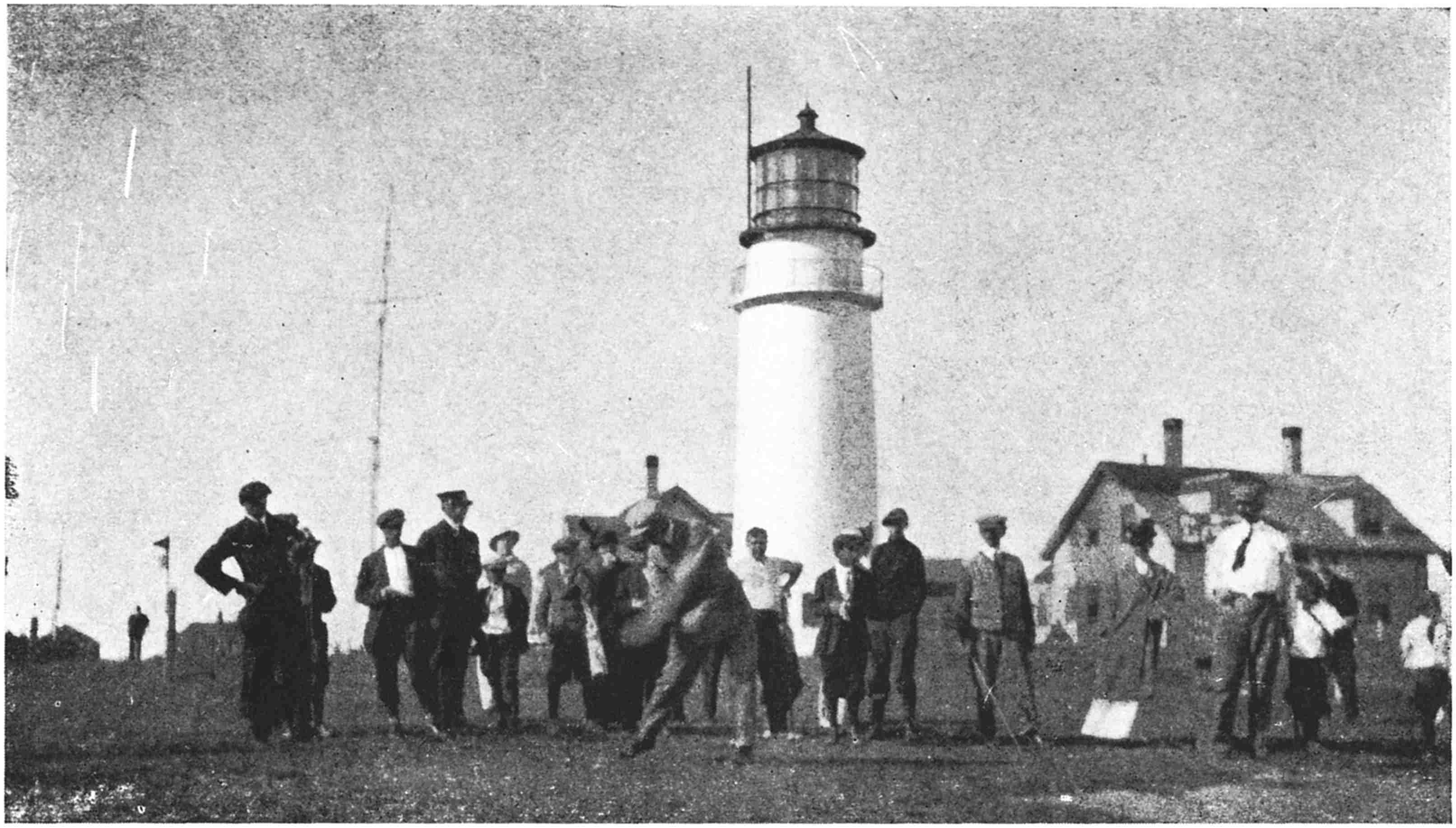
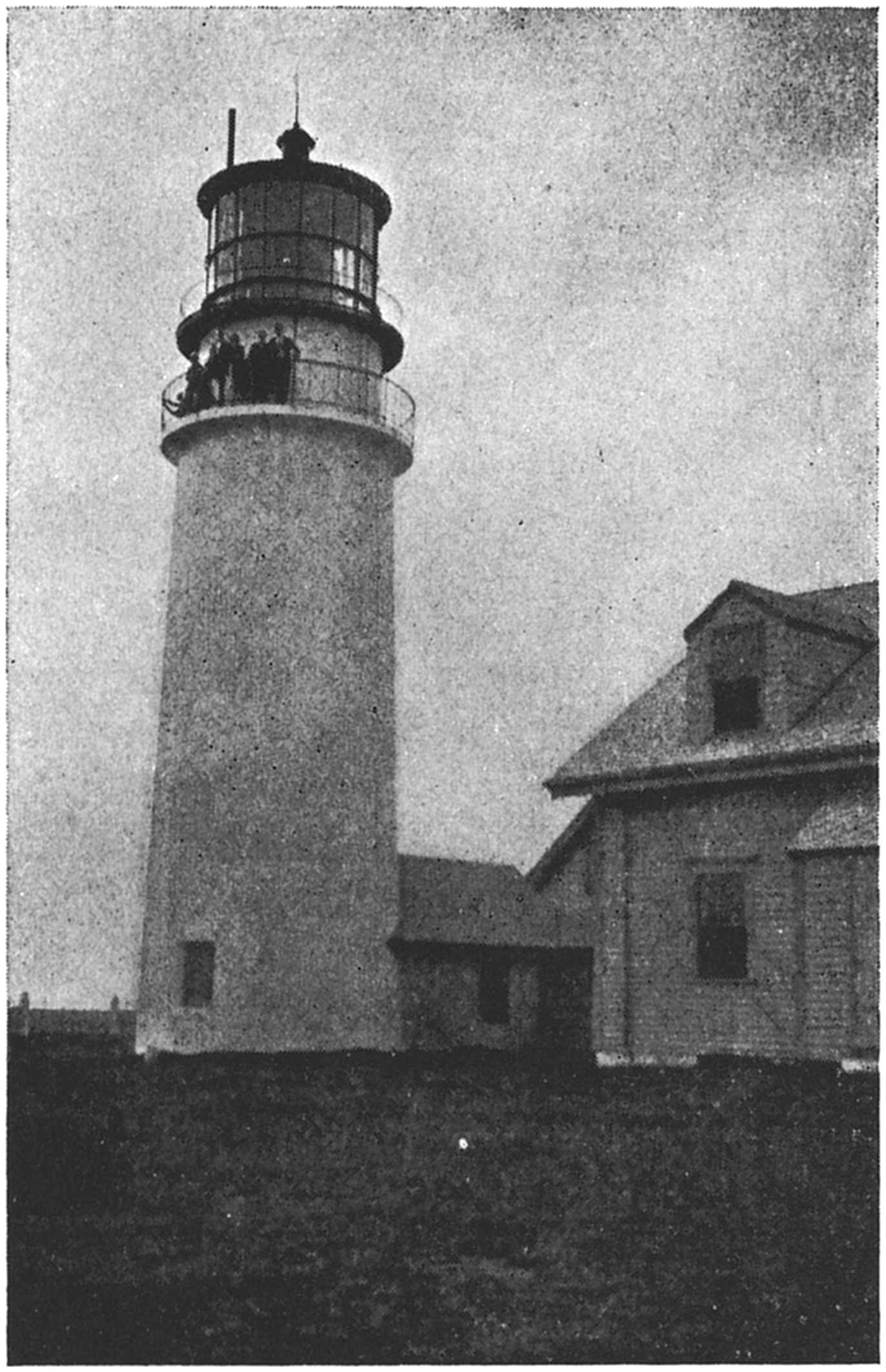
HIGHLAND LIGHT, NORTH TRURO
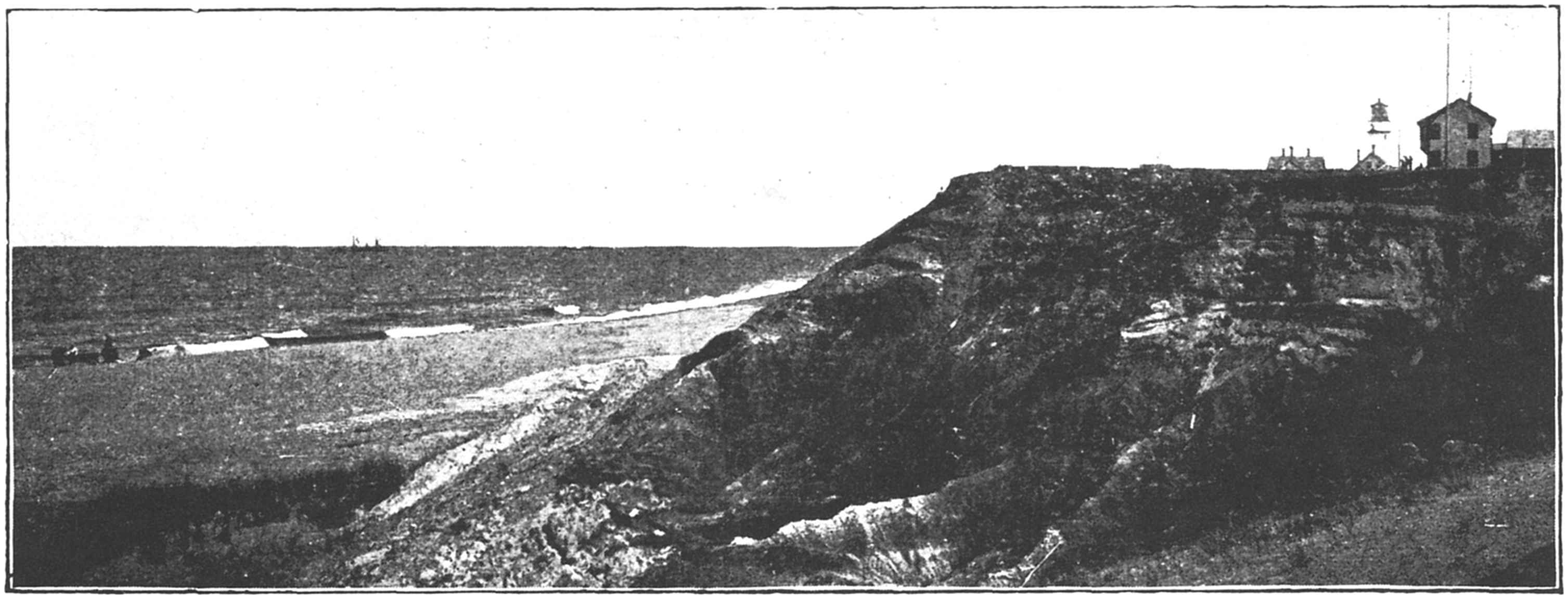
This is known as Cape Cod Light, more often spoken of as Highland Light. It stands on a bluff 140 feet above
sea level. The brick tower is 65 feet high. It was built by the United States Government in 1777
and rebuilt in 1851. It is a revolving flash light and its rays can be seen 45 miles at sea.
LOSS OF THE JOSEPHUS
The first shipwreck of which I have any personal recollection
was that of the British ship “Josephus,” which occurred
about the first of April, 1849. The terrible circumstances
attending the destruction of this ship were so vividly impressed
upon my childish mind, (I was four years of age at
the time) that they are as plain in memory as though they had
occurred but yesterday.
This vessel stranded during a dense fog, on the outer bar,
directly opposite the location of the present Highland Life
Saving Station, about one mile north of the Highland Lighthouse.
She was a full rigged ship from some port in England,
bound to Boston, and carried a cargo of iron bars. Losing
her bearings during a protracted fog and severe easterly gale
her keel found the sand bar half a mile from shore, immediately
the huge waves swept her decks, and the ship was
doomed to destruction.
In those days no life savers patrolled the beach to lend a
rescuing hand and the first intimation of the disaster was
when, during a temporary rift in the fog the light keeper,
from the cliffs, discovered the stranded ship. The alarm
quickly spread to all the neighboring farm houses and to the
village, from all directions men came hurrying to the beach,
hoping in some way to be able to aid the suffering sailors on
the wreck, which by this time was fast being smashed to
pieces by the thunderous waves which pounded upon her
partly submerged hull. Her masts had already been torn from
her decks and with tangled rigging and strips of sail thrashed
her sides in a constant fury. Many of her crew had been
crushed to death and their bodies swept into the boiling surf.
When the spars went down others could be seen clinging to
such portions of the wreck as yet remained above the angry
waters, and their screams for help could be heard above the
wild roar of the awful surf, by the watchers on the shore,
utterly powerless to render the least assistance. At this
moment down the cliffs came running two young men, just
home from a fishing voyage. They had not even stopped to
visit their homes and families, but hearing of the wreck had
hurried to the beach. Lying on the sands of the shore was
a fisherman’s dory, a small boat, about twelve feet in length,
such as small fishing vessels use and carry on their decks.
These men were Daniel Cassidy and Jonathan Collins.
Immediately they seized this boat and ran it quickly over the
sands to the edge of the surf. The watchers on the beach
stood aghast, and when they realized that these men intended
to launch this frail skiff into that raging sea strong cries of
protest arose from every one. “Why, men,” they said, “you
are crazy to do this, you cannot possibly reach that ship, and
your lives will pay the forfeit of your foolhardy attempt.”
But in the face of the earnest pleadings of their friends and
neighbors they pushed their boat into the gale-driven surf and
headed her towards the wreck. Their last words were, “We
cannot stand it longer to see those poor fellows being swept
into the sea, and we are going to try to reach them.” Standing
with my mother and holding by her hand on the cliffs
overlooking the scene I saw the little boat, with the two men
pulling bravely at the oars. They had hardly gone fifty yards
from the shore when a great white cataract of foam and rushing
water was hurled towards them. The next instant it
buried men and boat under its sweeping torrent as it swept
onward towards the beach with the overturned dory riding its
crest; two human heads rose for a moment through the seething
sea, only to be covered by the next on-rushing wave, and
they were seen no more. Darkness soon settled over the terrible
scene, the cries of the despairing sailors grew fainter and
ceased, while the mad waves rushed unceasingly towards the
shore. The watchers, believing that every sailor had perished,
turned away and sought their homes with sad hearts. The
light keeper, Mr. Hamilton, coming down from the lighthouse
tower at midnight, where he had been to attend to the lamps,
decided to visit the beach again, thinking possibly that some
of the bodies of the lost sailors might drift to shore. What
was his surprise to find upon a piece of the cabin of the ship,
which had washed ashore, a helpless sailor moaning piteously,
still alive but suffering terribly from the hardships he had
endured; he had been scratched and torn by the broken
timbers through which he had been washed and driven.
After great exertion and a long struggle the lightkeeper
succeeded in getting the unfortunate sailor up the cliff and to
the lighthouse, where the man was put to bed and a physician
sent for. He finally recovered, but he was the only man of
that ship’s company of 24 souls who escaped with life, these
and the two men who attempted a rescue made a total death
list in this disaster of 25.
It is a far cry from 1849 to 1872, and the broken timbers
of many a lost ship, and the whitened bones of hundreds of
dead sailors lie buried in the drifting sands of this storm
beaten coast, between those dates, but as we cannot here
present the details of more than a very few of them, we only
select those having especial and somewhat different features
and so pathetic as to stand out more prominently than those
of a lesser degree of horror, though it would be hard to
describe a shipwreck on this coast devoid of suffering, death
and destruction.
THE CLARA BELL
On the afternoon of March 6th, 1872, a moderate wind
was blowing from the land across the sea, the sun shone full
and clear, a great fleet of sailing vessels, urged forward by
the favoring breeze, made rapid progress over the smooth sea
towards their destination. In the late afternoon, as the sun
approached the western horizon, it settled behind a dark and
ominous cloud that was rising towards the zenith and casting
a dark shadow over all the sea.
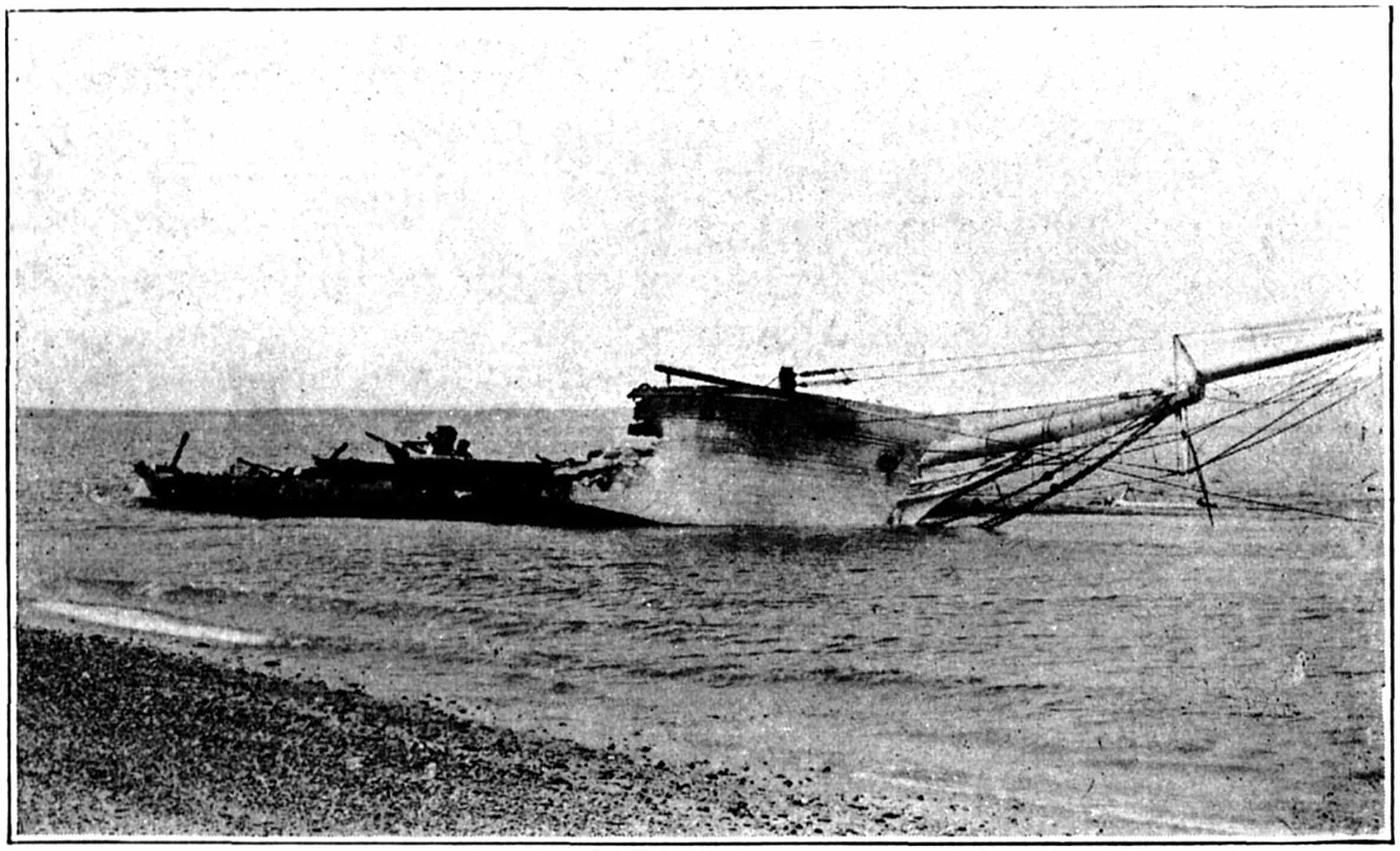
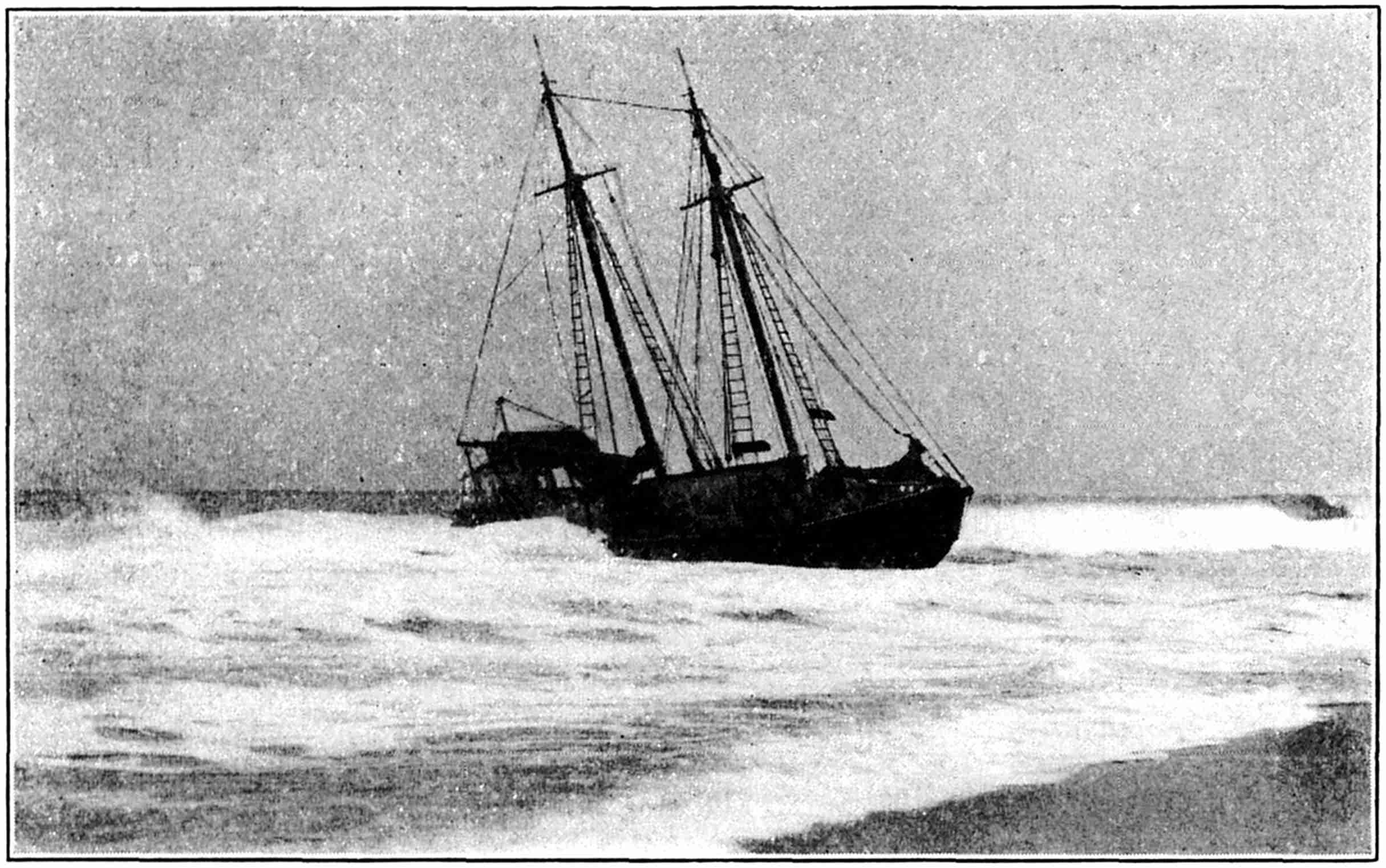
WRECK OF THE CLARA BELL
The two masted schooner Clara Bell, Captain Amesbury,
with a cargo of coal for Boston, had that morning sailed out
of the harbor of Vineyard Haven and passed across the
shoals of Vineyard Sound, moved rapidly up the coast, and by
ten o’clock that night was nearly opposite Highland Light.
The wind, which had been only fairly strong up to this time,
rapidly increased in velocity, and snow began falling thick
and fast.
The wind rapidly increased to a gale, when the vessel had
reached a point two miles north of Highland Light the wind
suddenly changed to north and in a short time became a howling
gale; the fast falling snow hid all the lights and the surrounding
sea from view, and the temperature dropped to zero.
In trying to make an off shore tack the vessel was struck by
a huge wave, forced shoreward and with an awful plunge the
schooner struck a bar a fourth of a mile from shore. It was
now nearly midnight; the sea, though running fierce and wild,
had not at this time reached monstrous size, and Captain
Amesbury, thinking that his only hope for life depended upon
getting away from the schooner, decided to make an attempt
to launch the ship’s boat. After great exertion upon the part
of himself and crew they succeeded in getting the boat over
the vessel’s side, and the crew of six men and himself jumped
in and cast off the line that held them to the vessel, but not
two strokes of the oars had been taken when the cockleshell,
borne like a chip on the top of an onrushing wave, was thrown
bottom up and her crew were struggling in the icy waters.
Captain Amesbury and one of his men were carried on a
towering wave rapidly towards the shore, but before they
could gain a foothold the remorseless undertow had drawn
them back into the swirling waters. With the next oncoming
wave the sailor was thrown shoreward again and succeeded
in grasping a piece of wreckage and by its aid managed to
crawl away from the jaws of death; not so fortunate the
captain, who with the other members of his crew were swept
away in the freezing sea and seen no more. The sailor, finding
himself safe beyond the reach of the mad sea on the sand-swept
and desolate shore, started to find shelter. In his
struggles to reach the shore one of his boots had been torn off
and lost, he was coatless, without covering on his head, thoroughly
drenched, his clothes freezing to his benumbed body
and limbs. In the blinding snow storm which had now set in
in dead earnest with a cold so intense that it nearly took his
breath away, this poor fellow started out to find if possible
some human habitation; he could make no progress against
the freezing gale so was obliged to turn towards the south
and follow the direction of the wind. Over frozen fields,
through brush and brambles that tore his bare foot at every
step, over the ever increasing snow drifts, through bogs and
meadows and hills and hollows, he struggled until the coming
of daylight; then a farmer going out to his stable in the early
morning found this unfortunate, frozen and exhausted sailor
standing in the highway a short distance from the Highland
House, so dazed by his terrible night of torture that he could
not speak or move. He was carried into the farm house and
the writer was one of those who helped to revive him. We
were finally made to understand that he had come from a
shipwreck on the coast and that all of his shipmates were
drowned. Leaving him to the care of the women of the
household I hurried with others to the beach, believing it possible
that even yet there might be some other unfortunate still
alive on the wreck.
After a somewhat exhausting trip over the drifted snow
and the frozen beach, we reached the stranded vessel, which
had in the meantime been driven by the huge seas completely
over the sand bar upon which she struck and the constant
pounding of the waves had driven her high and dry upon the
main beach. We walked on board dry footed and passed
down the cabin stairs. There in the cabin stove burned a nice
cheerful fire and all was dry and warm. The haste of Captain
Amesbury and his crew to leave the strong vessel for a little
frail skiff had cost them their lives, and this has been so often
the case, it would seem that sailors so often exposed to the
dangers of the sea would realize when brought suddenly into
positions of extreme danger by the stranding of their ship,
that their only chance for life lay in staying by their vessel,
rather than taking the chances afforded by a small boat in
the wild sea; if their large and strong vessel cannot stand the
shock certainly the little boat cannot. Many men have gone
down to their death in the sea because of too great a faith in
the ship’s boat.
The sailor who escaped with his life from this wreck finally
recovered after the amputation of three toes and a finger.
People have sometimes said, “Are there no romances connected
with shipwrecks?” Fiction writers have often distorted
the facts sufficiently to be able to weave about the
incidents of a shipwreck some romantic story, but most of the
disasters which overtake those who go down to the sea in ships
to do work on the great waters, partake so much of the elements
of tragedy that there is little room for the entrance of
romance into the situation. In almost every instance where
ships are overwhelmed by the storms and the seas the cold
hard facts are so distressing that every other feature, except
the one of suffering, is lost sight of and only the thought of
drowning men takes possession of the senses. The following
story, though bearing the color of romance, had a sad and
heartbreaking ending.
THE LOSS OF THE SHIP PERUVIAN
Over the North Atlantic ocean and the coast of Cape Cod
on the night of the 26th of December, 1873, swept a gale and
storm so fierce and wild that even dwellers of the coast were
surprised.
With almost hurricane force the wind-driven sea rushed in
mountainous waves towards the outlying sand bar and hurled
themselves with a terrific roar on the sands of the beach.
Many weeks before from the smooth waters of the harbor
of Calcutta the American ship Peruvian had passed out into
the deep sea and with a blue sky and favoring breeze had
spread her white sails and headed for home on her long
voyage.
Beneath her decks was stored a valuable cargo of sugar
and block tin and Boston was her destination.
The ship was in command of Captain Charles H. Vannah.
And she carried a crew of 24 men. With such a bright departure
they were anticipating a quick and safe voyage. All
had gone well with ship and crew until this fateful December
morning. All day long the snow had fallen thick and fast,
driven over the deck of the ship and through her rigging by
the ever increasing gale. Riotous waves lifted the big ship to
their crests only to plunge her the next moment into the
depths of the deep hollows as they tore madly away in the
approaching darkness.
Captain Vannah had been unable for 24 hours to obtain an
observation, but he knew that his ship was approaching the
coast of Cape Cod. Hoping every moment that some slight
abatement in the storm might give him a chance to pick up
some outlying beacon or the glimmer of some friendly lighthouse
he kept the ship’s head to the north with all the sail upon
the spars that they could stand without breaking. Higher and
stronger ran the seas, wilder and more terrific blew the gale,
often across the ship’s decks swept the huge waves, while all
about them the dark skies lowered and the angry waters
swirled when suddenly, just before midnight with a terrible
plunge and an awful crash the ship struck the sand bars of
the dreaded Peaked Hill Shoals, nearly a mile from shore;
then utter confusion reigned on the ship. Up to that time
only occasional seas had swept her decks; now the huge
waves in torrents constantly swept her and pounded unceasingly
her breaking decks. Boats, deck fittings and everything
movable was swept away in the darkness and the turbulent
sea; her crew driven to the rigging found there only
a temporary place of escape; soon came a mountain-like wave,
overtopping all those which had preceded it and thundered
over the doomed ship, tearing away all of her masts and
portions of her deck, hurling the entire ship’s crew into this
mass of thrashing wreckage and churning sea, and their last
sad cries were hushed in the mad seas that covered them.
With the first glimmer of approaching daylight men hurried
to the outer beach, believing that some terrible disaster
had occurred. They found the shore for miles covered with
portions of the cargo and many broken timbers of the lost ship,
but owing to the distance from shore to where the ship went
down only three bodies were ever recovered and those only
after many days of washing about in the surf.
Out there across yonder bar, where you see the waters curl
and break into a ripple, forming a white line against the blue
of the sea beyond, lies the sunken and sea-washed hull of the
once stately ship; in that sparless hull and the rotting and
sand covered timbers you cannot recognize the majestic vessel
that only a few short years ago sat out there in all her splendor
and with her strong sides seemed to defy the elements.
That blue water, so quiet now, and breaking with such
gentle ripples on the shore, does not give you the impression,
that in a few hours with a change of wind, it could be lashed
into fury, and with towering foam capped waves dash upon
the beach with the roar of a Niagara.
The storm is o’er and all along the sandy reach,
The shining wavelets ripple on the lonely beach,
Beneath the storm-washed sands and waves of blue,
There rests unclaimed, the members of the lost ship’s crew.
Captain Vannah had been a seafaring man all his life.
In a pretty little town, nestling among the granite hills of New
Hampshire, he had known and loved a dear young girl; for
several years they had planned that when his sea voyages were
ended he would come to claim his bride and would sail the
seas no more. He had secured a fair competency and had
promised her that this would be his last voyage. He wrote to
her when his ship sailed out of that far eastern port, advising
her of the probable date of his arrival at Boston. She had
made all arrangements to go down to the city and meet him
when his ship should be reported as approaching the harbor.
She daily scanned the ship news columns of the papers,
and on this December morning she knew his ship must be
nearing port, but in her sheltered home she did not realize
what a terrible storm was sweeping the coast.
Only those who have been suddenly overwhelmed with a
paralyzing blow can appreciate what, with ruined hopes, this
young girl felt, when she opened the daily paper only to read
in great black, cruel headlines these words, “Ship Peruvian
goes down off Cape Cod, and all hands are lost.”
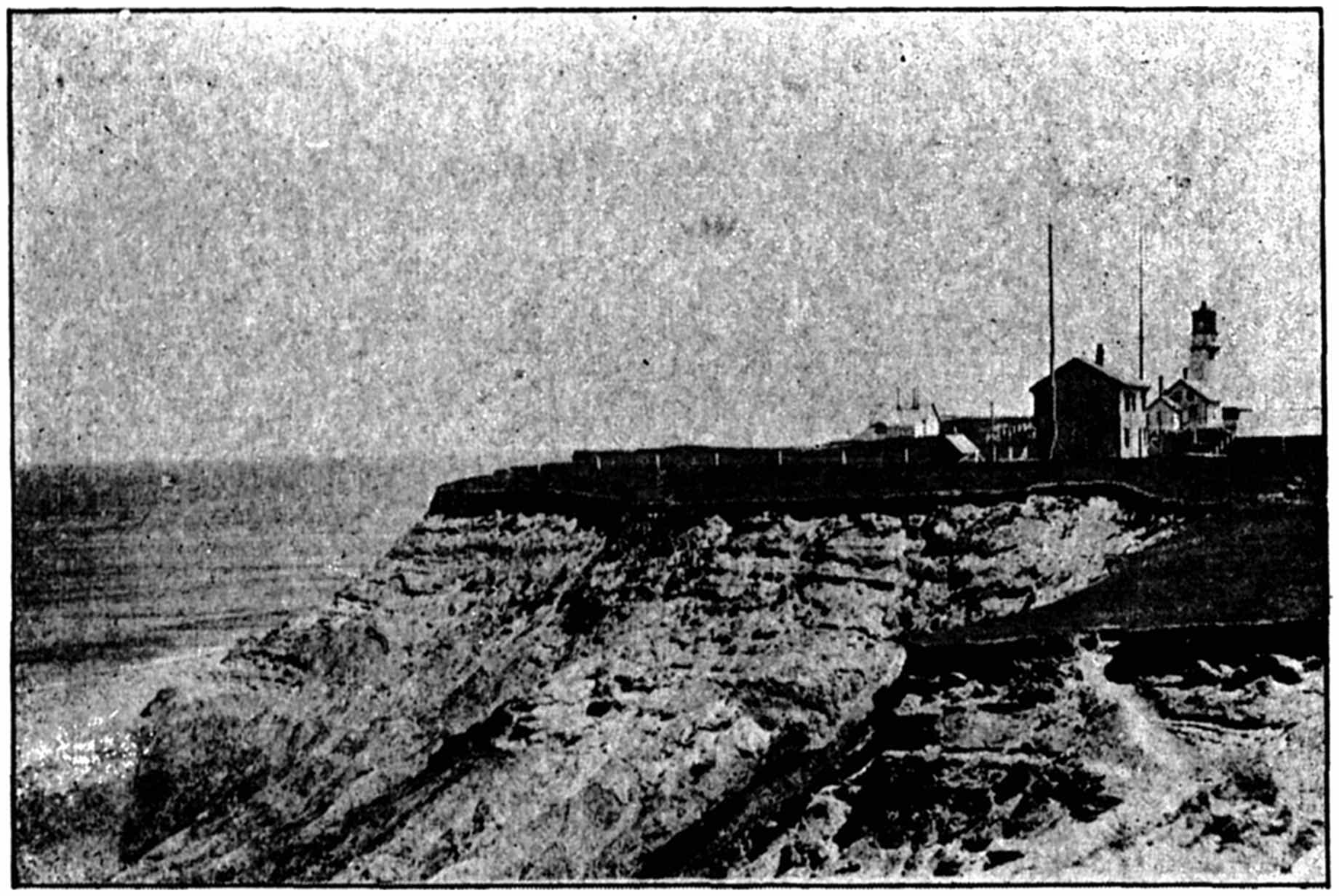
HIGHLAND LIGHT, CLIFFS AND BEACH, NORTH TRURO
BARK FRANCIS
The same storm that carried the Peruvian and her whole
ship’s company to destruction drove the North German Bark
Francis to the same fate only three miles farther down the
coast, but though sad enough in some of its features this
disaster was not attended with the appalling loss of life that
accompanied the loss of the Peruvian.
These two vessels sailed from the same port in Calcutta
only a few days apart, and had almost been in sight of each
other during the long voyage.
The Peruvian was so unfortunate as to become involved
in the shallows of Peaked Hill Bars, while the Francis, in the
deeper waters to the south was driven by wind and sea over
the outer line of bars and finally grounded within two hundred
yards of the beach; her hull was of iron and she soon settled
firmly into the sand.
Every avenue of approach to the beach was blocked with
snow, huge drifts covering every highway and hollow. There
were no mortar guns and no life saving crews then, and no
boats of any kind on the outer beach available. At the shore
on the bay side of the cape was a whale boat, a boat sharp at
both ends and about eighteen feet in length; this boat might
afford possibly safe means of reaching the imperilled crew on
the ship, but to get it to the scene of the wreck was a problem.
Finally, through the united exertions of twenty strong men,
the boat was drawn to the edge of the pond in the village of
North Truro, then dragged over the frozen surface of the pond
to the highway near the Post Office, where a pair of horses
was attached to wheels, the boat mounted on them and the
journey to the outer beach and possible rescue was fairly
begun; when snow drifts were not too deep horses and men
hurried the boat along; when great drifts were encountered
shovels were brought into use and a way broken for the
horses; then on again, ever in the face of the storm swept
moors towards the ocean, across the gale swept hills and snow
covered valleys the party struggled, until finally, at ten
o’clock in the forenoon, almost exhausted, they reached a
point on the beach opposite the wreck.
A volunteer crew manned the boat, willing hands helped to
push the boat through the foam covered surf, the men bent
to the oars and the trip to the side of the bark was made in
safety.
Captain Kortling, of the bark, had been ill in his cabin for
many days and it was with no little difficulty that he was
finally lowered helpless into the rocking and pitching boat,
which the thrashing sea threatened every moment to dash to
pieces against the iron sides of the ship. Brought to the
beach and landed, Captain Kortling was taken in a farm
wagon and hurried to the Highland House. Weakened by
disease and worn out by the terrible exposure of the wreck
and the storm, he lived but four days after reaching shore,
and his remains lie buried in the Old Cemetery on the hill,
near the west entrance. The other members of the crew,
twenty in number, were rescued without mishap.
In a few days tugs and lighters were brought to the scene
of the wreck and the work of attempting to save the cargo was
begun. A large part of her cargo was sugar in great straw
mats; these in the process of hoisting out of the hold of the
vessel frequently became broken and the sugar sifted out upon
the deck; some twenty-five men were required to assist in this
work of hoisting out the cargo and placing it upon the lighters.
As it was not practicable for these men to go ashore at noontime
they were obliged to take their dinners with them to the
ship; generally a small pail or basket sufficed for carrying the
noon meal. When these men left their work at night the
overseer in charge of the work of unloading would tell the
workmen that they might fill their lunch baskets with the
loose sugar which had sifted out of the broken mats and take
it home. In the beginning their pails as a rule held two or
three quarts, but when it became known that the dinner pails
could be filled each night on leaving the ship the size of these
lunch pails and baskets increased amazingly, from a receptacle
with a three quart capacity they soon rose to twenty-five and
even fifty pounds capacity, so that the boat in her last trip to
the shore was in danger of being swamped with the great
weight of lunch baskets. This abuse of a privilege resulted in
the cutting off the supply, although many workmen had
already secured a year’s supply of sugar for their families
when the shut off edict was issued.
This vessel seemed to offer the wreckers a good proposition
as an investment and a company was formed with the purpose
of making an attempt to raise and float the vessel. They purchased
her of the Insurance Companies into whose hands the
ship had fallen; then they spent hundreds of dollars in trying
to get her from the sand bar; finally after many weeks of
preparation everything seemed ready, a powerful tug was
engaged to stand by and be ready to pull the ship away as soon
as she floated, big steam pumps were installed on board and
all was expectancy; then after a full day’s steady pumping by
the great pumps on her deck, suddenly the big ship stirred in
her bed and rose to the surface with a bound; then a great
shout went up from the assembled crowd on the beach and
from the interested investors on the bark’s deck when they
believed their venture was about to be crowned with success,
but this quickly turned to dismay when the ship, as suddenly
as she had come to the surface, sank back again beneath the
sea, from which place she never moved again, and the shifting
sands soon covered her.
The rocking of the ship by the waves and the storms that
beat over her on the sand and coarse gravel of the bed of the
sea had worn holes through her iron sides where her masts
were stepped into her keel, and immediately the ship rose
from the bottom a great torrent of water poured in through
these openings, flooded the entire ship again and carried her
back into the sandy bed where she had so long reposed. For
many years in the ever changing sands the jagged sides of
her ever diminishing hull would be exposed only to be buried
by the next great storm that swept her.
LOSS OF THE GIOVANNI
A northeast gale and furious snow storm was sweeping
the coast of Cape Cod and hiding the great sea in its smother
all through the day of March 4th, 1875. Late in the afternoon,
during a momentary breaking away of the storm filled
clouds, a great vessel was discovered fast upon the outer sand
bar nearly three miles north of Highland Life Saving Station.
It proved to be the Italian bark Giovanni, Captain Ferri,
from Palermo for Boston, with a cargo of sumac, nuts and
brimstone; her sails were blown away, her rudder broken.
She was in a position to be pounded to pieces before another
sunrise; her crew was almost helpless from exposure to the
cold storm. The crews of Life Saving Stations 6 and 7 were
promptly at the scene of the wreck, but owing to the snow
bound conditions of the roads and the almost impassable state
of the beach, added to the great distance from the Life Saving
Stations, it was a task almost beyond the power of human
endurance to get their boats and beach apparatus to the shore
opposite the scene of the disaster, but as soon as the position
of the vessel was clearly determined, and it was recognized
what kind of gear was necessary in order to aid the men in
the ship, they hurried to their stations, and after hours of
almost superhuman exertions, dragging their beach carts,
mortar guns and apparatus through heavy snow drifts that
had to be broken out before they could proceed. Over sand
hills swept bare by the driving gale, through meadow bogs
and brush covered ridges, they finally reached the beach in
the vicinity of the wreck. No attempt was made to launch the
life boat, as such an effort, in the face of all the terrible conditions
that prevailed, the awful sea and the distance of the
vessel from shore, would have been foolhardy in the extreme,
and would only have added to the death roll the lives of the
life-savers, without accomplishing the saving of a single life.
The mortar gun, however, was made ready with all possible
dispatch, though it was recognized from the first that no gun
could carry a line that distance in the face of such a terrific
gale. But the gun was charged, the charge exploded and out
over the foam covered sea the shot line sped, only to fall spent
in the wild sea more than a hundred yards short of the ship.
The uselessness of further attempts along these lines was
apparent, but the life savers again made ready with another
line, hoping that the pounding sea would with the rising tide
force the bark over the sand bar and nearer the shore. But it
now became evident that the ship was so firmly impaled upon
the treacherous shoal that there was no hope of her being
moved by sea or tide, and in fact it was but a short time later
that there came to the shore evidence that the vessel was
beginning to break up, as portions of her upper works and
even some portion of her cargo could be seen between shore
and wreck and was being driven shoreward by the savage seas
that broke in fury over the sand bars. Just then two men
were seen to leap from the deck house on the after part of the
ship, into the roaring torrent that raged about them; for a
moment they were lost to sight in the suds of the churned up
sea, then as they appeared upon the surface they were seen to
seize upon pieces of wreckage that floated near them; to these
they clung desperately, at one moment buried from sight in
the salt spume, the next moment rising to the top of a foam
crested wave rushing onward and almost wrenching the plank
to which they clung from their grasp; when more than two-thirds
of the distance from wreck to shore had been covered
the wreckage which had borne one of the sailors appeared
upon the top of an oncoming wave, but there was no human
form clinging to it; nature had made its last long struggle and
the poor fellow had released his grasp and dropped helpless
into the wild sea that covered him forever.
The other man still retained his hold upon the frail support
that bore him shoreward; now it was a question of only
minutes, would his strength stay by him, could he hold on a
moment longer, should his rapidly waning strength desert him
now and his grasp relax he would be swallowed up in the sea
instantly and no power could save him. Men rushed to the
edge of the tide, even into the surf, grasping hands as a living
rope; on came man and wreckage, as the broken water smashed
down upon the sands strong hands reached out and seized the
sailor before the relentless undertow could draw him back into
its cruel grip. He was saved, but he was the only one of the
whole ship’s company of fifteen men.
Night shut in but we kindled a huge bonfire on the beach
and patrolled the shore up and down all night, hoping that
some other unfortunate might be brought in with the tide.
Long before daybreak the shore for miles was strewn with
flotsam and jetsam from the wreck which was being constantly
rended by the sea; bags of sumac, bags of nuts and
even casks of wine mingled and washed together in the surf,
but not a human body, alive or dead, was cast up by the sea.
Every watcher on the beach believed that the ship had been
entirely broken up, and that every person on board had perished.
Still we lingered awaiting the coming of the sunlight;
when it did come and objects were visible for any distance,
what was our surprise to see the after deck house of the bark
still in place, and a portion of her bow and the stump of her
broken foremast still standing; the huge waves were still
smashing over her furiously. If we had been surprised at
seeing any portion of the hull still standing above the water,
we were dumbfounded when we saw a man jump from the
bow near the broken foremast and swim through the fiercely
raging waters to the after deck house, and in the face of the
pounding sea that beat upon him, climb under a sheltering
piece of the cabin that had not been torn away.
That a human being could live through such a night as
that, in that icy water and retain his hold upon any part of
those ice covered timbers and sea swept wreck seemed incredible.
But the chapter of horrors was not yet complete in
this wretched disaster. Piece by piece the sea tore away what
remained of the wreck until nothing but the deck house roof
remained above the sea; as wave after wave hurled itself
against the battered top it was seen to lift from its fastenings
that held it to the submerged wreck and the next wave bore it
off far into the thrashing sea. Then we saw, clinging to the
few remaining pieces of the frame of the deck house, with a
death grasp, four members of the ship’s company, but endurance
had reached its limits and they were quickly swept
from the last possible thing to which they could cling, and
though they made a last heroic effort to seize some piece of
wreckage, two of them did succeed in grasping some floating
object and were carried for a considerable distance towards
the shore, but their long and terrible exposure had so exhausted
and chilled them that they could make no further
exertion and the mad sea claimed them.
Some adverse criticism was directed against the men of the
Life Saving corps, for their failure to rescue these sailors,
but it was wholly unmerited as the Life Savers did everything
in their power or that it was possible to do under the circumstances.
It was one of those terrible marine disasters, of which there
are many, where man is a plaything in the grip of the sea
when the storm king is abroad in his might.
THE JASON
Late in the afternoon of December 5th, 1893, the patrol of
the coast guard of Life Savers of Nauset Beach, a few miles
south of Highland Light, during a momentary break in the
furious storm driven snow, saw the outlines of a great ship,
not more than two miles from the beach, heading towards the
Port of Boston under close reefed lower topsails, struggling
with the grasp of giant waves which threatened every moment
to overwhelm her. Soon again the increasing gale hid all the
turbulent waters of the great sea. The winter night came on
with rapid pace. All along the shore each Life Saving crew
had been warned by telephone to watch with increased vigilance
for a disaster which their experience had taught them
was inevitable. Not a coast guardsman slept that night. All
the boats and beach apparatus were made ready for instant
use; the patrol watches were doubled; the men at their stations
stood ready dressed, anxious, dreading but ever watchful
and ready for the call which they expected to come at any
moment.
At 7.15 a surfman of the Pamet River station rushed
breathlessly and excitedly into the station and shouted, “She
is ashore, half a mile north of this station.” All the stations
were immediately notified. Then out into the storm and
darkness and the blinding snow, along the gale swept beach
where the flying sand cut their faces like knives, toiling
through the yielding sand with their mortar guns and boats,
hoping to reach the scene of the disaster ere it was too late,
the Life Savers hurried. Chips and logs along the shore were
gathered together and a huge bonfire kindled that those on
the ship might know that every human effort was being exerted
to aid them. By the glare of the light on the shore away over
there in the awful night the faint outlines of the doomed ship
could be seen, her great white sails being torn to shreds by
the savage fury of the winter storm. Great torrents of gale
driven sea swept her decks every moment. Her broken masts
fell with a crash to her decks. Soon her iron hull was twisted
and wrenched asunder; through her rended decks and battered
sides floated portions of her cargo to the shore. The
cries of her drowning sailors could be heard above the fury
of the storm. The mortar gun of the Life Savers thundered
again and again. The shots sped true to their mark and the
life lines fell across the ship’s hull, but her men could not
reach them, so madly rushed the waters between. Soon a
surfman saw a dark object thrown up by the sea; it was a
human being. He was quickly taken up by willing hands and
hurried to the station, restoratives were applied and soon he
was able to tell the story of the wreck:
“Our vessel was the British ship Jason, Capt. McMillan.
We were on a voyage from the East Indies to Boston with
jute bales. We did not know our position until we saw the
land at four this afternoon. We tried, by crowding every
sail upon the ship, to weather Cape Cod; we failed. There
were 27 officers and men in our ship’s company. I am the
only one that lives; I saw all my shipmates perish when the
mizzenmast fell.”
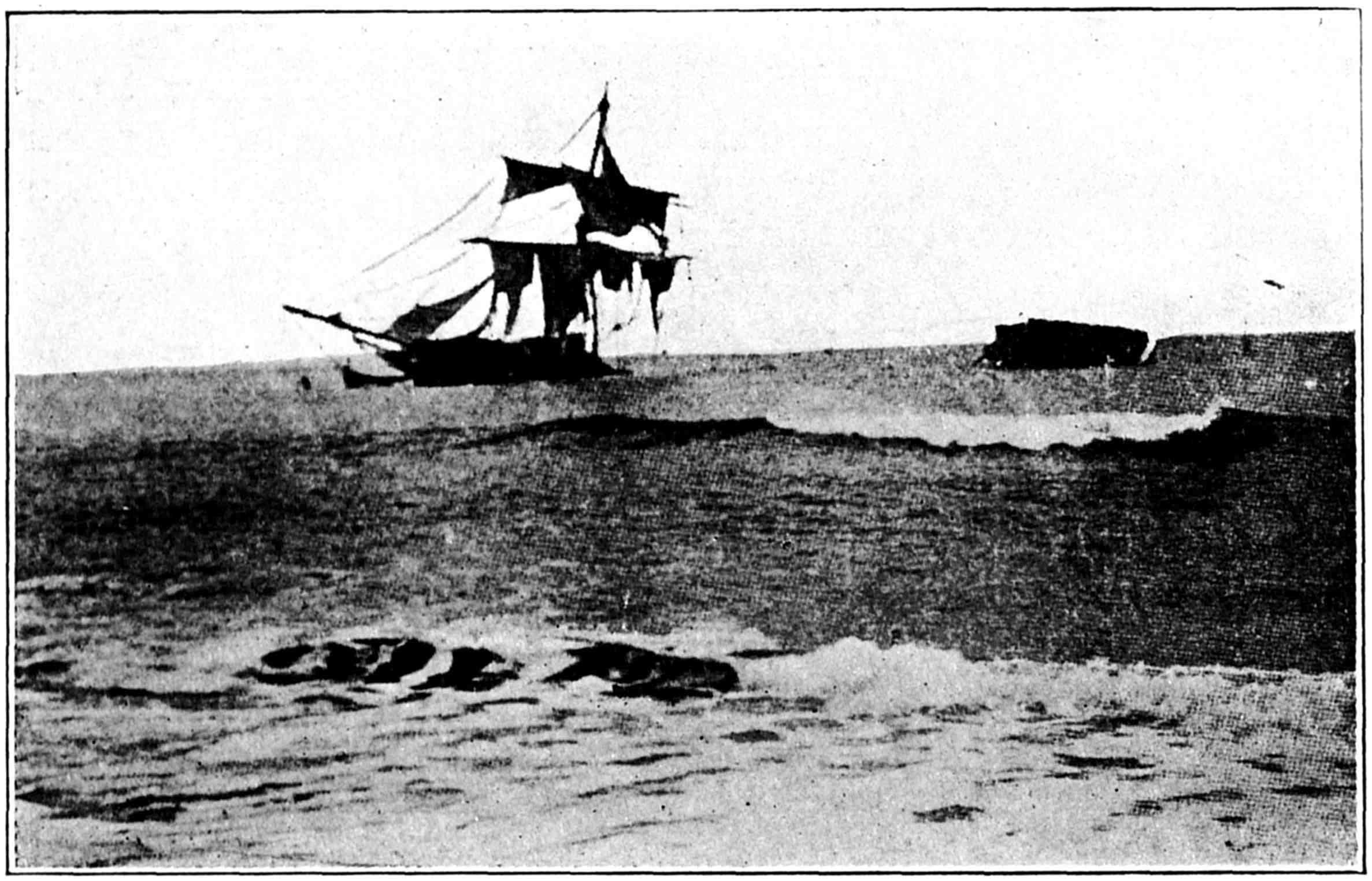
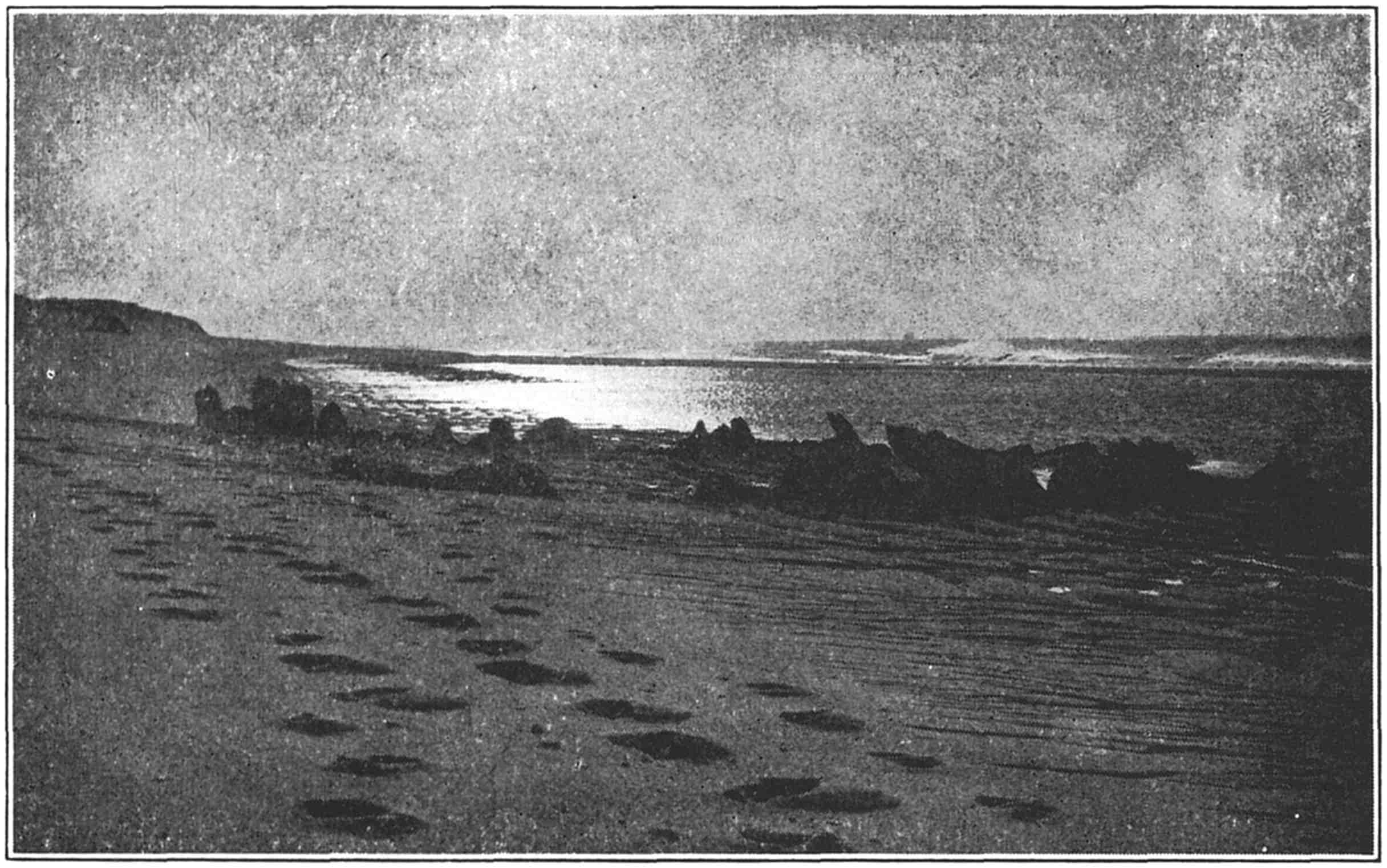
WRECK OF THE JASON
Like many another shipwreck the irony of fate pursued
this ship’s company, when her keel was driven into the sand
bar by the force of the mighty waves which hurled her forward,
the only spot upon the whole ship which seemed to offer
a place of refuge from the boiling surf which tore across her
deck was the mizzenmast. Into the rigging of this spar every
man hurried except the one man who was saved. He was
swept from the rail before he could gain a foothold with his
shipmates; but what they had hoped would be their haven of
safety was their doom. Scarcely had they climbed above the
maelstrom of rushing waters when the mast went down with
a crash into the sea, killing many of the sailors in its fall and
drowning the others in the wreckage. The foremast stood
unmoved by the winter’s storms for many weeks. Could this
unfortunate crew have reached this portion of the ship many
of them would have been rescued on the following day.
Out there today when the tide is low, protruding through
the sands of the bar and the white caps that wash them, are
the broken fragments of the sunken ship looking like tombstones
in the village churchyard. All along the shores of this
wind swept and sea washed coast those half submerged and
silent sentinels remind us that up and down this sandy reach
the ever moving sea has covered hundreds of those heroic men
who have gone down in ships on the great sea.
LOSS OF THE STEAMSHIP PORTLAND
Among all the terrible disasters which have made the
dreaded shores of Cape Cod known to mariners the world over,
probably the worst of all was the loss of the steamer Portland,
which sailed from her pier in Boston, on the evening of
November 26th, 1898, on one of her regular trips to Portland,
Maine, and before midnight of the following day her broken
timbers, cabin fittings, large quantities of cargo and dead
bodies lined the outer shores of Cape Cod, from Highland
Light to Chatham. Not a person of her 175 passengers and
crew survived the disaster.
The awful hurricane which swept the coast of New England
that fateful Saturday night and Sunday was the worst
in the memory of living men; the wind attained a velocity of
approximately one hundred miles an hour.
When the Portland steamed out of Boston Harbor on that
eventful Saturday night her captain did not anticipate that
the storm would be more severe than the ordinary winter gale.
She ran quickly down the smooth waters of the harbor, out by
Boston Light, the gale increasing every moment. She passed
Thatcher’s Island and on towards Cape Ann; she could have
made Gloucester Harbor, but her master hoped the storm had
reached its worst; not so, for every moment it grew more
furious; the lights along the coast, one after another, were
now blotted out by the ever thickening snow, the great seas
ran riot in the bay. Now it was too late to turn back; the
ship plunged into the wild seas that rose like mountains before
her. To have attempted to turn the ship about with
her high superstructure when she would have fallen off into
the trough of the sea would mean her speedy destruction. On
she staggered in the inky darkness of the wretched night until
the fury of the gale and sea checked her further progress;
then their only hope lay in being able to keep the ship’s head
towards the wind. All through the long night and far into
the next day, Sunday, the ship reared and plunged in the mad
sea, slowly but surely every hour being carried nearer the lee
shore of Cape Cod, drifting helplessly but ever with her bow
to the sea. At 4 o’clock on the afternoon of Sunday the Life
Savers at Race Point Station heard two distinct blasts of a
steamer’s whistle, sharp and piercing; at 10 o’clock that
night the patrolmen from stations south of Race Point came
upon great masses of broken beams, deck-houses, furniture,
boxes and barrels of freight and several dead bodies.
It is believed by men on the coast familiar with storms
and tides that the whistle heard by the Race Point Life Savers
at 4 o’clock was the last despairing cry sent up by the doomed
ship before the sea engulfed her and those on board, and that
between that hour and 7 o’clock that night the ship’s total
destruction was accomplished.
It is no doubt a fact that the ship was held to her course
until suddenly her steering gear was torn away by some huge
sea more vicious than those before, she immediately fell off
into the trough of the sea, and amid the crash of broken
timbers and the thunder of the awful sea the ship went down
with all on board.
There has been much speculation and prolonged search by
the government and others to determine if possible approximately
where this ship was swallowed up in the sea; the location
of this terrible disaster has never been satisfactorily
determined, but there is no question in the minds of sea coast
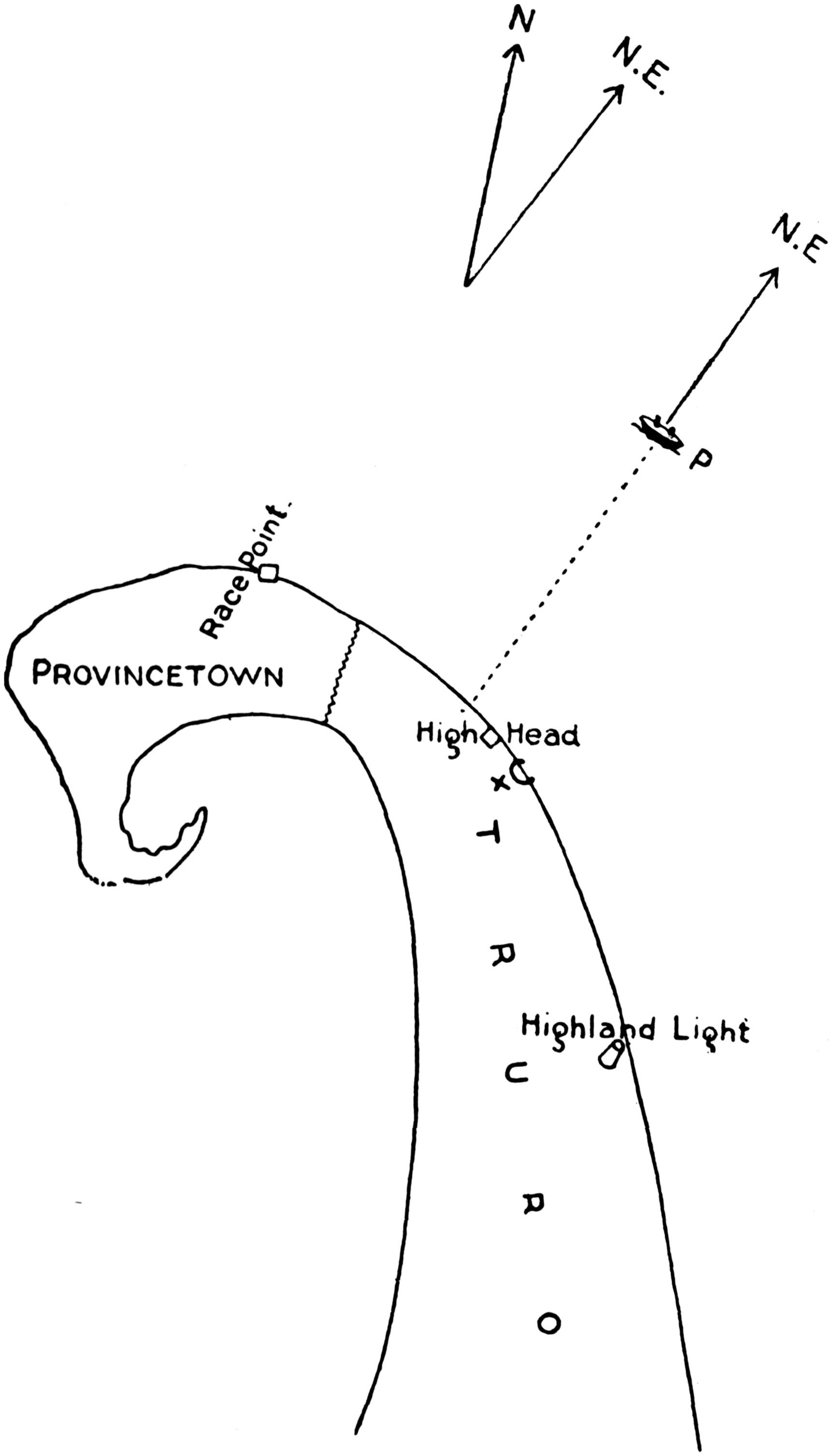
men but that this ship went down somewhere between 8 and
12 miles north of Highland Light.
Out of the entire company of passengers and crew which
went down with the ship only 60 bodies were recovered. Some
of those found were fully dressed with life preservers upon
them, indicating that the wearers knew that their chances for
life were slight indeed. Other bodies were entirely nude
when recovered, showing that some of the passengers had
evidently retired to their staterooms in the earlier hours of
the voyage and were made so ill by the terrible pitching and
rolling that they made no exertion to dress themselves before
the ship went down.
It is believed that no less than 500 human lives were the
sea’s death toll in this awful hurricane that swept the shores
of Cape Cod and Massachusetts Bay in that frightful storm.
This disaster will pass into the annals of Cape Cod’s shipwreck
history as the one which concerned the greatest loss of
life from a single vessel.
The fury of such a gale can hardly be understood or appreciated
by any one not having had personal experience with
sea coast storms. As far as the eye could reach on that Sunday
morning over the wild sea not the least bit of blue water could
be seen for a distance of two miles from the shore; the whole
ocean was a mass of seething foam; this driven shoreward by
the gale would be caught from the beach by the wind and
blown skyward high over the towering bluffs, then swept
inland and break like bursting soap bubbles in the fields
hundreds of yards away.
x( Where wreckage first landed from S.S. Portland Sunday night.
P Place five miles N. E. of High Head Life Saving Station, where
it is thought by all coast men the Portland went down.
Such was the force of this hurricane of wind that every
window pane on the ocean side of our house (the Signal Station
at Highland Light) was blown in and smashed into a
thousand fragments. Men exposed to the full force of the
storm were blown from their feet and hurled about like blocks
of wood.
Men of the Life Saving service were exhausted by their
exertions in trying to cover their beats, and several of them
were completely unnerved by their frequent trying experiences
in dragging torn and sea-washed bodies from the surf.
There were cases where some of the men of this service were
made almost nervous wrecks by their almost nightly contact
with the disfigured and unfortunate victims thrown up to
their feet by the sea.
Destruction widespread on land and sea was the result of
this fearful storm.
Never had its like been seen before.
* * * * *
My daughter for a number of years was my assistant and
the following story, which originally appeared in the New
York World, may be of interest in this connection:
THE GIFT OF THE SEA
A true tale of Cape Cod, written for the New York World by Lillian May
Small, only official woman marine observer in the United States.
Fishing schooner Polly, Capt. Peter Rider, weighed anchor
one spring morning in 1800 and sailed away from Provincetown.
She was a staunch craft of eighty tons, bound on a
fishing voyage to Chaleurs Bay.
Besides the captain there were on board Jot Rider, the
captain’s son; Ben Smith, broad-shouldered and strong as an
ox; the two Larkin boys, ready to furl a gafftopsail in any
weather; George Barnes, Tom Olsen, the Swede; Nick Adams,
Bob Atwood, the cook, and Ned, the “boy,” a bright lad of
ten years, Capt. Peter’s nephew.
This was Ned’s first trip, and he thought himself quite a
man until the Polly had rounded Race Point and began to
roll about in the great green swell of the turbulent ocean; then
he wished himself back in Granny Rider’s kitchen, where the
open fireplace kept a fellow dry, where the dishes didn’t roll
off the table, where things smelled good and clean, not like
the nasty bilge water that washed about in the Polly’s run,
but where a boy could take off his boots when he went to bed,
you know.
But he couldn’t go back, so, with a quiet cry now and
then, all by himself up in the bow of the Polly, where the men
wouldn’t see him, he managed to brace up and help the cook
down in the fo’cas’tle, and pull on the main sheet and reef
an furl, anything except steer; discipline aboard a “codder”
was as strict as on a man-of-war and boys were not allowed to
handle the tiller. Favoring winds wafted the boat eastward
along the northern coast, past jutting, rocky headlands and
surf-washed spits, to an anchorage on the fishing banks. Three
months the Polly swung at her anchors, at times idly upon
the smooth waters, at times pitching wildly with a savage pull
at the cable when the tempest beat down upon the stormy
waters of that desolate coast.
But now the low-set hull told the story of a successful
catch. The last basketful of salt had been “wet,” the fishing
lines were snugly coiled upon the reels. It was Sunday morning.
Capt. Peter was no autocrat, and it was his custom to
have “all hands” down to breakfast in the cabin on Sabbath
mornings.
“Well, boys,” said Capt. Peter, when all were gathered
around the rough table, “we’ve got a putty good trip under
hatches, so arter breakfuss I guess we’ll get the hook aboard
and head the Polly for home.”
If there was any one in that ship’s company who felt his
heart give a sudden bound of joyous anticipation it was Ned.
Every day of all those long weeks Ned had scored the mental
calculation, “one day nearer home.”
From his thoughts of home he was startled by a human
cry.
Again he heard it coming faintly across the smooth water.
Rushing to where his uncle sat, tiller in hand, for the
Captain would allow no one but himself to guide the Polly
out of that “pesky hole,” Ned sang out, “Did you hear that,
uncle? Somebody is crying for help out there toward that
rock.”
“Oh, nonsense, boy,” replied Capt. Rider, as he gave the
tiller a sharp pull to bring the Polly up a point, “guess you
was asleep and had a dream.”
“No, uncle, listen; there it is again, ’tis a baby’s cry.”
“Bless my skin, boy, I b’lieve yer right; my hearin’ ain’t
extra good, but I do hear su’thin off thar to wind’ard. But
what in the world could a baby be doin’ out thar? I don’t
see no vessel nor no boat. But we won’t leave no mortal round
in this hole to drown.”
“Here, George,” he shouted, “you and Nick get the boat
over and see if ye can find whar that distressed creeter is. And
Ned, you kin go along to help. I’ll put the Polly’s sheets to
wind and jog around so you won’t lose us.”
The tide-ruffled waters splashed and sparkled as the oars,
in the hands of the hardy fishermen, rose and fell in unison.
“There, I hear it again,” exclaimed Ned from his seat at
the stern of the boat; “it comes right from that rock.”
The oars sent the boat straight toward the huge rock, on
whose sides the tide lapped with a soft rhythmic “swish,
swish,” gaining slowly, surely. Only a few feet of its slippery
top remained exposed, and the water was creeping up inch by
inch until soon only a swirl and a fleck of foam would mark
the place of the hidden reef.
There on the shelving side of the rock, with the tide
lapping her tiny feet, chilled from long exposure and crying
bitterly, sat a little girl.
Rough but willing hands soon had the little waif safely
in the boat. When they reached the side of the Polly Uncle
Peter stood ready to receive the strange charge.
“Well, by hooky, boys,” he exclaimed as he received from
Ned’s arms the little dripping form. “How could she ’ve
got on to that rock?”
“There’s only one way I can ’count for it,” said George
Barnes. “Some devil wanted to get rid of her, and left her
thar to drown.”
“Well, I’d like to catch the chap that did it; either he or
I’d go overboard,” said Ben Smith.
Ned gazed wonderingly into the face of the little child,
who now, somewhat reassured, lay smiling in the bunk where
the crew had placed her after removing the water-soaked
clothing.
“Well, boys,” said Capt. Peter after all that was possible
had been done for the little charge, “we don’t know whar
this baby girl came from, and we ain’t goin’ to try hard to
find out; we ain’t very handy or well fixed for girl babies
aboard the Polly, but, by hooky, we’re a nuff site more human
than the critters that left that tot out dar on the rock to be
killed piecemeal.”
The summer winds blew gently on the Polly; homeward
she sped. One bright morning the anchor dropped and the
codder was home again in the smooth waters of Provincetown
Harbor.
Little Ruth (so the crew of the Polly had named her) had
fared well on the voyage, and when the boat had been rowed
ashore and the fisher wives and maidens had come down to
welcome home their loved ones, great was their astonishment
at what had come home with the Polly’s fishermen.
Granny Rider, with her motherly face against little Ruth’s
cheek, as she received the charge from Capt. Peter, almost forgot
to kiss Ned, so interested was she in the wondrous tale.
Over and over the story was told, and soon everybody knew
of the baby girl that had come in the Polly.
Ruth was the joy of Capt. Peter and Granny Rider’s home.
Ned was never so happy as when playing with the little sea
waif in Granny’s kitchen. No one ever learned her history;
no one apparently ever cared to do so. Those who go down to
the sea in ships learn to leave many mysteries unsolved.
Summer passed into winter, winter into spring, and again
the Polly sailed. Ned kissed his little playmate good-by and
turned to the duties of the voyage. Years passed, the boy
became a man, Capt. Peter turned the command of the Polly
to Ned. Little Ruth had grown to womanhood. They no
longer played together as children, but looked forward more
eagerly to the homecoming as the years went by. One day in
Granny’s cozy home two happy hearts were joined, and on the
sea of life their little bark sailed out on the summer sea of
years.
A FEW OF THE MANY DEEP SEA MYSTERIES
The great sea is ever full of unsolved mysteries, ships
sail out into the wide ocean and are seen and heard from no
more. And the many human lives on board are blotted out as
completely as though they had never been.
* * * * *
We have space for but few instances, and most of the following
ships when starting out on their last voyages passed
out by Cape Cod.
* * * * *
The full rigged ship Brynhilda, with a full cargo and deck
load of lumber, sailed away on September 27, 1914. After
many adventures in Russian waters, neither ship nor crew
were seen again.
* * * * *
Then the ship Avon pushed out on the deep blue sea and
was never seen or heard from again.
* * * * *
In 1914 the Balmaha faded away in the ocean’s mist.
* * * * *
In the following year the Pass of Balmaha, carrying a
cargo of cotton valued at a million dollars, joined the fleet of
mystery ships.
* * * * *
In 1917 the great Navy Collier Cyclops, with a complement
of 300 officers and men, disappeared in the mists and the darkness
of the ever restless sea and another strange mystery
was added to the long and ever increasing list of unsolved
tragedies.
THE MONTE TABER
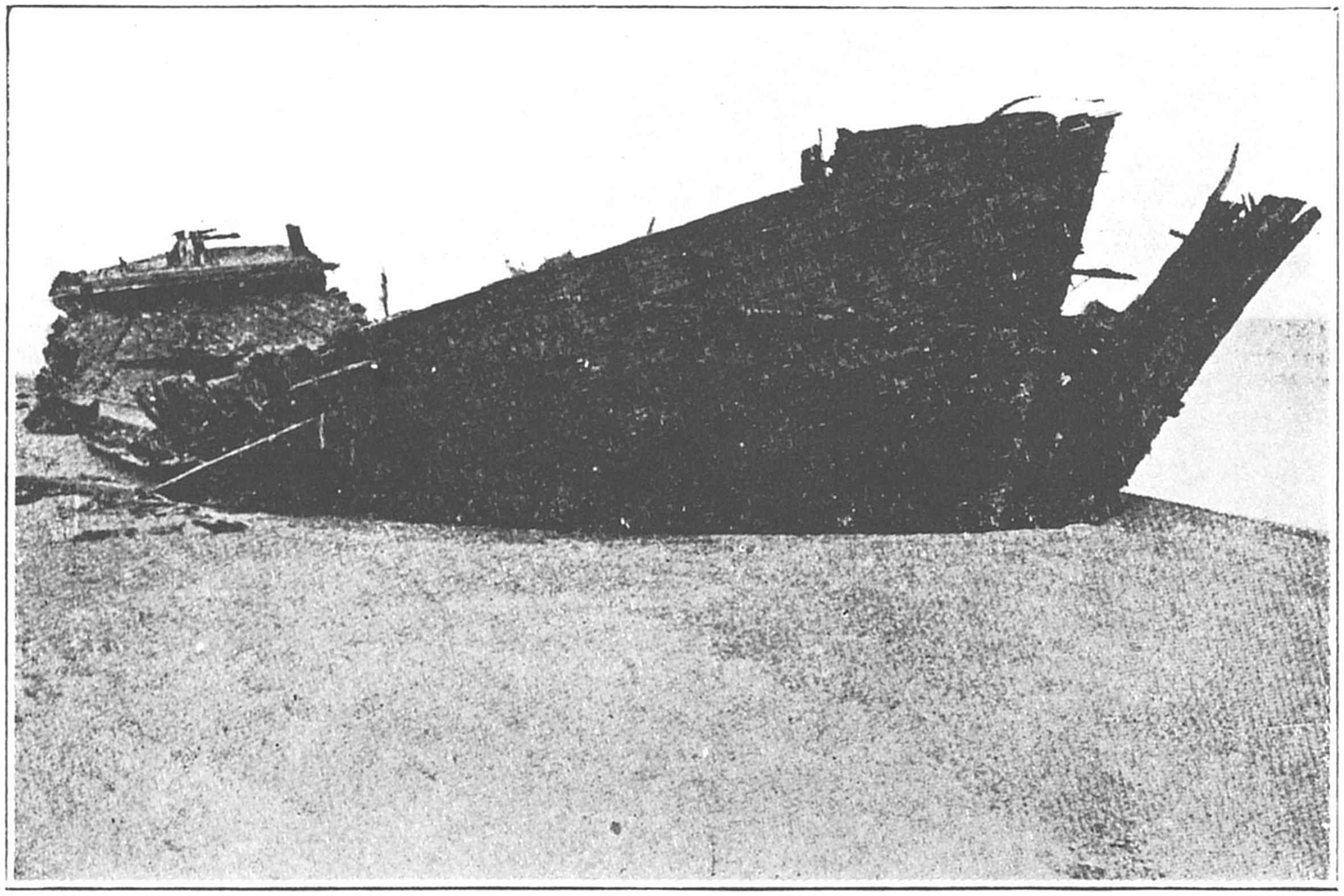
On September 14th, 1896, the Italian Bark Monte Taber
struck on Peaked Hill Bars during a furious northeast gale.
The disaster was attended by loss of five men, whose deaths
were attended by circumstances of mysterious and almost
romantic interest. It was learned that there had been three
suicides on board the vessel, and the fate of the other members
of the crew could not be definitely determined; they disappeared
in the storm and in the breaking up of the doomed
craft.
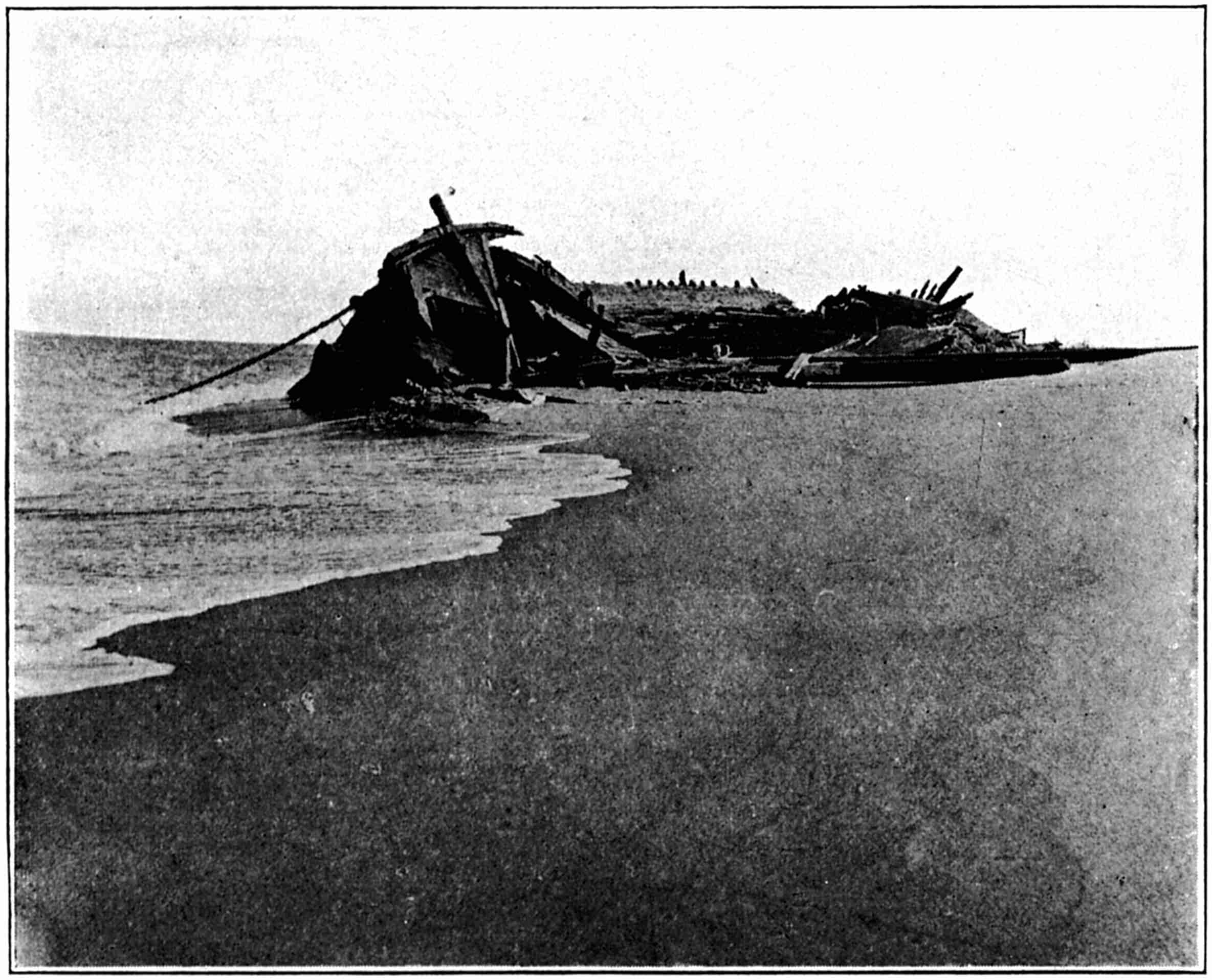
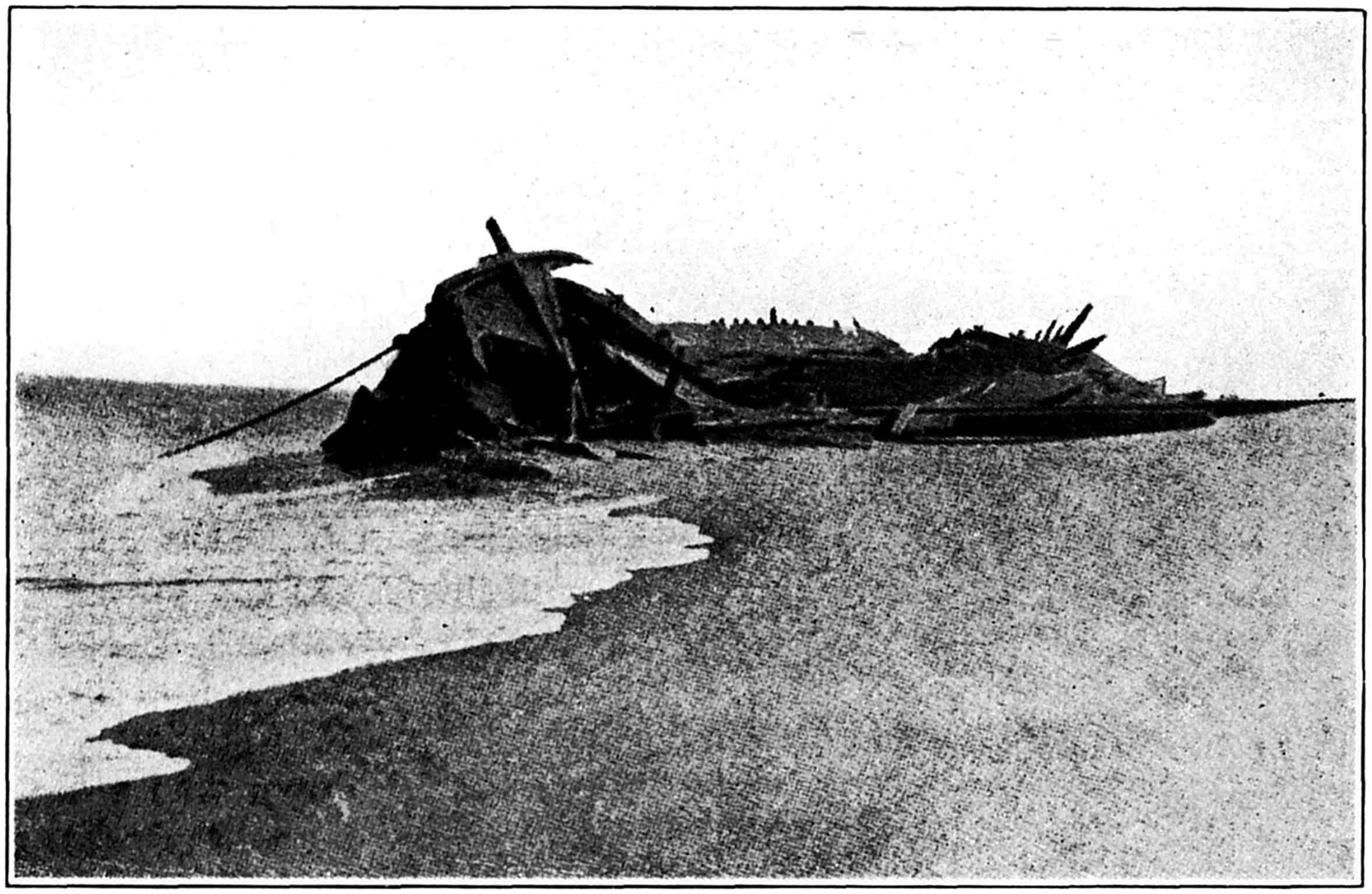
THE MONTE TABER—AFTER THE STORM HAS DONE ITS WORK
The bark hailed from Genoa, and carried a crew of twelve
men, including the officers and two boys. She had a cargo of
salt from Trapan, Island of Sicily, for Boston.
The craft had been struck by a hurricane on September
9th, and when off Cape Cod on the night of the 13th, in
endeavoring to make Provincetown Harbor, struck the dreaded
Peaked Hill Bars. She was discovered by patrolman Silvey,
of the Peaked Hill Station. The night was dark as ink and
the sea was running high, and smashing over the bars with
terrific force, and the bark soon gave evidence of speedy
destruction.
Owing to the darkness and the storm the coast guard crew
could not locate the wreck; there was nothing that could be
seen to shoot at and nothing to pull to, even if a boat could
have been launched, which was impossible. It is believed that
the Captain was so humiliated by the loss of his vessel, that
he fell into a frenzy of despair and took his own life, and
some of the officers and crew followed his example.
Six of the crew managed to reach the shore on top of the
cabin which had broken away from the ship and were pulled
from the surf by the Life Savers. One of the boys said he
swam ashore. An investigation conducted by the Italian government,
disclosed that the Captain did commit suicide.
It has been said, whether true or not, that it is a tradition
among Italians that when a master of a vessel is so unfortunate
as to lose the craft he is in duty bound to do away with
himself, as he could never again expect to command a vessel.
LOSS OF THE OAKLAND
One of those sudden storms which so often develop and
sweep down along the Cape Cod Coast without warning in the
fall of the year, broke over the Cape on the night of the 12th
of October, 1913. The tug Paoli, towing three coal laden
barges, which left Vineyard Haven the day before, was caught
in the rush of the gale between Wellfleet and Highland Light.
Hoping to pull through and round Race Point for an anchorage,
the tug struggled on through the ever increasing gale;
when opposite Highland Light, with the monstrous seas
sweeping over the barges every moment, the strain on the
towing hawser proved too great and it snapped away from
the tug when the tow was two miles from shore. The barges
became separated and were drifting helplessly towards the
outlying sand bars, over which a wild sea was breaking. Two
of the barges were able to get up some sail, drove before the
gale down the coast and escaped; not so with the Oakland,
which was the third barge in the tow. Those on board finding
that the barge was being forced rapidly towards the sand bars,
and those on the barge hoping that the gale might moderate,
dropped both anchors and brought the vessel to a stop one
mile from shore and just clear of the bar.
The tug was then able to get near enough to the barge to
take off the three members of her crew, but the Captain and
mate refused to leave the craft. As the day of the 13th advanced
the gale and the sea steadily increased and the barge
strained heavily at her anchors. All through the day until
late in the afternoon we watched the barge pitching and
rolling in the great seas that swept her, expecting every
moment to see her drag to the bar and be pounded to pieces.
We knew that a leak must sooner or later pour water into her
hold. Soon we saw smoke rising from her pumping engine
which indicated that water was coming in, and those on
board were making an effort to prevent the flooding of the
hold, but we could see that they would be unable to overcome
the leak and the water was slowly but surely sinking the
craft.
This barge carried a small dory on the deck house. Pretty
soon we saw the captain and mate unlash the boat and take
it down on deck; then they went into the cabin and came out
each with a suit case; these they placed in the dory; then they
lowered the boat into the water and we realized that they were
preparing to take to this frail skiff and abandon the barge.
Heavens, we knew that they might as well jump into the sea
at once rather than prolong the agony, that boat had no more
chance to reach the shore than the men had to swim there.
Soon they cut the rope that held the boat to the sinking craft,
seized the oars and pulled around the stern of the barge; for
about fifteen minutes they were able to keep the boat heading
the sea, then came a great overpowering wave that swept the
boat to its crest and sent it a hundred feet away, hurling the
men into the rushing waves and turning the boat bottom up,
for a brief moment the heads of the men appeared above the
wild sea, then dropped from sight. Their bodies were recovered
next day far down the beach from where the sea swallowed
them up.
ALL THAT REMAINED OF THE OAKLAND
When the sun rose next morning all that was visible protruding
above the still raging sea was one lone mast above the
sunken hull, mute evidence of another tragedy of the sea.
In a few days the broken hull was washed up on the beach
and the cargo was scattered along the shore.
LOSS OF THE CASTAGNIA
For a day or two previous to February 17th, 1914, the
weather had been extremely bad along the New England coast
with very cold northeast and northwest winds with snow
squalls. On the afternoon of the 16th a deeply laden bark was
seen by the Cahoons Hollow Coast Station acting very
strangely. She would first sail up the coast for quite a distance
and then tack and sail down the coast. This was repeated
several times, and it seemed to the Life Savers that the
officers of the bark had completely lost their bearings. The
vessel finally drove away in the mists of the night under short
sail. At daylight next morning the Coast Guard patrol discovered
the vessel hard and fast on the outlying sand bar.
It was bitterly cold and the tattered sail of the vessel
slatted against the broken spars; ice covered her decks and
hung in great bunches to her broken ropes. Her crew had
been driven to the rigging by the raging seas which constantly
swept over her, and the Coast Guard could see a
number of human figures clinging desperately to the rigging.
Then the Coast Guard apparatus was placed in position
and a shot sent over the vessel; three times the shot and line
sped over the craft, but the men in the rigging made no effort
to secure the line; then Capt. Tobin decided that an effort
must be made to launch the life boat.
But under the terrible conditions which prevailed it was
an undertaking fraught with much danger.
But the boat was launched and the Life Savers pulled
away. Soon they reached the side of the ship and called to
the men in the rigging to come down. Eight of them after
much effort and assisted by the Coast Guard crew were finally
gotten into the boat. Capt. Tobin of the Coast Guard crew
said to one of the rescued sailors, “Why don’t those other
men come down?” “They cannot,” was the reply. “They
are dead, frozen to death.” The boat returning to shore was
pretty well overloaded with crew and rescued, and as the
bow touched the beach was overturned, but all of the men
were thrown clear of the boat except Capt. Tobin, who was
caught between the steering oar and the stern of the boat and
considerably injured. The Coast Guard station was more
than two miles away from the scene of the disaster but the
Marconi Wireless station was only a mile away and to this
house the half frozen sailors were hurried as fast as their
almost helpless condition would permit. A physician was
summoned from Wellfleet and the condition of the men made
as comfortable as possible, then hurried by the next train to
Boston hospitals. All of them lost fingers or toes.
The three dead sailors, from necessity, were left lashed to
the rigging where they had died, until the next day, when the
bodies were brought to shore and buried in the town cemetery.
In a few days the hull of the ship lay a battered wreck on
the shore.
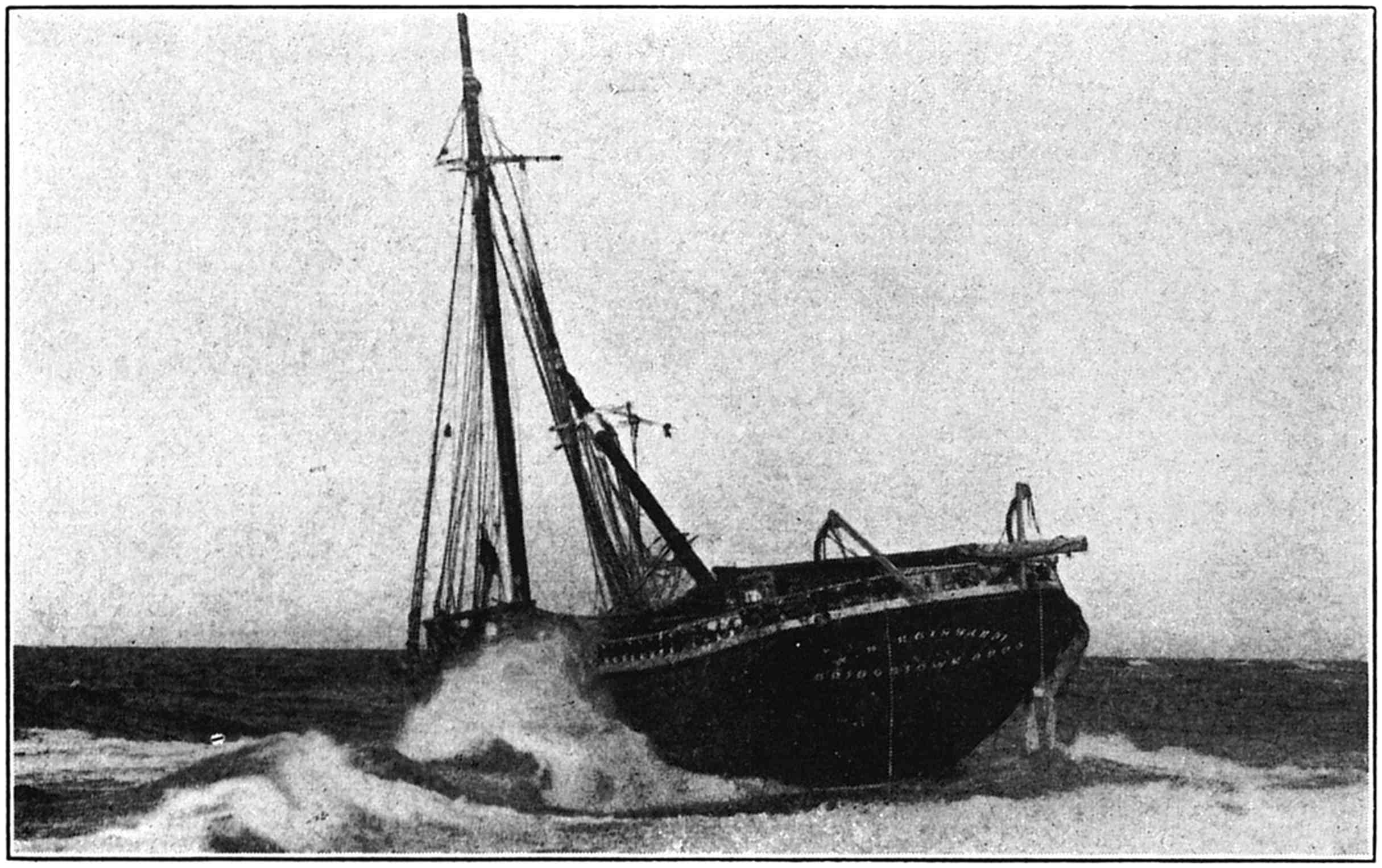
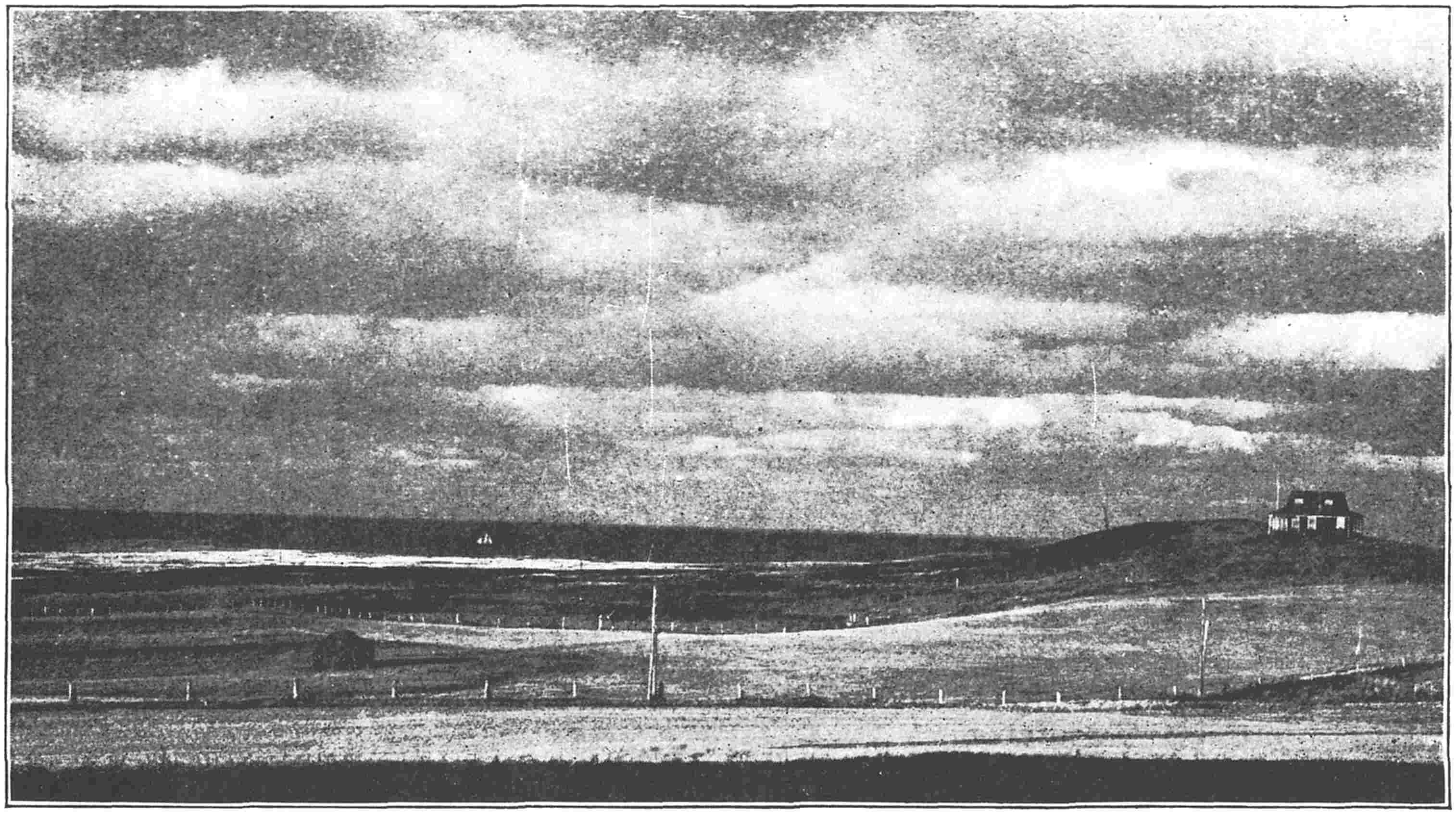
HIGHLAND CLIFFS AND SIGNAL STATION
The author’s home from which the passing ships are sighted and reported by telegraph
or telephone to Boston and the Newspapers
THOMAS W. LAWSON THE LARGEST SCHOONER
An interesting vessel of this class was the seven masted
schooner, Thomas W. Lawson, built in 1902 by the Fore River
Ship and Engine Company of Quincy, Mass. She was of
steel, 368 feet long, 50 feet beam, 34½ feet depth of hold and
of 10,000 tons displacement, thus being the largest vessel of
this class ever constructed for sailing only.
She was built for the Coastwise Transportation Company,
at a cost of about $150,000.
Mr. Lawson was a considerable contributor in the cost of
her construction and the vessel was named for him.
She sailed from Delaware Breakwater on the 2nd of
December, 1907, with a cargo of coal for some port in France.
She carried a complement of a crew of 19 officers and men.
And in a bad storm was driven on the rocks a short distance
from France on Friday, December 13, 1907. There 17 men
of the ship’s company perished. The vessel was a total wreck.
No other attempt was ever made to construct a vessel of this
type. She was too large to operate in the coastwise trade.
She was a bad sea boat and not satisfactory as an ocean going
proposition. The loss of her crew was not on our coast but
unusual conditions surrounding the craft make it of moment
to note her loss in this connection.
LOSS OF THE SHIP ASIA
This was one of the worst wrecks that had occurred on
the New England coast in many years.
This ship was on a voyage from Manila for Boston with a
cargo of East India goods. Approaching the Cape Cod coast
she encountered a terrific storm and struck one of the outlying
shoals off Nantucket.
The furious sea which drove over her decks in torrents
soon began the work of destruction. When she struck the
shoal on Sunday morning there was a furious northeast gale
tearing the sea into a fearful condition. The next day the ship
gave every indication that she must soon be a broken and
dismantled wreck.
Besides the crew of twenty-three men, Capt. Dakin’s wife
and little daughter were on board.
When the ship began to pound to pieces the mate and such
members of the crew as had not already been swept overboard
did all in their power to assist Capt. Dakin in shielding his
wife and daughter from being swept away by the seas which
broke in fury over the vessel. Before the ship broke up the
mate lashed the captain’s daughter and himself to a large
piece of wreckage, hoping in that way to reach the shore.
Capt. Dakin and his wife were swept away before they
could fasten themselves to any part of the wreckage. Of the
whole number on board the ill-fated craft but three were
saved. These were sailors who clung to a piece of the ship,
and after drifting about in Vineyard Sound for several days
were finally picked up, and placed on the lightship, more
dead than alive.
The bodies of the mate with his arms locked about the
captain’s daughter, and both securely lashed to a piece of
wreckage, were picked up a few days later far down the coast.
Both had been frozen to death. The bodies of the captain and
his wife were never recovered, and only a few bodies of the
crew were ever found.
BARGES WADENA AND FITZPATRICK
On March 17th, 1902, after some very bad weather, two
coal carrying barges lay stranded on the shoals off Monomoy
Point, and the terrible disaster which followed was the worst
in some ways that ever happened on this wreck strewn shore.
Seven members of the Monomoy Coast Guard and five men
whom they went to rescue perished in the awful sea that swept
over the shoals and rips.
Following is the story by Captain Ellis of the Monomoy
Station, the only surviving member of the crew that started to
the rescue.
On Tuesday, March 17th, about 1 o’clock in the morning,
the schooner rigged barges Wadena and Fitzpatrick, which
had broken away from tug Peter Smith, lay stranded on the
southern point of Monomoy. The barges remained on the
shoals without lightening their cargoes. On the night of the
16th the weather became threatening, and all except five of
the persons on the Wadena, who had been engaged in handling
the cargo, were taken ashore by the tug.
Shortly before 8 o’clock on the morning of the 17th one
of the patrolmen from our station reported that the Wadena
appeared to be all right, but later Capt. Eldredge, then
keeper of the station, received word from Hyannis asking if
there was anything wrong on the barge. Up to this time no
one at the station had any knowledge of there being any
person on the barge, supposing that the tug had taken all off
the night before.
Then Capt. Eldredge walked down to the end of the point
where he could better see the situation. Arriving there he
found that the barge was flying signals for help. He at once
telephoned me, as I was No. 1, at the station, telling me to
launch the surf boat from the inside of the point, and with the
crew pull down to the end, about two and a half miles from
the station. There we took on Capt. Eldredge and I gave
him the steering oar.
The wind was fresh from the southeast and a heavy sea
running. None of us were of the opinion that the barge was
in any danger, as she was lying easy, but Capt. Eldredge
decided that it was better to pull around the Point and try
to reach the barge. At certain places on the shoals the sea
was especially rough, and some water was shipped on the way
out to the vessel, but without much trouble we succeeded in
bringing the surf boat under the lee of the barge just abaft
the fore rigging, the only place where it was practical to go
alongside.
As soon as we got up to the barge a line was quickly thrown
aboard and made fast by those on the craft. The persons on
board were much excited and wanted to be taken right off.
Capt. Eldredge immediately directed them to come down into
the boat.
The sea was breaking heavily around the stern of the barge,
and there was little room for operations in the smooth water,
and the rail of the barge was 12 or 14 feet above the surf
boat. Four of the five men on board lowered themselves over
the side of the barge one at a time into the surf boat without
mishap by means of the rope, but the fifth man, who was a
heavy person, when half way down lost his grip on the rope
and dropped with a crash onto the middle thwart of the boat.
All five being finally landed in the boat, the captain placed two
of them in the bow, two aft and one in the middle, and told
them to sit still and keep close down to the bottom of the
boat. In order to get away from the barge quickly the painter
was cut and the surf boat was shoved off. In order to clear
the line of breakers that extended from the stern of the barge
so that we could lay a good course for the shore, a part of the
surfmen were backing hard on the port oars, while the others
gave way with full powers on the starboard side. Before we
could get the boat turned around a big wave struck us with
fearful force and quite a lot of water poured in over the rail
of the surfboat. Capt. Eldredge stood in the stern of the
boat with the steering oar giving his orders and the surfmen
stuck to their posts.
As soon as the water came into the boat, the rescued men
from the barge became panic stricken, threw their arms about
the necks of the surf men so that none of us could use our oars;
the seas, one after another, struck us, and the boat, filling with
water, turned bottom up, throwing all of us into the raging
sea. The seas kept striking us after the boat upset and we
were soon in among the heaviest breakers. Twice we righted
the boat, but before it could be gotten into position it was
again capsized.
After righting the boat twice our strength was fast leaving
us and we all knew that we could not survive long without
assistance.
The five men that we had taken off the barge were the first
to be swept off the overturned boat and perish before our eyes;
they did not regain hold of the boat after the first capsize.
All of us clung to the boat, giving each other all the
encouragement we could. Surfman Chase was the first one of
our crew to go, then Nickerson and Small were swept to their
death. Capt. Eldredge, surfmen Kendrick, Foye, Rogers and
myself still managed to hold onto the boat; every sea that
struck the boat nearly smothered us. Kendrick was the next
to drop into the sea, and Foye soon followed. Capt. Eldredge,
Rogers and myself expected that we too would share their
fate. Rogers was clinging to the boat amidships, while Capt.
Eldredge and myself were holding near the stern. The
captain called to me to help him get a better hold and I
managed to pull him up on the bottom of the boat, when a
sea struck us and washed us both off. I managed to regain
my hold on the bottom of the boat; looking around I saw the
captain clinging to the mast and sail which had washed out of
the boat. When I last saw our brave captain he was drifting
away holding on to the spar and sail.
My strength was fast going and when poor Rogers asked
me to help him get farther up on the boat the only thing I
could do was to tell him to try to hold on as we were drifting
nearer shore. But he had lost his strength, however, and
failing to get a better hold he dropped beneath the waves.
I was now alone on the bottom of the boat, and seeing that
the center board had slipped part way out, I managed to get
hold of it, and holding on with one hand managed with the
other to get off my oil clothes, under coat, vest and boots.
By that time the overturned boat had drifted down over the
shoals near the barge Fitzpatrick, and when I sighted the
craft I waved my hand as a signal for help. I soon saw the
man on the barge fling a dory over the side, but could see
nothing more after that of the dory owing to the mist and
spray arising from the water. Finally it came in sight with
a man rowing towards me, and it was brave Capt. Elmer
Mayo. He pulled me into the boat. I was so used up I could
not speak.
To land in that small boat through that surf was a perilous
undertaking, but Mayo was a skillful boatman and we landed
safely.
If those five men taken off the barge had kept their heads
and done as we told them all hands would have landed in
safety.
STORY OF THE SLOOP TRUMBULL
Between Highland and Race Point Lighthouses, on Cape
Cod, stretches a long line of treacherous, dangerous sand bars.
Situated midway between these points on the shore is the
Coast Guard Building known as the Peaked Hill Bars Station.
From this station the surfmen have rescued many lives
and have seen many sailors go down to death in the raging sea.
On November 30th, 1880, a cold northerly gale was sweeping
down the coast from Massachusetts Bay and lashing into
fury the waters that pounded over the sand bars from Race
Point to Wellfleet.
On the afternoon of the previous day one of those ungainly
stone carrying sloops, with a deck load of granite
bound from Rockport for New York, sailed out of Rockport
Harbor. She carried besides her captain a crew of four men.
When daylight broke on the morning of the 30th the
patrol from Peaked Hill Bars Station discovered this sloop
hard and fast on the outlying sand bar, a half mile south of
the station. Capt. David H. Atkins of the Peaked Hill Station
decided that the sea was not so severe but that the surf
boat might be launched. This was done and the following
members of the Coast Guard Station, Elisha Taylor, Stephen
Mayo, Isaiah Young, Chas. P. Kelley, Samuel O. Fisher, with
Capt. Atkins at the steering oar, pushed the boat through
the surf and pulled away through the angry sea for the rescue.
Surfman John Cole was left on the beach to assist the boat’s
crew on its return. They reached the vicinity of the stranded
vessel but the sea was so rough and the vessel rolled so in the
troubled waters that a near approach to the craft was unsafe
and in fact almost impossible.
The men on the sloop were told to jump and the Coast
Guardsmen stood ready to pick them up. Three of the men
did as requested and were pulled into the life boat, but the
captain and mate refused to take the chance, thus making it
necessary for Capt. Atkins and his men to return to the shore.
This they did and landed the three sailors.
Capt. Atkins, fearing that the sloop would be destroyed
and the two men drowned, again went out to try and induce
them to leave the vessel. As the surf boat neared the vessel
the rush of the tide and sea carried the boat towards the long
projecting boom and the loosened main sheet carried over and
back with every roll of the craft caught under the bow of the
boat and turned it completely over, throwing the entire crew
into the mad waters. The surfmen, finding it impossible to
right the boat, clung desperately to her bottom. Soon Capt.
Atkins, who was not a strong swimmer, dropped exhausted
into the sea. He was soon followed by Elisha Taylor and
Stephen Mayo. Young, Kelley and Fisher, who were good
swimmers, seeing that if they clung much longer to the boat
must soon go as had their mates before them, so kicking off
rubber boots and as much clothing as they could, struck out
boldly for the shore, which they reached exhausted and
chilled, and were pulled from the surf by Cole who had been
standing by.
The bodies of Capt. Atkins and surfmen Taylor and Mayo
were recovered the same day many miles down the coast from
where the disaster occurred.
One of the crew of the Highland Station who helped to
recover Capt. Atkins’ body from the surf was his own son.
With the incoming tide and moderating wind the Trumbull
floated away from the sand bar and sailed down the coast
with the captain and mate on board.
This tragedy could have been averted had not the requirements
of the service and the sense of duty urged the Coast
Guardsmen to attempt the rescue.
WRECK OF THE SOMERSET BRITISH MAN OF WAR
So far back as November 2nd, 1778, the British warship
Somerset was wrecked on Peaked Hill Bars, two miles east of
Race Point Lighthouse.
The Somerset was one of a fleet of British warships which
had been throwing shot and shell at Bunker Hill Monument
and terrorizing Boston and the surrounding coast towns for
many weeks.
THE WRECK OF THE SOMERSET—BRITISH MAN OF WAR
She often anchored in Provincetown Harbor, and a few
days before this November day on which she was lost, left the
harbor for the purpose of intercepting some French merchant
ships which were due in Boston. On the second day of the
cruise, and while attempting to re-enter the harbor, she encountered
thick weather and a fierce northeast gale. Losing
her bearings she stranded on Peaked Hill Bars and everything
movable was speedily swept from her decks. She carried a
list of nearly 500 officers and men, more than 200 of whom
were swept from her decks and drowned when the ship
stranded.
Next day the ship was beaten over the bars by the rough
sea which continued, and she was forced near enough to the
beach to allow of the rescue of the remainder of the ship’s
company.
Capt. Hallet of Yarmouth and Col. Doane of Wellfleet
with a detachment of the Militia came down the Cape to the
wreck, put Capt. Aurey of the frigate under arrest and
marched them all up the Cape to Boston, where they were
imprisoned.
For more than a hundred years the old ship lay buried in
the sands of the beach; then the ever moving sands and the
currents of the ocean tore away the sand bars and exposed
the timbers and rust covered cannon of the once proud ship,
but it was not for long that the remains of the hull lay exposed.
Relic hunters carried away many of the old timbers
as souvenirs; then the relentless sea drove back the ever shifting
sands and completely covered ship and guns. That was
more than fifty years ago and since that day no part of the
old Man of War has shown on the surface.
She was supposed to have carried sixty guns, most of
them 24-pounders; that is, they shot a solid ball that weighed
twenty-four pounds.
MYSTERY OF THE MARY CELESTE
The possible solution of the fifty year old mystery of the
Mary Celeste, which has baffled the investigators the world
over, is herein explained.
The story is told by Capt. Lucy of the British Reserves.
Capt. Lucy is 70 years old and lives in India, but was recently
on a visit to England.
The history of the abandoning of the Mary Celeste was
told to him by a man who was boatswain on the Celeste, but
only on Capt. Lucy’s solemn oath not to divulge it until his
informant was dead.
For more than forty years Capt. Lucy has kept the
secret but now considers himself free to speak.
The Mary Celeste, a brig rigged vessel, sailed from Baltimore
for Genoa, on the 7th of November, 1872, with a cargo
of alcohol. She was captained by a man named Briggs, whose
wife and daughter accompanied him. The crew consisted of
17 Americans, Danes and Norwegians. On December 13th
the brig was found with all sails set and was towed into
Bermuda. There was not a soul on board, and no sign of a
struggle, but all of her boats were missing. Meals were found
spread on the table in the cabin.
According to Capt. Lucy’s informant, who called himself
Triggs, probably an assumed name, told the story to Capt.
Lucy in Melbourne.
The voyage of the Celeste was uneventful until nearing
the coast of Bermuda, when a derelict, an abandoned steamer,
was sighted.
Triggs and four others launched a boat and rowed to the
derelict but were unable to identify the craft because the salt
water had washed away the name. London as hailing port
was legible. In the purser’s cabin they found a safe. The
captain of the Celeste and a carpenter were sent for.
The safe was broken open and about 3500 pounds of gold
and silver were found inside. After opening the water cocks,
so the derelict would sink, because it was a menace to navigation,
the boarding party returned to the Celeste with the
booty and there split it up, the captain taking 1200 pounds,
the mate 600, the second mate 400, Triggs 400 and the crew
the rest among them. The captain’s wife and daughter had
no share.
Then the officers and men of the Celeste began to fear they
had committed an illegal act. No one was very well posted in
marine law, and the officers became seriously worried.
So the captain called the other officers to his cabin and it
was decided to sink the Celeste and make for the nearest land.
But in the meantime a passing vessel had spoken with the
Mary Celeste and they, on board the Celeste, felt there had
been a suspicion, on board the hailing vessel, of possible foul
play if they sank the vessel. So instead they abandoned the
brig, making off in the boats which they had. They left meals
on the cabin table to make the affair as mysterious as possible
so as to throw off investigation.
They painted on the boats they rowed away in, the name
of a schooner that had been recently lost, and arriving at
Bermuda reported the loss of the schooner whose name they
had painted on the boats.
Triggs declared that he never again saw any member of
the Celeste’s crew.
From private enquiries Capt. Lucy was inclined to credit
Triggs’ story, because he seemed to be well supplied with
money and had money in the banks at Melbourne.
A very interesting story, but quite improbable.
A more reasonable explanation of this mystery lies in the
fact that a slight fire developed in the galley, and those on
board knowing what an inflammable and dangerous cargo was
beneath them hurriedly launched the boats and all of the
crew scrambled in and pulled away from the vessel but
probably lay by for a while to see if an explosion would follow,
then a breeze sprang up and the Celeste, with all sails set,
sailed rapidly away and they could not overtake her.
Very likely before those in the boat could reach land a
gale came on, swamped the boat and all were drowned.
THE SELF-STEERED CRAFT
Late in the afternoon of October 23, 1854, a great storm
was sweeping the New England coast. Watchers on the cliffs
sighted through the thick and driving mists a brig rigged
vessel over which the sea was constantly breaking, heading
directly towards the shore. Soon, wind and sea driven, she
drove through the onsweeping waves over the outlying line of
sand bars. Suddenly, when directly between the outer and
inner line of bars, she swung broadside to the sea and headed
straight up the coast, when it was seen that her crew had been
forced to mount and cling to the main rigging, where they
were clinging desperately above the raging sea which was
pouring in torrents across the vessel’s deck, making any
attempt to regain the use of the wheel impossible. Before
being driven to the rigging the crew had lashed the wheel.
Then up the coast, under short sail, the vessel drove onward
without guiding hand clear to the end of the Cape and around
Race Point into Massachusetts Bay; across this tumbling sea
of mad waters she rushed on until she piled up on the rocks
at Scituate, and there in a few hours she was ground to
pieces, where the entire crew of seven men were swallowed up
in the sea.
As she drove along the surf opposite Highland Station a
great brown pig was swept from her deck and came rolling
up in the surf on the shore. He was a good swimmer and had
made the distance, somewhat out of breath but intact. A spectator
took him home and he grew to be a big and lusty porker.
If he could have talked we would have known the name of
his ship.
TRAGEDY OF THE HERBERT FULLER
The death of Lester H. Monks, early in 1927, recalls one of
the most mysterious crime cases in the history of the country.
It was that of the murders committed on the barkentine Herbert
Fuller, which in 1896 sent a chill of horror down the
spine of everyone who read the details of these wicked
murders.
Somewhere between the port of Halifax and Delaware
Breakwater, on a starlit night in early June of that year, the
captain and second mate and the captain’s wife were brutally
murdered with an axe, in the cabin of the Fuller. This vessel
was carrying a cargo of lumber to Cuba.
The arrival of the barkentine off the port of Halifax with
the three bodies of the murdered victims in a canvas covered
boat towed behind the Fuller, unfolded a tale of horror to
shock humanity and unequalled in criminal history.
The ship was in charge of Monks, a young Harvard student
who was taking this trip on the Fuller for his health, while
the first mate, Thomas Bram, a colored man, and a seaman
named Charles Brown, were in irons.
The Halifax authorities locked up Monks and the entire
crew. Monks was the son of fine people, respected and well-to-do
ship owners, and he was quickly given his liberty on
parole, but the other members of the crew were held until
an investigation could be made.
It appeared that upon the night of the murders only six
persons were aft. On deck were Bram, the first mate, in
charge of the ship, and Brown, the helmsman. The other four
were below, only half a level lower than the after deck. They
were Captain Charles I. Nash, asleep in the chart room;
Augustus Blandburg, second mate, in his bunk in the room
adjoining the chart room; Mrs. Nash, in her stateroom leading
from the main cabin; and Monks, whose room was between
the chart room and the captain’s cabin.
In the middle of the night, Monks testified that he was
awakened by a woman’s scream, loud and piercing. Dressing
as quick as possible, he seized his revolver from the table—and
it was discovered later it was the only one on board—and
rushed up the companionway stairs to the deck. In doing so
he had to run through the chart room, and on the floor he
saw the body of the captain. As he reached the deck he said
he saw Bram at the head of the stairs holding in his hand a
heavy piece of board which he threw at Monks. Bram said
afterwards that seeing the passenger rushing up the stairs
with a pistol, he became frightened and threw the board as a
matter of protection.
The entire crew was then aroused and the cabin inspected.
The second mate’s body was found on his bunk and Mrs.
Nash’s body in bed in her cabin.
Monks’ escape was considered miraculous in view of the
fact that he alone of the four persons below decks at the time
escaped the slaughter. All of the rooms here practically
opened into the main cabin.
In the panic which followed the finding of the bodies,
Monks and the cook, Jonathan Spencer, took charge. Every
man, particularly Bram and Brown, were watched. On the
morning of the fourth day Spencer became suspicious of
Bram and had him put in irons.
After being ironed, Bram declared that on the night of the
murders, he had, through a window of the chart room, seen
Brown murder the captain. Brown in turn accused Bram of
the killing. There was considerable doubt whether Brown
could have left the wheel, committed the murders and returned
to the wheel without the course of the ship being very
evident to the others of the crew.
For a few days after the murders the bodies were lying in
the cabin where they fell. Then they were sewed up in
canvas, placed in the ship’s jollyboat and towed astern.
About this time some member of the crew found the blood-stained
axe, with which the murders were committed, hid
away in the lumber of the vessel’s deckload, and it was thrown
overboard, fearing that some person on board might get it
and use it as a weapon for further killing.
Bram and Brown were accused of the murders. It developed
that Brown’s real name was Leopold Westerburg, and
that he once shot a man in Wurtenburg, in Germany, but
had escaped by pleading insanity. Later the charge was
dropped and he was accused of only having concealed the
crime which another had committed.
Bram went to trial in Boston, October 29th, 1896. After a
sensational and hard fought battle by some of the most prominent
lawyers in the state, he was found guilty and sentenced
to be hanged, but his counsel got a new trial on a writ of error.
Meanwhile the United States had passed a law permitting a
jury to return a verdict of murder in first degree, but with
a recommend of life imprisonment instead, and though again
Bram was found guilty, life imprisonment was given him and
he was committed to Charlestown State Prison for life.
In November, 1906, Bram was removed to the Federal
Prison at Atlanta. He always protested his innocence of the
crime, and this coupled with good behavior, secured his
pardon, August 27, 1913.
On receiving his pardon he asked the citizens of Atlanta for
a chance to vindicate himself. He opened a restaurant there
and became a highly respected citizen and business man.
Monks got his degree from Harvard in 1898, and he became
a prominent figure in the business world.
Though this story was not closely connected with the coast
of Cape Cod, the writer had seen the Herbert Fuller many
times in her voyaging up and down the coast.
Later reports of Bram find that after he had sold his restaurant
business in Atlanta he purchased a four masted
schooner and engaged in the transportation of lumber on the
coast and made many successful voyages.
THE JOB JACKSON WRECK
On the 5th day of January, 1895, the big coal laden
schooner Job H. Jackson, in a howling northeast gale, went
ashore on the outer bar between Peaked Hill Bar and Race
Point Coast Guard Station, and was torn to pieces in the terrific
gale that drove the great waves constantly over her.
Eight of her crew of nine men were rescued after much
difficulty by the life savers of the two stations. She was
deeply laden with coal and was so far from shore that no
mortar lines could be shot over her.
The first attempt of the Coast Guard to launch a boat resulted
in a capsize. On the second try the boat was successfully
launched through the towering seas, but could not approach
nearer than two hundred feet of the wreck.
In the meantime the entire crew of the vessel had climbed
into the rigging, to prevent being swept overboard by the
deluge of water that swept the decks of the fast breaking up
craft.
Then the men one by one jumped from the rigging into
the wild surf and were pulled into the surf boat; all but one
man of the crew made it. Then the somewhat overloaded
boat was headed through the breakers for the shore.
Just as the boat rode the last wave at the shore it was
again overturned, but twenty men on the shore stood ready
and the crew of the schooner and the Coast Guardsmen were
snatched from the surf. By noon of the following day all
that remained of the Jackson were broken spars and deck
houses scattered along the sands of the beach.
LOSS OF THE NUMBER 238
On the morning of February 18th, 1927, a northeast storm
was developing on the North Atlantic coast and white-capped
waves were driving towards the shore all the way from
Chatham to Race Point.
The Coast Guard cruiser No. 238, one of the smaller boats
of this fleet engaged in patrolling the coast for the purpose of
intercepting rum runners, was several miles off Nantucket
Lightship. This boat had rendezvous at Provincetown and
those on board, recognizing that a gale of unusual violence
was rapidly approaching the coast, the return of the boat to
port should be immediate. So the officers of the cruiser felt
that as a matter of safety all possible speed should be made
for Provincetown Harbor.
The boat made good time up the coast in the ever increasing
gale which drove water in torrents over her decks. When
she had reached a position one mile east of the Peaked Hills
Buoy, suddenly her engines went dead and she became a
helpless, drifting craft. Every possible effort was made to
repair the engine without avail.
On board the stricken craft they signalled to the Highland
Coast Guard Station and asked that help be sent to them.
Conditions of wind and sea grew constantly worse. Soon the
darkness of night came on and from the disabled boat signal
lights flashed every little while telling of the seriousness of
their condition. These signals were seen and understood by
the Highland Coast Guard crew. It was seen that the boat
was being driven nearer and nearer the sea-swept sand bars.
Over the dark and rushing sea came to those on shore by
the flashing signals this message: “We are helpless; both
anchors are down but they do not hold us and we are slowly
but surely going to our destruction; unless you can send help
we must surely perish.”
Telephone and telegraph messages were hurriedly sent to
the authorities in Boston, and a large ship was dispatched
from the Navy Yard at Charlestown, but she had not proceeded
two miles beyond Boston Light, when, from the fury
of the storm, she, too, broke down and had a struggle to get
back to shelter, coming dangerously near to foundering herself.
All night long until midnight frequently from the distressed
boat came frantic cries across the surging waters, but
no earthly power could reach them.
Miss Olive Williams, manager of the Western Union Telegraph
and Marine Reporting Station on the cliffs at Highland
Light, remained on duty all the night long to keep in touch
with the boat and the stations on shore.
At midnight the last signals from the doomed 238 flashed
across the angry sea—the end had come.
With daylight next morning, out there, two hundred yards
from the shore, lay a mass of broken timbers and twisted
iron, all that remained of the little cruiser, and the bodies of
her crew of eight officers and men were being washed about in
the cruel waters that thundered to the shore.
This was the worst disaster in this immediate vicinity since
the terrible storm of November 27th, 1898, when the Portland
foundered, carrying to death 165 persons.
Only two bodies of the cruiser’s crew were ever recovered
from the sea.
THE PALMER FLEET
About the beginning of the Civil War and for several years
thereafter, there were many four and five masted schooners
built and operated in the coal carrying trade along the North
Atlantic coast.
Capt. Wm. H. Palmer and Associates built and managed a
fleet of this class of schooners, which were known as the
“Palmer Fleet.” Each vessel when built took on the name
of some member of the Palmer family. Capt. Palmer became
the managing owner. These were great, beautiful vessels,
and when with a favoring breeze they sailed gaily up and
down the coast, presented a picture worth going many miles
to see.
About that time and for some fifteen years thereafter, the
coal carrying business from Philadelphia and Baltimore to
Boston and ports beyond was very good, and much money
was made in the business, and these large schooners were built
especially to handle this trade along the Atlantic seaboard.
The Palmer fleet did not by any means include all the four
and five masters engaged in this transportation business.
There were other firms that, in addition to handling four and
five masters, were building and operating six masters.
Of all the six masters, I do not know of a single one afloat
on the New England coast today, and the four and five
masters are very few indeed. Following are the names of
the schooners of the Palmer Fleet, and so far as I know there
is not one of them afloat today, December 15th, 1927.
The first of this fleet, the Jane Palmer, was built at Harbor
View, East Boston, and she had a carrying capacity of 4400
tons of coal. Her draft was 29 feet, that is, she required more
than 29 feet of water in which to float when loaded.
The others were Paul Palmer, Baker Palmer, Dorothy
Palmer, Singleton Palmer, Davis Palmer, Fuller Palmer,
Elizabeth Palmer, Prescott Palmer, and Harwood Palmer,
these were the ten five masters, and the Maud Palmer and
Marie Palmer were the two four masters.
The Davis Palmer was the largest of the fleet and had a
carrying capacity of 5000 tons. The four masters carried only
2800 tons each.
There were two schooners named Paul Palmer. The first
one was stranded on the Jersey Coast, later was floated and
re-named George P. Hudson. The second Paul Palmer was
totally destroyed by fire five miles east of Race Point Light.
The Davis Palmer was lost in the terrible Christmas blizzard
of 1909, and with her entire crew of nine officers and men
went to the bottom in Broad Sound, in Boston Harbor.
SIGHTED BY SHIPS OFF CAPE COD
A GALE, AND WHAT IT DID
The sea, powerful, wonderful and ever full of mystery, ever
restless and uncontrolled by human efforts, destructive in its
might when sea and wind and tide combine, calm and beautiful
when the summer sun shines across its blue surface, over
which the ships move grandly and safely; but when the flying
snow sweeps over the frozen surface of the gale-swept ocean
with seas that scatter destruction as it is hurled upon craft
or shore, it is a different story.
This is a book primarily of shipwrecks, where there is loss
of human lives that drop to untimely graves in the wild seas.
But there are many strange events on the sea coasts, though
not directly concerned in the sacrifice of human lives, but are
so strange and unusual that they appeal to our wonder and
interest.
We want to tell you a little about what the wind and the
sea did in and around Provincetown Harbor one night in
December, 1926.
At this time and for some time previously the waters in the
immediate vicinity of the harbor had been used for the testing
grounds of the submarines of the United States Navy, and
this made it necessary for some large vessel to be stationed
here for the purpose of carrying the supplies and parts that
might be needed on the submarine boats, and the ship selected
for this purpose was the large Government cutter Morrill.
This ship, on the afternoon of a day in December, returning
from a short cruise in the bay, tied up at her anchorage in
the harbor.
All day the wind had been coming strong from the southeast
and blowing directly into the harbor. As darkness came
on the gale steadily increased, and before midnight had
reached hurricane force. It was a time in the month when
the tides were very high. All around the harbor little power
fishing boats were straining at their anchors as the rising seas
swept constantly over them.
Soon the force of the gale, as it drove the rising seas against
the high sides of the Morrill, slowly but surely forced her
constantly nearer the shore of the harbor, dragging her
anchors with her as wave after wave beat against her bow
and sides. Suddenly the anchor chains snapped and the ship
began her wild course of destruction across the harbor.
Swinging to the right she crashed into a fishing boat and sent
it to the bottom, then sharply to the left she sent another
fishing boat to destruction, continuing her swinging, zigzag
course until she had passed over or through three more boats.
Then, as a big wave drove with great force at her quarter,
she swung around towards the west and plunged into the
centre of a long pier which extended into the harbor. This
offered no appreciable check to her onward course; tearing
through this, scattering timbers and wharf logs in every
direction; then on to a short pier on the shore she smashed
into a good sized building on the head of this wharf which
had been used during the summer as a playhouse and restaurant.
Her further progress was then checked but not until
she had landed within a hundred yards of the main street
in Provincetown.
For miles along the shore front at Provincetown the beach
was littered with wharf logs and debris by the ton. Cottages
were undermined, boats were wrecked and driven ashore,
buildings damaged, cellars flooded, and the whole harbor
front presented a scene of desolation. The loss to property
ran into thousands and thousands of dollars.
In the Congress of the December Session of 1927, a bill was
introduced to obtain money to reimburse the fishermen for the
loss of their boats in the mad voyage of the Morrill.
From 1845 to about 1870 was the period of the highest
efficiency in this type of sailing craft and the full rigged ship
sailed upon every sea and navigated every ocean of the
civilized world, and with their great white sails spread in the
sunlight, were pictures of delight upon every sea.
Shortly after the Civil War steam propelled vessels began
to assume a place in the passenger and freight carrying business
of the sea somewhat to the exclusion of the sailing ship.
Slowly but surely they were forced back and driven from the
sea, growing less and less in numbers until this year of 1928
it is doubtful if there is one vessel of this type on the Atlantic
coast of this country today, and very few on any ocean of
the world. Steam and electric power have driven them into
the discard.
LOSS OF THE MONTCLAIR ON ORLEANS BEACH
The beginning of 1927 was a season which resulted in many
disasters along the North Atlantic coast, and especially on the
outer coast of Cape Cod. It is a matter of record that not
since the terrible disaster of the loss of the steamship Portland
in 1898, had so many people gone to their deaths in the cold
waters of the gale-swept sea from Nantucket to Boston.
On the second day of February the three masted schooner
Montclair of New Jersey, from Bangor for New York, with a
cargo of lumber, after battling a fierce gale for forty-eight
hours, drove ashore one-fourth of a mile from the Orleans
Coast Guard Station.
She struck the bar at low water and instead of driving
over she held fast and the waves poured in awful force over
the doomed craft’s decks from stem to stern, tearing away her
deck load of laths which were piled high above her rails and
scattering them into the wild sea that ran racing towards the
shore.
Soon her deck houses yielded to the terrific pounding of the
storm-borne waves. The strings that held the laths in bundles
were soon broken and these little strips of wood a quarter of
an inch thick, an inch and a half wide and four feet long, were
being smashed into kindlings, thrown about in the surf until
they formed a great stack of broken stuff, and a short distance
away looked like a huge hay stack.
Her crew consisted of a captain and six seamen. Into this
mass of broken and jumbled sticks the vessel’s crew were
hurled by the never ending rush of the driving sea.
Two of the crew were fortunate enough to get hold of a bit
of floating wreckage and were swept clear of the tangled mass
of laths and thrown to the shore where rescuers succeeded in
pulling them from the surf. Not so with the other five members
of the crew. The onrushing current swept them from
the deck of the fast breaking up craft and threw them
directly into the surging mass of broken and piled up laths,
practically cutting off nearly every possible chance of escape.
Had the lumber been of boards and timbers the chance for the
sailors to reach shore would have been much better.
The Coast Guard from Nauset and Chatham reached the
scene as promptly as they could, but they were a long distance
from the wreck, and the nature of the cargo made it
practically impossible to send a line over the vessel, and the
distance from the shore where the craft lay still further operated
against the rescue of the unfortunate crew.
Sometimes the Government has fits of economy, but the
Coast Guard service is a poor place to begin the practice of it.
Some time before the Coast Guard Station at Orleans had
been abandoned, that is, the crews had been withdrawn and
the station locked up.
Another case of the irony of fate that under these conditions
this schooner should be thrown at the very doors of
the station that had been abandoned.
Had this station been manned it is quite probable that
every man of the crew of this craft would have been saved.
After this experience the Government made haste to reopen
the Orleans station and a full crew went on duty December
1st, 1927. This seems to be another case of locking the stable
door after the horse has been stolen.
LOSS OF THE REINHART AT RACE POINT
A short time previous to the seventh day of December, 1926,
a storm of considerable violence had prevailed all over the
North Atlantic and in and around the waters of Massachusetts
Bay and along the shores of Cape Cod.
The temperature had been low for several days, and high
easterly winds with frequent flurries of snow and sleet, and
the sea was running riot all over the ocean from Maine to
Nantucket Shoals. Under these conditions, late in the afternoon
of the 7th, the three masted schooner W. H. Reinhart,
Capt. Barton, from Bangor for Philadelphia, with a load of
lumber, was driven hard and fast upon the outlying sand bars
at Race Point, about half way between Race Point Coast
Guard Station and the Light.
Several of the crew were more or less frost bitten and
exhausted by the trying conditions with which their vessel
had been beaten about in the storms. The Coast Guard men
were promptly on the scene and after a hard struggle succeeded
in taking off from the vessel Capt. Barton and the
seven members of his crew and rushed them to the Coast
Guard Station.
The storm continued and before daylight next morning the
schooner showed unmistakable signs of going to pieces, and
later the mizzen mast smashed off and fell into the sea. The
ever rising gale swept the big waves in torrents over the deck
of the stranded craft and after a while tearing much of her
cargo of lumber from her decks and scattered it along the
shore, men on the shore were able to secure a considerable
portion of the deck load which had come driving in with the
sea.
The owner of the cargo then contracted with E. Hayes
Small to salvage the lumber and deliver it in Provincetown
or some nearby point from which it could be sent to destination.
Mr. Small, manager of the Highland Hotel, ten miles away,
kept on his farm there eight strong horses which had been
accustomed to work on the beaches and sands. The contract
provided that he should use whatever lumber was needed for
the construction of a suitable shed or stable in which his
horses could be kept near the wreck. The horses were, with
grain and hay, removed to the beach and three men left there
to watch and care for them. This stable was necessary because
of the distance from the hotel which barred going back and
forth every day.
Rapid progress was made in recovering the cargo. Then
the stripping from the vessel of all material of any value
began. Rigging, sails, anchors and material of various kinds
were brought ashore at every favorable opportunity.
WHAT THE SEAS DO AT RACE POINT, CAPE COD
In the meantime the vessel was being pounded to pieces.
The next storm tore away the mainmast and the hull became
more and more battered until finally the foremast toppled
into the sea and only the smashed up hulk lay scattered on
the storm-swept shore.
Mr. Small’s contract also provided that he should have the
lumber with which the temporary stable was built; then it
was carted to the Highlands in North Truro and went into
the construction of a fine cottage which bears the name of
“Mayflower.”
This was begun in January, 1927, and completed in June.
Fortunately no lives were lost in this disaster, but it caused
many hours of suffering for those men who comprised the
crew of the wreck.
WAS IT MURDER?
Tragedy stalks abroad on the great sea and land always,
not only on the wide stretches of the great ocean but all along
the bordering coasts and inlets.
A big ship sails away into the mists and fogs of the pulsing
deep and never comes back, a fisherman pulls out in his little
boat to draw his nets and drops as completely out of sight as
though he had never been.
This little book tells of shipwrecks and disasters and in the
same line we may note the passing of human life on the sea
wherever it may be.
Mystery goes hand and hand with passing events on the
ever restless waters.
The following little story is but one of many like it.
Mr. Eugene W. Haines was a much respected, active citizen
of the town of Sandwich, Cape Cod. He had held many important
offices in the town and was a member of the Board
of Selectmen and engaged in several lines of business.
During the summer season he set a string of lobster pots in
the bay. He owned a small power boat which he used in
going to and from his lobster traps.
On the 19th of November, 1927, an hour or more before
daylight, as was his custom, he sailed away in his boat to draw
his lobster pots, and from that hour he was never seen again
by those on shore who awaited his return.
For many days the waters of the bay were unruffled by
any strong wind and the waters were smooth. When he did
not return by mid-afternoon searching parties started out
from many points and men patrolled the coast beaches from
Provincetown to Plymouth, and boats dragged the nearby
waters of the bay for many hours. Every foot of the coast
beaches were covered but not a single trace was found of the
missing man or his boat.
There was but one possible clue to this strange situation.
A gang of rum runners had been operating in and about the
bay for some time and some of them had been caught, and
Mr. Haines had been instrumental in bringing some of them
to trial and punishment.
The theory has been advanced and quite generally accepted
that these law-breakers, holding a feeling of enmity against
Haines, watched his daily going out in his boat until there
came a time in which to get him.
It is generally believed that they overtook his boat, made
him a prisoner, and took the boat in tow and then proceeded
out in the sea miles from land, where they murdered their
victim, weighted his body and dropped it to the bottom of the
sea, then weighted and sank the boat and left no trace.
During the last week in November a man patrolling the
shore came upon two oars and a few things such as are
carried in fishing boats which were identified as having belonged
to Haines’ boat. But this does not clear up the mystery
of the lost fishing boat, and the how and where of the tragedy
will ever remain, like many others, unsolved.
On the 20th of December portions of Haines power dory
drifted ashore at Sandwich.
STRANDING OF THE BARGES
On the afternoon of April 3rd, 1915, the steam tug Mars,
belonging to the Reading Railroad Company, left the harbor
of Bangor, Maine, with three light barges bound to Philadelphia.
The barges were the Tunnel Ridge, Coleraine and
Manheim.
DECK HOUSE OF BARGE COLERAINE
Wrecked on Cape Cod. Now Highland Golf Club House
Soon after clearing the outer roadstead at Bangor, the
weather, which had been fine, became overcast and threatening,
but the wind, though strong, was fair, so that sail
was made on the barges and the tow made good progress. The
captain of the tug hoped to pick up the Highland Light in a
short time, but on the morning of the 4th snow began falling,
the wind swung out to the northeast and soon increased to a
gale, and the tow was soon wallowing in a rapidly rising sea.
At six o’clock on the afternoon of the 4th suddenly, right
under the bow of the tug, came great rolling waves, breaking
white capped over the sand bars, only a hundred yards from
the tug. The captain immediately realized that unless his
boat could get away from this danger the tug would be
smashed to pieces on the sands of the bar. The only safe
thing to do was to cut away from the barges. This was done;
then by all the power in the tug’s engines he was able to pull
away, round Race Point and anchor in Provincetown Harbor.
Hardly had this been accomplished when the propeller of the
tug dropped off. Had this happened when the tug was attached
to the barges or was battling the sea outside of Cape
Cod, it is quite probable the tug would have foundered and
her entire crew lost.
The barges left to the fury of the storm drove rapidly
towards the sand bars and on towards the beach. In this
encounter with the sea the Tunnel Ridge and the Coleraine
were so badly smashed that they were not worth any attempt
to float them, and it was only by the prompt action of the
Highland Coast Guard crew that those on the barges were
brought safely to shore.
Capt. George Israel of the Manheim, a man of many experiences
in shipwrecks, believing he could save his vessel,
dropped both anchors off the bow of the barge. This only
checked for a short time the onward drive of the barge.
Capt. Israel had mistaken the force of the sea on the outside
of Cape Cod in a storm, and his barge dragging her anchors
was forced nearer and nearer the shore, until he and his crew
of four men had to be brought ashore in the breeches buoy
by the Coast Guard men.
The fury of the gale and the high and rising tide soon
forced the barges well up on the beach, so that on the following
morning one might walk dry footed entirely around them.
The Manheim escaped serious injury. Then began an effort to
float her. Soon it was found that the action of the sea and
tide was building up a great breakwater of sand around the
Tunnel Ridge and Coleraine which were stranded one on each
side of the Manheim. There could be no hope of floating the
latter until these hulks were removed. Kerosene was liberally
poured over them and on a dark night a torch was applied,
and the burning hulls lit up the sea and shore for many miles
around. When it was decided to burn the barges, Capt.
Israel told E. Hayes Small if he would send a gang of men on
board and remove the deckhouses from the Coleraine he could
have them; he did so, and a few days work landed the houses
on the sands of the beach, where they were cut into three
pieces. Some planks were laid on the slope of the 100 feet high
cliff, and with four horses the three parts were skidded to the
top of the cliffs; then on trucks the parts were drawn to a
point on the south side of the town road leading to Highland
Light, there put together and converted to a three-room cottage.
Later on, with a small addition on the south side, made
the club house of the Highland House golf links.
Capt. Israel, with two of his men, lived on the Manheim all
winter, and on the 4th day of April, 1916, just a year to a
day from the time the Manheim stranded, she was floated off
and entered the coal transportation business again.
THE JOHN TRACY MYSTERY
On the 9th day of January, 1927, the big 2000 ton freighter
John Tracy of the M. & J. Tracy Transportation Line, with
some 2500 tons of coal for Boston, steamed out of the harbor
of Philadelphia, but she never reached her destination, and
from that day to this no word has come to land to tell what
befell her. Every effort by search in every port on the
coast, by telephone, by wireless, and the hunt through every
possible avenue for information, failed to obtain the slightest
clue to the missing boat. Another tragedy of the sea had been
added to the long and ever increasing list of sea tragedies of
lost ships that have dropped beneath the sea.
Knowing the usual speed with which these ships move
along the coast and knowing the conditions which prevailed,
it is estimated that this ship would have been in the immediate
vicinity of Highland Light on the night of January 11th,
when conditions on the sea were dark and stormy, with a
gale-driven fog over all the sea.
In the early morning of the 10th, the three masted schooner
Charles Whittemore, with a high deck load of piling (logs),
bound from Portland to New York, encountered a strong gale
and rough sea when a few miles east of Highland Light and
her entire deck load of these big logs was swept from her
decks. It has been quite generally believed that the Tracy,
steaming up the coast in the darkness and storm, ran directly
into this mass of floating logs, and the fury of the sea drove
one of them through the steamer’s side and sent her to the
bottom in a very few minutes.
On the ship were thirty-one officers and men. No man or
message ever came back to tell how, why and where it happened.
No wreckage came to the surface or the shore, but
this is readily explained because of the fact that this was an
iron ship, with very little material that could be washed from
her decks, so the ship carried everything with her when she
went to the bottom of the sea.
WRECK OF THE ROGER DICKY
On the first day of January, 1927, one of those fierce easterly
gales which frequently sweep the North Atlantic coast
and the outside of Cape Cod from Chatham to Boston Light,
caught the fishing schooner Roger Dicky in a dense fog and
drove her hard and fast on the outside beach a short distance
beyond the Cahoon’s Hollow Coast Guard Station, within the
boundaries of Wellfleet.
ROGER DICKY
Wrecked on Cape Cod, January 1st, 1927
She was coming in from the fishing grounds bound to
Boston with 20,000 pounds of cod and haddock. The Coast
Guardsmen from Cahoon’s Hollow Station were promptly on
hand and brought the entire ship’s crew of fifteen men safely
to shore.
The Dicky was a staunch craft, only a year old, but the
terrific seas soon made a complete wreck of her. She was a
very modern boat and quite up to date in equipment of
electric lights, hot and cold water, and the most valuable
piece of her expensive furnishings was a $12,000 electric
engine.
When it was seen that the vessel must speedily break up,
preparations were made to strip from the hull everything of
value that could be moved.
This craft stranded directly in front of a hundred feet
high cliff, and the nearest place at which teams could approach
the wreck was more than two miles at Pamet River
Coast Guard Station.
The rigging and sails were quickly taken off, but the great
problem which confronted them was how to land that engine.
At that time Mr. Hayes Small, of the Highland House
Hotel, owned eight powerful horses, and Capt. Pine, of
Boston, who had been sent down by the owners of the craft to
take charge, made a contract with Mr. Small to truck the
engine along the beach up through the Pamet River valley
and on to Provincetown.
By lively work on the part of a gang of men the engine
was removed from the vessel to the waiting trucks and four
horses pulled it quickly up the beach and on to destination.
Three days later the Roger Dicky was only a mass of broken
timbers and twisted chains.
Fortunately no lives were lost in this disaster.
THE GETTYSBURG TOW
On the 21st day of June, 1927, the ocean-going tug Gettysburg,
of the Reading Coal Company, towing four empty
barges from Portland for Port Reading, Pennsylvania, was
proceeding down the coast outside of Cape Cod. When the
tow had reached a point east of Race Point Light, the wind,
which had been strong from the northwest, began shifting to
the northeast and increasing in violence, but as it was fair
and favorable for running down the coast, the tow kept on
instead of pulling up for Provincetown.
Every moment the wind increased in force, and when the
tow was four miles east of Highland Light the wind had
increased to a strong gale and the sea had become very rough.
Suddenly at noon the hawser holding the tug to the first
barge snapped and the four empty barges comprising the tow
were adrift in the raging sea.
Then the tug made strenuous efforts to recover the barges,
but the gale and the sea made this impossible.
All the while the storm and the sea were driving the helpless
barges nearer and nearer to the sea-swept sand bars where
they might be torn to pieces if their keels once touched the
bottom. The crews on the barges, realizing that there was no
hope of the tug being able to recover them, dropped all the
anchors with which they were equipped. This held them, but
it was by no means certain that they would be able to do so
if the sea and gale further increased.
Capt. Andrews, of the Highland Coast Guard Station, assembled
his entire crew and they took their life-saving apparatus
up to a point directly opposite the Signal Station of the
Weather Bureau on the Highland Cliffs. The tide was running
high and sweeping the entire foot of the cliffs and it
might be a question whether it would be possible to use the
gun and shot line from the shore. So Capt. Andrews placed
part of his crew on the cliffs and the others on the beach, and
there from this point they watched the situation through the
night.
Fortunately the gale did not further increase and by mid-forenoon
of the following day the storm had so far moderated
that it became possible for the tug to return to pick up her
barges and proceed to destination.
The moderating of the gale made it possible to avert what
might have been another death-dealing disaster.
CLIFF WHERE THE COAST GUARD WATCHED THE DRIFTING BARGES
LOSS OF THE ELSIA G. SILVA
The fishing schooner Elsia G. Silva of Gloucester, coming
in from a fishing trip to the South Shoals, off Nantucket, on
the afternoon of February 14th, 1927, encountered a strong
wind with fog when nearing Chatham Bars. This condition
grew constantly worse and the storm increased until it reached
gale force, driving a high sea over the outlying bars, and the
thick mist obscured the shore of the entire coast. The dense
fog enveloped everything except the wildly rushing sea, and
before daylight the following morning the little schooner was
borne high upon the crest of the great white-capped waves,
only the next moment to be dashed into the deep hollows of
the gale-swept sea as it rushed onward towards the beach.
Her crew of sixteen men, with much difficulty and danger,
clung to the rigging of the tossing vessel.
The Coast Guardsmen from Cahoons Hollow Station
promptly reached the vicinity of the wave-swept boat, which
soon stranded on the beach one mile north of the station.
They could render no help to the crew of the Silva by means
of boats or gear, and could only stand by to pull the men from
the surf as they were washed from her decks. One by one
the fishermen’s crew were pulled from the surf until the entire
sixteen were safely brought out of the surf that tore across
the doomed craft’s deck.
Soon the fury of the sea tore the vessel to pieces, carrying
away her deckhouses and all movable things from her deck.
Soon the masts fell with a crash into the sea, and sails, rigging
and spars mixed in a jumble of wreckage, and then was
scattered along the sands of the beach. The boat was carrying
a fair catch of fish, all of which was mixed with the
wreckage and scattered in the sea.
Soon the men from the village came to the beach and
gathered up such material as had not already been swept far
down the coast, and a few days later only a protruding bit
of broken spar or a bit of rope dangling from some buried
anchor marked the spot where the Elsia stranded.
This again was another fortunate escape of the crew from
the deck of a wrecked vessel; only a little difference in the
conditions might have sent sixteen men to untimely deaths.
A TERRIBLE DISASTER
For several years the Pacific Mail Steamship Company has
been operating a fleet of several large ocean liners, each bearing
the name of a President of the United States. These
ships had been making around the world trips, and in 1927
one of these ships, the Presidente Wilson, was under charter
to the Cosulich Line, an Italian company.
In the autumn of 1927, the Presidente Wilson was returning
from an all around the world trip, with a large passenger list
and tons of freight from Europe and the Far East, to Boston.
She had left Seattle quite a number of days before, passed
through the Panama Canal, touched at New York and on to
Boston, which would end the trip.
The weather held good until she had reached the vicinity of
Nantucket Shoals, where she ran into a dense fog, making it
necessary to slow down and pick her way through the fog that
enveloped her and covered all the coast.
She left New York on the morning of October 28th, and on
the morning of the 29th, at four o’clock in the morning, she
had reached a point four miles directly east of Highland
Light. Out of the thick mist not a hundred yards away,
directly in the ship’s path, loomed the masts and faint outlines
of a fishing schooner, which later proved to be the
Avalon, a vessel of about a hundred tons, with home port at
Gloucester, bound on a fishing trip to the banks. She had
left Boston the afternoon before and was jogging along under
short sail waiting for the fog to lift. She was under such
small amount of sail that she could not have moved had she
made the attempt.
The oncoming great ship, towering many feet above her,
had no chance to swing clear of the fishing craft and amid the
clanging of bells, the blast of steam whistles, and the shouts
and screams of those both on the big ship and on the fishing
boat, they came together with a crash. The momentum of the
huge craft carried her right on over the Avalon and sent her,
broken and wrecked, to the bottom of the sea, carrying with
her nearly all of her crew, who were imprisoned in her cabin.
From the time of the crash until she had disappeared beneath
the sea, there had been no time for the crew to escape.
The Avalon had a crew of sixteen men and only three of
them escaped with their lives, these three being the deck
watch at the time. The other thirteen were in their bunks
and had no chance to get to the surface before death overtook
them.
Boats from the ship were promptly put over and with those
of other vessels which happened to be nearby cruised about
the waters for several hours, but no other man of the fishing
boat crew was recovered.
An hour after the disaster, the fog which had been responsible
for this tragedy cleared all away, the sun shone brightly
and the blue waters of the sea rolled smoothly on. The big
liner steamed away on her course and thirteen unfortunate
sailors lay dead on the bottom of the sea.
Those who go down to the sea in ships do not know what
may be in store for them.
TERRIBLE SUBMARINE DISASTER
A certain section of the waters in and around Provincetown
Harbor have for several years been used as the testing ground
for new or reconditioned submarines of the U. S. Navy.
Early in December of 1927, the submarine S-4 was at this
testing ground, standardizing her engines following some
changes which had been completed at the Charlestown Navy
Yard. Her complement of forty officers and men were on
board, and two civilian visitors.
In the early afternoon of December 17th this submarine
went under to test some part of her machinery and a little
workout, and steamed submerged out of the harbor; when
about half a mile south of the Wood End Lighthouse, and
directly in the channel for vessels leaving or entering the
harbor, started to come to the surface. Just at this moment,
coming in from a patrol cruise along the coast, came the
Coast Guard cutter Paulding, steaming for an anchorage in
the harbor at a sixteen miles an hour speed, and crashed with
great force into the side of the submarine, just breaking the
surface water. The sharp iron stem of the Paulding tore a
great ragged hole in the side of the S-4, just forward of the
conning tower, and passed completely over her. The torrent
of water which poured through this hole sent the under-sea
boat to the bottom of the sea in five minutes, with her crew
of forty-two imprisoned in her iron hull, with walls that
barred their escape from certain death. Caught like rats in
a trap without the possibility or hope of escape, they were
sealed up in their coffin more than one hundred feet beneath
the sea.
When this disaster became known, and it was within five
minutes of the crash, radio and wireless messages sent it to
every section of the country. It sent a thrill of horror to
every point the news had reached; the awful tidings were
broadcast to the whole country and even to points in Europe.
Every available means of possible rescue were hurried to
the scene. A dozen deep sea divers were rushed by train and
auto from New London. Provincetown was the nearest point
of approach to the location of the disaster. Big ships and tugs
carrying chains and appliances were rushed forward by every
available means, hoping to accomplish something towards
raising the sunken boat before all her officers and men had
perished by drowning or suffocation.
There was hope that at least some of the men might have
been able to close the watertight compartments before they
were overcome by the inrushing current.
Many kinds of appliances were hurried to the locality by
fast ships; many tugs and steamers gathered over the place
where the S-4 lay at the bottom of the sea off Long Point.
Over the sunken boat white-capped waves were breaking,
forced over the surging waters of the bay by a thirty-mile
northwest gale.
As soon as the divers reached the locality a man was sent
down and succeeded in placing a chain over the bow of the
submarine; they had hoped to raise the bow enough to tip the
bow towards the surface, but failed to offer any help.
Again a man was sent down with a hammer, and instructed
to pound along the iron sides of the sunken boat; if he got
any response from the inside it would indicate that there was
life there.
The diver when a short distance forward of the locality of
the conning tower and the great hole which had been torn
open by the Paulding when she overwhelmed the under-sea
boat, heard a responsive tapping from the inside. Then the
diver tapped out in the telegraph code, “Are you alive.”
The answer quickly came back, “Yes, six of us are alive
here.” Again the diver tapped, “Everything possible is
being done to help you.” Again from the inside, “The air
is very bad in here, please hurry.” This was Sunday afternoon,
twenty-four hours after the disaster.
When it was found that six men were still alive renewed
and strenuous efforts were made to reach the men. All day
Sunday and all Sunday night a hundred men with such appliances
as it was possible to get, labored to bring the bow
of the boat to the surface.
Late in the afternoon of Sunday a diver went down and in
response to his tapping found that the six men were still
alive, but they signalled, “We are still alive but growing
weaker. We cannot stand it much longer. Please hurry.”
The diver’s tapping along all other parts of the ship obtained
no other response.
The other men on the boat had been imprisoned either in
the engine room or the after compartments and were all
probably drowned when the ship went to the bottom.
Monday morning brought no change or any hope of relief.
The northwest gale had become bitterly cold, and it was more
and more certain that not a man on the boat was alive, as
these men had been entombed more than forty-eight hours, so
the probability or even possibility of any man being alive
down there a hundred feet under the sea was remote indeed.
What still further added to the horror of the situation, the
increasing cold and freezing winds drove the rescuers from
their work, because it was impossible to send divers down.
By this time the imprisoned men had been so long in their
iron coffin, it was not possible that human life could endure
for that time or withstand the terrible conditions.
Sunday night two monstrous pontoons were brought to the
scene, hoping by their use the bow of the boat might be
brought to the surface. These pontoons were brought from
New London by four powerful tugs, through the Cape Cod
Canal, but this was unavoidably slow on account of the unwieldy
shape of the tow and there was no hope that these
pontoons could reach the spot until it was too late.
Eight skilled divers were already on the scene. Diver
Thomas Eadie went over the side earlier in the day and it
was he who was able to communicate with the entombed men
by means of the hammer tapping signals.
The last signals tapped from the inside of the ship were,
“How long will you be now, hurry.”
Late Sunday P. M. diver Michaels heard from the dying
men, “We cannot live beyond six o’clock.”
In some way this diver’s life line became entangled in a
part of the ragged hole in the hull, and though he struggled
frantically to clear himself, after he had been down more than
half an hour it became evident that something was wrong.
Then diver Eadie, with a hack saw, went down and found
Michaels badly tangled in projecting bits of broken iron of
the hull, and it required another half hour for Eadie to saw
off the piece of iron that held Michaels. He had been held
there more than two and a half hours and another half hour
would have resulted in his death. He was hurried to a hospital
in Boston and was ill for some time.
Up to this time every effort to raise the boat or rescue any
one of her crew had utterly failed and some of the boats and
gear departed for other duties.
The attempts to rescue these imprisoned men encountered
awfully adverse conditions.
This disaster happened on Sunday, on that afternoon, and
on Monday, the next day, had there been adequate saving
appliances at hand it is believed some of the men might have
been saved, but it required so much time to get them on the
ground that all attempts were futile.
Another case where men have gone down in the deep sea
in a vessel that was the meanest type of craft ever conceived
by man.
Forty good men sent to untimely graves because someone
failed to observe proper care.
“Theirs not to reason why,
Theirs but to do or die,
Somebody blundered.”
What a miscarriage of justice this building of this type of
vessel is. If these vessels are built for fighting purposes, it is an
uncivilized method of warfare and every nation on the earth
should be barred from building another submarine. Already
we have sent the battleships to the scrapheap. By all means
send the submarine to join them.
In regard to the wretched lack of proper appliances for
handling such a terrible disaster, we see one more tragedy.
Men familiar with submarines, their building and handling,
declare that it was a case of criminal carelessness on the part
of the Government and the Navy Department in particular.
Secretary Wilbur, of the United States Navy, visited the
locality of the disaster and ordered that the work of salvaging
the submarine and bringing out the bodies must proceed
until every one is brought to shore.
On the 4th day of January three bodies were recovered from
the engine room of the under-sea boat and in time the others
in the after compartments will be brought to the surface.
Representative Gifford came on from Washington to learn
from personal observation if everything possible had been
done to save the men from their coffin.
Among the crew of the S-4 when she went down was a seaman
by the name of Walter Bishop. He had previously been
on a submarine when an accident happened, and among his
effects, left with relatives, was found a poem of thirteen
verses, in which he described the situation and conditions on
these ships in full detail. We have room for only the first
verse, which certainly hits the mark.
“IN THE CANKEROUS MIND OF THE DEVIL,
THERE FESTERED A FIENDISH SCHEME,
HE CALLED HIS COHORTS TOGETHER,
AND THEY DESIGNED THE SUBMARINE.”
The time having long passed when it was possible for any
human being to be alive, the only thing to do was to some day
raise the boat to the surface.
Submarines have figured in some of the most awful
tragedies of modern times. Only a partial record is available,
but a recent statement of the story discloses that no less than
295 human beings have gone to death in submarines in the
last decade.
In 1923 a Japanese boat carried down to death eighty-five
persons. In 1925 the No. 51 with thirty-three men, and now
the S-4 with forty.
THE MUTE REMAINS OF A TRAGEDY OF THE SEA
STRANDING OF THE ROBERT E. LEE — Transcriber’s Notes
On the afternoon of March 9th, 1928, a northeast wind
pushed in from the sea and by five P. M. it had developed into
a howling gale with blinding snow. Out from her home dock
at India Wharf in Boston the big passenger and freight boat
Robert E. Lee pulled out for her trip to New York, via the
Cape Cod Canal. The storm instead of diminishing grew constantly
worse, but she ploughed her way through the wildly
rushing sea, and though only two miles from the beach along
the Manomet and Sandwich shores not a glimpse could be
had of the land through the snow filled air, and navigation
became a matter of dead reckoning and a hope to pick up the
lighthouse at the Cape Cod Bay entrance of the Canal.
When the ship had reached a point about two miles from
the Canal entrance she crashed with terrific force upon the
rocks of a projecting ledge and was there held fast on the
“Mary Ann Rocks,” a short distance south of the Manomet
Coast Guard station. This found the Robert Lee in a most
dangerous position, where the great seas driving straight
across Cape Cod Bay swept the ship from stem to stern. The
ship carried 150 passengers and a crew of 110.
S. O. S. calls were quickly sent out and Coast Guard and
Naval boats hurried to the scene.
The Coast Guard boats from Gurnet, Manomet, Sandwich
and Provincetown were promptly brought into service, but as
the conditions of wind and sea were so dangerous it was not
deemed advisable to attempt the transfer of the passengers
from the stranded ship just then.
Towards morning the fury of the gale having subsided the
work of taking off the passengers began, and was successfully
accomplished a few hours later with no serious mishap to the
passengers and the ship’s crew remained on board. But the
affair was not to escape without the tragedy of the loss of
human lives.
The Coast Guard boat of the Manomet Station in trying to
make connection with the stranded steamer, was caught under
the bow by a huge sea that swept fiercely around the counter
of the Lee, turned the boat completely over and sent her crew
of eight men helplessly into the sea, four of them clung
desperately to the overturned boat, the other four struck out
in an attempt to reach the shore, but those clinging to the
boat and those fighting for the shore were finally rescued. But
those from the overturned boat were so thoroughly chilled and
exhausted that they were immediately hurried to Chelsea
Hospital where three of them died.
If there are people who think that the men who man the
stations along our storm swept coasts have a sinecure, would
they like to have been in the Manomet surf boat that day?
Many names of heroes are emblazoned upon the scroll of
human endeavor the world over but there are deeds equally
as deserving of record that pass unnoticed and unsung.
The recent disaster on the rocks at Manomet brought
prominently before us several instances of unselfish heroism,
not on bloody fields of battle, but in the freezing waters of
the cruel sea.
Not detracting in the least from the brave efforts of the
Coast Guardsmen, three of whom gave up their lives in the
struggle, or the men and boy who pushed out in small and
leaking boats to help, there was one case of glorious heroism
that stands out preeminently, and whose name should stand
high up on the roll of honor, and that is Ernest Douglas, a
man unskilled in the use of boats, but he stripped from his
clothing his money and watch, handed them to a friend, and
as he sprang into the surf boat to take the place of an absent
member of the Surf Boat crew, called back to his friend on
shore, “If I do not come back give them to my wife.”
We are glad to record that he did come back safely.
Punctuation, hyphenation, and spelling were made
consistent when a predominant preference was found
in the original book; otherwise they were not changed.
Dialect spellings were not changed.
Simple typographical errors were corrected; unbalanced
quotation marks were remedied when the change was
obvious, and otherwise left unbalanced.
Illustrations in this eBook have been positioned
between paragraphs and outside quotations. In versions
of this eBook that support hyperlinks, the page
references in the List of Illustrations lead to the
corresponding illustrations.