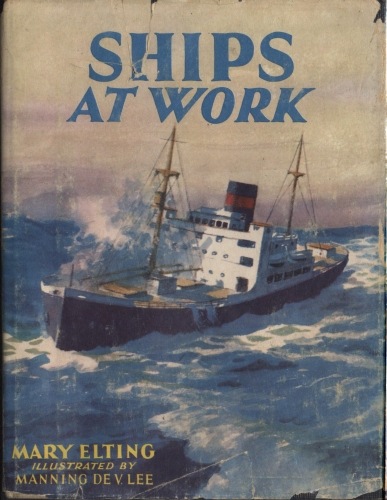
Jim is a sailor on a freighter carrying cargo across the Atlantic Ocean.
Every morning at half-past three, someone comes into the forecastle.
That’s the seamen’s name for their sleeping quarters. They pronounce it
“foke-sull.”
Jim mumbles a little. Then the light goes on. The sailor who has waked
him wants to be sure he doesn’t go back to sleep. With half-open eyes,
Jim sees his clothes hanging from hooks. Back and forth they sway as the
ship pitches and rolls. Jim is so used to sleeping in rough weather that
he hadn’t even noticed when a storm blew up in the night.
Now he’s wide awake, and so are the other men in the forecastle. Jim
swings his legs over the side of his bunk, in a hurry to get dressed in
well-washed blue dungarees, a turtleneck sweater instead of a shirt,
thick socks and a heavy woolen pea coat. That’s a sailor’s winter jacket
with pockets that slant in sideways. He makes sure his sharp knife is
dangling from a snap on his belt. No telling when it might come in
handy. Then he sticks a knitted blue stocking cap on his head and
reaches for his fleece-lined mittens.
Jim wants to be warm. He knows the wind will be sharp, even though his
ship is headed for the warm Mediterranean Sea. It’s wintertime and still
cold out on the Atlantic Ocean.
Jim and the three men who share his bunkroom are ready for work—almost
ready. First they go down the passageway to the mess, which is their
word for dining room. There they have coffee from a big steaming urn
that is always kept full and hot. In another minute Jim steps out onto
the leeward side of the deck—the side away from the wind. Although he’s
in a hurry, he waits there sheltered from the wind for a few minutes
while his eyes get used to the dark. Jim is going to stand his watch.
That means he will work for four hours.
Jim is an AB—an Able Bodied Seaman. An AB works out on deck instead of
down inside the ship in the engine room or in the kitchen, which he
calls the galley. All the men who work on a ship are seamen. Only
deckhands are called sailors. And only those sailors who have passed
examinations and have been at sea for a certain length of time are AB’s.
The other sailors are called ordinary seamen or ordinaries for short.
As soon as his eyes can see in the dark, Jim walks toward the bow which
is the front of the ship. As the deck rises and falls and tilts under
his feet, he manages from long practice, to keep his balance, but he
also slides one hand along the rail on top of the bulwark, a kind of low
wall that runs all around the deck.
In good weather he would go to the bow and stand there, watching for
anything there might be in the ocean ahead. But tonight waves may splash
over the bow. An unexpected wave can knock a man down or even wash him
overboard. It will be safer high up in the crow’s nest above the deck.
Besides he can see farther from up there. So Jim climbs to the little
enclosed platform high on the foremast.
In a very bad storm Jim would not go outside. He would stand watch in
the wheelhouse. This is a room with a big window high above the deck in
the part of the ship called the house. The room gets its name because
the wheel that steers the ship is in it.
Jim knows it is good manners always to be a little early when you go to
take the place of another seaman whose watch is over. So he doesn’t
waste any time as he scrambles up the steel rungs in the ladder on the
mast.
He pokes his head through the hole in the floor of the crow’s nest.
There he finds Juan, who is cold and glad enough to climb down and get
into his warm bunk.
Juan has a telephone strapped on his head. He uses it to talk with the
third mate, the officer in charge of the ship who works in the
wheelhouse. When Juan sees Jim, he says into the telephone, “Crow’s nest
to wheelhouse—being properly relieved, sir.” Now the mate, listening to
the loudspeaker in the wheelhouse, knows that Jim is the lookout in the
crow’s nest.
Jim puts the telephone on his head and leans against the rail around the
small platform that sways far to one side, then to the other. Soon he
hears the ship’s bell, a faint sound above the storm—“Ding-ding,
ding-ding, ding-ding, ding-ding.” Eight bells. It is exactly four
o’clock. At four-thirty the bell rings again, just once. Two bells will
be five o’clock, and so on until eight, when there will be eight bells
again.
For a long time there is nothing for Jim to see but great gray waves
rising and lifting the ship, and once in a while splashing over the
decks way down below. Then far ahead and to the right Jim sees a tiny
speck of light.
“Crow’s nest to wheelhouse,” he calls into the phone. “White light two
points on the starboard bow.” The mate knows from this where to look for
the light. The diagram on page 16 shows the words Jim will use when he
tells the mate to look in other directions.
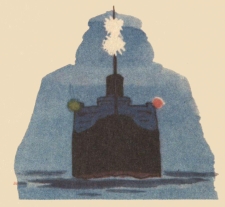
Jim thinks the white light probably comes from another ship. Soon he
knows it does. He can see two white lights very close together and a
green light a little below them. He and the mate know that a green light
is always shown on the right or starboard side of a vessel that’s
moving. There is no danger. Jim’s ship and the other one are a long way
apart and are not headed for each other. If Jim saw both a green light
and a red light with two white lights above them, he would be alarmed.
This would mean a ship coming straight at him.
Now and then spray from the waves blows all the way to the crow’s nest,
and Jim is glad of a protecting shield that comes up almost as high as
his face. But he can feel the wind anyway, and he can hear it roar
through the rigging. He almost has to shout into the phone so the mate
can hear him.
The safety of the ship depends on Jim. Even in the darkness he can see a
great deal from his high perch. He may notice the white foam of waves
ahead behaving in a strange way. This could be the wreck of a
half-sunken ship that would tear a hole in his own ship and send her to
the bottom. If he dozed off, he might fail to sight some danger. So he
must keep alert every minute. He’s responsible for the lives of all his
shipmates, and he takes his job seriously.
Jim watches the dark, heaving ocean for two hours. He’s glad when his
coffee time comes. That’s ten minutes of rest he gets after standing
watch for two hours. When another lookout comes to the crow’s nest to
take his place, he warms up in the mess and then goes to the wheelhouse.
There he works for two hours steering the ship. He stands his watch at
the wheel.
The wheelhouse is dark, so that the mate can see through the big windows
anything that the lookout reports. The only light comes from
instruments, such as the compass. Jim watches the compass to make sure
he is steering in the right direction. The mate tells him what direction
the captain has ordered the ship to go. But the compass can’t be their
only guide.
When you guide yourself by a compass on a hike across a wide meadow, you
can keep going in a straight line because nothing pushes you to one side
or the other. But at sea the wind is always pushing against a ship,
making it slip sideways. Currents in the water push, too. The current
may be going one way and the wind in another. There are no trees or
mountains on the ocean to help seamen know exactly where they are. So
they can use the sun and stars as their guides.
Of course, the sun, stars and moon keep moving. But they travel in an
orderly way. If a seaman knows the rules about their motion, he can look
at them through special instruments and figure out where he is. He can
navigate.
More than two hundred and fifty years ago, an American boy named
Nathaniel Bowditch went to sea and discovered that sailors didn’t have
any good, accurate rules for steering by the stars. He decided to do
something about the problem. Before long he had worked out a set of
rules that were so good that every man in his crew could navigate—even
the cook!
The mate on Jim’s ship has instruments with which he looks at the sun
and stars. And he still uses the book that Nathaniel Bowditch wrote so
long ago.
Besides the wheel and the compass, there are other instruments in the
wheelhouse. One is the engine room telegraph. The mate uses this when he
wants the ship to go faster or slower, forward or backward. He moves the
handle of the telegraph, and a bell jangles in the engine room. Another
telegraph there, exactly like the one in the wheelhouse, shows the
engineer at what speed the ship should go. To let the mate know he has
received the order, the engineer sends the same signal back on the
telegraph, and a bell in the wheelhouse jangles, too.
By eight o’clock, when it is daylight, Jim’s watch is over. He goes
below, as seamen say, and sits down with his messmates—all the others
in the crew who aren’t on watch—for a big breakfast of orange juice,
bacon, eggs and flapjacks. Then he goes to sleep.
A little before noon he is up again. The storm was not a bad one. The
sun is shining, and it is warm out on deck. Jim has all afternoon until
four o’clock to himself. This is how he spends it: First he gets a
bucket of cold water and puts it under a little faucet that brings up
steam from the engine room. He runs steam into the water, and it’s hot
in a few seconds. Out on the afterdeck, sailors have rigged up a
washboard.
Jim spreads his dirty clothes on the board and scrubs them with a brush
and soap and his steam-heated water. Seamen do a lot of washing. They
like to keep their clothes clean. Often they do their own mending, too.
While Jim’s clothes dry on a regular clothesline on the afterdeck, he
gets out his ditty bag which holds all kinds of odds and ends, including
needles and thread and a sailor’s palm. The palm is what a sailor uses
instead of a thimble for pushing a big needle through heavy canvas. In
the old days when ships had sails to be mended, these palms were very
necessary, but nowadays most sailors only use them the way Jim does. He
is making a sea bag to take the place of his old one that has worn out.
The sea bag is his trunk. He carries it on his shoulder whenever he
changes ships.
While Jim sews, he sings, and other seamen who are off watch sing too.
One of them plays a banjo, and another has a harmonica. Some of the
songs are the ones you hear any day on the radio, and others are songs
that seamen themselves have made up.
These sailor songs are called chanteys—pronounced shantys. On old
sailing vessels men sang them as they worked together, and the rhythm of
their work set the rhythm of the music. Here is a chantey that helped
them pull together on the rope that lifted a sail:
Way! Haul away! We’ll haul away the bowline.
Way! Haul away! We’ll haul away, Joe.
In those days, before there were engines to do work, men used a
hand-turned machine called a capstan to raise the anchor or tighten
heavy lines. They turned it round and round by pushing against long bars
called capstan bars. As they pushed, they sang:
Yo, heave ho! Round the capstan go.
Heave, men, with a will. Tramp, and stamp it still!
The anchor must be weighed, the anchor must be weighed.
Yo-ho! Heave ho! Yo-ho! Heave ho!
Now, while the singing goes on, Jim takes his turn at having a haircut.
For a barber’s chair he uses a bitt. That’s a round piece of steel that
sticks up out of the deck at just the right height. It’s used at times
for holding big ropes that seamen call hawsers.
The barber is a man from the black gang. That means he works in the
engine room. When he is off watch, he likes to make a little extra money
cutting hair. So he puts a sheet around Jim and starts to work.
Chiquita, the ship’s cat, takes a playful swipe at a dangling corner of
the sheet, and then goes off in search of a rat that may have come
aboard in port.
The barber has pictures tattooed on his forearms, and Jim laughs as he
watches them. On one arm is a picture of an old sailing ship. As the
barber’s muscles move, they make the ship look as if wind is blowing on
the sails. On the other arm is a beautiful lady chasing butterflies.
When the barber opens and closes the scissors, the lady looks as if she
is dancing after the butterflies.
Just before four o’clock, Jim goes to mess again. Then he’s on watch for
four more hours to put in the rest of his eight hours of work in a
twenty-four hour day. He stands lookout again for two hours and takes
the wheel for two more. Now his day is done.