The seamanship, the navigation,
and the gunnery of the Elizabethan
age will ever be memorable,
not merely because they
attained such excellence after centuries
of imperfection, but because
by a combination of these three
arts the whole future of England
was mapped out, her supremacy
assured, and her colonial expansion
begun.
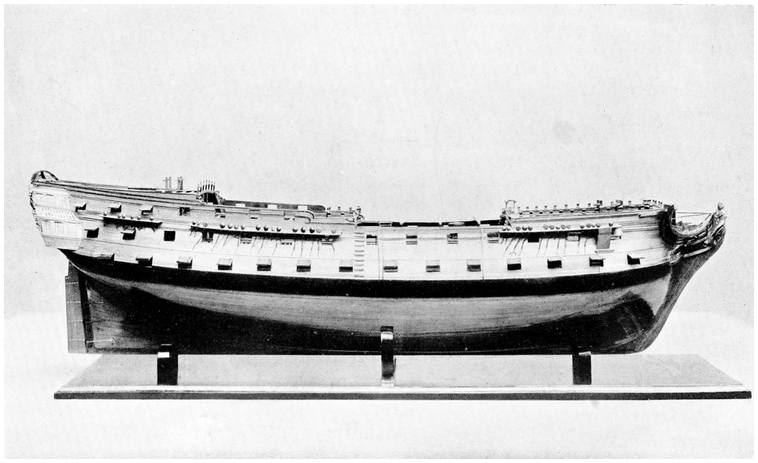
A four-masted warship of her
reign was not a handy creature to control. She could
fight and she could ride out an Atlantic gale, but she
was clumsy; she was—even the best of her class—much
addicted to rolling, owing to the fact that she
possessed such immense weights above the water-line.
She was certainly an improvement on the ships of
Henry VII and VIII, but she was too cumbrous to be
considered in any degree satisfactory. Before we proceed
to discuss the way they were handled, let us
briefly survey the principal types of vessels on board
which the men of this reign had to serve.
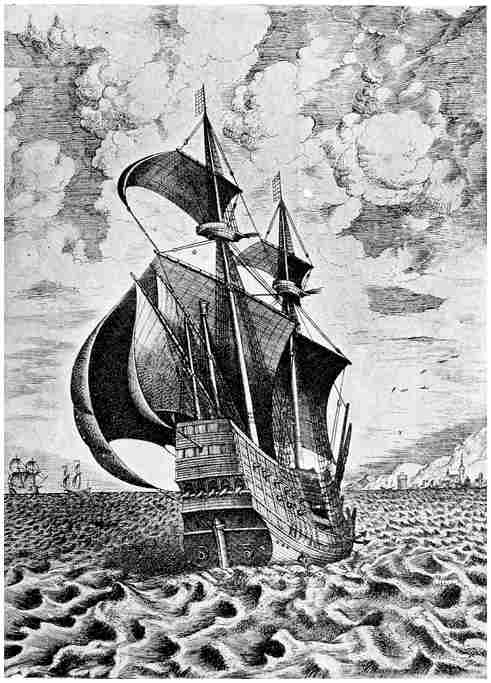
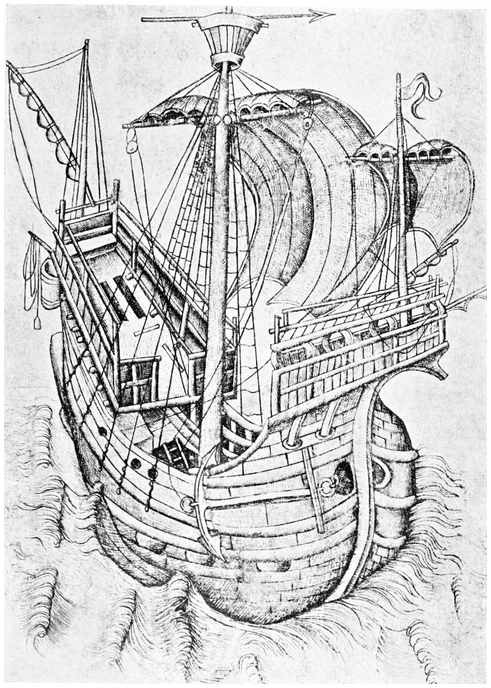
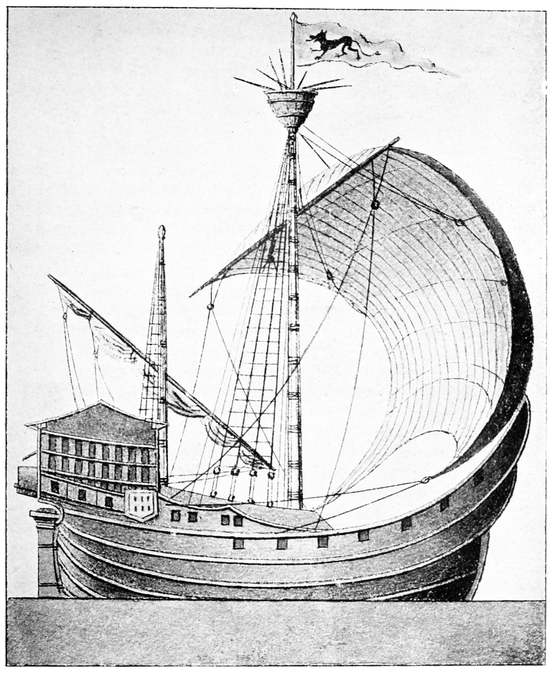
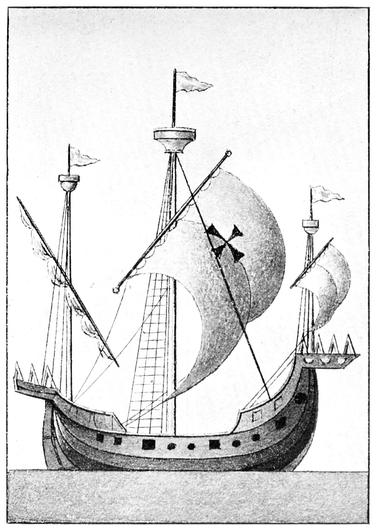
Sixteenth-Century Four-Masted Ship.
By a Contemporary Artist.
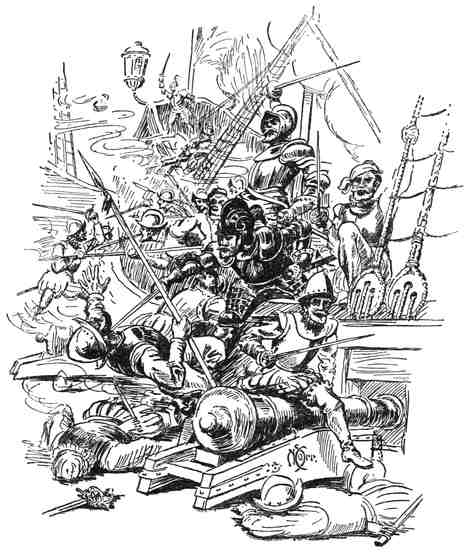
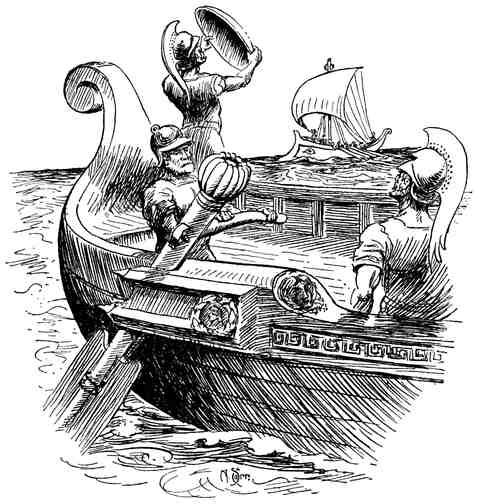
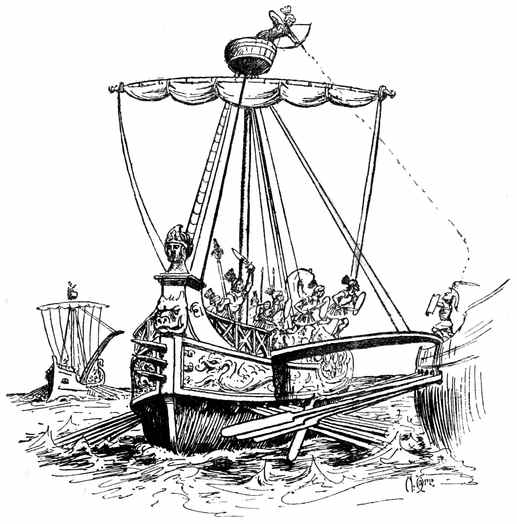
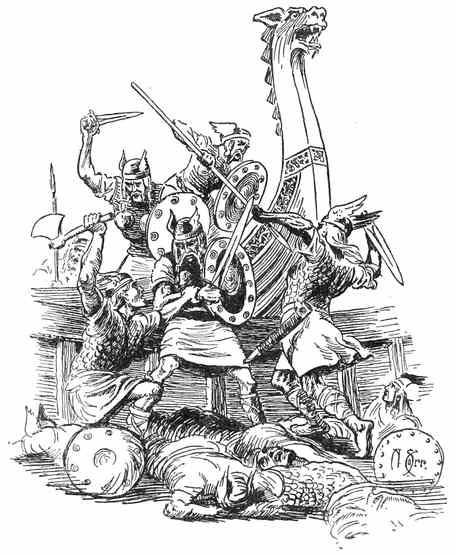
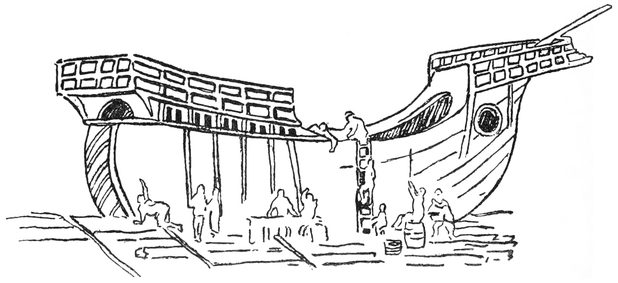
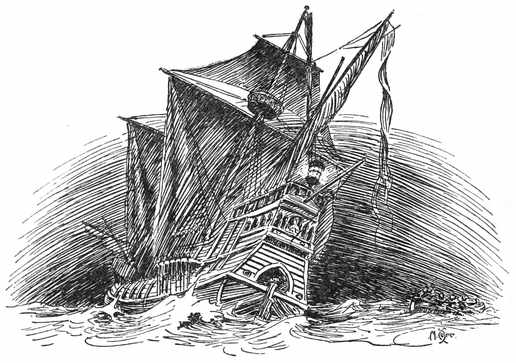
Elizabethans Boarding an Enemy’s Ship.
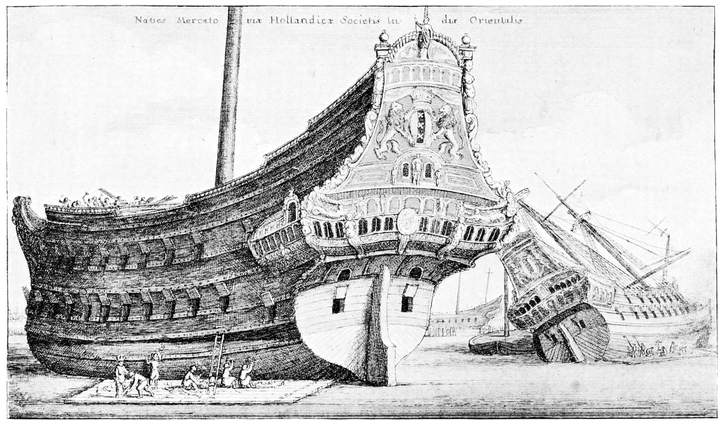
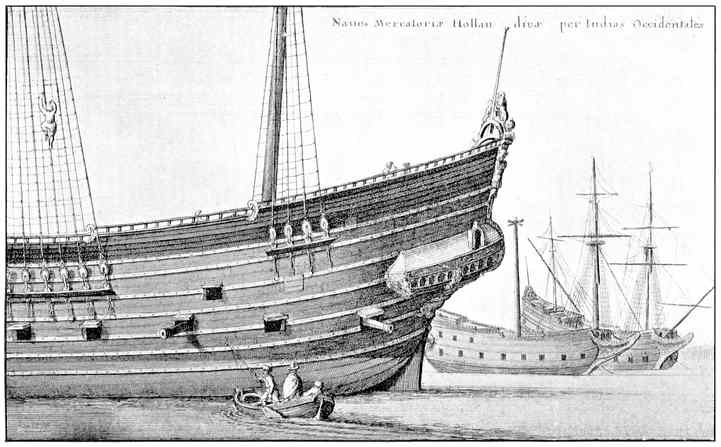
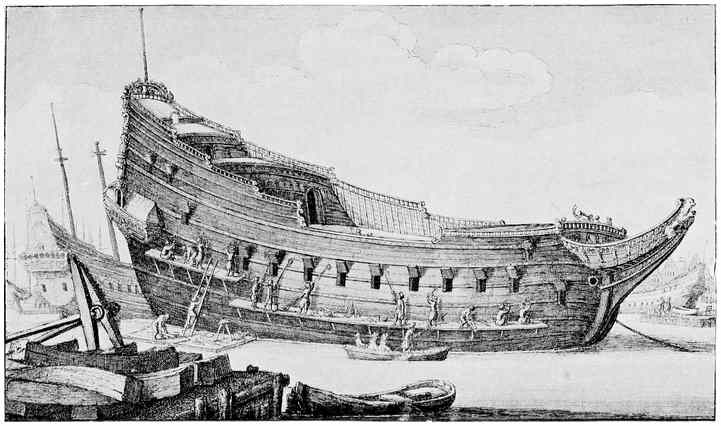
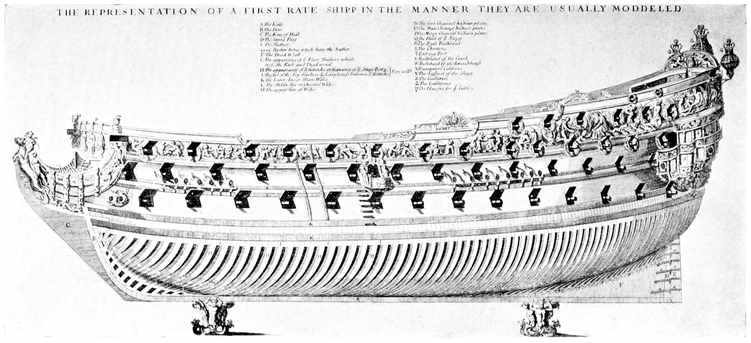
There was, firstly, the “high-charged” man-of-war
with her lofty poop and forecastle. A contemporary
illustration shows such a vessel with guns protruding
from the stern and two tiers of guns running along
either side of the ship. There were light guns in the
forecastle as well. That portion on the main deck
between the break of the poop and forecastle was the
waist, where the crew moved about and the ship’s
boats were stowed. In those days, when so much of
the fighting was done at close quarters, and the enemy
endeavoured so to manœuvre his ship as to come
alongside and pour his men on the other’s deck, dealing
out slaughter to all who should bar his way, it was the
aim of the attacked ship to catch the invaders between
two fires. The poop and forecastle being so well
guarded and, by reason of their height, so difficult to
assault, the enemy might possibly board the ship at
the waist. But inasmuch as the after bulkhead of the
forecastle and the forward bulkhead of the poop were
pierced for quick-firing guns, the boarding party was
likely to meet with a warm reception. As an additional
obstacle to boarding, it was customary before a fight
to stretch long red cloths over the waist. These
cloths were edged on each side with calico, says an
Elizabethan writer, and were allowed to hang several
feet over the side all round the ship, being sometimes
ornamented with devices or painted in various colours.
Wooden barriers, called “close-fights,” were also built
across the ship’s deck for repelling boarders, and were
loopholed like the bulkheads. Furthermore, nettings
were stretched across the ship to prevent any falling
spars from dealing death to the crew.
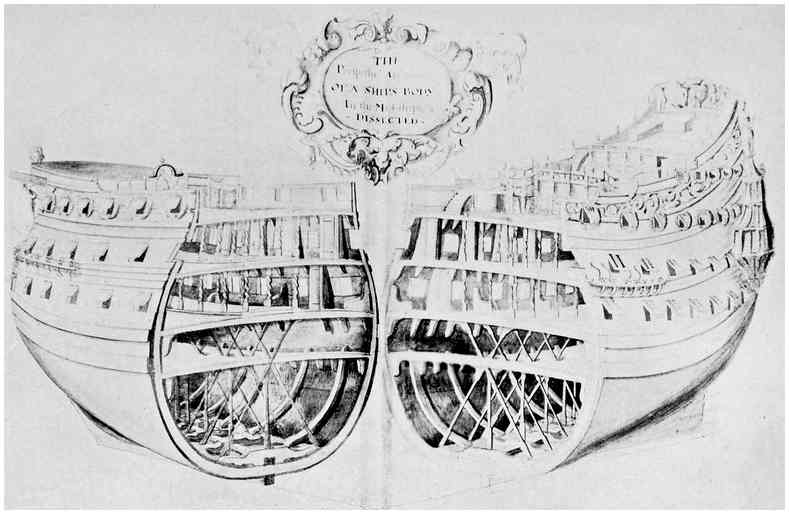
The tumble-home on these ships was excessive, but
since they carried so many decks it was essential that
the topmost should be as light as possible. But just
as on a modern steamship the master can survey everything
forward from the eminence of his bridge, so the
Elizabethan captain, standing on the poop, was able
to command the whole ship, to see ahead and to keep
an eye on his men. There was no uniform colour for
painting the Elizabethan hulls, Mr. Oppenheim says.
Black and white, the Tudor colours green and white,
red, and timber colour were all used. Sometimes a
dragon or a lion gilded was at the beak-head, with
the royal arms at the stern. On either side of the stern
was a short gallery, on to which the captain could
emerge from his cabin under the poop. The long tiller
from the rudder came in under the poop, and was controlled
by a bar or whipstaff attached to this same
tiller. “The roul,” says James Lightbody in his
“Mariner’s Jewel,” published in 1695, “is that through
which the whipstaff goeth, which is a piece of wood
the steersman holdeth in his hand to steer withal.”
The man received his orders, as a rule, from the master
of the ship, but when entering port the pilot would instruct
him how to steer.
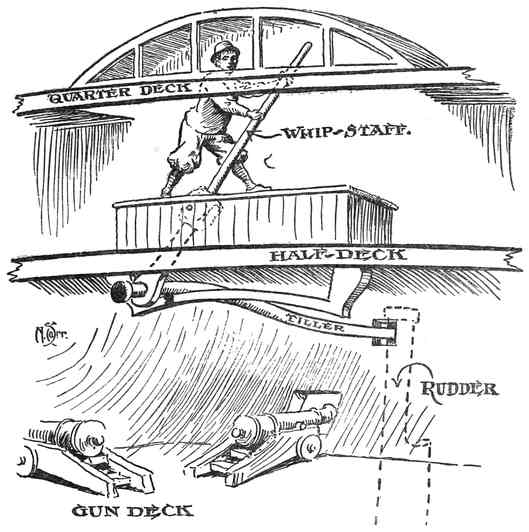
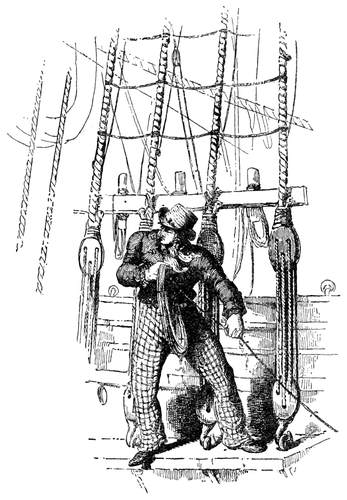
Illustration to show an Elizabethan Helmsman Steering a
Ship by means of Whipstaff.
(Sketched on board the replica of the Revenge at Earl’s Court.)
There was not very much room in the fo’k’sle—just
enough to sleep a few of the crew and for stowing coils
of rope and the like. The galley was erected at the
bottom of the hold on a brick floor. Below the upper
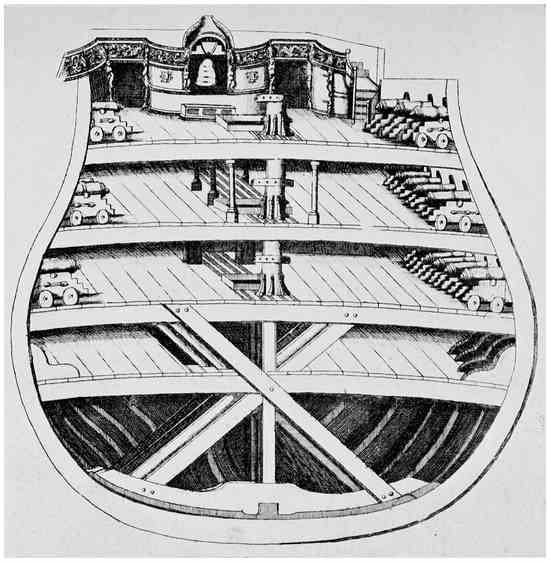
deck came the main deck. Here were disposed the
heavier guns, and here the crew were berthed. Between
this and the hold was a false orlop, where the bread-room
and the cabins of the petty officers were placed.
But what was perhaps especially noticeable about
these ships was the extent to which the poop and the
beak projected away from the hull. Consequently, not
only did these craft roll, but they pitched considerably
as well. The interiors of the cabins were painted green,
and there was a certain amount of carving externally
both at beak and stern. So much for the “high-charged”
type of ship.
But there was also the pinnesse or flush-decked
species, such a craft as brought home to England the
body of Sir Philip Sidney, and such a craft as often
formed a unit in those long, perilous transatlantic
voyages of discovery. These craft had no raised forecastle
other than a small platform, and only a short
quarter-deck. There was no such thing as triangular
sails on the full-rigged ships of those days. There
was, indeed, a spritsail, which was a squaresail set on
a yard depending from the long, steeved bowsprit,
and this was the only headsail. The foremast and mainmast
each set a course and topsail, while the mizzen and
bonaventure each carried a lateen fore-and-aft sail.
The fore-topmast and main-topmast could be struck if
necessary. Elizabethan prints show, situated just above
the lower yard on the bigger ships, a round top or
platform from which quick-firing guns and arrows
could be fired. At the yard-arms were sometimes fitted
hooks, which, catching the enemy’s rigging and sails,
would do him considerable damage.
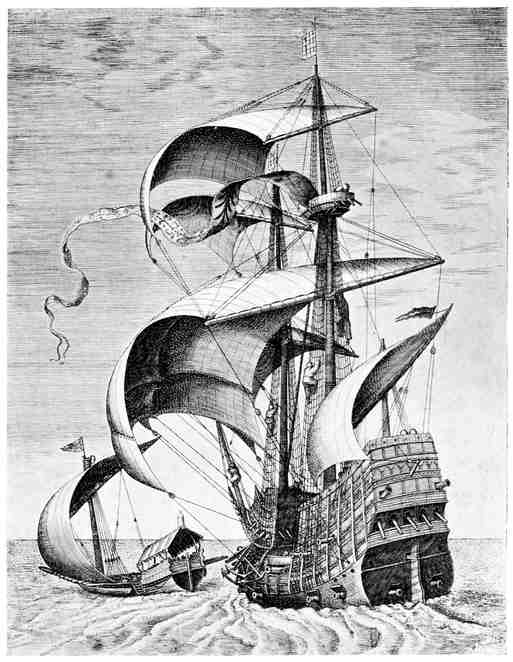
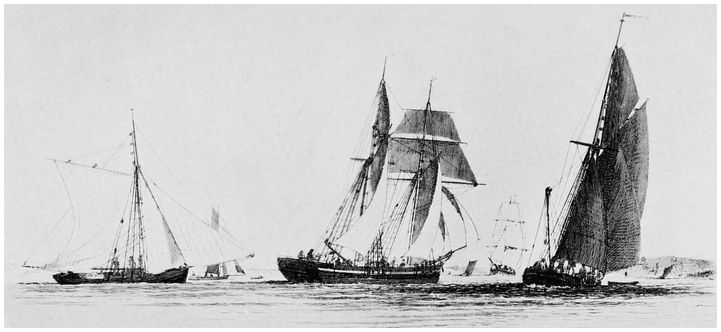
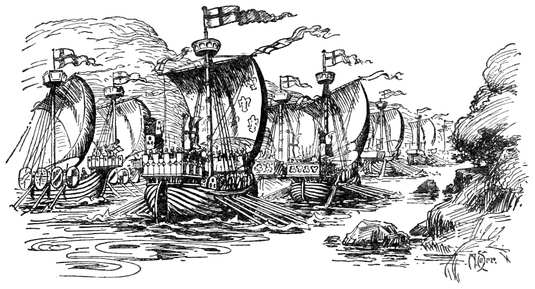
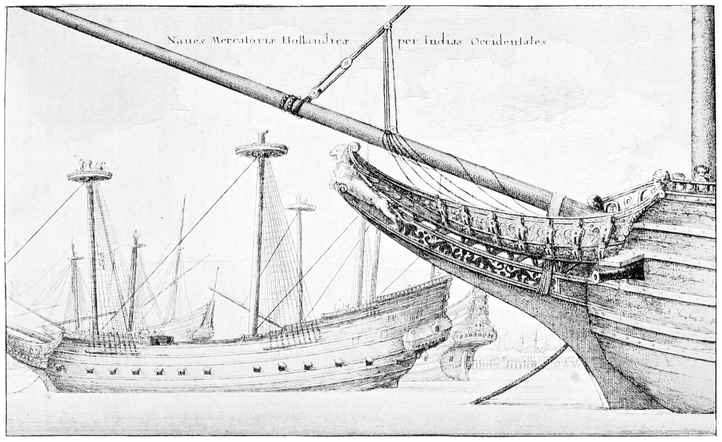
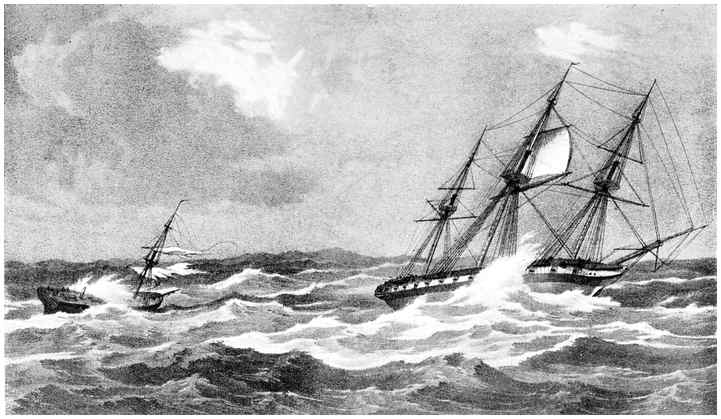
Sixteenth-Century Ship Chasing a Galley.
By a Contemporary Artist. The lead of the ropes, the parrals round the masts, the rigging and
other details are here most instructively shown.
The following represent the different types of
“great ordinance” carried by a ship of war at this
period:—
Armament of an Elizabethan Ship
| Ordnance. |
Weight
in lbs. |
Shot
in lbs. |
| Cannon |
8000 |
63 |
| Demi-cannon |
6000 |
32 |
| Culverin |
5500 |
18 |
| Demi-culverin |
4500 |
9 |
| Saker |
3500 |
5¼ |
| Minion |
1500 |
4 |
| Falcon |
1100 |
2¼ |
| Falconet |
500 |
1¼ |
But it was seldom that any ordnance greater than a
demi-cannon was used on board ship.
The guns were made of brass or iron, and were
mounted on wooden carriages which had four wheels.
They could be run in and out by means of tackles. In
his interesting little book, “The Arte of Shooting in
Great Ordnance,” by William Bourne, published in
1587, the author significantly speaks of “this barbarous
and rude thing called the Art of Shooting in great
Ordnaunce.” This was the period, you will remember,
when arrows, bills, and pikes had not yet lost
their admirers. He tells you in his preface that he has
written this book because “we English men haue not
beene counted but of late daies to become good Gunners,
and the principall point that hath caused English men
to be counted good Gunners hath been for that they
are hardie or without fear about their ordnaunce: but
for the knowledg in it other nations and countries haue
tasted better therof, as the Italians, French, and
Spaniardes, for that the English men haue had but
little instruction but that they haue learned of the
Doutchmen, or Flemings in the time of King Henry
the eight.”
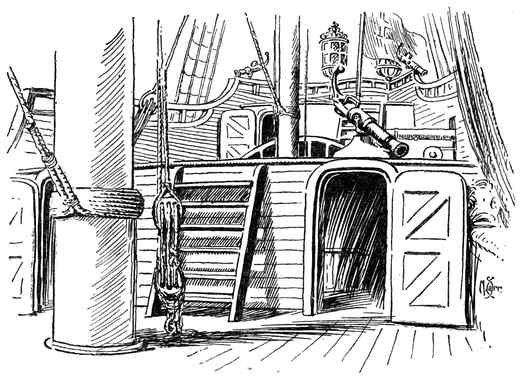
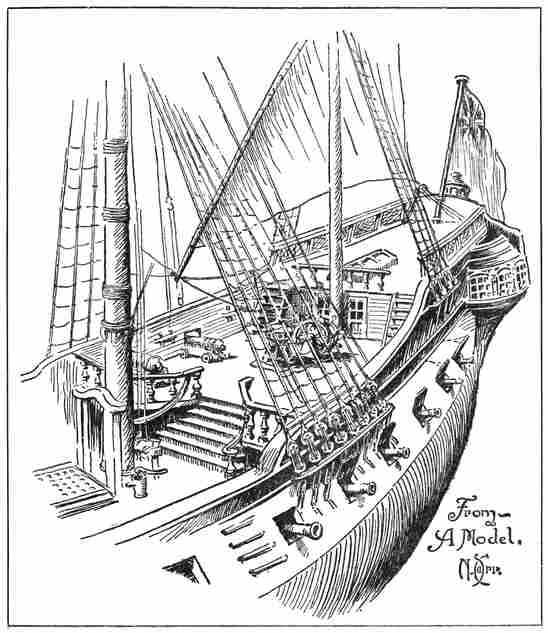
Waist, Quarter-deck, and Poop of the “Revenge.”
(Elizabethan period.)
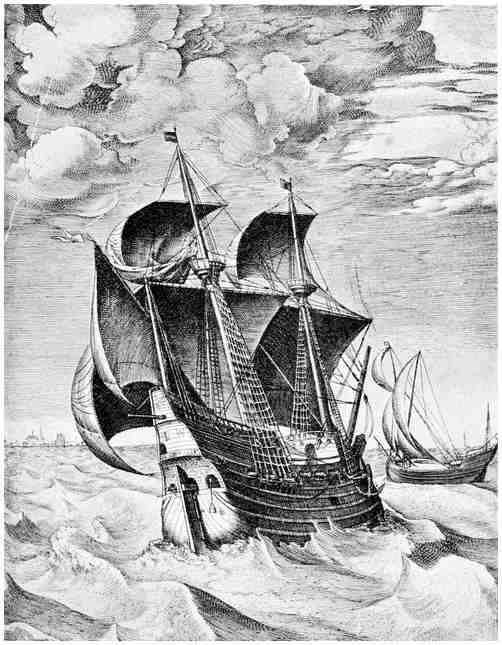
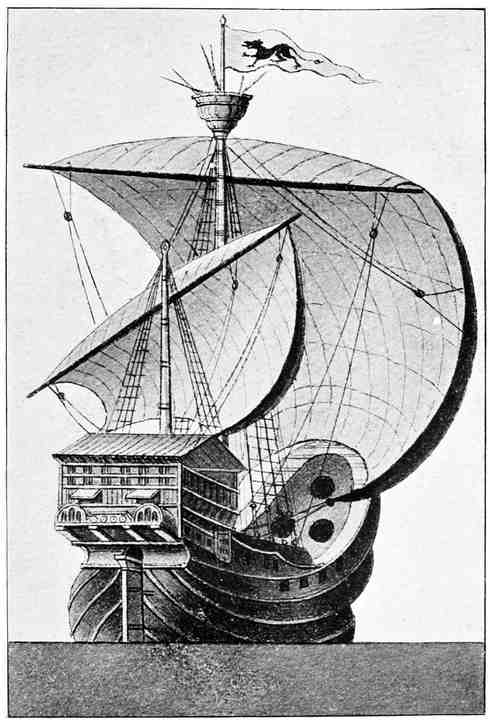
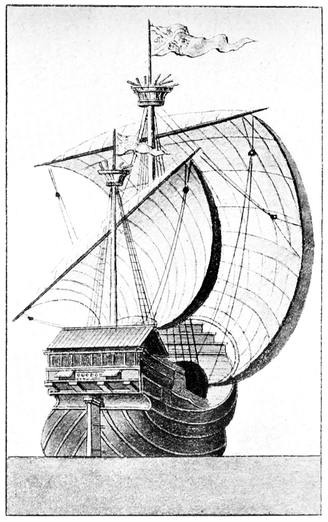
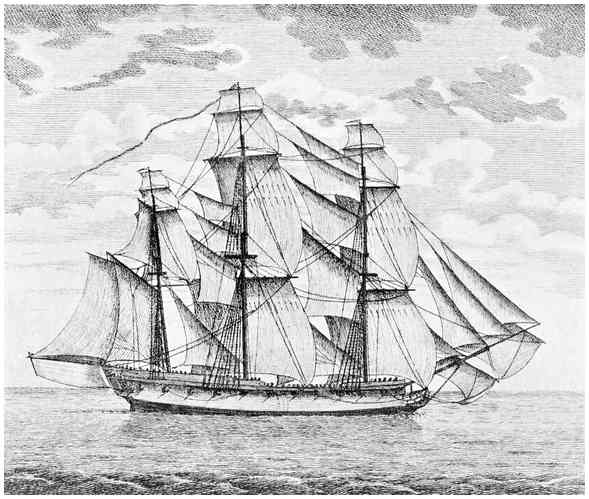
Sixteenth-Century Three-Masted Ship.
By a Contemporary Artist. The date on the stern is 1564. Notice the man in the maintop
dowsing maintopsail.
He goes into the subject with great thoroughness and
points out that allowance must be made for the wind,
and how to secure good aim. The cannon are to be
placed so as to be right in the middle of the ports of the
ship, and care is to be taken that the wheels of the gun-carriage
are not made too high. He advises that when
shooting from one ship at another, if there is any sea
on it is essential to have a good helmsman “that can
stirre steadie.” The best time to fire at the other vessel
is when the latter is “alofte on the toppe of the sea,”
for then “you have a bigger marke than when she is
in the trough.” If the ship rolls, “then the best place
of the ship for to make a shotte is out of the head or
sterne.” The shorter ordnance is to be placed at the side
of the ship because they are lighter, and if the ship
should heave “wyth the bearyng of a Sayle that you
must shutte the portes,” then you can easily take the
guns in.
“In lyke manner,” he proceeds, “the shorter that the
peece lyeth oute of the shyppes syde, the lesse it shall
annoy them in the tacklyng of the Shippes Sayles, for
if that the piece doe lye verye farre oute of the Shyppes
syde, then the Sheetes and Tackes, or the Bolynes
wyll alwayes bee foule of the Ordnaunce, whereby it
maye muche annoy them in foule weather.” Therefore
the long guns are best placed so that they are fired from
the stern. But a gun so placed must be “verye farre
oute of the porte, or else in the shooting it may blowe
up the Counter of the Shyppes sterne.”
In another equally delightful volume entitled “Inventions
or Devises,” the same author tells his reader
how to “arme” (i.e. protect) a “ship of warre.”
You are to keep your men as close as you may, and
have the bonnet off the sail or other canvas stretched
along the waist and decks, as I have shown on an
earlier page. The forecastle and poop, Bourne says, you
may “arm” with “manlets or gownes” “to shaddow
your men”; so also the tops, “but now in these
daies,” he adds, “the topfight is unto little effect, since
the use of Calivers or Muskets in Ships,” for the latter
could do so much damage. He therefore advises against
having many men in the tops. After alluding to the
netting, which I explained just now, Bourne suggests
that the captain must send the carpenter “into the
holde of the Ship” “to stop any leake if any chance.
And also to send downe the Surgion into his Cabin,
which ought and must be in the holde of the ship.”
The supreme head of the ship was the captain, who
was not necessarily a navigator nor even a seaman;
but he was the wielder of authority and discipline.
He it was who had to keep under control a crew that
was prone to swearing, blasphemy, violence, mutiny,
and other sins. Sir William Monson has left behind
in his most interesting “Naval Tracts” many an
entertaining detail of sea life during the Elizabethan
period, and tells that a captain might punish a man
by putting him in the “billbows during pleasure,”
ducking him at the yard-arm, hauling him from yard-arm
to yard-arm under the ship’s keel (otherwise
known as keel-hauling), fastening him to the capstan
and flogging him there, or else fastening him at the
capstan or mainmast with weights hanging about his
neck till his poor heart and back were ready to break.
Another brutal punishment was to “gagg or scrape
their tongues for blasphemy or swearing.”
Elizabethan captains, says Monson, “were gentlemen
of worth and means, maintaining their diet at their
own charge.” In a fight the lieutenant had charge of
the forecastle. It was not till the latter part of Elizabeth’s
reign that the rank of lieutenant was created for
the training of young gentlemen destined ultimately
for command. He came aboard quite “green” in order
to learn what seamanship he could, and to assist the
captain in the discipline of the ship; but he was not
allowed to interfere with the navigation, which was
entirely the work of the master. Not unnaturally
there was a good deal of friction between the lieutenant
and the master. Even the common seaman had an ineradicable
contempt for this landlubber, more especially
in the seventeenth century during the Anglo-Dutch
wars.
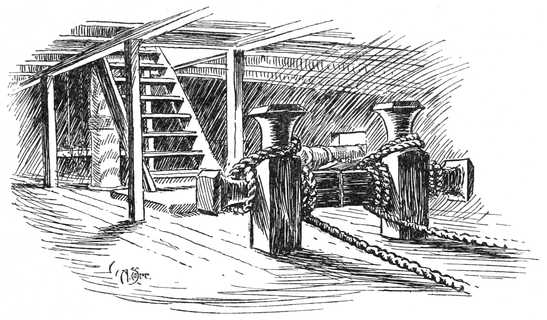
Riding Bitts on the Gun Deck of the “Revenge.”
(Elizabethan period.)
In his “Accidence, or The Path-way to Experience
necessary for all Young Seamen,” written by Captain
John Smith, the first Governor of Virginia, we have
a great deal of information which tells us just what
we should wish to know. Of the captain and master
we have already spoken. The latter and his mates are
to “commaund all the Saylors, for steering, trimming,
and sayling the Ship.” The pilot takes the ship into
harbour, the Cape-merchant and purser have charge
of the cargo, the master-gunner was responsible for all
the munitions, while the carpenter and his mate looked
after the nails, pintles, saws, and any caulking of seams as
well as the splicing of masts and yards. The boatswain
had charge of the cordage, marlinespikes, and sails, etc.,
while his mate had command of the longboat for laying
out kedge anchors and warping or mooring. The
surgeon had to have a certificate from the “Barber-surgeons
Hall” “of his sufficiency,” and his medicine-chest
must be properly filled. The marshal was to
punish offenders, and the corporal was to see to the
setting and relieving of the watch. Every Monday the
boatswain was to hear the boys box the compass, after
which they were to have a quarter can of beer and a
basket of bread.
The men messed in fours, fives, or sixes, and the
steward’s duty was “to deliuer out the victuall.” The
quartermasters had charge of the stowage, while a
cooper was carried to look after the casks for wine and
beer, etc. The large ships had three boats, viz. (1) the
boat, (2) the cock, and (3) the skiff. These were respectively
put in charge of (1) the boatswain, (2) the
cockswain, and (3) the skiffswain. Hence the origin
of these designations. A cook was carried, and he had
his store of “quarter cans, small cannes, platters,
spoones, lanthornes,” etc. The swabbers’ duties were
to wash and keep clean the ship. But the first man that
was found telling a lie every Monday was indicted of the
offence at the mainmast and placed under the swabber
to keep the beak-head and chains clean. The sailors
were the experienced mariners who hoisted the sails, got
the tacks aboard, hauled the bowlines, and steered the
ship; while the younkers were the young men called
“foremast men,” whose duty it was to take in topsails,
furl and sling the mainsail, and take their trick at the
helm.
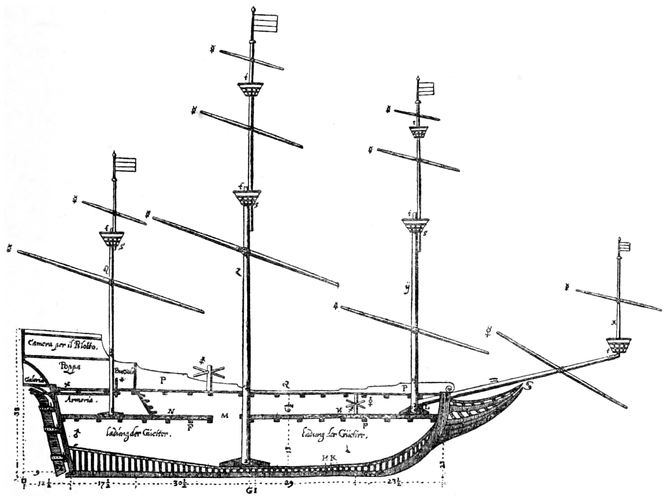
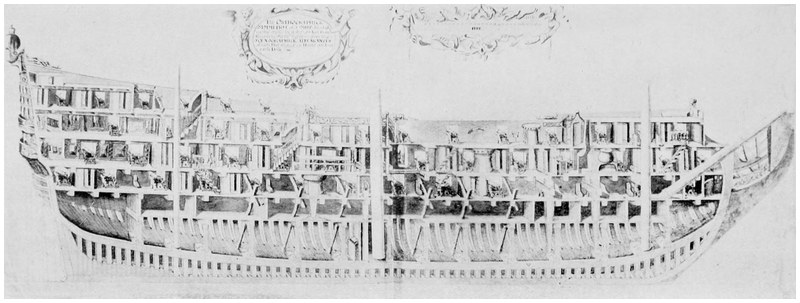
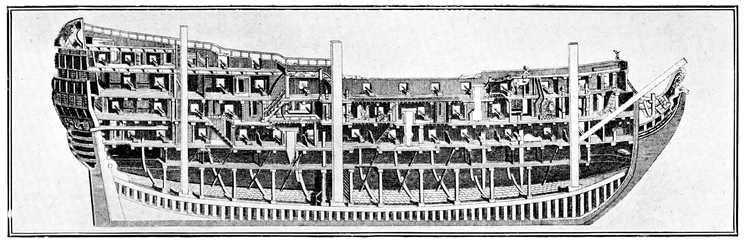
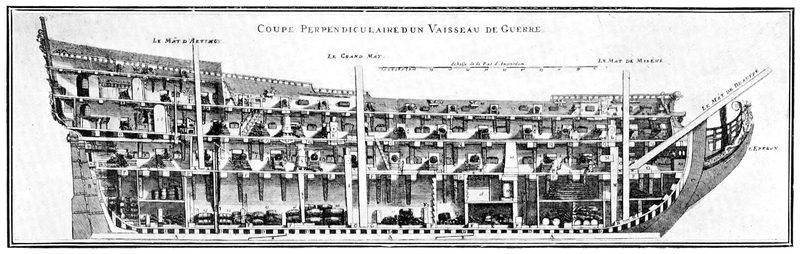
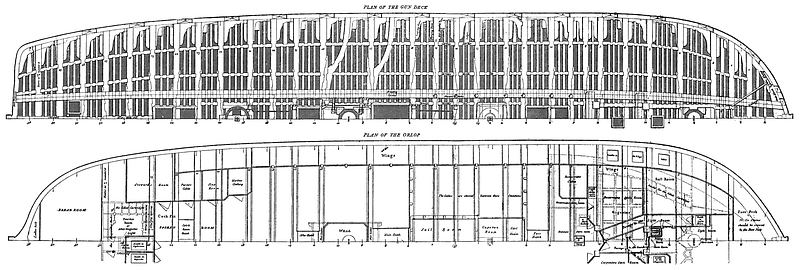
Longitudinal Plan of an Early Seventeenth-Century Ship.
This contemporary design conveys an excellent idea of the interior of an ocean-going
vessel. Notice the pilot’s place at the stern; the tiller and
whip-staff; the capstan; the lower deck; the holds, etc.
In those days the custom of dividing a ship’s company
into watches was already in vogue. “When you
set sayle and put to sea, the Captaine is to call up the
company; and the one halfe is to goe to the Starreboord,
the other to the Larboord, as they are chosen:
the Maister chusing first one, then his Mate another,
and so forward till they bee diuided in two parts.” In
those days the reckoning by tonnage was far from
reliable as indicating the true size of a ship. Columbus,
after his second voyage across the Atlantic, writes to
Captain Antonio de Torres of the ship Marigalante,
and refers to the freighting of ships by the ton “as
the Flemish merchants do,” and this, he suggests, would
be a better and less expensive method than any other
mode. But when after the capture of a prize the
division of shares was made, it was to the advantage of
the crew to make the tonnage as big as possible. The
custom was to allot the share in proportions. The ship
took a third, the victualler took another third, and the
remaining third was divided up among the crew. Of
this latter third the captain received nine shares, the
master seven, and so on down to the boys who had one
share, and there was a reward given to the man who
first descried the sails of the ship ultimately captured.
A reward was also paid to the first man who rushed
on board the enemy.
According to Monson, every man and boy was allowed
1 lb. of bread a day and a gallon of beer a day, viz. a
quart in the morning, a quart at dinner, a quart in the
afternoon, and a quart at supper. On flesh-days each
man could have 1 lb. of beef or else 1 lb. of “pork with
pease.” Flesh-days were Sundays, Mondays, Tuesdays,
and Thursdays. The other days were fish-days, and
on these every mess of four men was allowed a side of
salt fish, “either haberdine, ling, or cod,” 7 oz. of
butter, and 14 oz. of cheese. Fridays were excepted,
for on these days they had but half allowance. Monson
was naturally prejudiced against the Spanish ships,
which he accused of being badly kept—“like hog-sties
and sheep-coats”—and of giving an allowance
of diet far too small. Every man cooked for himself
and there was no discipline, although they carried
more officers than the English ships. In the latter the
captain inspected his ship twice a day to see that she
was kept sweet and clean “for avoiding sickness,” but
the holds were so badly ventilated, dark, and smelly,
the beer was so frequently bad, the food so often
putrid, and the crew themselves so lacking in habits of
cleanliness, that scurvy, dysentery, and other diseases
frequently broke out and men died in large numbers.
One has only to look through the logs of some of the
Elizabethan voyages of discovery to see this for oneself.
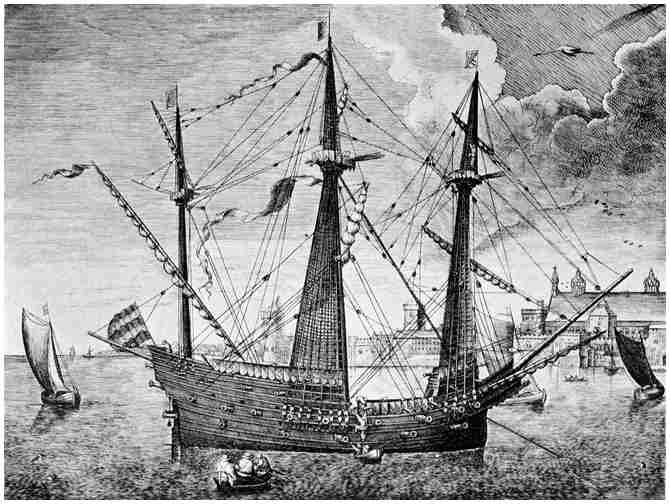
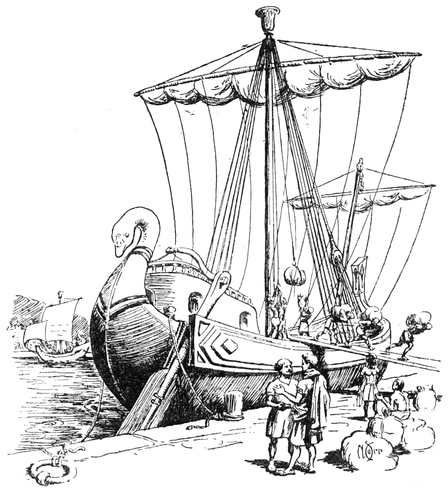
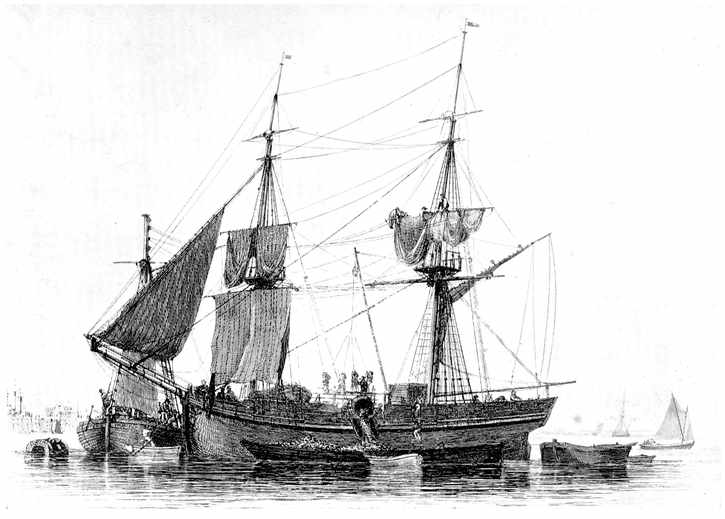
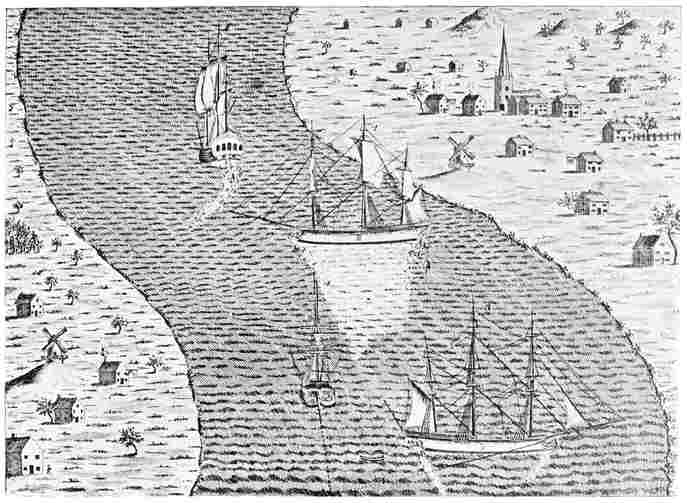
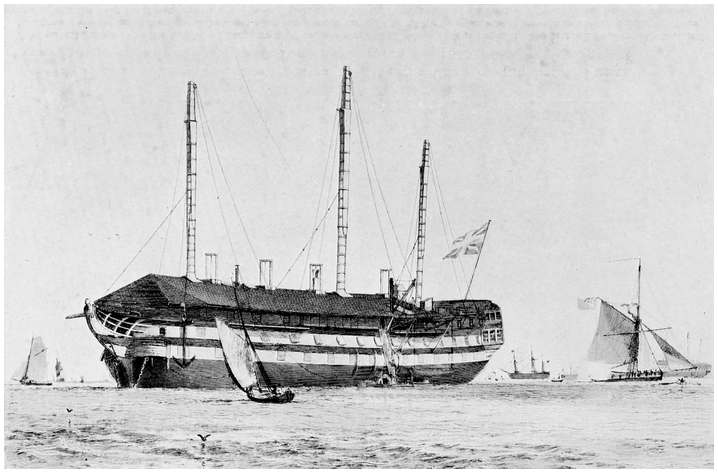
A Sixteenth-Century Warship at Anchor.
By a Contemporary Artist. Showing method of embarkation and many fascinating details.
In addition to the officers already mentioned must
be given two more. These were first the ship’s chaplain,
who celebrated the Holy Communion on Sundays, read
prayers two or three times on week-days, preached, and
visited the sick and wounded. And secondly a trumpeter,
who blew on his silver instrument when the ship
went into action, at the changing of the watches, and
at the coming and going of a distinguished guest. His
place was on the poop, and it was customary for “himself
and his noise to have banners of silk of the admiral’s
colours.” The watch was set at eight, and so on through
the night and day. When on these occasions the
trumpeter sounded his blast he was to “have a can of
beer allowed for the same.”
And now that we have got some idea in our minds of
the details of the seaman’s life on board an Elizabethan
ship, let us be rowed off from the shore in one of her
three boats which is bringing water and wood and
provisions. The good ship is lying to her anchor in the
roadstead about to get underway. Transport yourself,
then, in imagination to that epoch when England’s
seamen made such wonderful history, and endeavour
to believe that the cock-boat actually bumps up alongside
the English galleon. You clamber up the ship’s
side and find yourself on her deck, where the crew are
standing about ready to hear the commands of the
master. And now let us watch them get under way. I
shall quote not from fiction of to-day, but from an
account written by an Elizabethan, this same Captain
John Smith, as he wrote it for the edification of young
seamen.
“Bend your passerado to the mayne-sayle, git the
sailes to the yeards, about your geare on all hands,
hoyse your sayles halfe mast high, make ready to set
sayle, crosse your yeards, bring your Cable to the Capsterne.
Boatswaine, heave a head, men into the tops,
men upon the yeards. Come, is the anchor a pike?
Heave out your topsayles, hawle your sheates. What’s
the Anchor away? Yea, yea. Let fall your fore sayle.
Who’s at the helme there? Coyle your cable in small
slakes. Hawle the cat, a bitter, belay, loufe (= luff),
fast your Anchor with your shanke painter, stow the
boate. Let falle your maine saile, on with your bonnets
and drablers, steare study before the wind.
“The wind veares, git your star-boord tacks aboord,
hawle off your ley sheats ouerhawle the ley bowlin,
ease your mayne brases, out with your spret-saile, flat
the fore sheat, pike up the misen or brade (= brail) it.
The ship will not wayer, loure the maine top saile,
veare a fadome of your sheat. A flown sheate, a faire
winde and a boune voyage! The wind shrinks. Get
your tacks close aboord, make ready your loufe howks
(= luff hooks) and lay fagnes, to take off your bonnets
and drablers, hawle close your maine bowline.
“It ouervasts. We shall have wind. Sattle your
top sailes, take in the spret sayle. In with your topsayles.
Lower your main sayles, tallow under the
parrels, in with your maine sayle, lower the fore sayle.
The sayle is split, brade up close all your sayles, lash
sure the Ordinances, strike your top masts to the
cap, make them sure with your sheepes feete. A
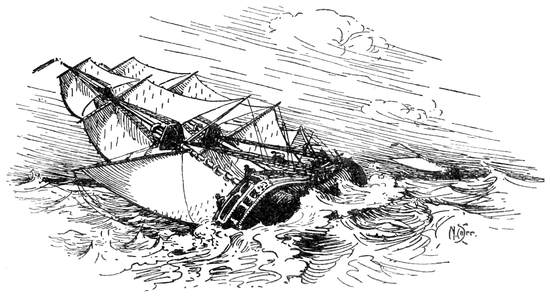
storme, hull,47 lash sure the helme a ley, lye to try
out drift.48 How capes the ship? Cun the ship, spoune
before the winde. She lusts, she lyes under the Sea.
Trie her with a crose jacke, bowse it up with the outlooker.
She will founder in the Sea, runne on shore,
split or billage on a Rocke, a wracke. Put out a goose-winge,
or a hullocke of a sayle.
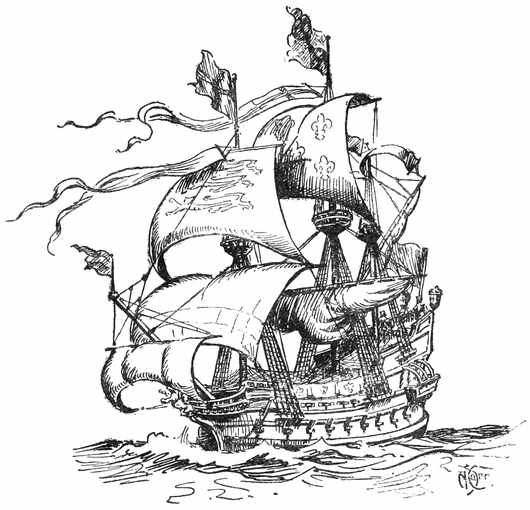
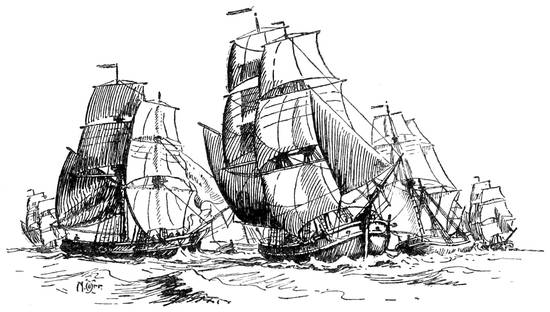
Drake’s “Revenge” at Sea.
“Faire weather! Set your fore sayle. Out with all
your sailes. Get your Larboard tackes aboord, hawle
off your Starboord sheats, goe large, laske, ware yawning.
The ship’s at stayes, at backe-stayes. Ouer-set
the ship, flat about, handle your Sayles, or trim your
sayles. Let rise your tacks, hawle of your sheats.
Rock-weede, adrift, or flotes! One to the top to looke
out for Land. A ship’s wake, the water way, the
weather bow, weather coyle. Lay the ship by the Ley,
and heave the lead, try the dipsie (= deep-sea) line.
Bring the ship to rights, fetch the log-line to try what
way shee makes. Turne up the minute glasse, observe
the hight. Land, to make land, how beares it. Set it
by the Compasse. Cleare your leach-lines, beare in,
beare off, or stand off, or sheare off, beare up.
“Outward bound, homeward bound, shorten your
Sailes, take in your Sailes, come to an Anchor under
the Ley of the weather shore, the Ley shore, nealed too,
looke to your stoppers. Your anchor comes home, the
ship’s a drift, vere out more Cable. Let fall your
sheat Anchor, land locked, mo(o)re the ship. A good
Voyage, Armes, arme a skiffe, a frigot, a pinnace, a
ship, a squadron, a fleete. When you ride amongst
many ships, pike your yards.
“To the boat or skiffe belongs oares, a mast, a
saile, a stay, a halyard, sheats, a boat-hook, thoughts
(= thwarts), thoules (thole-pins), rudder, irons, bailes, a
trar-pawling or yawning, carlings, carling-knees, for the
David (davit), the boates-wayles, a dridge. To row a
spell, hold-water, trim the boate, vea, vea, vea, vea, vea,
who saies Amen, one and all, for a dram of the
bottle?”
Impressionist-writing you describe all this? Yes,
certainly. But it has the effect, has it not, of conveying
just what we are attempting, a general idea of the life
of Elizabethan sailors at sea? “Many supposeth,”
writes this same author, “any thing is good enough to
serve men at sea, and yet nothing sufficient for them
a shore, either for their healthes, for their ease, or
estates, or state.” ... “Some it may bee will say I
would have men rather to feast than fight. But I say
the want of those necessaries occasions the losse of
more men than in any English fleet hath bin slaine in
any fight since (15)88: for when a man is ill sicke, or
at the poynt of death, I would know whether a dish of
buttered Rice, with a little Cinamon and Sugar, a little
minced meate, or roast beefe, a few stewed Prunes, a
race of greene-ginger, a flap Jacke, a can of fresh water
brued with a little Cinamon, Ginger and Sugar, be not
better than a little poore John, or salt fish, with oyle
and mustard, or bisket, butter, cheese or oatemeale
pottage on fish dayes, salt beefe, porke and pease. This
is your ordinary ship’s allowance, and good for them
are well, if well-conditioned, which is not alwayes, as
seamen can too well witnesse: and after a storme,
when poore men are all wet, and some not so much
a cloth to shift him, shaking with cold, few of those
but will tell you a little Sacke or Aquvitæ is much better
to keepe them in health, then a little small beere or cold
water, although it be sweete.”
The sea literature of the Elizabethan period is rich
in illustrations of the ways employed. Shakespeare,
whom some critics verily believe to have been a sailor—so
unfailingly accurate are his numerous sea terms—here
and there, and especially in “The Tempest,” reflects
a good deal of the life on board ship. In such logs
as the voyages of the great Arctic explorer John Davis,
there is many a nautical expression that cannot fail
to arrest our attention. And in order to complete the
impressionistic sketch of Captain John Smith, permit
me here to bring to the reader’s notice some of the
phrases which I have collected from other sources of
this period.
There were various expressions used to mean heaving-to:
thus “strake suddenly ahull” to signify “suddenly
hove-to.” So also “tried under our maine course,
sometimes with a haddock of our sail,” as Davis has
it, or “a hullocke of a sayle,” as Smith expresses it.
Perhaps it was thus that the synonym “try-sail”
originated, signifying a small handkerchief of canvas
with which to lie comfortably hove-to. “The third
day being calme, at noone we strooke saile, and let
fall a cadge anker.” “Cadge” is spelt “kedge” nowadays.
They used to “let slippe” their cables—made of
hemp—from the “halse” or hawse-pipe. But sometimes
“the cable of our shut (= sheet) anker brake.”
“For the straines (= strands) of one of our cables were
broken, we only road by an olde junke!” (Junk is still
sailor’s slang for worn-out rope.) In those days when
there was no such thing as telegraph or post, when
ships traversing the ocean were so few as unlikely to
meet except rarely, months and years went by without
news of mariners. But sometimes when an outward-bound
English ship met a fellow-countryman homeward-bound,
an effort was made to send letters back.
There was an instance of this during Davis’s third
voyage when two days out from Dartmouth. They
met the Red Lion of London sailing home from Spain.
So they hailed the latter and asked her master to carry
letters back to London. “And after we had heaved
them a lead and a line, whereunto wee had made fast
our letters, before they could get them into the ship,
they fell into the sea, and so all our labour and theirs
was also lost.”
Happily there still exists the “Traverse-Booke,”
which Davis made during his third voyage, when he set
out to discover that north-west passage which was only
found in the present decade by Captain Roald Amundsen,
who also was the first to reach the South Pole. And
I cannot believe that even a brief extract of Davis’s
sailing will fail to be of the greatest interest to modern
seamen, whether amateur or professional. I have therefore
thought fit to append the following, which covers
the first nine days beginning from the time when his
little fleet of three, consisting of the “barke” Elizabeth,
the “barke” Sunneshine, and the “Clincher”
Helene, weighed their anchors and set sail from Dartmouth.
A Traverse-Booke made by M. John Davis in his third voyage for the
discoverie of the North-West passage, Anno 1587.
Moneth.
May. |
Dayes. |
Houres. |
Course. |
Leagues. |
Elevation
of the Pole. |
The Winde. |
The Discourse. |
| |
|
|
|
|
Deg. |
Mins. |
|
|
| |
19 |
|
W S W Westerly |
|
50 |
30 |
N E |
This day we departed from Dartmouth at two of the clocke at night. |
| |
20 |
|
|
|
|
|
|
|
| |
21 |
35 |
W S W Westerly |
50 |
50 |
|
N E |
This day we descried Silly N W by W from us. |
| |
22 |
15 |
W N W |
14 |
|
|
N E by E |
This day at noone we departed from Silly. |
| |
22 |
6 |
W N W |
6 |
|
|
N E by E |
|
| |
22 |
3 |
W N W |
2 |
|
|
|
|
| |
23 |
15 |
N W by W |
18 |
|
|
N E |
|
| |
|
39 |
W N W |
36 |
50 |
40 |
|
The true course, distance and latitude. |
| |
|
3 |
W N W |
2 |
|
|
N N E |
|
| |
|
6 |
N W by W |
5 |
|
|
N E by N |
|
| |
|
3 |
W N W |
3 |
|
|
N N E |
|
| |
|
12 |
W N W |
12 |
|
|
N E |
|
Noone
the 24 |
24 |
W N W Northerly |
25 |
51 |
16 |
|
The true course, distance and latitude. |
| |
|
3 |
W N W |
3 |
|
|
N N E |
|
| |
|
3 |
W N W |
2½ |
|
|
N by E |
|
| |
|
6 |
W by N |
5 |
|
|
N |
|
| |
|
6 |
W by N |
5 |
|
|
N |
|
| |
|
2 |
S |
½ |
|
|
N |
Now we lay upon the lee for the Sunshine,
which had taken a leake of 500 strokes in a watch. |
The phrase “lay upon the lee” is just another way
of saying they hove-to. “A leake of 500 strokes in a
watch” was identical with saying that they had to
work the pumps to that number in such a period. It
should be added, further, that by “elevation of the
pole” is, of course, meant the ship’s latitude.
Some of the vessels of the sixteenth century were
terribly slow creatures. There was a nickname given
to those lethargic coasters which, because they could
not do much against the current and had to proceed
from one roadstead to another and there anchor till the
tide turned, were known as “roaders.” No one who has
made himself familiar with their long and trying voyages
could ever accuse the Elizabethan seamen of cowardice
in bad weather. Once, Davis relates, when his ship was
fighting her way through a storm, her mainsail blew
right out of her; whereupon the master of the ship
crept along the mainyard, which had now been lowered
down to the rails, and gathering the sail as it was hauled
out of the sea, gallantly fought with it and succeeded
in bending it again to the yard, “being in the meane
while oft-times ducked over head and eares into the
sea.”
The reader will remember just now in the extract from
Smith the expression “she lusts” for “she lists.”
Among hundreds of our English seamen in this twentieth
century “lust” is still used to mean “list.” Smith,
as we saw, also wrote “spoune before the wind.” Davis,
too, related that “we spooned before the sea,” the
exact meaning being that they drove before the gale
under bare poles. The latter also uses the expression
“a mighty fret of weather” to mean “a mighty
squall.” Those who are familiar with the language of
the fishermen on the north-east coast of England will
call to mind their word “sea-fret” to denote a fog
approaching the land.
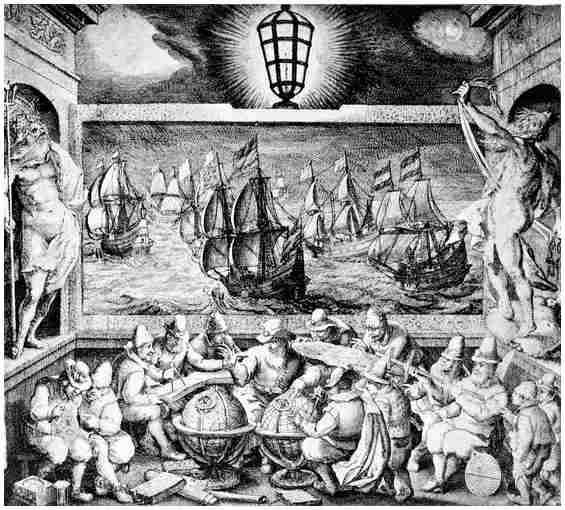
Sixteenth-Century Seamen Studying the Art of Navigation.
After a Contemporary Artist.
Notice the compass, the hour-glass, globes, cross-staff, charts, etc.
Few nautical words are so well known to us as
“skipper.” Before the sixteenth century was ended
the Dutch seamen had fraternised a good deal with
the sailors of England. The Low Countries were fast
becoming great shipbuilders and navigators, and not
unnaturally some of their phrases began to be used by
our men. The Dutch word to this day which is used
to mean captain is still “schipper,” and among the
English seamen at the end of the sixteenth century
the equivalent “shipper” was employed to refer to
the same personage. There were other slang phrases
prevalent, such as a “light-horseman” to mean a
fast-pulling gig. So also Davis speaks of a “trade”
wind to mean regular and steady. “The wind blowing
a trade,” he remarks. But some of these phrases employed
by seamen of those days are a little less obvious.
“Tressle-trees,” for example, might puzzle many a
modern sailorman. “This night we perished our
maine tressle-trees, so that wee could no more use our
maine top-saile.” These trestle-trees were just a
couple of strong pieces of wood, or of iron, and were
fitted one on either side of the lower masthead so as
to support the heel of the topmast. Such expressions
as “ground-tackle” are as frequently employed to-day
as then, but over and over again we find that a ship
“came roome,” “bare roome with her,” to mean that
the former came to leeward, put up her helm and bore
away.
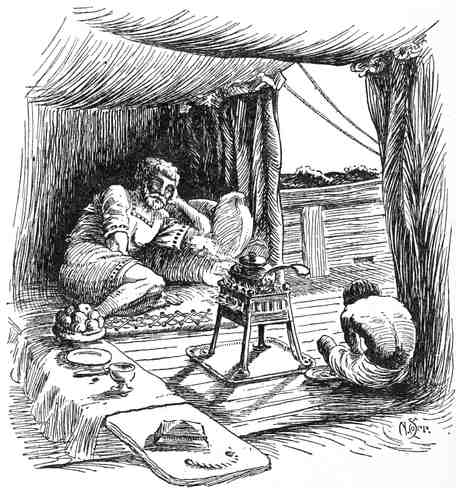
Anxious as he naturally was concerning a thousand
matters, the life of the captain at sea was many degrees
happier than that of his crew. At least he had a
decent cabin and bed in which to sleep and take his
meals and sip his punch, otherwise known as “Rosa
Solis,” consisting of brandy, spices, and hot water.
But the seamen’s comforts were disgracefully neglected,
with the result that they died in dozens. Some more
humane captains such as John Smith did their best
for the men; but this was exceptional. And yet it
was a thoroughly unsanitary age. Davis himself admits
that many of his crew were “eaten with lice” as
big as beans. Monson includes among the causes of
the discouraging of seamen the inexperienced commanders
who were put over them, the bad victuals
which they had to endure, the dishonesty in serving
them—the beef, for instance, given so that five
men had to partake of four men’s allowance—and
the delay which was made in paying their wages.
Especially were these abuses noticeable during the
early years of the seventeenth century. Men were
impressed into the service even in those days, though
there were volunteers as well. At the time of the
Armada our sailors received as wages fourpence a day,
but this was paid quarterly. In addition, of course, there
was sometimes prize money in the proportions already
mentioned. In Monson’s time complaint was made of
the kind of foremast men who were pressed into the
service “to pleasure friends.” Such men as “taylors,
porters, and others of that rank, unworthy of the
hatches to lie on,” were brought aboard and given no
less than £1 11s. a month. And yet, when opportunity
allowed, the captain used to send his crew ashore in
the ship’s boats “to walk in the fields ... to take
the air.” But among the officers there was too much
“excessive banqueting on board” and a great waste
of powder, as, for instance, when guns were fired at
the drinking of a man’s health.
And the same authority has something very interesting
to tell us concerning the ceremonial wearing
of the flag on board ship. I have no intention of confusing
our chronological sequence, but I must ask the
reader for a moment to recall that incident which was
one of the indirect if not the real causes of the first
Anglo-Dutch wars. It will be remembered—which
English schoolboy does not remember it well?—that
when Captain Young, one May Day in 1652, was bound
down Channel and met a convoy of Dutchmen coming
up, he was angered to find the foreigner declined to salute,
and an engagement immediately followed. Now, writing
long before that incident had ever occurred, Monson
definitely states that if a foreign fleet should pass on
our seas and meet our admiral’s ship, the former were
expected to acknowledge our sovereignty by coming
under the lee of the admiral, by striking their topsails
and taking in their flag. “And this hath never been
questioned,” he adds, except out of ignorance, as in the
case of Philip II, when he met the Lord Admiral of
England when the former was sailing to England in
order to marry Queen Mary. The custom was that if
any foreign ship were to arrive in one of our ports or
to pass a fort or castle, she must, as she entered,
and before coming to anchor, take in her flag three
times “and advance it again.” But should the English
admiral be in the harbour, the foreigner was not to display
his flag at all.
Prior to the reign of James I, all admirals wore the
St. George’s flag at the topmast head. But when the
Union of Scotland had been effected there was added
the cross of St. Andrew. An admiral at anchor took
in his flag in the evening and fired a gun and set the
watch. “The flag carried under the poop of a ship,” he
remarks, “shews a disgrace,” and is never used except
when it is won or taken from an enemy.
Jealousy of Spain and greed of gold had as much to do
with the impetus given to English seamanship and navigation
during Elizabethan times as any inherent love of
the sea. To meet this new zeal various writers, some of
whom we have already mentioned, set to work to write
treatises that would turn raw agricultural labourers
and tavern-haunters into fighting sailors and navigators.
William Bourne, from whom we have already
quoted, in his “Regiment for the Sea” was the first to
give a book on navigation written by an Englishman.
This was in the year 1573, and a rare example of this
little work is still preserved in the British Museum. In it
he pointed out the various ways for finding the variation
of the compass, exposed the errors of the plane
charts, and advised mariners in sailing towards high
latitudes to keep their reckoning by the globe, as in
those regions the plane chart was most likely to land
them into trouble.
In 1594 John Davis, the Arctic explorer, published
his “The Seaman’s Secrets.” This book became very
popular, and took the place of the Spanish Martin
Cortes’ handbook, which had been used in the English
translation. There is a vast amount of matter in
Davis’ “Secrets” which is worth perusing even by
the modern navigator. He speaks of “great Circle
navigation,” and gives a whole host of valuable practical
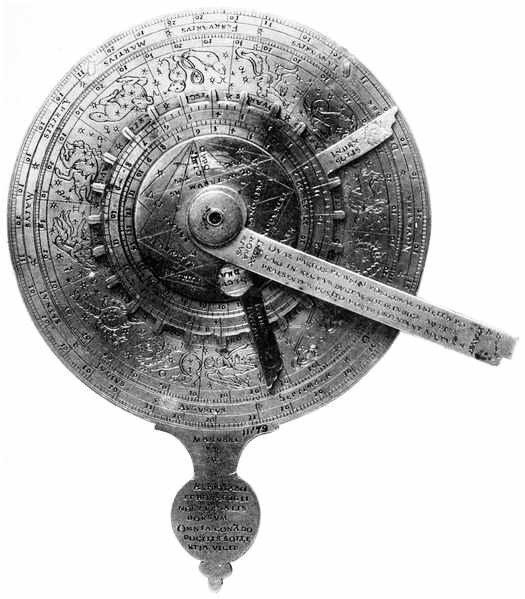
hints. “The Instruments necessarie for a skilfull
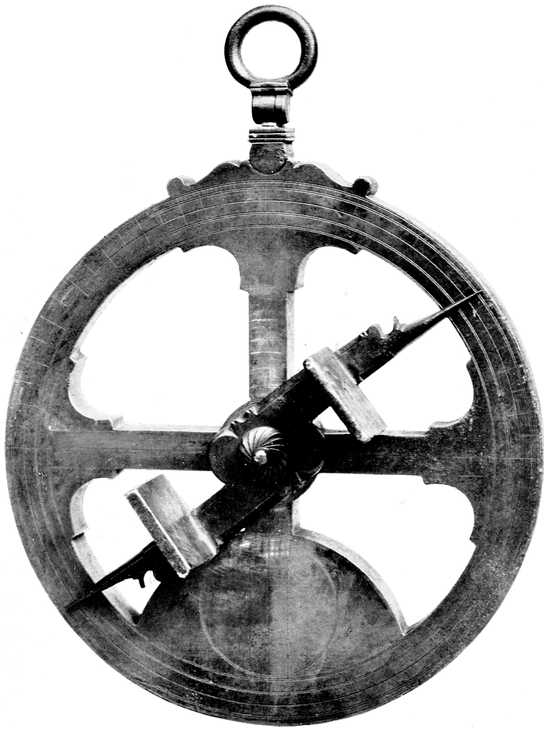
seaman,” he explains, “are a Sea Compasse, a Cross
staffe, a Quadrant, an Astrolabe, a Chart, an instrument
magneticall49 for the finding of the variation of the
Compasse, an Horizontall plaine Sphere, a Globe, and
a paradoxall Compasse”50 ... “but the Sea Compasse,
Chart and Crosse staffe are instruments sufficient
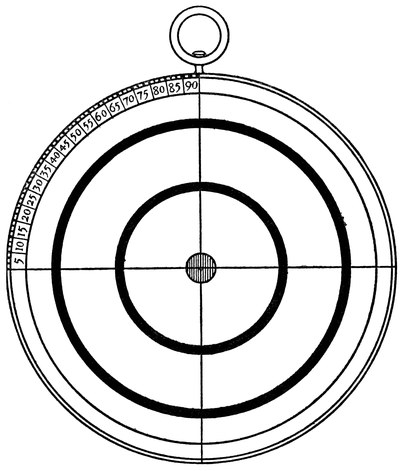
for the seaman’s use, the astrolabie and quadrant
being ... very uncertaine.” In this book he gives
instruction as to tides, stars, and how to use the astrolabe.
And it is worth noting that he speaks of the
English Channel after the fashion of our Gallic neighbours,
who still refer to “La manche.” “Our Channell,”
he explains, “commonly called the Sleue” (sleeve).
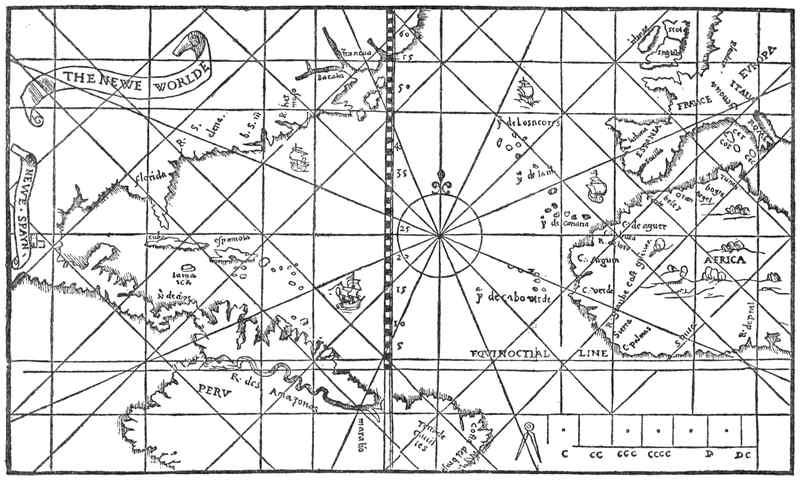
Chart of A.D. 1589.
Showing the dividing line between the Old World and the New.
It will be recollected that the Pope had drawn an imaginary line North and South, a hundred leagues west of
the Azores, leaving all that lay east thereof to the Portuguese, and all that lay west to the Spanish.
Everyone knows that longitude is the distance east or
west of a given meridian. In those days Greenwich did
not enter into the matter: the observatory there had
still to be founded. When Davis wrote in the year
1594 there was no variation at St. Michael’s in the
Azores, and so the longitude was reckoned from there.
“Longitude,” he defines, “is that portion of the
Equator contained betweene the Meridian of S. Michel’s,
one of the Assores, and the Meridian of the place whose
longitude is desired: the reason why the accompt of
longitude doth begin at this Ile is, because that there
the compasse hath no variety.”
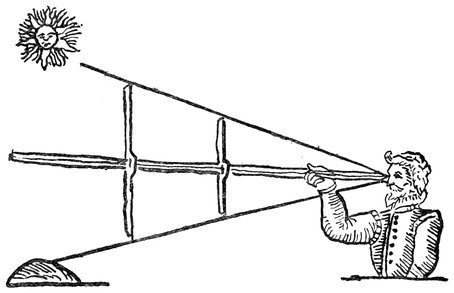
Be it remembered, also, that it was Davis who improved
the cross-staff and superseded the clumsy
astrolabe for taking meridian altitudes at sea. It was
commonly spoken of as Davis’s quadrant, and was
afterwards improved by Flamstead with the addition
of a glass lens. Subsequently it was further improved
by Halley, and as such was used almost exclusively till
the year 1731, when it was in turn superseded by
Halley’s quadrant. When we read again the entrancing
narratives given in Hakluyt and elsewhere of the
Elizabethan voyages into the unknown, let us note
that reposing somewhere in the high poop of these
ships there were most probably all the following instruments
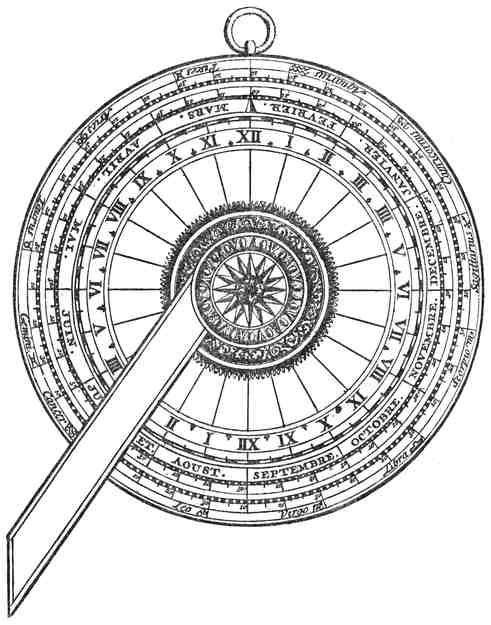
for navigating the trackless seas. There was a
calendar, an astrolabe, a cross-staff, a celestial globe,
a terrestrial globe, a universal horloge for knowing the
hour of the day in every latitude, a nocturne labe
for telling the hour of the night, one or more compasses,
a navigation chart, a general map, and a printed
chart.
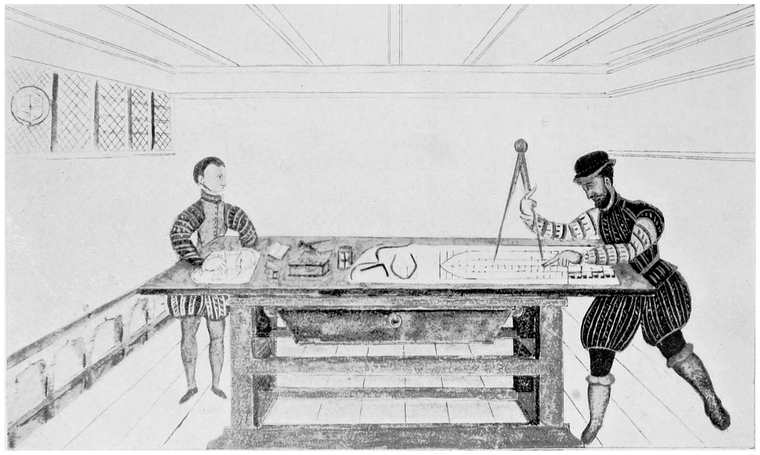
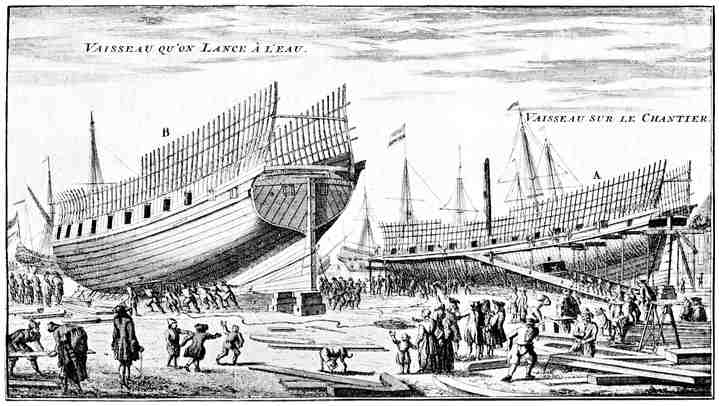
Ship Designer with his Assistant.
This illustration belongs to the latter half of the sixteenth century, or the beginning of the seventeenth, and is among the Pepysian MSS. in
Magdalene College, Cambridge. Pepys’ own title for this is “Fragments of Ancient English Shipwrightry.”
It was in 1599 that Edward Wright published his
“Haven-finding Art.” In his volume “Certaine
Errors in Navigation,” he complains of the errors in
the proportions of the existing charts. These consisted
in wrongly showing the distances of places. He speaks
also of sailing “by a great Circle, which is to bee drawne
by those two places,” and asserts that this is a better
method than sailing always at right angles to the
meridian. In practically all the charts of this age the
surface was ruled with rhumb-lines from the thirty-two
points of the compass, as is still the case to-day on
certain Dutch charts. The origin of the word “rhumb”
was Portuguese, and doubtless these lines appeared on
the earliest Portuguese charts. In the first of these
two books, Wright also furnished a table of variations
of the compass in different parts of the world.
As to the practical side of navigation, Bourne exhorted
his mariners to remember that the earth is a
globe and not a “platforme,” as “generally the most
parte of the seamen make their account.” The meridians,
he reminded them, grow narrower towards the
two poles. If one had occasion to voyage northward it
were better to sail by the globe, he suggested. Therefore
you should keep a perfect account of the ship’s course.
Then resort to your globe and consider what place and
parallel you are in (by means of the sun at day and the
stars at night). Knowing where you are, set your globe
to the elevation of your pole, and then turn to the place
of your zenith and seek the opposite of it in your
parallel, for then you know that in the same parallel
is your east and west line. Then the just quarter of
that circle to the pole must be divided into the eight
points of your compass, doing so likewise on the other
side.
From the southern voyages the “plats or cardes for
the sea” were recommended. Bourne strongly advised
against painting their compasses with so many
colours on these charts and so many flags on the land,
but bade them use the vacant places left on the paper for
better objects, such as the time of high water at certain
states of the moon, and the elevation of the land, in
order that the appearance of the latter might not be
mistaken. The use of sea cardes for navigating during
long voyages he regards as very necessary for three
reasons: they show you (1) how one place bears
from another; (2) the distances between the places;
(3) in what latitude any place is. But the master
or pilot of the ship is also to bear in mind the
effect of tides, currents, the surging of the sea or
scantiness of the wind, which might put the ship to leeward
of her course. Also in long voyages the wind
might shift ahead, so the mariner must keep a perfect
account of his courses and mark each new course on
the chart, and pay regard to the “swiftnesse” or
“slownesse” of the ships. If the weather be clear he
was to take the true altitude of the pole, which will
correct the ship’s course and give “a very neare gesse”
how the port of destination bears and how far.
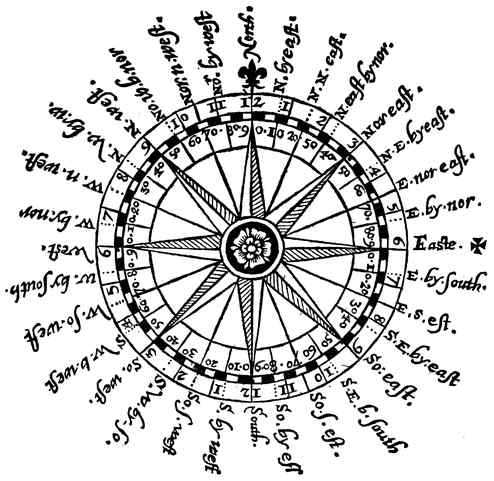
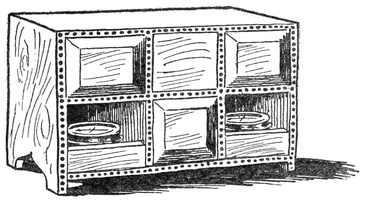
The compass was variously known in the Elizabethan
age as the “sea-directorie,” the “nauticall box,” and the
“sea-compasse.” Lightbody describes the bittacles as
“little wooden pins for nailing the compass-box withal.”
The first atlas was published in Dutch at Leyden in
1585 by Wagenaer. In this are to be found excellent
coloured charts of the Narrow Seas. It is evident
from these that there was a system of buoyage even
in those days. There are barrel buoys, for instance,
and basket beacons such as you can still find in use
to-day in different parts of Holland. The sands on the
port hand of the Swin Middle at the entrance to the
Thames Estuary are shown marked by staff-and-triangle
marks. This excellent atlas was soon translated
into English, so that the elaborate sailing directions
and the admirable little contours of the coast—crude
but useful—could be placed at the service of
English mariners. This English version was known
as Wagenaer’s “Mariner’s Mirrour,” and there was
also “The Sea Mirrour,” translated from the Dutch of
William Johnson Blaeu by Richard Hynmers in 1625,
which was another of the numerous nautical books of
this time, containing instruction in practical navigation,
sailing directions, charts, and contours.
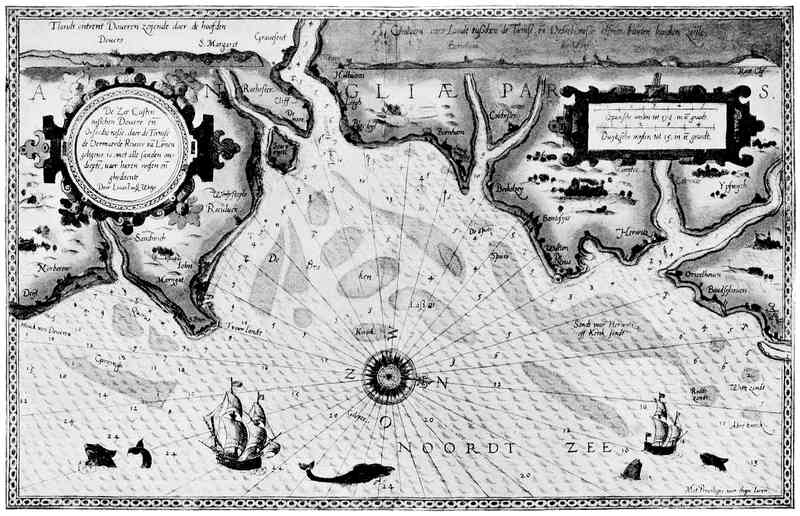
A Chart of the Thames Estuary.
(Dover to Orfordness.) This is taken from the first Atlas ever published, viz., in 1585.
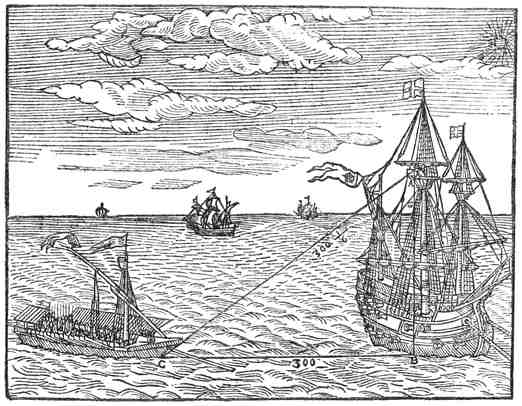
“How you may at one Station Measure uppon an Heigth with
a Geometricall Square a Longitude uppon Plaine.”
This is from Lucar’s sixteenth-century treatise on gunnery, and illustrates
the use of the “geometricall square” for finding the distance between the
galley and the ship, viz. 300 yards. This instrument was made of metal or
cypress, the quadrant being divided into 90 degrees. It was used for
measuring “altitudes, latitudes and profundities,” and so very valuable for all
gunnery work.
The hourly or half-hourly glasses used on board were
turned by the sentry, who struck the ship’s bell at every
half-hour just as on shipboard to-day. The only means
of keeping correct time in those days was by observing
the heavenly bodies, and this gave time at ship. But
frequently the navigators were many miles out in their
longitude, since the latter is found by comparing the
exact time at ship with the time by a chronometer
showing the time at the prime meridian.
Nicholas Tartaglia, in his “Three Bookes of Colloquies
concerning the Arte of Shooting,” published
in the year of the Armada, gives an interesting
illustration to indicate how one could know by the
help of a gunner’s circle the number of miles or
feet any ship lying in the roadstead was distant;
and also how to measure height with a geometrical
square. And Bourne, in his “Treasure for Traueilers”
(1578), had a method for ascertaining the “waight of
any shyp swimmyng on the water.” The reader will
remember that when we were discussing Columbus
we pointed out the lack of that useful instrument,
the log and line, for indicating the distance which
a vessel sailed. It was William Bourne who first
published an idea for overcoming this difficulty in a
somewhat ingenious manner. In his “Inventions and
Devices” (1578), he gives a method whereby “to know
the way or going of a ship, for to knowe how fast or
softly that any ship goeth.” The idea is too complicated
to be given here in detail, but practically it
amounted to towing astern a tiny boat containing a
paddle-wheel which revolved, and so by a species of
clockwork registered the speed. Excepting that the
patent log of to-day is helicular, there is much resemblance
between the old and the new in at least the
bare idea. But a little later—in the year 1637—Richard
Norwood published, in his “Seaman’s Practice,” a
whole chapter on the subject “Of dividing the Log-line
and reckoning the Ship’s way.” The log-line was to
be used in conjunction with the glass, and this method
was little altered until the nineteenth-century invention
of the patent log had to be brought about owing
to the great speed of steamships.
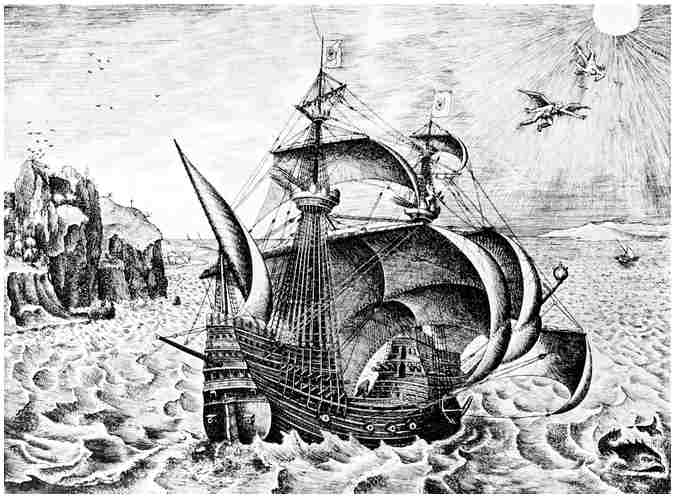
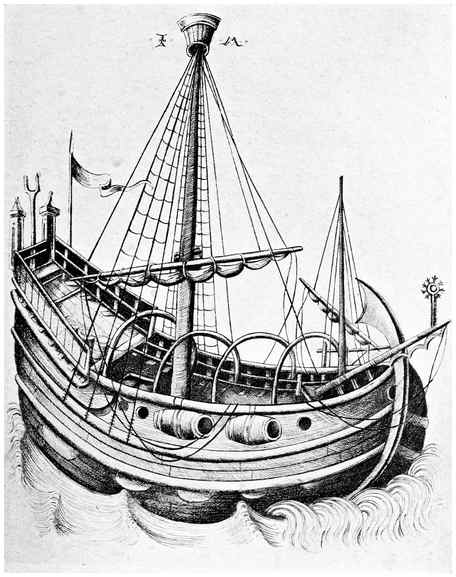
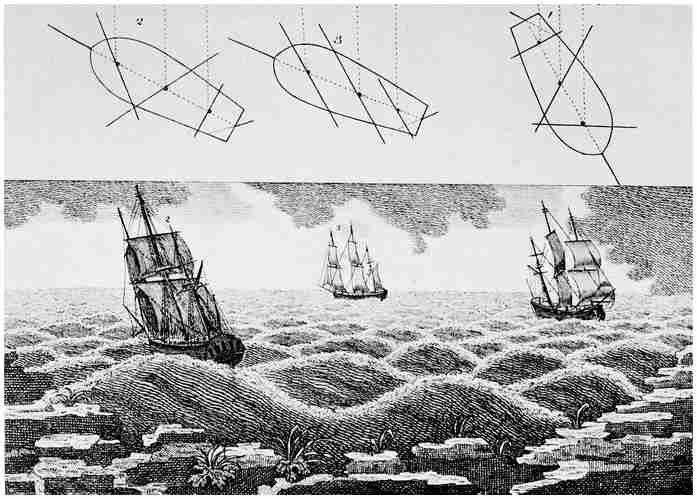
Sixteenth-Century Ship Before the Wind.
By a Contemporary Artist. Notice the square lids over the portholes.
Before we conclude this chapter we must not omit
to say something of the improvement in naval strategy,
tactics, and discipline during the Elizabethan period.
You will remember that important campaign of 1587,
when Drake took an expedition out to Cadiz, sunk and
burnt an enormous quantity of the enemy’s tonnage,
repulsed the attacks of the Mediterranean galleys—completely
beating this type of craft at her own special
game and in her own waters—captured large quantities
of supplies intended for the Armada, and demonstrated
himself to be no man of medieval conceptions, but a
modern strategist by waiting at Cape St. Vincent,
where he held the real key to the situation—able to
prevent the fleets from Cartagena and Cadiz from
reaching Lisbon. You will remember, too, that after
terrorising the Spaniards and their galleys he set a
course for the Azores, captured the mammoth San
Felipe, homeward bound from the East Indies with a
cargo that, reckoned in the money value of to-day, was
worth over £1,000,000; and what was more, discovered
from the ship’s papers the long-kept secrets of the East
Indian trade. Finally, during that same historic voyage,
when friction broke out between the modern strategist
Drake and his medieval-minded vice-admiral William
Borough, the latter was promptly court-martialled,
tried on board the flagship by Drake, Fenner, and the
other captains, and deposed from his command.
Now, what was the net result of all this? We may
sum the matter up in the following statement. It gave
the death-blow to the medieval methods of fighting and
inaugurated the scientific idea of strategy. It demonstrated
the fact that even in those circumstances when
the big sailing ship was at her worst, viz. fighting in
sheltered waters and in a flat calm, when the galley was
certainly at her very best, yet the former could annihilate
the latter. Contrariwise, the capture of the San
Felipe showed that even the biggest ship afloat could
be made a prisoner if only the captor went about the
matter in the right way. And, finally, it inaugurated
real naval discipline, even for the highest placed officer,
and instituted the Court Martial.
And yet during the time of Elizabeth, though her
admirals realised the value of strategy, yet they failed
to understand fleet tactics. There was no regular order
of battle. Howard’s fleet against the Armada in 1588
had been in action twice before it was organised into
proper squadrons. During that nine days’ fighting the
old idea of boarding, that had continued from the Greek
and Roman days, through Viking and medieval times
till the sixteenth century, was clearly giving way to
the practice of broadside gunnery. But what is important
to note is the fact that though the Elizabethan
admirals were realising the superiority of the gun to
the boarding pike, yet they had not become sufficiently
logical to devise a battle order for enabling their
guns to be used to the best advantage. Nevertheless,
there was a partial appreciation of this important
principle. The idea of fighting in line-ahead was
certainly in their minds, and there was a tendency for
the fleet to break up into groups, each group delivering
its broadsides in succession on an exposed part of the
enemy’s formation. A contemporary chart depicting
the Armada and the English fleet at the different stages
of fighting in the English Channel unquestionably
shows the Queen’s ships standing out in line-ahead
formation from Plymouth Sound, getting the weather
gage of the enemy, and then firing into them from the
windward side. Spanish evidence admits that the
English were “in very fine order.” And it is quite
curious to observe that though Spain and Portugal had
led the way towards scientific seamanship and navigation,
and England had followed, yet the Spaniards still
looked upon gunnery as a dishonourable practice, still
retained the medieval idea that gentlemen would fight
only with swords; and therefore these South Europeans,
unable to fight at a distance, used their best endeavours
to close with our ships and carry on the contest after
the manner of the tactics which Greek and Roman and
Viking and Crusader had adopted.
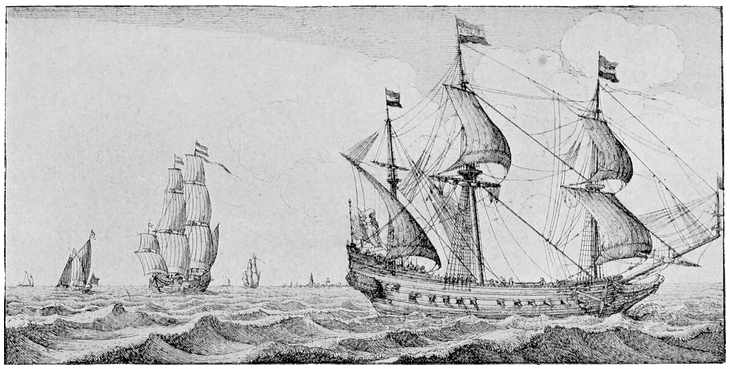
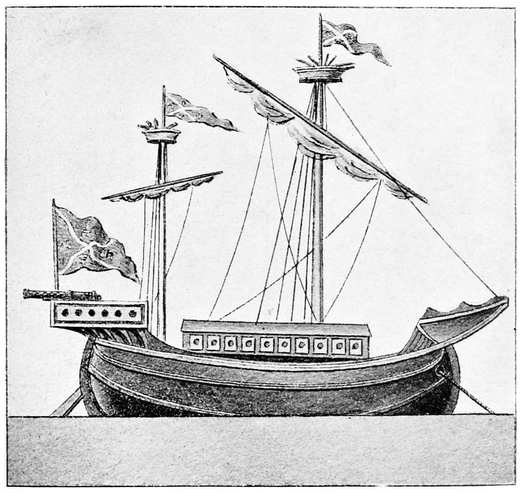
Early Seventeenth-Century Ship of War.
By a Contemporary Artist.
It is true, also, that the Portuguese showed no little
courage and enterprise in their shipbuilding. Some of
their fifteenth-century caracks were four-deckers, of
fifteen hundred and two thousand tons, with forty
guns and a thousand sailors, soldiers, and passengers.
And, even if they were not by disposition and natural
endowment great sailors, yet they were splendid navigators.
But they were never great shipbuilders in the
scientific sense, since they built by rule of thumb. The
Portuguese had, indeed, done much for cartography,
and yet until the Dutch Gerard Mercator introduced
his “Mappemonde” in 1569, containing a new method of
projecting a sphere upon a plane, the problem of how
to sail in a straight line over a curved figure still lacked
solution. The Dutch Wagenaer, of whom we spoke
just now, historically certainly owed a great deal to
the achievements of the Portuguese and Spanish, but
already by the year 1577 he had written on navigation.
His charts of Dutch harbours and of the Narrow
Seas were, for their limited purpose, of more value
than any charts which had come from the South of
Europe.
It has been well said by a careful writer that British
seamanship has been historically the cause of British
supremacy, and that most British sea fights have been
decided by bringing single ships to close action, laying
ship against ship. If this statement is true, it is especially
applicable to the Elizabethan period, when
seamanship was our strong point and tactics our
weakest. Never before had English sailors reached
such a high degree of proficiency therein; never in so
short a time had it done so much to mould national
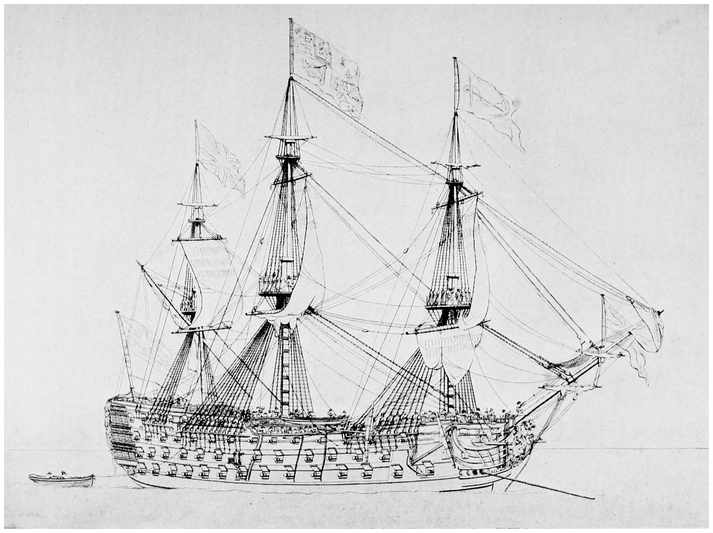
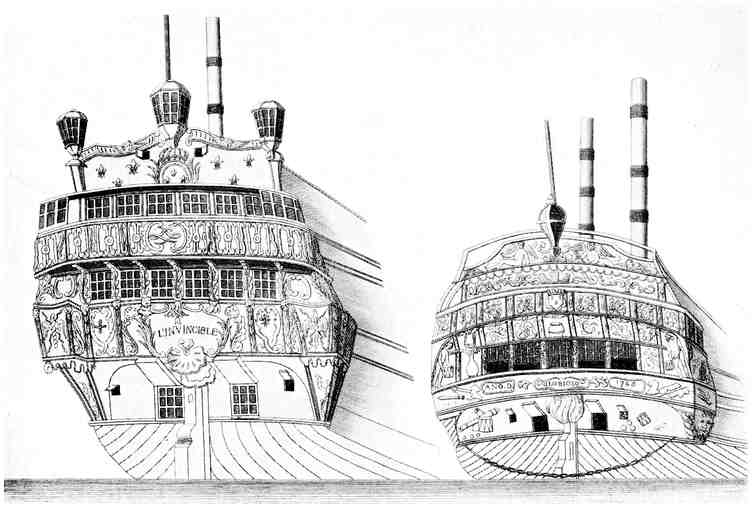
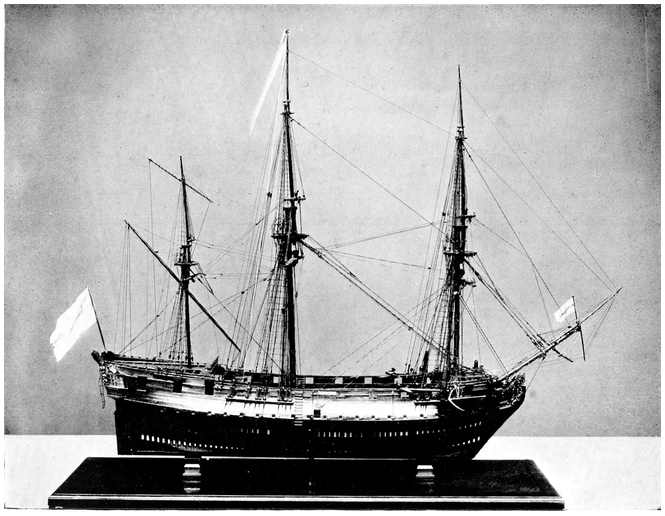
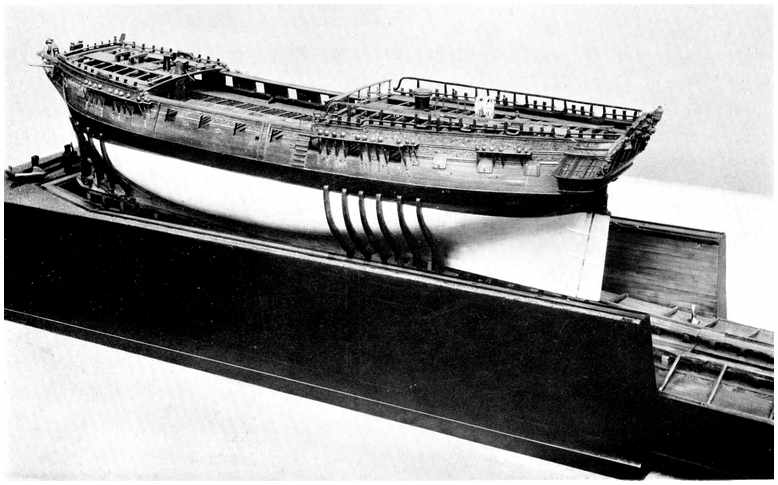
history, and to lay the foundations of an Empire.