Stopping leaky boats.
In traversing wild countries, or examining their coasts, lakes, or
rivers, boats of some kind are indispensably necessary. The traveller
may, perhaps, be fortunate enough to possess one or more sound and
seaworthy. More frequently, however, it will be his lot to have either
some sun-dried leaky craft, crank canoe, or unstable raft, on which
to entrust his life and equipment, when his ingenuity and powers of
resource must be exercised in order to successfully contend with the
various shortcomings and failings he will certainly discover. If a boat
be very leaky, and is so rotten as not to be reparable by ordinary
means, cover the whole bottom with canvas to above the water line,
and paint it, she will then be perfectly tight, and also very much
strengthened and protected against external injury. Should the canvas
even be left unpainted, it will be found to reduce the leakage very
considerably. Turn the boat bottom upwards, take a breadth of canvas
for each side, or, if one breadth be not wide enough, increase it as
much as necessary by stitching on another. Lay one edge of this against
the keel, just below the garboard streak; fasten it with copper tacks,
or if with iron pump tacks, dip them previously in thick white paint,
varnish or boiled oil, to prevent them rusting the canvas. Wet the
canvas, and stretch it tightly, tacking it on the stem and stern post,
so as just to cover the insertion of the planking; then stretch the
upper edge to the moulding, just below the wash-streak, and nail it on
there. It might, if necessary, be carried right up to the gunwale; but,
in this case, it must be defended by a moulding or ribband of plank
from chafing against the side of a vessel or pier. In the case of a
gig, or long sharp boat, the canvas will give or stretch sufficiently
to adapt it to the required form; but in one with a short bluff bow and
stern, it must be fitted either by neatly folding the parts necessary
to be reduced, or by cutting and stitching it to the shape required.
Make-shift outrigger.
If a small boat crowded with passengers has to leave a wreck in a
heavy sea, she may be preserved from sinking or overturning by lashing
across the gunwales a couple of oars (cut, if there is time for it, to
a suitable length), and fastening to them, outside the boat, four small
water-casks or breakers; these would somewhat impede her progress, but
buoyancy and safety, and not swift sailing, are the chief requisites
in leaving a wreck. Breakers lashed under the thwarts, or bow and
stern sheets, are sometimes used; but, though they impart buoyancy to
a water logged boat, they take up room, and do not give the additional
stability which is afforded when they are placed outside.
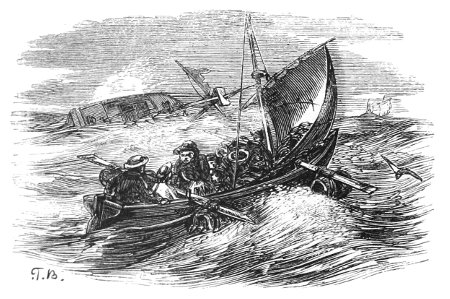
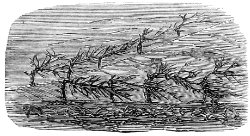
BOAT WITH BREAKERS OR SMALL CASKS AS OUTRIGGERS.
Rafts.
The cumbrous mass of spars, water-casks, and other stores, which want
of stowage under hatches often forces small vessels to carry upon deck,
may easily be converted into a perfectly safe and buoyant raft, ready
for instant use on an emergency, by the following arrangement of the
lashings.
The spars, amongst which will generally be found one fit to make a
topmast, another for a lower yard, and, perhaps, one or two more of
equal length, are laid fore and aft on either side the main hatch; the
water-casks, perhaps half a dozen on each side, are lashed to them;
while the space between is occupied by the long boat, and, perhaps, one
or two casks of meat or other stores, the whole being secured to the
deck; but all this floating power is neither connected in itself, nor
easily detachable from the sinking vessel.
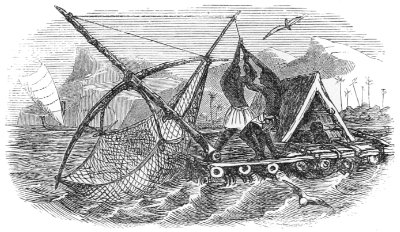
It would not be much more difficult, when securing the row of casks
and spars on either side the hatch, to connect all these by short
spars lashed across the ends, as shown in the engraving, with a couple
more crossing near the bow and stern of the long boat, and bearing
others passing fore and aft beneath her bilge, to which she might be
secured by lashings perfectly independent of the gripes by which she is
fastened to the deck. Indeed, the chief requisite is to keep all the
lashings that connect the parts perfectly clear of those which hold the
raft to the vessel, so that, in case of need, it could at once be cut
clear, and allowed to float bodily off from the sinking hull.
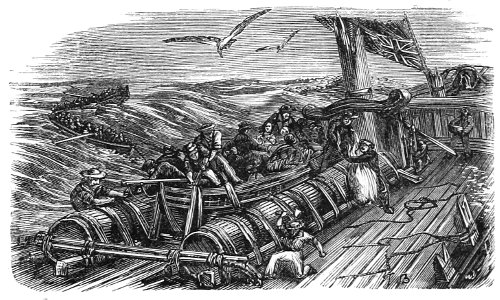
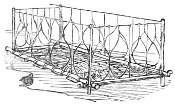
THE SPARS AND WATER-CASKS CARRIED ON DECK WITH THE LONG
BOAT, USED AS A RAFT.
We have stated the absolutely necessary points as simply as possible;
but many improvements might easily be suggested, such as the four
casks, at the ends, being pointed like conical buoys, so as to offer
less resistance to progress through the water; or that in two or more
of the aftermost casks a quantity of salt or preserved meat, biscuit,
or groceries should be kept in store for any emergency.
The smaller spars, of which there are generally plenty on board,
might be crossed upon this framework, so as to make a platform, and a
studding-sail spread over would prevent small things dropping through,
or help to support the crew or passengers.
The boat, however leaky or battered, would always be a place of
security and comparative comfort for the ladies or children, as the
power of floatation would be in the spars and casks. We believe the
Spaniards always endeavour to secure a boat on any raft they are
obliged to make, using her, no matter how much she may be stove or
broken, as a place of rest or refuge for the helpless or the weary.
It would be superfluous to give directions for the rigging of a mast
or steering apparatus. Seamen in emergencies would improvise these
according to the means at hand. Two or three small spars set up as a
triangle would carry sail, where, perhaps, a mast could not be stepped;
and the oars of the long boat, assisted by the trimming of such sail
as could be set, would be most likely the readiest appliances for
steering. Sometimes the “bridge” of a paddle steamer is made like a
caisson, and shipped in grooves, so as to float off should the vessel
sink. Small craft trading in the Indian islands, which carry a quantity
of bamboo as small spars, are thus provided with a natural substitute
for life-buoys, and a material for constructing rafts, or rendering
boats, though leaky as so many sieves, perfectly unsinkable. Rafts of
the large hollow stems of the bamboo are frequently used by fishermen
in the Indian archipelago.
Life-belts.
It may, perhaps, be of little use to suggest that before a vessel
leaves port attention should be given to the means of saving life
should she go down at sea. The possible foundering of a seaworthy
vessel is about the last thing a sailor thinks of; he trusts more
to his presence of mind and ready application of the means at hand.
Nevertheless, provision against danger would cast no imputation on
their manliness. The law compels a proportionate number of boats to
the complement of crew or passengers. Some owners provide cork belts
or jackets for the men, with mattrasses, pillows, or cushions of
cork, for the berths or sofas in the cabin; and it would be well if
every passenger making a sea voyage were to provide himself, and each
of those depending on him, with a life-belt, either of cork or of
inflatable material, and likewise see that these were not stowed away
in chests below the hatches, but kept at hand in the berths so as to be
available when wanted; and also that their use was perfectly understood
by those for whom they were provided.
We have seen a waistcoat with inflatable lining carried far into the
interior by one of the boldest elephant hunters in South Africa; and it
is stated that, after the sinking of the ill-fated steamer “Arctic,”
some of the passengers provided with belts floated on the surface of
the Atlantic for some days, giving, with a kind of desperate humour,
the names of different hotels to the piece of floating wreck at which
they had “put up last night,” or intended to do so for the next.
It is a pity that none of the waterproof materials at present in use
are comfortable in ordinary wear, so that some common article of dress,
as a neck-tie, a belt, or sash, might be made so as to be inflatable
when an accident occurs.
Of all that we know at present, we should say the most effective,
simple, and secure from damage, is the ordinary cork jacket, of the
pattern supplied by the Life-boat Institution; it is sufficiently
buoyant, does not impede the exertions of the wearer, and cannot be
damaged by collision with rocks or other hard objects.
Life-buoys.
Perhaps the circular life-buoy now in common use is as good as any, but
it requires some address and strength on the part of the swimmer to get
it over his head to its proper place beneath his arms; it also lies
low on the water when thrown overboard, and if at any distance is not
easily seen by the swimmer or by the boat’s crew who eventually go to
his assistance.
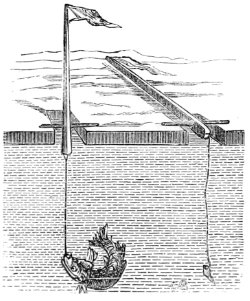
In the navy a breaker or small cask is used, with a staff six or eight
feet long passed through it, the lower end projects say three feet, and
is loaded with lead; the upper will stand from four to six feet above
the water, carrying a small red flag by day, or a port-fire by night.
The slings of the buoy are brought up to the taffrail and looped over
a small pin, which is withdrawn by pulling the trigger of a gun lock,
and a quick match led to this at night serves at the same time to
ignite the port-fire, so that the swimmer, the boat’s crew, and the
commander of the vessel, have a conspicuous object to make for and are
so prevented from losing each other.
In larger vessels, we believe, two breakers are used, connected by
saddle-shaped iron bars; these enable one, or perhaps two men to sit,
with their shoulders considerably above the surface; while beckets
of rope all round would enable a greater number, say the crew of a
capsized boat, to support themselves with a fair chance of safety. The
size, however, of a life-buoy must always be limited. It is mostly
required to save one person who has fallen overboard; and, though
perhaps sufficient to support more, it should never be so large as to
be dangerous or inconvenient when taken into the boat put out in a
heavy and dangerous gale to the rescue.
Several fathoms of small line should be and often are attached to the
buoy, so that if it is let go in time the swimmer may catch it, and be
saved without the necessity of lowering a boat. We have seen a “life
line” of coir or cocoa-nut fibre, which is very buoyant, successfully
veered away to an overladen and endangered boat at a considerable
distance, when a hempen rope, which sinks by its own weight, would have
been of no service.
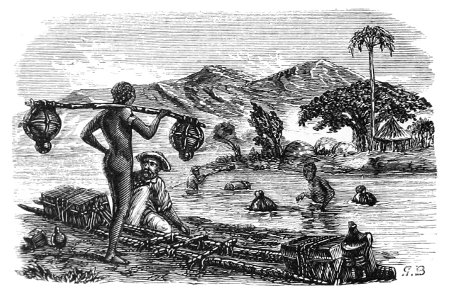
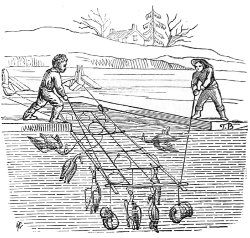
THE CALABASH FLOAT, MAKORO OR MAKARA, OF CENTRAL
AFRICA.
Calabash float.
Nearly similar in principle to this last-named life-buoy is the
calabash float, described by Dr. Barth as being used by the natives of
Central Africa; it is simply a bar or plank of light wood, so laced to
the bottom of two large calabashes, that a man sitting on the bar, as
he would upon a saddle, will sink about waist deep, and may use his
hands to paddle himself across the stream.
Reed boat.
Our illustration shows how any buoyant article in the traveller’s
possession might be used in this manner. The boxes shown on pp. 8 and
9 are designed expressly for such emergencies. Small water “vatjies,”
barrels, or tin cans, wooden boxes, even though somewhat leaky,
wrapped in canvas or two or three thicknesses of calico, which need not
be cut, would become sufficiently tight for a short voyage. To make a
reed boat, take reeds of any length you wish, a foot or two more than
half the length of your boat, lay them lengthwise on level ground, with
their small ends toward the ends of your intended boat, and their butts
overlapping each other by a foot or two; take cord or other material
for lashing, and interweave it with the reeds till the part in the
centre resembles a flat cheese-mat, then bend it round the hoop which
you intend for the midship frame. Insert smaller frames toward each
end, and finally gather up the ends of the reeds into a point, cover
this with some waterproof material, oiled calico or canvas, &c., or
canvas simply pasted with flour and water, and you will have a boat
buoyant and more or less durable according to the strength of the
material.
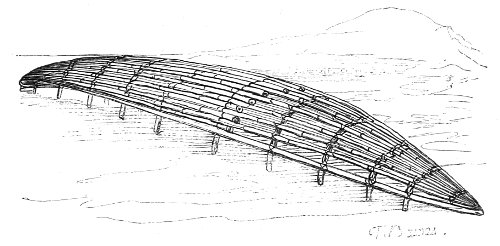
REED BOAT.
About 1844 we made such a boat in Cape Town, using what are there
called Spanish reeds, which run between 10ft. and 15ft. in length,
three quarters or an inch in their greatest diameter, tolerably strong
and very buoyant; these were lashed on wooden barrel hoops with a
light deal keel and gunwale, and covered with two thicknesses of oiled
calico. There was no leakage, and our little skiff was so light that
with the assistance of a friend we easily carried her to and from the
house in which she was built. We often ventured beyond the shipping
anchored in Table Bay, our guns being secured by lanyards to the boat
in case of accident.
Reed raft.
On parts of the Nile where reeds abound, the natives make them up into
bundles of perhaps 8in. or 10in. in diameter at the larger end, and
tapering almost to nothing at the smaller; three or four of these are
fastened side by side, their points are made to curve up a little,
and they form a portable and convenient vessel for crossing the river
or conveying small cargoes of grain or other produce to market. The
stoutest part of the fan-shaped leaf of the doum palm is used as
a paddle. The float is not a heavy load for one man, when carried
overland, and one supported by a forked stick, or three or four with
their larger ends set on the ground and the smaller resting against
each other, form very good sun-shades, or huts to protect the inmates
against more inclement weather.
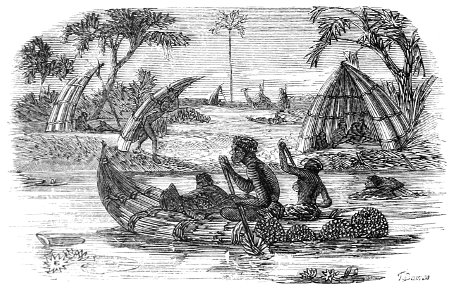
REED RAFT AS USED ON THE NILE.
We have seen very useful and commodious rafts made by cutting very
large quantities of marsh reeds, fastening them up roughly in bundles,
laying these side by side, and then arranging another layer of bundles
across the lower tier. A few vines, or twisted reed bands, serve to
keep the bundles in their places, whilst a thick layer of loose reeds
on the top makes a level surface for the traveller and his baggage to
rest on. As the lower reeds become saturated with water others can
be cut, and added to the top. Long river voyages, floating with the
stream, have been accomplished on rafts of this description. Bamboo
canes, when they can be obtained in sufficient number, form excellent
rafts. They are also extremely valuable as outriggers, and outrigger
beams for canoes, adding greatly to their stability.
In other parts, where reeds are not so common, floats of wood are used
as an assistance to swimmers.
Floats.
When swimming our horses over many of the wide and rapid rivers of
Central India, the natives who were employed in guiding the animals,
first swam across with them without any artificial assistance, and
then returned for others with billets of a peculiarly light wood held
between their left arms and sides, under the shoulders; with these
appliances, they floated with extraordinary buoyancy, and made rapid
progress across the stream.
The inflated skins or intestines of animals, hollow gourds, earthen
pots, bladders, or bundles of bark, may be used as aids in crossing
rivers where canoes or rafts cannot be constructed.
Cattle boat.
On some of the great Indian rivers, large dish-shaped boats are used
for the conveyance of horses or cattle. A boat of this description is
very quickly made by first forming a basket-shaped framework of bamboo,
here and there interwoven; this is securely lashed together with strips
of raw hide, twisted cane, or common cord. When completed, the basket,
or frame, is turned upside down, on the ground, pegged fast with hooked
pegs cut from the branches of the nearest tree, and then covered with
raw bullock hides, which are sewn fast to the frame, and to each other,
grease being well rubbed into the seams. When complete, the boat is not
unlike a common tea-saucer—measures between fourteen and fifteen feet
in diameter, and is about two feet eight inches deep; made to these
dimensions, the hide boat will safely carry from three to four tons of
cargo. There is no possibility of upsetting it. When horses or bullocks
have to be conveyed in contrivances of this kind, it will be necessary
to lay branches of trees, and a good layer of reeds, or sedge grass, on
the bottoms, in order to prevent the animals from thrusting their hoofs
through the hides. The water-draught of hide boats is surprisingly
slight, from five to eight inches being sufficient to float one with
a full load on board. Long-handled shovel-shaped paddles are used to
propel them with, and a store of raw hide, and some tallow, and an
eyed awl, or large needle, for patching, enables the boat voyager to
execute with expedition all the repairs his leather craft may need. All
hide-covered boats, or floats, should be occasionally placed bottom
upwards, on shore, to dry, in order to render the skins more durable.
Coracle.
The coracle, so much used by Welsh fishermen, is made much after
the same fashion. A smooth level piece of turf being chosen, the
frame-sticks, just such as coopers use for making into hoops, are bent
and interwoven until the requisite form of the frame has been arrived
at, the bottom being upwards. The edge, which afterwards becomes the
gunwale, is formed by making a border of hazel-wand basket-work, the
ends of the frame-sticks are trimmed off even with this, and a covering
of Russia duck, or light canvas, is neatly sewn over all. The coracle
is then paid over with tar, or some other water-proofing material; one
thwart, or seat, is secured from each end to the framework, holes are
made in this for a leather strap to pass through, which enables the
fisherman to carry his coracle on his back. A single-bladed paddle,
like a baker’s oven pile, is used to paddle with. Some considerable
practice is needed to enable a new hand to conduct, or, as it is
called, drive a coracle—not a little caution is required in both
getting in or out. It is best, if possible, to depart from some shallow
sand-spit, or gravel bed, where the coracle may be shoved off into
deeper water, after the tyro has taken his seat, and established the
proper balance. In landing, it will be well to observe the same caution
until practice and experience give the confidence and dexterity which
they alone can confer. There is a peculiar stroke of the paddle much
used in coracle driving, to which the canoe man seldom has recourse.
This is gained by turning the left arm round the handle of the paddle,
until the hand is a short distance above the blade, and the shaft
rests against the shoulder. The paddle blade is then worked in a
figure-of-eight direction.
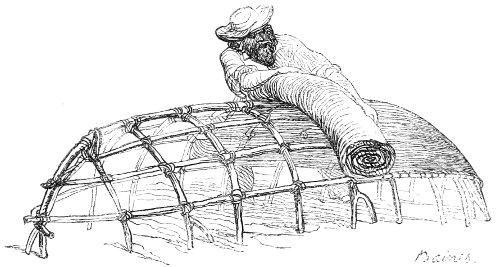
SKIN BOAT.
Skin boat.
The size of skin or canvas-covered boats will usually be determined
by the available amount of skin or covering material. Any waggon ox
requires 8ft. of room to work in, and his skin would give a square of
leather of very little over 6ft.; the African buffalo would be about
the same, the eland somewhat larger, the black or brindled gnoo, the
koodoo, and some of the larger antelopes, rather less. Suppose you
have two ox skins; cut them straight across where the neck is at its
widest, and let the natives or waggon-drivers stitch them together
with strong sinews or thongs of hide, using a round awl or piercer,
to make a round hole that will close again, and not a sharp-edged one
that will cut the hide and so leave holes that will afterwards become
leaks. The sheet should be kept damp, not wet, by spreading ox-dung or
damp earth upon it till the frame is ready. Suppose it now to be 12ft.
long and 6ft. wide; you may make your boat of from 3ft. to 4ft. in
width, and 10ft. in length and 2ft. deep. If you care to have definite
stem and stern posts, it is very likely that poles may be found with
branches projecting at the required angle, but practically it is best
to let them curve more or less gradually into the line of the keel,
and for this purpose to choose two long straight poles; bend their
thick ends round a tree to rather more than the requisite curve, as
they will always straighten again; then, having chosen a flat piece
of stiff ground, make two holes 10ft. apart, for the thick ends of
your poles to rest in, bend down their thin ends, let them overlap,
the farther the better, and lash them together; then take another of
about 8ft. (or a foot longer on each side than the width of the skin),
and having curved this, stick the ends into the ground, about 3½
ft. or 4ft. apart, and lash it where its centre passes under the keel;
do the same with two others, 18in. on either side, and you will have
the three midship frames; take two poles for each gunwale, join them
by overlapping their thin ends as before, lash them to these central
frames, so far from the keel that the edge of the skin will just cover
them, bend them till they come together at the bow and stern, let them
cross each other by a few inches, lash them tightly, and do not be in a
hurry to cut their ends too closely; the curve they take will guide you
in the insertion of the other frames. As you come nearer to the bow and
stern, forked branches of the proper angle may be advantageously used,
and along the sides, where the rowlocks come, forks may be left on the
extremities of the ribs to serve for them; a fork may also be lashed
in at either end for steering or sculling. Lay two or more ribbands
or bilge pieces along each side; fasten in such boards or poles as
you have for thwarts, and, when the whole is firmly lashed together,
spread over it the prepared hide and stitch it all round to the pole
that serves for gunwale, the hair, if you have not already scraped it
off, being inwards; grease plentifully while it is still wet, and then
let it dry; look carefully to the seaming; give this as much grease as
it will absorb, or you can afford; and when it is quite stiff, saw off
the superfluous timber ends, not too close; turn it up, and it is ready
for use: never let your boat lie in the water longer than is absolutely
necessary, and turn it bottom upwards whenever you haul it ashore. The
quagga hide is proverbially rigid; and we should think that if taken
off by merely making one slit along the belly, distending with dry sand
and letting it harden in the sun, it would make a tolerably safe boat
in smooth water for one person, without any other fitting.
We have heard of mules or transport animals being killed when water
carriage became available; their flesh jerked for future provision, and
even their ribs pressed into service to do duty without even a change
of name in the canoes for which their hides served as coverings.
Russian cargo boat.
In the United Service Museum is a very carefully-constructed model of a
Russian cargo boat from the Aleutian Islands, Commander Pike, R.N., the
donor, states that it carries 3½ tons of fur sealskins. No metal is
used in it, the wooden frame is pegged or lashed together, and covered
with walrus hide. No dimensions are given; but, as very nearly three
feet are required for one oarsman, it is probable that the boat would
be 25ft. long and 8ft. wide near the stern; it will be noticed that
there are but single thole pins, and therefore grummets of rope or iron
must be fastened on the oars.
Esquimaux boats.
The other boat is the oomiak, or woman’s canoe, of the Esquimaux.
The frame is made of drift wood and bone, often in very small pieces,
but so tightly pegged and lashed together with hide thongs, that the
compound seems fully as strong as a single piece; it is very neatly
covered with sealskin.
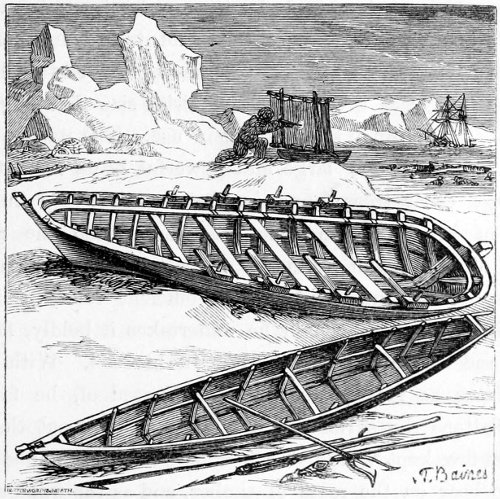
RUSSIAN AND ESQUIMAUX SKIN BOATS
The method of constructing the frames of both these varies but
little from that we have just described, and we think will be made
sufficiently plain by the drawings copied by permission from the models
in the Museum.
The kayak, or man’s canoe, is longer, sharper, and narrower, and is
completely covered with sealskin, with the exception of a circular
aperture in the centre, and from the edges of this a skin comes up
so as to tie tightly round the waist of the daring walrus or seal
hunter, so that not a drop of water can enter his little vessel; while
even if by any accident she should capsize, a vigorous stroke of the
double-bladed paddle will suffice to right her; the harpoons or other
weapons cannot possibly be lost, for bladders are attached to the lines
of those prepared for use; while the reserves are not cast adrift till
they are wanted. Marvellously ingenious as these fur-clad boat-builders
are, their frail craft are so difficult to handle that no ordinary
explorer can, without long practice, hope to use them with much
success. Still there are many points connected with their construction
well worthy of imitation.
The small sledge in the background has a screen of skins suspended
across it, in which a hole is made for the seal-hunter to fire through.
Dug-out canoes.
Canoes, hewn and dug from the solid tree trunk, are general and
valuable; and there are few portions of the earth where forest trees
grow to the requisite size that dug-out boats of some kind are not in
use. The natives of British Columbia construct very large and powerful
boats from the trunks of the huge cedar trees found in that country.
To the fortunate possessor of the axe, the adze, the gouge, and the
mallet, the formation of a dug-out canoe is a matter of comparative
ease; but to the Indian, unprovided with efficient tools, it is a
task of no ordinary magnitude, still he undertakes it boldly, falling
back on shifts and expedients to aid him in his toil. With such rude
implements as he may chance to be possessed of, he fashions the
exterior, flattens the surface of the log, and hews out the bow and
stern; then fire, kept within due bounds by the assistance of clay,
is brought to bear on the mass of timber, and as the wood ashes form,
and the wood becomes charred, a sharpened stone or thick sea-shell is
used to remove the mass and expose a fresh surface. By dint of labour,
patience, care, and perseverance, the shell of the boat is at length
formed, but lacking the curves and contour needed to render it stable
and seaworthy. Indian ingenuity again steps in to meet the difficulty.
The boat is filled to the brim with water, a huge fire is lighted, and
a number of stones heated to redness. These are one by one dropped into
the unfinished canoe, until the water is raised almost to the boiling
point; then when the wood is under the full and softening influences
of the heated water and steam, transverse bars of wood are driven in
one after the other, until the requisite breadth of beam and bilge are
gained. The water is then removed, and the canoe allowed to dry with
the bars in it, when the shape thus given remains as long as the boat
lasts. The removal of the bars and a little polishing up renders the
canoe fit for sea. It is not uncommon for craft of this description,
manned by crews amounting sometimes to as many as thirty, to brave the
turbulent and formidable seas of the Pacific Ocean, in pursuit of the
sea-otter, fish, &c.
We have seen many canoes of this description on the large rivers
of Central India, Australia, and on the Zambesi. The aborigines of
Australia are also in the habit of using bark canoes of the most
primitive form of construction. A sheet of bark of suitable size is
stripped from the nearest tree, the ends are guarded by little walls of
clay, and with a rude stick for a paddle, and a lump of moistened clay
for a fire-place, Corry, armed with his unerring spear, starts on a
fish-hunting expedition on the pond or river.
Models of platform boat.
During the years 1863 and 1864, while enjoying the hospitality of our
late friend Charles John Andersson, the chief, as he may be called, of
the persevering explorers of South-West Africa, we devoted considerable
attention to the construction of models of boats for the purposes of
discovery and river navigation, and of substitutes for them. The first
essential in the case before us was that of portability of the boat
or of the materials to make it; the second, facility of construction
when it reached the water, equal facility of separation into its
original parts at any interruption of the river course, and also of
reconstruction after it had been carried to a point where navigation
could be resumed. Another, and not less important condition, was, that
the materials should be such as were obtainable either in Damaraland,
or, at farthest, from some of the vessels that occasionally called
at its bays or harbours from Cape Town. The conversion of the usual
waggon gear into a float will be presently treated on; and we will now
describe the model we constructed for our boat, suggesting to explorers
that when they find themselves under the necessity of building, they
will save much time, trouble, and anxiety as to the result of their
labour, by proceeding nearly in the same way.
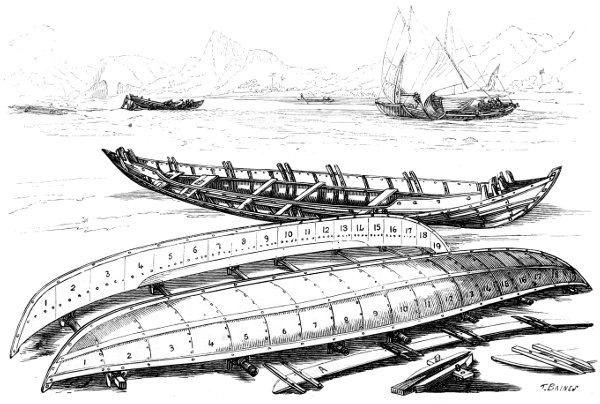
DOUBLE BOAT OF IRON OR COPPER CONVERTIBLE INTO A
SINGLE BOAT WHEN NEEDED.
In the first place, we had decided on the use of sheet metal, plain
or galvanised iron in sheets of 6ft. by 2ft., or copper of 4ft. by
2ft., with screwed bolts and nuts in either case of exactly the same
metal as the sheets, so that any galvanic action should be impossible.
Next, the framework must be of wood; and as to form, it was absolutely
necessary that the boat should have beam and buoyancy enough to launch,
without fear of submersion through any rapid that had water enough to
bear her clear of rocks, and was not steep enough to be considered as a
waterfall. We purposed to put the materials together on the spot; and,
therefore, their weight only, and not the dimensions of the boat, were
taken into consideration with regard to waggon carriage.
For the mere purpose of passing from the head of the river navigation
to the sea, and thus proving that such navigation was possible, nothing
more than a single boat would be required. But for observing, mapping,
sketching, or otherwise improving to some useful result the various
opportunities of the journey, sufficient room must be provided for the
voyager to work comfortably on deck instead of sitting cramped up in
the stern-sheets, and we, therefore, decided on making ours capable of
being used as a double boat when the breadth of the river permitted it.
The advantage of being able to use each part when separate, as an
independent boat, so that the sharers in the voyage might trace
separate branches of the river, had to be balanced against the
disadvantage of having to take each of these singly through rapids,
which their dimensions might not insure their passing in safety, and
also against the fact that if the “double” is formed of two perfect
boats, they cannot attain great speed either in sailing or rowing, from
the fact that the volume of water admitted between the stems, which
may be, for example, 8ft. apart, must be compressed as it passes the
midship section, to 4ft. or 5ft., according to the breadth of beam of
the boats, and will again have to expand as it passes the gradually
increasing space between their “run,” or after section. And the loss
of power thus expended in “heaping up water,” although imperceptible
at a low speed, would become enormous if a higher rate were attempted.
Therefore we made our model so that when not required as a double, she
should become one single yawl or whale boat of 30ft. in length, and
6ft. beam, with 2½ft. internal depth in midships, rising to nearly
4ft. at either end to enable her to shoot a tolerably strong rapid
without shipping water; the two sections were therefore each made like
half a whale boat, the outer sides having their proper curve and the
inner being perfectly flat, so that when used doubly the water might
pass without resistance between them, and when singly they might be
clamped together as one boat by screwed bolts through the keel, stem,
stern posts, and the inner gunwales.
Our first care was to seek out a block of soft, fair grained wood,
30in. long and 3in. wide, and to shape this truly to the form required
for one half section of our boat. We next provided a sufficiency of
planking, ribbands, &c., also on a scale of 1in. to the foot, and then
cut out from the thinnest tin case linings, forty pieces of 6in. by
2in., to represent our sheets of iron.
The dimensions of our boat had been previously so arranged that in the
midship section the depth of nearly 2 ft. on the flat side should leave
rather more than 4ft. of the iron available to form the curve on the
outer, necessary to give a half beam of 3ft.
In building our model we adopted slightly different plans with each
of the two sections. In that intended for the starboard side we laid
along the flat or inner side of our block or wooden mould a batten,
1/4in. square (representing one of 3in.) and 24in. long (each inch
being understood to represent 1ft.); to this we fitted the stem and
stern post, each 6in. in length, both exactly alike, curving and raking
forward and aft like those of a whale boat, so as to have an actual
height, before the keel was added, of 3¾in. We then laid along the
top of the flat side the inner gunwale 1in. deep, but as this would be
an impediment to the rowers when the sections were clamped together
to form a single boat, we cut out a piece (marked A, p. 106) ¾in.
deep and 18in. long, so as to be removable at pleasure, the remaining
quarter then forming the stringer on which the thwarts would afterwards
be laid, the bottom of the three-quarter piece (A) having checks cut
in it to allow it to fit over them. We then took the piece of tin
representing the midship sheet, and drawing a line across it, 1½in.
from its edge, bent it over the keelson, bolting the short end to the
thwart stringer, and bringing the longer one of 4½in. round the
curve to the outer gunwale; nine sheets were required aft and nine
forward of this, and the only difference in laying them was that, as we
proceeded forward, the edge of each sheet overlapped by nearly 1/4in.
the one behind it, while in working aft, the edge of each had to be
inserted beneath that which lay before it. When the curves of the stem
and stern were reached, the sheets had to be cut to the required form
instead of being bent, and were bolted in their proper places. The
outer gunwale, ⅛in. thick and ¾in. deep, was now laid on and bolted
to the metal sheets; another batten, ½in. wide, was laid from stem to
stern along the bilge, and the keel, ¼in. thick and deep, was fitted
in its proper place and bolted through the metal to the keelson.
Our half boat was now sufficiently firm to be taken off the mould. A
short stringer of 18in. was laid internally upon the floor, and another
the whole length along the inside on which to lay the outer end of the
thwarts; and timbers, ¼in. thick, were bolted in with their heads
projecting 1in. above the gunwale, so as to receive cross-beams of
½in. in thickness and 15in. long, by which the sections were kept
apart when used as a double boat. We considered it better to secure
the beams by cross-lashings than by bolts, which, if the boats worked
much in troubled water, would probably rend the parts they served to
connect. Along the gunwales, at short intervals, we intended to use
lighter cross-beams, probably of bamboo, that is if it were procurable;
but having carried out our model sufficiently to establish the general
efficiency of our principle, we did not think it needful to spend time
in completing every little detail, and this called forth the free but
friendly criticism of Mr. Charles Bell, the Surveyor-General of the
Cape colony, whose valuable and practical advice we take the liberty of
giving (see p. 115).
The only difference of plan adopted in building the other or port
section was that we built the whole of the inner or flat side of plank
⅛in. thick, by which we were enabled to cut 1½in. off each sheet,
and this method in building a full-sized boat would have enabled us
to use copper sheets of 2ft. by 4ft. instead of iron of 2ft. by 6ft.
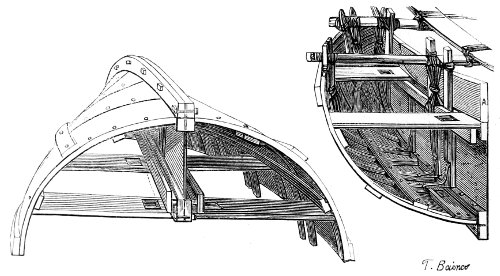
THE SECTIONS CLAMPED TOGETHER AS A SINGLE BOAT, OR USED
WITH CONNECTING BEAMS AS A DOUBLE.
Full-sized platform boat.
In building a full-sized boat on this model, our plan would be to
make the flat side all of ¾in. plank, with the stem, stern post, and
keelson all fast in their proper positions, and the keel left slightly
apart, so as to allow the sheets of metal, whether iron or copper, to
be inserted between it and the keelson. Then, laying the whole flat on
its side, we would cross cut with a fine tenon saw our wooden model
into eight pieces of equal length, and carefully enlarging the section
of each length would make as many temporary frames, and set them upon
the flat side, cutting checks in them to let in the stringers, which
when bent down to the flat at either end would very effectually give
the form of the boat. We would then fit the ribs, keeping them as light
as possible with due regard to strength, cutting them, if requisite,
out of wood selected with the proper natural curve; or, preferably,
using flexible wood, such as ash, in pieces 2in. broad, and ½in.
in thickness, and placing them not quite 2ft. apart, so that the
overlapping edges of the sheets might coincide with the ribs, and the
bolts might pass through them and also through the inner stringers, and
the outer ribbands and gunwales at all their points of intersection.
The ends of seven of these ribs, at nearly equal distances (as at
sheets 2, 5, 8, 10, 13 and 16, on p. 106), we would leave standing six
or eight inches above the gunwale, and about four inches from each we
would set up another of equal height, so that the cross-beams might lie
between them when required, and be secured by lashings passing down
to the first stringer (p. 110), or so that when the two parts were
connected as a single boat they might serve as rowlocks. Short struts
from the foremost pair of these would give great additional stability
to the masts.
In laying the deck, we should by all means endeavour to avoid
injuring the planks by boring needless holes in them, as they might
on an emergency be required for building a smaller boat. We should,
therefore, lash them with raw hide to the foremost and aftermost
crossbeams, and then laying lighter beams across near two or more of
the intermediate ones, fasten them down where requisite by strips of
the same material (p. 110).
For connecting the two sections, so as to form a single boat, we should
use screwed bolts ½in. thick, and 7in. long, passing at intervals of
about 16in. through both keels, stems, stern posts, and inner gunwales,
thus firmly clamping both the flat sides together. The two removable
portions of the inner gunwale (marked A) previously mentioned would, in
this case, be unshipped to allow the oars free play, as in illustration
on opposite page, and on page 106.
Copper is the only metal we should wish to use or recommend to others,
and all fastenings used with it must be of the same metal. We recommend
in this case, screwed bolts and nuts, presuming that the boat would be
built for a journey, the exigencies of which might oblige the traveller
frequently to take her to pieces and rebuild her; but as our own means
were at that time inconveniently limited, we made a calculation of the
comparative cost of plain and galvanised iron and of wood.
The mode of setting the sails, spreading the awning, &c., will be
sufficiently clear from the engraving (p. 106).
Our little model, when tried upon the flooded flats at Walvisch Bay,
sailed “like the wind,” but had a tendency to bury the lee-bow, which
was easily remedied by ballasting the weather quarter; an oar was the
readiest and most convenient means of steering.
Estimate of material if the boat be built of copper, the flats or inner
sides being of plank:—
| |
£ |
s. |
d. |
| 40 |
sheets copper, 2ft. by 4ft., 1lb. to the foot,
at 1s. 6d. per lb., or 12s. each |
 |
24 |
0 |
0 |
| 200 |
square-headed bolts, 1/4in. thick (with nuts),
½in. grip for the skin and ribs, |
 |
27 |
0 |
0 |
| 180 |
ditto ditto ½in. thick, 1¼in. grip
for skin, ribs, and stringers, |
| 180 |
ditto ditto 3in. grip, for ribs,
stringers, and timber heads, |
| 90 |
ditto ditto 6in. grip, for keel and
keelson and for clamping the two sections
together when used as a single boat, |
| Equal to 650 bolts, averaging perhaps 10d. each |
| 4lb. |
copper rivets, assorted sizes, for repairs |
|
0 |
12 |
0 |
| 6lb. |
copper nails, from 1in. to 3in. |
|
0 |
18 |
0 |
| 1lb. |
rooves, for clinching nails |
|
0 |
3 |
0 |
| 2 |
red deals, straight and clean, 21ft. long, 9in.
by 3in., cut into six pieces of 3in. square,
of which five will suffice to make the two
keels and keelsons; the remaining piece would
cut four stringers ¾in. thick. (If these deals
could be procured 24ft. long, four pieces would
do this, and there would be no necessity for
scarfing.) |
 |
4 |
0 |
0 |
| 3 |
deals of 21ft. each, cut into four ¾in. planks;
and 1 deal, cut into one 1½in. and two ¾in.
planks, would give fourteen ¾in. planks, of
which nine would suffice for the two flat sides,
two for the gunwales, 4½in. wide, and three
with the spare piece mentioned above for the
stringers and ribbands, while the 1½in. plank,
by careful adaptation of the requisite curves,
would cut for the four stems and stern posts, |
| Or equal to 6 deals, say |
| 2 |
galls. boiled linseed oil, in tin cans of 1 gall.
each |
|
0 |
12 |
0 |
| 4 |
galls. raw linseed oil, in tin cans of 1 gall. each |
|
0 |
16 |
0 |
| 28lb. |
white lead, in iron kegs of 7lb. each |
|
0 |
14 |
0 |
| 14lb. |
red ditto ditto ditto |
|
0 |
7 |
0 |
| (The cans and kegs will be useful as cooking or water
vessels when emptied.) |
| 30lb. |
resin |
|
0 |
10 |
0 |
| 6 |
paint-brushes and tools assorted |
|
0 |
6 |
0 |
| Tinsmith’s small shears or snips |
0 | 4 | 6 |
| Engineer’s hammer |
|
0 | 4 | 6 |
| 6 |
punches, from ⅛in. to ½in. |
|
0 | 9 | 0 |
| 2 |
screw-drivers, large and small |
|
0 | 3 | 6 |
| 2 |
screw-wrenches |
|
0 | 9 | 0 |
| 1½in. |
auger |
|
0 | 1 | 6 |
| 1 |
brace, and set of bits, including rymers,
countersinks,
and bits for metal |
|
1 | 4 | 6 |
| 3lb. |
brass screws, assorted, up to 3in. |
0 | 9 | 0 |
| 3 |
pieces unbleached calico, double width, for lug
sails, awning, &c. |
|
| 12 |
copper or composition cringles, small sizes, for
sails and various purposes |
|
| Manilla rope, 10 fathoms, 3in., for mooring |
 |
2 |
0 |
0 |
| Ditto 50 fathoms, 1½in. |
| Ditto 50 fathoms, 1in., for running gear, &c. |
| If the boat be built of iron the same size— |
| Forty sheets of plain iron, 2ft. by 6ft., at 4s. 6d. |
9 | 0 | 0 |
All the bolts, screws, nails, and other fastenings, must be of plain
iron, and none of them must be galvanised.
Galvanised iron would not be much cheaper than copper, and would be
very intractable in working. We should not recommend it to a traveller
who intends to build his own boats in the wilderness and expects to
have to take them to pieces and rebuild them two or three times.
Tinned charcoal iron would be nearly as expensive as copper, and the
fastenings would also have to be tinned.
Plain iron is the only metal on which any saving could be effected,
even at the cost of additional labour. In this case, perhaps, three
times the amount of paint should be taken.
A mixture of red and white lead, with half boiled and half raw linseed
oil, should be used rather thickly for painting the inside of every
joint, and all the bolts, screws, or nails, should be thrown into
boiled oil, then taken out and allowed to drain and dry before they
are used. The boat must be thoroughly well painted after completion,
and the paint allowed to harden before she is put into the water.
If the boat is built of wood the same size—
Two deals and a half, as before, for keels, keelsons, stems, and stern
posts.
Four deals, each to be cut into four ¾in. planks, for flat sides,
gunwales, and stringers.
Five deals, each to be cut into six ½in. planks, or equal to 230
running feet of plank, to stand, when cleaned, not less than ⅝, and
630 feet not less than ⅜.
| 5000 | copper boat nails, 1¼in., with rooves. |
| 28 | lb. iron nails, assorted, from 1½in. to 3in. |
| 2000 | iron screws, from smallest size to 3in. |
| 90 | ½in. screw-bolts and nuts, 6in. grip. |
| 200 | ¼in. screw-bolts and nuts, 3in. grip. |
| 6 | rods of 1/4in. iron, to cut into lengths for bolts, as required. |
| Paint, oils, &c., as before. |
If the traveller can afford to carry two or four good 12ft. ash oars
and one of 14ft., by all means let him do so. Nothing is equal to them
for pulling or steering, but let him carefully preserve his treasures, and
not put them to any use that will twist or warp. If he engages natives
as a permanent crew, they may be taught to pull very well; but if he
hires temporary helps, let them bring their own paddles, and they will
make the boat go well enough.
For the connecting beams, the masts, yards, &c., we should prefer
bamboo, as being exceedingly strong in proportion to its weight. In
the Indian islands we have seen oars made of bamboo poles, with a
disk of wood about as large as a dinner plate lashed on the outer end,
and the men pulled very well with them. If bamboo cannot be
obtained, poles may generally be cut in the vicinity of a river; but the
traveller in Africa or Australia must not expect to find any wood that
will possess all the valuable qualities of good red deal, therefore we
would say take as much of this as you can carry, without inconveniently
incumbering your vehicles. The battens we were able to take to the
Zambesi astonished the natives there, they had never seen wood so
light, so strong, and so even of grain throughout its length; while
the fresh smell it gave out when cut was their constant theme of
wonder.
In 1864 Mr. Charles Bell, the Surveyor-General at Cape Town, who
has built and used double boats since 1850, favoured us with the subjoined
description of his method of construction:—
“My boats are only 12ft. long by 9in. wide, and 9in. deep, and 12ft.
by 14in. I have never made them more than 15ft. long, with a bearing
power of about 800lb. I have now built or directed the building of
about five good boats on the principle, easy and swift under oars or
before the wind under sail, and not very faulty even on a wind without
any false keel, but you can never sail quite close without one. Mine
were built to go through heavy surf all fore and aft, so that the wave
could strike nothing except sharp edges, and in surf they are first-rate.
“Iron is objectionable both on account of weight for carriage, and
liability to oxidisation in heat and moisture; nothing like canvas. A
bolt of No. 3, 2lb. of tin tacks, and a few needles and hanks of twine,
would be all I would bother myself to carry a mile. My first boat had
not an ounce of metal in her barring rowlocks and rowlock sockets,
and she cost me 17s. 6d. and some old plank, and carried me safely
through wall-sided breakers that would have troubled a whale-boat’s
crew. Say you want a pair of 30ft. boats of 3ft. beam and depth,
tolerably safe even against snags and rocks. For each take a 30ft.
batten, 3in. by 2½in. for keel; strut and erect on it knees’ planks and
stem pieces as in Figs. 5 and 6, and section in Fig. 2 (p. 116).
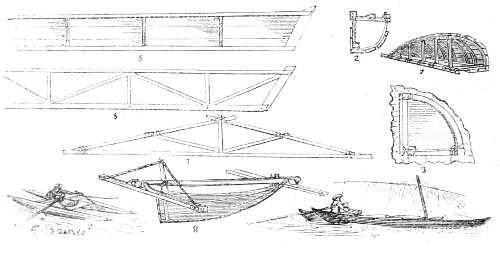
“Trust greatly to lashing the frame; let the knees diminish in beam
from the centre to each end as in Fig. 1 (p. 116): draw in your side
pieces and planks, or rather press them down to your vertical side laid
on a flat surface, and you will have lines that will astonish you. Of
course you can raise stem and stern for the look of the thing, as I have
done, but it gives more trouble than it is worth. If you want to make
a safe lifeboat, tack tight over each knee-frame a piece of canvas (Fig. 3,
p. 116), leaving an edge loose and broad enough to be sewn on to the
outer canvas, loosely (so as not to interfere with the lines it will
naturally take), and be tacked to boards and battens where they come
in contact with it. I should have first said cover bottom and sides with
tightly-stretched canvas, in which operation a cobbler’s pinchers are
most useful, but any others will do, then grease outside and in. If you
prefer tar and have it, well and good; then cover the deck in the
same manner, stitching knee-piece canvases as you go. You will
thus, if the workmanship be perfect, have in each half boat ten watertight
compartments, which it will be no easy matter to damage; snags
will be your worst enemies, and they cannot damage more than one at a
time under ordinary circumstances, whereupon the first landing and a
crooked needle with patch of canvas, twine, and grease, will make all
right. In the deck of each such compartment you should pierce a
marlinspike hole, button-hole the edges, and fit a plug, and as a large
boat cannot be so easily turned upside down as ours, you may have a
pipe, and any simple means of sucking out such bilge water as may get
in. Next as to connection of the boats. If you wish it sliding, so as
to increase or diminish the width between them when necessary, make
it on the lattice girder or rafter principle, and avoid weight, as in
Fig. 7; each not more than 6ft. from the centre. Stay and strut them
to points near the stem and stern, and they will be quite strong and firm
enough to support the mast and the awnings, with the other fittings.
The knee-pieces may be left projecting when required to meet the
sliding rafter; 1ft. between the boats will be quite enough, so 10ft.
of rafter will be quite enough. The sail may be a long low lug, split
if you like, to let it pass the mast when on a wind (Fig. 4). An oar
will steer, and easily control the extra face of sail on one side when
before the wind with the yard squared. But on a wind you must have
a keel, one that will slide over sunken rocks, and not be damaged even
when it takes them side on. It may fix with free play in the front
beam, and lay loose in cleats on the after one with a projecting arm
to be held upright by rope, as in Fig. 8.
“Of course there must be an opening between the deck planks, to
allow of its rise. Such a boat will carry at least a ton and a half of
cargo, if made sufficiently flat in the bottom, and it will require a
very stiff breeze and large sail even then to submerge the lee boat.
There is this advantage, too, that it cannot be done so quickly as to
prevent the remedy by luffing up or otherwise with ordinary vigilance.
Your goods and tarpaulins will be quite safe 6in. above the gunwale.
“Yours very truly,
“Charles Bell.”
Just before returning from South Africa we found that the clever author
of “A Painter’s Camp in the Highlands” had also gone through nearly
the same course of experiments, and had arrived, like us, at the
conclusion that the double form of boat was the most safe, convenient,
portable, and roomy on deck; and also that it was objectionable to have
the inner sides rounded, for the reasons before given. He therefore
finally adopted the flat inner side, and making his boats 30ft. in
length and 4ft. apart at the stem, increased the width to 4ft. 1in.
aft, so as to let the inclosed body of water glide away more easily. He
found, however, that after working out his own idea for his own use, he
was served with a notice for infringing a patent of which he had not
previously heard; and in like manner, after our return from Africa,
a description of a patent tubular life raft was submitted to Captain
George, at the Royal Geographical Society, and he immediately saw that
this was nearly identical with our own plan.
Making inflatable boats safe.
About 1853, a friend in Graham’s Town, with whom we left our model of
the inflatable boat, subsequently used in Australia (see p. 48), made
one for his own amusement, on a small river. He had but two tubes,
each of them with a flat side toward the centre, with a small platform
between raised on crossed struts, one pair of which on each side were
very ingeniously made to carry the rowlocks, as in the next sketch
(Fig. 9). And, as he was doubtful of keeping the canvas of his boats
sufficiently air-tight, he either filled them, or proposed to do so,
with the bladders of oxen previously inflated, so that, even were
air to escape from the tubes which formed the boats, they could not
collapse. This, in itself, would be a hint which a traveller, who must
either shoot game or kill domestic animals for his followers, would do
well to bear in mind.
Skiff of iron or copper.
Iron, whether plain or galvanised, is sold in sheets of 2ft. by 6ft.,
while those of copper are 2ft. by 4ft. We recommend only the copper;
but economic or other reasons may very possibly compel the traveller to
use iron.
We have, for facility of construction, chosen the form of a Norwegian
praam, or wherry, with both ends alike. A semicircular section slightly
flattened at the bottom, without a keel, and rising with an easy sheer
to a sharp point at either end.
Eleven sheets of iron would be required; the central one being left of
its original shape and size, while the five at either end are cut to
the forms shown by the outer lines, and to the dimensions indicated
by the figures marked along the lower edge: thus, in No. 1, from the
centre there is no perceptible curve along the 6-foot side, but the
ends are sloped off, with straight although diagonal lines, so that the
side nearest the centre remains 6ft., while the farthest is reduced to
5ft. 9in.
In the next sheet, or No. 2, the side nearest the centre curves very
slightly; the segment taking off only one inch at either end, the
curved side (supposing we are now working from the centre forward)
overlaps the edge of No. 1 two inches, and it is therefore cut, not
to 5ft. 9in., but to 5ft. 10in., as No. 1 would be of that breadth, a
couple of inches back; the front side is left straight, but is reduced
in breadth to 5ft. 5in., and the after side of No. 3 is so much more
curved that the segment cuts off three inches. The figures in the
diagram will render the progressive diminution to the end sufficiently
plain. It will be seen that the end remains one foot wide; this is
usually filled in with a semicircular piece of plank, being quite sharp
enough for all practical purposes, and affording room for a rowlock
for a steering or sculling oar, or for a hole through which the boat’s
painter may be passed. But, if desired, another piece of iron, which
may be called sheet No. 6, may very easily be let in to continue the
curve quite up to a point, as in the dotted end of Fig. 2. The half
section is given on the side marked iron of Fig. 3, the outer line
standing for the two edges of the central sheet, where the skiff is
4ft. wide and 1ft. 10in. deep. The next line, 1½in. smaller all
round, is the section at the overlap of sheets Nos. 1 and 2; the third
line, two inches within the last, is at the edges of Nos. 2 and 3; the
fourth, three inches smaller, is at the contact of Nos. 3 and 4; the
fifth, six inches less, is at Nos. 4 and 5; and the sixth, diminishing
by nine inches, is the end of No. 5, which is filled in by a semicircle
of plank about five inches in diameter.
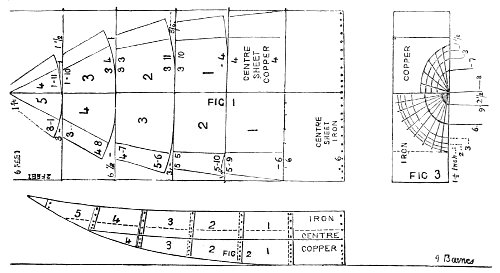
The eleven sheets laid side by side would, of course, present a length
of 22ft., but the overlap and the segment of the curve cut from those
near the ends would reduce the length of the boat to 19ft.
Our diagram is on a scale of a quarter of an inch to a foot, but this
is somewhat small for the needful accuracy; therefore if anyone intends
to build, we would advise him to copy it on a scale of at least one
inch to a foot, in which case the halves will represent six inches and
the quarters three, and if he has a rule divided to one-twelfths, his
work will be much facilitated.
It would be better to make, as we have done in preparing this
description, a model block on which to test his work; indeed we would
advise this in all cases of intended boat building. If the boat is to
have a bow and stern distinct from each other, the model must be of the
whole length, but may be of only half the breadth. If both ends are to
be alike, it may be half the length and breadth, or one quarter of the
boat.
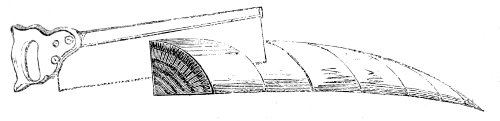
In the present instance, take a piece of deal, as clean and
straight-grained as possible, 19in. long (or 21in. if you wish the ends
to come to a point), 4in. wide, and 3in. deep. Having smoothed this,
draw a line along the centre of the top and bottom, connecting them by
perpendiculars at the two ends; then on the top set off the line of
one-quarter of the gunwale, or outer line, taking the breadths from the
section in Fig. 3 (p. 119), and their distances from the centre, from
the elevation in Fig. 2 (p. 119), bearing in mind that the centre means
not either of the edges, but the middle of that marked as the central
sheet. It will save trouble to cut out a piece of card to the size of
this quarter, and trace the corresponding ones on the top and bottom of
your block; then copy the elevation given in Fig. 2, and trace this, as
before, on both sides. Now fix the block, with one end up in a bench
vice, and with a narrow frame saw cut along the gunwale lines nearly
to the centre, but do not cut them quite off, or you will lose your
elevation lines (if a friend helps you by guiding the other end of the
saw to the line on his side, you will be more certain to cut truly);
then turn the block one-quarter round, and cut the line at top and
bottom. Now place the other end uppermost, and repeat the process; and
lastly, finish the cuts, and detach the superfluous pieces.
Take a piece of card or thin stuff, and draw on it the midship section,
and cut this away, leaving a corresponding hollow; round off the edges
of your model until she fits this hollow, and of this size 2in. of
the centre must be left. Do the same with the diminishing sections,
forward and aft; then cut eleven sheets of card 2in. by 6in., mark a
central line across each, and also along the bottom of the model; lay
one sheet uncut across the midship section, and tack it there; mark
each of the others after the outlines given in the diagram (Fig. 1, p. 119), but test them in their places before cutting them. Take care also
that as you go forward each sheet overlaps that which is behind; but as
you work aft, insert the front edge under the one before it. You may
think this operation would be tedious; but having once gone through it,
you will build your full-sized boat with confidence. And let us again
assure you that time spent in obtaining a preliminary certainty of your
plan is saved over and over again when you come to actual work.
The sheets having been cut to the proper shape, set the two points of
the gauge ¼in. apart, and so that the centre of the space between
them shall be exactly 1in. from the shoulder, and gauge these lines
all round the sheets, then, commencing from the centre of the longest
side, mark off spaces of 3in., and with a flat-ended punch, and a dolly
or matrix, or, in lack of that, a hard block of end wood, drive ¼in.
holes on all the sides except those which are cut with a curve. Then
lay the centre sheet on the rib or mould, which, like the rough frame
on which bricklayers construct an arch, gives it its proper curve,
and, under one edge, lay the curved edge of the next sheet. Mark where
the holes should come; remove it and punch them, and fasten the two
sheets together temporarily with three or more of the screw bolts. Do
the same with the successive sheets towards each end, and you will
find that the copper shell, even without ribs or strengthening of any
kind, will assume its proper form and will be tolerably stiff. If the
sheets are truly cut, the result may be attained, even without a mould,
by driving one hole in the centre of the curved side, bolting it to
the straight edge of the other sheet, and then bending both round till
the curved edge coincides with the straight one. In this condition you
may decide on increasing the width of your boat by forcing the sides
farther apart; this will increase her sheer or elevation at either end,
and will diminish her depth, or you may incline to reduce her beam,
which will give her greater depth and will reduce the sheer till the
elevation of the gunwale presents nearly a straight line. It would be
better, however, if circumstances permitted, to adhere very nearly to
the form given in the drawing, and set up such a frame for working on
as is shown in the illustration on the next page.
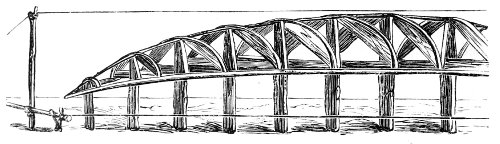
Drive as many rough stakes into the ground as the number of sheets in
your intended boat requires. Let these near the centre be three and a
half or four feet high, and these at the ends slightly lower. Stretch
a chalk line fore and aft, and see that all their centres are in true
alignment and 1ft. 10in. apart. The line should be fastened to two
posts in the same line as, but beyond these required for, the boat.
Let it come low enough just to touch the central posts, then measure
downwards from the line the amount necessary to be cut off those
towards the ends, so as to give the proper sheer. Next, commencing from
the centre, face off with a saw, or otherwise, as much of each post as
is needful to let each frame lie truly against it, noticing that as
the bottom of each is farther from the next than the top or part near
the gunwale, it is more convenient to face that side of the post which
looks towards the centre; then, with any rough slabs or planks, form
two moulds the exact size and form of your midship section, just as
bricklayers would do if they were building an arch. Nail these to
their proper supports, and on them bend the strips, 2in. broad by
1/4in. thick, you intend for ribs, letting only one edge rest on
the mould, while the other projects so far that you may have clear
space to bore through the centre the holes for your screw-bolts. Do
the same with all the others towards the two ends, confining them
with a temporary ribband where the gunwale is afterwards to be; or,
still better, leaving their ends 6in. too long, so that this ribband
may not interfere with the completion of the boat. Have a chalk line
stretched near the ground, along either side, parallel with the centre
one above, so that any deviation from the proper form can be measured
and corrected. Then lay on the sheets, insert the bolts, and screw
them up, adding a keel or centre batten, bilge streaks, and gunwales,
externally, and bottom boards to prevent the occupant treading on the
copper, and stringers for the thwarts inside. The projecting ends of
the ribs can be left where required for rowlocks, or cut off where they
are not.
The same process, with attention to the different dimensions, will make
you a copper boat, consisting of nine sheets, 2ft. by 4ft.; and this
will be 16ft. long, 3ft. 3in. wide, and 10in. deep; but if the gunwales
were made of plank, 4½in. wide, or half the width of a deal, the
skiff would be quite deep enough to carry three or four persons in
moderately smooth water.
If you wish to build the same boat of wood, ⅜in. planks (not more
than 4in. wide) will be stout enough. The lines radiating from the
centre in the sectional drawing are given for the purpose of showing
the progressive diminution of the planks in width, from the central
section towards each end. These should be tested by cutting strips of
card and tacking them, like planks, on the block that serves as your
model.
This would be a very handy form for a dingy for the traveller’s
personal use, as it might be taken to pieces, and the sheets laid
flat, occupying a space of 2ft. by 4in. in extent, and less than 1in.
in depth, or they might be rolled up in three bundles, of which each
must weigh less than 24lb., as the weight of the whole nine sheets of
copper before being cut would be only 72lb. The screw-bolts would weigh
probably more than the sheeting, but they could be divided into packets
of any convenient weight for carriage by native porters or otherwise;
and we should think that half a day would be quite sufficient to put
the whole together when wanted, or take it apart when done with. The
boat would pull or paddle, and would sail well enough off the wind,
but would not compete with a keeled boat close hauled; if the iron
sheets were used, she would, of course, be larger and heavier, and the
material would be less portable.
In the boat built for Mr. E. D. Young, for use on the Shire river and
Lake Nyassa, thin sheets of steel were at first proposed, but as these
could not be readily obtained, the best iron was used, and the edges of
these being turned upward and inward, formed the ribs of the boat, each
sheet being connected by bolts passing through this inward edge to the
next sheets before and behind it. This form of construction combines
all the elements of lightness, simplicity, and strength; but we do
not recommend it to a traveller who has to work up his own material,
because none but a skilled workman could turn inward a broad segment of
a sheet of metal, the outer surface of which has to present a curve. If
anyone doubts this, let him try it by folding half an inch of the edge
of a sheet of paper to a right angle with the other part, he will then
find it impossible for him to impart a curvature to the sheet without
tearing the upturned edge if he bends it outward, or wrinkling it if he
gives the contrary curve. If he wished to adopt this form of joining
the parts, his plan would be to cut up his sheets of copper into planks
4ft. long, and 8in. broad, then gauging a line all round 2in. within
the edge, cut out the squares at the four corners and turn up the
borders all round, he would thus have out of one sheet of copper 4ft.
by 2in., three planks 4in. wide, and 3ft. 8in. in length, a waste of
material that hardly any circumstance could justify.
Metal boats.
In 1858 we made a model of a metal boat, about thirty feet long, by
six feet beam, to carry a crew of sixteen men, each of whom, when it
was taken to pieces, should not find his share of the load to exceed
50lb. each of the thwarts; and the bow and stern sheets were continued
downward so as to form a water-tight box, the lower outline of which
coincided with the section of the boat, so as to supply the place of
ribs and convert her into a lifeboat. Indeed, we would advise that in
all metal boats some such portions should assume the form of lockers
or of reservoirs of air, so that, should the boat be swamped or become
leaky, she might not sink even when filled with water.
Our model was approved by Captain Washington, R.N., the Secretary at
that time of the Lifeboat Institution, and the builder to whom we
submitted it estimated the weight of the sheet copper and bolts of
the same to be employed in the hull at 260lb. and the cost at 60l.,
while the internal fittings, somewhat less in weight, would cost 40l.
This expense Dr. Livingstone considered to be too great; but, when we
reached the Zambesi, it was a matter of frequent regret that we had not
some form of boat portable enough to be carried over rough country to
rivers we wished to explore.
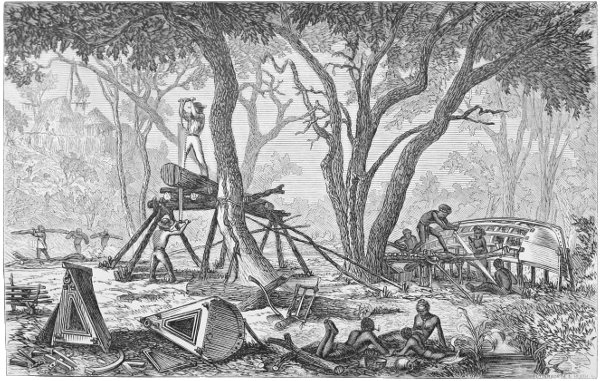
BOAT BUILDING ON THE LOGIER RIVER.
One of the most beautiful little vessels we ever saw was built by
the wrecked crew of a French steamer. She was 40ft. long and 8ft. or
10ft. beam, clinker-built, with thin and narrow planks, without a joint
in their whole length, sawed out of the mainmast, and flexible ribs
about a foot apart and not more than one inch in breadth or thickness.
Her deck beams were, of course, somewhat more rigid, to sustain the
weight of the men who crowded her. She was said to have sailed eleven
knots.
Wattled boat.
Our friend, Mr. Wilson, an experienced African traveller, recommends a
wattled or basket-work boat, and in a country where rattans, osiers, or
flexible twigs, or green reeds, are obtainable, such a boat would be
both light and durable; but it would be open to objection on the score
of unavoidable roughness, and inequality of outer surface, which would
impede its progress through the water, and expose parts of the canvas
covering to constant liability to chafe whenever it touched the ground.
Even if a traveller intends to purchase or hire native canoes, it is
indispensable that he should have some small portable boat of his own,
sufficient at least to show the natives that he is not totally helpless
on the water and dependent on them.
In the case of our copper boat, illustrated at page 53, we have already
remarked that the difficulties of the road, and the mortality among Mr.
Chapman’s cattle, obliged us to leave behind eight of the sections.
The method we adopted with the other four is shown in our full-page
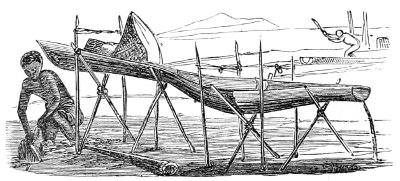
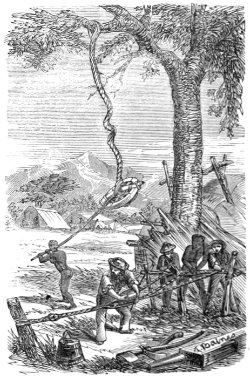
illustration, representing boat-building on the Logier River.
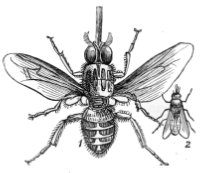
On account of the danger from the tsetse, or poisonous cattle fly, our
friend’s waggons could not be taken to the banks of the Zambesi, and
everything had to be carried by the Damara servants and hired natives
to Logier Hill, about eighty miles below the Victoria Falls, which
we had selected as the first place from which continuous downward
navigation was possible.
The building of the house will come more properly under its own
heading, and we will now only treat of what concerns the boat.
About the 3rd of October, or towards the close of the dry season, we
cut down a motchicheerie tree, which divided a little above the ground
into two tolerably straight logs of manageable dimensions. These were
first notched with the axe on the side we intended to “fall” them; the
cross-cut saw was then “put in” as far as it would go without nipping
from the pressure of the wood, and a notch being made on the other
side, the saw was used freely, the weight of the tree on the “falling”
side opening the cut as the work proceeded.
Fresh reports, however, caused us much uncertainty whether the Falls
of “Moambwa,” or the rocks, were not still below the station, and some
time was therefore spent in exploring the river down to Sinamane’s
Island, when, having ascertained that the rapids and other difficulties
appeared not quite impracticable, we set up the bow and stern sections
of one boat, connecting them by the ribbands of red deal we had been
able to carry up, and fitting at short intervals a series of frames
on central posts, as described at p. 122, and
further supported by shorter posts on either side, in a line with the
gunwale streak, testing the accuracy of all parts where correctness was
required with plumb line and level, and leaving the rest rough.
Our bench consisted of ten stakes, nearly 3ft. high, driven into the
ground, and two long straight poles laid fore and aft in their forks;
smaller poles were laid across these as closely as possible, and lashed
with the inner bark of the young branches of the “kookomboyon”—a kind
of stercuhia, which, while still moist, answers very well, but becomes
brittle in drying. The large smith’s vice was firmly lashed to the
stoutest upright with raw hide, and forked poles were set diagonally to
resist the forward strain to which the bench was subject when wood was
being planed up.
It was just possible to get thin poles that would bend, but none were
sufficiently flexible to take the true curve required for the ribs,
and at the same time strong enough to bear the strain when they became
dry. Therefore we had to cut crooks out of the motchicheeries, the wood
of which looked something like coarse short-grained cedar; and first
burning away the light stuff from the tree cut down a month ago, we
found a great many available forks and curves.
We had great difficulty in selecting wood of a suitable size for
plank; trees too small, or too crooked, or of unsuitable wood, were
in abundance; while those of the wood we wanted were mostly too large
and unmanageable. Sometimes, at a distance, one would appear to be
small enough, but when we came near it would prove three or four
feet thick and sixty or eighty feet high, and had only seemed small
by comparison with those around it. One group of motchicheeries had
grown to maturity, throwing a wide-spread shadow around them; and a
young sapling had shot straight up from near their roots towards the
air and light; this was 9in. thick at the base, and 4in. at nearly
30ft. up; it proved impossible to “fall” the top outward, and it was
very difficult to clear from the other trees. We would have saved
labour by floating it down stream to our building-yard, but the wet
season was coming on, and the sap had by this time risen in the wood,
so that a small piece sunk when thrown into the water. The labour of
sinking a saw-pit would have been great, and besides this the expected
rains would have kept it always wet. We therefore erected trestles of
primitive construction; two triangles of forked poles, 6½ft. long,
supported the ends of a stout cross-beam, firmly lashed to them with
buffalo hide, and for greater security lashed also to the stem of a
tree. The second trestle was destitute of this support, and therefore
had to be shored by longer poles, the forks of which took the necks of
the opposite triangles, while their hands were stopped by wedges driven
into the ground; for additional firmness, lashings were passed at the
points of intersection. Two stout poles were laid fore and aft upon
the trestles, and shorter pieces across served to rest the log upon;
there was some difficulty in lining the lower side, but by cutting
notches in the cross-pieces large enough to let the chalk line pass
freely, and “springing” it only by short lengths at a time, this was
accomplished. It was difficult to teach a young Dutch lad, strong as an
ox, and nearly as stolid, to saw with us; but at length the “sapling”
was cut, and one of the larger logs lifted gradually up by forming an
inclined plane with strong poles, and supporting it whenever we gained
a few inches of elevation by forks of various lengths lying ready for
that purpose. This having been felled before the sap was up proved much
easier to saw, and we had so far overcome the difficulties in our way,
that we had commenced laying the bottom plank of the first boat, when
the difficulty of providing food, owing to the retreat of the wild
animals to the pools which the rainy season was filling all over the
desert, and the fever among the people, seven Damaras, mostly women and
children, having died in Chapman’s camp, and one of the most useful
men in ours, obliged us, for the sake of saving the rest, to retreat
to the highlands of the desert, and on the 3rd of February, 1863,
we hauled down our colours at Logier Hill, and commenced our return
journey.
General hints on boat building.
Two general rules in boat building should be borne in mind. First,
that clumsiness is not necessarily strength; and, secondly, that it
is much easier to build a sharp swift boat with moderate sheer, and
clear lines of entrance and run, than a short one with great beam,
bluff bows, and wide overhanging stern. The stem and stern post should
rake considerably, or even form parts of a curved line connected by
the keel, as if they are made too upright, not only is the boat more
difficult to steer when sudden alteration of the course is necessary,
but, if she is built of wood, so much curvature is required in the ends
of the planks that it is difficult for an inexperienced hand to lay
them. A rudder cannot be nicely fitted to a curved stern-post, but if
you decide to steer with one instead of an oar, make the stern-post
straight, and if you wish to diminish its “rake” or inclination, make
it one foot wide below and only a few inches at the top. A rudder is
much more convenient in ordinary cases; but, when great quickness and
power is required, nothing is equal to the steering oar.
In constructing a clinker-built boat some practice is required in
clinching the nails. First, a hole is bored with a gimlet of such a
size that the nail requires some driving, but very little, to force
it through. This prevents any lateral curvature, which would be fatal
to any attempt at clinching. A roove is then put over the joint and
driven home to the surface of the plank, and the end of the nail is
nipped off nearly close with a pair of cutting pincers. If you have a
spring-handled hammer to screw on to the plank so that the face of it
just rests on the head of the nail, so much the better, if not, you
must hold your heavy hammer with your left hand or get a mate to do so;
while with the edge of your little clinch hammer you tap as sharp and
lightly as possible on the centre of the cut end of the nail, causing
its sides to overspread the edges of the roove, when it can be nicely
smoothed off with the face of the hammer. When one plank has been laid,
the outside of its upper edge should be bevelled off so as to let the
lower edge of the next lie truly against it in the position required
by the curvature of the boat’s side; and, to retain it in its place,
several pairs of “nippers” should be used. These are made of two pieces
of wood—say sixteen inches long and two inches square—cut a mortice
½in. wide by 3in. long in each, and pass through them a piece of hard
wood fitting the mortice loosely and 12in. long, so as to project 4in.
at either end, in each end of this bore three ½in. holes, not quite
in the central line, but one a little on one side of it, and the next
on the other, so as to avoid the risk of splitting two into one; have
pegs of hard wood or iron to put through these at the distance you may
require, then having adjusted one end of the nippers on the planks you
wish to hold together, drive a wedge between the other ends till the
grip is tight enough. A pair of these is shown in our illustration at
page 106. We believe that the traveller will find it generally most
advisable to build his boat bottom upwards.
Cape-waggon boats.
We should think that a traveller in South Africa, using the common
ox-waggons of the country, might easily, and without additional weight,
carry up with him all the wood necessary for the purposes of boat
building. The floor or bed-plank of the waggon is about thirty-six
inches in width, and from twelve to eighteen feet in length. Four
deals might be laid down for this. If they were twenty-one feet long,
they would project considerably behind. It is not considered expedient
to have the fore and hinder wheels too great a distance apart; but
then the projecting ends need not be loaded. The usual holes for the
fastenings of a waggon bottom should not be bored in them, but they
should be secured by lashings of raw hide, and the parts liable to be
chafed should also be protected with the same material. They might be
previously sawed into planks or battens of the required size, and then
tightly lashed together by thongs of raw hide, especially near the
ends, which would otherwise be liable to split with changes of weather
and rough usage. The waggon sides are usually a little more than two
feet high in front and three or more behind, and the framing of these
is an elaborate piece of work. Three deals 9in. wide would give 27in.
in height all along. These might be cut into ¾in. or ½in. plank,
and again bound up with raw hide, like those of the floor, and thus the
traveller would have in one waggon nine deals, or more than sufficient,
if he built his boat of copper; while, by raising the sides to 36in.
with a couple more, he would have enough to construct her entirely of
wood.
In building the waggon-tent or tilt, as it would be called in England,
two methods are adopted in the Cape. The first is the kap-tent (E
on next page), which is regularly framed by the waggon builder with
stanchions about five feet high from the floor, neatly fitted to the
sides, at intervals of two feet or thirty inches; with bows of flexible
wood, forming a flattened arch about nine inches higher, across them,
and fore and aft battens, half-checked in, so that the whole presents
a smooth external surface to receive the inner sail, or cover of
painted canvas, which is laid on before the outer sail, or snow-white
neatly-fitted tilt, is drawn over all. The second is that which any
competent waggon driver can extemporise for himself with a sufficient
quantity of bamboo split into laths two or three fingers broad, stout
Spanish reeds, common hogshead hoops, or an adjacent forest, in which
flexible poles can be cut. His first care is to lift and shore up his
waggon so as to set free one or both of the hinder wheels, on the
circumference of which the flexible rods he intends for his bows are
bent and fastened down, and in doing this some care is requisite. The
rod must not be grasped by both ends and suddenly forced into the
curve, for one part may be weaker than the rest, and it may break
there, or be forced into an unsightly prominence; but, after having
been steamed, if possible, or, as is more commonly the case, laid for
two or three days in water or wet earth, the part intended for the
centre of the arch should first be bound tight and flat upon the tire
of the wheel, then the ends should be gradually pressed down by two
assistants, the principal watching the inequalities of the curvature,
and reducing them by passing turns of raw hide tightly over any parts
that have a tendency to irregular projections. The bows, which should
be about twelve or fourteen feet in total length, are now set up. Care
having been taken that the waggon sides stand truly, the front and
aftermost are first fixed, and the driver, if a man of average height,
stands on the centre of the waggon floor, holding the bow as fairly as
he can, with the crown of its arch about the level of his eye, say five
feet six from the floor, while his assistants, standing outside, fasten
the ends with screws or thongs of raw hide, to the styles or stanchions
of the waggon sides. The lifter, the dissel-boom, or other straight
and heavy pole, is now laid fore and aft upon the bows to keep them in
a level line, and also somewhat to flatten the crown of the arch and
expand it laterally. The laths or battens, fore and aft, are now lashed
on, and the result is a less sightly but stronger and more durable roof
for the exigencies of travel than the kap-tent. In the rear of the tent
(letter N) are shown the ribs of an ox or buffalo slung to the roof to
hang the saddles on.
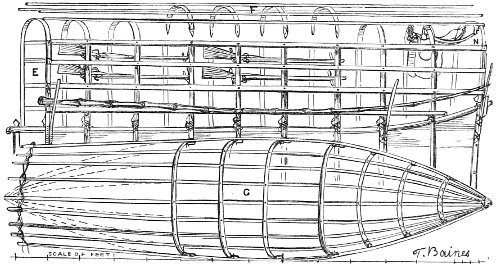
CAPE WAGGON TENT (E) TO BE TAKEN OFF AND USED AS
A BOAT (G).
Such a tent as either of these might be easily constructed so as to
be available for a boat whenever it might be required. First let the
stanchions, screwed or lashed to the waggon sides, rise to the usual
height of about five feet, and let the bows forming the flattened
arch across them be of any flexible material, but preferably of
straight-grained ash, such as is used for the better kind of tubs or
casks. The hoops of American flour barrels would answer well; they are
somewhat thin, but three might be laid together, and would be much more
flexible and strong than if one piece only was used.
Of these, supposing nine bows were used, three in the front and three
in the rear might be permanently secured to the stanchions, as in
the illustration (E, p. 131), while the three central ones should be
so fastened as to be readily cast off. The laths or battens, on the
contrary, should be securely fastened to the central bows, so as to
lift off with them, and only slightly to those at either end.
When the boat is required, it would be but an hour’s work to cast off
the temporary fastenings. Take off the movable part of the top frame,
draw the ends of the battens together, as shown in the illustration
(G, p. 131), inserting at pleasure three or four smaller bows at
either end, and then taking the under sail—which is generally of
oiled canvas—fold down the corners so as to narrow it at either end
to the shape of the boat, and stitch or lace it with eyelet-holes
to the gunwale. A second thickness of unpainted canvas might always
be kept upon the roof between the inner and outer sail; and if this
were also laced on the boat, previously reversing the ends of the two
parts of canvas, so that if any portions had been chafed while on the
waggon they might not coincide with each other, the boat would be as
impervious to water as wooden boats generally are.
A few spare laths, previously lashed beneath the front and aftermost
bows of the tent, so as to remain there when those required for the
boat were removed, and perhaps two or three duplicate bows, would
prevent the necessity of leaving the vehicle destitute of cover while
the boat was being used.
Sculling.
Very often the explorer may find himself alone in a boat, or he may
wish to cross a river or pass from ship to shore or back again without
calling other men from their duties, and in such cases he who has the
power of managing a boat with a single oar, has a great advantage over
one who must ask the aid of another. We have been on boat trips where
the scientific officers have cheerfully manned the oars and pulled
against the stream all night, and when we volunteered to take our
turn, the answer was, “No; you can scull, and none of us can. Keep the
steering-oar, and help us onward with it.” The first great difficulty
of the novice is to get the blade of his oar under water and keep it
there, and to make the loom rest firmly in the rowlock; the natural
tendency of the wood to float will at first seem insuperable, but as
soon as he has acquired the proper motion of the wrist he will wonder
that he ever had the slightest trouble in keeping the oar to its duty.
To learn to scull, go into a boat that is either fast to the shore or
vessel, or have a comrade to pull the other oar with you should you
fail. Then stand on the stern-sheets on the starboard side, so that
the right hand may be toward the bow of the boat; plant the left foot
on the starboard side seat, and advance the right to the middle of
the aftermost thwart; grasp the small end of the oar with the right
hand, and the loom with the left about eight or ten inches from it,
so that when the blade of the oar is horizontal the back of the hands
and arms may be uppermost and also in a horizontal line. You will find
that when the blade is supported by the water, the loom will not lie
in the rowlock; but now depress the wrists a little, raise the hands
till the blade forms an angle of 40° or 45° with the horizon, the edge
farthest from you being the highest; push the oar from you as far as
you can without losing your balance, then, as your first stroke ceases,
drop the hands and raise the wrists till the blade inclines as much
the other way, the raised edge being then nearest you; pull the loom
towards you, bending backwards at the same time as far as you safely
can, and you will find the arms in the proper position, with the elbows
at the side, the wrists lowered, and the hands ready to rise for the
stroke from you. Make short strokes at first, and do not hurry. Never
mind which way the boat goes, or whether she goes at all; stick her
nose in a mudbank, if you like, till you can keep your oar below the
surface, then give her her head; if your oar keeps under water she must
go forward, and by making a stronger sweep to starboard or to port,
you may steer her at your will. If you have a long narrow boat, she
will keep a straight course, but with a short dingy, she will incline
at each stroke a little to the right or left, and if you use the oar
regularly, her wake will show a series of graceful and equal curves.
In default of an oar, the bottom board may be taken up and used by
being laid on the point of the stem, the boat going then stern first.
Lightermen, on the Ouse, frequently scull their horse boats in this
manner. We have sculled a whale boat with one oar over the quarter,
i.e., in the crutch of the stroke oar, much as a gondolier does; but
tholes or rowlocks cut in the streak above the gunwale would not admit
of this. We give no directions for this or for the use of the plank.
When the novice can keep his oar blade under water, he can easily learn
how to adapt his new power to any emergency.
Paddling.
In paddling a canoe sit near the stern, looking forward, and with the
paddle on your right side make a long fair stroke; never mind the
deviation of her head to the left; but just before you lift your paddle
from the water, feather the blade of it by turning the right hand
inward from the wrist, turn the right elbow outward, and draw the left
hand inward across your breast; this will “port your helm” and bring
her to her course again.
If you have a mate who handles another paddle this is less needful; but
it is well to learn to paddle your own canoe practically as well as
metaphorically, single handed.
The kroomen about Sierra Leone use a canoe pointed at both ends and
with a great sheer; this, to a novice, is much more difficult to keep
to a true course, but a single krooman tossing his paddle from hand to
hand, without missing a stroke, will make her fly direct as an arrow
the way he means to go.
In the gunning boats on the Norfolk coasts, when strict silence is not
needed, and in canoes of some other countries, a double-bladed paddle
is used. The pole is grasped by both hands, like the balance-pole of a
rope-dancer, and equal strokes are given alternately, or the course is
changed by a more powerful stroke on the other side.
We have occasionally found that the power of handling the native
paddle has been of great service, for when we have wished to cross a
river to secure some specimen of wading bird, and the bargaining over
the hire would have occupied half a day, we have cut the matter short
by stepping into the canoe, paddling to the other side, shooting our
bird, and making the owners a sufficient present on our return; and,
while we advise that all travellers should most scrupulously regard the
rights of the natives, we must also intimate that they will not gain
the respect of savages by submitting tamely to extortion, or showing
themselves in any way afraid to maintain their own.
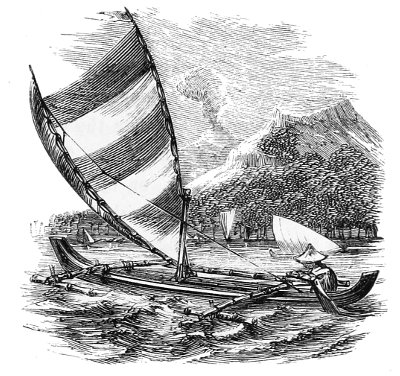
THE PROA.
Proas.
The proas, or outrigger canoes, of the Malays and Indian islanders,
are so proverbially swift that they have fairly earned the title by
which they are generally known, of “flying proas.” We have seen and
admired many varieties of these, as well as their fan-shaped sails,
sometimes of matting—bright and yellow while new, and deepening to
browner tints with age, and sometimes of snow-white cotton, or of white
alternated with cloths of blue or pink, and gay streamers floating from
the bending yards. The most common, and we may almost say the most
beautiful of these, were the little proas sailed by one man only, as
represented in our sketch. The hull consisted of a single log, perhaps
twenty feet in length, and hardly as many inches in depth and breadth;
the mast was about six feet in height; and the sail, of triangular
form, was laced to a couple of bamboos nearly as long as the canoe; the
thick ends of these crossed, and were lashed together at the tack of
the sail, and were made fast, loosely enough to give them sufficient
play, a little before the mast thwart; a loop attached to the upper
bamboo, or yard, at about six feet from the tack, was hitched over a
knob on the mast-head, instead of hoisting the sail by halyards, and
the sheet was attached by loops like kite loops, or bowline bridles, to
the lower bamboo or boom; in hauling to the wind, the simple gathering
in of the sheet trimmed the sail nearly down to the gunwale, as seen
in the distant proa, while in going free the slackening of it allowed
the sail to rise to the wind, till in the distance it reminded us of
the beautiful fan-shaped sea-shells, so often found upon the coast.
Stability was imparted under this enormous press of sail by two bamboos
twelve or fifteen feet long, and from four to six inches thick, kept
parallel to the boat at six or eight feet from her sides by two beams
of the same lashed across her gunwales, bending slightly downward,
but the foremost less so than the after, so that the fore end of the
outrigger might be raised slightly above the water, and not impede
the boat. The rudder was just like that of our own boats, except in
its fittings, which consisted simply of a rope grummet at its neck,
by which it could be hitched on to a timber head on either quarter,
and we believe it made so little difference that the boatman seldom
gave himself the trouble to shift it from one to the other. Of course
a tiller was used, as yokes and lines would have been inapplicable.
We cannot tell exactly their rate of sailing, but they passed our
swift and handy little schooner the “Tom Tough” with ease, even when
the breeze was at its freshest. The hull is generally whitened with a
mixture of chunam, or coral lime, and cocoa-nut oil, and the raised
ends are ornamented with devices in red or green, and sometimes a
red streak runs along the side. The tambanga, or waterman’s boat for
passengers, has more beam, no outrigger, and a smaller though similarly
shaped sail.
Some of these proas were much larger, being fifty or more feet in
length, and then the sides of the log forming the bottom of the canoe
would be raised either by other planks sewn on or by a framework of
bamboo, with pieces cross cut from the leaves of the fan-palm, so
that the leaf ribs should stand vertically, stitched to them to form
the extra height of side, while a roof of the same was built over the
centre where cargo would be stowed, or over the after end, to form a
kind of cabin. When planks are used for raising the sides, they are not
sawn like ours, with economy of time, labour, and material, but are
laboriously chopped out of the solid; and, instead of being bent, are
patiently dubbed down to the requisite curve with numberless strokes
of the keen little Malay adze, projections being left on the inner
side through which holes are bored to lash them to the timbers, while
rows of holes along the edges admit of their being sewn together with
strips of rattan, and shreds of palm leaf laid along the seam and
confined by the tightening of the stitches, help to reduce the leakage,
which, if the vessel works at all in a sea-way, can never be entirely
stopped. They have two large sails similar in form to those of the
smaller proas, and sometimes a third, as a mizen. This is small enough
to be hitched over the mast-head, as before; but the others have to be
hoisted by halyards, and the long yards supported by propping them at
some distance from the slings by bamboo poles. The stays were formed
of slips of bamboo, and sometimes even of the poles, which, being well
fastened, would not only resist tension on the weather-side as well
as ropes, but on the lee would, by their rigidity, help to support
the masts. The outriggers of these were more elaborately framed with
a lighter set of beams, which supported stanchions and hand-rails,
so that, when the wind freshened, men might run out upon the weather
outrigger and, holding on by the hand-rail and stays, which lead from
the mast-head, serve as a counterpoise to the immense sails as the
boat dashed through the water. Reefing seemed never to be thought of,
and our own men soon got into the habit of speaking of a one-man or
two-man breeze, according to the number seen on the weather outriggers
of the proas that flew past us. The appearance of these vessels when
going wing and wing before the wind was very pretty. And others, in
the fashion of the Chinese junk, or in every modification of European,
engrafted on native form, afforded picturesque contrast, but need not
be here described.
The professional pirate has the outrigger only on the weather-side, and
this is frequently a log of light wood trimmed sharp at either end, so
that while its specific gravity is small enough to keep it buoyant, it
is still so heavy as not to be easily lifted out of the water, like a
bamboo, and when requisite, men sent on it, as in the former case, will
give it additional weight. But the chief peculiarity is in the hull of
the vessel, which is only half a boat, the lee-side being perfectly
flat, while the weather, or that toward the outrigger, is rounded as
usual; they will be frequently more than fifty feet in length, and six
or eight in breadth. We speak of the lee-side, because when the course
has to be changed—say in beating to windward—they do not go about
like a ship, that must go with her bows forward and be steered from
the stern, and therefore turns to receive the wind on the other side.
This would be fatal to the proa, as the buoyancy of the outrigger would
not prevent her from capsizing; and therefore, while the steersman
lets that end which is temporarily her bow fall off from the wind,
the men who have charge of the tack run round with it on the platform
to windward of the mast, the sheet is brought round to leeward, a
steersman takes his place at the other end, and that which has been the
stern now becomes the bow, and cleaves the waves at the rate of twenty
miles per hour. But no one need fear a proa with a double outrigger,
for she is not intended to lay alongside and board.
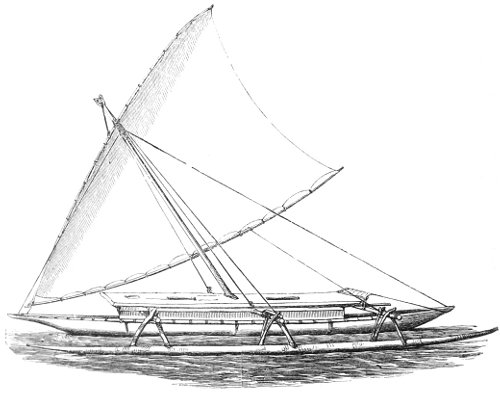
PROA WITH OUTRIGGER ON WEATHER-SIDE ONLY, TO SAIL WITH
EITHER END FIRST, AS REQUIRED.
The engraving represents a proa with an outrigger only on the
weather-side; and not only would the sail be made to traverse by
shifting the tack to that end which, for the time being, was intended
to go foremost, but the mast is also fitted to be inclined forward
by slackening that which happens to be the back stay, and tightening
that which is pro tempore the fore. Those which serve for shrouds,
being exactly abreast of the mast, are so arranged for the purpose of
facilitating this.
The commander of the United States Exploring Expedition, Charles
Wilkes, U.S.N., gives the following description of the Fejee canoes:—
Fejee canoes.
“They are superior to those of other islands. They are generally
double, and the largest are 100ft. in length; the two canoes are of
different sizes, the smaller serving as an outrigger to the other,
and are connected by beams on which a platform is laid, 15ft. wide,
and extending 2ft. or 3ft. beyond the sides. The bottom of each canoe
is a single plank; the sides are fitted to them by dovetailing and by
lashings passed through flanges left on each piece; the joints are
closed by the gum of the bread-fruit tree, which is also used for
smearing them. They have a depth of hold of about 7ft., and the ends
are decked for 20ft., to prevent their shipping seas. Amidships[B] they
have a small thatched weather house, above which is a staging on which
several people can sit. The canoes of the chiefs are much ornamented
with shells. The sails are so large as to appear out of proportion with
the vessel, and are of tough and pliable mats; the mast is half the
length of the canoe, and is stepped on deck in a chock; the yard and
boom are twice as long as the mast; the halyards are carried over a
crescent on the mast-head, they are bent on to the yard at a distance
from its tack or lower end nearly equal to the length of the mast. The
natives manage these vessels very expertly; they require much skill
in beating against the wind, for it is necessary that the outrigger
should be always on the weather-side, as, if it gets to leeward, no
vessel is so easily capsized; in tacking, therefore, the helm is put
up instead of down, until the wind is brought abaft the beam, then the
tack of the sail is carried to that end which was previously the stern,
but which has now become the bow, and the canoe is steered from the
other end; they carry sail even when it blows heavily, by sending men
on the outrigger to counterbalance the force of the wind. The canoes
are of logs hollowed and built upon; they make long sea-voyages, and
are provisioned only with yams; they are ornamented with Cypræa-ovula
shells, and carry white pennants; they carry water in cocoa-nut shells,
and, with fire and an ‘ava’ bowl, are equipped for sea. The chief
holds the end of the sheet, and it is his duty to prevent the canoe
capsizing; the steer oar has a large blade. In smooth water they sail
very swiftly, but the force of the sail strains them, and they leak
badly, so that the men are constantly baling. The planks are kept in
shape by small ribs as with us. The principal tool used is an adze,
which is now made by lashing a European plane iron to a crooked handle;
they are anxious to possess our tools, and especially the American axe.
Their knives are made of bamboo, cut into form while it is still green;
after being dried it is charred, which makes it very hard and sharp; a
second charring, followed by grinding on a smooth stone, will even fit
it for surgical operations.”
The balsas.
The balsas, at Guayaquil, as described by Sir E. Belcher, in his
journal of the voyage of the “Sulphur,” are rafts of ten logs 14in. in
diameter, and 60ft. long. The wood is a kind of bombax, called balsa
wood, they bear fifteen or twenty tons independent of their crew, and
bring fresh water down the river in jars of seven gallons each. Houses
thirty or forty feet long, and twelve feet wide, are built on some of
them, and families take passage or live permanently on board.
The balsas, at Arica, in Peru, are differently constructed; they are
simply skins, stripped off the animal, with as little cutting as
possible; the absolutely necessary incisions are then securely closed,
the hides are inflated and allowed to dry and harden, and two being
laid alongside each other a platform is laid across them, on which
the cargo is kept sufficiently high above the spray or ripple, and
brought dry ashore even through a heavy surf. Two ox-hides would make
a very serviceable balsa, as would also a pair of the large seal, the
sea-elephant, porpoise, or other marine animal of suitable size.
Cape waggon chests as rafts.
We will now endeavour to show how the chests that are usually
carried in Cape waggons might be converted into a buoyant, roomy,
and manageable raft. These chests are generally about three feet in
length, and sixteen inches wide and deep; two of them, the fore and
after chests, are indispensable, as the waggon cannot be kept in
shape nor the cargo properly secured without them; sometimes more are
carried, and others of smaller size are affixed to either side, but
the objection to these is that in a densely-wooded country, stumps and
stout branches are apt to catch the angles of the side chests, and
damage or carry them away.
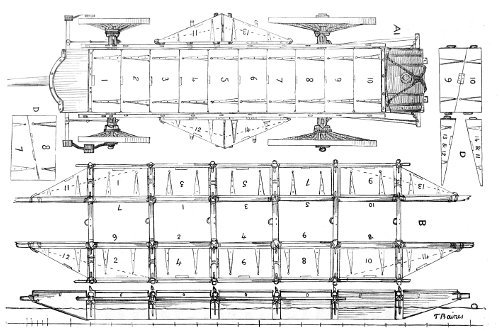
CAPE WAGGON BOXES SO FITTED AS TO BE AVAILABLE FOR
A RAFT.
We propose that, in the waggon used by the traveller for his own
conveyance, as many of these chests should be stowed as will stand
fairly on the floor beside each other, say ten, as in the illustration
(A, p. 142). Then, instead of the two usual square-ended side chests,
we would advise that four should be fitted (Nos. 11 to 14), each of
them having one end 16in. square like the other chests, but tapering at
the other end to the mere thickness of the plank, and with the bottom
also sloping, so that the narrow end should be only 8in. deep. Two of
these with the broad ends together could be fitted on each side the
narrow points passing well clear within the wheels. Care should be
taken to have them water-tight; and, if made of well-seasoned plank
and well oiled, they would remain so for a long time. When they are
required for a raft, take them from the waggon and place them in two
rows about three feet apart, and also with an interval of 3in. between
the ends of the boxes in the same line—as shown in the illustration
(B, p. 142)—with the tapered side boxes, as indicated by the numbers,
forming the four ends. If you have been able to carry a couple of
long stout bamboos, lay them along the inner side of each line of
boxes, and if you have lighter ones to lay along the outer sides so
much the better; if you have not bamboos, the dissel-booms and lifter
poles of the waggons must be pressed into service, or poles sought in
the nearest forest, as long and as straight as possible; then take
the yokes of the oxen and lay them across in the 3in. spaces between
the boxes, and passing the “reims” or other thongs cut from raw hide
through the holes made for the yoke “skeis,” lash each yoke to the
fore and aft poles, securing the boxes each in its own compartment
by passing a few turns through the handles in the ends and round the
yokes. When this is completed, you will have a very serviceable raft or
double canoe. The hinges of the chests will, of course, be towards
the centre, so that when opened the lids will fall inwards; and if
other poles are now laid fore and aft upon the yokes, they will support
the lids so as to form the deck, leaving the chests open, so that, if
any of them should leak, the water may be at once seen and baled out;
but should it be thought preferable to keep the boxes closed, the buik
plank or floor of the waggon, or even its sides, may be made use of for
the deck. If the traveller contemplates a long voyage, and requires a
sharper boat so as to attain more speed, he may make four of his boxes
(marked D 7, 8, 9, 10) tapering diagonally to 8in. at one end; but he
must take care that they are made in pairs, so that he may be able to
place the straight and the diagonal side of each in its proper position
in the raft. He will then also find that they will be easily arranged
so that each pair will stow square in the waggon; then the side boxes
(D 11 to 14) must be made only 8in. wide at the larger end, tapering
as before at the smaller, and, with a slight diminution of floating
power, he will have a sharper and more speedy boat. The figures in the
central spaces of B indicate the changes of position in the numbered
boxes, and the dotted lines show the increase of sharpness at the ends.
It is of importance that in the boxes which taper, one side should be
straight and square with the end, and one only diagonal, as it might be
necessary in a narrow stream, to place both the lines of boxes close
together, and then the line of the inner sides being perfectly straight
and the outer tapering, the whole would form one boat sharp enough at
either end.
Some of the yoke “skeis” might be left in their sockets where required,
as shown in the elevation, or other pieces might be cut to a proper
length, to serve for tholes or rowlocks, awning stanchions, or belaying
pins. If a mast were needed, it might be stepped by cutting jaws like
those on the gaff of a cutter, and setting them across one of the
yokes. The fork of a branch might serve; but as poles generally become
thinner upward, and the natural position would be thus reversed, it
would be less laborious to cut or fit on jaws to the butt of the pole,
and leave the fork at top for the halyards to run over. Two back stays
would be required, spreading at a considerable angle; and one or two
fore stays, with sufficient spread not to interfere with the free
motion of the yard; two, three, or four poles, set up as a triangle
or sheer legs, would also serve, and then only one stay, stretching
perpendicularly downwards between them, would be required.
In ferrying wheels over, the readiest way (if the breadth of the boat
permits) is to keep each pair on their own axle, which is laid across
the boat, with the wheels overhanging each side.
Even if the traveller be not provided with a waggon, he must have with
him a quantity of stores, or materials for whatever scientific pursuit
he is engaged in, as well as beads, calico, or other currency of the
country, to pay for service, or purchase food; and if his boxes for
containing these were all of uniform size, they would serve equally
well as a raft; the copper boxes described at pages 8 and 9 are
expressly designed for this service.
To float waggons.
In floating a waggon over without extraneous assistance, the buik plank
or floor, the water cask, the fore and after chests, and the side
boxes, will be sufficient, if tolerably water-tight—and if not, they
may easily be made so, either by covering them with canvas, by caulking
them or even laying them in the river all night to let the wood swell,
which will generally have the desired effect. But it would be well, if
this is at all doubtful, to remove the drag-chains, “reim-schoens,” and
all easily detachable ironwork, and first float over only the under
carriage and its wheels. If a line can be previously stretched across
the river, and the oxen ready in their yokes on the other side attached
to it, they may save much trouble by towing it across, while one or two
men steer till the wheels take the ground, and it is drawn on shore
in the natural way. The buik plank, with the casks and chests still
fast to it, can be taken back for the rest of the heavy gear, and as
much of the cargo as it will carry. If large hollow reeds—the drier
the better—can be obtained, faggots of these can be fastened fore and
aft, within the side chests, filling up nearly the whole space, except
sufficient for the men to stand on in the centre; and a light platform
can be laid above the top of the chests, on which to lay light goods
which require to be kept dry. But bear in mind that the cargo a raft
can carry above water is always small, and not at all like the mountain
of treasure invariably represented on that of Robinson Crusoe.
About 1849 or 1850, while staying with our fellow-traveller, Joseph
Macabe, at Vaal River, an extraordinary drought prevailed; the
great river could be crossed dryshod at the “drift” by means of
stepping-stones, though there were long reaches above and below in
which a good-sized vessel might have floated, and on one of the
sand-banks then laid bare appeared an upright pole, belonging to a
waggon which the owner had attempted to float over with bundles of
green reeds, leaving the “rein-schoems” and drag-chains on as ballast,
and previously removing the sides, the chests, buik plank, and
everything else that could impede its passage to the bottom.
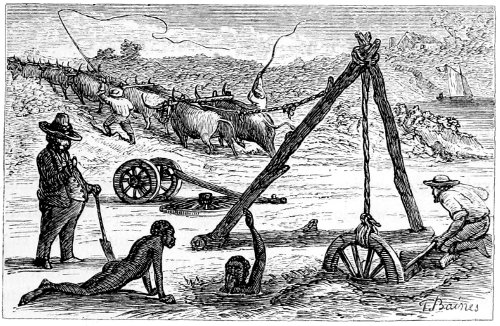
EXTEMPORE SHEARS.
Extricating waggons from quicksands, &c.
Whilst gazing at this odd landmark, Mynheer appeared; with him came a
goodly staff of tall athletic sons and nephews, attended by a numerous
train of native helpers. On digging for the waggon, it was found to
have settled so far below the sand that when the tallest of the family
stood on the tire of the wheel his shoulders were barely at the surface
of the water, and Mynheer had yoked his oxen and was attempting to draw
out the waggon by a horizontal strain. We forbore to offer advice which
would certainly have been rejected, but retired to the house, and when
one of the sons visited us after the day’s fruitless labour, we rigged
a pair of miniature shears, and, letting them incline over a weight,
showed how easily it might be lifted by applying a horizontal strain to
cause the shears to rise to a vertical position. The result of this was
that Mynheer sent up a request that, as “een groote zee-water’s men,”
we would come and give him a bit of advice. We accordingly suggested
that, as the sand was not firm enough to set the shear legs upon, he
should cut three good-sized beams, and laying one horizontally, cut
mortices in the ends, while tenons were cut on the other two to fit in
them, the apex of the triangle being firmly lashed with the “reims” or
thongs of softened hide, used for spanning in the oxen. The triangle
was now set up, sloping somewhat over the fore-stell or carriage of the
buried waggon, and one of the drag-chains was fastened to the wheel and
led over the top of the shears, whence, lengthened out by the other
chain and spare rope, it was bent on to the “trek-touw,” to which the
oxen were already yoked. At length the cattle bent them to the yokes,
the gear tightened and strained, the dissel-boom, that so long had been
our beacon, began to rise, when some fastening gave way and all came
down by the run; the pole, however, remaining a foot higher than it
was before. A native was desired to refasten the chain; and, sticking
two fingers of his left hand into his nostrils in a manner no European
could imitate, he settled down below the water, and worked with his
right hand only. Piece by piece the waggon was hauled out during the
succeeding days, after having been three years and three days imbedded.
In exploring countries covered with dense forests or difficult to
be traversed, rafts are wonderfully useful for navigating lakes and
rivers, or for conveying your goods. Dr. R. Brown, commander of the
expedition in Vancouver’s Island, favours us with the following note:—
Trenneled rafts.
“We travelled long distances by rafts in Vancouver’s Island, and, in
order to have facilities for making them, we caused an auger (2in.) to
be constructed with a ring-head instead of the usual spike with a nut,
so that, by a piece of wood being put through it, a handle might be
extemporised. Generally speaking we could find dry fallen cedar (Thuja
gigantea, Natl.) by the borders of lakes or rivers, or if not living
cotton wood (Salix Scouleriana) will do; and in fact any wood, though
pine is rather too heavy and apt to get waterlogged.
“Cutting two lengths of logs, the length of the raft required,
sharpening the ‘bows’ off roughly, we laid them on the ground,
parallel, and as far apart as we wished them. Then two cross-pieces,
composed of a log split in two, were pegged by means of the auger
across near the ends, over them was built a floor of split cedar
boards. Two rowlocks were pegged in here and there according to the
number of rowers required, and one pair at the end for a steering oar.
Oars were soon extemporised by means of the axe, and the raft moved
lazily along at about one and a half or two miles an hour on a lake,
but the labour was infinitely easier than working through the wood with
a seventy or eighty pound load on your back.
“Sometimes we constructed even ruder rafts than these. Mr. Frederick
Whymper and Mr. Ranald M’Donald once descended twenty miles of a river
on a little raft composed of the boards out of an Indian’s hunting
lodge, tying it together with withes of cedar twigs, which are very
tough, and used by the Indians for sewing their canoes and fastening
their lodge planks together. The holes they made with pistol bullets.”
Principles of raft building.
The general principle on which all rafts are or ought to be constructed
is nearly the same; that is, if they are intended to be worked or to
make progress through the water, as in most cases is desirable. The
exceptions to this are generally when it is merely desired to float
down a stream, abandoning the raft as worthless when the voyage is
completed, or when produce or manufacture of any kind has to be brought
down from a higher country to a lower, and, from its buoyancy it may
be collected into a raft, which, on reaching its destination, may be
reduced to its component parts and sold; or where, as in still more
exceptional cases, it is necessary to provide floating habitations for
families or small communities without reference to locomotion, which is
effected by other means.
In the first and most general case, the object is to obtain sufficient
carrying power with as little resistance to progression as possible;
and to this end the larger spars, on which the buoyancy of the whole
depends, ought to be laid parallel to, and at such a distance from,
each other as seems necessary either to insure the requisite stability,
to give sufficient room on deck, or to suit the length of those that
are to be used as cross-beams; but they should never be laid close
together so as to present a broad united surface to be forced through
the water, nor even so close as to convert that portion of fluid
between them into dead water to be dragged like a solid body with the
raft. We would say, if there be two or more spars of equal size, let
the interval between them be at least three times as broad as their
diameter, and generally let the width of your raft be not more than
one-sixth of its length. If you have only one large spar, let that form
the centre, or, as it may be called, the keel, and let the smaller
ones, either singly or lashed together in bundles of convenient size,
be laid parallel to it at proper distances on either side. Endeavour
as much as possible to keep your cross-beams as high above the water
as possible, for if these are submerged, their sides will offer as
much resistance to your progress as if the whole raft had been filled
up with solid logs. On this account, therefore, it would be advisable
to lash or pin on the top of each of the main beams either a smaller
one to increase its height, or short pieces at intervals, as chocks on
which to lay the cross-beams.
Let the ends of the spars that form your floats be pointed to an acute
angle by either sawing off wedge-shaped pieces of about 15° or 20° in
the sides, or chopping them with axe or adze.
The cross-beams at each end and one in the centre must be securely
fastened. Do not have too many, nor keep them too close together; but
let the others cross diagonally in opposite directions, or even brace
the frame thus formed by stout ropes stretched diagonally from corner
to corner, and seized together with smaller lines where they cross each
other in the centre, which will give great firmness and rigidity to the
structure.
Let us suppose, for instance, the case of a stranded or waterlogged
brig of about 200 tons, of which the lower masts and the wreck of some
of the other spars are still available. If the masts can be got out
so much the better, for they would be in the whole not much short of
60ft. long; but it is much more probable they would have to be cut by
the board, and perhaps also below the hounds, which would still leave
clean spars between 30ft. and 40ft. in length, and most likely 14in.
thick. If the mast-heads were left on they would be at least 10ft.
longer, but the tops should be removed, and the projecting portion of
the hounds chopped down so as to offer as little impediment to progress
as possible; the masts should be laid parallel to each other about
8ft. apart, and the main boom, lower yards and jib boom, or spare
topmast, if available, lashed together as a faggot, and laid between
them as a central spar. A short, stout spar, such as the heel of a
broken topmast, should then be laid across at 6ft. or 8ft. from either
end, and firmly lashed to them, and one, or at most two, more may be
laid across in like manner near the centre; the intervals between these
should be occupied by small spars laid across diagonally, or by cross
bracings of rope as before described; it is of little use to peg or
treenail the parts together, unless the water is very smooth, for the
pegs would be sure to break with the working of the raft in a heavy
sea. We have suggested the heels of the topmasts as crossbeams, because
their thickness would help to raise the platform above the level of the
sea, and this might be farther raised by laying a couple of studding
sail booms fore and aft upon the masts under them, and laying the deck
with short spars or pieces of plank across the booms. If tools can be
got at or used, mortices may be sunk in the masts, or fore and aft
spars, and handspikes or capstan bars set upright in them at intervals
of 6ft.; these will carry a light rail to prevent men being washed off,
and will serve to spread an awning when such a luxury can be attempted,
and also as supports to which rowlocks can conveniently be fastened.
If the vessel is provided with sleeping bunks, which are sometimes
lashed to ring-bolts on the deck, it might be well to secure at least
one of them; if not an empty hogshead or anything that can serve as a
place of temporary shelter for a wearied man, or for the commander to
consult his charts and compass in, should be fitted on the platform.
A sheet of iron, or non-combustible material of any kind, should be
taken to form the foundation of a fire-place; and if there is choice of
provisions, preserved fresh meat should be taken in preference to salt,
with as much biscuit, vegetables, vinegar, sugar, tea or coffee, and
fresh water, as circumstances permit. If canvas is at hand, sails will
be easily made, if not, any flat surface, sheets of iron or planks,
either separate or framed together, may be set up that the raft may
sail free, or trimmed for her to go as near the wind as she will lie.
If three casks are available as floating power, make a triangle of
studding sail booms, and lash each angle firmly on the top of one
of the casks, taking care to keep their heads pointing forward to
that which is intended to be the bow; then on these spars build such
platform as you need, and erect your mast and sail.
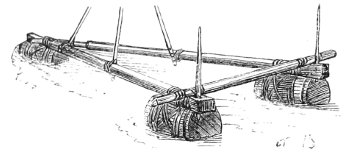
A couple of spare topmasts brought together at their heads, and
extended by a shorter spar at their heels, so as to form a triangle
more or less acute, form a good foundation for a raft; the space
between may then be filled with whatever buoyant material you possess,
whether casks, boxes, or smaller spars. No rules can be considered
absolute in raft making; anything that will float, and can be lashed
together in any manner, must be used; if a portion of the vessel’s deck
can be cut out by axe or saw it may form a good foundation; if the raft
can be built on board the wreck, or on the beach beside her, so much
the better, but it would be better to throw the materials overboard,
and, at the cost of any extra labour, construct it in the water, than
not be able fairly to launch it when completed. We have seen the waist
stanchions of a waterlogged vessel cut away for such a purpose, or in
extreme cases the hull may be expected to go down, and then the only
anxiety will be to complete the raft so that it may be capable of
floating off the sinking vessel. In the water a rectangular raft is
best built alongside the vessel, but the triangular one must be built
astern.
Pot raft.
Of buoyant merchandise formed into rafts for the purpose of floating
down rivers to the markets, we have an example in the pottery floats
upon the Nile, where a number of jars having been made, are bound
together, and a platform of reeds laid on them. Tho long timber rafts
upon the Rhine and on the rivers of Canada and North America are also
examples of this principle.
Sedge-grass rafts.
On some of the larger rivers of Africa, as the Okovango, discovered
by our late friend C. J. Andersson, the Teoughe and others, rafts of
sedge grass are used; sometimes these, if only intended to carry a
few persons across a river, are small and comparatively manageable,
and have even an attempt at comfort and security in a kind of rail
raised round them of faggots of the same material. Others, used in
hippopotamus hunting, are mere floats on which the small canoes are
drawn up, and their chief merit is that they are so like natural
accumulations that the animal does not think of getting out of their
way.
On a still larger heap of these Mr. Andersson descended the tortuous
course of the Teoughe for many miles; and Mr. Oscar T. Lindholm, who
accompanied the eminent but unfortunate Swedish naturalist Wahlberg,
gave us a most graphic account of a similar voyage. Immense quantities
of sedge was collected, and bundles of it were thrown upon the water
in some quiet nook, without any regularity and with no other fastening
than its own natural cohesion and entanglement when one layer was
thrown almost at random across another. A small hut was built upon the
heap when it had acquired sufficient size, and the whole, when ready,
was forced out into the stream, which brought it down at an average
rate of two and a half miles per hour. If it took the ground, the only
consequence was the loss of a few reeds from the bottom layer as the
mass swung round and cleared itself. Snags, projecting points, or other
impediments might tear off more, but nothing could stay the quiet but
irresistible movement of the great raft, which, as the grass below
became densely pressed and sodden, began to draw nearly 6ft. of water,
and sank deeper every day; to remedy which, fresh grass was cut and
thrown daily upon the upper layers. Frequently overhanging trees tore
off portions, and once a large trunk lay so close to the water that it
fairly swept the decks fore and aft; the occupants saved themselves by
climbing over the tree, but the hut, with many valuables, was carried
right away. With this exception the voyage was accomplished safely, but
it was a task of great difficulty to prevent the unwieldy mass being
swept by the stream into Lake Ngami, in the still waters of which it
might have floated for an indefinite period without coming nearer to
the shore.
The obelisk of Luxor was removed by laying a vessel ashore, with her
head towards it, when the river was at its highest; the masts were
lifted and shored up from the deck, so as to allow an immense packing
case to be built upon the keelson; ways like those for launching a
ship were built, and on them the heavy monolith was forced onward till
it lay at length fairly in the vessel, occupying nearly her entire
length; a deep channel cut from the vessel to the river, and at the
next rise of the water she floated off. But without forgetting this, we
do not remember a case of more ingenious and persevering adaptation of
apparently insufficient means to great and important ends, than that
of the conveyance by our countryman Layard of the great human-headed
bulls and lions from the magnificent ruins in which he found them to
the point of embarkation on the Tigris, and thence, by rafts so frail
that we almost wonder how the ponderous masses were supported, to a
place where vessels more adequate to the carriage of such a burden
could receive them. It would be a pity to curtail the brief and graphic
description, and we therefore give it in his own words:—
“I did not doubt that the skins, once blown up, would support the
sculptures without difficulty as far as Baghdad. The journey would take
eight or ten days, under favourable circumstances. But there they would
require to be opened and refilled, or the rafts would scarcely sustain
so heavy a weight all the way to Busrak; the voyage from Baghdad to
that port being considerably longer, in point of time, than that from
Mosul to Baghdad. However carefully the skins are filled, the air
gradually escapes. Rafts bearing merchandise are generally detained
several times during their descent to enable the raftmen to examine and
refill the skins. If the sculptures rested upon only one framework,
the beams being almost on a level with the water, the raftmen would
be unable to get beneath them to reach the mouths of the skins, when
they require replenishing, without moving the cargo. This would have
been both inconvenient and difficult to accomplish; I was, therefore,
desirous of raising the lion and bull as much as possible above the
water, so as to leave room for the men to creep under them.
“It may interest the reader to know how these rafts, which have
probably formed for ages the only means of traffic on the upper parts
of the rivers of Mesopotamia, are constructed. The skins of full-grown
sheep and goats are used. They are taken off with as few incisions as
possible, and then dried and prepared. The air is forced in by the
lungs through an aperture, which is afterwards tied up with string.
A square framework, formed of poplar beams, branches of trees, and
reeds, having been constructed of the size of the intended raft, the
inflated skins are tied to it by osier and other twigs, the whole
being firmly bound together. The raft is then removed to the water and
launched. Care is taken to place the skins with their mouths upwards,
that, in case any should burst or require filling, they can be easily
opened by the raftmen. Upon the framework of wood are piled bales of
goods and property belonging to merchants and travellers. When any
person of rank or wealth descends the river in this fashion, small huts
are constructed on the raft, by covering a common wooden “takht,” or
bedstead of the country, with a hood formed of reeds and lined with
felt. In these huts the travellers live and sleep during the journey.
The poorer passengers seek shade or warmth by burying themselves
amongst bales of goods and other merchandise, and sit patiently, almost
in one position, until they reach their destination. They carry with
them a small earthen “mangal,” or chafing-dish, containing a charcoal
fire, which serves to light their pipes and to cook their coffee and
food. The only real danger to be apprehended on the river is from the
Arabs, who, when the country is in a disturbed state, invariably attack
and pillage the rafts.
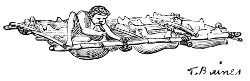
INFLATED FLOATS.
“The raftmen guide their rude vessels by long oars—straight poles, at
the end of which a few split canes are fastened by a piece of twine.
They skilfully avoid the rapids, and, seated on the bales of goods,
work continually, even in the hottest sun. They will seldom travel
after dark before reaching Tekrit, on account of the rocks and shoals
which abound in the upper part of the river; but when they have passed
that place they resign themselves, night and day, to the sluggish
stream. During the floods in the spring, or after violent rains, small
rafts may float from Mosul to Baghdad in about eighty-four hours; but
the large rafts are generally six or seven days in performing the
voyage. In summer, and when the river is low, they are frequently
nearly a month in reaching their destination. When the rafts have been
unloaded, they are broken up, and the beams, wood, and twigs are sold
at a considerable profit, forming one of the principal branches of
trade between Mosul and Baghdad. The skins are washed and afterwards
rubbed with a preparation of pounded pomegranate skins, to keep them
from cracking and rotting. They are then brought back, either upon the
shoulders of the raftmen or upon donkeys, to Mosul or Tekrit, where the
men engaged in navigation of the Tigris usually reside.”
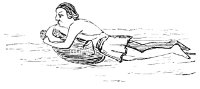
In one of the sculptures thus brought to our own country by the
energetic traveller, an army is represented crossing a river, and the
soldiers are supported each by an inflated goatskin held under the
chest, while one of the legs being led upwards to the swimmer’s mouth
enables him to keep it distended, should any air escape. In making
these bags, the only sewing necessary is at the aperture through which
the animal is skinned; the neck, cut close to the head, may be tightly
bound up with a thong, and an over-hand knot cast in the three legs;
the fourth being left with a tube for re-inflation.
Sir Samuel Baker says, when speaking of crossing the Atbara River, “I
had eight inflated skins attached to the bedstead, on which I lashed
our large circular sponging bath, 3ft. 8in. in diameter. This was
perfectly safe for my wife, and dry for the baggage; the watertight
iron box that contained the gunpowder was towed as a pinnace behind the
raft. Four hippopotamus hunters harnessed themselves as tug steamers,
and there were relays of swimmers. The raft answered well, and would
support about 300lb.; the sponging bath would carry 190lb.”
American portable boat.
Colonel R. C. Buchanan, of the United States service, is the inventor
of a very useful form of portable boat. It was used in several
expeditions, in Oregon and Washington territory, with much advantage.
It is thus described:—
“It consists of an exceedingly light framework of thin and narrow
boards, in lengths suitable for packing, connected by hinges,
the different, sections folding into so small a compass as to be
conveniently carried upon mules. The frame is covered with a sheet
of stout cotton canvas or duck, secured to the gunwales with a cord
running diagonally back, and put through eyelet holes in the upper
edge. When first placed in the water, the boat leaks a little, but
the canvas soon swells, so as to make it sufficiently tight for all
practical purposes. The great advantage to be derived from the use of
this boat is, that it is so compact and portable as to be admirably
adapted to the requirements of campaigning in a country where the
streams are liable to rise above a fordable depth, and where the
allowance of transportation is small. It may be put together or taken
apart and packed in a very few minutes, and one mule suffices to
transport a boat, with all its appurtenances, capable of sustaining
ten men. Should the canvas become torn, it is easily repaired by
putting on a patch, and it does not rot or crack, like india-rubber
or gutta-percha; moreover it is not affected by changes of climate or
temperature.”
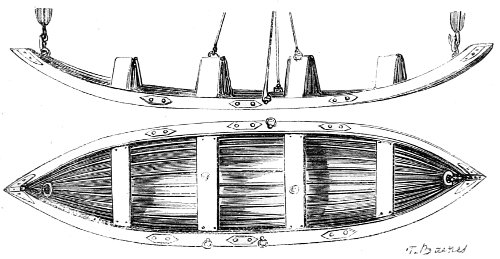
COLLAPSIBLE BOAT.
Collapsible boat.
We have not seen Colonel Buchanan’s boat, but we remember one perhaps
not very dissimilar, it was, in fact, a collapsible boat—the gunwales,
the keel, and all the intermediate pieces being exactly alike, and made
of ¾in. plank from 4in. to 6in. wide; these were hinged together at
the two ends, just as are the frames of the oval reticules, and covered
with stout canvas; the thwarts have hinges below the centre, from
which also the third board, serving as a stanchion, reaches downward
to rest upon the keel. There is a ring-bolt near the centre of each of
the midship thwarts, and when the boat is hoisted out of the water
by tackles at either end, a couple of small lines from these rings
jerk up the centre of the thwarts and allow the gunwales and all the
corresponding boards on either side to fall down beside the keel, as
shown in the upper figure of our illustration (p. 155). There are also
ring-bolts to the gunwales, and a couple of lines from these are held
fast while the boat is lowered; the gunwales rise, and a man sitting
upon the thwarts presses them into their place and the boat assumes
its proper shape: of course the segments of plank below the gunwales
have to be cut a little shorter at each end as they come nearer to the
keel, or the boat would not shut up on its hinges. A boat 4ft. wide
would collapse into a width of not more than 1ft. Such a frame could
be readily taken to pieces by withdrawing the bolts of the hinges, and
if each piece, supposing the boat to be 4ft. wide and 16ft. long were
hinged in its centre, it would not be much too long to carry on a mule,
except the country were more than ordinarily difficult, when it might
be hinged in three lengths.
At the meeting of the British Association, in Birmingham, we saw some
model boats of good form, but with very little projection of keel or
stem or stern post, so that one might be fitted into the other without
rising more than a few inches above the gunwale of the first; the
thwarts of the lower one are stowed between the two very conveniently,
and three or four may be thus packed, the uppermost, however, retaining
all her fittings in readiness for immediate use.
Canoe birch.
The aborigines of many countries make use of the bark of certain trees
for the purpose of canoe building. The most important of these is the
canoe birch (Betula papyracea); its range may be estimated at 37°
north to 43° south. Trees of this description not unfrequently grow to
70ft. in height, and are proportionately thick, so that sheets of bark
of very large size can be readily stripped from them. The bark canoes
of the Canadians and Indian traders are often of a very large size.
In the absence of forest conservators, economic considerations go for
very little. It may be convenient, when canoe building or repairing is
the object, to “fall” the tree, and, in doing so, care must be taken
that the bark shall not be rent or bruised, either by fracture of the
tree or by falling across a rock or stump, while the log ought to
lie with both ends somewhat supported, so that the required sheet of
bark may not be crushed between it and the ground. Perhaps it will be
found generally easier to detach the bark while the tree is standing,
and in this case a cut must be made all round the tree at the lower
end of the sheet; the most perfect side should be left for the bottom
of the canoe, and the longitudinal slit should be so made as to cut
right through any defective portion which may thus be cut out with the
least possible waste of material. If the tree has an inclination, it
will be easier work to make the slit on the upper side. The bark should
be detached by broad round-edged spuds of soft wood, thrust gently
and cautiously between it and the tree; and it may also be previously
loosened by striking it with a broad log or mallet on the outside,
taking care not to break its texture. Steps may be cut in the wood to
stand in, and hand-holds also as the work proceeds; and the lower part
of the bark should be made fast with cord or slips of bark, passed
loosely round, so that it may not swing clear of the tree and split the
upper part before it is finally detached.
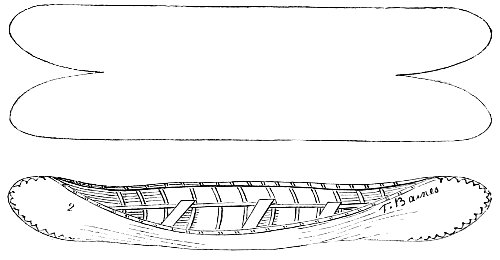
CANADIAN BARK CANOE.
Canadian bark canoe.
The sheet should now be taken to a plot of level ground, carefully
spread out with the inside downward, and the outside should be cleaned
from any knots, excrescences, or hard and brittle layers that increase
its weight without adding to its strength; and it should then be cut
nearly to the form shown in the sketch (Fig. 1). A sufficient number
of ribs or hoops of light flexible wood should be provided, and great
care should be taken, in bending it, not to split or unduly to force
any part so as to make an unsightly protuberance, which would also most
probably become a leak. The holes should be carefully bored along the
edges that come in contact, and they may be sewn with fibres from the
roots of pine trees or from small cedar twigs, and rendered water-tight
by the use of pine-tree gum. Flexible poles or laths are then stitched
in for gunwales or thwart stringers, and the canoe is more or less
tastefully trimmed off and ornamented, according to the taste of the
builder, as in Fig. 2 (p. 157).
Nothing can be lighter or handier than these canoes, but their very
lightness and want of “hold on the water” makes them difficult for
Englishmen to handle until experience has been their instructor.
Queen Charlotte’s Island canoe.
Canoes of this description are wonderfully buoyant, and draw very
little water; and, when managed by skilful hands, few boats are more
reliable. Our friend, Mr. F. Poole, who has spent many years among the
Indians of North-West America, and is a canoeman of no ordinary skill,
has recently completed a tour of extraordinary extent and interest,
paddling fearlessly, and alone, far out to sea. The dimensions of the
canoe he uses, which was made expressly for him by the Indians of Queen
Charlotte’s Island, are as follows: Length, 15ft.; width across beam,
3½ft.; depth, 15in.; weight, 100lb.
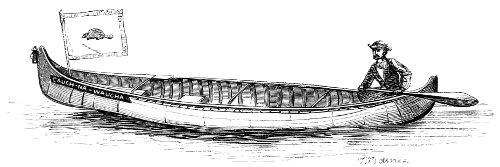
BIRCH BARK CANOE OF QUEEN CHARLOTTE’S ISLAND.
In her Mr. Poole started from Liverpool, paddling to New Brighton, from
thence to Southport, Blackpool, Fleetwood, Dutton Sands, Whitehaven,
Kirkcudbright, Whitehorn, Port William and Glen Luce. From thence by
the use of wheels—two pairs of which, composed of iron, mounted on
iron axles, are kept, until required, stowed away in the canoe—Mr.
Poole proceeded overland to Stranraer; from thence paddled along the
coast and up the river to Glasgow; then by canal to Grangemouth, and
by sea to Leith. For two nights and the greater part of two days Mr.
Poole was out of sight of land, and the voyage was prosecuted during
the prevalence of the equinoctial gales. Such of our readers as may
contemplate canoe voyaging will do well to borrow a few hints from
Mr. Poole’s equipment. A powerful bull’s-eye lamp was always carried,
lashed fast to the stem at night, and a mariner’s compass was provided
to steer by.
The wheels before referred to are extremely useful in many ways. They
are like those of an ordinary perambulator, only of light wrought iron;
they are 1ft. in diameter; the axle is also of wrought iron, ¾in.
square, and long enough to carry the wheels clear of the canoe’s sides
when mounted on them. To travel the canoe on dry land, the axles, each
covered with a strong common pillow, are brought under the fore and
after portions of the canoe, like the axles of a long narrow carriage.
Rope lashings are now brought from the thwarts down to the axle
bars, through which iron belaying pins pass; these keep the lashings
from shifting, and keep all secure when the canoe is pushed or drawn
onwards. The wheels are an immense assistance in beaching the canoe
and getting her above high-water mark, when there is but one voyager.
They also serve as ballast, and are useful for a number of camping and
make-shift purposes.
The paddle shown in the accompanying illustration, kindly furnished by
Mr. Poole, is of the exact form requisite to obtain perfect efficiency.
It is composed of red cedar, and is exactly one-tenth, diminished
scale.
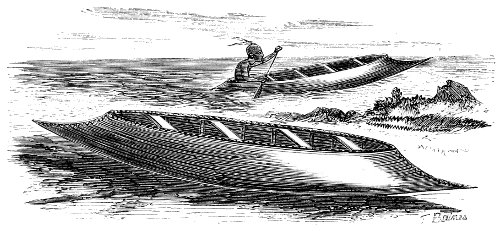
CEDAR-BARK CANOE.
Cedar-bark canoe.
SHOE CANOE.
The bark of the cedar (Thuja gigantea) is also much used by
certain Indians of North-West America for canoe building; but the form
usually made from it differs materially from that just described.
The cedar-bark canoes are in shape much like some of our iron-clad
rams, having projecting beaks, or prows, almost in a line with their
keels. The Indian paddling one of these frail craft, sits, or rather
squats, at one extreme end of the bottom, which has the effect of
tilting the bow end up in the air, burying the stern end deeply in the
water. The sharp tail-like point thus immersed seems to impart speed
and capability of evolution to a remarkable degree; much practice
is required before the exact poise and adjustment of weight are
acquired. The Indians, who half live in their canoes, manage them with
extraordinary dexterity, ascend and descend rapid rivers, and cross
wide stretches of lake fearlessly. The form of these
canoes, and of the bark sheet used for making them, is shown in the
above illustration. The mode of sinking the stern of a canoe is also
had recourse to by the Rockingham Bay savages, who manage the so-called
shoe canoe with much skill. The frame is of rough wicker-work, the
covering of hide, and the two short shovel-shaped paddles made use of
are shown in our illustration. A canoe of this kind is very easily
made, and is not difficult to manage.
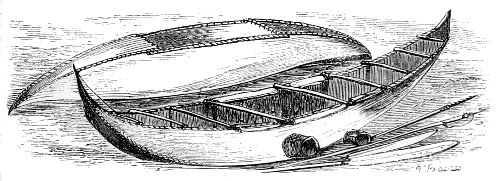
FUEGIAN CANOE.
Fuegian canoe.
We have just seen a small canoe sent from Terra del Fuego by the
Governor of the Falkland Islands to the Royal Geographical Society. It
is small, and was paddled by a girl eight years of age; it is chiefly
interesting as showing how small pieces of bark may be utilised. It is
about 8ft. long, 22in. wide, and 18in. or 20in. deep; the centrepiece
of the bottom is nearly 3ft. long and 10in. wide, and to this are
stitched two pieces, each about 4ft. long, tapering to a point, and
curving upward to a high peak at either end. The sides are pieces of
bark nearly 8ft. long and 18in. deep, straight on the upper edge, and
cut to the curve of the bottom on the lower. The whole are stitched
together with wood fibre, for which sometimes strips of whalebone are
substituted, and caulked with the fibre of the wild celery. The boat is
kept in shape by ribs of winter bark twigs, not thicker than the little
finger, and packed closely side by side through the whole length; nine
small sticks lashed athwart the gunwales keep them in their proper
shape, and a sheet of bark midships serves to sustain a patch of
clay on which to keep a small fire. A bundle of weapons of the chase
accompany this canoe.
The spears are pointed with bone, and the barbed one used for fish
and cetaceans is only shipped loosely into the shaft, to which it is
attached by a lanyard, so as to remain fast during the struggles of the
animal; while that used for birds is serrated, and is firmly fastened
into the shaft.
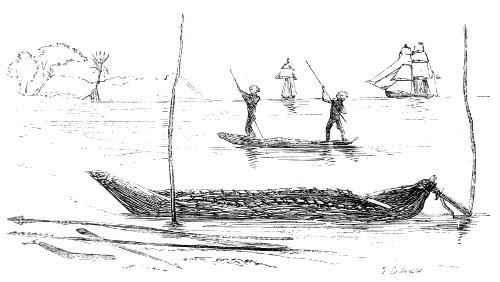
AUSTRALIAN BARK CANOE.
Australian bark canoe.
The tea-tree bark is sometimes used in Australia for canoes. We have
seen a length of it roughly tied up at the ends, and strengthened a
little by poles along the gunwales, in use at Moreton Bay, as shown
in our illustrationEB. It is just possible to make the bark of the gum
tree answer the purpose in the absence of better material. We have
often searched in Africa for a tree with bark fit to make a canoe
of, but never succeeded in finding one. Along the eastern coast of
Australia, especially towards Torres Strait, we frequently fell in with
canoes, some with outriggers and others double. They were generally
long straight logs, of very little breadth or depth; and the advantage
of this seemed to be that though the ripple would frequently wash
into them, yet, if they pitched ever so little, their great length
and shallowness would tilt out the greater portion of the water. The
outriggers were mostly logs of wood sharpened at either end, and with
pegs set up in them, so that the outrigger beams might not dip into
the water and impede the motion of the canoe.
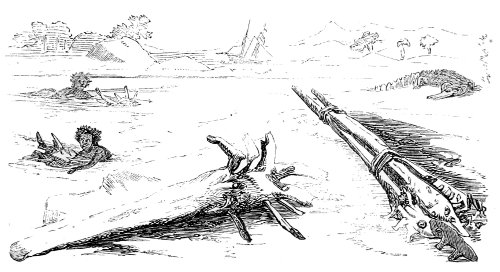
MANGROVE FLOATS.
When we reached the Victoria River we found that the natives were
accustomed to support themselves in crossing on logs of the light
mangrove wood, either singly or tied up in bundles. The part near the
roots seemed to be the favourite, as the stumps of the roots formed
pegs on which to hang their spears, skins, or other possessions. The
wood of the milk bush, which is about half the specific gravity of
cork, is much used by the natives of equatorial Africa for the above
purpose.
Long canoes.
At Shupanga, on the Zambesi, we have seen dug-out canoes, 50ft. long
and about 5ft. wide and deep; at all events, a tall man standing beside
them did not stoop much when he rested his arms upon the gunwale. These
were hollowed and roughly shaped in their native forests, and hauled
along nearly thirty miles, on rollers, by the long rope-like stems
of the vines and creepers common in tropical forests. They were made
only for the Portuguese. The upper part of the bows expanded into a
platform sufficiently large for the chief boatman to stand on, while
the stern was cut into an imitation of a run and dead wood, with a
couple of holes in the after part, to which a rudder was secured by
lashings. Nothing can be better for hollowing a canoe than the adze,
but our Kroomen used a broad spud or chisel on a staff about 6ft. long,
driven in a manner which will be best understood by a glance at the
statue of “Michael overthrowing Satan.” The Krooman’s method of baling
is characteristic. Should the canoe fill, all hands jump overboard,
seize the gunwales, and sally her fore and aft till the water flies
out at either end and leaves her absolutely free. We have seen a
canoeman, near Lake Ngami, walk to one end of his leaky craft and, thus
depressing it, cause the water to flow towards him, when, making his
broad foot do duty for a scoop, by a succession of vigorous kicks, he
soon had his canoe as free as he desired.
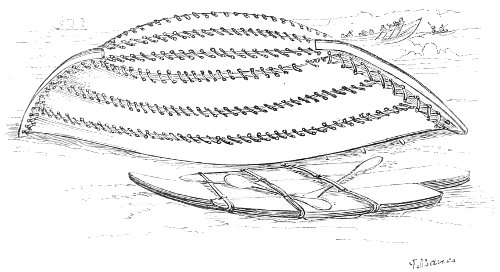
MASSOOLAH BOATS.
Massoolah boats.
In many parts of the world, boats of almost any size are built without
metal fastenings, and the Massoolah boat of Madras may be taken as
a fair type of those which are sewn or laced together. It will be
seen in our illustration, copied by permission from a model in the
United Service Museum, that the bottom boards are flat and form an
oval elongated and pointed at the ends, so that the side planks curve
naturally to meet the stem and stern-post, and give the boat an easy
sheer. They are sewn together with coir yarn (or cocoa-nut husk fibre),
the stitches crossing over a wadding of coir or straw, which presses
on the seam and prevents much leakage. They are very elastic and give
to the shock as they take the ground in the surf, which runs sometimes
nearly 16ft. high; they are from 30ft. to 35ft. long, 10ft. or 11ft.
wide, and 7ft. or 8ft. in depth; they pull double banked, six oars on
a side, made of long rough poles with oval pieces of board lashed on
the ends; they are steered by an oar. Our illustration shows also the
catamaran or log float, on which the natives will pass to and from the
shore when no other craft, not even the Massoolah boat, would venture.
It must be remembered, however, that the men are themselves nearly
amphibious, and care as little for being washed off their rafts as so
many frogs; while the letters or small parcels they carry are kept dry
only by being worn in a kind of oil-cloth turban.
Norwegian boats.
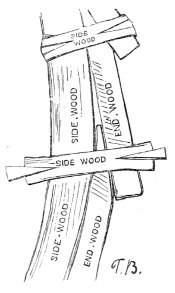
We have seen very nice boats built in Norway with dowels instead of
nails; they were clinker built, and the dowels were about ½in., or
fully as thick as the planking. A number of rods, from 3ft. to 4ft.
long, are planed up to the required size, and cut into lengths say,
when two thicknesses of ½in. plank are to be clinched, to 1½in.,
or, when the two planks and a timber of perhaps 1in. are to be
fastened, to 2½in., so that both ends may project a little beyond
the wood they are to fasten; the dowel is then split at each end with a
sharp chisel, taking care that the cut is made at right angles to the
grain of the plank or rib, wedges are driven in, and the end, being
slightly spread out by the use of the clinch hammer, is trimmed off not
too close; the wedges should be all neatly cut with a fine saw, and by
sawing them in breadths from a board, and then splitting them to the
required size, labour may be greatly economised. The holes should be
bored with a sharp centre-bit; and if the dowels fit tightly the wedges
may be dispensed with, as the ends will spread sufficiently under the
clinch hammer without breaking the grain.
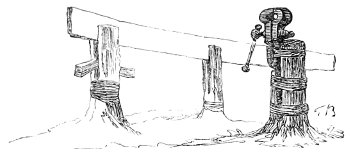
In building, if any difficulty should be found in drawing down the end
of the plank to the stem, it will be advisable, after having fitted
it carefully, to slack up the centre, let the end come to its place,
fasten it, and then again bend the plank downwards. In some boats,
especially in the navy, the planks do not run fore and aft, but two
thin layers are crossed over each other diagonally, and clinched
together; this leaves the outside perfectly smooth, and is perhaps the
strongest known method of boat building. In planing up the edges of
planks, &c., it is absolutely necessary to have a vice of some kind,
and nothing is better than a tree vice, unless you have a blacksmith’s.
Saw off a young tree from 6in. to 8in. thick, at about 3½ft. from
the ground; saw the stump down the middle as low as you can; bind the
lower part tightly with thongs of raw hide to prevent its splitting,
then insert wedges to open the upper part, put your planks in, withdraw
the wedges, and it will hold tight enough. It is as well to cut the
upper part of the opening sufficiently wide to admit an inch plank, as
short pieces can easily be put in to fill up should you wish to hold a
thinner one.
Portable steel boat.
We have already mentioned the principle on which Mr. E. D. Young’s
portable steel boat for the Livingstone Search Expedition was built;
and although, as we then said, none but a skilled workman could
hope to turn up the edges of a curved sheet of metal, we think the
principle might be applied to a flat-bottomed boat by merely snipping
the flanges at the turn of the bilge, and bending upward the sides at
any convenient angle; by cutting these more and more diagonally from
the centre, the boat might be tapered to each end—not, indeed, in a
true curve, but in a succession of short straight lines, which would
tolerably represent one.
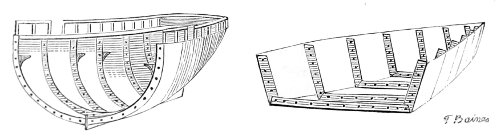
The number of pieces composing the “Search”—the boat used in the
expedition sent in quest of Dr. Livingstone—were as follows:
Thirty-six side pieces of steel, each being a load for one man; the
midship piece required 2; the stern piece, 3; the bow piece, 3; the
mast, 2; the boom, 2; the sails, 2; chain cable, 6; anchor, 1; and the
whole with provisions, luggage, &c., made up 180 loads.
Captain Faulkner, who, as a volunteer, accompanied Mr. Young on
the Search Expedition, has determined on returning with a party of
ardent hunters and explorers, and an engineer, to Lake Nyassa, and
for this purpose an iron steamer has been built 50ft. long, 5½ft.
deep, and 11½ft. broad. The little craft, appropriately named the
“Faugh-a-ballagh,” is composed of 75 sections, put together with 8000
screws, so that she may be carried, as was the “Search,” past the
rapids and cataracts of the Shire River.
American life raft.
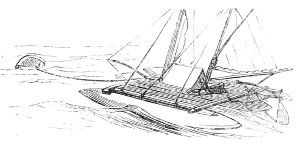
The American life raft “Nonpareil,” which recently made the voyage
across the Atlantic, may be taken as a successful application of the
tubular system. It will be seen that she was constructed of three
parallel inflatable tubes, covered with stout canvas, connected by
breadths of the same, and with a rectangular frame laid over all to
support the masts and rudder fittings; but the sketch is introduced
here also to show the use of the droge, by which the little craft may
in effect be anchored in the open sea, or at least may have her drift
effectually checked, while the sea itself is broken before it reaches
her. The droge in the present instance is of canvas, stretched on a
large hoop with four lines, so attached to its circumference that when
the strain comes on it it stands vertically in the water, and opposes
the resistance of its entire surface. The oars or mast, and sails
of a boat, will also answer this purpose; and we have heard of one
instance in which the imperilled crew added also a number of the skins
of freshly-killed seals, the oil working out of which calmed the water
for a considerable distance. It is necessary to watch the length of
the sea, so that the boat may be veered as far from the droge or raft
as it will serve to protect her against the breaking waves. We have
heard the captain of a vessel say that he would never incur the risk
of wearing in a gale, but would rather sacrifice some spar or piece
of lumber to bring the ship’s head to the wind. In doing this, the
hawser would be carried round from the droge on the weather bow, under
the bobstays and bowsprit rigging to the lee bow, and finally to the
quarter; the droge would be thrown over, sufficient line paid out, and
then held on to till the ship’s head came to the wind; the strain would
be then changed for a moment to the lee bow, and then to the quarter,
whence it would be cut away as the ship fell off upon the other tack.
A spar held by a hawser and bridle, with a stout sail bent to it—the
clews, or lower corners, being weighted with shot, lead, or iron, to
make them heavy—forms an excellent droge for a small craft to lie to
under.
Temporary repairs of vessels.
Although this subject may seem almost beyond the province of our work,
it is by no means improbable that explorers may have to turn their
attention to it, or that shipwrecked crews, or dwellers on a lonely
coast, may have to repair or build small craft for themselves. We have
seen first-class waggons built by missionaries, and others have built
vessels; and the reader may remember with advantage the description
given by Ulysses of his laying down side by side ten or a dozen pine
trees more or less smoothed off as a foundation on which to build his
upper works.
During the progress of the North Australian Expedition, we were
ascending the Victoria River with our little schooner, the “Tom
Tough.” There was little or no wind, and with the boat ahead towing
and the lead going we were drifting up with a strong flood-tide, and
the captain, elated by success, and anxious to make the most of his
opportunity, kept going onward instead of prudently anchoring while the
tide was still rising. In consequence of this, when the vessel touched
the ground, there was no subsequent rise of water to float her off;
indeed, it was remarked that the water began to fall while the tide
was still running upward, and she was left at low water on the 27th of
September, 1855, on a mud bank, with her bows uncomfortably propped up
by a projecting rock.
On the 29th she floated; but the flood-tide was so nearly done, that we
had no time to choose an anchorage, and the schooner grounding with the
ebb, parted her chain cable and heeled over with the force of the tide
till we could barely stand upon her decks.
Day after day the schooner drifted to and fro upon this sand-bank,
sometimes moving a length or two, and sometimes only a few feet during
a tide; the sand scoured out from beneath her bow and stern, leaving
holes with 6ft. or more of water there, while hillocks accumulated
under her in midship; and the sand seemed to travel so evenly with
her, that the usual criterion—a hand lead, allowed to trail upon the
ground—was of no service in enabling us to estimate the distance she
had moved.
On the 10th of October the decks had rifted, the combings of the main
hatch had started up, the starboard side between the masts was hogged
up 18in., and at the turn of the bilge, where the floor timbers join
the ribs, one of the planks had split for 15ft. or more, leaving spaces
into which the flat hand might easily be passed.
We laid broad strips of blanket and sheepskin well tarred on the
principal rents, and nailed thin planks over them (Fig. 8, p. 170), but
in another day or two she was just as bad on the other side; her stern
was peaked into the air, while her bows dipped about 7ft. into a hole,
the water pouring out of the fresh rifted planking as the tide fell.
The mainmast rose up through the partners, so that we were obliged to
slack off the rigging, and it became a question whether the stanchion
under the main hatch should be knocked away to prevent its bursting up
the deck, or whether it should remain so that the strength of the deck
might keep the bottom a little longer from breaking.
On the 25th we again floated, after nearly a month of straining to and
fro upon the sand-banks, and drifted rather than navigated the vessel
up to the camp we had established below Steep-head.
Captain Gourlay with his crew, and some of the expedition men, found
suitable trees some little distance up the river at Timber Creek,
which, however, after a rather exciting adventure with some wandering
natives, acquired the name of Cut-Stick Creek instead. Two long heavy
gum trees as straight as possible were selected, brought to the
vessel, and laid as sister keelsons (Fig. 2) alongside the real one,
which, as well as all the original framework, is marked Fig. 1 in our
illustration. Three or four pair of heavy crooks, each representing the
half of a floor timber (Fig. 3), were then laid on the inner skin, with
the inner ends abutting on the sister keelson, and the outer reaching
up above the junction of the ribs with the floor heads. Heavy riders
(Fig. 4) were placed upon them crossing the three keelsons, and were
secured by clamps (Fig. 5) made of the tires of our dray wheels, which
we had no hope of being able to put to their proper use. Being now
above the rise and fall of the tide we could not beach the vessel, and,
therefore, the frame could only be bolted to the true sides above the
water line (Fig. 6), but it was pressed down upon the bottom not only
by its own weight but by stanchions (Fig. 7) between it and the deck
beams.
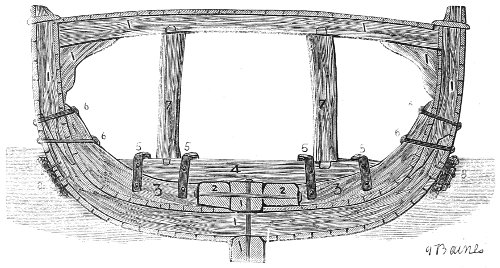
The schooner being detained for repairs, it was decided to undertake an
expedition to the Albert River in the long boat; and thus, by reaching
Mr. Gregory in time to assure him that a vessel was coming, prevent
his starting for the colony with insufficient supplies; Mr. George
Phibbs, the overseer of the expedition, and Mr. Graham, the mate of the
“Messenger,” volunteering for the trip, we commenced our preparations.
The boat was cleaned, repainted, the leaks stopped; and two inflatable
tubes were made, each of them of one piece of canvas, 14ft. long, lined
with waterproofed calico, folded so that the two sides should come
together, a rope along the seam, with eyes turned in at the corners,
to make it fast by, and, with one of the screw valves from our worn-out
boat (p. 48), let into the after end, to receive the nozzle of the
bellows. These we at first intended to stretch beneath the thwarts,
inside, but eventually laced them outside each gunwale, where they were
less in the way, and, when kept in a state of semi-inflation, projected
sufficiently to prevent a great deal of the ripple of the sea washing
into the boat, and this advantage we made the most of when we were
fairly at sea, by fitting light bamboo stanchions forward, and securing
the tubes to them, so as to make a kind of raised wash streak round the
bows.
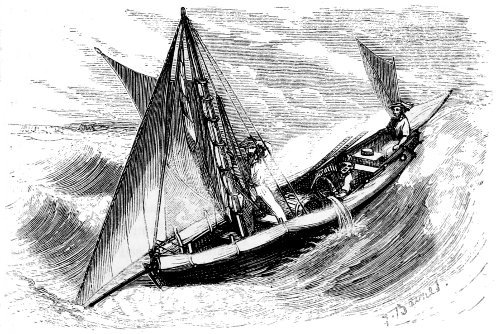
BOAT FITTED WITH INFLATED TUBES.
We left the vessel on the 23rd of October off New Year’s Island, and
at first had fine weather with good working breezes, but in a few days
strong adverse gales came on. On the 2nd of November we worked all day
clawing off a lee shore, the sea raging furiously over the shallow
bottom; but our boat, though only 18ft. long and 6ft. beam, behaved
well, and we weathered the rocks by less than a quarter of a mile
after sunset. Darkness came on at once, and, as we dare not run in for
shelter, we made the boat snug and hove to under foresail and mainsail
all night. We ran through between the Crocodile islands, the crest
of the short sea behind us foaming around our quarters, while our
bowsprit was actually dipping in the next, and began to fear that we
should have to pass the islands without finding a shelter, when Phibbs
volunteered to swim ashore. We let go our carronade as an anchor, and
ran in to the full length of the line; he sprang overboard, and with
some difficulty reached the shore, where he soon found a quiet little
nook to which he beckoned us to steer.
We will only add that on the 17th of November, after having sailed
nearly 750 miles, we reached the mouth of the Albert River, in the Gulf
of Carpentaria.
Sails and their substitutes.
We cannot dismiss the subject of boats without appending a few remarks
on such simple forms of sails as are likely to be of service in such
small craft as a traveller might possess, and we shall take, as the
maximum, one of those swift and handy fore and aft schooners in which
the Americans push their trade in all quarters of the world. Each lower
mast and topmast would most likely be in one piece, combining great
strength with neatness, and obviating the necessity for much staying.
The bowsprit is also of a single piece; the sails are a jib from the
foremast head to the bowsprit end, a forestaysail set to the stem
head, a foresail and mainsail on gaffs made to lower when the sail is
reefed or taken in; the foot of the mainsail is always extended by a
boom, and that of the foresail sometimes; if they are laced to the
boom, as in the yacht “America,” which had booms even to the foot of
her jibs, the sails sit flatter and better on a wind, but if they are
not, there is the advantage of being able to reduce the sails without
the trouble of reefing, by tricing up the foot; gaff topsails may be
either jib-headed, like the fore, or on a gaff, like the main, in Fig.
1. The mainstay causes some little difficulty; if it goes from mast to
mast, the tack and sheet of the fore gaff topsail must be passed over
to leeward of it when the vessel goes about; if it leads down to the
deck there must be two parts, one on each side the foresail, and the
lee one ought to be slacked, and the weather one set up on each tack.
If a foreyard, or rather a cross-jack, is carried, a flying squaresail,
half the width of the yard, may be sent up on the weather side, and a
topsail may be set in the same manner, the fore and aft sails supplying
canvas enough on the lee side.
The cutter (No. 2) has a jib, a foresail on the stay, and a mainsail;
the jib topsail runs with grummets on the topmast stay, but the
halyards only reach the lowermast head; a lug-headed gaff topsail gives
opportunity for a greater spread of canvas.
The boat (No. 3) is rigged with foresail and spritsail. An eye in the
peak of the latter receives the upper point of the sprit, while the
lower end is set into the eye of a snorter, a bight of rope passing
round the mast and tightened chiefly by the strain of the sail upon it.
Sometimes it is pushed up by hand while the sail shakes, so as to set
it properly up, but it is better to have a small tackle as seen on page
171 to set it up with.
No. 4 has shoulder-of-mutton sails, the peaks of which are bent on to
small taper yards which slide up and down on and abaft the lower masts
like gunter topmasts; this facilitates the reefing of the sails, and
also the setting of the jib from the foremast head.
No. 5 is a lugger, the yards are slung in the thirds, the shortest
and thickest arm is forward, and the longest tapers aft; the foremost
leach of the sail is very strongly roped, so that the tack holds down
the forearm and elevates the peak. Sometimes in well-manned vessels
the lugs are dipped so as to pass to leeward of the mast whenever they
go about, and in this case the tack may be bowsed down considerably in
front of the mast and a large sail carried; but in short-handed craft
the tacks are brought down to the mast, and the foresail and mizen are
set on one side and the mainsail on the other, and are not dipped. The
after leach of the jib must be cut so as to go clear of the foreyard,
the topmasts to slide abaft the lower masts; and there is always some
difficulty in setting a fore topsail, as there must either be a double
tack to pass the sail over the jib halyard in going about, or its fore
leach must remain to leeward of it.
The lateen (No. 6) has triangular sails with very long taper yards, the
head and fore leach becoming one; indeed, if there be any distinct fore
leach, the sail becomes an ill-shaped lug, and not a lateen. The masts
are somewhat short; sometimes mere stumps, but then the halyards and
the tacks must be enormously strong to counterpoise the immense length
of the yard.
The proa sail (Figs. 7 and 8, p. 173), a triangle spread upon two
bamboos, hitched upon a stump mast in small boats, we have described
at p. 135. No. 9 is a modification of it, by which a boat sets jib and
mainsail in one, the angle formed by the yard and boom becomes more
acute at each reef as indicated by the lines. It would be difficult,
however, to work the boat without a small mizen to help her round in
staying. No. 10 is the shoulder-of-mutton sail, set on a single taper
yard or mast.

Palm leaves are sometimes used as sails; our sketch represents three
or more cocoanut leaves, so woven together as to present a surface
to receive the wind. Blankets and articles of clothing are used in
emergencies. Oars are set up, and a boat will gather considerable way
under them. Planks, the broader and flatter the better, are excellent
substitutes, and may be trimmed at pleasure. It must not be forgotten
that, however graceful in art and poetry the bellying canvas may be,
the chief object of the sailmaker is to get it “to sit like a board.”
Reefing of sails from the sides.
Sometimes when a sail is split, or otherwise rendered unserviceable,
it is desirable to use another for a substitute without spoiling it by
cutting. We remember reading of a vessel in which the topsail was split
in a heavy gale; a spare foresail was got out and stout bands sewed on
it, from the clews to the reef-band, diminishing upwards to the width
the topsail head ought to be; eyelet holes were worked in, points or
lacings inserted, and the sail, thus reduced, sent up to do duty as a
topsail.
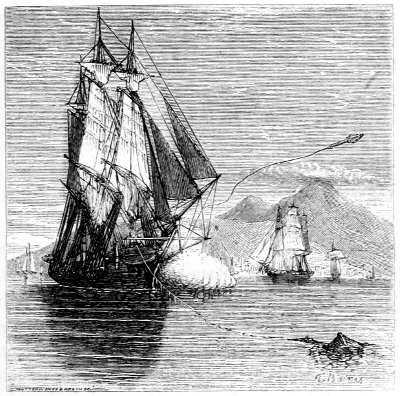
Captain (now Admiral Sir E.) Belcher, when in command of H.M.S.
“Sulphur,” made use of a very clever expedient for imparting motion
to his vessel when the wind failed. He constructed a couple of bolts,
with stout umbrella framework covered with canvas at their heads, and
with their butts so thickened as to fit loosely into the bow guns. A
line was attached to each butt, and one was given in charge to the
port and the other to the starboard watch; the first was fired to
a good distance ahead, and as soon as the line was hauled upon the
frame expanded and opposed its full resistance, so that, as it could
not be drawn backwards through the water, the vessel must begin to
move. Before this was hauled in the next was fired, the ship would
increase her rate of progress, and, the impetus being once acquired,
she would “hold her way,” so that eventually the men would have little
more to do than gather in the slack of the line. No sailor likes the
inaction of a calm, and besides this the captain had judged rightly
in exciting the emulation of his men by giving one to each watch, and
further stimulating it by an occasional glass of grog to the hardest
working side, so that the cry of the port watch would be, “Haul away,
and run her up to the umbrella before the starbowlines get theirs
laid out,” and vice versâ, till sometimes a speed of four knots an
hour was obtained. Thus was the good ship hauled out of many a belt
of calms, and brought into the region of the winds, which might be
only a few miles distant, while other vessels not so provided might
have lain becalmed for weeks; and not only this, but her position
in a bay or anchorage could be shifted at pleasure, and she became
almost independent of wind or extraneous assistance by this ingenious
expedient.
Paddles worked by mill sails have been proposed; but of these it will
be sufficient to remark that the power of the paddles to drive the
vessel’s head to wind will be less than that of the wind to drive her
backward by the full amount of all that is expended in overcoming the
friction of the machinery; in every other position the wind on the
sails would do its work without the paddles.
Hints in emergencies.
A Prussian vessel, with the leaks gaining on her and her crew
exhausted, was saved by lashing a spar across the mainmast, with one
end projecting overboard with a barrel half full of water fast to it,
so as to rise and fall with the sea. The pump brakes were made fast
to the spar, and the vessel was thus kept afloat, while the crew were
relieved from their labour.
A boat has been known to come ashore safe through a heavy sea by means
of a handful of oil judiciously thrown over by one of the men whenever
a wave threatened to break near her; and Captain Basil Hall relates how
one of his boats was hove to all night under a droge of all her spars
and sails and two or three seal skins, the oil of which working out
calmed the water for a considerable distance.
Instances of this kind might be indefinitely multiplied; but we note
only a few as suggestions. No amount that we could give would supply
the want of presence of mind and the ready power of adapting the means
at hand to the emergency.
Our space will not allow us to go into all the details of boat sailing,
but we must find room for one or two general rules. In seeking to land
through breakers, which must always be effected by the oars, wait just
outside them till you find the heaviest roller coming in; then give
way, and come in upon it, with your boat’s bow all but overhanging its
crest, and, as it lands, you jump out and haul your boat beyond the
power of its reflux. Some crews are in the habit of giving two or three
powerful strokes just before they reach the shore, and then pitching
their oars simultaneously as far from them as possible, picking them up
again when they have secured their boat. It is well, however, to know
that there is no current to set the oars out to sea before doing this.
In coming off face the breakers boldly, but judiciously watch the
smaller waves, and give her good way through them. Keep your boat’s
head on to the sea, and never let her take a breaker more than two
points on either bow.
Trim the sails so that when brought to the wind the boat will very
nearly steer herself, and she will attain her utmost speed. The action
of the rudder has always a slightly-retarding influence, but if there
is any want of balance let it be on the side of ardency or tendency to
fly up in the wind, so that she may carry a little weather helm rather
than want helping up by a lee one, and thus, in case of sudden squalls,
the boat will, as if by instinct, obey the first touch of the lee helm,
and, shaking the wind out of her sails, will right herself. The main
sheet of an open boat should never be made fast, but held either by the
steersman, or some one near him, in readiness to ease off. A squall
seldom comes so suddenly that the first puff, if well watched, will not
help the boat into the wind before the full strength comes; but on the
coast of Australia we have known a squall come so suddenly through the
dead calm of the night that it struck us at once like a blow from a
sledge-hammer, and, though we had taken all the usual precautions, the
sea was pouring like a jet-black cataract flecked with diamonds over
8ft. of the lee gunwale before the boat came to the wind; and we would
say, therefore, if there is not an air to bring the boat’s head up when
you expect a squall, help her with the sweep of an oar into the best
position to receive it.
If you want to carry on sail do not attempt to stiffen the boat by
making all the crew sit to windward; for, should the mast break, as
is not unlikely with the increased strain, nothing can prevent her
capsizing; let them sit in the bottom. In the way of ballast, nothing
can be better than bags nearly filled with fresh water. They will
assume the form of any place you want to stow them in, and will not
sink the boat if she should fill; in fact, being lighter than salt
water, they would impart a trifling buoyancy.
Temporary rudders.
The loss of the rudder, an accident which is by no means so unfrequent
at sea as may be imagined, involves also, for a time at least, the loss
of control over the vessel’s course. Even in the open sea this must be
attended with considerable peril; but when it happens in the vicinity
of rocks or shoals, and the vessel has not sea-room, the danger becomes
appalling. The careful and vigilant trimming of the sails is the
readiest means of regaining command of the vessel, and we believe the
“Wager” was extricated from a most perilous position by this alone;
but it is a work of immense labour, and harasses the crew severely.
A stream cable payed out astern, and veered to either quarter, is
sometimes used; or, if the accident should occur in moderate weather,
by striking on a bar, the jolly boat with the plug out may be lowered
and towed astern, but both these plans check the speed of the vessel,
and are only useful when they can be made to impede one side more than
the other; and that this is not the true principle of steering is
known to every butcher’s boy, who apologises for wearing but one spur
by saying “if one side of his horse goes the other must.” The rudder
may be considered as a continuation of the keel, capable of moving on
a hinge to an angle of 22½° on either side, and when the vessel
moves forward, and the helm, for instance, is put to port, the water
impinging on the starboard side of the rudder is reflected from it at
an equal square to that of its incidence, and the resulting force tends
to drive the stern to port and incline the head to starboard. But as
the force acts in the direction of a line midway between the angles of
incidence and of reflection, it has also a retarding tendency, and if
the helm were put over to an angle of 45° the greater part of the power
would be expended in stopping rather than in steering the vessel. If
a ship could be made so flexible as to be converted like a fish into
the segment of a circle either way at pleasure, the very perfection of
steering would be attained, and the rudder is merely the best imitation
of this that can be devised.
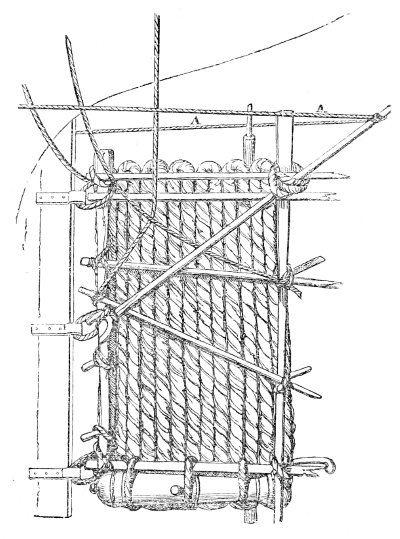
Our illustration shows one expedient for the remedy of the misfortunes
we have named. A warp or cable is faked down upon the deck in lengths
equal to that of the required rudder, all the parts are then so closely
pressed together that it resembles a board of the required breadth;
it is then stiffened by longitudinal and cross bars, a weight is
attached to the bottom, and a tiller projects aft, from the extremity
of which the steering tackles (A) lead in over each quarter.
When lowered into its place, the heel is confined to the stern-post
by chains or hawsers leading to the gangway on either side, and in
the present instance ropes are reeved through the gudgeons on the
stern-post. Sometimes two parts of the cable are left longer than the
rest to come up the rudder trunk and form the neck of the rudder, a
short spar passed through the bight on deck serves to suspend the
whole. Very frequently, however, when the rudder goes, the gudgeons,
and perhaps also part of the stern-post, are carried away, and it then
becomes necessary to devise some plan which shall supply their loss.
Several expedients are given in the Nautical Magazine for 1836,
and from these we extract two or three examples. A spar, such as the
spanker-boom or jibboom, is first passed over the stern, secured to
the centre of the taffrail by temporary “partners,” and to the heel of
the stern-post by stout guys leading forward to the gangways on either
side; the gaff is then fitted on this, just as it would be on a mast,
and one of the smallest and stoutest storm staysails is laced, with the
head downwards, to the upright spar, and also to the gaff, the foot
of the sail being cut off, if it be too large. It is then hauled down
to the lower end by a halyard previously reeved, and the gaff, which
should go a little below the surface of the water, is hoisted until the
sail sits “as flat” as a board. If greater power is thought necessary,
the outer end of the gaff can be sawn vertically down the centre, and
boards clinched in, as shown in the sketch (Fig. 3); or either the
sail or boards might be used separately. The ship is steered by guys
leading from near the end of the gaff over each quarter. Sometimes the
principle of the steering oar is adopted: a spar, with planks fastened
on its outer end, is got over, and the foremost end is fitted to the
stern by ring-bolts or lashings, so as to allow it to work freely
without too much play. The outer end is kept down either by a lower guy
or by a piece of pig ballast or other weight; and if a topping-lift be
attached, leading to a boom over the stern and thence to the mizen
topmast-head, the oar may be lifted out of the water when one stroke
has been completed, carried back again to the other side, and thus
bring the ship’s head round by a succession of sweeps.
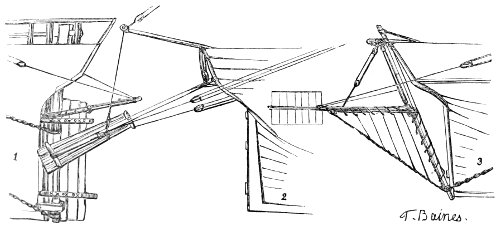
Sometimes it is necessary to make a temporary stern-post, and the spare
lower cap (which, however, we may remark, is generally stowed away
where it is least likely to be found on an emergency) can be fitted
on this by enlarging the masthead hole and securing it, as before,
by lower guys. A topmast, with its heel upwards, may be passed down
through it, and such additional spars or planking bolted on as will
give the needful increase of breadth. The surface should be as smooth
as circumstances permit, so that the water may glance off readily; the
fid-hole will then receive the tiller, but the spar must be well banded
or lashed round to prevent its splitting with the strain, or perhaps
breaking off where the sheave-hole weakens it.
Scarfing or fishing of broken spars.
The captain of our battered little vessel had always some rough and
ready expedient at his finger-ends. When one of the iron davits of
the quarter boat was bent by a collision, he extemporised a forge
with some pig ballast, on deck, and, though the planks beneath were
somewhat scorched, he rendered the davit again effective. Once, when
running before the wind, the mainsail jibed in consequence of careless
steering, and the boom, being fastened by a “lazy guy,” a slovenly
shift a little too common among us, broke short off; however, a good
stout plank was found, cut into four pieces, which were laid round
the fractured part so as to inclose it in a kind of packing-case, of
which the four sides did not meet at their edges; wooldings of rope
were passed round at intervals and tightened by driving in wedges,
and the boom, though somewhat clumsy, was again fit for duty. (See
illustration.)
If a spar, with both ends alike, breaks at either end, a very neat and
effective scarf may be made by sawing it down the centre and reversing
the two parts, end for end, so that the fracture in one half may come
against the unbroken part of the other, as in our sketch (p. 181). If
the fracture is long, there may be no need for that unsightly appendage
called a fish, and, even if it is short, a very small one will serve
the purpose.
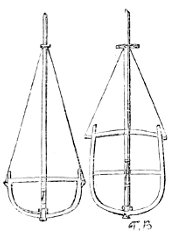
If a mast breaks, much above the deck, it may be again used, with
little or no diminution of its strength, by reversing it, and stepping
what used to be the masthead upon the keelson, so that the fractured
part may come below the deck, while that which was the heel is shaped
and fitted to become the head. It will be evident from the sketches we
give that in a ship with a very deep hold, where very nearly half the
mast is below the deck, this plan is more likely to be of service than
in a shallow one, where the part below bears but a small proportion to
that above.
Kites.
As a substitute or as an auxiliary to the common sails, or as a means
of sending up a signal or effecting communication between a ship and a
lee shore, a kite of sufficient power would frequently be useful.
Every voyager knows how frequently all the lower and larger sails of a
vessel are becalmed, the uppermost and smallest catching only a gentle
air, while at a little height above them the wind, as indicated by the
fleecy clouds, may be blowing much more briskly.
In this case, when even the flying kites, as the upper sails are
figuratively called, have become useless, real kites flying at a
sufficient elevation would do good service; and even though the wind
might not be fair, still so long as it was a little abaft the beam
the vessel might be steered to her course. One thing must be kept in
mind, and that is, that when it has once fallen calm below the kites
cannot be raised to the breeze that is blowing above, therefore it
would be well either to send them up before the breeze fails, or at
least to send up in preparation a small one, to the line of which the
larger could be hitched, and jerked clear when it had been carried to a
sufficient altitude.
A kite of 12ft. in height spreads about 50ft. square of canvas, and
will pull, in a fresh breeze, with a strength of about 200lb., if
the height were doubled the strength would, of course, be fourfold;
and as it would act as a lifting or buoyant instead of a depressing
sail, the only risk in “carrying on” would be the parting of the line
connecting it with the vessel; on this account it would be the best
possible form of sail to rig in an open and over-crowded boat when
leaving a wreck, for its tendency would be to lift the bows over the
seas instead of depressing them. And even if a man about to risk the
passage by swimming from a stranded ship to a lee shore could send up
a small kite, such as he could make with a cotton shirt, a couple of
sticks, and a few fathoms of fishing line, it would most likely buoy
him over the crests of the breakers in which he would otherwise be
overwhelmed. But the greatest objection to the general use of the kite
is, that in the usual mode of flying we have no command of it except
that of letting it go higher or hauling it in at the risk of breaking
the line; this has been met by a very ingenious invention, and although
it is patented, we think that we may do the public some service, and
Mr. Pocock, the patentee, no harm, by describing it.
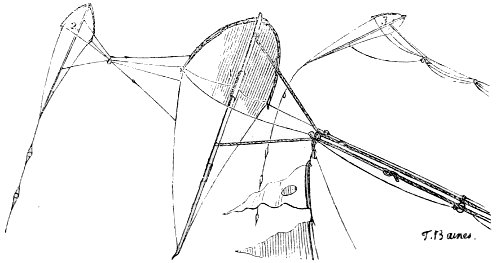
POCOCK’S KITE.
The common form of kite is best. The standard is made into two or three
equal lengths, connected either by fishing-rod, by tent-pole, or by
parasol joints; the wings have hinges at the head of the standard,
and, if large, joints in each pinion. The flight band consists of two
lines, the uppermost of which has an eye upon it through which the
lower, called the brace line, reeves, and both come down to the hand
of the conductor, and by these the deviation of the standard from the
perpendicular is controlled. By hauling on the brace line the surface
is opposed fairly to the full strength of the wind (Fig. 1); by
slackening it the kite floats more horizontally, allowing the wind to
pass gently beneath it, so that even in the strongest gale the power
may be regulated at pleasure (Fig. 3). The power may be increased by
backing the first with a second kite as in Fig. 2, all the lines of
the second kite being made fast to their corresponding places on the
first, so that both assume the same relative position in all cases.
Two smaller lines from the wings, also passing through eyes on the
upper line, act as braces by which to trim the kite upon a wind; and it
appears from a diagram given by the inventor that a vessel braced sharp
up will lie within about five and a half points of the wind, or as
close as most vessels can with their usual sails, and, therefore, may
turn to windward. With a kite the operation of tacking would be very
easy. Even should the boat not answer her helm, the kite line taken
aft would bring her head up to the wind, and, being carried round on
the other quarter, and again forward to its proper place, would help
her to her proper course; and in manœuvring the absence of masts
would be an advantage rather than not. A carriage with the fore wheels
capable of being turned by a tiller would also turn to windward, and
the draught power might be increased at pleasure by backing one kite
with another, the connecting lines all being fastened in their proper
places, as in the illustration (p. 183), so that whatever change of
position was imparted to the lowermost kite might be also assumed by
all that were harnessed to it.
Signals by day or night might be sent up with great facility by
hitching the halyard block upon any part of the kite line, when the
flags or lanterns might be sent far above any spars or sails that could
obstruct the view of them. In case of shipwreck, even a common kite
extemporised with the roughest materials would very generally be useful.
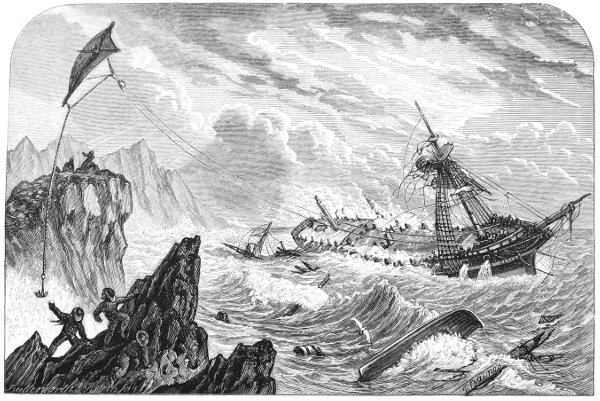
SENDING LINE FROM WRECK TO LEE SHORE BY MEANS
OF A KITE.
When the ship is on a lee shore, a common kite, flown from on board,
could not fail to bring a line to land, and, with this communication
once established, all hands could probably be saved. Their own boat
might be veered ashore, or the men sling themselves with grummets and
warp themselves hand over hand; or if passengers are on board, a cot
or hammock, slung to notched blocks running on a hawser with a line
to haul it back to the vessel, and one to bring it again towards the
shore, might be employed.
But with kites rigged as we have described, there would have been a
greater chance of safety, for they may be braced to fly three and a
half points either way from the direction of the wind, and if they are
employed to carry a grapnel or small kedge, they may be braced and
veered within a limit of seven points of the compass towards a suitable
spot; may be lowered gradually by the slacking of the brace line, and,
if the hold is not good, again elevated by hauling it in, to drop the
anchor in a more suitable spot.
In our full-page illustration the extemporised kite is not so
completely rigged, but the flight line is led through a block, so that
the wrecked crew could make fast to one end a stronger line; and,
having hauled that through, could next bend on a sufficiently stout
hawser.
The inventor states that he has travelled in a carriage, at twenty
miles per hour; that a boat so drawn outsailed the speediest vessels
of the usual rig; that a lady ascended to a height of a hundred yards;
and that his son, with a 30ft. kite, scaled a cliff 200ft. high. Tho
main and brace line of a kite of this size were ½in. in diameter,
the braces (proper) were somewhat smaller. The discovery that a statue
once stood on Pompey’s Pillar was made by some merchant captains who
ascended it by means of a line carried over by a kite.
Weather signs.
The canoe or boat voyager should at all times pay particular attention
to the instructions which foretell the approach of storms; these are
not at all times so unmistakable as to enable him to surely count on
the kind of day or night which he has to pass through; still, the
remarks of the late Admiral Fitzroy, published by the Board of Trade,
are of much practical value:
“Whether clear or cloudy, a rosy sky at sunset presages fine weather;
a red sky in the morning, bad weather, or much wind (perhaps rain); a
grey sky in the morning, fine weather; a high dawn, wind; a low dawn,
fair weather. Soft-looking or delicate clouds foretell fine weather,
with moderate or light breezes; hard-edged oily-looking clouds,
wind. A dark, gloomy blue sky is windy; but a light, bright blue sky
indicates fine weather. Generally, the softer the clouds look, the
less wind (but, perhaps, more rain) may be expected; and the harder,
more ‘greasy,’ rolled, tufted, or ragged, the stronger the coming wind
will prove. Also, a bright yellow sky at sunset presages wind; a pale
yellow, wet; and thus, by the prevalence of red, yellow, or grey tints,
the coming weather may be foretold very nearly, indeed, if aided by
instruments, almost exactly. Small inky-looking clouds foretell rain;
light scud-clouds driving across heavy masses show wind and rain; but,
if alone, may indicate wind only. High upper clouds crossing the sun,
moon, or stars, in a direction different from that of the lower clouds,
or the wind then felt below, foretell a change of wind. When sea-birds
fly out early, and far to seaward, moderate wind and fair weather may
be expected; when they hang about the land, or over it, sometimes
flying inland, expect a strong wind with stormy weather. There are
other signs of a coming change in the weather known less generally than
may be desirable, and, therefore, worth notice; such as when birds
of long flight, rooks, swallows, or others, hang about home, or fly
up and down or low—rain or wind may be expected. Also, when animals
seek sheltered places, instead of spreading over their usual range;
when pigs carry straw to their sties; when smoke from chimneys does
not ascend readily (or straight upwards during calm), an unfavourable
change is probable. Dew is an indication of fine weather: so is fog.
Neither of these two formations occur under an overcast sky, or when
there is much wind. One sees fog occasionally rolled away, as it were,
by wind, but seldom or never formed while it is blowing.”
Waterproofing.
The traveller will not unfrequently wish to render sailcloth, duck,
calico, and other materials water-proof; few handy methods surpass that
of the Chinese. They proceed as follows: to every ounce of melted white
wax is added one quart of spirits of turpentine. The mixture must be
stirred with a stick until quite cold, when the material to be treated
is thoroughly dipped, allowed to drain out, and then finally hung by
the corners in a current of air to dry. In making common tarpaulins it
is well to soak the canvas thoroughly in sea-water before laying on the
dressing, and as the water evaporates the tar penetrates the fabric. In
Africa we used the acrid milky juice of the Euphorbium, mixed with
a little boiled oil, on calico. It was very flexible, and perfectly
protected a common open packing-case, with books and papers, on the
deck of the vessel from the Cape to London. Boiled linseed oil, when
allowed to soak into linen or cotton cloth, much increases its power of
resisting the action of water.
The deep-water glass.
To those who are engaged in boat expeditions, researches along the
sea-coast, or lake investigations, it is of the greatest importance to
be able to see far down into the depths below; as, for example, for
the recovery of sunken seals, which often go to the bottom like lead
when struck dead by a shot, the examination of rocks, and the detection
of lost objects. The late Mr. Wheelwright gives such a thoroughly
practical account of his deep-water glass that we insert it in his own
words: “I have had a little experience myself in seal-shooting off our
north-west coast, and when I first began I had the mortification of
seeing many a seal which I had shot stone dead go down like a plummet,
and we lost him. But afterwards we used a seal-glass, a kind of machine
very similar to a small hand-churn, like a bucket, about one yard high,
tapering towards the top, about 9in. wide at the top and 18in. at the
bottom. Of course the top was open, and in the middle of the bottom was
fitted a square piece of glass (I believe common window glass). As soon
as a seal sunk dead, we cast over a small buoy, kept in its place by
a grapnel, as near the spot where the seal sank as possible, and then
we examined the bottom after this fashion: We sunk the glass over the
boat’s side (just where we fancied the dead seal lay) into the water,
within about two inches of the top (glass downwards), and by steadily
looking down through the little glass window we could distinctly see
the bottom of the sea and what lay on it. As soon as we saw the dead
seal we hooked him up with a line and a drag. I don’t know what is the
greatest depth of water in which such a glass is available, and it is
now some time since I used one; but I am sure I have often seen a dead
seal lying in eight or ten fathoms; and just round the rocks where we
shot the seals the water was never very deep, but still we rarely could
see the bottom with the naked eye. I do not believe the glass at all
has any magnifying properties, but I suppose the focus of vision is
better concentrated below the surface of the waves in the comparatively
still water. I was at this time living with one of the Customs’
officers on the coast, who often used such a glass with great success
in finding kegs that were sunk by smugglers off this coast.”
Treatment of the apparently drowned.
Our remarks and directions concerning the various means which may be
had recourse to for traversing rivers, lakes, and the sea would be
incomplete without instructions for the restoration of the apparently
drowned. None that can be drawn up are more perfect than those given by
the authority of the Royal Lifeboat Institution, which were published,
with some of the following remarks, in the Field newspaper some short
time since:—“Hanging the body up by the heels to drain out the water
which is supposed to have been swallowed, is not one of the least
injurious of the popular expedients in cases of suspended animation,
and it is, in itself, sufficient to keep up the engorgement of the
brain, which is one of the chief dangers to be apprehended. So, also,
warm baths, tobacco smoke, and other depressing influences, should be
strictly prohibited; and also that horrible practice of rolling the
body over and over, which is so frequently adopted by those who are
ignorant of its effects. The Royal National Lifeboat Institution and
Humane Society constantly circulate printed papers containing cautions
against the adoption of these expedients; but, unfortunately, they are
seldom to be met with when they are wanted, and, on that account, we
venture to impress upon our readers the importance of making themselves
intimately acquainted not only with the objectionable practices to
which we have alluded, but also with the methods which scientific men
are agreed upon as those most likely to restore the circulation and
respiration.
“In the first place, it may be observed that for several hours after
the submersion all hope of recovery should not be given up, unless it
is declared by a medical man of experience that life is extinct. The
signs by which this opinion may be formed are pretty clear to him, but
by an ordinary spectator they are liable to be mistaken, since they
are all more or less comparative in their nature. When, however, for
half an hour there is not the slightest evidence of breathing, or of
the action of the heart—when the eyelids are half closed, with the
pupils turned upwards and dilated, the jaws clenched, and the fingers
semi-contracted—there is little doubt about the result, especially
if the tongue is partially protruded, and the lips and nostrils are
covered with frothy mucus. The temperature of the body is often not a
reliable sign, because that is kept up by artificial means; but if, in
spite of these, and in addition to the existence of the above symptoms,
the coldness of the surface is very manifest, even if there is no
medical authority for the relaxation of all efforts at restoration, it
can serve little purpose to persevere. Still it is better to err on the
safe side, and in this country there is seldom a long interval of doubt.
“But supposing a body to be brought out of the water, it becomes a
question, What shall be done? Shall it be taken to the nearest house,
or at once be treated on the spot? The answer is, proceed at once in
the open air, whether on shore or afloat, and lose not a moment in the
attempt to restore breathing, and keep up the temperature of the
body by the application of dry heat. The first of these is the main
object, and the second must be for a short time sacrificed to it, but
only for a few minutes, after which the two objects must be jointly
pursued. These efforts must be continued energetically till they are
either found to be successful, or declared to be useless. Should the
breathing be restored, the circulation should next be encouraged by
rubbing the limbs in the direction of the heart, with firm and steady
pressure, and with the aid, if possible, of warm flannels or silk
handkerchiefs, protected by a blanket over all. Beyond these general
directions, however, it is necessary to give others more minute, and
this will be best done in the words used in the printed directions of
the Royal National Lifeboat Institution, which are given in a succinct
tabular form, and should be hung up in every public place near which
accidental drowning is at all likely to occur.” These directions are as
follow:
TO RESTORE BREATHING.
To clear the Throat.
1. Place the patient on the floor or
ground with his face downwards, and one
of his arms under the forehead, in which
position all fluids will escape by the
mouth, and the tongue itself will fall
forward, leaving the entrance into the
windpipe free. Assist this operation by
wiping and cleansing the mouth.
2. If satisfactory breathing commences,
adopt the treatment described below to
promote warmth and natural breathing. If
there be only slight breathing, or no
breathing, or if it fail, then—
To excite Breathing
3. Turn the patient well and instantly
on the side, and—
4. Excite the nostrils with snuff,
harts-horn, smelling salts, or tickle
the throat with a feather, &c., if they
are at hand. Rub the chest and face warm,
and dash cold water on it.
5. If there be no success, lose not a
moment, but instantly
To imitate Breathing—
6. Replace the patient on the face, raising
and supporting the chest well on a folded
coat or other article of dress.
7. Turn the body very gently on the side
and a little beyond, and then briskly on the
face, back again; repeating these measures
deliberately, efficiently, and perseveringly
about fifteen times in the minute, or
once every four seconds, occasionally
varying the side:
[by placing the patient on the chest,
the weight of the body forces the air out;
when turned on the side, this pressure is
removed, and air enters the chest.]
8. On each occasion that the body is
replaced on the face, make uniform but
efficient pressure with brisk movement,
on the back between and below the
shoulder-blades or bones on each side,
removing the pressure immediately before
turning the body on the side:
[the first measure increases the
expiration, the second commences
inspiration.]
⁂ The result is—Respiration or
Natural Breathing; and, if not too
late, Life.
Cautions.
1. Be particularly careful to prevent
persons crowding round the body.
2. Avoid all rough usage and turning
the body on the back.
3. Under no circumstances hold the body
up by the feet.
|
TO PREVENT ANY FURTHER
DIMINUTION OF WARMTH.
N.B.—These efforts must
be made very cautiously,
and must not be such as
to promote Warmth and
circulation rapidly; for
if circulation is induced
before breathing has been
restored, the life of the
patient will be endangered.
No other effect, therefore,
should be sought from
them, than the prevention
of evaporation, and its
result, the diminution of
the warmth of the body.
1. Expose the face,
neck, and chest, except
in severe weather (such
as heavy rain, frost, or
snow).
2. Dry the face, neck,
and chest, as soon as
possible with handkerchiefs
or anything at hand;
and then dry the hands
and feet.
3. As soon as a blanket
or other covering can be
obtained, strip the body;
but if no covering can
be immediately procured,
take dry clothing from
the bystanders, dry and
re-clothe the body, taking
care not to interfere with
the efforts to restore
breathing.
|
| N.B. The directions are printed in parallel columns to avoid confusion,
and to insure that the efforts to obtain both objects shall be
carried on at the same time. |
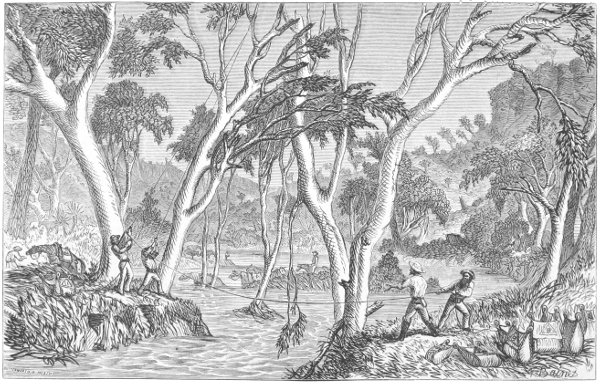
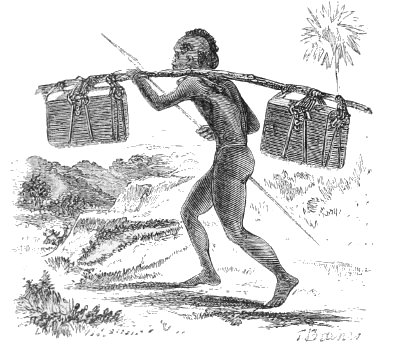
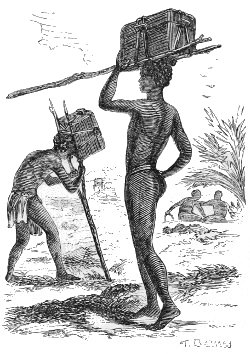
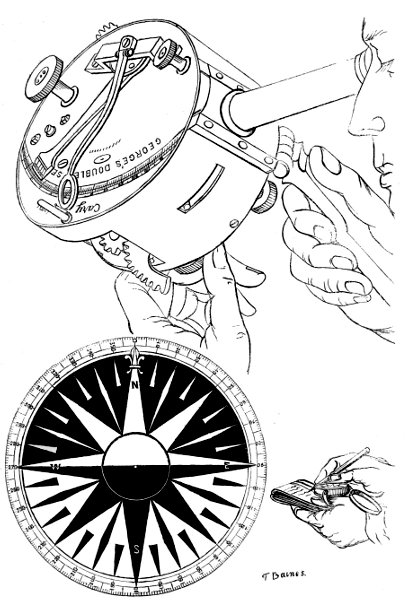
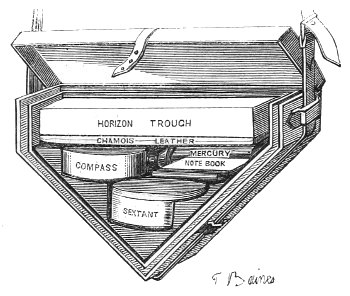
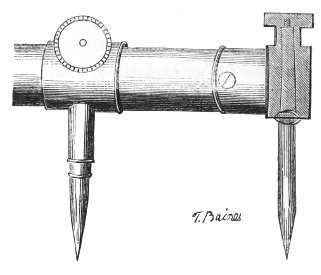
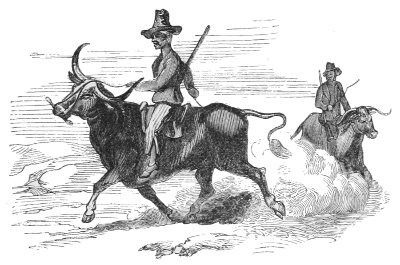
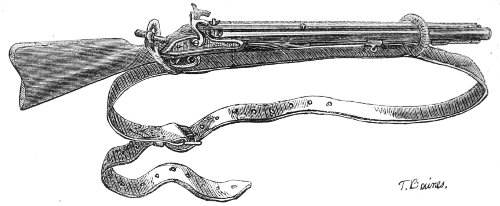
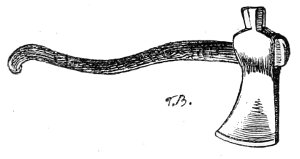
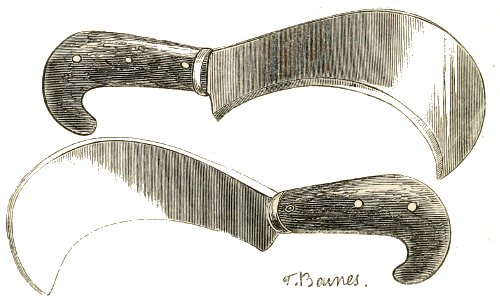
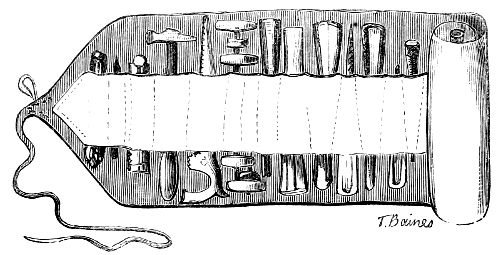
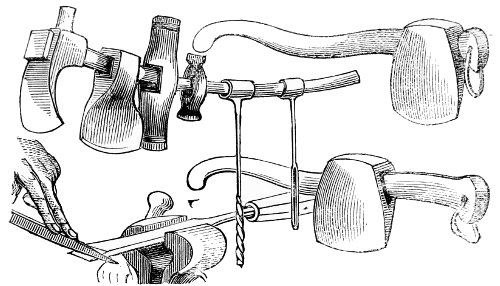
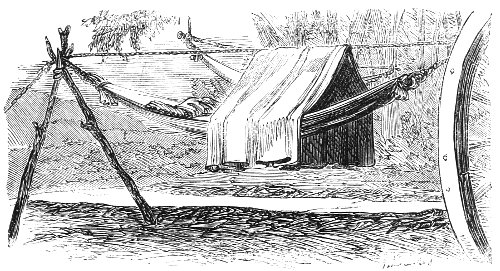
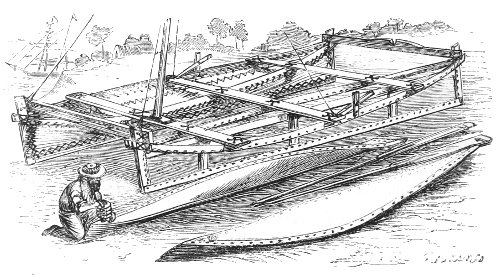
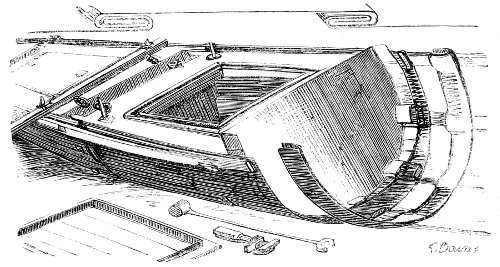
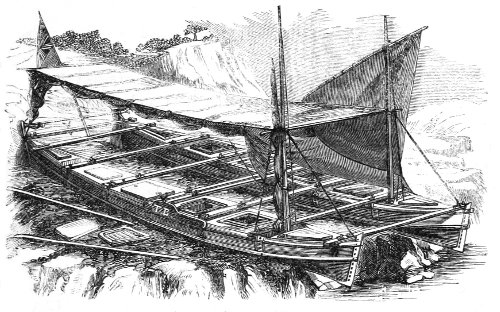

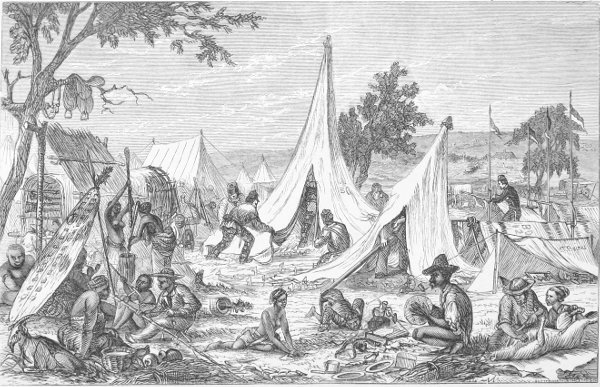
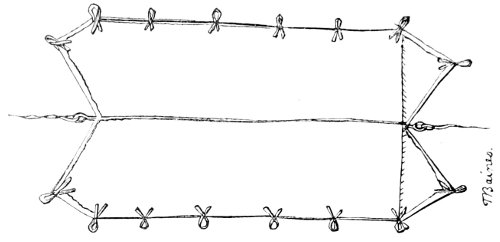
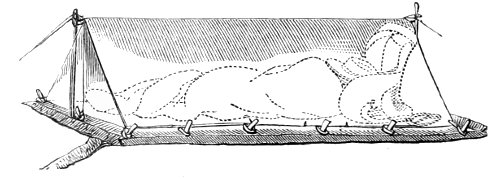
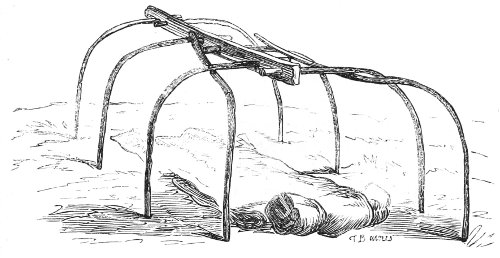
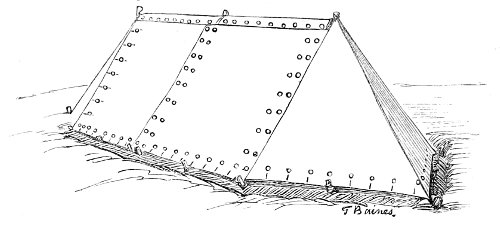
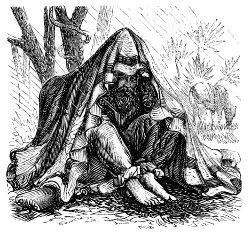
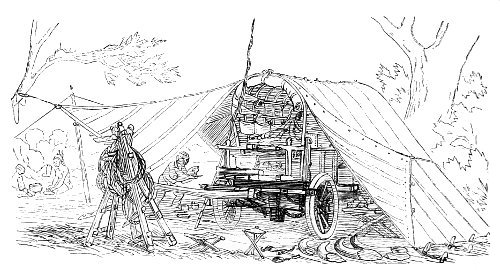
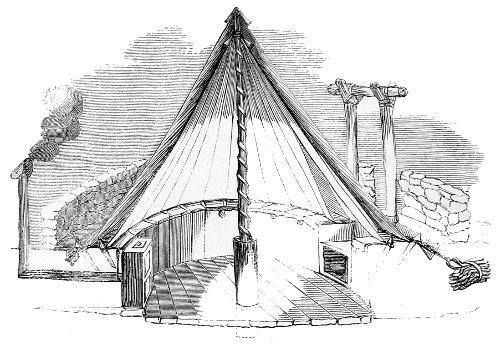
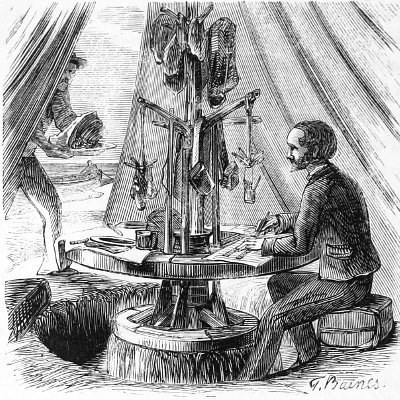
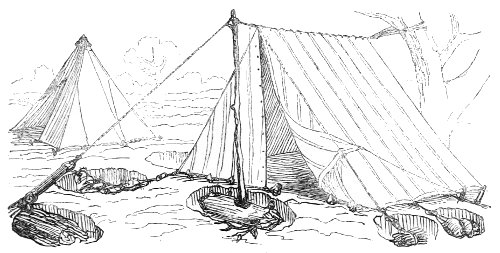

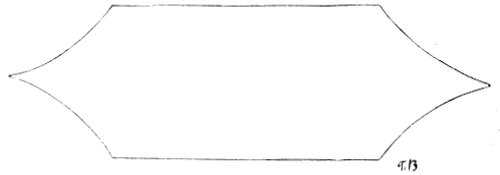
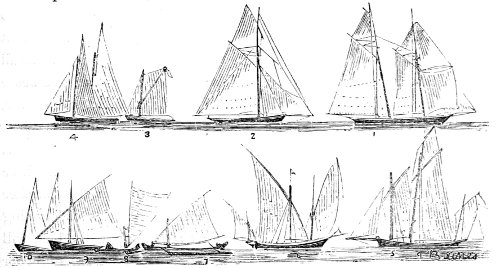
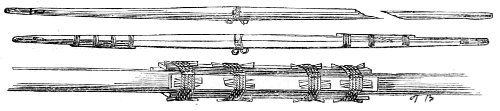
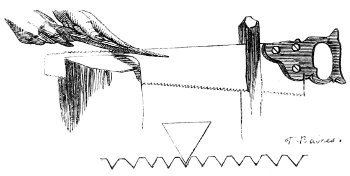
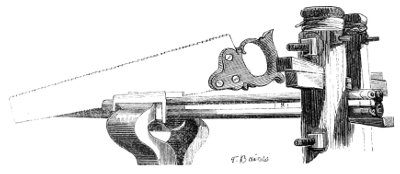
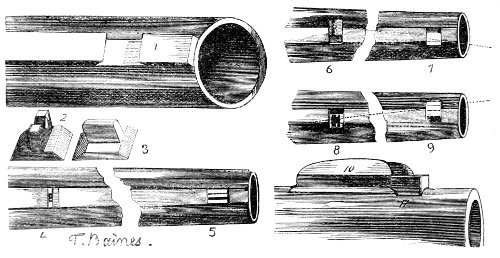
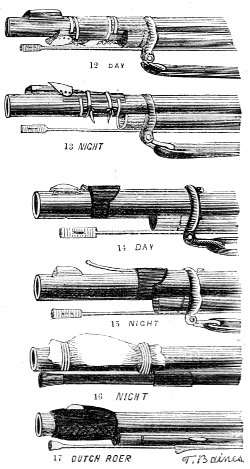
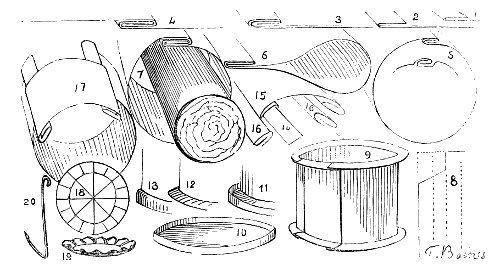
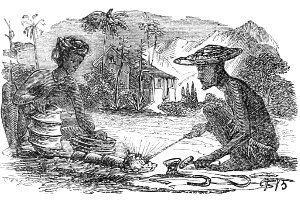
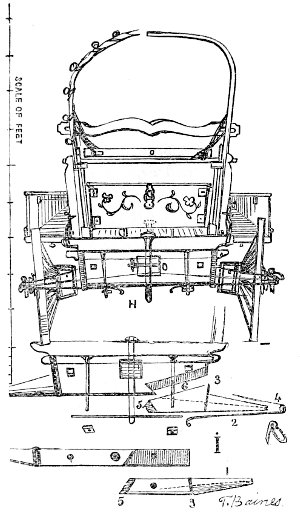
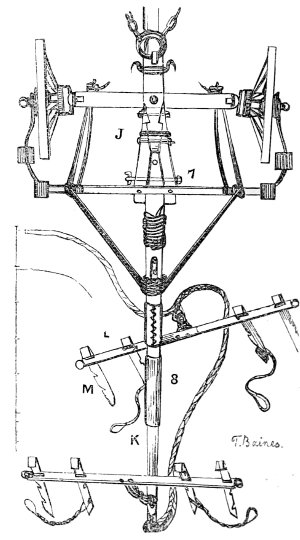
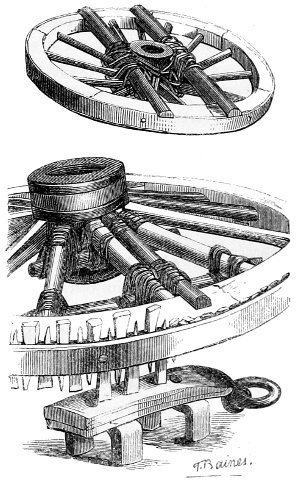
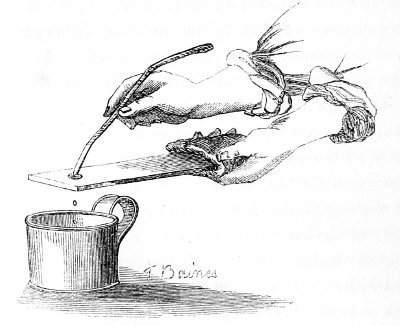
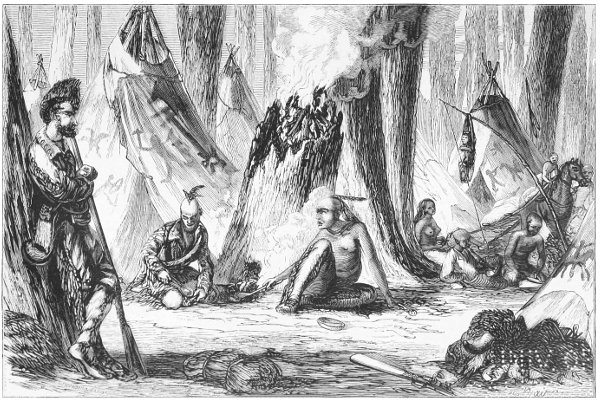
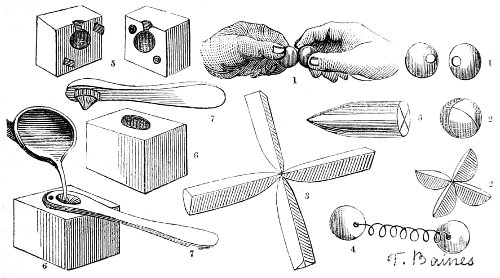
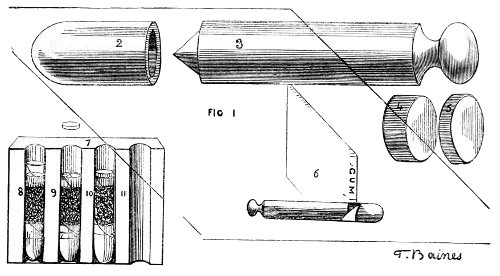

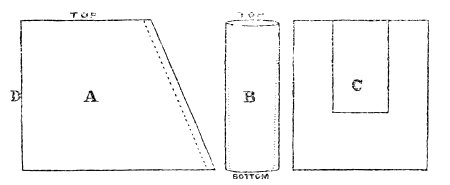
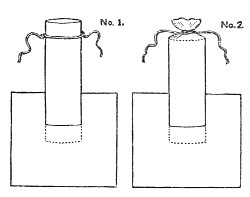
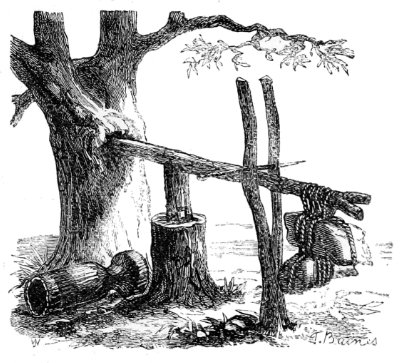
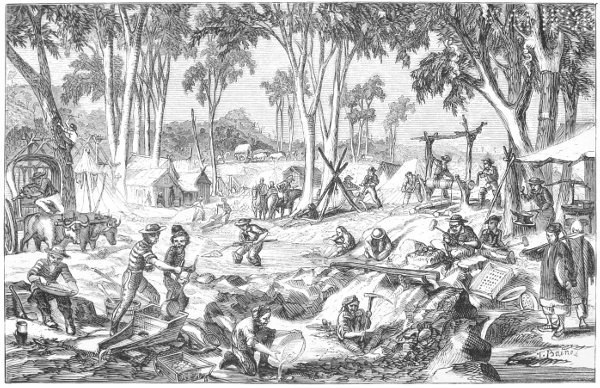
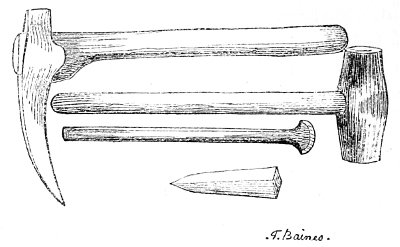
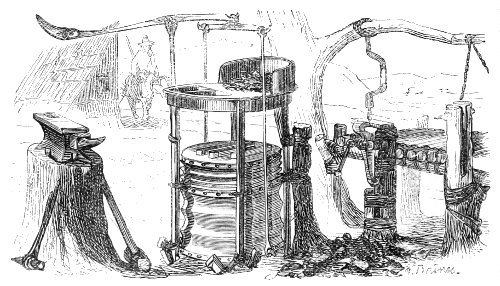
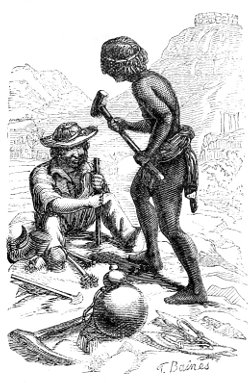
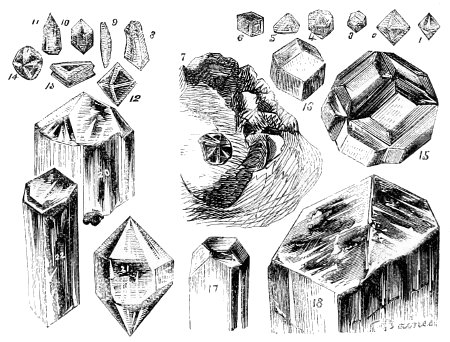
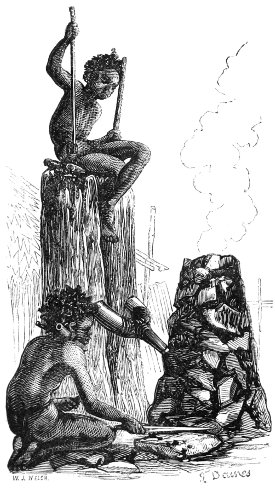
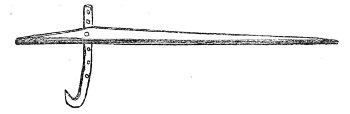
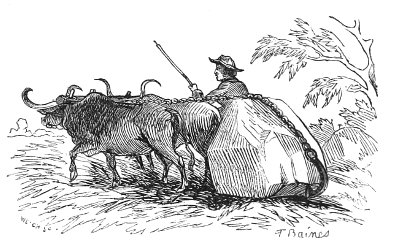
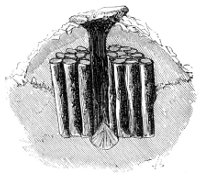
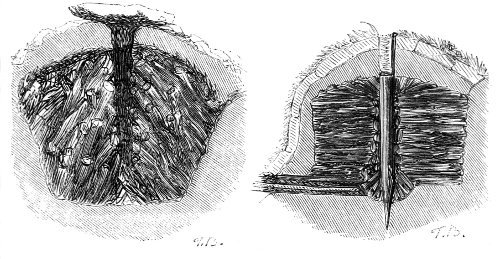
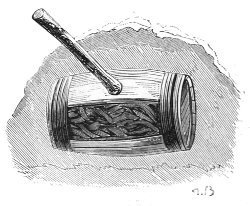
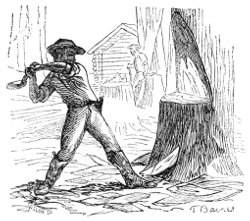
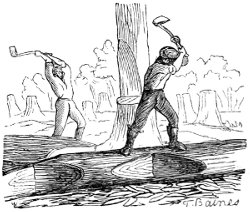
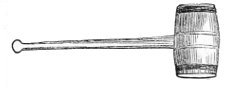
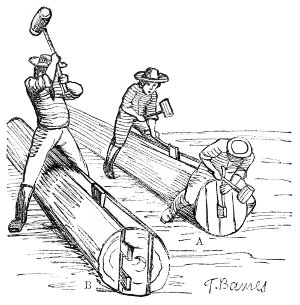
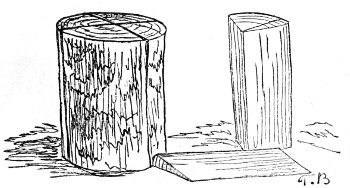
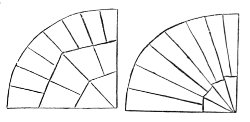
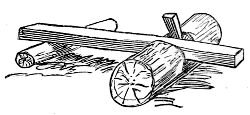
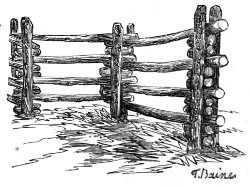
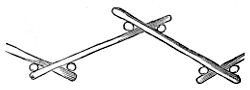
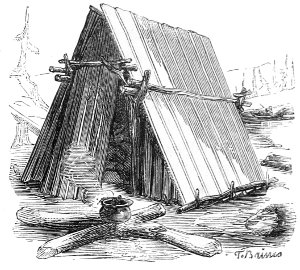
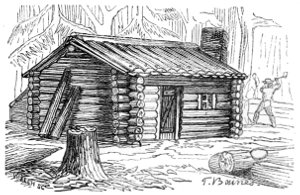
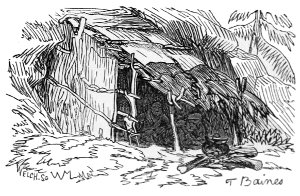
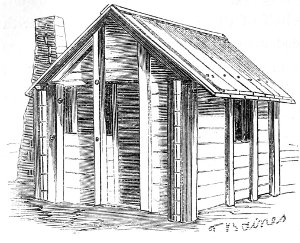
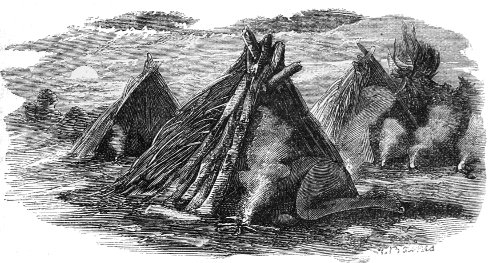
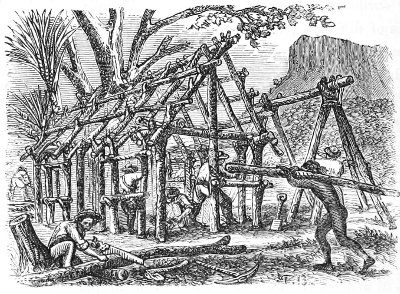
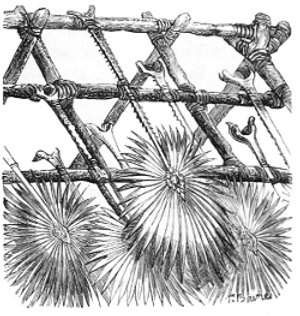
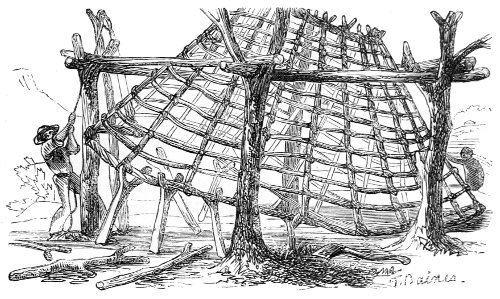
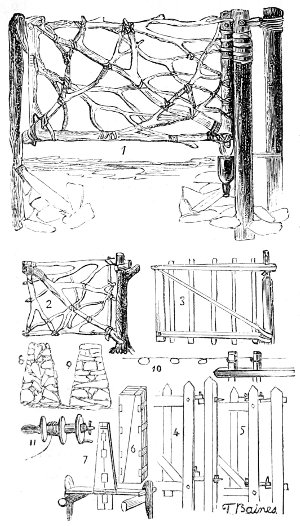
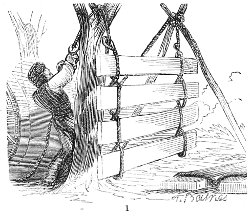
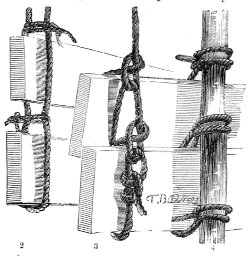
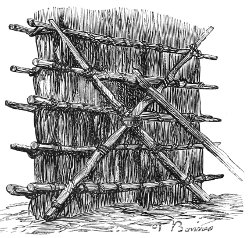
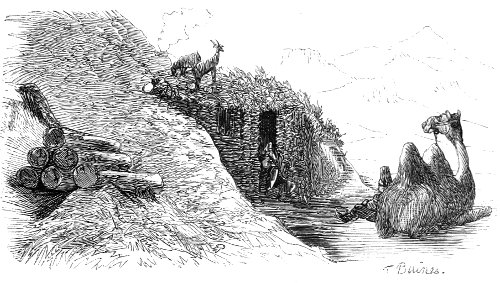
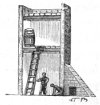
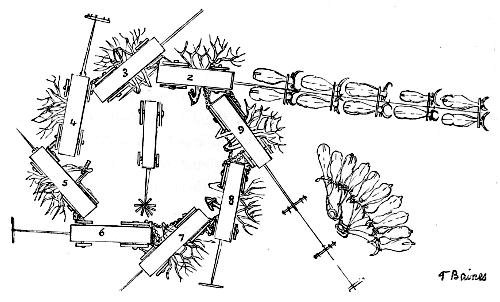
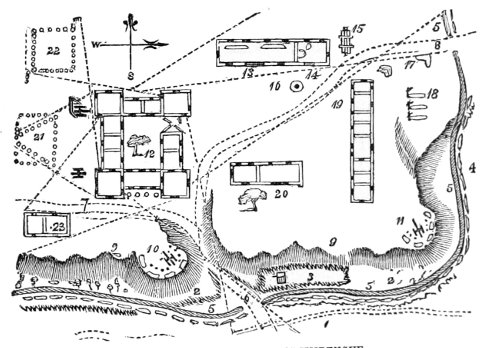
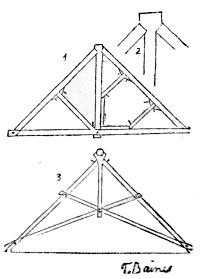
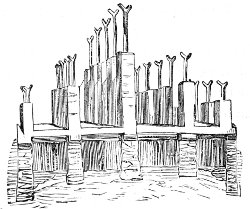
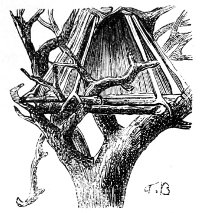
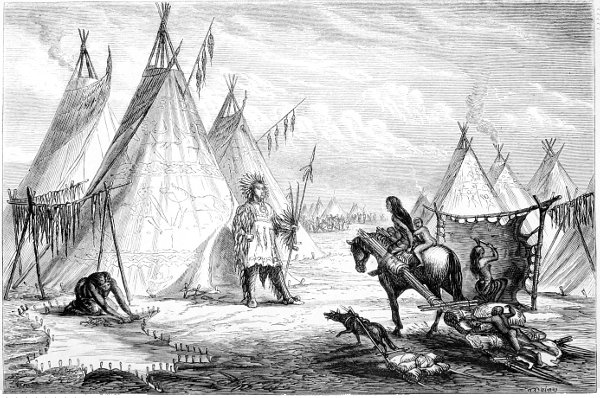
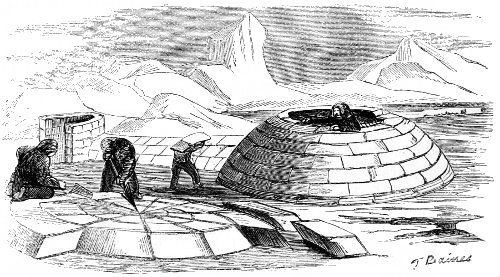
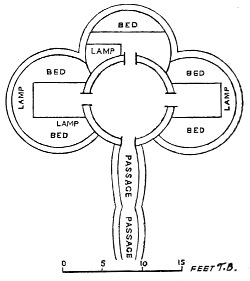
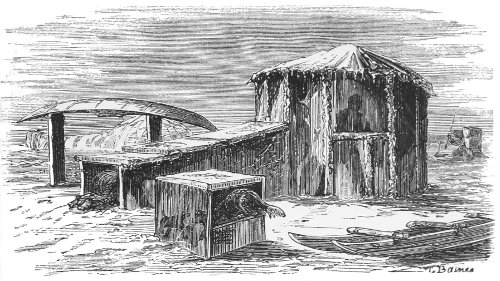
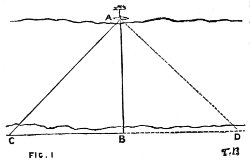
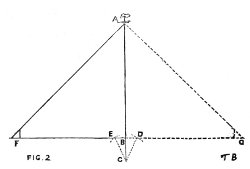
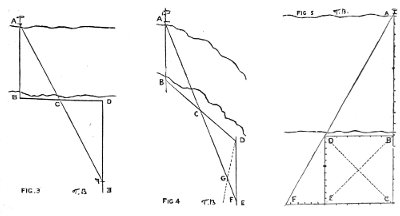
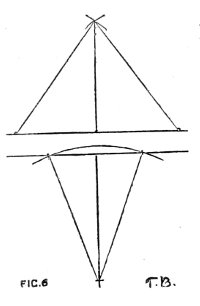
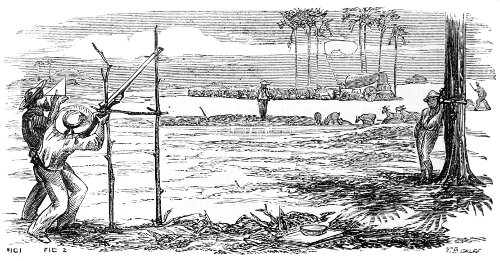
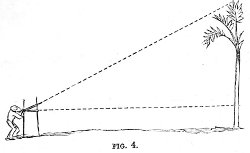
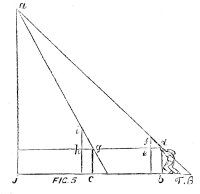
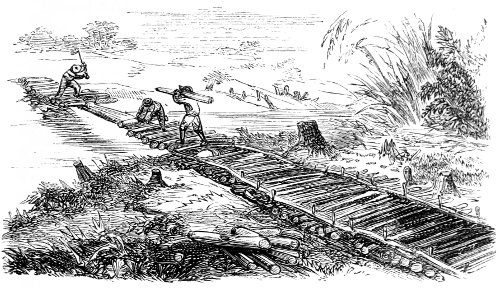
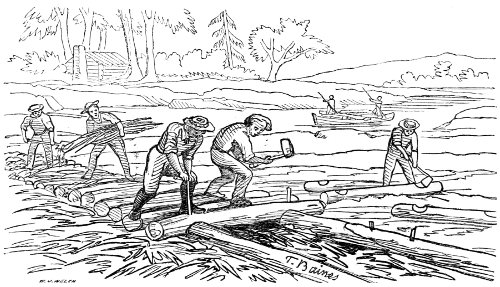
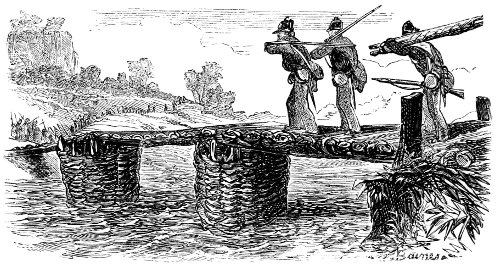
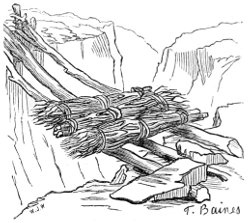
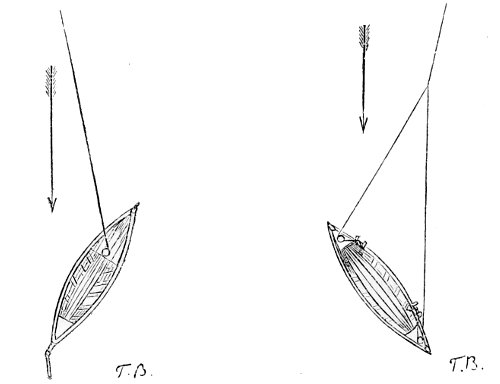
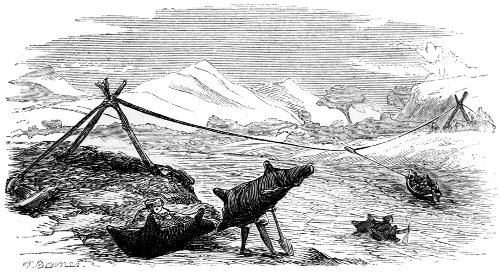
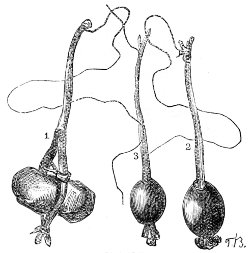
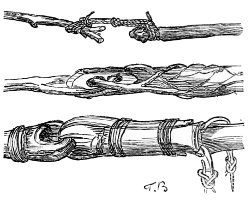
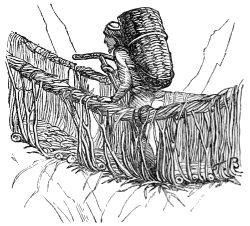
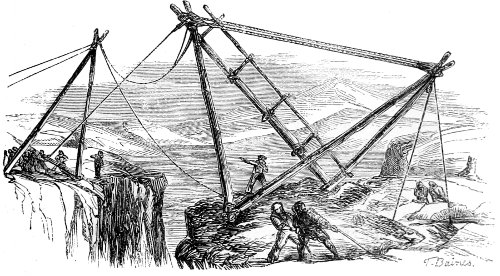
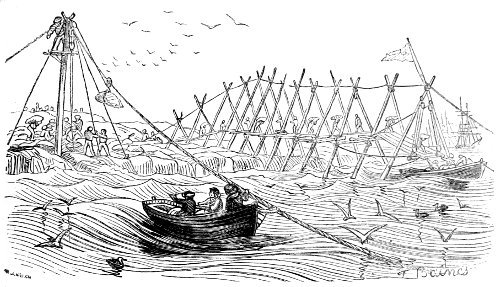
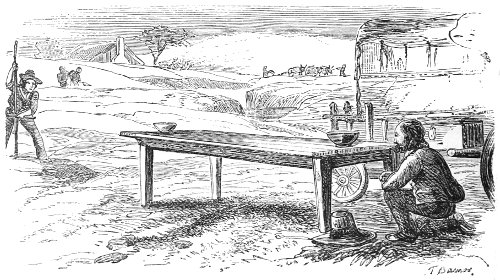
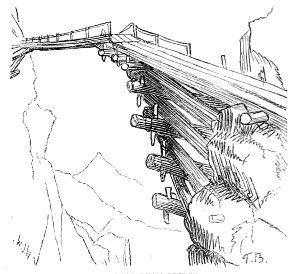
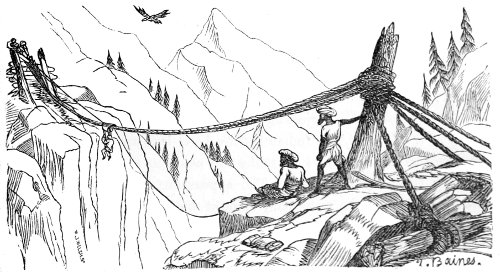
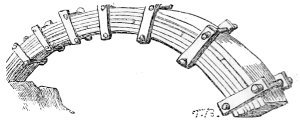
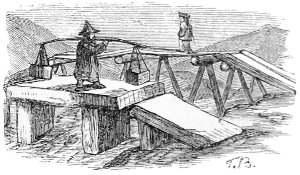
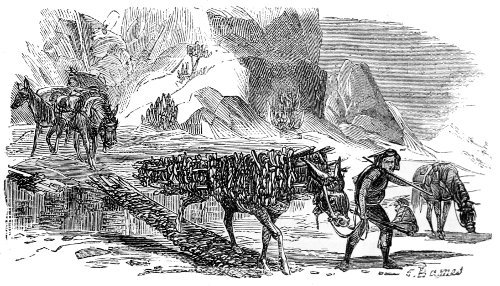
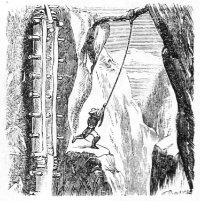
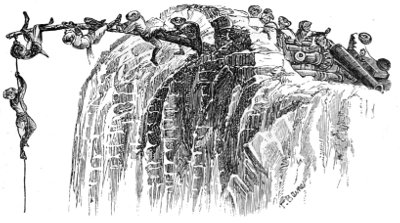
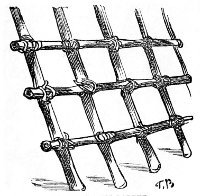
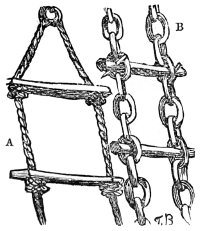
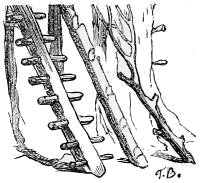
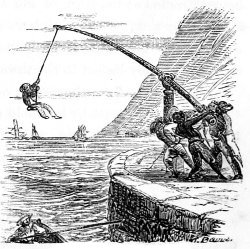
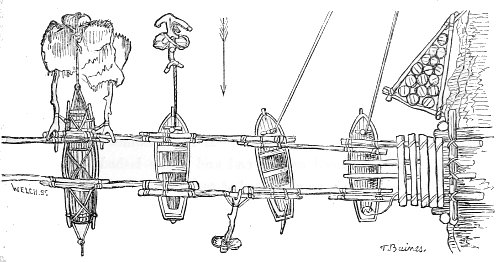
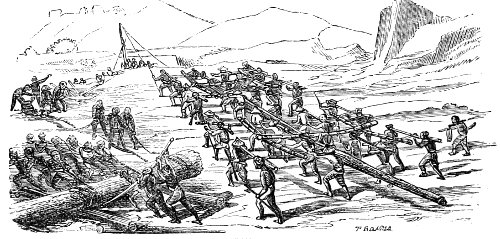
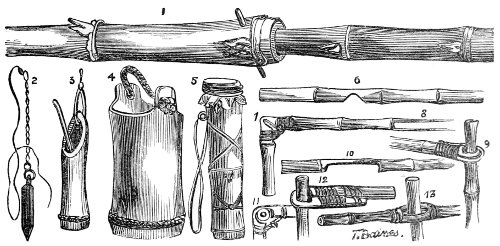
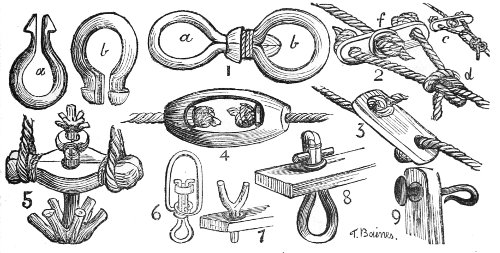
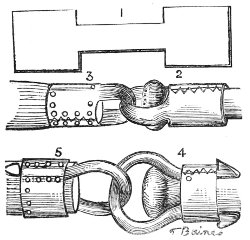
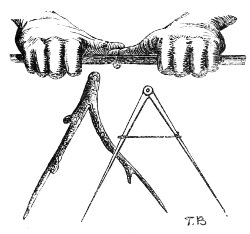
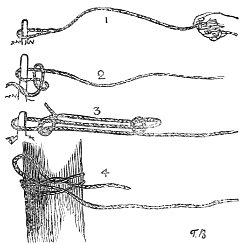
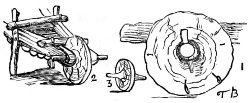
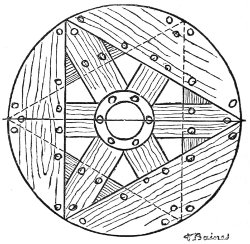
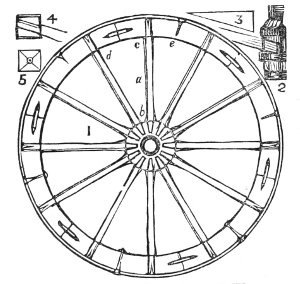
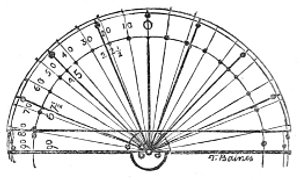
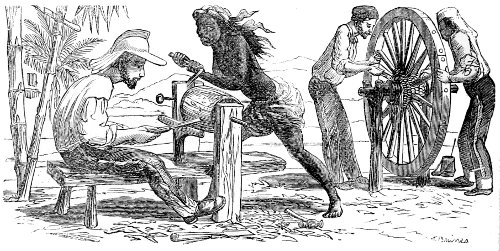
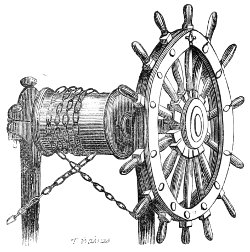
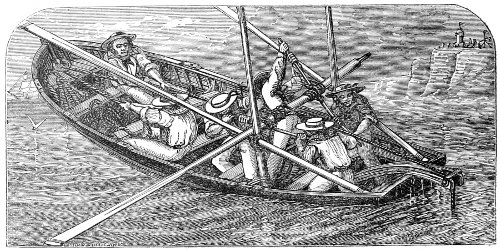
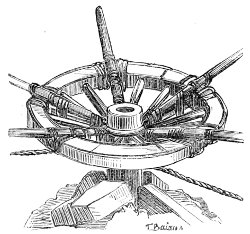
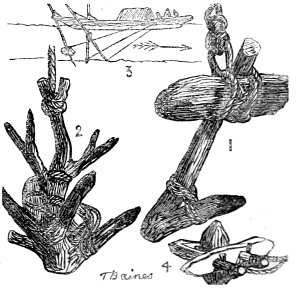
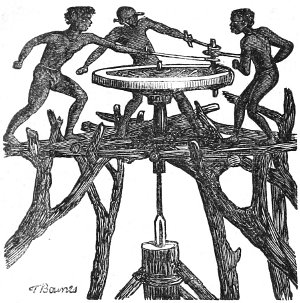
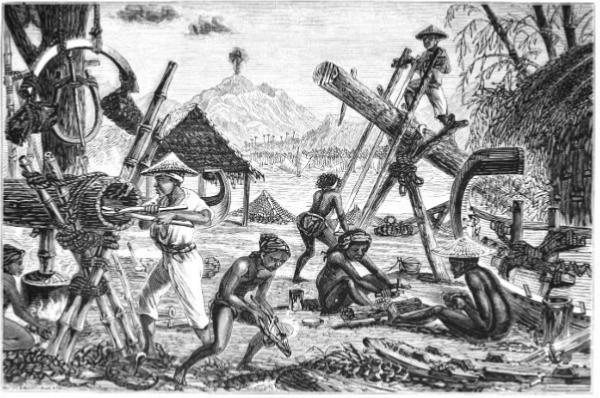
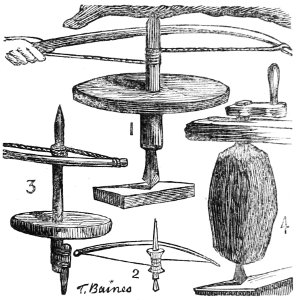
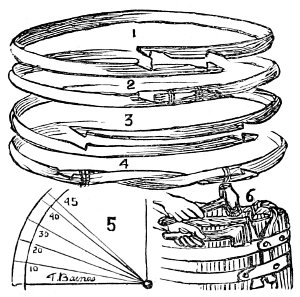
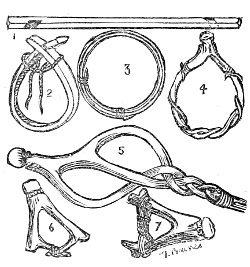
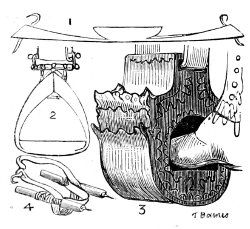
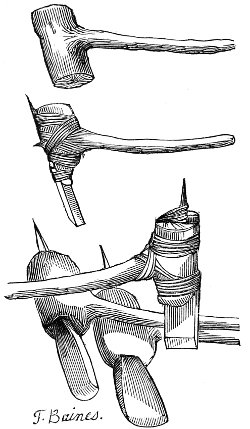
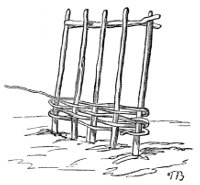
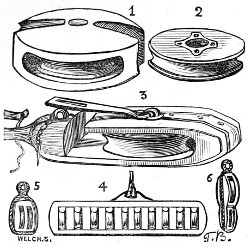
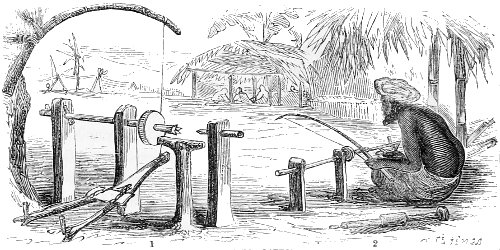
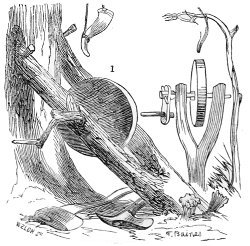
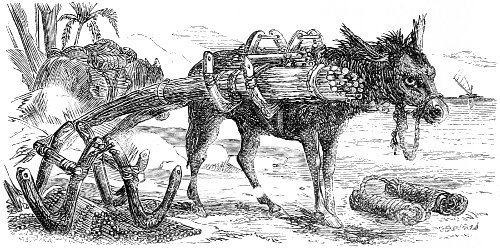
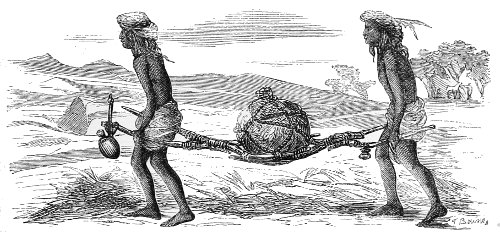
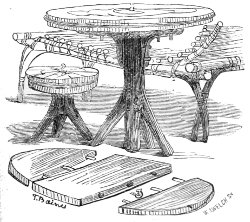
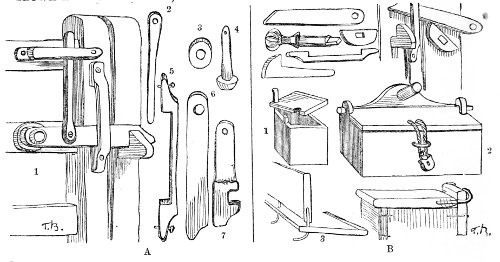
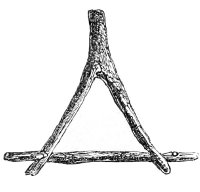
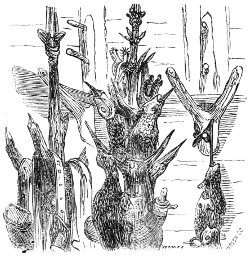
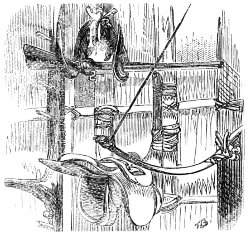
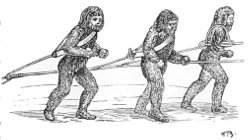
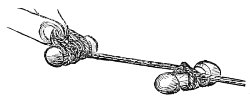
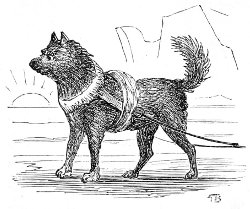
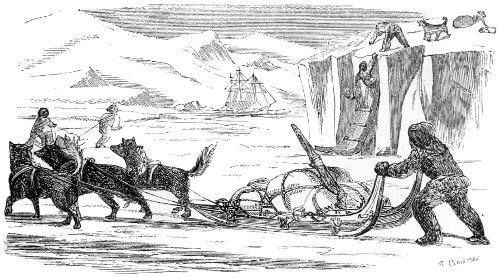
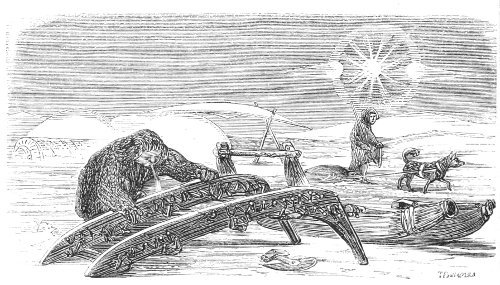
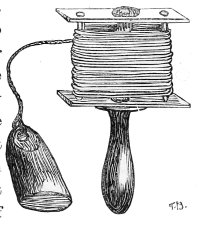
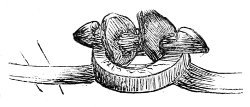
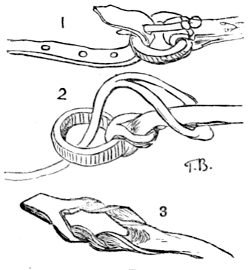
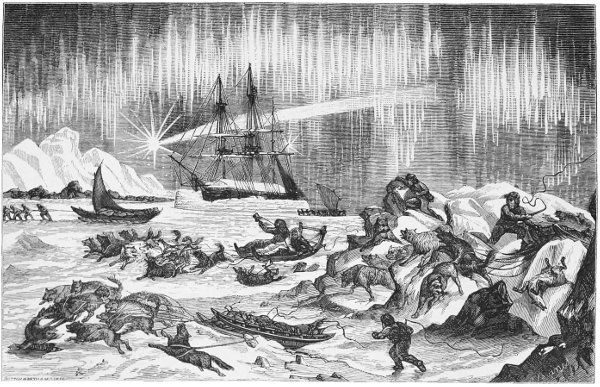
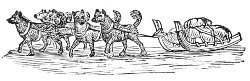
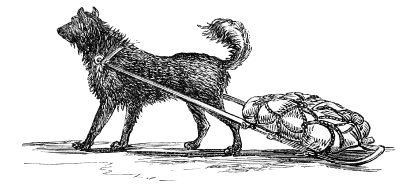
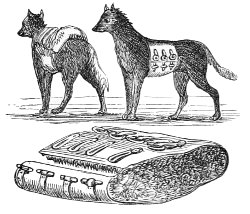
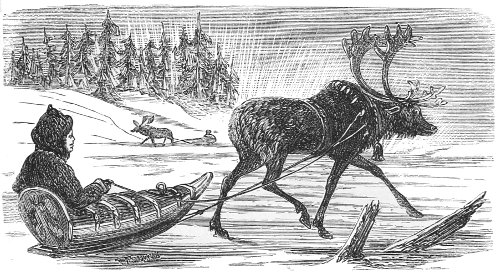
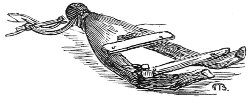
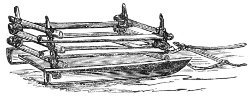
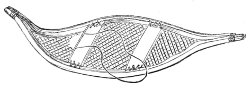
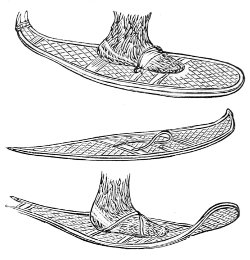
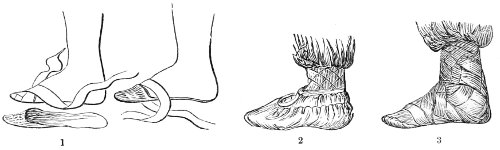

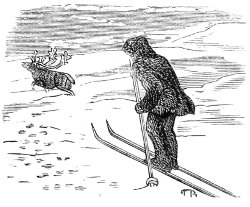
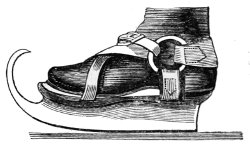
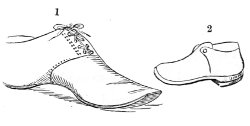
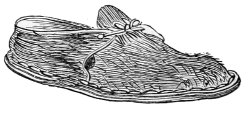
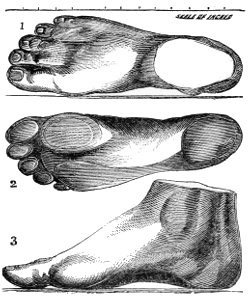
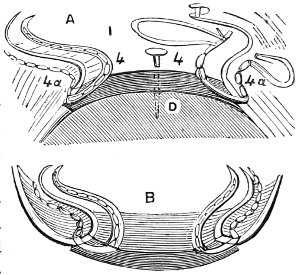
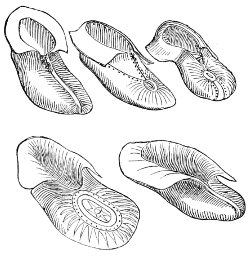
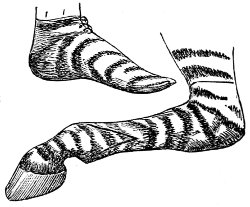
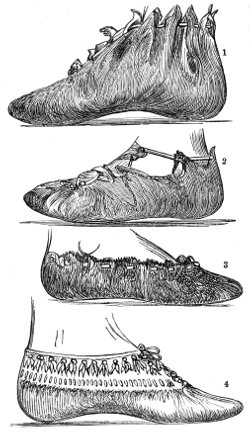
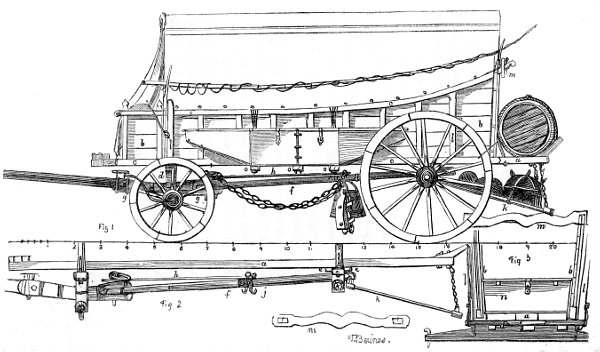
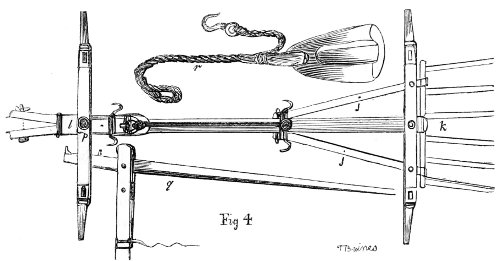
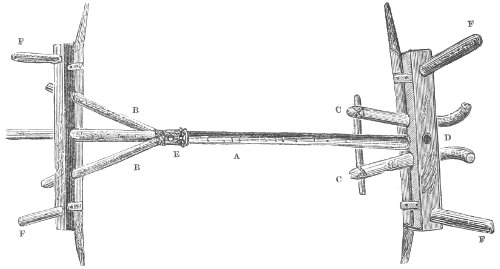
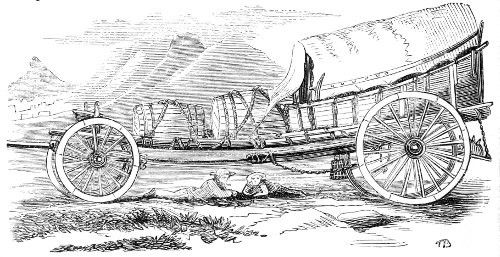
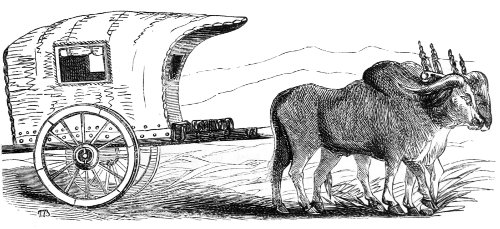
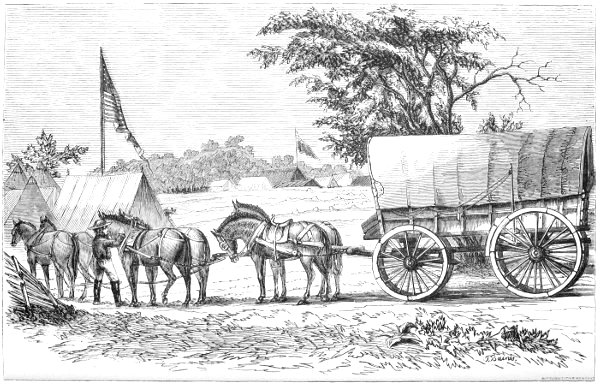
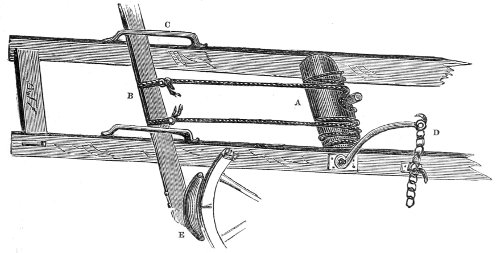
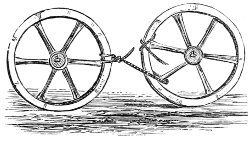
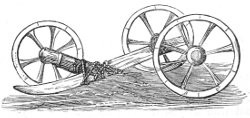
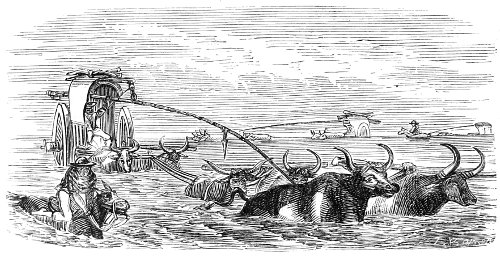
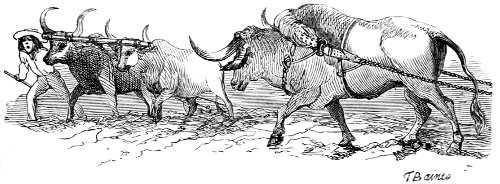
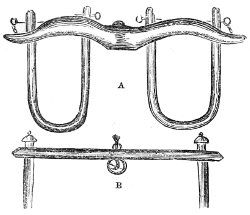
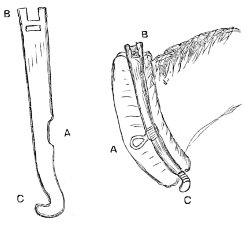
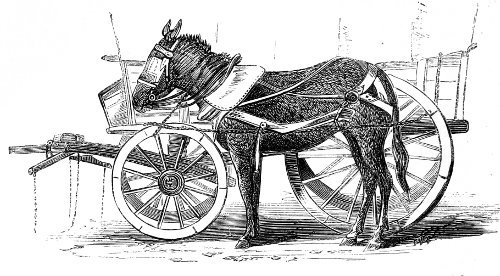
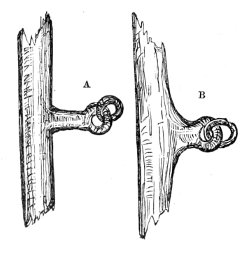
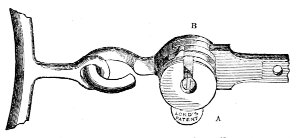
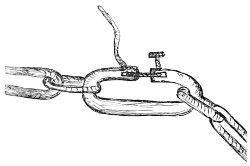
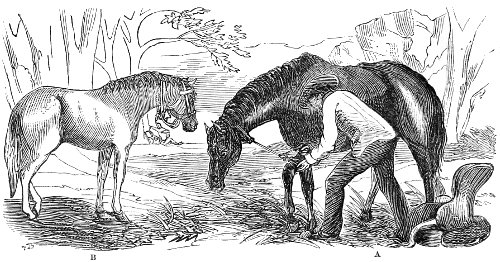
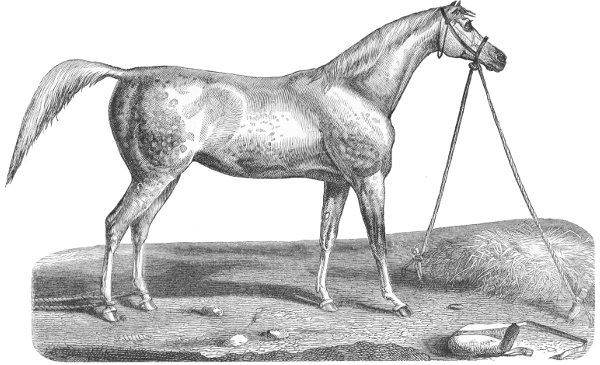
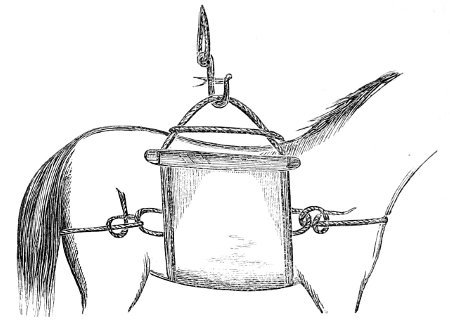
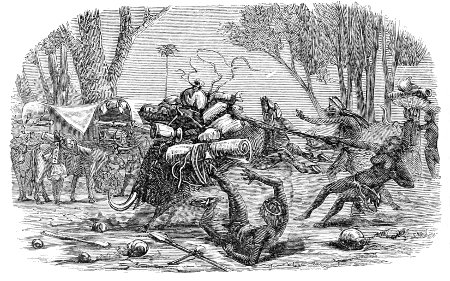
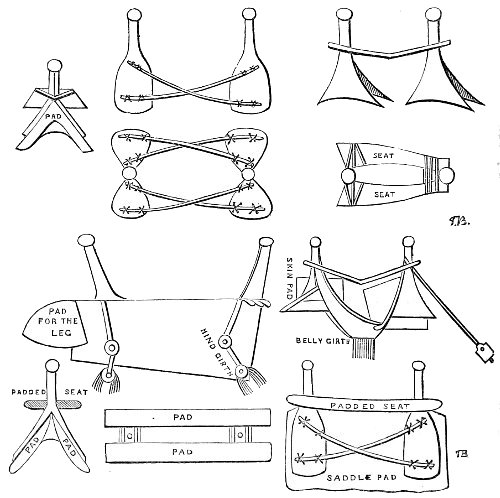

 .
.
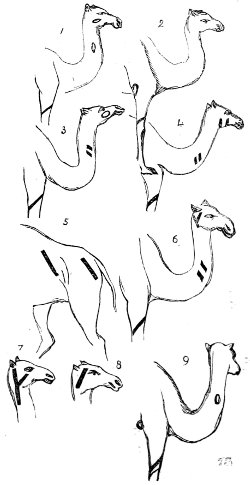


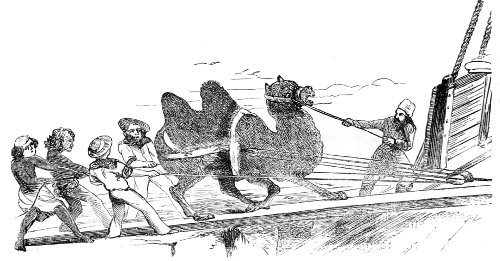
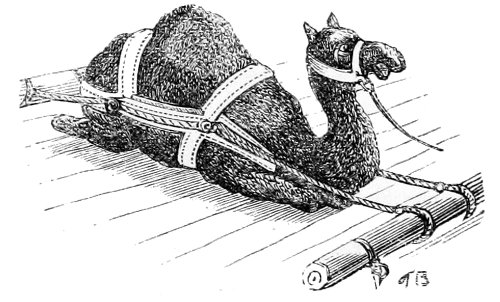
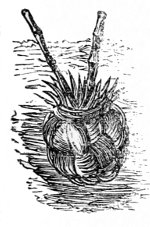
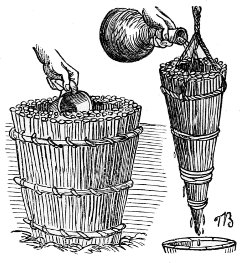
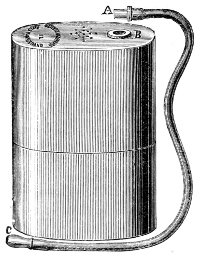
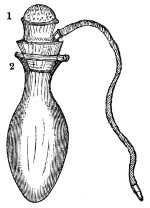
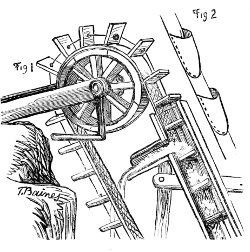
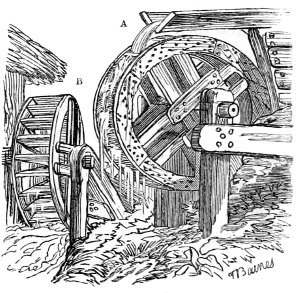
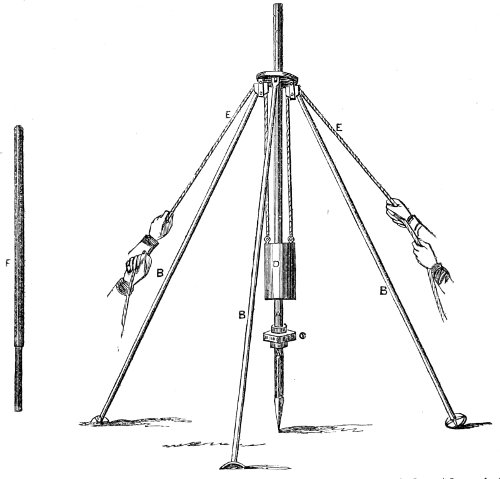
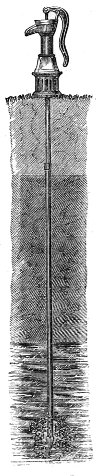
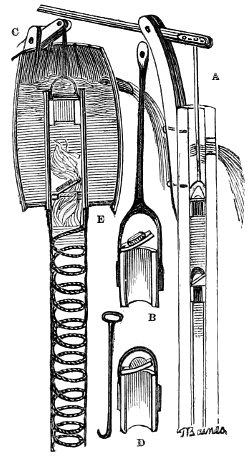
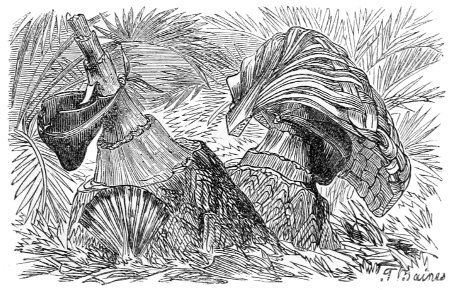
 -shaped incisions are made in
such a way that each cross cut may receive and hold fast the end of a
leaf gathered from the tree, which serves to conduct the sap away from
the trunk and allow of its dropping into Indian fig leaves placed on
the ground for its reception. The Indian fig leaf, cultivated for the
purpose, has the peculiar property of drying with its edges curled up,
rendering it extremely useful as a sap receiver. August is the month
usually selected for tapping the manna trees, and dry warm weather
is most favourable for the operation, as rain dissolves and destroys
the congealing mass of produce. The manna collected from the bark by
scraping, after having run in long tears down the trunk, is considered
very inferior to that caught in the fig leaves, and is, consequently,
sold at a much lower price.
-shaped incisions are made in
such a way that each cross cut may receive and hold fast the end of a
leaf gathered from the tree, which serves to conduct the sap away from
the trunk and allow of its dropping into Indian fig leaves placed on
the ground for its reception. The Indian fig leaf, cultivated for the
purpose, has the peculiar property of drying with its edges curled up,
rendering it extremely useful as a sap receiver. August is the month
usually selected for tapping the manna trees, and dry warm weather
is most favourable for the operation, as rain dissolves and destroys
the congealing mass of produce. The manna collected from the bark by
scraping, after having run in long tears down the trunk, is considered
very inferior to that caught in the fig leaves, and is, consequently,
sold at a much lower price.