SHELLS AND PEBBLES.
Children who were born, and have lived
all their lives, in an inland county, scarcely
know what is meant by “the sea.”
Henry Miller was one of these; he was
eight years old, and though he had been
taken, when quite a baby, to the sea-shore,
he could not recollect anything about it.
Now, if you live near the sea, I dare say
you may think: “Well, I should not like to
live in an inland county, so far away from
the sea as never to be able to walk on the
beach, or to climb the rocks, or to pick up
curious things on the shore. I would not
be Henry Miller for the world.”
You will laugh, perhaps, at the way that
Henry found out that the sea was salt; but,
after all, he may now know some things
about it which you do not; and, though he
was not many hours on the shore, he may
have picked up some curious things which
you never saw in your life. Some other
things he saw, which, I doubt not, you have
seen, but he may have learnt something even
about these which you do not know, so that
what was told to him may be new to you
also.
But if you too, like Henry Miller, live
inland, you will be pleased to hear what he
saw, though nothing happened to him different
from what any little boy may meet
with when visiting the sea-side. I am not
going to tell you an amusing story, but only
to write about things which any one who
has eyes, and knows how to use them, may
see for himself, and which any one who
wishes to learn may read of in useful books,
or find out by asking those who know better
than himself.
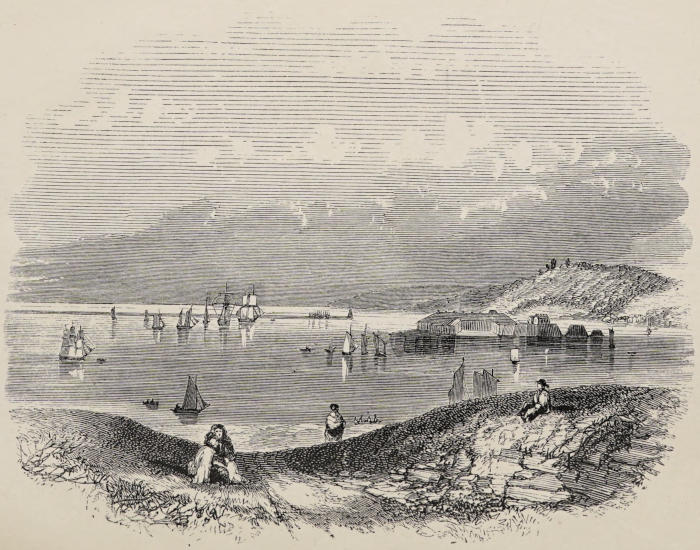
Henry Miller and his father, then, went
last winter to spend two or three days in a
town on the south coast of England. The
day after they arrived, they walked to some
high ground, from which they could see the
water. Henry had seen rivers and ponds
large enough for ships to sail on, but what
now lay before him was very different. A
broad sheet of water, shut in on both sides
by high land, stretched out so far that
nothing could be seen beyond it. Whether
the water rose till it met the sky, or the sky
came down till it met the water, or whether
they met each other half way, he could not
make out. This sheet of water, his father
told him, was called a bay. There were
many ships in it, most of them lying quite
still, riding at anchor, that is, each fastened
by strong chains to an iron anchor, which
the sailors had thrown over into the water,
and which lay fixed by one of its flukes, or
large teeth, to the bottom. Some of them
had their masts broken, for there had been
a dreadful storm a few days before, and they
had sailed into this bay for shelter.
In the distance they could see the sails of
a tall ship, which was coming in, but, strange
to say, not a bit of the ship itself was in
sight—it seemed to be quite sunk beneath
the surface. Mr. Miller reminded Henry
that the earth was round, like the globe in
the school-room at home, and that the
reason why the hull of the vessel could not
be seen was that the round surface of the
globe came between it and his eye; but
that if he could see through the water
between, he would find that the hull of the
ship was floating just like the vessels riding
at anchor.
A little way from the land was an island,
on which some houses were built. The land
on which Henry stood was so much higher
than the island, that he could see quite over
it, and make out, quite well, that it really
was a piece of land surrounded by water.
After standing here a short time, and
watching the boats, which were sailing to
and fro, some with sails, and some moved
onwards by oars, they walked down from
the high ground by a broad road, and then
by some stone steps which had been cut in
the rock, until they stood upon the beach.
Though in the middle of winter, it was
not very cold. A fresh breeze was blowing
towards the shore, which ruffled the surface
of the water, making it rise in little waves.
A little way out, the waves rose and fell
without breaking, but, as they came near
the shore, they curled over in long white
lines of foam, and chased one another up
the beach, making a dashing noise, which
never ceased. Here and there, where rough
rocks jutted out into the sea, the waves rose
much higher, and dashed over them with
such violence, that no one could stand with
safety at their edges. Sea-gulls, some nearly
white, and others dark grey, were flying
about, sometimes dipping into the water,
and rising again as if they had stooped to
pick up something. Mr. Miller said he supposed
they were feeding on bits of meat or
fish, which had been thrown over from the
ships. In summer, they often fly about in
large flocks, darting down in the same way;
but then they are generally employed in
real fishing, and a large flock marks the
place where a shoal of pilchards, or herrings,
or sprats, is swimming near the surface.
Then, too, they are of great use to the fisherman,
who is taught by them where to throw
over his nets with the best chance of a
catch. In winter, these fish keep in deep
water, so that the gulls, who cannot dive,
are obliged to find some other kind of food.
There are several different kinds of gulls,
but all that were seen to-day were of the
same sort, the only difference being that the
young birds had darker plumage than the
others.
At some distance from shore, Mr. Miller
pointed out to Henry something black in
the water, but, before he had time to look,
it was gone. In about a minute’s time, the
head and long neck of a bird suddenly
showed themselves, turned from side to side
with a quick jerk, and disappeared again.
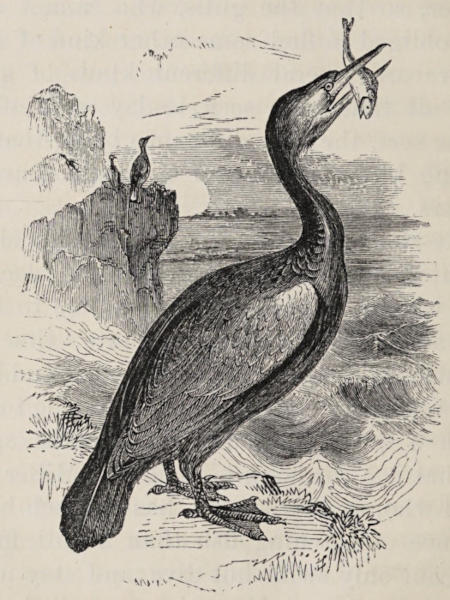
“That is a cormorant,” said Mr. Miller; “a
bird who, at this season, has a much better
chance of catching fish than a gull, for he
can not only swim but dive, and stay under
water for a very long time. A little does
not satisfy him, but when he has had enough,
he flies along close to the water, until he has
found a safe rock, where he spreads his
wings to dry in the sun or wind, and then
goes a fishing again.”
CORMORANT.
Henry recollected having been once told
not to eat like a cormorant; and though he
did not then know what a cormorant was,
he now began to suspect that boys got that
name when they ate so much bread-and-butter
that they were fit for nothing afterwards,
but to lie basking in the sun.
He had heard that sea-water was salt, but
had never had an opportunity of knowing it
for himself; so when his papa told him to
put into his mouth a wet pebble, which he
had just picked up, he soon spat it out,
making a very wry face.
“Where does all the salt come from
which gives a taste to so much water?”
was a natural question, but not a very easy
one to answer.
Mr. Miller, however, said that a great
quantity of salt was washed into the sea by
rivers, and that though the water was drawn
up by the sun, in the form of vapour, the
salt was not. Besides this, it is supposed
that there are, in the bottom of the sea,
large rocks of salt, which are constantly
being dissolved by the water, and give it its
bitter taste.
Not many days after, when Henry wanted
to know how salt was made, Mr. Miller reminded
him of sea-water, and told him that,
in some parts of England, during summer,
salt-water was allowed to flow into shallow
pits, from which the heat of the sun drew
up the water in vapour, leaving the salt
behind. This, he said, was scraped up and
purified. In some inland countries, such as
Poland, salt is dug out of mines. A great
deal of the salt which we use is got from
salt springs, a long way from the sea, which,
it is supposed, flow through or over rocks of
salt under ground.
A man now passed by, having something
in his hand, which he showed to Mr. Miller,
and asked him if it was coral.
“No,” said Mr. Miller, “it is not coral,
but a kind of sponge, which has been torn
by the late storm from the rock on which it
grew.”
Henry looked about very carefully, in the
hope of finding a piece which he might wash
himself with, when he went home; but
though he was told that it was not likely
that he would find the right sort, which is
brought from the Mediterranean Sea, he did
not give over his search.
He did not succeed, but presently came
to his papa bringing something, which, he
had made up his mind, must be a sea-beetle.
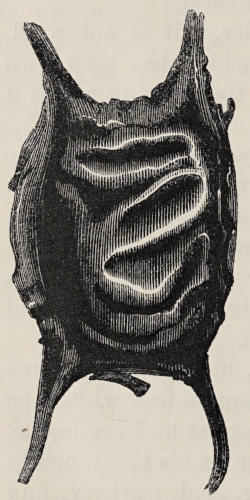
It was about as large as his hand, nearly
square; black, shining, and leathery, and
from each corner stuck out a long, black
horn. Two of these horns were hooked at
the end, and two were straight. When he
pressed it, he found that it was hollow; but
as soon as he took off
his fingers it recovered
its shape
again, being as elastic
as an india-rubber
ball.
“This,” said Mr.
Miller, “is not a
beetle, but an egg.”
Henry had seen
thrushes’ eggs, and
eaten hens’ eggs, but
they were so unlike
this black leather bag
that he thought his
papa must be joking.
PURSE OF SKATE.
“Not the egg of
a bird, but of a fish.
As we came through the market to-day,
I showed you some flat and very ugly
fishes, with eyes and mouth something like
those of a human being, and with a long
tail like that of a quadruped.”
Henry remembered to have seen them,
and that they were called skates. “And is
this the egg of a skate?”
Not exactly the egg, but the egg-shell.
There was once a yelk in it, something like
that in a hen’s egg. Out of this yelk a
young skate grew, and when it was large
enough it forced its way out through this end.
Mr. Miller pinched one end of the egg-shell,
or purse, as it is called, between his
finger and thumb, holding it as one would
a letter which one wanted to read without
breaking the seal, and the end of the purse
opened.
“And did it float about in the water
while the young fish was growing, or was it
laid on the beach?”
“Neither: if it had been left to float
about in the water, it would soon have been
eaten by gulls, or driven ashore; and how
can fishes lay their eggs on the land? No,
it was left by the fish among the weed
which grows at the bottom of the sea, and
the hooked horns held on by the stem of
one of them, until the fish had escaped.
The late storm, I suppose, tore it away from
the weeds and washed it ashore. I have
found them with a yelk in them, but this
rarely happens.”
“But, papa, you said that there were
weeds in the sea; are they like the weeds in
gardens?”
SEA-WEED.
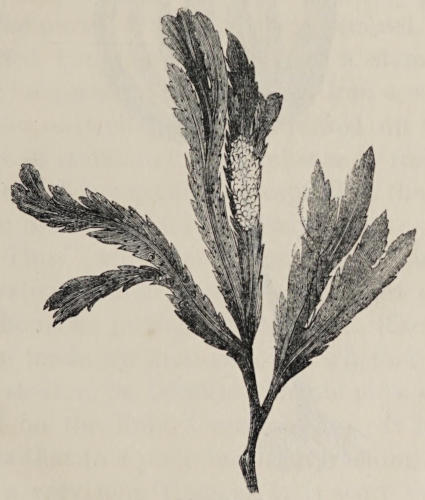
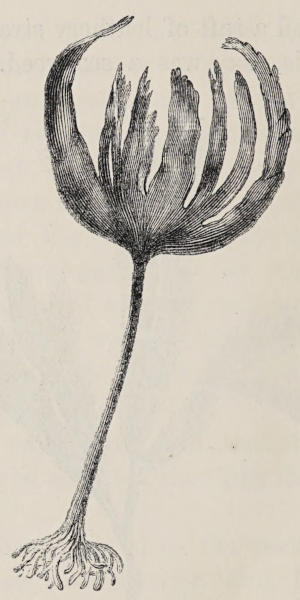
Mr. Miller pointed to the rocks, some of
which were covered with long bunches of
tangled stems of a dark-brown or green
colour, which he said were sea-weeds. Some
stout stems were also lying about the shore,
like horse-whips, with a bunch of roots at
one end, and a tuft of leathery straps at the
other. This, too, was a sea-weed. He reminded
him, too, of a book which he had
seen at home, filled with crimson, purple,
green, and brown leaves, which he said were
also sea-weeds. They do not send their
roots into the ground like garden weeds, but
cling to the rocks or to each other, and are
nourished by the water in which they grow.
SEA-TANGLE.
The purse of the skate was secured, to be
carried home as a prize, and a stem of a
large sea-weed was soon made into a whip.
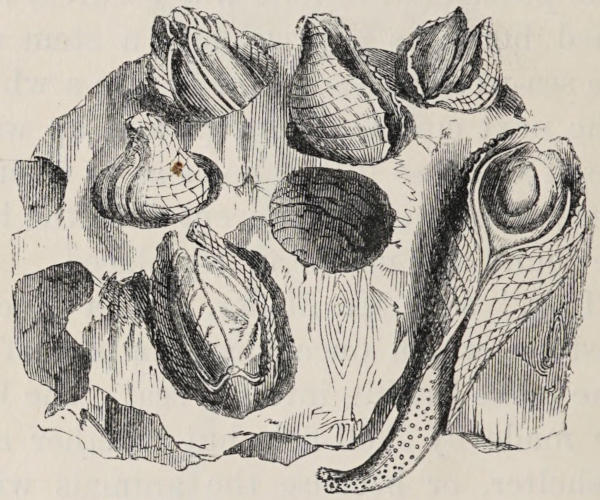
The next curious thing picked up was a
piece of stone, so full of holes as to resemble
a piece of honeycomb, except that the holes
were round and not regularly placed.
PHOLAS.
“This,” said Mr. Miller, “is a piece of
limestone, which once formed a part of one
of the rocks jutting into the sea. The holes
were made by shell-fish, but whether made
for shelter, or because the animals within
feed on the lime, I cannot say. It is very
clear that this piece has been washing about
for a very long time, as it is worn smooth
by being battered against other stones. We
must call these shell-fish both useful and
mischievous animals. Here they are certainly
useful, for they eat away parts of the
rock until they are not able to bear the
force of the waves, when they break away
and are driven on to the beach. I dare
say that a great many years ago the rocks
about this place were much higher than
they are now, and were in the way of boats
sailing to and fro. But when the little
animals choose to make their houses in
quays or sea-walls, they do much mischief
by eating away the foundations.
“I once came here when the water was
low, and as I stepped from rock to rock I
broke off several pieces with my foot. The
animals were then in them and alive. They
are about the size and shape of a horse-bean;
they have, like oysters, two shells, which are
rough, and of a dull yellow colour. There
is another kind of shell-fish, larger than
this, which burrows in rocks, named pholas.”
This was the last curiosity picked up to-day;
but before they left the shore, Mr.
Miller went to a cave, in which he recollected
to have seen, a long time before, some plants
of sea-fern growing on the roof. They were
too high to be reached; but as he was a
great admirer of ferns, and this kind grew
only on the sea-shore, he did not like to
miss a chance of seeing them again. To his
great joy, the late storm, which had done so
much damage to the shipping, had washed
away one of the sides of the cave, and a
large mass of stone had fallen just beneath
the very place where the ferns grew. He
mounted on this, and with the help of a
knife, loosened some small stones around
the roots of the ferns, and so took out some
fine plants, roots and all. What was done
with these you shall hear by and by.
The next day was rainy, but on the day
following the sun shone brightly, and there
was every prospect of some fine weather.
“The tide does not suit well,” said Mr.
Miller, “but as we may not have a chance
of another day’s sunshine, I will hire a
carriage, and we will go to a beautiful part
of the coast, which is some miles distant,
where you will be able to pick up shells,
and have a much wider view of the sea than
that which we saw the day before yesterday.”
Accordingly, a basket of provisions was
packed up, and the carriage was very soon
rolling merrily along.
On the way, Henry asked his papa what
he meant by saying that “the tide did not
suit.”
Mr. Miller explained to him that the
water of the sea was not stagnant like that
of a pond or a lake, nor did it always run
one way like that of a river, but flowed in
one direction for a little more than six
hours, and in another during about the
same time. “This motion of the water,”
he said, “is called a tide. When the water
is flowing towards the shore, the tide is said
to be ‘coming in.’ All this time it is rising
on the beach, and when it ceases to come in,
we say that ‘it is high water.’ Soon after
high water it begins to go out again, or ebb,
and when it ceases to ebb we call it ‘low
water.’ Now at the place where we are
going, the shore is not made up of little
pebbly beaches separated from each other
by rocks jutting out, but long flat sands
stretch for several miles. They are very
pleasant to walk on when the tide is out,
but it will be high water to-day just at the
time when we reach the coast, so that I am
afraid we shall not be able to have a very
long walk on the sands, unless we wait some
time. Never mind! we shall at least have
a glorious view of the sea.”
It was past twelve o’clock, when, after
mounting a steep hill, the driver was told to
stop, and to be in waiting at the same place
exactly at four.
The basket was taken out; and Mr. Miller
and Henry, passing through a gate, found
themselves in a large sloping field, partly
covered by furze-bushes, and seeming to
stretch downwards till it quite touched the
sea. There were no high lands here on
either side shutting in the view; nothing
but a wide, wide waste of blue water, sparkling
in the sunshine, and, where it touched
the land, breaking into a wide edge of foam.
The noise was incessant, sounding something
like the rumbling of many carriages at a
distance, now rising, and now falling, like
the wind during a storm, and every now
and then mixed with the thundering roar
of some larger wave than usual as it rushed
up the sands, or dashed against a rock.
Henry, in great delight, set off at full
speed down the field, expecting to reach the
shore at once; but his race was soon ended,
for he shortly found himself at the brink of
a high cliff or precipice, the face of which
was almost as steep as a wall. A narrow
winding path was soon discovered cut
through the rock, by the help of which they
climbed down, and at last stood on the
shore. The wind was blowing very freshly
above, but here it was quite calm and mild.
One might have thought the season to be
spring, or even summer, for all signs of
winter, such as mud, bare trees, and stunted
grass, were left behind.
Close to the base of the cliff there were
large stones which had fallen from above;
but a few yards out there was nothing but
fine sand, so dry and firm that, though the
foot left a mark whereon it rested, and
kicked up a little piece of sand whenever it
was lifted, no walking could be more pleasant.
But it was not this which was noticed at
first. The great sight was the enormous
waves, which seemed to grow up out of the
water a long way out, to rise higher and
higher, and to rush on faster and faster, till,
in their haste to reach the land, they fell
forward, and, dashing into a sheet of foam,
swept far up on the sand; then, growing
weaker and weaker, they made one last
sweep, and drew back as if afraid, but were
driven on again by the new waves, which
had formed themselves meanwhile.
Mr. Miller said that about every ninth
wave was larger than the rest. Henry and
he counted together; and though the eighth
or tenth was sometimes the largest, they
accounted for the mistake by supposing
that they must either have missed one, or
reckoned the same wave twice.
Many times, as a wave went back, they
chased it as far as they could go without
wetting their feet. The sand seemed to
grow dry and hard the instant that the
water left it, so that they could follow it
very closely; but soon another great wave
came roaring in, and they were obliged to
scamper towards land as fast as their legs
would carry them.
Once, while Henry was looking one way
and running the other, he came against the
front of a little rock which rose through the
sand, and narrowly escaped a good ducking.
Another time he stood on the top of a little
rock which rose like an island through the
sand, hoping that the water would surround
him. For several minutes he waited very
patiently, but the waves always stopped
before they reached him. At last, just as
he had grown tired, there came a ninth
wave, which not only surrounded him, but
rose so high as to dash against his legs.
Whether he was frightened, or the water
was too strong for him to stand against, I do
not know, but he sprang off and ran towards
the land, wet nearly up to his knees.
It was now high water; and as Henry
belonged to that class of boys who like fresh
air, exercise, and bread-and-butter, he gladly
heard the proposal to find a good place
where they might sit down to dinner. They
had not to go far. Not a hundred yards off,
a small stream came tumbling over the cliff
among some large stones, and, after flowing
for a short distance, sank into the sand
before it reached the sea. Towards this
they made their way, frequently picking up
shells and other things which had been
washed in by the waves, but throwing them
all away again, because the basket in which
they were to be stowed away had yet to be
emptied.
A large stone, with a towel spread on it,
was the table, and stones served as seats.
The dinner consisted of some slices of cold
tongue, and a hunch of bread. The stream
supplied plenty of clear and cold water, and
this was the only part of the feast of which
much was left.
“And now,” said Mr. Miller, “that we
have made room in our basket, let us search
for curiosities.”
SHELL OF CUTTLE-FISH.
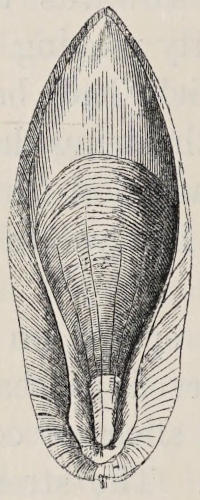
High up on the sands, and close to the
late dining-room, lay a number of white, flat
substances, which puzzled Henry as much as
the purse of the skate had done. They were
oval in shape, and about
the size of his foot. One
side was hard and rough,
the other smoother, and
soft enough to be scratched
by the finger-nail.
Whether they were bones
or shells he could not
tell. “This,” said Mr.
Miller, “is the backbone
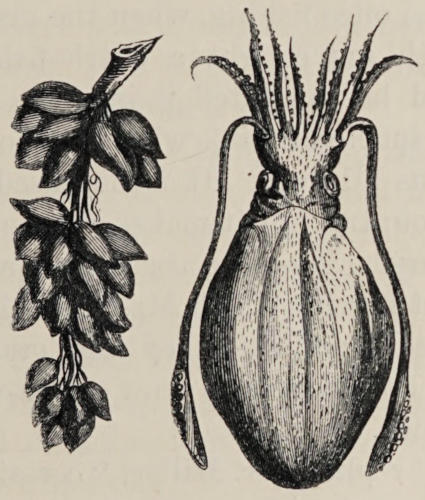
of a cuttle-fish. The animal,
when alive, is soft,
and nearly transparent. It has a large head,
on which there are a number of long arms
stretching out. It lives on small fish, which
it chases, and then catches hold of by the
help of many small suckers on its arms.
When chased itself, it spurts out a quantity
of black fluid, like ink, making the water so
thick and dark that its enemy loses sight of
it, and is obliged to give up the chase.
Often, when I have been fishing from a
boat, a cuttle-fish has followed a fish which
I have caught, up to the very surface of the
water, and sometimes I have caught the
cuttle-fish itself, by darting into it a hook
fastened to the end of a stick.
CUTTLE-FISH AND EGGS.
“I was once fishing, when the man in the
boat with me caught a cuttle-fish in this
way, and having lifted it into the boat too
soon, it spurted its ink with such force as to
spatter us all over. It is not used as food
in this country, but it makes excellent bait.”
Scattered along the coast were a number
of scarlet berries, which Mr. Miller looked at
very closely, and said they were cranberries.
“But do cranberries grow on sea-weeds?”
said Henry.
“No,” replied Mr. Miller, “certainly not;
and I can only account for their being here
by supposing that some ship from America
must have been lost at sea during the late
gale, and that these berries must have
formed part of her cargo. You remember
how dreadfully we heard the wind howling
on Christmas Eve. It was a sad Christmas
to many a poor sailor, who hoped, perhaps,
to spend it among his friends on shore;
friends, alas! whom he will now never meet
again. See, here is something else which
must have come from a ship.”
This was a small lump of spermaceti, a
substance which is obtained from a kind of
whale found in the Arctic regions. It had
neither taste nor smell, and looked exactly
like a piece of camphor.
“Look!” said Henry, as he picked up
something; “here is a curious piece of
wood full of holes, like the stone which we
found the other day.”
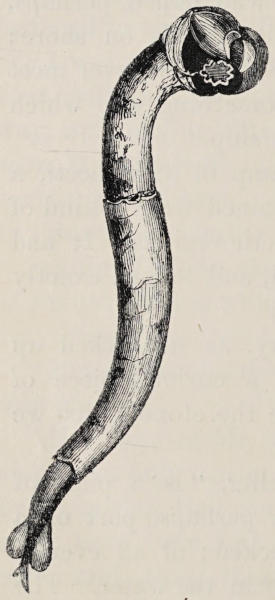
TEREDO.
“This,” said Mr. Miller, “is a piece of
wood, which was once, perhaps, part of a
ship that has been wrecked; at all events,
it has been a long time in the water. The
holes were made by a kind of worm, called
Teredo, which eats its way into the hardest
timber, making it so weak that a slight
blow will crush it.
In some seas the Teredo
is so abundant,
that no vessel is safe
unless its bottom is
entirely coated with
copper. The worm
is very small when
first it gets into the
wood, but grows
larger as it eats its
way, making a passage
through the
whole length of a
plank, but never
coming to the surface;
so that a beam
of timber may appear
to be solid, and yet
all the while be within as full of holes as a
sponge. As it goes on, it lines its passage
with a white shell, which it has the power
of making.” In one of the holes a portion
of the white shell was still remaining.
“Is it not,” continued Mr. Miller, “a wonderful
little animal? It can work its way
in the dark, through solid wood, taking care
never to turn a quarter of an inch too much
towards the right or towards the left. It is
taught by God to line its house with shell,
but no one knows how it works, or what
materials it employs; and, worm as it is, the
boldest sailor would refuse to go to sea in a
ship which it had taken hold of. It may
lead us, too, to despise nothing that God
has made, however trifling it may appear.”
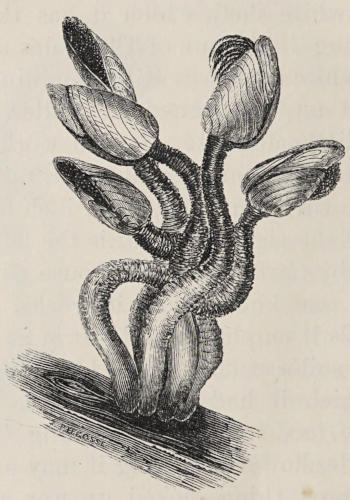
BARNACLES.
The next thing picked up was a piece of
cork, covered with barnacles. Barnacles are
small shell-fish, growing on long leathery
stems, by which they fasten themselves to
floating wood, or the bottoms of vessels.
They are not so mischievous as the worms
mentioned before, as they do not actually
eat the wood; but when, as is sometimes
the case, they thickly cover the bottom of
a ship, they prevent it from going quickly
through the water. It is sometimes found
necessary to take a ship into a dock, in order
to scrape off the barnacles.
A piece of stone picked up by Henry,
looking like a coal-cinder, but white, Mr.
Miller said was pumice-stone. It is one of
the kinds of stone thrown up by volcanoes,
or burning mountains. It is so light that
it floats on water. He thought that this
piece might, perhaps, have been thrown
from a burning mountain into the sea, or
that it might have been thrown overboard
from a ship. It is used on board ships to
scrub the decks with, and on land painters
use it in scraping off paint from wood which
is to be coated afresh.
“On the whole,” said he, “most probably
it came direct from a volcano, for I scarcely
ever came to this part of the coast without
finding some, and it could scarcely happen
that pumice-stone would always be falling
overboard by accident.”
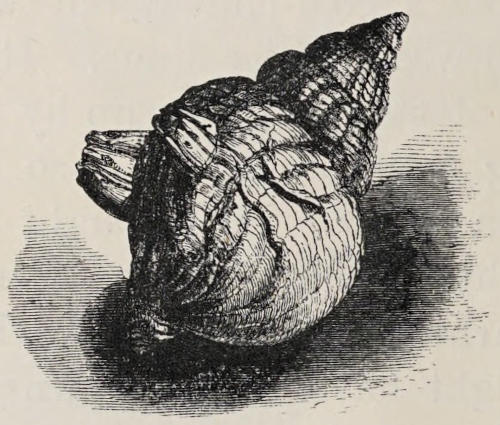
WHELK.
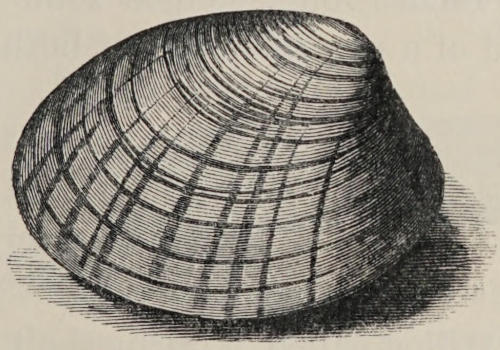
DONAX.
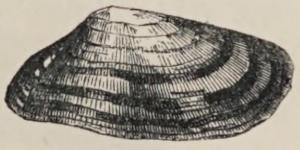
VENUS CHIONE.
The number of shells which lay scattered
along the beach was very great. Some were
like snail-shells, but more solid. Mr. Miller
knew the names, but as he thought that
Henry would not be able to recollect them,
he only told him that they crawled about
rocks and sea-weeds, very much as snails do
on land, some living on sea-weed, and others
on dead fish, or any animal substance they
can find. Those which are named periwinkles
and whelks are gathered by people
who live near the sea, and sold for food, but
they are neither nice nor wholesome. Others
were what Mr. Miller called bivalves; that
is, each animal had two shells, fastened
together by a hinge. There were a great
many large white cockle-shells, deeply furrowed,
and having rows of sharp points on
the outside. Some were yet larger, brown
outside and white within, and strong enough
to scoop up sand with; others, which were
flatter, were scarcely thicker than paper.
Most of these were single, and had no fish
in them; but many smaller kinds were
found which had been washed in without
injury. These were stowed away very carefully.
The most singular of all was a white
one, four or five inches long, shaped something
like the pod of a pea, but open at both
ends. This Mr. Miller called a razor-shell,
and said that the animal lived in the sand,
burrowing in it like an earth-worm, and,
perhaps, living on the small sea-insects
which it finds.
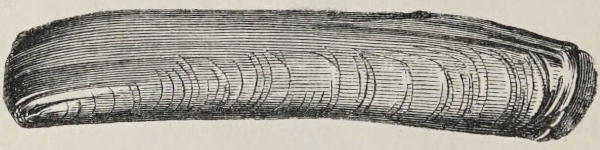
RAZOR-SHELL.
Yet more curious than any of the bivalves,
was a fish shaped like the axle and spokes
of a wheel. It was dead; but Mr. Miller
said that each of its five arms was covered
with holes, through which, when the animal
was alive, it sent out small suckers, and with
them caught hold of its food. Fishermen
often find these star-fishes, as they are called,
very troublesome, as they are very abundant
in some places, and eat the bait intended for
crabs and lobsters.
Henry had now found so many strange
things, which turned out to be quite different
from what he expected, that when he picked
up what looked like a wax-candle, he thought
he held in his hand some very wonderful
sea-monster. But a wax-candle it really
was, and had been a long time in the sea, as
there were young barnacles attached to one
end of it. This, like the cranberries, no
doubt came from a wreck, and was carefully
stored away in the basket, though one could
not look at it without sad thoughts.
They had now walked nearly to the end
of the long sands, and Mr. Miller wished to
pass round a rocky point, in order to see
what it was that drew together a large flock
of gulls beyond, some of which were flying
round in circles, now and then dipping into
the water, some swimming, and some perched
on the dark rocks.
The tide had gone down a good deal, but
had not left the rock. Mr. Miller managed
to climb round, and told Henry to wait for
him, as this work required longer and
stronger arms than his. He soon came
back; and, after waiting a little while
longer, the tide went out so far that, watching
for an opportunity, when a great wave
went out, they were able to run round the
point before another came in.
The gulls all rose and flew away as they
drew near, but they found, on the spot
where they had been gamboling, an immense
number of shells, with the fish still in
them, and had little doubt that the quick
eyes of the gulls had discovered these,
and that they had been making a plentiful
feast.
They had now reached another winding
path, by which the people who live near the
coast were in the habit of driving mules and
donkeys laden with sea-weed, to be used as
manure. After a storm, in summer and
autumn, the coast has a very busy appearance,
from the number of people who gain
their living in this way. The weed is first
collected into heaps on the sand, then carried
to the top of the cliff, where it is thrown
into a large heap, and allowed to stay until
it rots, after which it is spread on the fields,
and is a very useful manure.
Four o’clock having now nearly arrived,
they said good-bye to the sea, with its blue
waves, its yellow sands, its shells, its pebbles,
and its many strange things, and found the
carriage waiting for them.
In a few days Henry was at home again;
but as you may like to know what he did
with his treasures, I will tell you. Some
were placed in his little museum, or collection
of curiosities. The larger shells and
pebbles, together with some pieces of spar,
which were brought, another day, from a
limestone quarry, were applied to a different
purpose.
A round zinc saucer was procured, about
fourteen inches across, and three deep.
About six or eight holes were bored in the
bottom with a gimlet, and a number of
pieces of broken tiles and flower-pots were
placed in it, with a small pot turned upside
down in the middle. Over the potsherds
was placed a layer of moss, and the saucer
was filled up with earth. Round the pot in
the middle, the shells and stones were built
up to the height of six or eight inches, and
the ferns planted in some more earth between.
The whole was well watered, and then covered
with a large glass dome. A prettier little
rockery you never saw. Its only fault is
that, when once made, it scarcely ever requires
anything to be done to it. You
cannot give it too much water, for what it
does not want drains away through the
holes in the bottom, and the earth is not
washed away with it, for the moss stops it.
And you can scarcely make a mistake in
giving it too little water, for, as long as it is
covered with a glass, the water, which rises
in vapour, strikes against the dome, and
trickles down again into the saucer. Henry
has not yet watered it once since the day it
was made, but he will do so as soon as he
sees it beginning to look dry, for ferns grow
best in a moist soil and damp air.
And now I have reached the end of my
story. There is little in it but an account
of what Henry and his father saw in the
course of a few hours, on the sea-shore.
You too, if you like, may pick up shells
and pebbles, and see in them some of the
wondrous works of God’s creation. If you
do not live near the sea, look for curious
things by the river’s side, in the woods, or
in the hedges. They are everywhere, all differing
one from another, but alike leading
us to admire the wisdom and goodness of
God.
R. CLAY, SON, AND TAYLOR, PRINTERS, BREAD STREET HILL.