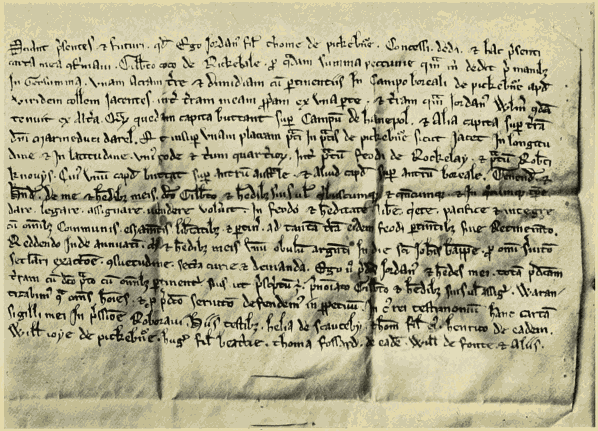
Reprint from Transactions of The Hunter Archæological Society.
HAWKSYARD.
By T. WALTER HALL, Hon. M.A. (Sheffield), F.R.Hist.S.
Place-names, obvious in their meaning but suggesting a remote origin
and a forgotten past, attract the historian, if not the philologist.
Hawksyard is one of these; its import is Hawksland but its
history lies hidden in the records of past centuries; it excites our curiosity
and quickens our imagination.
We instinctively recall scenes of English sport in bygone days;
of kings and nobles, knights and ladies, riding across the unfenced country;
over moorland and waste, through fen and ford, with hooded falcon and
stooping hawk, enjoying what was for nearly a thousand years the
national sport of England.
Such a scene was brought to mind by the perusal of two musty
parchments with imposing seals and faded script, quarried from the
lower strata of time-worn muniments, in the office of Colonel Brooke
Taylor of Bakewell.
The earlier of these deeds takes us back to the death of John of
Gaunt and the resignation of Richard II in the closing year of the 14th
century; the later one was sealed and delivered in the less tragic days
of Queen Elizabeth.
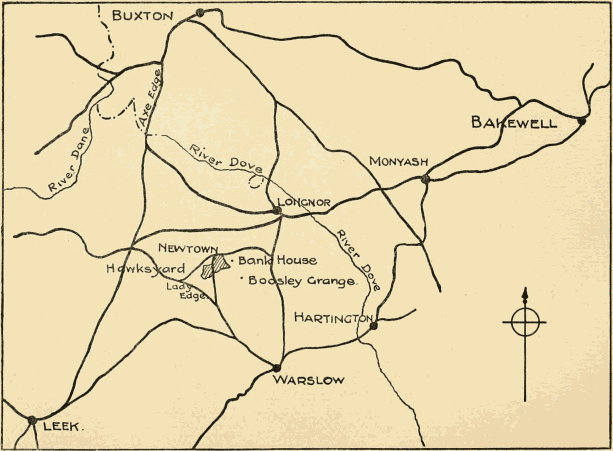
They both relate to Hawksyard, situate in that part of The Moorlands
of Staffordshire known in the middle ages as Highe Frith
of Malbanc Forest; south of Buxton and east of the church at Newtown
near Longnor.
The deed of John of Gaunt bears date the 15th May 1399, in bold
Arabic numerals; it is written in a jargon intended to be Latin and
measures 15 × 8½ inches; its round pendent seal of green wax has a
diameter of three and a half inches and is nearly an inch thick. The
parchment is dark in colour, coarse in texture and much crinkled; the
writing is not uniform in character, parts being in a flowing hand
suggesting a date long subsequent to the Plantagenets. The deed begins
with the word Conventum, meaning a covenant or agreement under
seal; but, from the concluding paragraph, it was evidently intended to
operate as a deed of gift or grant in fee simple of the lands called
Hawksyard.
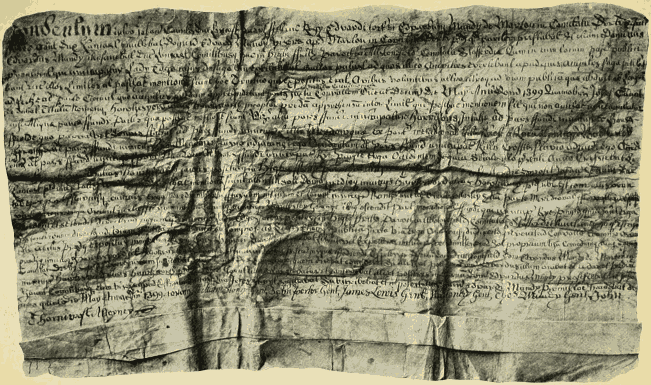
Photo Ethel Eadon
1399 May 15th.
Deed of Covenant, John of Gaunt to Sir Edward Mundy.
The following is a transcript with the contractions indicated but
not extended:—
Conventum inter Johan' Gaunte Duc' Lancast' quart' fillius Regy'
Edvardi tert' et Edvardum Mundy de Marton in Comitatu Derb'
equit' Joh'es Ga'nt Dux Lancast' p'mittebat Domin' Edvard' Mundy
visere ap'd Marton in Comitat' Derb' p'd q' pariter prestabat Et
etiam Dominus Edvardus Mundy iterfaciebat Duc' Lancast'
Comitibusq' ejus in Highe Frith parochia Allstonefield Comitatu
Staffordiæ Cum in eum locum pase (?) publice p'venirent qui
nuncupatur Lady Edge cujus defugabant (?) excitabant Gallos palust'
ad quos illico accipitres evertebant apud quos accipitres fuga petebant
int' illos Limites ut posthac mention's siant hoc Termino qui
expositus erat Avibus volantibus ultro citroq' ad viam publica' qua
abduit ab Longnor ad Leeke al' parte circunt quo accipitres pred'am
apprehendebant parte juxta mediam circuituo juxta convallem Orient'
Decim' Die May' Ann' Dom' 1399 Quamobre' Joh'es Gaunt ei
dabat Titulu' nomenq' Hawkesyerd alias Hawksearth propter pred'a
apprehensa' inter Limit' qui posthac mentionem fit qui non antehac
nuncupabatur ... Aliquae pauce Fundi Partes que posthac
mentione' fiunt Viz' alia pars Fundi nuncupatur Harrisons Intake al'
pars Fundi nuncupat' House-Fielde quo parva vel Domus stabat al'
pars Fundi nuncup' Little Meadow quae ex part' meridional' inter
jacet Locu' nuncup' Boothesley Grange al' pars Fundi nuncup'
Spart (? Spout) Meadow fluvio adjacans erga Occidentam al' pars
Fund' nuncupat' Killn Croffte fluvio adjac' erga Occidente' al' pars
Fund' nuncup' Spart (?) al' pars Fundi nuncupat' Rye Pingle erga
Occidentem sequia secale illo p'senti anno Cresscebat Limes Hawksyerd
alias Hawksearth jacens positusq' in Highe Frith Parochia
Allstonefield Comitatuq' Staffordie exposit Johan' Gaunt Duc'
Lancast' p'd' inter tales Metas qual' posthac mentione' fiunt attin' illi
soli Domo predi'oq' nuncup' Hawksyerd alias Hawksearth p'd ubi
est convallis oriental' ejus part' Fluviusq' Curans erga merediem
juxta Fluvium int' ilium et Locum nuncup' Banke aut al' Over
boothesley Etiam parte meridional' convallus ... et Fluvius
currens erga Orient' juxta Fluviu' int' illu' Locumq' nuncup'
Bauthsley (sic) Grange illaq' ascendit part' meridional' Funi qui
nuncup' Rye Pingle quia jacet erga Occident' et setendit directe ad
fugum q'd nuncup' Lady Edge jacens positusq' in Highe Frith
Parochia Allstonefield Comitatuq' Stafford' et tunc transjugu' q'd
est erga septentrionem directe ad viam publica' quae abducit ab
Longnor ad Leeke Etiamq' publica' juxta via' erga Orient' usq'
du' directe p'venit ad Convalla' Termino Orientali Tractus praedi'i
expositus primo Ann' Regni Regis Henrici Quart' assignabat Limat
vel Expellere includere vel admittere ad Sol' proprium usu' Comodumq'
illius Domus predi'iq' nuncu'q' Hawksyerd al' Hawksearth p'd
etiam Libertinuanu' publi' pascu' jusque effodiendi Cespites p'
Desertu' Domin' Allstonefield Dom' Edvardus Mundy de Marton in
comitat' Derby (sic) p'd' favore unum suplicabat Joh'es Gaunt Du'
Lancastriae quem dicebat consideret Si illi esset postestas Dom'
Edvardus ilium orabat et ei daret predi'u' nuncup' Hawksyerd alias
Hawksearth p'd' Et Joh'es Gaunt libere Largiebatur et concedebat
illi et posteris in Aeturnu' Dom' Edvardus Mundy profesiebatur Joh'e
Gaunt Comitibusq' eum visere apud Castrum Lancast' quo Joh'es
Gaunt sigillabat Subscribebat et in potestatem Domin' Edvardi
Mundy Premis' tot' tradebat decimo quint' Die May Anno D'm' 1399
coram William Stanley Gent John Porter Gent' James Lewis Gent'
Wi'm Stanley Gent' Tho's Mundy Gent' John Thornicroft Attorney.
It is not easy to give a true interpretation of this unconventional deed;
the operative part, which should be clear and precise, being vague and
inconclusive. The following is what may be accepted as a free translation
conveying a general idea of the purport and effect of the deed:—
An Agreement between John Gaunte duke of Lancaster, fourth son
of King Edward the third and Edward Mundy of Marton [Markeaton]
in the county of Derby knight. John Gaunt (sic) went himself
to visit Sir Edward Mundy at Marton in the county of Derby aforesaid
... and Sir Edward Mundy made a journey with the duke
of Lancaster and his attendants into Highe Frith in the parish of
Alstonefield in the county of Stafford; when they arrived at that
piece of public ground [? the common or moorland waste of the
manor] which was called Lady Edge, from which moorcock [both
red and black grouse] were frequently driven away and from whence
hawks were let loose and flown within such boundaries as were
thereinafter mentioned, to this boundary which was free and open
for birds flying backwards and forwards near the public road, which
led from Longnor to Leek. In the part of the circle in which the
hawks took [the grouse] near the middle circuit next the east clough,
on the 10th day of May 1399: for this reason John Gaunt gave it the
title and name of Hawksyerd otherwise Hawksearth, because of the
game being taken within its limits, thereinafter mentioned, which
place was not theretofore named, some other pieces of land, which
after that were made mention, to wit, part of a piece of land called
Harrisons Intake, part of a piece of land called House Fielde, on which
a small shed or house was standing, part of a piece of land called
Little Meadow, which on the south lay between a place called
Boothesley Grange and part of a piece of land called Rye Meadow
following the stream pointing west, part of a piece of land called
Killn Croffte adjoining the stream, thence west, part of a piece
of land called Spart (?) Meadow, part of a piece of land called Rye
Pingle, thence west following the rye of that year then growing. The
boundary of Hawksyard otherwise Hawksearth, lying and being in
Highe Frith in the parish of Alstonefield in the county of Stafford
set out by John Gaunte duke of Lancaster aforesaid, between such
bounds as were thereinafter mentioned, were set out for that house
only; and the land called Hawksyerd otherwise Hawksearth aforesaid,
where there is a clough at the east end of it and a purling
stream, thence south following the stream between that and a place
called Banke or otherwise Over Boothesley; also on the south side, a
clough and stream ran, thence east next the stream, between that
place called Bauthsley (sic) Grange and ascending on the south of
the piece of land which is called Rye Pingle, thence west leading
direct to the high ridge which is called Lady Edge, lying and being
in Highe Frithe in the parish of Alstonefield in the county of Stafford;
and then across the ridge which is north direct to the public road,
which led from Longnor to Leeke; and also along the public road
thence east it passed straight to the east end of the clough. The
full extent of the said land, in the 1st year of the reign of King
Henry IV, was marked out and set to limits either to expel, keep in
or admit, to the only proper use and advantage of that house called
Hawksyerd otherwise Hawksearth aforesaid; and also the liberty to
dig turf in the public meadow and wastes of the lordship of Alstonefield.
Sir Edward Mundy of Marton in the county of Derby aforesaid
prayed for one favour of John Gaunt duke of Lancaster, which he
[John] said he would consider if to him it were possible. Sir Edward
asked him and he [John] to him gave the said place called Hawksyerd
otherwise Hawksearth aforesaid and John Gaunt did freely give and
grant it to him and his descendants forever. Sir Edward Mundy then
went with his attendants to John Gaunt to see him at Lancaster
Castle which [agreement] John Gaunt sealed and subscribed; and
into the control of Sir Edward Mundy, all the before mentioned was
handed over on the 15th day of May 1399 In the presence of William
Stanley Gent, John Porter Gent, James Lewis Gent, Wi'm Stanley
Gent, Thomas Mundy Gent, John Thornicroft Attorney.
If this deed correctly records the facts, we must infer that John of
Gaunt owned lands in north Staffordshire between Longnor and Leek;
and that they probably formed part of the lands belonging to the duchy of
Lancaster. We learn that his friend Sir Edward Mundy of Markeaton,
twenty miles away to the south-east, invited the duke to visit him there;
a hawking party being arranged on the 10th May 1399 by Sir Edward
for the entertainment of his royal guest; one of the highest points of
The Moorlands, known as Lady Edge, nearly 1500 feet above the sea,
where grouse were always to be found, was selected as the trysting place.
The party would ride from Markeaton across the open country to Lady
Edge, and they appear to have had good sport. Probably John of Gaunt
and his friends from Markeaton watched the hawking from the top of
Lady Edge and the undulating land which lies between Lady Edge and
Hawksyard, the quarry being taken within a distance of half a mile
to the north-east. So pleased was the duke, that he honoured the place
where the hawks took their quarry by giving it the name of Hawksyard
otherwise Hawksearth; a place which before then was unnamed. The
deed also states that before the duke left Markeaton, Sir Edward asked
him as a personal favour to give Hawksyard to Sir Edward and that the
duke promised to consider the request. Apparently Sir Edward returned
with the duke to Lancaster, as a few days later the duke is stated to
have sealed and subscribed this deed at Lancaster Castle and delivered it
into the hands of Sir Edward on the 15th May 1399. The metes and
bounds are fully set forth in the deed, which also records that the
boundaries were marked out on the land in the 1st year of Henry IV.
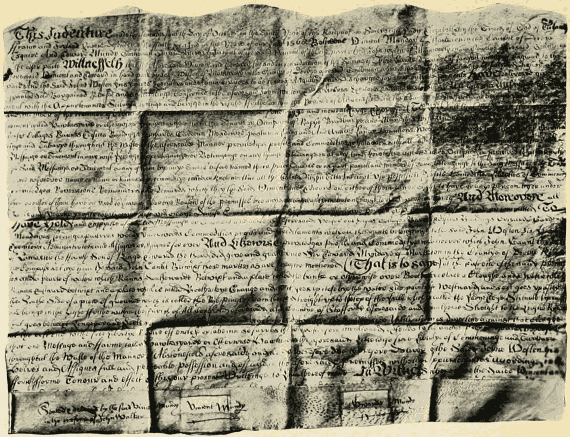
Photo Ethel Eadon
1568 October 24th.
Grant from Vincent and Edward Munday to John Weston.
The second deed bears date the 24th October 1568 written in the
same bold Arabic numerals as in the earlier deed; but the later deed is in
English and measures 16 × 12 inches, it has two round seals of yellow
wax, each of a diameter of one and a half inches; the impression on
these seals does not appear to be armorial but they both bear the same
form of cross; the parchment and make-up are in all respects similar
to the deed of 1399 and the signatures of Vincent Mundy and his son
are written in the same hand as the deed, which was not unusual in the
16th century.
The following is an abstract of the grant from Vincent Mundy and
his son Edward to John Weston.
An Indenture made the 24th day of October, in the 10th year of
Elizabeth and in the year of the Lord 1568 Between Vincent
Munday of Marketon in the countye of Derbye esquire and Edward
Mundy (sic) gentleman, son and heir apparent of the said Vincent, of
the one part and John Weston of Mackworth in the county aforesaid
gentleman of the other part; whereby the aforesaid Vincent and
Edward, for and in consideration of the sum of three hundred pounds
of lawful money of England, to the aforesaid Vincent and Edward
in hand paid by the said John Weston, whereof they confessed
themselves to be fully satisfied and paid and the said John Weston
and his heirs executors and administrators to be thereof acquitted
and discharged for ever by those presents; had delivered given
granted sold bargained released and by those present writings confirmed
to the aforesaid John Weston and his heirs executors and
administrators, all that their messuage or tenement, with the appurtenances,
situate lying and being in the Highe Frith within the parish
of Alstonefield in the county of Stafford; and being part parcel and
member of the mannor of Alstonefield aforesaid and hereafter named,
following and more at large expressed; to wit, all that messuage farm
or tenement called Hawkesyarde or otherwise Hawkesearthe, then in
the tenure or occupation of Raphe Bradburye and Maud his wife;
and also all and singular houses outhouses cottages barns edifices
buildings orchards gardens meadows pastures lands and arable lands
commons woods underwoods, free liberties or commoninge and turbarye
throughout the waste of the aforesaid manor, priviledges profits and
commodities whatsoever, with all and singular the appurtenances to
the said messuage or tenement in anywise lyeing appertaininge or
belonginge; or any thing standing or at any time theretofore
accepted used occupied or perceived, together with the said messuage
or tenement or any of them, by any tenant before named their
prior tenants or as part parcel and member of or as belonging to
the said messuage or tenement or by whatsoever name or names
it was commonly called or known, and all the estate etc; and
moreover all rent and yearly profits whatsoever, reserved on any
demise grant or copye of the premises, by any person or persons
theretofore made or committed; to have hold and enjoy the same
to the said John Weston his heirs executors administrators and assigns
for ever; and likewise priviledges profits and commodities whatsoever,
which John Gaunt the duke of Lancaster the fourth son of
King Edward the third did give and grant unto Sir Edward Mundaye
(sic) of Marketon in the county of Derby knight, the compass set by
him the said John Gaunt betwixt those marks as were thereafter
mentioned (that was to say) a clough at the east end of the said
premises and a pearle of water which runns southewarde betwixt
and a place called the Banke or otherwise Over Boothesleye; also a
clough and a water, which runns eastward betwixt and a place
which is called Boothesleye Grange and so it goes up close bye
the water side pointinge westwards and so it goes up after the southe
side of a piece of grounde which is called the Rye Pingle, from
thence streight up to the top of the Hill which is called the Lady
Edge, situate lyeinge and beinge in the Highe Frithe within the
parish of Alstonefield aforesaid and countye of Stafforde aforesaid
and from thence streight to the Highe Road, that goes betwixt
Longenor and Leek, pointeinge northeward and so it goes down
bye the roade side untill it comes directlye against that cloughe
at the east end; withe free libertye to drive off enclose or take
inn, so farr as the compass aforementioned extends; to the onlye
proper use and behoofe of that one messuage or farme called
Hawkesyarde or otherwise Hawkesearthe aforesaid, likewise free
libertye of commoninge and turbarie throughout the waste of the mannor
of Alstonefield aforesaid; and they did therefore deliver to the said
John Weston his heirs and assigns full and peaceable possession etc.
The witnesses were John Walker, Thomas Mundye gent, Thomas
Brunt, John Oakes yeoman and Thomas Mundy (sic);
In this deed there is an evident desire on the part of the draftsman to
strengthen and even to extend the rights and privileges appurtenant to
the Hawksyard estate, which then included a house of considerable
importance, occupied by Ralph Bradbury and Maud his wife. Towards
the end of the deed a belated attempt at a recital of the earlier John of
Gaunt deed is added, with extracts giving the full description of the
boundaries; and this earlier deed is treated as the root of title to
Hawksyard.
The question and the only question we have to consider is whether
these two deeds give us a true account of the origin and early history
of the place-name Hawksyard? At first sight it would appear that
they do; but unfortunately there is much in the earlier deed to arouse
suspicion. It is not that the story of John of Gaunt’s visit to
Highe Frith is improbable, on the contrary he rebuilt and occupied
Tutbury Castle twenty miles away; nor is there any reason to think
that in those days Sir Edward Mundy would hesitate to ask the duke
for a few acres of rough moorland waste, as a memento of a red-letter
day in the history of the Mundy family. Perhaps such a request, under
the circumstances, constituted true politeness in the middle ages; or he
may have wished to commemorate the day by building a house on the
land to bear the name Hawksyard; but, however probable these
surmises may be, there are many things in this alleged deed of gift
which suggest a date much later than the reign of Richard II and
cast a doubt as to its bona fides.
In the first place it is obvious that the date 15th May 1399 cannot
be correct, as John of Gaunt died in January or February 1398; further
the deed states that the duke visited Highe Frith on the 10th May
1399, which was impossible; and it is perhaps equally surprising to find
that a deed, dated in the reign of Richard II, should refer to the first
year of Henry IV, whose reign had not then begun and might never
have occurred.
These impossible dates require explanation, but our difficulties do
not end with dates; the writing in the John of Gaunt deed is not
characteristic of the period, it is not uniform throughout, the body of
the deed being written in characters of the rugged native script, the names
of the witnesses being added in a flowing Italian hand of the Elizabethan
period. Attention should also be called to the fact, that of the five
witnesses in whose presence the duke is said to have affixed his seal,
not one of them was above the rank of gentleman. The seal is impressed
with a hunting horn, suggestive of forest heraldry, but the royal arms of
the son of Edward III do not appear on this seal; and, if the hunting
horn is in its proper heraldic position, the point of the shield is at the top.
As above stated, the form of the deed is unusual and follows no
precedent; many words are more suggestive of the classics than the
customary usage of diplomatics in the 14th century. Equitem takes
the place of the more conventional militem; nuncupatur is used instead
of vocat and coram instead of testibus. Each of the first four witnesses
is described as gent and the last as attorney, while Derby is written
once in English; further, the exact legal effect of the deed seems to
be intentionally vague; it is headed conventum, meaning a covenant, but
in the subsequent deed of 1568 it is referred to as a grant. The full
description of the land in the later deed, with all its boundaries and
appurtenant rights, suggests that the Elizabethan draftsman had some
doubt as to the true facts; these details being apparently exploited with
some ulterior intent.
In comparing the size make-up and general appearance of the
two deeds, it is impossible not to see in them a strong resemblance;
they are both typical of the time of Elizabeth, the deed of 1399 is
too large and too coarse for a charter of that date. The fact that one
is in Latin and the other in English makes the comparison less easy;
but in both we find similar parchment ink and seals; the script is much
the same in both deeds, each having the dates written in the same bold
Arabic numerals; and the later recites the earlier deed.
It would not be difficult to find other points of resemblance between
these deeds; and it is impossible to compare them without coming to
the conclusion that they were prepared at the same time by the same
person, with the definite object of making a good title to the Hawksyard
property, on the sale to John Weston.
This forces us to the conclusion that the John of Gaunt deed is
not altogether trustworthy; and we have to consider whether or not
the information it contains, with regard to the origin of the place-name
Hawksyard, can be relied on; or if we must treat its whole contents
as pure fiction and entirely discredit all it tells us of the hawking party
in Highe Frith.
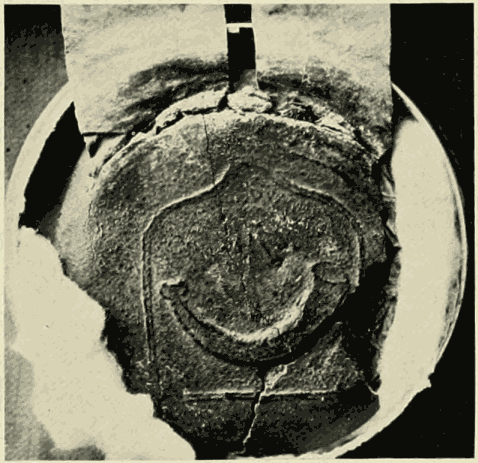 Seal
Seal of 15th May 1399.
There must be some explanation of this extraordinary deed; and it
may yet be possible to find a solution of the problem. Here is the deed!
How can we account for it? How much of what it tells us may we accept
as truth? To what extent is its story supported by extraneous evidence?
The points as to which we require information are; whether John
of Gaunt was in a position to give and grant lands in the Highe Frith
to Sir Edward Mundy or had he only the rights of an overlord? Why
did he hesitate before complying with Sir Edward’s request? Was he
in doubt as to whether the land were his to give or whether he held
as tenant in capite? Did he execute a deed of gift or did the gift
rest on a verbal promise, Sir Edward taking possession of the lands
and converting them to his own use? Did the lawyer of 1568, who
carried through the sale to Weston, act ex fide bona and endeavour,
according to his lights and the practice of his time, to put the title to
Hawksyard in order, for the mutual benefit of both vendor and purchaser?
For answers to these questions we must return to the days of John
of Gaunt.
In 1398 Richard II, seeing that his uncle John of Gaunt was in
failing health and that John’s son, Henry Bolingbroke earl of Hereford,
might press his claim to the throne of England in case of Richard’s
death without issue, took advantage of a quarrel between Bolingbroke
and the duke of Norfolk, in which each accused the other of treason,
to banish them both from the realm.
The loss of his son fell heavily on John of Gaunt, who died at the
end of January or the beginning of February 1398; and it is important to
bear in mind that the year 1399 began on the 25th March and not
the 1st January.
Richard, being free for a time from the menace of the House of
Lancaster, seized the whole of the Lancastrian estates in the absence
of the banished heir and crossed to Ireland to complete his conquests
and strengthen his hold on that country.
During Richard’s absence in Ireland the banished Henry, hearing
the news of his father’s death and the confiscation of the Lancastrian
estates, landed on the Yorkshire coast with a few trusted friends and
three thousand men-at-arms.
He was at once joined by the great barons of the north and with
an army, which increased as it advanced, he ultimately reached London;
where he was well received by the people, who were tired of Richard
and looked to Henry as their future king.
On hearing the news of Henry’s return Richard, after much delay
through rough weather, recrossed the Irish Channel to Milford Haven,
only to find that both his friends and his armies in England had melted
away and that his kingdom was lost.
He was forced by Henry and his supporters to resign his crown
and, in Westminster Hall on the 29th September 1399, his resignation
was received with shouts of applause; on the following day his cousin
Henry Bolingbroke, son and heir of John of Gaunt, was proclaimed King
of England as Henry IV.
On Henry’s accession he regained the estates of the duchy of
Lancaster, which however remained in his hands as crown property.
The above events and the dates on which they occurred are of
importance in considering the two Hawksyard deeds; and if we are to
understand how and why they came into existence, we must also trace
the early history of Highe Frith and learn something of the conditions
then prevailing as to the holding and devolution of landed estates in
England; more especially with regard to earldoms honours and manors,
which formed the basis of the feudal system.
When we clearly understand the way in which land in England was
held in pre-reformation days, it will perhaps be possible to see whether
the facts set forth in the deed of gift of the 15th May 1399 were consistent
with the early history of the manor of Alstonefield; and whether John
of Gaunt was shortly before his death in a legal position to comply
with the request of Sir Edward Mundy.
As already stated Hawksyard was in Highe Frith, part of the
manor of Alstonefield, and a manor was an estate in fee simple in a
tract of land granted by the sovereign to a subject, usually a man of
some consequence, in consideration of certain services.
He was the lord of the manor and he reserved for his own use
such parts of the land as he required, which were called the demesne
lands; other parts he granted out to his tenants, under varying conditions
which included estates of inheritance, estates for life, for years and at
will; the barren lands which remained in his hands were what was known
as the commons and wastes of the manor or the foreign lands. The
whole formed a manor or lordship which had its own courts and customs
and enjoyed feudal privileges, which extended not only to the lands
held by tenants but also to the commons and waste lands.
When many manors, perhaps extending into several counties, were
held by one great baron or overlord they formed an honour which was
held of the king in capite; this was quite different in character to the
manor. It was a jurisdiction, vested in private hands, and not a territorial
possession; the lords of the manors retaining their separate manorial
organisation and rendering suit and service to their overlord.
Manors also formed part of the earldom or shire; for some time after
the conquest an earl also had the title of count and from the counts
the shires took the name of counties. The title however soon disappeared
in England but we still retain countess, county and viscount.
When a great earldom honour or manor fell by forfeiture or escheat
into the hands of the sovereign which constantly happened, it retained its
distinct corporate existence and the whole apparatus of jurisdiction or
tenure. Under its own title it either continued in the possession of the
sovereign or was granted out again as a hereditary fief.
The manor of Alstonefield appears to have been included in different
earldoms and different honours at different dates, prior to the time when
it came into the hands of John of Gaunt and his first wife’s ancestors.
At the taking of the Domesday survey in 1086, Alstonefield manor
was held as a knight’s fee by Robert count of Shrewsbury with William
de Malbanc under him as lord of the manor. The Shrewsbury overlordship
did not last long and Alstonefield, which seems to have been much
in request, possibly owing to its grouse moor, was transferred to the
honour of Chester under Hugh Lupus; to whom William had, three
years after the conquest, given the earldom of Chester and William
de Malbanc, of Wich Malbanc now Nantwich, held the position of lord
marcher under Lupus, so that the lordship of Alstonefield formed part of
the marchlands or boundaries of the honour of Chester on the east,
over which William de Malbanc would have supreme control as lord of
the marches.
That part of the manor which lay between Leek and the river Dove,
including the site of Hawksyard, was chiefly forest and moorland; shortly
after the conquest and for many centuries after, it was known as Malbanc
Forest; but in 1220 the Malbanc barony devolved on three co-heiresses,
who held Alstonefield in co-parcenary.
On the forfeiture of a third share by the eldest daughter, then
countess of Warwick, it came into the possession of Hugh le Despencer,
though how he got it is not clear, and this share included the tract of
barren moorland known as Highe Frith of Malbanc Forest.
In 1297, on the death of Edmund earl of Lancaster, the King’s
Escheator held an inquisition at Tutbury for the county of Lancaster,
to ascertain what knight’s fees were due to the earl; the jury found
inter alia that Hugh le Despencer held one knight’s fee in the manor
of Altonesfelt (Alstonefield) worth yearly in homages etc. £10. “Nomina
Villarum” 1316 gives Hugh le Despencer and Nicholas de Audeleye
as owners of Alstonefield, a vill in the liberty of the earl of Lancaster,
who had the return of all writs.
In 1322 the estates of le Despencer were forfeited to the crown
and subsequently bestowed by Edward III on Henry earl of Lancaster,
grandfather of Blanche the wife of John of Gaunt.
It may be helpful here to recall how John of Gaunt was created
duke of Lancaster and became possessed of the Lancastrian estates,
extending into Cheshire, Staffordshire and other counties.
The first earl of Lancaster was Edmund called Crouchback second
son of Henry III; in addition to his Lancastrian estates, his father
bestowed on him the earldoms of Derby, Leicester, Lincoln, Salisbury
and Chester.
These passed on his death in 1296 to his eldest son Thomas earl
of Lancaster, who was beheaded at Pontefract in 1322 when his estates
were forfeited to the crown.[A] His widow was allowed to retain the
Salisbury estate; and the other four earldoms were bestowed on his
brother Henry earl of Lancaster, to whom one third share of Alstonefield
manor was also given, so that he possessed not only the Lancastrian
estates but also the earldoms of Derby (including the honour of Tutbury),
Leicester, Lincoln, Chester and the territorial interest of a third of the
manor of Alstonefield, including Malbanc Forest; of which Highe
Frith was waste of the manor.
Henry earl of Lancaster was succeeded by his son Henry, afterwards
first duke of Lancaster, who had no son; of his two daughters, Maud
married William of Bavaria and Blanche married John of Gaunt. Maud
died without issue, whereupon the whole of the Lancastrian estates
devolved on Blanche; and, in right of his wife, on her husband John
of Gaunt, who was in 1362 created duke of Lancaster.
It will be remembered that the seal attached to the deed of gift
of the 15th May 1399 bears a hunting horn; and in order to find some
explanation of this seal it may be necessary to glance for a moment
at the history of the honour of Tutbury, which as we have seen was
included in the earldom of Derby and passed to John of Gaunt
with that earldom.
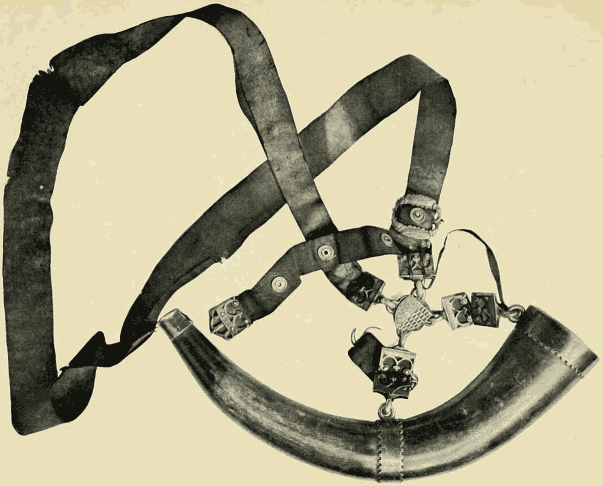 The Tutbury Horn
, from a photograph in the reference library at Sheffield.
About the end of the 13th century, the important office of escheator
and coroner throughout the whole honour of Tutbury within the county
of Stafford, was claimed by Walter Agard who demanded to hold office
by right of inheritance; but he was unable to produce any written
evidence in support of his claim; and in lieu of charters or writings,
he produced a white hunting horn garnished with silver-gilt in the middle
and at both ends, to which was affixed a girdle of black silk adorned
with buckles of silver, on which was placed the insignia of Edmund
earl of Lancaster; this horn was offered and accepted as the charter and
evidence of title to the office of escheator and coroner, to which he made
claim.
It is not necessary to follow the devolution of the Tutbury Horn
from Walter Agard; but in the 17th century, on the marriage of an
heiress of Agard, it passed to the Stanhopes, who sold it with its offices in
1753 to Samuel Foxlow of Staveley Hall, from him it ultimately passed
to Henry Marwood Greaves of Banner Cross, Sheffield, and Ford Hall,
Derbyshire, who once only exercised the right of appointment; and on
his death in 1859 his eldest son William Henry Greaves, who had
assumed the surname of Greaves-Bagshawe in 1853, succeeded to the
horn by inheritance, and appointed the next succeeding coroner. We
shall have to consider whether the pendent seal of the alleged deed of
gift can in any way be accounted for by the fact, that the honour of
Tutbury was part of the duchy of Lancaster prior to John of Gaunt’s
death.
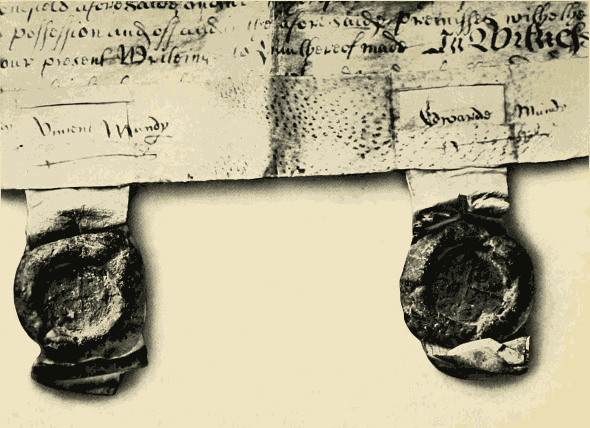 Seals
Seals of 24th October 1568.
Let us now turn to the other party to the deed of gift, Sir Edward
Mundy.
In Burke’s “Commoners of England” 1836, it is suggested that the
Mundy family derived its name from Mondaye Abbey in the dukedom
of Normandy; and it may be, that Sir Edward Mundy or his father
fought with John of Gaunt in the wars with France and Spain.
It seems probable, from what we find in the earlier deed, that the
duke and Sir Edward were close personal friends; and it may possibly
have been through the influence of John of Gaunt, that Sir Edward
Mundy or his father settled near Derby. However that may be, we
are told that Sir Edward entertained the duke at Markeaton and returned
with him to Lancaster Castle.
Vincent Mundy of Markeaton was a justice of the peace for the
county of Derby in 1558 and his son Edward died in 1607.
Burke also tells us that “from old deeds in existence it appears
that the family held lands in the year 1399”; it may be and seems highly
probable that he was referring to the deed of gift and the grant above
described, to which he presumably had access and gave credence.
On the other hand the two Lysons, in their work on Derbyshire,
say that the Mundys did not buy the Markeaton property until the
beginning of the sixteenth century. Perhaps at that date they added
to their original holding?
We now have some idea of how matters stood in 1399 and 1568;
we are therefore in a better position to consider whether the deeds of
Richard II and Elizabeth can be relied on as giving the origin and
early history of the place-name Hawksyard.
Assuming for the moment that the two deeds were prepared at
the same time and by the same hand, it is necessary to consider the
position as it presented itself to the attorney, who in 1568 was instructed
to carry out the sale of Hawksyard to John Weston. He possibly may
have acted for both vendor and purchaser and been anxious to do his
best for both his clients. He would, on receiving his instructions, ask
the vendor for his title deeds; the answer would presumably be that
there were no such deeds; but it was probably well known in the
vendor’s family and possibly also to John Weston, that Hawksyard
had been given to Sir Edward Mundy by John of Gaunt shortly before
his death, after enjoying a day’s hawking in Highe Frith, the tradition
of which would hang round The Moorlands for centuries; perhaps letters
or diaries would be produced with sufficient detail to satisfy the purchaser
of the truth of the tradition.
The attorney would perhaps be in doubt, whether this traditional
gift was a grant of the fee simple or a mere sporting right over certain
waste lands belonging to the manor of Alstonefield, part of the duchy;
which right would be what is known as a right of common in gross.
The vendors were doubtless in actual possession and their ancestors
had held it for nearly two hundred years; under circumstances such as
these the Courts of Common Law, in the absence of the tradition, would
have assumed a lost grant, made prior to the reign of Richard I, which
is supposed to be equivalent to immemorial user; but the family tradition
as to John of Gaunt fixes the lost grant in the reign of Richard II, which
would not support a claim by immemorial user. Under these circumstances
and in the absence of any title deeds, the attorney seems to have
taken upon himself the responsibility of creating a root of title, based
on the tradition and possibly what he considered satisfactory recorded
evidence; in doing this he exercised neither artfulness nor skill. He
hesitated whether to make it an agreement or a grant, he neglected to
use the 14th century common form of such a document, he blundered
sadly in the dates, and he referred in the deed, which he dated in the
reign of Richard II, to a reign which had not then begun. There would
be a difficulty as to the witnesses, and it may be that those named were
taken from some deed of 1399 to which he had access, notwithstanding
the fact that these five witnesses were not suitable or likely witnesses
for the sealing by John of Gaunt; there was also the difficulty of the
seal, and as probably no seal of John of Gaunt was available, a forest
seal, perhaps of the honour of Tutbury, was used; Alstonefield manor
being within that honour, and the deed of the 15th May 1399 was the
result; which did well enough to hand to the purchaser, as the root
of title to Hawksyard, along with his conveyance from Vincent Mundy
and his son. Even if the parties to the transaction knew of what was
being done they would doubtless be well pleased to have the John of
Gaunt tradition put on record; and the enterprising attorney would
probably be thanked and well paid for his trouble and resource. There
does not appear to have been any fraudulent intention to improperly
acquire any land or other benefit, though such a counterfeit in these days
would be fraught with risk to all parties concerned; but in the time
of Elizabeth, the law of real property rested less on statute and more
on the unwritten law; which was interpreted and applied loosely and
without supervision.[B] The effect of this ex post facto apograph was
twofold and benefited both sides. The vendors put on permanent record
their treasured family tradition and the purchaser got a root of title,
which might be of value to him in case of re-sale. It would be interesting
to know why the Mundys barred the entail and sold Hawksyard, with its
sporting tradition; it may have been that the chancellor of the duchy
had, at a then recent date, raised the question as to whether the Mundy
family originally had an estate in fee simple or a right of common in
gross; and that they as owners thought they would act wisely in selling to
a purchaser for value.
Whatever the reason may have been for the sale of Hawksyard
in 1568, it passed by the deed of Elizabeth from the Mundy family
to John Weston of Mackworth, and is now held and enjoyed under
prescriptive right, which makes its past history of little consequence,
so far as the present owner, Mr Robert Shirley of Waterhouse Farm,
near Longnor, is concerned.
His numerous deeds and papers relating to Hawksyard include an
abstract of title beginning in the 14th year of Elizabeth (10th July 1572),
when John Weston and Katherine his wife sold Hawksyard to Ralph
Bradbury who, as appears from the grant to John Weston, was in 1568
the tenant of Hawksyard; so that John Weston owned the property for
less than four years and then sold it to his tenant Ralph Bradbury,
who in May 1573 settled it on his younger son Otwell.
Forty-two years later, on the 11th May 1615, Otwell Bradbury
and Ralph his son and heir sold Hawksyard to Henry Cock for £400.
For many years the estate remained in the possession of the Cock
family, who sold it to Ralph Wood of Leek Abbey, the Cistercian
monastery Dieu-la-Cresse, and on the 5th April 1800 Hawksyard passed
into the possession of John Shirley of Rewlach, the great grandfather
of the present owner.
In 1850 some closes, part of Hawksyard, lying on the west side
of the road leading from Newtown to Warslow, were exchanged for
adjacent closes, part of the late Sir John Harpur Crewe’s estates. With
this exception, the Hawksyard estate seems to follow the boundaries
set forth in the deed of 1399, and Harrison’s Intake, Low Meadow, Rye
Meadow, Kiln Croft and Spout Field of that date still exist and appear
in the description of the lands in the 19th century title deeds. On the
front of the house are two dates, one above the other, the lower one
is “H C 1620” and the upper one is “H C 1784”; both these dates occur
during the ownership of the Cock family, and the initials “H C” probably
indicate Henry Cock.
Hawksyard of to-day is a substantial farmstead of eighty acres, with
a good house and farm buildings occupied by Mr Shirley’s son Edwin
Leslie Shirley; it is bounded on every side by lands of Sir Vauncey
Harpur Crewe of Calke Abbey and Warslow Hall, but it has never
formed part of the encircling Harpur estate, which we may assume
was crown property; and the grant to the Harpurs of these surrounding
lands may have given rise to a discussion as to the Hawksyard title, and
possibly suggested to the Mundys the desirability of the sale to Weston.
If the surrounding lands were granted by the crown, leaving Hawksyard
an isolated and independent holding, there seems to have been a recognition
of the Mundy title and a strong vindication of the Hawksyard tradition.
Of the places referred to in the deeds, Boothesley (now spelt Boosley)
Grange still stands; Bank or Over Boothesley is now Bank House and
the “pearle of water” is Boosley Brook. Highe Frith and Malbanc
Forest are not on the ordnance map and are almost forgotten in the
district; but Lady Edge is still in daily use, and the existence to-day
of these medieval place-names seems to strengthen the probability of the
story of John of Gaunt’s visit to the Highe Frith.
If ramblers on foot and on wheels, when passing the east end of
the church and the adjoining school of Newtown, will stop for a
moment to glance down on Hawksyard, two fields to the east and
up to Lady Edge half a mile to the south-west; it will not be difficult to
reconstruct the scene of the hawking, when
“Old John of Gaunt, time-honour'd Lancaster”
visited Highe Frith of Malbanc Forest more than five centuries ago
and first gave the name Hawksyard.
General: No attempt has been made to standardise spelling within the
charters; they are rendered as in the original text.
Page 28: Hawsksyard corrected to Hawksyard after “In 1850 some closes,
part of”