| |
| SHEEP AND THEIR DISEASES. |
| |
| PAGE |
|
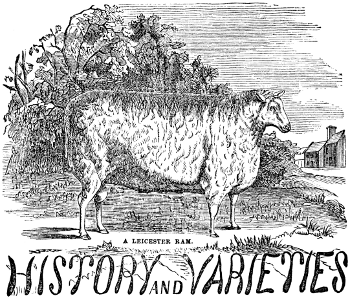
| HISTORY AND VARIETIES |
15 |
|
| |
American Sheep |
21 |
|
| |
Native Sheep |
22 |
|
| |
The Spanish Merino |
25 |
|
| |
The Saxon Merino |
36 |
|
| |
The New Leicester |
41 |
|
| |
The South-Down |
47 |
|
| |
The Cotswold |
52 |
|
| |
The Cheviot |
54 |
|
| |
The Lincoln |
56 |
|
| |
Natural History of the Sheep |
57 |
|
| |
Formation of the Teeth |
59 |
|
| |
Structure of the Skin |
63 |
|
| |
Anatomy of the Wool |
64 |
|
| |
Long Wool |
76 |
|
| |
Middle Wool |
78 |
|
| |
Short Wool |
80 |
|
| |
| CROSSING AND BREEDING |
81 |
|
| |
Breeding |
81 |
|
| |
Points of the Merino |
93 |
|
| |
Breeding Merinos |
97 |
|
| |
General Principles of Breeding |
106 |
|
| |
Use of Rams |
112 |
|
| |
Lambing |
117 |
|
| |
Management of Lambs |
121 |
|
| |
Castration and Docking |
127 |
|
| |
| FEEDING AND MANAGEMENT |
129 |
|
| |
Feeding |
129 |
|
| |
Shade |
133 |
|
| |
Fences |
133 |
|
| |
Hoppling |
133 |
|
| |
Dangerous Rams |
134 |
|
| |
Prairie Feeding |
135 |
|
| |
Fall Feeding |
137 |
|
| |
Winter Feeding |
137 |
|
| |
Feeding with other Stock |
142 |
|
| |
Division of Flocks |
142 |
|
| |
Regularity in Feeding |
143 |
|
| |
Effect of Food |
144 |
|
| |
Yards |
146 |
|
| |
Feeding-Racks |
147 |
|
| |
Troughs |
150 |
|
| |
Barns and Sheds |
151 |
|
| |
Sheds |
155 |
|
| |
Hay-Holder |
156 |
|
| |
Tagging |
157 |
|
| |
Washing |
160 |
|
| |
Cutting the Hoofs |
165 |
|
| |
Shearing |
166 |
|
| |
Cold Storms |
171 |
|
| |
Sun-Scald |
171 |
|
| |
Ticks |
171 |
|
| |
Marking or Branding |
172 |
|
| |
Maggots |
173 |
|
| |
Shortening the Horns |
174 |
|
| |
Selection and Division |
174 |
|
| |
The Crook |
176 |
|
| |
Driving and Slaughtering |
177 |
|
| |
Driving |
177 |
|
| |
Points of Fat Sheep |
181 |
|
| |
Slaughtering |
184 |
|
| |
Cutting Up |
186 |
|
| |
Relative qualities |
187 |
|
| |
Contributions to Manufactures |
191 |
|
| |
| DISEASES AND THEIR REMEDIES |
195 |
|
| |
Administering Medicine |
197 |
|
| |
Bleeding |
197 |
|
| |
Feeling the Pulse |
199 |
|
| |
Apoplexy |
200 |
|
| |
Braxy |
201 |
|
| |
Bronchitis |
201 |
|
| |
Catarrh |
202 |
|
| |
Malignant Epizoötic Catarrh |
203 |
|
| |
Colic |
205 |
|
| |
Costiveness |
206 |
|
| |
Diarrhœa |
206 |
|
| |
Disease of the Biflex Canal |
207 |
|
| |
Dysentery |
208 |
|
| |
Flies |
209 |
|
| |
Fouls |
209 |
|
| |
Fractures |
210 |
|
| |
Garget |
211 |
|
| |
Goitre |
211 |
|
| |
Grub in the Head |
212 |
|
| |
Hoof-Ail |
214 |
|
| |
Hoove |
225 |
|
| |
Hydatid on the Brain |
226 |
|
| |
Obstruction of the Gullet |
228 |
|
| |
Ophthalmia |
229 |
|
| |
Palsy |
229 |
|
| |
Pelt-Rot |
230 |
|
| |
Pneumonia |
230 |
|
| |
Poison |
233 |
|
| |
Rot |
233 |
|
| |
Scab |
236 |
|
| |
Small-Pox |
239 |
|
| |
Sore Face |
242 |
|
| |
Sore Mouth |
243 |
|
| |
Ticks |
243 |
|
| |
| ILLUSTRATIONS. |
|
| |
| |
A Leicester Ram |
15 |
|
| |
Rocky Mountain Sheep |
19 |
|
| |
A Merino Ram |
25 |
|
| |
A Spanish Sheep-Dog |
28 |
|
| |
Out at Pasture |
35 |
|
| |
A Country Scene |
41 |
|
| |
A South-Down Ram |
47 |
|
| |
The Cotswold |
52 |
|
| |
A Cheviot Ewe |
54 |
|
| |
Skeleton of the Sheep as Covered by the Muscles |
57 |
|
| |
The Wallachian Sheep |
64 |
|
| |
The Happy Trio |
81 |
|
| |
The Scotch Sheep-Dog or Colley |
100 |
|
| |
Ewe and Lambs |
117 |
|
| |
Feeding and Management |
129 |
|
| |
A Covered Salting-Box |
130 |
|
| |
A Convenient Box-Rack |
147 |
|
| |
A Hole-Rack |
148 |
|
| |
The Hopper-Rack |
150 |
|
| |
An Economical Sheep-Trough |
151 |
|
| |
Sheep-Barn with Sheds |
152 |
|
| |
A Shed of Rails |
155 |
|
| |
Washing Apparatus |
162 |
|
| |
Toe-nippers |
166 |
|
| |
Fleece |
167 |
|
| |
Shepherd’s Crook |
176 |
|
| |
The Shepherd and his Flock |
179 |
|
| |
Drover’s or Butcher’s Dog |
185 |
|
| |
Quiet Enjoyment |
195 |
|
| |
An English Rack for Feeding Sheep |
203 |
|
| |
A Barrack for Storing Sheep Fodder |
228 |
|
| |
The Broad-tailed Sheep |
236 |
|
| |
| CONTENTS. |
|
| SWINE AND THEIR DISEASES. |
| |
| HISTORY AND BREEDS |
245 |
(7) |
| |
American Swine |
254 |
(16) |
| |
The Byefield |
256 |
(18) |
| |
The Bedford |
256 |
(18) |
| |
The Leicester |
257 |
(19) |
| |
The Yorkshire |
257 |
(19) |
| |
The Chinese |
258 |
(20) |
| |
The Suffolk |
260 |
(22) |
| |
The Berkshire |
261 |
(23) |
| |
Natural History of the Hog |
263 |
(25) |
| |
Formation of the Teeth |
265 |
(27) |
| |
| BREEDING AND MANAGEMENT |
267 |
(29) |
| |
Breeding |
267 |
(29) |
| |
Points of a Good Hog |
274 |
(36) |
| |
Treatment during Pregnancy |
276 |
(38) |
| |
Abortion |
277 |
(39) |
| |
Parturition |
279 |
(41) |
| |
Treatment while Suckling |
282 |
(44) |
| |
Treatment of Young Pigs |
283 |
(45) |
| |
Castration |
284 |
(46) |
| |
Spaying |
286 |
(48) |
| |
Weaning |
287 |
(49) |
| |
Ringing |
289 |
(51) |
| |
Feeding and Fattening |
290 |
(52) |
| |
Piggeries |
295 |
(57) |
| |
Slaughtering |
298 |
(60) |
| |
Pickling and Curing |
300 |
(62) |
| |
Value of the Carcass |
304 |
(66) |
| |
| DISEASES AND THEIR REMEDIES |
307 |
(69) |
| |
Catching the Pig |
308 |
(70) |
| |
Bleeding |
309 |
(71) |
| |
Drenching |
310 |
(72) |
| |
Catarrh |
310 |
(72) |
| |
Cholera |
311 |
(73) |
| |
Crackings |
314 |
(76) |
| |
Diarrhœa |
314 |
(76) |
| |
Fever |
315 |
(77) |
| |
Foul Skin |
317 |
(79) |
| |
Inflammation of the Lungs |
317 |
(79) |
| |
Jaundice |
318 |
(80) |
| |
Leprosy |
319 |
(81) |
| |
Lethargy |
319 |
(81) |
| |
Mange |
320 |
(82) |
| |
Measles |
322 |
(84) |
| |
Murrain |
323 |
(85) |
| |
Quinsy |
323 |
(85) |
| |
Staggers |
323 |
(85) |
| |
Swelling of the Spleen |
323 |
(85) |
| |
Surfeit |
325 |
(87) |
| |
Tumors |
325 |
(87) |
|
| |
| ILLUSTRATIONS. |
| |
| |
The Wild Boar |
245 |
(7) |
| |
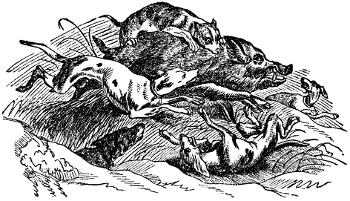
The Wild Boar at Bay |
252 |
(14) |
| |
The Chinese Hog |
259 |
(21) |
| |
The Suffolk |
260 |
(22) |
| |
A Berkshire Boar |
261 |
(23) |
| |
Skeleton of the Hog as Covered by the Muscles |
263 |
(25) |
| |
The Old Country Well |
267 |
(29) |
| |
Wild Hogs |
279 |
(41) |
| |
The Old English Hog |
299 |
(61) |
| |
A Wicked-Looking Specimen |
307 |
(69) |
| |
Hunting The Wild Boar |
315 |
(77) |
| |
| CONTENTS. |
|
| |
| POULTRY AND THEIR DISEASES. |
| |
| HISTORY AND VARIETIES |
327 |
(7) |
| |
The Domestic Fowl |
327 |
(7) |
| |
The Bantam |
330 |
(10) |
| |
The African Bantam |
331 |
(11) |
| |
The Bolton Gray |
333 |
(13) |
| |
The Blue Dun |
334 |
(14) |
| |
The Chittagong |
335 |
(15) |
| |
The Cochin China |
336 |
(16) |
| |
The Cuckoo |
339 |
(19) |
| |
The Dominique |
340 |
(20) |
| |
The Dorking |
340 |
(20) |
| |
The Fawn-colored Dorking |
343 |
(23) |
| |
The Black Dorking |
343 |
(23) |
| |
The Dunghill Fowl |
344 |
(24) |
| |
The Frizzled Fowl |
344 |
(24) |
| |
The Game Fowl |
345 |
(25) |
| |
The Mexican Hen-Cock |
347 |
(27) |
| |
The Wild Indian Game |
348 |
(28) |
| |
The Spanish Game |
348 |
(28) |
| |
The Guelderland |
349 |
(29) |
| |
The Spangled Hamburgh |
350 |
(30) |
| |
The Golden Spangled |
350 |
(30) |
| |
The Silver Spangled |
351 |
(31) |
| |
The Java |
352 |
(32) |
| |
The Jersey-Blue |
352 |
(32) |
| |
The Lark-Crested Fowl |
352 |
(32) |
| |
The Malay |
354 |
(34) |
| |
The Pheasant-Malay |
356 |
(36) |
| |
The Plymouth Rock |
357 |
(37) |
| |
The Poland |
358 |
(38) |
| |
The Black Polish |
360 |
(40) |
| |
The Golden Polands |
361 |
(41) |
| |
The Silver Polands |
363 |
(43) |
| |
The Black-topped White |
364 |
(44) |
| |
The Shanghae |
364 |
(44) |
| |
The White Shanghae |
367 |
(47) |
| |
The Silver Pheasant |
368 |
(48) |
| |
The Spanish |
369 |
(49) |
| |
Natural History of Domestic Fowls |
372 |
(52) |
| |
The Guinea Fowl |
378 |
(58) |
| |
The Pea Fowl |
381 |
(61) |
| |
The Turkey |
386 |
(66) |
| |
The Wild Turkey |
386 |
(66) |
| |
The Domestic Turkey |
391 |
(71) |
| |
The Duck |
394 |
(74) |
| |
The Wild Duck |
396 |
(76) |
| |
The Domestic Duck |
398 |
(78) |
| |
The Goose |
402 |
(82) |
| |
The Wild Goose |
402 |
(82) |
| |
The Domestic Goose |
404 |
(84) |
| |
The Bernacle Goose |
407 |
(87) |
| |
The Bremen Goose |
409 |
(89) |
| |
The Brent Goose |
410 |
(90) |
| |
The China Goose |
411 |
(91) |
| |
The White China |
413 |
(93) |
| |
The Egyptian Goose |
414 |
(94) |
| |
The Java Goose |
415 |
(95) |
| |
The Toulouse Goose |
415 |
(95) |
| |
The White-fronted Goose |
416 |
(96) |
| |
The Anatomy of the Egg |
417 |
(97) |
| |
| BREEDING AND MANAGEMENT |
421 |
(101) |
| |
Breeding |
421 |
(101) |
| |
High Breeding |
422 |
(102) |
| |
Selection of Stock |
429 |
(109) |
| |
Feeding |
432 |
(112) |
| |
Bran |
435 |
(115) |
| |
Millet |
436 |
(116) |
| |
Rice |
436 |
(116) |
| |
Potatoes |
436 |
(116) |
| |
Green Food |
437 |
(117) |
| |
Earth-Worms |
437 |
(117) |
| |
Animal Food |
438 |
(118) |
| |
Insects |
439 |
(119) |
| |
Laying |
439 |
(119) |
| |
Preservation of Eggs |
443 |
(123) |
| |
Choice of Eggs for Setting |
446 |
(126) |
| |
Incubation |
449 |
(129) |
| |
Incubation of Turkeys |
453 |
(133) |
| |
Incubation of Geese |
454 |
(134) |
| |
Rearing of the Young |
455 |
(135) |
| |
Rearing of Guinea Fowls |
458 |
(138) |
| |
Rearing of Turkeys |
459 |
(139) |
| |
Rearing of Ducklings |
461 |
(141) |
| |
Rearing of Goslings |
463 |
(143) |
| |
Caponizing |
464 |
(144) |
| |
Fattening and Slaughtering |
468 |
(148) |
| |
Slaughtering and Dressing |
472 |
(152) |
| |
Poultry-Houses |
474 |
(154) |
| |
| DISEASES AND THEIR REMEDIES |
478 |
(158) |
| |
Asthma |
479 |
(159) |
| |
Costiveness |
480 |
(160) |
| |
Diarrhœa |
481 |
(161) |
| |
Fever |
482 |
(162) |
| |
Indigestion |
482 |
(162) |
| |
Lice |
483 |
(163) |
| |
Loss of Feathers |
485 |
(165) |
| |
Pip |
485 |
(165) |
| |
Roup |
488 |
(168) |
| |
Wounds and Sores |
490 |
(170) |
| |
| ILLUSTRATIONS. |
|
| |
| |
Varieties of Fowl |
327 |
(7) |
| |
The Bantam |
331 |
(11) |
| |
Bantam |
332 |
(12) |
| |
Bolton Grays or Creole Fowl |
333 |
(13) |
| |
Cochin Chinas |
337 |
(17) |
| |
White Dorkings |
341 |
(21) |
| |
Gray Game Fowls |
346 |
(26) |
| |
Guelderlands |
349 |
(29) |
| |
Hamburgh Fowls |
350 |
(30) |
| |
Malays |
354 |
(34) |
| |
Poland Fowls |
359 |
(39) |
| |
Shanghaes |
365 |
(45) |
| |
White Shanghaes |
367 |
(47) |
| |
Spanish Fowls |
369 |
(49) |
| |
The Guinea Fowl |
379 |
(59) |
| |
The Pea Fowl |
382 |
(62) |
| |
The Wild Turkey |
386 |
(66) |
| |
The Domestic Turkey |
392 |
(72) |
| |
The Eider Duck |
395 |
(75) |
| |
Wild Duck |
397 |
(77) |
| |
Rouen Duck |
399 |
(79) |
| |
Wild or Canada Goose |
403 |
(83) |
| |
A Bremen Goose |
409 |
(89) |
| |
China or Hong Kong Goose |
411 |
(91) |
| |
Barnyard Scene |
421 |
(101) |
| |
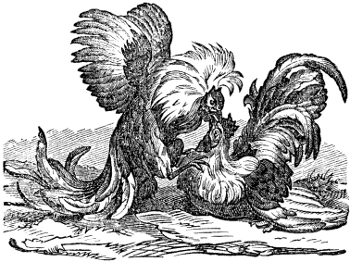
Fighting Cocks |
429 |
(109) |
| |
On the Watch |
439 |
(119) |
| |
Marquee Or Tent-shaped Coops |
456 |
(136) |
| |
Duck-Pond and Houses |
461 |
(141) |
| |
A Bad Style of Slaughtering |
468 |
(148) |
| |
Rustic Poultry-House |
475 |
(155) |
| |
A Fancy Coop in Chinese or Gothic Style |
476 |
(156) |
| |
Among the Straw |
478 |
(158) |
| |
Prairie Hens |
483 |
(163) |
| |
Swans |
488 |
(168) |
[15]
With a single exception—that of the dog—there is no member of the
beast family which presents so great a diversity of size, color, form,
covering, and general appearance, as characterizes the sheep; and none
occupy a wider range of climate, or subsist on a greater variety of
food. This animal is found in every latitude between the Equator and the
Arctic circle, ranging over barren mountains and through fertile
valleys, feeding upon almost every species of edible forage—the
cultivated grasses, clovers, cereals, and roots—browsing on aromatic
and bitter herbs alike, cropping the leaves and barks from stunted
forest shrubs and the pungent, resinous evergreens. In some parts of
Norway and Sweden, when other resources fail, he subsists on fish or
flesh during the long, rigorous winter, and, if reduced to necessity,
even devours his own wool.
In size, he is diminutive or massive; he has many horns, or but two
large or small spiral horns, or is polled or hornless. His tail may be
broad, or long, or a mere button, discoverable only by the touch. His
covering is long and coarse, or short and hairy, or soft and furry, or
fine and spiral. His color varies from white or black to every shade of
brown, dun, buff, blue, and gray. This wide diversity results from long
domestication under almost every conceivable variety of condition.
Among the antediluvians, sheep were used for sacrificial offerings, and
their fleeces, in all probability, furnished them with clothing. Since
the deluge their flesh has been a favorite food among many nations. Many
of the rude, wandering tribes of the East employ them as beasts of
burden. The uncivilized—and, to some extent, the refined—inhabitants
of Europe use their milk, not only as a beverage, but for making into
cheese, butter, and curds—an appropriation of it which is also noticed
by Job, Isaiah, and other Old Testament writers, as well as most of the
Greek and Roman authors. The ewe’s milk scarcely differs in appearance
from that of the cow, though it is generally thicker, and yields a pale,
yellowish butter, which is always soft and soon becomes rancid. In dairy
regions the animal is likewise frequently employed at the tread-mill or
horizontal wheel, to pump water, churn milk, or perform other light
domestic work.
The calling of the shepherd has, from time immemorial, been conspicuous,
and not wanting in dignity and importance. Abel was a keeper of sheep;
as were Abraham and his descendants, as well as most of the ancient
patriarchs. Job possessed fourteen thousand sheep. Rachel, the favored
mother of the Jewish race, “came with her father’s sheep, for she kept
them.” The seven daughters of the priest of Midian “came and drew water
for their father’s flocks.” Moses, the statesman and lawgiver, “learned
in all the wisdom of the Egyptians,” busied himself in tending “the
flocks of Jethro, his father-in-law.” David, too, that sweet singer of
Israel and its destined monarch—the Jewish hero, poet, and divine—was
a keeper of sheep. To shepherds, “abiding in the field, keeping watch
over their flocks by night,” came the glad tidings of a Saviour’s birth.
The Hebrew term for sheep signifies, in its etymology, fruitfulness,
abundance, plenty—indicative of the blessings which they were destined
to confer upon the human family. In the Holy Scriptures, this animal is
the chosen symbol of purity and the gentler virtues, the victim of
propitiatory sacrifices, and the type of redemption to fallen man.
Among profane writers, Homer and Hesiod, Virgil and Theocritus,
introduce them in their pastoral themes; while their heroes and
demi-gods—Hercules and Ulysses, Eneas and Numa—carefully perpetuate
them in their domains.
In modern times, they have engaged the attention of the most enlightened
nations, whose prosperity has been intimately linked with them, wherever
wool and its manufactures have been regarded as essential staples. Spain
and Portugal, during the two centuries in which they figured as the
most enterprising European countries, excelled in the production and
manufacture of wool. Flanders, for a time, took precedence of England in
the perfection of the arts and the enjoyments of life; and the latter
country then sent what little wool she raised to the former to be
manufactured. This being soon found highly impolitic, large bounties
were offered by England for the importation of artists and machinery;
and by a systematic and thorough course of legislation, which looked to
the utmost protection and increase of wool and woollens, she gradually
carried their production beyond any thing the world had ever seen.
Of the original breed of this invaluable animal, nothing certain is
known; four varieties having been deemed by naturalists entitled to that
distinction.
These are, 1. The Musimon, inhabiting Corsica, Sardinia, and other
islands of the Mediterranean, the mountainous parts of Spain and Greece,
and some other regions bordering upon that inland sea. These have been
frequently domesticated and mixed with the long-cultivated breeds.
2. The Argali ranges over the steppes, or inland plains of Central
Asia, northward and eastward to the ocean. They are larger and hardier
than the Musimon and not so easily tamed.
3. The Rocky Mountain Sheep—frequently called the Bighorn by our
western hunters—is found on the prairies west of the Mississippi, and
throughout the wild, mountainous regions extending through California
and Oregon to the Pacific. They are larger than the Argali—which in
other respects they resemble—and are probably descended from them,
since they could easily cross upon the ice at Behring’s Straits, from
the north-eastern coast of Asia. Like the Argali, when caught young
they are readily tamed; but it is not known that they have ever been
bred with the domestic sheep. Before the country was overrun by the
white ram, they probably inhabited the region bordering on the
Mississippi. Father Hennepin—a French Jesuit, who wrote some two
hundred years ago—often speaks of meeting with goats in his travels
through the territory which is now embraced by Illinois, Wisconsin, and
a portion of Minnesota. The wild, clambering propensities of these
animals—occupying, as they do, the giddy heights far beyond the reach
of the traveller—and their outer coating of hair—supplied underneath,
however, with a thick coating of soft wool—give them much the
appearance of goats. In summer they are generally found single; but when
they descend from their isolated, rocky heights in winter, they are
gregarious, marching in flocks under the guidance of leaders.
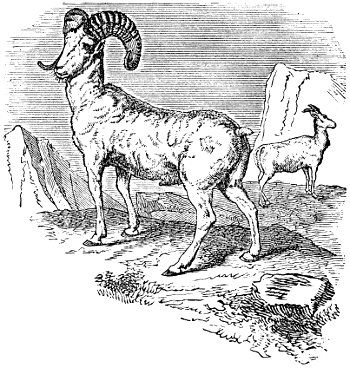
ROCKY MOUNTAIN SHEEP.
4. The Bearded Sheep of Africa inhabit the mountains of Barbary and
Egypt. They are covered with a soft, reddish hair, and have a mane
hanging below the neck, and large, locks of hair at the ankle.
Many varieties of the domesticated sheep—that is, all the subjugated
species—apparently differ less from their wild namesakes than from each
other.
The fat-rumped and the broad-tailed sheep are much more extensively
diffused than any other, and occupy nearly all the south-eastern part of
Europe, Western and Central Asia, and Northern Africa. They are
supposed, from various passages in the Pentateuch in which “the fat and
the rump” are spoken of in connection with offerings, to be the
varieties which were propagated by the patriarchs and their descendants,
the Jewish race. They certainly give indisputable evidence of remote and
continued subjugation. Their long, pendent, drowsy ears, and the highly
artificial posterior developments, are characteristic of no wild or
recently domesticated race.
This breed consists of numerous sub-varieties, differing in all their
characteristics of size, fleece, color, etc., with quite as many and
marked shades of distinction as the modern European varieties. In
Madagascar, they are covered with hair; in the south of Africa, with
coarse wool; in the Levant, and along the Mediterranean, the wool is
comparatively fine; and from that of the fat-rumped sheep of Thibet the
exquisite Cashmere shawls of commerce are manufactured. Both rams and
ewes are sometimes bred with horns, and sometimes without, and they
exhibit a great diversity of color. Some yield a carcass of scarcely
thirty pounds, while others have weighed two hundred pounds dressed. The
tail or rump varies greatly, according to the purity and style of
breeding; some are less than one-eighth, while others exceed one-third
of the entire dressed weight. The fat of the rump or tail is esteemed a
great delicacy; in hot climates resembling oil, and in colder, suet.
It is doubtful whether sheep are indigenous to Great Britain; but they
are mentioned as existing there at very early periods.
In North America, there are none, strictly speaking, except the Rocky
Mountain breed, already mentioned. The broad-tailed sheep of Asia and
Africa were brought into the United States about seventy years ago,
under the name of the Tunisian Mountain sheep, and bred with the native
flocks. Some of them were subsequently distributed among the farmers of
Pennsylvania, and their mixed descendants were highly prized as
prolific, and good nurses, coming early to maturity, attaining large
weight, of a superior quality of carcass, and yielding a heavy fleece of
excellent wool. The principal objection made to them was the difficulty
of propagation, which always required the assistance of the shepherd.
The lambs were dropped white, red, tawny, bluish, or black; but all,
excepting the black, grew white as they approached maturity, retaining
some spots of the original color on the cheeks and legs, and sometimes
having the entire head tawny or black. The few which descended from the
original importations have become blended with American flocks, and have
long ceased to be distinguishable from them. The common sheep of Holland
were early imported by the Dutch emigrants, who originally colonized New
York; but they, in like manner, have long since ceased to exist as a
distinct variety.
Improved European breeds have been so largely introduced during the
present century, that the United States at present possesses every known
breed which could be of particular benefit to its husbandry. By the
census of 1860, there were nearly twenty-three and a half millions of
sheep in this country, yielding upwards of sixty and a half million
pounds of wool. An almost infinite variety of crosses have taken place
between the Spanish, English, and “native” families; carried, indeed, to
such an extent that there are, comparatively speaking, few flocks in the
United States that preserve entire the distinctive characteristics of
any one breed, or that can lay claim to unmixed purity of blood.
The principal breeds in the United States are the so-called “Natives;”
the Spanish and Saxon Merinos, introduced from the countries whose names
they bear: the New Leicester, or Bakewell; the South-Down; the Cotswold;
the Cheviot; and the Lincoln—all from England.
This name is popularly applied to the common coarse-woolled sheep of the
country, which existed here previously to the importation of the
improved breeds. These were of foreign and mostly of English origin, and
could probably claim a common descent from no one stock. The early
settlers, emigrating from different sections of the British Empire, and
a portion of them from other parts of Europe, brought with them, in all
probability, each the favorite breed of his own immediate neighborhood,
and the admixture of these formed the mongrel family now under
consideration. Amid the perils of war and the incursions of beasts of
prey, they were carefully preserved. As early as 1676, New England was
spoken of as “abounding with sheep.”
These common sheep yielded a wool suitable only for the coarsest
fabrics, averaging, in the hands of good farmers, from three to three
and a half pounds of wool to the fleece. They were slow in arriving at
maturity, compared with the improved English breeds, and yielded, when
fully grown, from ten to fourteen pounds of a middling quality of mutton
to the quarter. They were usually long-legged, light in the
fore-quarter, and narrow on the breast and back; although some rare
instances might be found of flocks with the short legs, and some
approximation to the general form of the improved breeds. They were
excellent breeders, often rearing, almost entirely destitute of care,
and without shelter, one hundred per cent. of lambs; and in small
flocks, a still larger proportion. These, too, were usually dropped in
March, or the earlier part of April. Restless in their disposition,
their impatience of restraint almost equalled that of the untamed
Argali, from which they were descended; and in many sections of the
country it was common to see from twenty to fifty of them roving, with
little regard to enclosures, over the possessions of their owner and his
neighbors, leaving a large portion of their wool adhering to bushes and
thorns, and the remainder placed nearly beyond the possibility of
carding, by the tory-weed and burdock, so common on new lands.
To this general character of the native flocks, there was but one
exception—a considerably numerous and probably accidental variety,
known as the Otter breed, or Creepers. These were excessively
duck-legged, with well-formed bodies, full chests, broad backs, yielding
a close, heavy fleece, of medium quality of wool. They were deserved
favorites where indifferent stone or wood fences existed, since their
power of locomotion was absolutely limited to their enclosures, if
protected by a fence not less than two feet high. The quality of their
mutton equalled, while their aptitude to fatten was decidedly superior
to, their longer-legged contemporaries. The race is now quite extinct.
An excellent variety, called the Arlington sheep, was produced by
General Washington, from a cross of a Persian ram upon the Bakewell,
which bore wool fourteen inches in length, soft, silky, and admirably
suited to combing. These, likewise, have long since become incorporated
with the other flocks of the country.
The old common stock of sheep, as a distinct family, have nearly or
quite disappeared, owing to universal crossing, to a greater or less
extent, with the foreign breeds of later introduction. The first and
second cross with the Merino resulted in a decided improvement, and
produced a variety exceedingly valuable for the farmer who rears wool
solely for domestic purposes. The fleeces are of uneven fineness, being
hairy on the thighs, dew-lap, etc.; but the general quality is much
improved, the quantity is considerably augmented, the carcass is more
compact and nearer the ground, and they have lost their unquiet and
roving propensities. The cross with the Saxon, for reasons hereafter to
be given, has not generally been so successful. With the Leicester and
Downs, the improvement, so far as form size, and a propensity to take on
fat are concerned, is manifest.
[25]
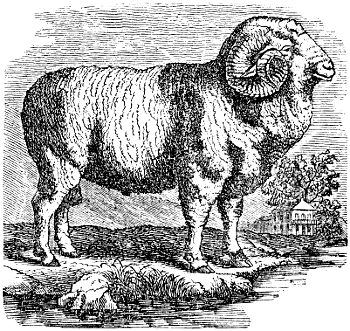
A MERINO RAM.
The Spanish sheep, in different countries, has, either directly or
indirectly, effected a complete revolution in the character of the
fleece. The race is unquestionably one of the most ancient extant. The
early writers on agriculture and the veterinary art describe various
breeds of sheep as existing in Spain, of different colors—black, red,
and tawny. The black sheep yielded a fine fleece, the finest of that
color which was then known; but the red fleece of Bætica—a considerable
part of the Spanish coast on the Mediterranean, comprising the modern
Spanish provinces of Gaen, Cordova, Seville, Andalusia, and Granada,
which was early colonized by the enterprising Greeks—was, according to
Pliny, of still superior quality, and “had no fellow.”
These sheep were probably imported from Italy, and of the Tarentine
breed, which had gradually spread from the coast of Syria, and of the
Black Sea, and had then reached the western extremity of Europe. Many of
them mingled with and improved the native breeds of Spain, while others
continued to exist as a distinct race, and, meeting with a climate and
an herbage suited to them, retained their original character and value,
and were the progenitors of the Merinos of the present day. Columella, a
colonist from Italy, and uncle of the writer of an excellent work on
agriculture, introduced more of the Tarentine sheep into Bætica, where
he resided in the reign of the Emperor Claudius, in the year 41, and
otherwise improved on the native breed; for, struck with the beauty of
some African rams which had been brought to Rome to be exhibited at the
public games, he purchased them, and conveyed them to his farm in Spain,
whence, probably, originated the better varieties of the long-woolled
breeds of that country.
Before his time, however, Spain possessed a valuable breed; since
Strabo, who flourished under Tiberius, speaking of the beautiful woollen
cloths that were worn by the Romans, says that the wool was brought from
Truditania, in Spain.
The limited region of Italy—overrun, as it repeatedly was, by hordes of
barbarians during and after the times of the latest emperors—soon lost
her pampered flocks; while the extended regions of Spain—intersected in
every direction by almost impassable mountains—could maintain their
more hardy race, in defiance of revolution or change.
To what extent the improvements which have been noticed were carried is
unknown; but as Spain was at that time highly civilized, and as
agriculture was the favorite pursuit of the greater part of the
colonists that spread over the vast territory, which then acknowledged
the Roman power, it is highly probable that Columella’s experiments laid
the foundation for a general improvement in the Spanish sheep—an
improvement, moreover, which was not lost, nor even materially impaired,
during the darker ages that succeeded.
The Merino race possess inbred qualities to an extent surpassed by no
others. They have been improved in the general weight and evenness of
their fleece, as in the celebrated flock of Rambouillet; in the
uniformity and excessive fineness of the fibre, as in the Saxons; and in
their form and feeding qualities, in various countries; but there has
never yet been deterioration, either in quantity or quality of fleece or
carcass, wherever they have been transported, if supplied with suitable
food and attention. Most sheep annually shed their wool if unclipped;
while the Merino retains its fleece, sometimes for five years, when
allowed to remain unshorn.
Conclusive evidence is thus afforded of continued breeding among
themselves, by which the very constitution of the wool-producing organs
beneath the skin have become permanently established; and this property
is transmitted to a great extent, even among the crosses, thus marking
the Merino as an ancient and peculiar race.
The remains of the ancient varieties of color, also, as noticed by
Pliny, Solinus, and Columella, may still be discovered in the modern
Merino. The plain and indeed the only reason that can be assigned for
the union of black and gray faces with white bodies, in the same breed,
is the frequent intermixture of black and white sheep, until the white
prevails in the fleece, and the black is confined to the face and legs.
It is still apt to break out occasionally in the individual, unless it
is fixed and concentrated in the face and legs, by repeated crosses and
a careful selection; and, on the contrary, in the Merino South-Down the
black may be reduced by a few crosses to small spots about the legs,
while the Merino hue overspreads the countenance. This hue—variously
described as a velvet, a buff, a fawn, or a satin-colored countenance,
but in which a red tinge not infrequently predominates, still indicates
the original colors of the indigenous breeds of Spain; and the black
wool, for which Spain was formerly so much distinguished, is still
inclined to break out occasionally in the legs and ears of the Merino.
In some flocks half the ear is invariably brown, and a coarse black hair
is often discernible in the finest pile.
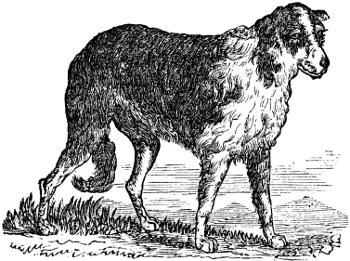
A SPANISH SHEEP DOG.
The conquest, in the eighth century, by the Moors of those fine
provinces in the south of Spain, so far from checking, served rather to
encourage the production of fine wool. The conquerors were not only
enterprising, but highly skilled in the useful arts, and carried on
extensive manufactories of fine woollen goods, which they exported to
different countries. The luxury of the Moorish sovereigns has been the
theme of many writers; and in the thirteenth century, when the woollen
manufacture flourished in but few places, there were found in Seville no
less than sixteen thousand looms. A century later, Barcelona, Perpignan,
and Tortosa were celebrated for the fineness of their cloths, which
became staple articles of trade throughout the greater part of Europe,
as well as on the coast of Africa.
After the expulsion of the Moors, in the fifteenth century, by
Ferdinand and Isabella, the woollen manufacture languished, and was, in
a great degree, lost to Spain, owing to the rigorous banishment of
nearly one million industrious Moors, most of whom were weavers. As a
consequence, the sixteen thousand looms of Seville dwindled down to
sixty. The Spanish government perceived its fatal mistake too late, and
subsequent efforts to gain its lost vantage-ground in respect to this
manufacture proved fruitless. During all that time, however, the Spanish
sheep appear to have withstood the baneful influence of almost total
neglect; and although the Merino flocks and Merino wool have improved
under the more careful management of other countries, the world is
originally indebted to Spain for the most valuable material in the
manufacture of cloth.
The perpetuation of the Merino sheep in all its purity, amid the
convulsions which changed the entire political framework of Spain and
destroyed every other national improvement, strikingly illustrates the
primary determining power of blood or breeding, as well as the agency of
soil and climate—possibly too much underrated in modern times.
These Spanish sheep are divided into two classes: the stationary, or
those that remain during the whole of the year on a certain farm, or in
a certain district, there being a sufficient provision for them in
winter and in summer; and the migratory, or those which wander some
hundreds of miles twice in the year, in quest of pasturage. The
principal breed of stationary sheep consists of true Merinos; but the
breeds most sought for, and with which so many countries have been
enriched, are the Merinos of the migratory description, which pass the
summer in the mountains of the north, and the winter on the plains
toward the south of Spain.
The first impression made by the Merino sheep on one unacquainted with
its value would be unfavorable. The wool lying closer and thicker over
the body than in most other breeds, and being abundant in yolk—or a
peculiar secretion from the glands of the skin, which nourishes the wool
and causes it to mat closely together—is covered with a dirty crust,
often full of cracks. The legs are long, yet small in the bone; the
breast and the back are narrow, and the sides somewhat flat; the
fore-shoulders and bosoms are heavy, and too much of their weight is
carried on the coarser parts. The horns of the male are comparatively
large, curved, and with more or less of a spiral form; the head is
large, but the forehead rather low. A few of the females are horned;
but, generally speaking, they are without horns. Both male and female
have a peculiar coarse and unsightly growth of hair on the forehead and
cheeks, which the careful shepherd cuts away before the shearing-time;
the other part of the face has a pleasing and characteristic velvet
appearance. Under the throat there is a singular looseness of skin,
which gives them a remarkable appearance of throatiness, or hollowness
in the neck. The pile or hair, when pressed upon, is hard and
unyielding, owing to the thickness into which it grows on the pelf, and
the abundance of the yolk, retaining all the dirt and gravel which falls
upon it; but, upon examination, the fibre exceeds, in fineness and in
the number of serrations and curves, that which any other sheep in the
world produces. The average weight of the fleece in Spain is eight
pounds from the ram, and five from the ewe. The staple differs in length
in different provinces. When fatted, these sheep will weigh from twelve
to sixteen pounds per quarter.
The excellence of the Merinos consist in the unexampled fineness and
felting property of their wool, and in the weight of it yielded by each
individual sheep; the closeness of that wool, and the luxuriance of the
yolk, which enable them to support extremes of cold and wet quite as
well as any other breed; the readiness with which they adapt themselves
to every change of climate, retaining, with common care, all their
fineness of wool, and thriving under a burning tropical sun, and in the
frozen regions of the north; an appetite which renders them apparently
satisfied with the coarsest food; a quietness and patience into whatever
pasture they are turned; and a gentleness and tractableness not excelled
in any other breed.
Their defects—partly attributable to the breed, but more to the
improper mode of treatment to which they are occasionally
subjected—are, their unthrifty and unprofitable form; a tendency to
abortion, or barrenness; a difficulty of yeaning, or giving birth to
their young; a paucity of milk; and a too frequent neglect of their
lambs. They are likewise said, notwithstanding the fineness of their
wool, and the beautiful red color of the skin when the fleece is parted,
to be more subject to cutaneous affections than most other breeds. Man,
however, is far more responsible for this than Nature. Every thing was
sacrificed in Spain to fineness and quantity of wool. These were
supposed to be connected with equality of temperature, or, at least,
with freedom from exposure to cold; and, therefore, twice in the year, a
journey of four hundred miles was undertaken, at the rate of eighty or a
hundred miles per week—the spring journey commencing when the lambs
were scarcely four months old. It is difficult to say in what way the
wool of the migratory sheep was, or could be, benefited by these
periodical journeys. Although among them is found the finest and most
valuable wool in Spain, yet the stationary sheep, in certain
provinces—Segovia, Leon, and Estremadura—are more valuable than the
migratory flocks of others. Moreover, the fleece of some of the German
Merinos—which do not travel at all, and are housed all the
winter—greatly exceeds that obtained from the best migratory breed—the
Leonese—in fineness and felting property; and the wool of the migratory
sheep has been, comparatively speaking, driven out of the market by that
from sheep which never travel. With respect to the carcass, these
harassing journeys, occupying one-quarter of the year, tend to destroy
all possibility of fattening, or any tendency toward it, and the form
and the constitution of the flock are deteriorated, and the lives of
many sacrificed.
The first importation of Merinos into the United States took place in
1801; a banker of Paris, Mr. Delessert, having shipped four, of which
but one arrived in safety at his farm near Kingston, in New York; the
others perished on the passage. The same year, Mr. Seth Adams, of
Massachusetts, imported a pair from France. In 1802, Chancellor
Livingston, then American Minister at the court of Versailles, sent two
choice pairs from the Rambouillet flock—which was started, in 1786, by
placing four hundred ewes and rams, selected from the choicest Spanish
flocks, on the royal farm of that name, in France—to Claremont, his
country-seat, on the Hudson river. In the latter part of the same year,
Colonel Humphreys, American Minister to Spain, shipped two hundred, on
his departure from that country. The largest importations, however, were
made through Hon. William Jarvis, of Vermont, then American Consul at
Lisbon, Portugal, in 1809, 1810, and 1811, who succeeded in obtaining
the choicest sheep of that country. Various subsequent importations took
place, which need not be particularized.
The cessation of all commercial intercourse with England, in 1808 and
1809, growing out of difficulties with that country, directed attention,
in an especial manner, toward manufacturing and wool-growing. The
Merino, consequently, rose into importance, and so great was the
interest aroused, that from a thousand to fourteen hundred dollars a
head was paid for them. Some of the later importations, unfortunately,
arrived in the worst condition, bringing with them those scourges of the
sheep family, the scab and the foot-rot; which evils, together with
increased supply, soon brought them down to less than a twentieth part
of their former price. When, however, it was established, by actual
experiment, that their wool did not deteriorate in this country, as had
been feared by many, and that they became readily acclimated, they again
rose into favor. The prostration of the manufacturing interests of the
country, which ensued soon afterwards, rendered the Merino of
comparatively little value, and ruined many who had purchased them at
their previous high prices. Since that period, the valuation of the
sheep which bear the particular wool has, as a matter of course, kept
pace with the fluctuations in the price of the wool.
The term Merino, it must be remembered, is but the general appellation
of a breed, comprising several varieties, presenting essential points of
difference in size, form, quality and quantity of wool. These families
have generally been merged, by interbreeding, in the United States and
other countries which have received the race from Spain. Purity of
Merino blood, and actual excellence in the individual and its
ancestors, form the only standard in selecting sheep of this breed.
Families have, indeed, sprung up in this country, exhibiting wider
points of difference than did those of Spain. This is owing, in some
cases, doubtless, to particular causes of breeding; but more often,
probably, to concealed or forgotten infusions of other blood. The
question, which has been at times raised, whether there are any Merinos
in the United States, descendants of the early importations, of
unquestionable purity of blood, has been conclusively settled in the
affirmative.
The minor distinctions among the various families into which, as has
already been intimated, the American Merino has diverged, are numerous,
but may all, perhaps, be classed under three general heads.
The first is a large, short-legged, strong, exceedingly hardy sheep,
carrying a heavy fleece, ranging from medium to fine, free from hair in
properly bred flocks; somewhat inclined to throatiness, but not so much
so as the Rambouillets; bred to exhibit external concrete gum in some
flocks, but not commonly so; their wool rather long on back and belly,
and exceedingly dense; wool whiter within than the Rambouillets; skin
the same rich rose-color. Sheep of this class are larger and stronger
than those originally imported, carry much heavier fleeces, and in
well-selected flocks, or individuals, the fleece is of a decidedly
better quality.
The second class embraces smaller animals than the preceding; less
hardy; wool, as a general thing, finer, and covered with a black, pitchy
gum on its extremities; fleece about one-fourth lighter than in the
former class.
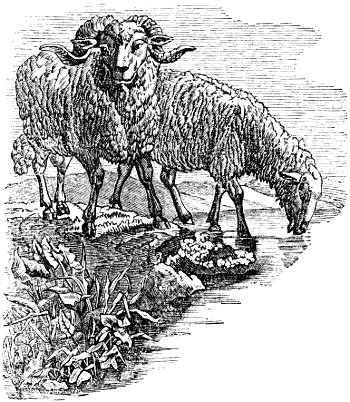
OUT AT PASTURE.
The third class, bred at the South, mostly, includes animals still
smaller and less hardy, and carrying still finer and lighter fleeces.
The fleece is destitute of external gum. The sheep and wool have a close
resemblance to the Saxon; and, if not actually mixed with that blood,
they have been formed into a similar variety, by a similar course of
breeding.
The mutton of the Merino, notwithstanding the prejudices existing on the
subject, is short-grained, and of good flavor, when killed at a proper
age, and weighs from ten to fourteen pounds to the quarter. It is
remarkable for its longevity, retaining its teeth, and continuing to
breed two or three years longer than the common sheep, and at least half
a dozen years longer than the improved English breeds. It should,
however, be remarked, in this connection, that it is correspondingly
slow in arriving at maturity, as it does not attain its full growth
before three years of age; and the ewes, in the best managed flocks, are
rarely permitted to breed before they reach that age.
The Merino is a far better breeder than any other fine-woolled sheep,
and its lambs, when newly dropped, are claimed to be hardier than the
Bakewell, and equally so with the high-bred South-Down. The ewe, as has
been intimated, is not so good a nurse, and will not usually do full
justice to more than one lamb. Eighty or ninety per cent. is about the
ordinary number of lambs reared, though it often reaches one hundred per
cent., in carefully managed or small flocks.
Allusion has heretofore been made to the cross between the Merino and
the native sheep. On the introduction of the Saxon family of the
Merinos, they were universally engrafted on the parent stock, and the
cross was continued until the Spanish blood was nearly bred out. When
the admixture took place with judiciously selected Saxons, the results
were not unfavorable for certain purposes. These instances of judicious
crossing were, unfortunately, rare. Fineness of wool was made the only
tests of excellence, no matter how scanty its quantity, or how
diminutive or miserable the carcass. The consequence was, as might be
supposed, the ruin of most of the Merino flocks.
The indigenous breed of sheep in Saxony resembled that of the
neighboring states, and consisted of two distinct Varieties—one bearing
a wool of some value, and the other yielding a fleece applicable only to
the coarsest manufactures.
At the close of the seven years war, Augustus Frederic, the Elector of
Saxony, imported one hundred rams and two hundred ewes from the most
improved Spanish flocks, and placed a part of them on one of his own
farms, in the neighborhood of Dresden, which he kept unmixed, as he
desired to ascertain how far the pure Spanish breed could be naturalized
in that country The other part of the flock was distributed on other
farms, and devoted to the improvement of the Saxon sheep.
It was soon sufficiently apparent that the Merinos did not degenerate in
Saxony. Many parcels of their wool were not inferior to the choicest
Leonese fleeces. The best breed of the native Saxons was also materially
improved: The majority of the shepherds were, however, obstinately
prejudiced against the innovation; but the elector, resolutely bent upon
accomplishing his object, imported an additional number, and compelled
the crown-tenants, then occupying lands under him, to purchase a certain
number of the sheep.
Compulsion was not long necessary; the true interest of the shepherds
was discovered; pure Merinos rapidly increased in Saxony, and became
perfectly naturalized. Indeed, after a considerable lapse of years, the
fleece of the Saxon sheep began, not only to equal the Spanish, but to
exceed it in fineness and manufacturing value. To this result the
government very materially contributed, by the establishment of an
agricultural school, and other minor schools for shepherds, and by
distributing various publications, which plainly and intelligibly showed
the value and proper management of the Merino. The breeders were
selected with almost exclusive reference to the quality of the fleece.
Great care was taken to prevent exposure throughout the year, and they
were housed on every slight emergency. By this course of breeding and
treatment the size and weight of the fleece were reduced, and that
hardiness and vigor of constitution, which had universally
characterized the migratory Spanish breed, were partially impaired. In
numerous instances, this management resulted in permanent injury to the
character of the flocks.
The first importation of Saxons into this country was made in 1823, by
Samuel Heustan, a merchant of Boston, Massachusetts, and consisted of
four good rams, of which two went to Boston, and the others to
Philadelphia. The following year, seventy-seven—about two-thirds of
which number only were pure-blooded—were brought to Boston, sold at
public auction at Brooklyn, N.Y., as “pure-blooded electoral Saxons,”
and thus scattered over the country. Another lot, composed of grade
sheep and pure-bloods, was disposed of, not long afterwards, by public
sale, at Brighton, near Boston, and brought increased prices, some of
them realizing from four hundred to five hundred and fifty dollars.
These prices gave rise to speculation, and many animals, of a decidedly
inferior grade, were imported, which were thrown upon the market for the
most they could command. The sales in many instances not half covering
the cost of importation, the speculation was soon abandoned. In 1827,
Henry D. Grove, of Hoosic, N.Y., a native of Germany, and a highly
intelligent and thoroughly bred shepherd, who had accompanied some of
the early importations, imported one hundred and fifteen choice animals
for his own breeding, and, in the following year, eighty more. These
formed the flock from which Mr. Grove bred, to the time of his decease,
in 1844. The average weight of fleece from his entire flock, nearly all
of which were ewes and lambs, was ten pounds and fourteen ounces,
thoroughly washed on the sheep’s back. This was realized after a short
summer and winter’s keep, when the quantity of hay or its equivalent
fed to the sheep did not exceed one and a half pounds, by actual weight,
per day, except to the ewes, which received an additional quantity just
before and after lambing. This treatment was attended with no disease or
loss by death, and with an increase of lambs, equalling one for every
ewe.
The Saxon Merino differs materially in frame from the Spanish; there is
more roundness of carcass and fineness of bone, together with a general
form and appearance indicative of a disposition to fatten. Two distinct
breeds are noticed. One variety has stouter legs, stouter bodies, head
and neck comparatively short and broad, and body round; the wool grows
most on the face and legs; the grease in the wool is almost pitchy. The
other breed, called Escurial, has longer legs, with a long, spare neck
and head; very little wool on the latter; and a finer, shorter, and
softer character in its fleece, but less in quantity.
From what has just been stated it will be seen that there are few Saxon
flocks in the United States that have not been reduced to the quality of
grade sheep, by the promiscuous admixture of the pure and the impure
which were imported together; all of them being sold to our breeders as
pure stock. Besides, there are very few flocks which have not been again
crossed with the Native or the Merino sheep of our country, or with
both. Those who early purchased the Merino crossed them with the Native;
and when the Saxons arrived those mongrels were bred to Saxon rams. This
is the history of three-quarters, probably, of the Saxon flocks of the
United States.
As these sheep have now so long been bred toward the Saxon
that their wool equals that of the pure-bloods, it may well be questioned whether
they are any worse for the admixture; when crossed only with the Merino,
it is, undoubtedly, to their advantage. The American Saxon, with these
early crosses in its pedigree, is, by general admission, a hardier and
more easily kept animal than the pure Escurial or Electoral Saxon.
Climate, feed, and other causes have, doubtless, conspired, as in the
case of the Merino, to add to their size and vigor; but, after every
necessary allowance has been made, they generally owe these qualities to
those early crosses.
The fleeces of the American Saxons weigh, on the average, from two or
two and a quarter to three pounds. They are, comparatively speaking, a
tender sheep, requiring regular supplies of good food, good shelter in
winter, and protection in cool weather from storms of all kinds; but
they are evidently hardier than the parent German stock. In docility and
patience under confinement, in late maturity and longevity, they
resemble the Merinos, from which they are descended; though they do not
mature so early as the Merino, nor do they ordinarily live so long. They
are poorer nurses; their lambs are smaller, fatter, and far more likely
to perish, unless sheltered and carefully watched; they do not fatten so
well, and, being considerably lighter, they consume an amount of food
considerably less.
Taken together, the American Saxons bear a much finer wool than the
American Merinos; though this is not always the case, and many breeders
of Saxons cross with the Merino, for the purpose of increasing the
weight of their fleeces without deteriorating its quality. Our Saxon
wool, as a whole, falls considerably below that of Germany; though
individual specimens from Saxons in Connecticut and Ohio compare well
with the highest German grades. This inferiority is not attributable to
climate or other natural causes, or to a want of skill on the part of
our breeders; but to the fact that but a very few of our manufacturers
have ever felt willing to make that discrimination in prices which would
render it profitable to breed those small and delicate animals which
produce this exquisite quality of wool.
The unimproved Leicester was a large, heavy, coarse-woolled breed of
sheep, inhabiting the midland counties of England. It was a slow feeder,
its flesh coarse-grained, and with little flavor. The breeders of that
period regarded only size and weight of fleece.
A COUNTRY SCENE.
About the middle of the last century, Robert Bakewell, of Dishley, in
Leicestershire, first applied himself to the improvement of the sheep in
that country. Before his improvements, aptitude to fatten and symmetry
of shape—that is, such shape as should increase as much as possible the
most valuable parts of the animal, and diminish the offal in the same
proportion—were entirely disregarded. Perceiving that smaller animals
increased in weight more rapidly than the very large ones, that they
consumed less food, that the same quantity of herbage, applied to
feeding a large number of small sheep, would produce more meat than when
applied to feeding the smaller number of large sheep, which alone it
would support, and that sheep carrying a heavy fleece of wool possessed
less propensity to fatten than those which carried one of a more
moderate weight, he selected from the different flocks in his
neighborhood, without regard to size, the sheep which appeared to him to
have the greatest propensity to fatten, and whose shape possessed the
peculiarities which, in his judgment, would produce the largest
proportion of valuable meat, and the smallest quantity of bone and
offal.
He was also of opinion that the first object to be attended to in
breeding sheep is the value of the carcass, and that the fleece ought
always to be a secondary consideration; and this for the obvious reason
that, while the addition of two or three pounds of wool to the weight of
a sheep’s fleece is a difference of great amount, yet if this increase
is obtained at the expense of the animal’s propensity to fatten, the
farmer may lose by it ten or twelve pounds of mutton.
The sort of sheep, therefore, which he selected were those possessed of
the most perfect symmetry, with the greatest aptitude to fatten, and
rather smaller in size than the sheep generally bred at that time.
Having formed his stock from sheep so selected, he carefully attended to
the peculiarities of the individuals from which he bred, and, so far as
can be ascertained—for all of Mr. Bakewell’s measures were kept
secret, even from his most intimate friends, and he died without
throwing, voluntarily, the least light on the subject—did not object to
breeding from near relations, when, by so doing, he brought together
animals likely to produce a progeny possessing the characteristics which
he wished to obtain.
Having thus established his flock, he adopted the practice—which has
since been constantly followed by the most eminent breeders of sheep—of
letting rams for the season, instead of selling them to those who wished
for their use. By this means the ram-breeder is enabled to keep a much
larger number of rams in his possession; and, consequently, his power of
selecting those most suitable to his flock, or which may be required to
correct any faults in shape or quality which may occur in it, is greatly
increased. By cautiously using a ram for one season, or by observing the
produce of a ram let to some other breeder, he can ascertain the
probable qualities of the lambs which such ram will get, and thus avoid
the danger of making mistakes which would deteriorate the value of his
stock. The farmers, likewise, who hire the rams, have an opportunity of
varying the rams from which they breed much more than they otherwise
could do; and they are also enabled to select from sheep of the best
quality, and from those best calculated to effect the greatest
improvement in their flocks.
The idea, when first introduced by him, was so novel that he had great
difficulty in inducing the farmers to act upon it; and his first ram was
let for sixteen shillings. So eminent, however, was his success, that,
in 1787, he let three rams, for a single season, for twelve hundred and
fifty pounds (about six thousand two hundred dollars), and was offered
ten hundred and fifty pounds (about five thousand two hundred dollars)
for twenty ewes. Soon afterwards he received the enormous price of eight
hundred guineas (or four thousand dollars) for two-thirds of the
services of a ram for a single season, reserving the other third for
himself.
The improved Leicester is of large size, but somewhat smaller than the
original stock, and in this respect falls considerably below the coarser
varieties of Cotswold, Lincoln, etc. Where there is a sufficiency of
feed, the New Leicester is unrivalled for its fattening propensities;
but it will not bear hard stocking, nor must it be compelled to travel
far in search of its food. It is, in fact, properly and exclusively a
lowland sheep. In its appropriate situation—on the luxuriant herbage of
the highly cultivated lands of England—it possesses unequalled
earliness of maturity; and its mutton, when not too fat, is of a good
quality, but is usually coarse, and comparatively deficient in flavor,
owing to that unnatural state of fatness which it so readily assumes,
and which the breeder, to gain weight, so generally feeds for. The
wethers, having reached their second year, are turned off in the
succeeding February or March, and weigh at that age from thirty to
thirty-five pounds to the quarter. The wool of the New Leicester is
long, averaging, after the first shearing, about six inches; and the
fleece of the American animal weighs about six pounds. It is of coarse
quality, and little used in the manufacture of cloth, on account of its
length, and that deficiency of felting properties common, in a greater
or less extent, to all English breeds. As a combing wool, however, it
stands first, and is used in the manufacture of the finest worsteds, and
the like textures.
The high-bred Leicesters of Mr. Bakewell’s stock became shy breeders
and poor nurses; but crosses subsequently adopted have, to some extent,
obviated these defects. The lambs are not, however, generally regarded
as very hardy, and they require considerable attention at the time of
yeaning, particularly if the weather is even moderately cold or stormy.
The grown sheep, too, are much affected by sudden changes in the
weather; an abrupt change to cold being pretty certain to be registered
on their noses by unmistakable indications of catarrh or “snuffles.”
In England, where mutton is generally eaten by the laboring classes, the
meat of this variety is in very great demand; and the consequent return
which a sheep possessing such fine feeding qualities is enabled to make
renders it a general favorite with the breeder. Instances are recorded
of the most extraordinary prices having been paid for these animals.
They have spread into all parts of the British dominions, and been
imported into the other countries of Europe and into the United States.
They were first introduced into our own country, some forty years since,
by Christopher Dunn, of Albany, N.Y. Subsequent importations have been
made by Mr. Powel, of Philadelphia, and various other gentlemen. The
breed, however, has never proved a favorite with any large class of
American farmers. Our long, cold winters—but, more especially, our dry,
scorching summers, when it is often difficult to obtain the rich, green,
tender feed in which the Leicester delights—together with the general
deprivation of green feed in the winter, rob it of its early maturity,
and even of the ultimate size which it attains in England. Its mutton is
too fat, and the fat and lean are too little intermixed to suit
American taste. Its wool is not very salable, owing to the dearth of
worsted manufactures in our country. Its early decay and loss of wool
constitute an objection to it, in a country where it is often so
difficult to advantageously turn off sheep, particularly ewes. But,
notwithstanding all these disadvantages, on rich lowland farms, in the
vicinity of considerable markets, it will always in all probability make
a profitable return.
The head of the New Leicester should be hornless, long, small, tapering
towards the muzzle, and projecting horizontally forward; the eyes
prominent, but with a quiet expression; the ears thin, rather long, and
directed backward; the neck full and broad at its base, where it
proceeds from the chest, so that there is, with the slightest possible
deviation, one continued horizontal line from the rump to the poll; the
breast broad and full; the shoulders also broad and round, and no uneven
or angular formation where the shoulders join either the neck or the
back—particularly no rising of the withers, or hollow behind the
situation of these bones; the arm fleshy throughout its whole extent,
and even down to the knee; the bones of the leg small, standing wide
apart; no looseness of skin about them, and comparatively void of wool;
the chest and barrel at once deep and round; the ribs forming a
considerable arch from the spine, so as, in some cases—and especially
when the animal is in good condition—to make the apparent width of the
chest even greater than the depth; the barrel ribbed well home; no
irregularity of line on the back or belly, but on the sides; the carcass
very gradually diminishing in width towards the rump; the quarters long
and full, and, as with the fore-legs, the muscles extending down to the
hock; the thighs also wide and full; the legs of a moderate length; and
the pelt also moderately thin, but soft and elastic, and covered with a
good quantity of white wool, not so long as in some breeds, but
considerably finer.
A long range of chalky hills, diverging from the chalky stratum which
intersects England from Norfolk to Dorchester, is termed the
South-Downs. They enter the county of Sussex on the west side, and are
continued almost in a direct line, as far as East Bourne, where they
reach the sea. They may be regarded as occupying a space of more than
sixty miles in length, and about five or six in breadth, consisting of a
succession of open downs, with few enclosures, and distinguished by
their situation and name from a more northern tract of similar elevation
and soil, passing through Surrey and Kent, and terminating in the cliffs
of Dover, and of the Forelands. On these downs a certain breed of sheep
has been produced for many centuries, in greater perfection than
elsewhere; and hence have sprung those successive colonies which have
found their way abroad and materially benefited the breed of
short-woolled sheep wherever they have gone.
It is only, however, within a comparatively recent period that they have
been brought to their present perfection. As recently as 1776 they were
small in size, and of a form not superior to the common woolled sheep of
the United States; they were far from possessing a good shape, being
long and thin in the neck, high on the shoulders, low behind, high on
the loins, down on the rump, the tail set on very low, perpendicular
from the hip-bones, sharp on the back; the ribs flat, not bowing, narrow
in the fore-quarters, but good in the leg, although having big bones.
Since that period a course of judicious breeding, pursued by Mr. John
Ellman, of Glynde, in Sussex, has mainly contributed to raise this
variety to its present value; and that, too, without the admixture of
the slightest degree of foreign blood.
This pure, improved family, it will be borne in mind, is spoken of in
the present connection; inasmuch as the original stock, presenting, with
trifling modifications, the same characteristics which they exhibited
seventy-five years ago, are yet to be found in England; and the
intermediate space between these two classes is occupied by a variety of
grades, rising or falling in value, as they approximate to or recede
from the improved blood.
The South-Down sheep are polled, but it is probable that the original
breed was horned, as it is not unusual to find among the male South-Down
lambs some with small horns. The dusky, or at times, black hue of the
head and legs fully establishes the original color of the sheep, and,
perhaps of all sheep; while the later period at which it was seriously
attempted to get rid of this dingy hue proving unsuccessful, only
confirms this view. Many of the lambs have been dropped entirely black.
It is an upland sheep, of medium size, and its wool—which in point of
length belongs to the middle class, and differs essentially from Merino
wool of any grade, though the fibre in some of the finest fleeces maybe
of the same apparent fineness with half or one-quarter blood Merino—is
deficient in felting properties, making a fuzzy, hairy cloth, and is no
longer used in England, unless largely mixed with foreign wool, even for
the lowest class of cloths. As it has deteriorated, however, it has
increased in length of staple, in that country, to such an extent that
improved machinery enables it to be used as a combing-wool, for the
manufacture of worsteds. Where this has taken place it is quite as
profitable as when it was finer and shorter. In the United States, where
the demand for combing-wool is so small that it is easily met by a
better article, the same result would not probably follow. Indeed, it
may well be doubted whether the proper combing length will be easily
reached, or at least maintained in this country, in the absence of that
high feeding system which has undoubtedly given the wool its increased
length in England. The average weight of fleece in the hill-fed sheep is
three pounds; on rich lowlands, a little more.
The South-Down, however, is cultivated more particularly for its mutton,
which for quality takes precedence of all other—from sheep of good
size—in the English markets. Its early maturity and extreme aptitude to
lay on flesh, render it peculiarly valuable for this purpose. It is
turned off at the age of two years, and its weight at that age is, in
England, from eighty to one hundred pounds. High-fed wethers have
reached from thirty-two to even forty pounds a quarter. Notwithstanding
its weight, it has a patience of occasional short keep, and an
endurance of hard stocking, equal to any other sheep. This gives it a
decided advantage over the bulkier Leicesters and Lincolns, as a mutton
sheep, in hilly districts and those producing short and scanty herbage.
It is hardy and healthy, though, in common with the other English
varieties, much subject to catarrh, and no sheep better withstands our
American winters. The ewes are prolific breeders and good nurses.
The Down is quiet and docile in its habits, and, though an industrious
feeder, exhibits but little disposition to rove. Like the Leicester, it
is comparatively a short-lived animal, and the fleece continues to
decrease in weight after it reaches maturity. It crosses better with
short and middle-woolled breeds than the Leicester. A sheep possessing
such qualities, must, of necessity, be valuable in upland districts in
the vicinity of markets. The Emperor of Russia paid Mr. Ellman three
hundred guineas (fifteen hundred dollars) for two rams; and, in 1800, a
ram belonging to the Duke of Bedford was let for one season at eighty
guineas (four hundred dollars), two others at forty guineas (two hundred
dollars) each, and four more at twenty-eight guineas (one hundred and
forty dollars) each. The first importation into the United States was
made by Col. J. H. Powell, of Philadelphia. A subsequent importation, in
1834, cost sixty dollars a head.
The desirable characteristics of the South-Down may be thus summed up:
The head small and hornless; the face speckled or gray, and neither too
long nor too short; the lips thin, and the space between the nose and
the eyes narrow; the under-jaw or chap fine and thin; the ears tolerably
wide and well-covered with wool, and the forehead also, and the whole
space between the ears well protected by it, as a defence against the
fly; the eye full and bright, but not prominent; the orbits of the eye,
the eye-cap or bone not too projecting, that it may not form a fatal
obstacle in lambing; the neck of a medium length, thin toward the head,
but enlarging toward the shoulders, where it should be broad and high
and straight in its whole course above and below.
The breast should be wide, deep, and projecting forward between the
fore-legs, indicating a good constitution and a disposition to thrive;
corresponding with this, the shoulders should be on a level with the
back, and not too wide above; they should bow outward from the top to
the breast, indicating a springing rib beneath, and leaving room for it;
the ribs coming out horizontally from the spine, and extending far
backward, and the last rib projecting more than others; the back flat
from the shoulders to the setting on of the tail; the loin broad and
flat; the rump broad, and the tail set on high, and nearly on a level
with the spine.
The hips should be wide; the space between them and the last rib on each
side as narrow as possible, and the ribs generally presenting a circular
form like a barrel; the belly as straight as the back; the legs neither
too long nor too short; the fore-legs straight from the breast to the
foot, not bending inward at the knee, and standing far apart, both
before and behind; the hock having a direction rather outward, and they
twist, or the meeting of the thighs behind, being particularly full; the
bones fine, yet having no appearance of weakness, and of a speckled or
dark color; the belly well defended with wool, and the wool coming down
before and behind to the knee and to the hock; the wool short, close,
curled and fine, and free from spiny projecting fibres.
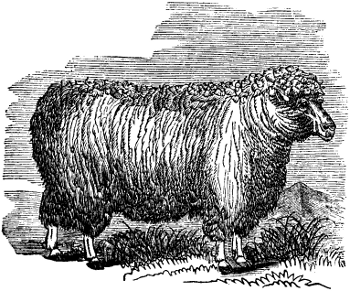
THE COTSWOLD.
The Cotswolds, until improved by modern crosses, were a very large,
coarse, long-legged, flat-ribbed variety, light in the fore-quarter, and
shearing a long, heavy, coarse fleece of wool. They were formerly bred
only on the hills, and fatted in the valleys, of the Severn and the
Thames; but with the enclosures of the Cotswold hills, and the
improvement of their cultivation, they have been reared and fatted in
the same district. They were hardy, prolific breeders, and capital
nurses; deficient in early maturity, and not possessing feeding
properties equalling those of the South-Down or New Leicester.
They have been extensively crossed with the Leicester sheep—producing
thus the modern or improved Cotswold—by which their size and fleece
have been somewhat diminished, but their carcasses have been materially
improved, and their maturity rendered earlier. The wethers are sometimes
fattened at fourteen months old, when they weigh from fifteen to
twenty-four pounds to a quarter; and at two years old, increase to
twenty or thirty pounds.
The wool is strong, mellow, and of good color, though rather coarse, six
to eight inches in length, and from seven to eight pounds per fleece.
The superior hardihood of the improved Cotswold over the Leicester, and
their adaptation to common treatment, together with the prolific nature
of the ewes, and their abundance of milk, have rendered them in many
places rivals of the New Leicester, and have obtained for them, of late
years, more attention to their selection and general treatment, under
which management still farther improvement has been made. They have also
been used in crossing other breeds, and have been mixed with the
Hampshire Downs. Indeed, the improved Cotswold, under the name of new,
or improved Oxfordshire sheep, have frequently been the successful
candidates for prizes offered for the best long-woolled sheep at some of
the principal agricultural meetings or shows in England. The quality of
their mutton is considered superior to that of the Leicester; the tallow
being less abundant, with a larger development of muscle or flesh.
The degree to which the cross between the Cotswold and Leicester may be
carried, must depend upon the nature of the old stock, and on the
situation and character of the farm. In exposed situations, and somewhat
scanty pasture, the old blood should decidedly prevail. On a more
sheltered soil, and on land that will bear closer stocking, a greater
use may be made of the Leicester. Another circumstance that should guide
the farmer is the object which he has principally in view. If he expects
to derive his chief profits from the wool, he will look to the
primitive Cotswolds; if he expects to gain more as a grazier, he will
use the Leicester ram more freely.
Sheep of this breed, now of established reputation, have been imported
into the United States by Messrs. Corning and Gotham, of Albany, and
bred by the latter.
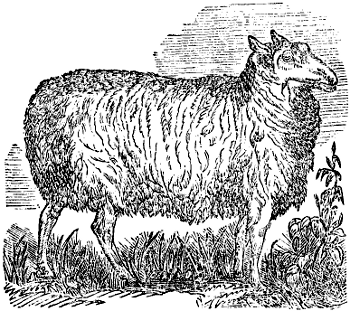
A CHEVIOT EWE.
On the steep, storm-lashed Cheviot hills, in the extreme north of
England, this breed first attracted notice for their great hardiness in
resisting cold, and for feeding on coarse, heathery herbage. A cross
with the Leicester, pretty generally resorted to, constitutes the
improved variety.
The Cheviot readily amalgamates with the Leicester—the rams employed in
the system of breeding, which has been extensively introduced for
producing the first cross of this descent, being of the pure Leicester
breed—and the progeny is superior in size, weight of wool, and tendency
to fatten, to the native Cheviot. The benefit, however, may be said to
end with the first cross; and the progeny of this mixed descent is
greatly inferior to the pure Leicester in form and fattening
properties, and to the pure Cheviot in hardiness of constitution.
The improved Cheviot has greatly extended itself throughout the
mountains of Scotland, and in many instances supplanted the black-faced
breed; but the change, though often advantageous, has in some cases been
otherwise—the latter being somewhat hardier, and more capable of
subsisting on heathy pasturage. They are a hardy race, however, well
suited for their native pastures, bearing, with comparative impunity,
the storms of winter, and thriving well on poor keep. The purest
specimens are to be found on the Scotch side of the Cheviot hills, and
on the high and stony mountain farms which lie between that range and
the sources of the Teviot. These sheep are a capital mountain stock,
provided the pasture resembles those hills, in containing a good
proportion of rich herbage. Though less hardy than the black-faced sheep
of Scotland, they are more profitable as respects their feeding, making
more flesh on an equal quantity of food, and making it more quickly.
They have white faces and legs, open countenances, lively eyes, and are
without horns; the ears are large, and somewhat singular, and there is
much space between the ears and eyes; the carcass is long; the back
straight; the shoulders rather light; the ribs circular; and the
quarters good. The legs are small in the bone, and covered with wool, as
well as the body, with the exception of the face. The wether is fit for
the butcher at three years old, and averages from twelve to eighteen
pounds a quarter; the mutton being of a good quality, though inferior to
the South-Down, and of less flavor than the black-faced. The Cheviot,
though a mountain breed, is quiet and docile, and easily managed.
The wool is about the quality of Leicester, coarse and long, suitable
only for the manufacture of low coatings and flushings. It closely
covers the body, assisting much in preserving it from the effects of wet
and cold. The fleece averages about three and a half pounds. Formerly,
the wool was extensively employed in making cloths; but having given
place to the finer Saxony wools, it has sunk in price, and been confined
to combing purposes. It has thus become altogether a secondary
consideration.
The Cheviots have become an American sheep by their repeated
importations into this country. The wool on several choice sheep,
imported by Mr. Carmichael, of New York, was from five to seven inches
long, coarse, but well suited to combing.
The old breed of Lincolnshire sheep was hornless, had white faces, and
long, thin, and weak carcasses; the ewes weighed from fourteen to twenty
pounds a quarter; the three-year old wethers from twenty to thirty
pounds; legs thick, rough and white; pelts thick; wool long—from ten to
eighteen inches—and covering a slow-feeding, coarse-grained carcass of
mutton.
A judicious system of breeding, which avoided Bakewell’s errors, has
wrought a decided improvement in this breed. The improved Lincolns
possess a rather more desirable robustness, approaching, in some few
specimens, almost to coarseness, as compared with the finest Leicesters;
but they are more hardy, and less liable to disease. They attain as
large a size, and yield as great an amount of wool, of about the same
value. This breed, indeed, scarcely differs more from the Cotswold than
do flocks of a similar variety, which have been separately bred for
several generations, from each other. They are prolific, and when
well-fed, the ewes will frequently produce two lambs at a birth, for
which they provide liberally from their udders till the time for
weaning. The weight of the fleece varies from four to eight pounds per
head.
Having alluded to the principal points of interest connected with the
various breeds of sheep in the United States, our next business is with
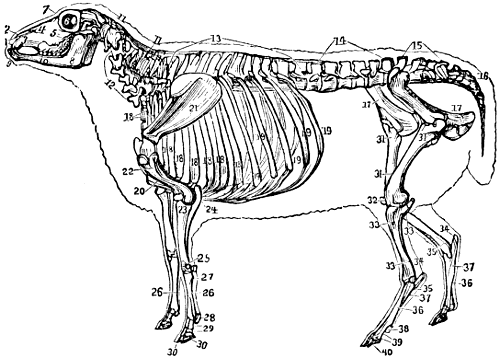
SKELETON OF THE SHEEP AS COVERED BY THE MUSCLES.
1. The intermaxillary bone. 2. The nasal bones. 3. The upper jaw.
4. The union of the nasal and upper jaw-bones. 5. The union of the molar and
lachrymal bones. 6. The orbits of the eye. 7. The frontal bone. 8. The
lower jaw. 9. The incisor teeth, or nippers. 10. The molars or grinders.
11. The ligament of the neck supporting the head. 12. The seven
vertebræ, or the bones of the neck. 13. The thirteen vertebræ, or bones
of the back. 14. The six vertebræ of the loins. 15. The sacral bone.[58]
16. The bones of the tail, varying in different breeds from twelve to
twenty-one. 17. The haunch and pelvis. 18. The eight true ribs, with
their cartilages. 19. The five false ribs, or those that are not
attached to the breast-bone. 20. The breast-bone. 21. The scapula, or
shoulder-blade. 22. The humerus, bone of the arm, or lower part of the
shoulder. 23. The radius, or bone of the fore-arm. 24. The ulna or
elbow. 25. The knee with its different bones. 26. The metacarpal or
shank-bones—the larger bones of the leg. 27. A rudiment of the smaller
metacarpal. 28. One of the sessamoid bones. 29. The first two bones of
the foot—the pasterns. 30. The proper bones of the foot. 31. The
thigh-bone. 32. The stifle-joint and its bone—the patella. 33. The
tibia, or bone of the upper part of the leg. 34. The point of the hock.
35. The other bones of the hock. 36. The metatarsal bones, or bone of
the hind-leg. 37. Rudiment of the small metatarsal. 38. A sessamoid
bone. 39. The first two bones of the foot—the pasterns. 40. The proper
bones of the foot.
Division. Vertebrata—possessing a back-bone.
Class. Mammalia—such as give suck.
Order. Ruminantia—chewing the cud.
Family. Capridæ—the goat kind.
Genus. Oris—the sheep family.
Of this Genus there are three varieties:
Oris, Ammon, or Argali.
Oris Musmon.
Oris Aries, or Domestic Sheep.
Of the latter—with which alone this treatise is concerned—there are
about forty well known varieties. Between the oris, or sheep, and the
capra, or goat, another genus of the same family, the distinctions
are well marked, although considerable resemblance exists between them.
The horns of the sheep have a spiral direction, while those of the goat
have a direction upward and backward; the sheep, except in a single wild
variety, has no beard, while the goat is bearded; the goat, in his
highest state of improvement, when he is made to produce wool of a
fineness unequalled by the sheep—as in the Cashmere breed—is mainly,
and always, externally covered with hair, while the hair on the sheep
may, by domestication, be reduced to a few coarse hairs, or got rid of
altogether; and, finally, the pelt or skin of the goat has thickness
very far exceeding that of the sheep.
The age of sheep is usually reckoned, not from the time that they are
dropped, but from the first shearing; although the first year may thus
include fifteen or sixteen months, and sometimes more. When doubt exists
relative to the age, recourse is had to the teeth, since there is more
uncertainty about the horn in this animal than in cattle; ewes that have
been early bred, appearing always, according to the rings on the horn, a
year older than others that have been longer kept from the ram.
Sheep have no teeth in the upper jaw, but the bars or ridges of the
palate thicken as they approach the forepart of the mouth; there also
the dense, fibrous, elastic matter, of which they are constituted,
becomes condensed, and forms a cushion or bed, which covers the converse
extremity of the upper jaw, and occupies the place of the upper incisor,
or cutting teeth, and partially discharge their functions. The herbage
is firmly held between the front teeth in the lower jaw and this pad,
and thus partly bitten and partly torn asunder. Of this, the rolling
motion of the head is sufficient proof.
The teeth are the same in number as in the mouth of the ox. There are
eight incisors or cutting-teeth in the forepart of the lower jaw, and
six molars in each jaw above and below, and on either side. The incisors
are more admirably formed for grazing than in the ox. The sheep lives
closer, and is destined to follow the ox, and gather nourishment where
that animal would be unable to crop a single blade. This close life not
only loosens the roots of the grass, and disposes them to spread, but by
cutting off the short suckers and sproutings—a wise provision of
nature—causes the plants to throw out fresh, and more numerous, and
stronger ones, and thus is instrumental in improving and increasing the
value of the crop. Nothing will more expeditiously and more effectually
make a thick, permanent pasture than its being occasionally and closely
eaten down by sheep.
In order to enable the sheep to bite this close, the upper lip is deeply
divided, and free from hair about the centre of it. The part of the
tooth above the gum is not only, as in other animals, covered with
enamel, to enable it to bear and to preserve a sharpened edge, but the
enamel on the upper part rises from the bone of the tooth nearly a
quarter of an inch, and presenting a convex surface outward, and a
concave within, forms a little scoop or gorge of wonderful execution.
The mouth of the lamb newly dropped is either without incisor teeth or
it has two. The teeth rapidly succeed to each other, and before the
animal is a month old he has the whole of the eight. They continue to
grow with his growth until he is about fourteen or sixteen months old.
Then, with the same previous process of diminution as in cattle, or
carried to a still greater degree, the two central teeth are shed, and
attain their full growth when the sheep is two years old.
In examining a flock of sheep, however, there will often be very
considerable difference in the teeth of those that have not been
sheared, or those that have been once sheared; in some measure to be
accounted for by a difference in the time of lambing, and likewise by
the general health and vigor of the animal. There will also be a
material difference in different animals, attributable to the good or
bad keep which they have had. Those fed on good land, or otherwise well
kept, will generally take the start of others that have been half
starved, and renew their teeth some months sooner than these. There are
also irregularities in the times of renewing the teeth, not to be
accounted for by either of these circumstances; in fact, not to be
explained by any known circumstance relating to the breed or the keep of
the sheep. The want of improvement in sheep, which is occasionally
observed, and which cannot be accounted for by any deficiency or change
of food, may sometimes be justly attributed to the tenderness of the
mouth when the permanent teeth are protruding through the gums.
Between two and three years old the next two incisors are shed; and when
the sheep is actually three years old, the four central teeth are fully
grown; at four years old, he has six teeth fully grown; and at five
years old—one year before the horse or the ox can be said to be
full-mouthed—all the teeth are perfectly developed. The sheep is a much
shorter-lived animal than the horse, and does not often attain the usual
age of the ox. Their natural age is about ten years, to which age they
will breed and thrive well; though there are recorded instances of their
breeding at the age of fifteen, and of living twenty years.
The careless examiner may be sometimes deceived with regard to the
four-year-old mouth. He will see the teeth perfectly developed, no
diminutive ones at the sides, and the mouth apparently full; and then,
without giving himself the trouble of counting the teeth, he will
conclude that the animal is five years old. A process of displacement,
as well as of diminution, has taken place here; the remaining outside
milk-teeth have not only shrunk to less than a fourth part of their
original size, but the four-year-old teeth have grown before them and
perfectly conceal them, unless the mouth is completely opened.
After the permanent teeth have all appeared and are fully grown, there
is no criterion as to the age of the sheep. In most cases, the teeth
remain sound for one or two years, and then, at uncertain
intervals—either on account of the hard work in which they have been
employed, or from the natural effect of age—they begin to loosen and
fall out; or, by reason of their natural slenderness, they are broken
off. When favorite ewes, that have been kept for breeding, begin to lose
condition, at six or seven years old, their mouths should be carefully
examined. If any of the teeth are loose, they should be extracted, and a
chance given to the animal to show how far, by browsing early and late,
she may be able to make up for the diminished number of her incisors. It
frequently happens that ewes with broken teeth, and some with all the
incisors gone, will keep pace in condition with the best in the flock;
but they must be well taken care of in the winter, and, indeed, nursed
to an extent that would scarcely answer the farmer’s purpose to adopt as
a general rule, in order to prevent them from declining to such a degree
as would make it very difficult afterward to fatten them for the
butcher. It may certainly be taken as a general rule, that when sheep
become broken-mouthed they begin to decline.
Causes of which the farmer is utterly ignorant, or over which he has no
control, will sometimes hasten the loss of the teeth. One thing,
however, is certain—that close feeding,
causing additional exercise,
does wear them down; and that the sheep of farmers who stock unusually
and unseasonably hard, lose their teeth much sooner than others do.
The skin of the sheep, in common with that of most animals, is composed
of three textures. Externally is the cuticle, or scarf-skin, which is
thin, tough, devoid of feeling, and pierced by innumerable minute holes,
through which pass the fibres of the wool and the insensible
perspiration. It seems to be of a scaly texture; although is not so
evident as in many other animals, on account of a peculiar
substance—the yolk—which is placed on it, to protect and nourish the
roots of the wool. It is, however, sufficiently evident in the scab and
other cutaneous eruptions to which this animal is liable.
Below this cuticle is the rete mucosum, a soft structure; its fibres
having scarcely more consistence than mucilage, and being with great
difficulty separated from the skin beneath. This appears to be placed as
a defence to the terminations of the blood-vessels and nerves of the
skin, which latter are, in a manner, enveloped and covered by it. The
color of the skin, and probably that of the hair or wool also, is
determined by the rete mucosum; or, at least, the hair and wool are of
the same color as this substance.
Beneath the rete mucosum is the cutis, or true skin, composed of
numberless minute fibres crossing each other in every direction; highly
elastic, in order to fit closely to the parts beneath, and to yield to
the various motions of the body; and dense and firm in its structure,
that it may resist external injury. Blood-vessels and nerves innumerable
pierce it, and
appear on its surface in the form of papillæ, or
minute eminences; while, through thousands of little orifices, the
exhalent absorbents pour out the superfluous or redundant fluid. The
true skin is composed, principally or almost entirely, of gelatine; so
that, although it may be dissolved by long-continued boiling, it is
insoluble in water at the common temperature. This organization seems to
have been given to it, not only for the sake of its preservation while
on the living animal, but that it may afterwards become useful to man.
The substance of the hide readily combining with the tanning principle,
is converted into leather.
On the skin of most animals is placed a covering of feathers, fur, hair,
or wool. These are all essentially the same in composition, being
composed of an animal substance resembling coagulated albumen, together
with sulphur, silica, carbonate and phosphate of lime, and oxides of
iron and manganese.
Wool is not confined to the sheep. The under-hair of some goats is not
only finer than the fleece of any sheep, but it occasionally has the
crisped appearance of wool; being, in fact, wool of different qualities
in different breeds—in some, rivalling or excelling that of the sheep,
but in others very coarse. A portion of wool is also found on many other
animals; as the deer, elk, the oxen of Tartary and Hudson’s Bay, the
gnu, the camel, many of the fur-clad animals, the sable, the polecat,
and several species of the dog.
Judging from the mixture of wool and hair in the coat of most animals,
and the relative situation of these materials, it is not improbable that
such was the character of the fleece of the primitive sheep. It has,
indeed, been asserted that the primitive sheep was entirely covered with
hair; but this is, doubtless, incorrect. There exists, at the present
day, varieties of the sheep occupying extensive districts, that are
clothed outwardly with hair of different degrees of fineness and
sleekness; and underneath the external coat is a softer, shorter, and
closer one, that answers to the description of fur—according to most
travellers—but which really possesses all the characteristics of wool.
It is, therefore, highly improbable that the sheep—which has now
become, by cultivation, the wool-bearing animal in a pre-eminent
degree—should, in any country, at any time, have ever been entirely
destitute of wool. Sheep of almost every variety have at times been in
the gardens of the London (Eng.) Zoölogical Society; but there has not
been one on which a portion of crisped wool, although exceedingly small,
has not been discovered beneath the hair. In all the regions over which
the patriarchs wandered, and extending northward through the greater
part of Europe and Asia, the sheep is externally covered with hair; but
underneath is a fine, short, downy wool, from which the hair is easily
separated. This is the case with the sheep at the Cape of Good Hope,
and also in South America.
The change from hair to wool, though much influenced by temperature, has
been chiefly effected by cultivation. Wherever hairy sheep are now found
the management of the animal is in a most disgraceful state; and among
the cultivated sheep the remains of this ancient hairy covering only
exists, to any great extent, among those that are comparatively
neglected or abandoned.
The filament of the wool has scarcely pushed itself through the pore of
the skin, when it has to penetrate through another and singular
substance, which, from its adhesiveness and color, is called the yolk.
This is found in greatest quantity about the breast and shoulders—the
very parts that produce the best, and healthiest, and most abundant
wool—and in proportion as it extends, in any considerable degree, over
other parts, the wool is then improved. It differs in quantity in
different breeds. It is very abundant on the Merinos; it is sufficiently
plentiful on most of the southern breeds, either to assist in the
production of the wool, or to defend the sheep from the inclemency of
the weather; but in the northern districts, where the cold is more
intense and the yolk of wool is deficient, a substitute for it is
sometimes sought by smearing the sheep with a mixture of tar, oil, or
butter. Where there is a deficiency of yolk, the fibre of the wool is
dry, harsh, and weak, and the whole fleece becomes thin and hairy; where
the natural quantity of it is found, the wool is soft, oily, plentiful
and strong.
This yolk is not the inspissated or thickened perspiration of the
animal; it is not composed of matter which has been accidentally picked
up, and which has lodged in the wool; but it is a peculiar secretion
from the glands of the skin, destined to be one of the agents in the
nourishment of the wool, and at the same time, by its adhesiveness, to
mat the wool together, and form a secure defence from the wet and cold.
Chemical experiments have established its composition, as follows:
first, of a soapy matter with a basis of potash, which forms the greater
part of it; second, a small quantity of carbonate of potash; third, a
perceptible quantity of acetate of potash; fourth, lime, in a peculiar
and unknown state of combination; fifth, an atom of muriate of potash;
sixth, an animal oil, to which its peculiar odor is attributable. All
these materials are believed to be essential to the yolk, and not found
in it by mere accident, since the yolk of a great number of
samples—Spanish, French, English, and American—has been subjected to
repeated analyses, with the same result.
The yolk being a true soap, soluble in water, it is not difficult to
account for the comparative ease with which sheep that have the natural
proportion of it are washed in a running stream. There is, however, a
small quantity of fatty matter in the fleece, which is not in
combination with the alkali, and which, remaining attached to the wool,
keeps it a little glutinous, notwithstanding the most careful washing.
The fibre of the wool having penetrated the skin and escaped from the
yolk, is of a circular form, generally larger toward the extremity, and
also toward the root, and in some instances very considerably so. The
filaments of white wool, when cleansed from grease, are
semi-transparent; their surface in some places is beautifully polished,
in others curiously incrusted, and they reflect the rays of light in a
very pleasing manner. When viewed by the aid of a powerful achromatic
microscope, the central part of the fibre has a singularly glittering
appearance. Minute filaments, placed very regularly, are sometimes seen
branching from the main trunk, like boughs from the principal stem. This
exterior polish varies much in different wools, and in wools from the
same breed of sheep at different times. When the animal is in good
condition, and the fleece healthy, the appearance of the fibre is really
brilliant; but when the state of the constitution is bad, the fibre has
a dull appearance, and either a wan, pale light, or sometimes scarcely
any, is reflected. As a general rule, the filament is most transparent
in the best and most useful wools, whether long or short. It increases
with the improvement of the breed, and the fineness and healthiness of
the fleece; yet it must be admitted that some wools have different
degrees of the transparency and opacity, which do not appear to affect
their value and utility. It is, however, the difference of transparency
in the same fleece, or in the same filament, that is chiefly to be
noticed as improving the value of the wool.
As to the size of the fibre, the terms “fine” and “coarse,” as commonly
used, are but vague and general descriptions of wool. All fine fleeces
have some coarse wool, and all coarse fleeces some fine. The most
accurate classification is to distinguish the various qualities of wool
in the order in which they are esteemed and preferred by the
manufacturer—as the following: first, fineness with close ground, that
is, thick-matted ground; second, pureness; third, straight-haired, when
broken by drawing; fourth, elasticity, rising after compression in the
hand; fifth, staple not too long; sixth, color; seventh, what coarse
exists to be very coarse; eighth, tenacity; and ninth, not much
pitch-mark, though this is no disadvantage, except the loss of weight in
scouring. The bad or disagreeable properties are—thin, grounded, tossy,
curly-haired, and, if in a sorted state, little in it that is very fine;
a tender staple, as elasticity, many dead white hairs, very yolky. Those
who buy wool for combing and other light goods that do not need milling,
wish to find length of staple, fineness of hair, whiteness, tenacity,
pureness, elasticity, and not too many pitch-marks.
The property first attracting attention, and being of greater importance
than any other, is the fineness of the pile—the quantity of fine wool
which a fleece yields, and the degree of that fineness. Of the absolute
fineness, little can be said, varying, as it does, in different parts of
the same fleece to a very considerable degree, and the diameter of the
same fibre often being exceedingly different at the extremity and the
centre. The micrometer has sometimes indicated that the diameter of the
former is five times as much as that of the latter; and, consequently,
that a given length of yield taken from the extremity would weigh
twenty-five times as much as the same length taken from the centre and
cleansed from all yolk and grease. That fibre may be considered as
coarse whose diameter is more than the five-hundredth part of an inch;
in some of the most valuable samples of Saxony wool it has not exceeded
the nine-hundredth part; yet in some animals, whose wool has not been
used for manufacturing purposes, it is less than one twelve-hundredth
part.
The extremities of the wool, and frequently those portions which are
near to the root, are larger than the intermediate parts. The extremity
of the fibre has, generally, the greatest bulk of all. It is the
product of summer, soon after shearing-time, when the secretion of the
matter of the wool is increased, and when the pores of the skin are
relaxed and open, and permit a larger fibre to protrude. The portion
near the root is the growth of spring, when the weather is getting warm;
and the intermediate part is the offspring of winter, when under the
influence of the cold the pores of the skin contract, and permit only a
finer hair to escape. If, however, the animal is well fed, the
diminution of the bulk of the fibre will not be followed by weakness or
decay, but, in proportion as the pile becomes fine, the value of the
fleece will be increased; whereas, if cold and starvation should go
hand-in-hand, the woolly fibre will not only diminish in bulk, but in
health, strength, and worth.
The variations in the diameter of the wool in different parts of the
fibre will also curiously correspond with the degree of heat at the time
the respective portions were produced. The fibre of the wool and the
record of the meteorologist will singularly agree, if the variations in
temperature are sufficiently distinct from each other for any
appreciable part of the fibre to form. It follows from this, that—the
natural tendency to produce wool of a certain fibre being the
same—sheep in a hot climate will yield a comparatively coarse wool, and
those in a cold climate will carry a finer, but at the same time a
closer and a warmer fleece. In proportion to the coarseness of a fleece
will generally be its openness, and its inability to resist either cold
or wet; while the coat of softer, smaller, more pliable wool will admit
of no interstices between its fibres, and will bid defiance to frost and
storms.
The natural instinct of the sheep would seem to teach the wool-grower
the advantage of attending to the influence of temperature upon the
animal. He is evidently impatient of heat. In the open districts, and
where no shelter is near, he climbs to the highest parts of his walk,
that, if the rays of the sun must still fall on him, he may nevertheless
be cooled by the breeze; but, if shelter is near, of whatever kind,
every shaded spot is crowded with sheep. The wool of the Merinos after
shearing-time is hard and coarse to such a degree as to render it very
difficult to suppose that the same animal could bear wool so opposite in
quality, compared with that which had been clipped from it in the course
of the same season. As the cold weather advances, the fleeces recover
their soft quality.
Pasture has a far greater influence on the fineness of the fleece. The
staple of the wool, like every other part of the sheep, must increase in
length or in bulk when the animal has a superabundance of nutriment;
and, on the other hand, the secretion which forms the wool must decrease
like every other, when sufficient nourishment is not afforded. When
little cold has been experienced in the winter, and vegetation has
scarcely been checked, the sheep yields an abundant crop of wool, but
the fleece is perceptibly coarser as well as heavier. When the frost has
been severe, and the ground long covered with snow, if the flock has
been fairly supplied with nutriment, although the fleece may have lost a
little in weight, it will have acquired a superior degree of fineness,
and a proportional increase of value. Should, however, the sheep have
been neglected and starved during this continued cold weather, the
fleece as well as the carcass is thinner, and although it may have
preserved its smallness of filament, it has lost in weight, and
strength, and usefulness.
Connected with fineness is trueness of staple—as equal in growth as
possible over the animals—a freedom from those shaggy portions, here
and there, which are occasionally observed on poor and neglected sheep.
These portions are always coarse and comparatively worthless, and they
indicate an irregular and unhealthy action of the secretion of wool,
which will also probably weaken or render the fibre diseased in other
parts. Included in trueness of fibre is another circumstance to which
allusion has already been made—a freedom from coarse hairs which
project above the general level of the wool in various parts, or, if
they are not externally seen, mingle with the wool and debase its
qualities.
Soundness is closely associated with trueness. It means, generally
speaking, strength of the fibre, and also a freedom from those breaches
or withered portions of which something has previously been said. The
eye will readily detect the breaches; but the hair generally may not
possess a degree of strength proportioned to its bulk. This is
ascertained by drawing a few hairs out of the staple, and grasping each
of them singly by both ends, and pulling them until they break. The wool
often becomes injured by felting while it is on the sheep’s back. This
is principally seen in the heavy breeds, especially those that are
neglected and half-starved, and generally begins in the winter season,
when the coat has been completely saturated with water, and it increases
until shearing-time, unless the cob separates from the wool beneath, and
drops off.
Wool is generally injured by keeping. It will probably increase a
little in weight for a few months, especially if kept in a damp place;
but after that it will somewhat rapidly become lighter, until a very
considerable loss will often be sustained. This, however, is not the
moral of the case; for, except very great care is taken, the moth will
get into the bundles and injure and destroy the staple; and that which
remains untouched by them will become considerably harsh and less
pliable. If to this the loss of the interest of money is added, it will
be seen that he seldom acts wisely who hoards his wool, when he can
obtain what approaches to a fair remunerating price for it.
Softness of the wool is evidently connected with the presence and
quality of the yolk. This substance is undoubtedly designed not only to
nourish the hair, but to give it richness and pliability. The growth of
the yolk ought to be promoted, and agriculturists ought to pay more
attention to the quantity and quality of yolk possessed by the animals
selected for the purpose of breeding.
Bad management impairs the pliability of the wool, by arresting the
secretion of the yolk. The softness of the wool is also much influenced
by the chemical elements of the soil. A chalky soil notoriously
deteriorates it; minute particles of the chalk being necessarily brought
into contact with the fleece and mixing with it, have a corrosive effect
on the fibre, and harden it and render it less pliable. The particles of
chalk come in contact with the yolk—there being a chemical affinity
between the alkali and the oily matter of the yolk—immediately unite,
and a true soap is formed. The first storm washes a portion of it; and
the wool, deprived of its natural pabulum and unguent, loses some of its
vital properties—its pliability among the rest. The slight degree of
harshness which has been attributed to the English South-Down has been
explained in this way.
The felting property of wool is a tendency of the fibres to entangle
themselves together, and to form a mass more or less difficult to
unravel. By moisture and pressure, the fibres of the wool may become
matted or felted together into a species of cloth. The manufacture of
felt was the first mode in which wool was applied to clothing, and felt
has long been in universal use for hats. The fulling of flannels and
broadcloths is effected by the felting principle. By the joint influence
of the moisture and the pressure, certain of the fibres are brought into
more intimate contact with each other; they adhere—not only the fibres,
but; in a manner, the threads—and the cloth is taken from the mill
shortened in all its dimensions; it has become a kind of felt, for the
threads have disappeared, and it can be cut in every direction with very
little or no unravelling; it is altogether a thicker, warmer, softer
fibre. This felting property is one of the most valuable qualities
possessed by wool, and on this property are the finer kinds of wool
especially valued by the manufacturer for the finest broadcloths. This
naturally suggests a consideration of the various forms in the structure
on which it depends.
The most evident distinction between the qualities of hair and wool is
the comparative straightness of the former, and the crisped or
spirally-curling form which the latter assumes. If a little lock of
wool is held up to the light, every fibre of it is twisted into numerous
minute corkscrew-like ringlets. This is especially seen in the fleece of
the short-woolled sheeps; but, although less striking, it is obvious
even in wool of the largest staple.
The spirally-curving form of wool used, erroneously, to be considered as
the chief distinction between the covering of the goat and the sheep;
but the under-coat of some of the former is finer than that of any
sheep, and it is now acknowledged frequently to have the crisped and
curled appearance of wool. In some breeds of cattle, particularly in one
variety of the Devons, the hair assumes a curled and wavy appearance,
and a few of the minute spiral ringlets have been occasionally seen. It
is the same with many of the Highlands; but there is no determination to
take on the true crisped character, and throughout its whole extent, and
it is still nothing but hair. On some foreign breeds, however, as the
yak of Tartary, and the ox of Hudson’s Bay, some fine and valuable wool
is produced.
There is an intimate connection between the fineness of the wool and the
number of the curves, at least in sheep yielding wool of nearly the same
length; so that, whether the wool of different sheep is examined, or
that from different parts of the same sheep, it is enough for the
observer to take advice of the number of curves in a given space, in
order to ascertain with sufficient accuracy the fineness of the fibre.
To this curled form of the wool not enough attention is, as a general
thing, paid by the breeder. It is, however, that on which its most
valuable uses depend. It is that which is essential to it in the
manufactory of cloths. The object of the carder is to break the wool in
pieces at the curves—the principle of the thread is the adhesion of the
particles together by their curves; and the fineness of the thread, and
consequent fineness of the cloth, will depend on the minuteness of
these curves, or the number of them found in a given length of fibre.
It will readily be seen that this curling form has much to do with the
felting property of wool; it materially contributes to that disposition
in the fibres which enables them to attach and intwine themselves
together; it multiplies the opportunities for this interlacing, and it
increases the difficulty of unravelling the felt.
The felting property of wool is the most important, as well as the
distinguishing one; but it varies essentially in different breeds, and
the usefulness and the consequent value of the fleece, for clothing
purposes, at least, depend on the degree to which it is pursued.
The serrated—notched, like the teeth of a saw—edge of wool, which
has been discovered by means of the microscope, is also, as well as the
spiral curl, deemed an important quality in the felting property.
Repeated microscopic observations have removed all doubts as to the
general outline of the woolly fibre. It consists of a central stem or
stalk, probably hollow, or, at least, porous, possessing a
semi-transparency, not found in the fibre of hair. From this central
stalk there springs, at different distances, on different breeds of
sheep, a circlet of leaf-shaped projections.
The most valuable of the long-woolled fleeces are of British origin. A
considerable quantity is produced in France and Belgium; but the
manufacturers in those countries acknowledge the superiority of the
British wool. Long wool is distinguished, as its name would import, by
the length of its staple, the average of which is about eight inches.
It was much improved, of late years, both in England and in other
countries. Its staple has, without detriment to its manufacturing
qualities, become shorter; but it has also become finer, truer, and
sounder. The long-woolled sheep has been improved more than any other
breed; and the principal error which Bakewell committed having been
repaired since his death, the long wool has progressively risen in
value, at least for curling purposes. Some of the breeds have staples of
double the length that has been mentioned as the average one. Pasture
and breeding are the powerful agents here.
Probably because the Leicester blood prevails in, or, at least, mingles
with, every other long-woolled breed, a great similarity in the
appearance and quality of this fleece has become apparent, of late
years, in every district of England. The short-woolled fleeces are, to a
very considerable degree, unlike in fineness, elasticity, and felting
property; the sheep themselves are still more unlike; but the long-wools
have, in a great degree, lost their distinctive points—the Lincoln, for
example, has not all of his former gaunt carcass, and coarse, entangled
wool—the Cotswold has become a variety of the Leicester—in fact, all
the long-woolled sheep, both in appearance and fleece, have almost
become of one variety; and rarely, except from culpable neglect in the
breeder, has the fleece been injuriously weakened, or too much
shortened, for the most valuable purposes to which it is devoted.
In addition to its length, this wool is characterized by its strength,
its transparency, its comparative stoutness, and the slight degree in
which it possesses the felting property. Since the extension of the
process of combing to wools of a shorter staple, the application of
this wool to manufacturing purposes has undergone considerable change.
In some respects, the range of its use has been limited; but its demand
has, on the whole, increased, and its value is more highly appreciated.
Indeed, there are certain important branches of the woollen manufacture,
such as worsted stuffs, bombazines, muslin-delaines, etc., in which it
can never be superseded; and its rapid extension in the United States,
within the past few years, clearly shows that a large and increasing
demand for this kind of wool will continue at remunerating prices.
This long wool is classed under two divisions, distinguished both by
length and the fineness of the fibre. The first—the long-combing
wool—is used for the manufacture of hard yarn, and the worsted goods
for which that thread is adapted, and requires the staple to be long,
firm, and little disposed to felt. The short-combing wool has, as its
name implies, a shorter staple, and is finer and more felty; the felt is
also closer and softer, and is chiefly used for hosiery goods.
This article is of more recent origin than the former, but has rapidly
increased in quantity and value. It can never supersede, but will only
stand next in estimation to, the native English long fleece. It is
yielded by the half-bred sheep—a race that becomes more numerous every
year—being a cross of the Leicester ram with the South-Down, or some
other short-woolled ewe; retaining the fattening property and the early
maturity of the Leicester, or of both; and the wool deriving length and
straightness of fibre from the one, and fineness and feltiness from the
other. The average length of staple is about five inches. There is no
description of the finer stuff-goods in which this wool is not most
extensively and advantageously employed; and the nails, or portions
which are broken off by the comb, and left in, whether belonging to this
description of wool or to the long wool, are used in the manufacture of
several species of cloth of no inferior quality or value.
Under the breed of middle wools must be classed those which, when there
were but two divisions, were known by the name of short wools; and if
English productions were alone treated of, would still retain the same
distinctive appellation. To this class belong the South-Down and
Cheviot; together with the fleece of several other breeds, not so
numerous, nor occupying so great an extent of country. From the change,
however, which insensibly took place in them all—the lengthening, and
the increased thickness of the fibre, and, more especially, from the
gradual introduction of other wools possessing delicacy of fibre,
pliability, and felting qualities beyond what these could claim, and at
the same time, being cheaper in the market—they lost ground in the
manufacture of the finer cloths, and have for some time ceased to be
used in the production of them. On the other hand, the changes which
have taken place in the construction of machinery have multiplied the
purposes to which they may be devoted, and very considerably enhanced
their value.
These wools, of late, rank among the combing wools; they are prepared as
much by the comb as by the card, and in some places more. On this
account they meet with a readier sale, at fair, remunerating prices,
considering the increased weight of each individual fleece, and the
increased weight and earlier maturity of the carcass. The South-Downs
yield about seven-tenths of the pure short wools grown in the British
kingdoms; but the half-bred sheep has, as has been remarked, encroached
on the pure short-woolled one. The average staple of middle-woolled
sheep is three and a half inches.
These wools are employed in the manufacture of flannels, army and navy
cloths, coatings, heavy cloths for calico printers and paper
manufacturers, woollen cords, coarse woollens, and blankets; besides
being partially used in cassinettes, baizes, bockings, carpets,
druggets, etc.
From this division every wool of English production is excluded. These
wools, yielded by the Merinos, are employed, unmixed, in the manufacture
of the finer cloths, and, combined with a small proportion of wool from
the English breeds, in others of an inferior value. The average length
of staple is about two and a half inches.
These wools even may be submitted to the action of the comb. There may
be fibres only one inch in length; but if there are others from two and
a half to three inches, so that the average of the staple shall be two
inches, a thread sufficiently tenacious may, from the improved state of
machinery, be spun, and many delicate and beautiful fabrics readily
woven, which were unknown not many years ago.
[81]
No one breed of sheep combines the highest perfection in all those
points which give value to this race of animals. One is remarkable for
the weight, or early maturity, or excellent quality of its carcass,
while it is deficient in quality or quantity of wool; and another, which
is valuable for wool, is comparatively deficient in carcass. Some
varieties will flourish only under certain conditions of food and
climate; while others are much less affected by those conditions, and
will subsist under the greatest variations of temperature, and on the
most opposite qualities of verdure.
In selecting a breed for any given locality, reference should be had,
first, to the feed and climate, or the surrounding natural
circumstances; and, second, to the market facilities and demand.
Choice should then be made of that breed which, with the advantages
possessed, and under all the circumstances, will yield the greatest net
value of the marketable product.
Rich lowland herbage, in a climate which allows it to remain green
during a large portion of the year, is favorable to the production of
large carcasses. If convenient to a market where mutton finds a prompt
sale and good prices, then all the conditions are realized which calls
for a mutton-producing, as contradistinguished from a wool-yielding,
sheep. Under such circumstances, the choice should undoubtedly be made
from the improved English varieties—the South-Down, the New Leicester,
and the improved Cotswolds or New Oxfordshire sheep. In deciding between
these, minor and more specific circumstances must be taken into account.
If large numbers are to be kept, the Downs will herd—remain thriving
and healthy when kept together in large numbers—much better than the
two larger breeds; if the feed, though generally plentiful, is liable to
be somewhat short during the droughts of summer, and there is not a
certain supply of the most nutritious winter feed, the Downs will better
endure occasional short keep; if the market demands a choice and
high-flavored mutton, the Downs possess a decided superiority. If, on
the other hand, but few are to be kept in the same enclosure, the large
breeds will be as healthy as the Downs; if the pastures are somewhat wet
or marshy, the former will better subsist on the rank herbage which
usually grows in such situations; if they do not afford so fine a
quality of mutton, they—particularly the Leicester—possess an earlier
maturity, and give more meat for the amount of food consumed, as well as
yield more tallow.
The next point of comparison between the long and the middle woolled
families, is the value of their wool. Though not the first or principal
object aimed at in the cultivation of any of these breeds, it is, in
this country, an important item of incident in determining their
relative profitableness. The American Leicester yields about six pounds
of long, coarse, combing wool; the Cotswold, somewhat more; but this
perhaps counterbalanced by these considerations; the Downs grow three to
four pounds of a low quality of carding wool. None of these wools are
very salable, at remunerating prices, in the American markets. Both,
however, will appreciate in proportion to the increase of manufactures
of worsted, flannels, baizes, and the like. The difference in the weight
of the fleeces between the breeds is, of itself, a less important
consideration than it would at first appear, for reasons which will be
given when the connection between the amount of wool produced and the
food consumed by the sheep is noticed.
The Cheviots are unquestionably inferior to the breeds above named,
except in a capacity to endure a vigorous winter and to subsist on
healthy herbage. Used in the natural and artificial circumstances which
surround sheep-husbandry in many parts of England—where the fattest and
finest quality of mutton is consumed, as almost the only animal food of
the laboring classes—the heavy, early-maturing New Leicester, and the
still heavier New Oxfordshire sheep seem exactly adapted to the wants of
producers and consumers, and are of unrivalled value. To depasture
poorer soils, sustain a folding system, and furnish the mutton which
supplies the tables of the wealthy, the South-Down meets an equal
requirement.
Sufficient attention is by no means paid in many portions of the country
to the profit which could be made to result from the cultivation of the
sheep. One of the most serious defects in the prevalent husbandry of New
England, for example, is the neglect of sheep. Ten times the present
number might be easily fed, and they would give in meat, wool, and
progeny, more direct profit than any other domestic animal, while the
food which they consume would do more towards fertilizing the farms than
an equal amount consumed by any other animal. It is notorious that the
pastures of that section of the country have seriously deteriorated in
fertility and become overrun with worthless weeds and bushes to the
exclusion of nutritious grasses.
With sheep—as well as with all other animals—much or prolonged
exercise in pursuit of food, or otherwise, is unfavorable to taking on
fat. Some seem to forget, in their earnest advocacy of the merits of the
different breeds, that the general physical laws which control the
development of all the animal tissues as well as functions, are uniform.
Better organs will, doubtless, make a better appropriation of animal
food; and they may be taught, so to speak, to appropriate it in
particular directions: in one breed, more especially to the production
of fat; in another, of muck, or lean meat; in yet another, of wool. But,
these things being equal, large animals will always require more food
than small ones. Animals which are to be carried to a high state of
fatness must have plentiful and nutritious food, and they must
exercise but little, in order to prevent the unnecessary combustion in the lungs
of that carbon which forms nearly four-fifths of their fat. No art of
breeding can counteract these established laws of Nature.
In instituting a comparison between breeds of sheep for wool-growing
purposes, it is undeniable that the question is not, what variety will
shear the heaviest or even the most valuable fleece, irrespective of the
cost of production. Cost of feed and care, and every other expense, must
be deducted, in order to fairly test the profits of an animal. If a
large sheep consume twice as much food as a small one, and give but once
and a-half as much wool, it is obviously more profitable—other things
being equal—to keep two of the smaller sheep. The next question, then,
is,—from what breed—with the same expense in other
particulars—will the verdure of an acre of land produce the greatest
value of wool?
And, first, as to the comparative amount of food consumed by the several
breeds. There are no satisfactory experiments which show that breed,
in itself considered, has any particular influence on the quantity of
food consumed. It is found, with all varieties, that the consumption is
in proportion to the live weight of the grown animal. Of course, this
rule is not invariable in its individual application; but its general
soundness has been satisfactorily established. Grown sheep take up
between two and a half and three and a third per cent. of their weight,
in what is equivalent to dry hay, to keep themselves in store condition.
The consumption of food, then, being proportioned to the weight, it
follows that, if one acre is capable of sustaining three Merinos,
weighing one hundred pounds each, it will sustain two Leicesters,
weighing one hundred and fifty each, and two and two-fifth South-Downs,
weighing one hundred and twenty-five each. Merinos of this weight often
shear five pounds per fleece, taking flocks through. The herbage of an
acre, then, would give fifteen pounds of Merino wool, twelve of
Leicester, and but nine and three-fifths of South-Down—estimating the
latter as high as four pounds to the fleece. Even the finest and
lightest-fleeced sheep known as Merinos average about four pounds to the
fleece; so that the feed of an acre would produce as much of the highest
quality of wool sold under the name of Merino as it would of New
Leicester, and more than it would of South-Down, while the former would
be worth from fifty to one hundred per cent. more per pound than either
of the latter.
Nor does this indicate all the actual difference, as in the foregoing
estimate the live weight of the English breeds is placed low, and that
of the Merinos high. The live weight of the five-pound fine-fleeced
Merino does not exceed ninety pounds; it ranges, in fact, from eighty to
ninety; so that three hundred pounds of live weight—it being understood
that all of these live weights refer to ewes in fair ordinary, or what
is called store, condition—would give a still greater product of wool
to the acre. It is perfectly safe, therefore, to say that the herbage of
an acre will uniformly give nearly double the value of Merino that it
will of any of the English long or middle wools.
What are the other relative expenses of these breeds? The full-blooded
Leicester is in no respect a hardier sheep than the Merino, though some
of its crosses are much hardier than the pure-bred sheep: indeed, it is
less hardy, under the most favorable circumstances. It is more subject
to colds; its constitution more readily gives way under disease; the
lambs are more liable to perish from exposure to cold, when newly
dropped. Under unfavorable circumstances—herded in large flocks,
famished for feed, or subjected to long journeys—its capacity to
endure, and its ability to rally from sad drawbacks, do not compare,
with those of the Merino. The high-bred South-Down, though considerably
less hardy than the unimproved parent stock, is still fairly entitled to
the appellation of a hardy animal; it is, in fact, about on a pace with
the Merino, though it will not bear as hard stocking, without a rapid
diminution in size and quality. If the peculiar merits of the animal are
to be considered in determining the expenses, as they surely should be,
the superior fecundity of the South-Down is a point in its favor, as
well for a wool-producing as a mutton sheep. The ewe not only frequently
produces twin lambs—as do both the Merino and Leicester—but, unlike
the latter, she possesses nursing properties to do justice to them. This
advantage, however, is fully counterbalanced by the superior longevity
of the Merino. All the English mutton breeds begin to rapidly
deteriorate in amount of wool, capacity to fatten, and general vigor, at
about five years old; and their early maturity is no offset to this, in
an animal kept for wool-growing purposes. This early decay requires
earlier and more rapid slaughter than is always economically convenient,
or even possible.
It is well, on properly stocked farms, to slaughter or turn off the
Merino wether at four or five years old, to make room for the breeding
stock; but he will not particularly deteriorate, and he will richly pay
the way with his fleece for several years longer. Breeding ewes are
rarely turned off before eight, and are frequently kept until ten years
old, at which period they exhibit no greater marks of age than do the
Downs and Leicester at five or six. Instances are known of Merino ewes
breeding uniformly until fifteen years old. The improved Cotswold is
said to be hardier than the Leicester; but this variety, from their
great size, and the consequent amount of food consumed by them, together
with the other necessary incidents connected with the breeding of such
large animals, is incapacitated from being generally introduced as a
wool-growing sheep. All the coarse races have one advantage over the
Merino: they are less subject to the visitation of the hoof-ail, and
when untreated, this disease spreads with less violence and malignity
among them. This has been explained by the fact that their hoofs do not
grow long and turn under from the sides, as do those of the Merino, and
thus retain dirt and filth in constant contact with the foot.
Taking into account all the circumstances connected with the peculiar
management of each race, together with all the incidents, exigencies,
and risks of the husbandry of each, it may be confidently asserted that
the expenses, other than those of feed, are not smaller per head, or
even in the number required to stock an acre, in either of the English
breeds above referred to, than in the Merino. Indeed, it may well be
doubted whether any of those English breeds, except the South-Down, is
on an equality, even, with the Merino, in these respects. For
wool-growing purposes, the Merino, then, possesses a marked and decided
superiority over the best breeds and families of coarse-woolled sheep.
As a mutton sheep, it is inferior to some of those breeds; although not
so much as is popularly supposed. Many persons, who have never tasted
Merino mutton, and who have, consequently, an unfavorable impression of
it, would, if required to consume the fat and lean together, find it
more palatable than the luscious and over-fat New Leicester. The mutton
of the cross between the Merino and the Native would certainly be
preferred to the Leicester, by anybody but an English laborer,
accustomed to the latter, since it is short-grained, tender, and of good
flavor. The same is true of the crosses with the English varieties,
which will hereafter be treated of more particularly. Grade Merino
wethers, half-bloods, for example, are favorites with the drover and
butcher, being of good size, extraordinarily heavy for their apparent
bulk, by reason of the shortness of their wool, compared with the coarse
breeds, making good mutton, tallowing well, and their pelts, from the
greater weight of wool on them, commanding an extra price. In speaking
of the Merino in this connection, no reference is made to the Saxons,
though they are, as is well known, pure-blooded descendants of the
former.
Assuming it, then, as settled, that it is to the Merino race that the
wool-grower must look for the most profitable sheep, a few
considerations are subjoined as to the adaptability of the widely
diverse sub-varieties of the race to the wants and circumstances of
different portions of the country.
Upon the first introduction of the Saxons, they were sought with avidity
by the holders of the fine-woolled flocks of the country, consisting at
that time of pure or grade Merinos. Under the decisive encouragement
offered both to the wool-grower and the manufacturer by the tariff of
1828, a great impetus was given to the production of the finest wools,
and the Saxon everywhere superseded, or bred out by crossing, the
Spanish Merinos. In New York and New England, the latter almost entirely
disappeared. In the fine-wool mania which ensued, weight of fleece,
constitution, and every thing else, were sacrificed to the quality of
the wool. Then came the tariff of 1832, which, as well as that of 1828,
gave too much protection to both wool-grower and manufacturer, into
whose pursuits agricultural and mercantile speculators madly rushed.
Skill without capital, capital without skill, and in some cases,
probably, thirst for gain without either, laid hold of these favored
avocations. The natural and inevitable result followed. In the financial
crisis of 1837, manufacturing, and all other monetary enterprises which
had not been conducted with skill and providence, and which were not
based on an adequate and vast capital, were involved in a common
destruction; and even the most solid and best conducted institutions of
the country were shaken by the fury of the explosion. Wool suddenly fell
almost fifty per cent. The grower began to be discouraged. The breeder
of the delicate Saxons—and they comprised the flocks of nearly all the
large wool-growers in the country, at that time—could not obtain for
his wool its actual first cost per pound.
When the Saxon growers found that the tariff of 1842 brought them no
relief, they began to give up their costly and carefully nursed flocks.
The example once set, it became contagious; and then was a period when
it seemed as if all the Saxon sheep of the country would be sacrificed
to this reaction. Many abandoned wool-growing altogether, at a heavy
sacrifice of their fixtures for rearing sheep; others crossed with
coarse-woolled breeds; and, rushing from one extreme to the other, some
even crossed with the English mutton breeds; or some, with more
judgment, went back to the parent Merino stock, but usually selected the
heaviest and coarsest-woolled Merinos, and thus materially deteriorated
the character of their wool. This period became distinguished by a mania
for heavy fleeces. The English crosses were, however, speedily
abandoned. The Merino regained his supremacy, lost for nearly a quarter
of a century, and again became the popular favorite. It was generally
adopted by those who were commencing flocks in the new Western States,
and gives its type to the sheep of those regions.
The supply of fine wool, then, proportionably decreased, and that of
medium and coarse increased. Wools, for convenience, may be classified
as follows: superfine, the choicest quality grown in the United
States, and never grown here excepting in comparatively small
quantities; fine, good ordinary Saxon; good medium, the highest
quality of wool usually known in the market as Merino; medium,
ordinary Merino; ordinary, grade Merino and selected South-Down
fleeces; and, coarse, the English long-wools, etc. This subdivision
is, perhaps, minute enough for all practical purposes here.
It soon became apparent that, to sustain our manufacturing
interest—that engaged in the manufacture of fine cloths—the diminution
of fine wools should not only be at once arrested, but that the growth
of them should be immediately and largely increased. An increased
attention was accordingly bestowed upon this branch of industry, and
sections of the country which had previously held aloof from
wool-growing, embarked in that calling with commendable enterprise.
The climate north of forty-one degrees, or, beyond all
dispute, north
of forty-two degrees, is too severe for any variety of sheep commonly
known, which bear either superfine or fine wools. In fact, the only such
variety in any thing like general use is the Saxon; and this, as has
been remarked, is a delicate sheep, entirely incapable of safely
withstanding our northern winters, without good shelter, good and
regularly-administered food, and careful and skilful management in all
other particulars. When the season is a little more than usually
back-hand, so that grass does not start prior to the lambing season, it
is difficult to raise the lambs of the mature ewes; the young ewes will,
in many instances, disown their lambs, or, if they own them, not have a
drop of milk for them; and if, under such circumstances, as often
happens, a northeast or a northwest storm comes driving down, bearing
snow or sleet in its wings, or there is a sudden depression of the
temperature from any cause, no care will save multitudes of lambs from
perishing. If the time of having the lambs dropped is deferred, for the
purpose of escaping these evils, they will not attain size and strength
sufficient to enable them to pass safely through their first winter.
North of the latitude last named, it is necessary, as a general rule,
that they be dropped in the first half of May, to give them this
requisite size and strength; and occasional cold storms come, nearly
every season, up to that period, and, not unfrequently, up to the first
of June.
These considerations have had their weight even with the few large
sheep-holders in that section, whose farms and buildings have been
arranged with exclusive reference to the rearing of these sheep; many of
whom have adopted a Merino cross. With the ordinary farmers—the small
sheep-owners, who, in the aggregate, grow by far the largest portion of
the
northern wools—the Saxon sheep is, for these reasons, in marked
disrepute. They have not the necessary fixtures for their winter
protection, and are unwilling to bestow the necessary amount of care on
them. Besides, mutton and wool being about an equal consideration with
this class, they want larger and earlier maturing breeds. Above all,
they want a strong, hardy sheep, which demands no more care than their
cattle. The strong, compact, medium-woolled Merino, or, more generally,
its crosses with coarse varieties, producing the wool classed as
ordinary, is the common favorite. In the Northwest, this is especially
the case, where the climate is still worse for delicate sheep.
At the South, on the contrary—where these disadvantages do not exist to
so great an extent, certainly—wool varying from good medium upward are
more profitable staples for cultivation than the lower classes; and in
that section a high degree of fineness in fleece has been sought in
breeding the Merino—the four-pound fine-fleeced Merino having received
marked attention. This is a far more profitable animal than the Saxon,
other things being equal—which is not the case, since the former is
every way a hardier animal and a better nurse; and, although about
twenty pounds heavier, and therefore consuming more feed, this
additional expense is more than counterbalanced by the additional care
and risk attending the husbandry of the Saxon.
For breeding purposes, the shape and general appearance of the Merino
should be as follows:—The head should be well carried up, and in the
ewe hornless. It would be better, on many accounts, to have the ram
also hornless, but, as horns are usually characteristic of the Merino
ram, many prefer to see them. The face should be rather short, broad
between the eyes, the nose pointed, and, in the ewe, fine and free from
wrinkles. The eye should be bright, moderately prominent, and gentle in
its expression. The neck should be straight—not curving
downward—short, round, and stout—particularly so at its junction with
the shoulder, forward of the upper point of which it should not sink
below the level of the back. The points of the shoulder should not rise
to any perceptible extent above the level of the back. The back, to the
hips, should be straight; the crops—that portion of the body
immediately back of the shoulder-blades—full; the ribs well arched; the
body large and capacious; the flank well let down; the hind-quarters
full and round—the flesh meeting well down between the thighs, or in
the “twists.” The bosom should be broad and full; the legs short, well
apart, and perpendicular—that is, not drawn under the body toward each
other when the sheep is standing. Viewed as a whole, the Merino should
present the appearance of a low, stout, plump, and—though differing
essentially from the English mutton-sheep model—a highly symmetrical
sheep.
The skin is an important point. It should be loose, singularly mellow,
and of a rich, delicate pink color. A colorless skin, or one of a tawny,
approaching to a butternut, hue, indicates bad breeding. On the subject
of wrinkles, there is a difference of opinion. As they are rather
characteristic of the Merino—like the black color in a Berkshire hog,
or the absence of all color in Durham cattle—these wrinkles have been
more regarded, by novices, than those points which give actual value to
the animal; and shrewd breeders have not been slow to act upon this
hint. Many have contended that more wool can be obtained from a wrinkled
skin; and this view of the case has led both the Spanish and French
breeders to cultivate them largely—the latter, to a monstrosity. An
exceedingly wrinkled neck, however, adds but little to the weight of the
fleece—not enough, in fact, to compensate for the deformity, and the
great impediment thus placed in the way of the shearer. A smoothly drawn
skin, and the absence of all dead lap, would not, on the other hand,
perhaps be desirable.
The wool should densely cover the whole body, where it can possibly
grow—from a point between and a little below the eyes, and well up on
the cheeks, to the knees and hocks. Short wool may show, particularly in
young animals, on the legs, even below the knees and hocks; but long
wool covering the legs, and on the nose, below the eyes, is unsightly,
without value; while on the face it frequently impedes the sight of the
animal, causing it to be in a state of perpetual alarm, and
disqualifying it to escape real danger. Neither is this useless wool the
slightest indication of a heavy fleece—contrary to what seems to be
thought by some. It is very often seen in Saxons shearing scarcely two
pounds of wool, and on the very lightest fleeced Merinos.
The amount of gum which the wool should exhibit is another mooted point.
Merino wool should be yolky, or oily, prior to washing—though not to
the extreme extent, occasionally witnessed, of giving it the appearance
of being saturated with grease. The extreme tips may exhibit a
sufficient trace of gum to give the fleece a darkish cast, particularly
in the ram; but a black, pitchy gum, resembling half-hardened tar,
extending an eighth or a quarter of an inch into the fleece, and which
cannot be removed by ordinary washing, is decidedly objectionable. There
is a white or yellowish concrete gum, not removable by common washing,
which appears in the interior of some fleeces, and is equally
objectionable.
The weight of fleece remaining the same, medium length of staple, with
compactness, is preferable to long, open wool, since it constitutes a
better safeguard from inclemencies of weather, and better protects the
animal from the bad effects of cold and drenching rains in spring and
fall. The wool should be, as nearly as possible, of even length and
thickness over the entire body. Shortness on the flank, and shortness or
thickness on the belly, are serious defects.
Evenness of fleece is a point of the first importance. Many sheep
exhibit good wool on the shoulder and side, while it is far coarser and
even hairy on the thighs, dew-lap, etc. Rams of this stamp should not be
bred from by any one aiming to establish a superior fine-woolled flock;
and all such ewes should gradually be excluded from those selected for
breeding.
The style of the wool is a point of as much importance as mere fineness.
Some very fine wool is stiff, and the fibres almost straight, like hair.
It has a dry, cottony look; and is a poor, unsalable article, however
fine the fibre. Softness of wool—a delicate, silky, highly elastic feel
between the fingers or on the lips, is the first thing to be regarded.
This is usually an index, or inseparable attendant, of the other good
qualities; so much so, indeed, that an experienced judge can decide,
with little difficulty, between the quality of two fleeces, in the
dark. Wool should be finely serrated, or crimped from one extremity to
the other: that is, it should present a regular series of minute curves;
and, generally, the greater the number of these curves in a given
length, the higher the quality of the wool in all other particulars. The
wool should open on the back of the sheep in connected masses, instead
of breaking up into little round spiral ringlets of the size of a
pipe-stem, which indicate thinness of fleece; and when the wool is
pressed open each way with the hands, it should be close enough to
conceal all but a delicate rose-colored line of skin. The interior of
the wool should be a pure, glittering white, with a lustre and
liveliness of appearance not surpassed in the best silk.
The points in the form of the Merino which the breeder is called upon
particularly to avoid are, a long, thin head, narrow between the eyes; a
thin, long neck, arching downward before the shoulders; narrow loins;
flat ribs; steep, narrow hind-quarters; long legs; thighs scarcely
meeting at all; and legs drawn far under the body at the least approach
of cold. All these points were, separately or conjointly, illustrated in
many of the Saxon flocks which have been swept from the country.
Sufficient attention has already been paid to the points to be avoided
in the fleece.
The first great starting-point, among pure-blood animals, is, that “like
will beget like.” If the sire and ewe are perfect in any given points,
the offspring will generally be; if either is defective, the
offspring—subject to a law which will possibly be noticed—will be
half-way between the two; if both are defective in the same points, the
progeny will be more so than either of its parents—it will inherit the
amount of defect in both parents added together. There are exceedingly
few perfect animals. Breeding, therefore, is a system of
counterbalancing—breeding out—in the offspring, the defects of one
parent, by the marked excellence of the other parent, in the same
points. The highest blood confers on the parent possessing it the
greatest power of stamping its own characteristics on its progeny; but,
blood being the same, the male sheep possesses this power in a greater
degree than the female. We may, therefore, in the beginning, breed from
ewes possessing any defects short of cardinal ones, without impropriety,
provided we possess the proper ram for that purpose; but, where a high
standard of quality is aimed at, all ewes possessing even considerable
defects should gradually be thrown out from breeding. Every year should
add to the vigor of the selection.
But, from the beginning—and at the beginning, more than at any other
time—the greatest care should be evinced in the selection of the ram.
If he has a defect, that defect is to be inherited by the whole future
flock; if it is a material one—as, for example, a hollow back, bad
cross, or thin fleece, or a highly uneven fleece—the flock will be one
of low quality and little value. If, on the other hand, he is perfect,
the defects in the female will be lessened, and gradually bred out. It
being, however, difficult to find perfect rams, those should be taken
which have the fewest and lightest defects, and none of these material,
like those just enumerated. These defects are to be met and
counterbalanced by the decided excellence—sometimes, indeed, running
into a fault—of the ewe, in the same points. If the ram, then, is a
little too long-legged, the shortest-legged ewes should be selected for
him; if gummy, the dryest-woolled; if his fleece is a trifle below the
proper standard of fineness—but he has been retained, as often happens,
for weight of fleece and general excellence—he is to be put to the
finest and lightest-fleeced ewes, and so on. With a selection of rams,
this system of counterbalancing would require but little skill, if each
parent possessed only a single fault. If the ewe be a trifle too
thin-fleeced, and good in all other particulars, it would require no
nice judgment to decide that she should be bred to an uncommonly
thick-fleeced ram. But most animals possess, to a greater or less
degree, several defects. To select so that every one of these in the dam
shall meet its opposite in the male, and the contrary, requires not only
plentiful materials from which to select, but the keenest
discrimination.
After the breeder has successfully established his flock, and given them
an excellent character, he soon encounters a serious evil. He must
“breed in-and-in,” as it is called—that is, interbreed between animals
more or less nearly related in blood—or he must seek rams from other
flocks, at the risk of losing or changing the distinctive character of
his flock, hitherto so carefully sought, and built up with so much
painstaking. The opponents of in-and-in breeding contend that it renders
diseases and all other defects hereditary, and that it tends to decrease
of size, debility, and a general breaking up of the constitution. Its
defenders, on the other hand, insist that, if the parents are perfectly
healthy, this mode does not, of itself, tend to any diminution of
healthfulness in the offspring; and they likewise claim—which must be
conceded—that
it enables the skilful breeder much more rapidly to
bring his flock to a particular standard or model, and to keep it there
much more easily—unless it be true that, in course of time, they will
dwindle and grow feeble.
THE SCOTCH SHEEP-DOG, OR COLLEY.
So far as the effect on the constitution is concerned, both positions
may be, to a certain extent, true. But it is, perhaps, difficult always
to decide with certainty when an animal is not only free from disease,
but from all tendency or predisposition towards it. A brother or sister
may be apparently healthy—may be actually so—but may still possess a
peculiarity of individual conformation which, under certain
circumstances, will manifest itself. If these circumstances do not
chance to occur, they may live until old age, apparently possessing a
robust constitution. If tried together, their offspring—by a rule
already laid down—will possess this individual tendency in a double
degree. If the ram be interbred with sisters, half-sisters, daughters,
granddaughters, etc., for several generations, the predisposition toward
a particular disease—in the first place slight, now strong, and
constantly growing stronger—will pervade, and become radically
incorporated into, the constitution of the whole flock. The first time
the requisite exciting causes are brought to bear, the disease breaks
out, and, under such circumstances, with peculiar severity and
malignancy. If it be of a fatal character, the flock is rapidly swept
away; if not, it becomes chronic, or periodical at frequently recurring
intervals. The same remarks apply, in part, to those defects of the
outward form which do not at first, from their slightness, attract the
notice of the ordinary breeder. They are rapidly increased until, almost
before thought of by the owner, they destroy the value of the sheep.
That such are the common effects of in-and-in breeding, with such skill
as it is commonly conducted, all know who have given attention to the
subject; and for these reasons the system is regarded with decided
disapprobation and repugnance by nine out of ten of the best practical
farmers.
The sheep-breeder can, however, avoid the effects of in-and-in breeding,
and at the same time preserve the character of his flock, by seeking
rams of the same breed, possessing, as nearly as possible, the
characteristics which he wishes to preserve in his own flock. If this
rule is neglected—if he draws indiscriminately from all the different
varieties or families of a breed—some large, and some small—some
long-woolled, and some short-woolled—some medium, and some superfine in
quality—some tall, and some squatty—some crusted over with black gum,
and some entirely free from it—breeding will become a mere matter of
hap-hazard, and no certain or uniform results can be expected. So many
varieties cannot be fused into one for a number of generations—as is
evidenced by the want of uniformity in the Rambouillet flock,
which was commenced by a promiscuous admixture of all the Spanish families; and it
not merely happens, as between certain classes of Saxons, that
particular families can never be successfully amalgamated.
If, however, the breeder has reached no satisfactory standard—if his
sheep are deficient in the requisites which he desires—he is still to
adhere to the breed—provided the desired requisites are characteristic
of the breed he possesses—and select better animals to improve his own
inferior ones. If he has, for instance, an inferior flock of
South-Downs, and wishes to obtain the qualities of the best Down dams,
he should seek for the best rams of that breed. But if he wishes to
obtain qualities not characteristic of the breed he possesses, he must
cross with a breed which does possess them. If the possessor of
South-Downs wishes to convert them into a fine-woolled sheep similar to
the Merino, he should cross his flock steadily with Merino
rams—constantly increasing the amount of Merino, and diminishing the
amount of South-Down blood. To effect the same result, he would take the
same course with the common sheep of the country, or with any other
coarse race.
There are those, who, forgetting that some of the finest varieties now
in existence, of several kinds of domestic animals, are the result of
crosses—bitterly inveigh against the practice of crossing, under any
and all circumstances. It is, it must be admitted, an unqualified
absurdity, as frequently conducted—as, for example, an attempt to unite
the fleece of a Merino and the carcass of a Leicester, by crosses
between those breeds; but, under the limitations already laid down, and
with the objects specified as legitimate ones, this objection to
crossing savors of the most profound prejudice, or the most unblushing
quackery. It is neither convenient, nor within the means of every man
wishing to start a flock of sheep, to commence exclusively with
full-bloods. With a few to breed rams from, and to begin a full-blood
stock, the breeder will find it his best policy to purchase the best
common sheep of his country, and gradually grade them up with Merino
rams. In selecting the ewes, good shape, fair size, and a robust
constitution, are the main points—the little difference in the quality
of the common sheep’s wool being of no consequence. For their wool, they
are to look to the Merino; but good form and constitution they can and
ought to possess, so as not to entail deep-rooted and entirely
unnecessary evils on their progeny.
Satisfactory results have followed crossing a Down ram—small, compact,
exceedingly beautiful, fine and even fleeced—with large-sized Merino
ewes. The half-blood ewes were then bred to a Merino ram, and also their
female progeny, and so on. The South-Downs, from a disposition to take
on fat, manifested themselves, to a perceptible extent, in every
generation, and the wool of many of the sheep in the third
generation—seven-eighths blood Merino, and one-eighth blood Down—was
very even, and equal to medium, and some of them to good medium Merino.
Their fleeces were lighter than the full-blood Merinos, but increased in
weight with each succeeding cross back toward the latter. The mutton of
the first, and even of the second cross was of a beautiful flavor, and
retained, to the last, some of the superiority of South-Down mutton.
Results are also noted of breeding Leicester ewes—taking
one cross of the blood, as in the preceding case—toward the Merino. The mongrels, to
the second generation—beyond which they were not bred—were about
midway between the parent stock in size—with wool shorter, but far more
fine and compact than the Leicester—their fleeces about the same
weight, five pounds—and, altogether, they were a showy and profitable
sheep, and well calculated to please the mass of farmers. Their fleeces,
however, lacked evenness, their thighs remaining disproportionately
coarser and heavy.
A difference of opinion exists in relation to the number of crosses
necessary before it is proper to breed from a mongrel ram. Some high
authorities assert that it does not admit of the slightest doubt that a
Merino, in the fourth generation, from even the worst-woolled ones, is
in every respect equal to the stock of the sire—that no difference need
to be made in the choice of a ram, whether he is a full-blood, or a
fifteen-sixteenths—and that, however coarse the fleece of the parent
ewe may have been, the progeny in the fourth generation will not show
it.
Others, however—while admitting that the only value of blood or
pedigree, in breeding, is to insure the hereditary transmission of the
properties of the parent to the offspring, and that, as soon as a
mongrel reaches the point where he stamps his characteristics on the
progeny, with the same certainty that a full-blood does, he is equally
valuable, provided he is, individually, as perfect an animal—contend
that this cannot be depended upon, with any certainty, in rams of the
fourth Merino cross. They assert that the offspring of such crosses
invariably lack the style and perfection of thorough-bred flocks. The
sixth, seventh, or eighth cross might be generally, and the last,
perhaps, almost invariably, as good as pure-blood rams; yet pure blood
is a fixed standard, and were every breeder to think himself at liberty
to depart from it in his rams, each one more or less, according to his
judgment or caprice, the whole blood of the country would become
adulterated. No man, assuredly, can be authorized to sell a ram of any
cross, whether the tenth, or even the twentieth, as a full-blood.
It is of the utmost importance for those commencing flocks, either of
full-bloods, or by crossing, to select the choicest rams. A grown ram
may, by methods which will hereafter be described, be made to serve from
one hundred to one hundred and fifty ewes in a season. A good Merino ram
will, moderately speaking, add more than a pound of wool to the fleece
of the dam, or every lamb got by it, from a common-woolled ewe—that is,
if the ewe at three years old sheared three pounds of wool, the lamb at
the same age will shear four. This would give one hundred or one hundred
and fifty pounds of wool for the use of a ram for a single season; and
every lamb subsequently got by him adds a pound to this amount. Many a
ram gets, during his life, eight hundred or one thousand lambs. Nor is
the extra amount of wool all. He gets from eight hundred to one thousand
half-blooded sheep, worth double their dams, and ready to be made the
basis of another and higher stride in improvement. A good ram, then, is
as important and, it may be, quite as valuable an animal as a good
farm-horse stallion. When the number of a ram’s progeny are taken into
consideration, and when it is seen over what an immense extent, even in
his own direct offspring, his good or bad qualities are to be
perpetuated, the folly of that
economy which would select an inferior animal is sufficiently obvious.
It will be found the best economy in starting a flock, where the proper
flocks from which to draw rams are not convenient, to purchase several
of the same breed, of course, but of different strains of blood. Thus
ram No. 2 can be put on the offspring of No. 1, and the reverse; No. 3
can be put on the offspring of both, and both upon the offspring of No.
3. The changes which can be rung on three distinct strains of blood,
without in-and-in breeding close enough to be attended with any
considerable danger, are innumerable.
The brother and sister, it will be born in mind, are of the same blood;
the father and daughter, half; the father and granddaughter, one-fourth;
the father and great-granddaughter, one-eighth; and so on. Breeding
between animals possessing one-eighth of the same blood, would not be
considered very close breeding; and it is not unusual, in rugged,
well-formed families, to breed between those possessing one-fourth of
the same blood.
If, however, these rams of different strains are brought promiscuously,
without reference to similarity of characteristics, there may, and
probably will, be difference between them; and it might require time and
skill to give a flock descended from them a proper uniformity of
character. Those who breed rams for sale should be prepared to furnish
different strains of blood, with the necessary individual and family
uniformity.
Some few suggestions upon the general principles to be observed in
breeding may not be superfluous here, referring the reader, who is
disposed to investigate this subject in detail, to its full discussion
in the author’s treatise upon “Cattle and their Diseases.”
As illustrative of the importance of breeding only from the best,
taking care to avoid structural defects, and especially to secure
freedom from hereditary diseases, since both defects and diseases
appear to be more easily transmissible than desirable qualities, it may
be remarked that scrofula is not uncommon among sheep, and presents
itself in various forms. Sometimes it is connected with consumption;
sometimes it affects the viscera of the abdomen, and particularly the
mesenteric glands, in a manner similar to consumption in the lungs. The
scrofulous taint has been known to be so strong as to affect the
fœtus, and lambs have occasionally been dropped with it; but much
oftener they show it at an early age, and any affected in this way are
liable to fall an easy prey to any ordinary or prevalent disease, which
develops in such with unusual severity. Sheep are also liable to several
diseases of the brain, and of the respiratory and digestive organs.
Epilepsy, or “fits,” and rheumatism sometimes occur.
The breeder’s aim should be to grasp and render permanent, and
increase so far as practicable, every variation for the better, and to
reject for breeding purposes such as show a downward tendency. A
remarkable instance of the success which has often attended the
well-directed efforts of intelligent breeders, is furnished in the new
Mauchamp-Merino sheep, which originated in a single animal—a product of
the law of variation—and which, by skilful breeding and selection, has
become an established breed of a peculiar type, and possessing valuable
properties. Samples of the wool of these sheep were shown
at the great exhibition in London, in 1851, as well as at the subsequent great
agricultural exhibition at Paris, and attracted much attention.
This breed was originated by Mons. J. L. Graux. In 1828, a Merino ewe
produced a peculiar ram lamb, having a different shape from the ordinary
Merino, and possessing wool singularly long, straight, and silky. Two
years afterward, Mr. Graux obtained by this ram one ram and one ewe,
having the silky character of wool. Among the produce of the ensuing
year were four rams and one ewe with similar fleeces; and in 1833, there
were rams enough of the new sort to serve the whole flock of ewes. In
each subsequent year, the lambs were of two kinds; one possessing the
curled, elastic wool of the old Merinos, only a little longer and finer,
and the other like the new breed. At last, the skilful breeder obtained
a flock containing the fine, silky fleece with a smaller breed, broader
flanks, and more capacious chest; and several flocks being crossed with
the Mauchamp variety, the Mauchamp-Merino breed is the result.
The pure Mauchamp wool is remarkable for its qualities as a
combing-wool, owing to the strength, as well as the length and fineness
of the fibre. It is found of great value by the manufacturers of
Cashmere shawls, and similar goods, being second only to the true
Cashmere fleece, in the fine, flexible delicacy of the fibre; and when
in combination with Cashmere wool, imparting strength and consistency.
The quantity of this wool has since become as great as that from
ordinary Merinos, or greater, while its quality commands twenty-five per
cent. higher price in the French market. Breeders, certainly, cannot
watch too closely any accidental peculiarity of conformation or
characteristic in their flocks.
The apparent influence of the male first having fruitful intercourse
with a female, upon her subsequent offspring by other males, has been
noticed by various writers. The following well-authenticated instances
are in point:
A small flock of ewes, belonging to Dr. W. Wells, in the island of
Granada, was served by a ram procured for the purpose. The ewes were all
white and woolly; the ram was quite different, being of a chocolate
color, and hairy like a goat. The progeny were, of course, crosses, but
bore a strong resemblance to the male parent. The next season, Dr. Wells
obtained a ram of precisely the same breed as the ewes; but the progeny
showed distinct marks of resemblance to the former ram, in color and
covering. The same thing occurred on neighboring estates, under like
circumstances.
Six very superior pure-bred black-faced horned ewes, belonging to Mr. H.
Shaw, of Leochel, Cushnie, were served by a white-faced hornless
Leicester ram. The lambs were crosses. The next year they were served by
a ram of exactly the same breed as the ewes themselves, and their lambs
were, without an exception, hornless and brownish in the face, instead
of being black and horned. The third year they were again served by a
superior ram of their own breed; and again the lambs were mongrels, but
showed less of the Leicester characteristics than before; and Mr. Shaw
at last parted from these fine ewes without obtaining a single pure-bred
lamb.
To account for this result—seemingly regarded by most physiologists as
inexplicable—Mr. James McGillivray, V. S., of Huntley, has offered an
explanation, which has received the
sanction of a number of competent
writers. His theory is, that when a pure animal of any breed has been
pregnant by an animal of a different breed, such pregnant animal is a
cross ever after, the purity of her blood being lost, in consequence of
her connection with the foreign animal, and herself becoming a cross
forever, incapable of producing a pure calf of any breed.
To cross, merely for the sake of crossing, to do so without that care
and vigilance which are highly essential, is a practice which cannot be
too much condemned, being, in fact, a national evil, if pushed to such
an extent as to do away with a useful breed of animals, and establish a
generation of mongrels in their place—a result which has followed in
numerous instances amongst every breed of animals.
The principal use of crossing is to raise animals for the butcher. The
male, being generally an animal of a superior breed, and of a vigorous
nature, almost invariably stamps his external form, size, and muscular
development on the offspring, which thus bear a strong resemblance to
him; while their internal nature, derived from the dam, well adapts them
to the locality, as well as to the treatment to which their dams have
been accustomed.
With sheep, where the peculiarities of the soil, as regards the goodness
of feed, and exposure to the severities of the weather, often prevent
the introduction of an improved breed, the value of using a new and
superior ram is often very considerable; and the weight of mutton is
thereby materially increased, without its quality being impaired, while
earlier maturity is at the same time obtained. It involves, however,
more systematic attention than most farmers usually like to bestow, for
it is necessary to employ a different ram for each
purpose; that is, a native ram, for a portion of the ewes to keep up the purity of the
breed, and a foreign ram, to raise the improved cross-bred animals for
felting, either as lambs or sheep. This plan is adopted by many breeders
of Leicester sheep, who thus employ South-Down rams to improve the
quality of the mutton.
One inconvenience attending this plan is the necessity of fattening the
maiden ewes as well as the wethers. They may, however, be disposed of as
fat lambs, or the practice of spaying (fully explained in “Cattle and
their Diseases”) might be adopted, so as to increase the felting
disposition of the animal. Crossing, therefore, should be adopted with
the greatest caution and skill, where the object is to improve the breed
of animals. It should never be practised carelessly or capriciously, but
it may be advantageously pursued, with a view to raising superior and
profitable animals for the butcher. For the latter purpose, it is
generally advisable to use males of a larger breed, provided they
possess a disposition to fatten; yet, in such cases, it is of importance
that the pelvis of the female should be wide and capacious, so that no
injury may arise in lambing, in consequence of the increased size of the
heads of the lambs. The shape of the ram’s head should be studied for
the same reason.
In crossing, however, for the purpose of establishing a new breed, the
size of the male must give way to other more important considerations;
although it will still be desirable to use a large female of the breed
which is sought to be improved. Thus, the South-Downs have vastly
improved the larger Hampshires, and the Leicester, the huge Lincolns and
the Cotswolds.
[112]
Merino rams are frequently used from the first to the tenth year, and
even longer. The lambs of very old rams are commonly supposed not to be
as those of middle-aged ones; though where rams have not been
overtasked, and have been properly fed, little if any difference is
discoverable in their progeny by reason of their sire’s age. A ram lamb
should not be used, as it retards his growth, injures his form, and, in
many instances, permanently impairs his vigor and courage. A yearling
may run with thirty ewes, a two-year-old with from forty to fifty, and a
three-year-old with from fifty to sixty; while some very powerful,
mature rams will serve seventy or eighty. Fifty, however, is enough,
where they run with the ewes. It is well settled that an impoverished
and overtasked animal does not transmit his individual properties so
decidedly to his offspring as does one in full vigor.
Rams, of course, are not to be selected for ewes by mere chance, but
according as their qualities may improve those of the ewes. It may not
be superfluous, though seemingly a repetition, to state that a good ewe
flock should exhibit these characteristics: strong bone, supporting a
roomy frame, affording space for a large development of flesh;
abundance of wool of a good quality, keeping the ewes warm in
inclement weather, and insuring profit to the breeder; a disposition to
fatten early, enabling the breeder readily to get rid of his sheep
selected for the butcher; and a prolific tendency, increasing the
flock rapidly, and being also a source of profit. Every one of these
properties is advantageous in itself; but when all are combined in the
same individuals of a flock, that flock is in a high state of
perfection. In selecting rams, it should be observed whether or not they
possess one or more of those qualities in which the ewes may be
deficient, in which case their union with the ewes will produce in the
progeny a higher degree of perfection than is to be found in the ewes
themselves, and such a result will improve the state of the future
ewe-flock; but, on the contrary, if the ewes are superior in all points
to the rams, then, of course, the use of such will only serve to
deteriorate the future ewe-flock.
Several rams running in the same flock excite each other to an unnatural
and unnecessary activity, besides injuring each other by constant blows.
It is, in every point of view, bad husbandry, where it can be avoided,
and, as customarily managed, is destructive to every thing like careful
and judicious breeding. The nice adaptation which the male should
possess to the female is out of the question where half a dozen or more
rams are running promiscuously with two or three hundred ewes.
Before the rams are let out, the breeding ewes should all be brought
together in one yard; the form of each noted, together with the length,
thickness, quality and style of her wool—ascertained by opening the
wool on the shoulder, thigh, and belly. When every point is thus
determined, that ram should be selected which, on the whole, is best
calculated to perpetuate the excellencies of each, both of fleece and
carcass, and to best counterbalance defects in the mutual offspring.
Every ewe, when turned in with the ram, should be given a distinct mark,
which will continue visible until the next shearing. For this purpose,
nothing is better than Venetian red and hog’s lard, well incorporated,
and marked on with a cob. The ewes for
each ram require a differently
shaped mark, and the mark should also be made on the ram, as noted in
the sheep-book. Thus it can be determined at a glance by what ram the
ewe was tapped, any time before the next shearing. The ewes selected for
each ram are placed in different enclosures, and the chosen ram placed
with them. Rams require but little preparation on being put among ewes.
If their skin is red in the flanks when the sheep are turned up, they
are ready for the ewes, for the natural desire is then upon them. Most
of the ewes will be served during the second week the ram is among them,
and in the third, all. It is better, however, not to withdraw the rams
until the expiration of four weeks, when the flocks can be doubled, or
otherwise re-arranged for winter, as may be necessary. The trouble thus
taken is, in reality, slight—nothing, indeed, when the beneficial
results are considered. With two assistants, several hundred ewes may be
properly classified and divided in a single day.
Where choice rams are scarce, so that it is desirable to make the
services of one go a great way, or where it is impossible to have
separate enclosures—as on farms where there are a great number of
breeding ewes, or where the shepherd system is adopted, to the exclusion
of fences—resort may be had to another method. A hut should be built,
containing as many apartments as the ram is desired to be used, with an
alley between them, each apartment to be furnished with a feeding-box
and trough in one corner, and gates or bars opening from each into the
alley, and at each end of the alley. Adjoining these apartments, a yard
should be inclosed, of size just sufficient to hold the flock of
breeding ewes.
A couple of strong rams, of any quality, for about every
hundred ewes, are then aproned, their briskets rubbed with Venetian red and hog’s
lard, and let loose among the ewes. Aproning is performed by sewing a
belt of coarse sacking, broad enough to extend from the fore to the hind
legs, loosely but strongly around the body. To prevent its slipping
forward or back, straps are carried round the breast and back of the
breech. It should be made perfectly secure, or all the labor of this
method of coupling will be far worse than thrown away. The pigment on
the brisket should be renewed every two or three days; and it will be
necessary to change the “teasers”—as these aproned rams are
called—about once a week, as they do not long retain their courage
under such unnatural circumstances. Twice a day the ewes are brought
into the yard in front of the hut. Those marked on their rumps by the
teasers are taken into the alley. Each is admitted once to the ram for
which she is marked, and then goes out at the opposite end of the
alley from which they entered, into a field separate from that
containing the flock from which she was taken. A powerful and vigorous
ram, from three to seven years old, and properly fed, can thus be made
to serve from one hundred and fifty to even two hundred ewes, with no
greater injury than from running loose with fifty or sixty. The labor
here required is likewise more apparent than real, when the operation is
conducted in a systematic manner.
Rams will do better, accomplish more, and last two or three years
longer, if daily fed with grain, when on service, and it is better to
continue it. In all cases, they should, after serving, be put on good
pasture, as they will have lost a good deal of condition, being
indisposed to settle during the tapping season. A ram should receive
the equivalent of from half a pint to a pint of oats daily, when worked
hard. They are much more conveniently fed when kept in huts. If suffered
to run at large, they should be so thoroughly tamed that they will eat
from a measure held by the shepherd. Careful breeders thus train their
stock-rams, from the time they are lambs. It is very convenient, also,
to have them halter-broke, so that they can be led about without
dragging or lifting them. An iron ring attached to one of the horns,
near the point, to which a cord can be fastened for leading, confining,
etc., is very useful and convenient. If rams are wild, it is a matter of
considerable difficulty to feed them separately, and it can only be
effected by yarding the flock and catching them out. Some breeders, in
addition to extra feeding, take the rams out of the flocks each night,
shutting them up in a barn or stable by themselves. To this practice
there is no objection, and it greatly saves their strength.
Rams should not be suffered to run with the ewes over a month, at least
in the Northern States. It is much better that a ewe go dry than that
she have a lamb later than the first of June. Besides, after the rutting
season is over, the rams grow cross, frequently striking the pregnant
ewes dangerous blows with their heavy horns, at the racks and troughs.
It is reasonably enough conjectured, that if procreation and the first
period of gestation take place in cold weather, the fœtus will be
fitted for the climate which rules during the early stages of its
existence. If this be so—and it is certainly in accordance with the
laws of Nature—fine-woolled sheep are most likely to maintain their
excellence by deferring the connection of the male till the commencement
of cold weather; and, in the Northern States, this is done about the
first of December, thus bringing the yeaning time in the last of April,
or the first of May, when the early grass affords a large supply and
good quality of food.
The ewe goes with young about five months, varying from one hundred and
forty-five to one hundred and sixty-two days. Pregnant ewes require the
same food as at all other times. Until two or three weeks preceding
lambing, it is only necessary that they, like other store-sheep, be kept
in good, plump, ordinary condition; nor are any separate arrangements
necessary for them after that period, in a climate where they obtain
sufficient succulent food to provide for a proper secretion of milk. In
backward seasons in the North, where the grass does not start prior to
the lambing-time, careful farmers feed their ewes on chopped roots, or
roots mixed with oat and pea-meal, which is excellent economy. Caution
is, however, necessary to prevent injury or abortion, which is often
the result of excessive fat, feebleness, or disease. The first may be
remedied by blood-letting and spare diet; and both the last by restored
health and generous food. Sudden frights, as from dogs or strange
objects; long or severe journeys, great exertions, unwholesome food,
blows in the region of the fœtus, and some other causes, produce
abortion.
Lambs are usually dropped, in the North, from the first to the fifteenth
of May; in the South, they can safely come earlier. It is not expedient
to have them dropped when the weather is cold or boisterous, as they
require too much care; but the sooner the better, after the weather has
become mild, and the herbage has started sufficiently to give the ewes
that green food which is required to produce a plentiful secretion of
milk. It is customary, in the North, to have fields of clover, or the
earliest grasses, reserved for the early spring-feed of the
breeding-ewes; and, if these can be contiguous to their stables, it is a
great convenience—for the ewes should be confined in the latter, on
cold and stormy nights, during the lambing season.
If the weather be warm and pleasant, and the nights moderately warm, it
is better to have the lambing take place in the pasture; since sheep are
then more disposed to own their lambs, and take kindly to them, than in
the confusion of a small inclosure. In the latter, sheep, unless
particularly docile, crowd from one side to another when any one enters,
running over young lambs, pressing them severely, etc.; ewes become
separated from their lambs, and then run violently round from one to
another, jostling and knocking them about; young and timid ewes, when so
separated, will frequently neglect their lambs for an hour or more
before they will again approach them, while, if the weather is severely
cold, the lamb, if it has never sucked, is in danger of perishing.
Lambs, too, when first dropped in a dirty inclosure, tumble about, in
their first efforts to rise, and the membrane which adheres to them
becomes smeared with dirt and dung; and the ewe’s refusing to lick them
dry much increases the hazard of freezing.
In cold storms, however, and in sudden and severe weather, all this must
be encountered; and, therefore, every shepherd should teach his sheep
docility. It requires but a very moderately cold night to destroy the
new-born Saxon lamb, which—the pure blood—is dropped nearly as naked
as a child. During a severely cold period, of several days continuance,
it is almost impossible to rear them, even in the best shelter. The
Merino, South-Down, and some other breeds, will endure a greater degree
of cold with impunity. Where inclosures are used for yeaning, they
should be kept clean by frequent litterings of straw—not enough,
however, to be thrown on at any one time, to embarrass the lamb about
rising.
The predisposing symptoms of lambing are, enlargement and reddening of
the parts under the tail, and drooping of the flanks. The more immediate
are, when the ewe stretches herself frequently; separating herself from
her companions; exhibiting restlessness by not remaining in one place
for any length of time; lying down and rising up again, as if
dissatisfied with the place; pawing the ground with a forefoot;
bleating, as if in quest of a lamb; and appearing fond of the lambs of
other ewes. In a very few hours, or even shorter time after the
exhibition of these symptoms, the immediate
symptom of lambing is the expulsion of the bag of water from the vagina. When this is observed,
the ewe should be narrowly watched, for the pains of labor may be
expected to come on immediately. When these are felt by her, the ewe
presses or forces with earnestness, changing one place or position for
another, as if desirous of relief.
The ewe does not often require mechanical assistance in parturition. Her
labors will sometimes be prolonged for three or four hours, and her loud
moanings will evince the extent of her pain. Sometimes she will go about
several hours, and even resume her grazing, with the fore-feet and nose
of the lamb protruding at the mouth of the vagina. If let alone,
however, Nature will generally relieve her. In case of a false
parturition of the fœtus—which is comparatively rare—the shepherd
may apply his thumb and finger, after oiling, to push back the lamb, and
assist in gently turning it till the nose and fore-feet appear. Where
feebleness in expelling the fœtus exists, only the slightest aid
should be rendered, and that to help the throes of the dam. The
objection to interfering—except as a last resort—is, that the ewe is
frightened when caught, and her efforts to expel the lamb cease. When
aided, in any case, the gentlest force should be applied, and only in
conjunction with the efforts of the ewe. The clearing, or placenta,
generally drops from the ewe in the course of a very short time—in many
cases, within a few minutes—after lambing. It should be carried away,
and not allowed to lie upon the lambing-pound.
Common kale, or curly-greens, is excellent food for ewes that have
lambed, as its nutritive matter, being mucilaginous, is wholly soluble
in water, and beneficial in encouraging the
necessary discharges of the ewe at the time of lambing. In these respects, it is a better food than
Swedish turnips—upon which sheep are sometimes fed—which become rather
too fibrous and astringent, in spring, for the secretion of milk. In the
absence of kale or cabbage, a little oil-cake will aid the discharges
and purify the body. New grass also operates medicinally upon the
system.
While the lamb is tumbling about and attempting to rise—the ewe,
meanwhile, licking it dry—it is well to be in no haste to interfere. A
lamb that gets at the teat without help, and procures even a small
quantity of milk, knows how to help itself afterward, and rarely
perishes. If helped, it sometimes continues to expect it, and will do
little for itself for two or three days. The same is true where lambs
are fed from a spoon or bottle.
But if the lamb ceases to make efforts to rise—especially if the ewe
has left off licking it while it is wet and chilly—it is time to render
assistance. It is not advisable to throw the ewe down—as is frequently
practised—in order to suckle the lamb; because instinct teaches the
latter to point its nose upward in search of the teats. It is,
therefore, doubly difficult to teach it to suck from the bag of the
prostrate ewe; and when it is taught to do this, by being so suckled
several times, it is awkward about finding the teat in the natural
position, when it begins to stand and help itself. Carefully disengaging
the ewe from her companions, with his crook—which useful article will
be hereafter described—the assistant should place one hand before the
neck and the other behind the
buttocks of the ewe, and then, pressing
her against his knees, he should hold her firmly and still, so that she
will not be constantly crowding away from the shepherd, who should set
the lamb on its feet, inducing it to stand, if possible; if not,
supporting it on its feet by placing one hand under its body; put its
mouth to the teat, and encourage it to suck by tickling it about the
roots of the tail, flanks, etc., with a finger. The lamb, mistaking this
last for the caresses of its dam, will redouble its efforts to suck.
Sometimes it will manifest great dullness, and even apparent obstinacy,
in refusing for a long time to attempt to assist itself, crowding
backward, etc.; but the kind and gentle shepherd, who will not sink
himself to the level of brute, by resenting the stupidity of a brute,
will generally carry the point by perseverance. Sometimes milking a
little into the lamb’s mouth, holding the latter close to the teat, will
induce it to take hold.
If the ewe has no milk, the lamb should be fed, until the natural supply
commences, with small quantities of the milk of a new-milch cow. This
should be mixed, say half and half, with water, with enough molasses to
give it the purgative effect of the first milk, gently warmed to the
natural heat—not scalded and suffered to cool—and then fed through a
bottle with a sponge in the opening of it, which the lamb should suck,
if it can be induced so to do. If the milk is poured in its mouth from a
spoon or bottle, it is frequently difficult, as before stated, to induce
it to suck. Moreover, unless milk is poured into the mouth slowly and
with care—no faster than the lamb can swallow—a speedy wheezing, the
infallible precursor of death, will show that a portion of the fluid
has been forced into the lungs. Lambs have been frequently killed in
this way.
If a lamb becomes chilled, it should be wrapped in a woollen blanket,
placed in a warm room, and given a little milk as soon as it will
swallow. A trifle of pepper is sometimes placed in the milk, and with
good effect, for the purpose of rousing the cold and torpid stomach into
action. In New England, under such circumstances, the lamb is sometimes
“baked,” as it is called—that is, put in a blanket in a
moderately-heated oven, until warmth and animation are restored; others
immerse it in tepid water, and subsequently rub it dry, which is said to
be an excellent method where the lamb is nearly frozen. A good blanket
however, a warm room, and sometimes, perhaps, a little gentle friction
will generally suffice.
If a strong ewe, with a good bag of milk, chance to lose her lamb, she
should be required to bring up one of some other ewe’s twins, or the
lamb of some feeble or young ewe, having an inadequate supply of milk.
Her own lamb should be skinned as soon as possible after death, and the
skin sewed over the lamb which she is to foster. She will sometimes be a
little suspicious for a day or two; and if so, she should be kept in a
small pen with the lamb, and occasionally looked to. After she has taken
well to it, the false skin may be removed in three or four days. If no
lamb is placed on a ewe which lost her lamb, and which has a full bag of
milk, the milk should be drawn from the bag once or twice, or garget may
ensue; even if this is not the result, permanent indurations, or other
results of inflammatory action, will take place, injuring the subsequent
nursing properties of the animal.
When milked, it is well to wash the
bag for some time in cold water, since it checks the subsequent
secretions of milk, as well as allays inflammation.
Sometimes a young ewe, though exhibiting sufficient fondness for her
lamb, will not stand for it to suck; and in this case, if the lamb is
not very strong and persevering, and particularly if the weather is
cold, it soon grows weak, and perishes. The conduct of the dam, in such
instances, is occasioned by inflammatory action about the bag or teats,
and perhaps somewhat by the novelty of her position. In this case, the
sheep should be caught and held until the lamb has exhausted her bag,
and there will not often be any trouble afterward; though it may be well
enough to keep them in a pen together until the fact is determined.
Such pens—necessary in a variety of cases other than those
mentioned—need not exceed eight or ten feet square, and should be built
of light materials, and fastened together at the corners, so that they
can be readily moved by one man, or, at the most, two, from place to
place, where they are wanted. Their position should be daily shifted,
when sheep are in them, for cleanliness and fresh feed. Light pine poles
laid up like a fence, and each nailed and pegged to the lower ones at
the corners, or laid on, are quite serviceable. Two or three sides of a
few of them should be wattled with twigs, and the tops partly covered,
in order to shield feeble lambs from cold rains, piercing winds, and the
like.
Young lambs are subject to what is commonly known as “pinning”—that is,
their first excrements are so adhesive and tenacious that the orifice of
the anus is closed, and subsequent evacuations prevented. The adhering
matter, in such cases,
should be entirely removed, and the part rubbed
with a little dry clay, to prevent subsequent adhesion. Lambs will
frequently perish from this cause, if not looked to for the first few
days.
The ewes and their young ought to be divided into small flocks, and have
a frequent change of pasture. Some careful shepherds adopt the plan of
confining their lambs, allowing them to suck two or three times a day.
By this method they suffer no fatigue, and thrive much faster. It is,
however, troublesome as well as injurious, since the exercise is
essential to the health and constitution of the lamb intended for
rearing. It is admissible only when they are wanted for an early market;
and with those who rear them for this purpose it is a common practice.
Where there are orphans or supernumeraries in the flock, the deserted
lambs must be brought up by hand. Such animals, called pet lambs, are
supported on cow’s milk, which they receive warm from the cows each time
they are milked, and as much as they can drink. In the intervals of
meals, in bad weather, they are kept under cover; in good weather they
are put into a grass enclosure during the day, and sheltered at night
until the nights become warm. They are fed by hand out of a small
vessel, which should contain as much milk as it is known each can drink.
They are first taught to drink out of the vessel with the fingers, like
a calf, and as soon as they can hold a finger steady in the mouth, a
small tin tube, about three inches in length, and of the thickness of a
goose-quill, should be covered with several folds of linen, sewed
tightly on, to use as a substitute for a teat, by means of which they
will drink their allowance of milk with great ease and quickness. A
goose-quill would answer the same purpose, were it not easily squeezed
together by the mouth. When the same person feeds the lambs—and this
should be the dairy-maid—they soon become attached to her, and desire
to follow her everywhere; but to prevent their bleating, and to make
them contented, an apron or a piece of cloth, hung on a stake or bush in
the inclosure, will keep them together.
It is much better for the lambs and for their dams that they be weaned
from three and a half to four months old. When taken away, they should
be put for several days in a field distant from the ewes, that they may
not hear each other’s bleatings, as the lambs, when in hearing of their
dams, continue restless much longer, and make constant and, frequently,
successful efforts to crawl through the fences which separate them. One
or two tame old ewes are turned into the field with them, to teach them
to come at the call, find salt when thrown to them, and eat out of
troughs when winter approaches.
When weaned, the lambs should be put on the freshest and tenderest
grass—rich, sweet food, but not too luxuriant. The grass and clover,
sown the preceding spring, on grain-fields seeded down, is often
reserved for them. The dams, on the contrary, should be put for a
fortnight on short, dry feed, to stop the flow of milk. They should be
looked to after a day or two, and if the bags of any are found much
distended, the milk should be drawn away, and the bags washed for a
little time in cold water. On short feed, they rarely give much trouble
in this respect. When thoroughly dried off, they should have the best
fare, to enable them to recover condition for subsequent breeding and
wintering. The fall is a critical period in which to lose flesh, either
for sheep or lambs; and if any are found deficient, they should at once
be provided with extra feed and attention. If cold weather overtake
them, poor or in ill health, they will scarcely outlive it; or if by
chance they survive, their emaciated carcass, impaired constitution, and
scant fleece will ill repay the food and attention they will have cost.
Some breeders advocate castration in a day or two after birth, while
others will not allow the operation to be performed until the lamb is a
month old. The weight of authority, however, is in favor of any time
between two and six weeks after birth, when the creature has attained
some strength, and the parts have not become too rigid. In such
circumstances, the best English breeders recommend from ten to fifteen
days old as the proper time. A lamb of a day old cannot be confirmed in
all the functions of its body, and, indeed, in many instances, the
testicles can then scarcely be found. At a month old, on the other hand,
the lamb may be so fat, and the weather so warm, that the operation may
be attended with febrile action. Dry, pleasant weather should be
selected for this: a cool day, if possible; if warm, it should be done
early in the morning.
Castration is a simple and safe process. Let a man hold a lamb with its
back pressed firmly against his breast and stomach, and all four legs
gathered in front in his hands. Cut off the bottom of the pouch, free
the testicle from the inclosing membrane, and then draw it steadily out,
or clip the cord with a knife if it does not snap off at a proper
distance from the testicle. Some shepherds draw both testicles at once
with their teeth. It is usual to drop a little salt into the pouch.
Where the weather is very warm, some touch the end of the pouch with an
ointment, consisting of tar, lard, and turpentine. As a general thing,
however, the animal will do as well without any application.
The object of docking is to keep the sheep behind clean from filth and
vermin; since the tail, if left on, is apt to collect filth, and, if the
animal purges, becomes an intolerable nuisance. The tail, however,
should not be docked too short, since it is a protection against cold in
winter. This operation is by many deferred till a late period, from
apprehension of too much loss of blood; but, if the weather be favorable
and the lamb in good condition, it may be performed at the same time as
castration with the least trouble and without injury.
The tail should be laid upon a plank, the animal being held in the same
position as before. With one hand the skin is drawn toward the body,
while another person, with a two-inch chisel and mallet, strikes it off
at a blow, between the bone-joints, leaving it from one and a half to
two inches long. The skin immediately slips back over the wound, which
is soon healed. Should bleeding continue—as, however, rarely
happens—so long as to sicken the lamb, a small cord should be tied
firmly round the end of the tail; but this must not be allowed to remain
on above twenty-four hours, as the points of the tail would slough off.
Ewe lambs should be docked closer than rams. To prevent flies and
maggots, and assist in healing, it is well to apply an ointment composed
of lard and tar, in the proportion of four pounds of the former to one
quart of the latter. The lambs should be carefully protected from cold
and wet till they are perfectly well.
[129]
As soon as the warm weather approaches and the grass appears, sheep
become restive and impatient for the pasture. This instinct should be
repressed till the ground has become thoroughly dry, and the grass has
acquired substance. They ought, moreover, to be provided for the change
of food by the daily use of roots for a few days before turning out. The
tendency to excessive purging which is induced by the first
spring-feed,
may be checked by housing them at night and feeding them
for the first few days with a little sound, sweet hay. They must be
provided with pure water and salt; for, though they may do tolerably
well without either, yet thrift and freedom from disease are cheaply
secured by this slight attention.
As to water, it may be said that it is not indispensable in the summer
pastures, since the dews and the succulence of the feed answer as a
substitute; but a wide experience having demonstrated that free access
to it is advantageous, particularly to those having lambs, it should be
considered a matter of importance on a sheep-farm so to arrange the
pastures, if possible, as to bring water into each of them.
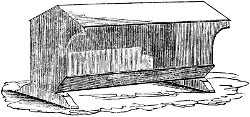
A COVERED SALTING BOX.
Salt is indispensable to the health, especially in the summer. It is
common to give it once a week, while they are at grass. It is still
better to give them free access to it, at all times, by keeping it in a
covered box, open on one side, as in the engraving annexed. A large
hollow log, with holes cut along the side for the insertion of the heads
of the animals, answers very well. A sheep having free access to salt at
all times will never eat too much of it; and it will take its supply at
such times and in such quantities as Nature demands, instead of eating
of it voraciously at stated periods, as intermediate abstinence will
stimulate it to do. When salt is fed but once a week, it is better to
have a stated day, so
that it will not be forgotten; and it is well to
lay the salt on flat stones—though if laid in little handfuls on the
grass, very little of it will be lost.
Tar. This is supposed by many to form a very healthful condiment for
sheep, and they smear the nose with it, which is licked and swallowed as
the natural heat of the flesh, or that of the weather, causes it to
trickle down over the nostrils and lips. Others, suffering the flock to
get unusually salt-hungry, place tar upon flat stones, or in troughs,
and then scatter salt upon it so that both may be consumed together.
Applied to the nose, in the nature of a cataplasm, it may be
advantageous in catarrhs; and in the same place, at the proper periods,
its odor may, perhaps, repel the fly, the eggs of which produce the
“gout in the head,” as it is termed. However valuable it may be as a
medicine, and even as a debergent in the case specified, there is but
slight ground for confidence in it merely as a condiment.
Dry, sweet pastures, and such as abound in aromatic and bitter
plants, are best suited for sheep-walks. No animal, with the exception
of the goat, crops so great a variety of plants. They eat many which are
rejected by the horse and the ox, which are even essential to their own
wants. In this respect they are valuable assistants to the husbandman,
as they feed greedily on wild mustard, burdock, thistles, marsh-mallows,
milk-weed, and various other offending plants; and the Merino exceeds
the more recent breeds in the range of his selections.
In pastures, however, where the dry stalks of the burdock, or the
hound’s-tongue, or tory-weed have remained standing over the winter, the
burs are caught in the now long wool, and, if they are numerous, the
wool is rendered entirely unmarketable and almost valueless. Even the
dry prickles of the common and Canada thistles, where they are very
numerous, get into the neck-wool of sheep, as they thrust their heads
under and among them to crop the first scarce feed of the northern
spring; and, independently of injuring the wool, they make it difficult
to wash and otherwise handle the sheep. Indeed, it is a matter of the
soundest policy to keep sheep on the cleanest pastures, those free from
these and similar plants; and in a region where they are pastured the
year round, they should be kept from contact with them for some months
prior to shearing.
Many prepare artificial pastures for their flocks, which may be done
with a number of plants. Winter rye, or wheat sown early in the season,
may be fed off in the fall, without injury to the crop; and, in the
following spring, the rye may be pastured till the stalks shoot up and
begin to form a head. This affords an early and nutritious food. Corn
may be sown broadcast, or thickly in drills, and either fed off in the
fields or cut and carried to the sheep in their folds. White mustard is
also a valuable crop for this purpose.
To give sheep sufficient variety, it is better to divide their range
into several smaller ones, and change them as often, at least, as once a
week. They seek a favorite resting-place, on a dry, elevated part of the
field, which soon becomes soiled. By removing them from this for a few
days, rain will cleanse or the sun dry it, so as to make it again
suitable for them. More sheep may be kept, and in better condition,
where this practice is adopted, than where they are confined to the same
pasture.
Shade. No one who has observed with what eagerness sheep seek shade in
hot weather, and how they pant and apparently suffer when a hot sun is
pouring down upon their nearly naked bodies, will doubt that, both as a
matter of humanity and utility, they should be provided, during the hot
summer-months, with a better shelter than that afforded by a common
rail-fence. Forest trees are the most natural and the best shades, and
it is as contrary to utility as it is to good taste to strip them
entirely from the sheep-walks. A strip of stone-wall or close board
fence on the south and west sides of the pasture, forms a tolerable
substitute for trees. But in the absence of all these and of buildings
of any kind, a shade can be cheaply constructed of poles and brush, in
the same manner as the sheds of the same materials for winter shelter,
which will be hereafter described.
Fences. Poor fences will teach ewes and wethers, as well as rams, to
jump; and for a jumping flock there is no remedy but immoderately high
fences, or extirpation. One jumper will soon teach the trick to a whole
flock; and if one by chance is brought in, it should be immediately
hoppled or killed. The last is by far the surest and safest remedy.
Hoppling is done by sewing the ends of a leather strap, broad at the
extremities, so that it will not cut into the flesh, to a fore and hind
leg, just above the pastern joints, leaving the legs at about the
natural distance apart. Clogging is fastening a billet of wood to the
fore leg by a leather strap. Yoking is fastening two rams two or three
feet apart, by bows around their necks, inserted in a light piece of
timber, some two or three inches in size. Poking is done by inserting
a bow in a short bit of light timber, into which bit—worn on the
under
side of the neck—a rod is inserted, which projects a couple of feet in
front of the sheep.
These and similar devices, to prevent rams from scaling fences, may be
employed as a last resort by those improvident farmers who prefer, by
such troublesome, injurious, and, at best, insecure means, to guard
against that viciousness which they might so much more easily have
prevented from being acquired.
Dangerous rams. From being teased and annoyed by boys, or petted and
played with when young, and sometimes without any other stimulant than a
naturally vicious temper, rams occasionally become very troublesome by
their propensity to attack men or cattle. Some will allow no man to
enter the field where they are without making an immediate onset upon
him; while others will knock down the ox or horse which presumes to
dispute a lock of hay with them. A ram which is known to have acquired
this propensity should at once be hooded, and, if not valuable, at the
proper season converted into a wether. But the courage thus manifested
is usually the concomitant of great strength and vigor of constitution,
and of a powerfully developed frame. If good in other particulars, it is
a pity to lose the services of so valuable an animal. In such cases,
they may be hooded, by covering their faces with leather in such a
manner that they can only see a little backward and forward. They must
then, however, be kept apart from the flock of rams, or they will soon
be killed or injured by blows, which they cannot see to escape.
It sometimes happens that a usually quiet-tempered ram will suddenly
exhibit some pugnacity when one is salting or feeding the flock. If such
a person turns to run, he is immediately knocked down, and the ram
learns, from that single lesson, the secret of his mastery, and the
propensity to exercise it. As the ram gives his blow from the summit of
the parietal and the posterior portion of the frontal bones on the top
of his head, and not from the forehead, he is obliged to crouch his head
so low when he makes his onset that he does not see forward well enough
to swerve suddenly from his right line, and a few quick motions to the
right and left enable one to escape him. Run in upon him, as he dashes
by, with pitch-fork, club, or boot-heel, and punish him severely by
blows about the head, if the club is used, giving him no time to rally
until he is thoroughly cowed. This may be deemed harsh treatment, and
likely to increase the viciousness of the animal. Repeated instances
have, however, proved the contrary; and if the animal once is forced to
acknowledge that he is overcome, he never forgets the lesson.
Prairie feeding. Sheep, when destined for the prairies, ought to
commence their journey as early after the shearing as possible, since
they are then disencumbered of their fleece, and do not catch and retain
as much dust as when driven later; feed is also generally better, and
the roads are dry and hard. Young and healthy sheep should be selected,
with early lambs; or, if the latter are too young, and the distance
great, they should be left, and the ewes dried off. A large wagon ought
to accompany the flock, to carry such as occasionally give out; or they
may be disposed of whenever they become enfeebled. With good care, a
hardy flock may be driven at the rate of twelve or fourteen miles a day.
Constant watchfulness is requisite, in order to keep them healthy and in
good plight.
One-half the expense of driving may be saved by the use of well-trained shepherd-dogs.
When arrived at their destination, they must be thoroughly washed, to
free them from all dirt, and closely examined as to any diseases which
they may have contracted, that these may be promptly removed. A variety
of suitable food and good shelter must be provided for the autumn,
winter, and spring ensuing, and every necessary attention given to them.
This would be necessary if they were indigenous to the country; but it
is much more so when they have just undergone a campaign to which
neither they nor their race have been accustomed.
Sheep cannot be kept on the prairies without much care, artificial food,
and proper attention; and losses have often occurred, by reason of a
false system of economy attempted by many, from disease and mortality in
the flocks, amply sufficient to have made a generous provision for the
comfort and security of twice the number lost. More especially do they
require proper food and attention after the first severe frosts set in,
which wither and kill the natural grasses. By nibbling at the bog—the
frostbitten, dead grass—they are inevitably subject to constipation,
which a bountiful supply of roots, sulphur, etc., is alone sufficient to
remove.
Roots, grain, good hay, straw, corn-stalks, and pea or bean-vines are
essential to the preservation of their health and thrift during the
winter, everywhere north of thirty-nine degrees. In summer, the natural
herbage is sufficient to sustain them in fine condition, till they shall
have acquired a denser population of animals, when it will be found
necessary
to stock their meadows with the best varieties of artificial grasses.
The prairies seem adapted to the usual varieties of sheep introduced
into the United States; and of such are the flocks made up, according to
the taste or judgment of the owners. Shepherd dogs are invaluable to the
owners of flocks, in these unfenced, illimitable ranges, both as a
defence against the small prairie wolves, which prowl around the sheep,
but have been rapidly thinned off by the settlers, and also as
assistants to the shepherds in driving and herding their flocks on the
open ground.
Fall feeding. In the North, the grass often gets very short by the tenth
or fifteenth of November, and it has lost most of its nutritiousness
from repeated freezing and thawing. At this time, although no snow may
have fallen, it is best to give the sheep a light, daily foddering of
bright hay, and a few oats in the bundle. Given thus for the ten or
twelve days which precede the covering of the ground by snow, fodder
pays for itself as well as at any other time during the year. It is well
to feed oats in the bundle, or threshed oats, about a gill to the head,
in the feeding-troughs, carried to the field for that purpose.
Winter feeding. The time for taking sheep from the pastures must depend
on the state of the weather and food. Severe frosts destroy much of the
nutriment in the grasses, and they soon after cease to afford adequate
nourishment. Long exposure to cold storms, with such food to sustain
them, will rapidly reduce the condition of these animals. The only safe
rule is to transfer them to their winter-quarters the first day they
cease to thrive abroad.
There is no better food for sheep than well-ripened, sound Timothy hay;
though the clovers and nearly all the cultivated grasses may be
advantageously fed. Hundreds and thousands of northern flocks receive,
during the entire winter, nothing but ordinary hay, consisting mainly of
Timothy, some red and white clover, and frequently a sprinkling of gum,
or spear grass. Bean and pea straw are valuable, especially the former,
which, if properly cured, they prefer to the best hay; and it is well
adapted to the production of wool. Where hay is the principal feed, it
may be well, where it is convenient, to give corn-stalks every fifth or
sixth feed, or even once a day; or the daily feed, not of hay, might
alternate between stalks, pea-straw, straws of the cereal grains, etc.
It is mainly a question of convenience with the farmer, provided a
proper supply of palatable nutriment within a proper compass is given.
It would not, however, be entirely safe to confine any kind of sheep to
the straw of the cereal grains, unless it were some of those little
hardy varieties of animals which would be of no use in this country.
The expediency of feeding grain to store-sheep in winter depends much
on circumstances. If in a climate where they can obtain a proper supply
of grass or other green esculents, it would, of course, be unnecessary;
nor is it a matter of necessity where the ground is frozen or covered
with snow for weeks or months, provided the sheep be plentifully
supplied with good dry fodder. Near markets where the coarser grains
find a quick sale at fair prices, it is not usual, in the North, to feed
grain. Remote from markets it is generally fed by the holders of large
flocks. Oats are commonly preferred, and they are fed at the rate of a
gill a head per day. Some feed half the same amount of yellow corn.
Fewer sheep, particularly lambs and yearlings, get thin and perish where
they receive a daily feed of grain; they consume less hay, and their
fleeces are increased in weight. On the whole, therefore, it is
considered good economy. Where no grain is fed, three daily feeds of hay
are given. The smaller sizes of the Saxon may be well sustained on two
pounds of hay; but larger sheep will consume from three and a half to
four or even five pounds per day. Sheep, in common with all other
animals, when exposed to cold, will consume much more than if well
protected, or during a warmer season.
It is a common and very good practice to feed greenish cut oats in the
bundle, at noon, and give but two feeds of hay, one at morning and one
at night. Some feed greenish cut peas in the same way. In warm, thawing
weather, when sheep get to the ground and refuse dry hay, a little grain
assists materially in keeping up their strength and condition. When the
feed is shortest in winter, in the South, there are many localities
where sheep can get enough grass to take off their appetite for dry hay,
but not quite enough to keep them in prime order. A moderate daily feed
of oats or pease, placed in the depository racks, would keep them strong
and in good plight for the lambing season, and increase their weight of
wool.
Few Northern farmers feed Indian corn to store-sheep, as it is
considered too hot and stimulating, and sheep are thought to become more
liable to become “cloyed” on it than on oats, pease, etc. Yellow corn is
not generally judged a very safe feed for lambs and yearlings.
Store-sheep should be kept in good, fair, plump condition. Lambs and
yearlings may be as fat as they will become on proper feeding. It is
stated that sheep will eat cotton-seed, and thrive on it.
It must be remembered that sheep are not to be allowed to get thin
during the winter, with the idea that their condition can at any time be
readily raised by better feed, as with the horse or ox. It is always
difficult, and, unless properly managed, expensive and hazardous, to
attempt to raise the condition of a poor flock in the winter, especially
if they have reached that point where they manifest weakness. If the
feeding of a liberal allowance of grain be suddenly commenced, fatal
diarrhœa will often supervene. All extra feeding, therefore, must be
begun very gradually; and it does not appear, in any case, to produce
proportionable results.
Roots, such as ruta-bagas, Irish potatoes, and the like, make a good
substitute for grain, or as extra feed for grown sheep. The ruta-baga is
preferable to the potato in its equivalents of nutriment. No root,
however, is as good for lambs and yearlings as an equivalent of grain.
Sheep may be taught to eat nearly all the cultivated roots. This is done
by withholding salt from them, and then feeding the chopped roots a few
times, rubbed with just sufficient salt to induce them to eat the root
to obtain it; but not enough to satisfy their appetite for salt before
they have acquired a taste for the roots.
It is customary with some farmers to cut down, from time to time in the
winter, and draw into the sheep-yards, young trees of the hemlock,
whose foliage is greedily eaten by the sheep, after being confined for
some time to dry feed. This browse is commonly used, like tar, for some
supposed medicinal virtues. It is pronounced “healthy” for sheep. Much
the same remarks might be made about this as have been already made
concerning tar. No tonics and stimulants are needed for a healthy
animal. If the foliage of the hemlock were constantly accessible to
them, there would be no possible objection to their eating it, since
their instincts, in that case, would teach them whether, and in what
quantities, to devour it; but when entirely confined to dry feed for a
protracted period, sheep will consume injurious and even poisonous
succulents, and of the most wholesome ones, hurtful quantities. As a
mere laxative, an occasional feed of hemlock may be beneficial;
though, in this point of view, a day’s run at grass, in a thaw, or a
feed of roots, would produce the same result. In a climate where grass
is procurable most of the time, browse for medicinal purposes is
entirely unnecessary.
Sheep undoubtedly require salt in winter. Some salt their hay when it
is stored in the barn or stack. This is objectionable, since the
appetite of the sheep is much the safest guide in the premises. It may
be left accessible to them in the salt-box, as in summer; or an
occasional feed of grined hay or straw may be given them in warm,
thawing weather, when their appetite is poor. This last is an excellent
plan, and serves a double purpose. With a wisp of straw, sprinkle a thin
layer of straw with brine, then another layer of straw, and another
sprinkling, and so on. Let this lie until the next day, for the brine to
be absorbed by the straw, and then feed it to all the grazing animals on
the farm which need salting.
Water is indispensable, unless sheep have access to succulent food, or
clean snow. Constant access to a brook or spring is best; but, in
default of this, they should be watered at least once a day in some
other way.
Feeding with other stock. Sheep should not run, or be fed, in yards,
with any other stock. Cattle hook them, often mortally; and colts tease
and frequently injure them. It is often said that “colts will pick up
what sheep leave.” But well-managed sheep rarely leave any thing; and,
if they chance so to do, it is better to rake it up and throw it into
the colts’ yard, than to feed them together. If sheep are not required
to eat their food pretty clean, they will soon learn to waste large
quantities. If, however, they are over-fed with either hay or grain, it
is not proper to compel them, by starvation, to come back and eat it.
This they will not do, unless sorely pinched. Clean out the troughs, or
rake up the hay, and the next time feed less.
Division of flocks. If flocks are shut up in small inclosures during
winter, according to the northern custom, it is necessary to divide them
into flocks of about one hundred each, consisting of sheep of about the
same size and strength; otherwise, the stronger rob the weaker, and the
latter rapidly decline. This is not so important where the sheep roam at
large; but, even in that case, some division and classification are
best. It is best, indeed, even in summer. The poorer and feebler can by
this means receive better pasture, or a little more grain and better
shelter in winter.
By those who grow wool to any extent, breeding ewes, lambs, and wethers,
are invariably kept in separate flocks in winter; and it is best to keep
yearling sheep by themselves with a few of the smallest two-year-olds,
and any old crones which are kept for their excellence as breeders, but
which cannot maintain themselves in the flock of breeding ewes.
Old and feeble or wounded sheep, late-born lambs, etc., should be
placed by themselves, even if the number be small, as they require
better feed, warmer shelter, and more attention. Unless the sheep are of
a peculiarly valuable variety, however, it is better to sell them off in
the fall at any price, or to give them to some poor neighbor who has
time to nurse them, and who may thus commence a flock.
Regularity in feeding. If any one principle in sheep husbandry deserves
careful attention more than others, it is, that the utmost regularity
must be preserved in feeding.
First, there should be regularity as to the times of feeding. However
abundantly provided for, when a flock are foddered sometimes at one hour
and sometimes at another—sometimes three times a day, and sometimes
twice—some days grain, and some days none—they cannot be made to
thrive. They will do far better on inferior keep, if fed with strict
regularity. In a climate where they require hay three times a day, the
best times for feeding are about sunrise in the morning, at noon, and an
hour before dark at night. Unlike cattle and horses, sheep do not feed
well in the dark; and, therefore, they should have time to consume their
food before night sets in. Noon is the common time for feeding grain or
roots, and is the best time, if but two fodderings of hay are given. If
the sheep receive hay three times, it is not a matter of much
consequence with which feeding grain is given, only that the practice be
uniform.
Secondly, it is highly essential that there should be regularity in the
amount fed. The consumption of hay will, it is true, depend much upon
the weather; the keener the cold, the more the sheep will eat. In the
South, much depends upon the amount of grass obtained. In many places, a
light, daily
foddering supplies; in others, a light foddering placed in
the depository racks once in two days, answers the purpose. In the
steady cold weather of the North, the shepherd readily learns to
determine about how much hay will be consumed before the next foddering
time. And this amount should, as near as may be, be regularly fed. In
feeding grain or roots, there is no difficulty in preserving entire
regularity; and it is vastly more important than in feeding hay. Of the
latter, a sheep will not over-eat and surfeit itself; of the former, it
will. Even if it be not fed grain to the point of surfeiting, it will
expect a like amount, however over-plenteous, at the next feeding;
failing to receive which, it will pine for it, and manifest uneasiness.
The effect of such irregularity on the stomach and system of any animal
is bad; and the sheep suffers more from it than any other animal. It is
much better that the flock receive no grain at all, than that they
receive it without regard to regularity in the amount. The shepherd
should measure out the grain to the sheep in all instances, instead of
guessing it out, and measure it to each separate flock.
Effect of food. Well-fed sheep, as has been previously remarked, produce
more wool than poorly fed ones. No doctrine is more clearly recognized
in agricultural chemistry than that animal tissues derive their chemical
components from the same components existing in their food. Various
analyses show that the chemical composition of wool, hair, hoofs, nails,
horns, feathers, lean meat, blood, cellular tissue, nerves, etc., are
nearly identical.
The organic part of wool, according to standard authorities, consists of
carbon, 50.65; hydrogen, 7.03; nitrogen, 17.71; oxygen and sulphur,
24.61. The inorganic constituents are small. When burned, it leaves but
a trifling per cent. of ash.
The large quantity of nitrogen contained in wool shows that its
production is increased by highly azotized food; and from various
experiments made, a striking correspondence has been found to exist
between the amount of wool and the amount of nitrogen in food. Pease
rank first in increasing the wool, and very high in the average
comparative increase which they produce in all the tissues.
The increase of fat and muscle, as of wool, depends upon the nature of
the food. It is not very common, in the North, for wool-growers to
fatten their wethers for market by extra winter feeding. Some give them
a little more generous keep the winter before they are to be turned off,
and then salt them when they have obtained their maximum fatness the
succeeding fall.
Stall-feeding is lost on an ill-shaped, unthrifty animal. The perfection
of form and health, and the uniform good condition which characterizes
the thrifty one, indicate, too plainly to be misunderstood, those which
will best repay the care of their owner. The selection of any
indifferent animal for stall-fattening will inevitably be attended with
loss. Such ought to be got rid of, when first brought from the pasture,
for the wool they will bring.
When winter fattening is attempted, sheep require warm, dry shelters,
and should receive, in addition to all the hay they will eat, meal twice
a day in troughs—or meal once and chopped roots once. The equivalent of
from half a pint to a pint of yellow corn meal per head each day is
about as much as ordinary stocks of Merino wethers will profitably
consume; though in selected flocks, consisting of large animals, this
amount is frequently exceeded.
[146]
Experience has amply demonstrated that—in the climate of the Northern
and Eastern States, where no grass grows from four to four and a half
months in the winter, and where, therefore, all that can be obtained
from the ground is the repeatedly frozen, unnutritious herbage left in
the fall—it is better to keep sheep confined in yards, excepting where
the ground is covered with snow. If suffered to roam over the fields at
other times, they get enough grass to take away their appetite for dry
hay, but not enough to sustain them; they fall away, and toward spring
they become weak, and a large proportion of them frequently perish.
Flocks of some size are here, of course, alluded to, and on properly
stocked farms. A few sheep would do better with a boundless range.
Some let out their sheep occasionally for a single day, during a thaw;
others keep them entirely from the ground until let out to grass in the
spring. The former course is preferable where the sheep ordinarily get
nothing but dry fodder. It affords a healthy laxative, and a single
day’s grazing will not take off their appetite from more than one
succeeding dry feed. It is necessary, in the North, to keep sheep in the
yards until the feed has got a good start in the spring, or they will
get off from their feed—particularly the breeding ewes—and get weak at
the most critical time for them in the year.
Yards should be firm-bottomed, dry, and, in the northern climate, kept
well littered with straw. The yarding system is not practised to any
great extent in the South; nor should it be, where sheep can get their
living from the fields.
[147]
When the ground is frozen, and especially when covered with snow, the
sheep eats hay well on the ground; but when the land is soft, muddy, or
foul with manure, they will scarcely touch hay placed on it—or, if they
do, will tread much of it into the mud, in their restlessness while
feeding. It should then be fed in racks, which are more economical, even
in the first-named case; since, when the hay is fed on the ground, the
leaves and seeds, the most valuable part of the fodder, are almost
wholly lost.
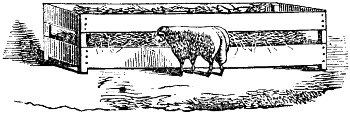
A CONVENIENT BOX-RACK.
To make an economical box-rack—the one in most general use in the
North—take six light pieces of scantling, say three inches square, one
for each corner, and one for the centre of each side. Boards of pine or
hemlock, twelve or fifteen feet long, and twelve or fourteen inches
wide, may then be nailed on to the bottom of the posts for the sides,
which are separated by similar boards at the ends, two and a half feet
long. Boards twelve inches wide, raised above the lower ones by a space
of from nine to twelve inches, are nailed on the sides and ends, which
completes the rack. The edges of the opening should be made perfectly
smooth, to prevent chafing or tearing out the wool. The largest
dimensions given are suitable for the large breeds, and the smallest for
the Saxon; and still smaller are proper for the lambs. These should be
set on dry
ground, or under the sheds; and they can be easily removed
wherever necessary. Unless over-fed, sheep waste very little hay in
them.
Some prefer the racks made with slats, or smooth, upright sticks, in the
form of the common horse-rack. This kind should always be accompanied by
a broad trough affixed to the bottom, to catch the fine hay which falls
in feeding. These racks may be attached to the side of a building, or
used double. A small lamb requires fifteen inches of space, and a large
sheep two feet, for quiet, comfortable feeding; and this amount of room,
at least, should be provided around the racks for every sheep.
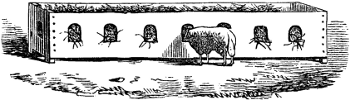
A HOLE-RACK.
With what is termed a hole-rack, sheep do not crowd and take advantage
of each other so much as with log-racks; but they are too heavy and
unnecessarily expensive for a common out-door rack. This rack is
box-shaped, with the front formed of a board nailed on horizontally, or,
more commonly, by nailing the boards perpendicularly, the bottoms on the
sill of a barn, and the tops to horizontal pieces of timber. The holes
should be at least eight inches wide, nine inches high, and eighteen
inches from centre to centre.
In the South, racks are not so necessary for that constant use to which
they are put in colder sections, as they are for depositories of dry
food, for the occasional visitation of the sheep. In soft, warm
weather, when the ground is unfrozen, and any kind of green herbage is
to be obtained, sheep will scarcely touch dry fodder; though the little
they will then eat will be highly serviceable to them. But in a sudden
freeze, or on the occurrence of cold storms, they will resort to the
racks, and fill themselves with dry food. They anticipate the coming
storm by instinct, and eat an extra quantity of food to sustain the
animal heat during the succeeding depression of temperature. They should
always have racks of dry fodder for resort in such emergencies.
These racks should have covers or roofs to protect their contents from
rain, as otherwise the feed would often be spoiled before but a small
portion of it would be consumed. Hay or straw, saturated with water, or
soaked and dried, is only eaten by the sheep as a matter of absolute
necessity. The common box-rack would answer the purpose very well by
placing on the top a triangular cover or roof, formed of a couple of
boards, one hung at the upper edge with iron or leather hinges, so that
it could be lifted up like a lid; making the ends tight; drawing in the
lower edges of the sides, so that it should not be more than a foot wide
on the bottom; inserting a flow; and then mounting it on, and making it
fast to, two cross-sills, four or five inches square, to keep the floor
off from the ground, and long enough to prevent it from being easily
overturned. The lower side-board should be narrow, on account of the
increased height given its upper edge by the sills.
A rack of the same construction, with the sides like those described for
the hole-rack, would be still better, though somewhat more expensive; or
the sides might consist of rundles,
the top being nailed down in either
case, and the fodder inserted by little doors in the ends.
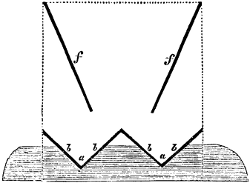
THE HOPPER-RACK.
What is termed the hopper-rack, serving both for a rack and a
feeding-trough, is a favorite with many sheep-owners. The accompanying
cut represents a section of such a rack. A piece of durable wood, about
four and a half feet long, six or eight inches deep, and four inches
thick, having two notches, a a, cut into it, and two troughs, made of
inch boards, b b b b, placed in these notches, and nailed fast,
constitute the formation. If the rack is to be fourteen feet long, three
sills are required. The ends of the rack are made by nailing against the
side of the sill-boards that reach up as high as it is desired to have
the rack; and nails driven through these end-boards into the ends of the
side-boards, f f, secure them. The sides may be further strengthened
by pieces of board on the outside of them, fitted into the trough. A
roof may be put over all, if desired, by means of which the fodder is
kept entirely from the weather, and no seeds or chaff can get into the
wool.
Threshed grain, chopped roots, etc., when fed to sheep, should be placed
in troughs. With either of the racks which have been described, except
the last, a separate trough would
be required. The most economical are
made of two boards of any convenient length, ten to twelve inches wide.
Nail the lower side of one upon the edge of the other, fastening both
into a two or three-inch plank, fifteen inches long, and a foot wide,
notched in its upper edge in the form required. In snowy sections they
are turned over after feeding, and when falls of snow are anticipated
one end is laid on the yard-fence.
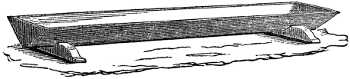
AN ECONOMICAL SHEEP-TROUGH.
Various contrivances have been brought to notice for keeping grain where
sheep can feed on it at will, a description of which is omitted, since
it is not thought best, by the most successful stock-raisers, in feeding
or fattening any quadrupeds, to allow them grain at will, stated feeds
being preferred by them; and the same is true of fodder. If this system
is departed from in using depository racks, as recommended, it is
because it is rendered necessary by the circumstances of the case. A
Merino store-sheep, allowed as much grain as it chose to consume, would
be likely to inflict injury on itself; and grain so fed would, generally
speaking, be productive of more damage than benefit.
Shelters, in northern climates, are indispensable to profitable
sheep-raising; and in every latitude north of the Gulf of Mexico, they
would probably be found advantageous. An animal eats much less when thus
protected; he is more thrifty,
less liable to disease, and his manure
is richer and more abundant. The feeding may be done in the open yard in
clear weather, and under cover in severe storms: for, even in the
vigorous climate of the North, none but the breeders of Saxons make a
regular practice of feeding under cover.
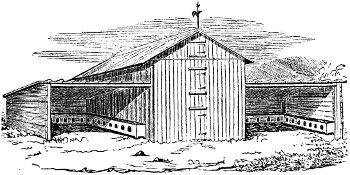
SHEEP-BARN WITH SHEDS.
Humanity and economy alike dictate that, in the North, sheep should be
provided with shelters under which to lie nights, and to which they can
resort at will. It is not an uncommon circumstance in New York and New
England for snow to fall to the depth of from twenty to thirty inches
within twenty-four or forty-eight hours, and then to be succeeded by a
strong and intensely cold west or northwest wind of several days
continuance, which lifts the snow, blocking up the roads, and piling
huge drifts to the leeward of fences, barns, etc.
A flock without shelter will huddle closely together, turning their
backs to the storm, constantly stepping, and thus treading down the snow
as it rises about them. Strong, close-coated sheep do not seem to suffer
as much from the cold, for a period, as would be expected. It is,
however, almost impossible to
feed them enough, or half enough, under
such circumstances, without an immense waste of hay—entirely
impossible, indeed, without racks. The hay is whirled away in an instant
by the wind; and, even if racks are used, the sheep, leaving their
huddle, where they were kept warm and even moist by the melting snow in
their wool, soon get chilled, and are disposed to return to their
huddle. Imperfectly filled with food, the supply of animal heat is
lowered, and, at the end of the second or third day, the feeble ones
sink down hopelessly, the yearlings, and those somewhat old, receive a
shock from which nothing but the most careful nursing will enable them
to rally, and even the strongest suffer an injurious loss in condition.
Few persons, therefore, who own as many as forty or fifty sheep, attempt
to get along without some kind of shelters, which are variously
constructed, to suit their tastes or circumstances. A sheep-barn, built
upon a side-hill, will afford two floors: one underneath, surrounded by
three sides of wall, should open to the south, with sliding or swinging
doors to guard against storms; and another may be provided above, if the
floors are perfectly tight, with proper gutters to carry off the urine;
and sufficient storage for the fodder can be furnished by scaffolds
overhead. They may also be constructed with twelve or fifteen-feet posts
on level ground, allowing the sheep to occupy the lower part, with the
fodder stored above.
In all cases, however, thorough ventilation should be provided; for of
the two evils, of exposure to cold or of too great privation of air, the
former is to be preferred. Sheep cannot long endure close confinement
without injury. In all ordinary weather, a shed, closely boarded on
three sides, with a light
roof, is sufficient protection; especially if
the open side is shielded from bleak winds, or leads into a
well-inclosed yard. If the floors above are used for storage, they
should be made tight, that no hay, chaff, or dust can fall upon the
fleece. The sheds attached to the barn are not usually framed or silled,
but are supported by some posts of durable timber set in the ground. The
roofs are formed of boards battened with slats. The barn has generally
no partitions within, and is entirely filled with hay.
There are many situations in which open sheds are very liable to have
snow drifted under them by certain winds, and they are subject in all
severe gales to have the snow carried over them to fall down in large
drifts in front, which gradually encroach on the sheltered space, and
are very inconvenient, particularly when they thaw. For these reasons,
many prefer sheep-houses covered on all sides, with the exception of a
wide doorway for ingress and egress, and one or two windows for the
necessary ventilation. They are convenient for yarding sheep, and the
various processes for which this is required; as for shearing, marking,
sorting, etc., and especially so for lambing-places, or the confinement
of newly-shorn sheep in cold storms. They should have so much space
that, in addition to the outside racks, others can be placed temporarily
through the middle when required.
The facts must not be overlooked—as bearing upon the question of
shelter, even in the warmer regions of the country—that cold rains, or
rains of any temperature, when immediately succeeded by cold or freezing
weather, or cold, piercing winds, are more hurtful to sheep than even
snow-storms; and
that, consequently, sheep must be adequately guarded
against them.
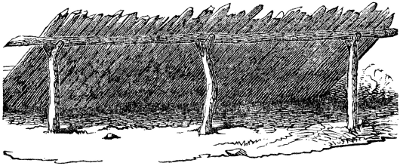
A SHED OF RAILS.
Sheds. The simplest and cheapest kind of shed is formed by poles or
rails, the upper end resting on a strong horizontal pole supported by
crotched posts set in the ground. It may be rendered rain-proof by
pea-vines, straw, or pine boughs. In a region where timber is very
cheap, planks or boards, of a sufficient thickness not to spring
downward, and thus open the roof, battened with slats, may take the
place of the poles and boughs; and they would make a tighter and more
durable roof. If the lower ends of the boards or poles are raised a
couple of feet from the ground, by placing a log under them, the shed
will shelter more sheep.
These movable sheds may be connected with hay-barns—“hay-barracks”—or
they may surround an inclosed space with a stack in the middle. In the
latter case, the yard should be square, on account of the divergence in
the lower ends of the boards or poles, which a round form would render
necessary.
Sheds of this description are frequently made between two stacks. The
end of the horizontal supporting-pole is placed on the stack-pens when
the stacks are built, and the middle is
propped by crotched posts. The
supporting-pole may rest, in the same way, on the upper girts of two
hay-barracks; or two such sheds, at angles with each other, might form
wings to this structure.
On all large sheep-farms, convenience requires that there be one barn of
considerable size, to contain the shearing-floor, and the necessary
conveniences about it for yarding the sheep, etc. This should also, for
the sake of economy, be a hay-barn, where hay is used. It may be
constructed in the corner of four fields, so that four hundred sheep can
be fed from it, without racking flocks of improper size. At this barn it
would be expedient to make the best shelters, and to bring together all
the breeding-ewes on the farm, if their number does not exceed four
hundred. The shepherd would thus be saved much travel at all times, and
particularly at the lambing-time, and each flock would be under his
almost constant supervision.
The size of this barn is a question to be determined entirely by the
climate. For large flocks of sheep, the storage of some hay or other
fodder for winter is an indispensable precautionary measure, at least in
any part of the United States; and, other things being equal, the
farther north, or the more elevated the land, the greater would be the
amount necessary to be stored.
Hay-holder. Where hay or other fodder is thrown out of the upper door of
a barn into the sheep-yard—as it always must necessarily be in any mere
hay-barn—or where it is thrown from a barrack or stack, the sheep
immediately rush on it, trampling it and soiling it, and the succeeding
forkfuls fall on their backs, filling their wool with dust, seed, and
chaff.
This is obviated by hay-holders—yards ten feet square—either
portable, by being made of posts and boards, or simply a pen of rails,
placed under the doors of the barns, and by the sides of each stack or
barrack. The hay is pitched into this holder in fair weather, enough for
a day’s foddering at a time, and is taken from it by the fork and placed
in the racks.
The poles or rails for stack-pens or hay-holders should be so small as
to entirely prevent the sheep from inserting their heads in them after
hay. A sheep will often insert his head where the opening is wide enough
for that purpose, shove it along, or get crowded, to where the opening
is not wide enough to withdraw the head, and it will hang there until
observed and extricated by the shepherd. If, as often happens, it is
thus caught when its foreparts are elevated by climbing up the side of
the pen, it will continue to lose its footing in its struggles, and will
soon choke to death.
Tagging, or clatting, is the removal from the sheep of such wool as is
liable to get fouled when the animal is turned on to the fresh pastures.
If sheep are kept on dry feed through the winter, they will usually
purge, more or less, when let out to green feed in the spring. The wool
around and below the anus becomes saturated with dung, which forms into
hard pellets, if the purging ceases. Whether this take place or not, the
adhering dung cannot be removed from the wool in the ordinary process of
washing; and it forms a great impediment in shearing, dulling and
straining the shears to cut through it, when in a dry state, and it is
often impracticable so to do. Besides, it is difficult to force the
shears between it and the skin, without frequently and severely
wounding the latter. Occasionally, too, flies deposit their eggs under
this mass of filth prior to shearing; and the ensuing swarm of maggots,
unless speedily discovered and removed, will lead the sheep to a
miserable death.
Before the animals are let out to grass, each one should have the wool
sheared from the roots of the tail down the inside of the thighs; it
should likewise be sheared from off the entire bag of the ewe, that the
newly-dropped lamb may more readily find the teat, and from the scrotum,
and so much space round the point of the sheath of the ram as is usually
kept wet. If the latter place is neglected, soreness and ulceration
sometimes ensue from the constant maceration of the urine.
An assistant should catch the sheep and hold them while they are tagged.
The latter process requires a good shearer, as the wool must be cut off
closely and smoothly, or the object is but half accomplished, and the
sheep will have an unsightly and ridiculous appearance when the
remainder of their fleeces is taken off; while, on the other hand, it is
not only improper to cut the skin of a sheep at any time, but it is
peculiarly so to cut that or the bag of a ewe when near lambing. The
wool saved by tagging will far more than pay the expenses of the
operation. It answers well for stockings and other domestic purposes, or
it will sell for nearly half the price of fleece-wool.
Care should be exercised at all times in handling sheep, especially ewes
heavy with lamb. It is highly injurious and unsafe to chase them about
and handle them roughly; for, even if abortion, the worst consequence of
such treatment, is avoided, they become timid and shy of being touched,
rendering it difficult to catch them or render them assistance at the
lambing period, and even a matter of difficulty to enter the cotes, in
which it is sometimes necessary to confine them at that time, without
having them driving about pell-mell, running over their lambs, etc. If a
sheep is suddenly caught by the wool on her running, or is lifted by the
wool, the skin is to a certain extent loosened from the body at the
points where it is thus seized; and, if killed a day or two afterward,
blood will be found settled about those parts.
When sheep are to be handled, they should be inclosed in a yard just
large enough to hold them without their being crowded, so that they
shall have no chance to run and dash about. The catcher should stop them
by seizing them by the hind-leg just above the hock, or by clapping one
hand before the neck and the other behind the buttocks. Then, not
waiting for the sheep to make a violent struggle, he should throw its
right arm over and about immediately back of the shoulders, place his
hand on the brisket, and lift the animal on his hip. If the sheep is
very heavy, he can throw both arms around it, clasp his fingers under
the brisket, and lift it up against the front part of his body. He
should then set it carefully on its rump upon the tagging-table, which
should be eighteen or twenty inches high, support its back with his
legs, and hold it gently and conveniently until the tagger has performed
his duty. Two men should not be allowed to lift the same sheep together,
as it will be pretty sure to receive some strain between them. A good
shearer and assistant will tag two hundred sheep per day.
When sheep receive green feed all the year round—as they do in many
parts of the South—and no purging ensues from eating the
newly-starting grasses in the spring, tagging is unnecessary.
Many judicious farmers object to washing sheep, on account of its
tendency to produce colds and catarrhal affections, to which this animal
is particularly subject; but it cannot well be dispensed with, as the
wool is always rendered more salable; and if the operation is carefully
done, it need not be attended with injury.
Mr. Randall, the extensive sheep-breeder of Texas, states that he does
not wash his sheep at all, for what he deems good reasons. About the
middle of April, or at the time when one-half of the ewes have young
lambs at their sides, and the balance about to drop, would be the only
time in that region when he could wash them. At this period he would not
race or worry his ewes at all, on any account; as they should be
troubled as little as possible, and no advantage to the fleece from
washing could compensate for the injury to the animal. In his high
mountain-region, lambing-time could not prudently come before the latter
part of March or April—the very period when washing and shearing must
be commenced—since in February, and even up to the fifteenth or
twentieth of March, there is much bad weather, and a single cold, rainy
or sleety norther would carry off one-half of the lambs dropped during
its continuance.
In most of that portion of the United States lying north of forty
degrees, the washing is performed from the middle of May till the first
of June, according to the season and climate. When the streams are hard,
which is frequently the case in limestone regions, it is better to
attend to it immediately after an abundant rain, which proportionately
lessens the lime derived from the springs. The climate of the Southern
States would admit of an earlier time. The rule should be to wait until
the water has acquired sufficient warmth for bathing, and until cold
rains and storms and cold nights are no longer to be expected.
The practice of a large majority of farmers is to drive their sheep to
the watering-ground early in the morning, on a warm day, leaving the
lambs behind. The sheep are confined on the bank of the stream by a
temporary enclosure, from which they are taken, and, if not too heavy,
carried into water sufficiently deep to prevent their touching bottom.
They are then washed, by gently squeezing the fleece with the hands,
after which they are led ashore, and as much of the water pressed out as
possible before letting them go, as the great weight retained in the
wool frequently staggers and throws them down.
By the best flock-masters, sheep are usually washed in vats. A small
stream is dammed up, and the water taken from it in an aqueduct, formed
by nailing boards together, and carried till a sufficient fall is
obtained to have it pour down a couple of feet or more into the vat. The
body of water, to do the work fast and well, should be some twenty-four
inches wide, and five or six deep; and the swifter the current the
better. The vat should be some three and a half feet deep, and large
enough for four sheep to swim in it. A yard is built near the vat, from
the gate of which a platform extends to and incloses the vat on three
sides. This keeps the washer from standing in the water, and makes it
much easier to lift the sheep in and out. The yard is built opposite the
corners of two fields—to
take advantage of the angle of one of them to
drive the sheep more readily into the yard, which should be large enough
to contain the entire flock, if it does not exceed two hundred; and the
bottom of it, as well as the smaller yard, unless well sodded over,
should be covered with coarse gravel, to avoid becoming muddy. If the
same establishment is used by a number of flock-masters, gravelling will
always be necessary.
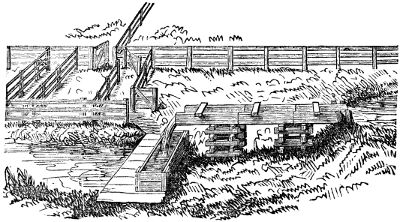
WASHING APPARATUS.
As soon as the flocks are confined in the middle yard, the lambs are all
immediately caught out from among them, and set over the fence into the
yard to the left, to prevent their being trampled down, as often
happens, by the old sheep, or straying off, if let loose. As many sheep
are then driven out of the middle yard into the smaller yard to the
right, as it will conveniently hold. A boy stands by the gate next to
the vat, to open and shut it, or the gate is drawn together with a chain
and weight, and two men, catching the sheep as directed under the head
of “tagging,” commence placing them in the water
for the preparatory
process of “wetting.” As soon as the water strikes through the wool,
which occupies but an instant, the sheep is lifted out and let loose.
Where there are conveniences for so doing, this process may be more
readily performed by driving them through a stream deep enough to compel
the sheep to swim; but swimming the compact-fleeced, fine-woolled
sheep for any length of time—as is practised with the long-wools in
England—will not properly cleanse the wool for steaming. The vat
should, of course, be in an inclosed field, to prevent their escape. The
whole flock should thus be passed over, and again driven round through
the field into the middle yard, where they should stand for about an
hour before washing commences.
There is a large per centage of potash in the wool oil, which acts upon
the dirt independent of the favorable effect which would result from
thus soaking it with water alone for some time. If washed soon after a
good shower, previous wetting might be dispensed with; and it is not,
perhaps, absolutely necessary in any case. If the water is warm enough
to allow the sheep to remain in it for the requisite period, they may be
got clean by washing without any previous wetting; though the snowy
whiteness of fleece, which has such an influence on the purchaser, is
not so often nor so perfectly attained in the latter way. But little
time is saved by dispensing with “wetting,” as it takes proportionably
longer to wash, and it is not so well for the sheep to be kept so long
in the water at once.
When the washing commences, two and sometimes four sheep are plunged in
the vat. When four are put in, two soak while two are washed. This
should not, however, be done, unless the water is very warm, and the
washers are uncommonly quick and expert; and it is, upon the whole,
rather an objectionable practice, since few animals suffer so much from
the effects of a chill as the sheep; and, if they have been previously
wetted, it is wholly unnecessary. When the sheep are in the water, the
two washers commence kneading the wool with their hands about the
dirtier parts—the breech, belly, etc.—and they continue to turn the
sheep so that the descending current of water can strike into all parts
of the fleece.
As soon as the sheep are clean, which may be known by the water running
entirely clear, each washer seizes his own animal by the foreparts,
plunges it deep in the vats, and, taking advantage of the rebound, lifts
it out, setting it gently down on its breech upon the platform. He
then—if the sheep is old and weak, and it is well in all cases—presses
out some of the water from the wool, and after submitting the sheep to a
process presently to be mentioned, lets it go.
There should be no mud about the vat, the earth not covered with sod,
being gravelled. Sheep should be kept on clean pastures, from washing to
shearing—not where they can come in contact with the ground, burnt
logs, and the like—and they should not be driven over dusty roads. The
washers should be strong and capable men, and, protected as they are
from any thing but the water running over the sides of the vat, they can
labor several hours without inconvenience. Two hundred sheep will employ
two experienced men not over half a day, and this rate is at times much
exceeded.
It is a great object, not only as a matter of propriety and honesty, but
even as an item of profit, to get the wool clean, and of a snowy
whiteness, in which condition it will always
sell for more than enough
extra to offset the increased labor and the diminution in weight. The
average loss in American Saxon wool in scouring, after being washed on
the back, is estimated at thirty-six per cent.; and in American Merino
forty-two and a half per cent.
As the hoofs of fine-woolled sheep grow rapidly, turning up in front and
under at the sides, they must be clipped as often as once a year, or
they become unsightly, give an awkward, hobbling gait to the animal, and
the part of the horn which turns under at the sides holds dirt or dung
in constant contact with the soles, and even prevents it from being
readily shaken or washed out of the cleft of the foot in the natural
movement of the sheep about the pastures, as would take place were the
hoof in its proper place. This greatly aggravates the hoof-ail, and
renders the curing of it more difficult; and it is thought by many to be
the exciting cause of the disease.
It is customary to clip the hoofs at tagging, or at or soon after the
time of shearing. Some employ a chisel and mallet to shorten the hoofs;
but the animal must afterward be turned upon its back, to pare off the
crust which projects and turns under. If the weather be dry, or the
sheep have stood for some time on dry straw, as at shearing, the hoofs
are as tough as horn, and are cut with great difficulty; and this is
increased by the grit and dirt adhering to the sole, which immediately
takes the edge off from the knife. These periods are ill-chosen, and the
method slow and bungling. It is particularly improper to submit
heavily-pregnant ewes to all this unnecessary handling at the time of
tagging.
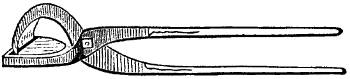
TOE-NIPPERS.
When the sheep is washed and lifted out of the vat, and placed on its
rump upon the platform, the gate-keeper should advance with a pair of
toe-nippers, and the washer present each foot separately, pressing the
toes together so that they can be severed at a single clip. The
nippers—which can be made by any blacksmith who can temper an axe or a
chisel—must be made strong, with handles a little more than a foot
long, the rivet being of half-inch iron, and confined with a nut, so
that they may be taken apart for sharpening. The cutting-edge should
descend upon a strip of copper inserted in the iron, to prevent it from
being dulled. With this powerful instrument, the largest hoofs are
severed by a moderate compression of the hand. Two well-sharpened
knives, which should be kept in a stand or box within reach, are then
grasped by the washer and assistant, and with two dexterous strokes to
each foot, the side-crust, being free from dirt, and soaked almost as
soft as a cucumber, is reduced to the level of the sole. Two expert men
will go through these processes in a very short space of time. The
closer the paring and clipping the better, if blood be not drawn. An
occasional sheep may require clipping again in the fall.
The time which should elapse between washing and shearing depends
altogether on circumstances. From four to six days of bright, warm
weather is sufficient; if cold, or rainy, or cloudy, more time must
intervene. Sometimes the wool remains in a condition unfit for shearing
for a fortnight after washing. The rule to be observed is, that the
water should be thoroughly dried out, and the natural oil of the wool
should so far exude as to give the wool an unctious feeling, and a
lively, glittering look. If it is sheared when dry, like cotton, and
before the oil has exuded, it is very difficult to thrust the shears
through, the umer is checked, and the wool will not keep so well for
long periods. If it is left until it gets too oily, either the
manufacturer is cheated, or, what more frequently happens, the owner
loses on the price.
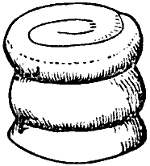
FLEECE.
Shearing, in this country, is always done on the threshing-floors of the
barns—sometimes upon low platforms, some eighteen or twenty inches
high, but more commonly on the floor itself. The place where the sheep
remain should be well littered down with straw, and fresh straw thrown
on occasionally, to keep the sheep clean while shearing. No chaff or
other substance which will stick in the wool should be used for this
purpose. The shearing should not commence until the dew, if any, has
dried off from the sheep. All loose straws sticking to the wool should
be picked off, and whatever dung may adhere to any of the feet brushed
off. The floor or tables used should be planed or worn perfectly smooth,
so that they will not hold dirt, or catch the wool. They should all be
thoroughly cleaned, and, if necessary, washed, preparatory to the
process. If there are any sheep in the pen dirty from purging, or other
causes, they should first be caught out, to prevent them from
contaminating others.
The manner of shearing varies with almost every district; and it is
difficult, if not impossible, to give intelligible practical
instructions, which would guide an entire novice in skilfully
shearing
a sheep. Practice is requisite. The following directions are as plain,
perhaps, as can be made:
The shearer may place the sheep on that part of the floor assigned to
him, resting on its rump, and himself in a posture with his right knee
on a cushion, and the back of the animal resting against his left thigh.
He grasps the shears about half-way from the point to the bow, resting
his thumb along the blades, which gives him better command of the
points. He may then commence cutting the wool at the brisket, and,
proceeding downward, all upon the sides of the belly to the extremity of
the ribs, the external sides of both sides to the edges of the flanks;
then back to the brisket, and thence upward, shearing the wool from the
breast, front, and both sides of the neck, but not yet the back of it,
and also the poll, or forepart, and top of the head. Then “the jacket is
opened” of the sheep, and its position, as well as that of the shearer,
is changed by the animal’s being turned flat upon its side, one knee of
the shearer resting on the cushion, and the other gently pressing the
fore-quarter of the animal, to prevent any struggling. He then resumes
cutting upon the flank and rump, and thence onward to the head. Thus one
side is complete. The sheep is then turned on the other side—in doing
which great care is requisite to prevent the fleeces being torn—and the
shearer proceeds as upon the other, which finishes. He must then take
the sheep near to the door through which it is to pass out, and neatly
trim the legs, leaving not a solitary lock anywhere as a lodging-place
for ticks. It is absolutely necessary for him to remove from his stand
to trim, otherwise the useless stuff from the legs becomes intermingled
with the fleece-wool. In the use of the shears, the blades should be
laid as flat to the skin as possible, the points not lowered too much,
nor should more than from one to two inches be cut at a clip, and
frequently not so much, depending on the part, and the compactness of
the wool.
The wool should be cut off as close as conveniently practicable, and
even. It may, indeed, be cut too close, so that the sheep can scarcely
avoid sun-scald; but this is very unusual. If the wool is left in
ridges, and uneven, it betrays a want of workmanship very distasteful to
the really good farmer. Great care should be taken not to cut the wool
twice in two, as inexperienced shearers are apt to do, since it is a
great damage to the wool. This results from cutting too far from the
points of the shears, and suffering them to get too elevated. In such
cases, every time the shears are pushed forward, the wool before, cut
off by the points, say a quarter or three-eighths of an inch from the
hide, is again severed. To keep the fleece entire, which is of great
importance to its good appearance when done up, and, therefore, to its
salableness, it is very essential that the sheep be held easily for
itself, so that it will not struggle violently. No man can hold it still
by main strength, and shear it well. The posture of the shearer should
be such that the sheep is actually confined to its position, so that it
is unable to start up suddenly and tear its fleece; but it should not be
confined there by severe pressure or force, or it will be continually
kicking and struggling. Clumsy, careless men, therefore, always complain
of getting the most troublesome sheep. The neck, for example, may be
confined to the floor by placing it between the toe and knee of the leg
on which the shearer kneels; but the lazy or brutal shearer who suffers
his leg to rest directly on the neck,
soon provokes that struggle which
the animal is obliged to make to free itself from severe pain, and even,
perhaps, to draw its breath.
Good shearers will shear, on the average, twenty-five Merinos per day;
but a new beginner should not attempt to exceed from one-third to
one-half of that number. It is the last process in the world which
should be hurried, as the shearer will, in that case, soon leave more
than enough wool on his sheep to pay for his day’s wages. Wool ought not
to be sheared, and must not be done up with any water in it. If wounds
are made, as sometimes happens with unskilful operators, a mixture of
tar and grease ought to be applied.
Shearing lambs is, in the Northern climate, at least, an unprofitable
practice; since the lamb, at a year old, will give the same amount of
wool, and it is thus stripped of its natural protection from cold when
it is young and tender, for the mere pittance of the interest on a
pound, or a pound and a half of wool for six months, not more than two
or three cents, and this all consumed by the expense of shearing. Much
the same may be said of the custom, which obtains in some places, of
shearing from sheep twice a year. There may be a reason for it, where
they receive so little care that a portion are expected to disappear
every half year, and the wool to be torn from the backs of the remainder
by bushes, thorns, etc., if left for a long period; but when sheep are
inclosed, and treated as domestic animals, although there may be less
barbarity in shearing them in the fall also, than in the case of the
tender lambs, there is no ground for it on the score of utility; since
any gain accruing from it cannot pay the additional expense which it
occasions.
Cold storms occurring soon after shearing sometimes destroy sheep, in
the northern portions of the country, especially the delicate Saxons;
forty or fifty of which have, at times, perished out of a single flock,
from one night’s exposure. Sheep, in such cases, should be housed; or,
where this is impracticable, driven into dense forests.
Sun-scald. When they are sheared close in very hot weather, have no
shade in their pastures, and especially where they are driven
immediately considerable distances, or rapidly, over burning and dusty
roads, their backs are sometimes so scorched by the sun that their wool
comes off. If let alone, the matter is not a serious one; but the
application of refuse lard to the back will hasten the cure, and the
starting of the wool.
Ticks. These vermin, when very numerous, greatly annoy and enfeeble the
sheep in winter, and should be kept entirely out of the flock. After
shearing, the heat and cold, the rubbing and biting of the sheep, soon
drive off the tick, and it takes refuge in the wool of the lamb. Let a
fortnight elapse after shearing, to allow all to make this change of
residence. Then boil refuse tobacco leaves until the decoction is strong
enough to kill ticks beyond a peradventure, which may be ascertained by
experiment. Five or six pounds of cheap plug tobacco, or an equivalent
in stems, and the like, may be made to answer for a hundred lambs.
This decoction is poured into a deep, narrow box, kept for the purpose,
which has an inclined shelf on one side, covered with a wooden grate.
One man holds the lamb by its hind legs, while another clasps the fore
legs in one hand, and shuts the other about the nostrils, to prevent the
liquid from
entering them, and then the animal is entirely immersed. It
is then immediately lifted out, laid on one side upon the grate, and the
water squeezed out of its wool, when it is turned over and squeezed on
the other side. The grate conducts the fluid back into the box. If the
lambs are regularly dipped every year, ticks will never trouble a flock.
The sheep should be marked soon after shearing, or mistakes may occur.
Every sheep-owner should be provided with a marking instrument, which
will stamp his initials, or some other distinctive mark, such as a small
circle, an oval, a triangle, or a square, at a single stroke, and with
uniformity, on the sheep. It is customary to have the mark cut out of a
plate of thin iron, with an iron handle terminating in wood; but one
made by cutting a type, or raised letter, or character, on the end of a
stick of light wood, such as pine or basswood, is found to be better. If
the pigment used be thin, and the marker be thrust into it a little too
deeply, as often happens, the surplus will not run off from the wood, as
it does from a thin sheet of iron, to daub the sides of the sheep, and
spoil the appearance of the mark; and, if the pigment be applied hot,
the former will not get heated, like the latter, and increase the danger
of burning the hide.
Various pigments are used for marking. Many boil tar until it assumes a
glazed, hard consistency when cold, and give it a brilliant, black color
by stirring in a little lampblack during the boiling. This is applied
when just cold enough not to burn the sheep’s hide, and it forms a
bright, conspicuous mark all the year round. The manufacturer, however,
prefers
the substitution of oil and turpentine for tar, as the latter
is cleansed out of the wool with some difficulty. It should be boiled in
an iron vessel, with high sides, to prevent it from taking fire, on a
small furnace or chafing-dish near which it is to be used. When cool
enough, forty or fifty sheep can be marked before it gets too stiff. It
is then warmed from time to time, as necessary, on the chafing-dish.
Paint, made of lampblack, to which a little spirits of turpentine is
first added, and then diluted with linseed or lard oil, is also used.
The rump is a better place to mark than the side, since it is there
about as conspicuous under any circumstances, and more so when the sheep
are huddled in a pen, or running away from one. Besides, should any wool
be injured by the mark, that on the rump is less valuable than that on
the side. Ewes are commonly distinguished from wethers by marking them
on different sides of the rump.
Many mark each sheep as it is discharged from the barn by the shearer;
but it consumes much less time to do it at a single job, after the
shearing is completed; and it is necessary to take the latter course if
a hot pigment is used.
Maggots. Rams with horns growing closely to their heads are very liable
to have maggots generated under them, particularly if the skin on the
surrounding parts becomes broken by fighting; and these, unless removed,
soon destroy the animal. Boiled tar, or the marking substance first
described, is both remedy and preventive. If it is put under the horns
at the time of marking, no trouble will ever arise from this cause.
Sometimes when a sheep scours in warm weather, and clotted dung adheres
about the anus, maggots are generated
under it, and the sheep perishes
miserably. As a preventive, the dung should be removed; as a remedy, the
dung and maggots should be removed—the latter by touching them with a
little turpentine—and sulphur and grease afterward applied to the
excoriated surface.
Maggot-flies sometimes deposit their eggs on the backs of the long,
open-woolled English sheep, and the maggots, during the few days before
they assume the pupa state, so tease and irritate the animal, that
fever and death ensue. Tar and turpentine, or butter and sulphur,
smeared over the parts, are admirable preventives. The Merino and Saxon
are exempt from these attacks.
Shortening the horns. A convolution of the horn of a ram sometimes so
presses in upon the side of the head or neck that it is necessary to
shave or rasp it away on the under side, to prevent ultimately fatal
effects. The point of the horn of both ram and ewe both frequently turn
in so that they will grow into the flesh, and sometimes into the eye,
unless shortened. The toe-nippers will often suffice on the thin
extremity of a horn; if not, a fine saw must be used. The marking-time
affords the best opportunity for attending to this operation.
The necessity of annually weeding the flock, by excluding all its
members falling below a certain standard of quality, and the points
which should be regarded in fixing that standard, have already been
brought to notice in connection with the principles of breeding.
The time of shearing is by far the most favorable period for the
flock-master to make his selection. He should be present on the
shearing-floor, and inspect the fleece of every sheep as it is gradually
taken off; since, if there are faults about it, he will then discover it
better than at any other time. A glance will likewise reveal to him
every defect in form, previously concealed, wholly, or in part, by the
wool, as soon as the newly-shorn sheep is permitted to stand up on its
feet. A remarkably choice ewe is frequently retained until she dies of
old age; a rather poor nurse or breeder is excluded for the slightest
fault, and so on. Whatever animals are to be excluded, may be marked on
the shoulder with Venetian red and hog’s lard, conveniently applied with
a brush or cob. Such of the wethers as have attained their prime, and
those ewes that have passed it, should be provided with the best feed,
and fitted for the butcher. If they have been properly pushed on grass,
they will be in good flesh by the time they are taken from it; and, if
not intended for stall-feeding, the sooner they are then disposed of the
better.
Those divisions, also, in large flocks, which utility demands, are
generally made at or soon after shearing. Not more than two hundred
sheep should be allowed to run together in the pastures; although the
number might, perhaps, be safely increased to three hundred, if the
range is extensive.
Wethers and dry ewes to be turned off should be kept separate from the
nursing-ewes; and if the flock is large enough to require a third
division, it is customary to put the yearling and two-year-old ewes and
wethers, and the old, feeble sheep together. It is better, in all cases,
to separate the rams from all the other sheep at the time of shearing,
and to inclose them in a field which is particularly well-fenced. If
they are put even with wethers, they are more quarrelsome; and when cool
nights arrive, will worry themselves and waste their flesh in constant
efforts to ride the wethers.
The Merino ram, although a quiet animal compared with the common-woolled
one, will be tempted to jump, by poor fences, or fences half the time
down; and if he is once taught this trick, he becomes very troublesome
as the rutting period approaches, unless hoppling, yoking, clogging, or
poking is resorted to, either of which causes him to waste his strength,
besides being the occasion of frequent accidents.
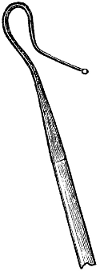
SHEPHERD’S CROOK.
This convenient implement for catching sheep is of the form represented
in the cut accompanying, of three-eighths inch round iron, drawn smaller
toward the point, which is made safe by a knot. The other end is
furnished with a socket, which receives a handle six or eight feet long.
In using it, the hind leg is hooked in from behind the sheep, and it
fills up the narrow part beyond that point, while passing along it until
it reaches the loop, when the animal is caught by the hook, and when
secured, its foot easily slips through the loop. Some caution is
required in its use; for, should the animal give a sudden start forward
to get away, the moment it feels the crook, the leg will be drawn
forcibly through the narrow part, and strike the bone with such violence
against the bend of the loop as to cause the animal considerable pain,
and even occasion
lameness for some days. On first embracing the leg,
the crook should be drawn quickly toward the shepherd, so as to bring
the bend of the loop against the leg as high up as the hock, before the
sheep has time even to break off; and being secure, its struggles will
cease the moment the hand seizes the leg.
No shepherd should be without this implement, as it saves much yarding
and running, and leads to a prompt examination of every improper or
suspicious appearance, and a seasonable application of remedy or
preventive, which would often be deferred if the whole flock had to be
driven to a distant yard to effect the catching of a single sheep.
Dexterity in its use is speedily acquired by any one; and if a flock are
properly tame, any one of its number can be readily caught by it at
salting-time, or, generally, at other times, by a person with whom the
flock are familiar. It is, however, at the lambing-time, when sheep and
lambs require to be so repeatedly caught, that the crook is more
particularly serviceable. For this purpose, at that time alone, it will
pay for itself ten times over in a single season, in saving time, to say
nothing of the advantage of the sheep.
Driving. Mutton can be grown cheaper than any other kind of meat. It is
fast becoming better appreciated; and, strange as it may seem, good
mutton brings a higher price in our best markets than the same quality
does in England. Its substitution in a large measure for pork would
contribute materially to the health of the community.
Winter fattening of sheep may often be made very profitable and
deserves greater attention, especially where manure is an object; and
the instances are few, indeed, where it is not. In England, it is
considered good policy to fatten sheep, if the increase of weight will
pay for the oil-cake or grain consumed; the manure being deemed a fair
equivalent for the other food—that is, as much straw and turnips as
they will eat. Lean sheep there usually command as high a price per
pound in the fall as fatted ones in the spring; while, in this country,
the latter usually bear a much higher price, which gives the feeder a
great advantage.
The difference may be best illustrated by a simple calculation. Suppose
a wether of a good mutton breed, weighing eighty pounds in the fall, to
cost six cents per pound, amounting to four dollars and eighty cents,
and to require twenty pounds of hay per week, or its equivalent in other
food, and to gain a pound and a half each week; the gain in weight in
four months would be about twenty-five pounds, which, at six cents per
pound, would be one dollar and fifty cents, or less than ten dollars per
ton for the hay consumed; but if the same sheep could be bought in the
fall for three cents per pound, and sold in the spring for six cents,
the gain would amount to three dollars and ninety cents, or upwards of
twenty dollars per ton for the hay—the manure being the same in either
case.
For fattening, it is well to purchase animals as large and thrifty, and
in as good condition as can be had at fair prices; and to feed
liberally, so as to secure the most rapid increase that can be had
without waste of food. The fattening of sheep by the aid of oil-cake, or
grain purchased for the purpose, may often be made a cheaper mode of
obtaining manure than by the purchase of artificial fertilizers, as
guano, super-phosphate of lime, and the like; and it is altogether
preferable. It is practised extensively and advantageously abroad, and
deserves at least a fair trial among us.
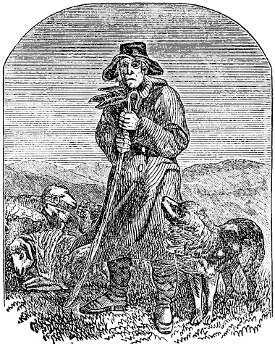
THE SHEPHERD AND HIS FLOCK.
Sheep which are to be driven to market should not begin their journey
either when too full or too hungry; in the former state, they are apt to
purge while on the road, and in the latter, they will lose strength at
once. The sheep selected for market should be those in the best
condition at the time; and to ascertain this, it is necessary to examine
the whole lot, and separate the fattest from the rest, which is best
done at about mid-day, before the sheep feed again in the afternoon. The
selected ones are placed in a field by themselves, where they remain
until the time for starting. If there be rough pasture to give them,
they should be allowed to use it, in order to rid themselves of some of
the food which might be productive of inconvenience on the journey. If
there is no such pasture, a few cut turnips will answer. All their
hoofs should be carefully examined, and every unnecessary appendage
removed, though the firm portion of the horn should not be touched.
Every clotted piece of wool should also be removed with the shears, and
the animals properly marked.
Being thus prepared, they should have feed early in the morning, and be
started, in the cold season, about mid-day. Let them walk quietly away;
and as the road is new to them, they will go too fast at first, to
prevent which, the drover should go before them, and let his dog bring
up the rear. In a short time they will assume the proper speed—about
one mile an hour. Should the road they travel be a green one, they will
proceed nibbling their way onward at the grass along both sides; but if
it is a narrow turnpike, the drover will require all his attention in
meeting and being passed by various vehicles, to avoid injury to his
charge. In this part of their business, drovers generally make too much
ado; and the consequence is, that the sheep are driven more from side to
side of the road than is requisite. Upon meeting a carriage, it would be
much better for the sheep, were the drover to go forward, instead of
sending his dog, and point off with his stick the leading sheep to the
nearest side of the road; and the rest will follow, as a matter of
course, while the dog walks behind the flock and brings up the
stragglers. Open gates to fields are sources of great annoyance to
drovers, the stock invariably making an endeavor to go through them. On
observing an open gate ahead, the drover should send his dog behind him
over the fence, to be ready to meet the sheep at the gate. When the
sheep incline to rest, they should be allowed to lie down.
When the animals are lodged for the night, a few turnips or a little hay
should be furnished to them, if the road-sides are bare. If these are
placed near the gate of the field which they occupy, they will be ready
to take the road again in the morning. As a precaution against worrying
dogs, the drover should go frequently through the flock with a light,
retire to rest late, and rise up early in the morning. These precautions
are necessary; since, when sheep have once been disturbed by dogs, they
will not settle again upon the road. The first day’s journey should be a
short one, not exceeding four or five miles. The whole journey should be
so marked out as that, allowance being made for unforeseen delays, the
animals may have one day’s rest near the market.
Points of fat sheep. The formation of fat, in a sheep destined to be
fattened, commences in the inside, the web of fat which envelopes the
intestines being first formed, and a little deposited around the
kidneys. After that, fat is seen on the outside; and first upon the end
of the rump at the tail-head, continuing to move on along the back, on
both sides of the spine, or back-bone, to the bend of the ribs to the
neck. Then it is deposited between the muscles, parallel with the
cellular tissue. Meanwhile, it is covering the lower round of the ribs
descending to the flanks, until the two sides meet under the belly,
whence it proceeds to the brisket, or breast, in front, and the sham or
cod behind, filling up the inside of the arm-pits and thighs. While all
these depositions are proceeding on the outside, the progress in the
inside is not checked, but rather increased, by the fattening
disposition encouraged by the acquired condition; and, hence,
simultaneously, the kidneys become entirely covered, and the space
between the intestines and the lumbar region, or loin, gradually filled
up by the web and kidney fat.
By this time the cellular spaces around each fibre of muscle are
receiving their share; and when fat is deposited there in quantity, it
gives to the meat the term marbled. These inter-fibrous spaces are the
last to receive a deposition of fat; but after this has begun, every
other part at the same time receives its due share, the back and kidneys
securing the most, so much so that the former literally becomes
nicked, as it is termed—that is, the fat is felt through the skin to
be divided into two portions, from the tail-head along the back to the
top of the shoulder; and the tail becoming thick and stiff, the top of
the neck broad, the lower part of each side of the neck toward the
breasts full, and the hollows between the breast-bone and the inside of
the fore legs, and between the cod and the inside of the hind thighs,
filled up. When all this has been accomplished, the sheep is said to be
fat, or ripe.
When the body of a fat sheep is entirely overlaid with fat, it is in the
most valuable state as mutton. Few sheep, however, lay on fat entirely
over their body; one laying the largest proportion on the rump, another
on the back; one on the parts adjoining the fore-quarter, another on
those of the hind-quarter; and one more on the inside, and another more
on the outside. Taking so many parts, and combining any two or more of
them together, a considerable variety of condition will be found in any
lot of fat sheep, while any one is as ripe in its way as any other.
With these data for guides, the state of a sheep in its progress toward
ripeness may be readily detected by handling. A fat sheep, however, is
easily known by the eye, from the fullness exhibited by all the
external parts of the particular animal. It may exhibit want in some
parts when compared with others; but those parts, it may easily be seen,
would never become so ripe as the others; and this arises from some
constitutional defect in the animal itself; since, if this were so,
there is no reason why all the parts should not be alike ripe. The state
of a sheep that is obviously not ripe cannot altogether be ascertained
by the eye. It must be handled, or subjected to the scrutiny of the
hand. Even in so palpable an act as handling, discretion is requisite. A
full-looking sheep needs hardly to be handled on the rump; for he would
not seem so full, unless fat had first been deposited there. A
thin-looking sheep, on the other hand, should be handled on the rump;
and if there be no fat there, it is useless to handle the rest of the
body, for certainly there will not be so much as to deserve the name of
fat. Between these two extremes of condition, every variety exists; and
on that account examination by the hand is the rule, and by the eye
alone the exception. The hand is, however, much assisted by the eye,
whose acuteness detects deficiencies and redundancies at once.
In handling sheep, the points of the fingers are chiefly employed; and
the accurate knowledge conveyed by them, through practice, of the exact
state of the condition, is truly surprising, and establishes a
conviction in the mind that some intimate relation exists between the
external and internal state of an animal. Hence originates this
practical maxim in judging stock of all kinds—that no animal will
appear ripe to the eye, unless as much fat had previously been acquired
in the inside as constitutional habit will allow.
The application of this rule is easy. When the rump is
found nicked, on
handling, fat is to be found on the back; when the back is found nicked,
fat is to be expected on the top of the shoulder and over the ribs; and
when the top of the shoulder proves to be nicked, fat may be anticipated
on the under side of the belly, To ascertain its existence below, the
animal must be turned up, as it is termed; that is, the sheep is set
upon his rump, with his back down, and his hind feet pointing upward and
outward. In this position, it can be seen whether the breast and thighs
are filled up. Still, all these alone would not disclose the state of
the inside of the sheep, which should, moreover, be looked for in the
thickness of the flank; in the fullness of the breast, that is, the
space in front from shoulder to shoulder toward the neck; in the
stiffness and thickness of the root of the tail; and in the breadth of
the back of the neck. All these latter parts, especially with the
fullness of the inside of the thighs, indicate a fullness of fat in the
inside; that is, largeness of the mass of fat on the kidneys, thickness
of net, and thickness of layers between the abdominal muscles. Hence,
the whole object of feeding sheep on turnips and the like seems to be to
lay fat upon all the bundles of fleshy fibres, called muscles, that are
capable of acquiring that substance; for, as to bone and muscle, these
increase in weight and extent independently of fat, and fat only
increases in their magnitude.
Slaughtering. Sheep are easily slaughtered, and the operation is
unattended with cruelty. They require some preparation before being
deprived of life, which consists in food being withheld from them for
not less than twenty-four hours, according to the season. The reason for
fasting sheep before slaughtering is to give time for the paunch and
intestines
to empty themselves entirely of food, as it is found that,
when an animal is killed with a full stomach, the meat is more liable to
putrefy, and it not so well flavored; and, as ruminating animals always
retain a large quantity of food in their intestines, it is reasonable
that they should fast somewhat longer to get rid of it, than animals
with single stomachs.
Sheep are placed on their side—sometimes upon a stool, called a
killing-stool—to be slaughtered, and, requiring no fastening with
cords, are deprived of life by the use of a straight knife through the
neck, between its bone and the windpipe, severing the carotid artery and
the jugular vein of both sides, from which the blood flows freely out,
and the animal soon dies.
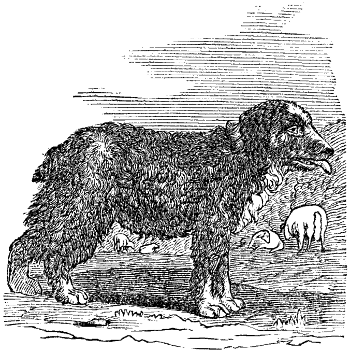
DROVER’S OR BUTCHER’S DOG.
The skin, as far as it is covered with wool, is taken off, leaving that
on the legs and head, which are covered with hair, the legs being
disjointed by the knee. The entrails are removed by an incision along
the belly, after the carcass has been hung up by the tendons of the
boughs. The net is carefully separated from the viscera, and rolled up
by itself; but the kidney fat is not then extracted. The intestines are
placed on the inner side of the skin until divided into the pluck,
containing the heart, lungs, and liver; the bag, containing the stomach;
and the puddings, consisting of the
viscera, or guts. The latter are
usually thrown away; though the Scotch, however, clean them and work
them up into their favorite haggis. The skin is hung over a rope or
pole under cover, with the skin-side uppermost, to dry in an airy place.
The carcass should hang twenty-four hours in a clean, cool, airy, dry
apartment before it is cut down. It should be cool and dry; for, if
warm, the meat will not become firm; and, if damp, a clamminess will
cover it, and it will never feel dry, and present a fresh, clean
appearance. The carcass is divided in two, by being sawed right down the
back-bone. The kidney-fat is then taken out, being only attached to the
peritoneum by the cellular membrane, and the kidney is extracted from
the suet, the name given to sheep-tallow in an independent state.
Cutting up. Of the two modes of cutting up a carcass of mutton, the
English and the Scotch—of the former, the practice in London being
taken as the standard, and of the latter, that of Edinburgh, since more
care is exercised in this respect in these two cities—the English is,
perhaps, preferable; although the Scotch accomplish the task in a
cleanly and workmanlike manner.
The jigot is the most handsome and valuable part of the carcass,
bringing the highest price, and is either a roasting or a boiling piece.
A jigot of Leicester, Cheviot, or South-Down mutton makes a beautiful
boiled leg of mutton, which is prized the more the fatter it is—this
part of the carcass being never overloaded with fat. The loin is
almost always roasted, the flap of the flank being skewered up, and it
is a juicy piece. Many consider this piece of Leicester mutton, roasted,
as too rich; and when warm this is, probably, the case; but a cold
roast loin is an excellent summer dish. The back-rib is divided into
two, and used for very different purposes. The forepart—the neck—is
boiled, and makes sweet barley-broth; and the meat, when boiled, or
rather the whole simmered for a considerable time beside the fire, eats
tenderly. The back-ribs make an excellent roast; indeed, there is not a
sweeter or more varied one in the whole carcass, having both ribs and
shoulder. The shoulder-blade eats best cold, and the ribs, warm. The
ribs make excellent chops, the Leicester and South-Down affording the
best. The breast is mostly a roasting-piece, consisting of rib and
shoulder, and is particularly good when cold. When the piece is large,
as of the South-Down or Cheviot, the gristly parts of the ribs may be
divided from the true ribs, and helped separately. This piece also boils
well; or, when corned for eight days, and served with onion sauce, with
mashed turnips in it, there are few more savory dishes at a farmer’s
table. The shoulder is separated before being dressed, and makes an
excellent roast for family use, being eaten warm or cold, or carved and
dressed as the breast mentioned above. The shoulder is best from a large
carcass of South-Down, Cheviot, or Leicester. The neck-piece is partly
laid bare by the removal of the shoulder, the forepart being fitted for
boiling and making into broth, and the best part for roasting or
broiling into chops. On this account, it is a good family piece, and
generally preferred to any part of the hind-quarter. Heavy sheep, such
as the Leicester, South-Down, and Cheviot, supply the most thrifty
neck-piece.
Relative qualities. The different sorts of mutton in common use differ
as well in quality as in quantity. The flesh of the Leicester is
large, though not coarse-grained, of a lively red color, and the
cellular tissue between the fibres contains a considerable quantity of
fat. When cooked, it is tender and juicy, yielding a red gravy, and
having a sweet, rich taste; but the fat is rather too much and too rich
for some people’s tastes, and can be put aside. It must be allowed that
the lean of fat meat is far better than lean meat that has never been
fat. Cheviot mutton is smaller in the grain, not so bright of color,
with less fat, less juice, not so tender and sweet; but the flavor is
higher, and the fat not so luscious. The mutton of South-Downs is of
medium fineness in grain, color pleasant red, fat well intermixed with
the meat, juicy, and tenderer than Cheviot. The mutton of rams of any
breed is always hard, of disagreeable flavor, and, in autumn, not
eatable; that of old ewes is dry, hard, and tasteless; of young ones,
well enough flavored, but still rather dry; while wether-mutton is the
meat in perfection, according to its kind.
The want of relish, perhaps the distaste, for mutton has served as an
obstacle to the extension of sheep husbandry in the United States. The
common mistake in the management of mutton among us is, that it is
eaten, as a general thing, at exactly the wrong time after it is killed.
It should be eaten immediately after being killed, and, if possible,
before the meat has time to get cold; or, if not, then it should be kept
a week or more—in the ice-house, if the weather require—until the time
is just at hand when the fibre passes the state of toughness which it
takes on at first, and reaches that incipient or preliminary point in
its process toward putrefaction when the fibres begin to give way, and
the meat becomes tender.
An opinion likewise generally prevails that mutton does not attain
perfection in juiciness and flavor much under five years.
If this be so, that breed of sheep must be very unprofitable which takes
five years to attain its full state; and there is no breed of sheep in
this country which requires five years to bring it to perfection. This
being the case, it must be folly to restrain sheep from coming to
perfection until they have reached that age. Lovers of five-year-old
mutton do not pretend that this course bestows profit on the farmer, but
only insist on its being best at that age. Were this the fact, one of
two absurd conditions must exist in this department of agriculture:
namely, the keeping a breed of sheep that cannot, or that should not be
allowed to, attain to perfection before it is five years old; either of
which conditions makes it obvious that mutton cannot be in its best
state at five years.
The truth is, the idea of mutton of this age being especially excellent,
is founded on a prejudice, arising, probably, from this circumstance:
before winter food was discovered, which could maintain the condition of
stock which had been acquired in summer, sheep lost much of their summer
condition in winter, and, of course, an oscillation of condition
occurred, year after year, until they attained the age of five years;
when their teeth beginning to fail, would cause them to lose their
condition the more rapidly. Hence, it was expedient to slaughter them at
not exceeding five years of age; and, no doubt, mutton would be
high-flavored at that age, that had been exclusively fed on natural
pasture and natural hay. Such treatment of sheep cannot, however, be
justified on the principles of modern practice; because both reason and
taste concur in mutton being at its best whenever sheep attain their
perfect state of growth and condition, not their largest and heaviest;
and as one breed attains its perfect state at an earlier age than
another, its mutton attains its best before another breed attains what
is its best state, although its sheep may be older; but taste alone
prefers one kind of mutton to another, even when both are in their best
state, from some peculiar property. The cry for five-year-old mutton is
thus based on very untenable grounds; the truth being that well-fed and
fatted mutton is never better than when it gets its full growth in its
second year; and the farmer cannot afford to keep it longer, unless the
wool would pay for the keep, since we have not the epicures and men of
wealth who would pay the butcher the extra price, which he must have, to
enable him to pay a remunerating price to the grazier for keeping his
sheep two or three years over.
All writers on diet agree in describing mutton as the most valuable of
the articles of human food. Pork may be more stimulating, beef perhaps
more nutritious, when the digestive powers are strong; but, while there
is in mutton sufficient nutriment, there is also that degree of
consistency and readiness of assimilation which renders it most
congenial to the human stomach, most easy of digestion, and most
promotive of human health. Of it, almost alone, can it be said that it
is our food in sickness, as well as in health; its broth is the first
thing, generally, that an invalid is permitted to taste, the first thing
that he relishes, and is a natural preparation for his return to his
natural aliment. In the same circumstances, it appears that fresh
mutton, broiled or boiled, requires three hours for digestion; fresh
mutton, roasted, three and one-fourth hours; and mutton-suet, boiled,
four and one-half hours.
Good ham may be made of any part of a carcass of mutton, though the
leg is preferable; and for this purpose it is cut in the English
fashion. It should be rubbed all over with good salt, and a little
saltpetre, for ten minutes, and then laid in a dish and covered with a
cloth for eight or ten days. After that, it should be slightly rubbed
again, for about five minutes, and then hung up in a dry place, say the
roof of the kitchen, until used. Wether mutton is used for hams, because
it is fat, and it may be cured any time from November to May; but
ram-mutton makes the largest and highest-flavored ham, provided it be
cured in spring, because it is out of season in autumn.
There is an infallible rule for ascertaining the age of mutton by
certain marks on the carcass. Observe the color of the breast-bone, when
a sheep is dressed—that is, where the breast-bone is separated—which,
in a lamb, or before it is one year old, will be quite red; from one to
two years old, the upper and lower bone will be changing to white, and a
small circle of white will appear round the edges of the other bones,
and the middle part of the breast-bone will yet continue red; at three
years old, a very small streak of red will be seen in the middle of the
four middle bones, and the others will be white; and at four years, all
the breast-bone will be of a white or gristly color.
Contributions to manufactures. The products of sheep are not merely
useful to man; they provide his luxuries as well. The skin of sheep is
made into leather, and, when so manufactured with the fleece on, makes
comfortable mats for the doors of rooms, and rugs for carriages. For
this purpose, the best skins are selected, and such as are covered with
the longest and most beautiful fleece. Tanned sheep-skin is used in
coarse book-binding. White sheep-skin, which is not
tanned, but so
manufactured by a peculiar process, is used as aprons by many classes of
workmen, and, in agriculture, as gloves in the harvest; and, when cut
into strips, as twine for sewing together the leather coverings and
stuffings of horse-collars. Morocco leather is made of sheep-skins, as
well as of goat-skins, and the bright red color is given to it by
cochineal. Russia leather is also made of sheep-skins, the peculiar
odor of which repels insects from its vicinity, and resists the mould
arising from damp, the odor being imparted to it in currying, by the
empyreumatic oil of the bark of the birch-tree. Besides soft leather,
sheep-skins are made into a fine, flexible, thin substance, known by the
name of parchment; and, though the skins of all animals might be
converted into writing materials, only those of the sheep and the
she-goat are used for parchment. The finer quality of the substance,
called vellum, is made of the skins of kids and dead-born lambs; and
for its manufacture the town of Strasburgh has long been celebrated.
Mutton-suet is used in the manufacture of common candles, with a
proportion of ox-tallow. Minced suet, subjected to the action of
high-pressure steam in a digester, at two hundred and fifty or two
hundred and sixty degrees of Fahrenheit, becomes so hard as to be
sonorous when struck, whiter, and capable, when made into candles, of
giving very superior light. Stearic candles, the invention of the
celebrated Guy Lussac, are manufactured solely from mutton-suet.
Besides the fat, the intestines of sheep are manufactured into various
articles of luxury and utility, which pass under the absurd name of
catgut. All the intestines of sheep are composed of four layers, as in
the horse and cattle. The outer, or peritoneal one, is formed of that
membrane, by which every portion of the belly and its contents is
invested, and confined in its natural and proper situation. It is highly
smooth and polished, and secretes a watery fluid which contributes to
preserve that smoothness, and to prevent all friction and concussion
during the different motions of the animal. The second is the muscular
coat, by means of which the contents of the intestines are gradually
propelled from the stomach to the rectum, thence to be expelled when all
the useful nutriment is extracted. The muscles, as in all the other
intestines, are disposed in two layers, the fibres of the outer coat
taking a longitudinal direction, and the inner layer being circular—an
arrangement different from that of the muscles of the œsophagus, and
in both beautifully adapted to the respective functions of the tube. The
submucous coat comes next. It is composed of numerous glands,
surrounded by cellular tissue, and by which the inner coat is
lubricated, so that there may be no obstruction to the passage of the
food. The mucous coat is the soft villous one lining the intestinal
cavity. In its healthy state, it is always covered with mucus; and when
the glands beneath are stimulated, as under the action of physic, the
quantity of mucus is increased; it becomes of a more watery character;
the contents of the intestines are softened and dissolved by it; and by
means of the increased action of the muscular coat, which, as well as
the mucous one, feels the stimulus of the physic, the fæces are
hurried on more rapidly and discharged.
In the manufacture of some sorts of cords from the intestines of
sheep, the outer peritoneal coat is taken off and manufactured into a
thread to sew intestines, and make the cords of rackets and battledores.
Future washings cleanse the guts, which are then twisted into
different-sized cords for various purposes; some of the best known of
which are whip-cords, hatter’s cords for bow-strings, clock-maker’s
cords, bands for spinning-wheels, now almost obsolete, and fiddle and
harp-strings. Of the last class, the cords manufactured in Italy are
superior in goodness and strength; and the reason assigned is, that the
sheep of that country are both smaller and leaner than the breeds most
in vogue in England and in this country. The difficulty in manufacturing
from other breeds of sheep lies, it seems, in making the treble strings
from the fine peritoneal coat, their chief fault being weakness; by
reason of which the smaller ones are hardly able to bear the stretch
required for the higher notes in concert-pitch, maintaining, at the same
time, in their form and construction, that tenuity or smallness of
diameter which is required in order to produce a brilliant and clear
tone.
[195]
The dry and healthful climate, the rolling surface, and the sweet and
varied herbage, which generally prevail in the United States, insure
perfect health to an originally sound and well-selected flock, unless
they are peculiarly exposed to disease. No country is better suited to
sheep than most of the Northern and some of the Southern portions of our
own. In Europe, and especially in England, where the system of
management is, necessarily, in the highest degree artificial,
consisting, frequently, in an early and continued forcing of the system,
folding on wet, ploughed ground, and the excessive use of that watery
food, the Swedish turnip, there are numerous and
fatal diseases, a long
list of which invariably cumbers the pages of foreign writers on this
animal.
The diseases incident to our flocks, on the contrary, may generally be
considered as casualties, rather than as inbred, or necessarily arising
from the quality of food, or from local causes. It may be safely
asserted that, with a dry pasture, well stocked with varied and
nutritious grasses; a clear, running stream; sufficient shade and
protection against severe storms; a constant supply of salt, tar, and
sulphur in summer; good hay, and sometimes roots, with ample shelters in
winter—young sheep, originally sound and healthy, will seldom or never
become diseased on American soil.
The comparatively few diseases, which it may be necessary here to
mention, are arranged in alphabetical order—as in the author’s “Cattle
and their Diseases”—for convenience of reference, and treated in the
simplest manner. Remedies of general application, to be administered
often by the unskilful and ignorant, must neither be elaborate nor
complicated; and, if expensive, the lives of most sheep would be dearly
purchased by their application.
A sheep, which has been reared or purchased at the ordinary price, is
the only domestic animal which can die without material loss to its
owner. The wool and felt will, in most instances, repay its cost, while
the carcass of other animals will be worthless, except for manure. The
loss of sheep, from occasional disease, will leave the farmer’s pocket
in a very different condition from the loss of an equal value in horses
or cattle. Humanity, however, alike with interest, dictates the use of
such simple remedies, for the removal of suffering and disease, as may
be within reach.
[197]
The stomach into which medicines are to be administered is the fourth,
or digesting stomach. The comparatively insensible walls of the rumen,
or paunch, are but slightly acted upon, except by doses of very improper
magnitude. Medicine, to reach the fourth stomach, should be given in a
state as nearly approaching fluidity as may be. Even then it may be
given in such a manner as to defeat the object in view.
If the animal forcibly gulps fluids down, or if they are given hastily
and bodily, they will follow the caul at the base of the gullet with
considerable momentum, force asunder the pillars, and enter the rumen;
if they are drunk more slowly, or administered gently, they will trickle
down the throat, glide over these pillars, and pass on through the
maniplus to the true stomach.
Bleeding from the ears or tail, as is commonly practised, rarely
extracts a quantity of blood sufficient to do any good where bleeding is
indicated. To bleed from the eye-vein, the point of a knife is usually
inserted near the lower extremity of the pouch below the eye, pressed
down, and then a cut made inward toward the middle of the face.
Bleeding from the angular or cheek-vein is recommended, in the lower
part of the cheek, at the spot where the root of the fourth tooth is
placed, which is the thickest part of the cheek, and is marked on the
external surface of the bone of the upper jaw by a tubercle,
sufficiently prominent to be very sensible to the finger when the skin
of the cheek is touched. This tubercle is a certain index to the
angular vein, which is placed below. The shepherd takes the sheep
between his legs; his left hand more advanced than his right, which he
places under the head, and grasps the under jaw near to the hinder
extremity, in order to press the angular vein, which passes in that
place, for the purpose of making it swell; he touches the right cheek at
the spot nearly equidistant from the eye and mouth, and there finds the
tubercle which is to guide him, and also feels the angular vein swelled
below this tubercle; he then makes the incision from below upward, half
a finger’s breadth below the middle of the tubercle. When the vein is no
longer pressed upon, the bleeding will commonly cease; if not, a pin may
be passed through the lips of the orifice, and a lock of wool tied round
them.
For thorough bleeding, the jugular vein is generally to be preferred.
The sheep should be firmly held by the head by an assistant, and the
body confined between his knees, with its rump against a wall. Some of
the wool is then cut away from the middle of the neck over the jugular
vein, and a ligature, brought in contact with the neck by opening the
wool, is tied around it below the shorn spot near the shoulder. The vein
will soon rise. The orifice may be secured, after bleeding, as before
described.
The good effects of bleeding depend almost as much on the rapidity
with which the blood is abstracted, as the amount taken. This is
especially true in acute diseases. Either bleed rapidly or do not bleed
at all. The orifice in the vein, therefore, should be of some length,
and made lengthwise with the vein. A lancet is by far the best
implement; and even a short-pointed penknife is preferable to the
bungling gleam.
Bleeding, moreover, should always be resorted to, when
it is indicated at all, as nearly as possible to the commencement of
the malady.
The amount of blood drawn should never be determined by admeasurement,
but by constitutional effect—the lowering of the pulse, and indications
of weakness. In urgent cases—apoplexy, or cerebral inflammation, for
example—it would be proper to bleed until the sheep staggers or falls.
The quantity of blood in the sheep is less, in comparison, than that in
the horse or ox. The blood of the horse constitutes about one-eighteenth
part of his weight; and that of the ox at least one-twentieth; while
that of the sheep, in ordinary condition, is one-twenty-second. For this
reason, more caution should be exercised in bleeding the latter,
especially in frequently resorting to it; otherwise, the vital powers
will be rapidly and fatally prostrated. Many a sheep has been destroyed
by bleeding freely in disorders not requiring it, and in disorders which
did require it at the commencement, but of which the inflammatory stage
had passed.
The number of pulsations can be determined by feeling the heart beat on
the left side. The femoral artery passes in an oblique direction across
the inside of the thigh, and about the middle of the thigh its
pulsations and the character of the pulse can be most readily noted. The
pulsations per minute, in a healthy adult sheep, are sixty-five in
number; though they have been stated at seventy, and even seventy-five.
[200]
Soon after the sheep are turned to grass in the spring, one of the
best-conditioned sheep in the flock is sometimes suddenly found dead.
The symptoms which precede the catastrophe are occasionally noted. The
sheep leaps frantically into the air two or three times, dashes itself
on the ground, and suddenly rises, and dies in a few minutes.
Where animals in somewhat poor condition are rather forced forward for
the purpose of raising their condition, it sometimes happens that they
become suddenly blind and motionless; they will not follow their
companions; when approached, they run about, knocking their heads
against fences, etc.; the head is drawn round toward one side; they
fall, grind their teeth, and their mouths are covered with a frothy
mucus. Such cases are, unquestionably, referable to a determination of
blood to the brain.
Treatment. If the eyes are prominent and fixed, the membranes of the
mouth and nose highly florid, the nostrils highly dilated, and the
respiration labored and stertorous, the veins of the head turgid, the
pulse strong and rather slow, and these symptoms attended by a partial
or entire loss of sight and hearing, it is one of those decided cases of
apoplexy which require immediate and energetic treatment. Recourse
should at once be had to the jugular vein, and the animal bled until an
obvious constitutional effect is produced—the pulse lowered, and the
rigidity of the muscles relaxed. An aperient should at once follow
bleeding; and if the animal is strong and plathoric, a sheep of the size
of the Merino would require at least two ounces of Epsom salts, and one
of the large mutton sheep, more. If this should fail to open the
bowels, half an ounce of the salts should be given, say twice a day.
This is manifested by uneasiness; loathing of food; frequent drinking;
carrying the head down; drawing the back up; swollen belly; feverish
symptoms; and avoidance of the flock. It appears mostly in late autumn
and spring, and may be induced by exposure to severe storms, plunging in
water when hot, and especially by constipation, brought on by feeding on
frostbitten, putrid, or indigestible herbage. Many sheep die on the
prairies from this disease, induced by exposure and miserable forage.
Entire prevention is secured by warm, dry shelters, and nutritious, dry
food.
Treatment. Remedies, to be successful, must be promptly applied. Bleed
freely; and to effect this, immersion in a tub of hot water may be
necessary, in consequence of the stagnant state of the blood. Then give
two ounces of Epsom salts, dissolved in warm water, with a handful of
common salt. If this is unsuccessful, give a clyster, made with a
pipeful of tobacco, boiled for a few minutes in a pint of water.
Administer half; and if this is not effectual, follow with the
remainder. Then bed the animal in dry straw, and cover with blankets;
assisting the purgatives with warm gruels, followed by laxative
provender till well.
Where sheep are subject to pneumonia, they are liable to bronchitis as
well, which is an inflammation of the mucous membrane, which lines the
bronchial tubes, or the air-passages
of the lungs. The symptoms are
those of an ordinary cold, but attended with more fever, and a
tenderness of the throat and belly when pressed upon.
Treatment. Administer salt in doses of from one and a half to two
ounces, with six or eight ounces of lime-water, given in some other part
of the day.
This is an inflammation of the mucous membrane, which lines the nasal
passages, and it sometimes extends to the larynx and pharynx. In the
first instance—where the lining of the nasal passages is alone and not
very violently affected—it is merely accompanied by an increased
discharge of mucus, and is rarely attended with much danger. In this
form, it is usually termed snuffles; and high-bred English
mutton-sheep, in this country, are apt to manifest more or less of it,
after every sudden change of weather. When the inflammation extends to
the mucous lining of the larynx and the pharynx, some degree of fever
usually supervenes, accompanied by cough, and some loss of appetite. At
this point, bleeding and purging are serviceable.
Catarrh rarely attacks the American fine-woolled sheep with sufficient
violence in summer to require the application of remedies. Depletion, in
catarrh, in our severe winter months, however, rapidly produces that
fatal prostration, from which it is almost impossible to bring the sheep
back, without bestowing an amount of time and care upon it, costing far
more than the worth of an ordinary animal.
The best course is to prevent the disease by judicious precaution.
With that amount of attention which every prudent farmer should bestow
on his sheep, the American Merino is but little subject to it. Good,
comfortable, and well-ventilated shelters, constantly accessible to the
sheep in winter, with a sufficiency of food regularly administered, are
usually a sufficient safeguard.
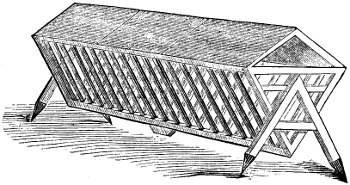
AN ENGLISH RACK FOR FEEDING SHEEP.
Essentially differing, in type and virulence, from the preceding, is an
epidemic, or, more properly speaking, an epizoötic malady, which, as
often as once in every eight or ten years, sweeps over extended sections
of the Northern States, destroying more sheep than all other diseases
combined. It commonly makes its appearance in winters characterized by
rapid and violent changes of temperature, which are spoken of by the
farmers as “bad winters” for sheep. The disease is sometimes termed the
“distemper,” and also, but erroneously, “grub in the head.” The winter
of 1846-7 proved peculiarly destructive to sheep in New York, and some
of the adjoining States; some owners losing one-half, others
three-quarters, and a few seven-eighths, of their flocks. One person
lost five
hundred out of eight hundred; another, nine hundred out of a
thousand. These severe losses, however, mainly fell on the holders of
the delicate Saxons, and perhaps, generally, on those possessing not the
best accommodations, or the greatest degree of energy and skill.
Symptoms. The primary and main disease, in such instances, is a
species of catarrh; differing, however, from ordinary catarrh in its
diagnosis, and in the extent of the lesions accompanying both the
primary and the symptomatic diseases. The animals affected do not,
necessarily, at first show any signs of violent colds, as coughing,
sneezing, or labored respiration; the only indications of catarrh
noticed, oftentimes, being a nasal discharge. Animals having this
discharge appear dull and drooping; their eyes run a little, and are
partially closed; the caruncle and lids look pale; their movements are
languid, and there is an indisposition to eat; the pulse is nearly
natural, though at times somewhat too languid. In a few days these
symptoms are evidently aggravated; there is rapid emaciation,
accompanied with debility; the countenance is exceedingly dull and
drooping; the eye is kept more than half closed; the caruncle, lids,
etc., are almost bloodless; a gummy, yellow secretion about the eye;
thick, glutinous mucus adhering in and about the nostrils; appetite
feeble; pulse languid; and muscular energy greatly prostrated. They
rapidly grow weaker, stumble, and fall as they walk, and soon become
unable to rise; the appetite grows feebler; the mucus at the nose is, in
some instances, tinged with dark, grumous blood; the respiration becomes
oppressed; and the animals die within a day or two after they become
unable to rise. Upon a post-mortem examination, the mucous membrane
lining the whole nasal cavity is found highly congested and thickened
throughout its entire extent, accompanied with the most intense
inflammation; slight ulcers are found on the membranous lining, at the
junction of the cellular ethmoid bones with the cribriform plate, in the
ethmoidal cells; and the inflammation extends to the mucous membrane of
the pharynx, and some inches, from two to four, of the upper portion of
the œsophagus.
No sheep, affected with this disease, recovers after emaciation and
debility have proceeded to any great extent. In the generality of
instances, the time, from the first observed symptoms until death,
varies from ten to fifteen days; although death, in some cases, results
more speedily.
Treatment. Nothing has been found so serviceable as mercury, which,
from its action on the entire secretory system, powerfully tends to
relieve the congested membranes of the head. Dissolve one grain of
bi-chloride of mercury—corrosive sublimate—in two ounces of water; and
give one-half ounce of the water, or one-eighth of a grain of corrosive
sublimate, daily, in two doses. To stimulate and open the bowels, give,
also, rhubarb in a decoction, the equivalent of ten or fifteen grains at
a dose, accompanied with the ordinary carminative and stomachic
adjuvants, ginger and gentian in infusion.
Sheep are occasionally seen, particularly in the winter, lying down and
rising every moment or two, and constantly stretching their fore and
hind legs so far apart that their bellies almost touch the ground. They
appear to be in much pain, refuse all food, and not unfrequently die,
unless relieved.
This disease, popularly known as the “stretches,” is
erroneously attributed to an involution of the part of the intestine
within another; it being, in reality, a species of flatulent colic,
induced by costiveness.
Treatment. Half an ounce of Epsom salts, a drachm of Jamaica ginger,
and sixty drops of essence of peppermint. The salts alone, however, will
effect the cure; as will, also, an equivalent dose of linseed oil, or
even hog’s lard.
This difficulty is removed by giving two table-spoonfuls of castor oil
every twelve hours, till the trouble ceases; or give one ounce of Epsom
salts. This may be assisted by an injection of warm weak suds and
molasses.
Common diarrhœa—purging, or scours—manifests itself simply by the
copiousness and fluidity of the alvine evacuations. It is generally
owing to improper food, as bad hay, or noxious weeds; to a sudden
change, as from dry food to fresh grass; to an excess, as from
overloading the stomach; and sometimes to cold and wet. It is important
to clearly distinguish this disease from dysentery. In diarrhœa,
there is no apparent general fever; the appetite remains good; the
stools are thin and watery, but unaccompanied with slime, or mucus, and
blood; odor of the fæces is far less offensive than in dysentery; and
the general condition of the animal is but little changed. When it is
light, and not of long continuance, no remedy is called for, since it is
a healthful provision of Nature for the more rapid expulsion of some
offending matter in the system, which, if retained, might lead to
disease.
Treatment. Confinement to dry food for a day or two, and a gradual
return to it, often suffices, in the case of grown sheep. With lambs,
especially if attacked in the fall, the disease is more serious. If the
purging is severe, and especially if any mucus is observed with the
fæces, the feculent matter should be removed from the bowels by a gentle
cathartic; half a drachm of rhubarb, or an ounce of linseed oil, or half
an ounce of Epsom salts to a lamb. This should be followed by an
astringent; and, in nine cases out of ten, the latter will serve in the
first instance. Give one quarter of an ounce of prepared chalk in half a
pint of tepid milk, once a day for two or three days; at the end of
which, and frequently after the first dose, the purging will have
ordinarily abated, or entirely ceased.
“Sheep’s cordial” is also a safe and excellent remedy—in severe cases,
better than simple chalk and milk. Take of prepared chalk, one ounce;
powdered catechu, half an ounce; powdered Jamaica ginger, two drachms;
and powdered opium, half a drachm; mix with half a pint of peppermint
water; give two or three table-spoonfuls morning and night to a grown
sheep, and half that quantity to a lamb.
From the introduction of foreign bodies into the biflex canal, or from
other causes, it occasionally becomes the seat of inflammation. This
canal is a small orifice, opening externally on the point of each
pastern, immediately above the cleft between the toes. It bifurcates
within, a tube passing down on each side of the inner face of the
pastern, winding round and ending in a cul de sac. Inflammation of
this canal causes an enlargement and redness of the pastern,
particularly about the external orifice of the canal. The toes are
thrown wide apart by the tumor. It rarely attacks more than one foot,
and should not be allowed to proceed to the point of ulceration which it
will do, if neglected. There is none of that soreness and
disorganization between the back part of the toes, and none of that
peculiar fetor which distinguishes the hoof-ail, with which disease it
is sometimes confounded.
Treatment. Scarify the coronet, making one or two deeper incisions in
the principal swelling around the mouth of the canal; and cover the foot
with tar.
This is occasioned by an inflammation of the mucous or inner coat of the
larger intestines, causing a preternatural increase in their secretions,
and a morbid alteration in their character. It is frequently consequent
on that form of diarrhœa, which is caused by an inflammation of the
mucous coat of the smaller intestines. The inflammation extends
throughout the whole alimentary canal, increases in virulence, and
becomes dysentery, a disease frequently dangerous and obstinate in its
character, but, fortunately, not common among sheep, generally, in the
United States. Its diagnosis differs from that of diarrhœa, in
several readily observed particulars. There is evident fever; the
appetite is capricious, commonly very feeble; the stools are as thin as
in diarrhœa, or even thinner, but much more adhesive, in consequence
of the presence of large quantities of mucus. As the erosion of the
intestines
advances, the fæces are tinged with blood; their odor is
intolerably offensive; and the animal rapidly wastes away, the course of
the disease extending from a few days to several weeks.
Treatment. Moderate bleeding should be resorted to, in the first or
inflammatory shape, or whenever decided febrile symptoms are found to be
present. Two doses of physic having been administered, astringents are
serviceable. The “sheep’s cordial,” already described, is as good as
any; and to this, tonics may soon begin to be added; an additional
quantity of ginger may enter into the composition of the cordial, and
gentian powder will be an useful auxiliary. With this, as an excellent
stimulus to cause the sphincter of the anus to contract, and also the
mouths of the innumerable secretory and exhalent vessels opening on the
inner surface of the intestines, a half grain of strychnine may be
combined. Smaller doses should be given for three or four days.
The proper treatment, upon the appearance of flies or maggots, has
already been detailed under the head of “Feeding and Management,” to
which the reader is referred.
Sheep are much less subject to this disease than cattle are; but
encounter it, if kept in wet, filthy yards, or on moist, poachy ground.
It is an irritation of the integument in the cleft of the foot, slightly
resembling incipient hoof-ail, and producing lameness. It occasions,
however, no serious structural disorganization, disappears without
treatment, is not
contagious, and appears in the wet weather of spring
and fall, instead of in the dry, hot period of summer, when the hoof-ail
rages most. A little solution of blue vitriol, or a little spirits of
turpentine—either followed by a coating of warm tar—promptly cures it.
For foul noses, dip a small swab in tar, then roll it in salt; put some
on the nose, and compel the sheep to swallow a small quantity.
If there be no wound of the soft parts, the bone simply being broken,
the treatment is extremely easy. Apply a piece of wet leather, taking
care to ease the limb when swelling supervenes. When the swelling is
considerable, and fever present, the best course is to open a vein of
the head or neck, allowing a quantity of blood to escape, proportioned
to the size and condition of the animal, and the urgency of the
symptoms. Purgatives in such cases should never be neglected. Epsom
salts, in ounce doses, given either as a gruel or a drench, will be
found to answer the purpose well. If the broken bones are kept steady,
the cure will be complete in from three to four weeks, the process of
reunion always proceeding faster in a young than in an old sheep. Should
the soft parts be injured to any extent, or the ends of the bone
protrude, recovery is very uncertain; and it will become a question
whether it would not be better to convert the animal at once into
mutton.
[211]
This is an inflammation of the udder, sometimes known as “caked bag,”
with or without general inflammation. Where it is simply an inflammation
of the udder, it is usually caused by too great an accumulation of milk
in the latter prior to lambing, or in consequence of the death of the
lamb.
Treatment. Drawing the milk partly from the bag, so that the hungry
lamb will butt and work at it an unusual time in pursuit of its food,
and bathing it a few times in cold water, usually suffices. If the
lamb is dead, the milk should be drawn a few times, at increasing
intervals, washing the udder for some time in cold water at each
milking. In cases of obdurate induration, the udder should be anointed
with iodine ointment. If there is general fever in the system, an ounce
of Epsom salts may be given. If suppuration forms, the part affected
should be opened with the lancet.
The “swelled neck” in lambs is, like the goitre, or bronchocele, an
enlargement of the thyroid glands, and is strikingly analogous to that
disease, if not identical with it. It is congenital. The glands at birth
are from the size of a pigeon’s egg to that of a hen’s egg, though
more elongated and flattened than an egg in their form. The lamb is
exceedingly feeble, and often perishes almost without an effort to suck.
Many even make no effort to rise, and die as soon as they are dropped.
It is rare, indeed, that one lives.
A considerable number of lambs annually perish from this disease, which
does not appear to be an epizoötic, though
it is more prevalent in some
seasons than in others. It does not seem to depend upon the water, or
any other natural circumstances of a region, as goitre is generally
supposed to, since it may not prevail in the same flock, or on the same
farm, once in ten years; nor can it be readily traced to any particular
kind of food. When it does appear, however, its attacks are rarely
isolated; from which circumstance some have inferred that it is induced
by some local or elimentary cause. Losses from this disease have ranged
from ten per cent. to twenty, thirty, and even fifty per cent. of the
whole number of lambs. Possibly, high condition in the ewes may be one
of the inducing causes.
Treatment. None is known which will reach the case. Should one having
the disease chance to live, it would scarcely be worth while to attempt
reducing the entanglement of the glands. Perhaps keeping the
breeding-ewes uniformly in fair, plump, but not high condition, would
be as effectual a preventive as any.
What is popularly known as the “grub” is the larva of the œstrus
oris, or gad-fly of the sheep. It is composed of five rings; is
tiger-colored on the back and belly, sprinkled with spots and patches of
brown; its wings are striped.
The sheep gad-fly is led by instinct to deposit its eggs within the
nostrils of the sheep. Its attempts to do this—most common in July,
August, and September—are always indicated by the sheep, which collect
in close clumps, with their heads inward, and their noses thrust close
to the ground, and into it, if any loose dirt or sand is within reach.
If the fly succeeds in depositing its egg, the latter is immediately
hatched by the warmth and moisture of the part, and the young grubs, or
larvæ, crawl up the nose, finding their devious way to the sinuses,
where, by means of their tentaculæ, or feelers, they attach themselves
to the mucous membrane lining those cavities. During the ascent of the
larvæ, the sheep stamps, tosses its head violently, and often dashes
away from its companions wildly over the field. The larvæ remain on the
sinuses, feeding on the mucus secreted by the membrane, and apparently
creating no further annoyance, until ready to assume their pupa form
in the succeeding spring.
Having remained in the sinuses during the fall and winter, they abandon
them as the warm weather approaches in the latter part of spring. They
crawl down the nose, creating even greater irritation and excitement
than when they originally ascended, drop on the ground, and rapidly
burrow into it. In a few hours, the skin of the larvæ has contracted,
become of a dark-brown color, and it has assumed the form of chrysalis.
This fly never eats; the male, after impregnating two or three females,
dies; and the latter, having deposited their ova in the nostrils of
the sheep, also soon perish.
The larvæ in the heads of sheep may, and probably do, add to the
irritation of those inflammatory diseases, such as catarrh, which attack
the membranous lining of the nasal cavities; and they are a powerful
source of momentary irritation in the first instance, when ascending to,
and descending from, their lodging-place in the head. But in the
interval between these events, extending over a period of several
months, not a movement of the sheep indicates the least annoyance at
their presence. They are, moreover, found in the heads of nearly all
sheep, the healthy as well as the diseased, at the proper season.
Treatment. Though the presence of the grub constitutes no disease,
some think it well to diminish their number by all convenient means. One
simple way of effecting this is, by turning up with a plough a furrow of
earth in the sheep-pasture, into which the sheep will thrust their noses
on the approach of the œstrus, and thus many of them escape its
attacks. Some farmers smear the noses of their sheep occasionally With
tar, the odor of which is believed to repel the fly. Another plan,
deemed efficacious in dislodging the larvæ from the sinuses, is as
follows: Take half a pound of good Scotch snuff, and two quarts of
boiling water; stir, and let it stand till cold. Inject about a
table-spoonful of this liquid and sediment up each nostril, with a
syringe; repeat this three or four times, at intervals, from the middle
of October till January. The efficacy of the snuff will be increased by
adding half an ounce of asafœtida, pounded in a little water. The
effects on the sheep are immediate prostration and apparent death; but
they will soon recover. A decoction of tobacco affords a substitute for
snuff; and some recommend blowing tobacco smoke through the tail of a
pipe into each nostril.
The first symptom of this troublesome malady, known, likewise, as
foot-ail, which is ordinarily noticed, is a lameness of one or both of
the fore-feet. On daily examining, however, the feet of a flock which
have the disease among them, it will readily be seen that the lesions
manifest themselves for several days before they are followed with
lameness.
The horny covering of the sheep’s foot extends up, gradually thinning
out, some way between the toes and divisions of the hoof, and above
these horny walls the cleft is lined with skin. When the points of the
toes are spread apart, this skin is shown in front, covered with short,
soft hair. The back part of the toes, or the heels, can be separated
only to a little distance, and the skin in the cleft above them is
naked. In a healthy foot, the skin throughout the whole cleft is as
firm, dry, and uneroded as on any other part of the animal.
The first symptom of hoof-ail is a slight erosion, accompanied with
inflammation and heat of the naked skin in the back parts of the
clefts, immediately above the heels. The skin assumes a macerated
appearance, and is kept moist by the presence of a sanious discharge
from the ulcerated surface. As the inflammation extends, the friction of
the parts causes pain, and the sheep limps. At this stage, the foot,
externally, in a great majority of cases, exhibits not the least trace
of disease, with the exception of a slight redness, and sometimes the
appearance of a small sore at the upper edge of the cleft, when viewed
from behind.
The ulceration of the surface rapidly extends. The thin upper edges of
the inner walls of the hoof are disorganized, and an ulceration is
established between the hoof and the fleshy sole. A purulent fetid
matter is discharged from the cavity. The extent of the separation
increases daily, and the ulcers also form sinuses deep into the fleshy
sole. The bottom of the hoof disappears, eaten away by the acrid matter,
and the outer walls, entirely separated from the flesh, hang only by
their attachments at the coronet. The whole fleshy sole is now entirely
disorganized, and the entire foot is a mass of black, putrid
ulceration; or, as more commonly happens, the fly has struck it, and a
dense mass of writhing maggots cover the surface, and burrow in every
cavity.
The fore-feet are generally first attacked; and, most usually but one of
them. The animal at first manifests but little constitutional
disturbance, and eats as usual. By the time that any considerable
disorganization of the structures has taken place in the first foot, and
sometimes sooner, the other forefoot is attacked. That becoming as lame
as the first, the miserable animal seeks its food on its knees; and, if
forced to rise, its strange, hobbling gait betrays the intense agony
occasioned by bringing its feet in contact with the ground. There is a
bare spot under the brisket, of the size of a man’s hand, which looks
red and inflamed. There is a degree of general fever, and the appetite
is dull. The animal rapidly loses condition. The appearance of the
maggot soon closes the scene. Where the rotten foot is brought in
contact with the side, in lying down, the filthy, ulcerous matter
adheres to, and saturates the short wool—it being but a month and a
half, or two months, after shearing—and maggots are either carried
there by the foot, or they are soon generated there. A black crust is
speedily formed round the spot, which is the decomposition of the
surrounding structures; and innumerable maggots are at work below,
burrowing into the integuments and muscles, and eating up the wretched
animal alive. The black, festering mass rapidly spreads, and the poor
sufferer perishes, apparently in tortures the most excruciating.
Sometimes but one forefoot is attacked, and subsequently one or both
hind ones. There is no uniformity in this particular; and it is a
singular fact that, when two or even three
of the feet are dreadfully
diseased, the fourth may be entirely sound. So, also, one foot may be
cured, while every other one is laboring under the malady. The highly
offensive odor of the ulcerated feet is so peculiar that it is strictly
characteristic of the disease, and would reveal its character, to one
familiar with it, in the darkest night.
Hoof-ail is probably propagated in this country exclusively by
inoculation—the contact of the matter of a diseased foot with the
integuments lining the bifurcation of a healthy foot. That it is
propagated in some of the ways classed under the ordinary designation of
contagion, is certain. That it may be propagated by inoculation, has
been established by experiment. The matter of diseased feet has been
placed on the skin lining the cleft of a healthy foot under a variety of
circumstances—sometimes when that skin is in its ordinary and natural
state, sometimes after a very slight scorification, sometimes when
macerated by moisture; and under each of these circumstances the disease
has been communicated. The same inference may be drawn, also, from the
manner in which the disease attacks flocks. The whole, or any
considerable number, though sometimes rapidly, are never
simultaneously attacked, as would be expected, among animals so
gregarious, if the disease could be transmitted by simple contact,
inhaling the breath, or other effluvium.
The matter of diseased feet is left on grass, straw, and other
substances, and thus is brought in contact with the inner surfaces of
healthy feet. Sheep, therefore, contract the disease from being driven
over the pastures, yarded on the straw, etc., where diseased sheep have
been, perhaps even days, before. The matter would probably continue to
inoculate, until dried up by the air and heat, or washed away by the
rains. The stiff, upright stems of closely mown grass, as on meadows,
are almost as well calculated to receive the matter of diseased feet,
and deposit it in the clefts of healthy ones, as any means which could
be artificially devised. It is not entirely safe to drive healthy sheep
over roads, and especially into washing-yards, or sheep-houses, where
diseased sheep have been, until rain has fallen, or sufficient time has
elapsed for the matter to dry up. On the moist bottom of a washing-yard,
and particularly in houses or sheds, kept from sun and wind and rain,
this matter might be preserved for some time in a condition to
inoculate.
When the disease has been well kept under during the first season of its
attack, but not entirely eradicated, it will almost or entirely
disappear as cold weather approaches, and it does not manifest itself
until the warm weather of the succeeding summer. It then assumes a
mitigated form; the sheep are not rapidly and simultaneously attacked;
there seems to be less inflammatory action constitutionally, and in the
diseased parts; the course of the disease is less malignant and more
tardy, and it more readily yields to treatment. If well kept under the
second summer, it is still milder the third. A sheep will occasionally
be seen to limp; but its condition will scarcely be affected, and
dangerous symptoms will rarely supervene. One or two applications made
during the summer, in a manner presently to be described, will suffice
to keep the disease under. At this point, a little vigor in the
treatment will rapidly extinguish the disease.
Treatment. The preparation of the foot, where any separate individual
treatment is resolved upon, is always necessary, at
least in bad cases.
Sheep should be yarded for the operation immediately after a rain, if
practicable, as the hoofs can then be readily cut. In a dry time, and
after a night which left no dew upon the grass, their hoofs are almost
as tough as horn. They must be driven through no mud, or soft dung, on
their way to the yard, which would double the labor of cleaning their
feet. The yard should be small, so that they can be easily caught, and
it must be kept well littered down, to prevent their filling their feet
with their own excrement. If the straw is wetted, their hoofs will not,
of course, dry and harden as rapidly as in dry straw. If the yard could
be built over a shallow, gravelly-bottomed brook, it would be an
admirable arrangement; for this purpose, a portion of any little brook
might be prepared, by planking the bottom, and widening it, if
desirable. By such means the hoofs would be kept so soft that the
greatest and most unpleasant part of the labor, as ordinarily performed,
would be in a great measure saved, and they would be kept free from that
dung which, by any other arrangement, will, more or less, get into their
clefts.
The principal operator seats himself on a chair, having within his reach
a couple of good knives, a whetstone, the powerful toe-nippers already
described, a bucket of water with a couple of linen rags in it, together
with such medicines as may be deemed necessary. The assistant catches a
sheep and lays it partly on its back and rump, between the legs of the
foreman, the head coming up about to his middle. The assistant then
kneels on some straw, or seats himself on a low stool at the hinder
extremity of the sheep. If the hoofs are long, and especially if they
are dry and tough, the assistant presents each foot to the operator who
shortens the hoof with
the toe-nippers. If there is any filth between
the toes, each man takes his rag from the bucket of water, and draws it
between the toes, and rinses it, until the filth is removed. Each then
takes a knife, and the process of paring away the horn commences, upon
the effectual performance of which all else depends. A glance at the
foot will show whether it is the seat of the diseased action. The least
experience cannot fail in properly settling this question. An
experienced finger, even, placed upon the back of the pastern close
above the heel, will at once detect the local inflammation, in the dark,
by its heat.
If the disease is in the first stage—that is, if there are merely
erosion and ulceration of the cuticle and flesh in the cleft above the
walls of the hoof—no paring is necessary. But if ulceration has
established itself between the hoof and the fleshy sole, the ulcerated
parts, however extensive, must be entirely stripped of their horny
covering, no matter what amount of time and care it may require. It is
better not to wound the sole so as to cause it to bleed freely, as the
running blood will wash off the subsequent application; but no fear of
wounding the sole must prevent a full compliance with the rule laid down
above. At the worst, the blood will stop flowing after a little while,
during which time no application needs to be made to the foot.
If the foot is in the third stage—a mass of rottenness, and filled with
maggots—pour, in the first place, a little spirits of turpentine—a
bottle of which, with a quill through the cork, should be always
ready—on the maggots, and most of them will immediately decamp, and the
others can be removed with a probe or small stick. Then remove every
particle of loose
horn, though it should take the entire hoof, as it
generally will in such cases. The foot should next be cleansed with a
solution of chloride of lime, in the proportion of one pound of chloride
to one gallon of water. If this is not at hand, plunging the foot
repeatedly in hot water, just short of scalding hot, will answer every
purpose. The great object is to clean the foot thoroughly. If there is
any considerable “proud flesh,” it should be removed with a pair of
scissors, or by the actual cautery—hot iron.
The following are some of the most popular remedies: Take two ounces of
blue vitriol and two ounces of verdigris, to a junk-bottle of wine; or
spirits of turpentine, tar, and verdigris in equal parts; or three
quarts of alcohol, one pint of spirits of turpentine, one pint of strong
vinegar, one pound of blue vitriol, one pound of copperas, one and a
half pounds of verdigris, one pound of alum, and one pound of saltpetre,
pounded fine; mix in a close bottle, shake every day, and let it stand
six or eight days before using; also mix two pounds of honey and two
quarts of tar, which must be applied after the preceding compound. Or
apply diluted aquafortis—nitric acid—with a feather to the ulcerated
surface; or diluted oil of vitriol—sulphuric acid—in the same way; or
the same of muriatic acid; or dip the foot in tar nearly at the boiling
point.
In the first and second stages of the disease, before the ulcers have
formed sinuses into the sole, and wholly or partly destroyed its
structure, the best application is a saturated solution of blue
vitriol—sulphate of copper. In the third stage, when the foot is a
festering mass of corruption, after it has been cleansed as already
directed, it requires some strong caustic to remove the unhealthy
granulations—the dead muscular structures—and to restore healthy
action. Lunar caustic, which is preferable to any other application, is
too expensive; chloride of antimony is excellent, but frequently
unattainable in the country drug-stores; and muriatic acid, or even
nitric or sulphuric acids, may be used instead. The diseased surface is
touched with the caustic, applied with a swab, formed by fastening a
little tow on the end of a stick, until the objects above pointed out
are attained. The foot is then treated with the solution of blue
vitriol, and subsequently coated over with tar which has been boiled,
and is properly cooled, for the purpose of protecting the raw wound from
dirt, flies, etc. Sheep in this stage of the disease should certainly be
separated from the main flock, and looked to as often as once in three
days. With this degree of attention, their cure will be rapid, and the
obliterated structures of the foot will be restored with astonishing
rapidity.
The common method of using the solution of blue vitriol is to pour it
from a bottle with a quill in the cork, into the foot, when the animal
lies on its back between the operators, as already described. In this
way a few cents’ worth of vitriol will answer for a large number of
sheep. The method is, however, imperfect; since, without extraordinary
care, there will almost always be some slight ulcerations not uncovered
by the knife, which the solution will not reach, the passages to them
being devious, and perhaps nearly or quite closed. The disease will thus
be only temporarily suppressed, not cured.
A flock of sheep which were in the second season of the disease, had
been but little looked to during the summer, and as cold weather set in,
many of them became considerably
lame, and some of them quite so. Their
feet were thoroughly pared; and into a large washing-tub, in which two
sheep could conveniently stand, a saturated solution of blue vitriol and
water, as hot as could be endured by the hand even for a moment, was
poured. The liquid was about four inches deep on the bottom of the tub,
and was kept at that depth by frequent additions of hot solution. As
soon as a sheep’s feet were pared, it was placed in the tub, and held
there by the neck. A second one was then prepared, and placed beside it;
when the third was ready, the first was taken out; and so on. Two sheep
were thus constantly in the tub, each remaining some five minutes. The
cure was perfect; there was not a lame sheep in the flock during the
winter or the next summer. The hot liquid penetrated to every cavity of
the foot; and doubtless had a far more decisive effect, even on the
uncovered ulcers, than would have been produced by merely wetting them.
The expense attending the operation was about four cents per sheep.
Three such applications, at intervals of a week, would effectually cure
the disease, since every new case would thus be arrested and cured
before it would have time to inoculate others. It would, undoubtedly,
accomplish this at any time of year, and even during the first and most
malignant prevalence of the contagion, provided the paring was
sufficiently thorough. The second and third parings would be a mere
trifle; and the liquid left at the first and second applications could
again be used. Thus sheep could be cured at about twelve cents per head,
which is much cheaper, in the long run, than any ordinary temporizing
method, where the cost of a few pounds of blue vitriol is counted, but
not the time consumed; and the disease is thus kept lingering in the
flock for years.
Some Northern farmers drive their sheep over dusty roads as a remedy for
this disease; and in cases of ordinary virulence, especially where the
disease is chronic, it seems to dry up the ulcers, and keep the malady
under. Sheep are also sometimes cured by keeping them on a dry surface,
and driving them over a barn-floor daily, which is well covered with
quick-lime. It may sometimes, and under peculiar circumstances, be cured
by dryness, and repeated washing with soap-suds.
Many farmers select rainy weather as the time for doctoring their sheep.
Their feet are then soft, and it is therefore on all accounts good
economy, when the feet are to be pared, and each separately treated,
provided they can be kept in sheep-houses, or under shelters of any
kind, until the rain is over, and the grass again dry. If immediately
let out in wet grass of any length, the vitriol or other application is
measurably washed away. This is avoided by many, by dipping the feet in
more tar—an admirable plan under such circumstances.
A flock of sheep which have been cured of the hoof-ail, is considered
more valuable than one which has never had it. They are far less liable
to contract the disease from any casual exposure; and its ravages are
far less violent and general among them.
This ailment should not be confounded with a temporary soreness, or
inflammation of the hoof, occasioned by the irritation from the long,
rough grasses which abound in low situations, which is removed with the
cause; or, if it continues, white paint or tar may be applied, after a
thorough washing.
[225]
This is not common, to any dangerous degree, among sheep; but, if turned
upon clover when their stomachs are empty, it will sometimes ensue.
Hoove is a distension of the paunch by gas extricated from the
fermentation of its vegetable contents, and evolved more rapidly, or in
larger quantities, than can be neutralized by the natural alkaline
secretions of the stomach. When the distention is great, the blood is
prevented from circulating in the vessels of the rumen, and is
determined to the head. The diaphragm is mechanically obstructed from
making its ordinary contractions, and respiration, therefore, becomes
difficult and imperfect. Death, in such cases, soon supervenes.
Treatment. In ordinary cases, gentle but prolonged driving will effect
a cure. When the animal appears swelled almost to bursting, and is
disinclined to move, it is better to open the paunch at once. At the
most protruberant point of the swelling, on the left side, a little
below the hip bone, plunge a trochar or knife, sharp at the point and
dull on the edge, into the stomach. The gas will rapidly escape,
carrying with it some of the liquid and solid contents of the stomach.
If no measures are taken to prevent it, the peristaltic motion, as well
as the collapse of the stomach, will soon cause the orifices through the
abdomen and paunch not to coincide, and thus portions of the contents of
the former will escape into the cavity of the latter.
However perfect the cure of hoove, these substances in the belly will
ultimately produce fatal irritation. To prevent this, a canula, or
little tube, should be inserted through both orifices as soon as the
puncture is made. Where the case is not imminent, alkalies have
sometimes been successfully administered, which combine with the
carbonic acid gas, and thus at once reduce its volume. A flexible
probang, or in default of it, a rattan, or grape-vine, with a knot on
the end, may be gently forced down the gullet, and the gas thus
permitted to escape.
The symptoms of this disease, known as turnsick, sturdy, staggers, water
in the head, etc., are a dull, moping appearance, the sheep separating
from the flock, a wandering and blue appearance of the eye, and
sometimes partial or total blindness; the sheep appears unsteady in its
walk, will sometimes stop suddenly and fall down, at others gallop
across the field, and, after the disease has existed for some time, will
almost constantly move round in a circle—there seems, indeed, to be an
aberration of the intellect of the animal. These symptoms, though rarely
all present in the same subject, are yet sufficiently marked to prevent
any mistake as to the nature of the disease.
On examining the brain of sheep thus affected, what appears to be a
watery bladder, called a hydatid, is found, which may be either small or
of the size of a hen’s egg. This hydatid, one of the class of entozoöns,
has been termed by naturalists the hydatis polycephalus cerebralis, or
many-headed hydatid of the brain; these heads being irregularly
distributed on the surface of the bladder, and on the front part of each
head there is a mouth surrounded by minute sharp hooks within a ring of
sucking disks. These disks serve as the means of attachment,
by forming
a vacuum, and bring the mouth in contact with the surface, and thus, by
the aid of the hooks, the parasite is nourished. The coats of the
hydatid are disposed in several layers, one of which appears to possess
a muscular power. These facts are developed by the microscope, which
also discloses numerous little bodies adhering to the internal membrane.
The fluid in the bladder is usually clear but occasionally turbid, and
then it has been found to contain a number of minute worms.
Treatment. This is deemed an almost incurable disorder. Where the
hydatid is not imbedded in the brain, its constant pressure, singularly
enough, causes a portion of the cranium to be absorbed, and finally the
part immediately over the hydatid becomes thin and soft enough to yield
under the pressure of the finger.
When such a spot is discovered, the English veterinarians usually
dissect back the muscular integuments, remove a portion of the bone,
carefully divide the investing membranes of the brain, and then, if
possible, remove the hydatid whole; or, failing to do this, remove its
fluid contents. The membranes and integuments are then restored to their
position, and an adhesive plaster placed over the whole. The French
veterinarians usually simply puncture the cranium and the cyst with a
trochar, and laying the sheep on its back, allow the fluid to run out
through the orifice thus made. A common awl would answer every purpose
for such a puncture; and the puncture is the preferable method for the
unskilled practitioner. An instance is, indeed, recorded of a cure
having been effected, where the animal had been given up, by boring with
a gimlet into the soft place on the head, when the water
rushed out,
and the sheep immediately followed the others to the pasture.
When, however, the hazard and cruelty attending the operation, under the
most favorable circumstances, are considered, as well as the conceded
liability of a return of the malady—the growth of new hydatids—it is
evident that in this country, it would not be worth while, except in the
case of uncommonly valuable sheep, to adopt any other remedy than
depriving the miserable animal of life.
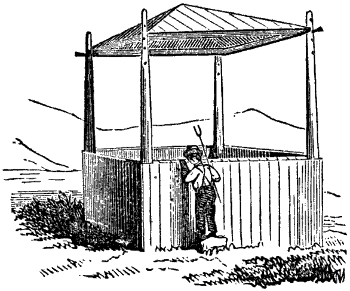
A BARRACK FOR STORING SHEEP-FODDER.
After pouring a little oil in the throat, the obstructing substance
which occasions the “choking,” can frequently be removed up or down by
external manipulation. If not, it may usually be forced down with the
flexible probang, described in “Cattle and their Diseases,” or a
flexible rod, the head of which is guarded by a knot, or a little bag of
flax-seed. The latter having been dipped in hot water for a minute or
two, is partly converted into mucilage, which constantly exudes through
the cloth, and protects the œsophagus, or gullet, from laceration.
But little force must be used, and the whole operation conducted with
the utmost care and gentleness; or the œsophagus will be so far
lacerated as to produce death, although the obstruction is removed.
[229]
Ophthalmia, or inflammation of the eyes, is not uncommon in this
country; but it is little noticed, as, in most cases, it disappears in a
few days, or, at worst, is only followed by cataract, which, being
usually confined to one eye, does not appreciably effect the value of
the animal, and therefore has no influence on its market price.
Treatment. Some recommend blowing pulverized red chalk in the inflamed
eye; others squirt into it tobacco juice. As a matter of humanity, blood
may be drawn from under the eye, and the eye bathed in tepid water, and
occasionally with a weak solution of the sulphate of zinc combined with
tincture of opium. These latter applications diminish the pain, and
hasten the cure.
Paralysis, or palsy, is a diminution or entire loss of the powers of
motion in some parts of the body. In the winter, poor lambs, or poor
pregnant ewes, or poor feeble ewes immediately after yeaning in the
spring, occasionally lose the power of walking or standing rather too
suddenly to have it referable to increasing debility. The animal seems
to have lost all strength in its loins, and the hind-quarters are
powerless; it makes ineffectual attempts to rise, and cannot stand if
placed upon its feet.
Treatment. Warmth, gentle stimulants, and good nursing may raise the
patient; but, in the vast majority of cases, it is more economical and
equally humane, to deprive it of life at once.
[230]
This is often mistaken for the scab, but it is, in fact, a different and
less dangerous disease. The wool falls off, and leaves the sheep nearly
naked; but it is attended with no soreness, though a reddish crust will
cover the skin, from the wool which has dropped. It generally arises
from hard keeping and much exposure to cold and wet; and, in fact, the
animal often dies in severe weather from the cold it suffers on account
of the loss of its coat.
The remedy is full feeding, a warm stall, and anointing the hard part
of the skin with tar, oil, and butter. Some, however, do nothing for it,
scarcely considering it a disease. Such say that if the condition of a
poor sheep is raised as suddenly as practicable, by generous keep in the
winter, the wool is very apt to drop off; and, if yet cold, the sheep
will require warm shelter.
Pneumonia—or inflammation of the lungs—is not a common disease in the
Northern States; but undoubted cases of it sometimes occur, after sheep
have been exposed to sudden cold, particularly when recently shorn. The
adhesions occasionally witnessed between the lungs and pleura of
slaughtered sheep, betray the former existence of this disease in the
animal—though, in many instances, it was so slight as to be mistaken,
at the time, for a hard cold.
Symptoms. The animal is dull, ceases to ruminate, neglects its food,
drinks frequently and largely, and its breathing is rapid and laborious;
the eye is clouded; the nose discharges
a tenacious, fetid matter; the
teeth are ground frequently, so that the sound is audible at some
distance; the pulse is at first hard and rapid, sometimes intermits, but
before death it becomes weak. During the height of the fever, the flanks
heave violently; there is a hard, painful cough during the first stages,
which becomes weaker, and seems to be accompanied with more pain as
death approaches.
After death, the lungs are found more or less hepatized—that is,
permanently condensed and engorged with blood, so that their structure
resembles that of the hepar, or liver—and they have so far lost their
integrity that they are torn asunder by the slightest force. It may here
be remarked that when sheep die from any cause, with their blood in
them, the lungs have a dark, hepatized appearance. Whether they are
actually hepatized or not, can readily be decided by compressing the
windpipe, so that air cannot escape through it, and then between such
compression and the body of the lungs, in a closely fitting orifice,
inserting a goose-quill, or other tube, and continuing to blow until the
lungs are inflated as far as they can be. As they inflate, they will
become of a lighter color, and plainly manifest their cellular
structure. If any portions of them cannot be inflated, and retain their
dark, liver-like consistence, and color, they exhibit hepatization—the
result of high inflammatory action—and a state utterly incompatible, in
the living animal, with the discharge of the natural functions of the
viscus.
Treatment. In the first, or inflammatory stages, bleeding and
aperients are clearly called for. Some recommend early and copious
bleeding, repeated, if necessary, in a few hours; this followed by
aperient medicines, such as two ounces of Epsom salts, which may be
repeated in smaller doses, if the bowels are not sufficiently relaxed.
The following sedative may also be given with gruel, twice a day:
nitrate of potash, one drachm; powdered digitalis, one scruple; and
tartarized antimony, one scruple.
While depletion may be of inestimable value during the continuance—the
short continuance—of the febrile state, yet excitation like this will
soon be followed by corresponding exhaustion, when the bleeding and
purging would be murderous expedients; and gentian, ginger, and the
spirits of nitrous ether will afford the only hope of cure.
Sheep will often, in the winter or spring, eat greedily of the low
laurel. The animal appears afterward to be dull and stupid, swells a
little, and is constantly gulping up a feverish fluid, which it swallows
again; a part of it will trickle out of its mouth, and discolor its
lips. The plant probably brings on a fermentation in the stomach, and
nature endeavors to throw off the poisonous herb by retching or
vomiting.
Treatment. In the early stages, if the greenish fluid be allowed to
escape from the stomach, the animal generally recovers. To effect this,
gag the sheep, which may be done in this manner: Take a stick of the
size of the wrist, six inches long—place it in the animal’s mouth—tie
a string to one end of it, pass it over the head and down to the other
end, and there make it fast. The fluid will then run from the mouth as
fast as thrown up from the stomach. In addition to this, give roasted
onions and sweetened milk freely. A better plan, however, is to force a
gill of melted lard down the throat; or, boil
for an hour the twigs of
the white ash, and give one-half to one gill of the strong liquor
immediately; to be repeated, if not successful. Drenchers of milk and
castor-oil are also recommended.
This disease, which sometimes causes the death of a million of sheep, in
England, in a single year, is comparatively unknown in this country. It
prevails somewhat in the Western States, from allowing sheep to pasture
on land that is overflowed with water. Even a crop of green oats, early
in the fall, before a frost comes; has been known to rot young sheep.
Symptoms. The first are by no means strongly marked; there is no loss
of condition, but rather the contrary, to all appearance. A paleness and
want of liveliness of the membranes, generally, may be considered as the
first symptoms, to which may be added a yellowness of the caruncle at
the corner of the eye. When in warm, sultry, or rainy weather, sheep
that are grazing on low and moist lands, feed rapidly, and some of them
die suddenly, there is ground for fearing that they have contracted the
rot. This suspicion will be farther increased if, a few days afterward,
the sheep begin to shrink and grow flaccid about the loins. By pressure
about the hips at this time, a crackling is perceptible now or soon
afterward, the countenance looks pale, and upon parting the fleece, the
skin is found to have changed its vermilion tint for a pale red, and the
wool is easily separated from the felt; and as the disorder advances,
the skin becomes dappled with yellow or black spots. To these symptoms
succeed increased dullness, loss of condition, and greater paleness of
the mucous
membranes, the eye-lids becoming almost white, and afterward
yellow. This yellowness extends to other parts of the body, and a watery
fluid appears under the skin, the latter becoming loose and flabby, and
the wool coming off readily. The symptoms of dropsy often extend over
the body, and sometimes the sheep becomes chockered, as it is termed;
a large swelling forms under the jaw, which, from the appearance of the
fluid which it contains, is sometimes called the watery poke. The
duration of the disease is uncertain; the animal occasionally dies
shortly after becoming affected, but more frequently it extends to from
three to six months, the sheep gradually losing flesh and pining away,
particularly if, as is frequently the case, an obstinate purging
supervenes.
Post-mortem. The whole cellular tissue is found to be infiltrated, and
a yellow serous fluid everywhere follows the knife. The muscles are soft
and flabby, having the appearance of being macerated. The kidneys are
pale, flaccid, and infiltrated. The mesenteric glands are enlarged, and
engorged with yellow serous fluid. The belly is frequently filled with
water, or purulent matter; the peritoneum is everywhere thickened, and
the bowels adhere together by means of an unnatural growth. The heart is
enlarged and softened, and the lungs are filled with tubercles. The
principal alterations of structure are in the liver, which is pale,
livid, and broken down with the slightest pressure; and on being boiled,
it will almost dissolve away. When the liver is not pale, it is often
curiously spotted; in some cases it is speckled, like the back of a
toad; some parts of it, however, are hard and schirrous; others are
ulcerated, and the biliary ducts are filled with flukes. The malady is,
unquestionably, inflammation of the liver. This fluke is from
three-quarters of an inch to an inch and a quarter in length, and from
one-third to one-half an inch in its greatest breadth. These fluke-worms
undoubtedly aggravate the disease, and perpetuate a state of
irritability and disorganization, which must necessarily undermine the
strength of any animal.
Treatment. This must, to a considerable extent, be very
unsatisfactory. After the use of dry food and dry bedding, one of the
best preventives is the abundant use of pure salt. In violent attacks,
take eight, ten, or twelve ounces of blood, according to the
circumstances of the case; to this, let a dose of physic succeed—two or
three ounces of Epsom salts; and to these means add a change of diet,
good hay in the field, and hay, straw, or chaff in the yard. After the
operation of the physic—an additional dose having been administered,
oftentimes, in order to quicken the action of the first—two or three
grains of calomel may be given daily, mixed with half the quantity of
opium, in order to secure its beneficial, and ward off its injurious
effects on the ruminant. To this should be added common salt, which acts
as a purgative and a tonic. A mild tonic, as well as an aperient, is
plainly indicated soon after the commencement of rot. The doses should
be from two to three drachms, repeated morning and night. When the
inflammatory stage is clearly passed, stronger tonics may be added to
the salt, and there are none superior to the gentian and ginger roots;
from one to two drachms of each, finely pounded, may be added to each
dose of the salt. The sheep having a little recovered from the disease,
should still continue on the best and driest pasture on the farm, and
should always have salt within their reach. The rot is not infectious.
This is a cutaneous disease, analogous to the mange in horses and the
itch in man, and is caused and propagated by a minute insect, the
acarus.
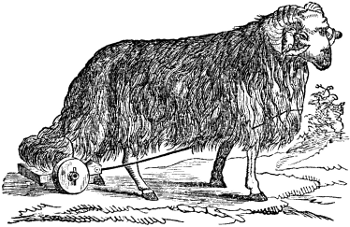
THE BROAD-TAILED SHEEP.
If one or more female acari are placed on the wool of a sound sheep,
they quickly travel to the root of it, and bury themselves in the skin,
the place at which they penetrate being scarcely visible, or only
distinguishable by a minute red point. On the tenth or twelfth day, a
little swelling may be detected with the finger, and the skin changes
its color, and has a greenish blue tint. The pustule is now rapidly
formed, and about the sixteenth day breaks, when the mothers again
appear, with their little ones attached to their feet, and covered by a
portion of the shell of the egg from which they have just escaped. These
little ones immediately set to work, penetrate the neighboring skin,
bury themselves beneath it, find their proper nourishment, and grow and
propagate, until the poor creature has myriads of them preying upon him.
It is not wonderful that, under such circumstances, he should speedily
sink. The male acari, when placed on the sound skin of a sheep, will
likewise burrow their way and
disappear for a while, the pustule rising
in due time; but the itching and the scab soon disappear without the
employment of any remedy. The female brings forth from eight to fifteen
young at a time.
In the United States, this disease is comparatively little known, and
never originates spontaneously. The fact, that short-woolled sheep—like
the Merino—are much less subject to its attacks, is probably one reason
for this slight comparative prevalence. The disease spreads from
individual to individual, and from flock to flock, not only by means of
direct contact, but by the acari left on posts, stones, and other
substances against which diseased sheep have rubbed themselves. Healthy
sheep are, therefore, liable to contract the malady, if turned on
pastures previously occupied by scabby sheep, although some considerable
time may have elapsed since the departure of the latter.
The sheep laboring under the scab is exceedingly restless. It rubs
itself with violence against trees, stones, fences, etc.; scratches
itself with its feet, bites its sores, and tears off its wool with its
teeth; as the pustules are broken, their matter escapes, and forms
scabs, causing red, inflamed sores, which constantly extend, increasing
the misery of the tortured animal; if unrelieved, he pines away, and
soon perishes.
The post-mortem appearances are very uncertain and inconclusive. There
is generally chronic inflammation of the intestines, with the presence
of a great number of worms. The liver is occasionally schirrous, and the
spleen enlarged; and there are frequently serous effusions in the belly,
and sometimes in the chest. There has been evident sympathy between the
digestive and the cutaneous systems.
Treatment. First, separate the sheep; then cut off the wool as far as
the skin feels hard to the finger; the scab is then washed with
soap-suds, and rubbed hard With a shoe-brush, so that it may be cleansed
and broken. For this use take a decoction of tobacco, to which add
one-third, by measure, of the lye of wood-ashes, as much hog’s lard as
will be dissolved by the lye, a small quantity of tar from a tar-bucket,
which contains grease, and about one-eighth of the whole, by measure, of
spirits of turpentine. This liquor is rubbed upon the part infected, and
spread to a little distance around it, in three washings, with an
interval of three days each. This will invariably effect a cure, when
the disorder is only partial.
Or, the following: Dip the sheep in an infusion of arsenic, in the
proportion of half a pound of arsenic to twelve gallons of water. The
sheep should be previously washed in soap and water. The infusion must
not be permitted to enter the mouth or nostrils.
Or, take common mercurial ointment; for bad cases, rub it down with
three times its weight of lard—for ordinary cases, five times its
weight. Rub a little of this ointment into the head of the sheep. Part
the wool so as to expose the skin in a line from the head to the tail,
and then apply a little of the ointment with the finger the whole way.
Make a similar furrow and application on each side, four inches from the
first; and so on, over the whole body. The quantity of ointment after
composition with the lard, should not exceed two ounces; and, generally,
less will suffice. A lamb requires but one-third as much as a grown
sheep. This will generally cure; but, if the animal should continue to
rub itself, a lighter application of the same should be made in ten
days.
Or, take two pounds of lard or palm oil; half a pound of oil of tar; and
one pound of sulphur; gradually mix the last two, then rub down the
compound with the first. Apply as before. Or, take of corrosive
sublimate, one half a pound; white hellabore, powdered, three-fourths of
a pound; whale or other oil, six gallons; rosin, two pounds; and tallow,
two pounds. The first two to be mixed with a little of the oil, and the
rest being melted together, the whole to be gradually mixed. This is a
powerful preparation, and must not be applied too freely.
An erysipelatous scab, or erysipelas, attended with considerable
itching, sometimes troubles sheep. This is a febrile disease, and is
treated with a cooling purgative, bleeding, and oil or lard applied to
the sores.
The author acknowledges himself indebted for what follows under this
head to R. McClure, V. S., of Philadelphia, author of a Prize Essay on
Diseases of Sheep, read before the U. S. Agricultural Society, in 1860,
for which a medal and diploma were awarded.
Although the small-pox in domestic animals has, fortunately, been as yet
confined to the European Continent—where it has been chiefly limited to
England—no good reason can ever be assigned why it should not at some
future time make its appearance among us, especially when we remember
how long a period elapsed, during which we escaped the cattle plague,
although the Continent had long been suffering from it.
The small-pox in sheep—variola overia—is, at times, epizoötic in the
flocks of France and Italy, but was unknown
in England until 1847, when
it was communicated to a flock at Datchett and another at Pinnier by
some Merinos from Spain. It soon found its way into Hampshire and
Norfolk, but was shortly afterward supposed to be eradicated. In 1862,
however, it suddenly reappeared in a severe form among the flocks of
Wiltshire; for which reappearance neither any traceable infection nor
contagion could be assigned. With the present light upon the subject, it
would seem to be an instance of the origination anew of a malignant
type of varioloid disease. Such an origin is, in fact, assigned to this
disease in Africa, it being well established that certain devitalizing
atmospheric influences produce skin diseases, and facilitate the
appearance of pustular eruptions.
The disease once rooted soon becomes epizoötic, and causes a greater
mortality than any other malady affecting this animal. Out of a flock
numbering 1720, 920 were attacked in a natural way, of which 50 per
cent. died. Of 800 inoculated cases, but 36 per cent. died.
Numerous experiments have proved beyond all doubt that this disease in
sheep is both infectious and contagious; its period of incubation varies
from seven to fourteen days. The mortality is never less than 25 per
cent., and not unfrequently whole flocks have been swept away, death
taking place in the early stages of the eruption, or in the stages of
suppuration and ulceration.
The symptoms may be mapped out as follows: The animal is seized with a
shivering fit, succeeded by a dull stupidity, which remains until death
or recovery results; on the second or third day, pimples are seen on the
thighs and arm-pits, accompanied with extreme redness of the eyes, complete
loss of appetite, etc., etc. It is needless to enumerate other
symptoms which exist in common with those of other disorders.
Prevention. At present, but two modes are resorted to, for the purpose
of preventing the spread of the disease, which promise any degree of
certainty of success. The first is by inoculation, which was
recommended by Professor Simonds, of London. This distinguished
pathologist appears to have overlooked the fact that he was thereby only
enlarging the sphere of mischief, by imparting the disease to animals
that, in all probability, would otherwise have escaped it. By
inoculation, moreover, a form of the disease is given, not of a modified
character, but with all the virulence of the original affection which is
to be arrested, and equally as potent for further destruction of others.
By such teaching, inoculation and vaccination would be made one and the
same thing, notwithstanding their dissimilarity. Even vaccination will
not protect the animal, as has been already shown by the experiments of
Hurbrel D’Arboval.
The second and best plan of prevention is isolation and destruction,
as recommended by Professor Gamgee, of the Edinburgh Veterinary College.
This proved a great protection to the sheep-farmers of Wiltshire, in
1862. In all epizoötic diseases, individual cases occur, which, when
pointed out and recognized as soon as the fever sets in and the early
eruptions appear, should be slaughtered at once and buried, and the rest
of the flock isolated. By this means the disease has been confined to
but two or three in a large flock.
Treatment. In treating this disease, resort has of late been had to a
plant, known as Sarracenia purpura—Indian cup,
or pitcher
plant—used for this purpose by the Micmacs, a tribe of Indians in
British North America. This plant is indigenous, perennial, and is found
from the coast of Labrador to the shores of the Gulf of Mexico, growing
in great abundance on wet, marshy ground. The use of this plant is
becoming quite general, and good results have almost uniformly attended
it.
Take from one to two ounces of the dried root, and slice in thin pieces;
place in an earthen pot; add a quart of cold water, and allow the liquid
to simmer gently over a steady fire for two or three hours, so as to
lose one-fourth of the quantity. Give of this decoction three
wine-glassfuls at once, and the same quantity from four to six hours
afterwards, when a cure will generally be affected. Weaker and smaller
doses are certain preventives of the disease. The public are indebted to
Dr. Morris, physician to the Halifax (Nova Scotia) Dispensary, for the
manner of preparing this eminently useful article.
Sheep feeding on pastures infested with John’s wort, frequently exhibit
an irritation of skin about the nose and face, which causes the hair to
drop off from the parts. The irritation sometimes extends over the
entire body. If this plant is eaten in too large quantities, it produces
violent inflammation of the bowels, and is frequently fatal to lambs,
and sometimes to adults.
Treatment. Rub a little sulphur and lard on the irritated surface. If
there are symptoms of inflammation of the bowels, this should be put
into the mouth of the sheep with a flattened stick. Abundance of salt is
deemed a preventive.
The lips of sheep sometimes become suddenly sore in the winter, and
swell to the thickness of a man’s hand. The malady occasionally attacks
whole flocks, and becomes quite fatal. It is usually attributed to
noxious weeds cut with the hay.
Treatment. Daub the lips and mouth plentifully with tar.
The treatment necessary as a preventive against these insects, and a
remedy for them, has already been indicated under the head of “Feeding
and Management,” to which the reader is referred.