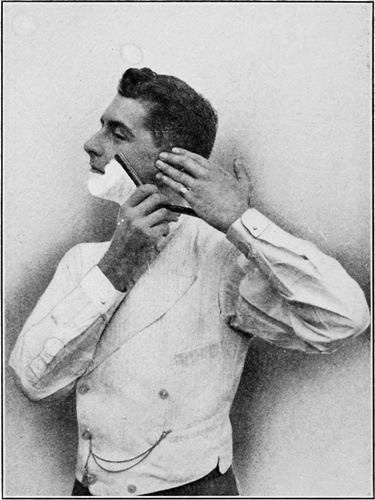
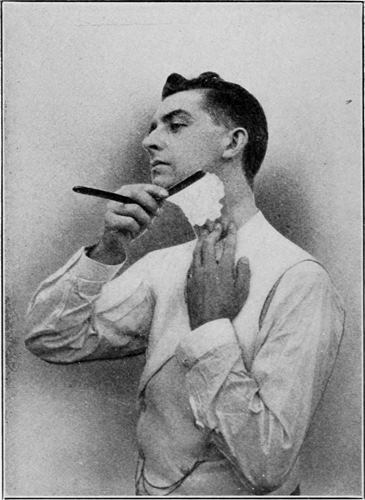
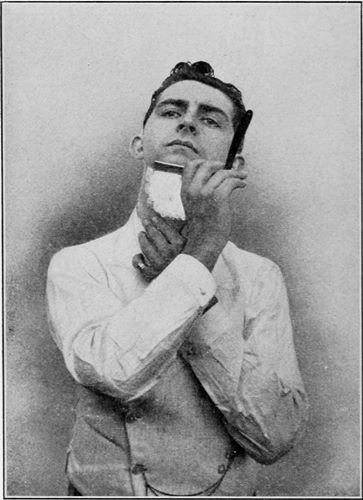
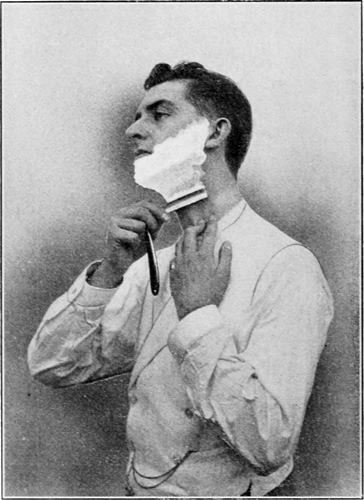
HOW TO USE THE HONE.
The hone being the only means of sharpening a dull razor, its use becomes
at once of the utmost importance to those who wish to keep their razors in
perfect order.
Hones are seldom used dry, but are usually covered with either water,
lather or oil: first—to prevent heating the blade which would quickly
spoil its temper; second—to keep the particles of steel that are ground
off the blade from entering the pores of the stone, which would soon fill
up and result in what is known as a glazed surface; and third—to make
the surface of the hone as smooth as possible.
Before commencing the operation, wipe the hone clean, then put on a few
drops of oil or else cover it with water or lather. This will float the
little particles of steel ground off the razor, thus preventing them from
remaining directly on the hone to impede its full and equal effect. With
most hones you may use either water, lather or oil; but do not change from
one to the other; whichever you begin with, use that exclusively. It
requires a longer time to produce a keen edge when oil is used but the
edge is somewhat smoother. Most barbers use lather and we should advise
the beginner to do so.
Directions for Honing.
The hone, with its fine surface up, should be placed perfectly flat on a
table or other solid foundation. (The rough surface is intended merely as
a support and not for use.) After covering the hone with lather, place
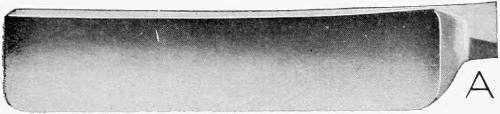
the razor flat upon it as shown in Fig. A. With the thumb and fore finger,
grasp the razor back of the heel, so as to have firm hold of both the
blade and the handle. Draw the blade from heel to point, forward against
the edge, and with a moderate degree of pressure, until it comes into the
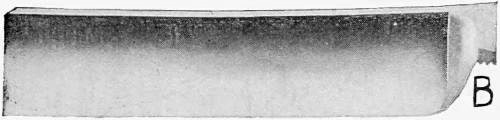
position shown in Fig. B. Now, without lifting the blade from the stone,
turn the edge up, so that the razor rests on the back of the blade. Slide
it forward on its back from point to heel and let it fall into the
position indicated in Fig. C. Push the blade from heel to point against
the edge, finishing the stroke as in Fig. D. Turn the blade on its back,
slide from point to heel and let it fall into the first position, as shown
in Fig. A. Continue honing until the blade is sufficiently keen and free
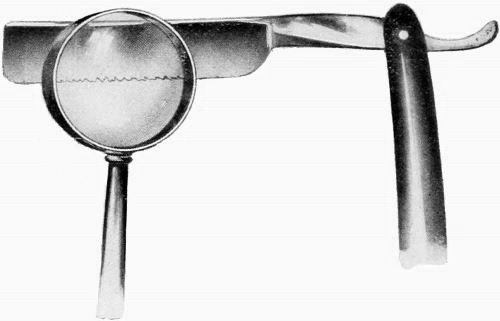
from nicks and inequalities. This may be known by drawing the edge, very
lightly, across the moistened thumb nail. If it sticks to the nail
slightly, it is an indication that the honing has developed the little
teeth which constitute the perfect razor edge, and that the razor is now
ready for stropping.
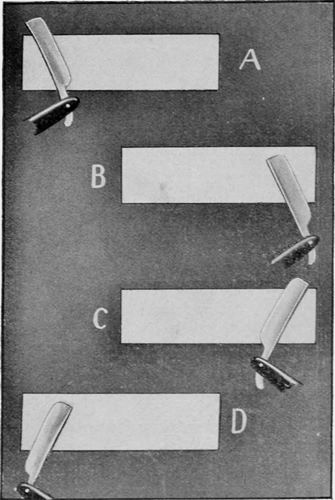
HOW TO HONE THE RAZOR.
If the honing be carried too far, a “wire edge” will be produced, and this
must be removed. To do this, draw the edge with a steady hand across the
moistened thumb nail in the manner indicated above. The blade should then
be drawn once or twice across the hone as before, in order to unite all
parts of the edge and cause a perfect equality of keenness from one end of
the blade to the other. With this done, the operation is in general
performed, and the wondrous difficulty of honing the razor vanishes.
Special Directions.
The following directions should be specially observed.
First—The blade should be held perfectly flat on the hone, so that the
back, as well as the edge, touches the stone. If the back is raised from
the stone so that only the edge touches, the bevel will be short and the
edge blunt.
Second—In drawing the blade across the hone diagonally against the edge,
the heel should be about one and a half inches in advance of the point,
and care should be taken to maintain the same angle when the stroke is
reversed and throughout the entire operation. This sets the teeth at the
proper angle, that is, slightly inclined toward the heel. We have likened
the edge of a razor to that of a saw, but there is this difference: saw
teeth incline away from the handle and toward the point, while the razor
teeth incline away from the point and toward the heel. This is correct in
principle, for the saw in use is pushed away from the handle toward the
point, while the razor is usually drawn away from the point toward the
heel.
Third—Press with equal force on all parts of the edge. With a good hone,
very little pressure will be required.
The time required to hone a razor depends much on the condition of the
razor and the hardness of the steel composing it. When the edge is in the
usual condition—that is when it is free from nicks and has merely become
thick in consequence of the injudicious use of the razor strop—it will
need very little honing; eight or ten strokes in each direction will be
quite sufficient. When, however, the edge has nicks: though so small as to
be scarcely perceptible, the operation will require more time and
attention. Should the nicks be large, it will be better to send the razor
to a cutler to be ground.
If the razor is well cared for and properly stropped, it will not require
very frequent honing, probably not oftener than once in from six to eight
weeks. When it is required you will become aware of it, from the fact that
stropping will not sharpen it.