Many readers upon the occasion of their taking up this
book for the first time will be under the impression,
doubtless, that the most important revelations it contains
will prove to be those connected with the manipulative
devices employed by card-sharpers and others in
cheating the simple-minded and unwary. But, whatever
preconceptions upon the subject may have existed, the
details of mere manipulation are far from being those of
the most consequence to the sharp in the exercise of
his profession. This, of course, must be understood to
be simply a general statement which does not apply to
particular cases. The low-class English sharp, for
instance, relies almost entirely upon certain forms of
sleight of hand to deceive the senses of his dupes.
Again, there are some tricks and dodges which are
practised by even the most high-class cheats. The rule
is, however, that mere sleight of hand is to a great extent
obsolete; at least, among those who seek to swindle
really good card-players. The methods of legerdemain
are more the common property of the multitude than
formerly, and this fact tends to operate very largely to
the detriment of the sharp. With the legitimate prestidigitateur
it is otherwise. It is true, some persons are
in a position to form a better idea as to how his tricks
are accomplished than was the case in years gone by;
but even then, there remains the advantage that they
are better able to appreciate his deftness and his ingenuity.
Therefore, he is rather benefited than otherwise
by the spread of this particular form of knowledge.
It is the poor sharp who has suffered through the
enlightenment of the public. His lines have fallen in
rough places of late years; yet it can hardly be said
that he has not proved himself more than equal to the
occasion. When checkmated in one direction, he is
generally capable of creating a diversion in his own
favour in another.
In card games especially there is always a risk in
resorting to manipulation nowadays. There is the ever-present
possibility of some one among the cheat's antagonists
having sufficient knowledge to detect him in
his manipulation of the cards. He is haunted by the
fear that sharp eyes are watching his every movement,
and he knows full well that he can accomplish nothing
in this way without some movement which a trained eye
would instantly detect. Once detected in cheating, his
reputation is gone. He can no longer hope to find dupes
among his former acquaintances. He must seek 'fresh
fields and pastures new.' However precious reputation
may be to an honest man, it is a thousand times more
so to the sharp. Once his reputation is gone he has to
depend upon chance custom; whereas he might otherwise
have a nice little circle of regular clients, at whose
expense he could live in ease and comfort.
As a professional sharp remarked to a young friend,
to whom he was giving lessons in the art of cheating:
'The best gamblers [they don't call themselves sharps]
play with fair cards only; and, by being wonderfully keen
card-players, make their brains win, instead of cheating
with the pack. They play in partnership (secret), and
are invincible, as they know all the various swindles and
so can protect themselves from being cheated. The most
successful men are among this class, although nearly all
of them can do the finest work with a pack of cards.
'The next best class are those who play marked
cards well, many of them using cards that no one not
acquainted with the work could find out in a lifetime.
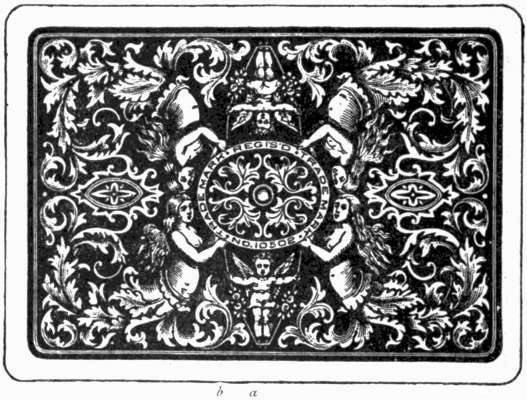
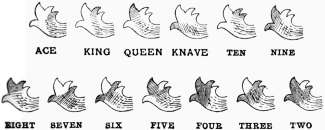
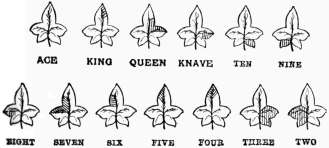
[Instance, the scroll-work on p. 51.] These men, if they
can only get their own cards into a game, are sure to
win.
'Then, after these, come the class of "second dealers,"
"bottom dealers," and men who habitually do work with
the pack to win. These men always get caught in the long
run.'
Such, then, being the case as evidenced by the word
of an expert, one may form some idea of the relative
value of manipulation as compared with other methods
in the hands of the card-sharper.
To deal thoroughly with this branch of our subject
would require a text-book of sleight of hand, as nearly all
the tricks of 'hanky-panky' could be made to serve the
purposes of cheating. But since so many excellent
treatises of that kind are readily accessible to the public,
it would be superfluous to do more than give the reader
a general idea of those methods which the sharp has
made peculiarly his own. Even among those which are
here represented, there are many devices which are
rapidly becoming obsolete, and others of which it is very
doubtful how far they are used at the present moment.
In sharping, like everything else, 'the old order changeth,
giving place to new.' However, the reader must judge
for himself as to what devices would be likely to deceive
him personally, and that will help him to an understanding
of what would probably have the same effect upon
others. Thus he will be able to arrive at a tolerably
approximate estimate of the probabilities in connection
with the use or disuse of any individual trick. The
author, being too old a bird to be caught with any such
chaff, is really not so competent to form an opinion upon
the subject. In his case familiarity, if it has not bred
contempt, has at least deadened the due appreciation of
the relative merits and advantages of the various trickeries.
They all appear of the same tint against the background
of past experience, each one possessing but little
individuality of its own. With the reader, however, it is
in all probability different. Assuming that he has merely
a casual acquaintance with manual dexterity of this kind
he will come fresh to the subject, and therefore to him
the details will assume their proper relative proportions.
To begin, then, with the oldest and most simple
manipulations, our first topic is that of the 'Bottom
Deal.' This trick, simple as it is, is the very stronghold
of the common English sharp. In whatever game he is
playing, he seizes the opportunity afforded by picking
up the cards preparatory to dealing to place certain cards
which would form a good hand at the bottom of the
pack, and in shuffling he takes good care not to disturb
them. But there is still the 'cut' to be thought about.
Well, we shall see later on how the effects of the cut are
to be obviated. In the meantime, however, it is evident
that if the cards were cut and piled in the ordinary
manner, those cards which the sharp had so carefully
preserved at the bottom would be brought to the centre.
That would never answer his purpose; so, when the cut
has been made, if the game is one which does not necessitate
the dealing out of the entire pack, he simply takes up
the bottom half of the pack, leaving the other on the
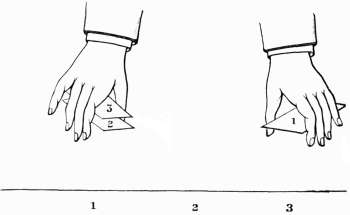
table. Then, holding the cards as in fig. 35, he proceeds
to deal. From this point the trick, as its name suggests,
consists of dealing the bottom cards, either to himself or,
preferably, to a confederate, in place of the upper cards
which should justly fall to that hand.
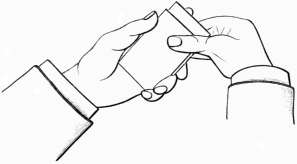
Fig. 35.—Bottom Deal.
From the position in which the cards are held it will
be seen that, as each card is dealt, the finger and thumb
of the dealer's right hand fall respectively below and
above the pack. It is, therefore, entirely optional whether
he shall take the top card with his thumb, or the bottom
one with his finger. When a card has to be dealt, then,
to himself or to his confederate, as the case may be, it is
the bottom one which is taken; to the other players the
top ones are dealt out. When quickly done, it is
impossible to see whether the card comes from the top or
the bottom, although the manner of holding and dealing
the cards would imply that the bottom deal was being
resorted to: the cards which come from the bottom,
being pulled upwards, appear to come from the top. It
can always be detected, nevertheless, by the different
sound made by a card when brought from the bottom.
There is just a slight click, which is distinctly audible, and
easily recognised. The reader should try it for himself,
and note the effect referred to. After a few minutes'
experience he would never afterwards be mistaken in
deciding as to whether a card was dealt from the top
or bottom of the pack. A sharp who uses the bottom
deal rarely employs any other form of manipulation
whatever.
We now pass on to the trick known as 'Dealing
Seconds.' The trick is so named because it consists of
dealing out the second card from the top instead of the
top one. It is particularly useful in connection with
marked cards, where of course the top card can be
read, and very often the second one also.5 The effect in
this case is that the sharp can always retain the better
of the two top cards for himself. Suppose, then, there
are four players. The sharp, commencing to deal,
notices that the top card is a knave, whilst the second is
a three. He therefore deals the second card to the
player immediately to his left. It may then appear that
the second card now is a king; and, consequently, the
sharp deals the top card to the second hand, leaving the
king on top. If the card which is now second in the
pack is lower than the king, the third player receives
that card; but if the second should prove to be an ace,
the king goes to the third player, and the ace to the
sharp himself. It may happen, however, that the sharp,
having dealt round to the three players in this manner,
finds that the second of the remaining cards is of more
value to him than the first. In that case, of course, he
would deal himself the second. Thus it is seen that the
sharp has really had a choice of five cards on one round
of the deal; and the larger the number of players, the
greater his choice, although he may at times have to
choose between two cards which would answer his
purpose equally well. If he is thus compelled to give
away a good card he should dispose of it where it is
likely to do him least harm, if he can contrive to do so.
Besides marked cards, there are other methods of discovering
the value of the top card and, consequently, the
advisability of dealing seconds, as we shall see presently.
The trick of dealing the second card is very easily
learned. Take a pack of cards in your left hand, in the
manner usually adopted in dealing, with the thumb
lying across the middle of the pack. Then with the
thumb advance the two top cards slightly to the right.
This being done, it will be found that these two cards
can be taken between the thumb and middle finger.
With the second held by the tip of the middle finger,
advance the top card a little further to the right. The
cards will now be in a position frequently adopted in
dealing, the top card being sufficiently forward to be
grasped by the right finger and thumb. So far, there is
nothing unusual in the operations; but this is where
the trick comes in. If the middle finger of the hand
holding the cards is advanced, the second card, resting
upon its tip, will be advanced also; and if at the same
time the thumb is drawn back, the top card is withdrawn
with it. It is now the second card which is the more
advanced of the two, and consequently the card which
would be taken by the right hand in dealing. In fact,
the two cards can be rubbed together by the finger and
thumb, alternately advancing and receding. If the second
card is to be dealt, then it is pushed forward and the top
one is drawn back, the movement being masked by a
slight dropping of the arm towards the operator. Of
course the change in the position of the cards is not
made until the instant the right hand reaches the pack to
take the card. Thus the entire operation appears to
consist of one movement only. An expert 'second-dealer'
will place a known card on top of the pack and
deal the whole of the other cards from beneath it, leaving
that card in his hands at the finish; and this without
any manipulation being visible to any but the sharpest
vision.
The utility of the second-dealing method of procedure,
it is evident, depends greatly upon the fact of
having a knowledge of the top card. With marked cards
the acquiring of this knowledge can present no difficulty,
and even with genuine ones the difficulty is by no means
insuperable. All that is necessary is to reach over to the
left, keeping the cards in front of one, with the top card
drawn off a little to one side, so as to have the index in
the corner visible from below, and a sly peep will do the
trick. There are innumerable excuses available to account
for the reaching over, as we have already seen in the case
of the cuff holdout. Given the fact that there is something
to the left of the operator which must be reached
with the right hand, the rest is easy. The act of leaning
to one side effectually covers the slight tilting of the left
hand which enables the under side of the cards to be seen.
There used to be an old American colonel (the numerical
strength of officers in the American army must have been
extraordinary at some time or another) at one of the best
London clubs who was very partial to the use of this
trick. He would lay his cigar upon the table, well over
to his left, and then, bending down to get it, he would
note both top and bottom cards, in the manner described.
Simple as this dodge may be, it is unquestionably of
great service at times. Take, for instance, the case of the
dealer at Poker. After he has dealt the cards, but before
giving off the draft, he leans over to pick up his hand,
and in so doing sees the 'size' of the top card of the
'deck.' Upon inspecting his hand, he can tell whether
the top card will be of use to him or not. If it is, he
can easily hold it back until he can take it for himself;
if not, he very generously lets someone else have it.
For the benefit of those who may not know the game
of Poker, and in England there are many who do not, I
may illustrate the great utility of knowing the top and
bottom cards by a reference to the results attainable by
such means in the familiar game of Nap. Suppose that
you are playing a single-handed game, and it is your turn
to deal. You note the top and bottom cards. If they
happen to be decent ones, both of the same suit, you hold
back the top card, and give your opponent the second.
The top one then comes to you. You now give your opponent
the card next in order, and deal the bottom one to
yourself. The rest of the cards may be left to chance, until
the five are dealt out to each hand. The consequence of
this manœuvre is as follows. You are sure of having two
good cards of one suit, and it is about an even chance that
among the other three will be another of the same kind.
Therefore, you are pretty certain of a long suit to lead from.
Your chances, therefore, are a long way better than your
opponent's. If, however, on the other hand, you find
that the top and bottom cards are small ones, and of different
suits, you may make your opponent a present of them.
They may of course prove useful to him; but the
chances are that they do not. But, whatever happens, you
know the value of two cards out of his five; a fact which
may have considerable influence upon the result of the
hand, as all 'Nappists' will admit. Necessarily there is
nothing of real certainty about this achievement; but,
still, the player who knows the top and bottom cards, even
though he is not skilful enough to dispose of them to the
best advantage, gathers in a goodly proportion of the
chances of the game which do not belong to him by
right.
We now come to the consideration of methods employed
by the sharp in manipulating the cards to his
own advantage during the process of shuffling, and of preventing
the overthrow of his plans by the disarrangement
introduced into the result of his efforts in the fact of the
cards having to be cut by an opponent. However carefully
he may contrive to arrange the order of the cards,
the cut would obviously upset his calculations. Therefore,
in addition to some method of placing the cards in
order, he must also have a ready means of rendering the
cut inoperative. We have already seen how the bottom-dealer
dodges it; and now we will look into one or two
other systems, most of them equally simple, and all of
them equally effective.
We will suppose for the moment that the cards have
been arranged in, or at any rate not disarranged by, the
shuffle. The sharp lays the pack upon the table; his
opponent lifts up the top half and lays it down near
the bottom half. In the natural course of things the
sharp should now take up the bottom half, place it upon
the top half that was, close the cards together, and commence
to deal. If this were done, the cards which he
required to have on top would now be in the middle of
the pack, and all the trouble he had devoted to their
disposition would be wasted. So he is compelled to adopt
some means of restoring the cards to their former position.
In accomplishing this there are several courses open to
him. The simplest and most barefaced method, and yet
one which will escape detection nine times out of ten, is
the following. The cards having been cut, and the two
halves of the pack having been placed side by side in the
usual manner, the sharp picks up the bottom half with the
right hand, as though he were about to place it upon the
other; but instead of so doing, he deliberately puts it
into his left hand. Then picking up the top half, he
adds it to the other, in the position it originally occupied.
There is absolutely nothing in this but impudence, and
yet the dodge will nearly always pass muster. Try it the
next time you are playing cards, and you will find that
nobody will notice it if it is done with apparent carelessness.
Even though someone did perceive that the cards
were in the same order as formerly, the sharp could always
apologise for his inadvertence and suffer them to be cut
again.
Another very simple method is to cross the hands,
picking up the right half of the pack with the left hand,
and the left half with the right hand. Then uncrossing
the hands, the two halves are put together in their former
order. The crossing of the hands tends to confuse
the mind of an onlooker, so that he really does not know
which hand contains the half that should be placed on
top.
The reader must distinctly understand that such open
and palpable deceptions as these two last would only be
practised by the very lowest class of sharps. A good man
would scorn the action.6 With regard to the methods resorted
to at any time very much depends upon the class
of sharp and the intelligence of the company in which he
happens to find himself. The employment of simple
trickeries like these in a card party of 'smart' players
could only be attended with modified success, very modified
indeed. If the players were smart, the sharp would
smart. This joke is not copyright, but it is logical
nevertheless.
The 'pass,' which is the essence of so many card-tricks,
is another means of restoring the order of the
cards after they have been cut. Since it is explained in
every book on conjuring, however, we will only just
glance at it. For a fuller description the reader may be referred
to Professor Hoffman's admirable treatises.
In making the pass the two halves of the pack are
picked up in the order they should rightly assume
after being cut, care being taken however that there is a
slight division maintained between them. For instance,
the bottom half is placed upon the top one as it lies upon
the table perfectly level sideways, but projecting over one
end about a quarter of an inch. The pack is now put
into the left hand, and in the act of levelling up the two
halves the little finger is inserted between them. Meanwhile
the sharp engages the other players in an animated
conversation. Then just before dealing, apparently with
the object of again levelling the cards, he covers the
pack with his right hand. In an instant the cards appear
to pass through one another, and the half which was
uppermost before cutting is in that position now. The
action is simply this. The little finger of the left hand
being between the two halves of the pack, that which is
above for the moment is held by the little finger and the
other three. The lower half is gripped by the thumb and
fingers of the right hand. Then by slightly opening the
left hand and closing the right, the two halves are drawn
asunder. Immediately reversing the motion the two
halves come together again with their respective positions
reversed. The movement necessary to effect this operation
is covered by a slight dropping of the hands at the
critical moment. This is called the 'double-handed
pass,' as both hands are used to effect it.
There are also various single-handed passes available
to the expert, but these are more difficult to accomplish
neatly, and cannot be so readily disguised. If used at all
they are accompanied by a movement of the hand from
the operator, as in pointing at something or in shaking
the wrist clear of the cuff to give freedom of arm during
dealing. The simplest of these passes is made by holding
the cards between the thumb and the last three fingers
of the left hand, a slight division between the two halves
of the pack being maintained at the thumb side. The
lower half is now dropped into the palm, and with the
forefinger it is turned up towards the thumb. The upper
half is now released and allowed to fall upon the fingers
which are extended for its reception. Finally, the lower
half is dropped upon the upper one and the original
order is restored. Much practice, of course, is required
to perform this operation with ease and despatch.
Another form of pass may be accomplished in putting
the cards from the right hand into the left. The pack is
held in the right hand, with the upper half slightly
advanced, and the lower nipped in the thumb-joint.
The left hand, instead of taking the whole pack, merely
takes the upper half. The right, in levelling the cards,
deposits the lower half upon the upper.
It must be forcibly impressed upon the reader that
under no circumstances whatever is it possible to make
the pass without that device being detected by an expert
who is looking for it. Even half a glance at the operator's
movements would arouse suspicions which could not be
easily allayed. It is therefore a dangerous proceeding
at any time for a sharp to indulge in. It is possible
that through inattention the expert may not actually
see the pass made; but the accompanying movements
are sufficient indication of what is going on to anyone
who 'knows his way about.' In days gone by, the pass
was a power in the hands of the sharp; but now, alas,
it is only of occasional use, and the risk it involves is
very, very great.
Another method of dodging the cut is to take the
half of the pack which should finally be on the top, but
which the sharp desires to be underneath, holding it by
the thumb and three last fingers of the right hand,
with the forefinger bent, and its back resting upon the
back of the top card. The cards, being thus removed
from the table, are now held entirely by the forefinger
and the other three, the thumb being taken away. The
second half of the pack is now taken up between the
thumb and forefinger; at the same instant, the other
cards being slipped underneath instead of on top as they
should be. Skilfully and quickly done, this plan is very
deceptive, as such things go.
Rather than resort to any method of restoring the
order of the cards after they have been cut, it is far preferable
for the sharp to so arrange matters, if possible,
that the act of cutting should bring those cards uppermost
which are required to be at the top. In a single-handed
game, by keeping strict watch upon the direction
of his opponent's gaze, he may be enabled to find an
opportunity of making the pass; but in a round game,
someone is sure to be looking at the cards, and the pass
becomes much too risky to be attempted. Therefore, in
a case of this kind, the sharp will endeavour to manipulate
the cards in such a way that the cut merely serves the
purpose of removing certain cards, which are placed above
those he needs, uppermost.
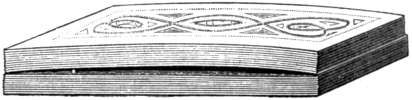
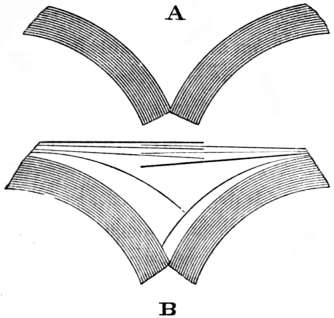
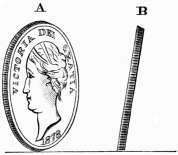
Fig. 36.—The Bridge.
The commonest plan in use for this purpose is the
device known as the 'Bridge.' This architectural contrivance
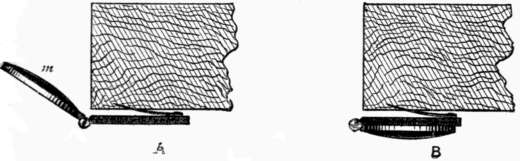
consists of either bending the two halves of the
pack in opposite directions, or bending one half, and
leaving the other straight (fig. 36). The trick derives
its name from the curvature thus produced.7 In the
illustration, the cards which are required to be on top
are the straight ones now lying underneath. An unsuspicious
player, being called upon to cut the pack, will
undoubtedly lift off the bent half, owing to the division
existing between it and the other. Then there is no need
of the pass, or anything of the kind. The sharp has
'forced the cut.' Considering how well-known the
bridge is, it is extraordinary how often it is successful.
The fact is, the players are not looking for it; they
assume that they are playing with honest men, and upon
that assumption the sharp in great measure relies.
The bridge is specially useful in cases where a confederate
is available to cut the cards. Then the bridge
need not be so much arched. The very slightest bend
is sufficient, as the 'confed.' will be careful to cut at
the right place. The 'end-bridge' is a variety we shall
have to touch upon later on, and other dodges for
attaining the same end as this one will be described in
the chapter on 'Prepared Cards.'
Working backwards, then, from the end to the means,
we arrive by a natural transition to the methods of
manipulation employed in securing an advantageous
disposition of the cards. Among these, a prominent
place is occupied by what are known as 'false shuffles.'
These are of three kinds. The first is the shuffle which
leaves undisturbed the previous arrangement of the entire
pack. The second is that which affects only part of the
pack, allowing the rest to retain its original order. The
third is the variety which effects the systematic disposition
of the cards in a manner which will bring good
hands to the sharp and his accomplices, if such there be,
or at any rate either to the sharp himself or to an
accomplice.
By way of familiarising the reader with these
processes, we will just glance through the older forms of
all three kinds. It must be distinctly borne in mind,
however, that the modern methods of shuffling have
rendered most of these obsolete. They have been
replaced by improved manipulations, as we shall see
later.
Of the first kind of these shuffles there is a great
variety. They are simply manipulations which appear
to be shuffles, but in reality are not so. We will
investigate one of them. The pack is taken in two
halves, one of which is held in each hand. From the
right hand half about half a dozen cards are pushed off
and placed beneath those in the left hand. Then, from
the left hand, three cards say are pushed off and placed
beneath those in the right hand. This process is
continued, always putting more cards from right to left
than vice versa, until the whole pack appears to have
been shuffled into the left hand. This looks exactly like
a genuine shuffle. In fact, most persons upon having it
explained to them will say that the cards really are
shuffled, but it is not so. The effect produced is that of
a simple cut. If the bridge is made before commencing,
the process can be continued until the top card has
resumed its former place. Then it will be found that
there has been absolutely no disarrangement of the cards
whatever.
This shuffle is particularly useful at the beginning of
a game when the sharp contrives to get the deal, or upon
the introduction of a fresh pack of cards. Gamblers are
superstitious as a rule, and when their 'luck is out,'
which is generally the case when they happen to be playing
with a sharp, they will sometimes seek to improve it
by changing the cards. Now, even a new pack can be
opened for the purpose of arranging the contents, and
sealed up again so neatly that there is no evidence of its
ever having been tampered with. Then, supposing the
sharp to be a member of a club, the person who
purchases the club cards may be a confederate, and thus
the cards which are apparently fresh from the maker may
have been falsified in any desired manner.8 Whatever
method may have been adopted to arrange the pack, the
foregoing shuffle will not disturb it. The cut is rendered
inefficient by either of the methods given, and all is
happiness and prosperity.
The second form of false shuffle is quite as easy to
accomplish as the first. All that is necessary is to take
care that the part of the pack which is required to be
kept intact should not be disturbed. The rest of the
cards may be shuffled to one's heart's content. The
sharp, having noted certain cards among those which
have been played that would be of service to him in
some way or another, in picking them up contrives to
place them all together at the top or bottom of the pack.
Then in shuffling he avoids all interference with those
cards. A good plan is to put the cards on top and lay
the pack upon the table. Then with the right hand lift
up the top cards, and, with the left, cut the remainder in
two and shuffle one portion into the other. This will
pass for a genuine shuffle almost anywhere. Selected
cards, placed above or below the pack, are called 'top-stock'
or 'bottom-stock,' as the case may be. They are
useful for a variety of purposes, as will be readily understood.
The effect of the holdout when used in the
game of Poker, as described in the last chapter, is to
work the top-stock for draught. The shuffle just dealt
with would work the top-stock for deal.
The last of the three kinds of false shuffles
enumerated is of course the most generally useful in
almost any game. Take whist for example. How
pleasant would it be to be able to deal oneself, or one's
partner, a hand containing nearly all the trumps. Well,
that is a thing which is quite possible of accomplishment
and by no means difficult. The cards are simply
arranged during the shuffle. It is what is called 'putting
up' a hand, and this is how it is done.
As the tricks are played in the previous hand you
notice those which contain a preponderance of the best
cards of one suit, say diamonds. You keep an eye
particularly upon the four tricks which would make the
best hand, viz., those which contain the highest cards.
It is your turn to deal. You pick up the tricks as they
lie upon the table or are passed to you, keeping those
you require slightly separate from the rest as you gather
them up, and finally place them at the bottom of the
pack, with the little finger of your right hand inserted
between them and the cards which are above. You now
proceed to shuffle. The first operation is to put all the
cards above your little finger into the right hand. Thus
you hold the cards you require in your left hand, but
there are sixteen of them, and you only want thirteen.
Therefore you push off three of them into the right
hand. Now you are ready to make your final arrangements.
With the thumb of your left hand slip off one
card from that hand on to those in the right. Then
with the thumb of your right hand slip that card together
with the three immediately below it under the cards in
the left. Again you slip one from the left on top of
those in the right, and again place that card with the
three next to it under the left hand cards.
This action is repeated until only three cards remain
in the right hand. Arriving at this point care must be
observed. You have of course borne in mind the
necessity of having the bottom card, which will be the
trump, of the same suit as that which preponderates in the
number selected, and have arranged matters accordingly.
Now, with only three cards in the right hand, there
remain two of the selected cards above those in the left
which have not been handled. The second of these two
will be the one required for the trump card, in this case
a diamond. Therefore you put the first one on top of
the three remaining in the right, and the second one
below them. Then the whole five are put at the bottom
of the pack and the shuffle is complete. You evade the
cut by whichever method suits your opportunities best,
and upon dealing, all the selected cards fall to yourself.
The above is a shuffle which is easily acquired, and
when done neatly and quickly, the effect is very good. It
looks exactly like a genuine shuffle. The only difficult part
of the manipulation is placing the four cards from right to
left. There is not much time to count them. With a
little practice however, the operator can feel that the
right number of cards go into the other hand. The best
practice is to pick out all the cards of one suit, and
shuffle them into the others in the manner described.
Then when the cards are dealt out, it will be seen at once
whether the shuffle has been correctly performed or not.
The passing of the cards from side to side must be
quickly done, and without pausing between the movements,
if the trick is to escape detection.
This one instance will serve to give the reader the
basis of all the other shuffles in which the cards are
arranged. They all consist in the main principle of
placing certain cards all together in some convenient
position in the pack, and then arranging them with a
proper number of indifferent cards between each one and
the next. The nature of the game of course decides the
manner of their arrangement.
The reader may very possibly find some difficulty in
quite grasping the details of these explanations, but if he
will take a pack of cards and follow the instructions step
by step they will all become clear. If these older forms
of shuffling are thoroughly understood, it will be a great
help towards arriving at the full significance of the more
modern manipulations which are about to be described.
At the present day the foregoing trickeries would be
inadmissible owing to the fact that only the most juvenile
card players would ever use the form of shuffles they involve.
No player would ever think of taking the two
halves of the pack, one in either hand, when about to
shuffle. That style of thing is quite out of date. Indeed
in a smart game the dealer would not be even allowed
to raise the cards from the table when shuffling, although
in the ordinary way they are more often than not simply
shuffled from one hand into the other.
The principal shuffles of modern times are three in
number:—
1. The 'Over-hand Shuffle.'
2. The 'Riffle' or 'Butt-in Shuffle.'
3. The 'Écarté Shuffle.'
The over-hand shuffle is that in which the cards are
taken in the left hand and shuffled, a few at a time, into
the right. It is familiar to all, and requires no more than
the mere mention of it to recall it to the reader's mind.
The riffle, or butt-in, as it is called in America, is the
shuffle in which the pack is laid upon the table, the top
half is taken off with the right hand and laid near it.
The fingers of either hand then press upon the cards of
the respective halves of the pack, whilst the thumbs
'riffle' or bend up the corners of the cards, allowing them
to spring down, one or two at a time, from right to left
alternately, those of one side falling between those of the
other. Finally the cards are levelled up and the shuffle
is complete.
The écarté shuffle is one in which the cards are laid
on the table with one side of the pack facing the operator.
The top half of the pack, or rather less, is taken off
with the right hand and shuffled into the remainder of
the cards held by the left as they lie upon the table.
In those cases where the dealer is not allowed to
shuffle the cards in his hands, the riffle or the écarté
shuffle is used. A variety of the riffle called the French
shuffle is sometimes adopted in which a half of the pack
is taken in either hand, the two halves resting upon the
table at one end and inclined towards each other, a few
cards at a time being allowed to fall from either side
alternately.
With these higher class shuffles then, it is evident that
more improved methods of manipulation must be adopted
to render them amenable to the purposes of cheating. We
have therefore to examine the means employed by the
sharp (1) to keep intact a pre-arrangement of the cards,
(2) to leave undisturbed a certain portion of the pack
which has been 'put up' or 'stocked,' and (3) to put up
hands or arrange the cards to suit his own purposes.
The corollary to these manipulations is necessarily the
means of nullifying the effect of the cut which follows as
an inevitable consequence upon the shuffle; except, of
course, in those cases where a player is content to 'knock'
instead of cutting. This 'knock' is an American institution,
and consists of merely rapping the top of the pack
with the knuckles. It signifies that the player does not
wish to cut, and is frequently practised by the sharp's
accomplice, when he has one, to avoid disturbing the order
of the cards.
To retain the original order or pre-arrangement of a
whole pack, the riffle is the shuffle that is generally
used; the modification referred to in the last paragraph
but one being the most convenient form for the purpose.
The top half of the pack being taken in the right hand,
and those of the bottom half in the left, the cards are
riffled together upon the table. If the pack were levelled
up, the shuffle would of course be effectual; but it is in
the act of levelling that the trickery is introduced. As
the cards rest in front of the operator, those of one side
alternating with those of the other, they are covered by
his hands, the thumbs being towards him, the three
first fingers of each hand on the opposite side of the
pack, and the little fingers pressing upon the ends of
the right and left halves respectively. In this way the
cards are just straightened merely, but not closed up. A
turn of the hands, from the little fingers outwards, throws
the two packets of cards at an angle one to the other,
the thumbs now resting upon the corners nearest the
operator. The little fingers are then closed in towards
the thumbs. This has the effect of pushing the cards of
each packet diagonally across those of the other. Those
of the right half pass against the thumb of the left hand,
whilst those of the left half pass in a similar manner
across the right thumb. Thus the cards simply pass
from either hand into the other. The top half of the
pack is now held by the fingers and thumb of the left
hand and vice versa. The two packets are now quickly
separated, and that in the left hand is placed above that
in the right. The whole of the cards are therefore in
their original positions, although they appear to have
been perfectly shuffled. The passing of the cards across
is to give the appearance of closing them together;
whereas they really pass right through into the opposite
hands. Quickly done, this shuffle is most deceptive,
but the whole operation should not occupy more than a
couple of seconds. It can always be detected by one
who knows it, on account of the necessity of turning
the two halves at an angle; otherwise it is perfect. It
cannot be very successfully performed with a full pack,
but with an écarté pack of 32 cards it is very simple.
To allow a certain number of cards to remain
undisturbed is a comparatively simple matter in any
shuffle. It is only necessary to see that they are
undisturbed. In the over-hand shuffle they may be
placed either at the top or bottom of the pack, passing
them all together from the left hand into the right.
When they are at the top, the approved method is to
slip off at once, into the right hand, as many of the
top cards as may be necessary to insure that the
whole of the selected cards are together. This packet
is held by pressing the cards endwise between the
forefinger and the root of the thumb. The remaining
cards are then shuffled on to the forefinger, thus maintaining
a slight division above those which have been
put up. The final movement of the shuffle is to part
the pack at this division, and return the top cards to
their original position.
In the riffle shuffle it is quite as easy to retain the
position of any cards which may require to be kept in
view. If they are at the bottom of the pack, they are
simply riffled down upon the table before any others
are allowed to fall, and the rest of the cards are shuffled
above them. If they are at the top, they are held back
until all the other cards have fallen. In either case, the
cards of one half are simply let down sooner or more
slowly than those of the other, according to whether
the stocked cards are at the top or the bottom.
In the écarté shuffle, the proceedings are a little more
complex. It would never do to coolly ignore a certain
portion of the pack in shuffling; therefore the observers
have to be thrown off the scent. This is done by means
of the manipulation known as 'the French card-sharper's
shuffle,' which is accomplished in the following manner.
The pack lies upon the table before the operator, with
the stocked cards on top. With the thumb and second
finger of the right hand, he seizes a sufficient number of
the top cards to be sure of having the selected ones all
together, and lifts them up, at the same time moving
his hand away from him so as to leave the pack unobstructed
by the cards just raised. Then with the thumb
and first finger of the left hand, he takes up a similar
packet of cards from the pack, leaving probably about a
third of the pack still remaining on the table. Now
comes the trick. The right hand packet is placed under
the cards just raised by the left thumb and forefinger,
and is immediately gripped by the middle finger and
thumb of that hand. Meanwhile, the left-hand packet
is taken by the right thumb and forefinger, and moved
aside. The two packets have thus changed hands, the
top cards being now in the left. In this position they
are held by the left finger and thumb, whilst the right
hand shuffles the second packet into the cards remaining
on the table. This process is gone through several times
and the cards appear to be thoroughly well shuffled.
Nevertheless, it is evident that the top cards have
remained intact throughout.
Before passing on to the third form of false shuffle, by
means of which cards are put up or stocked, it is necessary
at this point to refer to the device known as the
'end-bridge,' a thing which is commonly used at the
present time to force the cut at a given point in the
pack. Any false shuffle is manifestly useless without
some resource of this kind. As the reader is doubtless
aware, it is a common practice among card players, at
the conclusion of the shuffle and before giving the pack
to be cut, to part it at about the middle and place the
lower half above the upper. This seems to have become
quite the orthodox termination of any shuffle; just a
final cut as it were to finish. It is in this final cut that
the end-bridge is generally made. We will suppose that
the stocked cards are at the top of the pack. The top
half is taken by the thumb and second finger of the right
hand and drawn off; the cards being held near the
corners at one end, the forefinger meanwhile resting
upon them between the second finger and thumb. In
the act of drawing off the cards they are pressed between
the thumb and finger, so as to bend them slightly concave
at the back between the corners by which they are held.
The bottom half of the pack is then placed above the
upper one, the curvature of which produces a slight
division between the two halves at one end. The other
end not having been tampered with it can be turned
towards the players with impunity. The cards being
levelled, they are laid on the table in such a position
that the player who is to cut will take them by the ends;
and it is almost certain that he will cut at the bridge.
By way of example, then, the French card-sharper's
shuffle in its entirety would consist of the following
movements. (1) The top cards are lifted by the right
hand, and the second packet raised by the left. (2) The
top packet is placed under the second one, and gripped
by the left hand. (3) The right hand seizes the second
packet, and takes it from above the top one, which
remains held by the left thumb and finger. (4) The
second packet is shuffled into the cards remaining on the
table, and the top packet is dropped upon the whole.
(5) The pack is parted by drawing off the upper half with
the thumb and second finger of the right hand; at the
same moment the bridge is made, the upper half is put
under the lower, and the cards are given to be cut.
Thus, both the shuffle and the bridge are included in one
complete operation.
We now come to the modern methods of 'stocking,'
or 'putting-up' hands. This, of course, includes the
third form of false shuffle. The simplest method of
stocking is accomplished in the act of picking up the
cards from the table preparatory to shuffling, and is
very useful in a game such as Nap. The player who is
about to deal notes among the cards lying upon the table
those which would provide him with a good hand.
With each hand he seizes one of them and immediately
after takes up as many indifferent cards as there are
players besides himself. He has then two cards 'put up.'
Again he picks up two more good cards in the same way,
and follows up with the proper number of indifferent ones,
as before. He has now four cards out of the five he
requires. With one hand therefore he picks up the
remaining card, with three others, and puts all the cards
thus taken up into one hand. The rest of the pack may
be picked up anyhow, care being taken to keep the
arranged cards on top. Then comes the shuffle. The
first thing to be done is to put on the top of the
selected card, which is uppermost, a similar number of
indifferent cards to that which is between each of the
selected ones, viz., as many as there are players besides
himself. Thus the cards he wants will come to him on
the deal. The rest of the shuffle is immaterial, so long
as the 'stock' is not interfered with. The end-bridge
may be worked for the cut, and all being well, he will
have the hand he prepared for himself. Some men can
do this picking-up with incredible rapidity and without
exciting the least suspicion on the part of their opponents.
Where the over-hand shuffle is used, the best way of
putting up a hand is by means of the process which is
called 'milking-down.' This is a manipulation which is
both simple and effective. The cards required to be
put up are placed all together at the bottom of the pack,
which is then taken endways between the thumb and
fingers of the left hand ready for shuffling, and the 'milking'
commences. We will suppose the game to be Nap,
and that three are playing. The dealer having put the
selected cards at the bottom in the course of gathering
the pack together, prepares to perform the over-hand
shuffle as above indicated. With the thumb of his
right hand he takes off one card from the top of the pack,
whilst at the same moment and in the same movement
the middle finger draws off one of the selected cards
from the bottom. At this point then he has two cards
in his right hand; one of those he has chosen, and an
indifferent one from the top of the pack above it. But
there are three players, so he must have two cards between
each of his own and the next, therefore he draws off
another from the top, over the two he already has in the
right hand. Again he draws off together a card from the
top and bottom, and over these places another from the
top. This is repeated until all the hand is put up, and
then the remainder of the pack is shuffled on to his forefinger
in the manner previously described in connection
with the over-hand shuffle. The stock is brought to
the top, the pack is parted, the bridge made, and the
cards are given to be cut.
Milking-down was originally used by Faro-dealers
for the purpose of putting up the high and low cards
alternately. The high ones being put all together at the
top of the pack, for instance, and the low ones at the
bottom, they were drawn down in pairs with great rapidity
and thus alternated. Nowadays, however, the process is
used for putting up hands for most games.
It is in connection with the riffle that the most skilful
putting-up is accomplished, but much practice and experience
are required to enable the manipulation to be
performed with certainty. In theory, however, the process
is simple. It consists of riffling between the selected
cards the proper number of indifferent ones. Suppose
that in a game of Nap the required cards have been put
at the top of the pack. The cards are divided and
riffled, taking care that none are allowed to go between
the selected ones except the first and second, which
must have the proper number between them. If there
are three players, this number will, of course, be two.
All that is necessary to effect this is to hold up the top
card with one thumb, and the last two cards of the other
half with the other thumb. The two cards are allowed
to fall upon the second of the selected cards, and the
top one is dropped over them. It is with the second
and following riffles, however, that the difficulty comes
in. In the second riffle, four cards have to be held up
and two dropped under them. In the third riffle, seven
cards have to be held up, and in the fourth, ten. The
fifth riffle merely puts two cards above the top selected
card, and the shuffle is complete. The great difficulty is to
know that the right number of cards is held up each
time, and that the right number is put between them. It
seems almost impossible that it can be done with certainty,
but there are plenty of sharps who can do it readily
enough without any mistake whatever. In fact, some
are so skilful with this shuffle that they can find any
cards they please by looking at the turned-up corners,
and place them in any position they please within the
pack.
In the game of Poker, when the pack has been
stocked for draft, either at the top or the bottom, after
the cut the sharp will place the two halves together in
the proper manner, but leaving a little break between
them. Thus he is enabled to know when the stocked
cards are being given off and who has them. Or he may
manage to hold back any that would be of use to him.
If the cards are held inclined slightly upwards, he may
frequently be enabled to draw back the top card as in
the 'second-deal,' and give off the next ones.
There is a single-handed pass sometimes used to
bring the stock to the top, which is performed under
cover of the right arm whilst reaching to the left. The
cards are held upon a level with the table-top, and as the
arm passes over them, those which are above the stock
are pressed with the fingers of the left hand against the
right elbow. Thus they are held for the moment whilst
the others are drawn from beneath, and as the right arm
returns, the stocked cards are brought to the top. In
this way the entire operation is performed under cover
of the arm, and is therefore undiscernible.
Where a confederate is available to cut the pack,
there is a form of false cut which appears to pass muster
in America pretty well. It consists of merely grasping
the pack in both hands, lifting it off the table, and pulling
it apart, so to speak. The half which comes from the
bottom is drawn upwards, thus appearing to come from
the top, in the same manner as the cards in the bottom-deal.
At the same time, the top half is drawn downwards,
appearing to come from the bottom. Then, when
the two halves are put together in their original position,
it looks as though the lower half had been put upon the
upper. Quickly done, this ruse is fairly successful.
Another form of false cut is somewhat similar in effect
to the French card-sharper's shuffle, and is used to retain
a 'top stock' in its place. A third of the pack, or
thereabouts, is taken off with the right hand, and the
remainder is cut in two with the left. The top cards are
now placed upon those which remain on the table, the
second lot are thrown down beside them, and upon
these the other two packets are placed as one, bringing
the top cards into their original position. Thus, whilst
the pack is really cut into three, the only effect of the
cut is to bring the bottom cards into the middle; a result
which is of no consequence where only a top stock is
concerned.
We may conclude the present chapter with a description
of the system of cheating known as 'Counting-down.'
This is a method which is not by any means so familiar to
the masses as those with which we have just been dealing.
It is one of those devices which seem to lie within the
borderland between honesty and dishonesty; although,
when one understands its real nature, there is no question
as to the fact that it really is cheating, and nothing else.
It is the most scientific mode of swindling, in games
where only a few cards constitute a hand, that has ever
been devised, and it is so good that it almost defies
detection, even at the hands of an expert. It is just
that one word 'almost,' however, which qualifies its
absolute perfection. There is always some weak point
in a trick, however good.
Counting down is one of those operations which
depend more on memory than sleight of hand. It requires
long practice and much skill, but the skill is rather
mental than manipulative. It is necessary that the sharp
who practises it should be able to memorise instantly as
many cards as possible. Comparatively few persons can
remember more than five cards at a glance. Not one in
a thousand can remember ten. There are some, however,
who can remember the order of a whole pack of fifty-two
cards, after seeing them dealt out rather slowly. Needless
to say there are not many individuals of the latter class.
All, however, use some system of artificial memory. Without
something of the kind, counting-down would be
impracticable.
The object of this system, of course, is to enable the
sharp to know the sequence of a certain number of cards
which are to be introduced into the play, and thus to be
certain of their value, and also of the hands in which they
are to be found. The possession of this knowledge is of
the utmost importance sometimes.
As a readily understood and familiar example, let us
suppose that the sharp is engaged in a single-handed game
of Nap, and that he can remember twelve cards, together
with the order in which they occur. His first duty
will be to note the manner in which his opponent
usually cuts, whether near the middle of the pack, near
the top or the bottom. Most people have some peculiarity
in this way which may be relied on. Suppose then
the sharp finds that the other man's cut is generally pretty
well in the centre. When it is his turn to deal, in the act
of shuffling he will place twelve cards in rapid succession
at the bottom of the pack, at the same time holding the
pack so that the faces of the cards are visible. He notes
these twelve cards, and the order in which they occur.
At the conclusion of the shuffle he leaves just so many
cards over them as he thinks the other will take off
in the cut; consequently, after cutting, those cards will
be at the top or nearly so. If the sharp is fortunate the
cut will come into the first one or two of them, and
then when the cards are dealt, he knows by looking at his
own hand precisely what cards his opponent holds. If
his own hand will allow him to 'go more' than his
opponent feels inclined to risk, he will do so, if not he
allows his opponent to play. In either case he knows perfectly
well what the result of the hand will be before a single
card is put down. Of course if the case should be that
he is playing against an unmistakable 'Nap' hand, and
that he has no cards the skilful playing of which will prevent
the other man from winning, he is bound to accept
the inevitable. But it is obvious that the advantages he
enjoys, compared with his antagonist, are enormous.
With a sharp who works the bottom-deal, the memorising
of five cards only is sufficient. He notes the five
cards and leaves them at the bottom of the pack which
is given to be cut. After the cutting, he picks up the
bottom half of the pack, leaving the other upon the table.
If the five cards at the bottom are good ones he deals them
to himself, but if, on the contrary, they are little ones,
which would make a bad hand, he deals them to his
opponent. He will always let the opponent have them
unless they are exceptionally good, because it is worth
more than half the game to know what cards one has to
contend with.
It is in the game of 'Poker,' however, that counting-down
is of the greatest assistance. The cards are dealt
round five to each player, and we will suppose it is the
sharp's turn to deal next. He throws his hand, face downwards,
on the table, and puts the rest of the pack on top of
it. He therefore knows the five bottom cards of the pack,
having memorised his hand. Even though some of the
other players may understand counting-down, no one will
suspect that any trickery is in progress, as the whole
proceeding is quite usual and perfectly natural.
Having the whole of the cards in a heap in front of
him, the sharp now takes them up to straighten or level
them, somewhat ostentatiously keeping their faces turned
well away from him, so that he cannot see a single card.
He does not overdo this appearance of honesty however.
That would be almost as fatal as an appearance of
cheating.
The cards being straightened, the shuffle has now to
be accomplished. In this case it will be one of the second,
or partial order. The sharp takes good care, in riffling
down or what not, to leave undisturbed the five cards he
has memorised, and finally to have them in such a position
within the pack, that the cut and deal will leave them at
the top. His object, of course, is to have the choice of
those five cards in the draft. If he has been fortunate
in his manipulation, the card which comes to him on the
last round of the deal will be one of those five. In that
case he knows the value of the two or three top cards,
and looking at his hand he can tell whether either of
them will be of use to him when it comes to his turn to
draw. If so, in giving off the draft to the other players,
he may, if opportunity serves, hold back the card or cards
he requires. Then the other hands being complete, he
can throw away a corresponding number of indifferent
cards from his hand and take the selected ones for himself.
Generally speaking, this method will enable him to
retain and utilise a card which, otherwise, he would have
thrown away as being useless, and very often enable him
to make 'two pair.'
It is manifest that however skilfully this may be done,
there is a strong element of uncertainty attaching to the
result. The player who cuts the pack may not divide it
in the right place by a card or two, and therefore it might
happen that the whole of the five cards may be distributed
in the deal. But it is bound to come right sometimes,
and then it is worth all the trouble and annoyance of the
previous failures; but whether it is successful or not, it
is done as a matter of routine, and if only for the sake of
practice, every time the sharp has to deal. He cannot
exercise himself too much in such a difficult operation.
Still there is a good bit of chancework about it which is
not at all acceptable to the sharp, and to obviate this
two sharps will often work in secret partnership. The
dealer, having memorised his own hand, which he has
plenty of time to do thoroughly, waits until his partner's
cards are done with. When that moment arrives, the
accomplice passes his cards to the dealer in such a way
that their faces can be seen. These must be remembered
at a glance. The dealer has now ten cards to work with
instead of five, and thus the chances are far more than
proportionately greater. Some of the known cards are
sure to be at the top of the pack, ready for the draft, and
looking at the last card which has fallen to him on the
deal, the sharp can tell what they are. If, in addition, it
is the confederate who cuts the cards, of course the game
becomes too strong to be beaten. He is sure to cut the
pack at the right place.
If the sharp is a fine shuffler, with a good memory, well-trained
in this class of work, he can dispense with an
accomplice, and do quite as well without one. Supposing
it to be his turn to deal next, he looks at his hand, and
if the cards he holds are not of much consequence, he
'passes,' that is, he stands out of the game for the time
being. Meanwhile he gathers up the pack and discards,
and keeping the faces of the cards turned away from him
he evens them up in readiness for the deal. Then he
waits until the two or three hands that are being played
are called or shown up. With a glance, he remembers as
many of these cards as he conveniently can, places them
either at the top or bottom of the pack and 'holds' them
during the shuffle, arranging their position in the pack as
in the former cases.
The last card which comes to him on the deal being
one of these, he knows the sequence of several of the top
cards which remain in the pack. Consequently he not
only knows what he is giving off in the draft to others,
but also what remains for him when it is his turn to draw.
If, then, it suits him best to discard, as to which he does
not stand in doubt as the other players do, he throws
away according to the nature of the cards he will have to
draw from the pack to replace his discards. It really is
just the same thing as though he had two hands dealt to
him instead of one. He has the opportunity of making
his selection from at least twice as many cards as either
of his opponents.
Unless the reader should happen to be himself a high-class
sharp, he can have no idea of how well this is done
by some men who make it their speciality. It is a method
which renders a good shuffler—expressive term—with a
good system of artificial memory, well-nigh invincible at
such a game as Poker. Counting-down is simple, when
you can do it; it is impossible of detection by ordinary
players, and best of all, even smart gamblers will stand
the work. After that no more need be said about it.
From the contents of this chapter, the expert reader
will see that in so far as manipulation pure and simple is
concerned, the sharp of to-day is in a position very little
better than that of his prototype of fifty years ago. If we
except the improved methods of 'stocking' and so on,
which have resulted from the introduction of new shuffles
and certain methods of preparing the cards, there are
hardly any new developments to record.
That this should be so, and indeed must of necessity
be so, will be evident to anyone who has made a study
of card-tricks. There are only certain manipulations
possible in connection with fifty-two pieces of pasteboard.
Generations of keen intellects have already made a study
of their possibilities; and like the 'old poets, fostered
under friendlier skies,' these have stolen all the best
ideas from their unhappy successors. And the worst
of it is the ideas have become more or less common
property.
To invent a new deception in the way of the manipulation
of cards is for all the world like trying to make
a new proposition in 'Euclid.' That ancient humb—philosopher
I should say—has covered the whole ground;
much to the disgust of that hypothetical example of encyclopædic
information known as 'any schoolboy.' In
our time we have all of us tempered our regret that so
great a philosopher should ever die, with the far greater
regret that he should ever have lived. His loss would
have been 'any schoolboy's' infinite gain. Well, man is
born to Euclid as the sparks fly upward, and there is no
dodging the difficulty.
It is just the same in the fraudulent manipulation of
cards. All that can be done has been done. If it were
not so the sharp would be the gainer, therefore it is better
as it is.
Nowadays, however, it is quite possible to be a first-rate
sharp without being capable of performing the simplest
feat of dexterity. This sounds very much like
saying that a man might be a thorough mathematician
without knowing the multiplication-table, but the cases
are not exactly upon all fours. It is quite possible to
reason logically without having made the acquaintance
of that maid of mystery 'Barbara'; and it is quite possible
in like manner to be able to cheat without having
recourse to manipulation. It is a thing which is not
necessary, and more often than not it is attended with
the risk of detection.
The sharp has gone further afield in the augmentation
of his resources. He has pressed into his service
every device that human ingenuity can conceive or rascality
execute, every contrivance that skill can produce,
and even the forces of Nature herself have been made to
serve his ends.
Meanwhile the unfortunate dupe has been laying the
flattering unction to his soul, that given the understanding
of certain primitive forms of manipulation, he has nothing
else to fear. Much he knows about it!
There is no fool like the fool who imagines himself
wise, and there is no dupe like the 'fly flat,'—the man
who 'thinks he knows a thing or two.'
Well, it is not the fault of this book if he is not
henceforth a wiser and a richer man.

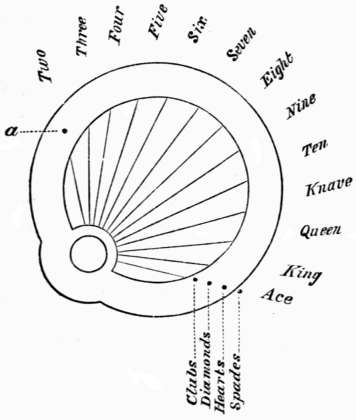
![[symbol: squiggle]](https://openoldbooks.sgp1.digitaloceanspaces.com/books/sharps-and-flats/images/i_053.jpg) in manufacture.—Given the
original conception of marked cards, and their practical
application to the needs of the sharper, the next step is,
obviously, the production of such wares commercially.
The desirability of being able to open a new pack of cards
and find them ready prepared for use, was too palpable
to be overlooked.
in manufacture.—Given the
original conception of marked cards, and their practical
application to the needs of the sharper, the next step is,
obviously, the production of such wares commercially.
The desirability of being able to open a new pack of cards
and find them ready prepared for use, was too palpable
to be overlooked.