Author of “Squinty, the Comical Pig,” “Mappo,
the Merry Monkey,” “Tum Tum, the Jolly
Elephant,” “Tinkle, the Trick Pony,”
“Chunky, the Happy Hippo,” etc.
ILLUSTRATED BY
WALTER S. ROGERS
NEW YORK BARSE & HOPKINS
PUBLISHERS
KNEETIME ANIMAL STORIES
By Richard Barnum
Large 12mo. Illustrated. Price per volume,
50 cents, postpaid
Away up in the North Woods lived a
family of foxes. They had big, bushy
tails, like a dust brush, and they wore
furry coats. Some of these furry coats were of
a reddish-yellow color, and some of them a sort
of gray. The foxes had long sharp noses and
sharp teeth, and they were very sly and cunning,
as they had need to be.
For a fox is not strong, like a lion or a tiger,
and to get his food he must be quick and sly,
and steal up when no one sees him, to get a fat
duck or a chicken from the farmyard.
Now in this family of foxes, about which I am
going to tell you, there was the father and
mother, and three little ones. Mr. and Mrs.
Fox were well grown, fleet of foot, and they
could both see and smell danger a long way off,
just as they could see and smell when they were
near some farmer’s house, where they might get
a chicken or a duck.
The home of the foxes was in a hollow log,
in the deepest and darkest part of the North
Woods, and in this hollow log the three little
foxes lived. They were named Sharp Eyes,
Twinkle and Winkle.
Sharp Eyes was the oldest of the children,
though they were all nearly the same age. The
reason he was called Sharp Eyes was because he
had such sharp, sparkling eyes, which seemed
to look right through the bushes and trees at
anything he wanted to find.
Twinkle, who was Sharp Eyes’ brother, was
so called because when he ran downhill or uphill
his feet seemed to twinkle in and out like
flashes of light.
Winkle, who was Sharp Eyes’ sister, was so
called because she seemed to winkle and blinkle
her eyes, sleepy-like, when she looked at anything.
So Sharp Eyes, Twinkle and Winkle lived
with their father and mother in the hollow log in
the big woods. The little foxes, at first, stayed
very close to the log. In fact, they did not go
outside it until they were pretty well grown, and
about the size of puppy dogs. Each day their
father and mother would crawl out of the log,
look carefully around to make sure there were
no dogs, hunters, or other dangers near, sniff
the air to see if they could smell anything that
might harm them or their little ones, and then
one or the other would slink slyly away through
the woods, to look for something to eat, not only
for themselves, but to bring home to the little
foxes.
One day when Mr. Fox had come home with
a plump partridge and the little foxes were having
a good dinner, Sharp Eyes asked:
“Mother, where did my father get this fine
meat for us to eat?”
“He caught it in the woods.”
Of course the Fox family did not speak the
same kind of language that you boys and girls
use. They talked in their own language, which
they could understand as well as you can understand
one another. But so that you may know
what the foxes said among themselves, and what
they thought, I have put their sayings into your
kind of words.
Foxes, like other animals, talk with whispers,
sniffles, snuffles, whines, barks and howls, and it
is very hard to understand them unless you know
their language, as I do. But, once you do, it is
as easy to know what they say as if you heard
the boy on your next street call:
“Come on, spin tops!”
So now you’ll understand what I mean when
I say a fox “says” this, that, or the other.
“Where did my father get this fine meat?”
asked Sharp Eyes, and when his mother told
him Mr. Fox caught it in the woods, the little
fox, as he gnawed a bone, smacked his lips and
asked:
“But how did he get it?”
“I’ll tell you, little Sharp Eyes,” said Mr.
Fox. “And you listen also, Twinkle and
Winkle. For you must soon learn to catch your
own dinners and suppers, as well as breakfasts.”
So the little foxes listened while their father
told them how to make a living in the woods,
where there are no stores at which animals can
buy what they want to eat.
“I was coming along under the trees,” said
Mr. Fox, “and I was looking on both sides of
me for something to bring home to your mother
and you to eat. Up to then I had not caught
anything. I sprang after a muskrat, but it
jumped into the brook and got away from me.
Then I tried to creep softly up behind a young
wild turkey in the woods, but he heard me and
flew away.
“So I was beginning to think I’d never get
a meal for my family, and I knew you were
hungry, when, all at once, I saw this partridge.
I walked as softly as I knew how over the leaves
and sticks in the woods, and, without his hearing
me, I got so close to the bird that I could jump
on him, pin him down with my feet, and catch
him in my sharp teeth. Then I brought him
home to you. That’s how I got your dinner,
Sharp Eyes.”
“And a very good dinner it is, too,” said Mrs.
Fox. “You animal children ought to be very
glad you have such a smart father. It is not
every fox that can catch a partridge.”
“Oh, well, we mustn’t be proud,” said Mr.
Fox, as, with his tail, he brushed smooth a place
inside the log, where he could lie down. “Our
children will soon be grown, and they will learn
how to catch wild turkeys, partridges, quail and
muskrats for themselves.”
“How do you catch wild things in the
woods?” asked Sharp Eyes.
“Yes, tell us, so we may learn,” begged
Twinkle.
“I will,” answered Mr. Fox. “It is time you
little fox puppies learned to hunt for yourselves.
You are old enough. After you have had a nap
we will go outside the log house, and your
mother and I will give you lessons.”
So the little foxes went to sleep after their
meal, as nearly all wild animals do, and as even
your cat and dog do after they have eaten.
They always seem to feel sleepy after eating.
And when Sharp Eyes, Twinkle and Winkle
awakened after their nap, they felt fine and
fresh, and felt like jumping around.
In fact, Sharp Eyes felt so fresh that he
cuffed his brother on the ear with his paw.
“Ma, make Sharp Eyes stop!” cried Twinkle,
in fox language of course.
“Oh, I wasn’t doing anything!” said Sharp
Eyes.
“Yes he was, too!” barked Sister Winkle.
“And now he’s tickling me!”
“I guess it’s time I gave you little foxes some
lessons in how-to-catch-things,” said Mr. Fox,
as he stretched himself, for he, too, had been
sleeping. “You are so full of life that you are
getting into mischief. Come out, all of you,
and I’ll show you how I caught the partridge.”
Sharp Eyes would have rushed out of the log
at once, but his mother held him back with her
paw, saying:
“Wait! Let your father take a look first, to
see that there is no danger. You must always be
careful in going out of your house, whether it is
a hole under the rocks or a hollow log or a
stump, to look for danger. Watch your
father!”
Mr. Fox stuck his nose out of the log a little
way and sniffed the air. Then he stuck it out
a little farther. Next he looked around with
his bright eyes.
So out in front of the hollow-log house, where
there was a smooth, level place, went Mr. Fox
and the three little foxes. Mrs. Fox stayed in
the log to shake up the dried leaves that made
the beds. That was all the housekeeping work
she had to do, for foxes, like most animals, live
a very simple life.
“Now this is how I crept softly up behind
the partridge,” said Mr. Fox, as he went along,
almost on his tiptoes, as you might say. “You
must be careful not to step on a stick so it breaks
and makes a noise,” he told the little foxes; “and
do not rustle the dried leaves. For partridges
and other wild birds and all woodland creatures
that we have to eat, are very shy, and fly off or
run away at the least noise. You see, we have
not sharp claws, like a cat, with which to grasp
the things we catch. We have to pin them
down with our paws, as a dog does, or get them
in our sharp teeth, and we have to be very close
to them before they see us, so we can do that.”
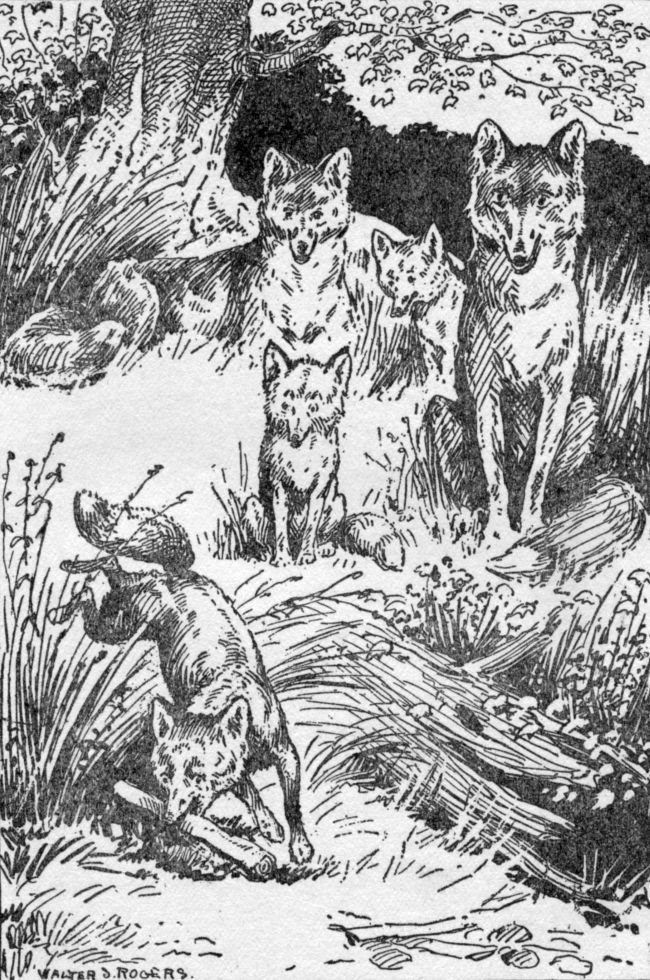
So Mr. Fox showed his little ones how to
creep along softly over the sticks, stones and
leaves. He pretended a piece of wood was the
partridge he was after, and, when he got close
enough, he gave a jump and came down on top
of it, quickly getting it in his mouth.
“That’s the way I would have done it if it had
been a real bird,” said Mr. Fox. “Now you
try, Sharp Eyes, and let us see how you would
do it.”
So the little fox boy tried, and so did his
brother and his sister, and for many days after
that their father or their mother gave them
hunting lessons outside the hollow log.
After a while Sharp Eyes, Twinkle, and
Winkle learned to be very good jumpers, and
they could move over a bit of ground, covered
with sticks, stones and leaves, so softly that you
never would have heard them.
“Now come out in the woods, and let us see
if you can be as quiet when there is something
real to catch, instead of the make-believe birds
and rats, that are really only pieces of wood,”
said Mr. Fox. For, up to this time, he had let
the fox children practise on bits of bark, clumps
of grass, or a stone, pretending they were grouse
or partridges.
Through the woods went the family, Mr.
Fox in front, then Sharp Eyes, Twinkle and
Winkle, and Mrs. Fox behind them all. The
two old foxes were looking out for danger, you
see.
All at once Mr. Fox stopped, and, speaking
in an animal whisper, said:
“Here is a mouse just in front of me, Sharp
Eyes. He does not see me yet. Come and see
if you can get it!”
Up came Sharp Eyes very, very softly. He
saw a big wood mouse under the roots of a tree.
The mouse was gnawing the soft bark.
“Now go softly,” said Mr. Fox.
Sharp Eyes tried to, but alas! he stepped on a
dried stick, which broke with a crack. The
mouse heard it and started to jump down into
his burrow under the earth.
“No, you don’t!” cried Mr. Fox, and he made
a big jump and caught the mouse just in time.
“That’s the way to do it!” barked Mrs. Fox.
“The mouse would have gotten away from you,
Sharp Eyes.”
“I’m sorry,” replied the little fox boy slowly
and sadly.
“Never mind,” said his father. “You’ll do
better the next time.”
But it was some days before the little foxes
learned to catch anything.
“Oh, shall we ever learn?” asked Twinkle.
“Of course you will,” said his mother.
“When I was a young fox, like you, I thought
I’d never catch my first mouse. But I did.”
So Mr. and Mrs. Fox had to keep on catching
the things the little foxes ate, though each day
Sharp Eyes, Twinkle and Winkle were getting
quicker and better.
But one day Mr. Fox came home without any
dinner.
“What’s the matter?” asked Mrs. Fox.
“Couldn’t you catch anything to-day?”
“No,” answered Mr. Fox. “In fact, I didn’t
see a thing. I’ve tramped all over these woods,
but not a bird or an animal could I see. Of
course I saw cows and horses in the farmers’
yards, but they are too big for me to carry off.”
“Couldn’t you get a chicken or a duck?”
“I saw some ducks and chickens on one farm,”
replied Mr. Fox, “but the farmer, or one of his
men, was near them all the while with a gun or
a club, and I dared not try to catch one. I’d
have been caught or hurt myself if I had. I’m
sorry, but we’ll have no dinner to-day.”
Sharp Eyes and his brother and sister felt
sad on hearing this. They were very hungry.
“Couldn’t we all go out hunting together?”
asked Sharp Eyes, after a bit. “Maybe we
could see something you could catch,” he said to
his father.
“Well, perhaps that would be a good plan,”
replied Mr. Fox. “Come on, we’ll all go out
and see if we can find a meal.”
So out into the woods went the five foxes—the
two large ones and the three smaller ones.
Slowly and carefully they went along, looking
from side to side, and sniffing the air for any
sign of something to eat.
“There doesn’t seem to be anything,” said
Mrs. Fox, with a hungry sigh.
“No,” answered Mr. Fox, “there doesn’t. I
never saw the woods so scarce of food.”
All of a sudden Sharp Eyes, who had gone
a little way ahead, came softly back.
“I see something!” he said. “Shall I try to
get it for our dinner?”
“What is it? Where is it?” asked Mr. Fox
eagerly. “I don’t see anything,” and he looked
as hard as he could through the bushes.
“Right over there, by the old stump,” said
Sharp Eyes. “Don’t you see? It’s a big
chicken.”
Mr. Fox looked. Then he said:
“That isn’t a chicken! It’s a wild turkey!
If we get that it will make a fine meal for all of
us! Sharp Eyes, you were rightly named.
You saw this turkey when neither your mother
nor I could see it. It’s a good thing you did.
Now we’ll have a fine meal!”
CHAPTER II SHARP EYES CATCHES SOMETHING
Slowly and carefully, making not the
least sound, Mr. Fox began to creep
through the woods toward the wild turkey.
The big bird was eating some forest berries,
and had his back toward the fox.
“Let me catch him!” whispered Sharp Eyes.
“I saw him first, let me creep up and jump on
him!”
“No,” whispered his mother. “It is true you
had very keen sight to see the turkey, Sharp
Eyes, and when you grow up you will be a
smart fox. But just now, when we are all so
hungry, it would not do to let that turkey get
away from us. They can fly faster than you
can run or jump. Even your father will have
hard work getting it. But he can do it better
than you.
“You saw the big bird first, Sharp Eyes.
Now let your father get it for us. Then we
shall all have something to eat. The next wild
turkey you see you may catch for yourself.”
“All right,” said Sharp Eyes. So he carefully
watched his father to see how the old fox
would go about it to catch the wild turkey.
Nearer and nearer crept Mr. Fox to the big
bird, which was still eating away, not hearing
or seeing the danger that was so close to him.
Mrs. Fox and the three little foxes waited very
anxiously indeed, for they were very hungry.
“Oh, I hope he gets it!” whispered Twinkle.
“So do I,” said Sharp Eyes.
“It was awfully smart of you to see it,” murmured
Winkle.
“Hush, children!” softly called Mrs. Fox.
“Watch your father!”
Just then Mr. Fox made a jump for the
turkey. Up in the air went Sharp Eyes’ father,
and down he came, right on the back of the big,
wild bird.
“Gobble-obble-obble!” cried the turkey, and
that was all he said. A little later the fox family
had a fine dinner, and they didn’t have to
wait for the turkey to be roasted, either. They
ate it raw.
Of course it was too bad for the turkey, but
animals must live, and if one lives on the other
that is the law of the woods. There is no need
of feeling sorry. The foxes had to eat the
turkey, just as the turkey had to eat grasshoppers.
“Oh, that was a fine meal!” cried Twinkle,
when the turkey was all gone, and nothing but
the bones was left.
“Yes, and if it hadn’t been for Sharp Eyes we
might not have had it,” said Mrs. Fox.
“That’s right,” said Mr. Fox. “I looked and
looked under the trees and through the bushes,
but I never saw that turkey. It took Sharp
Eyes to see it for us. His name is the right one
if ever a name was.”
Of course Sharp Eyes felt very proud and
happy on hearing this, just as you children feel
when you do anything that pleases your father
and mother.
“But I wish I could catch something myself,”
said the little fox boy.
“Oh, you will, some day,” his mother answered.
“You are young yet—you have plenty
of time to learn.”
After their turkey dinner the fox family went
back to their home in the hollow log and had a
long sleep. And they did not need to hunt anything
more until the next day, for the turkey was
a large one. Foxes or other wild animals,
hardly ever save anything over from one meal
to the next. They have no ice boxes or pantries.
When they are hungry they go out and get what
they can to eat, and they don’t hunt for anything
more until they are hungry again.
Of course, by the next day, Sharp Eyes, his
brother and sister, as well as his father and
mother, were hungry once more.
“I will go out and see what I can find,” said
Mr. Fox. “The rest of you stay here.”
“Can’t I come with you?” asked Sharp
Eyes.
Mr. Fox seemed to think for a minute.
“Yes,” he answered, “I guess it will be a good
thing for you to come along. My eyes are getting
old, and are not as good as they once were.
Yours are young and bright. You may see
something I can’t. Come with me, Sharp
Eyes.”
“And us?”
“Well— Well, no, Twinkle and Winkle.
This isn’t a lesson in hunting. I think, if I
take only Sharp Eyes along, we’ll be able to
get something to eat sooner.”
So Sharp Eyes went hunting with his father,
while Mrs. Fox remained at home in the hollow
log with Twinkle and Winkle.
“I hope we’ll see another wild turkey,” said
Sharp Eyes, as he trotted along beside his father
across the meadow.
“Don’t expect such good luck,” answered the
older fox. “If we get a couple of wood mice,
or perhaps a little duck that has paddled off
down stream away from the others, I shall be
glad.”
So to the woods they went, looking for mice
which live in hollow stumps or in the ground
under the roots of trees. But all the mice
seemed to be away that day. Not one could
Sharp Eyes or his father see.
“Now we’ll go to the brook,” said the old fox.
“Sometimes there are little ducks there, who
know no better than to swim too far from
the big ones, that, if I jump in among them,
can make a loud quacking noise and bring the
farmer with his gun. Maybe we can steal up
on a little duck.”
So down to the brook went Sharp Eyes and
his father. But though there were ducks and
geese in the water (for the brook was near a
farm) not one of the fowls was off by itself.
They all kept together and not far from them
was a farmer plowing in a field.
“He may have a gun near him, or a club,”
said Mr. Fox, “and with either of those he could
hurt us very much. We’ll not try to get a duck
now. We’ll have to go somewhere else for
our dinner.”
“But where?” asked Sharp Eyes. “I am
hungry, and I know my mother is, and so are
the others.”
“I know,” answered his father. “I am also
hungry. We’ll go to the woods once more.
Maybe there’ll be some mice now.”
So back to the woods they went.
On all sides, among the trees and through the
bushes, looked Mr. Fox and Sharp Eyes. But
no mice could they see. Nor did there seem to
be any partridges, quail or other wild birds. As
for wild turkeys, not even the gobble-obble of
one could be heard.
“What shall we do?” asked Sharp Eyes.
“I’ll tell you,” his father answered. “There
are two of us. If we keep together we can be
in only one place in the woods, but if you go
one way and I the other we can be in two places,
and we’ll have a much better chance to find
something.”
“All right,” said Sharp Eyes. “I’ll go this
way,” and with his paw he sort of pointed
down among some trees where the shadows were
deep and dark.
“It looks as though you could catch something
there,” observed Mr. Fox. “I’ll go the
other way, and whichever of us first catches
anything must bark and howl. Then the other
will know.”
“I’ll do it,” said Sharp Eyes.
So off he trotted by himself. It was the first
time he had hunted alone, and he felt a bit queer
about it. Still he was a sly, cunning chap, as
are all fox creatures, and he wanted to show
what he could do.
“I’ll get another turkey,” said Sharp Eyes to
himself.
Through the woods he went, very softly and
quietly, looking on all sides, and sniffing the
air to get a smell of something he might catch
as a dinner for himself and the rest of the fox
family.
All at once Sharp Eyes saw something moving
behind a bush. It made a rustling sound.
“I wonder what that is,” thought the fox boy.
Once more he sniffed the air. The wind was
blowing toward him from whatever was in the
bush, and the wind brought to the nose of the
fox boy a wonderful perfume.
“It smells like something good to eat!”
thought Sharp Eyes.
There was another rustling in the bushes.
Then the fox boy saw some feathers shining
in the sun.
“It must be another wild turkey,” said Sharp
Eyes to himself. “Oh, I wonder if I can jump
on it as my father did! I’m going to try!”
As softly as he could, the fox boy crept up
behind the bush. He heard a scratching sound
among the dried leaves. He saw more feathers,
and something red.
“That’s the funny red thing that hangs down
under a turkey’s chin,” said the fox boy to himself.
“I am having good luck! Oh, if I can
only jump on that bird before he hears or sees
me and flies away!”
Nearer and nearer he crept. He could see
the big bird now. It did not look exactly like
the wild turkey.
“Maybe it’s a new and better kind,” thought
Sharp Eyes. “If I get it I’ll bark for my father
to come and see what good hunting I can do!”
Nearer and nearer he crept. The big bird
which was picking up something from the
ground under the bush, and scratching in the
leaves, did not seem to hear.
“Ah ha!” whispered Sharp Eyes to himself.
“Now for a good dinner for all of us!”
Through the air he jumped, and he landed
with his front feet right on the big bird’s back.
“Burr-r-r-r-r!” barked Sharp Eyes, almost
like a dog.
“Cock-a-doodle-do!” crowed the big bird,
and then it was very still.
CHAPTER III SHARP EYES HEARS SOMETHING
“Ah ha!” cried Sharp Eyes in fox talk,
“I have caught you, my fine wild
turkey!”
Then, with the big bird held tightly under
his paws, the fox boy lifted his nose high in the
air and howled and barked. That was his way
of saying:
“Come and see what I have, Father! I’ve
caught a fine wild turkey!”
Away off in the woods, where he was looking
for something to eat, Mr. Fox heard the call of
Sharp Eyes.
“Ah, I wonder if he is hurt, in danger, or if
he has something for dinner,” said Mr. Fox to
himself.
Mr. Fox listened carefully, and then by the
difference in the howl and bark, he could tell
what Sharp Eyes was saying. It was this:
“I have caught something! I have caught
something!”
“Ah, my little fox boy has had good luck,”
said Mr. Fox. “Better luck than I have had.
I must go and see what he has caught!”
Not having found anything that he could
take home for his family’s dinner, Mr. Fox
turned and ran quickly through the woods toward
Sharp Eyes. He could tell where his little
fox son was by noticing the direction from
which his howls and barks came.
“What is it?” asked Mr. Fox as he came near.
“I have caught a big wild turkey,” answered
Sharp Eyes, still keeping the large bird between
his paws.
“Ha! that is not a turkey,” said Mr. Fox, as
he came near and saw what Sharp Eyes had.
“No?” asked the little fox in surprise.
“What is it then?”
“It’s a rooster,” said his father. “A great,
big rooster that lives down on the farm where
the ducks are,” for there were farms near the
North Woods, though there were no cities.
“Well do I know that rooster,” went on Mr.
Fox. “Many a time, when I have been creeping
up to get a chicken, he has seen me and
crowed so loudly that the farmer came out with
a gun to drive me away. And so you have
caught him, Sharp Eyes!”
“Yes, but I thought he was a wild turkey like
the one I saw before. I never have seen a
rooster.”
“He is as good as a wild turkey to eat,” went
on Mr. Fox. “You have had good luck. You
have quick legs as well as sharp eyes. Now we
shall not be hungry.”
So Mr. Fox carried the big rooster home to
the other foxes in the hollow log. The bird
would have been too heavy for Sharp Eyes, who
was not yet full grown.
“Oh, what a fine dinner!” said Mrs. Fox,
when she saw the rooster. “Who caught
it?”
“Sharp Eyes did,” answered his father. “We
ought to be quite proud of him!”
“I am,” said the little fox boy’s mother.
Then they had a rooster dinner, and Twinkle
and Winkle listened as Sharp Eyes told how he
had caught the fowl, thinking it was a wild
turkey.
“Though when it said ‘Cock-a-doodle-do!’ instead
of ‘Gobble-obble-obble,’ I thought it was
funny,” said the little fox boy.
“You are a real fox now—you can go out and
catch things for yourself,” said his father.
“Now, Twinkle and Winkle, it is time you
started in. To-morrow let us see what you can
do.”
So the next day the three little foxes started
off together on a hunting trip. At first they
saw nothing, but, after a bit, they spied some
wood mice and each caught one.
“They are not as big as a rooster or a wild
turkey,” said Sharp Eyes, “but they will do for
a start. We can’t catch big things every day.”
Twinkle and Winkle were quite delighted
with the mice. They were the first things they
had caught, except some grasshoppers, and they
felt a little bit proud of themselves.
From then on the little foxes hunted every
day. Twinkle and Winkle soon learned to do
nearly as well as Sharp Eyes, but their brother
could always see things in the woods before they
could.
His eyes seemed to grow sharper and brighter
each day, and he could tell a turkey, a partridge
or other wild bird a long way off, so that even
his father used to say:
“Sharp Eyes is the best hunter of us all. He
is a fine fox!”
Not far from where these foxes lived was another
family, not quite the same kind, though.
One of these foxes, named Red Tail, as he heard
Sharp Eyes tell of having caught the rooster,
said one day:
“You had better look out for yourself, Sharp
Eyes.”
“Why had I, Red Tail?”
“Oh, because,” was the answer, and that was
all Red Tail would say just then.
“Pooh! I s’pose he means a hunter might
shoot me,” said Sharp Eyes. “But I’m not
afraid. I’m going off in the woods now and see
what I can find for dinner.”
Off went the little fox boy on another hunt.
He looked all around, and listened and smelled,
and at last he saw something moving along the
ground.
“Ha! Maybe that is another rooster or a
turkey,” thought Sharp Eyes. “I’ll get that for
dinner.”
Softly, softly he crept up toward the animal
on the ground. Sharp Eyes could now see it
was an animal, and not a bird, and at first he
thought it was an extra large wood mouse. For
the animal was of the same color, a light gray.
But when Sharp Eyes saw the big, curving
bushy tail of the creature he said:
“Ha! I know him. It is a gray squirrel!
Well, they are as good as a rooster or a wild
turkey, though not as large. I’ll get him!”
Sharp Eyes crept toward the gray squirrel,
but, just as the fox was going to jump on it,
something happened.
With a chatter of his teeth and a frisk of his
tail the squirrel sprang up into a tree, and from
there, safely out of reach, sitting on a limb,
with his tail curled up along his back the squirrel
looked at Sharp Eyes.
“Ha! You thought you’d get me! didn’t
you?” chattered the squirrel.
“Oh, I don’t know. I’m not so very hungry,”
drawled Sharp Eyes, pretending he hadn’t been
fooled when the squirrel jumped away.
“Oh, yes you did! You tried to get me, but
I was too quick for you—I got away!” laughed
and chattered the squirrel. “What’s your name,
little fox boy?”
“Sharp Eyes. What’s yours?”
“Oh, I am called Slicko, the jumping squirrel,
and it’s because I can jump so well that I
got away from you,” answered the little gray
animal. “Haven’t you heard about me?”
“Heard about you?” asked Sharp Eyes.
“What do you mean? I hear you talking now,
and I heard you scrabbling around in the
leaves.”
“No, I mean, didn’t you hear about my having
adventures, and being put in a book?” asked
Slicko.
“No,” answered Sharp Eyes, looking hungrily
up at the squirrel, “I didn’t.”
“Well, I am in a book,” went on Slicko, “and
it tells how I was caught by some boys, and put
in a cage. But I got away and came back to the
woods I love so well. But if you haven’t read
the book about me, I don’t s’pose you know
Blackie, the lost cat, nor Don, the runaway dog.”
“No,” said Sharp Eyes, “I don’t know either
of them. I don’t like dogs.”
“Oh, but you’d like Don,” said Slicko. “He’s
the nicest dog that ever was! He’s in a book,
too.”
“I don’t know anything about books,” said
Sharp Eyes. “All I know about is being
hungry—that’s why I tried to catch you.”
“I’m glad you didn’t,” chattered Slicko.
“So am I,” said the fox. “I guess I can easily
catch a turkey or a mouse or a rooster. I’ve
caught roosters before. But now I wouldn’t
like to catch you as I like to hear you talk,
though I don’t know anything about books.”
“Neither do I,” said Slicko. “All I know is
I’m in one. And there’s a book about Tum
Tum, the jolly elephant. I don’t s’pose you
know him, either, do you?”
“Is an elephant like a wild turkey?” asked
Sharp Eyes.
“I should say not!” laughed Slicko. “An
elephant looks as if he had two tails, but one is
his trunk. Tum Tum was a jolly chap. He
was in the same circus with Mappo, the merry
monkey. But excuse me, I have to go now.
I’ll see you some other time.”
“I wish you would,” said the fox boy. “I’ll
promise not to catch you. I like to hear you
talk. Tell me some more about your elephant
and monkey friends.”
“I will,” promised Slicko, “and about the
book I’m in, too. I had a lot of adventures.
Maybe you’ll have some, too, and have them put
in a book.”
“Oh, no! That will never happen to me!”
said Sharp Eyes.
But you see how little he knew about it, for
here he is in a book, and I have a lot of adventures
to tell you about him.
So Slicko, the jumping squirrel, scrambled off
among the trees, and the little fox boy went to
look for something to eat.
Sharp Eyes presently caught a fat duck that
had swum too far down the brook, away from
the farm, and, slinging her across his back, off
to the hollow log he trotted.
And later that day, when Sharp Eyes was telling
his friend, Red Tail, about catching the
duck, Sharp Eyes said:
“I think I am getting to be a pretty good
hunter, don’t you?”
“Yes, you are,” said Red Tail. “But you had
better look out.”
“You said that the other day,” went on Sharp
Eyes. “What do you mean? Do you mean I’d
better look out for Slicko, the squirrel?”
“Oh, no,” answered Red Tail. “But did you
ever stop to think that your coat of fur is different
from those that most of us wear?”
“Why, no, I never took much notice,” said
Sharp Eyes, as he looked at himself as well as
he could. “What’s the matter with my fur?”
“Nothing, except that it is very beautiful,”
said Red Tail. “Now you are going to hear
something that may scare you. Though you
may not know it, you are a silver fox.”
“What’s that?” asked Sharp Eyes.
“It means your fur is the color of silver,” went
on Red Tail. “That color is very scarce, and
hunters like to get a silver fox more than any
other. That means they’ll hunt you out, and try
to catch you rather than any of us, for our fur is
common. But yours is silver shade, and can be
sold for a lot of money. So you want to look
out.”
“Look out for what?” asked Sharp Eyes.
“For hunters,” answered Red Tail. “I’ll tell
you how I happen to know. Last year, when I
was a tiny little fox, I was caught in a trap. A
man who was a trapper of wild animals up in
these North Woods caught me. He took me
home to his cabin, and there I saw the skins of
many foxes hung up to dry.
“There were many like mine, but only one or
two of a silver color. As I was so small, the
trapper kept me to tame me, and I stayed in his
cabin a long time. There I learned to know a
little of the talk that men hunters and trappers
speak.
“Other hunters and trappers used to come to
the cabin to buy furs, and they paid more for
that of a silver fox than for any other. That is
how I know your silver coat would bring a lot
of money if a hunter or a trapper caught you.
So you want to be careful when you go out in
the woods.”
“Thank you, I will,” promised Sharp Eyes.
“I’ll be careful. Thank you for telling me, Red
Tail.”
The two foxes talked in animal talk a little
longer, and Sharp Eyes was just going back to
his hollow log when, all of a sudden, a loud clap,
like thunder, sounded in the woods.
“What’s that?” cried Sharp Eyes. “Is it going
to rain?”
“No! That was the sound of a gun!” cried
Red Tail. “That was a hunter’s gun! We had
better hide, Sharp Eyes! The hunters, even
now, may be after your silver fur!”
And away ran Red Tail and Sharp Eyes.
CHAPTER IV SHARP EYES IS HURT
Sharp Eyes, the silver fox, could run
very fast. So could Red Tail. And they
knew they must run fast to get away from
the dogs of the hunter. For when men go out
to hunt wild animals or to trap them, dogs generally
go with the men, and though a man can
not run as fast as a fox or a deer, dogs can.
Red Tail told this to Sharp Eyes as they hurried
along together. Behind them could be
heard the rumble and roar of the man’s gun,
sounding like thunder.
“Hurry, Sharp Eyes!” cried Red Tail.
“Don’t let the hunter see you!”
“What will he do if he sees me?” asked the
little fox boy.
“He’ll try to shoot you with his gun. That is,
he will if he can not catch you alive.”
“Why would he want to catch me alive?”
asked Sharp Eyes, as he trotted along beside the
other fox. They slunk down between bushes,
ran under fallen trees, crawled beneath old logs,
and even ran in brooks of water.
“He’d like to catch you, instead of shooting
you, because you are now a small fox, and will be
bigger some day,” answered Red Tail. “The
bigger you are the more fur you’ll have, and it is
for your fine silver fur that the hunter or trapper
would like to get you.”
“Wouldn’t he like yours, too?” asked Sharp
Eyes.
“Well, yes, I guess he’d take my fur, too, if
he could get it,” answered Red Tail. “But mine
is not so nice as yours. Of course it keeps me
just as warm, and all that, but people who want
fox furs seem to like your silver color better,
though why, I don’t know. You are a rare fox,
and more hunters or trappers will try to get you
than would try to get me. So be careful!”
“I will,” promised Sharp Eyes. Then he
asked: “Don’t you think we can stop running
now and take a rest? I’m tired,” and indeed
the little fox boy was weary. His tongue was
hanging out of his mouth and his legs ached.
“No, we can’t stop yet,” said Red Tail. “We
must run on a little more. Then we can hide
in the dark woods away from the hunter and his
dogs and take a long rest.”
So on the two foxes ran farther and farther
until at last Red Tail, who was older than Sharp
Eyes, and who had been chased by dogs and
hunters before, and knew their ways, said it
would be safe to rest. They lay down on the
leaves under a tree and stayed as quiet as mice.
They listened, but could not hear the barking of
the dogs nor the bang of the gun.
“I guess we got safely away,” said Red Tail,
as he crept out a little way and lapped up some
water from a brook. Sharp Eyes did the same,
for they were both very thirsty from their run.
“Is it all right to go home now?” asked Sharp
Eyes, when he had rested till his tongue was no
longer hot nor his legs tired.
“I’d better take a peep around and see,” answered
his friend. “I know more about hunters
and dogs than you do.”
So Red Tail peeped out from behind some
bushes, ready to skip back again and hide in case
he saw danger. But he saw none, and, after a
little while, he and Sharp Eyes went on to their
homes, which were not houses such as you live
in, but a hole in a hollow log or a den under the
earth with some rough stones for a front door.
“Well! where have you been, Sharp Eyes?”
asked his sister Winkle, as he scrambled down
inside the hollow log.
“Oh, I’ve been chased by a hunter and his
dogs, and I heard his gun fired,” answered the
little fox boy.
“You did?” cried his mother, who was listening
to what he said. “Oh, Sharp Eyes, you must
be careful!”
“I will. That’s what Red Tail told me.”
“And don’t go too much with that Red Tail
boy, either,” said Mr. Fox. “He is a daring
sort of chap, and he might lead you into danger.
Once he went to a farmyard in broad daylight
and took a chicken. He ought to have waited
until night. He is very daring.”
“Well, he was good to me,” said Sharp Eyes.
“He showed me how to run away from the
hunter.”
“You must have had a terrible time,” said
little Winkle.
“Oh, it was a sort of adventure,” answered
Sharp Eyes.
“What’s adventure?” Twinkle, his brother,
asked.
“It’s things that happen to you,” answered
Sharp Eyes. “And then they are put into a
book. That’s what happened to Slicko.”
“Who’s Slicko?” asked Winkle.
“A jumping squirrel,” replied Sharp Eyes, and
he told of the talk the two had had together.
For some days after this nothing much happened
to Sharp Eyes. He stayed with his father
and mother and brother and sister in their
hollow log house, going out now and then to get
something to eat, or to drink water at the brook.
“That boy of ours is going to be very smart,”
said Mr. Fox to his wife one day.
“What makes you think so?” she asked.
“Why, when we were out hunting in the
woods to-day he saw a big muskrat that I
couldn’t see, and he caught it.”
“Yes, I think he has the best eyes, for seeing
things to eat, of any foxes in this wood,” said
Mrs. Fox. “I only wish his fur was a different
color.”
“Why?”
“Because it is too beautiful. If it was red or
brown, like yours and mine, the hunters and
trappers would not be after him so much. But
he is a silver fox, and you know how such skins
are prized. There is a big reward for a silver
fox skin, Red Tail’s mother told me.”
“Yes, I suppose there is,” said Mr. Fox. “I
remember hearing, when I was a boy, that a silver
skin was much sought after by hunters. I
never was colored that way myself, but I knew a
fox who was a boy when I was. He had silver
fur, and one day he did not come to play with
us. We asked where he was, and his father said
a hunter had shot him to get his silver fur.”
“It’s too bad,” said Mrs. Fox. “I wish the
hunters would leave us alone. I must tell Sharp
Eyes to be careful.”
Each night, now that he was big enough,
Sharp Eyes went out with his father or mother,
Twinkle or Winkle sometimes going with them,
to hunt for things to eat. When they dared they
went to a farm which was not far from the North
Woods where they lived.
“It is easier to get a chicken or a duck than to
hunt for a wild turkey or the wood mice,” said
Mr. Fox. “We’ll eat at the farmyard if we
can.”
And often they did, though sometimes the
dogs barked when the foxes came near, or the
farmer and his men would come out with guns,
and the foxes would have to run away. At such
times they had to hunt for something to eat in
the woods. And, if they did not find it, they
would go hungry. That was no fun.
One night, when the whole fox family had
been out hunting and had been frightened away
from the farm by barking dogs, they were all
very hungry.
“I wish I had something to eat,” sighed
Winkle.
“Well, we can’t have anything, so we’ll just
have to wait,” said her mother.
“Where’s Sharp Eyes?” asked Mr. Fox.
“Didn’t he come back with us?”
“He said he was going back to the farm, and
try to get a chicken or a duck,” returned Twinkle.
“He said he was terribly hungry. And
so am I.”
“Sharp Eyes may be caught,” said Mrs. Fox.
“You had better go back and make him come
with you,” she went on to Mr. Fox.
“I will,” said he, but just as he started out on
the woodland path, Sharp Eyes came running
along, with a big chicken slung over his back.
“At that farmyard. I waited until the wind
was blowing the other way, so the dogs could not
smell me coming, and then I crawled in and got
this bird.”
“It’s a wonder you weren’t caught yourself,”
said his father. “You are getting as reckless as
Red Tail. You must look out for danger.”
“I did,” answered Sharp Eyes. Then they all
ate the chicken he had brought, and his mother
said he was very clever.
“But you’ll not always be as lucky as that,”
said Red Tail to Sharp Eyes the next day, when
the fox boy told what he had done. “Some day
you may be caught in a trap.”
“What’s a trap?” asked Sharp Eyes. “Is it
like a book that Slicko the squirrel had adventures
in?”
“No, a trap is something that hurts you,” said
Red Tail.
A few days after that the silver fox had a
chance to see for himself, and feel for himself,
what a trap was like.
Sharp Eyes was trotting along through the
woods, not far from the farmer’s yard; and as he
was looking toward it hoping he might catch a
stray duck or a rooster, all of a sudden he saw
a chicken lying to one side of the path.
“Oh, ho!” said Sharp Eyes to himself. “I’ll
just get that and take it home for lunch.”
So he crept softly up on the chicken, which
did not seem to know a fox was so near. When
he was close enough, Sharp Eyes gave a jump
and came straight down on top of the fowl, making
a grab for it with his teeth.
At the same time there was a sharp click, and
Sharp Eyes felt a sudden pain in one paw. It
stung and ached.
“Oh!” cried the fox boy. “I’m hurt! Something
has me fast by the foot! Oh, what can it
be? Did the chicken bite me?”
He tried to pull his paw loose, but could not.
He was caught, and was held fast.
CHAPTER V SHARP EYES MEETS DON
After the first pain felt on being caught,
and when he found he could not pull his
paw loose, Sharp Eyes lay quietly on the
ground, partly covering up the chicken. He
did not howl, which was his way of crying when
he was hurt, though he wanted to do so very
much. But foxes and other wild animals do not
make much noise in the woods, for they like to
keep quiet so no larger animals, or hunter-men
with their dogs, may know where to find them.
“Something terrible has happened to me,”
thought Sharp Eyes, as once more he tried to
pull loose his paw. But he could not, and each
time he pulled the pain was worse.
“If I make too much noise,” thought Sharp
Eyes, “Bruin, the bear, may hear me and come
to bite me. Or the hunters may come with their
dogs, and I could not get away.”
There were bears in the North Woods where
Sharp Eyes lived, and hunters and dogs often
came to the forest.
“And, now that I am caught fast, I can’t get
away if they should come up close to me,”
thought the little fox boy. “I must keep quiet
and not make too much noise, though I would
like to call and ask my father or mother to come
to help me.”
Sharp Eyes whined a little from the pain, and
then he tried to be brave and not mind it.
“I wonder what it is that has caught me,” said
the little fox boy to himself. “And why didn’t
the chicken flutter and try to get away when I
jumped on her? That was very funny!”
He soon saw the reason the chicken did not
move. It was dead, and Sharp Eyes knew he
had not killed it.
“She must have been dead when I jumped on
her,” said the little fox boy. “And now to see
what has caught me.”
He could move about a little, and, pawing with
one of his feet that was not caught, Sharp Eyes
brushed the chicken to one side. Then he saw
that his left forefoot was caught between two
jaws of iron.
“Oh, I’m in a trap!” exclaimed Sharp Eyes.
“I never saw a trap before, but this is just what
my father said they were like. He told me to
keep out of them, but I didn’t see this one. The
chicken was in the way, or I might have noticed
the trap. Oh dear! I wonder if I will ever get
loose!”
Sharp Eyes pulled some more, but the pain
in his foot soon made him stop.
“If you had only been alive you could have
told me about the trap, and then I wouldn’t have
been caught in it,” said Sharp Eyes, speaking to
the dead chicken, as though it were alive.
If he had only known, the chicken was put
there near the trap, partly covering it, on purpose.
It was bait for the trap, just as mousetraps
are baited with cheese. And the trap was
set in the woods by a hunter who hoped to catch
a fox or some other wild animal in it.
The chicken had been killed and put near
the trap, for the hunter knew wild animals like
such things to eat. And the hunter knew that
if a fox came along, the first thing it would do
would be to jump for the chicken, thinking it
was alive.
Underneath the outspread wings of the
chicken was the open trap, and as soon as Sharp
Eyes’ paw touched the spring, snap! shut went
the jaws of the trap, catching him fast there.
It was the jaws of the trap pressing on Sharp
Eyes’ paw that hurt him.
“Oh, if I could only get away!” said the little
fox boy to himself. “If I can only get away I’ll
never jump at a chicken again, without looking
first to make sure there’s no trap!”
But it was too late to think of that now.
Sharp Eyes was caught, and every time he
pulled his leg it hurt him so that he soon
stopped.
“Red Tail was right,” he whispered to himself.
“He said something would happen to me
some day, and it has. Oh dear!”
Sharp Eyes kept quiet as long as he could, and
then his paw pained him so that he had to cry
out. But he cried very softly. Then he called
for his father and mother, using fox language,
of course.
But they did not answer him, for they were
far away.
“Twinkle! Winkle! Can’t you come and
help me out of the trap?” barked the little fox
boy, held fast, all alone in the woods, near the
dead chicken.
But neither Twinkle nor Winkle answered.
They, too, were far away. They were off hunting
with their father and mother, and though
they wondered where Sharp Eyes was, they
thought he was safe.
“Sharp Eyes can take care of himself,” said
his mother.
“But I hope the hunters or trappers don’t get
him and take his lovely, silver fur,” said Winkle.
If they could only have known what had happened
to poor Sharp Eyes they would surely
have gone to help him, wouldn’t they?
“But I must get away,” thought Sharp Eyes.
“If I stay in this trap much longer the hunter
will come and get me. Or his dogs will come
and bite me! Oh, I must get loose!”
So he pulled and tugged away to get out of
the trap, but his foot hurt him more and more
and he had to stop.
Sharp Eyes was in such pain, and so troubled
about what might happen to him, that he did not
even feel like eating some of the chicken, though
he had been hungry a little while before. Now
his appetite was all gone.
The little fox did not know what to do. He
called again for his father and his mother, and
for Twinkle and Winkle, but none of them
came. Then, all at once, there was a noise in
the bushes, and something seemed to be coming
toward Sharp Eyes where he was caught fast in
the trap.
“Oh, I hope it’s my father or mother!” thought
the fox.
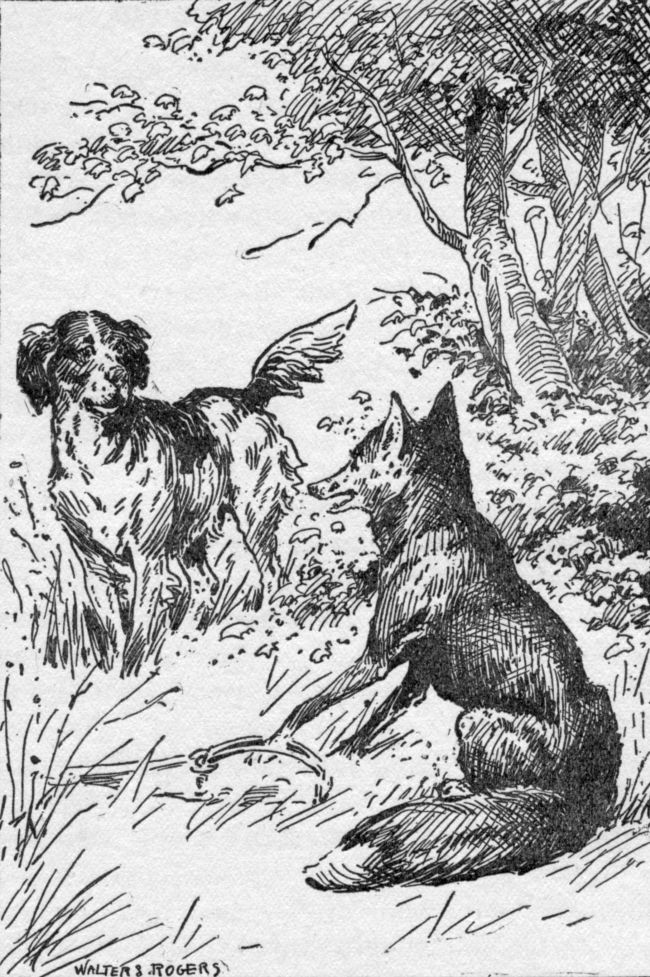
But it was not. Instead, a big dog, who was
kind-looking, and not fierce and angry, burst
through the bushes.
“Oh dear!” thought Sharp Eyes. “This is
the hunter’s dog! Now I am surely lost.
They’ll take my silver fur. Oh, if I had only
kept out of the trap!”
Once more Sharp Eyes tried to get loose, but
the pain in his leg made him stop. He looked
at the dog, and got as far away as he could. But
the trap was fast to a chain, of which one end
was wound around a tree and could not be pulled
off.
“Hello, what’s the matter here?” asked the
dog, who, of course, could speak animal talk,
though not exactly the same language that Sharp
Eyes and his friends used. “What’s the matter?”
“Oh, you know well enough what’s the matter,”
said Sharp Eyes sadly. “I’m caught in a
trap your master set, and I suppose you and he
are coming to get me now.”
“What’s that? A trap? I don’t know anything
about a trap,” answered the dog. “And
I’m sure my master never set one. He lives in
a big house far away from here. I used to live
in a house where there was a nice little girl. I
liked her very much, and often I went for walks
with her. Once I took her to a park menagerie,
and she fell into the tank where Chunky, the
happy hippo, lived. But Chunky lifted her out
of the water on his broad back and saved her.
Chunky is a friend of mine.
“My people have taken a bungalow over on
the lake off there, and we’re staying there for a
while. It’s a good way off from here, but not
so far as our real home, where we live all the
time.
“To-day I wanted to have some adventures,
so I trotted off from my master’s bungalow.
They don’t need me to-day, as they have all gone
visiting. So I came to the woods, but I never
expected to see you. Are you another dog?
You look a little like one, only your nose is
sharper than mine, and you are not so large.”
“No, I am a fox, and my name is Sharp Eyes,”
came the answer. “And I am caught in a trap.
But please don’t bite me.”
“Bite you? Why should I bite you?” asked
the dog.
“Why, I thought all dogs belonged to hunters
or trappers and that they bit us foxes,” said
Sharp Eyes.
“Well, I don’t,” was the reply. “My name is
Don, and once I was a runaway dog, but I ran
back. I am a little like a runaway dog to-day,
but I am going to run back home to-night, as
soon as I have had some adventures in the woods.
This is the start of one, I guess. I’m sorry you
are in the trap.”
“Are you, really?” asked Sharp Eyes, who
had been taught that all dogs were bad and cruel.
“Of course I am, Sharp Eyes,” answered Don.
“I know what it is to be in pain, and I can see
that where your paw is caught it must hurt you.”
“Indeed it does,” answered the fox. “I’ve
tried to get away but I can’t.”
“How did you get in the trap?” asked Don.
“Oh, I didn’t look closely enough before I
made a jump for this chicken. It was right over
the trap, to hide it, and now I am fast.”
“Well, maybe you can get loose,” said Don.
“I’ll help you. This is what my friend Slicko,
the jumping squirrel, would call an adventure.”
“Oh, do you know Slicko?” asked Sharp Eyes,
and he was so surprised that he forgot his pain
for a moment.
“Of course I know Slicko,” was the answer.
“I stayed two or three nights in the same woods
with Slicko.”
“Now I know who you are,” went on the fox.
“I met Slicko, and we spoke of you, though I
never expected to meet you. And who is this
Chunky you talked of, and who saved your master’s
little girl?”
“Chunky is a hippopotamus, or, as I call him
for short, a hippo,” said Don. “He lived in a
jungle in Africa for a long time and had lots of
adventures. Then he was caught in a pit trap
and brought to this country. He was in a circus,
and I met him in the park menagerie. He knew
Tum Tum, the jolly elephant, Mappo, the merry
monkey, and other friends of mine. Chunky
had a book written about him. I’ve had a book
written about me, too!”
“So had Slicko,” said Sharp Eyes. “My! it
seems quite fashionable to get in a book nowadays.”
“It is fashionable,” answered Don. “Almost
as fashionable as your silver fur. That’s why
you were trapped, I presume. Some hunter
wants your fur.”
“I suppose so,” said Sharp Eyes sadly. “Oh,
I wish I could get out of this trap!”
“Hark!” cried Don suddenly. “Don’t you
hear something?”
“Yes, I do,” answered Sharp Eyes, listening.
“But I can’t see anything, held fast as I am.”
“I’ll look,” offered Don, peeping out between
two bushes. What he saw made him cry out in
animal talk:
“Oh, it’s a man coming with a gun! I guess
he’s coming to get you, Sharp Eyes! He must
have set the trap.”
“Oh dear! what shall I do?” asked Sharp
Eyes.
CHAPTER VI SHARP EYES IS CAPTURED
Don, the kind dog, as soon as he had seen
the hunter coming toward the place in
the woods where the trap that had
caught the fox was set, ran back toward Sharp
Eyes.
“What are you going to do?” asked Sharp
Eyes.
“I am going to try to help you get loose,” was
the answer. “I don’t want to see you taken away
by the hunter, and maybe kept until you grow
to be a big fox, so they can take off your silver
fur. I’m going to try to help you get loose.”
“How?” asked the fox.
“Well, I’ll sort of push you, and you can sort
of pull, and maybe you can pull your leg loose
from the trap.”
“But it hurts when I pull on it,” said Sharp
Eyes.
“No matter,” replied Don. “It is better to be
hurt a little on the foot than to be kept a prisoner
and maybe be hurt a lot, or even killed, when
they take your silver fur. And we must be
quick! The hunter will soon be here!”
“Oh, I would like to get away!” cried Sharp
Eyes.
“Then pull as hard as you can on your leg
that is caught in the trap,” said Don. “There
is a way to open spring traps by stepping on
them, but I don’t know about it. If my master
were here he could do it. But he isn’t. You
must help yourself and I’ll help you. Come
now, pull!”
“Oh, but it hurts!” whimpered Sharp Eyes,
as he pulled a little.
“No matter! It must be done!” said Don.
“You pull and I’ll push you, Sharp Eyes.”
Don, the kind dog, put his shoulder against
that of Sharp Eyes. The fox pulled on his leg
as hard as he could. It hurt him very much,
but the hunter could be heard coming nearer and
nearer and Sharp Eyes did not want to be
caught.
“Pull! Pull!” softly barked Don. “Are you
pulling?”
“I am! I am!” answered Sharp Eyes. He
felt as if his leg would come off, and the pain in
his toes was very bad. But he did not give up,
and, at last, with his pulling and Don’s pushing,
out came the fox boy’s foot from the trap.
Sharp Eyes’ toes were cut, and the skin and fur
were scraped off so that he could not put that
paw to the ground.
“But don’t mind about that!” barked Don.
“You can run on three legs nearly as well as on
four. I’ve done it myself when I’ve cut my foot
on a sharp stone or a bit of glass. Come on, the
hunter is very close! Run!”
So Sharp Eyes ran, and Don ran with him, the
fox limping on three legs. The fox and the dog
dodged in and out among the bushes and trees
of the woods, for they did not want the hunter
to see them.
“There, I guess we are far enough away now,”
said Don, after a bit. “Do you know your way
home, Sharp Eyes?”
“Oh, yes, thank you! Now that I am out of
the trap I can easily find it. Won’t you come
home with me?”
“No, I guess not. I’m looking for adventures.
Besides, if I went home with you, I
might scare your folks. They don’t like dogs.
But I’m not the hunting kind.”
“Then I’m sure they’d like you,” said Sharp
Eyes.
“Well, maybe some other time I’ll come to see
you. Trot along home now and look out for
traps,” barked Don.
“I will,” promised Sharp Eyes, as he limped
along on three legs. The one he had pulled
from the trap hurt him very much, and was
bleeding a little.
“But I’m glad I’m loose, anyhow,” thought
Sharp Eyes. “No more traps for me!”
But you just wait and see what happened to
him next.
The hunter, with his dogs and gun, came to
the place where he had set the trap and baited
it with a chicken.
“Something has been here!” said the man.
“The trap is sprung, but there is nothing here
now. I wonder what it was and how it got
away.”
His dog smelled around the trap, and then
ran off through the woods, barking. The dog
had smelled the path taken by Don and Sharp
Eyes, and was after them—on the “trail” as the
hunters say.
The hunter looked at the trap more closely.
He saw some bits of hair on the jaws.
“It must have been a fox,” said the hunter.
“But the hairs are of silver color, and not red
like most foxes! A silver fox! If I could capture
him it would be great! Silver fox skins are
rare! I must set another kind of trap for this
fox. I wonder how he got away.”
The hunter could not guess that Don, the kind
dog, had helped the fox to get free, and was now
running with him through the woods. The
hunter’s own particular hunting dog was also on
the trail of the fox, but pretty soon he came to a
brook. There the fox smell stopped.
The dog barked and howled, and ran up and
down the stream, but he could not smell the fox
any more, and that is the only way he had of following—by
the smell, or “scent.”
“Come on back,” said the hunter, as he followed
on and saw where his dog had stopped.
“The fox has crossed running water, and the trail
is lost. I’ll set a better trap for him next time—one
that will capture him alive. It would be a
pity to spoil that fine silver pelt in a spring trap,
or by shooting. Come on!”
The hunter whistled to his dog, and they went
back through the woods, giving up the chase for
that day. When running away, Sharp Eyes and
Don had been cute enough to go into the running
water and wade part way up the brook.
The brook left no smell of the paws of Don or
of Sharp Eyes, and the hunter’s hound could not
follow. When they can, wild animals will always
cross a stream, or wade up or down it, to
lose their scent so hunting dogs can not follow.
“Well, I’ll leave you here,” said Don to Sharp
Eyes, when they had run on through the woods
for some distance, after crossing and wading in
the brook. “I’ll go and see if I can have any
more adventures.”
“Wasn’t helping me one?” asked Sharp Eyes.
“Yes, it was,” answered Don. “And if ever a
book is written about you, I hope that part is
put in.”
“Oh, there’ll never be a book written about
me!” said Sharp Eyes.
But that shows how little he knew about it,
doesn’t it?
“Do you think you’ll be all right?” asked Don.
“Oh, yes, thank you. I can get home all right
now,” said Sharp Eyes. “I’ll have to limp on
three legs for a while, but that’s nothing.”
“It’s better than being held fast in the trap,”
said the dog.
“Indeed it is!” agreed the fox.
Then Sharp Eyes hurried on until he reached
his home in the hollow log. By this time his
father and mother, with Twinkle and Winkle,
had come back from the hunt. They had some
partridges and wood mice, and there was plenty
for all to eat.
“Oh, my poor little Sharp Eyes!” said Mrs.
Fox, when she saw him. “What hurt you?”
“I got caught in a trap,” he answered, and he
told all that had happened, and how Don had
helped him get loose.
“That dog was very kind to you,” remarked
Twinkle.
“Yes, indeed he was. But you must be more
careful,” said Mr. Fox gravely. “The next time
you get caught, Sharp Eyes, you may not get out
so easily. A scraped paw is nothing. You were
very lucky.”
Sharp Eyes thought so himself, and the next
few days, as he limped around through the
woods, he kept a careful watch for traps or other
signs of danger. But he saw none.
In about a week his foot was well enough for
him to use again in walking or running, but he
still limped a little. It was not quite all healed.
One morning, very early, Sharp Eyes got up
before any of the others, and started out of the
hollow log house.
“I’m going through the woods and down by
that farmhouse,” said the fox to himself.
“Maybe I can find a fat duck for breakfast.”
Sharp Eyes did not go near the place where
he had been caught in the trap. He did not like
to remember it, and he thought perhaps there
might be another set there to catch him. So he
went about a mile out of his way, and then circled
around toward the farm.
Before he reached it, and while still in the
woods, the fox heard a noise which sounded like:
“Cock-a-doodle-do!”
“Ha! I know what that is!” said Sharp Eyes.
“That’s a rooster! The same sort of bird I once
thought was a wild turkey. Well, I am pretty
good at catching things now, and maybe I can
catch that rooster. I’m going to try!”
Carefully, Sharp Eyes crept through the
woods. The sound of the rooster’s crowing
sounded louder now, and it seemed to stay in the
same place.
“He doesn’t hear me coming, or see me or
smell me,” thought Sharp Eyes. “Maybe I can
get close enough up to him to grab him. But
I must be careful of traps!”
On and on through the woods crept Sharp
Eyes softly. He came to a little place where
the trees had been cut down, and in the center
of this clearing was what seemed to be a box.
The crowing of the rooster came from inside this
box.
“Oh, ho!” thought Sharp Eyes. “This is a
henhouse—the same kind I went into down at
that farm, and brought out a fat duck. There
is a rooster in this little henhouse, and I’ll go in
and get him. Then I’ll have a fine dinner!”
“Cock-a-doodle-do!” crowed the rooster.
“I’m coming to get you!” laughed Sharp Eyes
to himself.
Nearer and nearer he went. He could look
right in the box, now, and see the rooster. The
crowing fowl did not come out.
“But I’ll soon fetch you out!” said Sharp Eyes.
He looked all about on the ground. He could
see no traps in sight. The fox thought it was all
right.
Softly he went up to the box. He went inside.
At the far end he could see the rooster,
which was tied fast by one leg. That was the
reason it could not get out.
“Ah, ha! Now I have you!” thought Sharp
Eyes.
He made a spring, inside the box, after the
fowl. And just then something happened.
There was a clicking noise behind the fox, and,
all of a sudden, it got dark.
“This is queer!” thought Sharp Eyes. “That
click sounded just like a trap, but I am not
caught fast, as I was by my paw the other time.
I feel no pain. Still maybe this is a trick. I
guess I’d better go out again, and look around
some more.”
He turned to go out, but found he could not.
Behind him a door had sprung shut. Sharp
Eyes was caught in the dark box with the rooster.
The little fox was captured! He was in another
kind of trap!
CHAPTER VII SHARP EYES IS SOLD
If you have ever been shut up in a dark
closet, and could not open the door to get
out, you can imagine how bad Sharp Eyes
felt. Just as you may have done, he banged
against the walls, and pushed against the door,
but it would not open.
“Oh dear!” whimpered the fox. “This is terrible!
Here I am caught in a trap again, and
I said I’d be careful! I wonder how I can get
out of here!”
Sharp Eyes looked about him. He saw that,
surely enough, he was in a trap, though a different
kind from the one that had hurt his foot,
and had made him walk lame. This one did not
pinch him. Then the fox looked at the rooster,
whose crowing had brought him to the trap.
The rooster was not crowing now. I suppose
he was too badly frightened at having the fox
so near him. But when Sharp Eyes looked
again he saw that he could not get the rooster,
even though they were both in the trap.
For the rooster was in the back part, behind
a screen of wire netting, and though Sharp Eyes
had very keen teeth, they could not gnaw through
wire.
“Anyhow, I don’t feel like eating a rooster
now,” said the fox to himself. “I want to get
out of here.”
Once more he looked around the trap in which
he was caught. The fox did not know much
about traps, but he could easily see that this one
was not going to be easy to get out from. It
was like a big box, open at one end, and it was
through this open end that Sharp Eyes had
walked in.
As soon as he was inside, the open end of the
box closed with a wooden door, which snapped
shut, just as might the door of a closet in which
you had gone to play hide-and-go-seek.
Sharp Eyes pushed hard against this end door.
He pushed against the sides of the box, and he
pushed against the wire screen behind which the
rooster stood. But the fox could not get out.
Neither could the rooster, and the fowl fluttered
about every time the fox moved, thinking, I suppose,
that something dreadful was going to happen.
But nothing did happen, at least for a while.
The fox was shut up in the trap, and all his
trying could not get him out.
“Maybe if I call for my father and mother,
or for Don, the nice dog who helped me before,
they will come and save me,” thought Sharp
Eyes.
So he howled softly, and barked a little, almost
like a dog, for a fox is really a sort of
wild dog.
No one answered his calls for help, however,
and then the fox, feeling very sad, curled himself
up in one corner of the box-trap and tried
to think what was best to do. For foxes and
other wild animals do think, in a way, and foxes,
especially, are very smart at keeping out of traps,
or getting loose once they are caught. But
there seemed to be no way out for Sharp Eyes
this time.
“It was silly of me to come in here after this
rooster,” thought the fox boy. “I thought this
box was a little chicken coop, but it was nothing
but a trap. Oh dear!”
All of a sudden Sharp Eyes sat up. He heard
some one coming through the woods. He could
hear the rustle of dried leaves and the cracking
of little sticks as they were stepped on and
broken. At first Sharp Eyes thought perhaps
his father or mother, or some of the other foxes,
might be coming to help him. But as the noise
grew louder, the fox said:
“That can’t be any of my friends. They
would never make as much noise as that”; for,
you know, wild animals go through the woods
very softly indeed.
“Maybe it’s Don, come to help me again,”
thought Sharp Eyes. “I’ll call to him.”
So, in animal talk, Sharp Eyes called:
“Don! Don! Is that you? I’m in another
trap! Please help me out!”
Sharp Eyes listened, but he did not hear Don’s
voice in answer. Instead he heard man-talk, or,
as afterward it turned out to be, boy-talk.
“Hark!” cried one boy. “Did you hear
that?”
“Yes, I did,” answered another. “It sounded
like a dog barking.”
“It’s in my trap, whatever it is,” said the first
boy. “But I don’t believe it’s a dog.”
Of course Sharp Eyes did not understand
what the boys were talking about, for he could
not talk to them nor could they speak to him.
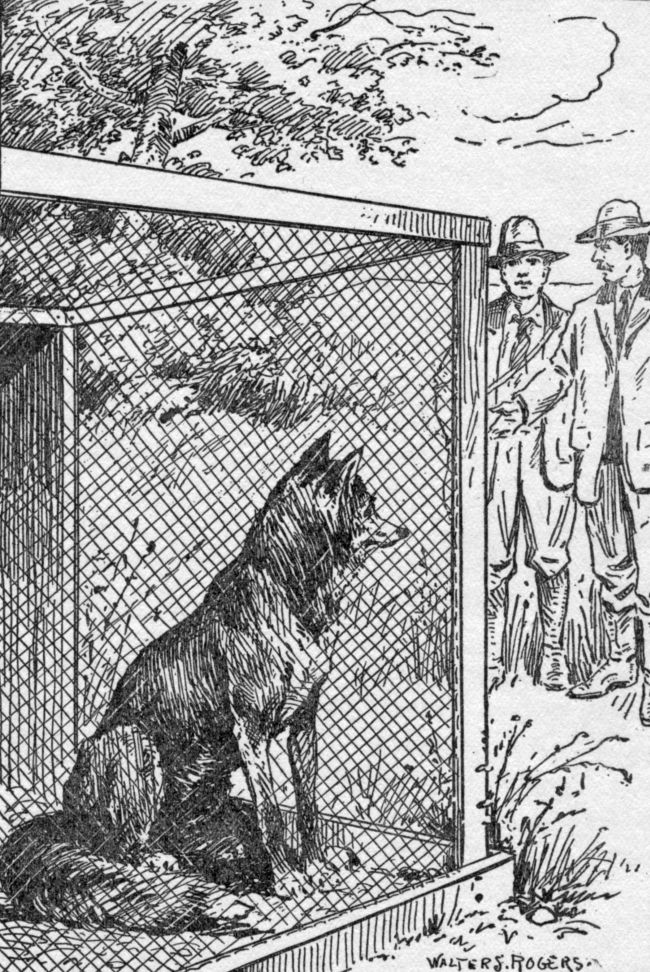
But, very shortly, Sharp Eyes saw four eyes looking
down in at him from the top of the cage.
“Oh, something’s in your trap!” cried a boy,
whose name was Jack.
“Yes, and it’s a fox—a silver fox!” shouted
a boy, whose name was Tom. “Say, this is a
fine catch! I can get some money for his fur!”
“You can?” asked Jack.
“I surely can! Silver foxes are worth a lot
of money. I never thought I’d get one when I
set my trap here, but I have. I’ve caught a
dandy silver fox with our old rooster for bait.”
“Didn’t the fox eat the rooster?” asked Jack.
“No, he couldn’t,” replied Tom. “I put the
rooster behind a wire screen in one part of my
box trap, and left the other end open for a fox
to come in. As soon as he did, he knocked down
a stick that held the spring door open, and the
door shut down and caught the fox.”
“What are you going to do with him?” asked
Jack.
“Well, I’ll take him home, and then I’ll have
my father take off his skin and sell it. Come on,
help me carry the fox home.”
“But won’t he bite?” asked Jack.
“We won’t let him out of the trap,” said Tom.
“He can’t get out. We’ll carry him home, trap
and all.”
“And the rooster, too?”
“Yes, the rooster too. He was good bait. I
thought a fox would come to my trap if he heard
a rooster crow.”
And that is just what happened, you know,
though Sharp Eyes did not understand all that
the boys were talking about.
Through the woods, for mile after mile, Tom
and Jack carried Sharp Eyes in the trap. At
last they came to some fields and, crossing these,
they reached the house where Tom lived. His
father was chopping wood and another man was
standing near. This man had a gun, and beside
him lay a hunting dog.
“Hello, Tom, what have you there?” asked
his father.
“I caught a fox in my trap,” answered the boy.
“It’s a silver fox, too!”
“A silver fox!” cried the man with the gun.
“Did you say a fox with silver-colored fur?”
“That’s what he is!” answered Tom, a bit
proudly. At the same time the dog jumped up,
and, sniffing at the box-trap, began to bark.
Poor Sharp Eyes was much frightened, and
scrambled around in his cage, trying hard to get
out. But he could not.
“Be quiet, Skip!” called the hunter to his dog.
“You won’t have to chase this fox. He is safely
caught. What are you going to do with him?”
the hunter asked Tom.
“Sell his fur. I’ve heard that silver fox skins
bring a big price down in the city.”
“That’s right, they do,” said the hunter.
“Let me take a look at this one.”
Tom opened a little slide in the top of the trap.
It was not large enough for Sharp Eyes to jump
out of, but it gave a good view of him. The
hunter looked down at the fox. He saw that
one paw had been hurt and was only just healed.
“Well, I do declare!” exclaimed the hunter.
“I believe that is the same silver fox that got out
of my trap, Tom. You are very lucky. A silver
fox skin is valuable. But you will not get
much for this one.”
“Why not?” asked Tom.
“Because it is too small. You will have to
wait for the fox to grow. Then his skin will be
worth twice as much. But if you don’t want to
wait, Tom, I’ll buy this fox from you alive, and
I’ll keep him until he is big. Then I can sell
the skin.”
Tom thought about it. He wanted money
now, and did not like to have to wait, perhaps a
year, for Sharp Eyes to grow.
“Yes,” said Tom to the man, “I’ll sell you this
silver fox.”
So Sharp Eyes was sold to the very hunter
from whose trap Don had helped him to escape,
though the fox did not know this was the same
man and the dog who had chased him. The dog
was sniffing and snuffing around the trap.
“Come away from there, Skip!” ordered his
master. “You can’t chase that fox. I’ve got
him safe now.”
So the hunter paid Tom a goodly sum of
money for the silver fox, and took him away in
a box, into which he was turned from the trap.
The rooster was let out of his side of the trap,
being no longer needed for bait. And my! how
gladly that rooster crowed! He must have felt,
all the while, that he was going to be eaten by
the fox.
As for Sharp Eyes, the hunter carried him
away through the woods, to his own log cabin,
putting him in a strong box, on a wagon drawn
by a horse.
“Well, I wonder what will happen to me
next,” thought the silver fox. “I seem to have
gone from one trap to another. But this one is
larger than the one where the rooster was.”
This was not really a trap, it was a box, and
it had some soft straw in it on which Sharp Eyes
could lie down. And he was so tired, and lonesome
for his own folks, that he stretched out
and tried to sleep. But it was hard work, for
the wagon jolted over the rough roads of the
forest. Sharp Eyes had been sold, and was going
to have some new adventures, but just what
kind he did not know.
CHAPTER VIII SHARP EYES GOES TRAVELING
For many days, weeks and months Sharp
Eyes was kept shut up in a box at the
cabin of the hunter who had bought him
from Tom. The silver fox was not kept in
the same small cage in which he had traveled
through the woods. The hunter knew better
than to do that, for he wanted the fox to be well
and strong, so his fur would grow thicker and
longer and more fluffy as Sharp Eyes grew.
“We must make a nice cage for you, and tame
you a bit, so you will eat well and be happy,”
said the hunter, when he got Sharp Eyes safely to
his cabin. “I think I can soon make you so tame
you will not fret, and always want to get out.”
So the hunter made, near his cabin in the
woods, a nice large cage for Sharp Eyes, the
silver fox. There were two parts to the cage,
one a dark one, with cool earth for the floor, but
with tin underneath the earth, so Sharp Eyes
could not dig his way out, for foxes are almost
as good diggers as are dogs, when dogs bury
bones.
In this dark part of his cage Sharp Eyes could
sleep and rest at night, away from all danger.
The other part of his cage was made of strong
wire, and was open on all sides and the top, so
plenty of fresh air and sunshine and even rain
could come in.
Foxes and other animals must have fresh air
and sunshine, and they do not mind being wet
in the rain, for it all helps them to grow big and
strong. And the hunter wanted Sharp Eyes to
become a big fox, with a fine, shiny coat of fur.
“I’ll make his cage as near like the woods as
I can,” the hunter said, so he put bits of stumps,
rocks and branches of trees in the open part, so
that it looked a little like the woods. There was
also clean, cool water to drink.
“But it isn’t the woods at all,” thought the unhappy
Sharp Eyes, as he roved about in the wire
part of his new cage. “In the woods I can run
as far as I like, but here, when I go a little
way, I bump my nose against the wooden or the
wire walls. I can not get out. I am as much
in a trap as ever, even if it is a larger one. Oh
dear! I wish I could get loose!”
Sharp Eyes tried all the ways he knew of getting
out of his cage near the cabin in the woods,
but the cage was made too strong for him. The
hunter well knew how to do such things.
For a time Sharp Eyes felt so bad about being
caught that he would not eat. Even when the
hunter put bits of wild turkey in the cage, Sharp
Eyes would not look at them.
But wild animals can not very long stand being
hungry, any more than can boys and girls.
Sharp Eyes sniffed the good things the hunter
put in to make him eat, and at last, after he had
taken a drink of cool water, he felt that he must
chew something with his sharp teeth. He went
over, nibbled at a bit of partridge the hunter had
tossed in, and it tasted so good, that Sharp Eyes
said to himself:
“Oh, I might as well eat! I don’t believe that
I’ll ever get out of here. I may as well make the
best of it.”
So he ate and felt better. The hunter came
and looked at Sharp Eyes.
“Ah, ha!” exclaimed the man, “you are eating,
I see. I am glad of it. Now you will grow big,
and your silver coat of fur will grow big on you
and I can take it off and sell it. Get big and
fat, little fox.”
Of course Sharp Eyes did not know what this
meant, but he ate just the same, and felt better.
Then he ran around his cage looking for some
way of getting out, but there seemed none. The
wooden and wire walls were as strong as ever.
So the days and nights passed. Often in the
night, when the hunter was fast asleep, Sharp
Eyes would call, in animal language, for some
of the dwellers of the woods to come to him and
help him get out.
“Help me to get loose!” the fox boy would
softly whine. But none came near him who
could help him. Not many wild animals, and
no foxes, would come close to the clearing in
which the hunter’s cabin stood.
Now and then a night bird, flying in the trees
overhead, heard the call of Sharp Eyes, and
asked him:
“What is the matter?”
“Oh, I want to get out of here!” would answer
the fox. “Can’t you fly and tell my father or
mother to get me out of this cage?”
“I’ll try,” the bird would promise, just as
some of the friends of Chunky, the happy hippo,
had promised to go to get Tum Tum, the elephant,
to help him out of the pit trap. But Tum
Tum could not be found then, nor could the
birds find Mr. or Mrs. Fox. The father and
mother of Sharp Eyes were deep in the North
Woods.
Sometimes at night Sharp Eyes would cry for
Don, the dog, to come to help him get out of
the cage, as Don had helped the fox pull loose
from the spring trap. And one night Don, who
was roving in the woods far away from his master’s
house, as he had done once before, passed
near the hunter’s cabin.
“What! are you here, Sharp Eyes?” asked the
dog, in surprise.
“Yes,” answered the wild creature. “Can’t
you help me get out?”
“I’ll try,” answered Don.
But Sharp Eyes’ cage was made strong to keep
animals from getting in, as well as to keep Sharp
Eyes from getting out, and Don could do nothing.
“I’m sorry,” he said to Sharp Eyes. “It needs
some one stronger than I am to break open your
cage. If I could only get Chunky, the happy
hippo, here, he could open your cage with one
shove of his big head.”
“Can’t you get him here?” asked Sharp Eyes,
eagerly.
“I’m afraid not,” answered the dog. “He is
in the park menagerie far away. You’ll never
see Chunky.”
But just you wait and see what happens.
So Sharp Eyes was kept in the hunter’s cage
for nearly a year. And in that time the silver
fox grew quite tame. He saw that the hunter
was not going to hurt him—at least for a while,
and the man brought good things for the fox to
eat and nice water to drink.
After a while Sharp Eyes let the man put his
hand through a hole in the wire, and the fox did
not try to bite as he had done at first. Then, a
little later, Sharp Eyes let the man pat him on
the head, and the fox rather liked it.
“Hunters are not so bad as I thought,” said
Sharp Eyes to himself. “This one doesn’t shoot
me, anyhow.”
And even the hunter’s dog did not bark or
growl at the fox as much as it had at first. The
two never were very good friends, but they did
not snap at one another as they had done during
the first days after Sharp Eyes was brought to
the cabin in the woods.
“I chased after you once,” said the hunter’s
dog to Sharp Eyes.
“Yes, I know you did, Skip,” replied the fox,
in animal language. “But Red Tail and I
waded in a brook of water, and then you could
not smell us to come after us.”
“Yes, you fooled me,” said the dog, with a sort
of barking laugh. “I was mad at the time, but
I’ve gotten over it now.”
“Would you chase me again if you had the
chance?” asked Sharp Eyes.
“Yes, I guess I would,” answered the dog.
“You see, I am used to hunting, and I can’t get
over it so soon, even if you are a tamer fox than
you were at first. If you get out of the cage I’ll
have to bring you back, but I’ll try not to hurt
you.”
“Then I guess I’d better be careful how I get
out of this cage,” thought Sharp Eyes to himself.
“I must not do it when Skip, the dog, is near.
But I would like to get away.”
More days passed. Sharp Eyes kept on getting
big and strong until he was nearly as large
as Skip.
Then one day a strange man came to the cabin
in the woods where the hunter lived. This man
looked like a hunter, but he carried no gun. Instead,
over his back, slung on a strap, was a black
box.
But Sharp Eyes was mistaken. What the new
man had on his back was not a trap, but a camera
for taking pictures of wild animals and birds.
He had come to the woods to do this. He was
hunting animals in a new way, but Sharp Eyes
did not know that.
“What have you in this cage?” asked the
camera man of the hunter.
“That is a silver fox,” was the answer. “I am
letting him grow big so his fur will be larger.
It will make a nice muff and neck piece for some
woman.”
“Oh, it would be a shame to kill that fox just
for his fur!” said the camera man. “Why not
keep him alive?”
“I paid money for him,” said the hunter, “and
I need to get back more money for him.”
“Then I will buy him of you alive,” said the
camera man. “I’ll pay you.”
“What will you do with him?” asked the
hunter.
“I’ll not kill him,” answered the other.
“That would be too bad. I think I will put him
in a place where many people can come to look
at him. He is a handsome fox, and I’d like to
have the boys and girls, as well as grown-ups, see
him. Sell him to me alive.”
“I will,” said the hunter, and he did.
By this time Sharp Eyes was quite tame, but
he could not be allowed to run around loose.
He was let out of his cage, sometimes, but there
was a collar around his neck, such as some dogs
wear, and a chain was fast to the collar. So
Sharp Eyes could go only as far as the chain let
him. But this was better than being shut in the
wire cage. Sharp Eyes liked it outside.
The camera man bought Sharp Eyes and put
him in a large box. Then the box was put on a
wagon and once more the silver fox was traveling.
Only this time he went a long way.
From the wagon the box, with the silver fox
in it, was put on a train (though Sharp Eyes did
not know what that was) and taken farther and
farther away from the woods.
Sharp Eyes rode on the train in his wooden
cage. He was a little frightened, but not very
much, for he was used to having men around him
now, and some of the trainmen gave him bits of
meat to eat and water to drink.
Finally, after he had been traveling on the
train for a long, long while, Sharp Eyes looked
out of an open door, and through the bars of
his cage. The train had stopped and, not far
away, Sharp Eyes could see what looked like a
big, white house, with gaily-colored flags, floating
from poles and ropes, on it.
“Oh, what is that?” asked Sharp Eyes aloud,
in animal talk, before he remembered there was
no one in the railroad car to answer.
But, just then, the silver fox saw, standing on
the ground outside his car, a great big animal
that seemed to have two tails.
“Ha! So you want to know what that white
house is, do you?” asked the big animal of Sharp
Eyes. “Well, that is a circus tent, and I belong
to the circus!”
CHAPTER IX SHARP EYES IN THE ZOO
The train in which Sharp Eyes, the silver
fox, was riding had stopped so the engine
could get a drink of water, and it
happened to stop near the circus tent, which was
the white thing Sharp Eyes had thought was the
large house. So the fox had time to talk to the
big animal who had spoken in such a friendly
way.
“Oh, so that is a circus, is it?” asked Sharp
Eyes. “Seems to me I have heard that name before.
I wonder where it was? But who are
you, may I ask, and why have you two tails?”
“There it goes again!” cried the big creature.
“Every one who sees me for the first time thinks
I have two tails. Even Chunky, the happy
hippo, thought that.”
“Oh, Chunky! That’s where I heard the
word circus before. Don, the dog, told me that
Chunky was once in a circus before he was put
in a park menagerie.”
“Oh, ho! So you know Don, the dog, do
you?” asked the big animal who belonged to the
circus.
“Yes,” answered Sharp Eyes, “I do. Don
once helped me to get out of a pinching trap.
But no one helped me out of the trap where the
rooster was. That’s why I’m here now.”
“What is your name?” asked the big animal.
The fox told and then inquired:
“And what is your name, if you please, and
why have you two tails?”
“I haven’t,” was the answer. “That’s a mistake.
I am Tum Tum, the jolly elephant, and
one of the dingle-dangle-down things is my
trunk, in which I pick up peanuts. The other
is my tail.”
“Oh, I see!” exclaimed Sharp Eyes. “So you
are Tum Tum! I think I heard Slicko, the
squirrel, speak of you.”
“Yes, we are good friends.”
“And Don often mentioned you,” went on the
silver fox. “But it seems to me he said you had
left the circus, and had gone back to the jungle
to help catch and train wild elephants.”
“I did,” answered Tum Tum. “I was there
for a while. But now I am back in the circus
again. It was while I was on a sort of visit to
the jungle that I met Chunky, the happy hippo,
and pulled him out of a mud hole.”
“And where is Chunky now?” asked Sharp
Eyes. “I would like to see him.”
“He was with this circus,” answered Tum
Tum, the elephant, “but now he is in the park
zoo, or menagerie, as they call it to be stylish.
Did Don tell you how Chunky saved a little girl
who fell into his tank?”
“Yes,” answered Sharp Eyes, “he did.
Chunky must be real smart.”
“Well, not as smart as a fox, for I have heard
that they are very smart and cunning,” returned
the elephant. “But still Chunky does very well.
He can do tricks, and he has had a book written
about him.”
“There it goes again!” cried Sharp Eyes.
“Every one seems to be in a book; but I’m not.”
“Maybe you will be some day,” said Tum
Tum. “You are young yet. But tell me—why
did they catch you and put you in a box on a
train? Can you do circus tricks?”
“No,” replied the fox. “But they think my
silver fur is worth much money. That’s why
they caught me. I wish I was red or brown,
and then they wouldn’t bother me so. But silver
foxes are rare, they say.”
“I believe they are,” went on the elephant.
“I have been in a circus a long while and I never
saw a silver fox before, nor are there any in the
zoological park, where Chunky lives.
“But I must be going,” went on Tum Tum,
the jolly elephant. “I have to push some of the
heavy wagons around the circus lot. They always
call on me for that, as I am so strong. I
hope you’ll have a nice time where you are
going.”
“I don’t expect to have,” answered Sharp
Eyes. “It is no fun to be shut up in a cage. I
wish I could walk around loose, like you.”
“I guess I’m too big to be in a cage,” said
Tum Tum, “though they have sort of cages
for elephants in the parks. Well, good-bye!
Maybe I’ll see you again.”
“I hope so,” replied Sharp Eyes, who liked
the big, jolly chap.
So the elephant went to push the circus
wagons, and the train puffed away with the silver
fox.
All the while, as the train rumbled on, Sharp
Eyes wondered where he was being taken.
“If my silver fur is worth so much,” thought
Sharp Eyes, “I suppose they are carrying me to
some place where they can take it off. I shall
not like that. I want my fur left on. I’ll be
cold in the winter without my nice fur coat.”
Sometimes hunting dogs were brought into
the same car with Sharp Eyes. The dogs became
very much excited when they saw the fox
in his cage, and barked at him. But they could
not get at him, for the cage was made of heavy
wire. Still, Sharp Eyes did not like to be
barked at.
“Why don’t you be quiet and let me alone?”
he asked the dogs, in animal talk.
“Oh, we are hunting dogs and we always bark
at a fox,” said one of the dogs.
“Well, I have a dog friend named Don, and
he doesn’t bark at me,” went on the silver
fox.
“We don’t know Don,” said the hunting dogs,
and they barked louder than ever.
Once a monkey in a cage was brought into the
same car with Sharp Eyes. The monkey did
not seem happy, but crouched in a corner.
“Who are you, where are you going and
what’s the matter?” asked Sharp Eyes.
“My name is Chacko,” answered the monkey,
“and I am being taken to a zoological park.”
“Well, don’t feel sad about that,” advised
Sharp Eyes. “I have heard of a hippo named
Chunky who is in a zoo, and he is very happy.”
“Has he the toothache?” asked Chacko.
“I don’t believe he has,” answered Sharp Eyes.
“No wonder he is happy then,” went on the
monkey. “I have the toothache very bad.”
“I’m sorry,” said Sharp Eyes. “I wish I
could help you, but I can’t get out of my cage.
Did you ever hear of Mappo, a merry monkey?”
“Has he the toothache?” asked Chacko.
“I hardly think he has,” the fox answered.
“Well, then I don’t know him,” said the other,
holding his paw up to his jaw. “I never heard
of Mappo.”
“Tum Tum, or some of the animal friends I
have met, spoke of him,” said Sharp Eyes. “He
likes cocoanuts I believe.”
“Oh, we monkeys all do,” said Chacko. “But
I couldn’t eat any now, on account of my tooth.
However, I don’t know Mappo.”
Sharp Eyes talked a little while longer to
Chacko, to try to make the little furry chap forget
his troubles, and the monkey did for a time.
Then Sharp Eyes went to sleep.
Sharp Eyes was suddenly awakened by feeling
his cage lifted up and set down again. The
fox could feel the wind blowing on him, and
he knew he must be outside the train. But he
liked the fresh air.
“I wonder where I am?” he inquired, partly
aloud.
“We are on a wagon, being ridden through the
streets of a big city,” answered Chacko, the monkey,
who was on the same wagon as Sharp Eyes,
but in a different cage. The monkey’s toothache
was better now.
“What’s a city?” asked Sharp Eyes.
“Oh,” answered the monkey, “it’s a place
where they have more houses than there are trees
in the woods, but I don’t like it. Once I was
in a city park menagerie, and I never got half
enough peanuts. I don’t like the noise, either.”
There was a great deal of noise as the wagon,
with the cages of Sharp Eyes and Chacko on it,
rattled through the streets.
At last the wagon turned into a quieter place,
where there was much green grass and many
trees.
“Oh! are they taking me back home again?”
asked Sharp Eyes aloud, as he saw the trees.
“This looks a little like my home,” and he looked
down from the wagon, hoping to see a hollow
tree.
“No, this is not the forest,” said Chacko, the
monkey. “This is a menagerie, or zoo. I remember
the place. I lived here a number of
years ago. I am glad to be back, for here the
children give you many peanuts. They don’t
feed them all to the squirrels.”
“And so this is a zoo, is it?” asked Sharp Eyes.
“Yes, that’s what it is,” answered the monkey.
“We’ll soon be put in larger cages, where the
boys and girls can see us. You’ll like it in the
zoo, Sharp Eyes.”
“I hope I shall,” returned the silver fox.
“Oh, there is my friend Tum Tum!” he cried, as
he caught sight of an elephant.
CHAPTER X SHARP EYES MEETS CHUNKY
Sharp Eyes’ cage was being lifted down
from the wagon, on which it had been
brought to the park from the train, when
the silver fox called out about the elephant.
His cage was set down on the ground, near where
some of the big animals, with trunks and tails,
were swaying to and fro behind big, strong bars.
“Who did you say it was?” asked Chacko, as
his cage was placed beside that of Sharp Eyes.
“Tum Tum, the jolly elephant,” answered the
silver fox. “I see him over there.”
“My name is not Tum Tum,” said the elephant,
for he had heard what Sharp Eyes said.
“Not Tum Tum!” exclaimed the fox. “Then
what is it?”
“My name is Bunga,” was the answer. “But
I have heard of your friend Tum Tum. He is
in a circus, is he not?”
“Yes,” answered Sharp Eyes. “I met him
not long ago. He had been on a sort of vacation
in the jungle, but now he is back in the
circus. I thought, at first, that you were he.”
“No, but all we elephants look pretty much
alike,” said Bunga, “so I don’t wonder you made
a mistake. How is Tum Tum?”
“Very well and jolly,” answered Sharp Eyes.
“Oh, he always was that,” said another elephant.
“Tum Tum never was cross or unhappy.”
“I was unhappy when my paw was caught in
a pinching trap,” said Sharp Eyes. “I hope I
shall be happy here.”
“We’ll try to make you so,” put in a long-necked
giraffe, looking over the tops of the walls
of his cage, in which he was kept next to the
elephants. “We are always glad to see new animals
come in,” went on the giraffe. “We get
sort of lonesome just among ourselves. Tell us,
have you had any adventures?”
“No, not any, I’m sorry to say.”
“Oh, yes you have!” chattered Chacko, the
monkey, to whom the fox had talked in the train.
“You’ve had lots of adventures! You found a
wild turkey, and you got out of one trap and into
another, and you were chased by a dog.”
“Are those adventures?” asked Sharp Eyes, in
surprise.
“Of course,” answered Bunga, the elephant.
“Please tell us about them.”
So Sharp Eyes told the zoo animals all that
had happened to him.
“And now you are here,” said Bunga, when
the fox had finished.
“Yes, I am here,” agreed the fox. “And I
expect the next thing they’ll do will be to take
off my silver skin and sell it,” he added sadly.
“Take off your skin and sell it? Well, I guess
not!” growled a tiger in the next cage. “They
would no more skin you than they would me!
They keep us for people to look at. Make your
mind easy. You will not be hurt while you are
in the zoo. You can not get away, it is true, but
you will have a good place to stay, and all you
want to eat.
“I used to think, when I first came here, that
I would like to go back to the jungle, but there
I had to sneak out at night to get something to
eat, or water to drink. Here they bring it to
me. Of course I am shut up in a cage, but it is
not so bad.”
“Really won’t they take off my fur?”
“No indeed!” said the elephant.
“Then I’m glad,” went on the fox. “I’ll try
to like it here in the zoo, though I’ll miss the
North Woods and my father, mother, my sister
Winkle and my brother Twinkle.”
“Oh, you’ll like it here after you get used to
being stared at by the crowd of boys and girls
and the men and women who come in,” said a
lion, in a cage next the tiger.
So the animals talked among themselves, trying
to make Sharp Eyes feel at home, for an animal
gets almost as lonesome and homesick in a
strange place as you boys and girls might do.
After a while some men came and lifted up
the cage of the silver fox, from where it had
been placed when taken off the wagon, and carried
it to a large building. Along the walls
were many other cages, and in one end was a
very large one.
The bars of the big cage were set very far
apart, and when the fox saw them he said to
himself:
“Ha! if they put me in that cage, with such
wide-apart bars in front, I can easily slip out
between them and go back to where my father
and mother live in the hollow log. I must try
to run away.”
Sharp Eyes looked a little closer, and noticed
that there was a big pool of water—about a hundred
bath tubs full I guess—at one end of the
big cage.
“Ha! I’d like to get a drink there,” thought
the silver fox. “I am very thirsty!”
Just then, all of a sudden, one of the men carrying
the cage in which the fox was still locked,
let his end of the box fall. Then the other man
dropped his end, and down the fox cage crashed
to the stone floor in the animal house.
“Look out!” cried one of the men. “The cage
will break and that silver fox will get out!”
“Oh, at last I can run away!” he thought to
himself. “But first I’ll go and get a drink of
water in that pool inside the big-barred cage.
Then I’ll run away.”
Before any of the men could grab him, Sharp
Eyes made a dash toward the big pool. Down
into it ran a sloping walk, or little hill of stone.
Down this Sharp Eyes walked until he could put
his nose in the water.
Sharp Eyes was just going to take a drink
when, all at once, he noticed that the water in
the pool was moving. Then, suddenly, something
big and dark brown rose up, as if from the
bottom. Sharp Eyes saw a big mouth open
right in front of him. It was a mouth so big
that it looked like the front door of a real house,
and inside it was lined with something that
seemed to be red flannel. And then, out of the
mouth, came a puffing sound, and the big animal
who belonged to the big mouth, made a grunting
noise, as though gaping and stretching after
a sleep.
“Oh, my!” cried Sharp Eyes, as he saw the big
mouth. “Who are you, if you please?”
“I might ask the same thing of you,” went on
the big animal, as he walked up the stone hill,
water dripping off him.
“I am called Sharp Eyes, the silver fox,” was
the answer, “and I have had many adventures,
but they have not been put into a book as yet.”
You see Sharp Eyes didn’t know about this
book just then.
“I’ve had adventures also, and they have been
put into a book,” went on the big creature.
“What is your name?” asked Sharp Eyes.
“I am Chunky, the happy hippo, and—”
“Oh, I’ve heard about you!” interrupted
Sharp Eyes.
“You have?” asked Chunky. “Perhaps you
read a copy of the book in which I am spoken
of?”
“No, I can’t read,” said Sharp Eyes. “But
I heard Don, the dog, telling about you. I liked
to hear about you.”
“That’s very nice of you,” said Chunky.
“Yes, Don and I were great friends. Did Don
tell you how I saved the little girl who fell into
my pool?”
“Yes,” answered Sharp Eyes, “he did. It was
very nice of you to save her.”
“Pooh! that was nothing,” said Chunky.
“When I saw you standing on the edge of my
pool, I thought it was some one else who had
fallen in, and I came up to see about it. But I
am glad to meet you.”
“And I’m glad to meet you,” said Sharp Eyes.
“Very glad indeed to meet you, Chunky. Now
I wonder what I had better do—run away now
that I am out of my cage, or stay and let them
put me in another? What would you do,
Chunky?”
“I’d stay here in the zoo,” said the happy
hippo. “They will give you nice things to eat
and clean water to drink. It is better than the
jungle or the woods. Stay here and be happy.”
“I guess I will,” said Sharp Eyes.
By this time the menagerie men had run toward
the hippo’s cage. They saw Sharp Eyes
standing by the big, squatty creature.
“Don’t let him get away!” cried a tall man
with a long, sharp hook in his hand. “Catch
the silver fox! Don’t let him escape!”
So the men, with ropes and long poles, ran to
catch Sharp Eyes before he could get out of the
hippo’s cage. But Sharp Eyes was not going to
run away.
“Get him! Get him!” cried the men, one to
the other. “Get the silver fox!”
CHAPTER XI SHARP EYES GETS AWAY
For a time there was much excitement in
the animal house of the park, where
Sharp Eyes had gotten out of his cage.
At first the men did not see where he had run
to—inside the hippo’s cage. But when they
found him they were very anxious to get Sharp
Eyes back.
People who had come into the park to look
at the animals, heard the shouts and saw men
running about.
“What is the matter?” asked several.
“Oh, one of the animals is loose,” answered a
policeman.
“Maybe it’s a lion or a tiger!” cried a woman
with a baby in her arms. “Come on, children!”
and she caught the hand of her little boy, who,
in turn held the hand of his sister, and they all
ran out.
Some of the other men, women and children
also ran out when they heard that a lion was
loose. But this was not so. It was only Sharp
Eyes, and he was so tame now that he would
have bitten no one.
“Get him! There he is! There’s the fox!”
cried the head animal man, as he pointed to
Sharp Eyes inside the hippo’s cage. “Bring up
one of the small dens, on wheels, and we’ll drive
the fox into that.”
The men stood in front of Chunky’s cage with
sticks and ropes, to drive Sharp Eyes back if he
should try to run out. But the fox was not going
to do anything like that.
“I said I’d stay here, and I will,” he explained
to Chunky, in animal talk, of course. “They
needn’t make so much fuss about me going to
run away. I’m not!”
And Sharp Eyes did not. He stayed quietly
in Chunky’s cage, talking to the hippo in animal
language, until the park men brought up a sort
of traveling cage, and opened it. Then Sharp
Eyes said to the hippo:
“Well, I’ll go in there, as they seem to want
me to. Anyhow, it’s a nicer cage than the one
I was in. I’ll see you again, Chunky, my boy.”
“I hope so,” said the happy hippo, who always
seemed to be smiling. “Next time I see you,
Sharp Eyes, remind me to tell you a funny story
about Tum Tum.”
“I will,” said Sharp Eyes.
Then the animal men wheeled the cage with
the fox in it away.
“Say,” said one of the men to the others, “that
silver fox didn’t give us any trouble.”
“No,” was the answer. “I thought sure we’d
have to chase him all over the grounds, but he
was as quiet as could be. I guess he isn’t as wild
as we imagined.”
And Sharp Eyes was not. The kindness of
the hunter who bought him from the boy was
beginning to tell. The silver fox knew that not
all men were unkind. Some, such as those in
the zoo, and the camera man, were good to wild
animals.
For the first few days Sharp Eyes was kept
by himself in the small cage into which he had
been put when the first one broke. Nor was he
allowed to stay near the other animals. He was
put by himself in a dark corner of an animal
house.
“You’ll be quieter there, and will get to feeling
at home,” said one of the park animal keepers.
“When you quiet down a bit we’ll put you
in with the other foxes, for we have a lot of red
and black ones in the park.”
Of course Sharp Eyes did not know just what
the man was saying, but it sounded kind, and
kind and gentle tones to wild animals mean more
than just what the words themselves express.
Sharp Eyes did not like to be left alone, but
he could not help himself. He was given
plenty to eat and to drink, but he did not think
the zoo a nice place. He was too lonesome in it.
Then came a day when he was taken from the
traveling cage and placed in a den with other
foxes. Here he thought he would have a good
time, but when the red, brown and black foxes
saw him in his fine silver coat they sort of turned
up their noses, and one said:
“Oh, ho! A silver fox! Well, I suppose
he’ll be too proud to speak to us common chaps!”
“Oh, no, I won’t,” said Sharp Eyes quickly.
“I’m a fox, just like you; and I’ll tell you some
of my adventures if you’d like to hear them.”
“There he goes! Proud of his adventures!”
sniffed a red fox.
Sharp Eyes wasn’t proud at all, as we know.
He only wanted to be friendly, but the other
foxes would not be, and kept to themselves, leaving
Sharp Eyes on one side of the cage.
One yellow fox tried to bite Sharp Eyes when
our friend was eating some meat in the den, but
Sharp Eyes soon showed that he had as keen
teeth as any of them, and then they were glad
to let him alone.
But Sharp Eyes did not have a happy time.
In the first place he was lonesome. He
wanted to make friends with the other foxes, but
they would not. Many, many times he wished
he was back in the woods with Winkle and
Twinkle, playing in the bushes, or running in
and out of the hollow log.
After a while Sharp Eyes grew so lonesome
and unhappy that he did not eat as much as he
ought. Instead of keeping fat, and growing
nicely, he became thin.
“This will never do,” said one of the park
animal men one day, when he stopped to look
in the fox den. “That silver chap isn’t doing
well at all. What’s the matter with him?”
“I guess he and the other foxes don’t get along
well together,” answered the keeper who had
charge of feeding the foxes. “The silver one
keeps to himself all the while.”
“That isn’t good,” said the animal man, who
was a person like the one with the camera, who
had first taken a liking to Sharp Eyes. “We
must put this silver fox where he will be happier,
and will make friends with other animals.”
“I think he’d like to be near Chunky, the
happy hippo,” said the keeper.
“What makes you think that?”
“Because when Sharp Eyes first came to our
park, and his cage broke, he went in the hippo’s
cage and they seemed to like each other.”
“Ha! Well, maybe it would be a good thing
to move this silver fox back near the hippo,”
said the animal man. “Sharp Eyes is not the
same sort as these red or black foxes. His coat
of fur is much better. He is a different kind of
fox, and if we put him in a cage by himself the
people will look at him more. Sharp Eyes
ought to like that. It will keep him from getting
lonesome and homesick for the woods from
which he came.”
So, a few days later, they took Sharp Eyes out
of the main fox den, and put him in a cage by
himself not far from where Chunky, the happy
hippo, lived.
“Ah! I am glad to see you again!” cried the
animal with the big mouth which looked like a
piano lined with red flannel. “So you have
come to see me?”
“Yes. And I didn’t like it with the other
foxes,” answered Sharp Eyes. “I am glad they
brought me here.”
Soon he and the hippo were talking away to
one another at a great rate, though if you had
stood in front of their cages you would not have
thought that they were doing anything more
than grunting or barking. But that was their
way of talking.
“You said you were going to tell me a funny
story of Tum Tum, the jolly elephant,” said
Sharp Eyes to Chunky one day.
“Oh, yes, so I did. Well, it was Mappo, the
monkey, who told me. It seems, that, once upon
a time, Tum Tum was in the jungle looking for
something to eat. He was very hungry, and he
was looking for what they call apples in this
country though we call them something else in
Africa, where the jungle is. Tum Tum was in
our jungle once, you know.”
“Yes,” said Sharp Eyes, “I remember. He
told me when I met him near the circus
grounds.”
“Well, Tum Tum went all over our jungle
looking for an apple, but he could not find any.
Finally, however, he saw a little monkey pick
something that looked like an apple from a tree.
“‘Here, give me that!’ cried Tum Tum. ‘I
haven’t had an apple in ever so long. Give me
that apple, little monkey, and I’ll give you a ride
on my back.’
“‘All right,’ said the monkey. ‘But give me
the ride first.’ So Tum Tum gave the monkey
a ride all over the jungle, and then he asked for
the apple.
“‘Here it is!’ cried the monkey, and he handed
something to Tum Tum. Our elephant friend
quickly took it in his trunk, and, not stopping to
look at it, popped it into his mouth and gave it
a big, hard bite. But what do you s’pose it
was?” asked Chunky, as he told Sharp Eyes the
story.
“I can’t guess,” said the fox.
“It was a hard cocoanut!” laughed the hippo.
“And Tum Tum nearly broke his teeth on it.
After that he always looked at what he ate before
putting it in his mouth.”
“That was a funny story,” said Sharp Eyes.
Then he and the hippo talked for a long time,
and the fox watched the big animal go into his
tank and sink away down under the water.
Days and weeks went by, and many people
came to the park to look at the animals. Many
of them stopped in front of the cage where the
silver fox was. Sharp Eyes was bigger than
ever and very beautiful.
But still Sharp Eyes was not happy. He
missed the long runs he used to have in the
woods, and he missed the fun with his brother
and sister, Twinkle and Winkle.
“Sharp Eyes, you are not happy,” said Chunky
one day.
“No, I am not,” answered the fox.
“What is the matter?” asked the happy hippo.
“Well, I don’t like it here,” the silver fox replied.
“I want to go back to my woods and live
in the hollow log.”
“Well, perhaps you are right,” said the hippo,
after thinking about it and opening his mouth
to catch a loaf of bread his keeper threw in.
“Some animals like it here in the zoo, and others
do not. For them there is one of two things to
do—die or get out. I don’t want to see you die,
Sharp Eyes, so I will help you get out.”
“This way,” said the hippo. “They often let
me out in the yard to walk around, for I am quite
tame now. The next time I am out I will bump
into your cage as if by accident. I am so big
and strong, and your cage is so weak, that it will
not take a very hard bump to break it. When I
break it, and I’ll do it without hurting you, you
can run out and go back to your woods.”
“Oh, thank you!” barked Sharp Eyes. “I’ll
do that! Please break open my cage and let me
out as soon as you can.”
And Chunky did. A few days later, when he
was in the yard back of his cage, wandering
about and eating hay, he strolled over to the
cage of the fox.
“Watch out now, Sharp Eyes,” said the hippo.
“I am going to bump against you. Good-bye,
when you get out. Think of me sometimes and
give my love to Tum Tum, Don or any of my
friends you see.”
“I will,” said the fox.
The next minute the big hippo bumped
sharply against the fox cage. There was a
crash, a splintering of wood, and Sharp Eyes
sprang out. The silver fox was running away.
CHAPTER XII SHARP EYES GETS HOME
“How good it is to be free!” thought
Sharp Eyes, the silver fox, as he
bounded out of the broken cage and
ran quickly to hide under some bushes that grew
near the place in the zoölogical park where
Chunky, the happy hippo, lived. “How good
it is to be free! Good-bye, Chunky!” he called
softly to his friend, from where he was hidden
under the bush. “Good-bye! I wish you were
coming with me.”
“No, thank you,” said the hippo. “I am better
off in the park. I need to be warm, for I
come from Jungle Land. As for you, with your
warm coat of silver fur, you do not mind winter
and snow. Good-bye and good luck to you!”
Then the hippo went to take a swim in the
pool of his cage, and Sharp Eyes, remembering
the hiding tricks his father and mother had
taught him when he lived in the woods, made
ready to get as far away as he could.
The silver fox kept very quiet under the bush,
waiting to see what would happen. Soon, he
knew, the animal keepers would find out he was
gone, and they would hunt for him. Sharp
Eyes did not want them to find him.
“I must creep away as carefully as if I was
hunting a chicken at the farm near the North
Woods where I used to live,” said Sharp Eyes
to himself. “But no more chickens for me, unless
I can be sure there is no trap near by! I
must be very careful!”
Carefully and slyly he looked around. He
saw no one, and he thought it would be a good
thing to run a little farther away from the park.
He was too close to his broken cage.
Trailing his big, bushy tail along behind him,
Sharp Eyes crept out from under the bush and
ran across the path. A little distance farther
on were some trees, and the silver fox hoped they
would prove to be a wood in which he might
hide.
But just as he was going in among these trees
(which were not a wood, but only a part of the
park) one of the keepers saw him.
“Oh, the silver fox is out of his cage!” cried
this man. “We must get the silver fox!”
He ran toward Sharp Eyes, and so did some
other men who heard the cry. If they had had
some dogs to help them they might have caught
the fox. But Sharp Eyes could run faster than
the fastest man, and he was in among the
farthest trees before the keepers had reached the
first ones.
“Now I must hide,” said Sharp Eyes to himself.
“If I can find a hollow log I’ll crawl in
that.”
But the woods of the park were not like those
of the north, where the fox had lived. There
were no fallen trees or hollow logs.
Sharp Eyes heard the men running after him
and shouting. They were getting nearer and
nearer. He must find some place to hide. He
looked all about him, and, at last, saw a little
hollow place, filled with dried leaves, beneath
the roots of a tree.
Quickly scraping the ground away with his
fore paws, the silver fox made the hole a little
larger. Then he crawled down into it, and managed
to scatter some leaves about on top of the
hole, so that it did not show very plainly.
Sharp Eyes was hidden in this hole when the
men from the park rushed into the patch of
woods.
“Do you see that fox?” asked one man.
“No, he must have run right on,” answered
another.
Even while they said this the men stood near
the hole in which Sharp Eyes was hidden. But
they could not see him on account of the leaves
he had brushed over himself. Dogs could have
smelled the fox, but the noses of the men were
not keen enough for this. Nor were they hunters
or trappers, who might have seen the marks
left by Sharp Eyes’ feet in the soft dirt.
So the animal keepers passed right on, leaving
the silver fox in the hole. And then his
heart stopped beating so fast, for he felt that he
was safe, at least for a time, and might, at last,
get far, far away.
“I’ll wait a bit, until the men get out of the
woods,” thought the silver fox. “Then I’ll run
as far as I can. But I guess I’ll wait until after
dark. Then they can’t see me so plainly.”
Sharp Eyes was not hungry, for he had been
well fed in the zoo. But he was thirsty, and he
dared not go out for a drink. How he wished
he could lap up some water from the pool in
which Chunky, the happy hippo, swam. But
that could not be done.
So Sharp Eyes remained hidden under the
roots of the tree. The animal keepers hunted
all over the woods, but could not find the silver
fox. They came back to his broken cage, and
the head keeper said:
“Well, it is too bad that silver fox got away,
for he was a beautiful animal, and the boys and
the girls, and their fathers and mothers, liked to
look at him. But maybe he will be happier if
he gets back to his own woods. I wonder how
he could break out of his cage?”
The man did not know the trick Chunky had
played, and you may be sure the happy hippo
did not tell. He missed Sharp Eyes, Chunky
did, but there were other animals in the zoo for
the hippo to talk to.
“Though I liked to talk to that fox about Tum
Tum and our other friends,” said Chunky to
himself. “However, maybe Sharp Eyes is better
off out of his cage. I hope so.”
The silver fox waited until night before coming
out of his hiding place. Even then he
looked around very carefully to make sure there
was no danger. Foxes can see in the dark almost
as well as cats, and our friend had eyes that
were brighter and better than those of most
foxes.
“I guess no one is around now to catch me,”
thought the silver fox to himself, as he came out
of the hole. “I don’t smell any dogs to chase
me. Oh, how good it is to be free, and not shut
up in a cage! Now I am going back to the
North Woods—to my father and mother, and
to Twinkle and Winkle!”
Sharp Eyes did not know how far it was to
the North Woods where he used to live. Perhaps
it was just as well he did not, or he might
never have tried to go there. As it was, he set
off in the dark.
No one visited the zoo after dark, and even
the watchmen and animal keepers went to bed.
So did the animals, except maybe the elephants,
and they sleep standing up. Thus no one saw
Sharp Eyes as he ran through the park in the
darkness of the night. From tree to bush and
from bush to tree he ran until he came to a stone
wall. This was one end of the park, and, to
get out, the fox had to jump over this wall.
But that was easy for him. Often had he
jumped over high bushes, fallen trees in the
woods, or fences around a farm, when he wanted
to get a fat chicken.
So, with a bound and a leap, Sharp Eyes went
over the wall, and, to his surprise, he found himself
in a queer place. It was a very light place
and noisy. Big yellow things, like railroad
cars were running up and down. They were the
trolleys, though the fox did not know that.
Then too, he saw black things, like big bugs,
making no noise with their wheels, but puffing
white smoke out of the back, also running up
and down, in and out among the yellow things.
These were automobiles.
And Sharp Eyes also saw many people in the
street, for it was into a city street he had leaped
after jumping over the park wall.
For a few seconds Sharp Eyes stood very still,
after landing in the street. He crouched back
against the stone wall, and then he heard a sudden
shout.
“Oh, look what a beautiful silver dog!” cried
a lady. Of course Sharp Eyes did not know
just what she said, but that was it.
“A dog? That isn’t a dog!” said a man with
the lady. “That’s a silver fox, and it must have
gotten away from the zoo. I wonder if it’s tame
enough for me to catch.”
“Oh, don’t! He might bite you!” said the
lady. But the man ran toward the fox. However,
Sharp Eyes did not wait for the man to
come very close. With a little bark, the silver
fox bounded to one side and ran along the
street.
By this time several other men and boys had
seen him, and they ran after him, some thinking
he was a dog. The heart of Sharp Eyes beat
very fast, and he hardly knew what to do. At
last he saw a dark place, which he thought was
a cave in which he might hide—it was really
underneath the high front steps of a house on
the street—and the silver fox crawled back into
the darkest corner.
He was delighted when the men and boys ran
past his new hiding place, for that told him he
had not been seen.
“I hope they don’t get me,” thought the silver
fox.
And the men and boys did not. They knew
nothing about hunting foxes, even in the streets
of a big city and they soon gave up the chase.
Sharp Eyes stayed under the steps in the darkness
until the streets grew quiet. Late at night,
or, rather, very early in the morning, the trolley
cars and automobiles stopped running. The
streets had no one in them. And then it was
that the fox came quietly out and ran along. He
did not know just where he was going. He
wanted to get to the country and to the woods.
He wanted to get back home.
On and on he ran, and if any one in the city
saw him in those early hours of the morning,
they must have thought him a stray dog, for they
did not chase him.
The silver fox was tired and hungry. He
managed to find a bit of meat in an ash box, and
once he came to a fountain where horses were
watered, and he got a drink. Then he felt better.
It would take another book, almost as large
as this, to tell all the adventures of Sharp Eyes
as he ran through the city and at last got to the
country where there were some woods.
At times boys and men saw him and chased
him, and, more than once, dogs ran after him,
barking. But Sharp Eyes was a smart fox. He
had the smartness of a wild animal and the cunning
of a partly tamed one. So he knew how to
hide and how to get away.
On and on he traveled. It was quite different
from being carried in a cage by the hunter
or riding in the railroad train. It was hard
work. The feet of Sharp Eyes became sore,
especially the one which had been hurt in the
trap.
Often the silver fox was hungry and thirsty,
but he kept on and on. He did not go near
cities but kept to the country and the woods.
Often he would take a chicken or a duck from
a farm at night. He did not know it was wrong,
for he had to live, and this was the only way he
had of getting food.
On and on he went. Sometimes he had to
wade across brooks, and more than once he swam
rivers. All the while he was looking for his old
home in the North Woods, not knowing how far
away it was. When he met any animals who
seemed kind—horses, dogs or cats—Sharp Eyes
would ask them:
“Do you know where my hollow-log home is?
Or do you know my father or mother, or my
brother Twinkle or my sister Winkle?”
“No,” would be the answer. “We don’t
know.”
“Then I must go on farther,” said Sharp
Eyes.
By this time his silver coat was tattered and
tangled. In it were burrs and briars. The feet
of the silver fox were cut and sore. But still he
kept on.
Once a hunter shot at him, hoping to get the
silver fur, but the bullet whistled over Sharp
Eyes’ back. Once a savage dog chased him, and
he had to run very fast, turning many ways, and
finally waded a long distance in a brook before
the dog lost the scent and gave up.
“Oh dear!” thought Sharp Eyes. “I wonder
if I shall ever get home again!”
He was very tired, but he would not give up.
One evening, after a day of hard travel, the silver
fox felt that he could go no farther. He
saw a stream of water just ahead of him, and
slowly he limped to it to get a drink.
As he was lapping up the cool drops he heard
behind him a voice he seemed to know. It was
animal talk, and some one said:
“Oh, Mother! Look! There is a strange
fox!”
“Yes, so it is,” another voice answered.
“Well, don’t bother him. He looks tired and
weary. Let him drink, and, when he is rested,
we can give him some of the chicken you and
Twinkle caught to-day.”
“What’s that—Twinkle?” cried Sharp Eyes,
stopping his drinking and turning quickly
around. “Who is Twinkle?” he asked in fox
talk.
“That is the name of my brother,” said the
smaller of the two foxes, who were near a hole
in the bank of the stream. “I am Winkle.”
“Then you must be my sister!” cried Sharp
Eyes.
“Your sister!” exclaimed the other fox.
“Why—why—”
But suddenly the larger fox sprang forward.
With eager eyes she looked at the silver animal.
“Sharp Eyes! Sharp Eyes!” she cried, “don’t
you know me? I am your mother! Oh, how
glad I am to have you back!” and she rubbed her
cold nose against his and kissed him with her
tongue.
“Sharp Eyes! Who is talking of Sharp
Eyes?” asked another fox, coming to the opening
of the hole in the side of the stream-bank.
“Sharp Eyes has been gone a long time.”
“But he is back now!” cried the mother fox.
“See, here he is! He has grown to be a big fox,
and his silver coat is all ragged and torn, but he
is our Sharp Eyes just the same.”
The other big fox came down to the edge of
the stream. He looked carefully at the silver
fox. So did a smaller animal, and to him Sharp
Eyes said:
“Don’t you know me, brother Twinkle?”
“Why, it is Sharp Eyes!” cried the other. “I
can tell him by the scar on his foot where he was
caught in the trap.”
“Yes, I am Sharp Eyes,” said the silver fox.
“And, oh, how glad I am to get back home
again! I am so glad to see you—Father and
Mother—and you, Twinkle and Winkle! I
thought I should never get to the North Woods
again.”
“These are not the North Woods,” said the
father fox. “Those woods are far, far away.
We left them long ago—soon after you were
missing. We came to these woods to live.
How did you find us and where have you been?”
“I have been in many places,” answered the
silver fox, “and I have had many adventures. I
don’t know how I happened to find you. I guess
it was just an accident, such as Chunky, the
happy hippo, said he would make believe happened
to my cage when he leaned against it and
set me free. But at last I am home again!”
“Yes,” said his mother, “in our new home.
Are you hungry, Sharp Eyes?”
“Am I hungry?” he cried. “Well, I should
say I am!”
“I’ll bring you some of the chicken that
Brother Twinkle and I caught to-day,” said
Winkle. “We are good hunters now, Sharp
Eyes.”
“Yes, indeed they are good hunters,” said Mr.
Fox. “Well, Sharp Eyes, I guess you have had
enough of adventures, haven’t you?”
“Indeed I have!” answered the silver fox, as
he ate some chicken in the new cave-house. “I
am never going away again.”
“Tell us your adventures,” said Twinkle, when
his brother had rested in the cave.
“They were so many it will take me quite a
while,” answered the silver fox. “I met many
animal friends, and they had their adventures
put into books. Maybe that will happen to me.”
And it did, and here’s the very book, as you
can see for yourself. And now, as we have
brought these adventures of Sharp Eyes to an
end, we will say good-bye to him.
THE END
STORIES FOR CHILDREN
(From four to nine years old)
THE KNEETIME ANIMAL STORIES
BY RICHARD BARNUM
In all nursery literature animals have
played a conspicuous part; and the reason
is obvious for nothing entertains a child
more than the antics of an animal. These
stories abound in amusing incidents such
as children adore and the characters are
so full of life, so appealing to a child’s
imagination, that none will be satisfied until
they have met all of their favorites—Squinty,
Slicko, Mappo, Tum Tum, etc.
SQUINTY, THE COMICAL PIG.
SLICKO, THE JUMPING SQUIRREL.
MAPPO, THE MERRY MONKEY.
TUM TUM, THE JOLLY ELEPHANT.
DON, A RUNAWAY DOG.
DIDO, THE DANCING BEAR.
BLACKIE, A LOST CAT.
FLOP EAR, THE FUNNY RABBIT.
TINKLE, THE TRICK PONY.
LIGHTFOOT, THE LEAPING GOAT.
CHUNKY, THE HAPPY HIPPO.
SHARP EYES, THE SILVER FOX.
Cloth, Large 12mo., Illustrated, Per vol. 50 cents
For sale at all bookstores or sent (postage paid) on receipt of price by
the publishers.
BARSE & HOPKINS
Publishers 28 West 23rd Street New York
Transcriber’s Notes:
Punctuation and spelling inaccuracies were silently corrected.