So wide is the range of the immortal verse of Shakespeare, and so many
and various are the subjects he touched upon and adorned with the
magic beauty of his poetic imagery, that it will be of great interest
to refer to the allusions to gems and precious stones in his plays and
poems. These allusions are all given in the latter part of this
volume. What can we learn from them of Shakespeare's knowledge of the
source, quality, and use of these precious stones?
The great favor that pearls enjoyed in the sixteenth and seventeenth
centuries is, as we see, reflected by the frequency with which he
speaks of them, and the different passages reveal in several instances
a knowledge of the ancient tales of their formation and principal
source. Thus, in Troilus and Cressida (Act i, sc. 1) he writes: "Her
bed is India; there she lies, a pearl"; and Pliny's tales of the
pearl's origin from dew are glanced at indirectly when he says:
The liquid drops of tears that you have shed
Shall come again, transform'd to orient pearl.
Richard III, Act iv, sc. 4.
First Folio, "Histories", p. 198, col. A, line 17.
This is undoubtedly the reason for the comparison between pearls and
tears, leading to the German proverb, "Perlen bedeuten Tränen"
(Pearls mean tears), which was then taken to signify that pearls
portended tears, instead of that they were the offspring of drops of
liquid. The world-famed pearl of Cleopatra, which she drank after
dissolving it, so as to win her wager with Antony that she would
entertain him with a banquet costing a certain immense sum of money,
is not even noticed, however, in Shakespeare's Antony and
Cleopatra. In the poet's time pearls were not only worn as jewels,
but were extensively used in embroidering rich garments and upholstery
and for the adornment of harnesses. To this Shakespeare alludes in the
following passages:
The intertissued robe of gold and pearl.
Henry V, Act iv, sc. 1.
First Folio, "Histories", p. 85 (page number repeated),
col. B, line 13.
Their harness studded all with gold and pearl.
Taming of the Shrew, Introd., sc. 2.
"Comedies", p. 209, col. B, line 33.
Fine linen, Turkey cushions boss'd with pearl.
Ibid., Act ii, sc. 1.
"Comedies", p. 217, col. B, line 32.
Laced with silver, set with pearls.
Much Ado About Nothing, Act iii, sc. 4.
"Comedies", p. 112, col. B, line 65.
Moreover, we have a simile which might almost make us suppose that
Shakespeare knew something of the details of the pearl fisheries, when
the oysters are piled up on shore and allowed to decompose, so as to
render it easier to get at the pearls, for he makes one of his
characters say, speaking of an honest man in a poor dwelling, that he
was like a "pearl in your foul oyster". (As You Like It, Act v, sc.
4.)
In the strange transformation told of in Ariel's song, the bones of
the drowned man have been turned to coral, and his eyes to pearls
(Tempest, Act i, sc. 2). The strange and sometimes morbid
attraction of opposites finds expression in a queer old English
proverbial saying given in the Two Gentlemen of Verona: "Black men are
pearls in beauteous ladies' eyes". The likeness to
drops of dew appears where we read of the dew that it was "Decking
with liquid pearl the bladed grass" (Midsummer Night's Dream,
Act i, sc. 1), and a little later in the same play we read the
following injunction:
I most go seek some dewdrops here
And hang a pearl in every cowslip's ear.
Midsummer Night's Dream, Act ii, sc. 1.
First Folio, "Comedies", p. 148, col. A, line 38.
And later still we have the lines:
That same dew, which sometime on the buds
Was wont to swell like round and orient pearls.
Midsummer Night's Dream, Act iv, sc. 1.
"Comedies", p. 157, col. B, line 10.
The pearl as a simile for great and transcendent value, perhaps
suggested by the Pearl of Great Price of the Gospel, is used of Helen
of Greece in the lines (Troilus and Cressida, Act ii, sc. 2):
She is a pearl
Whose price hath launch'd above a thousand ships.
At end of "Histories", page unnumbered
(p. 596 of facsimile), Col. A, line 19.
This being an allusion to the Greek fleet sent out under Agamemnon and
Menelaus to bring back the truant wife from Troy. The idea of a
supremely valuable pearl is also apparent in the lines embraced in
Othello's last words before his self-immolation as an expiation of the
murder of Desdemona, where he says of himself: [1]
Whose hand
Like the base Indian, threw a pearl away
Richer than all his tribe.
Othello, Act v, sc. 2.
"Tragedies", p. 338, col. B, line 53.
Although the term "Orient pearl" is that used by Shakespeare, and
undoubtedly many of the older pearls of his day were really of
Cinghalese or Persian origin, the principal source of supply was then
the Panama fishery discovered by the Spaniards about a century earlier
and actively exploited by them. [2] However, through the old
inventories made by experts familiar with the real sources of precious
stones and pearls—though not always correctly with those of the
latter—the term "Orient pearl" came in time to denote one of fine
hue, so that the "orient" of a pearl is still spoken of as signifying
a sheen of the first quality.
Many fine pearls of the fresh-water variety, not the marine pearls,
were found in the Scotch rivers. It was these that are mentioned as
having been obtained by Julius Cæsar to ornament a buckler which he
dedicated to the shrine of the Temple of Venus Genetrix. It was also
this type of pearl that was so eagerly sought by the late Queen
Victoria when she visited Scotland. Many of these pearls exist in old,
especially in ecclesiastical jewelry, and several are in the
Ashburnham missal now in the J. Pierpont Morgan library. [3]
Of the glowing ruby Shakespeare seems to have known little, since he
uses its name only in the conventional way to signify a bright or
choice shade of red. In Measure for Measure (Act ii, sc. 4) the
"impression of keen whips" produced ruby streaks on the skin; even
more materialistic is the nose "all o'er embellished with rubies,
carbuncles and sapphires" (Comedy of Errors, Act iii, sc. 2). The
common employment of the designation carbuncle for a precious stone
and also for a boil was usual from ancient times. At least, we might
gather from this passage that the poet was aware of the distinction
between ruby and carbuncle (pyrope garnet). Rubies as "fairy favors"
is a dainty mention in the fairy drama Midsummer Night's Dream (Act
ii, sc. 1). Cæsar's wounds "ope their ruby lips" (Julius
Cæsar, Act iii, sc. 1). Macbeth speaks of the "natural ruby of
your cheeks", in addressing his wife at the apparition of Banquo's
ghost; with her this is unchanged, while with him terror or remorse
has blanched it (Macbeth, Act iii, sc. 4). Lastly, the term "ruby
lips", so often used by poets, is employed by Shakespeare with
consummate art in Cymbeline (Act ii, sc. 2) where he writes:
But kiss; one kiss! Rubies unparagon'd,
How dearly they do't.
First Folio, "Tragedies", p. 376, col. B, line 18.
The "rubies" of the poet's time were frequently ruby spinels, or the
so-called "balas rubies" from Badakshan, in Afghan Turkestan. The most
noted one in the England of that period was probably the one said to
have been given to Edward the Black Prince by Pedro the Cruel of
Castile, after the battle of Najera, in 1367, and now the most prized
adornment of the English Crown, excepting the great historic diamond,
the Koh-i-nûr. The immense Star of South Africa, weighing 531
metric carats, five times the weight of the Koh-i-nûr, is
intrinsically worth much more, but lacks the manifold dramatic and
historic associations of its Indian sister.
Strange to say, the beautiful sapphire is only twice named by
Shakespeare, once as an adjunct to the pearl in embroidery (Merry
Wives of Windsor, Act v, sc. 5). The single mention of chrysolite is
much more impressive:
If heaven would make me such another world,
Of one entire and perfect chrysolite!
Othello, Act v, sc. 2.
"Tragedies", p. 337, col. A, line 5.
Chrysolite (peridot, or olivine) was regarded in Shakespeare's time
and earlier as of exceptional rarity. The fine peridots of the Chapel
of the Three Kings in Cologne Cathedral were believed to be emeralds
of extraordinary size and were once valued at $15,000,000, although
they are really worth barely $100,000; some of them are more than an
inch in diameter. Whence they came is uncertain, but it is probable
that they were brought from the East at some time during the Crusades.
Indeed the origin of the fine peridots of the Middle Ages is shrouded
in mystery; they are, however, believed to have been found in one or
more of the islands in the Red Sea. In our day a number of specimens
have been discovered on the small island of St. John in that sea; the
deposit here is a jealously-guarded monopoly of the Egyptian
Government. Peridots have also been found at Spyrget Island, in the
Arabian Gulf. The most remarkable source of gem-material of this stone
is meteoric, a few gems weighing as much as a carat each having been
cut out of some yellowish-green peridot obtained by the writer from
the meteoric iron of Glorieta Mountain, New Mexico.
That a turquoise, presumably set in a ring, was given to Shylock by
Leah before their marriage, perhaps at their betrothal, is all that
Shakespeare has found occasion to write of this pretty stone, one of
the earliest used for adornment in the world's history, as the great
mines of Nishapur, in Persia, and those of the Sinai Peninsula were
worked at a very early time, the latter by the Egyptians as far back
as 4000 B.C. With the opal, the poet has seized upon its most
characteristic quality, its changeableness of hue, where he says in
Twelfth Night (Act ii, sc. 4): "Thy mind is a very opal".
A luminous ring is poetically described in one of Shakespeare's
earliest plays, Titus Andronicus, written in or about 1590. The
lines referring to the ring are highly expressive. After the murder of
Bassianus, Martius searches in the depths of a dark pit for the dead
body, and suddenly cries out to his companion Quintus that he has
discovered the bloody corpse. As the interior of the pit is pitch
dark, Quintus can scarcely believe what he hears, and he asks Martius
how the latter could possibly see what he has described. The answer is
given in the following lines:
Upon his bloody finger he doth wear
A precious ring, that lightens all the hole,
Which, like a taper in some monument,
Doth shine upon the dead man's earthy cheeks,
And shows the ragged entrails of the pit.
Titus Andronicus, Act ii, sc. 3.
First Folio, "Tragedies", p. 38, col. B, lines 53-57.
This certainly was suggested by the common belief in naturally
luminous stones, a belief partly due to a superstitious explanation of
the ruddy brilliancy of rubies and garnets as resulting from a hidden
fire in the stone, and partly, perhaps, to the occasional observation
of the phenomena of phosphorescence or fluorescence in certain
precious stones.
It will have been seen that the text of Shakespeare's plays gives no
evidence tending to show any greater familiarity with precious stones
than could be gathered from the poetry of his day, and from his
intercourse with classical scholars, such as Francis Bacon, Ben
Jonson, and others of those who formed the unique assemblage wont to
meet together at the old Mermaid Tavern in London. That a diamond
could cost 2000 ducats ($5000), a very large sum in Shakespeare's
time, is noted in one of his earliest plays, the Merchant of Venice
(Act iii, sc. 1), and the following injunction emphasizes the great
value of a fine diamond:
Set this diamond safe
In golden palaces, as it becomes.
I Henry VI, Act v, sc. 3.
"Histories", p. 116, col. B, line 54.
In Pericles we read (Act iii, sc. 2):
The diamonds of a most praisèd water
Do appear, to make the world twice rich.
Third Folio, 1664, p. 7, col. B, line 38;
separate pagination.
In Shakespeare's time but few of the world's great diamonds were in
Europe, though two, at least, were in his native country. All of them
must have been of East Indian origin, as this was before the discovery
of the Brazilian mines (1728). In 1547, Henry VIII of England bought
of the Fuggers of Augsburg—the great money-lending bankers and jewel
setters, or royal pawnbrokers, who generally sold or forced some
jewels upon those who obtained a loan—the jewel of Charles the Bold,
called the "Three Brethren", from three large balas-rubies with which
it was set; the central ornament was a "great pointed diamond"; of its
weight nothing is known. This jewel was lost by Duke Charles on the
field of Granson, March 2, 1476, where it was secured by the Swiss
victors; it was eventually bought by the Fuggers. The other fine
English diamond was that known as the Sancy, weighing 53-3/4 carats
(55.23 metric carats), acquired by James I from Nicholas Harley de
Sancy, in 1604, for 500,000 crowns. This is also stated to have
belonged to Charles the Bold. In 1657 it was redeemed by Cardinal
Mazarin, after having been pledged for a loan by Queen Henrietta
Maria, and at Mazarin's death, in 1661, was bequeathed, with his other
diamonds, to the French Crown. After passing through many
vicissitudes, it has recently come into the possession of Baron Astor
of Hever (William Waldorf Astor).
There is a possibility that the Florentine diamond of 133-22/32 carats
(137.27 metric carats) was already owned by the grand-ducal house of
Tuscany before Shakespeare's death, but the earliest notice of it
appears to be that given by Fermental, a French traveller, who saw it
in Florence in 1630. The other great diamonds of former days are of
more recent date. The Regent of 136-7/8 carats (140.64 metric carats),
found in India about 1700, was acquired by the Duke of Orleans in
1717; the Orloff (194-3/4 old carats = 199.73 metric carats) was
bought by Prince Orloff for Catherine II, in 1775, for 1,400,000 Dutch
florins, or about $560,000. The famous Koh-i-nûr, weighing 186-1/16
carats (191.1 metric carats) in its old cutting, came to Europe, as a gift to Queen Victoria from the East India Company, only in 1850;
although, if it be the same as the great diamond taken by Humayun, son
of Baber, at the battle of Paniput, April 21, 1526, its history dates
back at least to 1304, when Sultan Ala-ed-Din took it from the Sultan
of Malva, whose family had already owned it for generations.
As fresh-colored lips are likened to rubies, so it is said of a bright
eye, that it "would emulate the diamond" (Merry Wives of Windsor,
Act iii, sc. 3).
Bright eyes are also compared to rock-crystal, and the setting of
other gems within a bordering of crystals is evidently alluded to in
the following lines from Love's Labour's Lost (Act ii, sc. 1):
Methought all his senses were lock'd in his eyes
As jewels in crystal.
First Folio, "Comedies", p. 128, col. A, line 7.
We have in Richard II (Act i, sc. 2) the terms "fair and crystal"
applied to a clear sky, and in Romeo and Juliet (Act i, sc. 2) the
word is used to denote superlative excellence, where a lady's love is
to be weighed against her rival on "crystal scales".
Rock-crystal was much more highly valued in the England of Elizabeth and of James I than it is to-day, and was freely used as an adjunct to
more precious material, and still was employed to some extent in the
adornment of book-covers, although this usage, so common in mediæval
times, was fast passing away.
In Shakespeare's poems, "Venus and Adonis" (1593) and "Lucrece"
(1594), as well as in his "Sonnets" (1609), in the "Lover's Complaint"
and in the almost certainly spurious "Passionate Pilgrim", containing
two sonnets and three poems from Love's Labour's Lost, and
which has been included in most collections of his works, there are
perhaps relatively more frequent mentions of precious stones than in
the plays, a few of them being of special interest. Where we have
twice "ruby lips" (and once "coral lips") in the plays, the poems
speak thrice of "coral lips" or a "coral mouth"; [4] a belt has "coral
clasps" ("Passionate Pilgrim", l. 366). This belt bears also "amber
studs", and in the "Lover's Complaint", l. 37, are "favours of amber",
and also of "crystal, and of beaded jet".
Coming to the really precious stones, sapphire finds a single mention,
also in the "Lover's Complaint",
l. 215, where it is termed "heaven-hued". The same poem says of the diamond that it was
"beautiful and hard" (l. 211), thus symbolizing a heartless beauty.
More interesting are the following lines regarding the emerald (213,
214):
The deep-green emerald, in whose fresh regard
Weak sights their sickly radiance do amend.
This proves the poet's familiarity with the idea that gazing on an
emerald benefited weak sight, an idea expressed as far back as 300
B.C. by Theophrastus, a pupil of Aristotle, and repeated by the Roman
Pliny in 75 A.D. The "Lover's Complaint" furnishes another pretty line
(198) contrasting the different beauties of rubies and pearls:
Of paled pearls and rubies red as blood.
In "Venus and Adonis", honey-tongued Shakespeare writes of a
"ruby-colored portal".
Pearls are noted six times, usually as similes for tears, and tears
are likened to "pearls in glass" ("Venus and Adonis", l. 980). A
tender line is that in the "Passionate Pilgrim" (hardly from
Shakespeare's hand, however):
Bright orient pearl, alack, too timely shaded.
More varied are the allusions to rock-crystal or crystal, as the poet
calls it. In one place ("Venus and Adonis", l. 491) there are
"crystal tears", and these form "a crystal tide" that flows down the
cheeks and drops in the bosom (Idem, l. 957). On the other
hand, the eyes are likened to this stone, as in "crystal eyne"
("Venus and Adonis", l. 633), or "crystal eyes" (Sonnet xlvi, l. 6).
There are also "crystal favours", [5] a "crystal gate", [6] and "crystal
walls", [7] the two characteristics of brilliancy and transparency
suggesting these uses of the term.
The emeralds of Shakespeare's age had been brought from Peru by the
Spaniards and had originally come from Colombian mines, such as those
at Muzo, which are still worked in our day. The location of some of
the early deposits here appears to have been lost sight of since the
Spanish Conquest. The emeralds of Greek and Roman times, and of the
Middle Ages, came from Mount Zabara (Gebel Zabara), near the Red Sea
coast, east of Assuan, where traces of the old workings were found in
1817; these mines were reopened by order of Mehemet Ali, and were
worked for a brief period by Mons. F. Cailliaud.
There can be no doubt that Shakespeare must have seen many fine
jewels and glittering gems in pageants and processions during his
residence in London. On certain special occasions the players were
summoned to assist at royal functions, provision being made by the
royal treasury for rich materials to be used in making special
doublets and mantles for wear on these occasions. It has been
suggested that the rich jewelling of many of the court portraits by
Holbein and others must have impressed the poet by their wealth of
color spread before his eyes; but it is nowise sure that he ever had
special opportunity to closely examine such portraits, the smaller
details of which may not have interested him greatly.
While it is not unlikely that some of the royal or noble ladies who
attended the performances of Shakespeare's plays, while he was
connected with the Globe Theatre, wore brilliant jewels, it is
improbable that they were bedecked with the most valuable of their
gems. The danger of being waylaid and robbed was much greater in those
days than it is to-day, and it was probably only within palace or
castle doors, or at some great State function, that the costliest
jewels were worn. Hence nothing distantly approaching the rather
excessive splendor of a New York or London opera night could ever have
dazzled the poet-actor's eyes.
In the case of plays acted before the court, however, the royal and
noble ladies, undoubtedly, wore many of their finest jewels, as did
also the sovereign and courtiers. Still, preoccupied as Shakespeare
must have been with the presentation, or representation of the
dramatic performance, he probably had little time or inclination to
devote especial attention to these jewels.
No museum collections, properly so called, existed in Shakespeare's
day, from which he could have acquired any closer knowledge of
precious stones or gems, although the conception of a great modern
museum of art and science found expression in the "New Atlantis" of
his great contemporary, Lord Bacon. The modest beginnings of the Royal
Society of London, founded in 1662, cannot be traced back beyond 1645.
The French Academy of Sciences, founded in 1666, was preceded by
earlier informal meetings of French scientists, to which allusion is
even made by Lord Bacon, who died in 1626. The Berlin Academy came
much later, in 1700, and the St. Petersburg Academy was first
established in 1725 by Catherine I, widow of Peter the Great. One
society, the Academia Secretorum Naturæ of Naples, goes back to 1560,
and the Accademia dei Lincei of Prince Federico Cesi was founded at
Rome in 1603. But of these Shakespeare could have known little or
nothing.
That the poet knew, more or less vaguely, of America as a source of
precious stones, as were the Indies, comes out in the farcical lines
from The Comedy of Errors (Act iii, sc. 2), when one of the
Dromios, in locating the various lands of the world on parts of his
mistress's body, to the query of Antipholus: "Where America, the
Indies?" replies: "Oh, sir, upon her nose, all o'er embellished with
rubies, carbuncles, sapphires". This is the only mention of America
in the plays.
A coincidence having its own significance is that April 23, the day of
Shakespeare's death and also his birthday, was the day dedicated to
St. George, the patron saint of Merry England. The war-cry of England
is given several times by Shakespeare, as, for example:
Cry, God for Harry, England and Saint George!
Henry V, Act iii, sc. 1.
First Folio, "Histories", p. 77, col. B, line 51.
God and Saint George! Richmond and Victory!
Richard III, Act v, sc. 3.
First Folio, "Histories", p. 203, col. A, line 31.
And in I Henry VI (Act i, sc. 1) we read:
Bonfires in France forthwith I am to make,
To keep our great Saint George's feast withal.
First Folio, "Histories", p. 97, col. B, line 97.
We find no trace in Shakespeare's works of any belief in the many
quaint and curious superstitions current in his day regarding the
talismanic or curative virtues of precious stones. This is quite in
keeping with the thoroughly sane outlook upon life that constituted
the strong foundation of his incomparable mind. Not but that, like
every true poet, the sense of mystery, and even the vague impression
of the existence of occult powers, of the "Unknowable" in Nature, was
strongly developed, but this is always in a broad and earnest spirit,
far removed from all petty superstition.
Margaret of Anjou, wife of Henry VI, sacrificed her heart and diamond
jewel, as a symbol of her sorrow and her love, when a tempest beat
back the ship that was bearing her from the continent to the English
coast. Her act, as described in the following verses, seems almost an
attempt to propitiate the storm (II Henry VI, Act iii, sc. 2):
When from thy shore the tempest beat us back,
I stood upon the hatches in the storm,
And when the dusky sky began to rob
My earnest-gaping sight of thy land's view,
I took a costly jewel from my neck,
A heart it was, bound in with diamonds,
And threw it towards thy land: the sea received it,
And so I wish'd thy body might my heart.
First Folio, "Histories", p. 134, col. A, lines 41-48.
The idea of the sacredness of a ring as a love-token is voiced by
Portia in Shakespeare's Merchant of Venice where she says (Act v,
sc. 1):
I gave my love a ring and made him swear
Never to part with it; and here he stands;
I dare be sworn for him he would not leave it
Nor pluck it from his finger, for the wealth
That the world masters.
First Folio, "Comedies", p. 183, col. B, lines 12-16.
The nearest approach to a sentimental characterization of precious
stones is to be found in "A Lover's Complaint", lines 204-217.
Although we have already noted most of them separately, it may be well
to give the entire passage here consecutively:
And, lo, behold these talents of their hair,
With twisted metal amorously impleach'd,
I have received from many a several fair,
Their kind acceptance weepingly beseech'd
With the annexions of fair gems enrich'd,
And deep-brain'd sonnets that did amplify
Each stone's dear nature, worth and quality.
The diamond,—why, 'twas beautiful and hard,
Whereto his invised [8] properties did tend;
The deep-green emerald, in whose fresh regard
Weak sights their sickly radiance do amend;
The heaven-hued sapphire and the opal blend
With objects manifold: each several stone,
With wit well blazon'd, smiled or made some moan.
Had Shakespeare felt much interest in the lore of gems, he had before
him most of the then available material in a book of which he seems to
have made some use. [9] This was an English rendering of the "De
Proprietatibus Rerum" of Bartholomæus Anglicus (fl. ca. 1350), by
Stephan Batman, or Bateman (d. 1587), an English divine and poet, who
in the later years of his life was chaplain and librarian to the
famous Archbishop Parker, and thus had free access to the latter's
fine library. His rendering, published in 1582, bears the following
quaint title: "Batman uppon Bartholome his Book De Proprietatibus
Rerum"; it was published in 1582, and appears to have been widely read
in England among those still interested in the learning of the
scholastic period. A much earlier English version, made by John of
Trevisa in 1396, was published by Wynkyn de Worde in 1495, and is
considered to be the finest production of his press. [10]
A rarely noted source for some of Shakespeare's knowledge regarding
curious customs has been sought in the rambling treatise on heraldry
written by Gerard Legh and issued, in 1564, under the title: "Accedens
of Armorie" (approximately, Introduction to Heraldry). This is cast in
the form of a dialogue between Gerard the Herehaught (Herold) and the
Caligat Knight, the latter term designating an inferior kind of knight
with no claim to nobility; indeed, an old writer renders it "a
souldior on foot". The writer manages to weave in much material
slightly or not at all connected with his main theme. Legh was the son
of a Fleet Street draper. He seems to have studied a variety of
subjects and gathered together many scraps of curious information. He
died of the plague, October 13, 1563. His book went through several editions during Shakespeare's lifetime. Following the first edition
of 1562 came successive ones in 1576, 1591, 1597, and one bearing the
imprint of J. Jaggard in 1616. The author is believed to have been
intentionally obscure in his treatment of heraldic questions lest he
might earn the ill-will of the College of Arms by violating certain of
their privileges.
While both Shakespeare and his great contemporary Cervantes died on
April 23 of the year 1616, it strangely happens that Cervantes had
been dead ten days when Shakespeare expired. This apparent paradox is
due to the fact that while in Spain the Gregorian calendar had already
been introduced, the "Old Style", or Julian reckoning, was still used
in England; indeed, it was not totally abandoned until 1752, in the
reign of George II, 170 years after the first use of the Gregorian
reckoning on the Continent. In the seventeenth century the error to be
corrected amounted to ten days, so that Shakespeare's death, under the
New Style, occurred on May 3, while Cervantes died on April 13 of the
Old Style.
In commemoration of the Tercentenary of Shakespeare's death, the
Shakespearean scholar, Miss H.C. Bartlett, prepared for the New York Public Library an exhibition of Shakespearean books, including all the
early editions of the quartos; the various editions of the folios; the
works of contemporaneous authors whom Shakespeare had consulted; and
also the early works that mention Shakespeare, or cite from his plays
or poems, including Greene's "Groat's Worth of Wit", published in 1592
by Henry Chettle and containing the earliest printed allusion to
Shakespeare under the name of "Shake-scene".
One of the contemporary books containing citations from Shakespeare's
works, shown at the New York Public Library, is "The Woman Hater", by
Francis Beaumont (?1585-1615 or 1616), printed in 1607. [11] The
citation, from Hamlet, Act i, sc. 5, [12] is apropos of the
disappearance of a "fish head". It is put into the mouths of two of
the characters, as follows:
Lazarello. Speak, I am bound to hear.
Count. So art thou to revenge when thou shalt hear.
In the spacious hall of the beautiful Hispanic Museum in New York City
there has recently been displayed, in commemoration of the
tercentenary of Cervantes's death, an exceptionally fine collection
of editions of his works and of rare plates illustrating episodes from
them. Notable among the books was a first edition of his earliest
published poems, four redondillas, a copla and an elegy, on the death,
October 3, 1568, of Elizabeth de Valois, third wife of Philip II, and
sister of Charles IX of France. [13] Dark rumors were afloat for some
time that she had been poisoned by order of her husband. Among the
other treasures in the Hispanic Museum exhibition was the earliest
imprint of Cervantes's masterpiece, the immortal "Don Quixote". This
was printed in Madrid, in 1605, by Juan de la Cuesta.
A rather attractive bit of verse, purporting to have been written by
Shakespeare and dedicated to the woman who became his wife in 1582,
when he was but eighteen years old (she was eight years his senior),
alludes in its third stanza to "the orient list" of gems, diamond,
topaz, amethyst, emerald, and ruby. This little poem, with its play
upon the lady-love's name, can find a place here, although many
readers are already familiar with it.
TO THE IDOL OF MINE EYES AND THE DELIGHT OF MINE
HEART,
ANNE HATHAWAY
Would ye be taught, ye feathered throng,
With love's sweet notes to grace your song,
To pierce the heart with thrilling lay,
Listen to mine Anne Hathaway!
She hath a way to sing so clear,
Phœbus might wond'ring stop to hear;
To melt the sad, make blithe the gay,
And nature charm, Anne hath a way:
She hath a way,
Anne Hathaway,
To breathe delight Anne hath a way.
When envy's breath and rancorous tooth
Do soil and bite fair worth and truth,
And merit to distress betray,
To soothe the heart Anne hath a way;
She hath a way to chase despair,
To heal all grief, to cure all care,
Turn foulest night to fairest day:
Thou know'st, fond heart, Anne hath a way,
She hath a way,
Anne Hathaway,
To make grief bliss Anne hath a way.
Talk not of gems, the orient list,
The diamond, topaz, amethyst,
The emerald mild, the ruby gay;
Talk of my gem, Anne Hathaway!
She hath a way, with her bright eye,
Their various lustre to defy,
The jewel she and the foil they,
So sweet to look Anne hath a way.
She hath a way,
Anne Hathaway,
To make grief bliss Anne hath a way.
But were it to my fancy given
To rate her charms, I'd call them Heaven;
For though a mortal made of clay,
Angels must love Anne Hathaway.
She hath a way so to control
To rupture the imprisoned soul,
And sweetest Heaven on earth display,
That to be Heaven Anne hath a way!
She hath a way,
Anne Hathaway,
To be Heaven's self Anne hath a way.
This little poem is by Charles Dibdin (1748-1814), the writer of about
1200 sea-songs, at one time great favorites with sailors. It appeared,
in 1792, in his long-forgotten novel, "Hannah Hewit, or the Female
Crusoe", and Sir Sidney Lee conjectures that it may have been composed
on the occasion of the Stratford jubilee of 1769, in the organization
of which Dibdin aided the great actor, David Garrick. In the "Poems
of Places", New York, 1877, edited by Henry W. Longfellow, this poem
is assigned to Shakespeare on the strength of a persistent popular
error. [14] In his "Life" Dibdin says: "My songs have been the solace
of sailors in their long voyages, in storms, in battle; and they have
been quoted in mutinies to the restoration of order and discipline". It has been asserted that they brought more men into the navy than all
the press gangs could do.
The poem has sometimes been attributed to Edmund Falconer (1814-1879),
an actor and dramatist, born in Dublin, and whose real name was Edmund
O'Rourke. However, his poem entitled "Anne Hathaway, A Traditionary
Ballad sung to a Day Dreamer by the Mummers of Shottery Brook", [15]
falls far below the lines we have quoted in poetic quality, as may be
seen from the opening stanza (the best), which runs as follows:
No beard on thy chin, but a fire in thine eye,
With lustiest Manhood's in passion to vie,
A stripling in form, with a tongue that can make
The oldest folks listen, maids sweethearts forsake,
Hie over the fields at the first blush of May,
And give thy boy's heart unto Anne Hathaway.
In none of the allusions to precious stones made by Shakespeare is
there any indication that he had in mind any of the Biblical passages
treating of gems. The most notable of these are the enumeration of the
twelve stones in Aaron's breast-plate (Exodus xxviii, 17-20; xxxix,
10-13), the list of the foundation stones and gates of the New
Jerusalem given by John in Revelation (xxi, 19-21), and the
description of the Tyrian king's "covering" in Ezekiel (xxviii, 130).
Had the poet given any particular attention to these texts we could
scarcely fail to note the fact. Other Bible mentions, such as those
elsewhere made by Ezekiel (xxvii, 16, 22), regarding the trade of
Tyre, the agates (and coral) from Syria, and the precious stones
brought by the Arabian or Syrian merchants of Sheba and Raamah, are
too much generalized to invite any special notice. The same may be
said of most of the remaining brief allusions. We might rather expect
that where the color or brilliancy of a precious stone is used as a
simile this might strike a poet's fancy and perhaps find direct
expression in his own words. The light of the New Jerusalem is likened
to "a jasper stone, clear as crystal" (Rev. xxi, 11), and in Exodus
(xxiv, 10) the sapphire stone is said to be "as it were the body of
heaven in its clearness". However, that Shakespeare wrote of "the
heaven-hued sapphire" ("Lover's Complaint", l. 215) has no necessary
connection with this, as the celestial hue of the beautiful sapphire
is spoken of time and again by many of the older writers.
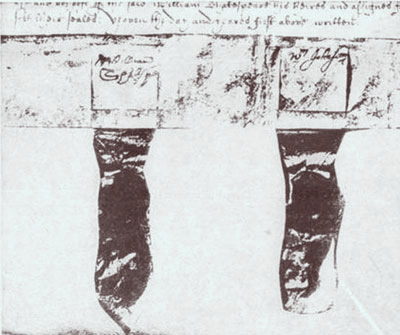
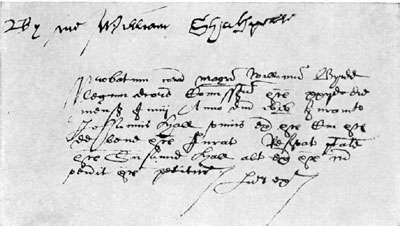
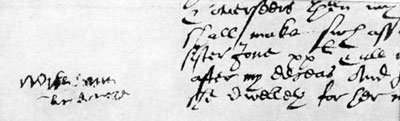
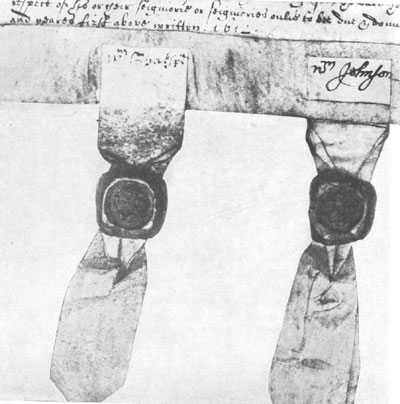
FIVE OF THE SIX AUTHENTIC SHAKESPEARE SIGNATURES
Signature on the purchase deed of Shakespeare's house in
Blackfriars
dated March 10 1613. In the Guildhall, London.
Signatures on the three pages of
Shakespeare's will executed March 25, 1616. Original in Somerset
House, London.
Signature attached to the deed mortgaging the house
in Blackfriars, dated March 11, 1613. In the British Museum.
It should be borne in mind that the great English translation of the
Bible, popularly called "King James' Bible", was published only after
Shakespeare had completed his last play in 1611. Before that time,
dating from Tyndale's version of 1525, and in great measure based on
it, a number of English translations had appeared, the most
authoritative in Shakspeare's time being perhaps the "Bishops' Bible", printed under the patronage of Queen Elizabeth in 1568, and edited by
the Archbishop of Canterbury.
The Geneva Bible of 1560, the first entire Bible in English in which
the division into chapters and verses was carried out, had, however,
the widest dissemination in Shakespeare's time, and a careful study of
passages in his works referable to Biblical texts appears to prove
that this version was the one with which he was most familiar. His
plays testify to his close knowledge of the Scriptures, although no
writer is less fettered by purely doctrinal considerations. The Geneva Bible went through no less than sixty editions in Queen
Elizabeth's reign, and even after the issue of the "Authorized
Version" in 1611 it competed successfully with this for a time.
That Shakespeare may have seen Philemon Holland's (1552-1637)
excellent translation of Pliny is nowise unlikely. A notable passage
in his Othello seems in any case to indicate that it was suggested
by Pliny's words (Bk. II, chap. 97, in Holland's version):
And the sea Pontus evermore floweth and runneth out into
Propontic, but the sea never retireth backe againe within
Pontus.
Othello replies thus to Iago's conjecture that he may change his mind
(Act iii, sc. 3):
Never, Iago. Like to the Pontic sea,
Whose icy current and compulsive course
Ne'er feels retiring ebb, but keeps due on
To the Propontic and the Hellespont,
Even so my bloody thoughts, with violent pace,
Shall ne'er look back, ne'er ebb to humble love.
First Folio, "Tragedies", p. 326, col. B, lines 34-39.
There is, however, no trace of any familiarity on Shakespeare's part
with the precious stone lore of the Roman encyclopædist, either from
the Latin text of his great "Historia Naturalis", or from the
translation published by Holland in 1601. This translator, who
Englished many of the chief Latin and Greek authors, Suetonius, Livy,
Ammianus Marcellinus, Plutarch's "Morals" and other works, was
pronounced by Fuller, in his "Worthies", to be "translator general in
his age", adding that "these books alone of his turning into English
will make a country gentleman a competent library". For his Ammianus
Marcellinus the Council of Coventry, his place of residence, paid him
£4, and £5 for a translation of Camden's "Britannia"—small sums,
indeed, for so much labor, but not so unreasonable when we think that
a half-century later the immortal Milton got but £5 for his "Paradise
Lost". He was a Fellow of Trinity College, Cambridge, where he had
studied and graduated; later he studied medicine, receiving a degree
of M.D., not from Oxford or Cambridge, however, but either from a
Scottish or foreign university.
Although Solinus, writing in the third century A.D., relies mainly
upon Pliny for his information on precious stones, still he here and
there gives evidence of a more critical spirit, as when he says of the
rock-crystal that the theory according to which it was frozen and
hardened water was necessarily incorrect, for it was to be found in
such mild climates as "Alabanda in Asia and the island of
Cyprus". [16] This is the more notable that the wholly incorrect view
persisted into the sixteenth century, so learned a writer as Lord
Bacon (d. 1626) restating it in his last work, "Sylva Sylvarum".
One of the most curious gem-treatises, especially as a source of early
sixteenth-century beliefs in the magic properties of precious stones,
the "Speculum Lapidum" of Camillo Leonardo, published in Venice, 1502,
probably never came under Shakespeare's eye. Indeed, even in Italy it
seems to have been so neglected that Ludovico Dolci ventured to
publish a literal Italian version of the Latin original as his own
work in 1565. The English "Mirror of Stones", issued in 1750, is
frankly stated to be a translation of the Latin original bearing the
same name. [17]
In Marlowe's (1564-1593) "Hero and Leander", almost certainly written
before Shakespeare's "Venus and Adonis" (1593), although not published
until 1598, five years after Marlowe's death, "pearl tears" and the
"sparkling diamond" are used much in the same way as by Shakespeare,
as appears in the following verses:
Forth from those two translucent cisterns brake
A stream of liquid pearl, which down her face
Made milk-white paths.
Lines 296-298.
Why should you worship her! her you surpass
As much as sparkling diamonds flaring glass.
Lines 213,214.
There is a curious parallelism between a passage in Troilus and
Cressida, 1609, and one in Marlowe's Dr. Faustus, 1588. Marlowe
wrote (sc. 14, l. 83):
Was this the face that launched a thousand ships
And burnt the topless towers of Ilium?
This is followed very closely by Shakespeare, with the substitution of "pearl" for "face".
She [Helen] is a pearl,
Whose price hath launch'd above a thousand ships.
Troilus and Cressida, Act ii, sc. 2, l. 82.
First Folio, at end of "Histories", unnumbered page
(596 of facsimile), col. A, line 19.
The greatest of the world's poets lived in a period midway between the
highest development of Renaissance civilization and the foundation of
our modern civilization, and he was thus at once heir to the rich
treasures of a glorious past, and endowed with a poetic, or we might
say a prophetic insight that makes his works appeal as closely to the
readers of to-day as to those of his own time.
In the four leading European nations of the age—Italy, despite her
high rank in art, still lacked national unity—four sovereigns of
marked though widely diverse character and attainments reigned for a
considerable part of Shakespeare's life. Of the "Virgin Queen" we
scarcely need to write. The England of her day, and of later days,
would not have been what it was and what it became, without the aid of
her mingled shrewdness and prudence. Faults she had and shortcomings,
but, granted the almost overpowering difficulties she had to face,
both at home and abroad, it is doubtful whether a more decided, a more
straight-forward policy would have been as successful as the somewhat
devious one she pursued. Her chief rival, Philip II (1556-1598), as
much averse as Elizabeth herself to energetic action, even more fond
of procrastination, lacked her relative religious and political
tolerance, and left Spain weaker than he had found it. And still his
tenacity, his devotion to the cause he believed to be that of heaven,
his consistency, and even the gloomy seriousness of his life, testify
to a strong soul, though a thoroughly unlovable one.
The reign of the eccentric Rudolph II, Emperor of Germany (1576-1612),
whose imperial residence was at Prague, covers the greater part of
Shakespeare's life. In spite of many failings and mistakes, this
monarch did much to foster the study of the arts and sciences of his
age, so far as he was able to understand them. That he was for a time
the dupe of adventurers and alchemists, such as the half-visionary
John Dee and the altogether unscrupulous Edward Kelley, was no unusual
experience in those days, when the dividing line between true science
and charlatanism was too indistinctly marked to be easily discernible.
The greatest of all the sovereigns of Shakespeare's time was Henry IV
of France, unquestionably the greatest of French kings, despite the
fact that the primacy has often been accorded to the Roi Soleil, Louis
XIV. The powerful and ductile personality that was able to put an end
to the destructive religious wars of France and to lay a firm
foundation for the strongly-centralized power of a later time, a
foundation which the great statesman Richelieu broadened and deepened,
deserves all the credit that should be given to those who conquer the
first apparently insurmountable difficulties in the realization of a
great aim.
How brief was the reign of most of the popes of this time is shown by
the fact that no less than ten of them were at one time or other
Shakespeare's contemporaries, although the duration of his life was
but fifty-two years. Of these probably the most noteworthy was Gregory
XIII (1572-1585), in whose reign occurred the fearful Massacre of St.
Bartholomew, August 24, 1572, and the reform of the calendar from that
known as the Julian to the new style named the Gregorian Calendar in
honor of this pope.
In the East, just coming into closer commercial intercourse with
Europe, the long reign of the greatest of the Mogul emperors,
Jelal-ed-din Akbar (1556-1605), began two years before the accession
of Elizabeth and lasted two years after her death. Probably no
Oriental sovereign, certainly no Indian sovereign, ranks higher than
Akbar, who was at once a great statesman, an able organizer, and
singularly tolerant in religion. In Persia, one of the most marked
rulers of this land, Abbas the Great, began to reign in 1584 and died
in 1628.
In no period was jewelry worn more ornately, or with greater display,
we might almost say ostentation, than in the age of Shakespeare. As a
rule, in this period the precious stones were less considered than the
elaborate goldsmith work in which they were placed. They were the
adjuncts, rather than the principal glory of the jewel.
The court jeweller of James VI of Scotland and of this monarch after
his accession to the English throne, as James I, was George Heriot
(ca. 1563-1624), born in Edinburgh, the son of a member of the company
of goldsmiths in that city. As the Scotch goldsmiths cumulated the
profession of money-lending with that of goldsmithing, they were
usually persons of considerable account among the citizens. Heriot
became a member of the company in 1588, the year of the Spanish
Armada. Despite the rather straitened circumstances of the Scottish
court, considerable amounts were expended for jewels, especially as
the queen, Anne of Denmark, was very fond of display. The nobility
also, such of them at least as possessed the means, were inclined to
deck themselves out with brilliant jewels and splendid ornaments of
massive gold. Heriot's appointment as goldsmith to the queen dates
from 1597; soon after this he was made jeweller and goldsmith to the
king. He followed the court to London in 1603, when King James
succeeded to Elizabeth, and at the time of his death, February 12,
1624, had amassed the sum of £50,000 by his profitable connection
with the court, and had also acquired lands and houses at Rochampton,
in Surrey, and St. Martin's-in-the-Fields, London. His residuary
estate, which amounted to £23,625 ($118,125), he entrusted to the
provosts, bailiffs, ministers, and ordinary town-council of Edinburgh
for the erection of an institution to be called Heriot's Hospital,
where a number of poor freemen's sons of the town should be
educated. [18] This foundation still exists, and the excellent
management of those who have had to do with the endowment is shown by
the fact that the income it now produces equals the whole sum of the
original bequest.
This great Scotch goldsmith fashioned a number of splendid rings for
the queen. An old account furnished by Heriot lists them as
follows: [19]
A ring with a heart and serpent, all set about with diamonds;
A ring with a single diamond, set in a heart betwixt two hands;
A great ring in the form of a perssed hand and a perssed eye, all
sett with diamonds;
One great ring, in forme of a frog, all set with diamonds, price
two-hundreth poundis;
A ring of a burning heart set with diamondis;
A ring in the forme af a scallope shell, set with a table diamond, and
opening on the head;
A ring of a love trophe set with diamondis;
Two rings, lyke black flowers, with a table diamond in each;
A daissie ring sett with a table diamond;
A ryng sett all over with diamondis, made in fashion of a lizard, 120
l.;
A ring set with 9 diamonds, and opening on the head with the King's
picture in that.
Heriot also lists a ring delivered about 1607 to Margaret Hartsyde,
one of the royal household, describing it as "sett all about with
diamondis, and a table diamond on the head"; that is, in the bezel. He
states that he had been given to understand that this was by direction
of Her Majesty. His precaution in making this note appears to have
been fully justified, for this Margaret Hartsyde was tried in
Edinburgh, May 31, 1608, on the charge of having purloined a pearl
belonging to the queen and valued at £110. Her excuse was that she had
taken this and other pearls to adorn dolls for the amusement of the
royal children, and that she did not expect the queen would ask for
them. As, however, it was brought out in the trial that she had
cleverly disguised some of the pearls she had taken, and had offered
to sell them to the queen, she was condemned to imprisonment in
Blackness Castle until the payment of a fine of £400, and to
confinement in Orkney during the remainder of her life. Eleven years
later, however, the king's advocate "produced a letter of
rehabilitation and restitution of Margaret Hartsyde to her fame". [20]
In Shakespeare's day the "goldsmiths" were also jewellers and gem
dealers, and often money-lenders as well. The settings of the finest
precious stones were at that time generally of gold, rarely of silver.
Platinum, the metal that now enjoys the greatest furore for diamond
settings, was then unknown in Europe; it was first brought to Europe
in 1735, from South America, having been found in the alluvial
deposits of the river Pinto, in the district of Choco, now forming
part of the United States of Colombia. The Spaniards had named it
platina, from its resemblance to plata, silver. The
chief source in our time is Russia, the richest deposits being those
discovered in 1825, on the Iss, a tributary of the Tura, in the Urals.
Other valuable deposits are in the district of Nizhni-Tagilsk.
Platinum also occurs in Brazil, California, and British Columbia,
associated with gold, as well as in Borneo, New South Wales,
Australia, and in New Zealand. Its use in gem-mountings began about
1870, and from 1880 onward it has become more and more favored, until
now it has almost entirely superseded gold in the finest jewelry,
especially for diamond settings. Long before the metal was known and
used in Europe, ornamental use of it was made in South America, in the
district we have mentioned, the material not being fused, but simply
forged out of the nuggets found in the deposits.
That but few fine diamonds were in Europe when Shakespeare wrote has
already been noted; indeed, the annual importation from India, then
the only source, can hardly have exceeded $100,000 on an average,
while at the present day the value of the diamonds from the great
African mines imported into Europe and America amounts to from
$40,000,000 to $60,000,000 each year.
In King James's reign, besides Heriot, William Herrick (brother of
Nicolas) and John Spilman were appointed jewellers to the king, queen,
and prince, the annual emoluments being £50 annually. It is stated
that Herrick furnished jewels worth £36,000 to Queen Anne of Denmark.
Such of her many jewels as were to be found when she died are said to
have been left to her son, later Charles I, and none to her daughter
Elizabeth, later Queen of Bohemia and ancestress of many of the
sovereigns of Europe, as well as of the present reigning house in
England. Unfortunately for her heir, a great part of the jewels had
been embezzled, and could not be recovered, although models of many
had been carefully preserved by William Herrick, who swore that the
originals had been delivered to the queen. Less notable jewellers of
King James's day were Philip Jacobson, Arnold Lulls, John Acton, and
John Williams. One of them, Arnold Lulls, has left a fine set of
contemporary drawings representing jewels of the epoch; these are now
to be seen in the Victoria and Albert Museum, London. As an instance
of the value of some of the jewels of his design, it is recorded that
the sum of £1550 was paid for a diamond jewel with pearl pendants and
two dozen buttons, furnished to the king to
be bestowed upon the
queen at the christening of the Princess Mary in 1605. [21]
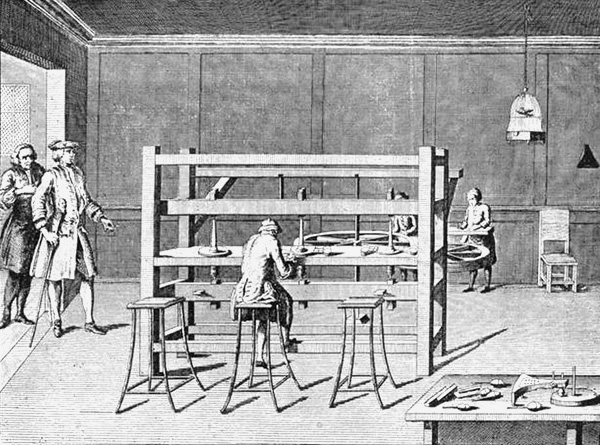
Diamond cutter's shop, eighteenth century, in which the
diamond-cutting mill is operated by "man-power". Published in the
Universal Magazine of Knowledge and Pleasure, by John Hinton, England,
July, 1749
While the jeweller's art in England was still under the influence of
foreign goldsmiths in Elizabeth's time, it had to a considerable
extent emancipated itself from foreign control in the latter part of
her reign and in that of her successor. In addition to George Heriot,
whom we have just noticed, several others are well worthy of mention,
such as Dericke Anthony, Affabel Partridge, Peter Trender, and Nicolas
Herrick, [22] the father of the poet Robert Herrick, who makes many a
telling use of the colors and charm of precious stones and pearls in
his dainty poems. To these must be added Sir John Spilman, of German
birth, who made many jewels at the royal command.
We should remember that for the cutting of precious stones steam-power
was not then available, "man-power" being employed. A large turning
wheel was pushed around by a man holding a bar extending from it. The
motion of this large wheel was transmitted to other smaller ones. The
number of revolutions per minute hardly exceeded a few hundred, while
in modern times a speed of from 2000 to 2500 revolutions per minute
is attained. The diamond cutting industry was largely in the hands of
Jews in Lisbon.
The gem-cutting processes were not greatly modified for many years
after Shakespeare's death, so that a representation of the wheel and
mill used in 1750 gives a fairly good general idea of the modus
operandi. The large wooden wheel, whose axis is the second pillar
within the frame, is bent, and makes an elbow under the wheel to
receive the impulsion of a bar that serves instead of a turn-handle.
On the right side of the frame, where the boy stands, is the
turn-handle which sets the wheel in motion by means of the elbow of
its axis. So that if the wooden wheel be twenty times larger than the
iron one, a hundred turns of the larger wheel will cause a thousand
revolutions of the smaller one. The method of holding the diamond in
place over the iron wheel, when in motion, so that it presses upon the
latter and is polished thereby, is shown in the lower right-hand
corner of the plate.
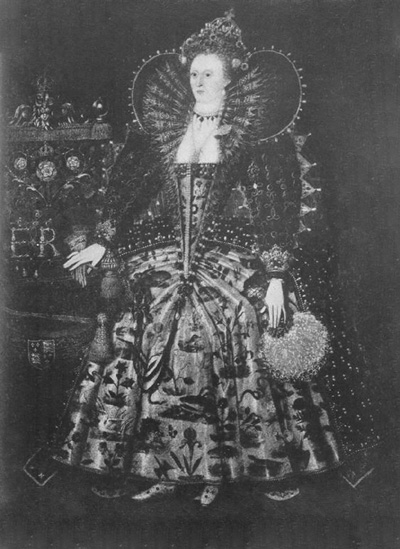
The German traveller, Paul Hentzner, who visited England in 1598,
toward the end of Elizabeth's life, describes her jewelling in the
following words:
"The Queen had in her ears two pearls with very rich drops; she
wore false hair and that red; upon her head she had a small crown; her
bosom was uncovered, and she had on a necklace of exceedingly fine
jewels. She was dressed in white silk, bordered with pearls of the
size of beans, and over it a mantle of black silk shot with silver
threads; her train was very long. Instead of a chain, she had an
oblong collar of gold and jewels".
FROM A PORTRAIT OF QUEEN ELIZABETH In the possession of his Grace the Duke of Devonshire, K.G.,
Hardwick Hall. The queen has jewels in her hair, a pearl eardrop, and two necklaces,
one fitting closely to the neck, the other falling over the breast. The stiff brocade skirt is embroideredwith a wonderful array of aquatic birds and animals. On the left, the cushion of the chair of state is embroidered with the queen's monogram. Surmounting the chair is a crystal ball.
The original canvas measures 90x66 inches.
In addition to this display the traveller tells us that the queen's
right hand was fairly sparkling with jewelled rings.
Aside from his portrayal of jewels in his numerous portraits, Holbein
ranked as the master designer of jewels in his day. Many of the finest
of these designs have been preserved for us and can be seen in the
British Museum, to which they were bequeathed by Sir Hans Sloane in
1753. There are 179 separate pieces, usually pen-and-ink sketches. The
execution of the jewels from these designs is believed to have been
mainly done by Hans of Antwerp, known as Hans Anwarpe, a friend of
Holbein, who settled in London in 1514, and was appointed goldsmith to
King Henry VIII, for whom he produced many jewels for New Year's
gifts. [23]
In judging of the jewels figured in portraits we must remember that
the artist has often modified them to bring them into greater harmony
with their immediate surroundings. This, in some cases, may lead him
to make of a somewhat inartistically designed jewel a beautifully
proportioned one. Again, he may be led to exaggerate the size of the
precious stones or pearls, and to intensify or deepen their colors. A
recent instance regards a portrait of the former queen of Spain by one
of the foremost Spanish artists of our day. The royal lady was
depicted wearing an enormous pearl; however, the artist informed the
author that the real pearl was much smaller than the painted one, but
that, in portraying it, a better decorative effect was obtained by
increasing its size. Whether Holbein (1497-1543), with his Dutch
exactness of portrayal, was led into any similar exaggerations we can
never tell, as little as we can know anything definite regarding the
true size of the jewels shown in the portraits by the Italian Zucchero
(1529-1566), the Fleming Lucas de Heere (1524-1584), or by any other
of the portrait painters of Elizabeth's time.
In a very modest way the addition of gilded scarf-pins, brooches,
chains, etc., not owned by the sitters, was not uncommonly practised
thirty or forty years ago, when colored tintypes were popular. These
were painted on the photographs, much to the gratification of those
who ordered them for distribution among their friends.
The court-jewellers of France in Shakespeare's day rivalled, though
they did not excel, those of England. Among them a prominent place
belongs to Francois Dujardin (or Desjardin), goldsmith of Charles IX
(1560-1574) and Henri III (1574-1589). When a verification and an
inventory of the French Crown Jewels were made on August 1, 1574,
after the death of Charles IX, the expert examination was entrusted to
François Dujardin, who is termed "orfebvre et lapidaire du Roy". The
goldsmith's art was passed down from father to son in this family: a
second F. Dujardin (b. ca. 1565) mounted the parures made for
Elizabeth of Austria, daughter of Henri IV and Maria de' Medici. In
the reign of Henri IV and the succeeding regency of Maria de' Medici,
Josse de Langerac, received as master goldsmith in 1594, and the
brothers Rogier, are noted as leading goldsmiths who, besides
executing many fine jewels, frequently made loans of money to the
Queen Regent, and seem to have experienced great difficulty in
securing full payment. Corneille Rogier set the jewels worn at her
marriage by Anne d'Autriche, wife of Louis XIII. Two brothers, each
bearing the name Pierre Courtois, are also noted in old records. One
of them, at the time of his death, in 1611, occupied two apartments
with two shops in the Louvre; the shop of the other had the sign "Aux
Trois Roys", probably referring to the "Three Kings of the East", the
Magi of the Gospel, very appropriate patrons for goldsmiths. [24]
Thierry Badouer, a German goldsmith-jeweller, received from the French
court, in 1572, an order for 250,000 crowns' worth of jewels to be
distributed as gifts at the approaching marriage of Henri de Navarre
with Marguerite de Valois. He faithfully executed his part of the task
and brought the jewels with him to Paris, but before he had been able
to deliver them to the Royal Treasury they were stolen from him during
the confusion of the St. Bartholomew Massacre. Eventually, in the
reign of Henri IV, his widow was partly reimbursed for the loss,
receiving one-quarter of the amount of her claim. [25] After the
Massacre of St. Bartholomew, and as a result of it, many Protestants
and Catholics left France for Hanau, Germany, where to this day they
carry on the jeweller's art; and from this beginning Hanau became a
jeweller's centre.
The best reproduction of the First Folio of 1623 is the photographic
facsimile, made in 1902, of the copy formerly owned by the Duke of
Devonshire and now in the possession of Henry E. Huntington, of New
York.[26] The original Folio, prepared by the managers of
Shakespeare's company, John Heminge and Henry Condell, bears the
imprint of Isaac Jaggard and Edward Blount, the printing house being
conducted by William Jaggard and his son Isaac. It is believed that an
edition of five hundred copies was issued, at one pound per copy. That
the publication was essentially a commercial venture, although it may
also have been a labor of love for some of the editors, is brought out
clearly and quaintly in the preface addressed to "The great Variety
of Readers", and signed by Heminge and Condell. This reads that the
book was printed at the charges of W. Jaggard, Ed. Blount, I.
Southweeke, and W. Apsley, 1623. The following passage from the
preface is well worth quoting, its spirit is so delightfully modern:
The fate of all Bookes depends upon your capacities,
and not of your heads alone, but of your purses. Well!
It is now publique, & you wil stand for your priviledges,
wee know: to read, and censure. [27] Do so, but buy it
first. That doth best commend a Booke the Stationer
sales. Then, how odde soever your braines be, or your
wisdomes, make your license the same and spare not.... But
whatever you do, Buy. Censure will not drive a
Trade, nor make the Jacke go.
The chief credit for bringing together the materials for the First
Folio, in 1623, is believed to be due to William Jaggard. Some ten
years earlier he had acquired the printing-privileges of certain of
the quartos. Edward Blount, whose name appears as publisher on the
title page with that of Isaac Jaggard, was merely a stationer, so that
the actual printing was solely under the charge of the latter, who
seems, at this time, to have been entrusted with this department of
the business. However, Blount's services may have been valuable since
he had better literary taste than the Jaggards possessed.
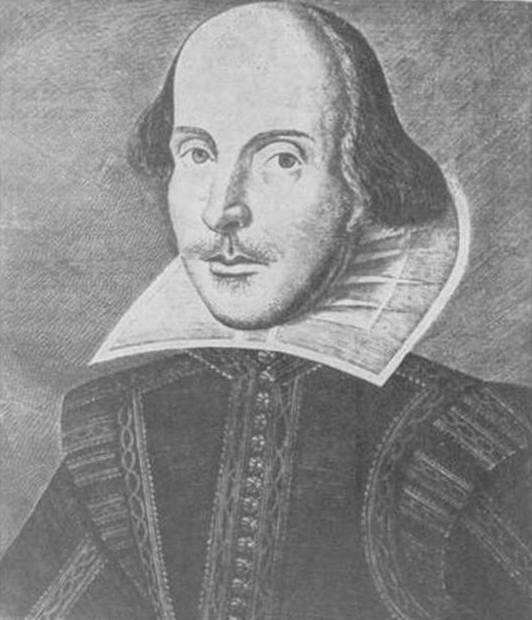
In spite of certain evident faults of proportion, the portrait of
Shakespeare engraved by Martin Droeshout for the title page of the
1623 Folio bears internal evidence of being a fairly good likeness,
for the face possesses a marked individuality. There is a belief that
it was taken from the so-called "Flower" portrait, now in the
Shakespeare Memorial Gallery at Stratford-upon-Avon, and which is
conjectured to have been painted in 1609, at least during
Shakespeare's lifetime, possibly by another Martin Droeshout, a
Fleming, uncle of the engraver of the same name. This portrait was
discovered, painted on a panel at Peckham Rye, bearing the inscription
"Will Shakespeare^n, 1609". That it should be the original from which
the Droeshout engraving was taken has been doubted, since it appears
rather to resemble later states of the plate than earlier ones. While
Ben Jonson, who had seen Shakespeare so often, may have been partly
moved to bestow undue praise upon the Folio portrait, in the lines he
furnished the publishers to be placed immediately facing it, by his
wish to say a good word for their publication, he would scarcely have
made use of such superlative terms had he not considered it to be at
least a fairly good likeness. Jonson's lines have been so often
printed that few are unacquainted with them, but as illustrating the
above remarks they can be repeated here, in the old spelling and form
of the First Folio:
TO THE READER.
This Figure, that thou here seest put,
It was for gentle Shakespeare cut;
Wherein the Graver has a strife
With Nature, to out-doo the life:
O, could he but have drawne his wit
As well in brasse, as he hath hit
His face; the Print would then surpasse
All, that was ever write in brasse.
But, since he cannot, Reader, looke
Not on his Picture, but his Booke.
B.I.
A most attractive and instructive exhibition of reproductions of the
portraits of Shakespeare, or supposedly of him, was shown at the rooms
of the Grolier Club, April 6-29, 1916. The catalogue [28] embraces 436
numbers, illustrating all the principal types. The exhibition also
comprised the principal editions of the poet's plays, from the First
Folio of 1623 to the great Variorum Edition by Dr. Furness, begun in
1871.
For the Tercentenary of Shakespeare's birth, celebrated in April,
1864, a special commemorative medal was struck in England, designed by
Mr. J. Moore. The obverse shows a profile head of the poet, in the
modelling of which the artist seems to have been chiefly influenced by
the Stratford bust. This fundamental type he has not unskilfully
combined with that of the Droeshout print in the First Folio, the
dome-like forehead being evidently suggested by the latter. The nose
is more accentuated than in the bust, and the mouth, though still
small, is somewhat firmer. Toward the edge of the field are disposed
the titles of his various works, as though radiating from the head,
and in the exergue is his signature, framed by a half-garland over
which extends a mace. The tribute offered to Shakespeare by the Muses,
figured on the reverse, is a rather stiff and conventional
composition. [29]
For those who may wish to see the original form of the passages
regarding precious stones in the text of the First Folio, of 1623, the
page and column references have been given here. In this text the
three sections into which the plays have been divided, Comedies,
Histories, and Tragedies, are separately paged; moreover, the
pagination offers a number of irregularities. Troilus and Cressida,
added at the end of the "Histories", has page numbers on a couple of
leaves neither connected with what precedes nor with what follows, the
remainder of the pages bearing no figures; furthermore, there are
several obvious, though unimportant, misprints. Pericles, first
issued in Folio, in the Third Folio, of 1664, is therein separately
paged, as are the other of the plays attributed to Shakespeare printed
therein, in continuation of the series of the First and Second Folios.
This play had, however, previously appeared six times in quarto in the
years 1609, 1611, 1619, 1630, 1635 and 1639.