Author of “Squinty, the Comical Pig,” “Tum Tum, the
Jolly Elephant,” “Sharp Eyes, the Silver Fox,”
“Tamba, the Tame Tiger,” “Toto, the
Bustling Beaver,” etc.
ILLUSTRATED BY
WALTER S. ROGERS
PUBLISHERS BARSE & HOPKINS
NEWARK, N. J. NEW YORK, N. Y.
“Yes, trot along and let’s see who will
get there first.”
Two big boy buffalo calves that had started
to run over the dry, dusty prairie, their hoofs
sending up little showers of dirt, stopped in
front of another buffalo, much larger than
either of them.
“Come on, Shaggo,” again called the buffalo
who had first spoken, in animal talk, of course.
“We’ll have a lot of fun.”
“Where are you going?” asked Shaggo, and
as he spoke, in a deep, rumbly voice, he got up
from the ground where he had been lying chewing
his cud, as a cow in the meadow chews hers.
And when Shaggo stood up you could see how
very big he was.
Shaggo was a mighty buffalo. He was the
largest and strongest of all the Government herd
in the big National Park, where these animals,
which once roamed the prairies in countless
thousands, are now kept. For there are not
now many buffaloes; not nearly so many as
there were a few years ago. The Indian hunters
and the white hunters killed them for food,
and to get the shaggy robes the buffaloes wore.
These robes were good to put over one in cold
weather.
Then, too, the building of the railroads out
West had scattered the buffaloes, until it seemed
they must all die or be driven away. Then the
Government fenced in great parks, called preserves,
where the big, shaggy animals, with
heads and manes larger than any lion’s that ever
lived, could be at peace.
It was on one of these preserves, or ranges, in
a National Park, that Shaggo lived. Though
he was not the oldest buffalo of the herd he was
easily the largest and strongest. He seemed to
grow faster than the others, and he could easily
have been the leader of the herd if he had
wished. But he let another, an older bull act
as the leader. Shaggo was content to eat the
sweet grass, drink the cool water, and wander
around in the forest or over the prairies which
formed part of the park.
“Are you coming with us, Shaggo?” asked
one of the two buffalo calves, as they stopped
near the mighty animal.
“Where are you going?” asked Shaggo.
“Over to the wallow,” was the answer. “It
is hot, and the flies and bugs are so bothersome
that we’re going to roll around in the wallow
and get all muddy. Come along with us and
we’ll have some fun.”
“Yes, do, please, Shaggo!” urged the other
buffalo. “You’re so big you can roll around
and make new holes in the mud.”
“All right,” agreed Shaggo, “I’ll come.
But the flies don’t bother me very much.”
The two buffaloes who had invited this biggest,
mighty member of the herd to come with
them, looked at each other in some surprise.
“All I’ve got to say,” finally said the smaller
of the two buffaloes, who was named Soako,
“is that you must be very queer if you don’t
mind the biting flies.”
“Maybe Shaggo has already been to the wallow
and covered himself with mud,” remarked
the other buffalo, who was named Poko, because
he was always playfully poking others
with his short, black horns.
“No, Shaggo hasn’t been to the wallow this
morning,” said Soako, with a laugh; in animal
fashion, as you can easily imagine. “If he had
been, he’d be all covered with dried mud, and
there isn’t any on him.”
“Yes, you’re right, Soako,” replied Shaggo,
giving the other buffalo the name that suited
him best, for Soako was always soaking himself
in water whenever he could find any. “I
haven’t yet been to the mud hole, but I’ll go
along with you now. Though, to tell you the
truth, the flies don’t bother me very much.”
“I guess Shaggo’s hide and hair are so thick
that it takes the flies longer to bite through than
it does with us,” said Soako, in a sort of whisper
to Poko, as the three friends moved off together.
“Maybe,” agreed Poko. “Anyhow, don’t
you think Shaggo is rather queer?” he went on,
making sure that the mighty buffalo did not
hear him. “He’s been acting in a very funny
way the last week, so I heard old Wuffo say.”
“Now you speak of it, I do notice it,” said
Soako. “And Wuffo ought to know, as he’s
our leader. Whatever he says is right.”
Wuffo was the oldest buffalo of the herd, and
one of the strongest. He had been leader for a
number of years. When Shaggo grew up, and
was much the larger and stronger of the two
and thus might easily have made himself leader
by fighting with Wuffo, Shaggo held himself
back. He was content to let Wuffo remain the
head of the herd.
So the three buffalo friends, shifting away
from the rest of the herd, moved over the prairie
end of the park toward the wallow. Soon they
trotted up a little hill and came within sight of
a hollow place.
“Oh, look at the lovely mud!” cried Soako.
“Let’s see who will be the first in!”
“I can beat you!” bellowed Poko, and he
gave a playful dig with his horns in Shaggo’s
ribs.
Instead of taking it good-naturedly, as most
of the buffaloes would have done, Shaggo
grumbled:
“Here! What are you doing? Quit your
fooling!”
“Oh, excuse me! I didn’t mean anything!”
said Poko, for he knew better than to get Shaggo
“mad.” More than one member of the herd
had felt the strength of Shaggo’s mighty head,
though the big buffalo had never done any real
harm. Whenever any one plagued him, he just
butted them head over heels, as a goat might
do.
Down the slope ran Poko after Soako, and
soon the two buffaloes were wallowing around
in the mud hole. “Wallow” is just the word
that tells what they did, and so the places where
the buffaloes went on the prairies to get away
from mosquitoes, gnats and flies came to be
called “wallows.” You may read about them
in stories of the old West.
Over and over, and around and around in the
mud rolled Soako and Poko. They sank themselves
down in the deep wallow until only their
nose tips stuck out, so they could breathe. They
covered themselves with mud. And if their
fathers or mothers could have seen them, instead
of telling them to come out, the older buffaloes
would have gone into the mud themselves.
For this was the only way the buffaloes had of
getting rid of the biting flies. The big, shaggy
animals would cover themselves with a coating
of mud, and as long as this stayed on they were
in comfort. The flies and mosquitoes could not
bite through the dried, caked mud.
“Come on, Shaggo!” cried Soako, tumbling
about in the hole which was kept wet by a nearby
spring. “Hurry! The mud’s fine to-day!”
“Yes, you’re missing it!” added Poko, who
was beside Soako.
“I think there’ll be enough mud left for me,”
answered Shaggo easily, and he went down the
slope without any signs of hurrying. Once
again Soako and Poko looked at each other.
“He certainly is queer,” said Poko in a
whisper.
“I should say so!” agreed Soako, pawing
around on the bottom of the wallow. “I remember
when he was always the first in the mud.
Now he doesn’t care whether he’s last or not. I
wonder what is the matter with Shaggo that he
acts so queerly?”
By this time the biggest buffalo of the herd
was at the edge of the wallow, and the other two
could not talk about him without being overheard.
So they splashed about, and soon Shaggo
was also covering himself with mud to keep
away the flies.
But though Shaggo rolled himself around in
the black sticky mud as did his friends, the
mighty buffalo did not seem to be enjoying himself.
He did not play tricks and jokes as he had
been wont to do. He did not butt the others
with his immense head, nor splash mud on them,
nor roll them over so that their noses went under.
He just covered himself with mud and then
came out on the bank.
“You aren’t going to quit so soon, are you?”
asked Poko.
“Let’s have a game of mud tag,” suggested
Soako. “This is our best chance. We have
the wallow to ourselves now. Pretty soon Wuffo
and the other bulls will be coming here for their
bath, and we’ll have to skip out. Come on,
Shaggo! I’ll be it for a game of tag! Look out!
I’m coming!”
Soako rushed up from the mud wallow and
trotted toward Shaggo. But the latter, instead
of running away, as he often did, and keeping
out of Soako’s way, as he easily could have done
(for Shaggo was the best runner in the herd)
just stood still and let Soako tag him.
“Now Shaggo is it!” bellowed Soako, running
over to join Poko, who also came up out of
the cool wallow.
“I’m not going to play,” said Shaggo.
“Not going to play!” echoed Poko and
Soako.
“No,” went on Shaggo. “I don’t feel like
playing tag. Besides, it will make the mud dry
quicker and drop off, and then I’ll have to go
into the wallow again.”
“Well, that’s only fun!” said Soako, and
again he and Poko looked at each other. They
said nothing, but they thought that Shaggo was
acting very strangely indeed. Not to play tag!
“Is there any other game you’d like to play?”
asked Poko, as he nibbled a bit of grass at the
edge of the spring.
“No,” answered Shaggo, in a grumbling sort
of voice. “All I want is to be left alone. I’m
going for a walk. It’s too hot to play tag.”
It was hot, there was no denying that. But
then there was the cool wallow to soak in when
one was warm after running. And there was
also a shady forest which was farther up the
National Park preserve. Soako and Poko shook
their heads. They could not understand Shaggo.
“Let him go,” whispered Poko, as the big
animal started off by himself.
The two friends were just going back to the
wallow when, all of a sudden, along came running
one of the smaller calves of the herd. He
seemed much excited.
“Oh, you ought to see ’em! You ought to see
’em!” he cried, in buffalo talk, as was natural.
“They’re fighting like anything.”
“Who are fighting?” asked Poko.
“Rumpo and Bumpo, the twins,” was the answer.
“They’re knocking each other all over
the prairie. Come on, it’s lots of fun!”
Rumpo and Bumpo were twin buffalo brothers,
and they often had what the other buffaloes
called “fights.” But they were only in fun, as
dogs and boys wrestle to grow stronger. Rumpo
and Bumpo knocked each other all over the soft
grass of the prairie, but neither hurt the other.
And it was always fun to see them “fight,” as
it was called. Most of the other buffaloes would
leave what they were doing at any time to see
Rumpo and Bumpo at their game of knocking
each other around.
“Did you hear that, Shaggo?” called Poko,
as he and Soako prepared to follow the little
calf buffalo over the prairie.
“Hear what?” asked the mighty buffalo,
turning partly around.
“Rumpo and Bumpo are fighting again, in
fun,” said Poko. “Come on! Let’s go and see
’em!”
“I don’t think I care to,” answered Shaggo.
“I’m going off by myself.”
This time the three buffaloes looked at one
another.
“He certainly is queer!” declared Soako.
“This is the first time I ever knew him not to
want to see Rumpo and Bumpo at play.”
“Well, come on,” said Poko, “or we’ll miss
the fun!”
Then the three rushed off together toward
that part of the Park from which came the sound
of heavy blows and loud bellowing. Rumpo
and Bumpo were having a great “fun fight.”
“Let them go,” said Shaggo to himself. “I’m
tired of such nonsense! I don’t like it here any
more. I wonder what’s the matter with me!
I’m tired of everything! I feel very queer! I
don’t know just what the matter is, but I think
something is going to happen!”
CHAPTER II SHAGGO’S BIG JUMP
Shaggo, the mighty buffalo, wandered up
to the top of a little hill. Down below him
was the mud wallow, and he was still covered
with the cool slime from its depths—slime
that would keep away the bugs and mosquitoes
for some time.
“At least I don’t have to worry about them,”
thought the great, shaggy buffalo—the mightiest
of all the herd. He looked across the prairie,
which formed part of the government preserve,
and could see a crowd of other shaggy animals
like himself. In the midst of this throng he
noticed two figures moving nimbly about.
“That’s Rumpo and Bumpo butting each
other,” said Shaggo to himself. “Well, I hope
they get some fun out of it. I don’t care for it
any more, though.”
Time was when Shaggo would have been
among the first to rush up to see two buffaloes
ramming each other with their immense heads
with their heavy shock of hair. In fact, Shaggo
would have shouldered his way through the
throng to a place well up in front. But now he
did not care to look on, even from a distance.
“I wonder what is the matter with me?”
mused Shaggo. “I wonder what is going to
happen? I don’t like it here any more, though
I used to think it was the finest place in the
world.”
Shaggo looked over as much of the range
as he could see. It was so large, however, that
he could not see it all at once. There were
woods and prairies—flat lands and low lands
and hills, wallows and “salt licks.” These last
were places where salt cropped up out of the
ground, and at certain seasons buffaloes, deer,
elks and antelopes came to these places to lick
the ground with their tongues to get the taste
of salt. Salt is good for some wild animals, such
as buffaloes. You may have seen, on a farm,
how the cows and sheep are sometimes given salt.
Often a lump of rock salt is put in the manger of
a horse, for a little salt is good for horses also.
As Shaggo looked over the buffalo preserve
and saw the sun shining on a part of the fence
that was all around it, a new thought came into
his head. He sniffed the air, pawed the ground,
sending up a little cloud of dry dust, and then
he said to himself:
“I know what the matter is! This place is
too small for me! It isn’t large enough! I’m
tired of being fenced in!”
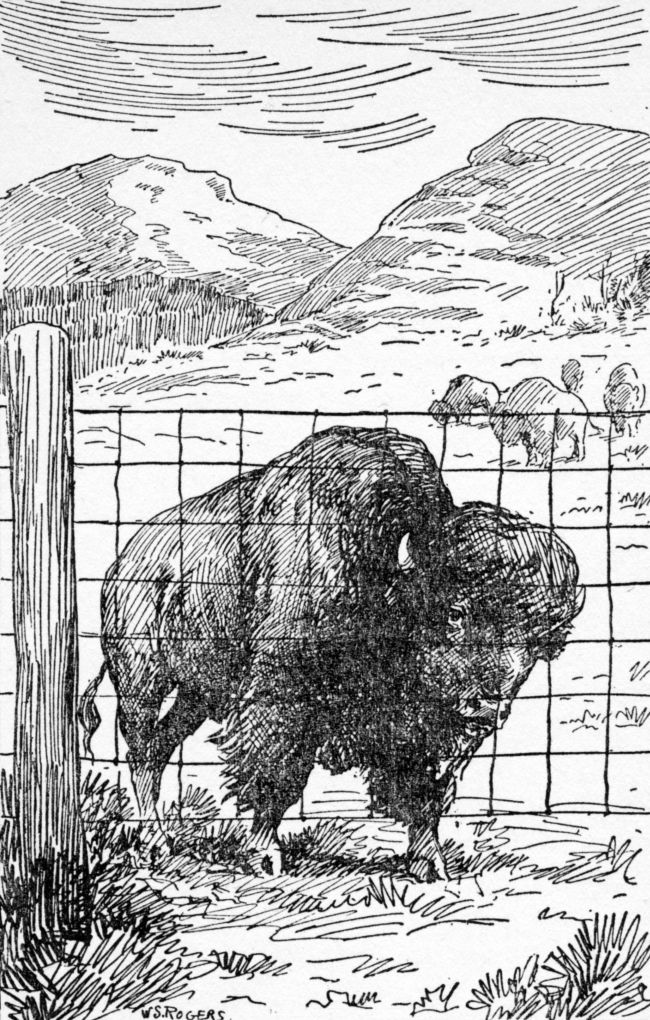
For there was a wire fence, many miles long,
all around the Park. The fence had to be there
to keep the buffaloes from wandering away, and
to keep out bad white men and Indians, who
might have come in to take away or to shoot the
buffaloes. Of course the men could have
crawled under, jumped over, or have cut the
fence, but the wire being there told these men
that the Government wanted them to stay out,
and the men knew the Government would punish
them if they did any harm to the herd of
big animals.
“Yes, this place isn’t large enough,” decided
the mighty buffalo. “I have heard stories, told
by Wuffo, of his grandfather and their friends.
They never had to stay cooped up in a park with
a fence all around it. They could run and roam
as they pleased. I don’t see why I can’t! I’m
going to! That’s what I’m going to do. I’m
going to run away!”
However, it was one thing for a buffalo to
make up his mind he was going to run away
from the Government Park, but it was quite another
thing to do it. All around the range, or
National Park, was this strong, high fence of
wire. The men who put it up knew they must
needs make it extra strong on account of the big
buffaloes, who are stronger and larger than any
bull of the farm pasture.
Shaggo knew about the fence. More than
once, in the dark, he had bumped against it, and
more than once, on the sly, he and some other
buffalo calves had tried to break through it.
“But it can’t be broken,” said Shaggo, after
he had tried several times, with his companions.
“No,” agreed Poko, “I don’t believe it can.
Anyhow, who wants to break it? This place
suits me.”
“And me, too,” said Soako and the others.
It had suited Shaggo, too, until this past week,
when, somehow or other, he had become discontented.
“And so I’m going to run away,” he decided.
“I’ll get over or through the fence, somehow,
and see what’s on the other side.”
Shaggo, like many of the other buffaloes, had
never been outside the fence. Shaggo had been
born inside, and had never been allowed to go
out.
“But I’m going now,” he told himself, as he
walked down the hill and over toward the others
of the herd. By this time the “fun fight” between
Rumpo and Bumpo was over. Bumpo
had won, having knocked down Rumpo more
times than Rumpo had knocked him down.
“Oh, Shaggo, you should have seen it!” bellowed
Poko, as he ran up alongside of the big
buffalo.
“Yes, you surely missed it!” echoed Soako.
“It was a great fun fight.”
“I guess I didn’t miss much,” replied Shaggo.
“I had a good time off by myself.”
“Humph! That’s the first time I ever knew
anybody could have a good time alone, unless he
was eating or rolling in the mud,” said Poko in
a low voice to Soako.
“That’s right,” agreed the other. “Shaggo’s
getting more and more queer.”
And if these two buffalo friends could have
known what Shaggo had made up his mind to
do—that is, run away—they would have been
more surprised than ever.
Once Shaggo had found out what made him
discontented—that the Park was not big enough
for him—he began to look about for a way of
getting out of it. For several days he wandered
around with the rest of the herd, eating the grass
here and there, drinking from the different
springs, going to the shade of the trees when the
sun was too hot, or rolling in the mud when the
flies bit too hard.
One day Shaggo separated himself from the
rest of the herd. He could do this easily, as, of
late, he had not been very friendly, and the
others had come to let him alone.
“Shaggo is a bit cross and grouchy,” said
Wuffo. “Just let him alone until that spell
wears off. Then he’ll be his same jolly old self
again.”
So when Shaggo wandered off alone, no one
paid any attention to him. Shaggo went up on
top of a hill. From there he looked down and
saw the shiny wire fence that kept him from
leaving the preserve.
A new idea came into Shaggo’s head. He
looked at the fence and at a thick clump of
bushes and small trees that grew on the other
side. The fence was quite a distance below him.
“I believe I can do it!” cried Shaggo aloud
to himself. He was quite excited. “I believe
if I took a run and gave a jump, I could leap
down from the top of this hill, over the fence and
so down into the soft bushes. It wouldn’t hurt
me much, and I would be over the fence. Then
I’d be out! I’d be free and could roam where
I pleased! That’s what I’ll do! I’ll give a big
jump down from this hill, over the fence and
get away!”
The more Shaggo thought of this idea the
better he liked it. He looked behind him.
There was the rest of the herd calmly eating,
chewing cud or wallowing in the mud. Rumpo
and Bumpo were again at their butting fun fight
game.
“None of that for me!” said Shaggo. “I’m
going to run away, jump the fence, and see the
world. Good-bye, my buffalo friends!” he said,
though he was so far away the others could not
hear him.
Shaggo did not have anything to pack to take
away with him. He carried his hump, or pack,
on his big shoulders. Once more looking back
toward his friends and companions, Shaggo
shook his head and pawed the dirt, stamping his
hoofs on the top of the hill.
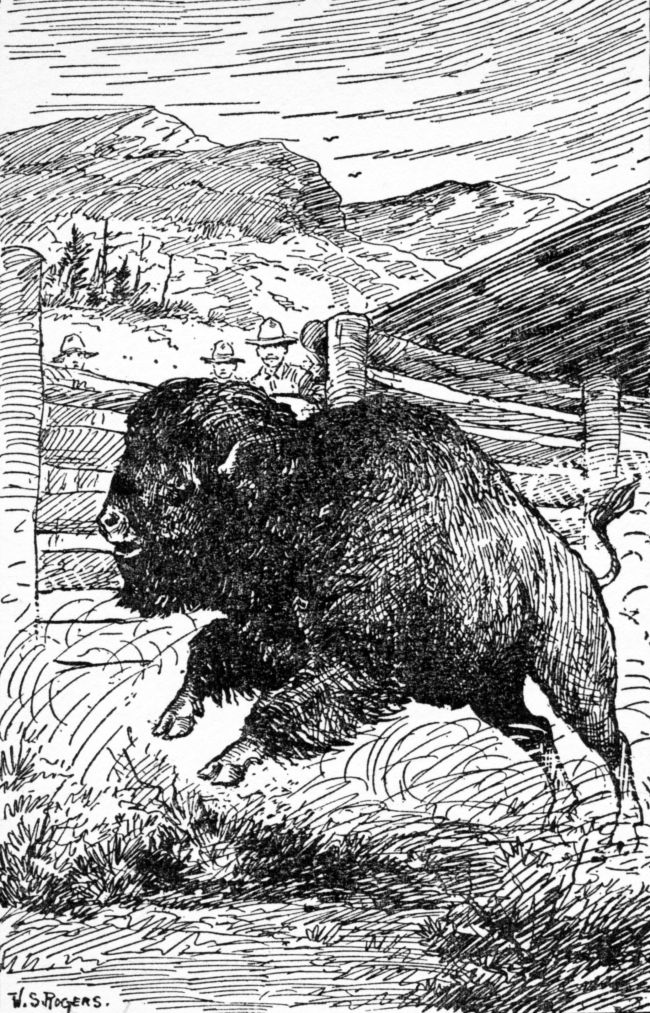
“Here I go!” he said at last. He walked
back a little way, and then broke into a run. As
he neared the edge of the hill Shaggo gave a big
jump, and launched himself outward and downward.
He held his legs stiff under him as he felt himself
sailing through the air.
“I’m going to clear the fence! This time I
shall jump over it and land on the other side!”
thought Shaggo, as he leaped through the air.
“At last I am free! I am jumping away!”
CHAPTER III SHAGGO IN A HOLE
Down, down, down through the air sailed
Shaggo, the mighty buffalo, after he had
leaped from the cliff over the strong wire
fence. He looked toward the ground, to make
sure he would not land on the fence itself.
“For if I did that,” thought Shaggo, “my
legs would get all tangled up, and then I could
never run away and find a big place in which
to roam. No, indeed! I don’t want anything
like that to happen.”
So he was glad when he saw that he was going
to land on the other side of the fence. Once
more he looked down. The earth seemed rushing
up to meet him, but of course he was only
falling down to land on it.
“I’m going to fall into that clump of bushes,
just as I thought I should,” said the buffalo to
himself.
A moment later he had crashed into the midst
of a tangle of green leaves and branches. Into
the midst of the bushes fell the mighty Shaggo.
Down through them he went, breaking twigs
and limbs of small trees, for Shaggo was very
heavy.
And in another instant Shaggo fell with a
loud thud and a thump. He fell on one side,
landing on one of his front shoulders, and at
once a terrible pain shot all through his body.
It was a much worse pain than he had ever before
felt, even when Wuffo, the oldest buffalo
of all the herd, had once butted Shaggo head
over heels when Shaggo had done something
wrong. And it was a much worse pain than
any Shaggo had felt when Poko had shoved him
with the short, black horns that all buffaloes
wear.
“Dear me, this is terrible!” thought Shaggo
to himself, in the way buffaloes have of thinking.
“I wonder what I have fallen on.”
But he suddenly lost all power of thinking,
for his senses seemed to leave him, and all he
knew was that he had fallen into a place that
was very, very dark and lonesome.
The fact was that Shaggo had fallen so hard
that, for a while, he was knocked senseless. If
you have ever tumbled downstairs and have
bumped your head very hard, you perhaps know
how it feels to lose your senses. You seem to go
to sleep before it is bedtime. Well, this is what
happened to Shaggo. He didn’t know what
happened after he had jumped and felt that
sharp pain in his shoulder, except that it grew
very dark.
It was a real darkness, too, besides the dark
that came when Shaggo closed his eyes. The
mighty buffalo was so strong that even his heavy
fall did not make him senseless very long. In
a little while he opened his eyes again. He
could still feel the pain in his shoulder, but what
surprised him more than anything else was the
darkness that was all about him.
“This is very queer,” said Shaggo to himself.
“When I started to run away from our buffalo
range it was daylight. That could not have been
so very long ago, yet it is now as dark as night.
I wonder if I could have been here all that
while. Guess I’ll move about and see what the
matter is.”
Shaggo shook himself, thereby rousing himself
and getting wider awake from his queer
sleep. He managed to scramble to his feet, but
no sooner had he done so than the pain in his
shoulder grew sharper.
“Why—why!” exclaimed Shaggo, “I can
hardly move. Ouch! Oh my, this is terrible!
I hope my leg isn’t broken!”
Shaggo knew what it was for a buffalo to have
a broken leg. They hardly ever lived to get
over it, and he did not want anything like that
to happen.
So Shaggo moved each one of his four legs
very carefully to see if any of them was broken.
But though his front left leg was very painful up
near his shoulder, it did not seem to be broken.
But, oh, how it hurt to move it!
“And yet I have to move it if I’m ever going
to get out of this place,” thought Shaggo.
“Where am I, anyhow? It’s very dark, and yet
I’m sure it isn’t night. It doesn’t smell like
night.”
Buffaloes, and other animals, are not like boys
and girls. Animals can tell many things by
merely smelling, where we have to see things
to know what they are. And Shaggo could tell
when it was daylight or night by smelling. And
though now, to his eyesight, it was dark all
around him, somehow or other he felt sure it was
not the darkness of night.
“And if it isn’t night, then I must be in some
sort of cave or hole,” thought the mighty buffalo.
He knew what caves were, for on the buffalo
range in the National Park were some of these
holes in the ground, where the big animals went
in to stay during the cold winter.
“Well, I’d better try to get out of here,”
thought Shaggo. He wished he might have
some of his buffalo friends to whom to talk, but
that was out of the question. And Shaggo did
not wish them the bad luck of wanting them to
be with him in his trouble. Yet, all the same, he
would have been glad to have seen even Rumpo
and Bumpo now at their game of bumping one
another. But Shaggo, in a fit of temper, had
run off by himself, and now he must get out of
his trouble as best he could.
“And I surely am in trouble,” thought poor
Shaggo. “Oh, wow! What a pain!”
He moved about a little in the darkness, and
then he had to stand still, for his leg hurt him
so much. But Shaggo knew he could not stay
in the place into which he had fallen. The more
he thought about it the more he felt sure he had
fallen into a pit.
“But I must see what sort of a place it is into
which I have fallen,” thought the mighty buffalo.
His eyes were getting used to the darkness
now, and he could see a little. He noticed that
he was down in a sort of big hole. The bottom
and sides were of earth, and Shaggo dug his
hoofs in as he had done on the soft prairie.
Slowly Shaggo walked around the pit. In
most places the sides were too steep for him to
climb up. They were like the sides of a well,
straight up and down. But in one place there
was a slope like that of a hill, only it was a very
steep hill.
“Now if there were only some rocks, like
steps, in this hill I might get up,” thought
Shaggo. “I wonder if I could dig some steps
with my horns. I’ll try it.”
There was a little more light on this side of
the cave, and Shaggo could see to try to get up.
He lowered his shaggy head, and with his short,
strong horns, dug out a little of the soft earth,
hoping to make some steps for himself. But as
he moved his head from side to side, to use his
horns, the pain in his hurt shoulder was so sharp
that again he cried:
“Ouch!”
“This will never do!” said Shaggo to himself,
as he stopped trying to dig the steps. “I’ll
never be able to get out this way. I must find
another path.”
He backed away from the spot where he had
been trying to dig and again slowly wandered
about the hole. It was a much larger place than
he had at first thought, and as he slowly moved
toward one end he saw that the light was
stronger.
“Maybe that’s a place where I can get out,”
cried poor Shaggo. “I hope it is! I’m not having
very much fun so far!”
His shoulder was so painful that he could not
run, as he wanted to. But he managed to get
nearer the place of the light, and then, to his
surprise, he saw an easy slope of earth leading
up into what seemed to be a large cave.
“Maybe this is the cave where a lot of us buffaloes
stayed last winter,” thought Shaggo. “If
it is I’m all right—though I would still be back
on the range. No, I don’t see how this could be
that cave—that was inside the wire fence, and I
surely jumped outside. Besides, I don’t smell
any buffalo smell, as I would if any of my
friends had been in this cave. It must be another.”
And it was, as Shaggo found a little later.
The pit, into which he had jumped through the
bushes, was joined to a big cave under the mountain,
and by walking up a little hill of dirt,
Shaggo was soon in the cave. It was much
larger than the pit, and lighter, too, and Shaggo
was glad of this.
“Now maybe I can find something to eat and
drink,” thought the mighty buffalo. “But, most
of all, I want something to drink.”
So, making his way to the cave, Shaggo sniffed
and smelled.
He wandered on and on in the big cave, which
was getting lighter and lighter. All of a sudden
Shaggo stopped, lifted his head and sniffed
deeply.
“I smell water!” he bellowed aloud, he was
so excited.
He started to run, but his shoulder hurt him
so he had to slow down. Then there came to
his ears a musical gurgle.
“I hear water, too!” he said. “Now I can
get a drink!”
He turned around a corner of rock and a moment
later he saw a pool of shining water in the
cave.
“Oh, how good that looks!” cried Shaggo.
“And how good it will taste!”
He made his way to the edge of the pool, but
just as he was leaning over to drink something
very surprising happened. Up in the middle of
the pool shot a steaming hot column of water.
It boiled, bubbled, and hissed, and was so hot
that Shaggo sprang back in alarm, uttering a
loud “wuff!”
“My! what’s this? What have I struck
now?” thought the shaggy buffalo.
CHAPTER IV SHAGGO AND THE ANTELOPES
Surprised by the hot, spouting column
of water, just as he had been about to take
a drink, Shaggo leaped back in the cave.
Then he stood there, watching the water bubble
and boil. It also steamed, for it was very hot.
“This is very queer,” thought the mighty
buffalo. “Hot water is all right in a cold winter,
maybe, but even then I’d have to let it cool
in the snow before I could drink it. But hot
water in the summer is no good at all. I wonder
what makes this water so hot, and I wonder if
it will cool?”
Shaggo stood back, out of reach of the splashing,
hot water, and looked at it. Never before
had he seen anything like that.
The column of hot, hissing water was shooting
up from the middle of what he had thought
was a quiet pool. It shot up just as you may
have seen a fountain spurt in some city park,
though of course Shaggo knew nothing of cities
or city parks. All his life he had lived on the
buffalo range, and though that was in what is
called a National Park, such as is the Yellowstone,
Shaggo knew nothing of this.
“Well, there’s no use in trying to drink that
hot water,” thought the big buffalo. “If I wait
a bit, though, it may cool. I guess I’ll do that,
for I’m very thirsty. If I had a drink of cool
water I think my shoulder would feel better.”
Shaggo moved back a little and lay down
where he could watch the spouting water. It
was light in this part of the cave, and he could
see very well. For some time Shaggo lay there.
All at once, and as suddenly as it had begun,
the water stopped bubbling up, and the pool became
quiet.
“Good!” exclaimed Shaggo to himself.
“Now I can get a drink.”
When he got up his shoulder hurt him again,
and he had to cry “ouch!” several times before
he managed to reach the edge of the pool, which
was in the middle of the rocky floor of the cave.
Shaggo could tell by sniffing that the water was
cool now.
“And such a good drink as I’ll have!” he
said to himself.
But just as he was about to put his nose down
into the pool to drink, again came that bursting,
bubbling column of hot water, and Shaggo had
to leap quickly back for fear of being scalded.
“Oh, dear me! This is no good at all!” bellowed
the shaggy buffalo, shaking his big head
and his hump that was covered with long, dark
brown hair. “This is a queer cave, where you
can’t even get a drink of cold water!”
Shaggo did not know what to do. The longer
he waited the more he wanted a drink, but he
could not take that hot water.
“I’ll wait a little longer,” thought the runaway
buffalo. “Maybe it won’t happen again.
It’s like somebody playing a trick on me. If
Soako or Poko were here I’d say they were doing
it. But they are far away. They didn’t jump
over the wire fence as I did—and I almost wish,
now, that I hadn’t. I’m not having half as much
fun as I thought I would. The range was a
better place for me than I thought.”
Once more Shaggo lay down near the hot,
boiling spring. He waited until the column of
water stopped bubbling and then he tried, for
the third time, to get a drink. But when again
it shot up, almost in his nose, he gave a grunt and
wuff and said:
“This settles it! I’m not going to fool away
any more time here. I’m going out of this cave
and get a drink somewhere else! This is a crazy
sort of spring!”
Limping along, and shaking his big head,
Shaggo turned to find a way out of the cave. He
knew that the place where the most light came
in was the place where he could get out, and
he started for this. In a little while he was outside,
on the broad, rolling prairie. He looked
around him. Back in the distance he could see
the wire-fenced buffalo range, from which he
had jumped in order to run away. He was so
far off now that he could not make out the forms
of any of his animal friends. Nor could they
see him, he felt sure. To one side was a big
tract of woods, a dense forest, and in the other
direction lay the prairies, over which, years before,
millions of buffaloes like Shaggo had
roamed as they pleased. Now there were only
a few buffaloes left, and most of them were in
National Parks.
“Now to try for another place to get a drink,”
said Shaggo to himself. “I guess I’ll keep out
of the woods for a while.”
Raising his big head, Shaggo sniffed the air.
He was not quite sure, but he thought that over
toward the east, in the place where the bright
sun came up every morning, he could smell
water.
“I’ll try that way,” said Shaggo to himself.
He lumbered slowly along, limping a little because
of his hurt shoulder, and soon the smell of
water came stronger to his black nose.
All at once a voice that seemed to come from
the ground on which Shaggo walked cried:
“Hey there! Why don’t you look where
you’re going? You almost put your big foot in
my house!”
“Your house? Where’s your house?” bellowed
Shaggo. “I don’t see any.”
“No, because you’re up so high in the air,”
went on the voice. “My house is right down by
your big hoofs, and if you don’t take care you’ll
tumble in the roof, and step on me!”
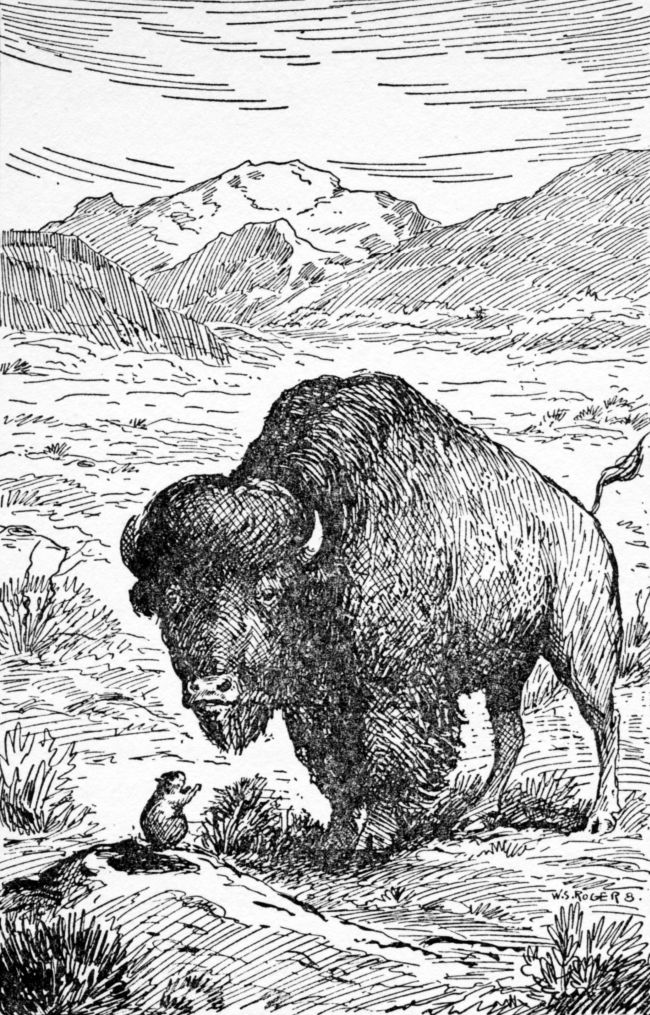
Shaggo looked down and saw a queer, light
brown little animal sitting near a hole in the
ground.
“I’m Yippi, the prairie dog,” was the answer.
“Excuse me for speaking so sharply to you, but
if I hadn’t you’d have broken into my house.”
“I wouldn’t have done that on purpose,” said
Shaggo. “I was so busy sniffing for water that
I didn’t see you. Is there a cool spring to drink
from around here? I found some water over in
the cave, but it was hot, and bubbled up under
my nose.”
“Oh, that must have been one of those boiling
geysers as they call them,” explained Yippi.
“I’ve heard my grandfather tell of them, but I
never saw one.”
“Well, I’ve seen one, and I don’t care for another,”
went on Shaggo. “Believe me, they’re
no fun! Where can I get a cool drink?”
“You’re going in the right direction,” said
Yippi, the prairie dog. “Just follow your nose,
and you’ll come to a fine spring. It’s a big one
where all we animal folk drink, but you have to
take your turn. Mine doesn’t come until after
all the others are through, as I’m so little, you
see.”
“What do you mean—take your turn?” asked
Shaggo. “When I’m thirsty I take a drink—I
don’t wait for any one.”
“Well, perhaps you can, as you’re so strong
and big,” replied the little prairie dog. “But
I’m not sure. There are some other big animals
in this part of the country—bears, and antelopes
with sharp horns. They never bother me,
though, for I run into my burrow and hide
whenever I hear any of them coming. Once a
bear tried to dig me out with his long claws.”
“What did you do?” asked Shaggo.
“Oh, I fooled him all right. While he was
digging at my front door, I just slipped out at
the back and ran away. Ha! Ha! We prairie
dogs always have more than one hole door to our
houses. But you’ll have to excuse me. I must
get some grass for dinner.”
“And I must get a drink,” said Shaggo.
“Thank you for telling me about the spring,
and excuse me for almost stepping on you.”
“Oh, that’s all right,” barked Yippi. Then
the big buffalo turned away and Yippi ran off
to gather some grass and other things to eat.
As Shaggo walked on, going a bit slowly so
his lame shoulder would not hurt so much, the
smell of water became more and more plain.
“And I surely hope it will not be a hot geyser
spring this time,” thought Shaggo. “I am so
very thirsty!”
Over the rolling prairie, up little hills, and
down in little valleys walked the mighty buffalo.
In about half an hour he came to the top of a
larger hill than any he had yet climbed. When
he reached the top he looked down the slope and
saw, at the bottom, a shining pool of water.
“Oh, how good that looks!” thought Shaggo.
He hurried down the hill as fast as he could,
and he kept sniffing the air, to make sure there
was no hot geyser that would spout up under
his nose. But the cool smell of the water did not
change, and the mighty buffalo began to take
hope.
As he neared the water hole he could see
around the edge the marks of many animals in
the mud. Some had paws and some had hoofs,
like himself. Suddenly, from under a bush near
the water hole, a big, fur-covered animal came
out.
“Oh, so you’re going to get a drink, are you?”
asked this animal.
“Yes, Mr. Bear, I am,” said Shaggo. “I
hope you have no objection, but, even if you
have, I’m going to get a drink! My tongue is
as dry as dust.”
“Oh, get as many drinks as you please,” answered
the bear. “I’ve had mine, and now I’m
going off to take a nap. But you want to look
out for the antelopes.”
“Who are they?” asked Shaggo.
“They are like deer, animals with sharp
horns,” answered the bear. “It is nearly time
for them to come for their drink. Look out for
them!”
“Pooh! I’m not afraid,” said Shaggo. “I
guess I have as much right to this water as they
have, and I’d like to see them drive me away,
especially when I’m so thirsty!”
“Well, I’ve told you to look out—that’s all I
can do,” said the bear, as he walked slowly away.
Shaggo limped down to the pool. As he
neared it he looked carefully at it. He was
afraid lest he might see some hot water spout
up. He was going to ask the bear if this was
one of those geysers, but he remembered the
prairie dog had told him this was a good place
to drink. Besides, there were the marks of many
other animals at the pool, and they would not
come if the water were hot.
“Now for a good drink!” said Shaggo.
The mighty buffalo dipped his muzzle deep
into the pool as a thirsty horse dips his nose into
the watering trough. Long and deep drank
Shaggo, and then he lifted his head to get his
breath. As he did so he heard the rush of many
feet, and, looking around, he saw rushing toward
him a herd of large animals, on whose heads
were sharp horns.
“Here! Get away from our water hole! Let
our drinking pool alone!” cried some of the
horned animals as they rushed toward Shaggo.
“Who are you?” asked the buffalo.
“The antelopes!” was the answer. “You
have no right to drink until we have finished.
Come on, brothers!” cried the leader of the antelope
herd. “Let us drive this shaggy creature
away!” And with his sharp horns lowered this
antelope, and several others, rushed straight at
Shaggo.
CHAPTER V SHAGGO IN A TRAP
The mighty buffalo was no coward. There
were some things of which Shaggo was
afraid, and one of them was the hot,
bubbling, boiling, geyser in the cave. But
he was not afraid of animals like himself, not
even the big fierce grizzly bear. Shaggo felt
that with his large, heavy head and his horns,
which were sharp and strong, if they were not
very long, he was a match for almost any other
creature.
Of course Shaggo knew nothing of lions,
tigers or elephants. Those animals did not live
in his part of the world and he had never seen
a circus. But of all the animals he knew, he
was afraid of none.
So when Shaggo, the mighty buffalo, saw the
herd of antelopes coming at him, to drive him
away from the drinking pool, he lowered his big,
bushy head, pawed the ground with his hoofs,
stamped with one foot, and bellowed loudly:
“Come on, all of you! I’m not afraid! I’m
thirsty and I’m going to get a drink. I would
have taken a drink in peace, and gone off by myself
if you had let me alone, but if you want to
fight I am ready!”
“Oh, you are, are you?” bleated the antelopes—several
of them talking in animal fashion
at once. “Well, we’ll show you! This is our
turn to be at the drinking pool. You’d better
run.”
But Shaggo did not run. He stood with his
feet braced in the dirt, and the rushing antelopes,
with their sharp horns, came nearer and
nearer.
Now one of them was so close to Shaggo that
it seemed as if the buffalo would be scratched
by the horns. But the big buffalo swung a little
to one side, though his sore shoulder hurt him,
and, with one sweep of his great head, he
knocked the first antelope head over heels, causing
him to roll in the dust.
“How do you like that?” bellowed Shaggo.
“Pooh! that’s only one. There are three
dozen of us!” cried the next antelope.
That animal, also, rushed at Shaggo, but once
again the big buffalo waited until the sharp-horned
creature came close enough. Then with
a swing of his head, taking care not to let the
antelope’s horns hurt him, Shaggo sent this fellow
rolling over and over away from the water
hole.
“Come on!” bellowed the buffalo. “I’m
ready for you!”
He knocked down a third antelope, sending
this one turning two somersaults head over heels.
“Ho! Ho!” laughed Shaggo. “This is like
the game Rumpo and Bumpo used to play! It’s
lots of fun! It’s better than tag! Come on!
Who’s going to be the next?”
But now the rush of antelopes stopped. They
were not used to being knocked about in this
way.
“Come on!” cried Shaggo, sort of laughing
to himself. “I thought you were going to drive
me away from this water hole!”
“And so I am!” shouted another antelope,
who had been at the rear of the herd. “You
can’t knock me down!”
With horns lowered he rushed at Shaggo, but
the big buffalo was now entering into the spirit
of the fight. This time he shook his head a little
harder and gave it a wider sweep as the antelope
came near him. He sent this animal flying
through the air so that he landed some distance
away in a clump of bushes.
“There! How do you like that?” cried
Shaggo.
“I don’t like it at all,” was the answer of this
antelope as he scrambled to his feet.
“Then let me alone!” cried Shaggo. “Come
on now, it’s my turn to have some fun!” With
that he rushed straight at the antelopes as they
had rushed at him. Some of the mother antelopes,
who had small calves with them, grew
alarmed.
“Oh, look out!” cried these mothers, as they
scampered away, calling to their children to
follow. “Our little ones will be hurt!”
“Look out for Shaggo! Look out for
Shaggo!” was the cry on all sides now. “He’ll
knock us all head over heels!”
“That’s what I will!” said the mighty buffalo.
“Here I come!”
He ran faster, shaking his great head, and the
sun glistened on his black horns, which, if they
were not as long as those of the antelopes, were
much thicker.
“Come on! Let’s run!” cried one antelope;
and this seemed to be the best thing for them.
Those who had been knocked down had got up,
and, in another instant, the whole herd was running
away over the prairie faster than they had
run up to the water hole.
“Hum! Well, that wasn’t so bad! One buffalo
making a whole herd of antelopes run
away!” laughed Shaggo in his own fashion, as
he stopped, raised his head and looked after the
running creatures. “I have had one good adventure,
anyhow! Oh, but I wish my shoulder
did not hurt so much!” he added, as he felt a
twinge of pain.
For now, when the excitement of fighting the
antelopes was over, the buffalo felt the pain more
than ever. He limped back to the water hole,
after making sure that the antelopes had gone
far enough away as not to bother him, and took
a long drink.
“I guess I’ll eat something and then go to
sleep,” decided Shaggo, when he had taken all
the water he needed. “Then I can roam wherever
I please. I am no longer fenced in. There
is no one to order me about—not even Wuffo!”
He began to feel very important, but another
twinge of pain in his shoulder made him remember
that his adventures were not all happy
ones.
Shaggo was so tired because of his adventures,
and from the pain in his shoulder, that he slept
all night. It was bright morning when he
awakened, and the first thing he wanted was a
drink.
“I’ll go to the water hole and then I’ll eat
my breakfast,” he said to himself. “After that
I’ll roam where I please and see what adventures
I may meet with.”
When Shaggo reached the water hole he saw,
in the soft mud at the bank, the marks of many
feet. Among them were those of the antelopes.
“They came back and got their drink after I
went away,” laughed Shaggo to himself. He
also saw the tracks of a bear and those of a mountain
lion. The mountain lion is not like the lion
you may have seen in a circus—it is more like
a wild cat or a panther.
“Well, I’m not afraid of either a bear or a
mountain lion,” thought Shaggo, as he took his
drink. “Still, with my sore shoulder, I’d just
as soon not have to fight them now. I wish my
shoulder would get better!”
It did not pain Shaggo so much as at first, but
it was stiff and ached when he walked. It
seemed to be swelling, too, as he could see when
he looked at the reflection of himself in the
water pool, which was like a looking glass.
Now began the wanderings of Shaggo. They
took him into many places, and he had many adventures,
about which I will tell you. To some
of the places Shaggo went himself. To others
he was taken by men, whether he liked it or not.
And it was when he had to do with men that
most of the buffalo’s adventures took place.
Shaggo wandered over the prairie and up into
the forests. Now and then he met animal
friends, but he did not meet other buffaloes, for
they were all on ranges in National Parks, as
he had been.
Once Shaggo met a grizzly bear, who growled
out a welcome, as he clawed at a rotten stump to
get something to eat.
“Where are the rest of you?” asked the bear.
“Whom do you mean?” asked Shaggo.
“The other buffaloes,” went on the bear.
“Where are the others of the herd? You buffaloes
always travel in crowds.”
“Oh, I am off by myself looking for adventures,”
was Shaggo’s answer.
“Well, I wish you luck!” growled the bear,
as he shuffled away.
On and on traveled Shaggo. Now and then
he stopped to crop the rich grass, or to drink at
some small water hole. He did not again come
to one as large as that at which he had fought
the antelopes.
And once Shaggo accidentally stepped into
the hole house of a prairie dog. It was an old
hole, and no one lived in it, but Shaggo tripped
and fell, hurting his sore shoulder very much.
“Oh dear!” groaned the buffalo, and he felt
so bad that he stretched out on the grass and did
not get up again for some time. But at last the
pain eased somewhat, and then the mighty buffalo
wandered on, looking for a place to sleep.
The next morning, on a distant hill, Shaggo
saw some small figures, like black dots moving
about.
“I wonder if they can be buffaloes?” thought
Shaggo. He watched them carefully, and then
he knew the black dots were men moving about,
some on horses. Shaggo was more or less acquainted
with men. He had seen them in the
National Park, and once he had been very close
to several who had come to mend the broken
wire. The men had not tried to hurt the buffaloes,
so Shaggo and his companions were not
afraid of them.
“But maybe they are trying to get me inside
the fence again,” thought Shaggo. “I am not
ready to go back to the preserve yet. I’m going
to run away farther.”
So he trotted down into a valley, where the
men could not see him, and traveled on. But
the next day Shaggo saw the men again, and
there seemed to be more of them.
For a week or more Shaggo wandered on, now
and then seeing the men again. Sometimes they
were near, and again far off. Then, one day,
something happened which was the beginning of
many strange adventures for the buffalo.
He had eaten his fill of sweet, green grass
when he felt a longing for some salt. Animals
often have this desire. On the range, from
which he had run away, Shaggo knew of several
places where there were “salt licks.” There
the ground was white with salt, and the animals
could lick it up with their tongues.
“I wish I could find such a place now,”
thought Shaggo. “I’d like to have some salt!”
To Shaggo, just then, salt would have been
as good as a lollypop would taste to you. So
the buffalo hunted about on the prairie, and at
last, to his joy, he found a few grains of salt.
“It isn’t very much, but it’s better than nothing,”
he said to himself as he licked it up. Then,
as he walked on, he found that the salt seemed
to extend in a long, thin line toward a little
valley.
“Oh, maybe there’s a lot of salt there!”
thought Shaggo. “I’ll follow this thin line
along, and get all I want!”
He licked up the salt as he slowly followed its
line, never raising his head to look about him.
If he had, Shaggo would have seen, hidden behind
the bushes, several men.
“We’ve got him now!” whispered one of the
men.
“Almost,” said another in a low voice. “I
thought the salt would get him!”
Shaggo kept on licking up the salt, moving
forward until he saw, just ahead of him, a pile
of the white crystals. This salt was under what
seemed to be a shed, but as the buffalo had often
gone into a shed on the range he was not afraid
of this one.
“At last I have found just what I want—a big
salt lick,” thought Shaggo to himself. “I surely
am in luck to-day!”
He made a rush under the shed, where he
could get a quantity of the salt at once instead
of only a few grains at a time. But no sooner
had he passed into the shed and begun to lick
up the salt greedily, than something happened.
There was a bang and a crash behind him!
Shaggo raised his head and turned quickly. The
shed had been open on one side—the place
where the buffalo had entered. But now this
side was closed. And, to his surprise, Shaggo
found himself shut up in a small house made of
heavy logs.
“We’ve got him!” cried the voices of men
outside. “We have him now!”
Shaggo made a rush against the log door that
had fallen shut behind him. But with all his
strength he was not able to knock it open. He
was hurled back, his shoulder hurting him
dreadfully. And then, as more men ran up,
shouting, Shaggo knew what had happened.
“I’m caught in a trap!” bellowed the mighty
buffalo.
CHAPTER VI SHAGGO ON A TRAIN
The men who had been watching Shaggo
from afar for many days had, at last,
caught the mighty buffalo in a trap. They
had seen him wandering about the prairies and
in the forest, and had made up their minds to try
to catch him.
“But that must be a buffalo from one of the
Government Parks,” one of the men had said.
“There are no wild buffaloes roaming about
now. They are all on preserves, and belong to
the Government or to private owners.”
“That doesn’t make any difference to us,” said
the rest of the men. “This buffalo is loose, and,
if we can catch him, he’s ours.”
“But what can you do with him?” asked the
man who had first objected. “If the Government
finds that you have him they’ll take him
away from you.”
“Nobody will find out,” declared the other
men, who did not seem to care how wrongfully
they acted. “We’ll catch this lone, big buffalo
in a trap, and sell him to a circus or some zoo.
Then we’ll get a lot of money.”
“I’m not going to have anything to do with
it,” said the first man.
But the bad men made up their minds they
would catch Shaggo, and so they laid their plans.
They gradually came nearer and nearer to him,
and, to keep out of their way, Shaggo traveled
in just the direction the men wanted him to.
They were slowly driving him toward a lonely
valley where they had set a trap.
“And to get him into the trap before he knows
it, we’ll sprinkle some salt along the way,” said
one of the men. “Buffaloes like salt. He’ll follow
a salt trail and be in the trap before he
knows it.”
And this is just what happened. Shaggo was
so eager to get the salt that he never noticed
where he was going until he heard the trap door
slam shut behind him, and then he was caught.
“Now we’ve got him!” cried the men, as they
rushed up.
Shaggo, when he knew that he was caught,
tried to get away. His head was big and strong
and hard. He had often knocked down fence
posts, and butted over other buffaloes, just as he
had knocked down the antelopes. So now
Shaggo thought he could knock a hole in the
trap and get out. He tried it, but the logs of
which the trap was made were stronger than the
buffalo’s head. He only felt himself hurled
back, making his sore shoulder hurt worse than
ever. After trying this two or three times
Shaggo gave up.
“It’s of no use,” he sadly said to himself.
“I’m caught. I may as well make the best of
it. I guess my adventures are over.”
But Shaggo was wrong about this—his adventures
were just beginning.
The men who had built the trap gathered
around to peer in through the cracks at Shaggo.
“He’s a big fellow!” said one.
“The largest I’ve ever seen,” added another.
The men talked for a while around the log
cage they had made to catch Shaggo. He could
see them through the cracks, as they could see
him. The buffalo did not care for the salt any
more, though there was still plenty of it on the
ground inside the trap. Instead Shaggo began
to feel very thirsty.
“I could almost drink some of that hot water
in the cave,” thought the big buffalo to himself.
“My, how thirsty I’m getting!”
And so, a little later when Shaggo suddenly
saw one end of the trap open and noticed, just
beyond it, a pail of water, the buffalo rushed forward
to get a drink. He could smell the water
and knew it was good.
“Ha! He’s doing just what we wanted him
to,” said one of the men, though of course
Shaggo did not know what they were saying, as
he only understood animal talk.
“Yes, he’s going into the smaller cage. Now
we can put him on a wagon and ship him off to
some circus. Then we’ll get our money,” went
on another man.
What they had done was this. They had made
a cage of strong wood with a single door to it.
This cage had been placed near the trap, and a
pail of water was set inside the cage. Then the
trap door was opened so Shaggo could walk out
into the cage to get a drink.
And the buffalo had done that. He did not
know he was walking from the trap into a traveling
cage, but that is what he had done. All he
thought of was the drink, just as all he had
thought of, before, had been the salt.
So Shaggo walked into the cage and, while he
was drinking, the door was shut behind him.
“Now we can easily handle him,” said one of
the men. “We shall have no more trouble with
this buffalo.”
Poor Shaggo looked about him. He was in
a much smaller place than he had ever been in
before. The cage, which was made of strong
branches of trees, was just large enough for him
to turn around, but not to run or jump.
“I thought I was cramped, and had no room
on the range in the Park,” said Shaggo to himself,
as he looked at the narrow cage. “But I
had a thousand times as much room there as I
have here. I guess I was foolish to jump over
that fence. All I have gotten out of it, so far, is
a sprained shoulder and some salt. I could have
got the salt by staying at home. As for the sore
shoulder, I don’t want that at all. It hurts too
much, and it seems to be growing bigger. I
wonder why that is?”
But Shaggo had no time to wonder much
about himself. He was too anxious over what
the men were going to do. He could easily
see them through the wooden bars of his cage,
but he could not reach them with his hoofs or
his horns. Perhaps it is a good thing he could
not, for he might have tried to trample on them,
or knock them down.
“Get the cage up on the wagon,” said one of
the men, “and we’ll take this buffalo to the train
and ship him off. Then no one will know that
we have one of the Government animals.”
Shaggo did not understand this talk, of course.
But he saw a lot of men coming toward him and
he began to trample around in the cage.
“Look out! He’ll get loose!” shouted one of
the men, as he sprang away. “I don’t want him
to horn me!”
“Oh, he won’t get out!” another man said.
“I made that cage good and strong on purpose.
It will hold a grizzly bear or a buffalo.”
And, surely enough, Shaggo could not get out,
try as he might. He did not care so much about
hurting the men as he did about getting loose,
but he could do neither. The cage shook and
rattled, but it held firm, and a little later the men
hoisted it up on a wagon, pulling and hauling
it by ropes.
“Now we’re ready to go to the train,” cried
the man who seemed to be the leader.
Horses were hitched to the wagon. At first
one of them shied when he caught sight of
Shaggo and smelled the wild, buffalo odor. But
Shaggo was not afraid of horses. He had often
seen them in the big, National Park. And not
all horses are afraid of buffaloes. It is only
horses that never have seen the big, shaggy creatures
that show signs of fear.
It was a new adventure for Shaggo to be given
a ride instead of walking or running on his own
legs. Never before, in all his life, had he ridden
on a wagon. But he was soon to have a stranger
ride than this.
Off over the prairie went the big wagon, with
the buffalo on it in a cage. The sun grew hot
and the men threw a piece of tent cloth over the
cage to shade Shaggo, and the buffalo was glad
of this.
The men were not cruel to him, for they gave
him grass and hay, and also water to drink on
the journey. But for all that the buffalo wished
himself out of the cage. The jolting of the
wagon made his sore shoulder ache more and
more.
Toward evening, after the piece of canvas had
been taken off, Shaggo caught sight, through the
bars of his cage, of several buildings.
“We’ll stay here to-night,” said one of the
men. “Then go on to the railroad in the
morning.”
In the morning the wagon started off once
more. In about two hours Shaggo saw a lot
of black smoke.
“Oh, the prairies must be on fire!” thought
the buffalo. He had heard Wuffo tell of prairie
fires. But the men did not seem to be alarmed.
“There’s the smoke from the train!” called
one of the men. “Drive fast or we’ll miss it!”
The horses galloped, and soon the wagon,
with Shaggo on it in the cage, drew up beside a
train. The mighty buffalo, strong as he was, felt
frightened at the strange sights, sounds, and
smells. Black smoke poured from a snorting
monster that Shaggo, later, came to know was a
steam locomotive. Then there was the rumbling
of big cars that looked like boxes on wheels.
Then came a loud shriek, such as ten or twenty
prairie wolves might have given if they all
howled at once.
Shaggo, in the cage, was soon loaded into a
box car, and the door was pulled shut.
“It’s as dark as it was in the hole where I
landed after I jumped the fence!” thought the
caged buffalo. “I wonder what will happen
next? I don’t like it here!”
For some time nothing happened, except that
there was a constant rumbling and roaring as
the train puffed over the prairies. Shaggo could
see nothing, and no one seemed to be in the car
with him. After a while, however, the door was
opened and a man came in to give the buffalo
some hay and water. Then the door was shut
again and it was once more dark. Shaggo did
not enjoy his first train ride.
All of a sudden, the mighty buffalo was
awakened from his sleep by a great crash. It
was like a hundred thunder storms made into
one. At the same time Shaggo felt himself tossed
up and around and shaken from side to side.
Then he felt himself sliding out of the car door,
while, all about him, he heard wild shouts and
a great racket.
CHAPTER VII SHAGGO IN A CIRCUS
Shaggo was at first so shaken up and tumbled
about, and his shoulder hurt him so
much from having been hit against the side
of his cage, that the buffalo did not know what
had happened. But he saw that he was no longer
in the darkness of the box car into which he had
been placed for his train ride. He could look
out and up through the wooden bars, and he
could see the stars shining above him, just as he
had seen them in the National Park.
“But I can’t be back at the Park, where
Rumpo and Bumpo are always butting one another
and playing jokes,” thought Shaggo. “I
don’t believe I am back there. Never did we
have such noises there as I hear all about me.
It’s enough to make one deaf!”
Well might Shaggo say that, for on all sides
was the hissing of the steam engines, the blowing
of whistles, the crackle of flames and the shouting
of men. Though Shaggo did not know it,
the train on which he had been riding in the box
car had been in collision with another train.
There was a wreck. Shaggo’s car was broken
open and his cage had slid out. That was what
had happened. It was the first railroad wreck
in which Shaggo had ever found himself, and
no wonder he did not know what it was.
“All I can say is that I don’t care very much
for this, whatever it is,” said the buffalo to himself.
Pretty soon some men came running along the
track toward Shaggo, who was standing in his
cage looking out at the stars.
“Well, thank goodness, the buffalo didn’t get
loose!” said one of the men.
“That’s right,” chimed in another. “If he’d
gotten loose there would be a lot of trouble.”
By this time Shaggo was getting used to the
sight and smell of men, though of course he did
not know what they were saying. He no longer
tried to break out of his cage when they came
near him. But had he known that he was in a
railroad wreck the buffalo might have tried to
escape. For, as was found out afterward, one
part of the cage was broken, and, had Shaggo
tried, he could have slipped out. But he did not
know, and so he stayed inside the bars until, after
a while, another train was made up to take the
place of the wrecked one, and Shaggo was put
on board that. Then, once again, off he started,
just where to he did not know.
All he knew was that he did not at all like it
in the dark, even though, now and then, men
came in to give him hay and water.
Sometimes these men talked to Shaggo, and
when daylight came, and the door of his car was
left open, letting in light and air, one of the men
stayed some little time, looking at the buffalo.
“My, but you’re a big fellow! The circus
will be glad to get you,” he said.
Shaggo was so lonesome, by this time, that he
moved over toward the side of the cage where
the man stood, and put out his tongue. Perhaps
Shaggo hoped to get a bit of salt. But the man
had none. However, the man reached his hand
in through the bars of the cage and patted the
shaggy animal on the back. By accident he
touched the animal’s sore shoulder.
Shaggo jumped back and let out a loud bellow,
a sound such as a bull makes in a farmer’s
pasture.
At last, after several days’ travel, during
which he was never let out of the car, following
the railroad wreck, Shaggo noticed that the train
was standing still. Then his car was sent back
and forth, in little jerks at a time, until finally it
gave a big bump, shaking Shaggo up rather
badly, and then it was still.
“Well, I wonder what’s going to happen
now,” thought the great buffalo. “I hope they
let me out of this cage, or trap, or whatever they
call it. I want to run around and get some green
grass and some salt, and I want to drink at the
water pool. I wonder if I can run any more?
My shoulder seems very much larger, and it is
stiff. It doesn’t hurt me as much as when I first
fell on it, after my big jump, but I wonder if I
can run with it this way?”
He tried to get a look at his shoulder, but it
was still dark in his car. Suddenly, however, the
door was opened. The flood of sunlight almost
blinded Shaggo for a moment, and then he saw
some men come in. They had ropes and boards.
“What is going to happen?” thought Shaggo.
The men talked among themselves.
“So that’s the buffalo, is it?” asked one.
“Yes, that’s the one the boss bought somewhere
out West,” said another man. “We
haven’t any buffaloes in our circus, and the boss
thought it would be good to have one. Say, look
at his hump, would you! Isn’t it big?”
“He has two humps!” said another man.
They approached nearer the cage, opened the
other door of the car and looked closely at
Shaggo.
“No, that swelling on his shoulder isn’t a
hump,” said the first man. “Maybe he got hurt
in the train wreck. I heard he was in one. We’ll
have our animal doctor take a look at him.”
Shaggo sniffed at the men as they stood near
his cage. He seemed to know they would not
hurt him, and so he did not stamp around, bellow
or try to break out as they put ropes around his
cage and pulled it toward the door of the freight
car. After a while the cage was slid down some
planks, as barrels are rolled into a cellar, and
then the cage was hoisted up on a wagon.
It was a much larger wagon than the one
Shaggo had ridden on after he had been caught
in the trap. And it was a much nicer wagon,
too, for it was painted red, yellow, and green,
though of course the buffalo did not know much
about such colors. The green of the grass, the
whiteness of salt and the blueness of the water he
drank were about all the colors Shaggo knew.
True he had seen the beautiful colors of the sunset,
but I doubt if he really paid much attention
to them. And, in a way, the wagon was almost
the colors of sunset. It was a circus wagon on
which Shaggo was now riding.
Over the buffalo’s cage was thrown a heavy
piece of canvas—a part of one of the tents—and
then Shaggo was drawn through the city streets.
He did not know he was in a city, for he had
never seen one before, but there he was. And
after a long, rumbling ride the buffalo came to
rest. The cover was taken off his cage, and for
the first time in his life Shaggo found himself
inside a circus barn.
It was not a circus tent, for the show was in
what is called its “winter quarters.” It is no
time for a circus to travel about, giving performances
in a tent, when weather is cold. Cold is
not good for many circus animals, so in winter
they are kept in warm barns. And it was in one
of these barns that Shaggo now found himself.
“Hello,” called a man to the driver of the
wagon. “Did you get the new buffalo?”
“Yes, he’s here,” was the answer.
“Let’s get him into a wagon cage,” went on
the first man. “The circus will soon start out
on the road. This is the first buffalo we’ve ever
had. Let’s get a look at him.”
A crowd of men gathered around Shaggo to
look at him. Some put their hands in and
stroked his shaggy coat of hair.
“Look out for that swelled shoulder of his,”
warned one of the circus men. “I guess he got
a bump in the train wreck, and he’s sore. We’ll
have to doctor him up a bit.”
“All right. But let’s get him into one of the
regular cages now, where he’ll have more room,”
suggested another. “Later on, when he’s tamed
a bit, we may be able to let him be out in the
open, like the camels and elephants.”
Shaggo did not understand this talk. All he
knew was that he was tired, hungry and thirsty.
The wagon, on which his cage rested, was
backed up to another wagon, which was really
a cage on wheels. In this cage hay and water
were put, and the two doors were opened.
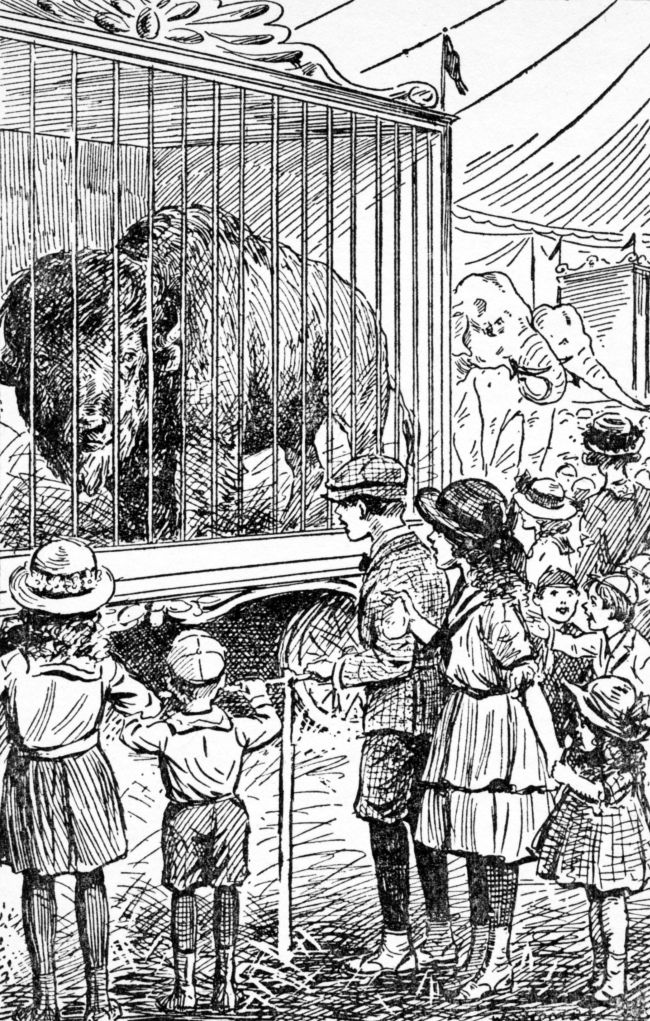
Shaggo looked around a bit, and, seeing something
to eat and something to drink in the larger
cage, into it he walked. The iron-barred door
clanged shut on him, but Shaggo paid little attention
to this. He took a long drink, and then
began to eat some hay.
“We’ll leave him alone for a while,” said the
men, and they walked off.
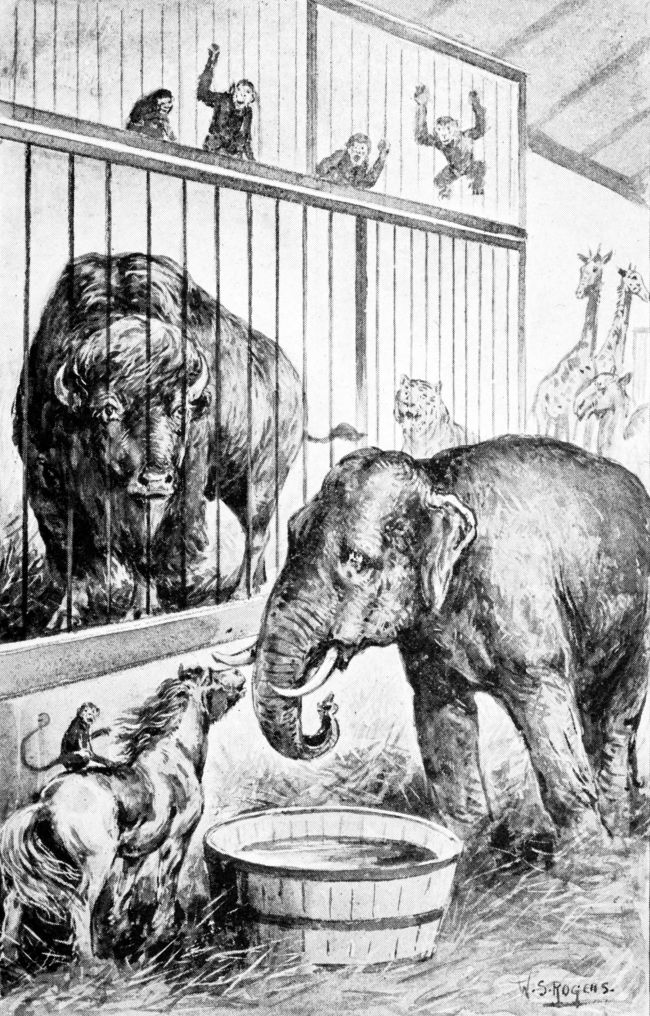
Shaggo was so hungry that all he did for a
time was to eat. He put his black nose down in
the pile of hay and took a large mouthful.
While he was chewing this he saw something
long and thin suddenly thrust itself in between
the bars of his cage. All at once Shaggo was
much excited.
“A snake! A snake!” cried Shaggo in animal
talk. “Oh, what a big rattlesnake! Here,
get out of my cage!” he rumbled.
CHAPTER VIII SHAGGO AND TUM TUM
Shaggo knew what rattlesnakes were, for
sometimes, in the hot summers, they were
seen in the National Park on the buffalo
range.
He had heard his father and mother, as well
as Wuffo, the old bull leader of the herd, speak
of rattlesnakes, and tell what great pain followed
if a buffalo were bitten on the leg or the
nose by one. So when Shaggo saw the long,
snaky thing stuck into his cage, near the bunch
of hay, the buffalo cried:
“Get out of here!”
“Easy now! Easy!” answered a voice, which
was almost as rumbly as his own, and not at all
like the hissing talk of a snake. “I am not
going to hurt you.”
“I don’t know whether you are or not,” answered
Shaggo, shrinking back into a corner of
his cage. “But I was always told to keep away
from rattlesnakes; and, though you haven’t rattled
yet, I’m sure you’re one of those crawling
serpents.”
“Ha! Ha! Ha!” laughed the other voice.
“That’s where you’re fooled. Though I’m
sorry that I frightened you. Look up and you’ll
soon see that I am not a snake. Though I must
admit my long trunk does twist like one.”
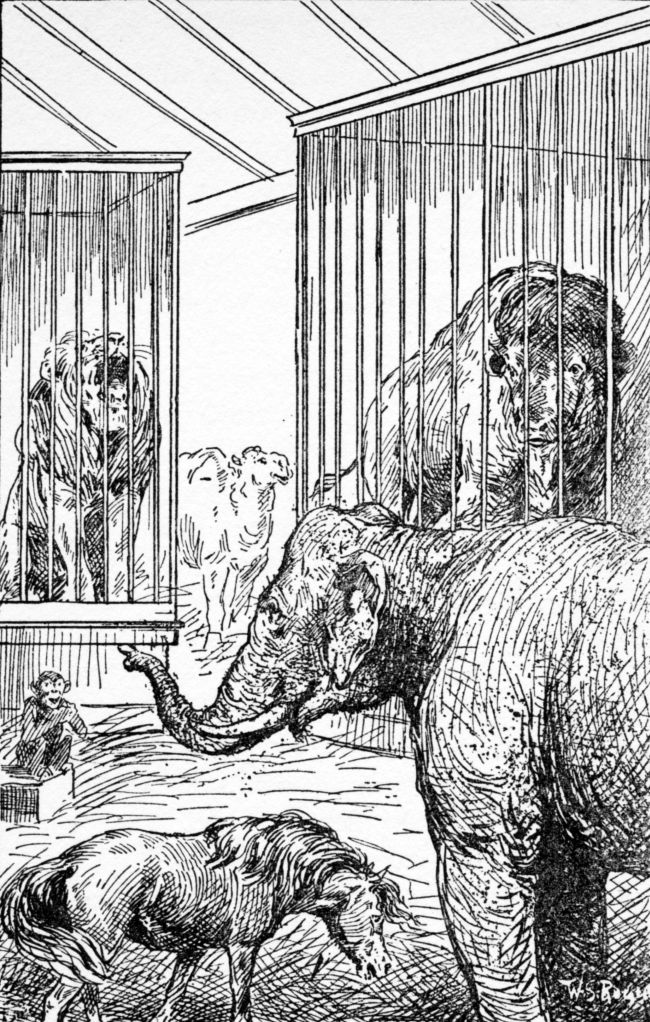
Shaggo looked up and to one side. He saw
a great, gray-colored animal, much larger than
himself, standing near his cage. And it was this
animal that had thrust in between the bars, something
that the buffalo had taken for a snake.
Then he saw it was not—that it was part of the
great animal.
“Well, I see you’re not a snake,” said the buffalo;
“but, if it’s all the same to you, please take
your tail out of my hay.”
“This isn’t my tail,” went on the big creature.
“My tail is on the other end. This is my trunk
that you see.”
“Your trunk!” cried Shaggo. “What do
you do with a trunk?”
“It is really only my nose, made extra long
so I can pick up things with it and feed myself,”
was the answer.
“Nonsense!” exclaimed Shaggo, who was beginning
to feel friendly toward this new, big circus
animal. “Do you mean to tell me you can
pick up things with your nose?”
“Of course I can!” was the answer. “Do
you want to see me? If you don’t mind I’ll take
a little of your hay. It is fresher than mine.”
“Help yourself,” replied Shaggo.
The long thing, which Shaggo had thought
was a snake, was once more thrust in between
the bars of his cage. And then, to his surprise,
the buffalo saw that on the end of the long object
was something like a finger and thumb. This
picked up a wisp of hay, more hay was encircled
in a coil of the trunk, and then the fodder was
lifted up and stuffed down a large, red mouth.
“There, Shaggo, as I heard the circus men
call you, do you believe I can pick up things
with my nose?” asked the big animal.
“Yes,” answered the buffalo, “I do. But I
never would have believed it if I had not seen
it. Who are you, if you please, and what are
you called?”
“I am Tum Tum, the jolly elephant,” was the
answer. “I have been in the circus for some
time, and I am glad that you have come to live
with us. I suppose you are a new kind of sacred
cow, for those are the only animals I ever saw
with humps on their backs, except the camels,
and I know you aren’t a camel. You’re too good-looking
to be a camel, though the camels are
friends of mine,” went on the jolly elephant,
who never spoke a bad word against any of his
circus companions.
“No, I am not a camel, nor am I a sacred
cow,” said Shaggo. “I did not know there were
any animals other than myself who had humps.”
“Oh, yes,” said Tum Tum. “Look over there
and you can see the camels.”
Shaggo looked, as Tum Tum pointed with his
trunk, and saw some rather ugly animals chewing
hay. Some had two humps and some had
one.
“They are taller than I am, but they are not
so strong,” said Shaggo. “And they have no
horns. I should not object to meeting them in
a fight.”
“Oh, my dear Shaggo! We never think of
fighting!” laughed Tum Tum. “All of us,
here in the circus, are friends. You’ll soon get
used to us.”
“Yes, I suppose I shall, after my sore shoulder
stops hurting,” said the buffalo.
“Is that where your shoulder is swelled?”
asked Tum Tum. “I’m sorry. I heard some of
the circus men talking about it. At first I
thought you had two humps, like some of the
camels.”
“No, there is something queer growing on my
shoulder,” went on Shaggo. “It hurts and I
don’t like it. But perhaps I got that for running
away.”
“Did you run away?” asked Tum Tum, and
he took a little more of the buffalo’s fresh hay.
“I did once, but I was glad to run back. Tell
me about it, please.”
So in animal talk Shaggo told Tum Tum how
the big jump had been made over the fence and
how the buffalo had hurt himself.
He turned to get a drink of water from the
tub full in his cage when, all of a sudden, he
heard a loud, roaring sound.
“What’s that?” asked Shaggo of Tum Tum.
“Oh, that’s Nero, the circus lion,” was the
answer. “He smells the meat the men are
bringing for his dinner, and he’s telling them
how glad he will be to get it.”
“Well, I don’t know who Nero is,” remarked
Shaggo, “but he certainly makes a lot of noise.”
“Who is talking about me?” roared the lion,
whose cage was not far from that of the buffalo.
“It’s a new circus animal,” answered Tum
Tum. “Nero, allow me to introduce you to
Shaggo, the mighty buffalo.”
“Did you say a brook?” asked Shaggo.
“Yes, I have often waded in a brook. It’s lots
of fun, isn’t it?”
“No, I didn’t say brook!” roared Nero, who
was not impolite. That was his lion manner of
speaking. “I said book. I don’t know how you
spell it, but it’s something that tells stories of
animals.”
“No,” he answered, “I don’t believe I was
ever in a book. Though Wuffo, the leader of
our herd, used to tell stories of the days
when millions of buffaloes wandered over the
prairies.”
“He must have been in a book to know about
stories,” said Nero. “I’m in a book; and so is
Tum Tum and several of us circus animals.
Chunky, the happy hippo, is in a book, too. But
now, if you’ll excuse me, I’ll eat. Here comes
the meat I was hoping for.” And Nero, the big
circus lion, growled and roared his thanks to the
man who brought him some bones and a chunk
of meat.
“Well,” thought Shaggo, “I don’t know anything
about this book business, but if it will cure
my aching shoulder the sooner I get in a book
the better. I say!” he suddenly called to Tum
Tum. “Who’s that funny animal with the long
tail? It looks as if somebody got hold of it,
stretched it away out long and that it stayed that
way. Who is he?”
“That’s Mappo, the merry monkey,” was the
answer. “He’s in a book, too,” went on the
elephant, “and he has had many adventures.”
“Indeed I have,” said Mappo, with a laugh.
“And let me tell you, Shaggo, that nobody
stretched out my tail. It was always long that
way, so I could swing by it from trees in the
jungle. But now I only swing from this trapeze
in my cage, or hang by a bar in the big tent
when I do tricks, after the circus starts on the
road. Watch me!”
As he spoke Mappo gave a jump across his
cage, caught his tail on the bar of a swinging
trapeze, and swayed to and fro like the pendulum
of a clock.
“That’s quite a trick!” cried Shaggo. “I
could never do that, though once I did give a
big jump.”
“Oh, the fun here in the winter barns is nothing
to what will happen when the circus starts
out on the road and we show in a tent in a different
city every day,” said Tum Tum. “I’m
just waiting for that time to come!”
“So am I!” chattered Mappo, the merry
monkey.
Sometimes Tum Tum, and again Nero or
Mappo, would be taken out of the barn where
they had been stationed near Shaggo. Then, in
an hour or so, men would bring them back.
“Where have you been?” Shaggo would ask.
“To practise our tricks,” Tum Tum answered.
“We are getting ready to travel out on
the road.”
In another week Shaggo noticed a busy time
in the barn. Men began touching up the wagons
with paint, new wheels were put on some, and
then, one day, dozens of horses came in and were
hitched to the cages that could be drawn from
place to place.
“Hurray! Now we are going to travel!”
said Tum Tum.
Shaggo’s cage was drawn outside the barn,
and for the first time in many weeks the buffalo
saw the shining sun and felt the warm summer
breezes blowing on him. His cage was rolled to
one side, and the horses went back into the barn
to haul out others.
How it happened no one seemed to know, but,
all of a sudden, Shaggo’s cage, with him in it,
began to roll down a hill. It went slowly at
first, but soon began to roll faster, and men
cried:
“Oh look! The buffalo will be hurt! His
cage will roll down on the rocks and be
smashed!”
CHAPTER IX SHAGGO MEETS DON
Shaggo himself, in his circus cage, soon
began to feel that something was wrong. It
was not that he minded rolling along in his
strange house on wheels, but this time he was
not being drawn by horses as he had been at first.
He could look out through the bars and see that
no horses were hitched to his cage. They had
been taken back into the circus barn. And yet
Shaggo’s cage was rolling along. It was rolling
downhill, and going faster and faster all the
while.
“Stop it! Somebody stop the buffalo’s
cage!” cried the circus men, and several of them
ran after it. But they were too far away, and
Shaggo’s cage might have gone down the hill
and been broken open on the rocks and trees at
the bottom, only for what Tum Tum did.
The jolly elephant saw that something was
wrong, and, in a way, Tum Tum understood
men’s talk. His trainer had taught him to stand
on his head and lie down, and whenever he
heard these words Tum Tum knew what to do.
So, when the big, jolly elephant heard the men
shouting he knew something had happened. He
looked toward the rolling cage, with the buffalo
in it. By this time Shaggo was beginning
to feel frightened.
“If there’s a smash my sore shoulder will be
hurt again! Ouch! I don’t want that to happen!”
thought Shaggo. Then he bellowed out:
“Somebody stop my cage from going to
smash!”
“I’ll save you! I’ll stop your cage!” cried
Tum Tum.
The big elephant ran down the little hill until
he was in front of the buffalo’s cage. Even if he
was almost as large as a small house, Tum Tum
could run fast. It did not take him long to put
himself in front of the rolling cage. Then with
his big head lowered, Tum Tum stood still, and
when the cage came along it bumped gently into
the elephant and came to a stop. Shaggo was not
shaken up at all.
“Oh, look!” cried the circus men. “Tum
Tum stopped the buffalo’s cage from going to
smash.”
“Yes, you can always depend on Tum Tum,”
said the elephant’s keeper. “He’s a smart
beast.”
“Thank you, so much, Tum Tum,” said
Shaggo, in animal talk, as he looked out through
the bars and saw what his new friend had done.
“You saved my lame shoulder from being
bumped.”
“I’m glad I did,” replied the elephant.
“Now keep still, Shaggo, and I’ll push your
cage back up the hill where you’ll be all right.”
Shaggo was a very strong and mighty buffalo,
but as he looked at the immense head and legs of
the elephant while Tum Tum pushed the wagon
back up the hill, Shaggo thought:
“Here is one who is mightier than I.”
There were busy times for the next few days.
The cage of Shaggo, as well as the cages of the
other animals, together with the tents, the stoves,
the band wagons, the steam calliope wagon and
all the other things that go to make up a circus
were loaded on railroad cars, and the circus
started on its summer wanderings.
By this time Shaggo was getting used to traveling
on a railroad, and did not mind it much.
In the same car with him was a cage in which a
handsome black and yellow striped animal
paced up and down.
For some time this animal did not speak to
Shaggo. He kept marching up and down in his
cage, and, now and then, he would rise up on
his hind legs and paw at the iron bars.
“Excuse me,” said Shaggo, after a while,
“but are you trying to get loose?”
“No. I know better than to try that,” was
the answer. “I have been in my cage so long
I am used to it now. But at times I wish I might
go back to my jungle.”
“I have heard Tum Tum and Mappo speak
of the jungle,” said Shaggo. “You are neither
an elephant nor a monkey. What are you?”
“I am a tame tiger, and my name is Tamba,”
was the reply.
“I am glad to meet you,” said Shaggo, and he
told his name. “I am a buffalo.”
“Yes, I know you are,” said the tiger.
“You did? How?” asked Shaggo in surprise.
“I am the only buffalo in the circus,
and—”
“Oh, but I have seen buffaloes in the jungle,”
said Tamba. “They are not exactly like you,
and their horns are longer. We call them water
buffaloes, but they are near enough like you so
that I knew who you were. But you seem to
have two humps; how is that?”
“That swelling on my shoulder is not a
hump,” answered Shaggo. “It is where I hurt
myself when I leaped over the fence as I ran
away from the range.”
“Then you are a runaway!” exclaimed
Tamba.
“Yes,” answered Shaggo, somewhat sadly, for
his shoulder hurt him more than ever. “I
thought I was such a mighty buffalo that the
preserve, in the Park, was too small for me. I
thought I was the strongest animal in the world—until
I saw Tum Tum. He would make two
of me.”
“Yes, Tum Tum is the greatest of all animals,”
said the tiger. “But, with all that, he is
kind and gentle, and the jolliest friend you could
ever have.”
“I can easily believe that,” rumbled Shaggo.
“Well, I ran away, and now I can not get back.
I must make the best of it.”
“Oh, you’ll like it here in the circus,” said
Tamba. “We have good times after we get
started, and it is fun to watch the people come
and see us. Besides we do tricks. Do you know
any?”
“No,” Shaggo answered, “I don’t know any
tricks.”
“And I don’t believe you are the kind of animal
they would teach tricks to,” said the tiger.
“Never mind, you are good to look at, and very
odd, with your two humps. I shouldn’t be surprised
but what they would advertise you, and
put you in a book.”
“I know a little of what it means to be in a
book,” said Shaggo. “I heard Tum Tum and
Mappo speak of that. But what is ‘advertise’?
That is a word I never heard before.”
“It means put your name and your picture on
the billboards and on the posters that go up all
over town when the circus is to show,” explained
the tiger. “I’m on the pictures, and so is Nero
and Tum Tum, and also Chunky, the happy
hippo. He always has his picture taken with
his mouth wide open.”
“What for?” asked Shaggo.
“Oh, it’s the biggest part of him; and I suppose
he is rather proud of it,” answered Tamba.
“It is my stripes that show best. You should see
some of my latest pictures.”
“I hope I may,” said Shaggo, politely.
“And I hope I shall see yours,” went on
Tamba. “Not all circus animals get their pictures
on the posters, but I think you will. And
now, if you will excuse me, I think I’ll go to
sleep. We may have a long ride before our
cages are taken off the train and put in the tents.
Good-night.”
“Good-night,” answered Shaggo, and then he
saw the tame tiger curl up and go to sleep.
Shaggo also closed his eyes, but he did not sleep
at once.
“I’m afraid I’m going to have trouble with
that shoulder before it gets better,” thought the
mighty buffalo, just before, at last, he finally
dropped off into a sleep.
When Shaggo awoke he found a great deal
of excitement going on around the circus train,
which had come to a stop. There was the
rumble of heavy wagons and the tramping of
horses, mingled with the shouting and calling of
men.
“What’s the matter?” asked Shaggo of
Tamba.
“Oh,” answered the tiger, giving a yawn,
“we have reached the first city in which the circus
is to give a performance. Now we shall be
put in a tent, and people will come to see us.”
“What’s a tent?” asked Shaggo, who had
never seen one.
“It’s a sort of a white, cloth house,” the tiger
answered. “You’ll like it. This sort of life is
much more fun than being cooped up in the
winter barns.”
Pretty soon the cages of Tamba and Shaggo
and the rest were taken from the railroad car and
drawn to the circus grounds.
A large crowd of boys and a number of men
came to the place where the train stopped to see
the circus unload, and, later, they watched the
big tent being put up. Of this Shaggo saw very
little, for his cage remained covered. At last,
however, his wagon, and that of the other animals,
was wheeled inside the big, white cloth
house, and Shaggo found himself in a sort of
ring of which many other cages formed a part.
“Now the circus will soon start, after we have
been in the parade,” said Tamba.
“What’s a parade?” asked Shaggo.
“My! You don’t know anything about a circus,
do you?” laughed Tamba. “A parade is
where the animals march, or are drawn, through
the streets so the people can see them—at least
see some of them, and that makes them want to
come and see more. The elephants, camels and
horses march, but you will be kept in your cage,
I think, as I am, and as Nero is also.”
A little later the cages were hauled out again
and, for the first time in his life, Shaggo took
part in a circus parade. He looked out through
the bars of his cage and saw crowds of people
lining the streets. The bands played, the steam
calliope tooted its queer music, and the wagon-load
of clowns made the children laugh.
Then, once more, back to the circus grounds
the mighty buffalo was taken, and a little later
the circus performance started. Of the part that
went on in the main tent, where the acrobats did
their tricks, the clowns cut up funny capers and
Tum Tum and Tamba went through their acts,
Shaggo saw nothing.
The buffalo was kept in his cage, as were some
of the other animals. It was their part in the
show to be looked at, and a great throng gathered
around Shaggo’s cage.
He stood and watched the people passing his
cage. Once a man came along carrying a cane.
Shaggo was standing still in one corner, for his
shoulder hurt him.
“Hi there!” called the man sharply. “Move
about there, Buffalo, and let’s see what you look
like!” As he said this the man poked Shaggo
with the cane. He prodded the buffalo on his
sore shoulder, and Shaggo let out a loud bellow
of pain and jumped to one side.
“Ha! I made him step lively!” cried this
unkind man.
A moment later a small, shaggy animal, with
a pointed nose and bright shining eyes, leaped
at the man, showed his teeth and growled.
“Here! Let that buffalo alone!” Shaggo
heard this new animal bark, and saw the man
leap back in fright and run out of the tent.
“Thank you for not letting him poke me
again,” said Shaggo to this shaggy animal.
“Are you a wolf?”
“No, I am Don, and once I was a runaway
dog,” was the answer. “I could see that this
man was hurting you, so I drove him away. If
he comes back I’ll nip him,” and Don growled
again.
The man who had poked Shaggo with the
cane, hurting the buffalo’s lame shoulder, did
not come back, however. I think he was rather
afraid of Don, who growled so fiercely. Don
was a good and gentle dog, but he did not like
bad men.
CHAPTER X SHAGGO AND DIDO
“Excuse me for thinking you were a
wolf,” said Shaggo to Don. “But you
look just like some of the prairie wolves
I used to see out West on the big fields near our
range.”
“That’s all right,” barked Don. He and
Shaggo could visit, for there were only a few
keepers in the animal tent now. All the audience
had gone into the main tent to see the show,
and Don and Shaggo could talk animal talk as
much as they pleased.
“I don’t mind being taken for a wolf,” went
on Don. “In fact we dogs once were wolves,
and it was only after we became tame and lived
around the house that we were called dogs.”
“The only dogs I ever saw before,” said
Shaggo, “were little prairie dogs.”
“Hum! I never saw any of those that I
remember,” Don said.
“Do you belong in this circus?” asked
Shaggo.
“No,” barked Don in answer. “I live here
in town. But I happened to be down near the
railroad when the circus train came in, and I
just slipped over here to see some of my friends.
I know Tum Tum, Nero and Tamba.”
“I’m glad to hear that,” said Shaggo, “for
they are friends of mine.”
“Is Dido here?” asked Don.
“Who is Dido? Is he a monkey? I guess
you mean Mappo, don’t you?” inquired the
buffalo.
“No, I mean Dido. He is a dancing bear,
and he was with a circus at one time. I have
lost track of him lately, and I thought maybe he
might be here. I’ll take a look around.”
“And then come back and talk to me,” begged
Shaggo. “Nero and Tamba are in the big tent
doing their tricks, and so is Tum Tum, so I’m
lonesome.”
“I’ll be back,” promised Don.
He trotted away, making the rounds of the
other cages. Shaggo could hear him talking to
some of the animals who remained, and, pretty
soon, Don came back again.
“I didn’t find Dido,” he said. “I guess he
isn’t with this circus. What’s the matter?” he
asked, as he saw Shaggo limping around the
cage. “Did that bad man hurt you?”
“Well, yes, he did hurt me when he poked
me with his stick,” answered the buffalo, “but
that isn’t why I limp. Something is the matter
with my shoulder, it has a big lump on it. See?”
And he came close to the front bars of the cage.
Don, with his head on one side, looked at the
buffalo’s second hump.
“I know what’s the matter with you,” barked
Don.
“What?” asked the buffalo.
“You have rheumatism,” answered Don. “I
know what that is. I had it myself once, when
I slept out in the rain a couple of nights after
I was so foolish as to run away. Yes, that’s what
you have—rheumatism.”
“Hum! I wonder if I have?” said Shaggo,
slowly. “I thought I got this for running away.
I know the hurt began after I jumped over the
fence.”
“Maybe that started it, the same as it started
with me when I got wet,” returned the dog.
“But what you have is rheumatism, you may
depend on it.”
“Perhaps I have,” agreed Shaggo. “I wonder
what I had better do about it?”
“Oh, I guess they’ll get a doctor for you,”
went on Don. “The circus men are good to
their animals. But I’ll have to be trotting along,
or they’ll think I have run away again, and once
is enough for me. Good-bye!”
“Good-bye!” answered Shaggo, and he felt
rather lonesome when Don had left. However,
Tamba, Nero, and Tum Tum soon came back to
the animal tent, after they had finished their
tricks in the other big, white cloth “house,” so
Shaggo had some one to talk to.
There were many busy days after this for the
circus with which the mighty buffalo traveled.
Each day the tent was set up in a new place, and
crowds of boys and girls, as well as men and
women, came to see the animals and watch the
men and women actors in the performing tent.
“But I am not sure whether or not I am glad
I ran away,” thought the mighty buffalo from
time to time, as he traveled about with the circus.
“In one way I’m having a good time, and
in another way I am not. If my shoulder would
get well I think I could be happy here. But it
is no fun to be in pain all the while.”
One day, when he had become quite tame, and
had made friends with several of the circus men,
Shaggo was taken out of his cage and led around
the animal tent by a rope.
“What’s going to happen, Shaggo?” asked
Tamba, the tame tiger. “Are they going to
teach you tricks?”
“I don’t know,” answered the buffalo, as he
limped around. And when they saw this limp
the circus men shook their heads.
“He will never do for us,” one said. “We do
not want a limping buffalo in the circus. He
could never learn any tricks, and people do not
care to pay money to see a lame animal.”
“But what can we do with him?” asked another
man.
“We can sell him to some zoological park,”
was the answer. “There is a city, not far from
here, that is starting a new zoo. They have not
very many animals as yet, and they will be glad
to buy this buffalo from us, even if he does limp.
People do not have to pay money to come to a
zoological park, and they are not so fussy about
what they see. We’ll sell Shaggo to the zoo.
That will be the best place for him. He will not
have to travel around so much and his shoulder
may get better.”
Of course Shaggo did not understand this talk,
any more than the circus men understood the
talk of the animals. But after a few days, when
Shaggo had traveled on a little farther with the
circus, a change came.
One afternoon several men came into the
animal tent after the show was over. They
stood in front of the buffalo’s cage.
“This is Shaggo,” said one of the circus
owners. “He is a good buffalo, and the only
thing the matter with him is that one of his
shoulders is swelled, and he limps. But for a
zoo he will be all right.”
“Yes, I think he will,” said one of the visitors.
“We’ll buy him.”
Later, somewhat to his surprise, Shaggo’s cage
was wheeled out of the tent, Tum Tum the elephant
pushing it.
“What is going on?” asked the buffalo, for
he had not understood the men’s talk. “Is the
circus going to move now, Tum Tum, before we
have given the night show?”
“No, I think not,” answered the jolly elephant.
“All I know is that my keeper told me
to wheel out your cage. But I am not to wheel
out any of the others. Maybe they are taking
you away, Shaggo, to cure the rheumatism in
your shoulder.”
“Maybe,” agreed Shaggo, and he hoped this
would prove true.
Horses were hitched to his cage, and it was
drawn through the darkness to a place Shaggo
had never been in before. He could not see
where it was, and he did not much care, as the
ride made his sore shoulder ache. He crouched
down on some straw in the corner of his cage
and went to sleep.
It was morning when Shaggo awakened.
The sun was shining and the big buffalo looked
about him in some surprise. At first he thought
he was back in the circus winter barn, for he
saw that there was a wooden roof over his head,
and not the white cloth of the canvas tent. But,
as he looked about him and saw some strange
animals, he knew he was in a new place, and
not in the circus any more.
As he arose slowly to his feet, trying not to
groan because of the pain in his shoulder, he
heard a voice saying:
“I say, big fellow, if you don’t want that piece
of carrot in your cage, will you please kick it
out to me?”
Shaggo looked up and saw, not far away, another
cage, in which was a black, shaggy animal,
with long hair and very long claws.
“Yes, you may have this piece of carrot,” said
Shaggo, and he kicked it to the edge of his cage.
“I don’t believe you can reach it, though.”
“Oh, yes I can,” growled the other animal in
a jolly voice. And he stretched out a hairy paw,
with long claws, and pulled the carrot into his
cage.
“Who are you?” asked Shaggo.
“I am Dido,” was the answer.
“Oh, I’ve heard about you!” exclaimed the
buffalo. “You are the dancing bear!”
CHAPTER XI SHAGGO GOES TO SLEEP
Shaggo, the mighty buffalo, felt as though
he had met an old friend when the bear in
the next cage said that his name was Dido.
Shaggo wanted to talk, and to ask a lot of
questions of the shaggy bear, who was eating the
carrot he had clawed from the buffalo’s cage.
But just as Shaggo crowded close to the bars of
his cage, to ask how Dido felt and how he liked
it where he was, a great growling and snarling
arose at one end of the big building where the
zoo animals were kept.
“What’s the matter now?” asked Shaggo.
“Oh, it’s the keeper coming to feed us,” answered
Dido. “I hope he brings me some sweet
buns. What would you like best, Mr. Buffalo?
I don’t believe I know your name,” said the bear.
“I am called Shaggo,” was the answer.
“And, to tell you the truth, I do not feel much
like eating. I am not very hungry.”
“Then there must be something the matter
with you!” exclaimed Dido, as the growling,
snarling and crying among the other zoo animals
sounded louder and louder. “I am always hungry.
You’ve heard it said, I dare say, ‘as hungry
as a bear.’ Well, I guess I’m that bear,” laughed
Dido, showing his teeth, “for I’m always ready
to eat.”
Shaggo looked out through the bars of his
cage and saw a man coming along with a big
basket, and Shaggo could smell that the basket
held good things to eat. But, somehow or other,
the buffalo, as he had said, was not hungry. He
felt rather ill, and as he twisted his eyes to get
a look at his shoulder, he saw that the lump on
it was much larger.
“And it hurts worse, too,” said Shaggo to
himself. “I haven’t felt exactly well since I
gave that big jump and sailed over the wire fence
away from the range. It surely must be a punishment
on me for leaving Bumpo, Rumpo and
the other buffaloes.”
But by this time the man with the basket was
in front of the bear’s cage. He picked out some
buns, the man did, and held them up for Dido
to see. Shaggo could also see them.
“Now then, Dido!” cried the zoo keeper,
“here are some of the nice buns you like. Let
me see you dance and do some of your tricks before
I give you any. Dance for the boys and
girls!”
Then Shaggo noticed that, following the man
around as he fed the animals were a number of
boys and girls who had come to the zoo as a sort
of picnic. They were allowed to come in and
see the animals eat.
“Dance for the boys and girls, Dido,” called
the man.
Shaggo did not understand this talk, but the
bear seemed to do so, for he shuffled to the front
of his cage.
“Hi there, Shaggo, watch me if you want to
see some fun!” called Dido to the buffalo in
the next cage. “This is one of my tricks. I do
it nearly every day. Watch me and perhaps you
can learn to dance.”
“No, I don’t believe I can,” replied Shaggo.
He and Dido talked in animal language, which,
of course, neither the keeper nor the boys and
girls could understand. “My shoulder is too
sore for me to dance,” went on the buffalo.
But Dido was not troubled that way, and soon
he was sliding about his cage, doing a funny,
shuffling dance, waving his head from side to
side, and holding out his paws like a begging
dog. Around and around his cage went the
bear, while the boys and girls, gathered out in
front, laughed as they watched the funny antics
of the trained bear.
“That’s good, Dido!” called the man.
“Now then, turn a somersault, and you shall
have an extra bun!”
Dido must have known what the man said,
for the bear suddenly got down on all four legs,
put his head between his front paws, kicked up
with his hind legs, and over he went! Dido
turned as good a somersault as any boy could do,
and when he stood upright again, and held one
paw out through the bars of his cage, the boys
and girls laughed harder than ever.
“Well, you have earned your buns, Dido!”
cried the man, and he tossed half a dozen into
the bear’s cage. Then Dido shuffled back into
a corner to be by himself while he ate. The children
stood watching the bear a little longer, and
then some of them passed on to stand in front
of the cage where Shaggo was kept.
After the keeper had passed on, to feed the
lions and tigers of the zoo, Dido once more
spoke to Shaggo.
“Here is an extra cinnamon bun I do not
want,” said the kind bear. “Eat it, Shaggo,”
and with a toss of his paw Dido sent the bun
spinning through the bars of the buffalo’s cage.
Shaggo sniffed at it and nibbled one end.
“Say, what’s the matter with you?” asked
Dido. “You don’t seem at all like a lively chap,
Shaggo.”
“I’m not,” answered the buffalo. “Something
is wrong with me. It’s my shoulder, I
guess. See how swelled it is.”
“You have got a funny lump there,” said the
bear. “What do you think it is?”
“Well, Don, the runaway dog, and some of
the animals in the circus said it might be rheumatism,”
answered Shaggo. “I was in the circus
you know, with Tum Tum, the elephant. It
was Don at first, and afterward Tum Tum, who
told me about you. That’s how I knew your
name.”
“Dear old Don and Tum Tum, that jolly elephant!”
exclaimed Dido. “I wish I could see
them again. So they told you about me, did
they? Well, some of those circus animals know
a lot, but I think they’re all wrong about what’s
the matter with you. I don’t believe that’s
rheumatism you have.”
“What is it then?” asked Shaggo. “I know
it hurts a lot.”
“You’ve got indigestion, that’s what you’ve
got!” declared the bear. “You’ve got indigestion
from not eating enough. Come, now, eat up
your hay, and then swallow that bun and you’ll
feel better.”
“Well, perhaps I will,” agreed Shaggo. “I’ll
try it, anyhow. Maybe it is indigestion I have,
but I’ve been thinking, all the while, that it was
rheumatism.”
So the mighty buffalo, who did not feel as
strong as he used to feel when he roamed the
plains of the big Park, nibbled the bit of bun the
dancing bear had tossed him, and then ate some
hay. But, instead of feeling better, Shaggo
seemed to feel worse. At last he was in such
pain that he stretched out in the corner of his
cage and groaned. Animals can groan when
they are in trouble as well as persons can, and
when Shaggo groaned you could hear it a long
way off.
“My goodness! what’s the matter, Shaggo?”
asked Dido, waking up from a little sleep. “Is
that one of the tricks you learned in the circus?”
“I didn’t learn any tricks in the circus,”
groaned Shaggo. “Maybe that’s why they
didn’t want me there. And I limped, too. I
guess they didn’t want a limping buffalo. But
groaning is not a trick. I do it because my
shoulder lump hurts me so.”
“That’s too bad,” said Dido. “I wish I could
do something for you.”
By this time Shaggo’s groans had been heard
by some of the zoo keepers. One of them came
running into the building where Shaggo’s cage
stood. By this time it was early evening, and
there were no visitors in the zoological park.
“What’s the matter here?” asked the keeper.
Of course Shaggo could not answer and tell what
ailed him, but the man knew something about
animals, and when he saw the buffalo crouched
down in the corner of the cage and noticed how
much larger the lump on the animal’s shoulder
had become, the keeper said:
“We’ve got to have a doctor here. I’ll get
one.”
A little later another man came in to look at
Shaggo—three or four men altogether, but only one
was the doctor, and he had a queer smell
about him—a smell that Shaggo did not like.
The other animals, too, sniffed the air strongly.
They did not like drugs or medicine.
“Take a look at the lump on that buffalo’s
shoulder, doctor,” said one of the zoo keepers.
“Hum! I can’t see it very well,” the doctor
said. “Can’t you bring him out here in the
open?”
Shaggo did not pay much attention to what
was going on, but, a little later, he felt the prick
of a stick which was being poked in his ribs, and
naturally, he moved away from it. He limped
over to the front of his cage to look at the men
gathered there.
“Now I can see the lump better,” said the
doctor. “It’s too bad. It must be taken off.
That’s the only way to cure that buffalo.”
“How can the lump be taken off?” asked the
zoo keeper.
“You’ll have to get another doctor,” replied
the first one. “You need a doctor who knows
more about animals than I do. There’s one in
New York, and I heard he was coming out this
way. I’ll see if I can get him.”
“I wish you would,” said the zoo keeper.
At last the celebrated animal doctor arrived.
One evening Shaggo saw a number of men enter
the zoo and walk over to his cage. There was
that same, queer medicine smell.
“There’s the buffalo,” said the zoo keeper.
“Can you cure that lump on his shoulder, doc?”
“I think so,” answered a big, bearded man,
who wore large shiny glasses. “But first we
must put the buffalo to sleep and bind him with
ropes so he will not kick when I try to cure him.
Yes, we must put him to sleep.”
Of course Shaggo did not know what all this
talk meant, and he was rather frightened when,
a little later, a number of men poked long poles
through the bars of his cage. Some of the poles
had ropes on them, and though he tried to keep
out of the way of these ropes, they were soon cast
about his legs, and poor Shaggo found himself
all tangled up.
“Dido! Dido! What are they doing to
me?” bellowed Shaggo to his friend the dancing
bear.
“Don’t worry, Shaggo,” Dido answered.
“They will not hurt you. The keepers are trying
to cure your indigestion, or whatever it is
you have. They will not hurt you.”
But Shaggo could not believe this, so he
kicked and struggled, hurting his sore shoulder
all the more, until, at last, he was so tangled in
the ropes that he fell down on the bottom of his
cage.
“Ah, now we have him!” said the doctor.
“Now I’ll put him to sleep, and cure him.”
Shaggo was now so tied with ropes that he
could not move. He lay on one side, and a moment
later a cloth was put over his nose. There
was a strange, sweetish smell to the cloth.
Shaggo tried not to breathe the perfume from
it, but he could not help himself. He began to
feel very strange. His breath came more and
more slowly. Then he began to feel as if he
were once again sailing through the air as he
did when he jumped. He seemed to be floating
on clouds or a feather bed. His eyes closed—he
could hear, as though from a far distance,
the voice of Dido saying:
“They won’t hurt you, Shaggo.”
Then Shaggo fell into a deep sleep.
CHAPTER XII SHAGGO IS HAPPY
The sun was shining into Shaggo’s cage
when he awakened. At first the mighty
buffalo did not remember all that had happened.
He recalled a queer smell, which came
just after he was tied with the ropes. And he
remembered going to sleep. Now he was awake.
“But I feel so weak—as if I could not stand
up,” said Shaggo to himself. “It’s like the time
I ate some poison weed in the big Park, and was
sick until I ate another kind of weed that Wuffo
showed me, and then I grew better. But I am
weak in my legs now, as I was then. I wonder
if I can stand up?”
Shaggo tried, but he found that the ropes were
still around his legs, so, after one or two trials,
he gave up and remained lying on his side in his
cage.
“I guess it isn’t time for me to get up yet,”
thought the buffalo. “Maybe, as Dido said, the
men are trying to do me good, though tying my
legs with ropes is a queer way. But I guess—I
guess—I—”
But Shaggo could say no more. His head fell
over to one side and he went to sleep again.
The next time he awakened he felt much better
and stronger. There was a queer feeling in
his shoulder, too. It pained him some, but not
as much as at first, and, when he managed to get
a look at it, he saw that the lump was gone.
“Hurray!” cried Shaggo, in buffalo talk, of
course. “That big lump melted away while I
slept! I wonder how it happened? Anyhow,
I’m glad. Now if those ropes were only off my
legs—”
He kicked out a little with his hind feet. To
his surprise his legs were no longer tied. His
front ones were also free. There was still a
queer smell in his nose, and on his shoulder was
a white rag. Shaggo tried to reach around and
pull it off with his teeth, but could not.
Then he noticed on the floor of his cage, in
front of him, a pail of something that smelled
very good. It was a mixture of hay, oats, wheat
and bran, stirred up in warm water and a little
salt, and Shaggo felt so hungry that he ate it
all up.
“My, but that was good!” said the buffalo to
himself. “I believe I can stand up now. I feel
much stronger.”
Shaggo managed to scramble to his feet. He
was not as strong as he had thought, for he
swayed from side to side as a baby does when
it is learning to walk. But, after a while, when
he had eaten a little hay and taken some water,
Shaggo began to feel his strength coming back
to him.
He took a few steps, but was soon glad enough
to lie down again.
“I guess I’m cured of the rheumatism, or indigestion,
or whatever was the matter with me,”
thought the mighty buffalo, “but I must go easy.
I can’t trot around my cage yet. I must wait
until I am a little stronger.”
Shaggo went to sleep again, and he must have
slept all day and all night, for when he awakened
once more the sun was again shining in
his cage. He felt much stronger now, and when
he walked about, his shoulder, though a little
stiff, did not pain nearly so much.
“Hello there, Shaggo!” called Dido, the
dancing bear, from his cage. “How are you
feeling?”
“Well, a little queer and shaky,” answered the
buffalo; “but I’m getting better. Say, what
happened to me, anyhow?”
“I think you had what they called an operation,”
answered the bear. “I don’t know much
about such things, but they put you to sleep with
medicine, and when you were in dreamland they
took that extra hump off your shoulder.”
“I’m glad they did,” said Shaggo. “I feel
ever so much better without it. I begin to feel
more like myself—more like when I was the
strongest buffalo on the range in the National
Park.”
“I’m pleased to hear that,” said Dido. “Maybe,
now, they will teach you to do tricks.”
“Maybe,” agreed Shaggo.
The doctor with the big beard and the shiny
glasses came with the zoo keepers to look at
Shaggo in his cage.
“Ah, my operation was a success,” said the
big doctor. “Now that buffalo will be as good
as new.”
And as the days went on and Shaggo became
stronger and stronger and his shoulder healed he
did, indeed, become “as good as new.”
Once more his eyes shone brightly and he held
his head up. He no longer limped about the
cage, but walked as well as any of the lions,
tigers or bears in the zoo.
Each day a keeper came to feed Shaggo, and,
after a while, the man put his hand in through
the bars and rubbed Shaggo’s head. And
Shaggo felt so grateful to the men for curing
his sore shoulder that the big buffalo did not
try to bite or kick or butt with his horns. He
licked the man’s hand with his tongue.
“Well, I guess you are getting tame, Shaggo,”
said the keeper. “It was a good thing we
bought you from the circus, and it was a good
thing the doctor made you well. In a little while
I will let you out in the yard to run around. It
is not good for a big animal like you to be shut
in a cage all the while.”
And you can imagine how glad Shaggo was
when, one day, his cage was opened and he was
allowed to come out. Of course he was not permitted
to roam wherever he pleased, but there
was a big yard in the zoo where he could walk
about and even run. And when he ran and
found that his shoulder did not hurt him, Shaggo
felt like bellowing at the top of his voice, he
was so glad.
“Now I am myself again!” cried Shaggo.
And Shaggo did enjoy himself in the big yard
of the zoological park. Some camels and zebus,
as well as other animals of the kind that eat grass
and hay, were also allowed to roam in this yard,
and many people came to watch them. Shaggo
was much admired, especially his big head and
the mighty hump on his back—this was the real
hump that belonged there. The other hump—the
sore one—had been taken off and Shaggo
limped no more.
One day some deer were put in the yard with
Shaggo and the camels. The deer had horns,
and when Shaggo saw them he thought of the
time he had driven the herd of antelopes away
from the water hole.
“But we will not quarrel about who is to
drink first here,” said one of the deer. “There
is water in the tank, enough for all of us.”
“No,” said Shaggo, “here we are a happy
family, and we will not quarrel.”
In time Shaggo grew to be very good friends
with all the other animals of the zoo, but, best
of all, he liked the deer, for they had come from
the far West, the land of the prairies where he
used to live, and they could talk to him about
that country.
One day White Tail, the largest of the deer
in the zoo, was eating grass near a wooden fence,
and, in some manner, White Tail’s horns became
caught in a crack of the boards. At first the deer
thought he could pull himself loose, but the
more he pulled and twisted the tighter his horn
seemed to be caught.
“Help! Help!” finally White Tail called to
his animal friends. “I am caught in the fence
and can not get loose!”
Some of the other deer tried to pry him loose
with their horns, but they could not.
“Oh, if only Bundo, the big elephant were
here, he could get me loose!” cried White Tail.
“With his strong head he could break the board
that is holding me fast.”
But Bundo was in another part of the zoo
then, and no keepers were near, or one of them
would have helped the deer. Then Shaggo saw
what the matter was.
“Ho there!” cried the mighty buffalo.
“Stand aside, everybody, and I’ll get White
Tail loose!”
“How can you?” asked Dido, the dancing
bear.
“With my big, hard head I can ram that fence
and break the board as easily as anything,” the
mighty buffalo answered. “I am not afraid of
hurting my shoulder now. Stand still, White
Tail, and I’ll get you loose.”
White Tail, the deer, stood still, his head held
down where his horn was caught in a crack in
the fence. Shaggo backed off a little way, and
then, with his head lowered, he ran across the
yard. Taking care not to bump into White Tail,
Shaggo hit the fence with all his might.
There was a crash, a splintering of wood, and
the deer was set free. He shook his head, and
said:
“Thank you, Shaggo! You are, indeed, a
mighty buffalo.”
“Oh, that was nothing,” said Shaggo. “I
could have broken a much thicker board than
that, now my shoulder is well.”
The keepers came running up at the sound of
the crash, and when they saw what Shaggo had
done to help the deer they were very glad. The
fence was mended, and fixed so no more animals
would be caught in it.
“It is a good thing to have a big head,” said
Dido to Shaggo, when they went to sleep in their
cages that night.
And so, for many years Shaggo, the mighty
buffalo, lived in the zoo, and hundreds of boys
and girls came to look at him and admire him.
Sometimes he wished he might go back to the
prairies, and see his old friends, and watch
Rumpo and Bumpo knock each other in somersaults.
“But it is very nice, here in the zoo,” said
Shaggo. “And, who knows? perhaps some day
I may join the circus again and travel out West.
Then I would have some wonderful adventures
to tell the rest of the buffaloes.”
But the last I heard of him, Shaggo was still
in the zoological park, and I hope he lives there
and is happy for many long years.
THE END
Transcriber’s Notes:
Punctuation and spelling inaccuracies were silently corrected.