SHADOWS AND SUNBEAMS: Being a Second Series OF FERN LEAVES FROM FANNY’S PORTFOLIO.
Transcriber’s Note:
The cover image was created by the transcriber and is placed in the public domain.
AUNT HEPSY’S COURTSHIP.
ILLUSTRATED BY GEORGE THOMAS.
LONDON:
Wm. S. ORR AND CO., AMEN CORNER,
PATERNOSTER ROW;
SAMPSON LOW, SON, AND CO.,
LUDGATE HILL.
MDCCCLIV.
Published first in England by International Arrangement with the American Proprietors, and Entered at Stationers’ Hall.
PREFACE.
iii
The author addresses her readers in these words, by way of Preface
to the Second Volume of Fern Leaves:—
“Six months since, I was in a deplorable state of ignorance as
to the most felicitous style in which I could address my readers; at
this lapse of time I find myself not a whit wiser. You will permit
me, therefore, in pressing again your kindly hands, simply to say,
that I hope my second offering of Fern Leaves will be more worthy
of your acceptance than the first.”
To this the Publishers of the English edition need only add, that
the great popularity which this and the preceding series of Fern
Leaves have attained, both in England and America, has induced
them to enter into arrangements with the proprietors of the copyright,
whereby the present edition of this work might obtain the
benefit of the author’s sanction and revision. To say anything by
way of recommending so well-known a writer as the sister of
N. P. Willis is quite unnecessary—the acute knowledge of the world,
ivthe womanly pathos and sympathy for the poor and neglected, the
genial, almost masculine, sense of humour and force of language,
the fearless expression of opinion, and the true wit and genius displayed
in these Leaves from Fanny’s Portfolio, cannot fail to ensure
for them a large and sympathising audience among the British
public.
SHADOWS AND SUNBEAMS; Being a Second Series of “Fern Leaves.” — CHAPTER I. — CHAPTER II. — CHAPTER III. — CHAPTER IV. — CHAPTER V. — CHAPTER VI. — CHAPTER VII. — CHAPTER VIII.
1
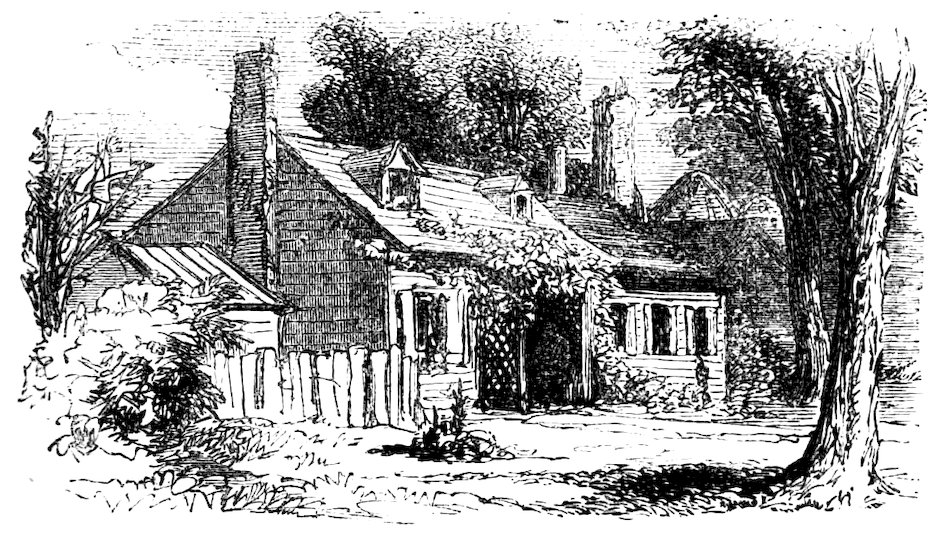
I can see it now: the little brown house, with its sloping roof, its
clumsy old chimneys, and its vine-clad porch; where the brown bee
hummed his drowsy song, and my silver-haired old father sat dozing
the sultry summer noons away, with shaggy Bruno at his feet. The
bright earth had no blight or mildew then for me. The song of the
little birds, resting beneath the eaves, filled my heart with a quiet
joy. It was sweet, when toil was over, to sit in the low door-way,
and watch the golden sun go down, and see the many-tinted clouds
fade softly away (like a dying saint) into the light of heaven, and
evening’s glittering star glow, like a seraph’s eye, above them.
2’Twas sweet, when Autumn touched the hill-side foliage with rainbow
dyes, to see the gorgeous leaves come circling down on the soft
Indian summer breeze. ’Twas sweet, when the tripping, silver
stream lay still and cold in Winter’s icy clasp, and the flowers
fainted beneath his chilly breath, and the leafless trees stretched out
their imploring arms, and shook off, impatiently, their snowy burthen,
and the heavy waggon-wheels went creaking past, and the ruddy
farmer struck his brawny arms across his ample chest, for warmth,
and goaded the lazy, round-eyed oxen up the icy hill. Even then
it was sunshine still in the little brown house: in the ample chimney
glowed and crackled the blazing faggots; rows of shining pans
glittered upon the shelves; the fragrant loaf steamed in the little
oven; the friendly tea-kettle, smoking, sang in the chimney corner,
and by its side still sat the dear old father, with the faithful newspaper,
that weekly brought us news from the busy world, from which
our giant forest-trees had shut us out.
Ah! those were happy days: few wants and no cares! the
patriarch’s head was white with grave blossoms, yet his heart was
fresh and green. Alas! that, under the lowliest door-way, as through
the loftiest portal, the Guest unbidden cometh. The morning sun
rose fair, but it shone upon silver locks that stirred with no breath of
life; upon loving lips for ever mute; upon a palsied, kindly hand that
gave no returning pressure. Soon, over the heart so warm and true,
the snow lay white and cold; the winter wind sang its mournful
requiem, and from out the little brown house the orphan passed with
tearful gaze and lingering footstep.
Oh, the bitter, bitter bread of dependence! No welcome by the
hearth-stone: no welcome at the board: the mocking tone, the
cutting taunt, the grudged morsel. Weary days, and sleepless,
memory-torturing nights.
“Well, Josiah’s dead and gone,” said my uncle, taking down his
3spectacles from the mantel, to survey me, as I sank on the settle, in
the chimney corner. “Take off your bonnet, Hetty. I suppose we
must give you house-room. Josiah never had the knack of saving
anything—more’s the pity for you. That farm of his was awfully
mismanaged. I could have had twice the produce he did off that
land. Sheer nonsense, that shallow ploughing of his, tiring the land
all out; he should have used the sub-soil plough. Then he had no
idea of the proper rotation of crops, or how to house his cattle in
winter, or to keep his tools where they wouldn’t rust and rot. That
new barn, too, was a useless extravagance. He might have roofed
the old one. It’s astonishing what a difference there is in brothers,
about getting beforehand in the world. Now, I’ve a cool thousand in
the bank, all for taking care of little things. (There, Jonathan!
Jonathan! you’ve taken the meal out of the wrong barrel: it was
the damaged meal I told you to carry to Widow Folger.)
“Well, as I was saying, Hetty, in the first place, your father
didn’t know how to manage; then he didn’t know how to say No.
He’d lend money to anybody who wanted it, and pay his workmen
just what they took it into their heads it was right to ask. Now,
there’s Jonathan, yonder; a day or two since, he struck for higher
wages. Well, I let him strike, and got an Irishman in his place.
This morning he came whining back, saying that his wife was sick,
and his youngest child lay dead in the house, and that he was willing
to work on at the old wages. That’s the way to do, Hetty. If
Jonathan chose to saddle himself with a wife and babies before he
was able to feed them, I don’t see the justice of my paying for it!
But it’s time for family prayers; that will be something new to you,
I suppose. I don’t want to judge any body; I hope your father has
gone to Heaven, but I’m afraid he didn’t let his light shine. Don’t
whimper, child; as the tree falls, so it must lie. You must see that
you do your duty: make yourself useful here in my house, and
try to pay your way. Young people of your age consume a great
deal in the way of food and clothes.”
Oh, the monotony of those weary days! how memory lingered
over the sunny past: how thought shrank back affrighted from the
4gloomy future: how untiringly and thanklessly I strove to cancel
the debt for daily bread, and how despairingly I prayed for relief
from such bitter thraldom.
“Make up the bed in the north room, Hetty,” said my aunt; “it’s
our turn to board the schoolmaster this week. You needn’t put on
the best sheets: these book-learning folks are always wool-gathering.
He never’ll know the difference. What a hungry set these schoolmasters
are, to be sure: it keeps a body all the time cooking. A
bushel of doughnuts is a mere circumstance. When the last master
was here, our winter barrel of cider went off like snow in April. I
hope Jonathan learned enough at school to pay for it, but I have my
doubts; he trips in the multiplication table yet. Your uncle and I
think that this boarding schoolmasters is a poor business—a losing
bargain. He says I must put less on the table, but it is no use to try
that game with George Grey. He’s as independent as Adam in
Eden, before the serpent and his wife got in. He’d just as lief call
for anything he wanted as not; and somehow or other, when he does,
I always feel as if I had no choice about bringing it. That eye of his
always makes me think of forked lightning; and yet he’s kindly
spoken, too. He is as much of a riddle to unravel, as one of Parson
Jones’ doctrinal sermons. But, go make his bed, Hetty, and mind
you stuff a few rags in that broken pane of glass over it. I spoke to
your uncle about getting it mended, but he said warm weather would
be along in three months, and that’s very true, Hetty. Hist! your
uncle is calling you. He says he is going out in the barn to thresh,
and if Peter Tay comes up the road, and stops in here again, for him
to subscribe towards the minister’s new cloak, you must say that he
has gone to Jifftown, and will not be home for a week at least. Now
don’t forget, Hetty; people seem to think one earns money now-a-days
on purpose to give away. A new cloak! humph! I wonder if
the Apostle Paul’s hearers ever gave him a new cloak? I wonder if
John the Baptist ever had a donation party? Don’t the minister
5have his salary, two hundred dollars a year—part in produce, part in
money; paid regularly, when the times ain’t too hard? Go make the
schoolmaster’s bed now, Hetty. One pillow will do for him. Goodness
knows he carries his head high enough when he is awake. I
shouldn’t wonder if he had been captain or colonel, or something,
some muster day.”
The schoolmaster! Should I be permitted to go to school? or
should I be kept drudging at home? Would this Mr. Grey think
me very ignorant? I began to feel as if his forked-lightning eyes
were already on me. My cheeks grew hot at the idea of making a
blunder in his awful presence. What a miserable room my aunt had
provided for him! If I could but put up some nice white curtains at
the window, or get him a cushioned chair, or put in a bureau, or chest
of drawers. It looked so comfortless—so different from the welcome
my dear old father was wont to give to “the stranger within the
gates;” and now memory pictured him, as he sat in the old arm-chair,
and I knelt again at the low footstool at his feet, and his hand strayed
caressingly over my temples, and I listened to old continental stories,
till the candle burned low in the socket, and only the fire-light
flickered dimly on the old portrait of General Washington, and on
my father’s time-worn face.
My aunt’s shrill voice soon roused me from my reverie. Dinnertime
had come, and with it Mr. Grey—a gentlemanly young man, of
about two and twenty, with a bright, keen, blue eye, and a frank,
decided, off-hand manner, that seemed to me admirably in keeping
with his erect, imposing figure and firm step. Even my uncle reefed
in a sail or two in his presence, and my aunt involuntarily qualified
her usual bluntness of manner. I uttered a heartfelt thanksgiving
when dinner was over.
“Hetty,” said my uncle, as the door closed upon Mr. Grey, “I
suppose you must go to school, or the neighbours will say we don’t
6treat you well. You ought to be very thankful for such a home as
this, Hetty; women are poor, miserable creatures, left without
money. I wish it had pleased Providence to have made you a boy.
You might then have done Jonathan’s work just as well as not, and
saved me his wages and board. There’s a piece of stone wall waiting
to be laid, and the barn wants shingling. Josiah, now, would be at
the extravagance of hiring a mason and a carpenter to do it.
“Crying? I wonder what’s the matter now? Well, it’s beyond
me to keep track of anything in the shape of a woman. One moment
they are up in the attic of ecstasy; the next, down in the cellar of
despondency, as the almanac says; and it is as true as if it had been
written in the Apocrypha. I only said that it is a thousand pities
that you were not a boy; then you could graft my trees for me, and
hoe, and dig, and plant, and plough, and all that sort of thing.
This puttering round, washing dishes a little, and mopping floors a
little, and wringing out a few clothes, don’t amount to much toward
supporting yourself. Let me see: you have had, since you came
here”—and my uncle put on his spectacles, and pulled out a well-thumbed
pocket memorandum—“You’ve had t-w-o p-a-i-r-s of shoes,
at t-h-r-e-e s-h-i-l-l-i-n-g-s a pair, and nine yards of calico, for a
dress, at s-i-x c-e-n-t-s a yard. That ’mounts up, Hetty, ’mounts
up. You see it costs something to keep you. I earned my money,
and if you ever expect to have any, you must earn yours”—and my
uncle took out his snuff-box, helped himself to a pinch, and, with
the timely aid of a stray sunbeam, achieved a succession of very
satisfactory sneezes.
The following day, under the overwhelming consciousness of my
feminity and consequent good-for-nothingness, I made my debut at
Master Grey’s school.
It was a huge barn of a room, ill-lighted, ill-warmed, and worse
ventilated, crowded with pupils of both sexes, from the little, chubby
A B C D-arian, to the gaunt Jonathan of thirty, who had begun to
feel the need of a little ciphering and geography, in making out his
accounts, or superscribing a business letter. There were rows of
awkward, mop-headed, freckled, red-fisted boys; and rosy-cheeked,
7buxom lasses, bursting out of their dresses, half-shy, half-saucy, who
were much more conversant with “apple bees,” and “husking
frolics,” than with grammar or philosophy. There was the parson’s
son, and the squire’s and the blacksmith’s son, besides a few who
hadn’t the remotest idea whose sons they were, having originally
been indentured to their farming masters by the overseers of the
county alms-house.
Amid these discordant elements Master Grey moved as serenely
as the August moon of a cloudless night; now patting some little
curly head, cruelly perplexed by “crooked S;” now demonstrating
to some slow, older brain, a stumbling-block in Euclid; now closing
the creaking door after an ill-mannered urchin; now overlooking
the pot-hooks and hangers of an unsophisticated scribe, who
clutched the pen as if it were a hoe-handle; now feeding the great,
draftless Behemoth of a stove with green hickory knots, and vainly
attempting to thaw out his own congealed fingers.
In a remote corner of the school-room sat Zeb Smith, the village
blacksmith’s son, who came into the world with his fists doubled up,
and had been pugilist-ing ever since. It was Zeb’s proud boast that
“he had whipped every schoolmaster who had ever appeared in
Frog-town,” and in his peaceful retreat from under his bent brows,
he was now mentally taking the measure of Master Grey, ending his
little reverie with a loud, protracted whistle.
Master Grey turned quickly round, and facing his overgrown
pupil of thirty, said, in a voice clear as the click of a pistol, “You
will be pleased not to repeat that annoyance, Mr. Smith.” Zeb bent
his gooseberry eyes full upon the master, and gave him a blast of
“Yankee Doodle.”
All eyes were bent on Master Grey. The gauntlet of defiance
was thrown in his very teeth. Zeb had a frame like an ox, and
a fist like a sledge-hammer, and he knew it. Master Grey was
slight, but panther-y; to their unscientific eyes he was already
victimized.
Not a bit of it! See! Master Grey’s delicately white fingers are
on Zeb’s check shirt-collar; there is a momentary struggle; lips
8grow white; teeth are set; limbs twist, and writhe, and mingle, and
now Zeb lies on the floor, with Master Grey’s handsome foot on his
brawny chest. Ah, Master Grey! science is sometimes a match for
bone and muscle. Your boxing-master, Monsieur Punchmellow,
would have been proud of his pupil.
Peace restored, Master Grey shakes back from his broad forehead
his curly locks, and summons the first class in geography. A row
of country girls, round as little barrels and red as peonies, stand
before him, their respect and admiration for “the master” having
been increased ten per cent. by his victory over Zeb. Feminity
pardons anything in a man sooner than lack of courage. The
recitation goes off very well, with the exception of Miss Betsey
Jones, who persists in not reciting at all. Master Grey looks at her:
he has conquered a man, but that’s no reason why he should suppose
he can conquer a woman. He sees that written in very legible characters
in Miss Bessie’s saucy black eye. Miss Bessie is sent to her
seat, and warned to stay after school, till her lesson is learned and
recited perfectly. With admirable nonchalance, she takes her own
time to obey, and commences drawing little caricatures of the master,
which she places in her shoe, and passes round under the desk, to
her more demure petticoat neighbours.
School is dismissed: the last little straggler is kicking up his
heels in the snow drifts, and Master Grey and Miss Bessie are left
alone. Master Grey inquires if the lesson is learned, and is told
by Miss Bessie, with a toss of her ringlets, that she has no intention
of learning it. Master Grey again reminds her that the lesson must
be recited before she can go home. Bessie looks mischievously at
the setting sun, and plays with the master’s commands and her
apron strings. An hour passes, and Bessie has not opened the book.
Master Grey consults his watch, and reminds her “that it is growing
dark.” Bessie smiles till the dimples play hide-and-seek on her
cheek, but she says nothing. Another hour: Master Grey bites his
lip, and, replacing his watch in his pocket, says, “I see your intention,
Miss Betsey. It is quite impossible, as you know, for us to
remain here after dark. To-morrow morning, if your lesson is not
9earned, I shall punish you in the presence of the whole school.
You can go.”
“Thank you, sir,” says Bessie, with mock humility, as she crushes
her straw hat down over her bright ringlets.
“Mischief take these women,” Master Grey was heard to utter,
as he went through the snow by starlight to a cold supper. “Shall
I conquer Zeb, to strike my colours to a girl of sixteen?”
There was plenty to talk about over the brown bread and milk
at the farmers’ tea-tables that night; the youngsters all made up
their minds that if there was “a time to play,” it was not in Master
Grey’s school-room; and the old farmers said they were glad the
District had a schoolmaster at last that was good for something, and
that they should think better of city chaps in future for his sake.
Even Zeb himself acknowledged, over his father’s forge, as he mended
his broken suspenders, that Master Grey was a “trump.”
The nine o’clock bell summoned again the Frog-town pupils to the
District School. Master Grey in vain looked in Bessie’s face for any
sign of submission. She had evidently made up her mind to brave
him. After the usual preliminary exercises, she was called up to
recite. Fixing her saucy black eyes upon him, she said, “I told you
I would not learn that lesson, and I have not learned it.” “And I
told you,” said Master Grey (a slight flush passing over his forehead),
“that I should punish you if you did not learn it. Did I not?”
Bessie’s red lip quivered, but she deigned him no reply.
“You will hold out your hand, Betsey,” said Mr. Grey, taking up
a large ferule that lay beside him. The colour left Bessie’s cheek,
but the little hand was extended with martyr-like determination; and
amid a silence that might be felt, the ferule came down upon it, with
justice as unflinching as if it were not owned by a woman. Betsey
was not proof against this humiliation; she burst into tears, and the
answering tear in Master Grey’s eye showed how difficult and
repugnant had been the task.
From that day, Master Grey was “monarch of all he surveyed;”
and truth compels me to own, by none better loved or more implicitly
obeyed than by Miss Bessie.
10Master Grey’s “boarding week” at my uncle’s had now expired.
What a change had it effected in me! Life was no longer aimless:
the old, glad sparkle had come back to my heavy eye; I no longer
dreaded the solitude of my own thoughts. The dull rain dropping on
my chamber roof had its music for my ears; the stars wore a new
and a glittering brightness, and Winter, with his snowy mantle,
frosty breath, and icicle diadem, seemed lovelier to me than violet-slippered
Spring, with roses in her hair. I still saw Master Grey
each day at school. How patiently he bore with my multiplied
deficiencies, and with what a delicate and womanly appreciation of
my extreme sensitiveness he soothed my wounded pride. No pale-eyed
flower fainting beneath the garish noonday heat, ever so
thirsted for the cool dews of twilight, as did my desolate heart for his
soothing tones and kindly words.
“Hetty,” said my uncle, “we shall want you at home now. It
will be impossible for me to get along without you, unless I hire a
hand, and times are too hard for that: so you must leave school.
You’ve a good home here, for which you ought to be thankful, as I’ve
told you before; but you must work, girl, work! Some how or other
the money goes” (and he pulled out the old pocket-book). “Here’s
my grocer’s bill—two shillings for tea, and three shillings for sugar;
can’t you do without sugar, Hetty? And here’s a dollar charged for
a pair of India rubbers. A dollar is a great deal of money, Hetty;
more than you could earn in a month. And here’s a shilling for a
comb; now that’s useless; you might cut your hair off. It won’t do—won’t
do. I had no idea of the additional expense when I took
you in. Josiah ought to have left you something; no man has a right
to leave his children for other people to support; ’tis n’t Christian.
I’ve been a professor these twenty years, and I ought to know. I
don’t know as you have any legal claim on me because you are my
niece. Josiah was thriftless and extravagant. I suppose ’tis in your
11blood, too, for I can’t find out that you have begun to pay your way
by any chores you have done here. If you must live on us (and I
can’t say that I see the necessity), I repeat, I wish you had been born
a boy.”
“But as I am not a boy, uncle, and as I do not wish to be a
burthen to you, will you tell me how to support myself?”
“Don’t ask me. I’m sure I don’t know. That is your business.
I have my hands full to attend to my own affairs. I am deacon of
the church, beside being trustee of the Sandwich Island Fund. I
don’t get a copper for the office of deacon; nobody pays me for
handing round the contribution box; not a cent of the money that
passes through my hands goes into my till; not a mill do I have, by
way of perquisite, for doling it out to bed-ridden Widow Hall, or
asthmatic Mr. Price. Not a penny the richer was I, for that twenty
dollars I collected in the contribution box at last communion: no, I
am a poor man, comparatively speaking. I may die yet in the alms-house;
who knows? You must work, girl, work; can’t have any
drones in my hive.”
A shadow just then passed the window. I should know that
retreating footstep! Could it be that Master Grey had come to the
door with the intention of calling, and overheard my uncle? At
least, then, I was spared the humiliation of exposing his parsimony.
It was the night for the weekly vestry lecture. I was left quite
alone in the old kitchen. My uncle had extinguished the lamp in
leaving, saying that it was “a waste to burn out oil for me.” The
fire, also, had been carefully taken apart, and the brands laid at an
incombustible distance from each other. The old clock kept up a
sepulchral, death-watch tick, and I could hear the falling snow drifting
gloomily against the windows.
I drew the old wooden settle closer between the tall andirons,
and sat sorrowfully gazing into the dying embers. What was to
12become of me? for it seemed impossible to bear longer the intolerable
galling of my yoke. Even the charity of strangers seemed to me
preferable to the grudging, insulting tolerance of my kindred. But,
with my sixteen years’ experience of quiet valley-life, where should
I turn my untried footsteps? To Him who guideth the little bird
through the pathless air, would I look.
Weeping, I prayed.
“My poor child,” said a voice at my side; and Master Grey removed
my hands gently from my tear-stained face, and held them in
his own. “My poor Hetty, life looks very dark to you, does it not?
I know all you suffer. Don’t pain yourself to tell me about it. I
overheard your uncle’s crushing words. I know there are none to
love you—none to care for you—none on whom you can lean. It is
a bitter feeling, my poor child. I, too, have passed through it. You
would go from hence, but where? Life is full of snares, and you are
too young and too inexperienced to brave them.
“Hetty,” and Master Grey drew me gently towards him,—“Hetty,
could you be happy with me?”
Is the shipwrecked mariner happy, who opens his despairing eyes
at length in the long looked for, long prayed for, home?
Is the little bird happy, who folds her weary wings safe from the
pursuer’s talons, in her own fleece-lined nest?
Is the little child happy, who wakes, sobbing, in the gloomy night,
from troubled dreams, to find his golden head still safely pillowed on
the dear, maternal bosom?
It was very odd and strange to me, my new home in the great
busy city; with its huge rows of stores and houses, its myriad restless
feet, and anxious, care-worn faces; its glittering wealth, its squalid
poverty; the slow-moving hearse, and the laughing harlequin crowd;
its noisy Sabbaths, and its gorgeous churches, with its jewelled
worshippers, and its sleepy priests; its little children, worldly-wise
13and old; and its never-ceasing, busy hum, late into the day’s pale
light. I had no acquaintances: I needed none; for I moved about
my pretty little home as in a glad dream. My husband was still
“Master Grey,” but over a private school of his own, bounded by no
“District,” subject to the despotic dictation of no “Committee.” In
his necessary absence, I busied myself in arranging and re-arranging
his books, papers and wardrobe, thinking the while such glad
thoughts! And when the little mantel clock chimed the hour of
return, my cheek flushed, my heart beat quick, and my eyes grew
moist with happy tears, at the sound of the dear, loved footstep.
How very nice it seemed to sit at the head of that cheerful little
table—to make, with my own hands, the fragrant cup of tea—to grow
merry with my husband, over crest-fallen Zeb, and poor, stubborn
little Bessie, and my uncle’s time-worn bugbear of a memorandum
book!
And how proud I was of him, as he sat there correcting some
school-boy’s Greek exercise, while I leaned over his shoulder, looking
attentively at his fine face, and at those unintelligible hieroglyphics,
and blushing that he was so much wiser than his little Hetty.
This thought sometimes troubled me. I asked myself, will my
husband never weary of me? I even grew jealous of his favourite
authors, of whom he was so fond. Then I pondered the feasibility of
pursuing a course of reading unknown to him, and astonishing him
some day with my profound erudition. In pursuance of my plan, I
would sit demurely down to some great, wise book; but I saw only
my husband’s face looking out at me from every page, and my self-inflicted
task was sure to end in some blissful dreamy reverie, with
which Cupid had much more to do than Minerva.
“A proposition, Hetty!” said my husband, throwing aside his
coat and hat, and tossing a letter in my lap. “It is from a widow
lady, who desires that I should take charge of her little boy, and give
14him a home in my family, while she goes to the continent, to secure
some property lately left her by a foreign relative. It will be
advantageous to us, in a pecuniary way, to have him board with us,
unless it should increase your cares too much. But, as you are so
fond of children, it may, perhaps, after all, prove a pleasant care to
you. She is evidently a superior woman. Every line in her letter
shows it.”
My husband immediately answered in the affirmative, and the
child arrived a week after. He was a fine, intelligent, gentlemanly
boy of eight years, with large hazel eyes, and transparently beautiful
temples: disinclined to the usual sports of childhood, sensitive, shy,
and thoughtful beyond his years—a human dew-drop, which we look
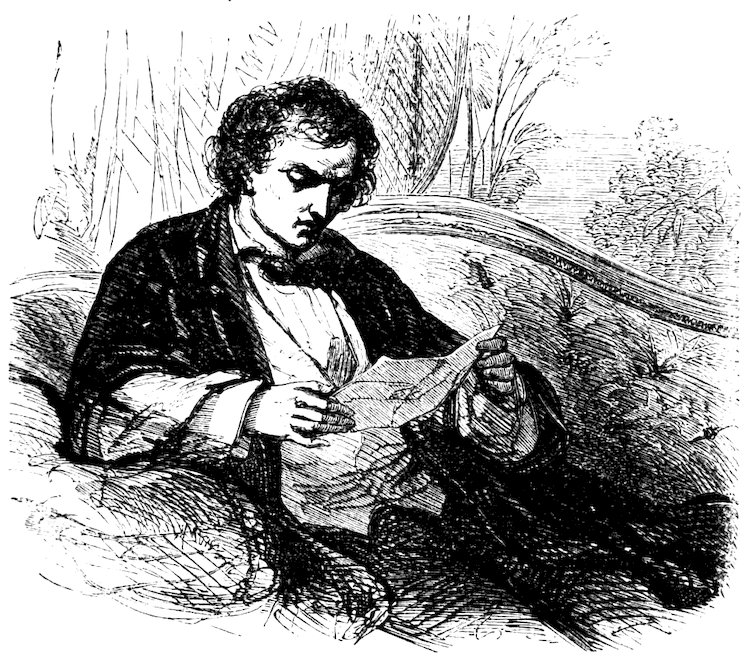
to see exhale. He brought with him a letter from his mother, which
powerfully affected my husband. During its perusal he drew his
hand repeatedly across his eyes, and sat a long while after he had
finished reading it, with his eyes closed, in a deep reverie. By-and-by
he said, handing me the letter, “There is genius there, Hetty. I
never read anything so touchingly beautiful. Mrs. West must be a
very talented and superior woman.”
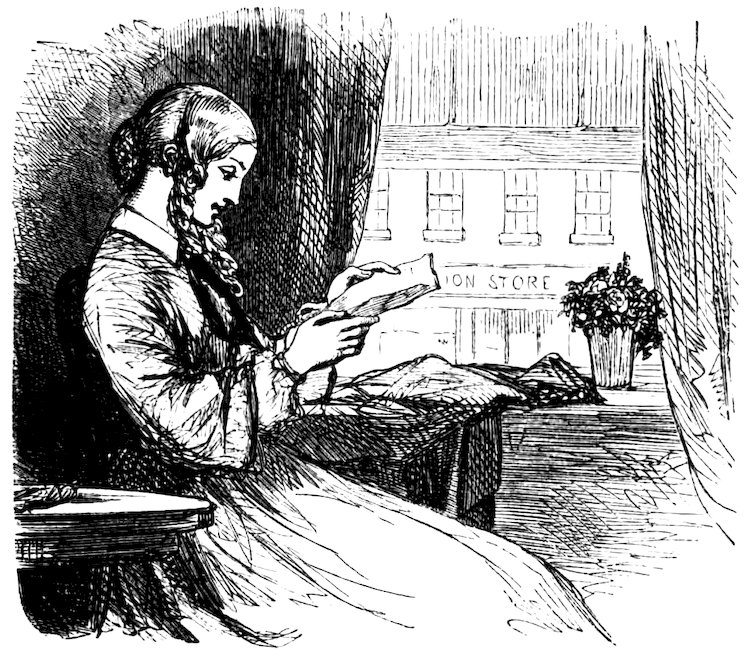
I glanced over the letter. It fully justified my husband’s encomiums.
It was a most touching appeal to him to watch with
paternal care over her only child; but while she spoke with a
mother’s tenderness of his endearing qualities, she wished him taught
implicitly, that first of all duties for the young, obedience. Then
followed allusions to dark days of sorrow, during which the love of
that cherished child was the only star in her sky.
I folded the letter and sat very still, after my husband left, in my
little rocking-chair, thinking. Such a gifted woman as that my
husband should have married. One who could have sympathised
with him and shared his intellectual pursuits; who would have been
something besides a toy to amuse an idle hour, or to minister to his
physical necessities. Perhaps it was of this that my husband was
thinking, as he sat there with his eyes closed over the open letter.
Perhaps he had wed me only from a generous impulse of pity, and
that letter had suddenly revealed to him the happiness of which he
15was capable with a kindred spirit. I was very miserable. I wished
the letter had never reached us, or that I had declined the care of the
child. Other letters, of course, would come, and the boy would keep
alive the interest in the intervals. I wept long and bitterly. At
length I was aroused by the entrance of little Charley. A bright
flush mounted to his forehead, when he saw my swollen eyes. He
hesitated a moment, then gliding up to my side he said, sweetly,
“Are you sick? Shall I bathe your head? I used to bathe mamma’s
head when it pained her.”
I stood abashed and rebuked in the child’s angel presence, and
taking the boy, her boy, in my arms, I kissed him as tenderly as if I
had been his mother; while in his own sweet way he told me with
childish confidence of his own dead papa; how much he loved
mamma; how many, many beautiful things he used to bring her,
saying that they were not half good, or half handsome enough for
her; how distressed he used to be if she were ill; how carefully he
closed the shutters, and tip-toed about the house, with his finger on
his lip, telling the servants to close the doors gently; and how he
promised him little toys, if he would not disturb mamma’s slumbers;
and then, how like diamonds his eyes shone, when she got well; and
what beautiful flowers he brought her for her vases; and what a nice,
soft-cushioned carriage he brought for her to take the air; and how
tenderly he wrapped the shawls about her, and how many charges
he gave the coachman, to drive slowly and carefully. And then, how
dear papa, at last, grew sick himself; and how mamma watched day
and night beside his bed, forgetting to sleep, or eat, or drink; and
how nobody dared to tell her that the doctor said he must die; and
how papa grew fainter and weaker, and how he said, “Kiss me,
Mary, and lay your cheek to mine; I can’t see you.” And then
how mamma fainted and was carried out, and for many, many long
days didn’t know even her own little Charley;—and how dreadful it
was when she first waked, and tried to remember what had happened;
and how nobody could comfort her but Charley; and how he used
often to wake up in the night, and find her with a lamp looking at
him, because when he was asleep he looked so much like dear, dead
16papa; and how bitterly she would sob when she was sick, because
papa was not there to pity her, and bathe her aching head; and how
he (Charley) meant, when he grew up to be a man, to get a nice house
for her, and put everything she wanted in it, and make her just as
happy as he could.
Well has the Saviour said, “Of such is the kingdom of Heaven.”
That night I bent over little Charley’s bed, blessing the little sleeper
for his angel teachings, with a heart as calm and peaceful as the
mirrored lake, reflecting only the smile of Heaven.
Time passed on. Life became earnest; for a little heart pulsated
beneath my own, and a strange, sweet, nameless thrill sent to my
chastened lips a trembling prayer. Tiny caps and robes, with many
a hope and fear interwoven in their delicate threads, lay awaiting the
infant’s advent. I, myself, should know the height, and breadth, and
depth of a mother’s undying love. What could come between me and
this new-found treasure?
Meantime, letters continued to come from Charley’s mother to her
boy, and my husband. It was impossible for me to blind myself to
his growing interest in them. On the days they were expected (for
she wrote at regular intervals), he would be absent and abstracted, or
if any delay occurred, almost irritable. When they were received, his
eye kindled, his step became elastic, and his whole face grew radiant
with happiness.
As the time drew near for the birth of my infant, I grew timid
with sad forebodings. I was sitting, one evening at twilight, watching
the setting sun, and thinking of the quiet grave it was gilding,
where my silver-haired father slept, in the old churchyard, when my
husband entered. An expression of pain flitted over his features, as
he looked at me; and taking my hand, he said, gently, almost tenderly,
“You are less well than usual, Hetty; you must not sit here, moping,
by yourself.”
I laid my head upon his shoulder with a happiness I had not
known for many months. “Listen to me, dear Grey,” said I; “I
have a confidence to repose in you that will ease my heart.
“It was pity, only, that drew your heart to mine; you do not
17love me. I have known it a long while since. At first, the discovery
gave me a pang keener than death; but I have had a long and bitter
struggle with myself, and have conquered. It is not your fault that
you cannot love me. To the many voices of your heart, which cry,
‘Give, give,’ my response is weak and unsatisfying. Your wife
should be gifted. She should sympathise with you in your intellectual
pursuits. She should stimulate your pride, as well as your love. Such
a one is Charley’s mother. Your heart has already wed her, and as
God is my witness, I have ceased to blame you. We cannot help our
affections. I cannot help loving you, though I know her mysterious
power over your heart. I have seen your struggles, your generous
self-reproaches, in some sudden outburst of kindness toward me, after
the indulgence of some bright dream, in which I had no share. Dear
Grey, she is worthy of your love. She has a heart, noble, good and
true; a heart purified by suffering. I see it in every line she writes.
Should I not survive the birth of my infant, I could give your
happiness into her keeping without a misgiving, though I have never
looked upon her face.”
Little Hetty’s noble heart has long since ceased to throb with joy
or pain. To her husband’s breast is folded the babe, for whose little
life her own was yielded up. Threads of silver prematurely mingle
amid his ebon locks; for memory writes only on bereaved hearts the
virtues of the dead, while, with torturing minuteness, she pictures
our own short-comings, for which, alas! we can offer no atonement
but our tears.
AUNT HEPSY.
18
It was a comical little old shop, “Aunt Hepsy’s,” with its Lilliputian
counter, shelves and stove, and its pigmy assortment of old-fashioned
ginghams, twilled cambrics, red flannels, factory cotton
and homespun calicoes; its miniature window, with its stock of horn-combs
and candy, tin horses and peppermint drops, skeins of yarn
and Godfrey’s Cordial, gaudy picture books, and sixpenny handkerchiefs,
from whose centre Lafayette and George Washington
smiled approbatively upon the big A’s and little A’s printed round the
border.
“Aunt Hepsy;” so every brimless-hatted urchin in the neighbourhood
called her, though it would have puzzled them worse than the
multiplication table, had you asked them why they did so. Year in
and year out, her ruddy English face glowed behind the little shop
window. Sometimes she would be knitting a pair of baby’s socks,
sometimes inventing most astonishing looking bags out of rainbow
fragments of silk or ribbon. Sometimes netting watch-guards, or
unravelling the yarn from some old black stocking, to ornament the
“place where the wool ought to grow,” on the head of some Topsy
doll she was making. Sometimes comforting herself with a sly pinch
of snuff, or, when sunbeams and customers were scarce, nodding
drowsily over the daily papers.
Aunt Hepsy had been a beauty, and her pretty face had won her
a thriftless husband, of whom champagne and cigars had long since
kindly relieved her. And though Time had since forced her to apply
to the perruquier, he had gallantly made atonement by leaving her
in the undisputed possession of a pair of very brilliant black eyes.
Add to this a certain air of coquetry, in the fanciful twist of her gay-coloured
19turban, and the disposal of the folds of her lace kerchief over
her ample English bust—and you have a faithful daguerreotype of
“Aunt Hepsy.”
From the window of her little shop she could look out upon the
blue waters of the bay, where lay moored the gallant ships, from
whose tall masts floated the stars and stripes, and whose jolly captains
might often be seen in Aunt Hepsy’s shop, exchanging compliments
and snuff, and their heavy voices heard, recounting long
Neptune yarns, and declaring to the buxom widow that nothing but
the little accident of their being already spliced for life, prevented
their immediately spreading sail with her for the port of Matrimony.
Aunt Hepsy usually frowned at this, and shook her turbaned head
menacingly, but immediately neutralized it by offering to mend a rip
in their gloves, or replace a truant button on their overcoats.
It was very odd, how universally popular was Aunt Hepsy. She
had any number of places to “take tea,” beside a standing invitation
from half-a-dozen families, to Christmas and Thanksgiving dinners,
and to New-Year’s suppers. She had an eligible seat in church,
gratis; an inexhaustible bottle of sherry for her often infirmities,
fresh pies on family baking days, newspapers for stormy day reading;
tickets to menageries, and invitations to picnics.
She always procured lodgings at a cheaper rate than anybody
else; had the pleasantest room in the house at that, the warmest seat
at table, the strongest cup of coffee, the brownest slice of toast, the
latest arrival of buckwheats, the second joint of the turkey, and the
only surviving piece of pie. To be sure, she always praised ugly
babies, asked old maids why they would be so cruel as to persist in
remaining unmarried, entreated hen-pecked husbands to use their
powerful influence over their wives to secure to her their custom,
begged the newly-fledged clergyman to allow her a private perusal of
his last Sunday’s able discourse; complimented ambitious Esaus on
the luxuriant growth of their very incipient and microscopically
perceptible whiskers; asked dilapidated, rejected widowers, when
they intended taking their choice of a wife out of a bevy of rosy
girls; and declared to editors that she might as well try to get
20along without her looking-glass, as without their interesting newspapers.
One day the little shop was shut up. Nine o’clock came—eleven
o’clock, and the shutters were still closed, and Aunt Hepsy so punctual,
too! What could it mean? Old Mrs. Brown was ready to
have fits because she couldn’t get another skein of yarn to finish her
old man’s stockings. Little Pat Dolan had roared himself black in
the face, because he couldn’t spend his cent to buy some maple
sugar; and the little match girl stood shivering at the corner for a
place to warm her poor benumbed fingers, while the disappointed
captains stamped their feet on the snow, stuffed their cheeks with
quids, and said it was “deuced funny;” and an old maid opposite,
who had long prayed that Aunt Hepsy’s reign might be shortened,
laid her skinny forefinger on her hooked nose, and rolled up the
whites of her eyes like a chicken with the pip.
It was no great enigma (at any rate, not after you found it out!).
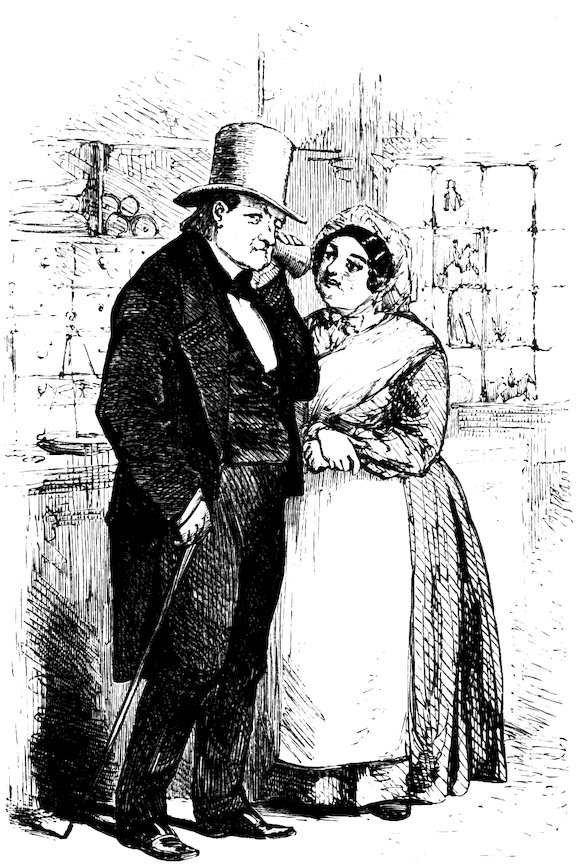
Rich old Mr. Potts ventured into Aunt Hepsy’s shop one day to buy
a watch-ribbon. He was very deaf; so Aunt Hepsy had to come
round the counter to wait upon him, and the upshot of it was, that she
and Cupid together hailed him through an ear-trumpet; and all I
know about it is, that they have now a legalized right to a mutual
pillow and snuff-box, and that the little shop window still remains
unopened, while the old maid hisses between her teeth, as Aunt
Hepsy rolls by in her carriage, “How do you suppose she did it?”
THOUGHTS AT CHURCH.
21
I have an old-fashioned way of entering church before the bells
begin to chime. I enjoy the quiet, brooding stillness. I love to
think of the many words of holy cheer that have fallen there, from
heaven-missioned lips, and folded themselves like snow-white wings
over the weary heart of despair. I love to think of the sinless
little ones, whose pearly temples have here been laved at the baptismal
font. I love to think of the weak, yet strong ones, who
have tearfully tasted the consecrated cup, on which is written,
“Do this in remembrance of me.” I love to think of those self-forgetting,
self-exiled, who, counting all things naught for Gethsemane’s
dear sake, are treading foreign shores, to say to the soul-fettered
Pagan, “Behold the Lamb of God.” I love to think of
the loving hearts that at yonder altar have throbbed, side by side,
while the holy man of God pronounced “the twain one.” I love to
think of the seraph smile of which death itself was powerless to rob
the dead saint, over whose upturned face, to which the sunlight lent
such mocking glow, the words, “Dust to dust,” fell upon the pained
ear of love. I love, as I sit here, to list, through the half open vestry
door, to the hymning voices of happy Sabbath scholars, sweet as the
timid chirp of morn’s first peeping bird. I love to hear their tiny
feet, as they patter down the aisle, and mark the earnest gaze of
questioning childhood. I love to see the toil-hardened hand of labour
brush off the penitential tear. I love—“our minister.” How very
sad he looks to-day. Are his parishioners unsympathetic? Does the
labourer’s “hire” come tardily and grudgingly to the overtasked
22faithful servant? Do censorious, dissatisfied spirits watch and wait
for his halting?
Now he rises and says, slowly—musically, “The Lord is my
shepherd, I shall not want.” Why at such sweet, soul-resting words,
do his tears overflow? Why has his voice such a heart-quiver?
Ah! there is a vacant seat in the pastor’s pew. A little golden head,
that last Sabbath gladdened our eyes like a gleam of sunlight, lies
dreamlessly pillowed beneath the coffin lid; gleeful eyes have lost
their brightness; cherry lips are wan and mute, and beneath her
sable veil the lonely mother sobs. And so the father’s lip quivers,
and for a moment nature triumphs. Then athwart the gloomy cloud
flashes the bow of promise. He wipes away the blinding tears, and
with an angel smile, and upward glance, he says, “Though He slay
me, yet will I trust in Him.”
23
THE BROTHERS.
Close the door. One would scarcely think, in this luxurious atmosphere,
that we had left mid-winter behind us. The warm air is
heavy with the odour of blossoming greenhouse plants, over whose
fragrant clusters a tiny fountain tosses its sparkling spray: bright-winged,
sweet-voiced canaries dart, like flashes of sunlight, through
the dark green foliage: beautiful are those sculptured infants, cheek
to cheek, over whose dimpled limbs the crimson drapery throws
such a rosy glow: beautiful is that shrinking Venus, with her pure,
chaste brow, and Eve-like grace: lovely those rare old pictures to
the artistic eye: beautiful that recumbent statuette of the peerless,
proud “Pauline.”
Hush! tread softly; on yonder couch a gentleman lies sleeping.
24His crimson velvet cap has fallen back from his broad white forehead,
his long curving lashes droop heavily upon his cheek, and his Grecian
profile is as faultless as a sculptor’s dream. Pity that the stain of
sensuality should have left so legible an impress there.
A servant enters, hearing a note upon a silver tray. His master
languidly opens a pair of large dark eyes, and beckons him to
approach. As he breaks the seal, a contemptuous sneer disfigures
his handsome lip, and an angry flush mounts to his brow. Motioning
the servant away, he crushes the note between his fingers, muttering,
“No—no; as he has made his bed, so let him lie in it.” Then
walking once or twice rapidly across the room, he takes up a small
volume, and throws himself again upon the velvet couch. He does
not turn the leaves; and if you peep over his shoulder, you will see
that the book is upside down. His thoughts are far away. He
remembers a bright-eyed, open-browed, guileless-hearted brother,
whom early orphanage had thrown upon his fraternal care; whose
trusting nature he had perverted; whose listening ear he had
poisoned with specious sophistries and worldly maxims; whom
he had introduced to the wine party, where female virtue was
held in derision, and to the “green room,” where the foreign
danseuse understood well how to play her part; whom he had
initiated into modern follies and dissipations, and then launched
upon the Charybdis of fashionable society, without chart, or rudder,
or compass, other than his own headstrong passions and unbridled will.
Soon came a rumour—at first vague and undefined, and then
voraciously seized upon and circulated by Paul Pry penny-a-liners
(who recked little, in their avidity for a paragraph, of broken-hearted
mothers or despairing gray-haired fathers), of a true heart that had
been betrayed, of a disgraced household, of a fair brow that must
henceforth walk the earth shame-branded. Then from his avenging
pursuers the rash boy fled for refuge to him who had first turned his
youthful steps aside from truth and honour. He was repulsed with
scorn; not because he had wronged his own soul and hers whose
star had for ever set in night, but because he had not more skilfully
and secretly woven the meshes for his victim.
25Across the seas, amid the reckless debauchery of God-forgetting
Paris, the miserable boy sought oblivion; welcoming with desperate
eagerness the syren Pleasure, in every chameleon shape that could
stifle conscience or drown torturing memory. Sometimes by a
lucky throw of the dice he was enabled to shine as the Adonis of
some ball, or theatre, or gay saloon: sometimes destitute as the
humblest chiffonier, who suns himself in the public square, to solicit
charity of the indifferent passer-by. In the rosy glow of morning,
the bright stars paled while Harry sat at the enticing gaming table,
till even those accustomed to breathe the polluted atmosphere of
those gates of perdition, turned shuddering away from the fiendish
look of that youthful face.
Nature revenged herself at last. Wearisome days of sickness
came, and he who was nurtured in luxury was dependent upon the
charity of grudging strangers.
Oh! what a broad, clear beam eternity throws upon the crooked
by-paths of sin! how like swift visions pass the long-forgotten prayer
at the blessed mother’s knee; the long-forgotten words of Holy
Writ; the soothing vesper hymn of holy time; the first cautious,
retrograding step—the gradual searing of conscience, till the barrier
between right and wrong is ruthlessly trampled under foot; the
broken resolutions, the mis-spent years, the wasted energies; the
sins against one’s own soul, the sins against others; the powerless
wish to pray, ‘mid paroxysms of bodily pain; the clinging hold on
life—the anxious glance at the physician—the thrilling question,
“Doctor, is it life or death?”
Poor Harry! amid the incoherent ravings of delirium, the good
little grisette learned his sad history. Her little French heart was
touched with pity. Through her representations, on his partial
restoration to health, a sufficient sum was subscribed by the
American consul, and some of his generous countrymen, to give
him the last chance for his life, by sending him to breathe again
his native air. Earnestly he prayed that the sea might not be his
sepulchre.
Tearfully he welcomed the first sight of his native shore.
26Tremblingly he penned those few lines to the brother whose face he
so yearned to see—and on whose fraternal breast it would seem
almost easy to die. Anxiously he waited the result, turning restlessly
from side to side, till beaded drops of agony started from his
pallid temples. Walter would not refuse his last request. No—no,
The proud man would at least, at the grave’s threshold, forget that
“vulgar rumour” had coupled his patrician name with disgrace.
Oh, why had the messenger such leaden footsteps? when life and
strength, like hour-glass sands, were fleeting! A step is heard upon
the stairs! A faint flush, like the rosy tinting of a sea-shell,
brightens the pallid face.
“No answer, sir,” gruffly says the messenger.
A smothered groan of anguish, and Harry turns his face to the
wall, and tears, such only as despair can shed, bedew his pillow.
“Do go, dear Walter; ’tis your own brother who asks it. If he
has sinned, has he not also suffered? We all so err, so need forgiveness.
Oh, take back those hasty words; let him die on your breast,
for my sake, Walter,” said the sweet pleader, as her tears fell over
the hand she pressed.
“That’s my own husband,” said the happy Mary, as she saw him
relent. “Go now, dear Walter. Take away the sting of those cruel
words, while yet you may, and carry him these sweet flowers, he
used to love, from me. Quick, dear Walter.”
“This way, sir, this way. Up another flight,” said the guide,
gazing admiringly at the fine figure before him, enveloped in a
velvet Spanish cloak. “Second door to the left, sir. Maybe the
gentleman’s asleep now; he’s been very quiet for some time. Seen
trouble, sir, I reckon. ’Tis not age that has drawn those lines on
his handsome face. He’s not long for this world, God rest his soul.
That’s right, sir; that’s the door. Good day, sir.”
Walter stood with his finger on the latch. He had at all times a
nervous shrinking from sickness—a fastidious horror of what he
termed “disagreeables.” He half repented that he had suffered a
woman’s tears to unsettle his purpose. Perhaps Harry would
27reproach him. (His own conscience was prompter to that thought.)
There he stood, irresolutely twirling Mary’s lovely flowers in his
nervous grasp.
If Harry should reproach him!
Slowly he opened the door. The flowers fell from his hand!
Was that attenuated, stiffened form, his own, warm-hearted, bright-eyed,
gallant young brother?
“Reproach?”
Oh, Walter, there is no “reproach” like that passionless upturned
face; no words so crushing as the silence of those breathless lips; no
misery like the thought that those we have injured are for ever blind
to our gushing tears, and deaf to our sobs of repentance.
CURIOUS THINGS.
28
Curious: The exaggerated anxiety of wives to see the women who were formerly
loved by their husbands.—Exchange.
Well, yes—rather curious; there are a great many curious things
in this world. Curious, your husband always perceives that you are
“sitting in a draft,” whenever one of your old lovers approaches you
in a concert room; curious he insists upon knowing who gave you
that pretty gold ring on your little finger; curious that you can
never open a package of old letters, without having his married eyes
peeping over your shoulder; curious he never allows you to ride on
horseback, though everybody says you have just the figure for it;
curious he always sends his partner on all the little business trips of
the firm; curious such an ugly frown comes over his face when he
sees certain cabalistic marks, in a masculine hand, in the margin of
your favourite poet; curious that he will not let you name your
youngest boy Harry, unless you tell him your confidential reasons;
curious he is almost most gracious to the most uninteresting men who
visit the house; and very curious, and decidedly disagreeable, that
whenever you ask him for money, he is so busy reading the newspaper
that he can’t hear you.
29
THE ADVANTAGES OF A HOUSE IN A FASHIONABLE SQUARE.
“Whom did you say wished to see me, Bridget?”
The broad-faced Irish girl handed her mistress a card.
“‘Mrs. John Hunter!’ Was there ever anything so unfortunate?
Had she called on any other day in the week, I should have been
prepared to receive her, but on a ‘washing day,’ when nothing but a
calico wrapper stands Master George’s clawings and climbings; when
the nursery maid is in the kitchen, and the baby on my hands for the
day; when my ‘Honiton collar’ is in soak, the parlour-window
curtains in the wash-tub, and the dimensions of the whole family, big
and little, are flapping on the clothes line, displaying their rents and
patches in full view of the parlour windows! Was there ever anything
30so unfortunate? What could induce Mrs. John Hunter to call
on a washing day?”
But what was a “washing day” to Mrs. John Hunter, who
lived in St. John’s Square, kept four servants, and patronized a
laundry? What did she know of Monday’s picked up dinners and
littered parlours, cluttered china closet, and untidied nurseries? Mrs.
John Hunter, who came down to breakfast every morning in a fawn-coloured
silk morning dress, trimmed with cherry, over an elaborately
embroidered white skirt; in a cobweb lace cap, silk stockings,
and the daintiest of Parisian toilette slippers; how could she see the
necessity of going down into the cellar, after breakfast, to see if the
pork was under brine, the pickle jar covered, and the preserves unfermented?
What did she know about washing up breakfast-cups,
polishing the silver sugar-bowl, filling the astral lamp, counting up
the silver forks and spoons, or mending that little threadbare place
in the carpet, that would soon widen into an ugly rent, if neglected?
What did she know about washing children’s faces for school, or
finding their missing mittens, or seeing that Webster’s spelling-book
and a big apple were safely stowed away in their satchels? How did
she (whose family broadcloth the tailor mended) know that Monday
was always the day when husbands threw their coats into wives’ lap
“for just one stitch,” which, translated, means new sleeve-linings, new
facings for the flaps, a new set of buttons down the front, and a general
resuscitation of dilapidated button-holes? How did she know that
the baby always got up a fit of colic on washing days, and made it a
point to dispense with its usual forenoon nap?—that all the collectors
for benevolent societies, and bores in general, preferred it to any
other day in the calendar?—that school teachers always selected it to
ferule children for sneezing without permission—that milkmen never
could spare you, on that day, your usual share of milk by two quarts—that
the coal, potatoes, starch, soap, molasses, and vinegar always
gave out on Monday—that “the minister” always selected it for his
annual call, and country cousins for a “protracted meeting?” How
should the patrician, Mrs. John Hunter, know all that?
There she sat in the parlour taking notes, after the usual fashion
31of lady-callers, while Mrs. John Smith hurriedly tied on her bonnet,
to hide her dishevelled tresses, threw on a shawl, and made her
appearance in the parlour as if “just returned from a long walk.”
How their tongues ran! how fashions and gossip were discussed;
how Mrs. Smith admired Mrs. Hunter’s new dress hat; how the latter
lady advised Mrs. Smith to “insist on her husband’s moving from such
an undesirable neighbourhood into a more aristocratic locality;” and
how Mrs. Smith wondered that the idea had never struck her before;
and how Mrs. Hunter told her that of course Mr. Smith would refuse
at first, but that she must either worry him into it, or seize upon
some moment of conjugal weakness to extort a binding promise from
him to that effect; and how the little wife blushed to find herself
conniving at this feminine piece of diabolism.
Mrs. John Smith’s husband commenced life in a provision store.
He was well acquainted with cleavers, white aprons, and spare-ribs—was
on hand early and late to attend to business—trusted nobody—lived
within his income, and consequently made money.
Miss Mary Wood kept a dressmaker’s establishment just over the
way. Very industriously she sat through the long summer days,
drooping her pretty golden ringlets over that never-ending succession
of dresses. Patiently she “took in,” and “let out,” bias-ed, flounced,
tucked, gathered, plaited, at the weathercock option of her customers.
Uneasily she leaned her head against her little window at sun-down,
and earnestly Mr. John Smith wished he could reprieve for ever from
such drudgery those taper little fingers. Very tempting was the
little basket of early strawberries, covered with fresh green leaves,
that went over the way to her one bright summer morning—and as
red as the strawberries, and quite as tempting, looked Miss Mary’s
cheek to Mr. John Smith, as she sat at the window, reading the little
billet-doux which he slily tucked into one corner.
The milkman wondered why Mr. Smith had grown so particular
about the flowers in the bouquets his little grand-daughter plucked
for sale, and why there must always be “a rose-bud in it.” Miss
Rosa Violet couldn’t imagine what ailed her dressmaker, Miss Wood
(who was always so scrupulous in executing orders), to make her
32bodice round, when she told her so particularly to make it pointed.
The little sewing-girls employed in Miss Wood’s shop were “afraid
she was getting crazy,” she smiled so often to herself, broke so many
needles, and made so many mistakes in settling up their accounts on
pay-day; and very great was their astonishment one day, after
finishing a pretty bridal dress, to find that Miss Wood was to wear it
herself to church the very next Sunday!
One bright June morning found the little dressmaker in a nice,
two-story brick house, furnished with every comfort, and some
luxuries; for the warm-hearted John thought nothing half good
enough for his little golden-haired bride. As time passed on, other
little luxuries were added; including two nice, fat, dimpled babies;
and within the last year John had bought the house they lived in,
and at Mary’s suggestion introduced gas, to lighten the labours of the
servant, and also added a little bathing-room to the nursery. His
table was well provided—the mother’s and children’s wardrobes
ample, and not a husband in Yankee-land was prouder or happier
than John Smith, when on a sunshiny Sunday, he walked to church
with his pretty wife, whose golden curls still gleamed from beneath
her little blue bonnet, followed by Katy and Georgy with their
shining rosy faces, and pretty Sunday dresses.
It was quite time the honeymoon should wane, but still it showed
no signs of decrease. Little bouquets still perfumed Mary’s room.
John still sprung to pick up her handkerchief, or aid her in putting on
her cloak or shawl. The anniversary of their wedding day always
brought her a kind little note, with some simple remembrancer.
Trifles, do you call these? Ah, a wife’s happiness is made or marred
by just such “trifles.”
“Katy will make somebody’s heart ache one of these days,” said John
Smith to his wife. “Katy will be a beauty. Did you hear me, Mary?”
“Yes,” said Mary, drooping her bright ringlets till they swept
John’s cheek, “and I was thinking how I hoped she would marry
well, and whether it would not be better for us to move into a more
genteel neighbourhood, and form a new set of acquaintances.”
33“My little wife getting ambitious!” said John, smoothing her
ringlets back from her white forehead; and “where would you like
to live, Mary?”
“St. John’s Square is a nice place,” said the little wife, timidly.
“Yes; but, my dear Mary, rents there are enormous, and those
large houses require a greater outlay of money than you have any
idea of. The furniture which looks pretty and in good taste here,
would be quite shabby in such an elegant establishment. The pretty
de laine, which fits your little round figure so charmingly, must give
place to a silk or brocade. Katy and Georgy must doff their simple
dresses, for velvet and embroidery; broad-faced, red-fisted Bridget
must make way for a French cook. The money which I have placed
in the bank for a nest-egg for you and the children in case of my
death must be withdrawn to meet present demands. But we will
talk of this another time: good-by, Mary dear; not even your dear
face must tempt me away from business; good-by,” and he kissed his
hand to her, as he walked rapidly out the door.
But somehow or other Mary’s words kept ringing in John’s ears.
It was very true Katy must be married some day, and then he ran
over the circle of their acquaintance; the Stubbses, and the Joneses, and
the Jenkinses—good enough in their way, but (he confessed to himself)
not just the thing for his Katy. John was ambitious too: Mary was
right; they ought to consider that Katy would soon be a woman.
It is not to be supposed because John Smith never sported white
kids, save on his wedding day, that he was not a man of taste; by no
means. Not an artistic touch of Mary’s feminine fingers, from the
twist of a ringlet or ribbon to the draping of a curtain, the judicious
disposal of a fine engraving, or the harmonious blending of colours
in a mantel bouquet, escaped him. It was his joy and pride to see
her glide about his home, beautifying almost unconsciously everything
she touched; and then, he remembered when she was ill, and Bridget
had the oversight of the parlours—what a different air they had;
how awkwardly the chairs looked plastered straight against the wall—how
ugly the red cloth all awry on the centre table; what a string-y
look the curtains had, after her clumsy fingers had passed over them
34Yes, Mary would grace a house in St. John’s Square; and if it would
make her any happier to go there (and here he glanced at his ledger)
—why, go she should—for she was just the prettiest, and dearest,
and most loving little Mary who ever answered to that poetical name.
What would full coffers avail him, if Mary should die?—and she
might die first. His health was good—his business was good. Mary
and Katy should live in St. John’s Square.
Mary and Katy did live in St. John’s Square. The upholsterer
crammed as many hundreds as possible into the drawing-rooms, in the
shape of vis-a-vis antique chairs, velvet sofas, damask curtains,
mirrors, tapestry, carpets, and a thousand other nick-nacks, too
numerous to mention: then the blinds and curtains shut out the glad
sunlight, lest the warm beams should fade out the rich tints of the
carpets and curtains, and left it us fine and as gloomy as any other
fashionable drawing room. There was a very pretty prospect from
Mary’s chamber windows, but she never allowed herself to enjoy it
after Mrs. John Hunter told her that it was considered “decidedly
snobbish to be seen at the front window.” The Smiths took their
meals in a gloomy basement, where gas was indispensable at mid-day.
Mary was constantly in fear that the servants would spoil the pictures
and statues in the parlour, so she concluded to sweep and dust it herself,
before there was any probability of Mrs. John Hunter’s being
awake in the morning. As this was something of a tax, she and Mr.
Smith and the children kept out of it, except on Sundays and when
company called, burrowing under ground the residue of the time in
the afore-mentioned basement.
Directly opposite Mrs. Smith lived Mrs. Vivian Grey, the leader
of the aristocracy (so Mrs. Hunter informed her) in St. John’s Square.
It was a great thing to be noticed by Mrs. Vivian Grey. Mrs.
Hunter sincerely hoped she would patronise Mrs. Smith. Mrs.
Hunter, after a minute survey, pronounced Mrs. Smith’s establishment
quite comme il faut, but suggested that a real cachemire should
be added as soon as possible to Mrs. Smith’s wardrobe, as Mrs. Grey
considered that article quite indispensable to a woman of fashion.
She also suggested that Mrs. Smith should delicately hint to her
35husband the propriety of his engaging a man servant, which appendage
was necessary to give a certain distingué finish to the establishment;
an Irishman would do, if well trained, but a black man was more
fashionable, provided he was not green—and Mrs. Hunter smiled at
her own wit.
The cachemire was added—so was the black servant man. Katy
no longer skipped and jumped, but minced in corsets and whalebone.
She never ate unless at a private lunch with mamma. Mr. John
Smith staid late at his counting-room, and looked anxious, and two
ugly lines made their appearance on Mrs. Mary’s fair forehead. The
French cook gave away provisions enough to feed an entire family of
French emigrants. The black man-servant pulled up his dicky and
informed Mrs. Smith that it was at the price of his reputation to live
with a family who dispensed with the use of finger-bowls; and the
house-maid (who had the honour of being descended from the establishment
of Mrs. Vivian Grey) declined remaining with a family who
didn’t keep a private carriage.
Mrs. Vivian Grey was not baited by the real cachemire, and her
son, little Julius Grey, a precocious youth of ten, told little George
Smith that his mamma had forbidden him playing marbles with a
boy whose father had kept a provision store.
A scurrilous penny paper published a burlesque of Mrs. Smith’s
first grand party, on the coming out of Miss Katy, in which, among
other allusions to Mr. Smith’s former occupation, the ball-room was
said to be “elegantly festooned with sausages.” This added “the
last ounce to the camel’s back;” even Mrs. Hunter’s tried friendship
was not proof against such a test.
A council of war was called. Mrs. Smith begged her husband, as
her repentant arms encircled his waistcoat, to buy a place in the
country. John very gladly consented to turn his plebeian back for
ever on the scene of their humiliation; and, what with strawberries and
cherries, peaches, picnics, early rising and light hearts, the Smith
family have once more recovered their equanimity, and can afford
to laugh when “St. John’s Square” and Mrs. John Hunter are
mentioned.
36
WINTER IS COMING.
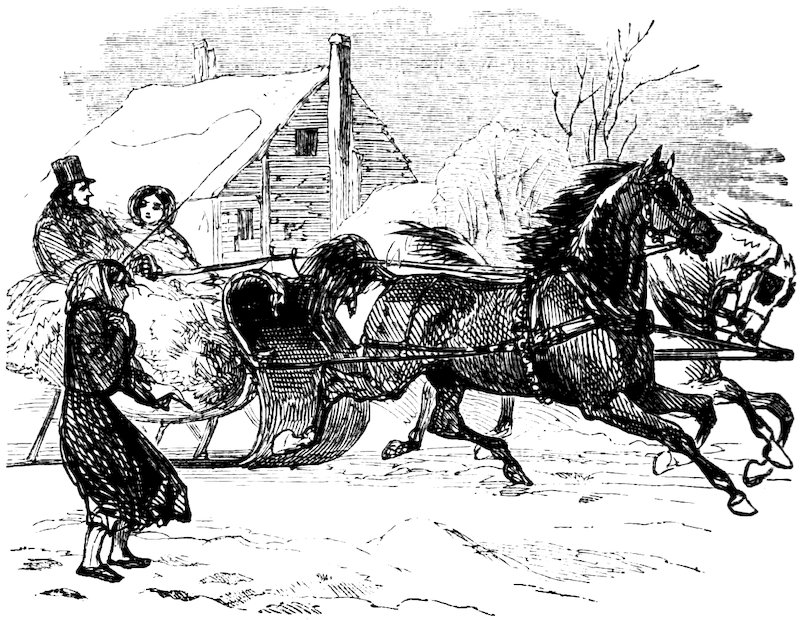
Welcome his rough grip! welcome, the fleet horse with flying
feet, and arching throat, neck-laced with merry bells! welcome,
bright eyes, and rosy cheeks, and furred robes, and the fun-provoking
sleigh-ride; welcome, the swift skater who skims, bird-like, the
silvery pond; welcome, Old Santa Claus with his horn of plenty;
welcome, the “Happy New Year,” with her many-voiced echoes, and
gay old Thanksgiving, with his groaning table, old friends and new
babies; welcome, for the bright fireside, the closed curtains, the
dear, unbroken home-circle, the light heart, the merry jest, the
beaming smile, the soft “good-night,” the downy-bed, and rosy
slumbers.
37Alas for his rough grip! the barrel of meal is empty, and the
cruse of oil fails. Sharp winds flutter thin rags ‘round shivering
limbs. There are pinched features, and benumbed feet, and streaming
eyes, and repulsed hands, and despairing hearts; there are damp
corners, and straw pallets, and hollow coughs, and hectic cheeks!
there are dismantled roofs, through which the snow gently drops its
white, icy pall over the wasted limbs of the dying; there are babes
whose birthright is poverty, whose legacy is shame, whose baptism is
tears, whose little life is all winter.
“THE OTHER SEX.”
38
“Let cynics prattle as they may, our existence here, without the presence of the
other sex, would be only a dark and cheerless void.”
Which “other sex?” Don’t be so obscure. Dr. Beecher says,
“that a writer’s ideas should stand out like rabbits’ ears, so that the
reader can get hold of them.” If you allude to the female sex, I don’t
subscribe to it. I wish they were all “translated.” If there is anything
that gives me the sensations of a landsman on his first sea
voyage, it is the sight of a bonnet. Think of female friendship!
Two women joining the Mutual Admiration Society; emptying their
budget of love affairs; comparing baits to entrap victims; sighing
over the same rose leaf; sonnetizing the same moonbeam; patronizing
the same milliner, and exchanging female kisses! (Betty, hand me
my fan!)
Well, let either have one bonnet or one lover more than the other—or,
if they are blue stockings, let either be one round the higher on
Fame’s ladder—bodkins and darning needles! what a tempest! Caps
and characters in such a case are of no account at all. Oh, there
never should be but one woman alive at a time. Then the fighting
would be all where it belongs—in the masculine camp. What a time
there’d be, though! Wouldn’t she be a belle? Bless her little soul!
how she would queen it. It makes me clap my hands to think of it!
The only woman in the world! If it were I, shouldn’t they all leave
off smoking, and wearing those odious plaid continuations? Should
they ever wear an outside coat, with the flaps cut off, or a Kossuth
hat, or a yellow Marseilles vest?—or a mammoth bow on their neck-ties;
or a turnover dickey; or a watch-chain; or a ring on the little
finger?—or any other abomination or off-shoot of dandyism whatsoever?
Shouldn’t I politely request them all to touch their hats,
39instead of jerking their heads, when they bowed? Wouldn’t I coax
them to read me poetry till they had the bronchitis? Wouldn’t they
play on the flute, and sing the soul out of me? And then if they
were sick, wouldn’t I pet them, and tell them all sorts of comicalities,
and make time fly like the mischief? Shouldn’t wonder!
SOLILOQUY OF MR. BROADBRIM.
40
“There’s another of Miss Fiddlestick’s articles! She’s getting too
conceited, that young woman! Just like all newly-fledged writers—mistakes
a few obscure newspaper puffs for the voice of the crowd,
and considers herself on the top round of the literary ladder. It will
take me to take the wind out of her sails. I’ll dissect her, before I’m
a day older, as sure as my name is Ezekiel Broadbrim. I don’t
approve her style; never did. It’s astonishing to me that the editor
of the Green Twig dare countenance it, when he knows a man of my
influence could annihilate her with one stroke of my pen. She has
talent of a certain inferior order, but nothing to speak of. She’s an
unsafe model to follow; will lead her tribe of imitators into tremendous
mistakes. It’s a religious duty for a conspicuous sentinel, like myself,
on Zion’s walls, to sound the blast of alarm;—can’t answer it to my
conscience to be silent any longer. It might be misconstrued, The
welfare of the world in general, and her soul in particular, requires a
very decided expression of my disapprobation. I’m sorry to annihilate
her, but when Ezekiel Broadbrim makes up his mind what is the path
of duty, a bright seraph couldn’t stop him. Perhaps I may pour a
drop of the balm of consolation afterwards, but it depends altogether
upon whether I succeed in bringing her into a penitential frame of
mind. It is my private opinion she is an incorrigible sinner. Hand
me my pen, John. Every stroke of it will tell.”
41
WILLY GREY.
A stern, unyielding, line-and-plummet, May-flower descendant, was
old Farmer Grey, of Allantown, Connecticut. Many a crop had he
planted, many a harvest had he garnered in, since he first became
owner of Glen Farm. During that time, that respected individual,
“the oldest inhabitant,” could not remember ever to have seen him
smile. The village children crept close to the stone wall, and gave
him a wide berth when he passed. Even the cats and dogs laid
their ears back, and crept circumspectly by him, with one eye on his
whip-lash.
Farmer Grey considered it acceptable to the God who painted the
rainbow, and expanded the lily, and tinted the rose, to walk the
bright earth with his head bowed like a bulrush, and his soul clad in
sackcloth. No mercy fell from the lips of his imaginary Saviour; no
compassion breathed in His voice; no love beamed in His eye; His
sword of justice was never sheathed.
42The old farmer’s wife was a gentle, dependent creature, a delicate
vine, springing up in a sterile soil, reaching forth its tendrils vainly
for some object to cling to. God, in his mercy, twined them lovingly
around a human blossom. Little Willy partook of his mother’s
sensitive, poetical nature: A yearning spirit looked out from the
fathomless depths of his earnest eyes. Only eight short summers the
gentle mother soothed her boy’s childish pains, and watched his
childish slumbers. While he grew in strength and beauty, her eye
waxed dim, and her step grew slow and feeble.
And so sweet memories were only left to little Willy,—dear,
loving eyes, whose glance ever met his on waking; a fair, caressing
hand, that wiped away his April tears; a low, gentle voice, sweet to
his childish ear as a seraph’s hymning.
Willy’s father told him that “his mother had gone to Heaven;”
John, the plough-boy, said, “she was lying in the churchyard.” Willy
could not understand this. He only knew that the house had grown
dark and empty, and that his heart ached when he stayed there; and
so he wandered out in the little garden (his mother’s garden); but the
flowers looked dreary, too; and her pretty rose-vine lay trailing its
broken buds and blighted blossoms in the dust.
Then Willy crept up to his father’s side, and looked up in his face,
but there was something there that made him afraid to lay his little
hand upon his knee, or climb into his lap, or in any way unburden
his little heart; so he turned away, more sorrowful than before, and
wandered into his mother’s chamber, and climbed up in her chair, and
opened her drawer, to look at her comb and hair brush; and then he
went to the closet, and passed his little hand, caressingly, over her
empty dresses, and leaning his little curly head against them, sobbed
himself to sleep.
By and by, as years passed on, and the child grew older, he learned
to wander out in the woods and fields, and unbosom his little yearning
heart to Nature. Reposing on her breast, listening to the music of
her thousand voices, his unquiet spirit was soothed as with a mother’s
lullaby. With kindling eye, he watched the vivid lightnings play;
or saw the murky east flush, like a timid bride, into rosy day; or
43beheld the shining folds of western clouds fade softly into twilight;
or gazed at the Queen of Night, as she cut her shining path through
the cloudy sky; or questioned with earnest eyes the glittering stars.
All this but ill pleased the old farmer. He looked upon the
earth only with an eye to tillage; upon the sloping hill, with its
pine-crowned summit, only with an eye to timber; upon the changeful
skies, only as reservoirs for moistening and warming his crops;
upon the silvery streams, that laced the emerald meadows, only as
channels for irrigation; upon the climbing vine, as an insidious foe
to joists, and beams, and timbers; and upon flowers only as perfumed
aristocrats, crowding and over-topping the free-soil democracy
of cabbage, onions, and potatoes.
In vain poor Will tried to get up, “to order,” an enthusiasm for
self-acting hay-cutters, patent ploughs, rakes, hoes, and harrows.
In vain, when Sunday came, and he was put “on the limits,” did the
old farmer, with a face ten-fold more ascetic than the cowled monk,
strive to throw a pall of gloom over that free, glad spirit, by rehearsing
in his ear a creed which would for ever close the gate of heaven
on every dissenter, or inculcate doctrines, which, if believed, would
fill our lunatic asylums with the frantic wailings of despair.
Restlessly did Will, with cramped limbs and fettered spirit, sit
out the tedious hours of that holy day, which should be the “most
blessed of all the seven,” and watch, with impatient eye, the last
golden beam of the Sabbath sun sink slowly down behind the
western hills.
Oh, well-meaning, but mistaken parent! let but one loving smile
play over those frigid lips; let but one tear of sympathy flood that
stony eye: let but one drop from that overflowing fountain of love
that wells up in the bosom of the Infinite, moisten the parched soil of
that youthful heart! Open those arms but once, and clasp him to the
paternal heart; for even now, his chafed spirit, like a caged bird,
flutters against its prison bars; even now, the boy’s unquiet ear
catches the far-off hum of the busy world: even now, his craving
heart beats wildly for the voice of human love!
44Weary feet, houseless nights, the scant meal, and the oft-repulsed
request: what are they to the strong nerve, and bounding pulse, and
hopeful heart of the young adventurer? Laurel wreaths, dizzy
places on Ambition’s heights—have not its aspirants reached them by
just such rugged steps?
“Will” is in the city. Will sits upon the steps of the New York
City Hall, reading a penny paper: he has begged it from a good-natured
newsboy, who has also shared with him a huge slice of
gingerbread. As Will’s eye glances over the sheet, it falls upon the
following paragraph:—
“PROSPECTUS OF THE WEEKLY CHRONICLE.
“The Weekly Chronicle is a paper founded on the demands of
the age for a first-class journal. It soars above all sectional and
personal considerations, and fearlessly proffers its feeble aid, in
developing the natural resources of the country, fostering the genius
of the people, rewarding meritorious effort in every department of
art, exalting virtue, however humble, and confounding vice, however
powerful, The editor and proprietor of the Chronicle is Mr. Philanthropas
Howard; office, No. 199 Cloud Street.
“Boy wanted immediately at the above office: one from the country
would be preferred.”
Will threw down the paper, and started to his feet: “199 Cloud
Street?” He asked orange-women; he asked image-boys; he asked
merchants; he asked clerks; he asked lawyers; he asked clients; he
investigated cellars; he explored attics; he travelled through parks
and through alleys; till, finally, he coaxed a graceless, bare-footed
urchin to show him the way.
Mr. John Howard, editor and proprietor of the Weekly Chronicle,
went upon the principle of paying nothing where nothing would
pay, and paying as little as possible where he could get something
for next to nothing. It was a fixed principle and confirmed practice
with him, never to pay anything for contributions to the Chronicle.
He considered that the great advantage that would accrue to an
author from having his or her articles in his paper, would be ample
45remuneration. At the moment Will’s eye first fell upon him, he was
reposing in a huge leathern arm-chair, in the corner of his sanctum.
His proportions very much resembled an apoplectic bag of flour,
surmounted by an apple. His head was ornamented with sparse
spires of fiery red hair; on his cheeks, a pair of cream-coloured
whiskers were feebly struggling into life; and sundry tufts of the same
colour, under his chin, shadowed forth his editorial sympathy with
the recent “Beard Movement.” Before him was a table of doubtful
hue and architecture, laden with manuscripts, accepted, rejected, and
under consideration; letters of all sizes, opened and unopened, prepaid
and unpaid, saucy and silly, defiant and deprecatory. There
was also an inkstand, crusted with dirt and cobwebs; a broken paper
weight, pinning down some had money paid by distant subscribers,
a camphine lamp with a broken pedestal, propped up by a directory
on one side, and Walker’s Dictionary on the other; sundry stumps
of cigars; a half eaten apple; a rind of an orange; a lady’s glove;
and a box of bilious pills.
Will stepped before him, and made known his errand. Mr. John
Howard looked at him with a portentious scowl, inspected him very
much as he would a keg of doubtful mackerel, and then referred him
to the foreman of the office, Mr. Jack Punch. Jack had been victimized,
in the way of office boys, for an indefinite period with precocious
city urchins, who smoked long nines, talked politics, discussed
theatricals, and knew more of city haunts than the police themselves.
Of course he lost no time in securing a boy to whose verdant
feet the plough-soil was still clinging. Will’s business was to open
the office at half-past six in the morning, sweep it out, make the
fires, go to the post-office for letters and exchanges, wrap up papers
for new subscribers, carry them to the post, and see that the mail
was properly “got off.” To all these requirements, Will immediately
subscribed.
On Will’s daily tramps to and from the office, he was obliged to
pass Lithe and Co’s magnificent show window, where the choicest
pictures and engravings were constantly exposed for sale. There he
might be seen loitering, entranced and spell-bound, quite oblivious of
46the Chronicle, hour after hour, weaving bright visions—building air
castles, with which his overseer, Mr. Jack Punch, had little sympathy.
Yes; Will had at length found out what he was made for. He knew
now why he had lain under the trees, of a bright summer day, watching
the fleecy clouds go sailing by, in such a dreamy rapture; why
the whispering leaves, and waving fields of grain, and drooping
branches of graceful trees, and the mirror-like beauty of the placid
lake, reflecting a mimic heaven; why the undulating hills, and mist-wreathed
valleys, with their wealth of leaf, and bud and blossom,
filled his eyes with tears and his soul with untold joy, and why, when
slumber sealed each weary lid under the cottage eaves, he stood alone,
hushing his very breath, awe-struck, beneath the holy stars.
Poor Will, his occupation became so distasteful! Poor Will,
winged for a “bird of paradise,” and forced to be a mole, burrowing
under the earth, when he would fain try his new-found pinions! To
Jack’s intense disgust, he soon detected Will drawing rude sketches
on bits of paper, stray wrappers, and backs of letters; even the walls
were “done in crayons,” by the same mischievous fingers. His vision
was so filled “with the curved line of beauty,” that he was constantly
committing the most egregious blunders. He misplaced the bundles
of newspapers which he carried to the post-office; placing the
“north” packages on the “south” table, the east on the north, the
south on the east, &c.; mixing them up generally and indescribably
and inextricably, so that the subscribers to the “Weekly Chronicle”
did not receive their papers with that precision and regularity which
is acknowledged to be desirable, particularly in small country places,
where the blacksmith’s shop, the engine house, and “the newspaper”
form a trio not to be despised by the simple-hearted primitive farmers.
Jack, whose private opinion it was that he should have been
christened Job, being obliged to shoulder all the short-comings of his
assistants, and being worked up to a pitch of frenzy by letters from
incensed subscribers, which Mr. Howard constantly thrust in his face,
very unceremoniously ejected Will from the premises, one morning,
by a vigorous application of the toe of his boot.
The world was again a closed oyster to Will. How to open it?
47that was the question. Our hero thought the best place to consider
the matter was at “Lithe & Co’s.” shop window. Just as he reached
it, a gentleman passed out of the shop, followed by a lad bearing a
small framed landscape. Perhaps the gentleman was an artist!
Perhaps he could employ him in some way! Will resolved to follow
him.
Up one street and down another, round corners and through
squares—the gentleman’s long legs seemed to be shod with the famed
seven-leagued boots. At length he stopped before the door of an unpretending
looking building, and handing the lad who accompanied
him a bit of money, he took from him the picture, and was just
springing up the steps, when he lost his balance, and the picture was
jerked violently from his hand, but only to be caught by the watchful
Will, who restored it to its owner uninjured.
“Thank you, my boy,” said the gentleman, “you have done me a
greater service than you think for;” at the same time offering him
some money.
“No, I thank you,” said Will proudly. “I do not wish to be paid
for it.”
“As you please, Master Independence,” replied the gentleman,
laughing; “but is there no other way I can serve you?”
“Are you an artist?” asked Will.
The gentleman raised his eyebrows, with a comical air, and
replied, “Well, sometimes I think I am; and then, again, I don’t
know; but what if I were?”
“I should so like to be an artist,” said Will, the quick flush mounting
to his temples.
“You!” exclaimed the gentleman, taking a minute survey of
Will’s nondescript toute ensemble. “Do you ever draw?”
“Sometimes,” replied Will, “when I can get a bit of charcoal,
and a white wall. I was just kicked out of the Chronicle office for
doing it.”
“Follow me,” said the gentleman, tapping him familiarly on the
cheek.
Will needed no second invitation. Climbing one flight of stairs,
48he found himself in a small studio, lined on all sides by pictures;
some finished and framed, others in various stages of progression.
Pallets, brushes, and crayons, lay scattered round an easel; while in
one corner was an artist’s lay figure, which, in the dim light of the
apartment, Will mistook for the artist’s wife, whose presence he
respectfully acknowledged by a profound bow, to the infinite amusement
of his patron.
Mr. Lester was delighted with Will’s naive criticisms on his
pictures, and his profound reverence for art. A few days found him
quite domesticated in his new quarters; and months passed by swift
as a weaver’s shuttle, and found him as happy as a crowned prince;
whether grinding colours for the artist, or watching the progress of
his pencil, or picking up stray crumbs of knowledge from the lips of
connoisseurs, who daily frequented the studio; and many a rough
sketch did Will make in his little corner, that would have made them
open their critical eyes wide with wonder.
“What a foolish match!” Was an engagement ever announced
that did not call forth this remark, from some dissenting lip?
Perhaps it was a “foolish match.” Meta had no dower but her
beauty, and Will had no capital but his pallet and easel. The gossips
said she “might have done much better.” There was old Mr. Hill,
whose head was snow white, but whose gold was as yellow and as
plentiful as Meta’s bright ringlets; and Mr. Vesey, whose father made
a clergyman of him, because he didn’t know enough to be a merchant;
and Lawyer Givens, with his carrotty head and turn-up nose, and
chin that might have been beat; and Falstaff-ian Captain Reef, who
brought home such pretty China shawls and grass cloth dresses, and
who had as many wives as a Grand Turk. Meta might have had any
one of these by hoisting her little finger. Foolish Meta! money and
misery in one scale, poverty and love in the other. Miserable little
Meta! And yet she does not look so very miserable, as she leans
over her husband’s shoulder, and sees the landscape brighten on the
canvas, or presses her rosy lips to his forehead, or arranges the fold
of a curtain for the desired light and shade, or grinds his colours with
49her own dainty little fingers; no, she looks anything but miserable
with those soft eyes so full of light, and that elastic step, and voice of
music, that are inspiration to her artist husband. No; she thinks
the “old masters” were fools to her young master, and she already
sees the day when his studio will be crowded with connoisseurs and
patrons, and his pictures bring him both fame and fortune; and then
they will travel in foreign countries, and sleep under Italia’s soft blue
skies, and see the Swiss glaciers, and the rose-wreathed homes of
England, and the grim old chateaux of France, and perhaps even
the Emperor himself. Who knows? Yes; and Will should feast
his eyes on beauty, and they’d be as happy as if care and sorrow had
never dimmed a bright eye with tears, since the seraph stood, with
flaming sword, to guard the gate of Eden. Hopeful, happy, trusting
Meta! the bird’s carol is not sweeter than yours;—and yet the archer
takes his aim, and with broken wing it flutters to the ground.
Yes: Meta was an angel. Will said it a thousand times a day,
and his eyes repeated it when his tongue was silent. Meta’s brow,
and cheek, and lips, and tresses were multiplied indefinitely, in all his
female heads. Her dimpled hand, he rounded arm, her plump shoulder,
her slender foot, all served him for faultless models.
Life was so beautiful to him now; his employment so congenial,
his heart so satisfied. It must be that he should succeed. The very
thought of failure—“but then, he should not fail!” Poor Will! he
had yet to learn that garrets are as often the graves as the nurseries
of genius, and that native talent goes unrecognized until stamped with
foreign approbation. Happily—hopefully—heroically he toiled on;
morning’s earliest beam, and day’s last lingering ray finding him busy
at his easel. But, alas! as time passed, though patrons came not,
creditors did; and one year after their marriage, Meta might have
been seen stealthily conveying little parcels back and forth to a small
shop in the neighbourhood, where employment was furnished for
needy fingers. It required all her feminine tact and diplomacy to
conceal from Will her little secret, or to hide the tell-tale blush, when
he noticed the disappearance of her wedding ring, which now lay
glittering in a neighbouring pawnbroker’s window; yet never for an
50instant, since the little wife first slept on Will’s heart, had she
one misgiving that she had placed her happiness unalterably in his
keeping.
Oh, inscrutable womanhood’! Pitiful as the heart of God, when
the dark cloud of misfortune, or shame, bows the strong frame of
manhood; merciless—vindictive—implacable as the Prince of Darkness,
towards thy tempted, forsaken, and sorrowing sisters!
The quick eye of affection was not long in discovering Meta’s
secret; and now every glance of love, every caress, every endearing
tone of Meta’s, gave Will’s heart a sorrow-pang.
Meta! who had turned a deaf ear to richer lovers, to share his
heart and home; Meta! whoso beauty might grace a court, whoso
life should be all sunshine: that Meta’s bright eyes should dim, her
cheek pale, her step grow prematurely slow and faltering, for him!—the
thought was torture.
“To-morrow, Will—you said to-morrow,” said Meta, hiding her
tears on her husband’s shoulder; “the land of gold is also the land of
graves,” and she gazed mournfully into his face.
“Dear Meta,” said her husband, “do dot unman me with your
tears; our parting will be brief, and I shall return to you with gold—gold!
Meta; and you shall yet have a home worthy of you. Bear
up, dear Meta—the sun will surely break through the cloud-rift. God
bless and keep my darling wife.”
Poor little Meta! for hours she sat stupefied with sorrow, in the
same spot where Will had left her. The sun shone cheerfully in at
the little window of her new home, but its beams brought no warmth
to Meta’s heart. The clinging clasp of Will’s arms was still about
her neck: Will’s kiss was still warm upon her lips, and yet—she was
alone.
She thought, with a shudder, of the treacherous sea; of the
pestilence that walketh in darkness; of a sick-bed, on a foreign
shore; of the added bitterness of the death pang, when the eye looks
51vainly for the one loved face; and bowing her face in her hands, she
wept convulsively.
“Dear heart! Goodness alive!” said Meta’s landlady, peeping in
at the door. “Don’t take on so; bless me, how long have you been
married? you’re nothing better than a child now. Why didn’t you
go to Californy with your husband? Where’s your folks?—whose
picter is that? Ah! I see now, it is meant for you. But why didn’t
you have on a gown, dear, instead of being wrapped up in them
clouds? It makes you look like a spirit. Come now, don’t sit moping
here; come down stairs and see me work; it will amuse you like.
I’m going to make some brown bread. I dare say you never made a
bit of brown bread in your life. I put a power of ingin in mine. I
learned that in the country. I was brought up in the country. I
hate city folks; they’ve no more heart than a sexton; much as ever
they can stop frolicking long enough to bury one another. They’ll
sleep, too, like so many tops, while the very next street is all of a
blaze, and their poor destitute fellow-creatures are turned naked into
the streets. They’ll plough right through a burying ground, if they
take a notion, harrowing up dead folks, and live ones, too, I guess.
And as to Sunday—what with Jews, and Frenchmen, and down
Easters, and other foreigners, smoking and driving through the
streets, ’tisn’t any Sunday at all. Well, I never knew what Sodom
meant till I came to the city. Why Lot’s wife turned round to take
a second look at it, is beyond me. Well, if you won’t come downstairs
I must leave you, for I smell my bread burning; but do cheer
up—you look as lonesome as a pigeon on a spout of a rainy day.”
A letter from the best beloved! How our eye lingers on the well-known
characters. How we torture the words to extract hidden
meanings. How tenderly we place it near the heart, and under the
pillow. How lingeringly comes the daylight, when our waiting eyes
would re-peruse what is already indelibly written on the heart!
Will’s voyage had been prosperous—his health was good—his
hope and courage unabated. Meta’s eye sparkled, and her cheek
flushed like a rose, as she pressed the letter again and again to her
52lips; but, after all, it was only a letter, and time dragged so heavily.
Meta was weary of sewing, weary of reading, weary of watching
endless pedestrians pass and repass beneath her window, and when
twilight came, with its deepening shadows—that hour so sweet to the
happy, so fraught with gloom to the wretched—and Meta’s eye fell
upon the little house opposite, and saw the little parlour lamp gleam
like a beacon light for the absent husband, while the happy wife
glided about with busy hands, and lightsome step, and when, at last,
he came, and the broken circle was complete, poor Meta turned away
to weep.
Joy, Meta, joy! dry your tears! Will has been successful. Will
is coming home. Even now the “Sea-Gull” ploughs the waves, with its
precious living freight. Lucky Will! he has “found gold,” but it
was dug from “the mine” of the artist’s brain. Magical Will! the
liquid eyes and graceful limbs of Senor Alvarez’s only daughter are
reproduced on canvas, in all their glowing beauty, by your magic
touch! The Senor is rich—the Senor is liberal—the Senor’s taste is
as unimpeachable as his credit—the Senor has pronounced Will “a
genius.” Other Senors hear it; other Senors have gold in plenty,
and dark-eyed, graceful daughters, whose charms Will perpetuates,
and yet fails to see, for a sweeter face which comes between.
Dry your tears, little Meta—smooth the neglected ringlets—don
his favourite robe, and listen with a flushed cheek, a beating heart,
and a love-lit eye, for the long absent but well remembered footstep.
Ah! Meta, there are meetings that o’erpay the pain of parting.
But, dear Reader, you and I are de trop.
You should have seen how like a little brigand Will looked, with
his bronzed face and fierce beard and moustache—so fierce that Meta
was half afraid to jump into his arms; you should have seen Meta’s
new home to know what a pretty little nest love and taste may weave
for a cherished bird; you should have seen with what a Midas touch
Will’s gold suddenly opened the eyes of people to his wonderful
merit, as an artist; how “patrons” flocked in, now that he lived in a
53handsome house in Belgrave Square; how Mr. Jack Punch repented,
with crocodile tears, that he had ever kicked him out of “the
Chronicle office,” and how Will immortalized him on canvas, in the
very act; not forgetting to give due prominence, in the foreground,
to the figure of his philanthropic employer, Mr. John Howard, who,
in the touching language of his Prospectus, always made it a point
to “exalt virtue, however humble!”
TABITHA TOMPKINS’ SOLILOQUY.
54
Have I, Tabitha Tompkins, a right, to my share of fresh air uncontaminated?
or have I not? I ask the question with my arms akimbo.
I might as well say what I’ve got to say, pop-gun fashion, as to tiptoe
round my subject, mincing and curtsying when I’m all ablaze
with indignation.
I ask again: Have I a right to my share of fresh air uncontaminated?
or have I not?
Do I go out for a walk? Every man I meet is a locomotive
chimney. Smoke—smoke—smoke—smoke:—great, long tails of it
following in their wake, while I dodge, and twist, and choke, trying
to escape the coils of the stifling anaconda, till I’m black in the face.
I, Tabitha Tompkins, whose grandfather was one of the “signers” of
the Declaration of Independence! I feel seventy-six-y! I have
borne it about as long as I can without damage to hooks and eyes.
If I try to escape it, by getting into an omnibus, there it is again!
If it does not originate inside, some “gentleman” on the box or top
wafts it into the windows. If I take refuge in a ferry-boat, I find
“gentlemen requested not to smoke” (as usual) a dead letter,—no
more regarded than is the law against gaming, or the Sunday liquor
traffic. Do I go to a concert at Castle Garden, and step out on the
balcony between the performances for a breath of fresh air?—myriads
of lighted Havannas send me dizzy and staggering back into the
concert room. Does a gentleman call to see me of an evening?—the
instant he shakes his “ambrosial curls,” and gives “a nod,” I have to
run for my vinaigrette.
55Do I advertise for lodgings; and after much inspection of rooms
and wear and tear of patience and gaiter boots, make a final selection?
Do I emigrate with big trunk, and little trunk, and a whole
nest of bandboxes? Do I get my rocking-chair, and work-table, and
writing-desk, and pretty little lamp, all safely transported and longitudinized
to my fancy? Do I, in a paradisaical state of mind
(attendant upon said successful emigration) go to my closet some fine
morning, and take down a pet dress?—asafœtida and onions! what
an odour! All the “pachouli” and “new mown hay” in New York
wouldn’t sweeten it. Six young men the other side of that closet,
and all smokers!!! Betty, you may have that dress;—I wouldn’t
touch it with a pair of tongs.
Do I lend a masculine friend my copy of Alexander Smith’s
Poems?—can I ever touch it again till it has been through quarantine?
Does he, by mistake, carry home my tippet in his pocket after
a concert?—can I compute the hours it must hang dangling on the
clothes line before it can be allowed to resume its place round my
neck?
Do I go to church on Sunday, with a devout desire to attend to
the sermon?—my next neighbour is a young man, apparently seated
on a nettle cushion: he groans and fidgets, and fidgets and groans;
crosses his feet and uncrosses them; kicks over the hassock; knocks
down his cane; drops the hymn-book; and finally draws from his
coat pocket a little case, takes out one cigar after another, transposes
them, applies them to the end of his nose, and pats them affectionately;
then he examines his watch; then frowns at the pulpit; then
glancing at the door, draws a sigh long enough and strong enough
to inflate a pair of bellows, or burst off a vest button.
With a dolorous whine this same young man deplores (in public)
his inability to indulge in the luxury of a wife, “owing to the extravagant
habits of the young ladies of the present day.” I take this
occasion to submit to public inspection a little bit of paper found in
56the vest pocket of this fumigated, cork-screwed, pantalooned humbug,
by his washerwoman:—
New York, October 1st, 1853.
Mr. Thaddeus Theophilus Stubbs,
To Juan Fumigo,
Dr.
To Cigars for Sept., 1853.
Dols. Cents.
Sept. 1—To 20 Trabucos, at 5c.
1 00
„ To 12 Riohondas, at 6d.
75
„ 3—To 12 Los Tres Castillos, at 6d.
75
„ To 12 La Nicotiana, at 6d.
75
„ 4—(Sunday—for Cigars for a party) 10 Palmettoes, 10 Esculapios, 12 La Sultanos, 12 El Crusados, 20 Norriegos, 16 L’Alhambros, at 4c.
3 20
„ 6—To 50 L’Ambrosias, at 4c.
2 00
„ 10—To 30 Cubanos, at 8c.
2 40
„ 12—To 50 Londres, at 4c.
2 00
„ 15—To 30 Jenny Linds (for concert party), at 8c.
2 40
„ 24—To 50 Figaros (for party to see Uncle Tom, at the National), at 8c.
4 00
„ 26—To 100 Mencegaros (for party of country relations and friends), at 2c.
2 00
„ 30—To 40 Imperial Regalias, at 1s.
5 00
26 25
Received Payment——
(Mr. Stubbs is earnestly requested to call and settle the above at his earliest convenience. J. F.)
Consistent Stubbs! But, then, his cigar bill is not receipted!
SOLILOQUY OF A HOUSEMAID.
57
Oh, dear, dear! Wonder if my mistress ever thinks I am made of
flesh and blood? Five times, within half an hour, I have trotted up
stairs, to hand her things, that were only four feet from her rocking-chair.
Then, there’s her son, Mr. George—it does seem to me, that a
great able-bodied man like him, need n’t call a poor tired woman up
four pair of stairs to ask “what’s the time of day?” Heigho!—its
“Sally do this,” and “Sally do that,” till I wish I never had been
baptized at all; and I might as well go farther back, while I am about
it, and wish I had never been born.
Now, instead of ordering me round so like a dray horse, if they
would only look up smiling-like, now and then; or ask me how my
“rheumatiz” did; or say “Good morning, Sally;” or show some sort of
interest in a fellow-cretur, I could pluck up a hit of heart to work for
them. A kind word would ease the wheels of my treadmill amazingly,
and would n’t cost them anything, either.
Look at my clothes, all at sixes and sevens. I can’t get a minute
to sew on a string or button, except at night; and then I’m so sleepy
it is as much as ever I can find the way to bed; and what a bed it is,
to be sure! Why, even the pigs are now and then allowed clean
straw to sleep on; and as to bed-clothes, the less said about them the
better; my old cloak serves for a blanket, and the sheets are as thin as
a charity school soup, Well, well; one would n’t think it, to see all
the fine glittering things down in the drawing-room. Master’s stud
of horses, and Miss Clara’s diamond ear-rings, and mistresses rich
dresses. I try to think it is all right, but it is no use.
To-morrow is Sunday—“day of rest,” I believe they call it.
H-u-m-p-h!—more cooking to be done—more company—more confusion
58than on any other day in the week. If I own a soul I have not
heard how to take care of it for many a long day. Wonder if my
master and mistress calculate to pay me for that, if I lose it? It is a
question in my mind. Land of Goshen! I aint sure I’ve got a mind—there’s
the bell again!
CRITICS.
59
“Bilious wretches, who abuse you because you write better than they.”
Slander and detraction! Even I, Fanny, know better than that. I
never knew an editor to nib his pen with a knife as sharp as his
temper, and write a scathing criticism on a book, because the authoress
had declined contributing to his paper. I never knew a man who had
fitted himself to a promiscuous coat, cut out in merry mood by taper
fingers, to seize his porcupine quill, under the agony of too tight a
self-inflicted fit, to annihilate the offender. I never saw the bottled-up
hatred of years concentrated in a single venomous paragraph. I
never heard of an unsuccessful masculine author, whose books were
drugs in the literary market, speak with a sneer of successful literary
feminity, and insinuate that it was by accident, not genius, that they
hit the popular favour!
By the memory of “seventy-six,” No! Do you suppose a man’s
opinions are in the market—to be bought and sold to the highest
bidder? Do you suppose he would laud a vapid book, because the
fashionable authoress once laved his toadying temples with the baptism
of upper-tendom? or, do you suppose he’d lash a poor, but self-reliant
wretch, who had presumed to climb to the topmost round of
Fame’s ladder, without his royal permission or assistance, and in
despite of his repeated attempts to discourage her? No—no—bless
your simple soul; a man never stoops to do a mean thing. There never
was a criticism yet, born of envy, or malice, or repulsed love, or disappointed
ambition. No—no. Thank the gods, I have a more
exalted opinion of masculinity.
FORGETFUL HUSBANDS.
60
“There is a man out west so forgetful, that his wife has to put a wafer on the end of
her nose, that he may distinguish her from the other ladies; but this does not prevent
him from making occasional mistakes.”
Take the wafer off your nose, my dear, and put it on your lips!
Keep silence, and let Mr. Johnson go on “making his mistakes;”
you cannot stop him, if you try; and if he has made up his mind to
be near-sighted, all the guide-boards that you can set up will only
drive him home the longest way round!
So trot your babies, smooth your ringlets, digest your dinner,
and—agree to differ! Don’t call Mr. Johnson “my dear,” or he
will have good reason to think you are going to quarrel with him!
Look as pretty as a poppet; put on the dress he used to like, and
help him to his favourite bit at table, with your accustomed grace,
taking care not (?) to touch him accidentally with your little fat
hand when you are passing it. Ten to one he is on the marrow
bones of his soul to you in less than a week, though tortures couldn’t
wring a confession out of him. Then, if he’s worth the trouble, you
are to take advantage of his silent penitence, and go every step of
the way to meet him, for he will not approximate to you the width
of a straw! If he has not frittered away all your love for him, this
is easily done, my dear, and for one whole day after it he will feel
grateful to you for sparing him the humiliation (?) of making an
acknowledgment. How many times, my dear “Barkis,” you will
be “willing” to go through all this depends upon several little circumstances
in your history with which I am unacquainted.
SUMMER FRIENDS.
61
“If every pain and care we feel
Could burn upon our brow,
How many hearts would move to heal
That strive to crush us now.”
Don’t you believe it! They would run from you as if you had the
plague. “Write your brow” with anything else but your “troubles,”
if you do not wish to be left solus. You have no idea how “good
people” will pity you when you tell your doleful ditty! They will
“pray for you,” give you advice by the bushel, “feel for you”—everywhere
but in their pocket-books; and wind up by telling you to
“trust in Providence;” all of which you feel very much like
replying, as the old lady did when she found herself spinning down
hill in a wagon,—“I trusted in Providence till the tackling broke!”
Now, listen to me. Just go to work, and hew out a path for
yourself; get your head above water, and then snap your fingers in
their pharisaical faces! Never ask a favour until you are drawing
your last breath; and never forget one. “Write your troubles on
your brow?” That man was either a knave, or, what is worse, a
fool. I suppose he calls himself a poet; if he does, all I have to say
is, it’s high time the city authorities took away his “license.”
HOW THE WIRES ARE PULLED: OR, WHAT PRINTER’S INK WILL DO.
62
“Isn’t it extraordinary, Mr. Stubbs, how Mr. Simpkins can always
be dressed in the last tip-top fashion? Don’t you and I, and all the
world know, that old Allen has a mortgage on his house, and that he
never has a dollar by him longer than five minutes at a time. Isn’t
it extraordinary, Mr. Stubbs?”
“Not at all—not at all—my dear,” said Mr. Stubbs, knocking
the ashes from his Havana; “to an editor all things are possible;”
and he unfolded the damp sheets of the Family Gazette, of which
Mr. Simpkins was editor, and commenced reading aloud the following
paragraph:—
“‘We yesterday had the gratification of visiting the celebrated
establishment of the far-famed Inman & Co., Hatters, No. 172 Wideway.
We pronounce their new style of spring hat, for lightness
beauty, and durability, to be unrivalled; it is aptly designated the
‘Count D’Orsay hat.’ The gentlemanly and enterprising proprietors
of the establishment are unwearied in their endeavours to please the
public. There is a je ne sais quoi about their hats which can be
found nowhere else in the city.’”
“Well, I don’t see,” said Mrs. Stubbs, “I——”
“Sh—! sh—! Mrs. Stubbs; don’t interrupt the court—here’s
another:
“‘Every one should visit the extensive ware-rooms of Willcut and
Co., Tailors, 59 Prince Albert Street. There is science wagging in
the very tails of Mr. Willcut’s coats; in fact, he may be said to be
63the only tailor in the city who is a thorough artist. His pantaloons
are the knee-plus ultra of shear-dom. Mr. Willcut has evidently
made the anatomy of masculinity a study—hence the admirable
result. The most casual observer, on noticing Mr. Willcut’s fine
phrenological developments, would at once negative the possibility of
his making a faux pas on broadcloth.’
“Keep quiet, Mrs. Stubbs; listen:”
“‘The St. Lucifer Hotel is a palatial wonder; whether we consider
the number of acres it covers, the splendour of its marble
exterior, the sumptuousness of its drawing-rooms, or the more than
Oriental luxuriousness of its sleeping apartments, the tapestry,
mirrors and gilding of which remind one forcibly of the far-famed
Tuileries. The host of the St. Lucifer is an Apollo in person, a
Chesterfield in manners, and a Lucullus in taste; while those white-armed
Houris, the female waiters, lap the soul in Elysium.’”
Mr. Stubbs lifted his spectacles to his forehead, crossed his legs,
and nodded knowingly to Mrs. Stubbs.
“That’s the way it’s done, Mrs. Stubbs. That last notice paid
his six months’ hotel bill at the St. Lucifer, including wine, cigars,
and other little editorial perquisites. Do you want to know,” said
Stubbs (resuming the paper), “how he gets his carriages repaired,
and his horses shod for nothing, in the village where his country seat
is located? This, now, is a regular stroke of genius. He does it by
two words. In an account of his visit to the Sybil’s Cave, in which
he says, ‘My friend, the blacksmith, and I soon found the spot,’ &c.,
(bah!). Then here is something that will interest you, my dear, on
the other page of the Gazette. Mr. Simpkins has used up the dictionary
in a half-column announcement of Miss Taffety (the milliner’s)
‘magnificent opening at —— street.’ Of course she made his
wife a present of a new Paris bonnet.”
“Well, I never—” said the simple Mrs. Stubbs. “Goodness
knows, if I had known all this before, I would have married an
editor myself. Stubbs, why don’t you set up a newspaper?”
“M-r-s. S-t-u-b-b-s!” said her husband, in an oracular tone, “to
conduct a newspaper requires a degree of tact, enterprise, and ability
64to which Jotham Stubbs unfortunately is a stranger. The Family
Gazette or its founder is by no means a fair sample of our honourable
newspapers, and their upright, intelligent, and respected editors.
Great Cæsar!—no!” said Stubbs, rising from his chair, and bringing
his hand down emphatically on his corduroys, “no more than you
are a fair sample of feminine beauty, Mrs. Stubbs!”
WHO WOULD BE THE LAST MAN?
65
“Fanny Fern says, ‘If there were but one woman in the world, the men would
have a terrible time.’ Fanny is right; but we would ask her what kind of a time the
women would have if there were but one man in existence?”
What kind of time would they have? Why, of course no grass
would grow under their slippers! The “Wars of the Roses,” the
battles of Waterloo and Bunker Hill would be a farce to it. Black
eyes would be the rage, and both caps and characters would be torn
to tatters. I imagine it would not be much of a millenium, either
to the moving cause of the disturbance. He would be as crazy as a
fly in a drum, or as dizzy as a bee in a ten-acre lot of honeysuckles,
uncertain where to alight. He’d roll his bewildered eyes from one
exquisite organization to another, and frantically and diplomatically
exclaim—“How happy could I be with either, were t’ other dear
charmer away!”
“What kind of time would the women have, were there only one
man in the world?”
What kind of time would they have? What is that to me?
They might “take their own time,” every “Miss Lucy” of them,
for all I should care; and so might the said man himself; for with
me, the limited supply would not increase the value of the article.
“ONLY A COUSIN.”
66
How the rain patters against the windows of your office! How
sombre, and gloomy, and cheerless it looks there! Your little office-boy
looks more like an imp of darkness than anything else, as he
sits crouched in the corner, with his elbows on his knees, and his
chin in his hands.
You button your overcoat tight to your chin, cut possible clients,
and run over to see your cousin Kitty. Ah! that is worth while!
A bright, blazing fire; sofa wheeled up to it, and Kitty sitting there,
looking so charming in her pretty negligé. She looks up sweetly
and tranquilly, and says: “Now, that’s a good Harry; sit down by
me and be agreeable.”
Well, you “sit down,” (just as close as you like, too!) tell her all
the down-town male gossip; consult her confidentially about trimming
your whiskers; and desire her candid, unbiased opinion about
the propriety and feasibility, with the help of some Macassar, of
coaxing out a moustache! Then you make a foray into her work-basket,
tangling spools most unmercifully, and reading over all the
choice hits of poetry that women are so fond of clipping from the
newspapers. Then you both go into the china closet, and she gets
you a tempting little luncheon; and you grow suddenly merry, and
have a contest which shall make the worst pun; you earn for yourself
a boxed ear, and are obliged, in self-defence, to imprison the
offending hand. Your aunt comes in; let her come! are not you
and Kitty cousins?
There’s a ring at the door, and Mr. Frank —— is announced.
You say, “Unmitigated puppy!” and begin a vehement discussion
with your aunt, about anything that comes handy; but that don’t
prevent you from seeing and hearing all that goes on at the other
67side of the room. Your aunt is very oblivious, and wouldn’t mind it
if you occasionally lost the thread of your discourse. Kitty is the
least bit of a coquette! and her conversation is very provocative, racy
and sparkling. You privately determine to read her a lecture upon
it, as soon as practicable.
It seems as though Mr. Frank —— never would go. Upon his
exit, Kitty informs you that she is going to Madame ——’s concert
with him. You look serious, and tell her you “should be very sorry
to see a cousin of yours enter a concert room with such a brainless
fop.” Kitty tosses her curls, pats you on the arm, and says, “Jealous,
hey?” You turn on your heel, and, lighting a cigar, bid her “good
morning,” and for a little eternity of a week you never go near her.
Meantime, your gentleman-friends tell you how “divine” your little
cousin looked at the concert.
You are in a very bad humour; cigars are no sedative—newspapers
neither. You crowd your beaver down over your eyes and start
for your office. On the way you meet Kitty! Hebe! how bright
and fresh she looks! and what an unmitigated brute you’ve been to
treat her so! Take care! she knows what you are thinking about!
Women are omniscient in such matters! So she peeps archly from
beneath those long eye-lashes, and says, extending the tip of her little
gloved hand—“Want to make up, Harry?”
There’s no resisting! That smile leads you, like a will-o’-the-wisp,
anywhere! So you wait upon her home; nobody comes in, not even
your respected aunt; and you never call her “cousin,” after that day;
but no man living ever won such a darling little wife, as Kitty has
promised to be to you, some bright morning.
THE CALM OF DEATH.
68
“The moon looks calmly down when man is dying,
The earth still holds her sway;
Flowers breathe their perfume, and the wind keeps sighing;
Naught seems to pause or stay.”
Clasp the hands meekly over the still breast—they’ve no more work
to do; close the weary eyes—they’ve no more tears to shed; part
the damp locks—there’s no more pain to bear. Closed is the ear alike
to Love’s kind voice, and Calumny’s stinging whisper.
Oh! if in that stilled heart you have ruthlessly planted a thorn;
if from that pleading eye you have carelessly turned away; if your
loving glance, and kindly word, and clasping hand, have come—all
too late—then God forgive you! No frown gathers on the marble
brow as you gaze—no scorn curls the chiselled lip—no flush of
wounded feeling mounts to the blue-vein temples.
God forgive you! for your feet, too, must shrink appalled from
death’s cold river—your faltering tongue ask, “Can this be death?”—your
fading eye linger lovingly on the sunny earth—your clammy
hand yield its last faint pressure—your sinking pulse give its last
feeble flutter.
Oh, rapacious grave; yet another victim for thy voiceless keeping!
What! no word or greeting from all thy household sleepers?
No warm welcome from a sister’s loving lips? No throb of pleasure
from the dear maternal bosom?
Silent all!
Oh, if these broken links were never gathered up! If beyond
Death’s swelling flood there were no eternal shore! If for the struggling
bark there were no port of peace! If athwart that lowering
cloud sprang no bright bow of promise!
Alas for Love, if this be all,
And naught beyond—oh earth!
MRS. ADOLPHUS SMITH SPORTING THE “BLUE STOCKING.”
69
Well, I think I’ll finish that story for the editor of the “Dutchman.”
Let me see; where did I leave off? The setting sun was just gilding
with his last ray—“Ma, I want some bread and molasses”—(yes,
dear) gilding with his last ray the church spire—“Wife, where’s my
Sunday pants?” (Under the bed, dear,) the church spire of Inverness,
when a—“There’s nothing under the bed, dear, but your lace cap”—(Perhaps
they are in the coal hod in the closet) when a horseman was
seen approaching—“Ma’am, the pertators is out; not one for dinner”
(Take some turnips) approaching, covered with dust, and—“Wife!
the baby has swallowed a button”—(Reverse him, dear—take him by
the heels) and waving in his hand a banner, on which was written—“Ma!
I’ve torn my pantaloons”—liberty or death! The inhabitants
rushed en masse—“Wife! WILL you leave off scribbling?” (Don’t be
disagreeable, Smith, I’m just getting inspired) to the public square,
where De Begnis, who had been secretly—“Butcher wants to see
you, ma’am”—secretly informed of the traitors’—“Forgot which you
said, ma’am, sausages or mutton chop”—movements, gave orders to
fire; not less than twenty—My gracious! Smith, you haven’t
been reversing that child all this time? He’s as black as your coat; and
that boy of YOURS has torn up the first sheet of my manuscript.
There! it’s no use for a married woman to cultivate her intellect.—Smith,
hand me those twins.
CECILE VRAY.
70
“Died, in ——, Cecile, wife of Mortimer Vray, artist. This lady died in great
destitution among strangers, and was frequently heard to say, ‘I wish I were dead!’”
A brief paragraph, to chronicle a broken heart! Poor Cecile! We
little thought of this, when conning our French tasks, your long raven
ringlets twining lovingly with mine; or, when released from school
drudgery, we sauntered through the fragrant woods, weaving rosy
dreams of a bright future, which neither you nor I were to see.
I feel again your warm breath upon my cheek—the clasp of your
clinging arms about my neck; and the whispered “Don’t forget me,
Fanny,” from that most musical of voices.
Time rolled on, and oceans rolled between; then came a rumour of
an “artist lover”—then a “bridal”—now the sad sequel!
Poor Cecile! Those dark eyes restlessly and vainly looking for
some familiar face on which to rest, ere they closed for ever; that
listening ear, tortured by strange footsteps—that fluttering sigh,
breathed out on a strange bosom. Poor Cecile!
And he (shame to tell) who won that loving heart but to trample
it under foot, basks under Italy’s sunny skies, bound in flowery
fetters, of a foreign syren’s weaving.
God rest thee, Cecile! Death never chilled a warmer heart; earth
never pillowed a lovelier head; Heaven ne’er welcomed a sweeter
spirit.
On foreign shores, from broken dreams, a guilty man shall start,
as thy last sad, plaintive wail rings in his tortured ear, “Would I
were dead!”
SAM SMITH’S SOLILOQUY.
71
By the beard of the Prophet! what a thing it is to be a bachelor!
I wonder when this table was dusted last! I wonder how long since
that mattress was turned, or that carpet swept, or what was the
primeval colour of that ewer and wash-basin.
Christopher Columbus! how the frost curtains the windows; how
dirge-like the wind moans; how like a great, white pall the snow
covers the ground. Five times I’ve rung that bell for coal for this
rickety old grate; but I might as well thump for admittance at the
gate of Paradise.
And speaking of Paradise—Sam Smith, you must be married:
you haven’t a button to your shirt, nor a shirt to your buttons
either.
Wonder if women are such obstinate little monkeys to manage?
Wonder if they must be bribed with a new bonnet every day to
keep the peace? Wonder if you bring home a friend unexpectedly
to dinner, if they always take to their bed with the sick headache?
Wish there was any way of finding out but by experience. Well,
Sam, you are a Napoleonic looking fellow: if you can’t manage a
woman, who can?
How I shall pet the little clipper. I’ll marry a blue-eyed woman;
they are the most affectionate. She must not be too tall: a man’s
wife shouldn’t look down upon him. She must not know too much:
the Furies take your pert, catamount-y, scribbling women, with a
repartee always rolled up under their tongues. She mustn’t be
over seventeen; but how to find that out, Sam, is the question: it is
about as easy as to make an editor tell you the truth about his subscription
list. She must be handsome—no, she mustn’t either. I
should be as jealous as Blue Beard. All the corkscrew, pantalooned,
72perfumed popinjays would be ogling her. But then, again, there’s
three hundred and sixty-five days in a year, and three times a day I
must sit opposite that connubial face at the table. What’s to be
done? Yes; she must be handsome; that is as certain as that Louis
Napoleon has a Jewish horror of Ham.
Wonder if wives are expensive articles? Wonder if their “little
hands were ever made to scratch out husbands’ eyes?” Wonder if
Caudle lectures are “all in your eye,” or—occasionally in your ear?
Wonder if babies invariably prefer the night-time to cry?
To marry or not to marry, Sam? Whether ’tis better to go buttonless,
and to shiver; or marry, and be always in hot water?
There’s Tom Hillot. Tom’s married. I was his groomsman. I
would have given a small fortune to have been in his white satin
vest—what with the music, and the roses, and the pretty little
bridesmaid! Didn’t the bride look bewitching, with the rose-flush
on her cheek and the tear on her eyelash? And how provokingly
happy Tom looked, when he whirled off with her in the carriage to
their new home; and what a pretty little home it was, to be sure.
It is just a year to-day since they were married. I dined there yesterday.
It strikes me that Tom don’t joke as much as he used in his
bachelor days; and then he has a way, too, of leaving his sentences
unfinished. And I noticed that his wife often touched his foot with
her slipper under the table. What do you suppose she did that for?
Just as I was buttoning up my coat to come away, I asked Tom if he
would go up to Tammany Hall with me. He looked at his wife, and
she said, “Oh, go by all means, Mr. Hillot;” when Tom immediately
declined. I don’t understand matrimonial tactics; but it seems to
me he ought to have obliged her.
Do you know John Jones and his wife? (peculiar name that—“Jones!”)
Well, they are another happy couple. It is enough to
make bachelor eyes turn green to see them. Mrs. Jones had been
four times a widow when she married John. She knows the value
of husbands. She takes precious good care of John. Before he
goes to the office in the morning, she pops her head out the window
to see if the weathercock indicates a surtout, spencer, cloak, or Tom
73and Jerry; this point settled, she follows him to the door, and calls
him back to close his thorax button “for fear of quinsy.” Does a
shower come up in the forenoon? She sends him clogs, India rubbers,
an extra flannel shirt, and an oilcloth overall, and prepares two quarts
of boiling ginger tea to administer on his arrival, to prevent the
damp from “striking in.” If he helps himself to a second bit of
turkey, she immediately removes it from his plate, and applying a
handkerchief to her eyes, asks him “if he has the heart to make her
for the fifth time a widow?” You can see, with half an eye, that
John must be the happiest dog alive. I’d like to see the miscreant
who dares to say he is not!
Certainly—matrimony is an invention of ——. Well, no matter
who invented it. I’m going to try it. Where’s my blue coat with
the bright brass buttons? The woman has yet to be born who can
resist that; and my buff vest and neck-tie, too: may I be shot if I
don’t offer them both to the little Widow Pardiggle this very night.
“Pardiggle!” Phœbus! what a name for such a rose-bud. I’ll
re-christen her by the euphonious name of Smith. She’ll have me, of
course. She wants a husband—I want a wife: there’s one point
already on which we perfectly agree. I hate preliminaries. I suppose
it is unnecessary for me to begin with the amatory alphabet.
With a widow, I suppose you can skip the rudiments. Say what
you’ve got to say in a fraction of a second. Women grow as mischievous
as Satan if they think you are afraid of them. Do I look
as if I were afraid? Just examine the growth of my whiskers. The
Bearded Lady could n’t hold a candle to them (though I wonder she
don’t to her own). Afraid? h-m-m! I feel as if I could conquer
Asia. What the mischief ails this cravat? It must be the cold that
makes my hand tremble so. There—that’ll do: that’s quite an
inspiration. Brummel himself couldn’t go beyond that. Now for
the widow; bless her little round face! I’m immensely obliged to
old Pardiggle for giving her a quit claim. I’ll make her as happy as
a little robin. Do you think I’d bring a tear into her lovely blue
eye? Do you think I’d sit after tea, with my back to her, and my
feet upon the mantel, staring up the chimney for three hours
74together? Do you think I’d leave her blessed little side to dangle
about oyster-saloons and theatres? Do I look like a man to let a
woman flatten her pretty little nose against the window-pane night
after night, trying to see me reel up the street.
Refused by a widow! Who ever heard of such a thing? Well;
there’s one comfort: nobody’ll ever believe it. She is not so very
pretty after all; her eyes are too small, and her hands are rough and
red-dy:—not so very ready either, confound the gipsy. What
amazing pretty shoulders she has! Well, who cares?
“If she be not fair for me,
What care I how fair she be?”
Ten to one she’d have set up that wretch of a Pardiggle for my
model. Who wants to be Pardiggle second? I am glad she didn’t
have me. I mean—I’m glad I didn’t have her!
75
LOVE AND DUTY.
The moon looked down upon no fairer sight than Effie May, as she
lay sleeping on her little couch that fair summer night. So thought
her mother, as she glided gently in, to give her a silent, good-night
blessing. The bright flush of youth and hope was on her cheek.
Her long dark hair lay in masses about her neck and shoulders; a
smile played upon the red lips, and the mother bent low to catch the
indistinct murmur. She starts at the whispered name, as if a serpent
had stung her; and as the little snowy hand is tossed restlessly upon
the coverlet, she sees, glittering in the moonbeams, on that childish
finger, the golden signet of betrothal. Sleep sought in vain to woo
the eyes of the mother that night. Reproachfully she asked herself
76“How could I have been so blind? (but then Effie has seemed to me
only a child!) But he! Oh, no; the wine-cup will be my child’s
rival; it must not be.” Effie was wilful, and Mrs. May knew she
must be cautiously dealt with; but she knew, also, that no mother
need despair who possesses the affection of her child.
Effie’s violet eyes opened to greet the first ray of the morning sun
as he peeped into her room. She stood at the little mirror, gathering
up, with those small hands, the rich tresses so impatient of confinement.
How could she fail to know that she was fair?—she read it in
every face she met; but there was one (and she was hastening to
meet him) whose eye had noted, with a lover’s pride, every shining
ringlet, and azure vein, and flitting blush. His words were soft and
low, and skilfully chosen, and sweeter than music to her ear; and so
she tied, with a careless grace, the little straw hat under her dimpled
chin; and fresh, and sweet, and guileless, as the daisy that bent
beneath her foot, she tripped lightly on to the old trysting place by
the willows.
Stay! a hand is laid lightly upon her arm, and the pleading voice
of a a mother arrests that springing step.
“Effie, dear, sit down with me on this old garden seat; give up
your walk for this morning; I slept but indifferently last night, and
morning finds me languid and depressed.”
A shadow passed over Effie’s face; the little cherry lips pouted,
and a rebellious feeling was busy at her heart; but one look in her
mother’s pale face decided her, and, untying the strings of her hat,
she leaned her head caressingly upon her mother’s shoulder.
“You are ill, dear mother; you are troubled;” and she looked
inquiringly up into her face.
“Listen to me, Effie, I have a story to tell you of myself:—When
I was about your age, I formed an acquaintance with a young man,
by the name of Adolph. He had been but a short time in the village,
but long enough to win the hearts of half the young girls from their
rustic admirers. Handsome, frank, and social, he found himself
everywhere a favourite. He would sit by me for hours, reading our
favourite authors; and, side by side, we rambled through all the
77lovely paths with which our village abounded. My parents knew
nothing to his disadvantage, and were equally charmed as myself
with his cultivated refinement of manner, and the indefinable interest
with which he invested every topic, grave or gay, which it suited his
mood to discuss. Before I knew it, my heart was no longer in my
own keeping. One afternoon he called to accompany me upon a
little excursion we had planned together. As he came up the gravel
walk, I noticed that his fine hair was in disorder; a pang, keen as
death, shot through my heart, when he approached me, with reeling,
unsteady step, and stammering tongue. I could not speak. The
chill of death gathered around my heart. I fainted. When I
recovered, he was gone, and my mother’s face was bending over me,
moist with tears. Her woman’s heart knew all that was passing in
mine. She pressed her lips to my forehead, and only said, ‘God
strengthen you to choose the right, my child.’
“I could not look upon her sorrowful eyes, or the pleading face of
my gray-haired father, and trust myself again to the witchery of that
voice and smile. A letter came to me; I dared not read it. (Alas
my heart pleaded too eloquently, even then, for his return.) I
returned it unopened: my father and mother devoted themselves to
lighten the load that lay upon my heart; but the perfume of a flower,
a remembered strain of music, a straggling moonbeam, would bring
back old memories, with a crushing bitterness that swept all before it
for the moment. But my father’s aged hand lingered on my head
with a blessing, and my mother’s voice had the sweetness of an
angel’s, as it fell upon my ear!
“Time passed on, and I had conquered myself. Your father saw
me, and proposed for my hand; my parents left me free to choose—and
Effie, dear, are we not happy?”
“Oh, mother,” said Effie (then looking sorrowfully in her face),
“did you never see Adolph again?”
“Do you remember, my child, the summer evening we sat under
the piazza, when a dusty, travel-stained man came up the steps, and
begged for ‘a supper?’ Do you recollect his bloated, disfigured face?
Effie, that was Adolph!”
78“Not that wreck of a man, mother?” said Effie (covering her eyes
with her hands, as if to shut him out from her sight).
“Yes; that was all that remained of that glorious intellect, and
that form made after God’s own image. I looked around upon my
happy home, then upon your noble father—then—upon him, and,”
(taking Effie’s little hand and pointing to the ring that encircled it),
“in your ear, my daughter, I now breathe my mother’s prayer for
me—‘God help you to choose the right!’”
The bright head of Effie sank upon her mother’s breast, and with
a gush of tears she drew the golden circlet from her finger, and placed
it in her mother’s hand.
“God bless you, my child,” said the happy mother, as she led her
back to their quiet home.
A FALSE PROVERB
79
I wonder who but the “father of lies,” originated this proverb,
“Help yourself and then everybody else will help you.” Is it not as
true as the book of Job that it’s just driving the nails into your own
coffin, to let anybody know you want help! Is not a “seedy” hat, a
threadbare coat, or patched dress, an effectual shower-bath on old
friendships? Have not people a mortal horror of a sad face and a
pitiful story? Don’t they on hearing it, instinctively poke their
purses into the furthest, most remote corner of their pockets? Don’t
they wrap their warm garments round their well-fed persons, and
advise you, in a saintly tone, “to trust in Providence?” Are they
not always “engaged” ever after, when you call to see them? Are
they not near-sighted when you meet them in the street?—and don’t
they turn short corners to get out of your way? “Help yourself,”—of
course you will, (if you have any spirit;)—but when sickness
comes, or dark days, and your wits and nerves are both exhausted,
don’t place any dependence on this lying proverb!—or you will find
yourself decidedly humbugged. And then, when your heart is so
soft that anybody could knock you down with a feather, get into the
darkest hole you can find, and cry it out! Then crawl out, bathe
your eyes till they shine again, and if you have one nice garment
left, out with it, put it on! turn your shawl on the brightest side;
put your best and prettiest foot foremost; tie on your go-to-meetin’
bonnet, and smile under it, if it half kills you; and see how complaisant
the world will be when—you ask nothing of it!
But if (as there are exceptions to all rules), you should chance to
stumble upon a true friend (when you can only render thanks as an
equivalent for kindness) “make a note on’t,” as Captain Cuttle says,
for it don’t happen but once in a life-time!
A MODEL HUSBAND
80
Mrs. Perry, a young Bloomer, has eloped from Monson, Massachusetts, with Levins
Clough. When her husband found she was determined to go, he gave her one hundred
dollars to start with.
Magnanimous Perry! Had I been your spouse, I should have
handed that “one hundred dollar bill” to Mr. Levins Clough, as a
healing plaster for his disappointed affections—encircled your neck
with my repentant arms, and returned to your home. Then, I’d
mend every rip in your coat, gloves, vest, pants, and stockings, from
that remorseful hour, till the millennial day. I’d hand you your
cigar-case and slippers, put away your cane, hang up your coat and
hat, trim your heard and whiskers, and wink at your sherry-cobblers,
whisky punches, and mint juleps. I’d help you get a “ten strike”
at ninepins. I’d give you a “night-key,” and be perfectly oblivious
what time in the small hours you tumbled into the front entry. I’d
pet all your stupid relatives, and help your country friends to “beat
down” the city shopkeepers. I’d frown at all offers of “pin money.”
I’d let you “smoke” in my face till I was as brown as a herring, and
my eyes looked as if they were bound with pink tape; and I’d invite
that pretty widow Delilah Wilkins to dinner, and run out to do some
shopping, and stay away till tea-time. Why, there’s nothing I
wouldn’t do for you—you might have knocked me down with a feather
after such a piece of magnanimity. That “Levins Clough” could
stand no more chance than a woodpecker tapping at an iceberg.
HOW IS IT?
81
“Well, Susan, what do you think of married ladies being happy?” “Why I think
there are more AIN’T than IS, than IS that AIN’T.”
Susan, I shall apply to the Legislature to have your name changed to
“Sapphira.” You are an unprincipled female.
Just imagine yourself Mrs. Snip. It is a little prefix not to be
sneezed at. It is only the privileged few who can secure a pair of
corduroys to mend, and trot by the side of; or a pair of coat-flaps
alternately to darn, and hang on to, amid the vicissitudes of this
patchwork existence.
Think of the high price of fuel, Susan, and the quantity it takes
to warm a low-spirited, single woman; and then think of having all
that found for you by your husband, and no extra charge for “gas.”
Think how pleasant to go to the closet and find a great boot-jack on
your best bonnet; or “to work your passage” to the looking-glass
every morning, through a sea of dickeys, vests, coats, continuations,
and neck-ties; think of your nicely-polished toilette table spotted all
over with shaving suds; think of your “Guide to Young Women”
used for a razor strop. Think of Mr. Snip’s lips being hermetically
sealed, day after day, except to ask you “if the coal was out, or if his
coat was mended.” Think of coming up from the kitchen, in a
gasping state of exhaustion, after making a hatch of his favourite
pies, and finding five or six great dropsical bags disemboweled on
your chamber floor, from the contents of which Mr. Snip had selected
the “pieces” of your best silk gown, for “rags” to clean his gun
with. Think of his taking a watch-guard you made him out of YOUR
HAIR, for a dog-collar! Think of your promenading the floor, night
after night, with your fretful, ailing baby hushed up to your warm
82cheek, lest it should disturb your husband’s slumbers; and think of
his coming home the next day, and telling you, when you were
exhausted with your vigils, “that he had just met his old love, Lilly
Grey, looking as fresh as a daisy, and that it was unaccountable how
much older you looked than she, although you were both the same
age.
Think of all that, Susan.
A MORNING RAMBLE.
83
What a lovely morning! It is a luxury to breathe. How blue the
sky; how soft the air; how fragrant the fresh spring grass and budding
trees; and with what a gush of melody that little bird eases his
joy-burdened heart.
“This world is very lovely. Oh, my God,
I thank Thee that I live.”
Clouds there are; but, oh, how much of sunshine! Sorrow there
is; but, in every cup is mingled a drop of balm. Over our threshold
the destroying angel passeth; yet, ere the rush of his dark wing
sweepeth past, cometh the Healer.
Here is a poor, blind man basking in the sunshine, silently
appealing, with outstretched palm, to the passer-by. Through his
thin, gray locks the wind plays lovingly. A smile beams on his
withered face; for, though his eyes are rayless, he can feel that chill
Winter has gone; and he knows that the flowers are blossoming—for
the sweet west wind cometh, God-commissioned, to waft him their
fragrance. Some pedestrians gaze curiously at him; others, like the
Levite, “pass by on the other side.” A woman approaches. She is
plainly clad, and bears a basket on her arm. She has a good, kind,
motherly face, as if she were hastening back to some humble home,
made brighter and happier by her presence. Life is sweet to her. She
catches sight of the poor old man; her eye falls upon the label affixed
to his breast: “I am blind!” Oh, what if the brightness and beauty
of this glad sunshine were all night to her veiled lids? What if the
dear home faces were for ever shrouded from her yearning sight?
What if she might never walk the sunny earth, without a guiding
hand? She places her basket upon the side-walk, and wipes away a
84tear; now she explores her time-worn pocket; finds the hardly-earned
coin, and placing it in the palm of the old man, presses his
hand lovingly, and is gone!
Poor Bartimeus! He may never see the honest face that bent so
tenderly over him; but, to his heart’s core, he felt that kindly
pressure, and the sunshine is all the brighter, and the breeze sweeter
and fresher for that friendly grasp, and life is again bright to the
poor blind man.
“Oh God! I thank Thee that I live!”
How swiftly the ferry-boat ploughs through the wave! How
gleefully that little child claps its tiny hands, as the snowy foam
parts on either side, then dashes away like a thing of life. Here
are weary business men, going back to their quiet homes; and
pleasure-loving belles, returning from the city. Pacing up and
down the deck is a worn and weary woman, bearing in her arms a
child, so emaciated, so attenuated, that but for the restless glance of
its dark, sunken eyes, one would think it a little corpse. The mother
has left her unhealthy garret in the noisome lane of the teeming city,
and paid her last penny to the ferryman, that the health-laden sea
breeze may fan the sick child’s temples. Tenderly she moves it
from one shoulder to another. Now, she lays its little cheek to
hers; now, she kisses the little slender fingers; but still the baby
moans. The boat touches the pier. All are leaving but the mother
and child; the ferryman tells her to “go too.” She says timidly,
“I want to return again—I live the other side—I came on board for
the baby,” (pointing to the dying child). Poor woman! she did not
know that she could not go back without another fee, and she has
not a penny. Loathsome as is her distant home, she must go back
to it; but how?
One passenger beside herself still lingers listening. Dainty
fingers drop a coin into the gruff ferryman’s hand—then a handful
into the weary, troubled mother’s. The sickly babe looks up and
smiles at the chinking coin—the mother smiles, because the baby has
85smiled again—and then weeps, because she knows not how to thank
the lovely donor.
“Homeward bound.”
Over the blue waters the golden sunset gleams, tinting the snowy,
billowy foam with a thousand iris hues; while at the boat’s prow
stands the happy mother, wooing the cool sunset breeze, which
kisses soothingly the sick infant’s temples.
“This earth is very lovely. Oh, my God,
I thank Thee that I live!”
HOUR-GLASS THOUGHTS.
86
The bride stands waiting at the altar; the corpse lies waiting for
burial.
Love vainly implores of Death a reprieve; Despair vainly invokes
his coming.
The starving wretch, who purloins a crust, trembles in the hall of
Justice; liveried sin, unpunished, riots in high places.
Brothers, clad “in purple and fine linen, fare sumptuously every
day;” Sisters, in linsey-woolsey, toil in garrets, and shrink, trembling,
from insults that no fraternal arm avenges.
The Village Squire sows, reaps, and garners golden harvests; the
Parish Clergyman sighs, as his casting vote cuts down his already
meagre salary.
The unpaid sempstress begems with tears the fairy festal robe;
proud beauty floats in it through the ball-room like a thing of air.
Church spires point, with tapering fingers, to the rich man’s
heaven; Penitence, in rags, tearful and altarless, meekly stays its
timid foot at the threshold.
Sneaking Vice, wrapped in the labelled cloak of Piety, finds
“open sesame;” shrinking Conscientiousness, jostled rudely aside,
weeps in secret its fancied unworthiness.
The Editor grows plethoric on the applause of the public and
mammoth subscription lists; the unrecognized journalist, who, behind
the scenes, mixes so deftly the newspaporial salad, lives on the
smallest possible stipend, and looks like an undertaker’s walking
advertisement.
Wives rant of their “Woman’s Rights” in public; Husbands eat
bad dinners and tend crying babies at home.
Mothers toil in kitchens; Daughters lounge in parlours.
Fathers drive the plough; Sons drive tandem.
SOBER HUSBANDS.
87
“If your husband looks grave, let him alone; don’t disturb or annoy him.”
Oh, pshaw! were I married, the soberer my husband looked the
more fun I’d rattle about his ears. Don’t disturb him! I guess so!
I’d salt his coffee—and pepper his tea—and sugar his beef-steak—and
tread on his toes—and hide his newspaper—and sew up his
pockets—and put pins in his slippers—and dip his cigars in water—and
I wouldn’t stop for the great Mogul, till I had shortened his
long face to my liking. Certainly, he’d “get vexed;” there wouldn’t
be any fun in teasing him if he didn’t; and that would give his
melancholy blood a good, healthful start; and his eyes would snap
and sparkle, and he’d say, “Fanny, WILL you be quiet or not?” and
I should laugh, and pull his whiskers, and say decidedly, “Not!”
and then I should tell him he hadn’t the slightest idea how handsome
he looked when he was vexed; and then he would pretend not
to hear the compliment, but would pull up his dicky, and take a sly
peep in the glass (for all that!); and then he’d begin to grow amiable,
and get off his stilts, and be just as agreeable all the rest of the evening
as if he wasn’t my husband; and all because I didn’t follow that
stupid bit of advice “to let him alone.” Just as if I didn’t know!
Just imagine ME, Fanny, sitting down on a cricket in the corner,
with my forefinger in my mouth, looking out the sides of my eyes,
and waiting till that man got ready to speak to me! You can see at
once it would be— be—. Well, the amount of it is, I shouldn’t
do it!
BOARDING-HOUSE EXPERIENCE.
88
Mr. Relph Renoux lived by his wits: i. e., he kept a boarding-house;
taking in any number of ladies and gentlemen who, in the
philanthropic language of his advertisement, “pined for the comforts
and elegances of a home.”
Mr. Renoux’s house was at the court-end of the city; his drawing-room
was unexceptionably furnished, and himself, when “made
up,” after ten o’clock in the morning, quite comme il faut. Mrs.
Renoux never appeared; being, in the pathetic words of Mr. Renoux,
“in a drooping, invalid state nevertheless, she might be seen, by
the initiated, haunting the back stairs and entries, and with flying
cap-strings, superintending kitchen-cabinet affairs.
Mrs. Renoux was the unhappy mother of three unmarried daughters,
with red hair and tempers to match: who languished over
Byron, in elegant negligées, of a morning, till after the last masculine
had departed; then, in curl-papers and calico long-shorts, performed
for the absentees the duty of chamber-maids—peeping into valises,
trunks, bureaus, cigar-boxes and coat pockets, and replenishing their
perfumed bottles from the gentlemen’s toilet stands with the most
perfect nonchalance. At dinner they emerged from their chrysalis
state into the most butterfly gorgeousness, and exchanged the cracked
treble, with which they had been ordering round the overtasked
maid-of-all-work, as they affectionately addressed “Papa.”
At the commencement of my story, Renoux was as happy as a
kitten with its first mouse—having entrapped, with the bait of his
alluring advertisement, a widow lady with one child. “The comforts
and elegances of a home;”—it was just what the lady was
seeking: how very fortunate!
89“Certainly, Madam,” said Renoux, doubling himself into the
form of the letter C. “I will serve your meals in your own room, if
you prefer; but really, madam, I trust you will sometimes grace the
drawing-room with your presence, as we have a very select little
family of boarders. Do you choose to breakfast at eight, nine, or
ten, Madam? Do you incline to Mocha, or prefer the leaves of the
Celestial city? Are you fond of eggs, Madam? Would you prefer
to dine at four or five? Do you wish six courses, or more? There
is the bell-rope, Madam. I trust you will use it unsparingly, should
anything be omitted or neglected. I am on my way down town, and
if you will favour me by saying what you would fancy for your dinner
to-day (the market is full of everything—fish, flesh, fowl, and game
of all sorts), you have only to express a wish, Madam, and the thing
is here; I should be miserable, indeed, were the request of a lady to
be disregarded in my house, and that lady deprived of her natural
protector. Which is it; Madam—fish? flesh? or fowl? Any letters
to send to the post-office, Madam? Any commands anywhere? I
shall be too happy to be of service—and bending to the tips of his
patent leather toes, Mr. Renoux, facing the lady, bowed obsequiously
and Terpsichoreally out of the apartment.
The dinner hour came. An Irish servant girl came with it, and
drawing out a table at an Irish angle upon the floor, tossed over it a
tumbled table-cloth, placed upon it a castor, minus one leg, some
cracked salt-cellars and tumblers, then laid some knives, left-handed,
about the table, then withdrew to re-appear with the result of Mr.
Renoux’s laborious research “in the market filled with everything,”
viz.: a consumptive-looking mackerel, whose skin clung tenaciously
to its back bone, and a Peter Schlemel-looking chicken, which, in its
life-time, must have had a vivid recollection of Noah and the forty
days’ shower, This was followed by a dessert of baker’s stale tarts,
compounded of lard and dried apples; and twenty-four purple grapes.
The next morning Mr. Renoux tip-toed in, smirking and bowing,
as if the bill of fare had been the most sumptuous in the world, and
expressed the greatest astonishment and indignation, that “the
90stupid servant had neglected bringing up the other courses which he
had provided;” then he inquired “how the lady had rested;” and
when she preferred a request for another pillow (there being only
six feathers in the one she had) he assured her that it should be in
her apartment in less than one hour. A fortnight after, he expressed
the most intense disgust that “the rascally upholsterer” had not yet
sent what he had never ordered. Each morning Mr. Renoux presented
himself, at a certain hour, behind a very stiff dickey, and
offered the lady the morning papers. Seating himself on the sofa,
he would remark that—it was a very fine day, and that affairs in
France appeared to be in statu quo; or, that the Czar had ordered
his generals to occupy the Principalities; that Gortschakoff was preparing
to cross the Danube; that the Sultan had dispatched Omar
Pacha to the frontiers; that the latter gentleman had presented his
card to Gortschakoff, on the point of a yatagan, which courtesy would
probably lead to——something else!
During one of these agreeable calls, the lady took occasion slightly
to object to Betty’s nibbling the tarts as she brought them up for
dinner; whereupon Mr. Renoux declared, on the honour of a Frenchman,
that “she should be pitched out of the door immediately, if not
sooner, and an efficient servant engaged to take her place.”
The next day, the “efficient servant” came in, broom in hand,
whistling “Oh, Susanna,” and passing into the little dressing-room,
to “put it to rights,” amused herself by trying on the widow’s best
bonnet, and polishing her teeth and combing her hair with that lady’s
immaculate and individual head-brush and tooth-brush. You will
not be surprised to learn that their injured and long-suffering owner
took-a frantic and “French leave” the following morning, in company
with her big and little bandboxes, taking refuge under the
sheltering roof of Madame Finfillan.
Madame Finfillan was a California widow; petite, plump, and
pretty—who bore her cruel bereavement with feminine philosophy,
and slid round the world’s rough angles with a most eel-like dexterity.
91In short, she was a Renoux in petticoats. Madame welcomed
the widow with great pleasure, because, as she said, she
“wished to fill her house only with first-class boarders;” and the
widow might be assured that she had the apartments fresh from the
diplomatic hands of the Spanish Consul, who would on no account
have given them up, had not his failing health demanded a trip to
the Continent. Madame also assured the widow, that (although she
said it herself) every part of her house would bear the closest inspection;
that those vulgar horrors, cooking butter, and diluted tea, were
never seen on her Epicurean table; that they breakfasted at ten,
lunched at two, dined at six, and enjoyed themselves in the interim;
that her daughter, Miss Clara, was perfectly well qualified to superintend,
when business called her mother away. And that nobody
knew (wringing her little white hands) how much business she had
to do, what with trotting round to those odious markets, trading for
wood and coal, and such like uninteresting things; or what would
become of her, had she not some of the best friends in the world to
look after her, in the absence of Mons. Finfillan.
Madame then caught up the widow’s little boy, and, half smothering
him with kisses, declared that there was nothing on earth she
loved so well as children; that there were half-a-dozen of them in the
house who loved her better than their own fathers and mothers, and
that their devotion to her was at times quite touching—(and here she
drew out an embroidered pocket-handkerchief, and indulged in an
interesting little sniffle behind its cambric folds). Recovering herself,
she went on to say, that the manner in which some boarding-house
keepers treated children was perfectly inhuman; that she had a
second table for them, to be sure, but it was loaded with delicacies,
and that she always put them up a little school lunch herself; on
which occasion there was always an amiable little quarrel among
them, as to which should receive from her the greatest number of
kisses; also, that it was her frequent practice to get up little parties
and tableaux for their amusement. “But here is my daughter, Miss
Clara,” said she, introducing a fair-haired young damsel, buttoned up
in a black velvet jacket, over a flounced skirt.
92“Just sixteen yesterday,” said Madame; “naughty little blossom,
budding out so fast, and pushing her poor mamma off the stage;”
(and here Madame paused for a compliment, and looking in the
opposite mirror, smoothed her jetty ringlets complacently). “Yes,
every morning little blossom’s mamma looks in the glass, expecting
to find a horror of a gray hair. But what makes my little pet so
pensive to-day?—thinking of her little lover, hey? Has the naughty
little thing a thought she does not share with mamma? But, dear
me!”—and Madame drew out a little dwarf watch; “I had quite
forgotten it is the hour Mons. Guigen gives me my guitar lesson.
Adieu: dinner at six, remember—and Madame tripped, coquettishly,
out of the room.
Yes; “dinner at six.” Gold salt-cellars, black waiters, and finger-bowls;
satin chairs in the parlour, and pastilles burning on the side-table;
but the sheets on the beds all torn to ribbons; the boarders
allowed but one towel a week; every bell-rope divorced from its bell;
the locks all out of order on the chamber doors; the “dear children’s”
bill of fare at the “second table”—sour bread, watery soup, and cold
buckwheat cakes—and “dinner at six,” only an invention of the
enemy, to save the expense of one meal a day—the good, cozy, old-fashioned
tea.
Well, the boarders were all “trusteed” by Madame’s butcher,
baker, and milkman; Miss Clara eloped with the widow’s diamond
ring and Mons. Peneke; and Madame, who had heard that Mons.
Finfillan was “among the things that were,” was just about running
off with Mons. Guigen, when her liege lord suddenly returned from
California, with damaged constitution and morals, a dilapidated
wardrobe and empty coffers.
Moral.—Beware of boarding-houses; in the words of Shakspere—
“Let those keep house who ne’er kept house before,
And those who have kept house, keep house the more.”
A GRUMBLE FROM THE (H)ALTAR.
93
This is the second day I’ve come home to dinner, without that yard
of pink ribbon for Mrs. Pendennis. Now we shall have a broil not
down in the bill of fare. Julius Cæsar! if she only knew how much
I have to do; but it would make no difference if she did. I used to
think a fool was easily managed. Mrs. Pendennis has convinced me
that that was a mistake. If I try to reason with her, she talks
round and round in a circle, like a kitten chasing its tail. If I set
my arms akimbo, and look threatening, she settles into a fit of the
sulks, to which a November drizzle of a fortnight’s duration is a
millenium. If I try to get round her by petting, she is as impudent
as the——. Yes, just about. Jerusalem! what a thing it is to be
married! And yet, if an inscrutable Providence should bereave me
of Mrs. Pendennis, I am not at all sure——good gracious, here
she comes! Do you know I’d rather face one of Colt’s revolvers
this minute, than that four feet of womanhood? Isn’t it astonishing,
the way they do it?
A WICK-ED PARAGRAPH.
94
Connubial.—Mr. Albert Wicks, of Coventry, under date of December 28th, advertised
his wife as having left his bed and board; and now, under date of March. 26th, he
appends to his former notice, the following:—
“Mrs. Wicks, if you ever intend to come back and live with me any more, you must
come now or not at all.
“I love you as I do my life, and if you will come now, I will forgive you for all you
have done and threatened to do, which I can prove by three good witnesses: and if not,
I shall attend to your case without delay, and soon, too.”
There, now, Mrs. Wicks, what is to be done? “Three good witnesses!”
think of that. What the mischief have you been about?
Whatever it is, Mr. Wicks is ready to “love you like his life.” Consistent
Mr. Wicks!
Now take a little advice, my dear innocent, and don’t allow yourself
to be badgered or frightened into anything. None but a coward
ever threatens a woman. Put that in your memorandum book. It’s
all bluster and braggadocio. Thread your darning needle, and tell
him you are ready for him—ready for anything except his “loving
you like his life;” that you could not possibly survive that infliction
without having your “wick” snuffed entirely out.
Sew away, just as if there were not a domestic earthquake brewing
under your connubial feet. If it sends you up in the air, it sends
him too—there’s a pair of you! Put that in his Wick-ed ear! Of
course he will sputter away as if he had swallowed a “Roman candle,”
and you can take a nap till he gets through, and then offer him
your smelling-bottle to quiet his nerves.
That’s the way to quench him!
MISTAKEN PHILANTHROPY.
95
“Don’t moralize to a man who is on his back. Help him up, set him firmly on his
feet, and then give him advice and means.”
There’s an old-fashioned, verdant piece of wisdom, altogether
unsuited for the enlightened age we live in! Fished up, probably,
from some musty old newspaper, edited by some eccentric man
troubled with that inconvenient appendage, called a heart! Don’t
pay any attention to it. If a poor wretch (male or female) comes to
you for charity, whether allied to you by your own mother, or
mother Eve, put on the most stoical, “get thee behind me” expression
you can muster. Listen to him with the air of a man who
“thanks God he is not as other men are.” If the story carry conviction
with it, and truth and sorrow go hand in hand, button your
coat tighter over your pocket-book, and give him a piece of—good
advice! If you know anything about him, try to rake up some
imprudence or mistake he may have made in the course of his life,
and bring that up as a reason why you can’t give him anything
more substantial, and tell him that his present condition is probably
a salutary discipline for those same peccadilloes! Ask him more
questions than there are in the Assembly’s Catechism, about his
private history; and when you’ve pumped him high and dry, try
to teach him (on an empty stomach) the “duty of submission.” If
the tear of wounded sensibility begin to flood the eye, and a
hopeless look of discouragement settle down upon the face, “wish
him well,” and turn your back upon him as quick as possible.
Should you at any time be seized with an unexpected spasm of
generosity, and make up your mind to bestow some worn-out old
garment that will hardly hold together till the recipient gets it
home, you’ve bought him, body and soul; of course you are
96entitled to the gratitude of a life-time! If he ever presumes to
think differently from you after that, he’s an “ungrateful wretch,”
and “ought to suffer.” As to the “golden rule,” that was made
in old times; everything is changed now; ‘taint suited to our
meridian.
People shouldn’t get poor; if they do, you don’t want to be
bothered with it. It’s disagreeable; it hinders your digestion.
You’d rather see Dives than Lazarus; and it’s my opinion your
taste will be gratified in that particular (in the other world, if it
is not in this!)
INSIGNIFICANT LOVE.
97
“You, young, loving creature, who dream of your lover by night and by day—you
fancy that he does the same of you? One hour, perhaps, your presence has captivated
him, subdued him even to weakness; the next, he will be in the world, working his way
as a man among men, forgetting, for the time being, your very existence. Possibly,
if you saw him, his outer self, so hard and stern, so different from the self you know,
would strike you with pain. Or else his inner and diviner self, higher than you dream
of, would turn coldly from your insignificant love.”
“Insignificant love!” I like that. More especially when out of
ten couple you meet, nine of the wives are as far above their husbands,
in point of mind, as the stars are above the earth. For the credit of
the men I should be sorry to say how many of them would be minus
coats, hats, pantaloons, cigars, &c., were it not for their wives’ earnings;
or how many smart speeches and able sermons have been
concocted by their better halves (while rocking the cradle), to be
delivered to the public at the proper time, parrot fashion, by the
lords of creation. Wisdom will die with the men; there’s no gainsaying
that!
Catch a smart, talented, energetic woman, and it will puzzle you
to find a man that will compare with her for go-a-headativeness. The
more obstacles she encounters, the harder she struggles, and the more
you try to put her down, the more you won’t do it. Children are
obliged to write under their crude drawings, “this is a dog,” or “this
is a horse.” If it were not for coats and pants, we should be obliged
to label, “this is a man,” in ninety-nine cases out of a hundred!
“Insignificant love!” Why does a man offer himself a dozen
times to the same woman? Pity to take so much pains for such a
trifle! “Insignificant love!” Who gets you on your feet again,
when you fail in business, by advancing the nice little sum settled on
98herself by her anxious pa? Who cheers you up, when her nerves
are all in a double-and-twisted knot, and you come home with your
face long as the moral law? Who wears her old bonnet three
winters, while you smoke, and drive, and go to the opera? Who sits
up till the small hours, to help you find the way up your own staircase?
Who darns your old coat, next morning, just as if you were
a man, instead of a brute? And who scratches any woman’s eyes
out, who dares insinuate that her husband is superior to you!
“Insignificant love!” I wish I knew the man who wrote
that article! I’d appoint his funeral to-morrow, and it should come
off, too!
A MODEL MARRIED MAN.
99
Cobbett says that for two years after his marriage he retained his disposition to
flirt with pretty women; but at last his wife—probably having lost all hope of his
reforming himself—gently tapped him upon the arm, and remarked—
“Don’t do that. I do not like it.”
Cobbett says:—“That was quite enough. I had never thought on the subject
before; one hair of her head was more dear to me than all other women in the world;
and this I knew that she knew; but now I saw that this was not all that she had a right
to from me. I saw that she had the further claim upon me that I should abstain from
everything that might induce others to believe that there was any other woman for whom,
even if I were at liberty, I had any affection.”
Now I suppose most women, on reading that, would roll up their
eyes and think unutterable things of Mr. Cobbett! But, had I borne
his musical name, and had that fine speech been addressed to me, I
should immediately have dismissed the—house-maid!
It is not in any masculine to get on his knees that way, without a
motive! I tell you that man was a humbug! overshot the mark,
entirely; promised ten times as much as a sinful masculine could ever
perform. If he had said about a quarter part of that, you might have
believed him. His affection for Mrs. Cobbett was skin-deep. He
would have flirted with every one of you, the minute her back was
turned, to the end of the electrical chapter!
A man who is magnetized as he ought to be, don’t waste his
precious time making such long-winded, sentimental speeches. You
never need concern yourself, when such a glib tongue makes love to
you. Go on with your knitting; he’s convalescent! getting better of
his complaint fast. Now mind what I tell you; that Cobbett was a
humbug!
MEDITATIONS OF PAUL PRY, JUN.
100
Not a blessed bit of gossip have I heard for a whole week! Nobody’s
run off with anybody’s wife; not a single case of “Swartwouting;”
no minister’s been to the theatre; and my friend Tom,
editor of the “Sky Rocket,” (who never cares whether a rumour be
true or false, or where it hits, so that it makes a paragraph), is quite
in despair. He’s really afraid the world is growing virtuous—says
it would be a hundred dollars in his pocket, to get hold of a bit of
scandal in such a dearth of news; and if the accused party gets
obstreperous, he’d just as lief publish one side as the other! The
more fuss the better; all he’s afraid of is, they won’t think it worth
noticing!
Ah! we’ve some new neighbours in that house; pretty woman
there, at the window; glad of that! In the first place, it rests my
eyes to look at them; in the next place, when there’s a pretty woman,
you may be morally certain there’ll be mischief, sooner or later, i. e.
if they don’t have somebody like me to look after them; therefore I
shall keep my eye on her. That’s her husband in the room, I’m
certain of it (for all the while she is talking to him, she’s looking out of
the window!) There he goes down street to his business—a regular
humdrum, hen-pecked, “ledger” looking Lilliputian. Was not cut
out for her, that’s certain! Well, my lady’s wide awake enough!
Look at her eye! No use in pursing up that pretty mouth!—that
eye tells the story! Nice little plump figure; coquettish turn of the
head, and a spring to her step. Well, well, I’ll keep my eyes open.
Just as I expected! there’s a young man ringing at the door;
“patent leather,” “kid gloves,” white hand, ring on the little finger—hope
she won’t shut the blinds now! There! she has taken her
seat on the sofa at the back part of the room. She don’t escape me
that way, while I own a spy-glass! Jupiter! if he is not twisting
101her curls round his fingers! Wonder how old “Ledger” would like
that!
Tuesday.—Boy at the door with a bouquet. Can’t ring the bell;
I’ll just step out and offer to do it for him, and learn who sent it!
“Has orders not to tell;” umph! I’ve no orders “not to tell;” so
here goes a note to Ledger about it; that little gipsy is stepping
RATHER too high.
Wednesday.—Here I am tied up for a month at least; scarcely a
whole bone in my body, to say nothing of the way my feelings are
hurt. How did I know that young man was “her brother?” Why
couldn’t Ledger correct my mistake in a gentlemanly way, without
daguerreotyping it on my back with a horsewhip? It’s true I am
not always correct in my suspicions, but he ought to have looked at
my motives! Suppose it hadn’t been her brother, now! It’s astonishing,
the ingratitude of people. It’s enough to discourage all my
attempts at moral reform!
Well, it’s no use attacking that hornet’s nest again; but I’ve no
doubt some of the commandments are broken somewhere; and with
the help of some “opodeldoc” I’ll get out and find where it is!
SUNSHINE AND YOUNG MOTHERS.
102
Folly.—For girls to expect to be happy without marriage. Every woman was made
for a mother; consequently, babies are as necessary to their “peace of mind,” as health.
If you wish to look at melancholy and indigestion, look at an old maid. If you would
take a peep at sunshine, look in the face of a young mother.
“Young mothers and sunshine!” They are worn to fiddle-strings
before they are twenty-five! When an old lover turns up, he thinks
he sees his grandmother, instead of the dear little Mary who used to
make him feel as if he should crawl out of the toes of his boots!
Yes! my mind is quite made up about matrimony; it’s a one-sided
partnership.
“Husband” gets up in the morning, and pays his devoirs to the
looking-glass; curls his fine head of hair; puts on an immaculate
shirt bosom; ties an excruciating cravat; sprinkles his handkerchief
with cologne; stows away a French roll, an egg, and a cup of coffee;
gets into the omnibus, looks at the pretty girls, and makes love
between the pauses of business during the forenoon generally. Wife
must “hermetically seal” the windows and exclude all the fresh air
(because the baby had “the snuffles” in the night); and sits gasping
down to the table, more dead than alive, to finish her breakfast.
Tommy turns a cup of hot coffee down his bosom; Juliana has torn
off the strings of her school bonnet; James “wants his geography
covered;” Eliza can’t find her satchel; the butcher wants to know if
she’d like a joint of mutton; the milkman would like his money;
the iceman wants to speak to her “just a minute;” the baby swallows
a bean; husband sends the boy home from the store to say his partner
will dine with him; the cook leaves “all flying,” to go to her
“sister’s dead baby’s wake,” and husband’s thin coat must be ironed
before noon.
“Sunshine and young mothers!” Where’s my smelling-bottle?
UNCLE BEN’S ATTACK OF SPRING FEVER, AND HOW HE GOT CURED.
103
“It is not possible that you have been insane enough to go to housekeeping
in the country, for the summer? Oh, you ought to hear my
experience,” and Uncle Ben wiped the perspiration from his forehead,
at the very thought.
Yes, I tried it once, with city habits and a city wife: got rabid
with the dog days, and nothing could cure me but a nibble of green
grass. There was Susan, you know, who never was off a brick
pavement in her life, and didn’t know the difference between a cheese
and a grindstone.
Well, we ripped up our carpets, and tore down our curtains, and
packed up our crockery, and nailed down our pictures, and eat dust
for a week, and then we emigrated to Daisy Ville.
Could I throw up a window, or fasten back a blind in that house,
without sacrificing my suspenders and waistband button? No, sir!
Were not the walls full of Red Rovers? Didn’t the doors fly open
at every wind gust? Didn’t the roof leak like the mischief? Was
not the chimney leased to a pack of swallows? Was not the well
half a mile from the house?
Oh, you needn’t laugh. Instead of the comfortable naps to which
I had been accustomed, I had to sleep with one eye open all night,
lest I shouldn’t get into the city in time. I had to be shaving in the
morning before a rooster in the barn-yard had stirred a feather;
swallowed my coffee and toast by steam, and then, still masticating,
made for the front door. There stood Peter with my horse and gig,
for I detest your cars and omnibuses. On the floor of the chaise was
a huge basket, in which to bring home material for the next day’s
104dinner. On the seat was a dress of my wife’s to be left “without
fail” at Miss Sewing Silk’s, to have the forty-seventh hook moved
one-sixth of a degree higher up on the back. Then there was a
package of shawls from Tom Fools & Co., to be returned, and a pair
of shoes to carry to Lapstone, who was to select another pair for me
to bring out at night; and a demijohn to be filled with sherry. Well,
I whipped up Bucephalus, left my sleeping wife and babies, and
started for town; cogitating over an intricate business snarl, which
bade defiance to any straightening process. I hadn’t gone half a mile
before an old maid (I hate old maids) stopped me to know if I was
going into town, and if I was, if I wouldn’t take her in, as the
omnibuses made her sick. She said she was niece to Squire
Dandelion, and “had a few chores to do a shopping.” So I took
her in, or rather, she took me in (but she didn’t do it but once—for I
bought a sulkey next day!) Well, it came night, and I was hungry
as a Hottentot, for I never could dine, as your married widowers
pro tem do, at eating-houses, where one gravy answers for flesh,
fish, and fowl, and the pudding-sauce is as black as the cook’s complexion.
So I went round on an empty stomach, hunting up my
expressman parcels, and wending my way to the stable with arms and
pockets running over. When I got home, found my wife in despair,
no tacks in the house to nail down carpets, and not one to be had at
the store in the village; the cook had deserted, because she couldn’t
do without “her city privileges” (meaning Jonathan Jones, the “dry
dirt” man); and the chambermaid, a buxom country girl, with fire-red
hair, was spinning round the crockery (à la Blitz) because she
“couldn’t eat with the family.”
Then Charley was taken with the croup in the night, and in my
fright I put my feet into my coat sleeves, and my arms into my
pants, and put on one of my wife’s ruffles instead of a dicky, and rode
three miles in a pelting rain, for some “goose grease” for his throat.
Then we never found out till cherries, and strawberries, and
peaches were ripe, how many friends (?) we had. There was a horse
hitched at every rail in the fence, so long as there was anything left
to eat on a tree in the farm; but if my wife went in town shopping,
105and called on any of them, they were “out, or engaged;”—or, if at
home, had “just done dinner, and were going to ride.”
Then there was no school in the neighbourhood for the children,
and they were out in the barn-yard feeding the pigs with lump
sugar, and chasing the hens off the nest to see what was the prospect
for eggs, and making little boats of their shoes, and sailing them in
the pond, and milking the cow in the middle of the day, &c.
Then if I dressed in the morning in linen coat, thin pants, and
straw hat, I’d be sure to find the wind “dead east” when I got into
the city; or if I put on broadcloth and fixins to match, it would be
hotter than Shadrach’s furnace, all day—while the dense morning fog
would extract the starch from my dicky and shirt-bosom, till they
looked very like a collapsed flapjack.
Then our meeting-house was a good two miles distant, and we had
to walk, or stay at home; because my factotum (Peter) wouldn’t
stay on the farm without he could have the horse on Sundays to go to
Mill Village to see his affianced Nancy. Then the old farmers leaned
on my stone wall, and laughed till the tears came into their eyes, to
see “the city gentleman’s” experiments in horticulture, as they
passed by “to meetin’.”
Well, sir, before summer was over, my wife and I looked as jaded
as omnibus horses—she with chance “help” and floods of city
company, and I with my arduous duties as express man for my own
family in particular, and the neighbours in general.
And now here we are—“No. 9 Kossuth Square.” Can reach anything
we want, by putting our hands out the front windows. If, as
the poet says, “man made the town,” all I’ve got to say is—he understood
his business!
THE AGED MINISTER VOTED A DISMISSION.
106
Your minister is “superannuated,” is he? Well, call a parish
meeting, and vote him a dismission; hint that his usefulness is gone;
that he is given to repetition; that he puts his hearers to sleep. Turn
him adrift, like a blind horse, or a lame house dog. Never mind that
he has grown gray in your thankless service—that he has smiled upon
your infants at the baptismal font, given them lovingly away in
marriage to their heart’s chosen, and wept with you when Death’s
shadow darkened your door. Never mind that he has laid aside his
pen, and listened many a time, and oft, with courteous grace, to your
tedious, prosy conversations, when his moments were like gold dust;
never mind that he has patiently and uncomplainingly accepted, at
your hands the smallest pittance that would sustain life, because
“the Master” whispered in his ear, “Tarry here till I come.” Never
mind that the wife of his youth, whom he won from a home of luxury,
is broken down with privation and fatigue, and your thousand unnecessary
demands upon her strength, patience, and time. Never
mind that his children, at an early age, were exiled from the parsonage
roof, because there was not “bread enough and to spare” in their
father’s house. Never mind that his library consists only of a Bible,
a Concordance, and a Dictionary; and that to the luxury of a religious
newspaper, he has long been a stranger. Never mind that his
wardrobe would be spurned by many a mechanic in our cities; never
mind that he has “risen early and sat up late,” and tilled the ground
with weary limbs, for earthly “manna,” while his glorious intellect
lay in fetters—for you. Never mind that; call a parish meeting,
and vote him “superannuated.” Dont’ spare him the starting tear
of sensibility, or the flush of wounded pride, by delicately offering
to settle a colleague, that your aged pastor may rest on his staff in
107grateful, gray-haired independence. No! turn the old patriarch out;
give him time to go to the moss-grown churchyard, and say farewell
to his unconscious dead, and then give “the right hand of fellowship”
to some beardless, pedantic, noisy college boy, who will save your
sexton the trouble of pounding the pulpit cushions; and who will
tell you and the Almighty, in his prayers, all the political news of
the week.
THE FATAL MARRIAGE.
108
A very pretty girl was Lucy Lee. Don’t ask me to describe her;
stars, and gems, and flowers have long since been exhausted in
depicting heroines. Suffice it to say, Lucy was as pretty a little
fairy as ever stepped foot in a slipper, or twisted a ringlet.
Of course Lucy knew she was pretty; else why did the gentlemen
stare at her so? Why did Harry Graham send her so many bouquets?
Why did Mr. Smith and Mr. Jones try to sit each other out
in an evening call? Why were picnics and fairs postponed, if she
were engaged or ill? Why did so many young men request an introduction?
Why did all the serenaders come beneath her window?
Why was a pew or omnibus never full when she appeared at the
door? And last, though not least, why did all the women imitate
and hate her so?
We will do Miss Lucy the justice to say, that she bore her blushing
honours very meekly. She never flaunted her conquests in the
faces of less attractive feminines; no, Lucy was the farthest remove
from a coquette; but kind words and bright smiles were as natural to
her as fragrance to flowers, or music to birds. She never tried to
win hearts; and, between you and me, I think that’s the way she
did it.
Grave discussions were often held about Lucy’s future husband;
the old maids scornfully asserting that “beauties generally pick up a
crooked stick at last,” while the younger ones cared very little whom
she married, if she only were married and out of their way. Meanwhile,
Lucy smiled at her own happy thoughts, and sat at her little
window on pleasant, summer evenings, watching for Harry (poor
Harry), who, when he came, was at a loss to know if he had over
given her little heart one flutter, so merrily did she laugh and
109chat with him. Skilful little Lucy, it was very right you shouldn’t
let him peep into your heart till he had opened a window in his
own.
Lucy’s papa didn’t approve of late hours or lovers; moonlight he
considered but another name for rheumatism. At nine o’clock, precisely,
he rang the bell each evening for family prayers; and when
the Bible came in, lovers were expected to go out. In case they were
obtuse—chairs set back against the wall, or an extra lamp blown out,
or the fire taken apart, were hints sufficiently broad to be understood;
and they generally answered the purpose. Miss Lucy’s little lamp,
glowing immediately after from her bed-room window, gave the finale
to the “Mede and Persian” order of Mr. Lee’s family arrangements.
Still, Lee house was not a hermitage, by any means. More white
cravats and black coats passed over “Deacon” Lee’s threshold, than
into any hotel in Yankeedom. Little Lucy’s mother, too, was a
modern Samaritan, never weary of experimenting on their dyspeptic
and bronchial affections; while Lucy herself (bless her kind heart)
knew full well that two-thirds of them had large families, empty
purses, and more Judases and Paul Prys than “Aarons and Hurs” in
their congregations.
Among the habitués of Lee house, none was so acceptable to
Lucy’s father as Mr. Ezekiel Clark, a bachelor of fifty, an ex-minister,
and now an agent for some “Benevolent Society.” Ezekiel had an
immensely solemn face; and behind this convenient mask he was
enabled to carry out, undetected, various little plans, ostensibly for
the “society’s” benefit, but privately for his own personal aggrandizement.
When Ezekiel’s opinion was asked, he crossed his hands and
feet, and fastened his eyes upon the wall in an attitude of the deepest
abstraction, while his questioner stood on one leg, awaiting, with the
most intense anxiety, the decision of such an oracular Solomon. Well,
not to weary you, the long and short of it was, that Solomon was a
stupid fool, who spent his time trying to humbug the religious public
in general, and Deacon Lee in particular, into the belief that had he
been consulted before this world was made, he could have suggested
110great and manifold improvements. As to Deacon Lee, no cat ever
tossed a poor mouse more dexterously than he played with the deacon’s
free will; all the while very demurely pocketing the spoils in the
shape of “donations” to the “society,” with which he appeased his
washerwoman and tailor, and transported himself across the country
on trips to Newport, Saratoga, &c., &c.
His favourite plan was yet to be carried out: which was no more
or less than a modest request for the deacon’s pretty daughter, Lucy,
in marriage. Mr. Lee rubbed his chin, and said, “Lucy was nothing
but a foolish little girl;” but Ezekiel overruled it, by remarking that
that was so much the more reason she should have a husband some
years her senior, with some knowledge of the world, qualified to
check and advise her; to all of which, after an extra pinch of
snuff, and another look into Ezekiel’s oracular face, Deacon Lee
assented.
Poor little Lucy! Ezekiel knew very well that her father’s word
was law; and when Mr. Lee announced him as her future husband,
she knew she was just as much Mrs. Ezekiel Clark as if the bridal
ring had been already slipped on her fairy finger. She sighed
heavily, to be sure, and patted her little foot nervously, and when
she handed him his tea, thought he looked older than ever: while
Ezekiel swallowed one cup after another, till his eyes snapped and
glowed like a panther’s in ambush. That night poor Lucy pressed
her lips to a faded rose, the gift of Harry Graham; then cried herself
to sleep.
Unbounded was the indignation of Lucy’s admirers, when the
sanctimonious Ezekiel was announced as the expectant bridegroom.
Harry Graham took the first steamer for Europe, railing at “woman’s
fickleness.” (Consistent Harry! when never a word of love had
passed his moustached lip.)
Shall I tell you how Ezekiel was transformed into the most
ridiculous of lovers? how his self-conceit translated Lucy’s indifference
into maiden coyness? how he looked often in the glass, and thought
he was not so very old after all? how he advised Lucy to tuck away
all her bright curls, because they “looked so childish?” how he
111named to her papa an “early marriage day”—not that he felt nervous
about losing his prize—oh, no (?)—but because “the society’s business
required his undivided attention.”
Well, Lucy, in obedience to her father’s orders, stood up in her
snow-white robe, and vowed “to love and cherish” a man just her
father’s age, with whom she had not the slightest congeniality of
taste or feeling. But papa had said it was an excellent match, and
Lucy never gainsaid papa; still her long lashes drooped heavily
over her blue eyes, and her hand trembled, and her cheek grew
deadly pale, as Ezekiel handed her to the carriage that whirled them
rapidly away.
Shall I tell you how long months and years dragged wearily on?
how Lucy saw through her husband’s mask of hypocrisy and self-conceit?
how to indifference succeeded disgust? how Harry Graham
returned from Europe, with a fair young English bride? how Lucy
grew nervous and hysterical? how Ezekiel soon wearied of his sick
wife, and left her in one of those tombs for the wretched—an insane
hospital? and how she wasted, day by day—then died, with only a
hired nurse to close those weary blue eyes?
In a quiet corner of the old churchyard, where Lucy sleeps, a
silver-haired old man, each night at dew-fall, paces to and fro, with
remorseless tread, as if by that weary vigil he would fain atone
to the unconscious sleeper for turning her sweet young life to
bitterness.
A MATRIMONIAL REVERIE.
112
“The love of a spirited woman is better worth having than that of any other female
individual you can start.”
I wish I had known that before! I’d have plucked up a little spirit,
and not gone trembling through creation like a plucked chicken,
afraid of every animal I ran a-fowl of. I have not dared to say my
soul was my own since the day I was married; and every time Mr.
Jones comes into the entry and sets down that great cane of his,
with a thump, you might hear my teeth chatter down cellar! I
always keep one eye on him, in company, to see if I am saying the
right thing; and the middle of a sentence is the place for me to stop
(I can tell you) if his black eyes snap! It’s so aggravating to find
out my mistake at this time o’ day. I ought to have carried a stiff
upper lip long ago. Wonder if little women can look dignified?
Wonder how it would do to turn straight about now? I’ll try it!
Harry will come home presently, and thunder out, as usual,
“Mary, why the deuce isn’t dinner ready?” I’ll just set my teeth
together, put my arms akimbo, and look him right straight——oh,
mercy! I can’t. I should dissolve! Bless your soul, he’s a six-footer;
such whiskers—none of your sham settlements! Such eyes!
and such a nice mouth! Come to think of it, I really believe I love
him! Guess I’ll go along the old way!
FRANCES SARGEANT OSGOOD. — A MOTHER’S PRAYER IN ILLNESS.
113
“I’m passing through the eternal gates,
Ere June’s sweet roses blow.”
So sang the dying poetess. The “eternal gates” have closed upon
her. Those dark, soul-lit eyes beam upon us no more. “June” has
come again, with its “sweet roses,” its birds, its zephyrs, its flowers
and fragrance. It is such a day as her passionate heart would have
revelled in—a day of Eden-like freshness and beauty. I will gather
some fair, sweet flowers, and visit her grave.
“Show me Mrs. Fanny Osgood’s monument, please,” said I to
the rough gardener, who was spading the turf in Mount Auburn.
“In Orange Avenue, Ma’am,” he replied, respectfully indicating,
with a wave of the hand, the path I was to pursue.
Tears started to my eyes, as I trod reverently down the quiet
path. The little birds she loved so well were skimming confidingly
and joyously along before me, and singing as merrily as if my heart
echoed back their gleeful songs.
I approached the enclosure, as the gardener had directed me.
There were five graves. In which slept the poetess? for there was
not even a headstone! The flush of indignant feeling mounted to my
temples; the warm tears started from my eyes. She was forgotten!
Sweet, gifted Fanny! in her own family burial place she was forgotten!
The stranger from a distance, who had worshipped her
genius, might in vain make a pilgrimage to do her honour. I, who
had personally known and loved her, had not even the poor consolation
of decking the bosom of her grave with the flowers I had
gathered; I could not kiss the turf beneath which she is reposing; I
could not drop a tear on the sod, ‘neath which her remains are
114mouldering back to their native dust. I could not tell (though I so
longed to know), in which of the little graves—for there were several—slept
her “dear May,” her “pure Ellen;” the little, timid, household
doves, who folded their weary wings when the parent bird was
stricken down, by the aim of the unerring Archer.
Though allied by no tie of blood to the gifted creature, who,
somewhere, lay sleeping there, I felt the flush of shame mount to my
temples, to turn away and leave her dust so unhonoured. Oh, God!
to be so soon forgotten by all the world!—How can even earth look
so glad, when such a warm, passionate heart lies cold and pulseless?
Poor, gifted, forgotten Fanny! She “still lives” in my heart; and,
Header, glance your eye over these touching lines, “written during
her last illness,” and tell me, Shall she not also live in thine?
BY MRS. OSGOOD.
Yes! take them first, my Father! Let my doves
Fold their white wings in Heaven safe on thy breast,
Ere I am called away! I dare not leave
Their young hearts here, their innocent, thoughtless hearts!
Ah! how the shadowy train of future ills
Comes sweeping down life’s vista, as I gaze.
My May! my careless, ardent-tempered May!
My frank and frolic child! in whose blue eyes
Wild joy and passionate woe alternate rise;
Whose cheek, the morning in her soul illumes;
Whose little loving heart, a word, a glance,
Can sway to grief or glee; who leaves her play,
And puts up her sweet mouth and dimpled arms
Each moment for a kiss, and softly asks,
With her clear, flute-like voice, “Do you love me?”
Ah! let me stay! ah! let me still be by,
To answer her, and meet her warm caress!
For, I away, how oft, in this rough world,
That earnest question will be asked in vain!
How oft that eager, passionate, petted heart
Will shrink abashed and chilled, to learn, at length,
The hateful, withering lesson of distrust!
115Ah! let her nestle still upon this breast,
In which each shade that dims her darling face
Is felt and answered, as the lake reflects
The clouds that cross yon smiling Heaven.
And thou,
My modest Ellen! tender, thoughtful, true,
Thy soul attuned to all sweet harmonies;
My pure, proud, noble Ellen! with thy gifts
Of genius, grace and loveliness half-hidden
‘Neath the soft veil of innate modesty:
How will the world’s wild discord reach thy heart,
To startle and appal! Thy generous scorn
Of all things base and mean—thy quick, keen taste,
Dainty and delicate—thy instinctive fear
Of those unworthy of a soul so pure,
Thy rare, unchildlike dignity of mien,
All—they will all bring pain to thee, my child.
And oh! if ever their grace and goodness meet
Cold looks and careless greetings, how will all
the latent evil yet undisciplined
In their young, timid souls forgiveness find?
Forgiveness and forbearance, and soft chidings,
Which I, their mother, learn’d of love, to give.
Ah! let me stay! albeit my heart is weary,
Weary and worn, tired of its own sad beat,
That finds no echo in this busy world
Which cannot pause to answer—tired, alike,
Of joy and sorrow—of the day and night!
Ah! take themFIRST, my Father! and then me;
And for their sakes—for their sweet sakes, my Father!
Let me find rest beside them, at thy feet.
A PUNCH AT “PUNCH.”
116
“What is the height of a woman’s ambition? Diamonds.”—Punch.
Sagacious Punch! Do you know the reason? It is because the
more “diamonds” a woman owns, the more precious she becomes in
the eyes of your discriminating sex. What pair of male eyes ever
saw a “crow’s foot,” gray hair, or wrinkle, in company with a genuine
diamond? Don’t you go down on your marrow bones, and vow that
the owner is a Venus, a Hebe, a Juno, a sylph, a fairy, an angel?
Would you stop to look (connubially) at the most bewitching woman
on earth, whose only diamonds were “in her eye?” Well, it is no
great marvel, Mr. Punch. The race of men is about extinct. Now
and then you will meet with a specimen; but I’m sorry to inform
you that the most of them are nothing but coat tails, walking behind
a moustache, destitute of sufficient energy to earn their own cigars
and “Macassar,” preferring to dangle at the heels of a diamond wife,
and meekly receive their allowance, as her mamma’s prudence and
her own inclinations may suggest.
BEST THINGS.
117
I have a horror of “best” things, come they in the shape of shoes,
garments, bonnets, or rooms. In such a harness my soul peers restlessly
out, asking “if I be I.” I’m puzzled to find myself. I become
stiff and formal, and artificial as my surroundings.
But of all the best things, spare me the infliction of a “best room.”
Out upon a carpet too fine to tread upon, books too dainty to handle,
sofas that but mock your weary limbs, and curtains that dare not
face a ray of sunlight!
Had I a house, there should be no “best room” in it. No
upholsterer should exorcise comfort or children from my door-sill.
The free, fresh air should be welcome to play through it; the bright,
glad sunshine to lighten and warm it; while fresh mantel-flowers
should woo for us visits from humming-bird and drowsy bee.
For pictures, I’d look from out my windows upon a landscape
painted by the Great Master—ever fresh, ever varied, and never
marred by envious “cross lights;” now, wreathed in morning’s
silvery mist; now, basking in noon’s broad beam; now, flushed with
sunset’s golden glow; now, sleeping in dreamy moonlight.
For statuary, fill my house with children—rosy, dimpled, laughing
children; now, tossing their sunny ringlets from open brows;
now, veiling their merry eyes in slumbrous dreams, ‘neath snow-white
lids; now, sweetly grave, on bended knee, with clasped hands,
and lisped words of holy prayer.
Did I say I’d have nothing “best?” Pardon me. Sunday should
be the best day of all the seven—not ushered in with ascetic form,
or lengthened face, or stiff and rigid manners. Sweetly upon the still
Sabbath air should float the matin hymn of happy childhood, blending
with the early songs of birds, and wafted upward, with flowers’
incense, to Him whose very name is Love. It should be no day for
118puzzling the half-developed brain of childhood with gloomy creeds,
to shake the simple faith that prompts the innocent lips to say, “Our
Father.” It should be no day to sit upright on stiff-backed chairs,
till the golden sun should set. No; the birds should not be more
welcome to warble, the flowers to drink in the air and sunlight, or
the trees to toss their lithe limbs, free and fetterless.
“I’m so sorry that to-morrow is Sunday!” From whence does
this sad lament issue? From under your roof, oh mistaken but well-meaning
Christian parents—from the lips of your child, whom you
compel to listen to two or three unintelligible sermons, sandwiched
between Sunday schools, and finished off at nightfall by tedious
repetitions of creeds and catechisms, till sleep releases your weary
victim! No wonder your child shudders when the minister tells him
that “Heaven is one eternal Sabbath.”
Oh, mistaken parent! relax the over-strained bow—prevent the
fearful rebound, and make the Sabbath what God designed it, not a
weariness, but the “best” and happiest day of all the seven.
THE VESTRY MEETING.
119
The clock had just struck seven. The sharp-nosed old sexton of the
Steeple Street Church had arranged the lights to his mind, determined
the proper latitude and longitude of Bibles and hymn-books,
peeped curiously into the little black stove in the corner, and was
now admonishing every person who passed in of the propriety of
depositing the “free soil” on his boots upon the entry door-mat.
In they crept, one after another—pale-faced seamstresses, glad of
a reprieve; servant girls, who had turned their backs upon unwashed
dishes; mothers, whose “crying babies” were astounding the neighbours;
old maids, who had nowhere to spend their long evenings;
widowers, who felt an especial solicitude lest any of the sisters
should be left to return home unprotected; girls and boys, who came
because they were bid, and who had no very clear idea of the performances;
and last, though not least, Ma’am Spy, who thought it
her duty to see that none of the church-members were missing, and
to inquire every Tuesday night, of her friend Miss Prim, if she did n’t
consider Mrs. Violet a proper subject for church discipline, because
she always had money enough to pay her board bills, although her
husband had deserted her.
Then there were the four Misses Nipper, who crawled in as if
the vestry floor were paved with live kittens, and who had never
been known, for four years, to vary one minute in their attendance
or to keep awake from the first prayer to the doxology.
Then there was Mrs. John Emmons, who sang the loudest, and
prayed the longest, and wore the most expensive bonnets, of any
female member in the church—whose name was on every committee,
who instituted the select praying circle for the more aristocratic
portion of the parish, and whose pertinacious determination to sit
next to her husband at the Tuesday night meeting, was regarded by
120the uninitiated as a beautiful proof of conjugal devotion; but which,
after patient investigation (between you and me, dear reader), was
found to be for the purpose of arresting his coat-flaps when he popped
up to make mental shipwreck of himself by making a speech.
Then there was Mr. Nobbs, whose remarks were a re-hash of
the different religious periodicals of the day, diversified with misapplied
texts of Scripture, and delivered with an intonation and
gesticulation that would have given Demosthenes fits.
Then there was Zebedee Falstaff, who accomplished more for
the amelioration of the human race, according to his own account,
than any man of his aldermanic proportions in the nation, and who
delivered (on a hearty supper) a sleepy exhortation on the duties of
self-denial and charity, much to the edification of one of his needy
relatives, to whose tearful story he had that very day turned a deaf
ear.
Then there was brother Higgins, who was always “just going”
to make a speech, “if brother Thomas hadn’t so exactly anticipated
his sentiments a minute before.”
Then there was Mr. Addison Theophilus Shakspere Milton, full
of poetical and religious inspiration, who soared so high in the
realms of fancy, that his hearers lost sight of him.
Then there was little Dr. Pillbox, who gave us every proof, in
his weekly exhortations, of his knowledge of “drugs;” not to mention
young Smith, who chased an idea round till he lost it, and then took
shelter behind a bronchial difficulty which compelled him “unwillingly
(?) to come to a close.”
Then there were some sincere, good-hearted Christians—respectable
citizens—worthy heads of families; but whose lips had never
been “touched with a live coal from off the altar.”
Where was the pastor? Oh, he was there—a slight, fragile,
scholar-like looking man, with a fine intellectual-looking face, exquisitely
refined tastes and sensibilities, and the meek spirit of “the
Master.” Had those slender shoulders no cross to bear? When
chance sent some fastidious worldling through that vestry door, did
it cost him nothing to watch the smile of contempt curl the stranger’s
121lip, as some uneducated, but well-meaning layman, presented with
stammering tongue, in ungrammatical phrase, distorted, one-sided,
bigoted views of great truths which his eloquent tongue might have
made as clear as the noonday, and as cheering and welcome as
heaven’s own blessed light, to the yearning, dissatisfied spirit? Oh,
is there nothing in religion, when it can so subdue the pride of
intellect as to enable its professor to disregard the stammering
tongue, and sit meekly at the feet of the ignorant disciple because he
is a disciple?
A BROADWAY SHOP REVERIE.
122
Forty dollars for a pocket-handkerchief! My dear woman! you
need a strait-jacket, even though you may be the fortunate owner of
a dropsical purse.
I won’t allude to the legitimate use of a pocket-handkerchief; I
won’t speak of the sad hearts that “forty dollers,” in the hands of
some philanthropist, might lighten; I won’t speak of the “crows’
feet” that will he pencilled on your fair face, when your laundress
carelessly sticks the point of her remorseless smoothing iron through
the flimsy fabric, or the constant espionage you must keep over your
treasure in omnibuses, or when promenading; but I will ask you
how many of the lords of creation, for whose especial benefit you
array yourself, will know whether that cobweb rag fluttering in your
hand cost forty dollars or forty cents?
Pout if you like, and toss your head, and say that you “don’t
dress to please the gentlemen.” I don’t hesitate to tell you (at this
distance from your finger nails) that is a downright——mistake!
and that the enormous sums most women expend for articles, the cost
of which few, save shopkeepers and butterfly feminines, know, is
both astounding and ridiculous.
True, you have the sublime gratification of flourishing your forty-dollar
handkerchief, of sporting your twenty-dollar “Honiton collar,”
or of flaunting your thousand-dollar shawl, before the envious and
admiring eyes of some weak sister, who has made the possible possession
of the article in question a profound and life-time study; you
may pass, too, along the crowded pavé, labouring under the hallucination,
that every passer-by appreciates your dry-goods value. Not
a bit of it! Yonder is a group of gentlemen. You pass them in
your promenade; they glance carelessly at your tout ensemble, but
123their eyes rest admiringly on a figure close behind you. It will
chagrin you to learn that this locomotive loadstone has on a seventy-five
cent hat of simple straw, a dress of lawn one shilling per yard,
a twenty-five cent collar, and a shawl of the most unpretending
price and fabric.
All these items you take in at a glance, as you turn upon her
your aristocratic eye of feminine criticism, to extract, if possible, the
talismanic secret of her magnetism. What is it? Let me tell you.
Nature, wilful dame, has an aristocracy of her own, and in one of
her independent freaks has so daintily fashioned your rival’s limbs
that the meanest garb could not mar a grace, nor the costliest
fabric add one. Compassionating her slender purse, nature has also
added an artistic eye, which accepts or rejects fabrics and colours
with unerring taste; hence her apparel is always well chosen and
harmonious, producing the effect of a rich toilet at the cost of “a
mere song;” and as she sweeps majestically past, one understands
why Dr. Johnson pronounced a woman to be “perfectly dressed
when one could never remember what she wore.”
Now, I grant you, it is very provoking to be eclipsed by a star
without a name—moving out of the sphere of “upperten”-dom—a
woman who never wore a “camel’s hair shawl” or owned a diamond
in her life; after the expense you have incurred, too, and the fees
you have paid to Mesdames Pompadour and Stewart for the first
choice of their Parisian fooleries. It is harrowing to the sensibilities.
I appreciate the awkwardness of your position; still, my compassion
jogs my invention vainly for a remedy—unless, indeed, you consent
to crush such democratic presumption, by labelling the astounding
price of the dry-goods upon your aristocratic back.
“THE OLD WOMAN.”
124
Look into yonder window! What do you see? Nothing new, surely;
nothing but what the angels have looked smilingly down upon since
the morning stars first sang together; nothing but a loving mother
hushing upon her faithful breast a wailing babe, whose little life hangs
by a slender thread. Mortal lips have said, “The boy must die!”
A mother’s hope never dies. She clasps him closer to her breast,
and gazes upwards;—food, and sleep, and rest are forgotten, so that
that little flickering taper die not out. Gently upon her soft, warm
breast she woos for it baby slumbers; long, weary nights, up and
down the cottage floor she paces, soothing its restless moaning. Suns
rise and set—stars pale—seasons come and go;—she heeds them not,
so that those languid eyes but beam brightness. Down the meadow—by
the brook—on the hill-side—she seeks with him the health-restoring
breeze.
God be praised!—health comes at last! What joy to see the rosy
flush mantle on the pallid cheek!—what joy to see the shrunken
limbs grow round with health!—what joy to see the damp, thin locks
grow crisp and glossy!
What matter though the knitting lie neglected, or the spinning-wheel
be dumb, so that the soaring kite or bouncing ball but please
his boyish fancy, and prompt the gleeful shout? What matter that
the coarser fare be hers, so that the daintier morsel pass his rosy lips?
What matter that her robe be threadbare, so that his graceful limbs
be clad in Joseph’s rainbow coat? What matter that her couch be
hard, so that his sunny head rest nightly on a downy pillow? What
matter that her slender purse be empty, so that his childish heart
may never know denial?
125Years roll on. That loving mother’s eye grows dim; her glossy
locks are silvered; her limbs are sharp and shrunken; her footsteps
slow and tottering. And the boy?—the cherished Joseph?—he of
the bold, bright eye, and sinewy limb, and bounding step? Surely,
from his kind hand shall flowers be strewn on the dim, downward
path to the dark valley; surely will her son’s strong arm be hers to
lean on; his voice of music sweeter to her dull ear than seraphs’
singing.
No, no!—the hum of busy life has struck upon his ear, drowning
the voice of love. He has become a MAN! refined, fastidious—and to
his forgetful, unfilial heart (God forgive him), the mother who bore
him is only—“the old woman!”
SUNDAY MORNING AT THE DIBDINS. — SUNDAY NOON AT THE DIBDINS.
126
“Jane,” suddenly exclaims Mrs. Dibdin, “do you know it is nearly
time for your Sabbath School to commence? I hope you have committed
your hymns and commandments to memory. Put on your
little jet bracelet, and your ruffled pantalettes. Now, say the third
commandment, while I fix your curls. It does seem to me as if your
hair never curls half as well on Sundays as on week days. Mind,
you ask Letty Brown where her mother bought that cunning little
straw hat of hers—not in Sabbath School, of course—that would be
very wicked—but after it is over, as you walk along to church.
“Jane, what’s the chief end of man? Don’t know? Well, it’s
the most astonishing thing that that Assembly’s Catechism don’t stay
in your head any better! It seems to go into one ear and out of the
other. Now pay particular attention while I tell you what the chief
end of man is. The chief end of man is—is—well—I—why don’t
you hold still?—you are always putting a body out! You had better
run up stairs and get your book. Here, stop a minute, and let me
tie your sash straight. Pink is very becoming to you, Jane; you
inherit your mother’s blonde beauty. Come away from that glass,
Jane, this minute; don’t you know it is wicked to look in the glass
on Sunday? See if you can say your ‘creed’ that your Episcopal
teacher wants you to learn. Come; ‘I believe’—(In less than one
week your toes will be through those drab gaiters, Jane). Goodness,
if there isn’t the bell! Why did n’t you get your lesson Saturday
evening? Oh! I recollect; you were at dancing school. Well—you
needn’t say anything about that to your teacher; because—because
there’s ‘a time to dance,’ and a time to go to meeting, and now it is
meeting time; so, come here, and let me roll that refractory ringlet
127over my finger once more, and then, do you walk solemnly along to
church, as a baptised child should.
“Here! stop a bit!—you may wear this coral bracelet of mine, if
you won’t lose it. There; now you look most as pretty as your
mother did, when she was your age. Don’t toss your head so, Jane;
people will call you vain; and you know I have always told you that
it makes very little difference how a little girl looks, if she is only a
little Christian. There, good-bye;—repeat your catechism going
along; and don’t let the wind blow your hair out of curl.”
(Mr. Dibdin reading a pile of business letters, fresh from the post-office; Mrs. Dibdin, in a pearl-coloured brocade and lace ruffles, devouring “Bleak House.”)
Mrs. Dibdin.—“Jane, is it possible I see you on the holy Sabbath
day, with Mother Goose’s Melodies? Put it away, this minute, and
get your Bible. There’s the pretty story of Joseph building the ark,
and Noah in the lion’s den, and Isaac killing his brother Cain, and all
that.”
Jane.—“Well, but, mamma, you know I can’t spell the big words.
Won’t you read it to me?”
Mrs. Dibdin.—“I am busy reading now, my dear; go and ask
your papa.
Jane.—“Please, papa, will you read to me in my little Bible?
mamma is busy.”
Mr. Dibdin.—“My dear, will you be kind enough to pull that bell
for Jane’s nursery maid?—she is getting troublesome.”
Exit Miss Jane to the nursery, to listen to Katy’s and her friend
Bridget’s account of their successful flirtations with John O’Calligan
and Michael O’Donahue.
ITEMS OF TRAVEL.
128
“All the world and his wife” are travelling; and a nice day it is to
commence a journey. How neat and tasteful those ladies look in
their drab travelling dresses; how self-satisfied their cavaliers, freshly
shaved and shampooed, in their brown linen over-alls. What
apoplectic looking carpet-bags; full of newspapers, and oranges, and
bon-bons, and novels, and night-caps! Saratoga, Newport, Niagara,
White Hills, Mammoth Cave—of these, the ladies chatter.
Well, here come the cars. Band-boxes, trunks, baskets and
bundles are counted, and checks taken; a grave discussion is solemnly
held, as to which side of the cars the sun shines on; seats are chosen
with due deliberation, and the locomotive does its own “puffing”
to the bystanders, and darts off.
It is noon! How intense the heat; how annoying the dust; how
crowded the cars; how incessant the cries of that poor tired baby!
The ladies’ bonnets are getting awry, their foreheads flushed, and
their smooth tresses unbecomingly frowsed (See Fern Dictionary).
Now their little chattering tongues have a reprieve, for Slumber has
laid her leaden finger on each drooping eyelid; even Alexander
Smith’s new poem has slided from between taper fingers. Dream not
lovingly of the author, fair sleeper: poets and butterflies lose their
brilliancy when caught.
How intensely ugly men look asleep! doubled up like so many
jack-knives—sorry looking “blades”—with their mouths wide open,
and their limbs twisted into all sorts of Protean shapes. Stay;
there’s one in yonder corner who is an exception. That man knows
it is becoming to him to go to sleep. He has laid his head against
129the window and taken off his hat, that the wind might lift those
black curls from his broad white brow;—he knows that his eye-lashes
are long and dark, and that his finely chiselled lips need no defect-concealing
moustache;—he knows that he can afford to turn towards
us his fine profile, with its classical outline;—he knows that his
cravat is well tied, and that the hand upon which he supports his
cheek is both well-formed and daintily white. Wonder if he knows
anything else?
We halt suddenly. “Back! back!” says the conductor. The
sleepers start to their feet; the old maid in the corner gives a little
hysterical shriek; brakemen, conductor, and engineer jump off, push
back their hats, and gaze nervously down the road. “What’s the
matter?” echo scores of anxious voices. “What’s the matter?” Oh,
nothing; only a mother made childless: only a little form—five
minutes ago bounding with happy life—lying a mangled corpse upon
the track. The engineer says, with an oath, “that the child was a
fool not to get out of the way,” and sends one of the hands back to
pick up the dismembered limbs and carry them to its mother, who
forbade even the winds of heaven to blow too roughly on her boy;
then he gives the “iron horse” a fresh impetus, and we dash on;
imagination paints a scene in yonder house which many a frantic
parent will recognize; and from which (even in thought) we turn
shuddering away—while the weary mother in the corner covers her
fretful babe with kisses, and thanks God, through her tears, that her
loving arms are still its sheltering fold.
NEWSPAPER-DOM.
130
It is beyond my comprehension how Methuselah lived nine hundred
and sixty-nine years without a newspaper; or, what the mischief
Noah did, during that “forty days” shower when he had exhausted
the study of Natural History. It makes me yawn to think of it.
Or what later generations did, the famished half-hour before meals;
or, when, travelling, when the old stage-coach crept up a steep hill,
some dusty hot summer noon. Shade of Franklin! how they must
have been ennuyed!
How did they ever know when flour had “riz”—or what was the
market price of pork, small tooth-combs, cotton, wool, and molasses?
What christianized gouty old men and snappish old ladies? What
kept the old maids from making mince-meat of pretty young girls?
What did love-sick damsels do for “sweet bits of poetry” and
“touching continued stories?” Where did their papas find a solace
when the coffee was muddy, the toast smoked, and the beef-steak
raw, or done to leather? What did cab-drivers do, while waiting
for a tardy patron? What did draymen do, when there was “a
great calm” at the dry-goods store of Go Ahead and Co? What
screen did husbands dodge behind, when their wives asked them for
money?
Some people define happiness to be one thing, and some another.
I define it to be a room “carpeted and furnished” with “exchanges,”
with a place cleared in the middle for two arm-chairs—one for a
clever editor, and one for yourself. I say it is to take up those
papers, one by one, and laugh over the funny things and skip the
stupid ones; to admire the ingenuity of would-be literary lights, who
131pilfer one half their original (?) ideas, and steal the remainder. I
say it is to shudder a thanksgiving that you are not in the marriage
list, and to try, for the hundredth time, to solve the riddle: How
can each paper that passes through your hands be “the best and
cheapest periodical in the known world?”
I say it is to look round an editorial sanctum, inwardly chuckling
at the forlorn appearance it makes without feminine fingers to keep
it tidy: to see the looking-glass veiled with cobwebs; the dust on
the desk thick enough to write your name in; the wash-bowl and
towel mulatto colour; the soap liquified to a jelly (editors like soft
soap!); the table covered with a heterogeneous mass of manuscripts,
and paper folders, and wafers, and stamps, and blotting-paper, and
envelopes, and tailors’ bills, and letters complimentary, belligerent,
and pacific.
I say it is to hear the editor complain, with a frown, of the heat
and his headache; to conceal a smile, while you suggest the probability
of relief if a window should be opened; to see him start at
your superior profundity; to hear him say, with a groan, how much
“proof” he has to read before he can leave for home; to take off
your gloves and help him to correct it; to hear him say, there is a
book for review, which he has not time to look over; to take a folder
and cut the leaves, and affix guide-boards for notice at all the fine
passages; to see him kick over an innocent chair, because he cannot
get hold of the right word for an editorial; to feel (while you help
him to it) very much like the mouse who gnawed the lion out of the
net, and then to take up his paper some days after, and find a paragraph
endorsed by him, “deploring the intellectual inferiority of
women.”
That’s what I call happiness!
HAVE WE ANY MEN AMONG US?
132
Walking along the street the other day, my eye fell upon this
placard—
┌~~~~~~~~~~~~~~~~~~~~~~~~~~~~~~┐
∫ MEN WANTED ∫
└~~~~~~~~~~~~~~~~~~~~~~~~~~~~~~┘
Well; they have been “wanted” for sometime; but the article
is not in the market, although there are plenty of spurious imitations.
Time was, when a lady could decline writing for a newspaper without
subjecting herself to paragraphic attacks from the editor, invading
the sanctity of her private life. Time was, when she could decline
writing without the editor’s revenging himself, by asserting falsely
that “he had often refused her offered contributions!” Time was,
when, if an editor heard a vague rumour affecting a lady’s reputation,
he did not endorse it by republication, and then meanly screen himself
from responsibility by adding, “we presume, however, that this
is only an on dit!” Time was, when a lady could be a successful
authoress, without being obliged to give an account to the dear
public of the manner in which she appropriated the proceeds of her
honest labours. Time was, when whiskered braggadocios in railroad
cars and steamboats did not assert (in blissful ignorance that they
were looking the lady authoress straight in the face!) that they were
“on the most intimate terms of friendship with her!” Time was,
when milk-and-water husbands and relatives did not force a defamed
woman to unsex herself in the manner stated in the following
paragraph.—
“Man Shot by a Young Woman.—One day last week, a young
133lady of good character, daughter of Col. ——, having been calumniated
by a young man, called upon him, armed with a revolver.
The slanderer could not, or did not deny his allegations; whereupon
she fired, inflicting a dangerous, if not a fatal, wound in his throat.”
Yes; it is very true that there are “Men wanted.” Wonder
how many 1854 will furnish?
HOW TO CURE THE BLUES.
134
And so you have “the blues,” hey? Well, I pity you! No I don’t,
either; there’s no need of it. If one friend proves a Judas, never
mind! plenty of warm, generous, nice hearts left for the winning.
If you are poor, and have to sell your free agency for a sixpence a
week to some penurious relative, or be everlastingly thankful for the
gift of an old garment that won’t hang together till you get it home,
go to work like ten thousand evil spirits, and make yourself independent!
then see with what a different pair of spectacles you’ll get
looked at! Nothing like it! You can have everything on earth you
want, when you don’t need anything.
Don’t the Bible say, “To him that hath shall be given?” No
mistake, you see. When the wheel turns round with you on the top
(saints and angels!) you can do anything you like—play any sort of
a prank—pout or smile, be grave or gay, saucy or courteous, it will
pass muster! you never need trouble yourself—can’t do anything
wrong if you try. At the most it will only be an “eccentricity!”
But you never need be such a fool as to expect that anybody will
find out you are a diamond till you get a showy setting. You’ll get
knocked and cuffed around, and roughly handled, with paste and
tinsel, and rubbish, till that auspicious moment arrives. Then!
won’t all the sheaves bow down to your sheaf?—not one rebellious
straggler left in the field! But stay a little.
In your adversity, found you one faithful heart that stood firmly
by your side and shared your tears, when skies were dark, and your
pathway thorny and steep, and summer friends fell off like autumn
leaves? By all that’s noble in a woman’s heart, give that one the
first place in it now. Let the world see one heart proof against the
sunshine of prosperity. You can’t repay such a friend—all the mines
135of Golconda couldn’t do it. But in a thousand delicate ways,
prompted by a woman’s unerring tact, let your heart come forth
gratefully, generously, lovingly. Pray heaven he be on the shady
side of fortune—that your heart and hand may have a wider field for
gratitude to show itself. Extract every thorn from his pathway,
chase away every cloud of sorrow, brighten his lonely hours, smooth
his pillow of sickness, and press lovingly his hand in death.
RAIN IN THE CITY.
136
Patter, patter, patter! down comes the city shower on dusty and
heated pavements; gleefully the willow trees shake out their long
green tresses, and make their toilettes in the little mirror pools
beneath. The little child runs out, with outspread palm, to catch
the cool and pearly drops. The weary labourer, drawing a long,
grateful breath, bares the flushed brow of toil; boyhood, with bare
and adventurous foot, wades through gutter rivers, forgetful of birch,
and bread and butter. Ladies skutter tiptoe, with uplifted skirts, to
the shelter of some friendly omnibus; gentlemen, in the independent
consciousness of corduroys, take their time and umbrellas, while the
poor jaded horses shake their sleek sides, but do not say neigh to
their impromptu shower-bath.
The little sparrows twitter their thanks from the dripping eaves,
circling the piazza, then laving their speckled breasts at the little
lakelets in the spout. Old Towser lies with his nose to the door-mat,
sniffing “the cool,” with the philosophy of Diogenes. Petrarch sits
in the parlour with his Laura, too happy when some vivid lightning
flash gives him an excuse for closer quarters. Grandpapa puts on
his spectacles, walks to the window, and taking a look at the surrounding
clouds, says, “How this rain will make the corn grow.”
The old maid opposite sets out a single geranium, scraggy as herself,
invoking some double blossoms. Forlorn experimenter! even a
spinster’s affections must centre somewhere.
See that little pinafore mariner stealing out, with one eye on the
nursery window, to navigate his pasteboard boat in the street pools.
There’s a flash of sunshine! What a glorious rainbow! The little
fellow tosses his arms aloft, and gazes at it. Ten to one, the little
137Yankee, instead of admiring its gorgeous splendour, is wishing he
could invert it for a swing, and seizing it at both ends, sweep through
the stars with it. Well, it is nothing new for a child to like “the
milky way.”
Fair weather again! piles of heavy clouds are drifting by, leaving
the clear blue sky as serene as when “the morning stars first sang
together.” Nature’s gems sparkle lavishly on glossy leaf and swaying
branch, on bursting bud and flower; while the bow of peace
melts gently and imperceptibly away, like the dying saint into the
light of heaven.
Oh, earth is gloriously fair! Alas! that the trail of the serpent
should be over it all!
MRS. WEASEL’S HUSBAND.
138
“A woman, a dog, and a walnut tree,
The more they are beaten the better they be.”
“Any man who believes that, had better step into my shoes,” said
little Mr. Weasel. “I suppose I’m what you call ‘the head of the
family;’ but I shouldn’t know it if somebody didn’t tell me of it.
Heigho! who’d have thought it five-and-twenty years ago? Didn’t
I stifle a tremendous strong penchant for Diana Dix (never smoked,
I remember, for four hours after it), because I had my private suspicions
she’d hold the reins in spite of my teeth? And so I offered
myself to little Susey Snow (mistake in her name, by the way).
You might have spanned her round the waist, or lifted her with one
hand. She never looked anybody in the face when they spoke to
her, and her voice was as soft as —— my brains! I declare it’s
unaccountable how deceitful female nature is! Never was so taken
in in my life; she’s a regular Vesuvius crater! Her will? (don’t
mention it!) Try to prize up the Alps with a cambric needle! If
she’d only fly into a passion, I think I could venture to pluck up a
little spirit; but that cool, determined, never-say-die look would turn
Cayenne pepper to oil. It wilts me right down, like a cabbage leaf.
I’d as lief face a loaded cannon! I wish I could go out evenings;
but she won’t let me. Tom Jones asked me yesterday why I wasn’t
at Faneuil Hall the night before. I told him I had the bronchitis.
He saw through it! Sent me a pair of reins the next day—‘said to
be a certain cure!’ Ah! it’s very well for him to laugh; but it’s no
joke to me. I suppose it’s time to feed that baby; Mrs. Weasel will
be home pretty soon from the ‘Woman’s Rights Convention.’ No,
I won’t, either; I’ll give it some paregoric, and run up garret and
139smoke one cigar. I feel as though I couldn’t look a humming-bird in
the eye! Nice cigar!—very nice! What a fool I am to be ordered
round by a little blue-eyed woman, three feet high! I’m a very
good-looking fellow, and I won’t stand it! Isn’t that little Weasel
as much her baby as it is mine? Certainly.”
“M-r. W-e-a-s-e-l!”
“Hem—my—dear—(oh! that eye of hers!)—you see, my dear
(there, I won’t do it again, Mrs. Weasel). How’s ‘the Convention,’
dear? Carried the day, I hope?—made one of your smart speeches,
hey? ’Tis n’t every man owns such a chain-lightning wife; look out
for your rights, dear (deuce knows I dare not)!”
COUNTRY SUNDAY v. CITY SUNDAY.
140
’Tis Sunday in the city.
The sun glares murkily down, through the smoky and stench-laden
atmosphere, upon the dirty pavements; newsboys, with clamorous
cries, are vending their wares; milkmen rattle over the pavements,
and startle drowsy sleepers by their shrill whoopings; housemaids
are polishing door knobs, washing sidewalks, and receiving
suspicious-looking baskets and parcels from contiguous groceries and
bakeshops.
The sun rolls on his course; purifying the air and benignly smiling
upon all the dwellers in the city, as though he would gently win
them from unholy purposes to heavenly meditations and pursuits.
And now the streets are filled with a motley show of silks, satins,
velvets, feathers, and jewels—while carriages and vehicles of every
description roll past, freighted with counter-freed youths and their
Dulcineas, bent upon a holiday. Hundreds of “drinking saloons”
belch forth their pestiferous breath, upon which is borne, to the ear
of the passer-by (perhaps a lady or tender child), the profane curse
and obscene gibe; and from their portals reel intoxicated brutes, who
once were men. Military companies march to and fro; now at slow
and solemn pace, to the mournful strains of a dead-march; now
(having rid themselves of the corpse of their dead comrade) they gaily
“step out,” blithe and merry, to the cheering strains of an enlivening
quickstep, based on an Ethiopian melody; the frivolous tones blending
discordantly with the chimes of the Sabbath bells. And stable-keepers,
oyster and ice-cream vendors, liquor sellers, et id omne genus,
are reaping a golden harvest, upon which the “Lord of the Sabbath”
shall, sooner or later, send “a blight and a mildew.”
141’Tis Sunday in the country.
Serene and majestic, in the distance, lie the blue, cloud-capped
hills; while, at their base, the silver stream winds gracefully, sparkling
in the glad sunlight. Now the fragrant branches stir with
feathered life; and one clear, thrilling carol lifts the finger from the
dumb lip of Nature, heralding a full orchestra of untaught choristers,
which plume their wings, and soaring, seem to say, Praise Him!
praise Him!
Obedient to the sweet summons, the silver-haired old man and
rosy child, along grassy, winding paths, his to the little village
church. On the gentle maiden’s kindly arm leans the bending form
of “four score years and ten,” gazing, with dimmed but grateful eye,
on leafy stem, and bursting bud, and full-blown flower; or, listening
to the wind dallying with the tall tree-tops, or kissing the fields of
golden grain, which wave their graceful recognition, as it sweeps by
on its fragrant path.
And now, slowly the Sabbath sun sinks beneath the western hills
in gold and purple glory. Gently the dew of peace descends on
closed eyes and flowers; while holy stars creep softly out, to keep
their tireless watch o’er happy hearts and Sabbath-loving homes.
142
OUR STREET.
Sing away, little bird! only you, the trees, and myself, are stirring;
but you have an appreciative audience. Your sweet carol
and the graceful waving of yonder tree, as the soft wind turns up
its silver-lined leaves in the sunlight, fill my heart with a quiet
gladness.
Whom have we here? with ragged skirt, bare mud-begrimed
feet and ankles, tattered shawl, and tangled masses of hair fluttering
round a face ploughed deep with time and trouble. See—she stoops,
and, stretching her skeleton fingers towards the gutter, grasps some
refuse rags and paper, and thrusts them greedily into the dirty sack
she bears upon her shoulders. Good heavens! that dirty mass of rags
a woman? How wearily she leans against yonder tree, gazing
143upward into its branches! Perhaps that little bird’s matin song has
swept some chord for long years untouched in that callous heart;
telling her of the shelter of a happy home, where Plenty sat at the
board and Love kept guard at the threshold. Oh! who can tell?
One more song, my little bird, ere she goes; not so mockingly joyous,
but sweet, and soft, and low—a requiem for blighted youth and
blasted hopes; for know that the blue sky to whose arch you soar,
bends over misery enough to make the bright seraphs weep.
Bless me! what yell is that? “Yeei—ho—oe—yeei—ho.” It is
only a milkman, and that horrid cry simply means, “Milk for sale.”
What a picture of laziness is the vendor! Jump off your cart, man,
thump on the kitchen door with your milk-dipper, and rouse that
sleepy cook who is keeping you waiting her pleasure; that’s the way
to do business: pshaw! your manliness must have been diluted with
your milk. One by one they emerge, the dead-and-alive looking
housemaids, dragging their brooms after them lazily and helplessly,
and bandy words with the vexed milkman, and gossip with each
other, as they rest their chins on their broom-handles, on “kitchen-cabinet”
affairs.
Here comes an Italian, balancing a shelf-load of plaster Cupids
and Venuses, and dove-circled vases. How mournfully his dark eyes
look out from beneath his tasseled cap, as he lifts his burden from his
head for a momentary reprieve. They tell of weary feet, a heavy
heart, and a light purse. They tell, with a silent reproach, that our
hearts are as cold as our clime. Oh! not all, good Pietro! For your
sake, I’ll make myself mistress of that sleeping child; though, truth
to say, the sculptor who moulded it has most wofully libelled Nature.
Would I could see the sunny skies upon which your dark eyes first
opened, and all the glorious forms that beauty wears in your vine-clad
home beyond the seas.
How the pedestrians hurry along!—merchants to their cares and
their counting-rooms, and shop-girls and seamstresses to their prisons.
Here comes a group of pale-faced city children, on their way to
school. God bless the little unfortunates! Their little feet should
be crushing the strawberries, ripe and sweet, on some sunny hillslope,
144where breath of now-mown hay and clover blossoms would
give roses to their cheeks and strength and grace to their cramped
and half-developed limbs. Poor little creatures! they never saw a
patch of blue sky bigger than their satchels, or a blade of grass that
dared to grow without permission from the mayor, aldermen, and
common council. Poor little skeletons! tricked out like the fashion-prints,
and fed on diluted skim-milk and big dictionaries—I pity you.
A hand-organ! ground by a modern Peter Schlemel, and accompanied
by a woman whose periphery it would be vain to compute by
inches, singing,
“I’d be a butterfly.”
Ye gods and graces! if ye heed her prayer, grant that she alight
not on my two-lips! Now she is warbling,
“Home! sweet home,”
as if she wasn’t making it for me, this minute, a perfect place of
torment! Avaunt! thou libel upon feminity!—creep into corduroys,
and apply for the office of town crier.
A funeral! That is nothing uncommon in a densely populated
city; so, nobody turns to look, as it winds along, slowly, as will the
sad future to that young husband—that father of an hour. Sad
legacy to him, those piles of tiny robes, and dainty little garments,
whose elaborate and delicate embroidery was purchased at such a
fearful price. Nature will have her revenge for a reckless disregard
of her laws; so, there she lies, the young mother, with the long looked
for babe upon her girlish breast. Sad comment upon a foolish
vanity.
What have we here?—A carriage at the door? Ah! I recollect;
there was a wedding at that house last night—lights flashing, music
swelling—white arms gleaming through tissue textures, and merry
voices breaking in upon my slumbers late in the small hours.
Ah, yes—and this is the bride’s leave-taking. How proud and
important that young husband looks, as he stands on the steps, with
the bride’s travelling shawl upon his arm, giving his orders to the
coachman! Now he casts an impatient glance back through the open
145door into the hall, half jealous of the tear sparkling in the young
wife’s eye, as the mother presses her tenderly to her breast,
as the father lays the hand of blessing on her sunny head, and
brothers and sisters, half glad, half sad, offer their lips for a good-bye
kiss.
Hurry her not away! Not even the heart she has singled out
from all the world to lean upon, can love so fondly, so truly, as those
she leaves behind. Dark days may come, when love’s sunshine
shall be o’erclouded by cares and sickness, from which young manhood,
impatient, shrinks. Let her linger: so shall your faith in her
young wifely love be strengthened by such strong filial yearning for
these, her cradle watchers. Let her linger: silver hairs mingle in
the mother’s tresses; the father’s dark eye grows dim with age, and
insatiate Death heeds nor prayer, nor tear, nor lifted eye of supplication.
Let her linger.
New York! New York! who but thyself would have tolerated for
twelve mortal hours, with the thermometer at 90 degrees, that barrel
of refuse fish and potatoes, sour bread and damaged meat, questionable
vegetables and antique puddings, steaming on that sunny side-walk,
in the forlorn hope that some pig’s patron might be tempted,
by the odoriferous hash, to venture on its transportation. Know,
then, O pestiferous Gotham, that half a score of these gentry, after
having sounded it with a long pole to the bottom, for the benefit
of my olfactories, have voted it a nuisance to which even a pig
might make a gutter-al remonstrance. Oh! Marshal Tukey, if
California yet holds you, in the name of the Asiatic cholera, and
my “American constitution,” recross the Isthmus and exorcise that
barrel!
Look on yonder door-step. See that poor, worn creature seated
there, with a puling infant at her breast, from whence it draws no
sustenance: on either side are two little creatures, apparently asleep,
with their heads in her lap. Their faces are very pallid, and their
little limbs have nothing of childhood’s rounded symmetry and
beauty. “Perhaps she is an impostor,” says Prudence, seizing my
purse-strings, “getting up that tableau for just such impressionable
146dupes as yourself.” “Perhaps she is not,” says Feeling; “perhaps
at this moment despair whispers in her tempted ear ‘curse God and
die!’ Oh! then, how sad to have ‘passed her by, on the other
side!’” Let me be “duped,” rather than that wan face should come
between my soul and Heaven.
WHEN YOU ARE ANGRY.
147
“When you are angry, take three breaths before you speak.”
I couldn’t do it, said Mrs. Penlimmon. Long before that time I
should be as placid as an oyster. “Three breaths!” I could double
Cape Horn in that time. I’m telegraphic,—if I had to stop to
reflect, I should never be saucy. I can’t hold anger any more than
an April sky can retain showers; the first thing I know, the sun is
shining. You may laugh, but that’s better than one of your foggy
dispositions, drizzling drops of discomfort a month on a stretch; no
computing whether you’ll have anything but gray clouds overhead
the rest of your life. No: a good heavy clap of thunder for me—a
lightning flash; then a bright blue sky and a clear atmosphere, and
I am ready for the first flower that springs up in my path.
“Three breaths!” how absurd! as if people, when they get
excited, ever have any breath, or if they have, are conscious of it. I
should like to see the Solomon who got off that sage maxim. I
should like better still to give him an opportunity to test his own
theory! It’s very refreshing to see how good people can be when
they have no temptation to sin; how they can sit down and make a
code of laws for the world in general, and sinners in particular.
“Three breaths!” I wouldn’t give a three-cent piece for anybody
who is that long about anything. The days of stage coaches
have gone by. Nothing passes muster now but comets, locomotives,
and telegraph wires. Our forefathers and foremothers would have
to hold the hair on their heads if they should wake up in 1854.
They’d be as crazy as a cat in a shower-bath, at all our whizzing and
rushing. Nice old snails! It’s a question with me whether I
should have crept on at their pace, had I been a cotemporary. Christopher
Columbus would have discovered the New World much
quicker than he did, had I been at his elbow.
LITTLE BESSIE; OR, MISS PRIM’S MODEL SCHOOL.
148
School is out! What stretching of limbs; what unfettering of
tongues and heels; what tossing-up of pinafores and primers; what
visions of marbles, and hoops, and dolls, and apples, and candy, and
gingerbread! How welcome the fresh air; how bright the sunshine;
how tempting the grassy play-ground! Ah, there’s a drop of
rain—there’s another; there’s a thunder clap! “Just as school is
out—how provoking!” echo a score of voices; and the pouting little
prisoners huddle together in the school-house porch, and console
themselves by swapping jack-knives and humming-tops, and telling
marvellous stories of gipsies and giants; while Miss Prim, the
dyspeptic teacher, shakes her head and the ferule, and declares that
the former will “fly into fifty pieces;” upon which some of the boys
steal out of doors and amuse themselves by sounding the puddles
with their shoes, while others slily whittle the desks, or draw caricatures
on their slates of Miss Prim’s long nose.
Drip, drip—spatter, spatter! How the rain comes down, as if it
couldn’t help it; no prospect of “holding up.”
Here come messengers from anxious mothers, with India rubbers,
extra tippets, and umbrellas; and there’s a chaise at the door for
Squire Lennox’s little rosy daughter; and a waggon for the two
Prince girls; and a stout Irish girl, with a blanket shawl, to carry
home little lame Minnie May, who is as fragile as a lily, and just as
sweet. And there’s a servant man for Master Simpkins, the fat
dunce with the embroidered jacket, whose father owns “the big
Hotel, and wishes his son to have a seat all by himself.”
149And now they are all gone;—all save little Bessie Bell, the new
scholar—a little four-year-older, who is doing penance over in the
corner for “a misdemeanour.”
Bessie’s mother is a widow. She has known such bright, sunny
days, in the shelter of a happy home, with a dear arm to lean upon!
Now her sweet face is sad and care-worn, and when she speaks, her
voice has a heart-quiver in it: but, somehow, when she talks to you,
you do not notice that her dress is faded, or her bonnet shabby and
rusty: You instinctively touch your hat to her, and treat her very
courteously, as if she were a fine lady.
As I said before, this is little Bessie’s first day at school; for she
is light, and warmth, and sunshine to her broken-hearted mother.
But little Bessie must have bread to eat. A shop-woman offered her
mother a small pittance to come and help her a part of every day; but
she is not to bring her child; so Bessie must go to school to be out
of harm’s way, and her mother tells Miss Prim, as she seats her on
the hard bench, that “she is very timid and tender-hearted;” and then
she kisses Bessie’s little quivering lip, and leaves her with a heavy heart.
Bessie dare not look up for a few minutes;—it is all very odd and
strange, and if she were not so frightened she would cry aloud. By
and by she gains a little courage, and peeps out from beneath her
drooping eye-lashes. Her little pinafore neighbour gives her a sweet
smile—it makes her little heart so happy, that she throws her little
dimpled arms about her neck and says (out loud), “I love you!”
Poor, affectionate little Bessie! she didn’t know that that was a
“misdemeanour;” had she ever seen that bugbear, a “School
Committee.” Miss Prim had;—and Miss Prim never wasted her
lungs talking; so she leisurely untied her black silk apron from her
virgin waist, and proceeded to make an African of little Bessie, by
pinning it tightly over her face and head—an invention which herself
and “the Committee” considered the ne plus ultra of discipline.
Bessie struggled, and said she “never would kiss anybody again—never—never;”
but Miss Prim was inexorable; and as her victim
continued to utter smothered cries, Miss Prim told her “that she
would keep her after the other children had gone home.”
150One class after another recited; Bessie’s sobs became less loud and
frequent, and Miss Prim flattered herself, now that they had ceased
altogether, that she was quite subdued, and congratulated herself
complacently upon her extraordinary talent for “breaking in new
beginners.”
And now, school being done, the children gone, her bonnet and
India rubbers being put on, and all her spinster “fixings” settled to
her mind, visions of hot tea and buttered toast began to float temptingly
through her brain, and suggest the propriety of Bessie’s release.
“Bessie!”—no answer. “Bessie!”—no reply. Miss Prim laid
the ferule across the little fat shoulders. Bessie didn’t wince. Miss
Prim unpinned the apron to confront the face that was bold enough
to defy her and “the Committee.” Little Bessie was dead!
Well; there was a pauper funeral, and a report about that a child
had been “frightened to death at school;” but Bessie’s mother was a
poor woman, consequently the righteous Committee “didn’t feel
called upon to interfere with such idle reports.”
THE DELIGHTS OF VISITING.
151
What is it to go away on a visit? Well, it is to take leave of the
little velvet rocking-chair, which adjusts itself so nicely to your
shoulders and spinal column; to cram, jam, squeeze, and otherwise
compress your personal effects into an infinitesimal compass; to be
shook, jolted, and tossed, by turns, in carriage, railroad and steamboat;
to be deafened with the stentorian lungs of cab-drivers, draymen,
and porters; to clutch your baggage as if every face you saw
were a highwayman (or to find yourself transported with rage, at
finding it transported by steam to Greenland or Cape Horn). It is
to reach your friend’s house, travel-stained, cold and weary, with an
unbecoming crook in your bonnet; to be utterly unable to get the
frost out of your tongue, or “the beam into your eye,” and to have the
felicity of hearing some strange guest remark to your friend, as you
say an early good-night, “Is it possible THAT is your friend, Miss
Grey?”
It is to be ushered into the “best chamber” (always a north one)
of a cold January night; to unhook your dress with stiffened digits;
to find everything in your trunk but your nightcap; to creep between
polished linen sheets, on a congealed mattress, and listen to the chattering
of your own teeth until daylight.
It is to talk at a mark twelve hours on the stretch; to eat and
drink all sorts of things which disagree with you; to get up sham fits
of enthusiasm at trifles; to learn to yawn circumspectly behind your
finger-tips; to avoid all allusion to topics unsuited to your pro tem.
latitude; to have somebody for ever at your nervous elbow, trying to
make you “enjoy yourself;” to laugh when you want to cry; to be
152loquacious when you had rather be taciturn; to have mind and body
in unyielding harness, for lingering, consecutive weeks; and then to
invite your friends, with a hypocritical smile, to play the same farce
over with you, “whenever business or pleasure calls them” to Frog-town!
HELEN HAVEN’S “HAPPY NEW YEAR.”
153
“I’m miserable; there’s no denying it,” said Helen. “There’s
nothing in this endless fashionable routine of dressing, dancing, and
visiting, that can satisfy me. Hearts enough are laid at my feet, but
I owe them all to the accidents of wealth and position. The world
seems all emptiness to me. There must be something beyond this,
else why this ceaseless reaching of the soul for some unseen good?
Why do the silent voices of nature so thrill me? Why do the holy
stars with their burning eyes utter such silent reproaches? Have I
nothing to do but amuse myself with toys like a child? Shall I live
only for myself? Does not the sun that rises upon my luxury, shine
also upon the tear-stained face of sorrow? Are there not slender
feet stumbling wearily in rugged, lonely paths? Why is mine
flower-bestrewn? How am I better? Whose sorrowful heart have
I lightened? What word of comfort has fallen from my lips on the
ear of the grief-stricken? What am I here for? What is my
mission?”
“And you have only this wretched place to nurse that sick child
in?” said Helen; “and five lesser ones to care for? Will you trust
that sick child with me?”
“She is not long for this world, my lady; and I love her as well
as though I had but one. Sometimes I’ve thought the more care I
have for her, the closer my heart clings to her. She is very patient
and sweet.”
“Yes, I know,” said Helen; “but I have it in my power to make
her so much more comfortable. It may preserve, at least lengthen,
her life.”
154When little Mary opened her eyes the next morning, she half
believed herself in fairy-land. Soft fleecy curtains were looped
about her head, her little emaciated hand rested upon a silken coverlet,
a gilded table stood by her bed-side, the little cup from which
her lips were moistened was of bright silver, and a sweet face was
bending over her, shaded by a cloud of golden hair, that fell like a
glory about her head.
“Where am I?” said the child, crossing her little hands over
her bewildered brain.
Helen smiled. “You are my little bird now, dear. How do you
like your cage?”
“It is very, very pretty,” said Mary, with childish delight;
“but won’t you get tired of waiting upon a poor little sick girl?
Mamma was used to it. You don’t look as if you could work.”
“Don’t I?” said Helen, with a slight blush; “for all that you’ll
see how nicely I can take care of you, little one. I’ll sing to
you, I’ll read to you, I’ll tell you pretty stories, and when you
are weary of your couch, I’ll fold you in my arms, and rock you so
gently to sleep. And when you get better and stronger, you shall
have so many nice toys to play with, and I’ll crown your little
bright head with pretty flowers, and make you nice little dresses;
and now I’m going to read to you. Betty has been out, and bought
you a little fairy story about a wonderful puss; and here’s ‘Little
Timothy Pip;’ which will you have?”
“Mamma used to read to me out of the Bible,” said little Mary,
as her long lashes swept her cheek.
Helen started; a bright crimson flush passed over her face, and
bending low, she kissed the child’s forehead reverentially.
“About the crucifixion, please,” said Mary, as Helen seated herself
by her side.
That Holy Book! Helen felt as if her hands were “unclean.”
She began to read: perhaps the print might not have been clear;
but she stopped often, and drew her small hand across her eyes.
Her voice grew tremulous. Years of worldliness had come between
her, and that sad, touching story. It came upon her now with
155startling force and freshness. Earth, with its puerile cares and
pleasures, dwindled to a point. Oh, what “cross” had her shoulders
borne? What “crown of thorns” had pierced her brows? How
had her careless feet turned aside from the footsteps of Calvary’s
meek sufferer!
“Thank you,” said little Mary, rousing Helen from her reverie:
“mamma used to pray to God to make me patient, and take me to
Heaven.”
Tears started to Helen’s eyes. How could she tell that sinless
little one she knew not how to pray? Ah! she was the pupil, Mary
the teacher! Laying her check to hers, she said in a soft whisper,
“Pray for us both, dear Mary.”
With sweet, touching, simple eloquence that little silvery voice
floated on the air. The little emaciated hand upon which Helen’s
face was pressed, was wet with tears—happy tears! Oh, this was
what that restless soul had craved! Here at “the cross,” that world-fettered
spirit should plume itself for an angel’s ceaseless flight.
Ay, and a little child had led her there!
Adolph Grey wandered listlessly through that brilliant ball-room.
There were sweet voices and sweeter faces, and graceful, floating
forms; but his eye rested on none of them.
“Pray where is Lady Helen?” said he, wandering up to his gay
hostess with a slight shade of embarrassment.
“Ah, you may well ask that! I’m so vexed at her! Every
man in the room is as savage as a New Zealander. She has turned
Methodist, that’s all. Just imagine; our peerless Helen thumbing
greasy hymn-books at vestry meetings, listening to whining preachers,
and hunting up poor dirty beggar children. I declare I thought she
had too much good sense. Well, there it is; and you may as well
hang your harp on the willows. She’ll have nothing to say to you
now; for you know you are a sinner, Grey.”
“Very true,” said Grey, as he went into the ante-room to cloak
himself for a call upon Helen; “I am a sinner; but if any woman
156can make a saint of me, it is Lady Helen. I have looked upon
women only as toys to pass away the time; but under that gay
exterior of Helen’s, there was always something to which my better
nature bowed in reverence. ‘A Methodist,’ is she? Well, be it so.
She has a soul above yonder frivolity, and I respect her for it.”
If in after years the great moral questions of the day had more
interest for Adolph Grey than the pleasures of the turf, the billiard
room, or the wine party, who shall say that Lady Helen’s influence
was not a blessed one?
Oh, if woman’s beauty, and power, and witchery were oftener
used for a high and holy purpose, how many who now bend a careless
knee at her shrine, would hush the light laugh and irreverent
jest, and almost feel, as she passed, that an angel’s wing had
rustled by!
DOLLARS AND DIMES.
157
“Dollars and dimes, dollars and dimes,
An empty pocket is the worst of crimes.”
“Yes; and don’t you presume to show yourself anywhere until you
get it filled.” “Not among good people?” No, my dear Simplicity,
not among “good people.” They will receive you with a galvanic
ghost of a smile, seared up by an indistinct recollection of the “ten
commandments;” but it will be as short-lived as their stay with
you. You are not welcome—that’s the amount of it. They are all
in a perspiration lest you should be delivered of a request for their
assistance before they can get rid of you. They are “very busy,”
and, what’s more, they always will be busy when you call, until you
get to the top of fortune’s ladder.
Climb, man! climb! Get to the top of the ladder, though adverse
circumstances and false friends break every round in it! and see
what a glorious and extensive prospect of human nature you’ll get
when you arrive at the summit! Your gloves will be worn out
shaking hands with the very people who didn’t recognize your
existence two months ago. “You must come and make me a long
visit;” “you must step in at any time;” “you’ll always be welcome;”
it is such a long time since they had the pleasure of a visit from
you, that they begin to fear you never intended to come; and they’ll
cap the climax by inquiring, with an injured air, “if you are
near-sighted, or why you have so often passed them in the street
without speaking.”
Of course, you will feel very much like laughing in their faces,
and so you can. You can’t do anything wrong, now that your
“pocket is full.” At the most, it will only be “an eccentricity.”
You can use anybody’s neck for a footstool, bridle anybody’s mouth
with a silver bit, and have as many “golden opinions” as you like.
You won’t see a frown again between this and your tombstone!
OUR NELLY.
158
“Who is she?” “Why, that is our Nelly, to be sure. Nobody ever
passed Nelly without asking, ‘Who is she?’ One can’t forget the
glance of that blue eye; nor the waving of those golden locks; nor
the breezy grace of that lithe figure; nor those scarlet lips; nor the
bright, glad sparkle of the whole face; and then, she is not a bit
proud, although she steps so like a queen; she would shake hands
just as quick with a horny palm as with a kid glove. The world
can’t spoil ‘our Nelly;’ her heart is in the right place.
“You should have seen her thank an old farmer, the other day,
for clearing the road, that she might pass. He shaded his eyes with
his hand when she swept by, as if he had been dazzled by a sudden
flash of sunlight, and muttered to himself, as he looked after her,
‘Won’t she make somebody’s heart ache!’ Well, she has; but it is
because from among all her lovers she could marry but one, and (God
save us!) that her choice should have fallen upon Walter May. If
he don’t quench out the love-light in those blue eyes my name is not
John Morrison. I’ve seen his eyes flash when things didn’t suit
him; I’ve seen him nurse his wrath to keep it warm till the smouldering
embers were ready for a conflagration. He’s as vindictive as an
Indian. I’d as soon mate a dove with a tiger as give him ‘our
Nelly.’ There’s a dozen noble fellows, this hour, ready to lay down
their lives for her, and yet out of the whole crowd she must choose
Walter May! Oh, I have no patience to think of it. Well-a-day!
mark my words, he will break her heart before a twelvemonth! He’s
a pocket edition of Napoleon.”
A year had passed by, and amid the hurry of business and the
159din of the great city, I had quite forgotten Glenburn and its fairy
queen. It was a time to recall her to mind, that lovely June morning—with
its soft fleecy clouds, its glad sunlight, its song of birds,
and its breath of roses; and so I threw the reins on Romeo’s neck,
that he might choose his own pace down the sweet-briar path, to John
Morrison’s cottage. And there sat John, in the door-way, smoking
his pipe, with Towser crouched at his feet, in the same old spot, just
as if the sun had never gone down behind the hills since I parted
with him.
“And ‘our Nelly?’” said I, taking up the thread of his year-old
narrative as though it had never been broken—“and ‘our
Nelly?’”
“Under the sod,” said the old man, with a dark frown; “under
the sod. He broke her heart, just as I told you he would. Such a
bridal as it was! I’d as lief have gone to a funeral. And then
Walter carried her off to the city, where she was as much out of her
element as a humming-bird in a meeting-house; and tried to make a
fine lady of her, with stiff city airs, and stiff city manners. It was
like trying to fetter the soft west wind, which comes and goes at its
own sweet will; and Nelly—who was only another name for Nature—pined
and drooped like a bird in a darkened cage.
“One by one her old friends dropped off, wearied with repeated
and rude repulses from her moody husband, till he was left, as he
desired, master of the field. It was astonishing the ascendancy he
gained over his sweet wife, contemptible as he was. She made no
objection to his most absurd requirements; but her step lost its spring,
her eye its sparkle; and one might listen long for her merry-ringing
laugh. Slowly, sadly to Nelly came that terrible conviction from
which a wife has no appeal.”
Ah! there is no law to protect woman from negative abuse!—no
mention made in the statute book (which men frame for themselves),
of the constant dropping of daily discomforts which wear the loving
heart away—no allusion to looks or words that are like poisoned
arrows to the sinking spirit. No! if she can show no mark of brutal
fingers on her delicate flesh he has fulfilled his legal promise to the
160letter—to love, honour, and cherish her. Out on such a mockery of
justice!
“Well, sir; Nelly fluttered back to Glenburn, with the broken
wing of hope, to die! So wasted! so lovely! The lips that blessed
her, could not choose but curse him. ‘She leaned on a broken reed,’
said her old gray-haired father, as he closed her blue eyes for ever.
‘May God forgive him, for I never can,’ said an old lover, whose
heart was buried in her grave.
‘Nelly May, aged 18.’
“You’ll read it in the village churchyard, sir. Eighteen! Brief
years, sir, to drain all of happiness Life’s cup could offer!”
“STUDY MEN, NOT BOOKS.”
161
Oh! but books are such safe company! They keep your secrets well;
they never boast that they made your eyes glisten, or your cheek
flush, or your heart throb. You may take up your favourite author,
and love him at a distance just as warmly as you like, for all the
sweet fancies and glowing thoughts that have winged your lonely
hours so fleetly and so sweetly. Then you may close the book, and
lean your cheek against the cover, as if it were the face of a dear
friend; shut your eyes and soliloquise to your heart’s content, without
fear of misconstruction, even though you should exclaim in the fulness
of your enthusiasm, “What an adorable soul that man has!”
You may put the volume under your pillow, and let your eye and the
first ray of morning light fall on it together, and no Argus eyes shall
rob you of that delicious pleasure, no carping old maid, or strait-laced
Pharisee shall cry out, “it isn’t proper!” You may have a thousand
petty, provoking, irritating annoyances through the day, and you
shall come back again to your dear old book, and forget them all in
dream land. It shall be a friend that shall be always at hand; that
shall never try you by caprice, or pain you by forgetfulness, or wound
you by distrust.
“Study men!”
Well, try it! I don’t believe there’s any neutral territory where
that interesting study can be pursued as it should be. Before you
get to the end of the first chapter, they’ll be making love to you from
the mere force of habit—and because silks, and calicoes, and delaines,
naturally suggest it. It’s just as natural to them as it is to sneeze
when a ray of sunshine flashes suddenly in their faces. “Study
162men!” That’s a game, my dear, that two can play at. Do you suppose
they are going to sit quietly down and let you dissect their
hearts, without returning the compliment? No, indeed! that’s where
they differ slightly from “books!”—they always expect an equivalent.
Men are a curious study! Sometimes it pays to read to “the end
of the volume,” and then again, it don’t—mostly the latter!
“MURDER OF THE INNOCENTS; OR, HOME THE PLACE FOR MARRIED FOLKS.
163
Happy Mrs. Emily! Freed from the thraldom of housekeeping,
and duly installed mistress of a fine suite of rooms at —— Hotel.
No more refractory servants to oversee, no more silver or porcelain
to guard, no more cupboards, or closets, or canisters to explore; no
more pickles or preserves to make; no more bills of fare to invent—and
over and above all, mistress of a bell-wire which was not
“tabooed” on washing and ironing days.
Time to lounge on the sofa, and devour “yellow-covered literature;”
time to embroider caps, and collars, and chemisettes; time to
contemplate the pretty face where housekeeping might have planted
“crows-feet,” had she not fortunately foreseen the symptoms, and
turned her back on dull Care and all his croaking crew.
Happy Mrs. Emily! No bird let loose from a cage was ever
more joyous; not even her own little children—for she had two of
them, and pretty creatures they were too, with their cherry lips, and
dimpled limbs, and flaxen ringlets; and very weary they grew of
their gloomy nursery, with its one window, commanding a view of
a dingy shed and a tall, spectral-looking distil-house chimney, emitting
clouds of smoke and suffocating vapour. Nannie, the nurse, didn’t
fancy it either, so she spent her time in the lobbies and entries, challenging
compliments from white-jacketed waiters, while the children
peeped curiously into the half open doors, taking draughts of cold air
on their bare necks and shoulders. Sometimes they balanced themselves
alarmingly on the spiral ballustrade, gazing down into the
164dizzy Babel below, inhaling clouds of cigar smoke, and listening,
with round-eyed wonder, to strange conversations, which memory’s
cud should chew, for riper years to digest.
“No children allowed at the table d’hôtel”—so the “hotel regulations”
pompously set forth—the landlord’s tablecloths, gentlemen’s
broadcloth, and ladies’ silk dresses being sworn foes to little Paul Pry
fingers. Poor little exiles! they took their sorrowful meals in the
servants’ hall, with their respective nurses, the bill of fare consisting
of a re-hash of yesterday’s French dishes (spiced for the digestion of
an ostrich). This was followed by a dessert of stale pastry and
ancient raisins, each nurse at the outset propitiating her infant charge
with a huge bunch, that she might regale herself with the substantials!—mamma,
meanwhile, blissfully ignoring the whole affair, absorbed
in the sublime occupation of making German worsted dogs.
Papa, too, had his male millenium. No more marketing to do;
no more coal, or wood, or kindling to buy; no cistern, or pump, or
gas-pipe to keep in repair. Such a luxury as it was to have a free
pass to the “smoking-room” (alias bar-room), where the atmosphere
was so dense that he couldn’t tell the latitude of his nose, and surrounded
by “hale fellows well met.” His eldest boy accompanied
him, listening, on his knee, to questionable jokes, which he repeated
at bed-time to pert Nannie, the nurse, who understood their significance
much better than his innocent little lordship.
Papa, to be sure, had some drawbacks, but they were VERY trifling—for
instance, his shirts were quite buttonless, his dickeys stringless,
and his stockings had ventilator toes; but then, how could
mamma be seen patching and mending in such an aristocratic atmosphere?
She might lose caste; and as to Nannie, her hands were full,
what with babies and billet-doux.
You should have seen Mrs. Emily in the evening; with sparkling
eyes and bracelets, flounced robe and daintily-shod feet, twisting her
Chinese fan, listening to moustached idlers, and recollecting, with a
shudder, the long Caudle evenings, formerly divided between her
husband, his newspaper, and her darning needle.
Then the petite soupers at ten o’clock in the evening, where the
165ladies were enchanting, the gentlemen quite entirely irresistible;
where wit and champagne corks flew with equal celerity; and headaches,
and dyspepsia, and nightmare, lay perdu amid fried oysters,
venison steaks, chicken salad, and India-rubber, anti-temperance
jellies.
Then followed the midnight reunion in the drawing-room, where
promiscuous polkaing and waltzing (seen through champagne fumes)
seemed not only proper, but delightful.
It was midnight. There was hurrying to and fro in the entry-halls
and lobbies; a quick, sharp cry for medical help; the sobs and
tears of an agonized mother, and the low moan of a dying child; for
nature had rebelled at last at impure air, unwholesome food, and
alternate heats and chills.
“No hope,” the doctor said; “no hope,” papa mechanically
repeated; “no hope!” echoed inexorable Death, as he laid his icy
finger on the quivering little lips.
It was a dearly bought lesson. The Lady Emily never forgot it.
Over her remaining bud of promise she tearfully bends, finding her
quiet happiness in the healthful, sacred and safe retreat of the home
fireside.
AMERICAN LADIES.
166
“The American ladies, when promenading, cross their arms in front, and look like trussed turkeys.”
Well, you ought to pity us, for we have no such escape-valves for
our awkwardness as you have—no dickeys to pull up—no vests to
pull down—no breast pockets, side pockets, flap pockets to explore—no
cigars between our teeth—no switch canes in our hands—no
beavers to twitch, when we meet an acquaintance. Don’t you yourselves
oblige us to reef in our rigging, and hold it down tight with
our little paws over our belts, under penalty of being dragged half
a mile by one of your buttons, when you tear past us like so many
comets?
Is it any joke to us to stand vis-a-vis, with a strange man, before
a crowd of grinning spectators, while you are disentangling the
“Gordian knot,” instead of whipping out your penknife and sacrificing
your offending button, as you ought to do?
Is it any joke to see papa scowl, when we ask him for the “needful,”
to restore the lace or fringe you tore off our shawl or mantilla?
Do you suppose we can stop to walk gracefully, when our minds
have to be in a prepared state to have our pretty little toes crushed,
or our bonnets knocked off, or our skirts torn from our belts, or ourselves
and our gaiter hoots jostled into a mud-puddle?
Do you ever “keep to the right, as the law directs?” Don’t you
always go with your heads hindside before, and then fetch up against
us as if we were made of cast-iron? Don’t you put your great lazy
hands in your pockets, and tramp along with a cane half a mile long
sticking out from under your arm-pits, to the imminent danger of our
optics? “Trussed turkeys,” indeed! No wonder, when we are run a-fowl
of every other minute.
THE STRAY SHEEP.
167
“He’s going the wrong way—straying from the true fold; going off
the track,” said old Deacon Green, shaking his head ominously, as
he saw young Neff enter a church to hear an infidel preacher. “Can’t
understand it; he was taught his catechism and ten commandments
as soon as he could speak; he knows the right way as well as our
parson; I can’t understand it.”
Harry Neff had never seen a day pass since his earliest childhood
that was not ushered in and closed with a family prayer. He had
not partaken of a repast upon which the divine blessing was not
invoked; the whole atmosphere of the old homestead was decidedly
orthodox. Novels, plays, and Byronic poetry were all vetoed.
Operas, theatres, and the like most decidedly frowned upon; and no
lighter literature was allowed upon the table than missionary reports
and theological treatises.
Most of his father’s guests being clergymen, Harry was early
made acquainted with every crook and turn of orthodoxy. He had
laid up many a clerical conversation, and pondered it in his heart,
when they imagined his thoughts on anything but the subject in
debate. At his father’s request, they had each and all taken him by
the button, for the purpose of long, private conversations—the old
gentleman generally prefacing his request by the remark that “his
heart was as hard as a flint.”
Harry listened to them all with respectful attention, manifesting
no sign of impatience, no nervous shrinking from the probing process,
and they left him, impressed with a sense of his mental superiority,
but totally unable to affect his feelings in the remotest degree.
Such a pity! they all said, that he should be so impenetrable;
168such wonderful argumentative powers as he had; such felicity of
expression; such an engaging exterior. Such a pity! that on all
these brilliant natural gifts should not have been written, “Holiness
to the Lord.”
Yes, dear reader, it was a pity. Pity, when our pulpits are so
often filled with those whose only recommendation for their office is
a good heart and a black coat. It was a pity that graceful gesticulation,
that rare felicity of expression, that keen perception of the
beautiful, that ready tact and adaptation to circumstances and individuals,
should not have been effective weapons in the gospel armoury.
Pity, that voice of music should not have been employed to chain the
worldling’s fastidious ear to listen to Calvary’s story.
Yet it was a pity that glorious intellect had been laid at an unholy
shrine; pity “he had strayed from the true fold.” How was it?
Ah! the solution is simple. “Line upon line, precept upon precept,”
is well—but practice is better! Religion must not be all lip-service;
the “fruits of love, meekness, gentleness, forbearance, long-suffering,”
must follow. Harry was a keen observer. He had often
heard the harsh and angry word from lips upon which the Saviour’s
name had just lingered. He had felt the unjust, quick, passionate
blow from the hand which a moment before had been raised in supplication
to Heaven. He had seen the purse-strings relax at the
bidding of worldliness, and tighten at the call of charity. He had
seen principle sacrificed to policy, and duty to interest. He had
himself been misappreciated. The shrinking sensitiveness which
drew a veil over his most sacred feelings had been harshly construed
into hard-heartedness and indifference. Every duty to which his
attention was called was prefaced with the supposition that he was
averse to its performance. He was cut off from the gay pleasures
which buoyant spirits and fresh young life so eloquently plead for;
and in their stead no innocent enjoyment was substituted. He saw
Heaven’s gate shut most unceremoniously upon all who did not subscribe
to the parental creed, outraging both his own good sense and
the teachings of the Bible; and so religion (which should have been
rendered so lovely) put on to him an ascetic form. Oh, what marvel
169that the flowers in the broad road were so passing fair to see? that
the forbidden fruit of the “tree of knowledge” was so tempting to
the youthful touch?
Oh, Christian parent! be consistent, be judicious, be cheerful. If,
as historians inform us, “no smile ever played” on the lips of Jesus
of Nazareth, surely no frown marred the beauty of that holy brow.
Dear reader, true religion is not gloomy. “Her ways are ways of
pleasantness, her paths are peace.” No man, no woman, has chart,
or compass, or guiding star, without it.
Religion is not a fable. Else why, when our household gods are
shivered, do our tearful eyes seek only Heaven?
Why, when disease lays its iron grasp on bounding life, does the
startled soul so earnestly, so tearfully, so imploringly, call on its forgotten
Saviour?
Ah! the house “built upon the sand” may do for sunny weather;
but when the billows roll, and the tempests blow, and lightnings
flash, and thunders roar, we need the “Rock of Ages.”
THE FASHIONABLE PREACHER.
170
Do you call this a church? Well, I heard a prima donna here a few
nights ago: and bright eyes sparkled, and waving ringlets kept time
to moving fans; and opera glasses and ogling, and fashion and folly
reigned for the nonce triumphant. I can’t forget it; I can’t get up
any devotion here, under these latticed balconies, with their fashionable
freight. If it were a good old country church, with a cracked
bell and unhewn rafters, a pine pulpit, with the honest sun staring
in through the windows, a pitch-pipe in the gallery, and a few hobnailed
rustics scattered round in the uncushioned seats, I should feel
all right: but my soul is in fetters here; it won’t soar—its wings are
earth-clipped. Things are all too fine! Nobody can come in at that
door, whose hat and coat and bonnet are not fashionably cut. The
poor man (minus a Sunday suit) might lean on his staff, in the porch,
a long while, before he’d dare venture in, to pick up his crumb of the
Bread of Life. But, thank God, the unspoken prayer of penitence
may wing its way to the Eternal Throne, though our mocking
church spires point only with aristocratic fingers to the rich man’s
heaven.
—That hymn was beautifully read; there’s poetry in the preacher’s
soul. Now he takes his seat by the reading-desk; now he crosses
the platform, and offers his hymn-book to a female who has just
entered. What right has he to know there is a woman in the house?
’Tisn’t clerical! Let the bonnets find their own hymns.
Well, I take a listening attitude, and try to believe I am in
church. I hear a great many original, a great many startling things
said. I see the gauntlet thrown at the dear old orthodox sentiments
which I nursed in with my mother’s milk, and which (please God)
171I’ll cling to till I die. I see the polished blade of satire glittering in
the air, followed by curious, eager, youthful eyes, which gladly see
the searching “Sword of the Spirit” parried. Meaning glances,
smothered smiles, and approving nods follow the witty clerical sally.
The orator pauses to mark the effect, and his face says, That stroke
tells! and so it did, for “the Athenians” are not all dead, who “love
to see and hear some new thing.” But he has another arrow in his
quiver. Now his features soften—his voice is low and thrilling, his
imagery beautiful and touching. He speaks of human love; he
touches skilfully a chord to which every heart vibrates; and stern
manhood is struggling with his tears, ere his smiles are chased
away.
Oh, there’s intellect there—there’s poetry there—there’s genius
there; but I remember Gethsemane—I forget not Calvary! I know
the “rocks were rent,” and the “heavens darkened,” and “the stone
rolled away;” and a cold chill strikes to my heart when I hear
“Jesus of Nazareth” lightly mentioned.
Oh, what are intellect, and poetry, and genius, when with Jewish
voice they cry, “Away withHim!”
With “Mary,” let me “bathe his feet with my tears, and wipe
them with the hairs of my head.”
And so, I “went away sorrowful,” that this human preacher, with
such great intellectual possessions, should yet “lack the one thing
needful.”
“CASH.” [1]
172
Don’t think I’m going to perpetrate a monetary article. No fancy
that way! I ignore anything approaching to a stock! I refer now to
that omnipresent, omniscient, ubiquitous, express-train little victim
so baptized in the dry-goods stores, who hears nothing but the everlasting
word cash dinned in his juvenile ears from matin to vespers;
whose dangerous duty it is to rush through a crowd of expectant and
impatient feminines, without suffering his jacket buttons to become
too intimately acquainted with the fringes of their shawls, or the
laces of their mantillas! and to dodge so dexterously as not to knock
down, crush under foot, or otherwise damage the string of juveniles
that said women are bound to place as obstructions in said “Cash’s”
way!
1. The boy employed in stores to fetch and carry change.
See him double, and turn, and twist, like a rabbit in a wood,
while that word of command flies from one clerk’s lip to another.
Poor, demented little Cash! Where is your anxious maternal?
Who finds you in patience and shoe leather? Does your pillow ever
suggest anything to your weary brain but pillar-less quarters, and
crossed sixpences, and faded bank bills? When do you find time,
you poor little victim, to comb your hair, digest your victuals, and
say your catechism? Do you ever look back with a sigh to the days
of peppermints, peanuts and pinafores? Or forward, in the dim
distance, to a vision of a long-tailed coat, a high standing dickey, and
no more “Cash,” save in your pantaloons’ pocket? Don’t you ever
catch yourself wishing that a certain rib of Adam’s had never been
subtracted from his paradisiacal side?
173Poor, miserable little Cash! you have my everlasting sympathy!
I should go shopping twenty times, where I now go once, didn’t it
harrow up my feelings, to see you driven on so, like a locomotive!
“Here’s hoping” you may soon be made sensible of more than one
meaning to word CHANGE!
ONLY A CHILD.
174
“Who is to be buried here?” said I to the sexton. “Only a child, ma’am.”
Only a child! Oh! had you ever been a mother—had you nightly
pillowed that little golden head—had you slept the sweeter for that
little velvet hand upon your breast—had you waited for the first
intelligent glance from those blue eyes—had you watched its cradle
slumbers, tracing the features of him who stole your girlish heart
away—had you wept a widow’s tears over its unconscious head—had
your desolate, timid heart gained courage from that little piping
voice, to wrestle with the jostling crowd for daily bread—had its
loving smiles and prattling words been sweet recompense for such sad
exposure—had the lonely future been brightened by the hope of that
young arm to lean upon, that bright eye for your guiding star—had
you never framed a plan, or known a hope or fear, of which that
child was not a part; if there was naught else on earth left for you
to love—if disease came, and its eye grew dim; and food, and rest,
and sleep were forgotten in your anxious fears—if you paced the
floor, hour by hour, with that fragile burden, when your very touch
seemed to give comfort and healing to that little quivering frame—had
the star of hope set at last—had you hung over its dying pillow,
when the strong breast you should have wept on was in the grave,
where your child was hastening—had you caught alone its last faint
cry for the “help” you could not give—had its last fluttering sigh
been breathed out on your breast—Oh! could you have said—“’Tis
only a child?”
MR. PIPKIN’S IDEAS OF FAMILY RETRENCHMENT.
175
Mrs. Pipkin, I am under the disagreeable necessity of informing
you, that our family expenses are getting to be enormous. I see that
carpet woman charged you a dollar for one day’s work. Why, that
is positively a man’s wages;—such presumption is intolerable. Pity
you did not make it yourself, Mrs. Pipkin; wives ought to lift their
end of the yoke; that’s my creed.
Little Tom Pipkin.—Papa, may I have this bit of paper on the
floor? it is your tailor’s bill—says, “400 dollars for your last year’s
clothes.”
Mr. Pipkin.—Tom, go to bed, and learn never to interrupt your
father when he is talking. Yes, as I was saying, Mrs. Pipkin, wives
should hold up their end of the yoke; and it is high time there was a
little retrenchment here; superfluities must be dispensed with.
Bridget.—Please, sir, there are three baskets of champagne just
come for you, and four boxes of cigars.
Mr. Pipkin.—Will you please lock that door, Mrs. Pipkin, till I
can get a chance to say what I have to say to you on this subject? I
was thinking to-day, that you might dispense with your nursery
maid, and take care of baby yourself. He don’t cry much, except
at nights; and since I’ve slept alone up stairs, I don’t hear the little
tempest at all. It is really quite a relief—that child’s voice is a
perfect ear-splitter.
I think I shall get you, too, to take charge of the marketing and
providing (on a stipulated allowance from me, of course), it will give
me so much more time to —— attend to business, Mrs. Pipkin. I
shall take my own dinners down town at the —— House. I hear
176Stevens is an excellent “caterer;” (though that’s nothing to me, of
course, as my only object in going is to meet business acquaintances
from different parts of the Union, to drive a bargain, &c., &c.)
Well—it will cost you and the children little or nothing for your
dinners. There’s nothing so disgusting to a man of refinement, like
myself, as to see a woman fond of eating; and as to children, any fool
knows they ought not to be allowed to stuff their skins like little
anacondas. Yes, our family expenses are enormous. My partner
sighed like a pair of bellows at that last baby you had, Mrs. Pipkin;
oh, it’s quite ruinous—but I can’t stop to talk now, I’m going to try a
splendid horse which is offered me at a bargain—(too frisky for you
to ride, my dear, but just the thing for me).
You had better dismiss your nursery girl this afternoon; that will
begin to look like retrenchment. Good-bye; if I am not home till
late, don’t sit up for me, as I have ordered a supper at —— House for
my old friend, Tom Hillar, of New Orleans. We’ll drink this toast,
my dear: “Here’s hoping the last little Pipkin may never have his
nose put out of joint.”
A CHAPTER FOR NICE OLD FARMERS.
177
Can anybody tell why country people so universally and pertinaciously
persist in living in the rear of the house? Can anybody tell
why the front door and windows are never opened, save on Fourth of
July and at Thanksgiving time? Why Zedekiah, and Timothy, and
Jonathan, and the old farmer himself, must go round the house in
order to get into it? Why the whole family (oblivious of six empty
rooms) take their “vapour bath” and their meals, simultaneously, in
the vicinity of a red-hot cooking range, in the dog days? Why the
village artist need paint the roof, and spout, and window frames
bright crimson, and the doors the colour of a mermaid’s tresses?
Why the detestable sunflower (which I can never forgive “Tom
Moore” for noticing) must always flaunt in the garden? Why the
ungraceful prim poplar, fit emblem of a stiff old bachelor, is preferred
to the swaying elm, or drooping willow, or majestic horse-chestnut?
I should like to pull down the green paper window curtains, and
hang up some of snowy muslin. I should like to throw wide open
the hall door, and let the south wind play through. I should like to
go out into the woods, and collect fresh, sweet wild flowers to arrange
in a vase, in place of those defunct dried grasses, and old-aid “everlastings,”
I should like to show Zedekiah how to nail together some
bits of board, for an embryo lounge; I should like to stuff it with
cotton, and cover it with a neat “patch.” I should like to cushion
the chairs after the same fashion. Then I should like, when the
white-haired old farmer came panting up the road at twelve o’clock,
with his scythe hanging over his arm, to usher him into that cool,
comfortable room, set his bowl of bread and milk before him, and
after he had discussed it, coax him (instead of tilting back on the hind
178legs of a hard chair) to take a ten-minutes’ nap on my “model” sofa,
while I kept my eye on the clouds, to see that no thunder shower
played the mischief with his hay.
I should like to place a few common sense, practical books on the
table, with some of our fine daily and weekly papers. You may
smile; but these inducements, and the comfortable and pleasant air
of the apartment, would bring the family oftener together after the
day’s toil, and by degrees they would lift the covers of the books, and
turn over the newspapers. Constant interchange of thought, feeling,
and opinion, with discussions of the important and engrossing questions
of the day, would of course necessarily follow.
The village tavern-keeper would probably frown upon it; but I
will venture to predict for the inmates of the farm-house a growing
love for “home,” and an added air of intelligence and refinement, of
which they themselves might possibly be unconscious.
MADAME ROUILLON’S “MOURNING SALOON.”
179
“You needn’t make that dress ‘deep mourning,’ Hetty; the lady
who ordered it said it was only her sister for whom she was to
‘mourn.’ A three-quarter’s length veil will answer; and I should
introduce a few jet bugles round the bonnet trimmings. And, by
the way, Hetty, Mrs. La Fague’s husband has been dead now nearly
two months, so that new dress of hers will admit of a little alleviation
in the style of trimming—a few knots of love-ribbon on the
bodice will have a softening effect; and you must hem a thin net
veil for her bonnet; it’s almost time for her to be out of ‘mourning.’
—“And, Hetty, run down to Stewart’s, right away, and see if
he has any more of those grief-bordered pocket-handkerchiefs. Mr.
Grey’s servant said the border must be full an inch deep, as his
master wished it for his wife’s funeral, and it is the eighth time
within eight years that the poor afflicted man has suffered a similar
calamity. Remember, Hetty—an inch deep, with a tombstone and
a weeping willow embroidered on the corner, with this motto:
‘Hope never dies;’—and, Hetty, be sure you ask him what is the
latest style for ‘half-mourning’ for grandmothers, mothers-in-law,
country cousins, and poor relations. Dépèchezvous, Hetty, for you
have six ‘weepers’ (weeds) to take off the six Mr. Smiths’ hats.
Yes, I know you ‘only put them on last week;’ but they are going
to Philadelphia, where nobody knows them, and, of course, it isn’t
necessary to ‘mourn’ for their mother there!
—“What are you staring at, child? You are as primitive as
your fore-mother Eve. This ‘mourning’ is probably an invention of
Satan to divert people’s minds from solemn subjects, but that’s
nothing to me, you know; so long as it fills my pocket, I’m in league
with his Majesty.”
FASHION IN FUNERALS.
180
“It has become unfashionable in New York for ladies to attend funerals to the grave. Even the mother may not accompany the little lifeless form of her beloved child beyond the threshold, without violating the dread laws of Fashion.”
Are there such mothers? Lives there one who, at Fashion’s bidding,
stands back, nor presses her lips to the little marble form that
once lay warm and quivering beneath her heart-strings?—who with
undimmed eye recals the trusting clasp of that tiny hand, the loving
glance of that veiled eye, the music of that merry laugh—its low,
pained moan, or its last, fluttering heart-quiver?—who would not
(rather than strange hands should touch the babe) herself robe its
dainty limbs for burial?—who shrinks not, starts not, when the careless,
business hand would remove the little darling from its cradle-bed,
where loving eyes so oft have watched its rosy slumbers, to its
last, cold, dreamless pillow?—who lingers not, when all have gone,
and vainly strives, with straining eye, to pierce below that little fresh
laid mound?—who, when a merry group go dancing by, stops not,
with sudden thrill, to touch some sunny head, or gaze into some soft
blue eye, that has oped afresh the fount of her tears, and sent to the
troubled lips the murmuring heart-plaint, “Would to God I had died
for thee, my child—my child?”—who, when the wintry blast comes
eddying by, sleeps not, because she cannot fold to her warm breast
the little lonely sleeper in the cold churchyard? And oh! is there
one who, with such “treasure laid up in Heaven,” clings not the less
to earth, strives not the more to keep her spirit undefiled, fears not
the less the dim, dark valley, cheered by a cherub voice, inaudible
save to the dying mother? Oh, stony-eyed, stony-hearted, relentless
Fashion! turn for us day into night, if thou wilt; deform our
women; half clothe, with flimsy fabric, our victim children; wring
181the last penny from the sighing, overtasked, toiling husband; banish
to the backwoods thy country cousin, Comfort; reign supreme in the
banquet hall; revel undisputed at the dance;—but when that grim
guest, whom none invite—whom none dare deny—strides, with
defiant front across our threshold, stand back, thou heartless harlequin,
and leave us alone with our dead: so shall we list the lessons
those voiceless lips should teach us—
“All is vanity!”
HOUSEHOLD TYRANTS.
182
“A HUSBAND may kill a wife gradually, and be no more questioned than the grand seignor who drowns a slave at midnight.”—Thackeray, on Household Tyrants.
Oh! Mr. Thackeray! I ought to have known, from experience, that
beauty and brains never travel in company—but I was disenchanted
when I first saw your nose, and I did say that you were too stout to
look intellectual. But I forgive you in consideration of the above
paragraph, which, for truth and candour, ought to be appended to
the four Gospels.
I’m on the marrow bones of my soul to you, Mr. Thackeray. I
honour you for “turning State’s evidence” against your own culprit-sex.
If there’s any little favour I can do for you, such as getting
you naturalized (for you are a sight too ‘cute and clever for an
Englishman), I’ll fly round and get the documents made out for you
to-morrow.
I tell you, Mr. Thackeray, the laws over here allow husbands to
break their wives’ hearts as much as they like, so long as they don’t
break their heads. So the only way we can get along, is to allow
them to scratch our faces, and then run to the police court, and show
“his Honour” that Mr. Caudle can “make his mark.”
Why—if we were not cunning, we should get circumvented all
the time by these domestic Napoleons. Yes, indeed; we sleep with
one eye open, and “get up early in the morning,” and keep our arms
akimbo.
—By the way, Mr. Thackeray, what do you think of us, as a
people?—taking us “by and large,” as our honest farmers say.
P-r-e-t-t-y tall nation for a growing one; don’t you think so? Smart
men—smarter women—good broad streets—no smoking or spitting
allowed in ’em—houses all built with an eye to architectural beauty-newspapers
183don’t tell how many buttons you wear on your waistcoat—Jonathan
never stares at you, as if you were an imported hyena, or
stirs you up with the long pole of criticism, to see your size and hear
your roar. Our politicians never whip each other on the floor of
Congress, and grow black in the face because their choler chokes
them! No mushroom aristocracy over here—no “coats of arms” or
liveried servants: nothing of that sham sort, in our “great and
glorious country,” as you have probably noticed. If you are “round
takin’ notes,” I’ll jog your English elbow now and then. Ferns have
eyes—and they are not green, either.
WOMEN AND MONEY.
184
“A wife shouldn’t ask her husband for money at meal-times.”—Exchange.
By no manner of means; nor at any other time; because, it is to be
hoped, he will be gentlemanly enough to spare her that humiliating
necessity. Let him hand her his porte-monnaie every morning, with
carte-blanche to help herself. The consequence would be, she would
lose all desire for the contents, and hand it back, half the time without
abstracting a single sou.
It’s astonishing men have no more diplomacy about such matters.
I should like to be a husband! There are wives whom I verily
believe might be trusted to make way with a ten dollar bill without
risk to the connubial donor. I’m not speaking of those doll-baby
libels upon womanhood, whose chief ambition is to be walking
advertisements for the dressmaker; but a rational, refined, sensible
woman, who knows how to look like a lady upon small means; who
would both love and respect a man less for requiring an account of
every copper; but who, at the same time, would willingly wear a
hat or garment that is “out of date,” rather than involve a noble,
generous-hearted husband in unnecessary expenditures.
I repeat it—“It isn’t every man who has a call to be a husband.”
Half the married men should have their “licences” taken away, and
the same number of judicious bachelors put in their places. I think
the attention of the representatives should be called to this. They
can’t expect to come down to town and peep under all the ladies’
bonnets the way they do, and have all the newspapers free gratis,
and two dollars a day besides, without “paying their way!”
It’s none of my business, but I question whether their wives,
185whom they left at home, stringing dried apples, know how spruce
they look in their new hats and coats, or how facetious they grow
with their landlady’s daughter; or how many of them pass themselves
off for bachelors, to verdant spinsters. Nothing truer than that little
couplet of Shakspeare’s—
“When the cat’s away
The mice will play.”
THE SICK BACHELOR.
186
Here I am, a doomed man—booked for a fever, in this gloomy room,
up four flights of stairs; nothing to look at but one table, two chairs,
and a cobweb; pulse racing like a locomotive; head throbbing as if
it were hooped with iron; mouth as parched as Ishmael’s in the
desert; not a bell-rope within reach; sun pouring in through those
uncurtained windows, hot enough to singe off my eye-lashes; all my
confidential letters lying loose on the table, and I couldn’t get up to
them if you held one of Colt’s revolvers to my head. All my masculine
friends(?) are parading Broadway, I suppose; peeping under the
pretty girls’ bonnets, or drinking “sherry-cobblers.” A sherry-cobbler!
Bacchus! what a luxury! I believe Satan suggested the
thought to me.
Heigh-ho! I suppose the Doctor (whom they have sent for) will
come before long; some great, pompous Æsculapius, with an owl
phiz, a gold-headed cane, an oracular voice, and callous heart and
hands; who will first manipulate my wrist, and then take the latitude
and longitude of my tongue; then he will punch me in my ribs, and
torment me with more questions than there are in the Assembly’s
Catechism; then he’ll bother me for writing materials, to scratch off
a hieroglyphic humbug prescription, ordering five times as much
medicine as I need; then I shall have to pay for it; then, ten to one,
the apothecary’s boy will put up poison, by mistake! Cæsar! how
my head spins round; Hippodrome racing is nothing to it.
Hist! there’s the Doctor. No! it is that little unregenerate cub,
my landlady’s pet boy, with a bran new drum (as I’m a sinner), upon
which he is beating a crucifying tattoo. If I only had a boot-jack to
throw at him! No! that won’t do: his mother wouldn’t make my
187gruel. I’ll bribe him with a sixpence, to keep the peace. The little
embryo Jew! he says he won’t do it under a quarter! Twitted by a
little pinafore! I, Tom Haliday, six feet in my stockings! I shall
go frantic.
“Doctor is coming!” Well, let him come. I’m as savage as if
I’d just dined off a cold missionary. I’ll pretend to be asleep, and let
old Pillbox experiment.
How gently he treads—how soft his hand is—how cool and delicious
his touch! How tenderly he parts my hair over my throbbing
temples! His magnetic touch thrills every drop of blood in my
veins: it is marvellous how soothing it is. I feel as happy as a humming-bird
in a lily cup, drowsy with honey-dew. Now he’s moved
away. I hear him writing a prescription. I’ll just take a peep and
see what he looks like. Cæsar Aggripina! if it isn’t a female physician!
dainty as a Peri—and my beard three days old! What a bust!
(Wonder how my hair looks?) What a foot and ankle! What
shoulders; what a little round waist. Fever? I’ve got twenty
fevers, and the heart-complaint besides. What the mischief sent
that little witch here? She will either kill or cure me, pretty quick.
Wonder if she has any more masculine patients? Wonder if they
are handsome? Wonder if she lays that little dimpled hand on their
foreheads, as she did on mine? Now she has done writing, I’ll shut
my eyes and groan, and then, may be, she will pet me some more;
bless her little soul!
She says, “poor fellow!” as she holds my wrist, “his pulse is too
quick.” In the name of Cupid, what does she expect? She says, as
she pats my forehead with her little plump fingers, “’Sh—sh! Keep
cool.” Lava and brimstone! does she take me for an iceberg?
Oh, Cupid! of all your devices, this feminine doctoring for a
bachelor is the ne plus ultra of witchcraft. If I don’t have a prolonged
“run of fever,” my name is n’t Tom Haliday!
She’s gone! and—I’m gone, too!
188
A MOTHER’S INFLUENCE.
“And so you sail to-morrow, Will? I shall miss you.”
“Yes; I’m bound to see the world. I’ve been beating my wings
in desperation against the wires of my cage these three years. I
know every stick, and stone, and stump in this odious village by
heart, as well as I do those stereotyped sermons of Parson Grey’s.
They say he calls me ‘a scapegrace’—pity I should have the name
without the game,” said he, bitterly. “I haven’t room here to run
the length of my chain. I’ll show him what I can do in a wider field
of action.”
“But how did you bring your father over?”
“Oh, he’s very glad to be rid of me; quite disgusted because I’ve
189no fancy for seeing corn and oats grow. The truth is, every father
knows at once too much and too little about his own son; the old
gentleman never understood me; he soured my temper, which is
originally none of the best, roused all the worst feelings in my
nature, and is constantly driving me from instead of to the point he
would have me reach.”
“And your mother?”
“Well, there you have me; that’s the only humanized portion of
my heart—the only soft spot in it. She came to my bed-side last
night, after she thought I was asleep, gently kissed my forehead, and
then knelt by my bed-side. Harry, I’ve been wandering round the
fields all the morning, to try to get rid of that prayer. Old Parson
Grey might preach at me till the millennium, and he wouldn’t move
me any more than that stone. It makes all the difference in the
world when you know a person feels what they are praying about.
I’m wild, and reckless, and wicked, I suppose; but I shall never be an
infidel while I can remember my mother. You should see the way
she hears my father’s impetuous temper; that’s grace, not nature,
Harry; but don’t let us talk about it—I only wish my parting with
her was well over. Good-bye; God bless you, Harry; you’ll hear
from me, if the fishes don’t make a supper of me;” and Will left his
friend and entered the cottage.
Will’s mother was moving nervously and restlessly about, tying
up all sorts of mysterious little parcels that only mothers think of,
“in case he should be sick,” or in case he should be this, that, or the
other, interrupted occasionally by exclamations like this from the old
farmer:—“Fudge—stuff—great overgrown baby—making a fool of
him—never be out of leading strings;” and then turning short about
and facing Will as he entered, he said—
“Well sir, look in your sea-chest, and you’ll find gingerbread and
physic, darning needles and tracts, ‘bitters’ and Bibles, peppermint
and old linen rags, and opodeldoc. Pshaw! I was more of a man
than you are when I was nine years old. Your mother always made
a fool of you; and that was entirely unnecessary, too, for you were
always short of what is called common sense. You needn’t tell the
190captain you went to sea because you didn’t know enough to be a
landsman; or that you never did anything right in your life, except
by accident. You are as like that ne’er do well Jack Halpine as two
pease. If there is anything in you, I hope the salt water will fetch it
out. Come, your mother has your supper ready, I see.”
Mrs. Low’s hand trembled as she passed her boy’s cup. It was
his last meal under that roof for many a long day. She did not trust
herself to speak—her heart was too full. She heard all his father so
injudiciously said to him, and she knew too well from former experience
the effect it would have upon his impetuous, fiery spirit. She
had only to oppose to it a mother’s prayers, and tears, and all-enduring
love. She never condemned, in Will’s hearing, any of his father’s
philippics; always excusing him with the general remark that he
didn’t understand him. Alone, she mourned over it; and when with
her husband, tried to place matters on a better footing for both parties.
Will noted his mother’s swollen eyelids; he saw his favourite
little tea-cakes that she had busied herself in preparing for him, and
he ate and drank what she gave him, without tasting a morsel he
swallowed, listening for the hundredth time to his father’s account of
“what he did when he was a young man.”
“Just half an hour, Will,” said his father, “before you start;
run up and see if you have forgotten any of your duds.”
It was the little room he had always called his own. How many
nights he had lain there listening to the rain pattering on the low
roof; how many mornings awakened by the chirp of the robin in the
apple-tree under the window. There was the little bed with its
snowy covering, and the thousand and one little comforts prepared
by his mother’s hand. He turned his head—she was at his side, her
arms about his neck. “God keep my boy!” was all she could utter.
He knelt at her feet as in the days of childhood, and from those wayward
lips came this tearful prayer—“Oh God! spare my mother, that
I may look upon her face again in this world!”
Oh, in after days, when that voice had died out from under the
parental roof, how sacred was that spot to her who gave him birth!
There was hope for the boy! he had recognized his mother’s God.191By that invisible silken cord she still held the wanderer, though
broad seas rolled between.
Letters came to Moss Glen—at stated intervals, then more irregularly,
picturing only the bright spots in his sailor-life (for Will
was proud, and they were to be scanned by his father’s eye). The
usual temptations of a sailor’s life when in port were not unknown to
him. Of every cup the syren Pleasure held to his lips, he drank to
the dregs; but there were moments in his maddest revels, when that
angel whisper, “God keep my boy,” palsied his daring hand, and
arrested the half-uttered oath. Disgusted with himself, he would
turn aside for an instant, but only to drown again more recklessly
“that still small torturing voice.”
“You’re a stranger in these parts,” said a rough farmer to a sunburnt
traveller. “Look as though you’d been in foreign parts.”
“Do I?” said Will, slouching his hat over his eyes. “Who lives
in that little cottage under the hill?”
“Old Farmer Low—and a tough customer he is, too; it’s a word
and a blow with him. The old lady has had a hard time of it, good
as she is, to put up with all his kinks and quirks. She bore it very
well till the lad went away; and then she began to droop like a
willow in a storm, and lose all heart, like. Doctor’s stuff did n’t do
any good, as long as she got no news of the boy. She’s to be buried
this afternoon, sir.”
Poor Will stayed to hear no more, but tottered in the direction
of the cottage. He asked no leave to enter, but passed over the
threshold into the little “best parlour,” and found himself alone
with the dead. It was too true! Dumb were the lips that should
have welcomed him; and the arms that should have enfolded
him were crossed peacefully over the heart that beat true to him to
the last.
Conscience did its office. Long years of mad folly passed in swift
review before him; and over that insensible form a vow was made,
and registered in Heaven.
192“Your mother should have lived to see this day, Will,” said a
gray-haired old man, as he leaned on the arm of the clergyman, and
passed into the village church.
“Bless God, my dear father, there is ‘joy in Heaven over one
sinner that repenteth;’ and of all the angel band, there is one
seraph hand that sweeps more rapturously its harp to-day, ‘for the
lost that is found.’”
MR. PUNCH MISTAKEN.
193
“A man will own that he is in the wrong—a woman never; she is only mistaken.”—Punch.
Mr. Punch, did you ever see an enraged American female? She is
the expressed essence of wild cats. Perhaps you didn’t know it,
when you penned that incendiary paragraph; or, perhaps, you
thought that in crossing the “big pond,” salt water might neutralize
it; or, perhaps, you flattered yourself we should not see it over
here; but here it is, in my clutches, in good strong English: I am
not even “mistaken!”
Now, if you will bring me a live specimen of the genus homo
who was ever known “to own that he was in the wrong,” I will
draw in my horns and claws, and sneak ingloriously back into my
American shell. But you can’t do it, Mr. Punch! You never saw
that curiosity, either in John Bull’s skin, or Brother Jonathan’s.
’Tis an animal which has never yet been discovered, much less captured.
A man own he was in the wrong! I guess so! You might tear
him in pieces with red-hot pincers, and he would keep on singing
out “I didn’t do it; I didn’t do it.” No, Mr. Punch, a man never
“owns up” when he is in the wrong; especially if the matter in
question be one which he considers of no importance; for instance,
the non-delivery of a letter which may have been entombed in his
pocket for six weeks.
No sir; he just settles himself down behind his dickey, folds his
belligerent hands across his stubborn diaphragm, plants his antagonistic
feet down on terra-firma as if there were a stratum of loadstone
beneath him, and thunders out—
“Come one, come all; this rock shall fly
From its firm base as soon as I.”
FERN MUSINGS.
194
I never was on an august school committee; but, if I was, I’d make
a sine-qua-non that no school-marm should be inaugurated who had
not been a married mother; I don’t believe in old maids; they all
know very well that they haven’t fulfilled their female destiny, and
I wouldn’t have them wreaking their bilious vengeance on my
urchins (if I had any). No woman gets the acid effectually out of
her temper, till she has taken matrimony “the natural way.”
No; I don’t believe in spinster educational teaching any more than
I do in putting dried up old bachelors on the school committee.
What bowels of mercy have either, I’d like to know, for the poor
little restless victims of narrow benches and short recesses? The
children are to “hold up their hands” (are they?) if they have a
request to make? What good does that do if the teacher won’t take
any notice of the Freemason sign? “They are not to enter complaints.”
So some poor timid little girl must be pinched black and
blue by a little Napoleon in jacket and trousers, till she is forced to
shriek out with pain, when she is punished by being kept half an
hour after school for “making a disturbance!” They are “not to eat
in school,” are they? Perhaps they have made an indifferent breakfast
(perhaps they are poor, and have had none at all, and A, B, C,
D, doesn’t digest well on an empty stomach); but the spinster teacher
can hear them recite with a tempting bunch of grapes in her hand,
which she leisurely devours before their longing eyes.
They “must not smile in school,” must they? Not when “Tom
Hood” in a pinafore, cuts up some sly prank that brings “down the
house;” yes—and the ferule too, on everybody’s hand but his own
(for he has a way of drawing on his “deacon face,” to order).
They may go out in recess, but they must speak in a whisper
195out of doors, as if they all had the bronchitis! No matter if Queen
Victoria should ride by, no little brimless hat must go up in the air
till “the committee had set on it!”
Oh, fudge! I should like to keep school myself. I’d make “rag
babies” for the little girls, and “soldier caps” for the boys; and I
don’t think I would make a rule that they should not sneeze till
school was dismissed; and when their little cheeks began to flush,
and their little heads droop wearily on their plump shoulders, I’d
hop up and play “hunt the slipper;” or, if we were in the country
we’d race over the meadow, and catch butterflies, or frogs, or toads
or snakes, or anything on earth except a “school committee.”
THE TIME TO CHOOSE.
196
“The best time to choose a wife is early in the morning. If a young lady is at all inclined to sulks and slatternness it is just before breakfast. As a general thing, a woman don’t get on her temper, till after 10 A.M.”—Young Man’s Guide.
Men never look slovenly before breakfast; no, indeed. They never
run round in their stocking feet, vestless, with dressing-gown inside
out; soiled handkerchief hanging out of the pocket by one corner.
Minus dickey—minus neck-tie; pantaloon straps flying; suspenders
streaming from their waistbands; chin shaved on one side, and
lathered on the other; hair like porcupine quills; face all in a snarl
of wrinkles because the fire won’t kindle, and because it snows, and
because the office boy don’t come for the keys, and because the newspaper
hasn’t arrived, and because they lost a bet the night before,
and because there’s an omelet instead of a broiled chicken for breakfast,
and because they are out of sorts and shaving soap, out of cigars
and credit, and because they can’t “get their temper on” till they get
some money and a mint julep.
Any time “before ten o’clock,” is the time to choose a husband——perhaps!
SPRING IS COMING.
197
Tiny blades of grass are struggling between the city’s pavements.
Fathers, and husbands, sighing, look at the tempting shop windows,
dolefully counting the cost of a “spring outfit.” Muffs, and boas,
and tippets, are among the things that were; and shawls, and
“Talmas,” and mantles, and “little loves of bonnets,” reign supreme,
though maiden aunts, and sage mammas, still mutter—“East winds,
east winds,” and choose the sunnier side-walk.
Housekeepers are making a horrible but necessary Babel, stripping
up carpets, and disembowelling old closets, chests, and cupboards.
Advertisements already appear in the newspapers, setting forth the
superior advantages of this or that dog-day retreat. Mrs. Jones
drives Mr. Jones distracted, at a regular hour every evening, hammering
about “change of scene, and air,” and the “health of the dear
children;” which, translated, means a quantity of new bonnets and
dresses, and a trip to Saratoga, for herself and intimate friend, Miss
Hob-Nob; while Jones takes his meals at a restaurant—sleeps in the
deserted house, sews on his missing buttons and dickey strings, and
spends his leisure time where Mrs. Jones don’t visit.
Spring is coming!
Handsome carriages roll past, freighted with lovely women
(residents of other cities, for an afternoon ride). Dash on, ladies!
You will scarcely find the environs of Boston surpassed, wherever
you may drive. A thousand pleasant surprises await you; lovely
winding paths and pretty cottages, and more ambitious houses with
groups of statuary hidden amid the foliage. But forget not to visit
our sweet Mount Auburn. Hush the light laugh and merry jest as
the gray-haired porter throws wide the gate for your prancing horses
to tread the hallowed ground. The dark old pines throw out their
198protecting arms above you, and in their dense shade sleep eyes as
bright, forms as lovely, as your own—while “the mourners go about
the streets.” Rifle not, with sacrilegious hand, the flowers which
bloom at the headstone—tread lightly over the beloved dust! Each
tenanted grave entombs bleeding, living hearts; each has its history,
which eternity alone shall reveal.
Spring is coming!
The city belle looks fresh as a new-blown rose—tossing her bright
curls in triumph, at her faultless costume and beautiful face. Her
lover’s name is Legion—for she hath also golden charms! Poor little
butterfly! bright, but ephemeral! You were made for something
better. Shake the dust from your earth-stained wings and—soar!
Spring is coming!
From the noisome lanes and alleys of the teeming city, swarm
little children, creeping forth like insects to bask in God’s sunshine—so
free to all. Squalid, forsaken, neglected; they are yet of those to
whom the Sinless said, “Suffer little children to come unto me.” The
disputed crust, the savage curse, the brutal blow, their only patrimony!
One’s heart aches to call THISchildhood! No “spring!” no
summer, to them! Noisome sights, noisome sounds, noisome odours!
and the leprosy of sin following them like a curse! One longs to
fold to the warm heart those little forsaken ones; to smooth those
matted ringlets; to throw between them and sin the shield of virtue—to
teach their little lisping lips to say “Our Father!”
Spring is coming!
Yes, its blue skies are over us—its soft breezes shall fan us—the
fragrance of its myriad flowers be wafted to us. Its mossy carpet
shall be spread for our careless feet—our languid limbs shall be laved
at its cool fountains. Its luscious fruits shall send health through our
leaping veins—while from mountain top, and wooded hill, and flower-wreathed
valley, shall float one glad anthem of praise from tiniest
feathered throats!
Dear reader! From that human heart of thine shall no burst of
grateful thanks arise to Him who giveth all? While nature adores—shall
man be dumb? God forbid!
STEAMBOAT SIGHTS AND REFLECTIONS.
199
I am looking, from the steamer’s deck, upon as fair a sunrise as ever
poet sang or painter sketched, or the earth ever saw. Oh, this broad
blue, rushing river! sentinelled by these grand old hills, amid which
the silvery mist wreaths playfully; half shrouding the little eyrie
homes, where love wings the uncounted hours; while looming up in
the hazy distance is the Babel city, with glittering spires and burnished
panes—one vast illumination. My greedy eye with miserly
eagerness devours it all, and hangs it up in Memory’s cabinet, a
fadeless picture; upon which dame Fortune (the jilt) shall never
have a mortgage.
Do you see yonder figure leaning over the railing of the boat,
gazing on all this outspread wealth of beauty? One longs to hear
his lips give utterance to the burning thoughts which cause his eye
to kindle and his face to glow. A wiry sister (whose name should
be “Martha,” so careful, so troubled looks her spinstership) breaks
the charmed spell by asking him, in a cracked treble, “if them porters
on the pier can be safely trusted with her bandbox and umberil.”
My stranger eyes meet his, and we both laugh involuntarily—(pardon
us, oh ye prim ones,)—without an introduction!
Close at my elbow sits a rough countryman, with so much “free
soil” adhering to his brogans they might have been used for beet-beds,
and a beard rivalled only by Nebuchadnezzar’s when he experimented
on a grass diet. He has only one word to express his overpowering
emotions at the glowing panorama before us, and that is “pooty”—houses,
trees, sky, rafts, railroad cars and river, all are “pooty;” and
when, in the fulness of a soul craving sympathy, he turned to his
dairy-fed Eve to endorse it, that matter-of-fact feminine showerbath-ed
200his enthusiasm, by snarling out “pooty enough, I ’spose, but
where’s my breakfast?”
Ah! here we are at the pier, at last. And now they emerge, our
night-travellers, from state-room and cabin, into the fresh cool air of
the morning. Venus and Apollo! what a crew. Solemn as a hearse,
surly as an Englishman, blue as an indigo-bag! There’s a poor
shivering babe, twitched from a warm bed by an ignorant young
mother, to encounter the chill air of morning, with only a flimsy
covering of lace and embroidery—there’s a languid southern belle,
creeping out, à la tortoise, and turning up her little aristocratic nose
as if she sniffed a pestilence—there’s an Irish bride (green as Erin) in
a pearl-coloured silk dress surmounted by a coarse blanket shawl—there’s
a locomotive hour-glass (alias a dandy), a blue-eyed, cravat-choked,
pantaloon be-striped, vest-garnished, disgusting “institution!”
(give him and his quizzing glass plenty of sea-room)—and there’s a
clergyman, God bless his care-worn face, with a valise full of salted-down
sermons and the long-coveted “leave of absence”—there’s an
editor, kicking a newsboy for bringing “coals to Newcastle” in the
shape of “extras”—and there’s a good-natured, sunshiny “family
man,” carrying the baby, and the carpet-bag, and the travelling
shawl, lest his pretty little wife should get weary—and there’s a
poor bonnetless emigrant, stunned by the Babel sounds, inquiring,
despairingly, the name of some person whom nobody knows or cares
for—and last, but not least, there’s the wiry old maid “Martha,”
asking “thim porters on the pier,” with tears in her faded green
eyes, to be “keerful of her bandbox and umberil.”
On they go. Oh, how much of joy—how much of sorrow, in
each heart’s unwritten history.
A GOTHAM REVERIE.
201
Babel, what a place!—what a dust—what a racket—what a whiz-buzz!
What a throng of human beings! “Jew and Gentile, bond
and free;” every nation the sun ever shone upon, here represented.
What pampered luxury—what squalid misery, on the same pavé.
What unwritten histories these myriad hearts might unfold. How
much of joy, how much of sorrow, how much of crime. Now, queenly
beauty sweeps past, in sin’s gay livery. Cursed be he who first sent
her forth, to walk the earth, with her woman’s brow shame-branded.
Fair mother—pure wife—frown scornfully at her if you can; my heart
aches for her. I see one who once slept sweet and fair on a mother’s
loving breast. I see one whose bitterest tear may never wash her stain
away. I see one on whom mercy’s gate is for ever shut, by her own
unrelenting, unforgiving sex. I see one who was young, beautiful,
poor and friendless. They who make long prayers, and wrap themselves
up in self-righteousness, as with a garment, turn a deaf ear,
as she pleads for the bread of honest toil. Earth looks cold, and
dark, and dreary; feeble feet stumble wearily on life’s rugged,
thorny road. Oh, judge her not harshly, pure but frigid censor;
who shall say that with her desolation—her temptation—your name
too might not have been written “Magdalen.”
SICKNESS COMES TO YOU IN THE CITY.
202
How unmercifully the heavy cart-wheels rattle over the stony pavements;
how unceasing the tramp of busy, restless feet; how loud and
shrill the cries of mirth and traffic. You turn heavily to your heated
pillow, murmuring, “Would God it were night!” The pulse of the
great city is stilled at last; and balmy sleep, so coveted, seems about
to bless you—when hark! a watchman’s rattle is sprung beneath
your window, evoking a score of stentorian voices, followed by a
clanging bell, and a rushing engine, announcing a conflagration.
Again you turn to your sleepless pillow; your quivering nerves and
throbbing temples sending to your pale lips this prayer, “Would to
God it were morning!”
Death comes, and releases you. You are scarcely missed. Your
next-door neighbour, who has lived within three feet of you for three
years, may possibly recollect having seen the doctor’s chaise before
your door, for some weeks past; then, that the front blinds were
closed; then, that a coffin was carried in; and he remarks to his wife,
as he takes up the evening paper, over a comfortable dish of tea, that
“he shouldn’t wonder if neighbour Grey were dead,” and then they
read your name and age in the bill of mortality, and wonder “what
disease you died of;” and then the servant removes the tea-tray, and
they play a game of whist, and never think of you again, till they see
the auctioneer’s flag floating before your door.
The house is sold; and your neighbour sees your widow and little
ones pass out over the threshold in tears and sables (grim poverty
keeping them silent company); but what of that? The world is full
of widows and orphans; one can’t always be thinking of a charnel-house;
and so he returns to his stocks and dividends, and counting-room,
and ledger, in a philosophical state of serenity.
203Some time after, he is walking with a friend; and meets a lady
in rusty mourning, carrying a huge bundle, from which “slop work”
is seen protruding (a little child accompanies her, with its feet out at
the toes). She has a look of hopeless misery on her fine but sad
features. She is a lady still (spite of her dilapidated wardrobe and
her bundle). Your neighbour’s companion touches his arm, and says,
“Good God! isn’t that Grey’s widow?” He glances at her carelessly,
and answers, “Should n’t wonder;” and invites him home to
dine on trout, cooked in claret, and hot-house peaches, at half a dollar
a-piece.
SICKNESS COMES TO YOU IN THE COUNTRY.
On the fragrant breeze, through your latticed window, come the
twitter of the happy swallow, the chirp of the robin, and the drowsy
hum of the bee. From your pillow you can watch the shadows come
and go, over the clover meadow, as the clouds go drifting by. Rustic
neighbours lean on their spades at sunset at your door, and with
sympathising voices “hope you are better.” The impatient hoof of
the prancing horse is checked by the hand of pity; and the merry
shout of the sunburnt child (musical though it be) dies on the cherry
lip, at the uplifted finger of compassion. A shower of rose-leaves
drifts in over your pillow, on the soft sunset zephyr. Oh, earth is
passing fair; but Heaven is fairer!
Its portals unclose to you! Kind, neighbourly hands wipe the
death-damp from your brow; speak words of comfort to your weeping
wife, caress your unconscious children. Your fading eye takes it all
in, but your tongue is powerless to speak its thanks. They close
your drooping lids, they straighten your manly limbs, they lay your
weary head on its grassy pillow, they bedew it with sympathetic
tears; they pray God, that night, in their cottage homes, to send His
kind angel down, to whisper words of peace to the broken hearts you
have left behind.
They do something besides pray. From unknown hands, the
widow’s “cruse of oil,” and “barrel of meal,” are oft replenished.
204On your little orphans’ heads many a rough palm is laid, with tearful
blessing. Many a dainty peach, or pear, or apple is tossed them, on
their way to school. Many a ride they get “to mill,” or “hay-field,”
or “village,” while their mother shades her moistened eyes in the
door-way, quite unable to speak. The old farmer sees it; and knowing
better how to bestow a kindness than to hear such expressive
thanks, cuts Dobbin in the flanks, then starting tragically at the
premeditated rear, asks her, with an hysterical laugh, “if she ever
saw such an uneasy beast!”
Wide open fly their cottage doors and hearts at “Christmas” and
“Thanksgiving,” for your stricken household. There may be little
city etiquette at the feast, there may be ungrammatical words and
infelicitous expressions—but, thank God, unchilled by selfishness,
unshrivelled by avarice, human hearts throb warmly there—loving—pitiful—Christ-like!
HUNGRY HUSBANDS.
205
“The hand that can make a pie is a continual feast to the husband that marries its owner.”
Well, it is a humiliating reflection, that the straightest road to a
man’s heart is through his palate. He is never so amiable as when
he has discussed a roast turkey. Then’s your time, “Esther,” for
“half his kingdom,” in the shape of a new bonnet, cap, shawl, or
dress. He’s too complacent to dispute the matter. Strike while the
iron is hot; petition for a trip to Niagara, Saratoga, the Mammoth
Cave, the White Mountains, or to London, Rome, or Paris. Should
he demur about it, the next day cook him another turkey, and pack
your trunk while he is eating it.
There’s nothing on earth so savage—except a bear robbed of her
cubs—as a hungry husband. It is as much as your life is worth to
sneeze till dinner is on the table, and his knife and fork are in
vigorous play. Tommy will get his ears boxed, the ottoman will be
kicked into the corner, your work-box be turned bottom upwards,
and the poker and tongs will beat a tattoo on that grate that will be
a caution to dilatory cooks.
After the first six mouthfuls you may venture to say your soul is
your own; his eyes will lose their ferocity, his brow its furrows, and
he will very likely recollect to help you to a cold potato! Never
mind—eat it. You might have to swallow a worse pill—for instance,
should he offer to kiss you!
Well, learn a lesson from it—keep him well fed and languid—live
yourself on a low diet, and cultivate your thinking powers; and
you’ll be as spry as a cricket, and hop over all the objections and
remonstrances that his dead-and-alive energies can muster. Yes, feed
206him well, and he will stay contentedly in his cage, like a gorged
anaconda. If he was my husband, wouldn’t I make him heaps of
pison things! Bless me! I’ve made a mistake in the spelling; it
should have been pies and things!
LIGHT AND SHADOW; OR, WHO IS RESPONSIBLE?
207
It was a simple dress of snowy muslin, innocent of the magic touch
of a French modiste. There was not an inch of lace upon it, nor a
rosette, nor a flower; it was pure, and simple, and unpretending as
its destined wearer. A pair of white kid gloves, of fairy-like proportions,
lay beside it, also a pair of tiny satin slippers. There was
no bridal trousseau; no—Meta had no rich uncles, or aunts, or
cousins,—no consistent god-parents who, promising at her baptism
that she should “renounce the pomp and vanities of the world,”
redeemed their promise by showering at her bridal feet diamonds
enough to brighten many a starving fellow-creature’s pathway to the
tomb.
Did I say there was no bridal trousseau? There was one gift, a
little clasp Bible, with “Meta Grey” written on the fly-leaf, in the
bridegroom’s bold, handsome hand. Perchance some gay beauty,
who reads this, may curl her rosy lip scornfully; but well Meta
knew how to value such a gift. Through long dreary years of
orphanage “God’s Word” had been to her what the star in the East
was to Bethlehem’s watching shepherds. Her lonely days of toil
were over now. There was a true heart, whose every pulsation was
love for her—a brave arm to defend her helplessness, and a quiet,
sunny home where Peace, like a brooding dove, should fold his wings,
while the happy hours flew uncounted by.
Yes; Meta was looked for, every hour. She was to leave the
group of laughing hoydens (before whom she had forbidden her lover
to claim her), and thereafter confine her teachings to one pupil,
whose “reward of merit” should be the love-light in her soft, dark
208eyes. Still, it was weary waiting for her; her last letter was taken,
for the hundredth time, from its hiding-place, and read, and refolded,
and read again, although he could say it all, with his eyes shut, in
the darkest corner in Christendom. But you know all about it, dear
reader, if you own a heart; and if you don’t, the sooner you drop my
story the better.
Well; he paced the room up and down, looked out the window,
and down the street: then he sat down in the little rocking-chair he
had provided for her, and tried to imagine it was tenanted by two:
then, delicious tears sprang to his eyes, that such a sweet fount of
happiness was opened to him—that the golden morn, and busy noon,
and hushed and starry night, should find them ever side by side.
Care?—he didn’t know it! Trouble?—what trouble could he have,
when all his heart craved on earth was bounded by his clasping
arms? And then, Meta was an orphan—he was scarcely sorry—there
would be none for her heart to go out to now but himself; he
must be brother, sister, father, mother—all to her; and his heart
gave a full and joyful response to each and every claim.
—But what a little loiterer! He was half vexed; he paced the
room in his impatience, handled the little slippers affectionately, and
caressed the little gloves as if they were filled by the plump hand of
Meta, instead of his imagination. Why didn’t she fly to him? Such
an angel should have wings—he was sure of that.
—Wings? God help you, widowed bridegroom! Who shall
have the heart to read you this sad paragraph?
“One of the Norwalk Victims.—The body of a young lady,
endowed with extraordinary personal beauty, remains yet unrecognized.
On her countenance reposes an expression of pleasure, in
striking and painful contrast to the terrible scene amid which she
breathed her last. She was evidently about twenty years old,
doubtless the glory of some circle of admiring friends, who little
dream where she is, and of her shocking condition.”
WHAT LOVE WILL ACCOMPLISH.
209
“This will never do,” said little Mrs. Kitty; “how I came to be
such a simpleton as to get married before I knew how to keep house,
is more and more of an astonisher to me. I can learn, and I will!
There’s Bridget told me yesterday there wasn’t time to make a
pudding before dinner. I had my private suspicions she was imposing
upon me, though I didn’t know enough about it to contradict
her. The truth is, I’m no more mistress of this house than I
am of the Grand Seraglio. Bridget knows it, too; and there’s Harry
(how hot it makes my cheeks to think of it!) couldn’t find an eatable
thing on the dinner-table yesterday. He loves me too well to say
anything, but he had such an ugly frown on his face when he lit his
cigar and went off to his office. Oh, I see how it is:
“‘One must eat in matrimony,
And love is neither bread nor honey,
And so, you understand.’”
“What on earth sent you over here in this dismal rain?” said
Kitty’s neighbour, Mrs. Green. “Just look at your gaiters.”
“Oh, never mind gaiters,” said Kitty, untying her “rigolette,”
and throwing herself on the sofa. “I don’t know any more about
cooking than a six weeks’ kitten; Bridget walks over my head with
the most perfect Irish nonchalance; Harry looks as solemn as an
ordained bishop; the days grow short, the bills grow long, and I’m
the most miserable little Kitty that ever mewed. Do have pity on
me, and initiate me into the mysteries of broiling, baking, and roasting;
take me into your kitchen now, and let me go into it while the
fit is on me. I feel as if I could roast Chanticleer and all his hen-harem!”
210“You don’t expect to take your degree in one forenoon?” said
Mrs. Green, laughing immoderately.
“Not a bit of it! I intend to come every morning, if the earth
don’t whirl off its axle. I’ve locked up my guitar, and my French
and Italian books, and that irresistible ‘Festus,’ and nerved myself
like a female martyr, to look a gridiron in the face without flinching.
Come, put down that embroidery, there’s a good Samaritan, and
descend with me into the lower regions, before my enthusiasm gets a
shower-bath,” and she rolled up her sleeves from her round white
arms, took off her rings, and tucked her curls behind her ears.
Very patiently did Mrs. Kitty keep her resolution; each day
added a little to her store of culinary wisdom. What if she did
flavour her first custards with peppermint instead of lemon? What
if she did “baste” a turkey with saleratus instead of salt? What if
she did season the stuffing with ground cinnamon instead of pepper?
Rome wasn’t built in a day;—cooks can’t be manufactured in a
minute.
Kitty’s husband had been gone just a month. He was expected
home that very day. All the morning the little wife had been getting
up a congratulatory dinner in honour of the occasion. What
with satisfaction and the kitchen fire, her cheeks glowed like a milkmaid’s.
How her eyes sparkled, and what a pretty little triumphant
toss she gave her head when that big trunk was dumped down in the
entry! It isn’t a bad thing, sometimes, to have a secret even from
one’s own husband.
“On my word, Kitty,” said Harry, holding her off at arm’s
length, “you look most provokingly ‘well-to-do’ for a widow ‘pro
tem.’ I don’t believe you have mourned for me the breath of a sigh.
What have you been about? who has been here? and what mine of
fun is to be prophesied from the merry twinkle in the corner of your
eye? Anybody hid in the closet or cupboard? Have you drawn a
prize in the lottery?”
“Not since I married you,” said Mrs. Kitty; “and you are quite
welcome to that sugar-plum to sweeten your dinner.”
211“How Bridget has improved,” said Harry, as he plied his knife
and fork industriously; “I never saw these woodcocks outdone, even
at our bachelor club-rooms at —— House. She shall have a
present of a pewter cross, as sure as her name is McFlannigan,
besides absolution for all the detestable messes she used to concoct
with her Catholic fingers.”
“Let me out! let me out!” said a stifled voice from the closet;
“you can’t expect a woman to keep a secret for ever.”
“What on earth do you mean, Mrs. Green?” said Harry, gaily
shaking her hand.
“Why, you see, ‘Bridget has improved;’ i. e. to say, little Mrs.
Kitty there received from my hands yesterday a diploma, certifying
her Mistress of Arts, Hearts and Drumsticks, having spent every
morning of your absence in perfecting herself as a housekeeper.
There now, don’t drop on your knees to her till I have gone. I
know very well when three is a crowd, or, to speak more fashionably,
when I am ‘de trop,’ and I’m only going to stop long enough to
remind you that there are some wives left in the world, and that
Kitty is one of ’em.”
And now, dear reader, if you doubt whether Mrs. Kitty was
rewarded for all her trouble, you’d better take a peep into that parlour,
and while you are looking, let me whisper a secret in your ear
confidentially. You may be as beautiful as Venus, and as talented
as Madame de Stael, but you will never reign supreme in your liege
lord’s affections till you can roast a turkey.
MRS. GRUMBLE’S SOLILOQUY.
212
“There’s no calculating the difference between men and women
boarders. Here’s Mr. Jones, been in my house these six months,
and no more trouble to me than my gray kitten. If his bed is shook
up once a week, and his coats, cravats, love-letters, cigars, and patent-leather
boots left undisturbed in the middle of the floor, he is as contented
as a pedagogue in vacation time.
“Take a woman to board, and (if it is perfectly convenient) she
would like drapery instead of drop-curtains; she’d like the windows
altered to open at the top, and a wardrobe for her flounced dresses,
and a few more nails and another shelf in her closet, and a cricket to
put her feet on, and a little rocking-chair, and a big looking-glass,
and a pea-green shade for her gas-burner.
“She would like breakfast about ten minutes later than your
usual hour; tea ten minutes earlier, and the gong, which shocks her
nerves so, altogether dispensed with.
“She can’t drink coffee, because it is exhilarating; broma is too
insipid, and chocolate too heavy. She don’t fancy cocoa. ‘English
breakfast tea’ is the only beverage which agrees with her delicate
spinster organization.
“She can’t digest a roast or a fried dish; she might possibly peck
at an egg, if it were boiled with one eye on the watch. Pastry she
never eats, unless she knows from what dairy the butter came which
enters into its composition. Every article of food prepared with
butter, salt, pepper, mustard, vinegar, or oil; or bread that is made
with yeast, soda, milk, or saleratus, she decidedly rejects.
“She is constantly washing out little duds of laces, collars, handkerchiefs,
chemisettes and stockings, which she festoons up to the
213front windows, to dry; giving passers-by the impression that your
house is occupied by a blanchesseuse;—then jerks the bell-wire for
an hour or more, for relays of hot smoothing irons, to put the finishing
stroke to her operations.
“She is often afflicted with interesting little colds and influenzas,
requiring the immediate consolation of a dose of hot lemonade or
ginger tea; choosing her time for these complaints when the kitchen
fire has gone out and the servants are on a furlough. Oh! nobody
knows, but those who’ve tried, how immensely troublesome women
are! I’d rather have a whole regiment of men boarders. All you
have to do is, to wind them up in the morning with a powerful cup
of coffee, give them carte-blanche to smoke, and a night-key, and your
work is done.”
HENRY WARD BEECHER.
214
What a warm Sunday! and what a large church! I wonder if it
will be half-filled! Empty pews are a sorry welcome to a pastor.
Ah! no fear; here come the congregation in troops and families;
now the capacious galleries are filled; every pew is crowded, and
seats are being placed in the aisles.
The preacher rises. “What a young David!” Still, the “stone
and sling” will do their execution. How simple, how child-like that
prayer; and yet how eloquent, how fervent. How eagerly, as he
names the text, the eye of each is riveted upon the preacher, as if to
secure his individual portion of the heavenly manna.
Let us look around upon the audience. Do you see yonder gray-haired
business man? Six days in the week, for many years, he has
been Mammon’s most devoted worshipper. According to time-honoured
custom, he has slept comfortably in his own pew each
Sunday, lulled by the soft voice of the shepherd who “prophesieth
smooth things.” One pleasant Sabbath chance (I would rather say
an overruling Providence) led him here. He settles himself in his
accustomed Sunday attitude; but sleep comes not at his bidding.
He looks disturbed. The preacher is dwelling upon the permitted
but fraudulent tricks of business men, and exposing plainly their
turpitude in the sight of that God who holds “evenly the scales of
justice.” As he proceeds, Conscience whispers to this aged listener,
“Thou art the man!” He moves uneasily on his seat; an angry
flush mounts to his temples. What right has that boy-preacher to
question the integrity of men of such unblemished mercantile standing
in the community as himself? He is not accustomed to such a
spiritual probing knife. His spiritual physician has always “healed
215the hurt of his people slightly.” He don’t like such plain talking,
and sits the service out only from compulsion. But when he passes
the church porch, he does not leave the sermon there, as usual. No.
He goes home perplexed and thoughtful. Conscience sides with the
preacher; self-interest tries to stifle its voice with the sneering
whisper of “priest-craft.” Monday comes, and again he plunges
into the maelstrom of business, and tries to tell the permitted lie with
his usual nonchalance to some ignorant customer, but his tongue
falters, and performs its duty but awkwardly; a slight blush is perceptible
upon his countenance; and the remainder of the week
chronicles similar and repeated failures.
Again it is Sunday. He is not a church-member: he can stay
at home, therefore, without fear of a canonical committee of Paul
Prys to investigate the matter: he can look over his debt and credit
list if he likes, without excommunication: he certainly will not put
himself again in the way of that plain-spoken, stripling priest.
The bells peal out, in musical tones, seemingly this summons: “Come
up with us, and we will do you good.” By an irresistible impulse
he finds himself again a listener. “Not that he believes what that
boy says!” Oh, no; but, somehow, he likes to listen to him, even
though he attack that impregnable pride in which he has wrapped
himself up as in a garment.
Now, why is this? Why is this church filled with such wayside
listeners?
Why, but that all men—even the most worldly and unscrupulous—pay
involuntary homage to earnestness, sincerity, independence
and Christian boldness, in the “man of God?”
Why? Because they see that he stands in that sacred desk, not
that his lips may be tamed and held in, with a silver bit and silken
bridle: not that because preaching is his “trade,” and his hearers must
receive their quid pro quo once a week—no, they all see and feel that
his heart is in the work—that he loves it—that he comes to them
fresh from his closet, his face shining with the light of “the Mount,”
as did Moses’.
The preacher is remarkable for fertility of imagination, for rare
216felicity of expression, for his keen perception of the complicated and
mysterious workings of the human heart, and for the uncompromising
boldness with which he utters his convictions. His earnestness
of manner, vehemence of gesture and rapidity of utterance, are,
at times, electrifying; impressing his hearers with the idea that language
is too poor and meagre a medium for the rushing tide of his
thoughts.
Upon the lavish beauty of earth, sea, and sky he has evidently
gazed with the poet’s eye of rapture. He walks the green earth in
no monk’s cowl or cassock. The tiniest blade of grass with its “drap
o’ dew,” has thrilled him with strange delight. “God is love,” is
written for him in brilliant letters on the arch of the rainbow.
Beneath that black coat, his heart leaps like a happy child’s to the
song of the birds and the tripping of the silver-footed stream, and
goes up, in the dim old woods, with the fragrance of their myriad
flowers, in grateful incense of praise, to Heaven.
God be thanked, that upon all these rich and rare natural gifts,
“Holiness to the Lord” has been written. Would that the number
of such gospel soldiers was “legion,” and that they might stand in
the forefront of the hottest battle, wielding thus skilfully and
unflinchingly the “Sword of the Spirit.”
AN OLD MAID’S DECISION.
217
“I can bear misfortune and poverty, and all the other ills of life, but to be an old maid—to droop and wither, and wilt and die, like a single pink—I can’t endure it; and what’s more, I won’t!”
Now there’s an appeal that ought to touch some bachelor’s heart.
There she is, a poor, lone spinster, in a nicely furnished room—sofa
big enough for two; two arm-chairs, two bureaus, two looking-glasses—everything
hunting in couples except herself! I don’t wonder
she’s frantic! She read in her childhood that “matches were made
in Heaven,” and although she’s well aware there are some Lucifer
matches, yet she has never had a chance to try either sort. She has
heard that there “never was a soul created, but its twin was made
somewhere,” and she’s a melancholy proof that ’tis a mocking lie.
She gets tired of sewing—she can’t knit for ever on that eternal
stocking—(besides, that has a fellow to it, and is only an aggravation
to her feelings). She has read till her eyes are half blind—there’s
nobody to agree with her if she likes the book, or argue the point
with her if she don’t. If she goes out to walk, every woman she
meets has her husband’s arm. To be sure, they are half of ’em ready
to scratch each other’s eyes out; but that’s a little business matter
between themselves. Suppose she feels devotional, and goes to
evening lectures?—some ruffianly coward is sure to scare her to death
on the way. If she takes a journey, she gets hustled and boxed
round among cab-drivers, and porters, and baggage-masters; her
bandbox gets knocked in, her trunk gets knocked off, and she’s
landed at the wrong stopping-place. If she wants a load of wood,
she has to pay twice as much as a man would, and then she gets
cheated by the man that saws and splits it. She has to put her
218own money into the bank and get it out, hire her own pew, and wait
upon herself into it. People tell her “husbands are often great
plagues,” but she knows there are times when they are indispensable.
She is very good looking, black hair and eyes, fine figure, sings and
plays beautifully; but she “can’t be an old maid, and what’s more—SHE
WON’T.”
FATHER TAYLOR, THE SAILOR’S PREACHER.
219
You have never heard Father Taylor, the Boston Seaman’s
preacher? Well—you should go down to his church some Sunday.
It is not at the court-end of the town. The urchins in the neighbourhood
are guiltless of shoes or bonnets. You will see quite a
sprinkling of “Police” at the corners. Green Erin, too, is well represented:
with a dash of Africa—checked off with “dough faces.”
Let us go into the church: there are no stained-glass windows—no
richly draperied pulpit—no luxurious seats to suggest a nap to
your sleepy conscience. No odour of patchouli, or nonpareil, or
bouquet de violet will be wafted across your patrician nose. Your
satin and broadcloth will fail to procure you the highest seat in the
synagogue—they being properly reserved for the “old salts.”
Here they come! one after another, with horny palms and bronzed
faces. It stirs my blood, like the sound of a trumpet, to see them.
The seas they have crossed! the surging billows they have breasted!
the lonely, dismal, weary nights they have kept watch!—the harpies
in port who have assailed their generous sympathies! the sullen
plash of the sheeted dead, in its vast ocean sepulchre!—what stirring
thoughts and emotions do their weather-beaten faces call into play!
God bless the sailor! Here they come; sure of a welcome—conscious
that they are no intruders on aristocratic landsmen’s soil—sure that
each added face will send a thrill of pleasure to the heart of the good
old man, who folds them all, as one family, to his patriarchal bosom.
There he is! How reverently he drops on his knee, and utters
that silent prayer. Now he is on his feet. With a quick motion he
adjusts his spectacles, and says to the tardy tar doubtful of a berth,
“Room here, brother;” pointing to a seat in the pulpit. Jack don’t
220know about that! He can climb the rigging when Boreas whistles
his fiercest blast; he can swing into the long boat with a stout heart,
when creaking timbers are parting beneath him: but to mount the
pulpit!—Jack doubts his qualifications, and blushes through his mask
of bronze. “Room enough brother!” again reassures him; and,
with a little extra fumbling at his tarpaulin, and hitching at his
waistband, he is soon as much at home as though he were on his
vessel’s deck.
The hymn is read with a heart-tone. There is no mistaking either
the poet’s meaning or the reader’s devotion. And now, if you have
a “scientific musical ear” (which, thank heaven, I have not), you
may criticise the singing, while I am not ashamed of the tears that
steal down my face, as I mark the effect of good Old Hundred (minus
trills and flourishes) on Neptune’s honest, hearty, whole-souled sons.
—The text is announced. There follows no arrangement of
dickeys, or bracelets, or eye-glasses. You forget your ledger and the
fashions, the last prima donna, and that your neighbour is not one
of the “upper ten,” as you fix your eye on that good old man, and
are swept away from worldly moorings by the flowing tide of his
simple, earnest eloquence. You marvel that these uttered truths of
his never struck your thoughtless mind before. My pen fails to
convey to you the play of expression on that earnest face—those
emphatic gestures—the starting tear or the thrilling voice—but they
all tell on “Jack.”
And now an infant is presented for baptism. The pastor takes
it on one arm. Oh, surely he is himself a father, else it would not
be poised so gently. Now he holds it up, that all may view its
dimpled beauty, and says, “Is there one here who doubts, should
this child die to-day, its right among the blessed?” One murmured,
spontaneous No! bursts from Jacks’ lips, as the baptismal drops lave
its sinless temples. Lovingly the little lamb is folded, with a kiss
and a blessing, to the heart of the earthly shepherd, ere the maternal
arms receive it.
Jack looks on and weeps! And how can he help weeping? He
was once as pure as that blessed innocent! His mother—the sod now
221covers her—often invoked heaven’s blessing on her son; and well he
remembers the touch of her gentle hand and the sound of her loving
voice, as she murmured the imploring prayer for him: and how has
her sailor boy redeemed his youthful promise? He dashes away his
scalding tears, with his horny palm; but, please God, that Sabbath—that
scene—shall be a talisman upon which memory shall ineffaceably
inscribe,
“Go, and sin no more.”
SIGNS OF THE TIMES.
222
E-q-u-i—equi, D-O-M-E—dome, “Equidome.” Betty, hand me my
dictionary.
Well, now, who would have believed that I, Fanny Fern, would
have tripped over a “stable?” That all comes of being “raised”
where people persist in calling things by their right names. I’m very
certain that it is useless for me to try to circumnavigate the globe on
stilts. There’s the “Hippodrome!” I had but just digested that
humbug: my tongue kinked all up trying to pronounce it; and then
I couldn’t find out the meaning of it; for Webster didn’t inform me
that it was a place where vicious horses broke the necks of vicious
young girls for the amusement of vicious spectators.
“Jim Brown!” What a relief. I can understand that. I
never saw Jim, but I’m positively certain that he’s a monosyllable on
legs—crisp as a cucumber. Ah! here are some more suggestive
signs.
“Robert Link—Bird Fancier.” I suggest that it be changed to
Bob-o’ Link; in which opinion I shall probably be backed up by all
musical people.
Here we are in Broadway junior, alias the “Bowery.” I don’t
see but the silks, and satins, and dry-goods generally, are quite equal
to those in Broadway; but, of course, Fashion turns her back upon
them, for they are only half the price.
What have we here, in this shop window? What are all those
silks, and delaines, and calicoes, ticketed up that way for?—“Superb,”
“Tasty,” “Beautiful,” “Desirable,” “Cheap for 1s.,”
“Modest,” “Unique,” “Genteel,” “Grand,” “Gay!” It is very
evident that Mr. Yardstick takes all women for fools, or else he has
had a narrow escape from being one himself.
223There’s a poor, distracted gentleman in a milliner’s shop, trying
to select a bonnet for his spouse. What a non compos! See him
poise the airy nothings on his great clumsy hands! He is about as
good a judge of bonnets as I am of patent ploughs. See him turn,
in despairing bewilderment, from blue to pink, from pink to green,
from green to crimson, from crimson to yellow. The little witch of
a milliner sees his indecision, and resolves to make a coup d’état; so,
perching one of the bonnets (blue as her eyes) on her rosy little
face, she walks up sufficiently near to give him a magnetic shiver,
and holding the strings coquettishly under her pretty little chin,
says:
“Now, I’m sure, you can’t say that isn’t pretty!”
Of course he can’t!
So, the bonnet is bought and band-boxed, and Jonathan (who
is sold with the bonnet) takes it home to his wife, whose black
face looks in it like an overcharged thunder-cloud set in a silver
lining.
Saturday evening is a busy time in the Bowery. So many little
things wanted at the close of the week. A pair of new shoes for
Robert, a tippet for Sally, a pair of gloves for Johnny, and a stick of
candy to bribe the baby to keep the peace while mamma goes to
“meetin’” on Sunday. What a heap of people! What a job it
must be to take the census in New York. Servant girls and their
beaux, country folks and city folks, big boys and little boys, ladies
and women, puppies and men! There’s a poor labouring man, with
his market basket on one arm and his wife on the other. He knows
that he can get his Sunday dinner cheaper by purchasing it late on
Saturday night, when the butchers are not quite sure that their stock
will “keep” till Monday. And then it is quite a treat for his wife,
when little Johnny is asleep, to get out to catch a bit of fresh air, and a
sight of the pretty things in the shop windows, even if she cannot
have them; but the little feminine diplomatist knows that husbands
always feel clever of a Saturday night, and that then’s the time
“just to stop and look” at a new ribbon or collar.
See that party of country folks, going to the “National” to see
224“Uncle Tom.” Those pests, the bouquet sellers, are offering them
their stereotyped, cabbage-looking bunches of flowers with,
“Please buy one for your lady, sir.”
Jonathan don’t understand dodging such appeals; beside, he
would scorn to begrudge a “quarter” for his lady! So he buys the
nuisance, and scraping out his hind foot, presents it, with a bow, to
Araminta, who “walks on thrones” the remainder of the evening.
There’s a hand-organ, and a poor, tired little girl, sleepily playing
the tambourine. All the little ragged urchins in the neighbourhood
are grouped on that door-step, listening. The connoisseur might
criticise the performance, but no Cathedral Te Deum could be grander
to that unsophisticated little audience. There is one little girl who,
spite of her rags, is beautiful enough for a seraph. Poor and beautiful!
God help her.
225
WHOM DOES IT CONCERN?
“Stitch—stitch—stitch! Will this never end?” said a young girl,
leaning her head wearily against the casement, and dropping her
small hands hopelessly in her lap. “Stitch—stitch—stitch! from
dawn till dark, and yet I scarce keep soul and body together;” and
she drew her thin shawl more closely over her shivering shoulders.
Her eye fell upon the great house opposite. There was comfort
there, and luxury, too; for the rich satin curtains were looped
gracefully away from the large windows; a black servant opens the
hall door: see, there are statues and vases and pictures there: now
two young girls trip lightly out upon the pavement, their lustrous
silks, and nodding plumes, and jewelled bracelets glistening, and
226quivering, and sparkling in the bright sunlight. Now poising their
silver-netted purses upon their daintily gloved fingers, they leap
lightly into the carriage in waiting, and are whirled rapidly away.
That little seamstress is as fair as they: her eyes are as soft and
blue; her limbs as lithe and graceful; her rich, brown hair folds as
softly away over as fair a brow; her heart leaps, like theirs, to all
that is bright and joyous; it craves love and sympathy, and companionship
as much, and yet she must stitch—stitch—stitch—and
droop under summer’s heat, and shiver under winter’s cold, and walk
the earth with the skeleton starvation ever at her side, that costly
pictures, and velvet carpets, and massive chandeliers, and gay
tapestry, and gold and silver vessels may fill the house of her employer—that
his flaunting equipage may roll admired along the highway,
and India’s fairest fabrics deck his purse-proud wife and
daughters.
It was a busy scene, the ware-room of Simon Skinflint & Co.
Garments of every hue, size, and pattern, were there exposed for
sale. Piles of coarse clothing lay upon the counter, ready to be given
out to the destitute, brow-beaten applicant who would make them
for the smallest possible remuneration; piles of garments lay there,
which such victims had already toiled into the long night to finish,
ticketed to bring enormous profits into the pocket of their employer:
groups of dapper clerks stood behind the counter, discussing, in a
whisper, the pedestals of the last new danseuse—ogling the half-starved
young girls who were crowding in for employment, and
raising a blush on the cheek of humble innocence by the coarse joke,
and free, libidinous gaze; while their master, Mr. Simon Skinflint,
sat, rosy and rotund, before a bright Lehigh fire, rubbing his fat
hands, building imaginary houses, and felicitating himself generally,
on his far-reaching financial foresight.
“If you could but allow me a trifle more for my labour,” murmured
a low voice at his side; “I have toiled hard all the week, and
yet—”
“Young woman,” said Mr. Skinflint, pushing his chair several
227feet back, elevating his spectacles to his forehead, and drawing his
satin vest down over his aldermanic proportions, “young woman, do
you observe that crowd of persons besieging my door for employment?
Perhaps you are not aware that we turn away scores of
them every day, perhaps you don’t know that the farmers’ daughters,
who are at a loss what to do long winter evenings, and want to earn
a little dowry, will do our work for less than we pay you? But you
feminine operatives don’t seem to have the least idea of trade. Competition
is the soul of business, you see,” said Mr. Skinflint, rubbing
his hands in a congratulatory manner. “Tut—tut—young woman;
don’t quarrel with your bread and butter; however, it is a thing that
don’t concern me at all; if you won’t work, there are plenty who
will,” and Mr. Skinflint drew out his gold repeater, and glanced at
the door.
A look of hopeless misery settled over the young girl’s face, as
she turned slowly away in the direction of home. Home did I say?
The word was a bitter mockery to poor Mary. She had a home once,
where she and the little birds sang the live-long day: where flowers
blossomed, and tall trees waved, and merry voices floated out on the
fragrant air, and the golden sun went gorgeously down behind the
far-off hills; where a mother’s loving breast was her pillow, and a
father’s good-night blessing wooed her rosy slumbers. It was past
now. They were all gone—father, mother, brother, sister. Some
with the blue sea for a shifting monument; some sleeping dreamlessly
in the little churchyard, where her infant footsteps strayed,
Rank grass had o’ergrown the cottage gravel walks; weeds choked
the flowers which dust-crumbled hands had planted; the brown moss
had thatched over the cottage eaves, and still the little birds sang on
as blithely as if Mary’s household gods had not been shivered.
Poor Mary! The world was dark and weary to her: the very
stars, with their serene beauty, seemed to mock her misery. She
reached her little room. Its narrow walls seemed to close about her
like a tomb. She leaned her head wearily against the little window,
and looked again at the great house opposite. How brightly, how
cheerfully the lights glanced from the windows! How like fairies
228glided the young girls over the softly carpeted floors! How swiftly
the carriages whirled to the door, with their gay visitors! Life was
such a rosy dream to them—such a brooding nightmare to her!
Despair laid its icy hand on her heart. Must she always drink,
unmixed, the cup of sorrow? Must she weep and sigh her youth
away, while griping Avarice trampled on her heart-strings? She
could not weep—nay, worse—she could not pray. Dark shadows
came between her soul and heaven.
The little room is empty now. Mary toils there no longer. You
will find her in the great house opposite: her dainty limbs clad in
flowing silk; her slender fingers and dimpled arms glittering with
gems: and among all that merry group, Mary’s laugh rings out the
merriest. Surely—surely, this is better than to toil, weeping,
through the long weary days in the little darkened room.
Is it, Mary?
There is a ring at the door of the great house. A woman glides
modestly in; by her dress, she is a widow. She has opened a small
school in the neighbourhood, and in the search for scholars has
wandered in here. She looks about her. Her quick, womanly
instinct sounds the alarm. She is not among the good and pure of
her sex. But she does not scorn them. No; she looks upon their
blighted beauty with a Christ-like pity; she says to herself, haply
some word of mine may touch their hearts. So she says gently,
“Pardon me, ladies, but I had hoped to find scholars here; you will
forgive the intrusion, I know; for, though you are not mothers, you
have all had mothers.”
Why is Mary’s lip so ashen white? Why does she tremble from
head to foot, as if smitten by the hand of God? Why do the hot
tears stream through her jewelled fingers? Ah! Mary. That little
dark room, with its toil, its gloom, its innocence, were Heaven’s own
brightness now to your tortured spirit.
229Pitilessly the slant rain rattled against the window panes:
awnings creaked and flapped, and the street lamps flickered in the
strong blast: full-freighted omnibuses rolled over the muddy pavements:
stray pedestrians turned up their coat-collars, grasped their
umbrellas more tightly, and made for the nearest port. A woman,
half-blinded by the long hair which the fury of the wind had driven
across her face, drenched to the skin with the pouring rain—shoeless,
bonnetless, homeless, leans unsteadily against a lamp-post, and in the
maudlin accents of intoxication curses the passers-by. A policeman’s
strong grasp is laid upon her arm, and she is hurried, struggling,
through the dripping streets, and pushed into the nearest “station-house.” Morning dawns upon the wretched, forsaken outcast. She
sees it not. Upon those weary eyes only the resurrection morn
shall dawn.
No more shall the stony-hearted shut, in her imploring face, the
door of hope; no more shall gilded sin, with Judas smile, say, “Eat,
drink, and be merry;” no more shall the professed followers of Him
who said, “Neither do I condemn thee,” say to the guilt-stricken
one, “Stand aside—for I am holier than thou.” No, none may
tempt, none may scorn, none may taunt her more. A pauper’s grave
shall hide poor Mary and her shame.
God speed the day when the Juggernaut wheels of Avarice shall
no longer roll over woman’s dearest hopes; when thousands of doors,
now closed, shall be opened for starving Virtue to earn her honest
bread; when he who would coin her tears and groans to rear his
palaces, shall become a hissing and a bye-word, wherever the sacred
name of Mother shall be honoured.
“WHO LOVES A RAINY DAY?”
230
The bored editor; who, for one millennial day, in slippered feet, controls
his arm-chair, exchanges, stove, and inkstand; who has time to
hunt up delinquent subscribers; time to decipher hieroglyphical
manuscripts; time to make a bonfire of bad poetry; time to kick out
lozenge boys and image vendors; time to settle the long-standing
quarrel between Nancy the type-setter, and Bill the foreman, and
time to write complimentary letters to himself for publication in his
own paper, and to get up a new humbug prospectus for the dear, confiding
public.
Who loves a rainy day?
The little child of active limb, reprieved from bench, and book,
and ferule; between whom and the wire-drawn phiz of grim propriety,
those friendly drops have drawn a misty veil; who is now free
to laugh, and jump, and shout, and ask the puzzling question—free
to bask in the sunny smile of her, to whom no sorrow can be trivial
that brings a cloud over that sunny face, or dims the brightness of
that merry eye.
Who loves a rainy day?
The crazed clergyman, who can face a sheet of paper, uninterrupted
by dyspeptic Deacon Jones, or fault-finding brother Grimes;
or cautious Mr. Smith; or the afflicted Miss Zelia Zephyr, who, for
several long years, has been “unable to find out the path of duty
or the zealous old Lady Bunce, who hopes her pastor will throw light
on the precise locality fixed upon in the future state for idiots, and
those heathen who have never seen a missionary.
Who loves a rainy day?
The disgusted clerk, who, lost in the pages of some care-beguiling
231volume, forgets the petticoat destiny which relentlessly forces him to
unfurl endless yards of tinsel lace and ribbon, for lounging dames,
with empty brains and purses, whose “chief end” it seems to be to
put him through an endless catechism.
Who loves a rainy day?
The tidy little housewife, who, in neat little breakfast-cap and
dressing-gown, overlooks the short-comings of careless cook and
house-maid; explores cupboards, cellars, pantries, and closets; disembowels
old bags, old boxes, old barrels, old kegs, old firkins; who,
with her own dainty hand, prepares the favourite morsel for the dear,
absent, toiling husband, or, by the cheerful nursery fire, sews on the
missing string or button, or sings to soothing slumbers a pair of
violet eyes, whose witching counterpart once stole her girlish heart
away.
Who loves a rainy day?
I do! Let the rain fall; let the wind moan; let the leafless trees
reach out their long attenuated fingers and tap against my casement;
pile on the coal; wheel up the arm-chair; all hail loose ringlets and
loose dressing-robe. Not a blessed son or daughter of Adam can get
here to-day! Unlock the old writing-desk; overlook the old letters.
There is a bunch tied with a ribbon blue as the eyes of the writer.
Matrimony quenched their brightness long time ago.
Irish help (!) and crying babies,
I grieve to say, are ’mong the may-be’s!
And here is a package written by a despairing Cœlebs—once intensely
interested in the price of hemp and prussic acid; now the rotund and
jolly owner of a princely house, a queenly wife, and six rollicksome
responsibilities. Query; whether the faculty ever dissected a man
who had died of a “broken heart?”
Here is another package. Let the fire purify them; never say
you know your friend till his tombstone is over him.
What Solomon says, “handwriting is an index of character?”
Give him the cap and bells, and show him those bold pen-marks.
They were traced by no Di Vernon! Let me sketch the writer:—A
232blushing, smiling, timid, loving little fairy, as ever nestled near a true
heart; with a step like the fall of a snow-flake, and a voice like the
murmur of a brook in June. Poor little Katie! she lays her cheek
now to a little cradle sleeper’s, and starts at the distant footstep, and
trembles at the muttered curse, and reels under the brutal blow, and,
woman-like—loves on!
And what have we here? A sixpence with a ribbon in it! Oh,
those Saturday and Wednesday afternoons, with their hoarded store
of nuts and candy—the broad, green meadow, with its fine old trees—the
crazy old swing, and the fragrant tumble in the grass—the
wreath of oak leaves, the bunch of wild violets, the fairy story book,
the little blue jacket, the snowy shirt-collar, the curly, black head,
with its soft, blue eyes. Oh, first love, sugar-candy, torn aprons, and
kisses! where have ye flown?
What is this? Only a pressed flower; but it tells me of a shadowy
wood—of a rippling brook—of a bird’s song—of a mossy seat—of
whispered leaf-music—of dark, soul-lit eyes—of a voice sweet, and
low, and thrilling—of a vow never broken till death chilled the lips
that made it. Little need to look at the pictured face that lies beside
me. It haunts me sleeping or waking. I shall see it again—life’s
trials passed.
A CONSCIENTIOUS YOUNG MAN.
233
“There is no object in nature so beautiful as a conscientious young man.”—Exchange.
Well; I’ve seen the “Sea-Dog,” and Thackeray; and Tom Thumb
and Kossuth; the “Bearded Lady,” and Father Matthew; the
whistling Canary, and Camille Urso; the “white negro,” and Mrs.
Stowe; “Chang and Eng,” and Jenny Lind; and Miss Bremer and
Madame Sontag. I have been to the top of the State House, made
the tour of the “Public Garden,” and crossed the “Frog Pond.” I’ve
seen Theodore Parker, and a locomotive. I’ve ridden in an omnibus,
heard a Fourth-of-July oration, and I once saw the sun rise; but I
never, never never saw “a conscientious young man.”
If there is such an “organization” on the periphery of this globe,
I should like to see him. If he is, where is he? Who owns him?
Where did they raise him? What does he feed on? For whom
does he vote? On what political platform do his conscientious toes
rest? Does he know the difference between a Whig and a Democrat?
between a “Hunker” and a “Barn-burner?” between a “hard-shell”
and a “soft-shell?” between a “uniform national currency”
and a “sound constitutional currency?” Does he have chills or a
fever when he sees a bonnet? Does he look at it out of the sides of
his eyes, like a bashful, barn-yard bantam, or dare he not look at
all? Does he show the “white feather,” or crow defiance? Does
he “go to roost” at sun-down? and does he rest on an aristocratic
perch? I’m all alive to see the specimen. My opera-glass is poised.
Will he be at the World’s Fair? Might I be permitted to shake
hands with, and congratulate him? I pause for a reply.
CITY SCENES AND CITY LIFE. NUMBER ONE.
234
“Each to his taste,” somebody says: so say I: so says Gotham.
Look at that splendid house, with its massive door-way, its mammoth
plate-glass windows, its tasteful conservatory, where the
snowy Orange-blossom, and clustering Rose, and crimson Cactus, and
regal Passion-flower, and fragrant Heliotrope breathe out their little
day of sweetness. See that Gothic stable, with its faultless span of
horses, and liveried coachman, and anti-republican carriage, whose
coat of arms makes our National Eagle droop his fearless pinions.
Then cast your eye on that tumble-down wooden grocery adjoining,
sending up its reeking fumes of rum, onions, and salt fish, into patrician
nostrils! Go where you will in New York, you see the same
strong contrasts. Feast your eyes on beauty, and a skeleton startles
you at its side. Lazarus sitteth ever at the Gate of Dives.
Here is a primary school: what a host of little ragged urchins
are crowding in! Suppose I step in quietly among them. Now,
they take their places in seats terraced off one above another, so that
each little face is distinctly visible. What a pretty sight! and how
Nature loves to compensate! sending beauty to the hovel, deformity
to the hall. There’s a boy, now, in that ragged jacket, who is a
study for an artist. See his broad, ample forehead; mark how his
dark eyes glow: and that little girl at his side, whose chestnut
curls droop so gracefully over her soft-fringed eyes and dimpled
shoulders. And that dream-child in yonder corner, with blue-veined
transparent temples, whose spiritual eyes even now can see that
fadeless shore to which bright angels beckon him. Deal gently
with him—he is passing away!
Here comes the teacher, brisk, angular, and sharp-voiced. Heaven
235pity the children! She’s a human icicle—pasteboard-y and
proper! I already experience a mental shiver. Now she comes up
and says (apologetically to my new satin cloak), “You see, madam,
these are only poor children.” The toadying creature! Lucky for
her that I’m not “a committee.” Can’t her dull eyes recognise
God’s image in lindsey-woolsey? Can she see no genius written on
yonder broad forehead? No poetry slumbering in yonder sweet
eyes? Did Franklin, Clay, and Webster study their alphabet in
silk and velvet? Now she hands me a book in which visitors’ names
are inscribed, and requests me to write mine. Certainly. “Mrs.
John Smith there it is. Hope she likes it as well as I do.
Speaking of names, I read on a sign yesterday that “Richard
Haas:” to-day I saw, down street, that “John Haas.” I’m sure I’m
glad of it. I congratulate both those enterprising gentlemen. There
goes a baker’s cart, with “Ernest Flog-er” painted on the side. It is
my impression that if you do it, Ernest, “your cake will be dough;”
1854 being considered the millennium of “strong-minded women.”
Here we are, almost to the Battery. “Fanfernot & Dulac:” that
must be a chain-lightening firm. Wonder if “Fanfernot” is the
silent partner?
Here’s a man distributing tracts. Now, if he hands me one, I’ll
throw it down. See how meekly he picks it up, and hands me
another. “That’s right, friend Colporteur. I only wanted to see if
you were in earnest: glad to see you so well employed.”
“Yes Ma’am,” he says, much relieved; “sinners here in New
York need waking up”—which sentiment I endorse, and advise him
to call at the N. Y. Tribune office.
Down comes the rain: had I taken my umbrella not a drop
would have fallen. “I ’spect” I was born on a Friday; but as that
can’t be helped now, I’ll step into that book-store till the shower is
over. The owner politely gives me a chair, and then hands me, for
my edification, the last fashion-prints! F-a-n-n-y F-e-r-n! can it be
possible that you look so frivolous? Tracts and fashion-prints, both
offered you in one forenoon: Wonder if there’s a second-hand drab
Quaker bonnet anywhere that will subdue your “style?”
236See that little minstrel in front of the store, staggering under the
weight of a hand-organ. What a crowd of little beggar-boys surround
him, petitioning “for just one tune.” Now, I wonder if the
rough school that boy has been in, has hardened his heart? Has
he grown prematurely worldly-wise and selfish? Will he turn,
gruffly away from that penniless, Tom Thumb audience, or will he
give them a gratuitous tune? God be thanked, his childish heart
yet beats warm and true under that tattered jacket. He smiles
sweetly on the eager group, and strikes up “Lang Syne.” Other
than mortal ears are listening! That deed, unnoticed by the hurrying
Broadway throng, is noted by the Recording Angel. “Inasmuch
as ye have done it unto one of the least of these, ye have done it
unto Me.”
Sunshine again! dripping awnings and sloppy pavements.
There’s a man preaching an out-door temperance sermon: what a
bungling piece of work he makes of it! If he would lend me that
pro tem barrel-pulpit, I’d astonish him, and take the feather out of
“Miss Lucy Stone’s” bonnet.
Let us cross the Park. There’s an Irishman seated on the
withered grass, with his spade beside him, leaning wearily against
that leafless tree. I wonder is he ill? I must walk that way and
speak to him. What a sudden change comes over his rough face!
it looks quite beautiful. Why do his eyes kindle? Ah, I see: a
woman approaches from yonder path; now she seats herself beside
him on the grass, and drawing the cover from a small tin kettle, she
bends over the steaming contents, and says with a smile that is
a perfect heart-warmer, “Dear Dennis!” Oh, what a wealth
of love in those two simple words; what music in that voice!
Who says human nature is all depravity? Who says this earth
is but a charnel-house of withered hopes? Who says the “Heart’s
Ease” springs never from the rock cleft? Who says it is only
on patrician soil the finer feelings struggle into leaf, and bud
and blossom? No—no—that humble, faithful creature has travelled
weary miles with needful food, that “Dennis” may waste no unnecessary
time from labour. And there they sit, side by side,
237happy and blessed in each other, deaf to the ceaseless tide of business
and pleasure flowing past, blind to the supercilious gaze of the pompous
millionaire, the curious stare of pampered beauty, the derisive
laugh of “Young America,” and the little romances they have set my
brain a-weaving! What a pretty episode amid all this Babel din!
What a delicious little bit of nature amidst this fossil-hearted
Gotham!
How true—how beautiful the words of Holy Writ! “Better is
a dinner of herbs where love is, than a stalled ox and hatred therewith.”
What an immensely tall man! he looks like a barber’s pole in
those serpentine pants. Why does he make those gyrations? Why
does he beckon that short man to his side? Well, I declare! everything
comical comes to my net! He has taken out a slip of paper,
and using the short man’s head for a writing-desk, is scribbling off
some directions for a porter in waiting! The lamb-like non-resistance
of the short man is only equalled by the cool impudence of the
scribe! What a picture for Hogarth!
CITY SCENES AND CITY LIFE. NUMBER TWO.
238
The fashionables are yet yawning on their pillows. Nobody is
abroad but the workies. So much the better. Omnibus drivers
begin to pick up their early-breakfast customers. The dear little
children, trustful and rosy, are hurrying by to school. Apple women
are arranging their stalls, and slily polishing their fruit with an old
stocking. The shopkeepers are placing their goods in the most
tempting light, in the store windows; and bouquet vendors, with
their delicious burdens, have already taken their stand on the saloon
and hotel steps.
Here come that de-socialized class, the New York business men,
with their hands thrust moodily into their coat pockets, their eyes
buttoned fixedly down to the side-walk, and “the almighty dollar”
written legibly all over them. If the automatons would but show
some sign of life; were it only by a whistle. I’m very sure the tune
would be
“I know a—Bank!”
See that pretty little couple yonder, crouched upon the side-walk?
What have you there, little ones? Five little, fat, roly-poly puppies,
as I live, all heads and tails, curled up in that comical old basket!
And you expect to get “a dollar a-piece” for them? Bless your
dear little souls, Broadway is full of “puppies,” who never “bring”
anything but odious cigar smoke, that ever I could find out. Puppies
are at a discount, my darlings. Peanuts are a safer investment.
Here we are at Trinity Church. I doubt if human lips within
those walls ever preached as eloquently as those century gravestones.
How the sight of them involuntarily arrests the bounding
239footstep, and the half-developed plan of the scheming brain, and
wakes up the slumbering immortal in our nature. How the eye
turns a questioning glance from those moss-grown graves, inward—then
upward to the soft, blue heavens above us. How for a brief
moment the callous heart grows kindly, and we forget the mote in
our brother’s eye, and cease to repulse the outspread palm of charity,
and recognise the claims of a common brotherhood; and then how
the sweeping tide comes rolling over us, and the clink of dollars and
cents drowns “the still small voice;” and Eternity recedes, and Earth
only seems tangible, and Mammon, and Avarice, and Folly rule the
never returning hours.
Now glance over the churchyard yonder into the street below.
Cholera and pestilence, what a sight! flanked on one side by the
charnel-house, on the other by houses whose basements are groggeries
and markets, and at whose every pane of glass may be seen a
score of dirty faces; the middle of the street a quagmire of jelly-mud,
four inches deep, on which are strewn, ad infinitum, decayed potatoes
and cabbage stumps, old bones and bonnets, mouldy bread, salt fish,
and dead kittens. That pussy-cat New York corporation should be
put on a diet of peppered thunder and gunpowder tea, and harnessed
to a comet for six months. I doubt if even then the old poppies
would wake up.
Do you see that piece of antiquity playing the bagpipe? He is
as much a fixture as your country cousin. There he sits, through
heat and cold, squeezing out those horrible sounds with his skinny
elbow, and keeping time with his nervous eyewinkers. He gets up
his own programme, and is his own orchestra, door-keeper, and
audience; nobody stops to listen, nobody fees him, nobody seems to
enjoy it so hugely as himself.
Who talks about wooden nutmegs in the hearing of Gotham?
Does a shower come up? Men start up as if by magic, with all-sized
India rubbers for sale, and ragged little boys nudge your elbows to
purchase “cheap cotton umbrellas.” Does the wind veer round
south? A stack of palm-leaf fans takes the place of the umbrellas.
Have you the misfortune to trip upon the side-walk? a box of
240Russia salve is immediately unlidded under your nose. Do you stop
to arrange your gaiter boot? whole strings of boot-lacings are dangled
before your astonished eyes. Do your loosened waistbands remind
you of the dinner hour? before your door stands a man brandishing
“patent carving knives,” warranted to dissever the toughest old
rooster that ever crowed over a hen-harem.
Speaking of hens—see that menagerie, in one of the handsomest
parts of Broadway, defaced by that blood and murder daub of a
picture, representing every animal that ever flew or trotted into
Noah’s ark, beside a few that the good old gentleman never undertook
to perpetuate. See them lashing their tails, bristling their
manes, ploughing the air and tossing high above their incensed horns,
that distracted gory biped, whose every individual hair is made to
stand on end with horror, and his coat-tail astonishingly to perpendicularize.
Countrymen stand agape while pickpockets lighten
them of their purses; innocent little children, with saucer eyes, shy
to the further edge of the side-walk, and hurry home with an embryo
nightmare in their frightened craniums. “Jonathan” pays his
“quarter,” and is astonished to find upon entering a very tame collection
of innocent beasts and beastesses, guiltless of any intention to
growl, unless poked by the long pole of curiosity. Dissatisfied, he
descends to the cellar, to see the elephant, who holds a sleepy levee,
for all who feel inclined to pack his trunk with the apples and cakes,
which a shrewd stall-keeping Yankee in the corner disinterestedly
advises them to buy, “just to see how the critter eats.”
Well; two-headed calves, one-eyed buffaloes, skeleton ostriches,
and miles of serpents, are every day matters; but yonder is an
announcement that “Two Wild Men from Borneo” may be seen
within. Now that interests me. “They have the faculty of speech,
but are deficient in memory.” Bless me, you don’t mean to say that
those little Hop-o’-my-Thumbs have the temerity to call themselves
“Men?” little humbugs, pocket editions. But what pretty little
limbs they have, and how they shiver in this cold climate, spite of
the silk and India-rubber dress they wear under those little tights.
“The youngest weighs only twenty-seven, the oldest thirty-four
241pounds;” so the keeper says, who, forming a circle, lays one hand on
the head of each, and commences his stereotyped, menagerie exordium,
oblivious of commas, colons, semicolons, periods, or breath;
adding at the close, that the Wild Men will now shake hands with
any child who may be present, but will always bite an adult.
Nothing like a barrier to make femininity leap over. I’m bent upon
having the first “adult” shake. The keeper says, “Better not,
Ma’am” (showing a scar on his finger), “they bit that een-a-most to
the bone.” Of course, snapping at masculinity is no proof to me of
their unsusceptibility to feminine evangelization; on the contrary.
So, taking a cautious patrol around the interesting little savages, I
hold out my hand. Allah be praised! they take it, and my five
digits still remain at the service of printers and publishers!
CITY SCENES AND CITY LIFE. NUMBER THREE.
242
What a never-ceasing bell-jingling, what a stampede of servants,
what a continuous dumping down of big trunks; what transits, what
exits, what a miniature world is a hotel! Panorama-like, the scene
shifts each hour; your vis-a-vis at breakfast, supping, ten to one, in
the Rocky Mountains. How delightful your unconsciousness of what
you are fore-ordained to eat for dinner; how nonchalantly in the
morning you handle tooth-brush and head-brush, certain of a cup of
hot coffee whenever you see fit to make your advent. How scientifically
your fire is made, without any unnecessary tattooing of shovel,
tongs and poker. What a chain-lightning answer to your bell
summons; how oblivious is “No. 14” of your existence; how indifferent
is “No. 25” whether you sneeze six or seven times a day;
how convenient are the newspapers and letter-stamps, obtainable at
the clerk’s office; how digestible your food; how comfortable your
bed, and how never-to-be-sufficiently-enjoyed the general let-aloneativeness.
Avaunt, ye lynx-eyed “private boarding-houses,” with your two
slip-shod Irish servants; your leaden bread, leather pies, ancient
fowls, bad gravies, omnium gatherum bread puddings, and salt fish,
and cabbage-perfumed entries; your washing-day “hashes,” your
ironing-day “stews,” and all your other “comforts of a home” (?) not
explicitly set forth in your advertisements.
Rat-tat, rat-tat-tat! what a fury that old gentleman seems to be
in. Whoever occupies No. 40, must either be deaf or without nerves.
Rat-tat! what an obstinate human; there he goes again! ah, now
243the door opens, and a harmless-looking clergyman glides past him,
down the stairs. Too late—too late, papa,—the knot is tied; no use
in making a fuss. Just see that pretty little bride, blushing, crying,
and clinging to her boy-husband. Just remember the time, sir, when
the “auld wife” at home made you thrill to the toes of your boots;
remember how perfectly oblivious you were of guide-boards or milestones,
when you went to see her; you how you used to hug and kiss
her little brother Jim, though he was the ugliest, mischievous est
little snipe in Christendom; how you used to read books for hours
upside down, and how you wondered what people meant by calling
the moon “cold;” how you wound up your watch half-a-dozen times
a-day, and hadn’t the slightest idea whether you were eating geese
or grindstones for dinner; how affectionately you nodded to Mr.
Brown, of whom her father bought his groceries; how complacently
you sat out the minister’s seventh-lie by her side at church; how
wolfy you felt if any other piece of broadcloth approached her; how
devoutly you wished you were that little bit of blue ribbon round her
throat; and how, one moonlight night, when she laid her head
against your vest pattern, you——didn’t care a mint julep whether
the tailor ever got paid for it or not! Now, just imagine her papa,
stepping in and deliberately turning all that cream to vinegar;
wouldn’t you have effervesced? Certainly.
See that little army of boots in the entry outside the doors. May
I need a pair of spectacles, if one of their owners has a neat foot!
No. 20 turns his toes in, No. 30 treads over at the side; No. 40 has a
pedestal like an elephant. Stay!—there’s a pair now—Jupiter
what a high instep! what a temper that man has! wonder if those!
are married boots? Heaven help Mrs. Boots, when her husband
finds a button missing! It strikes me that I should like to mis-mate
all those boots, and view, at a respectful distance, the young tornado
in the entry, when the gong sounds!
Oh, you cunning little curly-headed, fairy-footed, dimple-limbed
pet! Who is blessed enough to own you? Did you know, you
little human blossom, that I was aunt to all the children in creation?
Your eyes are as blue as the violets, and your little pouting lip might
244tempt a bee from a rose. Did mamma make you that dainty little
kirtle? and papa find you that horsewhip?
“Papa is dead, and mamma is dead, too. Mamma can’t see
Charley any more.”
God bless your sweet helplessness! creep into my arms, Charley.
My darling, you are never alone!—mamma’s sweet, tender eyes look
lovingly on Charley out of Heaven; mamma’s bright angel wings
ever overshadow little Charley’s head; mamma and the holy stars
keep watch over Charley’s slumbers. Mamma sings a sweeter song
when little Charley says a prayer. Going?—well, then, one kiss;
for sure I am, the angels will want you before long.
What is that? A sick gentleman, borne in on a litter, from shipboard.
Poor fellow! how sunken are his great dark eyes! how
emaciated his limbs! What can ail him? Nobody knows; not a
word of English can he speak; and the captain is already off, too
happy to rid himself of all responsibility. Lucky for the poor
invalid that our gallant host has a heart warm and true. How
tenderly he lifts the invalid to his room; how expeditiously he
despatches his orders for a Spanish doctor and nurse; how imploringly
the sufferer’s speaking eyes are fastened upon his face.
Ah! Death glides in at yonder door with the sick man; his grasp is
already on his heart; the doctor stands aside and folds his hands—there’s
no work for him to do; dark shadows gather round the
dying stranger’s eyes; he presses feebly the hand of his humane
host, and gasps out the last fluttering breath on that manly heart.
Strange hands are busy closing his eyes; strange hands straighten
his limbs; a strange priest comes all too late to shrive the sick man’s
soul; strange eyes gaze carelessly upon the features, one glimpse of
which were worth Golconda’s mines to far-off kindred. Now the
undertaker comes with the coffin. Touch him gently, man of
business; lay those dark locks tenderly on the satin pillow; hear
you not a far-off wail from sunny Spain, as the merry song at the
vintage feast dies upon the lip of the stricken-hearted?
CITY SCENES AND CITY LIFE. NUMBER FOUR—BARNUM’S POULTRY SHOW.
245
Defend my ears! Do you suppose Noah had to put up with such a
cackling and crowing as this in his ark? I trust ear-trumpets are
cheap, for I stand a chance of becoming as deaf as a husband, when
his wife asks him for money.
I have always hated a rooster; whether from his perch, before
daylight, he shrilly, spitefully, and unnecessarily, recalled me from
rosy dreams to stupid realities; or when strolling at the head of his
hang-dog looking seraglio of hens, he stood poised on one foot, gazing
back at the meek procession with an air that said, as plain as towering
crests and tail feathers could say it, “Stir a foot if you dare, till
I give you the signal!”—at which demonstration I looked instinctively
about, for a big stone, to take the nonsense out of him!
Save us, what a crowd! There are more onions here than
patchouli, more worsted wrappers than Brummel neck-ties, and more
brogans than patent leather. Most of the visitors gaze at the perches
through barn-yard spectacles. For myself, I don’t care an egg-shell,
whether that old “Shanghai” knew who her grandfather was or not,
or whether those “Dorkings” were ever imprudent enough to let
their young affections rove from their native roost. Yankee eyes
were made to be used, and the first observation mine take is, that
those gentlemen fowls seem to have reversed the order of things here
in New York, being very superior in point of beauty to the feminines.
Of course they know it. See them strut! There never was a masculine
yet whom you could enlighten on such a point.
Now, were I a hen (which, thank the parish register, I am not),
246I would cross my claws, succumb to that tall Polander, with his
crested helmet of black and white feathers, and share his demonstrative
perch.
Oh, you pretty little “carrier doves!” I could find a use for you.
Do you ever tap-tap at the wrong window, you little snow-flakes?
Have you learned the secret of soaring above the heads of your
enemies? Are you impregnable to bribes, in the shape of food?
There’s an eagle, fierce as a Hospodar. Bird of Jove! that you
should stay caged in the tantalizing vicinity of those little fat bantams!
Try the strength of your pinions, grim old fellow; call no
man jailer; turn your back on Barnum, and stare the sun out of
countenance!
Observe with what aristocratic nonchalance those salmon-coloured
pigeons sit their perch! See that ruffle of feathers about their dignified
Elizabethan throats. I am not at all sure that I should have
intruded into their regal presence, without being heralded by a court
page.
Do you call those two moving bales of wool, sheep? Hurrah for
“Ayrshire” farming! Fleece six inches deep, and the animals not
half grown. Comfortable looking January-defiers, may your shearing
be mercifully postponed till the dog days.
Pigs, too? petite, white and frisky; two hundred dollars a pair!
P-h-e-w! and such pretty little gaiter boots to be had in Broadway!
Disgusting little porkers, don’t wink your pink eyes at my Jewish
resolution.
Puppies for sale? long-eared and short-eared, shaggy and shaven,
bobtailed—curtailed—and to be re-tailed! Spaniel terrier and
embryo Newfoundland. Ho! ye unappropriated spinsters, with a
superfluity of long evenings—ye forlorn bachelors, weary of solitude
and boot-jacks, listen to these yelping applicants for your yearning
affections, and “down with the dust.”
“Nelly for sale, at twenty dollars.” Poor little antelope! The
gods send your soft, dark eyes an appreciative purchaser. I look into
their human-like depths, and invoke for you the velvety, flower-bestrewn
lawn, the silver lake, in which your graceful limbs are mirrored
247as you stoop to drink, the leafy shade of fret-work leaves in the
panting none-tide heat, and the watchful eye and caressing hand of
some bright young creature, to whom the earth is one glad anthem,
and whose sweet young life (like yours) is innocent and pure.
Avaunt, pretentious peacocks, flaunting your gaudy plumage
before our sated eyes. See that beautiful “Golden Pheasant,” on
whose plump little body, clad in royal crimson, the sunlight lingers
so lovingly. See the silky fall of those flossy, golden feathers about
his arching neck. Glorious pheasant! do you know that “a thing of
beauty is a joy for ever?” Make your home with me, and feast my
pen-weary eyes: flit before me when the sunlight of happiness is
clouded in, and the gray, leaden clouds of sorrow overcast my sky;
perch upon my finger; lay your soft neck to my cheek; bring me
visions of a happier shore, where love is written on the rainbow’s
arch, heard in the silver-tripping stream, seen in the blossom-laden
bough and bended blade, quivering under the weight of dewy gems,
and hymned by the quiet stars, whose ever-moving harmony is
unmarred by the discord of envy, hate, or soul-blasting uncharitableness.
Beautiful pheasant! come, bring thoughts of beauty and peace
to me!
—Loving Jenny Lind smiles upon us from yonder canvas. Would
that we might hear her little Swedish chicken-peep! Not a semiquaver
careth the mother-bird for the homage of the Old World or
New. The artless clapping of little Otto’s joyous hands drowns all
the ringing plaudits wafted across the ocean. A Dead Sea apple is
fame, dear Jenny, to a true woman’s heart. Happy to have hung
thy laurel wreath on Otto’s little cradle.
TWO PICTURES.
248
You will always see Mrs. Judkins in her place at the sunrise prayer-meeting.
She is secretary to the “Moral Reform,” “Abolition,”
“Branch Colporteur and Foreign Mission” Societies. She is tract
distributor, manager of an “Infant School,” cuts out all the work
for the Brown Steeple Sewing Circle; belongs to the “Select Female
Prayer Meeting!” goes to the Friday night church meeting, Tuesday
evening lecture, and the Saturday night Bible Class, and attends three
services on Sunday, Everybody says, “What an eminent Christian
is Mrs. Judkins!”
Mrs. Judkins’ house and servants take care of themselves. Her
little boys run through the neighbourhood, peeping into grocery and
provision stores, loitering at the street corners, and throwing stones at
the passers-by. Her husband comes home to a disorderly house, eats
indigestible dinners, and returns to his gloomy counting-room, sighing
that his hard earnings are wasted, and his children neglected; and
sneering at the religion which brings forth such questionable fruits.
Mrs. Brown is a church-member. Mrs. Judkins has called upon
her, and brought the tears into her mild blue eyes, by telling her that
she in particular, and the church in general, have been pained to
notice Mrs. Brown’s absence from the various religious gatherings
and societies above mentioned; that it is a matter of great grief to
them that she is so lukewarm; and does not enjoy religion as much
as they do.
Mrs. Brown has a sickly infant; her husband (owing to sad
reverses) is in but indifferent circumstances; they have but one inexperienced
servant. All the household outgoings and incomings must
249be carefully watched and looked after. The little wailing infant is
never out of the maternal arms, save when its short slumbers give
her a momentary reprieve. Still, the little house is in perfect order.
The table tasteful and tempting, although the bill of fare is unostententatious;
the children are obedient, respectful, happy and well
cared for. Morning and evening, amid her varied and pressing cares,
she bends the knee in secret, to Him whom her maternal heart recognizes
as “My Lord and my God.” No mantle of dust shrouds the
“Holy Book.” The sacred household altar flame never dies out.
Little dimpled hands are reverently folded; little lips lisping say,
“Our Father.” Half a day on each returning Sabbath finds the
patient mother in her accustomed place in the sanctuary. At her
hearth and by her board the holy man of God hath smiling welcome.
“Her children rise up and call her blessed; her husband also, and
he praiseth her;” while on high, the recording angel hath written,
“She hath done what she could.”
FEMININE WAITERS AT HOTELS.
250
“Some of our leading hotel-keepers are considering the policy of employing female waiters.”
Good news for you, poor pale-faced seamstresses! Throw your
thimbles at the heads of your penurious employers; put on your
neatest and plainest dress; see that your feet and fingers are immaculate,
and then rush en masse for the situation, ousting every white
jacket in Yankeedom. Stipulate with your employers for leave to
carry in the pocket of your French apron a pistol loaded with cranberry
sauce, to plaster up the mouth of the first coxcomb who considers
it necessary to preface his request for an omelette with “My
dear.” It is my opinion that one such hint will be sufficient; if not,
you can vary the order of exercises, by anointing him with a “HASTY
plate of soup” at dinner.
Always make a moustache wait twice as long as you do a man
who wears a clean, presentable lip. Should he undertake to expedite
your slippers by “a fee,” tell him that hotel bills are generally settled
at the clerk’s office, except by very verdant travellers.
Should you see a woman at the table, digging down to the bottom
of the salt cellar, as if the top stratum were two plebeian; or ordering
ninety-nine messes (turning aside from each with affected airs of disgust),
or rolling up the whites of her eyes, declaring that she never
sat down to a dinner-table before minus “finger glasses,” you may
be sure that her aristocratic blood is nourished, at home, on herrings
and brown bread. When a masculine comes in with a white vest,
flashy neck-tie, extraordinary looking plaid trousers, several yards
of gold chain festooned over his vest, and a mammoth seal ring on
his little finger, you may be sure that his tailor and his laundress are
251both on the anxious seat; and whenever you see travellers of either
sex peregrinating the country in their “best bib and tucker,” you
can set them down for unmitigated’ “snobs,” for high-bred people
can’t afford to be so extravagant!
I dare say you’ll get sick of so much pretension and humbug.
Never mind; it is better than to be stitching yourselves into a consumption
over sixpenny shirts; you’ll have your fun out of it. This
would be a horribly stupid world if everybody were sensible. I
thank my stars every day for the share of fools a kind Providence
sends in my way.
LETTER TO THE EMPRESS EUGENIA.
252
A Paris Letter says:—Lady Montijo has left Paris for Spain. She was extremely desirous of remaining and living in the reflection of her daughter’s grandeur, but Louis Napoleon, who shares in the general prejudice against step-mothers, gave her plainly to understand, that because he had married Eugenia, she must not suppose he had married her whole family. She was allowed to linger six weeks, to have the entrée of the Tuileries, and to see her movements chronicled in the Pays. She has at last left us, and the telegraph mentions her arrival at Orleans, on her way to the Peninsula.
There Teba! did not I say you would need all those two-thousand-franc
pocket-handkerchiefs before your orange wreath had begun to
give signs of wilting? Why did you let your mamma go, you little
simpleton? Before Nappy secured your neck in the matrimonial
noose, you should have had it put down, in black and white, that
Madame Montijo was to live with you till—the next revolution, if
you chose to have her. Now you have struck your colours, of course
everything will “go by the board.” I tell you, Teba, that a fool is
the most unmanageable of all beings. He is as dogged and perverse
as a broken-down donkey. You can neither goad nor coax him into
doing anything he should do, or prevent his doing what he should
not do. You will have to leave Nappy and come over here;—and
then everybody will nudge somebody’s elbow and say, “That is Mrs.
Teba Napoleon, who does not live with her husband.” And some
will say it is your fault; and others will say ’tis his; and all will tell
you a world more about it, than you can tell them.
Then, Mrs. Samuel Snip (who has the next room to yours, who
murders the queen’s English most ruthlessly, and is not quite certain
whether Barnum or Christopher Columbus discovered America) will
have her Paul Pry ear to the key-hole of your door about every other
minute (except when her husband is on duty) to find out if you are
properly employed;—and no matter what Mrs. Snip learns, or even
253if she does not learn anything, she will be pretty certain to report,
that, in her opinion, you are “no better than you should be.” If you
dress well (with your splendid form and carriage you could not but
seem well-dressed) she will “wonder how you got the means to do
it;” prefacing her remark with the self-evident truth that, “to be
sure, it is none of her business.”
If you let your little Napoleon get out of your sight a minute,
somebody will have him by the pinafore and put him through a
catechism about his mamma’s mode of living, and how she spends her
time. If you go to church, it will be “to show yourself;” if you stay
at home, “you are a publican and a sinner.” Do what you will, it
will all be wrong: if you do nothing, it will be still worse. Our
gentlemen (so called) knowing that you are defenceless, and taking
it for granted that your name is “Barkis,” will all stare at you; and
the women will dislike and abuse you just in proportion as the opposite
sex admire you. Of course you will sweep past them all, with
that magnificent figure of yours, and your regal chin up in the air,
quietly attending to your own business, and entirely unconscious of
their pigmy existence.
MUSIC IN THE NATURAL WAY.
254
How often, when wedged in a heated concert room, annoyed by the
creaking of myriad fans, and tortured optically by the glare of gas-light,
have I, with a gipsy longing, wished that the four walls might
be razed, leaving only the blue sky over my head, that the tide of
music might unfettered flow over my soul.
How often, when dumb with delight, in the midst of some scene
of surpassing natural beauty, have I silently echoed the poet’s
words:—
“Give me music, or I die.”
My dream was all realized at a promenade concert at Castle
Garden last night. Shall I ever forget it? That glorious expanse
of sea, glittering in the moonbeams; the little boats gliding smoothly
over its polished surface; the cool, evening zephyr, fanning the brow
wooingly; the music—soothing—thrilling—then quickening the pulse
and stirring the blood, like the sound of a trumpet; then, that rare
boon, a companion, who had the good taste to be dumb, and not
disturb my trance.
There was one drawback. After the doxology, I noticed some
matter-of-fact wretches devouring ice-creams. May no priests be
found to give them absolution. I include, also, in this anathema,
those ever-to-be-avoided masculines, who, then and there, puffed
cigar smoke in my face, and the moon’s.
FOR LADIES THAT “GO SHOPPING.”
255
Matrimony and the toothache may be survived, but of all the evils
feminity is heir to, defend me from a shopping excursion. But,
alas! bonnets, shoes and hose will wear out, and shopkeepers will
chuckle over the sad necessity that places the unhappy owners within
their dry-goods clutches. Felicitous Mrs. Figleaf! why taste that
paradisaical apple?
Some victimised females frequent the stores where soiled and
damaged goods are skilfully announced as selling at an “immense
sacrifice,” by their public-spirited and disinterested owners. Some
courageously venture into more elegant establishments, where the
claim of the applicant to notice is measured by the costliness of her
apparel, and where clerks poise their eye-glass at any plebeian shopperess
bold enough to inquire for silk under six dollars a yard.
Others, still, are tortured at the counter of some fussy old bachelor,
who always ties up, with distressing deliberation, every parcel he
takes down for inspection, before he can open another, and moves
round to execute your orders as if Mount Atlas were fastened to his
heels; or perhaps get petrified at the store of some snap-dragon old
maid, whose victims serve as escape-valves for long years of bile,
engendered by Cupid’s oversights. Meanwhile, the vexed question
is still unsolved, Where can the penance of shopping be performed
with the least possible wear and tear of patience and prunella? The
answer seems to me to be contained in six letters—“Stewart’s.”
“Stewart’s?” I think I hear some old lady exclaim, dropping her
knitting and peering over her spectacles; “Stewart’s! Yes, if you
have the mines of California to back you.” Now I have a profound
respect for old ladies, as I stand self-pledged to join that respectable
256body on the advent of my very first gray hair; still, with due deference
to their catnip and pennyroyal experience, I conscientiously
repeat—“Stewart’s.”
You may stroll through his rooms free to gaze and admire, without
being annoyed by an impertinent clerk dogging your footsteps;
you can take up a fabric and examine it, without being bored by a
statement of its immense superiority over every article of the kind in
the market, or without being deafened by a detailed account of the
enormous sums that the mushroom aristocracy have considered themselves
but too happy to expend, in order to secure a dress from that
very desirable, and altogether unsurpassed, and unsurpassable, piece
of goods!
You can independently say that an article does not exactly suit
you, though your husband may not stand by you with a drawn sword.
You will encounter no ogling, no impertinent cross-questioning, no
tittering whispers from the quiet, well-bred clerks, who attend to
their own business, and allow you to attend to yours.
’Tis true that you may see at Stewart’s cobweb laces an inch or
two wide, for fifty or one hundred dollars a yard, which many a
brainless butterfly of fashion is supremely happy in sporting: but at
the very next counter you may suit yourself, or your country cousin,
to a sixpenny calico or a shilling delaine; and, what is better, be
quite as sure that her verdant queries will be as respectfully answered
as if a liveried Pompey stood waiting at the door to hand
her to her carriage.
You can go into the silk department, where, by a soft descending
light you will see dinner dresses that remind you of a shivered rainbow,
for passé married ladies who long since ceased to celebrate their
birth-days, and who keep their budding daughters carefully immured
in the nursery; or, at the same counter, you can select a
modest silk for your minister’s wife at six shillings a yard, that
will cause no heart-burnings in the most Argus-eyed of Paul Pry
parishes.
Then if you patronise those ever-to-be-abominated and always-to-be-shunned
nuisances called Parties, where fools of both sexes gather
257to criticise their host and hostess, and cut up characters and confectionery,
you can step into that little room from which daylight is
excluded, and select an evening dress, by gas-light, upon the effect of
which you can, of course, depend, and to which artistic arrangement
many a New York belle has probably owed that much prized possession—her
“last conquest.”
Now, if you please, you can go into the upholstery-room, and
furnish your nursery windows with a cheap set of plain linen curtains;
or you can expend a small fortune in regal crimson, or soft blue
damask drapery, for your drawing-room; and without troubling
yourself to thread the never-ending streets of Gotham for an upholsteress,
can have them made by competent persons in the upper loft of
the building, who will also drape them faultlessly about your windows,
should you so desire.
Now you can peep into the cloak room, and bear away on your
graceful shoulders a six, twenty, thirty, or four hundred dollar cloak,
as the length of your husband’s purse, or your own fancy (which in
these degenerate days amounts to pretty much the same thing) may
suggest.
Then there is the wholesale department, where you will see
shawls, hosiery, flannels, calicoes, and delaines, sufficient to stock all
the nondescript country stores, to say nothing of city consumption.
Now, if you are not weary, you can descend (under ground) into
the carpet department, from whence you can hear the incessant roll
of full-freighted omnibuses, the ceaseless tramp of myriad restless
feet, and all the busy train of out-door life made audible in all the
dialects of Babel. Here you can see every variety of carpet, from
the homespun, unpretending straw, oil cloth, and Kidderminster, to
the gorgeous Brussels and tapestry (above whose traceried buds and
flowers the daintiest foot might well poise itself, loth to crush), up
to the regal Axminster, of Scottish manufacture, woven without
seam, and warranted, in these days of late suppers and tobacco
smoking, to last a life-time.
Emerging from this subterranean region, you will ascend into daylight;
and reflecting first upon all this immense outlay, and then upon
258the frequent and devastating conflagrations in New York, inquire
with solicitude, Are you insured? and regret to learn that there
is too much risk to effect an entire insurance, although Argus-eyed
watchmen keep up a night-and-day patrol throughout the handsome
building.
THE OLD MERCHANT WANTS A SITUATION.
259
“An elderly gentleman, formerly a well-known merchant, wishes a situation; he will engage in any respectable employment not too laborious.”—New York Daily Paper.
I don’t know the old man. I never saw him on ‘change, in a fine
suit of broadcloth, leaning on his gold-headed cane; while brokers,
and insurance officers, and presidents of banks raised their hats
deferentially, and the crowd respectfully made way for him. I
never kept account of the enormous taxes he annually paid the city,
or saw his gallant ships ploughing the blue ocean with their costly
freight, to foreign ports. I never saw him in his luxurious home,
taking his quiet siesta, lulled by the liquid voice of his fairy daughter.
No: nor did I hear the auctioneer’s hammer in that home, nor see
the red flag floating, like a signal of distress, before the door. I
didn’t read the letter that recalled his only boy from college, or see
the humbled family, as they passed, shrinking, over the threshold
into poor lodgings, whose landlord coarsely stipulated for “a week’s
rent in advance.”
“Any occupation not too laborious.” How mournfully the old
man’s words fall upon the ear! Life to commence anew, with the
silver head, and bent form, and faltering step, and palsied hand of
age! With the first ray of morning light, that hoary head must be
lifted from an unquiet pillow, to encounter the drenching rain, and
driving sleet, and piercing cold. No reprieve from that wearisome
ledger, for the throbbing brow and dimmed eye. Beardless clerks
make a jest of “the old boy;” superciliously repeating, in his sensitive
ear, their mutual master’s orders. With them he meekly receives
his weekly pittance; sighing, as he counts it over, to think of the few
comforts it will bring to the drooping hearts at home. Foot-weary,
260he travels through the crowded streets; his threadbare coat, and napless
hat, and dejected face, all unnoticed by the thriving young
merchant, whom the old man helped to his present prosperous
business position. The birth-days of his delicate daughter come and
go, all unmarked by the joy-bestowing gift. With trouble and
exposure, sickness comes at last; then the tardy foot, and careless,
professional touch of the callous-hearted dispensary doctor; then the
poor man’s hearse stands before the door; then winds unheeded
through busy streets, to the “Potter’s field,” while his former cotemporaries
take up the daily paper, and sipping their wine, say carelessly,
as if they had a quit-claim from sorrow, “Well, Old Smith, the
broken-down millionaire, is dead.”
Ah, there are tragedies of which editors and printers little dream,
woven in their daily advertising sheets; the office boy feeds the fire
with many a tear-blotted manuscript, penned by trembling fingers,
all unused to toil.
A MOVING TALE.
261
The Smiths have just been moving. They always move “for the
last time,” on the first of May. “Horrid custom!” exclaims Smith,
wiping the perspiration from his brow, and pulling up his depressed
dickey. “How my blood curdles and my bones ache at the thought!”
It was on Tuesday, the third of May, that the afflicting rite was
celebrated. Cartmen—four of them—were engaged the Saturday
previous, to be on hand at six o’clock on Tuesday morning, to transport
the household goods from the habitation of ’52–3 to that of ’53–4.
Smith was to pay them three dollars each—twelve dollars in all.
They would not come for a mill less; Smith tried them thoroughly.
On Monday, Smith’s house is turned into a sort of bedlam, minus
the beds. They are tied up, ready for the next morning’s Hegira;
the Smiths sleeping on the floor on Monday night. Smith can’t sleep
on the floor; he grows restless; he receives constant reminders from
Mrs. Smith to take his elbow out of the baby’s face; he has horrid
visions, and rolls about; therefore, he is not at all surprised, on
waking at cock-crow, to find his head in the fire-place, and his hair
powdered with soot. The occasion of his waking at that time, was a
dream of an unpleasant nature. He dreamed that he had rolled off
the world backwards, and lodged in a thorn-bush. Of course, such a
thing was slightly improbable; but how could Smith be responsible
for a dream?
On Tuesday morning the Smiths are up with the dawn. The
household being mustered, it is found that the servant girl, who had
often averred that, “she lived out just for a little exercise,” had
deserted her colours. The grocer at the corner politely informs
Smith (whom Mrs. S. had sent on an errand of inquiry), that, on the
night previous, the servant left with him a message for her employers,
262to the effect that “she didn’t consider moving the genteel thing at
all; and that a proper regard for her character and position in society
had induced her to get a situation in the family of a gentleman who
owned the house he lived in.”
This is severe: Smith feels it keenly; Mrs. Smith leans her head
against her husband’s vest pattern, and says “She is quite crushed,”
and “wonders how Smith can have the heart to whistle. But it is
always so,” she remarks. “Woman is the weaker vessel, and man
delights to trample on her.” Smith indignantly denies this sweeping
assertion, and says “he tramples on nothing;” when Mrs.
Smith points to a bandbox containing her best bonnet, which he has
just put his foot through. Smith is silent.
The cartmen were to be on the premises at six o’clock. Six
o’clock comes—half-past six—seven o’clock—but no cartmen. Here
is a dilemma! The successors to the Smiths are to be on the ground
at eight o’clock; and being on the ground, they will naturally wish
to get into the house; which they cannot well do, unless the Smiths
are out of it.
Smith takes a survey of his furniture, with a feeling of intense
disgust. He wishes his cumbrous goods were reduced to the capacity
of a carpet-bag, which he could pick up and walk away with. The
mirrors and pianoforte are his especial aversion. The latter is a fine
instrument, with an Eolian attachment. He wishes it had a sheriff’s
attachment; in fact, he would have been obliged to any officer who
should, at that wretched moment, have sold out the whole establishment,
at the most “ruinous sacrifice” ever imagined by an auctioneer’s
fertile “marvellousness.”
—Half-past seven, and no cartmen yet. What is to be done?
Ah! here they come, at last. Smith is at a loss to know what excuse
they will make. Verdant Smith! They make no excuse. They
simply tell him, with an air which demands his congratulations,
that they “picked up a nice job by the way, and stopped to do it.”
“You see,” says the principal, “we goes in for all we can get, these
times, and there’s no use of anybody’s grumbling. Kase, you see, if
one don’t want us, another will; and it’s no favour for anybody to
263employ us a week either side the first of May.” The rascal grins as
he says this; and Smith, perceiving the strength of the cartman’s
position, wisely makes no reply.
They begin to load. Just as they get fairly at work, the Browns
(the Smiths’ successors) arrive, with an appalling display of stock.
Brown is a vulgar fellow, who has suddenly become rich, and whose
ideas of manliness all centre in brutality. He is furious because the
Smiths are not “clean gone.” He “can’t wait there, all day, in the
street.” He orders his men to “carry the things into the house,”
and heads the column himself with a costly rocking-chair in his
arms. As Brown comes up with his rocking-chair, Smith, at the
head of his men, descends, with a bureau, from the second floor.
“They met, ’twas in a crowd”—
on the stairs, and Smith
“Thought that Brown would shun him,”
—but he didn’t! The consequence was, they came in collision: or,
rather, Smith’s bureau and Brown’s rocking-chair came in collision.
Now, said bureau was an old-fashioned, hardwood affair, made for
service, while Brown’s rocking-chair was a flimsy, showy fabric, of
modern make. The meeting on the stairs occasions some squeezing,
and more stumbling, and Brown suddenly finds himself and chair
under the bureau, to the great injury of his person and his furniture.
(Brown has since recovered, but the case of the rocking-chair is
considered hopeless.) This discomfiture incenses the Browns to a
high degree, and they determine to be as annoying as possible; so
they persist in bringing their furniture into the house, and upstairs,
as the Smiths are carrying theirs out of the house, and down stairs.
Collisions are, of course, the order of the day; but the Smiths do not
mind this much, as they have a great advantage, viz.: their furniture
is not half so good as Brown’s. After a few smashes, Brown receives
light on this point, and orders his forces to remain quiet, while the
foe evacuates the premises; so the Smiths retire in peace—and much
of their furniture in pieces.
The four carts form quite a respectable procession; but there is
264no disguising the fact that the furniture looks very shabby (and
whose furniture does not look shabby, piled on carts?); so the
Smiths prudently take a back street, that no one may accuse them of
owning it. Smith has to carry the baby and a large mirror, which
Mrs. S. was afraid to trust to the cartmen, there being no insurance
on either. It being a windy day, both the mirror and Smith’s hat
veer to all points of the compass, while the baby grows very red in
the face at not being able to possess himself of them. Between the
wind, the mirror, his hat and the baby, Smith has an unpleasant
walk of it.
About ten o’clock, they arrive at their new residence, and find, to
their horror, that their predecessors have not begun to move. They
inquire the reason. The feminine head of the family informs them,
with tears in her eyes, that her husband (Mr. Jonas Jenkins) has
been sick in Washington for five weeks; that, in consequence of his
affliction, they have not been able to provide a new tenement; that
she is quite unwell, and that one of her children (she has six) is ill,
also; that she don’t know what is to become of them, &c., &c. Smith
sets his hat on the back of his head, gives a faint tug at his neck-tie, and
confesses himself—quenched! His furniture looks more odious every
minute. He once felt much pride it, but he feels none now: he feels
only disgust. The cartmen begin to growl out that they “can’t
stand here all day,” and request to be informed “where we shall
drop the big traps.” Hereupon, Smith ventures, with a ghastly
attempt at a smile, to inquire of Mrs. Jenkins why she didn’t tell
him, when he called, on Saturday, of her inability to procure a house?
To which that lady innocently replies that she “didn’t wish to give
him any unnecessary trouble!” which reply satisfies him as to Mrs.
Jenkins’ claim to force of intellect.
At this juncture Smith falls into a profound reverie. He thinks
that, after all, Fourier is right—“that the Solidarity of the human
race is an entity;” that “nobody can be happy until everybody is
happy.” He agrees with the great philosopher, that the “series
distributes the harmonies.” He realizes that “society is organized
(or rather disorganized) on a wrong basis;” that it is an “amorphous
265condition,” whereas it should be “crystallized.” With our celebrated
“down east” poet, Ethan Spike, Esq., he begins to think that,
“The etarnal bung is loose,”
and that, unless it be soon tightened, there is danger that
“All natur’ will be spilt.”
He comes to the conclusion, finally, that “something must be done,”
and that speedily, to “secure a home for every family.”
At this point he is aroused by his tormentors, the cartmen, who
inform him that they are in a “Barkis” state of mind (willin’) to
receive their twelve dollars. Smith pays the money, and turns to
examine the premises. He finds that Mrs. Jenkins has packed all
her things in the back basement and the second-floor sitting-room.
Poor thing! she has done her best, after all. She is in ill health;
her husband is sick, and away from home; and her children are not
well. God pity the unfortunate who live in cities, especially in the
“moving season.” But Smith is a kind-hearted man. With a few
exceptions, the Smiths are a kind-hearted race—and that’s probably
the reason they are so numerous.
Smith puts on a cheerful countenance, and busies himself in
arranging his furniture. Mrs. Smith, kind soul, forgets the destruction
of her bandbox and bonnet, and cares not how long or how loud
Smith whistles. Suddenly the prospect brightens! Mrs. Jenkins’
brother-in-law appears, and announces that he has found rooms for
her, a little higher up town. Cartmen are soon at the door, and the
Jenkinses are on their “winding way” to their new residence.
—But the Smiths’ troubles are not yet over. The painters,
who were to have had the house all painted the day before, have done
nothing but leave their paint-pots in the hall, and a little Smithling,
being of an investigating turn of mind, and hungry withal, attempts
to make a late breakfast off the contents of one of them. He succeeds
in eating enough to disgust him with his bill of fare, and
frighten his mamma into hysterics. A doctor is sent for: he soon
arrives, and, after attending to the mother, gives the young adventurer
266a facetious chuck under the chin, and pronounces him perfectly
safe. The parents are greatly relieved, for Willy is a pet; and they
confidently believe him destined to be President of the United States,
if they can only keep paint-pots out of his way.
It takes the Smiths some ten days to get “to rights.” The particulars
of their further annoyances—how the carpets didn’t fit; how
the cartmen “lost the pieces;” how the sofas couldn’t be made to
look natural; how the pianoforte was too large to stand behind the
parlour door, and too small to stand between the front windows; how
the ceiling was too low, and the book-case too high; how a bottle of
indelible ink got into the bureau by mistake and “marked” all Mrs.
Smith’s best dresses—I forbear to inflict on the reader. Suffice it to
say, the Smiths are in “a settled state;” although their apartments
give signs of the recent manifestation of a strong disturbing force—reminding
one, somewhat, of a “settlement” slowly recovering from
the visitation of an earthquake. Still, they are thankful for present
peace, and are determined, positively, not to move again—until next
May.
THIS SIDE AND THAT.
267
I am weary of this hollow show and glitter—weary of fashion’s
stereotyped lay-figures—weary of smirking fops and brainless belles,
exchanging their small coin of flattery and their endless genuflexions:
let us go out of Broadway—somewhere, anywhere. Turn
round the wheel, Dame Fortune, and show up the other side.
“The Tombs!”—we never thought to be there! nevertheless,
we are not to be frightened by a grated door or a stone wall, so we
pass in; leaving behind the soft wind of this Indian summer day,
to lift the autumn leaves as gently as does a loving nurse her drooping
child.
We gaze into the narrow cells, and draw a long breath. Poor
creatures, tempted and tried. How many to whom the world now
pays its homage, who sit in high places, should be in their stead?
God knoweth. See them, with their pale faces pressed up against
the grated windows, or pacing up and down their stone floors, like
chained beasts. There is a little boy not more than ten years old;
what has he done?
“Stolen a pair of shoes!”
Poor child! he never heard of “Swartout.” How should he
know that he was put in there not for stealing, but for doing it on so
small a scale?
Hist! Do you see that figure seated in the further corner of that
cell, with his hands crossed on his knees? His whole air and dress
are those of a gentleman. How came such a man as that here?
“For murder?” How sad! Ah! somewhere in the length and
breadth of the land a mother’s heart is aching because she spared
the rod to spoil the child.
268There is a coffin, untenanted as yet, but kept on hand; for Death
laughs at bolts and fetters, and many a poor wretch is borne struggling
within these gloomy walls, only to be carried to his last home,
while none but God may ever know at whose fireside stands his
vacant chair.
And here is a woman’s cell. There are two or three faded dresses
hanging against the walls, and a bonnet, for which she has little
use. Her friends have brought her some bits of carpeting, which
she has spread over the stone floor, with her womanly love of order
(poor thing), to make the place look home-like. And there is a
crucifix in the corner. See, she kneels before it! May the
Holy Virgin’s blessed Son, who said to the sinning one, “Neither
do I condemn thee,” send into her stricken heart the balm of holy
peace.
Who is that? No! it cannot be—but, yes, it is he—and what a
wreck! See, he shrinks away, and a bright flush chases the marble
paleness from his check. God bless me! That R—— should come
to this! Still, Intemperance, with her thousand voices, crieth.
“Give! give!” and still, alas! it is the gifted, and generous, and
warm-hearted, who oftenest answer the summons.
More cells?—but there is no bed in them; only a wooden platform,
raised over the stone floor. It is for gutter drunkards—too
foul, too loathsome to be placed upon a bed—turned in here like
swine, to wallow in the same slough. Oh, how few, who, festively
sipping the rosy wine, say “my mountain stands strong,” e’er dream
of such an end as this.
Look there! tread softly: angels are near us. Through the
grated window the light streams faintly upon a little pallet, where,
sweet as a dream of heaven, lies a sleeping babe! Over its cherub
face a smile is flitting. The cell has no other occupant; angels only
watch the slumbers of the prison-cradled. The place is holy. I
stoop to kiss its forehead. From the crowd of women pacing up and
down the guarded gallery, one slides gently to my side, saying, half
proudly, half sadly, “’Tis my babe.”
“It is so sweet, and pure, and holy,” said I.
269The mother’s lip quivers; wiping away a tear with her apron,
she says in a choking voice:
“Ah, it is little the likes of you, ma’am, know how hard it is
for us to get the honest bread!”
God be thanked, thought I, that there is one who “judgeth not
as man judgeth;” who holdeth evenly the scales of justice; who
weigheth against our sins the whirlpool of our temptations; who forgetteth
never the countless struggles for the victory, ere the desponding,
weary heart shuts out the light of Heaven.
MRS. ZEBEDEE SMITH’S PHILOSOPHY.
270
Dear me! how expensive it is to be poor. Every time I go out, my
best bib and tucker has to go on. If Zebedee were worth a cool
million, I might wear a coal-hod on my head, if I chose, with perfect
impunity. There was that old nabob’s wife at the lecture, the other
night, in a dress that might have been made for Noah’s great grandmother.
She can afford it! Now, if it rains knives and forks, I
must sport a ten dollar hat, a forty-dollar dress, and a hundred dollar
shawl. If I go to a concert, I must take the highest priced
seat, and ride there and back, just to let “Tom, Dick, and Harry” see
that I can afford it. Then we must hire the most expensive pew in
the broad-aisle of a tip-top church, and give orders to the sexton not
to admit any strangers into it who look snobbish! Then my little
children, Napoleon Bonaparte and Donna Maria Smith, can’t go to a
public school, because, you know, we shouldn’t have to pay anything.
Then if I go shopping, to buy a paper of needles, I have to get
a little chap to bring them home, because it wouldn’t answer for me
to be seen carrying a bundle through the streets. We have to keep
three servants where one might do; and Zebedee’s coats have to be
sent to the tailor when they want a button sewed on, for the look of
the thing.
Then if I go to the sea-shore in summer, I can’t take my comfort,
as rich people do, in gingham dresses, loose shoes, and cambric sun-bonnets.
No! I have to be done up by ten o’clock in a Swiss-muslin
dress and a French cap; and my Napoleon Bonaparte and Donna
Maria can’t go off the piazza, because the big rocks and little pebbles
cut their toes so badly through their patent kid slippers.
Then if Zebedee goes a fishing, he dare not put on a linen coat
271for the price of his reputation. No, indeed! Why, he never goes
to the barn-yard without drawing on his white kids. Then he
orders the most ruinous wines at dinner, and fees those white
jackets till his purse is as empty as an egg-shell. I declare it is
abominably expensive. I don’t believe rich people have the least
idea how much it costs poor people to live!
A LANCE COUCHED FOR THE CHILDREN.
272
You have a pretty, attractive child; she is warm-hearted and affectionate,
but vivacious and full of life. With judicious management,
and a firm, steady rein, she is a very loveable one. You take her
with you on a visit, or to make a call. You are busy, talking with
the friend you went to see. A gentleman comes in and throws himself
indolently on the sofa. His eye falls upon little Kitty. He is
just in the mood to be amused, and makes up his mind to banter her
a little, for the sake of drawing her out. So he says—
“Jemima, dear—come here!”
The child blushes, and regards him as if uncertain whether he
intended to address her. He repeats his request, with a laugh. She
replies, “My name is Kitty, not Jemima,” which her tormentor contradicts.
Kitty looks puzzled (just as he intended she should), but it
is only for a moment. She sees he is quizzing her. Well, Miss
Kitty likes a frolic, if that is what he wants; so she gives him a pert
answer—he laughs uproariously, and rattles fun round her little ears
like a hail storm; Kitty has plenty of answers ready for him, and he
enjoys the sport amazingly.
By-and-by, he gets weary, and says,—“There—run away now,
I’m going to read the newspaper;” but Kitty is wide awake, and has
no idea of being cut short in that summary way; so she continues
her Lilliputian attacks, till finally he gets up and beats a despairing
retreat, muttering, “what a very disagreeable child.”
Mamma sees it all from a distance; she does not interfere—no—for
she believes in “Children’s Rights.” Kitty was quiet, well
behaved and respectful—till the visitor undertook to quiz, and teaze
her, for his own amusement. He wanted a frolic—and he has had
it: they who play with children must take children’s play.
A CHAPTER ON HOUSEKEEPING.
273
I never could see the reason why your smart housekeepers must, of
necessity, be Xantippes. I once had the misfortune to be domesticated
during the summer months with one of this genus.
I should like to have seen the adventurous spider that would have
dared to ply his cunning trade in Mrs. Carrot’s premises! Nobody
was allowed to sleep a wink after daylight, beneath her roof. Even
her old rooster crowed one hour earlier than any of her neighbours’.
“Go ahead,” was written on every broomstick in the establishment.
She gave her husband his breakfast, buttoned up his overcoat,
and put him out of the front door, with his face in the direction of
the store, in less time than I have taken to tell it. Then she snatched
up the six little Carrots; scrubbed their faces, up and down, without
regard to feelings or noses, till they shone like a row of milk pans.
“Clear the track,” was her motto, on washing and ironing days.
She never drew a long breath till the wash-tubs were turned bottom
upwards again, and every article of wearing apparel sprinkled, folded,
ironed, and replaced on the backs of their respective owners. It gave
me a stitch in the side to look at her!
As to her “cleaning days,” I never had courage to witness one.
I used to lie under an apple-tree in the orchard, till she was
through. A whole platoon of soldiers wouldn’t have frightened me
so much as that virago and her mop.
You should have seen her in her glory on “baking days;” her
sleeves rolled up to her arm-pits, and a long, check apron swathed
around her bolster-like figure. The great oven glowing, blazing,
and sparkling, in a manner very suggestive, to a lazy sinner like
myself. The interminable rows of greased pie-plates; the pans of
274rough and ready gingerbread; the pots of pork and beans, in an
edifying state of progression; and the immense embryo loaves of
brown and wheaten bread. To my innocent inquiry, whether she
thought the latter would “rise,” she set her skinny arms akimbo,
marched up within kissing distance of my face, cocked her head on
one side, and asked “if I thought she looked like a woman to be trifled
with by a loaf of bread!” The way I settled down into my slippers,
without a reply, probably convinced her that I was no longer sceptical
on that point.
Saturday evening she employed in winding up everything that
was unwound in the house—the old entry clock included. From that
time till Monday morning, she devoted to her husband and Sabbatical
exercises. All I have to say is, it is to be hoped she carried some of
the fervour of her secular employment into those halcyon hours.
275
A FERN REVERIE.
Dear me, I must go shopping. Shopping is a nuisance; clerks are
impertinent; feminity is victimized. Miserable day, too; mud plastered
an inch thick on the side-walk. Well, if we drop our skirts,
gentlemen cry “Ugh!” and if we lift them from the mud, they level
their eye-glasses at our ankles. The true definition of a gentleman
(not found in incomplete Webster) is—a biped, who, of a muddy day
is perfectly oblivious of anything but the shop signs.
Vive la France! Ingenious Parisians, send us over your clever
invention—a chain suspended from the girdle, at the end of which is
a gold hand to clasp up the superfluous length of our promenading
276robes; thus releasing our human digits, and leaving them at liberty
to wrestle with rude Boreas for the possession of the detestable little
sham bonnets, which the milliners persist in hanging on the backs of
our necks.
Well, here we are at Call and Ketchum’s dry-goods store. Now
comes the tug of war; let Job’s mantle fall on my feminine shoulders.
“Have you blue silk?”
Yardstick, entirely ignorant of colours, after fifteen minutes of
snail-like research, hands me down a silk that is as green as himself.
Oh! away with these stupid masculine clerks, and give us women,
who know by intuition what we want, to the immense saving of our
lungs and leather.
Here’s Mr. Timothy Tape’s establishment.
“Have you lace collars (in points), Mr. Tape?”
Mr. Tape looks beneficent, and shows me some rounded collars.
I repeat my request in the most pointed manner for pointed collars.
Mr. Tape replies, with a patronizing grin:—
“Points is going out, Ma’am.”
“So am I.”
Dear me, how tired my feet are! nevertheless, I must have some
merino. So I open the door of Mr. Henry Humbug’s dry-goods
store, which is about half a mile in length, and inquire for the
desired article. Young Yardstick directs me to the counter at the
extreme end of the store. I commence my travels thither-ward
through a file of gaping clerks, and arrive there just ten minutes
before two by my repeater; when I am told “they are quite out of
merinos; but won’t Lyonnese cloth do just as well?” pulling down a
pile of the same. I rush out in a high state of frenzy, and, taking
refuge in the next-door neighbour’s, inquire for some stockings.
Whereupon the clerk inquires (of the wrong customer), “What price
I wish to pay?” Of course, I am not so verdant as to be caught in
that trap; and, teetotally disgusted with the entire institution of
shopping, I drag my weary limbs into Taylor’s new saloon to rest.
Bless me! what a display of gilding, and girls, and gingerbread!
277what a heap of mirrors! There’s more than one Fanny Fern in the
world. I found that out since I came in.
“What will you be pleased to have?” J-u-l-i-u-s C-æ-s-a-r! look
at that white aproned waiter pulling out his snuff-box and taking a
pinch of snuff right over that bowl of white sugar, that will be
handed me in five minutes to sweeten my tea! And there’s another
combing his hair with a pocket-comb over that dish of oysters.
“What will I have?” Starve me if I’ll have anything till I can
find a cleaner place than this to eat in.
Shade of old Paul Pry Boston! what do I hear? Two—well I
declare, I am not sure whether they are ladies or women; I don’t
understand these New York femininities. At any rate, they wear
bonnets, and are telling the waiter to bring them “a bottle of
Maraschino de Zara, some sponge-cake, and some brandy drops!”
See them sip the cordial in their glasses, with the gusto of old
topers. See their eyes sparkle and their cheeks flush, and just hear
their emancipated little tongues go. Wonder if their husbands know
that they—but of course they don’t. However, it is six of one and
half-a-dozen of the other. They are probably turning down sherry-cobblers,
and eating oysters, at Florence’s; and their poor hungry
children (while their parents are dainty-izing) are coming home
hungry from school, to eat a fragmentary dinner picked up at home
by a lazy set of servants.
Heigho! Ladies sipping wine in a public saloon! Pilgrim rock!
hide yourself underground! Well, it is very shocking the number of
married women who pass their time ruining their health in these
saloons, devouring Parisian confectionery, and tainting their children’s
blood with an appetite for strong drink. Oh, what a mockery of a
home must theirs be! Heaven pity the children reared there, left to
the chance training of vicious hirelings.
A “BROWN STUDY”—SUGGESTED BY BROWN VAILS.
278
“Why will ladies wear those ugly brown veils, which look like the burnt edge of a buckwheat cake? We vote for green ones.”—Exchange.
Mr. Critic: Why don’t you hit upon something objectionable?
Such as the passion which stout ladies have for wearing immense
plaids, and whole stories of flounces! Such as thin, bolster-like
looking females-wearing narrow’ stripes! Such as brunettes, gliding
round like ghosts, in pale blue! Such as blondes blowing out like
dandelions in bright yellow! Such as short ladies swathing up their
little fat necks in voluminous folds of shawls, and shingle women
rejoicing in strips of mantles!
Then the gentlemen!
Your stout man is sure to get into a frock coat, with baggy
trousers; your May-pole, into a long-waisted body-coat, and “continuations”
unnecessarily compact; your dark man looks like an
“east wind” daguerreotyped, in a light blue neck-tie; while your
pink-and-white man looks as though he wanted a pitcher of water in
his face.
Now allow me to suggest. Your thin man should always close
the thorax button of his coat, and the last two at his waistband,
leaving the intermediate open, to give what he needs—more breadth
of chest. Your stout man, who has almost always a nice arm and
hand, should have his coat sleeve a perfect fit from the elbow to the
wrist, buttoning there tightly—allowing a nice strip of a white linen
wristband below it.
I understand the architecture of a coat to a charm; know as quick
as a flash whether ’tis all right, the minute I clap my eye on it. As
279to vests, I call myself a connoisseur. “Stocks” are only fit for Wall
Street! Get yourself some nice silk neck-ties, and ask your wife,
or somebody who knows something, to longitudinize them to your
jugular. Throw your coloured, embroidered, and ruffled shirt-bosoms
overboard; leave your cane and cigar at home; wear a pair of neat,
dark gloves; sport an immaculate pocket-handkerchief and dickey—don’t
say naughty words—give us ladies the inside of the walk—speak
of every woman as you would wish your mother or your sister
spoken of, and you’ll do!
INCIDENT AT THE FIVE POINTS HOUSE OF INDUSTRY.
280
To be able to appreciate Mr. Pease’s toils, and sacrifices, and self-denying
labours at the Five Points House of Industry, one must visit
the locality—one must wind through those dirty streets and alleys,
and see the wrecks of humanity that meet him at every step—he
must see children so dirty and squalid that they scarcely resemble
human beings, playing in filthy gutters, and using language that
would curdle his blood to hear from childhood’s lips—he should see
men, “made in God’s own image,” brutalised beyond his power to
imagine—he should see women (girls of not more than twenty years)
reeling about the pavements in a state of beastly intoxication, without
a trace of feminity in their vicious faces—he should pass the
rum shops, where men and women are quarrelling, and fighting, and
swearing, while childhood listens and learns!—he should pass the
second-hand clothes cellars, where hard-featured Jewish dealers
swing out faded, refuse garments (pawned by starving virtue for
bread), to sell to the needy, half-naked emigrant for his last penny—he
should see decayed fruit and vegetables which the most ravenous
swine might well root twice over before devouring, purchased as
daily food by these poor creatures—he should see gentlemen (?)
threading these streets, not to make all this misery less, God knows,
but to sever the last thread of hope to which many a tempted one is
despairingly clinging.
One must see all this before he can form a just idea of the magnitude
and importance of the work that Mr. Pease has single-handed
and nobly undertaken; remembering that men of wealth and influence
281have their own reasons for using that wealth and influence to perpetuate
this modern Sodom.
One should spend an hour in Mr. Pease’s house, to see the constant
draughts upon his time and strength, in the shape of calls and
messages, and especially the applications for relief that his slender
purse, alas! is often not able to answer;—he should see his unwearied
patience and activity, admire the kind, sympathetic heart—unaffected
by the toil or the frowns of temporizing theorists—ever warm, ever
pitiful, giving not only “the crumbs from his table,” but often his
own meals to the hungry—his own wardrobe to the naked;—he
should see this, and go away ashamed to have lived so long and done
so little to help the maimed, and sick, and lame, to Bethesda’s Pool.
I will relate an incident which occurred, some time since, at the
House of Industry, and which serves as a fair sample of daily occurrences
there.
One morning an aged lady, of respectable appearance, called at
the Mission House and inquired for Mr. Pease. She was told that
he was engaged, and asked if some one else would not do as well.
She said, respectfully, “No; my business is with him; I will wait, if
you please, till he can see me.”
Mr. Pease immediately came in, when the old lady commenced
her story:—
“I come, sir,” said she, “in behalf of a poor, unfortunate woman
and three children. She is living now”—and the tears dropped over
her wrinkled face—“in a bad place in Willet Street, in a basement.
There are rum shops all around it, and many drunken people about
the neighbourhood. She has made out to pay the rent, but has had
no food for the poor little children, who have subsisted on what they
could manage to beg in the daytime. The landlord promised, when
she hired the basement, to put a lock on the door, and make it comfortable,
so that ‘the Croton’ need not run in; but he got his rent
and then broke his promise, and they have not seen him since.”
“Is the woman respectable?” inquired Mr. Pease.
“Yes—no—not exactly,” said the poor old lady, violently agitated.
“She was well brought up. She has a good heart, sir, but a bad
282head, and then trouble has discouraged her. Poor Mary—yes, sir,
it must have been the trouble—for I know her heart is good, sir. I,”—tears
choked the old lady’s utterance. Recovering herself, she
continued:—
“She had a kind husband once. He was the father of her two
little girls: six years ago he died, and—the poor thing—oh, sir, you
don’t know how dear she is to me!”—and burying her aged face in
her hands, she sobbed aloud.
Mr. Pease’s kind heart interpreted the old lady’s emotion, without
the pain of an explanation. In the weeping woman before him he
saw the mother of the lost one.
Yes, she was “Mary’s” mother. Poverty could not chill her
love; shame and the world’s scorn had only filled her with a God-like
pity.
After a brief pause, she brushed away her tears and went on:—
“Yes, sir; Mary was a good child to me once; she respected
religion and religious people, and used to love to go to church; but
lately, sir, God knows she has almost broken my heart. Last spring
I took her home, and the three dear children; but she would not
listen to me, and left without telling me where she was going. I
heard that there was a poor woman living in a basement in Willet
Street, with three children, and my heart told me that that was my
poor, lost Mary, and there I found her. But, oh, sir—oh, sir”—and
she sobbed as if her heart were breaking—“such a place! My Mary,
that I used to cradle in these arms to sleep, that lisped her little
evening prayer at my knee—my Mary, drunk in that terrible
place!”
She was getting so agitated that Mr. Pease, wishing to turn the
current of her thoughts, asked her if she herself was a member of any
church. She said yes, of the —— Street Baptist Church. She said
she was a widow, and had had one child beside Mary—a son. And
her face lighted up as she said:—
“Oh, sir, he was such a fine lad. He did all he could to make
me happy; but he thought, that if he went to California he could
make money, and when he left he said, ‘Cheer up, dear mother; I’ll
283come back and give my money all to you, and you shall never work
any more.’
“I can see him now, sir, as he stood there, with his eye kindling.
Poor lad! poor lad! He came back, but it was only to die. His last
words were, ‘God will care for you, mother—I know it—when I’m
gone to Heaven.’ Oh! if I could have seen my poor girl die as he
did, before she became so bad. Oh, sir, won’t you take her here?—won’t
you try to make her good?—can’t you make her good, sir? I
can’t give Mary up. Nobody cares for Mary now but me. Won’t
you try, sir?”
Mr. Pease promised that he would do all he could, and sent a
person out with the old lady, to visit “Mary,” and obtain particulars;
he soon returned and corroborated all the old lady’s statements. Mr.
Pease then took a friend and started to see what could be done.
In Willet Street is a rickety old wooden building, filled to overflowing
with the very refuse of humanity. The basement is lighted
with two small windows half under ground; and in this wretched
hole lived Mary and her children. As Mr. Pease descended the
steps into the room, he heard some one say, “Here he comes, grandmother;
he’s come—he’s come!”
The door was opened. On a pile of rags in the corner lay Mary,
“my Mary,” as the old lady tearfully called her.
God of mercy! what a wreck of beautiful womanhood! Her
large blue eyes glared with maniac wildness, under the influence of
intoxication. Long waves of auburn hair fell, in tangled masses,
over a form wasted, yet beautiful in its graceful outlines.
Poor, lost Mary!
“Such a place!” as her mother had, weeping, said. Not a table
or chair, or bedstead, or article of furniture in it of any description.
On the mantel-piece stood a beer-bottle, with a half-burnt candle
in its neck. A few broken, dirty dishes stood upon the shelf, and
a quantity of filthy rags lay scattered round the floor.
The grandmother was holding by the hand a sweet child of eight
years, with large, bright eyes, and auburn hair (like poor Mary’s)
falling about her neck. An older girl of twelve, with a sweet
284Madonna face, that seemed to light up even that wretched place
with a beam of Heaven, stood near, bearing in her arms a babe of
sixteen months, which was not so large as one of eight months
should have been. Its little hands looked like birds’ claws, and its
little bones seemed almost piercing the skin.
The old lady went up to her daughter, saying, “Mary, dear, this
is the gentleman who is willing to take you to his house if you will
try to be good.”
“Get out of the room, you old hypocrite,” snarled the intoxicated
woman, “or I’ll——(and she clutched a hatchet beside her)—I’ll
show you! You are the worst old woman I ever knew, except the
one you brought in here the other day, and she is a fiend outright.
Talk to me about being good!—ha—ha!”—and she laughed an idiotic
laugh.
“Mother,” said the eldest child, sweetly laying her little hand
upon her arm,—“dear mother, don’t, please don’t hurt grandmother.
She is good and kind to us: she only wants to get you out of this
bad place, to where you will be treated kindly.”
“Yes, dear mother,” chimed in the younger sister, bending her
little curly head over her, “mother, you said once you would go.
Don’t keep us here any longer, mother. We are cold and hungry.
Please get up and take us away; we are afraid to stay here, mother
dear.”
“Yes, Mary,” said the old lady, handing her down a faded, ragged
gown, “here is your dress; put it on, won’t you?”
Mary raised herself on the pile of rags on which she was lying,
and pushing the eldest child across the room, screamed out, “Get
away, you impudent little thing! you are just like your old grandmother.
I tell you all,” said she, raising herself on one elbow, and
tossing back her auburn hair from her broad white forehead, “I tell
you all, I never will go from here, never! I love this place. So many
fine people come here, and we have such good times. There is a
gentleman who takes care of me. He brought me some candles last
night, and he says that I shan’t want for anything, if I will only
get rid of these troublesome children—my husband’s children.” And
she hid her face in her hands and laughed convulsively.
285“You may have them,” she continued, “just as soon as you like—baby
and all! but I never will go from this place. I love it. A
great many fine people come here to see me.”
The poor old lady wrung her hands and wept, while the children
clung round their grandmother, with half-averted faces, trembling
and silent.
Mr. Pease said to her, “Mary, you may either go with me, or
I’ll send for an officer, and have you carried to the station-house.
Which will you do?”
Mary cursed and raved, but finally put on the dress the old lady
handed her, and consented to go with them. A carriage was soon
procured, and Mary helped inside—Mr. Pease lifting in the baby and
the two little girls; and away they started for the Five Points House
of Industry.
“Oh, mother!” exclaimed the younger of the girls, “how very
pleasant it is to ride in this nice carriage, and to get away from that
dirty place; we shall be so happy now, mother; and Edith and the
baby too: see, he is laughing: he likes to ride. You will love sister
Edith and baby, and me, now, won’t you, dear mother? and you
won’t frighten us with the hatchet any more, or hurt dear grandmother,
will you?”
Arriving at Mr. Pease’s house, the delight of the little creatures
was unbounded. They caught hold of their mother’s faded dress,
saying, “Didn’t we tell you, mother, that you would have a pleasant
home here? Only see that nice garden! You didn’t have a garden
in Willet Street, mother!”
Reader, would you know that mother’s after history?
Another “Mary” hath “bathed the Saviour’s feet” with her tears,
and wiped them with the hairs of her head. Her name is no longer
written Mary Magdalena. In the virtuous home of her aged mother,
she sits clothed in her right mind, “and her children rise up and
call her blessed.”
APOLLO HYACINTH.
286
“There is no better test of moral excellence than the keenness of one’s sense, and the depth of one’s love, of all that is beautiful.”—Donohue.
I don’t endorse that sentiment. I am acquainted with Apollo
Hyacinth. I have read his prose, and I have read his poetry; and I
have cried over both, till my heart was as soft as my head, and my
eyes were as red as a rabbit’s. I have listened to him in public,
when he was, by turns, witty, sparkling, satirical, pathetic, till I
could have added a codicil to my will, and left him all my worldly
possessions; and possibly you have done the same. He has, perhaps,
grasped you cordially by the hand, and, with a beaming smile, urged
you, in his musical voice, to “call on him and Mrs. Hyacinth;” and
you have called: but, did you ever find him “in?” You have invited
him to visit you, and have received a “gratified acceptance,” in his
elegant chirography; but, did he ever come? He has borrowed
money of you, in the most elegant manner possible; and, as he
deposited it in his beautiful purse, he has assured you, in the choicest
and most happily chosen language, that he “should never forget
your kindness;” but, did he ever pay?
Should you die to-morrow, Apollo would write a poetical obituary
notice of you, which would raise the price of pocket-handkerchiefs;
but should your widow call on him in the course of a month, to solicit
his patronage to open a school, she would be told “he was out of
town,” and that it was “quite uncertain when he would return.”
Apollo has a large circle of relatives; but his “keenness of perception,
and deep love of the beautiful,” are so great, that none of
them exactly meet his views. His “moral excellence,” however,
does not prevent his making the most of them. He has a way of
287dodging them adroitly, when they call for a reciprocation, either in a
business or a social way; or if, at any time, there is a necessity for
inviting them to his house, he does it when he is at his country residence,
where their greenness will not be out of place.
Apollo never says an uncivil thing—never; he prides himself on
that, as well as on his perfect knowledge of human nature; therefore,
his sins are all sins of omission. His tastes are very exquisite,
and his nature peculiarly sensitive; consequently, he cannot bear
trouble. He will tell you, in his elegant way, that trouble “annoys”
him, that it “bores” him; in short, that it unfits him for life—for
business; so, should you hear that a friend or relative of his, even a
brother or a sister, was in distress, or persecuted in any manner, you
could not do Apollo a greater injury (in his estimation) than to inform
him of the fact. It would so grate upon his sensitive spirit—it
would so “annoy” him; whereas, did he not hear of it until the
friend, or brother, or sister, were relieved or buried, he could manage
the matter with his usual urbanity, and without the slightest draught
upon his exquisitely sensitive nature, by simply writing a pathetic
and elegant note, expressing the keenest regret at not having known
“all about it” in time to have “flown to the assistance of his
dear” —— &c.
Apollo prefers friends who can stand grief and annoyance, as a
rhinoceros can stand flies—friends who can bear their own troubles
and all his—friends who will stand between him and everything disagreeable
in life, and never ask anything in return. To such friends
he clings with the most touching tenacity—as long as he can use
them; but let their good name be assailed, let misfortune once overtake
them, and his “moral excellence” compels him, at once, to
ignore their existence, until they have been extricated from all their
troubles, and it has become perfectly safe and advantageous for him
to renew the acquaintance.
Apollo is keenly alive to the advantages of social position (not
having always enjoyed them); and so, his Litany reads after this
wise: From all questionable, unfashionable, unpresentable, and
vulgar persons, Good Lord deliver us!
SPOILED LITTLE BOY.
288
“Boo-hoo!—I’ve eaten so—m-much bee-eef and t-turkey, that I can’t eat any p-p-plum p-p-pudding!”
Miserable little Pitcher! Take your fists out of your eyes, and
know that thousands of grown-up pinafore graduates are in the same
Slough of Despond with your epicurean Lilliputian-ship. Having
washed the platter clean of every crumb of “common fixins,” they
are left with cloyed, but tantalizing desires, for the spectacle of some
mocking “plum pudding.”
“Can’t eat your pudding!”
Why, you precious, graceless young glutton! you have the start
of me, by many an ache-r. I expect to furnish an appetite for every
“plum pudding” the fates are kind enough to cook for me, from this
time till Teba Napoleon writes my epitaph.
Infatuated little Pitcher! come sit on my knee, and take a little
advice. Don’t you know you should only take a nibble out of each
dish, and be parsimonious at that; always leaving off, be the morsel
ever so dainty, before your little jacket buttons begin to tighten;
while from some of the dishes you should not even lift the cover;
taking aunt Fanny’s word for it, that their spicy and stimulating
contents will only give you a pain under your apron. Bless your
little soul, life’s “bill of fare” can be spun out as ingeniously as a
cobweb, if you only understand it; and then you can sit in the corner,
in good digestive order, and catch your flies! But if you once get a
surfeit of a dainty, it takes the form of a pill to you ever after, unless
the knowing cuisinier disguise it under some novel process of sugaring;
and sadder still, if you exhaust yourself in the gratification of
gross appetites, you will be bereft of your faculties for enjoying the
pure and heavenly delights which “Our Father” has provided as a
dessert for his children.
BARNUM’S MUSEUM.
289
It is possible that every stranger may suppose, as I did, on first approaching
Barnum’s Museum, that the greater part of its curiosities
are on the outside, and have some fears that its internal will not equal
its external appearance. But, after crossing the threshold, he will
soon discover his mistake. The first idea suggested will perhaps be
that the view, from the windows, of the motley, moving throng in
Broadway—the rattling, thundering carts, carriages and omnibuses—the
confluence of the vehicular and human tides which, from so many
quarters, come pouring past the museum—is (to adopt the language
of advertisements), “worth double the price of admission.”
The visitor’s attention will unquestionably be next arrested by the
“Bearded Lady of Switzerland”—one of the most curious curiosities
ever presented. A card, in pleasant juxta-position to the “lady,”
conveys the gratifying intelligence that, “Visitors are allowed to
touch the beard.” Not a man in the throng lifts an investigating
finger! Your penetration, Madame Clofullia, does you infinite credit.
You knew well enough that your permission would be as good as a
handcuff to every pair of masculine wrists in the company. For my
own part, I should no more meddle with your beard, than with Mons.
Clofullia’s. I see no feminity in it. Its shoe-brush aspect puts me
on my decorum. I am glad you raised it, however, just to show
Barnum that there is something “new under the sun,” and to convince
men in general that a woman can accomplish about anything she
undertakes.
I have not come to New York to stifle my inquisitiveness. How
did you raise that beard? Who shaves first in the morning—you,
or your husband? Do you use a Woman’s Rights razor? Which of
290you does the strap-ping? How does your baby know you from its
father? What do you think of us, smooth-faced sisters? Do you
(between you and me) prefer to patronize dress-makers, or tailors?
Do you sing tenor, or alto? Are you master or mistress of your
husband’s affections?—Well, at all events, it has been something in
your neutral pocket to have “tarried at Jericho till your beard was
grown.”
—What have we here? Canova’s Venus. She is exquisitely
beautiful, standing there, in her sculptured graces; but where’s the
Apollo? Ah, here’s a sleeping Cupid, which is better. Mischievous
little imp! I’m off, before you wake!—Come we now to a petrifaction
of a horse and his rider, crushed in the prehensile embrace of a
monstrous serpent, found in a cave where it must have lain for ages,
and upon which one’s imagination might pleasantly dwell for hours.—Then,
here are deputations from China-dom, in the shape of
Mandarins, ladies of quality, servants, priests, &c., with their chalky
complexions, huckleberry eyes and shaven polls. Here, also, is a
Chinese criminal, packed into a barrel, with a hole in the lid, from
which his head protrudes, and two at the sides, from whence his
helpless paws depend. Poor Min Yung, you ought to reflect on the
error of your ways, though, I confess, you’ve not much chance to
room-inate.
Here are snakes, insects, and reptiles of every description, corked
down and pinned up, as all such gentry should be—most of them, I
perceive, labelled in the masculine gender! Then there’s a “bear,”
the thought of whose hug makes me utter an involuntary pater
noster, and cling closer to the arm of my guide. I tell you what,
old Bruin, as I hope to travel, I trust you’ve left none of your cubs
behind.
—Here is a group of Suliote chiefs, and in their midst Lord
Byron, with his shirt upside down; and here is the veritable carriage
that little Victoria used to ride in before the crown of royalty fretted
her fair, girlish temples. Poor little embryo queen! How many
times since, do you suppose, she has longed to step out of those
bejewelled robes, drop the burdens state imposes, and throw her
291weary limbs, with a child’s careless abandon, on those silken cushions,
free to laugh or cry, to sing or sigh.
—Then here’s a collection of stuffed birds, whose rainbow plumage
has darted through clustering foliage, fostered in other latitudes than
ours. Nearly every species of beings that crawl, or fly, or walk, or
swim, is here represented. And what hideous monsters some of
them are! A “pretty kettle of fish” some of the representatives of
the finny tribe would make! I once thought I would like to be
buried in the ocean, but I discarded that idea before I had been in the
museum an hour. I shouldn’t want such a “scaly set” of creatures
swimming in the same pond with me.
—I had nearly forgotten to mention the “Happy Family.” Here
are animals and birds which are the natural prey of each other, living
together in such pleasant harmony, as would make a quarrelsome
person blush to look upon. A sleek rat, probably overcome by the
oppressive weather, was gently dozing—a cat’s neck supporting his
sleepy head in a most pillow-ly manner. Mutual vows of friendship
had evidently been exchanged and rat-ified by these natural enemies.
I have not time to mention in detail the many striking instances of
fraternization among creatures which have been considered each
other’s irreconcileable foes. Suffice it to say that Barnum and Noah
are the only men on record who have brought about such a state of
harmonic antagonisms, and that Barnum is the only man who has
ever made money by the operation.
—Heigho! time fails us to explore all the natural wonders
gathered here, from all climes, and lands, and seas, by the enterprise
of, perhaps, the only man who could have compassed it. We turn
away, leaving the greater portion unexamined, with an indistinct
remembrance of what we have seen, but with a most distinct impression
that the “getting up” of Creation was no ordinary affair,
and wondering how it could ever have been done in six days.
NANCY PRY’S SOLILOQUY.
292
I wonder if that is the bride over at that window? Poor thing,
how I pity her! Every thing in her house so bran new and fresh
and uncomfortable. Furniture smelling like a mahogany coffin;
every thing set up spick and span in its place; not a picture awry;
not a chair out of its orbit; not a finger mark on the window panes;
not a thread on the carpet; not a curtain fold disarranged; china and
porcelain set up in alphabetical order in the pantry; bureau drawers
fit for a Quaker; no stockings to mend; no strings or buttons
missing; no old rag-bags to hunt over; no dresses to re-flounce, or
re-tuck, or re-fashionize; not even a hook or eye absent. Saucepans,
pots, and kettles, fresh from the “furnishing house;” servants fresh;
house as still as a cat-cornered mouse. Nothing stirring, nothing to
do. Land of Canaan! I should think it would be a relief to her to
hear the braying and roaring in Driesbach’s Menagerie.
Well, there’s one consolation; in all human probability, it is a
state of things that won’t last long.
FOR LITTLE CHILDREN.
293
“I love God and every little child.”—Richter.
I wonder if I have any little pinafore friends among the readers of
Fern Leaves? any little Nellys, or Katys, or Billys, or Johnnys, who
ever think of Fanny? Do you know that I like children much better
than grown-up people? I should so like to have a whole lapful of
your bright eyes, and rosy cheeks, and dimpled shoulders, to kiss. I
should like to have a good romp with you, this very minute. I don’t
always keep this old pen of mine scratching. If a bright cloud comes
sailing past my window, I throw down my pen, toss up the casement,
and drink in the air, like a gipsy. I feel just as you do, when you
are pent up in school, some bright summer day, when the winds are
at play, and the flowers lie languidly drooping under the blue,
arching sky;—when the little butterfly poises his bright wings on
the rose, too full of joy even to sip its sweets;—when the birds sing,
because they can’t help it, and the merry little swallow skims the
ground, dips his bright wing in the lake, circles over head, and then
flies, twittering, back to his cunning little brown nest, under the
eaves. On such a day, I should like to be your school-mistress. I’d
thrown open the old school-room door, and let you all out under the
trees. You should count the blades of grass for a sum in addition;
you should take an apple from a tree, to learn subtraction; you
should give me kisses, to learn multiplication. You shouldn’t go
home to dinner. No; we’d all take our dinner-baskets and go into
the woods; we’d hunt for violets; we’d lie on the moss under the
trees, and look up at the bits of blue sky, through the leafy branches;
we’d hush our breath when the little chipmunk peeped out of his
hole, and watch him slily snatch the ripe nut for his winter’s store.
294And we’d look for the shy rabbit; and the little spotted toad, with its
blinking eyes; and the gliding snake, which creeps out to sun itself
on the old gray rock. We’d play hide-and-seek, in the hollow trunks
of old trees; we’d turn away from the gaudy flowers, flaunting their
showy beauty in our faces, and search, under the glossy leaves at our
feet, for the pale-eyed blossoms which nestle there as lovingly as a
timid little fledgling under the mother-bird’s wing; we’d go to the
lake, and see the sober, staid old cows stand cooling their legs in the
water, and admiring themselves in the broad, sheeted mirror beneath;
we’d toss little pebbles in the lake, and see the circles they made,
widen and widen toward the distant shore—like careless words,
dropped and forgotten, but reaching to the far-off shore of eternity.
And then you should nestle ‘round me, telling all your little
griefs; for well I know that childhood has its griefs, which are all
the keener because great, wise, grown-up people have often neither
time nor patience, amid the bustling whirl of life, to stop and listen
to them. I know what it is for a timid little child, who has never
been away from its mother’s apron string, to be walked, some morning,
into a great big school-room, full of strange faces;—to see a little
urchin laugh, and feel a choking lump come in your little throat, for
fear he was laughing at you;—to stand up, with trembling legs, in
the middle of the floor, and be told to “find big A,” when your eyes
were so full of tears that you couldn’t see anything;—to keep looking
at the ferule on the desk, and wondering if it would ever come down
on your hand;—to have some mischievous little scholar break your
nice long slate-pencil in two, to plague you, or steal your bit of
gingerbread out of your satchel, and eat it up, or trip you down on
purpose, and feel how little the hard-hearted young sinners cared
when you sobbed out, “I’ll tell my mother.”
I know what it is, when you have lain every night since you were
born, with your hand clasped in your mother’s, and your cheek cuddled
up to hers, to see a new baby come and take your place, without
even asking your leave;—to see papa, and grandpa, and grandma,
and uncle, and aunt, and cousins, and all the neighbours, so glad to
see it, when your heart was almost broken about it. I know what it
295is to have a great fat nurse (whom even mamma herself had to mind)
lead you, struggling, out of the room, and tell Sally to see that you
didn’t come into your own mamma’s room again all that day. I
know what it is to have that fat old nurse sit in mamma’s place at
table, and cut up your potato and meat all wrong;—to have her put
squash on your plate, when you hate squash;—to have her forget (?)
to give you a piece of pie, and eat two herself;—to have Sally cross,
and Betty cross, and everybody telling you to “get out of the way;”—to
have your doll’s leg get loose, and nobody there to hitch it on
for you;—and then, when it came night, to be put away in a chamber,
all alone by yourself to sleep, and have Sally tell you that “if you
wasn’t good an old black man would come and carry you off;”—and
then to cuddle down under the sheet, till you were half stifled, and
tremble every time the wind blew, as if you had an ague fit. Yes,
and when, at last, mamma came down stairs, I know how long it took
for you to like that new baby;—how every time you wanted to sit in
mamma’s lap, he’d be sure to have the stomach-ache, or to want his
breakfast; how he was always wanting something, so that mamma
couldn’t tell you pretty stories, or build little blocks of houses for you,
or make you reins to play horses with; or do any of those nice little
things that she used to be always doing for you.
To be sure, my little darlings, I know all about it. I have cried
tears enough to float a steamship, about all these provoking things;
and now whenever I see a little child cry, I never feel like laughing
at him; for I know that often his little heart is just ready to break
for somebody to pet him. So I always say a kind word, or give him
a pat on the head, or a kiss; for I know that though the little insect
has but one grain to carry, he often staggers under it; and I have
seen the time when a kind word, or a beaming smile, would have been
worth more to me than all the broad lands of merrie England.
296
A CATALOGUE
OF
NEW WORKS AND NEW EDITIONS
PUBLISHED BY
WM. S. ORR AND CO.,
AMEN CORNER, PATERNOSTER ROW, LONDON.
Historical and Geographical.
THE GALLERY OF NATURE:
A Historical and Descriptive Tour through Creation, illustrative of the Wonders
of Astronomy, Physical Geography, and Geology. By the Rev. Thomas
Milner, M.A., F.R.G.S.
This volume is intended to furnish a general view of the leading appearances
of Physical Nature, the economy of the heavens and the earth, with incidental
notices of the progress, discovery, and pictorial representations of the more
remarkable phenomena and interesting localities. Regarding it as one of the
happy tendencies of the age to be more in favour of intellectual occupations than
of the recreations formerly courted, the writer has endeavoured to supply a
digest of the knowledge respecting the “wondrous whole,” of which we and our
world form a part.
The work comprises a History of Astronomical Discovery,—a rapid glance at
the Scenery of the Heavens, and its more remarkable phenomena. In describing
the Physical Aspect of our own and other countries, the more striking subjects
only have, of necessity, been given.
Under subsequent heads are described the Distribution of Animals, Plants, and
of the Human Race, and the Geological Structure of our Globe.
The work contains Four Maps of the Sidereal Heavens, Planispheres of the
orbit of the Earth and of the Moon. Nine Line Engravings, and Two Hundred
and Fifty Vignettes on Wood, illustrating remarkable Natural Phenomena; with
several hundred Diagrams and Sections on Wood, and 800 pages of closely printed
letter-press. Price 18s. cloth lettered; and morocco, 31s. 6d.
GREECE: PICTORIAL, DESCRIPTIVE, AND HISTORICAL.
By Christopher Wordsworth, D.D. A new edition, carefully revised; with
numerous Engravings on Wood and Steel, illustrative of the Scenery, Architecture,
Costume, and Fine Arts of that country. By Copley Fielding, F.
Creswick, D. Cox, jun., Harvey, Paul Huet, Meissonier, Sargent, Daubigny,
Jaques, and other Artists; and a History of the Characteristics of Greek Arts
illustrated by George Scharf, jun., Esq. Super royal 8vo, cloth, 31s. 6d.;
morocco antique, £2 7s. 6d.; morocco elegant, £2 10s.
“Translated into French and Italian, and now in its fourth English edition, Dr. Wordsworth’s
‘Greece’ may be considered to have passed through the probational stage of
literary life, and to have become established among that select class of books which combine
the interest of personal reminiscences of travel, the feelings and copious information
of a scholar, the manner of a man of letters, and the solid usefulness of an excellent book
of reference. These advantages, great in themselves, are enhanced by the illustrations
scattered in lavish profusion on almost every page, and which realize to the eye the
scenes brought before the mental perception by the writer. The work was among the
earliest of those in which the modern style of book-illustration was called in aid of
typographic and general splendour, and it continues to be one of the most sumptuous.”—Spectator.
THE PICTORIAL BIBLE (STANDARD EDITION);
Being the Old and New Testaments according to the Authorized Version.
Illustrated with Steel Engravings after celebrated Pictures, and many Hundred
Woodcuts, representing Landscape Scenes, from Original Drawings. To which
are added, Original Notes, explanatory of Passages connected with the History,
Geography, Natural History, Literature, and Antiquities of the Sacred Scriptures.
By John Kitto, D.D., F.S.A. Four volumes, imperial 8vo, cloth lettered.
Price £2 10s.; or morocco, gilt edges, £4 10s.
THE LAND WE LIVE IN:
A Pictorial and Literary Sketch Book of the British Empire. In Forty Monthly
Shilling Parts, in small folio, profusely Illustrated with Woodcuts, Drawn and
Engraved expressly for this Work by the most Eminent Artists; and with
upwards of Thirty splendid Line Engravings on Steel, forming two superb
volumes. Published at £2 10s.; now reduced to 30s.
“The Land We Live In,” as its title imports, is “A Sketch Book.” It does
not aim at being a complete description of the British Empire. It seizes the
most prominent characteristics of our country—Monuments of the Past—Creations
of the Present—Natural Scenery—Marts of Commerce and Manufactures.
Every Number has been the result of actual visits and careful observation. As
far as it goes—and it embraces a very wide circuit—the Tourist cannot have a
more accurate companion; nor, as we trust, can the general reader find a more
varied and agreeable work of typography.
A DESCRIPTIVE ATLAS OF ASTRONOMY, AND OF PHYSICAL AND POLITICAL GEOGRAPHY,
The descriptive letter-press by the Rev. Thomas Milner, M.A., F.R.G.S.,
Author of the “Gallery of Nature,” etc.
The design of this work is to furnish the reader with a guide to the general
principles of Geographical and Astronomical Science, conveying information
copious and trustworthy, both as respects the Maps of the Terrestrial and
Celestial World, and the Explanatory Text by which they are accompanied.
I. Astronomical Maps.—Seven Maps and Planispheres illustrating this
branch of the subject. The descriptive Letter-press presents a clear epitome
of Astronomy, under the several divisions of—Historical Notices—the Solar
System—Celestial and Terrestrial Phenomena—the Sidereal Heavens;—the
whole illustrated and exemplified by numerous Engravings and Diagrams.
II. Physical Maps.—These are constructed by Augustus Petermann,
F.R.G.S. They form general views of the whole Globe, and exhibit the—Distribution
of Temperature: Different Zones, Extremes of Temperature,
Extent of Polar Ice and Permanent Frozen Ground—Distribution of Water:
Oceans, Rivers, and Lakes; the Currents of the Ocean, Extent of Seaweed, etc.—Distribution
of Land: Mountain Ranges, Table Lands, Plains, Deserts,
Llanos, Savannas, and Pampas; and of active Volcanoes, and the Regions
visited by Earthquakes—Distribution of Plants, Animals, and the Human
Race.
The Letter-press accompanying these Maps gives the principal data on which
the graphical delineation is based, together with a concise explanation of the
chief natural Phenomena.
III. Political Maps.—These Maps, fifty-one in number, present the Topographical
and Statistical features of the Countries in a novel and simple manner;
the former are delineated in a very accurate and elaborate style, and illustrated
by Sections, taken across the Countries, showing the elevation of the land above
the sea-level; while the latter are represented so as to exhibit the number of
inhabitants of every place on the Map. The Maps carefully revised and corrected
to the present time, and many novel and useful features introduced by
A. Petermann, Esq., F.R.G.S. Each Map is accompanied by Letter-press,
describing in brief language its grand natural Divisions, its Valleys, Rivers,
Mountains, prevailing Geological Structure, chief Political Divisions and Cities,
with the Manners, Religion, and Industrial Occupation of its Inhabitants, illustrated,
where necessary, with Vignettes and Diagrams on Wood. A copious
Consulting Index, both to the Letter-press and Maps, is given—in the latter
case, with a reference to the position on the Map of the district or city named.
The price of this Work is the lowest consistent with correctness and elegance
of engraving. The entire Work, consisting of Seventy-five Maps, full coloured,
handsomely bound in cloth, 31s. 6d., or half-bound russia or morocco, 35s.
THE PORTRAIT GALLERY
Of Distinguished Poets, Philosophers, Statesmen, Divines, Painters, Architects,
Physicians, and Lawyers, since the Revival of Art; with their Biographies,
arranged in chronological order. Originally published by the Society for the
Diffusion of Useful Knowledge. In three imperial 8vo volumes, cloth, £3 3s.,
half morocco, £3 10s.
“The public are indebted for the unrivalled collection of Portraits contained in this work
to a Society numbering among its members the most eminent dignitaries of the Church
and the most illustrious men of the land. By their influence and liberality, the engraver
has been permitted to copy the paintings of the most distinguished artists; and Portraits
of genuine authenticity, executed in a style of masterly superiority, have been produced.
When first issued, the cost of these volumes was such as to place them beyond the reach
of any but the affluent; and a publication which ought to be found in the library of every
gentleman became, in consequence, the possession of a select few. In the present edition,
however, cheapness and excellence are combined,—for although the number of Engravings
and Woodcuts remains undiminished, the work is published in a much improved
form, at less than half its original price; and the Plates, having been preserved with
extreme care, will be found equal in style and beauty to those which appeared under the
superintendence of the Society for the Diffusion of Useful Knowledge.”—Preface.
THE PICTORIAL HISTORY OF ENGLAND;
Being a History of the People, as well as of the Kingdom. By George L.
Craik and Charles Macfarlane. With many Hundred Woodcuts, and One
Hundred and Four Portraits engraved on steel. 8 vols. imperial 8vo, cloth
lettered. Reduced price, £5.
“‘The Pictorial History of England,’ now before us, seems to be the very thing
required by the popular taste of the present day, adding to the advantage of a clear
historical narrative all the varied illustrations of which the subject is capable. After the
fashion first introduced by Dr. Henry, the authors have divided their subjects into periods,
the narrative of civil and military events in each being followed by chapters on the history
of religion, the constitution and laws, the condition of the people, national industry,
manners, and customs; and almost every page in the earlier volumes is enriched
with appropriate woodcuts, generally of able execution—dresses, arms, industrious
employments, sports, copied from illuminated manuscripts of the periods to which they
belong—views of scenes rendered famous by historical events, taken from drawings or
prints as near the period as could be obtained—ample illustrations of architecture and
sculpture; portraits and fac-similes—and here and there cuts from historical pictures.”—Edinburgh
Review.
THE HISTORY OF ENGLAND DURING THE THIRTY YEARS’ PEACE; 1816–1846;
With an Introduction to the Work, containing the History of England from
1800 to 1815. By Harriet Martineau. Illustrated with Sixteen Portraits,
engraved on Steel. Three imperial 8vo volumes, cloth lettered, £2 2s.
THE PHYSICIAN’S HOLIDAY;
Or, a Month in Switzerland in the Summer of 1848. By John Forbes,
M.D., F.R.S., Physician to Her Majesty’s Household. With a Map and Illustrations.
Third edition, carefully revised; price 6s., cloth.
THE DORP AND THE VELDT;
Or, Six Months in Natal. By Charles Barter, Esq., and Fellow of New
College, Oxford. Small 8vo, cloth, 6s.
A DESCRIPTIVE ATLAS,
Illustrative of the Seats of War, and exhibiting the vast increase of the Russian
Territories from the Accession of Peter the Great to the Present Time. Contents:
Introduction—Europe—Russia—Europe and the Russian Territories—Turkey
in Europe—the Turkish Territories—Sweden and Norway—Swedish
Territories—Asia—Russia in Asia—The Danube and the Principalities. In an
Ornamental Wrapper, price 2s. 6d.
Dedicated, by Permission, to H.R.H. the PRINCE ALBERT.
THE ATLAS OF PHYSICAL GEOGRAPHY;
Consisting of Sixteen Maps illustrative of the Geology, Hydrography, Meteorology,
Zoology, Botany, and Ethnography of the Globe. Constructed by
Augustus Petermann, F.R.G.S. The letter-press, descriptive of the Physical
Phenomena of the Globe, by the Rev. Thomas Milner, M.A., F.R.G.S. Illustrated
by upwards of One Hundred and Thirty Vignettes, Sections, and Views,
representing the more remarkable Aspects of Nature. Imperial 4to, cloth,
price 21s.; half-bound russia or morocco, 25s.
“A work which we recommend, on account of its geographical accuracy and great
beauty of execution.”—Professor Jameson, in Edinburgh Philosophical Journal.
THE LIBRARY ATLAS OF PHYSICAL AND POLITICAL GEOGRAPHY:
Sixty-nine Maps, constructed, revised, and corrected by Augustus Petermann,
F.R.G.S., Geographer to the Queen. With Letter-press descriptive of the Physical
Phenomena of the Globe, and of the respective Political Divisions and
Countries, copiously illustrated, by the Rev. Thos. Milner, F.R.G.S., and a
copious Index to the Letter-press and Maps. Imperial, cloth lettered, price
£2 2s., or half-bound russia, £2 6s.
WHITE’S SELBORNE:
The Natural History and Antiquities of Selborne. A new Edition, with copious
Notes by Mr. Blyth, a Map of the Locality, and numerous Illustrations of the
Animals and Scenery described. Post 8vo, cloth gilt, price 5s.
Natural History.
A HISTORY OF BRITISH BIRDS,
Indigenous and Migratory, including their Organization, Habits, and Relations;
Remarks on Classification and Nomenclature; an Account of the principal
Organs of Birds, and Observations relative to Practical Ornithology. Illustrated
by numerous Engravings and Woodcuts. By William Macgillivray,
A.M., F.R.S.E., Professor of Natural History, Marischal College, Aberdeen.
Five volumes, demy 8vo. Price £2 12s. 6d., cloth lettered.
⁂ The Fourth and Fifth Volumes of this Work, completing the History of
the Feathered Tribes, have lately been published, price 18s. each.
CUVIER’S ANIMAL KINGDOM,
Arranged according to its Organization, forming a Natural History of Animals
and an Introduction to Comparative Anatomy. Translated from the latest
French Edition.
The Mammalia, Birds, and Reptiles; by Edward Blyth, Esq., Curator
to the Bengal Museum, Calcutta. The Mollusca; by George Johnston,
M.D., Fellow of the Royal Coll. of Surgeons, and Mem. of the Royal Med.
Soc. of Edinburgh. The Fishes; by the late Robert Mudie, Author of
“The British Naturalist,” “Natural History of Birds,” and the articles on
Zoology in the British Cyclopædia. The Crustacea and Insects; by J. O.
Westwood, F.L.S., Secretary to the Ent. Soc. of London, and Hon. Mem. Soc.
Nat. Hist. Quebec, Moscow, Lund, Lille, Mauritius, Ent. Soc. Paris, etc.
The present Work is a complete Cuvier as regards the essential part of the
arrangement, and it is not a mere translation, but in some respects a new book,
embodying the original remarks, but these are always distinguished from that
which belongs to Cuvier by being enclosed within brackets. This mode of arrangement
was thought to be much better than the appending of notes, which
always divide the attention of the reader, and weaken the interest of the
subject.
In the present Edition the publishers have added supplementary articles to
such branches as seemed to require it; Dr. Carpenter supplying what was wanting
to the Mollusca and Fishes, and Mr. Westwood performing the same to his
own department of the Work.
The Illustrations consist of Thirty-four Etchings on Steel by Thomas Landseer,
Four Plates representing the different Races of Men, a Medallion Portrait
of the Author, and many hundred Illustrations on Wood. Price One Guinea,
cloth lettered; or One Guinea and a Half, with the plates coloured.
HUMPHREYS AND WESTWOOD’S ENTOMOLOGY.
BRITISH MOTHS AND THEIR TRANSFORMATIONS:
Arranged and Illustrated in a series of One Hundred and Twenty-four Plates,
representing upwards of 1500 species, with the Caterpillars drawn and carefully
coloured after Nature, by H. Noel Humphreys, Esq., with characters and descriptions
by J. O. Westwood, Esq., F.L.S. Two vols., 4to. Price £4 4s.,
cloth lettered.
BRITISH BUTTERFLIES AND THEIR TRANSFORMATIONS:
Arranged and Illustrated in a Series of Forty-two Plates, representing about
360 species; coloured after Nature by H. N. Humphreys, Esq., with characters
and descriptions by J. O. Westwood, Esq., F.L.S. In one vol., 4to. Price
£1 11s. 6d., cloth lettered.
BECHSTEIN’S CHAMBER BIRDS:
Their Natural History, Habits, Food, Diseases, Breeding, and Methods of
Catching them, with numerous Woodcuts of Birds, their Cages, etc. A new
Edition, in the Press.
Natural Science.
ORR’S CIRCLE OF THE SCIENCES;
Consisting of short Treatises on the Fundamental Principles and Characteristic
Features of Scientific and Practical Pursuits, with numerous Illustrative Engravings
on Wood. Now publishing in Weekly Numbers, price Twopence, and
in Monthly Parts and Quarterly Volumes.
Now ready, Vol. I.: Organic Nature. In fancy boards, 2s. 6d., or cl. elegant, 3s.
Contents.—Introductory Treatise: on the Nature, Connexion, and Uses of the Great
Departments of Human Knowledge—Physiology of Animal and Vegetable Life. By the
Editor.—Principal Forms of the Skeleton—The Teeth of Animals; introductory to the
Study of Zoology. By Professor Owen.—Races of Mankind. By Robert Gordon Latham,
M.D., F.R.S.; with a copious Explanatory and Glossarial Index, etc.
Dr. Carpenter’s Works. New Editions, Revised and Corrected.
ANIMAL PHYSIOLOGY:
Including a Comprehensive Sketch of the Principal Forms of Animal Structure.
With several Hundred Engravings on copper and wood.
ZOOLOGY AND INSTINCT IN ANIMALS:
A Systematic View of the Structure, Habits, Instincts, and Uses of the Principal
Families in the Animal Kingdom, and the chief Forms of Fossil Remains.
In two vols.
VEGETABLE PHYSIOLOGY AND BOTANY;
Including the Structure and Organs of Plants, their Characters, Uses, Geographical
Distribution, and Classification, according to the Natural System of
Botany.
MECHANICAL PHILOSOPHY, ASTRONOMY, AND HOROLOGY:
An Exposition of the Properties of Matter; a Description of the Heavenly
Bodies; and the Construction of Instruments for the Measurement of Time.
“These works display a fulness of knowledge, with great powers of popularly conveying
it, and a clear and methodical general arrangement, as well as a judicious selection of
particular facts for the purpose of illustrating general principles.”—Spectator.
Each Volume price 6s., cloth lettered.
Botany and Gardening.
THE GARDEN COMPANION AND FLORISTS’ GUIDE;
Or, Hints on General Cultivation, Floriculture, and Hothouse Management,
with a Record of Botanical Events. By A. Henfrey, F.L.S.; T. Moore, F.L.S.,
Curator of the Botanic Gardens, Chelsea, Conductor; W. P. Ayres, C.M.H.S.,
and other Practical Cultivators. Complete in One Volume, 8vo, cloth, gilt
edges, with numerous Coloured Plates and Wood Engravings. Price 15s.
PAXTON’S MAGAZINE OF BOTANY,
And Register of the most beautiful Flowering Plants which have been added to
our Gardens during the last Sixteen Years, with upwards of Seven Hundred
Engravings, carefully coloured from Nature.
Subscribers to this Work, who may have failed to complete their Sets, are
respectfully informed that all the numbers and volumes are now in print; but
as it is intended to keep them in print only for a limited time, an early application
is necessary.
THE MAGAZINE OF BOTANY, HORTICULTURE, FLORICULTURE, AND NATURAL SCIENCE,
Conducted by T. Moore, F.L.S., and W. P. Ayres, C.M.H.S., assisted in Botany
by A. Henfrey, Esq., F.L.S., etc.; with upwards of One Hundred Engravings,
carefully coloured from Nature, and many Thousand Woodcuts. Three volumes,
imperial 8vo; handsomely bound in cloth, gilt edges, price £3 3s., or half
morocco, £3 13s. 6d.
THE COTTAGE GARDENER & COUNTRY GENTLEMAN’S COMPANION;
Or, a Practical Guide in every Department of Horticultural, Rural, and Domestic
Economy. Conducted by George W. Johnson, Esq., Editor of “The Gardeners’
Almanac,” etc., assisted by the following gentlemen:—
The Fruit and Forcing Garden, by
Mr. R. Errington, Gardener to Sir P.
Egerton, Bart., Oulton Park.
The Kitchen Garden, by Mr. J. Robson,
Gardener to the late Earl Cornwallis;
and Mr. T. Weaver, Gardener
to the Warden of Winchester College.
The Flower Garden, by Mr. D.
Beaton, late Gardener to Sir W. Middleton,
Bart., Shrubland Park.
Florists’ Flowers, by Mr. T. Appleby,
Victoria Nursery, Uxbridge.
The Greenhouse and Window Garden,
by Mr. R. Fish, Gardener to
Colonel Sowerby, Putteridge Bury, near
Luton.
Orchid Culture, by Mr. T. Appleby,
Victoria Nursery, Uxbridge.
Poultry-keeping, by the Rev. W. W.
Wingfield, Secretary to the Cornwall
Society for Poultry Improvement.
Agriculture, and the Economy of the
Farm-yard, by Mr. J. Blundell.
Management of Bees, by J. H. Payne,
Esq.
Diseases of Poultry, by W. B. Tegetmeier,
Esq.
Allotment Culture, by Mr. Errington
and others.
Household Economy, by the Authoress
of “My Flowers.”
Vegetable and other Cookery, by a
Lady.
The Aviary, by a Naturalist and Bird
Fancier.
Ten Volumes, super royal 8vo, cloth. Vols. 1 to 8, price 7s. each; Vols. 9 & 10,
8s. 6d. each.
THE FLORAL CABINET;
Containing nearly 150 Plates of new and beautiful Plants, coloured after
Nature. Three volumes, demy 4to, cloth. Published at £5 8s., reduced to
£2 2s.
MAIN’S HINTS ON LANDSCAPE GARDENING.
16mo, cloth, gilt edges. Price 2s.
THE COTTAGE GARDENERS’ DICTIONARY.
Edited by G. W. Johnson, Esq., Conductor of “The Cottage Gardener,” etc.,
aided by Messrs. Beaton, Errington, Fish, Appleby, Barnes, and Weaver. In
one thick Volume, 8vo, price 8s. 6d.
“It is not presumptuous, we think, to express our conviction that this volume will
supply a want which has long existed in Gardening Literature. We so think because all
previous Dictionaries concerning plants are rendered more or less deficient for horticultural
purposes by being too much occupied with botanical details; by being too large and
expensive for general use; by being too old to include more than a small number of the
plants now cultivated; or from being the production of one writer, necessarily imperfect
in one or more departments in which his knowledge happened to be deficient. It is believed
that ‘The Cottage Gardeners’ Dictionary’ is free from all these objections. Its
botanical details are no more than sufficient as a guide to fuller knowledge of the plants;
it is the cheapest ever issued from the press; it includes all plants known as desirable for
culture at the date of publication; and every detail of cultivation is either from the pen,
or has passed under the supervision, of those well known for appropriate skilfulness.”—Preface.
THE FLORISTS’ GUIDE, & GARDENERS & NATURALISTS’ CALENDAR.
A Manual for Ladies Managing their own Gardens. By Louisa Johnson.
Tenth edition. Beautifully coloured Vignette and Frontispiece. A neat pocket
volume, cloth gilt, price 2s.
EVERY LADY’S GUIDE TO THE GREENHOUSE, HOTHOUSE, AND CONSERVATORY:
Instructions for Cultivating Plants which require Protection, with Lists of the
most desirable Plants for the Greenhouse. By a Lady. Coloured Vignette and
Frontispiece, uniform with the above, price 2s.
THE FLOWER GARDEN:
Its Cultivation, Arrangement, and General Management; with Twelve beautifully
coloured Engravings of Flowers. Small 8vo, cloth gilt, 10s. 6d. morocco,
21s.
THE ORCHARD AND FRUIT GARDEN;
Including the Forcing Pit. By Charles McIntosh, C.H.F.L.S., with Eighteen
beautifully colored Plates. Small 8vo, cloth gilt, 10s. 6d.; morocco, 21s.
Mrs. Loudon’s Works.—Ladies’ Flower Garden.
New Editions. Carefully Revised and Corrected.
It would be difficult to find elsewhere, in the English language, so large a mass of information
on Botany as these volumes contain; and when to that is added, beautifully
coloured Drawings of about Fifteen Hundred of our most charming species of Greenhouse
and Garden Plants, and Wild Flowers, drawn from Nature, and grouped into elegant pictures,
by the pencil of Mr. Humphreys, the series is rendered nearly perfect.
ORNAMENTAL PERENNIALS.
In Ninety coloured Plates, containing Five Hundred Plates of Hardy Perennial
Flowers. In 4to, cloth lettered, £3; half-bound, morocco, gilt edges, £3 8s.
ORNAMENTAL ANNUALS.
In Forty-eight coloured Plates, containing upwards of Three Hundred Figures
of the most showy and interesting Annual Flowers. In 4to, cloth lettered,
£1 15s.; half-bound, morocco, gilt edges, £2 2s.
ORNAMENTAL BULBOUS PLANTS.
In Fifty-eight coloured Plates, containing above Three Hundred Figures of the
most desirable Bulbous Flowers. In 4to, cloth lettered, £2 2s.; half-bound,
morocco, gilt edges, £2 10s.
ORNAMENTAL GREENHOUSE PLANTS.
In Forty-two coloured Plates, and containing about Three Hundred Figures of
the most desirable Greenhouse Plants. In 4to, cloth lettered, £1 11s. 6d.;
half-bound, morocco, gilt edges, £2.
BRITISH WILD FLOWERS.
In Sixty Plates, containing Three Hundred and Fifty Species, beautifully coloured.
In 4to, cloth lettered, £2 2s.; half-bound morocco, gilt edges,
£2 10s.
THE HORTICULTURIST:
The Culture and Management of the Kitchen, Fruit, and Forcing Garden explained
to those having no knowledge in those departments. By J. C. Loudon,
F.L.S., H.S., etc. With numerous Wood Engravings. Price 15s., cloth.
Works for Tuition.
WALL’S GRAMMATICAL SPELLING-BOOK,
Intended to facilitate the simultaneous acquirement of Orthography and Grammar.
Price 1s., cloth lettered.
By Dr. Peithman. Second edition, 5s., roan lettered.
A PRACTICAL GRAMMAR OF THE GERMAN LANGUAGE.
By Dr. Peithman. 4s. roan lettered.
A PRACTICAL GRAMMAR OF THE LATIN LANGUAGE.
By Dr. Peithman. Second edition. 3s., roan lettered.
THE NEW TESTAMENT IN FRENCH.
An elegantly printed Pocket Edition. Royal 32mo, 1s., cloth; embossed
roan, 2s.
JOHNSON’S DICTIONARY,
With Walker’s Pronunciation of the difficult Words added. Corrall’s Diamond
Pocket Edition. Royal 32mo, cloth lettered, 1s.; morocco, 3s.
A POCKET DICTIONARY OF THE FRENCH & ENGLISH LANGUAGES.
The Pronunciation of the French and English Part added by John Rowbotham;
the English and French by Pierre F. Dunois. Royal 32mo, 3s. 6d.,
complete roan; morocco, elegant, 5s.
DOWER’S GENERAL AND SCHOOL ATLASES:
The whole of the Maps have been carefully Revised and Corrected to the present
Time, by A. Petermann, Esq., F.R.G.S.
GENERAL ATLAS OF MODERN GEOGRAPHY.
Fifty-three Maps. With a copious
Consulting Index, half-bound, price
21s. A Library Edition, neatly half-bound
russia, price 25s.
SCHOOL ATLAS. Containing Forty Maps,
and a copious Consulting Index, half-bound,
price 12s.
MINOR ATLAS. Containing Twenty-six
Maps. With an extensive Index, half-bound,
7s. 6d.
SHORT ATLAS. Containing a Series of
Maps, for the use of younger pupils, with a
Consulting Index. Coloured, half-bound, 5s.
OUTLINE MAPS. Plain, 4s.
⁂ Selected by the National Board of Education for Ireland, and extensively used
in the Schools established by the Board.
ILLUSTRATED TWOPENNY SCHOOL BOOKS.
No. 1. First Spelling and Reading; No. 2. Second Spelling and Reading;
No. 3. Graduated Grammar.
GRANDFATHER WHITEHEAD’S CATECHISMS.
Designed to make the acquirement of Useful Knowledge by the young, and by
beginners of all ages, easy and pleasing. Price 2d. each. No. 1. Natural
Philosophy—Elementary Principles. No. 2. Natural History—Principles of
Classification. No. 3. Mechanics. No. 4. Chemistry. No. 5. Electricity,
Optics, and Acoustics.
BONNYCASTLE’S SCHOLAR’S GUIDE TO ARITHMETIC.
A new edition, by Samuel Maynard. 12mo, cloth, 3s. 6d.
A KEY TO BONNYCASTLE’S SCHOLAR’S GUIDE TO ARITHMETIC.
A new edition, by Samuel Maynard. 12mo, cloth, 4s. 6d.
THE CHILD’S ARITHMETIC;
A Manual of Instruction for the Nursery and Infant School. A new edition,
with numerous Illustrations; price 1s., bound in cloth.
GEOGRAPHY AND HISTORY;
Selected by a Lady for the Use of her own Children. Revised and augmented
by Samuel Maunder. 21st edition, with Maps and Plates, 12mo, cloth, 4s. 6d.
THE FAMILY TUTOR AND SCHOOL COMPANION.
The “Family Tutor,” as its name implies, is a Work of a highly instructive
character, and realizes, as far as can be accomplished in print, the advantages
of a Private Tutor to every reader; a Tutor whose teachings are lively, kind,
and comprehensible: making the acquirement of knowledge a pleasure, not a
task. The whole illustrated by very numerous Wood Engravings, complete in
six volumes, neatly bound, price 2s. 6d. each. Vol. I. contains: A Complete
English Grammar; Familiar Lectures on Chemistry; Zoology; Physical History
of Mankind; Elocutionary Exercises, etc. Vol. II.: A Complete System
of Natural Geography; Tales of History and Travel; Celestial and Terrestrial
Phenomena of the Months; Mathematical Questions, etc. Vol. III.: Popular
Geology; Conchology; Eastern Rambles and Reminiscences; Reviews, etc.
Vol. IV.: Popular Astronomy; Biography; Mirror of Nature; the Tutor and
his Pupils, being answers to Educational Questions, etc. Vol. V.: Natural
Philosophy, by Professor Draper—Part I. Chemistry, Meteorology, Hydrostatics,
Pneumatics, Properties of Matter, Mechanics; Lessons in French,
Drawing, and Elocution, etc. Vol. VI.: Natural Philosophy—Part II. Optics;
Thermatics; Inorganic Chemistry, by Professor Silliman; Lessons on French
and Drawing continued. Besides the above, each volume contains a great
variety of useful and entertaining matter.
WALKER’S PRONOUNCING DICTIONARY OF THE ENGLISH LANGUAGE,
Adapted to the present state of Literature and Science, by B. H. Smart.
Fourth edition, royal 8vo, cloth, 15s.
WALKER’S PRONOUNCING DICTIONARY OF THE ENGLISH LANGUAGE,
Epitomised by B. H. Smart. 12mo, cloth, 7s. 6d.
WALKER’S CRITICAL PRONOUNCING DICTIONARY AND EXPOSITOR OF THE ENGLISH LANGUAGE.
Thirty-fourth edition, royal 8vo, cloth, price 7s. 6d.
SMITH-AND-DOLIER HELPS TO EDUCATION.
THE SMITH-AND-DOLIER SYSTEM
COPY-BOOKS. Price 6d. each No., or 3s.
the Set. A New Series, in Six Numbers;
complete in every lesson in Writing, with 175
Copyheads, and careful instructions throughout.
No. 1. Strokes, Hangers, Pothooks, and
Links.
No. 2. Single Letters, in their gradational
order.
No. 3. Junctions of Letters, and a set of
Capitals.
No. 4. Regular Exercises in words, Large
Hand.
No. 5. Regular Exercises in words, Round
Hand.
No. 6. Regular Exercises in words, Small
Hand.
The general use of the pen is so important
in the work of a good education, that it has
long been desired that the mere art of writing
should be rendered easy of acquirement.
These books (which may be had together or
separately) are found to effect this object
completely, and to save incalculable labour
to teachers and pupils. On this plan, either
Children or Adults may learn Writing in a
very short time.
THE SMITH-AND-DOLIER SYSTEM OF
PROGRESSIVE DRAWING COPY-BOOKS.
Six Subjects, 1s.
THE SMITH-AND-DOLIER WRITING
COPY-BOOKS were constructed on a system
of progression, the pupil being led step
by step, until he had acquired the habit of
making a clear and decided stroke with his
pen, first between the lines framed to guide
it, and then on the plain ruled copy-book,
where he had no guide but the eye and a
judgment matured by practice. It has long
been obvious to those engaged in tuition,
that the difficulties in teaching drawing, as
in writing, lay in the want of early training;
and it is now authoritatively asserted that no
great advance can take place in the national
taste until elementary drawing is pursued in
our national and village schools, simultaneously
with the elements of reading and writing.
The Smith-and-Dolier System, which
has been found so conducive to the acquirement
of writing, it is presumed will be found
equally so in conveying instruction in elementary
drawing.
THE SMITH-AND-DOLIER DURABLE
WRITING LEAF, for such preparatory
uses of the pen as are too imperfect for record
in proper exercise-books, and to supersede
the necessity of resorting to the black
slate, which is objectionable for writing—slatemanship
being one thing, penmanship
another; and the latter being in requisition
through life. Price 1s. 6d. single; and 3s.
double-sized.
THE SMITH-AND-DOLIER PATENT DELIBLE
INK, or Children’s Ink, principally
adapted to the Patent Durable Leaf above
named, but also important for general purposes
in a family, as it will not stain dresses
or furniture, and may be erased several times,
even from the System Copy-Books, or any
good writing paper. It is now sold in powder,
so as to pack safely in booksellers’ parcels,
etc., price 6d. per packet.
THE SMITH-AND-DOLIER PLAYFUL
TEACHER, or Young Scholar’s Letter-box;
containing, in Seventy-five Compartments,
and printed upon 960 cards, a numerous assortment
of all the letters, points, figures,
and spaces requisite for juvenile instruction,
enabling young children to learn much in a
playful manner, which they must otherwise
acquire through task and discipline. Indeed,
many possessing this advantage never remember
being taught their letters and common
reading. Ample directions are given, suggesting
games at spelling, calculation, literary
dominoes, etc., for the family circle. Price
10s.
SMITH’S LESSONS ON WORDS AND
OBJECTS, with easy and amusing Experiments,
for the Parlour and School. By the
Author of the above. [By the aid of this
work, above a hundred instructive experiments
may be made without any apparatus
but domestic implements: a cheap mode of
leading children to think.] Price 2s. 6d.
THE SMITH-AND-DOLIER PARSING
HARMONICON, which presents a strong
inducement to children to acquire a rapid
perception of the PARTS OF SPEECH, for it
amuses while it instructs, and yet a musical
ear is not at all necessary to guide the learner.
With directions for use. Price 5s.
THE SMITH-AND-DOLIER ARITHMETICAL
SCALES. This important invention is
calculated to save nearly all the time now
wasted in setting and correcting sums in the
four first rules, and to enable pupils, by
means of short lessons, to acquire an extraordinary
ease and rapidity of calculation.
The scales are in four sets (one for each rule,
namely, addition, subtraction, multiplication,
and division), so as to serve for one, two,
three, or four pupils at a time. Two neighbouring
families frequently unite in purchasing
them. They will endure for the use
of many successive families or schools; and
one series is sufficient for a school, as they
may be used by the pupils in rotation. Price
of the whole, complete in four mahogany
boxes, £1 10s.
SMITH’S KEY TO PLEASANT EXERCISES
IN READING, PARSING, AND
MENTAL ARITHMETIC. [This little
work includes the celebrated Imaginary
Grammatical Picture, and the Anatomy of
Numbers.] By John Smith, Author of the
“Smith-and-Dolier Helps to Education.”
Price 2s. 6d.
SMITH’S ANATOMY OF NUMBERS. A
Series of Early Lessons in Arithmetic, on a
New Plan, rendering “the tables” quite easy
to the young. By the Author of the above.
Price 6d. Each pupil should have a copy of
this for private perusal and reference, but
should be examined separately or in class
without it.
Medical.
HOOPER’S MEDICAL DICTIONARY;
Containing an Explanation of the Terms in Anatomy, Botany, Chemistry,
Forensic Medicine, Materia Medica, Obstetrics, Pharmacy, Physiology, Practice
of Physic, Surgery, Toxicology, etc. Eighth Edition, revised and improved by
Klein Grant, M.D. Royal 8vo, cloth, £1 10s.
THE SCALE OF MEDICINES
With which Merchant Vessels are to be furnished, by command of the Privy
Council for Trade, with Observations on the means of Preserving the Health and
increasing the Comforts of Merchant Seamen; Directions for the Use of the
Medicines and for the Treatment of various Accidents and Diseases. Illustrated
with Wood Engravings. By S. Spencer Wells, F.R.C.S., Surgeon, Royal
Navy. 12mo, cloth, 3s. 6d.
THE SCALE OF MEDICINES.
By Charles M’Arthur, M.D., Surgeon, Royal Navy. Sixth Edition, 12mo,
cloth, 2s. 6d.
HOLLAND ON THE NATURE AND CURE OF
Consumption, Indigestion, Scrofula, and Nervous Affections. 8vo, cloth, 5s. 6d.
HOLLAND’S CASES
Illustrative of the Cure of Consumption and Indigestion. 12mo, cloth, 3s.
HOLLAND’S PRACTICAL SUGGESTIONS
For the Prevention of Consumption. 8vo, cloth, 4s.
Miscellaneous.
THE PENNY CYCLOPÆDIA
Of the Society for the Diffusion of Useful Knowledge. 27 volumes, and Supplement
2 vols., strongly bound in 16 volumes, cloth. Original price, £11 5s.,
reduced price, £8.
WALKER’S MANLY EXERCISES;
Being Concise Instructions in Riding, Hunting, Shooting, Walking, Running,
Leaping, Vaulting, Swimming, Rowing, Sailing, and Driving. Edited and Enlarged
by “Craven.” With Frontispiece and Vignette by Absolon, Forty-four
Plates, engraved on Steel by Frank Howard, and numerous Woodcuts. In one
volume, post 8vo, cloth, gilt edges, price 6s. 6d.
BON GAULTIER’S BOOK OF BALLADS.
Illustrated by Alfred Crowquill, Richard Doyle, and Leech. A New
Edition. In the Press.
CLARK’S DRAWING AND PAINTING IN WATER COLOURS;
Containing Examples of Drawing in Landscape, Flower Painting, Miniature and
Historical Painting, in various stages of finish; with directions for imitating
them. Small 4to, cloth gilt, price 8s. 6d.
FLOWERS AND THEIR POETRY.
By J. Stephenson Bushnan, M.D. With Contributions by “Delta,” of Blackwood’s
Magazine. Illuminated Borders, and other Illustrations. Beautifully
printed in small 4to, price 3s. 6d., in elegant cloth binding.
SAFETY IN PERIL.
By the Authoress of “My Flowers,” in the Cottage Gardener. Fcap. 8vo,
cloth, 3s. 6d.
LANDSCAPE PAINTING IN WATER COLOURS;
Being a Series of Twenty-four Illustrative Designs and Coloured Diagrams,
printed by the Chromatic process; with Notes on the Theory and Instructions
for the Practice of the Art. By George Barnard, Professor of Drawing at
Rugby School; author of “Handbook of Foliage and Foreground Drawing,”
“Switzerland,” “Studies of Trees,” etc.—In the Press.
PENNY CYCLOPÆDIA SUPPLEMENT.
Two volumes, imperial 8vo, cloth, £1 5s.
⁂ Odd Parts and Volumes, to complete Sets, may be obtained for a limited period.
CALDWELL’S MUSICAL JOURNAL.
Edited by Robert Guylott. A handsome 4to Volume, Music size, containing
Forty-three Pieces. Price 5s.
TALES OF THE TRAINS.
A Series of Humorous Tales for Railway Reading; with Engravings. Cloth
gilt, 2s. 6d.
HOYLE’S CARD GAMES MADE FAMILIAR.
Cloth, gilt, 1s.
KING RENE’S DAUGHTER.
A Danish Lyrical Drama. Translated by Theodore Martin. Imperial 16mo,
cloth, price 2s. 6d.
DIAMOND BRITISH CLASSICS.
A Series of Miniature Editions of the most admired English Authors, uniformly
printed in a clear and beautiful type.
Akenside’s Poems.
Bacon’s Essays.
Burns’s Poems. Two vols.
Butler’s Hudibras.
Byron’s Select Poems.
Castle of Otranto.
Cowper’s Poems. Two vols.
Crabbe and Richardson.
Dodd’s Beauties of Shakspere. Two vols.
Dryden’s Virgil.
Dryden’s Poetical Works. Two vols.
Elizabeth, or the Exiles of Siberia.
Falconer’s Shipwreck, and Smith’s Sonnets.
Gay’s Fables, and other Poems.
Gifford and Canning’s Poems.
Goldsmith and Beattie.
Gray and Collins.
Grahame and Logan.
Gulliver’s Travels. Two vols.
Leland’s Demosthenes. Two vols.
Lyttleton and Hammond’s Poems.
Milton’s Paradise Lost.
—— Paradise Regained, and other Poems.
More’s Sacred Dramas.
Paul and Virginia.
Pope’s Poetical Works. Two vols.
Prior’s Poetical Works. Two vols.
Rasselas.
Shenstone’s Poems.
Sorrows of Werter.
Somerville and Mason.
Sterne’s Sentimental Journey.
Theodosius and Constantia.
Thomson’s Seasons, and Bloomfield’s Farmer’s Boy.
Vicar of Wakefield.
Watts’s Lyrics, and other Poems.
White’s (Kirke) Prose Remains.
—— Poetical Remains.
Young’s Night Thoughts.
Each Volume in a neat Cloth Binding, price 1s.
⁂ The Publishers have prepared a neat Mahogany Case, with glass door, fitted to hold
a Set of the Classics, forming a handsome parlour or drawing-room ornament.
EMERSON’S ESSAYS, LECTURES, AND ORATIONS.
Including the First and Second Series of Essays, Nature, Representative Men, and
Orations and Addresses; with Introductory Essay on Emerson and his Writings.
Fcap. 8vo, cloth gilt, 5s.; morocco extra, 10s. 6d.
GIFT BOOKS FOR BOYS AND GIRLS,
Profusely Illustrated with Comic Designs. In Ornamental Wrappers, price 1s.
each.
ADVENTURES OF JACK HOLYDAY. By Albert Smith.
KING NUTCRACKER. Translated from the German.
THE GIANT AND THE DWARF. An Allegory. By Alfred Crowquill.
STORIES BY AUNT MARY,
Containing the Comical History and Tragical End of Reynard the Fox; the
Life and surprising Adventures of Robinson Crusoe; Stories of Foreign Countries;
Anecdotes of Animals, etc. 12mo, fancy boards, price 1s.
UNIFORM SERIES OF 3s. 6d. GIFT BOOKS.
ELLEN SEYMOUR;
Or, the Bud and the Flower. By Mrs. Shepherd (formerly Anne Houlditch).
With engraved Frontispiece and Vignette. Small 8vo, elegant cloth, fourth
edition, 3s. 6d.
RACHEL COHEN,
The Usurer’s Daughter. By Mrs. Kemp. With engraved Frontispiece and
Vignette. Small 8vo, elegant cloth, second edition, 3s. 6d.
KATHERINE DOUGLAS;
Or, Principle Developed. By S. Selby Coppard, Author of “Hadassah,”
“Jessie Barton,” etc. With engraved Frontispiece and Vignette. Small 8vo,
elegant cloth, fourth edition, 3s. 6d.
HELEN BURY;
Or, the Errors of my Early Life. By Emma Jane Worboise. With
engraved Frontispiece and Vignette. Small 8vo, elegant cloth, second edition,
3s. 6d.
AMY WILTON;
Or, Lights and Shades of Christian Life. By Emma Jane Worboise. With
engraved Frontispiece and Vignette. Small 8vo, elegant cloth, second edition,
3s. 6d.
THE GARDEN, THE GROVE, AND THE FIELD;
A Garland of the Months. By Mary Milner, Editor of the “Englishwoman’s
Magazine.” Illustrated with beautiful and appropriate Title and
Frontispiece. Small 8vo, best cloth, 3s. 6d.
LOUIS’ SCHOOL DAYS.
A Story for Boys. By E. J. May. With several Engravings. Small 8vo,
elegant cloth, 5s.
EDGAR CLIFTON;
Or, Right and Wrong. A Story of School Life. By C. Adams. With numerous
Illustrations. Small 8vo, elegant cloth, 5s.
THE LADY’S CLOSET LIBRARY.
In foolscap 8vo, each Volume price 2s. 6d., cloth gilt. By the Rev. Robert
Philip.
THE MARYS; or, the Beauties of Female Holiness.
THE MARTHAS; or, the Varieties of Female Piety.
THE LYDIAS; or, the Development of Female Character.
THE HANNAHS; or, Maternal Influence on Sons.
THE BOOK OF THE COUNTRY;
Or, a Description of the Seasons. By Thomas Miller. Illustrated by
Birket Foster. In the Press.
EDGEWORTH’S TALES AND NOVELS.
Vignette Titles and Frontispieces, by Harvey. Nine volumes, 8vo, handsomely
bound, cloth, £2 5s.
Moral Tales. Foolscap 8vo, cloth, 5s.
Popular Tales. Foolscap 8vo, cloth, 5s.
Harry and Lucy. Three volumes, foolscap 8vo, cloth, 10s. 6d.
Early Lessons. Four volumes, cloth, 10s.
Rosamond. Two volumes, 18mo, cloth, 5s.
Parent’s Assistant. Two volumes, 18mo, cloth, 5s.
—— —— One volume, 3s. 6d.
Frank. Three volumes, 18mo, cloth, 7s. 6d.
READINGS IN POPULAR LITERATURE;
A Series of cheap, elegantly printed, and carefully selected Books, in all branches
of Literature and Science, adapted for Popular and Family Reading. Price
1s. each.
LIFE AND TIMES OF GEORGE ROBERT
FITZGERALD; commonly called “Fighting
Fitzgerald.”
IRISH POPULAR SUPERSTITIONS. By
W. R. Wilde, M.R.I.A., Author of “The
Boyne and Blackwater,” etc.
TEN YEARS IN AUSTRALIA. By the
Rev. D. Mackenzie, M.A. With an Introductory
Chapter, containing the Latest Information
regarding the Colony. New Edition.
THE SLINGSBY PAPERS: a Selection from
the Writings of Jonathan Freke Slingsby.
THE SOLAR SYSTEM; a Descriptive Treatise
upon the Sun, Moon, and Planets, including
an Account of all the Recent Discoveries.
By J. Russell Hind, Foreign
Secretary of the Royal Astronomical Society
of London, etc. etc.
THE WORLD AND ITS WORKSHOPS. An
Examination of the Fabrics, Machinery, and
Works of Art in the Crystal Palace. By
James Ward. Two Parts.
BURTON AND ITS BITTER BEER.
CHRISTIANITY IN CHINA.
WALSH’S IRISH POPULAR SONGS.
THE GOLD REGIONS OF AUSTRALIA.
A Descriptive Account of the Colonies of
New South Wales, Victoria, and South Australia;
with Particulars of the Recent Gold
Discovery. By Samuel Mossman.
HISTORY OF GOLD AS A COMMODITY,
AND AS A MEASURE OF VALUE. By
James Ward, Author of “The World and
its Workshops.”
THE GOLD-DIGGER’S CHEMICAL
GUIDE. By Dr. Scoffern.
THE GOLD-DIGGER; or, a Visit to the Gold
Fields in Australia. Second Edition, enlarged
and revised. By the Rev. D. Mackenzie,
M.A.
THE SERF’S DAUGHTER; a Story Descriptive
of Northern Life. Translated from the
Swedish by an eminent Authoress. With
Illustrations, by Warren.
SHAKSPERE’S WORKS.
Kenny Meadows’ Complete Illustrated Edition; Memoir by Barry Cornwall.
Nearly 1000 Engravings on Wood, and Thirty-six Etchings on Steel, designed
by Kenny Meadows, with a Portrait from the Chandos Painting, engraved by
Holl. Three volumes, super royal 8vo, cloth, £3 3s.; half morocco, £4;
morocco extra, £4 14s. 6d.
SHAKSPERE’S PLAYS AND POEMS,
Carefully revised from the best Authorities, with a Memoir and Essay on his
Genius, by Barry Cornwall. A numerous Selection of Engravings on Wood, and
Thirty-five Etchings on Steel, designed by Kenny Meadows. Two volumes,
super royal 8vo, cloth, 28s.
SHAKSPERE’S PLAYS,
With a Selection of Engravings on Wood, from Designs by Kenny Meadows,
and a Portrait engraved by Holl. One volume super royal 8vo, cloth, 21s.;
half morocco, 25s.; morocco extra, 31s. 6d.
SHAKSPERE’S WORKS,
Knight’s Cabinet Edition, carefully printed on fine paper. The Title-pages
adorned by Copies of the various Portraits of Shakspere; and each Play embellished
by an elegant Illustrative Engraving. In Twelve volumes, royal 32mo.
Price 12s. cloth; or elegantly bound in blue cloth, gilt edges, 25s.
“A most beautifully printed portable edition of Shakspere, edited by Mr. Knight, to
whom the admirers of England’s dramatic bard are already indebted for one of the most
elaborate and complete editions of his works ever published. The merit of the ‘Cabinet
Edition’ consists in the correctness of the text, the beauty of its typography, and the
convenience of its size, which renders it suitable for the pocket.”—The Globe.
THE POULTRY BOOK;
Comprising the Characteristics, Management, Breeding, and Medical Treatment
of Poultry; being the results of Personal Observation and the Practices of the
best Breeders. By the Rev. W. Wingfield and G. W. Johnson, Esq.
With Coloured Representations of the most Celebrated Prize Birds. Drawn
from Life by Mr. Harrison Weir. 8vo, cloth gilt, 21s.; half morocco, 24s.
THE FAMILY FRIEND:
A Magazine of Domestic Economy, Entertainment, Instruction, and Practical
Science, for Family Reading. In Weekly numbers, price 2d.; Monthly Parts,
price 9d.; and Quarterly Volumes, cloth, price 2s. 6d. The “Family Friend”
is emphatically the Magazine for a Family. It is itself a “Gentleman’s Magazine,”
a “Lady’s Magazine,” a “Servant’s Magazine,” and a “Working Man’s
Friend.” It is a “Mother’s Magazine,” a “Youth’s Magazine,” and a “Child’s
Companion.” It is, as its title correctly declares, a “Magazine of Domestic
Economy, Entertainment, Instruction, and Practical Science.” Complete sets of
“The Family Friend,” consisting of Thirteen Volumes, in handsome uniform
binding, may now be had for £1 12s. 6d.
FAMILY PASTIME;
Or, Homes made Happy. Being a Collection of Fireside Games, Puzzles,
Conundrums, Charades, Enigmas, etc., etc. Three volumes, 1s. each (sold
separately).
WORLD IN ITS WORKSHOPS.
By James Ward. Small 8vo, cloth, 2s. 6d. A Practical Examination of
British and Foreign Processes of Manufacture, with a Critical Comparison of
the Fabrics, Machinery, and Works of Art contained in the Great Exhibition.
WALKS ABROAD AND EVENINGS AT HOME;
A Volume of Varieties, with numerous Illustrations. 12mo, cloth, gilt edges,
2s. 6d.
Richardson’s Rural Handbooks.
Price 1s. each. New editions, improved and enlarged.
THE SHEEP AND SHEPHERDING;
Embracing the History, Varieties, Rearing, Feeding, and General Management
of Sheep; with Treatises on Australian Sheep-Farming, the Spanish and Saxon
Merinos, etc. etc. By M. M. Milburn, Author of “The Cow,” and of
various Agricultural Prize Essays.
HORSES;
Their Varieties, Breeding, and Management in Health and Disease.
PIGS;
Their Origin, Natural History, Varieties, Management with a view to Profit,
and Treatment in Health and Disease.
PESTS OF THE FARM,
Animal and Vegetable; with Instructions for their Extirpation. A new and
much enlarged edition.
SOILS AND MANURES:
The Improvement of Soils and the Rotation of Crops. By John Donaldson,
Government Land Drainage Surveyor.
DOGS;
Their Origin, Natural History, and Varieties; with Directions for Management
and Treatment under Disease.
BEES;
The Hive and the Honey Bee. The General Management of the Insects, and
their Treatment in Health and Disease.
DOMESTIC FOWL;
Their Natural History, Breeding, Rearing, and General Management. A new
Edition, with an additional Chapter (with Illustrations) on the Cochin-China
Fowl.
THE FLOWER GARDEN;
Its Arrangement, Cultivation, and General Management. By George Glenny,
F.H.S.
A Series of Designs for Cottages, Farms, Small Villas, etc.
“Richardson’s Rural Handbooks contain a great quantity of useful information
with regard to the breeds, management, food, and diseases of the useful animals of which
they treat. They are all illustrated with wood engravings, and are published at the very
low price of one shilling. Such works are amongst the marvels of the time, and promise
to make the library of the day-labourer of the present century more extensive and valuable
than that of the country squire of the last.—Athenæum, Nov. 6.
For Tourists and Excursionists.
POCKET COUNTY MAPS:
Showing all the Railroads and Stations., Coach Roads, Canals, Boundaries of
Divisions, Hundreds, and Parishes carefully drawn to scale. Full Coloured, and
folded in Case, Sixpence each.
1. Bedford.
2. Berks.
3. Buckingham.
4. Cambridge.
5. Cheshire.
6. Cornwall.
7. Cumberland.
8. Derby.
9. Devon.
10. Dorset.
11. Durham.
12. Essex.
13. Gloucester.
14. Hampshire.
15. Hereford.
16. Hertford.
17. Huntingdon.
18. Kent.
19. Lancashire.
20. Leicester.
21. Lincoln.
22. Middlesex.
23. Monmouth.
24. Norfolk.
25. Northampton.
26. Northumberland.
27. Nottingham.
28. Oxford.
29. Rutland.
30. Shropshire.
31. Somerset.
32. Stafford.
33. Suffolk.
34. Surrey.
35. Sussex.
36. Warwick.
37. Westmoreland.
38. Wiltshire.
39. Worcester.
40. Yorkshire, N. R. 1s.
41. Ditto E. R. 6d.
42. Ditto W. R. 1s.
43. Yorkshire. 4 Sheets 1s. 6d.
44. Wales. 2 Sheets. 1s.
45. North Wales.
46. South Wales.
47. England.
47. *England. 1s.
48. Scotland.
49. Ireland.
50. Isle of Wight. 1s.
THE TRAVELLING ATLAS OF ENGLAND AND WALES.
Cloth 7s. 6d.; roan tuck, 8s. 6d.
SHILLING BOOKS FOR RAILWAY TRAVELLERS,
With Illustrations. Square 16mo, stiff covers, each 1s.
THE RAILWAY JEST-BOOK.
A SHILLING’S WORTH OF NONSENSE. By the Editors of “Punch.”
JO: MILLER, for Rail and River.
NEW TALE OF A TUB. By F. W. N. Bayley.
LONDON TO DUBLIN:
With a Trip to the Irish Lakes and the Mountains of Connemara, interspersed
with Passing Glances at North Wales and the Manufacturing Districts of
England. Price 5s. sewed; cloth, top edges gilt, 6s.
MENZIES’ TOURIST’S POCKET GUIDE
Through Scotland, with Fine Maps, and Plans, and Eighteen Views engraved on
Steel. Fcap 8vo, neatly bound in cloth, price 5s.
MENZIES’ POCKET GUIDE TO EDINBURGH AND ITS ENVIRONS,
With Map and Views. Third edition, price 1s.
MENZIES’ POCKET GUIDE
To the Trosachs, Loch Katrine, Loch Lomond, etc. With a Map of the District,
Views, and 100 pages of letter-press. Fcap 8vo, 1s. 6d.
GUIDES TO THE DIGGINGS.
By Experienced Colonists. Price 1s. each.
HISTORY OF GOLD. By James Ward.
THE GOLD DIGGER’S CHEMICAL
GUIDE. By Dr. Scoffern.
New Work by the Author of “Ten Years’ Practical Experience in Australia.”
THE GOLD DIGGER; or, a Visit to the
Gold Fields in Australia. By the Rev. David
Mackenzie, M.A.
TEN YEARS IN AUSTRALIA. By the Rev.
David Mackenzie, M.A. With an Introduction,
embracing the latest Information
regarding the Colony. Fourth Edition.
THE GOLD REGIONS OF AUSTRALIA.
A Descriptive Account of New South Wales;
with the Particulars of the Recent Gold Discoveries.
By Samuel Mossman.
Price Sixpence, Monthly.
ORR’S HOUSEHOLD HANDBOOKS;
A Work intended to include plain and practical information on all subjects connected
with the comfort and refinement of Home. It will thus be a Companion to the popular
and valuable Treatises, issued by the same Publishers, and so favourably known as
Richardson’s Rural Handbooks; with this difference,—that while the latter are
chiefly devoted to matters of Rural Economy and Outdoor Pursuits, the Companion
Series, now commenced, will combine a truthful exposition of Home Duties, Affairs of
social importance to Housewives and other members of a family, with suggestions on
those elegancies of life which so greatly increase the pleasures of the domestic circle.
In few words, the object of the Household Handbooks is to explain the “Science
of Things Familiar” in a clear and instructive manner, calculated to attract the attention
and improve the condition of society generally. The importance of the subject
has been duly recognised at a late meeting in Winchester, connected with elementary
instruction, to which a practical impulse has been given by Lord Ashburton, that cannot
be too warmly commended. The project of this nobleman, as explained by himself,
is “to promote, among the rising generation, some practical acquaintance with the
principles of the most ordinary and obvious phenomena by which they are surrounded,
and which are intimately connected with the labour and relaxation of their lives,” and
thus render them “channels of that common information about the principles of
homely things, connected with labour, frugality, health, food, and shelter, which would
help to render their persons more healthy, their homes more comfortable, their labour
more useful, and their lives more happy.” (Vide Times, Dec. 21.) The blending of
sound moral training with physical energy, and the application of science to ordinary
matters, are the great themes which Lord Ashburton urges; and to show “how the
dwelling may be most efficiently and economically warmed and ventilated,—upon what
principles food and clothing should be selected,—how chronic ailments may be averted
by timely attention to promonitory symptoms and recourse to the physician,”—and to
popularize the “Philosophy of Common Things,” are the objects of the present Series
of Household Handbooks.
Already issued:—
No. 1.—ETIQUETTE, SOCIAL ETHICS, AND THE COURTESIES OF SOCIETY.
Nos. 2, 3, 4, 5.—HOUSEHOLD MEDICINE AND SURGERY.
To be followed, at Monthly intervals, by:—
No. 6.—SICK-ROOM MANAGEMENT.
No. 7.—COOKERY FOR INVALIDS.
COOKERY, CARVING, AND TABLE OBSERVANCES.
DOMESTIC CHEMISTRY,
Including the Theory of Boiling, Roasting,
and Stewing; the Preservation and Adulteration
of Animal and Vegetable Food,
etc. etc.
DOMESTIC BREWING,
And Preparation of Wine and Summer
Beverages.
MARKETS AND MARKETING;
Cost of Production, Standards of Weights
and Measures, and Rules for Purchasing.
ECONOMY OF THE TABLE:
Pottery, Glass, Plate, Cutlery.
SERVANTS AND THEIR DUTIES.
VENTILATION AND WARMING.
ARTIFICIAL LIGHT;
Including Candles and Lamps, Gas, Oil, etc.
LONDON: WM. S. ORR AND CO., AMEN CORNER.
TRANSCRIBER’S NOTES
P. 5, changed “put in a bureau, or of drawers” to “put in a bureau, or
chest of drawers”.
Silently corrected obvious typographical errors and variations in spelling.
Retained archaic, non-standard, and uncertain spellings as printed.
Read Shadows and sunbeams from Fanny’s portfolio (1854) by Fanny Fern — Full Text Online Free | Open Old Books