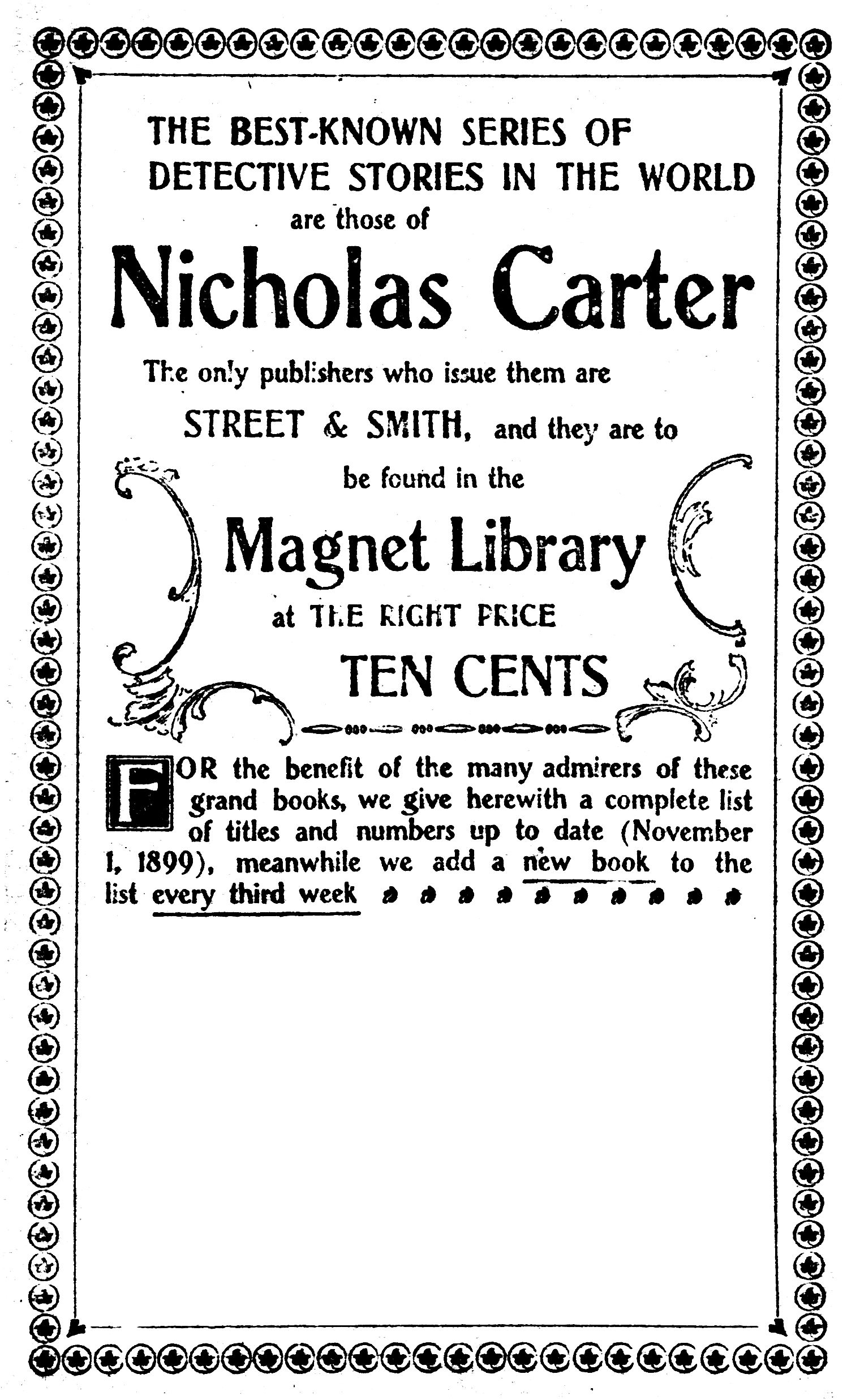
THE ONLY STANDARD LINE OF DETECTIVE
NOVELS ON THE MARKET.
THE ONLY NICK CARTER STORIES IN BOOK FORM
AND THE BEST OF OTHER WRITERS’ WORK.
Price, Ten Cents.Published Weekly.
105—A Bite of An Apple, and Other Stories. By Nicholas Carter.
104—A Past Master of Crime; or, Detective Bush’s Clever Work. By Donald J. McKenzie.
103—A Queer Case. By Nicholas Carter.
102—Bruce Angelo, the City Detective. By Judson R. Taylor.
101—The Stolen Pay Train and Other Stories. By Nicholas Carter.
100—The Diamond Button. By Barclay North.
99—Gideon Drexel’s Millions. By Nicholas Carter.
98—Tom and Jerry, The Double Detectives. By Judson R. Taylor.
97—The Puzzle of Five Pistols and Other Stories. By Nicholas Carter.
96—No. 13 Rue Marlot. By Rene du Pont Jest.
95—Sealed Orders; or, The Triple Mystery. By Nicholas Carter.
94—Vivier; of Vivier, Longman & Co., Bankers. By Barclay North.
93—The Adventures of Harrison Keith, Detective. By Nicholas Carter.
92—Van, the Government Detective. By Judson R. Taylor.
91—The Great Money Order Swindle. By Nicholas Carter.
90—On the Rack. By Barclay North.
89—The Detective’s Pretty Neighbor and Other Stories. By Nicholas Carter.
88—The North Walk Mystery. By Will N. Harben.
87—Nick Carter and the Green Goods Men.
86—Brant Adams. By Judson R. Taylor.
85—A Dead Man’s Grip. By Nicholas Carter.
84—The Inspector’s Puzzle. By Charles Matthew.
83—The Crescent Brotherhood. By Nicholas Carter.
82—The Masked Detective. By Judson R. Taylor.
81—Wanted by Two Clients. By Nicholas Carter.
80—The Poker King. By Marline Manley.
79—The Sign of the Crossed Knives. By Nicholas Carter.
78—The Chosen Man. By Judson R. Taylor.
77—The Van Alstine Case. By Nicholas Carter.
76—Face to Face. By Donald J. McKenzie.
75—The Clever Celestial. By Nicholas Carter.
74—The Twin Detectives. By K. F. Hill.
73—Two Plus Two. By Nicholas Carter.
72—Sherlock Holmes Detective Stories. By A. Conan Doyle.
71—The Diamond Mine Case. By Nicholas Carter.
70—Little Lightning. By Police Captain James.
69—Detective Bob Bridger. By R. M. Taylor.
68—The Double Shuffle Club. By Nicholas Carter.
67—The Mystery of a Madstone. By K. F. Hill.
66—The Detective’s Clew. By O. L. Adams.
65—Found on the Beach. By Nicholas Carter.
64—The Red Camellia. By Fortune DuBoisgobey.
63—The Chevalier Casse-Cou. By Fortune DuBoisgobey.
62—A Fair Criminal. By Nicholas Carter.
61—The Maltese Cross. By Eugene T. Sawyer.
60—A Chase Around the World. By Mariposa Weir.
59—A Millionaire Partner. By Nicholas Carter.
58—Muertalma, or the Poisoned Pin. By Marmaduke Dey.
57—The Vestibule Limited Mystery. By Marline Manly.
56—At Thompson’s Ranch. By Nicholas Carter.
55—His Great Revenge, Vol. II. By Fortune DuBoisgobey.
54—His Great Revenge, Vol. I. By Fortune DuBoisgobey.
53—An Accidental Password. By Nicholas Carter.
52—The Post Office Detective. By George W. Goode.
51—The Los Huecos Mystery. By Eugene T. Sawyer.
50—The Man from India. By Nicholas Carter.
49—At Odds With Scotland Yard. By Nicholas Carter.
48—The Great Travers Case. By Dr. Mark Merrick.
47—The Mystery of a Hansom Cab. By Fergus Hume.
46—Check No. 777. By Nicholas Carter.
45—Old Specie, the Treasury Detective. By Marline Manley.
44—The Blue Veil. By Fortune Du Boisgobey.
43—Among the Nihilists. By Nicholas Carter.
42—The Revenue Detective. By Police Captain James.
41—John Needham’s Double. By Joseph Hatton.
40—The Mountaineer Detective. By C. W. Cobb.
39—Among the Counterfeiters. By Nicholas Carter.
38—The Matapan Affair. By Fortune Du Boisgobey.
37—The Prairie Detective. By Leander P. Richardson.
36—The Crime of the Opera House, Vol. II. By F. Du Boisgobey.
35—The Crime of the Opera House, Vol. I. By F. Du Boisgobey.
34—The Society Detective. By Oscar Maitland.
33—The Convict Colonel. By Fortune Du Boisgobey.
32—A Mysterious Case. By K. F. Hill.
31—The Red Lottery Ticket. By Fortune Du Boisgobey.
30—The Bag of Diamonds. By George Manville Fenn.
29—The Clique of Gold. By Emile Gaboriau.
28—Under His Thumb. By Donald J. McKenzie.
27—The Steel Necklace. By Fortune Du Boisgobey.
26—File No. 113. By Emile Gaboriau.
25—The Detective’s Triumph. By Emile Gaboriau.
24—The Detective’s Dilemma. By Emile Gaboriau.
23—Evidence By Telephone. By Nicholas Carter.
22—The Champdoce Mystery. By Emile Gaboriau.
21—A Deposit Vault Puzzle. By Nicholas Carter.
20—Caught in the Net. By Emile Gaboriau.
19—A Chance Discovery. By Nicholas Carter.
18—The Gamblers’ Syndicate. By Nicholas Carter.
17—The Piano Box Mystery. By Nicholas Carter.
16—A Woman’s Hand. By Nicholas Carter.
15—The Widow Lerouge. By Emile Gaboriau.
14—Caught in the Toils. By Nicholas Carter.
13—The Mysterious Mail Robbery. By Nicholas Carter.
12—Playing a Bold Game. By Nicholas Carter.
11—Fighting Against Millions. By Nicholas Carter.
10—The Old Detective’s Pupil. By Nicholas Carter. 9—A Stolen Identity. By Nicholas Carter. 8—An Australian Klondike. By Nicholas Carter. 7—The American Marquis. By Nicholas Carter. 6—A Wall Street Haul. By Nicholas Carter. 5—The Crime of a Countess. By Nicholas Carter. 4—Tracked Across the Atlantic. By Nicholas Carter. 3—A Titled Counterfeiter. By Nicholas Carter. 2—The Great Enigma. By Nicholas Carter. 1—A Klondike Claim. By Nicholas Carter.
STREET & SMITH, Publishers, 238 William St., New York.
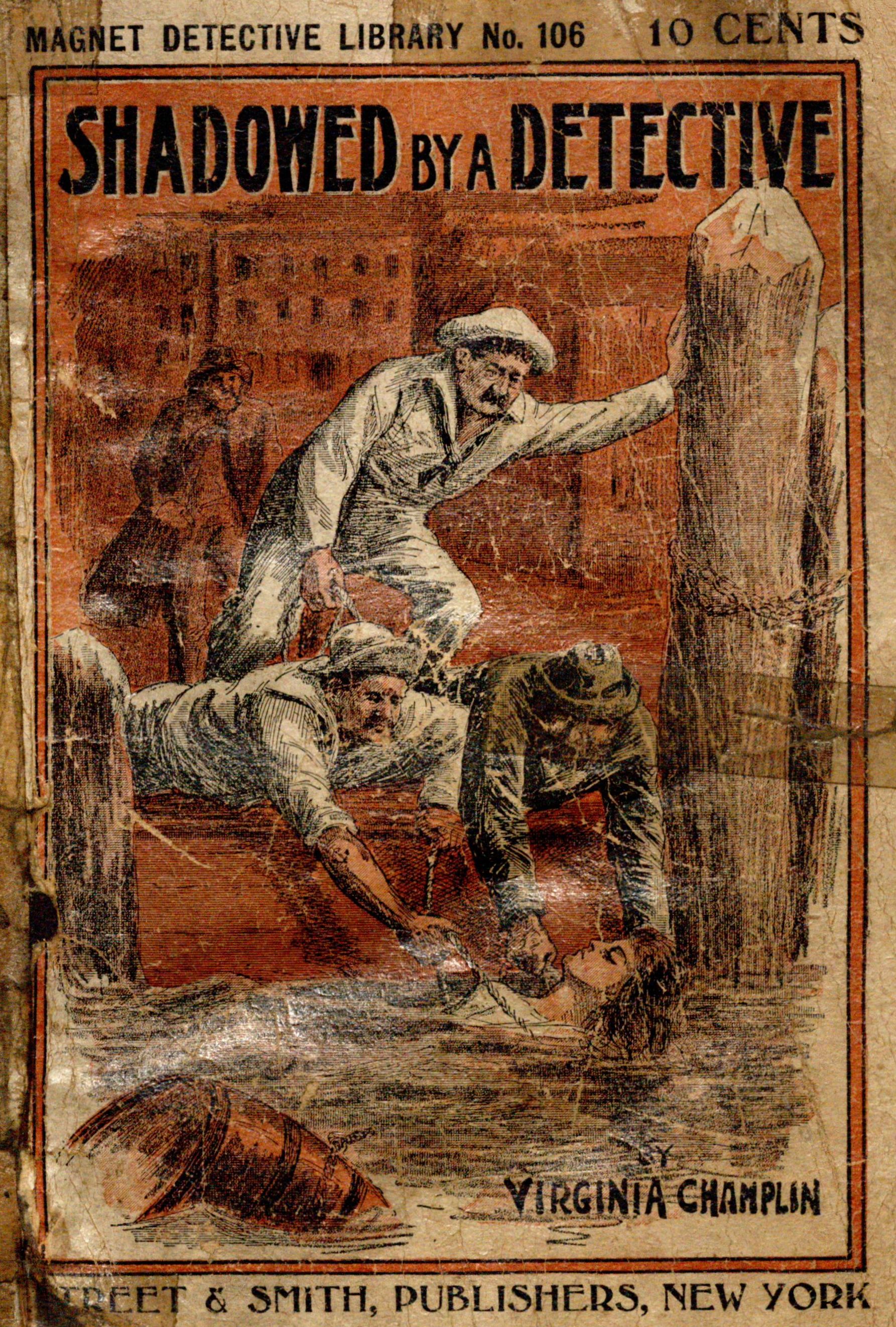
To the Reader — SHADOWED BY A DETECTIVE
We trust that you will be thoroughly
satisfied with this book.
During the long period of
time that the publications of Street &
Smith have been familiar to the reading
classes (somewhat more than half a
century) it has always been our aim to
give to the public the very best literary
products, regardless of the expenditure
involved. Our books and periodicals
are today read and re-read in a majority
of the homes of America, while
but few of our original competitors are
even known by name to the present
generation. No special credit is due for
antiquity, but we hold it to be a self-evident
fact that long experience,
coupled with enterprise and the ability
to maintain the front rank for so many
years, proves our right to the title of
leaders. We solicit your further valued
patronage.
STREET & SMITH.
OR
THE WOMAN IN WAX
BY
VIRGINIA CHAMPLIN
NEW YORK STREET & SMITH, Publishers 238 William Street
One evening, in the winter of 1865, a grand ball
was given at No. 17 East Twenty-third Street. It
was at the house of Miss Ada Ricard, the new star
in the great American city, but a star whose brilliancy
the profane knew only by reflection, for her
life was enveloped in mystery, and she was never
seen in any public place.
All that was known of her past was that she had
been married to a wealthy merchant in Buffalo,
James Gobson, a brutal individual, whose matrimonial
yoke she had succeeded in throwing off, but
who had left her certain ineffaceable souvenirs of
his affection.
Gobson, in fact, who adored his wife, and was
very jealous of her, had one day so abused her that
after the violent scene she was left with one ear
torn and one tooth the less. It is true she concealed
the cut on her pretty ear behind a huge diamond,
but she had always refused to replace the pearl
lacking in the jewel casket of her rosy lips.
“By this,” she said, “I shall never be likely to
forget what a husband costs, and if any mad ambition
or foolish love is about to make me forget it,
it will be sufficient to smile at myself in the glass to
recall the past.”
Thus armed against her own weakness, she boldly
launched herself into a life of flirtations. Being
worth from ten to twelve thousand dollars through
her husband, she made her debut by expending
them even to the cents in order to establish herself
in luxurious surroundings, knowing that men, in
their pride, attach as much value to the splendor of
the temple as to the charms of the idol.
Having done this, and having her beauty as her
only capital, she was careful not to waste it on the
first comer; she waited patiently, seldom showing
herself abroad, absolutely refusing all homage until
a certain Thomas Cornhill, the proprietor of inexhaustible
oil wells, seemed worthy of her heart.
Unfortunately, three months after, Thomas Cornhill
suddenly died, and Miss Ada, though bereft,
was left with one hundred thousand dollars in ready
money, and an equal sum in jewels.
Ada mourned him for a few weeks; then, having
an essentially practical mind, she changed her retinue
of servants before the advent of Willie
Saunders, an immensely rich cracker-merchant,
who soon succeeded poor Cornhill.
When Willie Saunders found his homage accepted,
he was greatly flattered. He was a stout man
of about fifty, sensitive, simple and vain. He truly
adored Ada, and believed himself tenderly beloved
by her. Therefore, ready to listen to all her caprices,
he made only a few remarks for form’s sake
when she told him about the masquerade ball she
wished to give, but he was very jealous. He knew
Ada was sought by many adorers, among whom
was a certain Edward Forster, a colonel in the
Union Army, and one of the most fascinating gentlemen
in New York high life.
However convinced the worthy cracker-merchant
might be of Ada’s love, he naturally supposed that
her adorers, Forster first of all, would profit by this
evening to pay her more attention than agreeable
to himself, and it troubled him. But the pretty,
wicked little creature managed so artfully that
Saunders did not long resist.
Besides, she was a wonderful creature, and the
upstart-millionaire had high stakes to play for. A
blonde, with large, steel-blue eyes and a tall, admirable
figure, with the feet and hands of a child;
with a laughing mouth, bold-faced, and fearing
nothing, Ada Ricard had every attraction to lure
the man of the world. The memory of her former
husband sometimes disturbed the young woman in
her new life. Having retained the recollection of
his brutal love and jealousy, she also remembered
with terror that he swore to avenge himself for her
leaving him. But, since arranging the money settlements,
she had not heard of him, and even his
friends in Buffalo did not know what had become
of him. One fine morning he made a fortune, and
went West. He was last heard from at San Francisco,
where Saunders told her he was living a fast
life, evidently trying to drown recollection.
Ada’s mind was now at rest, and never had she
been so gay as at the masked ball. Many women
in good society had ventured to attend in order to
get a near view of the mysterious and powerful
beauty.
Toward eleven o’clock the parlors of the ex-Mrs.
Gobson presented a truly picturesque appearance.
Every period, every class of society, and every legend
were represented, from the companions of Christopher
Columbus to the trappers of the far West, and
from Mephistopheles to the Venetian harlequin.
Among the women there was a dazzling display of
precious stones and dominos of every color. Ada
Ricard herself wore the splendid costume of an Indian
woman of the time of the Spanish conquest.
In her ears she had diamonds worth ten thousand
dollars, around her throat a triple necklace of pearls
of at least equal value, and on her arms and wrists
very heavy bracelets of massive gold.
All the men who knew her only by sight, and the
women who had heard so much of her, literally devoured
her with admiring eyes. Saunders, who was
to give five or six thousand dollars toward this ball,
did not take his eyes off of her.
Looking very grotesque in the dress of a Highlander,
he tried every moment to draw near her,
but Ada reminded him by a word, look or gesture
that she wished to devote herself wholly to her
guests, and he docilely moved away, uttering a sigh
which was charitably answered by bursts of laughter
by those of his friends who were acquainted with
his weakness.
The ball, which had been rather quiet for two
or three hours, had become very lively, even noisy.
Soon the buffets were pillaged, the champagne
flowed in streams; a few masks fell off, and Miss
Ada Ricard, readily refraining from reminding her
guests of what was good form—for all this noise
could only do the greatest honor to her reputation—thought
only of getting away as far as possible from
the hubbub.
She had just taken the arm of one of her adorers
instead of that which the unfortunate Saunders had
offered, and was proceeding toward a little boudoir
where some quiet people had taken refuge, when a
formidable hurrah caused every head to turn toward
the door.
It was the entrance of three Sioux Indians that
had excited the enthusiasm of the company.
They indeed deserved this reception, for they
were really superb in their horribly truthful costumes,
in which nothing was lacking, neither the
head-dress of feathers, the tomahawk, nor scalping-knife,
nor even in the belt, half a dozen scalps, sinister
trophies of late raids.
Ada Ricard turned and added her applause to that
of the company; then, like them, she tried to recognize
those who had chosen this curious disguise; but
she did not succeed.
No doubt, not caring particularly to tattoo their
faces, the three mysterious personages wore masks
which wholly concealed their features, and to every
question they answered only with guttural cries and
exclamations which completely changed their voices.
After opening a passage through the crowd, they
reached the mistress of the house, and, drawing her
away from the friend who was accompanying her,
they began to perform around her in a circle a fantastic
dance which gradually brought her to the
main hall.
Supposing, like every one else, that the Sioux Indians
were three admirers, Ada gayly watched their
contortions and dance, and was the first to burst
into laughter, when the tallest of the three masks
seized her in his arms and, lifting her as if a child,
bore her to the threshold of the door.
Standing before her captor, his two companions
chanted a war-song and swung their tomahawks as
if to protect his flight.
One would have thought him a great chief carrying
away his squaw according to the customs of the
Indians of the plains.
This joke was so thoroughly American that the
crowd accepted it with ringing bravos.
Suddenly the warrior who bore the young woman
faced about and, leaping with one bound, sprang
out upon the steps of the house, whose doors were
wide open, and then into a splendid landau which
was standing before the door.
The two Indians who had followed him had
quickly climbed the box, and the carriage, the
coachman no doubt having received his orders, immediately
set off at a double-quick gallop.
This kidnapping had been so quickly performed,
that no one would have had time to prevent it if
they had attempted it.
Of Ada Ricard’s guests, moreover, not one had
thought seriously of it excepting the unhappy Saunders,
whose jealousy, always on the watch, made
him think the conduct of the three masks very
queer.
He attempted to approach Ada Ricard, but his
friends restrained him in spite of his grotesque supplications;
and, when she disappeared in the arms of
the Indian, he hastened to the balcony of the house,
where the enthusiasm reached delirium on the departure
of the carriage.
A tremendous hurrah covered the silvery laugh of
Miss Ada when she found herself being enveloped in
the fur pelisse which one of the Sioux had flung
over her shoulders, and the unfortunate cracker-merchant,
who was dragged away from the balcony,
had immediately become the pivot of a comical
dance in the middle of the drawing-room.
What no one heard, was the cry of amazement or
fright uttered by Miss Ada Ricard the moment the
carriage rattled along the pavement of East Twenty-Third
Street.
CHAPTER II. WHAT BECAME OF THE HEROINE.
When the friends of Mr. Saunders, exhausted by
their war-whoops and dancing, deigned to grant a
little respite to their victim by opening the circle
which they had pitilessly formed around him, the
big man, half-crazed and breathless, sank upon a
lounge, listening absently to those who were trying
to console him. He not only suffered through his
love, but his vanity was equally wounded, for he did
not doubt that his misfortune would be known all
over New York the next day, and that he would become
an object of public ridicule. It seemed to him
that Ada must have connived with her kidnappers,
being too blind to suppose that violence had been
done her. But who were those men with whom
the unfaithful woman had consented to be an accomplice
in the scene that covered him with ridicule?
For whose benefit had this kidnapping been made?
For one of her adorers, no doubt, but which one?
He was so completely absorbed in his meditations
and despair that he did not perceive that the guests
were disappearing one by one, and only the voice of
Ada’s maid brought him to himself.
He raised his eyes, the parlors were deserted, and
he was left alone in the room from which the
woman he loved had so strangely disappeared.
On recognizing Ada’s maid, he felt the satisfaction
of a man whose anger, long restrained, can at
last vent itself on some one.
“Ah! you at least can explain to me what all
this means,” he cried, springing up and seizing the
maid by the arm.
“I!” answered Mary, somewhat alarmed, and
trying to disengage herself from Saunders’ grasp.
“I! how should I know any more than you?”
“Did you not recognize those masks?”
“I saw them only while they were carrying off
madam.”
“Did not Ada receive any letters during the day?”
“None whatever.”
“Nor a call?”
“You know very well that she receives only you.”
“Then you have no cause for suspicion?”
“None.”
“It is incredible. Your mistress and you are two
cheats.”
Saying this, the merchant gave Mary a push, and,
having arisen as quickly as his corpulence would
permit, strode up and down the parlor.
At the very grotesque contrast between the disturbed
face of the stout man and his Highland costume,
whose short frock displayed his large bare
legs, the maid could no longer restrain herself and
burst into laughter, crying:
“Heavens, sir! how droll you look. If madam
could see you what fun she would have.”
Made furious by this remark, which turned the
dagger round and round in his wound as if with
delight, Saunders approached the insolent girl to
strike her; but he probably felt that he would gain
nothing by threats and violence, for he suddenly
softened and said:
“Come, my little Mary, be good now. Haven’t I
always been kind to you? If you will tell me
where madam has gone I will give you one hundred
dollars.”
“If you were to give me one thousand dollars,”
answered the maid saucily, “I could not give you
exact information, for I know nothing myself; but
give me the one hundred dollars all the same and I
will tell you something that will comfort you.”
The love-sick merchant quickly drew out of the
little leather bag that danced upon his stomach,
from his Scotch wallet, the sum demanded, and
handed it to Mary, who took it, slipped it into her
corsage, and continued:
“Do you know, sir, that I have an idea that this
affair was done on a wager. You know how many
are in love with madam, but she loves you too
much to deceive you, and has always refused the
most splendid offers. Three of her admirers, therefore,
wished to avenge themselves upon her and you,
and so have carried her off. It won’t accomplish
much, for you know madam isn’t a woman to be
made to do what she does not wish. They, no
doubt, have taken her into some house in the
neighborhood, from which she will find a way to
escape if they try to retain her by force. Before
noon she will be back here.”
“Yes, you are right,” said Saunders, somewhat
consoled; “that is how it will be; but I swear to
you that they shall pay for this joke. Suppose I go
and notify the police?”
“Are you crazy? Madam will be back before
a detective can find a trace of her. I should not be
astonished if Forster was at the bottom of it.”
“Colonel Edward?”
“That’s the man. He is dead in love with
madam, although she never would receive him.”
“I will go to his house at once.”
“That would be absurd, for it certainly is not to
his own house that he has taken Miss Ada.”
“What shall I do then?”
“Go to bed and rest, but change your dress first.
You don’t intend, I suppose, to walk around in that
costume all day,” and Mary, to prevent herself from
laughing again, bit her lips until they bled.
“Of course not,” he answered, glancing into the
mirror which gave him back his burlesque image;
“but you must send me word as soon as Ada
returns.”
“I promise you.”
“Then send for a carriage.”
Mary hastened to send one of the servants to the
nearest carriage stand, and a few moments later,
after giving a thousand commands to the young
girl, the poor lover carefully wrapped in his cloak,
and heaving the loudest of sighs, sank back out of
sight in a corner of the carriage.
“Fool!” muttered Mary for farewell, as Saunders
disappeared from sight; “if you see your
lady-love to-day I shall be greatly surprised.”
And without taking notice of what was passing
below-stairs, where the festivity that had been interrupted
in the parlor was being noisily continued,
the servant re-entered Ada Ricard’s apartments and
shut herself in.
During the scenes we have just described, the
landau that bore away the young woman, on leaving
Twenty-third Street turned to the left, and
proceeded along First Avenue toward the eastern
part of the city.
The deepest silence had not ceased to prevail inside
of the carriage, and it had been rolling on half
an hour when the coachman suddenly stopped his
horses.
The neighborhood was dark and silent.
The two Indians, who had mounted the box,
sprang down upon the sidewalk, exchanged a few
words with the mask, by the side of which still sat
Miss Ada, and then, darting toward a neighboring
narrow street, vanished in the darkness.
The landau resumed its course, and soon reached
the first houses of Yorkville, a locality of bad repute,
where in miserable shanties was huddled a
large population, mostly composed of Irish.
It was the retreat of innumerable pickpockets,
malefactors and rag-pickers of the great American
city, and is attached to one side of it like an incurable
leper. Honest people hardly dare venture,
even in daylight, through this horrible locality,
which extends to the banks of the East River,
almost opposite Blackwell’s Island, where the prisons
and hospitals are.
Having reached the entrance of Yorkville the
carriage stopped a second time, the man who was
inside alighted, bearing in his arms the young
woman whom, with an oath, on account of the bad
weather, he informed that they had at last arrived.
He gave an order to the coachman, and the latter,
turning his horses, drove back at a gallop. As for
the unknown man, still laden with his precious
burden, he walked rapidly to a lane a few steps
distant.
The place was evidently familiar to him, for without
hesitating a moment, although it was very dark,
he reached a small house, the door of which was
opened at his first touch, and which he quickly
closed behind him.
In less than a quarter of an hour the same person
reappeared in the street, wearing a large hooded
cloak, which concealed his previous disguise, but he
no longer carried his lady companion. She was
walking at his side, choosing as well as she could
in the darkness the cleanest places on the sidewalk,
and drawing her furs closely around her, for the
night was chilly. They walked thus in the direction
of the East River without exchanging a word.
Soon they reached the banks, which were deserted,
there being nothing to be seen but the lights of the
steamboats which ploughed its waters night and
day.
The unknown descended to the edge of the water
to a little boat which, no doubt, he expected to find
there, jumped in first, then offered his hand to the
young lady, who embarked without hesitation, and
seated herself in the stern, while her companion
took possession of the oars. Ten minutes later, by
skilful rowing, the boat drifted along Blackwell’s
Island, then, bearing to the left, moved to the
opposite bank. In order to row at his ease, the
amateur sailor had thrown off his cloak. The persons
in this boat made a fantastic sight, being composed
only of an Indian and a woman in the costume
of the time of the Incas, and who at this hour
of the night were crossing this arm of the sea, on
which the current and darkness rendered navigation
doubly dangerous.
The lady was evidently anxious, for she tried to
peer through the fog that surrounded her. Unable
to do so, she finally asked her companion:
“Have we long to wait?”
“Less than half an hour,” he answered, with
a vigorous stroke at the oar, and pushing away
from a steamer that was going to New York,
at full speed, and belching forth smoke and cinders.
“What was your idea in coming this way?”
“There is no other; the colonel appointed the
opposite shore, at Greenpoint.”
“Then he was quite certain that you would
succeed?”
“So it seemed. Confess, however, regardless of
the pride of the author, that it was a skilfully
managed kidnapping.”
“Indeed, it was; but Saunders will be seeking us
to-morrow, and, although you paid the coachman
well, he will pay him more generously still, and the
man will not hesitate to tell where he stopped his
carriage.”
“That is the least of my anxieties, for when the
fat imbecile discovers the house we came out of, he
will find no one in it. Do you think I am going
back there to wait for him?”
“Where is Colonel Forster to take me?”
“Ah! that is his affair and yours. He promised
me a thousand dollars if I would carry off Ada
Ricard, with whom he is madly in love.”
“Without having seen her?”
“So it seems. I have carried off Ada Ricard. I
shall get my thousand dollars, and the rest does not
concern me.”
“I cannot, however, remain in this costume.”
“Oh! the colonel is a perfect gentleman; he will
have a complete wardrobe for you, I am certain.
Look! there are the lights at Williamsburg. In
ten strokes of the oar we shall arrive.”
In fact, ahead of the boat the lighted buildings of
that important suburb of New York were plainly
seen. The boatman bent over his oars, and in five
minutes they touched the shore at Greenpoint.
Before disembarking the mysterious man gave a
shrill whistle, which was immediately answered by
one like it.
“Come,” he said to the young woman, and jumping
out on the bank he helped her to reach the
ground. Then, taking her by the hand, he led her
to the road, where shone the light from the lanterns
of a carriage.
“Is it you?” asked a man keeping guard.
“It is I, colonel,” answered the Indian; “all has
passed off well; Miss Ada has not been very dreadfully
shocked.”
“Oh! madam,” said Colonel Forster eagerly, for
it was he who came to meet her, “will you forgive
me for this violence?”
“I cannot tell you at present, sir,” answered the
young woman, “for just now I detest you. You
must confess that it was a brutal proceeding, a
veritable kidnapping from the midst of my guests,
who, the simpletons, thought it only a carnival joke.
At first I was greatly frightened, and now I am
frozen.”
“Let us go at once to my coupe; later I will
make my excuses and will repair all my wrongs.”
“What! your coupe. Where are we going?”
“On board of my yacht, which is waiting for us
at Brooklyn; afterwards wherever you wish.”
“Excepting to my house?”
“Excepting to your house,” repeated the American
officer, gallantly.
While exchanging these words all three had
reached the carriage, the horses of which were
stamping impatiently.
The colonel helped the pretty New Yorker to
enter, and after seating himself by her side, said to
the pseudo-Indian, holding out a portmonnaie:
“Here is what I promised you; remember, not a
word. You know that if I have Saunders or the
police at my heels, I shall be after you; whereas, if
you are discreet I shall have the same sum at your
disposal again.”
“Count on me, colonel,” said the stranger; “it is
for my interest to be silent.”
Then, as he closed the door, he added: “Tell
me, Miss Ada, have you not some commission to
give me for Twenty-third Street? Your people, perhaps,
are anxious.”
“No, it is useless,” answered the strange woman;
“I shall write to my maid to-day to ask for what I
need. I have confidence in her. Besides, I hope the
colonel will not keep me a prisoner long.”
The officer protested against this supposition, looking
affectionately at his companion.
“Then, all right; a pleasant journey to you,”
said the Indian, finally, closing the door of the
coupe, and the coachman immediately started the
horses.
Quickly regaining the river, the Indian sprang
into his boat, which he pushed off, and returned in
the same direction by which he had come a few
moments before.
Meanwhile Edward Forster’s carriage was crossing
Williamsburg and moving toward Brooklyn,
which it reached in less than twenty-five minutes.
The colonel employed the time on the road in
making a thousand protestations of love, which his
companion hardly answered. When the coupe
finally stopped at the Brooklyn wharf, he was ten
steps off from a large yacht which was evidently
waiting for passengers, for it was under steam.
“We have arrived, Miss Ada,” said Forster;
“come.”
He had sprung to the ground and offered his arm
to help her cross the planking between the yacht
and the wharf.
“Have you the right pressure?” he asked the
officer who had appeared at the coupe to receive him
on board.
“Yes, colonel,” was the answer.
“Then set sail at once, and go by the way of
Staten Island.”
Having given his orders, Forster gently led his
victim to the stairs opening to the interior of the
boat. A few moments later he escorted her to a
spacious, delightfully-furnished cabin, and said to
her as he knelt before her:
“Miss Ada, you are even more beautiful than I
dreamed; tell me that you forgive me.”
Ada had seated herself on a lounge, and her fur
cloak had fallen from her shoulders. The colonel
gazed at her in admiration. He was a very handsome
young man, and one could easily understand
the jealousy with which he had inspired the stout
Saunders. Hardly thirty-five years old, a blonde
with a slender figure, both elegant and robust, he
was a true representative of the Anglo-Saxon race.
Besides he had a great fortune and was one of
the most distinguished officers in the Union Army.
It was this, probably, which influenced her, for
after a moment’s silence she decided to answer
him with a smile.
“I think, colonel, it is time to come to an explanation.
You have carried me off. That is a very
military proceeding; now what are you going to do
with me?”
“Make you the happiness of my life,” interrupted
Forster. “You know that I adore you.”
“That is a matter of course; but how came you
to conceive such a wild plan? It cannot be simply
because I refused to receive you.”
“You had not been in New York a fortnight before
I loved you, and Cornhill did all that he could
to rouse everyone’s curiosity and to increase my love
for you. He belonged to my club, and not a day
passed that he did not talk to us about your wit and
beauty. From that moment dates my first efforts
to meet you; but, you remember, I hardly had an
opportunity after two or three attempts to catch a
glimpse of you and speak to you a few seconds.
When Cornhill died I was absent from New York.
I went to Louisiana on a commission, which I cursed
on my return when I knew that Saunders was devoting
himself to you, and to seek a quarrel with
him, when he did not belong to my set in society,
would have made me ridiculous.”
“You were afraid of a scandal.”
“True, not knowing what to do, for I felt that
every day I was loving you more; I should certainly
have committed some folly, for you did not
answer my letters, and your door was pitilessly
closed to me, when one morning a man whom I did
not know came to propose that I should carry you
off and bring you on board my yacht. I confess
that I did not for an instant trouble myself as to how
the man had learned of my love for you; I saw
only the end to be attained. He spoke to me with
such assurance that I accepted his offer: we agreed
upon the condition. I promised him a certain sum
if he should succeed, and the same if he would keep
silent. He has succeeded; that is why we are this
moment descending the East River, and why I am
at your feet asking your forgiveness and begging
you to forgive me.”
“We will talk about it at another time.”
“I have obtained a three months’ leave from the
Secretary of War, and I have told my family that I
should be absent on a trip to the South.”
“The plan is perfectly arranged; it lacks only my
consent.”
“It is late to refuse me that.”
“Do you think so?”
“I hope so.”
“What of poor Saunders?”
“Oh! I beg you, don’t mention his name.”
“You know that he will kill you when he learns
what has happened.”
“That would not be a misfortune unless he
killed me before you make me happy by loving
me.”
Ada could not resist this chivalrous sally of the
colonel. She answered by holding out her two
little hands, which he pressed warmly in his own.
“Well, I am conquered. We will shake hands;
no one could have done more brusquely or more
gallantly. But I cannot remain in this carnival
dress.”
“I foresaw that,” answered the colonel, rising;
“you will find there,” pointing to a cabin, the door
of which was partly open, “all that you need. If
anything is wanting we can send one of my men to
New York for it tomorrow.”
“Really, you are charming,” answered the young
woman, with a smile. “I will join you in a moment.”
“While waiting for you, I shall order supper.
You must be dying of hunger.”
“Truly, I am. You forget nothing,” saying which
she disappeared in the adjoining cabin.
In less than a quarter of an hour she returned,
attired in a lovely robe of blue silk. They seated
themselves at a table, delicately served, and Colonel
Forster, as a prelude to the repast, gave an ardent
toast to the beauty of his passenger.
The yacht was steaming out into the main roads,
and all this time the unhappy Saunders, who had
settled down in his own home and divested himself
of his Highland costume, was in the depths of despair,
wondering what could have become of his
beloved Miss Ada Ricard.
CHAPTER III. ROBERTSON BROTHERS & CO.
Notwithstanding his chagrin, the Hon. Saunders
finally succumbed to fatigue and fell asleep. When
he awoke—toward one o’clock in the afternoon—and
his valet told him that no caller or letter had
come, he sprang from his bed, dressed in haste, and,
without allowing himself more for breakfast than
about a dozen sandwiches, washed down by half a
dozen cups of tea, he jumped into a cab, ordering
the driver to stop at No. 17 East Twenty-third Street.
Ten minutes later he arrived.
“Is there any news?” he asked the servant who
opened the door.
“Nothing, sir,” answered the man, who would
have been greatly embarrassed to have been obliged
to deliver a longer sentence, for he was still half intoxicated
on account of the festivity of the evening
before. Saunders quickly ascended the first flight,
and found Mary in Ada’s apartment. She was
quietly arranging dresses and linen.
“Well,” he asked, sinking into an arm-chair, “so
madam has not returned?”
“No,” replied the maid; “but I have heard from
her.”
“And you did not tell me at once.”
The stout merchant made a movement as if to
rise.
Mary stopped him with a gesture, saying—
“Oh, sir! it is because the news will not afford
you much pleasure.”
“What—what is the matter? Nothing has happened
to madam? But tell me; you make my
blood boil.”
“Not more than a quarter of an hour ago I received
a letter from Miss Ada. Here it is.”
Saunders tore from the maid’s hands the letter she
held out to him, and, after reading it, uttered an
angry cry. The letter contained five lines only,
but they were enough to drive the loving Yankee
mad.
“My good Mary,” she said, “put the house in
order, dismiss the servants, giving each a fortnight’s
extra pay, and wait for me patiently. I shall be absent
a month, at least; perhaps two or three. I
rely upon you—Ada Ricard.”
“What does all this mean?” he cried, at last,
when he had recovered his speech.
“I know no more than you, sir,” answered the
maid. “You see I am fulfilling madam’s orders.”
“And not a word for me,” groaned the unhappy
man, crushing in his hand the cruel letter. “Ah!
the cheat shall pay for it. Who brought the note?”
“An unknown messenger, who must belong to
another neighborhood.”
“Didn’t you ask where he came from?”
“He spoke to the cook and immediately left. His
errand was no doubt paid for in advance.”
Saunders buried his face in his big hands and
murmured—
“O, yes, I will avenge myself, but how?”
Mary, shrugging her shoulders, had resumed her
work.
An excellent idea evidently was suddenly working
in the troubled mind of the cracker-merchant, for,
rising abruptly, and without addressing a word to
the unfeeling servant, he left the room and house
of his faithless Ada.
“To the central office of the police,” he ordered
as he climbed into his carriage. The chief of the
metropolitan police was at that time a Mr. Kelly,
who was always spoken of as “Fat Kelly,” a very
large, churlish man, often rough but quite intelligent,
and possessing besides all the scepticism indispensable
to his important duties. Saunders sent
in his card, but Fat Kelly, before receiving him,
rang for one of his secretaries in order to obtain
some information about his visitor. Five minutes
later this clerk handed his chief a note as
follows:
Willie Saunders, wealthy cracker-merchant, vain,
of ordinary intelligence, very much smitten with a
woman, Ada Ricard, on whom he has already lavished
$100,000 or more. Willie Saunders is worth at
least a million and a half.
“Very well, show him in,” ordered the chief of
police, after becoming acquainted with this not very
flattering document, of whose existence Saunders
was certainly ignorant.
Summoned by an office boy, the unfortunate merchant
plunged like an avalanche into Mr. Kelly’s
private office.
The latter gentleman could not conceal the pleasant,
spontaneous smile which wreathed his lips
at the sight of a man almost as stout as he; but,
his nature gaining the ascendancy, he hastened to
say in a curt tone to the grotesque individual:
“What do you wish? Be quick, I have a load of
business on hand.”
Without being greatly disconcerted—for he was
so completely absorbed in his own anxieties that he
heeded nothing—Saunders answered:
“I have come, sir, to request your most powerful
protection; I am the victim.”
“Of a theft? Where, how? Of what sum? Is
the guilty man, or him you suppose guilty, one of
your employes?”
“No sir; I——”
“So much the better, for theft by anyone in your
pay is an aggravating case.”
“But, sir, it is not a case of theft.”
“Ah! What is it then?”
“Kidnapping, sir; real kidnapping.”
“They have carried off your wife, your daughter?”
“I am not married.”
“Who, then? Your mother, or your sister, or
your cousin, or your aunt? Devil take it, do be
precise. I can’t guess and enumerate all your
family.”
“They have carried off my Ada.”
“Your Ada, who has had your hundred thousand
dollars, and who, of course, deceives you.”
“Sir, are you acquainted?”
“And who has carried off this interesting person?
One of her lovers? What do you wish me to do?
There has been no violence.”
“Oh, yes; on the contrary.”
“No; it is improbable, inadmissable; consequently
I can have nothing to do with your affair. I
wish you a very good day. Go and make your
claims for Miss Ada elsewhere. What have I to do
with such matters? You are wealthy; this lady
will return to you some day, be sure of it. And
you will receive her, and she will make you believe
anything she wishes, and you will ask her pardon.
You are all great fools, one as much as the other.”
And Fat Kelly, drawing a bundle of papers toward
him, began to turn them over in furious haste, without
paying further attention to his visitor.
Saunders, in spite of his moderate intelligence, as
the descriptive document stated, understood that he
would obtain nothing from the chief of the police,
and without bowing, which did not disturb the
latter at all, but deeply humiliated, and grumbling
aloud with a freedom wholly American, he left the
office of the intractable police officer. But when
he reached the threshold of the administrative
office where he thought to find assistance and protection,
he questioned himself as to what he should
do, and perhaps he was about to decide to go to
Colonel Forster’s house, when an individual accosted
him and said politely:
“You seem greatly annoyed, sir.”
“What is that to you?” was the gruff answer.
“Why,” replied the unknown, without being
ruffled by this cool reception, “because if you did
not obtain the information you desire from the
central office, I might be able to give it to you.”
“You?”
“Or at least the important house of Robertson
Brothers & Co., of which I have the honor to be
one of the head clerks.”
“The house of Robertson & Co.?”
“Yes, sir, the most honorable, most discreet, and
the safest agency——”
Saunders, the stout, tapped his forehead; he
understood.
The man who was addressing him was simply
one of those ferrets by whom the informing
agencies scour the city. The most skilful of all
its rivals, the house of Robertson Bros. & Co.,
always had one of its men standing around in the
neighborhood of Mr. Kelly’s offices, in order to recruit
on the way some client for whom the official
police had refused to become the instrument. It
must have been Heaven that sent Saunders this
aid.
“Where is your office?” he asked the agent.
“In Nineteenth Street, No. 22,” answered the
clerk.
“Close to her,” murmured Saunders, with a sigh.
“What did you say?”
“Nothing, come into my cab, give the address to
the coachman, and take me to the house.”
The man obeyed, and in a quarter of an hour
the carriage stopped before a very honest-looking
house, whose mahogany door bore on a large copper
plate: “Robertson Bros. & Co., solicitors.”
Messrs. Robertson Bros. & Co. make a great
deal of money, but they have a better reputation
than their professional brethren. They even pass
for honest people and that explains itself, for all
New York knew the causes of the creation of their
agency, which, at the time when the events took
place herein described, had been established but
three or four years.
It was well known that Mr. Robertson, Sr., had
founded his establishment merely through political
spite and hatred toward Mr. Kelly, the chief of the
metropolitan police.
A candidate for election at the same time as
Kelly, Edward Robertson had been beaten by his
rival, after a fierce contention and a truly American
exchange of invectives. Robertson reproached
Kelly with being an ignorant, drunken brute;
Kelly accused his competitor of being ambitious, a
slaveholder, and libertine.
The Yankee electors no doubt preferred the faults
of Kelly to those of Robertson, since they nominated
Kelly; but when Robertson learned that his
enemy was called to the important functions of the
chief of police, he judged that the moment had
come to avenge himself. Then he organized his
agency of secret police, in order to test his skill
against that of the official police of his former adversary.
He relied upon occasions, not lacking, to show the
superiority of his mind over that of his victor in the
elections, and he hoped that his victories would enable
him some day to take his revenge in a new
political struggle. Several times already, in cases
where Fat Kelly had failed, notwithstanding the
aid of all his policemen and detectives, Messrs. Robertson
had succeeded; and it can be easily judged
whether Robertson, senior, was proud of his victories,
and had made them tell for the reputation of
his house.
Saunders, who was well acquainted with this
police rivalry and these strange customs, crossed the
threshold of the house of Robertson Brothers & Co.,
without the least repugnance.
After leading him to a small, severely furnished
room on the ground floor, his guide introduced him
into the private office of one of the chiefs of the
agency.
The love-sick manufacturer of crackers found
himself in the presence of a man hardly thirty
years old, freshly shaven, with hair curled (pomaded),
foppishly dressed, and having no indication
on his physiognomy of the interloping police
officer.
As he partly reclined in a spacious leather arm
chair before a large desk loaded with documents,
with his white hand and smiling lips, one would
have taken him for a young member of Congress.
“Mr. Robertson?” asked Saunders.
“Robertson, Jr.,” answered the second head of
the house, slightly bowing, and signing to his visitor
to be seated. “To whom have I the honor of speaking?”
“Willie Saunders, sir.”
“Mr. Willie Saunders, the proprietor of the
great manufacturies in Brooklyn, the noted Mr.
Saunders?”
“The very one, sir.”
Greatly flattered at being so well known, the
poor man took an arm-chair and tried to settle his
mind.
After a few moments of meditation, he said:
“This is what brings me here, sir. A young
woman in whom I am deeply interested, Miss Ada
Ricard, was carried off yesterday during a ball that
she was giving at her house, No. 17 East Twenty-third
Street.”
“Carried off!” interrupted Robertson, Jr.
“Yes, sir, carried off!” And Saunders related
in detail the event of which he had been a witness;
then, with many groans, he told what the maid had
said about her mistress, and his useless application
at the central office of the metropolitan police.
“You think, then,” said the young man, who had
listened without interrupting, “that Colonel Forster
is the kidnapper?”
“I think so,” answered the jealous man, with
flashing eyes.
“You would like to make certain of it?”
“Yes, and to know what has become of Miss Ada.
Is that possible?”
“Everything is possible; it is only a question of
price.”
“Set your own.”
“It is necessary first that I should have a likeness
of the lady.”
“I always carry one.”
Poor Saunders drew forth a photograph and presented
it to Robertson.
“She is very pretty,” said the latter, gallantly.
“Alas, yes,” sighed the stout man.
“Let me ask you a few questions? Are you married?
Have you children—daughters in particular?”
“Why do you ask?”
“You will understand. If you have children—daughters
especially—we shall have to act with the
greatest caution in order to avoid scandal, in the interest
of decency, which needs no explanation. Then
our expenses would be larger, and consequently our
commission higher.”
“Very well. No; I am a single man.”
“That is perfect. One thing more. How much
money have you spent in your devotion to this bewitching
Miss Ada?”
“How much must I——”
“Of course, you will see why. You are very rich
and generous. If you have spent but little for Miss
Ada, it is because you love her moderately; consequently,
you have only a moderate desire to find
her. If, on the contrary, you open your purse wide,
it is because you are deeply in love with her; therefore,
you have a proportionate desire to see her
again. Now, our search and movements being regulated
by your sentiments, it is indispensable that
we should be exactly informed.”
The worthy Robertson, Jr., expressed himself so
coldly and calmly but also with such precision, and
moreover with such logic as regarded his estimable
business, that Saunders could but give an approving
wave of the hand, saying in answer:
“You are right. Well, Miss Ada has had a big
pile of money from me, and because I love her still,
and because I wish to avenge myself on her and
her kidnappers, I subscribe in advance to your conditions.”
“If it is Colonel Forster who carried off this young
woman he is a formidable adversary,” he observed.
“Then what will it cost?”
“Then, my dear sir, it will cost five hundred dollars,
in advance; then you will give us five hundred
dollars more on the day when I shall have the pleasure
of informing you what became of Miss Ada
Ricard, and where you must go to find her.”
For answer, Willie Saunders majestically handed
a check to Mr. Robertson, Jr., saying—
“As for the other five hundred dollars, when you
give me the information you promise you can have
a check.”
“That will be in a few days, I hope. But try
nothing on your part; you might, without meaning
it, counteract some of my plans.”
“I will be careful, sir. Ah, don’t mislay that
photograph, I beg, as it is the only one I possess. I
have destroyed all the others.”
“I will return it, with my note.”
“I did not wish Miss Ada to have a single one to
give away.”
“That was prudent.”
“It has served me well.”
“Ah, do not too quickly accuse that charming
woman; she may have been the victim of some
violence.”
“But her letter, sir, her letter to her maid.”
“Who can assert that she was not forced to
write? Be calm and patient; remain quietly at
home, and have confidence in the house of Robertson
Brothers & Co.; it has solved mysteries more
difficult than yours. From to-day your interests
are ours.”
Touched by these kind words, the unfortunate
cracker-merchant deigned to extend a hand to Mr.
Robertson, Jr., and returned home more cheerful.
The days, however, seemed endless to him, and,
although he did not find in Mary a very faithful
echo of his grief, he could not help going three or
four times in every twenty-four hours to No. 17
East Twenty-third Street. But at each call the
maid invariably answered: “Since madam has
written that she will be absent a month at least, do
as I do—wait.”
Saunders went along Twenty-third Street holding
on to the railings of the houses, for his step had become
feeble.
The adventure was noised abroad; thanks to the
servants who had been dismissed, people knew the
slightest details, and Miss Ada’s unhappy lover was
the laughing-stock of every one. They watched his
coming and going, but he was so completely absorbed
in his sad thoughts that he perceived nothing of it.
When he was at home, the business instinct roused
him a little from his preoccupation, but his mind
quickly reverted to its one thought, and he changed
so from hour to hour that he became pitiable to behold.
Those of his friends who at first had most
mercilessly joked him now pitied him.
Matters remained thus four days, and Saunders becoming
very anxious at Messrs. Robertson Brothers’
long silence was about to call upon them, when one
morning he received a large envelope, proudly bearing
the seal of this honorable house. He hastened to
open it. It contained Miss Ada’s picture, a letter of
a few lines and a very long note, headed “Confidential.”
Sir—The enclosed document proves to you that we
have succeeded according to your wishes. We have
spared neither skill nor any possible step, and we
have the honor of reminding you that upon presenting
the said document you have to pay us a sum of
five hundred dollars. Our clerk, the bearer of this
paper, will give you a receipt. We have not forgotten
that we are ready to follow your orders in this
affair.
Yours, respectfully, etc., etc.
Willie Saunders, deeply impressed, quickly turned
to read the note of Messrs. Robertson Brothers &
Co., solicitors, which was drawn up in the following
style:
Miss Ada Ricard, carried off from her house on
the night of Tuesday last, left in a carriage hired
by an unknown man the night before from Mr.
Thompson, No. 4 Sixth Avenue, for the sum of
twenty-five dollars for twenty-four hours. The
stranger said that this carriage would have to take
him to several masked balls, that he did not wish
any footmen, for his own would accompany him,
and that he would come for the carriage himself
when he needed it. They had it ready for him, and
he arrived at half-past one in the morning, with
two men in large dominos and masks. He wore
a heavy cloak, but, although he also was masked,
it was easy to recognize by his headgear that he
was costumed as an Indian. The coachman was
named Tom Katters. By the order of the unknown
man he drove to East Twenty-third Street, where
he remained in the file of carriages standing before
No. 17. One of the dominos alighted and disappeared
for about half an hour. At the end of this
time he returned and exchanged a few words in a
foreign language with the other two masks, who
got out of the landau. They had removed their
dominos and were all three disguised as Sioux
Indians. Before leaving, one of the three men,
who seemed to command the others, gave his instructions
to Tom Katters. The latter was to stand
directly before the door of the house and when the
three travelers returned to start his horses off at a
gallop. They gave him five dollars extra to induce
him to be exact in obeying orders, and promised
him as much more if he would prove himself intelligent.
In less than twenty minutes after their
departure the three masks returned. The largest
bore in his arms a woman, who was laughing; he
got into the landau with her; the other two Indians
mounted the box with Katters, who, according to
their order, drove at full speed up Twenty-third
Street as far as First Avenue. A little beyond Hell
Gate the two men sprang down to the sidewalk, and
after telling Katters to pursue his course to the
entrance of Yorkville, they disappeared. Katters
obeyed, and did not stop until he had reached the
place indicated. There the only remaining traveler
in his turn alighted. He bore the young woman in
his arms, because the ground was damp with the
rain, and he was reassuring her, no doubt, for
Katters heard him say: “It has rained cats and
dogs, but we have arrived.”
“Miserable cheat,” murmured Saunders, whose
anger increased at each one of these details; “she
had an understanding with her kidnappers. Oh! I
shall avenge myself.” And, washing down this
vow with a large glass of sherry, he resumed his
reading.
The report continued in these terms:
Before leaving, the unknown man gave the promised
five dollars to the coachman, and the latter,
without disturbing himself as to what was to become
of his generous client, turned his horses round
and returned to the city. It seems certain that the
man and woman immediately went to the East
River to embark in a boat waiting for them, for
James Davis, the mate of the steamer Liberia, remembered
having seen, while he was on watch
Tuesday or Wednesday night, at three o’clock,
below Blackwell’s Island, a yawl, rowed by an
Indian, and in the stern of which sat a woman.
This yawl passed so close to the Liberia that it came
near being capsized, and the frightened passenger
uttered a cry of fear. Our information permits us
to add that Colonel Forster, Monday, had his yacht,
the Gleam, conveyed to the Brooklyn wharf, which
he visited Tuesday, and this same yacht was provisioned
for a trip of a certain number of weeks.
Wednesday, in the day-time, the Gleam passed
before Castle Garden, and a young, elegant woman
was plainly seen on board. Then it took the route
for Staten Island, and there it came to anchor on
account of some injury to one of its cylinders.
Captain Reynolds, who commands the Gleam, having
sent ashore for workmen, one of my agents
quietly slipped in among them, and easily recognized
Miss Ada, owing to the photograph he had in
his hands. The same agent learned that as soon as
the Gleam was repaired it put out to sea for some
unknown destination. It would be impossible to
say how long this voyage or excursion will last, for
Colonel Forster, who has not left shipboard, has a
leave of absence for three months.
If Mr. Willie Saunders desires, the house of
Robertson Brothers & Co. can hire a steamboat,
and one of the most intelligent agents can set out
in pursuit of the fugitives. Mr. Robertson, Jr.,
will wait for the instructions of Mr. Willie Saunders.
The hiring of this steamer will cost one hundred
dollars a day. Mr. Willie Saunders must deposit
one thousand dollars in advance, which shall be
paid to Messrs. Robertson Brothers & Co., whatever
the result and duration of the expedition.
“Well, that is an idea,” murmured the stout man,
whom anger and the desire for vengeance made
ready for anything; “Robertson Brothers & Co.
are men of skill. Yes, even if it costs me double
and treble what they ask, I will confound the
wretch. Ah! that brutal Kelly imagines that I
will forgive him. Well, we will see.”
And in a state of fierce excitement, Saunders took
his hat and rushed to the door of his office.
“Pardon, sir,” said an individual, stopping him
on the way, and who had been there a long time
and whom he had quite forgotten, “pardon, you
have five hundred dollars to remit by me.”
“Ah! that is true,” answered the cracker-merchant,
recognizing the clerk of the agency. “Present
that at the bank.”
He had scrawled an order in one of the pages of
his note-book, and handed it to the man.
Then he jumped into the first cab which he saw
and was driven to the police intelligence office,
where Robertson, Junior, received him, as on his
first visit.
“Sir,” said Saunders to him, “your idea of pursuing
Miss Ada’s kidnapper seems to me excellent.
I approve of it, but be prompt. According to the
information you have sent me, Colonel Forster’s
yacht may still be at anchor off Staten Island,
and if I could reach there before her departure——”
“What! you wish to go yourself,” observed the
elegant Robertson.
“Yes, myself. I wish to provoke that insolent
officer, and avenge myself afterwards on the woman
who has made sport of me.”
“You know our conditions?”
“Here are the thousand dollars in advance.”
“That is perfect,” said the agent, slipping the
check into his safe; “be at Battery wharf in two
hours; we will set out together. I am really interested
in this affair, and would like to accompany
you myself.”
Saunders was profuse in thanks, and returned
home to make his preparations.
CHAPTER IV. HONORABLE WILLIE SAUNDERS BECOMES THOROUGHLY MAD.
Two hours later, when the cracker-merchant
reached the place of rendezvous, convulsively pressing
the enormous six-shot revolver in his pocket, he
espied Mr. Robertson, Jr.
“You see,” said the latter, “that with the house
of Robertson Brothers & Co., you have only to express
the wish.”
“And a check,” Willie Saunders might have answered.
But silently he proceeded to the little steamer
which was under steam, alongside the wharf. It
was a screw propeller, small at the bow, and of elegant
shape, which could easily make her twelve
miles an hour.
“The Firefly was just manned and free,” resumed
the agent, joining Miss Ada’s poor lover. “Her
owner was exacting, but I did not hesitate.”
“Let us embark, then; let us embark,” said
Saunders, who acted like a madman.
“Let us go on board,” repeated Mr. Robertson,
Jr., and, pointing out the way to his victim, he
quietly crossed the planking, the boards of which
groaned under the infinitely great weight of the
heavy Yankee.
The Firefly was immediately unmoored. Two
moments later, it was sailing out in the harbor in
order to double the point at Brooklyn.
“Three o’clock,” said the agent of the lavish
client, after having consulted a superb chronometer
which was fastened to his waistcoat by a massive
guard-chain.
“So much the better,” answered Saunders; “we
can anchor nearer the Gleam without being recognized.
There will be the devil to pay if, during the
evening or night, the wretch does not betray her
presence on board her lover’s boat. Then, tomorrow
morning, I swear, this doomed colonel must exchange
a few pistol shots with me, or I will kill him
like a dog, and her afterwards.”
“Dear sir, don’t commit any act of violence in
my presence, at least. I should not like to be accused
of complicity in such an affair. Come, calm
yourself a little. In the first place, if you will take
my advice, be less expressive, and don’t talk so loud
about your business. It is not necessary for my
crew to know the cause of this little trip.”
“Yes, you are right; but, truly, I am beside myself.
To have been duped in this manner—”
It was while walking the deck of the Firefly that
these gentlemen exchanged these thoughts. They
remained on deck until the steward announced that
dinner was ready.
Saunders’ first impulse was to refuse to go to
the dining-room, but Robertson, Jr., proved so
convincingly that dieting was injurious to mind
and body, that the unfortunate merchant finally
placed himself at the table, and ate with a very
good appetite.
The dinner was just ended, when the captain of
the steamboat notified his passengers that they were
nearing Staten Island, and that the Gleam was in
the harbor.
The stout New Yorker made but one bound from
the room to the deck.
It was night, and the sky indicated that it was to
be dark and stormy. Nevertheless, one could see
plainly enough to distinguish Colonel Forster’s
yacht, which was at anchor near the shore.
After taking time to wrap himself in his overcoat,
Mr. Robertson, Jr., with a cigar in his mouth, cool,
calculating, and methodical as usual, joined the
irascible Saunders.
“Suppose we cross the bows of the Gleam at
once,” proposed the latter.
“Don’t think of such a thing, dear sir,” answered
the agent. “In the first place, I think that our
captain would refuse, the maritime law having
foreseen this kind of collision on the part of a
boat in motion with a ship at anchor; besides, how
would it help you? You do not wish, I suppose, to
rejoin Miss Ada Ricard by such a dangerous movement?”
“I must see her,” was the answer.
“Have patience. Besides, I do not think she is on
board at this moment. You will observe that the
porthole of the main cabin does not show any light.
I should not be surprised if Colonel Forster was at
this moment in his country house at Staten Island,
yonder, a hundred steps from shore.”
“We must assure ourselves of it.”
“That is why we are going to anchor here.”
Without consulting his unhappy client any further,
Mr. Robinson, Jr., ran to give his instructions
to the commander of the Firefly, who stood in the
stern near the helm. Two minutes had hardly
elapsed before the chain was payed out through the
hawse-hole, and the anchor of the yacht lay at the
bottom of the bay. They were only about half a
cable’s length, that is a hundred metres, from the
Gleam.
“Then you believe that Colonel Forster is not on
board?” asked Saunders of the agent.
“I am sure of it,” answered the latter. “If your
rival were on the Gleam it would not be so still, for
he would be anxious about our arrival and anchoring
so near him.”
“I have an idea, my dear sir.”
“What is it?”
“Do you know where the colonel’s villa is?”
“Perfectly well; if the fog were not so dense we
could see the lighted windows from here.”
“What do you think of taking a little walk on
land? If Forster is at home it would be easier for
me to meet him than on board ship.”
“That is true; but you will observe that the
night is very dark and the sea quite rough.”
“If you are afraid, I will go alone.”
“The heads of the house of Robertson & Co. are
afraid of nothing or nobody, Mr. Saunders. I will
have a boat manned for you and will not leave
you;” and immediately giving the necessary orders,
the young man preceded the stout Yankee on the
ladder, to the foot of which a boat came instantly.
It was a graceful, solid fishing boat, in which the
worst weather might have been braved. Four vigorous
sailors manned it. Robertson, Junior, and
Saunders placed themselves in the stern, and the
latter, who had been a seaman in his youth, took
hold of the helm, ordering the men to push off. The
boat moved off, heading toward land. The agent,
guiding himself by the lights on the island, indicated
the route to his companion; but the fog soon became
so thick that just as they were about to enter
the channel which leads to the harbor, the boatmen
had to rest their oars.
“Listen!” said Saunders, suddenly leaning over
on a level with the water in order to try to pierce the
fog; and Robertson listened. They heard distinctly,
coming from the land, a regular sound of the oars of
a boat vigorously worked.
“Ah,” said the agent, “there are fine fellows who
know their route better than we do ours.”
The boat, in fact, was rapidly approaching. Suddenly
a metallic, silvery laugh echoed by the sonorous
waves, made Mr. Saunders give a bound.
“It is she, the cheat!” he growled. “Row,
boys, row. Let us reach the entrance of the channel
before them. A hundred dollars to you if we go
in first.”
Stimulated by this promise, the sailors of the
Firefly bent over their oars and the boat sped along
like an arrow.
But Colonel Forster’s boat—for it was really he
who was returning to his yacht—was not so far
away as the cracker-merchant thought. Lost to
sight in the bank of fog, he did not see it coming,
or rather, perhaps, did not wish to see it, and before
the agent could avoid it, by a turn of the rudder, a
frightful collision took place between the two boats.
The shock was so severe that the fishing boat, receiving
it abreast, careened about, heading to shore,
from which it was separated by a few yards only,
and on which the sea dashed heavily. As for the
yawl being driven to the other side of the channel,
its situation was still more grave. At the same instant,
as if to prove it, a terrible cry was heard—a
woman’s cry—whose tone sent a chill of horror
through Mr. Saunders, who, thrown backwards
from his seat, and covered with water and spray,
had been flung upon the sandy shore. Then it
seemed to him that a second cry, stifled like a sob,
succeeded the first, and, with his eyes looking haggard
and his hair standing on end, he tried to leap
into the waves, but Robertson stopped him.
“It is she, it is she! I wish at least to try and
save her!” he cried, endeavoring to free himself.
“Are you mad?” answered the young man, holding
him firmly. “If anything has happened you do
not know where. If Miss Ada has not been saved
by those accompanying her it is too late, for the tide
is going out.”
The agent had spoken truly, the fog had become
so dense that one could not distinguish anything
two steps off. Moreover, on account of the tide
going out, the sea was so rough at that place in
the channel, that the best rower could not struggle
a single second against the current and waves.
In despair at his powerlessness, and frightened
at the consequences of his angry act, the unfortunate
Yankee had fallen to the ground. There, oppressed
and breathless, he listened attentively to the
sounds of the deep, in the hopes of catching some
sign of life to relieve him. But none reached him.
He heard only the murmuring ripples on the shore.
The bank of fog extended around him like a winding-sheet,
and the silence of death reigned over the
whole bay. Meanwhile the sailors of the Firefly,
happy at getting off with a cold bath, plugged up
the hole which the collision had made in the boat,
and were setting it afloat. They succeeded after an
hour’s labor. Saunders imagined that a whole century
had passed, when Robertson, rousing him from
his exhaustion, told him to embark. The fog had
lifted a little and they perceived beyond them,
like a star in the gray sky, the headlight of the
Firefly.
Transported so suddenly from his peaceful life
into the most frightful tragedy, the unhappy Saunders
obeyed, tottering toward the boat. When once
embarked he fell heavily upon the locker of the
stern, but he was careful not to take hold of the
helm again. Remembering with horror the use he
had made of it an hour before, he feared that it
might burn his hands.
“Great God!” cried Mr. Robertson, all at once:
“the Gleam has put off.”
Roused from his dejection by these words, Saunders
wildly peered across the bay.
The Firefly alone was tossing at anchor.
“This is an ugly trip and a sad affair,” said the
agent to his companion.
“Horrible! dear sir, horrible!” repeated the latter
in a choked voice.
“Evidently some misfortune has happened, and
Colonel Forster, in order not to be compromised,
for he could not suppose we were there for his
sake, has gone to sea, or he would have remained
in the roads. In any case, how can the truth be
known?”
“Yes; how?”
Then, seized by a sudden inspiration, Saunders
continued, addressing the sailors:
“Boys, there is a hundred dollars for each of you
if you do not tell a word about what has just happened.”
“That is understood, sir,” answered the seamen
in chorus, who, however, did not know the reason of
the presence of this stout passenger on board the
steamboat, and had seen in the meeting of the two
boats only one of those accidents at sea which they
almost daily witnessed or took part in. They did
not suspect that the life of a woman was at stake,
and that, perhaps, she was drowned with her other
companions, excepting through the exclamations of
Saunders himself.
Ten minutes later the fishing-boat came alongside
the Firefly, and Robertson learned that the Gleam
had raised anchor but half an hour before.
The fog had not prevented them from seeing in
what direction it had gone. However, in the hope of
meeting his rival at daybreak, Saunders did not
wish to leave the roads; but the next day the
steamer made the circuit of Staten Island in vain;
the Gleam had wholly disappeared.
There was but one course to take, to return to
New York and preserve silence about the frightful
scene, in which the cracker-merchant had played so
compromising a part. The unfortunate Yankee understood
it; he handed each of the sailors the promised
one hundred dollars, and with remorse gnawing
at his heart he hid in his cabin, and did not
leave it until Robertson told him that the Firefly was
again moored to the Battery.
Night permitted him to land and reach his house
without being recognized, but when he entered his
room he shut himself in as if he had all Mr. Kelly’s
agents on his tracks, and he fell into an alarming
state of nervous prostration. His night was terrible,
and the next day he strictly forbade admission,
even guarding his door, and would not read a paper
or exchange a word with his household. He refused
even to hear about business. This lasted four days,
and he began to grow somewhat calm, when his
valet, disobeying orders, handed him toward three
o’clock, a paper marked “personal and urgent,”
and bearing the seal of the central office of the
police. The unhappy Saunders opened the letter
trembling, and, when he had glanced over five
lines, he felt himself grow pale with fear. He
had read:
The chief of the metropolitan police invites Mr.
William Saunders to appear without fail at the central
office to furnish all the information within his
knowledge in regard to the disappearance of Miss
Ada Ricard.
What should he say to that brutal Kelly, whose
rudeness he had already experienced? Could he preserve
enough self-possession not to compromise himself?
Was the event at Staten Island discovered, or
still unknown? Why should the chief of police,
who would not listen to him when he went to beg
him to seek Ada Ricard, disturb himself to-day about
her disappearance?
All these questions, which he did not know how
to answer, succeeded each other in the shattered
brain of the ex-lover of Miss Ada, and he trembled
in advance at the idea of the questioning which he
should have to undergo.
However, he resigned himself to obey, and, after
laying out a course from which he promised himself
he would not depart, and trying his best to be calm,
he appeared before the terrible Kelly.
The chief of police received him immediately, but
five minutes later the stout Saunders reeled out of
the central office with a pale, disturbed countenance,
and his forehead bathed in a cold sweat. He jumped
into his cab and said to the coachman, in accents of
terror:
“To the Bellevue Hospital.”
Forty-eight hours before an event had occurred
which strangely excited public curiosity, but of
which Saunders did not know, for since his dramatic
expedition he had not left the house or read
a paper.
CHAPTER V. SHAKESPEARE’S TAVERN.
The sign on this tavern was not spelled exactly
as we have given it at the head of this chapter.
Shakespeare was printed on it in two words, so that
if it recalled the celebrated English tragic poet to
the rare literary men who crossed its threshold, it
meant only the “Tavern of the Skilful Spearman”
to the sailors, wharfingers, lumpers, and others who
were the ordinary frequenters.
Situated on the wharf, on South Street, opposite
Brooklyn, this tavern was admirably placed as regards
patrons. Besides, the police kept a pretty
sharp eye upon it, and affrays, pistol-shots, and
violent scenes were less frequent there than elsewhere.
This was because it was managed by two jolly
fellows, who needed no help to maintain order in
the establishment. They were Honorables Thomas
Bright and Davidson, two of the most celebrated
boxers in the United States, formerly bloodthirsty
adversaries, but now excellent friends and associates,
so true is it that the closest friendship is that which
exists between men who have fought each other
after having mutually knocked out each other’s
teeth and administered the most terrible black eyes.
Thomas Bright and Davidson said to each other that
they had done enough for the public and their reputation,
but too little for their future, and, uniting
their savings, they founded Shakespeare’s tavern,
which soon became the most attractive and paying
den of the kind.
The establishment occupied the ground floor of a
large room adorned with heavy tables and benches
firmly fastened to the walls and floor, that they
might not be transformed into murderous missiles
in the hands of drunkards, and had a huge bar with
a tin top, and an army of pint measures of the same
metal.
Around this bar crowded stray patrons, passers-by,
and curious idlers; in short, those who were
not initiated in the delights of the oyster-room,
which one reached only by stumbling down a long
flight of stairs, doubly dangerous because the steps
were damp, and an almost complete darkness
reigned, even in broad daylight. At the first step
to the vault of this crypt one coughed, seized in
the throat, as it were, by a dense, hot atmosphere,
laden with a thousand varied emanations, and it
was some moments before the eyes could see
through the thick mist formed at the foot of the
stairs by the air, which, by reason of physical laws,
sought to renew itself in the atmosphere without.
This second room was less scantily furnished than
that on the ground floor. There were tables
and movable chairs, and a very large buffet, laden
with fresh and salted meats. Above an immense
oven there was a gridiron made to receive a whole
ox.
The ground was macadamized, and the walls,
once white, were now black, excepting in spots,
where, owing to the contact of shoulders, they
seemed gray, and were illustrated with primitive
designs and mottoes which we need not translate.
A dozen gas jets, clouded in the smoke, looking like
nebulæ in the mist, lighted as well as they could, if
not as well as they ought, this underground region,
which was invaded by familiar patrons until they
had made a day of it.
At the moment when we ask our readers to follow
us into the oyster-room of Shakespeare’s tavern—that
is, forty-eight hours after the sad expedition
of Willie Saunders to Staten Island—the house was
already full, although the night was far advanced.
The damp, cold atmosphere had driven from the
wharf all the laborers whose presence could be
spared, and only stragglers remained on it. Certain
wharfingers themselves had deserted their posts.
Besides these, here and there one saw, around tables
covered with glasses of hot gin, sailors of every
country waiting for the time to go aboard. One of
these groups had so victoriously struggled against
the depressing influence of the inclement weather
without that a rollicking, noisy gaiety prevailed
among them.
They were the sailors of the Firefly, who had jovially
poured from their pockets into the cash-drawer
of Thomas Bright and Davidson poor Saunders’ dollars—their
hush money.
“Come, one more swig all round,” said one of
the sailors; and, rapping noisily on the table, he
shouted: “Here, waiter, fetch us some whiskey,
and mind it is the right stuff, too.”
“No,” observed his neighbor, “we have had
enough for to-day; we ought to have been back two
hours ago. Devil take it, to-morrow will be daylight.
You are drunk, Jim.”
“Drunk,” replied the latter, “well, Charley, what
of it? The fat man did not give us a hundred dollars
apiece for a pension.”
“It was for no more or less than to make us hold
our tongues,” said Charley, warmly. “No good
American sailor will fail to keep his word.”
The other two sailors nodded approvingly, pointing
to the adjoining tables where the other patrons
of Shakespeare’s tavern might hear.
“There, that’s enough,” grumbled Jim; “we will
be as mute as a whale; but I am thirsty,” and,
seizing one of the waiters as he passed, he ordered
four glasses of whiskey.
It was best for the drunken man’s friends to give
in to him. They, therefore, beckoned to the servant
to serve them quietly. Charley then whispered:
“While we are lounging here, suppose any one
should be robbing us on board ship, as they robbed
Toby the other night on his wharf while he was
drinking, instead of watching over his goods.”
“What!” sang out a tall fellow enveloped in oil-cloth
from head to foot; “what of Toby robbed?
Why, it was his robber who cheated himself.”
“How’s that?” cried the sailors.
“Yes, to be sure; instead of taking a barrel of
brandy, as, no doubt, was his intention, he carried
off a barrel of tar. If it didn’t stick to his paws he
must have hurled it into the water. Here’s to the
health of the imbecile; although I lost my place
through him, I don’t care, for I have come to
Shakespeare’s tavern, and it is much livelier here
than at the head of the river;” and, after noisily
touching glasses with the men of the Firefly, the
wharfinger, for it was he, tossed off his glass of gin
at one swallow.
“I can’t help it, but I feel no security,” said
Charley; “for some time there has been a regular
sweep on board ship and along the river. Come,
let’s be on our way, boys.”
While saying this the seaman had placed Jim’s
arm within his, and was towing him along toward
the stairs.
Toby followed them.
They arrived at the wharf in this manner, one
shoving the other along.
Day was beginning to break, but the river was still
enveloped in fog. The masts of ships at anchor
were faintly outlined above their invisible hulls.
They looked as if suspended in the air. The boat
of the Firefly was moored to one of the piles on the
wharf of which Toby had been watchman only two
days.
“Let us go aboard, boys,” said Charley, hauling
in the yawl.
“Stop; what’s that over there?” asked Toby,
suddenly, who had gone to the edge of the wharf,
and was pointing to a floating object which the
motion of the boat had sent ashore; “a foot!”
“Why, yes, a foot,” said the sailor, raising the
member with the end of his boat-hook; “a foot and
a leg.”
“And all the rest,” continued the watchman; “it
is a drowned person. How heavy it is. There
must be a stone around the neck to be head-downward
like this. Come, help me, the rest of
you.”
The sailors leaned over the river, and uniting their
efforts brought to the surface a body, whose unusual
weight was soon explained to them; a barrel of tar
was fastened to the left leg. It was by this half-submerged
barrel that this body had been kept under
water.
“It is a woman,” cried Charley.
“And a superb one.”
“What an idea to throw her into the river with a
barrel of tar.”
“It is a droll one, to be sure.”
“A barrel of tar. Perhaps it is the one stolen
from me.”
While exchanging these exclamations, the seamen,
aided by Toby, had raised the body and extended
it on the planks of the wharf, without
unfastening from its leg the barrel which a stout
rope held secure.
It was, indeed, the corpse of a young woman. It
showed no signs of wounds and was not decomposed.
The face alone was slightly swollen, but
by no means disfigured.
Hardened as they were to every emotion, the
sailors gazed at this body in horror. The sight of
it sobered the drunken men. The men knew that
here before their eyes was the victim of some horrible
tragedy. The discovery of a drowned person,
workman or seaman, would not have moved them;
but this woman, young and beautiful, shocked
them.
“We cannot leave her here,” said Charley finally.
“Go and notify Shakespeare’s tavern.”
The comrade to whom he spoke hurried away
from the other side of the wharf. Toby, with that
sentiment of decency, more common than is believed
among the lowest classes, stripped himself
of his oil-cloth suit and covered the nude corpse.
Ten minutes later, Thomas Bright, Davidson and
the patrons who had lingered in their establishment
hastened to the wharf.
Charley acquainted them with what had passed.
“Well, my boys, there is only one thing to do,”
said Davidson; “summon the coroner at Saint
Vincent and wait for him, and don’t disturb the
body.”
One of the spectators immediately set out for the
police office of the district, which happened to be
in a neighboring street, and several policemen,
whom the crowd had attracted, guarded the body,
after driving away curious idlers on the wharf and
retaining about them only the men of the Firefly
and Toby.
Day had dawned, and the fog had cleared away
somewhat. The wharf presented a strange scene,
with the silent, motionless men gathered around
this lifeless body.
“It is odd,” said Toby, “that I should find my
barrel of tar in this way. It is really mine, for I
recognize the mark upon it.”
“Hold your tongue, you fool,” said Charley, in a
low voice; “there will certainly be a reward for
those who put the police on the track of the assassins;
it will be time then to speak.”
The watchman understood, thanked him with a
smile, and became silent again. In less than a
quarter of an hour the coroner arrived with his
secretary. Furious, no doubt, at having been disturbed
so early, he interrupted Charley, who had
begun the story of his sad discovery, and said:
“That will do; I understand all about it. Now
let two willing men carry this body to the morgue.
The rest of you, who drew it out of the water,
must follow me, to make your depositions.”
Two men raised the body; a third carried the
barrel which the coroner bade them not unfasten.
Then, preceded by the policemen, accompanied by
the sailors of the Firefly and Toby, and escorted by
curious idlers, the gloomy procession started off.
After walking ten minutes they reached their destination.
The door of the morgue opened to admit
the bearers of the body and witnesses, and closed
upon the crowd. In a few moments the coroner
received the depositions of the sailors and the
wharfingers; then, after having taken their names
and addresses, he dismissed them.
The men on the yacht hastened to their boat to
return on board ship, while Toby, who was careful
to show no recognition of the tar barrel, but who
had again donned his oil-cloth suit, went back to
the wharf, where the crowd, which had considerably
enlarged, immediately gathered around him.
He had to tell his story twenty times over, and
news of the event spread so rapidly that Shakespeare’s
tavern, to the great delight of its honorable
proprietors, was soon thronged as on a holiday.
Meanwhile, the coroner at Saint Vincent had
made his report, despatched the body to the central
morgue at Bellevue Hospital, and had presented
himself to Mr. Kelly at the general police office.
The fat officer listened to his subaltern without a
shadow of emotion, approved what he had done
and immediately sent an order to the director of
the morgue to photograph the dead woman.
The corpse was afterwards delivered to Dr.
O’Neel in order that the autopsy might be made
without delay. When this was performed it would
be exposed according to the regulations.
Having given these instructions and dismissed
the coroner, the honorable Kelly quietly proceeded
to his dining-room, where, as usual, he lingered
long over his breakfast. Not until three o’clock did
he remember the drowned woman, when he took a
cab for Bellevue Hospital.
CHAPTER VI. THE MORGUE AT BELLEVUE HOSPITAL.
The event having made a great stir through the
noon editions of the papers, an immense crowd
gathered in the vicinity of the morgue, and was
with difficulty kept back by twenty policemen.
The corpse was already exposed, and the impatient
crowd were jostling each other in order to
satisfy their curiosity by a sight of it.
This was the condition of things when the massive
Kelly alighted from his carriage at the door of
the Bellevue Hospital.
The body found in the river by the sailors a few
hours before occupied the middle of the exhibition
hall, hardly a yard away from the glass partition
before which the curious filed by. Completely
nude, as it was when taken from the water, excepting
a leather apron which reached the knees.
The corpse was seen to be a woman about twenty-five
years old, who must have been remarkably
beautiful. With a figure above medium height, of
rich but not exaggerated proportions, her shoulders
and limbs were admirably modeled. Her hands
were small, and her feet not so large as those of a
young girl of fifteen. Around her head floated her
long fair hair. Her features were but little disfigured.
Her countenance betrayed no painful
struggle except, perhaps, around her mouth, the
upper lip being slightly contorted. Although her
eyes were open, it was difficult to certify to their
color, for they were beginning to be glazed, but one
could divine that their now sightless pupils had
cast many a bewitching glance.
This is what the men said who gazed at it cynically,
the majority with more curiosity than pity,
and the policemen had some difficulty in making
the line of spectators, to whom the drowned woman
was unknown, move on.
At the same time, the chief of police had received
Doctor O’Neel’s report, and, after casting an indifferent
glance at the dead, he returned to his office,
where, comfortably ensconced in his large leather
arm-chair, he began to examine the work of the
legal physician.
The document read as follows:
The body submitted to my examination and of
which I have this day, Wednesday, made an autopsy,
is that of a woman from twenty-two to
twenty-five years old. In spite of its perfect state
of preservation it would be impossible for me to say
within two or three days how long it has been in
the water, for the use which the living must have
made of arsenic like a great many American women,
with the intention of preserving the freshness
of their complexion and the roundness of their
forms, retards, as is well known, to a great degree
the decomposition of corpses. That which I can attest
is that the body is not that of a drowned woman.
Indeed, I have proved that there is no trace
of foam in the larynx. The lungs are congested,
but they have not increased in volume or density.
Now the absence of a frothy mucus in the air passages
is an incontestable proof that death is not due
to submersion. This woman had ceased to live
when she was thrown into the water.
What kind of death did she suffer? This is impossible
to state. It was not a case of strangulation
nor poisoning. The neck shows no sign of violence,
and a chemical analysis of the stomach, liver,
and intestines has not so far shown the presence in
these organs of any poisonous substance; but it will
be necessary to wait several days to obtain absolute
certainty on this particular.
No wound, no contusion on the body, excepting
above the right knee, where there is a bluish mark
of the rope fastening the tar barrel to the body, and
which, in the belief of the murderer, would hold his
victim at the bottom of the water.
On the contrary it was this barrel of tar, staved in
by fermentation or the shock, which caused the body
to float sooner than it would otherwise have done.
The woman had a good constitution and no organic
affection. She took nice care of herself.
I have observed that among her teeth—which
are very beautiful—the second canine on the right
is wanting, and that the inferior lobe of her left ear
bears the scar of an old wound.
To resume, I think that this woman, surprised in
her sleep, must have been overpowered by inhaling
some strong narcotic—chloroform or ether. But I
have not discovered any natural disturbances in the
organs to absolutely confirm my hypothesis. Three
or four hours had elapsed between the death of the
victim and her last meal.
(Signed) O’Neel, Head Surgeon at Bellevue Hospital.
“Well, well, all this is curious,” murmured Fat
Kelly. “When this young woman is recognized,
Master Young will put himself in the field; if she
is not recognized then, that dear William Dow must
take it up.”
Master Young, as the chief of the metropolitan
police familiarly called him, was the captain of the
detectives. William Dow, whom Kelly so affectionately
designated, was a strange and mysterious
character.
Less than two years before the time in which this
story took place, William Dow was one of the most
distinguished, most wealthy, and honorable physicians
in Philadelphia; but one day he suddenly left
that city to establish himself in New York. There
he joined the force of the chief of police, and had
gradually become one of his auxiliaries, as a voluntary
aid, who showed himself disinterested and
very useful.
Several times already he had done wonderful
things, quietly, by the means of his sole resources,
intelligence, courage, persistency, and energy.
What was the reason of this transformation of a
doctor into a policeman? It was a mystery to
everyone, even to Mr. Kelly. We may reveal it
some day.
Meanwhile let us return to the honorable chief
of the metropolitan police of New York, who had
rung for his secretary, and had given him the order
to send for Captain Young. The latter appeared a
few minutes later. He was a tall man, about forty
years old, built like a giant, and brave as a lion, but
of moderate intelligence, and as obstinate as a mule.
When he was on the wrong track he would stick to
it, whatever effort was made to put him on the right
one. The administration kept him in his position
because he was good at a blow, and no one was
more intrepid than he in a hand-to-hand scuffle.
The pickpockets and malefactors in the city and
State of New York feared him alone more than all
his brigade. When he, at the head of his men,
made a raid in the most dangerous quarters of the
city, in the midst of an affray or a riot among working-men,
there was a general stampede.
But when there was any delicate mission, one of
those cases that need working up, finesse, a keen
scent and patience, Master Young was stupid; the
game would slip through his hands.
He was then delighted to see the intelligent William
Dow appear on the scene, of whom he was a
little jealous, but whose superiority he had the good
sense to recognize.
“Captain,” said Kelly, giving Young the report
of the Saint Vincent coroner, “read that and set to
work. It is about the drowned woman found near
Wharf 32, opposite Shakespeare’s tavern. Have
Bright’s establishment watched, and scour all the
bad places on the wharf. It is probable that she is
some girl whose clothing and jewelry have tempted
the assassins.”
“I am going to give orders to my men,” answered
the detective, taking the papers.
“Do not forget to station intelligent agents at
the morgue and in the vicinity of the hospital.”
“That was my intention, sir.”
“It will also be well to put one of your agents on
the wharf itself in the costume of a guard. Malefactors
can hardly resist the desire to revisit the
places of their crime, and, although the woman
certainly was not thrown in the water where she
was found, it might be that those concerned would
be prowling around in that direction. But be sure
and keep me informed of the slightest incidents
which take place in regard to this affair. If the
body is not recognized to-day or to-morrow, there
are certain measures I shall think about taking.
Go ahead, captain.”
Young gave a military salute and left to execute
these orders, while the honorable chief, drawing
other documents toward him, set himself to work
without thinking any more of the body, past which
the crowd, becoming more and more numerous,
continued to move in file.
Night came on and the drowned woman had not
been recognized, and the doors of the morgue were
closed; but the event formed the staple of the
evening’s conversation all over the city, and Shakespeare’s
tavern was crowded.
The next morning at daybreak more than ten
thousand persons thronged around Bellevue Hospital,
and at eight o’clock the dreary visiting began
again. Suddenly, toward noon, one of the curious
crowd cried:
“Why, I recognize her; it is Miss Ada Ricard.
Yes, it surely is she.”
“Ada Ricard?” questioned the bystanders.
Without giving him time to answer anyone, the
agents on watch at the morgue hastened to the
man who was the first to speak this name, and
drew him to the clerk’s office.
Although somewhat moved, the man was otherwise
quite calm, and seemed to have nothing to
fear. He was about thirty years old, correctly
dressed, and seemed to be a servant in some well-to-do
family.
“Do you recognize the dead woman?” asked the
clerk, to whom one of the detectives had imparted
what had happened.
“Yes, sir,” answered the stranger, “I think so,
at least. It seems to me that it is Miss Ada Ricard,
who lived at No. 17 East Twenty-third Street.”
“What is your name?”
“Robert Fowl; I was Miss Ada’s coachman
once.”
“Then you think you could recall her features?”
“Without doubt.”
“And are you certain that you recognize her?”
“To be absolutely certain I must see her nearer.
You can understand how surprised I was.”
“We can understand that. I am going to order
the curtains to be drawn down.”
Around the dead in the New York morgue there
are heavy curtains of green serge with which the windows
are covered; in order that the body may not
have to be moved when it is recognized, the officials
separate it from the crowd by dropping the curtains.
A few moments later, while the curious spectators,
deprived of their view, were entertaining all kinds of
suppositions and murmuring a little, the clerk, the
director, and Fowl entered the exhibition-room and
approached the corpse.
“Oh! yes; it is really she,” said the coachman,
with considerable emotion, leaning over the face of
the drowned woman. “Poor creature.”
“It was Miss Ada you said?” asked the clerk.
“Miss Ada Ricard, yes. There is another way by
which I can make sure of it; I often remarked
when Miss Ada laughed, and she was very lively,
that a tooth was wanting on the right side.”
“And this woman lacks a tooth on the right,”
affirmed the director of the morgue, pointing to the
dead woman’s mouth, whose upper lip, slightly
raised, permitted them to attest the fact asserted
by Fowl, a fact to which Doctor O’Neel had already
certified in his report.
“It is really she, it is really she,” murmured the
dead woman’s former servant.
Convinced that the man could not be mistaken
the clerk conducted him into his office and, after
taking his full name, and the address of the victim,
immediately telegraphed the information to Mr.
Kelly.
“Ada Ricard!” cried the chief of police, after
having read the despatch; “why, it is that girl
about whom that fat Saunders wished to interest
me a week ago—and they really carried her off.”
Calling his secretary he ordered him to invite the
honorable cracker-merchant to immediately call at
his office.
We already know the effect of this invitation on
the impressionable Yankee, and in what state of
fear he gasped out to his coachman as he left Mr.
Kelly’s—
“To Bellevue Hospital!”
The chief of police had said to him without any
preamble:
“They described to me as Ada Ricard the woman
who was drawn out of the river yesterday morning.
She is exhibited at the morgue; go and see if it is
she. You will not be mistaken, surely.”
The unfortunate Saunders, without daring to
utter a word, went as he was bidden.
When he reached the door of the hospital he was
frightened at the sight of all the people whom the
policemen were driving back; for, since Fowl’s
declaration, the curtains of the exhibition-hall had
not been raised.
He, however, alighted from his carriage, and
when, in a stammering voice, he had told one of the
agents the motive that brought him there, the man
made a passage for him.
Saunders crossed the public hall rapidly, but
when he reached the door of the clerk’s office he
felt his legs give way beneath him. If an arm had
not supported him just then he would have fallen
to the floor. He turned to thank the person who
had aided him so opportunely, and just managed
to stifle a cry of terror, for there beside him, placing
one hand on his shoulder, as if he were a criminal,
he recognized the terrible Captain Young.
“Come in, Mr. Saunders; come in,” said the
chief of detectives, in his rough voice. He knew
the cracker-merchant by sight, and knew why he
had come to the morgue. “That man, perhaps,
was mistaken, but you——”
While giving him a faint hope, these three words
of Young reminded the unhappy man of the last
words addressed to him by Mr. Kelly, with a kind
of sinister irony. “You will not be mistaken,
surely,” and, with his head hung down, he hurried
into the clerk’s office, then from there, followed by
the director, Captain Young, and two or three other
persons, into the exhibition-hall.
When he reached the threshold of this horrible
place, and perceived the motionless body they said
belonged to her whom he had so much loved,
and with whose death he had reproached himself,
he put his hands to his forehead and veiled his
eyes, while his feet were riveted to the damp flag-stones.
“Come, be courageous; come on!” said the
director of the morgue.
Poor Saunders, summoning all the energy that
was left in him, moved forward; but when he
found himself face to face with the corpse, he
gave an inarticulate cry and fell on his knees, murmuring:
“Ada, my Ada, forgive me! Unhappy man that
I am, it was I who killed you,” and he sank fainting
to the floor.
“By George,” muttered Captain Young, without
attempting to conceal his satisfaction, “we have
made a double stroke; we have found the name
of the victim and the murderer in the same hour.”
Turning to the agents who accompanied him, he
added:
“Hello, you two watch over this fat fellow here,
and when he recovers take him to the central office.
I will go and notify Mr. Kelly.”
The policemen raised Saunders and bore him to
the clerk’s office.
“Pardon, my dear captain,” said some one just
then to Young, whom the latter had not perceived,
“perhaps you are going ahead rather too fast.”
“Why! is that you, Mr. Dow?” answered the
chief of detectives. “Why do you think I am going
ahead too fast? Did you hear the voluntary and
spontaneous confession of this man?”
It was, indeed, William Dow, whom we need not
describe to our readers. Having, like every one
else, heard about the drowned woman, he was at
the morgue through mere curiosity. When he perceived
the captain and Saunders as they were entering
the clerk’s office, he followed them there, and
then into the exhibition-room, where, cool, calm, and
observing, as he was always to be found, witnessed
the scene we have just described.
“What you call the confession of Miss Ada’s
former lover proves nothing. I can hardly believe
that that fat man killed her. He is an honorable
merchant, and very wealthy, and to arrest him on
a suspicion is, perhaps, imprudent.”
“What is to be done, then?” asked the detective,
visibly embarrassed.
“Is it my advice you are asking?”
“Certainly.”
“Well, if I were in your place, I should take Mr.
Saunders home, for he seems to me to be threatened
with an attack of apoplexy. If he is not the murderer,
he is an important witness. Do not kill him
in advance until he has told you all he knows or
thinks about this strange event.”
“You are right, Mr. Dow—always right.”
The long-legged Young hurried into the office,
where Mr. Saunders was beginning to recover consciousness.
“Ada, poor Ada,” he stammered, looking around
him wildly.
Then he added, in a low voice:
“Oh, that colonel, I will kill him! He is the
cause of everything. It is not I, gentlemen, it is not
I; I loved her too much. Oh, the wretched masks—the
Indians!”
“You see he is talking at random,” whispered
William Dow to the chief of the detectives, and approaching
the merchant, he said to him: “Come,
sir, have courage. It is a misfortune, but what can
you do about it? A man ought to have more pluck.
We must now find the assassin. Return home; the
magistrate in charge of the affair will question you
when it is time. Do you wish me to accompany
you?”
“Yes, sir, yes,” gasped Saunders, making an
effort to rise.
William Dow took hold of his arm to support
him, and, both leaving the clerk’s office, they passed
through the crowd which had already learned the
name of the drowned woman, and respectfully
moved aside for the man they took for the father
or one of the near relatives of the victim. The detective
helped the cracker-merchant to enter his
carriage, seated himself near him, and they drove
off, while Captain Young jumped into a cab to give
an account to Mr. Kelly of what he had just witnessed.
CHAPTER VII. SAUNDERS ALMOST LOSES HIS MIND, WHILE CAPTAIN YOUNG WHOLLY LOSES HIS TIME.
As soon as Captain Young had reported what had
passed at the morgue, Mr. Kelly’s first act was to
notify the sheriff of the district to meet him at No.
17 East Twenty-third Street, and he set out immediately
for this place in company with the detective.
The chief of the police wished to see things for himself,
and to profit by the occasion that was offered
him to visit the house of this Ada Ricard, of whom
he had heard so much.
These two gentlemen found on the threshold of
the house Sheriff Mortimer waiting for them. In a
few words they acquainted him with the situation,
then rang the bell. Mary, who answered it
at once, could not help a movement of terror at the
sight of these three stern-looking men, who were
unknown to her. The sheriff gave his name, and
the visitors entered a small reception-room on the
ground-floor.
“Who are you?” then asked stout Mr. Kelly, of
the young girl, as he sank into a chair.
“The maid of Miss Ada Ricard,” answered Mary,
with a certain calmness.
“Well, Miss Ada Ricard, your mistress, is at the
morgue; she has been found drowned in the river,”
said her questioner, abruptly.
“Miss Ada drowned!” cried the servant; “it is
impossible.”
“Why impossible?” resumed Kelly. “Did you
know where she was?”
“No, not positively; but I believed her on a voyage,
for the day after my mistress was carried away
she wrote me that she would be absent a month at
least—perhaps more.”
“She has returned sooner, but dead. You say
that she wrote you. Where is the letter?”
“I gave it to Mr. Saunders, who came just as I
had received it.”
“Did your mistress receive any one else?”
“Never.”
“Did she go out often?”
“Very seldom, and I am certain she had no relatives
in the city. She had confidence in me and told
me everything.”
“Had you had any news of her after that letter
of which you speak?”
“No, sir; and I was perfectly free from anxiety.
Miss Ada ordered me to dismiss the servants and
take care of the house until her return. I cannot
believe that she is dead.”
“You must go to the morgue to identify her.”
“I am ready to obey your orders, sir.”
“In the first place show us the house; are you
alone here?”
“Quite alone.”
Saying this, Mary showed the magistrates into
the dining-room; then, while the terrible Young
visited the kitchens down-stairs, she ascended the
first flight with Kelly and the sheriff.
“Ah! Ah! It is very fine here; there are signs
of Saunders’ gifts, he is a lavish fellow,” the sceptical
Kelly could not help saying as he crossed the
parlors where we conducted our readers in the first
chapter of this story.
Let us continue. They passed into the sleeping-room.
It was a delightful room, hung in blue
satin, embroidered with flowers and birds. The bed
was a marvel of costliness and taste; the floor was
completely covered by a soft Turkish rug.
“Is that all?” said the chief of police.
“Perhaps the gentlemen would like to see the
dressing and bathing-room,” suggested the young
girl.
“Dear me,” said Kelly, looking at Mortimer with
a peculiar smile.
Mary raised the heavy portiere and introduced the
two magistrates into an adjoining room, the sight
of which drew an “o-o-oh!” of admiration even
from the grave sheriff himself.
It would be impossible, indeed, to dream of anything
more dainty than this room, for Ada Ricard
had made it a real boudoir. The smallest articles of
the toilet were objects of art, as well as Venetian
mirrors and the small Bohemian glass lamps which
hung from a ceiling draped with rare Japanese material.
As for the bath-room, which communicated
with the dressing-room, it was of white marble and
silver. This room alone must have cost a large
sum. It was there that Captain Young rejoined
the two officers.
After searching the basement, the chief of detectives
had visited the upper story, where were the
linen closets and servants’ rooms, and he stated that
he found no one there or in the kitchens, and that
everything was in order.
The house, indeed, had no appearance of being
abandoned. It looked like one whose mistress was
soon to return. When one thought that its mistress
was lying on the slabs in the morgue, it sent a chill
to the heart.
Kelly’s besetting sin was not sensibility. The delight
of this wealth awoke in his mind but one
thought, “Who will be the heir of all this?” and it
naturally led him to say to Mary: “Where are the
jewels of your mistress?”
“Those which madam did not wear on the day
of her departure,” she answered, “are in a little
scarlet chest in the wardrobe of her sleeping-room.
Miss Ada, no doubt, has the key about her, for I
have not found it in looking over things, and her
bank notes and money must be in that same chest.
There were only twenty dollars in gold on her dressing
table, of which I made use to settle the servants’
accounts. The remainder of the sum is up in
my room.”
“Are you acquainted with Miss Ada’s family?”
“No, sir. I know that my mistress had been
married, but I do not know the name of her husband.
He lived, I think, in Buffalo. She never
spoke of any relatives.”
“They must be found, however, for now everything
here belongs to them.”
“Oh, they will present themselves fast enough
if it is found that madam is really dead.”
“You soon will cease to doubt.”
“Why?”
“Why? Because you are going to the morgue to
identify the body. Captain Young will accompany
you, and escort you afterwards to the judge to
make your statement. After which you will return
to pack up your clothing and receive my orders.”
“Very well, sir.”
Greatly impressed, either by the mere fact of the
terrible news which she had just heard, or by the
manner in which the big, surly man had talked to
her, Mary went up to her room accompanied by the
terrible Young, who did not say a word, but disturbed
her by looking at her in a manner he fancied
searching, and grumbling disconnected sentences.
On reaching her room, the young lady hastily put
on her hat and threw a cloak over her shoulders,
and then rejoined the magistrates in the large parlor
on the first floor. Mr. Mortimer was making an
entry in his note-book.
“In the first place,” said Mr. Kelly to the maid,
“lock up the furniture, and give the keys to the
sheriff.”
Still accompanied by the giant detective, Mary
went over the silent house again, from basement to
attic, and a moment later returned and handed a
bunch of keys to Mortimer.
“Now,” said the chief, “we can leave.”
They all four descended the steps, and when they
had reached the street, the sheriff locked the doors
of the house; then after calling a policeman from
the sidewalk opposite, bade him watch the house,
and went away with Kelly. As for Captain Young,
after stopping a carriage passing, he entered it with
the maid, shouting to the driver in a stentorian
voice: “To the central morgue, Bellevue Hospital.”
A quarter of an hour later they arrived. Night
was coming on; and the exhibition-hall was somewhat
dark when Mary entered it with Young and
the clerk. At the sight of the corpse the girl, already
excited, began to tremble, and the detective
had to support her.
“Come,” he said rudely, “come and look at it.”
“But I can’t see a thing, sir,” she murmured.
The director of the morgue had foreseen this, and
beckoned to one of the workmen who had a lantern,
and turned its light upon the face of the dead
woman. It stood out in the glare of light, while
the body remained somewhat in shadow, and was
horrible to see; not that it was disfigured, but because
of the optical conditions in which it appeared.
Mary, whom the captain, still holding by the
arm, had led up to touch the corpse, uttered a cry
of terror.
“Well,” said the pitiless guide, “let’s get through
with it. It is really your mistress, isn’t it?”
The young girl, fortifying herself with all the
courage she possessed, resolved to look straight at
the corpse, and immediately answered:
“No, no; that woman is not Miss Ada.”
“What!” cried the clerk and Young at the
same moment, in a tone of amazement impossible
to convey. “Not Miss Ada? Why, her former
coachman recognized her at once.”
“But I don’t recognize her,” said Mary with certain
positiveness. “This woman resembles her
very much, but I don’t think it is she. At least I
could not declare it is. Yet, it is strange; but, oh!
dear, I am afraid, gentlemen; do let me go away.”
“We must have a positive answer,” said the
captain. “Devil take you, do try. Take one good
look at her.”
“I cannot, my mind, my eyes are confused, my
head swims, take me away,” stammered the young
girl turning aside her head.
On saying these words she had, indeed, become
pale, and had it not been for the aid of the detective
would have fallen to the ground.
Finding that they could accomplish nothing
further for the moment, at least, they led her
to the clerk’s room. There she became calmer,
and in a few moments was able to enter the carriage
with Captain Young, who took her to the
sheriff’s.
The maid, who had recovered her composure,
declared to this magistrate that she had not positively
recognized her mistress in the drowned
woman, but that her emotion, it was true, had not
enabled her to look with sufficient attention. Mr.
Mortimer made her sign an official report to this
effect, and they then returned to poor Ada’s house,
from which the young girl took away her belongings.
By agreement with the coroner, while waiting
until the worthy sheriff had appointed a watch
over the house, in which it had been decided that
Mary should be included, that she might recognize
persons who might appear, she was required to live
in a house in the neighborhood and hold herself at
the orders of the justices.
These formalities arranged, and Mary being established
at Washington Hotel, Mr. Mortimer hastened
to the chief of police to tell him how things
had gone on at the morgue.
“Oh!” said Kelly, “the affair is becoming complicated.
That foolish girl was frightened, no
doubt, but we shall soon know what to do. I have
given orders to have all Ada Ricard’s former servants
appear at the morgue the first thing to-morrow
morning.”
This measure, which would usually necessitate
long and difficult search, was executed in New
York with great ease and despatch, by reason of
the intelligent method which the American police
employ to keep the whole body of household servants
within call.
Every servant, to whatever class he belongs, receives
a dollar when he goes to the coroner in his
district and states that he is to enter into service
at such or such a house, and they also give him
one dollar when he changes his place and gives the
address of the new house he is to enter.
In circumstances like those which arose from
the violent death of Ada Ricard, the police and
magistrate thus know where to find at once people
whose information might be of importance.
Mr. Kelly, therefore, was almost certain that the
majority of the former servants of the dead woman
would come to Bellevue Hospital the next day; and
as Doctor O’Neel had informed him that, under the
influence of the air and the place in which it was
exposed, the body would rapidly decompose, he
had engaged Albert Moor, the skilful modeler of
the Anatomical Museum of the School of Medicine,
to come to the hospital.
As for the unhappy Saunders, whom we left at
the close of the preceding chapter, after leaving
the house with William Dow, he returned home in
a state of complete prostration.
His physician, whom they called at once, feared
congestion of the brain, and he forbade visitors.
In spite of this order, toward eight o’clock a man
disregarded it, and entered the sleeping room where
the unfortunate cracker-merchant, lying exhausted
in an arm-chair, with his lower lip hanging down,
and his eyes suffused, murmured as he gazed at a
photograph:
“Poor Ada! poor Ada! Why did I not jump
into the water to save you?” The man who entered
was Robertson, Jr.
Saunders barely recognized him, but his visitor
none the less said to him, trying to make himself
understood:
“It is a great misfortune, dear sir, and you must
form some plan. But, you know, communications
which we make to our clients are absolutely confidential,
and the steps we take in their interest must
remain secret. I have not the honor of being acquainted
with you. I have never had the pleasure
of seeing you, or of taking a walk with you. What
the police may seek, find or not find, is their affair,
not ours.”
“Ah, yes; down there at Staten Island, at night,”
gasped Saunders.
“I do not know what you mean,” quietly remarked
the young head of the house of Robertson
Brothers & Co.
Saunders looked at him with the eye of an idiot,
made a visible effort to answer him, but his face
sank heavily in his hands, and he repeated: “Poor
Ada, poor Ada!”
Mr. Robertson shrugged his shoulders and left.
His lips formed into a smile of satisfaction, for, in
his opinion, the former protector of the drowned
woman had not had a gleam of reason in his brain
for twenty-four hours.
Meanwhile the intrepid Young scattered his agents
all along the wharves, and ransacked the innumerable
dens from Shakespeare’s tavern to Harlem, but
in vain, finding no sign of any useful information.
CHAPTER VIII. TAKING A CAST OF THE DEAD.
The next day, before noon, the majority of the
former servants of Miss Ada had presented themselves
at the morgue, and all, unhesitatingly, with
the exception of two or three, had recognized the
unfortunate woman. The girl July, whose place
Mary had taken at No. 17 East Twenty-third Street,
furnished some information, which, of itself alone,
would have sufficed to dispel all doubts, if any
had remained after these successive affirmations.
July remembered having seen, as she dressed her
mistress’ hair, that her left ear was torn. Now,
this wound had not escaped the eye of Dr. O’Neel,
and he specified it in his report of the autopsy.
The drowned woman was really Miss Ada
Ricard. This was the first indisputable point
made at the inquest, of which Coroner Davis
took charge.
Therefore, it was not necessary to study any
further into the identity of the victim, but to seek
her murderer.
First of all, it was necessary to proceed to burial,
but not without taking an absolutely faithful image
of the corpse, in order to reserve the possibility of
any other recognition, or of even confronting it with
the murderer, should he be discovered. It was for
this end that the chief of police had made an appointment
with Albert Moor, the sculptor.
The woman had been photographed, and the likenesses
had been reproduced and distributed in great
number; but Mr. Kelly required even more.
Albert Moor had been at the morgue a long while
when Mr. Kelly arrived, who explained to him that
he wished a cast of the woman’s head. The artist,
who had examined the corpse, found that the work
could not be deferred until the next day, and promised
to do it at once.
Being sure that his instructions would be faithfully
followed, the chief of police ordered the manager
of the morgue to transport the body into the
autopsy-room, and to keep it at the disposal of the
sculptor; then he returned to the central office to
arrange with the sheriff and coroner about the rewards
for those who had given important information
in the cause of justice.
Mr. Kelly, as a chief of police and a lawyer, did
not hesitate to make known to the public, by posters
and through the press, that a reward of one
hundred dollars would be given to any one who
would furnish exact information in regard to the
particulars of the crime, and that whoever would
arrest or deliver up the assassin would receive one
thousand dollars.
The intelligent officer was ready to double or
triple the sum if, after waiting a while, he obtained
no result. Having done this, and feeling convinced
that, like Titus, he had employed his day well, the
honorable chief of the metropolitan police seated
himself at his dinner-table in a cheerful mood, and
afterwards went to his club.
At the same hour, Albert Moor and his guide
reached the morgue, provided with all the apparatus
necessary for their work. The manager of the
establishment escorted them to the autopsy-room,
where, after one of the workmen had lighted the
gas, for it had become dark, he left them alone.
According to orders, the drowned woman had
been removed from her stone bed to one of the large
metal tables used for authorized medical operations.
Her face and features were in a good state of preservation,
but, from her chest down, there was a
horrible gash, for the surgeon who had examined
the body to discover the causes of death, had but
partially drawn the flesh together, and here and
there were dark streaks upon it.
The flesh on the upper portion of the form was
still firm; the shoulders were like marble, and the
abundant hair so completely hid the opening in the
skull that the luxuriant beauty, being thus preserved,
strikingly recalled Miss Ada as she was in
life. The limbs still retained their perfect shape.
After examining his subject for a moment with
the real curiosity of the artist, Albert Moor prepared
for his work. He first slipped a cushion under the
head, that it might be slightly raised, pushed back
the hair and secured it in a piece of cloth, then
washed the face and neck as carefully as this operation
is performed by the people of the extreme East.
Having done this, by the aid of a large brush he
moistened those parts of the body with an oily
liquid, intended to prevent the adhesion of the plaster,
and from the top of the head to the chin, and in various
other directions, extended cords, which enabled
him to divide the cast, before it had stiffened,
into as many parts as he thought necessary, for the
perfect execution of his work.
While he was making these preparations his
assistant was tempering, in a large wooden bowl,
a plaster fine as starch.
The sculptor first covered the face and all the
parts of which he wished to take a cast, then he
thickened the layer with successive layers, under
which the outlines of the form slowly disappeared.
He had reached this point in his work when he
heard some one softly open the door. Thinking
it was the director of the morgue, whom curiosity
had drawn thither, and being absorbed in his work,
he did not turn round; but he could not check a
movement of surprise when he saw at the head of
the dead woman a face unknown to him.
How did this stranger introduce himself into this
gloomy place, to which admission was forbidden?
He immediately had the key to this riddle, for
the newcomer, bowing, gave his name.
It was William Dow.
Now, although the sculptor did not know the
celebrated detective by sight, he knew him perfectly
by name, for in a previous criminal affair, for several
months no one was so much talked of as this
retired doctor.
Thanks to him, the police of New York had
finally put their hands on a band of counterfeiters
who, for more than two years, had boldly drawn
from the coffers of the government.
Although he did not understand the motive of
this nightly visit, the operator returned William
Dow’s greeting with an expression in his face which
told how flattered he was to find himself with a
man for whom he professed real admiration. Both,
in their way, were artists.
“You know, sir,” said the detective, “how curious
I am about all that in any way concerns the
discovery of a crime; you therefore will not be
astonished at my presuming to come here. You
are doing a great service to the cause of justice,
and I wish to see for myself how you perform this
delicate operation.”
The sculptor willingly explained to his visitor
what he had already done, and after assuring himself
that the plastic was in the necessary state of
cohesion, he took the end of the cord extending
the length of the face, and, raising it skilfully, cut
the mask in two. He did the same with the other
cords arranged in various directions, saying:
“Now, I must wait until the plaster takes the
form sufficiently, then I remove each of these parts
which, united, will give me a cast into which it
only remains for me to pour the material of which
I am to make the bust. If I wish to have anything
more finished, absolutely perfect, I go over the
bust again with the chisel to correct imperfections,
and use it for a second cast, from which is obtained
a work of art which needs only finishing touches.”
“That is very ingenious, sir,” said William Dow,
“but when I examine this body, I truly regret that
you have taken a cast only of the upper part. Do
you not think that it is one of the most beautiful
models for sculpture that could be found?”
“It is, indeed, admirable in its shape and proportions.”
“Why, then, did you not take an entire cast?”
“Mr. Kelly asked me only for the head. To do
more would be considerable labor, and very difficult
besides, for Doctor O’Neel, who made the
autopsy of the unfortunate woman, left the body
open. After filling in the vacuum caused by the
removing of the viscera, and which occasions the
alteration in the flesh, it would be necessary to draw
together the separated parts in order to have a
model without solutions of continuity. Don’t you
see?” Saying which, Albert Moor removed the
cloth from the body that William Dow might judge
of the state of things for himself.
“It is true,” answered the detective, examining
with the coolness of a practitioner the open body;
“but it does not seem to me impossible to remedy
this obstacle. I have some surgical knowledge,
and I think I could myself put this body in a suitable
condition. Give me five minutes to go to the
doctor on duty at Bellevue Hospital to obtain the
necessary instruments, and, if you then think the
thing possible, I shall beg you to do it, and charge
your own price for the entire cast of this woman.
I think, in the interest of art, it would be a useful
work.”
“I think so, too, sir,” said the sculptor, delighted
to have an opportunity to earn a large sum. “My
plaster is sufficiently dry; during your absence I
shall take it off. We can then do the whole body.”
William Dow left. He was, no doubt, well
known in the establishment, for in a few moments
he returned to the autopsy-room in company with
a hospital nurse, who brought all the articles
needed for the peculiar operation about to be performed.
Albert Moor had disengaged the head from its
covering, and the face now appeared of a yellow
ivory hue. The moulding had succeeded perfectly.
The detective began his work at once. After
filling in the cavities of the stomach and bowels
with oakum saturated with an aromatic solution
and corrosive sublimate, in order to retard decomposition,
he drew the sides of the opening together,
and united them so skilfully that the body soon
took its natural form. He did the same with the
other solutions of continuity which Doctor O’Neel
had made in the throat and the top of the cranium,
to find proofs that the poor woman had not been
asphyxiated by submersion, and that she had not
succumbed to an attack of apoplexy. Then he
arranged the rich mass of hair with such art that
the head did not show the least sign of the autopsy.
It was really a moving, peculiar spectacle of
which this silent little room was the scene in the
still hours of the night.
“Is that all right?” asked William Dow, when
he had finished his horrible task.
“Perfectly, sir,” answered Albert Moor, and then
setting to work himself, the sculptor prepared the
body as he had done the head.
The detective watched him attentively. In less
than an hour, all was done. The corpse was lost
to sight beneath a thick coating of plaster, which
after removing cords was divided into twenty fragments.
It looked like a block of snow.
“In the morning,” said the artist, “I will take
off my mould; we can then decide on what is to
be done with it, as you think best.”
“We will come to an understanding about that.
Meanwhile I must thank and compliment you on
the skill with which you have performed this difficult
work.”
While they were exchanging these words they had
made their preparations for departure; but Albert
Moor did not wish to leave until he had told the
watchman at the morgue not to touch or let anyone
touch the cast before his return.
As for William Dow, before leaving the autopsy-room,
his intelligent eyes gazed long and thoughtfully
at the inert mass, and he murmured:
“Who knows if this will not be more than a work
of art, and if this woman of stone will not accuse
herself some day.”
CHAPTER IX. WHAT THE HONORABLE CORONER DAVIS THOUGHT, AND WHAT ROBERTSON, JR., WAS CONVINCED OF.
Mr. Davis, the coroner charged with this mysterious
affair, was an intelligent, laborious man; but,
like all his colleagues in the American magistracy,
he had so often encountered the difficulties with
which judicial inquests are armed in the Northern
States, that he hardly hoped to obtain a prompt
result.
A fortnight later the inquest had made great progress,
owing to the reward of one hundred dollars
promised to each person who should furnish useful
information in the cause of justice.
Toby naturally presented himself to declare that
the barrel of tar fastened to the leg of the drowned
woman was the one stolen from him on the night of
the ball, at two or three o’clock in the morning. He
was certain of it, for it was at that very moment
that he left his post as watch on Wharf 43 to go and
warm himself in Anchor tavern. This inn was on
the wharf, seven or eight hundred yards above
Shakespeare’s tavern, going up toward Yorkville.
After Toby came Thompson, the keeper of the
livery stable, and his driver, Tom Katters; but the
latter could only tell the magistrate of his traveling
in company with three Indians and a woman as far
as the first houses in Yorkville.
Beyond this stopping-place the legal officers lost
all traces of the unhappy Miss Ada and her kidnappers.
Captain Young and his skilful agents searched
in vain all the taverns, lodging-houses, dens, and
suspicious places from the borders of the river to
Yorkville, and discovered nothing which could throw
light upon the matter.
This campaign served only to accomplish the
arrest of a hundred offenders against the law—people
important to capture, but absolutely innocent of
the crime which excited public opinion in the highest
degree.
Mary, on being questioned several times, invariably
told the same story of the kidnapping, which
she had witnessed, as had all Miss Ada’s guests.
The servants affirmed—and there was no reason to
suppose that she lied—that she, like every one else,
had taken the scene for a carnival joke.
Mary took care not to speak Colonel Forster’s
name, whom she evidently suspected as she had
told Mr. Saunders, for she feared to compromise
herself, and be accused of being an accomplice.
Besides it might be that her silence was caused by
her thinking it impossible that the brilliant officer
could have had any part in the crime of which her
mistress had been a victim, admitting that the
drowned woman really was, whatever she had said,
the unhappy Miss Ada. Moreover, when the coroner
had proposed to her to return to the morgue to
again examine the body, the young girl began to
tremble and weep, and said that probably she was
mistaken, but that not for any amount of money
could she have the courage to confront such a spectacle
a second time.
Mr. Davis, therefore, had to resign himself to go
no farther with the maid; but, without her suspecting
it, he placed her under a constant surveillance.
However, the examination of this girl had not
been useless, for to her Mr. Davis owed the enumeration
and detailed description of the jewels
which Miss Ada had on the day when she was
carried off.
Mary, in giving this information of utmost importance,
showed so good a memory and so much intelligence,
that the coroner could have each of these
jewels estimated, drawn, and photographed—they
easily found those who had sold them—so that the
principal jewelers in America and Europe could be
notified.
The assassin, it is true, could change the setting
of the necklaces, bracelets, and rings; but the coroner
counted much on the ear-rings of the victim, for
the discovery of the murderer. He knew that these
diamonds were solitaires, valued at ten thousand
dollars. Now, it is difficult to get rid of stones of
this cut without awaking suspicion, even in America.
What baffled the honorable magistrate was that
Miss Ada had been taken beyond the wharf from
which the barrel of tar had been stolen.
Now, as the report of Doctor O’Neel demonstrated
that the victim had ceased to live before being
thrown into the water, he concluded that the murderer
had retraced his steps with the corpse, and,
that, not being provided with a rock to sink the
body he took the first object he could lay hands on.
This first deduction naturally led the coroner to
a second—that the assassin had been able to descend
only by water from the place where Tom Katters
had parted from him—Miss Ada being still living,
since the coachman had heard the man who
brought her talking to her—to Wharf 43, from
which the barrel had been taken.
Mr. Davis thus succeeded in establishing this first
point: On leaving the carriage, the unknown had
embarked with the young woman, had choked,
poisoned, or asphyxiated her by means of a poison
or narcotic impossible to state what, and had afterward
thrown her into the river.
The lieutenant of the Liberia had come to make
the intelligent magistrate the declaration which he
had previously made to the Robertson agency, that
on Tuesday or Wednesday night, the night of the
kidnapping, he came near running down a boat in
which were an Indian and a woman—a boat going
towards Williamsburg—and that this woman had
uttered a cry of fear; but this only made it supposable
that the crime had been committed on the other
side of the river, for all these shores receiving tides,
the body might have been as easily carried out by
the waves as to have descended from the top of the
river with the current.
On the opposite shore, at Greenpoint, Williamsburg,
and Brooklyn, the search had not produced
any better results than at Yorkville.
None of the men of the Firefly, not even those of
the boat we saw skirting Staten Island, came to the
aid of the police. In the first place, the crew of the
yacht were absolutely ignorant of the aim of the excursion
which we have described, and, moreover,
although the sailors of the boat knew that they had
run into a yawl, they knew no more.
In their natural haste to save themselves they
were no more anxious about those who had made
them run so great a danger than about the stout
man, who, no doubt, as an apology for the cold
bath he had made them take, had given them each
one hundred dollars.
As for Saunders, it was impossible to obtain anything,
whatever, from him. Two or three times
Mr. Davis had gone to his house, and had questioned
him as shrewdly as possible; but the unhappy
man, at the mere name of Miss Ada, rolled
his haggard eyes wildly, muttered incoherently, accused
himself of her death, asked her forgiveness,
burst into sobs, then offered ten thousand dollars to
anyone who would discover her murderer.
He talked at random, with such good results, that
the coroner, agreeing with Mr. Kelly and Mr. Mortimer,
gave up tormenting him, and this in spite of
Captain Young, who swore at them, and remembering
the recognition he had witnessed at the morgue,
bet one thousand dollars against two hundred dollars
that the wealthy merchant was the murderer.
There was only one call which Mr. Saunders received
without terror—that of William Dow. He
remembered that the latter had offered him his arm
to lead him from Bellevue Hospital, and in his presence
he wandered a little less.
So the gentlemanly detective went to see him
from time to time, under the pretext of inquiring
about his health.
Mr. Robertson, Jr., who followed the progress of
this search with interest, as will be understood, reasoned
quite differently from Mr. Davis, and it must
be acknowledged that his deductions, considering
the facts within his personal knowledge, were no
less honorable than those of the magistrate.
According to the intelligent agent, Miss Ada was
accidentally drowned on the shore of Staten Island.
Her body, borne off by the current, did not come to
the surface until out to sea, where some fisherman
may have drawn it up in his nets, and, tempted by
the precious jewels that the young woman wore, the
man had completely robbed her, then thrown her
into the water, after fastening to her leg a tar barrel,
whose presence in his fishing-boat was very
natural. This tar barrel might be that which had
been stolen from Toby, or the fisherman might have
stolen it himself a few days before, or some one
might have sold it to him; but it might also simply
be a barrel bearing the same mark as those stored
on Wharf 43, and not the particular one that had
disappeared from that wharf.
It will be seen that Davis and Robertson, while
starting from a different point, reached the same
result—the certifying the identity of the body of
the drowned.
The coroner also had taken every measure to
learn the past of Ada Ricard, and by some brief information
collected in New York, and made more
complete by former servants of the young woman
and by the friends of her first lover, Thomas
Cornhill, he had been able to go as far back as her
marriage with James Gobson, which took place at
Buffalo, but, as we know, only to be broken at the
end of a year by the divorce courts.
The documents relative to this case described the
brutality of Gobson toward his wife; and, when he
learned that this man—who had disappeared for
more than six months—had been seen at Jefferson,
forty-eight hours distant from New York, a few
days before the crime, Mr. Davis no longer doubted
that he was the guilty man.
It was equally the opinion of William Dow, contrary
to all the reasonings of the terrible Captain
Young.
Now it only remained to arrest James Gobson;
but this was not easy, for it was very evident that
the murderer, having committed the crime and
taken possession of the jewels, had made all despatch
to put all possible distance between him and
the law.
Now, unfortunately, they had only one of those
imperfect clews which serve no end, and no photograph,
whatever.
William Dow, who had gone to Buffalo, had
brought back nothing interesting in regard to the
antecedents of the unfortunate Ada, as no one had
been able to give any information.
Gobson, who, when he lived at Buffalo, was often
absent on business, had one day returned from the
West with her whom he had made his wife, and as
this union with a girl whose past and family he did
not know, had separated the merchant from his
relatives as well as the majority of his friends, it became
almost impossible to find out about Miss Ada
before the time of her marriage.
Was the name of Ricard, which she had taken or
resumed on arriving in New York, her own? Mr.
Davis would not have ventured to affirm it, and Mr.
Dow doubted it.
Matters, as we see, were progressing slowly, and
the mystery seemed to become more impenetrable
every day.
Albert Moor was the only one who had brought his
work to a successful end. In a fortnight after his
night at the morgue with William Dow he had delivered
to Mr. Kelly a head in wax, which in the
opinion of all who had known Ada Ricard was her
striking image.
This head had been placed, according to regulations,
in a glass case outside the exhibition-room, in
the large public hall, and every day attracted considerable
of a crowd.
It was to remain there until the matter was settled,
in some way or another, to be afterwards placed in
the museum of curiosities at Bellevue Hospital, where
they keep the heads of murderers and those of their
victims.
CHAPTER X. A MOHICK TELLS OF A VISIT BIG KELLY RECEIVES WHICH HE LITTLE EXPECTED, AND HOW WILLIAM DOW TRANSFORMS A VISITOR INTO A PRISONER.
A month had already passed without the inquest
having advanced a step, and the irascible Kelly,
much disturbed by public opinion which was against
his course, was tempted to doubt even the skill of
William Dow, when, one morning as he was talking
with the latter, an office boy brought a card on
which was a name which gave him a start.
The name was James Gobson, from Buffalo.
“We have been mistaken,” he cried, passing the
card to the detective.
The latter read it, and immediately answered
with his shrewd smile:
“Oh! that proves nothing; or, at least not much
of anything.”
“Let him come in,” said the officer, and in a few
seconds the visitor was admitted.
He was a tall man, about forty years old, tolerably
good looking, wearing his beard in the American
style, without a mustache, and seeming by no
means embarrassed.
“Is this card yours?” asked Mr. Kelly, brusquely;
for he did not possess those qualities necessary
to his situation—coolness and self-control.
“It is mine,” answered the stranger with much
assurance. “I read three days ago at St. Louis,
where I happened to be on business, that a woman
named Ada Ricard had been found drowned. Now
the woman from whom I have been divorced bore
that name, and I at once took the train to come on
here, and here I am, ready to give you my aid, if I
can be useful to you in discovering the assassin.”
“What makes you suppose the woman was
assassinated?”
“All the accounts in the newspapers so stated.
They relate that when she was taken from the river
she was completely nude, and that a barrel of tar
was fastened to one leg. Her death, therefore,
cannot be a suicide.”
“Have you been to see her head at the morgue?”
“No, sir; I thought that my first duty was to
come to you.”
“But you, at least, have a photograph of the
dead. They are circulated everywhere.”
“I heard of this event on the very morning of
my arrival at St. Louis, and none of these likenesses
came under my eye.”
“Where had you come from?”
“From a long trip to the Rocky Mountains,
where I had gone to visit the mines.”
“I think, then, that the first thing to be done is
for you to go to the morgue.”
“I will go there immediately.”
“With me, if you will?”
“I have told you, sir, that I am at your orders.”
Mr. Kelly had rung the bell and said a few words
in a low voice to the secretary, who had quickly
come at the call.
Almost immediately two agents presented themselves
in the office of their chief.
James Gobson did not betray any astonishment
at the arrival of this reinforcement. His coolness
was that of a man perfectly sure of himself.
“Let us start, sir,” said the chief of police, rising
and slipping in his pocket the revolver, which was
always within reach on his desk.
William Dow, who had not taken his eyes off of
the former husband of Ada Ricard, also arose.
“All ready, sir,” answered the stranger, putting
on his hat.
All three went down stairs, followed by the
agents, and found in the yard of the central office
two carriages harnessed, and the drivers on the
boxes.
Kelly, William Dow and James Gobson entered
one, and the policemen the other.
The chief of police advised the latter not to lose
sight of Gobson for a single instant, and he sent
one of his secretaries to Mr. Davis to beg him to
immediately repair to the morgue.
In less than a quarter of an hour the party
alighted at Bellevue Hospital.
Mr. Kelly pointing out the way to his companions
proceeded to the clerk’s office without passing the
public gallery, where curious lookers-on were numerous,
and he ordered the officer to dismiss the
crowd and close the doors. A few moments later,
there was no one left in the place where the head
of the drowned was exhibited.
“Come,” said the officer to Mr. Gobson, when
the clerk informed him that the gallery was empty.
Without the least hesitation James Gobson kept
pace with his escort, and, followed by William Dow
and the two agents, arrived at the glass window.
At the sight of this wax face of the most admirable
execution and truly life-like beauty, the American
wore an expression which William Dow, who
was watching him attentively, was not ready to
interpret, and then Mr. Gobson turned at once to
Mr. Kelly and said with the greatest calmness:
“It is really extraordinary, sir; I did not think
such a resemblance was possible.”
“Then, you recognize Miss Ada?” asked the
chief of police, indignant, in spite of his scepticism,
at seeing the almost smiling face this man wore
in presence of this cast of the head of her who had
been his wife.
“No, not at all, not at all,” answered James Gobson,
quickly; “you hardly understand me. Here
are the features, and even the expression of her
who bore my name; but the unhappy woman of
whom this cast has been made was not Miss Ada.”
The tone in which he said this would have made
one think that he really regretted that it was not
Mrs. Gobson.
“What! not Miss Ada? Take a good look,” resumed
Mr. Kelly. “Through her parted lips you
can see that a tooth is missing, and that there is a
cut on the left ear. Now, the two servants who
were successively employed by your wife—”
“Pardon, my former wife.”
“Very well, your former wife; the two servants
who were successively employed by her, perfectly
recalled these two details so decisive in the certifying
of the identity.”
“Did they both recognize Miss Ada?”
“Certainly they did.”
Mr. Kelly did not state the exact truth, since
Mary, it will be remembered, had at first denied that
her mistress was the drowned woman, and that she
afterwards, hesitatingly, admitted her identity that
she might not be forced to re-visit the morgue. But
the magistrate thought a little fib like that of no
consequence.
“Well,” said James Gobson, at the “certainly”
of the impetuous officer, “I do not recognize her.”
Annoyed, and hardly knowing what to do, the
chief of police looked at William Dow. Ada
Ricard’s former husband caught the questioning
look, and immediately resumed:
“Please understand, sir, that it is for my interest
to hold your opinion.”
“How so?” said Kelly, surprised anew.
“Simply because between this former wife of
mine and myself there was an insurance contract
which the divorce court could not break, and this
contract was made in favor of the survivor. If you
absolutely insist that this unhappy victim whose
head I see here was Mrs. Gobson I should be very
foolish to deny it any longer, for with the certificate
of death which you have made out, and of which
you will not refuse me a copy, I shall have only to
present myself at the Gresham Company to immediately
receive twenty thousand dollars.”
While the widower, no matter how he felt, was
thus expressing himself with the most perfect coolness
and with a smile on his lips, Mr. Davis had entered
the gallery and had joined the spectators of
this strange scene.
“I think,” said William Dow, speaking to both
the chief of police and the coroner, “that the most
simple thing to be done is to draw up an official report
of the declaration which you have just heard,
and deliver to him the certificate which he asks
for. The death certificate must be at the morgue.”
The detective, as he made this proposition, gave
Mr. Kelly and Davis a look which they understood,
for they immediately followed him into the directors’
office, but having first signed to the two policemen
to look after James Gobson.
The latter, at the firm, grave voice of this man,
whom he had not observed until then, could not
conceal a slight shudder.
It seemed as if he had a presentiment of an adversary,
for he turned quickly toward the man who
had made a proposition so in conformance with his
expressed wish, but he had already disappeared.
However, after the departure of the magistrates and
their companion, he began to walk up and down,
with the evident intention of warming himself, the
place was so damp and chilly.
Outside was heard the crowd, which, having become
quite large, was breaking into noisy complaint
at having so long been deprived of the spectacle to
which it had a right, and people were entertaining
all kinds of suppositions as to the cause of locking
the doors of the morgue.
After crossing the clerk’s office, William Dow led
Mr. Kelly and Davis into the directors’ private office,
who were absent at that moment. When there
alone with them, he said:
“This man is Miss Ada’s murderer, I am convinced.”
“It is quite possible,” answered Kelly. “I have
a bad opinion of him. What do you think, my
dear Mr. Davis?”
“You know,” said the coroner, “that I have
always thought Miss Ada’s husband guilty. But
the voluntary appearance of the man, and what I
have just heard trouble my conscience somewhat.
I do not dare to give an opinion.”
“Follow me a moment in what I have to say,”
resumed the detective, “and without entering upon
any hypothesis, let us reason only on what we have
seen and heard.”
The worthy Kelly, who liked nothing as much
as to listen to his friend Dow, and who, besides,
asked nothing better than to be rid of the whole
affair, sank back in an arm-chair and crossed his
arms; and the coroner signified that he was ready
to listen.
“Here is a person,” resumed the retired doctor,
“who pretends that he did not hear of the violent
death of this woman whose husband he was, until
he reached St. Louis three days ago, and in that city
where her photographs are on exhibition everywhere,
he did not seek to assure himself, by examining
one of them, that it really was his wife.
Then, this man who through the same papers in
which he read the event certainly was aware of the
suspicions of which he was the object, and the reward
promised for his arrest, this man arrives here,
affects to know nothing of the fact, which, however,
so directly affects him, and instead of hastening to
the morgue where he knows that the head is exhibited,
he does not concern himself an instant about
the identity of the victim, but goes straight to the
police. Does not this conduct betray in the most
evident manner a system adopted in advance, and
matured after deep reflection, a system one basis of
which is the non-recognition of the drowned woman,
which has just been observed?”
“Eh! eh!” murmured Mr. Kelly, with a smile,
“that is very well reasoned.”
“Gobson, in your presence, is calm, and a perfect
master of himself,” continued William Dow, “and
when you ask him how it happens that he has
known this event for so short a time he answers
you that he comes from the Rocky Mountains,
where he has been several months. Now, Mr.
Davis knows that a few days before the crime,
hardly six weeks ago, James Gobson was met at
Jefferson, in Missouri; why then does he tell this
lie?”
“It is true,” said the coroner, in his turn; “there
is a contradiction about it which is indeed of a
nature to arouse suspicion.”
“That is not all. When, just now, after he said
that he did not recognize Miss Ada, you insisted on
this point, that she was recognized by the two
maids, Gobson committed the imprudence of addressing
you this question: ‘Both of them, do you
say, both of them recognized Miss Ada.’ Why
should he have this doubt in regard to both recognitions?
One of them, then, astonished him, which
one? Mary’s, of course, who, in fact, refused to
recognize her former mistress, whose features were,
however, fresh in her memory. Does not this coincidence
strike you? Do you not see in it the beginning
of a proof of an understanding between
these two persons?”
“That is indisputable,” said Kelly, radiant.
“That is very possible,” confessed Mr. Davis,
more prudently.
“Gobson tells you, it is true, that it would be
for his interest to recognize Miss Ada, since her
death would give him twenty thousand dollars, but
he has this moment a much greater anxiety than
gaining that sum—that of escaping accusation, and
this kind of disinterestedness is one of the weapons
he proposes to use. In the first place the theft of
the jewels of his victim is a compensation for abandoning
the twenty thousand dollars; moreover, he
hopes, no doubt, that this money will not be lost
to him, for, in the matter of a contract of life insurance,
the forfeiture having a long term, he reserves
for himself certainly the chance to maintain
his rights, when, either through prescription, the
uselessness of the inquest, or by acquittal, for he
has foreseen all, he will be safe from pursuit as a
criminal, therefore to recognize his wife was more
dangerous from every point of view than not to
recognize her.”
“Very just, very just,” observed the chief of
police; “but why has that fool come to give himself
up?”
“My dear Mr. Kelly,” answered Dow, “because
he is a bold and skilful man. What is passing
between us is a reason for it. Even yesterday Mr.
Davis and you did not suspect his culpability,
while now, just because he has come to you, you
hesitate to believe it. Did he not fear being arrested
some day? In order to boldly dispose of the
stolen jewels at a later period, in order to get the
premium on his insurance policy, should he not
first be free from the hands of the law. He plays
a shrewd game who comes forward to meet danger.
I do not know whether we shall succeed in convicting
him, but my reason and conscience tell me
that he is the assassin, or at least the accomplice
of assassins.”
“Apropos of accomplices,” interrupted Mr. Kelly,
“how happens it that, in spite of the reward
offered, a reward that I have raised to two thousand
dollars, the two men who aided in carrying off
Miss Ada have not presented themselves? Knowing,
thanks to the declaration of the driver, that
they left the carriage before it reached its destination
and, consequently, that they are not accomplices
of the assassination, I have re-advertised
through the papers that they had no pursuit to
fear.”
“The silence of these two men,” answered the
detective, “may be caused by two very different
motives. In the first place it would not be impossible
that these aids were accomplices in the
crime in the complete acceptation of the word; that
is, that they met Miss Ada and her kidnapper after
the departure of the carriage, to receive their share
of the jewels. It will be readily understood that
they cared little for your reward. Then, it may
also be, and this idea was suggested to me by certain
information which I promise myself to control
and to complete, that these two aids, as you very
justly call them, might have been unconscious aids
only, brought from afar by James Gobson to help
him in his enterprise, without knowing his real
purpose, then sent away by him to places where
it is certain that neither our papers nor even the
rumors of our cities will reach.”
“What do you mean?”
“That, if these Indians, so true in their costumes,
singing and dancing, were real Indians from the
prairies, it would not astonish me. Now you must
know that among the Sioux or Comanches the
story of the assassination of Miss Ada is unknown.”
“By George, my dear Dow, you are admirable!”
cried Kelly in the greatest enthusiasm.
“Then you are going to arrest Gobson?”
“I think I shall, if Mr. Davis is of the same
opinion.”
“It is exactly my opinion,” answered the coroner,
who having a shrewder mind than that of the chief
of police, was no less astonished at the deductions
of the detective. “Now I am convinced, and as I
have here in my pocket-book the warrant which I
have issued against James Gobson, his arrest is the
simplest thing in the world. Come, I will take
charge of it.”
“Here, my dear William, is a haul for your net
for which my worthy Young will never forgive
you,” observed Kelly, laughing and opening the
door of the clerk’s office. “Hark! there he is.”
The great Young was, indeed, in the next room.
Being warned by one of his agents that the crowd
was becoming more numerous and noisier than
usual around the morgue, the captain of detectives
hurried to the spot, and, seeing the doors of the
dismal building closed, he went to the clerk’s room
to inquire the cause of this riotous crowd.
“Then, let us leave him the pleasure and honor
of arresting Gobson,” proposed Dow.
“Very well,” said the coroner, who, perhaps, had
no intense longing to accomplish this mission himself,
and he rapidly acquainted Young with what
had happened and what had been decided upon.
Then he gave him the warrant.
The captain, although he still adhered to his belief
in the culpability of Saunders, did not make
any remark; he turned upon his heels and went to
the door which led from the clerk’s office to the public
gallery.
“One word, my good Young,” said William Dow,
signing him to stop. “Take your precautions; he
is a solid customer, and I should not wonder if he
were armed.”
This was all that was needed to excite the daring
of the terrible detective. He answered with a proud
smile, and pushed open the door.
James Gobson, leaning against the heavy railing
which protects the glass window, behind which the
bodies are exposed, from the rudeness of the crowd,
was quietly reading the New York Herald, but he
read it with only one eye, for, at the sound of men
leaving the clerk’s office, he drew himself up, let his
paper fall, and took a few steps backward.
His face was so perfectly calm that one could not
have said that he was putting himself on the defensive.
But when he saw this powerful man, whom he
did not know, coming toward him, he reached the
end of the gallery with one bound, and hearing
Young call out to him in his stentorian voice: “It
is useless to resist, sir, I have orders to arrest you,”
he drew a revolver from his pocket, aimed it at the
captain, and answered him in a tone which left no
doubt as to his intention:
“Why arrest me? If you come near me I shall
kill you. A citizen of this free country cannot be
arrested like this.”
“That is what I feared,” murmured the stout
Kelly, who, although very brave, did not care to
risk his life in such an adventure; so, thinking it
wise to parley with him, he took Young by the arm
and said in answer to Gobson:
“As an American, your remark does not lack
justice; but as the former husband of Ada Ricard
it is not common sense, for you are suspected of
being her murderer, and there is a writ against you
which must be executed.”
“I, the assassin—it is false!” cried James Gobson,
and his arm still preserved its horizontal position.
At the same moment a great shouting was heard
outside. The crowd had divined what had passed;
they wished the murderer to be delivered up to
them, and threatened, in spite of the policemen, to
invade the morgue.
“You understand,” resumed the chief of police,
“if you do not give yourself up with a good grace I
shall order the doors to be opened.”
Miss Ada’s former husband turned somewhat pale,
for he knew how the people in America set to work
to administer justice; however, he replied in a voice
none the less steady:
“I am innocent. Anything rather than deliver
myself up like a coward.”
But he had hardly uttered these words when a
pistol shot was heard, he gave a cry and his shattered
revolver fell from his hand.
All this was due to William Dow, who had entered
the exhibition-room, and had slipped behind
the curtain until he was opposite James Gobson,
and a ball skilfully sent had disarmed without
wounding him.
Understanding that all resistance had become useless,
Gobson immediately surrendered to Captain
Young, who sprang forward.
Mr. Kelly ordered the prisoner to be taken to the
hospital through the clerk’s room and the inner
courts, for it did not seem to him prudent to face
the crowd, whose excitement the pistol shot had increased.
Then he rushed out of doors that he might
himself announce the arrest of Miss Ada Ricard’s
murderer.
At this news, a thousand enthusiastic hurrahs
arose, and the chief of police felt the gentle satisfaction
of having his ears shattered by the shouts of
“Three cheers for Kelly! Kelly forever!” shouts
that not only flattered his pride, but assured his re-election.
A few moments later, William Dow joined him,
and Kelly affectionately pressed his hand, for it
really was to his intelligence and skill that he owed
this new victory.
As for Captain Young, although but half convinced
of the guilt of his prisoner, he conveyed him
in a carriage—a quarter of an hour later—to the
Tombs, with much advice to the director.
CHAPTER XI. A CRIMINAL COURT IN THE STATE OF NEW YORK.
That same day the arrest of James Gobson was
known all over the city, and in the evening the
principal papers were full of the most absurd and
sensational details of the scene at the morgue.
The pistol-shot fired by William Dow was represented
by some of these papers as a veritable volley
of musketry. Some said that Miss Ada’s assassin
did not give himself up until he had fought and
overpowered half a dozen policemen; others, that it
was necessary to fire at and disable him in order to
capture him.
Not until the next day were the facts exactly
known, owing to the eagerness with which the police
of America inform the public, to give it every
means of control, not only by communicating official
reports, but by authorizing journalists to visit
the prisoners.
James Gobson found his cell besieged by a troop
of reporters, but the story he told the first could
have served for all the others, for it did not vary a
syllable.
He had fully recovered his coolness; he ate,
drank, and smoked like a man whose conscience is
perfectly quiet. When he read anything severe
about himself in the papers, he merely shrugged his
shoulders.
When he was confronted with the witnesses, skilfully
brought together by Mr. Mortimer and Davis,
Thomson, the livery stable-keeper, and Tom Katters,
his driver, who had recognized him by his features
and voice, then with ten of Miss Ada Ricard’s
guests, who declared that his form and bearing
were those of the Indian in whose arms the unfortunate
woman had been carried off, he answered
them firmly, but without anger, that they were mistaken.
As for Mary, she could say nothing since she had
seen the kidnapper only at a distance, beyond the
throng of dancers.
But James Gobson had convinced none of his innocence,
Mr. Davis less than anyone, for he refused
to give him any liberty whatever, and notwithstanding
the efforts of the lawyer Macready, who
called to his aid all the ruses which the arsenal of
the American law provides, the examination was so
quickly ended that a month after his arrest the prisoner
was informed that he was soon to appear before
the Criminal Court.
The grand jury referred the indictment to the
common jury.
“Do you plead guilty, or not guilty?” asked his
defender on bringing him this news.
“Not guilty, Mr. Macready, not guilty,” answered
the prisoner, warmly. “Do you doubt
my innocence after all the proof I have given
you?”
“Heaven forbid. I am certain of it, and I promise
you that the lawyer for the State—the illustrious
O’Brien—will have some ugly hours to pass,”
and leaving his client with this kind promise, Mr.
Macready went to once more look over his documents.
As for James Gobson, we must confess, that
when he was alone in his cell, he did not so well
conceal the anxiety which he had felt for several
days and which visibly increased as the hour for
his trial approached.
Public opinion, which has such great weight in
matters of justice in the United States, was not
favorable to him; and he lacked, what to the accused
is a defensive weapon, often all-powerful—he
belonged to no political party or any religious
sect.
Now, James Gobson had not this advantage on
his side. Politics were quiet, and without very
great difficulty, in spite of the trickery of his defender,
they had drawn the twelve necessary jurors,
a more difficult operation in the United States than
elsewhere.
Mr. Macready, who was an able man, had full
confidence in the result of the trial, and so well convinced
his client of this that on the morning when
he was to appear before the criminal court, he
breakfasted with an excellent appetite. Toward
eleven o’clock, when the guards came to take the
prisoner before the audience, he quietly put on his
gloves, followed them with firm step, and took his
place before the judges more as a curious spectator
than as an accused man.
The crowd was large, and occupied, as it was, by
the wax head of Ada Ricard, which had been placed
on a small table, the people turned their looks away
to fasten them on James Gobson, whom, perhaps,
not one present knew by sight. But this movement
of curiosity did not for a moment disturb the accused,
who was sitting near his lawyer and talking
to him in a low voice.
James Gobson raised his head only when the chief
justice, Mr. Douglas, announced that the court was
open.
It is useless to say that Mr. Mortimer and the
coroner, Davis, were present, as well as our friends,
William Dow and Young.
When the usual formalities were gone through
with, Mr. O’Brien, the lawyer for the State, took up
the arguments to review the facts on which the accusation
rested.
If, among the auditors, there remained any persons
still doubting the guilt of James Gobson, they
were soon convinced of it, for, after having traced
the accused back to the time of his marriage, to review
his conduct toward his wife, his divorce, his
habits, his vows of revenge, and his adventurous
life, Mr. O’Brien showed him a few days before the
crime at Jefferson preparing everything for its execution.
Then he traced him to the livery stable-keeper,
followed him to the ball at Miss Ada’s
house, accompanied him to Yorkville, and then
taking as a basis the ingenious deductions he had
made, he got on board the boat with James Gobson
and his wife, to make those present who were listening
to him, witness the terrible scene that took place
on the river at night. They saw the assassin choke
Miss Ada, rob her of her jewels and clothing, and
leave nothing on her by which she could be recognized
in case she should come to the surface of the
water later, fasten to one of her legs the barrel of
tar stolen from Wharf 43; that the body, kept
down at the bottom of the river, could not float before
decomposition had made it quite unrecognizable,
and finally, to fling into the deep the unhappy
victim of this frightful murder.
“Having accomplished his crime, then,” said his
accuser, “James Gobson had only one anxiety—to
prepare an alibi to escape all suspicions. He then
set out for the Rocky Mountains, where he remained
not three months, as he pretended, but only one
month; and when he returned and presented himself
at the central police office it was to affirm that
he had heard of the crime only a few hours, and
that the drowned woman was not the one who had
borne his name. Fortunately for justice, two honorable
inhabitants of Jefferson saw James Gobson
in that city only a few days before the crime, and
ten witnesses found in him the features, voice and
stature of the man who hired a carriage, gave
orders to the coachman, Tom Katters, and so audaciously
carried away Miss Ada Ricard from her
guests. As for his accomplices, if they did not
betray him, it was because they received their share
of the booty, and because silence alone could save
them.”
After this plain conclusive presentation of Mr.
O’Brien, the court heard the witnesses. All confirmed
their preceding testimony, all again recognized
the poor woman in the wax head, excepting
Mary, who, without daring to raise her eyes, murmured—
“I did not recognize my mistress at the morgue;
how do you expect me to recognize her here?”
Only one witness failed to appear, and that was
the fat Saunders; but, after a medical examination,
the court and Mr. Macready excused him from
appearing. Since we saw him last his condition
had not improved; when Mr. Davis made a last
attempt with him, he threw himself on his knees
crying:
“It is I who am the cause of her death, but I
did not mean to drown her. Oh! that colonel, I
will kill him.”
And seeing in these inexplicable exclamations
only the despair of a lover maddened by the loss
of his loved one, the coroner said that Saunders
before long would completely lose his reason.
As overpowering as the first part of this testimony
might have been to him, James Gobson lost
none of his calmness. He interrupted neither Mr.
O’Brien nor the witnesses; he merely smiled at
times.
The honorable chief justice, Mr. Douglas, had
not addressed a word to James Gobson, and was
about to let Mr. Macready have his turn, when
Mr. Gobson suddenly arose and said in a firm
voice:
“Your honors, and gentlemen of the jury; my
lawyer, I am sure, is going to prove to you, without
much trouble, how unfounded are the accusations
which you have just heard. I wish only to tell you
this: That all the witnesses who declare that they
recognize me for the person of whom they speak
are misled by a strange resemblance, as well as
those who find in this wax face the features of the
former Mrs. Gobson. I am no more the murderer
of the drowned woman of whom that cast is taken,
than the drowned woman is Ada Ricard.”
Having uttered these words, without feeling disturbed
at the murmur with which the spectators
had received them, the accused seated himself.
Mr. Macready then took the stand, and although
his task seemed difficult, one would have thought
from his very first words that there was not the
shadow of a doubt in his mind as to the acquittal
of his client.
“Whether the victim of this mysterious event,”
were his opening words, “is or is not the woman
called Ada Ricard, having first been Mrs. Gobson,
matters little. Some recognize her, others do not,
and the man whose greatest interest it would be
to find the features of his wife in this wax face sees
only a resemblance which did not for a moment
deceive him. Yes, gentlemen, the greatest interest,
for if Miss Ada Ricard were dead, her former husband,
James Gobson, would receive twenty thousand
dollars from Gresham Insurance Company.
I know, and James Gobson knows as well as I do,
that the assassination of one by the other of the
contractors annuls the contract; then you would
have to accuse my client of complicity only, for
bold and skilful as you believe him, he would never
have been so simple as to make himself unworthy
of the only benefit he might obtain from the death
of her who had been his wife. The very situation
in which you have placed him makes the crime
impossible; he had no object to commit it only
through vengeance. To give himself that cruel
satisfaction, he would have risked his honor, his
life, and twenty thousand dollars; that is a great
deal. Oh! I know very well that my opponent
would like to make him out not only an assassin
but a thief, who not only killed his wife but even
robbed her of her jewels, and that they were the
reward of his crime, a reward that would compensate,
and how greatly indeed, for the loss of twenty
thousand dollars.
“Well, where are these jewels? Has he sold
them? To whom? Have you found them at his
house, in his trunks? It is not sufficient to say of
a man that he has stolen; if he has not been
caught in the act, it must be further proven what
he has done with the articles stolen or discover a
trace of them. In this case you make the accusation
of a theft and the main proof nowhere exists.
I affirm, then, that you cannot condemn him as a
murderer, for, apart from the theft, he would have
acted like a fool if he had made himself the murderer
of his wife.
“Let us consider. If he had murdered and
robbed Ada Ricard, what would have been his
object in presenting himself to Mr. Kelly? Consider,
I say, that here is a man who, having a certain
fortune, has committed a crime which brings
him nearly one hundred thousand dollars. He can
escape pursuit, yet he delivers himself up to the
police. Is the idea admissible for a single instant?
No; the truth is this: When, learning the death
of the former Mrs. Gobson, James remembered his
assurance policy; and his sole aim in coming to
New York was to obtain a death certificate to
benefit by the clauses of this policy, and it was
he—even when he could not doubt your suspicions,
ready to break forth into an accusation—it was he
who cried out, sacrificing his own interests: ‘You
are all mistaken, that is not Ada Ricard.’
“Does not common sense, logic and reason overthrow
your romantic construction? Unless it was
committed by some blood-thirsty brute, is not all
crime a speculation? A monstrous speculation,
but still a speculation. Well, is James Gobson a
brute? No; then what could his speculation have
been?
“Let us pass now to these facts which the lawyer
for the State links with such skill, or what he
thinks he does. They will not bear examining an
instant; he is no wise man who accepts them.
You wish to make out that James Gobson killed
his wife because he tells you that he was in the
Rocky Mountains at the moment of the crime, and
that two persons saw him a few days before at
Jefferson. In the first place were not these persons
mistaken? But admitting that they tell the truth,
I do not think you have made a point as regards
the assertion.
“James Gobson must then be forced, under penalty
of being regarded as a criminal, to recall what
he was doing during that night that Miss Ada was
entertaining her friends? I confess to you, for my
part, that if I had to say what I was doing and
where I was three months ago at that hour, I
should be very much embarrassed; and I defy any
one here to declare on his honor that he can precisely
answer such a question. And then, is it my
mission to prove that my client is innocent? That
is a mistake; it is you, whose mission it is to prove
him guilty. Now you do not do so. You present
a man disguised and masked. You do not tear off
the mask. You give him accomplices and do not
find them again. You say that he has stolen, and
you do not know what has became of the articles
stolen. All that is very serious, and have I not a
right to cry out? A crime has been committed—a
mysterious crime—whose victim even, is not absolutely
recognized; a crime that has deeply stirred
public opinion, which you wish to bring to your
side and calm, and you think it indispensable to
offer a guilty man; whoever it may be, were it
even James Gobson, a perfectly innocent man.”
This, it will be understood, is only Mr. Macready’s
plea abridged, for he spoke more than five hours,
and often succeeded in winning a portion of his
hearers. But his influence was not so great on the
jury, for, after less than an hour’s deliberation, they
brought in a verdict of guilty.
On hearing the head juryman declare his client
guilty of murder, with extenuating circumstances
there could be no question about it—nothing of the
kind being allowed in the American law, Mr. Macready,
who had arisen, sank back overcome on
his chair. As for James Gobson, he did not betray
the least surprise, but a smile of scorn was on his lips.
Hon. Mr. Douglas now arose. He read in a loud
voice the various articles of the penal law relating
to the case, and pronounced the accused condemned
to death. Then, after consulting an almanac, he
added:
“James Gobson, unless you have some serious objection
to the day, you will be hanged on the
twenty-fifth of this month. To-day is Tuesday; it
will be a fortnight from to-morrow.”
“I should prefer, your honor,” answered the condemned
man, with much coolness, “to live a little
longer, but I have no other remark to make.
Wednesday awakens no repugnance in my mind.
On that day you will cause an innocent man to die.”
After putting on his hat and clasping the hand of
his defender, James Gobson retired as calm as when
he had come there.
The crowd, from which there had not been the
slightest murmur of approbation or disapprobation,
moved quietly away. It was evident, nevertheless,
that Mr. Macready had gained a certain number of
his hearers. To the minds of some there was a
doubt as to the guilt of his client.
The intrepid Young was one of the latter; for, as
he was leaving the court-room in company with
William Dow, the latter asking him if he was convinced,
he answered:
“Not at all. That devil of a man did not betray
himself a single minute; he had the calmness of
an innocent man. Besides, what vexes me is that
we cannot put our hands on his accomplices or the
jewels of Miss Ada. Mr. Macready is right, if he
stole the jewels why did he come and give himself
up?”
“To believe a thing you have to see it.”
“Well, deuce take it, when I see a thing I know
it.”
“Then, when the wind carries away your hat you
do not believe it is the wind because it is not visible.
Ah, my dear captain, you are the bravest soldier I
know, but you will never be a wise detective. Well,
now, to please you and quiet your conscience, I promise
to find you James Gobson’s accomplices and
his wife’s jewels.”
“Ah, that day my admiration for you will be unbounded.”
William Dow received this flattering assurance
with a sad smile, which said that he had a very different
aim than the puerile satisfaction of vanity;
then he pressed the hand the chief of detectives offered
him and left, saying:
“Yes, certainly, I shall find the accomplices, or
rather the aids, of James Gobson, and before long,
I hope.”
CHAPTER XII. HOW THE WORTHY MR. MIDLER EXHORTED HIS PENITENTS TO DIE LIKE CHRISTIANS.
William Dow resided in Sixth Avenue, in a pretty
and comfortably furnished house. He lived very
retired, with a charming child of sixteen, Miss
Jane, who called him “my friend,” and showed
him the most tender affection. Who the young girl
was none knew, and the few who tried to question
Mrs. Wandright, the governess, gained little, for
the good woman invariably answered: “Miss Jane
is the daughter of a distant relative of Mr. Dow; she
was an orphan, and he adopted her.”
However it was, Miss Jane was an adorable
young girl, morally and physically. She was a
blonde, slender, but not fragile, with a rosy, smiling
mouth, large blue eyes, both lively and gentle,
and was pretty enough to set the least poetical
Yankee to dreaming. When one knew the kindness
of her heart, the uprightness of her mind, and
the refinement and purity of her sentiments, he
could not but adore her.
William Dow adored her, but with a reserve,
tinged with melancholy, that caused a struggle
with his affectionate impulses.
When Miss Jane gazed at him with her pure eyes,
after one of his frequent absences, and throwing her
arms around his neck, covered his forehead and
cheeks with innocent kisses, scolding him gently for
leaving her so often, William, whose strength of
will we already know, would turn suddenly pale
and look sad.
When unobserved he gazed at the child, who
looked smilingly at life, a shadow rested on his forehead
and his eyes became moist. One would have
thought Miss Jane was to him both the source of
happiness and remorse.
She occupied all of the first story of the house.
She had a dainty sleeping-room and a large parlor,
fragrant with flowers, and filled with birds. Mrs.
Wandright occupied a small room near her pupil’s
apartments.
William Dow reserved the ground floor for himself,
the principal room being his study. There
he received the chief of police, Captain Young,
and a few rare friends, but the most of his time
was spent in solitude, his only companions being
the books in his library.
Sometimes Miss Jane would come and take her
friend away from his work, and he would then
smile at the little girl he so dearly loved that she
might have no anxiety. Occasionally they went
out together, sometimes on horseback, sometimes
on foot, and he completed her education during
this exercise by interesting and instructive conversation.
In a word, between these two, whom a
mysterious event had united, there existed an intimacy
of admiration and love on the part of the
child, and protection and duty on the part of the
man.
“How learned you are, my friend,” cried Jane,
when, in his clear, precise way of stating things,
her professor had explained to her some physical
phenomenon or some controverted point in history.
William Dow, turning aside his head, blushed as
if the compliment awoke some sorrowful memory.
Although Miss Jane was carefully guarded against
indulging unhealthy curiosity, she learned, as every
one in New York, the history of the drowned woman,
James Gobson’s arrest and his appearance before
the Criminal Court. Therefore she was impatiently
awaiting William Dow, and when she heard him
come in she ran to meet him in her eagerness to
hear the news.
“Confess it was just,” said the detective, “the
wretch is condemned to death.”
The young girl, in the kindness of her heart
could not restrain a cry of pity, and, no doubt, she
was about to ask for the details, but William Dow
adroitly changed the conversation.
In the city hardly anything was talked of that
evening but the sentence of James Gobson; and
the next day when the papers gave the arguments,
there were two opinions as among the hearers in
court. The majority thought the sentence just,
while the minority believed the explanations of the
lawyer Macready, regarding the innocence of the
condemned, or at least, the doubt, of which he
ought to have the benefit.
But James Gobson belonged to no political party
or religious sect, or any small church, and as none,
in consequence, had any direct interest through
party spirit in making himself his defender, the
excitement rapidly died away, to be roused again
on the eve of the execution.
All this time, Mary, who was on guard at the
abandoned home, had been making an inventory
of the unfortunate Miss Ada’s wardrobe, while
the condemned man passed the last days allowed
him by his honor Judge Douglas, with considerable
bravery.
“He is a very agreeable boarder,” said Mr.
Peters, the manager of the Tombs. “He has received
an excellent education, and I enjoy calling
on him. Everything will go very quietly between
Master Meyer and him.”
The amiable Mr. Peters smiled as he got off this
dismal joke, for Meyer, as we have said, was the
hangman for the County of New York.
It was with him that James Gobson would have
to do in a few days.
While awaiting this dreadful moment the prisoner
seemed to be taking things rather philosophically.
When the worthy Mr. Midler, the reverend
Methodist, whose charge it was to prepare the condemned
for death, came to visit him, James Gobson
politely begged him to leave him in quiet; then he
offered the worthy man, in the place of a religious
talk, a glass of sherry, which was always accepted.
Mr. Midler was a worthy man, gentle and indulgent,
having ordinary intelligence, but an excellent
stomach, which made him sometimes forget one of
the fundamental principles of the sect to which he
belonged—to set the example of abstinence. He
liked good living and good wines, which had a
visible effect, for he was plump and fresh, rosy-faced
and smiling.
Such was the consoler whom James Gobson received
politely, but whose holy exhortations he
philosophically repelled.
However, when a week had elapsed, the condemned
lost his calmness somewhat at times, it
required an effort to repress his anger, and when
Mr. Mortimer, the sheriff, who was to be present
at his execution, came to see him on the evening
of the fatal day, he arose and walked directly
toward him.
The honorable magistrate, perhaps for a moment,
believed that the prisoner was going to make him
some important revelation, but, as if ashamed of
his weakness, James Gobson suddenly resumed his
ordinary demeanor and simply asked his visitor:
“It is to-morrow, is it not?”
“Yes; to-morrow, at nine o’clock in the morning,”
answered the sheriff, “and I come to offer
myself as an intermediary in case you have any
legal arrangements to make or any papers to convey
to your family.”
“I am very grateful to you; you will find my
will in my pocket; it contains my last wishes.”
“Have you nothing else to say to me?”
“Nothing, unless, as it is, to protest my innocence
for the last time.”
“Would you like to receive a call from the pastor,
Midler?”
“To-morrow morning, certainly. The worthy
chaplain will help me to finish the bottle of excellent
whiskey which the warden kindly sent me;
besides, when one has a disagreeable journey to
take it is always well to be accompanied and encouraged,
as long as possible, by a worthy man.”
Finding that he would obtain nothing from the
condemned, Mr. Mortimer wished him good courage
and left.
James Gobson returned to his table and leaned
on his elbow, hiding his pale face in his hands. If
the sheriff could have seen him then he would have
discovered that there had been more bravado than
real courage in his attitude. It seemed as if, sustained
until then by an imaginary hope, it was now
lost.
But he dined as usual, passed the night without
complaining, and the next day at seven o’clock,
when Mr. Midler came to him he manifested no
emotion. Now, there remained but a few hours
for him to live.
This was his own conviction, and he was listening
to Mr. Midler’s religious exhortations with more
thoughtfulness than the latter had hoped, when
suddenly the door of the cell was opened to admit
the warden, accompanied by Mr. Mortimer and Davis.
The prisoner turned somewhat pale, but soon recovering
that powerful self-command of which he
had given so many proofs, he said to them in a firm
voice, taking out his watch:
“Why, gentlemen, you are ahead of time; it is
hardly eight o’clock, and the execution is not to be
until nine.”
“You will not be hanged to-day, James Gobson,”
replied the sheriff.
“Why not? Is there any sudden proof of my innocence?
It was time.”
“No; but a serious accident has happened to
Meyer.”
“Meyer, ah! I know.”
“He broke his leg a moment ago.”
“Poor man.”
“As his aid is a young, inexperienced man, I have
had to telegraph to have Meyer’s assistant sent me,
and he cannot arrive until this evening.”
“Then it will be to-morrow.”
“It will be to-morrow.”
And, bowing to the prisoner as well as the pastor,
the officers left the cell.
“Supposing we continue our conversation,” said
the reverend gentleman to Gobson, after their departure.
“No,” answered Mr. Gobson, warmly, his face
having suddenly recovered its sceptical expression;
“no, Mr. Midler, we will not resume it until to-morrow
morning, if you will be so kind. I have
arisen earlier to-day than usual, and all these successive
emotions have made a hollow place in my
stomach. Will you do me the honor to breakfast
with me? I have two bottles of exquisite port
which I did not expect to drink; we will empty
them together. I promise to listen to you while
eating, and we will strengthen at the same time
both soul and body.”
“Very well, Mr. Gobson,” sighed the good minister,
somewhat abashed at the pleasantry, but
evidently touched by the proposition. “It is my
mission to remain with you until the time of——”
“The rope. Well, since an accident to Master
Meyer gives me twenty-four hours more, let us breakfast.”
James Gobson had called the guard and ordered
some ham, cold meats and Chester cheese.
Good Mr. Midler was sitting opposite his penitent.
“To your health,” said the latter, after filling a
glass for the excellent man.
“To the health of your soul,” answered the pastor,
with true unction, and raising his eyes to heaven
he devoutly drank the wine, then bravely attacked
the iced partridge which his host had placed before
him.
James Gobson also fell to with a will, and there
was a momentary silence between the convivial host
and guest.
William Dow himself would have been astonished
at the philosophy and coolness of the man he had
caused to be arrested, and Mr. Davis, at the sight of
his calmness, would have remembered his first
doubts, which the arguments, it is true, had quickly
banished from his mind.
When his partridge had disappeared, and his glass
was emptied a second time, the Methodist threw
himself back, uttering a deep sigh.
“What is the matter, reverend sir?” asked the
prisoner, affectionately.
“What a misfortune,” answered Mr. Midler,
“that I did not know you sooner. I should certainly
have checked you by my advice on the path
you have entered.”
“Do you think I regret it any less than you, sir?
Will you have a slice of this ham?”
“Resist one’s propensities; everything is in that,
Mr. Gobson. This ham is excellent.”
“It comes from York, where the best wine is had,
too.”
“Yours is delicious. We are all predestined to
eternal felicity, and——”
“Will you have a glass of port?”
“With pleasure. And these are the first concessions
we make to our passions, and to our tastes,
which lead us on, but——”
“Will you have a little of this cheese, it is perfect
for digestion?”
“Yes, epicures think a great deal of it. But if
our miserable nature causes us to fall, God renders
our faith a justification and conversion takes place
instantaneously——”
“Do you like coffee?”
“I think it indispensable to every meal.”
“I have not failed to ask for it. One would say
that my guard was only waiting for the proper
moment to bring it, for, see, here he comes.”
In fact, the servant appointed to wait on the
prisoner was that moment entering the cell with a
waiter, which he placed on the table, then left.
James Gobson filled Mr. Midler’s cup, who thanked
him with a tender glance.
“Do you smoke?” asked the prisoner.
“No, thanks,” answered the minister; “Mrs.
Midler does not allow me to do so.”
“But smoke does not incommode you.”
“By no means. What was I saying?”
“That God renders faith a justification, and that
conversion takes place instantly.”
“Ah, yes! There is some pleasure in exhorting
with you.”
“Talk on, sir, talk on; I am listening to you with
the most respectful attention; but do not let your
coffee get cold. You must take it smoking-hot or
iced; otherwise it is a detestable drink.”
“You are right.” And while sipping his wine the
worthy Midler resumed: “The conversion is instantaneous....
God’s miracles work ever ...
the soul is elevated, and if there is any account to
settle with men ... grace renders us worthy of
this eternal felicity for which we are all predestined.”
But Gobson no longer listened, if ever he had listened
seriously. With his chair tipped back against
the wall, and leaning back in it, he was phlegmatically
sending rings of smoke from his cigar to the
ceiling, while his preacher, yielding to the influence
of digestion, lowered his voice more and more,
gently closed his eyelids, devoutly crossed his arms
on his bosom and fell into his customary doze, murmuring:
“Excellent port ... instantaneous pardon
... York ham ... felicity eternal.”
CHAPTER XIII. IN WHICH JAMES GOBSON MIRACULOUSLY ESCAPES THE GALLOWS, AND THE HONORABLE CORONER DAVIS’ REMORSE.
By a strange coincidence, while this scene was occurring,
an inventory was being taken of Miss Ada’s
furniture and wardrobe.
The owner of the house in Twenty-third Street
wishing to take possession of it unfurnished, the law
had decided that all that had belonged to the unhappy
woman should be sold, and that the proceeds of the
sale should be held three years at the disposition of
the heirs. At the expiration of this time the money
should be placed in the State treasury.
Mr. Mortimer’s clerk and the sheriff took charge of
this inventory, and Mary, who, as we have said,
was watching the house, was helping these gentlemen.
They had just left the parlor to pass into the
sleeping-room, and the young girl, with many sobs
in her voice, was enumerating each of the articles
which the secretary of the justice of peace was writing
down on his list, when they heard a carriage
stop before the house.
“It is the sheriff, no doubt,” said the clerk to Mary;
“you must run and let him in.”
“The watchman is below,” answered the maid.
“Then let us hurry and get through our work.”
But the young girl, who had just taken a bundle
of lace from one of the wardrobes, suddenly stood
still and her face became frightfully pale.
She had heard in the hall, and the clerk and his
secretary also heard, a woman’s voice raised to an
angry pitch.
Then the sound of hurrying footsteps was heard
in the parlor, the door of the sleeping-room suddenly
opened, a woman appeared, and Mary, with eyes
wild with fright, shrieked and leaned against a piece
of furniture to keep from falling.
“What does all this mean?” asked the new comer,
with a questioning look at each actor in the scene.
“Madam, Miss Ada!” gasped the servant. “Miss
Ada!” repeated the clerk, bounding from the arm-chair
on which he was reclining.
“Well, yes, Miss Ada,” said the young woman.
“Are you all mad? And are you even more so than
the others?” she said, moving rapidly toward Mary,
who threw herself in her arms, crying:
“I said that she was not dead!”
“Dead! What do you say?”
“Why, yes, dead,” repeated the clerk in his turn;
“they hanged your murderer this morning.”
“My murderer?”
“Yes—James Gobson.”
“James Gobson, my former husband?”
“That very man, who killed you and threw you
into the water, three months ago.”
“Killed me—threw me into the water? Unless
this is an odious joke you are playing, gentlemen, it
is frightful. Come, Mary, let us run and see what
it means.”
“Oh, it is too late,” observed the sheriff. “Master
Meyer must have finished his work. It was at nine
o’clock, at the Tombs, as usual.”
The woman gave a cry of horror and sank into a
chair; but she immediately arose, ran down the
stairs and into the street. Without taking time to
put on a hat or shawl, Mary followed her.
The carriage which had brought the traveler was
waiting for her at the door; they both entered it, ordering
the driver to take them to the prison. The
horse set off at a gallop.
But when, half an hour later, they reached the
square, on one side of which stood the Tombs, the
carriage got into so dense a crowd that it had to
stop.
“It is impossible to go any farther,” said the
driver.
Mary sprang to the ground. She had just caught
a glimpse of Captain Young, who, with the aid of
one of his agents, was trying to drive away the
curious crowd.
“Captain,” she cried, “in the name of God, let us
pass.”
“Will it be too late? Oh, these people alarm me.
I beg you, sir, to help us,” said the young woman
beseechingly, having joined her servant.
“Too late?” asked the chief of detectives in his
rough voice, advancing toward them. “What do
you mean? There is no execution to-day.”
“What! no execution!” cried the mistress and
servant at the same time. “James Gobson is still
living.”
“It is put off until to-morrow.”
“God be praised,” said the chamber-maid with a
sigh of relief.
“‘God be praised.’ What is it to you?” repeated
Young.
“What is it to us, captain?” answered Mary.
“Why, here is Miss Ada!”
“Miss Ada,” exclaimed the detective.
“My God, Miss Ada! My God!”
Amazement would not allow him to say any more;
he led away the two women whom the crowd were
approaching, for the nearest among them had heard
the few words that had been exchanged, and they
repeated them aloud, pointing to the young woman.
The agents made a passage for their chief, who,
after giving an order to one of his men, immediately
introduced mistress and maid into the prison
yard, then from there into the directors’ office.
Mr. Peters, who was bending over his desk,
raised his head at the captain’s noisy entrance, and
at the sight of his two proteges, understanding nothing
of the unexpected visit, he opened his eyes
wide.
“Miss Ada Ricard!” said Mr. Young, who not
having quite recovered from his amazement could
not utter another word.
“Miss Ada Ricard,” said the officer, rising suddenly;
“the wife of....”
“Her very self, sir,” affirmed the visitor; “the
divorced wife of that unfortunate James Gobson,
who came near losing his life this morning through
a frightful mistake.”
Mr. Peters gave one bound toward the woman
who said these words, and immediately recognizing
her he could not find words to express his astonishment.
His looks wandered wildly from her to
the chief of detectives, who repeated: “My God,
my God, what an adventure; I told Mr. Dow so.”
“You must notify Mr. Kelly and Mortimer at
once,” said Mr. Peters finally to the captain, when
he had recovered somewhat.
“I sent at once to one of my agents at the Central
office,” answered Young.
“Meanwhile, gentlemen, cannot Miss Ada see
Mr. Gobson?” asked the young girl.
“It would be cruel,” added her mistress, “to
leave him any longer in his horrible situation.”
“You are right,” said the director, moving toward
the door. “I have, besides, no right to refuse the
prisoner a visitor. What a scandal it will be.
Come, accompany us, captain.”
In passing the former, Mr. Peters crossed the
clerk’s court to reach that part of the prison in
which were the cells of those condemned to death.
The worthy officer walked so quickly, shaking
his head and gesticulating, that the two women
could hardly keep up with him.
Captain Young, who brought up the rear of the
procession, exclaimed:
“Ah! this will be a sad story to tell friend Dow.”
They thus reached, almost on a run, the corridor
on which James Gobson’s cell opened. When he
had reached the door the director had it opened by
the guard, who immediately approached, and he
hastened in. The prisoner was still in the position
in which we left him. Lolling back in his chair,
he was finishing his second cigar, and the worthy
Mr. Midler, who was hardly awake, was psalmodizing
tenderly:
“Yes, my dear Mr. Gobson, a second of repentance
on the part of the sinner is sufficient to pay for
all his errors, and....”
But the sudden entrance of Mr. Peters cut short
the words of the good Methodist, and when he saw
the two women who were accompanying the director,
he rubbed his eyes, imagining perhaps that he
was still asleep.
As for James Gobson, at the sight of the visitors
his face betrayed more strongly than it had done
since his sentence a violent emotion, but through a
strong effort of will he did not make a gesture or
utter a cry, and after having fixed his eyes upon the
young woman for a moment he turned to his guest,
saying to him in a perfectly calm voice:
“Dear Mr. Midler, permit me to present to you
the former Mrs. Gobson, Miss Ada Ricard, my unfortunate
victim.”
The reverend gentleman no longer thought he
was asleep—he believed he had become crazy.
“Pardon me James for this horrible calamity, of
which I involuntarily came near being the cause,”
said the woman whom the prisoner at once recognized.
“It is fortunate that I came in time.”
“If Master Meyer had not broken his leg you
would have come too late,” answered the prisoner
dryly.
“I beg you to pardon me,” entreated the young
woman, approaching Gobson and holding out her
hands.
“Yes, certainly, I pardon you, since you are
here;” and rising, he took in his and affectionately
pressed the hands of her who had saved his life.
At the same instant Captain Young respectfully
made way for a new comer.
It was Mr. Mortimer whom the messenger sent
by the chief of detectives met when within a few
steps of the prison.
The sheriff was very pale and he stammered to
the pretty American:
“Are you Miss Ada Ricard?”
“I think so, sir,” answered the latter, smiling.
In order to prove this identity, if the magistrate
had wished to call to his aid one of the well-known
details in the person of the former Mrs. Gobson,
a detail specified by Dr. O’Neel in his report of the
autopsy, he would have seen, when she smiled, the
space in her superb teeth; but he paid no attention
to it, for doubt was not possible.
“You arrive just in time, madam,” he continued,
“to prevent an irreparable calamity; while waiting
for the legal examination have the kindness, I
beg, to explain your long absence.”
“I am quite willing to do so, sir, but not here,”
she said, blushing. Mr. Mortimer understood, and
invited her to follow him into the clerk’s room.
“I am ready to obey your orders, sir,” said Miss
Ada; “but what are you going to do with James
Gobson? Are we going to leave him here?”
“Oh, I find it very pleasant in the worthy Mr.
Midler’s society,” observed the condemned, smiling
at his consoler.
The good Methodist could thank him only with
a low bow, for he hardly knew what he was about.
“Madam,” said the sheriff, “I cannot give any
orders in regard to the prisoner.”
“I understood the law did not foresee my case as
it now stands,” interrupted James.
“The sentence must be revoked,” said the magistrate;
“but I think that Mr. Gobson can be set at
liberty at once.”
“Whatever sum is fixed I will pay,” said the
young woman, warmly; “it is the least I can do
for a man whose life my absence came near costing.
I will see you soon again, James Commany.”
While saying these words, the former Mrs. Gobson
had walked toward the corridor, where Mr. Mortimer
awaited her.
The prisoner now held out his hand to the pastor,
saying:
“This does not prevent me from being quite
grateful for your holy exhortations, my reverend
friend; of course you did not expect what has just
happened; nor I, either. Suppose we finish our
spiritual conversation with a glass of brandy.”
“The designs of God are unfathomable, dear Mr.
Gobson,” devoutly answered the good man, holding
out his glass; “but still preserve yourself from
the danger you have run, most certainly, for the
punishment of your errors.”
“Oh, I will never forget it. Here’s to my resurrection
and your health.”
While drinking with Mr. Midler the prisoner resumed
on his chair that position essentially American
in which his deliverer had found him.
The latter meanwhile was saying to Mr. Mortimer,
with whom the director had left her alone in
his office—
“Unless it is indispensable to do otherwise, I should
much prefer, sir, not to confess the motives of my
journey, for the recital would oblige me to name
someone who is very desirous of remaining unknown.
Let it suffice you to know that this kidnapping,
laid to the account of my murderers, was
planned in advance, and that I passed the two months
and a half, partly on the sea and partly at Havana.
The only interesting point to the law is that here I
am, alive and in very good health. All else belongs
to my private life, and none has a right to ask an account
of it, for I am not, or rather I am no longer
married.”
“You are right, madam,” answered the sheriff,
“you will, however, confess that this is very extraordinary.”
“What is more so, still, is your singular mistake.”
“The mistake was general.”
“Not so, for neither Mr. Gobson nor Mary recognized
me in that unfortunate woman.”
“You will see the cast which has been made of it
and you yourself will be amazed.”
“But Mr. Saunders ought not to have been mistaken.”
“Mr. Saunders is a little out of his head. We
have not been able to get anything out of him.”
“Poor man; this news pains me deeply.”
“He accuses himself of your death. To believe
him, he killed you himself.”
“He!”
“At least as far as it was possible to understand
him.”
“But, first, I hope you are going to let me go home
to my house.”
“Certainly. I have notified Mr. Davis, the coroner
in your district. In a moment he will be here,
and we will make out the necessary formalities.”
Mr. Mortimer did not think he spoke so truly, for
that very moment the office door opened and Mr.
Kelly and Davis came out. In each of these magistrates
emotion was betrayed according to their respective
temperaments. The face of the big chief of
police was flushed as in a congestion, and that of the
coroner was of a livid pallor. After looking a few
seconds at the charming face of the young woman,
they exchanged despairing looks. It was no longer
to be doubted, ridicule would fall on both of
them.
Mr. Davis, whose elevated mind saw only the
error committed, asked himself in horror what would
have become of his honor as a magistrate, if the absent
woman had not presented herself in time. He
certainly could not have endured the shame.
Mr. Kelly, who was more positive, saw in this
strange event only a calamity, which would singularly
affect his political career.
When they had recovered somewhat the officers
questioned Miss Ada, who told the same story as to
Mr. Mortimer.
“It is very well, madam,” answered the chief of
police, with difficulty conquering his anger; “but
you might have dispensed with that mysterious
journey. Devil take it, there was no one to object
to your going. You were free to jilt that stupid
Saunders for some one else. Who can that woman
be who resembles you so greatly? She was even
prettier than you. She had a tooth broken out and
an ear torn expressly—just as you have.”
Kelly was so furious that, not very gallant usually,
he became absolutely rude. For sole answer to these
rude questions, the one to whom they were addressed
gave him a gracious smile, which disclosed the casket
that lacked a pearl, and approaching him she raised
with one pretty little finger the big diamond beneath
which was concealed the slight wound which she had
in her rosy and exquisitely shaped ear.
All this was so coquettishly done that the gruff
officer could not help murmuring:
“By George, she is a superb woman.”
“Captain, you will go with the sheriff to escort
madam home and to put her in possession of her
house. You will afterwards join me at the central
office, and notify Mr. William Dow. This time he
was less shrewd than every one else. His blunder
will perhaps cost me dear.”
Not thinking it prudent to defend his friend, the
chief of detectives gave a military salute, and pointing
out the way to Miss Ada, who had taken Mary’s
arm, left the prison with them.
The crowd on the square was immense; it already
knew the error committed by the law, an error that
would have been irreparable, but for the accident to
the executioner, and the young woman was received
with enthusiastic hurrahs.
If the captain had not kept the most excited ones
at a distance by means of his agents, they certainly
would have had to unharness the horses from the
carriage in which he was riding in company with
Mr. Mortimer, Miss Ada and Mary.
Suspecting that a different reception was waiting
for him, Mr. Kelly hastened to take another direction
with Mr. Davis.
“God be praised,” said the coroner, crossing the
threshold of the Tombs, “I should never have forgiven
myself that mistake.”
“By George,” sighed the chief of police, “I fear
that my electors will never forgive me. Devil take
William Dow.”
CHAPTER XIV. IN WHICH WILLIE SAUNDERS PASSES FROM DESPAIR TO AMAZEMENT, AND FROM AMAZEMENT TO ANGER.
The news of the return of a woman whose corpse
a thousand persons had seen, caused an emotion
difficult to describe. At first the event seemed so
impossible that no one would believe it; and the
lawyers were accused of conniving with the police
to save the life of the condemned. But when the
papers published special supplements describing in
detail the scene that had taken place at the Tombs,
the most incredulous were obliged to accept the evidence.
The few defenders that James Gobson had
among the people had the best of the matter, and
the excitement increased so rapidly that the minister
of justice, the justice of the criminal court, Mr.
Kelly, and the sheriff and coroner thought it prudent
to release the prisoner on bail without further delay.
For political reasons they set the sum, without
further consideration, at the insignificant figure of
one hundred dollars. They knew, moreover, that if
they had asked ten thousand dollars, a hundred individuals,
to gain a little popularity, would have
come to offer it themselves. Having come to this
decision, Mr. Mortimer ran at once to the Tombs to
erase the prisoner’s name from the jail register.
James was about to play a game of chess with
the good Mr. Midler. When the magistrate had
apprised him of what had been done, he quietly made
his preparations, went down to the clerk’s office,
counted out the one hundred dollars for the keeper
of the prison, Mr. Peters, and after shaking hands
with the worthy Methodist, whose eyes filled with
tears, he went out by the door through which Mr.
Kelly and Davis had passed a few hours before, in
order to avoid the crowd.
“Where are you going to put up?” asked the
sheriff, who was accompanying James Gobson.
“To the ‘United States,’ where I am unknown,
sir,” he answered; “but I think it polite to devote
my first moments of liberty to Miss Ada Ricard.
Although she came near arriving too late, I nevertheless
owe her a visit of thanks.”
And, hailing a passing hack, James bowed to the
sheriff, then entered the carriage, giving orders to
drive to No. 17 East Twenty-third Street.
At the same moment William Dow reached the
central police office. Learning through public rumor
of the return of the drowned woman, he did not
wait for Mr. Kelly to send for him.
“Well,” said the latter, “what do you think of
this foolish event?”
“I think, Mr. Kelly,” he answered, “that it is a
foolish mistake, and that it is very fortunate that it
did not become an irreparable error.”
“You are, in a measure, the cause of it.”
“I! Was it I who recognized Miss Ada in the
dead woman, whom I had never seen?”
“No; but it was you who had James Gobson arrested.”
“I arrested him only a little sooner, perhaps,
than you would have ordered the arrest yourself.
Confess that the body, really being that of Mrs.
Gobson, the guilt of her husband could be doubted
by none.”
“Evidently. The lawyer for the State proved it
as plain as daylight. O’Brien never was so eloquent.”
“To Mr. Davis especially, who had the examination,
the blow is heavy.”
“That is the least of my troubles. What disturbs
me is that my reputation and position are jeopardized.
But was there ever such a resemblance even
in the slightest details? One would think some
political enemy chose the corpse particularly to defeat
me. There are not only the same features,
but the tooth is gone and the ear cut as in the
drowned woman. It is enough to make one lose
one’s head.”
“It is certainly inexplicable, and this coincidence
of circumstances confuses the mind.”
“Here I am with this corpse on my hands. It is
not enough to find this roving woman whom the
devil ought to have carried off, and not to have
hung this Gobson, whom the devil would gladly
have taken, I am convinced, but we must now
discover the name of the drowned woman and that
of her murderer.”
“We will find out all that.”
“If we fail, my dear Dow, I am a lost man.”
“We shall succeed. Let me study this mystery
a little. Meanwhile face the storm bravely.” And
clasping the hand of Mr. Kelly, who hardly knew
what saint to call on, William Dow went home,
more anxious than he appeared. He knew that the
chief of police was right, and that public sentiment,
doubly excited, exacted double satisfaction for the
revising of James Gobson’s case and the explanation
of the mystery that surrounded the death of the
strange body found near Wharf 43.
During this time the crowd thronged Twenty-third
Street, and the reporters literally besieged Miss Ada
Ricard’s house. She had received several of her
former servants, who, through personal interest or
curiosity, had hastened to visit her at the first news
of her return. After generously rewarding them
for their sympathy, she dismissed them, saying that
she would not reorganize her house for several days.
Then the tradesmen came one after the other, protesting
the sorrow they had felt and their present
delight at seeing her again; and this procession had
already lasted two hours, when formidable hurrahs
were suddenly heard in the street.
“Go see what it is, Mary,” said Miss Ada, becoming
somewhat pale.
Mary sprang to the window, and immediately
answered laughingly:
“It is Mr. Gobson, madam, whom the crowd has
recognized and is following with cheers.”
At the same moment the bell was rung. Mary
ran to open the door; and Gobson, after giving
three ringing cheers by way of thanks, crossed
the threshold of the house. But that was not
enough for the curious, and the cry a thousand
times repeated of “Miss Ada! Miss Ada!” immediately
rang out.
“You must show yourself, madam,” said one of
the journalists who was present.
At the same instant James Gobson entered the
parlor and held out his hand to his former wife.
“And show yourself with Mr. Gobson,” added
the reporter.
“The gentleman is right,” said the released
prisoner, “otherwise these people might push in
your door.”
Then taking the young woman’s arm, who did
not seem much inclined to exhibit herself thus, he
went with her out on to the balcony. There was
then an indescribable enthusiasm, and a racket
enough to drive one crazy. The cries of “Miss Ada,
Gobson forever!” were mingled with complaints
and epithets not very flattering to Mr. Kelly. This
lasted half an hour, and the crowd did not become
quiet until Gobson made a sign that he was going to
make a speech.
“Citizens,” he said, in a stentorian voice, “Miss
Ada and I thank you sincerely for this sympathetic
demonstration.”
“Hurrah! hurrah!” repeated the crowd in delirium.
James Gobson, after bowing a last time,
gallantly offered his arm to Ada Ricard and entered
the house.
A person who was no less moved at the reappearance
of the drowned woman than those of
whom we have just spoken, was Mr. Robertson,
Jr., whom one of his agents had informed of the
event at the very first. He, too, had been deceived
like a mere police officer. His vanity was greatly
piqued, whatever joy his elder brother might manifest,
for he, it is remembered, had been the rival
of Mr. Kelly in the last elections.
The chief of the agency saw in the error of the
chief of police the surety of a brilliant political
revenge, and he congratulated himself; but Mr.
Robertson, Jr., who was more of an artist, could
not forgive himself for having made what he, at
the time, thought, the skilful deductions which we
have already placed before our readers. What
consoled him a little was, that in order to avoid
being called upon as a witness, and not to compromise
his establishment, he had confided in none,
not even in Saunders, who, however, was not in a
condition to understand him, pursued as the unhappy
man was by the fixed idea of being Miss
Ada’s murderer. However, thinking it wise to get
credit with the cracker-merchant for having prevented
him from denouncing himself, Mr. Robertson,
Jr., resolved to go and see him immediately.
Mr. Saunders was calmer than when we met him
a few weeks before. He had finally persuaded
himself that if Miss Ada had fallen into the water
near Staten Island, that she was not drowned in
that spot, but had been the victim of a crime, of
which Colonel Forster, perhaps, might be guilty.
Later, when James Gobson’s guilt was so convincingly
shown at the trial, the worthy merchant did
not try to explain how it could be that Miss Ada
had fallen from the colonel’s yacht into the hands
of her former husband; he adopted the conclusions
of the State lawyer and silenced his conscience, to
listen only to the voice of his heart, or to give himself
wholly up to the sorrow caused by the death
of his loved one.
His friends urged him to interest himself in business,
but he could not bring his mind to it; he
passed almost all his days at home, drinking, eating,
and sighing. It was at this last occupation
that Mr. Robertson, Jr., surprised him. He had
not heard a word about the young woman’s return.
“You are a very welcome visitor,” he said to the
agent; “tell me how that infamous murderer went
to the gallows.”
“Dear sir,” answered the young man, “the execution
has been postponed until to-morrow, on account
of Meyer having broken his leg, the accident
saved the prisoner.”
“Saved, how?” repeated Saunders, without understanding.
“Yes, saved; for Miss Ada Ricard, the victim,
has returned.”
The stout man leaped from his chair and opened
his eyes, gasping:
“Miss Ada returned! Miss Ada!”
“Yes, Miss Ada,” resumed Robertson, Jr.
“The devil!”
“Do be calm. You see I was right to advise you
to be silent in regard to the adventure at Staten
Island. We should have uselessly compromised
ourselves. Yes, Miss Ada has returned; she was
merely on a voyage.”
“In company with that d——d Foster, but what
of that other, that other?”
“The drowned woman. Who she is no person
knows.”
“Have you seen Miss Ada?”
“No; but one of my agents who was at the
Tombs when she arrived followed her to her door.”
“Did she return to her house?”
“Two hours ago, at least.”
“And Mary, the wretch, did not notify me.”
“Who is Mary?”
“Her maid.”
On saying this, Saunders had taken his hat and
run out of the room.
“Where are you going, pray?” asked Mr. Robertson,
running after him.
“Where am I going? Why, to Miss Ada’s
house.”
“I wish to tell the wretch what I think of her
conduct.”
“Or to fall at her feet.”
The unhappy cracker-merchant suddenly stopped
still. The secret agent had aimed a true blow. It
was more love than anger that led the inflammable
Yankee to the unfaithful one.
“Well, yes,” he said, “I still love her; and I
wish to see her,” he added, with a deep sigh.
“Then I will accompany you,” proposed Robertson.
“If you wish.”
The young man was delighted to profit by the
opportunity to see alive the woman whom he had
known only through the corpse at the morgue.
They sprang into a carriage, and soon reached No.
17 East Twenty-third Street.
Satisfied by the speech James Gobson had made
them, the crowd had dispersed, and only a few
groups remained around the house.
Mr. Robertson helped his companion to alight,
and rang the bell. Mary answered it, but at the
sight of Saunders’ flushed face, and not feeling
very easy in her conscience, she uttered a cry and
ran away to warn her mistress. The latter was
having a private talk with James Gobson.
“Bah! receive him,” advised the former husband,
complacently, “and try to get rid of him if you
can, and especially if you wish to do so.”
The young woman left her room, closed the door
behind her and passed into the parlor.
It was time. The stout Saunders, who had
climbed the stairs with an agility quite juvenile,
was crossing the threshold of this room.
“Ada, my dear Ada!” he cried, rushing toward
her.
The poor man had forgotten his anger, and remembered
only his love. With arms held out, he
thought only of forgiving. But, to his amazement,
the ungrateful woman withdrew from his embrace,
and merely held out her hand, saying:
“My dear Saunders, you, too, thought me dead,
and I will never forgive you such an error. However,
I am none the less delighted to see you.”
All this was said in so calm and chilling a tone
that the unfortunate cracker-merchant, already exhausted
and breathless, felt his limbs give way beneath
him. Fortunately, Mr. Robertson supported
him to a lounge, on which he sank heavily, with
his great, tearful eyes fixed on her for whom he had
wept so much, and who had received him thus, he
was really pitiable to behold.
Miss Ada seated herself near him and took his
hand.
“Come, my good Saunders,” she said, “have a
little courage. I still love you very much, but I am
going to leave New York.”
“To return with Colonel Forster. Oh! I will kill
him,” murmured the merchant.
“With Colonel Forster? I do not know what
you mean.”
“Is it possible? But, Robertson, tell her that we
know all.”
“I know nothing,” answered the agent, who
wished merely to play the part of a looker-on in this
call.
It was too much for the unhappy man, whose
head was not yet steady. Ada repulsed him, and
his friend Robertson denied him. Exasperated and
furious, he suddenly arose, and casting a scornful
look at the young woman, he left the parlor with
something like an air of dignity.
Robertson, Jr., who had nothing more to do in
the house, bowed to Miss Ada and followed Saunders,
to whom he said, when he had joined him on
the door-step:
“Pardon me for having given you the lie, dear
sir; but it is useless for us to both appear in the
revision which is to be opened. Do you wish any
advice? Remain quietly at home and forget Miss
Ada; she is not worthy of your love.”
“She is a cheat,” he gasped, in the manner of a
peroration, and as if speaking to himself more than
to his companion.
A few moments later he saw William Dow on
the threshold of his door, and he gave a cry of joy.
“Oh, my only friend,” he said to the detective, falling
almost into his arms. “She is living; I have
just come from her house. What a wretch she is!
You must do me the service to find that cursed
Colonel Forster; I wish to fight with him. If he
refuses, I will kill him.”
“Be calm, dear Mr. Saunders,” answered William,
helping the poor man to ascend his steps. “In the
first place I will not go to Forster, because he is not
in New York. If it is he who carried off Miss Ada,
she did not return with him. We know that his
yacht is now in the harbor, and that she returned to
the city by the Harlem Railroad. You understand
that Mr. Edward Forster, who must now be acquainted
with all this scandal, does not care to give
explanations that are compromising to him.”
“That is true, dear Mr. Dow,” murmured Saunders,
sinking back in an arm-chair, for while exchanging
these words, the friends had reached the
merchant’s parlor. “Besides, of what use would it
be for you, a peaceful citizen, to fight with that
officer?” continued the detective. “A duel would
not restore you Miss Ada; and that thief of a
Robertson, after taking I don’t know how many
thousand dollars from me for absurd information,
seems to think this girl’s conduct very natural.”
“What, Robertson; one of the firm of the agency
of Robertson & Co.?”
“Yes, Robertson, Jr. Upon my word, it is even
worse. I would like to tell you all that passed between
him and me.”
And the good Saunders, whose heart overflowed,
told William Dow all that our readers know about
the secret agent; then he concluded by giving him
the famous report that had caused the expedition to
Staten Island.
“All this is truly extraordinary,” said the police
officer, shaking his head, after having carefully read
the document. “Trust this report to me.”
“Willingly,” answered the cracker-merchant.
“What are you going to do with it?”
“Oh, nothing against the Robertson agency, but
it contains details which may be useful to me some
day or another. I would like also a photograph of
Miss Ada. You must have one.”
“Only one, dear sir; here it is. And see, here is
the letter that unhappy woman wrote to her maid
to tell her not to be anxious in her absence. The
wretch!”
The poor lover had drawn from his pocket-book
the photograph of the woman, which was inclosed
in the note which Mary had given him a few
moments after having received it from her mistress.
He handed the whole to the detective, giving a sigh.
William Dow passed more than an hour with
Saunders, and when he left it was with a smile on
his lips, and he said, to the amazement of the simple
Mr. Saunders: “Have patience; I think I am beginning
to understand.”
CHAPTER XV. WILLIAM DOW’S PROMISE.
In order to quiet public opinion by giving it one
of the two sources of satisfaction it demanded, the
district attorney urged the higher criminal court to
hasten the revision of the case of James Gobson.
When the first examination was made, Mr. Mortimer
and Davis had heard certain rumors concerning
the role which Colonel Forster must have played in
the kidnapping of Ada Ricard, but they paid little
attention to them, because it had not been proved
that the rumor had a serious basis, afterwards because
the officer was too important a man to be compromised
on simple suspicion.
Later, when the corpse was discovered, Dr.
O’Neel had assigned for the death of the victim
a date after the departure of the yacht which, to
every one, had set off the day after the ball given
at No. 17 East Twenty-third Street. Then came
the arrest of Gobson and the proving of his guilt,
and the magistrates had congratulated themselves
on the perspicacity which they had shown in not
pronouncing the name of Colonel Forster, whom
some political enemies would have been delighted
to see figure in this scandalous and dramatic affair.
But after that had passed and the return of
Miss Ada, which had preceded by only a few days
the entrance of the Gleam into New York harbor,
the complicity of the gallant officer in the kidnapping
of the pretty New Yorker was no longer to be
doubted.
Now, although neither the lawyers nor the police
could see anything to object to in this act, since
Miss Ada did not complain, Mr. Mortimer and
Davis thought they could not do otherwise than
question the colonel, in order to obtain from him a
declaration of a nature to enlighten the magistrates
charged with the revision of the case relating to the
employment of the time of the woman whose
absence had caused this bad judicial error. What
might be worse would be Colonel Forster’s refusal
to say anything. In that case it would be necessary
to do without him, and they could not count on
Ada Ricard.
Having been questioned twice, she answered:
“I cannot tell you how I passed my time without
compromising some one to whom I have promised
silence. If that person releases me from my
promise I will speak, although I do not see wherein
it concerns justice. I am not dead, for here I am,
and that seems to me the essential point.”
Mr. Mortimer and Davis knew so well that the
young woman was in the right that they used every
art before asking Mr. Forster for information; but
to their great delight, from their first overtures on
this subject the officer said to them:
“You understand, gentlemen, that I am very
anxious not to figure in any way in these debates
to which I am absolutely a stranger, excepting by
the single fact of the error committed; but as I am
of the opinion that none should refuse his aid to
the laws of his country, I am ready to tell you everything,
provided you give me your word of honor
not to speak my name, to give publicity either
to myself or the adventure.”
The sheriff and the coroner readily promised all
that the colonel wished, and the day after Mr.
Forster went to the house of Mr. Douglas, the judge
of the Criminal Court.
They found Mr. Kelly, Mortimer and Davis there,
and when these magistrates thanked him for his
readiness to place himself at their disposal, when
they pledged themselves again to the most entire
discretion, they introduced Miss Ada Ricard, who
had been invited to the rendezvous.
The elegant officer hastened to hold out his hand
to the young woman, and she answered his greeting
with a charming smile.
Colonel Forster then gave a frank account of the
manner in which the proposal to carry off Miss
Ada had been made to him by a man he did not
know, and the subsequent events of which the
reader is already informed.
The officers thanked him warmly, and the reunion
ended.
In less than a fortnight after this the Criminal
Court met for the revision of James Gobson’s case,
who lived as he told Mr. Mortimer, at the United
States Hotel, but who saw the woman who bore his
name almost every day.
One would have said that the grave events in
which the divorced couple had found themselves,
had lessened their former grievance; that they had
forgiven each other their mutual wrongs, and that
the woman forgot the brutalities of the husband
as the husband forgot the unfaithfulness of the
wife.
It was known that the latter was to appear before
the court to defend James against the suspicions
which had led to his arrest and his sentence, and
this prospect gave the new arguments a doubly
piquant attraction.
Therefore, on the day of the hearing, the court-room
was filled at an early hour. At the entrance
of James Gobson a round of applause rang through
the room, and when Miss Ada Ricard appeared on
the arm of the lawyer, Macready, the crowd gave
a true ovation.
The court opened, and the lawyer for the State
presented the case, explaining with great clearness
and perfect loyalty, how the lawyers had been led to
commit an error, which, fortunately, was reparable.
He concluded by asking the jury to render a negative
verdict, and to the court to acquit and reinstate the
man so unjustly condemned.
Matters would have ended thus, but that would
not have answered for the lawyer Macready. It
was too fine an occasion for criticising the police,
the criminal examination, the law and justice. For
the defender of James Gobson this case might be
the turning-point in his political career. He must
profit by it.
In the first place, as had been agreed, the young
woman arose, and spoke in a voice sufficiently moved
by emotion:
“Gentlemen, I deeply regret that the law should
have sought, in my conjugal life with Mr. Gobson,
troubles of a nature to arouse its suspicions. If, for
reasons I need not recall, I had to ask for divorce, I
must protest against the character which the requirements
of the examination gave to him whose
wife I was. Mr. Gobson has never ceased to be an
honest man, and it would have been easy, by addressing
those who formerly knew him, to gain the
conviction that he could not have become a thief or
assassin. For my part, while waiting for the just
reparation to which he is entitled, I ask pardon for
having been the involuntary cause of the misfortune
that has befallen him.”
One can easily imagine the shouts of applause
with which this little speech was received by the
audience. Mr. Macready let it subside somewhat,
then he took the stand.
We will not give his address. It was crushing to
Mr. Mortimer and Davis, and especially to the chief
of police.
Mr. Kelly was a political enemy and the defender
was pitiless. He specified him to the electors as unworthy
of being elected, and he concluded by saying
what besides was absolutely true, from the standpoint
of the law, that the magistrates, who had
come near hanging an innocent person, should esteem
themselves very happy that James Gobson did
not demand great damages.
This terrible harangue had no less success than
Miss Ada’s few words, and in less than a quarter
of an hour the jury, having given a unanimous
negative verdict, the court acquitted and reinstated
James Gobson.
As expected, this result excited an enthusiasm
that amounted to delirium when the young woman,
with a smile on her lips, was seen to approach her
former husband and hold out her hand to him in a
friendly manner.
Among the spectators were William Dow and
Captain Young, hidden behind the curious privileged
ones who had found a place within the
railing.
“Well, Mr. Dow,” said the chief of the detectives
to his friend, when all was concluded, “it is done,
and I am delighted. This affair weighed on my
conscience somewhat.”
“My dear Young,” answered William, pointing to
James Gobson and Miss Ada, who were leaving by
the magistrate’s door in order to avoid the crowd.
“I think that those two have simply come here to
mock at justice.”
“What do you mean?”
“Nothing that you can understand this moment.”
The zealous detective, without adding a word,
parted from the captain, who irreverently shrugged
his shoulders.
It was evident that through the judicial error he
had caused, one mysterious character now seemed
hardly worthy the admiration of the terrible Young.
But the one most displeased with William Dow
was the stout Kelly, and he received him quite
coldly when he presented himself at his office a week
later.
“It is vain for you to excuse yourself,” he said
to him in a gruff tone, “and to give me the most
favorable explanations; it is none the less true
that, politically, I am a lost man. If we could discover
the identity of the drowned woman, I could
recover myself; but we shall do nothing of the
sort, nothing! That imbecile of a Young is arresting
twenty drunkards and as many pickpockets
by way of compensation. It is enough to drive one
out of his mind. I can only send in my resignation.”
“Be careful how you do that, dear Mr. Kelly,”
said our hero, after leaving the chief of the police
to vent his bile. “You know that Gobson and Ada
Ricard left New York this morning.”
“May Satan carry them off and they may go hang
elsewhere.”
“When will the elections take place?”
“In four months.”
“Can you give a leave of absence of a fortnight
to Captain Young?”
“Indeed, yes, for all the good he does in New
York. Where are you going to send him?”
“I shall send him nowhere. I am going to take
him with me.”
“Where?”
“Ah! that is my secret.”
“If you only had one to help me get back my
electors.”
“By how many votes have you been nominated?”
“By forty-five thousand.”
“Well, my dear Mr. Kelly, in four months you
will have ten thousand votes more. It is I who
promise you. I am so far certain of it that I give
you my word.”
“By George! tell me a little what you——”
“Not a word, if you will allow me. Give Young
his leave of absence and count on me. All that I
ask of you are very strong letters of recommendation
to your police friends in Boston, Buffalo, Jefferson,
and San Francisco.”
“This evening the letters will be at your house.”
The chief of police escorted William Dow to the
office door.
“This fellow is capable of doing what he says,”
murmured Kelly, reseating himself in his arm-chair,
“only why does he take the captain with him, as
he is good for nothing? After all it does not matter.
If he keeps his promise, and in four months I beat
that Robertson, I shall ask no more of him, not
even what has become of that brute of a Young, if
he does not bring him back with him.”
CHAPTER XVI. WILLIAM DOW’S REVENGE—SEEKING THE UNKNOWN.
Almost a fortnight had elapsed, and New York
had forgotten James Gobson’s case, although the
identity of the drowned woman had not been discovered,
and her assassin was unknown, when,
one evening the hotel stage brought to the Union
Hotel, at Jefferson City, Mo., three travelers, whom
fate seemed to have united for pleasure by the love
of contrasts.
One was of medium height, of an intelligent
countenance, and distinguished bearing. The other
was tall, with a bony frame and surly expression.
The third was stout, florid, with a good, placid
face and innocent look. Our readers have already
recognized William Dow, Captain Young, and poor
Saunders.
These three travelers had left New York only
three days before, under the following circumstances:
One morning William Dow paid an unexpected
visit to the cracker-merchant, for the
latter had not seen him since James Gobson was reinstated.
“Is it you, Mr. Dow?” cried Saunders; “then
you haven’t quite forgotten me?”
“I have scarcely thought of you, on the contrary,”
answered the detective, clasping the hand of the
merchant.
“Where were you?”
“I have been to Buffalo.”
“To Buffalo?”
“Yes, the city where Miss Ada and her husband
used to live before the divorce. I will tell you later
about this little trip. At present there is something
else to think of. Do you still wish to avenge yourself
upon the man who carried off Miss Ada?”
“Certainly. I wish also to be avenged on the
cheat herself.”
All the anger, and perhaps all the love of the
susceptible Yankee awoke at the memory of the
woman, and the indifferent way in which she forsook
him.
“Then,” resumed Dow, “regulate your business
for an absence of about ten days. I will take you
with me.”
Saunders had not asked his friend where he
wished to take him; he simply went, valise in
hand and a pocket-book stuffed with bank notes,
to meet him at the Washington depot. It was the
same with Young. Mr. Kelly having notified the
chief of detectives that he might go with William
Dow when the latter desired, the terrible captain
had not ventured a remark. When he received
the order to meet him at the station he merely
announced his departure at the central office, and
he manifested but little surprise when he met Mr.
Saunders at the railway station.
During the journey from New York to Washington,
from Washington to St. Louis, and from
St. Louis to Jefferson, Saunders had ventured several
questions from time to time, but William Dow
was non-committal. The only information which
he gave Ada’s former lover was that they should
stop at Jefferson City. The worthy merchant
sighed twice as often after their arrival in the
first place, because he liked his ease and the journey
had fatigued him extremely, and next, because
he hoped his friend Dow would not delay much
longer in telling him the object of his journey.
Therefore, he questioned him.
“Dear sir,” answered our hero, “I needed to
have two aids and two witnesses with me in what
I am undertaking. You and Young, of all others,
were most suitable, because of your honorable
character and energy.”
Flattered by this praise, to his share of which
he was entitled, Saunders smilingly said:
“No doubt; but aids in what way—witnesses of
what?”
“I do not know yet, as everything will depend
on circumstances. We have reached only the first
stopping-place in our journey.”
“The first. Where are we going, then?”
“I cannot tell you now.”
“I suppose, however, that we shall not make
the tour of the world?”
“Oh! not quite.”
“What, not quite; but I do not wish to make
even a part of it.”
The stout man said this with so disturbed a face
and with such a comical accent of fear that
William Dow, who was always grave, could not
help smiling as he answered:
“Calm yourself; after to-morrow you will beg
me not to interrupt our journey. Let us dine.”
Somewhat reassured, but not convinced, Saunders
then decided to go to dinner, and did such
justice to it that two hours afterwards he went to
his bed and instantly forgot that he was three hundred
miles from New York, trying to solve a problem
to which he had not the least clue.
The next morning after an excellent night, and
as he was about to join Dow and Young, they were
announced by one of the hotel servants, and ascended
to his room. Before they had closed the
door the Yankee thought he saw half a dozen individuals
who had stopped in the hall following
his companions. He went to inquire what they
wanted, but he had not time, for William Dow
immediately said to him, clasping his hand:
“Dear sir, will you allow us to receive some
visitors in your room?”
“Certainly,” answered the cracker-merchant,
who had wisely decided to ask no explanation of
his mysterious friend. The latter had seated himself
at a table and drawn a large packet from his
pocket, in which were papers and photographs.
“Are you acquainted with this man,” he asked
Saunders, handing him one of the pictures.
“No,” said the merchant, after a moment’s examination.
“And you, my good Young?”
“Why!” cried the chief of detectives, “it is
James Gobson.”
“His very self, Miss Ada’s husband.”
He snatched the photograph from the hands of
the detective, and with furious looks devoured the
man whom his jealousy pictured at the feet of the
woman.
“Captain,” cried William Dow, “do me the kindness
to introduce each of the men who are there
in the hall. Begin with Thomas Bernett.”
“Thomas Bernett,” called Young, in his grandest,
most commanding tone, as he opened the door.
The man who bore this name hastened to appear.
It was the porter of the Union Hotel.
“Were you in this establishment January last?”
asked Dow.
“I have been interpreter and porter here for a
year.”
“Then you have to do with all the travelers?”
“With all.”
“Do you remember this one?”
He showed him James Gobson’s photograph.
“Perfectly,” he affirmed; “as well as I can
recollect I saw this gentleman in the first days of
January. He remained here three or four days.”
“Thanks. The next, Tom Byng.” Tom Byng
was the hotel stage-driver. He as well as his comrade,
immediately recognized Gobson in the photograph,
as a traveler whom he had driven to the
Northern depot early in January. Then came the
butler, the steward, the barber of the hotel, and a
gunsmith, who all recognized in James Gobson’s
picture the features of an individual with whom
they had had various relations at the time about
which they were questioned.
“My dear Mr. Saunders,” said the detective, after
making a note of this information, “do me the
kindness to give ten dollars to each of these men.”
Without venturing a remark, the cracker-merchant
paid the sum and waited patiently until his
fifty dollars had departed, to have a clue to the
puzzle.
“You do not understand?” asked William Dow.
“No,” he answered frankly.
“Nor you, Young?”
“Not any,” said the captain with a smile, which
he tried to render mocking.
“Well, my dear friends, I ask you only to exactly
recall the words you have just heard. James Gobson
was here at Jefferson City in the beginning
of January, a few days before Miss Ada was carried
off and the discovery of this drowned woman, whose
name is still unknown. From that city the same
person set out for Omaha; the stage-driver remembers
it perfectly.”
“From which you conclude,” ventured the sceptical
Young.
“I do not conclude, I state; and this first point
being assured, I have decided to leave for Omaha.”
“For Omaha!” cried Saunders.
“Where, I hope, we shall find some trail more interesting
still. The train leaves at noon; we shall
reach there early to-morrow.”
While saying this, William Dow had carefully put
James Gobson’s picture back in his pocket-book and
had arisen. Mr. Saunders, having no objections to
make, looked at the captain, and the latter shrugged
his shoulders.
Not understanding his friend’s plans, the terrible
but not very intelligent chief of detectives thought
it wisest to affect a kind of ironical condescension
toward him; but as he obeyed no less blindly than
Saunders, they all three took the cars after breakfast.
The next morning they reached Omaha, the last
stopping-place at that time for the cars, which soon
went to the West, across the desert and the Rocky
Mountains to San Francisco.
When Saunders was left alone by William Dow,
under the piazza of the hotel at Omaha, he was asking
himself what his friend had come to seek in this
forsaken country, when he espied him crossing the
garden of the establishment in company with Young
and another strangely-accoutred being. One would
have thought it one of Fenimore Cooper’s or Captain
Mayne Reid’s heroes. He wore strong boots, into
which were tucked brown ribbed velvet breeches,
fastened by a broad leather belt, which seemed to be
his arsenal and money-safe, for it was adorned by
two revolvers and a long knife, and its thickness revealed
the presence of a respectable quantity of
change. His partly-opened hunting-jacket showed
a red woolen shirt and his hairy bosom. He had on
a soft felt hat with broad brim, and proudly carried
in a shoulder strap a double-shot carbine. As well
as his thick tawny beard enabled one to judge, the
man must be about forty years old. His energy and
vigor were plainly evident in his looks, voice, and
broad shoulders.
While the cracker-merchant was examining him,
the stranger, still talking to his companions, had
reached the piazza.
“Mr. Saunders,” said the detective, when the
two men joined him, “allow me to present to you
John Butler, the bravest trapper on the shores of
the Missouri.”
The good man rose politely from the lolling-chair
on which he had been stretched out, and gave Mr
Dow so questioning a look that the latter knew
that he was imploring an explanation. Therefore,
beckoning the trapper and Young to sit down, and
taking a chair himself, he said:
“This is a nice place for a chat. Mr. Butler,
dear sir, knows better than even an Indian all the
tribes who occupy the reserves to the north of
Omaha, and the chiefs of the Dakota Sioux are
his particular friends. As it is with these worthy
men that we have to do, I have begged him to serve
as a guide.”
Saunders, who had again stretched himself out in
his arm-chair, sprang out of it in alarm.
“To the Sioux!” he repeated. And, with a very
expressive gesture, he described around his head the
circular motion in the operation of scalping.
“Have no fear, sir,” said John Butler, smiling.
“With me there is no danger of that kind to
run.”
The peaceful Yankee, who looked with eyes of
terror at the murderous outfit of the trapper,
seemed so plainly to say that it was not the Indians
alone of whom he was afraid, that Captain Young
himself burst out laughing. John Butler, without
being offended at his suspicions, resumed with the
same calmness:
“No, sir; you will have nothing to dread; we
are at this moment at peace with the Indians of
the plains. The chiefs who went to Washington
in January have returned satisfied; one can cross
Dakota and Iowa without the shadow of danger.”
“You hear, do you not, dear Mr. Saunders,” observed
Dow, “the chiefs who went to Washington
in the month of January? Retain these words in
your memory—in the month of January.”
“The devil, yes. I hear well enough,” answered
Miss Ada’s former lover, “but I do not understand
what you are going to do among the Sioux.”
“That is my secret. Do you refuse to accompany
me?”
“Heavens, no. You would say I was afraid. But
if I understand a confounded word what it all
means, I am willing to be hung some day.”
“You are not the one who will be hung.”
“I hope not. But who will be?”
“James Gobson.”
“James Gobson! Then Miss Ada will be free
again. Do you know, I am certain that it was terror
alone that united her to that wretch! James Gobson
hung! But why, in order to bring this about,
must we go among the Indians?”
“Because there the rope which I destine for him
will be found.”
“Stop; I prefer not to question you any more,
for you will answer me in a manner to make me
lose my head again. Well, so be it. Let’s be off
for the prairie. Ah! if ever any one had told me
that I should become a trapper! When shall we
start?”
“To-morrow, at daybreak,” answered Butler, to
whom this question was particularly addressed.
“The cars will leave us at Sioux City the same
evening. We shall find horses there, and in a few
hours we shall be on the reserves.”
“To-morrow, then,” said Saunders, with a heroic
gesture.
“To-morrow, gentlemen,” repeated the trapper,
“I will wake you.” And throwing his carbine over
his shoulder he bowed to his future companions and
left the piazza.
“Mr. Dow,” said Mr. Saunders, pointing to the
adventurer who was crossing the garden, “can you
depend upon that fellow?”
“My dear friend,” answered the detective, “I
have made every inquiry about Butler. He has
been traveling over this prairie ten years, hunting
and trading, often serving as an intermediary between
the commanders of forts and the Indians,
and never has any one had to complain of him.
Besides, what interest would it be to him to betray
us? I shall give him one hundred dollars to-morrow
when we arrive at Sioux City, one hundred dollars
more when we return, and even another hundred
dollars still if the information he furnishes me is
correct and if I bring back what I am going to seek.
Besides, as everything makes me suppose that Butler
has some peccadillo on his conscience which has led
him to this adventurous life, I have promised to arrange
matters for him on my return to New York.
He has my word and that of Young.”
“Positively,” answered the captain. “But what
need have we of all these precautions? Are we three
not equal to all the adventurers and Indians on the
plains?”
This proud declaration of the intrepid captain cut
short any last words which poor Saunders would
have liked to venture. Putting a good face on a
bad matter, he stood up straight and said to the
chief of detectives, in a deliberate tone:
“Very well; I still do not understand why we are
going in that direction, but I am with you; when I
see Miss Ada again, I wish her to know what I have
done for her.”
The next day the three travelers, accompanied by
John Butler, took the first train, and reached in a
few hours Sioux City, one of the railway stations
which unites Omaha with Chicago. After passing
the night there, the following day at sunrise they
left it to take the route along the Sioux River as far
as Fort Dakota. William Dow had a letter of
recommendation to the commander of this advanced
post.
The four excursionists mounted excellent horses,
and Saunders looked superb in his war-like attire.
Imitating the trapper, he had made a veritable
arsenal of his belt, and he often looked affectionately
at the carbine attached to his saddle. One would
have thought he was setting out for the conquest of
an enemy’s territory. But toward the middle of
the morning, as the sun became higher and burning,
his fine ardor began to decrease, and Dow regulated
it by saying:
“If we keep up this gait our horses will be
foundered before we have gone our twenty-five
miles.”
“Besides,” observed Butler, “we cannot reach
the fort to-day. The wisest thing is not to hurry,
but to favor our horses. We shall have need enough
of them on the prairie.”
These few words restored the good city man to
calmness, and the little party pursued their course
at a more moderate gait. Toward noon they had
halted on the banks of the river in the shade of
some sickly-looking trees, and Saunders ate with a
very good appetite his share of the provisions with
which the trapper had not failed to provide himself;
then, after a few hours’ rest, our travelers started
on their way again.
That evening they enjoyed, by means of their
dollars, the hospitality of a German farm, and the
next day, after fording one of the arms of the Sioux
River, they finally reached Fort Dakota.
Captain Semmas, who commanded this military
position, received William Dow with marvelous
cordiality, and as the fort was admirably provisioned,
Saunders, whom the length of the route
had somewhat sobered, immediately recovered his
warlike mood. The next morning, he had already
been equipped for a long time, when Butler gave
the signal for departure. An hour later, after pushing
on straight to the north, our heroes were on the
prairie. They now had for the horizon around
them an immense plain without an undulation
in the ground, of a dull green coloring, and gloomy
enough to drive one to despair.
Only a few bushes broke the monotony here and
there, rising above the thick grass, in which the
horses sank to their knees. Disdaining in spite
of the fog the paths made by the cattle, the trapper
had led his companions across the plain, having for
his guide in this complete desert only landmarks
known to himself alone.
“Master John,” cried Saunders all at once, after
having kept silence as well as his impatience would
permit, “have we much more of this foolish ride?”
“Two hours, at least,” answered Butler, who
was preceding him; “and I advise you to keep in
my tracks, for if you go to one side or the other
you might meet with some bog, in which you and
your horse would disappear.”
“My God!” cried the poor man, frightened at
this new danger which he had been running without
knowing it ever since he entered the prairie.
“You ought to have warned me sooner.”
“Come, be calm, dear Mr. Saunders,” advised
William Dow. “Listen to the counsels of this
excellent fellow, and take the captain and me for
your models.”
“This excellent fellow! That is very well for
you to say, Mr. Dow, for you know where you are
going; you have your plan, but I don’t know anything
about it. As for Mr. Young, it is in his profession
to risk his skin, but it is not in mine.”
We do not know that the chief of detectives held
this opinion, for the journey did not make him
any more talkative than usual. Trimly seated in
his saddle, with a cigar in his mouth, he concerned
himself neither about his companions nor the
route, nor the end of the excursion. Mr. Kelly
had told him: “You will accompany Mr. William
Dow,” and he accompanied William Dow. He
would have accompanied him in the same way as
far as the Pacific. The captain, therefore, did not
answer the irascible cracker-merchant.
However, at the end of an hour the appearance
of the prairie gradually changed. The grass was
less thick, and the riders could distinguish before
them a group of tall trees, which were like an
oasis in the midst of this desert of grass. Soon
they perceived cultivated fields, cattle, and every
sign, in short, of a village not far away, probably,
behind a little hill about a hundred yards off.
Saunders’ face became joyful again, and he was
already dashing on when Butler stopped him
brusquely. A man who had sprung up from the
tall grass with a carbine on his shoulder seemed
to wish to prevent the travelers from going further.
At this threatening apparition, the prudent merchant
suddenly remembered that the trapper had
advised him to follow in his traces, and he fell into
file again.
Butler sprang to the ground, and approached the
Indian, who was only one of those sentinels by
whom the Sioux villages are surrounded within a
large circle, and he said a few words to him which
caused him to immediately change his attitude.
Putting back his weapon, he held out his hand to
the adventurer.
The latter then mounted his horse, and the little
band, escorted by the Sioux, went at a walk
through the fields of maize toward the village,
whose first tents they soon saw.
CHAPTER XVII. A SOUVENIR OF LOVE.
Saunders had heard much about these Indian
villages composed of tents made of buffalo skins,
and he was not quite ignorant that there still existed
nomadic tribes whom civilization drove into
the desert; but all this had interested him but
little, and now he, a peaceful merchant, a positive
man of a practical mind, found himself transported
into the midst of this strange world. Therefore, he
examined with as much amazement as curiosity
these primitive dwellings and strangely accoutred
beings who were grouped together, thirty in number
at least, before their tents, to receive the travelers.
The latter alighted and advanced toward the Sioux.
Butler, who walked ahead, approached the chief
and made a little speech, which seemed to meet with
general approbation. The Sioux answered him in a
few guttural words, and the trapper, turning to his
companions, said to them:
“Jimin, the Swift Deer, the chief of this village,
gives a welcome to his brothers from the East—the
pale-faces—and offers them hospitality beneath
his tent.”
Then Butler added, ceasing to translate the words
of the Sioux, but using his own language:
“I told Jimin that you were rich fur-merchants
intending to open a shop at Omaha, and that your
only object in coming to the prairie is to establish
direct communication with its tribes in order to buy
their skins on more favorable terms than those of
the agents of the companies.”
“That is very ingenious,” answered William Dow.
“Good! I am now a fur-trader,” murmured
Saunders.
As for Young, his bravery was humiliated at this
new social situation, and without departing from
his accustomed speechlessness, he protested by
twisting his long moustache with a gesture more
warlike than ever.
However, the presentation being over, the excursionists
proceeded to the tent of the chief through
the entire population of the village—men, women,
and children—who thronged curiously around
them.
Jimin’s tent resembled all the others excepting
that it was a little larger. It was made of buffalo
skins, rudely sewn together, and divided into two
parts; one was occupied by the family of the chief,
the other was intended for official receptions, when
Jimin wanted his warriors in council. It was in
the second part of the tent that the warriors were introduced.
Stout mats of braided maize carpeted the floor;
the walls were adorned with weapons and fishing
tackle; the only seats were boxes and piles of skins
so badly dressed that they exhaled a detestable
odor.
Saunders, like his companions, had to make the
best of these primitive lounges; he sat down, or
rather threw himself down, on one of them; milk
and maize cakes were at once served, then the chief
lighted his long pipe, and after smoking in silence
for a full quarter of an hour, he entered into conversation
with Butler, which the latter, in a measure,
translated.
Jimin inquired about the disposition of the government
towards the Indians, about the price of
provisions, and he bitterly complained of the agents
of the great fur companies, who in exchange for the
hunting products of the Indians gave them only
worthless gunpowder, wretched weapons, adulterated
brandy, and execrable tobacco.
The trapper assured him, in the names of his
friends, that his just grievances should be conveyed
to the President of the United States, who would
not fail to inquire into it, and he advised him to go
himself to Washington to make out his complaints.
“Of what use would that be?” resumed Jimin,
shaking his head, sadly. “Our brothers, the pale-faces,
promise, but forget their promises. Four
moons ago I went with ten of my warriors to
Washington; they swore to us that our claims
should be made right, but nothing has been changed.
The Great Father forsakes his children.”
“Ask him,” said William Dow to Butler, having
listened attentively to every word of the chief, “if
he did not return full of wonder at the splendor of
our cities?”
“The Indian,” answered Jimin, “sees nothing
when he goes to your cities; his eyes, like his
heart, bound over space to find his wigwam and
prairies again. I should not have remained more
than one day at Washington if I had not been
waiting for two of my warriors who had wandered
away.”
“Which ones?” asked Butler, at the detective’s
entreaty.
“Washah and Winka,” said the chief, pointing
to the two Sioux crouched at his right. “One of
your people, whose wife had been carried off, asked
them for the help of their arms. He knew that the
Indian, oppressed himself, is always at the service
of him who suffers. The pale-face was not ungrateful,
and with the gold he gave to Washah and
Winka they bought weapons superior to those the
agents sell us so dear.”
Each of the two warriors, in fact, had a solid
double-barreled carbine by his side.
As the trapper translated Jimin’s last words,
William Dow’s face expressed a more and more
lively satisfaction.
“Dear sir,” he said, addressing Saunders when the
interpreter had finished, and pointing to the two
Sioux, whose eyes shone with pride, “do you not
recognize two of your guests?”
“Hey, what?” answered the merchant, whom
fatigue, the smoke, the odor of the skins, and
especially the indifference he felt in the conversation
had half lulled to sleep.
“Those two Indians there at the right of the
chief.”
“Yes; well, what of them?”
“Don’t you recognize them?”
“Where the devil do you suppose I have ever
seen those monkeys?”
“At Miss Ada Ricard’s.”
“At Ada’s! Come, now, dear Mr. Dow, ah,
ha!”
Poor Saunders’ exclamation expressing that he was
beginning to understand, his friend took pity on his
brain, already so shattered, and continued:
“Yes, at Miss Ada Ricard’s, at the ball. Those
Indians are two of the three masks who carried her
off.”
“But the third?”
“He was her husband.”
“James Gobson?”
“His very self; there is no doubt of it.”
“The man who carried her off took her to Colonel
Forster; it cannot be her husband, for he would
have kept her for himself.”
“You go too fast; we shall come to that later.
Meanwhile do you wish to assure yourself in regard
to the part those two men played that famous
night?”
“I believe I do; but tell me quietly, for I swear
to you I do not see through it at all.”
The good man, indeed, holding his head in his
hands, looked imploringly with his great eyes at
Captain Young, who, feeling very much interested
in this unexpected scene, did not take his eyes off of
William Dow.
“Your two valiant warriors,” said the latter to
Jimin, through the medium of Butler, “have this
day rendered a great service to one of my friends.
Knowing that I was coming to the reserves, he
charged me to thank them again. Do they remember
his features?”
“The Indian never forgets the man from whom
he receives a benefit,” answered the chief, sententiously.
The two Sioux, by way of affirmation, clicked
their carbines.
The detective had taken from his pocket-book
the photograph of James Gobson, which he handed
to Jimin, who passed it on to his warriors.
The latter immediately exclaimed: “Yes, it is
really the pale-face whose wife we helped carry
away from an infamous man.”
At this epithet, which Saunders had to take to
himself, he looked so completely astounded that his
two companions and Butler himself could hardly
keep serious.
Dow, who had put the picture of Miss Ada’s
husband back in his pocket, arose, and after saying
to Jimin that they thanked him for his hospitality,
but that they could not enjoy it any longer, as they
wished to return to Fort Dakota that evening,
he begged him to accept as a souvenir one of his revolvers.
The chief took the weapon which his guest held
out, and not being able to conceal the pleasure
which the gift caused him, he thanked him in a
rigmarole of metaphors, quite worthy of the Indian
of the prairies.
“Look there behind you,” just then said Captain
Young to William Dow, “on the arm of that
young girl.”
He pointed to quite a pretty Indian, crouching
with both hands on her knees. On her left wrist
shone a large gold bracelet.
“Is it the wife or daughter of either of you?” the
detective asked Washah and Winka.
“It is my wife,” answered the latter.
“Will you allow me to look at the gold bracelet
she wears on her arm?”
Visibly embarrassed, the warrior spoke a few
words, and the Indian woman, raising her great
black eyes to the stranger, allowed him to take her
hand.
“Look, Mr. Saunders,” said William, showing him
the bracelet; “see if you do not recognize this.”
The stout man leaned over the young woman and
exclaimed:
“Why, it is one of Miss Ada’s bracelets; I gave it
to her. I offered her two alike. They came from
Jefferie Muller’s. Our initials, twined together, are
engraved on the inside.”
The tender Yankee was quite touched at the sight
of this pledge of his love to the woman.
“Do you suppose that she would like to sell it to
me?” he ventured with a sigh.
Butler conveyed this proposal to the Indian woman,
who immediately drew back her hand.
“It was the wife of the pale-face who gave me
that gold bracelet,” said the Sioux; “I gave it to
Makeni; it belongs to her.”
“More likely that man stole it from Miss Ada,”
answered Young, when the trapper translated the
warrior’s answer.
“The wife of the pale-face is dead,” said William
Dow, “and he would be very happy if we should
bring back from the prairie this souvenir of his
companion. I offer you for it twenty pounds of
powder, thirty of tobacco, and twenty-five bottles
of brandy. You will come with us to the fort, and
it will be given to you. Besides, in the name of the
Great Spirit, I promise to send to Makeni by Butler
on his next visit to the reserves a bracelet even
heavier than that.”
It was a bargain in gold which the detective
offered the Sioux warrior, so he hastened to accept
it. At his order, the young Indian girl, with tears,
slipped the jewel from her bronze arm. Saunders
seized and opened it and showed to Dow, engraved
inside, two initials lovingly entwined, and
the date of the day he had made this present
to Miss Ada. While he stood with his eyes fixed
on these initials and date, which awoke memories
so varied, his face expressed so much anger, mingled
with love, that Young, unable to hold in any
longer, burst out laughing, to the amazement of the
Indians. But William Dow, to whom everything
was serious, preserved his gravity, and said to
Saunders:
“Trust me with this bracelet, I will return it
before long.”
Without a word, but not without a sigh of regret,
the good man handed the jewel to the detective,
who immediately gave the signal for departure.
It had been decided that Washah and Winka
should accompany the strangers as far as Fort
Dakota, in order to receive the promised articles.
Five minutes later all were in the saddle, and
our travelers, after shaking hands with Jimin and
saluting the village with a discharge from their
carbines, set off again across the prairie.
Mounted on excellent little horses, the two Sioux
warriors escorted them on their flanks. In two
hours the little band traveled the distance which
separates the reserve from the American post.
Night began to fall, and Saunders, overcome
with fatigue, did not ask the detective a single
question that evening, but the next morning, when
the latter came to announce that they must start
again, he thought he would ask for an explanation
of several things.
“My dear sir,” answered our mysterious hero,
“we will talk about all this at Sioux City, where
we shall part. Meanwhile, believe me, we have
not made a useless trip across the prairie. I have
brought back, as I hoped, an end of the rope by
which James Gobson will be hung.”
Without insisting further, Willie Saunders mounted
his horse, and the four travelers left Fort Dakota.
Forty-eight hours later they re-entered Sioux City.
“Here,” said William Dow to his companions,
the next day after breakfast, “we part; we have
completed all that we had to do together; you are
now free.”
Then he added, addressing the trapper: “As for
you, Butler, your help has been valuable to me,
and here is the hundred dollars I promised to give
you on our return from our expedition; and, in
addition, here is an extra hundred dollars, for I
have really brought back from the Indians all that
I went to find. Mr. Saunders will not forget to
give you at the Union Hotel, in Jefferson, the
bracelet intended for Winka’s wife.”
Miss Ada’s former lover confirmed the detective’s
promise, and the trapper, who had slipped the
two hundred dollars into his belt, shook hands with
the three friends and left them.
“Then,” Saunders asked William, “you are not
to return with us to New York?”
“No,” answered the latter; “I am going to the
opposite coast—to San Francisco.”
“To San Francisco?”
“Yes, it is there I expect to find the rest of the
rope which I intend for James Gobson. You will
soon hear from me, in a month at the latest, but
promise me, at my first despatch, to come and join
me.”
“If it is not too far.”
“You will have only a few hours on the railroad.”
“Now, before separating, let us talk more about
this matter.”
“I confess that I ask nothing better. It is time
that I understood a little, and I am sure the captain
is of my opinion.”
Young, who sat smoking his cigar, with his chair
tipped back and his feet on the table, nodded assent,
and Dow continued:
“We gained at Jefferson City the certainty that
James Gobson was there several days before Miss
Ada was carried off; and, among the Sioux, that it
was really he who performed the kidnapping.”
“Yes, it is indisputable,” said Saunders, “and it
proves that if that man is a wretch, his former
wife is not much better than he, for after letting
her former husband give her up, she not only
saved the scamp from the gallows, but pardoned
him besides.”
“Even more than that, dear sir, she has become
again his lawful wife.”
“His lawful wife! Gobson has married Ada?”
“By a second marriage since they were divorced.”
“The wretches!”
Poor Willie Saunders could say no more. Loving
still, he retained the hope of meeting Miss
Ada again, and here was a new barrier raised
between her and himself.
“But, my dear Dow,” observed Young, speaking
in his turn; “how in the devil can this testimony
we have just received serve you?”
“Yes; how?” murmured Saunders.
“This Gobson,” resumed the captain, “carried
off a woman, whether she did or did not belong to
him matters little; then this woman, forgiving the
abuse she had formerly received, accepted his
name a second time. It is odious, but the law has
no power in such a matter. It was neither a
crime nor an offence, and, what is most curious,
even if it were a crime or offence, James Gobson
would not be disturbed, since the court revised
his case and acquitted him.”
It was weeks, and perhaps months, since the
captain had indulged in so long a speech and had
reasoned with so much logic. He was astonished
himself, and waited for the answer of his friend
Dow with the air of a conqueror.
“My dear Young,” said the latter, “you talk of
guilt. James Gobson was acquitted by the jury,
it is true, but he has not been acquitted by William
Dow, and William Dow is keeping for him as well
as for you, a surprise. Ask me no more; return to
New York and hold yourself ready to join me when
I send you word.”
The captain and Saunders knew their friend too
well to address any more questions, and the travelers
separated after this conversation. A few
hours later Young and Saunders took the cars at
Sioux City for New York, going east, while the detective,
returning over the route already traveled,
went in the direction of the West.
The next day, when Saunders, delighted at enjoying
his ease again, was having an excellent dinner
with the captain in the luxurious dining-room at the
Sherman House, in Chicago, William Dow was on
the train to Omaha, which he was to leave at Benton,
in Wyoming Territory.
Ten days after his departure from Benton, when,
perhaps, Young and Saunders were no longer thinking
of him, he arrived at San Francisco.
CHAPTER XVIII. TWO VILLAS AT JAMAICA PLAIN.
As William Dow had informed Mr. Kelly, it was
really in Boston that James Gobson had located
himself, after leaving New York, to avoid the rude
and annoying curiosity of the latter city. But the
rumor of the legal error of which he had nearly
been the victim, had so quickly preceded him to the
capital of Massachusetts, that a week after his
arrival, when he married Miss Ada Ricard, his
divorced wife, the Democrats offered him a banquet
and received him with applause at Barker’s, the
fashionable club rendezvous.
Imitating the custom of retired and wealthy merchants,
Gobson did not reside in the city proper, but
lived about five miles out, at Jamaica Plain, in a
pretty villa, which was converted into a sumptuous
dwelling by Miss Ada’s taste.
The re-married couple lived in comfort under the
same roof, but almost apart, which would have
greatly calmed the jealousy of the unhappy Saunders
if he had known of it.
The young woman occupied a charming apartment
on the first floor, composed of a large parlor,
a boudoir, sleeping-room, and dressing-room. The
door of the latter room was at the head of the bed,
hidden by a blue silk portiere. The room was
entirely hung with the same material. James
Gobson never set foot in this part of the house, for
once installed and received among the high-livers of
Boston, he resumed his former life and vices. Forgetting
what his habits of drinking, play, and his
brutal ways had cost him, from his divorce to the
suspicions which had led him to the foot of the
gallows, he had fallen into the same excesses. He
passed his days at the races, and his evenings at
Barker’s, and nine times out of ten he was intoxicated
when he went home in the middle of the night.
Mrs. Gobson then had everything to fear from her
husband’s anger, and her fear must have been extreme,
for she never dared answer when he swore at
her, nor refuse him the money squandered.
If Saunders could have witnessed one of these
scenes, he certainly would not have recognized the
beautiful, capricious woman, so whimsical and self-willed,
who formerly ruled him. This life was
doubly hard for the former Miss Ada, for she no
longer had Mary with her, for Gobson, after generously
rewarding the girl, had dismissed her, and
then replaced her by a servant in whom he inspired
as much fear as in his wife.
The other servants in this gloomy household were
a cook and a gardener, who were not interested in
the conjugal quarrels of the couple, and who besides
rarely witnessed them, since they took place very
late, when, their work being over, they had retired
to their own quarters.
Mrs. Gobson then lived in absolute solitude with
the exception of her seamstress, her dress-maker, and
a few tradespeople she was acquainted with, and received
no one, and that this isolation was mournful
to her was plainly shown in her face.
She was still beautiful, but her complexion had
grown pale and her eyes hollow. Her whole countenance
expressed sorrow, lassitude and discouragement.
Sometimes, however, when her husband went in
town after committing some rude or violent act, her
eyes would flash lightning and her lips contract in a
menacing smile. In such moments a leaven of rebellion
and vengeance seemed to rise within her.
But it lasted only an instant; some secret and terrible
thought passed through her mind, and with a
shudder she burst into sobs. What still further increased
the martyrdom of the pretty, forsaken
woman, and what rendered her life more horrible
and her isolation more cruel, was the sight that met
her eyes when, concealed behind the curtains of her
sleeping-room, she looked into the park of the next
house.
There all was calm, happy, and pure. This house
was inhabited by a distinguished-looking man about
forty years old, of a particularly intelligent face, and
by a young girl nearly sixteen, of a bewitching,
gentle beauty, who had a middle-aged governess or
teacher with her. The forsaken Mrs. Gobson supposed
it was the home of a couple in their honeymoon,
and her heart, she could not tell why, was
saddened; but, on inquiring, she learned that her
neighbor was named Charles Murray, and that the
young person called Jane was his daughter or ward,
and she felt an unhoped-for relief. From that moment
she continued her curious watching without
the unconscious jealousy she at first had felt, and
she soon learned by the despotism with which her
thoughts reverted to Charles Murray, that she
loved the stranger whom chance had brought so
near her.
She soon made her neighbor aware of the attention
of which he was the object, and he was evidently
as much flattered as touched, for in less than
a fortnight after the first looks exchanged, Mrs.
Gobson read with deep emotion these two lines
which she found in a bunch of roses, thrown to her
over the garden-wall:
“You are adorably beautiful, and I love you.
How can I speak with you?”
Her husband had just left for his club, where he
was going to dine, and, according to his custom,
pass the evening and a part of the night. Mrs.
Gobson went up to her room, where from her window
she saw her neighbor, who, pretending to
be absorbed in reading a newspaper, was watching
her.
She immediately wrote a few words, slipped them
in an envelope, in which she placed a dollar to
give it the necessary weight, and tossed it so skilfully
that the loving projectile fell at Charles Murray’s
feet.
He picked it up, and read:
“At eight o’clock this evening, at the end of the
avenue.”
He gave her a look of thanks which made her
blush with happiness, and returned home.
Charles Murray had given Miss Jane the first floor
of his villa, but he had reserved for himself two
rooms on the ground-floor which had a private entrance.
The first of these rooms was a sleeping-room,
the second a study, the door of which was
always carefully locked, and no one, not even the
servants, ever entered it.
Murray, who was interested in science, had, they
said, dangerous materials and fragile apparatuses
which he wished to protect from curious eyes or
from being handled. When he established himself
at Jamaica Plain, he alone received and opened the
boxes which contained them. His orders were
strictly obeyed. When her friend or guardian was
at home and she wished to see him, Miss Jane herself
did not cross the threshold of this mysterious
apartment—she called to him from outside.
It was to this study that Murray proceeded when
he left Mrs. Gobson, and if the latter had followed
him she would have been strangely surprised; for,
instead of covering her note with loving kisses, as
she perhaps fancied, her neighbor, when once at
home, took a voluminous package of papers from
his desk, drew out one crumpled letter, and, comparing
it with that from Mr. Gobson’s wife,
said:
“It is, indeed, the same handwriting.”
During this time Ada was plunged in her dreams
of love. When dinner was ready she seated herself
at table, but ate hardly anything. At eight o’clock,
taking the chance while her servants were busy in
the kitchen, she stole out of the house.
It was beginning to grow dark, and the air was
warm and fragrant. She drew her mantle around
her and quickened her steps, and soon discovered,
under one of the tall trees in the avenue, the man
she was coming to meet.
Murray, who had recognized her, quickly advanced
to meet her, and said in a low voice, full
of feeling:
“Madam, forgive me for having dared to break
in upon your solitude.”
“I forgive you, sir,” she answered, “by coming
here.”
“Thank you—thank you with all my heart.”
He offered her his arm, and she took it, saying:
“You wrote me that you loved me, did you know
who I am?”
“I might answer you no, but that would be unworthy
of you and me. Yes, I know who you are.
The name of your husband told me that you were
the heroine of that event which all New York was
talking about for two months.”
“And was this why you have made me a declaration
of love?”
She said this in a tone of pique, and withdrew her
arm from that of her escort.
Understanding what was passing in her mind,
Charles Murray hastened to answer, gently replacing
her arm within his.
“Oh! you do not believe it, madam; I love you
because you are lovely, and I judged you were unhappy
because you are beautiful, and my heart,
void of affection, went out to you.”
“Is all this really the truth?”
Ada, wishing to be convinced, smiled.
“Really the truth,” repeated Murray, tenderly
pressing the little hand she had let him take.
“But the foolishness of this love; I am married.”
“Why did you marry a second time a man of
whom you had so much to complain?”
“Ah, I don’t know. The peculiar situation in
which the law placed us. Weakness.”
“Get a divorce a second time.”
“Impossible.”
“Impossible, why?”
“Because, on the mere suspicion of such an intention
on my part, my husband would kill me.
You see, I came to meet you to warn you of the
danger to which you expose me. I have been able
to escape to-day; but to come out again in this
way would seem strange to my servants, for we
receive no one, and Mr. Gobson is not acquainted
with you.”
“I can become acquainted with him.”
“I think not; and I hope not, for your sake.”
“But if it is the only way to see you, and talk
with you.”
“Yes, it is the only way. You love me, then?”
“I have never met a more charming woman than
you. Give me a little hope and I will become your
husband’s friend in less than a week.”
“Do so, and we will see. Meanwhile let me go;
my absence may be remarked.”
They retraced their steps, then separated a hundred
yards from their villas, not without pressing
hands and giving many promises.
When Mrs. Gobson reached the house, she went
at once to her room, where her first look was at her
mirror which gave her back a smile. The few moments
which she had just passed in a loving tete-a-tete
had restored all her beauty.
Murray, after noiselessly closing the garden gate,
which he had left open when he went out, entered
his study. Absorbed in his thoughts, he had not
seen, two steps from the fence, hidden behind a
cluster of trees, a young girl watching him, no
doubt, for the emotion which overcame her at sight
of him was so great that she had to cover her face
to stifle a sob. It was this lovely child whose chaste
beauty awakening Mrs. Gobson’s jealousy, had, perhaps,
more than any other sentiment, awakened in
her heart the imperious desire to be loved.
CHAPTER XIX. WHAT HAPPENED ON LEAVING BARKER’S.
In less than a fortnight after his reception at
Barker’s, James Gobson became one of the most
constant attendants at the club. A great drinker
and gambler, he found adversaries equal to him,
who soon became intimate with him and who led
him without any difficulty into every excess. They
knew he was rich, and cared little how he made
his money. He was at every race, took part in
all the betting, and was invited to every entertainment,
and, like certain other high-livers of the
club, he finally took a room at Barker’s, in order
to have a bed ready for the days when drunkenness
did not permit him to go home, even if he were
carried there.
Master Gobson thus led the gayest, most irregular
existence, while his wife remained alone in her
villa, at Jamaica Plain. It would have been a
real satisfaction to the inconsolable Saunders to
see how forsaken was the woman who, in order to
marry a second time, had repelled his love.
Being very jolly, even when he was thoroughly
drunk, Ada Ricard’s husband took every joke in
good part, excepting those about his trial. He
did not like to be reminded of the critical days
which he had spent at the Tombs, and liked still
less to speak of the woman who bore his name.
When people expressed astonishment at never
seeing him with the beautiful Mrs. Gobson, who
had saved his life and given a true proof of love
in marrying him a second time, in spite of the past,
he answered evasively. If any one persisted he
grew pale and his eyes wore a look of hatred
people could not explain. But these questions were
not repeated. At the end of a month his pleasure
companions gave as little thought to his wife as if
she did not exist. James then became quite happy.
Matters were like this at the time of the rendezvous
of Mrs. Gobson and Charles Murray. That
evening Gobson spent the night at his club, but
the next day he had to return home, for he had
emptied his pockets in gambling. Naturally, he
had expected reproaches, as usual on such occurrences,
but to his amazement Ada received him
charmingly.
What to her henceforth were the follies and
absence of the man she was about to escape?
But James cared too little for Mrs. Gobson to
question about this sudden change. Coldly sceptical,
and profoundly selfish, he accepted the effect
without seeking to trace it back to the cause.
The couple passed the day in perfect harmony,
and toward five o’clock, when her husband, with his
pocket-book replenished, told her that he was going
to his club, Ada bade him a friendly good-by.
Gobson wished particularly to dine at Barker’s
that evening, for they were going to receive a new
member into their club, and this ceremony was
always accompanied by a banquet at which the
most important members of the club did not fail
to be present.
The newly elected member, Harris Burnett by
name, came to Boston with the warmest recommendations,
and preceded by the reputation of a
brave drinker. They presented James Gobson to
him, who sat on his right, and these two gentlemen,
with their wine-glasses in their hands, became so
well acquainted that when they arose from the
table, at ten o’clock, they were intimate boon companions.
From the dining-room they passed into
a parlor, but there, instead of taking a seat at the
gaming-table as Gobson invited him, Harris asked
to be excused a moment, under the pretext of going
to his hotel.
In fact, he ran to it, for a man was waiting for
him on the door-step.
It was Charles Murray.
“Well,” asked the latter, “how are you getting
on?”
“We have reached the most tender friendship,”
answered Harris Burnett, “only I do not think he
will leave Barker’s to-night. He is going to play,
and he is so drunk that he will probably fall asleep
at the club.”
“So much the better; I am not ready, and that
assures us of his return to-morrow to Jamaica
Plain. But to-morrow he must not leave before
half-past twelve at night. Do not let him get too
drunk; keep him steady enough to get into a carriage
which will stand two doors above Barker’s.
Above all, if he has a revolver take it away from
him, or what is better, unload it. The rest I will
take care of.”
“How shall I notify you?”
“I shall be here to-morrow at this hour. If any
unforeseen obstacle presents itself it will be the next
day.”
Having received these strange instructions Burnett
returned to Barker’s, and Charles Murray, stepping
into the carriage waiting for him, drove to
Jamaica Plain.
Things went on as he had predicted, James Gobson
played half the night and slept at his club.
The next day his new friend came to see him;
they went together to the races. Then returned
to Barker’s for dinner, then at ten o’clock they
began to play with opponents who had been mentioned
to Harris as never keeping very late hours.
Therefore, toward midnight these gentlemen expressed
a desire to end the game, and James Gobson
who, while playing, had not ceased to drink,
prepared to leave.
“Are you going home?” asked Burnett, who, at
the hour agreed, had absented himself a moment
to tell Charles Murray what had happened.
“Upon my word I am,” answered James; “it is
forty-eight hours since I have set foot in it.”
“Then let us go down together?”
“Agreed.”
They entered the vestibule, where Harris, not
being able to further carry out the orders he had
received, adroitly drew out the revolver in Gobson’s
pocket. Having done that, he took the arm of his
new friend, who reeled somewhat, and they went
out. The street was deserted.
“My God,” murmured the drunken man, “no
carriage! I shall go back to the club; I have no
desire to go to Jamaica Plain by means of my own
legs; in fact, they would not take me there.”
“Here is a carriage,” said Harris, laughing at his
friend’s pleasantry.
He pointed out a cab, the driver of which was
evidently waiting for a passenger, for he drove his
horse toward the men approaching.
Gobson tumbled into the carriage, shook the hand
of his new dinner companion energetically, stammered
out his address, and threw himself back in a
corner and closed his eyes.
The cab had been rolling on for three-quarters of
an hour, and was within a hundred yards of the
avenue where is the villa with which our readers are
already acquainted, when Gobson, who had fallen
asleep, suddenly awoke, hearing the oaths which his
autonedon was pouring out. The man had jumped
down from his box and was carefully examining one
of the wheels of his carriage.
“What is the matter?” asked James, whom the
brief sleep had partly sobered.
“One of the nuts has come off, and I cannot go
any farther,” answered the man.
“Pooh! That is nothing,” said Gobson, jumping
out into the road; “I will go home on foot. Stop—here’s
your pay.”
He gave a dollar to the driver, who thanked him,
and, while his passenger went whistling toward the
avenue, he turned his cab around, then leading
his horse by the bridle, took the road toward the
city.
But five minutes later he quietly drew a nut from
his pocket, put it in place, jumped on his box, and
set off at a gallop.
James, without suspecting the trick of which he
was a victim, had reached the avenue, where, owing
to the tall trees that bordered it, it was rather
dark. Suddenly, as he was going along the wall
of a wide park, two men sprang upon him, and so
quickly that he hardly had time to give a shout.
One of his assailants had seized him by the throat,
and the other was trying to throw him on the ground,
saying:
“If you call, you are dead. Quick, your money
and your watch.”
But Gobson was brave and strong. Holding with
one hand the arm of the thief who was threatening
him with his knife, and giving a vigorous bump
with his head on the face of the man who was
strangling him, he disengaged himself sufficiently
to be able to give a second cry for help.
“Keep up, I am coming,” a voice immediately
answered, and he heard steps running toward him.
At once understanding that their shot had missed,
the two robbers bound their victim and sprang to
the other side of the road, but James’ preserver no
doubt did not wish them to get off so easily, for two
shots resounded the air, and one of the two wretches
gave a cry which Gobson, had he been less drunk,
would have understood, for his deliverer had simply
fired in the air.
Gobson was hardly saved before he wished also
to take his revenge, only to his amazement he no
longer found in his overcoat pocket the revolver he
was sure he had put there. Besides, the thieves had
disappeared, and the man who had so fortunately
come to his aid had approached.
“You are not wounded, are you, sir?” asked the
stranger.
“No,” answered Gobson; “but had it not been
for your arrival I believe that all would have been
over with me. The rogues almost strangled me. I
cannot tell you how grateful I am.”
While saying this James arranged his toilet,
the harmony of which was singularly disturbed by
this attack, and he fumbled in vain in his pockets,
saying:
“It is singular; I am, however, certain I took it
from home yesterday.”
“What is it?” asked his savior.
“My revolver. However, thanks to yours, one of
those robbers has paid for his audacity. But, one
question, sir. How happen you to be in this avenue
at such an hour?”
“I was returning home.”
“Home?”
“Yes; I live two hundred steps from here, at
No. 67.”
“Indeed. We are neighbors, then; I live at
villa 66.”
“You are Mr. James Gobson.”
“I am. But you have the advantage of me. I
am not acquainted with your name.”
“My name is Charles Murray.”
“Well, Mr. Charles Murray, I owe you my life,
and I shall not forget it; and since we are neighbors
we will not part thus. You will do me the
pleasure of coming into my house and taking a glass
of champagne.”
“It is very late.”
“Hardly one o’clock.”
“Are you not married? We should awaken Mrs.
Gobson.”
“Bah! Mrs. Gobson will be delighted to see the
man who saved her husband, unless it was she who
tried to have me assassinated.”
James said this with a laugh, but his laugh was
ironical, and expressed that he believed his wife
perfectly capable of such an act. Charles Murray
did not seem to understand; he merely observed to
his neighbor that the men who attacked him seemed
to have no other intention than to rob him.
“Yes; that is true,” said Gobson, laughing
again; “and you think this is only joking on my
part?”
While talking thus the two were walking homeward.
They soon reached the first of the two villas.
“What, you really wish me to enter your house
at such an hour?” asked Murray, as Gobson opened
the gate and stood aside to let him pass in.
“Certainly, my dear sir, I absolutely insist on it.
You would disoblige me very much by refusing.”
“Let it be then as you wish.”
And following the master of the villa, who preceded
him to show him the way, Charles Murray
crossed the garden and entered the house.
“Hallo! Betsy, Betsy, come down,” shouted Gobson
at the foot of the staircase.
Betsy was Ada’s maid. She had retired to her
bed but was not yet asleep. She immediately
answered, and James, taking the lamp which
lighted the hall, showed his neighbor into the dining-room.
The servant appeared almost immediately.
“Light the gas,” ordered the master; “give us
some champagne, cigars and crackers, and tell Mrs.
Gobson to join us.”
“Madam is asleep,” said Betsy.
“Wake her up,” answered the brute, roughly.
“No, I beg you,” entreated Murray. “I shall
have the honor of seeing Mrs. Gobson to-morrow.”
“No such thing; she will have time enough to
sleep—she has nothing better to do. Be off with
you, quick, you stupid creature.”
These last words were addressed to the maid,
who was no doubt accustomed to this rude tone,
and ventured no remark. She lighted the room,
served the champagne, and disappeared to obey her
orders.
Gobson poured out the wine like a man expert
in such operations, filled the glasses, and emptied
his at one swallow, with a bow to his preserver.
Murray drank with his host, who said, filling the
glasses again:
“It is truly a good fortune for me to have you
for a neighbor. Have you lived in the avenue
long?”
“Hardly a month. The air of the neighborhood
was recommended for my niece. I came here on
her account.”
“Are you not married?”
“No.”
“You are very fortunate.”
“You are more so. They say Mrs. Gobson is very
pretty.”
“Yes, that may be; but you see, dear Mr. Murray,
the best wife—when you are tied to her—is
worse than the devil. She is an obstacle. I for my
part like liberty.”
The rustle of a dress interrupted this coarse outburst
of James Gobson, who was rapidly returning
on the road to drunkenness, and a few seconds later
the mistress of the house appeared on the threshold
of the dining-room.
Ada was prettier than ever. In a long blue satin
robe, with her beautiful hair simply drawn up in a
knot on her head, she was simply charming.
On recognizing in her husband’s companion the
man she loved, she stopped in the doorway an instant,
but understanding that there was some mystery
that would be explained later she silenced the
beating of her heart, became mistress of herself
again, and, bowing to Mr. Murray as she would
have done to a stranger, she entered, saying to
James, in a dry, curt tone:
“Betsy awoke me, saying that you wanted me.
What can you wish at such an hour?”
“Why, my dear,” answered Gobson, in a mocking
tone, “I simply wish to present to you the man
who has saved my life, Mr. Murray, our neighbor.
Without his aid, two scamps were about to do me
an evil deed.”
“I do not understand you,” said the young woman,
slightly shrugging her shoulders with indifferent
concern.
“Oh, I know very well,” returned the drunkard,
who had caught this movement, “that if those
fellows had driven six inches of steel into me you
would not have felt greatly displeased. I have
been attacked; they tried to rob me, but my
savior arrived. It was time, for I was half
strangled, and his timely appearance no doubt
saved my life.”
“Madam,” said Charles Murray, who had risen at
Ada’s entrance, “your husband exaggerates a little
the service which I have rendered him. I believe
that he would have saved himself without me.
However that may be, I beg pardon for having disturbed
your rest. I did not wish to enter your
house, but Mr. Gobson insisted, and my refusal
would have offended him.”
“Ah, certainly, yes; I insisted,” replied James,
quickly, “and I think it won’t end here; you seem
to me like a lively companion. Another glass of
champagne. Come, Ada, drink with us, or I shall
think that you are grieving because I returned safe
and sound.”
“I am quite ready,” answered Mrs. Gobson,
smiling, divining that this attack on her husband
was only a comedy. “Whatever you may think, I
am happy that nothing happened to you. I thank
you very sincerely, Mr.—Mr.—”
“Murray,” was the answer.
And taking the full glass which her husband
handed her, she moistened her rosy lips, looking
steadily at her neighbor with an expression of
countenance that indicated pleasure.
“Now,” said the latter, “you will permit me,
dear Mr. Gobson, to intrude no longer; we will see
each other again, since you kindly invite me to your
house.”
“Let me show you the way home.”
“Pray do not take the trouble; I can find the
way.”
This offer, in fact, was almost impossible for
James to carry out, for the four or five glasses of
champagne which he had just drank had again intoxicated
him.
“Then,” he stuttered, “let Betsy show you the
way.”
“I will do it myself,” said Mrs. Gobson.
Gobson nodded approval, and held out his hand
to his guest, making him promise to return the
next day.
Ada was already on the steps when Charles
Murray joined her. They crossed the garden together.
“Well,” he said, when they reached the gate,
“you see I have kept my promise; here I am,
your husband’s friend. Will you not give me a
word of hope?”
“You are charming,” said Mrs. Gobson, her eyes
sparkling. “I will see you to-morrow.” Unclosing
the gate after making this promise, she ran up to
her room without entering the dining-room, where
James, with his elbows on the table, was murmuring,
with eyes full of hatred:
“If I thought those men were set on by her I
would kill her as I would a dog.”
CHAPTER XX. A WIFE’S LOVE AND A MAID’S LOVE.
Under the conditions just described, the love-making
of Charles Murray and Mrs. Gobson promised
rapid progress. Ada was charmed by the easy address
of the handsome stranger, for she knew that
in order to visit her he had planned this attack from
which he had saved her husband, but humiliated at
her husband’s rudeness in the presence of his guest
thought only of revenge.
Being sure that Gobson would be eager for an
acquaintance with his preserver in proportion to
the repugnance she might show for the intimacy,
the next day, when she was told that Mr. Murray
would lunch at the villa, she received the news
with displeasure; she seated herself at the table,
pouting, and before the end of the meal excused
herself with some pretext, in spite of the rude
remarks of her husband. But the latter cared
little; he was none the less convivial with his
guest, so much so that at the last course he was
intoxicated and would not allow his new friend
to leave.
“Let it please or not please Mrs. Gobson,” he
said. “We must see each other often. Get admitted
to our club at Barker’s; I will vouch for
you. We will return to Jamaica Plain when we
please, and if by chance we happen to come home
early we will end our night gayly here.”
“I accept,” answered Murray, touching his glass
for the tenth time to that of the drunken man.
“Ah! you know how to enjoy life.”
“Better still; I wish our two villas to be like one.
They formerly communicated by a gate now out
of use; to-morrow it shall be opened again. Will
that suit you?”
“Perfectly.”
“Hurrah, then! A good table, play and friends
give the only true pleasure. To the devil with a
wife—that is, your own—”
Charles Murray, who seemed proof against intoxication,
touched glasses as often as it pleased
his host, and they did not separate until the latter
wishing to go to his club, thought it best to throw
himself on his bed and rest for several hours before
starting.
At nightfall, after dinner, when her husband had
gone, Mrs. Gobson watched for her neighbor; but to
her amazement and great chagrin he did not give a
sign of his existence. She did not see him again
until the next day, when Gobson, having opened the
connecting-gate between the two villas, did the honors
of the house and park to him.
During this visit Murray found a chance to say to
Mrs. Gobson, “This evening,” and in the hope of
this interview she forgot her disappointment and
useless waiting of the evening before. She was
punctual at the rendezvous. She waited for Murray
at the garden-gate, and led him to a green bower,
where no curious eye could see them.
“I waited for you in vain yesterday,” she said, in
a gentle tone of reproach, as soon as they had seated
themselves on a broad rattan bench.
“Ada, listen to me,” answered Mr. Murray, in a
grave voice, but lovingly pressing the two little hands
Mrs. Gobson gave him. “I feel drawn toward you
by a genuine love. The thought that that coarse
creature is your husband drives me to despair, and I
long to break the fatal link that binds you to him.
Is it not possible?”
“I think not,” answered Ada sadly, rapt by these
words, for being little accustomed to delicate sentiments,
she found a peculiar charm in feeling herself
jealously loved.
“Why is it impossible?”
“Oh! I cannot tell you. Do not question me, if
you love me.”
The young woman said this with an inexpressible
accent of terror. Her hands trembled in Murray’s,
and she bowed before him as if begging him to defend
her, and tears shone in her beautiful eyes.
But this man seemed as if made of bronze; not a
pulse was stirred, and yet this woman was appealing
to him by the ardor of her heart, and the tone of her
voice, but he gently tried to console her with kind
words. He then led her to the doorsteps, saying:
“Again to-morrow.”
Ada went to her room, where, in a fit of despair,
she flung herself upon her bed, giving vent to fierce
words of hatred against her husband.
The following days passed the same. One evening
when she was with him, she said:
“I entreat you to tell me what to do.”
“I repeat to you, Ada,” answered Murray, “you
must separate from that man, since you have had
the weakness to marry him a second time.”
“A second time!” said the young woman, with a
smile whose irony transformed it into a sob, and
falling at Murray’s feet, she repeated: “A second
time! Oh! if you only knew.”
“Explain yourself. What secret links you to
him? Have confidence in me. Let us try every
means to free you.”
“Oh! no, no; never,” cried Mrs. Gobson, with an
indescribable tone of terror. “If I were to die of
your scorn, I shall not speak. Farewell.”
Speaking these words in a heart-rending tone,
she had arisen and, without looking around, hastened
to her room, shutting the door quickly behind
her.
Murray who, no doubt, hardly expected this sudden
disappearance, stood a moment amazed and
disappointed, but he made no attempt to recall the
fugitive. He took his hat, went slowly down stairs,
left the house and walked toward the gate leading
to his own villa. He had almost reached it when,
suddenly, the rustling of a dress and hurrying footsteps
indicated that some one was running after
him. He turned round and saw Ada, who sprang
toward him.
“No, I do not wish to part thus. To-morrow I
will tell you all, and you will free me from that
man. But you will love me, you will love me,
won’t you?”
“How could I help loving you, when you give
me such a proof of love,” he answered. “I love
you so much already.”
At the same moment a mournful groan was
heard on the other side of the gate.
“What is that?” asked Mrs. Gobson, frightened.
“Nothing, nothing,” said Charles Murray, whose
paleness was hidden by the darkness. “Go home
now.”
“But then——”
“Go, go, I beg you; it is my wish,” and paying
no further attention to her, he sprang into his
garden, fastening the gate after him; within two
steps he came near stumbling over some one lying
near a cluster of trees.
“Jane,” he cried, recognizing who it was.
He took her in his arms and, laden with his
precious burden, ran into the house.
“Oh, Miss Jane, what has happened?” cried her
good governess, on recognizing her pupil. “She
was with me only five minutes ago.”
“It is not much, I hope,” answered Murray,
mounting the stairs as lightly as if he were carrying
a child.
Having reached Jane’s sleeping-room he lay her
on a lolling-chair, and immediately assured himself
that it was only a fainting turn. A moment
later, owing to prompt measures, she came to herself.
Opening her large eyes, and after trying a
few minutes to steady her head, she recognized her
friend, and blushingly clasping her hands, said:
“Forgive me, Charles, forgive me, I am punished
enough,” and she burst into sobs.
“Forgive you, Jane? For what? Weep if you
must; it will relieve you, and you can explain all to
me later. Meanwhile, dear little one, be calm.
I forgive you with all my heart, although I do not
know what fault you have committed, and I love
you.”
At these words the young girl grew pale, and,
as if she felt herself growing ill again, her lids
drooped.
“Let your maid attend to you,” continued Murray,
after touching the child’s forehead with his lips,
“and your governess and I will then come and stay
with you until you fall asleep.”
He signed to the governess, and leaving the invalid
in the care of the maid, they passed into the
boudoir. There they were far enough away not to
be heard.
“What does this mean?” Murray asked the old
lady.
“It was sure to happen some day or another, sir,”
answered the teacher; “I reproach myself with
having kept silence.”
“Silence? Explain yourself; you frighten me.”
“Miss Jane loves you, sir.”
“Miss Jane loves me.” And as he repeated these
words Murray carried his hands to his face, which
became of a livid pallor.
“Yes, she loves you and is jealous.”
“Jealous of whom, great God?”
But with his customary clearness of mind immediately
reviewing the scene whose ending caused
the young girl’s cry and fainting, he understood that
she had been watching him in the garden when Ada
joined him near the gate, and it was the loving
words she heard which caused her illness.
“Oh! it is frightful,” he murmured, with great
agitation.
“That is not all, sir; I must conceal nothing from
you,” replied the teacher.
“What more?”
“Day before yesterday, early in the evening, Miss
Jane, who had left me only a quarter of an hour before,
came up suffering from a nervous attack. I
wished to call you, but she objected, saying: ‘He is
with her in his library. I suspected it, but I wished
to see for myself. Oh! I am cruelly punished for
my curiosity.’”
“She saw me with Mrs. Gobson?” questioned
Murray in amazement, and in a voice strangely
moved.
“That is how it was,” continued the governess,
“but I ask your pardon for speaking to you of things
that do not concern me.”
“Continue, continue. Did Miss Jane watch me
and hear me enter?”
“I do not know; it is probable. At any rate, she
came down slowly, noiselessly slipped into your
sleeping-room, of which you had only dropped the
portieres without closing the door, and she recognized
that woman, and she ran away for fear of
being caught. And she came and told me this with
sobs.”
“Poor little one,” said Murray, with a strange
smile, “I am in despair. Go up to her; do not
leave her alone a single instant; tell her that she
is mistaken, and that I will explain all some day.
Above all, advise her to be calm.”
Then he added, as if speaking to himself, while
the teacher left to join her pupil, “The love of this
angel is my punishment; well, I must finish my
task; God will do the rest.” And immediately going
down-stairs to his study, he rapidly wrote the following
lines:
My Dear Friend:—The hour has come; on receipt
of this letter, run to Mr. Kelly’s and tell him
to ask Mr. Davis for a warrant against James Gobson
and his wife. Tell these gentlemen that I will
answer for this measure with my honor. Then take
the first train for Boston with Mr. Saunders and stop
at the American House, where await yours truly,
William.
Having addressed it to Captain Young at the
office of the central police, New York, Charles
Murray, or rather William Dow, whom the reader
has already recognized, left his study calmer than
he had entered it a few moments before.
He ordered one of his servants to mail this letter
and went to inquire after Jane. The young girl
had recovered and fallen asleep. As he went down
he gave a threatening look at the lighted windows
of Mrs. Gobson, who, no doubt, was thinking
lovingly of him and he entered his apartments,
saying:
“Young will have my letter to-morrow; in forty-eight
hours he will arrive. I have more time than
I need. Before then all will be ready.”
CHAPTER XXI. THE MURDERER OF A DEAD WOMAN.
Since the day he was attacked, James Gobson had
become ruder and more brutal to his wife than before.
Although he seemed to have been joking
when reproaching her for having set assassins on his
track, the idea of a trap laid by her had taken root
in his mind, and, brave as he was, he so feared that
the attempt would be renewed that he no longer returned
to Jamaica Plain at night. When he had
prolonged his stay at the club he slept there, and
did not return to the villa until daylight the next
day.
His first duty, on arriving home, was invariably to
make a scene, either with his servants or Mrs. Gobson;
then, this duty of a drunkard being accomplished,
he would call on Charles Murray, of whom
he had made a confidant. The latter tried to calm
him, but took such strange means that Gobson
always left him after such conversations filled with
greater hatred than ever toward Ada.
The day after the event which ends the preceding
chapter, James returned home towards three o’clock,
and as usual called on his neighbor, and talked
about his wife in such a manner that Mr. Dow
answered:
“Such a life is a perfect purgatory; why do you
not separate from Mrs. Gobson? It would be better
than any scandal, for certainly she will run off some
morning. Some fine evening, when you return
home, you won’t find her.”
“Separate from her? Is that possible?” growled
the husband. “If I thought she had any idea of
flight, I swear she should not go out of my house
until she went with her feet foremost. There will
be trouble yet. Does she ever say anything in particular
to you?”
“I have never been alone with her more than
twice since we have been acquainted, and you know
she does not like me very well.”
“Of course not. You saved my life.”
“No, that is not the reason; but she knows that
I have great friendship for you. However, it is
very evident that she has some plan in her head.
Have you not a relative or friend by the name of
Davis?”
“Davis? No. Why?”
“I had reason to think so, for the other evening,
when you had been treating her rather badly, it
must be confessed, I heard her murmur, as she followed
you about with her eyes: ‘And to think
I had only to write a word to Davis to put an end
to it all.’”
“Davis? The wretch!”
This name, no doubt, had suddenly awakened terrible
memories in Gobson’s mind, for in uttering
this exclamation he had become very pale and had
arisen.
“You will not betray me,” said Charles Murray.
“Come, calm yourself. It is of no use to be violent
with women. You must use a little cunning, and
don’t let them surprise you. This Davis, or any
other friend or relative, matters little to you. No
one could frighten you; you are master in your own
house. If I were in your place I should leave Mrs.
Gobson to live as she pleases; I would authorize her
to amuse herself as best suits her; I would even
urge her to keep less secluded. It would not need
any more to satisfy her and restore peace to both of
you.”
“Yes, perhaps you are right,” answered James,
with a visible effort to master himself.
“And above all, I would not say anything to her.
If you do, she will be on her guard, and will play
you some trick and do something rash. Do you
think we had better go and see her together?”
“No, indeed, not to-day, or to-morrow, probably.
This evening I dine at the club, and to-morrow we
shall go to the races with a jolly companion, who
has lately joined us, Harris Burnett. Now, you
know that on the day of the races, there is a great
banquet at Barker’s. After to-morrow, in two or
three days, we will see what is best to be done.
Meanwhile, since you will not come with us, preach
to Ada, and if you see anything promise to warn
me.”
“I will not fail to do so.”
“And, then, you see, at heart I do not think her
capable of playing me a wicked trick. However, I
know what I am about.”
James Gobson spoke these words in a peculiar
tone, and the friends having separated after this
conversation, the drunken Gobson went to Boston
without even stopping to see his wife. The latter,
however, waited in vain for Charles Murray all the
evening. The door between the two villas remained
closed, and she passed a terrible night, not
understanding why he had not come to see her.
Mad with love and despair, she did not fall asleep
until late into the night, and the next morning
she hastily wrote a note, which she sent to her
neighbor.
On reading this letter, Murray could not conceal
a smile of triumph. Ada, however, had written
only these three lines, but no doubt did not wish
more:
Come, I beg you, I will tell you everything, I
cannot live thus; I do not wish Mr. Gobson to find
me at Jamaica Plain to-morrow.
An hour later Charles Murray was warmly
greeted by Mrs. Gobson.
“Ada,” he said, gently, “I do not wish to know
your secrets; from yourself, I wish only you; will
you elope with me?”
“Will I?” answered the young woman with a
joyful cry.
“Well, in the first place, your husband must be
sent away for two or three days, but he must certainly
be sent away from Boston, for he might come
home from his club at any moment and suddenly
surprise you making preparations for departure.
You know him well.”
“He would kill me; but how can I manage to
send him away?”
“You must send him to some city away from
Boston. Let me think. Has he not some friends
at Buffalo?”
“I don’t know of any.”
“Ah! I think I have found a plan. What were
the names of those magistrates who made such a
foolish mistake in accusing your husband of having
murdered you?”
“Mortimer and Davis. The latter was the coroner
in my district.”
Mrs. Gobson spoke these names with a blush and
in a choking voice.
But her neighbor did not observe her emotion,
and said:
“Coroner Davis, that is perfect. I have a plan;
write down his name and address for me that I may
not forget it. Here, on this envelope.”
Murray took a tablet from the table and placed it
on Miss Ada’s knees. The latter tremblingly obeyed.
“Do you not understand me?” he asked.
“No,” she answered.
“It is very simple, however. I am going to get
a friend of mine in New York to write a letter to
Mr. Gobson, in which Mr. Davis will be supposed to
have some information to ask of him.”
“Oh, don’t do that,” cried Ada, in terror.
“Why, what is there to fear? Absolutely
nothing.”
But seeing Mrs. Gobson’s eyes look wild and her
face terrified, he continued gently:
“Well, let us think of something else—or rather
we will think of something this evening; calm yourself
now.”
“Yes, this evening,” she repeated, questioning him
with her eyes.
“But until then you must obey me.”
“Blindly.”
“You must take care to keep your servants
out of the way; I don’t wish to be betrayed by any
of them.”
“The gardener has gone to the races and will
not return. The cook is ill, and I shall send my
maid to the city.”
“Then stand near the garden-gate this evening at
nine o’clock, and I will come for you.”
“Give me one kiss,” entreated Mrs. Gobson.
Murray, who had arisen, lightly touched his lips
to her forehead and left her.
He remained only a few moments in his room, then
went out and stepped into a carriage standing at his
door. An hour later he was in the American House
shaking hands with Saunders and Young, who had
just arrived.
The chief of detectives was still the same—friendly
and gruff, and talking, as usual, of arresting every
one in the world.
William Dow asked after Mr. Kelly.
“I saw him yesterday,” answered the captain;
“he was impatiently waiting for you to keep your
promise.”
“The elections will not take place for a fortnight;
now, to-morrow morning I hope all will be
ended.”
In Saunders a great change had taken place, to
his advantage. His love had vanished, and in his
heart remained only anger and humiliation at having
been duped. In physique he was wonderfully improved.
His complexion had recovered its freshness,
and stout as he was he had even gained flesh. It is
useless to add that he was very affectionate to his
friend Dow, especially when he learned that the moment
for vengeance had come.
Toward six o’clock the travelers had dinner served
in their room, and the detective left them a moment
to receive, in an adjoining parlor, a visitor who had
asked for him.
It was Harris Burnett.
“Well,” said William Dow, “where is our man?”
“He has lost much at the races, which has put
him in a bad mood; besides, he is half drunk,”
answered Burnett.
“He must not get wholly drunk. Now listen to
me attentively. At half-past eleven, while it is still
possible for Gobson to take the train for Jamaica
Plain, you must have one of the servants at the club
hand him this letter, telling him to answer; if he is
asked who brought it, say that it was a messenger.
Keep near James when he reads it. He will immediately
leave Barker’s. If he begs you to accompany
him you will go with him; if he does not you
must follow him home, and if he closes his gate behind
him you must enter mine, which you will find
open, and wait behind the little gate that connects
his place and mine until I call you. Have you understood
me?”
“Perfectly, sir.”
“Then return to Gobson quickly, lest he perceive
your absence.”
Harris Burnett hastened back to the club, and
William Dow rejoined Young and Saunders at
the table. At eight o’clock he gave the signal for
departure.
The three friends entered the carriage, and a few
moments before nine Dow introduced the chief of
detectives and Saunders into his private room on the
ground floor of his house. There, after begging them
to wait with as much patience as they could, he left
them alone and went up to Miss Jane’s room. The
young girl, still pale from her emotion of the evening
before, was with her teacher.
“My dear child,” said William to her, “I have
come to beg you not to go down to the garden this
evening, and whatever sound you may hear not to
stir from your room.”
Jane turned a look upon her friend so full of
anxious affection that he continued:
“Fear nothing for me, I run no danger; but there
is great need for you to do what I wish. If I can
accomplish, as I hope, the work that is approaching
an end, you yourself will thank me. I can
count on you, can I not, and you, Mrs. Wandright?”
The governess and her pupil, without asking a
question, promised immediately that they would
not leave their room until he gave them their liberty,
and he left them, with an affectionate smile at Miss
Jane, feeling assured that his instructions would be
strictly obeyed.
It had just struck nine. He ran to the gate and
opened it. Prompt at the rendezvous, Ada was
waiting for him.
“Come,” he said to her, and taking her hand he
led her to the hall connecting with his room.
Then, from there, without passing the sleeping-room
where Young and Saunders were standing,
he took her into the library. But the door of this
room was hardly closed before a horrible cry was
heard—the cry of a woman mad with terror and
despair—and followed by the sound of some one
falling to the floor. Then groans, laments, and
sobs followed one another, and silence again filled
that part of the villa so suddenly and strangely disturbed.
Two hours later William Dow and Young,
carrying an inert body, crossed the garden and
ascended the stairs which led to Mrs. Gobson’s
rooms. Reaching her sleeping-room, they placed
their burden on the bed and withdrew. A few
moments later they took the same path again,
accompanied this time by Saunders, who seemed
deeply moved, and by a woman enveloped in a
large cloak, and who seemed hardly able to support
herself.
At the same moment a servant handed James
Gobson, at Barker’s, a letter which a messenger had
just brought. Excited by losses and wine, Gobson
opened it angrily. It contained a note of two lines
and an inclosed letter. The note, signed Murray,
was as follows:
This is what I have found on your door-step, and
as this letter, which you have lost, may be urgent
I send it by a messenger.
“What does this mean?” asked James.
But, as he asked this question, he cast his eyes
on the envelope, and immediately became very
pale. He read on this envelope, written in a woman’s
hand:
“Mr. Davis, coroner of the Saint Vincent district
of New York.”
The letter, which he hastened to open, increased
his fear still more; for, without uttering a word, he
sprang out of the room, ran down into the street,
and, after giving an address to the coachman,
sprang into a carriage.
He did not perceive that he was followed by
Harris Burnett, who stood a few steps away when
the letter was handed him, and had kept him in
sight every moment.
Twenty minutes later, Gobson was driving hastily
along the avenue, in Jamaica Plain, but, when he
reached his door, he stopped a moment. His forehead
was bathed with an icy sweat; his hideous
face expressed an implacable resolution, and he
muttered, with a sinister smile:
“Oh! no, wretch, you shall not escape thus.”
All was silent in the villa, and the garden was
enveloped in darkness. When he recovered from
his rapid drive, he noiselessly opened his gate,
slipped along the wall as far as his house, entered,
and, owing to the carpet which smothered his footsteps,
he softly reached the threshold of the door of
his wife’s apartment. He held a revolver in his
hand; but, as he was about to cross the parlor, he
said to himself:
“No, not thus; some one might hear,” and putting
the pistol back in his pocket, he armed himself
with a short, stout dagger, without which he had
not gone out of the house since the attack of which
he had nearly become a victim.
The door that led from the parlor to the sleeping-room
was open. He soon reached it, and raising
the portieres, and although the room was lighted
only by the soft, shaded light of an elaborate lamp,
he recognized Ada, who, lying in her bed, seemed to
be in a profound sleep. Her luxuriant hair rolled
down over the lace alabaster-trimmed pillows beneath
her charming head, and one of her bare arms,
ornamented by one of those large gold bracelets
with which she was so fond of decking herself, was
gracefully extended on the coverlet. Overcome by
fatigue, she had no doubt forgotten to divest herself
of a part of her jewels, for, from the spot where
like a wild beast Gobson was devouring his prey
with glaring eyes, he saw the flash as of a fiery star
of one of the magnificent diamonds in her pretty
ears, a present from Saunders.
The charming tableau was not of a nature to
calm his revengeful feelings. It seemed as if it
roused his hatred, for, after a moment’s hesitation,
he sprang forward, and his dagger, with a thrust
that would have pierced the heart of his victim,
struck her in the throat, and the murderer whispered
hoarsely:
“Now, Kitty Bell, you will not speak.”
But the wretch gave a frightful shriek, and
bounded backward.
His weapon, he did not understand how, had met
with resistance, and at the bedside suddenly rose
before his horrified gaze the figure of a woman in
Indian costume, which cried:
“Assassin! assassin! a second time!”
“Miss Ada,” screamed Gobson, at this terrible
apparition, and with affrighted eyes, foaming mouth,
and convulsed features, his whole being shuddering
with horror and fear, he seized his pistol and fired
at the accusing phantom.
But his ball, badly aimed, struck the wall above
the young woman’s head, and the murderer had not
time to repeat his homicidal attempt, for, being immediately
seized and disarmed by Young and Dow,
who sprang from behind the curtains where they
had hidden themselves, he was soon thrown upon
the floor, and made powerless.
At the same moment a sob was heard.
Poor Saunders had thrown himself upon this
waxen statue, the faithful image of her he had so
much loved, and he said, through his tears, pressing
in his burning hand the icy hand of Albert Moor’s
chef-d’œuvre:
“Poor Ada! poor Ada! I knew that she had not
deceived me.”
CHAPTER XXII. KITTY BELL’S STORY.
If we retrace our steps and enter William Dow’s
study when he admitted Mrs. Gobson, we shall witness
a scene which explains how the events came
about which we have just described.
Ada, absorbed in her love, had just crossed the
threshold of this room, when the man, from whom
she expected only smiles, suddenly looked stern, and
drawing back, looked and pointed at the body of a
woman lying on a lounge.
“Miss Ada, Miss Ada!” cried Mrs. Gobson.
“You confess, then, Kitty Bell?” said William
Dow.
It was then that the unhappy woman uttered the
cry of terror and despair of which we have spoken,
and who, not being able to endure such emotion,
had fallen almost lifeless to the floor.
At the sound, Young and Saunders rushed from
the sleeping-room into the library.
Words could not picture the amazement of the
cracker-merchant. He at first sprang toward Mrs.
Gobson, as if to help her; but the detective stopped
him, pointing to the lounge where lay the woman
of wax, and the poor man, his face looking wild and
discomposed, stood motionless, wondering which of
these two women was his own Ada.
Fearing that such a shock might be too violent
for the ill-balanced brain of Saunders, William
Dow hastened to say:
“Calm yourself, my friend; the woman you
loved is really dead; this body is only the cast I had
made in the secret hope that it would serve me some
day. As for this woman, her strange resemblance to
Miss Ada made her the accomplice of James Gobson;
but it is she who will become our instrument of
justice and vengeance.”
And that the too impressionable Yankee might
not longer have under his eyes the image which
fascinated him, he carried it from his sight.
At this unexpected spectacle, Young manifested
no sensibility, but divining, in spite of his moderate
intelligence, that his friend Dow was going to take
his revenge, he gave him a look of admiration.
Then he leaned down to Mrs. Gobson and bore her
to a lounge, where, in a few moments, she began to
recover consciousness.
“Kitty Bell,” said William to her, when he saw
that she was in a condition to understand him,
“rouse yourself; your fate is in your own hands.”
“Kitty Bell! Why do you call me that name,
Mr. Murray?” stammered the young woman.
“Because it is your name. My name is William
Dow. And look at those gentlemen—you will
recognize them, perhaps.”
Mrs. Gobson looked alternately at Young and
Saunders, and her face, which had began to resume
its rosy coloring, became livid. She knew that she
was lost.
“Hear these few lines,” resumed the detective,
who had drawn from his pocket-book a sheet of
paper covered with printed characters and manuscript:
To-day, the twentieth of February, 184—, by us,
Armand Rebours, vicar of the parish of St. Joseph,
have been baptized according to the rites of the
Holy Church, Catholic, Apostolic and Roman, Kitty
and Anna Bell, born the thirteenth of this month,
twin sisters, and daughters of Mr. and Mrs.
Bell, in presence of these the witnesses: Jack
Howey, Bernard Lowe, godfathers, and Mary
Fellen and Lucy Molden, godmothers.
(Signed)
Armand Rebours, Priest.
Edward Berney,
Rector of the parish of St. Joseph.
Robert Hall,
Coroner of the said parish.
New Orleans, June 14, 186—.
Mrs. Gobson was so overcome she could not
speak, but her eyes spoke for her, and so entreatingly
that William Dow continued:
“You are Kitty Bell, and this wax statue is all
that remains of your sister Anna, whom Gobson
murdered, and whose name and place you took
owing to your wonderful resemblance to her.”
“My sister!” she cried, at this horrible revelation,
“my sister. Oh! gentlemen, you did not
think me an accomplice in this frightful crime.”
She had thrown herself on her knees, holding out
her hands imploringly to her judges, and she repeated
between her sobs: “No, no; do not believe
it, I entreat you.”
There was the ring of truth in her prayer, and
William himself was moved by it. He leaned
over toward her, raised her and forced her to seat
herself in the arm-chair she had just left, and
knowing that tears are the best sedative, he let her
weep a few minutes, then said:
“I believe you, but you must confess the whole
truth, conceal nothing from us, and afterwards you
must obey me.”
“Do with me as you will, gentlemen,” groaned
the weeping woman. “My poor Anna, I have not
heard from her for more than ten years. I thought
she resided in New Orleans with our family, where
she met this wretch who has destroyed my life.
Our mother was dead, and our father did not
trouble himself about us. I did not know of
Gobson’s marriage. And it was that infamous
man Gobson who married her, and I—I was in his
power, and then I became his wife. Oh! it is horrible.
Let me——”
Saying thus, Kitty Bell struggled in the arms of
William Dow and Young, who stopped her as she
was going to jump out of the window. They carried
her into the sleeping-room and laid her on an
easy-chair.
Saunders, who witnessed this scene with an air of
amazement impossible to describe, followed them.
A few moments later Mrs. Gobson became a little
calmer, and William Dow having urged her to acquaint
him with the slightest details of her relations
with James Gobson, she said, weeping:
“I became acquainted with James Gobson hardly
six months ago at San Francisco. I was employed
in an establishment where this man was an habitue.
He paid court to me; I was tolerably happy, in
spite of the scenes when he was intoxicated. One
day I wished to break off with him because in an
angry fit he wounded me in pulling out one of my
ear-rings, but he apologized so humbly for his
rudeness, and took such good care of me, that I
forgave him. Why was I so weak?”
“Go on, Kitty, don’t forget anything,” said the
detective.
“About a fortnight after this occurrence, he
gave me a cup of tea, and I fell into a strange
sleep. It lasted about three or four hours at least.
When I awoke he was near me, looking at me
anxiously. ‘You fainted,’ he said, ‘and in falling
you came near killing yourself. Happily, you are
all right now.’ I felt a sharp pain in my mouth.
I put my hand to it and drew it away covered
with blood. I sprang to a looking-glass. A tooth
was gone, on the right side. I uttered a cry of
despair and the wretch tried to console me. I had
broken a tooth he declared in slipping against a
piece of furniture. This accident caused me alarm,
for I was not subject to fainting turns. But from
that moment Gobson became so gentle, and anxious,
and generous, that I did not express a wish
that was not gratified, and I soon forgot the event.”
“You now understand what his object was.”
“Oh! yes, the wretch; my poor Anna. We
were so alike when we lived together that father,
in order to distinguish us himself, made us
wear velvet bands of different colors around our
throats.”
“Now, as Gobson had torn his wife’s ear and
broken out a tooth, the one who was to replace
her must lose a tooth and have a cut on her ear.
Go on; tell about your departure from San Francisco.”
“We left San Francisco toward the month of
November, of last year, and went to Washington,
where I lived in a little country house in complete
retirement. Gobson I did not see for weeks, but
after being absent he showed me much affection,
and said, after returning from his journeys, that
he was working for my happiness, and as he
wished soon to marry me, I obeyed. However, I
instinctively feared him. I would have liked to
end with him. Such was the state of things when
one day in January, James came to me in a state
of exaltation which frightened me. What he said
to me then, oh! I do not believe I could reveal.”
“You must; your testimony is indispensable,”
said William Dow, sternly; “for your fate depends
on your frankness in telling what else you can
make known. Besides, do you not wish to avenge
your sister?”
“Yes, yes; I must,” answered Kitty, raising her
head, that she had concealed in her hands, and,
speaking hurriedly, she continued:
“He told me about a woman whom I resembled
in so extraordinary a manner that every one took
me for her. Her name was Ada Ricard. A Colonel
Forster was in love with her. With audacity and
coolness I could pass for her. He himself would
take me to this colonel, who had promised him quite
a large sum.
“‘Mr. Forster,’ he added, ‘hardly knows Miss
Ada; his error will be complete; he will adore you,
and as he is rich and generous, you will have all you
wish.’ It was horrible, but it was a chance to get
away from Gobson, who alarmed me, and I consented.
He gave me even the slightest details about
Ada Ricard’s life, for he learned them from some
one who lived in her house; finally he taught me to
play the part. I held myself in readiness and one
morning we set out for New York, where we arrived
during the night. He procured lodgings for
me in a house which I should not recognize again,
for although we went on foot, it was in a dense fog.
I think it was in a horrible neighborhood and that
the streets were narrow and muddy. The river was
about two hundred steps beyond. After locking the
door of my room and providing me with the necessary
provisions, he left me alone in this house all the
next day. It was Tuesday, I remember, and he
came back at about two o’clock in the morning and
brought a bundle, which he opened before me. It
contained the costume of an Indian woman in the
time of the Incas. He bade me put it on. I then
had a gloomy presentiment, for Gobson was pale and
much more moved than he wished to appear. But
he said to me in so threatening a tone, ‘Let us have
done quickly; it was in this disguise that Miss Ada
was carried off, and you must go to Colonel Forster
dressed as she was.’ I was afraid, and did not dare
ask what had become of the woman whose place I
was to take. I dressed as Gobson ordered me and
according to his directions. He had foreseen everything
at each of the colonel’s stopping-places. I was
to send him word, with the initials ‘A. Z.,’ to Baltimore
immediately, and announce my return in the
same manner. If anything happened to him I must,
on returning to New York, boldly present myself at
No. 17 East Twenty-third Street, where I should
find a woman, Mary, who would recognize me as
Miss Ada.”
Kitty Bell spoke the name of her sister with so
much emotion that sobs choked her voice.
After leaving her a moment to recover, William
Dow ordered her to continue her story.
“This servant,” continued the young woman,
weeping, “was the accomplice of that wretch. All
passed as Gobson had arranged. As soon as I was
ready he made me cross the river and meet Colonel
Forster, who had not the least suspicion of my
identity. When I reached Baltimore I learned the
mysterious crime through the papers. I understood
it thus, but I was afraid to confess the truth, and I
acknowledge that, maddened at being duped and in
the power of James Gobson, I wished to play my
part to the end to avenge myself on him. If it had
not been for the accident to the hangman, Meyer, I
should have been late enough not to have seen him.
I knew what day had been fixed for the execution,
and that is why I did not return to New York until
the hour when I thought all over. But fate decided
it should be otherwise, and that I must save the
wretch from the gallows. You know the rest; but
I swear to you, on my eternal salvation—oh! however
low I may have fallen, I should not dare to be
false in swearing this—I swear to you that when I
was forced to escape from Gobson by means of
Colonel Forster, I did not know that Miss Ada had
been murdered, and only here in this room have I
learned that Gobson’s victim was his wife and that
she was my sister, my unhappy Anna. Now, do
with me as you will; deliver me up to justice; kill
me or let me die.”
“No, Kitty Bell, you shall not die, and the law
will be indulgent toward you; why, you must help
us to punish the guilty.”
“I obey your commands.”
“The costume of an Indian woman in which you
deceived a lover of Ada Ricard, you must once
more wear, in order that we may attack the guilty
man.”
Saying this, the detective drew from a chest a
dress absolutely like that worn by Ada Ricard the
night she was carried away, and while Kitty Bell
was dressing, with the aid of Young he transported
the wax statue to Mrs. Gobson’s bed.
The reader is familiar with the subsequent movements,
and let us now return to the room where we
left James Gobson in the hands of Young and
William Dow.
CHAPTER XXIII. WHARF 32.
Harris Burnett, who was merely an agent sent
by Kelly, by order of William Dow, had exactly followed
the latter’s instructions. In spite of the
courage and strength of the captain and detective,
he reinforced them none too soon, for Gobson, mad
with anger, was becoming difficult to hold. He
foamed at the mouth, gave horrible shrieks, poured
out the most frightful curses upon his wife and
rolled upon the floor, and, for lack of other weapons,
used his teeth like a wild beast. However, his three
adversaries succeeded in mastering him, and he was
so firmly bound and gagged that he could have been
left alone without danger. As for Kitty Bell, she
sank sobbing on the bed.
“Madam,” said William Dow, “I am obliged to
arrest you, but I renew the promise I made you.
I shall speak to the judges about you in a manner
to render them as indulgent as possible, on account
of your frankness and the services you have rendered.”
“Ah! do as you will with me, sir,” answered the
young woman.
“Mr. Young will accompany you to my house,
that you may resume your own dress, and he will
afterwards bring you here, where you will rest a
few hours. We will go to New York by the first
train in the morning.”
Mrs. Gobson obediently took Young’s arm, for
without this support she could hardly have sustained
herself, and left the room without daring to
look back.
As for Saunders, his love for Miss Ada had returned,
and kneeling beside her bed he was still
weeping. William Dow forced him to rise, and led
him to the boudoir, in order to take him as much as
possible from his sad memories, by keeping him from
the statue which so cruelly reminded him of the
past.
The captain and Mrs. Gobson returned about a
quarter of an hour later. The young woman sank
exhausted on an arm-chair, hiding her face in both
hands. It was a singular tableau which this elegant
and mysterious sleeping-room presented, now transformed
into a field of combat; and he, whose intelligence
had so quickly made it the theatre of his
justice, glanced around it with just pride. On one
side sat Mrs. Gobson, perhaps weeping more for her
vanished dreams than for her dread of reality; on
the other, reduced to powerlessness, the wretch who
had been conquered by the same weapons he had
made use of.
“Burnett,” said William Dow to the agent, after
a few moments’ silence, “watch this man. We
will return in a moment.”
And then, leaving the prisoner and his wife in the
care of the chief of detectives, William and Burnett
raised the woman of wax and carried her into the
adjoining villa, and placed her on the same lounge
where Kitty Bell first saw her.
“Now, Young,” said William Dow to his friend,
“return to Gobson, and in a few moments I will
join you.”
The captain obeyed, and the detective went up
to see Miss Jane. The young girl was pale and
trembling, as well as her governess, for she wondered
if anything had happened to her friend, having
heard the pistol-shot in the next house. On perceiving
him she gave a cry of joy and threw herself
into his arms.
“Come, my dear child,” he said, “and you, too,
Mrs. Wandright; I have an explanation to make.”
And preceding the teacher and her pupil, who followed
him without understanding what it was all
about, he led them into his study. At sight of the
wax figure on the lounge, Miss Jane stepped back.
“Do not be afraid,” said William Dow, taking her
hand, “but come and look at her. Here, Jane, is
the Mrs. Gobson whom you saw here one day when
curiosity tempted you. It is only the statue of Miss
Ada Ricard, the victim of the mysterious murder
whose author I discovered.”
Ashamed to find that William Dow had learned
what jealousy had caused her to do, the pretty child
hung her head, blushing, but gave her friend a
happy, grateful look, murmuring, “Forgive me,”
and her friend returned it with a smile and affectionate
caress.
Having informed Miss Jane and her governess
that he should be absent a few days, Mr. Dow
begged them to go up to their rooms and he joined
Young and Burnett. They had dragged James
Gobson up against the wall, and for humanity’s
sake had slipped a cushion under his head. The
wretch was foaming at the mouth and his eyes
glared, but he did not try to cry out or to combat
with them.
The captain and agent watched him in turn that
night, and at daybreak William Dow hastened to the
chief of police at Boston to inform him of what had
passed, and to ask his aid in order to convey the
prisoner to New York without further delay.
This officer, who had faith in our hero, immediately
gave the necessary orders, and toward noon, without
the same being made known at Jamaica Plain,
for Young had given orders to the servants in the
house, James Gobson was conveyed on the railroad
under charge of Burnett and two agents from Boston
who had joined him.
The assassin was calmer, but what they knew of
his past led his guards to mistrust him. They kept
handcuffs on him, telling him that at the first cry,
or attempt at rebellion, they would tie his legs and
gag him again.
Young took a seat in a car reserved for him with
Mrs. Gobson, who was resigned to her fate, and
William Dow, after telegraphing to Kelly, seated
himself with Saunders, whose mind was again off
the balance.
The journey was marked by no incident, and at
eight o’clock that same day all the characters of our
story reached New York.
The first face William Dow espied on the wharf
was the expansive one of Fat Kelly, who was accompanied
by Mortimer and Davis, who had been
notified. It is useless to say how these gentlemen
greeted the skilful detective. James Gobson was
captured—that was the most important fact; but
they were eager to know the details of his capture,
and they plied William Dow with questions.
“Pardon, gentlemen,” said the latter, “we must
first attend to the prisoner, or prisoners; we will
talk afterwards.”
James Gobson did not attempt resistance, but it
would be impossible to describe the look he gave
his wife. She could hardly stand, and had to be
carried into the waiting-room.
The assassin, after having his identity proved, entered
a carriage waiting for him, and Mr. Kelly
ordered Young to take him at once to Blackwell’s
Island, where he was to be imprisoned until he
was called before the criminal court a second
time.
The worthy Saunders did not know what to make
of it when William Dow said to him:
“My dear sir, return home, resume business, and
think of this tragedy only as a bad dream, until the
law has need of you again. But before then I shall
come and see you.” And clasping the hand that
with a sigh was held out to him, he joined Kelly,
Davis, and Mortimer, who were impatiently waiting
for him.
It was decided that owing to Mrs. Gobson’s exhausted
condition and the services that she had
rendered the cause of justice, that she should have
comparative liberty, but under the surveillance of
the two agents, and she had already left for No. 17
East Twenty-third Street.
Everything being settled thus, Mr. Kelly quickly
went with William Dow to the central office. He
was eager, as well as Mortimer and Davis, to know
the whole story and all the details.
William Dow told them from beginning to end,
and then said to Kelly, who was almost shaking his
hands off:
“Well, have I done right—have I kept my
promise?”
“You are a splendid man, my dear Dow,” he answered.
“How the devil came you to have your
suspicions? You can tell me now.”
“Certainly; besides, nothing is simpler or less
mysterious. I must first confess that I had in my
possession a certain report of your rival, Robertson
which contained precious information. Ah! his
agents are keen and smart.”
“It is no more trouble for them to be so than for
that great blockhead, Young,” observed Mr. Kelly,
shrugging his shoulders.
“I agree with you. Well,” continued Dow, “and
while in yours, trace of Miss Ada was lost in her
entrance to Yorkville, in that of Robertson, on the
contrary, they mention her as being in Colonel Forster’s
yacht, at Staten Island, three days before the
body of the drowned woman was found at Shakespeare’s
tavern. Saunders told me that a boat, in
which were the Colonel and Miss Ada, had been run
down and capsized, and that the latter was drowned;
but I questioned the best seamen in the harbor, and
I myself made experiments with floating objects,
and while learning about submarine currents I obtained
the almost complete certainty that a human
body could not be carried in so short a time from
Staten Island to the top of the river. Besides, nothing
was less certain than the fatal consequences of
the accident of which Saunders accused himself.
I concluded from that that either Miss Ada was not
drowned at Staten Island; or, that if she had
perished on these shores, her body could not have
been brought by the current to Wharf 32. Therefore
the woman who was in Forster’s yawl was not
Miss Ada, although Robertson’s agent, who had her
photograph—the only one Saunders possessed—might
have recognized her on board the Gleam,
unless there were two women on the yacht; but the
colonel talked of only one, the Miss Ada whom he
carried off.”
“This is well reasoned,” said the officers.
“There was then, either with Colonel Forster or
drowned at Staten Island, a woman who was or
was not Miss Ada, at the very moment when at the
bottom of East River was lying a woman who was
soon also to be recognized as Miss Ada Ricard. This
coincidence was too strange and complete, and improbable,
not to lead me at once to think that I
had found an absolutely planned crime, a substitution
of persons. Now, as we could not substitute
an Ada dead for an Ada living, for what would
have been the object, it was for an Ada dead that a
living Ada had been substituted.”
“Very true, Mr. Dow, very true,” said the magistrates,
bowing before this logic.
“This first reasoning,” continued the detective,
“naturally led me to suppose that it was really
Gobson, the jealous husband, who had taken a woman
to Colonel Forster, but not Miss Ada, his wife.
It must be another woman, and since I admitted
that he was the man who took her off he must also
be the assassin.
“As for the hour when the crime was committed,
nothing was easier to certify; it was in the carriage
itself, for in the boat in which James Gobson crossed
the East River was but one woman, and that woman
was living. The officer on watch on the
Liberia heard a cry when the steamer came near
running it down. What Kitty Bell told me later
proved to me that I had reasoned justly, and fixed
the place and moment of the crime. Gobson
smothered his victim in the carriage, and if he
spoke the words reported by the driver Katters it is
nothing astonishing; for his cunning and skill we
know very well. He wished that this man might
some day affirm, if necessary, that Miss Ada was
living when she left the carriage, but she was dead.
Kitty Bell waiting for James Gobson in a house at
Yorkville, the murderer would never have committed
the blunder of carrying into the house a living
woman who might have screamed, called for help
or betrayed her presence, and make the one who
was to take her place fear that she was becoming
the accomplice of a murderer. But the dead Ada
he murdered at his ease, took off her jewels, excepting
the gold bracelet, which he found among the
Sioux, and which one of those Indians, no doubt,
picked up on the young woman’s door-step, as it
probably fell off when she was carried away; then,
having done this, Gobson dressed Kitty Bell in his
victim’s dress, and took her to Forster as Miss Ada,
and when he returned he had accomplished the last
act in his tragedy. That is to say, he took away
the corpse, embarked with it again and threw it in
the water, after fastening to it the barrel of tar which
he found in his boat, or which he stole, it matters
little. When, later, after escaping the gallows in
spite of Kitty Bell, who would have been delighted
to have him hanged, James Gobson married that
woman, it was both to have his share of Miss Ada’s
fortune and to make sure of the silence of his accomplice.
Mrs. Gobson could not denounce her husband
without destroying herself. This marriage of
itself would have sufficed to awaken my suspicions;
was it like a woman to do what the one supposed
to be Mrs. Gobson did? Miss Ada would have let
her husband be hanged, for she feared him, and if
she had saved him she would never have become his
wife. Between Gobson who would have remembered,
and Saunders who asked only to be forgiven,
she would not have hesitated. This, gentlemen,
was how it happened; you know the rest.”
“You are an astonishing detective, my dear
Dow,” cried Fat Kelly, in the utmost enthusiasm.
“That is perhaps saying a great deal,” said
William, smiling; “but what is more certain, is
that I am a man, and being such I can do no more.
I will ask you and these gentlemen, therefore, for
permission to go home. It is forty-eight hours since
I have been in bed.”
“Certainly, my friend. Only one word more.
Since you knew all this, why did you not simply
arrest Gobson instead of taking the trouble to bring
about that dramatic episode at Jamaica Plain?”
“Dear Mr. Kelly, I will explain to you, but I am
sure that Mr. Mortimer and Davis, who are lawyers,
have already divined my reason.”
The two magistrates smilingly bowed, and the
detective continued:
“Acquitted and reinstated by the criminal court,
Gobson could no longer be pursued for the same
crime, evident as his culpability might become, and
had he even confessed all. Now, I, William Dow,
had sworn that this man should be punished for
murdering Miss Ada, and I made him murder her
a second time. By striking that wax statue, which
he took for his wife, James Gobson made himself
guilty of an attempt to murder, the effect of which
was destroyed only by a circumstance independent
of his will. He, then, is under the jurisdiction of
the criminal court, and, as I wished, the murder was
really attempted upon Miss Ada. Do you understand
now?”
“My God, my dear friend,” said the chief of
police, “I am only a blockhead like that stupid
Young while you, you——”
“I only kept my promise to you and the vow I
made to myself.”
Mr. Mortimer and Davis joined their thanks and
congratulations to those of Kelly, and knowing
that William Dow needed rest, they gave him his
liberty.
The next day, as will be understood, nothing else
was talked of in New York but the new arrest of
James Gobson; for the papers, being covertly informed
by order of the chief of police, could completely
satisfy the curiosity of their readers by
relating to them the smallest details of the events
that had happened at Boston.
The mystery with which the murder had been
enveloped was at last unveiled; this horrible crime
was going to be punished. The public conscience
was satisfied, and Kelly, who since James Gobson’s
discharge had lost so much ground with his electors,
was in the way to become a great man. For, although
all had been told about the tragedy at Jamaica
Plain, the name of William Dow had remained a
secret; the latter exacted it from motives best
known to himself.
Only the political adversaries of the chief of police
were in despair, and the head of the agency of
Robertson Brothers & Co., who was up for Congress,
found that he had no chance for success
owing to the sudden change in affairs.
Kelly’s partisans profited so well by the event, as
the election day approached, that the victory of Mr.
Kelly became more certain.
During this time Mr. Davis and Mortimer were
preparing the case of James Gobson, who was still
in prison at Blackwell’s Island, and awaiting to be
transferred to the Tombs, a few days before his
appearance before the jury. He had completely
broken down, losing all that bravado and assumed
indifference which so cunningly characterized him
at his previous incarceration for the murder of
Miss Ada Ricard.
Kitty Bell renewed her confessions before the
examining magistrates, and a hearing had been appointed
for the day after election, when one morning
Captain Young plunged like an avalanche into
Kelly’s office, crying:
“Oh! Mr. Kelly, Mr. Kelly, such a misfortune
has happened!”
“What is it?—what is it?” asked Kelly.
“James Gobson is drowned!”
“Drowned! What do you mean?”
“Yes, drowned. Just as he was crossing the
planking at Blackwell’s Island to enter the government
boat to come to the Tombs, he pushed against
the guards and leaped into the water, dragging one
of the unhappy men after him.”
“And did that man also disappear?”
“No; fortunately he was saved, but they could
not fish up Gobson.”
“That is a pity, for I should really have taken
pleasure in seeing him at the end of a rope; but
what can be done? Has the river been searched?”
“They are still working at it.”
“Well, let them continue to search, and if the
rascal’s body is found, let it be sent to Bellevue
Hospital, to Dr. O’Neel. It will at least be of some
use after his death.”
Having said this, Kelly dismissed the captain,
who did not understand the philosophy with which
his chief took James Gobson’s death. The officer
immediately reflected as follows: That the assassin
would have made revelations to his judges that
would have brought to notice William Dow, and
would have lessened the role of Kelly. He was
therefore delighted that the accused had disappeared.
Kitty Bell, it is true, remained, but he knew that
by promising her the indulgence of the court she
would say only what he wished. Nevertheless, at
the news of this suicide, the disappointment was
general, and the opponents of Mr. Kelly tried to
profit by it, but the movement was started in his
favor, and election day for Mr. Kelly was one of
triumph.
William Dow was in the latter’s office when they
came to tell him the result of the voting. He was
elected with twenty thousand votes more than at
the last time. The effect of this announcement
upon Mr. Kelly can well be imagined.
“To you I owe this victory, my dear friend,” he
said to the detective, embracing him with enthusiasm;
“how can I prove my gratitude to you for
all this?”
“By giving me the first possible opportunity to
make myself useful,” answered William, with a sad
smile, “for in attending to your affairs I also attend
to my own.”
“Oh, yes; that mystery in your life, a mystery in
which the pretty and charming Miss Jane must play
a part. When will you have confidence and friendship
enough for me to judge me worthy of being
your confidant?”
“Some time, my dear Kelly, some time. Jane
has gone to New York with her governess, but I
wish to have her take a trip, for she is ill. I will
tell you some day what terrible tie attaches me to
this dear child, for whom I would give my life, and
whom I make suffer, alas, from a malady which to
any one else would be an immense joy, for it might
cure her.”
Greatly puzzled at these words, spoken so sadly,
Mr. Kelly was about, perhaps, to beg for the key to
the riddle, when, after knocking, Captain Young
appeared.
“Sir,” said the captain to his chief, after shaking
hands with his visitor, “they have just found James
Gobson’s body.”
“Ah!” said the officer; “where?”
“Under Wharf 32, opposite Shakespeare’s
tavern.”
“Under Wharf 32,” cried William Dow. “Well,
my dear friends, was I not right in stating that Ada
Ricard’s body had been thrown into the water at
Blackwell’s Island, and on that side of the river.
One would say that Heaven itself wished to furnish
the proof of my theories. Having fallen into the
water near the spot where he threw his wife, James
Gobson—and observe, after the same interval of
time—James Gobson reappeared just there where
the corpse of the unhappy woman was discovered,
under Wharf 32.”
“This is, indeed, truly wonderful,” exclaimed
Kelly.
As for Young, he could not find a word to express
his thoughts; only his looks plainly said that his
former admiration for the intelligent detective had
become enthusiasm.
A few days after this conversation, Kitty Bell appeared
alone before the criminal court, for the maid
Mary, supposed to be Gobson’s accomplice, could
not be found. Kitty Bell was simply convicted of
complicity in the kidnapping, and her judges, aware
of the services she had rendered in the cause of
justice, condemned her to only a year’s imprisonment.
She received her sentence with utter composure,
having determined to submit to the decree
of the court, whatever it might be, without any
show of feeling that he whom she had so dearly
loved might detect.
Ada, or rather Anna Bell’s fortune went to her
father, who was still living.
Six months later, Kitty Bell, at Mr. Kelly’s request,
was released, and entered a cafe in New
York, where she made her fortune in less than a
year.
Then her success on the other side of the ocean
led the still pretty Mrs. Gobson to try her fortune in
Paris, where we met her at the house of the leader
of the opera bouffe, who came near engaging her.
She would evidently have been a great attraction,
but the impressario did not dare risk the adventure,
and the beautiful American disappeared. Perhaps
she will yet meet our stout friend, Mr. Saunders,
who, after keeping the Woman of Wax at his
house several weeks, one day sacrificed it for the
benefit of Barnum’s Museum.
William Dow remained the true friend and aid
of Mr. Kelly, until an event occurred in his life
which we may some day narrate—an event which
enabled him to finally take his place in society,
which a horrible adventure, followed by a promise,
made him abandon.
THE END.
I think every man I see uses R·I·P·A·N·S.
Mr. Barry, our manager, takes one after every meal
and so does his father and sister. The old gentleman
has rheumatism if he don’t take R·I·P·A·N·S. They use
twelve a day in that house.
About half the people I know carry one of those 5-cent
cartons all the time in their vest pockets.
I was in the Bowery Savings Bank to draw some
money, and while I was waiting in the line a clerk came
up to the paying teller and said: “Give me a Ripans!”
The teller took a carton out of his pocket and handed
it to the clerk, who took out one of the Tabules and
handed the carton back. Then I watched him and saw
him go to the water cooler and swallow the Tabule with
some water; I saw him tip his head back.
It’s just wonderful how everybody takes them.
WANTED:—A case of bad health that R·I·P·A·N·S will not benefit. Send five
cents to Ripans Chemical Co., No. 10 Spruce Street, New York, for 10 samples and
1,000 testimonials. R·I·P·A·N·S, 10 for 5 cents, or 12 packets for 48 cents, may be
had of all druggists who are willing to sell a standard medicine at a moderate profit.
They banish pain and prolong life. One gives relief. Note the word R·I·P·A·N·S
on the packet. Accept no substitute.
Says Marcus
Aurelius to Fabius
Coralus:
“It’s a pity we
couldn’t have
lived in the nineteenth
century instead of the first.”
“Why,” says Fabius, “we have about
all that makes life pleasant as it is.”
“Oh, no,” replied Marcus. “We are favored
well, ’tis true; but just compare the
expense of buying a novel written by hand
on a papyrus roll with the ten-cent novels of
Street & Smith, to say nothing of the fact
that they would be so much handier to carry
around and easier on the eyes to read.”
“True,” said Fabius, “that’s where the
nineteenth century people have got a great
thing, and they ought to appreciate it. I
wish I had one of those good novels
of theirs to read right now.”
Suffering more or less after eating a
meal, I consulted a doctor, and he told
me I ate too much veal and pork.
Once at a banquet I noticed a certain
doctor taking a tablet, and was told it
was a Ripans Tabule, so I started to
use them, and now I find that I can
eat anything without fear. I am glad
to recommend Ripans Tabules at all
times.
WANTED:—A case of bad health that R·I·P·A·N·S will not benefit. Send five
cents to Ripans Chemical Co., No. 10 Spruce Street, New York, for 10 samples and
1,000 testimonials. R·I·P·A·N·S, 10 for 5 cents, or 12 packets for 48 cents, may be
had of all druggists who are willing to sell a standard medicine at a moderate profit.
They banish pain and prolong life. One gives relief. Note the word R·I·P·A·N·S
on the packet. Accept no substitute.
A specially good list of DETECTIVE STORIES Are those by Barclay North In Street & Smith’s Magnet Library at the Right Price, 10c.
No. 90. On the Rack No. 94. Vivier No. 100. The Diamond Button
Realizing the merit of Mr. North’s work, we
have purchased all of his works, and propose
to issue them at short intervals in the Magnet
Library. We are maintaining the highest
possible standard for the Magnet as for all
our other series. If you want the best detective
stories ever written, you will find them
only in Street & Smith’s Magnet Library.
STREET & SMITH, PUBLISHERS
NEW YORK
Have you ever used Ripans
Tabules?
Yes, indeed! and they are perfectly
splendid. Haven’t you noticed
that I have red cheeks nowadays?
Well, that comes from
using Ripans.
WANTED:—A case of bad health that R·I·P·A·N·S will not benefit. Send five
cents to Ripans Chemical Co., No. 10 Spruce Street, New York, for 10 samples and
1,000 testimonials. R·I·P·A·N·S, 10 for 5 cents, or 12 packets for 48 cents, may be
had of all druggists who are willing to sell a standard medicine at a moderate profit.
They banish pain and prolong life. One gives relief. Note the word R·I·P·A·N·S
on the packet. Accept no substitute.
A Well-dressed Face
Perhaps you like that yellow moustache, but we are
sure your friends do not.
Perhaps you think your gray whiskers don’t tell how
old you are, but they do.
Perhaps you have never noticed how a beautiful
brown or rich black adds to the moustache or whiskers,
but we have.
Perhaps you would like a natural brown or black
dye for your whiskers and moustache, one that defies
detection.
Perhaps you don’t know that
A beautiful brown or a rich black
always follows the use of
Buckingham’s Dye
It isn’t a brown or black today, and then some miserable
color tomorrow. When dyed once it is dyed to
stay. Two, or three bottles at most, will keep the beard
and moustache colored for a whole year. You are the
only one aware of it when you use
Buckingham’s
If your druggist cannot supply you, send 50 cents to R. P. Hall & Co., Nashua, N. H.
Accidental Password, An
Magnet
No.
53
American Marquis, The
”
”
7
Among the Counterfeiters
”
”
39
Among the Nihilists
”
”
43
At Odds with Scotland Yard
”
”
49
At Thompson’s Ranch
”
”
56
Australian Klondike, An
”
”
8
Bite of an Apple, A, and Other Stories
”
”
105
Caught in the Toils
”
”
14
Chance Discovery, A
”
”
19
Check No. 777
”
”
46
Clever Celestial, A
”
”
75
Crescent Brotherhood, The
”
”
83
Crime of a Countess, The
”
”
5
Dead Man’s Grip, A
”
”
85
Deposit Vault Puzzle, A
”
”
21
Detective’s Pretty Neighbor, and Other Stories
”
”
89
Diamond Mine Case, The
”
”
71
Double Shuffle Club, The
”
”
68
Evidence by Telephone
”
”
23
Fair Criminal, A
”
”
62
Fighting Against Millions
”
”
11
Found on the Beach
”
”
65
Gamblers’ Syndicate, The
”
”
18
Gideon Drexel’s Millions
”
”
99
Great Enigma, The
”
”
2
Great Money Order Swindle, The
”
”
91
Harrison Keith, Detective
”
”
93
Klondike Claim, A
”
”
1
Man from India, The
”
”
50
Millionaire Partner, A
”
”
59
Mysterious Mail Robbery, The
”
”
13
Nick Carter and the Green Goods Man
”
”
87
Old Detective’s Pupil, The
”
”
10
Piano Box Mystery, The
”
”
17
Playing a Bold Game
”
”
12
Puzzle of Five Pistols, The, and Other Stories
”
”
97
Queer Case, A
”
”
103
Sealed Orders
”
”
95
Sign of the Crossed Knives, The
”
”
79
Stolen Identity, A
”
”
9
Stolen Pay Train, The, and Other Stories
”
”
101
Titled Counterfeiter, A
”
”
3
Tracked Across the Atlantic
”
”
4
Two Plus Two
”
”
73
Van Alstine Case, The
”
”
77
Wall Street Haul, A
”
”
6
Wanted by Two Clients
”
”
81
Woman’s Hand, A
”
”
16
Any of the above-mentioned books can be obtained
from nearly all newsdealers at 10 cents
per copy. Patronize the dealer if you can—if
not send 10 cents direct to the publishers.
STREET & SMITH, 238 William St, New York
A. Conan Doyle — The White Company — The Firm of Girdlestone — A Study in Scarlet — Beyond the City — At the Sign of the Four
It were superfluous to say more in regard
to the achievements of this great story
writer than to allude to the perfect clamor
of critical congratulation which greets
every new production of his pen.
Now Offered 10 Cents
in the Arrow Library
“This is a romance of the days of chivalry in Merrie England.
For vivid description, trenchant wit and historical glamour,
we have read nothing to equal it since ‘Ivanhoe.’”
“A startingly realistic novel of the world of business in the
metropolis of the universe, London. It is a fascinating book.”
“In this weird book the reader first meets that most fascinating
and incomprehensible character, Sherlock Holmes, the
detective. One had heard of him so much before, it is like
renewing an old and loved acquaintance.”
“A simple recital of tragedy and mystery in English family
life. Written in the same style as this author’s other delightful
stories of Sherlock Holmes. ‘Beyond the City’ possesses the
magnetism which obliges complete perusal once the opening
chapter is read.”
“Herewith we behold again the wonderful detective work of
Sherlock Holmes in the tracing of crimes and criminals. Beyond
question, he is the greatest detective creation of any time or
language. The story is simply irresistible.”
For sale by all booksellers and newsdealers, or sent,
postage free, on receipt of price, by the publishers
STREET & SMITH, New York
A PARTIAL LIST ... OF ... STREET & SMITH’S BOOKS Including those published at 10 CENTS in the
Eagle, Arrow, Magnet,
Medal, Columbia, Historical
and Alliance Libraries
Classified alphabetically by authors for the better convenience of our patrons.
For sale by all newsdealers, or post-paid, from the publishers at 10c. each.
STREET & SMITH, Publishers
238 William Street, New York
ADAMS, O. L.
Detective’s Clew, The.
Magnet No.
66.
10c.
ALLEN, GRANT
In All Shades.
Arrow No.
22.
10c.
AUGUSTA, CLARA
Nobody’s Daughter.
Eagle No.
127.
10c.
BARRETT, FRANK
Great Hesper, The.
Arrow No.
31.
10c.
BARRIE, J. M.
Little Minister, The.
Eagle No.
96.
10c.
Also a better edition. (Illustrated),
Drama No.
34.
25c.
Also in cloth. (Six illustrations),
50c.
BELOT, ADOLPHE
Tragedy of the Rue de la Paix, The.
Arrow No.
32.
10c.
BOURGET, PAUL
Living Lie, A.
Arrow No.
8.
10c.
BULLEN, FRANK T.
Cruise of the Cachalot.
Arrow No.
78.
10c.
BURGESS, NEIL
County Fair, The.
Eagle No.
60.
10c.
CAFFYN, MANNINGTON, author of “A Yellow Aster.”
Miss Milne and I.
Arrow No.
44.
10c.
CAINE, HALL
Bondman, The.
Arrow No.
73.
10c.
She’s All the World to Me.
Arrow No.
2.
10c.
CAMERON, MRS. EMILY LOVETT
Worth Winning.
Arrow No.
52.
10c.
CARTER, NICHOLAS
Accidental Password, An.
Magnet No.
53.
10c.
American Marquis, The.
”
7.
”
Among the Counterfeiters.
”
39.
”
Among the Nihilists.
”
43.
”
At Odds with Scotland Yard.
”
49.
”
At Thompson’s Ranch.
”
56.
”
Australian Klondike, An.
”
8.
”
Caught in the Toils.
”
14.
”
Chance Discovery, A.
”
19.
”
Check No 777.
”
46.
”
Clever Celestial, A.
”
75.
”
Crescent Brotherhood, The.
”
83.
”
Crime of a Countess, The.
”
5.
”
Dead Man’s Grip, A.
”
85.
”
Deposit Vault Puzzle, A.
”
21.
”
Detective’s Pretty Neighbor and Other Stories
”
89.
”
Diamond Mine Case, The.
”
71.
”
Double Shuffle Club, The.
”
68.
”
Evidence by Telephone.
”
23.
”
Fair Criminal, A.
”
62.
”
Fighting Against Millions.
”
11.
”
Found on the Beach.
”
65.
”
Gambler’s Syndicate, The.
”
18.
”
Gideon Drexel’s Millions.
”
99.
”
Great Enigma, The.
”
2.
”
Great Money Order Swindle, The.
”
91.
”
Harrison Keith, Detective
”
93.
”
Klondike Claim, A.
”
1.
”
Man from India, The.
”
50.
”
Millionaire Partner, A.
”
59.
”
Mysterious Mail Robbery, The.
”
13.
”
Nick Carter and the Green Goods Man.
”
87.
”
Old Detective’s Pupil, The.
”
10.
”
Piano Box Mystery, The.
”
17.
”
Playing a Bold Game.
”
12.
”
Puzzle of Five Pistols, The, and Other Stories.
”
97.
”
Sealed Orders.
”
95.
”
Sign of the Crossed Knives, The.
”
79.
”
Stolen Identity, A.
”
9.
”
Titled Counterfeiter, A.
”
3.
”
Tracked Across the Atlantic.
”
4.
”
Two Plus Two.
”
73.
”
Van Alstine Case, The.
”
77.
”
Wall Street Haul, A.
”
6.
”
Wanted by Two Clients.
”
81.
”
Woman’s Hand, A.
”
16.
”
CLAY, BERTHA M.
Another Man’s Wife.
Eagle No.
48.
10c.
Another Woman’s Husband.
Eagle No.
42.
10c.
Between Two Hearts.
Eagle No.
84.
10c.
Fair but Faithless.
Eagle No.
102.
10c.
For a Woman’s Honor.
Eagle No.
4.
10c.
Gipsy’s Daughter, The.
Eagle No.
11.
10c.
Gladys Greye.
Eagle No.
59.
10c.
Heart’s Bitterness, A.
Eagle No.
109.
10c.
Heart’s Idol, A.
Eagle No.
21.
10c.
Ideal Love, An.
Eagle No.
119.
10c.
In Love’s Crucible.
Eagle No.
70.
10c.
Marjorie Deane.
Eagle No.
79.
10c.
’Twixt Love and Hate.
Eagle No.
95.
10c.
Violet Lisle.
Eagle No.
14.
10c.
CLEMENS, WILL M.
Life of Admiral Dewey, The.
Historical No.
7.
10c.
COBB, C. W.
The Mountaineer Detective.
Magnet No.
40.
10c.
COBB, SYLVANUS, Jr.
Ben Hamed.
Columbia No.
18.
10c.
Golden Eagle, The.
”
19.
10c.
King’s Talisman, The.
”
21.
10c.
Yankee Champion, The.
Eagle No.
78.
10c.
COLLINS, WILKIE
My Lady’s Money.
Arrow No.
58.
10c.
COMFORT, LUCY RANDALL
Cecile’s Marriage.
Eagle No.
121.
10c.
Widowed Bride, The.
Eagle No.
86.
10c.
CORELLI, MARIE
Ardath, Vol. I.
Arrow No.
26.
10c.
Ardath. Vol. II.
”
27.
”
Romance of Two Worlds, A.
”
18.
”
Thelma.
”
55.
”
Vendetta.
”
36.
”
Wormwood.
”
47.
”
DARRELL, CHARLES
When London Sleeps.
Eagle No.
105.
10c.
DAUDET, ALFONSE
Jack.
Arrow No.
59.
10c.
Partners, The.
Arrow No.
67.
10c.
Sappho.
Arrow No.
10.
10c.
DE GONCOURT, E. AND J.
Germinie Lacerteux.
Arrow No.
4.
10c.
DELPIT, ALBERT
Coralie’s Son.
Arrow No.
35.
10c.
DENISON, MRS. MARY A.
Daughter of the Regiment, The.
Eagle No.
116.
10c.
DE PONT JEST, RENE.
No. 13 Rue Marlot.
Magnet No.
96.
10c.
DE TINSEAU, LEON
His Fatal Vow or Sealed Lips.
Arrow No.
23.
10c.
DEY, MARMADUKE
Muertalma; or, the Poisoned Pin.
Magnet No.
58.
10c.
DONNELLY, H. GRATTAN
Darkest Russia.
Eagle No.
94.
10c.
DOUGLAS, A. M.
Midnight Marriage, The.
Eagle No.
6.
10c.
DOYLE, A. CONAN
Beyond the City.
Arrow No.
6.
10c.
Firm of Girdlestone, The.
Arrow No.
69.
10c.
Sherlock Holmes’ Detective Stories, The.
Magnet No.
72.
10c.
Sign of the Four, The.
Arrow No.
17.
10c.
Study in Scarlet, A.
Arrow No.
3.
10c.
DU BOISGOBEY, FORTUNE
Blue Veil, The.
Magnet No.
44.
10c.
Chevalier Casse Cou, The.
”
63.
”
Convict Colonel, The.
”
33.
”
Crime of the Opera House. The. Vol. I.
”
35.
”
Crime of the Opera House, The. Vol. II.
”
36.
”
His Great Revenge. Vol. I.
”
54.
”
His Great Revenge. Vol. II.
”
55.
”
Matapan Affair, The.
”
38.
”
Red Camellia, The.
”
64.
”
Red Lottery Ticket, The.
”
31.
”
Steel Necklace, The.
”
27.
”
Transcriber’s Notes:
This novel is a translation of La femme de cire : Mémoires d’un
détective by René de Pont-Jest, the middle part of a trilogy about
detective William Dow. It was first serialized in the Boston Globe
from May 3 to June 11, 1884 under the title The woman of wax; or,
Memoirs of a detective. When reprinted in book form, the original
author’s name was omitted and only the translator received credit.
Obvious typographical errors have been silently corrected.
Inconsistent hyphenation (e.g. bloodthirsty vs. blood-thirsty) has been
retained from the original.
In a few places, paragraph breaks in conversations seem to be in
the wrong places. These instances are present in both the original
newspaper serial and the later book reprint, so they have been left
unmodified.
The word “autonedon” is likely a typo for “automedon” but is reproduced
as printed in both the original newspaper series and the later book
reprint.