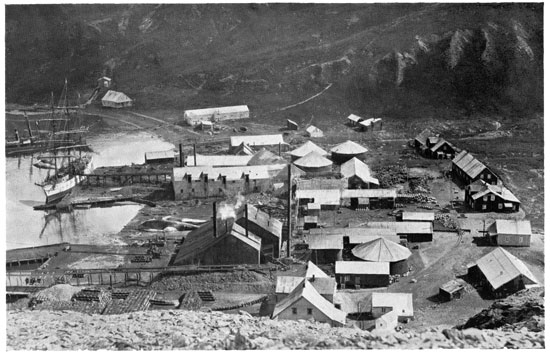
We left Leith Harbour on January 17th, and proceeded
along the coast to Cooper Bay. Douglas
and Carr had gone there some days before to carry on
their geological examination of the island.
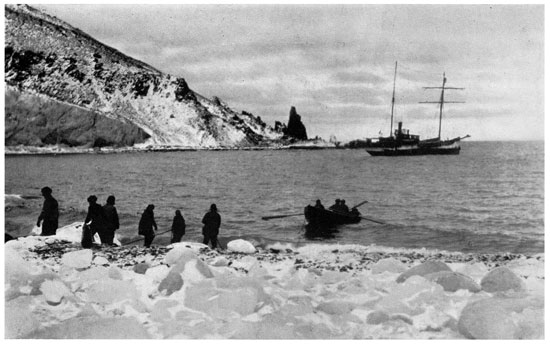
On arrival we found that they had set up a tent on
the beach and had built outside it a fireplace of stones.
For fuel they used driftwood, which lined the beach in
large quantities. Douglas came to meet us in the kayak,
a small skin-boat which had been presented to us by
Mr. Jacobsen. I lowered the surf-boat and went ashore.
Both Carr and he looked well, being very sunburnt and
fatter than when they left us. A meal was in process
of preparation in the fireplace, and when I saw the quantity
of food they were about to dispose of I felt satisfied
as to their health and the state of their appetites.
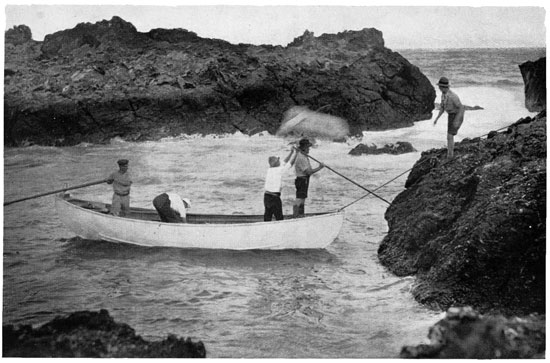
I wanted a supply of fresh meat to take with us on
the ship, for although we had no refrigerator on board,
there was no fear of the meat going bad in the low
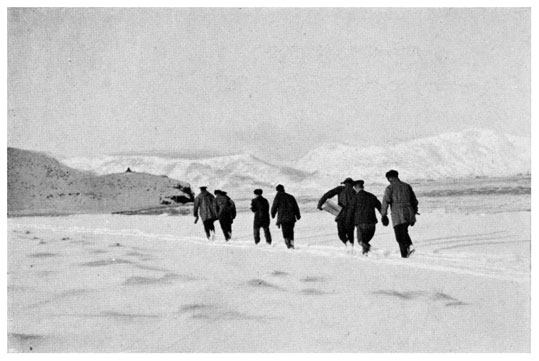
temperatures of these regions. I sent Macklin and Marr
to catch and kill a dozen penguins, and went myself,
with McIlroy, to shoot some skua gulls. I intended
taking a seal also, but found that Douglas, with considerable
forethought, had already killed and cut one up.
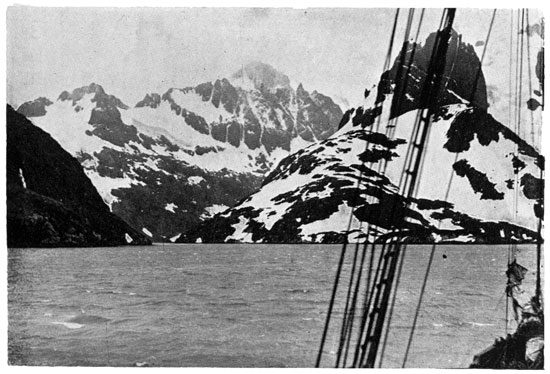
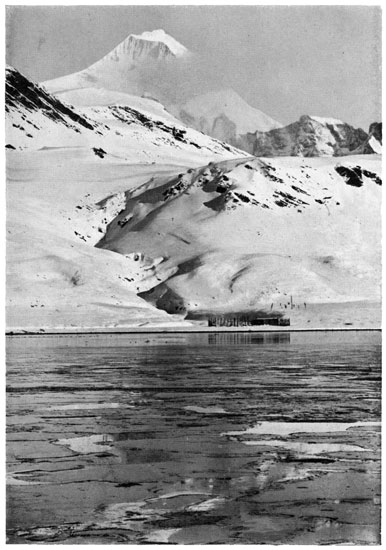
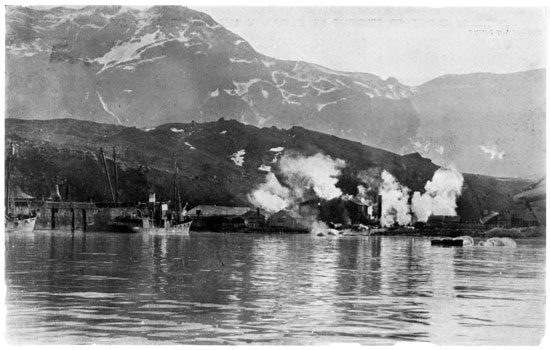
Photo: Wilkins
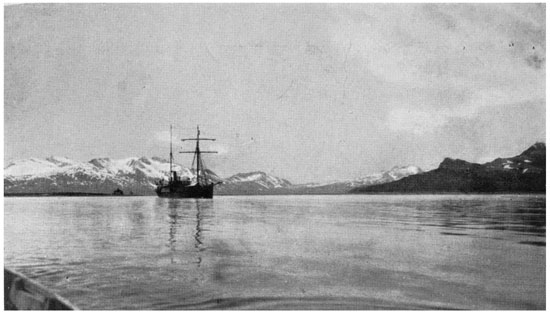
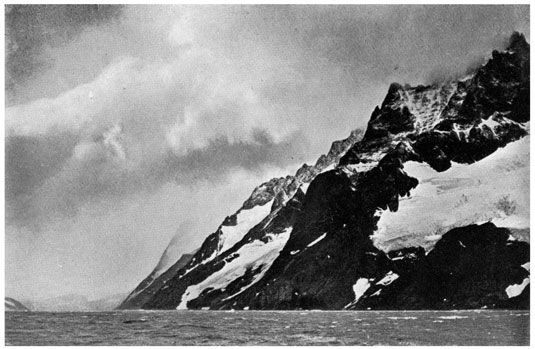
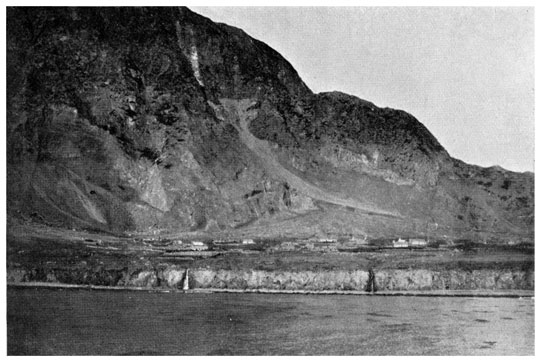
THE ENTRANCE TO LARSEN HARBOUR
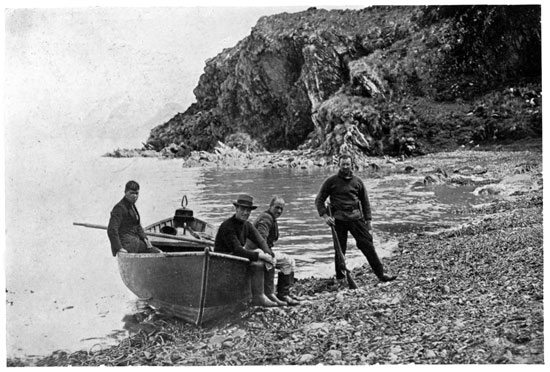
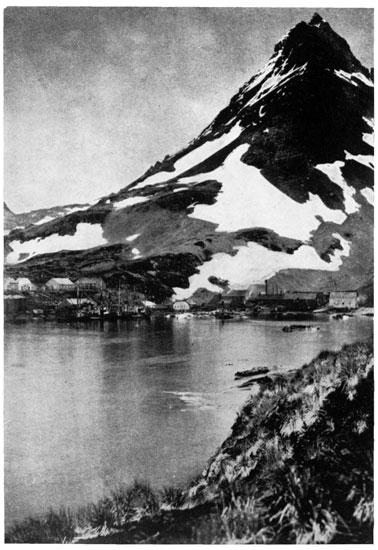
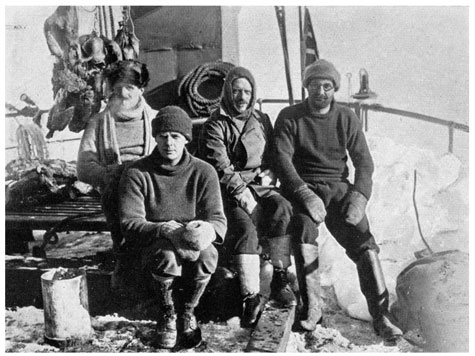
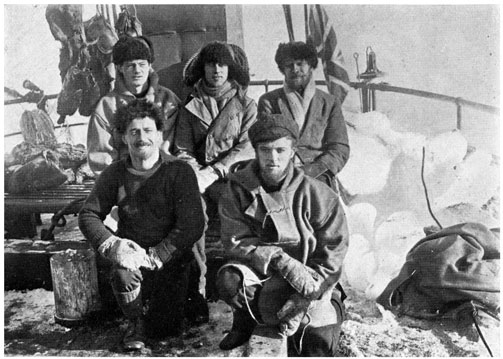
Photo: Wilkins
AN EXPEDITION IN SEARCH OF FRESH FOOD—MARR, McILROY, COMMANDER WILD,
MACKLIN
The day was bright, with warm sunshine, turning
Cooper Bay, which I had previously visited under less
favourable circumstances, into a beautiful spot. Seabirds
of all sorts covered the rocks and flew overhead,
filling the air with raucous cries, which sounded, however,
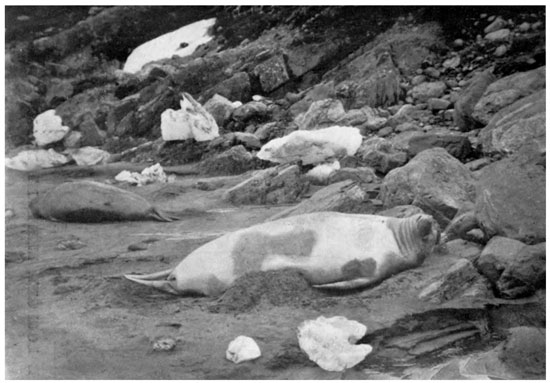
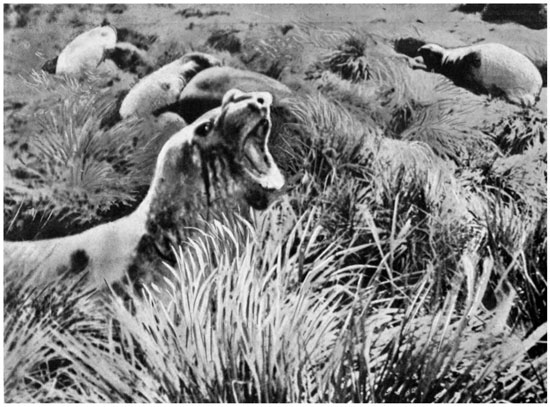
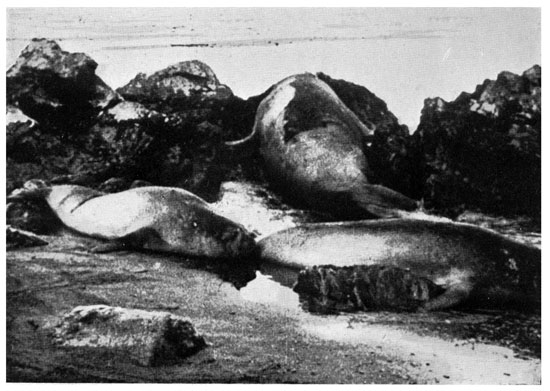
not unpleasant, fitting the wild environment. Seals
and sea-elephants were ashore in hundreds, lying lazily
on the shingle of the beach or in the hollows of the
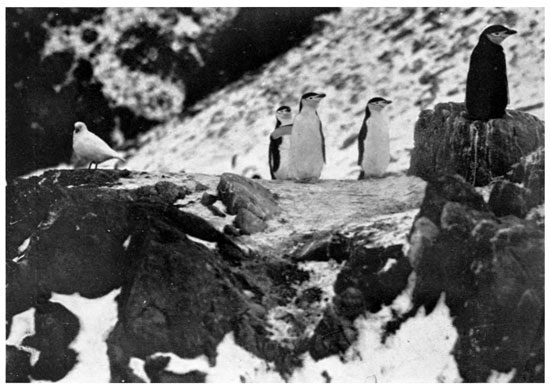
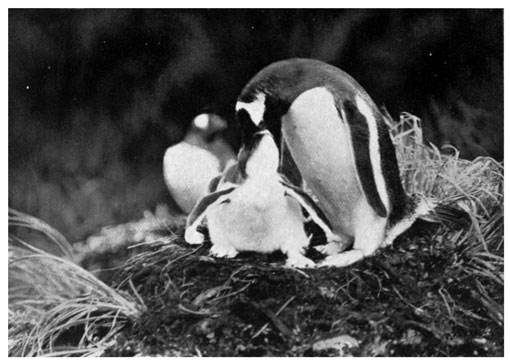
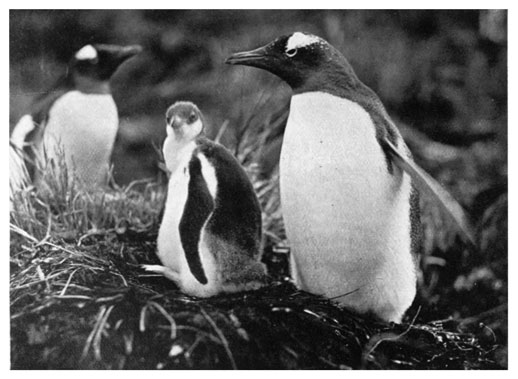
tussock grass behind. Ringed and Gentoo penguins
strutted solemnly about like leisurely old gentlemen
taking the sea air. On the hills behind were large
rookeries where these quaint birds were gathered
together in thousands.
I had no difficulty in obtaining the necessary number
of skua gulls, and I saw that Macklin and Marr had
made a little heap of penguins close to the boat, Macklin
rejecting, with the discriminating care of one whose
staple diet they have formed for months, the old tough
birds and picking out the young and tender. Marr was
delighted with his new experiences, being particularly
fascinated with these almost human looking little
creatures.
So pleasant was the day that I was loth to tear
myself away.
We returned to the ship, where we prepared the birds
for the larder, and hung them, together with the meat,
from the mizen boom, the poop at the finish resembling
a butcher’s shop.
Green, who had been before into the Antarctic and
had wintered with me on Elephant Island, came out of
his galley to regard with a professional eye this new
addition to his larder. I asked him if he had forgotten
how to cook seal and penguin meat, to which he replied,
“Not likely! If I was to live to be a hundred, I would
not forget that.”
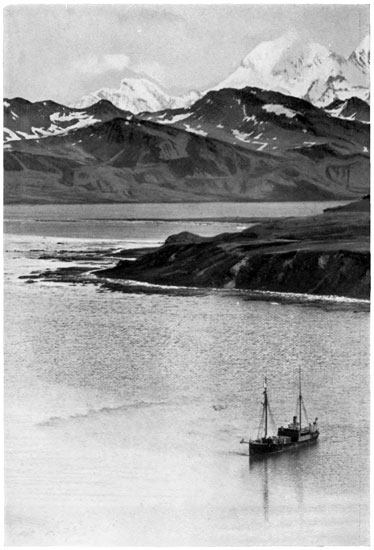
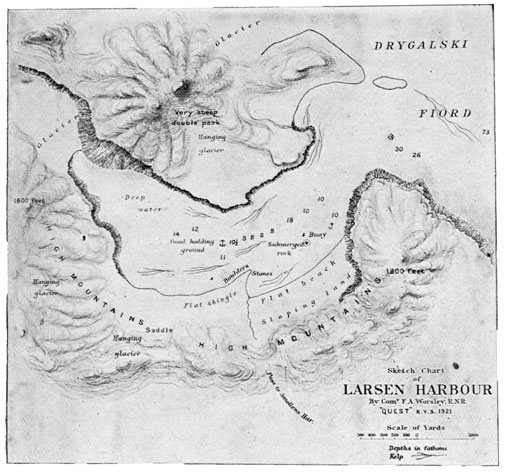
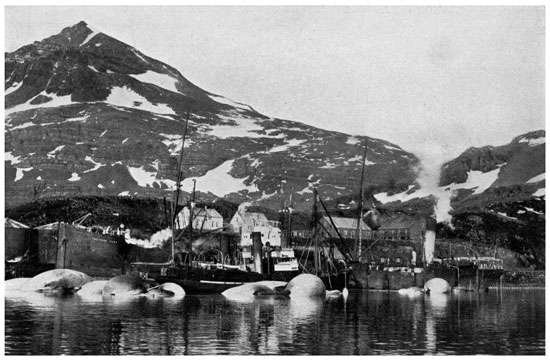
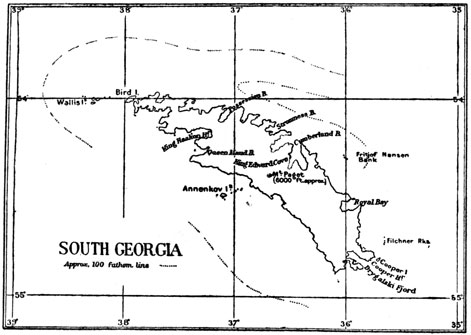
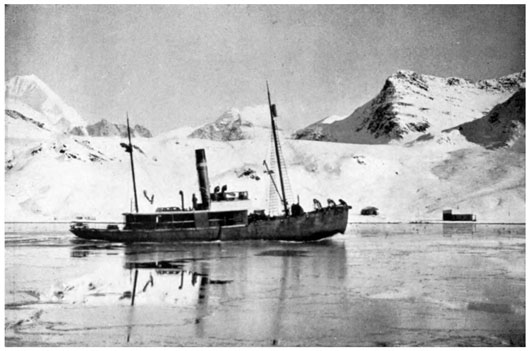
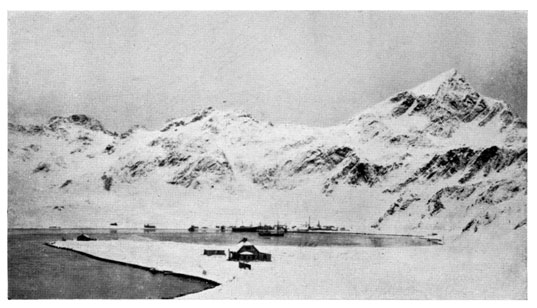
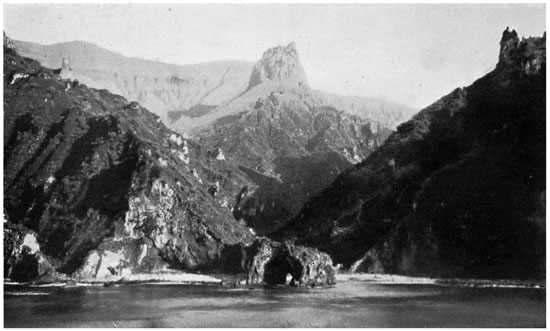
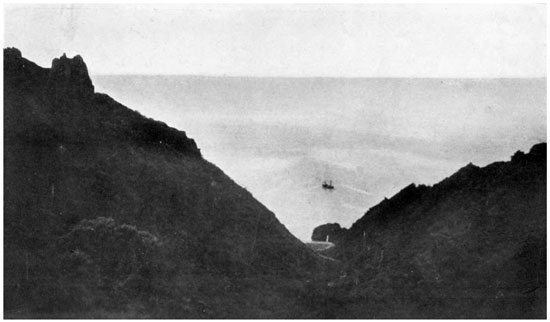
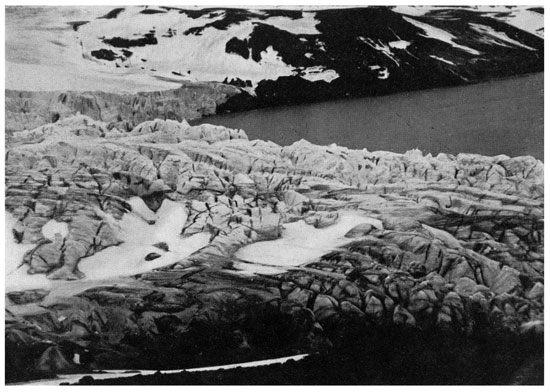
We weighed anchor and proceeded to Larsen Harbour,
which is approached through Drygalski Fiord, a
long, narrow channel situated at the extreme south-eastern
end of South Georgia. The entrance, which is
very picturesque, lies between steep and high mountains.
As one nears the end it appears as if one is about to
charge a steep wall of snow-covered rock, but suddenly
the little opening of Larsen Harbour comes into view,
and one enters a wonderful little basin shut in on all
sides by steeply rising mountains and offering a secure
anchorage for small vessels. Across the entrance lies
a ledge of rocks from which grows a belt of kelp, where
the soundings gave a depth of 38 fathoms.
Douglas went ashore in his kayak to make a
geological examination of the place and bring away
some specimens of rock.
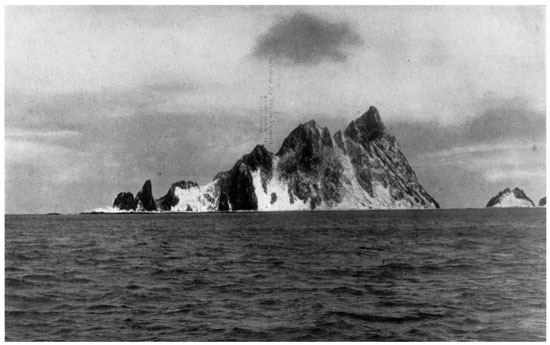
At daybreak on January 18th we made our final
departure from South Georgia, setting course to pass
close to Clerk Rocks. Douglas and Carr had reported
that whilst ascending the slopes behind Cooper Bay they
had seen what appeared to be a volcano in eruption.
They had taken a rough bearing of its direction, and
from their description generally we concluded that the
site of the phenomenon could only have been Clerk
Rocks. I was anxious, therefore, to visit them; but the
day unfortunately turned out to be thick and misty, and
we were unable to get a good view of them. As every
day was now a matter of importance to us in our attempt
to push South, I did not delay in the hope that we might
effect a landing. From observations made by Worsley
and Jeffrey, their position as charted seems to be incorrect,
but as the thick weather prevented accurate
sight, their exact position cannot be definitely given.
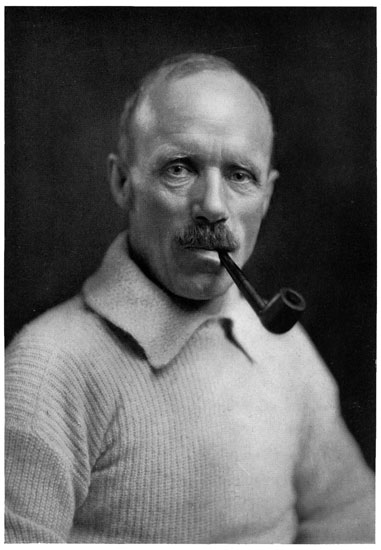
Photo: Reg. Haines
COMMANDER WILD
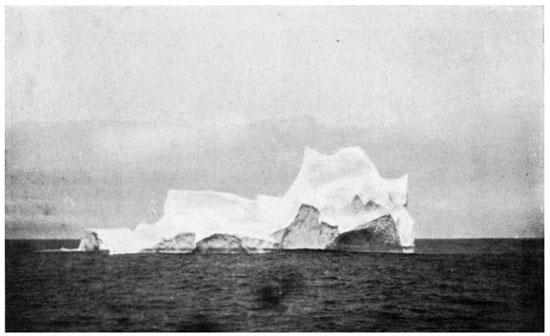
Photo: Dr. Macklin
A SMALL BERG
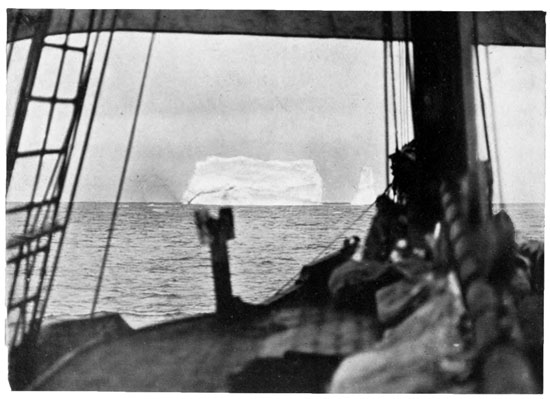
Photo: Wilkins
A CURIOUS “TOOTHED” BERG
We were now about to undertake the most difficult
part of our enterprise, the plans of which I have indicated
in the preceding chapter.
I divided up the hands into three watches: In
my own—McIlroy, Macklin and Carr; in Worsley’s—Wilkins,
Douglas and Watts; in Jeffrey’s—Dell,
McLeod and Marr. The Boy Scout had become a fine,
handy seaman, and developed an all-round usefulness
which made him a valuable member of the expedition.
The engineers, Kerr and Smith, kept watch and watch
about in spells of six hours. I had added, in the person
of Ross, to their staff in South Georgia, where a number
of Shetlanders are employed at the flensing. Young
and he acted as firemen, and Argles as trimmer. Green
and Naisbitt, who formed the galley staff, were, of
course, exempt from watch keeping.
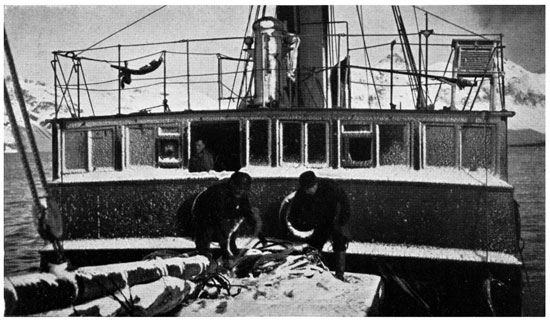
At first we had misty weather, and soon encountered
a heavy swell in which the Quest rolled heavily. We
met numerous icebergs travelling in a north-easterly
direction—beautiful works of Nature passing slowly to
their doom.
Hundreds of sea-birds tailed in our wake, including
numbers of every species known to this part of the
world: albatross, cape pigeons, whale birds and every
kind of petrel, from the giant “Stinker” to the dainty,
ubiquitous Mother Carey’s Chickens.
Thursday, January 19th, broke bright and clear.
We were surrounded on all sides by bergs, those in sight
numbering more than a hundred. Many of them were
flat topped, evidently pieces which had recently calved
from the Great Ice Barrier and floated out to sea. Others
were more irregular in shape, with pinnacles, buttresses,
and caves and tunnels through which the water rushed
with a roar. The imaginative could see in them a
resemblance to all sorts of things; churches with spires,
castles with heavy ramparts, steamships, human profiles,
and the figures of every conceivable kind of beast.
Some were stained with red-coloured mineral deposits,
blue bottom-mud and yellow and brown diatomaceous
material. A few sloped towards the sea at such an angle
as to enable penguins, all of them of the ringed variety,
to clamber up. Some of the groups of penguins thus
formed numbered as many as two or three hundred.
There was a high following sea, and the deeply
laden Quest wallowed in it heavily, dipping both gunwales
and filling the waist with water, which rushed to
and fro with every roll. Smith was thrown off his feet
and swept violently across the deck, fetching up with
considerable force against the lee rail. He was much
bruised and shaken.
During the day a number of soundings were taken
with the Kelvin apparatus, but no bottom was found
with 300 fathoms of wire.
In the evening Worsley altered course to look at
what appeared to be a small half-submerged rock, but on
approach it proved to be a heavily stained piece of ice.
January 20th was another fine day. I saw Marr come
on deck wearing a fur cap, heavy sea-boots, and a belt
from which hung a ferocious-looking sheath knife. The
scrubby promise of a thick beard adorned his chin, and
I had the greatest difficulty in associating the kilted boy
who joined us in London with this tough-looking sailor
man. If Hussey had been there he would have sung,
“If only my mother could see me now!” Indeed, I
would have liked to have had for a short while the use
of a magic carpet and been able to transfer him exactly
as he stood to the bosom of his family.
Jeffrey, who had been confined to his cabin since
leaving Rio de Janeiro, returned to duty on this day.
We continued to pass through a sea filled with icebergs,
which in the sunshine stood out white and glistening
against the blue-black of the sea. Worsley saw what
looked like a new island with high summit, but even as
he pointed it out a breeze flattened off its top, proving it
to be only a cloud. These little rebuffs on the part
of Nature have no influence upon Worsley, whose
enthusiasm is unconquerable.
In the afternoon we sighted a number of icebergs in
line, and a few minutes later Zavodovski Island showed
up. The bergs were evidently aground, most of them
having a distinct tide-mark and showing considerable
wear along the water-line. As we drew nearer we saw
that all those which were accessible were thickly covered
with ringed penguins, which showed the most marked
astonishment at our approach. There were many also
in the sea, and they came swimming towards us, uttering
their familiar “Cl-a-a-k!” Some of the bergs were
so steep that we wondered how the penguins ever
managed to get a footing on them. We passed one with
a side which sloped gradually to an edge some twenty
or thirty feet above water, against which the sea broke
heavily. A number of penguins were attempting a landing,
and we watched their efforts with interest. They
took advantage of the swell to leap out whilst the sea
was at its highest, often to fail and fall back with a
splash into the wash below; but they sometimes
succeeded in getting a footing in a crack in the ice.
They showed the greatest agility and skill in clambering
from one little foothold to another, and their attitude of
triumph when at last they gained the gentler slope and
waddled off to join their companions in the group was
most amusing. These little creatures are so absurdly
human in every one of their aspects that one could watch
them for hours without tiring. Those of the party who
had not been previously in Antarctic regions were greatly
fascinated by them and laughed outright at their quaint
antics.
The island takes its name from Lieut. Zavodovski,
chief officer of the Vostok, of Bellingshausen’s Expedition,
who landed in 1820. It is barren and snow
covered, except on the western side, which presents an
unattractive bare surface of rock. Bellingshausen
described this bare surface as being warm from volcanic
action, and says that the penguins found it an attractive
nesting-place. On that occasion the island presented
the appearance of an active volcano, with thick clouds
of steam belching from the summit. Owing to the low-lying
mist we could not see the top of the island, and
so were unable to gauge accurately the height, but from
general contour it seemed to be not more than 3,500
feet.
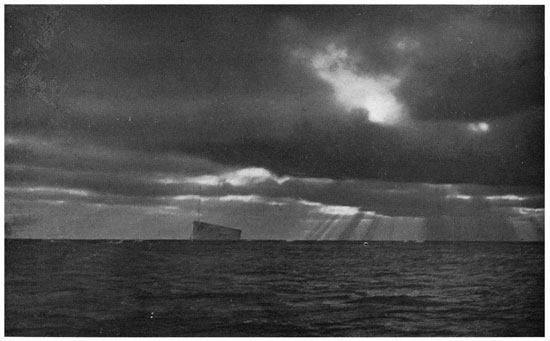
Photo: Wilkins
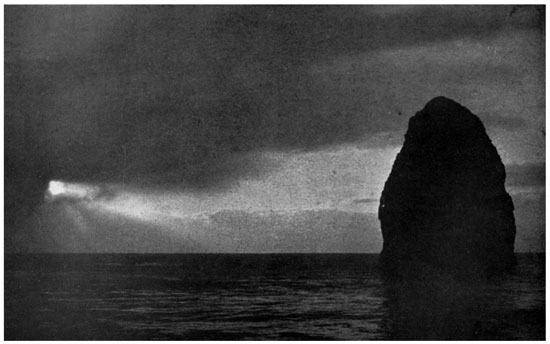
A LOVELY EVENING IN THE SUB-ANTARCTIC
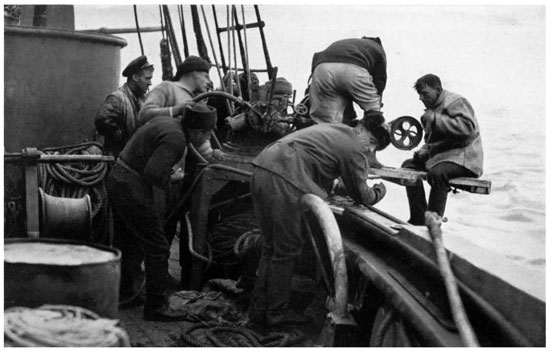
Photo: Wilkins
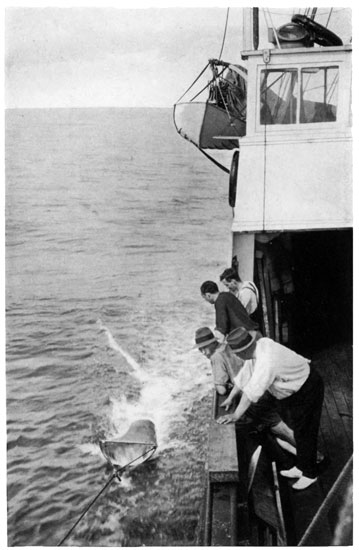
TOO MANY COOKS: OUR FIRST DEEP-SEA SOUNDING
The coastline presents a rugged face of rock broken
here and there by glaciers which descend from the slopes
behind to finish abruptly above narrow beaches of black
sand. A red line of volcanic staining surrounds the
island. Generally speaking it is inaccessible, and there
are no good bays or anchorages for a ship. There are
places where a landing could be effected by boat, but at
no time would it be easy, for the rock faces rise sheer
from the sea and the beaches are shut off from the island
by the glaciers behind and laterally by steep cliffs.
Nevertheless, penguins are able to get ashore. On the
beaches were a number of the large and beautifully
marked king penguins, whilst covering the slopes behind
were whole battalions of the ringed variety, forming
very large rookeries. I have seen larger rookeries than
these in one place only—Macquarie Island, which I
visited during the Mawson Expedition. There one can
look over square miles and never see a piece of ground
for the number of penguins of all varieties which collect
there.
On the southern side of Zavodovski Island are a
number of caves, from the mouths of which sulphurous
fumes were issuing in a thin reddish cloud. We could
feel their effects in a smarting sensation of the eyes,
nose and throat. It was noticed that the penguins did
not collect round the caves, but gave them a pretty
wide berth. Larsen, who explored this group in the
Undine in 1908, was overcome by these fumes whilst
attempting to land on this island, and became seriously
ill.
We made a running survey of the island and obtained
a number of soundings. Before leaving I took
the ship close to a berg which was thickly covered with
ringed penguins to enable Wilkins to get some cinematograph
pictures. To stimulate them into movement I
told Jeffrey to fire two or three detonators. The loud
reports caused the utmost consternation amongst them,
and, stretching their flippers, they rushed en masse for
the lower edge of the berg. Those in front were loth
to take to the water, which is not surprising, seeing the
difficulty they have in climbing back again, but those
behind pressed them so hard that they were forced over
into the sea, and, as Kerr facetiously remarked, “It was
just as well that they could swim.” Their attitude of
surprise and indignation was very amusing.
We continued (Saturday, January 21st) to pass innumerable
bergs. The sea was literally filled with them.
It is fortunate that in these latitudes there is comparatively
little darkness at this time of the year, for at night
these bergs form the most unpleasant of companions and
necessitate a continuous and unremitting look-out. The
long swell rushes against them with a heavy surge, and
a collision with any one of them would prove a nasty
accident from which we would not be likely to escape
scot free, whilst the dislodgment of a heavy portion on
to our decks could have nothing but the most disastrous
results.
The Quest rolled like a log and the seas in the waist
rushed like a swollen flood from side to side, so that one
rarely passed about the ship without a wetting. The
water foamed over the tops of our sea boots and filled
them up. This was particularly annoying when going
to take over the watch, for one had then to endure the
discomfort of four hours on the bridge with wet feet,
which in this temperature is extremely unpleasant.
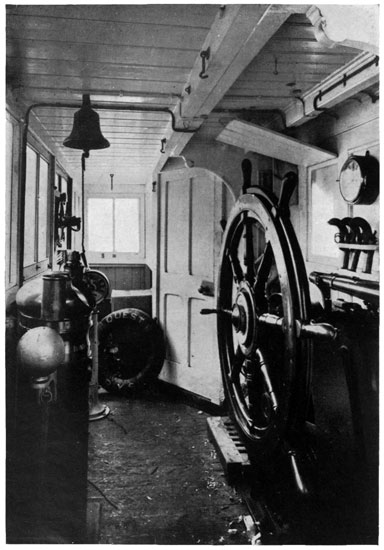
Before leaving England Sir Ernest Shackleton had
designed a weather-proof bridge, completely enclosed,
but with windows which could be opened up on all sides.
Owing to the strikes which occurred before our start,
skilled labour was not available, and the work done in
the building of it was so bad, and the windows and doors
were so ill-fitting, that it was quite impossible to exclude
draughts. Except that it was to some extent rain- and
snow-proof, we would have been much better off with an
open bridge protected with a canvas dodger. There was
always a strong draught along the floor, which made it
very hard to keep the feet warm, no matter how well
clothed and shod we might be. When the footgear
became wetted the difficulty was increased, and in the
long night watches we often endured agonies from this
cause.
Macklin reported to me on the 21st that there were
fifteen inches of water in the hold. The ship had always
leaked, but hitherto the engine-room pumps had been
sufficient to keep down the water. I instituted a daily
pumping, which, as the hand pump was situated in the
waist amidst a rush of water, was no pleasant task for
those engaged in it.
I began to feel my responsibilities now, for each day
made it more abundantly clear to me that this trip was
to be anything but a picnic and demonstrated the fact
that the Quest was by no means an ideal ship for the
work. Often I was made to doubt the wisdom of the
undertaking, but, having put my hand to the plough,
there was to be no turning back.
This being Saturday night, we drank the time-honoured
toast of “Sweethearts and Wives,” to which
some wag always added, “May they never meet!” On
such occasions as these I issued to each man who wanted
it a tot of whisky or rum. Rum was generally selected,
as being the stronger drink.
On Monday, January 23rd, we passed close to two
large and beautiful bergs, full of cracks and chasms,
with a number of caves of the deepest blue colour. This
appearance of blue in cavities surrounded by colourless
ice is a phenomenon for which physicists have not yet
offered a satisfactory explanation.
There is something about these huge bergs, bucking
and swaying in the long heavy swell, which always
attracts. One wonders at their age and where they have
come from. It is a pity that there is no way of marking
them. Worsley, ever inventive, and never at a loss for
a suggestion, proposes firing into them bombs filled with
permanganate of potash, or, better still, to have rifles
firing small projectiles, by which one could mark the
date. “Why not?” says he.
There is much difference of opinion regarding the
length of life of these bergs, some saying two or three
years, whilst others suggest that they last forty or more.
Much undoubtedly depends upon their movements. A
grounded berg is likely to exist for a long time, and I
have seen many, marked by the rise and fall of tide and
washed by the action of the sea, which had obviously
endured for many years. Those which do not go
aground drift about for varying periods till carried
eventually to the north; they meet their fate amongst
warm currents, which leave not a vestige of their
original selves. A berg floats with about seven-eighths
of its bulk below water, and is consequently more
susceptible to deep than to surface currents. I have
often seen them moving through pack at a rate of two
or three miles an hour, brushing aside the lighter ice in
their undeviating progress. In open water, too, I have
seen them moving up against strong winds at a similar
speed.
During our boat journey from the breaking-up
pack on the Endurance expedition we nearly came to
grief from this cause, a large berg of several hundred
yards in length almost jamming us against a line of floe
ice, and requiring all our efforts to pull free.
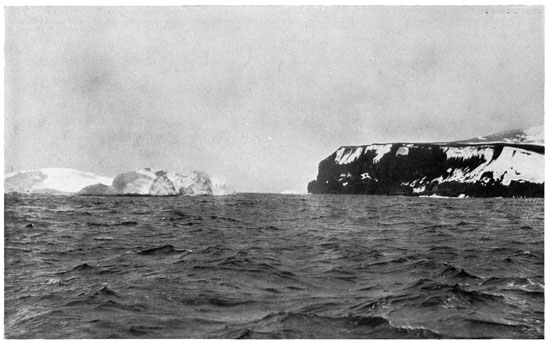
Photo: Wilkins
THE WESTERN END OF ZAVODOVSKI ISLAND, SHOWING GROUNDED ICEBERGS
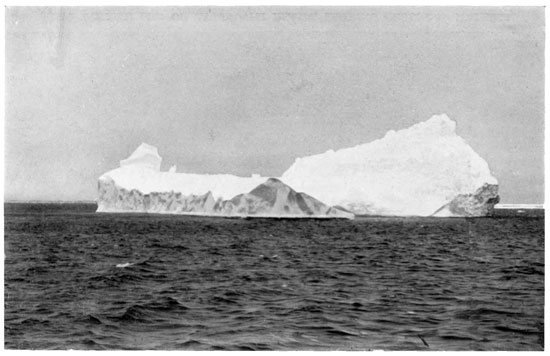
Photo: Wilkins
SENTINEL OF THE ANTARCTIC
Worsley met with a slight accident on the 23rd.
While passing round the front of the deck-house he was
struck by the forestay-sail sheet block, and was hurled
across the deck. He picked himself up, with blood running
freely down his face, but the intensity of his imprecations
relieved me from fear of a bad injury, and,
indeed, on examination it proved to be slight. He felt
a little hurt when someone asked him if he could not
do it again because there were several who had missed
the incident. I omit his reply.
Our daily mileage had proved disappointing up to
this point, and it became clear to me that we could not
hope to reach Bouvet Island and still be in time to enter
the ice this year. The coal consumption also proved
higher than I had anticipated. I decided, therefore, to
make a more southerly course to meet and enter the ice
in a position somewhere about 20° E. Long. On my
westward run I intended to cross the mouth of the Weddell
Sea, and attempt to examine and sound the charted
position of “Ross’s Appearance of Land,” probably
call at Elephant Island to obtain sand for ballast and
blubber for fuel, and proceed to Deception Island for
coal for the return to South Georgia.
After a long spell of bad weather, on January 25th
we at last experienced a change for the better, the day
breaking bright and clear, the water a deep blue and the
icebergs a dazzling white. The sea was comparatively
smooth, and the Quest behaved moderately well.
I seized the chance to get on with an amount of
work which had been difficult during the bad weather.
Worsley, Dell and Carr overhauled the Lucas sounding
machine and fixed a roll of wire all ready for a running
out. When this was done, I set Carr to blocking some
of the scupper holes, in the hope of keeping a drier deck.
Macklin, assisted by Marr and Green, spent a busy
morning in squaring up the hold, and there was work
for everyone in one way or another. McIlroy and I
baled out our cabins and put the wet gear out to
dry.[8]
The ship was found to be taking more water, Macklin
reporting that it had reached the level of the kelson, and
I had to institute longer spells at the pumps, each taking
from one and a half to two hours to pump her dry.
I got McIlroy to cut my hair, after which I acted as
barber for him, and for Kerr and Worsley also. They
were no half cuts, but good convict crops! Wilkins,
with a view to stimulating the laggard hairs on his
crown to more active growth, shaved the top of his head,
and looked like a monk. He was growing a beard, as
were a number of the men. McLeod’s was the most
flourishing; Dell and Macklin each showed a respectable
growth, and Kerr, Smith, Young, Argles and Watts
gave a promise of better things. Marr, not to be outdone,
was also making the attempt, but so far could
show only a stubble, which gave him rather a ferocious
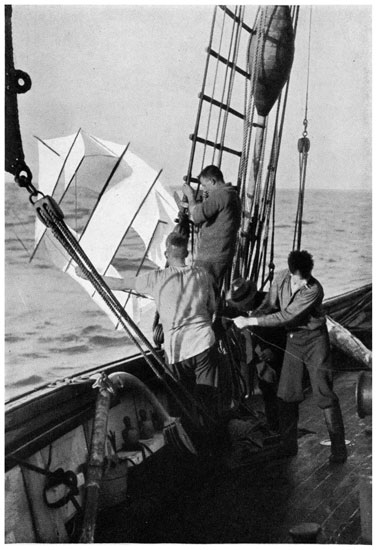
appearance.
In the afternoon Worsley took a sounding, with the
unsought assistance of all the men on board, who
crowded round with a great willingness to help, but
who, like the cooks at the broth, only impeded things.
Four miles of wire were reeled out without finding
bottom, but, this being the first time we had used the
Lucas machine on this trip, it was probably incorrect.
When it came to winding up, the machine ran well, but
when only about half the reel had been taken in the
wire broke, and we lost the sinkers and the snapper
(which is used to bring up specimens from the sea
bottom). From this time forward Dell took charge of
the sounding machine, and under his management it ran
without a hitch. It was often a cold and tedious job, but
he took the greatest interest in the work, and enabled
Worsley to get some excellent results.
Whilst the sounding was in process a mass of pultaceous
material floated past the ship, some of which we
collected. Macklin examined a small portion of it under
a microscope, and reported that it was composed of
feathers in a state of decomposition. Its occurrence was
hard to explain, but Wilkins thought it may have come
from one of the carnivorous mammals of these seas: a
sea leopard or a killer, which had swallowed a number
of penguins or other birds, and afterwards vomited the
indigestible portions of them, just as our sledge dogs
used to vomit bones which they had eaten.
Naisbitt asked me if he might start a ship’s magazine,
to which I assented.
I saw an Antarctic petrel, the first I had seen this
trip. The presence of these birds usually indicates
proximity of ice.
The fine weather did not last long, for the next day
the wind and seas increased, and the Quest took full
advantage of the excuse to behave as badly as ever.
We encountered fewer bergs, but were never out of
sight of them altogether. One which lay two or three
miles to starboard had a very peculiar appearance,
closely resembling a sailing ship under canvas. Worsley
examined it long and attentively through binoculars, and
exclaimed, “A sailing vessel!” I cast some doubt on
the probability, but after a second look he cried
excitedly, “It is a sailing vessel; I can see her topsail
yard! Let us go and talk to her!” A gleam of
sunshine lighting upon the “topsail yard” dispelled the
illusion. I wonder what ship he expected to see down
there!
An extract from Marr’s diary on this date gives an
interesting sidelight:
A fairly strong sea was running when we came on
deck for “the middle,” but this did not deter us from
our usual occupation in the night watches, i.e. the
consumption of food and drink. Indeed, it must
appear that our watch is very hungry, but it is not so.
This is merely our very effective method of passing
the four long hours on the bridge.
It was customary for the engine-room staff to make
a hot drink once a watch. The galley fire was always
allowed to go out at night because of the necessity for
economy in coal consumption, and the stokers used to
boil the water in a tin on the furnace fires. The result
was that there was often some difficulty in diagnosing
the nature of the concoction, but under circumstances
like this one could not be over particular. We used to
turn to each other, saying: “Well, at any rate it is hot
and wet.”
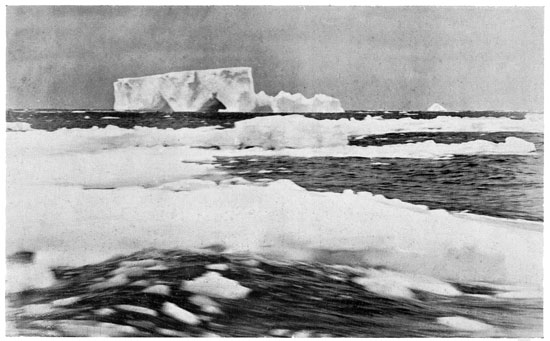
Photo: Wilkins
A TYPICAL SCENE AT THE PACK EDGE
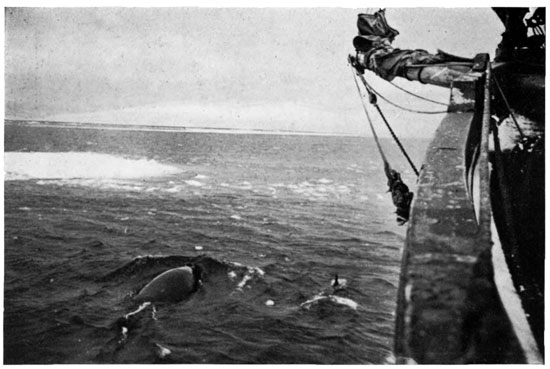
Photo: Wilkins
KILLERS RISING TO “BLOW”
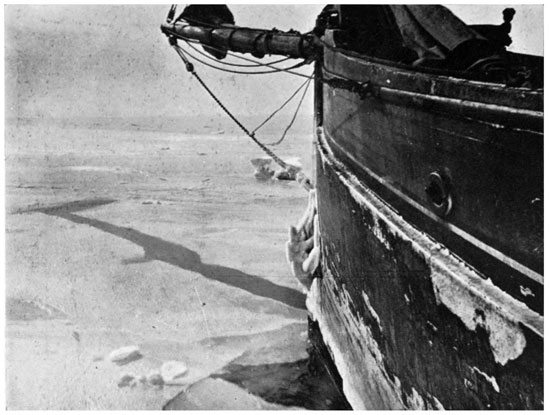
Photo: Wilkins
THE QUEST PUSHING THROUGH THIN ICE
We had two casualties on January 30th. Douglas,
whilst skipping to keep himself warm, sprained his
ankle, and had to take to his bunk. Worsley also came
to grief in a much more serious way. Shortly after
leaving South Georgia I had instructed Macklin to provision
each of our three boats for thirty days. As the
surf-boat was likely to be in frequent use, I had the
provisions moved from her and divided equally amongst
the port and starboard life-boats, the total in each weighing
not less than a quarter of a ton. I decided to swing
the port life-boat outboard on her davits, both in order
to have her the more ready to lower away and to give
us a little more sorely needed space on the bridge deck.
The sea was smooth, but there was a long swell running
which caused the Quest to give an occasional heavy roll.
We were in the midst of proceedings, and I had got
into the boat the better to direct operations, when suddenly
a guy fixing the forward davit carried away; the
heavily laden boat took charge, swinging inboard and
out and in a fore and aft direction with the swing of the
unsecured davits. It was all I could do to hold on,
for I had been steadying myself with the after davit
head, which now swung in a semicircle. Many times I
felt as if I must be flung headlong into the sea. All
hands gathered round to regain control, but with the
strain the after davit guy also parted. The boat swung
aft, sweeping Wilkins and Macklin off the bridge deck
on to the poop, where they met with no damage, and,
surging forward again, caught Worsley and drove him
with tremendous force against the after wall of the
bridge house. The impact was heavy. I heard a cry
and a crash of splintering wood as the wall gave way.
I felt sure Worsley was killed. McIlroy immediately
went to his assistance, whilst the rest of us, after an
effort, secured the boat and lowered her on to the skids
again.
Worsley appeared at first to be terribly damaged.
His face turned a deathly grey and was covered with
perspiration, and he could scarcely breathe. We carried
him to his cabin, where the surgeons made a careful
examination. He had sustained severe damage to his
chest and broken a number of ribs. His whole body
was covered with bruises and abrasions, and he was
suffering severely from shock. The doctors reported
his condition as serious, but thought that the outlook
was favourable unless signs of internal hæmorrhage
appeared. It was a great relief to feel that I had with
me as surgeons two reliable and experienced men.
Worsley had undoubtedly to thank the workmen who
had this particular job in hand for his life, for had the
bridge house been of more solid workmanship and shown
greater resistance to the impact, he must infallibly have
been crushed to death.
On this same day we reached the charted position of
Pagoda Rock. It was first reported by Lieut. T. E. L.
Moore, in the Pagoda, in 1845, in the following words:
In the afternoon of the same day (Thursday),
January 30th, 1845, we fell in with a most singular
rock, or rock on an iceberg. It appeared to be a mass
of rock about 1,600 tons, and the top was covered with
ice, and did not appear to have any visible motion,
with a heavy sea beating over it. It had a tide mark
round it. We tried for soundings with 200 fathoms,
and the first time we fancied we had struck the
ground, but before we could try again we had drifted
some distance off. We could not send a boat or beat
the ship up against the breeze that was then blowing.
In our position, lat. 60° 11´ S. and 4° 47´ E. long.,
however, there was no sign of it, though we made a
traversing cruise, and a sounding which showed a depth,
of 2,980 fathoms gave no indication of shoaling in the
vicinity.
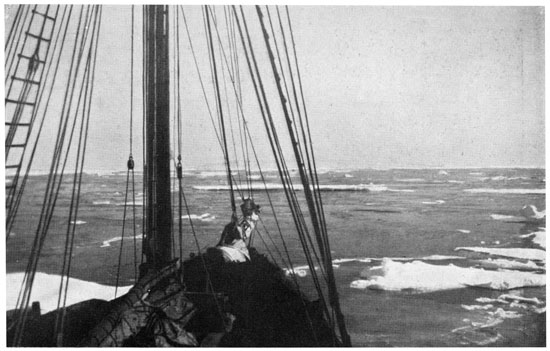
Photo: Wilkins
LOOSE OPEN PACK
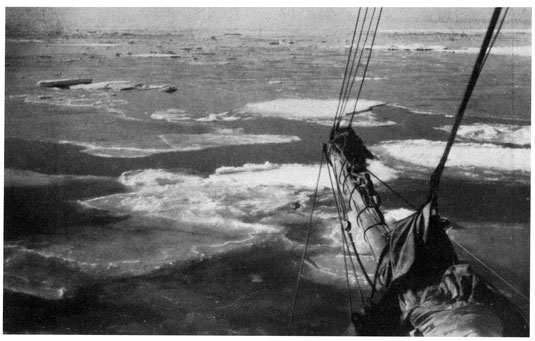
Photo: Dr. Macklin
LOOSE PACK ICE, WITH THE SEA RAPIDLY FREEZING OVER
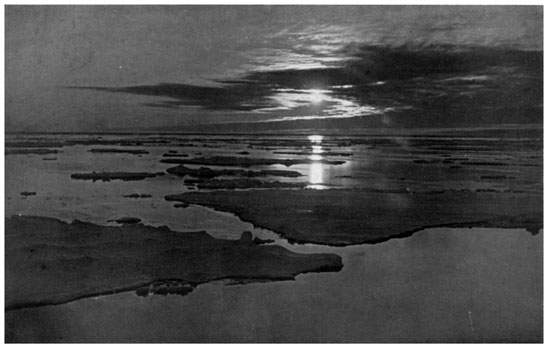
Photo: Wilkins
THE MIDNIGHT SUN
It is rather remarkable, however, that towards evening
we saw a very curious-looking berg, very dark green
in colour and heavily stained with some earthy material.
We altered course to pass close to it, and examined it
carefully. It was an old, weather-beaten berg which
had evidently capsized. Our meeting with it in this
particular spot was a curious coincidence.
On the first day of February the maiden number of
Expedition Topics appeared under the editorship of
Naisbitt. It was got up simply, consisting of a number
of sheets of typewritten matter, chiefly on the humorous
side, and containing a sly hit at most of the company.
There were also some clever drawings. Like everything
else that created an interest it was of value just
then when the daily life in those cold grey stormy seas
was necessarily very monotonous.
On February 2nd we had a strong gale from the
south-east, during which I was compelled to take in sail
and heave to—very disappointing, as we needed every
mile we could make to the eastward. The Quest behaved
in the liveliest possible manner, and everything
that was not tightly lashed took charge. A bookcase in
my cabin had battens three inches wide placed along
the shelves, but they proved useless to keep in place
the books, which hurled themselves to the floor, where
they were much damaged by the seas which found their
way in and swished up and down with every roll.
On deck everything had been lashed up and tightly
secured, but in the galley pots and pans took charge and
defied all Green’s efforts to make them remain on the
stove. All kinds of utensils escaped into “Gubbins
Alley,” where they were carried up and down by the
wash of water, whilst Green splashed knee deep in pursuit.
As he recovered one lot so another leapt away,
regardless of his imprecations, till, some helpers coming
along, order was once more restored.
Naisbitt, whose work compelled him to pass frequently
between the wardroom and the galley, often with
both hands full, had a very trying time. At meals we
had the greatest difficulty in keeping things on the table,
and we had to hold plates, cups, etc., in our hands,
balancing them against the roll of the ship. We had to
abandon all idea of comfort and wait patiently till the
rage of the elements should abate.
During this time of bad weather Worsley suffered
very much, for, with the violent rolling, he could get
no rest in his bunk. He improved, however; the doctors
pronounced him out of danger, and he spoke of soon
getting up.
Macklin reported another fifteen inches of water in
the hold—it was obvious that it would be necessary to
increase the daily spells of pumping. All hands took
to this unpleasant and monotonous job very cheerfully,
saying that it was good exercise! Indeed, there is not
much else that can be said for it.
In lat. 65° 7´ S. and 15° 21´ E. long, we entered, on
February 4th, what appeared to be the edge of very open
pack, which lay in several strips and bands of light,
loosely packed ice, with large open spaces of water
between. I made my course due south and pushed
into it. For some time I had doubts as to whether
it was the real pack or streamers carried north by the
late south-easterly gale. The sky to the south was very
indefinite, and from the crow’s nest the same conditions
of loose ice and open water extended as far as the eye
could reach. The two “signs” which one looks for in
the sky are “ice-blink” and “water sky.” A sky with
ice-blink presents near the horizon a hard white appearance
which indicates the proximity of close pack, ice
barrier, or snow-covered land. A “water sky” is a
dark patch in a lighter sky, which indicates open water
below the horizon. In each case when these skies are
well marked they are definitely of value, but it requires
much experience to gauge accurately the meaning of
some of the more indefinite appearances, and conclusions
too hastily drawn often prove erroneous.
Whilst we were at sea I had watched the petrels
which followed in our wake attempting to come to rest
on the water, but breaking seas always drove them up
again. I was interested to note that as soon as we
reached the pack they flew forward and came to rest
on a piece of ice, where they preened their feathers and
settled down on their breasts.
The ice had a wonderfully settling effect upon the
sea, deadening all but the heavier swells. The Quest
became more comfortable than she had been for a long
time, and at lunch we dispensed with the fiddles. This
she would not tolerate, and a sudden roll swept everything
to the floor. Later in the day the belts of ice
became broader and the pools of water much smaller.
There could be no doubt that this was the real pack ice
and that the most strenuous part of our work was now
to begin. Quoting from a diary:
Now the little Quest can really try her mettle.
What is in store for us? Will the pack, as variable
in its moods as the open sea, prove friendly or will it
rise in its wrath to punish man’s temerity in thus
bringing to the attack so small a craft? Before this
effort the smallest ship to make a serious attempt to
penetrate the heavy Antarctic pack was the Endurance,
and she lies crushed and broken many fathoms
deep in the Weddell Sea. We are but half her size!
Shall we escape, or will the Quest go to join the ships
in Davy Jones’s Locker, and the queer deep-sea fish
nose about amongst her broken spars? We are not
in the least pessimistic, but the man who blinds himself
to the possibility is a fool.
My sense of responsibility was growing daily, for
though I always welcomed the suggestions of my senior
officers I realized that on me alone must devolve the
final decision in every plan and in every movement. This
was my fifth expedition—nearly half my life has been
spent in Antarctic exploration—and every accumulated
year of experience has taught me more and more how
much in this work we are the playthings of chance. Experience
counts a great deal, of course, but no amount
of experience, care or skill can be of much avail against
prolonged and overwhelming pressure. Yet in those
first days in the ice, as I stood on the bridge and
looked down on the decks I saw amongst my men
nothing but elation. Carr, Douglas and others who
saw the ice for the first time were fascinated by it, and
amongst the old hands there was obvious pleasure at
again meeting the pack. Old McLeod, veteran of many
expeditions, said to McIlroy: “Here we are home again!
Doesn’t it do you good to get back!” Even Query was
affected with the general air of uplift, and with paws on
gunwale gazed with twitching nostrils at this new phenomenon.
Nor could I long resist a similar feeling, for
as I gazed south over the ice, with the cold, keen air
in my nostrils, I, too, felt pleased and elated, glad of a
tough problem to tackle and rejoicing in the long
odds.
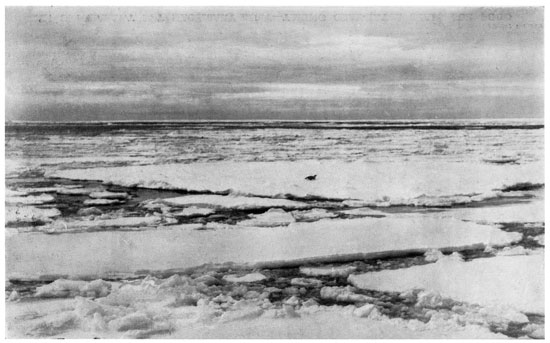
Photo: Wilkins
THE LONELINESS OF THE PACK
Note the Emperor Penguin on the floe
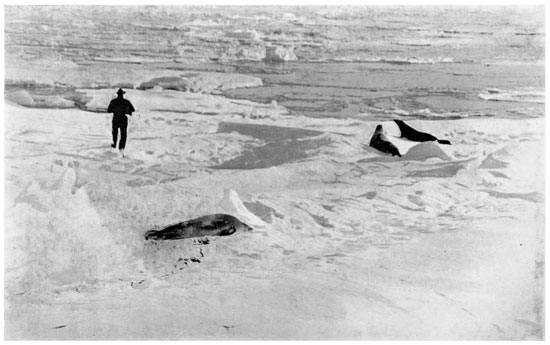
Photo: Wilkins
AN UNPLEASANT BUT NECESSARY DUTY—TAKING CRAB-EATER SEALS FOR FOOD
We soon began to meet old acquaintances in the
form of crab-eater seals which, wakened from sleep on
the floe, turned a curious eye in our direction and,
scratching themselves the while with their queer hand-like
flippers, pondered drowsily on the strange phenomenon
which had come amongst them. Most of them
seemed satisfied with their scrutiny, treating us as of no
particular importance, and rolled over to sleep again. With
their light silvery coats these are the most elegant of the
southern seals and also the most active. They are characteristic
of the pack, being found in large numbers
about its free edge, where they obtain their living from
the small crustacea of these regions, euphausiæ and
amphipods. These small creatures live on the diatoms
of which the Antarctic seas are so rich, and which often
become embedded in the floe ice, which is stained brown
or greenish-brown by their presence. Euphausiæ resemble
small shrimps, and the amphipods are very like
the sandhoppers of home beaches, but redder in colour.
Whalers speak of them collectively as whale food, for
they form the staple diet not only of the crab-eaters but
of most of the Antarctic whales. It is an extraordinary
thing that so large an animal as the whale should depend
for its existence upon so small a creature, especially
when one considers the millions necessary to make one
meal. The side of natural history which interests me
most is the consideration of animal habits, mode of life
and source of food. There is something intensely fascinating
about this study, but I confess to a lack of
enthusiasm when it comes to a question of minute differences
in structure and classification of species.
The ordinary whale has a gullet so small that one
can scarcely pass one’s fist into it, and no whale could
certainly ever have swallowed Jonah. The animal
referred to in the Bible story is no doubt the Orca
gladiator, which, though commonly known as the Killer
whale, differs considerably in many features from the
true whale. It is much better referred to by the name
Killer only. It is smaller than the larger varieties of
true whale, but it has immense jaws and a wide gullet,
and lives not on whale food but on seals and penguins,
and it is conceivable that it has on occasions accommodated
a man; though whether it ever let one go again
is a different matter. The killer is certainly an evil-looking
monster. Before we had entered deeply into
the pack we saw numbers of them gliding about us,
driven smoothly forward by almost imperceptible movements
of their powerful flukes, the downward strokes of
which produce small whirlpools on the surface of the
water. One could mark their progress by watching
these whirlpools. Every now and then they rise to
breathe, for they are not fish but mammals, and exhale
a spout of fine vapour which in the distance looks like
water. It is dangerous to cross leads of young ice whilst
killers are about, for they are able by charging upwards
from below to break through considerable thicknesses
with their heads. The round holes produced in this way
are quite common, and one frequently sees their evil
heads and wicked little eyes appear suddenly above the
surface, scattering fragments of ice in a wide circle.
When sledging along newly frozen leads, it is customary
to keep close in to solid ice, and when a crossing is
necessary it is made as rapidly as possible.
By February 5th there was a certain amount of daylight
all night, and we were not held up on account of
darkness. The ice had increased all the time in density
and thickness, and at times it was all we could do to
push ahead. Already I began to feel the need of greater
engine power, though the small size of the ship made
her very handy to manœuvre, and we were able to dodge
and squeeze past where a bigger ship would require to
push and ram. For the man at the wheel the spell was no
longer two hours of monotony, but a period of hard work
for which he shed his bulky garments, finding all the
warmth he required in the exercise entailed. It was
only when we entered the leads that we could keep a
steady course, and usually the commands, “Port!
Steady! Starboard!” etc., followed each other in
rapid succession as we turned and twisted and wriggled
our way ahead.
Worsley appeared again to-day. This evergreen
youth of fifty years certainly made a rapid recovery, for
I did not think when I saw him after his accident that
he would be up so soon. Although a very good patient,
he chafed so much at his confinement to bed that Macklin
thought it better to let him out of his bunk, taking, however,
the precaution to strap and bandage his injured
parts in such a way that he could not do himself much
harm, and was unable to make any attempt to climb aloft—which
is the first thing he would have wished to do!
He was keenly anxious to take his watch, and I must
confess I was looking forward to his return to duty, for
Jeffrey and I had been doing “watch and watch”
alternately, and I had to be frequently on deck during
my watch below, which under the arduous circumstances
was a heavy strain.
I kept a keen look out for a convenient floe with seals
on it, for I was anxious to obtain fresh meat. Our food
stores included an ample and varied supply of all foods,
with the exception of meat, for which we were prepared
“to live on the country.” Seal meat is quite palatable
when one is used to it, and has the advantage over tinned
stuff of being fresh. It is also a valuable antiscorbutic,
and I was relying on its regular consumption to prevent
the onset of scurvy.
Sighting a good solid floe with three seals on it, I put
the ship alongside and shot them all with my heavy rifle.
I went over on to the floe with Macklin to bleed them,
which done, they were hoisted aboard, and McIlroy,
Dell and Macklin flensed and cut them up. The
blubber went to the bunkers to eke out our supply of
coal. Practically the whole of the meat of the seal can
be used for eating; whilst the liver, kidneys and heart
make very dainty fare. Fried seal’s brain is a dish that
can hardly be excelled anywhere in the world. The
seal’s brain is large and well developed, and when shooting
these animals I always make a point of aiming at the
neck just behind the skull so as not to spoil the brain
for cooking. There is quite an art in removing the brain,
and the heads were usually handed over to Macklin
and McIlroy, who took them out complete and unbroken.
Whilst the flensing was going forward Worsley seized
the opportunity to take a sounding, finding it lat. 66°
12´ S. and 16° 21´ E. long., 2,330 fathoms of water.
On February 6th we continued pushing on through
fairly heavy pack. Often the Quest was brought to a
stop by heavy pieces of ice across her bows, which she
was powerless to move or break up. When this occurred
we backed down the lane formed in our wake, where her
short length usually enabled her to turn, and getting
her nose inserted between two floes, we pushed ahead
with all the power the engines could give us till she
finally worried through. So far we had not been held
up for any considerable time.
Macklin reported another fifteen inches of water in
the hold, requiring an extra spell at the pumps to clear.
There can be no doubt that the continual bumping and
jarring of the ship against the ice caused a starting of
the timbers which had then no chance to settle and swell.
Everybody was in wonderful health and spirits, and
appetites were keen. For lunch on that day we had
the seal brains taken the day before; they were delicious.
All hands took to the seal meat, with the exception of
Jeffrey and Carr. Carr tasted it and said that it produced
a sickly feeling, but with the former it was a case
of pure prejudice, for he would not even taste it, and preferred
to live on what else might be going. Stefansson,
in his books, dilates upon the theory that men who in
their normal lives have been used to all sorts and varieties
of food take more readily to kinds which they are experiencing
for the first time than those whose dietary
has been more monotonous and composed of much the
same thing day after day and week after week. That
this is very true there can be no doubt, but it does not
hold in the case of Jeffrey and Carr, for out of the whole
party I doubt if there was anyone more used to the
highly faked and varied dishes which the modern chef
succeeds in producing. Hunger is a wonderful sauce
and will break down most prejudices. Those of us who
accompanied Sir Ernest Shackleton on his previous expedition
lived entirely on seal and penguin meat for
eleven months, and except that we were thin at the time
of rescue as a result of not having enough of it, we were
otherwise healthy and fit and had no sign of scurvy.
Stefansson, in speaking of scurvy, attributes his freedom
from it to eating his meat raw or “rare done,” and
states definitely that this is the secret of preventing and
curing scurvy, whatever the food may be. On the occasion
to which I have referred we always cooked our meat,
except when circumstances or the exigencies of the
moment did not permit of it and when we were short
of fuel.
Nature has providentially arranged that most of the
animals of south polar regions, for example the seals,
provide in addition to meat the fuel necessary to cook it
in the form of blubber. It is true that the use of heat in
cooking meat does very slightly destroy the antiscorbutic
principle, but when the consumption is sufficiently large
this factor can be neglected. Much depends upon the
method of cooking, for a more thorough investigation of
the subject shows that the detrimental influence is not
heat but oxidization. It is also stated that scurvy may
be cured by eating meat which has gone bad. It is possible
that a few isolated cases may have recovered in spite
of the additional intoxication, but this teaching must be
regarded as a most dangerous one. The subject is one
of the greatest importance to explorers, for scurvy has
caused the failure of many well-found expeditions. I
cannot enter more fully into it here. The investigation
of scurvy and other food deficiency diseases is at present
occupying the minds of the medical profession, much
new knowledge is being brought to light, and it is probable
that the next few years will show great advances.
I am greatly opposed to the making of generalizations
based upon one or two isolated observations by writers
with little or no knowledge of the fundamental facts;
they are of little value for guidance and are apt to
prove misleading.
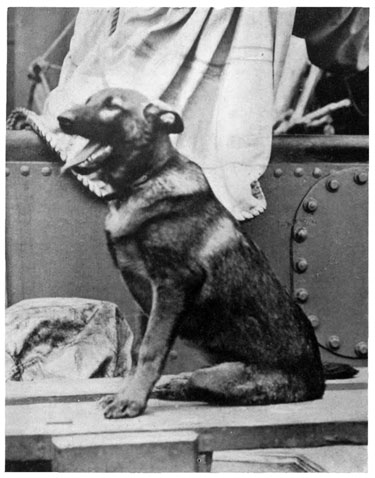
Query was in great spirits at this time, never
having been in better condition since we left England;
his coat was thick and bushy, and his tail made a fine
brush. He was really a most handsome dog. He became
a thorough ship’s dog, and climbed all over the
place. Wilkins fixed a camera case to the front of the
deck-house, and Query discovered via it a way to
the top. So delighted was he with his new discovery
that he ran up and down just for the joy of doing it.
All day long he pestered one to play with him, bringing
in his mouth a stick or tin or a lump of coal, or even a
potato looted from the galley, which he wished thrown
for him to fetch. Of this game he never tired, and no
matter where one threw the object, he searched until it
was found, when he brought it back, calling one’s attention
to the fact by a short bark or a dig in the calves with
his nose.
Another game which he was very fond of was to
drop things from the deck-house on to the head of
someone standing below, whose share in the game was
to return the thing dropped so that he could do it again.
He was greatly excited by a seal which followed the
ship and whenever we were stopped by floes rose
high out of the water alongside us as though trying to
come aboard. Possibly it regarded us as a strangely
elusive and inaccessible piece of land. Up to now we
had not seen any penguins in the pack.
On coming on deck at 4.0 a.m. on February 7th I
discovered that during Jeffrey’s watch the ship had
entered a cul-de-sac and that further progress was impossible.
From the crow’s nest I could see nothing but
dense pack stretching away to the southward as far as
the eye could reach, with no sign of a water sky beyond
it. To the east and west the same conditions prevailed,
and there was no hope of working the ship in any
direction except that in which we had come. I therefore
decided to stay where we were for a day (lat. 67° 40´ S.
and 17° 6´ E. long), and if there was no sign of opening
of the ice at the end of that time to retrace my steps
and look for open leads farther to the west.
There were a number of seals within reach which I
determined to collect, and so putting the ship alongside
a suitable floe I sent off some of the men to kill and bring
them aboard. They secured nine altogether, far more
than we required for meat, but I wanted the blubber
to help out the coal supply. We took for the larder,
therefore, only the dainties, such as the brains,
kidneys, livers and hearts, and the choicest pieces of
flesh, which are the undercuts from the inside of the
ribs.
We saw that day the first emperor penguin of the trip
standing solitary, as is the wont of this species, upon a
floe. Wilkins secured it as a specimen. The emperors
are the most stately of all the penguins and have the
finest markings. The king penguin is more brightly
coloured, but the emperor has the more delicate shades
which merge gradually into one another. Seen on the
floe in bright sunshine they have a really beautiful
appearance.
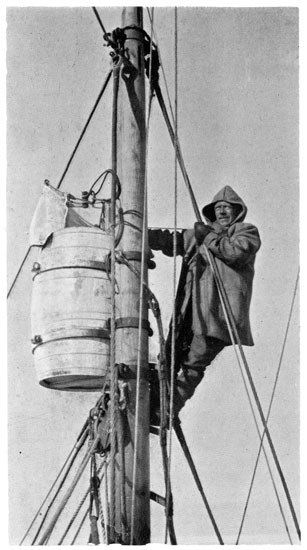
Photo: Dr. Macklin
COMMANDER WILD AT THE MASTHEAD
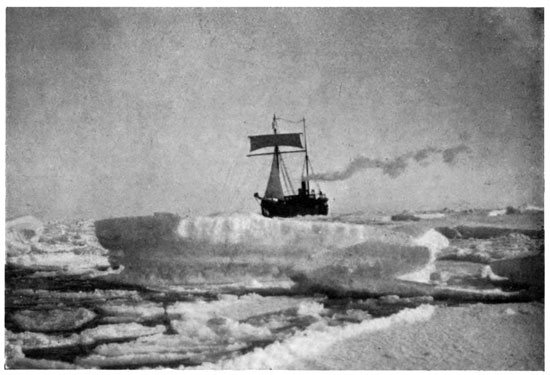
Photo: Wilkins
PUSHING SOUTH THROUGH HEAVY PACK
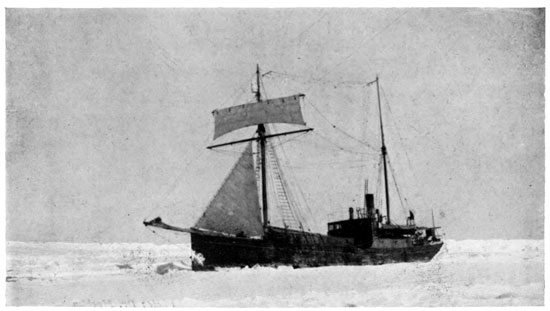
Photo: Dr. Macklin
THE QUEST PLOUGHING THROUGH HEAVY ICE PACK
If approached slowly they make no attempt to run
away, but may even take a few sedate steps forward to
meet the stranger. When within a few paces they stop
and commonly make a profound bow, just as if they were
greeting one’s arrival. If approached quickly and suddenly
they take alarm and retire, first of all upon their
feet; but if hustled they drop upon their bellies and
using both feet and flippers, sledge themselves along at
a considerable speed. Seen from behind they look like
gigantic beetles, and there is something about this mode
of progression which is provocative of laughter. I have
noticed this when I have been showing pictures upon the
cinema screen, the audience invariably breaking into
laughter when it occurs.
This species is found only in the far south, and has
the peculiarity of nesting during the winter. The term
“nesting” may be misleading, for they do not make any
nests but lay their egg (only one egg is laid by each bird)
upon the snow surface. Both male and female birds
take turns in hatching out. They have a small depression
on the foot into which the egg is wriggled by means
of the beak. They are able to move about carrying the
egg, and as Sir Ernest Shackleton used to say, “they
act both as a cradle and a perambulator.” When they
wish to transfer the egg from one to another they stand
belly to belly and indulge in a vast amount of wriggling;
but in the process the egg is often dropped on to the ice
and has to be wriggled on again from there. Two of
the most marked characteristics of penguins are their
patience and tenacity of purpose, both of which are
extraordinary.
A few days before we entered the cul-de-sac Dell
killed the South Georgia pig which was presented to
us by Mr. Hansen, of Leith Harbour. It proved excellent
eating and a pleasant change from seal meat. The
head remained, and as it would make a meal for only
one of the messes, we agreed to gamble to decide which
should have it. Kerr was deputed to represent us, but
lost to the after-mess. Even such small incidents as this
attracted an interest just then.
A sounding taken on this day (February 7th) showed
2,356 fathoms in position lat. 67° 40´ S. and 17° 6´ E.
long.
At 5.0 a.m. on the following day the ice had shown
no signs of opening, so I decided to turn back and look
for a more open route to the east or west. We steamed
north until noon, when, not caring to expend coal in
going away from our objective, I gave orders to reduce
steam, and proceeded under sail. The wind was
southerly and of moderate strength. I gathered in this
way some idea of what ice navigation meant in the days
before the introduction of the steam engine. Progress,
in spite of favourable winds, was slow, but I was surprised
at the effect of a long-continued steady pressure
against floes, some of them of quite considerable weight.
They gave way slowly before our bows, and the Quest
slipped of her own will (for she would not answer her
helm) into the cracks between them and slowly wedged
her way through.
We were now so deep in the pack that there was no
appreciable swell, and the Quest was consequently
steady. I continued the operation which we had been
compelled to give up before, and swung out the port
life-boat, Worsley being a spectator only. This time
there was no accident.
Worsley now started to go on the bridge and keep a
watch, though of course he was compelled to take things
very quietly, at any rate in so far as his movements were
concerned. Quiet in other respects his watch certainly
was not, for members of it carried on long-continued,
and often argumentative, dialogues, usually at the top
of their voices. This was especially the case with one
of them, and many times I have leapt on deck with a
sense of impending danger, wakened by shouting that
proved to be the most trivial of remarks.
The weather was fair during the day, with a moderate
southerly wind, no sunshine, and occasional snow
squalls. At 7.30 p.m. we had made thirty-five miles to
the northward. This was all to the bad and a bit disappointing.
However, we hoped for a change before
long. Seals appeared on the floe in quantity during
the day and also a number of emperor penguins standing,
as usual, stately and alone.
Killers were about and a large number of birds—Antarctic
petrels, Wilson’s petrels, and a few pretty pure
white snow petrels.
During the night (February 9th) our luck changed
and we were able to make southerly again. Throughout
the morning we met loose pack and a number of
leads of open water, so that by 12.0 noon we were only
eleven miles north of the previous position. We had
the same conditions till 4.0 p.m., when we met with dense
pack. From the crow’s nest, however, I saw “water
sky” to the southward and determined to push on to
the utmost ability of the ship. We progressed very
slowly and only with the greatest difficulty. It took
much hard steaming and consumption of valuable coal
for the Quest to make any impression on this heavy floe.
The evening of this day was fine, beautiful and still,
the sort that takes hold of one and sends mind and
memory wandering far afield. There was not a ripple
on the small pools between the floes, in which were
numbers of small euphausiæ swimming about. Four or
five seals came about the ship and accompanied us,
rubbing themselves against the sides and popping their
heads out to regard us with large eyes of a beautiful soft
brown colour. They were evidently in a playful mood.
On the ice seals are sluggish and very helpless, but in
the water they are wonderful, and their swimming movements
are most graceful as they dart about twisting and
turning and occasionally rising to look round.
Killers were about earlier in the day, but no penguins.
An ugly-looking sea-leopard put his head out of the
water and gazed malignantly over the edge of the floe.
In a pool at some distance from the ship I caught sight
of a black mass rising and falling, and through my
binoculars witnessed what appeared to be a fight between
two sea-leopards. One of them leapt continually from
the water to a height of some six feet, and the water was
churned to a mass of foam. Suddenly it all ceased.
What tragedy was enacted on that perfect evening? On
such a night, amidst the pure whiteness of one’s surroundings,
it was hard to realize that in the struggle
for existence the unrelenting laws of Nature must
hold.
We passed close alongside a floe with a seal on it.
I shot it; Macklin jumped off on to the floe and made
fast a line, scarcely taking time to stop we hauled it
aboard and proceeded on our way. Looking back I saw
the surface of the snow smirched with its blood. So
Man passed leaving a red stain; and yet but a few
moments before I had been moralizing on “Nature red
in tooth and claw.”
Very few birds were about, with the exception of
snow petrels, a few Antarctic petrels and a single young
Dominican gull.
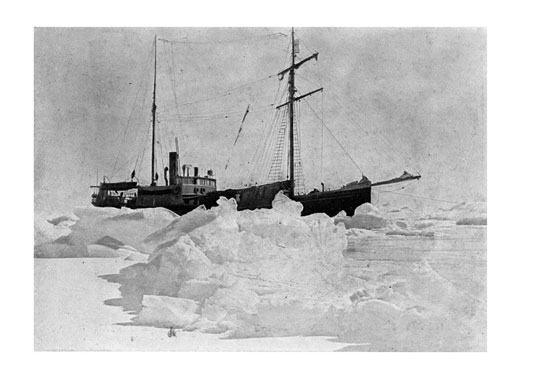
Photo: Wilkins
THE QUEST AT HER FARTHEST SOUTH
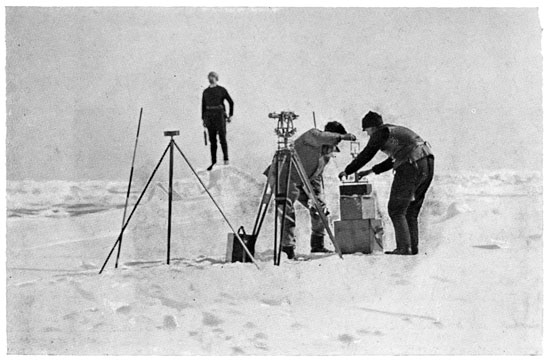
Photo: Wilkins
JEFFREY AND DOUGLAS TAKING OBSERVATIONS FOR MAGNETIC DIP
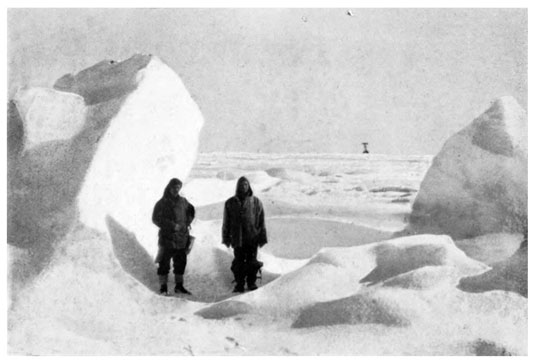
Photo: Wilkins
HEAVY PRESSED-UP PACK ICE—THE QUEST IN THE DISTANCE
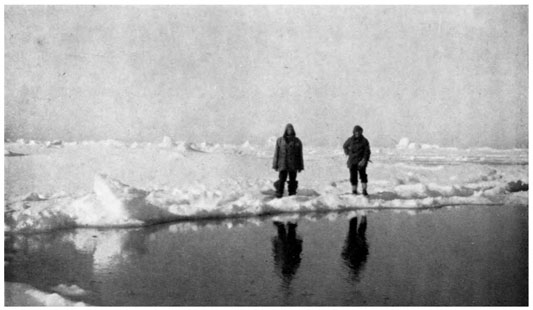
Photo: Dr. Macklin
COMMANDER WILD AND WORSLEY EXAMINING A NEWLY FORMED “LEAD”
IN THE PACK ICE
We were pushing on, but the prospect at the moment
was not promising. From aloft there was nothing to be
seen but ice closely packed and stretching as far as the
eye could reach in all directions. I distrust fine weather
in the pack; it usually means lowered temperature, close
ice and little open water.
February 10th opened as a beautiful morning, with
bright sunshine. The ice was white and sparkling and
the water a deep blue. The air was keen and crisp, and
all hands revelled in the improved weather conditions.
Less so myself, however, for I feared what was portended.
I prefer damp misty weather in the pack, for
that means the presence of a considerable amount of
open water amongst the ice and better conditions for
navigating, in spite of poor visibility.
The number of seals that accompanied us increased
to twenty or more. They refused to leave us, though
they occasionally took fright and dashed off with a swirl
of water. Seen from aloft a school of seals is a wonderful
sight. There was evidently something on the ship’s
side which had an attraction for them, for they seized
the chance of every stop to rise out of the water and
nibble at frozen pieces of ice which had formed just
above the water-line. The ice on the patent anchors
which projected from the hawse holes two or three feet
above the surface especially attracted them, and they
collected in clusters of five or six to nibble at it.
In the early morning the pack was composed of
dense, heavy old floes, much broken up and bearing the
remains of pressure ridges through which progress was
very slow. At 7.30 a.m. we entered a lead with surface
just freezing over, which offered little resistance to the
ship. It was literally full of killers, which crossed and
recrossed our bows and “blew” all about us. Our seal
friends did not accompany us into the lead, for which
the presence of the killers was no doubt a good and
sufficient reason. The crab-eaters seem to have no fear
of them whilst in closely set pack with only small pools
of water between the floes, but one rarely sees crab-eaters
in larger stretches of water. Occasionally they have been
seen in large numbers travelling at high speed. Hurley,
the photographer of the last expedition, was able to get
a photographic record of them passing close to the ship,
the number being so great that the surface of the water
was lashed to foam. That they are hunted by the killers
is beyond doubt, for one frequently sees them shoot out
of water and land with a heavy wallop on a piece of ice,
look all round and bump themselves violently along,
finally disappearing with a dive into the water again.
This differs largely from their ordinary method of landing
when they wish to rest. In this case they may be
seen first of all rising high out of the water and looking
over the edge of the floe, obviously noting its nature,
and searching for a shelter from the wind. They land
with the same heavy flop, but show none of the excitement
when up.
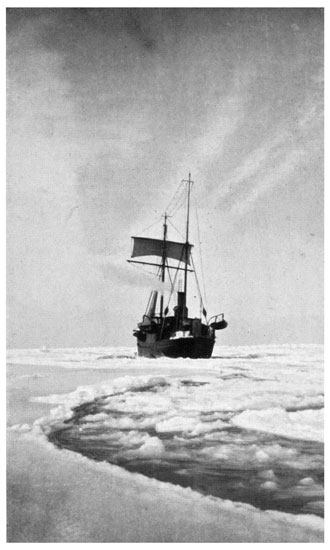
Photo: Dr. Macklin
THE QUEST PUSHING NORTH THROUGH RAPIDLY
FREEZING ICE
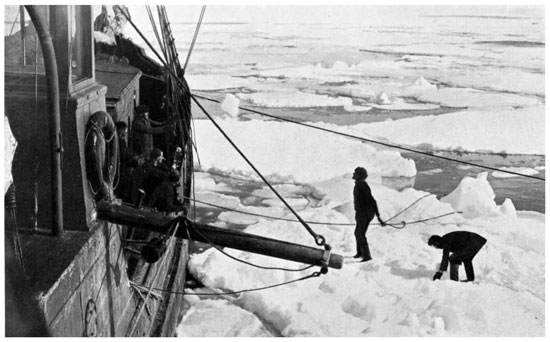
Photo: Wilkins
“WATERING” SHIP WITH FLOE ICE
On one occasion at my base in Queen Mary’s
Land during the Mawson Expedition I was standing
on an ice foot with Mr. Harrison, my biologist,
when I saw a killer actually attack a seal which,
however, escaped and effected a landing on the ice
foot. It was bleeding profusely and was in a very
exhausted condition. On close examination we found
six large wounds, all of which had penetrated the blubber
to the flesh, none of them less than three inches deep.
At first I was inclined to put the animal out of its misery,
but my biologist asked me to let it remain so that we
might see whether or not it would recover. It lost an
amazing amount of blood, which melted its way into the
ice beneath, but on the fourth day it had recovered
sufficiently to enter the sea again. Nearly all seals bear
the scars of old wounds in vertical strokes down their
sides. Wilkins collected a number of skins in which
these scars were more extensive than usual, and prepared
them for sending back as specimens to the British
Museum.
The water in the hold had increased so much by now
that it required four hours of hard pumping to reduce.
It was hard, monotonous work.
In the afternoon we encountered the first Adelie
penguin which we had seen on this expedition. It was
standing alone on a flat piece of floe, and at sight of us
evinced the most marked surprise, looking at us first with
one eye and then the other, and finally started towards
us at a run. Its waddling gait resembled that of a fat
old white-waistcoated gentleman in a desperate hurry.
Many times it fell forward, but, picking itself up, hurried
on till, reaching the edge of the floe, it tumbled rather
than dived into the water. In a few seconds it shot out,
to alight upright upon another floe where it continued
the chase, but by this time we were drawing away and
he gave it up, uttering a last “Cl-a-a-k,” as much as to
say, “Well, I’m jiggered!” Later we saw many more
who showed the same interest, some of them taking to
the water and coming about the ship or following in
our wake.
We entered a broad belt of large flat pieces of one-year-old
floe interspersed with thinner new ice which the
Quest was able to crack, although it usually required
several blows to split it widely enough to let her through.
Following on this we entered a broad lead of open
water, but about 10 p.m. encountered very thick and
solid floe. Owing to the dim light it was impossible to
distinguish rotten mushy ice which we could safely ram
from solid pieces which badly jarred the ship. About
midnight I lay to till more light should give me a chance
to get a better view from the mast head.
We obtained a sounding of 2,163 fathoms in position
lat. 68° 3´ S. and 16° 12´ E. long., and as soon as the
light improved we set off again and spent the whole
of February 11th energetically pushing south. The
temperature fell rapidly, reaching 18° F. at midnight.
All the open water started freezing over and was covered
with a skin of ice which offered little resistance to the
ship when she was well under way, but impeded her
considerably when in the dense pack she was forced to
be continually stopping and restarting again.
As far as the actual weather was concerned the Antarctic
can offer nothing better than that which we were
experiencing, fine and clear, the air crisp and cold, yet
not sufficiently so to be unpleasant. As the sun sloped
down to the horizon with the gentle decline it takes in
these latitudes, in contrast to the suddenness with which
it disappears in the tropics, we had a beautiful long
sunset, the sky taking the most wonderful colours,
crimson, amber and gold. The snow surface was a
lovely pale pink except where each hummock threw a
long black shadow. The surface of the newly freezing
parts, still and polished, reflected a pale green. Across
the vault of the sky were little fleecy rolls of pink cloud,
while nearer the horizon were heavier banks of a deep
crimson. Stretching away behind in an ever-narrowing
ribbon one saw the lane cut by the passage of the ship
disturbed only in the foreground by the ripple of the
screw. In contrast to the vivid colouring ahead that
astern had the black and white effect of a pencil sketch.
A perfectly wonderful evening and yet—timeo Danaos—I
do not like the pack when it smiles. The prospect
was not good. I knew that unless we got a rise of
temperature things might be bad for us, for it would be
quite impossible to forge through the thickening ice,
which had the effect of cementing together the heavier
floes so that a much more powerful ship than the Quest
would have been quite unable to make any impression
upon them.
There was one thing I knew I must avoid. The
Quest was not suitable for “freezing in.” Her shape
was not such as would cause her to rise with lateral pressure,
and it was almost certain that should she become
involved in any of the heavy disturbances which frequently
occur she was not likely to survive. The hazard
of a boat journey was not likely to meet with the same
fortunate ending that we experienced in the Endurance
expedition, where our escape was indeed a miraculous
one. Nearly all our special winter equipment was at
Cape Town, which was to have been our base of operations.
But weighing even more than these factors was
another on which one can only briefly touch: in spite of
a solid nucleus of old, tried Antarctic men, and others
of proved worth in different fields, there was a discordant
element in the personnel which I was anxious to adjust
before I exposed the party to the trials and vicissitudes
of a polar winter.
During the afternoon Worsley took a sounding, finding
in lat. 68° 52´ S. and 16° 55´ E. long. a depth of
1,555 fathoms, which showed a shoaling of 608 fathoms
in 49 miles of southing. The snapper contained a
specimen of grey mud which was handed to the geologist.
I had no rest during the night, for I realized that
on the next few hours hung the fate of this effort.
Unless the temperature rose and the ice showed signs
of loosening it would be necessary to turn back, little
though I liked the prospect. I was in the crow’s nest the
moment that the dim midnight light began to improve,
searching all round the horizon with binoculars. Everywhere
the ice lay tightly packed and solid. McIlroy
reported a further drop of two degrees Fahrenheit. The
filmy, freezing surface of the leads had become definitely
frozen over, so that there was not a drop of water to be
seen anywhere. Even to the northward the outlook was
bad, and I began to fear that after all we might be beset.
That we could push no farther into the heavy ice was
certain. I decided to remain where I was for the day,
but longer than that would be fatal unless a change
occurred in the meantime. I manœuvred the ship to a
large solid floe to enable the scientists to take their
instruments over the side, and give all hands a chance
of exercise after the cramping spell of shipboard. Near
by a fat Weddell seal lay asleep. I shot it, and McIlroy
and Macklin skinned it and took the blubber to the
bunkers. Carr, with the assistance of Marr, Naisbitt
and Argles, brought in some ice for use as drinking
water.
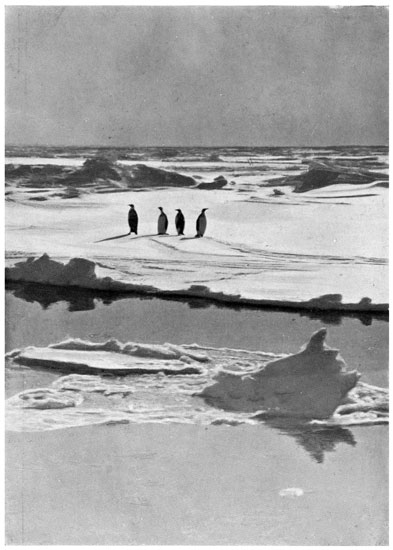
Photo: Wilkins
EMPEROR PENGUINS ON THE FLOE: A STILL EVENING
IN THE PACK
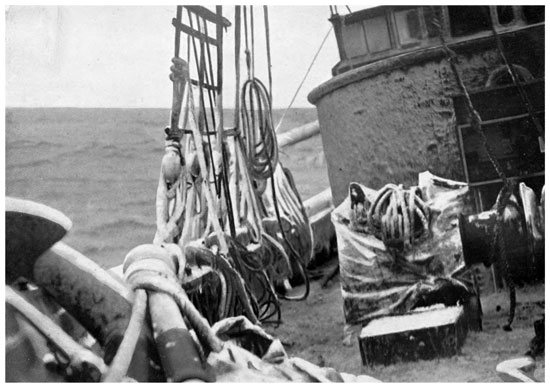
Photo: Wilkins
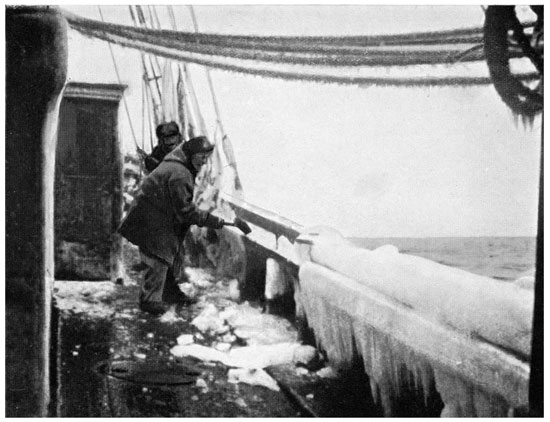
FROZEN SPRAY
Sea ice, although salt, has the peculiar property that
if piled up for two or three days, either naturally as
pressure ridges or artificially by heaping up a number
of frozen slabs, the salt leaves the upper pieces, which
can be melted down and freely used as drinking water.
Physicists have not been able to explain fully the phenomenon.
It is, however, an easily demonstrable fact,
and it is by this property of the ice alone that ships have
been able to winter in the pack. In the height of summer,
when the sun beats down strongly upon the ice, pools of
water form on the surface of the floes. They are fresh
and can be used for drinking. It is necessary, however,
if water is being taken from this source, to see that the
floe is a good solid one, not “rotted” underneath, in
which case it may be brackish. During some of our
marches over the ice of the Weddell Sea after the loss
of the Endurance the going was very bad and the work
tremendously hard on account of soft snow, which let
the men down to the hips and the dogs to their bellies,
and we suffered severely from thirst. When we encountered
any of these pools they were freely used by men
and dogs for drinking, and we never noticed any salty
flavour.
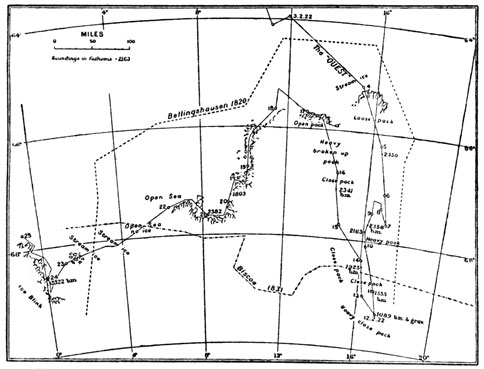
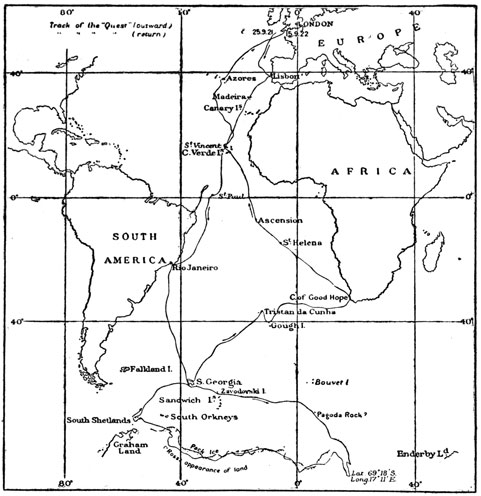
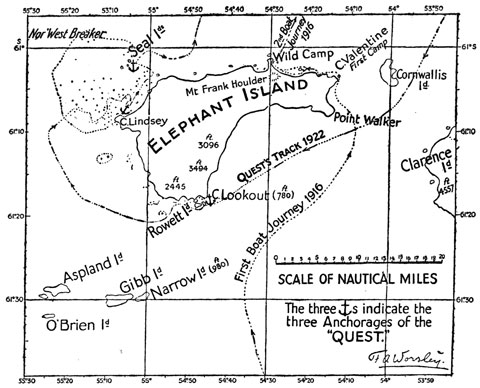
The track of the Quest as compared with the tracks of Biscoe and
Bellingshausen.
View larger image
The eating of snow is bad; of this there can be no
doubt, though I have seen it stated in the writings of
some explorers that it is quite suitable for quenching
thirst, and all that is necessary is to overcome the prejudice
against its use. The eating of a little snow is
harmless, but if one indulges in the practice for a long
time the mouth becomes very dry due to the paralysing
effect of cold on the salivary glands. The result
is that more and more of it is required and the dryness
of the mouth is intensified. Any weak spots
which may have developed in the teeth are at once discovered,
with consequent severe facial neuralgia. The
swallowing of the scarcely melted water tends to upset
digestion, as is well seen in the United States of
America, where the frequent taking of iced drinks is
a national practice and dyspepsia is the national complaint.
This is not a theoretical observation, for as an
enthusiastic young man in my early days of exploration
I made the experiment to my sorrow, and I have noted
the effects upon other members of the different expeditions
which have entered these regions.
Worsley, with the assistance of Dell and Watts, took
a sounding, finding bottom at 1,089 fathoms in lat. 69°
17´ S. and 17° 9´ E. long. This showed a shoaling of
466 fathoms in twenty-nine miles, and certainly indicated
the approach to the continental shelf. Once again
I climbed to the crow’s nest and scanned the horizon to
the south. The sky in that direction had a hard white
look such as one would get over snow-covered land, but
is also seen over densely packed ice. I felt sure that if
we could only work our way for another fifty miles to
the south we should sight or find indications of land, but
no ship ever built could possibly have pushed through
the ice to the south of us, not even the most powerful
ice-breakers.
Of animal and bird life there was very little, but
though if present they would have been additional
evidence in favour of the proximity of land, their absence
did not necessarily negative it.
Looking backwards to the north I saw that the ice
in that direction, though less dense than that to the
south, was settling firm and hard, and I decided that
as soon as the scientific staff had completed their observations
I must beat a hasty and energetic retreat.
Few people can realize what an effort it had been to
force the little Quest to this position. It was hard to
have to turn back. It was necessary, however, to make
every effort to escape this freeze up, but once in loose
pack I was determined to seize the first chance to push
south again.