Nothing of very great note occurred in the county of
Jackson, after the cyclone of 1826, until the year 1830,
when five Mormon elders made their appearance in the
county and commenced preaching, stating to their audiences
that they were chosen by the priesthood which had
been organized by the prophet Joseph Smith, who had met
an angel and received a revelation from God, who had also
revealed to him and his adherents the whereabouts of a
book written upon golden plates and deposited in the earth.
This book was found in a hill called Cumorah, at Manchester,
in the State of New York. They selected a place
near Independence, Jackson County, Mo., in the early part
of the year 1831, which they named Temple Lot, a beautiful
spot of ground on a high eminence. They there stuck
down their Jacob's staff, as they called it, and said: "This
spot is the center of the earth. This is the place where the
Garden of Eden, in which Adam and Eve resided, was
located, and we are sent here according to the directions
of the angel that appeared to our prophet, Joseph Smith,
and told him this is the spot of ground on which the New
Jerusalem is to be built, and, when finished, Christ Jesus is to
make his reappearance and dwell in this city of New Jerusalem
with the saints for a thousand years, at the end of
which time there will be a new deal with reference to the
nations of the earth, and the final wind-up of the career of
the human family." They claimed to have all the spiritual
gifts and understanding of the works of the Almighty that
belonged to the Apostles who were chosen by Christ when
on his mission to this earth. They claim the gift of
tongues and interpretation of tongues or languages spoken in
an unknown tongue. In their silent meetings, the one who
had received the gift of an unknown tongue knew nothing
of its interpretation whatever, but after some silence some
one in the audience would rise and claim to have the gift
of interpretation, and would interpret what the brother or
sister had previously spoken. They also claimed to have
the gift of healing by anointing the sick with oil and laying
on of hands, and some claimed that they could raise
the dead; in fact, they laid claim to every gift that belonged
to the Apostolic day or age. They established their
headquarters at Independence, where some of their leading
elders were located. There they set up a printing
office, the first that was established within 150 miles of
Independence, and commenced printing their church literature,
which was very distasteful to the members and leaders
of other religious denominations, the community being
composed of Methodists, Baptists of two different orders,
Presbyterians of two different orders, and Catholics, and a
denomination calling themselves Christians. In that day
and age it was regarded as blasphemous or sacrilegious for
any one to claim that they had met angels and received
from them new revelations, and the religious portion of the
community, especially, was very much incensed and aroused
at the audacity of any person claiming such interviews from
the invisible world. Of course the Mormon elders denounced
the elders and preachers of the other denominations
above mentioned, and said they were the blind leading
the blind, and that they would all go into the ditch
together. An elder by the name of Rigdon preached in the
court house one Sunday in 1832, in which he said that he
had been to the third heaven, and had talked face to face
with God Almighty. The preachers in the community the
next day went en masse to call upon him. He repeated
what he had said the day before, telling them they had not
the truth, and were the blind leading the blind.
The conduct of the Mormons for the three years that
they remained there was that of good citizens, beyond their
tantalizing talks to outsiders. They, of course, were
clannish, traded together, worked together, and carried with
them a melancholy look that one acquainted with them
could tell a Mormon when he met him by the look upon
his face almost as well as if he had been of different color.
They claimed that God had given them that locality, and
whoever joined the Mormons, and helped prepare for the
next coming of the Lord Jesus Christ, would be accepted
and all right; but if they did not go into the fold of the
Latter Day Saints, that it was only a matter of time when
they would be crushed out, for that was the promised land
and they had come to possess it. The Lord had sent them
there and would protect them against any odds in the way
of numbers. Finally the citizens, and particularly the
religious portion of them, made up their minds that it was
wrong to allow them to be printing their literature and
preaching, as it might have a bad effect upon the rising
generation; and on the 4th of July, 1833, there was quite a
gathering of the citizens, and a mob was formed to tear
down their printing office. While the mob was forming,
many of the elders stood and looked on, predicting that the
first man who touched the building would be paralyzed and
fall dead upon the ground. The mob, however, paid no
attention to their predictions and prayers for God to come
and slay them, but with one accord seized hold of the implements
necessary to destroy the house, and within the
quickest time imaginable had it torn to the ground, and
scattered their type and literature to the four winds. This,
of course, created an intense feeling of anger on the part
of the Mormons against the citizens. At this time there
were but a few hundred Mormons in the county against
many times their number of other citizens. I presume
there was not exceeding 600 Mormons in the county.
Immediately after they tore down the printing office they
sent to the store of Elder Partridge and Mr. Allen, who
was also an elder in the church, and took them by force to
the public square, stripped them to their waists, and poured
on them a sufficient amount of tar to cover their bodies
well, and then took feathers and rubbed them well into the
tar, making the two elders look like a fright. One of their
names being Partridge, many began to whistle like a cock
partridge, in derision. Now, be it remembered that the
people who were doing this were not what is termed "rabble"
of a community, but many among them were respectable
citizens and law-abiding in every other respect, but who
actually thought they were doing God's service to destroy, if
possible, and obliterate Mormonism. In all my experience
I never saw a more law-abiding people than those who
lived where this occurred. There is nothing, however, that
they could have done that would have proved more effectual
in building up and strengthening the faith of the people
so treated as this and similar performances proved to
do. For if there is anything under the sun that will
strengthen people in their beliefs or faith, no matter whether
it is error or truth, if they have adopted it as true, it is to
abuse and punish them for their avowed belief in whatever
they espouse as religion or politics.
A few months after the tearing down of the building,
a dozen or two Mormons made their appearance one
day on the county road west of the Big Blue and not
far from the premises of Moses G. Wilson. Wilson's boy
rode out to drive up the milk cows in the morning, and saw
this group of Mormons and had some conversation with
them, and they used some very violent language to the boy.
He went back and told his father, and it happened that
there were several of the neighbors in at the time, as he
kept a little county store; and in those days men generally
carried their guns with them, in case they should have a
chance to shoot a deer or turkey as they went from one
neighbor's to another. It so happened that several of them
had their guns with them; those who did not picked up a
club of some kind, and they all followed the boy, who
showed them where they were. When they got in close
proximity to where the Mormons were grouped, seeing the
men approaching with guns, the Mormons opened fire upon
them, and the Gentiles, as they were called by the Mormons,
returned the fire. There was a lawyer on the Gentile
side by the name of Brazeel, who was shot dead;
another man by the name of Lindsay was shot in the jaw
and was thought to be fatally wounded, but recovered.
Wilson's boy was also shot in the body, but not fatally.
There were only one or two Mormons killed. Of course,
after this occurrence, it aroused an intense feeling of hate
and revenge in the citizens, and the Mormons would not
have been so bold had it not been for their elders claiming
that under all circumstances and at all times they would
be sustained by the Almighty's power, and that a few of
them would be able to put their enemies to flight. The
available Mormon men then formed themselves into an
organization for fighting the battles of the Lord, and
started to Independence, about ten miles away, to take possession
of the town. On their way, and when they were within
about a mile of Independence, they marched with all the
faith and fervor imaginable for fanatics to possess, encouraging
each other with the words, "God will be with us and
deliver our enemies into our hands." At this point they
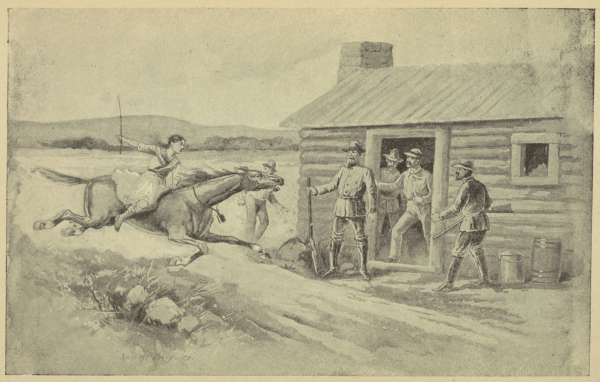
met a gentleman whom I well knew, by the name of Rube
Collins, a citizen of the place, who was leaving the town in
a gallop to go home and get more help to defend the town
from the Mormon invasion. He shouted out as he passed
them, "You are a d—d set of fools to go there now; there are
armed men enough there to exterminate you in a minute."
They were acquainted with Collins, and supposed he had
told them the truth; however, at that time they could have
taken the town had they pressed on, but his words intimidated
them somewhat, and they filed off from the big road
and hid themselves in the brush until they could hold a
council, and I presume pray for light to be guided by.
During this time there were runners going in all directions,
notifying the citizens that the Mormons were coming to
the town to take it, and every citizen, as soon as he could
run bullets and fill his powder horn with powder, gathered
his gun and made for the town; and in a few hours men
enough had gathered to exterminate them had they
approached. In their council that they held they decided
not to approach until they sent spies ahead to see
whether Collins had told them the truth or not. They
supposed he had, from the fact that they found the public
square almost covered with men, and others arriving every
minute. As quickly as the citizens had organized themselves
into companies (my father, Benjamin Majors, being
captain of one of them), they then sent a message by two
or three citizens to the Mormons, where they were still
secreted in the paw-paw brush, and told them that if they did
not come and surrender immediately, the whole party that
was waiting for them in the town would come out and
exterminate them. This message sent terror to their
hearts, with all their claims that God would go before
them and fight their battles for them. After holding
another council they decided the best thing they could do
was to go and surrender themselves to their enemies, which
they did. I never saw a more pale-faced, terror-stricken
set of men banded together than these seventy-five Mormons,
for it was all the officers could do to keep the citizens
from shooting them down, even when they were surrendering.
However, they succeeded in keeping the men
quiet, and no one was hurt. They stacked all their arms
around a big white-oak stump that was perhaps four feet in
diameter, and at that time was standing in the public
square. Afterward the guns were put in the jail house for
safe keeping, and were eaten up with rust, and never to my
knowledge delivered to them. They then stipulated that
every man, woman, and child should leave the county
within three weeks. This was a tremendous hardship upon
the Mormons, as it was late in the fall, and there were no
markets for their crops or anything else that they had. The
quickest way to get out of the county was to cross the
river into Clay, as the river was the line between the two
counties. They had to leave their homes, their crops, and
in fact every visible thing they had to live upon. Many
of their houses were burned, their fences thrown down, and
the neighbors' stock would go in and eat and destroy the
crop.
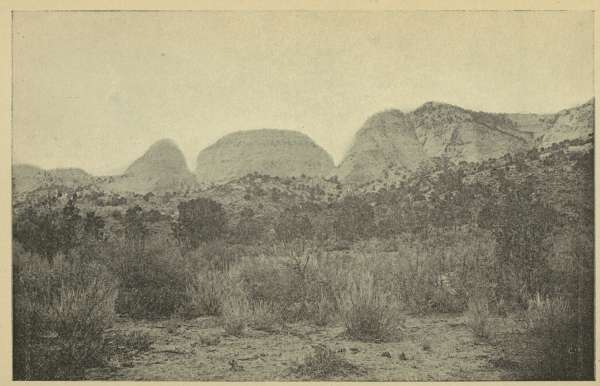 NATURE'S TABERNACLE.
It has been claimed by people who were highly colored
in their prejudice against the Mormons that they were bad
citizens; that they stole whatever they could get their
hands on and were not law-abiding. This is not true with
reference to their citizenship in Jackson County, where they
got their first kick, and as severe a one as they ever
received, if not the most severe. There was not an officer
among them, all the offices of the county being in the
hands of their enemies, and if one had stolen a chicken he
could and would have been brought to grief for doing so;
but it is my opinion there is nothing in the county records
to show where a Mormon was ever charged with any misdemeanor
in the way of violation of the laws for the protection
of property. The cause of all this trouble was
solely from the claim that they had a new revelation direct
from the Almighty, making them the chosen instruments to
go forward, let it please or displease whom it might, to
build the New Jerusalem on the spot above referred to,
Temple Lot. And, as above stated, whoever did not join
in this must sooner or later give way to those who would.
I met a Presbyterian preacher, Rev. Mr. McNice, in Salt
Lake City a number of years ago at the dinner table of a
mutual friend, Doctor Douglas. It was on the Sabbath after
hearing him preach a very bitter sermon against the Mormons,
denouncing their doctrines and doings in a severe
manner, and while we were at the dinner table, the subject
of the Mormons came up, and I told him that I was
thoroughly versed in their first troubles in Missouri, and he
asked me what the trouble was. I told him frankly that it
grew out of the fact that they claimed to have seen an
angel, and to have received a new revelation from God
which was not in accord with the religious denominations
that existed in the community at that time. He hooted at
the idea and told me he had read the history of their troubles
there, and that they were bad citizens with reference to
being outlaws, thieves, etc., who would pick up their neighbors'
property and the like. He insisted that he had read
their history, and showed a disposition to discredit my
statements. I then told him I was history, and knew as
much about it as any living man could know, and that there
were no charges of that kind against them; they were
industrious, hard-working people, and worked for whatever
they wanted to live upon, obtaining it by their industry, and
not by stealing it from their neighbors. He then scouted
at the idea that people would receive such treatment as
they did merely because they claimed to have seen angels
and talked with God and claimed to have a new revelation.
I then referred him to the fact that fifty or sixty years previous
to that time the public mind in America lacked a great
deal of being so tolerant as it was at the time of our conversation;
that not more than one hundred years ago some
of the American people were so superstitious that they
could burn witches at the stake and drag Quakers through
the streets of Boston on their backs, with a jack hitched to
their heels; that the Mormons to-day could go to Jackson
County, Mo., and preach the same doctrines that they did
then, and the result would be that they would be laughed
at instead of mobbed as they were sixty years ago.
I was sitting in a cabin with my father's miller, a Mr.
Newman, a Mormon, at the time of this trouble. Mr. Newman's
mother-in-law, who lived with him, was named Bentley;
she had a son in the company that surrendered at
Independence, and who walked six miles that evening and
came home. The young man walked in and looked as sad
as death, and when asked what the news was he stood there
and related what had taken place that day at the surrender.
They all sat in breathless silence and listened to the story,
and when he was through with his statement and said the
Mormons had agreed to leave the county within three
weeks, the old lady, who sat by the table sewing, raised her
hand and brought it down upon the table with a tremendous
thud, and said:
"So sure as this is a world there will be a New Jerusalem
built."
I relate this little incident to show that even after they
had met with such a galling defeat how zealous even the
old women were with reference to their future success.
But it is my opinion that the more often a fanatic is kicked
and abused, the stronger is his faith in his cause, for then
they would take up the Scriptures and read the sentences
expressed by Christ:
"But before all these they shall lay their hands on you
and persecute you, delivering you up to the synagogues
and into prisons, being brought before kings and rulers for
my name's sake." "But take heed to yourselves, for they
shall deliver you up to councils, and in the synagogues ye
shall be beaten; and ye shall be brought before rulers and
kings for my sake for a testimony against them."
From such passages they have always drawn the greatest
consolation, and one would ask one another, "Where are
the people the blessed Lord had reference to?" Another
brother, with all the sanctity and confidence imaginable for
a fanatic to feel, would answer, "Well, brother, if you do
not find them among the Latter Day Saints you can not
find them upon the face of this green earth, for we have
suffered all the abuses the blessed Lord refers to in the
Scripture you have just quoted."
I have said before that the Mormons all crossed the Missouri
into Clay County, where they wintered in tents and
log cabins hastily thrown together, and lived on mast, corn,
and meat that they would procure from the citizens for
whom they worked in clearing ground and splitting rails,
and other work of a like character.
In the spring they were determined to return to their
homes, although they were so badly destroyed, and claimed
again as before that God would vindicate them and put to
flight their enemies. The people of Jackson County,
however, watched for their return, and gathered, at the
appointed time, in a large body, on the opposite side of the
river to where the Mormons, were expected to congregate
and cross back into the county. Their spies came to the
river, and seeing camps of the citizens, who had gathered to
the number of four or five hundred strong (I being one of
the number) to prevent their crossing, then changed their
purpose and sent some of their leading men to locate in some
other part of the State, for the time being, with the full
understanding, however, that at the Lord's appointed time
they would all be returned to Jackson County, and complete
their mission in building the city of the New Jerusalem.
The delegation they sent out selected Davis and Colwell
counties as the portion of the State where they would make
their temporary rally until they became strong enough for
the Lord to restore them to their former location.
During that spring the citizens of Jackson County, feeling
that there had been, in many cases, great outrages perpetrated
upon the Mormons, held a public meeting at Independence
and appointed five commissioners, whose duty it
was to meet some of the leading elders of the Mormons at
Liberty, the seat of Clay County, and make some reparation
for the damages that had been done to their property
the fall before in Jackson County. They met, but failed to
agree, as the elders asked more and perhaps wanted to
retain the titles they had to the lands, as they thought it
would be sacrilege to part with them, for that was the
chosen spot for the New Jerusalem. During the time that
elapsed between the commissioners crossing the river in the
morning and returning in the evening, the ferryman (Bradbury),
whom I have often met, a man with a very large and
finely developed physique, a great swimmer, was supposed
to be bribed by the Mormons to bore large auger-holes
through the gunwales of his flatboat just at the water's edge.
The boat having a floor in it some inches above the bottom,
there could be no detection of the flow of the water until
it was sufficiently deep to cover the inner floor. The commissioners
went upon the boat with their horses, and had
not proceeded very far from the shore until they found the
water coming up in the second floor and the boat rapidly
sinking. This, of course, produced great consternation,
for the river was very high and turbulent. Bradbury, the
owner of the ferry, said to his two men:
"Boys, we will jump off and swim back to the shore."
As above stated, he was a great swimmer, and had been
known to swim the Missouri upon his back several times
not long before this occurred. When the water rose in the
boat so that it was necessary for the commissioners to leave
it, three of them caught hold of their horses' tails, after
throwing off as much clothing as they could before the
boat went down with them. The other two men who could
swim attempted to swim alone, but the current was so turbulent
that they were overcome and were drowned. Those
who hung on to the tails of their horses were brought
safely to shore. One of the men drowned was a neighbor
of my father's and as fine a gentleman and good fellow
as ever lived. His name was David Lynch.
I remember well their names, and was well acquainted
with two of the men who were pulled through by their
horses, S. Noland and Sam C. Owens, the foremost merchant
of the county, a man who stood high in every sense,
and of marked ability.
This occurrence put the quietus on any further attempt
to try to settle for the damages done the Mormons when
driven from the county, for it caused in the whole population
the most intense feeling against them, and they never
were remunerated.
When Bradbury jumped off the boat he swam for the
shore, but was afterward found dead, with one of his hands
grasping the root of a cottonwood tree, so there was no
opportunity for trying him for the crime, or finding out how
it was brought about. It was supposed that he was bribed,
as no one knew of any enmity he had against the commissioners.
The town the Mormons started, which they selected for
their home in Paris County, they called Far West. This
was the first experience that the people of Western Missouri
had with the emigrants of the Eastern or New England
States. Brigham Young, who afterward became the leader
of the Mormons, was from Vermont, and many others composing
the early pioneers of the Mormon church were from
the New England States; some, however, from Ohio and Illinois,
as well as some proselytes from Missouri. Up to the
time of their appearance in Western Missouri the entire
population was from some one of the four States—Virginia,
North Carolina, Tennessee, or Kentucky.
It has been claimed by some that one of the causes of
the dissatisfaction was that the Mormons were Abolitionists.
This, however, played no part in the bitter feeling that
grew up between them and their neighbors, for at the time
of their coming to Jackson County there were but very few
slaves, the people generally being poor farmers who lived
from the labor of their own hands and that of their families.
And then, when the Mormons were driven entirely from
Missouri to Illinois, which was a free State, they soon got
into difficulty with their neighbors there, as they had done
in Missouri. It is claimed now, universally, by the people
of this country that polygamy, or the plurality-wife system,
is the only objection that good citizens can have to Mormonism.
This was not the cause of their difficulties or
their trouble in Illinois and Missouri, as they had never,
up to the time they left Nauvoo, Ill., proclaimed polygamy
as being a church institution. And as I have previously
stated, it was their clannishness, as is natural for a church
to do, more or less, only they carried it to a greater degree
than other denominations. Also the new doctrine they
were preaching, stating that they were the only and chosen
people of God, and that they had the key of St. Peter,
which was lost during the dark ages and was revealed again
to Joseph Smith, their prophet; that the Lord would stand
by them and enable them to prevail in their undertakings
as against any array of opposition, no matter how much
greater the numbers might be than their own.
They built up the city of Far West, of several thousand
people, and while there increased very rapidly, having
missionaries in many parts of the country preaching their
doctrine. As quickly as an individual would accept their
faith, they would at once rally to the headquarters, and in
the course of a few years they had put a great deal of the
prairie lands into cultivation and increased their numbers
until they were so formidable that when they began to be
odious to their neighbors by showing a hostile attitude
toward any power that might interfere with them, they got
into trouble much in the same way as they did in Jackson
County.
A party of Gentiles and Mormons met at a point called
Horn's Mill, and became involved in a quarrel, when there
were some killed on both sides. This created such a feeling
in the community that both Mormons and Gentiles felt
insecure, living neighbors to each other as they were, and
the trouble went on until it culminated in the Governor,
Lilburn W. Boggs, calling out a portion of the militia of
the State and ordering them to Far West, the Mormon center.
The Mormons were drilling continuously, and increasing
their facilities for fighting, when the militia reached the
place designated, and organizing, placed themselves in
battle array. The Mormons were also drawn up in long
lines, and for a short time it looked as if a bloody battle
was unavoidable, but before any engagement occurred the
Mormons again surrendered. They then agreed to leave
the State of Missouri, and in April, 1839, the last of the
band left Far West, moved across the Mississippi into Illinois,
where they afterward located and built the city of
Nauvoo, but with no better results with the people in the
free State than they experienced in Missouri. This shows
that slavery had nothing to do with the hard feelings and
prejudice they aroused in every community in which they
lived.
The Mormons' new village was named Nauvoo, which
means Peaceful Rest. While there, having increased to
fifteen thousand souls, they built a temple to the Lord,
which was, perhaps, the finest building that had ever been
erected in the State up to that time. During the year
1844, trouble arose between them and the Gentiles, to suppress
which the militia was called out, and in June of that
year a writ was sworn out for the arrest of the Mormon
prophet, Joseph Smith. His brother Hiram and Elder
Taylor, who, after Brigham Young's death, became president
of the church, accompanied him to Carthage, Ill.,
where he went to give himself up. Arriving at Carthage,
all three were put in jail, where a mob succeeded in killing
the two brothers and seriously wounding Taylor, who carried
some of the bullets in his body during the remainder
of his life. On the death of Joseph Smith, Brigham Young
was chosen by the church as its prophet, president, and
leader.
After three severe experiences in establishing settlements
in Missouri and Illinois, they determined in their
councils to emigrate farther west and start a colony which
would be composed of Latter Day Saints, where they would
be entirely distinct and separate from any antagonizing
elements. At that time Salt Lake Valley, being under
Spanish dominion and a thousand miles from any white
settlement, was ultimately chosen as the spot best suited
for their purpose.
After leaving Nauvoo, Ill., they went to Council Bluffs,
Iowa (called by them Kaneville), traveling through the
State of Iowa, and undergoing the greatest hardships and
sufferings any people were ever called upon to endure,
being without money, some of them without the proper
means of transportation, destitute of almost all the necessities
of life, and a great many sick on account of exposure
to the elements. Arriving at the place above named, on
the Missouri River, they went into winter quarters, and the
next spring planted and raised crops in that vicinity, the
greater number of the emigrants remaining there for the
next two years.
In the spring of 1847, at the time war was being carried
on between the United States and Mexico, Brigham Young
started west with a band of from seventy to seventy-five
pioneers, having, I believe, an impression that in Salt Lake
Valley might be found the Mecca of their hopes. They
arrived in Salt Lake Valley on the 21st day of July of that
year. Previous to this, in 1846, at the call of the President
for troops for the Mexican War, Brigham Young raised a
regiment of a thousand volunteers to go to Mexico, under
a stipulation with the United States Government that, when
the war was over, the survivors should receive their discharges
in California. This agreement was made in view of
the fact that they had already resolved to go west into
Spanish territory.
The treaty of peace between the United States and Old
Mexico, at the close of the war, resulted in the Government
of Mexico giving up to the United States all the territory
possessed by it lying north of the present boundary line
between the two countries, so that, after all the exertions
the Mormons had made to effect a settlement on Spanish
territory, in less than a year they found themselves still in
the United States, where they have ever since remained,
having built cities and towns on the colonizing plan in
every available portion of the Territory of Utah, and having
quite a number of colonies in other Territories, with
one at present established in Mexico, as I have lately been
informed.
I have met in later years and become familiarly
acquainted with many of the leading spirits of the Mormon
church, and have had large business transactions
with Brigham Young and many other prominent Mormons,
among whom were Captain Hooper, General Eldridge,
Ferrimore Little, William Jennings, John Sharp, Lew
Hills, Gen. Daniel H. Wells, Wilford Woodruff (now
president of the Mormon church), Joseph Smith, and
George Q. Cannon, and a fairer, more upright set of
gentlemen I never met.
I have heard all the leading elders of the Mormon
Church preach, including Brigham Young, Heber Kimball,
George Q. Cannon, George A. Smith (the historian), John
Taylor, Orson Pratt, and Elder Woodruff, who is now
president of the church.
Orson Pratt was the ablest expounder of the Scriptures,
particularly of the prophecies, in the Mormon church. He
was the man chosen by Brigham Young and his counselors
to discuss the subject of polygamy, from a Bible standpoint,
with the Rev. John P. Newman, who was at that time
pastor of one of the Methodist churches in Washington,
D. C. I, among many other Gentiles, was present and
heard the discussion, which took place in the Mormon
Tabernacle.
President Young, as he was invariably called by his own
people, was the boldest, most outspoken man I ever saw in
the pulpit. I remember hearing him one Sabbath day
when he was preaching in the Tabernacle, which seats
13,000 people, and on that day was packed to its full
capacity, there being probably one hundred and fifty or
more strangers present—excursionists from the East on
their way to California, who had stopped over Sunday to
visit the Mormon church, and listen to the immense organ
and singers, but whose greatest desire was to hear Brigham
Young expound the Mormon doctrine. These strangers
were given the most prominent seats by the ushers, and
this is the only church in which I remember strangers
having precedent over the regular church members in being
seated. When Brigham Young was well along in his discussion,
it occurred to him that the strangers present would
want to know the size of his family, as that was a question
often asked by visitors, so he ceased his discourse and
said: "I suppose the strangers present would like to know
how many wives and children I have," and then proceeded
to say he had sixteen wives and forty-five living children,
having lost eight or ten children, I believe. He then proceeded
to finish his discourse.
I was present on another occasion when he was preaching
to a very large congregation, and he said to them:
"Brethren, we have thieves, scoundrels, perjurers, and
villains in our church, but the day will come when the tares
will be separated from the wheat and burned up with
unquenchable fire; if this were not so, however, we could
not claim to be the church of Jesus Christ, for he said that
the kingdom of God was like a great net, which, being cast
into the sea, brought all manner of fishes to the shore."
He was the only preacher I ever heard make such remarks
to his own people, and recognize the church as being the
true one because of the tares that grew among the wheat.
The Mormon church taught regeneration through baptism
by immersion. In the commencement of their service
a chapter from either the Old or New Testament was generally
read, and during the discourse frequent reference
was made to the Book of Mormon and to Joseph Smith,
their prophet.
President Young was one of the smartest men, if not the
ablest man, it was ever my fortune to meet. He was a man
well posted on all subjects relating to the business interests
of the country, and especially to his own people. His
bishops and himself settled all manner of difficulties arising
out of business or church matters without the assistance
of courts, and he always insisted that every difficulty
should be settled by arbitration of the members of the
community in which the disputants lived.
In the ten years I lived in Salt Lake City, which was
from 1869 to 1879, I never heard any talk among the Mormons
about the gift of speaking the unknown tongue, or
the interpretation thereof, as they claimed to have in Missouri.
They, however, claimed to possess all the gifts of
the Apostolic age and, as I have stated in another place,
the keys of St. Peter. They believed in church authority,
as do the Catholics, and in a personal God; they differ
widely, however, from their Catholic brethren when they
come to the marriage relation, the Mormons believing their
bishops and elders should each have many wives, the
Catholics, on the other hand, denying marriage to their
priests.
Mormon communities, like all others, are made up of
those who are reliable and those who are not—in other
words, the good and the bad. Polygamy, which was practiced
among them for more than a quarter of a century,
they claimed upon scriptural authority was practiced in
the Apostolic days. Let that be as it may, perhaps there
never was a time in the march of civilization when to
adopt such a practice would have been in more direct opposition
to the moral sense of the civilized world than the
present one of the nineteenth century.
In by-gone days, when the people depended upon their
own and home productions for their living, the larger a
man's family, with every one a worker, the easier it was
for him to get along. Not so now, however, but it is just
the reverse.
The Mormons believed that church and state should be
one, and that the laws of God should be the laws of the
land; therefore many of them persisted in practicing polygamy
after Congress passed laws prohibiting it, preferring,
as they said, to practice the higher law in disobedience to
the laws made by men, and many of them have gone,
singing and dancing, to the penitentiary, consigned there
by the courts for violating the statutes because of their
belief.
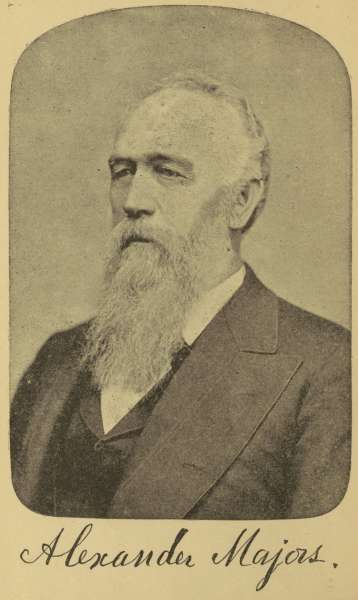 Alexander Majors.