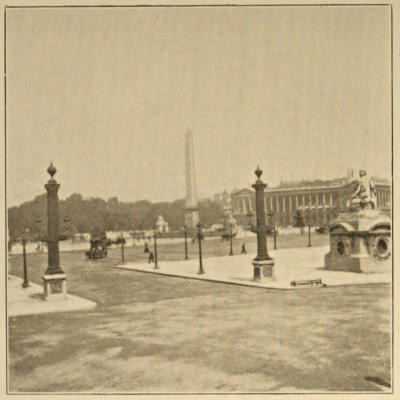
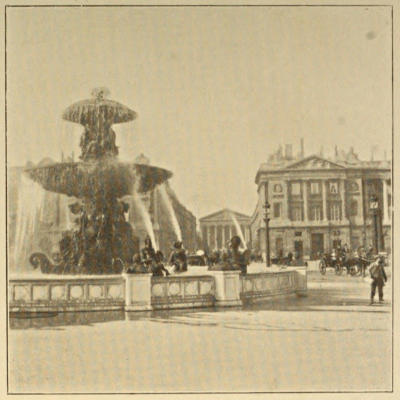
The Daily Press has naturally recorded the visits
of Royalty, Members of Parliament, the Lord Mayor
of London, etc., to Paris during the period of which
I write, but as in each case there were services in the
Embassy Church, there are certain facts from the
chaplain’s point of view which will, I hope, be of
interest to my readers. A clerical friend once said to
me, “Everybody who is anybody has been to your
Church in Paris.” It certainly was a fact that during
my chaplaincy many distinguished people attended
the ordinary Divine Service besides the crowds at
special times when Royalty was present. I may
mention the late Duke of Devonshire, the Right Hon.
W. E. and Mrs. Gladstone—who often came twice
on the Sunday when visiting Paris—H.R.H. the late
Duke of Cambridge, who was many times present.
On one occasion the Duke arrived in Paris from a long
journey early on Sunday morning, but he was in the
Embassy gallery at the 11 o’clock service. Upon his
late visits—and he was in Paris not long before the
end—he was unable to face the stairs to the gallery,
and sat below with the congregation. In the early
days of my chaplaincy, the late Sir Condie Stephen
was an attaché at the Embassy, and a most regular
attendant at both morning and evening services. The
late Archbishop of Canterbury was once at service in
my time, and sent me a most kind message. Bishops,
Home, Colonial, and American, were occasionally
seen, and many clergy. I noticed on two or three
occasions Mr. Pierpoint Morgan among the worshippers.
On one occasion four English dukes were
present at morning service. The late Sir G. Stokes,
Sir W. Freemantle, Lord Rathmore, and the other
members of the Suez Canal Board were regular in
attendance month by month, the former a devout
worshipper and a kind, genial friend.
Great interest was naturally excited in the
English Colony when we had Royal visitors.
Her late Majesty was not in Paris during my Chaplaincy,
although she was several times in the South of
France, being usually met at some convenient station
by the President of the French Republic. Whatever
may have been the feeling of the French people
towards the English before the “Entente Cordiale,”
they always had the highest respect and admiration
for our beloved Queen, and I never heard that she met
with the least annoyance from “the most polite
nation in the world.”
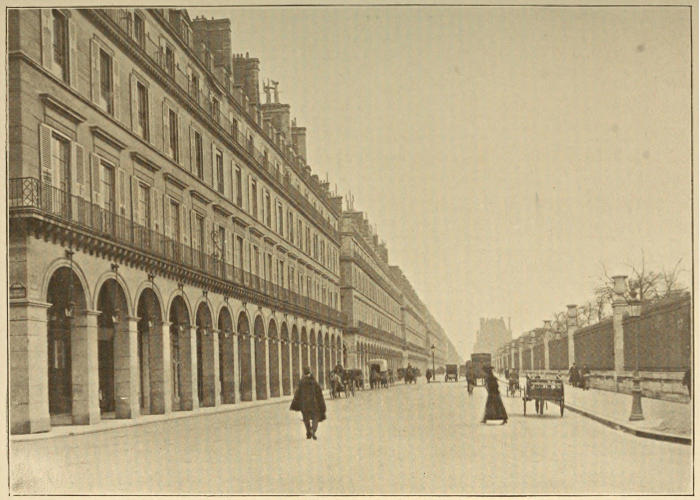
RUE DE RIVOLI.
Before coming to the special subject of this
chapter, I should like to say a few words about the
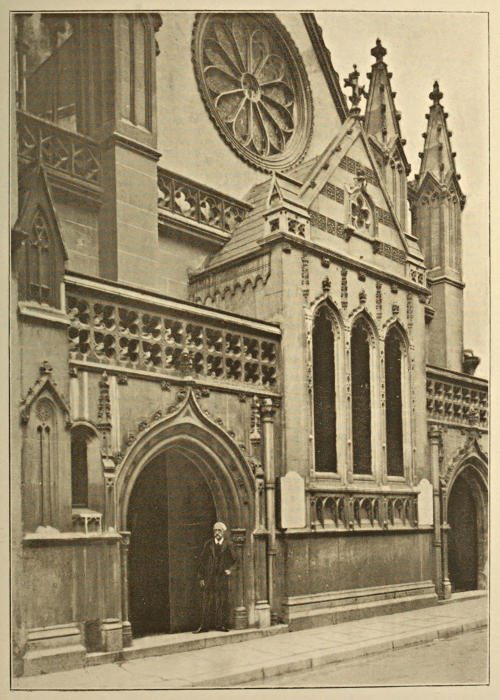
English Church in the Rue d’Aguesseau, which has
always been known as, and is “ipso facto,” the
Embassy Church. In former days the English
services were held in the ballroom at the Embassy
itself, and there was a resident chaplain. I have
heard that there was sometimes rather a “rush”
after a Saturday night’s ball to get the room ready
for divine service on Sunday. This “Chapel” was
also at that time somewhat of a Gretna Green, where
at twenty-four hours’ notice young couples who had
difficulties at home could be united according to
English law by a resident chaplain. My friend, Dr.
Morgan, of the American Church, kindly sent me a
volume of sermons he had picked up on a bookstall,
bearing the title “Sermons preached at the Chapel of
the British Embassy, and at the Protestant Church of
the Oratoire in Paris, by the late Rev. E. Forster,
M.A., Chaplain to the British Embassy.” This was
in the days when Lord Stuart de Rothesay was
Ambassador to the court of France, and the
volume bears the date 1828. I believe Lord Stuart
de Rothesay was twice Ambassador in Paris—an
unusual circumstance. Services are no longer
held in the Embassy. The English Colony in
Paris having largely increased, it became necessary
to provide a suitable building as a church,
and at the period when the late Lord Cowley
was Ambassador, and largely through his instrumentality,
the present Church was purchased, and has
from that time to the present been the Embassy
Church, where all services of a public and diplomatic
character have since been held. Here is a French
description of the building, which, while not exactly
ecclesiastical, is yet loved and valued by the English
Colony.
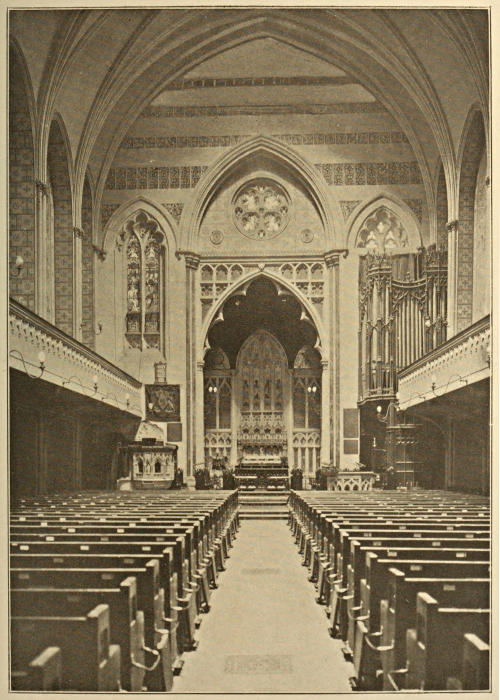
“L’Èglise Anglicane est située à moins de 100
mètres de la porte de l’Ambassade. C’est un petit monument
de style Gothique, aux fenètres ogivales, aux frùes
colonnes fleuronnées. A l’intérieur, la chapelle est
meublée de deux rangées de bancs, placées face à l’autel.
Devant celui-ci se trouve l’aigle de bois doré dont les
ailes éployées portent les Livres Saints; à gauche les
orgues: à droite, la chaire: une simple tribune de
pierre, de forme hexagonale légèrement surélevée. Un
balcon court sur les deux côtes de la chapelle, dont le
fond est occupé par une tribune.”
The church is in a much better condition than
formerly. The congregation during my chaplaincy
put a new roof upon it, and decorated it throughout,
and constructed a handsome Mortuary Chapel
underneath—a sad necessity for the English and
American colonies in Paris. I conducted some
remarkable services during my time in Paris, which
I describe in another chapter—scenes which will not
soon be forgotten by those who witnessed them. I
was glad to leave behind some £7,000 which had been
subscribed towards a Church House, a much-needed
establishment, as there is no room for Church
purposes or residence for the chaplain. My successor,
the Right Rev. Bishop Ormsby, will, I hope,
reap the benefit of this effort.
His Gracious Majesty King Edward VII. was
several times in Paris during the earlier years of my
chaplaincy, as Prince of Wales, but his first visit to
the French Republic as King and Emperor was in
May, 1903. The visit was official and unique.
Those of us who had lived in Paris during the Boer
war—when, to say the least, the English were not
popular, and had so frequently heard “Vivent les
Boers” as we passed along the streets, and even
had newspapers flaunted before us which recorded
reverses to our arms—were very anxious that the
visit should pass off quietly. The English colony
was much concerned, and so were the French police.
I was advised by the latter to admit to the Church
only by ticket, and to take the names and addresses
of each applicant for them who might be unknown to
me. The following was the text of the ticket I
issued: “English Church, Rue d’Aguesseau.
Divine Service 11 a.m. It is requested that all seat-holders
will be in their places at 10 o’clock. After
10.30 all unoccupied seats will be filled.” The
tickets were all numbered and signed with a special
stamp marked “Basileus.” The issuing of these
tickets gave us considerable work, as we only had
1,000, and some 1,500 to 2,000 people applied for
them—many by letter. Nearly the whole of two
days was occupied in the distribution.
The “Entente Cordiale” is now happily a “fait
accompli”; but at the time of His Majesty’s first
official visit there was no thought of it in the public
mind, though we know now it was the gracious intention
of our peace-loving King that it should come
about. I give an excerpt from the “Patrie,” signed
by M. L. Millevoye, which at this time gave us some
concern, for the “Patrie,” while not a high-class
paper, is one that is largely read by the man in the
street:
“Parisiens! Le Roi des Anglais n’est pas votre hôte:
ce n’est pas vous qui l’avez invité. Cet étranger, cet
ennemi vous impose sa visite.… Parisiens, ce
roi vous saluera, vous ne le saluerez pas.
“Mais des cris bien français, esclusivement français,
peuvent sortir, sans provocations, de vos poitrines.
Crier ‘Vive Marchand!’ c’est condamner Fachoda,
c’est marquer la flètrissure d’une des plus hyprocrites
d’une des plus odieuses brutalités diplomatiques que la
France aie subies, Crier Vivent les Boers.… Crier
Vive la Russie.… Votre silence même, s’il est
général, absolu, aura sa grandeur. Devant vos fronts
couverts, devant vos regards implacables, ce roi
comprendra qu’on l’atrompé en lui parlant de votre
soumission, &c., &c., &c.”
It seemed, however, as if the very presence of
His Majesty in Paris at once dissipated any cloud
that might have appeared in the sky. The French
are remarkable for their readiness to swing round to
an opposite opinion when they find reason for so
doing. This was very striking in the Dreyfus affair,
and, more recently, in the case of M. E. Zola,
who, after having been condemned to imprisonment
and a heavy fine for his defence of Dreyfus,
received the “post mortem” honour of being
removed from the cemetery of Montmatre to the
Panthéon, that resting place of the illustrious French
dead.
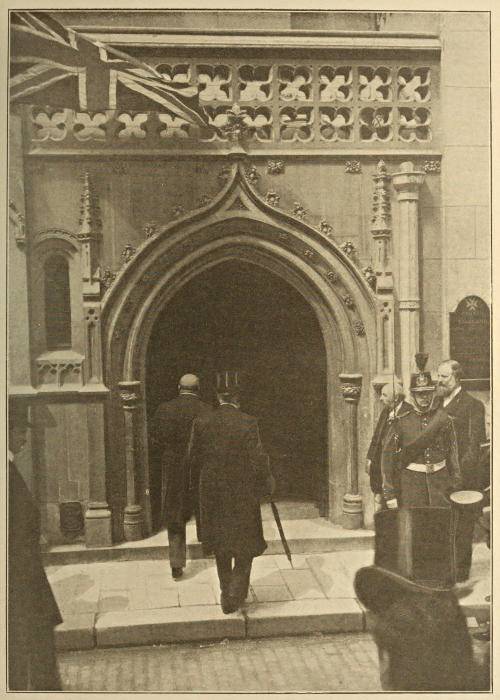
HIS MAJESTY ENTERING THE CHURCH, FOLLOWED BY SIR E. MONSON.
The visit of His Majesty to Paris extended from
May 1st to 4th, and almost every hour was occupied
with the usual official visits, lunches, dinners, and
receptions. The English colony looked forward especially
to the Sunday when they expected to see and
worship with the King in their own Church. There
was some anxiety as to whether His Majesty would
sit in the Embassy gallery, or in the body of the
Church, as in the former case he would hardly be
seen by the congregation. I reported to our Ambassador,
Sir E. Monson, the great desire that the
King would sit with the congregation, and late on
Saturday evening I received a message that he had
kindly consented to do so. This gracious act gave
much pleasure to the colony. There were many
young people who had never seen their King before,
and I fear his presence was rather distracting to their
worship on this occasion.
The police were considerably scared when it was
announced that His Majesty would not drive to the
Church, but intended to walk. Although only a few
yards it was felt to be more or less a danger; but
every precaution being taken, all passed off safely.
As the congregation was assembling, I was sent for
to the door to interview a distinguished-looking man
who desired to enter the Church, but had no ticket.
I found, however, upon careful enquiry, that he
was a detective from Scotland Yard, and required to
examine the place where the King was to sit.
This quiet Sunday service, with the King-Emperor
attending as an ordinary worshipper, very
much impressed the French people. I will quote
what was said by the “Figaro” and the “Daily
Telegraph” at the time; the former giving the
general French feeling much more accurately than the
“Patrie,” although even the latter paper soon
changed its tone.
The “Figaro” thus describes the service:—
“Les Parisiens sceptiques et volontiers gouailleurs,
ont été fortement impressionnés par la très simple
cérémonie d’hier matin, la plus grande peut-être de ces
trois jours de fête. De la rue Royale à l’avenue de
Marigny dix mille curieux descendent tout endimanchés
des faubourgs, se massent aux abords de l’Ambassade
d’Angleterre, pour voir comment le roi de
la Grande-Bretagne et d’Irlande et des possessions
britanniques d’outre-mer, défenseur de la foi, empereur
des Indes va faire-visite à Dieu. C’est à pied que
S. M. Edouard VII., en tenue de ville, se rend à
l’Eglise. Et quand il le voit passer ainsi, tout ce
peuple saisi d’émotion, chapeau bas, s’incline, dans un
silence solennel. La petite Eglise gothique de la rue
d’Aguesseau regorge de monde. On a lancé neuf cent
trente invitations. La nef, les galeries, les bas-cotés,
les tribunes, tout est bondé.
“Les deux premières travées de banquettes sont
réservées; et devant elles, à gauche du chœur un
fauteuil recouvert de velours rouge, avec un prie-dieu
sans appui, et un pupitre sur lequel sont deposés une
Bible, et un livre de psaumes, marque la place du
Roi.… Le Pasteur et ses assistants ont la
soutane et le surplis garni de bandes de satin noir et
rouge. Les enfants de chœur assis près de la chaire,
ont seulement la soutane noir et le surplis. Sur un
signe du secrétaire qui guettait à la porte l’arrivée du
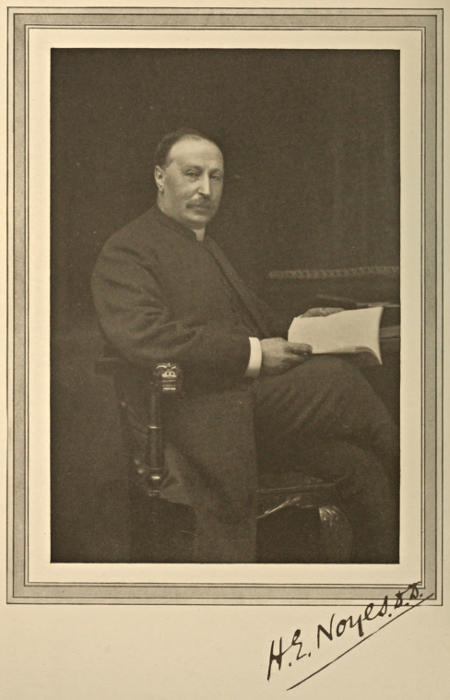
Roi, tout le clergé, le Rev. Dr. Noyes en tête, se porte
au-devant de sa Majesté et l’attend sur le seuil.
Edouard VII. et le Pasteur se saluent en même temps.
Le Clergé remonte vers le chœur, précédent le
Souverain, que suivent les membres de l’Ambassade
d’Angleterre et tous les attachés militaires. Et des que
S. M. Edouard VII. a pris place devant son fauteuil—et
ouvert son livre de psaumes, l’office divin commence.
Les fidéles, dont un instant très court de curiosité n’a
pu troubler le recueillement, entument en anglais le Te
Deum. Puis les hymnes, les versets de la Bible, les
psaumes se succèdent chantés par toute l’assistance.
Les fidèles s’agenouillent, et le Roi s’agenouille comme
eux; et sa voix se mêle avec leurs voix. Il n’y a plus
un souverain et des sujets, ‘Il n’y a qu’une famille dont
tous les membres s’addressent, ensemble au Père,
‘Notre Père qui êtes aux cieux.’ C’est la prière que
nous ne savons plus. Enfin les chants ayant cessé le
Rev. Dr. Noyes se lêve et prononce le sermon
dominical. Pendant un quart d’heure environ, il
développe la thèse de la Divinite du Christ, et l’office
termine, selon l’usage, par un dernier cantique, sans
qu’aucune allusion, ainsi qu’il en avait exprimé
lùi-même le désir, aie été faite à la presence du Roi.”
I have given the above in full as it is an interesting
French view of an English church service.
“The Daily Telegraph” recorded this event of
the day as follows:
“At the morning service in the English Church,
Rue d’Aguesseau, the King was attended by his
suite, and accompanied by Sir E. Monson and the
staff of the Embassy. This sacred edifice is a
building of great interest to English residents in
Paris. The Rev. H. E. Noyes, D.D., has been
Chaplain to the Embassy since 1891, and during that
incumbency has known three eminent representatives
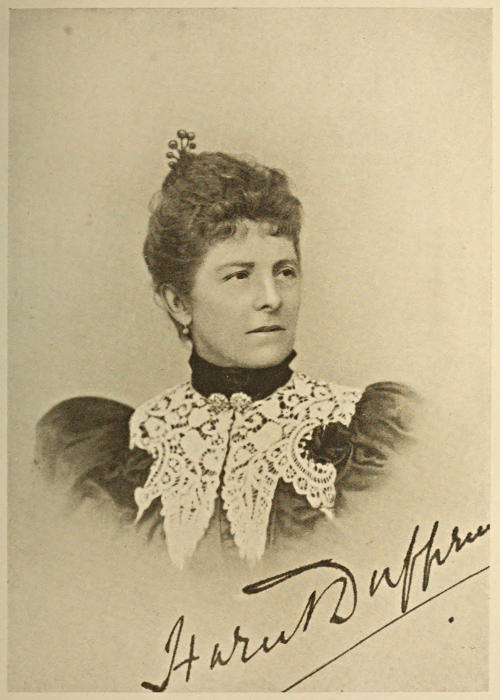
of the Empire, Lord Lytton, the Marquis of Dufferin,
and Sir Edmund Monson. Our compatriots in the
French capital do not forget their Church. It is
surely a matter of pleasure to know that at the last
Easter celebrations there were no fewer than 930
communicants. To-day the Church was all too
small. Though admission was necessarily by ticket,
a crowd besieged the doors more than an hour before
the beginning of the service. Notre Dame or the
Madeleine would have been insufficient for the congregation
anxious to be present. Indeed, one feels
regret for the hundreds who failed to obtain a coveted
ticket of admission. Practically small room was left
after seats had been found for the regular congregation,
among whom I was pleased to note a large
number of English young ladies attending Parisian
schools. Many a year hence it will be a pleasant
memory for those young persons who participated in
this historic service. ‘What a noble national possession
is England’s “sublime liturgy,”’ to quote
George Borrow’s description of it.
“Who has not felt its impress in a foreign land?
I have heard it west of the Rocky Mountains, under
the Stars and Stripes, beneath the Southern Cross, in
the capital of China, on the Indian, the Atlantic,
and the Pacific Oceans, and in war time in South
Africa, and the effect is everywhere the same—a
finer patriotic glow than almost anything else can
call up. It appeals to one as part of the heritage of
the English people, like their old Parish Church, or
their very language itself. In the Rue d’Aguesseau
the prayers for the King and the Royal Family of
Great Britain were followed, as they always are here,
by petitions for the Presidents of the United States
and of the French Republic. The ‘Te Deum’ was
finely rendered, as were the hymns ‘Children of the
Heavenly King’ and ‘The King of Love my shepherd
is.’ Dr. Noyes founded a short, eloquent discourse
upon Matthew xiii. 54, 55.”
As the King left the Church the congregation
sang the National Anthem with a fervour and
emotion, which was natural upon such an occasion.
After lunching at the Foreign Office with that
eminent statesman, M. Delcasse, His Majesty
returned to the Embassy. Here a most interesting
ceremony was held. The King had promised to plant
a red chestnut tree in the Embassy garden, and the
children of the British schools, to the number of fifty,
and the inmates of the Victoria Home (an institution
for aged British women who have lived in France for
thirty years) were invited to be present. It was a
memorable occasion. The King handled the spade
as one accustomed to it, and the tree thus planted
has flourished remarkably well ever since. It bears
a plate stating the date, etc., and will, no doubt, be
an object of interest in the beautiful garden of the
Embassy for many years to come. The King has a
wonderful memory for old friends. I heard him on
this occasion asking kindly after the Hon. Alan
Herbert, M.D., whom he had known in Paris many
years ago. Another interesting incident took place
on this afternoon. Among those invited to the Embassy
garden was an old soldier, George Colman,
nearly ninety years of age, who had been
dispatch writer to Lord Raglan in the Crimean
War. He was presented to the King, who
had a long chat with him, and asked him
“Where are your medals?” Colman replied, “Your
Majesty, they were stolen from me at the time of the
Paris Commune.” “Well,” said the King, “we
must see to that.” Colman was not forgotten, and
not long after the medals were received at the
Embassy. He brought them to shew to me in great
delight.
In the evening a large official dinner was given
at the British Embassy, which was attended by the
President and Madame Loubet, members of the
French Government, and many other distinguished
guests. Three French artists had the honour of
being invited, MM. Carolus-Duran, Detaille, and
Bonnat. The City was brilliantly illuminated, and
presented all the characteristics of a National fête.
His Majesty left Paris for Cherbourg the next
morning, President Loubet accompanying him to the
Gare des Invalids. There was a thankful sigh of
relief from the many loyal hearts in Paris that all had
passed off so well, and that our beloved Monarch was
safe. It had been an anxious time, for the happy
change to more friendly relations between the two
countries had then only just commenced.
The next visit of His Majesty was in May, 1905,
just two years after his first official visit. There had
been a change at the Embassy. Much to the regret
of all who knew him, Sir Edmund Monson had
retired, having reached the age limit, and had been
succeeded by Sir Francis Bertie, the present Ambassador.
There was, moreover, a great change in the
attitude of the people, and the “Entente Cordiale”
was on the lips of all. The King’s previous visit,
and the return visit of M. Loubet to London, resulted
in the settling of several outstanding disputes which
had long been an anxiety to diplomatists. There was
much less ceremonial upon this visit, and the King,
instead of going to the Embassy, took his old suite of
rooms at the Hotel Bristol in the Place Vendome,
where he had often stayed as Prince of Wales. His
Majesty came to Paris via Marseilles, where he had
a very hearty reception, and arriving at the Gare de
Lyon was met by Sir Francis Bertie and the staff of
the Embassy, and that all-important functionary, the
Prefect of the Police. A good number of people
gathered in the Place Vendome in the hope of seeing
the King, but the weather was showery, and he drove
in a closed carriage, and they were disappointed. The
Hotel Bristol in the Place Vendome—formerly a
monastery—is managed by an Englishman, Mr.
Morlock, who is well known to many crowned heads.
The Tsar of Russia stayed there before his accession
to the throne; the late King and Queen of Portugal,
and many others. Mr. Morlock is a most genial
host, and although he has been so long in France
is proud of his nationality, and always ready to join
in any movement for the good of the British colony.
I had been informed that His Majesty would attend
Divine Service on the Sunday morning, and took the
precaution to admit only by ticket, to prevent over-crowding.
It was well I did so, for a great crowd
assembled outside the Church, and would have prevented
the regular worshippers from entering.
Owing to this arrangement the Church was filled
before the hour of service, and there was no confusion.
It was Eastertide, and the hymns “Jesus
lives! no longer now—Can thy terrors, death, appal
us” and “Hosanna to the living Lord” were sung
with great fervour. I had requested the congregation
to remain in their seats during the singing of
the National Anthem at the close of the service—the
intention being that His Majesty and the staff of the
Embassy would then leave and thus prevent
crowding at the door. However, the King stayed
until the end, and, I was told, joined heartily in the
anthem. We always omitted the second verse
having the words “Confound their politics,” as being
guests in a foreign land.
Upon this occasion His Majesty sat in the Embassy
gallery with Sir Francis Bertie and the staff. An
amusing incident happened as the King left the
Church. A loud crash was heard and caused some
excitement. It came from a photographer who had
perched himself upon a high ladder with a large
camera, hoping for a snapshot. He fell owing to the
breaking of the ladder just as the King came out of
the porch. He was very disappointed at losing the
photograph.
Upon the return to the hotel the King received
Admiral Fournier, who had presided over the enquiry
relating to the North Sea firing incident, and conferred
upon him the insignia of a Knight Grand Cross
of the Victorian Order.
The reception of His Majesty on the part of the
people was in marked contrast to that of his former
visit. There were very few cries in the streets on
that occasion, but now one often heard “Vive le
Roi” and “Vive l’Angleterre” shouted with a
hearty good will. The “Entente Cordiale” was an
established fact.
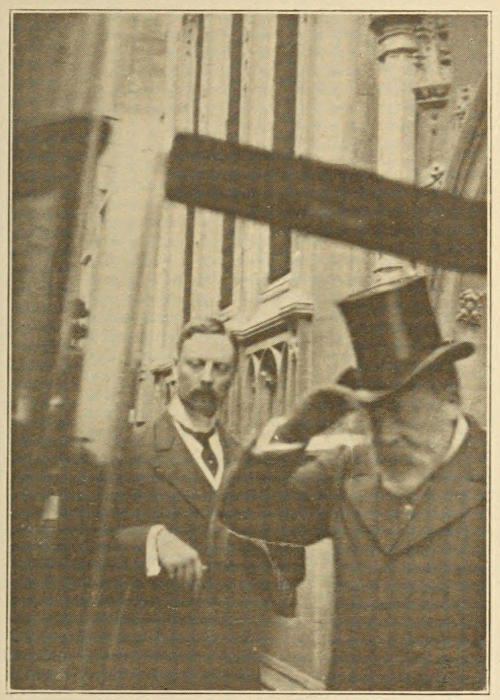
HIS MAJESTY LEAVING THE EMBASSY CHURCH.
The third visit of the King during my chaplaincy
took place in March, 1906, when he travelled as the
Duke of Lancaster, arriving in Paris from Cherbourg
on the Saturday evening. The Royal train was
brought round to the Gare des Invalides, where the
King was met by Sir Francis Bertie and the staff of
the Embassy, M. Mollard representing the President
of the Republic, and M. Lepine, Prefect of Police.
As His Majesty ascended the stairs a flashlight
photograph of the scene was taken by an
unauthorised person—much to the annoyance of all
present, as the explosion caused a temporary alarm.
Next morning the King attended the Embassy
Church, and sat in the Royal gallery with Sir Francis
and Lady Feodorowna Bertie. Little change was
made in the service, except that I preached a short
sermon in order to keep within the limited time. My
text was “But the Word of God is not bound,” and
the collection was for the British and Foreign Bible
Society. H.R.H. Princess Henry of Battenberg and
the Princess Ena (now Queen of Spain) joined the
King at the Embassy for lunch. His Majesty drove to
and from the church in a closed carriage, and although
there was a great crowd, his desire to be “incognito”
was respected. It was upon this occasion that His
Majesty handed to M. Fallières the missing leaves
from the second volume of “The History of the
antiquities of the Jews” for the Bibliothéque
Nationale. M. Loubet, former President of the
Republic, was one of the many who called upon the
King, and it was characteristic of the kind feeling
of His Majesty that he returned the call at the private
apartment of M. Loubet—an act that was much
appreciated by the people generally. I often heard
French people speak of it. Upon this visit the
Embassy in the Faubourg St. Honore was turned into
a Royal Palace, the King and his suite staying there.
I was told of the following incident which indicates
the change of feeling on the part of the French.
After dinner at a fashionable restaurant (while the
King was in Paris) the band was called upon to play
the English National Anthem by a party of Frenchmen.
Then some Englishmen present called for the
Marseillaise, which was received with the same
honours and enthusiasm.
By a curious chance there was a party of Germans
present, and these stood up and uncovered while both
the National Anthems were being played. Beyond
the various social functions there was no other special
incident, and the short visit passed off very satisfactorily
in every way.
I have told of the enthusiasm evoked by the first
official visit of His Majesty to Paris, and the two
subsequent visits, but when it was reported early in 1907
that the King was coming, accompanied by the
Queen, enthusiasm knew little bounds. Many of the
English Colony had never seen the Queen, and were
on tiptoe of expectation. Their Majesties arrived in
Paris from London on Saturday evening, February
2nd, at the Gare du Nord, where they received an
enthusiastic—though non-official—welcome, for they
were travelling as the Duke and Duchess of Lancaster.
The photographic fiend was again in
evidence, and Her Majesty gave a perceptible start
as the magnesium light flashed, although she must be
accustomed to this annoyance. I was told that the
crowd outside the station was enormous, and the cries
“Vive le Roi—Vive la Reine” were very hearty,
both there and along the route to the British
Embassy, which was to be the temporary home of
their Majesties. Notwithstanding the fatigues of the
journey the King and Queen paid a visit to the
Nouveau Cirque in the evening, much to the delight
of those present.
It appeared to me that the Parisians were the
more pleased at the “incognito,” as it was as if
their Majesties came as friends, and not merely as
Royal visitors. The visit was thus less formal
yet more cordial; everyone felt that it was not
political, but just friendly, and Paris was delighted.
The British sovereigns were going to spend a week of
pleasure, visiting and entertaining their friends, shopping
and motoring. The Rue de la Paix is always
attractive, but it seemed to surpass itself on this
occasion.
I was naturally very busy preparing for the
Sunday service. Tickets were quite necessary, and
the demand for them very great. We issued 1,000—our
utmost limit—and then came the pain of refusing
the hundreds who also desired to attend. I crave
pardon for giving the report of the service, written by
my friend Mr. Ozane, the well-known and valued
correspondent of the “Daily Telegraph.”
He wrote: “I have never seen a larger crowd in
and near the church in the Rue d’Aguesseau than
that which assembled there this morning. Admission
to the sacred edifice was by cards, of which a
liberal distribution was made, but any number of
persons who must have known that the chance of
finding a place was hopeless, had put in an appearance
nevertheless. The English colony had
mustered in full force, and there was a big gathering
of French friends as well. The footpaths close to the
Embassy and along the street leading to the Church
were crammed with well-dressed people—the fair sex
being strongly represented; and there they stood in
the brilliant sunshine, but bitterly cold wind, waiting
for their Majesties to pass. The King and Queen drove
to and from the Church in one of the Ambassador’s
carriages, and with Sir Francis Bertie and members
of their suite were conducted to the Embassy Gallery.
By the time they entered the Church was
thronged to repletion, all the arrangements made for
the accommodation of the congregation being, however,
excellent. The prayers were read by the
curate, Rev. W. Harrison, the lessons being read
and the sermon preached by the Rev. H. E. Noyes,
D.D., who is chaplain to the Embassy. Doctor
Noyes is well known as a very eloquent preacher, and
taking for his text the 14th verse of the 8th chapter
of St. Luke, part of the Gospel for the day, delivered
an excellent discourse on the parable of the sower.
The choir, under the direction of Mr. Percy Vincent,
did itself full justice, and the congregation joined
heartily in the service, as it invariably does at
this Church, which has only one defect, viz., that
it is not large enough to accommodate all the worshippers
who would attend it, especially at a season
when so many English visitors are passing through
Paris. When the service was over it was scarcely
possible to make one’s way along the street, so dense
was the crowd.”
In the afternoon the King paid a visit to President
Fallières at the Elysée, which was returned later,
Madame Fallières accompanying the President to
make the acquaintance of the Queen. In the evening
their Majesties dined with their old friends Mr. and
Mrs. Standish.
The following is an extract, giving the French
impression of the Church service:
“L’Eglise était comble, bien qu’on n’y eût èté
admís que sur la présentation de cartes imprimées,
spécialement. L’Entrée des souverains y fut saluée
par de nouveaux vivats. Ils prirent place dans la
tribune de l’ambassade, a gauche de la nef. Puis le
service commença. C’était l’office ordinaire du
dimanche et la seule modification qu’on y apporta fut
l’exécution du ‘God save the King’—joué par les
orgues à la fin de la cérémonie, tandis que tous les
assistants chantaient en chœur. Le Reverend H. E.
Noyes officie. Edouard VII. suit avec une attention
soutenue l’office, ainsi d’ailleurs que la reine Alexandra.”
All through the week the liveliest interest was
taken in the movements of the King and Queen, and
there were some amusing incidents. There was great
curiosity to see the King’s automobile, the people
apparently having forgotten that he had purchased it
in Paris on a previous visit. What they expected to
see I don’t know—perhaps some vehicle modelled
after the old Royal stage coaches? But the reality
was a fine Mercédés car, much the same in outward
appearance as others in Paris, but with luxurious
interior fittings. It was the rule in France at this
time (as since) to have a conspicuous number painted
on each car, and this mark the Royal Mercédés had
not. It was consequently very soon stopped by a
policeman in the Champs Elysées, and a crowd
gathered. When, however, it was found to have a
Royal owner, it was allowed to pass on. But this
was not the end of the matter. Next day it was
stopped by a more “exigeant” police officer, who,
having failed to get satisfactory answers from the
English chauffeur, obliged him to go to the police
station. The crowd was highly amused as the news
soon spread “C’est l’automobile du Roi,” although
the stern police officer continued to ignore it. I
believe there was another difficulty the following day.
However, so soon as His Majesty heard of his
chauffeur’s adventures, he ordered a number to be at
once painted on the car, to conform with the French
law.
Her Majesty the Queen received many begging
and other letters during her short stay, and I was
struck by the careful enquiries she caused to be made
about each case. I was glad to be able to give,
through one of the attachés, information as to several
of the applicants who were well known to me.
The consideration of the Parisians for the
“incognito” of their Majesties was very marked.
It was reported that both the King and Queen
expressed their satisfaction at this, and that the
former said “Nothing could be nicer or more discreet.
The Parisians are the most courteous people in the
world.” The same attitude was maintained all
through the visit, enabling their Majesties to go about
in freedom and comfort, as they constantly did, to
the great delight of both nationalities in the gay city.
After the “Entente Cordiale” became an accomplished
fact, we had several visits of public bodies to
Paris, and I always endeavoured to arrange a special
service for them as part of the programme of the
visit. In November, 1903, we had a British Parliamentary
visit. I had corresponded with the secretary
beforehand, and arranged for a special service at
4 p.m. on the Sunday afternoon (29th). We had no
room for them at the ordinary morning service. I
also consulted Sir E. and Lady Monson, who kindly
arranged their reception for 5 o’clock, so that the
Members of Parliament, their wives, and daughters
could go across to the Embassy at the close of the
service. About 300 attended, and, I had reason to
know, fully appreciated the arrangement that had
been made for them. I preached upon the Great
Charter of our Religious Liberty from the text
“Render unto Cæsar the things that are Cæsar’s,
and to God the things that are God’s.” The
National Anthem was very heartily sung at the close.
Sir E. and Lady Monson received the guests with
their usual kindness, and all the magnificent rooms
at the Embassy were thrown open to them. All the
members of the British party were present, together
with French Senators and Deputies, and the leading
members of the British Colony in Paris.
This same year we had a visit from the present
Bishop of London. I believe his first visit as Bishop.
I had written to him to say that I had a number of
candidates for confirmation (about 50), but that our
own Bishop Wilkinson, coadjutor for London, could
not come, and could he ask some other Bishop who
might be in London to take the office for us. He
wrote: “My dear Noyes, I will come myself.” The
British Colony will not soon forget his visit. After the
Confirmation, at which he gave a most helpful address,
although curiously enough founded upon a misquotation,
we had a reception at my house, which was
attended by the leading members of the Colony, and
those confirmed, with their parents and friends. The
Bishop (as always) won the hearts of all by his kindness
and geniality. I acted as His Lordship’s chaplain
while he was in Paris, and he kindly fell in with
all the arrangements I had made, which were
numerous.
In February, 1906, we had a visit from the
London County Council, most of whom attended the
ordinary service in the Embassy Church on February
4th. On Monday (5th), there was a grand reception
at the Hotel de Ville. This magnificent structure,
erected on the site of the old historic building, is well
worth a visit. The decorations and pictures are
among the most beautiful in Paris, and when it is lit
up and specially decorated with flags, etc., as it was
on this occasion, presents a striking scene. The
same week the “Minister of the Interior,” an office
corresponding to that of our Home Secretary, gave a
grand reception in his superb mansion in the Place
Beauveau. All the London County Council were
invited, together with the leading members of the
British Colony. The reception was followed by a
concert, in which some of the best known artists in
Paris took part. The programme was itself a thing
of beauty, bearing in the front a striking picture
drawn for the occasion by Lévy, of a sailor looking
back over a tempestuous sea at a lighthouse on a
pier.
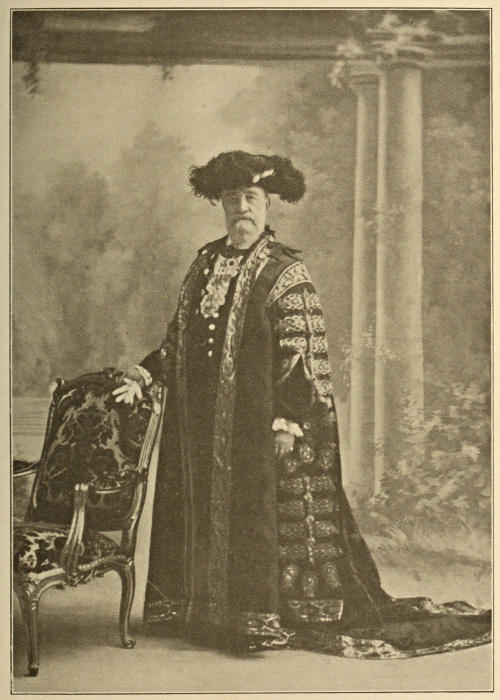
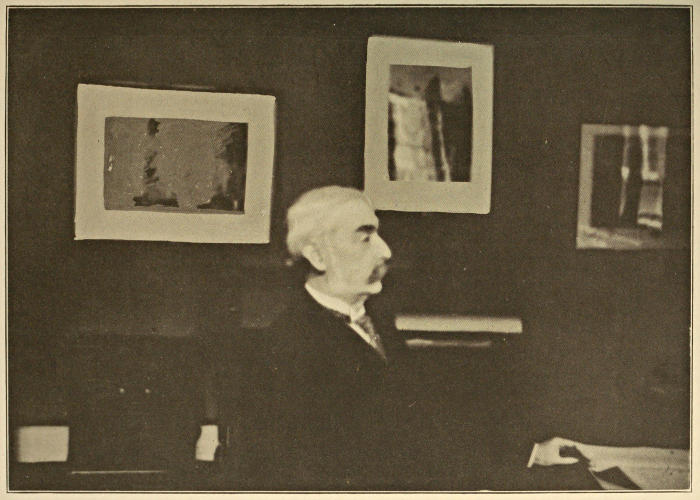
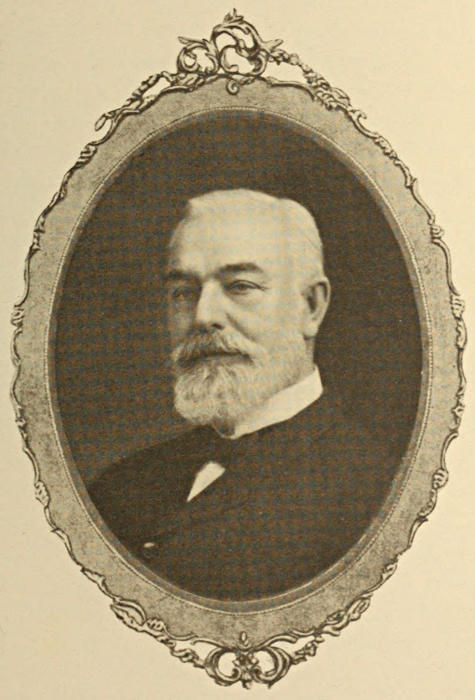
SIR WALTER VAUGHAN-MORGAN, LORD MAYOR OF LONDON 1905-1906.
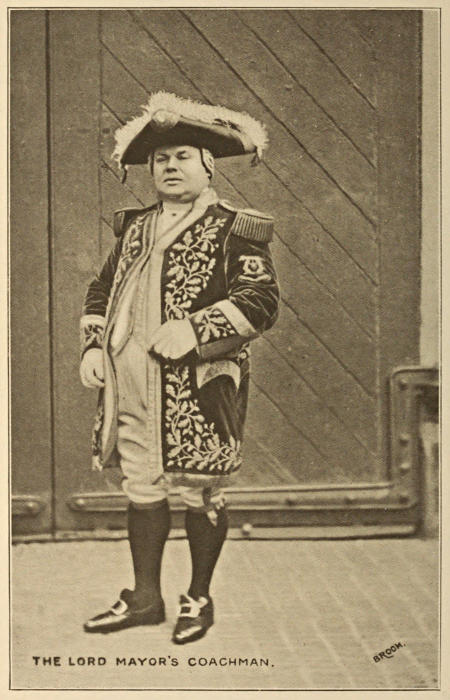
MR. WRIGHT.
This was a year of visits. In October, the Right
Hon. Sir Walter Vaughan-Morgan, Lord Mayor of
London, accompanied by many of the City Fathers,
came officially to Paris. There was considerable
excitement among the citizens of Paris about this
visit, for among other things it was rumoured that
the Lord Mayor would bring his state carriage, and
also Mr. Wright, his well-known coachman, whose
fame had preceded him. An enormous crowd
gathered to welcome the party, many leaving off
work early in order to see them pass, and the streets
from Gare du Nord to the Rue Scribe were literally
packed with people. The cheers were frequent and
loud, and one often heard, “Vivent les Anglais,” and
the less common “Vive le lor Maire.” Had this
cry ever been heard before in Paris? Mr. Wright,
the coachman, had reached Paris the day before, and
was soon recognized on the box of the Lord Mayor’s
carriage. The crowd shouted, “Vive Monsieur
Wright,” and “Vive le cocher du lor Maire” with
vehemence, evidently delighted with his jolly appearance.
I had corresponded with Sir Joseph Savory
with reference to a service in the Embassy Church on
the Sunday, and it was decided that a gallery (holding
about 100) should be placed at their disposal, although
this caused the other parts of the building to be very
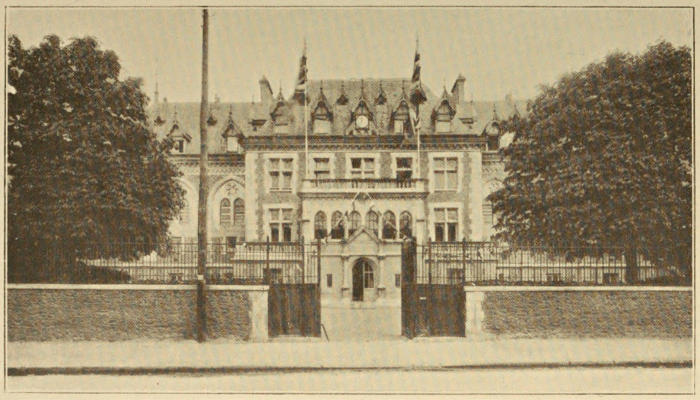
crowded. In front of the Embassy, which faces the
Rue d’Aguesseau, and down the street, police were
stationed in force. Had the King himself been
coming there would hardly have been a stronger
detachment. The whole of the gallery in the Church
was filled. The Lord Mayor was invited to a seat in
the Embassy gallery. I preached a special sermon to a
very attentive congregation upon the labour question.
After Divine Service the Lord Mayor and members of
the party lunched at the Embassy with Sir Francis
and Lady Feodorowna Bertie. In the afternoon the
Lord Mayor, accompanied by Sir George Faudel
Phillips, Sherriffs Dunn and Crosby, Sir Joseph
Savory, and Sir Vesey Strong, paid a visit to the
Girls’ Friendly Society. There is usually a large
attendance of girls on Sunday afternoon, but on this
occasion the hall was crowded in every part. In
introducing the Lord Mayor, I explained the objects
of the Society, and told something of its good work
in Paris. In reply Sir W. Vaughan-Morgan said
“He had not expected to find the members of the
Society so numerous in Paris. He did not know if
he were breaking the rules in paying them a visit,
but as Dr. Noyes had brought him in, he also hoped
he would find some way of getting him out.” Sir
George Faudel Phillips also said some kind words
to the ladies and members present. The drives of
the civic party in the City in the days that followed
were a great delight to the people crowding the
streets. I was on the Boulevards on one occasion
when the carriages passed, and the remarks of the
people at the unusual dresses, and especially the
head gear of some of the party, were most amusing.
I understand the principal carriage was not brought
as it was too large for the railway vans! The Lord
Mayor and Corporation very kindly gave me 100
guineas as a memento of their visit, towards the proposed
Church House in connection with the Embassy
Church—a much-needed institution—part of which
will form a club for young British men, and the
whole be a centre for church work.
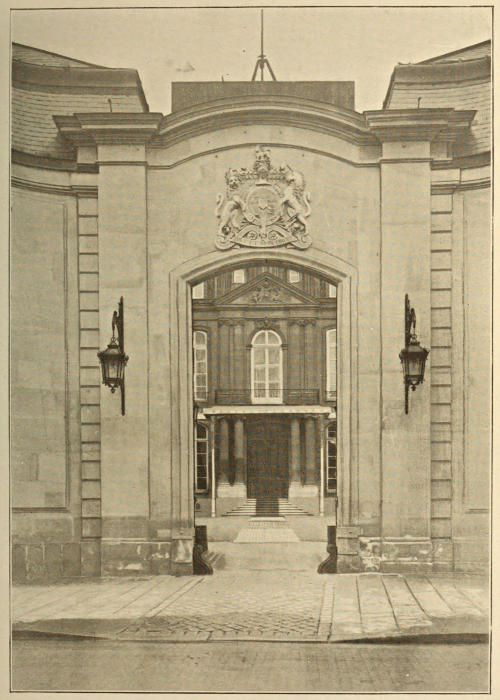
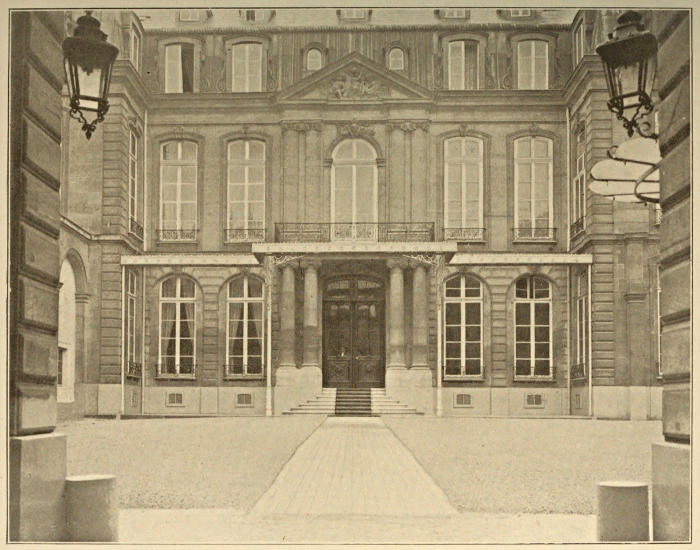
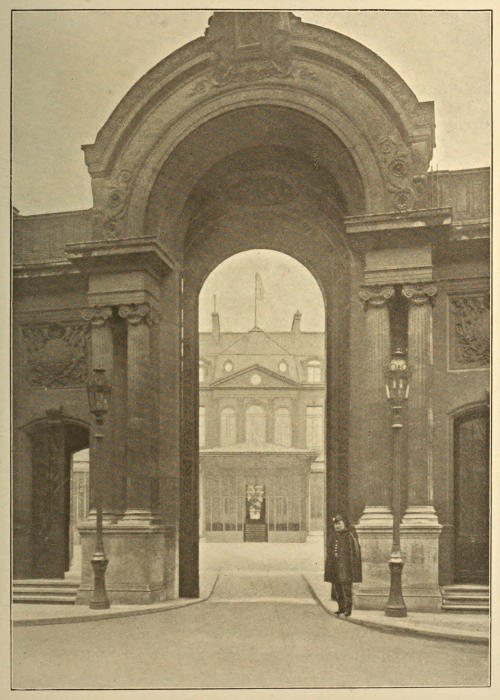
ENTRANCE TO BRITISH EMBASSY.