Dyak fairy-tales and legends—I. Danjai and the Were-Tiger’s
Sister—II. The Story of Siu, who first taught the Dyaks to
observe the omens of birds—III. Pulang Gana, and how he came
to be worshipped as the god of the earth.
There are many fairy-tales and legends known to
the Sea Dyaks of the present day. As they have
no written language, these have been handed down
by word of mouth from generation to generation from
ancient times. These tales and legends may be divided
into two classes:—
1. Those purely fabulous, and related as such, which
are simply meant to interest and amuse, and in these
respects resemble the fairy-tales familiar to us all.
2. And those believed to be perfectly true, and to
record events which have actually taken place, which
are the traditions respecting their gods and preternatural
beings. These form, in fact, the mythology of the Dyaks.
To this latter class belong the many and varied adventures
of Klieng, the great warrior hero of ancient times,
and his wife Kumang, the Dyak Venus, as well as the
traditions relating to the gods believed in by the Dyaks
of the present day. To these must be added certain
stories which give a reason for some of the curious
customs observed by the Dyaks. The three myths which
follow belong to this latter class. The Dyak legends are
fast being forgotten, and I had the greatest difficulty in
obtaining the few here preserved.
Once upon a time there lived a great Chief named
Danjai. He was the head of one of the longest Dyak
houses that were ever built. It was situated on a hill
in the midst of a large plantation of fruit trees. Danjai
was said to be very rich indeed. He possessed much
farming land, many fruit trees, many tapang trees,
where the wild bees made their abode, and from which
the sweet honey is obtained, and in his room there were
many valuable jars of various kinds, and also a large
number of brass vessels; for the Dyaks convert their
wealth into jars and brassware to hand down to posterity.
Every year he obtained a plentiful harvest of paddy,[2]
much more than he and his family could consume, and
he had always much paddy for sale, so much so that the
news of his wealth travelled to distant lands, and many
from afar off would come and buy paddy from him.
Danjai also possessed many slaves, who were ready to
help him in his work.
All the people in his house had a very high opinion of
his judgment, and were ready to obey his decisions,
whenever he settled any of their disputes. So great
indeed was his reputation for wisdom that men from
distant villages would often consult him and ask his
advice when in any difficulty. He had also great fame
as a brave warrior, and during expeditions against the
enemy, he was the leader of the men of his own village
and of many villages around, for all liked to follow such
a brave man as Danjai, who was sure to lead them to
victory. Over the fireplace in his veranda he had, hanging
together in a bunch, the dried heads of the enemies whom
he himself had killed.
Now this man Danjai had a very pretty wife whom he
had recently married, but the marriage feast had not
been held, because he had not yet obtained a human
head from the enemy as a token of his love for her: for
this girl was of good birth and a Chief’s daughter, and
wanted the whole world to know, when they attended her
marriage feast, what a brave man her husband was.
One day Danjai said to his young wife: “I will hold a
meeting of the Chiefs around, and tell them that we must
all get our war-boats ready, as I intend leading an expedition
against the enemy. I should like to bring you
a human head as a token of my love, so that you may not
be ashamed of your husband. And as soon as I return,
we will have the wedding feast.” Though his wife was
sorry that her husband intended leaving her, still she
did not oppose his wishes, for she wished him to come
back covered with glory. So a council of war was held,
and Danjai told the assembled Chiefs what he intended
to do, and it was decided that all should begin at once
making war-boats, which were to be ready in two months’
time.
Assisted by his slaves and followers, Danjai had been at
work at his boat for several weeks, and it was nearly
finished. It was a beautiful boat made out of the trunk
of one large tree, and Danjai was proud of his work.
He was so anxious to finish his boat that one day he
started very early in the morning, before his breakfast
was ready, and he asked his wife to bring his food to
him later on to the part of the jungle where he was
working at his boat.
Accordingly, Mrs. Danjai cooked the food and ate her
own breakfast. Then she made up a small bundle of rice
and also put together some fish and salt, and placed all
in a little basket to take to her husband. She had never
been out in the jungle by herself before, but she was not
afraid, for her husband had told her the way, and she
could hear the sound of his adze as he worked at his boat
not very far off. She hung her basket over her left
shoulder, and, holding her small knife in her right hand,
went cheerfully on. Presently she came to the stump
of a tree on which was placed a bunch of ripe sibau fruit.
They looked so tempting that she could not help eating
some of them, and as they were very nice, she put what
remained in her basket, saying to herself: “Perhaps
Danjai forgot to take these with him and left them here.
I will take them to him myself; he will no doubt be glad
to eat these ripe fruits after his hard work.”
Now there was in this land a Were-Tiger, that was
much feared by all who lived around. He had the
appearance of a man, but at times would transform
himself into a tiger, and then he would attack human
beings and carry off their heads as trophies to his own
house. But he never attacked any unless they had first
done wrong by taking something which belonged to him.
So this Were-Tiger would leave tempting fruit by the
side of jungle paths, and on the stumps of trees, in the
hope that some tired traveller would take and eat them.
And if anyone ate such fruit, then he or she was doomed
to be killed by him that same day. But all knew about
him, and though he placed many tempting baits in all
parts of the jungle, no one touched his fruit, for all feared
the fate which awaited them if they did any such things.
But Danjai’s wife knew nothing about the Were-Tiger.
No one had told her of him, and she had never been out
before in the jungle by herself, and she had never been
warned not to touch any fruit she might find lying
about.
“Oh, Danjai,” she said, as soon as she met her husband,
“I am afraid I am rather late. You must be
very tired and hungry, working the whole morning at
your boat without having had anything to eat. Never
mind! Here is your breakfast at last.” And she handed
the basket which contained his food to her husband.
Now Danjai was really very hungry, so he was glad to
see his food had arrived. He thanked his wife, and at
once began to empty the basket.
The first thing he saw was the ripe sibau fruit at the
top, and he asked his wife where she got them from. She
told him she had found them on the stump of a tree by
the wayside, and she said she thought they had been left
there by him. She added with a smile that they were
very good, as she had eaten some herself.
Then Danjai, brave man though he was, turned pale
with fear and anxiety.
“We must not linger here a moment,” he said to his
wife. “Hungry though I am, I will not eat my food
here. We must both hurry home at once. You have
taken and eaten fruit belonging to the Were-Tiger, so
much feared by all. It is said that whoever touches his
fruit will surely die a terrible death: and you are the first
person I know who has done so.”

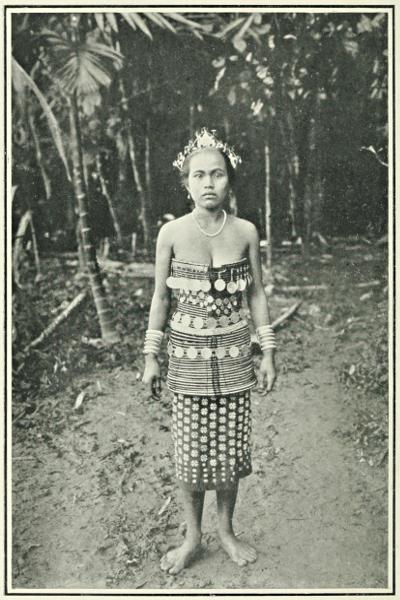
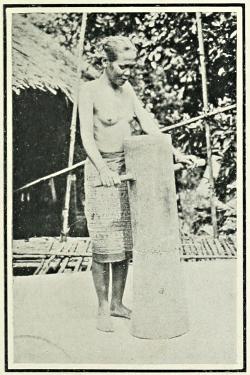
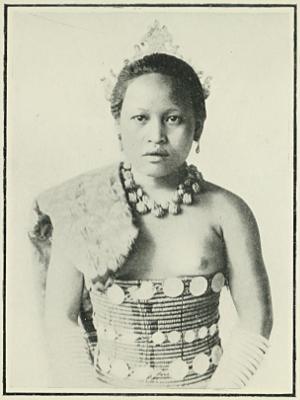
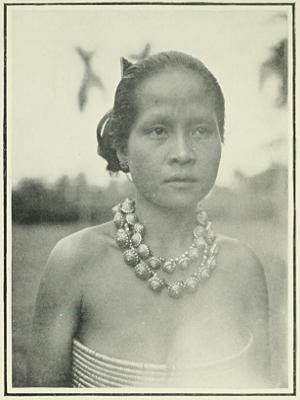
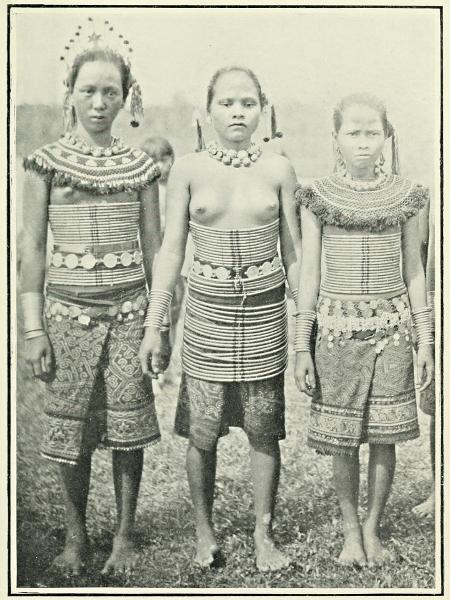
A Dyak Woman in Everyday Costume
She is wearing a necklace of small silver current coins, fastened together with silver links. The
bangles are hollow, and of silver or brass, made separately, but worn several together on each wrist.
The two favourite colours for petticoats are blue and red. The red petticoat, as in the picture, has
often a design in white worked or woven into it.
Danjai hurriedly gathered together all his tools and
told those that were with him of his trouble, and they all
started and walked silently back. Danjai was wondering
how he was to avert the fate which awaited his young
wife. She was silent, because she saw her husband was
troubled, and she was sorry that she had caused him
grief.
As soon as they arrived at the house, Danjai sent for
all the men round about and told them what had happened,
how his wife had taken and eaten the fruit of the
Were-Tiger. He begged them all to help to shield her,
for the Were-Tiger was sure to have his revenge, and
come and take the head of his wife.
So they all prepared themselves for the tiger’s visit
by sharpening their knives and spears. Some men placed
themselves on the roof of the house, others in the veranda.
The ladder leading up to the house was also guarded,
and so were all parts of the house by which he was likely
to force an entrance. As for Danjai’s wife, they hid her
beneath some mats and sheets in the room, and twelve
brave men stood round her with their swords drawn,
ready to save her life even at the cost of their own.
Just before dark they heard the roar of the tiger in the
distance. Though still a long way off, the sound was
very terrible to hear, and the men all grasped their
swords and spears firmly, for they knew the tiger would
soon be upon them.
Once more the tiger’s roar sounded, nearer and clearer,
and then they heard him crash through the leaf-thatch
roof and fall into the room. There was a great commotion
among the men, but though all tried to kill the
animal, none could see him. Soon after they heard a
roar of triumph from the tiger outside the house. They
lifted up the mats and sheets which covered Danjai’s
wife, and there they saw her headless body! The Were-Tiger
had succeeded in his attack, and had carried off the
head of his victim!
Loud was the weeping and great the lamentation over
her dead body. She was so young to die! And what
death could be more terrible than hers whose head had
been carried away by her murderer! All in the house
mourned her loss for seven days, and during that time
the house was very quiet, as all lived in their separate
rooms, and did not come out into the common veranda
to do work or to talk to each other.
The death of his wife grieved Danjai very much. But
though his grief was great, his desire for revenge was
greater still.
Very early on the morning of the next day Danjai
started after the tiger. The drops of blood which had
fallen could plainly be seen on the ground, and he had
no difficulty in finding out in what direction the tiger
had gone. On and on he tracked the blood till he came
to a cave at the foot of a high mountain. The sides of
the cave were splashed with blood, so Danjai walked
boldly in, determined to revenge the death of his wife.
It was not very dark in the cave. In the distance he
could see an opening, and he hurried towards it.
He came out on the other side of the mountain, and
saw a large plantation of sugar-cane and plantain-trees.
Beyond this he saw a long Dyak house.
“This,” he said to himself, “is surely the abode of the
Were-Tiger, and soon I shall have an opportunity of
revenging the death of my wife.”
He planted two sticks one across the other in the ground
to mark the opening in the mountain, so that he might
not miss his way on his return, and then he boldly walked
towards the house.
He followed a path through the sugar-cane plantation—still
tracking the drops of blood upon the ground—until
he came to the ladder leading up to the house. He
was so anxious to attack his wife’s murderer that he did
not pause to ask—as is the usual Dyak custom—whether
he might walk up or not, but went straight on into the
house. Men sitting in the veranda asked him, as he
passed them, where he was going and what he wanted,
but he did not answer them. His heart was heavy
within him, thinking of his dead wife, and wondering if
he would be able to accomplish his task, and whether
he would succeed in leaving the house as easily as he
came in. But he was determined to avenge his wife’s
murder, and he would not shrink from any difficulties in
the way.
He stopped at the room of the headman of the house,
and a girl asked him to sit down, and spread a mat for
him. He did so, and the girl went into the room to
fetch the brass vessel containing the betel-nut ingredients
which the Dyaks love to chew. As he sat down, he saw
drops of blood on the fireplace, and, looking up, he noticed
a fresh head, still dripping with blood, among the other
skulls hanging there. He recognized it at a glance—it
was the head of his loved wife!
The girl came out with the brass vessel of betel-nut,
and said: “Help yourself, Danjai. We did not expect
you to visit us so soon. Please excuse me for a while;
I have to attend to the cooking. But you will not be
alone, for my brother will soon be back. He has only
gone to the plantation to fetch some sugar-cane.”
So Danjai sat on the mat by himself, thinking what he
was to do next, and what he was to say to his wife’s
murderer when he came in. Soon the Were-Tiger
arrived, carrying on his shoulder a bundle of sugar-cane.
“I am very pleased to see you, Danjai,” he said.
“Would you like some sugar-cane? If so, help yourself.”
Danjai was so sad thinking of his wife that he did not
notice how curious it was that they should know his
name when they had never seen him before. He did not
feel at all inclined to eat sugar-cane, but lest his host
should think he had come to kill, and to put him off
his guard, he pretended to eat a little. He heard the
Were-Tiger say to his sister in the room that she was to
be sure to have enough food cooked, as Danjai would eat
with them that evening. Then he left them and went to
the river to bathe.
The sister came out of the room, and spoke to Danjai,
who was still sitting in the veranda, and asked him to
come into the room, as she had something to say to
him.
“Yes, Danjai,” she said to him in a kind tone of voice,
“I know of your trouble and I am sorry for you. However,
if you follow my advice, all will be well. You must
be careful, for my brother is easily put out, and has no
scruples about killing any who displease him. Our own
people here hate him, for he is so merciless; but no one
dares attack him, for all fear him greatly. Now listen
attentively to what I have to say. When I put out the
plates of rice in the room presently, do not take the one
he tells you to have: take any of the others, for the one
he wishes you to have is sure to contain some poison.
Later on, when you retire to rest, do not spend the night
on the mat spread out for you, but sleep somewhere else,
and put the wooden mortar for pounding paddy on the
mat in your stead; and so again on the second night,
place the wooden mill for husking the paddy on your
mat; and on the third night a roll of the coarse matting
used for treading paddy. If his three attempts to kill
you are unsuccessful, then he will be in your power, and
will do what you command. But even then there is still
danger, and you must not do anything rash, but ask my
advice again later on. But go outside now into the
veranda, for I think I hear my brother returning from
his bath. I must make haste and put out the food for you
all to eat.”
Soon the Were-Tiger came in, and, sitting on the mat
by Danjai, asked him the news and how matters were in
his country. Danjai answered little, for he was very
sad; besides, his host always laughed at him whenever
he spoke. The fact was that he was amused at the idea
of the man whose wife he had killed sitting in his
veranda and talking to him in a friendly way.
The sister came out of the room and asked them in to
have their meal. All happened as she said it would.
Danjai remembered her advice, and did not take the
plate of rice his host offered him. But he was too sad
to eat much.
In the evening Danjai and the Were-Tiger sat by
a fire in the veranda. Over this fire hung several
human heads. The tears came into Danjai’s eyes as
he sat there and saw the head of his dear wife being
scorched by the fire. He felt inclined there and then to
grasp his sword and attack her murderer; but he restrained
himself, remembering the advice of the Tiger’s
sister.
The Were-Tiger said to him with a nasty laugh: “What
is troubling you that you should weep?”
“I am not troubled about anything,” said Danjai; “but
the smoke of the fire is too much for my eyes, and it makes
them water and feel sore.”
“If so,” said his host, “let us put out the fire and retire
to rest, as it is very late.”
Two mats were spread out for them, one on each side
of the fireplace, and they lay down to sleep. But Danjai
kept awake, and when his companion was asleep, he rose
and placed the wooden mortar for pounding paddy on
his mat, and covered it over with a sheet; and he himself
retired to a safe place, as he was advised to do by the
Tiger’s sister. He watched to see what would happen,
and he was not disappointed. Not long after, he saw
the Were-Tiger wake up and fetch a sword, and walk
up to the place where he was supposed to be asleep.
With the sword he made two or three vicious cuts at the
wooden mortar, and said:
“Now, Danjai, this will settle you. You will not think
of revenging yourself on me any more.”
Then Danjai cried out from where he was: “What is
the matter? What are you doing?”
“Oh, Danjai! Is that you?” said his host. “I did
not mean to hurt you. I had a bad dream, and I sometimes
walk in my sleep. How lucky it is you were not
lying on the mat! I should have certainly killed you,
and I should never have forgiven myself for doing so.
Please understand I meant no harm to you, and let us
lie down to rest again.”
On the two following nights the Were-Tiger attempted
to kill Danjai, but failed each time, because, following
the advice given him, Danjai placed first the wooden mill
for husking the paddy on his mat, and next a roll of
coarse matting used for treading paddy. His host
made the same excuse for his strange behaviour each
time.
On the morning of the fourth day, after the Were-Tiger
had left the house to see whether any fish had been caught
in his fish-trap, his sister asked Danjai to come into the
room, as she had something to say to him before he left
to return home.
“Now, Danjai,” she said, “as I told you before, since
my brother has not been able to kill you these three days,
he is in your power. After breakfast ask him to accompany
you and show you the way back to your country.
When you have both come to the farther end of the
sugar-cane plantation, beg him to sit down for a little
while, and say you would like to eat some sugar-cane
before you leave him and go on your journey alone.
When he gives you the sugar-cane, ask him to lend you
his sword, giving as an excuse that yours is not sharp
enough for peeling the sugar-cane, or that it is stuck
fast in its sheath and cannot be drawn. When he hands
you his sword, you must attack him with it and kill him.
My brother is invulnerable to any other sword but his
own. When you have killed him, cut off his head and
bring it to me, and I will give you your wife’s head in
exchange for it.”
A few minutes after this conversation the Were-Tiger
returned with a basket full of fish. Some of these were
soon cooked, and they sat down to breakfast.
Soon after they had eaten, Danjai told his host that
he must be returning to his own country, and asked him
to accompany him and show him his way back. So they
started together and walked through the sugar-cane
plantation.
Just as they came near the end of it, Danjai begged his
companion to stop. He said he would like to have some
sugar-cane before going on.
“I am sorry I did not offer you any,” said the Were-Tiger;
“it was very forgetful of me. Never mind, I will
at once cut down some sugar-cane for us.”
When he had brought the sugar-cane and had finished
peeling the piece he wanted for himself, Danjai said to
him:
“Please lend me your sword, for mine is stuck fast in
its sheath, and I cannot draw it out.”
The Were-Tiger, suspecting nothing, handed the sword
to him, and Danjai began peeling his sugar-cane.
Just then the Were-Tiger turned round to look at his
house, and Danjai, seizing his opportunity, gave him a
blow with the sword and killed him. Then he cut off
the head and carried it back with him to the house he
had just left.
When he came near, he saw the sister watching for
his return, and standing at the top of the ladder leading
up to the house. He followed her into the house, and
gave her the head of her brother.
“You ought to be quite satisfied now, Danjai,” she
said, “for you have taken your revenge for the death of
your wife. I want you to promise me certain things before
you go. First of all, you must not let anybody know
that you have killed my brother. Next, on your return,
you must go on the warpath and bring back to me the
head of a woman, to enable me to put away the mourning
of myself and my relatives for the death of my brother.
And then I hope you will take me with you as your wife.
And I give you now some locks of my hair, to be used as
a charm to make you invisible to the enemy, when you are
on the warpath. Lastly, I advise you and your people
never to eat or to take away any fruit you may find
lying about in the jungle, on the stump of a tree, or on a
rock, without knowing for certain who put it there and
to whom it belongs, or making sure that it has fallen
from some tree near. This must be remembered from
generation to generation. Whoever disobeys this advice
will be punished by death. You may now have the
head of your wife to take back to your country.”
As she finished speaking, she handed him his wife’s
head, and Danjai started off at once, for he was anxious
to get back.
He reached his house late that same evening. All his
friends were glad to see him come back safe and sound.
They had given up all hope of seeing him again. They
were also pleased to see he had been successful in bringing
back the head of his dead wife.
Soon after Danjai’s return from the Were-Tiger’s
country, he gathered all his followers together and told
them that he intended going on the warpath. As soon
as they were able to get everything ready, they started
for the enemy’s country. They were very successful, and
succeeded in taking many heads; but Danjai, protected
as he was by the charm which he had received from the
Were-Tiger’s sister, was more successful than the others.
They resumed with much rejoicing, and a great feast
was held in honour of their victory. The human heads
were placed on a costly dish, and the women carried
them into the house with dancing and singing.
A few days after, Danjai started to fulfil his promise to
the Were-Tiger’s sister. He brought her back with him
as his wife, and they lived very happily together for
many years.
This story explains why the Dyaks, even at the present
day, dare not eat any fruit they may find lying on the
stump of a tree, or on a rock in the jungle. They fear
that evil will happen to them as it did to Danjai’s wife.
Many thousands of years ago, before the paddy-plant
was known, the Dyaks lived on tapioca, yams, potatoes,
and such fruit as they could procure. It was not till Siu
taught them how to plant paddy that such a thing as rice
was known. The story of how he came to learn of the
existence of this important article of food, and how he
and his son Seragunting introduced it among their people,
is set forth in the following pages.
Siu was the son of a great Dyak Chief. His father
died when he was quite a child, and at the time this story
begins he lived with his mother, and was the head of a
long Dyak house in which lived some three hundred
families. He was strong and active, and handsome in
appearance, and there was no one in the country round
equal to him either in strength or comeliness. When
ready to go on the warpath, he was the admiration of all
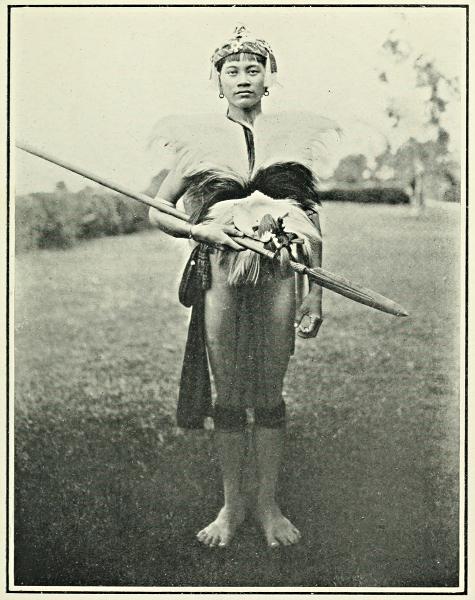
the Dyak damsels. On these occasions he appeared in
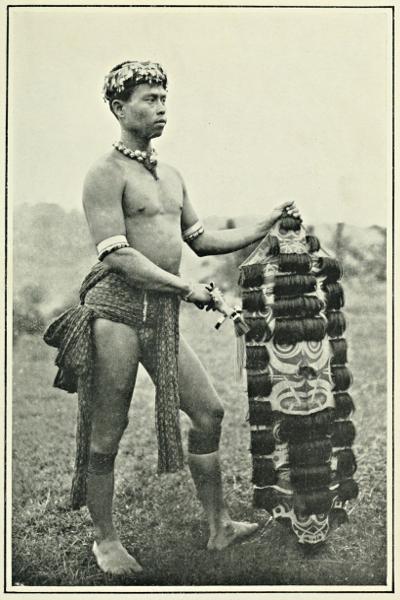
a many-coloured waist-cloth, twelve fathoms in length,
wound round and round his body. On his head he wore
a plaited rattan band, in which were stuck some long
feathers of the hornbill. His coat was woven of threads
of bright colours. On each well-shaped arm was an
armlet of ivory. To his belt were fastened his sword and
the many charms and amulets that he possessed. With
his spear in his right hand and his shield on his left arm,
he presented a splendid type of a Dyak warrior. But it
is not of Siu’s bravery nor of his deeds of valour against
the enemy that this tale relates. It tells only of an adventure
which ended in his discovery of paddy.
He proposed to the young men of his house that they
should take their blowpipes with them and go into the
jungle to shoot birds. So one morning they all started
early. Each man had with him his bundle of food for
the day, and each went a different way, as they wished
to see, on returning in the evening, who would be the
most successful of them all.
Siu went towards a mountain not far from his house,
and wandered about the whole morning in the jungle,
but, strange to say, he did not see any bird, nor did he
meet with any animal. Everything was very quiet and
still. Worn out with fatigue, he sat down to rest under
a large tree, and, feeling hungry, he ate some of the food
he had brought with him. It was now long past midday,
and he had not been able to kill a single bird! Surely
none of the others could be so unfortunate as he! Determined
not to be beaten by the others, after a short rest
he started again, and wandered on in quest of birds.
The sun had gone half-way down in the western heaven,
and Siu was beginning to lose heart, when suddenly he
heard not far off the sound of birds. Hurrying in that
direction, he came to a wild fig-tree covered with ripe
fruit, which a large number of birds were busy eating.
Never before had he seen such a sight! On this one
tree the whole feathered population of the forest seemed
to have assembled together! Looking more carefully,
he was surprised to see that the different kinds of birds
were not all intermingled together as is usually the case,
but each species was apart from the others. He saw a
large flock of wild pigeons on one branch, and next to
them were the parrots, all feeding together, but keeping
distinct from them. Upon the same tree there were
hornbills, woodpeckers, wild pigeons, and all the different
kinds of birds he had ever seen.
Siu hid himself under the thick leaves of a shrub
growing near, very much pleased at his luck, and, taking
a poisoned dart, he placed it in his blow-pipe, and shot
it out. He had aimed at one bird in a particular flock,
and hit it. But that bird was not the only one that fell
dead at his feet. To his astonishment, he saw that many
of the other birds near it were killed also. Again he
shot out a dart, and again the same thing happened. In
a very short time Siu had killed as many birds as he could
carry. As the little basket in which he had brought his
food was too small to hold them all, he set to work and
made a coarse basket with the bark of a pendok tree
growing near. Then he put his load on his back and
started to return home, glad that he had been so
successful.
He tried to return the same way by which he had
come, but as he had not taken the precaution to cut
marks in the trees he passed, he very soon found himself
in difficulties. He wandered about, sometimes passing
by some large tree which he seemed to remember seeing
in the morning. He climbed up a steep hill and went
several miles through a large forest, but did not find the
jungle path which he had followed early in the day.
It was beginning to grow dusk and the sun had nearly
set.
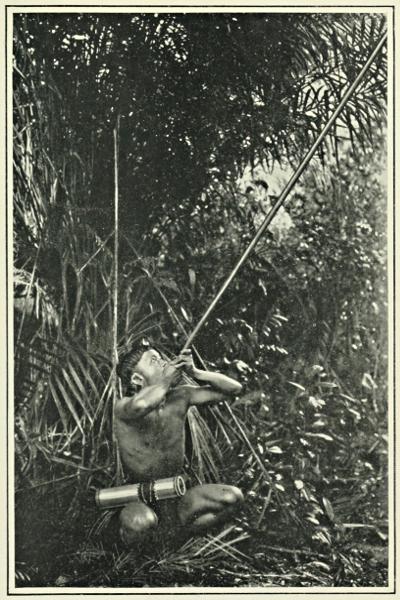
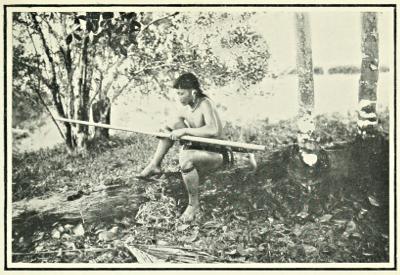
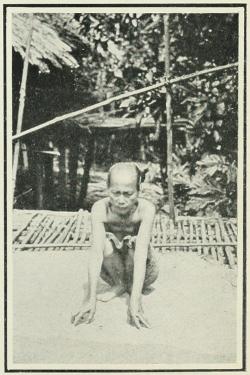
A Dyak using a Wooden Blow-pipe
He is seated on the ground with his blow-pipe held in position to his mouth. He is just in the act
of blowing out one of his poisoned darts, some of which are lying on the ground in front of him. To
his waist is fastened the bamboo receptacle in which the darts are kept.
“I must hurry on,” said Siu to himself, “in the hope
of finding some house where I can get food and shelter.
Once it is dark I shall be forced to spend the night in the
jungle.”
Coming to a part of the jungle which had lately been
a garden, he thought there must be a path from it
leading to some house, so he began to walk round it.
Soon he found an old disused path, which he followed.
By this time it was quite dark, and Siu made
haste to reach the Dyak house which he felt sure
was not very far off. He came to a well, and near at
hand he saw the lights and heard the usual sounds of
a Dyak house. He was glad to think that he would
not have to spend the night in the jungle, but would be
able to get food and shelter at the house. He stopped
to have a bath, and hid the birds he was carrying and
his blow-pipe and quiver in the brushwood near the well,
hoping to take them with him when he started to return
the next morning.
As he approached the house, he could hear the voices
of the people there. When he came to the bottom of the
ladder leading up to the house, he shouted: “Oh, you
people in the house, will you allow a stranger to walk
up?” At once there was dead silence in the house. No
one answered. Again Siu asked the same question, and
after a pause a voice answered, “Yes; come up!”
He walked up into the house. To his surprise he saw
no one in the open veranda in front of the different rooms.
That part of a Dyak house, usually so crowded, was quite
empty. Nor did he hear the voices of people talking in
any of the rooms. All was silent. Even the person who
answered him was not there to receive him.
He saw a dim light in the veranda further on, in the
middle of the house, and walked towards it, wondering
the while what could have happened to all the people in
the house, for not long before he had heard many voices.
“This seems to be a strange house,” he said to himself.
“When I was bathing, and when I walked up to
the house, it seemed to be well inhabited, but now that I
come in, I see no one and hear no voice.”
When Siu reached the light he sat down on a mat.
Presently he heard a woman’s voice in the room say:
“Sit down, Siu; I will bring out the pinang[3] and sireh[4]
to you.”
Siu was very pleased to hear a human voice. Soon a
young and remarkably beautiful girl came out of the room
with the chewing ingredients, which she placed before
him.
“Here you are at last, Siu,” she said; “I expected you
would come earlier. How is it you are so late?”
Siu explained that he had stopped at the well to have a
bath, as he was hot and tired.
“You must be very hungry,” said the girl; “wait a
moment while I prepare some food. After you have
eaten, we can have our talk together.”
When Siu was left to himself, he wondered what it all
meant. Here was a long Dyak house, built for more than
a hundred families to live in, and yet it seemed quite
deserted. The only person in it appeared to be the
beautiful girl who was cooking his food for him. Again,
he was surprised that she knew his name and expected
him that day.
“Come in, Siu,” said the voice from the room; “your
food is ready.”
Siu was very hungry, and went in at once, and sat down
to eat his dinner.
When they had done eating, she cleared away the plates
and put things back into their places and tidied the room.
Then she spread out a new mat for him, and brought out
the pinang and sireh, and bade him be seated, as she
wished to have a chat with him.
Siu had many questions to ask, and as soon as they
were both seated, he began:—
“Why are you all alone in this house? This is a long
house, and many families must live in it. Where are the
others? Why is everything so silent now? I am sure I
heard voices before I entered the house; but now I hear
no sound.”
“Do not let us talk about this house or the people in it
for the present. I would much rather talk of other
matters. Tell me of your own people, and what news you
bring from your country.”
“There is no news to give you,” Siu replied. “We
have been rather badly off for food, as our potatoes
and yams did not turn out so well this year as we
hoped.”
“Tell me what made you come in this direction, and
how it was you found out this house.”
“While I was hunting in the jungle to-day I lost my
way. After wandering about a long time, I found a path
which I followed and came to this house. It was kind
of you to take me in and give me food. If I had not
found this house, I would have been lost in the jungle.
To-morrow morning you must show me the way to my
country, and also I must beg of you some food for
my journey back. My mother is sure to be anxious
about me. She is left all alone now that I am away.
My father died a long time ago, and I am her only
son.”
“Do not go away as soon as to-morrow morning. Stay
here a few days at any rate.”
At first Siu would not consent, but she spoke so nicely
to him that she succeeded in persuading him to stay there
at least a week. Then he went out to the veranda, and
she brought out a mat for him to sleep on and a sheet to
cover himself with. As Siu was very tired, he soon fell
sound asleep, and did not wake up till late on the following
morning.
He saw some little children playing about the next day,
but he did not see any grown-up people. He went into
the room to have his morning meal, but saw no one there,
except the girl he had seen the evening before. He felt
very much inclined to ask her again where the people of
the house were, but he did not do so, as she did not seem
inclined to speak about them.
Now though Siu knew it not, this was the house of the
great Singalang Burong, the Ruler of the Spirit-World.
He was able to metamorphose himself and his followers
into any form. When going forth on an expedition
against the enemy, he would transform himself and his
followers into birds, so that they might travel more
quickly. Over the high trees of the jungle, over the
broad rivers, sometimes even across the sea, Singalang
Burong and his flock would fly. There was no trouble
about food, for in the forests there were always some wild
trees in fruit, and, while assuming the form of birds, they
lived on the food of birds. In his own house and among
his own people, Singalang Burong appeared as a man.
He had eight daughters, and the girl who was cooking
food for Siu was the youngest of them.
The reason why the people of the house were so quiet,
and did not make their appearance, was because they
were all in mourning for many of their relatives who had
been killed some time back. Only the women and children
were at home, because that same morning all the
men had gone forth to make a raid upon some neighbouring
tribe, so that they might bring home some human
heads to enable them to end their mourning. For it was
the custom that the people of a house continued to be in
mourning for dead relatives until one or more human
heads were brought to the house. Then a feast was held,
and all mourning was at an end.
After Siu had been in the house seven days, he thought
he ought to think of returning to his own people. By
this time he was very much in love with the girl who had
been so kind to him, and he wished above all things
to marry her, and take her back with him to his own
country.
“I have been here a whole week,” he said to her, “and
though you have not told me your name, still I seem to
know you very well. I have a request to make, and I
hope you will not be angry at what I say.”
“Speak on; I promise I will not be angry whatever you
may say.”
“I have learnt to love you very much,” said Siu, “and
I would like to marry you if you will consent, so that I
shall not leave you, but take you with me, when I return
to my own land. Also I wish you to tell me your name,
and why this house is so silent, and where all the people
belonging to it are.”
“I will consent to marry you, for I also love you. But
you must first promise me certain things. In the first
place, you must not tell your people of this house, and
what you have seen here. Then also you must promise
faithfully never to hurt a bird or even to hold one in
your hands. If ever you break this promise, then we
cease to be man and wife. And, of course, you must
never kill a bird, because, if you do so, I shall not only
leave you, but revenge myself on you. Do you promise
these things?”
“Yes,” said Siu; “I promise not to speak of what I
have seen here until you give me leave to do so. And as
you do not wish it, I will never touch or handle a bird,
and certainly never kill one.”
“Now that you have promised what I wish, I will tell
you about myself and the people of this house,” said the
maiden. “My name is Endu-Sudan-Galinggam-Tinchin-Mas
(the girl Sudan painted like a gold ring), but my
people call me by my pet names, Bunsu Burong (the
youngest of the bird family), and Bunsu Katupong (the
youngest of the Katupong family). This house, as you
noticed, seems very empty. The reason is that a month
ago many of our people were killed by some of the people
of your house, and we are all still in mourning for them.
As you know, when our relatives have lately died, we stay
silent in our rooms, and do not come out to receive
visitors or to entertain them. Why are your people so
cruel to us? They often kill our men when they go out
fishing or hunting. On the morning of the day on which
you arrived, all the men of this house went on the warpath,
so as to obtain the heads of some of the enemy to
enable us to put away our mourning. With us as with
you, it is necessary that one or more human heads be
brought into the house before the inmates can give up
sorrowing for their dead relatives and friends. You see
us now in the form of human beings, but all the people
in this house are able to transform themselves into birds.
My father, Singalang Burong, is the head of this house.
I am the youngest of eight sisters; we have no brother
alive. Our only brother died not long ago, and we are
still in mourning for him, and that is the reason why my
sisters did not come out to greet you.”
Siu heard with surprise all she had to say. He said to
himself that it was lucky he did not bring up to the house
the basket of birds which he had killed in the jungle, and
that he had hidden them with his blow-pipe and quiver
containing poisoned darts in the brushwood near the
well. He determined to say nothing about the matter,
as probably some of her friends or relations were among
the birds that were killed by him.
So Siu married Bunsu Burong, and continued to live in
the house for several weeks.
One day he said to his wife: “I have been here a long
time. My people must surely be wondering where I am,
and whether I am still alive. My mother, too, must be
very anxious about me. I should like to return to my
people, and I want you to accompany me. My mother
and my friends are sure to welcome you as my wife.”
“Oh yes, I will gladly accompany you back to your
home. But you must remember and say nothing of the
things you have seen in this house. When shall we
start?”
“We can start early to-morrow morning, soon after
breakfast,” answered Siu.
They started early the next day, taking with them food
enough for four days, as they expected the journey would
last as long as that. Siu’s wife seemed to know the way,
and after journeying for three days, they came to the
stream near the house, and they stopped to have a bath.
Some of the children of the house saw them there, and
ran up to the house, and said: “Siu has come back, and
with him is a beautiful woman, who seems to be his wife.”
Some of the older people checked the children, saying:
“It cannot be Siu; he has been dead for a long time.
Don’t mention his name, for if his mother hears you talk
of him, it will make her very unhappy.”
But the children persisted in saying that it was indeed
Siu that they had seen. Just then Siu and his wife
appeared and walked up to the house.
Siu said to his wife: “The door before which I hang up
my sword is the door of my room. Walk straight in.
You will find my mother there, and she will be sure to
gladly welcome you as her daughter-in-law.”
When they came into the house, all the inmates rushed
out to meet them, and to congratulate Siu on his safe
return. They asked him many questions: where had
he been living all this time? how he came to be married?
and what was the name of his wife’s country? But Siu
answered little, as he remembered the promise he had
made to his wife, that he would not speak of what he had
seen in her house.
When they reached the door of his room, Siu hung up
his sword, and his wife went into the room. But she did
not see his mother, as she was ill, and was lying in her
mosquito-curtain. Then Siu followed his wife into the
room, and called out: “Mother, where are you? Here
is your son Siu come back!”
But his mother made no answer, so he opened her
curtain, and saw her lying down, covered up with a
blanket. She had been so troubled at the thought that
her son was dead, that she had refused to eat, and had
become quite ill.
She would not believe that her son had really returned
alive, and she said: “Do not try to deceive me; my son
Siu is dead.”
“I am indeed your son Siu, and I have come back alive
and well!”
“No,” she replied, “my son Siu is dead. Leave me
alone; I have not long to live. Let me die in peace, and
follow my son to the grave.”
Siu then went to the box in which his clothes were
kept and put on the things that his mother had often
seen him wear. Then he went to her again, and said:
“Even if you do not believe that I am your son, at any
rate you might turn round and look at me, to make sure
that I am not your son.”
Then she looked at him, and saw that it was indeed
her son. She was so pleased at his return that she soon
recovered from her illness, which was really caused by her
sorrow and refusal to eat. Siu told his mother of his
marriage, and she welcomed his wife with joy.
The women all crowded round Siu’s wife, and asked her
what her name was. She answered: “Endu-Sudan-Galinggam-Tinchin-Mas”
(The girl Sudan painted like a
gold ring). They looked at her in surprise; they had
never heard of such a name before.
“Where do you come from?” they asked. “What is
the name of your country?”
“Nanga Niga Bekurong Bebali nyadi Tekuyong Mabong”
(The mouth of the hidden Niga stream changed
into an empty shell),[5] was the reply.
They were astonished at her answer. They had never
heard of such a country. They asked her of her people,
but she would not say anything more of herself or speak
about her people.
Everybody admired the great beauty of Siu’s wife.
No more questions were asked of her, as she seemed unwilling
to answer. Her parentage remained a mystery.
In process of time Siu’s wife bore him a son whom they
named Seragunting. He was a fine child, and as befitted
the grandson of Singalang Burong, he grew big and
strong in a miraculously short time, and when he was
three years old, he was taller and stronger than others
four times his age.
One day, as Seragunting was playing with the other
boys, a man brought up some birds which he had caught
in a trap. As he walked through the house he passed
Siu, who was sitting in the open veranda. Siu, forgetting
the promise he had made to his wife, asked him to show
him the birds, and he took one in his hands and stroked
it. His wife was sitting not far off, and saw him hold the
bird, and was very much vexed that he had broken his
promise to her.
She got up and returned to her room. Siu came in and
noticed that she was troubled, and asked her what was
wrong. She said that she was only tired.
She said to herself: “My husband has broken his word
to me. He has done the thing he promised me he would
never do. I told him he was never to hold a bird in his
hands, and that if he did such a thing, I would leave him.
I cannot stay here in this house any longer. I must
return to the house of my father, Singalang Burong.”
She took the water-vessels in her hands, and went out
as if to fetch water. But when she came to the well, she
placed the water-vessels on the ground and disappeared
in the jungle.
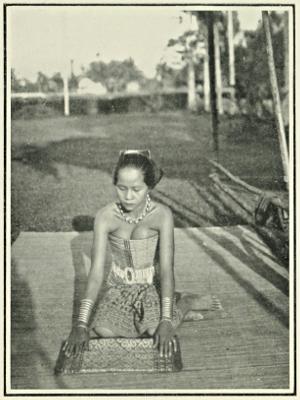
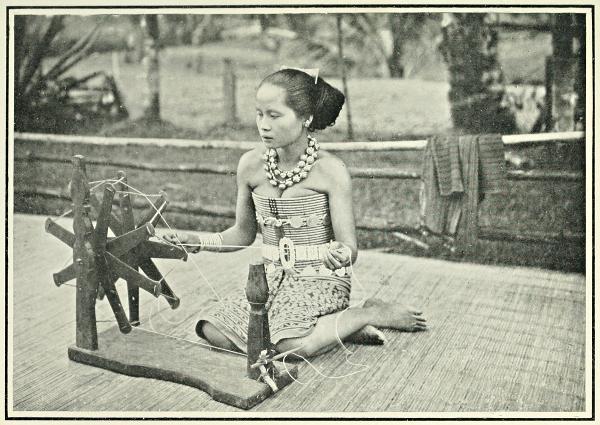
A Dyak Girl
Seated on a mat and folding up a petticoat before putting it away. The
girls are very careful of their clothing and are often very vain, but when
they are married they frequently become very untidy. A woman’s wardrobe
is not extensive. It consists of two petticoats and one jacket as a
general rule.
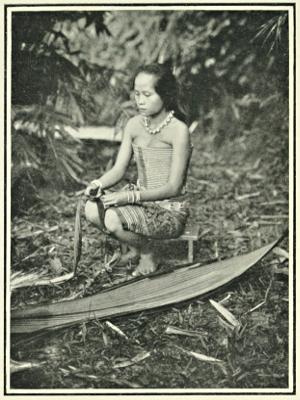
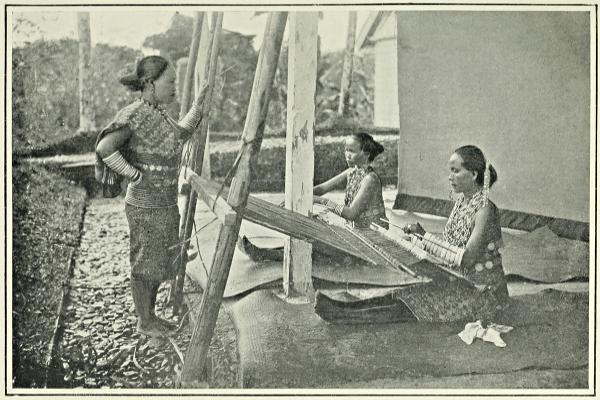
Scraping Palm Leaves for Fibre
With this the women tie up the threads they weave, so that when they
are dipped in any particular dye the parts which are tied may not be
affected by the dye. It is by this means that the different patterns in
Dyak cloth are obtained.
In the meantime Seragunting, tired with his play, came
back in search of his mother. She was very fond indeed
of him, and he expected her to come to him as soon as
he called out to her. But he was disappointed. No one
answered his call, and when he looked in the room she
was not there. He asked his father where his mother
was, and he told him that she had just gone to the well
to fetch water, and would soon be back.
But hour after hour passed, and she did not return to
the house. So Seragunting began to be anxious, and asked
his father to accompany him to the well to look for her.
At first his father refused to do so, but when he saw his
son crying for his mother, he went with him to the well.
They found the water-vessels there, but saw no signs of
her.
“Your mother is not here, Seragunting,” said Siu.
“Perhaps she has gone to the garden to get some vegetables
for our dinner. Let us go back to the house. If
your mother is not back early to-morrow morning, we will
go and look for her.” So they both returned to the house,
taking back with them the water-gourds which Siu’s wife
had left at the well.
Early the next morning Seragunting and his father
went in search of her. They took with them only a little
food, as they expected to find her not very far off. But
they wandered the whole day, and saw no signs of her.
They spent the night under a large tree in the jungle.
Early the next morning they were surprised to find a
small bundle of food, wrapped up in leaves, near Seragunting.
This food was evidently meant for him alone,
as it was not enough for two, but he gave some of it to his
father, who ate sparingly of it, so that his son might not
be hungry. They wandered on for several days, and
every night the same strange thing occurred—a bundle of
food was left near Seragunting. Siu suggested to his son
that they should return; but Seragunting, who during the
journey had grown up into a strong lad, with a will of his
own, would not consent to do so, as he was determined to
find his mother.
They wandered on for several days, deeper and deeper
into the jungle, but could find no signs of her whom they
sought. At last they came to the sea-shore. Here they
rested for some days, in the hope that some boat might
pass. Still, as before, each morning a bundle of food
was found by Seragunting. If it were not for this food,
they would have long ago died of starvation. On this
they managed to live, waiting hopefully to see some boat
appear to take them on their journey.
One day as Seragunting was watching, he heard the
sound of paddles, and saw in the distance several long
boats approaching. He hailed the first, and asked the
men in it to take him and his father with them. The
boat made for the shore, but the man in the bows recognized
the two wanderers, and shouted out: “It is Siu and
his son Seragunting; do not let them come into the boat.”
The boat went on and left them to their fate. The same
thing happened in the case of each of the other boats.
As soon as Siu and his son were recognized, no one would
help them.
Now these were the boats of the sons-in-law of Singalang
Burong: Katupong, Beragai, Bejampong, Papau, Nendak,
Kutok, and Embuas. They were not pleased at their
sister-in-law marrying a mere mortal like Siu, and so
refused to help him and his son.
The next day Seragunting saw what seemed to be a dark
cloud come towards him over the sea. As it came nearer,
it took the form of a gigantic spider, carrying some food
and clothes.
“Do not be afraid,” said the Spider; “I have come to
help you and your father. I have brought you food and
clothing. When you have eaten and changed your
clothes I will take you across the water to the land on the
other side. My name is Emplawa Jawa (the Spider of
Java). I know your history, and I will lead you to your
mother whom you seek.”
After they had eaten and put on the new clothes
brought them, the spider told them to go with him across
the sea. They were not to be afraid, but to follow his
track, not turning to the right hand nor to the left. They
obeyed his words. Strange to say, the water became as
hard as a sandbank under their feet. For a long time
they were out of sight of land, but towards evening they
approached the opposite shore, and saw a landing-place
where there were a large number of boats. Not far off
were several houses, and one longer and more imposing
than any of the others. To this house the Spider directed
Seragunting, telling him that he would find his mother
there. The Spider then left them. As it was late, they
did not go up to the house that evening, but spent the
night in one of the boats at the landing-place. Among
the boats were those belonging to the sons-in-law of
Singalang Burong, which had passed Siu and his son as
they waited on the sea-shore for some boat to take them
across the sea.
When Seragunting and his father woke up next morning,
they saw that the road leading up to the house had sharpened
pieces of bamboo planted close together to prevent
their walking up to it. As they were wondering what
they were to do next, a fly came to Seragunting, and said:
“Do not be afraid to walk up. Tread on the spikes
that I alight on; they will not hurt you. When you come
to the house you will find swords with blades turned
upwards fastened to the ladder. Tread on the blades
that I alight on, and walk boldly up into the house.”
They did as the fly advised them, and were not hurt.
The bamboo spikes crumbled under their feet, and the
sword-blades they trod on were blunt and harmless.
The people of the house took no notice of them, and
they sat down in the veranda of the house. Then the fly
came to Seragunting, and whispered to him: “You must
now follow me into the room. Your mother is there,
lying in her mosquito curtain. I will point out to you
which it is, and you must wake her up and tell her who
you are. She will be very pleased to see you. Then
when you come out into the veranda and see the sons-in-law
of Singalang Burong, you must greet them as your
uncles. They will disown you, and pretend that you are
no relation of theirs. But do not be afraid. You will
be victorious in the end.”
Seragunting followed the fly into the room, and went
to the curtain on which it alighted. He called out to his
mother, and she awoke and saw with joy her son. She
embraced him, and he said to her:
“How is it you went away and left us? We missed
you so much, and were so sorry to lose you, that my father
and I have been travelling for many days and nights in
search of you. Now our troubles are over, for I have
found you.”
“My dear son,” she said as she caressed him, “though
I left you I did not forget you. It was I who placed the
food by you every night. I left your father because he
broke the promise he made to me. But you are my own
son, and I have been wishing to see you ever since I left
your house. It was I who sent the Spider to help you
and show you your way here. My love for you is as
great as it ever was. We will go out now into the veranda,
and I will introduce you to your uncles and aunts, and to
your grandfather. They may not welcome you, because
they were opposed to my marriage to your father. But
do not fear them. We will be more than a match for
them all.”
Then she spoke to her husband Siu, whom she was glad
to meet again. All three then went out into the veranda,
which was now full of people. Seragunting called the
sons-in-law of Singalang Burong his uncles, but they
refused to acknowledge him as their nephew.
They proposed several ordeals to prove the truth of his
words, that he was indeed the grandson of Singalang
Burong. In all of these Seragunting came off victorious.
As the men and boys were spinning their tops, they
asked Seragunting to join them. He had no top of his
own, so he asked his mother for one. She took an egg and
uttered some mysterious words over it, and immediately
it became a top. This she gave to her son, who went and
joined the others in the game. Whenever Seragunting
aimed at a top, he always hit it and smashed it. None of
the others were a match for him. In a short time all
the tops, except that of Seragunting, were broken in
pieces.
Then they suggested a wrestling match. Seragunting
was quite ready to try a fall with any of them, old or
young. Some of their best wrestlers came forward. The
first two were overthrown by him so easily, that the others
saw it was no use their attempting to wrestle with
Seragunting.
As a last trial they proposed that all should go out
hunting. Here they hoped to be more fortunate. All the
sons-in-law of Singalang Burong took their good hunting
dogs with them, confident of success. Seragunting was
told that he could have any of the other dogs left in the
house. There he saw a few old dogs, weak and useless
for hunting. With these he was expected to compete
against the others, and if he were not successful, both he
and his father were to be killed! Seragunting consented
even to such an unfair ordeal as that. He called to him
an old sickly-looking dog and gently stroked it. At once
it became young and strong! While the others went
forth into the jungle with a pack of hounds, Seragunting
was only accompanied by one dog. In the evening
Katupong, Beragai, Bejampong, and the others all returned
unsuccessful. Soon after Seragunting’s dog appeared,
chasing a huge boar, which made a stand at the
foot of the ladder of the house. Seragunting asked the
others to kill the beast if they dared. The spears cast
at it glided off and left the beast unharmed. Some of
those who were rash enough to go near the animal had a
close escape from being torn in pieces by its tusks.
Seragunting, armed with nothing better than a little
knife belonging to his mother, walked up to the infuriated
animal and stabbed it in a vital part, and it fell down
dead at his feet.
After these marvellous feats, all were compelled to
admit that Seragunting was a true grandson of the great
Singalang Burong. They all acknowledged him as such,
and he was taken to his grandfather, who was pleased to
see the lad, and promised to help him throughout his
life.
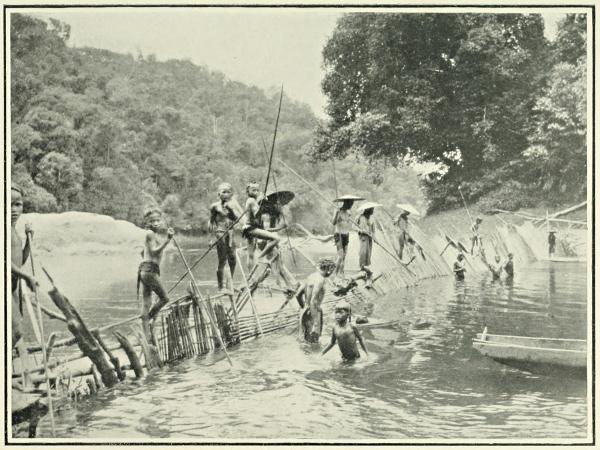
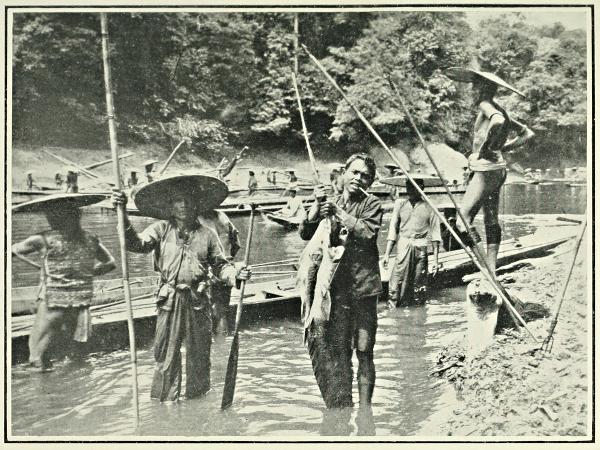
Dyaks making a Dam for Tuba Fishing
The poison from the tuba root is put in the water some distance up river, and the Dyaks follow it as it drifts, and spear and net
the poisoned fish. The tuba does not seem to affect the flesh of the fish, which can be cooked and eaten. Many fish swim down
river to escape the poison. These come to this dam, in which there is an opening leading to an enclosure; in this the fish congregate
and are afterwards captured.
But Siu was unhappy in his new home. He could not
help thinking of his mother, whom he had left alone, and
he was anxious to return to his own people. He begged
his wife to accompany him back to his old home, but she
refused to do so. It was decided that Siu and his son
should stay in the house of Singalang Burong till they had
obtained such knowledge as would be useful to them in
the future, and that then they were to return to the lower
world, bringing with them the secrets they had learnt
from those wiser and more powerful than themselves.
All the people of the house were now most kind to Siu
and his son, and were most anxious to teach them all
they could. They were taken on a war expedition
against the enemy, so that they might learn the science
and art of Dyak warfare. They were taught how to set
traps to catch deer and wild pig. They were shown the
different methods of catching fish, and learnt to make
the different kinds of fish-trap used by the Dyaks of the
present day. They remained in Singalang Burong’s
house that whole year so that they might have a complete
and practical knowledge of the different stages of paddy-growing.
When the year was ended, Seragunting’s mother took
him and Siu to see her father, Singalang Burong, so that
they might receive from him his advice, as well as such
charms as he might wish to give them before they left
to return to the lower world of mortals.
Singalang Burong was sitting in his chair of state, and
received them most kindly. He bade them be seated on
the mat at his feet, as he had many things to say to them.
Then he explained to Siu and his son who he was, and the
worship due to him, and they learnt also about the
observance of omens, both good and bad.
“I am the Ruler of the Spirit-World,” said Singalang
Burong, “and have the power to make men successful
in all they undertake. At all times if you wish for my
help, you must call upon me and make offerings to me.
Especially must this be done before you go to fight against
the enemy, for I am the God of War, and help those who
pay me due respect.
“You have learnt here how to plant paddy. I will
give you some paddy to take away with you, and when
you get back to your own country, you can teach men
how to cultivate it. You will find rice a much more
strengthening article of food than the yams and potatoes
you used to live upon, and you will become a strong and
hardy race.
“And to help you in your daily work, my sons-in-law
will always tell you whether that you do is right or
wrong. In every work that you undertake you must
pay heed to the voices of the sacred birds—Katupong,
Beragai, Bejampong, Papau, Nendak, Kutok, and Embuas.
These birds, named after my sons-in-law, represent them,
and are the means by which I make known my wishes to
mankind. When you hear them, remember it is myself
speaking through my sons-in-law for encouragement or
for warning. Whatever work you may be engaged in,—farm-work,
house-building, fishing, or hunting—wherever
you may be you must always do as these birds direct.
Whenever you have a feast, you must make an offering to
me, and you must call upon my sons-in-law to come and
partake of the feast. If you do not do these things, some
evil is sure to happen to you. I am willing to help you
and to give you prosperity, but I expect due respect to
be paid to me, and will not allow my commands to be
disobeyed.”
Then Singalang Burong presented them with many
charms to take away with them. They were of various
kinds. Some had the power to make the owner brave
and fortunate in war. Others were to preserve him in
good health, or to make him successful in his paddy-planting,
and cause him to have good harvests.
Siu and Seragunting then bade their friends farewell
and started to return. As soon as they had descended
the ladder of the house of Singalang Burong, they were
swiftly transported through the air by some mysterious
power, and in a moment they found themselves at the
bathing-place of their own house.
Their friends crowded round them, glad to see them
back safe and well. They were taken with much rejoicing
to the house. Friends and neighbours were told of their
return, and a great meeting was held that evening. All
gathered round the two adventurers, who told them of
their strange experiences in the far country of the Spirit
Birds. The charms received from Singalang Burong
were handed round for general admiration. The new
seed, paddy, was produced, and the good qualities of rice
as an article of food explained. The people congregated
there had never seen paddy before, but all determined
to be guided by Siu and Seragunting, and to plant it in
future. The different names of the sacred birds were
told to the assembled people, and all were warned to pay
due respect to their cries.
And so, according to the ancient legend, ended the old
primitive life of the Dyak, when he lived upon such poor
food as the fruits of the jungle, and any yams and potatoes
he happened to plant near his house; the old blind existence,
in which there was nothing to guide him; and then
began his new life, in which he advanced forward a step,
and learnt to have regularly, year by year, his seed-time
and harvest, and to know that there were unseen powers
ruling the universe, whose will might be learnt by mankind,
and obedience to whom would bring success and
happiness.
Long, long ago, though the Dyaks knew of paddy, and
planted it every year, yet they had very poor crops,
because they did not know what god owned the land,
and as they did not offer him sacrifices he did nothing
to help them. In those days there lived together seven
brothers and their only sister. The brothers’ names were
Bui-Nasi, Belang-Pinggang, Bejit-Manai, Bunga-Jawa,
Litan-Dai, Kenyawang, and Pulang-Gana, and the
sister’s Puchong-Kempat. They lived on a hill by the
side of a broad river. On all sides were wide plains, and
beyond them high hills rose in the distance. Most of
these plains were covered with thick jungle, and only a
few clearings where paddy had been planted could be
seen.
Not far from the house the brothers had a garden in
which they planted potatoes, yams, sugar-cane, and
tapioca; but a porcupine would often come at night and
do much damage to the garden. They bade their youngest
brother, Pulang-Gana, keep watch, directing him to drive
away the animal or kill it if he could. But all his efforts
were vain. When he was awake the animal did not come,
but as soon as he fell asleep the porcupine would creep in
quietly and eat up the potatoes and yams. The elder
brothers were not kind to Pulang-Gana. They would not
keep watch themselves, but whenever they saw fresh
damage done they not only scolded their younger brother,
but beat him with sticks.
“He is only lazy,” they said, “and deserves a thrashing.
He does nothing but sleep, and is too lazy to wake
up at night and drive the porcupine away!”
Poor Pulang-Gana! His was a hard lot indeed!
He determined to keep careful watch one night, and,
whatever it cost him, to kill the porcupine, so that his
brothers might have no more cause for blaming him.
That night he did not sleep at all. The porcupine came
just before dawn, when all was still. Pulang-Gana was
awake, and went after it, determined to kill it. The
animal ran away, and Pulang-Gana followed. The moon
was shining brightly, and he had no difficulty in seeing
in what direction the animal went. Every now and then
the porcupine stopped, but as soon as Pulang-Gana came
up it started off again, and he was not able to kill it; so
the animal went on, and Pulang-Gana followed, determined
not to give up the chase until he had effected his
purpose.
The sun was beginning to rise in the east, and still
Pulang-Gana pursued the porcupine.
“Sooner or later,” he said to himself, “I must catch
it up. The animal is already tired. I will not return
home till I have killed it.”
The porcupine now came to the foot of a rocky mountain.
Pulang-Gana, thinking the chase would soon be
over, hurried on, but before he could reach the animal it
had escaped through an opening in the solid rock. The
cave into which it had disappeared was large enough for
a man to stand upright in, and Pulang-Gana said to
himself:—
“Now I have you. Wait till I have a light to show
me where you are, and then I will come in and kill
you.”
He collected some dry branches, and tied them together
for a torch. He found a piece of dry soft wood, and also
a short stick of some hard wood, the point of which he
sharpened. With the palms of his hands he worked the
small stick and drilled a hole in the soft wood. Soon it
began to smoke, and with the aid of some dry twigs he
blew the fire into a blaze; then he lighted his torch, and
hurried into the cave after the porcupine.
He saw the animal a little distance ahead of him, and
followed it leisurely. There was no need for haste, as he
would be able to kill it easily enough when he drove it
to the end of the cave, and it had no means of escape.
The cave seemed to extend a great way into the mountain.
After a few hours’ walking Pulang-Gana was surprised
to come to an opening in the rock, through which
the porcupine had evidently escaped. Outside the sun
was shining brightly. Pulang-Gana went through this
opening, but, though he looked in all directions, he could
see no signs of the porcupine.
He was uncertain what he ought to do next. The
porcupine had escaped, and there was no chance of his
being able to kill it. He did not feel inclined to return
to his brothers, because they were all unkind to him.
On the other hand, he did not know if this new country
in which he found himself was inhabited; and, if inhabited,
whether the people would treat him kindly. Looking
around, he saw smoke arising some distance off, and
guessed that it was a Dyak house. As he was hungry,
he decided to make for it, hoping the inmates would be
kind to him and give him food.
As Pulang-Gana came nearer, he saw the house was a
very long one, inhabited by about one hundred families.
He stopped at the bottom of the ladder leading up to the
house, and, following the Dyak custom, asked in a loud
voice if he might walk up.
“Yes; come up, Pulang-Gana,” said a voice in reply.
“We have been expecting you for some time, and will
be glad to see you.”
He was surprised that his name should be known in
this strange country in which he had never been before.
He walked up, and in the long open hall stretching the
whole length of the house he saw an old man and a young
and beautiful girl.
“Spread out a mat, my daughter,” the old man said,
“that Pulang-Gana may sit and rest after his long journey,
and you can prepare some food for him. No doubt he is
hungry as well as tired.”
She spread out a mat for Pulang-Gana, and then went
into the room to get ready a meal for their visitor. Soon
after she opened the door of the room and asked him to
come in and eat.
The old man, who seemed kind and hospitable, said to
him:—
“Go in and have some food. You must be hungry
after your long journey. When you have eaten and
rested we can have a talk together. I have long wished
to meet you and to ask you about yourself and your
brothers, and how affairs are in your country.”
Pulang-Gana went into the room, and found a nice
meal awaiting him. Being very hungry, he did full
justice to it.
That evening, as they sat by the fire, the old man asked
him about his people, and if they had good crops of paddy
in his country. Pulang-Gana answered that, though his
brothers possessed the largest paddy-fields in the country,
he never remembered their having a really good harvest.
The paddy they obtained was not sufficient to last them
the whole year, and they had to fall back on potatoes
and sago for food. The old man seemed interested in
what his guest said of himself, so Pulang-Gana went on
and told him of all his circumstances,—how he lived with
his six brothers and only sister, and how unkind his
brothers were to him. He also told the old man about
the porcupine which did such damage to their garden, and
how often he had been scolded and beaten by his brothers
for not being able to drive away or kill the animal. He
gave an account of his adventures that morning, and how,
determined to kill the porcupine, he had followed it
through the underground passage under the mountain,
and had found himself in this strange country.
“I have heard your story,” said the old man, “and
think you are much to be pitied. Your brothers seem
to have been very unkind and to have treated you very
badly. I would like you to stay with me here, and not
return to them. I have no son, and would like you to
marry my daughter and live with us. I am getting old,
and am not so strong as I used to be, and will be glad of
your help.”
“I should like to stay with you very much, for you
seem so kind, and are so different to my brothers, and I
should like to marry your daughter and spend the rest of
my life here. But there is no one to look after our
garden, and the porcupine will do much damage to it.
My brothers are sure to be angry with me for leaving
them, and when they see their garden destroyed through
my neglect they are sure to hunt for me, and when they
find me they will probably kill me. No; much as I would
like to stay, I am afraid I cannot. I must start to return
to-morrow. It would have been different if I had succeeded
in killing the porcupine; then it would not matter
so much if I stayed away some time.”
“You need not trouble yourself about the animal that
attacks the vegetables planted in your garden. I can
prevent its coming again. That porcupine is not really
an animal. One of our slaves here, named Indai-Antok-Genok,
is commanded by me to transform herself into a
porcupine, and pay visits to that garden. I shall tell her
to do so no more, and your brothers’ garden will be safe
enough without you to watch it. You must remain here
with us. There is nothing for you to fear. If you do
not return, your brothers will think that some accident
has happened to you, and that you are dead. As they
are all so unkind to you, you may be sure they will not
trouble to look for you.”
“Well, if that be the case, I will gladly live with you.
I was not happy with my brothers, and I am sure I shall
be happy here.”
So it was decided that Pulang-Gana should remain in
the house of the old man. Some months afterwards he
married the daughter, and they lived happily as husband
and wife. His wife’s father and mother were kind to him,
and so were the other people in the house, and Pulang-Gana
was very glad he decided to cast in his lot with
them.
Now, this old man who treated Pulang-Gana so kindly
was no ordinary mortal. His name was Rajah Shua,
and he ruled the spirits who lived in the underground
caves of the earth. His wife was quite as powerful as he.
She was a goddess, and had power over the animals of the
forest, all of which obeyed her. She was known as Seregendah.
The daughter that married Pulang-Gana was
called Trentom-Tanah-Tumboh, and sometimes Setanggoi-Tanggoi-Buloh.
In process of time Pulang-Gana’s wife gave birth to a
girl, who was very much admired by all, and greatly loved
by her parents.
When the child was a few years old, she came one day
to her father and mother and asked what property they
intended to leave her. The mother showed her the
valuable jars and brassware that she possessed, all of
which were to belong to her child. Then the little girl
asked her father what he had to give her. Pulang-Gana
had no property to leave to his daughter. Years ago he
had come by chance to this house of Rajah Shua, bringing
nothing with him, and unless his brothers gave him a
share of their father’s property, he would have nothing
to leave his daughter. So he told her to be content with
what her mother gave her. She would be very rich
without anything from him. But she was not satisfied
with this reply, and cried because her father said he had
nothing to give her.
When Pulang-Gana saw how sad his child was he said
to his father-in-law that he would like to pay a visit to
his brothers, and ask them for his share of the property,
that he might have something to give his daughter.
Rajah Shua told him he might go to them, but warned
him that probably he would not have a kind reception,
and advised him not to be away long, but to return as
soon as possible.
Pulang-Gana started on his journey to his old home,
wondering how his brothers would receive him after his
long absence. He had no difficulty in finding his way,
as his father-in-law gave him very definite instructions
about his journey. He found that his brothers had built
a new house not far from the site of the old one in which
he had lived with them years ago. The house seemed
very quiet, and he learnt that nearly all the people were
away on a tuba-fishing expedition. Only his sister-in-law,
the wife of his brother Belang-Pinggang, was at
home.
She was very much surprised to see him, and said they
had given him up for dead long ago. She told him that
the others were away fishing, and that his brother Bui-Nasi,
herself, and a little boy were the only members of
the family left at home. He would find his brother and the
little boy working at the forge making some implements
for their work.
Pulang-Gana said he would go to his brother, and he
left the house and walked in the direction where he
guessed the forge was from the sound of hammering he
heard.
“Oh! is that you, Pulang-Gana?” said Bui-Nasi, as
soon as he saw him. “Where have you been all these
years? We thought that you had met with some
accident, and had died long ago.”
Pulang-Gana said little about himself to his brother.
He told him how he had lost his way in the jungle years
ago, and when he arrived at last at a house the people
there persuaded him to stay with them, and he said that
he was now married and had a daughter.
“Have you come with your wife to stay with us?”
asked Bui-Nasi.
“No,” was the answer; “I have only come on a short
visit by myself to ask for my share of the property left
us by our father.”
“You have nothing whatever to expect. You left us
years ago of your own will, and have been away all this
time, and now you have the impudence to come and ask
for your share of the property. I advise you to say
nothing of this to the others. They will be very vexed
with you if you do.”
“I do not ask for much,” said Pulang-Gana. “I will
be satisfied with little. But my daughter asked me what
I had to give her, so I came here to beg for something,
and I should be sorry to return empty-handed.”
“You shall not return empty-handed,” said Bui-Nasi
in scorn. “Here is something for you to take back with
you. It is all that you will get from us, I can tell you.”
With these words he threw Pulang-Gana a clod of earth
which he saw lying near. “Now go away, and do not
let us see your face again.”
Pulang-Gana put the lump of earth in his bag, and
with a heavy heart started to return to his house. So
this was the way his brothers treated him! There was
nothing to expect from them!
When he arrived at his house, all the family gathered
round him. They had heard that he had gone to ask his
brothers for his share of the property, and they were
anxious to see what he brought back. His little daughter
rushed up eagerly to him and said:—
“Father, what have you brought back for me from
my uncles? Let me see the nice things they gave
you.”
Then Pulang-Gana said sadly: “I received no share of
the property from your uncles. They would have nothing
to do with me, and drove me away.”
“But did you get nothing at all from them?” asked
his father-in-law.
“Yes,” said Pulang-Gana; “my brother Bui-Nasi did
give me something, but I am ashamed to tell you what
it is. Here it is.” And he took out from his bag the
lump of earth his brother had given him, and handed it
to his father-in-law.
When Rajah Shua saw what Pulang-Gana had received
from his brothers, he said joyfully:—
“They have given you the most valuable gift it is
possible to imagine. You are now a person of great
importance. The earth is yours. Whoever wishes to
plant on it must first make offerings and sacrifices to
you, and pray to you to give him a good harvest. It is
in your power to make the earth fruitful or barren, and
to give mankind a good or a bad harvest as you
will.”
A few months after, the brothers of Pulang-Gana, at
the advice of Bui-Nasi, decided on the site where they
were to plant paddy that year. It was a large forest
some distance away from their house. First they cut
down the smaller trees, and then they felled the large
trees, and when all this work was done they rested for
some weeks, waiting for the sun to dry up the timber, so
that it might be set on fire and the land be ready for
planting on.
One day Pulang-Gana’s father-in-law said to him: “I
hear that your brothers have been busy cutting down the
trees where they intend to plant paddy this year. As
they gave you the earth some time ago to be your share
of the property, it is only right that they should ask
leave from you before planting on it. Since they have
not done so, you must stop them from planting paddy
there.”
“How can I prevent them planting paddy where
they like?” said Pulang-Gana in dismay. “Is it
likely that they will take any notice of anything I
say?”
“Yes,” said his father-in-law, Rajah Shua; “they will
have to listen to what you say, for I will be on your side,
and will help you. I am the god that rules the spirits
that live in the underground caves of the earth, and my
wife Seregendah has power over the animals and the
spirits which inhabit the forests. As your brothers have
treated you so unkindly, and have given you no share of
the property, and have simply given you a clod of earth
to take back with you, my wife and I will punish them
and reward you by giving you power over everything
that grows on the earth. Before the land is planted,
offerings must be made to you, and invocations must
be sung to yourself, and myself, and my wife Seregendah.
Unless these things be done, the ground will
not be fruitful.
“As your brothers have not done anything of the kind,
you must teach them a lesson, and prevent them from
going on with their work. This evening at dusk you
must go to the newly cleared forest and cry aloud:
‘Come here, all you who are the servants of Seregendah
and Rajah Shua,’ and name all the wild beasts of the
forest. They will come to you in large numbers. Then
you must ask them, as well as the invisible spirits, who
will be present too, to help you to put up all the trees
that have been cut down.”
Pulang-Gana did as his father-in-law advised him.
He went at dusk to the part of the jungle where his
brothers had been cutting down the trees, and called to
the animals in the name of Rajah Shua and of Seregendah,
and they came in large numbers and helped him to put
up all the trees that had been felled, and the forest
appeared just as it had been before any of the trees had
been cut down.
The next day Bui-Nasi went early in the morning to
see if the fish-traps he had set in the stream had caught
any fish, and as he was near the part of the forest where
the trees had been cut down by his brothers and himself
not long before, he went on to see how things were
getting on, and if the felled jungle was dry enough to
be burnt.
To his great surprise he found all the trees standing,
and no signs of the clearing that had been made. He
hurried home and told his brothers what he had seen,
and they all returned, accompanied by their friends and
followers, and found that what Bui-Nasi had told them
was perfectly true. They were all very much surprised,
as they had never known such a thing happen
before.
“I wonder if this is really the part of the forest which
we cleared a few weeks ago,” said one of the brothers.
“Perhaps we have mistaken the spot.”
“No,” said Bui-Nasi in reply; “there is no mistake.
Here are the whetstones on which we sharpened our axes
and hatchets; and here, too, is where we did our cooking
for our midday meal.”
They held a consultation as to what was to be
done.
“This is very strange,” said Bui-Nasi. “Some enemy,
who is helped by powerful spirits, is determined not to
let us plant paddy here. Let us try and find out who
has made the trees that we have cut down stand upright
as before. My advice is that we cut down the jungle
anew, and that some of us remain and keep watch
here all night. Perhaps we may be able to catch the
culprit.”
So the brothers and all their friends and followers set
to work, and before the day was ended they had cleared
afresh a large stretch of jungle.
Twelve men, with Bui-Nasi at their head, were set to
watch, and the others returned home, discussing among
themselves what had taken place.
Those that were left by the clearing had not long to
wait. Soon after dusk they saw a man come, and,
standing on the trunk of a large felled tree, call aloud to
the animals of the forest and the invisible spirits around
in the name of Rajah Shua and Seregendah to come to
his help. The twelve men crept up cautiously behind
him and seized him.
“We have you now,” they said as they held him fast.
“It is you who have caused us all the trouble of having
to cut down this jungle for the second time. Now we
intend to kill you, and you will not be able to play your
tricks on us any more.”
It was too dark to see who it was, and Bui-Nasi said:
“Let us have a light and see what he is like. I am sure
he must be as ugly as he is troublesome.”
One of them fetched a light, and to their great surprise
they saw their prisoner was Pulang-Gana!
“So it is you, Pulang-Gana!” said his brother in anger.
“You are up to your old tricks again. You were too
lazy to work before, and would not keep watch over our
garden, and you left us without telling us where you were
going. And now, after several years’ absence, you come
back and disturb us in our work, and by some means
or other set up the trees we have had the trouble of
cutting down. Though I am your brother, I have
no pity for you. As long as you are alive you will give
us trouble, so we intend to kill you and be well rid of
you.”
He expected Pulang-Gana to be afraid of him, and to
plead for his life. But things were very much changed
from the old days, when Pulang-Gana was the despised
youngest brother, beaten and scolded by the others.
Now he was the son-in-law of the gods, and had Rajah
Shua and Seregendah to help him, and he was not at all
afraid of his brothers, because he knew well they could
do him no harm.
He shook off those that held him, and told them to
listen to what he had to say. His manner and bearing
were very different from that of one who feared them.
They stood around him in awe, for they instinctively felt
that Pulang-Gana was not to be trifled with, and from
what had already taken place they knew that he was
aided by powerful spirits.
Then Pulang-Gana spoke:—
“I have good reason for doing what I did. You have
no right to cut down this jungle or to plant on this land.
You have not asked my leave to do so, and have not
paid me the price of the land. Not long ago, you, Bui-Nasi,
gave me a clod of earth as my share of the property
of our father, and so I have now the right of preventing
any from planting on the earth. It is no use you attempting
to kill me. Though you are many in numbers, it is
impossible for you to kill me, because I am now the god
of the earth, and am assisted by Rajah Shua and Seregendah,
whose power you know.”
There was silence for a short time, and then Bui-Nasi
said:—
“No doubt what you say is true, for no one without
supernatural aid could have made the trees that were cut
down stand upright and grow. What do you wish us
to do, and how are we to obtain your leave to plant on
the land?”
Pulang-Gana told them to gather all the people together
the next day, and he would tell them what they
must do in order to insure their getting good crops of
paddy.
That same night messengers were sent in all directions
to tell the people in the neighbouring villages to come
together the next day, in order that they might learn
from Pulang-Gana what they were to do before cutting
down the jungle and planting paddy.
The next morning a very large crowd gathered together,
and Pulang-Gana said to them:
“You must always remember that I am the god of
the earth, and before cutting down the jungle for planting
you must make invocations to me, as well as to Rajah
Shua and Seregendah, and you must ask me for permission
to plant on the piece of land you have chosen. You
must also kill some animal—a pig or a fowl—and offer it
as a sacrifice to me, and in addition to this some offering
of food—rice, or eggs, or potatoes, or fruit—must be
made. Then, lastly, you must remember to bury some
small offering in the ground. That is the rent you pay
me for the use of the land, for all the land belongs to me,
and I expect rent to be paid by all who use it.
“And if anything goes wrong in your paddy-fields,
and the crops are poor, or, being good, are attacked by
insects or wild animals, then you must call upon Rajah
Shua and Seregendah and myself to come to your aid,
and we will help you.”
Then for the first time did the new ceremonies come
into force, and, aided by the higher powers, men were
able to obtain much better crops than they had done
before. And this is why no Dyak dares to plant paddy
without first burying some small gift in the earth, and
also making invocations and offerings to Pulang-Gana,
Rajah Shua, and Seregendah.