Early trips to the coast—Disturbed state of Bulhár—Stopping a fight—Two
skirmishes—First exploring trips—Hostility of the natives—An unlucky trip—Start
with my brother to explore the Habr Toljaala and Dolbahanta countries
on duty—Camp on Gólis Range—Theodolite station at 6800 feet—Enter
the waterless plains—Advance to the Tug Dér—News of raiders ahead, and of
Col. A. Paget’s party—Dolbahanta horsemen—Advance to the Nogal Valley—Constantly
annoyed by the Dolbahanta—Prehistoric tank and buildings
at Badwein—Advance to Gosaweina—More horsemen—Insecure border, and
scene of a raid—Explore Bur Dab Range—Robbers’ caves—Exploration of
my brother on Wagar Mountain—Lovely scenery—Return to Berbera—Start
on a second expedition to the Jibril Abokr country—The top of Gán
Libah—A new hartebeest—Death of a leopard—Hargeisa—Natives clamouring
for British protection against Abyssinia—Bold behaviour of a leopard—Advance
to the Marar Prairie—Camp at Ujawáji—Extraordinary scene on the prairie—Quantities
of game—Gadabursi raid—Jibril Abokr welcome of the English—A
shooting trip on the plains—News of three lions—Vedettes posted over lions—Advance
to the attack—Savage charge; unconscious and in the clutches of a
lioness—My brother’s account of the accident—His own narrow escape, and
death of a fine lion—Civility of the Jibril Abokr—Abyssinian news—Return to
the coast—Recovery from wounds—Third expedition; to the Gadabursi country—Great
raid by the Jibril Abokr on the Bahgoba—Curious adventure with
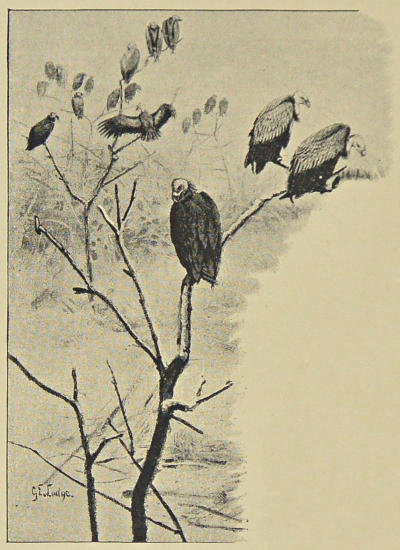
robbers—Betrayed by vultures—Raiding tactics—First meeting with the Gadabursi—Meeting
with Ugaz Núr—The rival sultans—Construction of an Abyssinian
fort at Biyo-Kabóba—Esa in a ferment—Speech of Múdun Golab—My brother
bags a large bull elephant—March to Zeila.
In order to show the state of Somáliland when the British
Protectorate[17] was first established after the departure of the
Egyptians, I propose to give a short account of my trips into
the interior prior to 1887.
Soon after I had joined the Aden garrison in 1884, two
English officers returned from a shooting trip to the Gólis Range
south of Berbera; this was, I believe, the first journey to the
Somáli interior undertaken by any Englishman since the attack
on Sir Richard Burton’s expedition thirty years before. Accompanied
by a friend, I was the next to make a short but unimportant
shooting trip to Gólis—in January 1885.
The first exploring party—that of Mr. F. L. James—had
preceded us by about a month, and was already at Gerlogubi
in distant Ogádén. The Egyptians had a few months before
evacuated the coast, the Pasha leaving with about half a battalion
of soldiers and a few field-pieces, and Mr. L. P. Walsh, one of
the assistant Residents at Aden, had taken over charge of
Berbera and Bulhár with a few Aden policemen. At the same
time Zeila was, so far as I remember, handed over by the
Egyptians to a British Consul, with a French Consul also living
in the town. My next visit to Somáliland occurred two months
after my return from the shooting trip to Gólis.
The Egyptian military quarters at Bulhár had been reported
flooded by a freshet from the Issutugan river, and I was sent
over from Aden to meet Mr. Walsh and go with him to Bulhár,
in order to choose a site for hut barracks, to be put up by the
Indian Sappers who were under my command. I chose the
site for the huts and returned to Aden. I arrived again at
Bulhár on 27th September 1885, with thirty Sappers and all
the material for constructing the huts, and camped near the
site which we had chosen. For the first three weeks there was
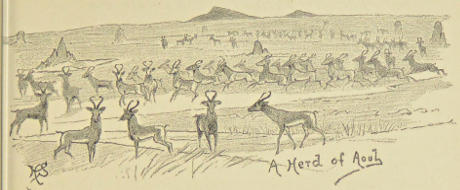
no chance of leaving camp even to go aoul shooting on the
plain. Several native reports had reached us that the hill
tribes, especially the Habr Gerhajis, were likely to come down
and attack us, and not knowing the nature of Somáli information
at that time I was inclined to believe these rumours.
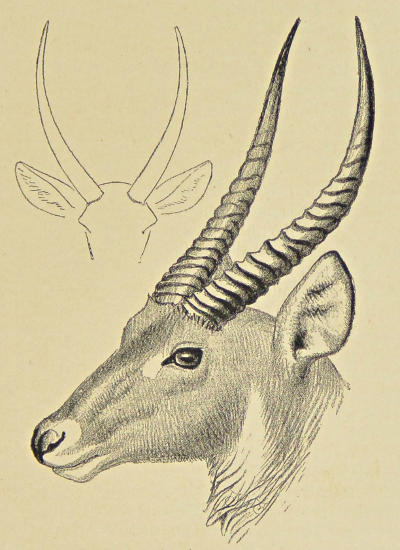
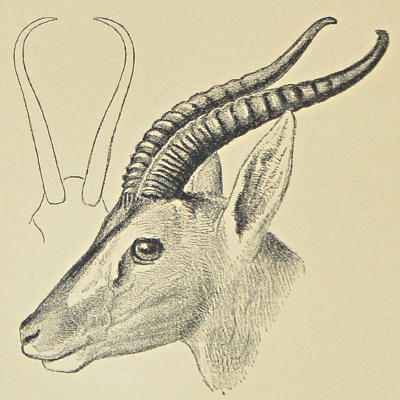
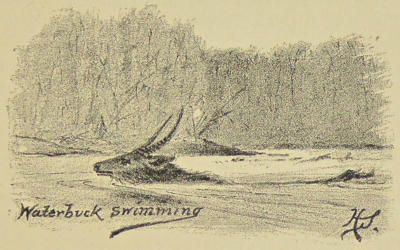
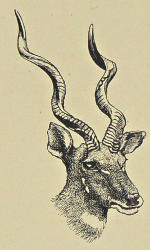
♂ WATERBUCK (Cobus ellipsiprymnus).
Average length of horns on curve, 20 inches.
When the work was, however, fairly under way I took a few
strolls into the plain. On one occasion, when out, attended only
by my hunter, Ali Hirsi, we blundered within half a mile of a
large party of raiding Habr Gerhajis horsemen from the hills,
whom the police from Berbera were trying to catch. Not
knowing anything about the locality of the band I fired at a
bustard, with the result that the robbers bolted for the hills,
thinking the police had come up with them.
Bulhár was now getting full of people, the clans coming
down into the plain. Two of these clans had a feud in active
operation, and a large tree near Elmas Mountain was about this
time the scene of a ghastly murder. Eight men and as many
women and children of one of the clans were attacked when
asleep under a tree by their enemies, and all had their throats
cut. My hunter, Ali Hirsi, who belonged to the clan which
had suffered, promptly asked leave to go to the interior and see
his father, who, he said, had been suddenly taken ill. I afterwards
found that this was incorrect, and that Ali Hirsi, being
the son of an ákil, had found it incumbent on him to answer
the family call to arms.
Shortly afterwards my friend the late Mr. D. Morrison,
Mr. Walsh’s assistant, arrived from Berbera to take charge of
Bulhár, and he at once found his hands full with this feud between
the two clans of the Shirdone Yunis, Habr Awal, called
respectively the Boho Shirdone and the Ba-Gadabursi Shirdone.
British interests suffer sadly by these feuds occurring near our
ports, as for the time being all trade is liable to be stopped.
A few days after M⸺’s arrival a messenger came
running in at dawn one morning to say that the Boho had
taken possession of the Bulhár wells, three miles west of the
town, and were that morning going to be attacked by the Ba-Gadabursi
from Elmas, each side being about five hundred
strong. M⸺ at once decided to ride out with his interpreter
and try to dissuade the Ba-Gadabursi from attacking.
I accompanied him on one of the Sapper mules, taking with
me Khoda Bux, a Panjábi muleteer, also mounted. After
going three miles, at the Bulhár wells we came upon the Boho
Shirdone halted, awaiting the attack. Here I found my hunter,
Ali Hirsi, sporting a khaili tobe, with a good nag grazing close
by. He came up cheerily to me, with nothing of the servant
about him, and shook hands. I asked him after his sick father,
and with a bland smile he said he had got well again, and was
going to fight the Ba-Gadabursi.
We rode on, and crossed a bare, undulating plain, which in
the evenings is sometimes covered with sand-grouse, and where
I had often hunted aoul, and a mile beyond the Boho we came
upon the Ba-Gadabursi, not halted, but already advancing in
line to the attack!
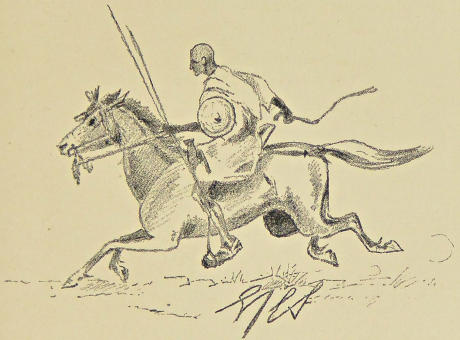
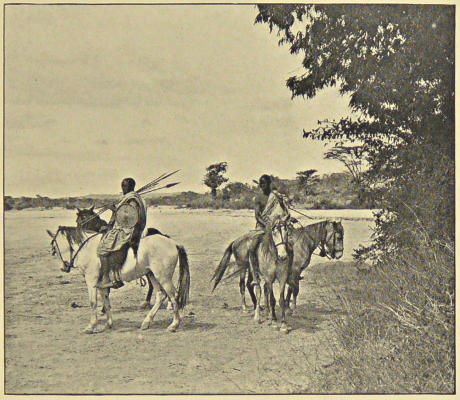
Somáli Horseman.
It was a stirring scene. About two hundred horsemen and
three hundred spearmen on foot were advancing in a long line
facing to the east, coming to meet us. The horsemen formed
the left wing, marching along the flat sandy plain which
stretched down to the raised sea-shore on our right, which,
though we could hear their roar, hid from our view the white
breakers of the Gulf of Aden. On our left the plain rose to
low sand hillocks covered with grass and scrub, and along these
came the right wing on foot, the men extended at about a
pace apart, keeping a very good line, each man carrying his
spears and shield and wearing his white tobe wound round
his waist. Most of the horsemen wore the khaili, or red and
blue tobe. The plain over which we had ridden stretched between
us and Bulhár, which lay four miles behind us.
Our little party of four cantered to meet this array. Now
and then a horseman darted out from the line, and galloping
round in a circle, threw his spear, and picked it up again while
at full speed. As we approached they set up a song, but
stopped when M⸺ rode up to one of the aukál, or elders,
and demanded a parley. There was a good deal of angry
shouting at first, and the horsemen pressed round us in a dense
mass, so that we could only extricate ourselves by drawing our
revolvers. Seeing we really had some serious business on hand,
one or two of the leading Ba-Gadabursi elders, prominent
among whom was a well-known firebrand called Warsama
Dugál, entreated the horsemen to wait and hear what “the
Government” had to say. M⸺, by the aid of his interpreter,
quietly explained that if they would only put off the attack
for a day he would try and settle the feud satisfactorily to
both parties. While the interpreter was explaining this, M⸺
asked me to try and bring out the thirty Sappers, to be ready
on hand if required. I told Khoda Bux in Hindustáni, and,
like the sporting Panjábi that he was, he was delighted with the
errand, and kicking up his mule, he started off at a gallop.
A Shirdone galloped in pursuit, shouting and brandishing his
spear, but M⸺ quickly headed him, and persuaded him to
get back into the line and not make a fool of himself.
The elders, who had seen the force of my friend’s sensible
argument from the first, soon quieted down the horsemen;
while I rode off with Warsama Dugál and persuaded the infantry
to stop, for they were quietly creeping ahead among the
sand-dunes. When they saw me riding on a kicking Panjábi
mule, with a revolver which I had forgotten to put in its holster,
and old Warsama in company excitedly yelling at them, they
began to laugh, and good-naturedly squatted down on their
heels, with the butts of their spears planted in the ground,
glowering over their shields at a line of hillocks in front which
hid the Boho from view. At their earnest request I allowed
them to advance fifty yards to the top of the hillocks, “so that
they might see the Boho.” They said they were thirsty, and the
sight of the wells would do them good! The people told us
that it was very hard being stopped in this way. They did
not want to touch a hair of any white man’s head, they only
wanted to wipe out the Boho. However, the elders agreed to
send back the clan to Eil Sheikh, and themselves to come into
Bulhár with M⸺ and see what they could do to settle the
feud. The Sappers at last came into sight, and about a dozen
of the elders accepted our escort to get them safely through
the Boho lines. I extended my men, a section on either side,
marching in single file, while M⸺ and the elders rode
bunched together in the space between. We passed the Boho
line in this order, having first sent the interpreter on to
explain. The Boho looked savagely at our protégés as we
passed, but were too sensible to attack us for the sake of slitting
the throats of a few elders, so not a horse was mounted
and all went off quietly. Arrived in Bulhár, my friend rode
out with his interpreter and brought in the Boho elders. After
two days’ talking the feud was settled for the time being,
though it broke out again a week later, and gave M⸺ an
immense amount of anxiety and trouble. Twice my little
party was called out in aid of the civil power, but not having
to act in self-defence, we were able to keep the peace for a time
without firing a shot. M⸺ ordered the tribes to live
apart, the Ba-Gadabursi fourteen miles to the west at Eil
Sheikh, the Boho fifteen miles to the east at Géri, and every
few days or so he would persuade the elders to meet in Bulhár
for a conference. It was only a question of blood-money, but
what a question! We always knew how things were going,
for when the relations were strained the two semicircles of old
men who were seated on the ground would shroud their faces
in the ends of their tobes, only allowing a slit to look through,
and they would add the supreme insult of shading their eyes
with their hands; when things were improving they looked
their enemies frankly in the face.
Soon after the cessation of hostilities at Bulhár I was sent
surveying up the Issutugan river with an escort of fifteen
sabres of the Aden troop, a body of Indian cavalry which is
permanently stationed at Khor Maksar, the outpost near Aden.
This was my first exploring trip.
After this trip I returned to Aden to prepare for further
explorations in the Habr Awal country, and at the end of
December 1885 I arrived at Bulhár with three sowars of the
Aden troop, twelve mounted Panjábis, enlisted in Aden as
policemen for this special purpose, and ten sepoys of the Bombay
Infantry,—in all an escort of twenty-five men. Although
we were ready to start the survey by 1st January, the Bulhár
tribes were in such a disturbed state that M⸺, finding it
necessary to utilise whatever troops came to his hand, was
obliged, in his official capacity in charge of Bulhár, to ask me
to remain, and to give him the benefit of the services of my
escort till the tribes should become more settled.
The Shirdone feud had broken out again, and some of the
Boho having managed to get into Bulhár to buy food, the Ba-Gadabursi
were reported to be coming in from Eil Sheikh to
attack Bulhár. M⸺ sent out notice that if they did come
in they would be fired at. One morning, while at breakfast,
we received news that the Ba-Gadabursi were actually in sight,
and advancing to the attack. I jumped on my pony and rode
out alone into the plain to reconnoitre; and seeing that this was
true, cantered into Bulhár again, and on my way to M⸺’s
quarters I called to the daffedar to turn out my fifteen mounted
men. When M⸺ and I came out again, both mounted,
we found my police ready and in the saddle, attired rather
curiously, for most of the men had only found time to put on
their turbans, and had their cartridge belts strapped over whatever
clothes they had worn when lounging about inside their
huts.
As soon as we had got beyond Bulhár we saw the Ba-Gadabursi
advancing slowly over the plain, about seven
hundred yards away, and reining in we fired a couple of rounds
from the saddle, and returned the carbines to their buckets,
then, drawing swords, we advanced at a gallop. The Ba-Gadabursi,
of whom there were over a hundred mounted and
about ten on foot, bolted at the first shots, and the horsemen
were soon lost to sight in the haze of the Maritime Plain,
while the men on foot, seeing themselves abandoned, tried to
hide in the grass, but were all caught by my men and brought
in as prisoners, only one being slightly wounded by a sword-point
through the arm. With the men were brought in seventeen
spears and some shields, which M⸺ gave to the
prisoners when he released them next day.
The Ba-Gadabursi were quiet for a week after this; and
then, on another morning, a runner came to report that they
were again coming in, in force, this time on foot. Our ponies
had all been knocked up by scouting for hill raiders in the
Selei direction on the previous day, so we called our available
men out on foot. M⸺ took command of the fifteen dismounted
policemen, while I collected my own sepoys and an
Infantry guard which was then stationed at Bulhár; they
amounted to about thirty rank and file, all belonging to
the Bombay Infantry. While the Ba-Gadabursi were still
quite a thousand yards away, M⸺, having drawn up the
police along the sea-shore, gave the signal which we had agreed
upon, firing two volleys at the distant line of a few hundred
natives. They bolted at once, and I had a running skirmish
with them for half an hour over two or three miles of grassy
plain, after which we lost touch of them altogether. We found,
however, some fifteen men hiding in the grass or diving about
in the surf, and one wounded man, and brought them all in,
with a collection of some thirty spears which had been thrown
away in the retreat. Most of these were given back next
day.
There was a lull after this, but on the following day half a
dozen elders of the offending tribe came in and called upon
M⸺, and we held a council with them outside his quarters,
a large crowd of spectators coming from Bulhár village to look
on. The elders, led by Warsama Dugál, explained that they
had no quarrel with the Government, but only with the Boho.
Their young men had, however, been boasting a good deal, not
seeing why they should be kept out of Bulhár, saying that they
didn’t care for the Government, and would go in and burn the
town. The elders had then given them Punch’s advice, “Don’t,”
but they had not listened to it. “Now,” said the elders to
M⸺, “you have fired upon our boys; that was bad of you,
but next time they will listen to our advice.” After we had
shaken hands cordially with them, for they were all personally
known to us, they rode away to Eil Sheikh. The wounded
man, who had only received a bullet through the foot, was put
under medical treatment, and in a few days limped out to his
tribe. Soon after the second skirmish M⸺ brought the
Boho and Ba-Gadabursi to a settlement, only to break out again
some months later.
Meanwhile, on 1st February I was free to start for the
interior on my survey trip. I had arranged to go in by So
Midgán and Eil Ánod to the Interior Plains, and thence to
strike through the Maritime Range to Bulhár. My caravan
consisted of eighteen Aden hill camels[18] with Arab drivers,
seventeen sabres of Indian mounted police, and ten Bombay
Infantry sepoys. We drove with us a small herd of Aden
donkeys, so that the sepoys could either ride or pack their
valises on them. We arrived at So Midgán, twenty-three miles
from Bulhár, at dusk, and next day we marched to Eil Ánod,
ten miles farther. We expected to come upon the Habr Gerhajis
tribe, which was supposed to be slightly hostile to the
British, and was noted for raiding; and as we passed the spurs
of the Sarar-awr (camel-back) plateau, on the way to Eil Ánod,
we saw the tops of the hills white with sheep and lined with
men, who were in a great state of alarm, shouting down at us.
Later we found a karia with only a few women in it, who said
all the men had run away, thinking we had come to loot them!
Knowing mounted men cannot climb hills, they had taken the
precaution to drive the flocks up, taking charge of them for the
time being, and leaving the women to mind the rest of their property
below.
We reassured these women, who then ran up and brought
down the men, and after a short conference the flocks were
driven into the plain again. The owners of the karia turned
out to be a jilib or family of the Habr Gerhajis, and soon an
intelligent-looking young man who had lost one leg came forward
mounted on a pony and shook hands. He was Deria Shiré,
the son of an important elder of the Habr Gerhajis tribe named
Shiré Shirmáki, whom I afterwards met and made great friends
with during the elephant-hunting trip described in the last
chapter. The latest news I have heard of Deria Shiré, who,
although a well-mannered young man, is rather a scoundrel,
was to the effect that two or three years ago he speared his old
father in the leg, nearly killing him. I found him very polite,
and he accompanied us to the wells, at the same time remarking
that he had not the slightest knowledge why we had come,
and that his tribe were very suspicious. No other white man
had ever been to Eil Ánod before, and he did not quite see
why we had come now.
We found a few men at the Eil Ánod wells, who received
us with black looks, and we took possession of one of the old
zeríbas and put a sentry over a well, which was reserved for
our own use. Deria Shiré left us, saying that he could not be
responsible for what his tribe might do; we had come armed
with guns and were strong, and he hoped we would leave him
alone. Meanwhile, as we were pitching camp, my interpreter,
Samanter, went down to the wells and got into conversation
with some of the tribesmen who were lounging there. He
came back to me in a great state of excitement, saying he had
reliable information that we were to be attacked that night, and
that I was to make a strong zeríba, and not leave camp myself
nor allow any of the men to do so.
There was plenty of game in the Eil Ánod plain, and
as I thought, if I followed Samanter’s advice, the Habr Gerhajis
would only be strengthened in their belief that we meant harm
to them, I decided to fortify the zeríba, and leaving fifteen men
inside, to sally out myself with the ten others, and beat the
jungle for game. We made a circuit of the bush within two
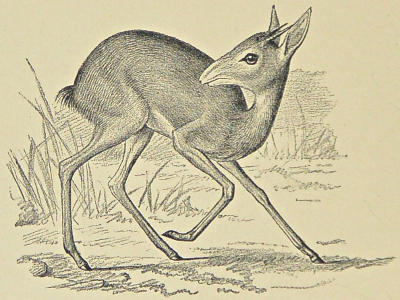
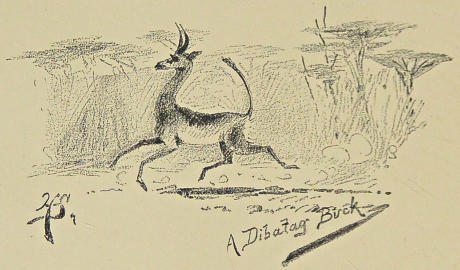
miles of camp, firing at the tiny Sakáro antelopes and hares,
and getting a mixed bag of three hares and six antelopes. At
dusk, carrying our game, we returned to the zeríba, on the way
passing a large tree where about a hundred and fifty men were
collected, all having their spears with them, and a few saddled
ponies were grazing round the tree. These people took no
further notice than to scowl at us as we passed.
After we had reached the zeríba I came out again with
two sepoys and the interpreter, and walking up to the tree where
the tribesmen were collected, I called out “Salaam aleikum”
(Peace be with you). There was no answer for some time, and
then an old man with a white beard and a wicked-looking, clean-shaven
skull, treated me to a surly stare and mumbled; “Salaam.”
Then he looked down and spat on the ground, and began absent-mindedly
scratching the earth with a bit of stick, and then
smoothing out the marks with his hands. The rest of the
crowd remained silent, all looking sulky and mischievous.
Some were gazing at us with a rude stare, others were shading
their eyes with their hands, or hiding behind their tobes.
My interpreter harangued them, asking why I was received so
coldly by the tribe. There was a long pause till two old men
cleared their throats and looked at each other, and without
rising one of them spoke. “Warya ninki Frinji” (I say, foreigner)
was the beginning of his speech, and it was translated into
Hindustáni by Samanter as the old man went on.
The gist of his remarks was that the tribesmen wanted to
know why I had brought all these soldiers into the Habr
Gerhajis country, and whether we had come to steal cattle, for
if so, we had better go back again, as they had none. There
was plenty of cattle among the other tribes.
We had come, my interpreter said, on a peaceful mission,
to report upon the trade routes, and to ascertain whether they
were safe for caravans coming to trade in Berbera and Bulhár.
There was a good deal of loud discussion among the assembled
men, and then the old man who had first spoken, becoming
more friendly, said that he and his tribe knew nothing about
the looting of caravans. He accused all the sub-tribes around
of looting, but said the Abdul Ishák never looted, and I was to
tell the Government. At that time the Abdul Ishák, Habr
Gerhajis, were well known as the most persistent looters of
caravans, but I promised to convey the message to the
authorities, and made the old man happy. Peace was now
restored, and we spent a quiet night, the Abdul Ishák sending
us several vessels of milk; and in the morning we parted
amicably, and continued our trip, eventually reaching Berbera.
This incident at Eil Ánod, only thirty miles from the coast,
shows how little Europeans were trusted or known in the early
days of the British Protectorate. Many shooting parties have
been through the Habr Awal and Habr Gerhajis countries of
late years, but at that time the country was quite unexplored,
even close to the coast.
About a month after the Eil Ánod incident we set out
from Berbera on another trip, this time going to Mandeira, and
thence up the Jeráto Pass to Syk, in the high Ogo country.
I heard that the Kásin Ishák, a clan of the Habr Gerhajis,
were at Syk, and expected trouble; but when we reached the
Syk fig-tree we found only a few of the elders, who said that
they had received a good report of us from the Abdul Ishák
clan, which had met us on the former journey at Eil Ánod, and
so they had been waiting to receive us hospitably. I had left my
camp at Mandeira, about fifteen hundred feet below, and had come
up the Jeráto Pass with seven troopers as an escort. On reaching
Berbera we marched to Bulhár along the coast track, and on
26th April we made another exploring trip to the Interior Plains,
returning at the end of it to Berbera and thence to Aden, where
I completed my map of the Habr Awal country for Government.
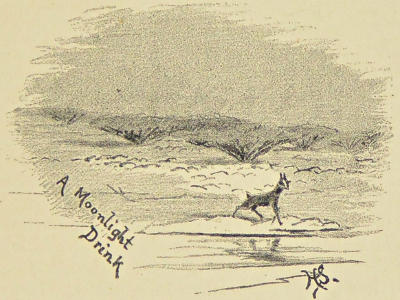
A Moonlight Drink
“Sakaro” Antelope.
In the following autumn, although not actually sent on
duty, I obtained six weeks’ leave to Somáliland, on condition I
would do a map of my route for Government. I was very
anxious to go to Zeila and make an exploration through the
Gadabursi hills, coming out at the coast again at Bulhár. So
far the hills between Zeila and Bulhár had been quite unknown.
On this trip I was in company with three friends, two of whom,
finding the game scarce, soon returned to Zeila. I held on,
however, and we struck without guides through the mountains,
finally reaching Dímis, near Bulhár, having traversed the last
sixty miles with only three pints of water per man. This
caused some suffering from thirst, which the men were able to
partly alleviate at Eil Sheikh by jumping into the sea and
moistening their skins. One pony died from the effects of this
march the day after we reached Bulhár.
We had timed our trip at a bad season for game, and the
only satisfaction which I got for fitting out a very expensive
expedition, and for a good deal of hardship, was a map of
hitherto unexplored country.
In 1887 I made the two big game trips recorded in the
last chapter, and in 1889 a short shooting trip to Gólis, which
was of minor importance. In 1891 I was ordered to place
myself at the disposal of the Resident at Aden in order to
reconnoitre the trade routes in the Dolbahanta, Habr Toljaala,
Jibril Abokr, Esa, and Gadabursi countries. My brother, Lieut.
(now Captain) E. J. E. Swayne, 16th Bengal Infantry, whom I
will call E⸺, was deputed to assist in the survey, and joined
me at Calcutta as I passed through that place on my way from
Mandalay to Aden. We reached the Somáli coast in February,
and started with thirty-two Somális and one Madras “boy.”
There were twenty-six baggage camels, and we each rode a
camel led by a Somáli at walking pace. Going by Dubár and
Sheikh, we arrived after eleven days at Alla-uli, a watering-place
in a narrow valley just behind the crest of the highest
bluffs of the Gólis Range, at an elevation of six thousand feet
above sea-level.
On the following day, after establishing a small camp on
the top of Fodwein Bluff, we chose our theodolite station within
a short distance of the edge of Fodwein, which falls several
hundred feet sheer to the Mirso ledge below. This was the
first of a long chain of stations for fixing the main positions on
our route, by observations of the stars for azimuth and latitude,
with a six-inch transit theodolite.
We remained here four days, and obtained a good azimuth
on to a point on a small hill called Yirrowa, fifty-five miles
away to the east of south, on the main route to the Dolbahanta
country. Looking towards Yirrowa from the top of Gólis we
could see only one immense expanse of dark brown bush,
becoming quite blue in the distance and looking like a sea-horizon,
broken only by the small hill Yirrowa, and a long,
light blue line, dancing high above the horizon in the heat haze
and mirage, which indicated the Bur Dab Range, two days’
march beyond Yirrowa.
The whole of the country ahead was unmapped, the first
European caravans to go so far south being those of Colonel
Paget to the south-west of us, and of Mr. Clarke, which had
gone to the interior a few days before towards the south-east.
Eventually, however, we left both these caravans far to the west.
From our elevated position, which was now 6800 feet
above the sea, we had a fine view of the Maritime Ranges and
Berbera Plain, and we obtained a back azimuth on the Berbera
Masjid tower, thirty-five miles distant. It was very cold at
night, the thermometer going down to 58°, with a chilling
drizzle and clouds of mist which often enveloped us, making
observations impossible.
On the 22nd we marched back to Upper Sheikh, and
while we were camped near the graves at night, the mullahs
from Guldu Hamed ran to us crying that looters were coming
down on us. Men were seen running by, who said they were
Habr Gerhajis, and that their cattle had been lifted by a
neighbouring tribe. We remained under arms for a while and
then turned in. Next morning it transpired that the camels
had only been allowed to stray, and had afterwards been found.
We marched six miles to Dubbur, the last water before we
should reach Bér, about sixty miles farther, and filled up our
casks. Now we entered the great wooded and undulating waterless
plains, crossing the Habr Toljaala boundary soon after leaving
Dubbur, and always holding south-east. On the east a long
low range of hills shut in the view, but west and south of us
was one immense forest of small thorn-trees, except on the
margin of the sand-rivers, where some of the gudá thorn-trees
reached a height of fifty or sixty feet. In a river-bed, called
Goité, horsemen of the Habr Gerhajis, from Bur’o, came to hold
a mounted parade in our honour.
On 27th February we reached Yirrowa, and chose another
theodolite station. There were several curious flat hillocks and
cairns of stones, called Taalla Gálla, perched about the corners
of the Yirrowa Hill, and here we got an azimuth on to Bur
Dab Range, still blue in the distance.
At a thickly wooded pasture called Bér, five miles farther,
in the valley of Tug Dér, we found water at a depth of ten
feet in twelve wells. Very heavy floods sometimes come down
this valley, as can be seen by the large trunks of trees everywhere
stranded along the cut banks of the watercourse, which
is at places one hundred and fifty yards broad. The Tug Dér
freshets, coming from Bur’o, pass east into the Nogal Valley,
and so to the Indian Ocean.
We were told that there were always from fifty to five
hundred robbers in the Bur Dab Range, and passing caravans
were often looted. It has been the custom of these robbers,
who belong to the Mahamud Gerád, Saad Yunis, and Músa
Abokr tribes living near the coast farther east, to loot across
this Bér Plain every year, going right up to Guldu Hamed.
When raiding they only water their ponies once in three or
four days. Near Bér we found tracks of forty horsemen, and
ascertained that they were those of a Dolbahanta force, which
a month before had gone to loot the Habr Gerhajis pastures at
Bur’o, but had been driven back, losing three ponies.
Several very ragged-looking Somális, with the usual spears
and shield, came into camp and insisted on being fed; they
had gone to Bur Dab to recover some camels looted from them
three days before, but on reaching the mountain they had first
seen vultures hovering about, and had then discovered the
robbers in great force sitting over a feast of the carcases of
the stolen camels; and being afraid to attack, they had returned
disheartened, hungry, thirsty, and tired. They told us that
Colonel Paget and his brother had their camp near Wadama-go,
ahead of us, where they were shooting lions. The Pagets had
already had one sharp skirmish with Bur Dab robbers, being
obliged, we heard, to use their rifles freely in self-defence.
We reached Kirrit well, near Wadama-go, on 3rd March.
There were numbers of old graves here, and the well, supposed
to have been dug out of the gypsum rock by ancient Gállas,
is very curious. At the mouth it is a hole twenty feet in
diameter, narrowing as it descends, with a rude cross quarried
out of the face. To get water, one has to descend twenty feet,
and then crawl along a narrow rocky passage for thirty feet to
a very deep pool, six feet wide and thirty feet long. It is quite
dark, and there is a strong smell of sulphuretted hydrogen, with
which the water is impregnated from the gypsum rock. The
water is disagreeable to drink, and causes diarrhœa. Robbers
from Bur Dab often use this well when on their raids. The
gypsum rock is very smooth and white, and in some places
presents the appearance of the flagstone flooring of a cathedral,
being split up into squares. The graves, which are made
of these rocks, are generally plastered over with powdered
gypsum.
Next day we marched across a broad tributary valley of
the Nogal to a flat-topped hill called Daba Dalól, eight miles
to the east. We crossed the tracks of Colonel Paget’s caravan,
and the next day we received a note from him concerning some
robbers whom he had taken prisoners.
Near Daba Dalól was a mullah’s village named Kob-Fardód,
with a little cultivation. These people told us that
the Mahamud Gerád were out against the Arasama, another
sub-tribe of the Dolbahanta, and that there had been a fight,
two days’ march ahead on our route.
Next day we had a scare among the camelmen. At noon,
while the camels and horses were watering at the well, two
miles from camp, under a weak guard of three riflemen, one of
them ran in to say they had been attacked and the camels
looted. E⸺ went out with a portion of our escort to search
for the missing camels; but they had only gone half a mile
when fifteen horsemen, the supposed enemy, cantered up and
shouted that they were Arasama, and that they had come three
days’ march to welcome us into the Dolbahanta country. They
told us that more than a dozen caravans were in their country,
afraid to go to Berbera on account of the Mahamud Gerád.
One caravan had even gone round to Berbera by way of the
Haud, preferring to go through waterless country and to carry
ten days’ water on the camels, rather than run the risk of being
looted. They also declared that we were the first Europeans
in this country, and denied all knowledge of some Italians
who were reported to have already come to Bur Dab. Here
we met gum-pickers, wandering about the jungle, collecting
gum in sacks. They seemed very poor, with old and rotten
tobes.
The Arasama, to whom we had given presents at Daba-Dalól,
followed us through the Ain valley, giving great annoyance
by loud-voiced demands for more. Wherever we halted
we were at once surrounded by a crowd of elders, clamouring
for tobes. They were dragged from hand to hand, with a
chorus of angry shouts, the bald-headed old chiefs looking like
human vultures.
We halted at a steep, flat-topped hill called Kabr Ogádén,
or the Ogádén graves, where a great Ogádén army once perished
at the hands of the Dolbahanta. The whole country was dotted
with Gálla cairns, one of these curious structures being visible
on every hill-top. From the summit of the hill we got a
splendid view of the broad Nogal Valley, and chose our theodolite
station at a Gálla cairn on the highest point.
Next day, followed by the Arasama headmen, still clamouring
for tobes, we marched to their great watering-place, Eil
Dab (rocky well). The tribe was here in strength, with
enormous droves of camels and ponies and flocks of sheep.
For a mile round the wells there were clouds of dust, kicked up
by the thirsty animals. The water in the wells, which are
caves in gypsum rock, was very foul. Vulturine guinea-fowl
abounded. We marched due south, crossing to the south side of
the Nogal, but we could not shake off the Arasama, who followed
us on their ponies, continually demanding presents and refusing
to be satisfied with what we gave. One old chief presented us
with a sheep, but not liking my return present of two tobes, he
crept into our zeríba at night and stole his sheep back, while a
friend of his engaged the attention of our sentry.
At our Biyo Ado camp more elders from other tribes joined
the Arasama, and while E⸺ and I were up the hill with the
theodolite, they issued forth and looted some camels of the
Allegiri tribe which were seen passing four miles out on the
plain. They also took three men prisoners, but we eventually
forced them to release both camels and prisoners. The Allegiri
brought us news of a fight between the Arasama and Barkad
Gerád on one side and Mahamud Gerád on the other, in which
the latter were successful.
Next day, while we were away watering our ponies, the
Arasama issued from our camp, and chasing two Allegiri, whom
they had seen from the hill, they brought them in as hostages
for exchange with some looted camels. Finding the prisoners
on our return we released them, and after turning all the
Arasama elders neck and crop out of camp, we gave out that
we intended to be friends with all tribes and would not be
mixed up in their quarrels.
Followed by a large number of avaricious elders, we marched
north-east to Badwein, where we found more wells, and a large
tank of water, four hundred yards in circumference, with perpendicular
sides forty feet deep, supposed to have been excavated
in the limestone rocks by ancient Gállas; but the water was
utterly unfit for human consumption. Ruins, which rise half
smothered from among a tangle of aloes and thorn jungle close
by, cover an area of forty thousand square yards, and in some
of the houses the walls are still ten feet high. E⸺ rode into
a large house or temple, to find it two hundred feet long and
one hundred feet wide, divided by a number of partition walls.
They are built of limestone and very much decomposed by
rains, and are supposed to be the work of the Gállas, but no
one knows who built them. Some of the Somális say they
date back to the time of some race before the Gállas. The
people at Badwein had just come from Gosaweina, driven from
there through fear of the Mahamud Gerád, and we were assured
we would most certainly be attacked by that tribe if we held
to our determination of going to Gosaweina. We were further
told that the plains were very open and the horsemen “as
numerous as the sand,” and that some years ago a force of
natives armed with one hundred matchlocks had been completely
wiped out there by a night attack.
Marching eastward, we soon entered the open grass plains,
where we saw the smouldering zeríbas of the Arasama and
Barkad Gerád sub-tribes, which had fled before the Mahamud
Gerád. The next day we held across the open plains to
Gosaweina, and scarcely had we started when a party of horsemen
was seen halted on some low hills to the north! We,
however, kept straight on, and the horsemen, constantly increasing
in numbers, followed us, moving parallel to us on the
higher ground.
Without halting the camels, we whistled the men up and
they formed line, and moved out to protect the caravan. The
horsemen came towards us at a gallop, but pulled up on our
running with a few men towards them. On getting up to them
my men were greatly relieved in their minds to find that instead
of the terrible Mahamud Gerád, they were a detachment
of the Arasama and Barkad Gerád, who had been out protecting
their flocks and herds at Eil Dab and Badwein by scouting
for the Mahamud Gerád. They followed us to Gosaweina,
clamouring for cloth, and hobbling their horses, they made a
bivouac on the plain with us at night. We did not light fires,
not wishing to attract the Mahamud Gerád. The horsemen
told us that rain had fallen in the plain to the north of us, below
Bur Dab, and that at Waredad there was a pool full of water.
We had now mapped the Dolbahanta country to the head
of the Nogal Valley, and the time had arrived for our return to
the coast.[19] We ran the gauntlet of the begging Arasama elders
back to Eil Dab, and then struck due south, crossing Bur Dab
Range by a pass called Laba Gardai, which descended into the
Waredad Plain below. While we were in camp at Eil Dab
some of our escort, losing patience, began firing with blank
cartridge at the excited mob of Arasama who were pressing
round camp demanding tobes. The elders brought in what
they declared to be a wounded man, and made the occurrence
the text for a further demand that we should pay blood-money
or fight the tribe; but we found it was only an old half-healed
scar, and laughed at them.
A trading caravan, anxious to go to Berbera, but fearing
the robbers who infest Bur Dab, took advantage of our protection
for the next few days. In this caravan the women
were to the men as six to one, and had it been attacked when
alone it would have fallen an easy prey to a small party of
raiders. To place so much valuable property almost entirely
in the charge of defenceless women is putting temptation in the
way of the robber bands, and often the owners have only themselves
to blame.
We reached Arregéd, a deep ravine in the middle of the
Bur Dab Range, and during the night two men were seen skulking
in the bush near camp. On the 20th, taking three men and
a theodolite, I ascended Bur Dab, and choosing a station for
star observations, spent the night on the top of the hill. In the
morning before descending to camp we explored the interior of
the range, and found that all the plateaux of which it was formed
dropped sheer down into a large basin seamed by watercourses
and tunnelled everywhere by caves. The regularity of the
strata and their water-worn appearance led us to believe Bur
Dab to be composed of stratified limestone rock, and not a
volcano, as stated by some Italian travellers. Possibly they
confounded Bur Dab and Bur Dáb, the former meaning “rocky
hill,” and the latter “hill of fire.” The caves inside afford a
secure retreat for robbers, who, indeed, are said never to leave
the mountain.
On going down to camp I found that E⸺ and his own
followers had been kept on the alert throughout the night by
men prowling round them. They were distinctly visible in the
moonlight, but E⸺ would allow no firing, as they made off
whenever he went out to see who they were. On our return
to Berbera we heard that fifty robbers had reconnoitred our
Arregéd camp, and had made off westward for Kirrit, thinking
we had come to Bur Dab to look for them. For having been
severely handled in their attack on Colonel Paget’s party, they
did not care to come into collision with Europeans again.
Further native information was given us regarding this attack,
it being reported to us that the robbers had lost three killed
and ten wounded. As we did not actually visit Colonel Paget’s
camp, however, we could hear no reliable account of what
happened.
Marching through the Habr Toljaala country, we reached
the eastern continuation of Gólis Range and descended by
the Huguf Pass. Near Huguf we divided our caravan into two
parts; I marched to Berbera via Karam, while E⸺ ascended
Wagar Mountain, two days’ march to the west of Huguf, to
take observations. He marched over very steep and rolling
ground, gradually ascending, and then through a narrow gorge
to Sisai, at the back of Wagar. Sisai is a grassy hollow between
the two principal peaks of Wagar, which are called by
different names, the peak to the east being Bakáwa, and the one
to the west, and highest, Tawáwur (nearly seven thousand feet).
Everywhere the hills are clothed with thick vegetation, and the
grass is succulent and green, and many fat cattle of the Mahomed
Esa were seen. The trees are chiefly mountain cedar and
hassádan, a kind of euphorbia, affording a dense shade. The
party ascended Tawáwur from Sisai by a good path, passing
through heavy timber of cedar and hassádan, the soil everywhere
being hidden by the rich vegetation. About half-way
up the party reached a long glade of green grass two feet high,
which wetted them to the knees as they walked through it.
At the side of this glade the cedar-trees were straight, and
starting with a girth of from ten to fifteen feet, rose to a height
of ninety to one hundred feet, the hassádan trees also attaining
a height of about seventy feet. Opening out from this glade
in all directions were excellent paths through the forest made
by elephants, and plunging into one of them, they reached the
top of Tawáwur. They climbed on to an enormous boulder
capping the top. Looking over a vast expanse of white clouds,
they waited for them to clear away, but after four hours a dense
fog came up and necessitated a retreat. E⸺ saw countless
varieties of birds, and heard the voice of a panther come up
from the valley below, and at times koodoo antelopes could be
heard crashing through the jungle as the party advanced.
About thirty varieties of flowers were gathered, of great beauty.
E⸺ made two ascents of Tawáwur and one of Bakáwa,
and working down the spurs of Bergéli, he reached camp at Asseil.
It was very cold at night at Sisai, and the temperature throughout
the day was 70°, except at noon, when it rose to 78° Fahr.
E⸺ then descended again with his caravan to the plain below
Huguf, and marching to the coast, reached Berbera a few days
before I arrived by the coast route from Karam.
The expedition to the Dolbahanta country was followed by
a second to the Jibril Abokr sub-tribe of the Habr Awal, living
in the hills north-west of Hargeisa and in the open plains near
the Harar border. We took twenty-three men, of whom sixteen
carried rifles, and there were twenty-four camels. The caravan
left Berbera on 21st May, going south-west. We made a
moonlight march to Nasíya tree in the Maritime Plain. Next
day we came upon an immense cloud of locusts, which were
seen daily till the 26th,[20] often darkening the sky.
On the 28th we ascended a plateau just under the crest of
Gán Libah,[21] which is the farthest west of the Gólis bluffs, and
a most conspicuous landmark; and it was on the highest point
of Gán Libah, at an elevation of six thousand feet, that we chose
our theodolite station. We climbed the mountain to a point
some four miles south of the edge of the bluff, and camped; and
next morning I made an exploration through the cedar forests
to the highest point, from which the whole of the low country
to the north can be seen, including Berbera and Bulhár. I
found, however, that owing to the steep nature of the ground,
it would be impossible to get the theodolite uninjured to the
station which we had chosen. We subsequently found the three
points, Berbera, Bulhár, and Gán Libah, very nearly formed
an equilateral triangle, with a side of about forty-two miles.
The distance covered by the exploration was only eight
miles, but it occupied five hours, as the mountain was fearfully
cut up by deep ravines, while the high trees, growing close together
and festooned with creepers, thoroughly obstructed the
path. At the edge of the bluffs are cliffs on every side, and a
beautiful jungle with a great variety of flowers and plants,
especially nastertians, maiden-hair fern, and mosses. We struck
camp and made for the lower plateau, losing ourselves among
a network of steep ravines, but eventually we reached a plain
from which stood out a rounded rock called Dagah Kaburáleh,
and we camped in a grassy hollow at its foot.
Later on we struck south through the khansa jungle to
Bér in Khansa. E⸺ saw a lioness, but she bounded into the
long grass before he had a chance of getting a shot at her.
Leaving him at the Bér camp, I made a reconnaissance into
the open prairie of Toyo, sleeping out two nights without a
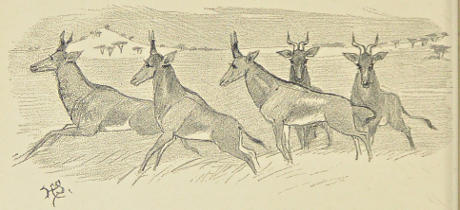
tent, and shooting for the first time two hartebeests, which
were afterwards found to be new to science, and being submitted
to Dr. Sclater, Secretary of the London Zoological Society,
they were described, and named Swayne’s Hartebeests (Bubalis
swaynei). Returning to Bér, and finding E⸺ had gone, I
followed in his tracks, and halted for the night at a pasture called
Taláwa-yér, among the karias of the Kásin Ishák, Habr Gerhajis.
As I was riding ahead of the caravan, towards sunset, looking
out for a dead tree near which to camp, and so save labour in
collecting firewood, some karia people came running to report
that a panther had just struck down a goat, and had then been
driven off by the herdboys. I ordered the men to pitch camp
and walked over to the body of the goat. We built a screen of
boughs two feet high, taking ten minutes over the work, and then,
with the setting sun scorching our backs, I sat down with my two
hunters behind the screen, and only five yards from the goat.
Several men, who had helped us to make the brushwood screen,
then walked away towards camp, purposely talking aloud to
lead the brute to suppose we had all gone together; and while
they were yet only a hundred yards away I looked towards the
goat and saw the panther was standing over it, his tail towards
me. I fired, and hit him high on the left side, the bullet raking
forward, and he rolled over, and looking under the smoke I
finished him with a second shot as he lay twisting and growling
in the grass; and we carried him to camp and skinned him by
firelight. This was the first panther I had ever bagged, though
I had seen many. At dawn I continued the march, and arrived
at my brother’s halting-place before noon.
We made several marches westward, and on 8th June we
reached Hargeisa. This town is built some five hundred yards
from the right bank of the Aleyadéra nala,[22] and at an elevation
of thirty or forty feet above it. Round the place is a patch of
jowári cultivation (Holcus sorghum), two and a half miles long
and a quarter of a mile broad. Quantities of live stock of all
kinds graze on the low undulating hills for half a mile from the
Aleyadéra nala on either bank. Hargeisa is situated on two
important caravan routes, one from Ogádén and the other from
Harar. There are good direct camel roads to Berbera and
Bulhár. Supplies of rice, tobacco, and dates can sometimes be
bought here in the trading season. Some four hundred people
are employed looking after the jowári fields, and can be seen
sitting on platforms, shouting and throwing stones to scare away
the birds from the crops. There is abundance of good water
in the bed of the river, and a masonry well has been built, and
is kept in order by an Arab from Aden. The town is full of
blind and lame people, who are under the protection of Sheikh
Mattar and his mullahs. The soil is red alluvial earth with a
thin layer of fine sand on the top, and it is not better than that
which we had seen in the Tug Dér valley, at Bér, and in the
Haud. Jowári crops flourish here as they would in most of the
higher tracts of Somáliland, if the people were not in a chronic
state of petty warfare, and cared to cultivate.
At the time of our visit great anxiety was felt because the
Abyssinians occupying Harar had threatened to attack Hargeisa,
and had already exacted tribute of cattle from some clans of
the Jibril Abokr, Habr Awal. Sheikh Mattar told us that he
thought if the Abyssinians came down they would choose the
time of the harvest, six weeks later.
From Hargeisa we continued our journey westwards, camping
at Abbárso. Our tents were pitched five yards apart at
this camp, and as I was sitting outside in the balmy air, enjoying
the quiet moonlight scene, I observed a panther crouching
under the outer fly of E⸺’s tent, evidently stalking something
in the centre of the camp. Diving quickly into my own tent
for a loaded rifle, I came out again, only to find the panther
had sprung into the centre of camp and seized a milk goat.
There had been a crowd of men sleeping round the goat, and
to get at it he had leaped over them, placing his paw upon the
face of my brother’s cook, without, however, injuring him. On
the sentry running towards him with the butt of his Snider rifle
raised to strike, the brute dropped the goat and discreetly
sprang over some more men and out of the zeríba, and then
sneaked away. The same goat was killed by another panther
springing into camp a few nights later.
We separated our caravans on 14th June, meeting again at
Ujawáji on the 17th, among the karias of the Rer Yunis Jibril,
Jibril Abokr. The great subject of conversation among the
natives here was the expected approach of an Abyssinian force,
mounted scouts having been thrown out by the tribes, and
news coming in daily.
Near Ujawáji the country gradually became more grassy
and open, the thorn bushes being only thinly scattered about
the plain. We passed a tree called “Mattan,” and two miles
beyond this tree, which was a conspicuous landmark, a long
hazy yellow line marked the commencement of the ban or open
grass plain, which is called the Marar Prairie. It was first
crossed by Burton, and is mentioned in First Footsteps in East
Africa. A conspicuous rock, called “Moga Medir,” or “Jifa
Medir” (Moga’s eye-tooth of Burton), lay ten miles to the west
of us on the edge of the bush. On the evening of our arrival
at Ujawáji we went out to shoot some hartebeests to provide
meat for the men. As we left camp the bushes gave place to
low scrub, and this presently ended also. Then a curious scene
presented itself to us. As far as the eye could reach was an
unbroken plain of rolling yellow grass, rising gradually towards
the north, and bounded twenty miles off in that direction by a
waving blue line of hills running along the horizon, and here
and there disappearing below it.
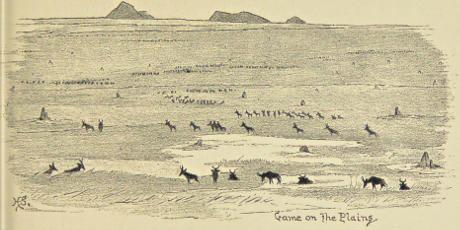
The plains were covered with the camels and ponies of the
Rer Dollol and Rer Yunis Jibril sub-tribes, the number of animals
giving one the idea of a swarm of young locusts moving over
the ground. Everything showed up dark against the background
of yellow grass; and single bull hartebeests, knee-deep
in grass, were seen wandering about between the droves of
camels, looking like black dots in the distance. Beyond the
masses of domestic animals we could see, far out on the plains,
long dark lines, which, by using the glasses, we made out to be
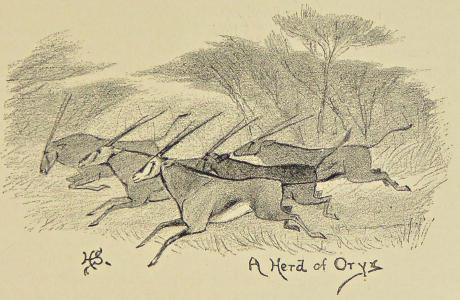
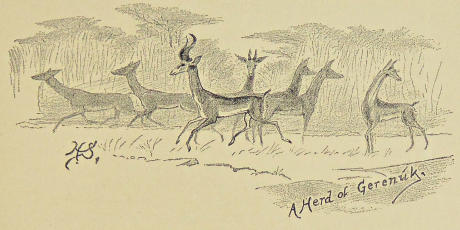
vast herds of hartebeests, oryx, and Sœmmering’s gazelles.
The rich soil, of a reddish brown colour, is here and there
undermined by burrowing animals and caved in, making galloping
dangerous. The white ants had built up the earth into
ant-hills, whose spires, from ten to twenty feet high, were dotted
over the plain. We shot two hartebeests, both good bulls, and
returned to camp with the meat and trophies, being caught by
a heavy downpour of rain on the way.
Early next morning we had to witness a great equestrian
display by the Rer Dollol and Yunis Jibril horsemen, given in
our honour. After the dibáltig they told us there had been
fighting at some wells near us the day before, the Gadabursi
having attacked them from the west, killing one man and
wounding another; and also that an elephant had been killed,
not far away, by Midgáns, with poisoned arrows.
We had promised the Jibril Abokr that we would wait at
Ujawáji to hear further news of the Abyssinians, and to record
the complaints of the elders, for submission to Government;
meanwhile, having been told by the horsemen in the morning
that lions were numerous in the Jifa bush, we resolved to go
and look for them there, taking the camp with us. The Jibril
Abokr lent us horsemen to help us search for lion tracks, and
we started ahead of the caravan, sitting on camels which were
led by our gunbearers.
We got away from camp late in the morning, and besides
the men we had engaged, we were followed by a crowd of
horsemen, who were anxious to witness our shooting, and to
come in for a share of any venison we might obtain on the
plains between Ujawáji and Jifa. Soon we found ourselves
out in the open, masses of game giving way before us as we
advanced. The size of the party prevented our coming within
close range, but we wounded a bull hartebeest, and E⸺,
mounting one of the Somáli ponies, gave chase, with an Indian
hog-spear in his hand. The hartebeest is known to be the
most enduring of the antelopes, having a long and untiring
stride, and though E⸺ circled round the horizon, followed
by two horsemen, at a great pace, it gradually increased its
distance, and finally disappeared into one of the great wave-like
dips of the ground.
Presently a party of horsemen appeared galloping towards
us, now and then hidden by the rolling ground, and arriving in
front of our party they circled their ponies, and giving the complimentary
“Mót!” they came up and shook hands. They informed
us that they had marked down three lions in the grass,
on the open plain, eight miles away in the Jifa direction; and
they assured us the lions would be found in the same place, as
six horsemen had been placed to form a cordon round them,
and they would be afraid to move from the shelter of a patch
of rather high grass. The men said that these lions must have
been living within the edge of the Jifa bush, prowling out on
the great plains at night in order to stalk the herds of antelopes,
and that they must have killed something the night before, and
being gorged and lazy, the break of day had caught them while
still in the open, on their way back to the bush to lie up for
the day. These horsemen had been on their way to Ujawáji
from Jifa to perform the dibáltig at our camp, but seeing the
lions, and knowing that we were keen to get at them, they had
circled them in, and compelled them to sit down on the plain
and wait for us. Posting six vedettes, they had then come to
give us the news.
It was now about one o’clock and very hot, but we pressed
on, resisting all temptation to fire at any of the game around us
for fear of disturbing the lions; for a shot can be heard at a
great distance on these plains. Towards four o’clock we saw
one of the vedettes looming out of the haze, and then another.
It was, however, a long time before we could make out the
lions, which these men were trying to point out to us. They
were five hundred yards away, trying to take shelter from the
pitiless sun in a patch of grass about two feet high; all we
could see being two indistinct dark spots half hidden in grass,
and on one of these moving slightly, we recognised it to be the
head of a remarkably fine lion. Beyond the lions, more than
half a mile away, was another horseman, sitting motionless in
the saddle, and looking like a waving palm-tree, the horse’s legs
appearing to be elongated in the haze and mirage.
The Somális who had been watching the brutes said they
had been in this spot all day, getting up to roar now and then,
but, knowing by experience the powers of the Somáli horsemen
in the open, they had not attempted to make a bolt of it towards
the distant bush, which loomed up in a quivering blue line some
ten miles to the north of us. Considering the heat of the sun,
and that they had neither food nor water, these horsemen had
stuck to the lions with great perseverance, and we felt that
we owed it to them to crown their hard work by straight
shooting.
We guessed that the brutes must be in an uncommonly bad
temper after having been kept out in the full glare of the sun
for ten hours; for lions like to sleep under the shade of dense
bush during the heat of the day. The grass in this part of the
plain was fresh and green, and looked almost like an English
lawn, there having been rain about three weeks before. We
dismounted, and my brother and I, each accompanied by one
Somáli, walked towards the lions.
The account of what followed is taken partly from what I
saw, and partly from E⸺’s verbal description; for, being
unconscious part of the time, I was not in a condition to know
all that passed.
As we approached within two hundred and fifty yards there
was a commotion in the grass—a fine black-maned lion sprang
out, and was immediately followed by another, nearly as large,
but with a yellow mane. They both stood up and looked back
at us for a moment and then trotted away. We walked after
them, hoping they would lie down again; but as we passed to
the right of the patch of grass where they had been lying, and
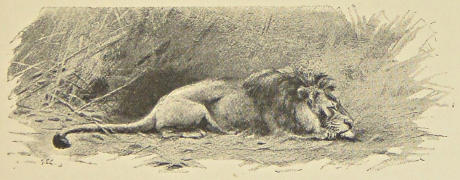
at about a hundred yards’ distance from it, I saw a lioness
stretched out flat, with her head between her paws. She was
facing us, and as we passed her she rose for a moment, and
then glanced towards the retreating lions, but she crouched
down again, her head just visible above the grass, and never
ceased growling savagely. We went straight on at the same
pace, till we were between her and the line of retreat. She was
growling louder and louder, and I walked across her front to
get a chance at her left shoulder, while E⸺ stood ready,
when she rose, to fire at her chest. We stood seventy yards
apart, the lioness being seventy yards from each of us, our three
positions thus forming an equilateral triangle. The lioness
moved, and E⸺, calling out that he could see her chest,
immediately fired.
The bullet hit her too high, and, as we afterwards found
out, in the withers clear of the spine, the wound causing her
to spin round like a top several times in a cloud of red dust,
as if hunting her own tail, so that I could see nothing to fire
at. From the disturbance in the grass and the savage growls,
we decided she must be mortally hit, and were preparing to
walk up to her, when suddenly from the obscuring dust she
came out, charging for me at full speed. She ran extended
along the ground, like a greyhound, and came so fast that I
had only time to raise my rifle, and when the bead of the
foresight was somewhere under her chin, I fired. Quickly
shifting my finger to the left trigger when she was only five
yards away, I pulled again, and then jumped to one side, the
rifle still at my shoulder. I remember nothing more, except
that her head came through the smoke and I was half conscious
of being lifted off my feet and sent flying through the air, with
the lioness hanging on to my shoulder, growling horribly!
On coming to, I found that I was standing up streaming
with blood, and E⸺ and the two hunters were helping me
off with my shirt, the lioness lying dead on the grass at my
feet. There were eight deep fang wounds in my right arm
and shoulder.[23] My brother probed them with a bit of stick
wrapped in a shred of tobe; and then we looked around for
the lions, and saw that they were no longer visible; but E⸺
said that all the horsemen had followed them, intending to
ride them to a standstill and force them to come to bay.
My wounds, owing probably to the severe shock and
weakness from loss of blood, gave me no pain, and when a
Somáli came galloping back and offered my brother a pony,
saying that the lions had come to a standstill, I begged him
not to bother, but to try and bag the big black one. I
remember hearing E⸺ gallop away, and then I must have
fainted.
When I came to again, I saw my hunter, Jáma, sitting
near me on the body of the lioness, unconcernedly scrubbing
his teeth with a bit of athei stick, which he must have
brought from Ujawáji. He said he had been waiting for me
to wake, and to tell him what was to be done next. The other
“Sahib” had gone away, but Jáma had heard a very distant
shot, and concluded he must have come up with the lions again.
But he advised me to wait for the caravan, which he could see
coming over the plain from the east, and mount a camel before
trying to go any farther.
When it came up, all the men crowded round, with horror on
their faces, and asked which of the Sahibs had been killed, but
I got up and said, “Neither,” and mounting a camel, directed
the camelman to follow the hoof-marks of the ponies in the
turf. How I managed to sit on the camel in my weak and
dazed condition, I do not know. I must have dozed, for the
next thing I saw was a group of dismounted horsemen in front
of my camel, and my brother standing over the most splendid
black-maned lion I have ever seen.
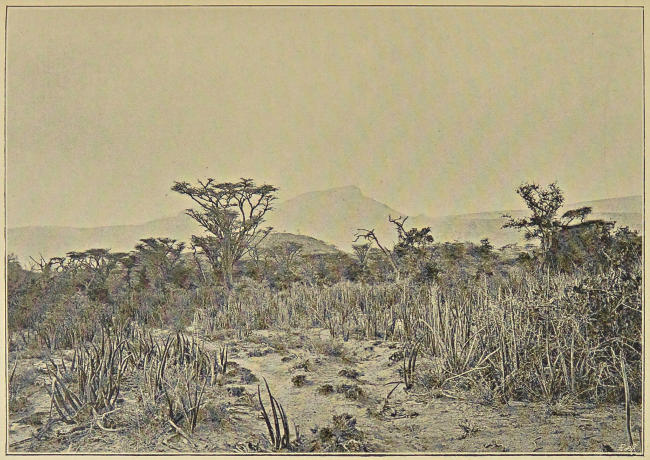
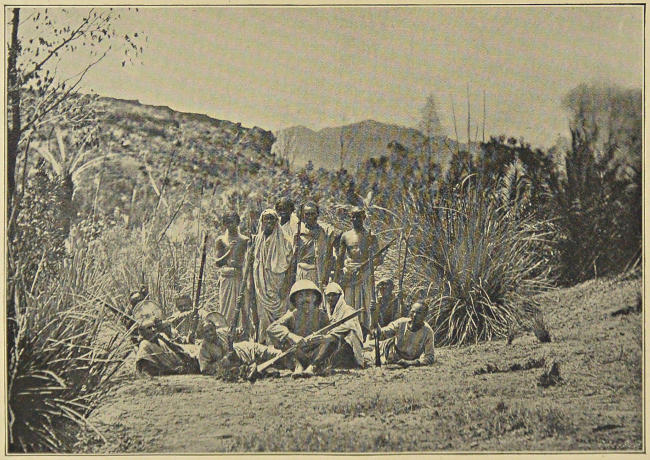
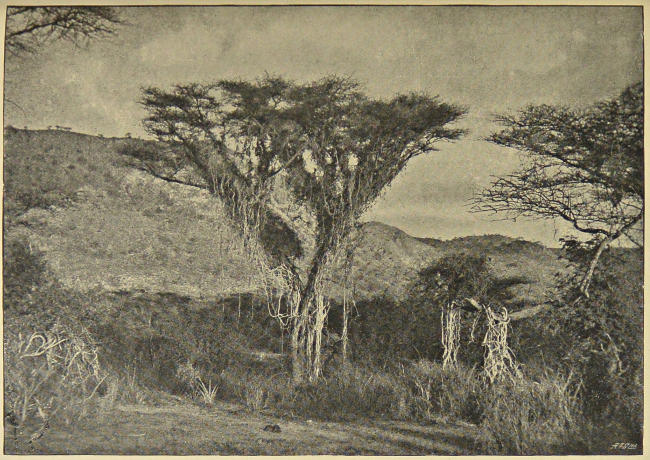
Jungle of “Hig” Aloes and “Guda” Thorn-Trees.
Henweina Valley, Gán-Libah Mountain in the distance. (From Photograph by the Author.)
I attribute my not having stopped the lioness to the fact
that I had been shooting with a very good .577 double rifle,
but in the course of our journeys the triggers had become
rather stiff, making me jerk them off; and both my bullets,
going low, had passed through the brute’s right foot, making
small clean wounds, without expanding. E⸺, who had his
gun open and was pushing in a fresh cartridge, had been
horrified to see both my shots strike up the ground beyond
the lioness.
Our two hunters, unlike most Somális, who are not generally
a bit afraid of lions, had retired to a little distance. E⸺ said
that after firing the second shot I had jumped to the right
in a perfectly collected manner, but the lioness had slewed
round her tail like the rudder of a boat, and slightly changing
her course, she had hit me like a battering ram and sent me head
over heels. The stock of the rifle was afterwards found to be
badly smashed, either against my shoulder or by falling on the
ground, and a patch of skin off her nose showed where the
muzzle had apparently caught her as I held the gun at the
“present” after firing. There was also an extensive bruise,
about the size of the recoil-pad, on my right shoulder. The
lioness lay on me, shaking me savagely and grabbing at my
arm, and E⸺, finding he could not fire without the chance
of hitting me too, decreased his distance at a run from seventy
yards to only five; and she then came for him with a grunt,
and he stretched her dead at his feet with a bullet in the
chest.
When my brother, having left me in the care of my hunter
Jáma, galloped after the other horsemen, he found them halted
round a tuft of high grass, having run the lion to a standstill.
The horse was the same which he had ridden when chasing
the hartebeest, and it had become very lazy from the heat of
the sun. The saddle was an uncomfortable doubled-peaked
Somáli one, and the stirrups being only intended for the big
toe, were of course useless to him. Thus sorrily equipped,
E⸺ walked the horse forward cautiously towards the tuft of
grass, and while he was still sixty yards from it, the lion
poked up his great head to have a look at him. E⸺ pulled
in, and, dropping the reins, took a shot into the grass where he
judged the lion’s chest to be. The brute promptly came on,
and E⸺ had only time to pick up the reins in a bunch and
turn the pony round, and try to get him to move by belabouring
him over the quarters with the barrels of his rifle, when the lion
arrived! My brother escaped unharmed, however, for before
he could get into position to fire, the lion pulled up, and fell
over on his side gasping; and the next moment he was
dead.
When we cut him open we found that the shot fired at him
when in the tuft of grass had entered his chest, and when we
held the heart up to the light a jagged hole showed where a
piece of lead had passed through it. Yet he had galloped fifty
yards, and nearly made good his charge before giving in.
We sent a camel for the lioness, and laying the two carcases
side by side, we pitched camp close by. Some starving
people, who had wandered from Harar, were glad to make a
meal off the carrion. The third lion escaped, as the Jibril
Abokr horsemen, feeling that while we were in this country
they were responsible for our safety, and shocked at the state
I was in, refused to take my brother after him. On the day
after the accident we were delayed in the morning by the
bandaging and doctoring which I had to go through. The
only thing we had with us was cocoa-nut oil, which we had
brought for the lamps of the theodolite, and I don’t think its
application did the wounds much good. In the plain round
the tents, a quarter of a mile away, were brown and gray
masses entirely composed of hartebeests and oryx, and nearer
were a few solitary bulls, which loomed up on the swelling
ground and disappeared in the hollows, like ships on the
horizon, and their shoulders being much higher than the
quarters, and the legs hidden in the grass, they appeared to be
sitting up. We counted seventeen ostriches as they suddenly
appeared out of the haze, and passed in single file, at a great
pace, half a mile off.
In the evening, the sky being overcast and the air cooler,
we marched five miles towards Bottor wells, on the direct road
to Gebili. Next day we got off the open ban into the thorn
jungle, and descended into a grassy hollow at the head of the
Bottor Valley. Here there were numbers of high birch-trees
covered with kites’ nests—a noticeable feature of this valley and
easily seen from a distance, the upper branches being bare and
the nests looking like globe signals.
The Ujawáji people, on hearing of my accident, sent several
messengers to inquire how I was getting on, and horsemen
came from most of the Jibril Abokr clans which were pasturing
in the neighbourhood, to dibáltig to us before our start for the
coast. We held a council of the elders, when the complaints
against Abyssinia were taken down by us for transmission to
Government.
All these elders professed great personal friendship for
ourselves. They said they had been asked for tribute by the
Abyssinian leader Banagúsé and had refused it, and were now
expecting that a force would be sent against them. The tribe
had therefore retreated across the Marar Plain from their
pastures, near the curious conical Subbul hills, which could be
seen twenty miles away rising out of the plain; and they had
been obliged to graze their animals on the poorer pasture at
Ujawáji. The elders said that the Abyssinians had pushed out
and built a fort at Jig-Jiga, about forty miles south of us, within
the farther edge of the Marar Prairie.
On 21st June we passed through Gebili, and reached a spot
in thick jungle with aloe undergrowth, called Armadader. On
pitching camp here in the evening we found fresh elephant
tracks, and E⸺ followed them, returning after dark, having
killed a bull with one shot from my four-bore.
We continued our survey through the very mountainous
Jibril Abokr country towards the coast, running the gauntlet of
the Rer Haréd clan, which was at that time very turbulent and
defiant towards the British. We had several night alarms,
being surrounded by Rer Haréd spies during our march, but we
were not attacked.
By the end of June my wounds were beginning to become
very troublesome, my right arm swelling to the size of a small
sand-bag, from the shoulder to the wrist, and giving me great
pain. Travelling became almost unendurable, the sterile, broken
hills being fearfully hot, the temperature rising to over 110° in
the shade at certain places. We had now descended to the low
coast country, where the south-west wind of the Haga season
was at its height, blowing day and night with great fury. It
was impossible to put up a tent at night, and the sand got into
eyes and ears, and stung our faces and necks in a most disagreeable
manner as we marched along. The only way to obtain
any sleep was to pile the baggage into a heap and lie under the
lee of it.
Since leaving Ujawáji E⸺ had sole charge of the survey,
as I was unable to take observations. When we were still ninety
miles from Bulhár, fearing that any longer delay in getting
medical help might bring on blood-poisoning, I left E⸺ in
charge of the expedition, and mounting a camel, accompanied
by a few of my servants, I made for Bulhár by forced marches,
reaching the village on 1st July, twelve days after the accident.
Here I was glad to find an hospital assistant, a native of India,
who looked after the wounds and put me in a fair way to recovery,
so that the necessity of going to Aden was obviated.
I was never under the care of a qualified doctor, and was able
to go on with the mapping at Berbera, and to start on an
expedition to the Gadabursi country on 10th September, the
wounds having just healed. This record of our Jibril Abokr
trip shows what an advantage it is to have another European
with one in the interior, for I feel sure the lioness would have
finished me if my brother had not come promptly to the rescue,
and but for his unremitting care after the accident I think I
should never have reached the coast.
On our next expedition for the survey of the Gadabursi
country, our route, skirting to the north of Hargeisa, passed
through Gebili. We crossed the path taken by a powerful force
of the Rer Haréd, Jibril Abokr, who were out raiding the
Bahgoba sub-tribe, and I came upon some of the robbers in
rather a curious manner.
Our caravan was marching from Gebili to a small hill called
Bohol-Káwulu, while with four hunters I took a short cut across
a deep valley, the direct distance being four and a half miles.
We had passed the Gebili sand-river and were working our way
up some low foothills, intersected by deep narrow ravines having
perpendicular sides, and choked with thorn jungle, when I
observed about fifty vultures circling over a tributary gully.
Thinking a lion might have killed a koodoo, we made our way
towards the place, and found ourselves at the foot of a platform
of ground having nearly perpendicular sides, about forty feet
high. It was above this little plateau that the vultures were
circling, and climbing noiselessly up I peeped over, expecting
to see some dead game.
Instead of this, about thirty yards away were about fifteen
men sitting in a circle round a fire eating camel meat, which
they had been roasting, the carcase of a camel lying close by.
One of the men saw my head above the edge of the platform,
and all of them, giving a look of horror, snatched up their spears
and shields and bolted, only a few having the presence of mind
to take away pieces of meat! I jumped up and shouted to them
to stop, but they disappeared; and soon afterwards we obtained
a glimpse of their white tobes as they topped a crag a mile
away, still running hard; and after that we never saw them
again.
We saw vultures several times during the next two marches,
and once again I came to a smouldering fire and roasting
meat, which had been thrown down in a hurry. The vultures
had been circling and screaming above the place, but as we
approached they all slanted down one after another, wings
extended and motionless, and legs hanging perpendicularly,
showing, in the language of the jungle, that human beings, or
perhaps a lion, had been keeping them from the meat.
Two of our men, who had lagged behind the caravan, saw
another party of twenty men running along with camel meat
slung over their shoulders. All these parties were Rer Haréd
robbers who had been engaged in the late raid, and were retiring
in groups with the stolen Bahgoba camels. The raiding tribe
always attacks unexpectedly in a concentrated force, but on the
return journey through the enemy’s country it splits up into
small parties, taking to the most hilly ground, and hiding in the
deepest gullies to avoid observation. Our men were always
very nervous while in the neighbourhood of these robbers; and
at our night camp at Bohol-Káwulu our Jibril Abokr guide,
rattling his spears together, shouted out a long speech into the
darkness, telling any lurking robbers that we had guns and,
being very powerful, were not fair game. The performance
was gone through quite gravely, all the other men maintaining
silence; the flames of our camp fires glinting on the rifle-barrels
and spears of our followers, and throwing fitful lights
and shadows on the surrounding jungle, and the guide’s speech
to the night, had a very weird effect.
When we entered the Gadabursi country we were visited in
camp at Egu by a party of Gadabursi elephant hunters, who
rode up and said they had taken us for looters and had come
up to reconnoitre us. We reached the Harasáwa Valley, which
was very beautifully wooded, the undergrowth of red and yellow
flowering aloes harmonising with the light green masses of the
ergín plant, the dull yellow-ochre of the dry grass, and the
darker blue-green of the thorn and hassádan[24] trees. On the
evening of 25th September we passed, near Sattáwa, the karias
of Ugaz Núr, till lately the paramount chief of the Gadabursi
tribe. This was the most suitable place we had yet seen for
experimental cultivation, the Sattáwa Valley having a fertile
appearance, with deep alluvial earth and very rank vegetation.
As we halted at Sattáwa, at sunset, to form camp, there
appeared on the scene Ugaz Núr, his son, and forty spearmen.
He stayed in camp all night, and told us not to go to Biyo-Kabóba
in the Esa country, which lay ahead of us, as he said
the place was full of Abyssinian soldiers, who were building a
fort there, and would be likely to attack us. Núr was believed
to be an arch scoundrel, and intriguing with the Abyssinians,
and we were inclined to think he gave us this advice to prevent
our inspecting the fort. He was then in great disgrace with
the British authorities because he had captured an Italian
traveller and held him to ransom. He had just been displaced
from the Ugazship, and his brother Elmy had been made paramount
chief of the Gadabursi in his stead. While we were in
his camp we heard that his brother Elmy was marching against
him with a force from Zeila; and soon afterwards I received an
Arabic letter from Elmy himself asking me to help him attack
Núr, or, at any rate, lend some rifles. One of the Ugaz’s sons
a youth with a large shield, a mop of hair, and two shovel-headed
spears, gained some importance in camp by strutting
about taking frequent oaths that he would kill Mr. Sala, an
Italian traveller, when he met him.
We left the Gadabursi and entered the Esa country,
cautiously skirting Biyo-Kabóba without going to the wells.
We found the Esa tribes in a great state of ferment because of
the fort which the Abyssinians were building.
At 3 P.M. on 30th September, at Arroweina, there arrived
a grizzly-bearded old patriarch called Múdun Golab, an Akil
of the Odahghub, Rer Gédi, Esa Ad.[25] He made an impressive
speech, saying, “It is a lie that any of the Esa countenance the
Abyssinian occupation of Biyo-Kabóba. We all hate them
and do not want them. The English and the Esa are brothers,
and we are the subjects of your Government. So we ask you
now to rid us of these intruders. They wish to treat us as they
treated the Géri, to seize our flocks, kill our people, and burn
our karias. They wish to settle in our country and oust us.
We will not have it.” He said that the Esa were encamped
round the Biyo-Kabóba fort, and that they were holding a
council, one party, consisting chiefly of young men, wishing to
attack at once. He asked us to wait and hear the result of the
council, and convey news to the British authorities.
On 2nd October, the council not yet having come to a
decision, we continued our journey through the sterile trap
country to the north, and then turning to the east, we skirted
the Bur Ád Range as far as Ali Maan before again turning
north for the march to Zeila.
On 5th October, as we were arriving, late on a dark
night, at Hemál under the Bur Ád Range, we got into very
dense and high gudá forest, bordering the edge of the Hemál
sand-river. Our camels were pushing their way through the
centre of this when we heard the scream of an elephant about
a hundred yards to our left, followed by that of another a little
in front. The caravan bunched up in the narrow path, and we
all held our breath to listen. Our elephant rifle was carefully
packed up in one of the camel-loads; the jungle was stirring all
round us as the herd moved off. They seemed to have gone
away, and the camels had begun to resume their march, when
we were thrown into confusion by hearing a crash, as some old
cow, for it is generally these that are the most vicious, charged
up towards us with a scream, and then stood a short distance
away behind a tree. Some of the men whispered that they could
see her, but though my brother and I strained our eyes to the
utmost, we could see nothing. At last we moved away from
the uncanny spot, and as no further incident happened, we
concluded the elephant which last trumpeted must have been
covering the retreat of the herd, and have stolen away silently
after the others.
Next day my brother went after these elephants, and
stalked in amongst them by creeping through a high grass
glade, but finding they were all cows and young ones he did
not molest them. Meanwhile half a dozen sword-hunters, of
mixed tribes, came to our camp. One of these was a Gadabursi,
another a Habr Awal, and the rest Ogádén. Their ponies
were excellent, and better than any we had yet seen among the
Gadabursi.
They were after the elephants which my brother had been
stalking; and while in our camp they described to us their
method of working.
Like the Hamran Arabs described by Sir Samuel Baker in
his Nile Tributaries, they ride after the elephant and hamstring
him with a sword, one man keeping in front on a white horse to
attract the elephant’s attention. I believe the Somális use the
sword while at full gallop, without springing to the ground, but
of this I am not certain. The sabres we saw seemed to be light
single-handed ones, an old Egyptian blade being strapped to a
bone handle by means of raw hide. These men said they had
killed twelve elephants during the last two months,—eleven bulls
and one cow,—and that since their party began hunting the year
before two men had been killed by the elephants.
We continued our journey from Hemál to Ali Maan, where
I shot a fine koodoo bull. At Ali Maan we separated into two
parties. I marched to Bulhár by Kabri Bahr, while my brother
marched to Zeila, reaching that port on 19th October. At
Buk Gégo he bagged, with one shot, a bull elephant, a very fine
tusker.
The record of these Government explorations undertaken
between 1885 and 1891 shows how steadily British influence
has been advancing. At the time of my first visits to the coast
none of the routes in Guban were safe to travel on without a
powerful escort, except the track along the sea-shore from Bulhár
to Berbera. All this is changed now, for such is the confidence
which Somális have in our countrymen, that Englishmen exploring
in the interior make small payments for sheep, milk, or
other supplies, by writing on scraps of paper, to be afterwards
presented at the coast; and these “chits” have all the value
of money, although they may have been given by an Englishman
who is a perfect stranger, at a distance of two hundred
miles inland. The possession of a bit of paper written on in
English is believed to guarantee the safety of the bearer’s
life, and we have often been begged for scraps of paper by
men who wished to go alone by a short cut over disturbed
territory.
The Somális have no quarrel with the English; even should
a serious cause of dispute ever arise, there is far too much
hereditary jealousy between tribe and tribe for them to combine.
It is true the Esa caused trouble a few years ago by their raid
on Bulhár, but this raid was directed against the Habr Awal,
and not against the British. The punishment which they
received from us, by their own showing, turns out to have been
greater than was at first supposed, and they now declare themselves
to be our firm friends.
In the surveying trips the opposition to our progress by the
tribes was practically nil, unless the extreme avarice and rapacity
for presents on the part of a few Dolbahanta chiefs may be
called opposition. In fact, the only occasion on which I have
been treated with the slightest want of cordiality by Somális
was on my second surveying trip in 1886.
I think there are three reasons why the British Government
is so much respected in the interior of Somáliland. The first
is undoubtedly the possession of Aden, about half the population
of which is composed of Somális, who return to their own
country after a time and spread the fame of the Government
far and wide. Also, a few Somális go to London as firemen
in English steamers. Another reason for the rapid extension
of British influence is the wise and impartial way in which our
coast ports have been administered by experienced political
officers from India. The third reason is constant contact with
English sportsmen, who visit the Somáli tribes in their own
homes.
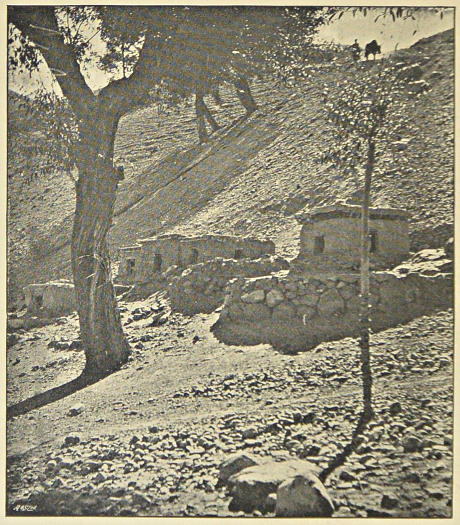
On the Mule-Track, near Harar.
From a Photograph by the Author.