Position and importance of Shoshong—Our entry into the
town—Mr. Mackenzie—Visit to Sekhomo—History of the Bamangwato
empire—Family feuds—Sekhomo and his council—A panic—Manners
and customs of the Bechuanas—Circumcision and the
boguera—Departure from Shoshong—The African francolin—Khame’s
saltpan—Elephant tracks—Buff-adders—A dorn-veldt—A
brilliant scene—My serious illness—Tshwene-Tshwene—The Dwars
mountains—Schweinfurth’s pass—Brackfontein—Linokana—Thomas
Jensen, the missionary—Baharutse agriculture—Zeerust and
the Marico district—The Hooge-veldt—Quartzite walls at
Klip-port—Parting with my companions—Arrival at Dutoitspan.
Shoshong, the capital of the eastern Bamangwatos, is undoubtedly
the most important town in any of the independent native kingdoms
in the interior of South Africa. In the main valley of the
interesting Bamangwato heights lies the bed of an insignificant
stream which is full only after the summer rains, and which receives
a periodically-flowing brook, called the Shoshon. On this the town
is situated, so that it would seem that Shoshong is the ablative of
Shoshon, i.e., on the Shoshon.
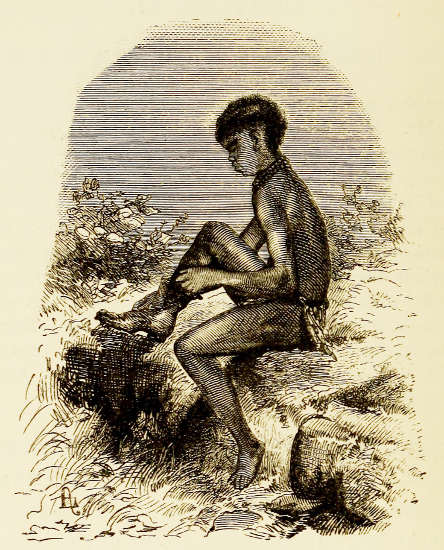
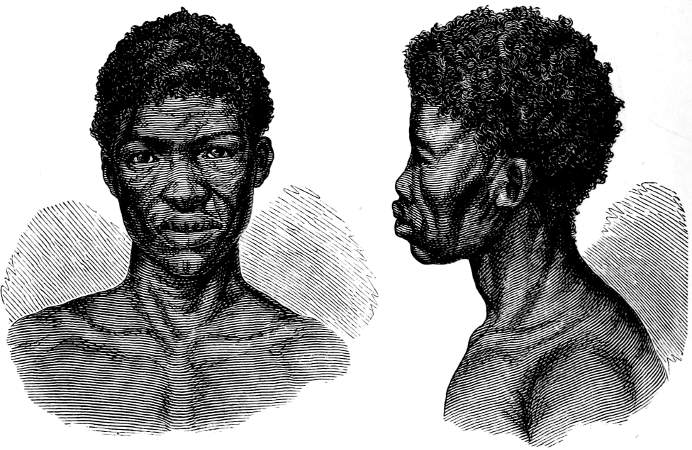
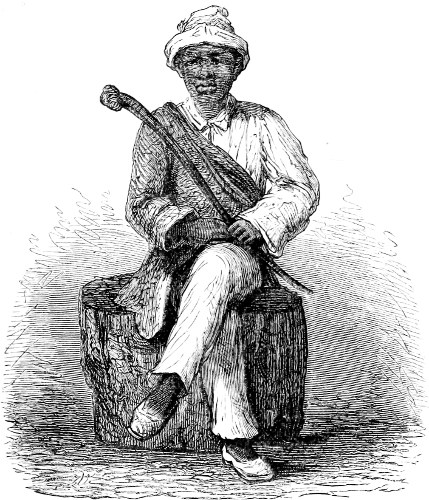
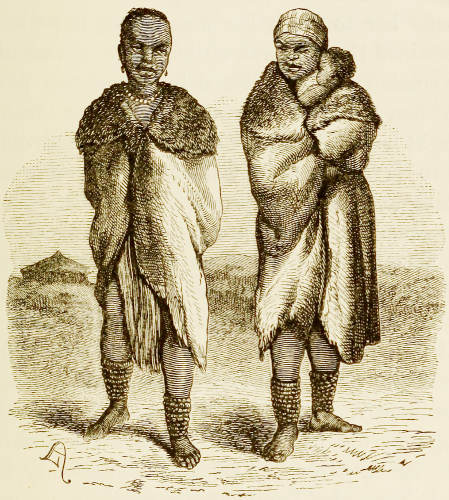
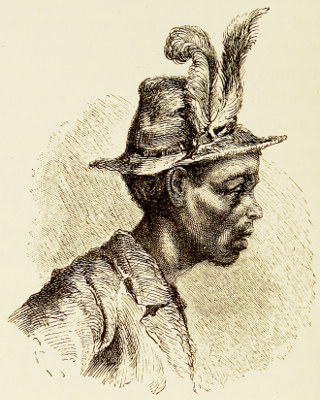
A BAMANGWATO BOY.
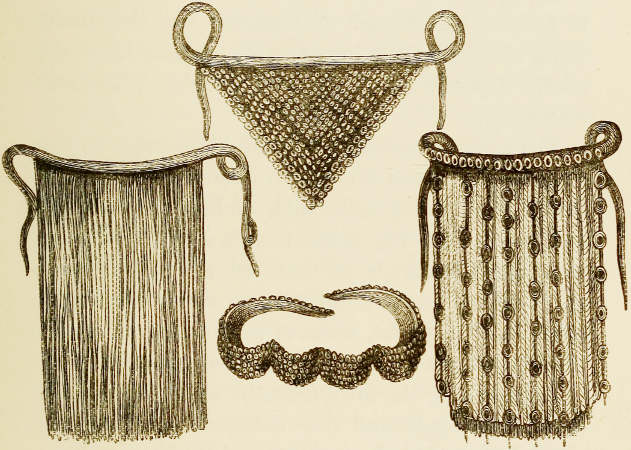
APRONS WORN BY BAMANGWATO WOMEN.
Ten years ago, before the war broke out between the various members
of the royal family, Shoshong with its 30,000 inhabitants held the
highest rank of any town throughout the six Bechuana countries, (viz.
those of the Batlapins, Barolongs, Banquaketse, Bakuenas, and the
eastern and western Bamangwatos) where the strength of the ruling power
is usually centred in their capital for the time being. The population
of Shoshong is now scarcely a fifth part of what it formerly was, a
falling-off to be attributed to Sekhomo, who was king of the eastern
Bamangwatos at the time of my first visit; not only was he the promoter
of the civil war, which cost the lives of many of the people, but he
was the means of causing a division of the tribe, which resulted in
the migration of the Makalakas. Under the rule of Khame, Sekhomo’s
son, decidedly the most enlightened of the Bechuana princes, the town
is manifestly reviving, and if during the next few years it should
remain free from hostilities on the part of the Matabele Zulus, it may
be expected to rise again into its old pre-eminence amongst Bechuana
towns. For white men, traders, hunters, and explorers alike, it is
and always must be a place of the utmost importance, and that for the
following reason: there are three great highways that lead into the
four southernmost Bechuana kingdoms, viz., from Griqualand West, from
the Transvaal, and from the Orange Free State; the whole of these
unite at Shoshong, whence they all branch off again, one to the north,
towards the Zambesi, another to the north-east to the Matabele and
Mashona countries, and another to the north-west, to the country of the
western Bamangwatos and to the Damara country, so that it follows as
a matter of necessity that the admittance of a traveller into Central
Africa from the south depends upon his reception by Khame at Shoshong.
The valley of the Bamangwato highland is five or six miles wide, and
overgrown with grass and bushwood; it is partly cultivated, and at its
point of union with the Shoshong pass it is speckled over with some
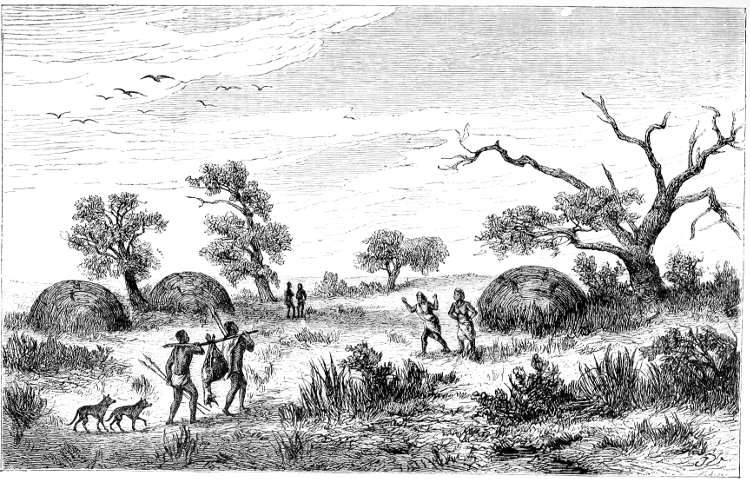
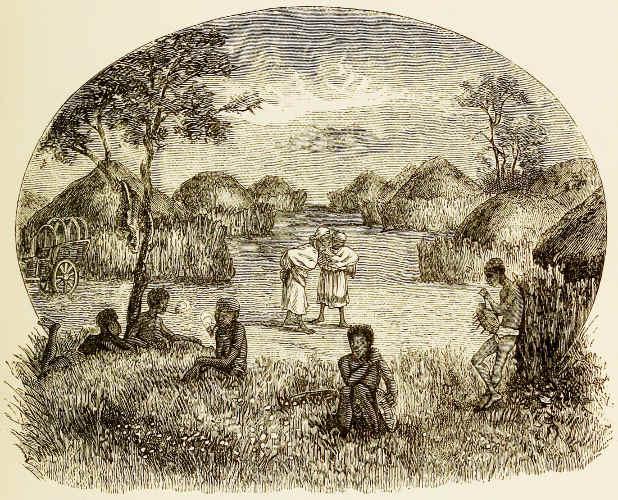
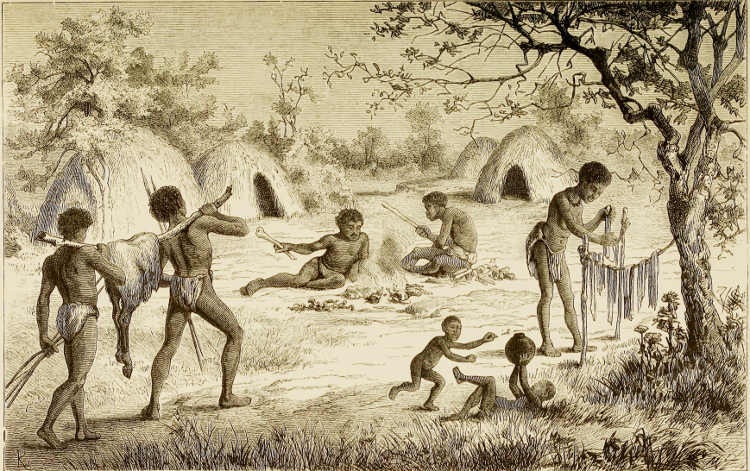
hundreds of thatched cylindrical huts, about twelve feet in diameter,
and rarely more than seven feet in height, some of them overgrown with
the rough dark foliage of the calabash-gourd.
Approaching the town from the south, we noticed three farmsteads and
five detached brick houses about 600 yards before we entered the place.
These houses were built with gables, and had much more of an European
than of a Bamangwato aspect. We learnt that they were called “the white
man’s quarters,” being occupied during part of the year by English
merchants, who come to transact business with the natives, and, in
years gone by, supplied provisions to the hunters, to be paid for on
their return in ivory and ostrich-feathers. Amongst the firms of this
character, the most important, I believe, was that of Messrs. Francis
and Clark, but, like other inland traders, they must latterly have
experienced very unfavourable times.
Hitherto the king has refused to allow Europeans to purchase any
land, but has permitted them to occupy the sites of their premises
gratuitously.
The chief thing that struck me as we approached the town was the number
of residences that had been abandoned, although in many of these
repairs were now going on. In one place I observed some women daubing
clay with their bare hands over a wall six feet high, made of stakes as
thick as their arms driven about a foot into the ground, and fastened
together with grass; while close by was a lot of children, varying from
six to ten years old, busily preparing the material for their mothers’
use; these youngsters evidently enjoyed their occupation vastly;
they were dressed in nothing beyond their little aprons of beads or
spangles, and accomplished their task by treading down the red clay in
a shallow trench, chanting continually a kind of song, which was not
altogether unmusical; an old woman whose scraggy limbs, parchment-skin,
and general mummy-like appearance did not say much for the amount of
care bestowed upon her, was pouring water into the trench from the
vessels which stood beside her.
In other places women were clambering on to the newly-constructed
roofs, and making them tidy by pulling off the projecting stalks, or
were putting the finishing touch to their work by fastening thin bands
of grass all over the thatch.
All along the paths, in the courtyards, and especially at the hedges,
crowds of inquisitive women with infants in their arms, and clusters of
small children around them, had assembled to criticize the makoa (white
men) and freely enough they passed their opinions about us. Most of
them wore several strings of large dark blue beads round their necks,
and the breasts of most of them were bare, although occasionally they
had cotton jackets or woollen handkerchiefs, the prevailing colours
being red and black; nearly all of them had skirts reaching to the
knees, if not to the ankles.
It took us about an hour to make our way through the labyrinth of
huts before we entered the glen that contains the town. This glen is
about 400 yards wide at its mouth, but gradually converges to a narrow
rocky pass; at first sight, indeed, it presented the appearance of a
cul-de-sac, but the semblance was only caused by the western
side of the steep pass projecting so far as to conceal the eastern,
which is covered with rugged crags, and called the monkey-rock. The
pass has played an important part in the history of the town.
The mission-house of the London Missionary Society lies on the side of
the pass, and as we went towards it we saw three groups of houses on
the right, forming the central portion of the town, of which another
section lies in a rocky hollow on the other side.
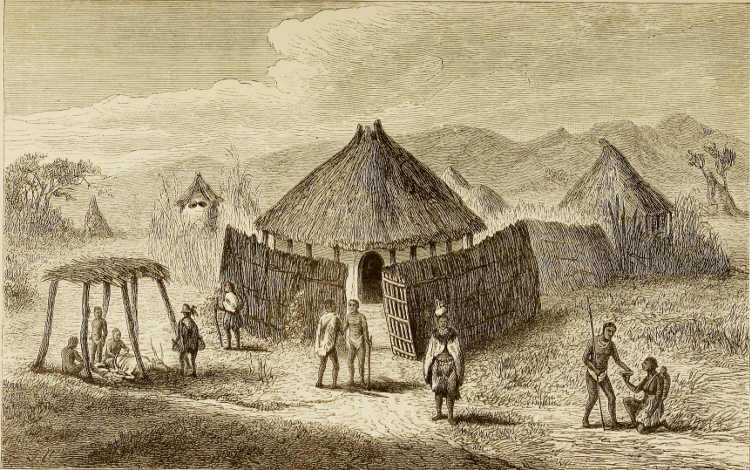
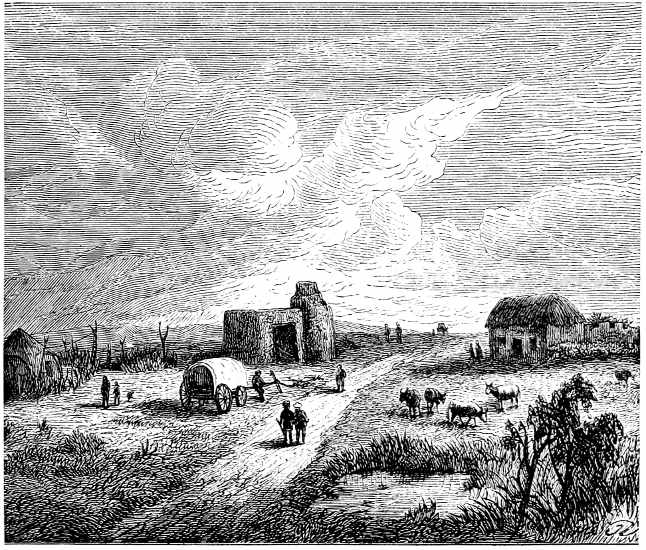
BAMANGWATO HUTS AT SHOSHONG.
Page 372.
High above the river-bed on the steep to the left, could be seen the
ruins of a European building, the remains of the Hermannsburg Mission
Chapel, which had been used as a rampart in one of the native battles,
and had been all but destroyed. The mission had previously withdrawn
from Shoshong and been replaced by the London Missionary Society,
of which the buildings are very comfortable, and form an important
settlement, as besides the chapel and school, they include the
dwellings occupied by the married native students.
At the time of my first visit to Shoshong, the principal of the mission
was Mr. Mackenzie, one of the noblest-hearted men I ever met with in
South Africa; since 1876, when he removed with his school to Kuruman,
his place has been vacant, but his associate, Mr. Hephrun, still
continues to reside at Shoshong in another house.
Having been kindly entertained at tea by Mr. Mackenzie and his wife,
we started off under his escort to pay our respects to the king, who,
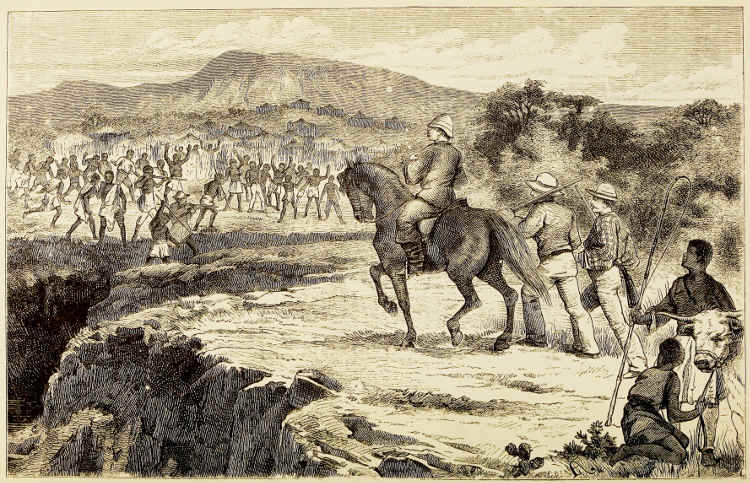
we were told, was waiting to receive us in the kotla. We saw throngs of
women in the pass under the monkey-rock carrying vessels full of water
from the spring in the centre of the glen; their garment generally was
a sort of toga of untanned skin, with the hair inside, fastened round
the body, and leaving the right hand free to balance their pitchers on
their heads, which they did so adroitly, that not a drop was spilled
upon the roughest roads. The dress was commonly adorned profusely with
bead ornaments and strips of leather, and the calves of the women’s
legs were covered with rings of beads and brass-wire.
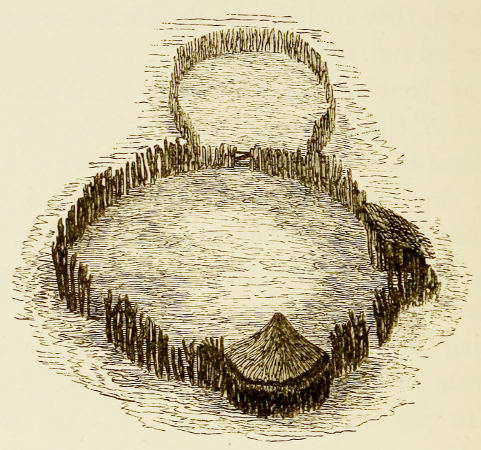
KOTLA AT SHOSHONG.
The king’s residence, as usual, was built round the kotla, and on
our way thither, we had the opportunity of observing the respectful
greetings which our conductor received from every one who met us, young
and old. The place was a circular space enclosed by a fence of strong
stakes, the entrance being on the south side, opposite to which was
an opening leading to another smaller enclosure, which was the king’s
cattle-kraal, where his farm stock was kept at night, the horses being
accommodated in the kotla itself. Every night the entrances are made
secure with stakes, and in times of war large fires are kindled and
kept blazing inside.
I have the utmost pleasure in recording my obligations to Mr.
Mackenzie. He is an accomplished man, the author of “Ten Years North
of the Orange River,” but his kindly attentions to myself have made
me regard him with a sincere affection. I was introduced to him
through having been asked to convey some letters to him in 1874 by
his fellow-workers in Molopolole, and his courteous reception of me,
and his subsequent kindness in the time of illness, have so endeared
the remembrance of his name, that I count it as one of the chief
recompenses of all my hard experience that I became acquainted with
him. I regard him thoroughly as a messenger of love.
As missionary in Shoshong during the incessant discords in the royal
family, he had a most difficult position to maintain. But he was the
right man in the right place: with much circumspection he acted as
mediator between the contending parties; gifted with discretion, and
full of sympathy for all that is noble, he succeeded in smoothing
down many difficulties, and arousing something like a proper sense of
justice and humanity. It is entirely owing to him that Sekhomo’s son,
Khame, is now one of the best native sovereigns in the whole of South
Africa.
I had placed our waggon at the south-east end of the town, where it was
quickly surrounded by an inquisitive crowd, and there I left it while I
paid my visit to the king.
We were soon in the royal presence, and seated upon stools set for us
in the kotla.
Except his begging propensities, I had no cause to complain of
Sekhomo’s behaviour to myself during my short sojourn in his town. He
was a man above middle height, rather inclined to be stout, but with
nothing in either his appearance or comportment to distinguish him from
any of the courtiers who attended him, or to mark him out in any way as
the ruler of an important tribe. A small leather lappet was fastened
round his loins, and a short mantle of the same material hung from his
shoulders; this mantle, amongst the eastern Bamangwatos, is usually
made of hartebeest skin, tanned smoothly except in five spots, and
sometimes ornamented in the lower corner with a black circle cut from
the skin of the sword-antelope, and trimmed round the neck with glass
beads.
My first visit to the king was very brief. After the interchange of
a few formal phrases, which Mr. Mackenzie interpreted, I took my
leave under an engagement to come again on the following day; but
before entering upon the details of my intercourse with Sekhomo and
his subjects, I may introduce a few episodes in the history of the
Bamangwatos.
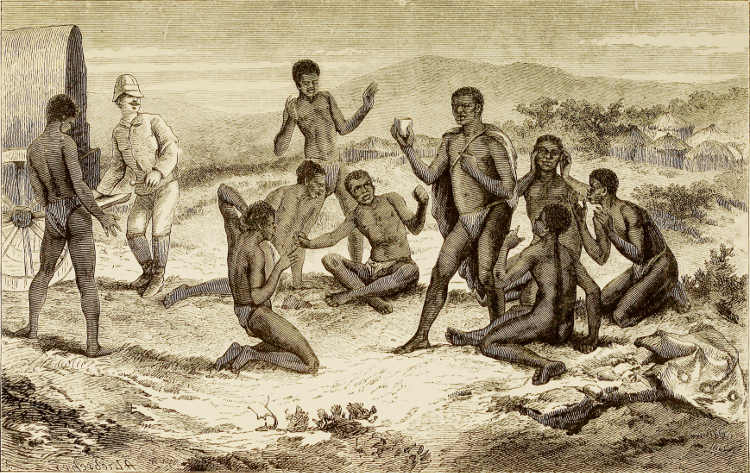
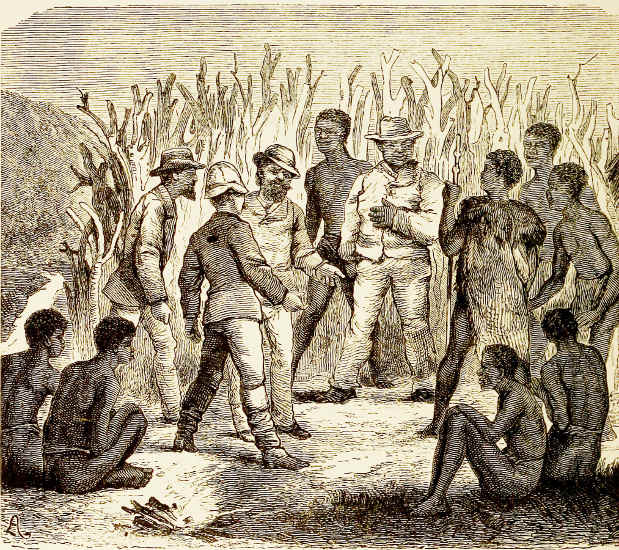
SEKHOMO AND HIS COUNCIL.
Page 376.
According to traditions collected by Mr. Mackenzie the Bamangwatos
are descended from the Banguaketse. I have already described how the
Baharutse became subdivided, and migrated from their ancestral home.
After a similar subdivision had subsequently led to the formation of
the two tribes of the Banguaketse and the Bakuenas, the Bamangwatos
disengaged themselves from the former of these, and took possession
of a territory north of the Bakuenas, right away to the Zambesi and
the Chobe. During the lifetime of Matifi, Sekhomo’s great-grandfather,
a fresh rupture took place, resulting in the establishment of two
distinct Bamangwato communities, the western on Lake Ngami and the
eastern at Shoshong.
Of the eastern empire, the founder was Towane, the younger of Matipi’s
two sons; Khame, the elder son, maintaining his rule in the old
Bamangwato highland. Towane, in his revolt, carried off his father with
him, but he treated him so badly, that the aged man sought refuge once
again with Khame; but Khame, although he allowed him to enter into his
territory, would not grant him permission to reside in the town, a
refusal that distressed him so sorely, that he died of a broken heart.
The spot where he was buried is now regarded by the Bamangwatos with
much veneration.
The most upright of the seven Bamangwato kings whose names have
been handed down was Khari; of him it is reported that he was bold
and warlike and prudent in council, governing his dependents the
Makalahari, the Madenassanas, and the Masarwas with a gentle rule. So
respected was he by the neighbouring tribes, that several of them,
such as the Makalakas and some of the more eastern Mashonas paid him
voluntary tribute. Unfortunately, his ambition, a characteristic only
too common amongst Bechuana princes, led him to destruction, and
introduced a complete anarchy into his dominions. Honoured as he was
in his own country, respected by his allies, feared by his foes, he
coveted a yet wider power, and in grasping at his aim courted his own
fall. He formed a design against one of the inferior Mashona chiefs,
but the Mashonas, already acquainted with the military tactics of the
Bamangwatos, adroitly divided their army into two sections; the younger
regiments were directed to advance and attack, and then to feign a
retreat; the elder troops were to be in readiness to close in at the
rear and to surround the enemy in Zulu fashion. The stratagem succeeded
perfectly; the Mashonas brought their pretended flight to a sudden end,
and turned upon their pursuers. Khari and his people had been lured
into an ambuscade, and not only was he himself ruthlessly massacred,
but his whole army was all but annihilated.
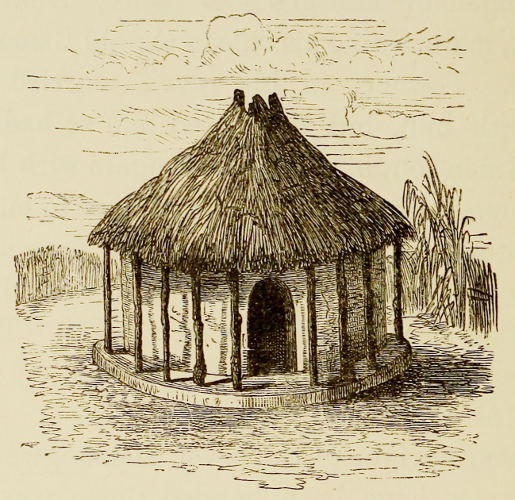
BAMANGWATO HOUSE.
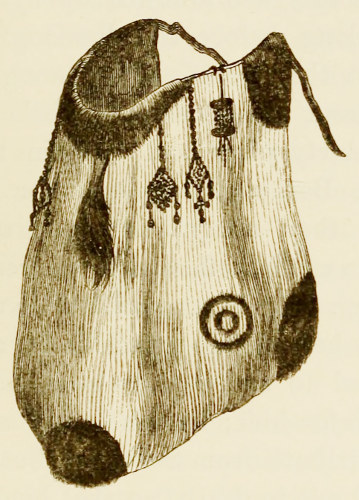
COURT DRESS OF A BAMANGWATO.
Immediately upon this disaster, the surviving chieftains in the town
proceeded to take steps for putting one of Khari’s sons upon the
throne. This created considerable opposition, but before the civil
war that was threatening had time to develop itself, the country was
invaded by the Basuto tribe of the Makololos from the Orange River
district, who carried off with them all the members of Khari’s family
into the north, where they were founding a new settlement on the Chobe.
The prisoners succeeded after a while in effecting their escape, and
Sekhomo, Khari’s eldest son by birth (although not being the child
of the chief wife, he was not the proper heir to the throne) lost no
time in scouring the country and collecting stragglers as adherents
to himself. He gathered together a force so considerable, that not
only did he repel an attack of the Makololos, but he cut to pieces
their reserve force in the Unicorn Pass; a victory so decisive, that
it gained for him the allegiance of most of the chiefs, who, at his
instigation, murdered his step-brother, the true heir. Another brother,
Matsheng, was saved from a similar fate by the queen-mother, who gave
him timely warning to save himself by flight.
The one victory was followed up by others, and it was not long before
the Bamangwatos under Sekhomo felt themselves strong enough to make a
successful stand against the Matabele Zulus, who for the last thirty
years had been in the habit of invading the Bechuana countries for the
purpose of plunder; they recaptured much of the cattle that had been
carried off, and so impressed was the Matabele king, Moselikatze, with
their military skill that he long hesitated to attack them, and when
he next ventured to molest them he found them more than a match for
him; he sent forty armed Zulus to demand tribute from Sekhomo, but his
messengers were all put to death, so that he did not make any further
attempt to disturb them during the next twenty years, during which the
Bamangwatos brought their cattle as far as the Matliutse. In March,
1862, at the instigation of Kirekilwe, a fugitive sub-chieftain of the
Bamangwatos, the Matabele king renewed hostilities; some Makalahari
while tending cattle on the Matliutse and Serule were put to death,
and a village on the eastern Bamangwato heights was destroyed, only
two men escaping to carry the news to Shoshong. Without delay Khame
and Khamane, the king’s sons, set off to avenge the injury; they
routed two companies of the Matabele without difficulty, but were
almost overpowered by a third company which had been attracted to the
scene by the sound of fire-arms, and although they killed some forty
of their adversaries, they lost at least twenty of their own men, and
had some difficulty in making a safe retreat to Shoshong. Encouraged
by this temporary advantage the Matabele came on to the Francis Joseph
Valley, and to the hills immediately overhanging Shoshong; they laid
waste some fields, but had not the audacity to enter the Shoshon pass;
after many endeavours to entice the Bamangwatos into the open plains,
they were obliged to retire, and although they carried off with them a
considerable quantity of cattle, Sekhomo started off in pursuit, and
recovered it all within a fortnight.
As the result of all this the Bamangwatos rose in importance. They
were manifestly establishing their superiority over the Matabele,
hitherto regarded as the stoutest and most invincible of warriors, and
the consequence was that numbers of Makalalas, Batalowtas, Mapaleng,
Maownatlalas, and Baharutse, came as fugitives from the Matabele
district and craved permission to settle on the Bamangwato heights.
But in order to convey a correct conception of the order of events,
it is necessary to relate the proceedings of Matsheng, who, as I have
already mentioned, had saved his life by flight. He had betaken himself
to the Bakuenas, and had been taken prisoner by the Matabele on one of
their marauding expeditions, and although once released, he had again
fallen into their hands, and had been trained and treated by them as a
“lechaga,” or common soldier.
Sechele had for a long time been anxious to establish his own claim
over the Bamangwatos, as being descended from his people, the
Banguaketse, but finding himself unable to assert his pretensions
openly, he tried secretly to enlist the sympathies of the Bamangwatos
in behalf of Matsheng, and so far did he succeed that by Dr. Moffat’s
influence he obtained the release of the captive, and gave him a
pompous reception, a proceeding that had such an effect upon Churuku,
the man next in importance to Sekhomo, that he declared himself to
have espoused the cause of Matsheng, who was accordingly installed
at Shoshong as king, Sechele being rewarded for his services with
ostrich-feathers and ivory. The dethroned Sekhomo fled to Sechele, who
received him with open arms.
Matsheng, however, did not long retain the position to which he had
been raised. He had been brought up as a Matabele soldier, and his
spirit of despotism was far too strong for the conservative instincts
of the Bamangwatos; his arrogance and cruelty soon cost him his throne,
Churuku being the very first to revolt against him and to restore
Sekhomo to his former power. Again Matsheng returned to Sechele, who
received him with unvarying courtesy and kindness. All this happened
in 1859, consequently before the attack of the Matabele that I have
described.
It may be interesting to know that although Matsheng was universally
regarded as Sekhomo’s step-brother, he was not really the son of his
father Khari; he was the son of the acknowledged queen, but he was not
born until some years after Khari’s death; the rank, however, of the
first-born and legitimate son was conceded to him, whilst Sekhomo, a
son by a wife of the second grade, though older in years, was reckoned
as illegitimate.
It was in 1864 that Sekhomo frustrated Sechele’s attack upon Shoshong.
In the following year, when the “boguera” was being celebrated, and
Sekhomo observed that neither of his two sons was taking part in the
ceremonial, he was so angry that he caused them to be “enchanted” by
the molois for a whole year, a proceeding on his part that had no
other effect than enlisting the sympathies of the younger regiments on
their behalf. His rage reached its height when Khame, who had married
Churuku’s daughter, not only refused for himself, but prohibited his
wife from taking any share in the rites of the boguera, a time-honoured
institution which Sekhomo positively insisted on as indispensable for
any one aspiring to be acknowledged as a future queen. He would have
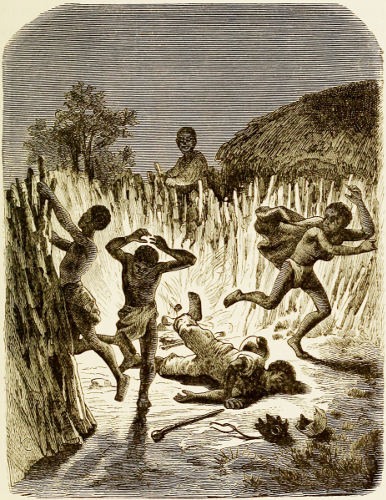
liked to procure the assassination of Churuku, but he dared not seek
his assassins amongst the Bamangwatos, nor could any Matabele fugitive
be induced to undertake the task. He tried all manner of threats and
persuasions to alienate their adherents, and even determined upon
an assault upon the huts where his sons resided. Getting together a
number of his partisans, he bade them fire; not a man, however, would
obey his orders, and when he raised his own gun to take aim, it was
struck out of his hand. Dreading the vengeance which he felt sure would
follow upon his deed, he ran off and took refuge with his mother; but
his sons, so far from exacting retribution, agreed to keep him upon
the throne upon the sole condition that he would commit no further act
of hostility against themselves or any other members of the Christian
community. Although Sekhomo did not hesitate to give the required
pledge, it was only in accordance with his character that he should
continue to devise clandestine schemes against the objects of his
hatred.
Accordingly, before long, he sent to Sechele’s quarters and invited
Matsheng to come and join him in a conspiracy against his sons. In
March he made his attack, having by this time gained so many of the
Bamangwatos to his side, that Khame and Khamane, after holding out as
long as they could in the ruins of the chapel, were obliged to retreat
with their followers to the mountains.
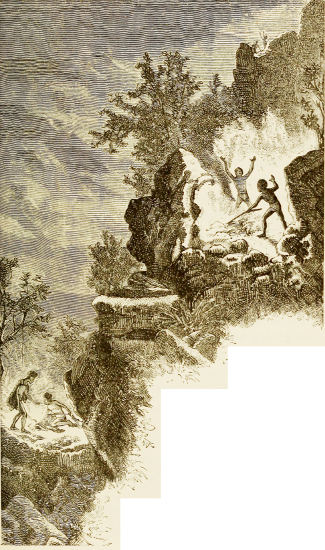
For about a month fighting went on in a desultory way without bringing
decided advantage to either party, when Sekhomo, with the assistance of
some Makalahari, stormed the peaks of the mountains to which his sons
had withdrawn. They held out firmly for more than a week, when the want
of water compelled them to make a complete surrender. Khame distinctly
refused, however, to return to paganism; his life was spared, but no
mercy was shown to his followers, many of them, including Churuku,
being ruthlessly slaughtered.
In May, Matsheng reappeared in Shoshong once more to assert his
claim. Khame and Khamane openly avowed their opposition, but did not
take up arms. Sekhomo, too, was weary of his step-brother, and again
resorted to stratagem. He called an assembly, inviting both his sons
and Matsheng to his kotla, intending to get them to enter first, when
they might be surrounded and disposed of at a single blow; but they got
scent of his design, and took care to enter last, so that the plot was
defeated. A second scheme failed as totally as the first; his friends
deserted him, and he was compelled to fly. Thus Matsheng was for the
second time declared ruler of the Bamangwatos.
Sekhomo fled from quarter to quarter. He first betook himself to the
Manupi in the country of the Banguaketse; then to the Makhosi, whence
he was expelled by Sechele’s order, and finally he took refuge with
Khatsisive at Kanye.
Matsheng had no sooner again felt his feet as sole governor, than he
fell into his old ways, and showed himself a thorough autocrat. He set
to work to undermine the influence of Khame and Khamane, declared that
Christianity was hostile to the welfare of the tribe, and persevered in
every possible way in doing violence to the religious sentiments of his
people. Finding his instructions disregarded, he determined to dispose
of Khame. He dared not use violent means, and the only course that
suggested itself was to call in the aid of the molois; but neither did
the operation of magic prove effectual, nor did he succeed in getting
some poison, for which he applied to a European trader.
His reign at last came to an untimely end. Whilst Khame was on a
visit to Khatsisive he met Sechele, who furnished him with troops to
enable him to expel Matsheng. An encounter took place in the Francis
Joseph valley, at the mouth of the Shoshon pass, in which Matsheng
was worsted, the engagement being remarkable for the circumstance
that Matsheng’s allies, the Matabele, under the command of Kuruman,
the son of Moselikatze, fought on horseback. Prepared for this, Khame
posted his best marksmen as advanced skirmishers behind the bushes so
effectually, that the mounted Matabele, once dispersed, were exposed to
a concealed fire, and unable to recover themselves. Kuruman deserted
in the very middle of the fight, and Matsheng, with all his followers,
after plundering the house of Mr. Drake, a trader in the district, fled
in great disorder.
From that day forward the legitimate ruler was never again seen in
Shoshong. He retired first to the Mashwapong heights on the central
Limpopo in the eastern Bamangwato land, but was not allowed to remain
in peace. Khamane drove him from his refuge, and he retreated to the
Mabolo Mountains. After his expulsion Khame was declared king, and for
a time there seemed some chance of the bitter feuds coming to an end.
Khame, however, appeared incapable of learning by experience. His soft
heart revolted at the thought of keeping Sekhomo in banishment, and
after exacting a promise from him that he would keep the peace, he
recalled him to Shoshong, when he very soon resumed his old devices.
First of all he promoted dissension between the two brothers, by
awarding Khamane not only the cattle taken from Matsheng, but by
assigning him a village of the Manansas, a people of the Albert
country, the mountain district south of the Victoria Falls. Khamane
unfortunately suffered himself to be beguiled by his father’s wiliness;
his ambition to secure the sovereign power led him to turn a deaf
ear to Khame’s representations, neither would he be swayed by the
remonstrances of Mr. Mackenzie, who tried hard to bring about such a
good understanding as might promise a lasting peace in the land.
To avoid further collision, Khame now migrated with a very
considerable proportion of the Shoshong population, settling on the
River Zooga, in the territory of the western Bamangwatos, where he was
received with much cordiality and regarded with esteem and affection by
the Batowanas. Unfortunately his people began to be decimated by fever,
so that before long he had no alternative but to make his way back to
his own country.
Such was the state of affairs on my first arrival at Shoshong.
My first concern now was to replenish my stock of provisions, which was
very low. I found this a much more difficult matter than I expected,
and it was only by Mr. Mackenzie’s assistance that I was able to
procure the simplest and most indispensable articles. It was of
itself a difficulty quite enough to make me renounce all intention of
extending my journey as far as the Zooga, or Botletle.
On the 9th, I was favoured with a visit from the king and his
linyakas, an honour subsequently repeated so often as to become a
positive nuisance, as henceforward, so long as we stayed in the place,
we had to receive his majesty and his council of “black crows” once a
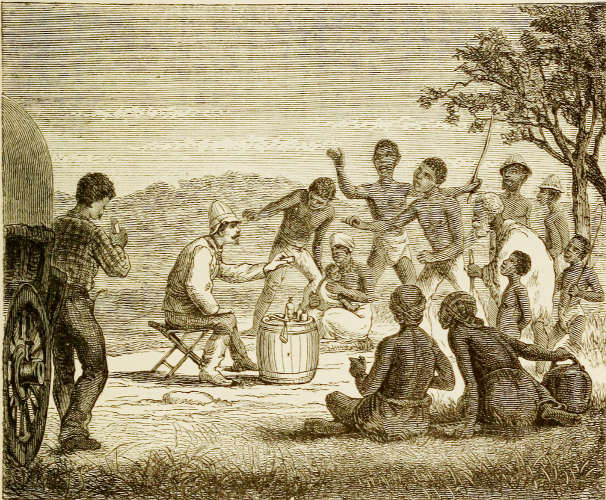
day, and occasionally twice. When he arrived, Sekhomo would keep on
shaking my hand, while his factotum, who could speak Dutch, would be
perpetually begging for something in his master’s name. The king at
other times would stand with his arms akimbo, his myrmidons squatting
around him in a semicircle and imitating everything he did; if he
laughed, they laughed; if he gaped, they gaped; if he yawned, they
yawned; and one day, when his majesty burnt his mouth with some tea
that was too hot, they all puckered up their faces as if they likewise
were experiencing the pain; when he turned to go home, they rose and
followed him in single file, like a flock of geese.
One day I received a visit from a travelling Dutch hunter, who was
returning with his family from a six months’ excursion in the Zooga and
Mababi districts; during that time he had killed twenty-one elephants
and fifteen ostriches. He recounted two interesting adventures
that he had with lions, in one of which his little son had played
quite an heroic part. His object in coming to me now was to consult
me professionally, as three of his children were lying ill with
intermittent fever.
According to Mr. Mackenzie’s estimate, Sekhomo’s actual revenue was
equivalent to about 3000l. a year, and consisted of cattle,
ivory, ostrich-feathers, and skins. He had no state-expenditure
whatever. The free Bamangwatos were allowed the produce of their herds,
such ostrich-feathers as were of inferior quality, and one tusk of
every elephant that they killed.
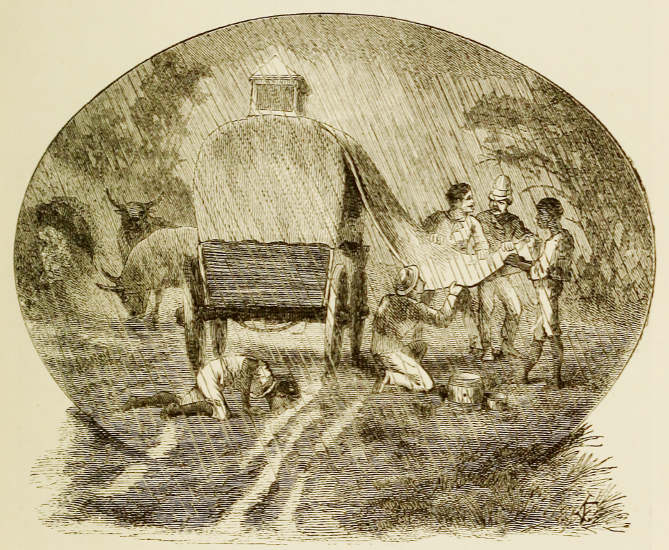
Throughout our stay in Shoshong the downpour of rain was almost
incessant; nevertheless, our waggon was constantly besieged by a crowd
of visitors and workpeople, so that quite a brisk trade was carried
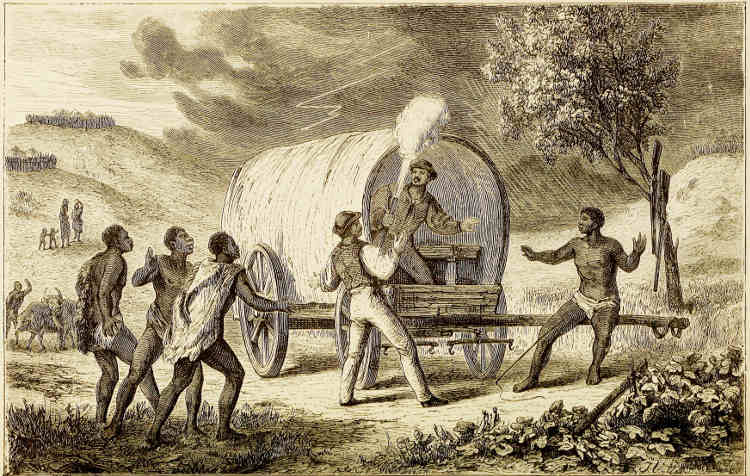
on; this, on one occasion, was slightly interrupted by our bullocks
becoming suddenly restive.
In the midst of the general peace the population was thrown one
morning into a state of disturbance by the intelligence that hostile
Matabele were on their way to the place. The residents were seized with
a panic, the king came hurrying down to me in a state of excitement,
and borrowed one of my guns, which, as I might have expected, I
had considerable difficulty in getting back again. He showed me
his palladium, an amulet made of a lion’s claw, which was supposed
to render him invulnerable; he had at once given orders that his
people should betake themselves to the heights overhanging the town.
Everybody, therefore, with all speed, was collecting his few effects
and preparing to drive the sheep and cows to the hills. The state of
confusion reached its height when the report of fire-arms was heard
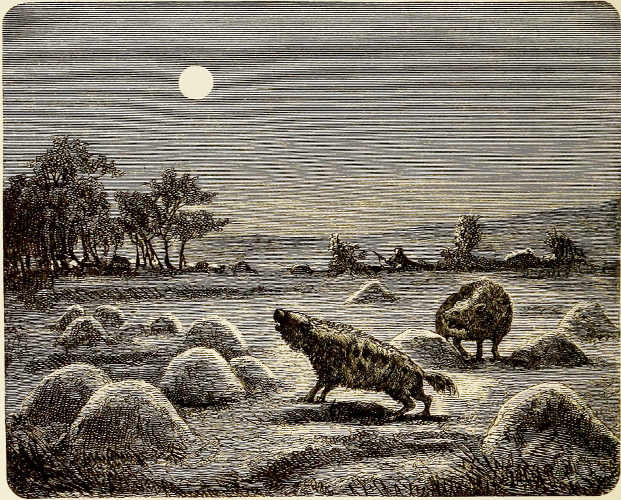
close outside the town, but although it was soon ascertained that the
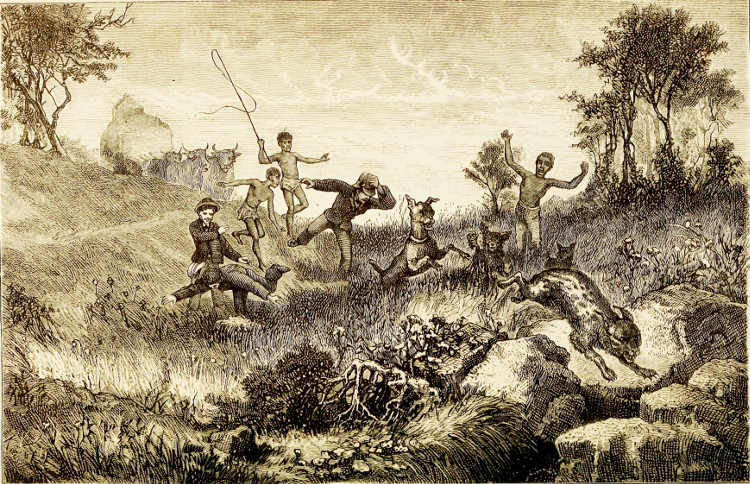
shots had only been fired at a stray hyæna, it was long before the
apprehension could be allayed that the Matabele were commencing an
assault. Next day a Boer hunter from the western Matabele country, a
son of the renowned elephant-hunter Pit Jacobs, who resides on the
Tati River, came into the place, and assured the people that there
was not the least foundation for their alarm; but so completely
had the impression of their danger got possession of them that his
representations received no credit whatever, and even the European
traders began to take measures for defence. Under the circumstances,
Mr. Mackenzie advised me to take my departure as quickly as I could, as
although there was nothing likely to happen to compromise my personal
safety, there was no answering for the security of my property.
When Sekhomo heard that we were going away, he expressed his regret
that we, whom he regarded as his friends, should be forsaking him in
his trouble. As a parting gift I gave him a blue woollen dress for one
of his seven wives, and he in return presented me with a bundle of grey
ostrich-feathers.
In no other native town throughout my journey did I succeed so well as
here in making additions to my ethnographical collection. The resident
traders showed some annoyance at my proceedings, but I managed to
exchange nearly all the goods I had in my waggon for various objects
of local handicraft. I obtained a great many assegais and hatchets,
some daggers, knives, kiris, and sticks, wooden pillows, pots, pans,
spoons, magic dice of various materials, as well as a large variety of
snuff-boxes, gourd-vessels, articles for the toilet, ornaments, aprons,
cups, dolls, and toys made of clay. Perhaps the most noteworthy amongst
my acquisitions were some of Sekhomo’s war and rain drums, a little
ivory fetish, some kiris made of rhinoceros horn, and several whistles.
I bartered away some of my skins of pallah-antelopes, leopards, lynxes,
and caracals, and for a small extra payment had some of them back again
after they had been converted into garments. The Bamangwato workmanship
differs very little from that of all other Bechuana tribes; their huts,
though somewhat smaller and more slightly built, are most like those of
the Barolongs, but they have larger corn-bins of unbaked clay than any
I saw elsewhere.
Nor did my naturalist’s collection fail to gain some curious
contributions. Amongst the lizards I found a beautiful striped sort,
with a metallic lustre of brown, dark green, and blue; and some of
other kinds, without stripes, that seemed particularly tame.
Before describing my return journey, I will append some further details
of Bechuana customs to those which I have given in the previous chapter.
As a rule a heathen Bechuana has but one wife, though the more
well-to-do not unfrequently have two; the number allowed to the
sub-chieftains varies from three to six; the kings being permitted to
have more, although not so many as those in the Marutse empire. A man
of competent means presents his newly-married wife with several head of
sheep or oxen.
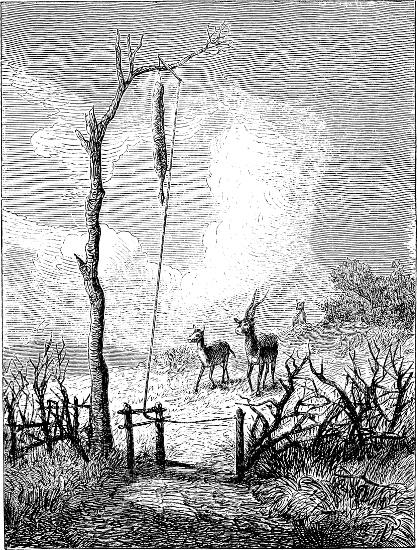
On entering a town, a traveller picks up some of the stones in his
path, and after throwing them into a bush, or laying them in a forked
branch of a tree, breathes a prayer that he may reach the end of his
journey in safety.
The skin, horns, or flesh of a sacred animal, such as the duykerbock
among the Bamangwatos or the crocodile among the Bakuenas, are not
allowed to be touched.
An owl, sitting upon a hut, is considered of evil omen; and the
linyakas are called in to purify the spot that has been defiled by the
touch of the bird.
An animal observed to do anything that according to Bechuana notions
is unusual, is at once considered dangerous, and must be either killed
or submitted to the treatment of a linyaka. For instance, if a goat
should spring upon a housetop, it would be immediately struck with an
assegai; or if a cow in a cattle-kraal should persist in lashing the
ground with its tail, it would be pronounced not to be an ordinary cow,
but would be considered “tiba,” and as such sure to bring disaster,
disease, or death upon its owners. A rich man would forthwith have the
animal put to death; but a poor man is permitted to sell it either to a
white man, or to one of another tribe. It is only in cases of this kind
that a Bechuana parts with his cows at all.
Ordinarily no woman is allowed to touch either a cow or a bullock; the
tending of cattle, except in Hottentot families, being always assigned
to boys and men.
As I have already implied, the Bechuana form of government is to a
certain extent constitutional; all legislation or decisions of public
importance having to be discussed in the “pitsho” or assembly-house; it
must be acknowledged, however, that in most cases, especially those in
which the king has any influence with the sub-chiefs, every question
is settled by a foregone conclusion. As with other Bantu peoples, the
king (the morena or koshi) is practically paramount in all public
functions; the chiefs that are associated with him belonging either
to his own tribe or being such as have fled to him for protection, or
have obtained leave to settle in his land. Khatsisive and the chiefs
of the Manupi and western Baharutse may be cited as examples of this;
they occupy separate villages, at divers distances apart, some of
them lying close together and others being a considerable way from
the royal residence. Wherever they are, each of these villages has a
small enclosure which represents the kotla, and where the matters to
be discussed in the royal kotla are submitted to preliminary debate;
and when the king wants to gather a general concourse of chiefs for
important business he sends a messenger, who lays a bough of a tree in
the enclosure, which is understood to be a summons.
When war is contemplated, the council is generally held in the
outskirts of the town in preference to the kotla, as being less likely
to be overheard; the name given to such a council is “letshulo,” the
same that is used for the hunt instituted by the linyakas for the
purpose of procuring rain.
Under the presidency of their chiefs all the inhabitants of a village
are at liberty to attend the council, and as every minute circumstance
is discussed with the most unlimited freedom the clatter of voices is
often something extraordinary.
When a meeting has been called to administer justice, it must be
confessed that the first thing taken into account is whether the
accused is a favourite at court; in that case, as often as not, he is
allowed to depart scot free. When a theft has been committed, a royal
herald is sent through the town, who at once announces the fact, and
declares the king’s intention to punish the offender; the threat, more
often than not, has the effect of inducing the culprit to lay the
stolen goods under cover of night in some public place, whence they
may be restored to their owner. Very frequently the services of the
linyakas are called in, the magic dice are thrown, and other devices
adopted to detect the offender.
I may mention one of the linyakas’ modes of operation in these cases.
After a full investigation of the matter, all the parties suspected
are summoned to the kotla. The linyaka places them in a circle and
walks round them several times, monotoning as he goes, “The thief
who has done this deed must die to-day.” He next sends for a bowl
of maize-pap, which he doles out with a wooden spoon, saying over
every spoonful, “The thief that swallows this pap shall die to-day.”
This done, he proceeds to make a careful scrutiny of each separate
countenance, and then retires to throw his mysterious dice. In a short
time he cries aloud, “I have found the thief!” Going once more round
the circle, he compels every one in succession to open his mouth, the
result ordinarily being that all but one has swallowed the mouthful. In
his fear of bringing the curse of death upon himself, the culprit has
retained the pap in his mouth, intending to spit it out at the first
chance, the precaution he uses of course revealing his guilt.
A criminal on his first conviction of theft has to restore double
or fourfold what he has stolen; on being repeatedly convicted he is
sentenced to have the tips of his fingers scalded off; an incorrigible
offender has to lose the whole of his hand. Murder is usually
considered a capital offence; but a man under sentence of death may
redeem his life by paying a sum of money, or its equivalent in kind, to
the victim’s next-of-kin.
During the time of Matsheng’s rule a singular case occurred of a man
killing his brother from avarice. The aged father had announced his
intention of leaving the bulk of his property to his elder son, and the
younger determined to get rid of his brother, hoping thereby to inherit
the whole. “Brother,” he said to him one day, “did you not hear our
father say that the linyaka wanted a monkey’s skin to restore him the
use of his limbs? Will you go with me to the hills and shoot a monkey?”
The elder brother acquiesced, and they started off together. An hour
brought them to the foot of the rise, when the younger suggested that
it would be better for them to begin to scour the hill from opposite
directions, a proposition to which the elder brother readily assented.
An old woman was gathering berries on the hill, and observing the
peculiarity of the young man’s movements could not help suspecting that
he intended some mischief, and following him unperceived saw that,
instead of going straight up the hill, he crept round to the right and
as soon as he came within sight of his brother, took deliberate aim and
shot him dead. In pretended consternation, he returned to the town,
relating how by miserable misadventure he had shot his poor brother,
supposing him to be an ape in the bushwood. The old woman hurried to
Matsheng and gave her evidence as to the real facts of the case so
clearly, that instead of furthering his scheme to become his father’s
heir, the wretch was by the king’s order carried back to the scene of
his crime, and was there himself shot with his brother’s gun.
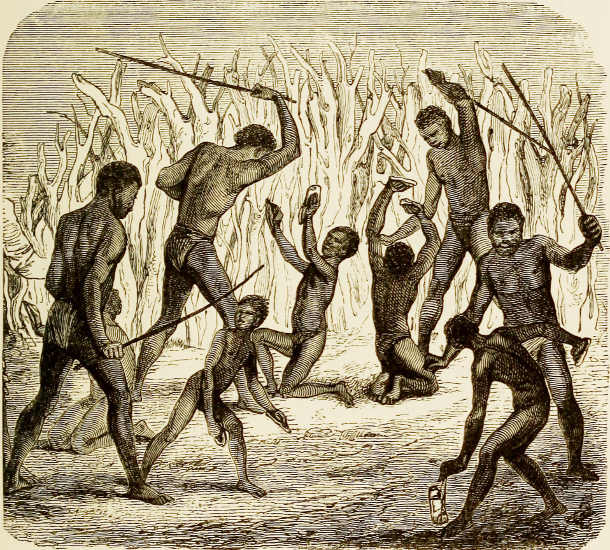
TRAINING THE BOYS.
Among other customs which seem to belong more or less to all the Bantu
tribes with whom I came in contact, there are some which remind us
of the Mosaic law. Held as of the highest importance by the heathen
Bechuana is the rite of circumcision; until it has been submitted to,
no youth is supposed to have arrived at man’s estate, and no woman
is considered of marriageable age. The ceremony, however, does not
universally or necessarily indicate the attainment of a state of
maturity, as is the case with the breaking off of the front teeth by
the Matongas and Mashukulumbe; it is rather an initiation into the
system of hardening which every youth is required to undergo before he
is counted worthy of the titles of “mona” or “ra” which betoken a man’s
estate.
Called the “boguera,” the observance is put into force upon boys
after they have reached their ninth year. The ceremony is performed
at intervals varying from two to five years, according to the extent
of a tribe; the period of its exactment being held to be a time of
great festivity in the towns. If the boys do not present themselves
voluntarily, they are brought under compulsion, and as a preparatory
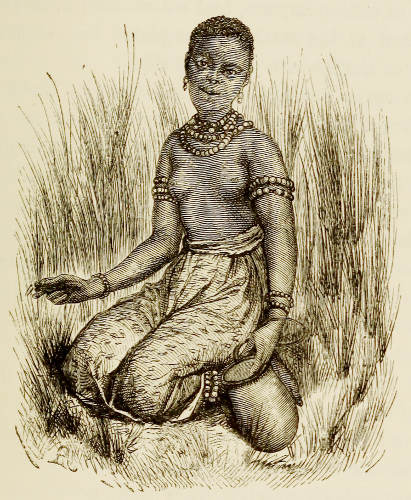
office they are smeared all over with a solution of chalk; the girls
wear nothing but belts made of pieces of reed or aprons of genets’
tails, their breasts and faces being also whitened with chalk. The
solemnization of the rite takes place outside the town, old men acting
as operators with the boys and old women with the girls.
The boguera happened to be celebrated at the time of my visit to
Shoshong, so that I had the best opportunity of becoming acquainted
with its details. Singing as they go, the young people of both sexes,
accompanied by the linyakas, proceed beyond the town to the appointed
spot, where the boys are put through a drill in manly exercises,
and the girls are formally initiated into domestic duties, such as
carrying wood and fetching water; throughout their performances they
keep up their monotonous chant; and as their figures are all white by
the application of chalk, nothing can be imagined much more grotesque
than the appearance they present as they go through their series of
gymnastics.
The boys are next marched off in detachments to the kotla, where they
have all to be beaten with rods. Bare of all clothing, except their
little girdle and their sandals, which they are permitted to hold in
their hands, they are placed in two rows, back to back, and made to
kneel down whilst a man, generally their next-of-kin, stands in front
of each and proceeds to deliver his lashes, which the lads parry as
best they can by the dexterous manipulation of the sandals; they are
required to keep on singing, and to raise each foot alternately,
marking the measure of the chant.
All the youths who submit to the boguera at one time are formed into
a company, and the more sons a Bechuana can bring to the ceremony, the
prouder he is. A chief will generally try to introduce a son of his own
or of a near relative to take command of the troop, and an esprit de
corps is frequently excited which sometimes has a beneficial effect
upon the quarrels that arise at court. The friendship thus formed often
remains unbroken, in spite of the commander avowing himself a Christian
and being baptized.
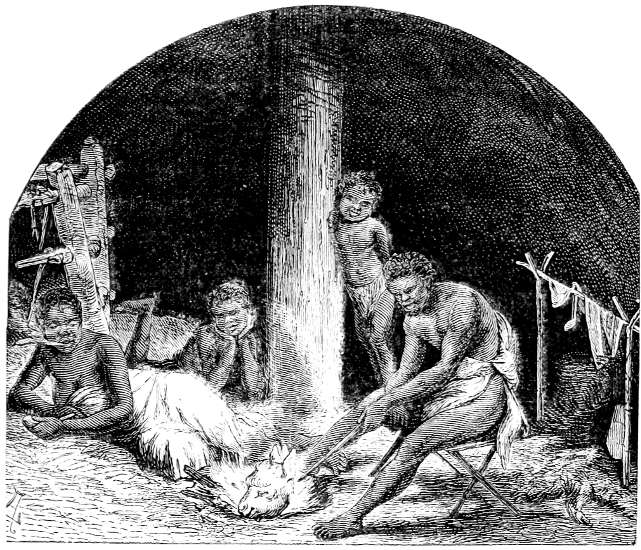
The girls, so long as the ceremonial lasts, are not allowed to sleep;
to keep them awake they are made to spend the night sitting upon wooden
corn-pounders, of which the equilibrium is so unstable that the first
attempt to get a wink of sleep sends the damsel toppling over.
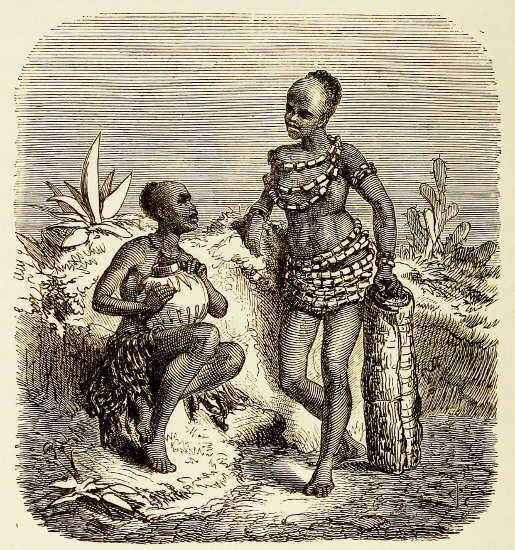
BAMANGWATO GIRLS DRESSED FOR THE BOGUERA.
The real object of the entire ceremonial is to discipline and harden
the young, particularly the boys; the rite is followed by a succession
of hunting excursions, organized and kept up for several successive
years; the members of a company are told off into sets, and under
the guidance of an experienced hunter are taken out first to chase
antelopes and gazelles, and in course of time to pursue elephants and
buffaloes. On these expeditions they are designedly exposed to many
hardships; they are compelled to make long marches through districts
where there is no water; only in exceptional cases are they suffered to
approach the fire even in the severest weather, and they are forced to
experience the long-continued pangs of hunger.
A Bechuana will commonly reckon his age from the date of a boguera;
when asked how old he is, he will mention the company to which he
belongs, and will refer to the names of one or two of its best-known
members.
According to Mr. Mackenzie, the “tshwaragana moshang,” or ceremonial of
alliance between two chiefs, ought not to be omitted from an account of
Bechuana customs. When vows of fidelity are exchanged between a ruler
and any other chief or refugee, some domestic animal is slaughtered;
and the stomach being cut open so as to expose the entrails, the two
parties plunge their hands into the midst of them, and mutually shake
them together.
The various forms of purification should likewise be mentioned. There
are special rites to be performed by all who return either from war
or from hunting-expeditions; arms, prisoners, plunder, have all to
be subjected to a process of cleansing; whoever has touched a corpse
must be purified; women after childbirth have to live apart from their
husbands from one to three months, according to their means; a period
of seclusion is prescribed for all who have been seriously ill; in
all these cases the linyakas are invariably consulted and receive
substantial rewards, one of the most common directions which they give
consisting, as I have said, in ordering the woolly hair to be cut off
with a knife or small sharpened horn.
We left Shoshong for the Marico district on the 16th of February. The
weather was still unpropitious, and our progress was retarded by the
miry state of the soil; in many places the water was two feet deep, and
the dense growth of the woods did not permit us to make a détour to
avoid it. The entire district south-eastwards between Shoshong and the
Limpopo was one great forest. In some places the soil continued salt,
and salt-pans were of not unfrequent occurrence; towards the south, on
the banks of the Sirorume, it became rather undulated and very sandy.
The journey occupies three days; and in the winter there are only two
places where fresh water can be obtained.
In the course of the next day’s march I made my first acquaintance
with a bird that throughout South Africa is known as “det fasant.”
Hearing a sharp, shrill cackle in the underwood, I turned and saw a
brown bird (Francolinus nudicollis) perched on a tree-stump.
It belongs to the partridge tribe, and is to be found in many of the
wooded and well-watered districts that I afterwards visited. It is
common likewise in Central South Africa. The francolins live either
in pairs or in small coveys, and the cock would appear to be a most
watchful guardian, not only calling out upon any approach of danger,
but even whilst scratching the ground for food, and on retiring to a
tree to roost; the habit of crying out whenever it perches, makes it an
easy prey to the sportsman.
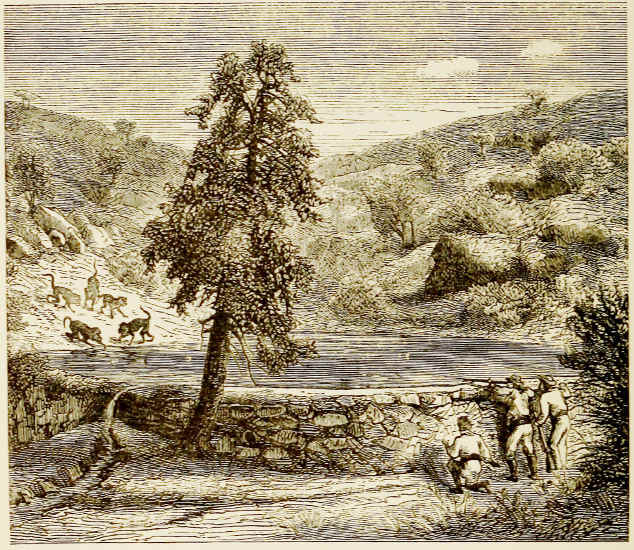
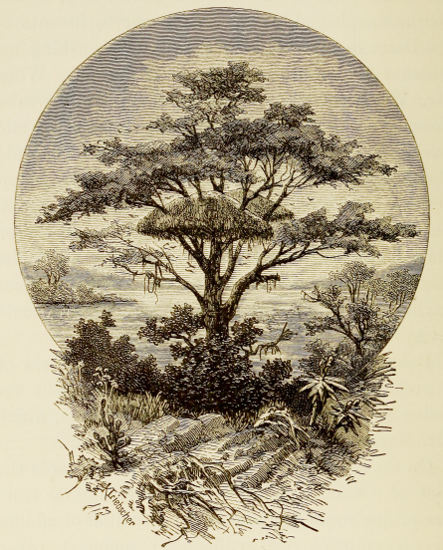
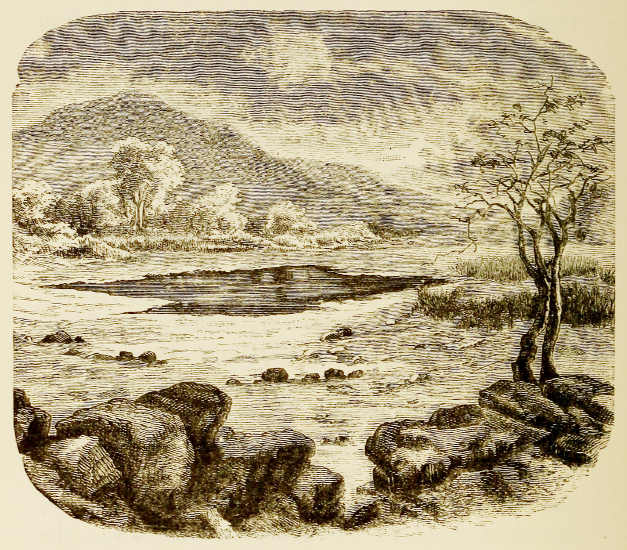
On the 18th we passed a shallow saltpan, nearly elliptical in shape,
about two feet deep, and some hundred yards in its greater length; it
contained a very salt, milky-looking fluid. When the weather is dry,
fresh water is only to be found in some pools in the rocks at the
northern end. The lake lay still and silent in a slight depression in
the forest, surrounded by a broad band of bright green sward; neither
rushes nor water-lilies rose above its surface, but its shores, sloping
gently down, were covered by trees and bushwood, in some parts so
impenetrable that only the fleet little duykerbock would have a chance
of making its way between the stems; in other places low acacia bushes
sprouted up below the underwood from a single stock; flowers were
abundant everywhere, and the whole scene was like a dead sea set in the
midst of a fragrant and richly-wooded tract of land.
As a mark of esteem for the magnanimous king of the Bamangwatos, I
gave this lake the name of Khame’s Salt-pan. On the shore I found
fragments of greenstone and chalcedony, and further back, amongst the
thorn-bushes, quartzite and limestone. There were numerous vestiges of
the smaller gazelles, gnus, zebras, and giraffes, all of which, find
rich pasturage on the plains extending east and west of the Limpopo.
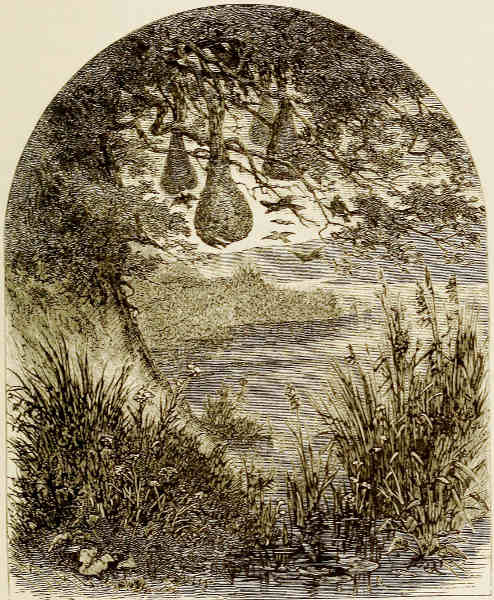
KHAME’S SALT-PAN.
Amongst the trees I was particularly struck by one, the wood of
which I afterwards learned was of great value; this was a mimosa,
known amongst the Boers as the “Knopi-dorn;” it often grows straight
up to the height of fifty feet, without a single bifurcation; its
yellowish-grey bark is covered by excrescences sometimes two inches
long, with sharp, hooked thorns at their ends. The timber is in use for
building purposes, but it is considered a material especially adapted
for making waggons.
In the afternoon we passed some salt-pools, in which I was surprised
to find some half-starved fish. The fish themselves were not of any
uncommon kind; to me the perplexing thing was how they could have made
their way to so great a height above the table-land, and the only
explanation I could give was that they had been carried thither by
birds.
Evening overtook us in the valley of the upper Sirorume, just at
the spot where the stream makes its way over interesting shelves of
sandstone, thence to turn south, and then south-south-east to join the
Limpopo.
While proceeding through the sandy forest in the inner bend of the
Sirorume, we noticed from the waggon an appearance in the ground as
though the long grass had been flattened by a heavy roller six or seven
feet wide. It proved to be an elephant-track, and two Bamangwatos on
their way to the Transvaal informed us that it was made by a herd of
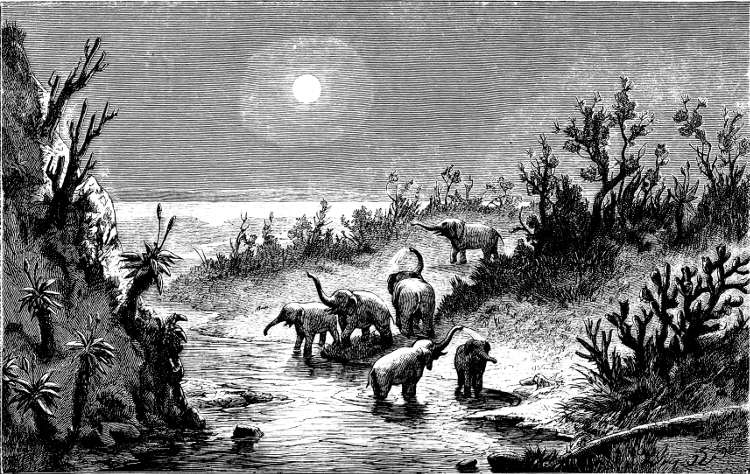
the great small-tusked elephants that were known to be wandering about
the boundaries of Sekhomo’s and Sechele’s territory. I entertained no
doubt that it was the same herd of which I had heard before, and which
continued to haunt the same region for two years afterwards, when it
was destroyed by the Damara emigrants.
At no great distance ahead of us the river-valley made a turn, above
which, westwards and southwards as far as the eye could reach,
stretched a dense underwood. Soon afterwards we descended for the
second time into the river-valley of the Sirorume, designated by the
English as the “brack reeds.” Here for miles both ways the river-bed
is flat, and forms a sort of fen overgrown with rushes. I crossed this
no less than three times, on each occasion finding it very prolific
in puff-adders. Our search for drinking-water proved unavailing, and
as our stock of meal was rapidly diminishing, we felt the necessity
of hurrying on as quickly as possible; but on the 21st we came on the
top of the table-land upon one of those unexpected rain-pools, which I
described in my account of my first journey.
Three days before, I had shot two specimens of the puff-adder
(Vipera arietans), each over three feet long, and as thick as
my arm; they had heart-shaped heads, and two very long and crooked
fangs. The scaly skin of this snake varies in colour from yellow to
dark brown, consisting of alternate light and dark bands. It is to
be met with almost everywhere between the sea and the Zambesi, but
is far more abundant in some districts than in others; especially
frequenting places overgrown by thorns, as less liable to be visited
by snake-eagles. Most of the specimens I saw were lying dormant on the
margins of thickets, or on the edges of pathways, coiled round and
round, and flat as a platter; their sluggishness is quite remarkable,
and I noticed more than one in pools of water from which they could
never escape. So sharply are the fangs bent backward, that the
puff-adder does not inflict a wound in the same way as the ordinary
species; it has to turn the front part of its body quite back, lower
its head, and in this position to fling itself at its victim; this it
is capable of doing from a distance of several feet, and I have been a
witness of this mode of attack both in Cape Colony and in Natal.
There is another peculiarity about this kind of adder which has been
noticed particularly in the western parts of Cape Colony. When any
one comes across one of them, his attention is very often attracted
to it in the first instance by the singular noise it makes between
hissing and spitting; and on looking at the creature more closely, he
occasionally finds its body all perforated, and a number of little
snakes issuing from the orifices; it has hence been concluded that
the brood of the puff-adder thus eats its way into the world. For
my own part, I do not concur with this theory, and I would offer an
explanation of the phenomenon, in which I am supported by the testimony
of an eye-witness. I believe that of all the South African snakes, none
more than this is distinguished by devotion to its young; and whenever
danger approaches, I think it inflates itself, and in its agitation
rushes upon its foe with expanded jaws, and, whether designedly or not
I do not say, swallows some portion of its teeming brood. These are
prevented by another inflation of the mother’s jaws from escaping where
they had entered, and so force for themselves an exit where they can.
After descending the Puff-adder heights on the lower Sirorume, we
entered the valley of the Limpopo, known also as the Crocodile River;
the hilly district on the left shore terminated in a woody table-land
to the west, the right shore being quite flat, and enclosed by
prairie-like plains. The river-bed was sandy, and varied from thirty to
ninety feet in width; the bank was steep, and covered with impenetrable
bush or long grass. On the shore I found frequent traces of crocodiles,
and a few of hippopotamuses; in the more open and clayey parts I also
noticed the tracks of lions and leopards. In the adjacent places we
observed indications of the existence of koodoos, pallahs, waterbocks,
bushbocks, hartebeests, gnus, giraffes, and zebras.
On the 22nd we reached the mouth of the Notuany, a river that rises
in the Transvaal, in the western Marico district; it flows only after
very heavy rain, and even then not over the whole of its course, which
is 150 miles long; it is deep, and lies, as it were, in a trench;
ever and again pools occur along its shores, which always contain
fish, and sometimes crocodiles. From the west, the Notuany takes up a
considerable number of sand-rivers. The stream was now flowing, and as
its mouth was much blocked up by reeds, we felt pretty sure that no
crocodiles would have made their way overland to the water, and so we
ventured to enjoy a bath at the ford, which was moderately deep.
On the southern side of the river-mouth we found one of the
“dornveldts” common in the Limpopo valley, a wide tract of rich soil,
densely overgrown with bushes of the Acacia horrida, six feet
in height. These are districts which might well rejoice the heart of a
European landowner; but for years to come no doubt they are destined to
lie fallow.
For two days I remained on the banks of the Notuany, finding both in
the animals and plants most interesting material for study. I shot a
grey-horned owl and a carrion kite.
Just as we were approaching the mouth of the Marico, while we were
crossing one of the numerous rain-channels that make their way down,
our axle broke, but we managed to make it hold together till we reached
a farm at no great distance.
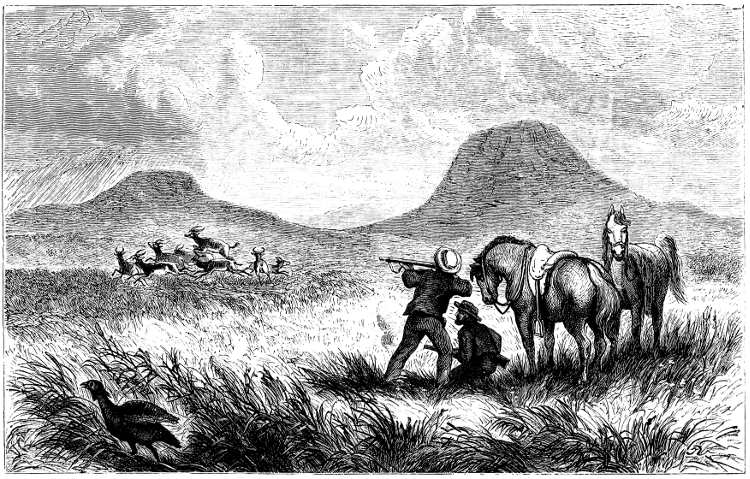
I had the good fortune next day to meet with two herds of pallahs.
These creatures appear to range over the whole country, thence to
Central Africa, and hereabouts take the place of the blessbocks of the
southern grass plains.
Our progress began now to be very considerably retarded by the rains;
for some weeks it had been as wet as it was in Shoshong, so that we
had to go through a succession of marshes for nearly half the distance
along the Limpopo and Marico valley, being perpetually unable to find a
dry spot for our encampment at night.
During the morning march of the 26th, our attention was arrested by
a brilliant scene. On the left bank of the Marico, spreading out over
the best half of a large meadow, was a carpet of fiery red, set in a
frame of verdant sward, and enclosed with the dark green foliage of
the mimosa. This spectacle of beauty was caused by masses of flowering
aloes, which sent forth their gorgeous spikes of blossom some three or
four feet above the cluster of prickly leaves. Where the aloes were
thickest, I noticed that they were not unfrequently overhung by a
beautiful sulphur-coloured creeper.
An attack of illness on the 28th made me discontinue our march.
Whether it was the result of my continuous exertions, or the effect
of the miasma of the district, or whether I had taken a chill from
the dampness of the places in which we had camped, I cannot tell,
but certain it was that I found myself quite unable to move, and had
to be lifted out of the waggon; a violent sickness came on, my head
became as heavy as lead, and I was quite incapable of answering the
numerous questions which my friends in their anxiety kept putting to
me. My senses soon quitted me altogether, and for two hours I lay in a
condition of delirium, from which I was only roused by being vigorously
bathed with cold water. Boly sobbed aloud in his distress. F. ran
hither and thither like a madman, and Eberwald showed me such sympathy
and unremitting attention as endeared him to me more than ever.
Recovering my consciousness, I resolved to bleed myself. I was quite
satisfied that no gentler measure could relieve the extreme pressure of
blood on the head. The operation was quite successful, and immediate
relief followed. Nature did the rest, and in three days’ time I had so
far recovered, that we were able to proceed on our way.
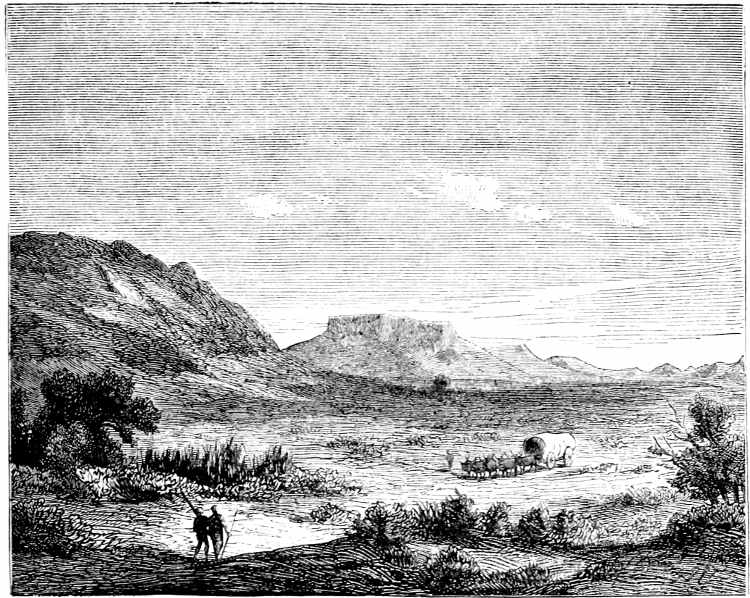
Leaving the actual valley of the Marico on the 3rd of March, we crossed
the saddle, and entered a valley intersected by the Bechuana-spruit,
and enclosed on the southern side by the interesting Bertha heights. On
their south-western spurs lies Chwhene-Chwene, the town belonging to
the Batlokas, under Matlapin, their chief; it is situated in Sechele’s
territory, which extends from the mouth of the Sirorume to the Dwars
mountains. In the underwood in the hollow I found some morula-trees
bearing ripe fruit.
As soon as we could on the following day we made our way towards the
town, which was tolerably clean, the farmsteads and huts being larger
and more commodious than those of most Bechuanas; in some cases they
were surrounded by gardens. The fields were sown, but only partially,
with corn, maize, and Kaffir sugar-cane. Just outside the town I
came to a halt, because some of the Batlokas told me that there were
merry-makings going on within, and the Morena was tipsy.
Descending the slope from the table-land, we found several deep holes
in the hard grey limestone containing cool spring water. The view from
the springs was very striking. The thinly-wooded valley in front of us
was several miles in width, and stretched away eastwards to the Marico.
It was bounded on the south by the countless summits of the chain of
the Dwars hills. To the pass by which we crossed these heights, I gave
the name of “Schweinfurth’s Pass,” whilst the next one, further to the
west, I called “Rohlf’s Pass.” From the top of the hills we could see
the first of the farms on the plain; on reaching the bottom, we met a
Boer migrating into the Damara country.
It was satisfactory, on arriving at Brackfontein Farm, to find that
its owner was a smith, and able to repair our broken waggon. His two
sons asked me to join them on a hunting excursion, but I did not feel
myself sufficiently convalescent to accept their invitation, although
the abundance of game in the locality made it very enticing. In the
densely-wooded parts of the Dwars mountains there were gazelles and
koodoo-antelopes, and in the more open parts at the base, and on the
eastern and southern grass-plains were both kinds of gnus, zebras, and
springbocks; other antelopes and ostriches were likewise occasionally
to be seen.
When I left Brackfontein on the 12th, I turned to the south, crossing
the Bushveldt, in order to reach Linokana, the native town in the
Marico highlands.
Without entering into a minute description of the Bushveldt, I may here
simply mention that it is a wooded hill-country, consisting of low
ridges, sandy eminences, and isolated peaks, the soil being covered
with rich grass.
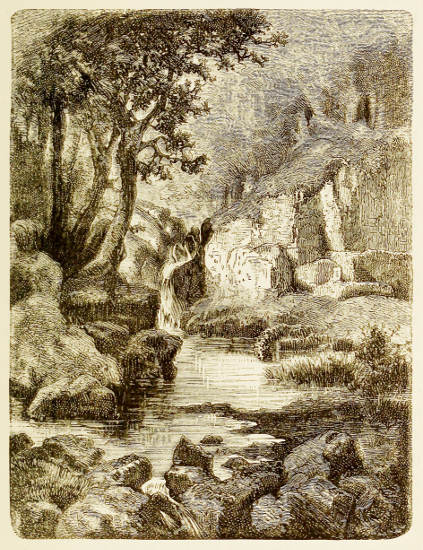
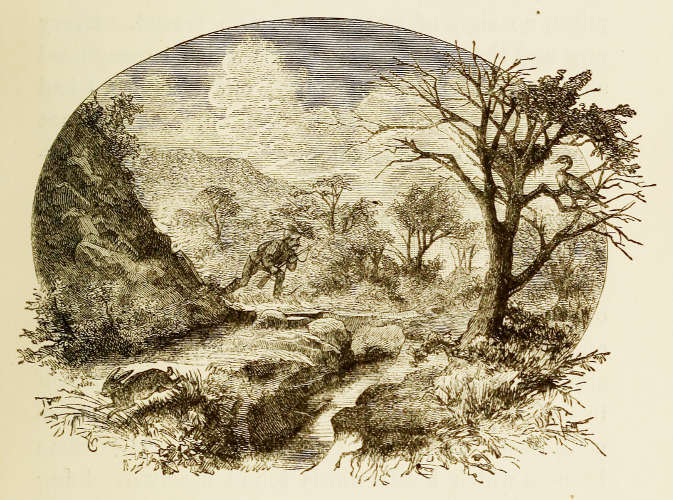
BUISPORT, ROCKY CLEFT IN THE BUSHVELDT.
I left the district by the Buisport or Buispass, passing the
Markfontein, Sandfontein, and Witfontein farms. Zwart, the owner of the
first of these, bought it for 300l.; it is of very considerable
size. Zwart had previously been an elephant-hunter, and had visited the
Damara country and the falls of the Zambesi before he settled down to
farming. At a hartebeest-hunt at Sandfontein we met with a Dutchman,
who sold goods on account of Mr. Taylor, the merchant at Sechele.
Although, he only stayed here for a few days in each month, we were
most hospitably entertained by him and his kind old mother.
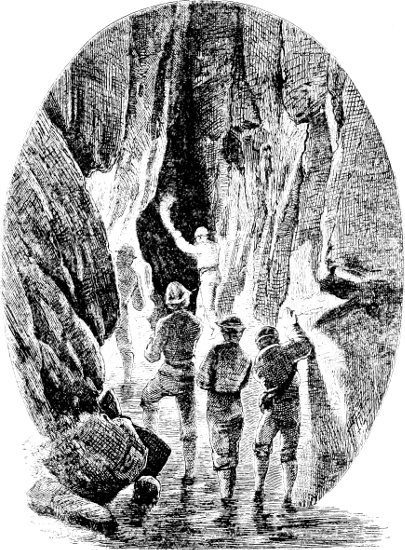
The Buisport, through which we passed the next morning, is one of the
most charming spots in the Marico highlands; it is traversed by a
spruit, that retains water all through the year in the deep hollows of
its rocky beds. We crossed the spruit several times; the travelling
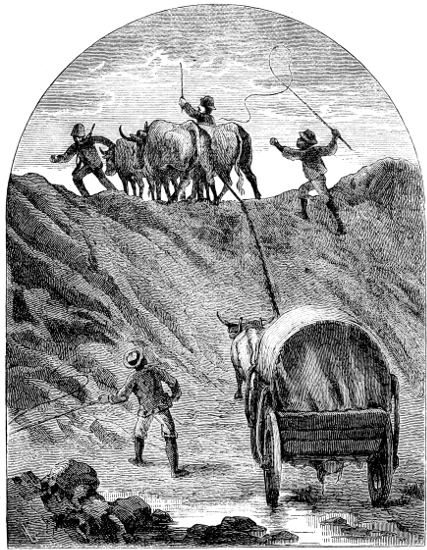
was very rough, and we had to proceed with the greatest caution, but
all our trouble was amply repaid by the enjoyment of the picturesque
scenery of the glen. Enclosed on every hand by the most diversified
rocks, sometimes wooded, sometimes perpendicular, and sometimes running
in terraces, it presents a prospect singularly attractive.
It likewise offers no little interest to the student of natural
history. Bushbocks, pallahs, klippspringers, apes and baboons, and
some smaller animals of the feline race are amongst the most common
mammals, while leopards, lynxes, and koodoos are by no means rare. The
variety of birds, snakes, insects, and plants is most remarkable. With
the exception of the two kinds of bustard, I found nearly all the birds
that I have hitherto mentioned, and besides these, I saw some quails,
two new species of thrushes, a wryneck and two rollers.
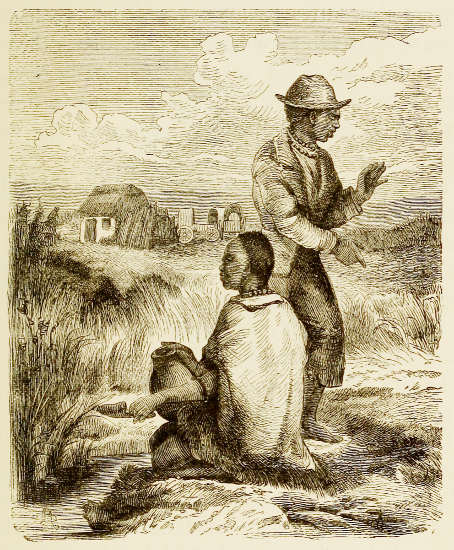
BAHARUTSE DRAWING WATER.
The plateau upon which we entered at the farther end of the pass
was splendid meadow-land, cultivated in many places. On the east and
west it sloped towards the foot of the Notuany and Zeerust heights. We
followed these hills for some distance in a south-westerly direction,
until we came to the valley of the upper Notuany, that was only
divided by one ridge from the Matebe valley just in front of us, being
cultivated over about half its area. This was a token of the proximity
of Linokana, a Baharutse town, of the agriculture of which I had
already heard very glowing reports.
At the distance of only a few miles from its source the Notuany was
flowing in a deep entrenched bed, across which a few trunks of trees
had been thrown, forming a primitive bridge, over which we had no
alternative but to take our waggon. Once through the valley, we were
at the Linokana hollow, in the centre of which, and extending up its
northern and eastern sides, lay the town of the same name.
The reeds in the Matebe teemed with animal life. Morning and evening
were the best opportunities of watching their movements, but at those
times we could see the grey wild cat creeping stealthily after snipes
and long-tailed cape-finches; the water-lizard lying craftily in wait
for its prey; or occasionally the caracal driven by hunger from its
rocky lair to seek a meal in the security of the reeds of the river-bed.
In the eastern portion of the valley, our attention was directed to a
group of trees near some well-cultivated fields, conspicuous among them
being some eucalyptus, two feet in diameter, and certainly not much
less than sixty feet high. Beneath their shade stood several houses
built in European style. These were the quarters of a missionary, whose
instruction and example have had such a beneficial influence upon the
Baharutse, that they have become the most thriving agriculturists of
all the Transvaal Bechuanas. The name of this missionary is Thomas
Jensen, and he is a representative of the Hermannsburg Society. He
received us most kindly, and introduced me to Moilo (or Moiloa) the
chief, as well as to Chukuru and other chiefs who resided on the hills.
Moilo was a tall, grey-headed man, with hard features, but of a kindly
disposition; he was a faithful vassal of the Transvaal Republic,
considerate for his followers, and in many respects superior to most of
the neighbouring rulers. He introduced me to his sons, none of whom,
however, he considered competent to succeed him as chief; the son of a
relative living in Moshaneng, a scion of the old Bechuana royal family,
being, with his sanction, universally regarded as the rightful heir.
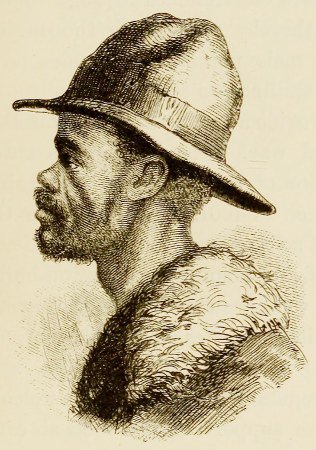
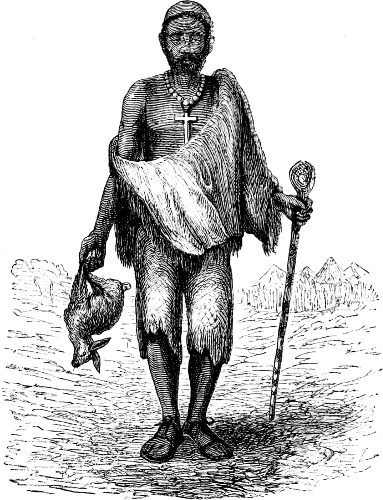
CHUKURU, CHIEF OF THE BAHARUTSE.
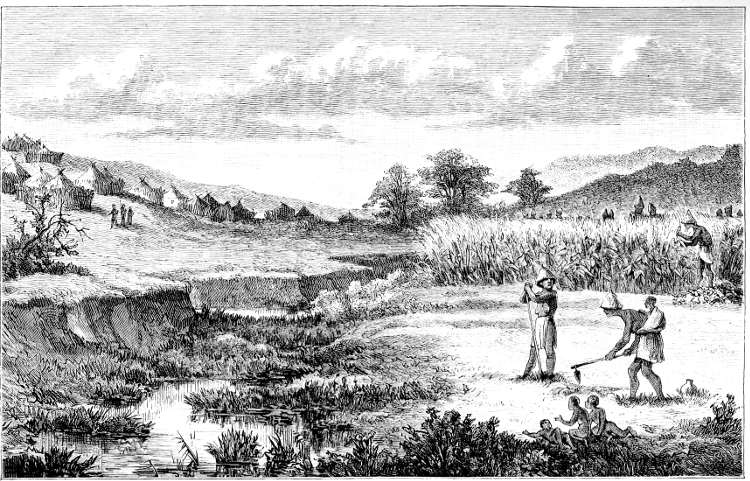
Each of the larger farms in the town possessed a plough, and waggons
could be seen in considerable numbers, standing amidst the cone-shaped
huts. Following Mr. Jensen’s advice, the people have turned the Matebe
springs to good account; not only have they conducted the water into
the town so as to ensure a good supply for domestic purposes, but they
have cut trenches through their fields and orchards, thereby securing
a thorough irrigation. The adult male population, besides paying a
poll-tax of ten shillings to the Transvaal, pledged themselves to
provide a certain number of beasts of burden in times of war. Mr.
Jensen was entrusted with the collection of the tax, but, although he
handed over as much as 400l. annually to the Government, he
received no remuneration whatever for his trouble.
In the fields round the mission-building maize and wheat were growing,
and in the gardens adjacent to the dwelling peaches, apricots, pears,
figs, oranges, and citrons were thriving admirably, and, together with
the vegetables, contributed a welcome addition towards the support of
the modest establishment. The little flower-garden revived pleasant
recollections by the abundance of old favourites it contained; there
were roses, both as standards and climbers, irises, lilacs with their
graceful bloom, and carnations with their pleasant fragrance; tulips
and hyacinths had been in bloom, but had now gone off.
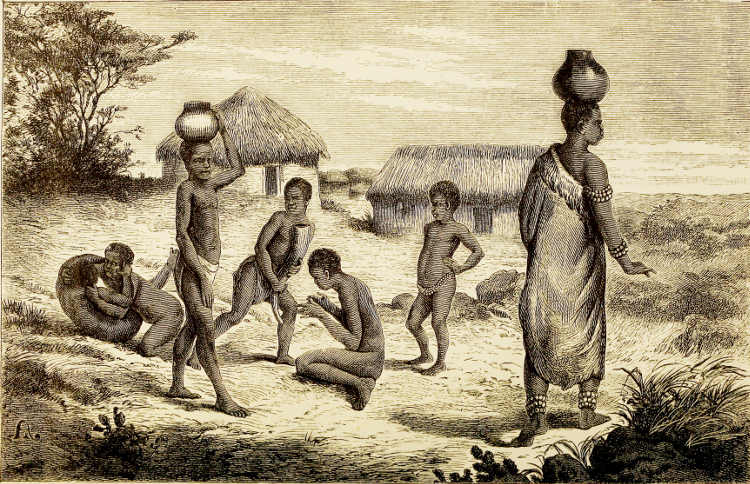
BAHARUTSE VILLAGE.
Page 419.
The family life of the missionary beneath the blue-gum trees on the
Matebe was quite idyllic in its peacefulness; nothing could surpass the
excellence of the pattern which it set to the dusky population which
surrounded it. My own pleasure for the time, however, was seriously
damped by the intelligence which Mr. Jensen said he had received from
Zanzibar on good authority, that Livingstone had fallen a victim to
dysentery by the Bangweolo Lake. At the same time he told me that the
companion of Livingstone’s first journey was still alive.
The Baharutse possess large herds of cattle, but the periodic
recurrence of lung-disease is so fatal, that they lose very large
numbers of them.[14]
Linokana (from li = the and nokana = a little river),
during the lifetime of Moilo, was called by his name in his honour. As
Karl Mauch has already observed, it is a place where a naturalist may
spend weeks with advantage. With the exception of mammalia, nearly all
kinds of animals abound. The heights (the eastern of which is called
the To, or Elephant hill, and the northern the Po, or Buffalo hill),
as well as the meadows and marshes on the Matebe, and the woods on the
Notuany, exhibit an immense variety of birds, amongst which birds of
prey, long-tailed finches, bee-catchers, green doves, and purple herons
especially predominate.
On the 16th we turned our backs upon the hospitable fields of
Moilo, proceeding southwards towards Zeerust. The next farm of any
considerable extent that we came to was that belonging to Martin Zwart,
whom we found engaged in distilling peach-brandy; he was the owner of
two farms here, and had purchased several others on the frontier, but
nevertheless he was by no means in flourishing circumstances; his love
of hunting had prevented him from ever steadily devoting himself to
farm life and, like many others, he had failed to get on. During the
twenty-one years in which he had been a hunter, he had killed as many
as 294 elephants.
Near the sources of the Notuany I took an excursion up the valley to
Oosthuisen’s farm. He resides in a lovely hollow, with several of his
relations. His property contains a certain quantity of copper ore,
which is collected by the natives, and, after being smelted, is made
into bracelets and other ornaments. He cultivated maize, wheat, and
tobacco, and spent a good deal of his time in tanning skins purchased
from hunters coming back from the interior. Returning by Zwart’s farm,
we proceeded for two hours, and reached Zeerust, the headquarters of
the local government for the Marico district. Though containing little
more than forty houses, the little town possessed a Dutch church,
surrounded by high walls, behind which, during the recent unsettled
state of things, the population sought refuge.
Zeerust is situated on the Little Marico, which wends its way
eastwards through the hills to join the Great Marico. Nearly the whole
of the district is highland, traversed by a multitude of brooks, and
broken by some exceedingly fertile valleys; in comparison with the
rest of the Transvaal, it may be said to be fairly cultivated; a part
of it is covered with mimosas and various kinds of underwood; good
pasturage for cows and horses may be seen almost everywhere. The farms
lie close together, but although garden produce appeared to occupy a
certain amount of attention, it was only in a few instances that we saw
anything like abundance, the farmers, being, as I have said, addicted
to elephant-hunting, and giving all their profits to that expensive
amusement. The prohibition of hunting decreed by the Bechuana chiefs
may probably compel these enthusiasts to stay at home, and by inducing
them to mind their farms, may tend to bring about a more prosperous
condition of the district.
Quitting Zeerust on the 19th, we made our way up the valley of the
Little Marico. After passing several farms in the main valley and
side valleys, and on the slopes, bearing the names of Quarifontein,
Quaggafontein, Kaffirkraal, and Denkfontein, we emerged on to the
Hooge-Veldt (high field), which is one of the most extensive grass
plains on the South African plateau. The Zwart Ruggens (black ridges)
were visible on the east. The plain abounds with game, and forms
the eastern portion of the high land between the Molapo and the
Harts River, where both of them, as well as the Marico and many of
their affluents, take their rise; its subsoil consists of the grey
limestone which I have so frequently mentioned. We only passed two
farms hereabouts, Pitfontein and Witfontein, and these lay in small
depressions that seemed to lead down to the Harts River.
On the 22nd we commenced a gradual descent, and entered the valley
of the Makokspruit, in which the Makokskraal is situated. In this
valley was a farm, the owner of which was a relative of a man whom I
had attended in the diamond-fields. Although they were very poor, the
people were very anxious to treat us hospitably. Next day we came to
the valley of the upper Schoenspruit; the stream was flowing freely,
and all along its shores farm followed farm in close succession.
Between the Schoenspruit and Potchefstroom we had to cross several low
ridges, the south-western spurs of the Hooge Veldt lying parallel to
the Mooi and to the affluents of the Schoen.
I discovered an interesting rocky pass on the first ridge on the way to
Potchefstroom, with walls of quartzite nearly semicircular, and rising
almost perpendicularly. The farm shut in by them was called Klip-port;
another, a little further on, was called Klipfontein, the quartzite
veins in the ferruginous slate being here also quite apparent.
Arrived at Potchefstroom, I carried out my intention of selling two
of my bullocks, as I had come to the end of my resources. Here, too, I
said goodbye to my three companions, two of whom, Eberwald and Boly,
went off to the Lydenburg gold-diggings, trusting to be rewarded with
better fortune than they had found in the diamond-fields.
I travelled thirty-four miles the next day, meeting on my route a large
number of waggons containing emigrants, merchants, and canteen-keepers,
all on their way to Lydenburg, their thirst for gold being now as
ardent as once it had been for diamonds. I halted at Klerksdorp only
till evening, when I hurried on to the Estherspruit. On the 1st of
April I forded the Bamboespruit, and after crossing the Vaal, seventeen
miles below Christiana, at Blignaut’s Pont, I arrived in Dutoitspan on
the 7th.
Of all my curiosities, of which I brought back forty cases closely
packed, I considered my ethnographical specimens, 400 in number, the
most valuable; but in addition to these I had a great collection of
insects, horns, plants, reptiles, skins of quadrupeds and birds,
minerals, skeletons, spiders, crustaceans, mollusks, and fossils.
Although I had succeeded somewhat better than during my former journey
in making a cartographical survey of the route, many obstacles with
which the reader has been made acquainted in the previous pages,
prevented me from making a map as complete as I desired.
My pecuniary position was now very much what it had been on my first
appearance in Dutoitspan; to say the truth, it was rather worse,
for immediately on my arrival, an attorney called upon me to fulfil
my obligations with respect to the bond into which I had entered on
behalf of the young man who absconded; and very shortly afterwards I
was obliged to pay off the 117l. which had been advanced to me
before starting. My necessities compelled me forthwith to dispose of
the greater portion of my skins and ostrich feathers, and I had to
part with my waggon and team for whatever prices they would fetch. For
a time my difficulties seemed to increase, as it was at least a month
before I could work up anything like a remunerative practice.
I took the smallest of houses, consisting only of a single room, in one
of the side streets: it was built of clay, and had a galvanized iron
roof; there was a shed of the same materials close to its side; and the
whole stood in a little yard containing a well, two sides of which were
blocked up by a stable. For this accommodation I had to pay a rent of
5l. a month.
By June, however, I had succeeded in working up so much practice that
I was obliged to keep a saddle-horse, and very shortly had to procure
a chaise and a couple of ponies in addition. The winter of 1874 was
a bad time in the central diggings; the measles broke out, and for
several weeks I had to pay as many as forty visits a day; and, when the
sickness was at its height, the average number was fifty-two.
From the very commencement of the increase in my business, I set about
the preparations for my third and most important journey. I purchased
a new waggon, and gradually got together a team of ten picked oxen.
Offers to accompany me were freely volunteered on all sides, but my
experience made me aware that I could not be too particular in the
choice of my associates. I had a half-caste Cape-servant, Jan Van
Stahl, who soon proved a great comfort to me; he could not only write
both Dutch and English, but very quickly fell into the way of helping
me in my preparation of medicines; he was, moreover, a very excellent
accountant. I made the acquaintance, too, of a young man engaged as
a clerk in one of the stores, who was manifestly superior both in
education and manners to the generality of his order; and having
thoroughly satisfied myself as to the integrity of his character, I
made him the offer of accompanying me. His employers were at that time
relinquishing their business, and he came and resided with me. His name
was Theunissen. He became a good friend, and remained with me more than
a year, until we reached the Zambesi, where he quitted me on account of
his fear of fever.
It was a disappointment to me that Van Stahl’s dread of lions prevented
his going with me; but Pit Dreyer, the shepherd, decided to accompany
me in his place.
Previous to this time, and throughout my stay, the general state of
things in the diggings had been undergoing very considerable change.
More than a quarter of the white population had left, returning
either to the colony, to their homes in the Orange Free State, or to
Europe, except that many of them had migrated to the gold-diggings in
the Transvaal. Much greater care, too, was being bestowed upon the
buildings, iron and wooden, that were being put up in Kimberley.
A great many of the people, moreover, were expressing themselves
dissatisfied with the Governor in a way that led to an open revolt very
soon after my departure.
Since 1872 the diamonds themselves had depreciated in value, although
the “claims” had grown into higher demand, as they were worked with
larger capital and improved machinery.
In November I took a fortnight’s holiday, in anticipation of my
prolonged absence. I went to the Vaal, and pitched my camp at the
mouth of the Harts River, where the time sped rapidly away in
hunting-excursions, and in seeking new materials for my scientific
collection.
END OF VOL. I.
LONDON:
GILBERT AND RIVINGTON, PRINTERS,
ST. JOHN’S SQUARE.
A Catalogue of American and Foreign Books Published or
Imported by Messrs. Sampson Low & Co. can
be had on application.
Crown Buildings, 188, Fleet Street, London,
January, 1881.
A Selection from the List of Books
PUBLISHED BY
SAMPSON LOW, MARSTON, SEARLE, & RIVINGTON.
ALPHABETICAL LIST.
A Classified Educational Catalogue of Works published in Great
Britain. Demy 8vo, cloth extra. Second Edition, revised and corrected
to Christmas, 1879, 5s.
About Some Fellows. By an Eton Boy, Author of “A Day of
my Life.” Cloth limp, square 16mo, 2s. 6d.
Adventures of Captain Mago. A Phœnician’s Explorations 1000
years B.C. By Leon Cahun. Numerous Illustrations.
Crown 8vo, cloth extra, gilt edges, 7s. 6d.; plainer
binding, 5s.
Adventures of a Young Naturalist. By Lucien Biart, with
117 beautiful Illustrations on Wood. Edited and adapted by Parker
Gillmore. Post 8vo, cloth extra, gilt edges, New Edition,
7s. 6d.
Afghan Knife (The). A Novel. By Robert Armitage
Sterndale, Author of “Sconce.” Small post 8vo, cloth extra,
6s.
After Sundown; or, The Palette and the Pen. By W. W.
Fenn, Author of “Blind-Man’s Holiday,” &c. With Portrait of
Author. 2 vols., crown 8vo, cloth extra, 24s.
Albania: A Narrative of Recent Travel. By E. F. Knight.
With some very good Illustrations specially made for the work. Crown
8vo, cloth extra, 12s. 6d.
Alcott (Louisa M.) Jimmy’s Cruise in the “Pinafore.” With 9
Illustrations. Second Edition. Small post 8vo, cloth gilt, 3s.
6d.
—— Aunt Jo’s Scrap-Bag. Square 16mo, 2s. 6d.
(Rose Library, 1s.)
—— Little Men: Life at Plumfield with Jo’s Boys. Small post
8vo, cloth, gilt edges, 3s. 6d. (Rose Library, Double
vol. 2s.)
—— Little Women. 1 vol., cloth, gilt edges, 3s.
6d. (Rose Library, 2 vols., 1s. each.)
—— Old-Fashioned Girl. Best Edition, small post 8vo, cloth
extra, gilt edges, 3s. 6d. (Rose Library, 2s.)
—— Work and Beginning Again. A Story of Experience. 1 vol.,
small post 8vo, cloth extra, 6s. Several Illustrations. (Rose
Library, 2 vols., 1s. each.)
—— Shawl Straps. Small post 8vo, cloth extra, gilt, 3s.
6d.
—— Eight Cousins; or, the Aunt Hill. Small post 8vo, with
Illustrations, 3s. 6d.
—— The Rose in Bloom. Small post 8vo, cloth extra, 3s.
6d.
—— Silver Pitchers. Small post 8vo, cloth extra, 3s.
6d.
—— Under the Lilacs. Small post 8vo, cloth extra, 5s.
—— Jack and Jill. Small post 8vo, cloth extra, 5s.
“Miss Alcott’s stories are thoroughly healthy, full of racy fun
and humour ... exceedingly entertaining.... We can recommend the
‘Eight Cousins.’”—Athenæum.
Alpine Ascents and Adventures; or, Rock and Snow Sketches. By
H. Schütz Wilson, of the Alpine Club. With Illustrations by
Whymper and Marcus Stone. Crown 8vo, 10s.
6d. 2nd Edition.
Andersen (Hans Christian) Fairy Tales. With Illustrations in
Colours by E. V. B. Royal 4to, cloth, 25s.
Architecture (The Twenty Styles of). By Dr. W. Wood,
Author of “The Hundred Greatest Men.” Imperial 8vo, with 52 Plates.
Art Education. See “Illustrated Text Books.”
Autobiography of Sir G. Gilbert Scott, R.A., F.S.A., &c.
Edited by his Son, G. Gilbert Scott. With an Introduction by
the Dean of Chichester, and a Funeral Sermon, preached in
Westminster Abbey, by the Dean of Westminster. Also, Portrait
on steel from the portrait of the Author by G. Richmond, R.A.
1 vol., demy 8vo, cloth extra, 18s.
THE BAYARD SERIES,
Edited by the late J. Hain Friswell.
Comprising Pleasure Books of Literature produced in the Choicest Style
as Companionable Volumes at Home and Abroad.
“We can hardly imagine better books for boys to read or for men
to ponder over.”—Times.
Price 2s. 6d. each Volume, complete in itself, flexible cloth
extra, gilt edges, with silk Headbands and Registers.
The Story of the Chevalier Bayard. By M. De Berville.
De Joinville’s St. Louis, King of France.
The Essays of Abraham Cowley, including all his Prose Works.
Abdallah; or, The Four Leaves. By Edouard Laboullaye.
Table-Talk and Opinions of Napoleon Buonaparte.
Vathek: An Oriental Romance. By William Beckford.
The King and the Commons. A Selection of Cavalier and Puritan Songs.
Edited by Professor Morley.
Words of Wellington: Maxims and Opinions of the Great Duke.
Dr. Johnson’s Rasselas, Prince of Abyssinia. With Notes.
Hazlitt’s Round Table. With Biographical Introduction.
The Religio Medici, Hydriotaphia, and the Letter to a Friend. By Sir
Thomas Browne, Knt.
Ballad Poetry of the Affections. By Robert Buchanan.
Coleridge’s Christabel, and other Imaginative Poems. With Preface by
Algernon C. Swinburne.
Lord Chesterfield’s Letters, Sentences, and Maxims. With Introduction
by the Editor, and Essay on Chesterfield by M. de Ste.-Beuve, of the
French Academy.
Essays in Mosaic. By Thos. Ballantyne.
My Uncle Toby; his Story and his Friends. Edited by P. Fitzgerald.
Reflections; or, Moral Sentences and Maxims of the Duke de la
Rochefoucald.
Socrates: Memoirs for English Readers from Xenophon’s Memorabilia. By
Edw. Levien.
Prince Albert’s Golden Precepts.
A Case containing 12 Volumes, price 31s. 6d.; or the Case
separately, price 3s. 6d.
Beauty and the Beast. An Old Tale retold, with Pictures by E. V.
B. 4to, cloth extra. 10 Illustrations in Colours. 12s. 6d.
Begum’s Fortune (The): A New Story. By Jules Verne.
Translated by W. H. G. Kingston. Numerous Illustrations. Crown
8vo, cloth, gilt edges, 7s. 6d.; plainer binding, plain
edges, 5s.
Ben Hur: A Tale of the Christ. By L. Wallace. Crown
8vo, 6s.
Beumers’ German Copybooks. In six gradations at 4d. each.
Biart (Lucien). See “Adventures of a Young Naturalist,” “My
Rambles in the New World,” “The Two Friends,” “Involuntary Voyage.”
Bickersteth’s Hymnal Companion to Book of Common Prayer may
be had in various styles and bindings from 1d. to 21s.
Price List and Prospectus will be forwarded on application.
Bickersteth (Rev. E. H., M.A.) The Reef, and other
Parables. 1 vol., square 8vo, with numerous very beautiful
Engravings, 2s. 6d.
—— The Clergyman in his Home. Small post 8vo, 1s.
—— The Master’s Home-Call; or, Brief Memorials of Alice
Frances Bickersteth. 20th Thousand. 32mo, cloth gilt, 1s.
—— The Master’s Will. A Funeral Sermon preached on the Death
of Mrs. S. Gurney Buxton. Sewn, 6d.; cloth gilt, 1s.
Bickersteth (Rev. E. H., M.A.) The Shadow of the Rock. A
Selection of Religious Poetry. 18mo, cloth extra, 2s. 6d.
—— The Shadowed Home and the Light Beyond. 7th Edition, crown
8vo, cloth extra, 5s.
Biographies of the Great Artists (Illustrated). Each of the
following Volumes is illustrated with from twelve to twenty full-page
Engravings, printed in the best manner, and bound in ornamental cloth
cover, 3s. 6d. Library Edition, bound in a superior
style, and handsomely ornamented, with gilt top; six Volumes, enclosed
in a cloth case, with lid, £1 11s. 6d. each case.
- Hogarth.
- Turner.
- Rubens.
- Holbein.
- Tintoretto.
- Little Masters of Germany.
- Fra Angelico and Masaccio.
- Fra Bartolommeo.
- Giotto.
- Raphael.
- Van Dyck and Hals.
- Titian.
- Rembrandt.
- Leonardo da Vinci.
- Gainsborough and Constable.
- Sir David Wilkie.
- Van Eyck.
- Figure Painters of Holland.
- Michel Angelo.
- Delaroche and Vernet.
- Landseer.
- Reynolds.
“Few things in the way of small books upon great subjects,
avowedly cheap and necessarily brief, have been hitherto
so well done as these biographies of the Great Masters in
painting.”—Times.
“A deserving series.”—Edinburgh Review.
“Most thoroughly and tastefully edited.”—Spectator.
Black (Wm.) Three Feathers. Small post 8vo, cloth extra,
6s.
—— Lady Silverdale’s Sweetheart, and other Stories, 1 vol.,
small post 8vo, 6s.
—— Kilmeny: a Novel. Small post 8vo, cloth, 6s.
—— In Silk Attire. 3rd Edition, small post 8vo, 6s.
—— A Daughter of Heth. 11th Edition, small post 8vo, 6s.
—— Sunrise. 15 Monthly Parts, 1s. each.
Blackmore (R. D.) Lorna Doone. 10th Edition, cr. 8vo,
6s.
—— Alice Lorraine. 1 vol., small post 8vo, 6th Edition,
6s.
—— Clara Vaughan. Revised Edition, 6s.
—— Cradock Nowell. New Edition, 6s.
—— Cripps the Carrier. 3rd Edition, small post 8vo, 6s.
—— Mary Anerley. New Edition, 6s.
—— Erema; or, My Father’s Sin. With 12 Illustrations, small
post 8vo, 6s.
Blossoms from the King’s Garden: Sermons for Children. By the
Rev. C. Bosanquet. 2nd Edition, small post 8vo, cloth extra,
6s.
Blue Banner (The); or, The Adventures of a Mussulman, a
Christian, and a Pagan, in the time of the Crusades and Mongol
Conquest. Translated from the French of Leon Cahun. With
Seventy-six Wood Engravings. Imperial 16mo, cloth, gilt edges,
7s. 6d.; plainer binding, 5s.
Boy’s Froissart (The). 7s. 6d. See
“Froissart.”
Boy’s King Arthur (The). With very fine Illustrations. Square
crown 8vo, cloth extra, gilt edges, 7s. 6d. Edited by
Sidney Lanier, Editor of “The Boy’s Froissart.”
Brazil: the Amazons, and the Coast. By Herbert H.
Smith. With 115 Full-page and other Illustrations. Demy 8vo, 650
pp., 21s.
Brazil and the Brazilians. By J. C. Fletcher and D.
P. Kidder. 9th Edition, Illustrated, 8vo, 21s.
Breton Folk: An Artistic Tour in Brittany. By Henry
Blackburn, Author of “Artists and Arabs,” “Normandy Picturesque,”
&c. With 171 Illustrations by Randolph Caldecott. Imperial
8vo, cloth extra, gilt edges, 21s.
Bricks without Straw. By the Author of “A Fool’s Errand.” Crown
8vo, with numerous Illustrations, 7s. 6d.
British Goblins: Welsh Folk-Lore, Fairy Mythology, Legends, and
Traditions. By Wirt Sykes, United States Consul for Wales.
With Illustrations by J. H. Thomas. This account of the
Fairy Mythology and Folk-Lore of his Principality is, by permission,
dedicated to H.R.H. the Prince of Wales. Second Edition. 8vo,
18s.
Buckle (Henry Thomas) The Life and Writings of. By Alfred
Henry Huth. With Portrait. 2 vols., demy 8vo.
Burnaby (Capt.) See “On Horseback.”
Burnham Beeches (Heath, F. G.). With numerous Illustrations
and a Map. Crown 8vo, cloth, gilt edges, 3s. 6d. Second
Edition.
Butler (W. F.) The Great Lone Land; an Account of the Red River
Expedition, 1869–70. With Illustrations and Map. Fifth and Cheaper
Edition, crown 8vo, cloth extra, 7s. 6d.
—— The Wild North Land; the Story of a Winter Journey with
Dogs across Northern North America. Demy 8vo, cloth, with numerous
Woodcuts and a Map, 4th Edition, 18s. Cr. 8vo, 7s.
6d.
—— Akim-foo: the History of a Failure. Demy 8vo, cloth, 2nd
Edition, 16s. Also, in crown 8vo, 7s. 6d.
Cadogan (Lady A.) Illustrated Games of Patience. Twenty-four
Diagrams in Colours, with Descriptive Text. Foolscap 4to, cloth extra,
gilt edges, 3rd Edition, 12s. 6d.
Caldecott (R.). See “Breton Folk.”
Celebrated Travels and Travellers. See Verne.
Changed Cross (The), and other Religious Poems. 16mo, 2s.
6d.
Child of the Cavern (The); or, Strange Doings Underground.
By Jules Verne. Translated by W. H. G. Kingston.
Numerous Illustrations. Sq. cr. 8vo, gilt edges, 7s. 6d.;
cl., plain edges, 5s.
Child’s Play, with 16 Coloured Drawings by E. V. B. Printed on
thick paper, with tints, 7s. 6d.
—— New. By E. V. B. Similar to the above. See New.
—— A New and Cheap Edition of the two above, containing 48
Illustrations by E. V. B., printed in tint, handsomely bound,
3s. 6d.
Children’s Lives and How to Preserve Them; or, The Nursery
Handbook. By W. Lomas, M.D. Crown 8vo, cloth, 5s.
Choice Editions of Choice Books. 2s. 6d. each,
Illustrated by C. W. Cope, R.A., T. Creswick, R.A.,
E. Duncan, Birket Foster, J. C. Horsley,
A.R.A., G. Hicks, R. Redgrave, R.A., C.
Stonehouse, F. Tayler, G. Thomas, H. J.
Townshend, E. H. Wehnert, Harrison Weir, &c.
- Bloomfield’s Farmer’s Boy.
- Campbell’s Pleasures of Hope.
- Coleridge’s Ancient Mariner.
- Goldsmith’s Deserted Village.
- Goldsmith’s Vicar of Wakefield.
- Gray’s Elegy in a Churchyard.
- Keat’s Eve of St. Agnes.
- Milton’s L’Allegro.
- Poetry of Nature. Harrison Weir.
- Rogers’ (Sam.) Pleasures of Memory.
- Shakespeare’s Songs and Sonnets.
- Tennyson’s May Queen.
- Elizabethan Poets.
- Wordsworth’s Pastoral Poems.
“Such works are a glorious beatification for a poet.”—Athenæum.
Christ in Song. By Dr. Philip Schaff. A New Edition,
Revised, cloth, gilt edges, 6s.
Cobbett (William). A Biography. By Edward Smith. 2
vols., crown 8vo, 25s.
Confessions of a Frivolous Girl (The): A Novel of Fashionable
Life. Edited by Robert Grant. Crown 8vo, 6s.
Cradle-Land of Arts and Creeds; or, Nothing New under the Sun.
By Charles J. Stone, Barrister-at-law, and late Advocate, High
Courts, Bombay. 8vo, pp. 420, cloth, 14s.
Cripps the Carrier. 3rd Edition, 6s. See
Blackmore.
Cruise of H.M.S. “Challenger” (The). By W. J. J. Spry,
R.N. With Route Map and many Illustrations. 6th Edition, demy 8vo,
cloth, 18s. Cheap Edition, crown 8vo, some of the Illustrations,
7s. 6d.
Curious Adventures of a Field Cricket. By Dr. Ernest
Candèze. Translated by N. D’Anvers. With numerous fine
Illustrations. Crown 8vo, gilt, 7s. 6d.; plain binding
and edges, 5s.
Dana (R. H.) Two Years before the Mast and Twenty-Four years
After. Revised Edition, with Notes, 12mo, 6s.
Daughter (A) of Heth. By W. Black. Crown 8vo, 6s.
Day of My Life (A); or, Every Day Experiences at Eton. By an
Eton Boy, Author of “About Some Fellows.” 16mo, cloth extra,
2s. 6d. 6th Thousand.
Diane. By Mrs. Macquoid. Crown 8vo, 6s.
Dick Cheveley: his Fortunes and Misfortunes. By W. H. G.
Kingston. 350 pp., square 16mo, and 22 full-page Illustrations.
Cloth, gilt edges, 7s. 6d.; plainer binding, plain edges,
5s.
Dick Sands, the Boy Captain. By Jules Verne. With
nearly 100 Illustrations, cloth, gilt, 10s. 6d.; plain
binding and plain edges, 5s.
Dictionary (General) of Archæology and Antiquities. From the
French of E. Bosc. Crown 8vo, with nearly 200 Illustrations,
10s. 6d.
Dodge (Mrs. M.) Hans Brinker; or, the Silver Skates. An entirely
New Edition, with 59 Full-page and other Woodcuts. Square crown 8vo,
cloth extra, 5s.; Text only, paper, 1s.
Dogs of Assize. A Legal Sketch-Book in Black and White.
Containing 6 Drawings by Walter J. Allen. Folio, in wrapper,
6s. 8d.
Eight Cousins. See Alcott.
Eighteenth Century Studies. Essays by F. Hitchman. Demy
8vo, 18s.
Elementary Education in Saxony. By J. L. Bashford, M.A,
Trin. Coll., Camb. For Masters and Mistresses of Elementary Schools.
Sewn, 1s.
Elinor Dryden. By Mrs. Macquoid. Crown 8vo, 6s.
Embroidery (Handbook of). By L. Higgin. Edited by
Lady Marian Alford, and published by authority of the Royal
School of Art Needlework. With 16 page Illustrations, Designs for
Borders, &c. Crown 8vo, 5s.
English Philosophers. Edited by Iwan Muller, M.A., New
College, Oxon. A Series of Volumes containing short biographies of
the most celebrated English Philosophers, to each of whom is assigned
a separate volume, giving as comprehensive and detailed a statement
of his views and contributions to Philosophy as possible, explanatory
rather than critical, opening with a brief biographical sketch,
and concluding with a short general summary, and a bibliographical
appendix. The Volumes will be issued at brief intervals, in square
16mo, 3s. 6d., containing about 200 pp. each.
The following are in the press:—
Bacon. Professor Fowler, Professor of Logic in
Oxford.
Berkeley. Professor T. H. Green, Professor of
Moral Philosophy, Oxford.
Hamilton. Professor Monk, Professor of Moral
Philosophy, Dublin. [Ready.
J. S. Mill. Helen Taylor, Editor of “The Works
of Buckle,” &c.
Mansel. Rev. J. H. Huckin, D.D., Head Master of
Repton.
Adam Smith. J. A. Farrer, M.A., Author of
“Primitive Manners and Customs.” [Ready.
Hobbes. A. H. Gosset, B.A., Fellow of New
College, Oxford.
Bentham. G. E. Buckle, M.A., Fellow of All
Souls’, Oxford.
Austin. Harry Johnson, B.A., late Scholar of
Queen’s College, Oxford.
Hartley. } E. S. Bowen, B.A., late Scholar of
New College, Oxford. James Mill. } [Ready.
Shaftesbury. } Professor Fowler.
Hutcheson. }
Arrangements are in progress for volumes on
Locke, Hume, Paley, Reid,
&c.
Episodes of French History. Edited, with Notes, Genealogical,
Historical, and other Tables, by Gustave Masson, B.A.
- 1. Charlemagne and the Carlovingians.
- 2. Louis XI. and the Crusades.
- 3. Francis I. and Charles V.
- 4. Francis I. and the Renaissance.
The above Series is based upon M. Guizot’s “History of France.”
Each volume is choicely Illustrated, with Maps, 2s.
6d.
Erema; or, My Father’s Sin. See Blackmore.
Etcher (The). Containing 36 Examples of the Original Etched-work
of Celebrated Artists, amongst others: Birket Foster, J.
E. Hodgson, R.A., Colin Hunter, J. P. Heseltine,
Robert W. Macbeth, R. S. Chattock, H. R.
Robertson, &c., &c. Imperial 4to, cloth extra, gilt edges,
2l. 12s. 6d.
Eton. See “Day of my Life,” “Out of School,” “About Some
Fellows.”
Evans (C.) Over the Hills and Far Away. By C. Evans.
One Volume, crown 8vo, cloth extra, 10s. 6d.
—— A Strange Friendship. Crown 8vo, cloth, 5s.
Eve of Saint Agnes (The). By John Keats. Illustrated
with Nineteen Etchings by Charles O. Murray. Folio, cloth
extra, 21s. An Edition de Luxe on large paper, containing
proof impressions, has been printed, and specially bound, 3l.
3s.
Farm Ballads. By Will Carleton. Boards, 1s.;
cloth, gilt edges, 1s. 6d.
Fern Paradise (The): A Plea for the Culture of Ferns. By
F. G. Heath. New Edition, entirely Rewritten, Illustrated
with Eighteen full-page, numerous other Woodcuts, including 8 Plates
of Ferns and Four Photographs, large post 8vo, cloth, gilt edges,
12s. 6d. Sixth Edition. In 12 Parts, sewn, 1s.
each.
Fern World (The). By F. G. Heath. Illustrated by Twelve
Coloured Plates, giving complete Figures (Sixty-four in all) of every
Species of British Fern, printed from Nature; by several full-page
Engravings. Cloth, gilt, 6th Edition, 12s. 6d.
“Mr. Heath has really given us good, well-written
descriptions of our native Ferns, with indications of their
habitats, the conditions under which they grow naturally, and
under which they may be cultivated.”—Athenæum.
Few (A) Hints on Proving Wills. Enlarged Edition, 1s.
First Steps in Conversational French Grammar. By F.
Julien. Being an Introduction to “Petites Leçons de Conversation
et de Grammaire,” by the same Author. Fcap. 8vo, 128 pp., 1s.
Flooding of the Sahara (The). See Mackenzie.
Food for the People; or, Lentils and other Vegetable Cookery.
By E. E. Orlebar. Third Thousand. Small post 8vo, boards,
1s.
Fool’s Errand (A). By One of the Fools. Author
of Bricks without Straw. Crown 8vo, cloth extra, with numerous
Illustrations, 8s. 6d.
Footsteps of the Master. See Stowe (Mrs.
Beecher).
Forbidden Land (A): Voyages to the Corea. By G. Oppert.
Numerous Illustrations and Maps. Demy 8vo, cloth extra, 21s.
Four Lectures on Electric Induction. Delivered at the Royal
Institution, 1878–9. By J. E. H. Gordon, B.A. Cantab. With
numerous Illustrations. Cloth limp, square 16mo, 3s.
Foreign Countries and the British Colonies. Edited by F. S.
Pulling, M.A., Lecturer at Queen’s College, Oxford, and formerly
Professor at the Yorkshire College, Leeds. A Series of small Volumes
descriptive of the principal Countries of the World by well-known
Authors, each Country being treated of by a Writer who from Personal
Knowledge is qualified to speak with authority on the Subject.
The Volumes average 180 crown 8vo pages each, contain 2 Maps and
Illustrations, crown 8vo, 3s. 6d.
The following is a List of the Volumes:—
Denmark and Iceland. By E. C. Otte, Author of
“Scandinavian History,” &c.
Greece. By L. Sergeant, B.A., Knight of the
Hellenic Order of the Saviour, Author of “New Greece.”
Switzerland. By W. A. P. Coolidge, M.A., Fellow
of Magdalen College, Editor of The Alpine Journal.
Austria. By D. Kay, F.R.G.S.
Russia. By W. R. Morfill, M.A., Oriel College,
Oxford, Lecturer on the Ilchester Foundation, &c.
Persia. By Major-Gen. Sir F. J. Goldsmid,
K.C.S.I., Author of “Telegraph and Travel,” &c.
Japan. By S. Mossman, Author of “New Japan,” &c.
Peru. By Clements H. Markham, M.A., C.B.
Canada. By W. Fraser Rae, Author of “Westward
by Rail,” &c.
Sweden and Norway. By the Rev. F. H. Woods,
M.A., Fellow of St. John’s College, Oxford.
The West Indies. By C. H. Eden, F.R.G.S., Author
of “Frozen Asia,” &c.
New Zealand.
France. By Miss M. Roberts, Author of “The
Atelier du Lys,” “Mdlle. Mori,” &c.
Egypt. By S. Lane Poole, B.A., Author of “The
Life of Edward Lane,” &c.
Spain. By the Rev. Wentworth Webster, M.A.,
Chaplain at St. Jean de Luz.
Turkey-in-Asia. By J. C. McCoan, M.P.
Australia. By J. F. Vesey Fitzgerald, late
Premier of New South Wales.
Holland. By R. L. Poole.
Franc (Maude Jeane). The following form one Series, small post
8vo, in uniform cloth bindings, with gilt edges:—
- —— Emily’s Choice. 5s.
- —— Hall’s Vineyard. 4s.
- —— John’s Wife: a Story of Life in South Australia. 4s.
- —— Marian; or, the Light of Some One’s Home. 5s.
- —— Silken Cords and Iron Fetters. 4s.
- —— Vermont Vale. 5s.
- —— Minnie’s Mission. 4s.
- —— Little Mercy. 5s.
- —— Beatrice Melton’s Discipline. 4s.
Froissart (The Boy’s). Selected from the Chronicles of England,
France, Spain, &c. By Sidney Lanier. The Volume is fully
Illustrated, and uniform with “The Boy’s King Arthur.” Crown 8vo,
cloth, 7s. 6d.
Games of Patience. See Cadogan.
Gentle Life (Queen Edition). 2 vols. in 1, small 4to,
10s. 6d.
THE GENTLE LIFE SERIES.
Price 6s. each; or in calf extra, price 10s. 6d.;
Smaller Edition, cloth extra, 2s. 6d.
A Reprint (with the exception of “Familiar Words” and “Other
People’s Windows”) has been issued in very neat limp cloth
bindings at 2s. 6d. each.
The Gentle Life. Essays in aid of the Formation of Character of
Gentlemen and Gentlewomen. 21st Edition.
“Deserves to be printed in letters of gold, and circulated in every
house.”—Chambers’ Journal.
About in the World. Essays by Author of “The Gentle Life.”
“It is not easy to open it at any page without finding some
handy idea.”—Morning Post.
Like unto Christ. A New Translation of Thomas à Kempis’ “De
Imitatione Christi.” 2nd Edition.
“Could not be presented in a more exquisite form, for a more
sightly volume was never seen.”—Illustrated London News.
Familiar Words. An Index Verborum, or Quotation Handbook.
Affording an immediate Reference to Phrases and Sentences that have
become embedded in the English language. 4th and enlarged Edition,
6s.
“The most extensive dictionary of quotation we have met
with.”—Notes and Queries.
Essays by Montaigne. Edited and Annotated by the Author of “The
Gentle Life.” With Portrait. 2nd Edition.
“We should be glad if any words of ours could help to
bespeak a large circulation for this handsome attractive
book.”—Illustrated Times.
The Countess of Pembroke’s Arcadia. Written by Sir Philip
Sidney. Edited with Notes by Author of “The Gentle Life.”
7s. 6d.
“All the best things are retained intact in Mr. Friswell’s
edition.”—Examiner.
The Gentle Life. 2nd Series, 8th Edition.
“There is not a single thought in the volume that does
not contribute in some measure to the formation of a true
gentleman.”—Daily News.
The Silent Hour: Essays, Original and Selected. By the Author of
“The Gentle Life.” 3rd Edition.
“All who possess ‘The Gentle Life’ should own this
volume.”—Standard.
Half-Length Portraits. Short Studies of Notable Persons. By
J. Hain Friswell.
Essays on English Writers, for the Self-improvement of Students
in English Literature.
“To all who have neglected to read and study their native
literature we would certainly suggest the volume before us as a
fitting introduction.”—Examiner.
Other People’s Windows. By J. Hain Friswell. 3rd
Edition.
“The chapters are so lively in themselves, so mingled with
shrewd views of human nature, so full of illustrative anecdotes,
that the reader cannot fail to be amused.”—Morning Post.
A Man’s Thoughts. By J. Hain Friswell.
German Primer. Being an Introduction to First Steps in German.
By M. T. Preu. 2s. 6d.
Getting On in the World; or, Hints on Success in Life. By W.
Mathews, LL.D. Small post 8vo, cloth, 2s. 6d.; gilt
edges, 3s. 6d.
Gilpin’s Forest Scenery. Edited by F. G. Heath. Large
post 8vo, with numerous Illustrations. Uniform with “The Fern World,”
12s. 6d. In 6 monthly parts, 2s. each.
Gordon (J. E. H.). See “Four Lectures on Electric
Induction,” “Physical Treatise on Electricity,” &c.
Gouffé. The Royal Cookery Book. By Jules Gouffé;
translated and adapted for English use by Alphonse Gouffé,
Head Pastrycook to her Majesty the Queen. Illustrated with large
plates printed in colours. 161 Woodcuts, 8vo, cloth extra, gilt edges,
2l. 2s.
—— Domestic Edition, half-bound, 10s. 6d.
“By far the ablest and most complete work on cookery that has
ever been submitted to the gastronomical world.”—Pall Mall
Gazette.
Great Artists. See “Biographies.”
Great Historic Galleries of England (The). Edited by Lord
Ronald Gower, F.S.A., Trustee of the National Portrait Gallery.
Illustrated by 24 large and carefully-executed permanent
Photographs of some of the most celebrated Pictures by the Great
Masters. Imperial 4to, cloth extra, gilt edges, 36s.
Great Musicians (The). A Series of Biographies of the Great
Musicians. Edited by F. Hueffer.
- 1. Wagner. By the Editor.
- 2. Weber. By Sir Julius Benedict.
- 3. Mendelssohn. By Joseph Bennett.
- 4. Schubert. By H. F. Frost.
- 5. Rossini, and the Modern Italian School. By H. Sutherland Edwards.
- 6. Marcello. By Arrigo Boito.
- 7. Purcell. By H. W. Cummings.
⁂ Dr. Hiller and other distinguished writers, both English and
Foreign, have promised contributions. Each Volume is complete in
itself. Small post 8vo, cloth extra, 3s.
Guizot’s History of France. Translated by Robert Black.
Super-royal 8vo, very numerous Full-page and other Illustrations. In 8
vols., cloth extra, gilt, each 24s.
“It supplies a want which has long been felt, and ought to be in
the hands of all students of history.”—Times.
—— —— —— —— Masson’s School Edition. The History of
France from the Earliest Times to the Outbreak of the Revolution;
abridged from the Translation by Robert Black, M.A., with Chronological
Index, Historical and Genealogical Tables, &c. By Professor Gustave
Masson, B.A., Assistant Master at Harrow School. With 24 full-page
Portraits, and many other Illustrations. 1 vol., demy 8vo, 600 pp.,
cloth extra, 10s. 6d.
Guizot’s History of England. In 3 vols. of about 500 pp. each,
containing 60 to 70 Full-page and other Illustrations, cloth extra,
gilt, 24s. each.
“For luxury of typography, plainness of print, and beauty
of illustration, these volumes, of which but one has as yet
appeared in English, will hold their own against any production
of an age so luxurious as our own in everything, typography not
excepted.”—Times.
Guyon (Mde.) Life. By Upham. 6th Edition, crown 8vo,
6s.
Handbook to the Charities of London. See Low’s.
—— of Embroidery; which see.
—— to the Principal Schools of England. See Practical.
Half-Hours of Blind Man’s Holiday; or, Summer and Winter
Sketches in Black and White. By W. W. Fenn, Author of “After
Sundown,” &c. 2 vols., cr. 8vo, 24s.
Hall (W. W.) How to Live Long; or, 1408 Health Maxims, Physical,
Mental, and Moral. By W. W. Hall, A.M., M.D. Small post 8vo,
cloth, 2s. Second Edition.
Hans Brinker; or, the Silver Skates. See Dodge.
Harper’s Monthly Magazine. Published Monthly. 160 pages, fully
Illustrated. 1s. With two Serial Novels by celebrated Authors.
“‘Harper’s Magazine’ is so thickly sown with excellent
illustrations that to count them would be a work of time; not
that it is a picture magazine, for the engravings illustrate the
text after the manner seen in some of our choicest editions
de luxe.”—St. James’s Gazette.
“It is so pretty, so big, and so cheap.... An extraordinary
shillingsworth—160 large octavo pages, with over a
score of articles, and more than three times as many
illustrations.”—Edinburgh Daily Review.
“An amazing shillingsworth ... combining choice literature of
both nations.”—Nonconformist.
Heart of Africa. Three Years’ Travels and Adventures in the
Unexplored Regions of Central Africa, from 1868 to 1871. By Dr.
Georg Schweinfurth. Numerous Illustrations, and large Map. 2
vols., crown 8vo, cloth, 15s.
Heath (Francis George). See “Fern World,” “Fern Paradise,” “Our
Woodland Trees,” “Trees and Ferns,” “Gilpin’s Forest Scenery,” “Burnham
Beeches,” “Sylvan Spring,” &c.
Heber’s (Bishop) Illustrated Edition of Hymns. With upwards
of 100 beautiful Engravings. Small 4to, handsomely bound, 7s.
6d. Morocco, 18s. 6d. and 21s. An entirely
New Edition.
Heir of Kilfinnan (The). New Story by W. H. G.
Kingston, Author of “Snow Shoes and Canoes,” &c. With
Illustrations. Cloth, gilt edges, 7s. 6d.; plainer
binding, plain edges, 5s.
History and Handbook of Photography. Translated from the French
of Gaston Tissandier. Edited by J. Thomson. Imperial
16mo, over 300 pages, 70 Woodcuts, and Specimens of Prints by the best
Permanent Processes. Second Edition, with an Appendix by the late Mr.
Henry Fox Talbot. Cloth extra, 6s.
History of a Crime (The); Deposition of an Eye-witness. By
Victor Hugo. 4 vols., crown 8vo, 42s. Cheap Edition, 1
vol., 6s.
—— Ancient Art. Translated from the German of John
Winckelmann, by John Lodge, M.D. With very numerous
Plates and Illustrations. 2 vols., 8vo, 36s.
—— England. See Guizot.
—— France. See Guizot.
History of Russia. See Rambaud.
—— Merchant Shipping. See Lindsay.
—— United States. See Bryant.
History and Principles of Weaving by Hand and by Power. With
several hundred Illustrations. By Alfred Barlow. Royal 8vo,
cloth extra, 1l. 5s. Second Edition.
How I Crossed Africa: from the Atlantic to the Indian Ocean,
Through Unknown Countries; Discovery of the Great Zambesi Affluents,
&c.—Vol. I., The King’s Rifle. Vol. II., The Coillard Family. By Major
Serpa Pinto. With 24 full-page and 118 half-page and smaller
Illustrations, 13 small Maps, and 1 large one. 2 vols., demy 8vo, cloth
extra, 42s.
How to Live Long. See Hall.
How to get Strong and how to Stay so. By William
Blaikie. A Manual of Rational, Physical, Gymnastic, and other
Exercises. With Illustrations, small post 8vo, 5s.
Hugo (Victor) “Ninety-Three” Illustrated. Crown 8vo,
6s.
—— Toilers of the Sea. Crown 8vo. Illustrated, 6s.;
fancy boards, 2s.; cloth, 2s. 6d.; On large paper
with all the original Illustrations, 10s. 6d.
——. See “History of a Crime.”
Hundred Greatest Men (The). 8 portfolios, 21s. each, or
4 vols., half morocco, gilt edges, 12 guineas, containing 15 to 20
Portraits each. See below.
“Messrs. Sampson Low & Co. are about to issue an
important ‘International’ work, entitled, ‘THE HUNDRED
GREATEST MEN:’, being the Lives and Portraits of the 100
Greatest Men of History, divided into Eight Classes, each
Class to form a Monthly Quarto Volume. The Introductions
to the volumes are to be written by recognized authorities
on the different subjects, the English contributors being
Dean Stanley, Mr. Matthew Arnold, Mr.
Froude, and Professor Max Müller; in Germany,
Professor Helmholtz; in France, MM. Taine
and Renan; and in America, Mr. EMERSON. The
Portraits are to be Reproductions from fine and rare Steel
Engravings.”—Academy.
Hygiene and Public Health (A Treatise on). Edited by A. H.
Buck, M.D. Illustrated by numerous Wood Engravings. In 2 royal 8vo
vols., cloth, one guinea each.
Hymnal Companion to Book of Common Prayer. See
Bickersteth.
Illustrated Text-books of Art-education. Edited by Edward J.
Poynter, R.A. Each Volume contains numerous Illustrations, and is
strongly bound for the use of Students, price 5s. The Volumes
now ready are:—
PAINTING.
Classic and Italian. By Percy R. Head. With 50
Illustrations, 5s.
German, Flemish, and Dutch.
French and Spanish.
English and American.
ARCHITECTURE.
Classic and Early Christian.
Gothic and Renaissance. By T. Roger Smith. With
50 Illustrations, 5s.
SCULPTURE.
Antique: Egyptian and Greek.
Renaissance and Modern.
ORNAMENT.
Decoration in Colour.
Architectural Ornament.
Illustrations of China and its People. By J. Thompson,
F.R.G.S. Four Volumes, imperial 4to, each 3l. 3s.
In my Indian Garden. By Phil Robinson, Author of “Under
the Punkah.” With a Preface by Edwin Arnold, M.A., C.S.I., &c.
Crown 8vo, limp cloth, 3s. 6d.
Involuntary Voyage (An). Showing how a Frenchman who abhorred
the Sea was most unwillingly and by a series of accidents driven round
the World. Numerous Illustrations. Square crown 8vo, cloth extra,
7s. 6d.; plainer binding, plain edges, 5s.
Irish Bar. Comprising Anecdotes, Bon-Mots, and Biographical
Sketches of the Bench and Bar of Ireland. By J. Roderick
O’flanagan, Barrister-at-Law. Crown 8vo, 12s. Second
Edition.
Irish Land Question, and English Public Opinion (The). With
a Supplement on Griffith’s Valuation. By R. Barry O’Brien,
Author of “The Parliamentary History of the Irish Land Question.” Fcap.
8vo, cloth, 2s.
Irving (Washington). Complete Library Edition of his Works
in 27 Vols., Copyright, Unabridged, and with the Author’s Latest
Revisions, called the “Geoffrey Crayon” Edition, handsomely printed in
large square 8vo, on superfine laid paper, and each volume, of about
500 pages, will be fully Illustrated, 12s. 6d. per vol.
See also “Little Britain.”
Jack and Jill. By Miss Alcott. Small post 8vo, cloth,
gilt edges, 5s. With numerous Illustrations.
John Holdsworth, Chief Mate. By W. Clarke Russell,
Author of “Wreck of the Grosvenor.” Crown 8vo, 6s.
Kingston (W. H. G.). See “Snow-Shoes,” “Child of the Cavern,”
“Two Supercargoes,” “With Axe and Rifle,” “Begum’s Fortune,” “Heir
of Kilfinnan,” “Dick Cheveley.” Each vol., with very numerous
Illustrations, square crown 16mo, gilt edges, 7s. 6d.;
plainer binding, plain edges, 5s.
Lady Silverdale’s Sweetheart. 6s. See Black.
Lenten Meditations. In Two Series, each complete in itself. By
the Rev. Claude Bosanquet, Author of “Blossoms from the King’s
Garden.” 16mo, cloth, First Series, 1s. 6d.; Second
Series, 2s.
Library of Religious Poetry. A Collection of the Best Poems of
all Ages and Tongues. With Biographical and Literary Notes. Edited by
Philip Schaff, D.D., LL.D., and Arthur Gilman, M.A.
Royal 8vo, pp. 1036, cloth extra, gilt edges, 21s.
Life and Letters of the Honourable Charles Sumner (The). 2
vols., royal 8vo, cloth. Second Edition, 36s.
Lindsay (W. S.) History of Merchant Shipping and Ancient
Commerce. Over 150 Illustrations, Maps, and Charts. In 4 vols.,
demy 8vo, cloth extra. Vols. 1 and 2, 21s.; vols. 3 and 4,
24s. each.
Little Britain; together with The Spectre Bridegroom,
and A Legend of Sleepy Hollow. By Washington Irving.
An entirely New Edition de luxe, specially suitable for
Presentation. Illustrated by 120 very fine Engravings on Wood, by Mr.
J. D. Cooper. Designed by Mr. Charles O. Murray.
Square crown 8vo, cloth extra, gilt edges, 10s. 6d.
Little King; or, the Taming of a Young Russian Count. By S.
Blandy. 64 Illustrations. Crown 8vo, gilt edges, 7s.
6d.; plainer binding, 5s.
Little Mercy; or, For Better for Worse. By Maude Jeanne
Franc, Author of “Marian,” “Vermont Vale,” &c., &c. Small post
8vo, cloth extra, 4s. Second Edition.
Lost Sir Massingberd. New Edition, crown 8vo, boards, coloured
wrapper, 2s.
Low’s German Series—
1. The Illustrated German Primer. Being the easiest
introduction to the study of German for all beginners, 1s.
2. The Children’s own German Book. A Selection of Amusing
and Instructive Stories in Prose. Edited by Dr. A. L.
Meissner. Small post 8vo, cloth, 1s. 6d.
3. The First German Reader, for Children from Ten to
Fourteen. Edited by Dr. A. L. Meissner. Small post 8vo,
cloth, 1s. 6d.
4. The Second German Reader. Edited by Dr. A. L.
Meissner. Small post 8vo, cloth, 1s. 6d.
Buchheim’s Deutsche Prosa. Two Volumes, sold separately:—
5. Schiller’s Prosa. Containing Selections from the Prose
Works of Schiller, with Notes for English Students. By Dr.
Buchheim. Small post 8vo, 2s. 6d.
6. Goethe’s Prosa. Selections from the Prose
Works of Goethe, with Notes for English Students. By Dr.
Buchheim. Small post 8vo, 3s. 6d.
Low’s International Series of Toy Books. 6d. each; or
Mounted on Linen, 1s.
1. Little Fred and his Fiddle, from Asbjörnsen’s
“Norwegian Fairy Tales.”
2. The Lad and the North Wind, ditto.
3. The Pancake, ditto.
4. The Little Match Girl, from H. C. Andersen’s “Danish
Fairy Tales.”
5. The Emperor’s New Clothes, ditto.
6. The Gallant Tin Soldier, ditto.
The above in 1 vol., cloth extra, gilt edges, with the whole 36
Coloured Illustrations, 5s.
Low’s Standard Library of Travel and Adventure. Crown 8vo, bound
uniformly in cloth extra, price 7s. 6d.
1. The Great Lone Land. By Major W. F. Butler,
C.B.
2. The Wild North Land. By Major W. F. Butler,
C.B.
3. How I found Livingstone. By H. M. Stanley.
4. The Threshold of the Unknown Region. By C.
R. Markham. (4th Edition, with Additional Chapters,
10s. 6d.)
5. A Whaling Cruise to Baffin’s Bay and the Gulf of
Boothia. By A. H. Markham.
6. Campaigning on the Oxus. By J. A. MacGahan.
7. Akim-foo: the History of a Failure. By Major W. F.
Butler, C.B.
8. Ocean to Ocean. By the Rev. George M. Grant.
With Illustrations.
9. Cruise of the Challenger. By W. J. J. Spry,
R.N.
10. Schweinfurth’s Heart of Africa. 2 vols., 15s.
11. Through the Dark Continent. By H. M.
Stanley. 1 vol., 12s. 6d.
Low’s Standard Novels. Crown 8vo, 6s. each, cloth extra.
My Lady Greensleeves. By Helen Mathers,
Authoress of “Comin’ through the Rye,” “Cherry Ripe,” &c.
Three Feathers. By William Black.
A Daughter of Heth. 13th Edition. By W. Black.
With Frontispiece by F. Walker, A.R.A.
Kilmeny. A Novel. By W. Black.
In Silk Attire. By W. Black.
Lady Silverdale’s Sweetheart. By W. Black.
History of a Crime: The Story of the Coup d’Etat. By
Victor Hugo.
Alice Lorraine. By R. D. Blackmore.
Lorna Doone. By R. D. Blackmore. 8th Edition.
Cradock Newell. By R. D. Blackmore.
Clara Vaughan. By R. D. Blackmore.
Cripps the Carrier. By R. D. Blackmore.
Erema; or, My Father’s Sin. By R. D. Blackmore.
Mary Anerley. By R. D. Blackmore.
Innocent. By Mrs. Oliphant. Eight Illustrations.
Work. A Story of Experience. By Louisa M.
Alcott. Illustrations. See also Rose Library.
The Afghan Knife. By R. A. Sterndale, Author of
“Seonee.”
A French Heiress in her own Chateau. By the Author of
“One Only,” “Constantia,” &c. Six Illustrations.
Ninety-Three. By Victor Hugo. Numerous
Illustrations.
My Wife and I. By Mrs. Beecher Stowe.
Wreck of the Grosvenor. By W. Clark Russell.
John Holdsworth (Chief Mate). By W. Clark
Russell.
Elinor Dryden. By Mrs. Macquoid.
Diane. By Mrs. Macquoid.
Poganuc People, Their Loves and Lives. By Mrs.
Beecher Stowe.
A Golden Sorrow. By Mrs. Cashel Hoey.
A Story of the Dragonnades; or, Asylum Christi. By the
Rev. E. Gilliat, M.A.
Low’s Handbook to the Charities of London. Edited and revised
to date by C. Mackeson, F.S.S., Editor of “A Guide to the
Churches of London and its Suburbs,” &c. Paper, 1s.; cloth,
1s. 6d.
MacGahan (J. A.) Campaigning on the Oxus, and the Fall of Khiva.
With Map and numerous Illustrations, 4th Edition, small post 8vo, cloth
extra, 7s. 6d.
Macgregor (John) “Rob Roy” on the Baltic. 3rd Edition, small
post 8vo, 2s. 6d.; cloth, gilt edges, 3s.
6d.
—— A Thousand Miles in the “Rob Roy” Canoe. 11th Edition,
small post 8vo, 2s. 6d.; cloth, gilt edges, 3s.
6d.
—— Description of the “Rob Roy” Canoe, with Plans, &c.,
1s.
—— The Voyage Alone in the Yawl “Rob Roy.” New Edition,
thoroughly revised, with additions, small post 8vo, 5s.; boards,
2s. 6d.
Mackenzie (D.) The Flooding of the Sahara. By Donald
Mackenzie. 8vo, cloth extra, with Illustrations, 10s.
6d.
Macquoid (Mrs.) Elinor Dryden. Crown 8vo, cloth, 6s.
—— Diane. Crown 8vo, 6s.
Magazine. See Harper.
Markham (C. R.) The Threshold of the Unknown Region. Crown 8vo,
with Four Maps, 4th Edition. Cloth extra, 10s. 6d.
Maury (Commander) Physical Geography of the Sea, and its
Meteorology. Being a Reconstruction and Enlargement of his former Work,
with Charts and Diagrams. New Edition, crown 8vo, 6s.
Memoirs of Count Miot de Melito. 2 vols., demy 8vo, 36s.
Memoirs of Madame de Rémusat, 1802–1808. By her Grandson, M.
Paul de Rémusat, Senator. Translated by Mrs. Cashel
Hoey and Mr. John Lillie. 4th Edition, cloth extra. This
work was written by Madame de Rémusat during the time she was living
on the most intimate terms with the Empress Josephine, and is full of
revelations respecting the private life of Bonaparte, and of men and
politics of the first years of the century. Revelations which have
already created a great sensation in Paris. 8vo, 2 vols., 32s.
Menus (366, one for each day of the year). Translated from the
French of Count Brisse, by Mrs. Matthew Clarke. Crown
8vo, 10s. 6d.
Men of Mark: a Gallery of Contemporary Portraits of the most
Eminent Men of the Day taken from Life, especially for this
publication, price 1s. 6d. monthly. Vols. I., II., III.,
IV., and V., handsomely bound, cloth, gilt edges, 25s. each.
Mendelssohn Family (The). Translated from the German of E.
Bock. Demy 8vo, 16s.
Michael Strogoff. 10s. 6d. and 5s. See
Verne.
Mitford (Miss). See “Our Village.”
Military Maxims. By Captain B. Terling. Medium 16mo, in
roan case, with pencil for the pocket, 10s. 6d.
Mountain and Prairie: a Journey from Victoria to Winnipeg, viâ
Peace River Pass. By the Rev. Daniel M. Gordon, B.D., Ottawa.
Small post 8vo, with Maps and Illustrations, cloth extra, 8s.
6d.
Music. See “Great Musicians.”
My Lady Greensleeves. By Helen Mathers, Authoress of
“Comin’ through the Rye,” “Cherry Ripe,” &c. 1 vol. edition, crown 8vo,
cloth, 6s.
Mysterious Island. By Jules Verne. 3 vols., imperial
16mo. 150 Illustrations, cloth gilt, 3s. 6d. each;
elaborately bound, gilt edges, 7s. 6d. each. Cheap
Edition, with some of the Illustrations, cloth, gilt, 2s.;
paper, 1s. each.
National Music of the World. By the late Henry F.
Chorley. Edited by H. G. Hewlett. Crown 8vo, cloth,
8s. 6d.
Naval Brigade in South Africa (The). By Henry F.
Norbury, C.B., R.N. Crown 8vo, cloth extra, 10s. 6d.
New Child’s Play (A). Sixteen Drawings by E. V. B. Beautifully
printed in colours, 4to, cloth extra, 12s. 6d.
New Guinea (A Few Months in). By Octavius C. Stone,
F.R.G.S. With numerous Illustrations from the Author’s own Drawings.
Crown 8vo, cloth, 12s.
—— What I did and what I saw. By L. M. D’Albertis,
Officer of the Order of the Crown of Italy, Honorary Member and Gold
Medallist of the I.R.GS., C.M.Z.S., &c., &c. In 2 vols., demy 8vo,
cloth extra, with Maps, Coloured Plates, and numerous very fine Woodcut
Illustrations, 42s.
New Ireland. By A. M. Sullivan, M.P. for Louth. 2
vols., demy 8vo, 30s. Cheaper Edition, 1 vol., crown 8vo,
8s. 6d.
New Novels. Crown 8vo, cloth, 10s. 6d. per vol.:—
Mary Marston. By George MacDonald. 3 vols. Third
Edition.
Sarah de Beranger. By Jean Ingelow. 3. vols.
Don John. By Jean Ingelow. 3 vols.
Sunrise: A Story of these Times. By William
Black. 3 vols.
A Sailor’s Sweetheart. By W. Clark Russell,
Author of “The Wreck of the Grosvenor,” “John Holdsworth,” &c. 3
vols.
Lisa Lena. By Edward Jenkins, Author of “Ginx’s
Baby.” 2 vols.
A Plot of the Present Day. By Kate Hope. 3 vols.
Black Abbey. By M. Crommelin, Author of
“Queenie,” &c. 3 vols.
Flower o’ the Broom. By the Author of “Rare Pale
Margaret,” 3 vols.
The Grandidiers: A Tale of Berlin. Translated from the
German by Captain Wm. Savile. 3 vols.
Errant: A Life Story of Latter-Day Chivalry. By Percy
Greg, Author of “Across the Zodiac,” &c. 3 vols.
Fancy Free. By C. Gibbon. 3 vols.
The Stillwater Tragedy. By J. B. Aldrich.
Prince Fortune and Prince Fatal. By Mrs.
Carrington, Author of “My Cousin Maurice,” &c. 3 vols.
An English Squire. By C. B. Coleridge, Author of
“Lady Betty,” “Hanbury Wills,” &c. 3 vols.
Christowell. By R. D. Blackmore. 3 vols.
Mr. Caroli. By Miss Seguin. 3 vols.
David Broome, Artist. By Miss O’Reilly. 3 vols.
Braes of Yarrow. By Chas. Gibbon. 3 vols.
Nice and Her Neighbours. By the Rev. Canon Hole, Author
of “A Book about Roses,” “A Little Tour in Ireland,” &c. Small 4to,
with numerous choice Illustrations, 12s. 6d.
Noble Words and Noble Deeds. From the French of E.
Muller. Containing many Full-page Illustrations by
Philippoteaux. Square imperial 16mo, cloth extra, 7s.
6d.; plainer binding, plain edges, 5s.
North American Review (The). Monthly, price 2s. 6d.
Nothing to Wear; and Two Millions. By W. A. Butler. New
Edition. Small post 8vo, in stiff coloured wrapper, 1s.
Nursery Playmates (Prince of). 217 Coloured pictures for
Children by eminent Artists. Folio, in coloured boards, 6s.
Oberammergau Passion Play. See “Art in the Mountains.”
O’Brien. See “Parliamentary History” and “Irish Land
Question.”
Old-Fashioned Girl. See Alcott.
On Horseback through Asia Minor. By Capt. Fred Burnaby,
Royal Horse Guards, Author of “A Ride to Khiva.” 2 vols., 8vo, with
three Maps and Portrait of Author, 6th Edition, 38s.; Cheaper
Edition, crown 8vo, 10s. 6d.
Our Little Ones in Heaven. Edited by the Rev. H.
Robbins. With Frontispiece after Sir Joshua Reynolds.
Fcap., cloth extra, New Edition—the 3rd, with Illustrations, 5s.
Our Village. By Mary Russell Mitford. Illustrated with
Frontispiece Steel Engraving, and 12 full-page and 157 smaller Cuts of
Figure Subjects and Scenes. Crown 4to, cloth, gilt edges, 21s.
Our Woodland Trees. By F. G. Heath. Large post 8vo,
cloth, gilt edges, uniform with “Fern World” and “Fern Paradise,” by
the same Author. 8 Coloured Plates (showing leaves of every British
Tree) and 20 Woodcuts, cloth, gilt edges, 12s. 6d. Third
Edition.
Painters of All Schools. By Louis Viardot, and other
Writers. 500 pp., super-royal 8vo, 20 Full-page and 70 smaller
Engravings, cloth extra, 25s. A New Edition is issued in
Halfcrown parts, with fifty additional portraits, cloth, gilt edges,
31s. 6d.
Painting (A Short History of the British School of). By Geo.
H. Shepherd. Post 8vo, cloth, 3s. 6d.
Palliser (Mrs.) A History of Lace, from the Earliest Period. A
New and Revised Edition, with additional cuts and text, upwards of 100
Illustrations and coloured Designs. 1 vol., 8vo, 1l. 1s.
—— Historic Devices, Badges, and War Cries. 8vo, 1l.
1s.
—— The China Collector’s Pocket Companion. With upwards of
1000 Illustrations of Marks and Monograms. 2nd Edition, with Additions.
Small post 8vo, limp cloth, 5s.
Parliamentary History of the Irish Land Question (The). From
1829 to 1869, and the Origin and Results of the Ulster Custom. By
R. Barry O’Brien, Barrister-at-Law, Author of “The Irish
Land Question and English Public Opinion.” 3rd Edition, corrected and
revised, with additional matter. Post 8vo, cloth extra, 6s.
The Right Hon. W. E. GLADSTONE, M.P., in a Letter to the Author,
says:—“I thank you for kindly sending me your work, and I hope
that the sad and discreditable story which you have told so well
in your narrative of the Irish Land Question may be useful at a
period when we have more than ever of reason to desire that it
should be thoroughly understood.”
Pathways of Palestine: a Descriptive Tour through the Holy Land.
By the Rev. Canon Tristram. Illustrated with 44 permanent
Photographs. (The Photographs are large, and most perfect Specimens of
the Art.) Published in 22 Monthly Parts, 4to, in Wrapper, 2s.
6d. each.
“... The Photographs which illustrate these pages may justly
claim, as works of art, to be the most admirably executed views
which have been produced....
“As the writer is on the point of making a fourth visit of
exploration to the country, any new discoveries which come under
observation will be at once incorporated in this work.”
Peasant Life in the West of England. By Francis George
Heath, Author of “Sylvan Spring,” “The Fern World.” Crown 8vo,
about 350 pp., 10s. 6d.
Petites Leçons de Conversation et de Grammaire: Oral and
Conversational Method; being Lessons introducing the most Useful
Topics of Conversation, upon an entirely new principle, &c. By
F. Julien, French Master at King Edward the Sixth’s School,
Birmingham. Author of “The Student’s French Examiner,” “First Steps in
Conversational French Grammar,” which see.
Phillips (L.) Dictionary of Biographical Reference. 8vo,
1l. 11s. 6d.
Photography (History and Handbook of). See
Tissandier.
Physical Treatise on Electricity and Magnetism. By J. E.
H. Gordon, B.A. With about 200 coloured, full-page, and other
Illustrations. Among the newer portions of the work may be enumerated:
All the more recent investigations on Striæ by Spottiswoode, De la
Rue, Moulton, &c., an account of Mr. Crooke’s recent researches; full
descriptions and pictures of all the modern Magnetic Survey Instruments
now used at Kew Observatory; full accounts of all the modern work on
Specific Inductive Capacity, and of the more recent determination of
the ratio of Electric units (v). In respect to the number and beauty of
the Illustrations, the work is quite unique. 2 vols., 8vo, 36s.
Pinto (Major Serpa). See “How I Crossed Africa.”
Plutarch’s Lives. An Entirely New and Library Edition. Edited
by A. H. Clough, Esq. 5 vols., 8vo, 2l. 10s.;
half-morocco, gilt top, 3l. Also in 1 vol., royal 8vo, 800 pp.,
cloth extra, 18s.; half-bound, 21s.
Poems of the Inner Life. A New Edition, Revised, with many
additional Poems. Small post 8vo, cloth, 5s.
Poganuc People: their Loves and Lives. By Mrs. Beecher
Stowe. Crown 8vo, cloth, 6s.
Polar Expeditions. See Koldewey,
Markham, MacGahan, and Nares.
Poynter (Edward J., R.A.). See “Illustrated Text-books.”
Practical (A) Handbook to the Principal Schools of England. By
C. E. Pascoe. New Edition, crown 8vo, cloth extra, 3s.
6d.
Prejevalsky (N. M.) From Kulja, across the Tian Shan to
Lobnor. Translated by E. Delmar Morgan, F.R.G.S. Demy 8vo,
with a Map. 16s.
Primitive Folk Moots; or, Open-Air Assemblies in Britain. By
George Laurence Gomme, F.S.A., Honorary Secretary to the
Folk-Lore Society, Author of “Index of Municipal Offices.” 1 vol.,
crown 8vo, cloth, 12s.
This work deals with an earlier phase of the history of English
Institutions than has yet been attempted.
Publishers’ Circular (The), and General Record of British and
Foreign Literature. Published on the 1st and 15th of every Month,
3d.
Pyrenees (The). By Henry Blackburn. With 100
Illustrations by Gustave Doré, a New Map of Routes, and
Information for Travellers, corrected to 1881. With a description of
Lourdes in 1880. Crown 8vo, cloth extra, 7s. 6d.
Rambaud (Alfred). History of Russia, from its Origin to the
Year 1877. With Six Maps. Translated by Mrs. L. B. Lang. 2
vols., demy 8vo, cloth extra, 38s.
Recollections of Writers. By Charles and Mary
Cowden Clarke. Authors of “The Concordance to Shakespeare,” &c.;
with Letters of Charles Lamb, Leigh Hunt, Douglas
Jerrold, and Charles Dickens; and a Preface by Mary
Cowden Clarke. Crown 8vo, cloth, 10s. 6d.
Rémusat (Madame de). See “Memoirs of.”
Robinson (Phil). See “In my Indian Garden,” “Under the
Punkah.”
Rochefoucauld’s Reflections. Bayard Series, 2s. 6d.
Rogers (S.) Pleasures of Memory. See “Choice Editions of
Choice Books.” 2s. 6d.
Rose in Bloom. See Alcott.
The Rose Library. Popular Literature of all countries. Each
volume, 1s.; cloth, 2s. 6d. Many of the Volumes
are Illustrated—
1. Sea-Gull Rock. By Jules Sandeau. Illustrated.
2. Little Women. By Louisa M. Alcott.
3. Little Women Wedded. Forming a Sequel to “Little
Women.”
4. The House on Wheels. By Madame de Stolz.
Illustrated.
5. Little Men. By Louisa M. Alcott. Dble. vol.,
2s.; cloth, 3s. 6d.
6. The Old-Fashioned Girl. By Louisa M. Alcott.
Double vol., 2s.; cloth, 3s. 6d.
7. The Mistress of the Manse. By J. G. Holland.
8. Timothy Titcomb’s Letters to Young People, Single and
Married.
9. Undine, and the Two Captains. By Baron De La
Motte Fouqué. A New Translation by F. E. Bunnett.
Illustrated.
10. Draxy Miller’s Dowry, and the Elder’s Wife. By
Saxe Holm.
11. The Four Gold Pieces. By Madame Gouraud.
Numerous Illustrations.
12. Work. A Story of Experience. First Portion. By
Louisa M. Alcott.
13. Beginning Again. Being a Continuation of “Work.” By
Louisa M. Alcott.
14. Picciola; or, the Prison Flower. By X. B.
Saintine. Numerous Graphic Illustrations.
15. Robert’s Holidays. Illustrated.
16. The Two Children of St. Domingo. Numerous
Illustrations.
17. Aunt Jo’s Scrap Bag.
18. Stowe (Mrs. H. B.) The Pearl of Orr’s Island.
19. —— The Minister’s Wooing.
20. —— Betty’s Bright Idea.
21. —— The Ghost in the Mill.
22. —— Captain Kidd’s Money.
23. —— We and our Neighbours. Double vol., 2s.
24. —— My Wife and I. Double vol., 2s.; cloth,
gilt, 3s. 6d.
25. Hans Brinker; or, the Silver Skates.
26. Lowell’s My Study Window.
27. Holmes (O. W.) The Guardian Angel.
28. Warner (C. D.) My Summer in a Garden.
29. Hitherto. By the Author of “The Gayworthys.” 2 vols.,
1s. each.
30. Helen’s Babies. By their Latest Victim.
31. The Barton Experiment. By the Author of “Helen’s
Babies.”
32. Dred. By Mrs. Beecher Stowe. Double vol.,
2s.; cloth, gilt, 3s. 6d.
33. Warner (C. D.) In the Wilderness.
34. Six to One. A Seaside Story.
35. Nothing to Wear, and Two Millions.
36. Farm Ballads. By Will Carleton.
Russell (W. Clarke). See “A Sailor’s Sweetheart,” 3
vols., 31s. 6d.; “Wreck of the Grosvenor,” 6s.;
“John Holdsworth (Chief Mate),” 6s.
Russell (W. H., LL.D.) The Tour of the Prince of Wales in
India. By W. H. Russell, LL.D. Fully Illustrated by
Sydney P. Hall, M.A. Super-royal 8vo, cloth extra, gilt edges,
52s. 6d.; Large Paper Edition, 84s.
Sancta Christina: a Story of the First Century. By Eleanor
E. Orlebar. With a Preface by the Bishop of Winchester. Small post
8vo, cloth extra, 5s.
Seonee: Sporting in the Satpura Range of Central India, and in the
Valley of the Nerbudda. By R. A. Sterndale, F.R.G.S. 8vo,
with numerous Illustrations, 21s.
Seven Years in South Africa: Travels, Researches, and Hunting
Adventures between the Diamond-Fields and the Zambesi (1872–1879).
By Dr. Emil Holub. With over 100 Original Illustrations and 4
Maps. In 2 vols., demy 8vo, cloth extra, 42s.
Serpent Charmer (The): a Tale of the Indian Mutiny. By
Louis Rousselet, Author of “India and its Native Princes.”
Numerous Illustrations. Crown 8vo, cloth extra, gilt edges, 7s.
6d.; plainer binding, 5s.
Shakespeare (The Boudoir). Edited by Henry Cundell.
Carefully bracketted for reading aloud; freed from all objectionable
matter, and altogether free from notes. Price 2s. 6d.
each volume, cloth extra, gilt edges. Contents:—Vol I.,
Cymbeline—Merchant of Venice. Each play separately, paper cover,
1s. Vol. II., As You Like It—King Lear—Much Ado about Nothing.
Vol. III., Romeo and Juliet—Twelfth Night—King John. The latter six
plays separately, paper cover, 9d.
Shakespeare Key (The). Forming a Companion to “The Complete
Concordance to Shakespeare.” By Charles and Mary Cowden
Clarke. Demy 8vo, 800 pp., 21s.
Shooting: its Appliances, Practice, and Purpose. By James
Dalziel Dougall, F.S.A., F.Z.A., Author of “Scottish Field
Sports,” &c. Crown 8vo, cloth extra, 10s. 6d.
“The book is admirable in every way.... We wish it every
success.”—Globe.
“A very complete treatise.... Likely to take high rank as an
authority on shooting.”—Daily News.
Silent Hour (The). See “Gentle Life Series.”
Silver Pitchers. See Alcott.
Simon (Jules). See “Government of M. Thiers.”
Six to One. A Seaside Story. 16mo, boards, 1s.
Smith (G.) Assyrian Explorations and Discoveries. By the
late George Smith. Illustrated by Photographs and Woodcuts.
Demy 8vo, 6th Edition, 18s.
—— The Chaldean Account of Genesis. By the late G.
Smith, of the Department of Oriental Antiquities. British Museum.
With many Illustrations. Demy 8vo, cloth extra, 6th Edition, 16s.
—— An entirely New Edition, completely revised and rewritten by the
Rev. Professor Sayce, Queen’s College, Oxford. Demy 8vo,
18s.
Snow-Shoes and Canoes; or, the Adventures of a Fur-Hunter in the
Hudson’s Bay Territory. By W. H. G. Kingston. 2nd Edition.
With numerous Illustrations. Square crown 8vo, cloth extra, gilt edges,
7s. 6d.; plainer binding, 5s.
Songs and Etchings in Shade and Sunshine. By J. E. G.
Illustrated with 44 Etchings. Small 4to, cloth, gilt tops, 25s.
South African Campaign, 1879 (The). Compiled by J.
P. Mackinnon (formerly 72nd Highlanders), and S. H.
Shadbolt; and dedicated, by permission, to Field-Marshal H.R.H.
The Duke of Cambridge. 4to, handsomely bound in cloth extra, 2l.
10s.
South Kensington Museum. Published, with the sanction of the
Science and Art Department, in Monthly Parts, each containing 8 Plates,
price 1s. Volume I., containing 12 numbers, handsomely bound,
16s.
Stanley (H. M.) How I Found Livingstone. Crown 8vo,
cloth extra, 7s. 6d.; large Paper Edition, 10s.
6d.
—— “My Kalulu,” Prince, King, and Slave. A Story from Central
Africa. Crown 8vo, about 430 pp., with numerous graphic Illustrations,
after Original Designs by the Author. Cloth, 7s. 6d.
—— Coomassie and Magdala. A Story of Two British Campaigns in
Africa. Demy 8vo, with Maps and Illustrations, 16s.
—— Through the Dark Continent, which see.
Story of a Mountain (The). By E. Reclus. Translated by
Bertha Ness. 8vo, with Illustrations, cloth extra, gilt edges,
7s. 6d.
Story of a Soldier’s Life (The); or, Peace, War, and Mutiny. By
Lieut.-General John Alexander Ewart, C.B., Aide-de-Camp to the
Queen from 1859 to 1872. 2 vols., demy 8vo, with Illustrations.
Story of the Zulu Campaign (The). By Major Ashe
(late King’s Dragoon Guards), and Captain the Hon. E. V.
Wyatt-Edgell (late 17th Lancers, killed at Ulundi). Dedicated by
special permission to Her Imperial Highness the Empress Eugénie. 8vo,
16s.
Story without an End. From the German of Caroyé, by the late
Mrs. Sarah T. Austin. Crown 4to, with 15 Exquisite Drawings
by E. V. B., printed in Colours in Fac-simile of the original Water
Colours; and numerous other Illustrations. New Edition, 7s.
6d.
—— square 4to, with Illustrations by Harvey. 2s.
6d.
Stowe (Mrs. Beecher) Dred. Cheap Edition, boards,
2s. Cloth, gilt edges, 3s. 6d.
Stowe (Mrs. Beecher) Footsteps of the Master. With
Illustrations and red borders. Small post 8vo, cloth extra, 6s.
—— Geography, with 60 Illustrations. Square cloth, 4s.
6d.
—— Little Foxes. Cheap Edition, 1s.; Library Edition,
4s. 6d.
—— Betty’s Bright Idea. 1s.
—— My Wife and I; or, Harry Henderson’s History. Small post
8vo, cloth extra, 6s.[15]
—— Minister’s Wooing. 5s.; Copyright Series, 1s.
6d.; cl., 2s.[15]
—— Old Town Folk. 6s.; Cheap Edition, 2s.
6d.
—— Old Town Fireside Stories. Cloth extra, 3s.
6d.
—— Our Folks at Poganuc. 10s. 6d.
—— We and our Neighbours. 1 vol., small post 8vo, 6s.
Sequel to “My Wife and I.”[15]
—— Pink and White Tyranny. Small post 8vo, 3s.
6d. Cheap Edition, 1s. 6d. and 2s.
—— Queer Little People. 1s.; cloth, 2s.
—— Chimney Corner. 1s.; cloth, 1s. 6d.
—— The Pearl of Orr’s Island. Crown 8vo,
5s.[15]
—— Little Pussey Willow. Fcap., 2s.
—— Woman in Sacred History. Illustrated with 15
Chromo-lithographs and about 200 pages of Letterpress. Demy 4to, cloth
extra, gilt edges, 25s.
Student’s French Examiner. By F. Julien, Author of
“Petites Leçons de Conversation et de Grammaire.” Square crown 8vo,
cloth, 2s.
Studies in German Literature. By Bayard Taylor. Edited
by Marie Taylor. With an Introduction by the Hon. George
H. Boker. 8vo, cloth extra, 10s. 6d.
Studies in the Theory of Descent. By Dr. Aug. Weismann,
Professor in the University of Freiburg. Translated and edited by
Raphael Meldola, F.C.S., Secretary of the Entomological
Society of London. Part I.—“On the Seasonal Dimorphism of
Butterflies,” containing Original Communications by Mr. W. H.
Edwards, of Coalburgh. With two Coloured Plates. Price of Part.
I. (to Subscribers for the whole work only), 8s.; Part II. (6
coloured plates), 16s.; Part III., 6s.
Sugar Beet (The). Including a History of the Beet Sugar
Industry in Europe, Varieties of the Sugar Beet, Examination, Soils,
Tillage, Seeds and Sowing, Yield and Cost of Cultivation, Harvesting,
Transportation, Conservation, Feeding Qualities of the Beet and of
the Pulp, &c. By L. S. Ware. Illustrated. 8vo, cloth extra,
21s.
Sullivan (A. M., M.P.). See “New Ireland.”
Sulphuric Acid (A Practical Treatise on the Manufacture of). By
A. G. and C. G. Lock, Consulting Chemical Engineers. With 77
Construction Plates, and other Illustrations. Royal 8vo, 2l.
12s. 6d.
Sumner (Hon. Charles). See Life and Letters.
Sunrise: A Story of These Times. By William Black,
Author of “A Daughter of Heth,” &c. 3 vols., 31s. 6d.
Surgeon’s Handbook on the Treatment of Wounded in War. By Dr.
Friedrich Esmarch, Professor of Surgery in the University of
Kiel, and Surgeon-General to the Prussian Army. Translated by H.
H. Clutton, B.A. Cantab, F.R.C.S. Numerous Coloured Plates and
Illustrations, 8vo, strongly bound in flexible leather, 1l.
8s.
Sylvan Spring. By Francis George Heath. Illustrated by
12 Coloured Plates, drawn by F. E. Hulme, F.L.S., Artist and
Author of “Familiar Wild Flowers;” by 16 full-page, and more than 100
other Wood Engravings. Large post 8vo, cloth, gilt edges, 12s.
6d.
Tauchnitz’s English Editions of German Authors. Each volume,
cloth flexible, 2s.; or sewed, 1s. 6d. (Catalogues
post free on application.)
—— (B.) German and English Dictionary. Cloth, 1s.
6d.; roan, 2s.
—— French and English. Paper, 1s. 6d.; cloth,
2s.; roan 2s. 6d.
Tauchnitz (B.) Italian and English Dictionary. Paper,
1s. 6d.; cloth, 2s.; roan, 2s. 6d.
—— Spanish and English. Paper, 1s. 6d.; cloth,
2s.; roan, 2s. 6d.
—— New Testament. Cloth, 2s.; gilt, 2s.
6d.
Taylor (Bayard). See “Studies in German Literature.”
Through America; or, Nine Months in the United States. By W.
G. Marshall, M.A. With nearly 100 Woodcuts of Views of Utah
country and the famous Yosemite Valley; The Giant Trees, New York,
Niagara, San Francisco, &c.; containing a full account of Mormon Life,
as noted by the Author during his visits to Salt Lake City in 1878 and
1879. In 1 vol., demy 8vo, 21s.
Through the Dark Continent: The Sources of the Nile; Around the
Great Lakes, and down the Congo. By Henry M. Stanley. 2
vols., demy 8vo, containing 150 Full-page and other Illustrations, 2
Portraits of the Author, and 10 Maps, 42s. Seventh Thousand.
Cheaper Edition, crown 8vo, with some of the Illustrations and Maps. 1
vol., 12s. 6d.
Tour of the Prince of Wales in India. See
Russell.
Trees and Ferns. By F. G. Heath. Crown 8vo, cloth, gilt
edges, with numerous Illustrations, 3s. 6d.
Two Friends. By Lucien Biart, Author of “Adventures
of a Young Naturalist,” “My Rambles in the New World,” &c. Small post
8vo, numerous Illustrations, gilt edges, 7s. 6d.; plainer
binding, 5s.
Two Supercargoes (The); or, Adventures in Savage Africa. By
W. H. G. Kingston. Numerous Full-page Illustrations. Square
Imperial 16mo, cloth extra, gilt edges, 7s. 6d.; plainer
binding, 5s.
Under the Punkah. By Phil Robinson, Author of “In
my Indian Garden.” Crown 8vo, limp cloth, uniform with the above,
3s. 6d.
Up and Down; or, Fifty Years’ Experiences in Australia, California,
New Zealand, India, China, and the South Pacific. Being the Life
History of Capt. W. J. Barry. Written by Himself. With several
Illustrations. Crown 8vo, cloth extra, 8s. 6d.
BOOKS BY JULES VERNE.
| Large Crown 8vo |
Containing 360 to 600 pp.
and from 50 to 100 full-page illustrations. |
Containing the whole of the
text with some illustrations. |
| WORKS. |
In very handsome cloth binding, gilt edges. |
In plainer binding, plain edges. |
In cloth binding, gilt edges, smaller type. |
Coloured Boards. |
|
s. |
d. |
s. |
d. |
s. |
d. |
|
Twenty Thousand Leagues under the Sea. Part I.
Ditto. Part II. |
10 |
6 |
5 |
0 |
3 |
6 |
2 vols., 1s. each. |
| Hector Servadac |
10 |
6 |
5 |
0 |
|
|
|
| The Fur Country |
10 |
6 |
5 |
0 |
3 |
6 |
2 vols., 1s. each. |
| From the Earth to the Moon and a Trip round it |
10 |
6 |
5 |
0 |
2 vols., 2s. each. |
2 vols., 1s. each. |
| Michael Strogoff, the Courier of the Czar |
10 |
6 |
5 |
0 |
|
|
|
| Dick Sands, the Boy Captain |
10 |
6 |
5 |
0 |
|
|
|
|
|
|
|
|
|
|
s. |
d. |
| Five Weeks in a Balloon |
7 |
6 |
3 |
6 |
2 |
0 |
1 |
0 |
| Adventures of Three Englishmen and Three Russians |
7 |
6 |
3 |
6 |
2 |
0 |
1 |
0 |
| Around the World in Eighty Days |
7 |
6 |
3 |
6 |
2 |
0 |
1 |
0 |
| A Floating City |
7 |
6 |
3 |
6 |
2 |
0 |
1 |
0 |
| The Blockade Runners |
2 |
0 |
1 |
0 |
| Dr. Ox’s Experiment |
7 |
6 |
3 |
6 |
2 |
0 |
1 |
0 |
| Master Zacharius |
2 |
0 |
1 |
0 |
| A Drama in the Air |
|
|
|
|
| A Winter amid the Ice |
2 |
0 |
1 |
0 |
| The Survivors of the “Chancellor” |
7 |
6 |
3 |
6 |
2 |
0 |
2 vols. 1s. each. |
| Martin Paz. |
2 |
0 |
1 |
0 |
| The Mysterious Island, 3 vols.:— |
22 |
6 |
10 |
6 |
6 |
0 |
3 |
0 |
| Vol. I. Dropped from the Clouds |
7 |
6 |
3 |
6 |
2 |
0 |
1 |
0 |
| Vol. II. Abandoned |
7 |
6 |
3 |
6 |
2 |
0 |
1 |
0 |
| Vol. III. Secret of the Island |
7 |
6 |
3 |
6 |
2 |
0 |
1 |
0 |
| The Child of the Cavern |
7 |
6 |
3 |
6 |
|
|
|
|
| The Begum’s Fortune |
7 |
6 |
|
|
|
|
|
|
| The Tribulations of a Chinaman |
7 |
6 |
|
|
|
|
|
|
| The Steam House, 2 vols.:— |
|
|
|
|
|
|
|
|
| Vol. I. The Demon of Cawnpore |
7 |
6 |
|
|
|
|
|
|
| Vol. II. Tigers and Traitors |
7 |
6 |
|
|
|
|
|
|
Celebrated Travels and Travellers. 3 vols. Demy 8vo, 600 pp.,
upwards of 100 full-page illustrations, 12s. 6d.; gilt
edges, 14s. each:—
(1) The Exploration of the World. (2) The Great
Navigators of the Eighteenth Century. (3) The Great
Explorers of the Nineteenth Century.
Waller (Rev. C. H.) The Names on the Gates of Pearl, and
other Studies. By the Rev. C. H. Waller, M.A. Second Edition.
Crown 8vo, cloth extra, 6s.
—— A Grammar and Analytical Vocabulary of the Words in the Greek
Testament. Compiled from Brüder’s Concordance. For the use of
Divinity Students and Greek Testament Classes. By the Rev. C.
H. Waller, M.A. Part I., The Grammar. Small post 8vo, cloth,
2s. 6d. Part II. The Vocabulary, 2s. 6d.
—— Adoption and the Covenant. Some Thoughts on Confirmation.
Super-royal 16mo, cloth limp, 2s. 6d.
Warner (C. D.) My Summer in a Garden. Rose Library,
1s.
—— Back-log Studies. Boards, 1s. 6d.; cloth,
2s.
—— In the Wilderness. Rose Library, 1s.
—— Mummies and Moslems. 8vo, cloth, 12s.
Weaving. See “History and Principles.”
Wills, A Few Hints on Proving, without Professional Assistance.
By a Probate Court Official. 5th Edition, revised with Forms
of Wills, Residuary Accounts, &c. Fcap. 8vo, cloth limp, 1s.
With Axe and Rifle on the Western Prairies. By W. H. G.
Kingston. With numerous Illustrations, square crown 8vo, cloth
extra, gilt edges, 7s. 6d.; plainer binding, 5s.
Woolsey (C. D., LL.D.) Introduction to the Study of
International Law; designed as an Aid in Teaching and in Historical
Studies. 5th Edition, demy 8vo, 18s.
Words of Wellington: Maxims and Opinions, Sentences and Reflections
of the Great Duke, gathered from his Despatches, Letters, and
Speeches (Bayard Series). 2s. 6d.
Wreck of the Grosvenor. By W. Clark Russell, Author of
“John Holdsworth, Chief Mate,” “A Sailor’s Swee’heart,” &c. 6s.
Third and Cheaper Edition.
London:
SAMPSON LOW, MARSTON, SEARLE, & RIVINGTON,
CROWN BUILDINGS, 188, FLEET STREET, E.C.
Transcriber’s Notes:
1. Obvious printers’, punctuation and spelling errors have been
corrected silently.
2. Some hyphenated and non-hyphenated versions of the same words have
been retained as in the original.
3. Where appropriate, the original spelling has been retained.