4]
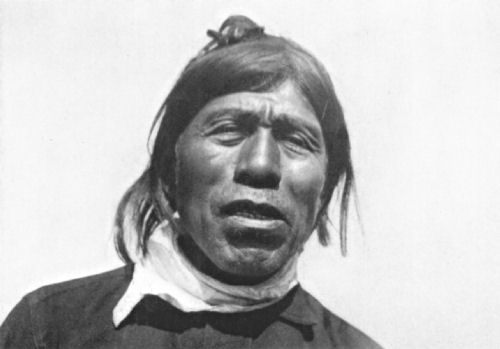
The story of Cane, Ahta, more properly Ahta-'amalya'e,
Long Cane, was told me on three days
between April 24 and 27, 1904, with one day of
intermission, by a middle-aged man named Tšiyêre-k-avasūk,
or "Bluebird," who said he had dreamed
the tale, beginning at Avikwame. I neglected to
write down personal or biographical details about
him, and dare not trust my memory at this interval.
This story has more plot interest than the
majority of those which the Mohave profess to
dream and sing to. It might be described as a
tale of adventures on an almost epic scale, and
it does not systematically account for the origin
or institution of anything, although a bit of
cosmogony drifts in toward the end.
The version recorded was told carefully and
accurately. There are a number of internal discrepancies,
especially as regards relationship
of the characters and topography, which are considered
in a section following the story itself;
but the plot is well constructed and maintained.
The song scheme is also given after the tale.
The songs are accompanied with a double beat of
a stick struck against the bottom of a Chemehuevi
bowl-shaped basket. Cane is not danced to.
The Cane type of plot recurs in another kind
of Mohave singing called Satukhôta, of which
only a brief outline was obtained. The singer of
Satukhôta beats time by striking his palm against
his chest.
1a. All the people at Avikwame had gone out of
the house and had sent for (the great snake in the
ocean to the south) Kamaiavêta.[1] They thought it
was he who had killed Matavilya and they wanted to
kill him. No one knew this to be so but all believed
it. Then when he came they killed him, and
his body lay stretched over the earth. When he was
dead, I[2] took a piece from his tail, the rattle
nearest the body. I took it for good luck. Several
tribes dream about this killing: the Yuma, the
Maricopa, the Kamia, the Walapai, the Halchidhoma,
and others down to the mouth of the river.[3]
1b. Now there were two brothers there. They
stood east of the house and told of it. They did
not speak, but sang. They sang of its posts, the
rafters, the sand heaped around and over it, and
the other parts. (4 songs.)
2. Their names were Pukehane, the older, and
Tšitšuvare, the younger.[4] They went north a short
distance, where there was a little gravelly place
and thorny cactus. The ground-squirrel, hum'ire,
lived there. When the two brothers came, it ran
away, crying like a boy. It had never seen them
before. They stood there and sang about it. (3
songs.)
3. Then they went north again a very little
distance.[5] There they saw a rat, hamalyk. They did
not kill it, but looked at it and sang about it.
(2 songs.)
4. Now it was sundown. They struck their fire-flints,[6]
made a fire, and sat by it. They did not
eat anything all night. In the morning they were
hungry. One thought that they should kill the rat
and eat it. His brother said: "That is good." So
they killed the rat and ate it. They stayed there
that day, thinking. The next day, in the morning,
Pukehane, the older brother, said: "We have no
place to live." Tšitšuvare said: "Yes, that is true.
Where can we get wood to build a house?" Now Pukehane
was intelligent; he was born thus. Therefore
he made sticks out of his saliva.[7] Thus in one day
they built a round house. At night they went into
it. (3 songs.)
5. Now it was three days.[8] In the morning they
hunted rats. When they killed a rat, they hung it
by its head under their belts. Pukehane said: "I
do not think this is good." Then he took[9] two net-sacks,[10]
and they put the rats into them and carried
them on their backs. At sunset they came back
to the house. Now two men lived at Avikwame, Hatpa-'aqwaoθtše,[11]
their father's older brother, and
5]
Nume-peta.[12] Hatpa-'aqwaoθtše said: "I will live
with my younger brother's sons (ivitk). I will
not live with this man (Nume-peta) who is not my
relative." And he came and lived with them. So
they were three. In the morning, the two boys
went hunting rats again. As the rats were shot,
they squeaked. The boys stood and listened and
laughed. (1 song.)
6. When they came back, Pukehane said, "Some
tribes after a time will do like this: let me
see how far you can shoot." They bet their arrows.
The elder shot far. The younger did not shoot far
and lost, lost all his arrows. The quiver was
empty and he tied it around his waist. He said,
"I will bet the rats that I killed." Then he lost
all his rats. They came home and he had no arrows
and no rats, only his bow. Their father's older
brother saw them. He said, "Why do you not do
right? This is wrong. Do not do it any more. That
is not what I came here for. I came in order that
when you go hunting you bring them here and I eat."
(1 song.)
7a. Hatpa-'aqwaoθtše said, "We are three men
here. I see you two do not sleep but sit and wake.
If three men live in a house everything is ready
for them when they come home to it. But there is
no woman here and that is why there is no wood
and water. If you get a woman she will cook."
The boys said, "Yes, we will do that." That night
Pukehane stretched his hand to the southeast toward
the Maricopa and got corn in it. He got much
and laid it in the corner of the house. Then he
stretched his hand out northeast, toward the
Kohoaldja Paiute, and took wheat.[13] Now they had
two kinds of food.
7b. In the morning the two boys went west.
There was a man who had a daughter Tšese'ilye;[14]
her they wanted to get. As they went west they
saw a bird hanging in a tree in a cage of red and
white woven cloth.[13a] The bird was hwetše-hwetše.[15]
"Look, that girl has a bird," they said. (1 song.)
8. When they reached the house, Pukehane did
not take the bird with his hand, but caused the
cage (sic—the bird?) to be outside the door. The
bird was singing: the woman was inside; she came
out, saw it in front of the door, and said: "What
sort of people are you who have come? That bird
belongs to me; do you not know that? It watches
everything I have when I go out to gather seeds."
The two boys stood and laughed, the older east of
the door, the younger west of it.[16] The woman went
back into the house, put on a (pretty) dress, and
beads around her neck. She took a white peeled
willow stick, qara'asap, to sweep the dress under
her thighs so as not to crumple it when she sat
down.[17] Tied to the top of her dress she had two
bags of paint (kômkuvī), one black, one red. When
she came to the two boys standing outside the door
she did not go to the older, she went to the
younger: she liked Tšitšuvare. Pukehane said, "She
is mine." His younger brother said, "No, if she
were yours she would come to you." The older said,
"She is mine." The woman said nothing. The older
embraced her. The younger said, "Do not embrace
her. She belongs to me." He embraced her too and
they both held her and pulled. Pukehane became
tired. He stood aside. "You are the better; take
her," he said. So now they had one woman: Tšitšuvare
had her. (1 song.)
9. They started to go home from there: Pukehane
wanted to. They had far to go, too far for one day.
So they slept in the desert where no one lived.
Tšitšuvare made a bed. Pukehane said, "My brother,
when you marry, both of us sleep with the woman.[18]
That is what you said." Tšitšuvare had not said
that: Pukehane only wished it; and Tšitšuvare did
not let him. Then in the morning Pukehane said,
"Let us go, my sister-in-law."[19] (1 song.)
10. They started. At noon, when they came to the
house, the woman was ashamed, because it was the
first time she was married. Hatpa-'aqwaoθtše said,
"I want to see my younger brother's daughter-in-law."
She did not look up: she had long hair—down
to her hips—behind which she hid her face.
The old man took her by the hand, led her inside,
and took her around the house. He wanted her to
grind corn. Now the three men felt glad, when they
saw her grinding corn. They looked to see how she
worked; all of them smiled. "See how beautiful she
looks," they said. She was clean and wore beads
around her neck and on her ears and wrists, and a
dress of willow bark, and was painted. (1 song.)
11a. In the morning she was going to make mush
of the corn she had ground. The two brothers were
still in the house. The old man was outside: he
wanted to help her cook. He poured the corn into
the pot and she stirred it and put in salt.[20]
6]
When there was enough, she boiled it, gave some
to the old man, put some in a dish for the two
boys, and took it inside to them. Then the three
ate together; the old man sat outside. When the
sun set they built a fire in the house near the
door. When it was dark the house was warm and
they stayed there. The two brothers did not say
anything. Their father's older brother spoke
again. He said, "This is one woman. If you get
another, it will be well. Go east and take Sun's
daughter." That is what the old man said.
11b. In the morning the two boys went east.
When the sun was halfway up they heard a cock[21]
making a loud noise, telling the time. (2 songs.)
12a. Very soon, after four or five steps,
they saw a cage hanging, Sun's daughter's cage,
with red and blue cloth tied to it for ornament:
it was hanging high. The two boys came to it,
took the cock out of his cage, and put him by
the door. He crowed and the woman heard him.
She said, "What sort of men are you? Do you not
know anything? That cock belongs to me. He takes
care of me and stays with me always. You have
spoiled him." She went back into the house, put
on her dress and her beads, and came out. Tšitšuvare
embraced her. His older brother said,
"She belongs to me." "No, she is not yours. She
is mine," said the younger. "No, she is mine,"
said the older. The older was unable to hold
her. "Well, she is yours," he said. Now the
younger had two wives.
12b. They started to go. The woman looked back
and saw her house. She said, "I thought my house
was (already) far away, but it is only a little
distance." She stopped and urinated. "Wait and
stand, while I tell of my home." She meant that
now she was going with them and would live with
them and would not go to her house any more.
(2 songs, about her house.)
13. They went on again. Now all the stars
had been made,[22] but the two boys were wise, had
dreamed, and knew all. They said, "We will tell
about the stars; of mountain sheep (Orion), and
of Hatša (the Pleiades)." (2 songs, about the
constellations.)
14. In the afternoon they came home. The (new)
woman sat down outside at the southeast corner
of the house. She was ashamed, and did not go
indoors with them. She had long hair, down to
her thighs; she did not say anything. The old
man was ready for her to grind: he had a metate
prepared inside. Now he came out, took her hand,
and led her indoors. Then she ground corn. As
she ground, blood flowed on her thigh. They said,
"Look at her, she is menstruating: the blood
makes a streak on her thigh."[23] (1 song.)
15. Now there were two women to work, and it
did not take them long to grind enough for mush.
One of them built a fire and put a pot on it;
the old man came out to help them. When the water
boiled, the old man poured the corn into it and
one of the women stirred. She put in salt and
tasted it; there was not enough, and she put in
more until it was good. Now she gave the old man
some. She put some in a large dish and took it
in to the two boys. They ate together, the two
women and the two boys. At night they all lay
down indoors. The old man thought, "It is not
right: one of them has two wives. They are two
brothers but one has no wife." He said, "You are
two brothers, but the older has no wife. He must
have a wife too. In the morning go north and get
one for yourself also. Kukho-metinya's[24] daughter
is the one that I want you to find." In the morning
the two boys went north. Then Kukho(-metinya)[24a]
met them, flying in the air. They said, "The bird
is intelligent: he flies to meet us." (2 songs.)
16. When they came there, there was a bird in
a cage. It was a kukho.[24b] They took it out with
their hands and set it by the door. The woman was
inside, heard it, came out, and saw the bird. She
said, "Where are you two from? You are foolish. Do
you know that that is my bird in the cage? Why do
you take it out?" They stood and laughed. She went
inside again, put on her dress and her beads, and
came out. She went to the older one and he embraced
her. The younger wanted to come to her also, and
said, "She is mine." But Pukehane said, "No, she is
not yours, she is mine." Then Tšitšuvare said, "Well,
she is yours." He let him have her, because he had
two already. Then they started home. (1 song.)
17a. When they came to the house the old man
took her by the hand, led her inside, and wanted
her to grind corn. Now there were three women
grinding and it did not take long. The old man
helped them cook. They gave him some, and the
three women and the two brothers ate together. The
sun set, it became dark, they built a fire in the
house. The two brothers did not speak: the old man
was thinking again. He said, "Now you two brothers
each have a wife." Pukehane had his bed in the
southeast corner of the house; Tšitšuvare, at the
southwest; the old man lay in the center of the
house. He said, "Tšitšuvare, you have two wives;
Pukehane, you have only one. I think it will be
best for you to get another. If you each have two
it will be well. If one of you has two and the
other only one, it will not be right. I want you
to go south to get one. Get Tankusahwire's[25]
daughter." That is what he said that night.
7]
17b. In the morning they went south. They saw
a hotokoro bird in a cage. The cage was woven of
red and blue string. They had not come there yet:
as they were going they saw it. (1 song.)
18a. When they arrived, they took the bird in
their hand, set it at the door, it walked about
there. The woman heard it and came out. She said,
"That bird is mine. It takes care of me. It lives
with me always. You know why you have done that!"
It was as if she were angry. She was not angry
but she said that. She went back into the house
to put on her dress. She put it on, and beads on
her neck and ears and wrists. Tšitšuvare, the
younger, saw her come out but did not go to her.
He let his older brother embrace her. He said
nothing. He thought, "It is well." Then they went
back north. They came home the same day. The
three women were grinding corn. The new one did
not go inside: she was ashamed and sat outside.
The old man took her in. He gave her a metate
and the four of them ground. When they had finished
they made mush: the old man helped them:
he wanted to taste if there was enough salt.
He said, "If there is not enough, put in more.
If it is right, set it off the fire." Then they
gave him some. They put more in a large dish and
took it inside. All the women and the two young
men ate together. At sunset they built a fire
inside. Two women went to the east side of the
house, two to the west. The two men were lying
in the corners shading their eyes with their
hands (δokōuk). The old man lay in the center of
the house. He got up, thought, and said, "There
is another thing good to have: it is cane. When
you play on it the sound goes as far as the sky
and everyone can hear it." He said that in the
night.
18b. In the morning the two brothers went west,
far west. There were no clouds but there was
lightning and it thundered. Tšitšuvare said, "Do
you hear that? I think that is dangerous." Pukehane
said, "Well, I do not care. Perhaps it will
go well, perhaps it will go wrong. We will go
anyway: it does not matter where we die. We do
not know. Do not mind: if we both die in this land
it will be well." (1 song.)
19. They went on west. They climbed up a mesa.[26]
They stood and looked down. Then they saw cane.
Tšitšuvare was glad to get it. Pukehane said, "Do
not go yet! Wait! Good ones do not grow everywhere:
they grow in only one place. Wait until we tell
about them. I will tell about the roots (butts?),
the large roots that they have." The younger brother
stood and listened to what the older one said
about the cane roots. (1 song.)
20. They went down to the cane. There was a
cane to the east: Pukehane put his hand on it.
There was a cane at the west: his younger brother
put his hand on that. The younger one said, "I do
not want the top." He cut the top off and gave it
to his older brother: he wanted the bottom part
where it is large. Pukehane said, "A little boy
like you takes a little piece from the top." Tšitšuvare
said, "Don't you know when there are two
brothers the younger wants the most of everything?
I want the large one, you take the top." Pukehane
said, "Very well. It is good." Tšitšuvare said,
"If you had not given me the bottom but had left
me the top, I should have cried, because the
younger always wants most and if he does not get
it he cries. You thought I would cry. Well, my
brother, I feel happy." Tšitšuvare wanted to break
the cane with his hands. Pukehane said, "Wait!
You are able to break it with your hands, but do
not do so. We have both dreamed well. We have no
knife here but I can get a knife to cut it with."
(1 song.)
21. He did not make a knife. He put his hand
out to the west and had a knife in it. The younger
asked, "How many joints shall we cut?" "Three,"
said Pukehane. (2 songs.)
22. Then Pukehane cut the cane at the butt. He
was holding the top end, his younger brother the
bottom end, but Pukehane wanted that. Tšitšuvare
said, "No, you said you would let me have it!"
"No," the elder said. They did not break it: both
of them held on. Tšitšuvare did not want the top;
Pukehane wanted to take it all: but his younger
brother held fast, and he could not take it away
from him. Pukehane was larger and knocked his
little brother down, but Tšitšuvare held on: he
did not let go, he held tight. Then Pukehane put
his foot on his brother's belly: still he held on:
He nearly died, but he kept his hold. When Pukehane
saw that his younger brother was nearly killed, he
stopped. He took hold of him and made him stand up.
"Well, my younger brother, I will let you have it,"
he said. The older was a doctor: he had dreamed.
He thought, "Well, I will let him have it, and
after a while I will kill him." Tšitšuvare said,
"How must we use them, long or short?" Pukehane
told him, "The Yuma make them long, of four or five
joints, with a hole right through them. We do not
do that: we use three joints." (2 songs.)
23. Then they went back and came home. They laid
the cane on the ground. They told how they had
brought it. (1 song.)
24. When the two boys sat down, the women had
wheat bread[27] ready and gave it to them. They began
to eat outside. The old man came out from the house
and saw the two boys about to eat the bread. They
had not swallowed it yet: their mouths were full.
The old man said, "Did I not tell you that that was
dangerous? I said not to eat anything with salt in
it[28] until you have washed yourselves." They spat
it out. When it was nearly sunset they built a fire
and all went into the house. That night the younger
one became sick: he had the nightmare and talked to
8]
himself.[29] Before it became day, Pukehane started
to go outdoors. He could make people go to sleep
with θavôθapanye. He held it in his hand and
struck a house post. So they all went to sleep:
his younger brother too. Then Pukehane went outside,
took the cane, and decorated it with his
saliva.[30] In the morning he said, "Younger
brother, why do you not get up? Do not sleep: a
common man is always doing that. You are likely
to get sick. Get up and help me." The younger
sat up. Pukehane had already finished painting
his cane. Tšitšuvare came out and wanted to
paint his. He did paint it: but when he held it
out to look at, there was no paint on it: it
looked dark (unpainted) to him. He said, "I
thought I had painted it well. I think I shall
die." He threw the cane away to the north, went
indoors, and lay down. Then Pukehane sent for
people to come for his brother who was about to
die; he sent for Nume-peta at Avikwame. When a
man will die they send word of it about and begin
to sing. (1 song.)
25. The two brothers had birds in cages. The
younger had five kinds: pariθi (shrike), sakwaθa'ālya
(magpie), aθikwa (woodpecker), atšyôra,
θinyêre (sparrowhawk). Pukehane took one of them,
peeled the skin off its head, and let it go. One
he skinned on the back, one on the belly, one
over the ribs, and one under the eyes. He threw
the pieces of skin away, and let the birds loose.
They flew up and fell down again. The sick man
said, "I think I shall die: I never saw that
before: my birds look different." (1 song.)
26. When the sun was halfway up, Nume-peta
arrived with his people. They crowded around the
sick man and began to cry. Nume-peta said, "After
awhile, people will always do that; they will
burn them too. Now, two men go get wood: get
timahutši."[31] (1 song.)
27. Pukehane had made his younger brother
sick. Therefore he did not stay by him but by
Nume-peta. Tšitšuvare said, "Move me a little
so that I can tell of all my bones before I die."
(1 song.)
28. The two men got wood. When they brought it,
Pukehane and Nume-peta were thinking what they
wanted to be in the future: they wanted to teach
the Chemehuevi, Yavapai, Walapai how to do. The
sick man was not dead yet. Then they took his
rib out to use for a skin-dressing tool. They
took his kneecap for a shinny ball. They took
his shinbone, cut off each end, and used it to
juggle up and catch on the back of the hand.[32]
They took these bones out of his body and so
killed him. Then they went to Avikwame, Pukehane
taking his own two wives with him.[33] Tšitšuvare's
wives and Hatpa-'aqwaoθtše stayed, stood, cried,
and sang. When it was dark the old man took a
knife and cut the two women's long hair, and his
own. One of the women was pregnant. (1 song.)
29. They cried all night. In the morning—they
had not thrown their food away, and had corn and
beans—they ate. Then Sun's daughter went back to
her home; the other woman (Tšese'ilye) and the old
man were still in the house. In the afternoon the
woman said, "I am going to have a child. I have a
pain on each side of my belly." Then the old man
said, "Yes, that is the way." At night the child
had not been born yet, but it sang. They heard it
talking and singing inside. They said, "He is
singing. We hear it." (1 song.)
30. The old man said, "That sort of a boy will
be somebody; he will be a shaman. When he is a man,
he will make me be like a young man again. I am
glad." Then the boy said from inside, "Too many
people are passing by the house. I am going to make
rain so that no one will come by while I am being
born: I want no one to know or hear or see it. I
do not want people to know when I emerge." (1 song.)
31. The woman could not sit still from her pain.
She crawled around into the corner of the house,
and outdoors. Then the boy said, "Sit still. I want
to emerge." He did not know where to come out, at
the mouth or anus or ribs. He said, "Sit still.
Keep your legs still, so that I can come out; do
not move them!" The woman said, "Old man, do you
hear what the boy in me says?" The old man said,
"That sort of a boy is wise. He will be a shaman."
When it became day the boy came out. They made
hot sand to lay him on and covered him with hot
sand up to his neck. (1 song.)
32. The night the boy was born it rained. (Far
in the north) Nume-peta thought, "I believe that
child has been born and has made the rain. If one
of you goes there today, you will see the child."
A man went: he saw the child sitting in the door.
Hatpa-'aqwaoθtše asked him, "What do you want?"
The man said, "Nume-peta sent me to see this child."
Hatpa-'aqwaoθtše said, "Yes, it was born this morning."
So the man went back and told Nume-peta.
Nume-peta said, "Did I not know it? The child is
wise and will be a doctor. It made rain so that
no one would know it was being born; but I knew it,
for I am a doctor too." Then Nume-peta took his
people and Pukehane, and they all came to see the
child. They said, "We will look at it. If it is
a boy, we will kill him, because he will be a doctor
and will kill us; when he is grown he will make
us sick. But if it is a girl, we will not kill her.
It will be well: she will work and get water. A
girl will do that, but a boy will not do that: he
will kill us." Now they all stood at the door
9]
looking at the child. Hatpa-'aqwaoθtše hid the
child's penis, drawing it back to the anus. Then
they all said, "No, it is not a boy, it is a
girl. If it were a boy we would kill it, but it
is a girl." So they all went back. (1 song.)
33. Then the woman suckled the child and sang.
They had made them think that the child was a
girl. It was a boy but they would not let them
know it. (1 song.)
34. The child grew fast. In four, five, six
days it smiled and laughed. In a year it was as
high as that (gesture), and walked around and
played. Now Nume-peta and Pukehane came again
with all their people. They played shinny with
the dead man's kneecap. Then the child, dressed
as a girl, went out to watch, not knowing those
bones. Some of them gave him a bone to make a
doll of, for he wore a dress and looked like a
girl. Every day he went to play where these
people played, and at sunset came back to his
house. So it was three nights: the next night it
would be four. Then his mother told him, "That
doll, the bone you play with, is from your father.
Your father traveled to be married. And he
traveled to get cane, he and his older brother.
The younger was wise: he was superior to the
older; but the older was a great doctor. He made
his younger brother sicken and die. That bone is
from your father, and so is the bone they play
shinny with." (2 songs.)
35. Then the apparent little girl said, "I
did not know that. If I had known that it was
the bone of my kin I should not have played with
it." So he said and cried. He cried all night
and never suckled. In the morning when the sun
was up he went under the shade; he was tired from
crying, lay down and slept a little. Then he
dreamed. The insect θonoθakwe'atai[34] sat on his
lip while he slept and said, "All of them play
with those bones. They think it is amusing but
it is a bad thing. They are not the bones of an
animal. If they were animal bones it would be
well, but they are your father's bones." When
the boy dreamed that he sat up. He went back
into the house. That night he wanted to send his
mother home: he did not want her to live there
any longer.[35] He told her, "Go west.[36] These
people here are my relatives but they do not
treat me right. They said they would kill me. I
will stay here. The old man, my (father's) uncle,
will stay here too. He is wise: he saved me or I
should have been dead long ago. I want him to stay:
he can beg around the houses and get something to
eat and water to drink. He can live in that way and
be well; but I want you to go west." The woman took
a little round dish[37] and put glowing coals into
it. So she lit her way, to know where to go.[38] Then
she went off westward, traveling by that light. When
she was gone the boy thought about her. He thought,
"Why have I sent my mother away like a bird? A
bird's nest is on the desert; it sleeps on the desert,
where no one lives." Then he was sorry for her
and cried. (2 songs.)
36. That night when there were only the two of
them there, the boy told the old man, "I am going
to leave you. You stay here. Listen to what I will
do." He thought he would do something to the people
that played with his father's bones, but he did not
yet know what. Then the old man Hatpa-'aqwaoθtše said,
"It is well. You will die somewhere and I will cry
for you here. That will be all. I can live. I am
not very old yet. I can go about begging for food.
I will come to people's houses and they will give
me something to eat, for they will know me and that
I am poor and hungry. I shall live like that staying
on here." Then in the morning they all came
there to play ball again. They had short shinny
sticks, nearly straight, not long and curved.[39]
When the boy saw them, he went outdoors, took earth
and rubbed it on himself, so that no one would see
him, or know him; for he wanted to take away their
ball. So he turned himself into a halye'anekītše
lizard.[40] Now they played. They came near him: he
was lying by the side of the playing field: no one
knew it. Now they played toward the south and back
again, four times, and one side won. Then the boy
seized the ball: no one saw him take it: no one
knew he had it. He went back to his house. Now he
wanted to throw it, but did not throw it yet: he
wanted to know in which direction to throw it.[41]
First he wanted to throw it north, but did not.
Then he was going to throw it south, then west,
then east. He kept it in his hand and stood there.
(1 song.)
37. When he had told (kanavk) of the far heavens
(amaiyêitše) four times, still holding the ball, he
struck the ball with a stick and it flew west like
a meteor (kwayū). It fell in the mountains and
broke them and killed the people who lived on them:
it killed them all. The boy stood and heard. He
thought, "No one is there now: they are all killed!"
Nume-peta and Pukehane said, "That boy! I knew he
would do it: he has killed all those people. He
will kill us too. You shall see: he will do that."
10]
The boy did not hear them, but he knew (what they
said). He was glad and laughed and shouted and
ran. He ran north to Avi-kwutapārva: There he
stood. (2 songs.)
38. When he stood there at the river he thought
how to cross it. He said, "I thought I was a man
who knew everything, who had dreamed well." Then
he piled up sand, four heaps, so high. He began,
at the nearer end, to level them with his foot.
Then the river was full of sand all the way
across, enough to walk on. So he crossed and
stood on the other side, the east side of the
river. He thought which way to go, whether east
or south. Then he thought, "Well, I will follow
this trail south." (1 song.)
39. He went downriver to Iδô-kuva'ire,[42] did
not stop there, but went on to Ahtšye-'iksāmta
and Qara'êrve. There it was sunset and he slept
in the thick willows and cottonwoods by the river
bank: it was a good place to sleep, with much
brush. Many birds were in the trees: early in the
morning they all awoke and made much noise. Then
he could not sleep well: he tried to but could
not. So he sat up and listened to the birds calling.
Tinyama-hwarehware[43] was sitting on a tree
singing loudly. When a boy sleeps somewhere alone
he is lonesome and afraid; so this boy was afraid
and could not sleep. Then he said to the birds
and the insects, "You make too much noise. I cannot
sleep. Be quiet!" So they were quiet and he
slept again. (2 songs.)
40. After he had slept he got up and went
south. Then he came to the hill Selye'aya-kumītše.[44]
(1 song.)
41. He went on south to an overflow lagoon,
Hanyo-kumasθeve.[45] From there he went south a
little distance to where the ahtšye grass was
high. There a rattlesnake stuck up its head and
shook its rattle noisily. When he saw the snake
he was frightened: he had never seen one before.
He nearly died from fear: he stood unable to
move. (2 songs.)
42. Then he made the rattlesnake lie still
without shaking its tail, making no sound, and
not biting. He kicked it and threw it with his
feet, four or five times. Then he picked it up,
and used it for a belt, and put it around his
neck and into his mouth. So he played with it,
and the rattlesnake died and he threw it away.
He said, "I am not afraid of you. If you were dangerous
to me you would bite and kill me, but you are
not dangerous and so it is you will not bite me."[46]
He left the snake lying there, and went south,
to Amai-nye-qotarse, did not stop there, and
went on south to Kamahnūlye. Two men were hunting
there. When they killed a deer they did not cook
it but ate it raw: He saw their red mouths and
was afraid of them. He saw that they were wildcats
(nume). (5 songs.)
43. The two wildcats went off east and he went
on south. He came to Aha-kuminye. A horsefly
(hoane) lived there at the edge of the mesa in a
cavity. It came to him, lit on his back and
shoulders, and flew off again. Then the boy
thought, "It is intelligent like a man. It knows
something. When it sees me it comes to meet me."
(1 song.)
44. The horsefly flew away and did not come
back. Then the boy said, "That is not a man. If
it were a man he would come back to talk to me. I
will go on." Then he went on south to Hotūrveve.
There were astake trees there on the mesa: there
he saw that a hummingbird (nyenyene) had its nest.
(1 song.)
45. He went on south to Sampulya-kwuvare. There
he told the name of that place. (1 song.)
46. He went on south to Atšqāqa. There he followed
the (Sacramento) wash up eastward, away from
the river. The day was bright and there were no
clouds. Then he told about clouds, for he wanted
the air fresh and the day cooler because it was
too hot to walk. He did not stop but kept on going
talking of that. (1 song.)
47. As he went on, soon there were clouds all
over the sky. He came to Hanyikoitš-kwamve,
crossed the wash, and went southward toward the
mountain Akokehumī. Then he came to Avi-ahnalya
(Gourd Mountain). (1 song.)
48. He went on south but not very far. He had
not yet come to Avi-a'īsa ("screw-mesquite mountain"),
but stood and told of his going there.
(1 song.)
49. He went on south and reached Akokehumī.
There he saw a spring: a single screw mesquite
grew there. He said, "I think this is my food: I
will eat it. There is water here too; so I shall
be alive. I was lucky to find this spring and this
tree." He stood by the tree and sang. (5 songs.)
50. Then he pulled the mesquite-screws off the
tree and ate them. When he had eaten, he drank,
and went on. He went south to Ahwaṭa-kwimātše.[47]
There used to be people who danced there, who had
turned to stone. At first they were men, but now
they were many rocks standing up; and the boy saw
that. (2 songs.)
51. He stood there awhile, then went on south.
He came to Amaṭa-kuhultoṭve. There there grew wild
grapes (ahtoṭa) on the ground: they were ripe and
he picked them and held them in his hand and
played with them. He did not eat them. (2 songs.)
52. He threw them away and went on south. He
came to Hakutšyepa, Bill Williams Fork: he followed
that creek up east. Then he met a badger (mahwa).
11]
It smiled when it met him. He did not try to
catch it and the badger ran off. He paid no attention,
but followed the creek up east. He went on
and on and came to Aha-ly-motāṭe. There were sand
and mountains and caves there, and he told about
them. (1 song.)
53. He stayed there awhile and played. Then he
followed a trail south and came to Avi-su'ukwilye,
a sandhill. There he stood on a mesa. Ohūtšye,
coyote-grass, grew there. He saw a jack rabbit
eating that. He thought, "Its body does not look
like a man's, but it feels when it gets hungry,
and it eats. I thought it knew nothing, but it
does know something: it knows that that is good
to eat." (1 song.)
54. Then he followed along the sand ridge,
keeping on it, going south. Far away he saw high
mountains: they looked as if they were near, but
they were far. They were called Avi-melyehwêke:
he was going there: he arrived when it was nearly
sunset. (3 songs.)
55. There he slept. It was (Western) Yavapai
country. In the morning he did not want to go
farther south. He turned northward and came to
Avi-hupo. (2 songs.)
56. From there he went on north to near the
river, to Selye'aya-'ita.[48] There he stood, wanting
to cross the river to the western side, to Kuvukwīlye.
(1 song.)
57. Then he did as he had done before. He made
four piles of sand and leveled them into one ridge
with his feet and made the river dry enough so
that he could walk across, and came to the west
side of the river. Now he was at Kuvukwīlye. He
said, "I can stand here and tell the names of
the mountains." (3 songs.)
58. He turned south again and came to Aha-kumiθe
where is a spring. He thought no one had seen it
before. "I found this. No one knew of it." People
had seen the spring, but he thought not. (1 song.)
59. He went south to Amaṭa-hiya, "earth-mouth."
There there was a hole or crack in the ground, red
like blood. He saw it and thought, "How did this
come to be?" He walked around it looking in, and
stooped over it. (1 song.)
60. He went and came to Tôske. There he stood
and told the name of that place.[49] (1 song.)
61. Going south again he came to a low mesa,
to a place called Yelak-īmi, "goosefoot." (1 song.)
62. Going on he came near the Yuma country.
He stood on the mesa, looked down on the ground
for planting, and saw much cane. He thought, "How
did the cane come to be here? I did not think it
grew here. I will go down to see it." (2 songs.)
63. He went down to where the cane grew, broke
off a piece as long as a flute, and played with
it. He came (abreast of) Enpeθo'auve, the Cocopa
Mountains, south of Yuma. He kept along the edge
of the river, going fast, running, walking, and
keeping on. (1 song.)
64. He went on until he came to the sea (the
Gulf of California). The waves were high. When
they came up on the land and went back, there were
holes and some of the water did not run back, but
stayed in the holes and made ponds. A crane (nyāqwe)
was there. He said, "That is an eagle (aspā): it
surely looks just like an eagle." (3 songs.)
65. The bird flew off eastward. He said, "That
bird is afraid of me: it flew away." He walked
along the sea to the east. As the waves came and
went they left shells there: hanye, ahtšīlye, aha-nye-amokye,
tamāθe, ahāspane, and two other kinds
used by doctors.[50] He knew that these shells were
good to wear. No one had told him, but he knew.
He took them in his hand and played with them.
(2 songs.)
66. Then he threw the shells away and kept going
east. He looked back to the west and saw ducks,
heard them making a noise. He thought, "What are
those? They have feathers. They are like persons,
but they are ducks." There was a large flock of
them on the sea, close together. (2 songs.)
67. He went on east. Where a little lagoon
came out of the sea, there was a hatômpa'auve.[51]
He lived in that lagoon. The boy saw him fishing
and was afraid. He thought, "I will tell about
him. Then I will go on." (2 songs.)
68. He went on, not following the edge of the
sea any more, but north and northeast. Soon the
sea was far away. He came to a gravelly place, a
good level place. There he saw a'i-kumeδī trees
(mountain or desert trees with curved thorns—catsclaw
acacia?) He told of them. (1 song.)
69. He went on east or northeast. Soon, in a
level place in the desert, he saw women's tracks,
four women's. The tracks had been there a year but
they looked as if they had been made the same day.
He said, "I think I know these four women. I know
who they are. I think they are Sun's wives."[52]
(5 songs.)
70. Going on to the east, he found a house. No
one was there. He said, "Sometimes people go away
and their house is empty." He went in and stayed.
He had in mind the four women. He said, "I think
the oldest of those four sisters knows me." He
did not say this aloud: he thought it. He did not
want anyone to know that he had come: he did not
want anyone to see him. "But the oldest one will
know me, I think," he said. He slept there. He pulled
out one of the sticks from the east side of the
12]
house and made a little fire of it and slept. In
the morning he made a wind to blow away the
ashes so no one would see he had been there, and
smoothed the sand inside the house to cover his
tracks. He thought, "I will turn to cane. I
want the wind to blow me away into the bushes.
The oldest sister will find me." Then he went
out and lay there in the brush, a piece of cane.
He left his shadow inside the house. (2 songs.)
71. The four women came near. The boy was
singing loudly. They could hear him from far.
He was telling the names of the four women. The
oldest was called Tasekyêlkye, the next Ahta-tšaôre,
the next Ahta-kwasase, and the youngest
Ahta-nye-masape. Then the youngest said, "My
oldest sister, do you hear him say that? He calls
you first. He names you too, and you; and me:
He calls all four of us. Do you know that?" The
oldest sister said, "Yes, I know it. There were
two men in the north. They were married. I think
this is their boy. He knows us. No one knows us,
but this is their son. When we enter the house
you will see no one there, and no tracks. He
will have turned to a stick or perhaps to a
piece of charcoal. Perhaps when you (are about
to) break a coal it will say, 'You are hurting
me: look out!' If it says that do not break it.
Perhaps when you break a stick it will speak
and say, 'Look out: you hurt me!' Then do not
break it. Perhaps he will be lying in a crack
of a house post. Perhaps he will turn into a
piece of cane and lie outdoors in the brush."
So Tasekyêlkye, the oldest sister, said to Ahta-nye-masape,
her youngest sister. Then they went
into the house. She said, "There is no one here.
There are no tracks. He slept here last night
but there is no one. Put your foot on the fire
place: There is warmth there." They drew the
sand away with a stick and there they found fire.
"See, I knew there was fire here," said Tasekyêlkye.
(2 songs.)
72. The four women stood in the house. Tasekyêlkye,
the oldest, said, "Look around. When
you find a crack in the house post, push something
into it. If it says, 'Ana (ouch, look out),
you are hurting me,' then stop. Or pick up a
lump of earth and start to break it: If it says,
'Look out, you hurt me,' then do not break it."
They took up a coal and broke it. It did not
speak and they knew it was not he. Tasekyêlkye
said again, "When you find him, do not say, 'He
is rotten, he stinks.' And look in the brush;
perhaps you will find him there." So Ahta-nye-masape,
the youngest, went west, and the others
all about, to look for him in the brush. Then
the youngest found him: he was long dead, stinking,
rotten, full of maggots. With a stick they
scraped off the maggots. But there was no flesh
on him: he was all bones: he had been dead too
long and was dry: they could not bring him to
life. The four of them stood there. (2 songs.)
73. Tasekyêlkye said, "Bring a karri'i basket;
I want to put him in." But her three sisters
said, "What for? I do not like that. I
don't want my basket spoiled." Then Tasekyêlkye
brought her own basket. She said, "Come, help me.
Take him up with your hands and put him in the
basket." But her three sisters turned away. They
stood and would not look at him: they vomited:
none of them helped her. Then she herself gathered
the flesh and bones and put them into the basket.
She said, "Help me put it on my head: I want to
carry him to the house." Her three sisters did not
want to help her: he was too old and maggotty and
stinking: they would not come near, but stood
around. "Do it yourself," they said; "take the
basket up with your own hands and set it on your
head." So she took it up and carried it to the
house. The others followed her. Then Tasekyêlkye
said, "Make a fire." She wanted hot sand. When it
was hot, she poured water on it and leveled it.
Then she piled the maggots and flesh and bones
there together and covered them with the basket.
Then she went and bathed. Her three sisters looked
at the thing. They did not know what she would do
with the rotten boy. She came back, took off the
basket, and a boy was sitting there, as big as
that boy (pointing to a ten-year old). The three
women looked at him. Tasekyêlkye sat by him combing
her hair with her fingers; the boy had no hair
yet.[53] (2 songs.)
74. The man whose house this was had four wives.
He was Kwayū, meteor, shooting-star: he hunted
people and ate them. The four women were Sun's
daughters[54] and Kwayū's wives. Then Tasekyêlkye
said, "That boy does not eat. He does not become
hungry. I know what he likes: he likes tobacco.
That is all he uses for food. Ahta-nye-masape,
bring a dish[55] with tobacco in it." The youngest
sister went and got the tobacco and gave it to the
boy. He took the dish and poured the tobacco in
his mouth: he did not take it up with his hands.
"Do you see? I know what he likes," said the oldest
sister. The boy had not enough. He looked
around and picked up the tobacco stalks lying about
the house and ate them. The three sisters laughed.
Tasekyêlkye said, "I think he wants more: he has
not had enough." Then the youngest sister gave him
a cane as long as a hand, filled with tobacco.
The boy smoked it. He did not smoke it long: he
sucked once and swallowed the smoke: he did not
blow it out. The whole cane was burned up except
the end. He chewed that up and spat it out. The
women laughed. They liked to see that: they had
never seen a man doing it.[56] (1 song.)
75. Tasekyêlkye said, "When our husband comes
back he is tired from gambling with hoop-and-poles
13]
and is hungry. Then he is angry. We had better
go gather something to eat: we have nothing in
the house." Every morning Kwayū went early to
gamble, carrying his poles: one day he would win
and one day lose. Now the women all took their
baskets (karri'i). Tasekyêlkye said, "We are
going to gather kwinyo or what we can find. We
are going off, but will come back. The man who
lives in this house, Kwayū, hunts persons. The
people who live near he does not kill: he kills
those who live far away.[57] Sometimes he kills
two or three men and carries them home. He cuts
them up but does not cook them: he eats them raw.
If he does not eat them all, he slices the meat
and dries it on a tree. And he does not throw
away their bones: he puts them away. When they
are dry, he says, 'Grind the bones: I want to
eat mush.' We grind and he eats it. He does not
eat what we do. I am afraid that when he comes
he will swallow you and keep you in his stomach
(isoqāte). I am thinking of that and afraid of
it. That is why we will not go off the whole
day but will come back. If you were not here we
should be gone all day." So they went, carrying
their baskets. The boy thought, "How will he
swallow me? I do not think he can swallow me.
I am wise; I have dreamed; I am a shaman, too.
He cannot do that. Sun is my father's elder
brother (navīk). Now I have come to his house.[58]
If he sees me he will not let Kwayū swallow me."
Then he said to the house, "In the north I saw a
house like this, a good house. A man who lives
in a house like this does not eat people."[59]
(4 songs.)
76. So he stayed there alone. About noon Kwayū
came. The boy saw him coming and went into the
house to hide. He drew his breath into his belly
and made it tight and projecting. He wanted to
go on a rafter. He thought, "If I lie on it he
will not be able to pierce me. If he stabs (at)
me I will jump to another rafter. If he stabs
(at) me there I will go to another." Kwayū came:
he had a spear (otaṭa). He said, "Who came into
my house? I smell him but I do not see him. Tell
me, has some one come? I know it." The boy heard
him but did not say a word, lying on top of a
rafter. Kwayū struck at him. The boy jumped to
another rafter. Kwayū stabbed at him there. He
penetrated the rafter too far: his spear stuck:
he could not pull it out: he became tired. The
boy jumped to another rafter. Again Kwayū struck
at him and his spear stuck in the rafter. He
could not pull it out and left it hanging in the
rafter; he went and sat at the door. The boy came
down and sat in the middle of the house between
the posts. "Give me tobacco, I want to smoke,"
he said. Kwayū said, "You are too young to smoke,
but I will give you tobacco. You do not know how
to smoke cane, for the Mohave smoke a pipe of
clay." The boy said, "I know how to do that, for
that is my name (I am cane)." Kwayū said, "My
younger brother's son, is that you?"[60] The boy
said, "Yes, I know you: that is why I came here.
If I had not known you I should not have come."
Kwayū thought, "I thought that the boy born from
the two brothers in the north was wise. I was
afraid of him. I was thinking he would kill me."
He did not say that but he thought it. He said,
"You do not know the small cane?" The boy said,
"Yes, I know it. It belongs to me. I dreamed good
luck from it." Kwayū said, "I have meat here. I
have people's bones ground and made into mush. I
ate of it but I did not eat it all and there is
some left. But I think you do not like that."
The boy said, "I do not know that kind: I do not
like it. I know cane; but wait, do not give it to
me. I will tell you about it first: then give it
to me." Then he told of joints of cane.[61] (2
songs.)[62]
77. Kwayū said, "Have you told all?" "Yes," he
said. Then Kwayū handed him two pieces of cane
filled with tobacco. The boy smoked one. It was
gone, but he still had the other. Kwayū said,
"Stay here. I always go hunting. I eat whatever I
find. If I find a little boy on my way I swallow
him; if an old man or an old woman, I eat them
too." Then Kwayū went. Then after he had gone,
Sun came. The four women had not yet returned.
Sun said, "You are a young boy, too young to travel.
Where are you from?" The boy said, "I came this
morning." Sun said, "There is a bad man here: he
14]
eats everybody. But he did not eat you: I think
you must have dreamed well." The boy said, "Yes,
he did not eat me." "Where are you from?" asked
Sun. The boy said, "I came from Avikwame. I was
born there, I lived there." He meant that his
father had died there and his mother had gone
away and his (father's) uncle was still living
there. "I left my uncle[63] (Hatpa-'aqwaoθtše) in
the north and came here. He knows everything,
but I do not. He told me, 'Your relatives live
far south.' You are my uncle:[64] that is why I
have come here." Sun said, "I knew you when you
were at Avikwame. I know what you wore: you wore
cut raven-feathers." He had not (really) seen it,
the boy did not tell him, nevertheless Sun knew
it. "You wore a woven belt and beads. I know what
else you wore: a white feather rope." The raven
feathers, aqaqa soverevere, he called kwasolīθ
soθôre. The woven belt, sorāpe, he called sorāpe.[65]
The beads, nyapūke,[66] he called hapanyôra. The
feather rope,[67] soδīlyk nyitšêve, he called kwinyekalāk.
He said, "Will you gamble?" The boy
said, "I am poor. I have nothing to bet. My father
died and my mother went away and I have nothing."
Sun said, "You have something at the back of
your head" (in his hair). "No," said the boy.
After a time he said, "Yes, I have it: I have a
bead necklace. But I do not want to play." He
had hidden that, but Sun knew it. (2 songs.)
78. He said, "Well, I will put up what I have."
Sun asked, "Will you bet your body?" The boy said,
"Yes. What will you bet against my body? Put up
your four women."[68] Then they played (hoop-and-pole).
They played running to the south. The boy
won and counted one. They ran and threw to the
north and the ring fell on his pole and he had
two points. Then they threw to the south and he
won and had three. Then they threw north and he
made that point and had four. So the boy won. He
won Sun's apparel and the four women. Then Sun
said, "I want to bet my house, my dishes, and
the sack I have in the house. I have made heaven
and earth into a sack."[69] They bet, played again
as before, four times, and the boy won: now he
had won the house too. Sun said, "I will bet you
the lake (slough) where I bathe. I will bet you
my looking-glass water (haliyōi). And I have a
beaver who lives in the water: that is why you
cannot see him; but he belongs to me and I will
bet him. I have a scorpion (menīse), too, and
bees (θampô): I will bet those." So they played
four times, to the south and the north and the
south and the north, as before, and the boy won
again. When he had won all those things he said,
"I will bet what I have won against your body.
Will you play?" Sun said, "Yes, I will bet it."
The boy said, "If you lose your body, lie down
where we have played. When I take my knife, do
not move: I will cut you to pieces because you
have lost." Sun said, "It is well: if I lose I
will not move. Say what you like: name whatever
part you like to cut first." Then they played
for four points. Now Sun was lying: the four
women belonged to Kwayū; and the house belonged
to Kwayū, and what was in the house, but Sun
said it was all his own. So they played. Three
times the boy won. Now Sun had nearly lost: once
more and he would lose. Then he did not go on
playing: he stepped back, and stood, and did not
throw his pole, and talked, for he was about to
lose his body. The boy thought, "If Sun loses his
body I think he will do something to me: he will
try to kill me, and I know how. He has sky-heat
(ammay ipīlyta) in his body: I know he has it and
he will try to kill me with that. I have not seen
it but I know he will do that. He will make his
casting pole stand up, climb up it, and drop it
on me and the house to kill me." So the boy thought;
but then, "I will prevent it: I will make ice. When
he throws his fire on the brush of the house the
ice will prevent it." Soon Sun climbed up his pole
and threw the fire on the house. The boy caused
ice to be there and it put out the fire. Sun began
to climb to the sky. The boy climbed after and
tried to strike him but could not reach him. Then
he slid back and stood on the ground. Sun went on
up, jumping like a ghost. The boy said, "You
thought I was a little boy and did not know anything;
but I am wise. I will turn you into something.
I will make you be what you are now (the
sun)." The fire was still running all around the
house. The four women came back and saw the fire.
Tasekyêlkye said, "Did I not know that that boy
was wise, that he would do something we have never
seen?" The boy stood outdoors and put the things
he had won into the little sky-sack. He thought
(about Sun), "I will make you be something: I will
turn you into something: I will make you be two.
Some days there will be two suns (the sun and a
sun dog)." That is what he did. (1 song.)
79. As he stood he thought, "Well, I will see
what I have won. I will take a bath. And the
looking-glass[70] and the beaver I have won! I will
go see those." Then the beaver did not know the
boy and cried with much noise. The boy said, "You
do not know me? I am the one that feeds you." And
he went to see his scorpion. He thought, "I would
like to see it." The scorpion was lying still,
15]
but when the boy came, it moved about, afraid.
"Do you not know me? I am the one who feeds you,"
he said. "Well, I will go to see the bee that I
have won, my bee." The bee did not know him and
wanted to sting him. It flew to him, under his
arm, lit where his neck and shoulder came together.
The boy said, "Do you not know me? Know me now: I
am the one who feeds you." (2 songs.)
80. The boy stood there: he left these things
there in the playing field (matāre). He wanted to
see his body. He wanted to look in his mirror.
He thought, "I want to see what sort of a looking
boy I am." When he looked; he said, "I have no
clothes: I am a bad-looking boy." (2 songs.)
81. He had no long hair, only short hair like
a boy: he saw that. He went to the bathing place
and dived in northward. He came out again and
dived westward. Then he dived to the south. Then
he dived to the east.[71] He came out and now his
hair fell below his hips. Then he wanted to make
a little wind to dry his hair. He did not sit
down, he did not lie down, he stood. Then the
wind dried his hair. He came back and looked in
his mirror. He said, "I think I will wear eagle-down
(θume)." He put his hand out to the north
and got eagle-down. Then he put that on and
looked at himself. "That is good," he said. Then
he put out his hand to the east and got a woven
("Navaho") shirt, tolyekô-pa, and a woven strip
of wool cloth (tolyekô-hare-hare) for a breech-clout.
"Now I have all that," he said. He put his
hand out to the west[72] and got beads (nyapūka).
He thought, "When I was a boy I did not know what
was good: I did not wear anything. Now I know
what is good and am wearing what I have never
worn before. I am ready now and it is good." He
was standing where he had bathed. The four women
were crying (at the house); he heard them. Tasekyêlkye,
the oldest, was thinking about the three
persons (the boy, Kwayū, Sun), wondering which of
them had been turned into something and killed,
for none of them had come back yet. "Perhaps the
boy has done that," she thought. Then she said to
her youngest sister, "Get water! You have a jar
you made yourself." "Yes, I have one," she said,
and went to get water. When she saw the boy all
dressed up, she dropped her jar and went and embraced
and kissed him. She was away for some time.
The oldest sister said, "What is the matter with
her that she does not come back? What did she see
when she went to get water?" And she sent another.
When the other woman came and saw Ahta-nye-masape
embracing and kissing the boy, she too threw away
her jar and hugged him. "He is a good-looking boy:
I want to marry him," she said. Then Tasekyêlkye
sent her other sister. She came and saw the boy:
he was not embracing the two girls; they were
holding him, and saying, "I want him." "No, I
want him." Then she also dropped her jar, for she
wanted him too. Now the three were gone and did
not come back. Then the oldest sister thought,
"Well, there were three of them, but they have not
brought water. I will go myself and drink and then
return here to cry." She took her jar, went there,
and saw the three women surrounding the boy, embracing
him; but the boy was not moving, not saying
a word. When she saw it she ran up: "Did I not know
it? You like that boy: all of you want him: I knew
it!"[73] She too wanted him, but could not take him
away from the others. Now they had all come there
to get water and there was no one at the house.
Then the four women said, "We will take you to the
house. We do not want you to walk: we will stand,
you lie down, and we will carry you." So the boy
lay down and they carried him in their hands. Four
times they became tired and laid him down. When
they came to the house they spread a woven blanket,
hatš-hārke, and laid him with his head against a
post in the middle of the house. (4 songs.)
82a. The boy said, "I want the sky-sack in the
house. I have many things in it." The youngest went
out and got the sack. Then the three youngest
ground corn, for they thought, "I think he is hungry."
The boy thought, "You three did not like me
before: you thought I was rotten. Now when you
grind corn and make bread or mush and give it to me
I will not eat it." They made bread (môδīlya) and
gave it to him but he would not eat. Then Tasekyêlkye,
the oldest, ground aksamta[74] seeds and made
bread of them and gave them to him and he ate: he
did not eat the other bread that the three younger
sisters made. At sunset they went to bed: two of
them lay on each side of him. From each side they
tried to embrace him. He paid no attention to them
except to the oldest who lay next to him on the
right side. That night she said, "Will you stay
here and live in this house, or go away? The man
who lived here eats people. We are afraid of that.
When he goes hunting without luck, he is hungry,
and then I am afraid he will eat me; I fear that
every day." Then the boy said, "When I was north I
told my mother, 'I am going far to the south, but
I am coming back.' My mother is thinking of me,
thinking I am coming to see her. I must go north to
where she lives and stay there. I will start in the
morning."
82b. In the morning he said, "I think that man
(Kwayū) will come back today." They said, "He has
enough to eat: plenty of people's dried meat and
people's bones ground up." The boy said, "I do not
think he will follow me. Now I am ready to start.
Are you ready?" All the women said, "Yes." He said,
16]
"Take your baskets." Then they each took a basket.
He said, "I did not come here to gamble, I
came to see my relatives. When I came he wanted
to play with me. He wanted to bet everything,[75]
his house, his property, and you, and I won you
too. It was not I who wanted to gamble, it was
he." Then they went east on the desert along a
valley. After a while he stood still with the
four women. He thought, "When I am traveling,
women make too much trouble. They do not travel
fast. If I kill them, I can go fast. I think I
will make it rain on them and they may die. It
will become cold and they will freeze and die
from that." (2 songs, about clouds.)
83. They went on and soon it rained. It rained
heavily and continued to rain. They went farther
and the water was deep. The four women were wet.
Their clothes were wet and they could not go
fast. The boy thought, "Some men do wrong. I was
thinking something bad. It is not right: I do
not like it. I said of Kwayū that his was a bad
way. I do not want to do anything bad. That is
what I said, but now I am doing a bad thing. I
brought a heavy rain and made the four women wet.
I will stop the rain. If the rain stops and the
sun shines, the women will sit for awhile and
their dresses will become dry; then we will start
again and go on." He thought like this and the
rain stopped, and they sat and rested. (1 song.)
84. They sat in the shade with their clothes
off hanging in a tree to dry. When their clothes
were dry they went on again. There was much mud
from the rain. Their sandals (haminyo)[76] were
full of mud. The boy ran around the women. "Your
feet are full of mud," he said, and laughed.
(1 song.)
85. They did not rest but went on. The four
women wore frog shell-gorgets (hanye),[77] with
strings of shell beads at the back of their necks.
Then the boy told of what they wore. (1 song.)
86. They went on east and came to a valley
and saw a basket-like cage hanging; there was a
masohwaṭ bird in it; the cage was red and white
striped. The bird saw the boy and came flying
toward him. He said, "This bird is my mother's.
That is why it came to me. It belongs to her."
Then the bird flew back to its cage. (2 songs.)
87. He went on east and came to his mother's
house at sunset. He took the bird, put it down
at the door, and stood to one side. The bird
walked around at the door, and made a noise. The
woman came out and saw the boy. "My son, it is
you," she said. "Yes, it is I," he told her. She
said, "I thought you had died long ago. I thought
somebody had killed you. You have dreamed well:
I did not think I would see you again." She
embraced him and cried. The four women stood off,
looking at them. (2 songs.)
88. The boy said, "You left me and I stayed in
the house. When you left me, I hid. The people
playing shinny did not see me. I lay there and
took their ball. When I got it I went back to my
house and struck it to the west with my shinny
stick. The ball fell in the mountains and broke
them, killing many people. Then I said to the old
man, 'My uncle, I am going to leave you. I am going
to follow my mother. I am going to go to her
house. If I am not sick I will come back to see
you.' That is what I told the old man. Then I left
and saw many dangerous things, rattlesnakes and
other dangers, but I was not afraid. I saw animals
and people but I overcame them all. I came to Sun's
house. When I came there this woman knew what I
would be like. She saved me. No one knew me, but
she knew me. I killed Sun and turned him into the
sun, to be two suns. I did that; then I came here.
I myself killed my uncle (the sun): no one else did
it." (1 song.)[78]
89. When she heard what her son had done, his
mother said, "You have come far and are tired. You
have stood long and your legs are tired. Sit down.
I have corn and wheat. Grind it and make mush or
eat it whatever way you like. Take as much as you
want." Then the oldest of his wives went into the
house and took corn and parched it. The three other
sisters were ashamed and stood with their heads
hanging. His mother put her hands on them, saying,
"My daughters-in-law." (1 song.)
90. When Sun[79] came home, his daughter (the
boy's mother) told him what her son had told her.
She said, "He says he has killed Sun and turned him
into the sun. He has made him be two suns." Then
the old man, the boy's grandfather, said, "If he
has killed him, it is well. Even though it was his
kinsman, it is well. If a relative is bad and is
killed it is right." Then the boy asked him, "Are
there any dangerous things to the east?" He said,
"Yes: thunder and lightning. One cannot do anything
to them. Look out!" The boy wanted them to kill
somebody with. He wanted to make them be something
to take with him when he went to war. So
they talked that night. In the morning he rolled
17]
up his blanket and carried it on his back, going
east. He did not say where he was going. When he
was gone, his mother asked his wife, "Did you
hear him say anything? Did he tell you?" His
wife said, "I heard him say, 'When I come to my
mother's house, Sun's house, I will not stay because
I do not know the old man there.' That is
all I heard him say." Meanwhile the boy went on
east. (2 songs.)
91. When he came to Thunder's place, he went
into a hole made by lightning when it struck the
ground. In the hole he found a (piece of) cane.
Then he split it with his fingernail into four
splints. (2 songs.)[80]
92. When he had that cane, he brought it back
to his mother's house, at noon. He carried it in
a bundle and hung it outdoors. His wife gave him
to eat. That night he said nothing. In the morning
the woman wanted to see what he had got. He
said, "If I show it to you you will all die
quickly. So I will not show it to you: I will put
it away." Next day he said, "You know what they
did to me long ago.[81] I am going to have war with
them. I am alone, but I am going, going north."
The women said, "If you go, we will go." Sun said,
"I will stay." The boy was going to war with Pukehane,
Nume-peta, Tinya-kwaθpi, and Kwatša-kwatša.[82]
In the morning they started. (1 song.)
93. They went north. Tšese'ilye had also had
a boy.[83] That boy said, "I am wise too. I have
dreamed well: I know everything." He called himself
Ahta-kwasume.[84] He gave himself that name:
no one else gave it to him. Around his neck he
wore cane, and he wore it on his belt and in his
ears. When he walked, the cane in front and behind
him rattled. Now he went east: He came to
Hatšakwanakwe. There he burned the grass[85] and
stayed, wanting to see his half-brother from the
south. Then that one from the south came. Ahta-kwasume
had a little fire over which he was
stooping and did not see him. Then when he saw
him he did not know him: he thought he was of
some other tribe and not his brother. He was
afraid and ran off east, and the other chased him,
saying, "You do not know who I am: I am your
brother." That one continued to run; at last he
stood and waited; he saw it was his brother, and
they talked. He went back with him to where the
women were. (The one from the south) said; "You
are my brother. I did not think I should see you.
You did not expect to see me, did you? I met you
on the desert. How do you live?" (1 song.)
94. "Who are you? Whose boy are you?" he said.
Ahta-kwasume did not say, but asked him the same.
He also would not tell. Then Ahta-kwasume sang.
In the song he mentioned his father's (sic) name.
Then the one who had come from the south said,
"I stand on Hatpa-'aqwaoθtše" (circumlocution for:
he is kin of my father).[86] (1 song by each of
them.)
95. Then Ahta-hane,[87] who had come from the
south, said, "We met here. We will cry together
for a little while." Then they took hotū paint;[88]
with that they painted. Then they cried. They
burned their clothes and their baskets and all
they had;[89] but Ahta-hane did not burn the cane
he had got from the lightning hole. (1 song.)
96. He sprinkled water on the ashes and walked
on the ashes and made the ground open wide in
four places. Their father was deep down and they
wanted him to come up. They heard him come. He
continued to come and they heard him nearer. Soon
he emerged. He had no bones, only flesh.[90] The
two boys embraced him and cried. Ahta-kwasume sat
to the west of him, Ahta-hane to the east. (2
songs.)
97. Ahta-hane said, "You cannot walk. You cannot
come with me. I wanted to see you, to see
your face and your body. That is all. I am going
north." Their father said, "It is well. I have
seen you both." Soon he went back (down), he who
had been Tšitšuvare. Then the two brothers and
the women went north. They went north until they
came to Selye'aya-kumītše.[91] They stood there.
Then Ahta-hane saw dust in the north, and his
father's scalp tied on a pole, and the wind raising
the dust.[92] (1 song.)
18]
98. Then word was brought to Pukehane and
Nume-peta and Kwatša-kwatša and Tinya-kwaθpi,
who were living at Avikwame with many people.
Then Pukehane and Nume-peta sent Kwatša-kwatša
to the two boys to say that they wanted to meet
them: he came southward and met them at Qara'êrve.[93]
They said, "Tell them that we shall be
there. We will see them: we are going there."
(2 songs.)
99. Kwatša-kwatša said, "All have heard that
you are coming. All know it: the news was brought
to them. When you arrive they want to try something
with you. There is a large rock with roots
far down in the ground. Takse[94] has dug under
the rock and broken the roots. He is to roll it,
pick it up in his hand, and put it back where it
belongs. There is another: Halye'anekītše:[95] he
will obey you. Your father's scalp is on the
pole: he will climb up to get it. If he can bring
it down, we shall lose, but if he cannot bring it
we shall win." The two boys said, "The people who
live in the north do not think as we do. They
ridicule me because they have killed my father.
We shall arrive about noon." Then Kwatša-kwatša
went back. (2 songs.)
100. That day they went up the river and came
near the others. Halye'anekītše went to meet
them. He said, "I will climb up to get the scalp.
If you win you will get everything, their clothes,
the men and women, the boys and the girls. But if
I climb and cannot bring down the scalp, you will
lose your bodies and everything you have. Then
again, if Takse can dig under the large rock and
cut its roots and carry it and throw it, you will
lose, but if he cannot move the rock, you will
win. You will win the houses, the dishes, and all
the property of those people." Now Hatpa-'aqwaoθtše
wanted to see the two boys. He said, "I want to
see my two nephews." He met them, embraced them,
and felt them over.[96] (1 song.)
101. Now the two boys came there.[97] Then they
argued what they should do first. The two boys
wanted Halye'anekītše to make his trial first.
The people who lived there wanted Takse to be
first. Then Takse tried first. He took the rock,
but could not throw it and it fell down just
where he stood. So the people who lived there
lost. Now Halye'anekītše was ready to climb: they
told him to try. He climbed and brought down the
scalp. So the two boys won again. The people there
had lost everything. But they did not give up
everything that they had lost; they gave up only
part. They gave up their clothes and dishes and
property but they did not give up their bodies.
(1 song.)
102. Then they said they wanted to bet again.
They wanted to bet their bodies. They too had
lightning. Ahta-hane's lightning (horrave) was
not like theirs. They said to him, "Show yours."
He said, "No, show yours." Then they showed it.
It was only light and did no harm. Then he showed
his: it was brighter than theirs, and quick, and
struck the ground, and entered it. So he won
everything that they had bet. Then he started to
go away. But before that he had sent the five
women back, his four wives and his mother; and
Hatpa-'aqwaoθtše and Axta-hane (sic, for Ahta-kwasume);
seven people in all. Now, when he went,
he took one of his four pieces of cane and threw
it west over Avi-mota.[98] It burned up everything
and killed every one: Pukehane, Nume-peta,
Kwatša-kwatša, Tinya-kwaθpi, and their people.
Then he ran to the south. The fire had nearly
overtaken his seven people. Only a plant like bulrushes,
nyaveδi-ny-ipa, ghost arrow, did not burn.
It stopped the fire at I ō-kuva'ire and saved
those seven people. (2 songs.)
103. Ahta-hane had made this plant grow. Now
his brother stood by him, and Hatpa-'aqwaoθtše,
and the five women in a row. They wanted to know
what he would do. He took off the covering of his
cane, showed it to them, put the pieces of cane
together between his hands, and it thundered. He
wanted to turn them into something. Then the five
women flew up to the sky. They stayed there and
were the Pleiades, hatša. Then he wanted to do
something for his brother. "I think it will be
best if I take him to a little lake full of mud
and throw him in to be a bird and he will shake
his head, and we shall call him teristeris."[99]
Then he did that, and now Ahta-kwasume was that
sort of a bird. Then he wanted to do something
with the old man, Hatpa-'aqwaoθtše. He thought,
"I will throw him into the same place. I want him
to be called soθêrqe."[100] Then he did that with
the old man. (10 songs.)
104. Now he alone was left. No one was there.
He thought, "What am I going to be? I think I will
fly up and go through the air. I will be a meteor,
kwayū,[101] and fly into the sea." Then he
changed his mind. He thought, "No, I will not go
19]
into the sea. When I fly up I will go south."
Then he went south. Just below Mukiampeve is
Kway-ū-namau,[102] where Kwayū's father's mother
had turned to rock. He went by there southward
a little, jumped into the water, and sank to
the bottom, to stay there. But, "I do not think
it is good here," he said, came out, and went to
the east side of the river. There he sat down.
He is sticking up there now. He has been there
forever, turned to rock. We call it Mêkoaṭa.
(2 songs.)
As usual for Mohave myths, a list of song
topics also provides a sort of skeleton or framework
of the story, and, although somewhat imperfectly,
it serves conveniently as an outline of
the plot.
The list that follows is in a sense the informant's.
Wherever he said: "one song," or "four
songs here," a paragraph has been terminated.
The sections thus indicated by him normally deal
with a single episode or thought, and are presented
as consecutively numbered paragraphs. The
only departure I have made from this procedure
has been to break a paragraph into "a" and "b"
when its first part consists of the conclusion
of an incident without songs, and its second
part deals with a new incident to which there
are songs; as, 1a, 1b,
7a, 7b, etc. This minor
formal device in the interest of clarity in the
outline of the tale makes it that there are 111
actual paragraphs of narrative as against 104
numbered ones.
The informant listed 182 songs as due to be
sung at the 104 stations or stages of incident:
an average of less than two per station. This
is low for Mohave song-narratives. There was
only a single song for 54 stations, or more than
half of them. He sang two songs at 38 stations,
three at five, four and five at three each, and
ten songs only once, at the next to final incident
of the story.
The narrative breaks naturally into sections
or chapters of unequal length. To these I have
given titles, and have entered these captions,
for convenience of orientation, both in the text
of the narrative and in the song scheme outline.
The latter follows.
| Paragraph |
Songs |
|
| |
|
A. Placement in the Cosmogony |
| 1a |
.. |
Kamaiavêta killed |
| |
|
B. Two Brothers Go Off |
| 1b |
4 |
At Avikwame: parts of the house |
| 2 |
3 |
To North: Ground-squirrel |
| 3 |
2 |
A little north. Rat |
| 4 |
3 |
Rat eaten; house built |
| 5 |
1 |
Uncle "Yellow-Pima" joins the brothers |
| 6 |
1 |
Betting arrows |
| 7a |
.. |
Corn and wheat from east |
| |
|
C. They Get Wives |
| 7b |
1 |
Girl in west has hwetše-hwetše bird |
| 8 |
1 |
Quarrel over the girl |
| 9 |
1 |
Tšitšuvare gets her |
| 10 |
1 |
Bring her to uncle |
| 11a |
.. |
He sends them to Sun in east |
| 11b |
2 |
Cock sings in cage |
| 12a |
.. |
Tšitšuvare gets Sun's daughter |
| 12b |
2 |
About her house |
| 13 |
2 |
About the stars |
| 14 |
1 |
She grinds corn |
| 15 |
2 |
Uncle sends them north for a third wife; yellowhammer in cage |
| 16 |
1 |
Pukehane gets her |
| 17a |
.. |
Uncle sends them south |
| 17b |
1 |
Hotokoro in cage |
| 18a |
.. |
Bring fourth wife |
| |
|
D. Quarrel over Cane: Elder Kills Younger |
| 18b |
1 |
Go for cane |
| 19 |
1 |
Find cane |
| 20 |
1 |
Quarrel for butt |
| 21 |
2 |
Elder makes knife to cut cane |
| 22 |
2 |
They fight over it |
| 23 |
1 |
Return home |
| 24 |
1 |
Elder makes younger ill |
| 25 |
1 |
Elder spoils younger's birds |
| 26 |
1 |
Nume-peta arrives for the death |
| 27 |
1 |
Younger tells of his bones |
| 28 |
1 |
Killed by elder and Nume-peta |
| |
|
E. Birth of the Hero Ahta-hane |
| 29 |
1 |
Younger brother's son sings inside his mother |
| 30 |
1 |
The unborn child makes rain |
| 31 |
1 |
He emerges |
| 32 |
1 |
Spared because disguised as girl |
| 33 |
1 |
Suckled as if a girl |
| |
|
F. Shinny Game with Father's Foes |
| 34 |
2 |
Shinny played with his father's kneecap |
| 35 |
2 |
Boy grieves, sends his mother away |
| 36 |
1 |
Steals the shinny ball |
| 37 |
2 |
Knocks it west as meteor into mountains |
| |
|
G. Journey South to Sea |
| 38 |
1 |
Crosses river on four sand piles |
| 39 |
2 |
Sleeping at Qara'êrve, wakened by birds |
| 40 |
1 |
South to Selye'aya-kumītše |
| 41 |
2 |
Frightened by rattlesnake at Hanyo-kumasθeve |
| 42 |
5 |
Wears snake as belt, sees wildcats at Kamahnūlye |
| 43 |
1 |
Met by horsefly at Aha-kuminye |
| 44 |
1 |
Hummingbird nest at Hotūrveve |
| 45 |
1 |
On southward to Sampulya-kwuvare |
| 46 |
1 |
Wants cooling clouds as he goes east up Sacramento Wash |
| 47 |
1 |
Cloudy as he goes south to Gourd Mountain |
| 20]48 |
1 |
Proceeding south |
| 49 |
5 |
To Screw-mesquite spring at Akokehumī mountain |
| 50 |
2 |
To petrified dancers at Ahwaṭa-kwimātše |
| 51 |
2 |
Finds wild grapes at Kuhultoṭve |
| 52 |
1 |
Eastward up Bill Williams Fork, meets badger |
| 53 |
1 |
South again to Avi-su'ukwilye, watches jack rabbit |
| 54 |
3 |
South along sand ridge to Avi-melyehwêke |
| 55 |
2 |
After sleeping, north to Avi-hupo |
| 56 |
1 |
Northerly to river at Selye'aya-'ita |
| 57 |
3 |
Crosses on sand piles to Kuvukwīlye |
| 58 |
1 |
South to Aha-kumiθe spring |
| 59 |
1 |
On south to Earth-Mouth gap |
| 60 |
1 |
On to Tôske |
| 61 |
1 |
On to Goosefoot mesa |
| 62 |
2 |
Near Yuma land, sees cane in bottoms |
| 63 |
1 |
Breaks off cane, travels on down past Cocopa Mountains |
| 64 |
3 |
To Gulf of California, sees surf and crane |
| 65 |
2 |
Plays with sea shells |
| 66 |
2 |
East along shore, sees ducks |
| 67 |
2 |
Sees Hatōmpa'auve monster in lagoon |
| 68 |
1 |
Turns inland northeast to catsclaw acacias |
| |
|
H. Marriage, and Contests with Meteor and Sun |
| 69 |
5 |
Tracks of four women in desert |
| 70 |
2 |
Reaches their empty house, hides as piece of cane |
| 71 |
2 |
Returning, the sisters are warned of him by the eldest |
| 72 |
2 |
Youngest sister finds him, rotten |
| 73 |
2 |
Eldest revives him |
| 74 |
1 |
Feeds him tobacco |
| 75 |
4 |
Women go gathering, warn him of their husband Meteor |
| 76 |
2 |
Meteor comes, fails to kill him, gives tobacco |
| 77 |
2 |
Meteor leaves, Sun comes, wants to gamble |
| 78 |
1 |
Sun loses belongings, then body, escapes to sky |
| 79 |
2 |
Boy inspects his winnings |
| 80 |
2 |
His mirror shows him he is ugly |
| 81 |
4 |
Beautiful from diving, he is found and wanted by the four women |
| 82a |
.. |
Selects the eldest |
| |
|
I. Return to Mother, Half-Brother, and Father's Ghost |
| 82b |
2 |
Going homeward, he wishes rain to get rid of wives |
| 83 |
1 |
Repents, brings out sun |
| 84 |
1 |
Laughs at mud in wives' sandals |
| 85 |
1 |
The wives wear frog-shaped shell-gorgets |
| 86 |
2 |
Mother's masohwat bird flies to meet him |
| 87 |
2 |
Reunion with his mother |
| 88 |
1 |
He tells her what happened |
| 89 |
1 |
She calls the wives daughters-in-law |
| 90 |
2 |
Boy questions his mother's father (another Sun) |
| 91 |
2 |
Goes east to get lightning cane |
| 92 |
1 |
Travels east to war on father's relatives |
| 93 |
1 |
Meets his half-brother |
| 94 |
2 |
They identify their relationship |
| 95 |
1 |
Mourn together |
| 96 |
2 |
Call up their dead father |
| |
|
J. Revenge on Father's Foes |
| 97 |
1 |
Traveling north again to father's killers |
| 98 |
2 |
Foe sends messenger to meet at Qara'êrve |
| 99 |
2 |
Conditions of contest arranged |
| 100 |
1 |
Old man Yellow-Pima embraces both boys |
| 101 |
1 |
Hero boy wins the contest |
| 102 |
2 |
Destroys foes with his cane lightning |
| |
|
K. Transformation |
| 103 |
10 |
Transforms wives and mother into Pleiades, brother and old man into birds |
| 104 |
2 |
Flies south as meteor, turns into rock Mêkoaṭa by river |
Bluebird was a competent narrator in making
his story move while retaining concrete and vivid
detail. There is not the actionlessness of Raven,
the bald outline manner of Vinimulye-pātše, the
constant self-communing of Deer, or the deliberate
repetitive prolixity of Mastamho. The tale always
progresses. Either there are incidents crowding
into a situation of emotional interest; or, when
this flags, as in a long journey, the stages of
travel are passed through with conciseness. The
direct story appeal of Cane seems to me greater
than that of the other Mohave narratives here
presented.
There are a number of internal inconsistencies
or contradictions. Some of these are almost certainly
due to misunderstandings by either the
interpreter or myself; for others I strongly suspect
the narrator to be responsible; but in any
given case it is almost impossible to be sure.
After all, the story is so long that it took
three days to tell and English it, and these
three days were interrupted by a fourth. There
was thus much provocation for the narrator to
change his plot in spots through forgetting what
he had said before.
One of these doubts concerns whether Tšese'ilye
is the name of Tšitšuvare's first wife from the
west or of her father (cf. n. 14); also that
Tšitšuvare also married Sun's daughter in the
21]
east; that this woman went home after Tšitšuvare
died, whereas Tšese'ilye gave birth to the hero
Ahta-hane (29-31), who in 35 sends her off to
the west; but in 82b following, he travels eastward
(after having gone south and east!) to meet
his mother, whose father is Sun (90): which
would make her the second wife. See footnotes 14,
35, 36, 52,
54, 58, 63,
68, 75, 78,
79, 83, 87.
There are two Suns (11a, 90; 77, 78). Analogous
is the fact that the hero strikes his
shinny ball away as a meteor (37), overcomes
Kwayū, the cannibal Meteor (75, 76), and flies
off as a meteor himself on his way to his final
transformation, 104.
Relationship terms are not always used consistently.
See especially 75-77, footnotes 58, 60,
62-64. However, we do not know how strict and
consistent Mohave usage in daily life is. In 11b,
Sun's daughter, Tšitšuvare's second wife, has a
tame cock, kwaluyauve, as her pet, but in 86 it
is a masohwaṭ bird; or, if in 86 the woman is
Tšese'ilye, Tšitšuvare's first wife, the change
is from a hwetše-hwetše bird in 7b to a masohwat.
In 2 and 3, the two brothers are said to have
gone north only a short distance from their
origin at Avikwame. They must however have proceeded
farther, and then have turned to the south,
as may be inferred from what follows. Thus, in 37,
the younger brother's son goes north from where
his father was killed and he was born, to Avi-kwutapārva,
crosses the Colorado river there, and
then goes downstream a little on the east side
to Iδô-kuva'ire and Qara'êrve, all three places
being in northern Mohave valley near Fort Mohave.—The
evil older brother is at Avikwame, according
to 5, 24, 28, 98, when his nephew hero
returns, but is killed by him at Avi-mota in 102;
cf. footnotes 97, 98.—The hero sends his mother
away to the west in 35, though his father got
her in the east; he starts on a long journey
south in 38, then east along the seacoast, and
inland northeast in 68 to find his wives and his
adversaries. When he returns to his mother in
82b, he ought accordingly to be going north or
northwestward, but is said to be traveling east.
Is it a case of a slip of the narrator's mind,
of the interpreter's tongue, or of my pencil? Or
possibly did the hero follow an indirect course
which escaped mention? An emendation might simplify
the situation—such as assuming an intended
"east" for recorded "west" when the mother was
sent away in 35; but there would be no control
of the guesses. And it may well be that as much
contradiction as this is expectable in so long
a narrative acquired supposedly by dreaming, retained
without mnemonic device, and probably told
only a very few times in a life.
In any event, none of these discrepancies of factual
statement, if they are discrepancies, seriously
affect the plot interest, the feeling tone, or the
hearer's ability to participate in the story.
This section will examine the organization and
treatment of the plot of the Cane narrative as a
construct and specimen of literary endeavor. The
discussion will be more easily followed by reference
to an ultra-summary of the principal parts
or sections of the story, as follows:
| |
Paragraph Designation |
Number of Paragraphs |
Songs |
| A. Placement in Cosmogony |
1a |
1 |
.. |
| B. Two Brothers Go Off |
1b-7a |
7 |
14 |
| C. They Get Wives |
7b-18a |
15 |
16 |
| D. Quarreling over Cane, Older Kills Younger |
18b-28 |
11 |
12 |
| E. Birth of the Hero Ahta-hane |
29-33 |
5 |
5 |
| F. Shinny Game with Father's Foes |
34-37 |
4 |
7 |
| G. Journey South to Sea |
38-68 |
31 |
54 |
| H. Marriage, and Contests with Meteor and Sun |
69-82a |
14 |
31 |
| I. Return to Mother, Half-Brother, and Father's Ghost |
82b-96 |
15 |
22 |
| J. Revenge on Father's Foes |
97-102 |
6 |
9 |
| K. Transformation |
103-104 |
2 |
12 |
| |
|
111 |
182 |
The main defect in the Cane plot, from our
point of view, is the long preliminary, A to D.
A full quarter of the tale—to be exact, three-tenths
of its length, 28 out of 104 song groups or
stages, and 42 of 182 songs—precedes the hero's
birth. This makes a narrative long enough for interest
to get well established in the hero's father,
and it has then to be rebuilt around the son. However,
the story can also be viewed as a sort of
epic covering two lifetimes, with the second generation
recuperating the losses of the first and
revenging it. In a definitely sophisticated art,
the reverses of the first life would presumably
be only sketched, or suggested by implication, and
the action could then be developed around the chief
hero's career or its climax. The Cane situation
is somewhat like that in the Nibelungenlied, where
the story of Siegfried's exploits about balances
that of the revenge for his death: as an introduction,
the first half is too long and autonomous;
as an epilogue to a life, the second half is much
too long and heavily charged. The imbalance in the
mediaeval German epic is obvious as a defect and
has led to discussion of whether in its present
form it is not a secondary joining of two poems
originally distinct. Similarly, the history of the
accretion of the Cane story might conceivably have
been partly traceable from comparison of a series
of versions. But these have not been recorded and
are presumably no longer remembered, at least
hardly in unmutilated form.
The very brief first section, A, with the
reference to Kamaiavêta, is the normal Mohave way
of giving the story its placement in the scheme
of things by tying it into the cosmogony. Kamaiavêta
or Sky-rattlesnake was killed for being
thought to have caused the death by witchcraft of
22]
Matavilya, the child of Heaven and Earth and
first great god. This dates the Cane story as
happening right after the beginnings, ties it to
the sacred spots Ha'avulypo and Avikwame, and
endows it with weight and authenticity. That
this is pure preliminary is shown by the fact
that there are no songs.
In our next section B, the brothers drift
off, discover things, build a house, find a
living, and are joined by their uncle. In short,
they grope and become partially established.
This is good Mohave story pattern. The pairing,
in place of a single hero, occurs again in Raven,
in Coyote, in Deer; and in other myths. But so
far there is nothing very eventful in the plot:
it is only slowly getting started.
Part C has the brothers get themselves wives,
at their uncle's instigation. The plot is beginning
to have "human interest." And yet it remains
quite "decorative": there are four girls in four
directions, each living alone with a pet bird in
a cage, the approach is through the bird, then
the brothers struggle for the girl, and bring
her home. Still, the repetition is not formally
exact, as it would be in a ritual, or as in the
myths of some other tribes; no two of the four
episodes are told quite alike, and each contains
certain unique incidents. The brothers' quarreling
for the girls foreshadows what is to come;
just as it is faintly pre-anticipated by their
childish arrow betting in paragraph 6 of the preceding
part. The younger is the stronger and wins
the two first girls; and though the elder gets
the next two on sufferance, a grievance is thereby
set up. This is not dwelled on, but helps to motivate
what follows.
Part D. They go for cane, apparently as a
source of power, and quarrel over it. The older
almost kills the younger, but relents, concedes
him what he wants, but then bewitches him. Omens
of doom pile up effectively. The victim's state
of mind may be an example of what a Mohave feels
who believes himself bewitched. The magic operating
too slowly, the younger brother is finally
dispatched with the humiliation of having bones
cut out of his body for use and play. The elder
goes off with the non-kinsmen whom the uncle had
left when he joined his blood nephews. This marks
him as a traitor and Chemehuevi foreigner, as well
as establishing two inimical groups or parties.
With part E, dealing with the posthumous birth
of the hero, the main narrative begins. The hero
evidences prenatal magic power, but this is a
faculty often attributed by the Mohave to shamans,
so that the manifestation is mythically expectable,
rather than miraculous in our sense.
In the next section, F, the baby, grown to boyhood,
steals his father's bone with which his foes
are playing—compare the incident in Nyohaiva,
15—and sends it flying to break the western mountains
and kill their inhabitants. It does not appear
that these people are his foes: rather is he
trying out his growing powers; and his real foes
begin to foresee their end.
Then he goes on a long journey which constitutes
part G. This travel is motivated by Mohave
song-myth custom rather than by anything in the
boy hero's situation. At the same time, it serves
to give a sense of his growing up, and of having
his life filled with experiences as a hero should.
The Mohave narrator is in intent the teller of a
near-epic, or of a novelistic romance, not of a
short story which aims to cut to the essence of
an action. From this point of view, the journey
rounds, or properly fills out, the plot, though
it contributes nothing vital. The incidents of the
journey—down the Colorado from northern Mohave
land to the mouth of the great river, including
detours, and southeast along the Gulf shore—are
characteristic. The traveler is awakened by birds,
frightened by a rattlesnake, sees a horsefly,
hummingbird, wild grapes, badger, jack rabbit,
springs, cane, the surf, a crane, ducks, sea
shells, and various other sights such as might
make a boy watch or wonder. There is certainly a
sense of unending interest in nature, of rapport
with it, in these Mohave itineraries—a pre-Wordsworthian
attitude, one might almost call it.
The narration is concise in this journey. There
are 31 stages or paragraphs—between a fourth and
a third of the whole story—and 54 songs out of
182, or the same proportion; but only about one-seventh
or one-eighth of the length of the tale.
Thus the tempo of narration is doubled during this
part; which fact contributes to the fact that its
interruption of the main action does not wear down
plot-suspense unduly. Also, it is easier to devise
long strings of simple songs of five or six words
about horseflies darting or hummingbirds on their
nests or cranes in the surf, than about dangers,
feats, and dramatic tensions such as make up the
preceding and succeeding sections.
As soon as Ahta-hane leaves the sea to turn
inland—part H—the character of the telling
changes. It becomes pure hero-story again, now of
fairy-tale quality. The roster of place names is
over with. We are somewhere in the desert—presumably
in the Papaguería—but places and distances
are undesignated. This is perhaps the most interesting
part of the tale, in incidents and affects
as well as in glimpses of unsuspected ethnography.
The events comprise:
The hero hides himself from the four women.
Lets himself be found rotten but is restored.
Wins encounter with Meteor.
Wins gambling with Sun.
Through his winning makes himself attractive to his wives.
Complex as the action is here, it is thus nevertheless
well tied together.
This is the longest section of Cane: about a
quarter of the total narration, and this crowded
with stirring events. But the songs of the section
constitute only about a sixth, and the song stations
or paragraphs about an eighth, of the total. There
is much happening, but little of the discrete incident
that best lends itself to singing about.
Section I is moderately long and describes the
23]
journey home, but now with his wives, in order
to meet his mother, a half-brother unmentioned
before, and finally his dead father's shadow.
Kinship relations are thus in the forefront,
and most of the topography is still indefinite.
The return, as so often in Mohave story, presages
war. The hero's successive reunions, culminating
in the unique interview with his
father's spirit, build up affect toward a climax
which can end only in a contest with his
hereditary foes.
This contest constitutes part J, and is
characteristically brief: the Mohave seem not
to know how to dilate on a fight, even one conducted
by magic. The hero first beats his enemies
in competitions, then destroys them with
lightning from his magic cane. The narrator's
knitting together of items, and suspending them
over intervals, is evidenced by the lightning
cane, which has been acquired in paragraph 90,
but is used only in 102.
Section K, the final transformation of the
hero and his folk into stars, birds, and rocks,
is of course a conventional coda—somewhat like
the particle used in some languages, or the
tone-glide in others, to indicate end of sentence.
It means nothing specific in relation to the particular
events preceding, but without it the
tale would not be felt as having been brought to
an end.
This analysis perhaps helps to establish the
genuine skill of the narrator in joining, developing,
and sustaining a plot which has something
of epic quality and which in a less simple culture,
with a more specific medium than natural
prose available, might have had epic potentialities.
| References to Cane, Ahta (by paragraphs) |
| 2. |
Names of the brothers refer to cane (fn. 4). |
| 18a. |
Uncle sends them for cane. |
| 18b. |
On the journey lightning and thunder, omen of death. |
| 19-23. |
Cane described, argument about division, knife made, cane cut, quarrel over it, return. |
| 24. |
Not to eat salt while unwashed—indicates power in cane. |
| 24. |
Older brother paints his cane; younger, bewitched, sees his unpainted. |
| 62. |
Cane seen on journey, near Yuma. |
| 70. |
Turns into cane sliver to hide from four women. |
| 71. |
Oldest woman thinks he may be cane. |
| 74. |
Hero smokes caneful of tobacco, chews up the cane. |
| 76. |
Told that the Mohave do not smoke in cane, he says he is Cane. |
| 77. |
Smokes two filled canes. |
| 88. |
His name, Ahta-hane, first mentioned (fn. 87). |
| 90. |
Told by mother's father of lightning and thunder. |
| 91. |
Takes cane from hole made by lightning bolt, splits into four. |
| 92. |
Refuses to show it to his wife: it would kill. |
| 93. |
Half-brother called Ahta-kwasume; wears cane that rattles. |
| 95. |
The two brothers mourn their father and burn all their belongings except the lightning cane. |
| 102. |
Contest with canes that flash lightning: hero's is stronger. |
| 103. |
Shows them his canes and makes it thunder. |
| References to Meteor, Kwayū |
| 37. |
Hero knocks father's kneecap shinny ball west as meteor to explode in mountains. |
| 75-77. |
Meteor, husband of four women, tries to kill hero, gives him tobacco. |
| 82b. |
Meteor referred to again as cannibal. |
| 104. |
Hero flies as meteor past rock "Meteor's father's mother" to turn into rock Mekoaṭa. |
| References to Sun, Anya |
| 7b-10. |
Hero's father's first wife is Tšese'ilye (fn. 78), daughter of Sun in west. |
| 11a-14. |
Hero's father's second wife is Kuvahā, daughter of Sun in east by different mother. |
| 29-31. |
One wife returns, other gives birth to hero. |
| 35. |
He sends his mother away. |
| 77-78. |
Sun, father (or husband? see fn. 58) of four women, gambles with hero, loses body, escapes, is turned into double (sun dog). |
| 87-99. |
Hero returns to mother. |
| 90. |
Hero learns from mother's father's son about deadly lightning. |
| References to Blue-tailed Lizard, Halye'anekitše |
| 36. |
Hero turns into halye'anekitše lizard to steal father's kneecap shinny ball (fn. 40). |
| 99-101. |
Halye'anekitše wins contest for hero by taking father's scalp from pole. |