The evening sun was sinking fast as we were being towed
from the inner harbor of the Argentine metropolis to the broad
expanse of gray-colored water of the River Plate.
Berths were short on the Bertha Clay, as the skipper had
informed me before I had boarded his ship I would have to
sleep in the chart room. Charts and other navigating paraphernalia
were kept in this room, and the wheel house was on
top of the chart room roof. "Sleep on the couch to-night,"
instructed the captain, "and to-morrow I'll try to have a berth
put up for you, which will be more restful."
Next morning found the tramp ship at sea, and behind, in
the distance, the panorama of Montevideo, built on a hillside,
was kept in view till lost to sight. "If you prefer land to sea
view," the captain remarked later, "take a good look yonder,
for, with the exception of a small, uninhabited island 1,200
miles to the east, it is the last land we shall see until we reach
the South African coast. That is Lobos Island, off the Uruguayan
coast, at which we are looking, on which large numbers
of seal assemble."
For six days out from the Plate the weather was summer-like,
and these were pleasantly spent sailing over a smooth sea.
Talent is generally found among sailors, and during the evening
some of the crew would sing, others dance, or boxing bouts
would take place; wrestling matches also were listed among the
means of entertainment. Then the weather changed for the
worse, and evening sports were discontinued.
The captain had brought with him eight sheep and a couple of
dozen live chickens, as this ship carried no ice. A sheep was
killed each week, and we had chicken twice weekly, so, between
the sheep and the chickens, we had fresh meat three times a
week.
"Keep a look out for Gough Island," suggested the captain
to his first officer, "for it should be in sight by four o'clock."
At 4:15 the mate, opening the door, reported, "Land port
abeam, sir!" The island proved to be a small, rocky and uninhabited
sea "oasis." "No more land until we reach Africa,"
said the skipper.
The weather had grown stormy, the sea rough, and the
Bertha Clay was rolling badly. She pitched, tossed and rolled
so much, in fact, that the "A. B." had "callouses" on his hips
through being slammed back and forth against the sides of his
bunk in the chart room.
Masters of ships usually have an easy time at sea. After they
have left a port, the next few days are occupied in straightening
their accounts. From then on, if the weather be at all favorable,
little work is done save at noontime, when the sun is
sighted, by which means alone the course is maintained. Each
officer has a sextant, and from two to four of these are pointed
sunward from ten to fifteen minutes before the orb has reached
the zenith.
A captain of a tramp ship is generally sent from port to port
by cable from the owners to their agent. After the cargo has
been unloaded, he may remain in a port for days, or even weeks,
waiting for orders to sail; but sometimes he has little idea to
what part of the world he may be directed to go. The cable
directions may read "Capetown." He heads his ship for that
port, but does not know whence he will be sent until given
instructions by the company's agent on arrival.
The salary paid some sea captains is small, compared to the
responsibility assumed. English and other European shippers
pay masters of tramp ships from $100 to $130 a month, while
captains of American ships receive double that sum. Perquisites,
however, may come to a skipper in connection with his
calling. Coal firms generally give the master of a ship a commission
on fuel supplied, and chandlers maintain the same
custom when furnishing stores.
Sea charts with which captains are furnished are marvels of
exactness to a landsman, shoals, rocks, lights, jutting points of
land, sea currents and courses being as clearly marked as are
rivers, turnpikes and railways on land maps. With a good
navigator there is little danger of getting off the course if the
sky be clear at noontime. It is in cloudy periods, when officers
cannot get their bearings from the sun, that danger may occur.
Rainy weather and clear days are the same to a sailor aboard
merchantmen. Though sailors on a tramp ship rest on Sunday,
firemen and officers have no day off. Chinese, Arabs and
Indians, the latter called "lascars," form the crew of a large
number of British ships. From $12 to $16 a month were the
wages then paid. On American ships white sailors receive $40
a month.
Two hundred miles a day was all the Bertha Clay was
traveling. Her smoke funnel was white with salt from the
waves of the sea dashing against it. Some of the officers
gathered in the little saloon every evening, when the hours were
whiled away until bedtime by indoor amusements.
Sea birds of the Southland are different from those that
accompany ships above the equator. No traveler who has the
noble albatross as a companion can refrain from devoting hours
and hours of time during a voyage to watching and admiring
the smooth, graceful movements of this large bird. Sometimes
as many as a hundred of these handsome soarers may be seen
encircling the ship for as long as an hour at a time, seldom
flapping their wings. In far southern waters the albatross
generally joins an outgoing vessel from 200 to 400 miles from
shore, and is not seen when a ship is the same distance from
land at the other side of the ocean, although companions for
weeks before. Its color is generally gray and white, but some
are snow white, and occasionally brown-colored ones are seen
with the others. These birds are as large as a swan, some
measuring twelve feet from wingtip to wingtip. But many a
sailor has lost his life when falling from a vessel in parts of
the sea inhabited by the albatross. The great bird will pounce
on anything it sees in the water, and, being so strong, the beak
will penetrate the skull of a person at the first attack. Navigators
say that it will not live during transit across the equator.
The mollemoke is another companion sailors have with them
when traveling south of the equator. This bird, while not so
large, resembles the larger specie both in poise and color, and
also mingles with the albatross during a voyage. Feeding on
garbage thrown from the ship seemed to be the chief attraction
to the fowl. A very pretty sea bird seen in far southern waters
is the Cape pigeon. The pigeon is as large as a sea-gull, but
in color is like the guinea fowl—spotted white and black—but
of much brighter color. The snowbird is another companion
that follows a ship in the southern seas, but only in
sections where the weather has become chilly. The petrel is
also found in these parts, and still another, a small, dark colored
bird, no larger than a swallow, appears in large numbers at
intervals. Sailors call these Mother Carey's chickens. All
these fowl are one's unfettered companions while traveling
through watery Southland, save an occasional whale. Sea-gulls
do not appear.
It was eighteen days since we sailed from Buenos Aires, and
twelve of these had been stormy. The "A. B." was near the
captain while he studied the chart, at 9 o'clock one evening,
when the mate came into the chart room. "Mr. Jones," said
the captain to the first officer, "keep a sharp lookout, as we
should see the Cape of Good Hope light by 10 o'clock, or
thereabouts." "Aye, aye, sir," he replied, as he passed out, and
then scaled the ladder to the bridge. The sea had calmed as
we neared the African coast. Less than an hour later the
skipper and the "A. B." were chatting, when the door opened.
The mate, putting his head between the door and jamb, in sea
manner, announced: "Flash light port abeam, sir!" It was
the Cape of Good Hope light. We had reached another continent—the
African.
For five more days we sailed in sight of the green, treeless
hills of South Africa, using glasses frequently, as may be imagined,
eager to see houses, cattle and grain fields. Finally we
came in sight of the Bluff, the beacon of Port Natal. Soon we
were opposite the entrance channel to the harbor, when anchor
was cast. Shortly after a harbor boat was seen coming through
the channel. Later a rowboat, manned by Zulus, headed
toward the Bertha Clay, in which was a white man dressed in
a white suit. The captain shouted to the man in white, asking
if we could get into the harbor before night. It was then
nearly sunset. The answer from the rowboat was, "I'm
coming." This was the skipper's first trip to a country where
white clothes were worn, and he mistook the man in the rowboat
to be the port doctor. One unfamiliar with customs in
that part of South Africa—or, in fact, anywhere—would
never dream of seeing a grizzled sea pilot dressed in an immaculate
white suit of clothes. It proved to be the man who was to
steer our ship safely to harbor. "All well?" he inquired—the
usual salute—when his rowboat had reached speaking distance
of the tramp ship. "All well," replied the master of the
Bertha Clay. When the pilot had drawn alongside our vessel,
he began to wriggle up the rope ladder at the side of the ship,
the usual means of boarding and disembarking under such
circumstances.
We anchored in the harbor as twilight was hastily changing
to darkness. "Supper is ready," announced the steward when
the anchor chain was silenced. As ship food had no charm for
the "A. B." when land food was available, he hurriedly made
steps for the ladder at the side. This settled matters concerning
eating supper aboard ship that evening, as the captain
shouted, "Wait." Soon the skipper also started down the
ladder, and the master of the Bertha Clay and his passenger had
dinner ashore.
We had stepped foot on Leg Two.
The captain wished the "A. B." to return to the ship and
sleep in his recently vacated bunk in the chart room that night—"the
last night," as he put it—but my feeling of relief
at the thought of not having longer to occupy that "cabin," in
which the bedclothing had often been made damp through waves
dashing against and over the ship, together with several inches
of water at times covering the floor, might be compared to those
that one would experience on leaving a "house of trouble."
"You'll have to come to the port office in the morning and
get paid off and discharged," remarked the captain, after we had
finished eating the best meal we had had for nearly a month.
Meeting at the time designated, the formality of paying off was
gone through with, in accordance with maritime law. The
"A. B." was handed $2.40 for his "work" during the voyage,
but the money did not reach his pockets, as it was handed back
to the genial skipper. The provisions of the "Act" had been
complied with—in name.
The Bertha Clay, with her bunkers full of coal, left the
following day for Cochin-China—6,000 miles further east—thirty
days' more sailing.
"Sixty cents a day" (the minimum legal charge for a person's
food on English ships) "is all it will cost you if you will
come with us," inducingly spoke the captain to his discharged
"able seaman," while shaking hands warmly, a short time
before the Bertha Clay sailed out of the harbor. The skipper's
generous offer was declined.
The passenger left behind sought the highest point of the
seashore to watch the tramp ship sail on her initial stretch to
Asia. She dipped her nose in the sea and wobbled and pitched
as she had done for twenty-three days during her former voyage.
It was not long before only an outline of the hulk was in view.
Then that disappeared altogether, when all that remained in
sight was the smoke funnel. Soon that also had faded to but
a speck, and a short time later the Bertha Clay became hidden
in a hazy horizon.
With a population of a hundred thousand, Durban is the
chief seaport of South Africa. Located on the Indian Ocean, it
is known also as Port Natal. Among the inhabitants, colored
people of varied races comprise two-thirds of the population.
With the native black there is the Indian, or Hindu, Arabs,
Malays and half-castes from islands located near the East
African coast. The phrase "Darkest Africa" is even more
emphasized by the presence of the dark races that are not
natives of the country.
Untidiness and unsanitary conditions invariably prevail where
black races are in the majority, especially so where the percentage
is three to one white person; but a pleasant surprise is
met with here in this respect, as few cities anywhere surpass
Durban in cleanliness, whether composed entirely of white
people or a predominating number of blacks. Almost the
whole white population is British.
To the east and south, as one comes through a channel from
the sea to the harbor, a ridge of land known as the Bluff,
thickly verdured with low trees and wild flowers, offers such
an inviting setting to a visitor that one forms a favorable opinion
of Durban before he has stepped off a ship. That foreground
is as green in the winter months as during the summer,
for it is summertime in Durban the year round. After having
passed through the channel into the bay, the harbor is seen
landlocked on one side by the city, and on the other side and
end by the evergreen Bluff and more verdure. It is Durban's
splendid harbor, reasonable port dues, up-to-date facilities for
coaling ships, and splendid docks that has gained for her the
title of premier seaport of the South Indian Ocean. Her modern
maritime facilities are the result of energy by the Durban
business man more than to natural advantages, for the entrance
channel had to be dug out and the harbor dredged.
The business houses are built of brick, cement and stone, some
of them being seven stories high. The stores are large, of fine
appearance, with attractive windows. No place of Durban's
size can boast of better buildings or better stores.
One of the largest and best built structures to be found south
of the equator is the Durban Town Hall. This building, of
brick and cement, is a city block in size and three stories in
height. The scope of this hall may be understood when it is
mentioned that under its roof is contained a public museum, an
art gallery, public library, theater, councilors' chambers, besides
offices for the city officials. The building is not only large and
imposing, but the architects have succeeded in giving the structure
an artistic finish. The Town Hall of to-day should meet
the requirements of the Durban Corporation centuries hence,
and would be a credit to a city of a million inhabitants.
A good bathing beach and a well-laid-out and well-appointed
park do not, as a rule, go together, but one finds this dual comfort
at this part of the Indian Ocean. Scattered about the
terraced lawn have been built substantial kiosks and pagodas,
with thatched roofs, which lend to the surroundings a decidedly
Oriental air. These have been provided with comfortable
seats, and, with the soft breezes nearly always coming from the
Indian Ocean, enviable restfulness is assured to even nervous
wrecks. Then stone walls, with alcoves built in to add to the
seating capacity of the park, together with flowering vines
creeping up and over and then drooping, form a means of
shelter and rest, adding more attractiveness to the surroundings.
Above the beach and park are splendid hotels, some without
doors, and all with wide, inviting verandas.
Sharks—man-eaters—are so numerous along the Natal
coast that the bathing enclosure is closely studded with iron rods
to prevent the voracious sea beasts from mangling and killing
bathers, as would happen were there no means provided to keep
the sharks away from the holiday-maker.
The Berea is a residential section of Durban, and for landscape
and floral effect is a notable feature. On a range of hills
rising several hundred feet, overlooking the business portion of
the city and the Indian Ocean, many Durbanites live in broad-verandaed
homes, shaded with semi-tropical flowering trees,
perpetually blooming plants, vines growing so luxuriantly that
the porches, and often the sides, of the houses are shut in by a
green and floral portière, as it were. Added to this attractiveness
are various species of palms and clusters of giant and
Japanese bamboo. Some of the flowered hedges enclosing these
building plots are so gorgeous in rich color and shape as to
make a Solomon green with envy.
The flambeau tree, indigenous to the Island of Mauritius—"the
flower garden tree," it may be termed—is conspicuous
on the Berea, both as to numbers and floral beauty. This tree,
with fern-shaped leaf, does not grow over twenty-five feet in
height, but it is of a spreading nature, its shade in some instances
measuring fifty feet across—twice its height. It is in flower
about a month, from the middle of December to the middle of
January—Junetime south of the equator. The color of the
flower is a bright red, as large and the shape of a sewing thimble,
and grows in clusters of eight and ten in number. When
in bloom, this bright red aerial garden may be seen from a
distance of a mile, so the reader can picture what a gorgeous
floral effect is displayed when hundreds of these handsome trees
are in flower at the same time.
The rosebush seemed to be the only plant of the nature of
bush or tree that overrides lines, climates and seas. It is no
doubt the most cosmopolitan plant that grows, and is to be
seen in about the same beauty and diffuses its fragrance in the
same degree in nearly all parts of the world. All the trees seen
growing south of the equator appeared foreign to those growing
in the United States.
The Christ thorn—said to be the same as the one that
pierced the brow of the Savior on Mount Calvary—grows
abundantly in Natal. In some instances the bush is used for
hedge fences, and when allowed to grow to a height of from
two to four feet it makes a spiky obstruction, as the prongs are
an inch in length, grow numerous on the stock, little thicker
than a knitting needle, and are almost as sharp as a sewing
needle. The thorn, which is of a creeping nature, like a grapevine,
is more generally used as a border for a flower pot,
however. As its name naturally calls up memories of the deep-stained
crime of nearly 2,000 years ago, one scrutinizes it
closely. The Christ is a flowering thorn, and the flower is red,
not larger than a wild strawberry's. These grow in a group
from one stem, each cluster numbering from two to ten flowers—always
even—two, four, six, eight and ten—never in odd
numbers.
Some of the trees growing here bud and bloom twice a year.
These interesting changes do not take place in the same way
that nature does her work in the colder climates—by the leaves
falling off in the fall of the year and the buds coming in the
spring. With these trees the old leaf remains until forced off
the limb by the new bud. About six weeks' time is required for
nature to change from the old to the new. During this period
new buds bulge from the tips of the limbs, when the old leaf
will fall to the ground. This change is gradually progressing,
until sections of the tree offer a clean, fresh, bright, green-leafed
appearance, while on other parts the dull-green, dust-soiled
leaf offers a striking contrast. Between the months of
February and March and August and September the new leaf
replaces the old.
There is really little timber in South Africa, as the trees grow
low and are of a spreading character. Naturally, the shade cast
by them is much wider than that afforded by high trees. Where
brush grows, it is found to be a dense thicket or jungle, in which
monkeys disport themselves at will, and is often the home of the
python also, a reptile frequently seen along the Natal coast.
Shooting monkeys in the brush is a common amusement.
Outside the city are banana plantations, and sometimes
patches of corn and pumpkins. In order to prevent crops from
being partly eaten by monkeys, laborers are out in the fields
at daylight setting traps to catch the "missing links" or shooting
them. The monkeys are very destructive to crops growing
in fields bordered by bushy land. A monkey's gluttony often
renders his cunning of no avail, and for that trait he becomes
an easy prey. Calabashes grow everywhere in South Africa,
and it is by this vegetable the monkey is generally trapped.
The calabash is dug out, or partly so, and cornmeal, calabash
seeds and other monkey edibles are put inside and then made
fast. A small hole, just large enough for a monkey to wriggle
his supple fingers in and contracted paw through, is made in the
vegetable. When no one is about, the monkey makes a start
for the calabash trap and is soon eager to find out what is
inside. He then begins working his paw through the opening,
and when he has reached the cornmeal, seeds and other bait he
grabs a handful. It is then that his gluttony proves his downfall.
The opening that admitted his empty paw is too small to
allow his clenched fist to be withdrawn, so he pulls and tugs
for hours to get his paw through the hole, but will not let go
of the food even while being put to death by his captors.
"Are there any automobiles in South Africa?" asked a
friend in a letter. Perhaps others will ask a similar question
concerning the presence of other modern appliances in a far-off
part of the world. One will not meet with elevated railroads,
tunnels under wide rivers, underground railway systems, or
buildings from twenty to fifty stories in height, for the reason
that the cities of South Africa are not large enough to require
these modern public utilities; but one will meet with modern
electric light systems, telephone, telegraph and wireless telegraphy
systems, automobiles, motorcycles, motor trucks, most up-to-date
fire-fighting apparatus, modern farm machinery, typesetting
machines, web presses—all the modern machinery and appliances
with which cities of the same size in the North are
equipped will be found in the cities of the far Southland.
White drill clothes are worn by two-thirds of the men of
Durban; also white shoes and a white, light-weight helmet. A
suit costs from $2.50 to $6, and a wardrobe contains from three
to half a dozen. In addition to the drill, a majority of mechanics
and clerks can vary their apparel by wearing woolen,
flannel and even evening-dress suits. Women also generally
adhere to white clothes and often a helmet similar to the style
worn by men, together with white shoes, white hand-bag, and
white parasol.
The standard of intelligence of the people is high. A majority
in the coast cities are from the United Kingdom. Scotch
and English are the more numerous, the Irish and Welsh being
less in evidence. Among a group of men, the colonials (white
persons born in South Africa of British parents) are nearly always
in the minority.
It is only in very small towns in South Africa where a public
library would not be open to all who wished to take advantage
of its benefits. Durban is well supplied with public schools,
a technical school open for both day and night classes; Y. M. C. A.,
Y. W. C. A. institutions, splendid library, art gallery,
museum; is thickly spired and turreted with good church buildings;
and, for recreation, there is a promenade, fringed with
beautiful palms and shady trees, with seats under them, for a
mile on one side, and the bay on the other; parks and sports
grounds scattered throughout the city; a botanical garden and
a zoological park. All these institutions of education, religion
and recreation are to be found 10,000 miles from America, on
the fringe of "Darkest Africa."
In order that the reader may clearly distinguish between
white and black, a note of the distinctive terms in use here
might not be out of place. A "native" is a kafir or negro; a
"colonial" is one born in South Africa of white parents, generally
applied to English-speaking people; Dutch means a Boer,
and Boer means Dutch; the word "Africander" also means
Dutch. But for all whites—Dutch, colonial, and foreign-born—the
word "European" is used to designate the white
from the black. The word "white" is seldom used. Indian
coolie, or Indian, is a native of India, or of Indian parentage.
"Colored" means a person of Malay and white blood. Half-castes
are of negro and white blood. A "boy" means a kafir
servant or a laborer. A native servant 40 years of age would
be called a "boy."
House servants in South Africa are native boys, and Indian
women and girls are often employed as nurses. Occasionally
one sees a native woman looking after children; but the native
boy—the "umfaan," as he is called in the Zulu language—from
10 to 18 years of age, is the standby as a house servant
in the Province of Natal. The houseboy wears clothes that
denote his occupation, and generally presents a neat appearance.
His wage varies from $2 to $5 a month. Most of the umfaans
make good servants, particularly the Zulu boys. Unlike his
American brother, he is an early riser.
"Umfaan peril—protection for the children"—is the light
in which a great many of the Europeans see their dependency
on the umfaan as the servant. While Indian women and some
native women look after the children, more umfaans will be
seen wheeling baby carriages than black maids. Such a thing
as a European servant is almost unheard of in South Africa.
So, how to have the children looked after by other than black
male servants is a burning question in the province. Conventions
are held regularly at the instance of women's children
protection societies, leagues and similar organizations, at which
the ablest minds of the country deal with the "umfaan peril."
But no solution has yet been found to check the degradation
that follows in the wake of such a system of taking care of
children. Men and women who have made a study of the
"peril," and who are familiar with customs, are loth to place
all the blame for undesirable conditions on the native, nevertheless.
A large number of native girls are not allowed by their
parents to come to the cities or towns as servants. While they
live in the kraal on the veld no concern is felt for the future
of the girls; but so soon as they leave the native hut to go into
service in the towns their future is in doubt. So, with no native
girls to be had as servants, the umfaan's services for the
present are indispensable.
South Africa has proved an Arcadia for a great number of
poor girls. Mill and shop girls of Great Britain who had
dreamed of being the wife of a man dressed in white clothes
from feet to head, of living in a wide verandaed house, trellised
all around, with flowering vines climbing all about the
porch, with the picture varied by the hum of bees or humming
birds; with palms, exotics and flowers growing about the house
and yard; with bearing banana plants, mango trees and rows
of luscious pineapples growing in the yard—all encompassed
by a flowering hedge of big, bright hibiscus bush; with a foreground
of a steepled city and a broad blue ocean, and a background
of spreading fern-leafed trees emblazoned with scarlet
and lavender-colored flowers; with an ayah (Indian maid) to
be at her beck and call and a black boy to do the housework
and bring her breakfast to her room; to be drawn from her
home to the shopping center of the city and back by a big and
swift Zulu ricksha puller, with long cow horns secured to each
side of his head—that dream has come true to thousands of
poor girls who have married in this section of South Africa.
Most wives from Great Britain, however, prove white elephants
to men living in the colonies. They are eternally going
"home," as the British Isles are termed, and the husband's nose
is "kept on the grindstone" to meet the expense required. The
home "holiday" is seldom less than six months, and is frequently
eighteen months, during which period the husband is
maintaining two homes—the one in the colony and sending
money to Great Britain to meet the expense of his family in
that country. On the other hand, the climate of Southern
Natal and Zululand is hard on the white woman. The easy
life they live, and their fascinating surroundings, are not reflected
in face or in physique. It is unusual to see a buxom,
rosy-cheeked woman or girl in Durban. The face is white and
features lifeless. The climate in that part of South Africa
seems to not only make them jaded, but crow's-feet and deeper
wrinkles mark the faces of most women at a period in life when
the features should be free of these ageing signs. The children
suffer from the climate to the same degree as the women, most
of them having thin bodies, thin arms, thin blood and spindled
legs. Men also are affected by the climate, but not to the same
degree as women and children. Illustrative of the size of men
in Southern Natal, it may be noted that ready made suits of
clothes of size 40 and over are not kept in stock by merchants,
as there is no call for them; few men attain that girth. It is
doubtful also if one could find a collar of size 17.
The horse of Natal is a hungry-looking beast. This is owing
to the grass generally being of a wiry nature, which the animal
cannot digest, and a better quality, if eaten when dew is on it,
proves very injurious to the system. Smoldering fires are lit
in stables in the evening so that the smoke will keep mosquitoes
from the premises. These insects are said to inject disease
germs into any horse they bite. Large, vicious flies prove another
menace to horses. The bite of these flies often draws
blood, and as a result white hairs grow from the bitten parts.
So many of these white hair spots appear on the bodies of black
and bay horses that they often give a beast the appearance of
being an iron-gray color. In certain sections of the Province
of Natal horses cannot live.
Favored with a delightful climate and a good bathing beach,
Durban is a noted winter resort in that part of the world.
The weather during the "season"—from May to October—is
like the American Indian summer save for the absence of
Jack Frost. At this time of year people from Johannesburg
and other sections of the high veld come in large numbers to
this point of the coast to spend their vacations. Circuses also
pay their annual visits; hotel-keepers raise prices; rooming house
proprietors double rates; fakirs are numerous; talented tramps—street
singers—are heard in front of hotels, looking for any
spare change that may come from verandas and windows;
Zulu ricksha pullers become ambitious for an extra "holiday"
fare—every one tries to get rich off the visitor, and the air
is charged with music, merriment and life at every turn.
In the way of amusement, moving pictures predominate, although
theatrical people of world reputation frequently tour
South Africa. Concerts in the Town Hall Sunday evenings,
held under municipal auspices, are a popular form of entertainment,
these being in charge of the borough organist, a city
official. Military bands in the gala season entertain the populace
morning, afternoon and evening at the Beach and in parks.
Besides these attractions, boating, fishing, horse racing, military
sports tournaments, and the general athletic sports figure largely
in the life of the place.
Dwellings are nearly always at a premium, these renting for
from $15 to $35 a month; but few houses are available for the
lesser sum. The standard of living may be gauged by these
charges, as people receiving small salaries could not pay high
rentals. The wages of clerks, salesmen and mechanics range
from $65 to $100 a month. In many Durban homes will be
found a piano, a phonograph, good furniture, often a good collection
of horns and skins, pictures—the home of no workingman
of any country could be better furnished than the Durban
breadwinner's.
"Did you attend the funeral yesterday?" was asked of a
lady whose relative had been buried the day before. "Oh,
no!" she answered, much surprised at the question; "only men
attend funerals." The absence of women at subsequent burials
proved this to be the custom here. A body must be put under
ground within 24 hours after death. Were a person to die at
7 o'clock in the morning, the burial would take place during
the day. When information has been given that a person has
died, it is understood that the funeral will take place in a few
hours.
One making a visit to the black belts would use good judgment
were he to leave behind the word "woman" when applied
to white women. "Woman" in these countries is used
only when speaking of black or colored persons. "Lady" is
always used when referring to a white woman. One will find
a similar distinction in vogue in the negro sections of the United
States.
"Toff" is an English term used to denote a good dresser—a
sort of dandy. As most of the clothes worn by men are
tailor-made, a great many "toffs" may be seen in Durban.
The cheapest suit one can have made costs $22, but from $25
to $40 is the general price.
Natal, unlike the other provinces of South Africa, has always
been English, particularly the coast section, which accounts for
few manufacturers being in evidence from other countries. But
among American products are shoes, sewing machines and
illuminating oil. Some powerful locomotives in use are of
American manufacture and are imported chiefly to pull trains
up heavy grades. The cooking stove in general use here is the
kerosene oil sort, most of them of American make. In recent
years, exports from the United States to the sub-continent (as
South Africa is often termed) have increased to the creditable
figures of 35 to 40 per cent.
"Will you please look at the fireless stove?" a saleslady
asked, as a group of women passed a "kitchen" stall in a fair
ground on a provincial fair day. Turning about, there was a
dish of baked beans, seldom seen away from America; an apple
pie, an article of food as scarce in foreign parts as hens' teeth;
a roast chicken, soda biscuits (called scones in British territory)
and baked potatoes. The whole outfit had America stamped
on it very strongly. All the women stopped to witness the
fireless stove "demonstration." "Where's the fire?" asked one
of the women. Then the "demonstration" began, both in action
and word. Her auditors looked with staring eyes and
open-mouth as the agent showed them and explained its working.
Comparatively few Americans live in the Province of Natal,
as at a luncheon given by the American Consul's wife to her
countrymen "a table held us all"—thirty being present. Invitations
had been sent to a larger number, but as some of these
were missionaries located in remote places of the country all
did not attend. The luncheon was served on a Fourth of
July, and what a pleasant gathering it proved to be. Some of
those present had been away from their native country as long
as forty years. Pleasant chats, speeches, toasts—the season of
good fellowship that prevailed at that Fourth of July gathering,
when we were all 10,000 miles from home, will remain
among the longest cherished memories that those present will
carry with them through life.
Though lighting, water, a telephone system and street railways
are owned by the city, municipal ownership does not
augur cheaper prices in Durban, in spite of the fact that the
rates charged the consumer and patron insure the city not
only a fair return on the capital invested, but generally a snug
surplus is shown besides. Street cars are of double-deck style,
but the fare is high. The system of paying is by "stage"—four
cents from stage to stage, and the distance between
"stages" is so arranged that the city receives about three cents
a mile from its patrons. Conductors and motormen are Europeans.
While the street car system gives employment to white men,
it is the only department of the city that does so. The park
system and the street department work is done entirely by
Indian coolies, who receive from $3 to $5 a month. They are
the most hungry looking, bony, spindle-legged lot of creatures
one might set eyes on; but it is largely due to this cheap help
that the Durban treasury is in such good condition.
The Indian coolie is tricky, treacherous, lying, lazy, dirty
and repulsive. He has about his loins a rag just big enough to
cover his nakedness, while the wrapping around his head—his
puggaree—is as large as a bed sheet. In other words, he makes
a loin piece out of a handkerchief, but requires yards of cloth
for a head covering.
Sugar growing being the principal industry of southern Natal,
the Indian coolie was imported to work in the sugar-cane fields.
Tea also is grown in the southern part of the province, and Indians
are used in that industry, receiving from $3 to $5 a month
and board. As his main food is rice, board does not cost much;
and as he sleeps in any sort of a shed, the sugar grower is not
put to great expense for beds and bedding. The coolie used to
be brought to South Africa under what was termed the "indenture
system," the indentureship periods being from three to
five years, during which he could not leave his employer. It
was a mild form of slavery. At the end of his indentureship
he was generally shipped back to India, but could be re-employed
there and return to Africa. The sugar company paid
his transportation either way. But that expense did not greatly
shrink the growers' pocketbooks, as the coolie was shipped in the
hold of a ship, which, when packed with this class, resembled a
great ant-hill. Serving two and three terms of successive indentureship
to the same employer gained for him his freedom,
when he could remain in Natal. From then on he became a
curse. The Dutch came in full control of South Africa on
May 30, 1910, and a month later marked the end of indentured
coolies entering the sub-continent.
As is generally known, Indian girls become mothers at the
age of from 12 to 14 years. Added to a resulting abnormal
birth rate, compared with Europeans, polygamy is also a custom
of the Indians. Thus will readily appear the great danger to
the white interest where the Indian gets a foothold.
The Indian patronizes his own people, and for this reason
many of the Arab and Hindu merchants soon become wealthy.
They aim to oust the white man wherever and whenever they
can do so. Their standard of living is so much lower, and their
employees work for so much less than the white merchant must
pay European help, that they can undersell the white in most
lines of business. Some of the wealthiest men in the province
are Indian merchants.
Most of the money in use in South Africa is gold—gold
sovereigns—and silver. The gold sovereign is what the Indian
is after. His savings are sent to India in gold. Through
the Durban post office was sent not long since 65,000 gold sovereigns.
Bankers and business men appealed to the government
to put a stop to sending this metal out of the country, and
when that method of depleting the gold currency had been
checked, it was sent to India secretly, most of it in packing
boxes, there being a large trade between the two countries.
The Indian having become a running sore on the financial
and social body of Natal, the government has tried to tax the
race out of the country. The legal age of a girl is placed at
thirteen years and that of a boy at sixteen years. The tax on
"legal" aged Indians is $15 a year. So, if an Indian father
had three girls over thirteen years of age, and two sons over
sixteen, making seven in the family of legal age, the head tax
would be $105. To impose such an exorbitant tax on poor, low
paid people seems a hardship. No "melting pot" that ever
simmered will assimilate the Indian with the white race, however.
They bring with them filthy habits and weird customs,
and live the life of an Indian in whatever part of the world
they may be located.
The destruction of the "gods"—Mohurrum festival—is
one of the great holidays of the Indians in Natal. This is the
closing climax of a Mohammedan ten-day festival. The festival
takes place each year, which shows that Indians do not
worship stale gods, as a new one comes into existence ten days
after the drowning of the old gods. The gods on this occasion
were drowned in the Umgeni River, about three miles
from Durban.
The fantastic hearses, in design a strange mixture of mosque
and pagoda, made up of bamboo framework covered with bright
colored paper and lavishly decorated with tinsel and gaudy
ornaments, most of them surmounted by the star and crescent
on a dome, emblematic of the Moslem faith, were followed by
Indian women in brightly colored garments, and grotesquely
painted men scantily clad in loin cloths, weird headpieces, and
other trappings, who conveyed the gods to the river. Above
the noise that followed this gay holiday crowd, bent on the
destruction of Indian gods, could be heard the monotonous and
ear-racking din of the tomtom, together with a prehistoric bagpipe
here and there, and these were the only musical instruments
in use to demonstrate the feelings of this motley crowd.
The pagodas are called "taboots," and when these came to a
halt—they were drawn by men—the "tigers," men besmeared
with lead, ochre and yellow-colored mud and grease from head
to foot, would give exhibitions of contortions, which must have
been pleasing to the slowly moving gods. At the river where
the gods were to meet their death had gathered a great crowd
of Indians, natives and Europeans to witness the last part played
in the Mohurrum fast and festival. "Taboot" after "taboot"
was tipped and hurled into the stream, after the priests
had taken rice and other grain from it, which they tossed into
a small fire burning in an urn. The shallow river was swarming
with youngsters, and no sooner had a "taboot" reached
the water than the boys were at it, and in a short time it was a
shapeless wreck.
On the shore of the Indian Ocean a group of Hindus were
observing a repulsive form of the Buddhist religion. About a
dozen in number, they assembled round a brass urn, six inches
across and three deep, in which burned an oil fire. Half of
this number formed what we may call an orchestra. Two of
the instruments were tomtoms and the others rounded pieces of
wood, bored out, as large as a croquet ball, and with brass
bells attached. These were put over the players' hands, rattling
as they moved their wrists, the other members at the same time
chanting a dump. Close to the urn stood a cone-shaped
wooden frame, two feet high and eighteen inches at the base,
covered with flowers. To the rear lay three live hens, with
strings tied to their legs.
The Hindus then started toward the water to the accompaniment
of bells and tomtoms. Leading were three men, the
one between, who appeared nervous, being aided by those on
each side. One of the trio had thick, black hair reaching to
the waist, but none wore head covering. When the three had
waded in up to the armpits, the center man was ducked a number
of times. The music then ceased for a short period, after
which all returned to the urn. The Indian who had been immersed
turned out to be a convert to this fanatical sect.
The orchestra resumed the chant, the man with the long
hair and the convert kneeling by the fire, the third one, a
priest, standing. The former began bending his body backward
and forward, his head touching the sand at each movement,
also running his fingers through his hair. The convert
followed the actions of the other. Both worked themselves
into a state of weakness, verging on collapse, during which
their hands, at times, came in contact with the flame in the
urn, but none of the members made any effort to turn their
hands from the fire, which, of course were burned. At this
stage of the ceremony both men, their eyes rolling and only the
whites showing, lay on the sand, exhausted. The chant ceased.
The priest approached the apparently lifeless Indians with a
phial in his hands. He next placed the open end of the bottle
to the nose of one, then to the other, the Hindus raising themselves
to their knees as the orchestra resumed.
The half-revived convert then put out his tongue, the priest
advancing with what looked like an oyster fork in his hand.
The orchestra stopped—all was silent. He next took hold of
the dazed, hand-burnt disciple's tongue in one hand, and forced
the tines of the fork through that member with the other; then,
quickly stepping to the cone, took two flowers—lavender and
yellow in color—and, returning, put one flower on top of the
tongue, the other underneath. No blood flowed from the penetrated
member. The Hindu stood up, apparently in a trance,
his tongue spiked. The priest again alertly stepped back and
returned with a chicken, snapping the hen's head off as if cut
with a scissors. The blood from the headless fowl was
sprinkled over the convert; then another hen was brought, killed
likewise, its blood also being sprayed over the supplicant, when
the orchestra played. The follower next bended to his knees,
after which the flower cone was lifted on his head. He rose;
then the group, to the accompaniment of the "music," walked
over sand dunes in the direction of a mosque, where, it was
said, the fork would be withdrawn from the inducted Asiatic's
tongue.
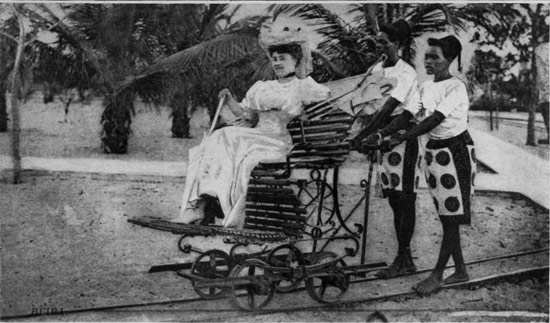
The Zulu ricksha puller is the most striking feature of that
interesting city to a visitor, as he proves an object of much
curiosity and admiration. He is in a class by himself. In
stature, he stands from 5 feet 6 inches to 6 feet 4 inches; in
color, darker than a mulatto, but not black; with bare legs,
strong, muscular and fleet of foot; generally ready to smile,
showing his perfect teeth; standing between two shafts by
which he draws the ricksha, watching eagerly for a fare—this
gives but a meager illustration of the Zulu ricksha puller.
The Zulu reaches the culmination of vanity when he has
fixed himself up to look like, and to imitate the actions of, an
ox, horse or mule, for he has a veneration for these dumb animals.
The larger the horns he can wear, which are secured
to a piece of cloth that fits tight to the head, the better he is
pleased. A number of long feathers often extend from between
the horns, and vari-colored grass and thin reeds, also
attached to the same place, fall to and below the waistline.
Added to this head adornment, calabashes, sometimes as large
as a cantaloupe, protrude from the side of his head. His jacket,
sleeveless, which bears designs of plaids and squares, resembling
a checker-board, extends midway between thigh and knee. His
pants are a slit knickerbocker, also extending to halfway between
thigh and knee, but from the hem fall strips of red braid
six inches below. The pants are split to allow his legs freedom
when drawing the vehicle.
The ricksha puller is eternally trying to think of something
fantastic and grotesque to wear. One fellow may be seen with
his legs and feet painted blue, representing the sky, with white
spots dotted here and there to represent stars, another with
both legs painted white. At times one leg is painted red and
the other white. Also may be seen, fastened to the puller's
horns, the skull of a calf or sheep, or perhaps of a monkey.
Monkey skins, with tails attached, are worn, one in front and
the other on the back. Again, a discarded plug hat may be
hung on one horn and an empty vegetable can on the other
while he is pulling a passenger about the city. Sometimes his
head looks like a small flower garden, as he is seen trundling
his ricksha about with bright red hibiscus and carnations sticking
out of his black, woolly head at the top and from the sides.
At night a small light—generally a candle—attached to the
axle of his sulky, may be seen at the sides of streets and showing
from dark alleys or from under a spreading tree. The puller
will jingle the little bell on the shafts of his ricksha to attract
the attention of a passerby. The weird trappings, with the dim
outline of the Zulu, together with his long horns showing from
the darkness, will not inspire confidence in one unfamiliar with
the native puller. In short, he appears fantastically inhuman
by day and grotesquely brutish by night. His physique, however,
is an object of admiration; mentally, he is a child.
The ricksha is a two-wheeled, two-shaft sulky, with rubber
tired wheels, upholstered, and will seat two persons. A hood
is attached to the seating box like that of a carriage. A small
bell hangs from one of the shafts, which the puller sounds to
give warning of his coming. Under, from the center of the
axle depends a bar of iron with a small wheel at the end. This
bar prevents passengers from falling out if the ricksha should
tip while going up hill. The service is good and the fare cheap—from
6 to 50 cents—the different fare stages being printed
on a card. Like every one engaged in similar occupations, the
puller knows a stranger, and succeeds often in getting more
than the just fare from men, but women generally ask for the
schedule card.
"Ricksha!" is the only word shouted when a puller is
wanted. Regular stands for them are located in different parts
of the city, and if one feels depressed in spirits and wishes to
get out of the "dumps," a good way to have the "cloud" lifted
is to shout "Ricksha!" when within 200 to 300 feet from where
fifteen to twenty of the pullers are chatting and waiting for a
fare. Every one of them will spring between the shafts, like
fire horses to harness, and make a dash at full speed to the
person who shouted. The noise and rattle a group of pullers
make in approaching sounds almost like a collision between two
railway trains.
The puller rests the shafts on the ground while his passenger
is being seated. He holds his big, strong, flat foot on the
thills, so the vehicle will not slip while one is getting aboard,
until his patron tells him to go. If one cannot speak the native
language, not a word will be spoken, for rarely does one meet
a native who can speak English. The passenger points his
finger in the direction he wishes to be drawn. The Zulu raises
the shafts and, after a few slow, heavy pulls to get the vehicle
started, one is spinning along as fast as a trolley car travels.
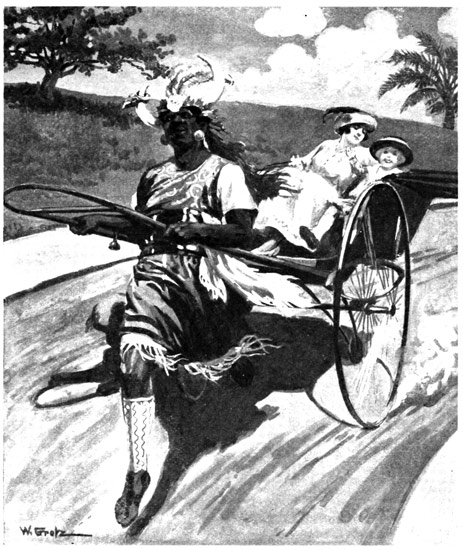
Jim Fish Was the Swiftest Puller that Ever Wore a
Brace of Horns.
Durban, South Africa.
"Jim Fish!" "Jim Fish!" they will call to a passerby, at
the same time ringing the small bell on the shafts, while advancing
and acting in a manner that suggests the person being
approached had forgotten to call a puller. Jim Fish was the
swiftest puller that ever wore a brace of horns. In a three mile
race with a trolley car Jim came out ahead, but, like Pheidippides,
the Greek of the dusty past, after whose run the Marathon
has been named, he fell dead when he had crossed the
finish line. By calling out "Jim Fish" the Zulus imagine the
name suggests a fast ride.
The puller appears at his best when traveling down grade.
Just at the head of the decline he jerks the shafts upward—this
movement bringing his back close to the dashboard—when
his arms rest akimbo on the thills. He maintains his full height
during this change of position, which is in accordance with professional
ricksha pullers' custom. The sulky naturally tilting
backward—also the occupants—his body is nearer the axle
of his vehicle than when traveling over a level or inclined surface.
Aided by the weight of his passengers, the ricksha is
then almost evenly balanced. Riding on the shafts, he throws
to one side, like a jumping-jack, the big leg bearing the painted
design of the sky or openwork, and his unpainted leg to the
other. He also moves his body from side to side and assumes
a labored expression, although resting while being borne on the
shafts. His body movement and stern appearance are affected,
and are, as he believes, in keeping with that of a racehorse when
coming down the home stretch, which he is imitating. His
horns and their adornment, together with the colored grass
streamers, feathers, monkey tails, checkerboard designed jacket,
calabashes, braid, flowers—all his trappings are then set full
to the wind, as the Zulu seems to actually fly through space.
In stormy weather, which means good business for the puller,
the hood is raised, and a piece of canvas that covers the front of
the ricksha is buttoned to the sides, which protects the occupant
from rain both from above and in front. Off the Zulu goes,
after he has tucked the rug under his passenger's feet and has
seen to it that the canvas shelters his fare. The rain may be
coming down in torrents, and the water half knee deep in the
streets, with the handicap of the raised hood and front canvas
against him; but patter, patter, patter he will continue, watching
for depressions, in order to sidestep them so that his
passenger will not be jolted, until he has reached the place at
which his fare wishes to alight. He will take one home in
any sort of weather, as his strong legs and body rarely fail
him.
The puller will often have nothing on but the jacket, short,
split-leg pants and trappings. He does not go to his living
quarters—the ricksha stable—and get dry clothes, as one
might expect him to do, but trundles his sulky about in the rain
looking for another fare. He pulls a ricksha from two to three
years, when consumption generally claims him as a victim.
Twelve hundred of these stalwart natives were formerly
engaged in this kind of work, but now there are less than a
thousand. The extension of street car lines from time to time
accounts for the decrease.
The rickshas are owned by a company, and 60 cents a day
is paid by the puller for its use. All he makes over 60 cents is
his own. It is said he often earns from $2 to $3 a day, but
there are also days when his fares do not exceed the rent charge.
Most of the pullers work but four days a week.
A "curfew" bell rings at 9 o'clock each evening, and the
only native seen about the streets who is immune from arrest
after that hour is the ricksha puller. After "curfew" a native
carries a pass or a note from his employer, either of which will
save him from being taken to a police station. It is very amusing
at times to watch a Zulu policeman question a native as to
why he is out late. His only protection is the note or his pass,
which the policeman makes pretense at reading, though he does
not know A from B.
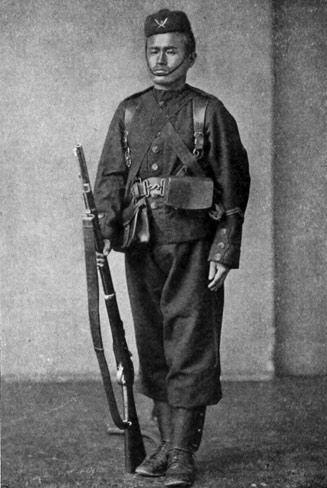
This dusky guardian of the peace is next in interest to the
ricksha puller. His uniform is a jacket, dark blue in color,
that reaches just below the waist band. His pants are of the
same material, reaching to and covering the kneecap, where it
is buttoned tight. His legs from his knees down are bare and
shine like polished ebony, for they are oiled every day. He
wears a stingy head piece called a forage cap, generally made of
blue cloth, which covers about one-third of the head—the side—from
the arch of the ear to within two inches of the crown.
This is held in place by a string looping under his chin or resting
between the chin and lower lip. Some caps have a red
stripe across the top, and all have a dent or crease. His weapon
is a knobkerry, a stick an inch round, with a knob on it as large
as a croquet ball. A pair of handcuffs is also included among
this Zulu officer's equipment.
The European policeman of Durban, as many European
women of that city, have an easy job. The native police do
any "rough" work required to subdue black offenders, as Europeans,
to whom the white policeman would give his attention,
are as a rule law abiding. The native carries his superior's
raincoat, overcoat, or any burden that the white officer might
need while on duty. A black policeman is not permitted to
arrest a European, no matter how serious the offense against the
law might be. The worst offenders are Indians; but big thefts,
safe-blowing, house breaking, hold-ups, sand-bagging, etc., are
few, which indicates the respect people have for the law in this
British stronghold. White policemen receive $75 a month, and
natives $15 a month and board. The working time is eight
hours a day, with three shifts.
A large building without an entrance door would appear as
something unusual in Northern cities; and yet one can find such
an oddity in the far Southland. The one in question is built
of brick, three stories in height, and contains a hundred furnished
rooms. The entrance is a high archway, and just inside
is an elevator and stairway. It is an English custom to leave
one's shoes outside his room door on going to bed, so that
"boots" can polish them in the morning. In front of each
room, on each side of the aisles, in this hostelry could often be
seen from one to four pairs of shoes, yet every pair would be
found in the morning where they had been placed the night before,
although no porter guards the entrance of the building nor
a night watchman the interior.
Meat is about the same price in South Africa as in America.
Beef, mutton, chicken and pork cannot be had for less than
15 to 25 cents a pound. Irish potatoes are expensive, as most
of this standby is imported. Eggs sell at 35 to 60 cents a
dozen. Apples are imported from Australia and Canada.
Pineapples, oranges and bananas are found on the table of
nearly every household the year round. Then there are, among
other varieties of seasonable fruit, the mango, guava, grenadilla
and avacada pear. The pineapple, when picked ripe, is as soft
as our pear. These native fruits sell at a reasonable figure. A
hundred bananas can often be bought for six cents.
Hotel expenses are reasonable, $2 a day insuring good accommodation.
In boarding houses, good board and lodging can be
had at from $30 to $35 a month. Splendid furnished rooms
can be rented at from $10 to $15 a month. Meals in popular
priced restaurants cost 30 and 35 cents.
The sun rises from the Indian Ocean here and travels during
the day on an almost straight course, shining on the south side
of the street, the north side being partly shaded. For this
reason the principal business street of Durban is roofed on the
south side, as it is exposed to the sun from morning until sunset.
The cold and warm winds also come from a different
direction than those above the equator—the warm winds from
the north and the cold winds from the south. Even the sun
seems to rise in the west and set in the east.
Wages paid mechanics range from $3 to $4 a day of eight
hours' work. Such employment as teamster, hod carrier, street
laborer, 'longshoreman, and park worker is all done by Indians
and natives. The native is paid from 25 to 50 cents a day, the
latter figure being considered good wages, while the Indian
works for 10 to 15 cents a day. Hotel work, waiting on
tables, kitchen work, and even cooking, with a few exceptions,
is done by blacks, chiefly Indians.
A white man "on his uppers" in Durban, or in any black
center, for that part, is to be pitied. If he be a mechanic, his
chances for work are none too good, and if he be an unskilled
worker there is no chance for him at all, as blacks do all the
work of that sort. The United States and Canada are the only
countries—possibly Mexico, too—in which one can travel on
railroad trains without paying fare or being put into a penitentiary.
Walking on a railway track in Europe is a prison
offense. So, taking that as one's cue, a man caught stealing a
ride on a train might be tried for treason. As Durban is 7,000
miles from England, 4,500 miles from the Argentine, 6,000
miles from Australia and 5,000 from India, a fellow "broke"
in the coast cities of South Africa is in a sorrowful plight. The
cheapest steamship passage from South African ports to England
is $80 to $100.
Labor unions exist in South Africa, and the members take
an active part in politics. Not long since a spirited campaign
was on for a seat in the Senate. One of the foremost business
men of that country was a candidate for the office, and a union
labor man, a locomotive engineer by trade, was the opposing
candidate. The lines were tightly drawn between capital and
labor in that senatorial contest. The "one-man-one-vote"
clause has yet to be drafted into the constitution of the Union
of South Africa. Only a citizen paying a certain amount of
tax during the year is allowed to vote. On the other hand, a
man holding much property, and this scattered about the country,
can, as in England, vote in as many districts as his property
is located. A wealthy man may cast half a dozen votes at an
election, while the workingman taxpayer will not, as a rule,
have more than one vote. The capitalist candidate for the
Senate in this election had four votes to cast, while the railroad
man had but one. A widely known man from the Transvaal
was imported to Natal to do "heavy work" for the wealthy
candidate, and prominent labor men from the Transvaal and
the Cape of Good Hope Provinces were saying and doing all
they could to make votes for their candidate.
"We must all hang together, or assuredly we shall all hang
separately," a labor campaigner was heard to say at one gathering,
quoting Benjamin Franklin's cynical epigram. "Of the
people, by the people, and for the people," Abraham Lincoln's
immortal words, were also used during the campaign. But
the speakers of both parties were tyros compared to the American
brand of spellbinder. Election day came, and he who had
plural votes cast them, and he who had one vote cast it. The
result of an election is made known by a judge announcing the
figures from the balcony of the Town Hall. "Hear, ye!
Hear ye!" a voice was heard to command, the judge addressing
the people assembled. The engineer had 36 more votes than
his wealthy competitor, and was the third labor legislator elected
to the South African Upper House.
Every mechanic has his "boy"—the bricklayer, carpenter,
plumber, electrician, painter—to wait on him. One might be
located in the black belt for years and not see a mechanic carry
even a pair of overalls. A mechanic may be seen any time,
when working, asking his "boy" to hand a tool that would not
be two inches beyond his natural reach. A bricklayer becomes
so painfully helpless that he will neither stoop nor reach for a
brick; that is what his "boy" is for. The carpenter must
saw boards, because the native cannot saw straight, but in every
other respect he is just as helpless as the bricklayer. Clerks
even have a "boy" to hand a pen or any other thing they
might need in connection with their work. The only tradesman
observed who did his work without the aid of a "boy"
was the printer and linotype operator. And what applies to
printers may be said of editors and others engaged in the printing
trade. They really work in the old-fashioned way. Were
one to take a spade in hand to prepare the garden for vegetables,
merely that act of manual labor would be very apt to prove a
bar to a further continuance of the respect of his European
neighbors, and assuredly so by the natives and Indians.
The white man is always at his minimum energy where the
black man is depended on to do the work. We need not go
farther than our Southern States to learn that lesson.
Vasco da Gama, a Portuguese explorer, discovered the Province
of Natal five years after Columbus set foot on the North
American Continent. Da Gama's first visit to Natal was on
Christmas Day in the year 1497. As Christmas Day is the natal
day of the Savior, and as the word natal in the Spanish and
Portuguese languages is used as is the word birth in the English
language, this will explain the origin of the naming of
Natal.
For more than three hundred years that section of South
Africa remained as Da Gama found it before white men made
a settlement among the Zulus. In 1824 a few Englishmen
built temporary dwelling places on the shores of the Indian
Ocean, more Englishmen joining them from time to time, until
Durban has become one of the leading seaport cities of the
African continent. The coast section of the Province of Natal
is the only part of South Africa in which the Dutch were not
the pioneers.
A great many humpback whales inhabit the Indian Ocean
in the stretch of sea, nearly a thousand miles long, separating
Durban from Capetown. Of late years whales have been
hunted on a large scale, and each season finds a new whaling
company in the field to share in the profits of this lucrative industry.
Eight or ten factories, or stations, most of these located
a few miles from Durban, are now engaged in utilizing the by-products
of the whale.
Harpooning whales, or whaling—to use the general term—is
engaged in at places separated by thousands of nautical
miles, and, like other water industries, has its season. Whales,
like wild fowl, migrate at certain seasons to some particular
part of the great water expanse, and return again the succeeding
year. By nature, this cetacean prefers a cold climate to a
warm one. The season for their migration is at a different
period to that of the wild fowl, for the "spouter" leaves the
zone of the hot sun and swims great distances until he reaches
cooler water. Sometimes it is from the North Atlantic to the
South Atlantic or Indian Oceans, and at others from the Indian
Ocean southeasterly to the South Pacific Ocean, the water of
which is cooled by the icebergs of the South Pole section.
Whales leaving the North Atlantic in early summer for the
South Atlantic Ocean know it is cooler south of the equator
than north of it.
Americans and Norwegians engaged early in the whaling
business in the North Atlantic Ocean, and up to a few years
ago American whaling ships made frequent visits to the South
Atlantic and Indian Oceans in quest of the oil-producing leviathan.
But it is to the Norwegian that credit must be given for
building up the whaling industry in the Indian Ocean, thereby
putting in circulation a large sum of money each season that,
until recent years, had been overlooked.
From 600 to 800 of these monsters of the deep are harpooned
and rendered into oil in the Durban factories in a season—from
June to November, inclusive—the cool season in that
part of the world. Thirty tons is the average weight of whales
killed in the Indian Ocean. Those on exhibition in museums
give one some idea of the size of a whale, yet the cured specimen
is a poor substitute for one which had been "spouting" an
hour before.
Whaling boats are little larger than a big tug-boat. The
whaler is equipped with one mast, and twenty feet above the
deck a long barrel is secured to this, in which one of the crew
is stationed when hunting the great monster of the sea. The
barrel is called the "crow's nest," and from here the "lookout"
scans the ocean in every direction for the "spouting" mammoth.
On the bow of the boat a cannon is secured, out of
which a harpoon is shot into the whale. The harpoon looks
like a small boat anchor. The length of the harpoon bar is
four feet, and at one end are four hooks ten inches long. The
hooks are attached to the bar by a spring, and, before being
used, are bent down to the bar, and kept in this position by
strong cord. Over the end of the bar fits a spear-pointed cap
a foot long, and in this cap has been placed a dynamite bomb.
Whales are shot within thirty yards of the boat—sometimes
twenty feet. The cannon can be adjusted to any angle. When
the spear-pointed cap enters the whale, the bomb explodes,
snapping in two the cord with which the four hooks were tied
to the bar, when the hooks spring outward—like an open umbrella—inside
the whale.
The vital spot aimed at is the lungs. If the aim proves true,
the large mammal falls a victim to the ugly weapon, and dies
instantly. If the harpoon goes wide, the whale heads for the
bottom. A long, strong rope is secured to one end of the harpoon
bar, and the whale is given liberal latitude for his deluded
effort to escape. Soon the rope slackens, when the whaler
knows the "spouter" is coming to the surface to breathe. In
the meantime, another harpoon has been placed in the cannon,
and when the whale appears this one is shot into the crippled
monster, putting an end to his fight for life. It sometimes
occurs, however, that the whale breaks the rope fastened to the
eye of the harpoon, when he escapes, carrying the treacherous
weapon in his ponderous frame.
When dead, the great "catch" is drawn to the side of the
boat by the rope secured to the harpoon. His tail flippers,
which are from 10 to 12 feet long, are cut off, to allow of convenient
handling of the cumbersome carcass. A chain is then
put around his delimbed tail, the winches revolve, and, when
his tail has been drawn up close to the bow of the boat, a start
is made for the wharf, leaving behind a wake of red sea, discolored
by the blood running out of his mouth and from the
rent in his body where the harpoon entered.
At the wharf, the boat chain is loosened and the harpoon rope
cut. A chain from the shore is next wound round his tail, a
signal given the engineer to start the machinery, and the great
cetacean is slowly drawn up a slipway out of the water. When
drawn to the head of the slipway, the body continues moving
on to a wide flat car, the railway track on which the car rests
being sunk to a depth level with the top of the slipway. One
flat car is not long enough to afford room for the huge wanderer
of the deep, and a portion is drawn on to a second car.
An engine backs down, is coupled to the "whale train," and
a start made for the factory. The harpoon remains in the
whale until the body is cut to pieces.
At the factory, the whale is drawn off the car on to the
"dissecting" platform by another chain secured to the tail.
Men, with long-handled knives, then make deep cuts—one in
its back and another in the underpart—from the point of the
jaw to the tail, and another deep cut the full length of the
carcass. The spaces between these incisions are three feet at
the underpart and from five to six feet on the back. This part
of the process is called "flencing." At the point of the jaw
a piece of flesh is cut until it is released from the bone, and a
small hole is cut out of the released part. A kafir, bare-headed
and bare-footed, brings a chain, and the hook of it is put through
the hole made in the released end of flesh at the whale's jaw.
A signal being given a man at the winches to start, the piece of
released hide begins to peel from the jaw, then down to the
shoulder, and further still. When the winches stop, a slab of
hide 40 to 50 feet long, six feet wide, and six inches thick—from
the point of the jaw to the whale's tail—is stretched out
on the platform inside up. The skin from the back and sides
of the whale peels off almost as smoothly as does the skin of a
banana from that fruit. The skin at the underpart, however,
does not peel so freely, requiring cutting of the flesh by the
flencer in a similar way to that of severing threads when ripping
a seam in a garment. The underpart of the hide is but
three inches thick. These slabs or strips of flesh, of which six
or seven are procured from a whale, is the blubber, and from
the blubber comes the best grade of oil.
Kafirs, with long-handled knives, cut chunks—about 18
inches long and 12 inches wide—from the slabs, which are
thrown into a hopper in which are revolving knives, these cutting
the flesh into small pieces, which drop into elevator buckets,
later emptying into boiling tanks located on a floor above. In
these vats the oil is boiled out of the blubber.
The whalebone, located in the enormous mouth, is yet to be
removed. The flesh to which the bone grows is cut with long,
strong knives around the inside of the jaw. A point of the
flesh is released, a chain hooked to it, the winches again start
revolving, and the whalebone begins peeling off the inside of
the mouth as freely as did the blubber off the back. Half of
the whalebone still remains in the mouth, and this is removed in
the same manner as the first half.
A great blood-red hulk is all that now remains of the whale.
A chain is again wound about and secured to the tail of the
carcass, the winches, for the last time, revolve, when the colossal
frame is moved up an incline to a floor above the platform
on which it was skinned. Then kafirs, with axes, begin cutting
the hulk to pieces, which are thrown into rendering vats. Different
parts of the body are thrown into different tanks, as
certain portions of the flesh produce a better grade of oil than
other parts. The only portion not boiled is the bone in the
mouth. The blood is the only particle not utilized, and it
would add proportionately to the whale's value were it shed
on shore instead of in the sea. The flesh, after the oil has been
boiled out, is sold to farmers for fertilizing purposes. Thirty
to thirty-five men take part in disposing of a whale at the factory,
and from four to five hours' time is required to get the
carcass into the rendering vats.
From $700 to $800 is the value of a humpback to the manufacturer.
The average quantity of oil rendered is 50 barrels,
and a barrel of oil sells at $12 to $15. Most of the oil from
the Durban factories is shipped to Glasgow, Scotland, the whalebone
to Paris, France.
Some whalers say the food of a whale is small fish, while
other authorities give it, owing to the gullet of some species of
these cetaceans being but two and three inches wide, as very
small, nutritious marine organisms, or insects, many not visible
to the eye, called invertebrates. When feeding, the whale
takes great mouthfuls of water, its whalebone serving as a
strainer and repository in which the minute sea denizens lodge.
The water is then forced out of the mouth, the food extricated
from the meshes of the whalebone and advanced to the throat.
The mouth is so well protected with this bone, which looks like
a low, dense brush thicket, that nothing can enter the throat
until it has proved palatable.
The whale breathes through two slits, 18 inches long, located
on top of the head. Forty-five minutes is as long as the great
mammal can remain under water without breathing; but when
swimming fast it will be seen spouting at intervals of from five
to seven minutes. The spouting is caused by the slits or air-holes
being slightly under the surface. The tube through which
air passes to the lungs is said to be three inches in diameter.
The color of the back and sides is black and the skin smooth.
The underpart of the body and flippers is white, save for an
occasional black speck and fine black lines—mottled. Flutes,
four inches deep, corrugate the beast's underpart from tail to
neck. In these grooves are to be seen a great many small
barnacles, and on the neck and lower jaw barnacles grow as
large as goose eggs.
From $8,000 to $10,000 is the value of a ton of whalebone
from a "right" whale, 800 to 1,000 pounds of this elastic substance
coming from the mouth. The bone grows in the form
of strips, from 6 to 10 feet in length, and 6 to 12 inches in
width. One end of a strip is fringed with fine, black hair-fiber,
this part of the whale finding its way to the top of persons'
heads, as out of it some "human-hair" wigs are made. A
"right" whale, 10 to 15 feet longer than a humpback and in
value equivalent to eight of the latter, is worth from $5,000 to
$7,000, but of the hundreds killed in the Indian Ocean during
a season not more than half a dozen of this specie will be among
the number. The whalebone from the humpback is in little
demand, growing but two feet long, and is of inferior quality.
The bone in the mouth of the "right" whale calf—strips a
foot long and tender—is of great value. These are shredded,
the fine, soft fiber being made into artists' painting brushes.
The cow whale brings forth young each year, but triplets
or even twins are unknown in the cetacean family. A calf
first opens its eyes in the sea and soon finds its way to its
mother's side, where, securely snuggled by a strong fin, it remains
from three to six days. When able to "paddle its own
canoe," the baby whale—a born swimmer—keeps close to its
mother's side, either up to the surface to "blow," adding a
tiny whitecap to the bounding main, or to accompany its maternal
guardian to feed in salty pastures of the deep. A whale
calf nurses like a colt. When a nursing cow whale is harpooned,
whalers generally kill the calf also, as it would starve
if left without its mother's nourishment.
At certain times of the year whales move in pairs—male
and female. When a hunter meets a couple the female is first
selected for slaughter; the sex is known by the cow being
larger. The male whale will not desert his dead mate, and
thus becomes an easy victim of the hunter's harpoon. On the
other hand, if the male be shot, the female immediately takes
flight.
A whale is 17 feet long when born. At three years of age
it has attained a length of 30 feet, and during the succeeding
eight or nine years reaches its full length—from 45 to 50
feet; so that it requires ten to twelve years to reach its maximum
size. Old whalers are loth to hazard a statement concerning
the natural lifetime of the cetacean.
Zululand was next visited. During the reign of their
kings Zulus controlled their own internal affairs—made their
own laws, apportioned the land, chastised their subjects, conferred
with British officials concerning border line rules—were,
in fact, in every sense, a distinct, unfettered race of people.
Zululand was Zululand then. War after war, with
gatling guns and modern fighting implements pitted against
their mediæval arms—the assegai, or spear—naturally made
the tribe submissive and wiped out their border line. So long
as they had a king there was always danger of trouble from
Zululand. Dinizulu, the last ruler, was taken prisoner, and
was "boarded" in a Transvaal penitentiary until a few years
ago, when he died. The border line between Natal and Zululand
passed away, and the interests of the Zulus and the affairs
of Zululand are now looked after and administered by
officials of the Province of Natal.
The train, passing through cuts and grades, is half embowered
with flowering trees, growing on the banks. The giant bamboo,
in obedience to a summery wind, was gracefully swaying to
and fro; the aloe, with its flowery top, sixteen feet above the
ground, sentinel-like, contributed its share to the floral ensemble,
and, together with an almost endless tract of soft, light
green sugar-cane growing on each side of the railroad track,
offered a mellow landscape found in but few parts of the
world.
A depressing contrast to nature—the Indian coolie scourge—is
witnessed at every stopping place in this part. We were
in the sugar growing section of Natal, and, as mentioned previously,
Indian coolies are employed entirely in this industry.
There they were by hundreds, most of them of objectionable
appearance, and a dirty, almost naked, baby astraddle every
woman's hip, the Hindu mother's custom of carrying her child.
We reached the Tugela River, the border line between Natal
and Zululand, and, thirty miles further, the train stopped at
Ginginhlovu, our destination. Ginginhlovu (elephant, in
Zulu) was 93 miles from where we started, and the train was
seven hours running that distance, running to schedule, too.
Indian shanty stores were pleasantly absent, as none but white
traders are allowed to do business in Zululand.
The post cart is the stage coach of South Africa. Strongly
built, it is covered with canvas, has two wide wheels and contains
two seats. A seat will accommodate three persons in a
pinch—the maximum capacity of the coach being five passengers
and the driver—but as the latter usually takes up two-thirds
of the front seat to handle the large team required to
draw the coach, the ordinary capacity of the cart is four passengers,
three occupying the rear and one the front seat. A
frame at the back serves for luggage, and small hand baggage
may be put under the seats. Four or six mules comprise a cart
team, the charge being ten cents a mile.
We left the railroad, and our mode of travel into the interior
of Zululand was by cart, wagon—a conveyance drawn
by beasts. Five passengers, the maximum number, squeezed
themselves into the cart. The next trip inland was on the following
day, for which we would have to wait, the station-master
had informed us, "unless there was a transport going to
Eshowe." Eventually a transport—a truck 18 feet long—was
found, the driver of which said he thought he had room for
another passenger. The transport, ridged with bags of cornmeal
five feet high, was drawn by four teams of mules.
"Climb on," said the driver to a group of six; "we'll be
starting in a few minutes." Three women, two men and a
boy began to scale the transport up to the top of the load.
"Get up," said the driver to the mules, when a start was made
for the interior of Zululand, the passengers sitting on the top
tier of cornmeal bags of the loaded African transport.
We traveled slowly seventeen miles over a good macadam
road. "That's the home of Dinizulu, the Zulu king," said the
boy passenger, as we passed a frame building close to the road.
We reached our destination just at sundown—Eshowe, the
old capital of Zululand, and one of the prettiest places visited
in South Africa.
Shade trees, flowers, comfortable homes built in spacious
yards; small, but substantial, public buildings; a good library,
a wooded glen just away from the town, in which had been
built a splendid cement swimming pool, give an insight into
what the old Zulu capital looks like now. The comfortable
appearance of Eshowe has been made by the European. English
and native weekly papers are printed here, and the quality
of the work is good.
A European boy volunteered to show me about town. He
had taken me to the swimming pool, and as we were passing
through a timbered portion of this natural park he suddenly
shouted, "Look out!" He then pointed to a big fly that had
just passed between us. "If that fly had struck you the bitten
part would swell up as large as a hen's egg. Often the effects
of the bite will assume the nature of an ulcer," he added. A
great number of flies in South Africa draw blood when they
strike a victim, whether man or beast.
We had 35 miles more to travel before our last stop in Zululand
would be reached. The post cart left at five o'clock in
the morning, with four passengers, and was drawn by four
mules. The road was level for the most part, with high grass
growing on each side, broken only by an occasional giraffe
thorn or mimosa tree. The mimosa was in flower, and so
much fragrance was diffused from the thorn tree that one
would know of its existence if it were not in sight a hundred
feet away.
"Hello, Graham!" shouted one of the passengers to a white
man who stood in the door of a building at which we had
pulled up. We had reached N'Halini, the first relay, where
we breakfasted. "Hello! everybody," returned Graham, for
he proved to be the proprietor of the eating station. "I haven't
any eggs to serve you this morning, but I'm strong on steak,
ham and bacon. Bring out a big piece of steak to make up for
the eggs," he directed one of his Zulu boys.
Graham is a sailor with a wooden leg. He entertained us
by telling how many times he had been caught in the net fastened
to the boom of a sailing ship—a "wind-jammer," as he
termed that style of craft—and how, when encountering the
fierce gales that blow in the Straits of Magellan, he had been
blown entirely off his feet, his body being lifted in mid-air, his
legs suggestive of ribbons, while holding to a deck rail.
"Did you get enough to eat?" he asked, when we had
finished. And we admitted we had. Graham had two pigs
eaten by crocodiles the day before, and he could not restrain
himself from bemoaning his luck.
"So long, fellows! I'll have eggs for you when you come
back. So long!" were the parting words of the onetime
sailor, as, with an additional team of mules, we started on our
second relay.
"Sit forward, please, while we are going up this seven-mile
hill; the cart is tilting back too much," said the driver. We
had five passengers now, as another one had got on at Graham's
place. It's easier to say Graham's place than it is to try to
pronounce the Zulu name.
On, on we traveled over those beautiful hills of Zululand,
the passengers chatting as we moved along. Grassy hills, 500
feet high, bare of timber and even shrubbery, with native huts
built on the sides, and small patches of corn growing here and
there, proved of interest. Vultures were flying high up in the
air, bevies of guinea fowl scurried to cover, and the wagtail,
a black and white bird of swallow size, with a tail ten inches
long, crossed the roadway from time to time. We had been
told of the beauty of Zululand, and nothing had been exaggerated.
Grass—long and short—was growing everywhere, enough
to feed millions of cattle, and not a "critter" grazing in sight.
The Zulus, before and for some years after the white man
settled in South Africa, were a wealthy tribe. Hundreds of
thousands of cattle, sheep and goats roamed over and fed off
these ever-grassy hills; but tick fever—East Coast fever, it is
as often called—had fattened the vultures and made the Zulu
poor.
We reached the second relay, then the third, but the beauty
of landscape did not diminish. Our next relay will be the end
of our stage journey—Melmoth—52 miles from the railroad.
"The stopping off place" is a term often heard, but when
one reaches a point where there is no railroad and the terminus
only of post carts, it is certainly the stopping off place. Europeans
live in remote places still beyond Melmoth, and their
mail is brought to them by native postmen on foot.
We reached our destination early in the afternoon. Mail
for persons living beyond "the stopping off place," brought
with us in the cart, was to start on its way at three o'clock.
As it was a week before Christmas, the post contained a great
number of Christmas presents. The mail finally being sorted,
it was entrusted to the postman's care. All the letters could
be put in a coat pocket, but the presents strapped to his body
made a heavy load.
A Zulu, six feet tall, stood on the porch of the squatty postoffice
building, looking like an off-colored Santa Claus. Having
reached for a stick a foot longer than his height, he stood
up straight, waiting for the word to go.
"All right, Jim," the postmaster ordered in the native tongue.
"Ba, ba," returned the negro in a low voice, bowing and saluting,
with one hand raised to the side of his head. He turned
round quickly and walked alertly in the direction where white
people live, to be made happy by presents sent to them by
friends living in distant lands. Thirty-three miles was the
distance the Zulu carried the mail. It was three o'clock in
the afternoon when he left the Melmoth post office, and was
due at the next post station at 9:30 the morning following.
"He'll be there on the minute," the postmaster replied to
a question as to whether the carrier could travel the distance
in the time allotted, considering the heavy load. "He never
fails us. Always on time—in hail, rain or shine," he concluded.
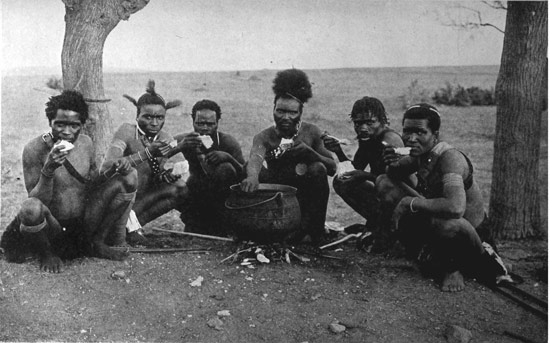
Zulus "Scoffing" Mealy Meal.
Zululand, South Africa.
Zulu huts are round, the framework being of poles bent
half circular, tied with grass rope. The arch poles are supported
with bent poles strung crosswise, these being made secure
by grass rope. Roof and sides are covered with grass and
reeds, secured to the framework with the same kind of rope.
The floor is of soil, generally taken from an ant-hill, and becomes
as compact as cement. In the center of the hut, what
may be termed a sort of earthen vessel is built, sometimes 18
inches across, and this is the cooking place—the stove. Zulus
build good huts. No windows are provided, however, and but
one low entrance. The cooking utensils are limited to an
iron kettle, with three legs. This is placed in the "stove."
Cornmeal (called mealy meal) is the chief food, which is
boiled in the three-legged kettle, and, when cooked, the family
gathers round it, some sitting on the floor and others resting
on their haunches. Each member is supplied with a wooden
spoon, and with these they eat mealy meal as long as there is
any to be eaten. A ladle to stir the mush, cut out of a calabash,
is generally seen in a Zulu home. The bed is a cotton
blanket, spread on the earthen floor, and a bowed piece of wood,
resting on two upright pieces at each end, about four inches
high, serves as a pillow. A soap box may occasionally be found
in a hut, but no chairs. The interior is generally black with
smoke from the "stove," a strong, sooty odor being noticeable.
The Zulu tribe does not "colonize"—or, rather, assemble
in villages, as each family live by themselves. Huts are numerous,
of course, but one rarely, if ever, finds a settlement—a
town. They live in "kraals." A kraal is a group of huts,
numbering from two to ten, surrounded by a fence, generally
composed of thorn brush. The collection of huts generally
indicates the number of wives that that Zulu has. One hut is
always larger than the others, this being occupied by the first
wife. Where cattle are kept together in a small area inclosed
by a fence, it becomes a cattle kraal. Sometimes one kraal
serves as a shelter for both natives and cattle.
Polygamy is common. The method of obtaining a wife is
by purchase from the father. Cattle is the medium of barter,
from 10 to 80 cows being the number asked for each girl. A
wife who can be bought for 10 cows is just the ordinary girl.
The daughter of a petty chief would bring 20 cows, and a
girl of royal descent could not be purchased for less than 70
to 100 cows.
When a Zulu wishes to marry he comes to an understanding
with the girl's father concerning the number of cattle that must
be paid for the bride, and he must not forget to include among
them another nice beast, which is slaughtered and eaten at the
wedding feast. The marriage always takes place at the home
of the bridegroom. The bride, with her attendants, arrives the
evening before the wedding day. The extra ox is killed early
in the morning.
The bride wears a veil of beads over her face for several
hours while the ceremony is taking place. Certain persons are
appointed to celebrate the marriage. Dancing is indulged in
during this period. The father of the bride steps forward
among the merrymakers and bespeaks the merits of his daughter.
An old woman runs backward and forward among the guests,
holding in her hand a small stick, pointing upward, and cackling
like a hen. Dancing is going on all the time, one "group"
of dancers holding the "stage" until exhausted, when another
group will fill the vacated space and inject renewed life into the
ceremony.
The bridegroom must show his valor during the pow-wow.
He steps into the arena with two sticks in his hand—stout
walking-sticks. A series of thrusts, feints, dodges, ducking,
then a terrible thrust; more fencing, another awful jab; snorting,
sweating, uttering deep grunts of satisfaction; stamping
his feet heavily on the ground to make a noise, imitating thunder,
which denotes powerfulness—he is fighting an imaginary
foe, and when the bride's father and wedding party signify by
applause that he has been victorious—that he has killed his
adversary in mortal combat—he retires, carrying in his bosom
the assurance that he is a Zulu warrior "to the manner born."
From 300 to 400 Zulus attend a wedding, which lasts sometimes
several days. Native beer, made from corn, is brought
in large quantities in hollow calabashes by the guests. Faction
fights, often brought about through uninvited onlookers, but
generally from drinking too much beer, frequently prove an
exciting feature of a Zulu wedding.
Under no circumstances can a wife leave her husband. A
bargain is a bargain with the Zulu. On the other hand, if the
bride's merits have been misrepresented, her husband will take
her to her father's kraal and demand the return of the cattle
he paid for her. Though the girl gets the cattle in name, the
father really has the cows.
When a husband dies, his wives are not left alone in the
world. It is a Zulu custom that a brother of the deceased look
after the widows. It may seem an imposition on a brother to
be saddled with two large families—his own and his dead
brother's—yet, bearing in mind that the widows, collectively,
are mothers of half a dozen to fifteen daughters, it means that
the guardian would fall heir to a nice herd of cows when the
girls reach womanhood. Zulu families, however, are not large,
averaging about five children.
A Zulu's standing with his people is based on the number of
wives he has. One with six to nine helpmates is considered in
good circumstances. In a general sense, the wives get along
agreeably when they number from two to six. The first wife
is mistress of those who come after her. Under the king's
ruling, putting to death a favorite wife by the others occurred
from time to time; but in such instances the wives numbered
eight to twelve. Murders of this character have become of
rare occurrence, however, since Zululand has been governed by
the white man.
Wives and children are of little or no expense to a husband.
He does not work after he has become the possessor of several
wives, and the corn is planted, hoed, husked and ground into
mealy meal by the wives. None of them wear shoes, nor
hats, nor coats. Cotton blankets, which cost from 25 to 35
cents, are their chief covering. No money is required for
baby carriages, as, when they are not snugly dished in a blanket
on the mother's back, with the ends tied in front across her
chest, they are seen creeping about the kraalyard. A visit to
the country districts will find native women hoeing or working
at something else with their babes tied to their back. Their
husbands are in their huts, smoking pipes or sleeping. Zulu
women look as strong as the men. Save for their babes, all
burdens are borne on their heads. This mode of bearing weight
is often carried to the ridiculous. A spool of thread, a tomato,
a tincup or similar light article may be seen balanced on a
woman's head. But she will carry in the same way, with as
apparent ease, though, a 100-pound bag of cornmeal, a five
gallon tin of water, a big three-legged iron kettle, and other
weights that would tax the strength of a strong man. The
Zulu woman's superior physique is accounted for, to a large
degree, by the bearing of burdens on her head from early childhood.
A Zulu woman "dressed up" is a striking figure. An ocher-colored
cone of hair rises from her head sometimes as high as
10 inches. One unfamiliar with the native's hair, as seen resting
flat on the head, would never imagine the kinky mop, when
straightened, would measure from 12 to 18 inches, but it will.
The natural color of the hair, of course, is black, and its unnatural
color is brought about by the application of a thin, red-mud
solution. Grass stalks, placed inside, form a frame, which
keeps the cone from settling. At the bottom, a band, generally
a strip of hide, keeps the "ornament" firm. A long hat pin,
whittled thin from a large bone of a beast, also plays a part
in keeping the "stove-pipe" properly poised. Her face is
broad and rather masculine, the expression stoical. No head
covering is worn, and weights are borne on women's heads,
cone or no cone. Her broad, strong shoulders are generally
bare, and she always stands straight. Strings are fastened
around her neck—sometimes these are hairs from an elephant's
tail—to which are attached square pieces of cloth, with colored
beads fastened on them, resembling dominos. Generally
wire bangles are worn on one arm, these in some instances
being so numerous that they cover the arm from wrist to elbow.
Often the skin of a calf or a sheep or that of a wild beast is
wrapped around her chest, passing under her arms, and fastened
at the back. This "waist" extends in front to about the
knees, and sometimes it is ornamented with beads, pebbles or
small seashells. A short skirt of rough cloth extends to just
below the knees, so that her legs from that point are bare, as
precious few native women wear shoes. They have none.
Only married women, or women engaged to be married, appear
in the cone-shaped hair fashion.
Polygamy is conducive to thrift as well as to laziness. Nowadays
few cattle are left to sons by fathers, as tick fever has
almost bared the country of this means of food and barter.
So, in order to get a wife, a Zulu must earn money with which
to buy cows. The umfaan will save half of his wages of
$2.50 or $3 a month that he receives as houseboy. When he
has saved enough to buy a cow—they can be had for $15—it
is put to graze close to his father's kraal, and he will save
enough money to buy another cow or two. In the meantime
calves are grazing, and by the time he has reached 21 years of
age he generally has enough cows to buy one wife. Numbers
of young men go to the Kimberley and Transvaal mines, where
the wages run from $15 to $30 a month, with board. Unlike
the American negro, the Zulu saves his money. But he will
not work more than six months in the year at most. It is said
a great deal of the Zulu's cash savings is hid in the ground.
They are suspicious of the stability of banks, so keep the money
where they can see it when they wish to.
The native of South Africa is as independent of the white
man's aid to-day as he was a thousand years ago. His wants
being so few, and his food easily obtained, he is not compelled
to work for the white man. He is not ambitious for riches.
When a Zulu's hut is built on government ground the tax
per year is $3.50, which includes all the land he feels disposed
to work. He does not plant all his corn in one field, but has
two or three patches growing not far from the kraal. If his
hut is built on private land, the landowner charges the native
from $5 to $10 a year rent. Land for cultivation, however,
is included in the rent of the private landowner. Some of the
public men of South Africa entertain the belief that if a
heavier government tax were imposed on the native it would
force him to work more—smoke him out, as it were. Just
think of the snug income some Europeans who have from 100
to 300 huts on their undeveloped land are receiving from natives,
as they collect from $5 to $10 for each hut. The native
still pays the $3.50 government tax also. While Zulus as a
race are honest, few Europeans will do business with them on
a credit basis; they must pay cash for what they buy.
Honesty among Zulu house servants is an admirable trait.
One might place a bushel of $20 gold pieces in the center of a
room, be away from home for months, and on return find the
money where it had been left. This applies more to what is
termed a "raw kafir." When they have been among white
people for a year or two their traits of honesty often slacken.
The black man, as a rule, will pick up all the white man's
vices, but few of his virtues.
A violation of the Zulu code of honesty was formerly punishable
by death, and in some cases is still adhered to. The
theft of a horse, cow, sheep, goat, pig or dog brought the death
penalty. The moral code is inflexible. If a girl leaves a
kraal to go into service in the towns and returns not as good
as she was when she left the hut, she is likely to disappear
mysteriously. A native guilty of committing a crime with a
Zulu woman may be put to death.
Few deformed or crippled members of this tribe are seen.
Under the kings' ruling an imperfect child at birth was not
permitted to live.
Respect for old age is another excellent trait of the Zulu
tribe. Were a mother or father to be living with a son and
his wives, the father is "boss" of the kraal; and were the
father to die the mother is the head of the kraal. The elder
of two persons is respected by the younger. The oldest son
has absolute rule over the other children; but, if the father be
a chief, the youngest son succeeds him. Indian-like, Zulus
walk in single file, and the younger always walks behind the
elder. The woman always walks behind the man and carries
his belongings. A Zulu woman is never seen alone—always
with a child, woman, or girl.
Zulus have their own name for Europeans. A man who
wore spectacles would be "four-eyed" in their language; a
person with a scar on his face or hands, would be "scar" in
the native language; one having a deep voice or light voice—that
would be his name with the native. Long hair, short
hair, mustache, a smooth face—any mark or peculiarity—Zulus
would know him by words pertaining to these.
Natives are not allowed to own or carry firearms or any
weapons used by Europeans. The same restriction applies to
native police. A knobkerry, a pair of handcuffs and a sjambok
(a strip of rhinoceros hide like a short whip) are the only
weapons a native policeman is supplied with. The policy is
a wise one, for, if the blacks knew how to use firearms, it would
mean a constant menace to the whites. Zulus often carry their
assegais with them in their country, and are allowed to carry
sticks at all times, as a dog will attack a black, and the same
dog would not even growl at a white man; besides, deadly
snakes are numerous.
The Zulu system of "telegraphing" news from one part of
the country to another is an interesting accomplishment. Results
of battles and approaching danger are shouted from hilltop
to hilltop for hundreds of miles with surprising speed and
accuracy. In crises Zulus seem to rise out of the ground.
Sugar, salt, kerosene, cotton blankets, tobacco, snuff, lanterns,
Jew's-harps, concertinas, mouth organs, beads, cheap
spangles, bright calicoes, whistles, and numerous other things
of a tawdry character are what Zulus spend their money on.
Six cents is the cheapest purchase he can make, as the three-penny
piece is the smallest coin in circulation. They will
haggle and haggle with a trader sometimes for half an hour
over a six-cent purchase, if the trader will listen to them.
"Bonsella" is a word one will often hear if he has dealings
with the Zulu. "Bonsella" means he wants something that
does not belong to him. With a six-cent purchase he will insist
on a "bonsella." A thin slice of a small bar of soap, a few
grains of sugar, a little pinch of salt, a piece of string will do,
if he cannot do better; and should he fail in getting something
from the trader he will ask for a drink of water.
With similar weapons, and each equally skilled in their use,
and even numbers, one is pretty safe in making the statement
that no man can fight better nor for a longer period than the
Zulu. Their military uniform used to be cow-tails secured
to a ring around the neck. The tails were so thick they presented
the appearance of a complete robe or skin. The Zulu
can store enough food away at one meal to last him for 24
to 36 hours without becoming fatigued. He can run from 50
to 70 miles without stopping. Coupled with these staying
qualities, it was the custom with some of the Zulu kings to kill
all soldiers who returned defeated in battle. That left but
two courses open to him—death or victory.
The Zulu has but a poor and varied quality of religion.
Some select the sun as their guiding light, others a white bird,
again hawks will appeal to him as being worthy to look up to.
Unlike the Mohammedan, his knees are not calloused from
kneeling to gods of any sort.
Missionaries claim to have 200,000 followers of the Christian
religion, which is nearly one-quarter of the Zulu population—one
million. People who live in black countries place
little credit to the native for having adopted the European faith.
In fact, there is a prejudice against the mission native. If a
man in South Africa were in need of two "boys," and two mission
"boys" and two kraal "boys" had appeared for work at
the same time, he would at once select the kraal "boys." When
a native begins to wear shoes and a European hat, his usefulness
as an employee generally proves of doubtful quantity.
When he embraces the Christian religion he is limited to but
one wife. That does not absolve him, however, from coming
forward with the cows for his bride.
Zululand, and South Africa generally, is well looked after
by European mounted police. The duty of the mounted police
is to see that firearms do not find their way to the native; that
whisky is not smuggled over the border; to learn if discontent
exists that might turn into a revolution. The native police,
unmounted, arrests natives for minor offenses, and tries to find
out from his brother violations of the law that the white man
could not know other than through his minion.
"Ba, ba" (father), is a native salute to a European. A bow
always accompanies the words. It is customary to return the
native's recognition, although some Europeans will not go to
the trifling trouble to do so, which is discourteous, to say the
least.
Should one be benighted, a European does not think twice
as to whether he will go to a native's hut and sleep on the
floor with the family. In so doing he will be offered every
hospitality.
Deadly, poisonous snakes are so numerous in this section that
settlers carry with them a snakebite outfit. This consists of a
strong cord, a syringe containing a poison antidote, and a small
lance attached. In Zululand and Natal a rattle-snake is considered
almost harmless. The puff adder, that coils itself in
a pathway and is very sluggish, bites one by a backward spring.
His fangs grow that way. He cannot bite after one has passed
him. Death shortly ensues from the bite of this reptile if not
attended to at once.
A person will die in 20 to 30 minutes after being bitten by
a mamba. There are two kinds of this deadly snake—the
green and black—but no difference in the quality of poison
they inject into their victim. Death from a mamba's bite is
said to be an awful one. Sometimes the bitten person's head
will burst and appear as a pumpkin would look when thrown
with force on a stone. This will account for the settlers
carrying the snakebite outfit. The cord is used to wrap around
the member bitten above where the fangs entered, to keep the
poison from getting further into the system; the lance is used
to cut out a piece of flesh where bitten, and the syringe is used
to inject the antidote accurately at the raw part of the member
where the fangs stopped. This precautionary measure must
be gone through within a couple of minutes or one will fall
a victim to the mamba's fangs. The snakes grow in length
from three to four feet.
"Wood and iron" houses—corrugated iron mostly—is the
style of European homes seen in Zululand. This also will
apply quite generally to the country districts of South Africa.
A half dozen of these, one story high—a postoffice, three general
stores, a court house and a hotel—are the buildings about
which the commercial life of Melmoth centers. A church
building is generally numbered among these groups, and always
a graveyard out of proportion. Many of the hotels of Zululand
are built somewhat on the kraal plan. The dining and
sitting rooms—sometimes one room answers both purposes—are
in a one-story "wood and iron" building. Many of the
bedrooms—small houses resting on posts a foot to eighteen
inches from the ground—are located a short distance from the
main building, which they sometimes half-encircle. Each house,
by partitioning, contains several small bedrooms. The beds
with which these rooms are furnished are generally half-size
iron ones, and the light provided is often a candle.
"Keep to the native trail until you come to that clump of
wattle trees," directed the driver of the post cart when ten
miles from Melmoth on my return to Ginginhlovu. A printer
who had got tired of the smell of printers' ink moved to
Zululand to make his living in the dual capacity of farmer and
trader. So, with a grip in my hand, I started over the Zulu
trail to the clump of trees in the distance. I had not gone far
when I heard a shout, but could not tell whence it came. It
may be the natives telegraphing the start of an uprising, I
mused. "Halloa!" was again heard, and, looking in another
direction, a wide-brimmed hat was looming over the arch of a
grassy hill. It was the printer. The post cart driver had
"set me down," as a Britisher would say, at the wrong trail.
"The natives wouldn't sell me any chickens when I first came
here, so I wouldn't sell them any goods unless they paid for
them with chickens," was one of the difficulties the printer-trader
recounted in his effort to hew his way in Zululand.
"Sarah," addressing his wife, "come with us this afternoon
while we visit the natives' huts, as you can speak the language
better than I," obligingly suggested the sturdy trader, who had
beaten freight trains over the United States, sailed before the
mast, and had tramped the desert of West Australia to the gold
mines at Coolgardie.
Through the trader's wife we chatted with the Zulu women
hoeing corn, with their pickaninnies on their backs. Later we
squeezed through the small entrances into hut after hut. The
lady of the Zulu home explained how the natives winnowed
the mealy meal by blowing the dust or bran from it with their
breath when passing from the hands, to lodge in a wooden
bowl under; how they stirred the meal; explained their scanty
washing outfit, how the wives got along together, and other
interesting features of Zulu life. After spending several interesting
days at the printer-trader's home, it was time to say
good-by; and I left with a keen feeling of indebtedness for
the unstinted hospitality and kindness shown me.
"I've kept my word—I've got the eggs!" remarked
Graham when we had pulled up at his place for luncheon on
the return trip.
With pages left unwritten of the Zulu, the strongest, most
intelligent and best built tribe of the Bantu race, we will leave
the sailor's place for Eshowe, take the post cart to Ginginhlovu,
and return by rail to Durban.
My first introduction to South Africa railway travel took
place on my initial trip to Johannesburg. The compartment
type of corridor carriage, as passenger coaches are termed, with
an aisle at the side, similar to that of Great Britain, is in use.
Meter gauge—3 feet 6 inches—is the standard of that country,
14 inches narrower than what is known as "standard
gauge"—4 feet 8 inches—in the United States and in some
of the European countries. The narrow spaces of the compartment
(6 by 6½ feet) inclined one to wish for a two person
seat. Two out of a filled compartment have direct access to a
window—the two passengers whose seats are the outside end
ones. Most travelers have seats reserved, in some instances a
week in advance, their names being written on a card on the
outside of the car at the compartment assigned.
Compartments in the railway coaches are heated with what
is called foot-warmers—that is, sometimes the compartment
will be provided with this device. The foot-warmer is an iron
pipe, two feet long, eight inches wide, three inches thick, and
filled with hot water. The foot-warmer is all right when
there are but two persons in a compartment, or when two foot-warmers
are supplied and four persons occupy a compartment,
but when six or eight passengers occupy a compartment—well,
16 passengers' feet cannot get on four feet of piping. That is
the only means of heating passenger coaches in South Africa.
In some respects accommodation is better on South African
trains than in the United States and Europe—every passenger
having a place to sleep, for instance. Six persons can sleep in
a compartment, but five is generally the maximum number assigned,
the extra berth being reserved for hand baggage. Frequently,
when travel is light, one has a compartment to himself.
The back of the compartment against which one leans
while riding is portable, and when pulled out straight is fastened
at each end. Above that shelf, or berth, is another. The
same applies to the opposite side of the compartment, which,
with seats on each side, termed the lower berths, make six in
all—three on each side. These berths, or sleeping shelves,
are two feet wide and upholstered. Travelers generally carry
with them a cushion and blanket, or rug, as it is termed, which
is used for sleeping purposes. The bedding furnished by the
railway cost 60 cents. If one is traveling two nights in succession
the bedding is rolled up by a steward in the morning
and put on the top shelf of the compartment, where it remains
during the day, and is taken down the second night for use.
Sixty cents for two nights—30 cents a night. Meals on the
train are very reasonable. Breakfast and luncheon costs 50
cents and dinner 60 cents. So, paying but 60 cents for a bed,
as it were, and not more than 60 cents for a meal, one finds a
great reduction in traveling expenses in South Africa compared
to what is charged for the same service in the United States.
Railroad fare is higher, however, than in America, the second
class rate being three and four cents a mile, and first-class
six cents a mile. A hundred pounds of baggage is
allowed a passenger. The schedule is slow compared with
that in England and on some roads in America, twenty-five
miles an hour being as fast as trains run. Long delays take
place at stations, for when a passenger train stops it often seems
as if it had been abandoned.
From Durban to Pietermaritzburg, a distance of 70 miles,
an elevation of 3,000 feet is ascended. Some cultivated land
is seen from the train, but grassy, timberless hills, with smoke
and flames from prairie fires showing here and there off the
railway, is what a stranger notices continuously.
Pietermaritzburg, the capital of Natal, was first settled by
the Dutch. The town hall, postoffice, and government buildings
are imposing structures. In addition, one finds a small
museum, botanical garden and good city parks, an electric
railway system and a good railway station. One is surprised
when visiting small cities located so far out of the world, as it
seems, to find them so up to date. Locally, the place is called,
for short, Maritzburg.
The Voortrekkers' Church is a historical monument to, and
a solemn reminder of, the terrible sufferings of the Voortrekkers
during the dark days between the massacres by the hordes
of Dingaan, the Zulu king, of over 600 men, women and children,
in February, 1838, and the eventful overthrowing of Zulu
power, at Blood River, in December of the same year. The
massacre of Piet Retief, leader of a colony of Boer emigrants,
and some of his band by the native despot at the head kraal,
and the slaughter of his followers at Weenen, which immediately
followed, is closely identified with the erection of the
church. Retief and some of his followers had been led to believe
that Dingaan wished to make friends of them. While in
the king's kraal, they were seized and massacred. Andries Pretorius,
with 450 men, some months later, started on an expedition
to avenge the massacre. Religious services were held
every day during the march of the expedition, and a vow was
made by Pretorius' party that, if they came out victorious in
battle with the bloodthirsty and perfidious Zulu king, a church
to the honor of God would be erected. Pretorius and his
burghers met the Zulu forces at a river then unnamed. Fifteen
thousand natives were arrayed against 450 Boers. After several
hours' fighting the Zulus fled, leaving behind 5,000 dead
and wounded. The river was said to be red with the blood
that flowed from wounded natives, and that stream has since
been known as Blood River. Dingaan's Day, December 16,
one of the national holidays in South Africa, is observed in
honor of the bravery of Pretorius and his followers and the
avenging of the foul massacre of Piet Retief and his band of
emigrants. The church promised by Pretorius was built in
1841, three years later.
Maritzburg natives are mostly Basutos, the only tribe in
South Africa that white troops have never conquered. Most
of Basutoland is situated in the Drakensburg Mountains, some
parts of which contain rich land. They have a king, and are
said to be wealthy. Europeans cannot travel in Basutoland
without permission from the ruler or some high native officer.
A large amount of firearms and munitions of war is said to
have been smuggled into their country. The Basuto is feared
by all in South Africa, and that will explain why Basutoland
is for Basutos only.
Now we travel northward to Ladysmith, passing Spion Kop
south of the Siege City. Ragged turrets and spires are still to
be seen, bearing gaping evidence of the days of suffering, hunger
and fear that the brave besieged underwent in the Boer war.
Historical Majuba Hill next comes in view, with Mount Prospect
opposite. A tunnel has been bored through the land lying
between Majuba and Mount Prospect, known as Laing's Nek.
We travel over rough territory for a while, then find ourselves
on the high veld, having left the Drakensburg mountain range
behind. Continuing to Charlestown, on the south bank of the
Vaal River, and crossing the river to Voxburg, we passed out
of Natal and were in the Transvaal.
"When do we scoff?" asked a passenger, at one stage of the
journey. The term being a strange one, "I don't know" was
what a stranger would reply. "Luncheon is ready" announced
a train steward just then as he passed the compartment.
"Let's go and scoff. I'm hungry," said the South African.
"Scoff," in South Africa, has the same meaning here
as "grub" in the United States.
The River Vaal is the boundary line between the Transvaal
Province, Natal Province and the Orange Free State. The
meaning of "Transvaal" is, across the Vaal—trans-Vaal.
On we go over the grassy veld, or prairie, seeing very little
cultivated ground, but cattle are grazing here and there. They
are a brand peculiar to South Africa; their horns grow from
two to three feet, their legs in keeping with the long horns, but
their bodies are narrow and of light weight. The most productive
feature of the veld were ant-hills, ranging in size from
a water bucket to a hogshead. Thousands of these, as far as
the eye could reach, mar the green landscape as freckles or
small-pox mark an unblemished skin.
The railroad from Durban to Johannesburg is the crookedest
one might ride over. To save building a small bridge,
the track turns for miles before it gets back to a straight line.
When the railway was built the contractors were paid by the
mile. Were the road constructed on ordinary scientific lines,
the distance between the two cities could be reduced fifty miles.
Yet, neat, well-built, attractive stations, surrounded with
flower beds, were passed all the way.
Over the freckled veld we rolled, with Johannesburg in the
distance. The sky was clear, as most always, on the highlands
of the Transvaal. We had traveled to over 6,000 feet above
sea level. Objects in the distance became less distinct—a
haze seemed to gather. It was the smoke from the gold mines
on the great Gold Reef—
"Johannesburg!"—"Johannesburg!" a train guard announced.
A well built business city is the impression made by this
great gold center of the world. A long street, with all the
business of the city centered in it, one would expect to find on
reaching Johannesburg. That is the style of some of our
western mining towns. Instead, here are buildings, five to
eight stories in height, of stone, brick, and steel, some of them
a city block square in dimension, with arcades leading from one
street to another; large plate glass windows where goods are
attractively displayed; elevators and steam heat appliances—all
centralized in a space five squares in extent. This is the
retail section of Johannesburg. The great banking and mining
companies' buildings—splendid structures, all of modern
architecture—are situated half a dozen squares from this
center. The financial district is a busy place.
"Come, buyers! Come, buyers! Come, buyers!" the
auctioneer cries when he has an assignment to sell something in
the marketplace. Every one is used to the call, and soon a
group gathers around. "How much—how much—how
much?" the auctioneer starts with his glib sale talk. The articles
to be sold may be crates of oranges, bunches of bananas, a
crate of chickens, geese, hares, wild fowl, pumpkins, tomatoes,
turnips, cornmeal, oats, hay, a pig, cattle, buck (deer), wildebeeste
(gnu)—anything edible for man and beast. Dozens
of auctioneers are selling goods in the Johannesburg market at
the same time.
"That fellow is one of the lost tribe of Israel we read about
in the Bible," spoke a Britisher who had been a produce dealer
on the Johannesburg market for twenty years. "When the
Rand was opened to the world," he continued, "the lost tribe
cropped up in the Transvaal and that fellow is one of them."
The buyer was engaged in a controversy with the old dealer,
the point at issue hinging on one chicken, the Israelite contending
he had bought thirteen hens, and the dealer maintaining
there were only twelve to be sold. Arguments are taking
place all the time between buyer, seller and auctioneer.
Fifteen wildebeeste (gnu), with bent horns, and whiskers six
inches long growing straight from their noses; blesbuck, bushbuck,
springbuck by the dozens, lay on the ground in the market.
Meat from these animals is sold as venison. Seeing these
beasts of the plains stretched out in plain view, about which
most people read but do not see, creates a far-off feeling—a
feeling that, were the eyes shut to the brick and mortar walls
close by, one would be in a wild, unblazed section of the world.
Hundreds of ox teams in the market ground worm their way
through piles of bags, hay and transports, led by the natives
with bare feet and bare head. A South African ox team numbers
nine yoke—18 oxen. The transport, or wagon, is 18
feet long and strongly built. Seven feet of the rear is generally
covered with canvas, and under the "tent" is the home
of the Boer, and often his wife, as weeks must elapse from the
time a start has been made for market until their return, as the
farms, in a great many instances, are located long distances
from large towns. Time saving is not a factor in a great many
sections of the sub-continent. The oxen plod slowly along
an unkept road, always preceded by a kafir, who guides the
caravan by rhinoceros-hide strips attached to the horns of the
leading team. After traveling about three hours, a stop
("outspan") is made for the cattle to feed, as grass grows
bountifully on the veld. So, allowing time for "outspanning"
and "inspanning," 10 to 15 miles a day is generally the distance
covered by a transport. "Salted" cattle are the only
ones in demand for working purposes. "Salted," when used
in speaking of oxen, signifies that cattle can run the gauntlet
of many diseases that so often bare the veld of grazing stock.
These are cattle that have been sick but survived the attack.
"Unsalted" stock are in little demand, as they often get sick
after starting from the farmer's home and die by the roadside.
One automobile to 15 persons is a high percentage in a city
with about 100,000 white population, yet that indicates the
wealth of the gold city on the high veld. There are over 800
automobiles and the same number of motorcycles in Johannesburg,
and among these are the largest, most expensive and
swiftest manufactured.
The term "The Rand" embraces the mining districts of the
Reef, and "Witwatersrand" is used when speaking of the districts
located close to Johannesburg.
Sixty miles of smokestacks—from Krugersdorp to Springs—will
suggest at once the magnitude of the great Gold Reef.
Dynamite is blasting the gold-bearing ore for that distance 24
hours a day; black smoke is rolling out of high smokestacks
from strong fires, under boilers in which steam is generated to
furnish power to hoist the ore from thousands of feet underground
to the stamp mills at the top; great dirt heaps—cyanide
banks, as they are termed—circle about and wall in
thrifty mining towns, that are not seen until a train stops at a
railway station; monster stamp mills, whose crushing machinery
resembles the roar of a sea beating on a rocky shore, are grinding
the quartz into powdered dust—for nearly thirty years the
Reef has been exploited, and is still giving up its precious ore.
Hundreds of thousands of people are engaged in this gold mining
industry; the eyes of the money people of the world are
constantly watching the gold yield of the Rand.
In 1884 the output of the Transvaal gold mines was
$55,000, and, save for a few years, during which the Boer war
was being fought, the output increased until it has reached the
enormous sum of $150,000,000 a year. The monthly output
is from $12,000,000 to $15,000,000.
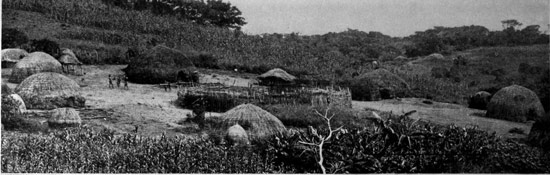
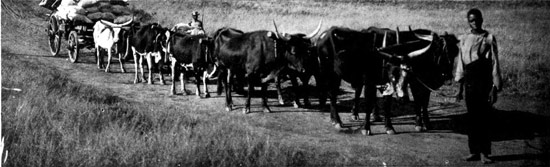
Native Huts and Kafir Corn (top); African Transport (bottom).
South Africa.
The stamps that crush the ore into powdered dust weigh from
1,800 to 2,000 pounds. Under the stamps are zinc-lined inclining
tables, 10 feet long and 4 feet wide, covered with quicksilver.
Water washes the thin dust over the tables, when the
gold adheres to the quicksilver. The dust from five stamps
passes over one table. When about an eighth of an inch of
gold sediment has accumulated, the stamps cease working, and
the residue is scraped off the zinc. The scrapings look like thick
black mud. The sediment then goes through a drying process.
The dried chunks of gold "mud" are next put in a kettle, or
retort, and melted. Borax is tossed into the hot metal, which
separates impurities from the gold, the precious metal remaining
at the bottom of the kettle, the dross keeping to the top. More
gold "mud" is put in the kettle, until there is enough to make
a brick, or ingot. The gold metal is poured into a mold. Cooling
in a few minutes, the red hot brick is dumped on the floor.
The shape of an ingot is similar to a sponge cake, narrower at
the bottom than at the top. The weight of an ingot is 1,000
ounces, its value about $20,000.
In early years the dirt that passed over the quicksilver was
considered of little value, and was washed away. The dirt is
now treated by what is termed the cyanide process. Remaining
in large cyanide tanks, any gold contained in the dirt is reduced
to a liquid. The liquid next goes to the extracting
room, where it passes through inclining tanks, 12 feet long by
6 feet wide, composed of five compartments. The floors of
these tanks are covered with 8 inches of zinc shavings. The
liquid slowly passes from one compartment to another. Any
gold contained in the chemical solution adheres to the zinc
shavings. The shavings are then taken from the tank and put
in a retort. At the same time sulphuric acid is placed in the
retort, which causes the zinc to dissolve. The sediment in this
instance is also like black mud. This is next put through a
drying process, put in another retort, when the gold can be
seen, poured into a mold, and dumped on a floor in ingot form.
Some of the mine owners are very obliging to visitors who wish
to look about the works. The mines range in depth from
2,000 to 4,000 feet.
Twenty thousand Europeans and 200,000 natives are employed
in the Rand mines. Paul Kruger, nearly 30 years ago,
fixed the wages of the white miner at $5 a day. Contract
miners, however, earn as much as from $200 to $300 a month;
but the average wage of the Rand miner is $160 a month. The
natives' wage runs from 50 cents to a dollar a day and board.
The hours worked are eight, three shifts comprising a day's
force.
Compound is the term used for an enclosure in which native
employes are kept. As many as 3,000 to 4,000 kafirs work in
some of the mines. From the mine they go to the compound,
where a bunk is provided, a place to make a fire, and food is
furnished. They are not allowed outside the enclosure at night,
but on Sundays and holidays most of them are free. Tact has
to be exercised when assigning kafirs to their quarters and to
working mates, as a hostile feeling exists between certain tribes.
If members of unfriendly clans be not kept apart, fights and
murders often occur.
Weasel-eyed, idle, easy living Europeans are found in considerable
numbers in mining districts. Were the natives allowed
their liberty in the evening, it would result in their complete
demoralization, for the crafty gentry would succeed in
getting bad whisky or vicious rum into the compounds, receiving
a big price for the poison, in addition to offering inducements
to the "boys" to pilfer nuggets or heavy-bearing gold
quartz.
"Scarcity of help, scarcity of help," is the cry of mine owners
in South Africa. Sharp competition prevails between mining
companies for "boys," and it is a scarcity of this class of labor
to which they allude. A European trader may have the confidence
of natives in the district in which his store is located,
and when help is wanted labor agents call on the merchant.
When a trader induces natives to go to the mines, the firm to
which they have been sent will pay him $15 for each "boy"
as a bonus. If the company failed to pay the bonus, it would
thereafter get very few "boys" from that trader's district.
In thickly populated centers like Kaffraria a dealer may control
as many as 1,000 natives. In such instances companies pay
him an income of from $100 to $125 a month, in addition to
the $15 a head, in order to keep in his good graces. If a "boy"
should engage to work for the shorter term—six months—and
rehire at the end of the term, the trader from whose district
the kafir originally came would be sent an additional sum
of $15. Where labor agents deal with native chiefs for mine
"boys," the chief expects a "bonsella" of $2.50 for every
"boy" leaving his district to work in the mines. With
bonuses, clothes, car fare and other incidentals, it costs the mine
company from $25 to $30 to get a "boy" from the kraal to
the works. Mine owners claim they pay out a quarter of a
million dollars a year in bonuses for native help. It is also
claimed that the mining industry could not be conducted at a
profit with all white labor.
Twenty-one thousand graves in Braamfontein Cemetery, a
great many of these containing two corpses, strongly emphasizes
the terrible toll of human life paid to King Gold in the
Transvaal mines. This is but one European graveyard, as
there are several smaller burying places in the Johannesburg
district. Besides those in which only Dutch and English are
buried, there are Jewish, Malay and Mohammedan graveyards
scattered about the city. Braamfontein Cemetery is filled,
and a new one is filling fast. This appalling mortality has
taken place during the past 30 years.
Eighty-nine open graves—mound after mound in as regular
order as are boards in a floor—is a gruesome setting that
forces one to cast a sad glance at the clouds of black smoke pouring
out of the hundreds of smokestacks on the great Gold Reef,
and at the gray-colored cyanide banks that half encircle the
city of Johannesburg. These unbroken rows of freshly dug
graves were in the European section of Brixton graveyard, and
at the other end of the large burying ground—the native section—eighty
freshly dug graves presented a grim foreground.
"Bubonic plague?" the reader may ask. No, phthisis.
Eighty in a thousand of ordinary miners, and 140 in a thousand
of workers using underground drilling machines, are affected
with phthisis. As gold-bearing rock is being blasted all
the time, miners inhale the fine dust during working hours.
Respirators, a device covering the nose and mouth, having a
sponge at the mouth, and two openings at the side covered with
a fine wire screen to admit of air, are worn by some of the
workers, but, as it proves cumbersome, a great many miners
discard that life-extending invention. Phthisis here signifies
the drying up of the lungs. The dust inhaled settles in the cells
of the lungs, with the appalling result mentioned.
Seven years is the average lifetime of the Rand miner. On
the headstones in Braamfontein Cemetery, carved in granite,
most of the ages are found to be in the twenties and thirties.
Few stones observed bore ages of 40 years and over.
The average number of burials in Johannesburg is ten a day;
Europeans average four and natives six. People not engaged
in underground work, and not connected with the mines in any
capacity, also become affected with phthisis. As on American
prairies, the wind blows on the veld nearly all the time, and
generally with considerable force; hence the air is full of dust
from the powder-crushed cyanide banks.
Priest, preacher and missionary may be seen at cemetery
gates all the time, more particularly in the afternoons.
"Will there be any more funerals today?" was asked of a
native who had just filled in a grave.
"Yes, baas. Two wagons coming now," he answered,
pointing to the road.
The natives are buried in a burlap sack, drawn tight and
sewed, reducing the natural size of the body considerably.
Two corpses rest on the bottom of a grave. Six inches of
dirt cover these, when two more of the sacked bodies are
lowered, making four in one grave.
The city of Johannesburg receive $7 for every kafir buried
in Brixton graveyard—$28 for a grave containing the bodies
of four natives. The owners of the mines at which the natives
had worked must pay this burial charge. Deaths of natives
are caused more by accidents in mines than from phthisis,
as kafirs will not, as a rule, work more than six months in the
year.
At the end of Brixton graveyard, where Europeans are buried,
could be seen, from a distance, undertakers in long coats and
high hats; hearses, ornamented with white or black cockades,
drawn by horses of the same color; clergymen, their heads
bowed and reading from books, with groups of veiled people
huddled in small areas—putting people underground and the
circumstances attending these ceremonies are of very frequent
occurrence in Johannesburg.
The grave-diggers have no slack seasons; they are busy the
year round, which accounted for so many open graves. As
they were sure to be needed, it was better to be ahead of the
demand than crowded with orders.
"Don't Expectorate!" is the cautionary sign confronting one
at almost every turn in the Gold City. Where the "Don't
Spit!" sign appears frequently one knows he has reached a
place where lung trouble is prevalent.
Paved streets in some of the South African cities has not
been considered so much of a municipal duty as in other parts
of the world. The soil being hard, the rain, coming in showers,
flows off as it does on paved streets. As the sun shines
365 days in the year on the high veld, the ground is dry in a
short time after a shower has passed.
Walking in the streets instead of on the walks is a local
custom one quickly notices. In Johannesburg good, wide walks
may be practically free of people though the street space is occupied
by pedestrians from curb to curb.
"Joburg" is the local term used almost exclusively by South
Africans when speaking of Johannesburg. When one hears
another say "Johannesburg" it is a pretty sure sign that he is
a stranger in "Darkest Africa."
Living expenses are much higher in Johannesburg and other
up-country cities than on the coast. House rent runs from
$25 to $40 a month; meat was 18 cents to 30 cents a pound;
street car fare is very high; in a general sense, expenses are 20
per cent. higher than in the coast cities. Boarding houses
charge from $35 to $40 a month; hotel accommodation is expensive,
too, the cheapest costing $3 a day; rooms cost $1.25
a day in all the hotels. Six cents is the least sum for any small
article. A newspaper costs six cents (threepence), the bootblacks
charge 12 cents for a shine, barbers 18 cents for shaving;
it seemed as if one was handing out six cents at every few
squares to a street-car conductor, so short are the "stages"—in
fact, few things can be had for less than six cents.
Dutch, British and Jews comprise the majority of the population,
Jews numbering one-third. Germans are also quite numerous.
Americans, up to the time of the Boer War, held high
positions with mining companies, but they have been thinned
out since the country changed hands. Every country of the
globe is represented in that cosmopolitan center.
On pay days "Joburg" is a lively place. The saloons seem
to get the biggest part of miners' wages. They spend their
money like lords. In no place are bars better patronized.
A glass of beer costs 12 cents, and stronger drinks 24 cents.
The barmaid, a woman engaged tending bars in public drinking
places in British territories, is not seen behind the bar of
saloons in cities and towns of the Transvaal, men being engaged
at that work.
Years ago, when the game of baseball was played, which took
place weekly and on holidays, crowds of people used to attend.
Games are still played at weekly intervals, but only a few attend—sometimes
not more than 100 persons. On the other
hand, big crowds attend the English games—cricket and football.
"Closed on account of dust." "Open—Closed on account
of dust." Such signs will be found secured to doors of most
business houses. The wind blows so generally, and nearly
always so strongly, that all doors must be kept closed, whether
of business or dwelling. With unpaved streets, and the half-circle
of great cyanide banks about the city, Johannesburg, as
appearing to some visitors, is not a choice place of residence.
The climate of the Rand possesses one virtue—there is no
malarial fever. On the other hand, the lips swell, chafe and
crack from the effects of both the wind and high altitude, this
causing an irritating feeling. Laundries do a good business
here. Collars are changed twice a day, as the soil, being red,
and the almost constant high winds, with the dry nature of the
country, keeps the dust flying about most of the time. One
will not have lived in this city long before he will have eaten
his allotted "peck of dirt."
In Ludlow Street Jail, New York, prisoners are kept who
are not considered criminals—that class of men who cannot
pay their debts and who have not been adjudged insolvent. The
city pays for their food. In Johannesburg, if a man is sent to
jail for a debt, the creditor must pay the city 50 cents a day
for the debtor's board. Precious few prisoners of this class
are found in the Johannesburg jail.
Newspapers of the Rand are fully up to the requirements of
the city, four dailies being published, two morning and two
evening. The morning papers issue Sunday editions, one of
these including a colored magazine section. It has required
constant fighting by the owners to maintain the Sunday editions,
as it is an innovation in British territory. Opponents
had injunctions issued against these publications, and in other
ways the publishers were put to much inconvenience. This edition
still appears on the street, however, but, by a court decree,
dealers and newsboys are prohibited from soliciting sales.
Printers earn good wages on the Rand, running from $30 to
$55 weekly, with the working hours seven and eight. One
finds here linotype machines, web presses, color presses, stereotyping—all
the modern machinery in use in the North. South
Africa is the one country where printers can do as well, and
sometimes better, than in the United States.
Mechanics and miners are so well organized that they have
a building of their own. They pull together on election day,
and, as a result, a number of union labor men are sprinkled
about the upper and lower Houses of Parliament. Eight hours
is the maximum working day in South Africa among skilled
mechanics and miners. Wages run from $4.50 to $6 a day.
In years gone by the Dutch suffered so much from the natives
during their treks that they have a pretty good idea of how to
manage them. No blacks crowd Europeans off the walks in
Johannesburg, for the black man is not allowed on them; he
must walk in the street. This policy saves trouble for both
black and white, for it prevents arguments and fights. He is
not allowed to ride on street cars. In railroad compartments
colored and half-castes are prohibited from intermingling with
Europeans. "Reserved" is posted on the doors of certain compartments,
in which one generally would find well-to-do colored
passengers.
The native is not allowed to live in towns and cities here.
What are termed "locations" are built by the municipality,
and in these places the natives are kept to themselves. The
Boer plan is much better than the English, as, if the black man
be given too much liberty, it generally proves injurious to him.
Dutch authorities are very severe on men smuggling liquor to
natives. Five hundred dollars is the fine, and in default of
payment the smuggler must serve five years in jail.
Indians leaving Natal for the Transvaal generally come to
grief. On arrival they are promptly taken into custody, and
when 50 to 100 have been collected are put into box cars of a
train headed for Portuguese territory, and soon find themselves
in the hold of a ship sailing from Lourenzo Marques for India.
Indians have spoiled the Province of Natal, so the Dutch are
taking care that that race do not get the money that belongs
to the white man in the Transvaal. Though Indians are British
subjects, it makes no difference to the Dutch. Australia
has barred them from that country, too.
An art gallery, a museum, a large public library, a good zoo,
sports grounds, parks where music is furnished, theaters,
schools, churches, hospitals—all the public accessories that
make a city are found in Johannesburg; also most modern city
fire-fighting appliances, an electric street car system, electric
and gas plants, fully in keeping with those in cities of the same
size located in the countries of the North.
"Necessity is the mother of invention," so, as there is practically
no timber in South Africa, and brick buildings cost quite
a sum of money to erect, homes had to be made of something
else. Corrugated iron was the material that answered the purpose
of brick, wood and stone. About all the timber required
to erect one of these houses is for joists, scantlings, and
doors. The sheets of corrugated iron are nailed to the joists
and to the scantling at the roof. Sometimes there are plastered
interiors, but a great many have no more protection than the
sheet of iron. They are very hot in summer and very cold in
winter. They pop and crack all the time from expansion and
contraction. These houses are seldom more than one story
high. "Wood and iron" buildings is what they are called.
"Pipe Hospital" may be seen over the door of a tobacco
store. It means that pipes are repaired there.
A broad-brimmed hat, with a thick outside band, the latter
often brown, with a white speck here and there, is the head-covering
worn in the interior of South Africa. It is the only
hat a Dutchman wears. Derby hats are in little demand in
that part of the world. One occasionally sees a man wearing
that style, but soft hats hold the day.
Snow fell in Johannesburg a few years since, the first in 20
years, and it proved an epoch in the history of the country.
Important events that took place before or since are referred
to as having occurred before or after the storm. Still, the
weather gets cold enough to freeze water, but the sun warms
up everything in the daytime. By reason of the high altitude—over
6,000 feet—the weather is never too hot in summer.
To General Louis Botha the people of not only South Africa,
but of the world, owe a great debt for saving the Rand mines.
The time Botha rendered this service was when Lord Roberts,
with his invincible forces, was outside the gates of Johannesburg
prepared to enter the city. Most of the gold mines on the
Rand had been wired and powerful explosives placed at sections
where the greatest damage would take place from an
explosion. It was planned that as soon as Lord Roberts entered
the city an electric button would be pressed to set off
the bombs, which would ruin the mines. Botha, of course, was
well aware of what was to occur. A messenger was dispatched
by him to Lord Roberts, bearing a request from the Boer commander
to delay entering the city for 24 hours. Lord Roberts
acceded to the request. During the interval General Botha
pleaded with his Boer sympathizers not to blow up the mines.
It required his utmost persuasive ability to dissuade the men
from carrying out their purpose. He eventually got their promise
that the mines would not be molested. Had Botha been
narrow-minded or vindictive, instead of a broad-minded man,
in dealing with Lord Roberts, the world's output of gold since
that time would probably have been from $100,000,000 to
$120,000,000 less annually.
Johannesburg is named after a Boer—Johannes—whose
farm was located on a portion of the Gold Reef. It was about
1885 when gold was discovered.
The Great Trek by the Dutch from Cape Colony to the
Transvaal took place in 1835-38. Being dissatisfied with
English administration in Cape Colony, they, like the Mormons
in America, kept going into uninhabited parts, stopping only
when they believed they had gone beyond reach of everybody,
where they could live their own lives in their own way. There
were thousands in the Great Trek. In 1852 a government
was formed, and M. W. Pretorious became the first President
of the South African Republic. In the early seventies there
were about 25,000 Boers in the Transvaal. In 1876 the republic
practically collapsed, when England assumed responsibility.
In 1877 the British flag was raised in Pretoria, but the
Dutch did not relish that innovation. During 1881 the Boers
attacked the English garrisons, and in January, 1882, the British
suffered successive defeats at Majuba Hill, under command
of General Colley, the latter being killed at Ingogo Heights.
Eight hundred English officers and men were killed in the engagements,
and on the Boer side 18 were killed and 33 wounded.
A few lean years for the Dutch followed. Later, the gold
fields of Barberton sprang into existence, then the Rand, and
undreamed of wealth poured into the Transvaal, towns springing
up as if by magic. It was during this early heyday period
of the Rand that adventurous spirits such as Barnato, Hammond,
Beit, Rhodes and others figured prominently in the life
of Boerland—some there by reason of the opportunity to vent
their inborn desire for adventure, others as agents of Great
Britain, but all playing for high stakes round the green table
of the great Gold Reef. With the exception of the Jameson
Raid, in 1895, the Boers enjoyed peace and prosperity up to
the opening of the Anglo-Boer war in 1899, when, three years
later, the Transvaal and Orange Free State became British
possessions.
On May 31, 1910, the four provinces—Cape of Good Hope,
Natal, Orange Free State and Transvaal—became the Union
of South Africa, with General Louis Botha, Premier, his Cabinet,
save one, being composed of Dutch members. Each province
has its legislature, like our State legislature. A governor-general,
appointed by the King of England, is the representative
of the Imperial Government in South Africa and Rhodesia.
With the exception of eight Senators, appointed by the Governor-General,
the members of the National and Provincial
Parliaments are elected by popular vote. One is safe, commercially
speaking, in saying Johannesburg is more than half of
Boerland.
Law and order in the Gold City conform to the British
standard. Noted crooks and adventurers are found about
places where gold and diamonds are mined, yet few big burglaries
take place. In stature, the policemen of Johannesburg
are second to none. They are of splendid physique. Native
policemen are used in that city also.
The ravages of cattle diseases in South Africa is strongly
suggested on seeing refrigerator cars being emptied of frozen
meat. The poorer portions of beeves and sheep find their way
to the compounds, the meat being eaten by the mine "boys."
The frozen meat comes from Australia and New Zealand, arriving
every week, and is shipped to what is called an agricultural
country.
What seems an inexcusable lack of enterprise, combined with
mismanagement, is seen at every turn. Cattle hides are shipped
to Europe, while boots and shoes worn in South Africa are
made in England, Germany, Holland or the United States.
Wool is shipped to centers North, and hence all the woolen
goods come from Europe. One may ride through sections
that should make splendid farming districts, but these are held
by landowners in tracts of from 2,000 to 30,000 acres, and
only a small area is under cultivation. Lack of water is the
reason given. One sees no windmills, however. Rain water
is often stored in a crude pond, which is generally muddy from
sheep and cattle walking in it. This dirty drinking water
alone is enough to kill the stock.
Every animal of field and farm seems to have a mortal enemy.
With the cattle, one of three diseases—East Coast or tick
fever, rinderpest and red water—is apt to decimate them at
any time; two or three diseases wipe out sheep; there is what
is termed "horse sickness," horses also dying from eating grass
when dew is on the ground, and meningitis menaces mules.
At least four drawbacks figure in raising grain—drought,
hailstones, locusts and poor farming—the worst being the
presence of the black man, meaning poor farming; though his
hut rent keeps the white man's coffee-pot boiling, at the same
time it unhands him industrially. When one sees a piece of
plowed land it is generally but half plowed, a grassy strip
of sod often appearing between furrows at some part of the
field. It would be a rare thing to see unplowed strips between
furrows in England, on the Continent, or in most of the
farming States of America.
The Dutch being averse to having the capital near the sea
coast, as soon as they gained full control of United South
Africa, on May 31, 1910, they decided on Pretoria as the capital,
although Capetown was well provided with good legislative
buildings. Money was then appropriated to erect government
buildings in Pretoria, and a hill east of the city was selected
as a site for the Parliament buildings. Following this, a large
force of government employes were compelled to leave Capetown
for Pretoria, as government business was in future to be
transacted in the Transvaal instead of the Cape of Good Hope.
At present Pretoria, 45 miles from Johannesburg, is the capital
of United South Africa. Before the war the Boers exercised
control over only the Transvaal and Orange Free State, but 11
years later they also exercised authority over the Provinces of
the Cape of Good Hope and Natal.
One who had imagined he would not find modern utilities
and attractiveness of a general nature in a place located 'way
up on the veld would be much taken aback upon entering Pretoria.
Encircled by a range of hills is this, the best-looking
large town in the interior of South Africa. The city being so
far away from the busy centers of the world, and over a thousand
miles inland from Capetown, one would not expect to
find fine, clean streets, a good electric street railway system,
good parks, in some of which music is furnished; shade trees,
water fountains, and splendid buildings—residential, business,
municipal and governmental.
The Dutch Reformed Church, built in the center of the old
market square, around which long ox teams used to slowly
worm their way and seek shelter behind its stone walls from
winds and shade from the sun; where auctioneers, chattering
like monkeys, sold produce of burghers, brought from points a
hundred miles in some instances, to the highest bidder; where
Boer met Boer and sympathized with each other during lean
years, discussed native wars, their troubles with England, and
the ravages of locusts and rinderpest; where the last President
of the Transvaal intermingled with his people, walking among
the piles of pumpkins, calabashes, tomatoes, guinea fowl, chickens,
hares, and buck; where, on holy days, Psalms were sung
by these rough-looking plainsmen—this historical assembling
place of burghers, with its old-time and latter-day memories,
has been removed, and the market-place converted into a public
garden, surrounded at ends and one side by imposing government
buildings. On visiting the square where the old church
stood, the men of full beards and broad-brimmed soft hats now
look instead on beds of flowers in bloom and fountains casting
rainbow spray round a circular space.
One feels more comfortable in Pretoria after having spent
some time in the Gold City, for he has left the red dust behind,
the unattractive cyanide banks, the clouds of black smoke
and the sooty buildings. The air is free from smoke, from the
dirt banks, and a healthier atmosphere prevails. Pretoria is
Dutch; Johannesburg cosmopolitan.
Some 40,000 people were living in this attractive place, and
the population is increasing. The government departments
were removed from Capetown, one after another, and with the
reëstablishment of each Pretoria's population naturally increased
as the government employes followed. "Civil servants"
is the term used to denote government employes. An
increase in salaries was granted to employes when brought from
Capetown or Durban, as the salaries paid in the coast cities, on
which a frugal person could save money, provided little more
than food and clothing in the new capital. As in Johannesburg,
house rent is high, and board cannot be had at less than from
$35 to $40 a month. The cost of living here, as in Johannesburg,
is from 15 to 20 per cent. higher than the coast towns.
Away from mining towns smokestacks are few and far between.
Pretoria makes a better showing in this respect, as
there are flour mills, an ice plant, an electric power house, and
small manufactures that give the place a business appearance.
Walking a few blocks along West Kerk street, on the right
hand side, may be seen a one-story stone and cement house,
roofed with corrugated iron. This building is surrounded with
an iron fence, built on a cement foundation. On each side
of the walk leading to the house are two stone lions. In
front is a veranda. In that modest house Paul Kruger
lived. Walking in the same direction a few squares a park
is reached. Entering by a gate, a short distance ahead is
seen a large cement foundation with steps leading up, and
resting on the foundation is a square granite base. The monument
finishes there. Postcards bear a picture of the completed
monument to Paul Kruger, but it lacks the bronze figure of the
Boer President. "The monument that was to have been
erected to the memory of the late President Kruger" is the
wording under the picture of the "completed" monument.
The bronze figure of Paul Kruger reached Lourenzo Marques,
Portuguese East Africa, at the outbreak of the Anglo-Boer
War, in 1899. Several lean years followed the Boers' defeat,
and the Transvaal was theirs no longer. What stands of "the
monument that was to have been" is well looked after. Some
day, however, the printing on a postcard of the completed monument
will read: "Paul Kruger's Monument."
"Dick" Seddon, of New Zealand, was a great man; Brazil,
Argentine, Chile and Australia have produced men they consider
great, but their fame is only local. Many in other countries
tell one that the United States has produced but two great
men—Washington and Lincoln. Looking at things from a
world viewpoint, one cannot find a man born south of the
equator who measures up to Paul Kruger's fame. So, in fairness
to rugged genius, it would seem no overt act would be committed
if the completed monument did stand in that park in
Pretoria—to the memory of the greatest man born south of the
equator.
"Have you been out to Wonderboom?" is a question visitors
to Pretoria will be asked. Six or seven miles from the capital
is seen from a distance what looks like a very large tree, located
a mile from the railroad station. Big trees with dark green
leaves are rare on the veld, which accounts for Wonderboom
being such an attraction. In a radius of 150 feet seven groups
of trees are growing, and from each grows half a dozen trees.
The space taken up by some of these groups measures from 20
to 30 feet, and the clumps grow from roots of what appeared
to have been large trees at one time. When vegetation of all
sorts is white from drought the Wonderboom is as green as if
it had been watered at frequent intervals. The trees grow 20
feet high, and cover an area of half an acre. No one seemed to
know the name of the wood. "Vonderboom" seemed to be
sufficient to cover all questions asked about its specie.
English newspapers published in Pretoria could not be favorably
compared to the Johannesburg productions. This may be
accounted for by the existence of Dutch publications, which
naturally have a larger patronage than English newspapers, the
population being in the main Dutch. As a considerable amount
of the government printing is now done in Pretoria, this industry
has improved. The pay is from $30 to $45 a week,
eight hours' work. Mechanics of all kinds receive $5 a day.
All government documents, bills, blanks, etc., are printed
in two languages—Dutch and English. As the government
owns the railway, telegraph, postoffice and telephone systems,
any one can understand what a big item the government's
printing bill is. This was agreed to by the British representatives
who attended the convention at which the consolidation
of the four provinces was ratified. The Dutch adhere strictly
to this agreement affecting their language.
The Dutch are not a vindictive race. No tales of brutality
are heard of in connection with the Boer War. Men who
fought on the British side tell of having been taken prisoner
and of being sent back to their command. Sometimes the Boers
would take the clothes off a captive, and then direct him to
where his fellow soldiers were camped. Paul Kruger would
have been justified in shooting the men who instigated and took
part in the Jameson Raid, on the grounds of treason, but he
spared their lives. They paid big sums of money in fines,
though, for their unsuccessful, treasonable offense.
The Dutch have their faults, like other races, but they seem
the better able to guide the destiny of their land of plagues.
The Boer War, in a sense, proved a blessing in disguise to
the Dutch. Previous to that time proper attention had not
been given to educating the young; precious few lawyers, doctors,
educators and mining engineers bore Dutch names. Look
through the directories of South Africa now and contrast the
number of Dutch names that figure among those of the professional
class. The war woke up the Boers to a sense of assuming
a greater responsibility in the advancement of their country.
A great many Dutch young men are students in the leading
universities of the world.
Nothing feminine in sound is noticeable about the names of
places in Boerland. But one often feels at a loss to account
for the general use of the affix "fontein." Save for a narrow
strip along the coast the country is dry. The Orange and the
Vaal rivers seem to be the only two of consequence in the interior.
The country is full of "spruits," "fonteins" and
rivers which, when one reaches them, are dry as a bone. The
only things that seem to "spruit" in them are cobble-stones and
rattle-snakes.
"Assegaiboschfontein," "Jakhalskraalfontein," "Wildebeestespruitbult"
are a few names of towns that occur to one as
being decidedly masculine.
Boers, physically, are large men. Many of the older men
wear full beards, and invariably wear a broad-brimmed hat with
cloth band of several plies thick. They smoke calabash pipes,
the weed being known as Boer tobacco, which costs 50 cents a
pound. They generally carry a sjambok, a strip of rhinoceros
hide about three feet long and an inch thick. Meeting one
alone, the questions he asks in quick succession—"What's your
name?" "Where do you come from?" "What's your business?"
"Have you been in South Africa long?" "How
long are you going to stay in the country?"—bring to mind
this distinguishing trait of a noted Chinese who made a visit to
America some years ago. Rum is the Boer's strong drink, but
he is seldom seen under the influence of liquor. In a sense, he
is of a roaming disposition, for some Boers are on the trek all
the time. They seem to be better suited when they have got
beyond the outposts of civilization. Were it not for the Boer's
inclination to trek, however, it is possible there would be no gold
mines on the Rand or diamond fields in Kimberley. His battles
with the native tribes and his sufferings and hardships will
never be lost sight of as the factors through which the white
man was enabled to live in that section of "Darkest Africa."
We take our departure from the Transvaal and make a start
for Victoria Falls, in Rhodesia, also British territory. Traveling
some 300 miles out of a direct line, through Fourteen
Streams, to Vryburg, on to Mafeking, finds us nearly opposite
the place started from, but headed in the right direction. A
gap of 40 miles from Zeerust to the main line has since been
closed, which makes the trip from Johannesburg to Bulawayo
much shorter. Two trains a week care for all the business
over that stretch of native territory.
From Fourteen Streams, which is only a railway junction,
we start northward over the treeless veld on our way to Rhodesia,
700 miles beyond. Vryburg is the next place reached
where white people live, and most of the 3,000 inhabitants are
engaged in business connected with farming. Nearly a hundred
miles further Mafeking was reached, which has been made historical
in virtue of the seven-months' siege of Britishers during
the Boer War. It is located near the Transvaal border, and is
a trading center for the western Transvaal. Railway car shops
are located at Mafeking, and these and the trading industries
give employment to its 3,000 inhabitants.
An hour's ride further, and we have crossed the Cape Colony-Bechuanaland
Protectorate border line. Northward from
that point we pass through what seems an uninhabited country,
so far as white people are concerned. A railway station is built
here and there along the line, where a few Europeans may be
seen; but the country is wild and populated with natives. Were
one to go to sleep for six or eight hours, upon waking up he
would not know that he had moved a mile, so far as any change
in the appearance of the landscape would indicate. At a few
stations signs of industry were in evidence, bags of corn being
piled along the track.
Natives with karosses (skins of wild beasts) and native-made
souvenirs surrounded the train when stops were made, spreading
their wares on the ground and holding the objects of native
handicraft to the gaze of the passengers. The natives' souvenirs
were the images of giraffes, elephants, lions, tigers, storks and
other animals cut out of wood and painted or dyed black, but
many of the imitations were far from good. Splendid karosses
are bought cheap along the line. One can have his choice of a
lion, tiger, hyena, jackal, wildcat, monkey and baboon, and
sometimes a giraffe. Many are as large as a buffalo robe.
"How much!" shouted a splendid specimen of a Bechuana
woman, in the native language, as she held her naked pickaninny
over her head—laughing heartily at the same time—at a
place where the train had stopped and where natives and karosses
were numerous. Passengers were bartering and haggling
with the natives over the price of karosses, and others were
ambitious to sell their souvenirs. The black mother had imbibed
the "shopping" spirit, when she jocularly offered her
babe for sale. "Half a crown!" (60 cents) shouted a passenger.
With that offer the semi-barbarous mother quickly
brought her pickaninny to her bosom, threw her arms about the
little one and gave it such a hug that the baby's eyes bulged, she
laughing so heartily the while as if to split her sides.
Still traveling toward the heart of Africa, we reach Mochudi
and the Kalahari Desert, the eastern fringe of which we traverse,
a distance of 200 miles. The dust had become so thick
in this stretch of the journey that the color of the passengers'
clothes could not be detected. All the way along from Mafeking
I could not keep from my mind the Americanism, "It's
a great country, where nobody lives and dogs bark at strangers."
When the train stopped at Mahalapye we entered what is
known as Khama's country. The course of the railroad is
nearly on the line taken by David Livingstone, the explorer.
When Livingstone and his band passed through that section
of Africa, the grandfather of the reigning chief offered every
hospitality to the explorer, and espoused the Christian religion.
Chief Khama, the grandson, is the most important ruler of
Bechuanaland, and has spent some time in Europe; he conforms
largely to European customs. Besides being a strict
disciplinarian, he forbids the sale of liquor to his people. He
receives a pension from the English Government. Serowe,
Khama's capital, located 30 miles inland from Palapye Road
station, is the largest town in Bechuanaland, having a population
of 40,000. His subjects pay the smallest head tax of any
of the tribes in South Africa.
We were passing through a country about which the wildebeeste,
gemsbuck, eland, tiger, lion, and even the giraffe, still
roam. Along the railway may be seen the secretary bird, guinea
fowl and also handsome cranes. The secretary bird, so named
from feathers growing at the back of the head, which look like
quill pens, is what is known as "royal game." "Royal game"
are beasts or fowl that must not be killed. The reason the
secretary bird is protected is because it is a bitter foe to snakes.
Snatching a snake in the middle with his bill, he at once begins
to fly upward with the reptile, and when at a certain height
will let go his prey. The snake, when he strikes the earth, is
killed.
White traders are located through these desolate tracts of
country, sometimes a hundred miles from a railway. Little
cash changes hands between natives and traders in out-of-the-way
districts. For his skins and corn, or whatever the native
may have to sell, he receives as pay bright-colored calico, Jew's-harps,
concertinas, mouth organs, tinware and such things.
Passing out of Khama's country we enter a territory known
as the Tati Concessions. Traversing this tract, we crossed the
northern boundary of Bechuanaland a few miles south of Plumtree,
when we were in Matabeleland, Rhodesia. In this section
Lobengula, the Matabele king, held undisputed sway until
Cecil Rhodes decided to annex this part of Africa to England's
possessions. What Andries Pretorius did to Dingaan at Blood
River—broke forever the power of the Zulus—Cecil Rhodes
did with the powerful Lobengula in Matabeleland.
We passed within ten miles of the Matopo Hills, on the top
of which is buried Cecil John Rhodes, "the Colossus of South
Africa," as he was termed. Whatever shortcomings Rhodes
may have possessed, or the means he resorted to to attain
his ambition, one of his virtues will always remain unquestioned—bravery.
He wished his remains to rest where
his greatest feat of daring took place. It was during
the rebellion of the Matabeles in 1896-97 that Rhodes, unarmed,
with a friend accompanying him, walked up the Matopos
through the files of the warring hordes of blacks to where
their chiefs were stationed. His cool bravery and personal
magnetism so impressed the chiefs that the rebellion ceased.
"Here lie the remains of Cecil John Rhodes" is the brief inscription
carved on a granite slab that covers his grave, which
was chiseled out of a solid rock on the highest of the Matopo
Hills. "World's View" is the name Rhodes gave the place
where he is buried. It is located 30 miles southeast of Bulawayo.
Bulawayo, meaning in English "the place of killing," is located
in the heart of wildest Africa. We find here splendid
streets, as wide as those of Salt Lake City, fringed with trees,
with monuments erected at convenient places in the center; a
good public library, containing 5,000 volumes; hospitals, parks,
a botanical garden, zoölogical park, museum and art gallery,
schools, churches, business buildings, daily newspapers—all of
a high order. Bulawayo, nearly 1,400 miles from Capetown,
has a population of 5,000 whites. It is the largest town of
Matabeleland, the center of the gold mining industry, and has
had railway connection with the Transvaal since 1897. Only
four years earlier Lobengula's Kraal occupied the land that
Bulawayo is built on. It required the sacrifice of many lives
of hardy frontiersman to conquer the Matabeles, and to pave
the way for the accession of Matabeleland, Mashonaland,
Barotseland and the other sections that comprise Rhodesia.
Industries in Bulawayo are few and small. In this respect,
however, it is no different than most African towns. But located
in the country away from the metropolis are numerous
gold mines, and Bulawayo is headquarters for that industry.
The annual output from these mines run from $12,000,000 to
$15,000,000.
We find in this place the typical frontiersmen. This feature
of the country is reflected from its founder, as Rhodes was not
a "toff." Every one goes in his shirtsleeves, and derby hats
are not sold in Bulawayo. Soft, wide-brimmed hats, like those
worn by the Boers, rule the day. One occasionally sees the
butt of a revolver sticking out of a hip pocket or at the side of
a belt, and hunting knives, incased in a sheath, are carried by
almost every one, particularly on leaving town. A rifle strapped
over the shoulder of men coming in from country districts is a
common thing to see. Lions and tigers are so numerous in
Rhodesia that weapons are carried to protect one's-self from any
attack that might be made by the wild beasts. Still, under these
"trouble-making" conditions, we find maintained that same
respect for law and order that was so noticeable in other parts.
A native word—"indaba"—much in use in Rhodesia, is
often used in South Africa. When the chiefs met to talk over
matters pertaining to their tribe—a native cabinet meeting—the
meeting would be termed an "indaba." When Cecil
Rhodes was engaged in dissuading the Matabele chiefs on the
Matopo hill to discontinue the rebellion, the meeting of the
"great white chief" with the native chiefs was termed an
"indaba."
In the grounds of Government House stands what is known
as the "Indaba Tree." The residence of the Governor-General
is built on the site of Lobengula's home, and it was under
this tree that the rulers of the Matabele tribe assembled and
dispensed native justice.
Though the altitude of Matabeleland is about 5,000 feet, the
weather is warmer in winter than it is in the Transvaal.
Mention has been made of "salted" cattle in South Africa.
The only people who can live in most parts of Rhodesia are
"salted" men. If the inhabitants are so fortunate as to take
on a few pounds of flesh at certain seasons, they lose that much,
and generally more, from fever and ague at another season.
Among the creditable buildings mentioned of Bulawayo was
included "good hospitals." Wherever hospitals are seen frequently,
particularly in small settlements, one is using sound
judgment if he makes his escape from that place early, as otherwise
he will soon be personally familiar with the interior of these
institutions. Wherever hospital facilities of a small community
are of the first order, one finds a graveyard out of all
proportion to the number of people who live in the place. A
hen with a brood of chicks was crossing a sidewalk in Bulawayo,
and each chick had its head drawn back between its wings.
They were so slow getting across the walk that one had to step
over them—stepping over chunks of fever, as it were.
Rhodesia is a trap in which many poor men get caught. The
riches of the country are much advertised in England, and
those who come out and buy land soon find that their limited
means are gone, and they are practically stranded. Both
Rhodesia and South Africa are countries only for men with
capital.
The railway branches in two directions from Bulawayo—one
easterly to Salisbury and out to Beira, Portuguese East
Africa, the latter place being the port for Rhodesia; and northwesterly
to Victoria Falls, and from that point 300 miles northward
toward the southern border of the Congo Free State.
This branch is what is known as the Cape-to-Cairo route.
We will start for the Falls. Fifty miles from Bulawayo
we left the plains and passed through a forest of teak trees.
Further on, growing palms indicated a warmer climate.
"Thirteen years ago," said a traveling companion, who was
a trader in these parts, "fourteen of us came up to Rhodesia.
None was over 25 years of age. I'm the only one left out
of the fourteen," he concluded. Asked what had taken off his
companions, he answered: "One was killed by a lion, and
the others died of fever."
Ho! a smokestack is in view. We have reached Wankie, a
coal mining district, and a rich one, too, for the mineral may
be seen cropping out of the ground on each side of the track.
A big hospital is observed, situated on a hill, which bears the
usual significance in Rhodesia.
"Do you see that low, white cloud to the right?" asked a
passenger. "That's the spray from Victoria Falls. We have
several miles yet to go before we reach the bridge," he
added.
We had traveled 1,200 miles from Johannesburg to this
place, the journey taking three days. Recklessness, rather than
good judgment, marked my course, for railroad fare from and
back to Johannesburg tapped my purse for $100. Expenses on
the train had increased also, as the cheapest meal from Mafeking
north was 60 cents, and the next cheapest 75 cents. But
to one whose mind inclines to seeing the acme of nature's handicraft,
promptings of this character outweigh financial considerations.
Hotel accommodation at Victoria Falls was correspondingly
high—$5 a day. One has no choice, as there
is but a single hotel there, which is the property of the railroad
company. Aside from the hotel, a photographer's studio
and a few houses comprise all there is in the way of buildings
in Victoria Falls.
Some of the Boers who took part in the Great Trek from
Capetown north in 1835-38 did not stop long in what later
became the Transvaal, but kept trekking, until they reached the
Zambezi River. Most of these voortrekkers, however, were
massacred by Matabeles. This occurred from ten to fifteen
years earlier than Livingstone's visit. But it fell to David
Livingstone to make known to the world the greatest of waterfalls,
on which he first set eyes in November, 1855.
For a distance of seven miles above the falls the river is
dotted with evergreen islands. Through this archipelago the
waters of the Zambezi slowly run, giving no intimation of
what is taking place several miles below. On these islands hippopotami
feed when inclination prompts, and crocodiles sun
themselves and sleep when they choose land to water rest.
Two islands—Livingstone and Cataract—are located at
the edge of the precipice, which accounts for Victoria Falls
being of three parts, namely: Rainbow, Main and Cataract
Falls. The distance from one side of the river to the other
here is over a mile—5,808 feet, to be correct. The water, unlike
that of Niagara, is of a dark, sallow color, but not muddy,
and the falls are straight, instead of horseshoe shape.
Stealthily the water moves over the wide ledge of rock,
when its dull, lifeless color in the archipelago now assumes a
much brighter shade. Save for two dark panels of unwatered
space, made by two green islands just above, there unfolds before
the visitor's eye what seems a mile-wide mantle of amber-colored,
gauze-like lace. Myriads of water crystals dart from
the broad flow's filmy web and, jewel-like, embellish the absorbing
water spread for a depth of 380 feet. Also rainbows
revel in still further enhancing this crowning masterpiece of art—these,
in beautifying, sharing a radiant part—the bars of
iris, of lustrous, engrossing hues, burnishing the peerless tri-falls'
breast, as the veil-like flow descends in brilliant, multi-colored,
wavy folds from its smooth, extended crest to the
roaring, misty maw below. Clouds of spray, which may be
seen 15 miles away, rise to a height of 2,000 feet from the
boiling abyss, and the thunderous roar made by the impact of
the waters is heard 12 miles beyond.
A parallel wall rises in front of the precipice over which the
water flows. A space varying from 80 to 240 feet separates the
two. Into this narrow chasm 5,000,000 gallons of water a
minute dash from a height of 380 feet, and one may imagine
what pandemonium is taking place all the time in the great
vault. For three-quarters of a mile the second, or parallel,
wall, runs westward, unbroken. Then there is a break of
something like 200 feet in width, that looks as if it had
been gnarled out not only by water, but that even some other
powerful agency had taken part in making this cleavage. The
wall rises again to its full height and maintains a solid, unbroken
front for a quarter of a mile further to Cataract Falls,
at the west bank of the river. The water from Rainbow Falls,
at the east bank, and from Main Falls, in the center of the
river, runs westward to the 200-foot gap in the parallel wall,
and the water from Cataract Falls runs eastward and, boiling
and foaming, intermixes with the other waters and flows
through the same opening. One may form an idea of the great
depth of water at the narrow outlet when it is borne in mind
that this vast quantity, falling over a ledge of rock a mile wide,
finds its way out of the huge rock tank through that narrow
channel.
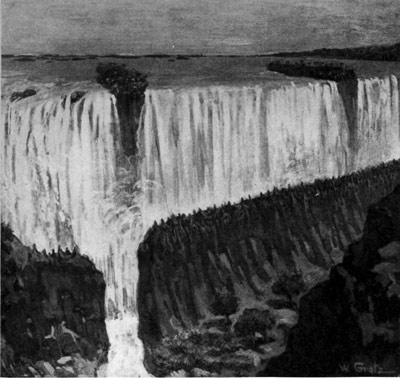
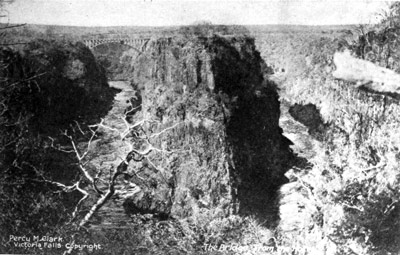
Victoria Falls.
Zambezi Bridge and Gorge Below Falls.
Note.—The parallel wall against which the flow dashes is equal
in height to the precipice over which the water passes, the picture
being drawn with a view of affording a clearer conception of Victoria's
wide descent.
After the water storms through the 200-foot wide channel
the torrent travels several hundred feet, when it flows under
the Zambezi railway bridge, 450 feet above. On it turbulently
runs, the water befoamed, through high, perpendicular
walls of basaltic rock for over a mile. The rocky banks then
decrease, but the course of the river remains rugged and tortuous
for a distance of 40 miles.
Vegetation growing about the falls, particularly palm trees,
adds much attractiveness to the environment. The absence of
improvements—save for the bridge, together with grass-thatched
native huts showing dimly through the vegetation on
the banks; the evergreen islands; the stillness of the water before
making its plunge, contrasted with the wild-appearing,
rugged, high, rocky walls below and the foaming and billowy
torrent as it dashes madly through the narrow gorge—make
Victoria, like other great works of nature, distinctive in formation
from other notable waterfalls.
Summing up the comparative grandeur and greatness of
Niagara and Victoria Falls, most persons who have seen both
would decide, I believe, that Niagara Falls is the more beautiful
and Victoria the greater. In this connection one has only
to compare the grand crescent of sky-blue water of Niagara
with the dull color of Victoria Falls, the water of Niagara, after
plunging over an unbroken stretch of rock ledge into a roomy,
circular-shaped basin, assuming its true blue color, with the
gradual narrowing of the banks to the Gorge; contrast Niagara's
broad, sweeping, unconfined character with the water of
the Zambezi, hemmed in from view in tank-like walls after
passing over the falls, and then prevented from making a good
showing, as it were, by a continuation of similar walls for a
distance of 40 miles.
The bridge across the Zambezi River is a pretty one, with
a single span of 610 feet, and was constructed by an American
firm. Cecil Rhodes instructed the builders to erect it where
it now stands, "so that it would always be wet by spray from
the falls."
Nature's fickleness, a trait disclosed in choosing remote regions
for some of her noted wonders, entailing, as it does, long
journeys, fatigue and much expense to reach, is conspicuous by
her placing Victoria in a country hemmed in on the west by
Angola and German West Africa, north by the Belgian Congo,
northeast by German East Africa, east by Portuguese East
Africa, and south by Bechuanaland and the Transvaal. The
shortest time in which a journey could be made from an American
port to these falls is about five weeks. Landing at Capetown,
four days' travel, on a slow train, mostly over a dry and
dusty country, must be undergone to reach that point, when
Victoria Falls is viewed in all its sublimity, located in a wild,
interesting, but fever-ridden, section of Rhodesia, where only a
handful of languid white persons live, and on a continent where
the superior race number less than a million and a half.
It is dangerous to cross the Zambezi River in a rowboat, the
river being infested with crocodiles, which grow from 12 to 16
feet long. The hippopotamus, though, starts the trouble. He
hides just under the water, and nothing can be seen of the beast
until a boat is on top of him. Then he rises, overturning the
boat. "Hippo" will not harm a person in the water; but
crocodiles are generally found close to a hippopotamus, and the
former are always hungry. As soon as the unfortunate occupants
of a boat have been dumped overboard there is a swirl
of water close by, another farther off, yet more disturbed water,
when long, dull colored shapes come lashing swiftly up. The
poor swimmers disappear, the muddy water reddens for a short
time, and then becomes sallow colored again. To the Barotse
native the crocodile is a sacred animal, and, as he will not harm
the voracious beasts, deaths of both natives and Europeans by
crocodiles occur frequently in this part of Rhodesia.
The Zambezi River rises in West Portuguese Africa and
empties into the Indian Ocean at Chinde, Portuguese East Africa,
about a thousand miles from its source.
Beer and whiskey are drunk a great deal in that part of
Rhodesia, and almost every one takes quinine to allay fever.
No one would dare take a drink of water were it not boiled.
"Knocking around" is a term much in use in Rhodesia.
"Have you seen John Smith knocking around?" "Is there
a boat knocking around?" "Are there lions knocking around
here?" are common instances in which the term is used.
Tigers are so numerous about Victoria Falls that they rob
hen roosts, and even climb through pantry windows and take
away what eatables are handy.
Vegetation in these parts is interesting to visitors, as all
the bushes and trees are strange to those coming from foreign
places. Nearly every tree or shrub produces its seed in the form
of a pod, like beans. Thorn prongs, as sharp as needles and
two and three inches in length, grow on some trees. The
cream-of-tartar tree, however, will interest a visitor more.
This one grows very large, and the bark is the color of a
hippopotamus' skin. In fact, the bark of all trees has a dark
color. The pod of the cream-of-tartar is the shape of a cucumber
and 10 to 12 inches long. The shell is very hard, but,
when broken open, if ripe, the substance in the pod is white,
and separates from the fibers in the form of sugar cubes. The
natives eat it. One cream-of-tartar tree seen close to the falls
measured 22 feet in diameter.
A very good tribe of natives is found in that part of Rhodesia—the
Barotse. At a kraal visited, several of the sightseers
asked a native for a drink of native beer. The liquid was
brought in a large calabash, and the drinking cup was the
bowled-out end of a small calabash. Before the native served
the beer he poured out some of the brew in the hollow of his
hand and drank it. Then he tilted the vegetable demijohn,
when the beer was poured into the cup for the Europeans. The
reason of the Barotse sampling the beer first was to allay any
suspicion his white visitors might entertain concerning its genuineness.
Natives' musical instruments are a one-string fiddle, a skin
drum, and a little wooden frame containing three and four
pieces of steel a quarter of an inch in width and four inches in
length. This last is called a "piano." The small strips of
steel are fastened at one end of the frame. By touching these
with the fingers a faint musical sound is produced. For hours
at a time a husky native keeps playing the "piano," happy in the
thought that he is an accomplished pianist. Lewanika is the
head chief of the Barotse tribe.
Native wives are much cheaper in Barotseland than in Zululand,
prices ranging from two sheep to ten cows. Should the
wife leave her husband—elope, for instance—the girl's father
must return the sheep or cows to the deserted husband.
North of the Zambezi River the territory is known as Northwestern
Rhodesia, and also Barotseland. Seven miles from
Victoria Falls is located Livingstone, the capital of Northwestern
Rhodesia. Here, right in the heart of one of the
fever regions of Africa, one finds small but substantial provincial
buildings, a good, roomy hotel, an up-to-date printing office,
and a small but interesting botanical garden.
Malarial, or African, fever is very bad at Livingstone.
Horses and cattle cannot live in this part of Rhodesia unless
they are well "salted." Everything must be "salted," both
man and beast. Transport riders, when taking a load of provisions
to traders or to mining camps located far from the
railway, are provided with extra oxen. Lions are so numerous
it frequently occurs that an ox is found in the morning dead
and partly eaten, the work of Leo during the night while the
cattle were resting or grazing. It is said the vital part of the
cattle where the lion makes his attack is the nose. In a second
the beast is thrown, and it is but a matter of a few minutes when
the lion will have his prey dead and badly torn.
The tsetse fly is in his own bailiwick in these parts. This
fly is one of the worst plagues of Central Africa. In size, this
insect is as large as a bumblebee, and when he bites he draws
blood, whether it be man or beast. It is said the deadly virus
he injects is extracted from the bodies of big wild game.
Nagana is the name of the disease caused by the tsetse-fly bite.
The scientific name for this fly is rather prosy—Glossina
morsitans; also for a first cousin, whose bite likewise caused
nagana disease, Glossina allidipes. Mail must be carried to
the interior by immune native runners, as a bite from these flies
means a very short life for a horse. Deaths from sleeping
sickness have occurred in this section of Africa.
Machillas are the means of transportation by which people
are carried from place to place. The machilla is a long pole,
with the ends of a piece of canvas made fast, over which a cover
is stretched. The ends of the pole rest on the shoulders of
four natives—eight in all—who run along at a good gait,
with their passengers in the hammock-like device, until they
reach a relay station—at intervals of about five miles—when
a fresh "team" of natives take up the machilla and are off
again at a good trot.
The European population of this large tract of land is said to
be only 30,000, blacks numbering 150 to one white person—and
it is doubtful if that number will ever be greater, for the
large graveyards with numerous fresh mounds of dirt are
becoming better known through the receipt of mail by friends
living in countries of the North sent by cadaverous, shaking
relatives dying in the fever glades of Rhodesia.
From Livingstone, 1,650 miles north of Capetown, the projected
Cape-to-Cairo line extends 300 miles further, to Broken
Hill, where it stops. The route from here is to the southern
borderline of the Belgian Congo, thence through that country,
crossing the equator, until Uganda is reached. From Uganda
it will traverse the Soudan, running thence into southern Egypt.
At a point in this country the line will connect with a tongue
extending southward from Cairo, the northern terminus.
When the center has been linked, the length of the line from
Capetown, the southern terminus, to Cairo, will be about 5,000
miles.
Returning to Johannesburg, we passed through Bulawayo,
then over the Matabeleland borderline into Bechuanaland,
through the Kalahari Desert, next into Cape Colony, and thus
into Boerland.
Perhaps the prettiest and most shapely mountains in the
world are those in South Africa. Though not so high as those
in other countries, their shapeliness attracts, most of them
bearded with brush at bases and sides, the tops being round
and grassy. With the deep blue sky above—the sun nearly
always shining on the high veld, except during a shower of
rain—and the same colored horizon all round, together with
the rays from a bright sun lavishly diffusing the summits, there
is a tone and finish to Boerland mountains which, in other
countries, rocks, snow and timber do not bestow. The highest
mountain is Mount Aux Sources, rising 10,000 feet, located in
the Drakensburg range.
From the Gold City we traveled southward to the Diamond
City.
"You haven't been in town long?" a Kimberley policeman
addressing me, remarked, as he stepped in front. As a matter
of fact, I had only got about a hundred yards from the railway
station. I surmised that I had been taken for an "I. D. B." (illicit diamond buyer), having been told a bird can scarcely
alight in Kimberley without coming under police surveillance.
"We're from the same country, I believe," the officer continued,
when I felt easier. "My native town is St. Louis," he added.
"Come to my home this afternoon and have dinner with us,
after which we'll call on an American living in a house a few
doors below," he went on kindly. This courtesy allayed all
suspicion that I would be asked to establish my identity before
staying longer in the diamond fields. The invitation was accepted,
his hospitality being generous. The second American
had been on the diamond fields for more than 30 years, but local
interest was a secondary consideration to meeting some one just
come from the United States. He had been in British territory
so long that he had acquired the British accent, but that was the
only thing foreign about him, as one would not know where to
find a more patriotic son of America. On a second visit to
the "Diamond City" every kindness was shown me by these
two "exiles."
Kimberley, with a population of about 35,000, one-third of
this number being white, is the capital of Griqualand West, a
section of Cape Colony. Before diamonds were discovered, the
territory embraced in the Kimberley district was understood to
be a part of the Orange Free State. When the diamond fields
promised rich returns, Cape Colony officials claimed this tract
as being part of that province. The matter was finally adjusted
by the Free State surrendering its claim to the Cape authorities
upon payment by the latter to the Boer republic of
several million dollars. The Diamond City has evidently stood
still while other places in the sub-continent have kept pace with
the progress of the times. Its newspapers are inferior; only
one building reaches three stories; there is very little street
paving, practically no sidewalks, and public buildings are quite
ordinary; the shacks standing not far from the business center,
built by colored people out of American oil cans, are a disgrace;
church bells even are suspended from a crosspiece resting on the
top of two posts, 10 feet high, in the churchyard; the parks do
not amount to much, most of the shade trees in these being fine-bearded
pine, through which the sun beats down on one. If
there was anything of a creditable character here, save for a
modern street car system, we did not observe it. To Alexandriafontein,
a fenced-in private pleasure resort, an electric
line runs, but it costs 25 cents to reach this park.
Were one in need of an object lesson to understand thoroughly
what a trust means to a municipality, he would learn
that lesson in Kimberley. A number of diamond mines are in
operation in the Kimberley district, but there is but one diamond
mining company—the De Beers. Diamond mining is the only
industry in Kimberley. Mine officials are very kind to visitors
who wish to look about the works.
"Ho! that's Kimberley rain," shouted a friend. Looking
from a window, the width of the street appeared a solid mass
of dust, if the term may be allowed, extending far above the
roofs of the houses. "That's the sort of 'rain' we get in
Kimberley," he explained. No rain had fallen for six months.
The depth of the diamond mines runs from 1,000 to 2,600
feet. The color of the soil in which the diamonds are found is
blue—blue dirt, it is called—which is removed by explosives.
Dirt, pebbles and stones are moved in iron trucks with iron
covers, and locked. On coming to the surface it is started on
gravity railways which extend from two to four miles from the
mine. The truck of dirt, weighing about a ton and containing
an average of one-third of a karat of diamond, is here
dumped on the ground. The "dirt field" contains 1,400 acres
of space. Three high barbed wire fences form the inclosure,
and police—mounted, on bicycles, and on foot—see that no
stranger gets inside the triple barbed-wire fence.
The blue dirt remains in the field from three to six months
until, by exposure to the air, it crumbles. A harrow, with
teeth 10 inches long, is drawn over the section of field ready for
use, when any remaining lumps are broken into fine dirt. The
diamond soil is next loaded into trucks and started back to the
head of the mine. The dirt is here dumped into a revolving
screen, which contains holes for pebbles of certain sizes to drop
through. These drop into a revolving round tank, or vat, 14
feet in diameter and about a foot deep, into which water runs.
Inside the vat are two large stationary rakes, around which the
tank revolves. This is called the washery. The dirt runs out
as muddy water, and the rakes serve to move the pebbles to a
point in the circular vat where there is an opening. Connecting
with this opening is a pipe, down which the stones pass into
a steel truck below. When the truck is filled with pebbles, the
door is closed and locked.
The truck is now started on a gravity railway to what is
called the pulsator, where the nuggets and diamond-bearing
stones are separated from those of no value. Here the contents
of the truck also are emptied into a revolving screen with
graduated holes to allow the pebbles to drop out. The stones
of the various sizes now drop into compartments 4 feet long and
18 inches wide—called jigs—which move back and forth.
Water runs over the pebbles in the jigs, the light-weight ones
washing out and the heavier remaining at the bottom. The
pebbles that remain in the jigs are taken out later and put into
still another revolving screen. Under the grade sizes of this
screen are inclined tables, over which water runs, these having
a thickly greased floor, or bottom, on to which the stones drop.
The nuggets and diamond-bearing stones stick in the grease,
but the non-diamondiferous pebbles pass over. To emphasize
how strongly grease acts as a magnet to the precious stones, of
the millions and millions of pebbles that are washed over the
greased bottoms, which are carefully inspected by experts, rarely
is a diamond detected among the culls.
The little lumps on the greased tables—the diamonds covered
with grease—might resemble a hand with big warts.
The table is cleaned, when the scrapings are treated by a liquid,
which renders the diamonds free of grease. They then pass to
a sorting room. The sorters are native prisoners, but a white
man is over them. Then one negro, very expert in detecting
diamonds, examines the stones sorted by the prisoners. From
him they pass to a room where two white men again examine
them. They are then put into steel cups little larger than a
teacup. The cup has a lid to it and a lock. The lid is closed,
locked, and the cup labeled. The locked cups next go to the
Kimberley office. Every Monday the output of the diamond
mines is taken to a train headed for Capetown. That train
makes connection with a steamship leaving for Europe on
Wednesdays. From England most of the diamonds are sent to
Amsterdam, Holland, to be refined.
The reducing character of the diamond mining industry is
apt to astonish one. Over 200,000 trucks of dirt are treated
daily, and the product from this great quantity of soil is less
than a cubic foot. Twenty-three thousand men are engaged
in digging, and the diamonds mined by that large force are
examined by but four eyes and handled by only four hands in the
examining room at the pulsator. The yearly output of the
Kimberley diamond mines is from $35,000,000 to $40,000,000.
Credit for bringing to light the first stone found in the
Kimberley district, in 1870, is given to an Irishman named
O'Reilly. A Dutch boy, whose father's name was Van Niekerk,
was playing jackstones. O'Reilly's eye being attracted
by a bright stone among those with which the boy was playing,
he told the boy's father he thought that particular one was a
diamond. O'Reilly's judgment proved to be good, as, when
weighed, it was found to be of 22½ karat. The stone was
sold for $2,500, O'Reilly and Van Niekerk dividing the
money.
On the wagon containing the weekly output of diamonds of
the Kimberley mines, and which meets the train that goes to
Capetown every Monday afternoon, is seated a white man and
a native driver. No attempt has yet been made to rob the
wagon while going from the head office of the diamond company
to the railway station. This alone may serve to emphasize
the grip which law and order has on that community.
A week before a native quits the diamond mines he is kept
under strict surveillance. The natives live in compounds, as
the kafirs do in the Rand mine compounds, but, unlike the
"boys" working in the gold mines, mine "boys" of Kimberley
are not allowed outside of the compound except when going
to and coming from work, and then only under guard. They
are hired for from three months to a year, and are paid from
$15 to $30 a month and board. There are seven mines in the
Kimberley district, which give employment to 20,000 natives
and 3,000 Europeans. Three eight-hour shifts are worked.
Those engaged in the diamond diggings along the banks of
the River Vaal carry with them during life a characteristic by
which they may be picked out from among men following different
pursuits. A fortune—which they all hope for—may
escape them if their eyes are raised from the ground for even so
brief a time as that required for the wink of an eyelash, as they
might thus have missed the fleeting flash of a precious stone just
peeping through the soil. For this reason, when engaged in
the diamond diggings their eyes are constantly looking downward.
After they leave the diggings—when they have spent
their savings and become practically starved out—they walk
about with bent head, looking at the sidewalk or ground as they
did when hand-screening soil and digging alluvial dirt. Some
have made fortunes in the diggings, but these are few and far
between.
Bloemfontein, next visited, is known as the Convention City.
Because of its location, being the most important city in the
center of South Africa and well provided with hotels and railway
connections, together with its good public buildings, it
has become the favored place for national gatherings.
After the Boer War the name of this province was changed
to Orange River Colony, against the burghers' wishes. In
May, 1910, when the Dutch again assumed power, its former
name, and its present one—Orange Free State—again came
into use.
Located between hills on two sides, having good streets, shady
walks, electric light, good buildings, and a broad, treeless veld
to the east, with poverty seemingly absent, an inviting air pervades
Bloemfontein. The homes of that city, a great many of
them built of red brick, with their vari-colored painted roofs
and tidy yards filled with flowers, all nestling under and some
built on the side of the kopjes, or hills, put one in mind of
that other Dutch capital—Pretoria. Unlike Kimberley, no
tin shanties were to be seen here, neither were the streets swarming
with half-castes and Hindus.
As in other places in South Africa where there are no mines,
smokestacks are few here. The Orange Free State is said to
be a good farming section, and from that source, and the general
commercial and official business linked with a metropolis and
State capital, spring the main assets of the city. Newspapers,
a good gauge by which to measure a center, are in advance of
the Free State capital.
The marketplace in Bloemfontein is typical of the Dutch,
being located in the center of the town, business houses and
hotels standing on the four sides. The long ox teams, led by
natives with rawhide strips tied to the horns of the leading
yoke; the big transport, with its tent at the rear, a Boer sitting
in the doorway or opening, smoking his calabash pipe filled with
Boer tobacco, and his frau, behind him, knitting; the auctioneers
jabbering above a pile of farm produce; the group of farmers,
with their wide-brimmed hats and full beards, arguing in the
Dutch language, are all in evidence. It was interesting to walk
about observing the product of the soil and the people who cultivate
it, and the means in use to bring it where it might be profitably
sold. With the tent at the rear end of the transport, and
"scoff," coffee and cooking utensils, hotel expenses are eliminated,
and one may stay as long as one wishes. A great number
of Boers pay a couple of days' visit to old acquaintances
when they come to this marketplace.
Bi-lingualism, a nightmare to some of the British in South
Africa, has its fountainhead in Bloemfontein. Bi-lingualism
here means the teaching of the Dutch and English languages in
the public schools. When the conditions of consolidation were
drafted, dual languages—Dutch and English—to be taught
in schools was one of the provisions, and this clause was agreed
to by the British representatives at the convention at which
the act of federation was ratified. The Minister of Education
is from the Orange Free State, and is Dutch through and
through. He insists on the dual language clause being carried
out to the letter. The Dutch, as spoken in South Africa—it
is called the Taal—is not so pure as the Holland Dutch.
While one might not agree with the Minister of Education in
forcing English scholars to study Dutch, when either French,
Spanish or German would be better, his fighting for the perpetuation
of his mother tongue must command admiration.
Cabinet Ministers of South Africa, by the way, are not cheap
salaried men. The Premier receives $70,000 a year, the other
members $48,000 a year.
Hotel expenses are from $3 to $5 a day. House rent is
rather high, too; but the wages paid mechanics are fair, running
from $4 to $5 a day.
In the evening one sees very few black people about the
streets. Bloemfontein has a municipal "location"—a place
where natives must live—about three miles from town. Except
as a servant, the Indian coolie, although a British subject,
is not allowed to cross the Free State border. No adverse feeling
is entertained for the native, but the line is drawn on
Asiatics.
The veld is so bare of any vegetation, save grass, in that part
of South Africa that there is not a native tree growing in a
radius of a hundred miles from Bloemfontein.
While traveling through farming districts in South Africa
one misses the grain elevators seen at every station, and even
sidings, when passing through agricultural sections in the United
States and Canada.
Southward we headed for Capetown, passing through Modder
River and then Naauwpoort. Later we entered a stretch
of country known as the Karoo. Rain does not fall in
this district for a period of nine or ten months. For hundreds
of miles there is not a blade of grass to be seen, yet
goats, sheep, and ostriches abound, and grain is a product of
that strange stretch of land. Cradock, the metropolis of the
Karoo, is an oasis, because good shade trees are numerous. A
small bush grows, called karoo, on which goats and sheep feed,
and do well, if they do not die from thirst. The climate of the
Karoo is very favorable to persons suffering from lung trouble.
One of the best churches of Dutch design in South Africa is
found in Cradock.
We had now reached the Cape of Good Hope Province.
Southeast of Cradock is Kaffraria, at one time a separate
colony. Natives are numerous through that section. One of
the tribes of Kaffraria is the Fingo, a good native for the mines.
Hence, mine labor agents are to be found at every turn seeking
help. It is in that district where the traders do so well in
furnishing "boys" to the mines. Natives owning land, and
wishing to sell it, are not allowed to sell to a white person,
but may sell the land to a native.
Unlike Zulus, the natives throughout Kaffraria live in colonies.
The huts are principally made of mud and roofed with
straw. Different tribes are known to strangers by the blankets
they wear. One tribe wears a brown blanket and goes bare-headed,
while another wears a dark-colored cotton blanket, with
black cloth over their heads. This mode of dress pertains to
the native women.
Order is maintained in these settlements by a native appointed
by the government. When violations of law occur, the police
authorities go direct to this native, as head of the settlement,
who is held strictly accountable for any infraction. Cornmeal,
or mealy meal, the staff of life to natives of South Africa, costs
$7 a bag, and 200 pounds provide "scoff" for four natives for
a month.
Africa, as generally known, is the home of the ostrich. In
South Africa alone they exceed 700,000, and this southwest
corner comprises merely one-twenty-fourth of the area of the
"Dark Continent." The territory lying between Kaffraria
and Capetown, however, is the section in which the ostrich industry
has reached its highest state of development. The
feathers are picked at periods of 18 months, the average yield
being three pounds, although some ostriches grow six pounds
of feathers in a season. These are mostly disposed of by auction
at Oudtshoorn, the clearing house for this product of the sub-continent.
Buyers representing leading feather merchants of
the world attend these sales. The price of feathers varies a
great deal, a common quality bringing only $25, while a good
grade sells for $100 a pound. The annual exports from this
industry amount to $15,000,000. A pair of ostriches sell for
$500 to $800. Fifteen eggs is the average composing a sitting,
and six weeks' hatching is required to bring forth the young.
Hatching devolves mainly on the male bird, he sitting at least
four weeks out of the six. The two weeks the female devotes
to sitting are objectionable ones to her, being whipped to her
task by the male bird from time to time to take even this unequal
part in bringing their brood into existence. The law prohibits
both shipping from, or taking out of South Africa, eggs of
this, the premier bird.
"Will you have some shiverin' jimmy?" asked a compartment
companion as he began unwinding a cloth from a bundle.
"I'm from Grahamstown," he continued, "where there is
nothing but 'pubs' (saloons) and churches. Have some
shiverin' jimmy," he concluded. By that time the cloth was
off the "parcel." What he called "shiverin' jimmy" proved
to be animated headcheese.
The train crept slowly down a steep grade, as we had left the
high veld behind. Mount Matroosburg, a thin sheet of snow
on its summit, was on our right, and on reaching Hex River
Valley we were in the sea zone, and not far from Capetown.
The interest associated with Table Bay, by reason of its early
explorers, massacre of early settlers, and the fighting with the
Hottentots of those who finally got a footing, comes to mind
when in this section. It was about 1653 that Johan van Riebeek,
a Hollander, started a settlement. Several attempts to
establish a white colony had been made earlier, but attacks by
the natives drove those daring men back to their ships. Van
Riebeek, however, succeeded. Cape Colony remained Dutch
for some years, afterward coming under British control, reverted
to the Hollanders again, then to England once more, and
has remained an English possession ever since.
To find a city to compare with Capetown, from a point of
unusual attractiveness, would be difficult. In front, Table
Bay, a charming sheet of blue water, spreads out to a good width,
and beyond rises the Drakenstein and Hottentots Holland
ranges of mountains, their castle-like peaks lending solemn charm
when viewed from a distance; above the city rises Table Mountain,
the feature of Capetown, with its two flanking towers—Devil's
Peak (3,300 feet) and Lion's Head (2,100 feet)—forming
the semi-circular valley in which the city rests so picturesquely.
The commanding, frowning and scarred front of
this unique mountain proves an object of admiration. Table
Mountain is three miles long and three-quarters of a mile wide.
The top is as level as a table, and, like other mountains in
South Africa, is barren of timber. Rising to a height of nearly
4,000 feet, a view from its broad, flat top is of unusual interest.
Antonio de Saldanha, in 1503, is said to have been the first
white man to scale its sides.
The Town Hall, Parliament buildings, a splendid public
garden, good museum, art gallery, colleges and other commendable
public institutions are fully in keeping with the natural attractiveness
of the Cape Peninsular. Creditable business buildings
and good docks are also prominent.
Durban's wide-awake business men, together with Capetown's
high charges to shippers, have taken from Table Bay the maritime
prestige she once enjoyed. The majority of ships going to
India and Australia do not come into Table Bay for coal, but
keep steaming until they have reached Port Natal.
Smokestacks about the shore of the bay are not numerous
enough to class the place as a manufacturing center. One often
wonders what people do to earn a living in some of the cities
of South Africa, in view of blacks doing so much of the work.
Wages in Capetown, the lowest paid in South Africa, are not
enough for comfortable living. Clerks, bookkeepers and
clerical help generally are offered $7 to $10 a week. House
rent is very cheap, however.
The blacks and colored of the Cape Province participate in
the franchise, and a native of Tembuland was a member of the
provincial Parliament. Strict laws in the old Boer provinces
prohibit selling liquor to natives. While all natives here cannot
vote, all voters have a right to drink liquor. So, if a
native has money to buy whisky, he need merely say he is a
voter and the saloonkeeper will take his word for it. When a
black man can drink all the whisky he can pay for, and has
a vote, that means insults and danger to life for the white of
both sexes. This is the deplorable stage reached, to a noticeable
degree, in Capetown. The white population is decreasing
and blacks are becoming more insolent. The native of
Capetown is not like the Zulu, nor the Barotse. He is copper
colored, lower intellectually, of uninviting features and meanly
inclined. Instances are frequent when the black of Capetown
will not share the sidewalk—the white man must step off or
get into a fight with half a dozen of these drunken natives.
To be allowed to land in Capetown one must have a hundred
dollars. Englishmen, Irishmen, Scotchmen, foreigners—no
one can land if he has not that sum. The tariff charged on
foreign goods is from 50 to 125 per cent. The latter figure applies
to tobacco. On a pound of American tobacco, which sells
in the United States for 40 cents, there is a tax of $1.20.
Sixteen days is the shortest time in which mail can be transported
from Capetown to England. The distance separating
these two points is 6,000 miles.
Groote Schuur, the home of the late Cecil Rhodes, of very
striking design and richly furnished, is located here in one of
the finest estates in the world. Having a splendidly wooded
park, with good paths built at convenient sections, it is shaded
by the towering clefts of Table Mountain. The entrances to
the Rhodes estate were never locked, and one had only to push
open a gate to come in touch with nature in a superior form.
Passing away in 1902, eight years before the consolidation, but
far-seeing enough to know what the future policy of the country
would be, Rhodes bequeathed Groote Schuur to the first Premier
of a United South Africa. Louis Botha, elected to that high
office, thereby came into possession of this attractive home.
"Your Hinterland Is There" is one of the inscriptions
carved on the granite base on which the bronze figure of Cecil
Rhodes rests in the Public Gardens of Capetown. The front
of the figure is facing north, and a hand is pointed in the
same direction—to Rhodesia. "So little done and so much
to do" were the plaintive words of a man who had added 750,000
square miles to his country's already large possessions.
The wine industry is prominent in this province. Some years
ago the grapevines were ravaged by a disease. Grape stocks
were imported from the United States, and the native vine engrafted
to the American plant, when the industry again thrived.
Snook, a fish three feet in length, numerous about the Cape
Peninsula, seemed the principal food of a great number of poor
colored people of Capetown.
In a place that has been an English possession so long one
would expect to find a general use of the English language, but,
on the contrary, natives and a majority of Europeans speak
Dutch.
Newspapers and printing in general are ahead of the town.
The wages, however, are low compared to other large places
in South Africa.
"Hi'm the merry widow!" he shouted. "Hi'm the merry
widow!" A Cockney Jew, with a grooved face, was among
the merchants who sold goods—underwear, shirts, socks, haircombs,
handkerchiefs, etc.—on what is known as the Parade
Ground on certain days of the week. He wore on his head a
woman's white straw hat with a soft, broad brim, which flopped
against the sides of his face while he vigorously cried his wares.
Around the crown of the hat was a garland of artificial flowers—daisies,
roses, forget-me-nots, etc. He stood on a box, and
told his auditors he was almost giving everything away. He
talked at the rate of a thousand words a minute, more or less,
working so hard that the perspiration on his face resembled a
large water-soaked sponge when pressed. While streamlets of
sweat ran down the flutes in his cheeks, he frequently interlarded
his cheap-bargain harangue with, "Hi'm the merry
widow!" "Hi'm the merry widow!"
Nearly 200,000 people live in and about Capetown, and the
mixture is the worst in South Africa. Malays came to the
Cape Peninsula years ago, and the mongrel off-shoots of these,
with Arabs and natives of St. Helena and other places, emphasize
the word "colored."
Being situated at almost the junction of two seas, the South
Atlantic and Indian Oceans, the climate is the best in South
Africa. The weather is never very hot, and frost is unknown.
We shall travel northward over the Karoo again to Bloemfontein,
then easterly across the Orange Free State to Ladysmith,
board a train going south, and return to Durban.
As stated in the early part of this volume, I had $1,350 when
I left New York. On returning to Durban I had $637.
With that sum I was about to start for India. The second day
after reaching Durban, however, I obtained work on the leading
newspaper, which furnished me with employment for six
months. My wages averaged $40 a week. Modest comforts
were good enough for me, and, living expenses being reasonable,
I was enabled to put away a snug sum. Work was there for
me if I wished to "drop in" the next year, so I promised to be
on hand. This opened an opportunity to visit another continent—Australia—which
I had not taken into calculation
before leaving New York, as at that time I had not money
enough to do so. So, early in January, I was on my way to
the Antipodes.
On my return from Australia I took another trip to Johannesburg
and back. I went to work the first of August and
continued to the middle of December. Then I made a trip to
Zululand, and upon my return was again offered work. As
I had not enough money for the remainder of the journey, I
decided to stay. Taking another trip to East London, Kingwilliamstown,
up through Kaffraria, to Cradock, Bloemfontein,
Kimberley, Johannesburg, Pretoria, and back to Pietermaritzburg
and Durban, in the middle of March, 1912, I went to
work for the third time, and finally bid good-by to Durban in
July following.