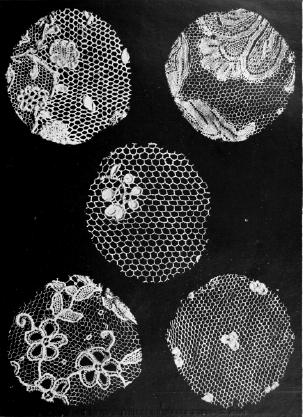
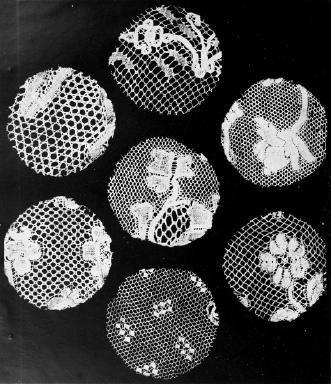
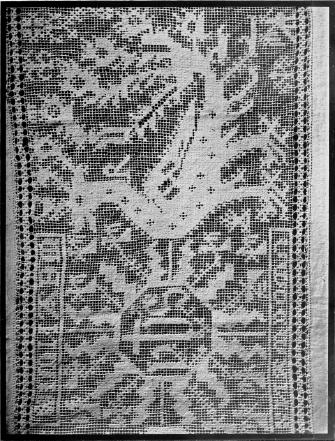
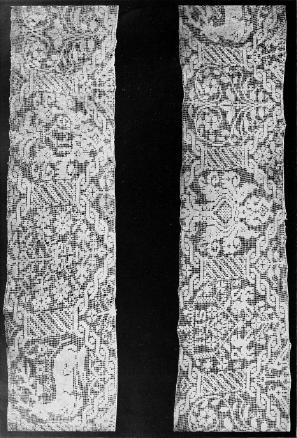
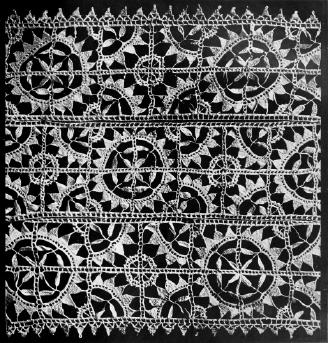
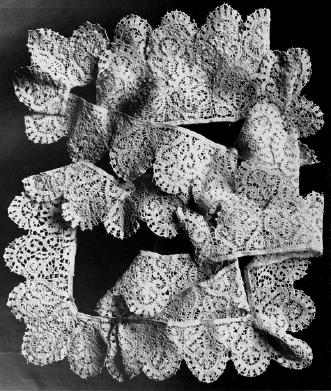
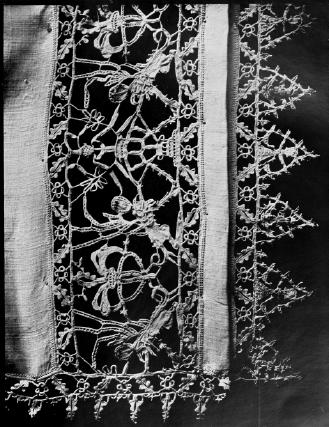
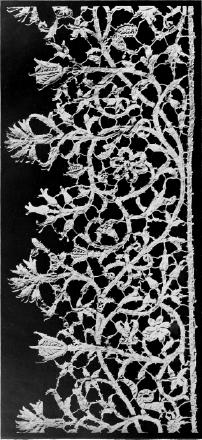
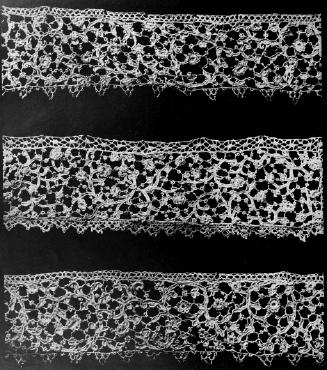
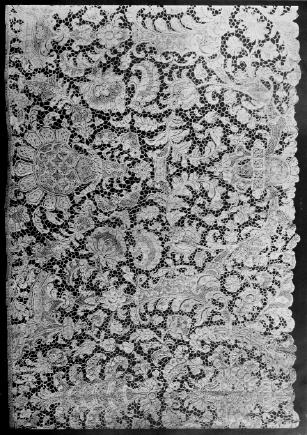
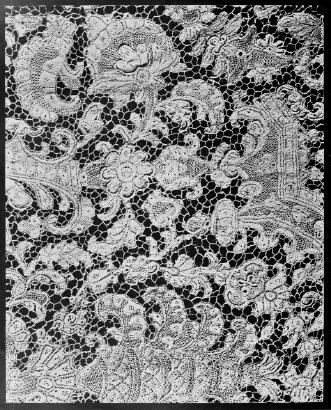
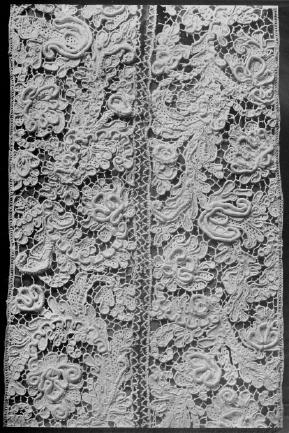
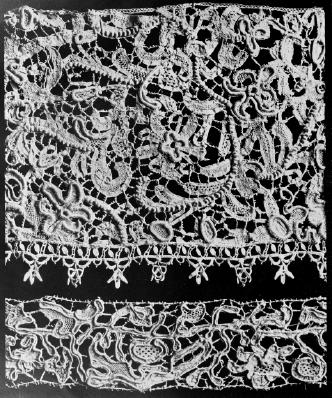
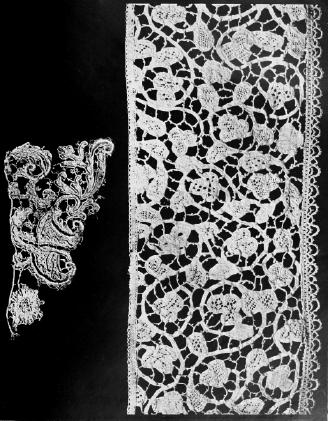
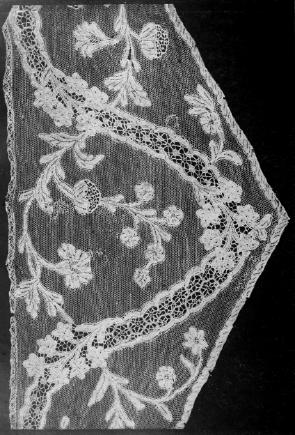
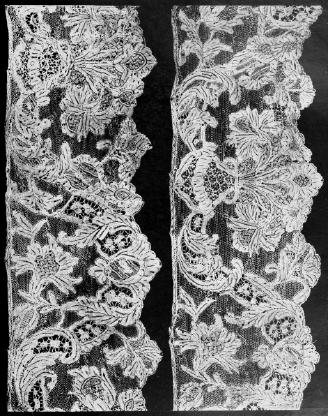
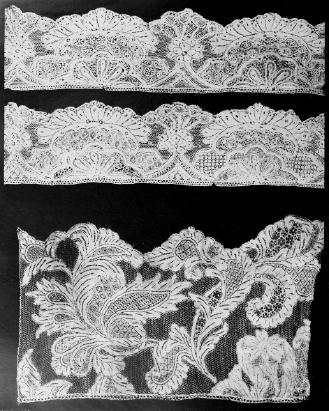
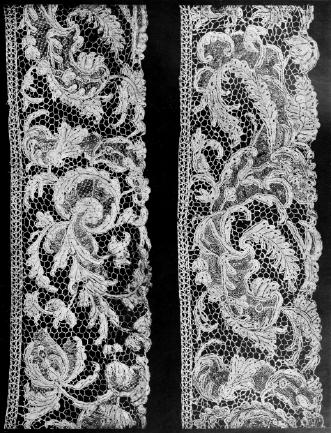
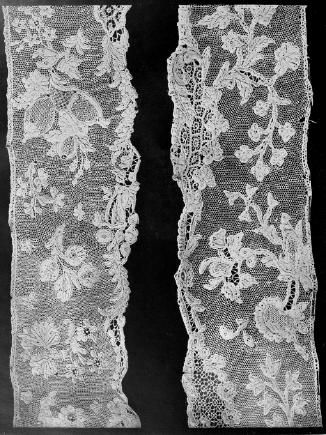
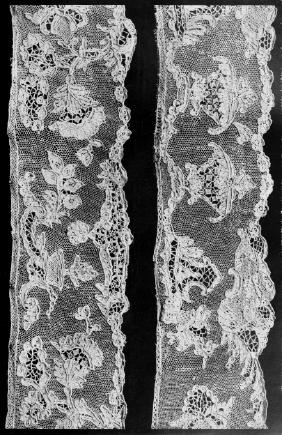
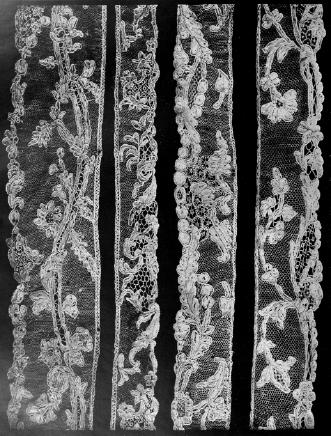
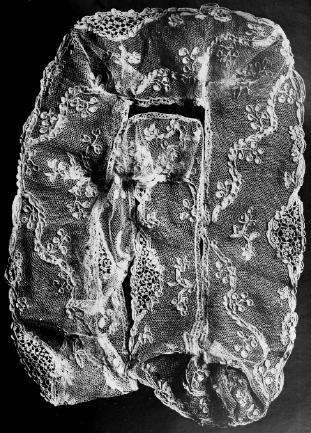
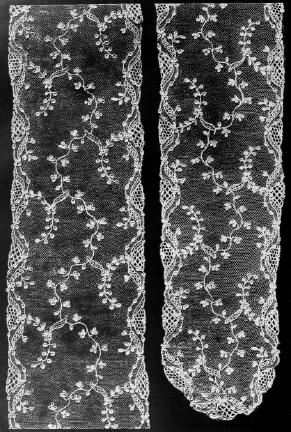
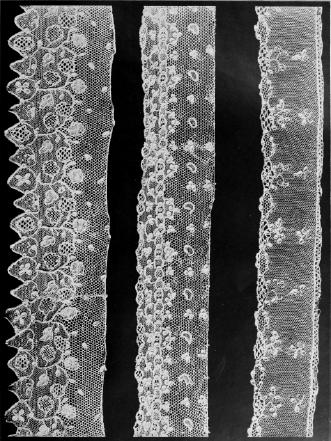
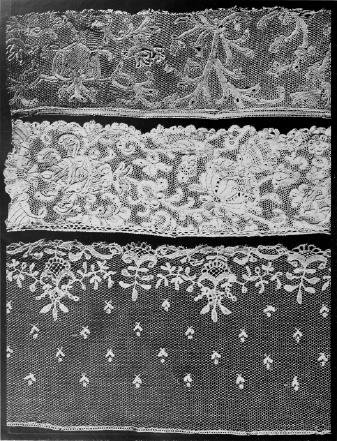
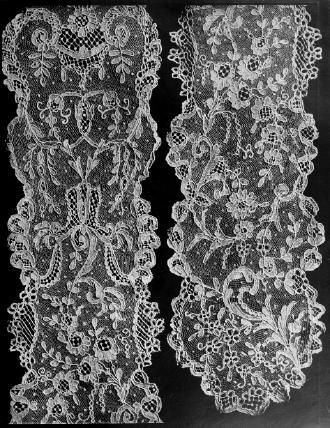
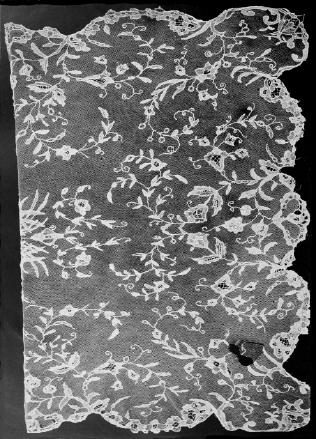
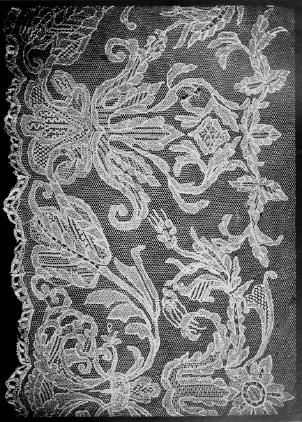
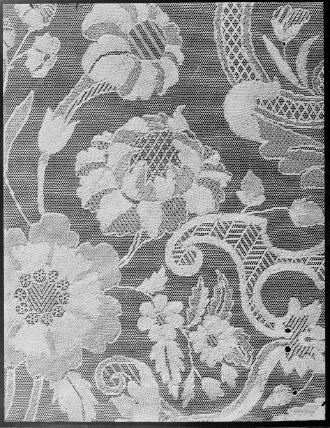
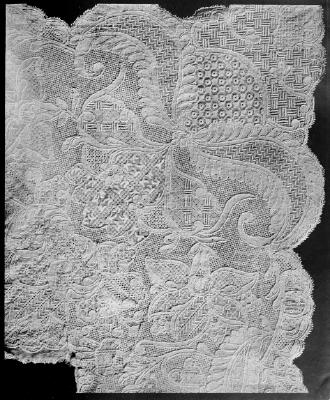
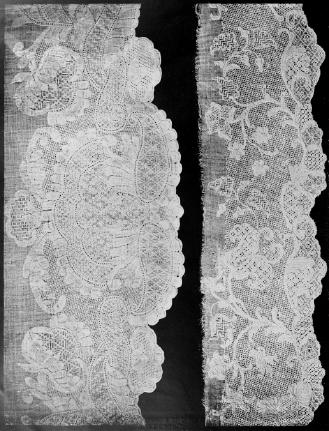
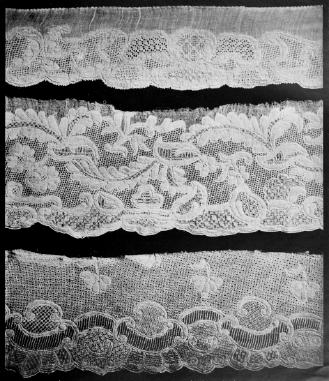
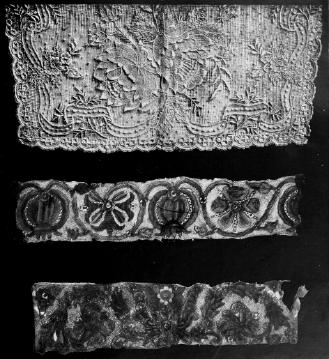
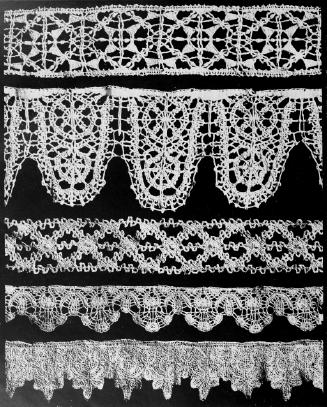
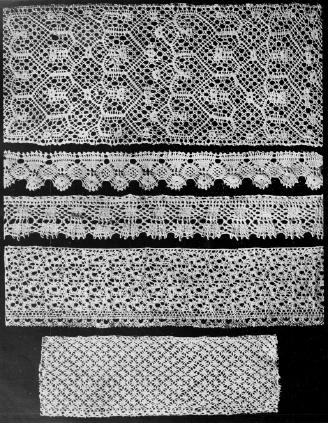
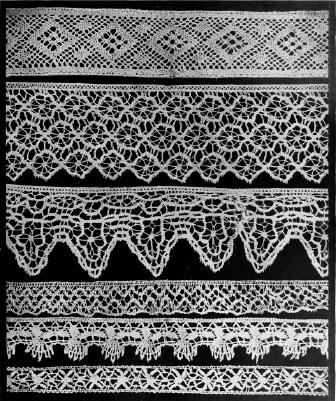
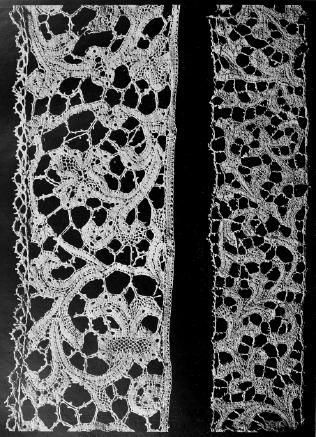
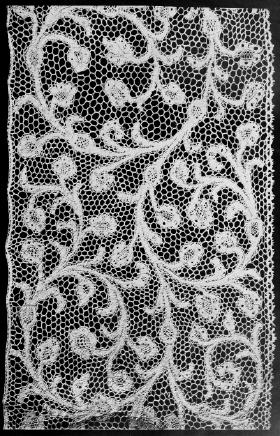
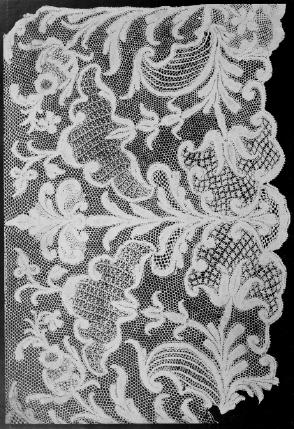
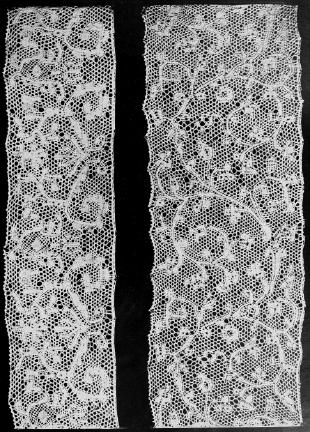
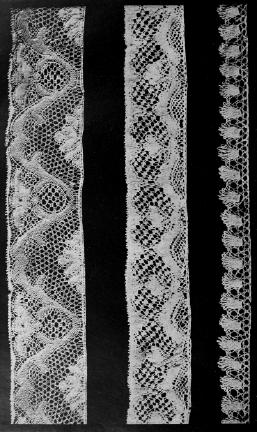
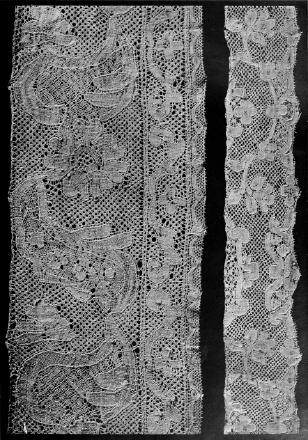
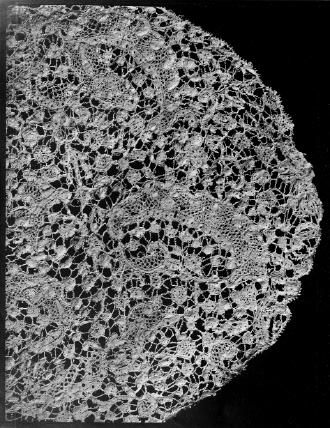
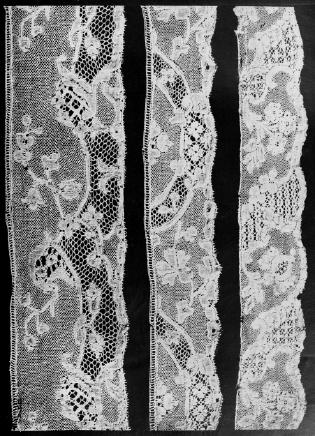
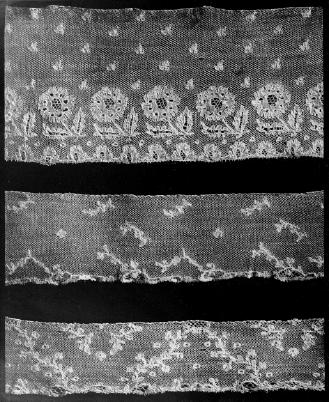
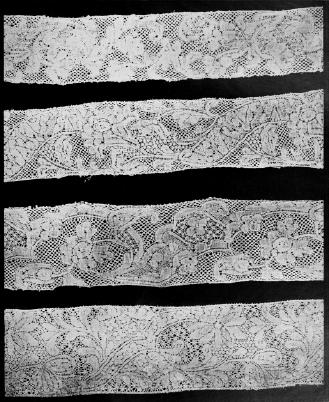
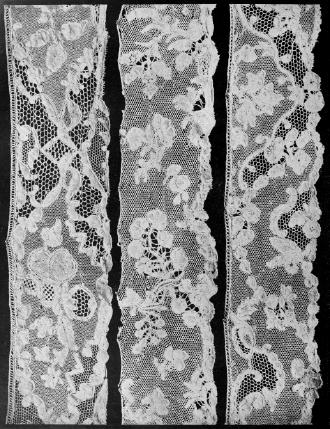
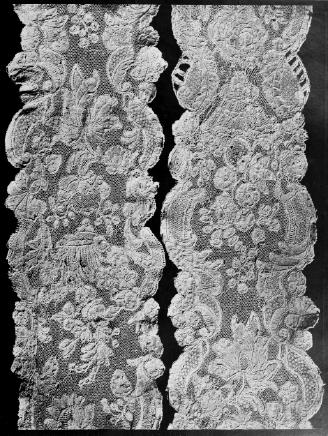
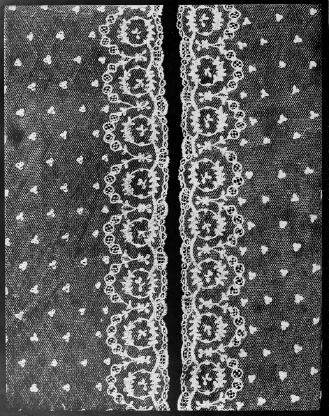
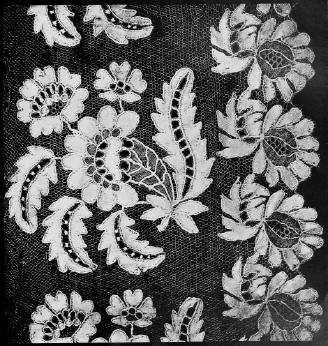
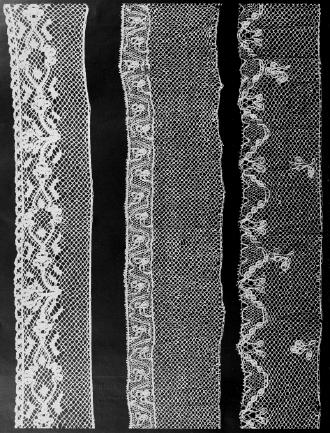
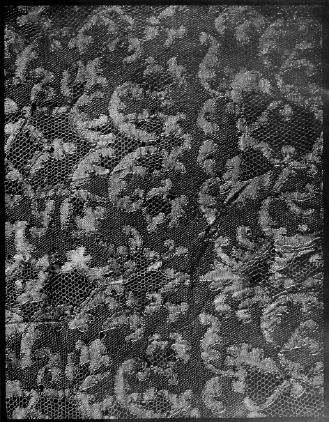
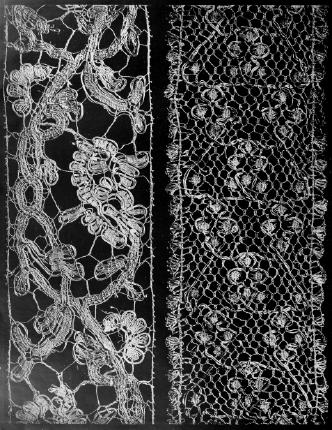
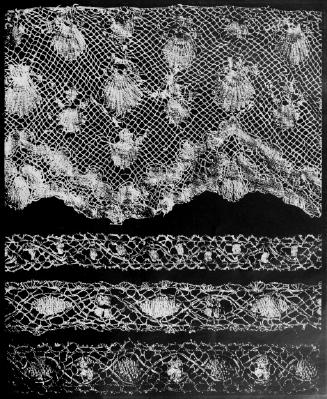
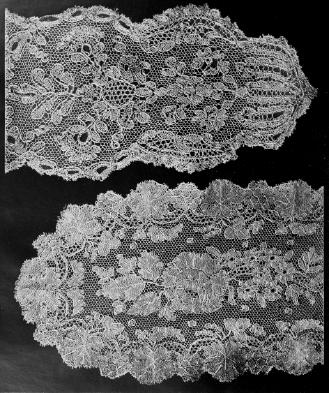
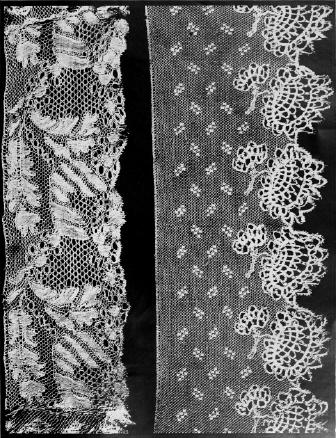
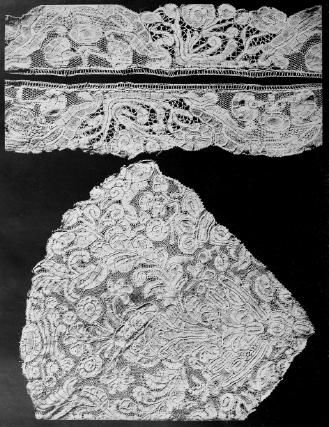
Many books giving patterns for lace-making were produced in the
sixteenth century, but few of them afford any technical instruction in
the art, and all assume that lace was already in demand throughout
Europe. We need not therefore take these interesting little books into
consideration in determining the antiquity of lace, although they are of
great assistance on the question of design, as they constantly show by
introducing the gammadion and other symbols, the survival of the
Oriental tradition.[A] This is also clearly shown in the numerous
specimens of embroideries and woven silks made in Sicily and Spain in
the thirteenth and fourteenth centuries, and preserved in our own and
Continental museums.
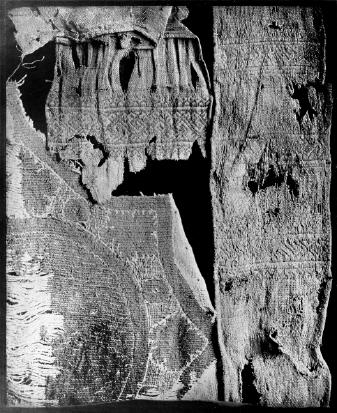
The earliest specimens of lace stitches in my possession are on pieces
of Coptic linen work from tombs of the third to the fifth century from
the collection of Mr. R. de Rustafjaell. The threads purposely left
loose in the weaving are held by punto a rammendo worked in white linen
thread. A background of coloured worsted is afterwards added,[B] (See
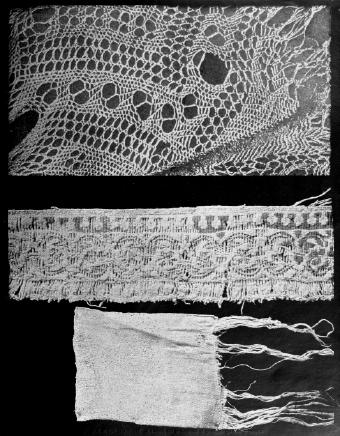
Plate 4.) It is interesting to compare the towel, No. 1 in Plate 28,
which in my opinion has probably been worked in the same way, that is,
the weaver has omitted the woof threads, leaving only the warp threads
to be drawn together by needlework. The bobbin-lace found in the same
tomb is illustrated in Plate 5.
The first mention of lace-making in Europe that I know of is an old rule
of the thirteenth century for English nuns, cautioning them against
devoting too much time to lace and ornamental work to the detriment of
work for the poor.[C]
This laz or lace was doubtless lacis. This lacis or network, now
called modano in Italy, was the earliest foundation for the work of
needle-made lace "trine ad ago." We find in the Appendix to Dugdale's
History of St. Paul's mention of work of "albo filo nodato" knotted
white thread. This was noted at a Visitation made in 1295.[D] But pieces
of this opus sfilatorium have also been found in Egyptian tombs. Early
specimens often have the gammadion or symbol of the cross. See Plate
4.
A roll of the possessions of the Templars after their suppression in
1312 includes an inventory of the goods of Temple Church. One item of
this is "one net which is called Espinum to cover Lectern, 2s."[E]
We must look to the specimens existing from early times in Europe, and
to contemporary testimony, whether of painting or sculpture, to enable
us to fix the date of these interesting productions of human
industry—the early lacis and linen laces. Embroidery on silk, in which
many of the lace stitches were used, has a very early record.
Here we need only cite the many magnificent examples of embroidered
Church vestments, chasubles, copes, &c., so freely produced from the
thirteenth century onwards, of which the wonderful Dalmatic of the ninth
century in the Vatican Treasury, the Syon Cope of the thirteenth
century in the Victoria and Albert Museum, together with others, are to
this date in excellent and almost perfect condition.
Now, if we remember that albs and other linen vestments used at Mass
have been for centuries as necessary and important as the outer ones of
silk, it must be allowed that while such a wealth of decoration was
lavished on the latter, adornment of the former was not likely to have
been omitted. I am, therefore, of opinion that much of the lacis, tela
tirata, and reticello work generally ascribed to the fifteenth and
sixteenth centuries, may more correctly be considered to be earlier in
date. That few of such ancient specimens remain is no doubt due to the
linen thread being less durable than the silk and also to that arch
enemy of lace in all ages, the washerwoman. As silk and gold embroidery
could not be washed, it survived. All who have to care for Church
vestments at the present time know that albs and other linen objects for
Church use are comparatively short-lived, and it must be remembered that
lace in early times was chiefly made for Church purposes.
After consulting illuminated manuscripts of the eighth and ninth
centuries, I have come to the conclusion that there is in them strong
evidence of lacework having been employed to ornament the albs worn even
at those periods. St. Mark, in a Gospel (now in the Bibliothèque
Nationale, Paris) said to have been written for Charlemagne, wears an
alb which appears to me to be of this kind. Also in the Bibliothèque
Nationale, Paris, is a twelfth-century Bible, called the Bible of St.
Martial, in which the Bishop is pictured wearing a highly ornamental alb
under his gothic-shaped chasuble. He grasps his pastoral staff in one
hand, and with the other he receives the precious Book.[F]
On the question of design, as indicating the date of lacework, I am of
opinion that the early geometric character of primitive design was
sooner modified than is generally thought to be the case.
We find, for instance, in an eighth-century "Gospel" in the Bibliothèque
Nationale of Paris, a scroll ornament painted with vine leaves, grapes,
&c.
Why should not this have inspired a laceworker of the same period to
attempt a similar design? At a little later date a "Sacramentaire" has
most realistic flowers and leaves ornamenting the initials in the
Manuscript. These beautiful works of art were executed by religious
persons and monks, probably of the Benedictine Order. A great part of
the lace made at the same time was undoubtedly the work of nuns. What
more likely than that mutual assistance was given to carry out the
principal aim of both—the ornamentation and glory of the Sacred
Scriptures, and the services of the Church?
Many of the earlier albs are decorated with passemens or apparels, which
are squares or oblongs of ornamental work often enriched with gold
thread. These were sewn on the lower part of the front of the alb and on
the cuff of the sleeve. The alb preserved at the Cathedral of Sens, and
said to have been worn by St. Thomas of Canterbury, is ornamented in
this way. In some of the old books of patterns for lace, the
straight-edged laces are all called passemens, and only the pointed ones
dentelles, or pizzi.
Later the apparels gave place to ornament worked on the linen itself,
and often forming a continuous band of decoration more or less wide
round the edge. A tombstone on the floor of the church of St. Sabina in
Rome has a recumbent figure with an alb decorated with a band of this
kind. The inscription denotes that the figure represents a German abbot,
named Egidius Varnsprach; the date is 1312. Later still, lace of all
kinds was merely sewn on to the alb as a flounce, in the way usually
adopted at the present time.
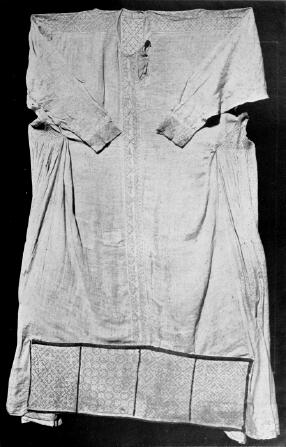
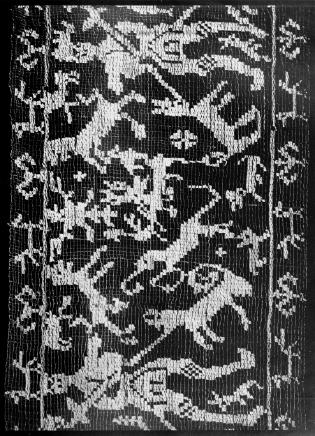
As far as I am aware, only two complete albs of early linen lace exist.
They are both of very fine texture, the thread of the linen having been
spun with great care and the weaving very closely done. The oldest is
the alb, Plate 1, which is said to have been woven and ornamented by
St. Clare of Assisi and her nuns, and is still preserved in the
monastery of that place. The tradition is that it was worn by St.
Francis of Assisi. I was fortunately able to examine it closely and to
obtain details of the lacework, which is worked on the linen itself in
tela tirata and punto reale. Symbolic animals and chimeras are
introduced, but the polygonal character of the design is preserved
throughout, and establishes, I consider, its Coptic derivation.
To confirm this, I need only instance the fact that these, and other
earliest known specimens of lacis and linen lace existing, are almost
identical in design with the forms familiar to us from the discoveries
in Coptic tombs in Egypt from the first and third centuries onwards.
These designs, simple and formal as they appear, are really full of
meaning. Mr. Albert Gayet has pointed out, in his history of Coptic art,
that the law of polygonal evolution only completed in the eleventh
century the course it had steadfastly pursued from the beginning. He
continues: "It seems a far cry from the early Greek tradition to this
time. But the Coptic artist was never in sympathy with the Greek
striving towards realism. He wished to express, not the image itself,
but the impression conveyed by the image. He preferred the thought to
the concrete form. The divine idea, which to the Greek must mean a
precise representation, he prefers to render quite otherwise. The
fidelity of the Coptic artist to this polygony renders it the key to all
his art. His first efforts are blunders, but he is not discouraged, he
continues without hesitation to follow his ideal. He finds in the
philosophy of the polygon the impression he wishes to convey of the
ideal and the invisible. His composition, according to the Gnostic
definition, has its secret side, hidden under the emblem shown, while
the emblem shown has also a hidden side. Then by the superposition of
entrelacs, or strap-work, he conveys the idea of evolution, or things
(mysteries) turning and repeating themselves indefinitely, but always in
an inflexible circle." For example, a number of star-centred octagons,
formed by a network of lines, will have a cross in the centre—other
little crosses may be traced in each star—and in the arabesques of the
corners crosses may also be found. "Everywhere, even in the most closely
packed work, this symbol can be found; the most abstract geometrical
combinations are still subject to the same system. Polygony places
everywhere and always the sign of the Faith."[G]
I must also make a quotation from the learned Dr. Rock, which, though
written nearly forty years ago, is so apposite while considering this
beautiful lacework from Assisi and its Eastern derivation.
Strengthening our idea that the old Egyptians had borrowed the cross as
a spell against evil, and a symbol of eternal life, is a passage set
forth by Rufinus, A.D. 397, and by Socrates B.C. 440.
"On demolishing at Alexandria a temple dedicated to Serapis, were
observed several stones sculptured with letters called hieroglyphics,
which showed the figures of a cross. Certain Gentile inhabitants of the
city who had lately been converted to the Christian faith, initiated in
the method of interpreting these enigmatic characters, declared that the
figure of the cross was considered as the symbol of future life."[H]
"We know that modifications of the form of the cross have been found on
monuments already discovered; others may turn up with the so-called
'gammadion' found upon Egyptian stuff of such an early date. The
recurrence of the gammadion upon Christian monuments is curious. It is
shown in the catacombs, and in numerous later instances. Christianity
widened the meaning of this symbol and made it teach the doctrine of the
Atonement of Calvary, and that Christ is our corner-stone. In the
thirteenth century it was taken to be an apt memorial of His five wounds
and, remembering the stigmata of St. Francis of Assisi, this gammadion
became the favourite device of such as bore that Saint's name."[I]
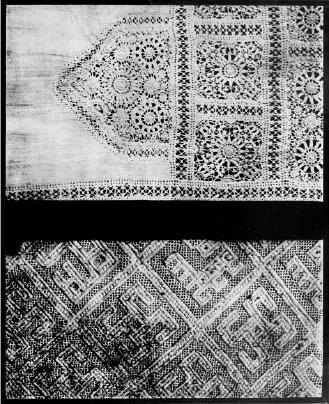
No less than twenty varieties of these polygonal ornaments, many of them
introducing the gammadion, are to be found in the lacework of the Assisi
alb. See Plate 3.
The tradition mentioned by Dr. Rock of the device of the gammadion being
identified with St. Francis may, I think, have originated in the
circumstance of his having worn this alb. In Plate 6 I give two examples
of early Italian punto reale of the same kind although very inferior in
variety and in workmanship, but in most of these early "cartiglia," as
this work is called in Italy, the polygonal idea is still predominant.
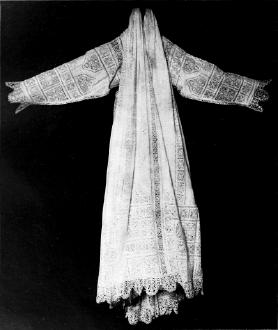
The other complete alb is also of linen lace, and is said to have been
worn by Pope Boniface VIII. in 1298. (See Plate 2.) It is preserved in
the Treasury of the Sistine Chapel in the Vatican, where I had an
opportunity of examining it closely and of obtaining the technical
details I give. As to its possible history I may note that St. Nilos and
his monks were driven from the East by the Saracens at the end of the
tenth century, and came to Italy, where they were welcomed by Pope
Gregory V. He established them in the monastery a few miles from Rome,
where their successors still worship with their Eastern rites. The
famous alb may have been brought by these very monks or those who
followed them from the East.[J]
Then, as now, specimens of the world's treasures of art and handicraft
arrived in Rome from all parts of the known world. I see no difficulty
in recognising the antiquity of this alb. That the great Pope Boniface
VIII. wore it is only a tradition, and no evidence is afforded or
vouched for by the authorities at the Vatican. One evidence of its
origin should not be overlooked which is the material, which I believe
to be the real Byssus, or fine handspun linen from the plant Linum
usitatissimum not at that time available in Europe. Dr. Bock remarks
that this Byssus was much sought for in early Christian times under the
name of Byssus of Alexandria.[K] The linen of the Assisi alb is of the
same texture, which I can only describe as crisp and wiry,
notwithstanding that in many parts it is much worn; on handling the
linen it reminded one at once of the linen of Egyptian mummy cloths, and
the Italian curators of both albs, while I must say profoundly
indifferent as to the questions of design and execution, which
interested me most, were all quite certain that they had known no linen
texture resembling it in Italy. It was impossible not to call to mind in
this connection, "Fine linen with broidered work from Egypt was that
which thou spreadest forth to be thy sail."[L] The linen of the alb of
Pope Boniface is slightly finer than that of the Assisi alb, and is
heavily worked with lace ornaments of an Eastern character. The repeated
geometrical patterns, or rosettes symmetrically grouped in squares, are
worked by the needle in punto a rammendo (see Plate 3), and the
curious stitch called punto treccia, or tress-work, is introduced, as
well as the punto a stuora, or matting stitch. It may be observed that
in such early lacework the punto a festone, or buttonhole stitch, is
never, or very rarely found, though afterwards it became almost the only
stitch used in all needle-point, until the advent of the réseau.
In the alb of Pope Boniface there is no buttonhole stitch—the ornaments
in squares called quadri were inserted in the linen of the alb, and were
surrounded by rows of punto tirato worked in the linen itself. The
flounce and insertions, or "falsature," of pillow-made lace were
evidently added at a later date.
It is interesting to see in the fresco by Giotto (1276-1337), preserved
in St. John Lateran, that Pope Boniface VIII. is supported by two
ecclesiastics, one of whom is wearing an alb with what appears to be
lace on the sleeve.
The tomb of the same pope, and of others of about the same date, afford
still more cogent evidence. In the Crypt of St. Peter's, Rome, Pope
Boniface VIII. is represented in full pontifical vestments lying on a
bier which is draped with a richly ornamental pall; this is raised to
show a linen cloth with a border of reticello work in what is termed by
a learned writer "the well-known geometrical design of the thirteenth
century." The Pope wears an alb with an ornamental border which is
repeated on the sleeves.
The fact is, of course, acknowledged that linen cloth was used for
bed-linen, towels, and other articles. For albs, linen, and linen only,
was ordered by the rubric; therefore, if one sees an alb represented,
whether by painting or sculpture, the intention to represent linen is
implied. And, if ornamented, the intention to represent linen lace is
clear in many instances, although the painter or sculptor cannot, of
course, give us a facsimile as satisfying as the photographs we have
here.
I will here refer to the well-known pictures by Giotto and his school.
One in the Louvre, of the birth of St. John the Baptist, has most
unmistakable lacework on the linen of the bed, and on the long towel
gracefully depicted as hanging from the shoulder of one of the
attendants.
A fresco, also by Giotto, in the Basilica of Assisi, represents the
figure of the Divine Infant in a shirt with reticello ornament.
Duccio di Buoninsegna (1260-1340) and Lorenzetti (1276-1348) may be
mentioned among many others, as in their paintings linen cloths are
rendered with unmistakable needle-point ornament. It is quite clear that
these laces were in general use before the fourteenth century, although
it is not surprising that few specimens remain to us.
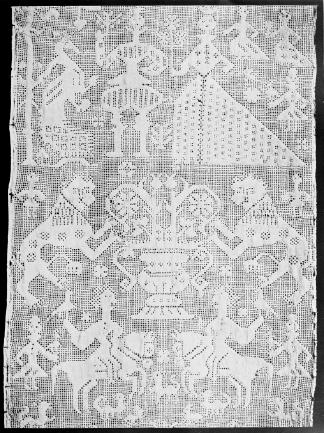
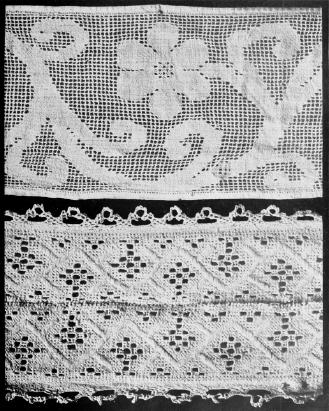
The pattern of the lacis, or sfilatura, in Plate No. 7, is geometrical,
with an Eastern tendency, as in Pope Boniface's alb. It is singularly
like the dresses of saints in some of the Ravenna mosaics, and the more
ancient stitches can be seen in the specimen given, but there is no
buttonhole stitch.
In describing the design of this piece of old lacis, I am again tempted
to quote M. Gayet's description of lace found in the Coptic tomb. He
says: "It is lace as it is made to-day. All the threads of the réseau
are drawn together to one point, and the meshes start from the centre
like rays crossing and recrossing and thus forming various patterns."
The pieces of network from these Coptic tombs, preserved in the Victoria
and Albert Museum fully justify this description, and no doubt the
Eastern tradition can be traced in Plate 7.
As we have seen, the ornament of the earliest laces was simple, or
quasi-simple, in design; but even then the craving to represent life
often appears. The band down the front of the Assisi alb, for example,
has a row of stags thoroughly subservient to the distinctly polygonal
idea.
In Plate 11 a portion of an early lacis or modano border is represented.
Conventional peacocks and numerous smaller birds are added to the
central design of I.H.S. in Gothic letters—quaint little angels are at
the ends of some of the rays. The inscription has so far found no
interpreter.
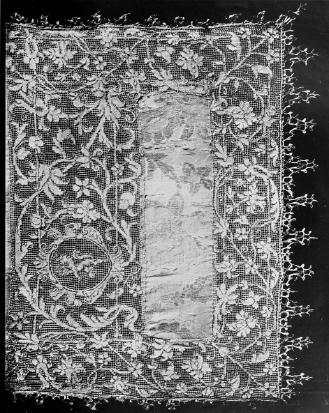
The altar-cloth in Plate 12 may possibly have been made for Richard II.;
his two wives were both French, and this piece has the stag, which was
the royal device.
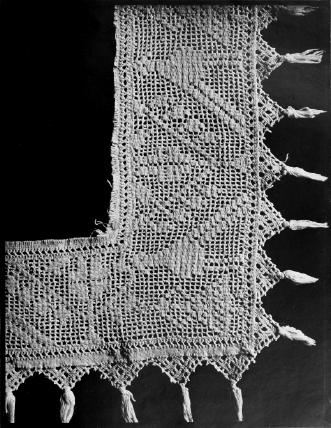
No. 1 of Plate 13 is an interesting border of Sicilian lacis, the design
Eastern, introducing the gammadion, the netting is all made obliquely.
Two stitches are used for the pattern, the punto a rammendo and also the
punto scritto. A vandyked border of punto avorio is added.
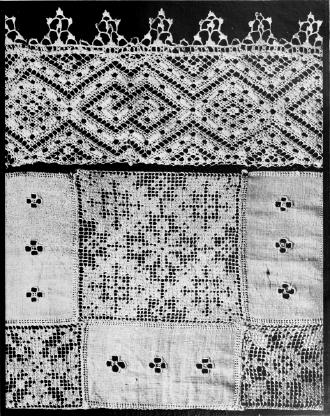
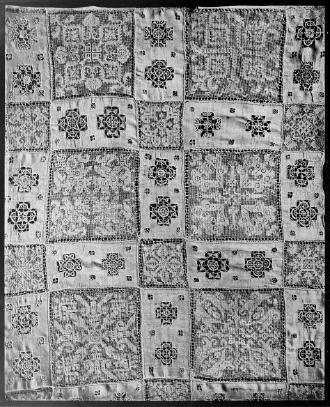
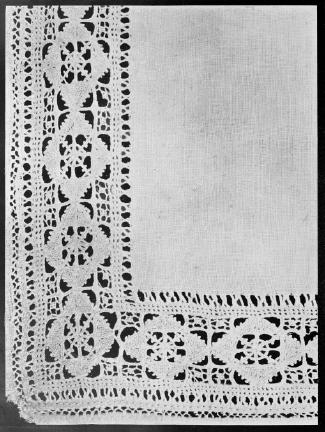
In Plate 14 the squares of lacis or modano are alternated with linen
worked with reticello. The design in each square is different.
The effect of the gold thread added to the pattern worked in punto a
tela, or linen-stitch, in Plate 15, is very good, and there is much
variety in the execution of this piece.
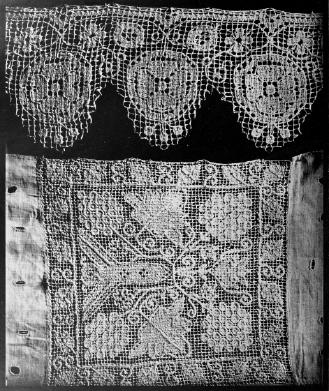
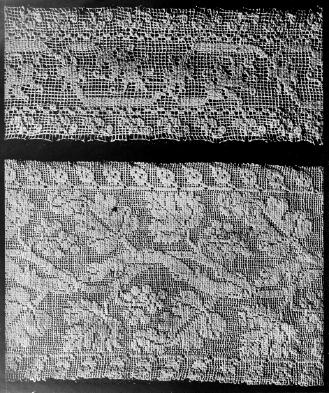
No. 1 of Plate 16 is lacis of possibly German work with a design of
vine-leaves and grapes worked in punto a tela. No. 2 is a vandyked
border of English lacis with a pattern of large and small blossoms—the
larger ones resemble Tudor roses. Both these pieces have the punto
riccio introduced.
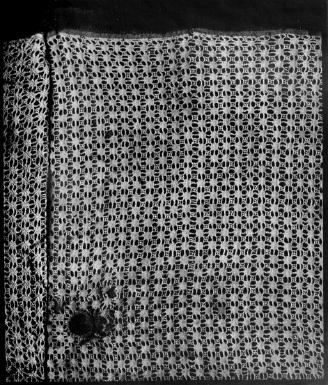
Plate 17 is a specimen of lacis called buratto in Italy, as the netting
is twisted and not knotted. The pattern is punto a rammendo, worked with
very coarse thread, but the result is satisfactory. This piece must be
early sixteenth-century work.
The two examples of buratto work in the following plate, Plate 18, are
much more finely worked with punto a rammendo. The narrow border is
probably the earliest.
Alençon has certainly more romantic associations than any other
lace-producing town. For the making of lace at Alençon did not begin
only with the establishment of that industry in 1660, of which I shall
speak later. More than a century before that date Marguérite
d'Angoulême, Duchess of Alençon, and afterwards Queen of Navarre, while
living at her castle of Alençon, worked and caused to be worked,
beautiful ornaments for albs and other articles for use at the altar of
St. Leonard's, her parish church. Some of these are preserved in the
Alençon Museum; a specimen of early lacis is especially interesting,
worked in squares with radiating threads, and the centres worked with
punto a stuora as in Plate 17. The specimen of lacis, with gold thread
introduced similar to that in Plate 15, may very likely be the very
piece alluded to by Clément Marot in his odes to Queen Marguérite. She
died in 1549.
"Elle adonnait son courage
A faire maint bel ouvrage
Dessus la toile et encore a
Joindre la soie et or."
"Vous d'un pareil exercice
Mariez par artifice
Dessus la toile a maint tract
L'or et la soie en pourtract."
Another interesting record of this Queen is to be found in a manuscript
of the expenses of "Madame Marguérite," sister of the King (Francis I.).
"For 60 yards fine Florence lace for her collars."[M] This lace was
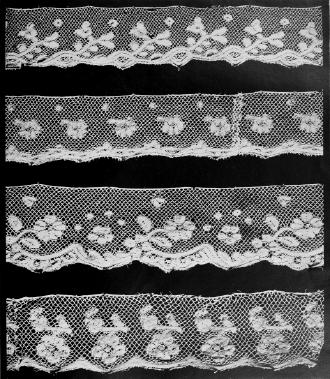
probably fine punto in aria worked in points, as in Plate 30, but it
may, of course, also have been bobbin-made lace similar to the edging in
Plate 29.
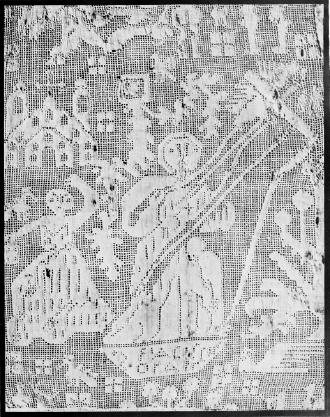
The earliest example of tela tirata here is a piece representing St.
Francis of Assisi and events of his life, Plate 19. Under the saint's
feet is an inscription imperfectly rendered by the pious worker. St.
Michael is above, and still higher is the Madonna and many emblems or
perhaps fancies of the worker. This lace may have been worked in Assisi
itself in the thirteenth or fourteenth century.
Another early specimen has a man in armour with a helmet of
thirteenth-century shape. See Plate 20.
Another piece, Plate 21, which is very fine and was no doubt worked for
a wedding, represents a bride and bridegroom standing dressed in
sixteenth-century costume and surrounded by attendants. Below is a
hawking party with dogs.
The infant's swaddling band, Plate 22, is interesting, as these bands
are no longer ornamented.
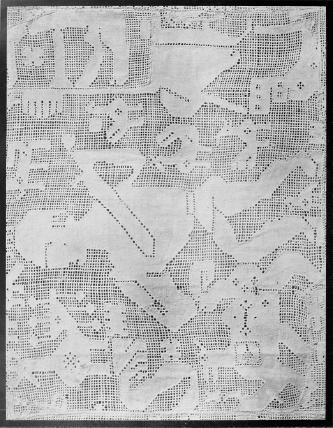
The specimen of tela tirata No. 1, in Plate 25, is of singular make, the
whole piece to be worked being prepared by drawing threads at regular
intervals. These same threads are then darned in with a needle to form
the pattern. In this specimen a small piece has been unpicked to show
the way the threads were drawn before beginning the work. This method
has, I believe, not hitherto been noticed, as the plan of cutting
threads and leaving the pattern in the linen is more usual; but, of
course, no cut threads at all remaining in the work rendered it more
even and durable, and so justified the extra trouble.
No. 2 of Plate 25, is a piece of tela tirata with punto reale similar,
though coarser in make, to the work on the Assisi alb.
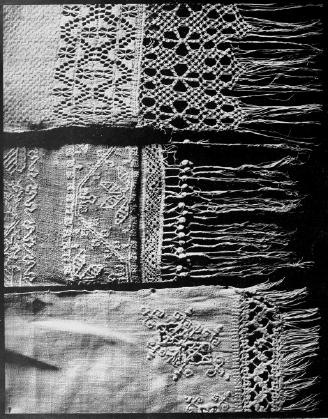
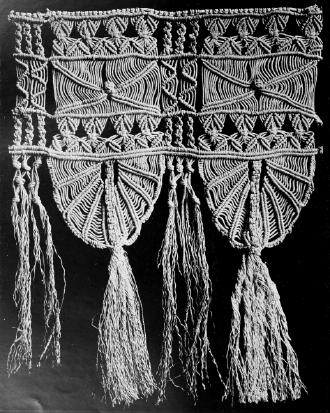
Three specimens of sixteenth-century linen work, Plate 28, are reduced
in size; one is on a huckaback with a fine macramé fringe. The drawn
work of this piece is beautifully done. The cloth in the centre is
worked in punto riccio and has a border of punto avorio and a curious
fringe. The third is cut and worked in punto riccio and reticello, and
has a border of bobbin-made lace.
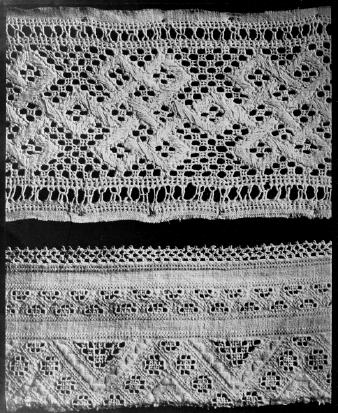
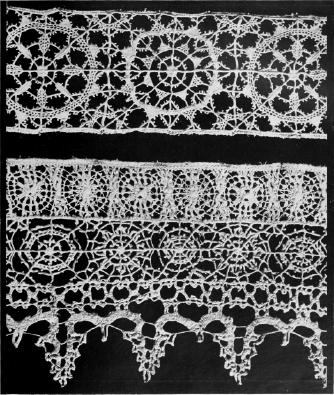
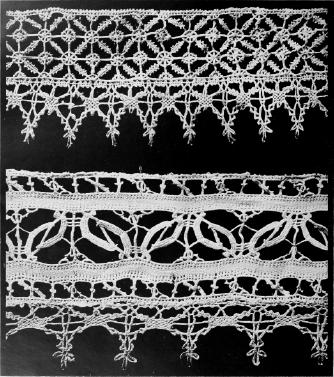
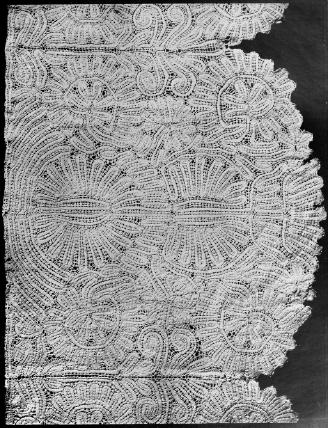
In Plate 29 we have two examples of reticello, the linen almost entirely
cut away and hidden by the different stitches. The punto a stuora is
still used for the centres, as we have seen in the earlier laces, and
the punto a festone appears for the first time. In the second example we
have a curious combination of three laces—an upper border worked almost
exactly like the very early lace of Plate 7; then comes an insertion of
reticello, and finally a border of Venetian bobbin-lace (merletto a
fuselli). This is early fifteenth-century work.
We now come to the third division made in needle-point lace—the punto
in aria, which may be said to be the starting-point of all subsequent
needle-point laces. No linen or netting being used the worker had to
construct her lace—in aria—out of nothing, and a splendid opening it
gave, as we shall now see, for invention and for execution. This punto
in aria, worked into points, was extensively used for personal
adornment: these points gave the name of pizzi to lace, a name which
still survives in Italy as comprehensive of all lace, as the name
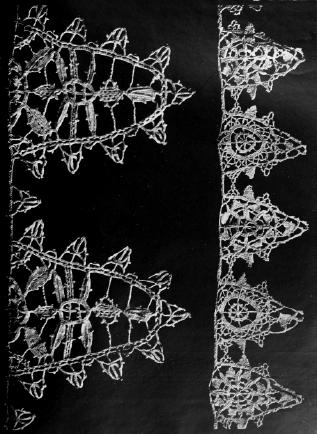
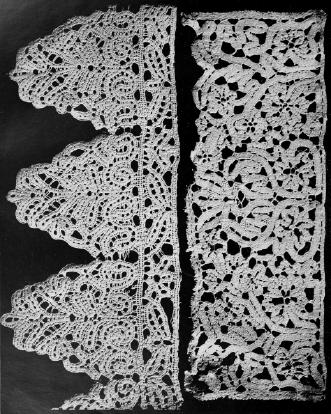
dentelle is in France. The first examples I give here are the two
dentated (or vandyked) borders of Plate 31.
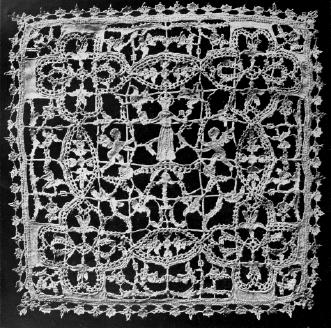
The chalice cover, Plate 32, is a very interesting combination of
reticello and punto in aria; the lines of the cut-linen foundation are
carried across and form a lattice behind the punto in aria devices. The
beautifully worked waved pattern circling round the design may be
intended to represent St. Peter's chains: the Saint stands with the
Scriptures in one hand and the Keys in the other, and has a winged
cherub on each side; the edge is of punto in aria.
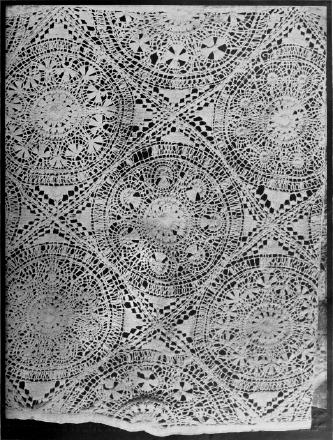
The reticello pattern of Plate 33 is beautifully rendered in punto
avorio and punto in aria. This piece, unlike the specimens given before,
has no linen foundation, and therefore is classed as punto in aria and
not as reticello or cutwork.
The corporal border of Plate 34, of very conventional floral pattern is,
I think, undoubtedly of German early seventeenth-century work.
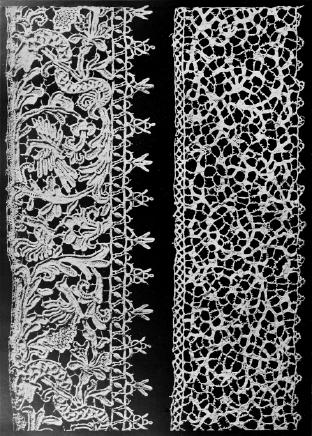
The border of the Venetian cloth in Plate 35, is a very fine specimen of
punto in aria. The two insertions, of which one is given, are alike.
They have strange winged and tailed animals alternating with scrolls and
vases. The vandyked border is a wonderful piece of work containing
altogether forty-eight small figures, and, as is often the case in
Venetian work, the figures, birds and animals have tiny black glass
beads for eyes. The animals have loops of fine buttonhole stitch to
denote manes.
A very interesting and beautiful piece of punto in aria is Plate 36. The
design is still reminiscent of the East; the flowing interlaced
flower-stems, with animals introduced, have quite a Persian effect. But
the beautiful rendering of the pendant flowers, and the true love knots,
as well as the heraldic device of the Visconti (the crowned serpent)
mark the elegance and freedom of the Renaissance. It was, no doubt, made
in Venice in the late sixteenth century.
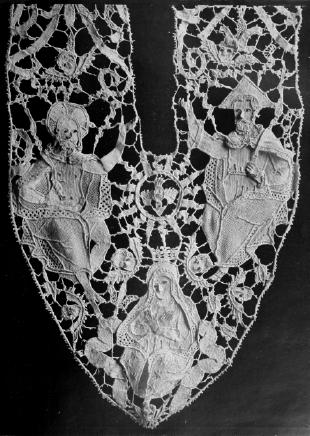
The punto in aria trimming for the neck of an alb, Plate 37, is a very
remarkable piece, and the execution full of interest. The work is
entirely without foundation. The figures are clothed with mantles of
very beautifully worked network, called in Italy mezza mandolina. The
edges of the mantles are worked in punto avorio. Realism is attempted by
representing the features in relief, and little black beads are added to
the eyes.
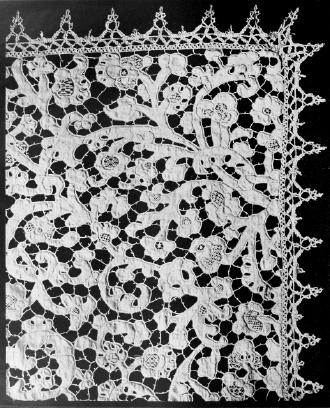
A curious border of the Venetian rose-point is No. 1, Plate 38, worked
entirely in punto a festone. Birds and serpents occur, and the thick
cordonnet which outlines the pattern is also used to denote the scales
of the serpents and the feathers of the birds, tiny black beads mark the
eyes as in Plate 37. The edging is of very fine punto avorio. A specimen
of the so-called coraline Venice needle-point is also on this Plate.
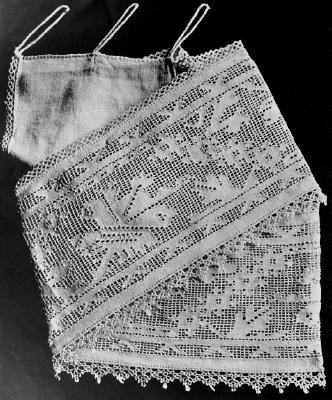
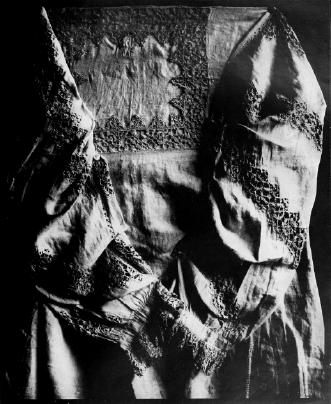
In Plate 39 we have a very interesting specimen of needle-point as
applied to personal use—a lady's camisia, or shirt, of the sixteenth
century. The linen has a square hole cut for the head, and this opening
is beautifully worked in punto in aria. The sleeves are ornamental with
oblique bands of cut-work, and the seams everywhere worked with drawn
stitches and insertions of punto avorio. The handwoven linen is in good
condition, although the garment must have been much worn, as the cuffs
have been replaced by bobbin-made frills, trine a fuselli. It is
doubtful whether three hundred years hence any linen garment worn at the
present time will survive.
From the beginning of the sixteenth century the fashion began of
working portions of the lace separately, and joining them together by
brides, and modes or fillings were also introduced, into the pattern.
Later, from about 1630, the réseau ground was introduced, covering the
whole space between the patterns; the patterns themselves also changed,
and from being geometric and conventional became more and more
realistic. The stately lace of Venice, however, may be said to have
always preserved its conventional tradition, whether in the heavy rose
or raised point or the delicate point à réseau.
Venice obtained her pre-eminence of lace-making in the sixteenth
century. The flat point is probably the earliest distinctive lace; but
this was soon enriched by work upon work, stitch upon stitch, which gave
the name of rose-point or punto in rilievo. The characteristic ornament
in the heavy so-called gros point de Venise consists of conventional
blossoms like leaves and scrolls treated as though carved in ivory or
bone, and to it applies the title of punto tagliato a fogliami. The
brides are sometimes quite plain, but later are adorned with picots.
We now come to the period when lace, so long only made for church
purposes, was very extensively made and used by lay persons for their
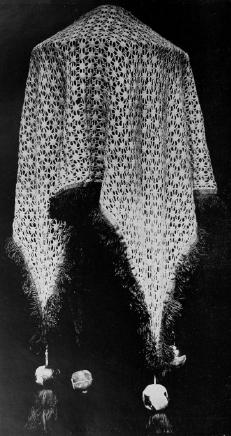
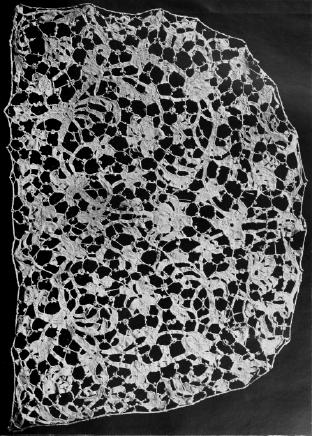
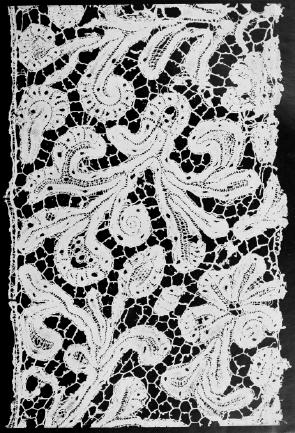
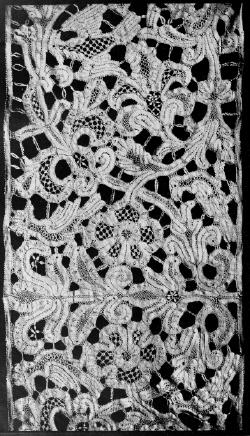
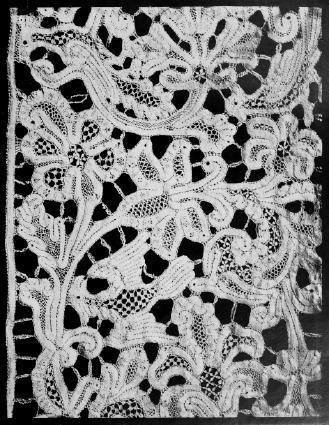
personal adornment, and for furnishing purposes. The bed cover Plate 40
was, no doubt, one of many made for a household of simple tastes; the
coarse linen is cut into a fine flowing pattern edged with buttonhole
stitch, and ornamented with various fillings. But in houses of greater
pretension the use of the richest rose-point became lavish, not only on
the dress of the mistress, the collar of the master, but on table covers
and hangings of every kind. Examples of this splendid lace are given in
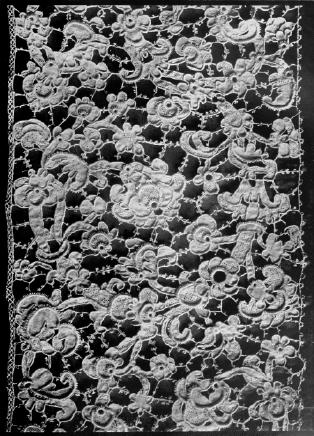
No. 42 and following plates. No. 44 has, perhaps, the finest toilé; but
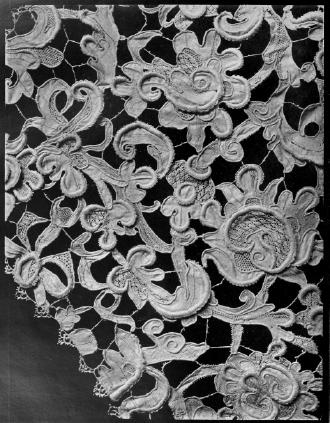
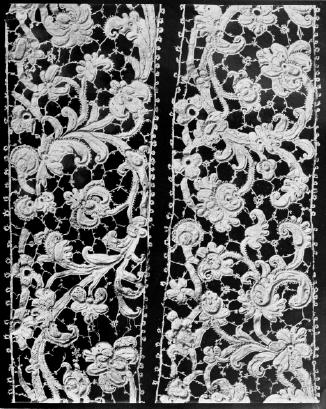
the design of No. 45 is very beautiful. No. 46 is a flounce for an alb
of very fine scroll design with brides picotées and occasional raised
work; the beauty of the pattern is better seen in the enlargement, Plate
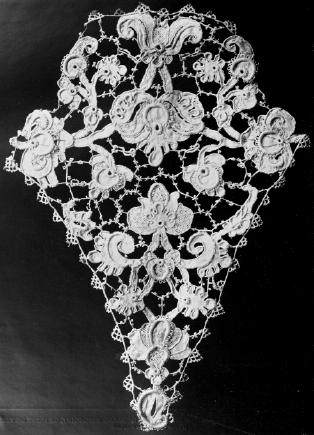
47. The paten cover, No. 48, and the enlargement of it, No. 49, give a
complete idea of the style and execution of this lace.
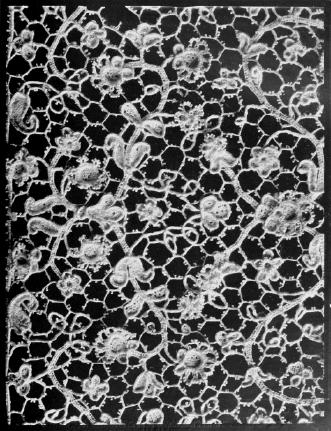
The design of the flounce, No. 51, is of the style usually associated
with point de France, the stitches and brides picotées are identical in
workmanship with the Venetian point. It was probably made at Alençon,
Sedan, or one of the other lace-making centres which were started upon
the importation of Venetian laceworkers into France after the middle of
the seventeenth century.
The specimens of Spanish rose-point, Nos. 53 and 54, show the stately
and elaborate design, rather overloaded with ornament, which is
characteristic of this lace.
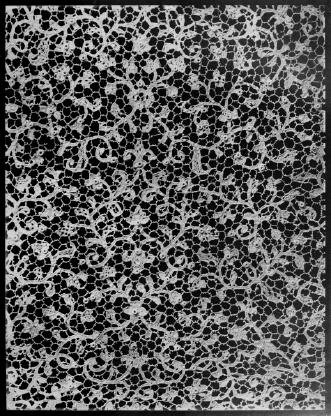
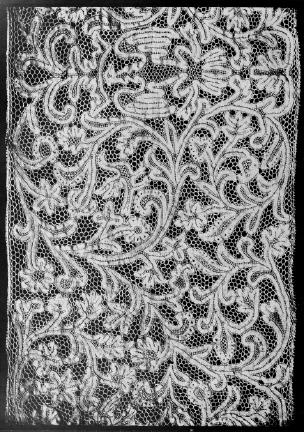
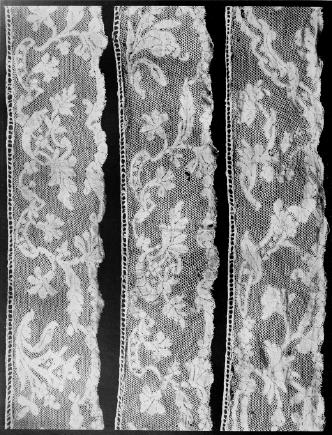
The Venetian point à réseau was made from about 1650 in Venice and
Burano. The cap shown in No. 56 has a beautiful flowing design of a
scroll with flowers and leaves, and brides connecting some portions of
the design. The main ground is of small mesh réseau worked the length of
the lace, which is often the case in Venetian work, though I have never
seen it in Alençon lace, the réseau being, as far as I know, usually
worked across the lace by the early French workers. (Later, the réseau
of the Alençon lace was worked obliquely, as can be seen by examining
Plate 67, and the specimens I have seen of modern Alençon are also
worked in this way.)
Plates 59 and 60 show interesting specimens of this very rare Venetian
lace. No. 2, in the latter plate, is probably a specimen worked in
France.
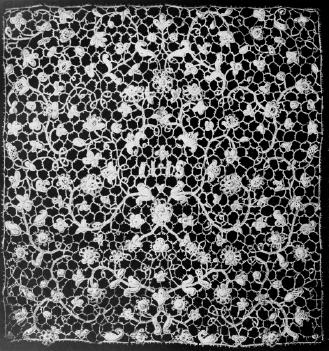
The ground of No. 59 is of brides picotées arranged into hexagonal
meshes, a ground which is chiefly associated with the point de France,
and this specimen was no doubt from Alençon.
About 1660 important centres of lace-making were developed and
subsidised in France by the Government at Alençon, Paris, Sedan, and
other places, and the French needle-point then made was scarcely to be
distinguished from the Venetian. This was to be expected, as the first
workers of lace of this kind in France were imported from Venice. In a
letter to Colbert, the minister of Louis XIV., dated 1665, Catherine de
Marcq writes, "I am starting for Alençon with four Venetian lace
workers."[N]
As our King Charles II. revived his father's edict against foreign lace
at about the same time (1662), it would almost seem a concerted action
to check the Italian and Flemish superiority in the fabrication of the
finest lace, whether needle- or bobbin-made. But although the French
were successful in part in rivalling the Venetian needle-point, the
finest bobbin-lace of Flanders was never approached by the English
workers, and now, of course, can never be equalled, as the secret of the
thread used in the finest laces, such as Angleterre, Binche, etc., is
lost.
Nothing was too ambitious for the Venetian or French designers of the
seventeenth century. Coats of arms under canopies, scriptural or
classical figures, wreaths and vases of flowers, were frequently worked
into the same design for a piece of lace. The subsequent changes of
design which took place in the Alençon lace are most interesting to
note, the patterns gradually losing their Venetian character. In No. 61
vases and pots of flowers are introduced, and the floral patterns of the
specimens which follow become more and more realistic in drawing.
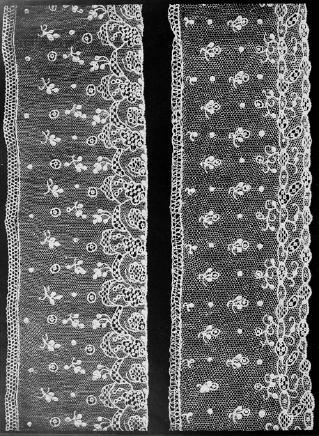
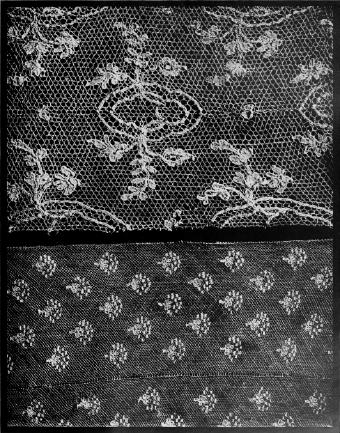
Towards the end of the reign of Louis XVI. enormous quantities of lace
were required for the new fashion of frills and flounces, and the change
in design is much marked by the adoption of borders of very light
effect, the réseau ground being spotted with little sprigs, slender
riband devices, and dots or pois, whence the term semé de larmes. (See
Plate 66.) In the numerous specimens shown, the changing fashion can be
marked, until in Plates 64 to 67 the Venetian character of the designs
of Alençon needle-point has quite disappeared. The patterns are
practically designed for borders only; and the réseau is, as I have
said, spotted with tiny sprigs, or dots. The expression semé de larmes
is said to have arisen in allusion to the misfortunes of Queen Marie
Antoinette, by whom much lace of this style was worn.
In needle-point made at Argentan we find a style and design such as we
should expect from its close neighbourhood to Alençon. The sole
peculiarity of the Argentan workers was that, not content with the
almost incredible toil involved in the lace of Alençon, they actually
worked the whole réseau of their lace over in buttonhole stitch, thus
making those compactly stitched hexagonal meshes which are distinctive
of this wonderful fabric. The Argentan réseau was sometimes introduced
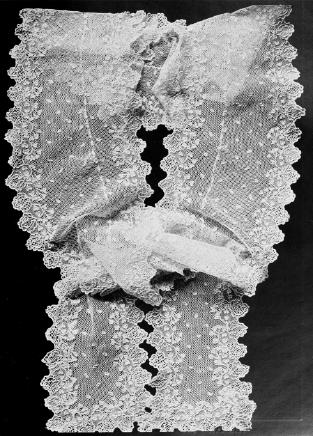
into lace made at Alençon and elsewhere. The specimens, Nos. 68 and 69,
are representative of this rare lace.
The two specimens—one of silk and one of linen thread, Nos. 1 to 2,
Plate 70—I consider to be Portuguese, from the curious though rather
handsome and effective jumble of design which is often found in Spanish
and Portuguese work.
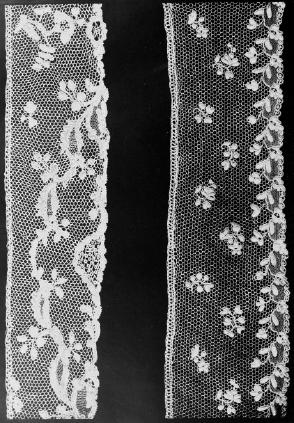
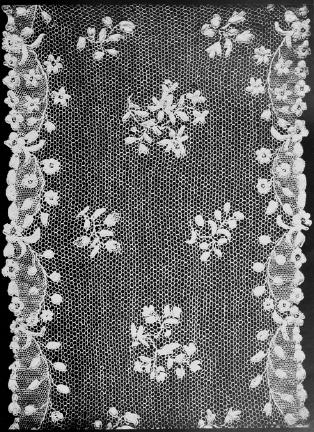
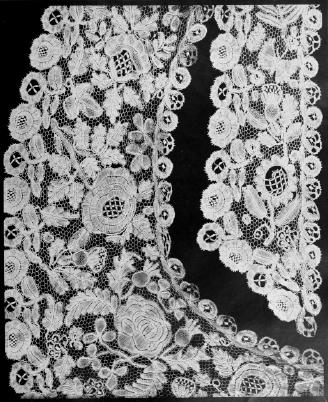
The Brussels needle-point of No. 3, Plate 70, and Plate 71 and Plate 72,
must seem poor and thin when compared to the preceding laces. But it is
very beautiful in its own delicate style, and has been called the
laciest of laces. The réseau is very fragile, hence the name sometimes
given of point de gaze. The designs shown have not the complete realism
aimed at in the Brussels lace of the present day, but have a charm of
their own which I confess attracts me more than all the brilliant
improvements of the last sixty years.
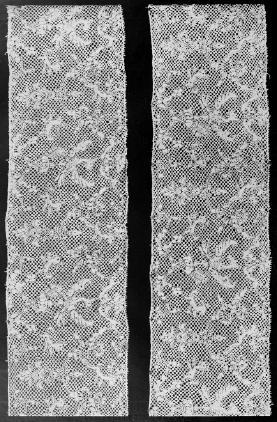
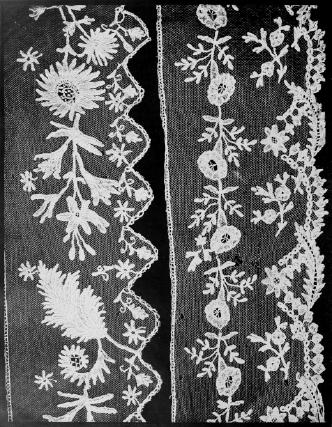
The two specimens of darned work on bobbin net, Plates 73 and 74,
especially the latter, are remarkable for the beauty and variety of the
work.
Plate 75 and Plate 76 have specimens of the beautiful and intricate work
called Tönder muslin lace made in Denmark in the eighteenth
century. The following, Plate 77, is lace of the same kind but made in
South Germany. I obtained these pieces in Leipzig forty years ago.
Number 2, in Plate 76, has a design and fillings which almost recall
those in the finest Alençon laces of the late seventeenth century.
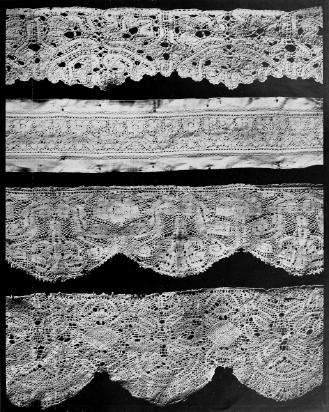
Plate 78 has four specimens of eighteenth-century Dutch linen lace made
for caps; it is called Gouda lace; the fillings are very well
done.
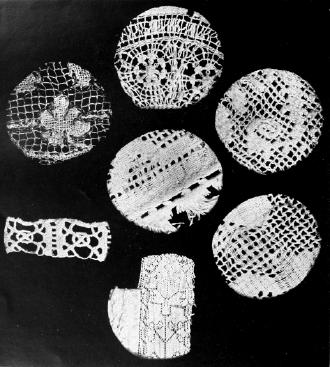
In the Manila fibre lace, Plate 79, No. 1, the ground is entirely worked
over by the needle into small squares, giving the appearance of network.
This is done in the same way as the earlier tela tirata, the threads
drawn together and sewn with wonderful regularity, without any thread
being cut.
The two specimens of needle-point, Plate 79, Nos. 2 and 3, made entirely
of human hair, are rather difficult to render in a photograph. They are
evidently copied from Venetian patterns, and the various shades of hair
used have a very pretty effect, while the execution of such fine work in
so fragile a material must have demanded extreme skill and deftness of
hand. They were made about 1800, at the Bar Convent, York.
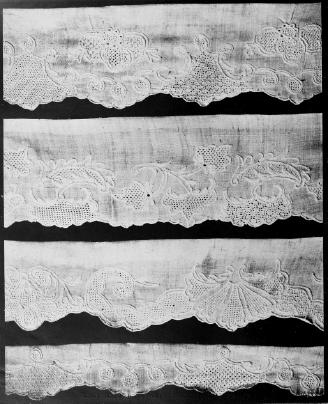
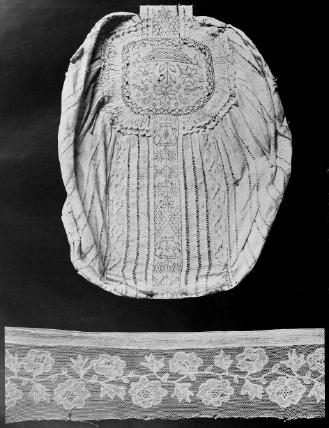
A very interesting piece of old English needle-point work is No. 80, a
cap of Holy, or Hollie, work. A close réseau is worked by using a stitch
very similar to buttonhole stitch, and the effect is of a texture very
like the cambric it adorns. The pattern is made by missing stitches,
forming small holes.
Hollie lace was chiefly used to decorate infants' caps, etc., for
baptism, and the pot with flower, reminiscent of the Annunciation, the
Holy Dove, etc., were devices frequently introduced into the patterns.
Collars of this work are mentioned in Queen Mary Stuart's inventories.
Number 2, Plate 80, is a specimen of Limerick run lace.
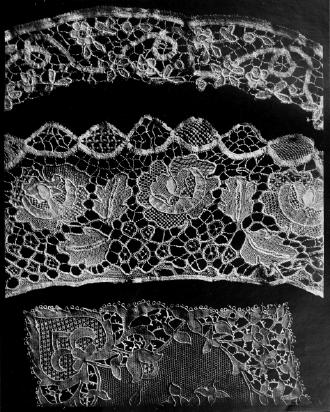
Three pieces of Irish needle-lace, Nos. 1 and 2 of Plate 81, are
praiseworthy as very early specimens of this industry. The designs are
nondescript, but many of the stitches are well executed. A bobbin-made
tape is introduced in No. 1. No. 3 is the so-called Carrickmacross lace;
a muslin and machine net foundation is neatly outlined by fine whipped
stitches; and buttonhole-stitch brides picotées are used to join the
patterns after the background is cut away. This lace was first made
after the famine of 1846.