The cover image was created by the transcriber and is placed in the public domain.
BUFFALO
Historical Society
PUBLICATIONS
VOLUME TWENTY-SEVEN
Edited by Frank H. Severance
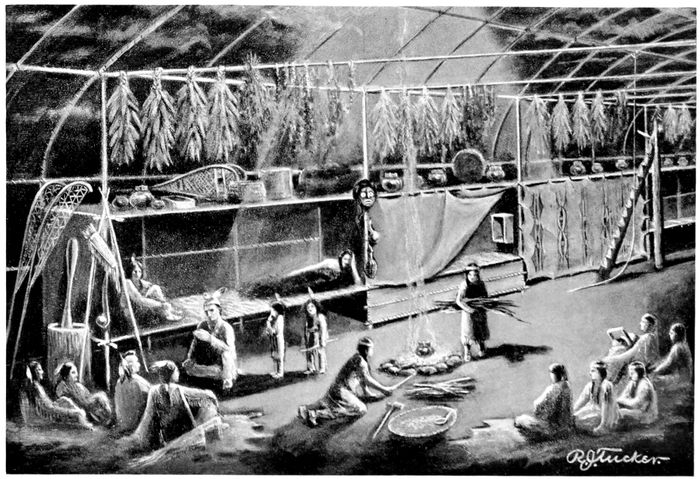
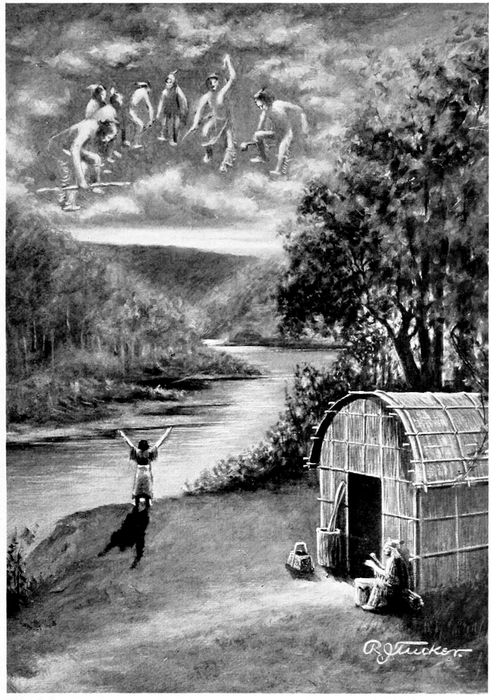
THE ATMOSPHERE IN WHICH LEGENDS WERE TOLD.
From a Painting Showing the Interior of a Bark Long house, by Richard J. Tucker.
BY
ARTHUR C. PARKER, M.S.
Archæologist, New York State Museum
Life Member, The Buffalo Historical Society
BUFFALO, NEW YORK:
Published by the
BUFFALO HISTORICAL SOCIETY
1923
THE TRIBUNE PUBLISHING COMPANY
PRINTERS AND BINDERS
MEADVILLE, PA.
TO
FRANK H. SEVERANCE, L.H.D., LL.D.
Secretary, The Buffalo Historical Society
President, The New York State Historical Association
WHOSE NUMEROUS ESSAYS AND HISTORICAL
WRITINGS HAVE BEEN A SOURCE OF
INSPIRATION AND ENLIGHTENMENT, AND
WHOSE INTEREST IN THE SENECA INDIANS
AND THEIR HISTORY HAS NEVER WANED,
THIS VOLUME OF
SENECA FOLK TALES
IS DEDICATED IN TESTIMONY OF THE
AUTHOR’S SINCERE ADMIRATION AND
ESTEEM.
SENECA MYTHS AND FOLK TALES
FOREWORD
ix
The author of this collection of Seneca folk-tales cannot
remember when he first began to hear the wonder
stories of the ancient days. His earliest recollections are
of hearing the wise old men relate these tales of the mysterious
past. They were called Kă´kāā, or Gă´kāā, and when
this word was uttered, as a signal that the marvels of old
were about to be unfolded, all the children grew silent,—and
listened. In those days, back on the Cattaraugus reservation,
it was a part of a child’s initial training to learn why
the bear lost its tail, why the chipmunk has a striped back
and why meteors flash in the sky.
Many years later,—it was in 1903,—the writer of this
manuscript returned to the Cattaraugus reservation bringing
with him his friend Mr. Raymond Harrington, for the
purpose of making an archæological survey of the Cattaraugus
valley for the Peabody Museum of Archæology, of
Harvard University. Our base camp was on the old Silverheels
farm, which occupies the site of one of the early
Seneca villages of the period after the Erie war of 1654.
Here also is the site of the original Lower Cattaraugus of
pre-Revolutionary days.
To our camp came many Indian friends who sought to instruct
Mr. Harrington and myself in the lore of the ancients.
We were regaled with stories of the false faces, of the
whirl-winds, of the creation of man, of the death panther,
and of the legends of the great bear, but in particular we
were blessed with an ample store of tales of vampire skeletons,
of witches and of folk-beasts, all of whom had a
xspecial appetite for young men who dug in the ground for
the buried relics of the “old-time folks.”
To us came Tahadondeh (whom the Christian people
called George Jimerson), Bill Snyder, Gahweh Seneca, a
lame man from Tonawanda, Frank Pierce and several
others versed in folk-lore. I filled my note-books with
sketches and outlines of folk-fiction, and after our return
to New York, I began to transcribe some of the stories.
The following winter was spent on the reservation among
the non-Christian element in a serious attempt to record
folk tales, ceremonial prayers, rituals, songs and customs.
A large amount of information and many stories were collected.
Some of this material was published by the State
Museum, the rest perished in the Capitol fire at Albany,
in 1911.
Later I was able to go over my original notes with
Edward Cornplanter, the local authority on Seneca religion,
rites and folk-ways, and to write out the material here
presented. Cornplanter’s son Jesse assisted by way of
making drawings under his father’s direction. I also had
the help of Skidmore Lay, Ward B. Snow, Delos B. Kittle,
Mrs. John Kittle, James Crow and others. My informants
from the lower reservation, the Christian district, were
Aurelia Jones Miller, Fred Kennedy, George D. Jimerson,
Julia Crouse, Moses Shongo, Mrs. Moses Shongo, David
George, William Parker, Job King, and Chester C. Lay;
and Laura Doctor and Otto Parker of the Tonawanda
Reservation.
In the preparation of these versions of old Seneca tales
the writer used no other texts for comparative purposes.
It was thought best to rest content with the version given
xiby the Indian informant, and to wait until a time of greater
leisure came before attempting to annotate the collection.
Leisure has never seemed to be the privilege of the writer,
and one busy year has crowded upon another, until eighteen
have passed since the tales were written down. It may be
best, after all, to present the text just as it was prepared,
and merely correct the spelling of a name or two. It was
not until after this text was in the hands of the Buffalo
Historical Society that the Curtin-Hewitt collection of
Seneca folk tales appeared, and though differences will be
found between our texts and those of Curtin, it must be
remembered that variations are bound to occur. All versions
of folk tales recorded by different individuals at different
or even identical times will vary in certain particulars,
as is explained hereinafter.
In the preparation of this volume the writer wishes to
record his indebtedness to Mr. George Kelley Staples,
Senator Henry W. Hill, Mr. George L. Tucker and Dr.
Frank H. Severance, all members of the Buffalo Historical
Society, for the advice and encouragement given.
INTRODUCTION — METHODS EMPLOYED IN RECORDING FOLK TALES. — TEXT IN SENECA WITH INTERLINEAR TRANSLATION. — LITERAL TRANSLATION. — FREE TRANSLATION. — OBTAINING CORRECT VERSIONS. — STORY-TELLING CUSTOMS OF THE SENECA. — PHONETIC KEY.
xvii
In presenting this collection of Seneca myths and legends,
the collator feels that he should explain to the general
reader that he does not offer a series of tales that can be
judged by present day literary standards. These Indian
stories are not published for the mere entertainment of
general readers, though there is much that is entertaining
in them, neither are they designed as children’s fables, or
for supplementary reading in schools, though it is true that
some of the material may be suited for the child mind. It
must be understood that if readings from this book are to
be made for children, a wise selection must be made.
This collection is presented as an exposition of the unwritten
literature of the Seneca Indians who still live in
their ancestral domain in western New York. It is primarily
a collection of folk-lore and is to be looked at in
no other light. The professional anthropologist and historian
will not need to be reminded of this. He will study
these tales for their ethnological significance, and use them
in making comparisons with similar collections from other
tribes and stocks. In this manner he will determine the
similarities or differences in theme, in episode and character.
He will trace myth diffusion thereby and be able to
chart the elements of the Seneca story.
There is an amazing lack of authentic material on
Iroquois folk-lore, though much that arrogates this name
to itself has been written. The writers, however, have
in general so glossed the native themes with poetic and literary
interpretations that the material has shrunken in value
and can scarcely be considered without many reservations.
We do not pretend to have made a complete collection
of all available material, but we have given a fairly representative
series of myths, legends, fiction and traditions.
xviiiOne may examine this collection and find representative
types of nearly every class of Seneca folk-lore. Multiplication
is scarcely necessary.
The value of this collection is not a literary one but a
scientific one. It reveals the type of tale that held the
interest and attention of the Seneca; it reveals certain mental
traits and tendencies; it reveals many customs and incidents
in native life, and finally, it serves as an index of
native psychology.
The enlightened mind will not be arrogant in its judgment
of this material, but will see in it the attempts of a
race still in mental childhood to give play to imagination
and to explain by symbols what it otherwise could not
express.
While there is much value in this collection explaining
indirectly the folk-ways and the folk-thought of the Seneca
and their allied kinsmen, the whole life of the people may
not be judged from these legends. Much more must be
presented before such a judgment is formed. Just as we
gain some knowledge of present day religions, governmental
methods, social organization and political economy
from the general literature of the day, but only a portion,
and this unsystematized, so do we catch only a glimpse of
the life story of the Seneca from their folk-tales.
To complete our knowledge we must have before us
works on Seneca history, ethnology, archæology, religion,
government and language. Finally, we must personally
know the descendents of the mighty Seneca nation of old.
We must enter into the life of the people in a sympathetic
way, for only then can we get at the soul of the race.
While all this is true, these folk-tales are not to be despised,
for they conserve many references to themes and
things that otherwise would be forgotten. Folk-lore is one
of the most important mines of information that the ethnologist
and historian may tap. We can never understand
a race until we understand what it is thinking about,
xixand we can never know this until we know its literature,
written or unwritten. The folk-tale therefore has a special
value and significance, if honestly recorded.
There are several methods which may be employed in
recording folk-lore, and the method used depends largely
upon the purpose in mind. A poet may use one method,
and grasping the plot of a tale, recast it in a verbiage
entirely unsuitable and foreign to it; a fiction writer may
use another plan, a school boy another, a student of philology
another, a missionary another, and finally a student of
folk lore still another.
The poet will see only the inherent beauty of the story,
and perhaps failing to find any beauty, will invent it and
produce a tale that no Indian would ever recognize. Plot
and detail will be changed, fine flowery language will be
used, and perhaps the whole given the swing and meter of
blank verse. This is all very well for the poet, but he has
buried the personality of the folk-tale, albeit in petals of
roses,—instead of allowing it nakedly to appear the living
thing it is.
The fiction writer will take the original Indian tale and
tear it apart with keen eyed professional discrimination.
He will recast the plot, expand here and there, explain
here and prune down there. He will invent names and new
situations to make the story “go,” then, as a rule, he sells it
to a magazine or makes a collection of tales for “a supplementary
reader for children.” But are these Indian tales?
The amateur, finding good material in the Indian story
will do as the fiction writer does, but he will work in foreign
allusions and inconsistent elements and in other ways
betray his unfamiliarity with his material. Like the fiction
writer he is primarily after a story that he can dress as
he pleases.
xxThe sectarian enthusiast, recording folk-lore, will frequently
seek to show the absurdity of the Indian tale, and
point out the foolishness of peoples who are unacquainted
with biblical teachings, but it is fortunate that all missionaries
have not done this. Many have recorded folk-tales
with great conscientiousness, and some of our best sources
are from the notes of well informed missionaries.
The philologist will seek to make literal transcripts of
every Indian word in painstaking phonetic spelling, and
then secure an analytical interlinear translation. This is
an accurate but awkward way of securing the tale, for
readers who are accustomed to reading only straight English.
It makes it a most tedious and laborious thing to
read, and totally deprives the text of all literary life.
The student of folk lore starts in with a purpose. This
is to secure the tale in such a manner, that without unnecessarily
colored verbiage, it may be consistently dressed, and
set forth in fluent English (or other modern language) in
such a manner that it may be understood by an ordinary
reader. The folk-lore student has still another motive and
purpose, which is to so present his legend that it will awaken
in the mind of his reader sensations similar to those aroused
in the mind of the Indian auditor hearing it from the native
raconteur. The recorder of the tale seeks to assimilate its
characteristics, to become imbued with its spirit, to understand
its details, to follow its language,—its sentences,—one
by one, as they follow in sequence, and then he seeks
to present it consistently. He adds nothing not in the original,—despite
the temptation to improve the plot,—he presents
the same arrangement as in the original, he uses similar
idioms and exclamations, similar introductory words
and phrases, and presents an honestly constructed free
translation. This is far from an easy thing to do, for it
frequently lays the recorder open to the charge of being a
clumsy story teller. The temptation is ever present to tell
a good story, and let the legend become the skeleton over
xxiwhich the words are woven. Needless to say, this is not
an honest thing to do, and the folk-lore student resists this
temptation, and gives his product a genuine presentation,
regardless of what literary critics may think. He strives
only to be the medium by which a native tale is transformed
from its original language to that of another tongue. The
thought, the form and the sequence of the story he insists
must remain exactly as it was, though the verbal dress
is European and not Indian.[1]
Perhaps actual illustrations of these methods will serve
to convey the thought we are attempting to explain. Examples
follow:
Ne’´ gwā´, gi’´on‘,
hadi´noñge’
ne‘´
sgäoñ‘iādĭ‘´
ne‘´
There it seems
they dwell
the
other side
the
it is said
of the sky
hĕñ´noñgwe‘.
Da´,
s‘hă’degano´ndāĕn‘
ne’´ho‘
ni‘honon‘sō´t
they (M) man
So
just in the center
there
just his
beings
of the village
lodge stands
ne‘´
hă‘sĕñnowā´nĕn‘,
ne’´ho‘
hādjwadä´iĕn’,
ne’´
ne´io’
the
he Chief
there
his family
the
his
(great name)
lies
wife
ne’´
kho‘´
ne‘´
sgā´t
hodiksă’dā´iĕn’,
ie´on‘
ne‘´
ieksă’´ă‘.
that
and
the
one
they child have
she
(it is)
female is
the
child.
Waādiĕñgwă‘´s‘hoñ‘
o´nĕn‘
ho’
wă‘´săwĕn’
ne‘´
hăgweñdä’´s.
He was surprised
now
it
that
he
became lonesome.
O´nĕn‘
dĭ´q
we´so’
ho’nĕñ´iathĕñ‘
ne‘´
Hagĕn´tcĭ;
ne’´
Now
moreover
much
his bones are dry
the
He Ancient
that
(he is very lean)
One
gai´ioñnĭ
t‘hĕn’´ĕn‘
deo’nigoñ‘´īiō‘
he‘´
odiksă’dā´iĕn’āiĕñ’´
it causes
not (it is)
his mind happy
because
they child one would
is
have think
nĕ’´
noñ‘´
heniio’´dĕn‘
ne‘´
ne‘´
hosheie´on.
that
perhaps
so it is in
that
the
he is jealous.
state
xxii
There were, it seems, so it is said, man-beings dwelling
on the other side of the sky. So just in the center of their
village the lodge of the chief stood, wherein lived his family,
consisting of his wife and one child, that they two had. He
was surprised that then he began to become lonesome. Now
furthermore, he the Ancient was very lean, his bones having
become dried, and the cause of this condition was that
they two had the child, and one would think, judging from
the circumstances that he was jealous.
Such is the beginning of the Seneca version of Iroquoian
cosmology as given by J. N. B. Hewitt in the 21st Report
of the Bureau of Ethnology. This faithful record of a
native text and its translation is literally a most painstaking
work involving the closest attention to the minor sounds in
the language, in order that each word may be phonetically
recorded. To wade through this literal translation from the
beginning to the end of the myth would be too tedious for
anyone but an enthusiastic student of native tongues. To
the majority of readers it would be a forbidding task. Even
to follow the involved language and grammatical forms of
the close literal translation would tire the mind of anyone
whose mother tongue was not that of the text.
A free translation, therefore becomes a prime necessity,
but this must not disturb the original thought. Just how
to make such a translation honestly becomes a problem
beset with difficulty. Our plan is to smooth out the language,
divest it of its awkward arrangement, and allow the
thought to flow on. Let us attempt this in the following:
In ancient times a race of transcendent men dwelt on
the other side of the sky. In the center of a village in that
land stood the lodge of Ancient One, the chief, and there
he lived with his wife and one child. To his astonishment,
xxiiithough he had these companions, he began to feel lonely
and neglected. His form grew emaciated and his “bones
became dry,” for he longed for the attentions his wife now
gave to his child.
Just how the poet would handle this version we hesitate
to conjecture but we may easily imagine that he would
make the most of the land above the sky, the celestial lodge,
the age of the Ancient One, his initial joy at the birth of
his child, and his gradual discovery that his wife’s affection
had been transferred from him to their offspring, of the
agony of soul that wilted his heroic form and caused his
very bones to wither and lose their marrow, and of the
final madness of the Ancient One, who (to follow the myth
in its fullness), had a tormenting dream which caused him
to tear up the celestial tree and cast his wife into the
cavernous hole that dropped down into chaos.
The plot of this myth-tale has elements that make it
excellent material for the fiction writer who would recast it
entirely and weave it into the thrilling story of celestial
tragedy. We have seen such attempts and have been
astonished at the audacity of the writer who thus presents
his product as a “genuine Indian myth.” Yet, most popular
versions of Indian legends are recast to such an extent that
the Indian who supplied the bones would never recognize
the creature the white man “teller-of-tales” has clothed
with civilized flesh. As an example of such fabrication,
witness the speech of Hiawatha to the assembled tribes as
presented by J. V. H. Clark in his “Onondaga.” (Vol. I, p.
28 ff.) This famous speech has been passed down as Hiawatha’s
own words and has been the inspiration of more
than one poet, though Clark admitted in later years that he
invented the entire address, basing it upon some obscure
references in the original tradition. In many a work on
“Indian fables for children” the so-called fable is merely
an invention, and the only Indian thing about it is the dash
of Indian flavor used to give the story plausibility. Indians
xxivwho have never seen or read the text of such stories of
course might easily be induced in various ways to sign
statements vouching for them, thus contributing to the
intensification of error.
It is well to analyze the folk-tale or myth for its theme
and to check it against others, thereby determining whether
or not it is actually authentic. If it appears unusual and
unlike anything other informants have given, it may be
placed in the class of doubtful fiction, and especially so if
the “fable” has a “moral” attached to it.
It might be supposed that myths and folk-tales which are
orally transmitted would suffer great changes as they pass
from one story teller to another, and that in time a given
tale would become utterly corrupted, and indeed so changed
that it would bear faint resemblance to the “original.” Yet,
an examination of the myths and legends recorded by early
observers, as the early missionaries, show that the modern
versions have suffered no essential change. An excellent
example is the Iroquoian creation myth, as recorded by the
Jesuit fathers in the Relations.
Religious traditions, ceremonies and myths, being of a
“sacred” character, must be related with a certain fidelity
which forbids any real change in the content. To a lesser
degree, perhaps, but not much less, the “gă´gāā” legends of
the Iroquois are protected from violent alteration. The
legend is a thing, to the Indian mind, and it has a certain
personality. In certain instances the legend is a personal
or group possession and its form and content are religiously
guarded from change. With tales told for mere amusement,
tales belonging to the class of mere fiction, greater liberties
may be taken.
Notwithstanding all this, it is certain that there are several
versions of each legend. Certain groups tell the myth or
legend in different ways. There are short versions and long
xxvversions and there are Seneca versions and Mohawk versions.
In order to ascertain the “correct version” we must
examine several versions as related by different narrators,
and then after making an outline of the episodes, the characters
and the motives, determine what the central theme of
all is. We can in this manner judge what is essential and
what is non-essential.
There is a wide variation in the language used in the
narration of some legends, just as there is in the relation
of modern stories told over the banquet table. A better
example of variation, is to consider the innumerable versions
of common nursery stories, as Puss in Boots, Cinderella,
or Aladdin’s Lamp. Yet the theme of the story and
the episodes, to say nothing of the characters, remain unchanged.
Just so with most Iroquois folk-lore, much depends
upon the author-raconteur. Some will add explanatory
matter, some will add picturesque descriptions, some
will add an abundance of conversation, and some will
expand on the emotions of the characters. There is a wide
individual variation in these matters, and much depends
upon the training and education of the narrator, as well as
upon his temperament. Language may differ somewhat,
but the theme must remain,—the real story must never
suffer essential change.
Among the Seneca, in common with other Iroquois tribes,
each settlement had its official story tellers whose predecessors
had carefully taught them the legends and traditions
of the mysterious past.
According to ancient traditions, no fable, myth-tale, or
story of ancient adventure might be told during the months
of summer. Such practice was forbidden by “the little
people” (djogĕ´on), the wood fairies. Should their law
be violated some djogĕ´on flying about in the form of a
beetle or bird might discover the offender and report him
xxvito their chief. Upon this an omen would warn the forgetful
Indian. Failing to observe the sign some evil would
befall the culprit. Bees might sting his lips or his tongue
would swell and fill his mouth, snakes might crawl in his
bed and choke him while he slept, and so on, until he was
punished and forced to desist from forbidden talk.
Certain spirits were reputed to enforce this law for two
purposes; first, that no animal should become offended by
man’s boasting of his triumph over beasts, or at the same
time learn too much of human cunning, and fly forever
the haunts of mankind; and second, that no animal, who
listening to tales of wonder, adventure or humor, should
become so interested as to forget its place in nature, and
pondering over the mysteries of man’s words, wander dazed
and aimless through the forest. To listen to stories in the
summer time made trees and plants as well as animals and
men lazy, and therefore scanty crops, lean game and shiftless
people resulted. To listen to stories made the birds
forget to fly to the south when winter came, it made the
animals neglect to store up winter coats of fur. All the
world stops work when a good story is told and afterwards
forgets its wonted duty in marveling. Thus the modern
Iroquois, following the old-time custom, reserves his tales
of adventures, myth and fable for winter when the year’s
work is over and all nature slumbers.
The story teller (Hage´otă’) when he finds an audience
about him or wishes to call one, announces his intention to
recite a folk-tale, (gă´gāā, or in the plural, gägä‘´shon’´o‘) by
exclaiming “I’´newa’eñgegĕ´odĕn, Hau’´nio‘´ djadaon “diĭnus!”
The auditors eagerly reply “Hen‘´” which is the assenting
to the proposed relation of the folk-tale.
At intervals during the relation of a story the auditors
must exclaim “hĕn‘´.” This is the sign that they were
listening. If there was no frequent response of “he,” the
story teller would stop and inquire what fault was found
with him or his story.
xxviiIt was not only considered a breach of courtesy for a
listener to fall asleep, but also a positive omen of evil to the
guilty party. If any one for any reason wished to sleep or
to leave the room, he must request the narrator to “tie the
story,” “ensĕgägha‘´a.” Failing to say this and afterwards
desiring to hear the remainder of the tale, the narrator
would refuse, for if he related it at all it must be from the
beginning through, unless “tied.” Thus “ĕnsĕgäha‘´a” was
the magic word by which a legend might be told as a serial
(from ĕnsege´odĕ).
A story teller was known as “Hage´otă’” and his stock
of tales called “ganondas‘hägon”. Each listener gave the
story teller a small gift, as a bead, small round brooch,
beads, tobacco, or other trinket. To tell stories was called
“ĕnsege´odĕn”, and the gift was termed “dagwa´niatcis,”
now an obsolete word.
xxviii
a as in father
ā preceding sound, prolonged
ă as in what
ä as in hat
â as in all
ai as in aisle
au as ou in out
c as sh in shall
ç as th in wealth
d pronounced with the tip of the tongue touching the upper
teeth, as in enunciating English th in with; the only sound of d
employed in writing native words
e as in they
ĕ as in met
f as in waif
g as in gig
h as in hot
i as in pique
ĭ as in pit
k as in kick
n as in run
ñ as ng in ring
o as in note
q as ch in German ich
r slightly trilled; this is its only sound
s as in sop
t pronounced with the tip of the tongue touching the upper
teeth, as in enunciating the English th in with; this is its only
sound
u as in rule
ŭ as in rut
w as in wit
y as in ye
dj as j in judge
hw as wh in what
tc as ch in church
n marks nasalized vowels, thus en, on, ain, ĕn, än, ân
‘ indicates an aspiration or soft emission of breath
’ marks the glottal stop, ä’, ĕn’
t‘h In this combination t and h are separately uttered, as th
in the English words hothouse, foothold
I FUNDAMENTAL FACTORS IN SENECA FOLK-LORE — BASIC PREMISES OF SENECA FOLK-LORE. — GODS, MAJOR SPIRITS AND FOLK-BEASTS OF THE SENECA. — 1. BEINGS OF THE PRIMAL ORDER. — 2. NATURE BEINGS. — 3. MAGIC BEASTS AND BIRDS. — 4. MAGICAL MAN-LIKE BEINGS.
1
3
SENECA MYTHS AND FOLK-TALES
The myths and legends of the Seneca are built upon certain
well recognized and deeply rooted postulates. Each
bit of folk-lore must have its consistency adjudged by these
elements in order to be credible. Any myth or legend that
offended the standards so set would immediately be rejected
by the Seneca as spurious. To a large extent the premises
of folk-lore are founded on folk-thought, and woe to the
innovator who sought to direct his theme from the accepted
thought patterns.
Among the basic beliefs upon which the folk-tale is
built are the following:
Unseen spirits. Spirits pervade all nature and affect man
for good or evil. Their desires and plans must be satisfied
by man. There are both good and evil spirits. Spirits may
inhabit anything in nature.
Conflict of good and evil spirits. Good spirits are constantly
making war upon evil spirits.
Magical power. There is such a thing as orenda or magical
power. Such power makes its possessor the master
over the natural order of things. This orenda may be
acquired in various ways. It may be residual, and therefore
an attribute of the individual, or it may be inherent in some
charm or fetish. Virtuous persons may be given a good
orenda, which is always more powerful in the end than the
evil orenda which is possessed by witches and sorcerers.
Transformation. Any being possessing orenda may transform
himself into any form,—animate or inanimate, as his
orenda gives power. Anything seen in nature may be a
temporary or a permanent transformation of a being having
4orenda. Transformation may be by command or by entering
the skin of the creature whose form one desires to
assume. Animals having orenda may assume human form
and mingle with human beings. A group of people, therefore,
may in reality be a transformed group of animals,
and likewise with individuals.
All nature is conscious. Everything in the Seneca philosophy
lives and is conscious. It is a being and in communication
with other parts of nature. Anything in nature may
be spoken to and it will hear what one has said. It may
be induced to act in one’s behalf.
All living creatures have souls. The Seneca believes that
animals have souls that are alike in their nature to the souls
of human beings. The hunter, therefore, propitiates the
soul of the animal he kills, and explains why he killed it.
The souls of friendly animals help man, if man has been
courteous, and has properly propitiated them. Souls of
evil animals injure men and must be “bought off.” The
souls of all creatures return to the Maker of Souls just as
man’s does.
Master of souls. There is in the heaven world a Master
of life and soul. He allows his subordinate spirits to rule
the earth-world and concerns himself generally with his
own realm. Souls that return to him are taken apart and
readjusted that they may function properly in the immortal
realm. Evil is therefore conceived in a measure as a maladjustment
of the soul’s parts.
Ghosts. The manes of departed men and animals wander
over their familiar haunts and startle men by their “materializations.”
Wandering ghosts generally want something
and must have their desires satisfied. The evil of the
living person is intensified in the ghost. A ghost is the
body spirit and not the real psychic personality.
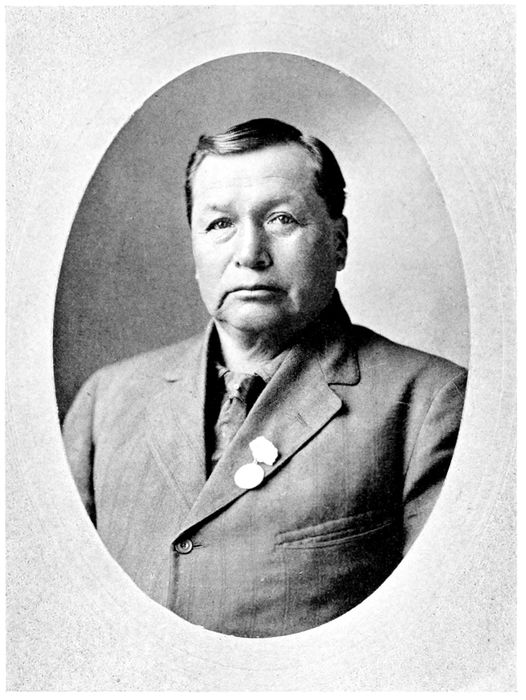
EDWARD CORNPLANTER—SOSONDOWA
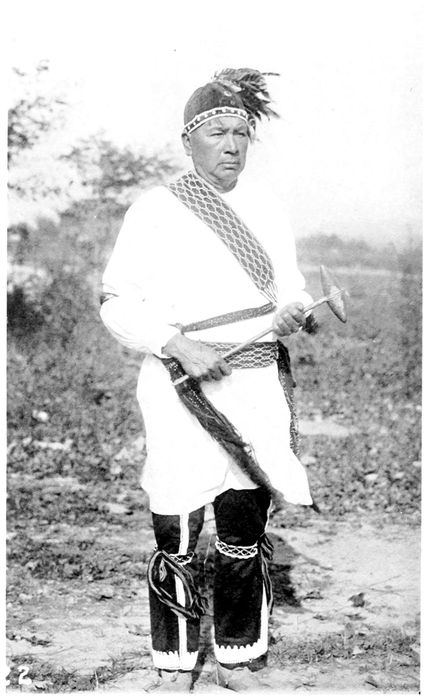
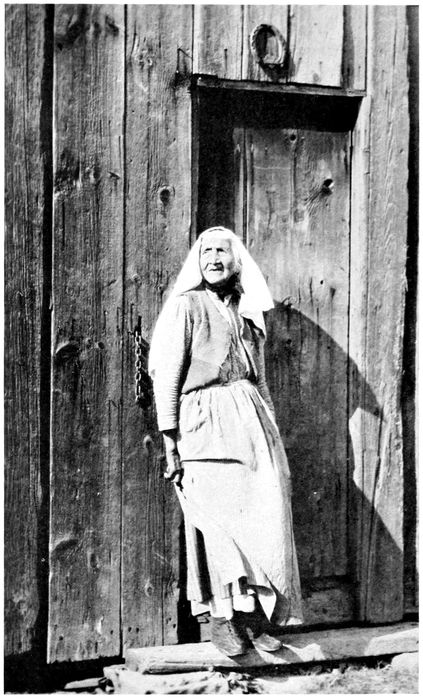
Leading chief of the Cattaraugus Wolf Clan and High Priest of the Ganiodaiu religion. Mr. Cornplanter was probably the last of the New York Iroquois who knew by heart every one of the ancient ceremonial rituals. He died in June, 1918, aged 67, and was buried near the Newtown Long House.
5Dreams. Dreams are experiences of the soul as it leaves
the body during sleep. The dream god guides the soul to
its dream experience. Dreams that prompt the individual
to certain desires must be interpreted by a chosen person
or by volunteer guessers, and the desire must be satisfied,
or calamity will befall the dreamer as well as the unsuccessful
guesser. Prophetic dreams must guide action and
dream demands must not be lightly set aside.
Monsters. There are monsters that men seldom see.
These affect the welfare and the destiny of man. They are
generally evil and seek to destroy and sometimes to eat
human beings.
Wizards. There are such beings as wizards, witches and
sorcerers. These beings possess an evil orenda and seek
to destroy innocent people.
The first of the God Being was Te‘haon‘hwĕñdjaiwă’´khon’
or Earth Holder. It was he who ruled the sky world
and lived in the great celestial lodge beneath the celestial
tree. As the result of a dream this chief, who also bears
the title, Ancient One, was moved to take to himself as a
wife a certain maiden, known as Awĕnhā´i‘, Mature Flower
(Fertile Earth). Mature Flower consented to the betrothal,
but due to the embrace of her lover inhaled his breath, and
was given a child. The attention she gave this child caused
the Ancient One to be moved to jealousy, this emotion being
aroused in him through the machinations of the Fire
Beast, whose invisibility rendered his work the more subtle.
Little is known through mythology of Ancient One, since
his field is a celestial one, and he seldom interferes with
the doings of men of our present order. Of his unhappy
6wife, who was cast through the hole made by the uprooting
of the celestial tree we learn more.[2]
The wife of the Ancient One was Iagen’´tci‘, also meaning
Ancient One (Body). We recognize her in the Huron
myths as recorded or mentioned in the Jesuit Relations as
Ataentsic (Ataaentsik). In Onondaga this would be
Eiă’tăgĕn‘´tci‘. Her story is given in all versions of the
creation myth.
Her personal name seldom appears, but Hewitt gives it
as Awĕn‘hā´i‘, this referring to her maturity, or ability to
bring forth seed. In some versions the Chief casts his wife
into the abyss made by uprooting the celestial tree,
Gainiă’´tgä’´hei‘; in others her own curiosity is responsible.
The tree in such versions is uprooted as a dream demand
and her enraged husband pushes her into the hole made
thereby through the crust of the heaven world. After
the completion of the earth-world the sky mother returned
by way of an etherial path that plainly was visible to her,
this having been made by her daughter, the first born and
the first to die of earth creatures.
Fire Beast (Gaăs‘ioñdie´t‘hă’), appears to have been one
of the important primal beings, and to have exercised a
malign influence even upon the inhabitants of the celestial
world. He is described as of “sky color” or invisible, and
he is only detected at all when he emits streams and flashes
of light from his head. When a meteor flashes the Iroquois
recognizes the Fire Beast. His appearance is counted as a
sign of direful calamity and death.
7
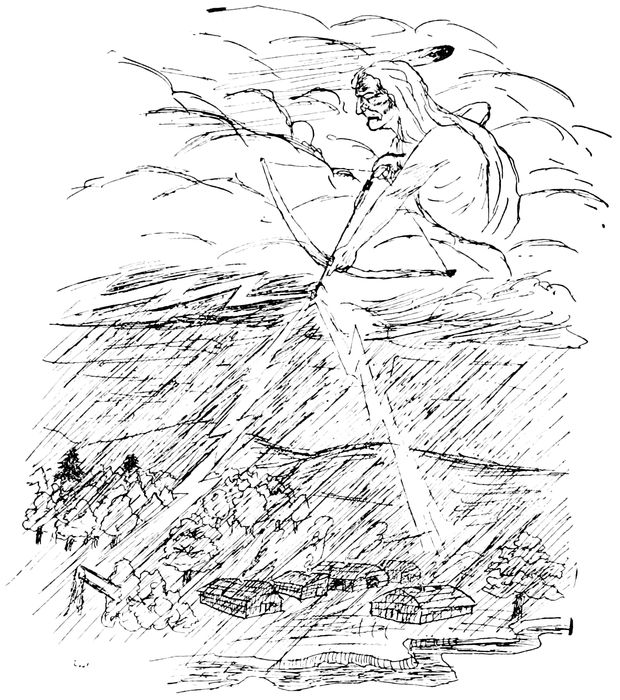
THE THUNDER SPIRIT
This is the powerful Hihnon, one of the principal spirits in the Seneca pantheon. Drawing by Jesse Cornplanter.
Whirlwind (S‘hagodiiwen‘´gōwā or Hadu’´i’), was also a
primal power of great importance. He is the controller of
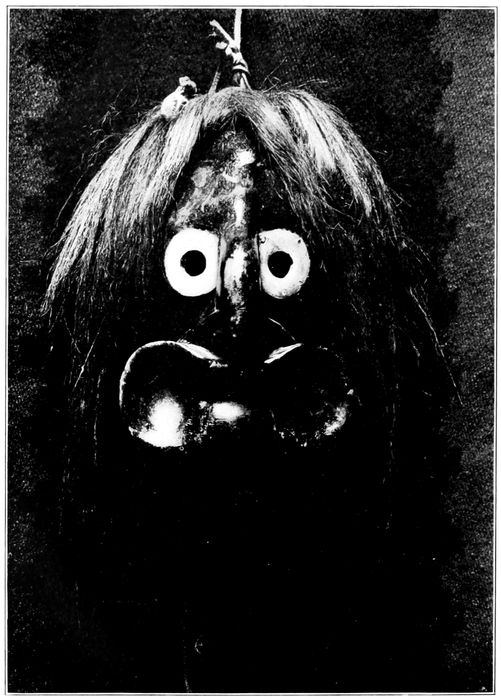
the violent winds, and he takes his name, He-who-defends-us,
from his promise to help mankind when threatened by
calamity. His symbol is the crooked-mouthed false face.
There is also the concept of the four defenders, one for
each of the cardinal directions. It was Whirlwind who
boasted his power to the Good Mind (Iouskeha) and who
had the contest with him of mountain moving. The face
became mutilated by the mountain coming too quickly
against it, at the command of the Good Mind. Agreeing
8that he was now a subordinate he agreed furthermore, to
drive away disease and pestilence and to defend men-beings,
who should be thereafter created, from malign influences.
His face carved in wood, after certain propitiatory and
invocatory ceremonies, was and still is used by the conservative
Iroquois in their ceremonial events, particularly at the
mid-winter thanksgiving, when parties of masked figures
go from house to house, singing the magical songs deemed
potent for this purpose. The common name is Hadu’´i’, but
in all ceremonies the full Seneca appellation is given,
(Shagodiiwĕn´‘gōwā).
The Thunderer, Hĭ’´non’, was another of the great beings,
but he appears in the second order of mythology, as a servant
to Iouskeha. He occupies a high place in the category
of Iroquois gods, so high a place that it is an open question
whether or not the Great Being whom the Iroquois now
address as Hawĕñi´o’ is not identical with the Thunderer,
though there is also a recognition of the Thunderer as a
separate being. The name Hawĕñi´o’, apparently is derived
from owĕñ´nă’, (voice) and i´o’ (good, great, majestic or
beautiful). The initial Ha is the masculine sign. The
name thus means, He-great-voice. This alludes to the
thunder. The Thunderer is a mighty being, the maker of
rains. He wrinkles his brow and the thunder rolls, he
winks his eyes and lightnings flash like arrows of fire. The
Thunderer hates all evil spirits, and he is charged with terrorizing
the otgont or malicious dwellers of the under-world
to return to their cave. He seeks to slay the under water
serpent and all folk-beasts that would use evil magic.
The benificient earth-god was T‘hahon’hiawă’´kon, the
light or elder twin of the Sky Woman’s daughter. He is
variously called Iouskeha (Huron), Hă’ni‘go‘´io’, Good
Mind, Elder Brother, and Sky Holder. It was he who
watched at the grave of his mother, and discovered the food
plants. It was he who set forth on the journey “to the
9East” and obtained from his father the power to rule. He
made the earth habitable for man, obtained the mastery over
the Thunderer and the Whirlwind, and even made his
grandmother, Eiă’tăgĕn‘´tci‘ (Awĕn‘hā´i‘) play the game of
plum stones, the result of which should determine who
should rule the earth. He animated his plum stone dice
and gave them understanding, ordered them to arrange
themselves as he directed, and thereby won the highest
count in a single throw. This gave him mastery over his
evil brother Tawis´karon (the icy or flinty one), for the
grandmother sympathised with this ugly twin brother of
his. In the heaven world, T‘hahon’hiawă’´kon, now lives
with his grandmother, in the reunited family of celestial
beings, and though he grows very old he has the power of
renewing himself at will, and exercises this power over good
souls that come into the heaven world. He created man
after observing his own reflection in a pool of water, after
which he made miniature figures in clay and commanded
them to live.
Tawis´karon, was the second born of the daughter of the
Sky Woman. He was of destructive nature, and found his
way to life through the axilla of his mother, killing her
at birth. His heart was made of ice or of flint (the words
are similar). His delight is in destroying living things,
especially by freezing. He created all the evil beasts, serpents,
insects and birds. He invented thorns, briars, and
by kicking at the earth made cliffs and precipices. During
his career he stole all the good animals and hid them in a
cave; he drove all the birds away. His great feat was in
stealing the sun and hiding it in the far southwest. Aided
by the fires which his brother, T‘hahon’hiwă’´kon, and his
cohorts secured, the birds and animals were found and the
sun was released. This of course typifies the annual triumph
of summer over winter, the return of the migrating
birds, and the return of the heat of the sun. Tawis´karon10is then confined to his cavern, hence his name Hanis‘he´onon,
meaning He who dwells in the earth. With the coming of
the Christian missionaries, Tawiskaro was identified with
the Christian devil, (Hă’nigoiĕt´gä‘, bad mind).[3] Strangely,
about this time it was the Thunder god, instead of the
good-minded Sky Holder, who was metamorphosed into the
Great Spirit, Hawĕñi´o’, this name being the Seneca equivalent
for Jehovah (God).[4]
Lesser known gods were Ai‘kon’ the Dream god,
Haskotă´hiāhāks, the Head Opener, and Deiodă‘sondăi’kon‘,
Thick Night. Aikon, caused the dreams which demanded
interpretation, and Haskotahiahaks, opened the heads of
soul-bodies as they passed over the sky-trail (Milky Way),
and examined them for good and evil thoughts, after which
he ate the brains.
Cosmic trees. There is a marvelous tree in the center
of the heaven world. It bears all manner of fruits and
flowers. (See cosmological myth, p. 59.)
There is a great tree in the center of the earth. Its top
touches the sky. It grew in the world of the first order
and it bore flowers of light. To touch this tree is to acquire
great magical power. The Whirlwinds rub their rattles
against it and become full of orenda.
The Sun, among the nature gods, is recognized by the
Seneca as a powerful being. Yet, unlike the gods in other
theogenies, the Sun is a creation made after the formation
of the world,—at least so it would appear from the common
cosmogeny. Sun was created from the face of the earth-mother,
yet it may be that her face was the sacrifice that
brought the Sun into evidence. There is evidence of
attempts to conceal the origin of the sun in several of the
myths. He appears as the messenger of the Sky Chief and
as the special god of war, Ho‘sgĕn’age‘´dăgōwā. He also
appears as existing before the birth of the primal twins,
and it appears that he is the being who sat on the mountain
“to the east across the sea,” and who gave power to
the Good Mind, or T’hahonhiawă’´kon. It thus appears
there is an imperfect assimilation of conflicting myths,
probably from different sources.
11
THE SPIRIT OF DIONHEKON
In this drawing the spirit of the food plants is shown touching the shoulder of Handsome Lake, the Seneca Prophet. Drawing by Jesse Cornplanter.
12Each day the Sun starts from his resting place in the
branches of the celestial tree, takes his path under the lifted
east sky, rolls up the dome and commences his unerring
watch of the movements of men. Wherever there is light,
there is the messenger of the Sky Chief watching human
behaviour. Returning at night, he recites all that he has
observed on earth.
He bears the name Endĕ´ka Gää‘´kwă, Diurnal Orb of
Light.
The Moon is Soi‘´ka Gää‘´kwă, Nocturnal Orb of Light,
and she is hailed as “Our Grandmother.” In each of her
several phases she has a different name and function. She
is watched by the females as a sign of health, and by the
men as a sign of hunting luck. By the Moon time is regulated,
and each monthly moon has a special name. Of all
heavenly bodies she is the most mysterious, though not
the most powerful.
Morning Star, Gĕndeñ´wit‘hă, is one of the great beings
of the sky and her appearance is watched as an omen. It
appears that once Morning Star was an important celestial
personage, but the Iroquois have drifted away from giving
her special honors. She appears in several rolls, sometimes
as a siren who lures hunters into a luckless marriage, mysteriously
leaving them to wander the world over in search
of her. She appears to have charmed an elk into loving
13her, and also as a rescuer of starving villages in time of
famine. She is called Gadjĭ‘son´dă’ gĕndeñ´wit‘hă’.
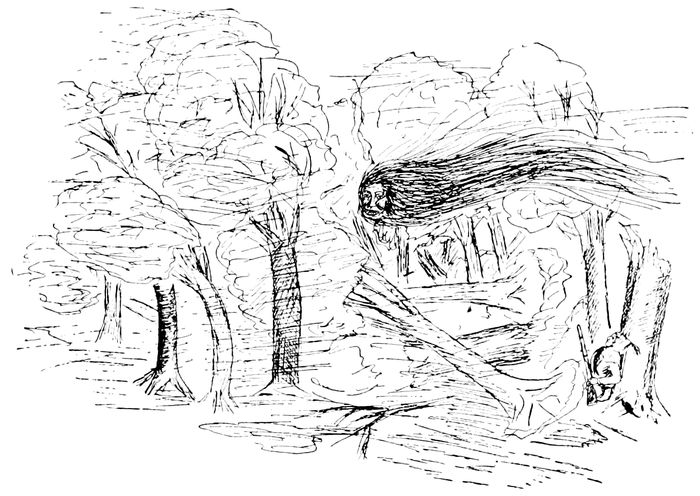
THE FLYING HEAD OF THE WIND
This is the whirlwind or Dagwanoeient. Drawing by Jesse Cornplanter.
Storm Wind, Dagwanoeient, (Dagwano‘ĕñ´iĕn) is a
being of great activity, and he has a whole tribe of subordinates
bearing his name. He appears to men as a Flying
Head, with long streaming hair, and his exploits are generally
discreditable. He is a great wizard and takes delight
in destroying things. His friends are generally sorcerers
and otgont (evilly potent) beasts. Many legends are related
about Dagwanoeient in his various forms, for he has several
transformations.
Gä´ha‘, the zephyr, is a softer wind than the stormy
Dagwanoeient, and appears to be of a kindlier disposition.
While Gä´ha‘ may have done magical things, it was not
malign, and there are legends that tell how Gaha wooed
some fair forest maid and married her. Gaha helps plant
14grow and is associated with the warm season when fruits
ripen and mature.
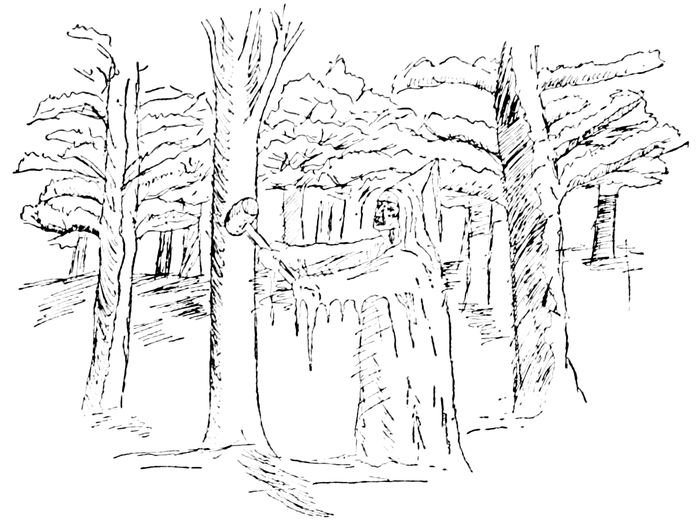
THE SPIRIT OF THE FROST
This is Haht´ho, the spirit of the frost who signals by knocking on the trees in winter. Drawing by Jesse Cornplanter.
The Frost god is known as Hă’´tho‘, and he is described
as a fierce and relentless old man who lives where frosts and
ice abound the year around. His home in the north is
called Othowege. It is he who brings the frost and who
causes the snows to sweep over the earth. His clothing is
ice and he carries a maul with which he pounds the ice
on rivers and lakes, making them crack with a resounding
boom. He also causes that peculiar knocking sound on
trees when the weather is very cold. He has one great
enemy, it is the spirit of Spring, who assisted by Thaw
drives him from the region that he has invaded and sends
him grumbling back to the northland. The Frost god has
15as his friends Dagwanoeient, the Storm Wind, and Falling
Hail.
The Hail spirit is called Owisondyon. He loves to startle
people by coming unexpectedly in the warm months of
early summer and to pelt the growing crops with his icy
missiles. Sometimes he is given the name, Dehodyadgaowen,
meaning Divided Body.
The Spring god is Dedio‘s‘hwineq´don, and he is young
and very muscular. He loves to wrestle with the winter
winds and even enters Ha’´tho’s lodge and teases him to
desperation while his faithful ally, Thaw, plays havoc with
the ice and the drifts outside. Spring tortures the Winter
god with a medicine made of blackberry juice, for Winter
god knows that when blackberries grow winter is beyond
the power of injuring the world. At last Spring and Winter
have a wrestling match in which Winter is overcome and
his bodily form melts upon the ground, while his spirit
whines away, driven north by the south winds. Spring
lives in Onē´nan’ge‘, Sunshine land.
The Thaw god is Dăgā’ĕn‘´dă, the faithful ally of Spring.
When he comes, in mid-winter he appears suddenly and begins
to wreck the icy blankets that winter has placed over
the earth. Winter then knows that Spring is coming and
exerts all his magic to freeze the world again and to make
his reign even more terrible. Time passes and Thaw comes
again bringing his master, Spring, and then there is a fight
to the finish, and Spring is supreme, while Thaw pursues
ever to torment Hă’´tho‘, on his frontiers.
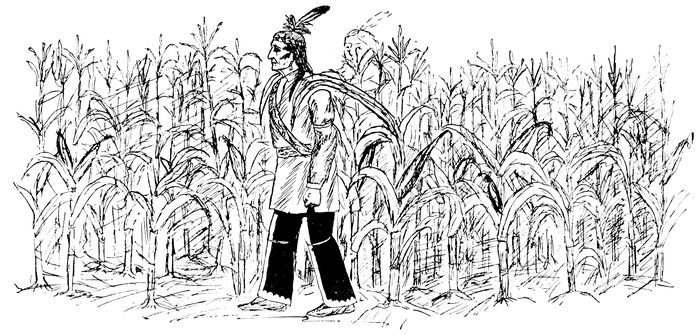
The spirits of sustenance are known as Dion’he´kon, and
they are represented as the inseparable spirits of the corn,
the bean and the squash. They are sometimes referred to
as “the three sisters.” The ceremonial dance in their honor
is called Goñdă‘goñwi´sas. There are many legends of
these spirits of sustenance and the wise men and women
16of ancient times tell of hearing them talk together in the
fields where they grow together.
Tide spirit is known as S‘hagowe´not‘ha, and it is he
who controls the rising and falling of the great waters,
twice in each day. It is said that he controls the lifting of
the sky’s rim in the land of Gaenhyakdondye (the horizon),
which allows the sun to emerge in the morning and depart
at night. Sometimes he tempts canoemen far out to sea
and then crushes them under the edge of the sky’s rim. He
sometimes lures disobedient boys to lonely islands where
witches and wizards live on human flesh. Altogether, aside
from certain functions, he is an evil monster.
Will-o’-the-wisp, or Gahai’´, is known as the witch’s
torch. It is not a spirit of the first order, but merely a
flying light which directs sorcerers and witches to their
victims. Sometimes it guides them to the spots where they
may find their charms. Sorcerers have been detected by
the frequent appearance of their Gahai’´, which leaves their
smoke hole and guides them as they ride in mid air on their
evil journeys.
Chief among all the creatures that inhabit the air is the
wonderful O‘s‘hă´dă’geă’, the Cloudland Eagle. He seems
ever to watch over mankind, especially the Iroquois, and
to come to earth when great calamities threaten. Living
above the clouds he collects the dews in his feathers, and
some say that he has a pool of dew on his back between
his shoulders. The Iroquois regard him with great reverence,
for he is connected with many a worthy exploit.
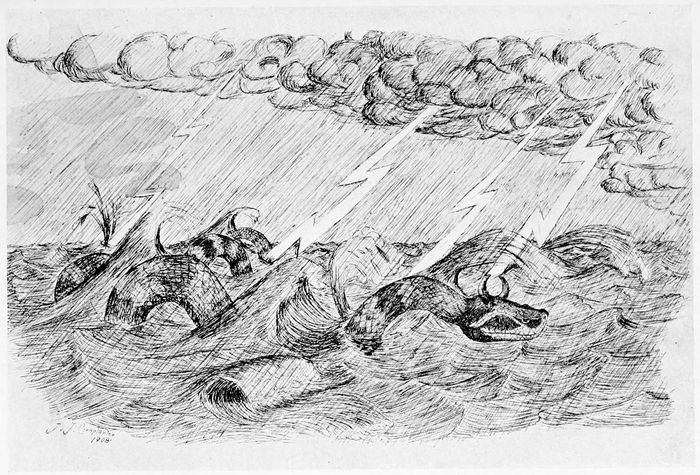
Horned Snake, Gas‘hais´dowănen, has several names
among which are Doonă’´gaes and Djondi’´gwadon. He is
a monster serpent of the underwaters and his head is
adorned with antlers of great spread, though he is also said
17to have monster horns shaped like a buffalo’s. He is capable
of transforming himself to the appearance of a man,
and as such delights in luring maidens to his abode. In a
few instances he appears as the gallant rescuer of women
marooned on bewitched islands. Like other monsters he
has a brood of his kind, he having females as well. These
sometimes lure men under water and seek to transform
them by inducing them to put on the garments they wear.
Horned Snake is hated by the Thunderer, who spares no
energy to kill him before he can dive.
Monster Bear, Niă’´gwai’he´gōwā, is the most feared of
magic beasts and one of the most frequent among them to
enter in to the fortunes of men. He loves to race and in
various forms which he assumes, seeks to get men, and
particularly boys, to bet their lives on the race, which generally
lasts from sunrise to sunset. He has a vulnerable
spot on the bottom of one of his feet and unless some hero
hits this the monster does not die. His bones form important
parts of “magic medicine” and the dust from one of his
leg bones if taken as a medicine is reputed to make a
runner invincible.
White Beaver, Nanganniă’´gon, is an otgont beast who
lives in magic waters. He seldom appears, but when he
does he means disaster. Usually he is represented as the
transformed son of a great witch. He is sometimes called
Diat´dagwŭt.
Blue Otter, is another magic beast whose home is in the
water. His function is to poison springs. He has another
function, that of inflicting disease by his magic, and in this
way he secures offerings of tobacco.
Blue Lizard, Djai´nosgōwa, seems to be a beast looking
something like an alligator. He lives in pools and is the
servant of wizards and witches.
18
The Stone Giants, or Stone Coats, Gĕnnon´’sgwā’, are
commonly described in Seneca folk-tales. They are beings
like unto men, but of gigantic size and covered with coats
of flint. They are not gods and are vulnerable to the
assaults of celestial powers, though the arrows of men harm
them not at all. The early Iroquois are reputed to have
had many wars with them, and the last one is said to have
been killed in a cave.
Pygmies, Djogĕ´on, are little people who live in caves.
They are a tribe by themselves and live in houses as men
do. They frequent deep gulches and the borders of streams.
In some ways they are tricky, but in general do not injure
men. They are not successful hunters and are grateful
for the fingernail parings of human beings. These are
saved by the thoughtful and tied in little bundles which are
thrown over cliffs for the Djogeon to gather as “hunting
medicine.” They also require tobacco and when they
require it they will tap their water drums in their meeting
places. The observant then make up little packages of
tobacco which they throw to them. Out of gratitude for
favors they frequently warn men of danger or assist them
to fortune.
Mischief Maker, S’hodi´onsko, is a trickster, and sometimes
is called the “brother of death.” He delights in playing
practical jokes, regardless of how they result. He possesses
a store of magic and is able to transform himself
into many forms. It is related in one legend that in the
end he repented and returned to the sky world in a column
of smoke. This appears however, to be an allusion to the
Algonkin trickster.
Ghostly Legs, Ganos´has‘ho´on’, are beings composed
only of a pair of legs, having a face directly in front, though
the face is seldom seen. They appear only in the dark and
no one has ever made a complete examination of one. They
have no arms or bodies, but are like the lower bodies of men,
19cut off at the waist, and on either loin gleams a faintly glowing
eye. Some have only one eye which protrudes and draws
in as it observes an intended victim. The Ghostly Legs are
always, or nearly always running rapidly when seen. They
usually betoken death and disaster. No one knows from
whence they come or whither they go. Indians of today
on some of the reservations claim to have seen these creatures.
While they have never been known to injure anyone
they are at the same time as greatly feared as ghosts.
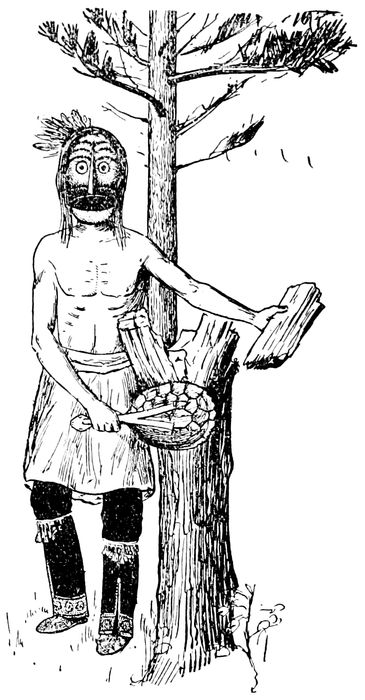
Sagon’´dada‘´kwŭs, (Sagodadahkwus) is a grotesque being
with a lean, hungry looking body, and an insatiable appetite.
He seeks out gluttons, and catching them in the dark, takes
a long spoon which he inserts into their vitals and spoons
out his food. For fear anything may be lost he carries a
kettle into which he places everything he cannot immediately
eat. He is the spirit of gluttony, and is the terror of
all who gorge themselves unduly. It is well for a man who
overeats to stay indoors at night, lest He-who-eats-inwards
devour everything within him. So, with his kettle and
spoon, Sagodadahkwus wanders over the earth looking for
the gluttons.
Gonoñk´goĕs, the Big Breast, is a gigantic woman whose
breasts hang down like pillows. She roams the earth looking
for lovers who sit close together in the dark. If they
make one remark that seems to be improper in their love
making, or if they stay at their love making too long, she
leans over them, catching their faces beneath her breasts
and smothering them. Then she stands upright, still holding
the smothered lovers to her bosom, and walking to a cliff,
leans over and drops them into the dark depths below.
O’´nia‘tän, the Dry Hand, is a mysterious mummified arm
that flies about to bewitch those who pry into the affairs of
others by asking too many questions. It will thrust its
fingers in the eyes of the peeper who tries to watch others
out of idle curiosity. Generally the touch of this hand
means death.
II. THEMES AND MATERIALS — STEREOTYPED OBJECTS AND INCIDENTS. — INCIDENTS. — OBJECTS. — COMPONENTS OF THE COSMOLOGICAL MYTH.
23
There are certain characteristic types of action to be
found in Seneca folk-tales, and these are closely followed
in all tales. However rambling a tale may be it never
departs from certain stereotyped themes, expressing as they
do the accepted idea patterns over which the story is woven.
Among these themes we mention the following:
1. Transformation. Characters in the story are able to
transform themselves into any person, animal or object, as
their orenda or magical power gives them power. The
Seneca believed in transformation to such an extent that
he was never sure that a rolling stone, a vagrant leaf fluttering
along, a scolding bird or a curious animal, might not
be some “powered” person in a transformation stage.
2. Magically acquired power. The hero of a tale finds
himself in a predicament and through his effort to extricate
himself is endowed with magical power by which he overcomes
enemies and difficulties.
3. Overcoming monsters. The journey of the hero is
beset with magical monsters that seek to destroy him. The
hero uses his wits and his orenda and subdues them.
4. Precocious twins. Twins are born of a romantic marriage,
particularly where the hero or heroine has lost a relative.
The twins rapidly grow to maturity and set forth to
conquer.
5. Contest with sorcerers. The hero is placed in opposition
to a sorcerer and matches his power against him, finally
killing the sorcerer.
6. Son-in-law put to tests. The hero is allowed to retain
his place, possessions or mate providing he procures certain
magical objects for the sorcerer. In some stories an evil
24mother-in-law demands such objects as the magical beaver,
white otter, or blue lizard. The hero obtains them very
quickly and sometimes calls a feast to eat them. The
mother-in-law is angry because these beasts are her
brothers.
This is a widely diffused theme and is found from one
coast to another.
7. Dream animal rescues hero. The hero finds himself
in a predicament and remembering that a helper appeared
to him in a dream, calls upon it for rescue. A rescue is
made.
8. Race with monster. A monster, generally a monster
bear, becomes enraged at or jealous of the hero. The
monster challenges the hero to a race, the winner to kill
the loser. The hero wins, generally by aid of some fetish
given by his uncle or grandfather.
9. Boaster makes good. The hero boasts his power to
do certain things, as to run faster than any living creature.
He is warned to stop before the spirits of swift-running
beings hear him. He continues to boast and a monster
comes to the door to make the challenge. See 8, supra, for
a continuation of this theme.
10. Imposter fails. A jealous rival overcomes the hero
and strips him of his clothing. Hero becomes weak and old
while Imposter becomes youthful. Imposter now assumes
the character and rights of the hero. Finally he endeavors
to perform the magical tricks of the hero and fails miserably.[5]
11. Thrown away boy. A child is thrown away because
it seems too small to live, or it is lost in a blood clot and
cast into a hollow stump. Thrown-away lives and becomes
a powerful being that achieves wonders.
12. Hidden lodge child. A child born with a caul is
25concealed in a lodge, generally under an enclosed bed. It
is cared for by some elderly person, generally an uncle or
aunt. A normal brother endeavors to rescue it, being told
of its existence by some magical being; or, the child is
hidden to protect it from an evil sorcerer who wants to
steal it. Hero overcomes sorcerer.
13. Double deceives sister. A youth lives in a secluded
cabin with his sister. The youth’s double comes to the
lodge when the hero is absent, endeavoring to seduce the
sister. Double is repulsed. Sister will not believe brother
has not insulted her. Brother finally makes a sudden return
from a hunting trip and apprehends the double, killing him.[6]
14. Uncle and Nephew. An uncle and nephew live
together in a secluded lodge. Uncle generally becomes
jealous of youth’s ability and desires the woman predestined
for the nephew. In other cases uncle assists nephew to
find lost parents. Generally the uncle guards the nephew
and forbids him to go in a certain direction. Nephew disobeys
orders.
15. Evil stepfather. Step-father endeavors to rid himself
of an unpromising stepson. Hides the boy in a cave
or hole which he stones up. Boy is rescued and taught by
animals, and finally returns a powerful being and confronts
stepfather.
16. Witch mother-in-law. A youth marries the daughter
of a witch who endeavors to cause his death through
conflict with monsters.[7]
17. Animal foster-parents. Animals find an abandoned
boy. They discuss which one will care for him. A mother
bear generally succeeds in securing him and takes him to
a hollow tree where he is protected and educated in animal
lore.
2618. Bewitched parents. A boy finds that he has no parents.
Asks his uncle or grandfather where they are. Is
told that they are under some evil enchantment and secured
in a place beset with magical monsters. Boy overcomes
obstacles and rescues parents.
19. Obstacles produced magically. The hero is beset by
a witch or monster and flees. Upon being pressed the hero
creates obstacles by dropping a stone and causing it to
become an unsurmountable cliff. He casts pigeon feathers
and conjures them into a great flock that makes a slime that
is impassable, or he finds “uncles” who interpose barriers
for him, as webs, nets, holes, pits, etc. Hero finally escapes
to lodge of a waiting mother-in-law.
20. Lover wins mate. Young man marries girl of his
choice in spite of tricks of older rival and enmity of sorcerers.
This must have been a popular theme in a society
where the old were married to the young.
21. Jealous sister-in-law. Sister-in-law offended at
hero’s choice seeks to harm bride or to kill hero.
22. Magical monster marries girl. The monster may be
the horned snake or the Thunderer.
23. Thunderer wars upon horned snake. The Thunder
god hates the horned serpent and fights it.
24. Turtle’s war party. Turtle gathers a company of
offensive and loyal warriors. All are killed in action save
turtle who begs not to be placed in water when captured.
He is thrust in river and escapes.
25. Bungling Guest. An evilly inclined trickster plays
practical jokes. Performs magical acts and induces a guest
to imitate. Success attends in presence of Trickster and
perhaps once in a private rehearsal, but miserable failure
attends demonstration before others.
26. Sorcerer’s Island. Sorcerer lures hero to enchanted
island. Sorcerer has control of the tides and currents of
water.
2727. Restoring Skeletons. Hero finds bones of persons
slain by sorcery. Commands them to arise quickly, “before
I kick over a hickory tree,” and skeletons rise so quickly
that bones are mismated. Popular ending of stories.
28. Vampire Corpse. Body of dead sorcerer revives
and procures hearts of living victims which it eats at leisure
in its grave.
29. Dream Demand. Hero guesses the meaning of a
fabricated dream and satisfies it, thereby thwarting intentions
of the witch who pretended to dream.
30. Sky Journey. Brothers journey to rim of horizon
and seek to go under it and enter the sky world. All succeed
but one who is so cautious that he makes a late start.
Sky comes down and crushes him. His spirit speeds ahead
and greets living brothers when they arrive. Regeneration
by Master of Life.
1. Lonely bark lodge. Hero and associates live in
secluded hut.
2. Twins play in ground. Twins find an underground
world in which they live and play.
3. Hero spies upon associate through hole in his
blanket. Discovers the secret of associate’s power. Tries
this in associate’s absence.
4. Monster is shot in vulnerable spot in bottom of foot
and is killed.
5. Hero in contest kills magical animal. He alone is
able to pull out the arrow, thereby establishing his claim
to power or reward.
286. Hero’s double buried in fireplace speaks through fire
and reveals his murder to his mother.
7. Burning witch’s head explodes sending forth cloud
of owls.
8. Sorcerer controls flow of waters. Almost captures
hero fleeing in a canoe by drawing the current of the water
toward himself. Hero reverses current and escapes.
9. Magical objects are concealed under a bed. Hero
dreams he wants them in retaliation for his “uncle’s” evil
desires.
10. Pursuing or sentinel monsters are pacified by gifts
of meat.
11. Youth not yet able to hunt practices shooting at
an animal’s paw, hung on lodge rafter.
12. Sorcerers’ hearts or livers are concealed in a safe
place in their lodges, guarded by conjured dogs or ducks.
Hero finds hearts and destroys sorcerers.
13. Hero obtains hearts of enemies and squeezes them,
causing enemies to faint. He dashes them on rocks and
kills enemies.
14. Hero conjures lodge of witches into flint. Orders
it to become red hot and so destroys enemies.
15. Hero learns how to jump through the air.
16. Hero reduces sister to miniature and places her in
a conical arrow tip, shooting her away to safety. Hero
follows by magic flight creating obstacles as he goes.
17. Corn rains down into empty bins of starving people.
Corn maiden comes to marry hero whose younger brother
is ungrateful for food, casting it in fire thereby burning
Corn Maiden’s body. She departs.
18. Powered man throws flint chips calling upon them
to kill animals.
19. Hero violates taboo. Calamity impends but hero
overcomes.
2920. Heroine kills pursuing monster by throwing boiling
oil into its face.
21. Hero kicks over tree and causes skeletons to rise
in flesh. Bones are mismated through haste. Origin of
cripples.
22. Hero or twin heroes walk into the ground and disappear.
23. Lonely bird sings for a mate. Various creatures
seek to comfort lonely bird but all are rejected until a natural
mate calls and is found injured or trapped. Released
by lonely bird who flies away with him.
24. Animals talk to men. Some animal warns hero of
impending danger and plans escape.
1. Dream helpers. These are animals or persons that
have come to the hero in a dream and promised to assist
him in times of peril.
2. Astral body. The hero has an astral self that appears
in times of great danger and points out a way of escape.
3. Hollow log regeneration. Hero who has been abused
or conjured is regenerated by passing through a hollow log.
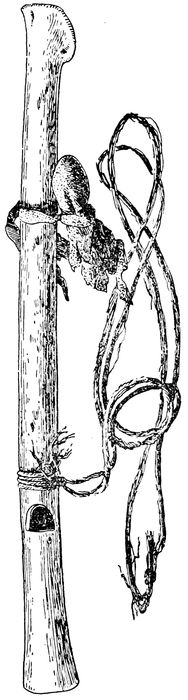
4. Talking flute. The flute kept in a “bundle” talks to
hero’s friend and informs him of condition, or it tells hero
where he may find game.
5. Running moccasins. Hero pursued takes off moccasins
and orders them to run ahead and make tracks that
baffle pursuer.
6. Magic Arrow. An invincible arrow that kills whatever
it is aimed at. It may be shot promiscuously into the
air and game will return with it, falling dead at hero’s feet.
No one but hero can withdraw arrow.
7. Forbidden chamber. A certain walled-off part of the
30lodge is forbidden to the hero, who in older relative’s absence
explores it, causing anger of magical beings.
8. Door-flap action. Sorcerer commands hero to perform
dream demand by going out of door and consummating
demand before the door curtain flaps back.
9. Magic fish line. Sorcerer hooks hero’s fleeing canoe
with a magical fish line. Hero burns off line by emptying
pipe upon it.
10. Hero ties his hair to earth. When hero suspects he
is in the hands of a sorceress he ties a hair to a root before
he sleeps. Sorceress makes off with him but cannot go
beyond the stretching length of the hair and is compelled
to return.
11. Lice hunting. Sorceress hunts lice in hero’s head,
lulling him to sleep.
12. Saliva gives power. If a powered being touches any
object or weapon with his saliva it takes some of his power.
13. Wampum tears. Captured hero or heroine when
tortured sheds wampum tears which enemies greedily take.
14. Magical animal skins. Hero or sorcerer has enchanted
skins which he can conjure to living animals. He
may enter a skin and assume the characteristics of its original
owner.
15. Magic pouch. The pouch of animal skin holds the
hero’s utensils, tobacco and pipe. It may be conjured to a
living thing.
16. Magic suit. A self-cleaning suit that gives power to
wearer.
17. Magic canoe. A canoe that has unusual speed and
may be paddled into the air.
18. Inexhaustible kettle. Hero’s friend puts scrapings
of corn or nut into it and it expands enormously supplying
enough food. Hero tries the experiment and expands kettle
too greatly bursting the lodge.
3119. Magical springs. Springs that have been enchanted
by sorcerers are the dwelling places of monsters that lure
the unwary to drink. The monster then drags in his victim
and eats him.
20. Enchanted clearings. Clearings guarded by monsters
who prevent hero from visiting sorcerer living in a
lodge within.
21. Bark dagger. Hero incapacitated by thrust of bark
dagger piercing his back. Villain steals hero’s clothing and
impersonates him. See Imposter.
22. Sweat lodge regeneration. Hero recovers through a
sweat of bear’s grease. Lodge covered with a fat bear pelt.
23. Powered finger. Hero has power to kill animals by
pointing his finger at them.
24. Animated finger. Hero obtains a magic finger that
stands in his palm, pointing out the location of anything he
desires.
25. Sharpened legs. A character is able to whittle his
legs to points and use them as spears.
25. Borrowed skin. Hero borrows skin (coat) of deer,
mole, or other animal, and entering it moves about without
exciting suspicion of enemy.
26. Borrowed eyes. Hero borrows eyes of deer or owl
for a blind uncle enabling him to recover his own eyes or
to see for a few moments a long lost relative, generally a
brother.
27. Stolen eyes. Sorceresses rob young men of their
eyes.
28. Quilt of eyes. Quilt made of winking eyes stolen
from young men who have looked at the witches who continually
sew upon such a quilt.
29. Girls in box. Enchanted girls hidden in a bark box
come forth upon demand of conjurer. The enchantment is
not of an evil nature.
3230. Enchanted feathers. These placed upon hero’s hat
give him great power, particularly for running.
31. Enchanted birds. Hero has enchanted birds upon
his hat that bring coals to light his pipe.
32. Bark dolls. Dolls are enchanted so that they speak
for their maker, deceiving evil pursuer of hero.
33. Talking moccasins. Moccasins placed in lodge talk
to evil pursuer, setting him or her astray.
34. Reducible dog. A tiny dog that is kept in a pouch.
It may be enlarged to a size sufficient to carry the hero or
his fleeing sister. Upon being patted with the hand or magic
rod it becomes reduced to a size almost invisible.
35. Talking skull. Hero finds the skull of his uncle. It
asks him for tobacco and then directs him how to overcome
sorcery.
36. Flayed skin. A human skin is the slave of sorcerers
and guards their lodge, clearing or path, screaming out the
presence of intruders. It may be revived by hero who
removes the enchantment.
37. Wampum eagle. An eagle covered with wampum.
Many people shoot at this eagle trying to kill it. Only the
hero can with his magic arrow.
38. White beaver. A magical beaver, generally the
“brother” of a witch, is killed by hero who invites in friends
to help eat the beast.
39. Blue lizard. Lives in a magic spring and lures the
unwary to death by pulling them into the water.
40. Flying heads. These are spirits of the storm winds.
They are generally evil characters in stories.
41. Pygmies. There are tribes of “little people” living
under ground or in rocky places. They have valuable
charms and can be forced to give them to men. They have
a ceremony in which they delight. If men beings perform
33this ceremony favor is gained. They like tobacco and nail
parings.
42. Buffalo one rib. A magically endowed buffalo kills
men. It cannot be injured by arrows because it has only
one rib, a bony plate protecting its entire body. Vulnerable
in the bottom of one foot.
43. Fast-growing snake. A boy finds a pretty snake and
feeds it. It grows enormously and soon eats a deer. Game
is exhausted and snake goes after human beings.
44. White pebble. A white stone is given magical power
and when thrown at a magical monster hits and kills it.
45. Flesh-eating water. The water of a magical lake
eats the flesh from the bones of the unwary. Monsters living
in it are immune.
46. Sudden friend. Hero in predicament sees a strange
person before him who announces that he is a friend and
will help the hero escape. Tells hero what to do.
1. Sky world. A world above the clouds inhabited by
transcendent beings.
2. Celestial tree. A wonderful tree in the center of the
sky world.
3. Sky woman. Falls through hole made by uprooted
sky tree and brings a promised child with her.
4. Primal turtle. Rises from sea to receive sky woman.
5. Earth diver. Animals dive to secure earth for turtle’s
back.
6. World-tree. Springs up from root of sky tree
brought down by sky woman. Grows in the “middle of the
world.” Flowers of light.
347. Female first born. A daughter soon born to the sky
woman. Grows to quick maturity.
8. Immaculate conception. Daughter conceives in mysterious
manner.
9. Rival twins. Twins born to daughter. Warty, flint
hearted one, kills mother at birth. Fair one, the elder,
watches her grave and finds corn, beans, squashes, potatoes
and tobacco springing from it. Elder twin is constructive,
younger is destructive.
10. Hoarded water. Evil twin causes a great frog to
drink all the water of the earth. Good twin hits it with
a stone causing it to disgorge.
11. Father search. Good Minded twin searches for
father and finds him on a great mountain to east.
12. Son testing. Good Minded’s father tests him with
wind, water, fire and rock. Good Minded proves sonship
and returns to earth island with bags of animals.
13. Man making. Good Minded molds man from clay
after reflections seen in water.
14. Primal beings return. Good Minded and grandmother
return to sky.
15. Evil banished. Evil Minded placed in underground
cavern.
III. THE ATMOSPHERE IN WHICH THE LEGENDS WERE TOLD
37
Let us journey backward into the forgotten yesterday;
let us catch a fleeting glimpse of a little village along the
creek of Doshowey.
It is during the closing year of the Eighteenth Century.
The time is in the moon Nĭsha (January), and the whole
earth is covered by a thick blanket of heavy snow.
There is a deeply worn trail along the bank of the creek,
but nobody walks in the trail, for it is as deeply rutted as
it is deeply trodden. It is not now a road but a trench
floored with rough ice and carpeted with broken patches of
snow. Along the sides of the trail, over the white way, are
supplementary and parallel trails that in places spread wide
with the tell-tale mark of snowshoes. Here and there are
deep dents where boys have wrestled and thrown each other
into the drifts.
About us are great trees. Back from the creek are areas
covered with tall pines and hemlocks; toward the creek are
great deciduous trees looking gnarled and weather-worn.
In the more open spaces are groves of nut trees, the hickory,
the butternut and the walnut. Even in the depth of winter
the region is inviting and suggests happiness and opportunity.
We continue our journey until we come within sight of
a little village of log huts and bark lodges. The huts are
rather small and primitive looking and the lodges for the
most part look battered and smoky. Here and there, however,
is a log cabin more sumptuous than the rest, and there
are even bark houses that look comfortable. There seem
to be no streets in this village, for the houses are set in
any spot, seemingly, where the builder chose to erect his
38dwelling. Stretching in every direction are little cornfields,
stripped of their ears and standing like ragged wrecks
in the wind.
Before we reach the village there is an open space occupying
a level area. Here and there are a score of boys and
as many men shouting and playing games. In an icy
trough, made by dragging a log through the snow for a
quarter of a mile or more, the older boys are playing a
game of snowsnake. We find that there are two rival
teams, each with twenty-four long flat pieces of polished
wood called “gawasa,” or snowsnakes. The idea of the
game seems to be to find out who can throw a gawasa the
greatest distance.
There is a great shout as one contestant rushes forward
holding his gawasa by the tip and throws it with all his
might into the trough. On it speeds like a living thing,
gliding ahead with a slight side to side movement like a
serpent springing forward. At the entrance of the trough
a band of opponents is crying out discouraging remarks,
while his own cheer squad is shouting its confidence and
praises. A hundred feet down the trough an opponent
waves his feathered cap over the gawasa as it speeds by,
calling it “a fat woodchuck that cannot run,” while just a
bit beyond, a friend also waves his cap and shouts a cabalistic
word of magic. Finally the gawasa slows down and stops.
Two trail markers rush to the spot and plunge colored sticks
into the snow to mark the distance it has traveled. There is
a referee from each team to insure absolute accuracy. In
another moment another gawasa comes darting ahead, its
leaden nose striking the tail of the first, nosing under it
and throwing it out of the track, then speeding onward a
score of paces ahead. The trail markers rush forward with
other sticks and there is a great shout from the winning
side.
39
THE SNOW SNAKE GAME.—From a drawing by Jesse Cornplanter.
40Each team keeps its gawasa in leathern cases. A special
“snowsnake doctor” draws out each as it is wanted and
carefully wipes it with a soft fawn-skin, then waxes or
oils the snake with some secret compound designed to make
it slip with less friction over the icy path. These formulae
are great secrets and a successful “doctor” is in great
demand, and receives big fees.
We glance over into the square where boys are playing
a game of javelins and hoops. The object, we soon discover,
is to pierce the hoop with the javelins, thus stopping
its progress as it rolls onward between the lines of contestants
to its goal. This is also a popular game with the
dogs, especially the puppies, who every now and again dash
after the hoop, much to the disgust of the team throwing it.
We hear the cry of “Sigwah, ahsteh, sigwah!” meaning get
out, go away, and then hear the yelp of the poor pup as it
is struck with a javelin, and whimpers away from this
maddened crowd of humans.
In another portion of the field we see a group of large
girls playing football with a small ball stuffed with deer
hair. There is a grand melee as the two “centers” come
together and kick at the ball, missing and striking each
other’s shins. There is a peal of laughter as each falls in
the snow from the impact, and rolls over upon the ball
which other eager players strive to extricate with their feet,
for their hands must not touch the ball. The game is a
rough-and-tumble one, but no one is injured, for the kicking
feet that fly about so nimbly are clad in soft-nosed
moccasins.
We pass on and leave this scene of winter fun for a more
sober group sitting on logs beneath the pines at the creek
bank. It is a group of older men waiting for the return
of a hunting party, and we learn that soon there is to be
a great feast,—in fact a nine-day celebration in which all
the people will participate. Out on the creek we also see
little clusters of men fishing through the ice, and, judging
by the shouts, fishing is good.
It may be well to pause here and carefully note the
41appearance of the men. It is not difficult to see that they
are Indians. Their coppery red skins and raven black hair
indicate this. Moreover, their dress and language permits
no mistake in our conclusion. One man, more aged than
the rest, is garbed in buckskin from head to foot. His
shirt is long and of a beautiful white tan. About the neck,
the chest, the shoulders, the sides and upon the cuffs there
is a rich adornment of porcupine quill embroidery in various
tasteful colors,—red, yellow and white being predominant.
The leggings are of the same soft velvet tan, and
embroidered at the bottoms in a deep cuff of quill work,
which extends up the front in a thin line. Just below each
knee is a garter embroidered with a finer appliqué than the
rather coarse quill work. Close inspection shows it to be
long hair from the “bell” of the moose. It is so flexible
that, unlike quill work, it allows the garter to be tied
snugly without stiffness. Beneath the shirt, though it hangs
down nearly to the knees, the edge of a loin-cloth is just
seen. Looking down at his feet you will observe a pair of
beautiful moccasins. They are of the puckered toe type,
with a single seam up the center of the foot, the leather
being drawn up in neat puckers to conform to the shape of
the foot. The flaps of the moccasins are also embroidered
with quill work, in a running pattern looking like half
circles and above which rise tendril designs,—looking like
the zodiacal sign of Aries. It is the old man’s cap, however,
which interests us most. It is not at all like the conventional
war-bonnet which we have seen in picture and pageant.
Instead it is like a closely fitting cap of fine fur, apparently
beaver. It has a wide band about it, holding it tightly
to the head. On the upper part of this band are close rows
of dangling silver cones that jingle against one another as
the old man moves his head. From the center of the hat
rises a spool-like socket into which is inserted a fine eagle
plume, that turns on a spindle within the socket. Around
the spool and fastened to it are clusters of smaller feathers
42that fluff over the top of the cap in gay abandon. Across
the old man’s breast is a worsted belt, red in color, and
decorated with beads in a most interesting fashion. About
the old man’s waist is a stouter belt of buckskin, into which
is thrust a tomahawk, and from which dangles a pipe bag.
Stooping over, he picks up a pair of overshoes made of
woven cornhusk stuffed with pads of oiled rags and buffalo
hair. Looking at the other men you observe that all have
on similar crude looking over-moccasins, but that most of
them are of thick oil-tanned buckskin leather, instead of
cornhusk.
The old man walks away toward the village and we linger
a moment to learn that his name is Jack Berry,[8] and that
he is considered an old-fashioned fellow, but that he commands
great respect. We find, in fact, that the village just
ahead is named after him, “Jack Berry’s Town,” and that
it is one of the eight villages of Indians scattered over the
Buffalo Creek tract.
It is now late in the afternoon and the sun is sinking
over the forest to the west. Men and boys, and now and
then a small group of women, walk swiftly toward the
village. Some of the men are bending low under heavy
loads of game, trussed up in burden-frames. Several men
have strings of fish and a few men and women have long
strings of white corn upon their shoulders.
Naturally we are hungry after our long journey through
the brisk winter afternoon. We are also ready to sit down
by the fire and dry our damp feet. Where shall we go,
who will know us?
Everybody seems to know us, for everybody speaks, saying,
“Nyahweh skanoh, Gyahdasey,” (“I am thankful to
see you strong of body, my friend.”) We stop and talk
43with one group after another and tell them that we are
strangers, rather tired and very hungry. Everybody smiles
and says, “Yes, that’s so,” but not a soul invites us to supper
and lodging. Our guide smiles at us and finally says, “You
may go to any cabin here, walk in and sit down.” You may
take off your shoes and put on any warm pair of moccasins
you find hanging on the wall, you may pretend that you are
dumb, and say nothing. No one will ask you a question,
but every want that you have will be anticipated and every
comfort of the lodge given to you, though it is the only bed
as your couch, the only buffalo robe your cover, and your
food the last bowl of soup. Among the Seneca you are
welcome. No matter who you are, you are an honored guest
and welcome to any home you chose to enter. It is for
you to invite yourself to a home and honor it with your
presence.
We look about with some concern, for most of the houses
are small and look overcrowded. Finally, since we are in
search of knowledge, as well as amusement and adventure,
we choose a very commodious bark long house, from whose
roof we see six fires sending up columns of black smoke.
This place looks as if it might afford us company enough
to satisfy our social inclinations and room enough to stow
us away for the night. If we hesitated a moment we were
soon convinced of our good judgment by the tempting
odors of steaming maize puddings and hull-corn hominy,
together with the appetizing smell of venison roasting over
hot stones.
We pause at the entry of the lodge and note the wooden
effigy of a bear’s head hanging in the gable of the building.
This is a symbol that clans-folk of the Bear dwell within
and that all “Bears” are welcome. However, as we know
that neither Turtles nor Hawks, nor any other clansman
or stranger will be denied admission, we push aside the
buffalo robe that curtains the doorway and enter.
Before us is a vast hall some twenty-four feet wide and
44eighty feet long. On either side are low platforms, scarcely
more than knee high from the earthen floor. Above are
other platforms, but these are six or seven feet above and
form a roof over the lower platforms. On the latter we
see people lounging, sitting or reclining, as suits their
inclination.
An elderly woman comes forward and greets us, and as
she does so, several men also come forward. Some, dressed
in trader’s cloth clothing grasp our hands in welcome, while
an old man, evidently a relic of an older day, places his
hands on our chests and says, “Strength be within you.”
This we learn is the old Indian way of greeting, in the days
before hand-shaking came into vogue.
Some one points out an unoccupied seat filled with robes
and we are invited to place our luggage on the platform
above. From a long pole, hanging from the beams that
form the roof supports, hang braids of corn, forming a
curtain that nearly makes our loft inaccessible. As we push
our pack basket well toward the center of the platform we
hear a squeal, and a seven-year-old boy who has been sleeping
there on a pile of pelts darts over the corn pole and
swings himself to the floor.
The whole building is replete with stores of food, and
besides the corn, we see large quantities of smoked meat,
dried fish, dried pumpkins and squashes and dried herbs of
various kinds. The center of the lodge is a broad aisle and
at every eight paces there is a fireplace on the floor, the
smoke from which rises to the roof and escapes through
large rectangular holes made by leaving off the bark roofing.
We join a group of men and learn from their conversation
that they are discussing the great war of the white
men, in which the Thirteen Fires overcame the British
King. Alas, these Indians had fought for the King and as
a punishment a mighty general had come against them with
a cannon, burning their villages on the Genesee and sending
them terror-stricken to their red-coated allies at Fort
45Niagara. Here they had endured a terrible winter of privation
during which time hundreds died of disease, starvation
and freezing. The British King had not done well by
them and his agents had deceived them. It was Town
Destroyer (Washington) who was their real friend, for it
was he who said they might remain in their ancient seats.
So here they were on Buffalo Creek, in the land of the
Wenroe and the Neutral, peoples whom they had conquered
a century and a half ago. Here was their refuge, but the
contrast between this and their former secure position on
the Genesee had disheartened them. The war and the flight
had disorganized them, their old ideals had been broken,
and the only safety seemed to be to avoid the white man.
He brought all this trouble and his traders brought the fire
water that made the young men crazy. He had brought a
new religion too, and many of the villagers of the Buffalo
tract had been converted to it and were trying to live in
accordance with its teachings. Some of the men thought
that this spoke the doom of the Indian race, while others
thought it would be better to offset this movement by
embracing the religion of Handsome Lake, a sachem from
Allegany who was now preaching temperance and morality
among the Indians at Allegany. Most of the men, however,
thought that it was best to avoid all new schemes and philosophies.
“The old way is the best,” we hear them say.
“In the old way we know just where we stand. We are
familiar with the methods of the old way: the new way
has not been tried.”
Then someone says, “Jack Berry is going to go over to
Handsome Lake. Maybe this is the right way. He is an
intelligent man and his father was a white man, though he
is more Indian than any of us in his manners and speech.”
Long the discussion goes on, and embraces one topic after
another. There is nothing to do but to talk and this soon
grows tiresome, for the same old topics are worn threadbare.
Brains that are hungry for new ideas and for facts
46find no food. The mental life of the people, we quickly discover,
is circumscribed. The people crave stimulation; of
physical stimulation they have plenty, but of mental stimulation
there is little indeed. This is one of the reasons why
in the old days the men went on long tedious hunts, sought
adventure, went on war parties, and played the game of
death. “Better to die in the hurricane like a young oak that
has been broken in the gale,” said they, “than to die because
rot has set in and eaten up the heart.”
Here among the discouraged and broken people of the
Buffalo tract, bitterness gnawed at every heart, and there
was a sense of having been overwhelmed by some irresistible
force. The people craved amusement, excitement, and
the stimulation of the imagination. It was because of the
lack of healthful means to procure these things that the
men gambled so much, and drank the traders’ rum.
The evening meal is now ready and we find that the
matron of our fire is dipping our hull-corn hominy. Everybody
grabs a bark dish and some take out neatly carved
wooden bowls. These are filled with the hominy and the
group begins to eat, dipping the steaming corn with wooden
spoons of large size. Now comes the meat portion, and
each person is given from one to three pounds of roasted
venison. This we eat with boiled corn bread, dipping the
bread into a bowl of grease that is passed about among us.
We have no forks, and the only thing that resembles one
is a sharpened splinter of bone. We have our knives, however,
and the meat is cut by holding it with the hands. If
our greasy fingers bother us we have a box of corn husks
upon which to wipe them. We then cast our “napkins” into
the fire. At the close of the meal we receive bowls of
“onegadaiyeh,” or hot fluid, which we find to be a fragrant
tea made from the tips of hemlock boughs mixed with a
dash of sassafras. Those who do not like this drink are
given wintergreen “tea” sweetened with maple sugar. As
we drink our tea a bright-eyed maiden brings us a bark tray
with generous slices of sugar-nut bread, made by molding
white corn flour with pulverized maple sugar into which is
mixed hickory and hazel-nut meats, the whole being molded
into a cake held into shape by husks, and then boiled until
done. Everyone exclaims, “Oguhoh,” meaning “Delicious.”
47
A BARK COMMUNAL HOUSE
From a drawing by Jesse Cornplanter, son of Chief Edward Cornplanter. There were houses similar to this along Buffalo Creek as late as 1838.
48The house is full of men, women and children. To each
child there is a dog,—and a mighty well-behaved dog.
Though they sit on their haunches looking hungry indeed,
not one ventures near the mat or bench where the food is
placed. Patiently they await a scrap of meat or a bone as
it is thrown to them.
One is impressed with the various costumes of the throng.
Some are dressed in military coats, some wear red flannel
shirts made in coat style, with the flaps worn outside, some
wear leather leggings, and some have cloth or buckskin
trousers. Some of the women, as well as the men, wear
tall beaver hats with silver bands around them. Everybody
wears a blanket. Some are red, some are green or yellow,
but nearly all wear gray or blue blankets. The women have
especially fine blankets of blue broadcloth, beautifully
beaded in floral patterns at the corners, and having geometrical
designs around the borders. Only a few of the men
wear boots, the majority wearing the ancestral moccasin.
The skirts of the women are of broadcloth, beaded like the
blankets, though several of the matrons have skirts of buckskin.
The women wear pantalets, with beaded or quilled
bottoms. They also wear small head shawls, and their hair
is neatly braided. The maidens wear two braids, but the
married women wear one, looped up behind and tied with
a ribbon or a quilled strip of soft doeskin.
The house looks gloomy inside, for it is rather smoky,
but the liveliness of the children and the puppies makes up
for the darkened interior. If one does not wish to be
walked over he had better crawl up on his bed and make
himself comfortable in a buffalo robe. At best the lodge
only shuts out the wind, and the fires add but little warmth.
49With the abundance of fresh air one does not feel oppressed
by the numerous people on every hand. No one in this
dwelling has that unhappy disease that infects the dwellers
in the tight and warm log houses,—the disease that eats
the lungs and makes people fade away like ghosts of their
real selves. The abundance of fresh air and the creosote
from the smoke, together with exercise out of doors in the
sunshine, makes these dwellers in the long bark house lively
and healthy.
Again the men fall into groups about the fire, and again
they talk of the events about them. One tells of a British
agent who wants the Indians to come over to Canada and
dwell with their brethren who followed Chief Brant to the
Grand River after the war. A Mohawk Sachem had been
with the British agent and had confirmed his description of
the beautiful land on the other side of the Niagara, where
the Iroquois Confederacy might once more rise from its
ashes and become a great power. They had found but
few followers, however, for the Buffalo Seneca were loyal
to the memory of Washington, the great White Father, who
just a month ago had died. “We are now the children of
Town Destroyer,” the British agent had been told. “We
shall abide here where our fathers fought. This is their
land and though we have been hurt in this conflict we will
not run away, like dogs whipped, and who scamper whimpering
to a hollow log. We shall stay here and be men.”
It was in vain that the agent had appealed to their natural
desire for revenge.
As the night grows darker, a shout is heard outside and
all the children run to the door. “Dajoh, dajoh!” they
exclaim, and rushing out surround a tall man of middle age,
one taking his hand and leading him in. We can hear the
shout of “Hoskwisäonh, the story teller,—the story teller
has come!”
He is a jovial-looking fellow, this story teller, and his
entrance to the lodge puts the young people in a state of
50suppressed excitement. Even the older people are pleasantly
disposed toward him, and one matron draws forth
a bench which she sets before the central fire. Several cornhusk
mats are then placed around on the floor and the company
draws into a circle, at least such a circle as the building
will permit.
The story teller wears a long white flannel toga, or overshirt
bound with blue ribbon. It is embroidered richly with
colored moose hair. His gustoweh or cap is of soft doeskin
quilled in herringbone patterns, and the feathers that droop
from the crest spindle are the white down feathers of the
heron. The spinning feather at the tip is from the tail of
a young eagle and from its tip rises a little tassel of red
moose hair held on by a bit of fish glue. He has two bags,
one containing his pipe and tobacco, and the other filled with
mysterious lumps. Just what these are everyone waits
patiently to see, for they are the trophies that “remind” him
of his stories,—bear teeth, shells, bark dolls, strings of
wampum, bunches of feathers, bits of bark with hieroglyphs
upon them, and the claws of animals.
He takes his seat and after smoking a pipeful of sacred
tobacco throws some of this fragrant herb upon the fire, at
the same time saying a ritualistic prayer to the unseen
powers, about whom he is soon to discourse. Finally he
exclaims, “Hauh, oneh djadaondyus,” and all the people
respond, “Hauh oneh!” He plunges his hand into his mystery
bag and draws forth a bear’s tusk. “Hoh!” he says.
“The bear! This is a tale of nyagwai‘´. Do you all now
listen!” And then comes the story of the orphaned boy
who lived with his wicked uncle and how he was rescued
from burial in a fox hole and cared for by a mother bear.
Another trinket comes forth, and again another, as a new
tale unfolds. When the night has grown old, and the
youngsters show signs of weariness by falling asleep, the
story teller closes his bag, carefully ties it and then starts
to smoke again.
51The listeners have been thrilled by his dramatic recitation,
they have been moved to uproarious laughter or made
to shudder with awe. They have been profoundly stirred
and their eyes glisten with pleasurable excitement. Everyone
files past the story teller with a small gift,—a brooch,
a carved nut, a small bag of tobacco or a strand of sinew
for thread. No gift is large and most gifts are pinches of
native tobacco. The story teller then finds a comfortable
bed.
The children climb into their lofts by aid of notched ladders,
the old people repair to their compartments, pull down
the robe curtains, and soon all but a watcher or two are
asleep, dreaming of the folk-beasts and the heroes of the
story teller’s tales. The more imaginative continue the adventures
that have been told, and journey into dreamland
to meet the myth-beings and learn of the mysteries that
only slumberland can reveal.
Such is the setting of the story teller and the atmosphere
in which the legends of the Seneca were told, in the days of
early Buffalo. These old-time tales can scarcely be appreciated
unless one knows and feels the circumstances under
which they were related. Then, too, we may dream as the
Seneca dreamed and know why he loved the story teller.
In the morning we are awakened by the noise of the corn
pounders. “Ka-doom, ka-doom, ka-doom!” they sound as
the pestle strikes the corn in the mortar and crushes it
into hominy or meal, as the case may be. Children then
begin to tumble out of bed and run about the lodge, but
most of them are sent back to their warm robes until the
morning meal has been prepared.
As we open our eyes we see little light, for we are within
one of the bed compartments, over the front of which
hang long buffalo robe curtains, shutting out the light and
securing us from the sight of others. The head and the
foot of our sleeping quarters likewise are partitioned off
52by screens of bark, strengthened by upright poles. At our
feet are little cupboards where we have stored our clothing
and valuables. Over our heads hang uncertain bundles,
attached to the parallel poles that form the platform above
us. These contain the treasures and personal possessions
of our host, whose bed we occupy. As we dress and emerge
from our compartment, we feel the cool air of the great
hallway and smell the smoke of the lodge fires. We look
at the underside of the bed and find it walled up by bark
over a layer of parallel poles. Beneath this bed are the
greater treasures of our host, treasures that no one may
touch or see save himself. He reaches them by lifting up
the floor of the bed, a floor made of slats laced together. No
person, not the owner of the compartment, would ever dare
pry beneath that bed. It is a crime as black as calumny
and worse than murder, for it is a violation of fundamental
laws. As the women come from their compartments, and
throw back their curtains upon the platform above, we
catch a glimpse of “bed rooms” neatly kept and hung with
furs and pelts. Some are embroidered and some are painted
with signs and symbols. We note also their neat bundles
and quilled bark boxes at the foot of the bed or over their
heads. We long to pry into these secrets and to discover
just what is in this mysterious boudoir, but modesty forbids
anything more than a fleeting glance. Each compartment
is its occupant’s “castle” and must not be violated by so
much as a curious look.
As we make ready for a bit of corn bread and a large
bowl of soup, the liquor in which the bread has been boiled,
we note the ascending smoke from the fireplaces on the
earthen floor. The drafts are regulated by opening one
door-flap or the other. The great ridgepole and the rafters
of the lodge are black with soot. The roof is pitched, and
the gable is made by a pole placed above and resting upon
the plate-poles, across the front and rear of the building.
These support the inner ridge pole upon which rest the
53tops of the roof supports or rafters. These are stiffened
by inner poles that run parallel with the ridge pole and rest
upon the end gable rafters. All are tied in place with ropes
of bark or fastened with pegs, some of them spikes of deer
antler. On either side of the door are the major roof supports
which being securely driven in the ground rise to the
gable rafter, giving a stronger support than could possibly
be given by a central post. The building is absolutely rigid.
The triple plaiting with bark, most of it elm, placed the long
way of the grain, instead of up and down, makes the building
wind-proof and comfortable enough to people inured
to the weather.
We note with a great deal of interest the long rows of
corn placed along the roof poles that rest just above the
edge of the upper platforms. These braids of corn form
curtains that screen off the upper platforms except in places
where there are small openings into which the lodge matrons
may thrust their possessions. It is there that they keep their
bowls of bark and wood, also stores of dried food. We are
told that there are barrels of bark up there filled with dried
and smoked meats of various kinds, also stores of vegetable
foods and herbs.
The shed of the house interests us greatly. It is an entry
way attached to the lodge and has a slightly sloping roof.
It is large and roomy and here on one side is piled a great
quantity of wood and on the other are boxes and barrels
of shelled corn.
We are impressed by the neatness of everything and by
the compact manner in which food and clothing is stowed
away. Of course, in a modern sense, the things we see
are not clean, by any means, for dust and soot cover everything
not within arm’s reach. The place reeks of smoke,
but we have grown so accustomed to this that we scarcely
notice it, save when the wind changes direction and the
smoke fills our eyes.
Around the fires are mats woven of corn husk, over a
54warp of twisted elm bark fiber. Upon these we sit as we
are given wooden bowls which are filled with soup. The
big ladle which we see used to dispense our portion holds
a bowlful. It is carved from curly maple and has a dove
carved on the upper part of the handle. Our smaller spoons
are carved in a similar manner but they hold only a white
man’s half cupful. There is nothing formal or full about
this breakfast and we note the frugality of the people. The
second meal will be the hearty one.
As we sit on the mat before the fire we note how conservative
some of the older people are. One or two have
bowls or pots of baked clay, rare relics of the earlier day
before the white man’s brass kettles made the fragile clay
pot an obsolete thing. We note that one pot has a serrated
rim which flares out, while the other has a tall collar decorated
with parallel lines arranged in triangular plats. Very
gently do these old folk handle their clay pots which they
call “gadjĕn”. Several of the old men take from their
pouches ancient clay pipes, relics of the days when they
lived beyond the Genesee. These are molded with bowls
in the shape of raccoons and have copper eyes. The stems
are rather short, not more than eight inches, and the pipe is
not held in the mouth continually but lifted to the lips to
allow an inhalation, and then taken down. These relics we
learn are sacred things and are to be buried with the old
men when they die.
Breakfast is over and there is little for the men to do.
Their autumnal hunt has filled the larder with game. There
is plenty of corn, and the younger men supply the fresh
meat and fish needed. Winter is a time when everyone
clings to the hearth fire, save upon ceremonial occasion, or
for the usual winter sports. But even these become tiresome,
and the minds of the people crave stimulation. Even
the gambling games do not supply the right sort of awakening.
The minds of the people are hungry and demand a
feeding even upon husks. They demand that their imaginations
55be kindled and that from sordid life they be lifted
to the fairylands of pure imagination. The story teller who
can lift the individual out of self and transport him to the
land of magic, where he may picture himself a super-man
performing mighty feats, is in great demand. Absurdity
counts for nothing; what though the myth or legend is
impossible,—this does not matter. It gives the hungry mind
and yearning soul wings upon which it may fly away from
a real earth to the land of “I-wish-I-could.” In a world
where reliable facts are few and where critical investigation
is impossible, the imagination must be fed. The story teller
of the lodge supplies that food. He is the storehouse of
all knowledge, the repository of ancestral lore. To the
untutored mind of the aborigine he supplies what is almost
as necessary as food itself, for while man is a combination
of body and mind, mind must have its sustenance no less
than body; it must have its sweets and its stimulants no
less than the physical nature. And so the story teller weaves
the spell, with all his rhetoric and oratory,—and hungry
minds gather round to feast....
Time goes by and the world has changed. There is a
different order of things. The power of the Seneca has
gone, and the pale invader has taken over all the land, save
tiny areas in out-of-the-way places. Still the Seneca has
not relinquished his hold entirely; in various bands he still
lives in tribal estate. But how different is the Seneca today!
His life is that of the surrounding white man, in an economic
sense. Little remains to distinguish him as of another
cultural order, but there is still enough to mark him
as aboriginal. He still preserves his rites and ceremonies,
and on the reservations at Cattaraugus, Allegany and Tonawanda
he still tells the folk-tales that his ancestors loved,
and these remain unaltered to this very day.
IV. WHEN THE WORLD WAS NEW — 1. HOW THE WORLD BEGAN. — 2. THE BROTHERS WHO CLIMBED TO THE SKY. — 3. THE DEATH PANTHER. [12] — 4. THE GREAT BEAR CONSTELLATION. — 5. THE SEVEN BROTHERS OF THE STAR CLUSTER. [15] — 6. THE SEVEN STAR DANCERS. [17] — 7. THE COMING OF SPRING. [19] — 8. THE COMING OF DEATH.
57
58
DELOS BIG KITTLE—SAINOWA.
A leading chief of the Wolf Clan of the Cattaraugus Seneca. Chief Kittle was a man of great influence and numbered many devoted friends among the citizens of Buffalo and vicinity. He died in the Buffalo City Hospital, Dec. 30, 1923.
Photo by E. C. Winnegar.
59
Beyond the dome we call the sky there is another world.
There in the most ancient of times was a fair country where
lived the great chief of the up-above-world and his people,
the celestial beings. This chief had a wife who was very
aged in body, having survived many seasons.
In that upper world there were many things of which
men of today know nothing. This world floated like a great
cloud and journeyed where the great chief wished it to go.
The crust of that world was not thick, but none of these
men beings knew what was under the crust.
In the center of that world there grew a great tree which
bore flowers and fruits and all the people lived from the
fruits of the tree and were satisfied. Now, moreover, the
tree bore a great blossom at its top, and it was luminous
and lighted the world above, and wonderful perfume filled
the air which the people breathed. The rarest perfume of
all was that which resembled the smoke of sacred tobacco
and this was the incense greatly loved by the great chief. It
grew from the leaves that sprouted from the roots of the
tree.
The roots of the tree were white and ran in four directions.
Far through the earth they ran, giving firm support
to the tree. Around this tree the people gathered daily, for
here the Great Chief had his lodge where he dwelt. Now,
in a dream he was given a desire to take as his wife a certain
maiden who was very fair to look upon.[9] So, he took
60her as his wife for when he had embraced her he found her
most pleasing. When he had eaten the marriage bread he
took her to his lodge, and to his surprise found that she was
with child. This caused him great anger and he felt himself
deceived, but the woman loved the child, which had
been conceived by the potent breath of her lover when he
had embraced her. He was greatly distressed, for this fair
Awĕn‘hā´i‘ was of the noblest family. It is she who is customarily
called Iagĕn’´tci‘.
He, the Ancient One, fell into a troubled sleep and a
dream commanded him to have the celestial tree uprooted
as a punishment to his wife, and as a relief of his troubled
spirit. So on the morrow he announced to his wife that he
had a dream and could not be satisfied until it had been
divined. Thereupon she “discovered his word,” and it was
that the tree should be uprooted.
“Truly you have spoken,” said Ancient One, “and now
my mind shall be satisfied.” And the woman, his wife, saw
that there was trouble ahead for the sky world, but she too
found pleasure in the uprooting of the tree, wishing to
know what was beneath it. Yet did she know that to
uproot the tree meant disaster for her, through the anger
of Ancient One against her.
It so happened that the chief called all his people
together and they endeavored to uproot the tree, it being
deep-rooted and firm. Then did the chief grow even more
angry for Iagĕn’´tci had cried out that calamity threatened
and nobody would avert it. Then did the chief, himself
embrace the tree and with a mighty effort uprooted it,
throwing it far away. His effort was tremendous, and in
uprooting the tree he shook down fruits and leaves. Thereafter
he went into his lodge and entered into the apartment
where his wife, Iagĕn’´tci, lay moaning that she too must be
satisfied by a look into the hole. So the chief led her to
the hole made by uprooting the tree.
He caused her to seat herself on the edge of the hole
61and peer downward. Again his anger returned against her,
for she said nothing to indicate that she had been satisfied.
Long she sat looking into the hole until the chief in rage
drew her blanket over her head and pushed her with his
foot, seeking to thrust her into the hole, and be rid of her.
As he did this she grasped the earth at her side and gathered
in her fingers all manner of seeds that had fallen from
the shaken tree. In her right hand she held the leaves of
the plant that smelled like burning tobacco, for it grew from
a root that had been broken off. Again the chief pushed the
woman, whose curiosity had caused the destruction of the
greatest blessing of the up-above-world. It was a mighty
push, and despite her hold upon the plant and upon the
ground, she fell into the hole.
Now, this hole had penetrated the crust of the upper
world and when Iagĕn’´tci fell she went far down out of
sight and the chief could not see her in the depths of the
darkness below. As she fell she beheld a beast that emitted
fire from its head whom she called Gaăs‘ioñdie´t‘hă’,
(Gahashondietoh). It is said that as she passed by him he
took out a small pot, a corn mortar, a pestle, a marrow bone
and an ear of corn and presented them to her, saying, “Because
thou has thus done, thou shalt eat by these things, for
there is nothing below, and all who eat shall see me once
and it will be the last.”
Now it is difficult to know how this Fire Beast can be
seen for he is of the color of the wind and is of the color
of anything that surrounds it, though some say he is pure
white.
Hovering over the troubled waters below were other
creatures, some like and some unlike those that were created
afterward. It is said by the old people that in those times
lived the spirit of Gä´ha‘ and of S‘hagodiiowen‘´gōwā, of
Hĭ’´non’ and of Deiodasondaiko, (The Wind, the Defending
Face, the Thunder and the Heavy Night.) There were
62also what seemed to be ducks upon the water and these also
saw the descending figure.
The creature-beings knew that a new body was coming
to them and that here below there was no abiding place
for her. They took council together and sought to devise
a way to provide for her.
It was agreed that the duck-creatures should receive her
on their interknit wings and lower her gently to the surface
below. The great turtle from the under-world was to arise
and make his broad back a resting-place. It was as has
been agreed and the woman came down upon the floating
island.
Then did the creatures seek to make a world for the
woman and one by one they dove to the bottom of the
water seeking to find earth to plant upon the turtle’s back.
A duck dived but went so far that it breathed the water
and came up dead. A pickerel went down and came back
dead. Many creatures sought to find the bottom of the
water but could not. At last the creature called Muskrat
made the attempt and only succeeded in touching the bottom
with his nose but this was sufficient for he was enabled to
smear it upon the shell and the earth immediately grew,
and as the earth-substance increased so did the size of the
turtle.
After a time the woman, who lay prone, aroused herself
and released what was in her hands, dropping many seeds
into the folds of her garment. Likewise she spread out
the earth from the heaven world which she had grasped and
thus caused the seeds to spring into germination as they
dropped from her dress.
The root of the tree which she had grasped she sunk
into the soil where she had fallen and this too began to grow
until it formed a tree with all manner of fruits and flowers
and bore a luminous orb at its top by which the new world
became illuminated.
63Now in due season the Sky Woman[10] lay beneath the
tree and to her a daughter was born. She was then happy
for she had a companion. Rapidly the girl child grew until
very soon she could run about. It was then the custom of
Ancient One to say: “My daughter, run about the island
and return telling me what you have seen.”
Day by day the girl ran around the island and each time
it became larger, making her trips longer and longer. She
observed that the earth was carpeted with grass and that
shrubs and trees were springing up everywhere. This she
reported to her mother, who sat beneath the centrally situated
great tree.
In one part of the island there was a tree on which grew
a long vine and upon this vine the girl was accustomed to
swing for amusement and her body moved to and fro giving
her great delight. Then did her mother say, “My daughter,
you laugh as if being embraced by a lover. Have you seen
a man?”
“I have seen no one but you, my mother,” answered the
girl, “but when I swing I know someone is close to me and
I feel my body embraced as if with strong arms. I feel
thrilled and I tingle, which causes me to laugh.”
Then did the Sky Woman look sad, and she said, “My
daughter, I know not now what will befall us. You are
married to Gä´ha‘, and he will be the father of your children.
There will be two boys.”
In due season the voices of two boys were heard speaking,
eiă’da´goñ‘, and the words of one were kind and he gave
no trouble, but the words of the other were harsh and he
desired to kill his mother. His skin was covered with warts
and boils and he was inclined to cause great pain.
When the two boys were born, Elder One made his
mother happy but when Warty One was born he pierced
her through the arm pit and stood upon her dead body.
64So did the mother perish, and because of this the Sky
Woman wept.
The boys required little care but instantly became able
to care for themselves. After the mother’s body had been
arranged for burial, the Sky Woman saw the Elder One
whom she called Good Mind, approach, and he said, “Grandmother.
I wish to help you prepare the grave.” So he
helped his grandmother who continually wept, and deposited
the body of his mother in a grave. Thereupon did the
grandmother speak to her daughter:
“Oh, my daughter,” she said. “You have departed and
made the first path to the world from which I came bringing
your life. When you reach that homeland make ready
to receive many beings from this place below, for I think
the path will be trodden by many.”
Good Mind watched at the grave of his mother and
watered the earth above it until the grass grew. He continued
to watch until he saw strange buds coming out of
the ground.
Where the feet were the earth sprouted with a plant that
became the stringed-potato (onĕñnon’´dă’on´wĕ‘), where her
fingers lay sprang the beans, where her abdomen lay sprang
the squash, where her breasts lay sprang the corn plant, and
from the spot above her forehead sprang the tobacco plant.
Now the warty one was named Evil Mind, and he neglected
his mother’s grave and spent his time tearing up the
land and seeking to do evil.
When the grandmother saw the plants springing from
the grave of her daughter and cared for by Good Mind she
was thankful and said, “By these things we shall hereafter
live, and they shall be cooked in pots with fire, and the
corn shall be your milk and sustain you. You shall make
the corn grow in hills like breasts, for from the corn shall
flow our living.”
Then the Grandmother, the Sky Woman, took Good
Mind about the island and instructed him how to produce
65plants and trees. So he spoke to the earth and said, “Let
a willow here come forth,” and it came. In a like manner
he made the oak, the chestnut, the beech, the hemlock, the
spruce, the pine, the maple, the button-ball, the tulip, the
elm and many other trees that should become useful.
With a jealous stomach the Evil Mind followed behind
and sought to destroy the good things but could not, so he
spoke to the earth and said: “Briars come forth,” and they
came forth. Likewise he created poisonous plants and
thorns upon bushes.
Upon a certain occasion Good Mind made inquiries of
his Grandmother, asking where his father dwelt. Then did
the Sky Woman say: “You shall now seek your father. He
lives to the uttermost east and you shall go to the far eastern
end of the island and go over the water until you behold
a mountain rising from the sea. You shall walk up the
mountain and there you will find your father seated upon
the top.”
Good Mind made the pilgrimage and came to the mountain.
At the foot of the mountain he looked upward and
called, “My father, where art thou?” And a great voice
sounded the word: “A son of mine shall cast the cliff from
the mountain’s edge to the summit of this peak.” Good
Mind grasped the cliff and with a mighty effort flung it to
the mountain top. Again he cried, “My father, where art
thou?” The answer came, “A son of mine shall swim the
cataract from the pool below to the top.” Good Mind
leaped into the falls and swam upward to the top where the
water poured over. He stood there and cried again, “My
father, where art thou?” The voice answered, “A son of
mine shall wrestle with the wind.” So, there at the edge
of a terrifying precipice Good Mind grappled with Wind
and the two wrestled, each endeavoring to throw the other
over. It was a terrible battle and Wind tore great rocks
from the mountain side and lashed the water below, but
Good Mind overcame Wind, and he departed moaning in
66defeat. Once more Good Mind called, “My father, where
art thou?” In awesome tones the voice replied, “A son of
mine shall endure the flame,” and immediately a flame
sprang out of the mountain side and enveloped Good Mind.
It blinded him and tortured him with its cruel heat, but he
threw aside its entwining arms and ran to the mountain top
where he beheld a being sitting in the midst of a blaze of
light.
“I am thy father,” said the voice. “Thou art my son.”
“I have come to receive power,” said the son. “I wish
to rule all things on the earth.”
“You have power,” answered the father. “You have
conquered. I give to you the bags of life, the containers
of living creatures that will bless the earth.”
Thus did the father and son counsel together and the
son learned many things that he should do. He learned
how to avoid the attractive path that descended to the place
of the cave where Hanishe´onon’ dwells.
Now the father said, “How did you come to find me,
seeing I am secluded by many elements?”
The Good Mind answered, “When I was about to start
my journey Sky Woman, my grandmother, gave me a flute
and I blew upon it, making music. Now, when the music
ceased the flute spoke to me, saying, ‘This way shalt thou
go,’ and I continued to make music and the voice of the flute
spoke to me.”
Then did the father say, “Make music by the flute and
listen, then shalt thou continue to know the right direction.”
In course of time Good Mind went down the mountain
and he waded the sea, taking with him the bags with which
he had been presented. As he drew near the shore he became
curious to know what was within, and he pinched one
bag hoping to feel its contents. He felt a movement inside
which increased until it became violent. The bag began to
roll about on his back until he could scarcely hold it and a
portion of the mouth of the bag slipped from his hand.
67Immediately the things inside began to jump out and fall
into the water with a great splash, and they were water animals
of different kinds. The other bag began to roll around
on his back but he held on tightly until he could do so no
more, when a portion of the mouth slipped and out flew
many kinds of birds, some flying seaward and others inland
toward the trees. Then as before the third bag began to
roll about but he held on very tight, but it slipped and fell
into the water and many kinds of swimming creatures
rushed forth, fishes, crabs and eels. The fourth bag then
began to roll about, but he held on until he reached the
land when he threw it down, and out rushed all the good
land animals, of kinds he did not know. From the bird
bag had come good insects, and from the fish bag had also
come little turtles and clams.
When Good Mind came to his grandmother beneath the
tree she asked what he had brought, for she heard music in
the trees and saw creatures scampering about. Thereupon
Good Mind related what had happened, and Sky Woman
said, “We must now call all the animals and discover their
names, and moreover we must so treat them that they will
have fat.”
So then she spoke, “Cavity be in the ground and be
filled with oil.” The pool of oil came, for Sky Woman had
the power of creating what she desired.
Good Mind then caught the animals one by one and
brought them to his grandmother. She took a large furry
animal and cast it into the pool and it swam very slowly
across, licking up much oil. “This animal shall hereafter
be known as niagwaih, (bear) and you shall be very fat.”
Next came another animal with much fur and it swam
across and licked up the oil, and it was named degiiă’´gon,
(buffalo). So in turn were named the elk, the moose, the
badger, the woodchuck, and the raccoon, and all received
much fat. Then came the beaver (nanganniă´gon’), the
porcupine and the skunk. Now Good Mind wished the
68deer to enter but it was shy and bounded away, whereupon
he took a small arrow and pierced its front leg, his aim
being good. Then the deer came and swam across the pool
and oil entered the wound and healed it. This oil of the
deer’s leg is a medicine for wounds to this day and if the
eyes are anointed with it one may shoot straight.
Again other animals came and one by one they were
named weasel, mink, otter, fisher, panther, lynx, wild cat,
fox, wolf, big wolf, squirrel, chipmunk, mole, and many
others.
And many animals that were not desired plunged into
the pool of oil, and these Good Mind seized as they came
out and he stripped them of their fat and pulled out their
bodies long. So he did to the otter, fisher, weasel and mink.
So he did to the panther, wolf, big wolf, and fox, the lynx
and the wildcat. Of these the fat to this day is not good
tasting. But after a time Evil Mind secured a bag of
creatures from the road to the Cave and unloosed it, and
evil things crawled into the pool and grew fat. So did the
rattlesnake and great bugs and loathly worms.
Thus did Evil Mind secure many evil monsters and
insects, and he enticed good animals into his traps and perverted
them and gave them appetites for men-beings. He
was delighted to see how fierce he could make the animals,
and set them to quarreling.
He roamed about visiting the streams of pure water
made by Good Mind and filling them with mud and slime,
and he kicked rocks in the rivers and creeks to make passage
difficult, and he planted nettles and thorns in the paths.
Thus did he do to cause annoyance.
Now Good Mind sat with his grandmother beneath the
tree of light and he spoke to her of the world and how he
might improve it. “Alas,” said she, “I believe that only
one more task awaits me and then I shall go upon my path
and follow your mother back to the world beyond the sky.
69It remains for me to call into being certain lights in the
blackness above where Heavy Night presides.”
So saying she threw the contents of a bag into the sky
and it quickly became sprinkled with stars. And thus
there came into being constellations (haditgwă’´dā’), and
of these we see the bear chase, the dancing brothers, the
seated woman, the beaver skin, the belt, and many others.
Now it seems that Good Mind knew that there should
be a luminous orb and, so it is said, he took his mother’s
face and flung it skyward and made the sun, and took his
mother’s breast and flinging it into the sky made the moon.
So it is said, but there are other accounts of the creation of
these lights. It is said that the first beings made them by
going into the sky.
Shortly after the creation of the stars (gadjĭ‘´son’´dă’),
the grandmother said unto Good Mind, “I believe that the
time has come when I should depart, for nearly all is finished
here. There is a road from my feet and I have a
song which I shall sing by which I shall know the path.
There is one more matter that troubles me for I see that
your brother is jealous and will seek to kill you. Use great
care that you overcome him and when you have done so
confine him in the cave and send with him the evil spirit
beasts, lest they injure men.”
When morning came the Sky Woman had departed and
her journey was toward the sky world.
Good Mind felt lonely and believed that his own mission
was about at end. He had been in conflict with his brother,
Evil Mind, and had sought, moreover, to overcome and to
teach the Whirlwind and Wind, and the Fire Beast.
Soon Evil Mind came proposing a hunting trip and Good
Mind went with him on the journey. When they had gone
a certain distance the Evil Mind said, “My elder brother,
I perceive that you are about to call forth men-beings who
shall live on the island that we here have inhabited. I propose
to afflict them with disease and to make life difficult,
70for this is not their world but mine, and I shall do as I
please to spoil it.”
Then did Good Mind answer and say, “Verily, I am
about to make man-beings who shall live here when I
depart, for I am going to follow the road skyward made
first by my mother.”
“This is good news,” answered Evil Mind. “I propose
that you then reveal unto me the word that has power over
your life, that I may possess it and have power when you
are gone.”
Good Mind now saw that his brother wished to destroy
him, and so he said, “It may happen that you will employ
the cattail flag, whose sharp leaves will pierce me.”
Good Mind then lay down and slumbered, but soon was
awakened by Evil Mind who was lashing him with cattail
flags, and yelling loudly, “Thou shalt die.” Good Mind
arose and asked his brother what he meant by lashing him
and he answered, “I was seeking to awaken you from a
dream, for you were speaking.”
So, soon again the brother, Evil Mind, asked, “My
brother, I wish to know the word that has power over
you.” And Good Mind perceiving his intention answered,
“It may be that deer-horns will have power over me; they
are sharp and hard.”
Soon Good Mind slept again and was awakened by Evil
Mind beating him with deer-horns, seeking to destroy him.
They rushed inland to the foot of the tree and fought each
other about it. Evil Mind was very fierce and rushed at
his brother thrusting the horns at him and trying to pierce
his chest, his face or tear his abdomen. Finally, Good Mind
disarmed him, saying, “Look what you have done to the
tree where Ancient One was wont to care for us, and whose
branches have supplied us with food. See how you have
torn this tree and stripped it of its valuable products. This
tree was designed to support the life of men-beings and
now you have injured it. I must banish you to the region
71of the great cave and you shall have the name of Destroyer.”
So saying he used his good power to overcome Evil
Mind’s otgont (evil power) and thrust him into the mouth
of the cave, and with him all manner of enchanted beasts.
There he placed the white buffalo, the poison beaver, the
poison otter, snakes and many bewitched things that were
otgont. So there to this day abides Evil Mind seeking to
emerge, and his voice is heard giving orders.
Then Good Mind went back to the tree and soon saw a
being walking about. He walked over to the place where
the being was pacing to and fro. He saw that it was
S’hagodiiwen‘´gōwā, who was a giant with a grotesque face.
“I am master of the earth,” roared this being (called also
Great Defender), for he was the whirlwind. “If you are
master,” said Good Mind, “prove your power.”
Defender said, “What shall be our test?”
“Let this be the test,” said Good Mind, “that the mountain
yonder shall approach us at your bidding.”
So Defender spoke saying, “Mountain, come hither.”
And they turned their backs that they might not see it
coming until it stood at their backs. Soon they turned
about again and the mountain had not moved.
“So now, I shall command,” said Good Mind, and he
spoke saying, “Mountain, come hither,” and they turned
their backs. There was a rushing of air and Defender
turned to see what was behind him and fell against the
onrushing mountain, and it bent his nose and twisted his
mouth, and from this he never recovered.
Then did Defender say, “I do now acknowledge you to
be master. Command me and I will obey.”
“Since you love to wander,” said Good Mind, “it shall
be your duty to move about over the earth and stir up
things. You shall abandon your evil intentions and seek to
overcome your otgont nature, changing it to be of benefit to
man-beings, whom I am about to create.”
72“Then,” said Defender, “shall man-beings offer incense
tobacco to me and make a song that is pleasing to me, and
they shall carve my likeness from the substance of trees,
and my orenda will enter the likeness of my face and it
shall be a help to men-beings and they shall use the face
as I shall direct. Then shall all the diseases that I may
cause depart and I shall be satisfied.”
Again Good Mind wandered, being melancholy. Looking
up he saw another being approaching.
“I am Thunder,” said the being.
“What can you do to be a help to me?” asked Good
Mind.
“I can wash the earth and make drink for the trees and
grass,” said Thunder.
“What can you do to be a benefit to the men-beings I am
about to create?” asked Good Mind.
“I shall slay evil monsters when they escape from the
under-world,” said Thunder. “I shall have scouts who will
notify me and I shall shoot all otgont beings.”
Then was Good Mind satisfied, and he pulled up a tree
and saw the water fill the cavity where the roots had been.
Long he gazed into the water until he saw a reflection of
his own image. “Like unto that will I make men-beings,”
he thought. So then he took clay and molded it into small
images of men and women. These he placed on the ground
and when they were dry he spoke to them and they sprang
up and lived.
When he saw them he said unto them, “All this world
I give unto you. It is from me that you shall say you are
descended and you are the children of the first born of
earth, and you shall say that you are the flesh of Iagĕn’´tci,
she the Ancient Bodied One.”
When he had acquainted them with the other first beings,
and shown them how to hunt and fish and to eat of the
fruits of the land, he told them that they should seek to live
73together as friends and brothers and that they should treat
each other well.
He told them how to give incense of tobacco, for
Awĕn‘hā´i‘, Ancient Bodied One, had stripped the heaven
world of tobacco when she fell, and thus its incense should
be a pleasing one into which men-beings might speak their
words when addressing him hereafter. These and many
other things did he tell them.
Soon he vanished from the sight of created men beings,
and he took all the first beings with him upon the sky road.
Soon men-beings began to increase and they covered
the earth, and from them we are descended. Many things
have happened since those days, so much that all can never
be told.
74
There were once three brothers who had spent their
lives as hunters. At last one growing tired of the chase
suggested that, as a break in the monotony of existence,
they would walk to the end of the earth where the sky
touched the water of the great seas. This proposition met
with favor with all and together they set out on their long
journey. Many years of adventure were spent, when at
last they reached the spot where the sky bends down to
earth (gaenhyakdondye).
For two changes of the moon they camped near this
spot and watched the mysterious things that happened about
the blue dome’s rim. Each day it rose high from the earth
and fell back upon the sea. When it rose the water would
recede and when it fell the water would rise high on the
shore. Finally two brothers desired to run upon the sand
beneath the rim of the bowl but the third brother hung back
and was afraid, but seeing the others afar off he ran beneath
the rim and hastened to overtake them but just as the two
stepped out from the farther side of the blue wall it came
down and the third was crushed; but his spirit sped forward
like the wind on its journey. The two mourned the loss of
their brother in this summary way but continued their
adventure.
Now on the other side of the sky all things seemed
turned around. Before them was a high rounded hill and
when they ascended it they found a large village in the
distance. A man came running toward them. It was their
brother.
“How came you here, brother?” they asked. “We did
not see you pass us,” but all the other brother would say
was, “Never hesitate, never delay!” and passed on.
They saw an old man approaching. His youthful vigor
and strong, well-proportioned body surprised them. No
75earthly symptoms of old age had he. His white hair alone
betokened that.
Coming near he greeted them. “I am the Father of
All,” he said, “and my son is T‘hahon’hiawă’´kon, the Great
Spirit. He is the ruler of all below. Now let me advise
you. When you see him call him quickly and say
‘Nya‘wĕ‘´skäno’’! If you fail to speak first he will say,
‘you are mine,’ and you will no more be men but spirits as
your brother is.”
The brothers went their way and came to a high white
lodge. As they walked up the path a tall handsome man
stepped out.
“Nyawĕ‘´skäno’!” shouted the brothers in chorus.
“Dogĕns!” responded the being. “Come in. I have been
watching you a long time.”
The brothers entered the lodge.
“How are your bodies, men?” asked the being.
“Good indeed!” replied the brothers.
“Untrue,” said the great being. “I am the Master of
Life and know! One of you must lie down and I will
purify him first, and then the other.”
One brother placed himself upon the ground. Master
of Life took a small shell, placed it to his lips, tapped him
upon the neck, and then carefully sealed the shell with a
lump of clay. He now began to skin the prostrate man. He
stripped every muscle from its fastenings, took out the
organs, and separated the bones. He cleansed each fibre
from corruption and disease with a fluid from his mouth
and then put the man together again. The same process
was repeated with the second brother. Then, placing the
shells upon their mouths, he loosened the clay and tapped
the necks of the men. Sitting up they said, “It seems as
if we have slept.”
“Every power of your bodies is renewed,” said the Master
of Life. “How would you like to test your skill now?”
And, leading the way, he entered a beautiful forest surrounded
76by a hedge. The borders of the grove were lined
with beds of vegetables and flowers.
“Come into the inner part of my garden,” said the
Master of Life, “and see my droves of deer.”
A stalwart buck with proud branching antlers came
bounding toward them.
“He is the swiftest of all my runners,” said the Master
of Life. “Try to catch him.”
The men followed after and easily overtook the fleeing
deer.
“He has given us good speed,” said the brothers, nor
was this the only power. For long they tried their skill in
every way and found it equal to any task that creatures
could perform.
Returning to the great white lodge the brothers saw a
messenger of wondrous swiftness come speeding toward
them. Upon his wide expanded chest was suspended a
brilliant ball of light. In some unknown tongue he shouted
as he dashed by on his journey.
“Do you understand his words, or do you even know
him?” asked the Master. “He is Sun, my messenger,
Ho‘sĕn’äge‘´dagōwā. Each day he brings me news. Nothing
from east to west escapes his eyes. He has just told
me of a war raging even now between your people and
another nation, so come, let us look down upon the earth.”
Going to a high hill the men looked down through a
hole in the sky and saw the struggling bands of men, saw
the flaming lodges, and even the cries of anguish and rage.
“Such things men will ever do,” said the Master of Life
as he led them away.
The brothers lived long in the upper world and learned
much that their tongues never could tell. They saw untenanted
villages awaiting the coming of tribes yet to be born
and saw their own lodges where they should be when they
came again as spirits. Many good things the great Master
of Life told them, and our preachers proclaim them now.
77At last the Master told them they must depart, and,
guided by two messengers, they descended to the earth by
night and slept on the ground.
In the morning they discovered that their native village
was overgrown with trees, and following a path through
the woods came to another settlement. In a council they
told their story and no one knew them except a sister, aged
and on the verge of the grave.
“The war of which you speak,” said they, “took place
fifty years ago.”
The men did not love earth now but longed for their
lodges in the sky world. They were men of wonderful physical
power and neither pestilence nor enchantments could
kill them but two fiery shafts of the sky did. They then
journeyed back to the great white lodge, but this time could
not return.[11]
78
Now the old folk say this is true.
Two boys were fast friends and always were seen
together. Their favorite sport was to play in the waters of
a deep lake that washed the feet of a tall white-headed
mountain that lay a distance from the village.
One day as they splashed in the water, swimming, diving,
and sporting as boys do, one suggested that they both
dive at the same instant and see which could remain below
the surface the longer. This suggestion was at once acted
upon and each time they dove they remained below a
greater time.
In the course of the game one of the boys, Oohoosha,
by name, discovered a flat projecting rock to which he could
cling. As he lay holding fast to the rock after a dive he
saw a hazy indistinct object approaching him and when
it neared him he saw that it was a tall warrior whose smooth
glistening body was the color of the sky or the color of
clear water when the clouds pass over.
“Come with me,” said the man, in a friendly manner
and although he had never heard this language before,
Oohoosha strangely understood it now. So, marveling,
he followed.
The dark green water began to clear and in the distance,
he thought he saw a number of boys playing ball. The
guide led Oohoosha into a large moss-covered council hall
where a stout preacher, with a yellow and pink face, swaying
body and large round eyes was declaiming to the people.
“God created all good things and made men as well as
fish!” he shouted, as the bubbles floated up from his mouth.
“The earth people are his children as well as we, so why
should not we who know and foreknow many things, notify
them that trouble is coming and warn them to avoid it?”
79“I will go,” said the boy’s friend, as he pulled his cap.
“It is my office.”
The preacher rolled his eyes and looked at the speaker,
with a shudder and then called out, “Gaă‘sioñdie´t’hă’ has
promised to go. May he succeed!”
The preacher sat down and the dances began, and long
and solemnly the people danced. After these ceremonies the
boy’s friend told him that he must go up to the earth-world
and warn men of disaster. He took him to his lodge and
bade him care for it during his absence. He was to have
free access to everything save the back room of the lodge
which he must shun. With a few general instructions he
departed, leaving Oohoosha to care for his interests.
For four moons the boy kept watch, over the lodge and
dwelt there but no one came near him, and when at last the
friend returned Oohoosha asked how he had fared.
“Ah!” sighed the man, “do not ask me. You must not
stay here longer, for in my madness you may see me as I
am. I am the messenger of death. He is Sondowekowa, I
am Gahachendietoh. I am in disguise but should you see me
you would soon die, so depart and preach what I whisper
that henceforth mankind may profit.”
With trembling limbs and blanched face the boy listened
to the whispered words of his friend and when he had
learned all, he shot upward to the surface of the lake. Striking
out he swam to the shore and searching beneath a rock
shelter he found his clothing as fresh as when he had doffed
them. Dressing, he set out to find his comrade. He came
to the village but found on its site only charred and blackened
frames. A deep-trodden trail bordered with the bones
of dogs and fragments of kettles led away to the west, and
following it Oohoosha saw a new village, but only a few
houses were there. The people who moved like ghosts
silently about were gaunt and scarred.
Suddenly a lodge door opened and out rushed his old
comrade, who seeing Oohoosha, drew back with a cry of
80fear and surprise; but Oohosha calling, he came forward
timidly and took his hand. Looking at him doubtfully he
spoke.
“Oh, Oohoosha!” he cried. “How came you back from
death! I thought you drowned four moons ago when we
dived in the lake.”
“While I clung to a rock,” answered Oohoosha, “a man
came to me and said ‘follow!’ I did not drown but lived
this while in the underwater world. Now, tell me, why is
the village so altered and why do the people stalk silently
about, with dull eyes?”
“Ah me!” said the comrade. “A devastating war has
been waged and we are reduced in number; a terrible famine
has swept away the game and crops; a pestilence carried
away all but a handful of our people, then to add to our
trouble a marauding band came and burned our village
while we slept.”
“And did no warning sign appear?” asked Oohoosha.
“Yes, but we knew it not as such until it was long too
late and then we noticed a blue panther floating high in the
trees. He had no visible face but from his tail shot flames
of fire.”[13]
“That creature,” exclaimed Oohoosha, “is the herald of
disaster. His name is Gaă‘sioñdie´t’hă’ and when he is seen
all men must burn tobacco. Tobacco incense is the sign that
disaster is not wanted and when he has breathed it he will
go away satisfied with the offering and turn aside the impending
evil. But come, I must call a council and tell the
people.”
81
In the days of the first people, before the creation of
our kind of man-beings, there were seven brothers. All
were hunters, but one was not as skillful as the others, and
he was called the Lazy One.
The brothers on a certain occasion had failed to find
any game though they had hunted many moons. They
became very hungry and their minds were charged with
magic because of their long fast. When their hunger
seemed unendurable they resolved to go out and make one
last effort to find game. One brother was reluctant to go
and clung to his bed, but the others wrestled with him and
forced him to go with them, but he assumed to be so weak
that they had to make a burden litter upon which they
carried him. Four brothers carried this burden, one went
before with a torch and one behind with a kettle, hoping
for food.
When they had gone a long way in this manner the
leading brother said: “By aid of my torch I see the tracks
of a large bear. I believe that we shall soon overtake him.”
When he had said this the lazy brother in the litter said,
“I am very weak and you must bathe me with your salivary
fluid.”[14] They paused to do this though the brothers did
not like to delay their hunt.
After a time the bear tracks appeared to be fresh before
them and all five brothers made ready for the hunt. The
rear brother commenced to gather firewood for the feast.
Thus they traveled for three days more until the bear
appeared just ahead. “We must now abandon you, brother,”
said the litter-bearers, “for we are weak and all of us shall
have to assist in killing him before he overpowers us. Now,
we shall leave you here alone and we hope you may
recover.”
82When the lazy brother found himself abandoned he
leaped up and ran ahead. Being full of power from the
bath he had received and from his rest, he quickly engaged
the bear and killed it with an axe.
When his brothers came up he had skinned the bear
and had cut off some meat. Soon the brother who bore
the torch made a fire and the brother with the kettle had
placed the meat therein.
When all were satisfied they looked about them and discovered
that they were far up in the air and that the earth
was a good ways below them. They looked down and saw
that the blood and oil from the bear had stained the
leaves of the trees and made them red, orange and yellow.
This is how the autumn leaves became colored.
After a time they went on their journey and soon
found that the bear had revived, though they had killed
and eaten him. So they again pursued him, being hungry,
and when they killed him it was autumn again.
This bear chase keeps up all the time,—year after year,
and has been so since the first people came. If you will look
into the sky where the bear-chase cluster is seen to the
north, you will find the man with the torch at the end of
the group (big dipper or great bear constellation), and will
see the man with the pot in the middle of the handle.
It seems also that there is a cave in which the bear
hides and out of which he comes at the time the brothers
are very hungry. Then he is pursued until killed by the
brother who has saved his strength. This keeps on forever.
So we call those stars Nia´gwai’ hadēs´he’ (Bear they pursuing
are).
THE SEVEN DANCING BROTHERS.
From a painting by Richard J. Tucker.
83
Seven brothers[16] had been trained as young warriors.
Each day they practised in front of their mother’s lodge,
but this did not please the mother. With the boys was an
uncle whose custom it was to sit outside the lodge door and
drum upon a water drum, that the boys might learn to
dance correctly.
In time the boys became perfect in their dancing, and
then announced that they were about to depart on an
expedition to test their skill. The seven assembled about
the war post and began their dance. They then went into
their mother’s lodge and asked her to supply them with
dried meat and parched corn for their journey but she sent
them away, scoffing at their presumptions.
Again they danced and again returned for food. “I will
not give you so much as a small cake of corn bread,” said
the mother hoping to restrain them. But they went back
to their dance. A third time they returned but again were
repulsed.
The fourth dance started and the oldest youth changed
his tune to the song of Djihaya. With great enthusiasm he
sang compelling his brothers to dance a dance of magic.
Hearing the wierd music the mother rushed out of the
lodge and saw her sons dancing in the air over the trees.
This greatly startled her and she cried, “Return, my sons!
What manner of departure is this?” But the song continued
and the boys danced higher and higher.
Again the mother cried, “Oh, my eldest son, will you
not return?” But the eldest son would not listen, though
his heart was touched. Then the mother screamed, “Oh
my eldest son, will you not hear your mother’s voice? Only
look down to me!” Then was the oldest son’s heart touched
84very deeply, but he did not respond, for fear of making
his brothers weak.
“Oh my brothers,” he called. “Heed no sounds from the
earth but continue dancing. If you look down you shall
fall and never more be able to dance.”
The mother now gave a heart-broken cry and called,
“Oh my first born son, give your mother one look,—one
last look or I die!” This weakened the heart of the oldest
son and he looked down toward the figure of his mother
with outstretched arms, weeping for him.
As he looked he lost his power to master the air, and
began to fall. With great rapidity he fell until he struck
the earth and penetrated it, leaving only a scar where the
soil came together again.
The mother rushed to the spot and swept aside the
rubbish, but no trace of her son could she find. Finally
looking up she saw her other boys dancing far up in the
sky. They had become the “dancing stars.”
In deep sorrow the mother with covered head sat beside
the spot where her first born had fallen. For a whole year
she wept as she watched.
Winter came and her dancing boys appeared over the
council house and each night were observed overhead, but
no sign of her eldest could be seen.
Came springtime and the time of budding plants. From
the spot where the eldest had disappeared a tiny green shoot
appeared. This the mother watched with great solicitude.
It grew into a tall tree and became the first pine. This
tree was guarded by the melancholy old woman and she
would allow no man to touch it; she knew that it was her
son and would sometime speak to her.
The winds blew and the tree swayed, it began to speak,
and the mother heard. Only she could interpret the sounds
that came from the waving branches, only she could see
the face of the young warrior with his plumes.
A careless hunter slashed at the tree and blood flowed,
85but the mother bound up the wound and drove other
intruders away. In time the tree bore small short feathers
(cones), and more trees grew. These the hunters slashed
in order to get pitch for canoes and ropes.
Every winter the pine tree talked to its dancing brothers
in the sky and the mother knew that her eldest son should be
her comfort while she rested on this earth.
GENERAL NOTES. This legend I had from Edward Cornplanter
but being so familiar with it I made only a few rough notes which I
have transcribed. This myth is similar to the Huron and Wyandot
forms recounting the origin of “the cluster.”
86
Now this even happened a long time ago in the days
when the whole world was new. Our Creator it was
(S‘hoñgwadiĕnnu’k´dăon), had finished his work.
One of the first men beings lived with his nephew in
a lodge near a river. The river was broad and had a wide
sandy shore. The nephew received the name Djinaĕñ’´dă’
and his uncle sent him away to dream on the shore of the
river, there to stay and dream until his dream helpers
appeared. For a long time he did not eat, but drank water
and sweat himself in a sweat lodge.
One night he thought that he saw a light upon the
water and he looked and saw lights moving toward him.
Hiding in the reeds on the shore he watched. Soon he saw
seven shining young women dancing[18] in the water against
the shore and they made no splashing but went up and
down. He heard them speak but could not understand what
they said. He observed them all intently, for all were without
clothing and were very beautiful of body. The youngest
appeared the most beautiful of all. The young man watched
her and thought that she would do for a wife.
Hoping to catch her he rushed out from his hiding place
but the maidens were alarmed and leaped into a great corn
basket and were drawn rapidly up into the sky and he
looked and said, “They are dancing,” (De‘hoñnont´gwĕn‘).
Djinaĕñ’´dă’ (Elk) continued his vigil and the next night
he saw the dancers swing back over the water in their
basket. Soon they came to the shore and alighted. Again
he heard their voices and again they began their bewitching
dance. Djinaenda’s eyes were upon the youngest dancer
and she appeared more beautiful than ever. He waited
until she danced very near to him and away from the
87basket, then he rushed out from his hiding place and pursued
the maidens, at length grasping the youngest before
she touched the basket, but she gave a leap, and the youth
holding to her was drawn upward as she fell into the basket.
She looked to see who held her so tightly and immediately
both fell to the earth.
The maiden gazed upon Djinaenda and asked him what
he wanted. “I want to marry you,” he said. “You have
caused me to love you.”
“Then we shall be married,” said the maiden, “but we
must return to the sky and prepare for living upon the
earth.” So the basket came down and drew them into the
sky.
Djinaenda was taken to the lodge of the dancing sisters
and then led to the lodge of a great chief who caused him
to recline upon the ground. The chief then took him
apart, joint by joint and removed all his organs. After
cleansing them he replaced them and Djinaenda was regenerated.
He now felt very strong and able to do mighty
things.
His bride now came to him and said that she would now
return to the earth with him and live as his wife. The
sisters then placed the couple in the basket and lowered
them to the earth. They came down on the beach of the
river but it was changed and there was a great village of
men beings there.
Djinaenda inquired where his uncle lived but no one
knew. Finally an old man said, “An old man such as you
describe lived in the woods with his nephew near this
place more than a hundred years ago.”
The couple now tried to live contentedly but could not
understand the ways of the people, and so, in time the two
returned to the sky. The wife rejoined her sisters but she
had lost her brightness, and Djinaenda roamed the sky
world hunting game which he captured by running it down.
My grandmother told me that they are up there yet.
88
In the ancient times when this world was new an old
man wandered over the land in search of a suitable camping
spot. He was a fierce old man and had long white flowing
hair. The ground grew hard like flint where his footsteps
fell, and when he breathed the leaves and grasses dropped
and dried up red, and fell. When he splashed through the
rivers the water stopped running and stood solid.
On and on the old man journeyed until at last on the
shores of a great lake by a high mountain he halted. He
gathered the trees that had been uprooted by hurricanes
and made a framework for a dwelling. He built the walls
of ice and plastered the crevices with branches and snow.
Then, to guard his lodge against the intruder, he placed uprooted
stumps about on every side. Not even bad animals
cared to enter this house. Everything living passed by it
at a distance. It was like a magician’s house.
The old man had but one friend. It was North Wind,
and it was he alone who might enter the door of the stronghold
and sit by the fire. Very wonderful was this fire and
it gave flames and light but no heat! But even North Wind
found little time to enter and smoke with the old man, for
he took greater pleasure in piling high the snow and driving
hail, like flints, against the shivering deer or hungry storm
bound hunter. He liked to kill them. There came times,
however, when North Wind needed new tricks and so he
sought the advice of the old man,—how he might pile up
the snow banks higher, how he might cause famine or make
great snow-slides to bury Indian villages.
One very dismal night both North Wind and the old
man sat smoking, half awake and half dreaming. North
Wind could think of nothing new and the old man could
give no more advice. So, sitting before the fire, both fell
89asleep. Towards morning each sprang to his feet with a
cry. Not their usual cries, either, were their startled yells,
for instead of a shrill “agēē! agēē! agēē!” the North Wind
only gasped hoarsely and the old man’s jaw opened with a
smack and his tongue, thick and swollen rolled out on his
chin. Then spoke the North Wind:
“What warm thing has bewitched me? The drifts are
sinking, the rivers breaking, the ice is steaming, the snow
is smoking!”
The old man was silent, too sleepy to speak. He only
thought, “My house is strong, very strong.” Still the North
Wind called loudly:
“See, the rivers are swelling full, the drifts are getting
smaller.”
Then he rushed from the lodge, and he flew to the
mountain top where snow made him brave again. So he
was happy and sang a war song as he danced on snow crust.
At the lodge of the old man a stranger struck the doorpost.
The old man did not move, but dozing, thought, “oh
some prank of North Wind.” The knocking continued and
the old man grew more sleepy. The door rattled on its
fastenings but the old man’s head did not raise to listen but
dropped on his chest and his pipe fell down to his feet.
The logs of the lodge frame shook,—one fell from the
roof. The old man jumped to his feet with a war yell.
“Who is it that dares come to my house in this way?
Only my friend North Wind enters here. Go away, no
loafers here!”
In answer the door fell down and a stranger stood in
the opening. He entered and hung the door upright again.
His face was smiling and as he stirred the fire, it grew
warmer inside. The old man looked at the stranger but
did not answer his pleasant words, but his heart was very
angry. Finally when he could no longer keep silent he
burst forth:
“You are a stranger to me and have entered my lodge,
90breaking down my door. Why have you broken down my
door? Why have your eyes a fire? Why does light shine
from your skin? Why do you go about without skins
when the wind is sharp? Why do you stir up my fire
when you are young and need no warmth? Why do you
not fall on my wolf skins and sleep? Did not North Wind
blow the sun far away? Go away now before he returns,
and blows you against the mountains. I do not know you.
You do not belong in my lodge!”
The young stranger laughed and said, “Oh why not let
me stay a little longer and smoke my pipe?”
“Then listen to me,” yelled the old man in anger. “I
am mighty! All snows and ice and frosts are my making.
I tell the North Wind to cut the skins of men to let the
blood through to make war paint on the drifts. I tell him
to freeze things that are food. Birds and animals run away
from the North Wind. I pile the drifts on the rocks on the
mountains and when it gets very high the North Wind
knocks it off to crush the villages beneath.”
Listlessly the stranger viewed the raving old man, and
only smiled and said, “I like to be sociable, let me stay a
little longer and we will smoke together.”
So, shaking with fear, the old man took the pipe and
drew a breath of smoke and then the warrior sang.
“Continue to smoke for me, I am young and warm, I
am not afraid of boasting, I am young and strong. Better
wrap up, you are old. I am here. I am here, keep on
smoking. I am Dedio‘s‘nwineq´don, the Spring. Look at
your hair, it is falling out, look at the drifts, they are melting.
My hair is long and glossy, see—the grasses are sprouting!
I want to smoke with you. I like smoking. See—the
ground is smoking! My friend Dăgā´ĕn‘´dă, the South
Wind, is coming. I guess your friend is dead. You had
better wrap up and go away. There is a place. You
cannot own all things always. See—the sun is shining.
Look out now!”
91As the young warrior sang the old man shrank very
small and shriveled up smaller until his voice only whispered,
“I don’t know you!”
And so the young warrior sang, “I am the Spring, I am
the chief now. The South Wind is coming. Don’t be late.
You can go yet while I sing.”
A rushing wind made the lodge tremble, the door fell in
and an eagle swooped down and carried Hă’´t‘howā´ne‘
away toward the north.
The lodge fire was out and where it had burned a plant
was growing and where the provisions were buried in a
hole a tree was starting to have buds.
The sun was shining and it was warm. The swollen
rivers carried away the ice. So the winter went away and
in the morning it was spring time.
92
When the world was first made men-beings did not
know that they must die sometime.
In those days everyone was happy and neither men and
women nor children were afraid of anything. They did
not think of anything but doing what pleased them. At one
time, in those days, a prominent man was found prone upon
the grass. He was limp and had no breath. He did not
breathe. The men-beings that saw him did not know what
had happened. The man was not asleep because he did not
awaken. When they placed him on his feet he fell like a
tanned skin. He was limp. They tried many days to make
him stand but he would not. After a number of days he
became offensive.
A female man-being said that the man must be wrapped
up and put in the limbs of a tree. So the men did so and
after a while the flesh dropped from the bones and some
dried on. No one knew what had happened to cause such
a thing.
Soon afterward a child was found in the same condition.
It had no breath. It could not stand. It was not asleep,
so they said. The men-beings thought it was strange that a
girl man-being should act this way. So she was laid in a
tree.
Now many others did these things and no one knew
why. No one thought that he himself would do such a
thing.
There was one wise man who thought much about these
things and he had a dream. When he slept the Good Minded
Spirit came to him and spoke. He slept a long time but
the other men-beings noticed that he breathed slowly. He
breathed (nevertheless). Now after a time this man rose
up and his face was very solemn. He called the people
93together in a council and addressed the people. The head
men all sat around with the people.
The wise man spoke and he said, “The Good Minded
spirit made every good thing and prepared the earth for
men-beings. Now it appears that strange events have happened.
A good word has come to me from the Good
Minded spirit. He says that every person must do as you
have seen the other persons do. They have died. They do
not breathe. It will be the same with all of you. Your
minds are strong. The Good Minded spirit made them that
way so that you could endure everything that happened.
So then do not be downcast when I tell you all must die.
Listen further to what I say. The name of the one that
steals away your breath is Shondowekowa. He has no face
and does not see anyone. You cannot see him until he
grasps you. He comes sometimes for a visit and sometimes
he stays with us until many are dead. Sometimes he takes
away the best men and women and passes by the lesser
ones. I was not told why he does this thing. He wants to
destroy every person. He will continue to work forever.
Every one who hears me and every one not yet born will
die. There is more about you than living. Any moment
you may be snatched by Shondowekowa, he who works in
the thick darkness.
“You must now divide yourselves into nine bands, five
to sit on one side of the fire and four on the other and
these bands shall care for its members. You must seek out
all good things and instruct one another, and those who do
good things will see the place where the Maker of all
things lives when their breath goes out of their body”.
V. BOYS WHO DEFIED MAGIC AND OVERCAME IT — 9. ORIGIN OF FOLK STORIES. — 10. THE FORBIDDEN ARROW AND THE QUILT OF MEN’S EYES. [20] — 11. CORN GRINDER, THE GRANDSON. [21] — 12. HE-GOES-TO-LISTEN. [22] — 13. HATONDAS, THE LISTENER, FINDS A WIFE. [23] — 14. THE ORIGIN OF THE CHESTNUT TREE. — 15. DIVIDED BODY RESCUES A GIRL FROM A WIZARD’S ISLAND. — 16. THE ORIGIN OF THE BUFFALO SOCIETY. — 17. THE BOY WHO COULD NOT UNDERSTAND. — 18. THE BOY WHO LIVED WITH THE BEARS. — 19. THE SEVENTH SON. [28] — 20. THE BOY WHO OVERCAME ALL MAGIC BY LAUGHTER. [30]
95
97
There was once a boy who had no home. His parents
were dead and his uncles would not care for him. In order
to live this boy, whose name was Gaqka, or Crow, made a
bower of branches for an abiding place and hunted birds
and squirrels for food.
He had almost no clothing but was very ragged and
dirty. When the people from the village saw him they
called him Filth-Covered-One, and laughed as they passed
by, holding their noses. No one thought he would ever
amount to anything, which made him feel heavy-hearted.
He resolved to go away from his tormentors and become a
great hunter.
One night Gaqka found a canoe. He had never seen
this canoe before, so he took it. Stepping in he grasped the
paddle, when the canoe immediately shot into the air, and
he paddled above the clouds and under the moon. For a
long time he went always southward. Finally the canoe
dropped into a river and then Gaqka paddled for shore.
On the other side of the river was a great cliff that had
a face that looked like a man. It was at the forks of the
river where this cliff stood. The boy resolved to make his
home on the top of the cliff and so climbed it and built a
bark cabin.
The first night he sat on the edge of the cliff he heard
a voice saying, “Give me some tobacco.” Looking around
the boy, seeing no one, replied, “Why should I give tobacco?”
There was no answer and the boy began to fix his arrows
for the next day’s hunt. After a while the voice spoke
again, “Give me some tobacco.”
98Gaqka now took out some tobacco and threw it over the
cliff. The voice spoke again: “Now I will tell you a story.”
Feeling greatly awed the boy listened to a story that
seemed to come directly out of the rock upon which he was
sitting. Finally the voice paused, for the story had ended.
Then it spoke again saying, “It shall be the custom hereafter
to present me with a small gift for my stories.” So
the boy gave the rock a few bone beads. Then the rock
said, “Hereafter when I speak, announcing that I shall tell
a story you must say, ‘Nio,’ and as I speak you must say
‘Hĕn‘´,’ that I may know that you are listening. You must
never fall asleep but continue to listen until I say ‘Dā´neho
nigagā´is.’ (So thus finished is the length of my story).
Then you shall give me presents and I shall be satisfied.”
The next day the boy hunted and killed a great many
birds. These he made into soup and roasts. He skinned
the birds and saved the skins, keeping them in a bag.
That evening the boy sat on the rock again and looked
westward at the sinking sun. He wondered if his friend
would speak again. While waiting he chipped some new
arrow-points, and made them very small so that he could
use them in a blow gun. Suddenly, as he worked, he heard
the voice again. “Give me some tobacco to smoke,” it said.
Gaqka threw a pinch of tobacco over the cliff and the voice
said, “Hau’nio’´,” and commenced a story. Long into the
night one wonderful tale after another flowed from the
rock, until it called out, “So thus finished is the length of
my story.” Gaqka was sorry to have the stories ended but
he gave the rock an awl made from a bird’s leg and a pinch
of tobacco.
The next day the boy hunted far to the east and there
found a village. Nobody knew who he was but he soon
found many friends. There were some hunters who offered
to teach him how to kill big game, and these went with him
to his own camp on the high rock. At night he allowed
them to listen to the stories that came forth from the rock,
99but it would speak only when Gaqka was present. He
therefore had many friends with whom to hunt.
Now after a time Gaqka made a new suit of clothing
from deer skin and desired to obtain a decorated pouch.
He, therefore, went to the village and found one house
where there were two daughters living with an old mother.
He asked that a pouch be made and the youngest daughter
spoke up and said, “It is now finished. I have been waiting
for you to come for it.” So she gave him a handsome
pouch.
Then the old mother spoke, saying, “I now perceive
that my future son-in-law has passed through the door and
is here.” Soon thereafter, the younger woman brought
Gaqka a basket of bread and said, “My mother greatly
desires that you should marry me.” Gaqka looked at the
girl and was satisfied, and ate the bread. The older daughter
was greatly displeased and frowned in an evil manner.
That night the bride said to her husband, “We must
now go away. My older sister will kill you for she is
jealous.” So Gaqka arose and took his bride to his own
lodge. Soon the rock spoke and began to relate wonder
stories of things that happened in the old days. The bride
was not surprised, but said, “This standing rock, indeed, is
my grandfather. I will now present you with a pouch into
which you must put a trophy for every tale related.”
All winter long the young couple stayed in the lodge on
the great rock and heard all the wonder tales of the old
days. Gaqka’s bag was full of stories and he knew all the
lore of former times.
As springtime came the bride said, “We must now go
north to your own people and you shall become a great
man.” But Gaqka was sad and said, “Alas, in my own
country I am an outcast and called by an unpleasant name.”
The bride only laughed, saying, “Nevertheless we shall
go north.”
Taking their pelts and birdskins, the young couple descended
100the cliff and seated themselves in the canoe. “This
is my canoe,” said the bride. “I sent it through the air to
you.”
The bride seated herself in the bow of the canoe and
Gaqka in the stern. Grasping a paddle he swept it through
the water, but soon the canoe arose and went through the
air. Meanwhile the bride was singing all kinds of songs,
which Gaqka learned as he paddled.
When they reached the north, the bride said, “Now I
shall remove your clothing and take all the scars from your
face and body.” She then caused him to pass through a
hollow log, and when Gaqka emerged from the other end
he was dressed in the finest clothing and was a handsome
man.
Together the two walked to the village where the people
came out to see them. After a while Gaqka said, “I am the
boy whom you once were accustomed to call ‘Cia’´dōdă’.’ I
have now returned.” That night the people of the village
gathered around and listened to the tales he told, and he
instructed them to give him small presents and tobacco. He
would plunge his hand in his pouch and take out a trophy,
saying, “Ho ho’! So here is another one!” and then looking
at his trophy would relate an ancient tale.
Everybody now thought Gaqka a great man and listened
to his stories. He was the first man to find out all about the
adventures of the old-time people. That is why there are
so many legends now.
101
Now (it seems), there were twin brothers one named
Younger and the other Driven. The brothers were accustomed
to play about two hills. Driven would go up one
hill and jump to the summit of the other. Younger would
stay in the valley between and amuse himself by shooting
arrows at him as he jumped. Now as Driven jumped
Younger sang a song:
“Ha-do-wi, Ha-do-wi, Ha-do-wi, Ha-do-wi,
O-ne-di-no-o-ha-ga-gon Ha-do-wi!”
Now their grandmother always forbade them to use a
certain arrow. This arrow belonged to their father who
used it. They played day after day in this manner. After
some time they began to discuss among themselves why it
was that their grandmother had forbidden them to use the
arrow. Then they decided notwithstanding to use the
arrow. So Driven ascended the hill and made ready to
jump. Then Younger fixed his arrow ready to shoot. Then
Driven jumped and Younger shot the arrow. Now an
arrow never before had struck Driven as he jumped but
this forbidden arrow pierced his body and carried him in
a northward direction. Now as he flew with the arrow
the arrow sang,
“Gwent-gwe-o, gwent-gwe-o, gwent-gwe-o!”
because it was feathered with the feathers of a wild duck.
When Younger saw what calamity his arrow had wrought
he gave a scream of alarm and started off in the direction
of the arrow. He ran a long distance and after some time
found the body of his brother transfixed to the earth with
the arrow. He was not dead so he lifted him up and placed
him on his back. Then Driven directed him to follow a
northward road.
102“There is a house a certain distance away,” said Driven,
“where a number of women are gathered dancing. We
must pass this house but we must not look upon them. Oh
brother, cast not your eyes upon one of them!”
Now as they passed along they heard the women singing.
They heard the echo of the songs and the sound of dancing.
Soon they came near the house and the women saw them
and called out inviting them to look up and see them. “Oh
what have you on your back? Look up and behold us!”
Now Younger did not look up nor did he make reply for
he knew that the women were witches and that one glance
of their eyes would be fatal to him. So when he passed
by he kept his eyes directed to the ground and stooped over.
So then they were safe.
Now again the brother spoke and said, “There is yet
one more danger and it is the last. It may be fatal. A
company of women is making a quilt of young men’s eyes.
They gouge out the eyes of young men and sew them into
a blanket (quilt). Now the eyes live and wink as in life
for the skin of the eyelids are with the eyes. Now we must
pass through their lodge and if we can do so without looking
at the awful quilt we will be safe then.”
Now the lodge was a long one and when the two brothers
entered the women saw them and said, “Bend not so low.
Look up and see the beautiful quilt we are making. It is
beautiful. What is it that you have upon your back? Look
up!” Younger gave no heed to the words of the women
but continued through the room. They were about to
emerge from the door at the back when one woman held
the quilt before the eyes of Younger. She held it where
he saw it. Then Younger saw no more. He was blind and
he had no eyes in his eye-sockets; they had jumped out
and into the quilt. Driven leaped from his back and
jumped out of the door. He did not know where Driven
went.
Now Younger could not see, so he crept on his hands
103and knees. He crept a long ways and after a time he came
to a place where corn was planted. There he halted for he
thought that some one would surely notice him when they
came to examine the corn. So he lay down there, and there
he lay day after day. After a long time he heard the sound
of a woman’s voice singing. And soon the woman saw
him and was surprised to find a man in the field. She ran
home to her sister and told her that a man was in the field
and that he had no eyes in his eye-sockets. He was a
human being, blind and alive. His eye-sockets were hollow.
Then the older sister said, “We must not leave a human
being in distress. We must take him into our house and
nurse him to health. He will be a companion for us. We
are alone.” So they went and found him and brought him
to their house. They cleansed him and fed him on bear’s
oil, for he had not eaten for a long time. Afterwards he
was given stronger food. They gave him nourishment until
he was stronger. After a time he grew strong and then
they asked him how he came to be in so bad a condition.
So he related how it happened.
“I was passing through a house,” he said, “and there
were women within making a quilt of young men’s eyes.
They put the quilt under my face and I saw and then I
became blind. My brother was on my back for an arrow
was through him. He disappeared. I know not where my
brother is. So did the accident happen.”
Now Younger recovered his strength and then the older
sister said, “You must marry my younger sister and live
here as our companion.” So he consented and married the
younger sister.
Now it appeared that after a certain time his wife gave
birth to twins, boys. The older one they named Hanonni-da,
meaning, he is a thistle, and the younger one they called
Ho-da-da-o meaning, he cries. At the time of their birth
the older sister called out their names and tossed them into
the adjoining room. Then she told the husband that he was
104the father of twins and he gave thanks. Now the children
seemed to be wizards. They did not suckle but played alone
together in the room. No one talked to them but they
talked. After a time they asked for a net ball that they
might play lacrosse. So a net, a net-club and ball were
brought to them. Then they played lacrosse in the room.
Then they went out doors and played and again they went
into the ground under the house and played. After a time
they asked for bows and arrows. Then they went away
for long periods of time, no one knew where. After a time
the older sister brought them into the living room and said,
“It is time for you to see your father.” So they said, “We
will see our father.” Then the father felt over them for
the first time and touched them. They climbed over his
lap and played with him. After a time they began to laugh
at him and the Last said, “How can he be my father since
he has no eyes? I believe that he is not my father.” Then
he asked his father, “Where are your eyes?” Then the
father answered him, “In a certain place there are women
making a quilt from young men’s eyes. Once I had to pass
through their house and I would not look upon the quilt
but they forced it under my face and that was the last that
I saw. My brother was on my back and he jumped. Now
I know not where my brother is. He has gone from me.”
The Last replied, “Father, we will go there and get back
your eyes.” But the older folk said, “Do not try, the women
are horrible witches and we would lose you. We forbid
you to go. So do not go.” So the boys went out and played
together.
The two sisters went out after a time to get provisions
and the father was left alone with the boys. He heard them
talking together. It was strange and he did not understand
them. “Hang on, hang on,” they were saying. “Hang on
and after a time we will reach where father is and he will
help us.” So they talked and pulled and called out each
other’s names. Now it happened that they took their father
105by the hand and placed upon him the body of a human
being. They had pulled it up through the ground. Now
the body of the man they had, had an arrow in his chest.
Also he had no eyes in his eye-sockets and he was nearly
dead. The man was the father’s brother. Then the children
said, “We will go and borrow some eyes for you that you
may look upon each other.” So they went into the forest
and when they had found a fawn they asked if she would
give her consent if they should ask for her eyes to put in
their father’s eye-sockets. The fawn consented when she
heard their story and gave them her eyes. So they gave
her moss to eat while they were gone. They went home
with the fawn’s eyes and placed them in the father’s eye-sockets.
Then he saw how his children looked and he was
glad. So, moreover, they saw how he appeared when he had
eyes in his eye-sockets. And they said, “Father, how long
your eyelashes are!” for the fawn’s eyelashes were long.
Now also the father saw his brother and was glad that it
was he. Then said the boys, “We are now going in search
of both of your eyes and you will have a joyous time.”
Then they took the eyes of the fawn and carried them back
to her and thanked her for their use.
Now they went on their journey to the place where
their father had told them the house of the women quilting
was. After a time they found it. Now on their way they
had been discussing their plans. They decided to hide at
the spring. Last was to transform himself into a duck and
Thistle-like was to wait in hiding. They reached the spring
and the younger brother changed himself into a duck and
swam upon the surface of the spring. The older brother
hid himself. Now after a time the youngest sister from
the house came down to the spring for water and saw a
duck swimming in the spring. So she tried to catch him
but the duck dodged whenever she tried to grasp him. Then
as she jumped over the spring the duck entered her body.
Then she went home and the old woman of the house said,
106“Daughter you look as if you would soon have a child. It
must be by the Creator for no man has passed this way.” So
after a short time the daughter gave birth to a boy and the
mother said, “It must be the gift of the Creator for no man
has passed by.” Now the child would cry and would only
be pacified when some valuable object was shown him.
But soon again he would cry and they would show him
another treasure. Now he began to cry very hard and
nothing would pacify him, not even all their valued treasures.
So the old woman said, perhaps the quilt of human
eyes would please him, so the quilt was brought and he
ceased crying and played with the quilt. Then the women
all went out to work in the field. Now when they were
gone he took the quilt and folded it and ran out of the
house. The women discovered him and pursued him with
hammers. They closed about him endeavoring to strike him
but he dodged and they struck each other and killed each
other, all but one and he killed her. Then he went and
found his brother.
Now they returned home and greeted their father. They
asked him what kind of eyes he had had and the father
answered, “Oh they were peculiar eyes. They had a reddish
cast.” Now the Last found the eyes and took them off
the quilt and placed them back in his father’s eye-sockets.
And when the father had his own eyes he said, “There are
the eyes of my brother.” So the boys took them from the
quilt and placed them in their uncle’s eye-sockets. And
they saw each other and were very glad. Then the younger
twin said, “We must now go and find the bones of the
dead and restore them their eyes.” So they went and found
the graves of the dead and gathered together all their
skeletons,—half as many as there were eyes. And a voice
from the pile spoke and said, “We are under the cover
of a white bear.” So the boys found a white bear and
skinned it and built a lodge like a sweat lodge and covered
it over with the skin of the white bear. In the lodge they
placed the bones of the dead men. In a short time the
107wigwam began to quiver and then the younger brother ran
to an elm tree and began to kick it and it fell over and as
it was falling he cried, “The tree is falling upon you. Flee
for your lives.”
Now as they heard his warning the skeletons arose and
ran out of the wigwam and into the woods. Now the
eyes had been placed upon the skulls and the people had
time to select their own, but Last was too hasty in kicking
over the tree and they had little time to find their own bones.
Thus when they came together in the woods they found
themselves in a mixed condition. Some had legs too short,
some had long arms and short legs,—their limbs, ribs, feet
and finer bones were mismated. Then Last was sorry he
had been so hasty. So he asked them all where they lived
and some knew but some did not. He told all that knew
to go to their homes and he told all that did not to come
home with him. Now they went home with him but the
house was too small to contain all. Then Last paced out
the dimensions of a large house and his footprints outlining
it were on the ground. Then he commanded a house to
spring up and it did and was large enough to hold all the
men and they lived there. Now these were cripples and
deformed people and from them sprang the deformed and
ugly people of today. Now the uncle recovered his health
and the older sister married him so there were two couples
in the house. So everything came out well and everyone
was happy. So the legend ends.
NOTE.—The legend of the magic arrow and the quilt of eyes is a
typical Seneca transformation myth. Its characteristic elements are,
the orenda of twins, the magic arrow which they were forbidden to
use, the transfixing of one party with an arrow and the tests of magic.
The conception of the quilt of young men’s eyes appears in other
stories, as also does that of borrowing eyes from animals to assist
persons who had lost their eyeballs. The theme of the magical
twins who grew to immediate maturity and played under the ground
is also one employed elsewhere. The idea of conception through entering
into a female to be born of her, also is a more or less frequent
episode. As in other legends, the hero who acquires great orenda ends
his career by restoring the bones of the magically slain and hastening
their resurrection to such an extent that they appear with mismated
limbs, thereby being the first monsters and cripples.
This legend was related in the Seneca tongue by Edward Cornplanter,
and translated by William Bluesky, whose language forms
the bulk of the version here presented. Certain corrections were made
after reading the recorded account to Cornplanter.
108
In a clearing in a thick pine forest there lived an old
man and woman. Their lodge was far away from any
Indian village, for they had no liking for the company of
other people. They were a strange couple and often talked
with trees, and the trees would answer them.
With the old folk lived a boy, their grandson, but he
found no pleasure in the society of his grandparents, for
they would never speak to him except to admonish him not
to wander beyond certain limits.
“Go east, go west, go north,” they said, “but not away
from the sound of the corn grinder. We have named you
Corn Grinder so that you remember. Listen, never go south.
Remember!”
Each morning after breakfast Corn Grinder would run
into the woods with his bow and pass his time hunting
birds. He became an expert marksman and could bring
down a bird as far as his arrow could fly. By the time he
was twelve years old he was familiar with the woods, to
the east, the west and the north as far as the sound of his
grandmother’s corn grinder reached. As he grew older he
began to wonder why it was that daily the old people repeated
the same old charge. “Go east, go west, go north,
but not away from the sound of the grinder. Never go
south!”
“Ho!” he exclaimed, “I will go south as far as I please.”
Taking his bow and quiver he ran from the lodge,
skirted the clearing and came around to the southern border.
With arrow fixed for instant use he skulked from tree to
tree. He was going toward the forbidden south! Surely
there must be some hideous monsters, poisonous reptiles or
terrible witches here, that made his grandparents enjoin him
to shun the south woods. They would not tell him what
109it was and because of this he was determined to find out at
any cost. He listened at every footstep and glanced anxiously
in every direction. His fears began to subside, however,
when he saw nothing unusual. The same kind of
birds flew in the trees and fell when his arrows pierced
them. Plainly there were no witches here. He strode on
bolder than before nor halted until in the distance he heard
the sound of a corn mortar. He was on the alert in an
instant, dropped on his hands and knees and crawled forward,
covering his approach by the trunks of the pines.
Presently he saw a few paces ahead an opening and drawing
nearer saw an immense bark lodge in the clearing. A
gigantic woman was standing beneath a tall tree cooking
corn soup in a huge kettle. An extraordinarily large baby
board leaned against the tree but no baby was in sight.
Crawling, serpent-like, he wriggled his way through the
high grass to the lodge. Entering it he saw a large fat
baby, tall as a warrior and as fat as an old woman. The
day was hot and the baby was without clothing as it lay
on a couch of skins. Peering stealthily from the door he
saw that the giantess was coming toward the lodge. Trembling
yet determined to learn all he could of the strange folk,
he concealed himself under the hemlock branches beneath
the bed.
The woman came in and stretched herself out on the
floor for a nap. The baby commenced to cry and then
nearly crushed Corn Grinder by rolling over the very spot
beneath which he lay. This made Corn Grinder angry
indeed, and crawling out as best he could he ran from the
lodge, skimmed a ladle full of scalding grease from the
soup and running in threw it upon the baby’s abdomen and
fled to the edge of the woods.
The infant awoke with a piercing shriek and began
rubbing its stomach in frenzy, howling like a stricken wolf
with agony. This awoke the mother who did her best to
110soothe her child and discover how it had been so mysteriously
injured.
Meanwhile little Corn Grinder had thrown a bunch of
pungent weeds into the soup and hastily concealed himself
in a thicket.
Soon the gigantic woman emerged from the lodge and
began stirring the soup. She drew a deep breath as its
appetizing vapors reached her nostrils and said, “Age-wiu,
how good!” Presently she began to sneeze. Again she
sneezed and again and again, until she could scarcely stand,
tears streaming from her eyes, water from her nose and
saliva from her mouth. “Agē! Agē!” she gasped, “Some
witch must be near.”
Little Corn Grinder chuckled with glee and rolled over
and over, his sides quaking with merriment, to think how
his weeds were destroying the giantess.
The fire died down, the steam ceased rising and the
strangely affected woman stopped sneezing. The soup was
done by this time and going back to the house the woman
strapped the baby to the board and grasping a basket of
bread and meat in one hand and the kettle of soup in the
other, started off in a southerly direction. Corn Grinder
followed close behind and saw her stop at a huge dead
tree.
“Luk-ste, luk-ste, da-ja-jent!
Luk-ste, luk-ste, da-ja-jent!”
sang the woman in a low voice. The ground beneath them
rumbled and in a moment the tree opened and out stepped
a tall giant saying “Onĕk to-ha!” He greeted the woman
with a friendly slap, patted the baby and then poured a
laddle-full of soup down his throat. The pungent weeds
burned the giant’s mouth. Wildly he danced around the
tree tearing up the sod and holding his mouth open, drew
his breath in and out to cool his blistered throat and tongue.
When the smarting sensation ceased he ran toward the
offending dish, and gave the kettle a kick that sent it flying
111over the trees and spilling the soup over the frightened
woman and baby. The angered giant then began to berate
the giantess for the mean trick she had played on him and
kept grumbling until he had devoured the bread and meat
and disappeared into the tree.
Corn Grinder’s eyes bulged from his head and he shuddered
as, ear to the ground, he heard strange subterranean
roarings. “Wah!” he exclaimed, “why can not I say
‘Luk-ste, luk-ste’?”
Gliding through the grass and bushes he followed the
woman back to the lodge where she began to wash corn
previous to preparing another meal for the giant in the tree.
“When the sun stands high she’ll be ready again,” said
Corn Grinder to himself. “Then I will say ‘Luk-ste,
luk-ste!’—that’s fun.”
With this determination he crawled back and hid behind
a tree facing the mysterious dead trunk.
When the sun had risen to the mid-heavens Corn
Grinder arose from his hiding place and walking cautiously
to the mysterious tree struck it sharply with his bow, singing
in a low tone the woman’s song, then jumped quickly back
and fixed his arrow for instant use.
The ground trembled, the tree shook, then opened and
the giant came forth. He looked around in all directions
and growled in rage when he failed to discover any one:
“More tricks,” he yelled.
Corn Grinder watched his chance and when the giant’s
back was turned, he let fly an arrow piercing him through
the stomach. Without a groan the giant fell. Corn Grinder
looked down the path, saw the woman coming and fled with
all haste back through the forest to his grandparents’
lodge. Bursting in the door he exclaimed breathlessly, “Oh
grandmother! I killed him, I killed him!”
“Hold on,” said his grandmother, “who did you kill?
Tell me all about it.”
112Corn Grinder obeyed, omitting no detail of the adventure.
“Agē!” wailed the old woman. “You have killed your
father, my own son. You must go on a long journey to a
high mountain and obtain certain magical roots to restore
him! You must go immediately! O grandson, why did you
disobey us? How often did we tell you never to go south.
All your family are wizards and witches and we hoped
to save you! Agē, Agē!”
“I went, grandmother,” replied the boy, “because you
told me not to go. If you had told me everything I should
never have gone. Now hurry and get food for our
journey,—two are going.”
As he was speaking the giantess and the baby came
running down the path and rushed into the lodge.
“Corn Grinder has killed his father!” screamed the
giantess.
“Where is he, where is he? We are going to kill
him!”
“All right,” said Corn Grinder, popping out from under
a bed, “kill me if you can.”
The furious giantess seized a corn mortar, the baby a
pestle, and each strove to hit the boy with these weapons.
Corn Grinder dodged around in glee,—the excitement
was exhilarating. The possibility of receiving a blow from
the pestle or being smashed with a mortar made his feet
nimble as never before. Finally when he had been hit and
his doom seemed sealed he said to himself, “If I belong
to the family of witches, I must be a witch as well,” and
bounding into the air he jumped down the giantess’ mouth,
slid down her throat, wrenched her heart from its fastenings
and when she had fallen dead, he crawled out again,
grabbed the pestle from the baby’s hands, cried “Da, da, da,
da, da, da!” and killed the infant with a blow.
Without the least sign of excitement he said, “Now
113grandmother, hurry with my lunch. It will soon be dark
and my friend and I wish to go early.”
“What friend?” asked the grandmother. “Why Da-ga-ga-we-so-da-de
(Standing cob is coming),” replied Corn
Grinder, “but you can’t see him. We have been companions
since we were babies. Hurry, grandmother.”
Mutely the old woman obeyed and soon had a basket
of food prepared for the journey.
Corn Grinder started on and entered the north woods
where he must meet his friend Cob.
For a day they tramped through unknown forests,
crossed mirey swamps and struggled through windfalls and
at night lay down beneath a sheltering rock. The next day
passed as the first, but the third presented increased obstacles.
Wild beasts growled all around them. Toward noon,
as Corn Grinder was munching a slice of corn bread, a
monstrous dog rushed toward them. Ever prepared to
ward off danger, Corn Grinder threw down his slice and
spat out the morsel he was masticating. The dog bent his
head to eat and the two boys ran out of sight, but not into
safety, as they had imagined, for before them was a gigantic
wild cat with wide open mouth. Without pausing in his
flight Corn Grinder flung a chunk of meat into its jaws
and ran faster than before. Exhausted, he sat down a moment
to rest but as he did so a big bear rushed at him with
a growl. Corn Grinder jumped form his seat, flung a dish
of honey into its eyes and summing up all energy hurried
on once more. Cob ran at his side and kept encouraging
him to keep a stout heart.
At length they reached a clearing near the base of a
mountain. Some one high in the air seemed singing a song
over and over. They halted a moment and then pushed
aside the underbrush, pausing again to listen to the song,
which seemed growing louder. They were startled when
they caught the words.
“Some strange thing is heralding our approach,” said
114Corn Grinder, and pushing aside the bushes he came out
into the open.
A great multitude of people were assembled about a
tall pine, shooting at something in the topmost branches
of a tall pine. The two boys came nearer and noticed that
whenever an arrow struck the tree near the creature in
the branches, drops of water would run from its eyes and
striking the ground become wampum. Corn Grinder was
about to pull his bow when Cob struck his arm and said,
“Stop! That is your father up there. Hurry on and let
us get the medicine. If you do not soon his tears will cease
to flow and they will kill him.”
The two boys ran panting through the crowd. Cob was
invisible and Corn Grinder might as well have been for
no one noticed him. They labored up a mountain, crossed
great rocks and chasms and at sunset, in a deep rift in the
mountain side, at the foot of a cataract found a wonderful
plant.
“Grab it!” whispered Cob. “It is the medicine!”
Corn Grinder snatched at the plant, which flew from
the ground and eluding his grasp soared upward but wary
Cob with a high leap caught it by the roots before it was
entirely beyond his grasp.
Cob instructed Corn Grinder to chew the roots of the
plant and then rub his saliva over his body, his clothing, his
bow and his arrows. This he did and felt new vigor thrilling
every fiber. The journey down the mountain seemed
easy and his feet were lighter than ever before.
Toward nightfall they reached the great pine again and
saw people busy as before, shooting at the creature in the
tree, but the tears were fewer and the wampum less.
“Hurry,” cried Cob. “Unless you shoot him before the
next man’s arrow strikes he will truly be dead.”
Grinder spat on his arrows, rubbed the roots in his hair
and then shot. The arrow struck the creature and it instantly
vanished. Simultaneously, both Corn Grinder and Cob
115were pulled from their feet by some unseen force and sped
through the air like the wind. High into the sky they
went and when the moon began to shine they dropped down
to earth again at the doorway of a new lodge, which they
entered.
A woman was chanting a song to a baby. Corn Grinder
looked closely and saw that it was the same woman and
baby that he had killed but each had now become smaller.
He looked back and saw the giant he had shot. He, too,
had become smaller.
“I am your brother,” said the baby.
“I am your father,” said the man.
“I am your mother,” said the woman, “come, let us eat!”
GENERAL NOTES.—The story of Corn Grinder is another tale of
an enchanted family. Corn Grinder is cared for by his grandparents
who wish to shield him from his parents who are evilly magic people.
He is told that he may venture from his grandmother’s lodge but to
the south at no greater distance than the sound of the corn pounder,
though in other directions he might go as far as he liked. The time
comes when Corn Grinder resolves to disobey and travel south, where
he discovers a lodge of giants and a gigantic infant. By craft he
disturbs the giants, annoying them without being discovered, finally
shooting the male giant. Rushing home he tells his grandmother who
reveals to him that the giant is his father, and orders him to make
haste to procure medicine roots to effect a restoration. When the
giantess and infant pursue him to the lodge he escapes them and
jumping down the giantess’ throat tears out her heart, soon afterward
killing the infant.
He then reveals that he has an “unseen friend” who will aid him in
his search for the medicine roots. After overcoming great dangers
they obtain the roots and fly through the air to a new lodge where
Corn Grinder discovers his parents restored to normal form. The
injection of the beast in the tree wailing and transforming its tears
into wampum brings into the story a common theme, that of a being
excreting wampum. The songs and magical words used in this tale
are not Seneca.
116
In the old days when the Senecas were strong on the
Genesee there lived near a large hill that rose from a river,
a boy and his uncle.
When the boy was born he was named Hatondas, meaning
He goes to listen. This name was bestowed because
just before his birth his mother had dreamed that when he
should arrive at a marriageable age two singing women
would come from afar to be his wives. The mother also
dreamed that she would die. In order to prepare him for
his marriage she therefore sewed three bags that were
witched. She filled one with great quantities of wampum,
the second with beautiful clothing but the third was left
empty. Though the bags were scarcely the size of a man’s
hand they could hold things hundreds of times their own
size.
When Hatondas was yet young his mother as her dream
had foretold became mysteriously sick and shortly died,
leaving her baby son to the care of his grandfather. The
uncle knew the prediction of the mother’s vision concerning
the coming of the women for the child, and, being a widower
of many years and unable to secure a wife by fair means,
resolved to disfigure the boy and claim the women destined
for him. And so it was that when the boy reached the age
of fourteen the old man each morning and evening would
send him up the hill to listen.
“Listen nephew,” he commanded, “go up the hill, stop
in the pines near the trail and listen. When you hear a
strange sound hurry back and tell me. Be sure you sound
it exactly.”
The boy would thereupon run as fast as possible to the
hill top and secrete himself in the pine woods. The old
117man had used every artifice to make the boy cowardly and
so when he heard an owl hooting in the darkness of the
wood he trembled and ran in wild terror down the hill and
rushed into the lodge.
“O O O—uncle, I’ve, I’ve—I’ve heard—”
“Now wait a bit my son, wait ’till I smoke.” And
when the old man had finished his pipe he asked, “Well,
what did you hear?”
“Noise like this,—O-O-O-Owah! o-o-o-owah!”
“Ugh, that’s nothing,” said the old man. “You are no
good.” So saying he thrust a ladle into the fire and drew it
out full of embers and bidding the boy stand fast threw
them on his legs. Maddened by the pain the boy rushed
from the lodge with cries of agony.
The next day Hatondas was again sent on the same
errand and again terrified by a strange sound ran back to
the old man and reported.
“Stop, stop!” the old fellow yelled. “Let me smoke
first!” And when the last curl of blue vapor had been
drawn from the old stone pipe he spoke, “Now tell me!”
“It was gak-gaw-gak-gaw-gak-gaw! O grandfather!”
“Chisnah! That was nothing,” the old man replied,
and again threw hot ashes on the boy.
Day after day the same procedure continued and after
a year the boy, once handsome and lithe, was scarred and
crippled. The grandfather now devised new schemes.
When he had sent He-goes-to-listen up the hill he stretched
a deer tendon across the door way, and returning, the boy
tripped and fell, severely bruising his face. The old schemer
laughed and said, “Good joke, good joke, I’ll never do it
again.” But each day as he sent the boy up the hill he
would break his promise and the youth would be frightfully
cut by the fall over the thong. However, after a while in
spite of the old man’s promises the youth became wary in
his pell-mell rush into the lodge and would step over the
cord.
118One autumn in the seventeenth year of He-goes-to-listen
he returned from the hill in unusual haste and in great
excitement. “O grandfather!” he exclaimed, and before the
old man had time to smoke he cried out, “I heard noise,
singing, like this: (SONG).
“Well, that all?” said the grandfather in a voice that
revealed his suppressed excitement, “Well, I will thrash
you hard for that.” Thereupon Hatondas received a most
brutal beating and was thrown into the roaring fire. The
next day the boy was bidden listen to every word in the
song he should hear and report immediately.
The old man rubbed his face with oil and painted it with
streaks of vermillion. He tied sinews to his flabby cheeks
and pulling the wrinkles back, tied the strings behind his
neck and let down his long black hair to hide the ruse. His
sole idea in abusing and disfiguring the boy was to make
him such a horrible sight that the mysterious women would
refuse to marry him. He wanted them himself, and thus
on the night after the singing, decked himself in his best,
hoping to gain their favor. Hatondas had set out early in
the morning but entranced by the singing did not return.
On came the voices until he saw the singers themselves and
saw them pass down the hill and enter the lodge.
The old man decked in his feathers and paint arose to
meet them. “Welcome, welcome, my women,” he said.
“Come in, the house is yours.”
But the women only said, “Where is Hatondas?”
“Oh I am he!” ejaculated the old reprobate.
But the women again asked, “Where is Hatondas?”
“Oh he? He is lying around somewhere with the dogs
in the garbage,—but never mind him,—come sit by me.”
The women did not obey but sat on the low bench that
belonged to Hatondas, and the would-be-youthful old man
with all his smooth cheeks and decorations could not get
them to converse with him.
“Come, come, better stay with me,—marry me,” he
119pleaded. “I am handsome,—Hatondas is crippled and ugly.
Say ‘yes,’ you will marry me. Of course, say so.”
“Where is Hatondas?” was the resolute question.
The old man shuffled up and touched one of the women
in a pleading way and she promptly knocked him down.
Hatondas returned. He had suddenly become bold. All
his former fear of his grandfather had flown, likewise his
fear of sounds and moving things. Courageously he entered
the door and saluted the women. Seating himself on his
grandfather’s bench he spent the entire afternoon chatting
with them. As evening came on the women cooked his
supper, leaving the old man to fare the best he could.
Night came and the time for sleeping. Hatondas threw
himself upon his husk mats and rolled up in his skins. The
two women lay on either side.
The old man frowned fiercely and the strings slipping
from their fastenings let fall his skinny jowls, now more
wrinkled than before.
“Ugh!” he exclaimed. “I say, two women don’t want
one husband!” But as the women did not stir the frustrated
old fellow lay down with a disgusted groan.
That night as he slept his heart changed and the next
morning he awoke without any ill feeling toward Hatondas.
“Now, my boy,” he said after breakfast, “you must
go away from here. Long time ago your mother left three
bags for your journey. One bag is empty,—I will fill it.”
Bringing out a bag the size of a man’s hand he filled it
with a basket of parched corn mixed with maple sugar, put
in a bow and a bundle of arrows and last of all a buckskin
suit and then charged Hatondas not to speak to a living
creature other than his wives while on his journey, and
warned him that if he should it would cause the loss of a
bag.
Hatondas with his wives set out on the trail that led to
the far country. Reaching the top of the hill that he had so
often climbed one of the women said, “Oh here is a hollow
120log. There is an animal in it! You are ugly, Hatondas,—crawl
in and see if you can scare it out.” The husband
obeyed and wriggled through the log. He felt strange and
when his head emerged from the other end of the log he
felt like a different person. Looking in the next spring he
saw that his face was smooth and handsome. He lifted his
legging and saw a limb clean and unscarred. More than
this, he noticed that instead of his filthy clothes he was
clad in a new suit of white skin.
His delight was so great that he immediately forgot all
warnings and talked without fear to two strangers whom
he met, while his wives strode on ahead. Having satisfied
their curiosity the strangers started on. Hatondas ran with
great strides and after some time overtook his wives who
immediately asked, “Where is your magic bag?” Alas, it
was gone with all the wampum that it contained. This
meant that when Hatondas should enter the strange country,
it should be without honor and that he should be as a common
man.
For several years Hatondas dwelt in the land of his
wives and so well did he fight in battle and so brave was
he in all things that by deeds he gained great fame. However,
he tired of the strange land and longed to return and
visit his own old home. After preparation he set out on
the return journey, each of his wives bearing a large bundle
of presents for the old uncle.
After a weary journey and after many days he reached
the old lodge by the hill but found it tied fast.
“Kway!” he cried.
“Kway!” came the answer in a cracked voice. “Who
are you?”
“Hatondas and my two wives.”
“Well, how do I know that?” asked the same cracked
voice.
“Let me in and see.”
121“Don’t you dare come in! If you try I’ll shoot you
through the door-hole.”
“Well, I am going to go in so tell me how.”
“Well put your hands through the peek-hole and I will
tie them to the post. I will come out and see and if it is
real Hatondas you may come in.”
Hatondas did as bidden and some one inside tied his
hands around the post. Then a decrepit old man came
out with a hatchet.
“Aha! You were deceiving me just as I thought. You
are not my nephew! Aha! I will kill you. So!”
“I am your nephew but my face is changed. Look and
see if you don’t recognize my women.”
“No, I don’t know any of them. You must be killed
now.” (Uncle sings death chant.)
“Hold on, old uncle, can’t we come to a bargain?” asked
Hatondas.
“Ugh!” exclaimed the old fellow. “Bargain? Yes,
guess so. Let me see. Yes, give me one of the women.”
“Truly, truly, if she will take you.”
In haste the grandfather cut the thongs that bound
Hatondas and bade the entire party enter the lodge. When
all were seated he said, slyly, “Well, I guess I like this
one best.”
“What do you mean, uncle?”
“I mean I like this one for cutting you loose.”
“Ha! ha! ha! ha!” laughed Hatondas. “She won’t
have you!”
Then the uncle laughed too and said it was all just for
fun and that he knew them all the time.
As Hatondas looked about him he saw that the elm bark
house had grown old and moss covered and in one place
a tree had commenced to grow, but before another moon
had come all things were as new again, but the old man
grew older.
122
Hatondas was a poor orphan boy who lived with his
uncle, an old man who was very wrinkled. They lived in
a lodge far removed from any settlement, so that the boy
grew up not knowing how other people acted.
The old uncle became more and more abusive and threw
hot coals on Hatondas seeking to mutilate him. The boy
never lifted his hand to strike his uncle but received his
wounds without murmuring.
After a time the uncle said, “Now is the time when
you must go up the hill and listen to all kinds of sounds.
When you hear one that you never heard before, return
to me.”
Soon Hatondas returned and imitated the notes of a
chickadee. “No, no, that is not anything different!” exclaimed
the old man, and straightway fell to abusing the
boy.
Day by day Hatondas listened, hearing an owl, a hawk,
a woodpecker, a deer and a bear. With each report his
uncle threw coals of fire down his shirt or beat him on the
face with a paddle.
One morning he heard a song, and listening, heard his
own name called out.
Listening with strained ears he caught the words,
“Hatondas, Hatondas, I am coming to marry you now. You
hear this song so make ready.”
Quickly Hatondas ran to his uncle and reported what
he had heard. The uncle now became greatly enraged
and threw all manner of filth at Hatondas, then fell to
beating his face with brands from the fire. When he had
finished scolding the boy, the uncle washed his own face
and put on his best clothing. Then he greased his hair
123and tied his cheeks back with a string, tying the string behind
his head under his braid, to give the appearance of
smooth cheeks.
Hatondas could not sleep that night for his bed was
infested with vermin his uncle had put into it, and it was
foul with refuse that his uncle customarily threw there to
make Hatondas an unsavory person.
Morning came, and all kinds of birds began to sing.
Hatondas listened as before, and at sunrise he arose and
went up the hill where he was accustomed to wait listening
for the sounds which his uncle ordered him to report.
Again he heard the sound of distant singing, and it was
a woman’s voice. Now Hatondas began to feel very sad,
for his appearance bothered him. He was dirty beyond all
measure and his hair was encrusted with dried refuse. So
he felt very lonely and without friends.
Soon again he heard the song and saw a woman a long
ways off. She seemed calling his name, so he listened more
intently. Then he saw a fine-looking young woman running
toward him. As she neared him he saw that she had a
basket of marriage bread. She looked at him in great pity
and asked him to lead her to his lodge.
When they entered the lodge the young woman greeted
the uncle, and said, “I have been sent by my mother to
find a man here.”
“Oh I am the man you are looking for,” said the uncle,
at the same time ordering Hatondas to leave the lodge. “I
am so sorry my nephew is filthy,” said the uncle, in his most
gracious language. “He is very dirty and utterly no good.”
“He is the man I have come to marry,” said the young
woman.
Then the young woman took out a pot of oil and heated
it, and calling Hatondas to her cleaned his head, lifting off
a great mass of filthy crusts. At this the uncle was furious,
and demanded that the young woman leave the boy alone.
She continued her work until she had cleansed him when
124she said, “Oh, he will make a good husband when I clean
him!”
“You must marry me,” cried out the uncle. “I have
been waiting for you many years. See, my side of the lodge
is very clean, and you could never sleep where Hatondas is
accustomed to lie.” But the young woman repulsed him
and went out into the woods with Hatondas, whereupon the
old man burst into great rage, breaking his cheek-strings
and making himself look hideous. “Oh, I knew it would
come,” he screeched, “but I did not think so soon.”
When the young woman had found a hollow log she
required Hatondas to crawl into it and then through to
the other end. When he emerged he was clean and healed
of his scars.
That night they were married, but at midnight a queer
sound awoke Hatondas. He rose up and listened. Then
the young wife awoke.
“He is upon us!” she cried, and leaping up, she called
upon Hatondas to flee with her. Jumping upon the fireplace
she scattered the glowing embers about the room and
in a moment the lodge was in flames.
Together the two ran to the top of the hill to the rear
of the lodge. The young wife drew from her garment a
small bundle and dropped it upon the ground. Taking the
whip she struck the bundle a smart blow. A tiny growl
issued from the skin wrappings and grew louder as she continued
to ply her switch. Presently a dog burst from the
bundle and stood wagging his tail at her feet. She continued
to lash it and with each stroke the dog grew larger
and finally so large that both she and Hatondas were able
to mount its back and sent it dashing onward at great
speed.
After some time they arrived on the shores of a vast
expanse of water. The wife patted the dog back into its
bundle and dropped it in her pouch and with her husband
leaped into a large canoe that lay moored to the shore.
125Untying the line, each grasped a paddle and swept the canoe
out into the lake. They had gone but a short distance when
a loud snort caused them to look back and there on the
shore was a gigantic bear in the act of casting a long fish
line, and even as they looked it fell, wrapping around the
stern of the canoe. The craft stopped in its course with
a sudden jerk and then began to speed backward to the
shore.
“Quick, Hatondas,” exclaimed his wife, “empty your
pipe on the line,” and Hatondas obeyed with surprising
alacrity. The line snapped and with a sweep of the paddle
this wife sent the canoe back into its track.
Foiled in his attempt to capture the pair the enraged
monster pawed up the sand and pebbles. Swelling to an
enormous size he thrust his mouth into the water and
gulped it down in such immense quantities that the lake
changed its current and flowed toward the mouth of the
monster. Death seemed certain to the young couple for the
canoe was drawn with great rapidity toward the beast,
but ever resourceful, the young woman steadied herself,
aimed and threw a round white stone directly at the
creature’s belly. It struck him with great force causing him
to jerk up his head with a roar of pain and then belch the
waters back into the lake. In the swiftly outflowing stream,
spurred on by the paddles, the canoe shot back to its former
course.
The great bear was furious with disappointment and
roared, “You cannot escape me, soon I will catch you. I
am Nia-gwa-he!” and then began to blow his icy breath
upon the water. Ice commenced to form and when he
judged it sufficiently thick he galloped out over the surface
of the lake. “You cannot escape me!” he bellowed, “I am
Nia-gwa-he!”
The canoe stood fast in the ice and doom seemed certain
to its inmates.
126“Don’t be downcast, Hatondas,” said the wife, “only
trust me.”
The wife knelt in the bottom of the canoe where she
had a little fire burning and a pot of water.[24] She was
apparently resigned to the fate from which there seemed
no escape. Then when the bear was almost upon them she
stood upright and flung a kettle of steaming water at his
feet. The beast stopped with a sudden jerk as the clay pot
broke into fragments and the water splashed upon the ice.
This momentary halt was fatal, for the water softened the
ice and the monster sank beneath the waters and disappeared.
The ice vanished and the canoe sped on once again.
Late in the day the canoe grated against the base of a
high cliff that rose perpendicularly from the water. The
wife called up to the top. A woman leaned over the edge
far above and seeing the couple below dropped down two
pairs of claw mittens. These Hatondas and his wife fastened
to their hands, and, with their aid, made their way
slowly and cautiously to the summit.
The wife’s sister greeted the bridal pair, and lead the way
to a spacious lodge where a savory supper awaited them.
The wife told the story of her adventure expressing
great joy at her escape from the monster bear.
After the evening meal the time for sleeping came and
together the happy couple lay down upon a new bed of
spruce boughs and wrapped themselves in soft newly-tanned
skins.
A year passed and to the wife came twin baby boys.
And so precocious were they that at their very birth they
felled to the floor two curious men who had intruded into
their mother’s lodge. They grew so rapidly that in a few
hours they had become mature men of prodigious strength
and great agility. The old woman provided them with
warrior costumes and gave them presents of bows and
127brought a bear and a deer for the larder. A half starved
settlement now feasted. New houses were reared, and new
canoes built by these wonderful boys and great riches came
to the family.
The mother was happy in her offspring and proud, but
in the midst of her joy she began to contrast her present
fortune with the unhappy days of her girlhood. She fell
to brooding, and, as she lay upon the ground, the roar of a
monster echoed through the forest. The twins rushed to
her side exclaiming,
“Oh mother, here comes Nia-gwa-he looking like a
buffalo!”
The boys stood guarding their mother as toward them
rushed the huge beast. It dashed full upon them. The
boys sank to their knees, and stabbed it on the bottom of
its foot. When they arose their arms were wrapped around
the creature and in a moment it was thrown through the
air into a grove of oaks and there they buried it.
128
In a lodge that stood alone in a land of hills lived
Dadjedondji with his older brother Hawiyas. Dadjedondji
busied himself each day in the forests hunting game, catching
fish, gathering fruits, berries, roots and nuts and studying
the wonders of the woods. He prepared his own meals
in the lodge and always ate them alone, for, strange to relate,
his brother steadfastly refused to eat with him or,
indeed, to eat in the presence of anyone. He never hunted
or cooked, but sat all day smoking moodily.
The boy often pondered over the strange difference between
his brother and himself and at length resolved to
pretend to start on his daily hunt, then turn back and
secretly watch his bother. He did as he had planned but
failed to discover his brother, Hawiyas, eating or at any
extraordinary practice. Night came and the two boys lay
side by side with their feet toward the fire. Dadjedondji
remained awake in order to continue his watch and toward
midnight heard his brother stir. In his anxiety to spy upon
him Dadjedondji sat upright and his brother seeing him
dropped back upon his couch. Dadjedondji chided himself
for his impulsiveness and when, some time later, Hawiyas
asked in an undertone, “Are you awake now?” he remained
quiet and did not reply.
Later Hawiyas arose cautiously believing himself unobserved
and crept to the side of the lodge. Dadjedondji
was peeping through a hole in the skin that covered him.
Hawiyas pushed aside a sheet of bark and drew forth a
small kettle and a tiny bag. From the bag he took a small
nut from which he scraped a few shavings with a flint.
Casting them into the kettle he poured in a quantity of
water and shaking the kettle placed it over the fire. The
water soon began to heat, and as it did so, the kettle increased
in size until a pudding was cooked, when he dipped
129it out, cleaned the kettle, shook it and stored it away with
the bag. Then he began to eat greedily, and, having satisfied
his hunger, lay down and slumbered again.
The next night Dadjedondji concluded to try the experiment
and while his brother slept crept to the hiding place,
found the kettle and bag, and did exactly as his brother had
done. He ate the pudding and found it most delicious.
Wishing more, he threw the entire contents of the bag into
the kettle and set it on to boil again. It was not long before
the kettle began to expand so much so that it filled
half the house. Moreover the pudding began to boil over
in enormous quantities.
With a cry of dismay the brother awoke.
“Oh what have you done?” cried he, “Oh! I am dead,
you have killed your own brother. Oh!”
“What troubles you, brother?” asked Dadjedondji as
he skipped out from the lodge, “You do not look very much
like a dead man.”
“Oh!” exclaimed the brother, “you have used all my
food. It is all I eat and can eat. No one can obtain more
of its kind for it is far away and charmed, so you have
killed me!”
Scarcely had he spoken when the walls bulged and the
building collapsed.
“Oh, do not worry brother,” said Dadjedondji, “there
is more where this grew.”
“Ah yes, but no man can get it, use what magic he may.”
The brother raved throughout the remainder of the
night but Dadjedondji slept unmoved.
When the morning came Dadjedondji sprang from the
ground and expressed his surprise at his brother’s sober
countenance. “Tell me the full history of your magical
food,” he commanded.
Moodily the brother answered, “To the east is a great
gap in the earth. Beyond it is a monstrous serpent whose
poisonous breath kills all that comes where it blows. Should
130a man by chance, escape him, beyond are two panthers.
Should some cunning magician creep by unobserved, beyond,
high in the tree that bears the wonderful nuts, is a
witch whose very look makes men fall apart, and her six
sisters devour their meat. So boast not my brother, you
cannot reach the tree. Know only this,—you have killed
your brother.”
Dadjedondji thought about it and said to himself, “All
these things are strange. They are not right, neither are
they in according with the ways I know about, and, therefore,
I can conquer all these obstacles.”
Boldly he set out with his face toward the rising sun.
After a day’s journey he came to a chasm that extended far
beyond the eye’s reach. “This is not right,” thought the
boy, so whittling a doll from a soft chunk of decayed log,
he threw it across the chasm and followed it with a running
jump. He landed safely on the other side and immediately
resumed his journey. For a time he hurried onward
and then nearly rushed into the yawning jaws of a big snake
that leaped from a hidden cavern.
“Oh, get out of my way,” said Dadjedondji flinging a
wooden doll into its mouth.
Presently from a thicket appeared two panthers. Dadjedondji
drew two more dolls from his pouch and cast one
into the mouth of each beast. Then, without looking behind
hurried onward again. A song came floating through the
air and following the direction Dadjedondji came to a large
branching tree. In its topmost branches hung the singer,—a
flayed human skin,—but her charm song had no effect
upon the boy for he said, “It is all wrong and I am right,
therefore evil cannot befall me.”
The skin-woman lifted her voice and sang with increased
vigor, “An intruder comes to our clearing.”
“Come down here,” called Dadjedondji, “I have a present
for you, gaswe’´da, wampum. Promise you will be
kind.”
131The skin-woman seeing the handsome purple quills descended
and accepted the gift with many grimaces and then
drew back into the tree.
Now wampum is the emblem of truth and the skin-woman
was entirely controlled by evil. Holding the beautiful
necklace in her hand she sang, “I have been bribed by
a present of wampum not to tell of a stranger’s approach.”
While she sang she threw the beads over her head and
around her neck and the beads grew tight and choked her
into silence.
Out rushed the six sisters that had been called ravenous
cannibals, but their shouts were not those of anger or
of gluttons, but glad cries of joy. Coming up to Dadjedondji
they saluted him and with extravagant flattery
thanked him for coming to rescue them from their evil
sister.
They gave him a great bag of brown nuts and sent him
back on his journey. The great witch had now no food
and perished.
On his return the panthers angry at the deception he
had practiced on them, pounced from the bushes.
“Go away, you are not doing right. I never heard of
panthers acting as you are. Are you not ashamed? Go
now and never dare trouble men again! You are now
free!”
The panthers, surprised at their intended victim’s words,
rushed off in fright. Dadjedondji continued his journey
and rebuked the serpent and sent it wriggling to the nearest
lake. Then he addressed the chasm.
“Oh, Earth, why are you rent? This is not the way of
doing things. I have never seen such fissures in my life
before. Close up once again and let men enjoy themselves!”
And the earth closed with a loud crash.
Walking safely across the solid earth where once the
breach had been, he persevered until he reached the ruins
of his home. His brother was sitting mournfully on a log
132still lamenting, but Dadjedondji bade him cheer up, and
showed him the large bag of nuts. He gave him enough
for several meals and then sent him on to the lodge of the
six sisters where he could find a good wife to cook for him.
Then he went upon the side hills and scattered the nuts
over the ground and in time beautiful trees grew and now
all the world has chestnuts. When they were confined to
one tree they were magical but now their powers have gone
and they neither spread nor burst kettles.
GENERAL NOTES.—There are a number of stories similar to this.
In some the hero is a nephew living with his uncle. The adventures
of the hero in overcoming the magic beasts that guard the paths to
the chestnut tree are various and recited in greater or less detail. In
some stories the youth pacifies the hunger of the monsters by flinging
chipmunks at them which increase in size and afford them a full meal.
In one version the last guard of the tree is the skin of the boy’s sister,
dried and hanging over the path. The skin is alive but held by sorcery
as the slave of the wicked witch sisters. When the hero presents the
wampum to her she sings out: “I cannot tell you now that a stranger
is about to assail us, for he has stopped my mouth with wampum.”
The six sisters thereupon rush forth and finding no enemy beat the
skin and tell it to tell the truth hereafter and not give false alarms.
In similar stories the hero projects himself into the body of one of
the witches, as is done in the story of the magic arrow and the quilt
of men’s eyes. He is then born and cries incessantly for power over
the tree and the witch, yielding, he becomes master of the chestnuts.
He is also the deliverer of the dried skin which he conjures back to its
normal self, when he finds it to be his own sister. The mole is the
hero’s dream animal and it aids him to perform his deeds of magic.
133
A brother and younger sister dwelt in a lodge together.
The sister cooked the meals and the brother did the hunting.
The brother, whose name was Crow, never allowed
his sister to leave the lodge. “Oh my sister,” he would say,
“Do not even venture to the spring.” When the young man
went on a hunting trip he would set his dog as guard over
his sister and caution him to prevent her from leaving the
lodge.
On a certain morning the girl began to debate with herself
the reasons why she should be kept within the lodge.
Soon she decided that it was wrong to keep her from seeing
the world outside. So she pushed aside the curtain, exclaiming,
“Now I shall see!” Being thirsty she had taken
a bark water vessel and made ready to dip water from the
spring. As she sank her bowl beneath the surface of the
water something grabbed her by the hair and whisked her
through the air. She did not know where she was going
but when she again felt the ground beneath her feet she
looked about and saw that she was on an island in a large
lake. Soon an old man came to her and said, “This is
where you are going to stay,” at the same time pointing to
a great lodge.
All about the lodge were human bones from which the
flesh had been gnawed, and the place was most filthy. The
girl then knew that she had been abducted by a cannibal
wizard, Oñgwe Iās. She knew that there was no easy way
of escape but she resolved not to give up hope. Each
morning Oñgwe Iās would come to the lodge with human
flesh which he would demand that she prepare as food for
him. Then he would demand that she bring him water
from the spring, carrying it in a bark container that hung
on the center pole of the lodge.
134One morning while she was at the spring she saw a
young man standing before her. He looked very pleasant
and soon spoke to her. “Oñgwe Iās has not been successful
today,” he said. “Tomorrow morning when he asks
you to bring him water he will hit you with his club, seeking
to kill you. Be ready and when you reach for the bowl
jump around behind the post and Oñgwe Iās will hit the
pole and break his arm. Then run to the spring here and
I will give you assistance. My name is Sgagedi, the Other
Side.”
The next morning Oñgwe Iās was very ferocious and
roared at the girl, ordering her to bring him water from the
spring. Cautiously she reached up for the water bowl and
then slipped around the pole. With a crash a great club
swung against the spot where the girl had been but in a
moment she had fled from the lodge, while the monster was
bellowing with the pain of a broken arm.
Quickly the girl reached the spring where she found
the young man looking very pleasant. “Be ready now,” he
called. “My canoe is on the shore.”
She stepped into the canoe and sat in the center while
Sgagedi with a jerk shoved it from the beach, throwing one
half of his body to the bow of the canoe and leaving one half
at the stern. He paddled from both ends and went very
rapidly.
Oñgwe Iās soon restored his broken arm and began to
sing a charm song, calling upon the winds to blow the canoe
back to him. A strong wind began to blow and presently
the canoe was swept back to the island, where Oñgwe Iās
was waiting on shore. It seemed as though they were
doomed but just as they were about to ground, Sgagedi
threw tobacco on the water and called upon the wind to
blow the other way, which it did. Sgagedi now did not
cease to paddle but kept up his effort until the canoe was
safe on the opposite shore.
With a great bump the canoe struck the beach, sliding
135up onto the sand. As it did so the body of Sgagedi came
together with a snap and he became reunited.
From the beach, inland there was a path, and by this the
couple ran on into the forest. Presently the path divided
and as it did so Sgagedi’s body was cloven and each half
ran on, the girl following the left side. The path reunited
and so did the body of the man. Still the two ran on until
they saw an elderly woman on the path ahead. She approached
and took the girl into a lodge. “I am glad you
came,” she said. “I have been waiting for you to become
my daughter-in-law.”
After a while the young woman and Sgagedi were married,
but the bride could not be happy for she continually
was saying, “Oh where is my brother?”
Now when the brother returned to his lodge and found
his sister gone he had scolded the dog and forced it to tell
what had happened. “I tried to grasp the sister as the
monster seized her,” he asserted, but the brother called him
an unfaithful friend, whereupon the dog turned into a
smooth stone. The brother grieved the loss of his sister
and sat with his head down before the ashes of his lodge
fire.
In due season the sister bore two sons who were twins,
and they quickly grew to be large boys. Every day they
would run down to the shore to see their father scouring
the lake after witches and monsters, seeking to slay them.
At last they, too, wished to explore the lake and so took a
canoe and paddled across it to the opposite shore. “Now
we will search for our uncle, for whom our mother continually
cries,” said they to one another.
They noticed an old streak in the sky and followed it
far inland until they came to a clearing overgrown with
bushes. Looking carefully into this opening, one twin said
to the other, “A bark lodge appears to have fallen down
here.” So they went forward and examined the ruined
lodge and in pulling aside the bark and poles they felt a
136body and it was breathing. They pulled it out of the
rubbish and found it to be a man. They brushed him off
and restored him to his wonted self. Then one said, “This
appears to be our uncle.”
“I am your uncle,” said the old man. “My dog is a
stone. Oh, will you restore my dog to life!” So the twins
restored the dog and then all went back to the lake and
entered the canoe.
By rapid paddling they reached home that day and when
the sister saw her brother she knew him and was very glad.
137
A youth who had wandered out into the plains of the
West in search of game, lost the trail, and though he
searched with all diligence he was unable to find it again.
Throwing himself upon the ground he brooded over his ill
fortune and longed with all the intenseness of his soul that
he might be again back in his native village.
It was sunset and in the gloaming the youth saw a company
of people gathered about a fire, evidently in earnest
council. Cautiously he advanced, hoping to learn who the
people were. For several minutes he lay concealed in the
tall rank grass and creeping nearer was surprised to learn
that it was he, himself, who formed the subject of the discussion.
Much greater was his amazement when an old
lady arose, and walking directly to his hiding place lifted
him to his feet and said, “Come, I have adopted you.”
“Oh is that it!” exclaimed the boy in disappointment,
“I was hoping you would guide me home.”
“No, not yet,” said the old lady, “you must learn first.”
Marveling at her words, the youth followed the old
woman to her lodge and dwelt there.
It seemed strange to him that the people of the village
never hunted but traveled together in bands over the
prairies. He wondered at the shaggy heads of the men and
their dark hairy leggings. He seemed as in a dream and
yet all he saw and did seemed real. He learned much of
the wondrous tribe with which his lot had been cast, and
as the months went by he learned more and more. Often
he danced in the ceremonies of the tribe, often he sang and
often he made medicine in the council lodges on the prairies
until he knew almost everything that a tribesman knew.
Although his sojourn was one full of incidents and adventures
he never ceased to mourn for his own home and
people and often plead to be shown the trail, but his foster
138mother would only say, “No, not yet, for you have not
learned all.” What this meant he did not know and pined
as before for home.
One night he was awakened by the far-away sound of
a drum. Its slow dull note made the youth more melancholy
than before. His heart seemed to stop in its natural
course and beat slow to the tap of the drum. Greatly depressed,
he crept to the bedside of his foster mother and
pleaded for a guide to his home trail.
“No not yet, my son,” said the old woman, “but perhaps
very soon. Listen to the sound of that far distant
drum. Now let me tell you that which you have not known.
Far away to the west beneath a great hill lives the great
chief of all buffaloes and an evil chief is he. When he
drums it is a sign he wishes all to gather around his mound
for he is anxious for a race. He has an evil plan. Being
a mighty runner he often calls us to his lodge and he whom
the chief selects must race until death strikes away his life
from the unequal chase. The terrible race continues until
the evil chief has satisfied his insane fancy and dismissed
the assembled throngs. Soon you will hear the chief sing
and when he does all of us must answer his call by starting
immediately on the journey.”
“How is it that a buffalo is your chief?” asked the
youth.
“Because we are all buffaloes,” was the answer.
The youth bit his lip and felt much chagrined to think
he had not known this before. Surely he had had sufficient
evidence.
Supplementing the note of the drum came a song.
Simultaneously there was a great stamping. Everyone
was rushing at a furious pace in the direction of the song.
The youth ran with his mother. For ten days and ten
nights the wild rush continued, ever led on by the song.
On the evening of the tenth day the rushing multitude
reached the hill from whence the song issued and rested.
139That night the old lady came to the youth and said:
“This has been a terrible rush and many have died from
exhaustion, many from wounds and many have been trampled
to death. Many children have been left behind to die.
Oh that this may be the last mad stampede! Now listen,
he will challenge you to a race. Do not fear, but take this
medicine and when he calls you, race him to death. Shoot
him in the red spot on his hand. When you awake tomorrow
I will give you a bow and arrow.”
The youth awoke late the next morning and to his
amazement saw a great herd of buffaloes gathered around
the hill. From the summit of the hill came a great roar. It
was the chief buffalo speaking.
“There is a human boy among us,” it said, “I command
him to race me.”
Trembling, the youth walked toward the hill and as he
did so a shaggy buffalo came sauntering slowly up to him.
On her neck was a bow and arrow.
“I am your mother,” said the buffalo. “Remember if
you run swiftly you may overcome the evil chief. Remember
his body is, under the skin, covered with a bony plate.
His ribs have all grown together so that no arrow can pierce
to his heart. No matter what is said, shoot only at the spot
on his hand, for as a human he runs.”
“Come boy, it is time to run,” roared the buffalo chief.
Around the great hill-like mound stretched two circles
of animals. Between them was a path over which the contestants
must run. The buffalo chief started the race by
shouting, “Catch me or at sunset I will trample you to the
dust.”
Undaunted, the boy leapt to the course and ran his best.
Toward noon the chief, surprised at the endurance of his
intended victim, yet believing himself safe, sat down for
rest, but the youth strode faster the longer he ran and
doubly fast when the buffalo lagged.
140Springing toward the chief the youth shouted, “I’ll
catch you, yow! yow!”
Up leaped the buffalo and panting, ran around the course
at the top of his speed. Close behind him was the youth,
disconcerting him with his cries of derision, and his calls
of “Yow! Yow!” Calling up all his energy the buffalo
sprinted ahead and sat down for rest, but hardly had he
touched the grass when the youth with his aggravating
“Yow Yow!” sped toward him shouting, “I’ll catch you
soon. You have not seen me run yet.” So, fearing defeat,
the buffalo chief ran as fast as his magic could send him
but to his intense annoyance the boy stuck close to his
heels.
The sun was sinking low and as it sank large and red to
the level of the western prairie the buffalo chief fell with
a groan and moaned. “Oh I am worsted, I am disgraced!
Shoot me, boy, shoot me, your one arrow will transfix my
heart, oh I am beaten!” The crafty beast was endeavoring
to deceive the boy but the human boy saw through the
beast’s subtilty.
“Arise!” commanded the boy, “I am ready to shoot
you!”
“Oh my heart,” moaned the defeated chief as he arose.
“Throw up your hands!” and quicker than thought the
boy sent an arrow speeding into the red spot on his hand.
A great shout rent the air. The buffalo chief had fallen,
had perished. The glad cry of the assembled herds floated
far over the plains and rumbled like the echoing voice of
the thunder gods. Long did the stamping herds roar their
shout of thanksgiving and afterward heaped upon him honor
and praise and called him their deliverer. They promised
him all the power that the race of the buffaloes could
bestow.
“When you wish health and fortune, when you wish a
balm for fear and a panacea for trouble, and a cure for
disease burn tobacco and call upon the spirits of the
141buffalo,” was the instruction of the new chief who was
chosen.
The throngs of animals dispersed in bands, each led to
its range by its chief.
The youth accompanied the old woman back to her
lodge ten days journey away and listened attentively when
she imparted to him all the secrets the buffaloes knew.
“You know our dances, our songs and our mysteries.
Preserve these things forever in a society of human creatures,”
said the buffalo woman. “Now you may go to your
home among the man animals. Now I bid you adieu, my
son, I am sorry you must go. A guide will lead you to the
trail.”
The youth bade the people farewell and last of all his
good foster mother and followed the guide to the trail that
lead to the land of the human.
After many days the youth came to a village of his
people and calling a council told his adventures. To all but
the old folk he was a stranger, but when he made friends
he selected a company and to them he imparted the secret
of the buffaloes.
Thus originated the Society of Buffaloes, which today
exists as a power among the Seneca.
142
A Study in Seneca Idioms. Related by Edward Cornplanter, 1906.
There was a boy who had been reared in the woods by
an old woman who never thought it worth while to teach
him oratory[25] or rhetoric[26]. He had never attended a council
or listened to a sachem’s speech and so he never learned the
use of words. When the old woman died the boy’s grandfather
came and took him home with him hoping to make
him useful. The boy was very obedient and obeyed every
word commanded. His grandfather began to have confidence
in him and one day sent him out to locate a bear
tree. “Now when you discover the tree wade’´ode”, (leave
your nails on it),” said the grandfather.
Now the boy thought this strange advice but hastened
to obey his old protector. After some wandering he found a
bear tree and then remembering that he must leave his nails
upon it tore off his finger nails and stuck them in the bark
of the tree. This caused him most excruciating pain and
he was hardly able to get home. However, he thought that
this was to make him brave and he was confident that his
grandfather knew best how to educate a warrior. He went
to his grandfather and proudly displayed his bleeding
fingers. “See, grandfather,” he said, “I have found a bear
tree and have left my finger nails upon it.”
The old man looked at the boy in wonder. “What have
you done?” he asked.
“Left my nails upon the tree,” answered the boy.
“Oh, you poor ignoramus,” laughed the old warrior, “I
did not mean that you should tear out your nails by the
roots and stick them in the bark. I meant that you should
put your eyes on the tree when you saw one. When I said
143‘put your nails on it’ I meant that you should remember the
tree so that you could take it at any time you wished. Go
now and put your eyes on the tree (ĕnse‘´ganeiondĕn’).”
“Oh, grandfather,” moaned the boy, “why did you not
say what you meant!” and ran out to put his eyes on the
tree. He found the tree again, and began pulling at his
eyelids and eyes. Having no nails he could not get a good
hold and the operation was most painful. Finally he gouged
out one eye with a stick and hung it on the bear tree. Going
back to his grandfather’s lodge he greeted him.
“I have left one eye on the tree, grandfather,” he said.
“I kept the other so that I could find my way home.”
The old man looked at his grandson and was angry.
“You are most foolish!” he said. “When I say, ‘leave your
eyes on a thing’ I mean that you must be able to recognize
it instantly when you see it again.”
“Oh, grandfather,” wailed the boy, “why do you never
say what you mean?”
“I do,” said the grandfather, “but you do not easily
understand my meaning.”
Now when the boy was recovered from his bruises the
old man asked that the boy take him to the bear tree that
they might kill a bear. Each had a bow and quiver of
arrows. When they reached the tree the old hunter climbed
up the trunk and lighted a torch and threw smoke wood
down the hollow to smoke out the bear. “Now, grandson,”
he said, “shoot him here when he comes out,” and the old
man patted his heart.
The bear came out on a run and as he did the boy lifted
up his bow and aimed at the old man’s heart. It was the
place that he had been instructed to shoot, so he thought.
The old man was exceedingly angry and yelled out,
“You shoot the bear, not me.” The boy shot the bear and
the old man slid down the tree. “You fool,” he yelled, “so
you were going to shoot me!”
“You told me to shoot right there, grandfather,” pleaded
144the boy, “and I wanted to obey for I thought you knew
best.”
“No, I meant the bear,” retorted the old hunter. “Now
we will cut him up.” So they dressed the bear.
Now it is customary to call the pancreas, the oskwi´sont
(tomahawk); the diaphragm the o’kăā (skirt); the fat
around the kidneys the face (ogon’´sa’), and the ventral portion
(oho´a), door. So the old man said, “I have placed
the door, the tomahawk, the false face and the skirt aside.
Go home and cook them for me and I will return. Split a
stick and put the tomahawk in it and put it in the fire. When
it snaps yell ‘Hai-ie’ and I will come.”
Now the grandfather busied himself cutting up the bear
and cutting its meat into strips and chunks. He also prepared
its skin. Then he was ready to go home. He glanced
at the log where he had laid the organs and found them still
there. “I wonder what blunder the boy has made now,”
he mused and took them with him to the lodge. When he
arrived there he found that the stupid orphan had torn the
door from its fastenings and had split it into pieces. Moreover
the boy was running around the lodge yelling,
“Hai-ie!” Inside the old man saw his best stone tomahawk
in the fire. It was red hot and when a draft of air struck
it it would snap and every time it did the boy would whoop,
“Hai-ie!” In a cauldron a false face, a breech skirt and
the splinters of the door were boiling.
“It is too hot within!” explained the boy. “Hai-ie!” he
paused to say as the tomahawk snapped. “It’s too hot, so
I am watching outside and—hai-ie!”
The patience of the long suffering grandfather was exhausted
and he said some things that the boy thought himself
much aggrieved for he said, “Why did you not tell me
what you meant?”
The grandfather took matters in his own hand and
cooked the meal. The time was at hand also when he must
notify his charge that by right of birth he was a chief and
145that on the morrow he must commence his duties as a runner.
The next day the old man with due solemnity told the
boy that he was a secondary chief. “We will have a great
feast,” he said. “I want you to run and notify all the tall
trees (Gai´esons), all the rough places (Ain´djatgi), all the
swamps (Gain´dagon), and all the high hills (Gai´nonde).
When you return do not fail to ‘jounce your uncle on your
knee’ (esĕn´sĕnt’o’).”
Now the young chief thought this peculiar but he found
tall trees in plenty and invited them all to the feast, likewise
he invited the mountains and the swamps and returning
gave his uncle a kick that knocked him down. The uncle
immediately did the same thing to the impudent boy who
ran rather lamely back to his grandfather. The old man
listened to the tale with impatience and then explained that
the ‘tall trees’ were the sachems, the ‘mountains’ the war
chiefs, and the ‘swamps’ the common warriors. By ‘uncle’
he meant the relatives of the family and by ‘jouncing with
his knee’ simply to notify them. “Oh,” gasped the boy,
“why do you never say what you mean!” Of course he had
the work to do all over and the feast came in due season.
When it was over the boy said, “Grandfather, there is meat
left and soup also.”
“Well,” said the grandfather, “give each one half a
spoon.”[27]
The lad did not see what good that would do but he
instantly obeyed, going to the shed and chopping twenty
wooden spoons in halves and then giving each guest a piece.
“Here you,” some one objected, “What are these things
for?”
The boy was about to say that he had but obeyed his
grandfather when the old man himself looked up and saw
that the stock of finely carved spoons had been destroyed
by his stupid ward. “Shawĕn´noiwĭs!” roared the old
fellow. (Sha-wen-noi-wis means incurable fool.) “Why
have you ruined my good spoons?”
146“I did just as you said,” was the meek answer. Then
he answered, “There is yet meat left, Haksot!”
“De sa di wa o gwut, tie it on your head and let it hang,”
commanded the grandfather, meaning that it should be distributed
to the particular friends of the family.
The boy took an elm bark rope and tied the juicy meat
on his forehead.
“It is disagreeable, grandfather,” he complained, “for
the juice and oil drip into my eyes.”
The old man explained, and the boy feeling much abused
answered, “Oh why can you never say what you mean?”
The time came when the boy chief must marry. The
grandfather told the boy where a family of lovely girls lived.
“Go shove your legs in the door,” (Satci´nondăt—show your
leg), said he, meaning that the boy should go visiting.
The young chief stuck his legs under the door and sat
there all night. The next morning the old woman within
gave him a blow with a corn pounder and he ran limping to
his advisor to discover the trouble. “Oh you fool,” said the
old man, “I meant that you should ‘shake the old lady’s
skirt’,” meaning that he should seek a daughter. When he
did this however he was kicked and pounded until he could
hardly crawl. Now he had a very difficult time courting for
it is hard to describe in direct words how to court and to
marry, so when he followed his grandfather’s words he
found much trouble. Now when he married his wife made
him understand and he learned many new things. Now
this is all that I can tell.
GENERAL NOTES.—The Boy Who Could Not Understand is the
only tale of its kind secured by the writer among the Seneca. It
is related as a humorous commentary on the literal meanings of certain
idioms of the Seneca that are so well understood that they never
cause confusion. The author of this tale must have deliberately
analyzed each term and sought to give it a literal application. One
might suppose that a captive Algonkin invented it to explain his own
plight in learning the Seneca tongue.
This tale was related by Edward Cornplanter and it has been
recorded essentially in his own language, except where better grammar
or a better word straightens out the English. I am sure that Cornplanter
might have expanded his story considerably, but he hastened
it to a conclusion to give me the Seneca equivalents of some obscure
bits of slang frequently heard in English. His own literal translations
of American slang into Seneca made him wax merry, and he concluded
by saying, “So you see it don’t make any sense at all.”
147
Hono‘ was an unloved stepson. His foster father never
had a kind word for him and begrudged the very food that
little Hono‘ ate.
“You eat like a wolf,” the harsh man would snap. “It
is a nuisance to feed you.”
“Agē´,” sighed little Hono‘, “when I am a man and can
hunt and fight I will repay you. Then will you like me?”
implored the boy, but his evil guardian only growled.
At length the stepfather began to cast about how he
might rid himself of the child and after some meditation
decided to feign friendliness and lure Hono‘ away on a
hunting excursion. So it happened that one day he said
pleasantly, “Come now Hono‘, it is time for you to learn
to hunt. How would you like to go on a journey with me?”
Hono‘ was delighted and promptly replied he would go.
The two traveled for some time through the bush lands
and Hono‘ thinking this strange said, “I always thought
hunters went to the deep woods and not in the bushes.”
“Don’t worry,” the stepfather replied, “I am an old
hunter and know my business. Come hurry along, I will
show you a wonderful place.”
“Well where is my bow and my quiver of arrows?”
asked Hono‘ anxiously. “I ought to have one.”
“Oh after a while,” was the retort. “Now hurry along.”
“And when I am a great hunter will you be good to me
always?” asked Hono‘, dreaming of the success he hoped
to achieve, but the only answer was a grunt.
After a journey of several miles the stepfather stopped
abruptly and simulating surprise said excitedly, “See, look,
look! There is a hole. Hurry Hono‘, crawl in and catch
the game. Oh you will be a big hunter now!”
Little Hono‘ was happy that he could be of service and
in imagination saw glorious days ahead. Dropping upon
148his hands and knees he crawled into the hole in the ground
and ran down the tunnel until he could no longer see, because
of the darkness. Then, as he was about to return he
saw the round opening ahead suddenly grow dark and with
it the entire cavern. Guided by the walls he ran forward
with speed born of terror and crashed his head into the
stone that obstructed the opening.
Outside the evil man laughed in savage glee as he
thought how easily he had shaken off the untaught Hono‘.
“He will never push that boulder away,” said he, as he
strolled back to his lodge.
The blow had stunned the boy but after some time he
was awakened by the sound of voices. Listening he discovered
that on the earth outside a council was in session and
his name was being frequently used. He had not long
marvelled over the matter when he heard someone endeavoring
to remove the stone. Finally it rolled down the hill
and a voice called down the hole.
“Come out upon the earth if yet you are living,” it
said.
Shyly the boy emerged from the hole and sat down upon
the grass. About him on every hand were animals.
“The boy is rescued,” said a porcupine, who seemed to
be the spokesman. “Who will care for him?”
Instantly there was a prolonged medley of cries. Each
animal about him was either barking, yelping, grunting or
screeching. Everyone was shouting “I’ll care for him!”
“Hold!” cried the porcupine. “Do not volunteer without
reason. You must be fit for the task. Let each tell his
temper and his habits and most of all what he eats, then the
boy may choose his own guardian.”
Acting upon the suggestion each one extolled its own
merits to the boy, but all in turn were rejected until a bear
woman said, “I am old and rather surly, but I have a warm
heart. I live happily in summer and sleep much in winter.
I eat honey, nuts and berries.”
149“Oh you will do,” interrupted Hono‘, shouting as loudly
as he could. “I can stand that all right!”
To Hono‘ the strange part of the proceedings was that
all the animals seemed human creatures and yet like beasts.
They all spoke in one language and acted as friends although
Hono‘ believed many mortal enemies.
The council adjourned and Hono‘ followed his bear
mother down a trail that led to a thick wood.
On the way the bear spoke. “I wished you to become
my grandson,” she said, “because I have lost one and wish
you to take his place and drive away my sorrow.”
The two soon arrived at a great hollow stub and the
bear taking the boy by the neck like a cub drew him into the
hollow. Hono‘ looked about and found his quarters very
comfortable. He was greatly pleased when the grandmother
introduced him to two young bears, her grandsons,
and told him they were his playmates.
When Hono‘ was hungry the grandmother bear gave him
a honey-comb and some dried berries. When he was thirsty
she gave him her paw to suck.
Hono‘ found his playmates boisterous fellows and many
a time he received hard knocks but gave back as many as
he received.
“Have care, Hono‘,” his grandmother warned him.
“Wherever you get scratched hair will grow. So take caution,
for unless you do you will look like a cub.”
Summer came and the berries ripened. The bear grandmother
suggested that it might be sport for the boys to go
with her and gather the winter store of berries. The boys
were delighted and consented instantly. Then the old bear
said: “Now, Hono‘, we always have much trouble while
gathering berries. Bad animals and bad men and bad birds
swarm to the berry patches and seek to harm us. Now you
are a warrior and I wish to dress you in skins, to paint your
face and to give you a bow and a quiver of arrows. Run
150around the hill and shout and whoop as loud as you can,
and if enemies appear, shoot without mercy. This done we
will have a prosperous season.”
Hono‘ did as was asked and returning reported that he
had shot many birds but nothing else. The bears, therefore,
went upon the hillside fearlessly and gathered great baskets
full of berries.
The summer season grew into autumn and nutting time
came.
“This is a dangerous time,” said the old bear, “and I
feel that evil will befall us. Hunters swarm the woods now
after autumn fruits, roots and game.”
It was cautiously, indeed, that the bears gathered up the
winter’s store of nuts but for some time no human hunter
was seen. One day, however, the old bear exclaimed, “Ah,
here he comes. Now Hono‘, I will show you the classes
of hunters you humans have. I do not fear this one for he
is a Do-sko-a-o, or brush-in-the-mouth-hunter. See, he is
chewing a pine twig. This gives us the scent and we can
flee long before he reaches us, for this ‘brush-mouth’ is too
careless.”
The bears were hiding in a large hollow tree, and, true
to the mother bear’s prophecy, the hunter did not see them
but plodded along trailing his bow and chewing the pine.
When he had passed by the bears scampered back to the
chestnut tree and climbing it shook down the delicious
brown nuts.
On the morrow, as Hono‘ and the bears were starting
out, the old bear exclaimed in a whisper, “A hunter is coming,
but fear not, he is a blind man. See, he is eating and
holds his bowl so far over his eyes that he cannot see anything
before him. When he walks through the forest he
looks neither right nor left but walks unconcerned, yet
strangely hopes for game. Look again, for another hunter
will shortly appear. He is ‘heavy stepper’ and warns before
he comes. Still another hunter comes,” continued the
bear woman, “He is ‘swinging mouth’; keep away from his
chin and you are safe. Notice, he appears to be singing
loudly, but in reality he is only humming very low or even
only thinking of his song. Listen to me Hono‘, bears can
hear singing if only thought and sung in the mind.”
151
THE BEAR DANCE
In this drawing, by Jesse Cornplanter, the ceremonial dance in honor of the spirits of the bears is represented.
152On their homeward journey the old bear putting her
nose to the ground said: “Alas, alas! We must hurry now
and hide for real evil is coming.” The bears hastened their
steps and soon were safely concealed in their tree. Then
the wise old bear looking through her window in a frightened
tone said: “At last, a true hunter has come. He is of
the class we call four eyes. He has a dog with him and no
sign escapes their eyes. See even now he is approaching
this tree. Ah, he is a great hunter and is your own evil
foster father. When he cuts down the tree let me run first,
and, last of all, Hono‘ you follow.”
Scarcely had she spoken when the hunter approached the
tree and surveyed it critically. Gathering some dry leaves
and twigs he built a fire around the dry old stub and as the
flames ate in he cut out the coals, leaving a fresh surface for
the fire. In a few minutes it crashed and fell. The old
woman bear rushed out and began to run towards the west
but had only taken a few leaps when an arrow pierced her
heart, but her ghost-body ran on. The two cubs emerging
met death in a similar way, then Hono‘ crawling out cried,
“Father, are you going to shoot me, too?”
“Agē´!” exclaimed the hunter in surprise. “How came
you here,” and Hono‘ told his story.
The stepfather was greatly impressed, and taking the
boy by the hand, said, “I am sorry, my boy, I was ever
unkind. I am sorry I killed your friends. If you had only
called me I should have hearkened and all would have been
well, but now Agē´! I shall always have bad luck!”
The hunter looked upon his stepson with great awe and
invited him back to his home, for he was afraid of the bear
ghosts.
153“And am I useful now?” asked the boy, “and will you
like me?”
The hunter said, “truly.”
He never dared hunt again but Hono‘ did.
GENERAL NOTES.—In this legend an unloved stepson is lured to
a hole in the ground by his foster father and caused to enter it on the
pretense of looking for game. The hole is then closed by a boulder
and Hono‘ left a prisoner. Soon he hears animals talking about his
fate and in a few moments the boulder is rolled away and he emerges
to hear a lively discussion by the animals as to who can best care for
him. A bear mother finally secures him and takes him with her, instructing
him in the ways to avoid the human beings who hunt bears.
In the end the bear mother gives up her life to save Hono‘ and he
escapes only to find that this foster father was the hunter. The two
become reconciled.
The ideas of the bear mother and of the bear wife of a human man
are common Seneca concepts.
This legend was related during the winter of 1904–1905 by Edward
Cornplanter. Later I secured versions from Mrs. Aurelia J. Miller
and David George. From the notes of all these versions this present
version has been compiled. I am aware that it is in my own words
rather than in the language of any one of my informants. I have
added nothing, however, and have carefully kept the story to its
original form.
154
My grandfather used to tell it to go to sleep by.
There were seven brothers two years apart. Their
grandparents took care of them. They were all extra
hunters. It seems the way my grandfather told it, each
one shot an animal and used its skin for a short skirt; one
had bear skin and the others different skins.
The grandparents knew of a family of beautiful daughters
a good ways east that would make good wives, but had
bad habits. Oh my, they were queer folks.
It seems each boy must go out when he was come to
manhood and listen for signs of women,—the women to
marry. So when the oldest was a man the grandfather said,
“Now you must go away and listen, then come back.” All
right, so he went away and by and by he came back and
said: “Oh Grandfather!” “Now wait,” said the grandfather,
“I must smoke first.” So he filled up his pipe hard
and took a coal and made big clouds,—smoke, it was. Then
by an’ by he said, “Now you tell me.” So the boy,—man
now,—said, “O-whoo-oo-o. Whoo-ho-wa-a!” “All right,”
grandfather says, “next morning you go off again. Go east
and don’t stop. You keep right on.” So he went on and
didn’t come back.
By and by the second son said, “I am a man now. Now’s
my time to go off.” All right, so he went off and came back
and heard a wren and he said he had heard something.
When the grandfather finished smoking he said: “Now you
follow that on and keep right east and don’t stop ‘tall.” So
he never came back.
So turns came to all and they went too, same way and
heard crow, rabbit, deer, cracking sticks, and they followed
the sounds.
155Then the seventh son came of age and he was a kind
of a witch [sic] and he dressed up in his best. Now I am
going to describe his dress. He had a short skirt to the
middle, most to his knees, made of nice spotted deer-skin,—yearling,—and
he had nice moccasins and nothing else only
a ga-gē-da, (a breast sash). And so he was like a big
witch.[29] He went off and he didn’t turn round when he
heard a noise but kept right on going.
By and by he came to a path and saw one man’s tracks,
by and by two, three, four, by and by, good many,—regular
path. Pretty soon so many that the path, it was good deal
dust in it, and he kept on. Then he noticed other tracks
and paths coming on,—the big road it is, now, from every
direction. Now way off in the distance he saw smoke rising.
He kept looking. He thought something was going to
happen. He was all alone on the big path in the dusty
plain. Path gets wider the more he goes along. By and by
he thinks he’d better look nice so he stripped off some bark
and rolled it and spit on it to make a nice neck-string. My!
it was a nice one and shined where he spit on it. By and
by he went along and he saw a bush and a big thing on it—what
hornets live in,—hanging down. It was a very big
thing, so he went up slow and took some moss and clay in
his fingers and made a plug and pasted up the door where
hornets came out. Then he picked it off and he was a big
witch, and rolled the big,—why, I guess it’s nest, you call
it,—roll in his hands and got it small like a little bottle and
he spit on it. My, it shined! Then he fastened the bottle
to his neck on the bark. Oh it looked nice! Then he shook
up the bottle hard. Oh! Then he went along and he saw
a milk-weed stalk with pods popped open. So he pulled out
the white threads and cut the stalk and got his hands sticky—and
rubbed it on his long hair. Then he spit on it some
more and stuck in the white stuff and worked a long time
156and it looked nice. You couldn’t see his black hair. It
looked all white, like a dandelion. So he went along and he
thought he would spit on his hands and rub it on his body
and he did and it got all colors and they changed. Oh my!
And he went on and he began to notice he was going down
hill and he went on and the hill got steeper. He saw smoke
all the time and now he saw it coming out of a big house
and the road went right into the door. And the hill got
steeper and by and by very steep and slippery. And he got
there and said, “Yo hoh´! I am in for it now!” So he
looked sharp and saw a woman in the door and he was all
right. Then all of a sudden he looked around and oh my!
his foot slipped and he fell right down the hill and didn’t
stop until he landed right in the middle of the room. Now
the old woman there said, “Yes, get the kettle ready. We’ve
been waiting long enough for that animal.”
Now there were seven sisters there and the oldest was
an old maid and all were except the youngest, and the oldest
said, “Go get the knife and we will butcher him.” So they
tied his body to a post and they were ready to kill him.
Then the youngest said, “Oh look, he isn’t like the others.
He has curious hair and his body shines! His skirt is nice,
it is spotted and pretty and has deer’s hoofs rattling for a
fringe. Let us look at him.” So she touched his hair and
pulled it and said, “My, it is funny, it won’t pull out. Let’s
not kill him yet.” So she looked at him some more. Pretty
soon she says, “Oh what a funny bottle,” and she pulled
out the cork and all of a sudden, out came something, bump,
on the floor. Now he was a great witch and when the
hornets struck the floor he used his great magic, and oh!
it was strong magic! Now when the women looked,
Ah-gey! the hornets were warriors! And they kept falling
out until the house was full and the hornet captain took out
his knife and cut the strings on the post and then he stopped
up the bottle.
The old woman called her youngest daughter to her
157and said: “I am a big witch but he is a bigger one. If I
get beaten you must burn down the house and all things
in it. You must burn all the medicine because it will kill
you all if you don’t. Then have all the ashes of me and
everything buried.” Then the mother rushed and yelled,
“Kill him!” and she tried it but a hornet-man warrior raised
his tomahawk and he didn’t hit her but she fell down
dead. So the oldest sister ran to stick a knife in him and
a warrior raised his arm and she fell dead and he didn’t hit
her. And they were all afraid and stood back and the
youngest daughter kind o’ cried and said, “I’ll give up my
way and eat what he eats and I’ll take him for my husband.”
So right away the chief hornet married them.
So there was no more fighting and it was dark and he
and the seventh daughter went to bed because they were
married and the five sisters planned to kill him as he slept
but it was so he had a friend, a guard who was a star. And
the star came down and sat on his eye and the witch sisters
thought him awake and by and by the star went away, but
it was morning then and they couldn’t kill him.
So that day he ordered the big lodge to be burned and
all the medicine in it and the body of the mother in it. It
was a very big fire and hot and after awhile the mother’s
head burst open and up in the smoke flew all kinds of evil
birds that no one eats,—owls and screech-owls, and hawks
and crows, and big crow buzzards, and black eagles and
wild poison animals with feathers. Now the wife said he
must not kill those animals but let them fly away. She told
him before her mother died that must be the way. So that’s
how it happened all kinds of mischief got scattered around.
Then the sisters told him that once in a fight all of their
men were killed and everybody else only them and they
didn’t have any men and wanted some now because they
had made up their minds that they wouldn’t eat any more
people. So some of his warriors married the sisters and
others he sent out to find wives for some of the hornet men
158had no hornet wives. He wanted to make a big village
there.
So then he went back and brought his grandparents to
the new village and they were surprised and knew he was a
big witch then. Now when all the warriors had returned
with wives he said, “You are mine.” Then he uncorked
his bottle and let out more warriors for his grandparents.
So they went to another village and the warriors built houses
and boats and cleared land and made a big town.
Now the youngest daughter told her husband where his
brother’s bones were hidden. And she showed him the
spot and he dug up the bones and was in a hurry to match
them and smoked on them and they came to life again but
he had been in too much of a hurry. He didn’t put the
bones together the right way they ought to be and that was
very bad because when the meat grew on again some had
long legs, some long some short, some had broken arms,
some too many fingers, some not enough, some had not
enough ribs and so were soft and bent over. Oh they were
in an awful fix! Their bones were not a match and some
were missing because they had been chewed up. Oh! But
the brothers had lots of hornets to work for them and it was
easy. So now that’s why crooked and lame people come to
be born. They are the grandchildren,—way down,—of the
brothers, and it is awful!
Now that’s only how far my Grandfather told us because
he said we wouldn’t go to sleep if we listened to more
and he never finished it but next time began it all over again.
GENERAL NOTES.—This is a characteristic Seneca legend and its
elements are not at all unusual. As a variation I have given it almost
exactly in the same language as originally related to me by Mrs.
Aurelia Jones Miller. My informant was a woman of unusual natural
intelligence and spoke English fairly well, but she frequently
omitted the articles, “the,” “an” and “a,” and in other ways her
language was picturesquely provincial, but typical of the reservation
brogue.
The conclusion of the story copies a common theme, that of restoring
the bones of persons slain by witchcraft. The hero is in too much
of a hurry and forces the skeletons to assemble so quickly that the
bones are mismated, producing cripples and misshapen people when
they are conjured back to living flesh.
159
The world was once visited by a demon of enchantment
who scattered all the people and bewitched all the animals,
all the trees, all the lakes, all the rivers, all the boys and
girls and all the older people. Strange to say, nobody knew
that they had been enchanted; they only knew that all their
wishes were thwarted and that there was misery everywhere.
Now, Gajihsondis did not know that he had been placed
under an evil spell. He was a boy and was filled with all
the ambitions of a boy, but all his desires were curbed by
his queer-looking old grandfather. The boy did not even
know that it was strange to live in a hole in the ground
under his grandfather’s bed or to be whipped with burning
switches.[31] He only knew that he wanted to do things,—to
play down by the spring and to go hunting. After a
while he grew curious to know the reason of things and so
asked many questions.
One day when he had grown to the age of twelve years
he asked: “My grandfather, where are my parents? Why
have you never taken me to my father and my mother?”
His grandfather eyed him curiously and refused to give
Gajihsondis any satisfaction. But the boy kept questioning
until the old man growled like a bear and said: “My
grandson, you should not ask questions. You have forced
me to speak and you must not blame me for the trouble that
you have now brought upon the world. You shall now die
because I am about to answer you. There is a spring near
the path that leads from this lodge into the deep forest. I
have never let you go there because in that spring is a terrible
monster that is filled with great magic. His orenda
160(magical potence) is more powerful than anything else in
the world. If you go far from this lodge the beast will
reach out with his long claws and devour you. You have
never been allowed to stray from the doorway because of
this. But now that you know this circumstance you must
learn to use a bow and arrow. You must become a hunter,
for what I have told you has made me very old and I shall
soon be unable to hunt.”
The old man, looking more ugly than ever, went to his
hunting pouch and took out a small bow and a quiver of
arrows. “Now, take these, my grandson. Go and hunt.
Find your first prey on a tree.”
Gajihsondis went out of the lodge very happy. “I am
now a hunter,” thought he. “I shall soon bring in all the
meat.” He watched carefully for signs of game. Then he
spied what he thought a great bird upon the trunk of a
tree. He lifted up his bow and shot but missed his quarry.
Thereupon he ran back to the lodge and cried: “Oh grandfather,
I have been unable to kill my prey.” Then he wept
with disappointment.
“I thought you would fail,” said the grandfather. “You
have never had practice. I will hang up the foot of a
raccoon and you must shoot this wherever I hang it. When
you hit it every time without missing once you may go on
a hunt again.” He then hung the coon’s foot by a cord to
the roof-pole and allowed it to dangle over the fire. “I am
going on a hunt now but it will be my last. If you are unable
to hit the raccoon’s foot by the time I return we are
lost.”
Thereupon the grandfather took his hunting equipment
and departed. This gave Gajihsondis his chance. After
many failures he hit the foot and when he became proficient
he tried other things.
After many days the grandfather returned. “We are
lost now,” said he. “The beast is coming to devour us.
161Only four days remain for us to live.” “I’ll shoot it,” exclaimed
Gajihsondis. “I am a good marksman now!”
The old man laughed. “Oh no,” said he. “I gave you
an arrow that can never hit its mark. You cannot shoot.”
“But my grandfather,” contradicted the boy, “I never miss
the mark.” The grandfather grunted, “Wha-a-a-ah.”
Gajihsondis then shot the raccoon’s foot. This made the
old man look up. “It is only a chance,” he said. “You had
power with you but for a moment. Never more can you
do it. I will place the foot elsewhere. Thereupon he threw
it to the top of a tall tree. “Now you cannot hit it,” he said.
Gajihsondis took easy aim and hit the foot knocking it
from its hanging to another tree much higher and with a
second arrow he knocked it again, bringing it to the ground.
Instead of being pleased the old man was very angry
and said: “Who has been here to guide you? There is some
evil thing lurking about. Well, never mind this, you can
not kill real game. You have no arrows to hit anything.”
Gajihsondis then went out and saw the bird he first had
aimed at. Again he shot, and killed it this time. Taking it
up he ran in great glee to his grandfather. “Oh contempt!”
exclaimed the old man. “You have killed nothing but a
chickadee.” But even so, the old man worried, for he knew
that his grandson had killed the first creature which by
custom a child is permitted to kill when he learns to hunt.
Again the boy went out and soon returned with a raccoon.
It was a fine fat animal and made a good meal for
the two, but the grandfather ridiculed the boy and said it
was only temporary luck, for the boy possessed no orenda
(magical power). Again the boy tried his skill and killed
a fine turkey which the old man dressed and cooked, at the
same time sneering as before. On his fourth excursion
Gajihsondis killed a deer and brought it in. This time
the old man angrily exclaimed, “It is not right that you
should become proficient as a hunter but it seems that you
162have. Oh now we shall all die for you will consider yourself
able to leave this lodge and to follow the path.”
Now, this is just what Gajihsondis wanted to do. He
had only one desire,—to overcome the monster that barred
him from his father and mother. “Now I am going,” said
he, without further ado. “I shall slay the monster.”
The old man scolded and wept, but Gajihsondis was
soon out of sight down the well-beaten path that led from
the lodge into the deep forest. After a day’s journey he
found a gigantic frog crying out terrible threats. “Whoso
comes near this spring,” he croaked, “shall die. I eat whoever
comes near this spring.”
Gajihsondis was not a bit frightened; he simply drew
his bow and shot the frog, and though it was larger than
he, he tied its feet together and hung it to his carrying frame
and returned to his grandfather’s lodge. The old man was
very angry but the boy only laughed. Now he had learned
a new trick, that of laughing. He had never done this before
and to have him laugh made his grandfather even
more angry.
The grandson went out a second time and found a
gigantic duck guarding the spring. It cried out threats and
proclaimed its great power. This did not daunt Gajihsondis
who merely fixed his bow and shot it. Again he returned to
his grandfather who became even more angry. “How
could you do this?” he asked. “By magic the path was
changed, but you found the spring again. You shall not
find it again.”
For a third time the boy went out on his hunt for the
spring and easily found it, for as plain as day he could
see a path leading directly to it. (Now this was strange for
it was not a path that ordinary eyes could see, which made
the grandfather believe that it could not be discovered.)
When he neared the spring he heard the cries of a great
beaver threatening to gnaw anyone in twain who approached
the pool. It was a very terrifying beaver but
163Gajihsondis found it an easy mark for his arrows. He
laughed as he trussed it in his carrying frame and laughed
as three days later he flung it down at his grandfather’s
doorway. The old man roused himself in furious anger and
flung his “bundles”[32] in the fire. He pawed the earth like
a beast and shouted until his throat bled, but Gajihsondis
only laughed again and went away, saying, “Oh it is very
easy!”
Now when he went down the path Gajihsondis knew
that it had been changed. First he had gone north, then
west, then south, and now he was going east over the path,
that while invisible to common eyes, was visible to him, yet
he did not know how he could see it. For if he tried to look
he could see nothing, and when he did not try he could see
everything. He also knew something that he would not tell.
For a fourth time he drew near to the mysterious pool.
It was most beautiful and the trees about it were very tall.
There were rocks looking like enchanted beasts asleep about
it. The water, itself, was very clear and sparkled as if
the sun were upon it, even when it was night. Gajihsondis
went right up to the spring and flung in a fishing-line. In
an instant he had a bite and some terrifying thing began to
pull him into the water, but though he was sore pressed
and saw himself falling over the edge of the pool he laughed,
and when he did he gave a great pull, staggered backward,
and pulled out a lizard four times his own length. It was
the blue Dagwĕn´’nigon´ge. Though he had hooked it the
creature was not dead, but as Gajihsondis looked at it, it
sprang toward him with a cry and bit off both his legs. This
made Gajihsondis laugh with all his might and he laughed
so hard that the beast grew weak. The creature then despairing
of killing the boy stabbed him in the breast with its
tail, crying, “Put me back in the spring.”
Again the boy laughed. “Oh how can I put you back in
164the spring,” said he, “seeing that I have no legs wherewith
to walk? Replace my legs and I will put you back.” Then
he laughed again.
Now the lizard was a creature of great magic and it
conjured a man and a woman who came forth from the
water and made Gajihsondis’s legs whole again and
smoothed up the wound where the incision had been. The
boy laughed and instead of thanking them caught them with
his fish line and cut off the heads of each. “I know you,”
said he. “You are the evil servants of Lizard.” So saying
he cast them in a fire and burned them to ashes. When the
heads were consumed they burst with a loud explosion and
out flew a great flock of screech-owls. He then threw the
lizard back into the pool, saying, “I despise you for your
lack of magic.”
Laughing as he went, Gajihsondis followed the path
until he came to a clearing. Though he greatly wondered
what was in the clearing, for he heard human voices, he
could not proceed, for there, hovering over the path, were
many white owls, screaming at him and swooping down to
pluck out his eyes.
Gajihsondis now thought of a plan to overcome the owls.
It seems best to be truthful, he thought, and so he determined
what to say. So he called out, “I claim this land.
It is mine and I shall possess it, but I am willing to make
one of you owls chief with me.” The owls then began to
quarrel among themselves as to who would be chief. They
made a great noise and soon had clawed each other to death.
None remained to rule with Gajihsondis, so he went forward.
As he proceeded he found that the path had changed
and that instead of entering the clearing from the north he
was entering from the west. Soon he paused for the path
was guarded by powerful panthers.
Again he resolved to declare his intentions. “I claim
this land,” he cried. “It is mine, I shall possess it, but am
willing to make one of you panthers chief to govern with
165me.” The two panthers then began to quarrel and soon
were engaged in murderous combat. In a few moments
both were dead. Gajihsondis then went on, but noticed
that the path had changed and that he was entering the
clearing from the south.
He paused as he was about to enter the clearing for
there, guarding the path with lowered antlers, were two elk.
He saluted them calling out, “This is my land. I shall possess
it, but I shall make one of you chief to help me govern.”
As before, the creatures fought themselves to death, each
one desiring to be chief. Gajihsondis then journeyed on,
finding as before that the path had changed. This time he
approached from the east.
As he was about to enter the clearing two enormous serpents
rose up and hissed at him. As before he loudly proclaimed:
“I claim this land. It is mine and I shall possess
it, but I am willing to make one of you rattlesnakes chief
with me.” Then did the great serpents begin to fight and
after a fierce struggle both bit one another and both died.
Gajihsondis strode on into the clearing and found a
great lodge within. It was strongly built and large enough
to hold a great company of people. Entering the lodge, he
found an old man cooking corn mush. The old man said
nothing until the food was cooked when he said, “Come eat;
it is ready.” The two finished the meal for Gajihsondis was
very hungry and was especially fond of corn pudding. “We
will now sleep here,” said the old man pointing to mats on
the floor.
Both lay down on the mats instead of upon the long
shelf-like beds that were on either side of the lodge. As
the old man lay down with all his clothing, his pouch leaped
from him and went to a peg on the center pole; his leggings
drew from him and rolled up in a corner; his moccasins
leaped to a bench, and his breech-cloth came off and hung
itself over a pole. Then all the supper dishes leaped about,
the pot emptying itself and then jumping to the upper shelf
166of the lodge. After a while the old man went to sleep, and
as he did a white deer emerged from his breast, leaped into
the air and sailed away through the smoke hole. Gajihsondis
watched far into the night. He could not sleep for the utensils
in the lodge moved about and talked to each other.
Gajihsondis conceived the idea of robbing the house of
its magical objects and finally decided it might be better to
escape without a burden. Carefully he crawled out from
his skin coverings and made haste to withdraw. He did
this with entire success, and ran a long way into the night.
Soon, however, he saw a white deer dart down from the
sky and enter the smoke hole of the lodge. He knew then
that the old man would awake and pursue him. Nor was
he mistaken, for soon he could hear the old man running
after him. On and on he came until when just behind
Gajihsondis he waved his war club and struck the boy on
the head.
“I have killed another,” shrieked the old man, as he
sawed a knick in his war club with his flint knife. “No
man escapes me.”
The old man then went about the forest and restored
all the animals slain or dead through the craft of Gajihsondis.
At length he found the lizard in the pool and told
it all concerning his work of restoration. “It must be Gajihsondis
who has done all this,” said the lizard after he had
been restored to his own magical power. “Only Gajihsondis
could have slain all these helpers. I greatly fear that he has
acquired sufficient magic to slay us all.”
“But I have slain him and he will trouble us no more,”
said the old man.
“Oh, no,” replied the lizard. “Gajihsondis will revive.
Then let us beware.”
The old man returned to his lodge and passed the body
of Gajihsondis and to his great satisfaction saw the great
crows picking at it. “He is dead,” he thought, and went
straightway to sleep.
167The boy soon recovered consciousness and, completely
restored, he crept into the old man’s lodge. “I will now
be truthful,” he thought. “I will address the war club.”
“War club,” he commanded. “Stand up,” and the club
stood erect. “Now war club, in you is power. I want you
to be my friend and assist me in slaying my enemy. I am a
man and will not be denied.”
The war club then pointed to a bed far away from the
door and Gajihsondis went to the bed and saw a pile of soft
tanned pelts. Removing these he saw a sleeping maiden.
He took a brand from the fire and held it over the girl. “I
have now come for you,” he said. “I am going to rob this
house and take you with me. This is my land and I shall
rule it.” The girl looked at Gajihsondis and was pleased.
She liked the looks of Gajihsondis. “I will go,” she said,
“but first you must slay my uncle. It is because he fears
you will find me that we are all bewitched.”
The boy then went over to the old man and awakened
him. His clothing flew upon him, a white deer entered his
body and then he sat up. “What do you want?” he inquired.
“I want to fight with you,” said Gajihsondis.
“Now just wait,” said the old man. “I must get my
war paint ready.” So saying he threw charcoal from the
fire in the corn mortar and made a black paste. Then he
took red paint from a box. He applied black to one side
of his face and red to the other.
“Now I am ready,” he announced. “Why do you wish
to fight me?”
“I want all your things and I am going to take your
niece,” said the boy.
At this the old man became very angry and whooped.
He then sang a magic song and grasped his war club, and
rushed upon Gajihsondis. The young man grasped his war
club and then the two began to fight. In a short time the
old man was overcome and exhausted. Gajihsondis bound
up the old man and put him in his carrying frame. Then
168he took the girl by the hand and led her away to his own
lodge.
Reaching his grandfather’s lodge he noticed for the first
time that it was identical with the one in which he had had
his fight. His grandfather and the old man looked the same.
There was no difference.
When the old man, his grandfather, saw that Gajihsondis
had brought home the old man bound and also the girl, he
was very angry but said nothing. He made up his mind to
kill the boy and to marry the girl. Now when the boy slept
and the girl had crawled into her robes afar from the door,
the old man grasped his war club and sang to it. Now the
prisoner sat up and did likewise, and both did exactly as the
other did. “I will kill the boy now,” said the old man, and
so saying, he shot three arrows into his back.
In a short time the boy awakened, being in great pain.
He arose and went out of the lodge. Near the creek he
found a sweat lodge and as he stood near it a voice spoke:
“Go in,” it said. “I will help you.” He looked and there
saw another person exactly like himself, only very white
and clear. “I have always known you were my friend,”
said Gajihsondis. “But this time I see you.”
Gajihsondis went into the lodge and took a sweat, and
when the arrows had come out he took an emetic. After a
while he saw clearly in the dark. He saw his friend walk
toward him and enter his body. The two became one.
“This is the power that has guided me,” he thought. “But
I will never tell anyone I have seen him, until the day I am
about to die.”
Thereupon he returned to the lodge and awoke his
grandfather. “Come and fight me, grandfather,” he exclaimed.
“I believe that you have done me a great wrong.”
The old man sprang from his bed and as he did so the
prisoner became as a mist and floated into him. Then the
grandfather grasped his war club but it was no longer strong
like good hickory, but soft like wet rawhide. He could
not fight.
169He began to whimper. “Oh, my grandson,” he moaned.
“Do not kill your grandfather. My strength is gone. I will
confess. I have been a great wizard and have created many
evil monsters and slain many people by magic. Now I am
undone. Oh restore my nature and make me human again.
Do not kill me.”
“Then tell me everything,” demanded Gajihsondis, and
the old man told him of his conjuring. The girl, he said,
was fore-ordained as Gajihsondis’ wife, his parents were in
the ground back of the lodge in the clearing. He had exercised
his magic in order to claim the girl. He and the old
man in the house in the clearing were one and the same person,
though dual by magic. The path was well trodden because
he had traveled over it so many times.
“I must now go out and kill all the monsters,” said
Gajihsondis. He did so and killed all the magically evil
creatures. He dug up the ground back of the lodge in the
clearing and there found a bark house hidden by the roots
of the trees. There he found his mother, his father and his
sister. All were very happy that Gajihsondis had released
them and together they made their journey back to the
grandfather’s lodge. When he saw them returning he died
and turned into a shriveled human skin. This Gajihsondis
rolled into a bundle and hid it in the rafters. Then he called
to the girl and she came out of the blankets from the bed
at the far side of the lodge. She was a beautiful young
woman and dressed in fine garments.
“Who is this?” asked Gajihsondis’s father and mother.
“This is my wife,” he replied. “We shall all live in a
new house.”
So he took them all away and he showed them a new
lodge of bark he had built. So this is the story of Gajihsondis.
GENERAL NOTES—The introductory paragraph of this legend is
not a part of the story but is the answer which Cornplanter gave me
in response to my inquiry how it happened that so many stories began
with a recital of unnatural conditions.
170There are interesting allusions in this tale, and many of them are
characteristic. These include the theme of the orphaned boy living
with an uncle or grandfather, cruel beatings or punishment by fire,
living in the ground, the boy suddenly becoming self-confident through
the reception of orenda or magical power, overcoming all obstacles
and destroying the source of evil enchantment.
There are other elements, which while characteristic in a measure,
are so striking as to be worthy of comment. In this story the cycle
of four attempts emphasizes the importance of the number four in
Seneca folk-thought. Gajihsondis kills four animals in his attempts
to learn to become a hunter, he overcomes four beasts at the spring,
he finds four paths, each in one of the prime cardinal directions, he
overcomes four magical guards of the trail. When he finally enters the
clearing and discovers the bark lodge he discovers a new obstacle.
The unusual elements now follow. These are the discovery that the
lodge in the clearing is after all only a replica of the one in which
his grandfather and he had lived together (although the story does
not at first make this clear); the strange conception of clothing flying
from the body of the wearer, completely undressing him, and returning
to him when he awakens; the idea of the man’s name-genius (the
white deer), leaving his body when he sleeps, the talking war club
(which seems somewhat symbolic), and finally the concept of a double
personality, one portion or unit being unseen. Gajihsondis had a
soul-self which materialized and guarded his life, gave him information
and pointed out his means of restoration. The grandfather also
had a double in the person of the evil wizard in the identical lodge.
This legend has another element which seems quite unique; it is
the power of laughter over wizardry. Gajihsondis had only to laugh
at a monster to overcome it, though he did not always do this.
I cannot help but feel that in the form here presented this tale of
the occult and mysterious is only a portion of a fuller story, the
details of which are only partially developed in this version. This
comment may apply to many of the legends, for inquiry about certain
points always brings forth additional information and frequently other
episodes.
VI. TALES OF LOVE AND MARRIAGE — 21. TWO FEATHERS AND TURKEY BROTHER. — 22. TWO FEATHERS AND WOODCHUCK LEGGINGS. [33] — 23. HOW TURKEY BOY SQUEEZED THE HEARTS OF A SORCERER AND HIS SEVEN SISTERS. — 24. CORN RAINS INTO EMPTY BARRELS. — 25. TWENTGOWA AND THE MISCHIEF MAKER. [34] — 26. THE HORNED SERPENT RUNS AWAY WITH A GIRL WHO IS RESCUED BY THE THUNDERER. — 27. THE GREAT SERPENT AND THE YOUNG WIFE. — 28. BUSHY HEAD THE BEWITCHED WARRIOR RESCUES TWO LOST DAUGHTERS AND WINS THEM AS WIVES. [36] — 29. THE FLINT CHIP THROWER.
171
172
MRS. JOHN BIG KITTLE.
Chief matron of the Cattaraugus Seneca Wolf Clan. Mrs. Kittle was born on Buffalo Creek Reservation in 1822.
Photo by E. C. Winnegar.
173
Long ago a whole tribe had been exterminated by powerful
sorcerers. Of all the tribe only three persons remained.
These were an old uncle and his two nephews, one very
young and the other on the borderline of manhood.
The older boy was known as Two Feathers
(Doä’danē´gĕn’), and the younger received the name
Turkey (Osoon), because he wore a robe made of a turkey
skin. It was a magic skin and the little fellow was able to
fly to the tops of trees, which gave him great pleasure.
There came a time when the uncle after watching the
older nephew for some days, said, “My nephew it is my
opinion that you should prepare yourself for your manhood.
It is customary to depart from your abode and fast until
your protecting friends appear unto you. Go forth to the
river and build a sweat lodge, and when you have purified
yourself, await the coming of your protectors.”
In obedience to his uncle’s directions Two Feathers departed
and built himself a sweat lodge where he purified
himself and fasted. On the tenth day he saw a great spider
dropping down from the tops of the trees, and it spoke to
him saying, “When you are in great distress I will be your
protector.” Again he saw a great black snake rising from
the ground and when it had reached the tops of the trees it
spoke saying, “When you are in great distress and need a
strong friend, I will be your protector.”
When Two Feathers returned to his uncle’s lodge he
was a man and he knew that unseen powers were his
friends. His uncle looked at him carefully and said, “My
nephew, it is my opinion that you have become a man. Now
it is customary for a man to seek a wife. It would make
174our lodge pleasant to have a young woman cook for us.
Now, far away from here in a country to the east is a great
man who has two daughters. It is my wish that you prepare
for the journey and bring back a wife. It will take
you several years,—how many I do not know.”
Two Feathers prepared for his journey and as he made
his weapons his uncle watched him. “Come here,” said the
uncle. “I would like to inspect your clothing.” So saying
he looked at his nephew and then told him to disrobe. “You
are not in the condition to make a woman receive you,” he
said. “I will find a better costume for you.”
Opening his treasure chest, which he kept under his bed,
the old man took out a fine fur robe made of raccoon skin.
It was most beautiful and the fur was long and glossy.
“Put this on, my nephew,” he said. Two Feathers donned
the new costume and advanced for inspection. The uncle
looked at him to discern any imperfection. “This robe is
not good enough,” he said. “You are still not in condition
to seek your wife. Disrobe and I will seek further among
my treasures.”
The uncle now drew forth a robe of wildcat skin. It
had short hair and was made so that it hung down like a
long shirt with many tails. There were ears sewed around
the neck and there were eyes on the sleeves. After looking
at this shirt for a moment, the old man said, “Now, my
nephew, this is a very old shirt and the wearer becomes
very powerful in magic. It has eyes and ears and will
guard the wearer when he sleeps. Put it on and let me see
how you look.”
Two Feathers put on the shirt which just fitted him. It
was very fine and he greatly admired it and wished to keep
it as his shirt. The Uncle, however, surveyed it with a
critical eye. Finally he said, “This shirt is not good enough.
You are still in no condition to seek a wife and to overcome
all the obstacles that lie in your trail from this lodge to
175where she resides. Disrobe, I must find something different.”
This time Two Feathers disrobed with reluctance. He
wanted to keep that beautiful shirt. But as he watched his
uncle he saw that another fine outfit was forthcoming. At
the bottom of the treasure chest was a bundle done up in a
deer skin folded into a case. This was opened and the uncle
took out a panther-skin shirt, a pair of leggings, a pair of
moccasins, a bow and quiver, a fisher skin pocket (pouch),
a warclub and a pipe. “Now put these things on, my
nephew,” said the uncle.
Two Feathers dressed and found that the panther shirt
had the head of the panther as a cap and that the cap had
two heron feathers above it. The whole costume was wonderful
to see and Two Feathers now felt that there could
be none better in all the world.
“Now, my nephew,” said the uncle. “I will show you
what can be done with your clothing and accoutrements.
The heron feathers on your hood will watch out for you
and when you are in danger they will speak. Your fisher
skin bag is alive and should anyone seek to harm you when
asleep it will bite him. Your pipe and medicine root are in
the bag. The medicine will give you power to spit wampum.
The black end of the root will make dark wampum and the
white end will make white wampum. Your pipe has the
head of a bear upon it and it will growl when an enemy
touches it, while the snakes on the bowl will hiss when you
light your tobacco. Your bow looks old and useless, but
it is filled with powerful magic and will guide your arrows
straight.”
The uncle continued his instructions. “Now as you
journey from here you will find three enchanted spots, and
all must be avoided. You will pass a certain tree where
there will be a boy playing about. He will ask you to lift
him from the ground and place him in the long branch
where he would like to swing up and down. Do not touch
176the boy for a sorcerer lives in the tree and when you lift
up the boy the sorcerer will grasp you by the hair and tie
you to his arrow and shoot you far away, and you will fall
through the smoke hole of a witch’s lodge and will be eaten
by her. She is the sorcerer’s wife. Further along the trail
is a deep spring where there is sparkling water. Oh nephew,
do not drink this water for there are monsters living in it
who will draw you in and drown you. Further along and
near the settlement where you are to go is a grove of very
tall trees. Here you will see an old man who will hop around
strangely. He will ask you to shoot a raccoon. Oh my
nephew, do not pay any attention to him. He will be the
cause of your ruin if you heed his pleas.”
Two Feathers now understood how to proceed and was
about to start when Turkey, his younger brother, began to
cry that he also wanted to go. Neither the uncle nor Two
Feathers could dissuade him, and so he, too, made ready
for departure.
Off they went on the journey. Turkey flew ahead in
short flights and called back from the tree tops the condition
of the trail, for it was very early in the morning and
it was still quite dark. Very rapidly they traveled, until by
noon they had traveled a distance that takes ordinary people
three years to go. This was because Turkey flew and Two
Feathers wore magic moccasins which made him take very
long strides. They now saw a trail lodge and sat down to
rest. Soon they espied a small boy playing about a large
oak. As he played he came nearer in a friendly manner
and asked to be placed in the long branch of the tree that
he might swing up and down. Two Feathers placed the
boy on a stump and put this under the tree. As he did this
there was a great roar as if the wind were moving through
the forest, and two gigantic arms came down and grabbed
the stump, at the same time fixing it to the tip of a large
arrow, and soon the stump flew through the air and into
the witch’s lodge and knocked her into the fire.
177Two Feathers and Turkey now went on their journey
and in a short time came to a clearing where there was a
fine spring of bubbling water continually outflowing. “Oh
brother, do not drink,” said Turkey. “Remember what our
uncle told us.” Two Feathers went on, but being very
thirsty turned back and knelt by the spring to drink. As
he leaned over a horrible creature leaped from the water
and endeavored to pull him in. Two Feathers gave a pull
and jumped back, throwing the monster into the clearing.
“Oh put me back,” it cried. Two Feathers asked Turkey to
watch it, then he went back to the spring to drink, but as
he did so another monster covered with hair leaped at him
and hung onto his head. Two Feathers pulled again and
dragged the monster out, placing it in the care of Turkey.
A third time this was repeated, after which both boys drank
from the spring. The clearing was a spot where had once
been a prosperous village, but sorcerers had poisoned the
spring and killed all the people by dragging them into the
depths of the water.
Two Feathers and Turkey made a fire and burned the
monsters, and their heads bursting with shrieks, there flew
away a flock of screech-owls.
The journey continued until it was near sunset. The
boys sat down again and soon observed that they were in
a grove of very tall trees. Presently they noticed an old
man dancing about and shouting, “Hai‘, hai‘, hai‘, hai‘.” In
a moment he approached and said, “Oh my nephews, there
is a raccoon on that branch and I have no bow or arrow. I
wish you would shoot it for me.”
Two Feathers would not listen to Turkey, who flew
about gobbling, in order to draw his attention to the warning
their uncle had given.
“Most truly, my uncle,” said Two Feathers. “I will
shoot that raccoon for you. It is a very easy matter.” So
saying, he took out an arrow, strung his bow and shot.
178“Hiñg,” went the arrow and hit the raccoon, piercing its
heart.
Now in an altogether unexpected way the raccoon ran
from the limb to the trunk of the tree and down a large
hole at the top where the tree was broken off.
“Oh my nephew,” cried the old man in distress. “I am
too old and weak from lack of food to climb after the raccoon,
which has gone into its hole to die. Oh my nephew,
climb after it for me.”
“That will be easy uncle,” said Two Feathers. “I will
climb now.”
“Oh no, no, no! Do not spoil your clothing which I see
is very nice. Take it off beneath the tree and I will watch
it for you.” So Two Feathers took off all his clothing and
climbed the tree.
Up he went like a squirrel and soon was at the top, but
as he stood looking down into the hole he heard a noise
behind him and caught a glimpse of the old man who
shoved him into the hole. Down went Two Feathers into
the hollow of the tree, and down into a pit beneath the roots
where he smelt the flesh of victims and felt their bones
beneath his feet. He knew that he had been trapped. Outside
he could hear Turkey calling with a gobbling call, and
he knew that something evil was in progress.
The old man descended the tree by a route known to himself
by long familiarity, and then he went to the clothing
which Two Feathers had left behind. “I have been looking
for nephew’s clothing for I expected that he would pass
this way. Now I shall be able to cross the river and take
the great man’s daughter as my wife. Now I shall possess
great magical power.”
Off went the old man, looking renewed in body and
becoming more and more handsome with every step. Soon
he reached the river and standing upon the bank he gave
a loud clear call that could be heard for a long ways. On
the other side of the river was a long house and the voice
179penetrated it. The elder of two sisters, ran out and taking
her canoe paddled it across the stream.
When the imposter was in the canoe he said, “I have
come a long ways to reach this place. I am a great hunter
and am looking for a wife.”
“I think I would like to have you for my husband,”
said the girl. “I will take you to our lodge and show you
where we live.”
When the imposter came to the lodge he met the chief,
and said he had come as a son-in-law. “You will do,” said
the Chief. “Go in and see where we live.”
Going into the lodge the Chief’s wife gave him food
and then the young woman showed him her bed. It was a
fine bed with many soft robes of skin and a curtain made of
fox skins sewed together. “Here is where you will lodge,
as my husband,” said the girl. So that night Imposter ate
wedding bread and was married.
When Two Feathers awoke the next morning he was
very sick and could scarcely stand. His bed had been a
place of filth and terror. His head felt light and he could
see lights before his eyes. He began to think how he might
escape, and then remembered that he had dreamed of the
spider. “Come, my friend Spider,” he called, “release me,
for you promised to be my protector.”
In a moment a great spider appeared above the opening
and let down a braided strand of web. Two Feathers
grasped it and was drawn up nearly to the top, when the
web broke and he fell into the tree. He was greatly disappointed,
but determined to call upon the black snake.
“Come, my friend Black Snake,” he called, “release me, for
you promised to deliver me from trouble.” In another moment
a great serpent had climbed the tree and let down its
tail, which coiled about Two Feathers and drew him forth.
It then vanished.
Turkey was happy to see his brother and helped him
put on the dirty clothing left by the old man. Two Feathers
180dressed with great difficulty and when he had put on the
stiff worn-out moccasins and scabby looking cap, he looked
like a very old man who was very sick. Slowly Turkey and
he walked down the trail to the river. At length they
reached the bank, and Two Feathers called, but his voice
was so weak it could not be heard. It was like a whisper.
Turkey then called and when he did so a young woman
went down to the river and leaped in a canoe. Imposter
saw her. “O do not go across,” he said. “It is only a dirty
old man with a turkey.”
The young woman did not like Imposter, and gave him
no heed. Across the river she went and took Two Feathers
and Turkey in her canoe. When they were part way over
the river Two Feathers said, “I have come a long ways to
this place. My name is Two Feathers and I am a young
man seeking a wife.”
“It is apparent that you are an old man,” said the girl.
“I am the only girl whom you can marry, but how can you
who look so old and filthy expect to secure a wife?”
“I met with trouble as I approached the river,” answered
Two Feathers. “I helped an old man who wanted me to
kill a raccoon but it was only a wizardly creation of his and
he required that I should take off my clothing and climb
after it. I removed my clothing, which had great power,
and climbed the tree. When I was looking into the hole
he pushed me in, and there were bones beneath.”
“Alas,” said the girl, “I am of the opinion that my
brothers are among the victims.”
When they landed on the opposite side, the girl led the
lame old man to the lodge and told him to look in. “I have
brought my husband,” said she. Thereupon Imposter spoke
to the Chief and asked if he would allow his daughter to
marry a diseased old man. The Chief looked at Two
Feathers and answered, “I am of the opinion that my
daughter knows her own mind in this matter.”
So the girl took Two Feathers into the lodge and showed
181him her bed. It was a most beautiful bed and its robes
were of the softest doe skin, with a mattress of deer hair
beneath. The walls and top were covered with porcupine
quill embroidery like a box, and the curtain was of martin
skins sewed together, and the apartment had sweet herbs
hung within, to make it pleasant. The platform over the
bed was arranged as a sleeping place for Turkey.
At supper Two Feathers ate marriage bread, but nobody
spoke to him but his wife, for he was not attractive
in appearance and added nothing to the strength of the
lodge, only providing another mouth to feed, when famine
was almost upon them. When all had eaten Imposter took
off his pouch of fisher skin and said that he would now
smoke. He placed his hand in the mouth to reach for
the pipe, and gave a wild cry, for the fisher bit his wrist
and caused him great pain. In dropping the bag the magic
medicine fell out, and being only like a withered root it was
not noticed, so Two Feathers grabbed it and hid it in his
bosom.
The time for sleep came and all retired. Imposter would
not lay off his garments, much to the disgust of his wife.
He was afraid that Two Feathers would steal them, and he
knew that though he slept Turkey was watching.
Many days passed and Two Feathers looked more sick
than ever, while Imposter grew more bold. Yet he never
went on a hunt for he had no bow and arrows; these he had
failed to pick up from Two Feather’s outfit, for they had
looked so old and ill made. One night Two Feathers told
his wife that he must have a large bowl when he awoke,
for he had eaten an herb. So the next morning he called
for the bark bowl, and taking it opened his mouth and blew
into it, filling it with dark wampum, to the brim. “Present
this to your father,” said Two Feathers, and the young
woman did so to the great delight of the old man, who
said, “Ah, I knew that he was a great man.”
Now when Imposter saw what had been done he felt
182that he had lost favor, so he asked his wife for a bowl and
taking an emetic filled the bowl with all manner of foul
lizards, toads and worms that he had eaten. Ordering his
wife to take this to the Chief, he strutted about proudly.
When the Chief saw the malodorous mess he roared in
great anger and drove his son-in-law from the lodge.
The next night Two Feathers ate of the root again and
called for the bowl. This time he filled it with white wampum
to the delight and gratification of the Chief, who again
said, “I am of the opinion that we entertain a great man.”
Imposter tried to imitate Two Feathers once more but only
produced little round worms that so fouled the bark bowl
that the Chief ordered the wife to scrub it all day to
clean it.
That night there was a great feast and Imposter ate so
much that he was forced to remove his clothing, and he was
so sleepy that he threw it at the foot of the bed and on the
floor. Long he slept, and failed to awaken in the morning.
Two Feathers was up very early and before anyone else.
He took his bow and magic arrows and killed a great quantity
of deer which he dragged to the lodge. Then he took
his own fine clothing, which had become frayed and soiled
and put it on. Immediately it became bright and new. Two
Feathers also began to grow more and more youthful until
he entirely recovered. His wife was very happy. The
Chief, moreover, was glad and called all the people to a
council.
Two Feathers was the central figure in this council and
exhibited the powers of his costume. He pointed his pouch
toward a woman and she fell down dead; he sprinkled her
with medicine and she rose to her feet. He smoked his
pipe and the bear upon it blinked its eyes and opened its
mouth, while the snakes on the stem wriggled as if alive.
The eyes of the panther hood glowed and the feathers spoke.
Then again Two Feathers made wampum. Everybody was
satisfied, most of all the Chief and his daughter.
183After a while Imposter awoke and found his wife looking
at him in disgust. “You are a filthy old man,” she said.
“I will have no more to do with you.” She kicked him out
of bed and made him put on his old clothes. “You lied to
me,” she said and led him to a hole where the women customarily
threw their garbage and thrust him in. Then she
went away from him and nobody ever saw him again.
The Chief then said that it was his wish that all the
people follow Two Feathers back to his home, for he was
a great man and had slain all the wizards and monsters that
infested the path. So they went and it took them a good
many years to return. Turkey was now a man and took off
his turkey clothes and dressed like a warrior. He, too,
found a good-looking girl and married her.
After a long time the people all came to the uncle’s lodge
and he was a very old man. Two Feathers told what he
had done and the uncle was happy. He now had women
to cook for him, and he felt that the world was rid of sorcerers.
Then the old lodge was repaired and all the people
dwelt there, and if you can find it you will find the people
dwelling there to this day.
184
Now this is a Two Feathers story. All the old people of
the old-time knew about this; and it happened a long time
ago.
Do´ciowen‘ was the place where they lived,—an old
uncle and his nephew. The young man was called Two
Feathers and the uncle was known by name as Woodchuck
Leggings.
Two Feathers was a hunter and never feared to hunt
any animal, but he was kind to the animals and could talk
to them, so they became his friends. He had a pet bear in
a small yard and he had a wolf that he had tamed. He said
that it was the same as a man.
Now you ought to know that he had fine clothes. They
were made of white buckskin and embroidered all over with
porcupine quills. He had also a tobacco pouch made of a
spotted fawn’s skin with the feet and head on and in this
he kept a pipe having a bear’s head carved on it, and eyes
that rolled when the jaws of the bear chewed the tobacco
inside. He had a gŭstoñ´we‘ (feathered hat), with two
feathers in front, and on the hat there were two chirping
birds.
Two Feathers acquired magic and became very strong,
but he did not let anyone know that he was Hotci´non’ga‘,
(a charm holder).
One day when Two Feathers was hunting in the woods
he saw an old bark house. Cautiously approaching it he
found an old man inside; though at first he thought it was
a wolf. The old man was very hungry and so Two Feathers
gave him meat to eat. “I have been looking for you a
long time,” said the old man. “You have been merciful to
me and I am going to give you my arrow. It does not look
185like a good arrow, but most truly it has great power.” So
saying he drew forth from a bundle in which he kept many
kinds of war charms, an arrow and handed it to Two Feathers.
Two Feathers was glad and leaving the old man some
dried meat, departed.
After a while he came to another village across a river
where he slept overnight. He noticed two girls, one older
and one younger, named Drooping Flower. He looked at
the younger girl and she looked at him, and something went
out of his eyes into her eyes, and something went out of
her eyes into his. He said to himself, “That’s the one.”
One of the villagers saw this and told Two Feathers that
he was now under the spell of a very evil witch, the mother
of the girl.
After a time Two Feathers saw the girl again and said
to her, “I am coming for you by and by.” Then he went
home to his uncle who all this time had been living on woodchuck
meat, because he was an unskillful hunter. The old
man was angry at Two Feathers for his long absence, and
upbraided him.
After a time a runner came to the village near which
Two Feathers and his uncle dwelt. He called the people
together and told them that all the people in the valley across
the river were starving. Hunters had been unable to secure
game and the corn harvest had failed.
Now Woodchuck Leggings thought this a good time to
find a wife, who weakened with famine, he could overcome
and drag back to his lodge. Two Feathers thought about
the young girl whose eyes’ light had gone into his own. He
thus prepared to take the trail along a creek having rapids
and falls, and to go by a short but difficult route. Off he
went in great haste, taking all his bundles and charms with
him. Woodchuck Leggings noticed this and was angry for
he had resolved to steal them when he had an opportunity.
He now resolved to follow his nephew and slay him if he
could.
186When Two Feathers reached the valley village he found
the people starving. Drooping Flower was too weak to
stand up. Two Feathers now asked all the women who
could to gather about their doorways and play the plum-stone
game and to sing:
“Ganio daweeni, the game is coming.”
He then went into the woods at the edge of the clearing
and sang a magic song, at the same time taking out four
arrows which had lain close to the arrow the old man had
given him.
One by one he shot the arrows into the air, each in a
different direction, at the same time calling, “Bring me meat
from different animals.”
Returning to the lodge of Drooping Flower he sat in the
doorway and waited. Soon high overhead he heard a song.
The people rushed out of doors and listened, and sure
enough, there was a song in the air. The words were: “The
wild animals are coming.” In a moment the song had
reached the ground and four animals came running to the
doorway where Two Feathers sat waiting. Each animal
had an arrow sticking in its heart. On they came to the lodge
and then dropped dead at Two Feathers’ feet. There was
a deer, a moose, an elk and a bear.
The starving village then had food and Drooping Flower
recovered. Then a council was called and all the people sat
around to see Two Feathers, who sat in the middle of the
hall on a bench. He took from his pouch his bear-bowled
pipe and put a pinch of tobacco into it.
“My friends and cousins,” he said. “I must have an
ember for my pipe. How shall I get it? Ho yo ho! Fly
birds, fly!” As he spoke the chipping-birds on his hat began
to flutter and then to fly. They flew to the fire and took
coals from it which they placed in his pipe, after which the
birds sat on his hat. Oh the fragrance of the smoke was
pleasing, and the bear on the bowl rolled its eyes and chewed
the tobacco. “Oh you like my tobacco?” asked Two Feathers.
187“So does my pouch. Dance pouch, dance!” What was
happening? The spotted pouch detached itself from his
belt and scampered over the floor a living fawn. Then he
called it back to its strap.
“It is now getting late,” observed Two Feathers. “Now
bring me a good deer-skin, well tanned. I will give all of
you good presents.” Drooping Flower brought a skin and
placed it before him. He began, then, to make a noise like
“tsŭt, tsŭt, tsŭt.” Opening his mouth wide he blew out a
great stream of wampum beads. Immediately there was a
scramble for the beads and nearly everybody grabbed a
handful.
As Two Feathers left the house he saw the jealous, blazing
eyes of his uncle, Woodchuck Leggings. The old man
had never dreamed that his nephew had powers like these.
He then began to spread mischief by saying that Two Feathers
was an evil sorcerer and that he would soon become
Oñgwe Iās and eat up everybody.
Now Drooping Flower’s mother was a witch and hated
anybody with power. So she called Woodchuck Leggings
and talked to him. He told her how to proceed to overcome
Two Feathers.
That night Two Feathers and Woodchuck Leggings slept
on one side of the witch’s lodge. Midnight came and the
old woman began to have a bad dream. She began to
throw fire upon Two Feathers but the chipping-birds chirped
so loudly they awakened him, and he saw the old woman on
her knees at the fire grunting, as if in a dream, “ĕn‘´, ĕn‘´,
ĕn‘´!” Leaping up he hit her with a corn pounder, exclaiming,
“What is it, my aunt?” Pretending to awaken she
answered, “It is now finished. I have had a dream and
must be satisfied. Oh I must have the antlers of two large
buck elk that live in a cold lake. I must have them by
morning or direful things will happen.”
Two Feathers immediately set out to satisfy the old
woman’s dream demand. Now no one had ever seen these
188elk, which were known by their splashing only, and all persons
who went into the lake were devoured by the horned
serpent. Two Feathers jumped into the water saying, “I
know that I can do this thing.” Long he swam into the
darkness, for there was no starlight or moon. After a time
he heard splashing and a noise like heavy breathing. Taking
his arrow from an oiled skin bag he spoke to it and then
shot. There was a great flash of light in the sky and the
mysterious lake elk were revealed. The arrow had pierced
both of them. Mounting one of the elks he ordered them
to swim ashore. “What do you want?” they asked when
they stood upon the homeward beach. “I want your horns,”
he answered. “Oh that is all right, nephew,” they said and
shed their antlers. “I am sorry I had to kill you, but the
woman desired it in satisfaction of a dream.” The elks
spoke again, “The woman has deceived you.” Then they
disappeared.
The gift of the great antlers only increased the old
woman’s anger and the next night she dreamed that she
must have the pelts of the wampum-coated deer. They had
no hair but curled shells on their skins. If they saw anyone
they would trample them to death. So then, Two Feathers
set forth to catch the wampum deer. He made a sweat
house by the lick where the deer came in the night. He
threw tobacco all around it and then waited. Soon two does
came and Two Feathers shot his magic arrow, killing both.
Then he lighted his pipe and began to sing. Instantly a
great drove of bucks came rushing to the sweat lodge but
they could not touch it, so powerful was the magic of Two
Feathers. After a while he heard them stamping away and
he arose and went out and skinned the deer.
The beautiful pelts covered with shells only made the old
woman more angry, as Two Feathers presented them at
daybreak. She screeched and scolded and called him an
evil sorcerer. But the next night she again asked satisfaction
of a dream.
189On this occasion she demanded that Two Feathers go
to a hot lake and bring back two white beavers, reputed
to be of great magical potency. “Oh that is very easy, my
aunt,” answered Two Feathers, “I will bring them at daylight.”
Setting forth he reached the lake and taking out his
arrow spoke to it. “Speed on and find the game that I
desire,” he commanded.
The arrow sped forth and soon it struck a beaver which
came swimming toward him, bringing another with it on a
wave. This he struck with a small white stone and both
were dead. Taking them to the old woman’s lodge he threw
them at her feet. “You may have the meat,” he said, “but
I will keep the skins.” This made the old woman angry for
the beavers were her brothers. So then again she dreamed
and commanded him to satisfy her by dangerous tasks, but
his magic power always won. At length, dispairing of causing
him harm in this manner, the mother announced that her
right mind had returned. She resolved upon a new plan,
and became very kind to Two Feathers. When Two Feathers
found that the mother was no longer the oracle of the
spirits he started home where he might provide for his own
father and mother.
The Do´ciowen‘ people listened with great sorrow to
Two Feathers’ story of the distressed tribesmen of Ganun
dasēy and rejoiced when he told them how his luck had
delivered them. But he was restless and could not bear
separation from Drooping Flower, thus he announced that
he was going again to the Valley of the Pleasant River to
get a wife.
Woodchuck Leggings had seen Drooping Flower and
he wanted her, and hearing that his nephew was to visit
her, resolved to accompany him, kill him on the journey,
put on his clothing, gain the magic articles, and then steal
Drooping Flower. The mother of the girl had given Woodchuck
Leggings a death charm and he made up his mind to
190use it upon his nephew. Moreover the woman asked him
to do so.
“May I go with you?” he asked Two Feathers, when he
saw his nephew ready.
“No, Uncle,” was the reply.
“But I am going nevertheless!”
“Then not with me,—never!” was Two Feathers’
answer.
Two Feathers set out the next morning and when he
had traveled three days he met Woodchuck Leggings, who
had a day’s start on the journey. He saw him sitting on
a stump with his back toward the trail.
“Niawĕ’´skäno’!” shouted Two Feathers.
“Dogĕ‘s!” was the startled reply.
“How came you here, Uncle?”
“I am on my journey.”
“Then if it is your journey you must not expect to go
with me, for I will not allow it.” Two Feathers ran on
ahead leaving his uncle still sitting on the stump. When
night came he set up camp and kindled a fire for cooking a
supper. As he lay down for sleeping he heard the night
birds scream and listening he heard the crackling of sticks.
Lifting his bow, he prepared for the enemy, whatever it
might be. In the dim light of the dying camp fire, he saw
the shadow of a ragged old man, limping along the trail.
It was Woodchuck Leggings.
“Niawĕ’´skäno’´, Uncle!” said Two Feathers in greeting.
“Doge‘s! Agī! dodŭs‘ha ä‘kwa!” “(Truly, O give me
to eat)!” gasped the hungry uncle.
Two Feathers spoke to his arrows, shot into the tree
tops and a large turkey fell to the ground at the feet of
the uncle, who was too frightened to move.
“Pull the arrow out and cook the bird,” commanded the
nephew. But his uncle was too frightened, for the arrow
was magic. (Beyond this, it was not right to touch the
arrows of another hunter when they were sticking in dead
191game.) Woodchuck Leggings was too exhausted to prepare
his own meal and fell to the earth from weakness. So the
faithful and unsuspicious nephew roasted the bird and shaking
the dozing man exclaimed, “Sĕdekonĭ (Come eat)!”
So he devoured the bird and ate his fill of parched corn
and maple sugar. He begged that his nephew should not
turn him away in the darkness, for he was afraid of the
flying heads. He pleaded for a little space on one side of
the fire by his nephew’s side. Two Feathers did not relish
the idea but pitied the old coward, and gave him a place
in which to sleep.
The crafty old scoundrel watched his opportunity.
When Two Feathers was fast asleep, he made his way,
stealthily to the other side of the fire and drew from his
shirt a long sharp point of hickory bark. It was the death
charm. Two Feathers was lying on his side. Kneeling at
his back he lifted the bark high above his head and brought
it down with all his strength, plunging it into the back of
his victim just between the shoulders. Removing his own
dirty garments, Woodchuck Leggings replaced them with
the beautiful white clothes of Two Feathers. He felt for
the magic pipe and pouch and found both safe, but he had
forgotten the magic arrow in his haste.
In the morning he continued his journey and at sunset
came to the village. A scout noted his arrival and cried,
“Here comes Two Feathers!” As false Two Feathers
passed by the fires between the lodges, the people noticed
with wonder that the beautiful white deer skin clothing had
become soiled and torn. The tobacco pouch had caught in
a bush and half the quill work had been ripped off.
He entered Drooping Flower’s lodge. “Come, we can
get married now,” he said.
Drooping Flower did not need to look at him a second
time. “You are not real Two Feathers,” she exclaimed.
“Where is Two Feathers?”
“I am he!”
192“Sonohweh! You are a liar!”
“We shall see,” answered the pretender.
The next day he called a council and when all had taken
their seats he strode through the door with great pomp and
took his position on the singer’s bench. Grasping a rattle
he began to sing, but his voice was cracked. He stopped
suddenly, as he caught the gaze of the men. “I have a cold,
brothers,” he apologized. “But now I will smoke, and the
sweetness of my tobacco will please you; but where shall
I get my fire,—Ho, ho! Fly little birds!” But his commands
were in vain and he was compelled to get his own
light. “My birds are bashful,” he explained. He lighted
his pipe and began to blow the smoke into the air. The foul
fumes filled the lodge and nearly stifled the people. Women
held their breaths or breathed through their shawls; the
men coughed and the babies cried. “My tobacco is damp
tonight,” he said, “but you shall see my pouch dance for
me,—dance pouch, dance!” The pouch clung to his side
limper than ever. In spite of his commands and threats it
would not move a finger’s breadth. “My pouch,” he explained,
“is bashful and now as I am tired, if Drooping
Flower will bring me a skin I will speak out wampum.”
Drooping Flower refused to obey and whispered, “He is
a liar!” Drooping Flower’s older sister, Wīäson’, took pity
on the unsuccessful conjurer, and hoping to win a man, took
down a skin from the wall behind her and placed it on the
singer’s bench.
“Now since all my things are bashful, I will pay you for
the trouble in coming here, see—I blow out wampum when
I breathe!” Sure enough, from his mouth flew a quantity
of small white cylinders. The people bent over to pick up
the valued wampum beads, but were again disappointed, for
instead of wampum were clusters of loathly worms. With
a shamed face Wīäson’ returned the skin to the peg and
the council was dismissed by the head sachem.
False Two Feathers felt that he must do something to
193redeem himself, so going to the woods the next morning he
shot all his arrows and called for game, but failing to get
any, in desperation clubbed two woodchucks to death and
brought them back. No one would touch them.
The people looked at him as one who had lost power by
displeasing his own charms and paid more attention to
him. No one would now associate with him save Wīäson’
who asked him to marry her, and he did.
Two Feathers awoke after several days unconsciousness
and found a great herd of forest animals about him.
“Our brother, you have been sick,” said the wolf, the
spokesman. “You were stabbed by Woodchuck Leggings as
you were sleeping. But as you were kind, so we are not
ungrateful and our blood has kept you nourished while you
slept. The animal spirits are crafty and know their friends
and foes. You are about to undergo misfortune but do
not faint,—keep up courage and listen to what we tell you.”
Two Feathers was weak and dizzy, and it took him a
long time to reach the Valley village. Painfully he crept
along the sunken trail until he reached a corn field where
he heard women singing as they cut the blighted corn stalks.
He called, and Drooping Flower hearing his voice, found
him wounded and exhausted. She stooped down and he
whispered something in her ear. The crowd of women was
now about him. “Where is Woodchuck Leggings?” he
inquired. “You are Woodchuck Leggings; don’t you know
yourself?” cried all women. Two Feathers said no more.
For nearly a year Two Feathers lived in an old bark
house which hardly sheltered him from the snow or kept
away the springtime rain. He looked like, and was, a sickly
old man. Every one knew him by his cough and pitied him.
In those days there was a great white eagle, a magic
bird. The people of the village had erected two high poles
with cross-pieces, upon which the eagle was wont to alight
as it passed over the settlement.
The mother of Drooping Flower worried because her
194daughter would not take a husband and asked her why she
would not marry. To such inquiries the girl replied, “I
shall never marry until the white eagle shall be shot. The
man who sends an arrow through him shall be my husband!”
These words pleased the mother and she told everybody
about it and gave it out in council.
A day for the tournament was set and when it came a
hundred young men from the entire nation gathered on the
council grounds, eagerly awaiting the signal. The great
white eagle, with whistling wings, flew from pole to pole,
pausing now and then to give a scream. The signal was
given, and a hundred arrows struck its feathers, broke, and
fell to the earth below. Through all the day the contesting
warriors shot their arrows upon the magic eagle, but he
shook them off like snow flakes and mocked their efforts by
his screaming.
Two Feathers, dressed in the tattered skins of Woodchuck
Leggings, watched the flight of arrows from his doorway.
The young men laughed at him and asked him if he
were going to try his skill, but to no one would he reply.
At length when no one was watching, the ugly, lame, coughing
old man made his way to a corner of the council
grounds. He had no bow, but in his hand he carried an
arrow. Drooping Flower’s mother saw him, and recognized
who he was, but kept her secret. She looked him in the
eyes and contemptuously exclaimed “Chisna!” While she
was still looking this despised old man made a pantomime
motion as if grasping a bow, pulled his arrow and let fly.
He hobbled back to his lodge, coughing violently.
There was a great shout followed by an excited hum of
voices. “It was my arrow—no mine—liars, it was my arrow—wrong,
I know my arrow by the painted shaft—mine—mine—no
mine—my arrow, I know it by the red quill!” The
din grew louder and wilder. Blows were exchanged and
some struck with clubs. The older men rushed out and
surrounded the excited throng and said they would shoot
195them with their arrows and commanded the riot to cease.
When quiet had been restored the old sachem cried out,
“That man killed the bird who can draw the arrow out!”
Man after man tried very hard but all failed. False Two
Feathers made his boast and kneeling, prepared to pull it.
He faltered;—his eyes filled with water. It was the same
arrow that had killed the turkey for his supper on the night
when he had plunged the death charm into Two Feathers!
He arose and went to his house. “The eagle is shot,” said
he to his wife. “No one can draw the arrow out.”
There was a great discussion and every one was asked
for his opinion, but no one had any idea who the marksman
was, save the mother of Drooping Flower, and Woodchuck
Leggings. Then a stranger who had not hitherto ventured
to speak, stepped upon a stump and shouted, “You have
not asked the old man with a cough!” The people laughed
at the stranger’s suggestion and watched him curiously as
he ran to the abode of Two Feathers. The stranger grasped
Two Feathers by the hand, by both hands, and whispered
in his ear. The stranger was the wolf whom he had befriended
in the lonely cabin.
Two Feathers limped to the slain bird and all the people
shouted “Hōa‘ho’´! Old-Bones-with-a-cough is going to
try, yo-a-hoh!”
“Old Bones-with-a-cough” touched the arrow, it clung
to his finger and followed his hand into the air. All the
people shouted “Whoei‘!”
The sachem took his stand and proclaimed Drooping
Flower the wife of the old man with a cough, and the
mother frowned as she was compelled to say, “Nio’!”
“A medicine man quick!” shouted Two Feathers. “Give
me him whom you call fallen Two Feathers!”
Woodchuck Leggings hurried forward, ever ready to be
where there was a chance of being looked at.
“Build a sweat lodge of fat bear skins, bring large lumps
196of fat and them heat fire-stones and bring them in,” directed
Two Feathers.
Woodchuck Leggings built a little dome-shaped lodge
by sticking the ends of flexible poles into the ground and
bending them over, and after a hunter had skinned a fat
bear, he covered the lodge frame with the skin, hair-side out.
When the hot stones were brought in they heated the interior
to such a degree that the fat on the skins melted and ran
down in streams. After Two Feathers’ body was drenched
with the oil, he asked that his “doctor” rub him until it had
been well absorbed by the skin. He then requested the
famous “medicine man” to pack a lump of fat between his
shoulders, cover it with a small skin and place a hot stone
over it. A cold one was selected. “Hotter, Uncle!” said
Two Feathers, for the first time calling him by this name.
The second stone was only slightly warmer, “Hotter yet,
Uncle!” Another stone was placed on the skin but Two
Feathers still shouted, “Hotter yet, Uncle.” The next stone
was dull red and Woodchuck Leggings slapped it on with
a thud. “Dogen’s wi’ o!” shouted Two Feathers and putting
his hands to the back of his neck he threw off the poultice.
He grasped the bark which had worked partly out. He gave
it a hard pull. Woodchuck Leggings grew suspicious and
began to tremble with fear. With a loud cry Two Feathers
pulled the bark point from his neck and before the cringing
man before him had time to utter a sound, Two Feathers
struck him a heavy blow over the neck. The death charm
sank into the flesh, passed between the bones in his back
and Woodchuck Leggings lay dead.
“The sick one has recovered!” shouted Two Feathers.
“Every one go away while I dress.” The wondering throng
which had sat chanting about the lodge during the ceremony,
went to their lodges, curious to know what had happened,
for the voice which they had heard commanding them was
one which in itself compelled obedience and awe, and seemed
197to come from neither of the men whom they had seen enter
the lodge.
Two Feathers washed his body in ashes, put on his old
suit which Woodchuck Leggings had ruined, but which was
restored as it touched his body, and ran out into the council
grounds. The people looked at him in astonishment. Who
could it be? The handsome man seemed like someone whom
they had known before, and yet no one ventured to say
who it was.
“I shall call a council for tonight; I bring news!”
shouted Two Feathers.
Two Feathers took the speaker’s seat and addressed the
people. “Brothers! I am Two Feathers, the same who
once delivered you from the famine, by the power of my
charms, I delivered you from the two grim sisters that
breathed into your faces and almost stopped your breath.
So soon have you forgotten me, but remember, I am not
blaming you, for I know the reason, and you are not to be
blamed.”
“Brothers! I was stricken in the forest by the treachery
of Woodchuck Leggings, who thought that by taking
my life he could take my power, but he was mistaken, for
he has taken neither. For a long time I have suffered,
alone, neglected and despised by all the people, but now
that I have recovered, he who designed my misfortune himself
has met it. I have killed him with his own charm.”
The gestures of Two Feathers, his face and his voice
thrilled the people and with one accord they shouted,
“Nio’´!”
“Now friends and brothers, let us rejoice in my restored
life and power. See, I smoke! Fly birds, fly and bring me
a light.” The birds flew from his hat with chirps of joy.
They fluttered up and down and flew through the council
house from end to end. They went into the fire, pulled
out a brand and placed it in his pipe. They brushed against
his face again and again singing. Two Feathers caught
198them in his hands and placed them back on his feather cap.
He spoke to his pouch, “Dance, pouch, dance,—be my
spotted fawn.” The pouch leaped from his side and danced
better than it had before. It danced in a circle around him
as he stood on the floor, it jumped over his head, rolled and
tumbled, rubbed against his legs, leaped and gave every sign
of life. “Enough!” exclaimed Two Feathers, and reluctantly
it ran back to his belt, nothing but a limp skin pouch.
“Now brothers, bring a skin.” Someone brought him the
pelt which Woodchuck Leggings had used. “What, spoiled
by worms? See, I smoke.” A puff of smoke purified the
skin. “See, I breathe. Now look.” Wampum dropped
from the frost of his breath and piled up in a heap on the
skin.
The sachems and head men now began to speak. Never
did a man receive a better welcome. The people were
glad, the women sang a welcome song and then all rushed
to put friendly hands on him,—all but two. These slunk
from the room, one with eyes brimming with angry tears and
the other with a face drawn into a horrible frown. This
one ground her teeth in rage, she ran her claw fingers down
her cheeks until the blood flowed in streams. She tore her
hair, and with shrieks ran into the darkness.
The council was over and there was a commotion in the
lodge of Drooping Flower. The mother lay on her couch
screeching as she tore her clothing into shreds, chewed the
flesh from her fingers and bit them off at the joints. Then
she suddenly sprang up and shook her hands before her
face. The sinews dangled over the white bones and blood
spurted from the meat. Suddenly the lodge became darkened,—a
rush of air was felt and a yelp was heard, like
that of a dog pierced with an arrow. When a torch was
lighted the mother had gone. She could not be found
though the people searched in forest and in open. Only
tracks of a big dog could be seen leading from the lodge.
They were traced to a pond which had neither inlet nor outlet,
199and there they stopped. It was found out she had been
a witch.
GENERAL NOTES.—The story of Two Feathers and his jealous
uncle, Woodchuck Leggings is one of the favorite tales of the Seneca.
It is related in several forms but always has the same general plot.
The version here given was secured during the summer of 1903 during
my stay on the Silverheels’ farm, and was related by George D. Jimerson,
comments being made by Fred Kennedy, a half-blood, and Peter
Snyder. As auditors who nodded their approval we had Gahweh
Seneca and Fred Pierce.
As here recorded this bit of Seneca fiction is an example of a folk
tale taken down in note form and rewritten in the language of the
transcriber. It is not an exact translation by any means. It does
give, however, all the essential ideas conveyed by the narrators. The
plot is followed exactly in all the peculiar turns and in some cases
we have used the same expressions of the story tellers who gave
the tale.
The plot is a love theme in which a hero is thwarted by a jealous
uncle. Magic plays its usual part but magic is employed by the hero
to bring about his own recovery in due time. The heroine’s mother
turns out to be in league with the villain, and after the villain’s
exposure the hero is compelled to perform certain tasks thought to
be impossible. He succeeds and the evil woman stands revealed an
odious witch.
When I had written out this tale substantially as here presented I
read it to Edward Cornplanter. He criticized it by saying that I had
received it from Christian Indians who had given locations not in the
original tale and that my informants had tried to explain too much.
“It is all right, though,” he said. “I do not object at all because white
folks will understand it better the way you have it. Only one big
mistake you have made. Now, when Two Feathers went away from
that big bark house where the girl lived he made up his mind to take
the girl with him to his own village. So, he grabbed her and jumped
up through the smoke hole. He had his snowshoes hidden on the
roof. He put on his snowshoes, grabbed the girl around the waist
and then slid down the slippery roof. He was magic and sailed away
right in the air for a mile and then came down on the snow as nice
as you please. It was great to see it.
“Now, soon, Woodchuck Leggings missed the girl. All the time he
still wants her, which makes his own woman mad. So Woodchuck
Leggings tried to jump up through the roof hole but fell back in
the fire and burned himself. So he climbed up on the roof with his
snowshoes to sail away after Two Feathers. He started down the
slippery, icy roof and went fine,—until he came to the edge of the
roof. Then he fell head first in a big drift and the only thing anyone
could see was a pair of snowshoes on the level with the top of the
drift. This made the whole village laugh with a big roar. His wife
was madder than ever for she had to dig him out, and I hate to tell
you what she did to him when she got him alone. This is the best
of the story.”
200
There was an old woman who lived with her grandson,
Osoon (Turkey), in a lonely lodge a long ways from a
settlement. The lodge was old and very large, but only
the two lived in it, for all others had been killed by sorcerers.
Winter was coming on and the old woman was busily
engaged each day in gathering firewood for the winter’s
store. Every day she would cry as she started on her
journey and when she returned she would cry again, for
she was old and weak.
After a time the boy, Turkey, asked his grandmother
why she wept continually. “Oh my grandson,” she answered,
“all our people are dead and I am getting old. I
have a hard time getting roots and bark for winter food
and gathering wood makes me very tired.”
Then she took Turkey to the end of the long house and
pushed aside a piece of bark. Beyond was another room
which Turkey had never seen before. As they entered it
Turkey saw that it was filled with all kinds of clothing and
weapons and many strange things. “This is where I have
placed all the things that belonged to our family when it
lived here,” said the grandmother. “I will show you this
place but you must never enter it or touch anything.”
The next day when the grandmother left the lodge to
gather wood Turkey pushed aside the bark and entered the
room. It was dark but after a time he could see. He found
a large drum which pleased him very much. He fell to
beating it and it made a sound that he thought delightful.
Then he went out and closed the bark over the opening.
When the grandmother returned with her load of wood
she wept again. “Why do you always weep?” asked Turkey.
And she replied, “All of our people are dead. They
201have been destroyed by a monster wizard who eats human
flesh. His lodge is to the east and near it is a great bed
of strawberries. Oh, they are as large as hearts. Once
there was a good village of our tribe there, but the people
were killed and the houses have now fallen down.” Then
she fell into a fit of weeping again.
Turkey now said, “My grandmother, now is the time for
me to go. I shall shortly go.”
The next day when the grandmother was away, Turkey
entered the forbidden room and found a net bat and a ball.
He removed them and went out and played ball (lacrosse).
Then he returned and found the drum, which he beat with
great vigor. So loudly did he beat it that his grandmother
heard it and returned in great fright. “Do you want the
monster to find out where we live and come here and eat
us?” she scolded, but Turkey only replied. “Oh my grandmother,
don’t scold me. Tell me more about the monster.”
“His name is Deadoeñdjadasen,” replied the grandmother,
“and he has seven sisters who wait upon him. Oh never
go east.”
“Make me some moccasins,” commanded the boy. “I
am going east.”
Still forbidding him to go, the grandmother, nevertheless,
made the moccasins. In a short time he was ready
to start.
Now Turkey was cautious and crept along through the
underbrush until he came to a clearing where he saw a dried
human skin fastened by a cord to a tall pole. It swung
around in the wind and watched the clearing. Turkey
noticed that there was a large strawberry patch there with
berries as big as hearts. He was very crafty and knew that
he could not approach the Hadjoqda (dried skin), without
being seen and reported to its masters. Looking about he
saw a mole and made a bargain with it to borrow its coat.
Shrinking himself by magic he entered the mole skin and
then burrowed underground until he was directly under the
202skin, when he broke a little root into beads and stained
them with berry juice. He called to the skin and offered
to give it wampum if it would talk for a while. This the
skin agreed to do, and told him all the mysteries of the
clearing. Turkey learned that the master sorcerer was
Deadoeñdjadsen, and that the seven sisters cooked human
flesh for him, grinding it in a corn mortar with white corn
meal. Only this would he eat. When the sisters were not
cooking they guarded the strawberries from the deer that
came into the clearing to graze.
“What more should I learn to be safe?” asked Turkey.
“What will you give to know?” replied Skin Man.
“I will rub my hands on you and make you free,”
answered Turkey.
Then he learned that the lives of the sorcerer and his
sister were secure, for they could not be killed, their hearts
being concealed under the wing of a loon that swam in a
pool under a bed in the lodge. A dog guarded the hearts
and they could only be surrendered upon order of
Deadoeñdjadsen, himself.
Meanwhile the sisters had been calling the skin, and
louder and louder did they call. Turkey said, “Tell them
that you have been making wampum for them, and that
Deadoeñdjadsen is about to return spitting blood. Then I
will stir up the deer and enter the lodge. Then you will
report the deer and the sisters will rush out to save their
strawberries. I will find their hearts and kill them. Then
I will make you free.”
Hadjoqda, the skin man, returned to the lodge, saying
that he had been making wampum, and was delayed. He
said moreover that he saw their brother returning, being
sick. The youngest sister was suspicious of the wampum,
but it appeared to be good, and the sisters divided it. Skin
Man then returned to his station.
In a short time Turkey had gone back to the mole and
returned its coat with a gift in payment. Then he used
203magic to make himself appear exactly like Deadoeñdjadsen,
and strode boldly into the clearing, chewing a strawberry
and spitting the juice. This gave him great power. He
drew near the lodge and called for food, but one sister was
suspicious and offered him corn, then meat, then fish, but
Turkey refused them all and roared that he was Oñgwe Iās
and wanted his accustomed dinner. This they put before
him and he ate it all, satisfying the women that he was
indeed their brother.
Suddenly Skin Man began to call and the women all ran
out of the lodge, for Skin Man was crying that the deer
were in the strawberries.
When the sisters were out of sight, Turkey noticed a
small dog watching one of the beds. He threw a piece of
meat to the dog and then lifted up the bed. Beneath was
a pool of water and a loon swimming about. “Give me the
hearts,” commanded Turkey. The loon lifted up a wing but
there were no hearts under it. “You give me those hearts!”
commanded Turkey, once more. This time the loon lifted
its right wing and beneath were the eight hearts. Turkey
grabbed them and ran out crying, “I am Turkey, and I’ve
got your hearts.”
When the sisters saw Turkey with the hearts they began
to chase him with the clubs which they used on the deer,
but as each assailant approached Turkey squeezed her heart,
causing her to faint. One by one he squeezed until they all
cried out and fainted but the rest arose as he released his
pressure and ran after him, when by giving a hard squeeze
they all fell down. By this time the women were at the flat
rock where their brother killed his victims. Turkey now
threw their hearts one by one on the stone and each cracked
open like a flint stone.
Deadoeñdjadsen, suspecting mischief, now ran to the
clearing where he met the Skin Man. Of him he made
inquiries as to what the noise was all about. Skin Man was
very insolent and called Deadoeñdjadsen bad names, enraging
204him greatly. “Turkey has your heart, Turkey has your
heart,” sang the Skin Man in derision. The monster sorcerer
then rushed into the clearing where he saw Turkey
dancing about the flat stone. He rushed upon him, but
Turkey threw the heart upon the rock and broke both heart
and rock. Then he patted Skin Man all over the body and
restored him to his normal form. To his surprise he
found him to be his own brother, who had been held by
sorcery to obey the commands of the wizard and his
sisters.
Together they gathered many bones that were strewn
about the flat rock. When all were piled up Turkey kicked
over a pig-nut tree and called out, “Disjointed bones, arise
before this tree falls upon you!” The tree fell and before
it hit the ground a great host of people arose and all were
quarreling, for all had portions of the others’ bodies.
Turkey pacified them and told them to wait. From the
throng he picked out his own relatives and with them returned
to his grandmother’s lodge.
The grandmother was very happy when she saw her
relatives,—her children and grandchildren. By her suggestion
they all returned to the clearing where the strawberries
grew and there they built a new village, and there they live
to this day.
205
At one time there was nothing to eat on all the earth.
Nearly all the people had starved to death, and a few that
remained gathered together on a high hill. They lived on
boiled bark.
There was a certain young man who kept saying all the
time, “It will be better after a while.” Nobody believed him
because things were getting worse each day. His brother
used to torture him with sharp stones and say harsh things
to him. The young man, however, kept thinking that something
would happen soon. After a while he heard footsteps,
as if on a clean path. He listened for the span of a moon
and then heard them running. He told the people but
nobody believed him.
One morning while he sat in the doorway of his lodge
with his head down on his knees, a young woman stood
before him. He heard her breathe and looked up. She
smiled and handed him a basket of bread. “My mother
sent me to this lodge to find a young man,” she said. “My
mother wants me to marry him.”
The people came out of the lodge and looked at the
young woman and the young man’s mother asked from
whence she had come. “I have come from the far south,”
answered the girl. “There is plenty of food there.”
So the young man ate the bread and was married to the
young woman from the south.
Then the young wife said, “My mother sent me to bring
food to you. Let everybody take off the tops of their corn
barrels and then enter the lodge and cover their faces.”
The sun had now come up and it was hot. The people
did not like their faces covered, but soon they heard a sound
like corn falling into their barrels. After a time the noise
ceased and the young wife said, “It is finished now.”
Out into the shed went the people of the lodge and found
206the barrels full of shelled corn. Everybody ate and all were
satisfied, except the younger brother, who threw his food
into the fire and said he wanted game. Now the young
wife had cooked the corn the young man threw away, and
she was made sad by his action. So she said, “My husband,
go to the river and get fish enough for the people.” But
the younger brother said, “It is foolish to go to the river,
for fish have deserted the river. There are none.” Nevertheless,
the young husband went to the river and drew out
enough fish for all the people. The younger brother was
very angry.
The next day the husband went hunting and while he
was absent the younger brother began to torment the young
wife. “Your food is not good,” he said. “I cast your food
away,” and again he threw food into the fire.
When the husband returned he found his wife crying
and when he asked her what was troubling her she said,
“Your younger brother has spoiled everything. He has rejected
my food (speaking thereby the dissatisfaction of
all the people). I shall now return to my home.”
The husband was very sad and begged her not to go, but
his wife told him that her mother instructed her to return
if she were abused. During the following night there was
a sound of scraping in the corn barrels and in the morning
when the women went for their corn it was all gone, and
with it the bride had vanished.
After consultation the husband determined to search for
his wife, and thus he set out on a long journey. At length
he came to a region of great corn fields and after a while
saw a high mound covered with corn plants. On this
mound he found his wife and her mother. His wife showed
him her body and it was burned and scarred. “This is what
your brother did to me,” she said, “when he threw the corn
into the fire. He would have killed me had I remained.”
After living in the south for several months the couple
returned and found the people again starving. The young
207wife ordered them to open their corn barrels and hide their
faces once again. They did so and shelled corn fell like rain
into the barrels filling them to the top.
Then the young wife told the people that corn must never
be wasted or thrown away for it is food and if destroyed
will cause the crops to be poor and the corn to cease to
yield.
208
There was once a very lazy man named Twentgowa. He
had a wife and several children. Twentgowa was always
giving excuses to his wife as to why he did not hunt game
more often like other men.
Twentgowa often went into the deep woods and had
a mossy rock near a river where he would lie and dream
of the things he would like to do and how he would kill
big game animals if he only had a chance. More and more
often he repaired to his favorite spot as his wife scolded
him for not bringing home game.
One evening a man came to the lodge where Twentgowa
lived. He stood in the doorway and said: “I am your
friend. I have visited you before but this is the first time
you have seen me. I have known your name for a long
time. Now you must come often and see me. I have good
things in my place of abode and there is plenty to eat and
much game hanging on my rafters.” Then he walked away.
Twentgowa did not know where his friend lived but
thought he might find him some day. Now on the next day
there was nothing to eat in the house, save a few pieces
of corn bread, and the wife scolded Twentgowa saying:
“Oh you who are always squatting like a duck on a nest,
you shall not eat but this food shall be for our children.
Begone, and if you have a friend perhaps he will receive
you.” So that is what she said.
The lazy man arose from his bed and went out of the
house. “I will now go and seek my friend,” he thought to
himself. He went directly to the mossy spot on the rock
where he customarily sought refuge and when he arrived
there he found his bed very thick with moss, making it a
fine spot upon which to recline. When he had lain there
a short time he looked up and saw a large bark house, with
209very fine poles as supports and over the door a head of
some animal he could not identify.
He arose and with caution walked toward the door of
the house and when he stood before it he saw his friend.
“My friend,” said he, “I did not know this house was
here. I never saw it before.”
“Come in,” said his friend, “This is where I live. Oh
this house has here stood for many years and I am greatly
surprised that you have not seen it. Now it is time to eat.
Be seated here on a mat and let us eat together. The first
thing we must eat is os‘howä, a pudding.”
Thereupon the friend went to an upper shelf and took
down a bowl into which he placed a loathly mess of substance
that had the odor of a fish a long time dead.
“Djiskwengo,” exclaimed the friend, and the bowl filled
up with steaming pudding of most enticing odor.
So the two friends ate the food and relished it greatly.
Oh, it was far better than any food that Twentgowa had
ever eaten. “It is so delicious,” said he, “that I would like
to take some home to my family. I would like to borrow a
cooking pot to contain it.”
“My friend, there is no need of that,” said the householder.
“I will give you power to do as I have done. You
have only to follow my directions and you will have great
power to produce delicious food for your family.”
So Twentgowa stood at the back of the lodge and his
friend threw the pot of food into him right through the wall
of his abdomen. It vanished through magic and power
was within Twentgowa.
Twentgowa now said he was about to return to his home
and he started out on his journey which seemed very much
longer than ever before, as if the path had stretched. He
kept thinking of his newly acquired power and thought it
might be well to test it. So he sat down on a log and used
his magical word, “Odjiskwagoh.” As he did this a great
pile of steaming pumpkin pudding formed on the ground.
210“Oh my!” exclaimed Twentgowa. “Power within me is;
now I shall eat forever.” He was now satisfied that he had
a great friend.
Running home he entered his lodge and told his story.
He told of his feasting on pumpkin pudding and of the
power he had to make it by magic. So he took a jar from
the top platform of his lodge and in the manner directed
filled it. He placed in it the loathly substance like unto a
dead fish and then conjured it until it overflowed into the
large bark dish in which the jar was placed. “Ah now,”
said Twentgowa, “we shall have a feast. Oh, it is so appetizing!”
His wife was very angry and would not touch the food
but scolded him, for instead of real food all that was produced
was a terrible mess that drove her and the children
out of the house. She threw stones into the lodge and
called him out, for he was dancing inside.
So the people saw that Twentgowa had lied and could
not make food by unnatural means, but made that which
was evil. And his wife scolded him and said: “Do not go
to the lodge of that man any longer. He is none other
than S‘hodie´onskon’, whom we know as a mischief maker.
He will make your mind abnormal and what is bad he will
make you think is good. If you persist in visiting him you
will suffer and great calamity will befall us all.”
Twentgowa was greatly downcast and wondered why
he had failed before the people. He determined to go and
see his friend again and seek an explanation. So he went
as before. “My friend, I was just thinking of you,” said
his friend when he entered the lodge. “Come we will now
eat together. This time we will have the whole pumpkin.
Oh it is most delicious.”
So when he had said this he sat down on a long bench
and laid his war club against his thighs and it became as
if alive. It lay upon the bench and it had a round head
which was very large. Then the friend said: “Pumpkin
211come forth. Thou art concealed within the head of my
warclub. Burst forth!”
So saying he struck the head of his war club with a
long handled maul. Immediately a pumpkin rolled forth
from the head of his war club. So they cooked it and ate
it. Twentgowa found it most delicious and was continually
saying, “Oga’´on’! Oga’´on! This is so delicious,” said he,
“that I would be most happy to have the power to do the
same as you have done, for in this manner I could feed my
family.”
“I will give you power to so produce twice,” said the
friend, “but further you must not try for it is not good to
always eat pumpkins alone. Now I am ready. Stand,
swing your war club until it comes ‘whack’ against the head
of my club. If you can hit mine there will be power within
you.”
So Twentgowa swung his war club about, spinning on
his heel until he came, “sqŭŭh” against his friend’s club
and it made a great whack that nearly broke Twentgowa in
twain.
“Now,” said Twentgowa, “I will try my power,” so he
hit his club with a maul and a pumpkin rolled forth. “Now
I must go home and make pumpkins,” he said. “Now I
go.”
On his way through the forest he began to wonder if
indeed he had power. He thought that by some chance
power was within him only so long as he was in the presence
of his friend and that his friend had fooled him by
magic to make mischief after the fashion of S‘hodienskon’.
Thereupon he sat astride a log and laid his war club before
him, its round head being at the further end of the log.
Then he grasped a stick and reached over and struck the
head of the war club. It was as his friend had said, for a
pumpkin rolled forth. He did not want to carry the pumpkin
home so he made a fire and cooked it. Oh it was a delicious
212pumpkin and he kept continually saying “Oga’´on’.”
Then he went home.
He went in his lodge and greeted his wife. “I have new
power,” he said. “My friend this time has given me good
power. I will make pumpkins for you. Get my stake
maul with which I am accustomed to drive in the long
stakes of the house. Now I seat myself upon this bench
and lay my war club before me. This is the right way to
proceed. Now I whack my war club with the maul.” So
saying he hit at the head of his club, but in so doing he lifted
up his foot upon the bench and whacked his big toe. It was
a terrible and resounding whack, but no pumpkin rolled
forth. Instead, Twentgowa fell off the bench like a dead
man. He gave one dismal long-drawn-out howl and fainted.
It was a long time before he recovered and when he did
he was very sore and limped when he walked. He could
not hunt and when his wife scolded him for a lazy man, he
sneaked away again and went to the lodge of his friend.
Arriving at the lodge he limped in. “Oh my friend,”
said the house holder, “I have been awaiting you; come, let
us go after fish.” So saying he went out and strode down
to the creek where he removed his leggings. He took out
his knife and passed it through his lips, moistening it. Then
he began to whittle the meat off his shins so that the bone
stood out sharp like a long knife. “Now, my friend,” said
he, “I will wade swiftly through the water and strike the
fishes before they can move to one side. They will die and
float to the top of the water and I will pick them up. After
a while we will have enough for a good repast.” He then
waded in the water very swiftly and soon many fishes were
upon the water which he picked up and flung over his
shoulder into a basket. Coming ashore he put down his
basket and then began to moisten his shins with salivary
fluid. They quickly were restored and did not bleed at any
time. Thus they made a fire and feasted on fish. Oh it
was very delicious and Twentgowa kept saying, “Oga’´on’.”
213“Now, furthermore,” he said, “I would like to have this
power of catching fish for if I possessed it I might obtain
food for my family.”
“You shall possess this power,” said his friend, “and
when I touch your shins with my tongue you shall have
power to twice perform this act of obtaining fish.” And
it was done.
So Twentgowa tried his new power and caught many
fish which he left with his friend. Then he said, “I must go
now, I am going home.” Then he started home and on
the way through the woods came to a stream that looked as
if it had no fish in it so that he said, “I will now test my
power in order that I may not be laughed at derisively.”
So he whittled his shins and waded in the water, and it was
as predicted,—fish floated upon the surface and when he
had eaten them he went on his way.
He went in his lodge and greeted his wife. “I have
new power,” he said. “My friend has given me new power.
I will now go and catch fish for you but you must not
mind if they have cuts in them. It is my manner of catching
fish.” So saying he went to a creek and taking off his
leggings whittled his shins. As he cut the flesh blood flowed
out and he was in great pain. He tried again and fell down
bleeding. He bled very much and began to howl. For a
long time he bled until he fainted again.
As night began to draw nigh his wife missed him and
went out looking for him along the stream. Soon she saw
a red trickle in the creek and going toward it saw her husband
bleeding from cuts in his shins. She dragged him to
the lodge and then called upon her dog to go and fetch
S‘hondie´onskon’, the magical friend, to come and heal the
husband. The dog went and soon the friend returned.
When Twentgowa returned to his mind he scolded his
friend, but his friend applied salivary fluid to the wounds
and they healed. Then said the friend, “I gave you power
twice, but further than that I did not give you. You have
214cheated and wasted your power. I shall go now. Come to
see me again.”
Then did his wife scold Twentgowa and said, “You
must cease your visits to the evil mischief maker. He is
only a maker of trouble and you have never profited by
his tricks. If you would get busy like a man and hunt like
a man you would have food. You are no good, but a bad,
lazy man. I forbid you to associate with anyone, not even
the dog.”
Now when Twentgowa thought about the matter he decided
to go once more to his friend and procure power for
obtaining food. So he went away by stealth and sought his
friend. When he had come to the bark house he found his
friend in the doorway.
“I have been waiting for you,” said his friend. “I am
all ready to go hunting. Come now, I am ready.” He then
took a skein of twisted elm bark cords each about as long
as a man’s arm. With these he went to a lake to which
Twentgowa followed him. “Where are your arrows?”
asked Twentgowa. And his friend replied, “Oh you will
never understand my ways. I hunt underwater with strings.
I am now going down into the water and hunt ducks.”
Away out on the lake were ducks swimming and soon
one duck after another disappeared. When all had vanished,
after the manner of ducks diving and not returning to
the surface, the friend returned to the shore with a large
bundle of ducks tied by the feet with the elm bark cord.
“Now we may eat,” said he. So they ate duck and Twentgowa
kept saying, “Ogao.” Moreover he said, “Oh I would
like this power of catching ducks for if I possess it I might
feed my family.”
“You shall have this power,” said his friend, “but only
twice may you try it. I have only to hit your nose with a
fish bladder I have held in my mouth and to lick your bark
cords with my tongue.” So he did the necessary thing,
touching Twentgowa’s nose with a fish’s air-bladder and
215biting a bundle of cords. Twentgowa was delighted and
danced down to the water, into it and under it. Soon he
returned with two ducks.
Then he said, “Now I must go home. Now I go.” So
saying he started homeward, and on his way came to a big
pond in which he saw ducks swimming. “I will now use
my power,” he said and immediately went into the water,
returning with the ducks. Thereupon he threw the ducks
away and went home.
Again he went into the lodge and greeted his wife. “I
have new power,” he said. “My friend has given me power
this time and I shall bring you many ducks.” So then he
went into the woods where there was a lake.
Into the lake he went for he saw upon its surface a
great flock of ducks swimming closely together. He had
trouble this time but as all the ducks were together he tied
several together and then poked one of them to scare it.
Upward flew the ducks with such impetus that Twentgowa
was drawn up into the air and over the forest. When
the ducks had flown a short way the string which he was
holding broke and down he fell and into the top of an
enormous hollow stub. He stood there stunned until he
heard a noise outside. He peeped through a knot-hole and
saw a damsel gathering wood. He made a squeaking noise
to frighten her and she ran up to the tree and looked into
the knot-hole. She saw his head against the hole and immediately
thought that there was a bear inside. So Twentgowa
rapped on the inside of the tree and it resounded like
a drum. Twentgowa then sang “Djii-ha-ha, djii-ha-ha!”
many times, and the damsel danced.
After a while she went home and told her sisters that
there was a bear tree near by and that a bear within it sang
and drummed. So they all went to the bear tree and said,
“Oh Bear, make a song for us. We wish to dance.” Again
Twentgowa sang and they all danced. He found that he
could not stop singing, though he was tired, and the damsels
216found that they could not stop dancing. After a while a
man came and stood near them. “There is a bear inside this
tree and we are dancing, come dance,” they called out to
him. He was smiling and after a while began to laugh.
“I’ll show you what kind of a bear is inside,” he said. Then
the singing and dancing ceased. He took an axe and chopped
down the tree. Where he made the first hole black shaggy
hair showed through. It looked like a bear. He kept on
chopping and after a time the stub fell over and there inside
was a man with his clothes torn off. He had on only his
loin-cloth. The damsels ran in fright.
In their place stood the wife and she was very angry.
She scolded him for making the damsels dance and for singing
so long for them. She scolded him for going to the mischief
maker’s house and threatened him if he ever went
again. Oh, she gave him a terrible scolding and it made
him frightened.
Then the friend came out of the bushes where he was
hiding and he said, “Now you two who are married, I will
speak to you. Twentgowa must not go to the woods any
more to the spot where he has been accustomed to recline.
He may not come to my house any more. Henceforth he
must hunt like other men.”
Then his wife said to Twentgowa, “Come along home
and be a man like other men. You never will be a magician
for you haven’t the sense to be one. You must be through
with all wizardry.”
Twentgowa went home and was a changed man. He
never went to the house of the mischief maker again. He
became like other men and hunted for his family.
GENERAL NOTES.—This tale of Twentgowa (Big Duck) and the
Mischief Maker is related as a humorous story. It is a consistent
Seneca folk-tale and contains the customary magical elements.
It relates the adventures of a lazy man who would not hunt, and
before whom appeared his “unseen friend,” the “Mischief Maker.”
Twentgowa goes to the lodge of Mischief Maker and learns how to
produce food by magic. The fact that he is told that he can do it but
217twice does not impress him. He receives the orenda, or magical ability
and immediately demonstrates his power to “the friend.” Departing
for his own home he grows skeptical and tries again in the woods.
Succeeding, he returns home rejoicing and bragging of his power.
When he attempts to demonstrate it, however, he makes a miserable
failure and is driven out of the lodge. Again he returns to his friend
and obtains magic for another episode, but repeats the experiments
and in a final attempt fails. We are reminded, through Twentgowa’s
experiences, of the man who said he frequently thought he had very
funny jokes to relate until he told them to his wife, when he saw
how flat they were. Just so, Twentgowa could never satisfy his wife
that he possessed any magic.
The various episodes here given are without doubt only a few of the
many that the story teller might have given. The final escapade, however,
is the one that cured our hero, and the Mischief Maker relents.
218
There was a Thunderer named Hi’´non who often hovered
about a village where he sought to attract the attention
of a certain young woman. He was a very friendly man
and would have nothing to do with witches. He hated all
kinds of sorcery and his great chief up in the sky whom
we call Grandfather Thunder hated all wizardry and sorcery
too. All the Thunderers killed witches when they could
find them at their evil work.
Now, this Hi’´non was very sure that he would win the
girl he wanted and he visited her lodge at night and took
a fire brand from the fire and sat down and talked with her,
but she kept saying, “Not yet, perhaps by and by.”
Hi’´non was puzzled and resolved to watch for the coming
of a rival. He told the girl’s father that he suspected
some witch had cast a spell on her or that some wizard was
secretly visiting her. So they both watched.
That same night a strange man came. He had a very
fine suit of clothing, and the skin had a peculiar tan. It
was very clean, as if washed so that it shone with a glitter.
Over his back and down the center there was a broad stripe
of black porcupine quills with a small diamond-shaped pattern.
He had a long neck and small beady eyes, but he
was graceful and moved without noise. He went directly
to the lodge and taking a light sat at the girl’s bedside.
“Are you willing?” he asked her. “Come now, let us
depart. I want you for my wife. I will take you to my
house.”
The girl replied, “Not yet, I think someone is watching,
but in three days I will be ready.”
THE HORNED SERPENT.
This is a magical underwater creature with the power to transform itself into the form of a human warrior. The Thunder Spirit wages war against the whole tribe of Horned Serpents and tries to kill them by lightning. This is one of Jesse Cornplanter’s finest drawings.
219The next day the girl worked very hard making a new
dress and spent much time putting black porcupine quills
upon it as an ornamentation. It was her plan to have a
dress that would match her lover’s suit. Upon the third day
she finished her work and went to bed early. Her apartment
was at the right side of the door and it was covered
by a curtain of buffalo skin that hung all the way down.
Hi’´non again called upon her, taking a light and seating
himself back of the curtain. “I am willing to marry you,”
he said. “When will you become my wife?”
“Not yet,” she replied. “I am not ready now to marry.”
“I think you are deceiving me,” answered Hi’´non, “for
you have on your new dress and have not removed your
moccasins.”
“You may go,” the girl told him, and he went away.
Soon there came the stranger and he too took a little
torch and went behind the curtain. Soon the two came out
together and ran down the path to the river.
“I shall take you now to my own tribe,” said the lover.
“We live only a short way from here. We must go over
the hill.”
So onward they went to their home, at length arriving
at the high rocky shores of a lake. They stood on the edge
of the cliff and looked down at the water.
“I see no village and no house,” complained the girl.
“Where shall we go now? I am sure that we are pursued
by the Thunderer.”
As she said this the Thunderer and the girl’s father
appeared running toward them.
“It is dark down there,” said the lover. “We will now
descend and find our house.”
So saying he took the girl by the waist and crawled down
the cliff, suddenly diving with a splash into the lake. Down
they went until they reached the foot of the cliff, when an
opening appeared into which he swam with her. Quickly he
swam upward and soon they were in a dimly lighted lodge.
It was a strange place and filled with numerous fine things.
All along the wall there were different suits of clothing.
220“Look at all the suits,” said the lover, “when you have
found one put it on.”
That night the couple were married and the next day the
husband went away. “I shall return in three days,” he
announced. “Examine the fine things here, and when you
find a dress that you like put it on.”
For a long time the girl looked at the things in the lodge,
but she was afraid to put on anything for everything had
such a fishy smell. There was one dress, however, that
attracted the girl and she was tempted to put it on. It was
very long and had a train. It was covered all over with
decorations that looked like small porcupine quills flattened
out. There was a hood fastened to it and to the hood was
fastened long branching antlers. She looked at this dress
longingly but hung it up again with a sigh, for it smelled
like fish and she was afraid.
In due time her husband returned and asked her if she
had selected a suit. “I have found one that I admire greatly,”
said she. “But I am afraid that I will not like it after
I put it on. It has a peculiar fishy smell and I am afraid
that it may bring evil upon me if I wear it.”
“Oh no!” exclaimed her husband, “If you wear that suit
I will be greatly pleased. It is the very suit that I hoped
you would select. Put it on, my wife, put it on, for then
I shall be greatly pleased. When I return from my next
trip I hope you will wear it for me.”
The next day the husband went away, again promising
soon to return. Again the girl busied herself with looking
at the trophies hanging in the lodge. She noticed that there
were many suits like the one she had admired. Carefully
she examined each and then it dawned upon her that these
garments were the clothing of great serpents. She was
horrified at the discovery and resolved to escape. As she
went to the door she was swept back by a wave. She tried
the back door but was forced into the lodge again by the
water. Finally mustering all her courage she ran out of the
221door and jumped upward. She knew that she had been in
a house under water. Soon she came to the surface but
it was dark and there were thunder clouds in the sky. A
great storm was coming up. Then she heard a great splashing
and through the water she saw a monster serpent plowing
his way toward her. Its eyes were fiercely blazing and
there were horns upon its head. As it came toward her
she scrambled in dismay up the dark slippery rocks to
escape it. As the lightning flashed she looked sharply at
the creature and saw that its eyes were those of her husband.
She noticed in particular a certain mark on his eyes
that had before strangely fascinated her. Then she realized
that this was her husband and that he was a great horned
serpent.
She screamed and sought to scale the cliff with redoubled
vigor, but the monster was upon her with a great hiss. His
huge bulk coiled to embrace her, when there was a terrific
peal of thunder, a blinding flash, and the serpent fell dead,
stricken by one of Hi’´non’s arrows.
The girl was about to fall when a strong arm grasped
her and bore her away in the darkness. Soon she was back
at her father’s lodge. The Thunderer had rescued her.
“I wanted to save you,” he said, “but the great horned
serpent kept me away by his magic. He stole you and took
you to his home. It is important that you answer me one
question: did you ever put on any dress that he gave you?
If you did you are no longer a woman but a serpent.”
“I resisted the desire to put on the garment,” she told
him.
“Then,” said he, “you must go to a sweat lodge and be
purified.”
The girl went to the women’s sweat lodge and they prepared
her for the purification. When she had sweat and
been purged with herbs, she gave a scream and all the
women screamed for she had expelled two young serpents,
222and they ran down and slipped off her feet. The Thunderer
outside killed them with a loud noise.
After a while the young woman recovered and told all
about her adventure, and after a time the Thunderer came
to her lodge and said, “I would like to take you now.”
“I will give you some bread,” she answered, meaning
that she wished to marry him. So she gave him some bread
which he ate and then they were married.
The people of the village were now all afraid that the
lake would be visited by horned serpents seeking revenge
but the Thunderer showed them a medicine bag filled with
black scales, and he gave every warrior who would learn
his song one scale, and it was a scale from the back of the
horned serpent. He told them that if they wore this scale,
the serpent could not harm them. So, there are those scales
in medicine bundles to this day.
223
There was a certain young man who married a young
woman. Now the young man had three sisters who were
very jealous of the young wife, because of her beauty and
skill, and because of their brother’s affection for her. And
so it was that the trio resolved to devise a plot and destroy
the young wife.
It was the season when huckleberries are ripe and the
sisters had invited the wife to take a canoe trip with them
to a small island that arose from the middle of a large lake.
Huckleberries were reported to grow there in abundance.
Suspecting nothing, the wife mended her baskets and
started to prepare food for the excursion.
“Oh no food is needed!” exclaimed the older sister.
“We do not need a lunch where so many berries grow. Our
baskets will soon be filled and we will return long before our
hunger comes, meanwhile we can feast on berries.”
The four women entered their canoe and paddled to the
island far out in the lake. When at last they had beached
their canoe and turned to look about, they found the island
covered with bushes laden with berries. The sisters seemed
anxious to go farther inland but the wife said that she
deemed it wiser to stop where they were and pick, thus
making it unnecessary to carry heavy baskets a greater distance
to the canoe. So, stooping over she commenced to
strip the berries from the bushes. This is exactly what the
sisters wished as it gave them an opportunity to leave her
behind, and, grumbling at her laziness, they disappeared in
the bushes.
The wife worked diligently and soon had her large pack basket
full to the brim. Lifting it to her back and throwing
the burden strap (gŭsha´ā‘) over her forehead, she walked
slowly back to the shore expecting to find her sisters-in-law
224waiting for her. To her horror, however, though she
searched in every direction, there was no sign of canoe or
women. The situation then dawned upon her, and discouraged
beyond all measure, she sat down on the sand and gave
vent to her emotions by a burst of tears.
She was alone, a solitary human creature upon a far-away
isle. She knew not what evil ghost might be lurking
there to transform her to a crow or a wolf. Perhaps he
might destroy her in the darkness and feast upon the body.
These and other fearful thoughts tortured her mind until
at last, as the sun sank low, she lay down exhausted by
grieving, and slept. Far into the night she slumbered.
Time sped by and she was awakened by a whoop upon the
waters. Sitting up she looked out over the lake where she
heard a clamor of voices and a multitude of dancing lights.
Soon the lights appeared upon the shore and shortly were
arranged in a circle on the island.
Creeping up to a log that lay close to the circle of lights,
she saw a company of creatures gathered in council. The
beings seemed like men and yet more like animals. Sometimes
when she looked they were beasts and then again men.
One began to speak.
He said, “Now this woman has been deceived by her
sisters-in-law and we are met to plan how to save her. She
must be taken from this island for the berries are poisoned
and if she dies not from them the sĕgowĕnota (singing wizard)
will enchant her.”
For some time the speaker talked and finally asked,
“Who now will carry her basket to the land?”
A large tall being with a deep bass voice answered quickly,
“I will!”
“No, you may not, your pride is before your courage,”
said the chief speaker.
A huge bulky creature arose and called out, “I will save
her!”
225“No, you are too terrible in form and would frighten
her,” was the reply.
Several more volunteered but all were rejected until a
very tall slender being arose and in a clear ringing voice
said he would use his utmost power to save the unfortunate
young wife if only permitted.
“You are the chosen one!” exclaimed the chief. “You
are one close to the (knowledge of) people.”
The council adjourned, the voices gradually died away
and the lake was dotted again with flickering lights. The
young wife crept back to her bed, half afraid and yet hopeful
of the morrow.
Before sunrise a voice called from the water, and, starting
up the young woman ran to the beach and saw what at
first appeared to be a monstrous canoe, but looking again she
saw a great serpent from whose head arose proud curving
horns like a buffalo’s.
The creature lifted his head from the waters and called.
“I have come to rescue you. Trust me and make your
seat upon my head between my ‘feathers.’ But first break
twelve osiers and use them upon me should I lag in my
swimming.”
The girl took her seat upon the creature’s head and laid
her whips in her lap. With an undulating motion his long
glistening body moved through the ripples but the wife sat
high and not a drop of water spattered upon her.
As her mysterious rescuer journeyed his way he told her
that he must hasten with all speed as he belonged to the
race of underwater people whom the mighty He’´non hates.[35]
Even now the scouts (small black clouds) might have spied
him and be scudding through the sky bringing after them a
host of thunder clouds. Nor was his an idle surmise, for
scarcely had he spoken when a small black cloud appeared
and sped with great rapidity toward them. Instantly the
226wind commenced to blow and the great serpent called back
to his charge, “Whip me, Oh whip me! He’´non has discovered
us and is driving onward his warriors!”
The frightened girl lashed the monster with all her
strength until nearly all her withes were broken. In the
distance the thunder began to roll and soon again in loud
claps. The dark clouds piled thicker and came faster. The
great serpent in his wild speed was lashing the black waters
into a foam that flew through the wind and covered the
lake. There was an ear-splitting crash. The Thunder Spirit
was coming nearer. The gleaming arrow he had thrown
had riven a floating oak tree. The young woman trembled
beneath the dark cloud-banked sky and feared. The rumble
of thunder was deafening. He’´non was casting his javelins
faster. A great sheet of fire flashed from the heavens
and lit up the lake and the shore. The thunder crashed and
cracked and rumbled. In the awful fury of the tempest the
great serpent cried in terror: “Oh use your lashes! Oh spur
me onward! My strength is failing! Scourge me! I must
save you and if I do, oh will you not burn tobacco upon the
shore twice each year for me? Oh lash me more!”
A blinding flash of fire shot from the rumbling clouds
and buried itself in the water at the side of the serpent.
“Jump now!” cried the creature, “He’´non has his range
and I must dive.”
Hope faded from the young wife’s heart. How much
better would death have been in the midst of the waters
or by the lightning’s stroke than within sight of the shore.
With a cry of agonized despair she slid from the head of
her rescuer and sank into the turbulent waters. The horned
monster with a booming sound plunged beneath the lake
and disappeared.
The light broke through the clouds and the storm began
to retreat. The young woman struggled with the swirling
waters. Her esteem for her would-be-deliverer sank to a
bitter hatred for he had abandoned her to perish. Her
227tired limbs could no longer battle with the lake. Her feet
sank but to her unspeakable surprise they fell firm on the
sand. Wading forward in the semi-darkness she came safely
out on the shore. Walking inland she sat down beneath
a tree to recover from exhaustion and fright.
The storm sped away growling that it had failed to slay
Djodi´kwado‘ the monster serpent.
The young wife arose, wet and bedraggled, but happy
that she was safe again. Now her heart was full of gratitude
to her hard-pressed deliverer.
Ahead of her, wandering aimlessly, with hanging head
and melancholy mien, was a man. His body was drenched
with rain and his spirit with heavy sorrow.
The woman neared him and called, “Husband, Oh husband,
is it truly you?”
The man turned with a shout of joy and answered,
“Wife, oh wife, returned living, is it you?”
The drenched and storm-bruised couple joyfully turned
homeward. The three sisters were there. “Begone now
and forever,” said the husband.
Then were the couple happy, and envy and jealousy
found no place with them. So here the story ends and so
it is spoken.
228
The daughters of a woman who was a clan matron and
name-holder disappeared. She grieved greatly, but her husband
who was chief of another clan said nothing. He was
a bad man and was chief because he had lied about his
brother Donya´dassi.
Now Donya´dassi had once been a skillful hunter but his
hunting charms had been stolen, and so with his wife,
Gawīsas, he lived away from the village in a poor bark hut.
The mother of the lost daughters, whose children should
some day be in the sachemship line, offered large rewards
for their recovery and continually urged the young men to
hunt for the girls, promising them as wives to the successful
finder. They were most beautiful young women and
there were many searchers, but when winter came, all returned
without news.
Now, it happened that Gawīsas, the poor woman, was
boiling corn over the fire in her lodge and thinking very
intently about the lost daughters of her sister-in-law. She
thought that their father, jealous of them, might have cast
a spell over them and hidden them away. While thus
thinking she heard a strange sound outside, a sound so unusual
that it alarmed her. Her husband was absent on one
of his not always profitable hunts. Soon someone knocked
at the door, but Gawīsas failing to respond, a strange
creature entered, looked into her face, and then advanced
to the fire. This being was Bushy Head, a dwarf with an
enormous bushy head. Upon its chin was a long white
beard that dragged upon the floor. He seemed to be all
head. The snow and ice had so caught and frozen in its
229beard that as he walked it dragged behind him like a log.
Bushy Head stood before the fire, reeled up his beard and
thawed out the ice. Gawīsas could not speak because she
was so frightened, so she sat on her bed. The monster
looked at her and then ran his cane into the fire, stirring up
the ashes. The sparks flew upward and fell into the soup.
Again the being looked at Gawīsas but she only stared
blankly back. Grasping a ladle he filled it with ashes and
threw them in the soup, and turning, eyed the frightened
woman again but she did not move or speak. He kept
looking at the woman until he had filled the kettle with ashes
and then departed. After his departure Gawīsas recovered
in a measure from her fright and dragging the kettle out
of doors emptied and scoured it. To her dismay the creature,
whom she had named Sogogo, returned on the next
day and for six consecutive days, each time behaving as
before and Gawīsas remaining silent to all proceedings. At
last on the seventh day her husband, Donya´dassi, returned
and she told him of all the strange happenings.
“Well, what did you say to him?” he asked, and when
she replied, “Nothing,” he bade her speak the next time
the Sogogo came. “He wants to tell you something,” he
said. “So ask him what he wishes.” Having given this
advice Donya´dassi departed on another hunting excursion,
for he had come home empty-handed. He was a chief also,
but could not rule, because his wife’s uncle was his enemy.
Sogogo returned soon afterward and peered into the face
of Gawīsas who could only summon up enough courage to
say, “Ä-ä-ä-ä-ä.”
“Ä-ä-ä-ä-ä,” replied Sogogo, and filled up the kettle with
ashes again.
The next day passed with the same results, but on the
third day Gawīsas tremblingly asked, “What do you wish,
Sogogo?”
“At last,” he answered, you have spoken. “I can only
speak as I am spoken to, and hoped, since you would not
230greet me, you would chide me when I spoiled your soup.
Now let me tell you that I know where the chief’s daughters
are and have chosen you and your husband as the ones
to claim the reward. You are poor and plenty of wampum
will make you powerful. Now tell your husband, and if he
is willing to aid me bid him hang half the liver and half the
lights of every animal he kills upon a low branch of the
nearest tree. For a sign that I am telling the truth, let him
chop down the big tree before your lodge and within it will
be a bear.”
Sogogo departed and when Donya´dassi came back from
his hunt, successful this time, he was told the news. He
felled the tree as directed by his wife, killed the bear and
hung half the liver and half the lights on the branches on
the nearest tree.
The wife was cutting some choice pieces of bear meat to
cook for the afternoon meal when in walked Sogogo, and
greeting Gawīsas and her husband, sat down and began
talking to the man. He explained his plan for rescuing the
lost daughters of the chief. Donya´dassi was to go to the
top of a certain mound and seat himself in a large basket
which he found there. This basket would rest on Sogogo’s
head and would bear him to the inside of the mound, where
the chief’s daughters had been hidden.
Accordingly the next day Donya´dassi seated himself in
the large basket which he found on the mound and sank
down under the earth.
Arrived there, Sogogo lifted the basket from his head
and proceeded to instruct Donya´dassi how he must rescue
the daughters.
“Go to the first lodge on the right hand side of the trail,”
he said. “There you will see one of the girls. Tell her
you are her rescuer. Bid her sweep the floor as soon as
she hears her captor approaching and continue to sweep
until you depart with her. Her captor, who wishes to become
her husband, has seven heads. You must kill the
231creature in order to gain the girl. He will ask you to drink
berry juice with him. Poison will be in your cup but when
he winks change the cups. Then he will want to fight.
When you fight him use this short crooked knife, and rushing
toward him thrust it between his seven heads and cut off
the middle one. Previously instruct the girl to sweep it in
the fire so that the flames will burn his eyebrows and lashes.
That will destroy his power and all seven heads will die.
When you have done all this return to me with the girl so
you may know what to do next.”
Taking the sharp bent knife that Sogogo held toward
him, Donya´dassi thrust it in his pouch and ran down the
trail until he saw a large bark house at the right. Entering
it he saluted the young woman whom he recognized as the
eldest of the chief’s stolen daughters. He instructed her,
as bidden, and had scarcely finished when the seven-headed
man entered and spying the stranger he cried, “Kwē! Come,
let us drink a little strawberry juice.” He placed two gourd
cups on a bench and said, “Now drink.” Just as he winked
Donya´dassi transposed the cups and when the monster
lifted the berry juice to his lips and tasted it he exclaimed,
“Ho ho!” meaning, his power was lessened.
“Come, let us fight now,” he cried. “Here are the clubs;
take your choice. How does that fine new one suit you?”
“No, I’ll take that old one,” said Donya´dassi pointing to
a half decayed stick. “I’ll fight you left-handed,” he continued,
“So ready!”
The daughter began to sweep and the men to fight.
Rushing upon the monster so close that no club could hit
him he thrust his knife between the heads and with a quick
jerk of his arm cut off the middle one. The girl swept it
into the fire and when the eyelashes and brows had been
singed the swaying body and six howling heads crashed to
the floor. The girl dropped her broom and followed
Donya´dassi as he ran out and down the trail.
Sogogo was waiting for them and after listening to the
232story of the successful fight said, “On the left hand side,
the fourth lodge down, is another lodge. Go there and rescue
the other daughter. A seven-headed monster is keeping
her prisoner. Instruct the girl as the first. The monster
will enter and ask you to eat. When he winks change the
spoons, for there is poison in the wood. Then he will challenge
you as the first. Chop off his ear with your knife and
when the daughter sweeps it into the fire the creature will
begin to die.”
Donya´dassi obeyed and events occurred exactly as
Sogogo had predicted. When in the fight Sogogo had cut
off the left ear from the seven-headed man and the ear had
been swept into the fire, all seven heads began to whine and
the middle one said, “You have plotted to kill me! You
have been unfair! The woman has planned it. Oh you
wicked woman, you have been a traitor to me.”
“It is untrue,” shouted Donya´dassi. “Your own rule
has been to fight all who enter your door and now you are
defeated. Before our fight you boasted you would grind me
in your mortar and commanded me to do the same with you
and feed your body to the birds.”
“Agē, agē, agē!” moaned the monster and died.
“Shall I smash his body?” said Donya´dassi, but the
maiden did not know. “Go, then,” said he, “and ask
Sogogo.”
When she returned she told him to grind the body to a
pulp in the corn mortar and hasten back to Sogogo who
awaited him. Donya´dassi pounded the monster heads and
flung the mass to the big crows that already had clustered
about the lodge.
Running up the trail, with the girl following him,
Donya´dassi found Sogogo waiting. The two girls and
Donya´dassi seated themselves in the basket, Sogogo lifted
it upon his head and in a short time they emerged from the
top of the mound and breathed the outside air once again.
Sogogo led the three to his lodge far back in the forest
233where he told all his history and then bade Donya´dassi
run to the lodge of the great chief and tell him to call a
great council at which important news would be revealed
and presents given.
When the chief had listened to Donya´dassi he asked,
“What news can you bring and what presents can you
give?”
“I have luck now,” was the answer.
The feast day came and people flocked from distant
villages to hear the news and receive the presents.
Donya´dassi arose and said, “I have come to tell our
great chief that his daughters have been found and are now
safe and near here and shall be restored on one condition,
that he remove his spell from a certain young man whom
he has conjured.”
The chief was greatly angered that any condition should
be given and refused to grant it.
Meanwhile Donya´dassi was arranging long strings of
wampum and piles of skins in piles on the council house
floor, one for each person present.
“These cannot be distributed until our chief grants my
condition,” he said.
The chief remained obdurate. The people were anxious
for their feast and gifts. The chief’s wife begged him to
consent and regain his lost children. So, fearing the anger
of his people and fury of his wife, he at last asked that the
young man who rested under the spell be brought to him.
Sogogo entered. The chief looked ashamed and then
frowned in anger. “Come,” he said and led the way to a
small dome-shaped lodge, pushed Sogogo in and then
entered himself. Heating some round stones he threw a
handful of magical herbs upon them. Then taking his
rattle chanted a song. The smoke from the herbs enveloped
Sogogo and when the song ended he had become a handsome
young warrior. The chief and the transformed Sogogo
reëntered the council.
234“Where are the daughters!” shouted the people.
Drawing out a red bark box from his pouch he opened
it and out fell the two girls. There was a great shout
and the chief’s wife rushed forward and embraced her
children.
Donya´dassi distributed his presents.
Donya´dassi then advanced to the chief who gave him
the reward, but so small was it in comparison with Donya´dassi’s
liberal gifts that it seemed a mere trifle.
The chief soon lost his influence but Donya´dassi, who
had grown rich and successful, succeeded him in the hearts
of the people but Sogogo, the transformed, was happy with
his two wives, the chief’s daughters. He took both, that
was all right in those days.
235
Long ago Tĕg´wandă’[37] married a beautiful maiden and
went far away with her to his hunting grounds.
Tĕg´wandă’ was famous as a successful hunter but his
wife’s family had “dry bones”,[38] so her elder sister and
mother took council together and said, “Come, let us go and
live with Tĕg´wandă’ and we shall ever be filled.” The
prospect of a never failing supply of venison and bear was
tempting to those who had long subsisted on tubers and
maize.
The wife of Tĕg´wandă’ was kind and never questioned
his actions. He never went long from the house, yet he
ever had game in abundance and skins piled high in his
stores. This made her marvel, but she never made inquiries.
The lodge was divided in two compartments but the couple
lived only in one. The other was almost empty, but
Tĕg´wandă’ often went there. She would hear him singing
alone in the room, then there would come a crash like a
splintering tree and soon afterward Tĕg´wandă’ would bring
in a new pelt and the carcass of some beast. This made her
marvel but she never questioned.
The young couple lived contentedly and never quarreled.
No trouble or sorrow came to mar their happiness until
one day, unheralded, came two women to the door of the
lodge. These were the wife’s mother and sister. When
the unbidden guests had eaten their fill of good and mealy
nut pudding they began to seek the excuse for complaint.
Then, oh the railing, the endless rebukes, the sneers and
sarcasm! At last the matters turned from the lodge to the
couple themselves.
“How does Tĕg´wandă’ obtain his meat? Surely he must
be a wizard and likely to eat all of us women when his
236charms fail. He is evil, he is lazy! Let us drive him away.”
These and other things the mother said to her daughter.
So it came to pass that the sister insisted she must go with
the husband wherever he went and learn something of his
habits.
“If you must go,” said the wife, “obey him implicitly,
else evil will occur.”
The husband was downcast but would not yield to his
fear of the woman. Taking a basket of salt he sprinkled
the white crystals upon a flat rock and entered the closed
room with the woman.
“Do not move or touch a thing,” he commanded. “Let
no fear, let no surprise cause you to stir!”
Then he commenced to sing. The woman looked about
critically. In one corner was a pile of quarry flakes, beside
them a bench and in a heap before it was a pile of keen
edged flint chips. A sudden sound drew her attention from
the lodge. Tĕg´wandă’ ceased singing. Outside some
creature was snorting, “swe-i-i-i-sh, swe-i-i-i-sh!”
Picking up a handful of flint chips the man flung them
with all his strength against the wall nearest the flat rock.
The woman was now curious to find what was outside and
pushed aside the curtain to get a glimpse of the mysterious
things. Instantly the entire door curtain was torn from its
fastenings and a monstrous elk rushed in and trampled
upon Tĕg´wandă’. Then tossing him upon its antlers,
bounded out and fled through the forest. The frightened
woman ran after the elk, but fell back dispairing. Moaning
she crept back to the lodge and confessed to the wife.
The wife burst into tears and then bitterly chided her
sister for her meddlesome ways. Throwing on her robes
she hastened to rescue her husband. Carefully she tracked
the elk and after many days journey she heard a low trembling
song. She knew her husband was near, so cautiously
advancing she came to a spot where she could see a herd
of elks feeding in an open. A deer was grazing near by.
237Gently she whispered. “Come, good brother, lend me your
coat. You can do me good service thereby.” “Certainly,” responded
the deer with alacrity, and, walking inconspicuously
into the bushes, she removed her coat and threw it
upon the woman. In her new habiliments the wife bounded
off into the midst of the elks. In the middle and surrounded
by the rest was a large reclining elk whose antlers
held the emaciated form of Tĕg´wandă’. In a feeble whisper
the husband sang.
Walking toward the elk she made a sudden dash and
inserting her horns beneath her husband’s body lifted him
off and dashed away before the astonished animals could
remonstrate, and indeed, they were too frightened to do so.
Galloping breathlessly into the thicket she set down her
husband, removed the deer’s skin and gave it back with
expressions of gratitude. Then lifting her husband upon
her shoulders, she carried him homeward.
On her journey she pondered how she could restore him.
He was exhausted and covered with bruises and wounds,
his body had wasted away to a skeleton covered with skin
and his mind was turned with his sufferings. Sitting down
upon a hollow log she pondered. A sudden inspiration
came. Quickly she pushed her husband into a hollow log
and gave him a shove with her foot that sent him sliding
through. When he emerged from the other end he was
completely restored.
Together they tramped back home happy to be together
once more. Entering the lodge the husband cast out the
inquisitive sister and quarrelsome mother and sent them
running down the trail.
“One woman is sufficient female company for any man,”
he said. “More in one house make great trouble.”
VII. HORROR TALES OF CANNIBALS AND SORCERERS — 30. THE DUEL OF THE DREAM TEST BETWEEN UNCLE AND NEPHEW. — 31. THE VAMPIRE SIRENS WHO WERE OVERCOME BY THE BOY WHOSE UNCLE POSSESSED A MAGIC FLUTE. — 32. YOUNGER BROTHER ELUDES HIS SISTER-IN-LAW BY CREATING OBSTACLES AND LIBERATES OLDER BROTHER. — 33. THE ISLAND OF THE CANNIBAL. — 34. THE TWELVE BROTHERS AND THE WRAITH OF THE EVIL WARRIOR. — 35. THE CANNIBAL AND HIS NEPHEW. — 36. A YOUTH’S DOUBLE ABUSES HIS SISTER. — 37. MURDERED DOUBLE SPEAKS THROUGH FIRE. — 38. THE VAMPIRE CORPSE. [39]
239
240
HADUI MASK OF THE FALSE FACE COMPANY.
241
There was a great long house built of poles and bark.
This long house was in a secluded place where men were
not accustomed to come, but there were sorcerers who knew
its location, but shunned it, for there lived Shogon‘´gwā‘s
and his nephew Djoñiaik. The nephew was young when
the uncle assumed charge of him, and he had no real regard
for the boy, for he had slain by sorcery all his near relatives,
and knew that he must some day overcome the orenda
(magic) that had accrued to the boy, or he himself would
be undone.
Djoñiaik was carefully reared, for the uncle wished to
make him suffer at the end and cry out his weakness, thereby
more greatly enjoying the triumph over him.
When the boy had grown to the age just before he became
eligible for his dream fast, the uncle said, “Now my
nephew, the time has come when you should hunt for yourself
without me. Go into the forest and bring me meat.”
Thereupon Djoñiaik took his small bow and after a
time found a partridge which he shot. Bringing it to the
lodge of his uncle he presented it to the elder man. “Oh
now, my nephew,” said Shogongwas, “what is the name of
this thing?”
“Oh my uncle,” replied the boy, “I have never known
the name of this kind of a thing.”
“Ho!” exclaimed the uncle, “How then do you expect
to be able to eat it?”
The boy then was given the task of cleaning the bird
for soup, and when it was ready the older man put it in a
clay kettle and boiled it with a gruel of corn meal. Then
he lifted out the meat and placed it with the fat gravy in a
242bark bowl which he laid aside for himself. Taking another
bowl he filled it with the thin soup from the middle of the
kettle and handed it over the fire to the boy. The boy
reached from his seat, stretching his arms and finally
grasped the bowl, but as he did so the uncle pulled on the
bowl and the boy fell face forward into the fire, scorching
his chest and burning his hands. At this the uncle roared
and called him clumsy, asking moreover, “Where is your
soup? You have tried to put out the fire with it!”
With great gusto the uncle devoured the partridge, picking
the bones clean and casting them into the fire. Djoñiaik
had nothing for his meal and was very hungry. Wearily
he wandered out into the thicket, coming at length to an
unfamiliar spot where there was a low mound, as if a
mud hut had fallen down and become overgrown. As he
looked at the spot he heard a sound, “Ketcuta, ketcuta!”
Peering more closely in the snow-covered moss he saw
the face of a tcis´gä (skull) looking at his with open
mouth.
“I am your uncle,” said the skull. “Give me tobacco.”
Djoñiaik obeyed, and when the skull had smoked a pipeful,
it coughed and said, “I am your uncle, bewitched by
my brother who has stolen you in order to work vengeance
on you for the power you inherit from your relatives who
have been killed by sorcery. You must remember the
names of the animals you kill and the next one you shall find
will be a raccoon. Remember its name and when your
guardian asks you its name tell him ‘raccoon’.”
In time the boy went hunting again and finding a raccoon
shot it. Greatly excited he began to repeat the name raccoon
over and over. “Raccoon, raccoon, raccoon, raccoon,”
he shouted as he bore it to his uncle’s lodge. But so rapidly
was he running that he fell over the door-sill and sprawled
into the lodge.
“Oh now nephew, what have you this time?” inquired
the uncle, but so excited and chagrined was the boy that
243he totally forgot the name. “Wa!” exclaimed the old man,
“If you cannot speak the name of this thing you shall not
eat of it. Dress it for me and I will cook it as a soup.”
When the raccoon was cooked the old man skimmed off
the fat and poured out some thin soup for Djoñiaik, who by
this time was very hungry. Uncle and nephew sat on seats
opposite each other with the lodge fire between. Passing
over the bowl of soup the uncle gave a quick jerk as the
boy grasped the rim and again pulled him into the fire.
“Oh nephew, I am sorry,” said he, laughing, “I am always
in a hurry.” But Djoñiaik was sadly burned about
the face and made no reply. With hungry eyes he watched
his uncle stow away the uneaten portion of the raccoon. He
had not a mouthful.
That afternoon he again visited his skeletal uncle and
related all that had happened. He was thoroughly afraid
now for his uncle was most ugly. But the skull, when it
had smoked, only advised him to remember the names of
the animals killed. “Today, I believe, you will shoot a turkey.
Remember the name and begin to use your power
to retaliate,” said the skull.
After watching quietly Djoñiaik saw a turkey,—a very
large and fat turkey, which he shot. Tying its feet together
he held it to his back by a burden strap and lugged it home,
rushing into the lodge saying, “Turkey, turkey, turkey,
turkey.”
This time the uncle asked no questions, but with a frown
watched his nephew pluck the turkey and prepare it.
“This time I shall prepare a roast of meat,” said the boy.
“I shall not make soup as my uncle does.” So he cooked
the turkey in a pot and when done he divided the meat in
two portions, putting each in a bark bowl. “Now come eat,
Uncle,” said the boy handing the bowl over the fire to his
uncle.
As the old man’s hand grasped the bowl, Djoñiaik gave
244it a quick pull, overbalancing his uncle and pulling him into
the fire.
“Oh nephew!” exclaimed the uncle. “You have purposely
abused me and burned my face and stomach. My
hair is on fire. You have distressed me.” But the boy said
only, “Oh I was in such a hurry.” And then he fell to
eating the turkey, putting the uneaten portion on the shelf
over his bed. This time the old man ate nothing.
The next morning very early the boy said, “I shall now
arise and hunt game which comes to feed early in the morning.”
So saying he arose, dressed and took his bow and
went out. The old man was awake and looked very angry.
So Djoñiaik went directly to the skull and gave it
tobacco. When it had smoked it said, “You shall hunt today
and shoot a deer, but when you go back to the lodge
your uncle will say, ‘It will be a cold night and I will gather
large logs for a night fire.’ He will awaken at midnight
with a dream and you must hit him on the head to awaken
him, when he will relate his desire, it being to barter meat
for fat bear casings. You must prepare yourself by taking
a grape vine and transforming it as desired.” So instructed
the boy went upon his hunt and killed a deer, bringing it
home saying, “I have furnished a deer for the larder.” That
night after they had eaten of the deer, the old man looked
very angry.
“This will be a very cold night, I think,” said the old man.
“I shall gather logs to burn during the night.” And so
saying he made a roaring fire and went to bed.
Cautiously the nephew arranged his buffalo skin coverlet
so that he had a peep-hole through a worn spot. At
midnight the uncle arose and walking on his knees to the
fire began to utter a worried sound, “Eñh, enh, enh, enh!”
Then he threw one of the burning logs upon Djoñiaik, his
nephew. Immediately the boy leaped up, being awake, and
threw the log back into the fireplace, at the same time crying,
245“What is your dream, my uncle?” and then tapping the
old man on the head with a club.
“It has now ceased,” answered the uncle, rubbing his
head and becoming awake.
“The roof must be removed,” said the uncle, meaning
that he had dreamed that the two must engage in a duel of
wits. “Tomorrow we must barter, and I shall give, and
you, Oh nephew, shall repay me with that which I must not
tell you, but which you must guess, and failing great calamity
will befall us.”
“That is very easy,” answered the boy. “Go to sleep;
in the morning I will be ready.”
Morning came and the old man began to sing. “Yoh
heh, yoh heh, yoh heh, I shall trade with my nephew
Djoñiaik, and he shall give me my desire.” So did he sing
continually.
It was a song that only a sorcerer would sing and its
sound traveled far, so much so that all the wizards heard
it and said, “Shogon‘´gwā’s is singing again and this time
has chosen his own nephew as a victim.” So they all came
and perched about in the house, being invisible, to watch the
duel of orendas (magic powers).
Djoñiaik was bidden sit at the end of the long house, and
it was very long indeed, there being many abandoned fireplaces
in it. Far at the end he sat on the far side of an old
fire bed. His uncle began to sing again, and walked forward
with a bark tray in which were pieces of meat. “I
offer these to you,” he said. “You shall give me what I
am thinking about.”
“Only give me a clue, uncle,” begged the boy. “How
can I divine what is in your mind?”
“Torture by fire awaits you if you guess not by mid-sun,”
sang the old man still holding out the meat, while the
boy pretended to be thinking deeply.
“Oh, uncle,” said the boy, “you desire raccoon meat.”
246“No, not raccoon meat. Oh nephew, you must divine
my word.”
“Oh uncle, you want turkey.”
“No not turkey. Oh nephew, you must divine my
word.”
“Oh uncle, you want partridge.”
“No not partridge. Oh nephew you must divine my
word.”
Again the boy sought to evade his uncle by exclaiming,
“How can you expect me to guess your dream unless you
give me some clue to your desire?”
Again the uncle fell to singing the charm song that conjures
up flames, and suddenly they burst forth from the
ground with a loud sound enveloping the poor nephew who
wrestling with them, cried, “Oh uncle your desire is for the
bear casings enclosed in deep fat.”
“Niio‘!” exclaimed the uncle, and the flames died down,
whereupon Djoñiaik brought forth his grape stalk which
he had conjured to look like the casings of a bear. Then
was the uncle satisfied.
That afternoon the boy retired to the forest and sought
his skeletal advisor, telling him all that had happened.
“Once more,” said the skull, “your uncle will make a
demand and all the circumstances will be similar. This
time he will desire a bear’s liver. Go to a log in the swamp,
pluck a red tree fungus and rub it with your hands until it
becomes a liver.”
So instructed the boy was ready for his wizard uncle.
As before the logs were gathered and a great fire made,
and in the middle of the night the old man flung fire upon
the boy again.
When the dialogue was over the boy found that once
more a test was to come. “It is nothing,” said he. “Go to
sleep.”
Morning came and the old wizard sang his charm song.
The boy took his seat as before and when pressed by the
247flame he cried out, “You wish a liver of a bear, Oh uncle.”
The uncle was not at all pleased with his nephew’s power
for he wished to consume him with fire, after the manner
prescribed for torture, but he could not.
Reporting the event to the skull, the boy asked for
further help. “Tonight you must dream, and when your
guardian has struck you with a club to awaken you, you
must crave the guessing of your word, which shall be one of
the squashes that grow in a sand box under your uncle’s
bed. It is a great prize. Have no mercy but get what you
demand.”
That night the boy gathered firewood, remarking that
he expected the night to be very cold and wanted to warm
the lodge. The uncle only scowled.
Midnight came, and the invisible wizards and sorcerers
were watching. Stealthily the boy arose, and creeping on
his knees, he approached the fire, grasping a blazing log and
throwing it upon his uncle, as sleeping persons do. Then
he began to grunt, “Eñh, enh, enh, enh,” as if in distress.
The uncle awoke, being severely scorched and his bed
set afire. “Oh nephew,” he called as he gave the boy a
knock on the head to awaken him. “What do you wish?”
“It has now ceased,” said the boy. “Oh uncle, I have
dreamed that you and I must exchange gifts, and that you
must give me what I desire.”
“It shall so be,” answered the uncle. “This is nothing.”
The two then retired and early in the morning the boy
awoke and took his seat. In a tray he had some turkey
meat.
Commencing his song he called out, “I am trading a gift
with Shogon‘´gwa‘s, my uncle. He shall give me in exchange
what I most desire.” So saying he sang the charm
song that conjures flames from the earth.
The old man took his seat and when approached said,
“I shall divine your word if you will give me a clue.”
“Any clue would spoil the intention of the dream, uncle.”
248“Then tell me at once what you wish,—be quick about
it!”
“To utter one word would be fatal to my desire.”
“Then the word is deer meat.”
“No not deer meat, uncle. Hurry for I shall sing.”
“Then you wish moose meat.”
“No not moose meat, uncle. Hurry or I shall sing.”
“Then you wish my coonskin robe.”
“No not your coonskin robe. I now commence to sing.”
“Then you wish my otterskin robe,” hastened the uncle,
naming one of his prized possessions.
“No uncle, not your otterskin robe. I now sing.”
With a burst of the conjurer’s song, the boy began to
sing, “Yoh heh, yoh heh, yoh heh. My uncle and I are
exchanging. He shall give me what I most desire.” As he
sang his flames leaped from the ground, for Djoñiaik was
now an adept in magic. Surrounding the uncle the flames
began to singe him. With a shriek he leaped to the platform
above his bed, but the flames followed, until he called out,
“Oh nephew I yield!”
Descending he said, “You desire the squash beneath my
bed,” and the boy exclaimed, “It is so.”
With great reluctance the old wizard opened the bed,
lifting up the bottom boards like the top of a chest. Beneath
in boxes of sand were vines with squashes growing upon
them, though it was winter outside. Taking a look at the
largest, the old man shut down the cover and exclaimed:
“Oh nephew, it is the custom to simulate what is desired
in a dream. I shall now carve you from wood a squash
that you may preserve as a charm.”
“Only the real object desired shall satisfy me,” answered
the boy. “Must I sing again?” And he started his song
which brought forth flames that enshrouded the old man,
causing him to cry out, “Oh nephew, I yield!”
This time the boy obtained the squash and with it the
injunction to take care of it, for it was a great prize.
249Reporting the episode to the skull, the boy received
further instruction. He was to dream again and was to
demand as the satisfying word, his hidden sister who was
concealed in a bark case beneath the wizard’s bed. This
was a great surprise to the boy, for he had not dreamed
that he had a sister concealed, this being the treatment
given children born with a caul. They were hidden by day
and only allowed to go out by night.
“The wizard hopes to keep the child,” said the skull.
“It is his greatest prize and unless you are very firm he will
cause you to err, thereby escaping your demand. Have no
pity but push him to the uttermost with your demand.”
Again the boy built the lodge fire and as midnight came,
he crept from his coverings and crawled along the floor of
the great cavernous lodge. Slowly creeping to the fire he
seized a blazing log and with a cry flung it upon his sleeping
uncle, at the same time grunting, “Enh, enh, enh, enh,” as
if in distress.
With a whack of his club the old man awakened the boy,
who called out, “It has ceased,” meaning the vision.
“Oh uncle,” he said. “I have dreamed that you must
give me something in exchange for the gift I shall offer you
tomorrow.”
“It shall be done,” answered the uncle with a dark
frown.
Morning came and with it the test. Long the old man
sought to cause the boy to make one small slip in the custom
but he failed. Mid-day came and as the sun beat down
through the smoke hole the boy began his charm song, causing
flames to arise as torture for the old wizard.
After much haggling the old man opened his bed once
more and revealed a bark case beautifully decorated. He
removed this and placed it on a mat, after which he opened
the case and unwrapped a small woman, beautifully white,
and perfect in form, though only as long as a man’s arm.
“Oh nephew,” said the uncle, “Now that you have seen
250your sister, I will replace her and give you what is customary
in such instances, a carved imitation. You will be
greatly pleased with the doll I give you.”
In reply the boy gave his charm song and again the magic
flames circled about the uncle like a clinging garment. “Oh
nephew, I yield,” he cried and handed over the case.
After much haggling the old man opened his bed once
assured that success would come if he withstood one more
test,—that of bodily torture by cold. “Your uncle will dream
tonight and his word will be satisfied only by causing you
to be divested of all clothing and tied to a bark toboggan
and dragged ten times around the long house where you
dwell. I know not that you will endure, for your magic is
equal.”
As predicted the old man dreamed that his nephew strip
the next morning, though the weather was extremely cold.
“I must drag you around the lodge ten times,” said the
uncle, but first I must bind you securely with thongs.”
“It will be very easy,” said the boy. “Really, it is nothing
at all.”
Emerging from the door the boy stood in the intense
cold and stripped himself, throwing his garments back into
the lodge. “Now I am ready,” said he, and his uncle then
bound him tightly with thongs, placing him on the bark
toboggan.
After the first trip around the uncle called out, “Oh
nephew, are you still alive?” And the boy answered, “Yes,
uncle,” in his loudest tones.
For a second time the uncle made a circuit of the long
house, which was the longest in the world, and again called
out, “Oh nephew, are you alive?” receiving an answer just
a bit fainter, “Yes, uncle.”
Each time around the uncle asked the same question and
each time the answer was fainter until the ninth time his
nephew’s voice was scarcely audible. So he made another
251circuit, thinking as he made it, “This time he is frozen as
stiff as an icicle.”
So when he had completed his tenth round he spoke
again, “Oh nephew, are you alive?” And to his great surprise
the boy called in the most sprightly tones, “Yes uncle,”
whereupon he was released of the cords and entered the
lodge.
All this the boy reported to the skull who said, “On this
night you shall dream, and you shall demand that your
wizard uncle submit to the same ordeal. Allow him no
mercy, for if he gains in one point all is lost.”
Midnight came and with it the episode of the dream
demand. The old man weakly yielded and then both slept
until morning. The test then began, but the old man begged,
saying, “I am old and if you will allow me to retain my
clothing you will be satisfied.” But the nephew answered,
“Oh no, uncle, I must be satisfied according to my desires.
What you say has nothing to do with the event.”
“Then do not bind me, for the cords will cut my flesh
and this is not a part of the demand.”
Nevertheless the boy bound his uncle and threw him
on his toboggan. With the completion of each circuit he
would ask his uncle if he were alive, and each time would
be assured that he was. Upon finishing the ninth trip he
again asked, “Uncle, are you alive?” but there was no reply
and drawing the toboggan to the door he felt of his uncle
and found him frozen as stiff as an icicle.
He thereupon, lifted the toboggan high, and his uncle
was upon it. With a mighty fling he threw it afar and when
it came down with a crash his uncle broke into bits like an
image of ice.
Reporting the event to the skull he was praised for his
endurance. “Now we shall all live again and those who
have been overcome by magic will be set free,” said the
skull. “Cover me with a bear skin and when I call lift me
from the ground.” Soon he called and Djoñiaik grasped
252the skull and lifted it from the earth and with it the cramped
body of the tcisga. Rubbing it with his hands and anointing
it he restored it to the form of a normal man.
“I am your uncle, restored,” said the former skeleton.
“Let us now search for your father and mother.” Together
they set off and found another mound from which they
conjured the skeletons of a man and a woman, and restored
them by rubbing and by oil.
All with great joy returned to the long house where they
attended to the little sister, Djoñiaik rubbing her as was his
custom and restoring her to a full grown maiden.
Everyone was now happy, and the roosting wizards
silently departed, leaving the great long house habitable for
the restored family, and soon more men and women and
children came to live in the long house and it became a
dwelling where all were happy.
253
There was a long bark lodge, alone by itself in a small
clearing. Here dwelt an elderly man and his nephew.
Hadno’´sĕn, the uncle, possessed a marvelous flute, which he
kept in his war bundle, wherein also were all his charms for
luck in warfare and in hunting. The flute possessed great
power, and it was the oracle most consulted by the old man.
Misfortune had befallen the people through the machinations
of certain sorcerers, and the flute remained the only
potent charm left by which the old man might foretell events.
As the uncle grew older he began to worry about the
future, for he was reaching the age when men cease to go
on hunting excursions. Now his nephew, Hauñwan´dĕn’,
was at the age when it was considered that a boy is not yet
ready for the rigors of the chase. Therefore, the old
uncle was perplexed.
On a certain night the old man came home to the great
empty bark lodge and threw down a deer. “This is my last
hunt,” he exclaimed. “My nephew, you must soon learn to
shoot.”
“Oh I can shoot as well as any one,” said the boy with
great assurance, and so the old man gave him his bow and
an arrow. “Shoot the spot where I have hit that stump
with an arrow,” said the old man, and the boy taking the
big bow and long arrow, pulled the cord back and shot. His
arrow struck the very spot where his uncle had pointed
out an arrow mark. “Tcă‘, tcă‘!” exclaimed the old man.
“You are now able to shoot. Tomorrow you may go hunting,
but first wait, I will tell you what animal you will be
able to kill.”
So saying the uncle took his flute from its bundle and
examined it. Then he blew a few notes of a charm song
upon it. In another moment the flute itself uttered notes
254though nobody blew upon it. “This indicates that you will
kill a deer,” announced the uncle.
The next day Hauñwandeh went into the forest alone and
shot a deer, which he brought home to his uncle. “This is
good,” said the uncle. “Now let me consult my flute again.”
Once again he blew the notes of the charm song upon
his flute, waited a moment and then heard it call out, “Two
deer shall be killed tomorrow.”
“Now, my nephew,” said the uncle looking very grave,
“I must tell you that while you must in the future hunt for
both of us, you must never go south. Listen to what I say,
never go south.”
On the morrow the boy returned dragging two deer
and threw them on the ground outside his uncle’s doorway.
Again the uncle expressed his satisfaction, and again he
consulted his flute. “My nephew,” he announced after listening
to the oracle, “tomorrow you shall kill a deer and a
fat bear. Again I warn you never to go south.”
The boy that night had troubled dreams and through
his mind the question was repeated over and over, “Why
may I not go south, Oh why may I not go south?”
The hunting continued each day as before, but the boy
was greatly troubled about his uncle’s command. Nevertheless
he obeyed until he saw that the lodge was well supplied
with meat which hung in the smoke from every rafter,
curing for winter’s use. Then he thought that come what
might to him he would go south, and if he died his uncle
would have plenty to eat for a long time.
So resolved he went on his hunt, and by taking a circuitous
route, he went from east to south. Soon he found
the trail of an elk which he followed southward for a very
long ways. Greatly fatigued by the chase he still kept up
the pursuit, until he came to a little open place in the forest,
where to his great surprise he saw a young woman sitting
on a log at the side of the trail. She looked up at him with
a bewitching smile and said, “Come sit on the log with me,
you look tired.”
255
MAGIC WHISTLE.
This whistle, used in shamanistic ceremonies, is made from an eagle’s wing bone.
Hauñwandeh looked at her,
found her pleasing, and so
went to the log and sat down,
saying nothing. Soon the
girl spoke again. “It is not
customary,” said she, “for
young people to sit so far
apart when they meet as we
have done. Draw close to
me and rest your head on my
lap, for you are very tired.”
The boy therefore sat closely
to her and then placed his
head in her lap. Thereupon
the girl fell to stroking his
hair and scratching his head,
looking the while for wood
lice. As she did this the boy
began to feel sleepy and fearing
something of evil might
befall him tied one of his
hairs to a root beneath the
log, which act the girl did not
notice. Then he fell into a
deep sleep.
When the young woman
saw that he was fully asleep
she began to pat his body
with her hand, and the boy
shrunk in size with every pat
until he was so small that the
young woman placed him with
ease in the basket she carried.
Then she leaped into the air
and flew away, as witches do.
In a short time, however, she
came to a halt and was slowly
256drawn back to the log from which she had started. The
hair had stretched its limit and drew her back. She took
the boy out of the basket and struck him with a small paddle
and he became restored. “I will fix him next time,” thought
she.
Hauñwandeh was now in the power of the witch-girl
and stayed all day with her, until he became sleepy again,
when she stroked his head once more, putting him to sleep.
Making him small by patting, she again placed him in her
basket and flew through the air to a river bank. Taking
him out she asked, “Do you know where you are?” Hoping
to destroy her magic he answered, “Oh yes, I know
where I am. This is the place where my uncle and I catch
our fish.” So she put him in her basket and flew to an
island in a large lake. Taking him out she questioned him
further, “Do you know this place?” Still hoping to deceive
her he answered, “Oh this is the place where my uncle
and I come with our canoe.”
Angry that she could not take him to an unfamiliar spot
the witch-girl replaced him in her basket and leaped high
in the air, this time taking him to a far distant place. Descending
she alighted on the edge of a great precipice, so
deep that the tops of the trees below were only faintly visible.
She gave a shriek and threw the basket over the cliff.
Now Hauñwandeh, being attacked by the powers of
witchcraft, began to develop his own magic power, and
when he went over the cliff and felt himself falling, he desired
to fall as an autumn leaf, and so he fluttered down to
the bottom without injury. He tumbled out of the basket
and saw that he was in a deep hole in the earth and that
there was no means of escape. Looking about him he saw
the skeletons of numerous men, and not far away he saw
two men who were alive but partially eaten.
They spoke to him. “Oh miserable youth,” said they.
“We are of the opinion that you have not long to live.”
“How did you get here?” asked the boy.
257“We met a young woman,” said they, “who lured us to
be friendly with her, and she stroked our hair, then took us
in a basket and threw us down the cliff. A great bird comes
and bites our bodies and we are being eaten and yet cannot
die.”
As they spoke, a gigantic bird flew by, and darting at
the youth, took a large bit out of his arm. He looked at
the wound and licked it, and it immediately healed.
When the uncle missed his nephew he became greatly
distressed. Taking out his flute he looked at it and found
that the mouth of it was stained with a smear of blood.
“Agi‘,” he exclaimed. “My nephew has disobeyed and now
is wounded.”
The next day the big bird returned and took a mouthful
from the boy’s arm, but as before he placed the wound to
his mouth and healed it by his own power.
That night the waiting uncle looked at his flute again
and found it very bloody. “Agi‘,” he exclaimed, “some
direful thing has happened and I shall never see my nephew
again.”
On the following day the bird swooped at him and tore
his body cruelly, eating large chunks of it, but as before he
healed himself.
As he lay pondering over his misery he heard a voice
and looking up saw a little old woman. Very small was she
and stooped over. “I have taken pity on you,” she said. “I
have a medicine for you. Take it and if in the morning you
find a green sprig coming from your mouth, snatch it quickly,
for it is a quickly growing tree. Pull up the plant that
you find beneath your feet and put the green sprig into the
hole. It will grow to the top of the cliff and you may
escape. If you have strong power within you there can be
no failure.” So saying she handed the boy a small white
258root which he swallowed. Seeing this the little old woman
vanished.
The next morning Hauñwandeh felt a pain in his stomach
and soon he felt a scratching in his throat. Out came
a green sprig which he snatched quickly and, pulling up a
small withered plant he thrust the sprig into the hole and
waited.
For a very long time the uncle awaited the return of
his nephew, and mourned greatly. Not once did he leave
the lodge but sat within with his face covered with the white
ashes from the lodge fire. Each day a sound would be heard
and a voice would call, “Hail Uncle, I have returned!”
Leaping up with gladness the uncle would look out, but see
only a scampering fox or mocking screech owl, or perhaps
a wild goose. So he fell to answering all calls by saying,
“Depart quickly, I know that you are deceiving me.” So, in
mourning he sat, covered with ashes and growing thinner
and weaker every day.
Hauñwandeh watched the green sprig, and noticed that
it had begun to grow. This pleased him greatly and he
called all the bones in the valley saying: “I will gather you
together in one pile. I will cause your resurrection and you
shall escape with me for I have a growing tree which we
may climb.” So saying he gathered the bones in a pile
and called quickly, “Hurry now, for you shall arise. Quickly,
for the tree is growing. Hasten, for I am now thrusting
a tree upon you, and you must arise before the tree falls
upon you.” Then he kicked over the tree and it fell, but
before it touched the ground all the skeletons arose looking
like men. The two partly eaten men recovered and said,
“We are your relatives.” Now two men who had been
restored fell to quarreling, because each had taken the
other’s legs in the haste of arising, but the boy commanded
them to be still and follow him up the tree. So all followed,
and he further ordered all to look upward and not downward,
for one look downward meant destruction. The tree
259was very tall and it took a long time to climb it, and when
the company had climbed a long ways the two quarreling
men looked down to see how far they had gone, and as they
looked they turned to skeletons again and their bones rattled
through the limbs of the tree and past the others who were
climbing.
At length all reached the top and gathered about the
edge of the cliff. Then the boy saw that the company
looked very friendly, and he discovered two brothers among
them. “I must go to the house of the young woman,” he
said to his brothers. “I leave this company in your care.
I must overcome the evil magic of the great witches. When
I have done this I shall return. Wait for me.”
Hauñwandeh determined to have his revenge. He
sought the house of the witches and went straight toward
it. Reaching the door, he entered saying, “I have come.”
Sitting in the lodge was the young woman who had bewitched
him, and at the lodge fire was the mother, the great
witch, and in the rear of the lodge were six daughters.
The mother looked up, saying, “Oh son-in-law, I
dreamed you would come. My daughter is waiting for
you.”
That night the old witch became disturbed in her sleep
and arose and flung herself in the fire, crying out a strange
noise. Hauñwandeh grabbed the corn pounder and hit her
on the head, saying, “Awake and tell me.” So she awoke
and said, “Oh son-in-law, I have dreamed that calamity will
befall us unless you repair to the long lake and kill two
white otters, and do it quickly, before the skin curtain of
the lodge door stops swinging, from your out-going.”
“That will be very easy,” answered the youth. “Be at
ease and I will soon return.” So speaking he tied his long
hairs together and made a string that reached from the door
to the lake. This he tied to the skin curtain and kept it
swinging as he ran to the lake.
“Otters come forth,” he commanded, and one great white
260otter leaped from the lake, but the youth killed it with a
round white stone that he carried in his pouch. As he did
this a wave arose and sped toward him bearing on its crest
the other great white otter. As it leaped toward him he
killed it as he had the first. Running back to the lodge he
flung the bodies in, with a laugh, exclaiming, “Here are
your otters.”
“Where?” screamed the witch woman, leaping from her
bed. “Here,” he replied. “I shall now build the fire and
skin them.” He did this, saving the skins and throwing
the carcasses into the fire. At this the witch woman
screamed, “Oh, you have killed my brothers!” And the boy
replied, “Did you not require this of me?” It was true, the
otters were the witch woman’s wizard brothers, and they
were mighty in magic. The water in which they lived was
magic water and when it touched the skin of a man the
flesh was eaten off, as if scalded. But Hauñwandeh was
harmed not at all. He was becoming a great wizard himself.
The following night the witch woman dreamed again
and when awakened by her son-in-law, required that he
immediately depart and kill a great eagle that dwelt in the
top of a certain tall tree, and do so before the door curtain
stopped swinging from his departure. Hauñwandeh obeyed
and finding the tree, shot a strong arrow at the big bird,
but though he used great force in drawing the bow, the
arrow paused in mid air and returned. The eagle’s magic
was too great. Again he shot an arrow, commanding it
to kill the eagle, and the arrow obeyed, piercing the heart
of the bird. It fell to his feet, and grabbing it in haste he
ran to the lodge. With a laugh he flung it in the door saying,
“Here is your third brother!” “Where?” shrieked the
old witch, leaping from her bed. “Right here by the fire,”
answered Hauñwandeh. “I shall now skin it and burn its
body.” When he had done this, the old witch was in a
261great rage. With all six daughters she was screaming and
waving her blanket.
Hauñwandeh then beckoned to the young woman who
had bewitched him. She looked frightened. “Come along,”
he commanded, “this is a bad place. We are going away.”
Taking the young woman outside, he ordered her to look
at the lodge, at the same time saying, “House become flint.
House become heated red hot.” The house obeyed and all
the witches inside perished.
Then he took the young woman to the precipice and
greeting the men he had rescued said, “This young woman
is said to be my wife.” So saying he tied her with bark
cords and flung her over the cliff.
The entire company of restored men then followed
Hauñwandeh, and he led them back to his uncle’s lodge, calling
from without, said, “Hail uncle, I have returned.”
Again and again he called, and after a time he heard
a voice answering, “Be away, be away from here! I shall
not be deceived again by you animals!”
“I am your nephew,” called the boy. “I have returned.”
“Well, if you are my nephew thrust your hands through
the hole in the curtain and grasp the door-post,” said the
uncle.
The boy did as suggested and his uncle tied his arms
very tightly, so that he was made prisoner. Then the uncle
looked out and saw his nephew.
“Oh wait until I become cleaned,” cried the uncle,
brushing off the ashes and washing his blackened face.
So he cleansed himself and untied his nephew’s arms.
Then he invited all the restored relatives into the lodge for
a great feast; so then Hauñwandeh told the story of his adventures;
that is how we know about it.
262
Far from any settlement of Oñgwe Hoñwe‘, there was
a lonely lodge wherein dwelt two brothers, one older than
the other. Older Brother was the hunter and provided
meat for the lodge, and Younger Brother cooked the food.
All things went well until upon a certain day Older came
home with no game. Younger carefully observed his clothing
and found fresh blood stains upon it, thereby knowing
that he had killed game.
Day by day the brother now returned without game of
any kind, although his body and clothing proved by blood
stains that he had been successful. Food in the lodge became
scarce and Younger began to get very hungry, but
Older seemed to be well fed. Younger watched him and
noticed that he seemed to be thinking of something other
than the matters about which he spoke. Inquiry revealed
nothing of value, for Older would always say, “Oh my
Younger Brother, you should not bother me.”
The Older Brother went on another hunting trip, taking
many accoutrements, as if for a long trip. Younger determined
to follow him and spy upon his actions. Carefully
tracking Older, Younger went down the trail until he came
to a spring, where he noticed a small path concealed by
leaves and branches. He determined to follow this. In a
short time he saw a new lodge. It appeared to be very new
for the bark had not yet fully dried, being still of the smell
of the tree. Concealing himself in a clump of bushes he
watched. Soon he heard two voices, one of them a woman’s.
The woman was ordering a man to do certain things and
he was pleading to be set free. Soon a man came out of the
lodge and went west. Younger then saw that it was his
brother.
263When Older had been gone for a time Younger stood
up and walked toward the lodge, making a noise with his
feet to attract attention. The woman heard the sound and
came out of the house. She was young and very handsome
and had a peculiar way of lifting her head and when she
looked she seemed to draw her eyes together making an
upright wrinkle between. Her eyes seemed yellow with
bright spots in them.
Soon she observed Younger standing still on the path
and smiled, calling him to her. He advanced to the lodge
and she stepped inside, saying “Dadjoh,” inviting him in.
Younger entered and the young woman embraced him and
placed her hand on his body, in greeting. Younger noticed
that she had a hook on her hand attached to a long fish
line and that she was endeavoring to fasten the hook into
him. He fled from the lodge and ran down the trail, saying,
“I will make ready and return.” Younger now returned to
his own lodge and awaited the coming of Older Brother.
After a long time Older returned and sat down by the
fire. Younger looked at him a while, and noticed as usual,
blood stains on his shirt. He observed something else.
At last Younger spoke. “My Older Brother,” he said,
“It is my opinion that you have a fishhook in your neck.
You are held by a long line that goes out of the lodge. I
shall now proceed to remove the hook.”
Taking Older out of the lodge he removed the hook
and fastened it to a thorn bush that stood on the edge of
a cliff. “Oh now, my Older Brother, I must tell you that
soon a woman, who is your wife, will pull on the line and
when you do not return she will be after you. Such is my
opinion. I also think that the woman is a sorceress and that
she will endeavor to kill both of us. Now I have acquired
strong magic and will save you. You must stand here and
allow me to pat you into a small object which I will place
in the hollow of an antler-tipped arrow-point. I will shoot
this arrow into the sky. It will go a long ways and then fall
264to the ground. When you strike the ground become normal
in size and run as fast as you can until you find a new lodge
far to the east. There dwell until I come for you.”
Now all happened as related by Younger and when the
arrow was shot it made a path in the sky, and striking the
earth, Older came out of the conical tip and ran east.
After the arrow’s flight the sorceress pulled on the fish
line, seeking to draw Older back to her, but the string held
fast. So she followed the line until she came to the thorn
bush. Then she saw what had happened and was very
angry. Her first thought was to hunt for Younger, to whom
she attributed the blame.
Younger ran as fast as he could, aided by his magic,
but the sorceress was swifter than he and soon saw him
before her. With a shrill cry she bore down upon him making
a barking sound and yelling, “You cannot escape me,
you cannot escape me.”
Younger then disappeared around a big rock and took off
his moccasins. “Run to the end of the world,” he commanded,
and then transformed himself into the likeness of
an old stump.
On came the sorceress, following the moccasin tracks.
She paused at the stump and then said, “Most truly this
stump looks like a man, but I see his tracks going in a direction
away from here.” Thereupon she began her chase
again yelling as was her custom, “You cannot escape me.”
After a long time she came to the end of the world and
found a pair of moccasins. Her rage was terrible and she
tore up the ground, saying, “He thinks, perhaps, that he
has deceived me, but I will find him. He cannot escape me.”
She retraced her steps and came to the place where the
stump had been but it had vanished, for Younger had been
running away all this time. The sorceress followed his
trail until she came into sight of him again, when she yelled,
“You cannot escape me.” When she was almost upon him
he took a small round stone from his pocket and cast it
265upon the ground, at the same time running with all the speed
his magic would give.
The stone became an immense escarpment, so high that
the sorceress could not climb over it. She uttered exclamations
in token of her disgust and began to run at the foot
of the cliff but it went on without ceasing until she came
to the end of the world, when she ran back to the place
where she had started and then on to the other end of the
world. Returning she began to push the cliff and then
to beat it with her hands. Finally she ran into it trying to
batter it down with her head but she crashed into the rock
with such force that she fell down as if hit by a war club,
and fainted. For a long time she lay still like a dead person,
but finally revived. Looking about she spied a small white
stone. “Tcisna!” she exclaimed, “Have I been overcome
by so small a stone? I now perceive that the boy is a
magician.”
Again she began to run and soon again saw Younger
running before her. “You cannot escape me,” she called as
she ran toward him, whereupon Younger took a handful of
pigeon feathers from his pouch and cast them into the air,
saying, “Do you become a great pigeon roost as if of long
duration.”
With this command the feathers became pigeons and
they flew through the trees until all were filled. Beneath
them the ground became deep with slime and into this the
sorceress ran. She drew back for it was like a pitch bed
to a beetle. In vain she tried to plow through, and then
turned and ran along the edge until she reached the end of
the world, and failing to break through she ran the other
way, but found the slime made a track to the other end of
the world. Returning to the middle spot she began to beat
it with her head, but became smothered and fell down in
a faint, as if dead.
After a long time she revived and found a pigeon feather
on her nose. “Tcisna!” she exclaimed. “This boy is a
266magician. But he cannot escape me.” So crying, she started
the pursuit again and after a long time saw him ahead of
her running very fast. When she was nearly upon him
Younger stamped his foot into the ground and cried, “Become
a deep hole.” Then he ran on. The sorceress came
to the hole but it was so wide and so deep that she could not
cross it. She endeavored to run around it but could not
find an end in either direction and finally returned to the
starting point and endeavored to jump across, but she fell
in with a loud noise and went to the bottom, knocking her
head on a stone. Long she lay stunned and when she revived
she looked about and saw only a moccasin track in
the mud, laid across the path. “He is a magician, he thinks,
but he cannot escape me,” cried the sorceress, and began
the chase once more.
Now after a time Younger came to a broad river where
he saw a great number of people swimming about and racing
in the water. He heard the sounds of the sorceress as
she pursued him and exerting his magic said, “May the
swimmer who is the greatest distance out in the river take
on my appearance, whilst I become a tree stub.” The angry
sorceress reached the river and paused at the stub, and soon
discovered the appearance of Younger far out in the river.
In plunged the angry woman and soon came to the bather
whom she saw was not her victim. With a cry she swam
back to the shore to find the deceiving tree stub, but it had
vanished leaving moccasin tracks in the direction it had
taken.
Younger ran very fast this time for he was almost at the
end of his tricks. When he was about discouraged, a strange
old man with a broad back and a wide mouth appeared before
him. “My nephew,” said the old man. “My name is
Toad. I will aid you in your escape. I understand that
there is a woman who is pursuing you, and this is great
trouble. Get on my back and bounce up and down. I will
267give a spring and throw you far up on a smooth hill. Climb
as far as you can to the top.”
Younger clambered on Toad’s back which was very
springy, and Toad arose with a leap throwing Younger far
through the air and landing him on the surface of a slippery
hill. He endeavored to climb the hill but reaching a very
shiny spot fell into a groove and began to slip. Down,
down he slipped with great rapidity until he slid with a cloud
of dust into a big lodge where an old woman and her two
daughters were boiling bear oil over the fireplace.
“Augh!” cried the old woman, “I guess somebody has
fallen in our trap. Let us see what it is.”
When the women saw Younger, the old woman asked,
“What are you doing here?”
“Oh my aunt,” exclaimed the distressed Younger. “I
have been running away from a very evil witch. She is
now pursuing me. I met an old man who threw me upon
a slippery hillside and I slipped down where I am now
sitting.”
“Well, she is coming now,” said the old woman. “You
climb up on the platform over my bed and hide. I think
I can overcome this witch.”
Younger obeyed with alacrity, and soon heard the sorceress
slide into the lodge, crying, “He cannot escape me!”
“What are you doing here?” asked the old woman.
“I am pursuing a very bad magician,” answered the
sorceress. “He has caused me much trouble. Have you
seen him in this lodge?”
“Oh yes, my niece,” answered the old woman. “I have
him now. He is a great magician and went into this pot
of bear oil.”
Now the old woman possessed magic, and conjured the
face of Younger into the bottom of the pot of oil.
The sorceress looked in, and, crying, “You cannot escape
me now,” leaped into the pot, going to the bottom. Now
268the oil was boiling and it killed her so that she could never
return to life again. It was the end of her.
Then the old woman called Younger and said, “I have
been waiting for you a long time. I notice that you are of
our kind of people. You shall become my son-in-law, by
taking my youngest daughter.”
Younger looked at the girl and saw that she was most
desirable. He had never seen a girl who was so much to
his taste. So soon they were married.
Younger lived in the lodge with the women and he
hunted for them, bringing in a great number of deer every
day, which the women dried and smoked. After a year
Younger’s wife bore him two sons. They were precocious
boys who learned to talk very early, also to play about.
It was not long before they were full grown and asked
where their relatives lived. Younger, their father, answered
that all had been killed by sorcery but their uncle, his own
brother, whom he has rescued by sending him away in an
arrow.
“It is well,” said the boys. “We will go after him.” So
they set forth after their uncle. Long they traveled until
in a strange country they found an old lodge and in it a
lonely old man with a sore spot in his neck, which he was
continually nursing.
“Our uncle,” they called to him. “We two are your
nephews and have come for you. Come with us. We have
an aunt older than our mother. You can marry her.”
So Older returned with his nephews and when he came
to the lodge he found his brother Younger. Then he saw
the woman who would become his wife. He liked her and
they were soon married. All lived together and they had
no more trouble with wizards or witches. Younger had
too much power now, and everything otgont (evil) was
afraid of him.
269
Ganondai´yeo lived with his aged grandparents in the
depths of a great wood. The old people were always sad
but Ganondai´yeo was never able to discover the cause and
inquiry would only bring the injunction, “Never go west!”
The boy obeyed and played happily in the forest to the north
and the south and the east but shunned the dark woods to
the west.
At length Ganondai´yeo began to reason upon the
matter:
“Never go west,” he said to himself. “Now why may
not I go west? Is not west as good as east? Surely I am
denied my rights and shall no longer submit. I am going
to find out why the west is to be avoided.”
Thus determined, he crept cautiously through the vine-bound
underbrush and with caution advanced in a westerly
direction. He kept on for some time and then, to his surprise,
found himself on the borders of a large body of swift
water. He looked across the broad expanse with admiration
and wonder. Was this the sight his grandparents
wished to deny him? “Oh the shameful rule that forbade
him this!” he thought. While he was gazing at the scene
and meditating upon it, he heard a sound behind him. A
pleasant voice was saying:
“Hai‘, Hai‘! Is it not a beautiful stream and wonderful
too? Did you never see it before? Come, jump into my
canoe and let us visit some of the inlets and islands that
are found hereabouts. We will return in a short time and
you will have seen sights worth talking about.”
Ganondai´yeo was charmed with the words of the stranger,
and following him, stepped into the canoe that lay
on the sandy beach of a cove. The stranger gave the canoe
a shove with his paddle and sent it shooting out from the
shore. With swift even strokes he carried it far out from
the land.
270“We shall visit a beautiful island,” said the stranger.
A short distance ahead Ganondai´yeo saw a small island
in the center of which was a dense clump of trees. It lay
near a very large island. Such a charming spot was it that
he wondered if its inhabitants were men or ghosts.
Soon the canoe grated upon the sandy beach and, both
jumping out, the stranger drew up the canoe.
“Now,” said he, “look around and see what a fine place
this is. Oh you will like it,—you will like it; I do!”
Ganondai´yeo walked up the shore toward a tall plant that
bore flowers, (a mullen stalk). He stood viewing it for a
few moments and then turning to follow his guide found
that he had disappeared. He ran to the water to find the
canoe but to his dismay found that it, too, had gone. Glancing
up and over the lake he saw far in the distance the canoe
and the stranger, and then he realized his situation.
Heavy hearted he dragged himself halfway around the
island and then walking inland for a few rods sat down dejectedly
on a fallen tree. Tears filled his eyes and he
moaned bitterly, “I am a miserable creature.”
While he thus sat lamenting his fate he heard a loud
whisper, “Kechuta, kechuta!”
Starting up he looked around to discover the source of
the sound but failing, sank back to his seat with a groan
of pure misery.
Presently he heard the same sound, “Kechuta!”
It seemed to issue from the ground at his very feet.
This time he was thoroughly frightened, and again he
looked about to discover, perchance, who the speaker was,
but as before he failed and flinging himself upon the log
began to weep violently.
“Kechuta!” came the sound again and looking down at
the ground at the end of the log he noticed a white glistening
spot. Poking away the sod he saw first the hollow eye
socket of a skull and then jaws full of white teeth.
“Kechuta!” said the skull and then Ganondai´yeo knew
271that the thing wished to smoke. “Dig into the sod by that
knot on the log and you will find my bag and pipe,” so spoke
the man-reduced-to-bones.
Marveling, the boy obeyed and soon pulled out a decayed
pipe bag and a tobacco pouch. He packed the pipe bowl full
of tobacco. Then picking up a hard round stick, the size
of an arrow shaft he twisted it in his bow string, placed a
pitted stone on one end and put the other end on the log.
Pushing his bow backward and forward he twirled the stick
with great rapidity. Soon a tiny spark ignited the wood
dust and caught in a blaze on the shredded cedar bark. It
was a laborious task but Ganondai´yeo at length had the pipe
in smoking order. Leaning over he pried apart the jaws
of Tcis´gä, as he had named the skeleton, and pushed the
pipe stem between its teeth. Tcis´gä smoked with great diligence
and exclaimed, “Agwas´wio‘, oh how good, how I
enjoy it. I’ve not had a smoke in a great while. Oh I am
glad you came to me! Now let me tell you a story, but first
fill up this pipe again. There. Now, boy, this is an enchanted
island. You are trapped, the same as I was and the
same as many more have been. There is a man who lives
here, there is a man who visits here and there is a man who
hires men here. He who lives here is S‘agowenot´‘a, a great
sorcerer, he who visits here is Oñgwe Iās, an evil ogre. Both
eat men. They ate me, they ate many others; they will eat
you unless you listen closely. Before sunrise tomorrow, run
to the beach where you landed and bury yourself in the sand
only leaving one eye and an ear uncovered. Look and listen.
No one has ever escaped; but you may if you obey me, and
moreover you overcome the island’s evil spell.”
The boy solemnly promised obedience and after a restless
night ran to the beach and buried himself in the sand.
Soon he heard the sound of singing on the water. The song
grew louder and Ganondai´yeo knew that the singer was
nearing the beach. He heard the sound of the canoe as it
shot up against the sand and knew that the singer had landed.
272He listened closely to the song and then hummed it softly
to himself. The sound of footsteps neared and turning his
eye he saw a man whose grim visage pronounced him a
man of terrible passion. Ganondai´yeo looked as well as he
could from his hole in the sand and knew that was Oñgwe
Iās. At the feet of the ogre was a pack of dogs who
followed him up the incline.
As Oñgwe Iās stepped upon the island Sagowanota sang
his magical song from his den in the grove.
When Oñgwe Iās reached the top of the incline he
roared, “Well, where is my meal?”
“He cannot be found,” came the answer. “Put your
eyes in the bushes,—send the dogs after him,” roared
Oñgwe Iās.
The search was fruitless and grumbling in rage the man
returned to his canoe, threw in his dogs and jumping in,
swept his paddle through the water and sped back to mainland.
Ganondai´yeo jumped from his place of concealment and
rushed to the log where Tcis´gä lay. Breathlessly he told
what he had seen and heard and told how thankful he was
that he had escaped being eaten.
“Smoke, tobacco, I wish to smoke,” whispered Tcĭs´gä,
dustily. So taking an ember from the fire he had started
Ganondai´yeo lit the pipe and shoved it between the teeth of
the skull. When it had finished smoking it said, “I am glad
that you have succeeded so well. It is an omen of good
fortune. Now listen. Make seven dolls from dry rotten
wood and make a small bow and arrow for each, then, place
each doll in the top of a tree. Conceal yourself in the sand
again and see what will happen.
Ganondai´yeo did as directed and the next day when
Oñgwe Iās landed he grumbled loudly and vowed he would
find the boy for he was very hungry. He strode up the
beach and his dogs with noses close to the ground followed
the track of Ganondai´yeo as it circled the isle. Suddenly one
dog with a yelp fell pierced with an arrow. Oñgwe Iās
yelled in rage and his rage increased as one after another
fell dead. Snatching up the body of each he threw it upon
his shoulder and going back flung it into his canoe, and then
paddled back across the lake.
273
FIGURE OF DANCING WARRIOR
This figure carved from wood was used in shamanistic ceremonies.
274Leaping from the sand Ganondai´yeo ran back to Tcis´gä
and related his observations.
After Tcis´gä had been satisfied with tobacco he said to
Ganondai´yeo:
“Now I will tell you more. Oñgwe Iās, always fearing
death, leaves his heart in his lodge. It hangs suspended
over a pot of water; likewise the hearts of the dogs. When
he returns he will place the dogs’ hearts back within their
chests and as they beat the dogs will revive. He will then
remove them and return to the island on the morrow to renew
his search for you. Now listen closely. Bury yourself
in the sand as before and as Oñgwe Iās approaches the
shore sing the Sagowenota song. Oñgwe Iās will then rush
up the shore, the dolls will shoot again and while Oñgwe Iās
is obscured in the bushes jump into his canoe, go directly
across the water and when you touch the shore you will
find a path that leads to a lodge. Enter the lodge and
destroy the hearts you find there. Then you may return to
me.”
The next morning Ganondai´yeo covered himself with
sand and when he heard the song of Oñgwe Iās floating
over the water he shouted back:
“I have caught a rabbit, rabbit, rabbit,
Soon I’ll skin it, skin it, skin it!”
Oñgwe Iās stopped short in his song and listened. Then
he shouted back:
“Ho-yo-ho! So you have him. So, I’ll be there!”
From a mound in the center of the island came a voice.
In pleading tones it cried:
“No, no! I did not call you. Do not come. Oh do
not!”
275“Oh no,” came the mocking reply. “You cannot cheat
me. You have found him and wish to eat him alone.”
Landing, Oñgwe Iās ran toward the mound. Ganondai´yeo
jumped into the boat and with his swiftest, strongest
stroke sent it gliding out over the lake. At length he reached
the land. Leaping to the shore he ran up a path and burst
through the curtain into a lodge. A young girl was refining
bear oil by boiling it in a kettle. Without stopping to greet
her Ganondai´yeo cried:
“Give me his heart!”
“No, no, do not touch it. It is his, it is his!” remonstrated
the girl in terror.
There was the sound of foot steps outside. Oñgwe Iās
had followed in some mysterious manner and was now at
the door. Springing toward the back of the lodge, Ganondai´yeo
grasped a large beating heart. Oñgwe Iās was pushing
aside the curtain and now snarled in terrible rage as he
saw the boy who should have been his victim holding his
heart. With marvelous swiftness Ganondai´yeo flung the
heart into the pot of boiling fat. The ogre tottered. His
dogs began to yelp up the trail and as Ganondai´yeo glanced
through the door between the curtain and the swaying body
of Oñgwe Iās, and saw their dripping bodies, red eyes and
froth laden fangs as they leaped toward their master,
Oñgwe Iās trembled, and fell. Ganondai´yeo swept the seven
dogs’ hearts into the scalding liquid only a moment before
the ogre crashed his head into the fire, breaking the pot of
oil and spilling out the hearts. Oñgwe Iās was dead and
seven dogs lay before the door.
The girl who during this terrible scene had cringed in
one corner now rushed toward Ganondai´yeo with a glad
cry.
“Oh my brother!” she cried. “You have rescued me. I
am your sister who was captured. Oñgwe Iās kept me as
his slave. Oh my brother, you have saved our family!”
Ganondai´yeo hardly knew what to make of these words
276but looking down at the girl saw in her his lost sister, lost
years ago. He rejoiced with her and then running back to
the shore paddled swiftly to the Isle of Fears. Going up
to the log he appeased his friend Tcĭs´gä with tobacco and
told his story.
“Now,” said Tcĭs´gä, “you have done well. You can be
of great service to me if you will obey a few more instructions;
for instance, shoot that fat bear over there and place
her pelt over this little mound where I am. Scold that
stump and make it move away so that you may cover the
mound entirely. Then smoke!”
Ganondai´yeo was startled as he looked up and beheld an
enormously fat bear asleep not ten steps from him. Fixing
an arrow he shot and killed the beast and removed its hide.
Walking up to the stump he shouted:
“What is the matter with you? Get out of my way or
I will smash you. Go on now and with the help of a kick
the stump jumped backward into a clump of bushes. Placing
the skin over the mound Ganondai´yeo built a little fire
and began to throw on tobacco to make the smoke fragrant.
The sun was hot and the oil fairly dripped from the
skin into the ground.
Ganondai´yeo became impatient. “What is the trouble
with you, Tcĭs´gä?” he called. “Move lively. You are lazy.
Hurry or I will leave. I cannot wait all day. Hurry or I
will kick over this stump upon you.”
There was a slight movement beneath the bear’s skin.
“Hurry now,” continued the boy, “or I will pull off the
skin,” and stooping down he gave it a fling. As he did so
from the ground arose a company of men. All were quarreling.
“You have my legs—my fingers—you have my
hands—you have my feet—my ribs—my neck—where is
my backbone—three ribs missing—oh someone has my
whole body—didn’t have time—made us hurry—too quick—short
notice!” came the mingled cries from the strange
swarm.
277Before Ganondai´yeo was as queer a company of men as
the sun has ever seen. Some had one long leg and one short
one, some were hump-backed, some small-bodied and large-limbed,
some had head on backward, some had no necks,
some double the wonted length, and soon each man was a
sight to behold. All were angry, and fighting, disappeared
into the forest, all but one. It was Tcĭs´gä. He stepped
forward and took Ganondai´yeo by the hand and said,
“I am your brother, let us go home.”
Hastening to the shore the two seated themselves in
the canoe and paddled back to the lodge on the opposite
shore. A meal awaited them and after eating it the boys
built a great fire and burned the evil lodge.
That night the three slept in the open. The next morning
the brothers and their sister tramped through the forest
and found the old people mourning over the loss of Ganondai´yeo.
The old folk were exuberant with joy when they found
that not only was Ganondai´yeo well and alive but also their
other grandchildren.
The boys built a large lodge and made the days of the
old people easy with soft beds, much meat and pleasant
company.
Then the grandparents said, “We are old and wise but
we know now that which we did not before: It is evil to
forbid a boy of resource to do or go without a reason.”
So here it ends, this ga-gah, this ancient story.
278
A Story of Shodje´askon‘, a Mischief Maker.
Twelve brothers had planned a war expedition and singing
their songs had started a war dance. Scarcely had they
begun when a messenger came running towards them and
related that Hadi´ĭŭsgōwa´, the greatest warrior of the
nation, was dying and wished the twelve brothers to officiate
at his funeral. In respect to the man who far and wide had
the name of being the most terrible and successful warrior
in all the world the twelve brothers postponed their dance
and hurried to minister to the dying warrior. He desired
them to dress him, not in the customary funeral robes but
in the full regalia of battle with his knife at his side and
his tomahawk in his hand. His face he wished painted
black on one side and red on the other, in token that he was
the fiercest warrior in all the earth.
So when he died the twelve brothers prepared his body
just as was directed and doubled him up in his shallow
grave. When the funeral rites were over the brothers renewed
their dance and on the next morning started off on
their war expedition to the south.
Now in those days the Iroquois had trails that led from
their villages to all parts of the world. At the distance of
a day’s journey on every trail was built a trail lodge, where
travelers might find shelter, and so on for many days’ journeys
were built trail lodges. At the end of the first day’s
journey the twelve brothers came to the trail house and
halted to prepare their evening meal. One of the men shot
a deer and was dressing it when the oldest brother, the
chief of the party, ordered the youngest to run to the spring
after water. Grasping a bark bowl he obeyed and ran down
the path to the spring and was bending over the water to
dip, when he saw reflected in the ruddy sun-painted water
279the form of a warrior whose face was painted on one side
red and on the other black. He gazed at the vision terrified
by its import and then dropping his bowl rushed up the path
and stammered out his frightful discovery. He had seen
Hadiiusgowa, the warrior whom they had buried but the
morning of that day. The chief looked at his young brother
in amazement and then, dropping the deer ham that he was
preparing, burst out into a loud derisive laugh. “If you
are afraid of visions of dead men,” he laughed, “how can I
depend on you when live ones appear?” But the boy would
not be laughed out of believing the evidence of his own eyes
and so the second brother was sent to the spring. When he
reached the pool he looked across the river and to his indescribable
horror saw the dead warrior standing on the opposite
bank, his face wrinkled into a fiendish grin. Back to
the lodge he sped trembling from cheek to feet. A chorus
of laughter greeted his story and the chief angrily declared
that his younger brothers were endeavoring to frighten the
party by their impossible tales. Then the third brother was
sent and soon returned and with stiffened lips said that he
had seen the figure of Hadiiusgowa standing in the middle
of the stream. The fourth brother saw him standing on the
rocks close to the shore, and the fifth saw him on the pebbly
edge, and the sixth on the river’s bank, the seventh half way
to the spring, the eighth at the spring, the ninth advancing
toward the trail, the tenth on the trail, the eleventh half way
to the trail lodge, and then the chief, who had now ceased
to scoff, when he looked up saw Hadiiusgowa in the clearing
before the lodge. Hastily he commanded that all should
enter the lodge, the youngest first and the rest according to
their ages. When all had done so he fastened the door and
lay down across the doorway. All except the two youngest
suddenly became overcome with a stupor and fell into
a deep sleep. The two youngest lay awake and listened
to the efforts of the ghostly warrior to effect an entrance.
Suddenly the door burst inward and with a yell the tchisga
280(ghost) swooped down upon the chief and scalping him
brandished the scalp aloft and screeching, “Gowe! Gowe!
Hadiiusgowa!” Jumping into the air he yelled a death
cry and sped from sight, his cry growing fainter and fainter
as he went. Returning shortly afterwards he scalped the
next brother, returning at an interval to scalp one after
another of the party. When the third oldest brother had
been scalped and the tchisga had disappeared, his death
cry echoing fainter and fainter as he sped further and
further, the second youngest brother was overcome with a
lethargy and fell into a deep sleep from which he never
awoke, for the tchisga returned and killed him, as he had
the ten others. The youngest then began to despair saying
to himself, “I cannot escape even by running nor can I
hide for Hadiiusgowa has power to discover me wherever I
go, but even a tchisga may be deceived.” So saying he
placed some bloody deer meat on his head and pulled his
bear skin cap tightly over his brow. Wrapping his blanket
around his ears so as to leave no part of his body exposed
he waited the coming of Hadiiusgowa. His skin at least
was protected from the death touch of the tchisga and perhaps
he would escape. Soon the wraith came screaming into
the lodge crying, “I have slain eleven and now the twelfth
shall go!” Grabbing a bunch of black hair that protruded
from a robe of deer skin he haggled off a circular piece and
with a demonic shriek flew into the air crying “Gowe!
Gowe! Hadiiusgowa!”
The boy finding himself unhurt jumped to his feet with
the exclamation, “I will follow the tchisga and outwit him
yet!” So he ran out into the darkness.
The ghost soon discovered his error and the boy could
hear his cries of rage in the distance. He approached rapidly
screaming, “You cannot escape me, you cannot hide
from me!” Each yell stole the strength from the muscles
of the frightened boy who soon sank in dispair to the
ground. The tchisga was coming and there seemed no
281escape. Feebly lifting his head the boy saw a hollow elm
log and in a dazed way remembered that he had heard of
hollow logs. Mustering all his strength he crawled in the
log and none too soon for just as he had stowed himself
within the protecting log the ghost struck it with the cry,
“Now I have you!”
It is strange, but a ghost never can enter the space within
a hollow log. Thus the tchisga cut a sharp stick which he
thrust in the hole at one end hoping to spear the boy. But
his victim was not an easy one for he caught the thrusts
deftly and turned them aside. Finally realizing that he
could not harm the boy in this manner he yelled, “I know
where you sit and will kill you yet!” Then he commenced
to chop a hole into the log where he judged his victim to
be but when it had been made the boy had moved further
in and escaped the thrusts of the spear. Another hole was
made but all the prodding that the tchisga made had no
effect upon the elusive boy. A third trial had no better result
and finally the tchisga screamed, “The next hole will
bring me success,—I cannot fail!” Then he fell to whacking
the log until the raining blows sounded like the beating
of a death drum. The hole was completed and the dispairing
boy found that there were so many openings that he
could not hope to escape. The tchisga prepared to grasp
his victim and was on the point of uttering a yell of triumph
when a little bird on a branch above began to twitter
and the yell of victory turned to a groan of dispair. “Fortunate
for you,” he cried, “but woe to me!” Then he faded
into the glow of the morning when ghosts cease their black
works.
The boy was highly elated at his good fortune but lost
no time in dancing over the matter. Instead he jumped to
his feet and ran with all his speed to the village crying as
he went, “Gowe, gowe!” His shrill cry awoke the villagers
who hastened to the long house to listen to the distress news
that someone was bringing. Dashing into the council the
282boy related his story and when he had finished the village
sachem arose and said, “If this boy’s tale is true we are all
threatened with the ghostly warrior. Now we know why
arrows never killed him,—he was a wizard. We must
kill him before he kills us. We must burn his body. First
then let four swift runners go to the first day trail house
and see if conditions are as reported and in the meantime
we will prepare to kill the ghost.” The warriors hurried to
obey instructions and after the runners had departed a company
built a little cabin from large logs over the grave of
the wizard and others gathered piles of logs for fuel. It
was toward sunset when the runners returned and reported
that things were just as the youngest brother had told. The
grave was then dug into and a foot below the surface a
sharpened pole was discovered and to it were fastened
eleven scalps still bleeding and a small circle of bear skin.
Below this was found the body of the witch-warrior steaming
with sweat, his face and hands slimy with blood and
his weapon still dripping red. The boy’s words were confirmed.
A warrior lifted the terrible form from the bark
upon which it rested and brought it into the cabin. The
head sachem then addressed it. “You were a great warrior
in life,” he said, “and we know that we never appreciated
you. We now wish to make a great ceremony and have
made a lodge for you where all may see you. So stay here
and let us honor you.” So saying the chief backed out of
the cabin and fastened the door. Heavy logs were piled
over the structure and then a fire ignited that soon enveloped
the whole mass. The flames soon ate their way into
the burial lodge and filled it with a mass of burning coals.
Logs were piled on higher and higher in order that they
might press down the witch and give him no chance to
escape. Suddenly a voice from the blazing coals sounded
forth. With one long drawn wild scream it said, “I will
kill you all, I am escaping despite you.” But a log falling
pinned down the wizard who fell into his grave pit now
283white with heat. His head burst and when the steam was
cleared away a screech owl was seen flying up from it. The
warriors made a frantic effort to kill it but the intense heat
prevented them and so it soared away into the night screaming
defiance at its pursuers.
In this manner was the wizard-warrior killed but his
spirit still hovers over the land and wherever the screech
owl lingers there is the evil spirit brooding mischief.
GENERAL NOTES.—In this legend we have several interesting
ethnological allusions. We are told of “trail houses,” which were
erected at intervals along the trails throughout the Iroquois country,
and in which food and other necessities were left by travelers who had
used the shelter. Inquiry brought out the fact that these public
hospices were common in the old days and were frequently built in
response to dreams. We are also given a glimpse of the burial rites
of warriors, and told that the corpse was properly painted and then
doubled up in its grave. We are again given an account of the magical
qualities of a hollow log, which a ghost cannot enter. Here, also, we
are told that a wizard’s head when burned bursts and sends forth
screech-owls,—birds of ill omen to the red man as to us of today.
284
De‘o´niot was Oñgwe Iās, a man-eater. He had developed
his man-flesh appetite early in his childhood because
his mother had associated with witches. He lived in a
hidden place far away from other human habitations. The
only human creature who came near him and was not eaten
was his nephew who lived on the other side of the partition
that divided his long bark house. The cannibal was fond of
his nephew and did not wish to come into close contact with
him, lest his appetite for flesh become too strong a temptation
and leave him without a companion. Thus it was he
divided his house and satisfied himself with the sound of
the youth’s voice, for each hunted their game separately
and rarely saw each other.
One day as the nephew was sitting on his doorstep, he
saw a beautiful woman approaching. She advanced and
sat down by his side.
“I would like to marry you,” she said after a moment’s
pause.
“I would like to marry you also,” was the answer, and
then he added, “but you would not be my wife long because
my uncle would eat you.”
“Oh then you had better watch that he does not eat
you. If he does not I am satisfied he will not take me,”
replied the woman.
“Well, if you are determined after what I have told you,
I cannot say further but take you.” Leading her into the
lodge he continued, “My uncle will call from his room for
someone to bring him my bow or axe with which to slay
some animal. Do not answer him but keep very silent and
do not venture from the lodge to satisfy his wants. Obey
my instructions for I am going on a hunting journey.”
Empty handed and hungry De‘o´niot returned from his
hunting excursion. Going into his apartment he flung himself
285upon the floor to rest, then starting up, he called,
“Hurry, bring me my hatchet, Oh quick, I need it immediately
to kill this beast!”
Forgetting all that her husband had told her the bride
picked up a hatchet and a bow and ran around the lodge to
the opposite door.
When the nephew returned he found his wife missing.
The only trace of her was her skirt that lay on the floor.
“Ho!” he exclaimed, “De‘o´niot has feasted on my woman
and thrown her skirt to me as a reminder.” Then calling
to his uncle he asked, “Oh uncle, how did you discover
my woman?”
“Because I knew that it was not your breathing but a
breath much faster that I heard over the partition,” was
the reply.
The next day another woman came with a proposal of
marriage. At first refusing her, and then accepting her on
the condition that she would quietly remain in his room
and heed not the entreaties of De‘o´niot, he married her,
but when he returned from his hunting, she, like the first,
had formed the repast of his uncle, who as before flung
her dress over the partition. In like manner another wife
came and was eaten.
Finally a married woman came weeping through the
woods and begged De‘o´niot to protect her.
“Protect you!” the man-eater roared, “O ho! I would
be more apt to eat you. That is my business,—eating
people!”
“Oh protect me!” pleaded the woman, “for my husband
is a ferocious giant and is now pursuing me!”
“So truly if that is the case you had better go into my
nephew’s room where I cannot reach you and stay there
while I watch for that man of yours.”
Presently in the distance De‘o´niot saw a giant striding
through the underbrush.
“Ho, ho!” he exclaimed to himself, “That woman is the
286first one I ever saw and liked, so I am truly glad to do her
a service in destroying her man-giant.”
With a whoop the giant pounced upon De‘o´niot. “Where
is my wife?” he bellowed.
De‘o´niot did not answer but grasped the giant’s throat
and after a frightful struggle twisted his neck.
“I am greatly obliged to you,” he called to the woman.
“Such an amount of flesh will keep me from hunger for
many days.”
When the nephew returned he found the new wife awaiting
him and after some questioning he accepted her.
“That is right!” called the uncle over the partition, “don’t
worry, she is a good woman. I will not eat her.”
“Wife,” he said, “I believe that we must depart from
these regions for I fear that my uncle will become so hungry
that he will forget his love for us.”
Soon afterward the uncle from his chamber shouted:
“Oh my children, do not leave. You fear my appetite
but I promise you that I will never harm you.”
The nephew (however), would not believe these promises,
but thought his uncle only shaming. In order to discuss
the matter further he awoke his wife in the middle of
the night and in whispers talked with her, how best to
escape.
“Boy, you are going away tomorrow!” exclaimed a voice
from over the partition.
“No, no, uncle,” answered the nephew. “Go to sleep
and do not dream such things.”
“Ah, you cannot deceive De‘o´niot,” replied the uncle. “I
know you are going away tomorrow and when you go, go
west, for you have relatives there. If ever danger threatens
call my name and I will be on hand to save you. Distance
does not stop my promise. Call me anywhere and I
will come.”
At dawn the next day the couple drank from the spring
that filled a basin on one side of the room and ran out of
287the other. Then, packing up a bundle of food, they turned
their backs on the morning and journeyed to the west.
At nightfall they saw in the distance a stream of water
that reflected the light of the moon in a most peculiar way,
and coming up to it they found that its strange gleam
resulted from its frozen surface. The creek did not appear
wide and the couple decided that it could be jumped easily.
Running back a short distance each dashed forward and
attempted to leap across, but great was their surprise and
chagrin when they landed on the ice in the middle of the
stream, and greater was their dismay when they began to
slide forward. The creek ran down a steep incline and with
great rapidity the two slipped downward over its surface
into the uncertain light. In a moment, however, they saw
that they were headed directly for a great lodge into which
the stream flowed. In desperation they clutched at the ice
and endeavored to hold back but vain was their effort, and
in a few moments they had plunged into the lodge and into
the midst of a dozen howling warriors armed with war
clubs.
Surrounding them, the warriors began to brandish their
clubs. Death seemed certain. The couple trembled and
believed that death has surely come. Suddenly the wife
started boldly up and shouted:
“De‘o´niot, hagesa!” she cried.
The warriors fell back with cries of dismay at the sound
of the magical name.
In the distance came a signal call, then came a song.
It was the battle song of De‘o´niot. The warriors huddled
in the corners of the lodge quaking with fear. The words
of the song became distinct as De‘o´niot drew nearer.
The couple looked out and saw the man-eater sliding
down the incline holding in his arms a kettle, a bowl and
a spoon.
“I will stay here with my meat,” he shouted as he burst
into the lodge. “You had better go on to the village. Your
288parents and people are there. Now leave me here and go
on.”
The two gladly hurried from the house and toward
morning came to a village when both found friends and
relatives.
After the nephew and his wife had lived in their new
home for a year, one by one the children of the settlement
began mysteriously to disappear.
“My uncle surely must be in this vicinity,” reflected the
nephew, “I will go on a hunt for him.”
So the nephew started out and after a time of journeying
saw De‘o´niot leaning over the bank of a creek groaning in
agony.
“Oh uncle!” exclaimed the nephew, “what troubles
you?”
“Oh nephew,” came the groaning reply, “I have eaten
many children and am very sick. My belly is hurt with
pain as if by claws clutching inside.”
“Cheer up uncle, I can cure you. Only obey my instructions.”
The nephew made a soup of fish bones and skins and
fed it to his uncle. He continued this treatment for three
days, until De‘o´niot had disgorged. By this time he was
ravenous and begged for food and new clothing, for his old
rags were very foul. The nephew bade him strip and plunge
in the water and bathe himself. Then, after giving him some
new clothing he fed him on a little corn pudding, gradually
increasing the allowance at each meal and each time moving
the camp nearer the village.
“You must now learn to cook, uncle,” said the nephew,
“then you will forget your unnatural appetite. God made
men above all creatures, uncle, and gave them great skill.
Men are not made to devour one another, or for beasts to
devour, but beasts are food for men. So now, promise
never to touch the meat of mankind again.”
“Aye, never more will I eat of human flesh or the raw
289flesh of any creature but only fruits and roots and cooked
meat!”
So the nephew brought him into the village and introduced
him as his uncle from afar. And the uncle grew so
fond of this nephew’s wife’s cooking that he married a
woman to have a cook for himself.
290
There was a lodge in the forest where very few people
ever came, and there dwelt a young man and his sister. The
youth was unlike other persons for one half of his head had
hair of a reddish cast, while the other side was black.
He used to leave his sister in the lodge and go away on
long hunting trips. On one occasion the young woman,
his sister, saw, so she thought, her brother coming down
the path to the lodge. “I thought you just went away to
hunt,” said the sister. “Oh, I thought I would come back,”
said he.
Then he sat down on the bed with the sister and embraced
her and acted as a lover. The sister reproached
him and said that she was very angry. But again he endeavored
to fondle her in a familiar way, but again was
repulsed. This time he went away.
The next day the brother returned and found his sister
very angry. She would scarcely speak to him, though hitherto
she had talked a great deal.
“My sister,” said he. “I am at loss to know why you
treat me thus. It is not your custom.”
“Oh you ought to know that you have abused me,” said
the girl.
“I never abused you. What are you talking about?”
he said.
“Oh you know that you embraced me in an improper
way yesterday,” said the sister.
“I was not here yesterday,” asserted the youth. “I believe
that my friend who resembles me in every respect has
been here.”
“You have given a poor excuse,” replied his sister. “I
hope your actions will not continue.”
Soon the brother went away again, stating that he would
be absent three days. In a short time the sister saw, as she
291thought, a figure looking like her brother skulking in the
underbrush. His shirt and leggings were the same as her
brother’s and his hair was the same. So then she knew
that her brother had returned for mischief. Soon he entered
the lodge and embraced her, and this time in anger she tore
his cheeks with her nails and sent him away.
In three days the brother returned with a deer, but his
sister would not speak to him. Said he, “My sister, I perceive
that you are angry at me. Has my friend been here?”
It was some time before the sister replied, and then she
wept, saying, “My brother, you have abused me and I
scratched your face. I perceive that it is still torn by my
finger nails.”
“Oh, my face,” laughed the brother. “My face was
torn by thorns as I hunted deer. If you scratched my friend
that is the reason I am scratched. Whatever happens to
either one of us happens to the other.” But the sister would
not believe this.
Again the brother went on a hunting trip, and again the
familiar figure returned. This time the sister tore his hunting
shirt from the throat down to the waist line. Moreover
she threw a ladle of hot bear grease on the shirt. This
caused his quick departure.
Returning in due time the brother brought in his game
and threw it down. Again the sister was angry and finally
accused him. Pointing to his grease-smeared torn shirt
she said that this was evidence enough.
“Oh my sister,” explained the brother. “I tore my shirt
on a broken limb as I climbed a tree after a raccoon. In
making soup from bear meat I spilled it on my shirt.” Still
the sister refused to believe him.
“Oh my sister,” said the brother, in distressed tones. “I
am greatly saddened to think you will not believe me. My
friend looks exactly as I do, and whatever happens to him
happens to me. I shall now be compelled to find my friend
and bring him to you and when I do I shall be compelled
292to kill him before you for his evil designs upon you. If
you would believe me nothing evil would befall us, but I
now think I myself shall die.”
The sister said nothing for she would not believe her
brother.
The brother now began to pile up dried meat and to
repair the lodge. He then went out into the forest without
his bow and arrows, and in a short time returned with
another man exactly resembling him, and whose clothing
was spotted and torn in a similar way. Leading him to the
lodge fire he began to scold him in an angry manner. “You
have betrayed me and abused my sister,” he said. “Now
is the time for you to die.” Taking out an arrow from a
quiver he cast it into the heart of his double and killed him.
The sister saw her assailant fall to the floor, and then looked
up as she heard her brother give a war cry and fall as dead
with blood streaming from a wound in his chest over his
heart.
293
(Second Part of a Youth’s Double.)
After lying as dead for a time the youth’s inherent magic
began to bring about a restoration of life. Soon he sat
up and looked at his sister. Then he spoke.
“Oh my sister,” he said. “The mother of my friend
will shortly come for him, believing him married to you.
We must dispose of my friend’s body and when the woman
comes we must act as if we were husband and wife.”
The youth now removed the stones of the fireplace and
dug a deep hole beneath. In this he buried the body of his
slain friend, smoothed the earth and restored the ring of
stones. He now rekindled the fire, and all trace of the murder
was wiped away.
After a while footsteps were heard and the door was
flung back. A witch woman looked into the lodge, and seeing
someone that resembled her son standing closely to a
young woman, the witch said, “I now perceive that I have
a daughter-in-law.”
Thereupon the fire began to flicker and a voice came
clearly from it, saying, “My friend has killed me, my friend
has killed me.”
“Wu‘!” exclaimed the witch mother, “What words is
your fire speaking?”
“Oh, my mother, pay no attention to the fire,” said the
youth. “The fire thus speaks because I scrape the blood
from my arrows into it.” So saying he scraped an arrow
into the fire and it spoke as before, “My friend has killed
me.”
The witch was disturbed and requested her pretended
son to return to his maternal lodge bringing his wife with
him. The youth now told his sister that the simulation of
294married life must be above suspicion, and then together
all three went to the lodge of the witch.
As they sat down the pet owl of the lodge began to hoot.
“The stranger has taken to wife his younger sister.” The
old woman looked up and asked what the meaning of this
omen might be, whereupon the youth answered, “It is because
you have not fed the owl. I now give it meat.” The
owl was then satisfied and continued to speak its accustomed
notes.
That night the youth slept with his sister. As he entered
the sleeping apartment the owl screamed as before, “It is
not this one; this one takes to wife his younger sister.”
The youth called out, “Give no heed to this owl, he is
hungry,” and he flung it more meat. Nevertheless the witch
woman was suspicious and resolved to watch the couple.
During the night she spied through the curtain covering
the bed, but the boy and his sister were simulating sleep,
though arranged in an affectionate attitude. The old witch
then placed her hand in the bed and under the covers, touching
the couple, and she was then satisfied that the two were
married.
Early in the morning the youth whispered to his sister
that they must make their escape or the witch would discover
the truth and kill them. Together the two went out
of the lodge and the youth taking out his medicine pouch
thrust his hand into it and took out a small dog which he
tapped with a red rod. The dog grew in size with every tap
until it was large enough to carry a human being. Placing
his sister on the dog, the youth said, “Go forward and let
nothing turn you aside. The dog will carry you to the lodge
where is our refuge.”
The dog ran forward but after a long tedious journey
the sister dismounted to rest, and seeing a pretty bird fluttering
just before her, began to chase it. It finally flew out
of sight and when she returned to find the dog it had disappeared.
295She then remembered her brother’s warning and
stumbled forward hoping to find relief.
Meanwhile the brother ran on to the refuge but when
he reached the lodge he found that his sister had not come.
Some one was coming, however, for he heard footsteps.
He looked and saw the witch approaching. “Where is she?”
cried the witch, “Where is my daughter-in-law?” The
youth was perplexed, but answered, “She is coming, you
must have passed them.”
“I cannot rest,” said the witch, “for your pet owls continually
say, ‘It is another and she is his sister.’”
The youth now perceived that he must escape the witch
and so he asked her where she was going. “To your lodge,”
she called as she sped onward over the trail.
The youth hurried forward over a shorter trail and
reached the lodge before the witch. “Where is my daughter-in-law?”
yelled the old woman as she entered the lodge.
“She has returned to the other lodge,” answered the
youth.
“It is another one,” sang the fireplace, and then added,
“My friend has killed me and taken his younger sister to
wife.”
“I must meet my wife,” said the youth as he hurried
away. He knew that he must now make his escape.
The witch was now thoroughly suspicious and dug into
the fireplace. Soon she discovered her son and saw that
indeed he had been killed. Burying him in another place
she ran to her own lodge and took her witch charms, invoking
them to give her power. To make herself mighty she
drank the oil of hickory nuts. To test her power she smote
a hickory tree but her blows only loosened all the bark.
Drinking more oil she struck the tree again, reducing it to
splinters. Now feeling confident she transformed herself
into a Niă’´gwahē and started in pursuit of the youth, crying,
“You cannot escape me.”
When the youth found himself closely pressed he threw
296out a handful of pigeon feathers ordering them to become
a monster flock of pigeons and to make the ground beneath
them impassable. Immediately pigeons flew thickly in the
air and covered the ground with an impassable slime in
which the witch wallowed until exhausted, when she
swooned. When she recovered the youth was far away
and only a few pigeon feathers could be seen on the ground.
Again she caught sight of him and cried out as is the
custom for the Niă’´gwahĕ beast, “You cannot escape me.”
This time the youth cast a white stone in the path and
commanded that it become an impassable cliff that stretched
from ocean to ocean. Against this the witch batted her
head until she swooned. Awakening she saw only a small
quartz pebble and in anger arose again in pursuit, crying as
she caught up to him, “You cannot escape me.”
The youth was now sorely pressed but in running along
the trail he saw an old man. “I am your uncle,” said the
old man. “Run onward to your mother’s lodge, and meanwhile
I will protect you.” The youth ran on and the old
uncle caused a vast field of sharpened posts to spring up,
making a terrible barrier to the onrushing Niă’´gwahĕ.
The youth passed another old man who called out to
him, “I am your uncle. Run onward to your mother’s lodge,
and meanwhile I will protect you.” This was reassuring, for
just then the witch came into view and cried, “You cannot
escape me.” Then the witch monster ran directly into a
net-like entanglement and with wild rage floundered about
until it had freed itself.
Meanwhile the youth was speeding forward. Soon he
saw a handsome lodge before him and into this he ran.
There he found his sister and the dog, an older woman, a
younger woman and another youth.
“Protect me,” cried the pursued youth looking at the
inmates of the lodge. “Niă’´gwahē pursues me.”
“I am your mother, my son,” said the oldest woman. “I
will save you from trouble.”
297Taking up a pot of boiling bear’s oil she waited until
the witch beast had thrust its head into the lodge when
she threw the oil full in the creature’s face. It gave a great
snort and fell down dead.
The mother came up to the youth, saying, “Here is your
older brother and older sister. Your younger sister and
your dog came here and found me. We are all now safe
and are reunited, so now all is well and I am thankful.”
298
An old man had a house far back in the woods, a long
ways from any village. It stood in the midst of a good
hunting ground. The old man always welcomed any hunting
party and provided them with all the utensils necessary
for curing their meats and tanning their pelts. It seemed
however, that the place was haunted by an evil spirit that
delighted to inflict those who tarried there with very bad
dreams, and sometimes it killed them by sucking out their
blood like a weasel.
One time, so it is said, a man and his wife and child
went to this hunting ground and went to the lodge of Taiiani
Gowa, the old man of the solitudes, to ask for shelter. Now
when he called there was no answer and so he entered and
found Taiiani Gowa dead in a bark coffin. This coffin had
been prepared long before and Taiiani Gowa having a premonition
of coming death had crawled in his box and died;
so the man said.
Now it was nightfall and the man lay down beside his
wife and baby to pass the night. Toward the hour of midnight
the woman was awakened by a sound of gnawing,—cautiously
she looked about and sliding out her hand on the
floor felt a warm pool of blood. Quickly she realized what
had occurred. The old man was dead but his evil spirit
was making him conform to its vampire appetite. It was
chewing off the face of her husband. But she did not
scream, instead she said carefully, “Husband, our child
wishes water, you are too sleepy to care for her while I go
for some, so I will take her with me, give her a drink and
soon return.” With these words she arose and went out
carrying a bowl with her. She ran to the spring, dropped
the bowl and then ran toward home as fast as her strength
gave her ability for running. “Unless I hasten,” she
299thought, “the tcĭs´gä will overtake and devour me. I heard
him go back to his coffin, but his hunger will soon return
and he will come for us, and finding us missing, will pursue
us. Oh my baby, we must hurry!”
An echo of a loud cry sounded through the silent forest
and the woman caught the words, “She has deceived me!”
Then she knew that the tcĭs´gä had started on her track.
She heard him at the spring, so she used all her speed to
escape him, but presently she heard a growling close behind
her and heard him exclaim, “Ah you cannot escape me!”
Unloosening her skirt she flung it on a swinging branch
and hurrying on, hear the tcĭs´gä crying, “Ah now I have
you!” Then he tore the garment into shreds and found out
his mistake. So then he ran screaming on. When he had
neared her again she threw her blanket upon a log and ran
on. The tcĭs´gä stopped and whooped because he was very
angry. Then he chewed up the blanket but finding no blood
rushed on after his victim, only to be delayed again and
again by the same trick. After a time she had stripped herself
and her baby of all their clothing and she was nearly
exhausted, with the tcĭs´gä close upon her; then she heard
the sound of drumming across a little valley and crying
“Gowen‘” she ran on. The sentinel outside the long house
heard her cry and gathering a number of warriors about
him, ran at full speed toward the cry of distress. Each
warrior bore a flaming torch the lights of which confused
the pursuing tcĭs´gä and gave hope to the woman. Throwing
their robes about her the warriors carried her to the long
house where after reviving her from her faint, they heard
her story. Then said the chief, “If her story is true we must
keep the lights burning and dance till morning for the
tcĭs´gä may return and kill us all; on the morrow we will
send a party to examine the lodge of Taiiani Gowa and find
out what the trouble is.” So the dance continued all night
and in the morning a party headed by the chief went to the
lodge of Taiiani Gowa and found the dead man in his coffin
300and the husband with his face chewed clean to the skull.
Then the chief stepped to the side of the coffin and said,
“We have come to make a great ceremony. We will bind
up your box and then have our ceremony.” The warriors
bound up the coffin with their strongest ropes and piled it
high with brush and logs. Then a torch was applied and the
coffin was surrounded by flames. The old man could not
escape although he threatened terrible results for he could
not pass outside of the flames. So his head burst and a
white rabbit ran forth into the underbrush, eluding all the
arrows of the warriors and escaping. Then did the people
prove that Tiaiiani Gowa was a wizard and discover the
form of his evil spirit. Likewise they knew why his guests
became sick. He was a bad spirit.
VIII. TALES OF TALKING ANIMALS — 39. THE MAN WHO EXHALED FIRE—HIS DOGS AND THE WOLVES. [40] — 40. THE TURTLE’S WAR PARTY. [41] — 41. THE RACE OF THE TURTLE AND THE BEAVER. — 42. THE WOLF AND THE RACCOON AND HOW THE BIRDS WERE PAINTED. — 43. THE CHIPMUNK’S STRIPES. — 44. THE RABBIT SONG. — 45. THE RABBIT GAMBLER. — 46. THE RACCOON AND THE CRABS. — 47. THE CRAB’S EYES. — 48. HOW THE SQUIRREL GAVE A BLANKET TO HIS WARRIOR, ROBBED THE WOODCHUCK OF HIS TAIL AND THE FROG OF HIS TEETH. [43] — 49. THE CHICKADEE’S SONG. [44] — 50. THE BIRD WOMAN. [45] — 51. THE PARTRIDGE’S SONG.
301
303
Now this is great.
A man had a dog and was always kind to it and the dog
loved the man. Now this man would smoke tobacco after
he had eaten his evening meal. Smoke issued from his
mouth and sparks of fire flew from his pipe. The dog
noticed this.
The man was a hunter and had large stores of meat hung
up on poles and stored in his lodge. This was fortunate
for the man because game was now very scarce. The
wolves about were ravenous. They came from great distances
toward the lodge of the hunter because they smelled
his meat. The hunter’s dog saw them and asked them what
they intended to do. They answered that they were hungry
and intended to kill the hunter and eat his meat. They
also advised the dog to keep away for they surely would
kill his brother (the man) and also him if he interfered or
warned his master. This worried the good dog and he
thought some time how he could save his brother. So he
spoke and said, “You can never kill my brother. He is too
great a wizard. He has the greatest charms on earth. He
eats fire and blows it from his mouth with clouds of smoke.
Beware, I tell you,—do not attempt to injure him, for if
you do he will torture you in the flames. You will be unable
to escape for the smell of his fire travels a great distance
and is great magic. If you do not believe me come and
look after the evening meal and see for yourselves.”
Then did the wolves laugh and say, “You are somewhat
of a liar but we will come and see.”
The dog was very angry then.
304When evening came the wolves gathered around the
hunter’s lodge and watched him eat his meal. When he had
finished they saw him take a brand of flaming fire and put it
to his face. Then he waved the flame in front of his face
and it disappeared. Then smoke in volumes issued from
his mouth because the fire must have entered his stomach
and be burning. Sparks flew in the wind and they smelled
the smoke of the fire. They had never seen such a performance
before and were frightened. So they did not
dare attack the man at night. They ran back in the forest
and hid. The next day the dog went and found them. Then
the wolves said, “We can not kill your brother, he is too
great a conjurer. His power is too much for us to fight.
We are glad you told us.”
Now this was all right. The dog did not tell his master
but defended him with his wits. If one is kind to a dog he
will never know how many times the dog will save him from
danger and death. That is all.
305
Turtles have never done anything wonderful since the
foundation of the world. This is what a discontented turtle
thought. “Now it is for me to show myself a leader of
warriors and thus bring glory to the turtles.”
Thus the turtle set about to devise a song by which he
should call volunteers together. After a prolonged study he
composed a tune and chose the words of a stirring war song,
crawled into his canoe and paddled down the river, singing
as he went.
A wolf running along the shore lifted his head and
pricked his ears as he heard this odd song floating down
the river, and listening, caught its import. When the turtle
came near he began to yelp.
“I am a famous warrior and will volunteer,” he shouted.
The turtle grounded his canoe and crawled up the bank
to inspect his would-be recruit.
“Well, what can you do, wolf?” said he.
“Oh ho! I can run,” said the wolf and then started off
at a furious pace and returning asked what impression he
had made.
“Now it seems to me,” answered the turtle as he started
to turn around, “you would be very apt to desert me when
I most needed your support, so I say good-bye.”
Going back to his canoe he tumbled in and paddled down
the stream, once more singing.
A fox barked and waving his brush signalled the singing
turtle.
“I will be your follower for I am a cunning warrior,”
said the fox.
Pushing the canoe ashore the turtle flopped out and
ambled up to the fox.
“Now warrior,” said he, “show me your excellence.”
306The fox gave a sudden spring and was out of sight before
the turtle could turn to look, then bounding back asked
if he were not skillful indeed.
“Your feet may be swift,” replied the turtle, “but I see
no signs of a warrior in you,” and pushing his way over
the pebbles he reseated himself in his canoe. Paddling out
into midstream he resumed his singing and after some time
was hailed again. Landing he found a new volunteer in the
form of a skunk.
“Well now what can you do,” said the turtle looking at
the handsome creature before him.
Without moving from his tracks the skunk gave a satisfactory
demonstration of his ability, to the turtle’s great
delight.
“Jump in, Sē´no‘, two brave fellows as we can collect a
most formidable party,” said the turtle, and he changed the
words of his song as he paddled.
A rattlesnake next offered his services and when he had
shaken his rattles and shown his fangs, was accepted.
“Tumble in,” said the turtle, “and we will sing until
another warrior as brave as we is added to our party.” So
all sang, as they coursed down the stream.
The song attracted a hedgehog, and wishing to become
a warrior too, he shouted from the shore.
“Well, what can you do?” inquired the turtle as the
canoe neared the bank.
“I can shoot my arrows,” said the hedgehog, and mounting
a stump shook himself until his quills flew in all directions.
“You are my warrior,” said the turtle as he shoved his
canoe to a convenient embarking point.
When the hedgehog had climbed over the side of the
canoe and the war party had paddled off from the shore,
the turtle swelled proud in his skill and sang a mighty war
song defying all foes.
The party counselled together and decided to make their
307first attack upon a human settlement. Reaching a short
distance below they secreted their canoe and crawled stealthily
through the bushes and grass to a lodge not far from
the river. It was evening and the party resolved to take
their positions of attack and await the coming of dawn.
The skunk lay at the back door, the hedgehog at the wood
pile, the snake coiled in the kindling barrel and the turtle
hid beneath the rocks of the spring and morning found
them ready to fight.
A woman pushed aside the curtain of the lodge door and
stepped out of doors. The skunk was on the alert and shot
her full at her face. The woman with a groan fell upon
him and beat his head flat with her fists. Another woman,
hearing the commotion rushed out and standing at the wood
pile to watch her distressed sister received a sudden shock.
The hedgehog ran between her legs and filled them full of
his sharp barbed quills. With a scream the woman dealt
her assailant a death blow with a billet of wood and ran
screaming into the house. Soon, out came another woman
bearing a basket which she set down in the kindling barrel
as she paused to look at the dead bodies of the hedgehog
and the skunk. Through the splints she saw the coils of a
snake. She picked up a heavy stone and flung it into the
barrel and killed the snake before he had had a chance to
strike.
A man now emerged from the lodge laughing, “Ha, ha!
Women are always in trouble, Hoh ho!” Laughing at the
discomfort of his wife and sisters he ran down the spring
path and sank his clay kettle beneath the surface of the
spring. This was now the turtle’s opportunity and with a
furious leap he fastened his jaws in the man’s leg. The man
endeavored to suppress a howl as he felt the sudden pain
and tried to beat off his enemy, but the turtle’s jaw was set
and his back was armored.
“Oh get off,” begged the man doing his best to conceal
his suffering, but the turtle only bit deeper.
308Loudly the man cried and then began to threaten to kill
the turtle. “I will drag you into the fire,” he said. This so
frightened the turtle that he began to waver with fear but
gathering up courage determined to escape without crying
for quarter, so he said, “Hurry then, put me in the fire, it
is my natural home and I am lonesome, hurry now!”
The man groaned and cried in desperation, “The river
for you, I will drown you!”
The turtle pleaded most earnestly to be spared that fate
but the man was resolute and limping to the river he thrust
in his leg. The turtle gripped until he bit through the leg
bone, then relaxing his jaws, he swam rapidly under the
water and crawled out in a sheltered spot.
“Agī´!” exclaimed the man as he crawled to his lodge,
“I am glad he is drowned.”
The turtle found his canoe but was unable to push it
back up the stream against the swift current. Discouraged,
he sank it and swam back to land where he lay lamenting
his failures, then he turned on his back as if dead and gave
himself up to grief. Grief gave place to meditation and at
last he righted himself and crawled away saying:
“No, I am not a great chief, but I am a turtle and am
satisfied, for the glory of turtles is that the earth and all
creation rests upon the back of one. That is good enough.”
309
There was a turtle who lived in a deep hole in a stream.
He lingered there and it was a favorite spot for his fishing.
On the shore there was a swampy place where he hid himself
when not in the stream.
One day it grew very cold and the turtle felt very
sleepy. He looked about for a soft spot in the mud and
found one beneath some tall sheltering rushes. “Here I will
sleep,” said he. So saying he slept.
When he opened his eyes there was a vast expanse of
water over his head. Everything had changed and all the
rushes had vanished. He threw off the mud blanket that
covered him and ambled out on the floor of his resting
place. “Iik,” he exclaimed. “Something has happened.
Some magician has taken liberties with my home.” So saying
he swam to the surface of the water.
Instead of the little stream with its neighboring swamp
he saw a big lake. As far as he could see there was a lake.
He looked about and saw an island in the lake and to it he
swam. It was covered with sticks, and when he crawled
upon it there was a hollow sound within, which frightened
Turtle and caused him to slip quietly off and conceal himself.
Soon he saw a dark form emerge from the water beneath
the island and rise to the surface.
Craftily Turtle raised his head and called. “Who are
you?” Then he submerged quickly.
There was a whistling answer, a slap of the water and
a voice said, “I am Beaver. Who are you?”
“So that is the case,” thought Turtle. “So someone has
stolen my fishing place.” He was very angry and swam
to the shore where he saw all kinds of branches broken up
by cutting.
310Soon he heard someone say, “Get out of my way.”
Turtle looked up and saw Beaver dragging a branch.
“One would think,” answered Turtle that it should be
I who said ‘get out of my way’.”
“Well, what right have you here?” asked Beaver.
“This is my home,” said Turtle. “I have lived here a
long time.”
“Ho! ho! ho!” laughed Beaver. “If this is your home,
where is your house? Now I say this is my home, for there
is my house.” He pointed to the thing that Turtle had
thought an island.
“How did you get here?” asked Turtle.
“I came here and built a dam, made this lake, and now I
have a house here.”
“I came here long ago,” said Turtle, “and built a fishing
hole. My abiding place is in the swamp. You, Oh Beaver,
have no right to spoil my home. It is my intention to break
down your dam and restore my home.”
“Well,” said Beaver, “that would not do us any good for
I would build another and others of my tribe would catch
you and gnaw your head off.”
“How shall we settle this thing?” asked Turtle.
“We will see who can stay under water longest,” said
Turtle.
“No, that would be too easy for me,” said Beaver. “I
could sleep a year under water. I was going to ask that as
a test myself. I propose that we run a race.”
Turtle was vexed, for he did not wish Beaver to win,
and so he did not insist upon the under water test. He
was also crafty. So he said:
“Whoever wins the race shall stay here; whoso loses
shall depart. First we shall have a trial of racing, and
then the race will begin.”
So they both came abreast in the water and started to
swim. Soon Turtle called Beaver back. “Now we will
311begin again,” said he, with a wicked gleam in his black beady
eye.
As they were about to start, Turtle said, “I will purposely
lag behind. When I pinch your tail then we will
both start swimming.”
Soon Turtle bit Beaver’s tail and both started swimming,
but crafty Turtle hung onto Beaver and was dragged
through the water until within sight of shore, when he bit
harder than ever.
Beaver gave a big grunt and whistled, “So you are there
behind me? Well, I will win yet!”
Turtle bit again, this time harder than ever, making
Beaver squeal with pain. “I’ll fix you for this,” he called,
and flopped his tail over his head. Turtle hung on, and
when he felt himself over Beaver’s head he let go and continued
to speed through the air like a flying squirrel. Far
upon the shore he landed, way ahead of Beaver.
“I have won this race,” he called back defiantly. “You
must go away from here; this is my fishing pond.”
Thereupon, Beaver was greatly vexed, and swam away
to nurse his sore tail. Turtle had outwitted him.
312
There was a wolf, T‘hă‘hyoñ´nī‘, a friend of the birds.
He always helped the birds and told them where to find
food. Now Djoagă’, the raccoon disliked Tah´yoni and
when he met him one day he made insulting remarks.
Tah´yonĭ’ became angry and snapped at Djoaga. The raccoon
rolled over on his back and with teeth and claws was
on the defensive. Tah´yonĭ’ then did not want to fight.
The raccoon did not wish to fight, moreover. So when the
wolf turned his head Djoagă ran up a tree where he could
insult Tah´yonĭ’ without danger. A wolf cannot climb a
tree. It was night now. So the wolf sat beneath the tree
and quarreled with the raccoon. He sang:
“Djoaga, Djoaga! Diotion so go ge se da o!
Djoaga, Djoaga! Diotion so go ge se da o!”
The raccoon replied:
“Tah´yonĭ, Tah´yonĭ! Diotion so go ge se da o!
Tah´yonĭ, Tah´yonĭ! Diotion so go ge se da o!”
So back and forth they sang alternately all night.
Towards morning the raccoon discovered that his enemy
below was strangely silent. He did not respond to his insults,
neither did he sing his threats. So Djoaga sang again
and listening heard no response. “He is asleep,” he thought.
“I will climb down and see.” Djoaga descended cautiously
and looked at the wolf. True he was asleep. “Now I have
you to advantage,” said Djoaga softly. Then he squatted
his haunches and covered Tah´yonĭ’s eyes with pitch and
clay. When he had done this he ran off thinking that he
had done a great trick. Then he laughed. “Tah´yonĭ’ went
to sleep,” he chuckled. “It is better not to sleep if you
wish to get the best of a fight.” After that he ran off into
the woods to relate his joke.
Now then the wolf was very tired and did not awaken
until noon. It was dark to him and he could not open his
313eyes. There seemed to be a dried plaster sealing them over.
This frightened Tah´yonĭ’. Then he howled. He called the
birds. So first came the tree tappers. Tah´yonĭ’ said, “Remove
the plaster from my eyes and I will reward you with
whatever you may ask.” So now then the birds began to
eat the plaster from his eyelids and after a while he was
able to see. Then he was very grateful to the birds, so he
asked them what they desired most and they answered that
they would like to be painted. So he painted the birds.
Some he striped, some he spotted and some he mottled.
He painted birds, blue, red, black, white, green, yellow, and
all the colors. The birds were very glad then that they
had helped the wolf for now they were handsome to look
upon. Thus came there to be different colored birds so
it is said by the ga-gä (legends). So it ends, the tale.
314
There was a hungry bear. He could find nothing to eat.
At length he caught a chipmunk and held it a prisoner.
After a while he intended to eat it. Now the bear was
about to eat the chipmunk when the little animal begged
that it might be allowed to sing his death chant and dance
his last dance. So the bear let him free for a time but
watched him closely. Now the chipmunk sang this song:
Si! Si! Oyade agadiangwa! Sa hi hi hi hi!
(Si! Si! Hole I wish for! Sa hi hi hi hi!)
Now he sang this over and over as he danced over the
leaf mold of the forest. After some time he felt a soft spot
and thought a hole might be beneath. He gave a jump and
sank in but the bear was watching and as he disappeared
down the hole he grabbed the chipmunk by the neck and
drew his four claws over its length. This hurt the chipmunk
and tore his skin. After that scabs formed and when
they came off the chipmunk had stripes on his back. He
was glad that he had escaped. Now it is said that so came
the stripes of the chipmunk. So it ends.
315
There was a certain woman who was accustomed to
ridiculing Gwaio, the rabbit. She called him Honishogwadusshe.
Usually she called him Hegowa (gallops). One
day Gwaio was running by this woman’s house. She saw
him and came out to deride him for she always thought
rabbits queer animals. When she saw him she sang a song.
This is what she sang:
He´gowa, He´gowa! Ne’´ho ni´shogwadase oi‘ daĕ‘!
(Gallops, Gallops! There growing all around, hair is!)
Now this made Gwaio embarrassed and he hastened to
escape from the sound of the song. He ran very far but
soon saw the woman again singing as before.
“Gallops, Gallops, with hair circling round!”
Then he ran fast again and when he thought that he
had escaped he heard the woman singing again,
“Gallops, Gallops, with hair circling round!”
This made him angry and he was mystified to know how
the woman could be ever before him singing her song when
he had passed her twice. So he ran again and when he
thought himself safe again he saw her before him singing
as before,
“Gallops, Gallops, with hair circling round!”
Again he ran and hearing her sing once more fell exhausted
at her feet tortured by the song and laughter of
the merciless woman. He said, “O woman, you must be a
great witch to be ever before me when I pass you.”
Then the woman laughed and said, “O rabbit you must
be a great fool not to know that I have not moved and that
you have been running around in a circle. When you ran
up to me I sang the song,
“‘Gallops, Gallops, with hair circling round’!”
316Now the old people say that when you see a rabbit and
wish to kill it to remain still and make ready to shoot. He
will come again round a circle and you can kill him. This
thing was learned from this legend. Now when you hunt
rabbits sing this song when you see one and soon he will
appear again for he runs in circles and returns to the same
spot in which you saw him first. So now all.
317
In old times there was a rabbit,—Osīda Hodaweo, that
was his name. Now Osīda was a gambler and was continually
winning games. He had a deadly enemy, Sēno,—that
was his name, a skunk. Now this Sēno loved two sisters. He
never gambled but always had plenty to eat. Osīda, also
loved the same two sisters. He gambled and had stores of
goods. So Osīda was the choice of the women but his
grandmother said that they would be fickle and would desert
him when his luck changed. Then Osīda laughed at the
old woman.
His wives were always faithful and cooked good food.
Each morning he returned from his gambling. Then he
sang a song:
“One Djagwehee! Deiogwaie do-no!
One Djagwehee! Deiogwaie do-no!
Now I am coming home; all night I have gambled!
Now I am coming home; all night I have gambled!”
Then his wives hearing his song in the distance would
run out on the trail to greet him. They would sing a song:
“Osida-a-a-a Hada-weo! Dondae!
Osida-a-a-a Hada-weo! Dondae!
Feet Earrings! He is returning!
Feet Earrings! He is returning!”
So it happened this way continuously. Then it changed.
One morning he sang his song but his wives did not come
to greet him. He did not hear their song. He thought
that it was strange. But he kept singing. He had no goods
with him. For a long time now he had brought nothing
home. His luck had changed. Therefore he wished his
wives to come and cheer him but they did not come. He
continued to sing until he stood outside the lodge door. He
paused and listened but heard no sound within. He thought
that was strange. He entered the lodge and it was empty.
318No one was within. There was a hot meal ready for him
and he sat down and ate. He was absent minded and did
not see what he was eating. After a time he heard singing
in the air above the lodge. He heard the words:
“Ionegattha sago no sothetstsowa Haiasho!
Ionegattha sago no sothetatsowa Hayasho!”
These were the words he heard and then he voided his
meal.[42] He ran out of the lodge, and above the trees overhead
he saw his wives paddling a canoe through the air.
They were not descending. Osīda was sick at stomach but
he ran to catch them. They paddled fast and he did not
succeed in getting near them for some time. At last he was
at the side of the canoe which the women were paddling
over the ground. He leaped into the canoe but the women
leaped out and hopped away into the bush lands. Osīda
chased them but lost sight of his runaway wives.
Now Sēno heard a noise above his burrow and sticking
his head from the door saw the women whom he loved running.
“Kwe!” he cried, “what is your haste?”
“We are running away from Osīda,” they replied.
“My lodge will be a safe refuge,” he answered with a
smile, and beckoned them in. So they entered.
Osīda spied their tracks in the mud and stalked them
to a burrow. He was about to run into the hole without
looking when a hairy tail of some animal was pushed against
his very face. He had no warning and was drenched with
Sēno’s fetid water. He fell back and cried loudly for he
was greatly in distress. By and by his grandmother came
to him. She said something to him, but Osīda did not
laugh. He went home with his grandmother.
319
There was a raccoon who was fond of crabs. It was
his custom to catch the crabs when they swam out from
under a rock in the water. After a time the crabs learned
how he caught them and when he came near the water they
would hide under a flat rock and not come out until a sentinel
told them that the raccoon had gone. The raccoon
thought it strange that the crabs had grown so wary and
resolved to play a trick. He crept to the bank of the brook
and lay upon his back pretending to be dead. After some
time the crabs crawled out to the bank and looked carefully
at the “dead” raccoon. Then the chief of the crabs,
Hasanowane Odji’eg´dă, was his name, notified all the crab
people to come out and see their dead enemy. Now when
they had all assembled the chief said, “He is dead, let us all
rejoice. He who destroyed us is himself at last destroyed.
So let us rejoice and show our gladness by a dance.” So
they danced and this was the song:
Do sa gwe Do sa gwe ga no ho tci do
(Chorus) ie ie ie ie ie ie ie ie!
Soon one of the crabs said, “Are you sure that he is
dead?” And the chief answered, “Go pinch him and see.”
So the crab went and pinched him and the raccoon did not
move, so he answered, “Yes, he is dead.” Then they danced
again and after a time a crab asked of the chief, “Are you
sure he is dead?” And the chief answered, “Go and see,
then tell us.” So the crab went up and crawled down the
raccoon’s throat. When he came out he answered, “Yes,
he is dead there is evidence inside.” Then the crabs danced
again but after a time a crab asked of the chief, “Are you
sure that he is dead?” And the chief answered, “Go and
see for yourself, then report to me.” So the crab crawled
up and pinched the raccoon’s heart. This made the raccoon
very angry and he said to himself, “Now is my time to
320feast, I have waited too long.” So he leaped up and began
devouring the crabs and he ate until his belly was gorged.
Then he laughed and thought himself a great trickster.
Now that is how the raccoon outwitted the crabs. It is
said that it is not safe to rejoice at the downfall of an enemy
lest he rise again and devour those that thought they danced
at his funeral.
321
Now a crab slept so long that his eyes dried up. When
he awoke he did not know where he was. He could not
open his eyes because they had dried up in his head. So
he strained for a long time. He crawled along endeavoring
to find his way to water. As he crawled he kept striving.
After a time he came across an obstruction. So he sang
this song:
A-di-na-ote sa-hi ga-i‘
De-sa-si-no gwa-do-nio!
What kind of a standing tree
With crooked legs here?
And the tree answered, “I am the oak!”
“Oh! Oh!” cried the crab, “How far I am from water!”
Now he crawled along straining his eyes and singing his
song. He asked every tree whose crooked legs he ran
against but they answered, maple or beech, and he was discouraged.
After a time a tree said, “rock elm.” Then he
was encouraged and said, “Water must be near at hand!”
So he kept along striving and singing and when he heard a
tree call out “willow” he was exultant. He strained still
harder and when he struck water the paste over his eyes
melted and so intense was he that his eyes shot out of
his head and waved about. Now this was convenient
for he could see better than he had ever before. So he
decided to keep them out where he could adjust them as
he wished. Now the old people have said that this was the
way the crab got his eyes and it may be true. So it ends.
322
There was a time when animals and birds were very
large. So, also, trees were more lofty and rivers broader.
This was long ago.
Now, in those days there was a great chief of the squirrels,
and he was very wise. It was his custom to go
stealthily through the forest and watch his people as they
worked or sported.
One autumn morning as he lay concealed by the leaves
on the limb of a giant oak, he heard a chattering voice call
from a hemlock. It was the voice of a squirrel.
“All the autumn days I have been gathering nuts,” said
the squirrel in an aggrieved tone, “and yet day by day my
store is growing smaller. Who is stealing my hoard? Truly
some culprit lurks here and is robbing me of my winter’s
food that I have patiently stored in that stump!”
Up from a hole in the hillside popped Tēdo‘, the woodchuck.
From the dark scummy swamp water a big frog
lifted its green head.
“How unfortunate!” said the woodchuck, “Some thief
must be lurking here.”
“Yes, I too think it strange,” croaked the big frog,
“Surely some thief must be hidden here.”
Then in a chorus both poured out their sympathy to the
indignant squirrel.
The squirrel chief seated on the oak limb listened attentively
and then nodding his head spoke thus to himself.
“True, indeed, thieves are not far away. I think this sympathy
betokens knaves.”
At night the chief hid in a branch that overhung the
stump that the squirrel had pointed out.
323When the sun had gone in his western door and darkness
had obscured the earth, from a hole in the hillside a
brown head cautiously emerged and after peering slyly
around the woodchuck crept from his burrow, swung his
tail jauntily and trotted down his path to the swamp. A
green backed frog pushed his way from a high tufted hummock
of grass through the black water of the swamp toward
the hillside. But he made no froggish splash, no gurgling
trill, no croak but swam in silence. Reaching the bank he
sneaked his way up the path to the stump beneath the squirrel’s
hemlock where a furry brown bulk was rummaging.
“Kwe!” exclaimed the frog in a startled note.
“Kwe!” came the hollow reply, and Tedo, the woodchuck,
withdrew his head to see who had discovered him
but finding it to be only Skoak, the frog, he resumed his
work of pilfering the squirrel’s store.
“Iis kho, and you too,” he said in a muffled voice as
with bulging cheeks he hurried back to his hole.
Now the frog in those days had sharp gnawing teeth
like a beaver’s and when he entered the hollow stump he
tested the nuts to find what variety he would choose. He
had taken hickory nuts before but now chose to take chestnuts.
From the limb over the stump store house a shrill cry
sounded.
“Thief found!” came the alarm, and the woodchuck and
the frog buried their ears in their booty to shut out the
sound.
On the following day the squirrel chief called a council
of all the animals, for in those days the squirrel was a
famous animal and mightier than a wolf.
“Thieves have been found,” said he. “I call a council
to pronounce judgement.”
Every animal from the neighborhood was present except
the frog and the woodchuck.
A delegation was sent to examine the houses of these
324absent two and after some time returned with the most
guilty pair ever brought to council for judgement.
Said the squirrel chief. “I saw you steal the squirrel’s
nuts, the delegation found them in your houses, therefore,
you shall be punished. You, the woodchuck, shall have your
tail removed to humble your pride, and you the frog
shall have your teeth taken from your mouth that you may
not be further tempted to steal another’s store. You the
squirrel have been too careless. Henceforth build your
storehouse high and in order to protect yourself from
offenders that might attack you, I give you this blanket to
stretch from leg to leg so that you may skim the air like a
leaf.”
A wolf snapped off the woodchuck’s tail and a heron
extracted the frog’s teeth and so punished the guilty knaves
in sight of all.
So now all these things came to pass; all frogs were
afterwards hatched without teeth, all woodchucks had
bobbed tails and all the descendents of the squirrel had
blankets fastened to their legs and bellies and made a tribe
of their own. Moreover, since that time all frogs have been
afraid of long-billed birds and all woodchucks are afraid of
wolves but some squirrels have blankets and can skim the
air like leaves.
325
Djikdjunkwa was a lonely chickadee. She was very sad
and sat on the limb of a tree singing a sorrowful tune.
Then she flew to another tree and listened for an answering
call.
A wolf passing by heard her crying song and tears
came in his eyes. “Let me be your helper?” he asked.
“What kind of food do you eat, good friend?” asked she.
“Raw meat, raw meat,” exclaimed the wolf, seeking to
lure the Chickadee to him.
But Chickadee screamed a fluttering note and flew away.
Soon again she sang her song.
“I am so lonesome, I am looking for somebody to marry me.”
A crow flying over listened and was moved to help the
distressed little bird.
“Oh poor Chickadee,” said Crow. “I would like to
marry you.”
“What would you feed my young ones?” asked the
Chickadee.
“Ripe dead meat,” answered the crow, whereupon
Chickadee flew away and hid herself in a low bush, until the
crow had flown away. Then she returned to a tree and sang
again:
“Dji-he, dji-he, dji-i-he, I am so lonely that I would like to
marry. Dji-he, dji-he, dji-i-he.”
Soon she heard an answering call and saw a bird like
herself. He flew toward her and said, “I am the one and
we will marry now.”
326
Sitting mournfully on the edge of her nest was a heart-broken
Gonadjodjo, (Chewink). Her husband had been
blown away on the breath of a storm and the bird mother
was left alone to care for her hungry brood.
All day long she had waited for her mate to return but,
alas, he seemed to have forgotten her. Disconsolate, she
listened to her children’s cries. When she would fly to find
their food they would shiver with cold and when she nestled
them under her wings they would scream for bugs and seeds
and berries. Something must be done or her callow nestlings
would perish. So with a sad heart she began to sing
in melancholy note.
Fluttering upon the stump of a fallen tree she sang and
an owl within a hollow stub nearby poked out his head
and said, “Oh may I not be your helper and care for your
nest?”
“Alas!” sighed Gonadjodjo in great distress, “it would
never do for my young birds would die when they heard
you.”
The owl drew back into his hole and Gonadjodjo sang
again.
From another hollow tree came an answering call. “May
I not be your helper?” screeched a night hawk.
“Ah, what would you say to comfort them?” said Ganojojo.
“I would say Hai‘´, hai‘´, hai‘´, hai‘´!”
“Oh no, no!” cried Ganodjodjo, “they would scream the
worse.”
Flying to an open spot she sang again and a crow poking
among the weeds paused and lifted his head as he heard the
song. Then, with all compassion he said, “Oh, Ganodjodjo,
I would like to help you.”
327“Then what would you say to soothe my children?”
sighed the unhappy bird.
“Ga! ga! ga! ga!” replied the crow, but Ganodjodjo cried
in terror that his harsh hoarse voice was far too hoarse for
her little ones, so, the crow croaked and strode on.
Winging her way to the top of a dead tree Ganodjodjo
sang again her plaintive song. There was a whirr of wings
and a bluejay alighted on the branch beside her.
“I will help you gladly,” said he.
“Well,” said the hapless Ganodjodjo shyly, for she was
impressed with the gay bird at her side, “what would you
say to my children?”
“In my softest voice I would say, “Di’´, di’´, di’´, di’´,
di’´, di’´, di’´, skil´lŭm, skil´lŭm!”
The sharp shrill cry of the bluejay made Ganodjodjo’s
ears ache and fluttering to the ground half fainting she fell
in a mouldering pile of leaves. Plaintively she sang her
song again. The leaves on the ground a distance away began
to tremble and rustle and then there was a faint sound
of “tci´-wii‘, tci´-wii‘!” The disconsolate bird stopped short,
and darting to the spot found her own lost mate.
“I have been stunned and bruised,” he said, “and only
awoke when you called.”
She plucked him a red berry for medicine and then
together they flew to their nest, he with unsteady wings
but she in strong and happy flight.
328
Now there was a partridge[46] woman who had a large
family. She had a house under a big log and her house was
hidden by plants. A good many people (animals) tried to
find the partridge’s house because they wanted to eat her
eggs or her children. Now one morning her children were
all asleep and she was running about eating worms and
seeds. At this time she smelled an enemy so she was
alarmed for her children’s safety. Now then she sang a
song to awaken them:
which meant that the skunk was prowling about and would
soon find them if they did not scurry away. After a time
they heard their mother’s song and ran into the bushes and
she hid them in a safe place.
Now this is the partridge song and it is a good thing
to sing it when you see or smell an enemy about a partridge’s
house. It is good luck.
IX. TALES OF GIANTS, PYGMIES AND MONSTER BEARS — 52. A TALE OF THE DJOGEON OR PYGMIES. — 53. BEYOND-THE-RAPIDS AND THE STONE GIANT. — 54. THE ANIMATED FINGER. [49] — 55. THE STONE GIANT’S BATTLE. [50] — 56. THE BOY AND THE FALSE FACE. [51] — 57. HOW A BOY OUTWITTED A NIA’´GWAHE. — 58. NIA’´GWAHE THE MAMMOTH BEAR. [52] — 59. THE BOY AND THE NIA’´GWAHE.
329
331
There was a young man named Snow who lived with
his parents along the bank of a river. He played about
the door yard every day and sometimes swam in the river.
When he was very young he obeyed everything his father
told him and refrained from going toward the south, where
he had been forbidden to venture.
One morning he took his bow and arrows and began to
hunt cedar waxwings. It was spring time and there were
many of these birds on the tall trees. Just as he was about
to shoot, the birds flew to the south and so kept on flying
up the bed of a smaller stream, emptying into the river. As
Snow chased the birds he noticed that the walls of the
stream grew higher and higher until they were very high
and close together at the top. It became very dark and
Snow became confused and could not tell where to walk,
for the rocks began to get more and more jagged. So he
sat down on a large stone, feeling very miserable.
Suddenly he heard a stone strike the ground at his feet.
He looked about in the gloom and then heard another strike.
The next time the stone struck him on the forehead between
the eyes and Snow fell over like a dead person.
After a long time he heard voices speaking. The discussion
was about him and he heard a voice say, “Now we
have him.” He resolved to keep his eyes shut and wait
for a good opportunity to escape. Soon he heard foot falls
about him; they were very light like a small child’s. Then
more came about him and soon he heard the sound of drumming.
Presently small voices began to sing and the singing
continued for a long time.
332Snow understood every word and remembered the
songs. Finally he made up his mind that there was nothing
malign about the intentions of the beings that moved about
him and he opened his eyes.
All about him were pygmies,—little people,—dressed
just like Indians. There was a shout when he opened his
eyes and he was told to rise and be seated. He could now
see clearly by aid of a fire on the slaty bottom of the creek.
At length one of the little people spoke, asking him if
he had tobacco. Snow searched through his hunting pouch
and found a small quantity which he gave the chief. This
caused an expression of great pleasure.
The chief of the little people now spoke. “You have
come to our home,” said he. “We sent for you in order
that we might teach you our ways. You are to stay here
until you have learned our customs.”
Snow lived with the little people and became versed in
all their arts. He was told that when the Djogeon were in
need of tobacco they would be heard singing, and then the
Indians must throw tobacco into the gulches where the
sound emanated. Sometimes drumming would be heard
instead of singing, and this also indicated the need of tobacco.
The little people would also be pleased to have finger
nail parings in order to give them certain human powers.
Snow was told about the different tribes of Djogeon and
about the stone throwers. Some Djogeon had power over
the fruits and plants and even the health of people. They
had some valuable hunting charms which they would bestow
if man would guard their potency by appropriate ceremonies.
All this Snow learned.
The time came for him to depart, and the Djogeon gave
him presents, telling him their purposes and magical attributes.
Snow now departed and returned to his people, who
had grown very old. They scarcely knew him because of
his long absence, which seemed to him only a few days.
333Snow now called together his friends and taught them
the ceremonies and the songs of the little people, and these
ceremonies have come down to this day. They must be
performed in the dark.
After that time the people began to see Djogeon in
various places, but they felt safe, knowing how to appease
them.
334
Skŭn´niwŭndi[47] was a great fighter. His name as a
warrior was famous everywhere and he was called the
greatest war chief in the world. Skŭnniwŭn´di was a
great name.
Skŭnniwŭn´di was passing along the bank of a river
one time when he heard his name called out, “Kwe Skŭnniwŭn´di,”
some voice was saying. “You are the best
fighter in the world,—you are the best fighter in the world.”
Skŭnniwŭn´di looked up and saw across the river a
terrible Genonsgwä, a stonish giant, a female giant. So he
answered, “Kwe! What do you want?”
“I want to fight with you,” she answered.
Skŭnniwŭn´di never had fought with a stonish giant
but he answered, “All right, come over!”
Now at this place on the river there was a deep hole
above the ripples and there was a ford at the ripples. Now
the Genonsgwä walked into the hole and was a long time
crossing over under the water. Skŭnniwŭn´di thought he
would cross over on the ripples and he was in a great hurry
and forgot his tomahawk. Now he stood on the opposite
side when the stonish woman appeared.
“Kwe!” she cried, “where are you?”
“Right where I was before,” answered Skŭnniwŭn´di.
“That is strange,” she replied, “for here is your little
weapon.”
“Oh I was passing this place some time ago and dropped
it,” he explained.
“Oh what a tiny thing to fight with,” she laughed.
“How do you ever expect to fight with it!” She licked it
with her tongue and then said, “It is no good, see me smash
it on this rock!” Then she hit the rock and to her surprise
335the rock split asunder.[48] She did not realize that it was her
saliva that made the tomahawk strong medicine.
“Ho ho!” she exclaimed, “are all your weapons so effective
on stone?”
“That little weapon is nothing,” said Skŭnniwŭn´di,
“I have a knife here that will cut stone by drawing it over
it.”
“Let me see it,” begged the giantess.
The man threw it across the stream. The stonish woman
picked it up and drew it across her lips moistening it with
her saliva. This is the custom of the giants when they
wish to use anything and they do not know that it makes
power. Taking the knife she drew it over a flint and the
flint was cut. She rubbed its edge on her coat and it was
slit. Then she threw back the axe and the knife now possessed
with a wonderful power and Skŭnniwŭn´di exultant
asked her to hurry and commence the fight.
“No,” said the giantess, “Your medicine is too strong.
You are truly the greatest warrior of the earth. I will go.”
When the stone giantess left Skŭnniwŭn´di she ran
out to a river and followed it as it flowed until she came to
a house where a man, woman and child were sitting around
a fire inside. She unfastened her stone coat and entered.
After greeting them she said, “I am fleeing from my husband
who seeks to kill me. Only be my friends and I will
give you something.” The people were kind and told her
that she could stay, but even so, they were afraid of her.
So she sat and swung the hammock in which lay the baby
daughter. She began to sing without realizing that her song
would offend the parents:
“Oh what a tender morsel,
How I would love to eat you!”
The father remonstrated and implored her not to destroy
336their child. Then the giantess was sorry and asked forgiveness.
The next morning she went out into the woods and killed
two deer and a bear and brought them back for her hosts.
After a number of days she said, “I hear my husband
coming. You can save me. Cut six basswood poles as
tall as a man and when we fight and he throws me down
thrust them one by one into his back and you will kill him.
Then I will repay you.”
The great stone giant came making a roar like a whirlwind,
“Who-whoa-hoh-hoh-hoh!” and the giantess whispered,
“Be ready and do your best. Do not be afraid.”
The man hid behind the big rocks and saw the female
giant and her husband rush upon each other. They fought
very hard and the stone broke when they hurled each other
against them.
“The world is small, you could not escape me,” the
giant thundered as he flung his wife upon her back and
made ready to kill her. Then the man ran out and thrust
the sharpened poles into the giant and they came out of
his mouth.
“Oh, oh!” he cried, “I am killed, I am gone!” and he
fell over dead.
The giantess was glad and rewarded her friend with a
small patch of skin. “This skin is covered with the hairs
of all animals,” she said, “and when you wish to kill a beast
remove a hair and blow it on the wind. The animal will
appear and you will be able to kill it.”
So the giantess went away and the man kept his great
game charm and was thought a most successful hunter, and
no one knew how he got animals when no one else could;
but one day a boy saw him blow a hair and a beaver came.
Then he hit it with a club and chopped off its tail.
337
There was a boy named Skunniwundi who was a hunter.
It was a time when there was a great famine and game
was very scarce. The people were starving. Skunniwundi
thought he would find out why there was no game. Long
he had been warned not to go north, but north he went.
When he had traveled a long ways he saw something
moving in the rocks ahead of him. Concealing himself in
a hole he watched. Soon he saw two stone coated women
approaching. They were looking for food. Then did
Skunniwundi know that the stone giants were eating all
the game, thus making the famine.
After a while Skunniwundi noticed that one of the
women took something out of a bag and placed it on the
palm of her hand. As she did this she exclaimed, “Ghaah!”
and commenced to walk directly toward him. At this he
began to run toward a creek hoping to cross it but they were
too swift for him. Hoping to escape he ran into a clump of
tall trees and climbed one. The women followed his tracks
to the tree and then began to look around for him. Not
once did they think of looking up, for their necks would
not bend. If they tried they would crack off. Failing to
find him one of the giant women put her hand in her pocket
and took out something again which she placed on the palm
of her hand. Skunniwundi looked down and saw that it
was a human finger and that it was standing up pointing
at him. “Where is he?” asked the woman and the finger
wriggled and pointed. This puzzled the women and Skunniwundi
felt that he was secure. Soon he began to think
that this finger would be a helpful possession and began to
consider how he could obtain it.
The women continued at the foot of the tree and finally
discovered Skunniwundi’s hatchet and arrows which he had
338left on the ground at the foot of the tree. One woman
picked them up and began to lick them, smelling for blood.
Skunniwundi now saw that all was lost unless he hastened.
So with a quick slide he came down the tree and
seized the finger. With a bound he jumped into the water,
but as he heard the giant women follow him he turned back
under water and stood on the spot where he had dived off.
The women came out of the water on the opposite shore
and were greatly surprised. So they plunged in the water
after him and when their heads were under Skunniwundi
swam across and stood on the opposite shore. He could
swim very fast now that he had the finger. When the
women came out of the water they saw him where they had
stood but a moment before, and were again surprised. They
plunged in again and this time Skunniwundi ran very rapidly
to escape them. Soon he heard the women crying, “Oh
give us back the finger. We promise not to eat you.”
Skunniwundi now was filled with power and kept asking
the finger where the giant women were, and by going
in another direction he escaped them until he came near to
his own settlement, which lay across a stream of very cold
water. In he plunged and swam across.
When he arrived on the other shore, toward the village
he saw a herd of deer. Fixing his bow he shot and the
arrow went through seven deer killing them all. He then
ran on toward the village. He showed his uncle the finger
and told the people to go for the game, but they returned in
fright saying that there were sounds of giants on the other
side of the stream.
Skunniwundi and his uncle then went to the river and
saw the giant women on the other side. “Oh Skunniwundi,
give back the finger,” cried the women. “We will not molest
you any more.”
“Give it to them,” said the uncle. “They will be friends
with us if we appease them.”
Skunniwundi then took the finger and held it way out
339over the water and the giant women leaned over from the
cliff on the other side and just as they were about to grasp
the finger Skunniwundi drew back his hand and the women
were overbalanced and fell in the river, falling head first.
Down they went to the bottom, and the river froze as hard
as stone, killing the stone coated women.
After that time, Skunniwundi had the finger for a hunting
charm and he supplied game for the village.
340
The stone giants had conquered all the tribes of the
north and had grown tired of such easy combats.
So they came toward the south and heard of the fame
of the Six Nations and right away desired to fight with
them. In order to present a formidable force they sent
messengers back to their own north country with orders to
bring back a fresh party of warriors. These crossed the
north ocean and coming to the Niagara river made a path
of rocks across it and walked over without even wetting the
soles of their moccasins.
Now the Six Nations knew all these things because Gwä
gwä having seen them flew up to the clouds and told the sun
and the sun told Soñgwayadĭ’´sä’ĕ’, the Great Ruler. Then
Soñgwayadĭ’´sä’ĕ’ instructed Gwä gwä to nip off a grass-hopper’s
big leg and dangle it from the sky over a village
while screaming his cry. So Gwä gwä obeyed.
An old man was crossing a clearing. In the air above
him he heard what seemed a death cry and looking upward
he saw a human leg writhing as it bled from the clouds.
The old man dropped his head down and away from the
sight and walked on pondering over the wonder, and he
never knew that it was only Gwä gwä with a grass-hopper’s
big leg. The old man lay down to sleep and as he slept he
dreamed the interpretation of the sign and knew that the
stone giants were coming.
On the following day the old man took two friends and
hid on the summit of a high mountain. For two days the
men camped there listening to the war songs of the on-marching
foe, and at evening on the second day they saw
the vast war party of giants march into sight far down the
valley and pitch camp on the shores of a lake. Then a
341spirit came out of a tree and revealed to the men that the
Creator had planned to save them. He instructed them to
choose a messenger from among themselves and dispatch
him for a few more people to witness the battle with the
giants.
Accordingly, a runner was sent to the village and a small
party was guided back to the mountain top, where all found
shelter beneath a great rock.
A terrible storm burst from the sky—He’´non roared
from the heavens and sent down his fire upon the camp of
stone giants. Then the earth trembled and the mountains
on either side of the valley slid down upon the giants below.
It seemed that all were killed.
342
There was a certain tribe that had been almost exterminated
by a hostile people in the west. The western warriors
would swoop down on the settlements on the Lake
(Ontario) and carry off many captives and scalps.
Now there was a boy who had no settled home. His
parents were dead and his grandmother also. He was a
wanderer and showed no special ability in anything.
Now this boy was named No´gwăgwă and he began to
have dreams. He dreamed that a great false face came to
him and said, “You must lead a war party beyond the
Mississippi.” Then again he had a dream and the false face
said, “You must lead a war party beyond the Mississippi.
You must hold a war dance and gather your warriors.”
Now again he dreamed that the false face came to him
in his sleep and said, “You must lead a war party across the
Mississippi. You must hold a war dance and gather your
warriors. Go in a fleet of canoes.” Now moreover he
dreamed again that the false face said, “You must lead a
war party beyond the Mississippi. You must hold a dance
and gather your warriors. Go in a fleet of canoes. Sit in
the first canoe but do not allow anyone to pass the middle
for I will be in the front of the first canoe and give your
expedition success. You can not fail.”
Now when the poor boy had heard the false face speak
four times he believed his dream and proclaimed himself a
war chief. Then all the people laughed. Now he notified
all the boys of the village that he was a chief and would
lead a party against the hostile nation in the west. Now
many of the boys came and danced. The Nogwagwa said,
“I have a power and can not fail. I have a magic friend.”
After a while the people ceased to scoff and all the men
343joined his party. Now there were many canoes and Nogwagwa
sat in the middle of the first canoe and would not
allow anyone to pass by him. Now after seven days they
reached the country of the enemy. The warriors wondered
when the “friend” was to appear and could not believe that
he sat in the prow of the first canoe. Now the enemy
appeared and immediately there rose into view in the prow
of the first canoe a gigantic false face. Now he was the
mark of the enemy and they shot at him. He had a great
shield and caught all the arrows and no one was killed but
when Nogwagwa’s party shot their arrows they killed many
people. Then the party disembarked and pursued the enemy
far inland. The giant false face and Nogwagwa led the
party and they killed the entire tribe of men and took their
scalps. Then the false face disappeared and Nogwagwa
led the party home. After that the boy, Nogwagwa, was
his name, was a great chief and he was an influential man.
So it is said this day that orphan boys without homes may
become great chiefs.
344
Great sickness had killed many men and Sondowĕk´owa,
the beast of Death, had touched the father and mother of
two children, who lived far back in a place in the forest
away from the villages. The children, a boy and a little
girl, were left alone to care for themselves.
The baby sister was swinging in a grapevine hammock
one morning, when from over the hill came floating a song.
The boy glanced out from the lodge and saw an old woman
hobbling down hill and crooning as she went. He did not
like the sounds in her song and turned uneasily back to
his work.
Presently the old woman came up to the little girl and
croaking an unfamiliar song held out a little bark bowl of
pudding, inviting her to accept it. The child looked up and
held out her hands to take it when her brother rushed out
and forbade her.
“The woman is a witch,” he whispered to his sister. “If
you eat her food it will charm you away!”
The old creature heard this exposure of her true self
and fled vowing to return the next day. True to her promise,
she came again and held out a delicious looking pudding
on the top of which was a singing mocking-bird. The boy
ran out from the lodge and stoned the old woman away
and in anger she pointed her fingers toward him and
screamed, “It does not matter for I will come again!”
The next day she returned and again was driven away
by stones. She then departed with the same threatening
words. But on one day she exclaimed, “Oh why do you
not accept my beautiful gift! Do so now for I am hungry
and wish to eat you. Oh, Oh—!”
The boy was frightened by her frank avowal but determined
to be rid of the old witch and so drove her away
once more.
345“Tomorrow I will enter the lodge and eat her before
your very eyes. Now remember my promise!” She screamed
as she trampled back through the trees.
The boy was aroused and resolved to use every power
to save his sister and himself, so that night he carved two
dolls from chunks of rotten wood and placed them upright
against the walls. Taking his sister he uttered certain magic
words and made her very small. He placed her within a
horn arrow-tip and then shot the arrow through the smoke
hole. Leaping magically after the shaft, he followed and
picking up the arrow followed the trail in the darkness.
The next morning the witch came again this time taking
the form of a nīa’´gwahē. She tore down the hill and pawed
before the lodge door.
“I have come, Oh I have come!” she said. “You cannot
escape me now for I am nīa’´gwahē!”
“Oh please stay away, we are afraid,” wailed two tremulous
voices inside. “Spare us for we are young. Oh
choose some older ones!”
“Oh no!” snorted the witch, “I have been hungering too
long for you two,” and bursting into the lodge prepared to
seize the baby girl. She then was disappointed when she
saw no trace of the children.
“I am nīa’´gwahē!” she screamed, “no one can escape
me!”
“Dogĕs! Is that very true?” asked small voices on
opposite sides of the lodge.
The witch-beast looked about, and then seeing the wooden
dolls trampled down the entire lodge. Then, running in
an ever increasing circle she found the boy’s tracks and following
them with furious speed she screamed, “I am
nīa’´gwahē, no one can escape me!”
A short distance behind him the boy heard her voice
and unable to withstand her speed he planned to outwit her
by changing his form. He took the guise of an old man.
He kicked off his moccasins and bade them run on and make
346tracks to the end of the earth or until a hole appeared in the
soles. Standing with his arrow fixed he gazed upward at an
old robin’s nest that stuck upon a dead branch.
The witch-beast came crashing through the bushes.
“Kwē!” she screamed.
“Cii!” whispered the boy, “do you not see I am watching
for game? Agē! I have been waiting three years for
the bird to perch back on its nest and now you have warned
it away with your yells. Oh now you must stay and help
me kill it for I am very hungry.”
“Oh nonsense!” exclaimed the beast. “I am hungry
too. Tell me now old man, did you see a boy running by
here?”
“Cii!” whispered the boy, “you will frighten my bird.
Go away. See those tracks? Follow them and leave me
to my bird!”
The nīa’´gwahē struck the trail and followed the tracks
of the moccasins through the forests and swamps and when
many days had been spent she came to a log and on it were
two moccasins with holes in the soles and no tracks beyond
or around save those she had followed.
“Agī!” screamed the beast, overwhelmed with chagrin.
“He has deceived me. Now I know he was the old man
who gazed at the old nest and sent me away! Oh he shall
not escape me for I am nīa’´gwahē!”
In the meantime the boy had been running as fast as
his legs and his magic would bear him but after a time he
heard a far away call. “I am nīa’´gwahē, he cannot escape!”
“Oh uncle,” said the boy as he caught sight of an old
spider, “help me to escape, a nīa’´gwahē is pursuing me to
eat my sister and me.”
“I am your friend,” said the old spider as he unrolled a
net and spread it over the ground in all directions. Away
sped the boy and soon the witch-beast came bounding into
sight. Seeing her victim’s tracks, she rushed squarely into
the net and became badly entangled. Very furiously she
347wrestled with the snare endeavoring to become disentangled
and when at last she did the boy was far away.
In an evil temper at the delay the witch-beast snorted
wildly as she ran to the north, in which direction the boy
had gone.
“I am nīa’´gwahē, you cannot escape me,” she screeched
as she ran and the fleeing boy hearing her boast ran faster
than ever, until he saw a boy with a basket of pigeon feathers,
he stopped.
“Save me!” he cried, “give me your basket!” and snatching
it from the owner he scattered the feathers to the winds
crying, “Be pigeons and stop witches!”
Instantly the feathers were transformed into myriads of
pigeons who flying in clouds, sent down a kind of rain that
covered the ground for miles around with a slime so deep
and slippery that no creature could wade through it.
Nīa’´gwahē rushed into the slime and sinking into the
depths wallowed and struggled until almost exhausted.
Finally she was able to get back to its border and ran
madly onward. “I am nīa’´gwahē, no one can escape me!”
she called, for it was her magic to say these words.
The boy heard her voice and holding fast to the precious
arrow, in which his sister was hidden, he hurried toward a
false face man whom he saw dancing about a tree.
“Oh grandfather!” he cried, “save me. Nīa’´gwahē is
after me!”
The false face held out his hand for tobacco and the boy
gave him some. Then he pointed his hand toward a large
cliff from which smoke issued.
The boy darted forward, and after him, close pursuing,
was the witch. The false face halted the creature and demanded
tobacco, but the witch being in the form of a
nīa’´gwahē could not give it unless she became her human
self. This she knew meant delay, but the false face was
insistent and then she was forced to shake off the beast
form and give the tribute. It is woe to those who deny
348the false faces, and she knew it. Then she resumed her
beast shape and galloped onward.
The boy ran toward a rock and when he saw a small
hole he entered and then crawled into a spacious cavern. A
woman within was boiling bear’s oil.
“Save me!” cried the boy as the nīa’´gwahē snorted at
the entrance and forced in its head.
The beast struggled. It was trapped. The woman lifted
her pot of boiling oil and threw it upon the face of the
witch-beast. A man forced out its carcass with a club and
shot arrows into a black spot on its feet.
“I am your mother,” said the woman.
“I am your father,” said the man, “we were rescued
from death by the false faces.”
“And I am your daughter,” said a voice as the boy uncapped
his arrow, “and my brother has saved me!”
349
In the olden times in the valley of the Dociowĕh lived
a newly married couple. Their lodge was far back by the
big rocks and when danger threatened they hid in the caves.
After a time there came to the young wife two baby
boys. When the twins were five weeks old the mother died.
The father was at first dumb with grief for his heart was
very heavy. Then looking up toward the heavens he sang,
“I see a hemlock tree. It has but two branches. The
tree is twisted in the hurricane and is broken midway. The
two remaining branches on the stub are thrashing in the
gale. The tree is I. My wife is broken from me and my
children are in the storm! Let me burn tobacco, the wind
will cease; let me burn tobacco and my sorrow heals. It
gives me thought!”
The dead mother had not lain long on her bed of spruce
boughs when the hungry babes began to cry. A sudden
thought came to the father. He cut down two strings of
deer meat and flung them into the mortar. Grasping the
pestle he pounded the meat into a powder and soaking it
in hot water fed the liquid to his children. For several
months they were nourished with this and they grew lusty
and fat. When the corn was ripe, “in the milk,” the father
scraped the kernels from the cob and pounded them in his
mortar, mixed the paste with water, skimmed off the gruel
and cooked with venison broth, and thus made a new food
upon which the children thrived. When they were a year
old they ate the same food that their father did and grew
tall and strong.
The years went by and they grew vigorous and lithe
and became expert runners often keeping pace with the
swiftest of the tribe. At the age of fifteen one of them ran
a race with a deer and falling exhausted died. And the
350father sorrowed again and became melancholy. After the
death of his brother the other seemed to double in strength
of body and mind. His name was Hahyennoweh meaning
the Swift Runner. In this son the father took great
pride for it was his sole remaining “branch.” Thus he instructed
him in every art known to the hunter and warrior.
Hahyennoweh was a skilled bowman but as he developed
greater speed in running he came to believe the bow and
arrow coward’s weapons.
“A fight to death and face to face is the only fitting
way,” he said.
With this idea in his mind and a sharp flint in his belt,
he broke his bows and snapped his arrows. Then when he
wished to slay an animal he would pursue it and when it
fell exhausted he would wait until it recovered its breath
and strength, slit its throat and carry it home. Bear, deer,
elk, moose and buffalo all fell victims of his speed.
Like every brave and skillful man he loved to boast of
his power, and no one ever made a statement of their skill
lest he exclaimed, “Ho, that is nothing! I am braver than
that for I am the most skillful of all the tribe!”
The father began to worry about this fault of his son’s,
for it was a serious one. His entire conversation was self
praise, which while excusable when indulged in occasionally,
was unpardonable when continued forever. Wishing to
warn him the father spoke to the boastful young warrior.
“Son, I am your father, hear me!” he said. “You must not
brag or boast yourself hereafter!”
But the son merely laughed and replied, “Father, I do
not. I speak truth!”
“But, my son,” the father entreated, “the animals will
hear you,—will hear your boasting and out of revenge will
slay you.”
“No, I think not, father,” he replied, “for no animal
can outrun me, not a beast in all this forest.”
“Son!” the father spoke gravely, “think wisely and hold
351your tongue. The winds will steal your words for mischief
and the magically endowed animals will know it. Then, my
son,—then I shall lose you!”
“Father,” replied the son, “I shall ever boast if speaking
truth is boasting!”
The father continued his warnings but Hahyennoweh
only laughed and bounded back into the forest.
One evening Hahyennoweh came home after an exciting
race and began again to boast his prowess. Sadly the
father looked at him, and said sorrowfully, “Son, again I
bid you to cease your boasting. Evil will befall you for
I feel it.” But the son was asleep.
A knock sounded at the door and the father pushed aside
the bear skin curtain saying, “Dahdjoh!” “Gahdjih!” said
a voice and the father went out. A stranger stepped from
a shadow.
“I have come,” said he, “to tell you that the animals
have heard your son’s voice. They have heard his audacious
voice and his unseemly boasting. They have felt his
knife and died. They have chosen me and I have come to
him. I have come to tell him he must race me. I am the
chosen one to race him from the sunrise to the sunset.
We race the way the sun goes. If I win, then I shall kill
him. If I lose then he shall slay me. Tell him he must
meet me at the windfall.”
Awaking, the son heard the voices outside and when the
father pushed aside the curtain to re-enter he began to
question him. The father’s brow was wrinkled, his cheek
had a gray color. He had sorrow in his voice.
He spoke “My son, you are all I have and you have
loudly boasted about running swiftly. Did you not hear
my advising words of caution? Did you not hear my
entreaties? Nia’´gwahē has been here and spoken to me.
You have heard our talk together. You will be hurt by
him. Hahyennoweh! My only son I believe that you will
perish!”
352Hahyennoweh smiled, and then laughed at his father saying,
“Nia’´gwahē is an old and foolish creature. So it is
only he who makes this challenge! Chisnah! He should
know that I am the champion of runners. Father, tell me
more particularly about him, I would like to know how to
feel afraid, but what you have said does not make me
afraid.”
Turning, the father answered, “Nia’´gwahē is a mighty
conjurer. He can change his form to suit him any time he
wishes. He has never once been beaten in a race. Now
you had better go to sleep and let me think about it and
when I am done I shall awaken you.” So the son drew
his blanket over his head and went back to his dreaming.
Seizing the pestle, the father pounded parched corn and
maple sugar together and moistening the meal molded it
into a cake and put it into a rawhide bag. After awhile he
awakened his son for he had been thinking as he had
worked.
“Son, awake!” he said. “I have been thinking and now
I will advise you. The small humming bird is the swiftest
of all the feathers and Nia’´gwahē has never had a race with
him. In your cap I am going to put two feathers from the
humming bird’s breast; they are a race charm.”
The father did not want to sleep that night but sat and
threw pinches of oyankkwaoweh, the sacred tobacco, on a
small fire to calm his fears and give him power with medicine
spirits.
Before the sunrise the son awoke and going down the
trail to the creek took his morning plunge and returned to
eat his venison. Finishing his meal, he shook his father’s
hand and said, “Oneh, now I am going.” His limbs felt
strong and elastic for he had rubbed them well with plenty
of oil. As he ran he thought he would like to test his jumping
power,—just for luck,—and nearing the windfall, judged
its breadth seven times his length. Increasing his speed he
gave a great leap and cleared it. “Ho!” said he, “I am ready
353for any race in the world and ready for Nia’´gwahē, the
beast-conjurer. My legs move of their own accord and my
feathers give me power. Now where is this old thing that
gives me a challenge?”
Just as he spoke there was a loud snort, and looking up
he saw the monster.
The sun was about to go under the rim of the sky, over
Onondasdaht, the big hill. Hahyennoweh spoke, “Shall we
race now? I am ready, it is sunrise!” But Nia’´gwahē
did not answer. He simply blew wind through his nose and
started running.
The monster’s path was toward a swamp and Hahyennoweh
followed after. The great beast ran very fast through
clumps of bushes, just as easily as the son ran over grass.
Saplings, stumps and trees fell before the big animal. For
about five miles the son labored through the muck and
tangles, and then seeing that these obstacles were too much
for his style of running, concluded that it would not be
wise to follow much longer through the swamp-land. He,
therefore, decided to return to the starting point and take
his route over the high ridge that curved for miles around
the big swamp. Toward noon, when he had circled it, and
had run miles beyond, he saw Nia’´gwahē far in the distance.
Increasing his speed he soon reached the animal
with the exclamation, “Ho-hoh, I am up to you!” But the
mammoth bear only replied, “Ungh wooh!” The son saw
that the Nia’´gwahē was very tired and as he ran beside him
he said. “Kway Nia’´gwahē! Adekoni, it is time for eating!”
But the beast with heavy breathing kept on running.
Hahyennoweh, the Swift Runner, paused in the race, and
sitting down on a stone, took a swallow of water and slowly
chewed a handful of parched corn and sugar. He rested
for a while after his meal and then after a swim in the
brook, near by, he started on his race again.
When the sun was midway from the high heavens to
its setting, the son caught up to the beast again. “Ho-hoh,
354I am up to you, old opossum!” he said, but the huge animal
was too tired even to grunt. A stream of water poured
from his body leaving in his tracks a muddy streak and his
big sides bulged within and without.
Again Hahyennoweh sat down and rested, for besides the
giving of rest it made greater excitement. Taking up
the race again the son ran over the path made by the monster.
On and on he sped but Nia’´gwahē was nowhere within
range. The path that he had made was a line that ran
beyond the eye’s reach. He increased his speed but even
then Nia’´gwahē was not to be discovered. Then he began
to get frightened and wondered if the monster called into
play his magic powers. It seemed so for though Swift
Runner ran his swiftest the beast seemed to run still swifter.
But he did not despair but kept on his journey, hopeful that
his charms would be strong. After awhile, far in the distance,
was a small speck that grew larger as Hahyennoweh
ran toward it. That made him run faster and after some
time he overtook the magic monster. It was nearly dark
when Hahyennoweh caught up to the beast and it was
none too soon for the race was almost over. He was very
tired but as courageous and boastful as ever, so Hahyennoweh
said, “Ho hoh, I’m up to you again! You are no
runner! Who said you could run, you have been flattered.
You are an ugly old woman to be flattered. You run just
like a lame old woman. You have forgotten how to run.
No you never knew how to run at all. Just let me show
you how to run. I’ll never let you catch me as I have you.
Oh you are very slow like a three-legged turtle. Now see
me run!”
The young warrior ran ahead with very great speed over
the plain until he saw the sun hang low and red over the
hills. Then looking back, he saw a small speck. Two
thoughts came into his mind. The first that he should go
back and kill the beast, as the sun sank below the hills, and
the second that perhaps the monster was shaming and
355would speed ahead should he retrace his steps. But in a
moment he laughed at this second thought and was not
afraid. Running back he saw that the Nia’´gwahē had
fallen, unable longer to stand the strain of the contest. His
panting was so great that he blew up leaves and sticks high
in the air and bent the saplings about him.
The sun disappeared and the evening star shone bright
in the sky. It was twilight and Hahyennoweh stood looking
at the fallen big meat before him. He grasped the
small blow gun from his back and fixed a small sharpened
arrow. He aimed for a dark spot on the left front foot of
the animal. He shot and the heaving sides no longer took
in wind. The beast died where he fell.
It was getting dark and the Swift Runner was tired by
his race, so he lay down beneath a high tree and went to
sleep.
The Return.
When he awoke the next morning he found himself
wondering what could be on the road through the swamp,—the
route chosen by the Nia’´gwahē. “Surely it must be
some mischief,” he thought, “or he would not have been so
maddened when I ran on the ridge. I think the monster
grew so slow was because he was mad. I must explore the
swamp and find the evil.”
The huge beast in his mad race had beaten a good path
through the swamp, which the son proceeded to follow.
After a journey of ten miles he made a discovery. The footprints
of a hostile people, the marks of the enemy’s moccasins,
were fresh in the path. Hahyennoweh advanced
with caution and as it grew dark he saw ahead of him two
fires. Hidden in the underbrush were temporary shelters
erected by a hostile war party. Home was but five miles
distant and the son crept noiselessly past the encampment
and sped toward his father’s lodge. In the moonlight he
saw a deer with very large legs. He looked still closer. The
356deer had men’s legs and wore leather leggings! The truth
flashed upon his mind. Two of the enemy were reconnoitering
and were planning an attack before the sunrise!
Entering the lodge he greeted his father and gave him
the beast’s tusk, the big tooth that sticks out. The father
received it without a comment and continued his smoking.
Then very loudly the son exclaimed, “I’ve seen a deer. I
am going to outrun him. I am going now to race him!”
Then in a lower tone he added, “I will return soon, father,
and tell you of my adventure, but wait.”
Grasping a stone axe he ran out in search of the strange
deer. At length he espied it back of the lodge, peering in
at his father. Creeping up with stealth the son struck the
strange animal a crushing blow between the shoulders, the
hatchet sank deep and the forequarters of the deer dropped
to the earth without a sound. Quickly snatching the skin
he wrapped it around the hind quarters and led them struggling
into the lodge.
“Well father here is the deer of which I told you! Let
us skin him and see what is inside! Unwrapping the skin
he revealed the captive, who, nearly smothered, was too
feeble to further resist. Hahyennoweh flung him into a
corner and began to ply him with questions. “How many
of you are there in the swamp? Why came you to kill my
people? Where is your party hidden? What chief sent
you? Who is your leader? Are any other tribesmen with
you?” These and other questions he asked him. Bidding
the captive lead the way Hahyennoweh advanced toward
the enemy’s camp and reached it about midnight. He lashed
the captive to a tree and stopped his mouth. The sleeping
warriors were not aware of danger and never moved as
they slept. Lifting high his hatchet Hahyennoweh struck
the sleepers. Forty-two times he struck and each time killed
an enemy and the captive bound against the tree saw it all.
“Ha’´dĕgaiiwio‘!” he exclaimed as the last sleeper was
struck and then turning to the terrified man bound to the
357tree he said “Iīs newa, now you!” He lifted his tomahawk
but paused as he was about to strike then lifting it
again let it fall with a blow the shook the tree. But it had
not touched the man, the blow was not aimed at him, but
instead it cut the thongs and set the captive free. “Now go
with all your speed and tell your tribe not to send war
parties against us again for we have strong medicine and
cannot be harmed.” The captive thought so.
That night as the son sat at the fire in the lodge with
his father stretching the scalps on hoops he told the story
of his great race but not in a boastful way. His great deeds
had made it necessary for him to boast no longer, for if he
should men would laugh and say, “Hoh, you did better than
that once!” So never after did he boast but took a good
woman who had asked him to marry her.
In after years he told the story of the race again, that
the tribe might not forget it, but his grandchildren were unbelieving.
“Show us the spot and the bones and then we
will glory in our grandfather,” they said laughing. So, undaunted,
the old man whose name was changed to Nia’´gwahēgowa,
(Mighty Magical Bear), in recognition of his great
race, took his grandchildren on the journey and showed
them the place where the beast had fallen. They dug into
the soft soil and found the huge bones and the jaw where
he had broken out the tusk.
The Indian story teller adds: “White man find bones
right where the Nia’´gwahē fell long after, to this day. Put
them in big musees, so story real true I guess!”
358
The Five Nations had waged a war with the Snake
People who lived in caves (the Cherokee). The Five Nations
became exhausted. Both began to see that the cause
was not worth such a loss of life, and so a treaty of peace
was made. Each party promised to send warriors, women
and families to settle with the other, and thus, by mutual
adoptions and inter-marriage weave a bond of friendship.
The day arrived for the mutual emigrations, and patiently
the Five Nations awaited the coming of their visitors,
but none came, nor could news be obtained of their
own party. A messenger was dispatched but he never returned.
More were sent but, likewise, they never came back
to report. At last the chiefs called a council to devise means
to get to the land of their former enemies and learn how
the party and the messengers had fared. A new messenger
was chosen from the bravest of the warriors and a short
distance behind a watcher followed. For two days all was
well, but on the third the watcher looking ahead on the trail
saw the messenger crawling laboriously along. Running
toward him he found him wounded, stripped of all clothing
and bleeding from tusk wounds and heavy bruises.
Niā’´gwahē!” whispered the man hoarsely, and fell dead.
The runner dashed down the trail crying, “Gowĕ´!
Gowĕ´!”
A council was hastily called and the fate of the messenger
discussed.
“Agē! So it is Niā’´gwahē who has been destroying our
people and not our allies,” said the chief. “Truly now, some
one must be found who is able and willing to destroy the
evil. A brave one must he be for he will battle with the
most powerful of all beast magic. He who grasps this white
wampum belt shall be the chosen man and he shall have the
belt ‘on his body’.”
359The chief circled the council, holding the belt before
every man but no one moved or lifted a hand.
“What!” said the chief, “are real men cowards! Has
no one a heart and mind and arm strong enough to take
this belt!”
Standing in the doorway of the council house was a boy,
awkward in figure and uneven of feature. His parents were
dead and his home was with his grandparents. He was
accounted of a lowly family and as of foolish mind. The
chief wished to make a laugh to break the seriousness of
the situation and so called out, “Why not try Tedo‘!” The
chief did not smile although the entire assembly laughed,
but holding the beautiful belt out to the boy said, “Are you
Oñgwĕhoweh?”
The boy grasped the belt and threw it over his shoulder.
“Do you know what you have done?” asked the chief
solemnly.
The boy nodded his head and clasping the wampum ran
from the council to his grandmother’s lodge.
“Oh grandmother!” he cried, “I have taken the belt to
kill the nīa’´gwahē, he who blocks trail to our new ‘friend’.”
“What, you!” exclaimed the grandmother. “Why you
are nothing but a ragged simpleton!”
“Well hurry then, and prepare my owĭs´hä,” said the
boy, “for I am to kill nīa’´gwahē and need food for my
journey.”
The old woman pounded the parched corn and mixed it
with maple sugar.
“Now be off,” she said, “you and your dog!”
The boy started down the path talking to his dog. “I
will not yield, I will demand yielding,” he said. “I will not
be pursued, I will pursue, I will not see failure, I will succeed.”
For two days he journeyed down the trail that led to the
allies’ country. At dawn on the third day there was a wild
trampling in the forest and from the thicket rushed the
360nī’´gwahē. The dog rushed forward with a yelp but the
great beast merely opened his jaws and drew in a breath
and with it the dog flew down his throat.
Picking up a stump, the boy dashed forward, yelling,
“I am after you, you cannot escape me!”
Now it happens that these words are the very ones used
by a nīa’´gwahē when it pursues its prey, and such a charm
have these words, that, as the beast repeats them, animals
and men become weak and fall down as victims of the creature’s
cunning. When this nīa’´gwahē heard its own cry
flung back in its face, it was surprised. Its own words were
turned into its own ears. Then the great beast turned and
fled.
“Ha, ha!” laughed the boy, “you cannot escape me!”
All day the nīa’´gwahē fled from the boy who pursued it
crying shriller and sharper, “I am after you, you cannot
escape me!”
The sun began to set and the boy sat down on a log to
eat his owĭs´hä with a little water, but when he opened his
pouch he found his food a mass of wriggling maggots.
“Agē!” he exclaimed, “this does not discourage me,”
and leaping from his seat, he took up the chase again, following
closely upon the heels of the nīa’´gwahē. “Oho’!”
he cried, “You are the one for whom I am looking! Very
soon I will kill you.”
The sun went under the hills and the black night came.
“Agē, I am tired now, nīa’´gwahē, and must rest,” he
said, “but I will kill you as soon as I get time.”
The beast trembled and ran on a short distance in the
vain hope of escape but returning put his nose to the boy’s
ear.
“Kwē!” he whispered, “Are you asleep?”
“No, not yet,” replied the boy with a yawn.
“Well then,” continued the beast, “I wish to tell you that
I know I am defeated, but oh spare me, I beg of you, spare
me! Have mercy and do not kill and I will flee from the
361land of men and hide in the icy north, never more to disturb
or devour men.”
“Ho ho! this is your trick,” laughed the boy, with a
sneer. “No mercy for you, you deserve only death. Hold
up your foot and show me the spot!”
“Oh no, no, no,” begged the nīa’´gwahē plaintively. “Let
me live and as a pledge of my truthfulness I will give you
my teeth.”
The boy debated with himself and then asked, “What
profit are teeth?”
“My teeth are my magic,” answered the creature, “and
my magic is his who holds my teeth.”
“Well now,” said the boy slowly, “if your teeth will
bring fortune to men I will accept them, but if ever you
visit again the haunts of men, remember that I am the
mightiest of wizards!”
With many groans the beast shed his teeth, crying, “All
my magic strength and power are his who holds these
teeth.”
The boy threw them in his pouch and bade the monster
depart forever. The boy rested for some time and then
ran with all speed to the land of the allies. He called a
council and told his story.
“We thought your nation had destroyed our people
whom we sent to you,” said the chief of the allies at the
close of the boy’s speech.
“We also thought the same of you,” answered the boy.
The boy departed for his own village and held a great
council, telling all he had seen, heard and done. The people
were astonished beyond measure and cried, “Oh, tell us how
you became powerful! What are your charm medicines?”
“This,” said the boy, “I grasped the white belt, I went
and would not be pursued, neither would I fear.”
“But all thought you a fool,” said the people.
“Perhaps I am,” answered the boy, “if silence and observation
362mean I am only dull. But I only thought I would
hold my mouth until my ears filled up.”
Then all the people shouted and called him a great chief.
Thus were the nations saved, so was the trail established
and so was the nīa’´gwahē slain.
Now this is true and medicine men (Hotci´no’gä) have
the teeth to this day and use them for magic.
X. TRADITIONS — SENECA BELIEF IN WITCHCRAFT. — 60. CONTENTS OF A CHARM HOLDER’S BUNDLE. — 61. CONTENTS OF A WITCH BUNDLE. [53] — 62. OVERCOMING A WITCH. [54] — 63. THE SCORNED WITCH WOMAN. [55] — 64. CATCHING A WITCH BUNDLE. [56] — 65. WITCH WITH A DOG TRANSFORMATION. [57] — 66. WITCH STEALS CHILDREN’S HEARTS. [58] — 67. HOTCIWAHO. (HAMMER IN HIS BELT.) — 68. HOW AMERICA WAS DISCOVERED. — 69. ORIGIN OF THE CHARM HOLDERS’ MEDICINE SOCIETY. [59] — 70. ORIGIN OF THE FALSE FACE COMPANY. — THE STONE GIANTS. [60] — THE GENONSGWA. [61] — THE FALSE FACE. — THE FALSE FACE SOCIETY. [62] — THE MASK-MAKING CEREMONY. — 71. THE ORIGIN OF THE LONG HOUSE. [63] — 72. DEAD TIMBER, A TRADITION OF ALBANY. [64]
363
364
EMILY TALLCHIEF.
An informant on traditions and a leader among the Christian Seneca. Mrs. Tallchief was the great grand-daughter of the famous Chief Cornplanter. She was a member of the Wolf Clan.
Photo by E. C. Winnegar.
365
It will be remembered that one of the first major tests
of the authority of the State of New York over the Seneca
Indians occurred in 1821 when Thomas Jemmy, a Buffalo
Creek Indian, was indicted in a state court for the murder
of a witch. Jemmy had been chosen executioner of the
witch, after the order of tribal law, but his action aroused
the attention of the neighboring whites who took court
action against him.
Jemmy was defended by Red Jacket whose speech in
defense of the accused man is a classic of Indian oratory.
The trial resulted in the claim that state courts had no jurisdiction
over the internal affairs of Indian tribes, and Jemmy
was acquitted.
This incident serves to call attention to the very general
belief of the Seneca Indians in witchcraft. Indeed not only
did the Indians believe in it, but many of the neighboring
whites. There are many white rural communities today
where belief in witches is current, and one has only to visit
the rural settlements about Reading, Pa., or read the accounts
of investigations reported in the Journal of American
Folk Lore, to find how prevalent among the whites of
today is the belief in witches.
Red Jacket was somewhat familiar with history. In his
defense he said, “Go to Salem, and there find a record of
hundreds persecuted and scores slain for the same crime that
has brought down the arm of vengeance upon the (guilty)
woman.... What crime has this man committed more
than the rulers of your own people, in carrying out in a
summary way the laws of his people and your people, and
the laws of his God and your God...?”
This belief in witches and sorcerers has not been entirely
366eradicated among the state Indians to this day. All the
older Indians have witch stories to tell, and some of them
have had personal experience with witchcraft. It is not
considered good form to talk about witches, for if one
reveals too much knowledge he is apt, himself, to be accused
of the evil art. It matters not whether the Indian is a
christian or non-christian as far as witchcraft is concerned.
Both christians and followers of Handsome Lake express
a belief in it.
It is customary for the Indians to call all manner of
sorcerers, “witches.” Both sexes are implied, and it is to
be doubted that an Indian would recognize the term wizard,
though for the sake of consistent English I have employed
the term throughout this work. To the Seneca all “otgont”
charm holders are witches and capable of witchcraft. An
Indian will seldom mention anything about witches to white
people for fear of ridicule, but they admit that some white
people know much about the sinister art. The Tonawanda
Indians, for example, know of a white doctor who is capable
of diagnosing the symptoms of witch poisoning, and he
has a great reputation for curing bewitched patients.
An understanding of the Seneca belief in witchcraft is
essential for an understanding of Seneca folk-lore, and not
only folk-lore but the psychology of the group.
Certainly, all through the folk-lore of the Seneca, one
will find a steady belief in the ability of “powered” persons
to transform themselves into any sort of creature desired,
particularly the form of some chosen animal. One of the
most common methods is to have a collection of animal pelts
into which the person may enter and assume the character
of the beast, but retaining human intelligence. Most frequently
in modern times the witch is reputed to be able to
become an owl, a dog or a big snake.
To guard against witches many Indians buy witch
powder from witch doctors. By using this properly the
witch is kept away from the person and his household.
367In case of uncertainty the witch doctor goes into a trance
and prescribes the proper remedy. Sometimes a person is
bewitched by a spirit or by a charm that he has failed to
pacify. The charm then causes bad dreams, wounds, broken
bones and even death in the family unless satisfied by
the proper ceremony.
368
Edward Cornplanter stated that a complete bundle of
charms (godä’ĕsniyus´ta’kwa), should contain the following
articles: (a) Scales of the great horned serpent or some of
its blood; (b) round white stone given possessor by a
pygmy; (c) claws of the death panther or fire beast; (d)
feathers of dewat´yowais, or exploding bird; (e) castor of
white beaver; (f) otnä´yont, or sharp bone; (g) gane´ont-wŭt,
or corn bug; (h) small mummified hand; (i) hair of
dagwanoeient, or flying head of the wind; (j) bones or
bone powder of the Nigä’´wahē or monster bear; (k) small
flute or whistle from an eagles’ wing bone; (1) anti-witch
powder; (m) bag of sacred tobacco; (n) claws or teeth of
various wild animals; (o) a small mortar and pestle; (p)
a small war club; (q) a small bow and arrow; (r) miniature
bowls and spoons of wood; (s) a small wooden
doll; (t) clairvoyant eye oil. These objects are called
otcină‘ken’´dă’.
Individuals also had other charms, as different kinds of
stones or wooden tablets that they scraped into a powder
as “medicine.”
By consulting his bundle a charm holder could tell how
to overcome a sorcerer’s influence, or determine what spirit
had been offended and needed propitiation.
Each bundle was “sung for” in an appropriate ceremony
of the charm holders’ society.
369
In a witch bundle found in an abandoned house of an
old witch, the following articles were found:
1 bundle containing miniature weapons and utensils.
1 bundle containing dolls made of some soft brown
wood.
1 package of small sacks from animal hearts.
1 ball of fine cord or thread.
1 box of dried snake blood.
1 bottle of eye oil.
1 package of hair of different shades.
1 bundle containing packages of various powders.
1 box containing a collection of various greases.
1 package containing smaller parcels of nail parings.
1 package of many wrappings containing a smaller inner
package, with wet blood, and containing a small sharp bone.
1 dried human finger.
Collection of snake skins.
The witch is also reputed to have had a black calf skin,
and a big dog skin. She was capable of transforming herself
and much of the time lived in a small round pond as the
wife of a monster black snake. When she finally died and
was buried a witch light, gahai‘´, was seen over the pond.
370
A strong man began to feel sick and could not tell what
troubled him. He took all kinds of medicine and went to
three doctors but he grew steadily worse. After a while he
could work no more and went to the home of a friend for
help. His friend told him to stay with him until he recovered.
He was given a room on the far side of the house and
as it had only one window it could be easily darkened. He
was very weak and could eat only one meal a day. This
caused him to stay in bed most of the time. After a while
his friend said: “I am going to go to Newtown after a witch
doctor who has just come from Tonawanda.” So he went
after the witch doctor.
The witch doctor made a poultice and placed it on the
sick man’s abdomen. He covered the poultice with rags and
moss. The poultice was very hot and appeared to be drawing
something out of the patient. Pretty soon, the witch
doctor yelled, “Now is the time,” and grabbed the poultice
and ran to the kitchen stove where he threw the contents
of the poultice into the ash pan. Then he stirred into the
poultice and pulled out a small sharp bone with a white
hair wound around it.
Everybody examined the bone, and finally the witch
doctor said, “It is my opinion that Widow — is bewitching
you.”
“Why, she calls here every day to see how he is,” said
the woman of the house.
The witch doctor told her to watch for the witch and
notice what she did when she came next time. The sick
man did not sleep that night but covered his face and began
to talk to himself. He was now becoming a “witch” himself.
371In his hand he held the witch bone with the hair
around it.
The next morning an old woman left her cabin on a
hill and started down into the valley and up another hill to
visit the sick man. Suddenly he began to talk. “Here she
comes,” he said. “She is now leaving her house. Now she
is down by the well. Now she is on the road. Now she
is crossing the bridge. Now she is at the gate. Now she is
walking up the path. Now she is by the apple tree. Now
she is at the door.” As he said this there was a rap-rap-rap
outside and the housewife opened the door, and there
stood the old woman.
The old woman looked worried. “I couldn’t sleep last
night,” she said. “I worried too much about Bill, besides I
think I have lost something.” Then she went in to see the
sick man. He had his head covered but yelled out, “You’re
the one; you leave me alone after this or I will kill you.”
The old woman pretended she didn’t know what he was
talking about and soon went out.
That night the sick man talked to the bone. He wound
one of his own hairs about it and then threw it at the wall,
saying, “You go back to her and stick in her heart.”
Everybody in the house heard the bone fly through the
wall, for it went “ping!” Then the sick man went to sleep.
The next morning the old witch didn’t come so the people
went to her house and it was locked. Someone climbed
in a window and found her dead in bed. They turned back
the quilts and found the sharp bone driven into her heart.
Nobody felt sorry but said, “It served her right; she had
no business witching people.”
372
There was a beautiful young woman, the daughter of a
witch. When the old witch died her husband wanted to
burn up her bundles of witch poisons, because he was a
Christian, but the beautiful daughter said, “Father, let us
keep this bundle; you never can tell what might happen if
we should destroy it.” So she hid the bundle.
Now, there was a handsome young fellow living in the
neighborhood and he came to the house once or twice to see
her father. The young woman determined to get this young
man so she made witch medicine and put it in his cider
when he visited the house the next time. It was night and
when the young man went out to go home she went out the
back door and followed him. Pretty soon she coughed
and he looked around. Then she called him and he asked
her what she wanted. She asked him to sit down on a log
by the road. They stayed there quite a while. After a while
the girl said, “Why don’t we two get married?” The young
fellow replied, “What is the use?” Then he went home.
Now he had just secretly married another girl from Cold
Spring and he went to her house. Pretty soon she said,
“You have been somewhere. You have been visiting some
other woman.” She then scolded him.
He felt very bad for he loved his bride, but he felt that
he could not help having made the mistake of calling on the
man who was his friend. He never thought about the girl
because he did not like her. He therefore made up his
mind that he had been witched.
He felt very bad the next day and wanted some more
cider, but the man who had it lived a long way past his
friend’s house. Nevertheless he tried to go past the house
to the one further on, but all the while he felt something
pulling him back. In a moment he yielded and returned to
373the house, where the beautiful young woman let him in at
the back door. He drank some cider, and called for more.
This was the young woman’s chance and she put in a double
portion of love powder. His mind changed quickly and
he began to sing love songs. After a while the girl
said to her father, “We two are going to get married.” The
father didn’t know what to say. He should have been glad,
because the young fellow helped him draw wood in winter.
But he had heard that his friend had another woman. He
therefore said nothing, but looked worried.
After a while the young man went out again and as before
the young woman followed him and they sat down on
the same log as the previous night. It was dark and the girl
kissed him and held onto him. After a while he said, “I am
going home, I really don’t love you. I am married to
Fidelia.”
At this the young girl became very angry and said,
“You had better leave her and come to live with me. If you
don’t I will bewitch you and make you sorry.”
“How can you witch me?” asked the young fellow.
“I never will tell you,” said she, “but I will make you
so sorry that you will wish you were dead.”
The young fellow then left her and went home to his
own wife. As before she scolded him roundly and accused
him of unfaithfulness, but he said nothing. He was a good
provider and worked hard.
In a few days the young fellow began to be sick. He
had sharp pains all over his body. He kept at work, however,
and though he was tempted to visit his friend and get
cider he kept away. Day by day he grew weaker and at
night it seemed as if some one were scraping his body.
Each day he grew thinner until he could work no more.
After thinking over the matter he decided to call in a
witch doctor. This he did and the doctor advised him to
visit a certain swamp near the creek and watch from across
the water what was happening. That night he went down
374the hill and crouched back of a dead tree, at the same time
keeping a sharp eye on the swamp across the stream. It
was moonlight and he could observe everything in detail,
for the stream was not wide. Soon he saw something
swinging in the wind near an elm tree. He looked more
closely and saw that it was a large bark doll suspended by
a long string. Soon the moon shone full upon it and as he
looked he saw the beautiful young witch woman come
through the grass. She paused beneath the tree and saluted
the doll, calling it by the young fellow’s name. She took
out a knife and began to scrape it, to reduce its size, and
as she did this the young fellow began to feel a sinking
feeling as if he were shriveling up. The girl kept talking
and laughing at the doll, saying, “You are tied up now.
Well when the string rots you will fall and die. Meanwhile
I will scrape you and eat your body.” Then when she had
said this, she took out some sharp thorns and stuck them in
different parts of the doll, and the young man yelled right
out it hurt him so. Thereupon the young woman laughed
and said, “Aha, I can hear you groan way here.”
After this the young fellow went home and was sick
all night. The next day he resolved to do what the witch
doctor had told him, but he was as yet too weak to perform
the ceremony. As he lay thinking about his misfortune he
heard a footfall outside and then a rap. His wife went
to the door and there stood the young woman. “I have
brought him some nice soup,” she said. “I hear he is very
sick.”
She entered and went over to the young fellow. He
hid his face and said, “Go away, I know what you are
doing to me. You have poisoned me. I am sending for
a crow today.”
The girl laughed and said, “What are you sending for
a crow for?”
“You will soon find out,” he said.
That afternoon the witch doctor came and asked, “Well
375has she been here? If she has I can go ahead with the
plan; I have brought the crow.”
So the young fellow took the crow and cut out its heart
at the same time saying, “I bestow upon you the name
of ——,” the name of the young woman.
The witch doctor and he then went into the back shed
and made a model of a kettle-hanging frame. They put it
on the dirt floor of the shed and then put a long splinter
through the heart. They lighted another splinter and passed
it under the heart several times, scorching it.
The next day the young woman came to the house again.
This time she was crying very hard. She came in and said,
“Now look what you did to me.” She opened her waist
and showed her breast. It was burned and blistered.
The young fellow then said, “You let me alone and quit
witching me or I will burn your heart right out of you.
You made me do wrong. I’ve got a good woman.”
Then the young woman said, “I’ll quit; you are too
strong for me.” After that the young fellow got well.
After that the young woman never witched anybody,
but was a good friend to the young fellow’s wife and took
care of her babies.
376
One night three men came to the house of a man named
William and asked him to go with them to a place on the
Four-mile Level. It seemed that a man by the name of Jesse
—— had been having very bad luck and had lost one
child after another by some strange disease. William was
reminded of this and asked by one of the men, a Tonawanda
witch doctor, to assist in the hunt for the mysterious source
of death. He consented and went along with the party.
Reaching the desired spot the witch doctor took a forked
stick and held it by the long forked ends, one in either
hand. He walked forward and when he pointed the stick
in a certain direction the stick would glow. He kept following
the glow until he reached an old stump way in the heart
of the bush lot. The three men followed him silently.
When he touched the stump the forked stick seemed on
fire and bent down and touched the ground between two
roots. “This is where we must dig,” said the witch doctor.
One of the men carried a spade and dug as directed.
Very soon he struck a stone, after which the witch doctor
assumed charge of the digging. A lantern was lighted and
as the earth was scraped away the investigators found a
cubical slate box with a cover over it, made from thick slabs
from the creek bottom. The witch doctor lifted the cover
and looked in. “It is there,” he whispered, placing some
white powder on the top of the box.
The party now went back to Jesse’s house and dug a hole
at the corner of the woodshed. In this the witch doctor
placed a five-gallon crock. Over this he placed a large piece
of silk, weighted at the corners so that it stretched taut,
like a drumhead over the mouth of the crock. He then
made a little fire and cast medicine powder into it, at the
same time talking and commanding the witch bundle to
377come from its slate box through the air into the crock.
After a while there was a ball of fire flying through the air
and it came down and went through the silk without burning
it.
“Now we have it,” said the witch doctor. “We can
open it now.” So they opened it and found a bundle of
rags all saturated with fresh human blood. In the middle
of the bundle they found a sharp bone called otnä´yont,
and it was red with blood. It was the bone that had been
drinking the blood of Jesse’s children. The witch doctor
then took the bone and took care of it. After that there
was no more sickness and the last child got well. It seems
that these sharp bones must be taken care of and if neglected
they will eat the blood of children until some one finds
the bundle and takes care of it.
378
A sick woman with a wasting disease noticed that every
night something would peek in her window. Her husband
could find no evidence of this until one night after a snow
storm he found the tracks of a large dog outside the window.
Following the tracks to the road he saw that they
became human footprints and were lost in the other tracks
at the side of the road.
The next morning among the friends that called upon
the sick woman was an old lady who lived near the creek in
a small house. She was a widow and lived alone. This old
lady asked about the sick woman in such a peculiar manner
that the husband grew suspicious. After the old woman
left the sick woman began to feel much worse.
That night she screamed, “She is looking at me!” And
the husband going outside saw as before dog tracks running
down to the road. He watched and soon some men came
by and he asked them if they had seen a large dog. The
men said they had; one had just ran down the road toward
the creek. Morning came and the husband determined to
investigate further. He crossed the road and walked down
the other side until he came to the Esther —— place.
He noticed that a large dog had run along the fence and
had leaped over it. On the other side there were human
footprints going to the house.
Morning came and the old woman called again inquiring
about the health of the sick woman. This time the
husband said, “If you don’t stop witching my wife I will
fix you.” The old lady asked him what he meant and said
that she was not a witch.
The husband then resolved to watch in the woodshed
all night, if need be, and to catch the dog looking into the
window. He got some blankets to keep himself warm and
379waited with his rifle. After a while he heard a sniffing
sound and presently heard something walking around the
house. Cautiously he looked out and saw the dog with its
paws on the window-sill of his wife’s room. Fire was coming
out of the dog’s eyes. The husband now ran out and
chased the dog which ran down the road. There were many
people on the road, for it was moonlight and it was sleighing
time. They saw him chasing the dog. It ran to the
fence and jumped over. As it poised in mid air over the
fence the man fired his gun. There was a yelp and the
people saw something shoot through the air and jump into
the window of the cabin. The people watched this and
looked over the fence but there was no mark or track on
the snow, except some dog hair. Three days later the
people went to the house and found the old woman dead on
her bed with a bullet in her heart. There was dog hair on
the window where she had dived through. It was sure
then that she had been a witch. The sick woman recovered.
380
There was an old woman who always helped with
children’s funerals, and would sit up all night while the
tired parents slept. She would lock the door and stay with
the dead children. Everybody thought she was a nice old
woman until one time a woman walking by her house saw
a witch light fly out of her chimney and go into the graveyard.
“Hoh,” she said to herself, “I guess old lady E——
must be a witch.”
Soon thereafter another child died and the old lady
came as usual to help with the funeral. That night she sat
up with the corpse but this time the woman who had suspected
the old lady told her husband Gus to watch her
through a window.
Gus found a place outside where he could see into the
room. At midnight the old lady took a knife and cut the
heart out of the child and then ran out of the house while
everybody else slept. She went to her own house and
shortly turned into a ball of fire and flew out of the chimney.
The light went to an old cemetery where there were
many sunken graves. Gus followed, though he was frightened.
He saw the old woman put something into a hole in
a grave hollow and say, “There, I have got you another.
Now you are my friend and will have to show me where I
can get money.”
Soon the light soared overhead again and went back
into the old lady’s chimney.
The next morning Gus went to the father of the dead
child and told him what he had heard and seen. The father
was very mad but after examining the child could find no
marks where the heart had been taken out. The old witch
had healed the cut. So then they went to the cemetery and
found the grave. Digging down where they saw the hole
381they came to a corpse and it was all covered with blood
and had a child’s heart in its mouth, gnawing at it. The
men poured kerosene from a lantern in the hole and set
it afire. Then they went to the old lady’s house and found
bloody rags on the table, but she was not there having gone
back to the house for the funeral. The father of the dead
child then ran home and found the old lady there.
“You are an old witch,” he stormed. “Now I know why
you have been going to children’s funerals. You must confess
now or I will kill you.” He grabbed her by the hair
and swung her around. She burst out crying and said,
“Yes, I now confess. I took children’s hearts to give to my
friend. This friend gives me luck and I would starve without
her.”
“You go home and quit this business,” said the father.
The old lady went home and after the child was buried
the family called in a witch doctor and they made a charm
against the witch woman, and soon she died.
382
This was near a river. There lived Hotciwaho an old
man. His house was apart from all others and his grandson
lived with him. Now this Hotciwaho wore women’s
clothes and beneath his skirt he wore a hammer (mallet),
and he would hide by the springs back of the rocks and kill
children when they came for water. He would strike them
on their heads when they stooped over to dip. Their bodies
would be found at the spring by the people who after a time
found so many that they thought some subtle poison must
haunt the places where they drew their water. Now this
Hotciwaho would always go to the house where they were
mourning over the death of the child and he would weep.
Now the people never saw the tears fall from his eyes but
they were always wet when he moaned over the child and
said, “Hagiă’´!” He did not truly cry but before entering
wiped his saliva over his cheeks and eyes so as to appear
grieving. This was his trick.
Now why did he kill people? He was lazy and loved
good food. Now at funerals the bereaved always provided
a feast and afterwards the death feast and the mourners
could take away a portion of the soup, bread and cakes.
This is why he killed children. He wanted the food.
Now such a man when he does a wrong many times
thinks it no offence. The grandson thought this all wrong
and being afraid that he too would be killed stole his grandfather’s
hammer and struck him a blow on the head and
killed him. So he died in the same way.
383
Handsome Lake’s Story.
According to Chief Cornplanter, Handsome Lake taught
that America was discovered in the manner here related.
A great queen had among her servants a young minister.
Upon a certain occasion she requested him to dust
some books that she had hidden in an old chest. Now when
the young man reached the bottom of the chest he found a
wonderful book which he opened and read. It told that the
white men had killed the son of the Creator and it said,
moreover, that he had promised to return in three days and
then again forty but that he never did. All his followers
then began to despair but some said, “He surely will come
again some time.” When the young preacher read this
book he was worried because he had discovered that he had
been deceived and that his Lord was not on earth and had
not returned when he promised. So he went to some of
the chief preachers and asked them about the matter and
they answered that he had better seek the Lord himself and
find if he were not on the earth now. So he prepared to
find the Lord and the next day when he looked out into the
river he saw a beautiful island and marveled that he had
never noticed it before. As he continued to look he saw a
castle built of gold in the midst of the island and he marveled
that he had not seen the castle before. Then he
thought that so beautiful a palace on so beautiful an isle
must surely be the abode of the son of the Creator. Immediately
he went to the wise men and told them what he
had seen and they wondered greatly and answered that it
must indeed be the house of the Lord. So together they
went to the river and when they came to it they found that
it was spanned by a bridge of gold. Then one of the
preachers fell down and prayed a long time and arising to
cross the bridge turned back because he was afraid to
384meet his Lord. Then the other crossed the bridge and
knelt down upon the grass and prayed but he became afraid
to go near the house. So the young man went boldly over
to attend to the business at hand and walking up to the
door knocked. A handsome man welcomed him into a
room and bade him be of ease. “I wanted you,” he said.
“You are bright young man; those old fools will not suit
me for they would be afraid to listen to me. Listen to me,
young man, and you will be rich. Across the ocean there is
a great country of which you have never heard. The people
there are virtuous, they have no evil habits or appetites but
are honest and single-minded. A great reward is yours if
you enter into my plans and carry them out. Here are five
things. Carry them over to the people across the ocean and
never shall you want for wealth, position or power. Take
these cards, this money, this fiddle, this whiskey and this
blood corruption and give them all to the people across the
water. The cards will make them gamble away their goods
and idle away their time, the money will make them dishonest
and covetous, the fiddle will make them dance with
women and their lower natures will command them, the
whiskey will excite their minds to evil doing and turn their
minds, and the blood corruption will eat their strength and
rot their bones.”
The young man thought this a good bargain and promised
to do as the man had commanded him. He left the
palace and when he had stepped over the bridge it was
gone, likewise the golden palace and also the island. Now
he wondered if he had seen the Lord but he did not tell the
great ministers of his bargain because they might try to
forstall him. So he looked about and at length found
Columbus to whom he told the whole story. So Columbus
fitted out some boats and sailed out into the ocean to find
the land on the other side. When he had sailed for many
days on the water the sailors said that unless Columbus
turned about and went home they would behead him but
385he asked for another day and on that day land was seen
and that land was America. Then they turned around and
going back reported what they had discovered. Soon a great
flock of ships came over the ocean and white men came
swarming into the country bringing with them cards,
money, fiddles, whiskey and blood corruption.
Now the man who had appeared in the gold palace was
the devil and when afterward he saw what his words had
done he said that he had made a great mistake and even
he lamented that his evil had been so enormous.
386
There was in old times a young chief who was a hunter
of great cunning, but though he killed many animals he
never took advantage of their positions. He never shot a
swimming deer or a doe with a fawn, he never killed an
animal fatigued by a long run nor took one unawares. Before
the hunt he always threw tobacco and made a ceremony
to ask permission to kill game. Nor was he ever ungrateful
to the animals of the woods who had been his
friends for so many years. The flesh that was useless he
left for the wolves and birds, calling to them as he left it:
“Come, my friends, I have made a feast for you.” Likewise
when he took honey from a tree he left a portion for
the bears and when he had his corn harvested he left open
ears in the field for the crows, that they might not steal
the corn sprouts at the next planting. He fed the fish and
water animals with entrails and offal. No ruthless hunter
was he but thoughtful. He threw tobacco for the animals
in the woods and water and made incense for them with
the oyeñkwaoñ´we‘, the sacred tobacco, and “threw it” even
for the trees. He was a well loved chief for he remembered
his friends and gave them meat. All the animals were his
friends and all his people were loyal to him. All this was
because he was good and he was known as the “protector
of the birds and beasts.” So he was called. It is supposed
that his own name was His-hand-is-red.
The southwest country is a land of mysteries. There
are many unknown things in the mountains there and also in
the waters. The wildest people have always lived there
and some were very wise and made different things. When,
many years ago, the Oñgwe´ hoñwe‘, (Iroquois) began to
make excursions to this distant country they encountered
many nations that were friendly and more that were hostile.
The Iroquois used to like to go in this country for
there they learned new things and found new plants and
new kinds of corn and beans and when they would fight
and destroy a tribe they would carry away curiously-made
things and some captives back to their own country.
THE RESTORATION OF RED HAND.
In this drawing the animals whom Red Hand had befriended are shown anxiously awaiting his revivification by use of the sacrificial medicine made from the “life sparks” of their companions. The Bear is shown raising him to his feet.
387While one of these exploring parties was in the far
southwest looking for war and new things, a band of very
savage people attacked them. The young chief, the friend
of the animals, was with the party, and, being separated
from the rest of his party, was struck down by a tomahawk
blow. The enemy cut a circle around his scalp-lock and
tore it off. He could not fight strong because he was tired
and very hungry from the long journey, so he was killed.
The enemy knew him because he had been a brave fighter
and killed a good many of their people in former battles so
they were glad when they killed him and prized his scalp.
Now he lay dead in a thicket and none of his warriors
knew where he was but the enemy showed them his scalp.
So they knew that he was dead but they did not kill all the
Iroquois.
Black night came and alone upon the red and yellow
leaves the chief lay dead and his blood was clotted upon
the leaves where it had spilled. The night birds scented
the blood and hovered over the body, the owl and the whippoorwill
flew above it and O‘sh‘ă´dă’geă’, the Dew Eagle,
swooped down from the regions over the clouds. “He seems
to be a friend,” they said, “who can this man be?” A wolf
sniffed the air and thought he smelled food. Skulking
through the trees he came upon the body, dead and
scalped. His nose was upon the clotted blood and he liked
blood. Then he looked into the face of the dead man and
leapt back with a long yelping howl,—the dead man was
the friend of the wolves and the animals and birds. His
howl was a signal call and brought all the animals of the
big woods and the birds dropped down around him. All
388the medicine animals came,—the bear, the deer, the fox, the
beaver, the otter, the turtle and the big horned deer
(moose). Now the birds around him were the owl, the
whippoorwill, the crow, the buzzard, the swift hawk, the
eagle, the snipe, the white heron and also the great chief of
all birds, Oshadahgeah, who is the eagle who flies in the
world of our Creator above the clouds. These are all the
great medicine people and they came in council about their
killed friend. Then they said, “He must not be lost to us.
We must restore him to life again.” Then a bird said, “He
is our friend, he always fed us. We cannot allow our
friend to die. We must restore him.” Then the Wolf came
up to the body and said, “Here is our friend, he always
gave us food in time of famine. We called him our father,
now we are orphans. It is our duty to give him life again.
Let each one of us look in our medicine packets and take
out the most potent ingredient. Then let us compound a
medicine and give it.” Then the Owl said, “A living man
must have a scalp.”
So the animals made a wonderful medicine and in its
preparation some gave their own lives and mixed them
with the medicine roots. Now when the medicine was made
all of it was contained in the bowl of an acorn. So they
poured it down the throat of the man and the Bear feeling
over the body found a warm spot over his heart. Then the
Bear hugged him close in his hairy arms and kept him
warm. The Crow had flown away for the scalp but could
not find it, then the White Heron went but while flying
over a bean field thought herself hungry and stopped to
eat and when filled was too heavy to rise again. Then the
Pigeon Hawk, the swiftest of the birds, said that he would
go and surely find it. By this time the enemy had become
aware that the animals were holding a council over their
friend whom they had slain and so they carefully guarded
the scalp which they stretched upon a hoop and swung on
a thong over the smoke hole of a lodge. The Pigeon Hawk,
389impatient at delay shot upward into the air and flying in
wide circles discovered the scalp dangling over the fire drying
in the hot smoke. Hovering over the lodge for a moment
he dropped down and snatching the scalp shot back
upwards into the clouds, faster and further than the arrows
that pursued him swift from the strong bows of the angered
enemy. Back he flew, his speed undiminished by his long
flight, and placed the scalp in the midst of the council. It
was smoky and dried and would not fit the head of the man.
Then Big Crow (buzzard) emptied his stomach on it to
clean it of smoke and make it stick fast and O’sh’ă´dă’geă’
plucked a feather from his wing and dipped it in the pool
of dew that rests in the hollow on his back and sprinkled
the water upon it. The dew came down in round drops
and refreshed the dry scalp as it does a withered leaf. The
man had begun faintly to breathe when the animals placed
the scalp back in his head and they saw that truly he would
revive. Then the man felt a warm liquid trickling down
his throat and with his eyes yet shut he began to talk the
language of the birds and animals. And they sang a wonderful
song and he listened and remembered every word
of the song. This song the animals told him was the charm
song of the medicine animals and they told him that when
he wished the favor of the great medicine people and when
he felt grateful, to make a ceremony and sing the song. So
also they told him that they had a dance and a dance song
and they told him that they would teach him the dance.
So they danced and some shook rattles made of the squashes
(gourds) and though his eyes were closed he saw the dance
and he knew all the tunes. Then the animals told him to
form a company of his friends and upon certain occasions
to sing and dance the ceremony, Hadī’´dōs, for it was a
great power and called all the medicine animals together
and when the people were sick they would devise a medicine
for them. Now they said that he must not fail to
perform the ceremony and throw tobacco for them. Now
390the name of the society was Hadi’´dos. Then the chief
asked the medicine people what the ingredients of the
medicine were and they promised to tell him. At a time
the animals should choose they would notify him by the
medicine song. Now he could not receive the secret because
he had been married. Only hoyahdiwadoh (virgin
men) may receive the first knowledge of mysteries. Now
the chief greatly wished for the medicine for he thought
it would be a great charm and a cure for the wounds received
in war. After a time the chief was lifted to his
feet by the hand of the bear and then he recovered his full
life and when he opened his eyes he found himself alone
in the midst of a circle of tracks. He made his way back
to his people and related his adventure. He gathered his
warriors together and in a secret place sang the medicine
song of the animals, the Hadi’´dos. So they sang the song
and each had a song and they danced.
After some time the chiefs decided to send another
war party against the enemy in the southwest to punish
the hostile people who were attacking them. Then the
friend of the birds and animals said, “It is well that we
destroy them for they are not a reasonable people,” and
so he went with his party.
Now after a certain number of days the party stopped
in an opening in the forest to replenish their stock of food.
Now the place where they stopped was grassy and a good
place for camp. Now a short distance away, a half day’s
journey, was a deer lick and near it a clear spring and a
brook that ran from it and to this place all the animals
came to drink. The party wanted fresh meat and so dispatched
two young men, hoyahdiwadoh, to the lick for
game. As they approached it they heard the sound of a
distant song and drawing near to the lick they sat down
on the bank over the spring and listened to the song. It
was a most wonderful song and floated through the air to
them. At a distance away the animals came and drank
391but so entranced were they by the music that they killed
none. Through the entire night they sat listening to the
song, and listening they learned sections of the song. In
the morning they returned to the camp and reported what
they had heard to their chief. Then said the chief, “That
song is for the good of the medicine. You must find the
source of the song and discover the medicine that will
make us powerful in war and cure all our ills. You must
purge yourselves and go again on the morrow.” So the
young men did as directed and went again to the spring
and threw tobacco upon its surface. As night came on
they listened and again heard the great song and it was
louder and more distinct than before. Then they heard
a voice singing from the air and telling them the story of
their lives and they marveled greatly. The song grew
louder and as they listened they discovered that it emanated
from the summit of a mountain. So they returned
in the morning and reported to their chief and sang to him
parts of the song. Then he said, “You must cleanse yourselves
again and this time do not return until you have the
medicine, the song and the magic.” So the young men
cleansed themselves again and went to the spring and as the
thick night came on they heard the singing voices clear and
loud, ringing from the mountain top. Then said one of the
young men, “Let us follow the sound to its source,” and
they started in the darkness. After a time they stumbled
upon a windfall, a place where the trees had been blown
down in a tangled mass. It was a difficult place to pass in
the darkness for they were often entrapped in the branches
but they persevered and it seemed that some one were
leading them. Beings seemed to be all about them yet they
could not see them for it was dark. After they had extricated
themselves from the windfall they went into a morass
where their footsteps were guided by the unseen medicine
animals. Now the journey was a very tedious one and
they could see nothing. They approached a gulf and one
392said, “Let us go up and down the gulf and try to cross it,”
and they did and crossed one gulf. Soon they came to
another where they heard the roaring of a cataract and the
rushing of waters. It was a terrifying place and one of the
young men was almost afraid. They descended the slope
and came to a swift river and its waters were very cold
but they plunged in and would have been lost if someone
unseen had not guided them. So they crossed over and
on the other side was a steep mountain which they must
ascend but could not because it was too steep. Then one
of the young men said, “Let us wait here awhile and rest
ourselves for we may need our strength for greater
dangers.” So he said. But the other said, “I am rested,
we must go onward somehow.” When he had so spoken
a light came flying over and sang for them to follow it.
So they followed the winged light and ascended the mountain
and they were helped. The winged light kept singing,
“Follow me, follow me, follow me!” And they were safe
when they followed and were not afraid. Now the singing,
flying beacon was the whippoorwill. He led them.
After a time the light disappeared but they struggled up
the mountain side unaided by its guidance. The way became
very stony and it seemed that no one were helping
them now and then they wished that their unseen friends
would help them, so they made a prayer and threw sacred
tobacco on the path. Then the light came again and it was
brighter, it glowed like the morning and the way was lighted
up. The singing continued all this while and they were
nearing its source and they reached the top of the mountain.
They looked about for they heard the song near at hand
but there was no one there. Then looked about and saw
nothing but a great stalk of corn springing from a flat rock.
Its four roots stretched in the four directions, north, east,
south and west. The roots lay that way. They listened
and discovered that the music emanated from the cornstalk.
It was wonderful. The corn was a mystically magic
393plant and life was within it. Then the winged light sang
for them to cut the root and take a piece for medicine. So
they made a tobacco offering and cut the root. As they
did red blood like human blood flowed out from the cut
and then the wound immediately healed. Then did the
unseen speaker say, “This root is a great medicine, and
now we will reveal the secret of the medicine.” So the
voices told them the composition of the medicine that had
healed the chief and instructed them how to use it. They
taught the young men the Gano´ta’, the medicine song, that
would make the medicine strong and preserve it. They said
that unless the song were sung the medicine would become
weak and the animals would become angry because of the
neglect of the ceremonies that honored their medicine.
Therefore, the holders of the medicine must sing the all-night
song for it. And they told them all the laws of the
medicine and the singing light guided them back to the
spring and it was morning then. The young men returned
to their chief and told him the full story of their experiences
and he was glad for he said, “The medicine will heal
all wounds.”
It was true, the medicine healed the cuts and wounds
made by arrows and knives and not one of the Iroquois
was killed in their battle with the enemy. When they returned
home the chief organized the lodges of the medicine
and the medicine people of the Hadi’´dos and the
Niga‘ni‘gă´a‘ were called the Honon’´tci‘non’´gä. The medicine
was called the niga‘nigă´a‘, (little dose) because its dose
was so small. So started the Honon’´tci‘non’´gä.
394
There were different things in the olden days, strange
happenings, strange animals and birds, and strange people.
It seems that they do not live any more, so men only half
believe the tales of them now.
The stone giants are a kind of men-being that are now
gone. What we have heard about them I will tell.
There was once a far north country where a race of
giants dwelt. They were very tall and bony. It was cold
in that north country and the giants lived on fish and raw
flesh. When the summer came to that region there was
dry sand upon the ground and the giants, it is supposed,
taught their children to rub it on their bodies every day
until the blood came out where the skin was worn through.
After awhile the skin became hard and calloused, like a
woman’s hand when the harvest is over. Each year the
young rubbed their bodies with the sand, until when they
had grown to be men, it was hard like rawhide and the
sand stuck in and made them look like men of stone. This
is what some wise men thought, but others said stone giants
were born that way.
As time went on these giants grew more ferocious and
warlike. They became tired of the flesh of beasts and fish
and yearned for the flesh of men. Then they sallied forth
to the lands south of them and captured Indians and devoured
their flesh, tearing it from their living bodies. All
the nations and tribes of Indians feared them, for no arrow
would pierce their hard stony coats. Thus, secure in their
armors of callous and sand, no season was too cold for
them, no journey too long and no tribe strong enough to
overwhelm them. They became more and more boastful
395and arrogant until they even laughed at the warnings of the
Great Ruler, the Good Minded, and hallooed up to the skies
mocking words. “We are as great as the Great Ruler,”
they said. “We have created ourselves!”
When the Confederacy of the five brother nations was
young, these terrible stone giants crossed the river of rapids
and swept down upon the scattered settlements of the Five
Nations. By day they hid in caves and at night they came
forth in the darkness and captured men, women and children,
rending their bodies apart and chewing up their flesh
and bones. When they pointed their fingers at men they
fell down dead.
The medicine men cried to the Good Minded Spirit until
it seemed that prayer was only like hollow talking in one’s
throat. The giants kept on with their raids and feasted
undisturbed. No dark place was secure from their eyes,
they penetrated the deepest shadows and found the hiding
places of those who fled from them. Villages were destroyed
and abandoned, councils were not held, for sachems and
chieftains were the victims for the flesh-of-men feasts of
the giants. The boldest warriors shot their strongest arrows
from their strongest bows upon these invaders, but though
the arrow shafts were strong and tipped with the toughest
of flint, when they struck the stone coated giants, the arrows
broke and the flints snapped and the giants gathered up the
warriors and shredded their meat from their bones with
their sharp teeth.
At last the Good Ruler saw that men would become
exterminated unless he intervened. Thus, he commanded
the Holder of the Heavens to descend from the sky and
use his strategy to destroy the entire race of stone giants.
Accordingly, the Holder of the Heavens dropped from the
place above the clouds, and hiding in a deep forest, took
the form of a stone giant and went among the band. Awed
by his display of power, his wonderful feats and his marvelous
strength they proclaimed the new comer the great
396chief of all the stone giants. In honor of his installation
the Holder of the Heavens swung his huge war club high
over his head and roared ferociously, “Now is the time to
destroy these puny men, and have a great feast such as
never before!” Leading forth the mighty tribe he planned
to attack the stronghold of the Onondagas. Arriving at the
foot of the great hill on whose summit was the stockade
where the Onondagas had assembled, he bade the giants
hide in the caves in the hills or make burrows and there
hide. They were to await the dawn when they would
commence the assault. Having instructed them the Holder
of the Heavens went up the fort hill on a pretense and then
gave the whole earth a mighty shake. So mighty was the
shaking that the rocks broke from their beds and fell in
masses over one another and the earth slid down making
new hills and valleys. The caves all collapsed and the
crouching stone giants were crushed to bits. You could
see bones once in caves among the Onondagas. All but
one was killed and he, with a terrible yell, rushed forth and
fled with the speed of a being impelled by the Evil Minded
to the Allegheny mountains, where, finding a cave, he hid
so long in the darkness that he became the Genonsgwa, a
new creature to terrify men-being.
The Genonsgwa was a monster terrible for his anger
and fierceness. But one spot on his entire being was vulnerable
and that was a certain spot on the bottom of his
foot. The Holder of the Heavens did not pursue this solitary
fugitive, but rested content in the fact that the race
of stone giants was destroyed and that this one survivor
would not be particularly harmful when his fury subsided
and his terror gave way.
For many years the Genonsgwa lived in the mountains,
397or, sallying forth on long journeys, made new abodes where
for a time he dwelt. Sometimes in fits of rage he would
rush from his cavern in the rocks and hurl stones into the
rivers until he had made a waterfall, the booming of whose
waters made noises like the voices of the Hi’´nos, and then
in his madness, he would call up to the father of thunders,
and he, looking down, would become enraged at the insolent
Genonsgwa and fling his fires down upon his cave retreats
in the mountains. Then when the earth shook with the
rumbling of thunders, reminding Genonsgwa of the awful
day when the Holder of the Heavens shook down the rocks,
he would crawl far back into the rocks and the listener miles
away might hear his voice as he moaned and pleaded and
quarreled with the powers that threatened his life.
As the years went by, Genonsgwa became more human
and his spirit was quelled, but yet those who sought him
found no mercy for he was the last of the stone giants. No
one could see him, so terrible was his visage and so strong
was his magic.
Now at this time a hunter lost his direction in a strange
forest and though he traveled far and sought with vision
keen the trail that should lead him out, he failed. A terrific
hail storm broke from the heavens and snapped the branches
and ripped off the leaves of the trees and beat down the
underbrush and the hunter was bruised and dazed by the
tumult of the storm. All day he wandered, wading blindly
through marshes or stumbling through windfalls, wounded
and bleeding. The hail like sharp flints still rained from
the skies and the thunders still rumbled their threats and
the hunter feared the anger of the heavens. A great rock
like a deep shadow loomed up dark against the trees and
the hunter hurried to it and found a great cavern for a
shelter. When the leaves had been carried into a corner
by the wind he made himself a bed and slept.
The rock shook and the hunter awoke and thought the
great turtle moving from his moorings. A rhythmic roaring
398filled his mind with fear. A voice cried out, “You are in
my lodge without permission! Who was it that bid you
enter! Do you not know that I kill everybody!”
The voice was terrifying and hurt the hunter’s ears like
thunder when it is very close. Then again it spoke. “Oh
warrior, see by my eye-light the bones of people who have
sought me to kill me,—they are a yellow powder! Listen!
I know you came without intent of evil and therefore you
shall not suffer. I am the last of the kind of men that were
here before men came here, so harken, for I have seen the
earth in its making. When the turtle’s back was small I
lived here. My brothers are all departed but their spirits
still are living. They are in the forest’s depths and live
within the trees. Only you must dream and you shall see
their faces. Some are monsters, some are human, some are
like the beasts,—but dream and see them. Then go forth
and carve their faces on the basswood that speaks when
you approach. It is my voice speaking. Be wise and learn
my secrets, how disease is healed, how man and beast and
plant have the same great kind of life, how man and beast
and plant may talk together and learn each other’s mission.
Go and live with the trees and birds and beasts and fish and
learn to honor them as your own brothers. I will be with
you always in your learning. Go now and carve the faces
that you see in your dreaming and carry back the faces to
your people, and you and those that see them shall organize
a society to preserve my teaching. Moreover, that posterity
may not forget me and these words I speak within the
mother turtle’s shell, I bid you collect many turtles and
make rattles of their shells and when the company of faces
shall shake them, let all who know my wisdom and remember
you and your adventure and me and who I am.”
For a long time the hunter meditated upon the wisdom
of the giant within the cave and when the wisdom was
imbedded in his mind he lay down and slept again and had
visions of strange things. When he awoke he found himself
399lying at the foot of an enormous basswood tree that as
he looked at it it transformed itself into a great face like
one he had seen in his dreams.
Unfolding from the trunk of the basswood, the great
face stared out at the spellbound hunter and opening wide
its wide protruding lips began to speak. He told of his
wonderful eyesight, its blazing eyes could see behind the
moon and stars. His power could summon the storms or
push aside the clouds for the sunshine. He knew all the
virtues of roots and herbs, he knew all the diseases and
knew how to apply the remedies of herbs and roots. He
was familiar with all the poisons and could send them
through the air and cure the sick. He could breathe health
or sickness. His power was mighty and could bring luck
in battles. Evil and poison and death fled when he looked,
and good health and life came in its stead. He told of the
basswood and said that its soft wood was filled with medicine
and life. It contained the life of the wind and the life
of the sunshine, and thus being good, was the wood for the
false faces that the hunter must carve.
Long the hunter listened to the words of the giant false face
and then he wandered far into the forest until the trees
began to speak. Then he knew that there were trees there in
which were the spirits of the beings of which he had
dreamed and that the Genonsgwa was speaking. He knew
that now his task of carving must begin and that the dream-beings,
the voices, the birds and the animals that he saw
must be represented in the basswood masks that he must
make. And so he began, and for a score of years he continued
his carving. He lived among the animals and trees
and learned all that they could tell, becoming so attached
to the things of life that men call beneath them, that he
wished forever to stay and be as a brother to the animals
400and trees. But a day came when the giant’s voice spoke
from a basswood tree and bade him return to his kinsman.
The hunter who had entered the forest young now was old.
He was filled with knowledge and mysteries and was wiser
than all men living. Gathering up the many faces that he
had carved he made them into one big bundle and lifted it
upon his broad shoulders and found the trail that led from
the forest to the villages of his people. Of strange appearance
and of gigantic proportions, he entered the council hall
of his nation and calling a chosen few together told the
story of his adventure and related the laws of the order of
which he was the delegated founder.
The society, known as the False Face Company, was to
be a most secret one and only for a qualified number. Its
object was to benefit, protect and help all living things of
earth. Its meetings were to be held only when the moon
was away and when there was no light in the night. The
hunter taught the chosen band a new dance and a new song
and beat time with a large turtle shell as he sang. He explained
the meanings of the masks and distributed them
among the band, telling each person his special duty to the
new society. He explained the relation of mankind to the
rest of nature and enjoined all to use every influence to
protect all living nature. In return for this kindness he
promised that a great power should come upon them, the
power of the spirits of the Genonsgwa, and how they
should become great medicine men, whose power should be
over the spirits of the elements. He unfolded and conducted
the band through all the elaborate ceremonies that
had been taught him in the forest by the animals and trees
and spirits of the Genonsgwa. The Company was to have
401no outward sign and members were to recognize one another
only by having sat together in a ceremony.
So deeply was the assembled company impressed by the
hunter’s words that the new society at once became a strong
and well united organization and other lodges spread rapidly
through all the nations of the Iroquois and the False
Face Company became one of the greatest factors for good
that the people had ever known. They drove all the witches
away and cured all the sickness of the people.
The masks are carved from living basswood trees and
are thereby supposed to contain a portion of the life or
spirit of the tree. In making these masks the Iroquois
select the basswood not alone for its absorbent quality which
is supposed to “draw out” disease, but for its remedial
values as well. In solution a tea of its bark will cure a
cold and relieve spasmodic affections. Its astringent sap
is applied to relieve wounds and bruises, while the mask
itself is supposed to be of signal importance in the relief
of corruptive diseases.
In the ceremonies attending the making of a living mask,
the tree is visited for three days. At the dawn of the first
day the leaders of the False Face Society gather around
the tree and smoke the sacred tobacco into the roots and
throughout the branches to their topmost. As the smoke
“lifts to the sunrise” songs of incantation are sung and
the tree is asked to consent to share its heart with whomsoever
the sacred gift is to be sent. At sunrise the ceremony
is repeated and the next day continued in the same manner
until the three days’ propitiation chant is completed and
then the axe is lifted to the tree. If at the first stroke of
the axe the tree remain firm and unbending it has consented
to lend its heart. An outline of the face is then drawn on
the bark and cut into the tree to a depth of about six inches.
402After thanking the tree this block is gouged out to be carved
into the desired shape during a final song and dance that
concluded the ceremony.
GENERAL NOTES.—This account of the stone giants or stone
coats, Gĕnnon’´sgwa’, has been compiled from the accounts of several
informants. There appears to be some confusion as to the origin of
the stone coats as well as a disagreement as to the origin of the false
faces. In one widely accepted account the Hadui false faces were
the whirlwind spirits; in this account the last survivor of the stone
giants is the founder of the False Face Company. In 1903 I was
given a wooden mask covered with sand and pebbles and having a
large flint arrowhead in the center of the forehead. The Cattaraugus
Seneca woman who gave it to me stated that it was a secret mask
and represented the stone giant. There appears, therefore, to be a
ceremonial connection between the stone giants and the false faces.
403
Chief Big Kittle relates the following story of the
origin of the League of the Five Nations.
Where the Mohawk river empties into the Hudson in
ancient times there was a Mohawk village. The people
there were fierce and warlike and were continually sending
out war parties against other settlements and returning
would bring back long strings of scalps to number the lives
they had destroyed. But sometimes they left their own
scalps behind and never returned. They loved warfare
better than all other things and were happy when their
hands were slimy with blood. They boasted that they would
eat up all other nations and so they continued to go against
other tribes and fight with them.
Now among the Mohawks was a chief named Dekānăwī´da,
a very wise man, and he was very sad of heart because
his people loved war too well. So he spoke in council
and implored them to desist lest they perish altogether but
the young warriors would not hear him and laughed at his
words but he did not cease to warn them until at last dispairing
of moving them by ordinary means he turned his
face to the west and wept as he journeyed onward and
away from his people. At length he reached a lake whose
shores were fringed with bushes, and being tired he lay
down to rest. Presently, as he lay meditating, he heard
the soft spattering of water sliding from a skillful paddle
and peering out from his hiding place he saw in the red
light of sunset a man leaning over his canoe and dipping
into the shallow water with a basket. When he raised
it up it was full of shells, the shells of the periwinkles that
live in shallow pools. The man pushed his canoe toward
the shore and sat down on the beach where he kindled a
404fire. Then he began to string his shells and finishing a
string would touch the shells and talk. Then, as if satisfied,
he would lay it down and make another until he had a
large number. Dekaniwida watched the strange proceeding
with wonder. The sun had long since set but Dekanawida
still watched the man with the shell strings sitting in the
flickering light of the fire that shadowed the bushes and
shimmered over the lake.
After some deliberation he called out, “Kwē, I am a
friend!” and stepping out upon the sand stood before the
man with the shells. “I am Dekanawida,” he said, “and
come from the Mohawk.”
“I am Haio´wĕnt’ha of the Onondaga,” came the reply.
The Dekanawida inquired about the shell strings for he
was very curious to know their import and Haio´wĕnt’ha
answered, “They are the rules of life and laws of good
government. This all white string is a sign of truth, peace
and good will, this black string is a sign of hatred, of war
and of a bad heart, the string with the alternate beads, black
and white, is a sign that peace should exist between the
nations. This string with white on either end and black in
the middle is a sign that wars must end and peace declared.”
And so Haiowentha lifted his strings and read the laws.
Then said Dekanawida, “You are my friend indeed, and
the friend of all nations.—Our people are weak from warring
and weak from being warred upon. We who speak one
tongue should combine against the Hadiondas instead of
helping them by killing one another but my people are
weary of my advising and would not hear me.”
“I, too, am of the same mind,” said Haiowentha, “but
Tatodaho slew all my brothers and drove me away. So I
came to the lakes and have made the laws that should govern
men and nations. I believe that we should be as
brothers in a family instead of enemies.”
“Then come with me,” said Dekanawida, “and together
405let us go back to my people and explain the rules and
laws.”
So when they had returned Dekanawida called a council
of all the chiefs and warriors and the women and Haiowentha
set forth the plan he had devised. The words had a
marvelous effect. The people were astonished at the wisdom
of the strange chief from the Onondaga and when
he had finished his exposition the chiefs promised obedience
to his laws. They delegated Dekanawida to go with him to
the Oneida and council with them, then to go onward to
Onondaga and win over the arrogant erratic Tatodaho, the
tyrannical chief of the Onondaga. Thus it was that together
they went to the Oneida country and won over their great
chief and made the people promise to support the proposed
league. Then the Oneida chief went with Haiowentha to
the Cayugas and told them how by supporting the league
they might preserve themselves against the fury of Tatodaho.
So when the Cayuga had promised allegiance
Dekanawida turned his face toward Onondaga and with his
comrades went before Tatodaho. Now when Tatodaho
learned how three nations had combined against him he
became very angry and ran into the forest where he gnawed
at his fingers and ate grass and leaves. His evil thoughts
became serpents and sprouted from his skull and waving
in a tangled mass hissed out venom. But Dekanawida did
not fear him and once more asked him to give his consent
to a league of peace and friendship but he was still wild
until Haiowentha combed the snakes from his head and
told him that he should be the head chief of the confederacy
and govern it according to the laws that Haiowentha
had made. Then he recovered from his madness and
asked why the Seneca had not been visited for the Seneca
outnumbered all the other nations and were fearless warriors.
“If their jealousy is aroused,” he said, “they will
eat us.”
Then the delegations visited the Seneca and the other
406nations to the west but only the Seneca would consider the
proposal. The other nations were exceedingly jealous.
Thus a peace pact was made and the Long House built
and Dekanawida was the builder but Haiowentha was its
designer.
Now moreover the first council of Haiowentha and
Dekanawida was in a place now called Albany at the mouth
of a small stream that empties into the Hudson.
The great council belt of the Five Nations. Each square represents a nation and the heart in the center represents the Onondaga.
407
There was a time of wars. The white men were angry
with the Indians and organized an expedition against them.
The Mohawk had done something and the white men were
going up the Hudson river to fight them.
Now an Indian family lived in Ganonoh (Manhattan
island), and the father said to the boy, “Take this oshoe
and run up to our people and do not stop until you warn
them that the white soldiers are coming.” So the boy ran
and when he had found a canoe he crossed over the river
and ran again. Now when he thought that he was near the
Mohawk river he gave a cry “goweh! goweh! goweh!” and
at intervals he continued to cry, “goweh!”
After a time a Mohawk chief in the woods heard the
cry “goweh” and ran out to see who was coming and when
he saw the boy he said “follow me,” and ran to the village
where he called a council. Here the boy told how a party
had been sent against them and how his father had sent
him to warn them just as the soldiers were leaving and
how for more than two days he had kept in advance of the
white men. The chiefs listened attentively and then ordered
everyone to hide what they could not carry for they would
burn the village before the soldiers arrived. So the chiefs
set fire to all the houses and took the people to a safe
retreat further up the river. Now when the women and
children were safe the warriors selected five of their swiftest
runners and sent them back to discover where the
enemy was. Stealthily they made their way through the
underbrush and found the white men encamped near the
burned village. So the runners went back and the warriors
followed them. Some men were walking around the camp
but a few arrows prevented them from giving an alarm.
The white men were sleeping on beds of leaves wrapped
408in blankets. Their arms were not at their sides but stacked
up in piles like bean poles. The warriors surrounded the
camp, gave the cry, “baha a a a ah!” and dashed upon the
sleeping men and killed them all before they could reach
their arms. So the Mohawk were not punished. They
built a new village. Now the next spring the trees all died
for a great distance around the place where the soldiers had
been killed and there was a big dead woods there and to
this day we call it Dyohadai (Dead Timber), but the white
men call it Albany.
XI. APPENDIX — A. ORIGIN OF THE WORLD. — B. THE WYANDOT CREATION MYTH ( Extract ). — C. AN INTERVIEW WITH “ESQ.” JOHNSON BY MRS. ASHER WRIGHT. [66] — STONE GIANTS. — THE THUNDER GOD. — ANOTHER STORY, OR FABLE, THE THUNDERER. — D. EMBLEMATIC TREES IN IROQUOIAN MYTHOLOGY. [83] — E. THE SOCIETY THAT GUARDS THE MYSTIC POTENCE. — NEH NIGAHNIGAHAH. — METHOD OF ADMINISTERING THE CHARMED MEDICINE. — THE MEDICINE LODGE RITUAL.
409
411
Related by Esquire Johnson and Recorded by Mrs. Laura M. Wright.[65]
Many moons ago, there was a vast expanse of water,
seemingly boundless in extent. Above it was the great
blue arch of air, but no signs of anything solid or tangible.
High above the lofty blue expanse of the clear sky was an
unseen floating island, sufficiently firm to allow trees to
grow upon it, and there men-beings were. There was one
great Chief who gave the law to all the Ongweh or beings
on the Island. In the center of the Island there grew a
tree so tall that no one of the beings who lived there could
see its top. On its branches, flowers and fruit hung all the
year around, for there was no summer or winter there, or
day or night.
The beings who lived on the Island used to come often
to the tree and eat the fruit and smell the sweet perfume
of its flowers. On one occasion the Chief desired that the
tree might be pulled up. After some time one of the people
volunteered to pull it up. He was very strong and after
one or two efforts he succeeded in uprooting it. The Great
Chief was called to look at the great pit which was to be
seen where the tree had stood. As he and his wife stood
looking down, he saw a little light very far down, down in
the pit. As his wife stood looking intently, gazing at the pit
by the side of her husband, he suddenly pushed her in. She
fell down, down, until her husband lost sight of her entirely
412and forever. On the great expanse of water below there
were sporting an innumerable number of water fowl, and
in the water there were a variety of amphibious animals
such as beaver, otter, muskrats, etc. One of the fowls
looked up and saw the woman coming slowly down—and
immediately gave the alarm. One wiser than the rest said:
“What shall we do? She will be killed. We must get some
oehdah (dirt) for her to stand on.” They all looked anxiously
about. The muskrat told them that he had seen oehdah
far down below the bottom of the water and he could bring
some up. The turtle offered his shell for a support and
the muskrat commenced diving. After several ineffectual
attempts he succeeded in bringing up a small lump of earth
and put it on the turtle’s back, which immediately commenced
to increase in dimensions, and as it grew in size, the
turtle spread out more and more to support the woman.
The fowls began to fly upward to meet the woman who
they perceived was much exhausted. They received her on
their wings and landed her safely on the turtle’s shell. The
woman soon recovered and looked around her much surprised
at her new companions. She soon began to wander
over the Island as it seemed to her. At stated periods she
went around it and soon noticed that it took her a longer
time to make its circuit, so she concluded that it was growing
larger all the time. As the time passed away the ogweh
woman became quite reconciled to her new home and then
she gave birth to a daughter to whom she devoted all her
time, and forgot her old friends in the love she felt for her
child. The daughter grew very fast and was very obedient
to her mother. In time the mother gave up going around
the Island at regular intervals and sent her daughter to perform
the duty, who ran around the Island much interested
and delighted with the task. Wonderful to relate, to the
great surprise and sorrow of the woman the daughter gave
birth to twin boys and immediately died. The mother was
greatly distressed at the loss of her daughter and after
413mourning over her some time, she made a grave for her
in the soft rich earth, of which the Island was composed,
and buried her. She took the boys in her arms and told
them they should not suffer for she would take care of
them. The children grew rapidly to manhood, and were
very strong and active. The woman used often to go to
the grave of her daughter and watched it very carefully.
At length she perceived something growing in two hills
over the bosom of her daughter. After a while she commanded
the eldest to repair to the grave. She said, “You
must take charge of what you find there. See that nothing
is lost.” When he came to the grave he found the two hills
his grandmother had seen. From one, corn was growing,
and from the other beans, which he carefully picked and
brought to his grandmother, who said to him, “Take good
care of them that those of whom you may hereafter say,
‘they are my descendents’ may eat of it, for you are of
the earth and must live from what grows out of the earth.”
He carefully preserved and planted the corn and beans, and
at harvest there was a great increase and then he began to
eat the fruit of his labor. As yet there was no other plant
or grass on the Island. Having seen the great value of
what he had planted, he was suddenly inspired with a desire
to see other things grow and he spoke authoritatively and
said, “Let grass grow and cover the surface of the Island.”
Immediately grass began to spring up looking green and
fresh, and it made everything look beautiful. He then commanded
the willow to grow and many kinds of plants and
trees which bore fruit, and the appearance of the Island
was much improved. Then his grandmother said to him
with a very solemn and impressive manner: “Now you must
go and seek your father until you find him, and when you
see him you must ask him to give you Power.” Pointing to
the east, she said, “He lives in this direction. You must
keep on until you reach the limits of the Island, and then
upon the waters until you come to a high mountain, which
414rises out of the water which you must climb to the summit.
There you will see a wonderful being sitting on the highest
peak. You need not be afraid of him. He will not hurt you.
You must obey him in everything. You must say to him,
‘I am your son, I have come to ask you to give me Power.’
He will say to you ‘I never saw you before. I do not know
you. But if you are my son, then take that stone and
throw it up very high.’” The stone his father pointed at
was a very large rock which covered a good deal of ground,
but the son did not hesitate, he took it up as though it had
been a pebble, and threw it up very high, and when it came
down it broke into a great many pieces which rolled down
the mountain. The wonderful being seemed much pleased
and said, “I am now satisfied that you are my son, and I
will give you the power you want.” Suddenly a great roaring
wind began to blow, and a very bright light followed so
that he could see his father very plainly as he sat on top of
the mountain. Then there was a loud noise and fire fell
and great streams of water rushed by him. After a little
there was a calm. Then his father said to him, “With these
you will have power to perform anything you wish to
undertake.” He then gave him a bag which he charged him
not to open till he got to his Island home. Receiving the
bag he laid it upon his shoulders and turned toward home.
At first the bag seemed quite light and easy to carry, but
he noticed that it grew heavier as he carried it along, and
as he drew near the Island, its weight seemed almost insupportable,
and when he came within a bound of the shore, he
came very near losing it. He took one step upon the land
and down upon the earth the bag fell. He could not take
a second step. The mouth of the bag opened as it fell and
there came out birds of every kind and color. They flew
into the woods and lighted on the branches of the trees
and opened their throats and poured forth the richest and
sweetest songs, and while the birds sung and flew from
tree to tree the quadrupeds came out of the bag. They
415sprang upon the grass and into the woods. The deer and
bear, the porcupine, rabbits and foxes each soon found their
natural places,—all in perfect harmony, roamed over the
Island together.
When the younger brother saw how successful his
brother had been in producing useful and beautiful things,
he was filled with jealousy and envy amounting to hatred,
and began to devise plans to thwart him in his good work,
by trying to spoil some things he had made and he thought
he would kill him if he could find means to do it. So he
commenced questioning his brother, “What do you think
would most likely be fatal to your life?” He replied, “I
think the leaves of the cattail flag might kill me if I should
be pierced by them.” So the younger brother got a bunch
of the leaves, and thrust them at him hoping to pierce him,
but the leaves only bent and did not hurt him at all.
Then he asked him again, “What do you fear most of
all things?” He replied, “I am afraid of deer’s horns, they
are so sharp and hard.” Then the younger brother went
into the woods and found a cast-off horn with which he
chased his brother into the woods trying to hit him with
it. At last the older brother turned to the younger and
said, “Now you must stop your bad work. See how you
have spoiled the fruit of the crab-apple tree. Taste of its
juice. You must not go on spoiling things in this way. If
you do not stop, I shall punish you. I will shut you up
in darkness beneath the ground with some of the animals
who don’t like light, as the mole and the hedgehog. These
hands will not destroy you, but I will put you where you
can not do mischief.
“Your dominions shall be in the darkness beneath the
surface of the ground for I shall make light.” Then turning
and addressing the birds and quadrupeds he told them
of his plan. Some of them objected but the great majority
were greatly pleased.
So the tree of light was created and from it sprang
416beautiful flowers. In its light, the older brother went forth
and made the hills and valleys and into the valleys he poured
out the water of his mouth and it formed the rivers and
creeks, and the waters flowed into the deep valleys and
made lakes. Then he created the stars and the moon and
to the moon he gave the task of marking the months and
the years. Then he made a new light and hung it on the
neck of a being and he called the new light Gaa’ gwaa’ and
instructed its bearer to run his course daily in the heavens
over the earth. “You shall go each day and perform this
duty so long as I will it,” said the older brother. “I will
notify you when I wish you to go no longer.”
The moon and the stars shone in the heavens when the
sun had finished his day’s run and all things were perfected.
He now dug up the tree of light and looking into the pool
of water in which the stump had grown he saw the reflection
of his own face and thereupon conceived the idea of
creating Ongwe and made them, both a man and a woman.
He blessed them and gave them dominion over all things
and recapitulated all he had prepared for them and how
he had created good things.
“I give you all that exists upon the face of the earth,”
he said, “all which the earth grows and maintains, the birds
that fill the air and the fish in the water. You two are
united aht tgea nigaa and from you future generations
shall succeed.”
417
Collected by C. M. Barbeau.
“The people lived beyond.” They were Wyandots.
Word was sent out that the chief’s only daughter was very
sick; and that all the doctors had in vain tried to cure her
disease. A specially appointed messenger brought back a
very old doctor that lived far away from the rest of the
people. When he saw the chief’s daughter he told the
people, at once, that they must dig around the roots of a
wild apple tree that was growing just a little way out from
the chief’s lodge. Many of the people at once began their
digging all around the tree. The old doctor instructed
them to bring the chief’s daughter, and place her under the
tree as near the edge of the hole (that they were digging)
as thy could, “for,” he said, “if you dig down into the roots
of the tree, you will find something that will cure her disease.”
He added that as soon as she would see this object
she would know it; and being near enough she could stretch
her hand out and take it at once.
So they brought the girl and placed her at the edge of
the hole that they had dug around the tree. They went
on digging with great might. As soon as a party of the
diggers became tired, another stepped into the hole and carried
on the work. When they had placed the girl at the
edge of the hole, a party of the diggers had stepped out;
and before another could replace it the people were startled
by a terrific roar that seemed to come nearer and nearer.
They were all looking and wondering whence it had come.
They soon discovered that all the ground around the tree
was dropping downwards. Then they saw the tree falling
down through the hole; the sick girl being pulled down
with it, entangled in its branches. The world underneath,
into which the tree fell, was a broad sheet of water about
418which no land was to be seen. On the water were swimming
around a pair of great white birds with long crooked
necks: I suppose they were swans. They heard a peal of
thunder as the tree was falling down; this was the first
peal of thunder ever heard on those waters. Both of them
glanced upwards and saw the woman falling down. One
of them said to the other:—“What a strange creature it
is that is falling down from above. I know that she can not
be borne up by the water; we must swim close together
and hold her upon our backs.” So they did, and the woman
fell gently upon their backs and rested there. Then, as they
swam along, they turned their long necks around and looked
at the woman; they said to each other:—“What a beautiful
creature it is; but what shall we do; we can not always swim
this way and hold her up. What shall we do?” The other
replied:—“I think we must go and see the Big Turtle. He
will call a council of all the animals to decide upon what
is to be done with the creature.” So they swam away,
found the Big Turtle, and showed him the woman that was
resting upon their backs. Then the turtle had to decide as
to what was to be done. A “moccasin” (ra´‘cu’, i.e., a
messenger) was sent around to call the animals to a big
council. They came at once, and were all in a great wonder.
For a long time they looked with awe at the wonderful
creature. Finally the Turtle told them that they must
come to a decision as to what should be done regarding this
creature; that they could not let her die as—“she must have
been sent to them for some good; that since she had thus
come to them, it was evident that their duty was to find
some place for her to live.” The swans came forward and
spoke of the tree that they had seen falling first. Then
some one else got up and said that if the place could be
known where this tree had fallen into the water, some of
the divers might go down and get just a little bit of the
earth that must be clinging to its roots. The Big Turtle
found the idea a good one and advised that if the swans
419could show the very place where the tree had fallen, some
one else should go down and get a little of the dirt clinging
to its roots; that an island could be made with it for the
woman to rest upon, even if he himself (the Turtle) had
to hold the island upon his back. The swans told the animals
that they could find that very place; they turned
around, and swam with the woman upon their backs. The
other animals followed until they came to the place where
they had seen the tree and the woman falling. There they
stopped. The Turtle called upon the otter, the best diver,
for him to go down into the water and bring back some of
the dirt clinging to the roots of the tree. The otter at once
dived down. As he had been for some time out of sight
the other animals began to speculate as to whether he was
going to come back. By and by, they saw him coming back
through the water. Upon reaching the surface he was so
completely exhausted that he opened his mouth to gasp a
breath and went down again,—dead. Then the muskrat
was appointed to dive down. He remained still longer under
the water. The same fate as the otter’s befell him. Then
the beaver and a number of other animals tried and failed
in the same day until so many had been lost that way that
the Turtle said he would not call upon any other to dive
down. He suggested, however, that somebody should volunteer
to do so. They remained in expectation for a little
while. Finally, away out to one side, a little old ugly toad
(tĕno´‘skwaoyȩ) spoke up and said that he would try. The
other animals looked at each other, laughing and jeering
at the presumption of this little toad. The Big Turtle, however,
acceded to her suggestion, acknowledging that she
might perhaps accomplish what the others had failed to do.
So she took a long breath and down she went. The others
all gathered around and watched her as she went away
down out of sight into the clear waters. For a long time
they looked downwards with the expectation of seeing her
coming back. But she remained so long in the water that
420the others began to whisper to each other that she would
not come back. For a long time they remained in expectation.
At the end they saw a bubble of water coming up
towards the surface of the water. They could not see the
toad as yet. The Turtle said:—“She must be coming. I
will swim right over the spot where the bubble came up;
and if the toad comes back we shall hold her up.” So it
was done. A little while later the toad appeared away down
in the water. Some of the animals said:—“She must have
some earth as she has been gone so much longer than the
others.” Then the toad emerged from the surface of the
water, just by the Big Turtle. Just as she reached the surface
she opened her mouth and spat out a few grains of
earth that fell upon the edge of the shell of the Big Turtle.
Then she gave one gasp and fell back dead. As soon as
those grains of earth had fallen upon the edge of the Big
Turtle’s shell, the Little Turtle came forward and began
spreading it and rubbing it around the edge of the Big Turtle’s
shell. While she was so doing an island began to
grow around the shell of the Big Turtle. The animals were
looking at it while it was growing. After it had grown
into a place large enough for the woman to rest upon, the
two white swans swam to its edge and the woman stepped
off on to it.
NOTE.—Recited by B. N. O. Walker, Chief Clerk at the Quapaw
U. S. Agency, Wyandotte, Oklahoma. Mr. Walker, now about 40 years
of age, is a descendant of Wyandot ancestors, on one side, and of
European ancestors on the other. His first European ancestor was
made prisoner by the Wyandots in Virginia, when a child. Mr. Walker
is a thoroughly reliable informant who has oftentimes heard this
myth, as well as others, repeated by his Aunt Kitty Greyeyes, a thoroughbred
Wyandot, who was living with his family. Kitty Greyeyes
was possessed of a good knowledge of both English and Wyandot, and
she had learned this myth in Wyandot. Kitty Greyeyes died at B.
N. O. Walker’s father’s home, when he, himself, (B. N. O. W.), was
about 22 years of age. Mr. B. N. O. Walker has heard this myth
many times when between the age of 11 and 19. He states that his
Aunt Kitty, who, by the way, was a Canadian Wyandot from Anderdon,
Ontario, had learnt those stories from her Aunt Hunt, who spoke
Wyandot almost exclusively. “Aunt Hunt seems to have been the
story teller of the family.” (Barbeau, “Huron and Wyandot Mythology,”
XXXIX, 6–17.)
421
Esquire Johnson does not recollect the name of the man
who first gave the name Nan-do-wah-gaah[67] and then went
to where they lived and said to them, “You are O-non-dah-ge-gaah,”[68]
and then he went to another place and said to the
residents, “You are Ga-nyah-ge-o-noh,”[69] and then he came
to where he called them O-ne-yut-gaah,[70] then again to another
place and said “You are Que-yu-gwe-o-noh”;[71] five
nations, for the Tuscaroras were then at the South. This
was long before the confederacy of the Iroquois, and the
Tuscaroras did not return until after the Revolutionary war.
The Mohawks have 5 sachems,[72] The Onondagas, he
thinks have 4, also the Oneidas and Cayugas four each, the
Senecas have 4 also and two war chiefs, the other tribes had
no war chiefs.
Sha-dye-na-waho,[73] Nis-ha-nye-yant,[74] Gah-nya-gaeh,[75]
Shah-de-gao-yes,[76] Sho-guh-jis-wa,[77] Ga-no-ga-ih-da-wit,
De-yo-ne-ho-gaah-wah,[78] were Seneca Sachems.
The Long House was first opened at Onondaga[79]; the
Senecas also had a long house.[80] When anything occurred
422to render a council necessary, any trusty young man might
be sent as a runner to the other tribes to call them together.
When they came together the evening before the council
they sang a song (In Seneca Wa-a-non-dah ga-ya-soh,)
and in the morning one man sang a different song as they
were going to start, i.e. the volunteers to revenge the murder
or whatever the injury was.
In the council some leading chief would state the business
and ask, what shall we do? A few of the chiefs would
tell their views and then leading men of influence would
say, We will do so and so, and the multitude would acquiesce
and the council would break up.
In case of making peace between the Senecas, or the Iroquois,
and the Cherokees, e.g., two messengers would be dispatched
by the party desiring peace. They would be called
before the enemies’ council and introduced by the chief
and then would deliver their message. If their proposals
for peace were accepted they would agree to bury the whole
list of grievances (bury the hatchet, Dyo-an-jo-gut,) so
that they should not come up in sight again. If they refused
the terms they would send the ambassadors back
again to convey their refusal to the people and the war
would continue.
The Quapaw war was long before the Cherokee war.
This last was the last Indian war carried on by the Six
Nations with the other Indians. Jak Snow’s widow was
a Cherokee and Gah-no-syoot Hay-a-soo-oh who died at
Allegany, but Johnson never heard that Blue Eyes was a
Cherokee.
The office of the Ga-yah-gwaah-doh was to give notice
of the death of a sachem and the convocation of the general
council to mourn for the dead and to raise up some one in
his place, and at such convocations all the subordinate vacancies
would be filled by the “raising” of chiefs and the
elections of new ones.
In the election of new chiefs the women of the family
423in which the vacancy occurred having the name of the office
in her keeping could confer it on any one of the family (always
on the female side), whom she should regard as the
most reliable. It was always the province of the female
head of the household to settle such questions although she
consulted the whole household as to their judgment of the
fitness or unfitness of any candidate. In like manner she
could also depose (knock the horns off), for any dereliction
of duty. After the election etc. the act would be confirmed
(Da-ye-a-wit ha-di-yaas-gwah), by the relations and
then by the council. These rules applied to all ranks even
to the Ho-ya-neh-gowaak of the Grand Council.
Johnson says that 72 years ago[81] last spring, he with
many others, was invited over from Canada by the chiefs
and that he was 20 years old at this time and he says at
that time the Indians had an idol over at Cornplanter’s made
of wood and ornamented with feathers around which they
sung and danced and called it GOD. He had seen the idol
but not the dancing around it. He says that Cornplanter’s
son threw it into the river (corroborating the story I have
heard before). He says that he never knew of any other
such idol. But he says that the women very commonly
made little images, made in conformity to their dreams.
(They consider all remarkable dreams as revelations from
the spirit world.) And not alone the dolls, but images of
any other object they might be impressed by in a dream,
they considered them to be their gods, considered them as
their protectors, etc. Some of them, not all of them, used
to dance before them as objects of worship. (He does not
know that the women ever received from the Catholics any
images of the Virgin, but he has often seen gold or silver
crucifixes among them used simply as ornaments.)
The Indians did not all believe that their New Years and
other feasts were ordained of God. Johnson says that
when he was about ten years old he saw some of the disgusting
424things connected with the New Years and he asked
his grandfather if God appointed that institution. The old
man said No. And from that time Johnson did not believe
in them and hence when the gospel came his mind was open
to conviction and he embraced it. He says they had the
New Years from time immemorial, but the dog burning, he
thinks, was added to it not very long ago in consequence
of somebody’s dreams. The Big Feather and Green Corn
dances he thinks were of equal antiquity with the New
Years. He thinks all other observances comparatively modern,
dreamed out and agreed upon and then proclaimed to
the people as being God’s ordinances.
He adds to the smoke of the tobacco to propitiate the
pigeons when they took their young, the offering of payment
to the old ones,—a brass kettle or other little dish full
of ot-go-ah,[82] brooches, and various other things which the
man who raised the smoke would deposit on the ground
before he put the tobacco on the fire, and he says that they
left the kettle there when they left home, considering it a
real payment to the pigeons, etc. (The prayers are the
same as related by Oliver Silverheels.)
He says that anciently they had a law that if a man
died his widow should mourn a whole year, she should
clothe herself in rags, keep her head covered with rags,
never wash her face or hands, never to go anywhere except
at night weeping to the grave. (The same rules applied in
case it was her child that died. It was the general law of
mourning.) The chiefs at last forbade these customs, as being
too hard, often resulting in the death of the mourners
before the year was up, and they appointed that the mourning
should last only ten days, at the end of which they
should hold the funeral feast (Ho-non-di-aak-hoh-ga-ya-soh),
and during these ten days they should abstain from
all ordinary business; a chief, e.g. could not meet in council
or attend any public business till the ten days were over.
425At the funeral feast the chief or other person would proclaim
the removal of the disabilities.
Johnson says that a long time ago squashes were found
growing wild. He says that he has seen them and that they
were quite unpalatable, but the Indians used to boil and
eat them. He says that in their ancient wars with the
Southern Indians they brought back squashes that were
sweet and palatable and beans which grow wild in the
South, calico colored, and which were very good, and he
thinks the white folks have never used them. Also the
o-yah-gwa-oweh they brought from the south where it
grows wild, also the various kinds of corn, black, red and
squaw corn they brought from the prairie country south
where they found it growing wild. All these things they
found on their war expeditions and brought them here and
planted them and thus they abound here, but he does not
know where they first found the potato.
He says the old people used to tell the story that after
God had made the world and man and animals he was one
day walking around and he saw a strange people coming
towards him, clothed with stone and he asked them who
they were and who created them. They replied that they
were free and independent and that they had no creator,
that they were their own masters. He then said, “Where
are you going?” They said, “We are going to find men that
we may devour them.” He said, “You must not go. Very
likely if you do they will kill you.” But the more he forbid
them the more they were determined to go. So he went
away and blackened his face with coal and took him a basswood
club three or four inches through and came around
in front of them and fell upon them and killed all but two
who fled and he came around again and having washed off
the black met them in the place where he first saw them, and
said, “What is the matter with you that you flee so?” They
426answered, “They have been killing us, and we only are left.”
He said, “That is what I told you,” though he had done it
himself. He said then, “You must go away and leave mankind
alone. You must keep away from and never come
nigh them again.”
He also at another time saw the Hih-noh coming
towards him and did not know him for he had not created
him and he said to him, Who are you? Who created you?
And whom do you own as your lord? He answered no
one. Then he said What do you think of men? He replied
Oh they are my grandchildren and if you wish me to do
anything I can do it, (or I am ready to do it.) GOD said
to him, What can you do. Oh he said I can wash the
earth, &c. And so the Indians, when it thunders think that
Hih-noh is washing the earth again and they call him
Grandfather because he told GOD that they were his
grandchildren.
In ancient times there was a war party got up to go
against the southwestern Indians. There were four or
five men and there was a poor friendless boy, an orphan,
and he came to one of these men and found him painted
and ready for the expedition. He painted himself, and
the man befriended him and sent him to where there was
a company of men, who seeing him painted enquired the
object and said to him, that man is your friend? He said
yes and they said we will go with you. There were five in
the party besides this boy whose name was Shot-do-gas, in
allusion to his filthy miserable condition. They came
together near Smoke’s Creek (near Buffalo) and there they
made a bark canoe and then started up the lake. They
came after several nights to Ga-yah-hah-geh (Clear Land),
and there while the moon was yet high and it was quite
427light, they became sleepy, and the leader said Let us stop
here. So they ran in among the cattail flags and tied a lot
of them together on each side of the canoe and fastened it
to them, so as to have it lie still. (Noe-oh-gwah ga-ya-soh,
cattail flag.) So they slept in the canoe. After a little
while the leader awoke and thought he saw evidence that
they were in motion, and putting his hand over the side of
the canoe, felt the rush of water, and aroused his companions,
saying Wake up! The canoe is running swiftly. Another
put his hand on the other side of the canoe, and said
Yes we are going rapidly! They could not tell the cause
of the motion, but the canoe kept on. They lay in it mostly
asleep and when they awaked they found themselves at
Green Bay, and the canoe kept on, and they finally landed
at Chicago, at daylight, having come from Cleveland in one
night. They took the canoe into the bushes and hid it and
got ready their breakfast and ate it and about noon they
found a trail leading off into the country and they started
on that trail and they went till night and camped and started
again the next morning, and till perhaps 5 p. m., they saw
a man coming. They stopped beside the trail till he came
up. He said the chief sent me on this trail saying you will
meet men coming. Tell them to come on with you. They
went on a great way for he had run very fast and at length
they came to a house. Beside the door there was something
tied and concealed, and he said to them you must not
look upon this. Something will happen to whosoever looks
upon it. (It was a She-wah, a sable.) They went into
the house, no one of them having looked upon the forbidden
object. They found the house full of people who made
room for them, and all men, women and children saluted
them kindly. The chief said to his family We are in a hard
case we have nothing for these guests to eat. They can
not eat our food. You must provide for them of such kind
of food as they can eat. Four of them then went out and
presently it began to thunder. Then these men began to
428realize their situation. They had come into Hih-noh’s
house. The whole household were his family, although in
form and speech they seemed to be human beings. These
four soon returned bringing with them green corn, beans,
squashes, etc., for their guests. The women cooked these
things for them and they ate. They soon discovered that
the Hih-noh family lived upon serpents,—that whenever
they discovered a snake they shot down a bolt upon him,
and carried him home for food, and that it was this that
made the old man say We are in a hard case because our
guests cannot eat our food. They remained there a long
time living together. At length the old man said to them,
Pretty soon you will see something coming in the air from
the North. We have tried to kill it but we cannot do it.
You can do it for us. They then all went out and soon
there was a wind from the North and they saw something
flying towards them. It seemed to be a man entirely naked
of a yellow color, without wings or any means of flying,
and yet it flew swiftly towards them. Shot-da-gas said,
“Shoot it with an arrow,” and he shot, and he shot and the
arrow fell below and he shot again but over-shot it. By the
time his third arrow was ready it had come directly overhead,
and he shot and pierced him through the body, so that
he fell but a little way off. The Hih-noh family were
greatly rejoiced and poured forth many thanks upon him
for his exploit.
Afterwards Hih-noh said, Yonder is another thing
which we cannot kill, and he led them a long way till they
came to a monstrous big whitewood tree, and from a large
limb projecting from near the top there was a creature
sitting and Hih-noh said Shoot that, and Shot-de-gas drew
his bow and shot it through the body. It crawled along the
limb and finally fell, (bum!) and was stone dead. It proved
to be a monstrous porcupine with quills as large as one’s
finger, which the Hih-noh family had tried in vain to kill.
They staid a long time, when at last Hih-noh said, they
429are about to take you home, but let Shot-do-gas remain with
us, we will take care of him. Shot-do-gas was willing and
his friend gave his consent. They went out and saw a
very big Mortar, (gä-ne-gah-tah,) and Hih-noh called them
to it. Shot-do-gas climbed into it and there he was killed,
but Hih-noh restored him to life and he also became a
hih-noh. Then the five men were about to start, and all at
once there commenced a terrible thunder storm and Hih-noh
said now take them home, and suddenly they were taken
up on the backs of as many men and carried along with
the storm and down at Smoke’s Creek where they started.
They then washed off their paint and started to go home,
but they found the trail grown up with bushes; they kept
on to where there was a bark shanty, it had been rebuilt,—to
the council house, it was gone, every(thing) was changed
they kept on and at last met a man whom they did not know,
he asked them where and whither they were going, they
replied we went from here and have come home, he said
wait and I will go and tell the people. He found the chief
and told him here are men whom I never saw before, saying
that they have come home. The chief gave the call
implying important business,—the people rushed together
into the council house, the man told what he had seen, the
chief said to him go call these men, they came, no one knew
them and they knew no one. The chief asked the leader of
the party for his name, we may perhaps remember that, he
would not tell his own name but the rest of the party told
it and each others names, but nobody recollected them. Then
said the chief there is a very old woman living yonder, go
call her, if so be she can recollect them. She came and they
told her their names and that one of the party named
Shot-do-gas had remained behind. She recollected the leaving
of the party a long, long time ago, and recalled their
names, and said that when they went away, there was a poor
miserable little boy, on that account called Shot-do-gas,
who left with them. It proved that one of these men was
430elder brother of this old woman, and he returned in all the
freshness of youth, as when he left, while his younger sister
had become a superannuated old woman. All the rest
of the people had grown up since they left and therefore
did not know them. She, the sole survivor of her generation,
was the only one to recognize them and remove the
unbelief of those that did not believe that they had ever
gone from this region of country.
431
By Arthur C. Parker.
A student of Iroquoian folk-lore, ceremony or history
will note the many striking instances in which sacred or
symbolic trees are mentioned. One finds allusions to such
trees not only in the myths and traditions which have long
been known to literature and in the speeches of Iroquois
chiefs when met in council with the French and English
colonists, but also in the more recently discovered wampum
codes and in the rituals of the folk-cults.
There are many references to the “tree of peace” in
the colonial documents on Indian relations. Colden in his
Five Nations, for example, quotes the reply of the Mohawk
chief to Lord Effingham in July, 1684. The Mohawk agree
to the peace propositions and their spokesman says: “We
now plant a Tree who’s tops will reach the Sun, and its
Branches spread far abroad, so that it shall be seen afar
off; & we shall shelter ourselves under it, and live in Peace,
without molestation.” (Gives two Beavers).[84]
In a footnote Colden says that the Five Nations always
express peace under the metaphor of a tree. Indeed in the
speech, a part of which is quoted above, the Peace tree is
mentioned several times.
In Garangula’s reply to De la Barre, as recorded by
Lahontan are other references to the “tree.” In his
“harangue” Garangula said:
“We fell upon the Illinese and the Oumamis, because
they cut down the Trees of Peace—.” “The Tsonontouans,
Gayogouans, Onnotagues, Onnoyoutes, and Agnies declare
that they interred the Axe at Cataracuoy, in the Presence
432of your Predecessor, in the very Center of the Fort; and
planted the Tree of Peace in the same place; ’twas then stipulated
that the Fort should be us’d as a Place of Retreat for
Merchants, and not as a Refuge for Soldiers.... You
ought to take Care that so great a number of Militial Men
as we now see ... do not stifle and choak the Tree of
Peace.... it must needs be of pernicious Consequences
to stop its Growth and hinder it to shade both your Country
and ours with its Leaves.”[85]
Fig. 1.—The pictograph of the sky-dome in the Walum Olum. a is interpreted “At all times above the earth.” b, “He made them [sun and moon] all to move evenly.”
The above examples are only a few of many that might
be quoted to show how commonly the Iroquois mentioned
the peace tree. There are also references to the tree which
was uprooted “to afford a cavity in which to bury all weapons
of war,” the tree being replanted as a memorial.
In the Iroquoian myth, whether Cherokee, Huron,
Wyandot, Seneca or Mohawk, the “tree of the upper world”
is mentioned, though the character of the tree differs
according to the tribe and sometimes according to the myth-teller.
Before the formation of the lower or earth-world the
Wyandot tell of the upper or sky world and of the “Big
Chief” whose daughter became strangely ill.[86] The chief
instructs his daughter to “dig up the wild apple tree; what
will cure her she can pluck from among its roots.” David
433Boyle[87] wondered why the apple tree was called “wild,”
but that the narrator meant wild-apple and not wild apple
is shown by the fact that the Seneca in some versions
called the tree the crab-apple. The native apple tree with
its small fruit was intended by the Indian myth teller who
knew also of the cultivated apple and took the simplest
way to differentiate the two.
With the Seneca this tree is described more fully. In
manuscript left by Mrs. Asher Wright, the aged missionary
to the Seneca, I find the cosmologic myth as related to
her by Esquire Johnson, a Seneca, in 1870. Mrs. Wright
and her husband understood the Seneca language perfectly
and published a mission magazine as early as 1838 in that
tongue. Her translation of Johnson’s myth should therefore
be considered authentic. She wrote: “—there was a
vast expanse of water—. Above it was the great blue arch
of air but no signs of anything solid—. In the clear sky
was an unseen floating island sufficiently firm to allow
trees to grow upon it, and there were men-beings there.
There was one great chief there who gave the law to all
the Ongweh or beings on the island. In the center of the
island there grew a tree so tall that no one of the beings
who lived there could see its top. On its branches flowers
and fruit hung all the year round. The beings who lived
on the island used to come to the tree and eat the fruit and
smell the sweet perfume of the flowers. On one occasion
the chief desired that the tree be pulled up. The Great
Chief was called to look at the great pit which was to be
seen where the tree had stood.” The story continues with
the usual description of how the sky-mother was pushed
into the hole in the sky and fell upon the wings of the
waterfowl who placed her on the turtle’s back. After this
mention of the celestial tree in the same manuscript is the
story of the central world-tree. After the birth of the
434twins, Light One and Toad-like (or dark) one, the Light
One, also known as Good Minded, noticing that there was
no light, created the “tree of light.” This was a great tree
having at its topmost branch a great ball of light. At this
time the sun had not been created. It is significant as will
appear later that the Good Minded made his tree of light
one that brought forth flowers from every branch. After
he had gone on experimenting and improving the earth
“he made a new light and hung it on the neck of a being
and he called the new light Gaa-gwaa (gä’´gwā) and instructed
its bearer to run his course daily in the heavens.”
Shortly after he is said to have “dug up the tree of light
and looking into the pool of water in which the stump
(trunk) had grown he saw the reflection of his own face
and thereupon conceived the idea of creating Ongwe and
made them both a man and a woman.”
The central world-tree is found also in Delaware mythology,
though as far as I discover it is not called the tree
of light. The Journal[88] of Dankers and Slyter records the
story of creation as heard from the Lenape of New Jersey
in 1679. All things came from a tortoise, the Indians told
them. “It had brought forth the world and in the middle
of its back had sprung a tree upon whose branches men
had grown.”[89] This relation between men and the tree is
interesting in comparison with the Iroquois myth as it is
also as the central world-tree. Both Lenape and the Iroquois
ideas are symbolic and those who delight in flights
of imagination might draw much from both.
435
Fig. 2.—A false face leader rubbing his rattle on a stump. Drawn from a photograph.
The Seneca world-tree is described elsewhere in my
notes as a tree whose branches pierce the sky and whose
roots run down into the underground waters of the under-world.
This tree is mentioned in various ceremonial rites
of the Iroquois. With the False Face Company, Hadĭgon’´săshon’´on,
for example, the Great Face, chief of all
the False Faces, is said to be the invisible giant that guards
the world-tree (gaindowo´nĕ‘). He rubs his turtle shell
rattle upon it to obtain its power and this he imparts to all
the visible false faces worn by the Company. In visible
token of this belief the members of the Company rub their
turtle rattles on pine tree trunks, believing that they become
filled with both the earth and the sky-power thereby. In
436this use of the turtle shell rattle there is perhaps a recognition
of the connection between the turtle and the world-tree
that grows upon the primal turtle’s back.
In the prologue of the Wampum Code of the Five Nations
Confederacy we again find references to a symbolic
“great tree.” In the code of Dekānăwī´dă and with the
Five Nations’ confederate lords (rodiyā´nĕr) “I plant the
Tree of the Great Peace. I plant it in your territory,
Adōdar´ho‘ and the Onondaga nation, in the territory of
you who are Firekeepers.
“I name the tree the Tree of the Great Long Leaves.
Under the shade of this Tree of Peace we spread the soft
feathery down of the globe thistle, there beneath the spreading
branches of the Tree of Peace.”
In the second “law” of the code the four roots of the
“tree” are described and the law-giver says, “If any individual
or any nation outside the Five Nations shall obey the
laws of the Great Peace and make known their disposition
to the Lords of the Confederacy, they may trace the Roots
to the Tree and if their minds are clean and obedient—they
shall be welcome to take shelter beneath the Tree of
the Long Leaves.
“We place in the top of the Tree of the Long Leaves
an Eagle who is able to see afar;—he will warn the people.”
In another place is the following: “I Dekānăwī´dă, and
the union lords now uproot the tallest pine tree and into the
cavity thereby made we cast all weapons of war. Into the
depths of the earth, down into the deep under-earth currents
of water flowing to unknown regions we cast all the
weapons of strife. We bury them from sight and we plant
again the tree. Thus shall the Great Peace, Kayĕ’´narhe‘kowa,
be established.”
These laws and figures of speech are very evidently
those which the Iroquois speakers had in mind when addressing
“peace councils” with the whites.
Symbolic trees appear not only in Iroquois history,
437mythology and folk beliefs but also in their decorative art.
The numerous decorative forms of trees embroidered in
moose hair and porcupine quills by the eastern Algonquins
and by the Huron and the Iroquois appear to be attempts to
represent the world-tree and the celestial tree, in some
cases with its “all manner of fruits and flowers.” Many, if
not most, of the modern descendants of the old-time Indian,
who copy these old designs have forgotten their meanings
and some have even invented new explanations. A few of
the more conservative, however, remember even yet the
true meaning of their designs and from such much of interest
has been learned.
Fig. 3.—Portion of legging strip. The inward curving design at the top sometimes symbolizes sleep or death. (Specimens collected for the New York State Museum by M. R. Harrington.)
438In examining examples of Iroquois decorative art one
is immediately impressed with the repeated use of a pattern
consisting of a semi-circle resting upon two parallel horizontal
lines having at the top two divergent curved lines
each springing from the same point and curving outward,
like the end of a split dandelion stalk, (See fig. 4b.) This
design or symbol, with the Iroquois represents the celestial
tree growing from the top of the sky, or more properly,
from the bottom of the “above-sky world” (gä´oñyă’gĕ‘´).
The two parallel lines represent the earth. This symbol is
found with the same meaning among the Delaware. In the
Walum Olum[90] parallel semi-circles represent the sky-dome,
though single semi-circles appear. Two parallel horizontal
lines, likewise, represent the earth. (See fig. I, a.)
Fig. 4.—Various forms of the sky-dome symbol as employed in Iroquois moose hair and quill embroidery.
With the Iroquois the sky-dome and earth symbols are
employed as pattern designs for decorating clothing. Nearly
always these symbols are associated with the celestial-tree
symbol, though sometimes this is employed alone.
These patterns appear embroidered in moose hair, porcupine
quills and beads as borders for leggings, skirts, breech-clouts
and moccasins. (See fig. 5.) Occasionally the pattern
439is found on head-bands and hair ornaments. In some
cases, especially in examples of silver work and beaded articles
it seems evident that the decorator has not the meaning
of his pattern in mind. This is true of some of the more
modern attempts to use it.
These outward curving designs, beside being symbols
of the celestial tree have a secondary meaning, that of life,
living and light. Curving inward upon themselves they
sometimes represent sleep and death. Fig. 3 shows this
design on a leggin strip. In fig. 4 h we have it used in
conjunction with a sleeping sun. The Onondaga call the
double curve design oĕn’´shă’, tendril.
In this connection it may be well to note that the “horns”
wampum when placed upon a dead civil chief’s body is
curved inward, the two ends touching and forming the
outline of a circle or heart. When the condoling ceremonial
chief finishes his address and is about to lift the strands
of wampum from the corpse to hand it to the successor he
turns the wampum-string so that the ends point outward
and away from each other. These particular symbols while
being those of death and life respectively are regarded as
horn and not tree symbols. The wampum so employed
“the horns,” onă’gasho‘´ă, and alludes to the symbolic title
of the civil chief (roya´ner).
The celestial-tree symbol appears also as a trefoil. The
third tendril or branch unfolds from the center of the tree.
(See fig. 4 c.) A fourth branch is often used and then
appears as a double tree. (See fig. 4 d.) In 4, e the night-sun
is represented over the world-tree and in meaning this
sign is found to be the same as 4, h. In fig. 4, f the day-sun
is represented as shining at zenith above the world-tree. In
4, g the sun-above-the-sky is awake and roosting in the
celestial-tree. All of these designs are found on borders
of Iroquois garments some of which are shown in plate I.
Another important modification of the sky-dome and
celestial-tree combination is that which represents the sky-dome
440with the celestial-tree upon it and the earth-tree
within the dome below and resting upon a long intersection
of an oval (possibly the turtle) and sending its long leaves
or branches upward to the sky-arch.
Sometimes the design is used as the motif of a rosette
or other balanced design. Morgan figured several and the
Report of the Director of the State Museum of New
York for 1907 shows a picture of Red Jacket’s pipe pouch
ornamented with such a pattern. There the ends of the
tendrils are split and represented as conventional flowers.
In other instances the motif is built upward upon itself as
shown in figure 6. The first “tree” in this figure is copied
from Lafitau[91] and the others from Mohawk moccasin toes.
With the Iroquois the celestial-tree symbol is generally
represented by this anies-like figure. The earth-tree, on the
other hand, is less highly conventionalized. With the Iroquois
as with many other tribes in the forest area in North
America, the Ojibwa for example, the ordinary tree sign
is commonly used,—that depicting the upward slanting
branches of the balsam fir. Figure 7 shows the Ojibwa
pictograph which is interpreted as “the big tree in the middle
of the earth.” The terminal buds on the conventionalized
trees of the Huron moose hair embroidery type resemble
in form this balsam fir symbol. The Huron indeed call
the bud “balsam fir.”[92] The method of slanting the hair
to form the design creates the resemblance and causes the
confusion, in all probability. Used alone the “bud” would
be a tree if placed in proper position but as ordinarily used
by the Huron at the extremity of an embroidered branch,
it seems paradoxical to find a tree on the small end of one
of its branches. This is discussed more fully hereinafter.
Figure 4, e, and f show the Iroquois “middle-of-theworld-tree”
441as used in conjunction with the sky-dome and
sun symbols.
Fig. 5.—Borders embroidered in moose hair on deer-skin garments. (Seneca specimens in the New York State Museum.) a is the “two curve” pattern common in Iroquoian decoration. b represents a series of “sky-domes” resting upon the earth, the two parallel horizontal lines. c represents a series of the “trees” of Iroquois symbolism. The unit of the design is indicated by m-n. d shows a series of suns and celestial trees resting on the sky-dome.
Another, and more elaborate, form of the “tree” as it
appears in Iroquoian decorative art is a flowering plant or
tree having conventionalized leaves (generally, “long
leaves”), branches, buds, tendrils and flowers. See plate
2. In this plate (9) is shown the flowering tree as embroidered
in porcupine quills on an Iroquois pouch collected by
Lewis H. Morgan, and now in the New York State Museum.
It will be perceived that here the diverging curved
lines play a conspicuous part in the make-up of the tree.
442Like all Iroquois symbolic trees of the purely conventional
type the tree is exactly balanced on each side of the central
line that represents the trunk or stalk.
With the Huron these trees are, likewise, used as an
adornment for bags and other things where a comparatively
large surface is afforded. Dr. Speck illustrates one of these
trees in the article on moose hair embroidery previously
cited, and gives the Huron interpretation for the various
parts of the tree. With the Huron, it is most interesting to
note, the topmost flower is called not a flower but a star,
thus suggesting some dim recollection of the “tree of light.”
The Confederated Iroquois made similar trees, though
they interpret some of the parts differently. With them
the significance of the tree is recognized. Mr. Hewitt describes
the tree in his Onondaga creation myth.[93] His informants
in relating the myth said: “And there beside the
lodge stands the tree that is called Tooth (Ono’´djă’).
Moreover, the blossoms this standing tree bears cause the
world to be light, making it light for men-beings dwelling
there.” This agrees with the Seneca version previously
cited in this article.
Embroidered pouch made by the Seneca before 1850. Note tree and floral designs. Specimen in New York State Museum. Scale x½.
443The “Tree of Peace” symbolically planted by Dekānăwī´dă,
as has been noted was called the “Tree of the Great
Long Leaves.” It will be observed that the “tree of light”
in nearly every case where leaves are shown at all has
long sword-like leaves. This is true among the Huron in
their older patterns, as among the Iroquois. The Huron,
however, now call these long leaves “dead branches” and
the unopened flowers “balsam fir.”[94] The Huron, as with
most of the Iroquois, have likely forgotten or confused the
true names of the elements of their designs. These designs,
with the Huron at least, seem to have undergone some
change due to the necessity for trade purposes of working
their patterns in outline and quickly. It is most important
to observe, however, that oftentimes when the object of
using a symbol is primarily for decorative purposes, the
Indian artist or needle-worker gives parts of the design
“pattern names,” often at entire variance with the real
meaning of the part but based upon real or fancied resemblance.
With the Huron with whom the decorative element
is now of primary importance this seems to have been the
case. Indeed, Dr. Speck does not say that the parts of the
designs which he illustrates are symbols though he does
give the names which the Huron told him. The Huron are
very likely making “trees of light” and do not know it, in
this respect being similar to their Iroquois brethren. The
designs are worked, as some of my Indian informants say,
“because they are Indian” and likewise because they have
become accustomed to them and because there seems nothing
more appropriate to invent.
Fig. 6.—Various forms of the celestial tree. Here the unit is superposed to form the tree.
This instance suggests how with change of environment
myths, symbols and ceremonial rites may lose their meaning
and yet preserve their outward form.
444The two-curve motif in Indian art is widely distributed
throughout America. In many instances it seems to have
meanings similar to that given it by the Iroquois, though
there are other instances where it has not. It is sometimes
used with a few simple additions to represent the face of
the thunderbird or even the human face, at least the eyes
and nose. In a more elaborate form it is found in the
Fejérvary Codex as a tree symbol though a variation of the
form in the Vienna codex makes the cross-section of a vase.
Fig. 7.—“The big tree in the middle of the earth.” From the Ojibwa Midéwiwin.
It is not strange that the simple outline should be found
almost universally. It is one of those simple conceptions
in art that would occur to any people independently. Many
things in nature suggest it. It is not its outline, however,
so much as its use as a definite symbol and its combination
with others that gives it interest to the writer.
The world-tree with its long leaves and luminous
flowers is worthy of more detailed consideration. It seems
to have been a deeply imbedded concept with the certain
branches of the Algonquin stock and of the Iroquois, affecting
not only their mythology and ceremonial language but
also their decorative art. Whether the idea has a deeper
and more primitive meaning than here suggested the author
does not pretend to know.
445
Among the Seneca Indians for many years the most
important ceremonial society has been and now is the
organization called Neh Ho-noh-chi-noh-gah (Ne‘ Ho-non’tci‘non’´gä‘),
commonly called the “Secret Medicine
Society,” and as often the “Little Water Company.”
This society (hoĕnnidion’got) is instituted primarily to
preserve the mystic potence or orenda (meaning magical
power) supposed to be inherent in the medicine called the
niga‘ni‘gă´ă‘ (meaning small dose), and to preserve the
methods of administering it.
Of the several native societies that have survived among
the Seneca, none remains more exclusive, more secret or so
rigorously adheres to its ancient forms. No organization
among the Seneca is so well knit together and not one is so
united in its purpose. Its members and officers are among
the most conservative and best respected men of their communities,
and they preserve the rites of the order with
great fidelity. Harmony prevails for discord of any kind
would be at variance with the very fundamental teachings
of the order. No organization among the Senecas today
is so mysterious, nor does any other possess the means of
enforcing so rigorously its laws. The Honohtcinohgah is
without doubt a society of great antiquity; few Iroquois
societies, perhaps, are more so. One authority has contended
that it is a tribal branch of an organization found
everywhere, among Indians throughout the continent and
produced arguments to support the theory, but an examination
of its traditions and ritual would lead to the opinion
that it is purely Iroquoian.
In order to understand the organization it is first necessary
to understand the legend of its origin when many
446otherwise obscure allusions will be made apparent. This
is given in 69, under Traditions, page 386.
The charm medicine is known as the niga‘ni‘gă´a‘ and
each member possesses a certain amount of it. The secret
of compounding the niga‘ni‘gă´a‘ rested with only one man
in a tribe, who, according to the teachings of the society,
would be apprised of approaching death and given time to
transmit the knowledge to a successor whom he should
choose. According to the traditions of the Honohtcinohgah
the secret holder always foreknew the hour of his death
and frequently referred to it in lodge meetings.
The “small dose” medicine is composed of the brains of
various mammals, birds, fish and other animals and the
pollen and roots of various plants, trees and vegetables.
These ingredients are compounded and pulverized with certain
other substances as squash seeds, corn roots, etc., and
constitute the base of the niganigaah.
That this medicine actually possesses chemical properties
that react on human tissue was proven by Dr. J. H.
Salisbury, an eminent physician and a former State chemist,
who according to Mrs. H. M. Converse analyzed and
experimented with a small quantity that he had secured
from a member of the society.
The medicine itself is of a yellowish hue and when
opened in the dark sometimes appears luminous, probably
from the organic phosphorus that it contains. The utmost
caution is employed by the members of the Honohtcinohgäh
to preserve the medicine from exposure to the air in unsafe
places and from contaminating influences. It is held in a
small skin bag[95] and wrapped in many coverings of cloth and
skin and finally enclosed in a bark, wood or tin case to
keep it free from moisture, disease and dirt.
447Among the Seneca of modern times John Patterson
was the last of the holders of the secret and the secret of
the precise method of compounding the medicine died with
him, he in some way having failed to instruct a successor.
The members thus doubly guard their medicine and are
loath to use it except in cases of extreme necessity for
when it is exhausted not only will they be unable to secure
more but by a legend when the medicine is gone the Senecas
will forever lose their identity as Indians.
A person who wishes to have the medicine given him
for the cure of a wound, broken bone or specific disease,
must purge himself and for three days must abstain
from the use of salt or grease. His food must be the
flesh of white birds or animals and only the white portions.
The system of the patient is then ready to receive the medicine.
The medicine man comes to his lodge and an assistant
searches the house for anything that might destroy the
“life” of the medicine such as household animals, vermin,
decayed meat, blood, soiled garments, etc. These things
removed from the house, the patient is screened off and
the guard patrols the premises warning away all infected
or obnoxious persons. An attendant who has previously
been dispatched to a clear running stream enters with a
bowl of water that has been dipped from the crest of the
ripples as they “sang their way down the water-road.” Not
to antagonize the forces in the water, it was dipped the way
the current ran, down stream, and not upward against it.
Everything now being in readiness the medicine man
takes a basket of tobacco and as he repeats the ancient
formula he casts pinches of the tobacco into the flames that
the sacred smoke may lift his words to the Great Spirit.
The water is then poured out in a cup and the medicine
packet opened. With a miniature ladle that holds as much
of the powder as can be held on the tip of the blade of a
448small penknife, the medicine man dips three times from
the medicine and drops the powder on the surface of the
water in three spots, the points of a triangle. If the medicine
floats the omen is good, if it clouds the water the results
are considered doubtful and if it sinks death may be predicted
with a degree of certainty and the medicine is thrown
away. In the case of severe cuts or contusions and broken
bones the medicated water is sprinkled upon the affected
part and an amount is taken internally. A medicine song is
then chanted by the “doctor” who accompanies himself with
a gourd rattle. After the ceremony of healing, the people
of the house partake of a feast of fruit, and the medicine
man departs with his fee, a pinch of sacred tobacco. The
following description of the lodge ceremony from the lips
of a Seneca will not be out of place. The story is related
exactly as it came from the tongue of the interpreter.
Jesse Hill speaking: “Mother scraped off basswood
bark, soaked it in water and wrapped it around my leg.
Next day we sent for the medicine man. He came at sun
set and sent to the creek for fresh water to be dipped where
the current was swift, with a pail not against the current.
Poured some in a tea cup and pulled out the medicine bag.
Opened it with a charmed shovel not much larger than a
pin. Dipped three times. Cup of water. Floated. Go
up or down. Understood it was good medicine. Took
some in his mouth and sprayed it on my leg. Told mother
to put a curtain around my bed so no one could see me. If
anyone saw any part of my body, medicine would do no
good. Soon came dark. All the animals were put out.
Took tin pail and made fire. Put in center of room and
all sat around in silence. Medicine man made prayer. Scattered
tobacco mother had prepared over fire. Took rattle
made of gourd and chanted medicine song loud and louder.
Half hour pain had gone. Boiled different fruits together
till soft. Put kettle where all could help out with little
dipper. Left two doses of medicine. Eat nothing but
449white things. White of egg of chicken had white feathers
and eat chicken if white. Five or six days spoke things.
All certain took pain away.”
The Honohtcinohgah “sits,” that is, holds lodge meetings,
four times each year; in mid-winter, when the moon
Nĭsha proclaims the new year, when the deer sheds its hair,
when the strawberries are ripe and when corn is in the
milk. At these ceremonies each member brings his or
her medicine to be sung for and if unable to be present
sends it by messenger.
Only members know the exact place and time of meeting.
At the entrance of the medicine lodge, a private house
of a member chosen for the ceremony, a guard is stationed
who scrutinized each person who attempts to pass within.
Across the door within is placed a heavy bench “manned”
by several stalwart youths who, should a person not entitled
to see the interior of the lodge appear, would throw
their weight against the bench and force the door shut leaving
the unfortunate intruder to the mercy of the outside
guards and incoming members.
Each member entering the lodge has with him his medicine,
a quantity of tobacco, a pipe and perhaps a rattle
although most of the lodge rattles are in the keeping of
Honondiont or officers. As the members enter the room
they deposit their contribution of tobacco in a husk basket
placed for the purpose on a table at one side and then put
their medicine packets beside the basket of the sacred herb.
The ceremony proper commences about 11 P. M. in
the summer and in winter an hour earlier and lasts until
nearly daybreak. The feast makers enter the lodge several
hours previous to the ceremony and cook the food for the
feast and prepare the strawberry wine.
The seats in the lodge are arranged around the sides
of the room leaving the center of the room open.
450When all is in readiness a Honondiont takes a basket
of sacred tobacco, oyĕñkwa oñweh, and, as he chants the
opening ceremony he casts the sacred herb into the smouldering
coals. The lights are all burning and the members
are in their seats, the only exception being the feast makers
whose duties require their attention at the fireplace.
From the manuscript notes of Mrs. Harriet Maxwell
Converse, I find the following translation of the “Line
Around the Fire Ceremony.”
THE LINE AROUND THE FIRE CEREMONY.
The Singer, (to the members): “This is the line around the
fire ceremony. Now I have asked blessings and made prayer.”
The Singer sprinkles sacred tobacco on the fire.
(The Singer speaks to the invisible powers):
“Now I give you incense,
You, the Great Darkness!
You, our great grand parents, here to night,—
We offer you incense!
We assemble at certain times in the year
That this may be done.
(We trust that all believe in this medicine,
For all are invited to partake of this medicine.)
(Now one has resigned. We ask you to let him off in a
friendly manner. Give him good luck and take care that his
friends remain in faithful!)
Now we offer you this incense!
Some have had ill luck
Endeavoring to give a human being.
We hope you will take hold
And help your grandchildren,
Nor be discouraged in us!
Now we act as we offer you incense!
You love it the most of all offerings!
With it you will hear us better
And not tire of our talking,
But love us with all power
Beyond all treasures
Or spreading you words through the air!
All men traveling under the great heavens,
You have invited, your grandchildren and all nations!
Oh you that make the noise,
You the great Thunderer!
Your grandchildren wish to thank you!
All your grandchildren have asked me
To offer this incense upon the mountain to you!
451
ARRANGEMENT OF THE LITTLE WATER LODGE This diagram shows the arrangement of the lodge room of the Little Water Company, sometimes also called the Medicine Society, the Guards of the Mystic Potence and the Night Song Company.
452(Speaking to the Great Spirit, Sho-gwa-yah-dih-sah-oh):
After the tobacco throwing ceremony the keeper of the
rattles gives each person in the circle a large gourd rattle
and then the lights are extinguished leaving the assembly
in total darkness. The watcher of the medicine uncovers
the bundles exposing contents to the air and as he does so
a faint glow like a luminous cloud, according to the elect,
hovers over the table and disappears. The leader or holder
of the song gives a signal with his rattle calling the assembly
to order and then begins to beat his rattle. The people
shake their rattles in regular beats until all are in unison
when the holder of the song commences the song, which is
taken up by the company. “And such a song it is! It is a
composition of nature’s sounds and thrills the very fiber
of those who hear it. It transports one from the lodge
back into the dark mysterious stone-age forest and in its
wierd wild cadences it tells of the origin of the society, of
the hunter in the far south country and how when he was
killed by the enemy the animals to whom he had always
been a friend restored him to life. It tells of his pilgrimage
453over plain and mountain, over river and lake, ever following
the call of the night bird and the beckoning of the winged
light. It is an opera of nature’s people that is unsurpassed.”
The first song requires one hour for singing. Lights are
then turned up and the feast maker passes the kettle of
sweetened strawberry juice and afterward the calumet
from which all draw a puff of the sacred incense. Then
comes an interval of rest in which the members smoke
sacred tobacco and discuss lodge matters. The medicine
is covered before the lights are turned up.
With a chug of his resonant gourd rattle the leader
calls the people together for the second song which is wilder
and more savage in character. The whippoorwill’s call is
heard at intervals and again the call of the crows who tell
of a feast to come. The whippoorwill song is one that is
most beautiful but it is played on the flute only at rare
intervals and then it is so short that it excites an almost
painful yearning to hear it again but there is art in this
savage opera and its performers never tire of it because it
is wonderful even to them. During the singing every person
in the circle must sing and shake his rattle; to pause
is considered an evil thing. It is no small physical effort to
shake a long necked gourd a hundred and fifty times a
minute for sixty minutes without cessation. This I soon
discovered when as a novitiate of the society I was placed
between a medicine woman and man and given an extra
heavy rattle. Every now and then a hand from one or the
other side would stretch forth from the inky blackness and
touch my arm to see if I were faithful and sometimes a
moist ear would press against my face to discover if I were
singing and listening a moment to my attempts, would draw
back. The song in parts is pitched very high and it is a
marvel that male voices can reach it. At times the chief
singers seem to employ ventriloquism for they throw their
voices about the room in a manner that is startling to the
novice. At the close of the song lights are turned up and
454the berry water and calumet are passed again and a longer
period of rest is allowed. There are two other sections of
the song-ritual with rest intervals that bring the close of
the song close to daybreak. The feast makers pass the
berry water and pipe again and then imitating the cries of
the crow, the ho-non-di-ont pass the bear or boar’s head on
a platter and members tear off a mouthful each with their
teeth imitating the caw of a crow as they do so. After
the head is eaten each member brings forth his pail and
places it before the fireplace for the feast maker to fill
with the alloted portion of o-no‘´-kwa or hulled corn soup.
When the pails are filled one by one the company disperses
into the gray light or dawn and the medicine ceremony is
over. At the close of the last song each one takes his
packet of medicine and secretes it about his person.
The medicine song according to the ritual of the society
is necessary to preserve the virtue of the medicine. It is
an appreciation of the founder of the order and a thanksgiving
to the host of living things that have given their
life-power that the medicine might be. The spirits of these
creatures hover about the medicine which they will not desert
as long as the holder remains faithful to the conditions
that they saw fit to impose when it was given to the founder.
The psychic influence of the animals and plants is the important
part of the medicine and when the medicine is
opened in the dark they are present in a shadowy form that
is said to sometimes become faintly luminous and visible.
Members are said frequently to see these spirit forms, and
sometimes not individual members only but the entire company
simultaneously,—but I am now trenching on a subject
of which I am asked not to speak. There are marvels
and mysteries connected with the ceremonies of the Honotcinohgah,
suffice to say, that white men will never know,
nor would believe if told. The Indian has some sacred
mysteries that will die with him.
Some one has suggested that Indian songs are not stable
455but vary from time to time, but this idea is at once dispelled
when we see a company of fifty young men and old
chanting the same song without a discord from night till
morning. The song is uniformly the same and probably
has varied but slightly since it originated. It is still intact
with none of its parts missing, although the words are
archaic and some not understood.
The medicine men teach that if a charm packet is not
sung for at least once in a year the spirits will become
restless and finally angry and bring all manner of ill luck
upon its possessor. The spirits of the animals and plants
that gave their lives for the medicine will not tolerate neglect
and will relentlessly punish the negligent holder and
many instances are cited to prove that neglect brings misfortune.
The medicine will bring about accidents that will
cause sprains, severe bruises and broken bones and finally
death. I know of several persons, myself, who becoming
Christians, have neglected their medicine. Whether the belief
is true or not, some have certainly met with repeated
accidents. In every Seneca settlement the story is the
same and individuals are pointed out who having neglected
their medicine have become injured or maimed for life.
Should some member of a family die leaving his medicine
its orenda will compel the person who should take the dead
one’s place to respect its desires. I will relate one instance.
When John Patterson the last holder of the secret died he
left his medicine in the loft of his house. His son, a well
educated man of wide business experience, one of the
shrewdest men of the Seneca and a person seemingly free
of superstition, thought that he would allow the medicine
of his father to remain idle. He wished to have nothing
to do with the old fashioned heathenish customs of his
father. Indeed he did not take interest enough in the medicine
to look for it. Several medicine sittings passed by
and the man began to suffer strange accidents. One evening
as he sat with his family on the veranda of his home
456(a modern dwelling such as is found in any modern town),
the members say that he heard the medicine song floating
in the air above him. He was startled and each of the
family was frightened. The singing continued until at
length it grew faint and ceased. Upon several occasions
the family and visitors heard the song issuing from the
air. Mr. Patterson sent for the leader of the lower medicine
lodge, William Nephew, who asked where the medicine
was hidden. No one knew but after a search it was
discovered. Mr. Nephew ordered that a feast should be
made and the rites performed. Then was the modern educated
Indian forced to join the lodge and take his father’s
seat. This story, of which I have given but the bare outline,
is commonly known among the Senecas, Mr. M. R.
Harrington, of the American Indian Museum, being perfectly
familiar with the facts of the case which he took
pains to learn while staying at the Patterson home. Howsoever
this may be explained it is nevertheless considered
one of the mysteries of the medicine and the instance is
not a solitary one.
Few white people have ever been allowed in a medicine
lodge and when they have been they have not seen to witness
the ceremony in full. I know of only four who ever become
members, holding the medicine: Joseph Keppler, the
publisher, and Mrs. Harriet Maxwell Converse, George K.
Staples, and George L. Tucker, with all of whom I have
sat in the medicine lodge.
BIBLIOGRAPHY
459
Works Consulted in Editing This Compilation.
Barbeau, C. M.
Wyandot Tales, Jour. Amer. Folk Lore, Vol. 28, (1915),
p. 83–95.
Huron and Wyandot Mythology, Dept. Mines, Canada, No.
80.
1. This is important in order to preserve every folk-motive and element
by which the tale may be compared in detail with those of other
tribes and stocks.
2. Consult Hewitt in Handbook of the American Indians, under his
article Teharonhiawagon. We have re-edited some of our notes in
accord with his findings.
4. Oddly enough, the original Hebrew concept of Yahweh, (Jehovah)
was of a God of elements, particularly the storms. He manifested
himself in the thunder’s roar and by the lightning’s flash, and blew
like a great wind from the Ark of the Covenant, terrifying the Philistines.
5. Skinner in J. A. F. L. 27–29, cites this as a central Algonkin
theme.
6. Skinner in Anthrop. P. of A. M. N. H. XIII, 528, cites this as
a Menomini theme.
8. There is an interesting anecdote concerning Major Jack Berry
in the first Annual Report of the Buffalo Historical Society, page 175.
Jack Berry Town was on the present site of Gardenville. He was
born in Little Beard Town in the Genesee country and had his home
on Squawkie Hill until he removed to the Buffalo tract. He was an
ardent admirer of Red Jacket.
9. In another version this chief was killed and his body hidden in
the trunk of the celestial tree. Another chief, a rival, desired to marry
the daughter of the deceased one and indeed took her in the manner
here related. In this version it was the bride who desired to have
the tree uprooted in order that she might hunt for her father’s body.
The concealing of the body of the celestial father in the body of a
tree reminds one of the legend of Osiris.
28. A legend, written verbatim as told in Indian-English by Aurelia
Jones Miller, Gah-yoh´wes, whose grandfather, Chief Warrior, told it
to her when she was a child.
29. The Seneca seldom use any other word to describe a sorcerer,
when relating legends in English.
36. Related by Mrs. Aurelia Jones Miller, Seneca, March, 1905. Mrs.
Miller said that she had heard this story among the Six Nations of
Canada and that she thought it might be of Mohawk origin.
72. Johnson’s estimate is wrong, the number of sachems being as
follows: the Mohawks, 9; the Oneidas, 9; the Onondagas, 14; the
Cayugas, 10; the Senecas, 8; making the Council of 50. Note that
while he says that the Senecas have only four he gives the names of
seven. There were eight and he names all but Ga-ne-o-di-yo, Handsome
Lake. He may have withheld this name on account of prejudice
against him, for Ga-ne-o-di-yo at this time was in disrepute on account
of his assumption of the role of prophet of “The New Religion.”