This bulletin has been prepared for use by those who seek self-improvement
as members of a group engaged in the study of home
furnishings and how to sell them agreeably, intelligently, and
competitively.
More than $2,500,000,000 is expended annually in this country for
home furnishings. Under present conditions the layman cannot become
an expert on the multitude of things he has to buy, and he must
purchase many articles more or less blindly. Since much structural
detail is hidden from view, the integrity of the dealer is more than
merely an advantage—it is a necessity. There are hundreds of
interesting and vital facts concerning home furnishings which consumers
may learn from retail dealers and members of their sales organizations
and which, if they become generally known, will result in
greater discrimination and economy in buying and will be reflected in
more charming, suitable, and comfortable furnishings in the home.
This bulletin presents at once opportunity and challenge to those
who sell home furnishings:
Opportunity to those who see furniture as a symbol of achievement
and distinction. These hear the call to bring beauty out of drab
surroundings, and to shape the visible garments of life, and even life
itself, making it finer, richer, and a thing of greater worth.
Challenge to those who in selling home furnishings must be conscious
of the wide extension of education in the home furnishing art,
the rapid improvement in the general taste and specific knowledge of
the customer, the tendency to shop in the large centers, the increasing
number of small decorators, and the trend to furnished rooms and
apartments.
For the convenience of users of this bulletin, the subject matter
has been arranged in the form of units, each of which is intended to
be made the basis for a minimum of 2 hours discussion and study.
With each unit is a set of stimulating questions and a brief reading
list. A more detailed reading list will be found in the appendix.
This bulletin, hence, may serve as a short unit course for those who
can spare time for no more than 8 or 10 group meetings. Certain
groups may prefer not to follow the units in the order suggested
and to concentrate for a longer time on such important topics as
period furniture, interior decoration, the furniture woods, or various
room arrangements. For these, selected material may be used for
short unit courses in specialized fields. For instance, the last five
units, taken together, may serve many salesmen of home furnishings
as a basic course in the art of interior decoration.
Attention also is called to the grouping of subject matter to accommodate
those who may wish to use this bulletin for reference
purposes and in sales meetings called by the management. The
individual salesman who uses this material in such a manner will
be aided in building up a body of related and organized knowledge
which may have application any day in his work with his customers.
At times the text makes generous use of the personal pronoun.
This has been done deliberately with the thought that there should
be present in every meeting of a group a feeling of comradeship and
personal loyalty to a common cause. Hence, at times the text employs
the pronouns "we," "our," "you," and "yours," to replace the
more formal terms, "the salesperson," the "retailer," or "the representative
of the store."
Especial acknowledgment is due Rosalie Flank, style authority and
a former director of advertising and public relations for the American
Furniture Mart, for many contributions to, and much valuable criticism
of, the last five units, which deal with problems of interior
decoration. Most of unit XI, which discusses "Accessories and Facts
That Mean 'Plus' Sales," and section D of unit III, "Hidden Factors
That Increase Sales," were prepared by her. To Frier
McCollister, representing the National Association of Bedding
Manufacturers, credit is due for much of the material in unit VI,
"Selling Sleep Equipment." The authors also have consulted freely
Clark B. Kelsey's "Furniture—Its Selection and Use," National
Committee on Wood Utilization, United States Department of
Commerce, and "The Road to Higher Earnings" issued by the
National Retail Furniture Association.
The authors gratefully acknowledge contributions and assistance
in editorial reading and criticism from Marie White, agent, Home
Economics Education, U. S. Office of Education, Washington, and
William J. Cheyney, vice president, National Retail Furniture Association,
eastern office, New York, N. Y. Others who assisted in the
preparation of special material for this training program are:
Helen Arms, stylist, John M. Smyth Furniture Co., Chicago,
Ill.
Smith Cady, director, Home Furnishings Industry Committee,
Chicago, Ill.
Charles E. Close, secretary, The Veneer Association, Chicago,
Ill.
Burdett Green, secretary, American Walnut Manufacturers
Association, Chicago, Ill.
Chester K. Hayes, executive director, Household Science Institute,
Chicago, Ill.
Phillips A. Hayward, Chief, Forest Products Division,
Bureau of Foreign and Domestic Commerce, Washington,
D. C.
Leo J. Heer, managing editor, National Furniture Review,
Chicago, Ill.
J. P. Kramer, advertising department, Bigelow-Sanford Carpet
Co., New York, N. Y.
George N. Lamb, secretary, Mahogany Association, Inc., Chicago,
Ill.
Kenneth Lawyer, State supervisor for distributive education,
Springfield, Ill.
Robert B. Palmer, advertising manager, Duff & Repp, Kansas
City, Mo.
A. M. Sullivan, director for vocational education, Board of
Education, Chicago, Ill.
Jay Van Den Berg, Van Den Berg Bros., Grand Rapids,
Mich.
Illustrations, charts, and tabulations have been reproduced with
permission of the American Furniture Mart; The Merchandise Mart;
American Walnut Manufacturers Association, Chicago, Ill.; The
Floor Covering Advertising Club, New York, N. Y.; Grignon, furniture
photographer for the American Furniture Mart; Henri, Hurst,
& McDonald, Inc., advertising, Chicago, Ill.; Home Furnishings
News Bureau, Chicago, Ill.; Institute of Carpet Manufacturers of
America, New York, N. Y.; Delmar Kroehler, president, Kroehler
Manufacturing Co., Naperville, Ill.; Mahogany Association, Inc.,
Chicago, Ill.; National Association of Bedding Manufacturers, Chicago,
Ill.; National Committee on Wood Utilization, U. S. Department
of Commerce, Washington; National Furniture Review, Chicago,
Ill.; National Retail Furniture Association, Chicago, Ill.; The
Seng Co., Chicago, Ill.; U. S. Department of Commerce, Forest
Products Division, Washington, D. C.; and The Veneer Association,
Chicago, Ill.
Special acknowledgment is made to the following publishers for
permission to quote from one or more of their publications:
The American Home, editorial department, New York, N. Y.
Dodd, Mead & Co., Inc., New York, N. Y.
Frederick J. Drake & Co., Inc., Chicago, Ill.
House Beautiful, New York, N. Y.
J. B. Lippincott Co., Philadelphia, Pa.
The New York School of Interior Decoration, New York, N. Y.
The Seng Co., Chicago, Ill.
This Bulletin has been prepared at the direction, and under the
supervision of B. Frank Kyker, Chief of the Business Education
Service, U. S. Office of Education, Federal Security Agency.
J. C. Wright, Assistant U. S. Commissioner for Vocational Education.
Unit I THE SALESMAN AS A BUSINESS BUILDER — SPECIALIZED SELLING OF HOME FURNISHINGS AS A CAREER — MODERN METHODS ARE DESIGNED TO MEET CHANGING CONDITIONS — INCREASING SALES AND EARNINGS — INCREASE THE DAILY AVERAGE NUMBER OF CUSTOMERS — INCREASE THE AVERAGE PERCENTAGE OF CUSTOMERS SOLD — INCREASE THE AVERAGE VOLUME OF EACH SALE — FUNDAMENTALS FOR GOOD SELLING — BE TACTFUL — DON'T INTERRUPT AND DON'T EXAGGERATE — BE SINCERE — DON'T TALK TOO MUCH — BE READY TO ANSWER OBJECTIONS — POINTS TO REMEMBER IN SELLING — THE DAILY CHECK-UP—A PERPETUAL INVENTORY — APPEARANCE — MANNER — LANGUAGE — ACTION — QUESTIONS — SUGGESTED READING LIST
Specialized Selling of Home Furnishings as a Career
Increasing Sales and Earnings
Fundamentals for Good Selling
The Daily Check-up—A Perpetual Inventory
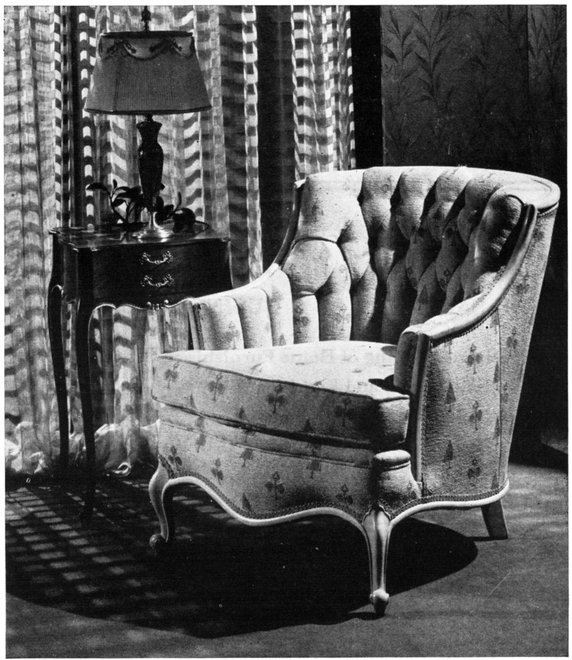
Photograph by Grignon.
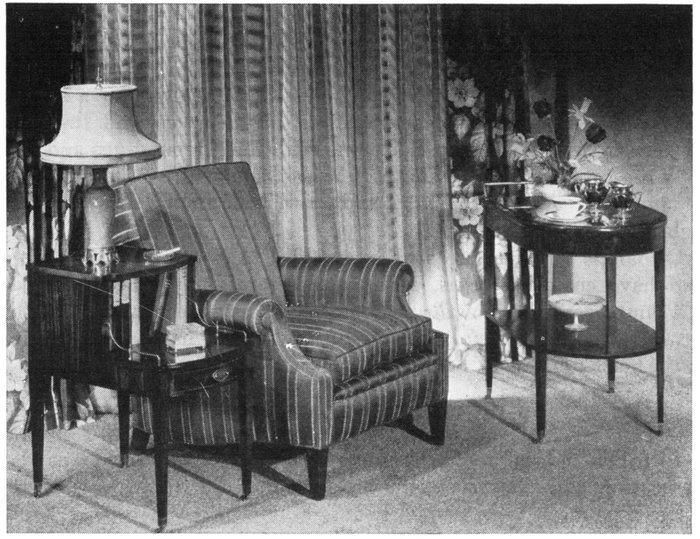
Figure 1.—Contemporary French grouping is expressed in this attractive chair
with natural finished wood frame, tufted back, and rust figured beige damask
upholstery. The combined lamp stand and plant table is a modern favorite.
SELLING HOME FURNISHINGS
Unit I.—THE SALESMAN AS A BUSINESS
BUILDER
Selling home furnishings at retail is one of the most pleasant
and fascinating of occupations. It is clean work, physically agreeable,
mentally stimulating, and free from deadening routine. Moreover,
it is a growing field with limitless possibilities. True, there
always will be malcontents who proclaim that the people of America
are losing interest in their homes, that restless excitement is their
god. Facts indicate, however, that our people are turning their
thoughts and aspirations, in increasing measure, to the enduring
satisfactions of the home.
All available data on buying habits indicate that selling methods
should be revised to meet the buyer's interest as it shifts from
what furniture is to what furniture will do. This is a logical development.
For many years American women have been influenced by the
cleverest advertising in the world to desire and to buy finished products
on the basis of performance and with little or no concern as to
how they are made. To these women, rugs, chairs, tables, and lamps
are parts whose interest depends chiefly on how they are combined
with other parts to form harmonious wholes. According to a number
of comprehensive surveys, three out of every five women who are interested
in furniture are concerned chiefly with its effect in making
their homes more attractive. If this is true, those who sell home furnishings
must have a sound knowledge not only of their merchandise
but also of the art of arranging and combining that merchandise to
insure comfort and beauty in completely furnished rooms.
This specialized selling of home furnishings as a career, therefore,
means mastery of the art of interior decoration. If interior decoration
be defined as the sum of the processes by which a home is made
beautiful to look at and comfortable to live in, then all who sell
home furnishings must understand style, design, materials, and construction.
Every furniture salesman who consistently maintains a
high sales volume as a result of his own skill will be found to employ
the methods of the interior decorator whether he adopts the professional
title or not.
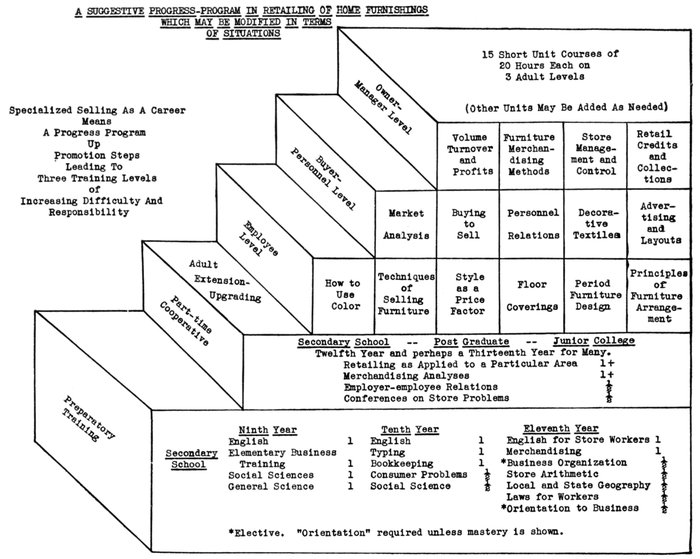
Figure 2.—A suggestive progress-program for those who sell home furnishings
which may be modified in terms of situations. Promotion steps are shown on
five training levels of increasing difficulty and responsibility.
The fighter who carries a punch in one hand only will lose a good
many bouts. The carpenter uses a ripsaw for one operation and a
crosscut for another. The salesman is in precisely the same situation.
He always can make some sales merely by showing furniture and quoting
prices. He always can make more sales by a skillful presentation
of style, design, materials, and construction. But in order to build a
personal following and to sell to the highest possible percentage of his
customers the largest possible amount of merchandise, he must become
a competent adviser in the creative processes of home
furnishings.
Figure 2 is a diagram of an educational program which, starting
with preparatory training in the early years of the secondary school,
continues through a period of cooperative part-time training which
combines education in the school and on the job, until full-time employment
assures continued opportunity to study progressively on three
training levels of increasing difficulty and responsibility. Mastery in
ability to sell home furnishings implies adequate understanding of
materials and selling techniques acquired at each of these training
levels.
There are three ways by which one can increase his sales and
earnings:
1. Increase the daily average number of customers waited on.
2. Increase the average percentage of customers sold.
3. Increase the average volume of each sale.
In order to increase your daily average of people waited on, you
must (a) arrange to secure customers for the otherwise idle hours
of the day; and (b) develop the ability to speed up the selling
process, which will enable you to sell to more people during the
active hours.
(a) To secure customers for the otherwise idle hours of the day,
begin with the "lookers" and your "call trade." The woman who has
been planning what is to her an important purchase frequently will
want to consult her husband or a friend in whose judgment she has
confidence. If you have been successful in creating real interest in
your merchandise, it will not be difficult to make an evening appointment,
obviously as a means of saving the time of the husband or the
friend.
When you suggest an early or late appointment you may readily
promise exceptional service. You will be assured of the individual
attention of your group under conditions removed from the confusion
of regular store traffic. If the appointment is during the early morning
hours or during evening hours, it will be easy to group the pieces
as they are to be used and thus show them as they might actually
look in the home.
Then, too, you always will have some sales under way or coming
up with old customers, and in many cases you can, by acting in
advance, arrange appointments which will occupy otherwise empty
time, thus leaving the more active periods of the business day open
for routine selling. Time which cannot be spent with customers
should be devoted to developmental work.
(b) Among many ways to speed up the selling process are the
following:
1. Get down to business, and stay there. Much time is wasted
both before the sale is made and afterward in purely extraneous
talk, not calculated in any way to advance the
sale or build confidence. Within the limits imposed by
courtesy, confine the conversation to the business in hand.
And don't yield to the easy temptation to talk about
yourself.
2. So far as is possible, eliminate the element of guesswork in
showing merchandise. Find out enough about your customer's
room and what is in it, and about her tastes and
plans, to enable you to avoid confusion and resistance, and
to cut down the amount of time spent in showing goods
there is no chance to sell.
3. Be sure that your appearance, manner, and language are
such as to inspire quick confidence. This will make it
unnecessary to spend too much time in demonstrating the
fitness and value of your merchandise. Alertness, faultless
courtesy, and unfeigned interest in the customer's
comfort and convenience are vital.
4. Know your stock, including the small occasional pieces
whose location is often shifted, so thoroughly that you can
go directly to any piece you want to show. In a sale
involving several articles, particularly if they must be
shown on different floors, plan and route the selling process
to eliminate unnecessary movement, and if the display
is made during regular store hours, try to close the sale
somewhere above the first floor, with its noise, confusion,
and beckoning suggestion of the open door.
Much of our study will be directed toward discussing methods for
increasing the percentage of sales made to customers waited on.
Everything is important, and every improvement in equipment will
help. Doubtless what is most needed is more knowledge, which we
can acquire; more patience, which we can force ourselves by a sheer
effort of the will to summon and employ; and more energy, which
we can and will develop in the degree that we recognize and desire its
rewards.
Trade Up Consistently.
The first requirement of one who would increase the size of individual
sales is that he shall trade up consistently. Obviously, this
does not mean that the salesmen should disregard prudence and common
sense and try to sell a $100 article to the buyer who can afford to
spend only $50 or $75, nor does it mean use of high-pressure selling
methods. It does mean that he should develop the ability to estimate
the buyer's tastes, means, and real needs, and to present elements
of value in his merchandise other than price.
Ten years ago a woman who made a shopping tour through 12
department and furniture stores reported that 8 out of 10 salesmen
quoted the price of every article immediately, with strong emphasis
upon its low price. A number of salesmen mentioned the wood and
finish of the article, quoted the price with the usual comments, and
stopped—their entire stock of ideas apparently exhausted by this
effort. This same kind of selling is still too prevalent. Today's
emphasis upon service for specific needs rather than upon low price
to build sales volume has given us an ever-increasing number of
salespersons who understand that it is foolish to start a sale from the
bottom, foolish to assume that no one desires or can afford to buy
good things, and not only foolish but dishonest to discuss furniture of
poor quality and low price in terms which fairly could be applied
only to better quality and higher price.
Suggest Related Merchandise.
A second and extremely important way to increase the size of
your average sale is by the skillful suggestion of related merchandise.
A great many persons buy home furnishings only when they
need them as a physical utility. Quite naturally, they get along with
the minimum number of pieces and buy for the lowest prices consistent
with their ideas of desirable quality.
To be prepared for this type of emergency or "suggestion selling"
each salesman should work out for himself, with the help of other
salesmen, and by wide reading of trade journals, magazines, newspaper
articles, and books in his field, a list of articles in the home-furnishings
field which naturally belong together. These lists of
"naturals" should be memorized for ready recall at any moment.
"Specials," modern accessories, new designs in small occasional
pieces, when advertised to the public, lend themselves to a suggestion-selling
program used in connection with a carefully selected call list.
In suggestion selling, emphasis should be upon the quality of charm
or fitness to be added to a particular room, with the furnishings of
which the salesman already is familiar.
Sell More Than Utility and Price.
Those who buy furniture for satisfactions other than utility naturally
buy—insofar as their means will permit—whatever pieces they
believe to be necessary in order to insure those satisfactions. It is
clear that salesmen in order to sell to this type of customer must be
able to arouse the interest of these utility and price buyers in other
satisfactions.
To do this, they must be able to sell something more than furniture.
They must sell on the basis of the enticement of comfort and cushioned
ease, the lure of beauty, the appeal of smartness and style.
They must sell distinction, the acclaim of friends and guests, the
pride and pleasure of the children, and the joy of living in an
attractive home.
Does this tend to provoke a skeptical smile from those who have
been selling furniture for years? Well, let those smile whose earnings
have been wholly satisfactory. As for the others, let them remember
that in diminished volume is told the story of those who consistently
have attempted to sell furniture as nothing more than furniture
and who have stolidly ignored the power of imagination and sentiment
in quickening interest and deepening desire.
Sales experts are agreed that it is impossible to formulate a selling
plan that will apply to all salespersons. There are no magic words
to be spoken in the presence of potential buyers that will cause
them to call loudly for an order blank and reach for a fountain pen.
There are certain fundamentals which will help a man to become a
better salesman.
Webster defines tact as "a nice discernment of delicate skill in
saying and doing what is expedient or suitable in given circumstances."
Tact is one of the most valuable assets in salesmanship
and must be exercised at all times. Many sales of home furnishings
have been lost in discussions with a prospect who was inclined to
be belligerent. Under no circumstances enter into an argument.
You have heard the well-known axiom, "Win an argument and lose
a sale." The fact that you have sound sales arguments to use in
presenting your sales story does not mean that you must argue
with the prospect to prove your point. Explain tactfully your
side of the story and, if your statement is questioned, try to prove
it. But rather than enter into an argument about it, pass on to
another point, and, if necessary, refer later to the point in question
from a different angle.
Some salesmen are so anxious to tell all they know about their
product that unquestionably they develop a habit of interrupting a
prospect every time he speaks. This reflects adversely on the salesman;
often it prevents the prospect from telling of the features
particularly liked or the real objection to the proposition. When
your prospective customer starts to speak, listen, and above all, when
answering a question, don't exaggerate. Many a sad failure in
selling has resulted from an exaggeration of facts to the point where
the prospect will not believe anything the salesman has said.
Sincerity breeds conviction and if you are convinced of the statement
you make, your attitude will go a long way in making your
prospective customer believe your story. Know your product and its
advantages; be sincere and enthusiastic when you are presenting them.
Be natural. It will pay.
All have known salesmen who have talked themselves out of sales.
This is a fault common to many. Some types evidently believe
that if they talk fast enough, do not permit the prospect to bring up
objections or say anything, and put the pen in the prospect's fingers
and get him to sign on the dotted line, a good sale has been made.
The day for this kind of selling is gone. Today's buyer wants information
and she wants a chance to think about that information
after she gets it. Make your statement about your product and let
your customer think about it. Be careful not to bury one important
sales feature by showering several more on top of it before the customer
has had time to decide on the merits of the first. Give your
customer an opportunity to ask questions and express her opinion.
Often, if allowed to talk, the prospect will sell herself.
An objection or reason for not buying may be real or it may be
merely an excuse. In any event, the salesman must be able to
answer it effectively in order to close the sale. If the customer
raises an objection, be sure you understand it. Don't jump at conclusions
as to what the objection is going to be. After you understand
it clearly, repeat it. Sometimes when an objection is repeated
the customer immediately can see for herself that it is not a valid
objection.
Salesmen interested in fundamentals will do well to remember
four points of value in selling:
1. Talk to your customer as though she knows about the product
but explain everything as though she knew nothing
about it.
2. Treat your customer with unfailing courtesy.
3. Assume that she is able financially to buy anything on the
floor even if her general appearance leaves room for some
doubt. When basic facts are established, suggest justifiable
time-payment plans as an arrangement she might prefer—but
do this tactfully since many women are sensitive
about money and credit ratings.
4. Make your sales story complete. Tell it simply, directly,
earnestly, and honestly.
Elementary fundamentals should be brought up time and again.
You may know you are beyond the stage where you need to be told
to keep the ears clean, the hair combed, the shoes polished, and
suits pressed, but there are some angles on this matter of keeping a
perpetual personal inventory which may be reviewed profitably many
times. Consider the advantages of a daily check-up.
Some women are inclined to trust to first impressions of appearance
and manner. A salesman may find it difficult and sometimes impossible
to win their confidence if there is anything in his appearance,
manner, language, or actions to detract attention or arouse prejudice.
If these important personal matters are neglected, it means reduced
income through the loss of some sales and an unnecessary loss of time
in many others.
One of the best ways to guard against these losses is to work out
a sort of perpetual inventory of your own good and bad points, and
to keep this inventory up to date, making a systematic check-up.
Certain principles as to proper dress for men in home-furnishing
stores of dignity have been established. One metropolitan store insists
that salesmen wear dark suits; black shoes always; white collars
either attached or detached, not necessarily starched; neckties, dark
preferably, and in harmony with the suit. This store never permits
removal of coat or vest even in summer. Many stores, however, permit
vests off in summer and supply uniform coats to all salesmen—dark
palm beach or similar material. Arbitrary rules without reason
are worse than none. The store mentioned above feels that the factors
listed as important simply conform to the laws of good taste
in reflecting the store to its clientele. No store can afford to tolerate
slovenly attire, shoddy language, or indifferent effort.
If, in good faith, interested salesmen will run through the following
list of questions before they go to work each morning for 2 or 3
months, they will find the results in increased sales unexpectedly
profitable.
Have I had the food, sleep, and exercise necessary to enable me to
meet all customers, even on the longest and busiest day, with energy
and enthusiasm?
Do I feel and look fit, alert, competent, and prosperous?
Is there anything to attract unpleasant attention to my hair, fingernails,
teeth, tie, or shoes?
Do I meet all customers without reference to age, sex, or dress, as
if I were genuinely glad to see them and sincerely interested in serving
them intelligently and well?
Am I businesslike without being brusque? dignified without being
stiff? unvaryingly polite but never oily or servile?
Do I treat all customers with real courtesy, and none with cheap
or offensive familiarity?
Do I ever permit myself to look or act bored, tired, indifferent, or
sullen?
Is my voice pleasant?
Do I talk enough, or too much?
Do I talk carefully and well, without grammatical blunders or
slang, and with an adequate command of words, or do I stumble, use
poorly chosen words, and repeat myself until my customers are bored
or repelled?
Do I slouch, or get into awkward and ungraceful postures, or sit
on the arms of chairs or sofas?
Do I play with a pencil, watch chain, or sales book, or jingle keys
or money in my pocket?
Do I ever show merchandise carelessly, as if it were of no value or
importance?
Do I ever get into an argument with a customer when there is
the slightest possibility of giving offense?
Whatever your present earning power may be, wide experience
warrants the belief that you can raise it appreciably by improving
your present rating in these factors which together give outward expression
to your personality as your customers see it.
1. Do you think a salesman can be sincere and use "high pressure"
methods at the same time?
2. Do you feel you are doing a customer a favor or imposing on her
in urging her to come to a decision, particularly when grading-up?
3. A customer says: "I like this suite, but the price is a little more
then I'd counted on paying." What is the best way of handling this
customer to close a sale?
4. A customer says: "I've just about decided on this one, but I'd
like my husband to see it." What is the right way to handle this
situation? Should an attempt be made to close the sale then and
there? What has been your experience?
5. A customer is sold on a modern suite, and has her mother with
her. Her mother is not sold on modern furniture. How would you
handle this situation?
6. A customer wants an Early American bedroom, is apparently
satisfied with the suite, which happens to be birch, and asks: "Is it
solid maple?" How do you answer?
7. If the president of the First National Bank and his wife came in
at 5:30 to look at a dining-room suite, how would you handle the
first 5 minutes of the conversation?
8. Select a bedroom suite from the floor selling for $99 and one
selling at $179, and demonstrate the points of superiority in the more
costly set?
Bolling, Cunliffe L. Retail Salesmanship. Sir Isaac Pitman & Sons, Ltd.,
London, 1930.
The Spirit of Salesmanship, II, pp. 14-26.
Aptitude for Salesmanship, III, pp. 26-37.
Sales Demonstration, X, pp. 152-165.
Kenagy, H. G.andYoakum, C. S. The Selection and Training of Salesmen.
McGraw-Hill Book Co., Inc., New York, N. Y. 1925.
The Measures of Successful Selection, XI, pp. 215-249.
Mental Alertness Tests for Salesmen, XII, pp. 249-277.
Personality and Aptitude Tests, XIII, pp. 277-300.
Training Salesmen, XIV, pp. 300-319.
Kelsey, Clark. Furniture: Its Selection and Use. National Committee on
Wood Utilization, United States Department of Commerce. Superintendent
of Documents, United States Government Printing Office, Washington, D. C.
Budget, Buying Plans, Need, Utilities, I, pp. 1-19.
National Retail Dry Goods Association, 101 West Thirty-first Street, New
York, N. Y. 1935. Furniture Sales Manual.
Pelz, V. H. Selling At Retail. McGraw-Hill Book Co., Inc., New York, N. Y.
1926.
Personal Qualifications of the Retail Salesman, VIII, pp. 119-139.
How to Make Sales-Talk Effective, XI, pp. 185-215.
Sales by Suggestion, XVIII, pp. 293-313.
Following Up the Sale, XIX, pp. 313-315.
Reyburn, Samuel W. Selling Home Furnishings Successfully. Prentice-Hall,
Inc., New York, N. Y.
Simmons, Harry. How To Get The Order. Harper & Bros., New York, N. Y.
1937.
Sales, Leads, Customers, I, II, III, V, VII, VIII, pp. 1-78.
Stewart, RossandGerald, John. Home Decoration. Garden City Publishing
Co., Inc., Garden City, N. Y. 1938.
Buying Furniture, XII, pp. 219-230.
Whitehead, Harold. How To Run a Store. The Thomas Y. Crowell Co., New
York, N. Y. 1921.
Developing Organized Loyalty, XXI, pp. 253-265.
----. The Business of Selling. American Book Co., New York, N. Y. 1923.
The Mental Law of Sale, V, pp. 44-51.
The Salesman's Personality, XVIII, pp. 221-234.
How To Develop Personality, XIX, pp. 234-242.
Unit II TECHNIQUE OF SALESMANSHIP — SALE OBJECTIVES — STARTING THE SIMPLE SALE — THE HAPHAZARD METHOD — THE HIGH-PRESSURE METHOD — THE SCIENTIFIC METHOD — THE ALL-IMPORTANT INTERVIEW — OPENING THE INTERVIEW — UTILIZING THE CUSTOMER'S ANSWERS — USE JUDGMENT IN SHOWING MERCHANDISE — THREE GENERAL CONSIDERATIONS FOR CLOSING SALES — BE PREPARED TO CLOSE A SALE AT ANY POINT — PROCEED WITH CAUTION UNTIL YOU KNOW THE CUSTOMER'S BUYING MOTIVES — DON'T QUOTE A PRICE—UNLESS YOU ARE ASKED FOR IT — MEETING THE CUSTOMER — QUESTIONS — SUGGESTED READING LIST — FOOTNOTES:
Sale Objectives
Starting the Simple Sale
The All-Important Interview
Three General Considerations for Closing Sales
Meeting the Customer
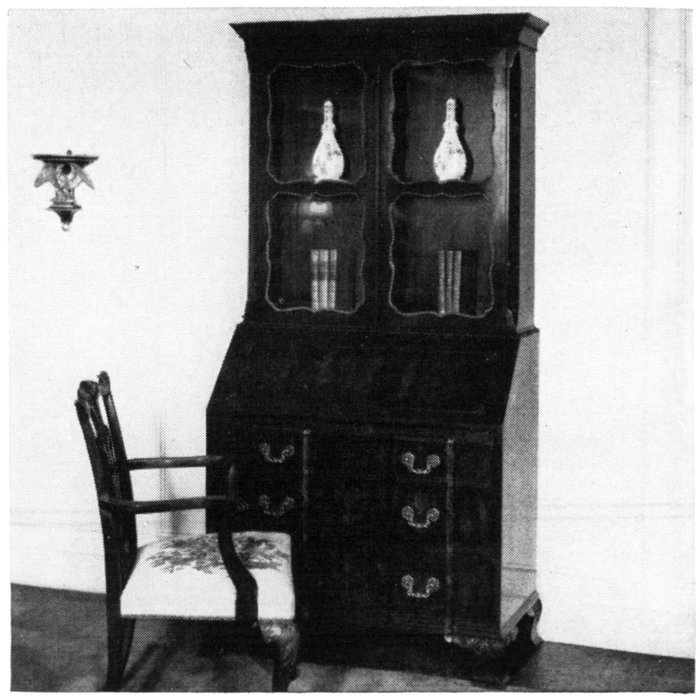
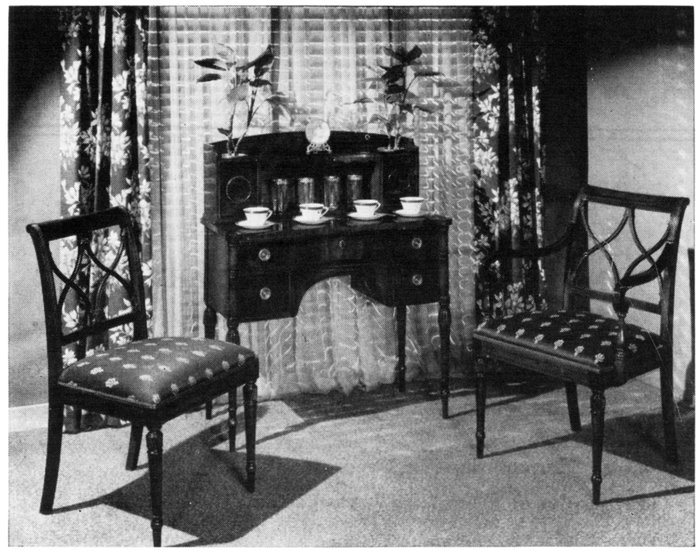
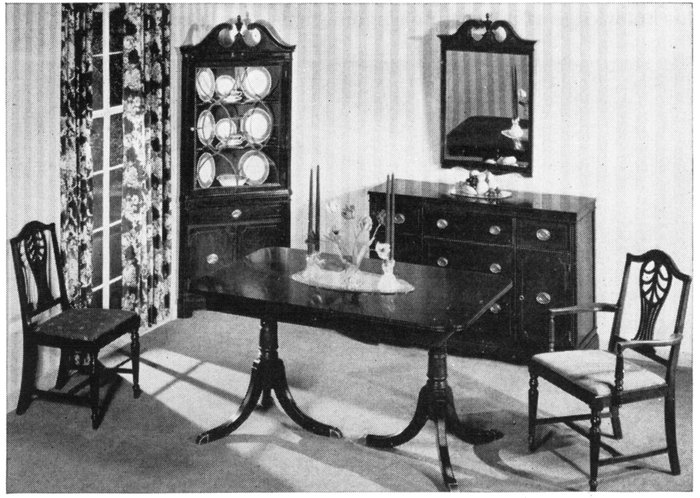
Figure 3A.—A block front Chippendale secretary. The pulls are all pierced
chased brass. The broken pediment is ornamented by the unusual addition
of a hand-carved leaf carving. The ribband back chair has the cabriole ball
and claw and leaf carving on the knees and is upholstered in a hand-blocked
tapestry.
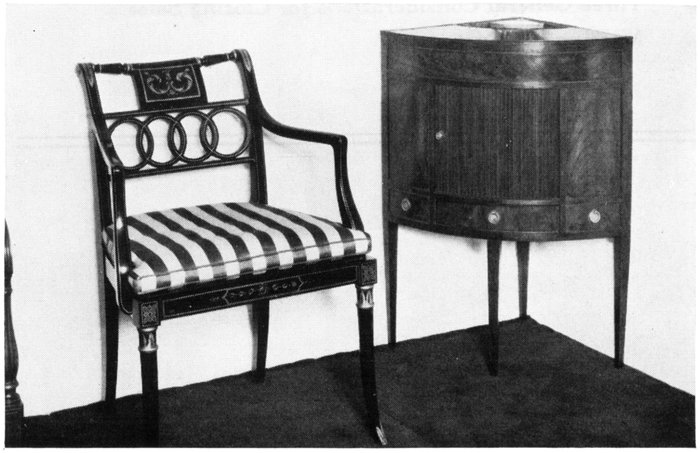
Figure 3B.—This copy of a Sheraton corner stand has tambour sliding front
drawers and a copper-lined plant container at the back. The chair at the
side is a Sheraton decorated armchair, in black with gold decoration. The
upholstery is green and ivory striped satin.
Unit II.—TECHNIQUE OF SALESMANSHIP
When you start toward the display floor with a customer who has
asked for a particular article, you have—or should have—five
objectives:
1. To close a sale, if possible, for an article of the best quality
warranted by the customer's needs and means.
2. To sell any additional merchandise in which you can arouse
an interest.
3. To make the sale in such a way that the merchandise will
stay sold, and the customer will become a loyal business
friend.
4. To secure and record any information as to the customer's
home and tastes that may lead to possible future sales.
5. To do these things without wasting time so that you may
get another customer and repeat the process.
In order to attain these objectives you must gain the confidence
of the buyer, and here your success will depend upon what happens
in the first 5 minutes. It is during these crucial minutes that the
customer forms the impressions which so often lead her either to
bestow her confidence or withhold it.
The experienced salesman is accustomed to form a quick judgment
of the customer and to base his opening procedure on that judgment.
The technique presented here is designed particularly to help this
salesman make large sales or handle small sales which may be
expected to produce future business.
Let us assume that your customer has not asked for an advertised
chair, and that there is nothing in her appearance or manner to
enable you to make a close guess as to her tastes and means. All
you know is that she is interested in an easy chair. Since she has
not told you exactly what kind of chair she wants, it is safe to
assume that she doesn't know. On the other hand, you may be certain
she wants a chair to serve some particular purpose of her own.
The chances are that she has only a vague idea as to the particular
type of chair which will best serve this purpose; you as yet have
no idea whatever. Accordingly, you must choose one of three methods
for starting the sale.
The first is to lead her through your stock in the hope that she
will see a chair that pleases her and buy it. This sometimes will
happen, and there are some customers—though few—who can be sold
in no other way. However, this method wastes so much time, and
results in such a heavy percentage of lost sales, that it should be your
last resort. It is open to three serious objections:
First, it will not help you win the customer's confidence. By
relinquishing all control of the interview, you forfeit her respect
for you as a competent adviser in the processes of home furnishing,
and become merely an order taker. If she happens to like your
merchandise, you are fortunate; but you can do nothing to influence
her toward liking it.
Second, no one can look at a great many different things, however
interesting and beautiful, without becoming confused and losing the
power of discriminating judgment. The woman who is shown furniture
by this undirected method is likely to become tired and certain
to become confused, and may be expected to decide to "think it
over," "look around," or "bring her husband."
Moreover, you cannot show many chairs, even by this method,
without making some comments about them. If you are like many
salespersons you will fall into the habit of describing half the pieces
shown either as the most beautiful, the smartest, the most comfortable,
the latest, or the best bargain. If this happens, any normally
intelligent person will suspect that you are either insincere or
incompetent.
Third, if a sale results, it is likely to be at an unnecessarily low-price
level unless the question of credit limit is involved; and in
any event there will be no sale of additional merchandise, no information
of future value, no loyal business friendship.
You may decide to make a persistent and, if necessary, a high-pressure
effort to "sell" her something. This method, like the first,
will work with a limited number of buyers. However, it results
in much wasted time by reason of the high percentage of returns for
credit or exchange, and in ill-feeling and impaired confidence which
over a period of years make it difficult for the salesman to build up
a personal following among the buyers of his community.
As a matter of cold fact, this method of selling home furnishings
has caused the retailers an immense loss in public confidence, as well
as in money. Because of wrong selling methods, multitudes of
women now stay out of certain stores except on those rare occasions
when they are forced by actual needs to enter. Although these
women want to buy, they are afraid of being sold.
More accurately, they are afraid of being sold the wrong thing.
Most of the women who ask to see a chair or rug or other home-furnishings
merchandise really want something much more important
to themselves, although they do not tell us about it. They want
beauty, comfort, distinction, or social prestige. In other words, they
want to buy furniture as a means of making their homes more attractive;
but their past experience, or the experience of their friends,
often leads them to believe that the salesman will not really help
them. To overcome their hesitancy, they must be made to feel at
the beginning of the interview that no one is trying to sell them, or
even to let them buy, but rather that the desire of the salesman is
to help them buy.
The third possible course of action is based upon a study of the
customer's needs. The salesman will seek to discover the customer's
purpose in looking at easy chairs and then to show her the particular
pieces in stock which are best adapted to serve that purpose. He
will need information about the size, style, and coloring of the chair
required, and the amount that the buyer is able or willing to pay for
it. Do not, at the outset, ask for this information.
In selling home furnishings avoid questions which will force the
buyer to make definite commitments in advance as to her tastes or
the amount of money she is prepared to spend. In the first place,
it is probable that if she had fixed ideas on these subjects she would
have told you exactly what she wanted at once. If you force her
by direct questions to make a statement, she may feel impelled to
abide by it later; you thereby have placed yourself and your stock
under an unnecessary handicap.
In the second place you run the risk of annoying her, since few
women welcome a direct question at the beginning of a sales interview
as to how much they are prepared to spend. Finally, such
questions may be so clumsy and amateurish in technique as to under-mine
a customer's confidence in your ability. Your questions at the
outset should be directed toward determining her needs. If such
questions are skillfully put, she will welcome them as evidence that you
are trying to help her buy economically and intelligently.
Upon leaving the elevator take your customer directly to an easy
chair which you know to be good-looking and comfortable, conservative
both in design and coloring, and neither your cheapest nor your
most costly quality. By choosing a conservative rather than an
extreme style you run no risk of impairing her confidence in your
taste and judgment, and by picking a piece in the middle price range
you run no risk of offending her if she is in the market for a costly
chair, or of alarming her if she is a buyer for a cheap chair. Moreover,
you are in the safe position of being able to shift ground in
either direction without loss of prestige. Don't ask her how she
likes this chair, and don't make any flattering comments on it.
Merely say, in effect: "I don't know how close this particular chair
comes to what you have in mind; but at least it is attractive and
comfortable. If you care to sit down in it for a moment, and to
tell me a little about your requirements, or about your room, perhaps
I can save you the time and trouble of looking at a great number
of unsuitable pieces. Is the chair for your living room?" If the
answer is "Yes," proceed: "Then it will of course have to fit in with
your other things in that room."
At this point you may wish to draw up a small table and lay
the living-room floor plan[1] on it with the first page so placed that
the customer can easily see it. Then draw up a chair for yourself. It
is important to move with a poise and assurance which will cause
the buyer to know you are following the usual procedure. By the
time you are seated she will likely have read enough of the first
page to be interested and awaiting your next move.
In many simple sales it will be unnecessary to ask many questions,
or to enter the answers on the plan. Since you cannot know this at
the start of the interview, however, it is usually wise to show the
plan, even if you make no actual use of it. The effect of this procedure
catches interest, places the transaction on a more professional
basis, and helps create confidence in yourself and your store as skillful
and competent advisers in the selection of furniture.
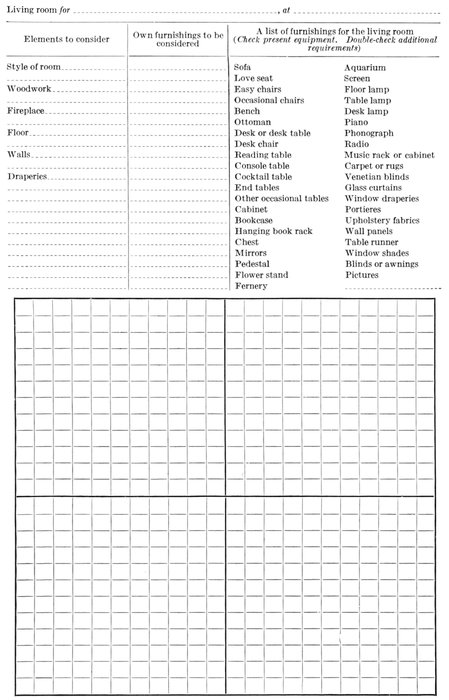
Figure 4.—Room arrangement plan
Note to salesperson.—If you do not have a floor plan and have not seen the room in question, take
blank paper and pencil. Block in window and door openings and location of "other" furniture. Then
proceed as suggested, recommending nothing that will not enhance the attractiveness of the room for its
particular use. Always date your sketch; place upon it the name of your customer, and file for later reference.
If you decide to use the plan, spread it on the table, and say, in
effect: "This device helps us to serve our patrons who are interested
in buying furniture that will add to the comfort and beauty of their
homes. In your own case, for example, we have scores of chairs
that are good looking and that are good values. Yet, if you were
to look at all of them you would undoubtedly find that some are too
large or too small and that the great majority will not harmonize
perfectly in design, style, or coloring with the other things in your
own particular room. By using this device you can give me a clear
picture of your room as you want it to look. Then I can show you
only such pieces as promise to meet your requirements, and you in
turn may select the one chair that seems most suitable. Do you have
a guest chair in mind, or one for the special use of a member of the
family? If for a member of the family, the sex, size, and individual
preference must be taken into account; if for guests, the general
decorative character of the room only.
"The new chair will be seen against the background of the walls
and the floor coverings, and as a part of the group to which it
belongs. Hence, we must be sure it will harmonize with these other
elements. Your rug, for example, is——?" Enter important
information which is given on the floor plan under the heading
"Floor covering." Information needed includes the type of rug
(which may give you an idea of the buyer's price level); coloring;
and type of design (which will indicate to you the characteristic
features of the new chair necessary to insure harmony). Then proceed
in the same way with the walls, woodwork, draperies, and principal
upholstery fabrics.
If by this time your customer shows signs of impatience, you may
wish to say in effect that you can show her several chairs that will
fill the requirements admirably. Then go to work.
If, on the other hand, the buyer clearly is interested, ask for the
size of her room and for the description and location of her other
furniture, and block in the information on the floor plan, using the
method shown in the typical floor plan, page 21. Here the best procedure
is to start from the point of intersection of the 2 heavy lines,
or axes, and count in 4 directions, using the scale of ¼-inch square
for each foot. For example, if the room is 16 × 24 feet, count 12
squares from the center in both directions to locate the end walls,
and 8 squares in both directions to locate the side walls. When this
information is recorded you will get an idea as to the correct size and
proper location for the new chair. Be sure to locate windows and
doors accurately and indicate the exposure of the room with reference
to the compass points.
These preliminaries when completed will give a clear picture of the
room, a fair idea of your customer's price range, and a good start
toward her confidence. Thank her and introduce yourself simply by
saying, "I am Mr. Smith. If you are pleased by what I have shown
you today, I shall hope to see you again as other living-room needs
arise. May I fill in your name and address, so that this plan may be
filed for use when you are next in the store?"
You must be guided by your best judgment. If you have reason to
think the customer has confidence in you, show first the particular
chair that you honestly believe is best for her purpose, introducing
it with a brief, pointed, and purely impersonal comment on its beauty,
style, and peculiar fitness for her own purpose. Don't use superlatives.
She may not like this piece well enough to buy it immediately,
in which case you will be seriously handicapped in trying to
interest her in another one. If, on the contrary, you do not feel assured
of her complete confidence, probably it will be wiser to show
your second or third best piece first, holding the best in reserve.
As soon as you detect signs of real interest in a chair, build up a
little group based on the principles of harmony which are stated and
illustrated in unit VII, page 142. In some cases a small table will
be enough; but usually it will be better to use a larger table, a lamp,
and often a small rug and a length or two of drapery fabrics, if
you stock them. The purpose of this procedure is to help the customer
see your chair as an integral part of her own room and to
emphasize its desirability as a means of making that room more
attractive. If she already has the pieces necessary to form a complete
group when the chair is added, select pieces as nearly like her
own as possible. If not, select pieces that harmonize perfectly with
the chair. Don't tell her that she ought to have these pieces. Merely
show them without comment, and defer any attempt to sell anything
more than an easy chair until after the chair has been sold.
Some salesmen make the serious and costly mistake of assuming that
every customer will be exacting and hard to sell, and that a large
percentage of them enter the store with no real intention of buying.
The really able salesman knows that this is not true. Under
present conditions the woman who enters a furniture store or department
may be presumed to have an active interest in furniture. When
you have found her real needs and offered her something that satisfies
them, there in an excellent chance that she will be ready to buy.
If so, take the order at once. Don't make the tactical blunder of
showing additional merchandise, or of completing all the steps necessary
to close a difficult sale. Many salesmen talk themselves out of a
sale by suggesting unnecessary alternatives. In other words, prepare
carefully and intelligently for the order, expect it, and take it at the
first opportunity.
At the start of a sale it is safe to assume that the buyer is thinking
in terms of her own interests. Don't tell her that a given chair is in
the latest or most popular style until you know that she is interested in
the latest rather than the best style for her particular room. Don't
tell her that it is your best-selling number; or that Mrs. Jones just
bought a piece like it; or that you think, or the buyer thinks, or the
head of the house thinks it "wonderful."
As a general, but by no means invariable, rule, don't quote a price—unless
you are asked for it—until you see definite signs of interest
in the piece under consideration; and even then not until you have
prepared for it by a brief but convincing statement as to quality or
desirability. However, when you are asked the price of an article,
give it immediately and without apology or comment.
All first impressions and most sales start at the front door of
your store or department. For any lack of promptness and courtesy
at this point there will be a penalty.
Anyone who enters the store should be met immediately. If it
happens to be a customer, whether man or woman, a long delay for
any reason will be resented, and even a moment's pause to finish a
conversation may be regarded as an affront. It is impossible to
overestimate the importance of this matter, both to yourself and
to your house. In a competitive market few persons will buy from
the man who treats them discourteously, nor will they return to
the store where they have met with discourtesy if another store with
better methods is accessible. Moreover, one offended customer can
do more damage through word-of-mouth advertising than a thousand
lines of newspaper space can repair.
The visitor should be greeted with a smile, a bow, and the words
"Good morning" or "Good afternoon." Test both your smile and
your bow before a mirror and improve them if any improvement is
possible. A genuine infectious smile is literally a priceless asset.
After this greeting usually you will be told what is wanted. If not,
after a slight pause, ask: "May I show you something?" or "What
may I show you?" Don't ask: "Can I help you?" "Are you interested
in furniture?" "What can I do for you?" or "Anything,
today?"
For the purpose of illustration, suppose the customer is a woman
who asks to see a sofa bed. Don't ask her how much she wants
to pay, or even what sort of sofa bed she wants. If the stock is
on another floor it will be enough to say: "We will take the elevator,
please," and indicate the direction. Do not precede her. Walk
abreast, and, if the aisle is crowded, drop behind. If she is carrying
a parcel of burdensome size ask her if you may have it.
Although many successful salesmen begin at once to draw out
information as to the customer's requirements, it is better practice
to defer such questions until you are in the presence of your merchandise
and beyond the possibility of noise and confusion. Whether
it is wise to try a few impersonal remarks, or to keep still, from the
front door to the sales floor, will depend upon your judgment of
the individual customer.
1. This unit discussed three methods of starting the sale. How
would you proceed to sell furnishings for the new clubhouse at the
community center?
2. What would you do to correct a wrong attitude toward use of
certain types of furniture in a living room?
3. A woman tells you that she cannot afford costly furnishings.
What steps would you take to show her that good taste is not necessarily
expensive?
4. Of what advantage is the study of advertising to the young man
who expects to become a furniture salesman?
5. What use should be made of dealers' aids furnished by the manufacturer
of products you are to sell?
6. Give five sources of information regarding prospects which a
retail furniture salesman may use.
7. What should a good furniture salesman know about the history
of his firm?
8. Why is the excessive use of superlatives an indication of ignorance
of the article being sold?
9. (a) Of what value is a knowledge of competing goods? (b) How
should such knowledge be used?
(Most libraries will have other excellent books discussing retail salesmanship and these
should be consulted freely.)
Rolling, Cunliffe L. Retail Salesmanship. Sir Isaac Pitman & Sons, Ltd.,
London and Pitman Publishing Co., New York, N. Y. 1930.
Studying the Customers, VII, pp. 89-107.
Receiving the Customers, VIII, pp. 107-131.
Sales Persuasion, IX, pp. 131-152.
Methods of Increasing Sales, XI, pp. 165-186.
de Schweinitz, Dorothea. Occupations in Retail Stores. International Text
Book Co., Scranton, Pa. 1937. (Study sponsored by National Vocational
Guidance Association and the U. S. Employment Service).
Hiring, Training, Promotion, IV, pp. 41-65.
Hours, Vacations, Earnings, V, pp. 65-93.
Jackson, AliceandBettina. The Study of Interior Decoration. Doubleday
Doran & Co., Inc., Garden City, N. Y.
Furnishing the Home, XVI, pp. 351-388.
Pelz, V. H., Selling At Retail. McGraw-Hill Book Co., Inc., New York, N. Y.
1926.
The Psychology of the Retail Sale, III, pp. 19-31.
Studying the Merchandise, VI, VII, pp. 81-119.
Customer Types and Characteristics, X, pp. 159-185.
How to Meet Objectives, XIV, pp. 235-259.
Substitution Sale, XV, pp. 259-265.
Richert, G. Henry. Retailing Principles and Practices. Gregg Publishing Co.,
New York, N. Y. 1938.
The Retail Sales Process, XI, pp. 219-245.
Customer Service, XIV, pp. 295-311.
Simmons, Harry. How to Get the Order. Harper & Bros., New York, N. Y.
1937.
The Futility of Price Appeal, XI, pp. 97-106.
Buyer Slants on Selling, XIV, pp. 121-128.
Whitehead, Harold. The Business of Selling. American Book Co., New York,
N. Y. 1923.
The Buyer's Motives, VII, pp. 61-74.
The Customer, XIV, pp. 153-173.
[1] Suitable floor-plan diagrams to aid in making unit sales are available for any room in
the house.
Unit III SALESMANSHIP APPLIED — HOW TO DEMONSTRATE VALUES — KNOWLEDGE OF MERCHANDISE MUST COME FIRST — SELLING MATERIALS AND CONSTRUCTION — CONTRAST IN BUYING METHODS OF WOMEN AND MEN — WHO BUYS THE HOME FURNISHINGS? — WHY FIRST IMPRESSIONS ARE VITAL — DEALING WITH WOMEN CUSTOMERS — RECENT SURVEY REVEALS NEW VIEWPOINTS OF VITAL INTEREST [3] — ENRICHING YOUR VOCABULARY — SUGGESTIONS FOR BUILDING YOUR VOCABULARY — HIDDEN FACTORS THAT INCREASE SALES — QUESTIONS AND EXERCISES — SUGGESTED READING LIST — FOOTNOTES:
How To Demonstrate Values
Contrast in Buying Methods of Women and Men
Enriching Your Vocabulary
Hidden Factors That Increase Sales
Courtesy of Merchandise Mart News Bureau.
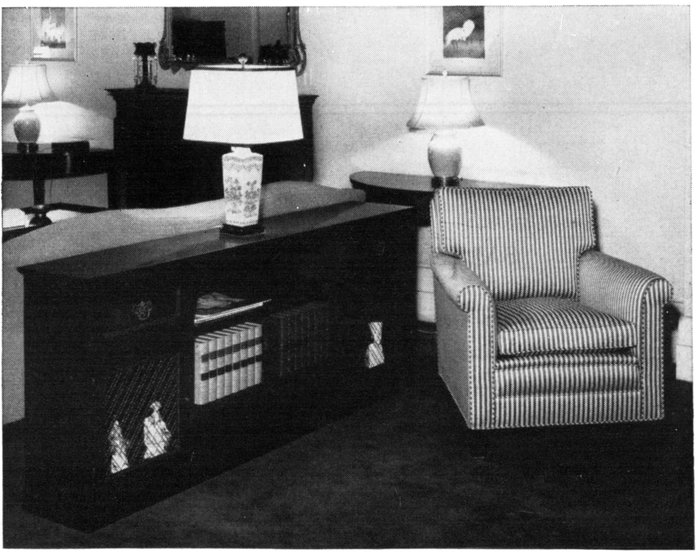
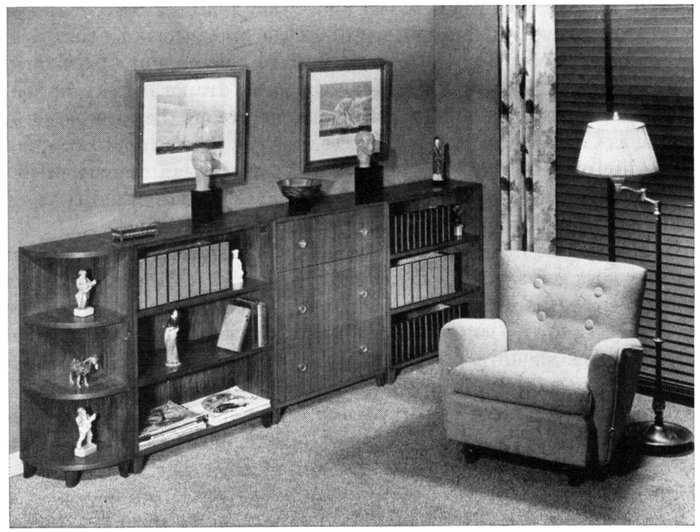
Figure 5.—Useful because it can be placed behind a divan or against a wall is
this low eighteenth century cabinet for books, radio, magazines, or bric-a-brac.
Beside the cabinet is an eighteenth century lounge chair, upholstered in rose
and white striped satin.
Unit III.—SALESMANSHIP APPLIED
Old or young, rich or poor, we are much alike. What interests
us is what touches ourselves. When we make our choices we do not
always accept or reject things because of their intrinsic worth but
because they appeal strongly to the group of instincts, emotions,
and habits which just then is motivating the inner life and influencing
decisions.
The salesman who is clever enough to present his merchandise in
the ways that appeal most directly and powerfully to these inner
controls enjoys a great advantage over one who lacks this ability.
It goes without saying that this ability presupposes thorough
knowledge of the merchandise. This is fundamental.
A given rug which enters our stock from the receiving room may
have 30 points of possible interest to buyers, but not all these points
will appeal to all buyers. Carefulness and system will enable us
to pick and emphasize the strongest points for each buyer provided
we know the entire 30. But if we know 20 only, or 15, or 10, no
amount of skill can save us from losing some sales.
Under present conditions it is extremely difficult to acquire full
and accurate knowledge of the merchandise we are called upon to
sell, but we can get this information now if we want it badly enough;
we must get it if we seriously desire to increase our earning power.
All possible information is important, because any part of it may
be necessary, in a given situation, in order to make a sale. We must
get this information wherever we can find it. In the case of a
newly arrived easy chair, for example, it may come from three
sources:
1. From personal inspection.—A cursory inspection will tell
us that the chair is a medium-size piece, slenderly and
gracefully proportioned; with open padded arms; loose
cushion seat; a back of pronounced rake; cabriole front
legs with carved claw feet; covered in a small-figure
reseda green damask; and priced at $85. We should be
able to identify its style, and the tag may indicate the
name of the manufacturer.[2]
A more careful inspection will tell us that the exposed
wood is solid mahogany, finely finished; the front legs
skillfully carved; all legs with a degree of curvature
that eliminates danger of breaking under strain; frame
corner-blocked; seat springs set on webbing, or steel
frame, with a dustproof bottom of cambric; loose cushion
of spring construction; and the covering a close-woven,
wear-resisting fabric with silk warp and cotton waft.
2. From the buyer or manager.—
a. Name of manufacturer, in order that we may be governed
in making statements about this chair by our
general knowledge of his line, as to quality of materials,
skill of workmen, and inspection standards,
and also in order to use the name in cases where we
believe that it will have prestige value.
b.Details of concealed construction, including frame;
method of springing; build-up of seat, back, and
arms; stuffers used; strength of fiber and color in
the covering.
c. Information as to whether the piece can be duplicated,
and if so, at what price and in what time; also as
to whether it can be supplied in other colors, or in
other materials, and if so, location of samples,
method of figuring price, and time required for
delivery.
d. Historic source of the design, and any interesting information
as to its fashion value, gained by the
buyer at the markets.
3. From books and magazines.—
a. The historical background of the style to which the
chair belongs, and the most effective methods of
developing its style appeal.
b. Types of rooms and color schemes with which it can
be used harmoniously.
Equally comprehensive information is necessary
for all other items in your stock. Without it the
percentage of purchasers that we can be sure of
reaching with a key appeal will be reduced, and our
earning power correspondingly limited.
Assuming that we have acquired adequate knowledge of the materials
and construction of our merchandise, how are we going to use it
effectively. We suggest a few general principles as guides to sound
practice:
Both materials and construction normally are factors to be employed
in closing a sale, but not in opening it.—If you went into a
store and asked to see a pair of shoes and the salesman, seizing the
first model at hand, assured you that it was made of tanned box calf,
with waterproof soles, cork filling, and tacked insoles, by a process involving
more than 150 separate operations, all of which made it a
wonderful value at $8.50, would you tell him to wrap up a pair?
Hardly.
Neither materials nor construction would interest you until you
were comfortably fitted with a shoe that satisfied your ideas of style
and color, and at a price within your buying limit.
When a customer asks for an advertised article and seems pleased
with its appearance, the demonstration of its value can start at once.
In any other situation it must wait until you find something with
which she is pleased.
There are those who appear to believe that selling is a game in
which the object is to beat down the customer's opposition and make
her buy. In dealing with customers of any type above the most
unenlightened, this idea always has proved a boomerang.
In talking materials and construction, preserve a sense of relative
values.—When we say about a $35 chair everything that properly could
be said about one priced at $65, our customer either believes or disbelieves
us. If she disbelieves, the sale is lost. If she believes, our
chance to get more than $35 of her money is lost. Even if we leave
out of account the basically important matter of business honesty, it
is unwise to overstate the values of any article. In a well-managed
furniture store every article possesses points of merit sufficient to sell
it on the basis of what can be fairly claimed for it. To claim more,
whether intentionally or through ignorance of the facts, is to deceive
our customers, and—inevitably—to cut down our sales volume.
Demonstrate the value of all merchandise under serious consideration
whether you believe it to be necessary or not.—Many sales of advertised
articles or merchandise chosen on the basis of its decorative
appeal can be closed without discussion of materials or construction.
As a safety-first measure, these factors should be mentioned somewhat
carefully after the order has been booked. Sometimes a customer will
buy an article in complete good faith, and yet within the next half
hour will start shopping in other stores to see whether or not she
has bought wisely. Even more important is the fact that in every case
the new purchase, when delivered, is subject to inspection and criticism
not only by members of the family but also by neighbors and
friends. Some of this criticism is bound to be adverse, and unless we
have taken the precaution to build up an unshakable confidence in the
excellence and value of our merchandise there may be a telephone
order to come and get it, or at least a loss of goodwill and future
patronage.
These precautionary build-ups can of course be brief. For example,
if you have sold a bedroom suite on the basis of appearance only,
it will be enough to say in substance: "You have bought this suite
because of its beauty and style, which will continue to delight you
always. But before you leave I want you to realize that these fine
qualities rest on a foundation of sturdy construction. This dresser,
for example, is * * *."
Contacting the "I'll-buy-later" prospect.—There is always the
chance that the sale can be closed. A woman's statement that she
is not yet ready to buy is in many cases merely a "defense mechanism"—a
psychological device to serve as an excuse to leave if she
senses that high-pressure selling effort is being applied. It is possible
that if we answer, in effect, "Please don't think of yourself as
a customer, but rather as a valued guest of the store. This is not
a busy hour for me, and while you are here I hope you will let me
show you some more of the new things, which are particularly interesting
this season," we may be able to develop the confidence and
desire necessary to effect a sale.
If we fail to do this, we can at least see to it that the customer
leaves with a clear impression of the value of the pieces she has been
considering. If this impression is sufficiently clear and deep she may
come back. Otherwise, in all likelihood, she will not.
The shopper in a hurry.—Many of us habitually make little or
no effort with the customer who enters with the warning "I am in a
great hurry," or "I have just a moment to look around today, and
will come back later when I have more time." This is a mistake.
Such statements may or may not be entirely true. In many cases
they are another form of defense mechanism—a way out, prepared
in advance. In other cases, they are merely a form of exhibitionism—a
native desire to appear important. Such customers, properly
handled, often can be held indefinitely, with the average chance
to make a sale.
Price important in judging value.—Those who sell are rightfully
apt to think of value as the total sum of a number of costs. While
this method of evaluation is not fundamental economically, nevertheless
our opinions often crystallize when we view the cost records.
Our customer, however, is dually interested in what it costs to make
and distribute what we sell her and in what our product means to
her through its uses in her home. The merchant's, and hence the
salesman's obligation, is to satisfy her that the price she pays is in
strict conformity with the actual reasonable costs of making and
delivering the goods. Simultaneously, however, we must teach her
how our product will fit into her home, the satisfaction it will give
her, the use it will stand through the years, in order that she may
correctly weigh her satisfaction against her cost and reach a final
conclusion as to her purchase.
This does not mean, of course, that the price should be stated
first, but simply that it must be stated at the time it becomes important
in the mind of the buyer. Assuming a skillfully conducted
preliminary talk, this will normally be after an article has been
tentatively accepted on the basis of appearance, and fitness, but before
the beginning of a serious effort to close the sale.
Avoid resistance, and answer unspoken objections.—Use of the
"How do you like this?" type of question sets up unnecessary hazards
of resistance and should be avoided. The same is true of positive
assertions not susceptible of immediate proof, and also of statements
which tend to suggest inner doubts.
If you say of a certain sheen-type rug, "This rug, in pattern and
coloring reproducing one of the celebrated Isphans of seventeenth
century Persia, is woven of a special brand of imported oriental
wools, by methods which give to its deep, close pile almost unlimited
durability, plus this rich, velvet-like softness and luster," you add
to its value without setting up a possible source of resistance to unspoken
objections. But if you say, "The construction of this rug
makes it the best value on the market," you cannot prove your statement,
which may serve to remind the buyer that other stores are
offering special values, or that her friend is enthusiastic about a rug
bought recently at Blank's.
Unproved assertions destroy confidence.—Suppose you are trying
to sell a table with mahogany-veneer top and red gum legs. To call
it a mahogany table will lose the sale immediately, if the customer
knows woods. To say that it has a mahogany-veneer top and mahogany
finish gum legs may suggest to the buyer that a veneer is a poor
substitute for solid wood, and that gum cannot be desirable if it
must be finished to look like something else. To ignore the whole
matter of materials and construction and to try to sell the table on
its beauty and fitness alone may cause the customer to wonder just
what you are trying to conceal, which will mean loss of confidence
in yourself and your merchandise.
The wise course is to tell the entire truth about the piece in a perfectly
matter-of-fact way designed to avoid any invidious comparisons
of woods or processes. For example: "This table whose
design and coloring you so much admire is as sturdy as it is good
looking. Following the practice of some old eighteenth century cabinetmakers,
the maker of this piece has combined several woods.
Those used in the top are built into the modern five-ply construction,
which brings out the full beauty of grain of the mahogany upper
ply, ensures freedom from any danger of warping or splitting, and
provides the strength of steel. For the legs he has used the beautiful
straight-grained red gum of the South."
It is a costly folly to try to sell one material or process by condemning
another. We show a table, for example, and speak of "solid
American walnut" as if no other wood or construction were worthy
of consideration; and 5 minutes later, finding that we have misjudged
her price level, we stammer and stumble over an attempt to
convince her that plywood is an acceptable substitute.
These are the dangerous devices of mental laziness. When a customer
asks us if mahogany is better than birch, or Axminster carpets
better than velvets, or solid construction better than veneer, a positive
answer is misleading. We certainly should know that mahogany,
like birch, varies in excellence according to the individual board;
that some Axminsters are better than some velvets, and vice versa;
and that the construction is best which best meets the particular
requirements of design and purpose, in furniture precisely as in
shoes or ships.
The fact is that everything used in making home furnishings of
worthy quality has stood the test of time, and therefore is interesting
and desirable in its own right. If we cannot make it seem so to
customers, we have not learned enough about it.
In selling materials and construction, repetition is needed.—We
must be governed by the results of our preliminary talk in picking
out for emphasis the particular points which promise to be of interest
to each customer. Having made these points, we sometimes
need to repeat them, in varying language and in different parts of
our sales talk. Moreover, we must never forget that many things
which are as familiar to us as the multiplication table are strange
to our customers, and therefore difficult to remember.
We know, for example, that concealed differences in construction
may make one easy chair worth twice as much as another of identical
appearance; that in sliced walnut veneers, figured woods may cost
5 or 10 times as much as plain; but most buyers do not know such
things. Accordingly, if we merely state such facts, but fail to groove
a memory channel by one or more repetitions, there is an excellent
chance that even the customer who wants and can afford good things
will look elsewhere, completely forget what we have told her, and
buy a cheaper article in the honest belief that she is getting something
equally good. What too often happens is that in building
up the value of our merchandise we fail to fix the facts in the customer's
mind.
Treat merchandise carefully, and show it under the most favorable
conditions.—It is self evident that valuable merchandise must be so
handled as to imply that it is of distinguished excellence.
Respect in handling inspires respect.—A woman will not buy an
article unless and until she has identified it with herself—conceived
of it as belonging to herself, and in her own home. Suppose that we
are showing her a length of drapery fabric. If we crush it, or handle
it as if it were calico or cheesecloth, or chance to step on it before
she makes this unconscious identification with herself, she will think
less of it; if after, she will think less of us. Either reaction will be
harmful.
In departments using rug racks, often it is necessary to remove a
rug and show it on the floor before the sale can be closed. If we do
this in a way that permits the piece to fall in a wrinkled heap on
the floor we will not damage the rug, but we will hurt the buyer's
opinion of it. A shrewd salesman will ask his customer to walk
on the rug; but he will not walk on it himself.
The same care applies to showing furniture. It is folly to jerk
a drawer violently, or pound a table or dresser top, or thump the
seat of an easy chair, or sit on the arm of a sofa. Such actions
reveal an awkwardness and lack of poise which one does not associate
with good homes and their furnishings. Then, too, your customer,
if she is seriously considering a purchase, thinks of you subconsciously
as pounding her table or sitting on the arm of her sofa.
Similar care should be given to the language with which you characterize
or describe your merchandise. Many an automobile salesman
has lost a live prospect because he insisted on calling a beautiful
car a "job." "This stuff," or even "these goods," may lose the sale
of a fine damask. Wrong inflection in phrases like "It is veneered,"
"This is a cretonne," often is fatal.
In this bulletin the buyer of home furnishings is referred to as
"she." This is done partly for simplicity, and partly because most
buyers are women.
As a matter of fact, men do play an extremely important part in
the purchase of home furnishings, and they are likely to be the determining
factor in large sales. This is so much the case that clever
salesmen and decorators frequently try to get the man involved even
in the earlier stages of a large sale, while many highly successful
oriental-rug men make no serious effort on a sale of any importance
until the man is actively interested.
Accurate percentages impossible.—Such data as we have indicate
that, in the purchase by average-income families of the kinds of
merchandise carried by furniture stores, 5 percent or less of the
buying is done by men alone, 50 percent or more by women alone, and
the remaining 40 percent by men and women together.
The percentages, which are of approximate accuracy only, vary
widely with different classifications of merchandise. Women probably
buy from 75 to 85 percent of all curtains, draperies, mattresses,
and pillows; men alone buy considerably more than 5 percent of
lamps, refrigerators, and small electric appliances; and men and
women together buy from 60 to 70 percent of room-size rugs and the
more important items of furniture.
These figures indicate that women have some part in considerably
more than 50 percent of all sales in our business. There is reason
to believe that they initiate fully 85 percent of all sales. This means,
among other things—
1. That we must expect and be set for competition and delayed
sales in the majority of cases, because three women
out of every four shop in more than one store before
buying furniture.
2. That we must conduct every interview with a woman shopper
in a way calculated to influence her to return in case
an immediate sale cannot be made. This will demand—
a. Prompt and skillful service, with every effort to save
her time; because women of the intelligent classes
in recent years have come to attach great value to
their shopping time and to resent any waste of it as
a result of inefficient salesmanship or store service.
b. Careful attention to those elements of salesmanship
discussed under "The daily check-up," unit I, p. 10,
because women are strongly influenced by first impressions,
and in a competitive market rarely
return to the salesperson who made an unpleasant
first impression.
c. Belief that "high-pressure" selling is a mark of inadequacy
both in the salesman and the firm he represents.
The customer of today is rightfully resentful
of it, although it is true that some seem to
react positively to it. Intelligent selling is marked
by efficiency in fitting merchandise to a customer's
desire and need, coupled with an understanding of
her capacity to purchase without financial strain,
and readiness to offer the best value commensurate
with these limitations.
d. Convincing demonstration of the value of merchandise
under consideration, even in cases where we
are morally certain that there will be no immediate
sale; because in the absence of such demonstration
there will assuredly be no later sale. This is a
point at which many consistently fail, with an
enormous total loss in sales as an inevitable result.
3. That salesmen and merchants alike discard any smug
conviction that "our old customers will always come back
to us when new purchases are under consideration," and
must turn to the development of an efficient follow-up
system. The repeat purchases of old customers are not as
a rule sufficient to assure the continued success of any retail
business. Surveys in 1940 show that 60 percent of the
home furnishings customers of the country shift to another
store for their "next" purchase. This does not mean
that they never return to the original establishment. It
does show the need for salesmen and merchants to keep
in touch with those whose confidence they have once developed.
Properly handled, the customer likes the friendly
follow-up and unquestionably it affects her shopping
habits.
While generalizations on human motives and thought patterns always
are dangerous, a few observations are set down here for consideration.
As buyers of home furnishings, women are in general more conservative
in matters of price than men. Women's traditional role has
been that of the conserver, rather than of the earner. Her attitude
in the furniture store is due partly to this fact, partly to the fact
that under present conditions she feels that a larger measure
of personal and social satisfaction is to be gained by expenditure in
fields other than home furnishings. Her capacity as family purchasing
agent compels her to keep constantly in mind a wide range of
immediate and future needs, and to plan the division of her dollar
on that basis.
Women are more interested in details than men; more inclined to
postpone decisions; more indirect in their thinking; more responsive
to appeals based upon instinctive and emotional reactions; less attentive;
and less responsive to complete-explanation sales talk.
Women respond more strongly than men to appeals based upon
time saving, efficiency, durability, quality, and the guaranty of performance,
and far less strongly than men to appeals based upon
family affection or sympathy. Appeals to elegance or modernity
make a stronger appeal to men than to women.
Women respond more quickly to appeals made to their dislikes
than to their likes, but with men the case is reversed. This fact,
coupled with woman's habit of indirect thinking and her reluctance
to go on record, makes questionable the use of the "yes-channel"
method of selling which is often successful in dealing with men. The
theory is that by asking questions to which the logical answer will
be "yes" in the earlier stages of the sale, you groove the way for a
final "yes." It is good theory, but fails with women buyers.
For the same reason the habit of repeating the question "How do
you like this piece?" or "Isn't this beautiful, desirable, etc.?" is dangerous.
Women do not like to be cross-questioned, or forced to declare
themselves. Their inner response to a "don't you like" question
is likely to be destructively negative, no matter what they may choose
to say out loud.
Women respond more directly and strongly to the appeal of color
than do men, and less strongly to the appeal of line and form. They
often have strong prejudices against certain colors, certain types in
texture, pattern, and proportion. These the salesman must uncover
skillfully and avoid in showing merchandise.
The buying psychology of a woman naturally is influenced by her
age, social position, experience, and income. On the upper levels
of intelligence and income women buy much as men do. They are interested
in "reason why" talk; their thinking is direct and their decision
prompt. On the low levels we find women who, however
shrewd in buying foodstuffs or clothing, have had little experience in
the purchase of furniture and floor coverings. Lacking both taste
and knowledge, these women often are childishly credulous. They
buy on the basis of easy terms and what is to them eye-appeal, and
have little or no concern with what would constitute value in the
upper levels.
Seeking to eliminate guesswork in designing a 1940 line, the Kroehler
Manufacturing Co. conducted a Nation-wide survey on consumer
furniture-buying habits. In 49 cities 1,817 families of all classes and
age groups were interviewed in their homes. By virtue of scientific
statistical sampling and complete coast-to-coast geographic coverage
the survey should correctly represent the typical viewpoint of no
fewer than 26 million people and more than 6½ million families.
Since the Bureau of the Census shows that 51.2 percent of our families
own their own homes, approximately one-half of these interviewed
in the survey must have been home owners. Because
three-fourths of our people live in one-family dwellings, about three-fourths
of those interviewed must have been thus housed, and
one-fourth lived in apartments conforming likewise to census
specifications.
The summary of the survey's results provides a basis for analyzing
buying habits and style preferences. But more important to us here,
the study developed certain inescapable conclusions for all those who
actually sell home furnishings.
Fewer than one-third had bought their last furniture at the
same store from which their last previous purchase had been made.
Two-thirds went elsewhere.
Why this huge turn-over?
Is it because furniture stores and departments, as a whole, fail to
do constructive selling?
Is it the result of dissatisfaction with previous purchases?
Thirty-three months elapse between major furniture purchases of
the average family.—A lapse of nearly 3 years between large furniture
purchases is astonishing. The Chicago Automobile Trade Association
says the average family buys an automobile every 2 years—not
because the car is worn out, but because of model changes. To
increase furniture purchases dealers must put more emphasis on
style changes through better display, better advertising, and better
merchandising.
Over one-half of all furniture buyers shopped more than one
store or department.—Better selection, better floor display, and better
selling might have converted many shoppers into buyers in the first
store. What happened there?
Fewer than 10 percent of actual buyers simply bought to replace
out-of-style furniture.—Furniture lined up in ranks along aisles
like wooden soldiers, and advertising which shouts nothing but price,
will not motivate purchases.
Six out of ten customers wait until they are in the store before
they choose a style.
Floor displays that confuse will not help.
Drab window displays will repel.
Doubting words will not highlight lovely furnishings.
Ability to talk well is an invaluable asset to the salesman of home
furnishings. It will not take the place of a winning personality,
or of energy, enthusiasm, and knowledge; but it will raise any or
all of these factors to a higher power, and make them vastly more
productive. An unpleasant voice, stumbling and hesitant utterance,
faulty grammar, and a narrowly limited vocabulary are serious
handicaps.
Even in small and ordinary transactions, and in dealing with customers
whom you might not suppose to be observant, careful choice
of words is highly important. Avoid slang, bad grammar, and
careless habits of expression because these will not help you with
any customer, while with many they will arouse a sort of intellectual
contempt likely to result in sales resistance. How often do we
meet with salespersons whose only descriptive words seem to be: Nice,
swell, smart, grand, slick, gorgeous, elegant, stunning, pretty, and
lovely.
It is particularly important to avoid the easy habit of using the
same few words over and over again for description or characterization.
Many of us, without the least realization of what we are
doing or its probable effect will assure the same customer that 10
pieces in succession are beautiful. That certainly will not increase
her desire to buy; but it may well diminish her confidence in us as
intelligent and discriminating guides to such a purchase. A varied
vocabulary is a wonderful asset in selling.
Training to use a wider range of words.—It is easy to form the
habit of using a wider range of words since we know the words
already, and nothing is required but practice in employing them.
And it is highly important, because in order to make sales of any
importance, we must first sell ourselves, and language is a close third,
at least, to appearance and manner as a means to customer confidence.
With many buyers it comes first. A few lists of words are set down
here in the hope that they may prove of some value:
An article may be beautiful, handsome, good looking, lovely; or of charming,
pleasing, delightful, satisfying, smart, modish, stylish, or fashionable
appearance; of flawless, superb, appealing, moving, striking, notable,
gorgeous, picturesque, distinguished, colorful, or exquisite beauty.
Its design may be sturdy, staunch, vigorous, structurally sound or adequate,
impressive, stately, dignified, chaste, delicate, dainty, refined, simple or
of a charming simplicity; ornate, ornamental, elaborate, highly decorative;
with trim, smart, or graceful lines, in good, rare, or perfect taste;
of great, unusual, or rare distinction.
Its surface may be ornamented, embellished, adorned, decorated, garnished,
arrayed, or beautified with ornament that is intricate, gem-like,
jewel-like, or of exquisite, or finely wrought detail.
Its lines may be straight, direct, strong, vigorous, virile, incisive, clean,
forceful, masculine; curved, soft, luxurious, graceful, gracious, suave,
sinuous, yielding, flowing, or feminine.
Its colors may be rich, vivid, brilliant, gorgeous, glowing, gay, stimulating,
inspiring, exhilarating, cheerful, flushed, clear, unfaded; soft, sober,
mellow, softly blended, quiet, restrained; polychromatic, many colored,
a rich mosaic of color; its color scheme, smart, in today's mode, direct
from Fifth Avenue; popular, intriguing, refreshing, satisfying, or
delightful.
Its texture may be fine, smooth, satiny or satin-like, velvety or velvet-like,
lustrous, glossy, caressing; vigorous, open, or rough.
It may be comfortable, comfort-giving, restful, reposeful, soothing, inviting;
give an impression of ease, easy comfort, cushioned ease; invite
rest, repose, or relaxation.
These words will be especially useful in the process of "high-lighting"
or introducing a piece with a brief characterization designed
to enhance its value before the serious work of selling it
is undertaken, as in the phrase, "Here is an armchair of flawless
beauty," employed in introducing the Chippendale chair.
Technical terms, provided you explain them almost immediately,
are effective. To speak of the cabriole or the term leg, the Spanish
or the bun foot, the saltire or the silhouette stretcher, or of marquetry,
vernis martin (pronounced, roughly, ver-nee mar-tang) bombe fronts
or varquenos will not harm you with any customers, while with many
it will serve to intrigue interest, deepen appreciation of the importance
of furniture, and add to your own prestige as a man who knows
the details of his business.
Any salesperson in the home furnishings field will find it convenient
to adopt some simple plan of acquiring the expanding vocabulary
which always is an asset:
1. Purchase a book of synonyms. Take an article you are to
offer for sale, for instance, an armchair. Try, first, to
use correctly a dozen different descriptive words which
apply to this particular armchair. Then take the idea of
design or texture or surface of this armchair and add a
list of 10 to 20 adjectives which might well be used in
discussing this chair with a customer. You may depend
upon it—she will prefer, "Here is an armchair of flawless
beauty" to "Here's another pretty number."
2. Read descriptions of latest offerings shown at the furniture
markets; study closely the choice of words in presenting
illustrations of special thumb-tuft carpeting, a
drop-leaf table, wing chairs, any simply styled grouping;
use these newly found friends exactly, confidently, and
constantly in your own selling procedures. Practice!
Practice!
3. Give close attention to the diction of others who have
achieved vocabulary masteries beyond your own. Seek
ever to acquire a facility in expression which will impose
no handicap to you at any step in your sales
procedure.
4. Subscribe to one or more trade journals in the home furnishings
field and cultivate the habit of selecting for
study those articles which will add something to your
steadily growing vocabulary, and enhance your appreciation
of the power of words.
Since ancient times, the sense of touch and the sensation of feel
have been important factors in the buying and selling of practically
all commodities. To see a piece of smooth satin partially sells a
prospective customer, but to feel its soft texture in her fingers makes
the luxury of the fabric a reality, something to own and cherish
which will enhance her loveliness, and this hidden value, expressed
in the sense of touch, is usually the factor which makes the customer
buy better merchandise than she might have considered and which
climaxes the sale.
In selling home furnishings, the hidden value revealed by touching
the piece under consideration is extremely important. Fine furniture
which has been hand rubbed has a luxurious feeling which is as
soft as satin. Only by rubbing your fingers over a lovely finish can
you appreciate, to the fullest extent, the exquisite fineness of a hand-rubbed
finish. Feeling the smooth pull of a drawer which slides
properly on its guides, tracing the design of inlaid marquetry with
the fingertips, searching for rough spots in drawer interiors with
sensitive fingers and caressing soft-textured upholstery fabrics with
the fingers all vividly bring to the attention of the customer the
quality and true hidden beauty of the piece under consideration,
which may not have been discernible to the naked eye. The sensation
of feel should be made to augment the sense of touch whenever
possible, but salespersons should bear in mind that a woman's hand
is extremely sensitive and the sense of touch should first be brought
into action before the sense of feel; for example, let us suppose a
woman is considering a rug, which has a particularly fine texture.
Invite her first to feel the texture of the rug beneath her fingers; have
her compare this feeling with a less expensive rug so that she may
mentally compare the difference; then ask her to step on the rug.
Get her to feel the luxury of it under her foot; bring to her attention
the spring of the wool, the comfort of stepping into the deep pile
and other factors which excite the sensation of feel. You will find
these powerful factors not only in helping her decide upon a better
rug but in assuring her that she is getting quality for her investment.
Courtesy Bigelow-Sanford Carpet Co.
Figure 6.—The feminine touch.
When selling upholstered pieces, always have the customer sit
in the chair or on the sofa. Ask specifically if it is small enough,
or if she thinks it will be large enough, for her husband or whoever
is to use the chair. Stress the comfort angle; notice if she can sit
gracefully in the piece and whether or not she has difficulty in
getting up, once seated. As she touches the fabric bring out facts
about the texture and the weave. (See fig. 6.) As she experiences
the various reactions she is silently selling herself and only suggestions
on your part which help her to recognize the various sensations
of touch and feel are necessary.
Bear in mind in all phases of selling home furnishing, whether the
customer is considering a chest of drawers, a chair, rug, lamp, or
cigarette box, getting her to touch it to get the "feel" of the article
and to try it for comfort, luxury, restfulness, or other sensations are
potent hidden factors in better selling.
1. How will a knowledge of the processes of manufacturing of an
article enable the salesman to explain its wearing qualities, its price,
its sanitary qualities, its fitness for a particular location within a
room, and its appearance?
2. What types of information may a home furnishings salesman get
from a public library?
3. What sources of merchandise information are available to you
and how familiar are you with them?
4. What five kinds of special information are needed by retail
salesmen?
5. What steps do you take systematically to acquaint yourself with
the correct descriptive words and phrases currently used with newly
arrived merchandise?
6. There is a vocabulary of suitable words and phrases for use when
showing furniture to all types of customers. The same words are not
equally effective with all customers. What plan or device do you
use in making a wise selection of these descriptive words and phrases?
7. Make a list of words which under any ordinary selling situation
you would never use.
8. Why is the excessive use of superlatives an indication of ignorance
of the article being sold?
9. For each of the following make a statement which involves the
opinion of a recognized authority:
Reading lamp.
Glowing colors.
Floor coverings.
Glass curtains.
Telephone stand.
Wallpaper.
Armchair.
Pictures.
10. In the light of the discussions in this unit, what profitable work
may a retail salesman attend to when not actually waiting on
customers?
Armold, Perry B. The Road to a Sale. The Armold Sales Training Institute,
Los Angeles, Calif. 1935.
The Human Element in Business, IV, p. 67.
Putting "Biz" in Business, V, p. 88.
Duncan, Dorothy. You Can Live in an Apartment. Farrar & Rinehart, Inc.,
New York, N. Y. 1939.
Furniture—and Stuff, IV, pp. 84-111.
Hayter, Edith Fletcher. Retail Selling Simplified. Harper & Bros., New
York, N. Y. 1939.
Habits and Your Job, XV, p. 111.
Poise in Selling, XVIII, p. 124.
The Customer and the Merchandise, IV, p. 21.
Ivey, Paul W. Successful Salesmanship. Prentice-Hall, Inc., New York, N. Y.
1939.
Know Salesmanship, VIII, pp. 19-25.
A Rug Salesman Who Was Success Minded, Section 3, p. 28.
Know Your Merchandise, II, Sec. 4, pp. 36-67.
Build Good Will, XII, Sec. 34, pp. 450-463.
Richert, G. Henry. Retailing Principles and Practices. Gregg Publishing
Co., New York, N. Y. 1938.
Customers, X, pp. 199-219.
Merchandise Study, XII, pp. 245-273.
Van Brussel, Emily. Behind The Counter. D. Appleton-Century Co., Inc.,
New York, N. Y. 1938.
The Colonel's Lady and Judy O'Grady, II, p. 8.
What Is This Thing Called Merchandise? III, p. 31.
Good-by, Caveat Emptor, V, p. 72.
Walters, R. G. Fundamentals of Salesmanship. South-Western Publishing Co.,
Inc., Cincinnati, Ohio. 1932.
The Salesman's English, V, p. 69.
Know Your Goods, VII, p. 101.
The Demonstration, XV, p. 231.
[2] This is a matter of store policy. Some stores believe that they gain more than they lose
by suppressing the name of manufacturer.
[3] This summary prepared with permission of Delmar Kroehler, president of the Kroehler
Manufacturing Co., Naperville, Ill., and Henri, Hurst, and McDonald. Inc., 520 North
Michigan Ave., Chicago, Ill. (1939).
Unit IV STYLE AS A SELLING FACTOR — SIGNIFICANCE OF STYLE — PERIOD STYLES FROM RENAISSANCE TO EARLY COLONIAL — THE ITALIAN RENAISSANCE — THE SPANISH RENAISSANCE — THE FRENCH RENAISSANCE (FRANCIS I, 1515-47; HENRY II, 1547-59) — THE ENGLISH STYLES — EARLY GEORGIAN FURNITURE — THE CHIPPENDALE FURNITURE STYLE — THE ADAM STYLE — THE HEPPLEWHITE FURNITURE STYLE — THE SHERATON FURNITURE STYLE — AMERICAN STYLES — THE EARLY COLONIAL PERIOD — THE LATE COLONIAL PERIOD — THE FEDERAL PERIOD — THE MODERN STYLE (L'ART MODERNE) — USING STYLE APPEAL IN SELLING — HOW FURNITURE KNOWLEDGE IS SPREADING — WHAT SUCCESSFUL STYLE SELLING INVOLVES — DRAMATIZE YOUR MERCHANDISE — STYLE APPEALS BASED ON PERIOD DECORATION — TWO CLASSES OF EXCEPTIONAL CUSTOMERS — QUESTIONS — SUGGESTED READING LIST — FOOTNOTES:
Significance of Style
Period Styles from Renaissance to Early Colonial
American Styles
Using Style Appeal in Selling
American Furniture Mart Photograph by Grignon
Figure 7.—A directoire piece in lacquer and gold, upholstered in a rich gold and
green brocade fashion, this interesting stool. An ideal hall piece, the ornate
stool lends itself to an interesting setting when used with the lovely Duncan
Phyfe mirror and mirrored glass wall sconces. The mirror has a dull green
panel across the top—the lyre and laurel branches appearing in a deep green
and gold. The arabesque Axminster rug has a tracery leaf design in sculptone
effect. It is a greyed green tone.
Unit IV.—STYLE AS A SELLING FACTOR
Salespersons frequently find it necessary to deepen a customer's
appreciation of the fitness and beauty of a piece by the presentation
of one or more additional selling features, of which the most important
are construction or technical excellence, attractiveness of
materials or finish, and beauty of design or style.
This should do two things:
1. Enhance the value of your merchandise.
2. Enable you to reveal technical or artistic knowledge which will increase the customer's respect.
There is no fixed or logical order for the presentation of these
various selling features. Many salesmen begin with construction,
but this often is a mistake. There is reason to believe that more
women are interested in materials than in construction, and more in
style than in materials.
What style means to you.—Style is a powerful buying motive of
great and growing importance in furniture. Most of us attempt to
use the style appeal only in connection with period furniture. Most
women, on the other hand, identify style with fashion. They think
of style in decoration as substantially the same thing as style in
dress; that is, as something smartly harmonious and in the accepted
mode.
Unquestionably we must develop the power to capitalize on style
as our customers understand it.
The successful salesman also must be able to exploit style in the
historic or period sense. The history of furniture is a selling tool
of immense value, whether we are trading upon high, medium, or
low levels.
The sections which discuss the more important period styles contain
a mass of highly condensed information. All of this information
and much more will be necessary to the man who wants to reach
the higher levels of his profession, but just how much of it you will
need to remember and organize for your present work is a matter
to be determined by yourself. The first thing to do is to read it
through carefully two or three times in order to get the broad outlines
of the subject. After that study more carefully those parts of
the section on "Period styles from Renaissance to early colonial," page
50, and "The American style," page 70, that can be related to your
own merchandise. Make use of the suggested reading list at the
end of the unit, page 79.
Glossary and reading list.—Many terms used in the section on
"Period styles from Renaissance to early colonial" are uncommon and
not widely understood in the furniture trade, although they are freely
used in books and magazines which deal with the home furnishing
art. These terms are defined in the glossary included in the
appendix, pages 247 to 249.
Furniture is and always has been a utility and an expression of
human ideals. In order to understand period furniture and to talk
about it with convincing enthusiasm we must be able to see beyond it
to the people who created and used it.
For our purpose, we confine this summary to the historic period
beginning about 500 years ago, which covers the development of
furniture as we know and use it today. Speaking broadly, the social
trends during this period were from insecurity to security; from
despotism to political liberty; from austerity to luxury; and from
simplicity and few wants to sophistication and multiplied wants.
Accompanying and expressing these social changes we find corresponding
changes in architecture and decoration. The trends are
from homes of fortress-like construction to homes easily accessible
and amply lighted by low windows; from immense rooms with high
ceilings to small rooms with low ceilings; from massive, heavy forms
and thick proportions to small, light forms and slender proportions;
from the austerity and virility of straight lines to the softness and
femininity of curved lines; from strong dark colors to soft light
colors; from vigorous, open textures to smooth, close textures; and
from a few types of furniture to the extraordinary variety of today.
Most period furniture was designed for the rich and powerful.—We
must remember that most of the historic styles were expressions
of the life of the court and the aristocracy. Period furniture was
made by great artists, and often was elaborately ornate, sumptuous,
and enormously costly. The metal mounts alone on the cabinets
made for the mistresses of Louis XV, for example, cost far more
than the ground, building, and complete furnishings of an ordinary
American home.
The essence of these styles is to be found in their line, proportion,
color, and texture. We can adapt them to machine production and
mass distribution. We sell these reproductions or adaptions for what
they cost in a machine age. But we can add to their desirability by
explaining their aristocratic ancestry. Thousands of customers enjoy
the sentimental satisfaction that comes with the knowledge of
style and period sources and even the anecdote plays its part in
giving merchandise its full measure of value in use.
Europe before the Renaissance.—When the Roman power was
broken in the fifth century of our era, Western Europe was given
over to anarchy and darkness. In the beginning of the feudal period,
the great barons with their families, retainers, and dogs, lived in
bare fortresses or one-room castles. The floors were of dirt. The
lord and his lady had a great bed, two chairs of state,[4] and a few
hutches.[5] The retainers had stools on which to sit, and ate at a
great table made by laying hewn planks on trestles.
By the time of the Norman conquest of England in 1066 a measure
of civilization had been achieved. A great love of color developed
with the age of chivalry. The period of the Crusades (seven attempts
during the eleventh, twelfth, and thirteenth centuries to
recover Jerusalem and the Holy Land from the infidels) brought
the knights of Western Europe into contact with the developed arts
of Sicily and the far more luxurious life of their Saracen enemies,
and the returning crusaders brought back great quantities of the
rich and colorful fabrics of the East.
That tremendous out-flowering of the human spirit which we call
the Renaissance (French for rebirth) started in Italy in the fourteenth
century; it grew there in full vigor in the fifteenth, attained to its
maturest powers in the sixteenth, and sank to its decline in the seventeenth.
The whole era was a time of great achievement. The New
World was discovered and explored, learning was revived and extended,
international trade was developed, and masterpieces were
created in the arts, which still stand among the greatest monuments
of human genius.
The ideas and decorative practice of the Italian Renaissance quickly
spread to the west, where they overcame or fused with the existing
Gothic, resulted in the Renaissance styles of Spain, France, Flanders,
Holland, and England, and started the long course of development
which has created the immensely rich heritage possessed by lovers
of furniture today. In studying the decoration of this first period,
we must remember that the construction of rooms adapted to the
comfort, privacy, and intimacy of modern life was an eighteenth
century development. Life was lived in the public eye and in rooms
of state. The apartments of the palaces were large, the ceilings high,
and the furniture sparse and designed for its decorative value rather
than for use and comfort.
It is customary to divide this era into three periods; the Early
Renaissance, characterized by a rich simplicity and a dignity almost
austere; the High Renaissance, by a showy but restrained magnificence;
and the Late Renaissance, by a baroque magnificence over-ornate
and unrestrained.
During the first period, walls were chiefly in rough plaster, bare
save for tapestries or panels of damask or brocade, or finished with a
smooth coat decorated with colored frescoes; ceilings were largely in
dark woods, cross-beamed, and with the heavy beams and corbels
ornamented in color; and floors were of stone, tile, and marble. There
was some use of oriental rugs, and a free use of rich decorative
textiles.
During the high or middle period (about 1500-1550) many of the
rooms were rich with pattern and color. Walls were in colored
marbles, or covered with frescoes and gilding, or with gorgeous
brocades, Genoese velvets and tooled and gilded leather; ceilings
frescoed and gilded; floors paved with many-colored patterns in
gleaming marble.
Furniture of the period was straight-lined, rectangular, and of dark
woods. Carving, in low relief and in the round, always was employed
with a fine sense of the value of contrast with plain spaces. Gesso
ornament, gilding, and painting were much employed, and the panels
of chests and other pieces often were decorated by the greatest artists.
Chairs of the period were of (a) the rectangular type, with or without
arms, with high or low back, and with or without upholstery; (b)
the curule, a sort of four-legged camp stool with back, sometimes
of metal and with fabric seat; and the X-type, adapted from ancient
Greece and Rome, called in Italy Dante and Savonarola chairs. These
chairs of wood or metal often were made to fold, and later became
popular in England.
Tables included the single-slab refectory type; draw tables of the
same construction used today; pedestal tables with round, square,
hexagonal, and octagonal tops; and a variety of writing tables with
a front box or drawer section which could be lifted for writing. The
larger tables were supported by heavy turned legs with stretchers
near the floor, or by trussed or columned end supports connected by a
stretcher, often arcaded.
Painted Commode
18th Century Venetian
"Dante" Chair
Italian Renaissance
Armchair
Italian Renaissance
Armchair
Spanish Renaissance
Armchair
Italian Renaissance
Vargueno
Spanish Renaissance
Table
Spanish Renaissance
Figure 8.—Italian and Spanish styles (1400-1759).
Beds, which were usually set on a dais or low platform and always
richly embellished, included the heavy four-poster with canopy; the
four-poster with low posts and no tester, with or without footboard;
and the paneled type with head and foot board and no posts.
Chests, chiefly bridal chests (Italian: Cassone or cassoni in plural),
were a most conspicuous feature of Italian decoration.
Credenzas, which served either as buffet or console, were wall
pieces about 4 feet high and of varying length. Other forms included
the armadio (French armoire, a large cupboard or cabinet
for linens), small cupboards, chests or drawers, desk, benches, and
stools.
Renaissance ornament was enormously rich. The forms, taken
chiefly from classical antiquity, included the acanthus leaf, human
and chimerical figures, cherubs, scrolls, foliage, flowers, swags,
rosettes, and drapery festoons. Velvets were used largely for upholstery,
with brocades, brocatelles, damasks, needlepoint, and leather,
and strong rich colors were used throughout as would be expected of
so vigorous an age. Strong reds, blues, and greens, set off by gold,
were the favorite hues.
Although a long period of decadence followed the High Renaissance
much beautiful work was done in eighteenth century Italy.
Furniture was chiefly of walnut, mahogany, and many highly figured
woods, with carving, painting, bone inlay, pietra dura, marble tops
and ornamental metal mounts the favorite methods of embellishment.
The painted furniture, particularly that made in Venice, is
of interest to us today, and is used in suites for bedroom and breakfast
room, and as occasional pieces in other rooms. In using this
furniture today it is unimportant to attempt to reproduce the historic
backgrounds.
Spanish interiors of the sixteenth and seventeenth centuries differed
sharply from contemporary rooms in Italy, France, and England,
chiefly by reason of old Moorish art and custom, which the incoming
wave of the Renaissance was not strong enough to wash away.
Old Spanish decoration is characterized by a severe dignity, relieved
by concentrated masses of strong colors and by a wide variety
of ornamental forms. Furniture of the period was straight-lined and
rectangular and chiefly of walnut, mahogany, chestnut, oak, and pine.
Carving, straight and spiral turning, inlay of ivory, bone, ebony,
colored woods, tortoise shell, silver, and bronze, often with outlines
in black and vermillion, and ornamental iron work were the principal
means of embellishment. Elaborate and beautiful mounts of iron
and brass were common.
Chairs, though not common, included both the curule and rectangular
types, the latter with or without arms and with or without upholstery.
Other varieties included carved and straight spiral turned
legs; Spanish scroll, bell, ball and bun feet; carved, splat, and arcaded
backs; and wood, flat upholstered, and squab-cushioned seats.
Beds were large, and mostly of the arcaded headboard type. Tables
were mostly of large size and rectangular.
French Gothic art early began to give way before the constantly
widening flood of Renaissance art which flowed in from Italy. The
transition was practically complete when Francis I was crowned,
and less than 50 years later, under Henry II and his Italian wife
Catherine de Medici, the richly ornate yet restrained style of the
French Renaissance was fully formed. The style is too palatial for
adaptation to American homes.
Louis XIV surrounded himself with the airs and trappings of
majesty. Furniture of the period was formal and dignified, and for
the most part, massive. It retained the straight lines characteristic
of the earlier styles, but with less of angular harshness.
Walnut was chiefly used for exposed parts together with oak,
chestnut, ebony, pine, and sycamore. Many exotic woods were used
for veneers and inlay. Caning was common for seats and backs.
Every known form of embellishment was employed, including carving,
chiefly in the acanthus leaf, shell, cartouche, cupid, ram's head,
and other classic motives.
Louis XIV Furniture.
Chairs of the most characteristic type were rectangular, with high
broad backs having a top straight or slightly rounded at the corners,
back and seat solidly upholstered; legs term-shaped (term: A four-sided
pillar, usually tapering toward the bottom), carved, and under-braced
by Gothic or saltire cross stretchers; arms as long as seat,
and usually straight and upholstered. Other seating included the
sofa or canapé,[7] the chaise longue, and the bench, tabouret, and
stool.
Upholstery fabrics were exceedingly rich and gorgeous, Gobelin
and Aubusson tapestries, silk velvets, damasks, and brocades being
chiefly used. Furniture was upholstered en suite, a common arrangement
including one sofa, two arm chairs, and nine stools or
tabourets. Etiquette prescribed the use of stools by most members
of the court, and prudence demanded it of the ladies, who at this
time wore hoop-skirts, so enormous that they couldn't sit in an arm
chair. All furniture was placed against the wall, with the center
of the room left clear.
The old-fashioned four-poster bed with drapery belongs here.
Most fashionable was the lit d'ange (bed of the angel), canopied
but without posts, which was of enormous size and always richly
carved and embellished.
While tables were of many kinds and sizes, the rectangular shape
with term legs was most characteristic. Screens, either one-panel
or folding, were used in most rooms, and mirrors, pedestals, and
tall clocks became common, in addition to such older forms as
armoires, commodes, cabinets, and desks.
The colors of the period were fairly dark and strong, with crimson,
green, and gold still favorites; some new and lighter colors became
popular; among them aurora—the yellowish pink hue of the dawn—flame,
flesh, and amaranth.
Great-grandson of the old king, Louis XV was but 5 years old
when the latter died, and for 8 years Philippe of Orleans governed
as regent. Louis XV was too young to continue the constant round
of formal receptions, and state functions. Court life turned from
the great salons to the smaller apartment and the boudoir. Furniture
became smaller and more dainty; the hard and virile straight
line gave place to the soft and feminine curved line; and dark colors
to light and delicate tones. Pale tints of rose, blue, green, and
yellow were the favorite colors.
An extraordinary variety of cabinet woods was used—among them
walnut, mahogany, oak, rosewood, cherry, violet, and tulipwood.
Embellishment included carving; ornamental veneers; marquetry;
plaques of porcelain; painting in ivory, soft yellow, gray, or sea green
with fine lines of white, gold, or color; and lacquer, which became
immensely popular.
Louis XV Furniture.
The chairs, all curvilinear, with and without arms, upholstered or
caned, include the fauteuil[9] or large armchair; the bergere, a smaller
armchair with solidly upholstered arms and often with loose cushions;
the causeuse (the word means talkative, chatty), an easy arm
chair; the "confessional," large winged chair, often with a high
seat matching a large tabouret and put together to form a chaise
longue, and many others.
Table
French Renaissance
Armchair
Louis XIV
Writing Desk
Louis XV
Armchair
Louis XV
Armoire
Louis XIV
Commode
Louis XV
Figure 9.—Early French styles (1500-1750).
Beds were as varied as the chairs. Alcove and sofa or boudoir
beds were favorites, the latter having headboard, footboard, and
back. Four-poster canopy beds were common, and were sometimes
made of iron, draped. Another fashionable favorite was the day
bed, often with a fabric-covered headboard, and placed with either
head or side against the wall.
Among the multitude of tables were many of elliptical and other
curvilinear shapes; the crescent or kidney writing table; the powder
table, which we have lately revived after more than 150 years; and
the ladies' work table. The chiffonier, a small piece with drawers,
came into use about 1750, as did the corner cabinet and the wall
shelves, now known as hanging book racks.
Present-Day Practice.
Louis XV furniture is used often in the drawing room or dining
room of important American houses, where a suitable background
will be ensured by the architecture.
Most of us, however, have occasion to sell it only for bedroom
use.
Louis XVI, grandson of Louis XV, was married at 15 to Marie
Antoinette of Austria. He was popular for some time, but was
swept aside by the French Revolution in 1789 and was killed on the
guillotine.
The style which bears his name (sometimes known as the style
of Marie Antoinette) was in reality fully formed before his accession
to the throne. It resulted directly from a wave of enthusiasm for
the delicate type of classic ornament revealed by the excavations at
Pompeii and Herculaneum, which were discovered early in the
eighteenth century. The Adam style in England came from the
same source.
The furniture of the period returned to straight lines and rectangular
shapes, with curved lines freely employed but not dominant.
A great variety of cabinet woods was used, fashionable favorites,
including mahogany, walnut, sycamore, and satinwood. Carving,
architectural moldings, marquetry, figured veneers, lacquer, painting,
and porcelain inlays were the usual methods of embellishment.
Much furniture was painted.
Bed—Louis XVI
Armchair
Louis XVI
Armchair—Empire
Armchair
French Provincial
Bed—Empire
Figure 10.—Later French styles (1750-1815).
New Types of Furniture.
Among the new chairs was the voyeuse (vwä-yûz), a lyre-back
armless chair with the top rail upholstered as an elbow rest, and
used by dandies who bestrode it backward in order not to crush
the tails of their coats. Favorite beds included the sofa, usually
upholstered with damask or brocade, and supporting at the four
corners a light open frame bearing a small canopy; and the day bed
with or without back.
During the period the tea table, breakfast table, and extension
dining table, with four, six, or eight legs, came into common use.
The Directoire[11] (1795-1804) and Empire (1804-15) Styles.
After France had rid itself of royalty and aristocracy through the
Revolution, under the direction of the painter David a new style was
created; it was "made and molded of things past." Inspired by the
classic Roman decoration, it was known at the time as the "antique"
style and today is known as the Directoire. (See fig. 7.)
The Directorate was succeeded in 1799 by the Consulate, with Napoleon
as First Consul, and the Consulate in 1804 by the coronation
of Napoleon as Emperor. Style trends were continuous; for our
purpose it is enough to discuss briefly the style known as the Empire
(l'Empire).
It is of interest because of its influence upon American furniture
of the Federal period.
Furniture was for the most part rectangular, massive, and architectural
in design, but curvilinear in Roman and gondola chairs, and
in many beds and sofas. Legs included the straight term form;
round, either plain or carved; rectangular and turned outward at
both front and back as in the chair illustrated (p. 59); flat truss
supports and winged chimerical figures for tables and beds. Feet
included the paw, ball, scroll, often with leaf shoe.
Mahogany was the favorite wood, with some use of rosewood,
walnut, oak, and yew, and with a wide variety of materials for inlay.
Carving, veneer, paint, turning, and gilding on metal or carved wood
were usual methods of embellishment. Tapestry, damask, satin, brocade,
velvet, and worsted damask were used for upholstery, with
fringes and gimps common.
The French Provincial Styles.
"French Provincial" refers to furniture made in the French provinces,
by local craftsmen and usually of local woods, in close reproduction
of the styles dominant at the court. The styles which were
widely copied, and which resulted in the most graceful and charming
pieces, were those of Louis XV and Louis XVI. (See fig. 1.)
Because England was ruled by four dynasties—English, Scotch,
Dutch, and German—English furniture reveals the effects of a
series of strong foreign influences.
The Elizabethan Style.
With the accession of Elizabeth (1558) the English Renaissance
was firmly established. Rooms of the period were paneled in oak
with small rectangular panels, plain or carved, and usually carried
to the ceiling; ceilings in ornamental plaster (parge), or in beamed-wood
or open-timber construction; and windows large, with leaded
casements separated by mullion. Most important rooms had oak-plank
flooring; there was considerable use of oriental rugs, then
known as "Turkey carpets." Many rooms still had dirt floors strewn
with rushes, which were changed but twice a year, with such results
that the Englishman of the period called his floor the "marsh," and
kept his feet off it when possible by use of chairs and tables with
low, solid stretchers.
Oak was the dominant furniture wood, with some use of elm,
beech, yew, pine, and Scotch fir, which was called "deal," and valued
highly. Carving, mouldings, and paneling were used for ornament,
with marquetry for panels in walnut, ebony, rosewood, pear wood,
cherry, yew, and holly.
Furniture was massive, architectural in character, straight-lined,
and rectangular.
The beds, which were used only by the great, were the most important
article of furniture. They were of great size with a high
headboard supporting a very heavy cornice, the other end of which
was borne by posts set at the lower corners and often detached from
the bottom of the bed.
The Jacobean Style (1625-1685).
This style evolved directly from the Elizabethan, with the development
of new forms of furniture and increased use of upholstery.
When, at the Restoration in 1660, Charles II returned from France,
he brought back something of the French taste and the French desire
for luxury.
Draw-top Table
Elizabethan
Armchair
Elizabethan
Armchair
Late Jacobean
Chair
Late Jacobean
Gate-leg Table
Jacobean
Figure 11.—English styles (1560-1690).
Oak remained the principal furniture wood, with walnut fashionable
after 1660. Furniture design, strongly influenced by Flemish
practice, tended to increasing slenderness and grace. The melon and
acorn bulb legs remained in favor for several decades; were superseded
during the Commonwealth by spiral turning; and in turn gave
way to the scroll, or Flemish legs characteristic of Charles II furniture.
Chair backs became high and narrow, and were of the ladder
type or caned, carved, or upholstered. Chair backs were raked, and
later in the period the back legs of chairs—at first perpendicular to
the floor as in Elizabethan practice, were bent outward to counterbalance
the rake of the back. Stretchers continued to follow frame
line, but were gradually made lighter, set a little higher, and turned.
Toward the end of the century the front stretching was raised,
widened, and carved with a cresting and C-scrolls, as were many of
the chair backs.
Gate-leg tables and day beds appeared early in the period—the latter
usually caned, and with a sloping head and without footboard or
back. The couch took the place of the settee, and was made first with
the squab seat, and after the Restoration with the same construction
and ornament as the arm chair. Sofas were made like the high-back
upholstered chairs, with arms solidly upholstered. Tall clocks and
wall clocks appeared, and many small stands.
The Style of William and Mary (1689-1702).
James II, last of the Stuart kings of England, was followed by the
Dutchman William of Orange and his wife Mary. These names
stand for a rich but confused style which marks the transition between
Old English practice and the Dutch style, fully developed a few
years later in the reign of Queen Anne. Architectural backgrounds
were lighter and richer, and the walls were often covered with velvets,
damasks, and brocades in large baroque patterns, or with papers in
Chinese designs.
Walnut was the fashionable wood, but oak, elm, pine, chestnut,
pearwood, cedar, and painted beech were used, with marquetry of
many woods, plus bone and ivory. Furniture was rectangular in
outline, with a free use of curves. Carving was used for the legs and
backs of many chairs, but flat panels were embellished with veneers,
marquetry, and lacquer. Furniture legs were mostly turned, of trumpet
shape and with bun feet, though the Dutch cabriole legs, with
pad feet and a single shell carved on the knees, were not uncommon.
William and Mary brought from Holland the vogue for Chinese
ornament. Everyone collected porcelain and drank tea; new types
of cabinets, small chairs, and occasional tables appeared in profusion.
The Style of Queen Anne (1702-14).
The style of Queen Anne persisted, with unimportant changes,
throughout the reign of George I. It was less magnificent and impressive
than preceding styles, but lighter, more graceful, and more
comfortable.
The walls were often paneled, but in deal rather than oak, either
in the natural color or painted, and panels were frequently embellished
with high-relief carving. For un-paneled walls, cheap printed
cotton fabrics largely replaced the sumptuous materials of the previous
style, while many walls were covered with wallpapers in landscape
or mythological subjects, or in imitation of veined marble or
wood wainscots. Ceilings were painted as in the Stuart period.
Windows were increased in size, and hung with figured velvets, satins,
damasks, and chintzes.
Lacquer continued to be vogue, and was used on cabinets, screens,
occasional tables, and chairs. Carving and painting—in black and
gold, red, blue, and green with gilding—were favorite methods of
embellishment. Caning was common. For upholstery needlepoint,
figured and plain velvet, and damask were chiefly employed.
In this style curved lines supplanted straight lines for the first time
in England. Cabriole legs were almost universal; chair backs were
high and narrow, with open framing and a fiddle splat, usually
plain but sometimes simply carved or pierced. Chair-back crests
and the legs of most furniture were ornamented with a carved shell
which reached England from Italy by way of Holland. High curved
stretchers, connecting front and back legs only and tied at the middle
by a single cross stretcher, were in general use but sometimes omitted.
The love seat became an important piece of furniture at this time,
and was usually made with a double chair back, six legs, and upholstered
seat. Dining tables were of the gate-leg type, usually of
elliptical shape. Tallboys became common, and contained from six to
nine drawers.
The Georgian Era.
Georgian England produced the decorative style created by Robert
Adam, and the individual furniture styles of Chippendale, Hepplewhite,
and Sheraton.
The development of English furniture between 1715 and 1727 is of
little interest save to the expert. The period was a time of lowered
taste. Mahogany, introduced from the West Indies as a curiosity
about 1710, became within two or three decades the dominant cabinet
wood.
There were three Chippendales, all cabinetmakers. The second,
Thomas Chippendale (born 1710; died 1779), came to London with
his father in 1727 to open a shop. By 1735 the firm was prospering,
and 15 years later Thomas Chippendale was a great success. As is
usual with men of genius, however, he was undervalued by his contemporaries;
and it was not until a hundred years later that he came to
be recognized as the greatest furniture designer of his race.
Settee
William and Mary
Armchair
Chippendale
Chair
Late Queen Anne
Armchair
Chippendale
Wing Chair
Queen Anne
Armchair
Chippendale
Cabinet
William and Mary
Figure 12.—English styles (1690-1760).
Chippendale served the world of fashion, observed and followed
style trends closely, and successively developed the Dutch, Rococo,
Chinese, and Gothic styles. He lost popular favor when the classic
revival, led by Robert Adam, became the dominating influence about
1762, and much of his time thereafter was spent in executing work
for Adam, who designed furniture for houses but did not make it.
Taking the period from 1727 to 1765, Chippendale's career as a
designer took the following course:
1725 Dutch mode, with early Georgian heaviness. The chairs
had bandy legs, ball and claw feet, broad seats and
fiddle backs, carved and sometimes pierced. Gradually
the proportions were refined, a shorter and
squarer back with rounded corners was developed,
and the splat was replaced by a richly carved
member.
1735 Dutch influence yields and blends with the French styles
of the Regency and Louis XV, resulting in more
slender and graceful proportions and a free use of
Rococo ornament.
1745 French influence predominant, with floral and Chinese
lattice detail gradually introduced and the Chinese
influence growing stronger. Lightness of effect
sought after, and achieved by means of pierced work.
1755 Chinese influence stronger, waning after 1760. Between
1750 and 1760 he developed the Gothic style,
sometimes blending it with Chinese motives.
For ornament Chippendale used mahogany and depended upon
carving, of which he was a great master, set off by gilding, japanning,
and lacquer. He made furniture for every purpose, including
mirror and picture frames, girandoles, pier tables and brackets, and
china shelves and cabinets (see fig. 3.) Doubtless his chairs are his
most significant creations. His chair backs fall into three classes:
1. "Splat" or upright center bar, passing from plaint splat
to jar shape pierced and carved with scrolls and foliage,
and culminating in the elaborate ribbon back.
2. "All-over" patterns, covering in equal fashion the whole
of the back, and characteristic of his Chinese and Gothic
designs.
3. Ladder-back or horizontal rails.
Chippendale made a free use of colorful textiles for both squab
seat and upholstered pieces, employing tapestries, worsted damask,
Spanish tooled leather, and close-stitch embroidery.
The classic revival, discussed under the French style of Louis XVI,
was initiated in England by the Scotch architect, Robert Adam. He
was appointed architect to the King in 1762; designed many important
homes for private owners; and with his brother James, under
the firm name of The Adelphi (Greek for brothers), carried out an
extensive program of fine residence construction in London. Robert
Adam died in 1792.
Adam designed everything that went into his houses, including
the fire grates, girandoles, upholstery, carpets, and furniture.—He
was not a cabinetmaker, but the furniture made to his designs by
other men—including Chippendale and Hepplewhite—was called
Adam furniture.
The Adam style perfectly reveals the classic qualities of fine proportions
and symmetrical balance, combined with a delicacy strongly
influenced by Pompeian decoration. Walls were paneled and painted,
with paneling and cornice enriched by painted compo ornament.
Ceilings were in relief, designed from a center to fit the room with
the motives repeated in the floor coverings.
Adam furniture was in mahogany, satinwood, and painted wood.
This was embellished with low relief carving, narrow moldings, inlays
of exceptional delicacy and beauty, and painted decoration.
Forms were basically rectangular, but softened by a free use of
curves. Chair legs were straight and tapering, square or round, and
plain, fluted, reeded, or carved. Chair backs were square, round,
elliptical or shield-shaped, upholstered or filled with carved wheel,
lyre, urn, or other ornament. Console tables and cabinets were often
of semielliptical shape, and sideboards frequently were formed of two
pedestal cabinets, surmounted by knife urns, and connected by a shelf
table.
George Hepplewhite (or Heppelwhite—both spellings are used)
was a designer and cabinetmaker whose proclaimed purpose was to
unite elegance and utility in furniture. His work was in the neoclassic
style; was very strongly influenced by Louis XV and Louis
XVI decoration, and by the work of Robert Adam; and enjoyed a
great popularity from 1785 to 1795. Hepplewhite died almost at
the beginning of his vogue, and his business was carried on by his
widow, Alice, under the firm name of A. Hepplewhite & Co.
Hepplewhite's furniture was distinguished by lightness, refinement,
and elegance. It was chiefly in mahogany or satinwood, with
cheaper woods employed as a base for painting or japanning. Carving
and marquetry were employed for embellishment, with the ornament
drawn from the same sources as that of Louis XVI and Adam,
but with special emphasis upon wheat ear, garrya husk, and three-feather
Prince of Wales' plume.
Sideboard
Hepplewhite
Settee—Sheraton
Armchair
Hepplewhite
Chair—Adam
Armchair
Sheraton
Side Table—Adam
Figure 13.—English styles (1760-1800).
Except for his furniture which used the cabriole legs and Rococo
ornament of Louis XV, Hepplewhite employed the straight tapering
leg, square or round, and plain-fluted or reeded, with straight, collard,
or spade feet. Chair backs were most characteristically of
shield shape, filled with carved styling, urns, the feather back, or the
interlocking heart form. These backs were supported by a construction
of the back legs, and were not attached to the seats. Front
legs (except in the case of the cabrioles) were perpendicular to the
floor, while back legs curved outward to balance the rake of the
back. Console cabinets were often semielliptical, and sideboards were
rectangular except for concave curves near the ends.
For covering, Hepplewhite insisted upon silks and satins, and he
was especially fond of narrow stripes. He often designed or selected
the draperies used with his furniture and chose the narrow stripes
of plain lines and serpentine pattern of the French styles, as well
as designs of ribbons, festoons and tassels, shields, circles, and garrya
husks.
Thomas Sheraton (born 1751; died 1806) was the last of the great
English furniture designers. He was strongly influenced by Louis
XVI and Adam designs.
Sheraton was not a money maker, although, in addition to cabinetmaking,
he worked as a drawing master, preacher, author, and publisher.
However, he was a great cabinetmaker and a great designer,
unsurpassed and probably unequaled by any man of his race in the
making of cabinets, secretaries, sideboards, dressers, and tables. (See
fig. 3a, p. 16.)
He used mahogany for dining-room, library, and bedroom furniture;
and rosewood, satinwood, and painted furniture for the drawing
room. Inlay was his favorite method of embellishment, with
turning, some carving, ornamental veneering, and painting. His
ornaments included swags, the star, cockleshell, fan, and disk.
Notwithstanding its apparent delicacy, Sheraton's furniture was
structurally sound. The legs were very slender, usually round but
sometimes square, tapered, and often reeded. Some of his later
pieces have spiral-turned legs. The feet were inconspicuous, usually
spade or straight and collard. Chair backs were characteristically
square, with a central panel rising slightly above the top rail, and the
lower rail kept the back well up from the seat.
For upholstery Sheraton used plain, striped, and flowered silks,
and gold and silver brocades. He was especially fond of blue as a
color, three of his favorite schemes being in blue and white, blue and
black, and very pale blue and yellow.
The Hepplewhite and Sheraton styles are similar and cannot
always be distinguished without careful study. Sheraton used more
underbracing, and his sideboards have convex instead of concave
corners. Beside the characteristic difference in chair backs, Hepplewhite
pulled his seat covers well over the apron, while Sheraton permitted
a part of the seat frame to show.
The early colonists came from England to Virginia, New England,
and parts of Pennsylvania; from Holland to the Hudson River
country and Delaware; and from Germany to parts of Pennsylvania.
The little furniture brought with them, as well as the ideas upon
which they proceeded to build and furnish their homes in the New
World, were representative of the common houses of the small towns
and countryside of their native lands. (See fig. 45, see page 212.)
The interest in Early American art is now so widespread, and the
sales of Colonial furniture so great, that every salesman should have
sound working knowledge of the subject. Many books are available,
a few of which are mentioned in the reading list. One of the most
useful is A Handbook of the American Wing of the Metropolitan
Museum[12]—a book every furniture store can well afford to own.
The earliest New England houses were solid but simple and primitive.
Walls were of whitewashed rough plaster or of wide molded
boards, which were used vertically to form partitions; ceilings of
wood, with exposed joists resting upon heavy supporting beams; and
floors of plank.
Furniture was of Jacobean type, some of it brought from England,
but for the most part made here from oak, pine, maple, and other
native woods. The forms were few and simple and included cupboards,
chests, trestle tables, and chairs of the turned or wainscot
types. Most furniture was left unfinished. Later there came the
chest of drawers, and chairs of the Cromwellian and Carolean types,
often with spiral turned legs and scroll feet, and either caned or
with seats and backs upholstered in needlework.
Near the beginning of the eighteenth century the open-construction
rooms began to give way to complete interior finish, with paneled
walls. The American form of the Windsor chair which reached
its highest development at about this time, was mostly of hickory
because of the adaptability of that wood for bows and spindles.
Courtesy Merchandise Mart News Bureau.
Figure 14.—Harmony in periods in rugs and furniture is shown by this figured
Axminster, accurate reproduction of an old floral hooked rug shown with
Early American. The design is red, rust, and green on wood tones, harmonizing
with the green of the ivy in the wallpaper pattern, and the rust of the
draperies.
By 1750 the production of good furniture was well under way,
with designs based upon Early Georgian models, and 10 years later,
in the period of the strongest Chippendale influence, the fine homes
of the Colonies were filled with very distinguished furniture of
American design, of which the highboy is a perfect example.
The Adam influence appeared here shortly before the Revolution.
Sheraton and Directoire models were adapted and combined by
Duncan Phyfe of New York, who shares with William Savery of
Philadelphia the distinction of creating some of the finest American
furniture.
The work of Duncan Phyfe belongs to this period, and it is supposed
that the White House was first furnished by Thomas Jefferson
with furniture of that style. Destroyed by the British in 1814, the
White House was rebuilt and furnished by James Monroe in 1817
with Empire originals imported from France. This style, as modified
in the United States, with its heavy, classic ornament, and gilt
mountings, remained dominant until it was replaced by the ungraceful
and ugly adaptations of the style of Louis XV which appeared in
Victorian England and were copied here.
"Modern art" is a term used to include aspects of present-day
practice which depart widely from traditional or conventional models.
It regards period styles as survivals of a past, dead and gone.
Avoiding mere prettiness, it seeks dominant simplicity through elimination
of ornament on structural forms, and an adaptation of design
to function as complete as that revealed by today's motor car or
skyscraper. Literally, it is streamlined for comfort and beauty in
the modern way.
Broadly speaking there are two modern developments in functional
furniture:
1. There is a classic-modern development deeply rooted in
tradition but adapted to the needs of today.
2. There is a functional-modern development which, forsaking
the past, is giving us a fresh, practical angle in furniture
design.
Both developments seek comfort, simplicity, and beauty in all
ways.
The simplicity features of functional furniture are triumphs in
finish and in structure. Surfaces are flat and smooth without applied
ornament. The completed pieces are sharp and vigorous in
outline, perfection in finish, with long continuous curves replacing the
old sharp angles. In the new metal furniture it is not uncommon
to note that the entire frame of a chair, settee, or table has been
made from a single length of metal tubing. Grace and lightness
are natural attributes of these flowing lines.
This contemporary furniture also achieves a sincerity which marks
a new high. Without ornamental features which characterize the
classic-modern development it is impossible to hide flaws in workmanship.
Construction accordingly is emphasized rather than concealed.
There are no "fake antique" effects about this functional
furniture. No one is trying to make these materials look like something
else. Metal is called metal; maple is maple; and neither, sparkling
under a brown graining, pretends to be walnut. Finishing
processes continue to be used but they aim at developing the individual
grain, color, and texture of each species. The following statement
quoted from the April 1940, Bulletin of the National Retail
Dry Goods Association, is a forcible expression of this viewpoint:
The majority of consumers interpret such expressions as "all mahogany" or
"genuine Honduras mahogany" or "all maple" or "all walnut" literally, i. e., that
furniture so described is made wholly of mahogany or maple or walnut according
to the wood named. The National Better Business Bureau recommends that such
terms be applied only to those articles of furniture in which all the exposed parts
are made wholly of the wood named. If the exposed parts are composed of more
than one kind of wood such article should be described by the names of the
principal woods used, viz, "mahogany and gumwood," "walnut and gumwood,"
not by such description as "combination mahogany," and "combination walnut."
Also it is recommended that furniture employing veneered construction be frankly
described in advertising as "veneered."
To achieve the finish and structural beauty of functional furniture
the modern craftsman works with various materials. The whole world
is bringing to the markets choice cabinet woods to be used in producing
hitherto undreamed-of effects. Magnolia, amboyna, bubinga,
macassar, satinwood, narra, makore, padouk, and thuya—these are
familiar names. Glass—clear, white, and colored—has won acceptance
as a structural material. Aluminum, stainless steel, and chromium
plate are popular. Cork veneer with its velvety texture and
warm coloring is excellent surface finish for wood furniture. Metal
frames with veneer tops often are shown in designs suitable for use
as kitchen, sunroom, porch, and even living-room furniture. Linoleum
tops for tables and desks afford variety in color. Various synthetic
products are converted into tops which have been proofed
against heat and liquid stains, thus popularizing them for cocktail
and coffee tables. Colored lacquers reminiscent of the orient have
been appropriately used. Textile designs which are largely depended
upon to supply the necessary ornament for rooms, employ the straight
lines, acute angles, and whirling curves of the futurists as well as
natural forms drawn with little or no attempt to representation. The
end is not yet predictable, but there is much to be learned now.
We may use style appeal in selling furniture of any quality except
the poorest to customers of any level of taste except the lowest. The
salesperson should have some appreciation of the importance and
dignity of furniture, and a fair working knowledge of the forms,
materials, and ornament of the several period styles.
We must remember three things:
1. All furniture is derived, however remotely, from earlier
forms and therefore can be identified with a style appeal.
2. American women have become style-conscious in matters of
decoration.
3. The home-furnishing art is studied in colleges and secondary
schools; books dealing with it are widely read; at least
25 million persons read national magazines which devote
space to it; hundreds of newspapers publicize it; powerful
agencies are actively engaged in widening popular knowledge
of it.
In order to enhance the desirability of an article through an appeal
to beauty of design or style, we must cause the customer to see in it
something desirable which she has failed to see for herself. To do this
we must be able to notice this "extra something" ourselves, and to
convey a clear and interesting picture of our observations.
Many never see more than a part of the sales possibilities of what
we have to sell. Our merchandise is as common to us as an old shoe.
We are prone to forget that its forms are the result of age-long
processes of development, its ornament the heritage from an immemorial
past. Often we forget its romance, its quickening appeal
to the imagination, its promise as a way to richer and more stimulating
life. To us a chair is a chair, and a rug is just another rug.
You will sometimes find it effective in building up appreciation
of a fine machine-made rug to tell how much time would have been
required for weaving alone had it been made by hand. Count the
number of tufts per square inch; multiply by 144 to get the number
per square foot; then by the number of square feet in the rug, divide
the total by 2,500—the average number of knots tied by a Persian
weaver in a full day's work—to arrive at the number of working
days. Make a few of these calculations based on rugs of standard
weave and size at your leisure, and remember the results for use
when required.
To equip yourself to emphasize style in furniture, first go through
your stock carefully, and identify the style of all pieces that are
accurately reproduced or closely adapted from historic designs. It
may surprise you to learn how many pieces can be definitely assigned
to one of the historic styles.
The ideal way, of course, would be to have each piece styled and
marked by the manufacturer; this may come in time. Another way
would be to have the style names agreed upon by the entire sales
force, after discussion, and marked on the tags, so that everybody will
be telling the same story. But if no definite plan is used, study
the stock by yourself. After all, the man who wants to travel ahead
of the crowd must expect to do some pioneering, and you will be
the one to profit.
Every clever oriental-rug man realizes the sales value of an identifying
name. He knows that women particularly like to know the
name or weave of a rug and any facts connected with its design,
because these things make them feel more assured in buying and give
them something to talk about pridefully to their friends.
In presenting your furniture under its historical names, be careful
not to make claims you cannot establish. They will expose you to
the ridicule of a well-informed buyer, of whom there are many.
Never say that a piece is a reproduction unless really it is. Say
that it is "in the style of" or "inspired by," or "derived or adapted
from," or "a present-day adaptation of," or "a twentieth century
interpretation of" the style to which you have assigned it. Having
said this, proceed at once to give it whatever additional importance
or value you can draw from your knowledge of the history, personalities,
or practice of the period. Do not lecture but try to dramatize
your merchandise.
The highest use of language is pure self-expression. Only your
choice of words and expression can give your customer kinship with
what you feel. An encyclopedia of information is not of itself complete
customer service when you are dealing with style, period, color,
harmony, and satisfaction.
Suppose, for example, that you want to sell an ordinary loose-cushion
sofa in blue velvet, with machine-carved cabriole legs, rolled
arms, and straight-lined back with curved ends.
It is easy to say, "Here is a handsome, well-made sofa in blue velvet.
Just the right thing for your room; the price is $95."
But it is almost as easy, and in many cases far more effective, to
say, in substance: "This, as I understand it, is what you may have
in mind. There is nothing striking or extreme about the design.
Notice the graceful curves of the cabriole or f scroll legs, which are
completely adequate to hold up the heavy body; note how those same
curves are echoed in the arms and suggested in the back, so that the
whole piece reveals harmonious lines. This sofa expresses the quality
of repose which makes it so important in the properly furnished
modern home." Or, suppose you have a reproduction of a Chippendale
ladder-back chair. With 9 possible buyers out of 10, it would
be foolish to try to sell such a piece through the bald statement that
it is a beautiful Chippendale chair.
A better approach would be as follows: "Here is an armchair
reproduced from one of Chippendale's masterpieces. If you will
set it off by itself you will see its extraordinary grace and harmony
of line. In this piece we have Chippendale's conception of the ladder
back—a very old form of chair expressed in flowing curves which
descend rhythmically from top rail to floor. As a chair it is perfect—staunch,
thoroughly comfortable, and enduring; it is even more
desirable as a work of art. Anyone may well be proud to own it."
This language is not intended to be "stilted." If delivered casually,
with no thought of reciting a memorized paragraph, or of
delivering a set speech, these ideas will be effective in sustaining
interest while, informally, you direct attention to other features.
"High-lighting" or dramatizing your merchandise is as difficult as
it is necessary when one must guard against failure by enhancing
the desirability of the merchandise.
Your description should not be left to chance or to the inspiration
of the moment. Think them out at home or in your free time in
the store, and plan just how and when you will use them.
These "high lights" may be based upon history, beauty, and
sentiment. To illustrate:
Bedroom Suite Adapted From the Style of Louis XVI.
History.—"In this suite we have a reflection of the last of the
great decorative styles developed in France under the Bourbon Kings.
Louis the Sixteenth was king of France when our forefathers signed
the Declaration of Independence. There was great gratitude and
admiration for France in those days, which inspired the importation
of a good deal of furniture of this style for the statelier homes of
America. Washington bought some of it for Mount Vernon, and
Jefferson for Monticello."
Sentiment.—"This suite called Louis XVI, named for an era made
brilliant by the later courts of France, is reminiscent of the days
of Marie Antoinette. Lovers of style and beauty the world over
have for decades, even centuries now, looked back to the days of
the last lavish escapades of the French courts whenever there is a
resurge of the human appetite for the ornate, gilded opulence of
color and design that you see characterized in these pieces."
Beauty.—"In this suite we find the slender proportions, fine lines,
chaste ornamental forms and delicate grace of the style of Louis
Seize. See how skillfully the strength and dignity of these pieces
is insured by the straight vertical lines of the frames, and their effect
of soft and luxurious ease by the curves of the top rails and mirrors."
Cabinet, Chest, or Dining Suite Adapted From Style of the
Italian Renaissance.
History.—"This piece was certainly made in America, and it may
have been made within the past 2 months—it is new in our stock.
Yet in every line and detail it recalls to us the great age of the
Italian Renaissance, when the New World was being discovered and
explored, and the Old World made over for the development of
modern life."
Sentiment.—"Women, of course, counted greatly during the Italian
Renaissance; but they did not dominate the design of furniture as
they do today. Note the virility of this design—its straight, vigorous
lines, its solidity and strength, its unyielding angles, and its simple,
sparse ornament."
Beauty.—"There are times and places when delicacy and daintiness
fail to please. For the room that has such a place nothing could be
more appropriate and satisfying than this cabinet, designed in the
virile spirit of the Italian Renaissance. There is a beauty in straight
lines, in strong and noble proportion, in rich dark coloring."
These tabloid statements are of course to be regarded as suggestions,
not as models. Make up your own, couched in your own language,
and based upon your own merchandise and your own customers. But
do not assume that this sort of thing cannot be done in your store
and with your customers, or that it is old-fashioned, and of no value.
It must be done at certain times if we want to sell furniture in volume
and on other bases than utility and price.
In making a style appeal based upon period decoration you will
occasionally encounter customers who belong to either of two classes,
both small, but important enough to merit brief mention—
1. Those who express contempt for modern machine-made furniture.
2. Those who have no use for period design and often for the whole matter of style.
Nothing will be accomplished by argument. But the one who
scorns style probably does not carry that idea over into his purchase
of clothing for himself or of the automobile he drives. In dealing
with this type of customer it may be worth while to point out that
the machine at least has enabled us to reproduce the truly beautiful
pieces of the old masters with their full beauty preserved and to make
them available to people of ordinary means. Certainly society could
not support the immense number of craftsmen that would be necessary
to make good furniture by hand.
Nor is it a question of paying more for style. When one chooses
well-styled furniture it is true that he pays for materials and labor,
but he gets in addition the distinction that comes from rich historical
associations, and aristocratic lineage.
1. How would you make a style appeal based upon period decoration
to a customer who professed contempt for modern machine-made
furniture?
2. What steps would you take in selling a reproduction of the
Chippendale splat-back chair?
3. What are the characteristics of the four outstanding furniture
periods known as the French, Early English, Georgian, and American?
(Consider each period from the viewpoint of historic date,
lines, proportions, woods, upholstering fabrics, and modern use).
4. Why may Sheraton, Hepplewhite, and Duncan Phyfe furniture
be used together?
5. What is meant by the following: "Modern arises from the fact
that its designers are neither bound by traditions of the past nor
wedded to the present, but move alertly up and down the centuries—combining
the old and the new—with a refreshing disregard of
dynasties and dates?"
6. To what extent is streamlining, now an accepted feature of
kitchen equipment, appearing in metal and wood furniture?
7. Contemporary furniture finds expression in honest construction.
Construction is emphasized rather than concealed. In what ways
would you say sincerity was the most revolutionary characteristic
of contemporary furniture?
8. What has been contributed in domestic comfort by the idea of
interchangeable unit furniture?
9. What unusual service features are afforded by the sectional
sofa? Is this trend likely to become "fixed" as a furniture emphasis
or is it merely seasonal?
10. Where are the great furniture manufacturing centers in the
United States? Where and when are our big furniture style shows
held? By whom?
Burrows, Thelma M. Successful Home Furnishing. Manual Arts Press, Peoria,
Ill. 1938.
Basic Periods of Influence, I, pp. 15-45.
Reference Appendix, pp. 123-133.
Fales, Winnifred. What's New in Home Decoration? Dodd, Mead & Co., Inc.,
New York, N. Y. 1936.
Period Furniture, VIII, pp. 150-174.
Goldstein HarrietandVetta. Art In Every Day Life. The Macmillan Co.,
New York, N. Y. 1925.
Furniture Arrangement.
Harmony, p. 21; Proportion, p. 57; Balance, p. 83; Emphasis, p. 141.
Kimberly, W. L. How To Know Period Styles In Furniture. Grand Rapids
Furniture Record Co., Grand Rapids, Mich. 1912.
Koues, Helen. How To Be Your Own Decorator. Tudor Publishing Co., New
York, N. Y. 1939.
Period Characteristics in Furniture, II, pp. 12-25.
Furniture Arrangement, IV, pp. 37-49.
Powell, Lydia. The Attractive Home. The Macmillan Co., New York, N. Y.
1939.
The Modern Style, pp. 104-113.
The Country Home, pp. 113-120.
Seal, Ethel Davis. Furnishing The Little House. Century Co., New York,
N. Y.
Foundations in Good Furniture, V, pp. 79-96.
On Dress Parade Behind The Scenes, XII, pp. 185-200.
Stewart, RossandGerald, John. Home Decoration. Garden City Publishing
Co., Inc., Garden City, N. Y. 1938.
Elements of Traditional Styles, XIV, pp. 249-305.
United States Department of Commerce, National Committee on Wood Utilization.
Furniture: Its Selection and Use. 1931.
Part III, pp. 75-98. United States Government Printing Office.
Whiton, Sherrill. Elements of Interior Decoration. J. B. Lippincott Co.,
Philadelphia, Pa. 1937.
Period Decoration and Furniture, III, V, VI, VII, pp. 91-233.
Taste, Style, and Fashion, XXI, pp. 627-647.
Furniture Arrangement, XXIII, pp. 665-681.
Wright, Agnes Foster. Interior Decoration for Modern Needs. Frederick A.
Stokes Co., New York, N. Y. 1917.
VII, pp. 107-165.
[4] For thousands of years the chair was a symbol of state and dignity, and not an article
for ordinary use. Common people were not permitted to sit on chairs, and few of the
great lords were permitted to sit on chairs in the presence of the king. The chair did not
become common until the sixteenth century; before that, chests, benches, and stools were
used.
[5] These hutches, or small chests, held the clothing, personal belongings, and materials for
the mass when the baron was en route from one castle to another, and were carried on the
backs of pack mules. From this rudimentary beginning all modern forms of case goods
have evolved.
[6] The French "qu" or final "que" as in "baroque," is pronounced like "k." The accent
is always on the final syllable.
[7] The French "e" and "et" are pronounced like "a."
[12] A Handbook of the American Wing; Metropolitan Museum of Art, New York, N. Y.,
1928. Price $1.
Unit V FURNITURE WOODS—THEIR ORIGIN AND USE — VALUE AND PRICE IN RELATION TO HOME FURNISHINGS — YOUR OWN BUYING HABITS — TWO STAGES IN SELLING — CONSTRUCTION LESS INTERESTING TO WOMEN THAN MATERIALS — HOW THIS ATTITUDE OF MIND AFFECTS OUR INTERESTS — PRINCIPAL FURNITURE WOODS — A LIST OF THE LEADING FURNITURE WOODS — MAKING THE MOST OF WOOD STRUCTURE AND ITS APPEAL TO THE EYE — VENEER AND PLYWOOD — ADVANTAGES OF PLYWOOD — BOTH SOLID AND VENEER AVAILABLE IN WOOD FURNITURE — SELLING VENEERS WITHIN PRICE RANGES — IMPORTANCE OF CRAFTSMANSHIP — QUALITY OFTEN CONCEALED — MODERN FACTORIES BUILD CONCEALED VALUES INTO MANY PRODUCTS — USE OF WOOD FREE FROM DEFECTS — USE OF WOOD WITH CORRECT MOISTURE CONTENT — CHAIRS, TABLES, AND CASE GOODS HAVE CONCEALED VALUES — UPHOLSTERED FURNITURE — CONCEALED VALUES IN UPHOLSTERED FURNITURE — REED FURNITURE — THE APPEAL OF FINISH — WOOD FINISHING — BLOND FURNITURE WOODS — QUESTIONS AND EXERCISES — SUGGESTED READING LIST — Wood Finishing. — FOOTNOTES:
Value and Price in Relation to Home Furnishings.
Principal Furniture Woods.
Making the Most of Wood Structure and Its Appeal to the Eye.
4. Quarter—African mahogany, mottled
and fiddleback.
5. Rotary—Ash (Tamo).
6. Burl—Maidou, two-piece matched.
Unit V.—FURNITURE WOODS—THEIR ORIGIN
AND USE
The materials in a piece of furniture, and the way those materials
are put together, affect not only its appearance, but also its durability
and behavior in service. Appearance and durability both help to
determine value. They are factors which usually influence a customer
toward or against a purchase. But the customer, unaided,
cannot be expected to see and appreciate these factors at their true
importance. Therefore a sound knowledge of materials and construction,
plus ability to use that knowledge effectively, is essential
to the salesperson who wants to take the road to higher earnings.
Every sale is a process of weighing one satisfaction against another.
Those who buy from sheer necessity compare price against
price, or price against terms. Those who buy for any other reason
weigh price against value.
Do not forget that price and value are by no means the same
thing. A low price does not automatically constitute, from the
customer's viewpoint, a high value. The price of an article is fixed
by the dealer. The value of that article is fixed by the buyer, since
it depends, not upon what the article costs to make or what is asked
for it, but upon what it is worth to her.
Except for the confirmed bargain hunter, no buyer will buy anything,
at any price, unless she believes that it will add to her satisfactions.
On the other hand, few persons will buy anything, however
satisfactory, unless they believe it to be worth the price. It follows,
as a fundamental rule of salesmanship that price is almost never
the first consideration in the mind of the buyer, but that it is almost
always the second consideration. For this reason, few sales can be
completed without a demonstration of value.
Study your own buying habits, and you will see that you seldom
make a purchase on the basis of price alone. Always you consider
value. Consciously or otherwise, you compare the satisfaction you
hope to gain against the price you are asked to pay. You like a
bargain, but you recognize that low price, by itself, does not constitute
a bargain.
The buying habits of the great majority of your customers are no
different than your own. People generally will not buy a piece of
furniture at any price unless they first believe, of their own initiative
or as the result of your efforts, that it will afford them satisfaction,
for their own use. Having found such a piece, they still will refuse
to buy it until they also become convinced that its value measured
in terms of their own satisfactions, equals or exceeds the price.
Thus the average sale consists of two stages:
First, helping the customer find the merchandise that meets
her needs and satisfies her tastes, at the price she can afford
to pay (not, necessarily, the price she desires, expects, or
has expressed a willingness, to pay).
Second, convincing her that the article is a good value for
the price.
A prevalent fault among even experienced furniture salespersons
is the failure to deal adequately with the first stage—that of finding
out what the customer wants. With interior decorators and many
drapery salespersons the second stage—demonstration of value—is
more often neglected. Moreover, much business is lost by men who
reverse the logical process, and begin their demonstration of the
value of an article before their customer has tentatively accepted it
as adapted to her own needs and tastes.
On the other hand, innumerable sales are sacrificed through reliance
upon mere assertion of value, or upon discounts or marked-down
prices, with a consequent failure to deliver, at the end, a convincing
demonstration of value. In such a demonstration construction
and materials will occupy the spotlight.
American women are not too much interested, as a rule, in the
construction of the articles they buy. This is not because they regard
sound construction as unimportant, but because they have been
taught to take it more or less for granted. Their chief concern in
any product lies in what it will do for them, and they do not care
a great deal about how that result is insured. An analysis of magazine
advertising will reveal the fact that construction is rarely used
as an advertising appeal; a count of several current issues indicates
about 1 case in 20.
There is a much wider interest in materials, including furniture
woods and the floor covering, drapery, and upholstery fabrics;
though even here the primary concern of the great majority of
buyers is with the effect of these materials upon their homes and
themselves rather than with the materials as such. According to
an industry survey, 6 women out of 100 have no interest in furniture;
61 are interested in it primarily as a means of making their
homes more attractive; 16 are chiefly interested in furniture woods;
14 in style or appearance; and 3 in construction.
The widespread disposition of women to take construction and
materials for granted tends to reduce emphasis upon quality, forces
prices toward unnecessarily low levels, and cuts down volume and
profits. It encourages the production of poor merchandise, thereby
undermining public confidence in furniture and furniture dealers.
A sound knowledge both of materials and of construction will
help demonstrate the superior value of more costly merchandise
when such merchandise lies within the customer's buying power.
This knowledge, properly used, will of course enable sales to be
speeded up, a larger number of customers to be waited on, and a
larger percentage of sales to be made. Even when the salesman is
emphasizing woods and fabrics, the materials of which home furnishings
are made, he must win the customer's confidence in the
quality of construction, the craftsmanship with which these materials
are put together, if he would effectively minimize what to him is
price resistance.
In all periods of high civilization men have felt a deep interest
in the furniture woods. The sheer beauty of these woods, their association
in sentiment and legend with the noble trees of many lands,
their never-ending, never-repeating variations of figure and shading,
the romantic stories of their journeyings by ship or caravan from
the far ends of the earth—these things always have delighted men
and women of taste.
Undoubtedly they who sell furniture know too little about the
furniture woods, talk too little about them, make far too little use
of their powerful appeal to the eye and the emotions. If they can
learn to know them intimately, and to regard them, not as merchandise
merely, but as something fine and nobly beautiful, they cannot
fail to inspire widespread admiration and desire for ownership.
In appendix D, page 255, will be found a brief account of leading
furniture woods. Most of these woods are used today, and many of
them will be found in your stock. Ours is an age which takes great delight
in colorful and beautifully figured woods. An astonishing variety
of new species has come into comparatively recent use as the
result of exploration in Africa, Australia, and the more remote and
difficult areas of Central and South America. Salespersons are
strongly urged, through this and other sources, to become familiar
with the leading furniture woods in order to possess the background
necessary to arouse appreciation of the beauty, distinction, and rarity
of the woods used in furniture manufacture and to convey an adequate
sense of the time, skill, and expense necessary to make these
lovely woods available in strong and enduring form for the modern
home.
Courtesy the Veneer Association.
Figure 16.—Veneer slicer: Note the finished slices in the middle foreground and
the tremendous length of the log—the full length of the slicer (16 feet).
Working with amazing speed, this slicer frequently requires the attendance
of three operators at the same time.
As is well known, trees grow in diameter by the addition of new
layers of wood, one of which forms just under the bark each year
during the life of the tree. If growth is rapid, these layers, which
are known as annual rings, will be relatively thick; if slow, they will
be thin. In warm climates the growth of many trees is almost continuous,
the fiber relatively uniform, and the annual rings very
slightly marked. In cold climates growth is rapid in spring and
summer, but almost ceases in winter, and the annual rings are sharply
marked. The wood produced first in each year is frequently different
from that produced later in the year, so that a distinction is
drawn between the early springwood and the later summerwood.
In such cases a cross section of the tree trunk will show a number
of concentric annual rings whose number is equal to the age of the
region of trunk cut. In certain kinds of trees, for instance, species
of pines and leaf-shedding oaks, after the wood has attained a certain
age, it darkens in color, so that when a crosscut of a 100-year-old part
of the trunk is taken, the darker older central wood contrasts as
heartwood with the surrounding pale sapwood.
All hardwoods contain a multitude of long continuous water-conducting
tubes termed wood vessels; in cross section they are often
visible to the naked eye as pores. In woods like oak and ash these
pores are easily visible in cross section as minute holes, and in longitudinal
section as fine grooves, which are often accentuated by furniture
makers through treatment with a dark filler. In woods like
maple and gum the pores are too small to be seen without a microscope.
Oak, chestnut, ash, and elm are conspicuous members of the ring-porous
group of hardwoods, so called because one or more rows of
large pores are formed at the beginning of each annual ring. Walnut
and mahogany are diffuse-porous because the pores, though plainly
visible, are more nearly uniform in size throughout the annual rings.
In addition to the annual rings and pores, traversing the wood at
right angles to the fibers are thin stringlike structures that run from
the outside of the wood radially inward toward the pith. In some
woods these rays are too minute to play a part in the visible figure
of the wood, while in others, notably the oak, they are conspicuous,
and in quarter-sawed boards produce the effect known as silver grain
or flake. These are the medullary rays. For more detailed information
about wood structure, consult any reliable encyclopedia.
These variations in structure, plus variations in coloring, constitute
the physical basis for the innumerable charming effects which
expert wood workers are able to create for the furniture lover. Some
of these effects can be produced in solid wood; others in veneer only.
They result from four general methods of cutting:
Plain sawing, or cutting more or less with the grain at right
angles to the rays.
Quarter-sawing, or cutting across the grain, parallel to the
rays.
Transverse sawing, or cutting in a direction neither flat nor
quarter, but between them.
Rotary slicing, in which the knife or the veneer lathe follows
the lines of annual growth, but cuts across them irregularly
to yield a striking effect of wavy lines and parabolas.
The interest of furniture buyers lies in the beauty, durability, romantic
appeal and prestige value of the various woods, and not in
the technical processes by which their individuality and fine qualities
are brought out. However, a few facts concerning the various types
of figures are here set down for possible
emergency use.
Flat Slicing
Quarter Slicing
Half-Round Slicing
Rotary Slicing
Figure 17.—Slicing illustrated.
"The art of producing and using
veneers dates back to the earliest
days of civilization," says the Encyclopedia
Britannica.[13]
Although we do not know when
and where the art of veneering was
invented, there is no doubt that it
had reached a high development in
Egypt 3,500 years ago. It was practiced
by the ancient Babylonians
and Assyrians, by the Greeks, and
particularly by the Romans, who
used it not only in furniture-making
but also in door frames and
panels. There is a record that Cicero, celebrated Roman orator, paid
for a veneered table of citrus wood a sum equivalent to $20,000 in gold.
When the ancient European civilization gave way to the Dark Ages,
the art of veneering was temporarily lost, only to be revived in the
form of inlays during the Renaissance. True veneering did not become
common in Europe until after the middle of the seventeenth
century, when a new type of saw was invented which would divide
a plank into thin sheets. As an early result of the discovery of the
New World and the sea route to India and the East, many rare and
exotic woods were carried to Spain, Holland, France, and England
and used as veneers and inlays in the seventeenth and eighteenth centuries—among
them mahogany, satinwood, amboyna, kingwood, rosewood,
tulipwood, amaranth, harewood, and vermillion. The art of
veneering reached the point of technical perfection during the reign
of Louis XIV, and ever since that time it has been practiced by most
of the great cabinetmakers in all countries; except of course, in the
case of the carvers, of whom Chippendale is the outstanding example.
Most of the magnificent furniture of France, that of the Hepplewhite,
Sheraton, and Adam styles in England, and the really distinguished
furniture of the late Colonial and Federal periods in
America, made a free use of veneers.
The whole process of making veneers, from the selection of a tree
in some far corner of the globe to the finished plywood, is a long
and exacting one which demands the technical knowledge of scientists,
engineers, and chemists as well as the taste of the artist.
Courtesy The Veneer Association
Figure 18.—Showing the construction of seven-ply plywood. The grain of each
layer is at right angles to that of the adjacent ply.
Briefly, we can say that the logs must be transported, studied
carefully in order to determine just how to secure the most beautiful
effects from the wood, usually soaked or conditioned to soften the
fiber, and sliced or sawed into sheets of veneer, which are afterward
dried carefully. This is a work for specialists, and is usually
done at established veneer mills. At the furniture factory the sheets
must again be carefully studied, matched, clipped, taped, glued, and
built under a pressure of 200 to 300 pounds into the finished plyboards.
A single tree may yield 500 board feet of lumber or the same number
of surface feet 1 inch thick. Cut into thin face veneers this same
tree would yield 10,000 square feet or 20 times as much in terms of
surface area.[14]
Technically, plywood is the product resulting from three or more
layers of veneers joined with glue, and usually laid with the grain
of adjoining plies at right angles. Almost always an odd number of
plies are used to secure balanced construction. The outside plies
are called faces, or face and back. The center ply is called the core,
and intervening plies, laid at right angles to the others, are called
cross bands. Plywood is a device for combining lightness and great
strength with freedom from the tendency to warp and split.
Modern engineering, chemistry, and machinery have brought the
production of plywood to a point of perfection where it is as strong,
weight for weight, as steel. It is wood engineered for beauty,
strength, and economical application. Its peculiar excellence, as
contrasted with solid wood, results from equalizing the normal internal
stresses of the wood by running alternate layers in different
directions. In standard five-ply construction, widely used for good
furniture, the two outer and the middle ply, or core, have the grain
running in the same direction, while the second and fourth plies,
or cross bands, have the grain running at right angles to that of
the others. Plywood was produced by the Chinese thousands of
years ago, and is found in the furniture of the ancient Egyptians.
Yet it has taken modern ingenuity plus engineering and chemical
skill to develop a product capable of meeting the large scale but
exacting requirements of today—a product now used on land, in the
air, and on the seas. Plywood was not produced by machinery, and
in commercial quantities, until about 50 years ago, when plywood
factories were started in Russia. Ninety percent of all wood furniture
manufactured today is of veneer and plywood construction. It
is used in the interest of economy, strength, flatness, and beauty,
not only in cabinet and furniture making but also in residence and
office building, coach-building and various engineering industries,
including aviation. Plywood offers maximum strength in all
directions combined with minimum weight.
Some persons adamantly insist that to be truly good quality,
furniture must be solid, built wholly of one wood. While many
experts insist that this view is untenable, those who insist upon it
should, of course, buy solid pieces. To do so will frequently involve
denying themselves the full beauty of the fine graining which normally
can be had only in veneer. The salesman and the industry should
jointly educate the customer
that good veneer is not only
with us to stay, but is used in
some of the best furniture made
anywhere in the world and that
good American veneer has lasting
qualities in addition to its
value in bringing to the average
home graining and finish that
can never be obtained in furniture
made from solid wood.
Courtesy American Walnut Manufacturers Association.
Figure 19.—Location of cuttings in tree
body. Not every tree has a stump
that can be cut into beautiful stumpwood.
Fine crotches are much rarer
and burls so precious that the choicest
burl veneers, when mounted and
matched for use in furniture, are
worth more than their own weight in
sterling silver. All other figure types
are cut, by varying methods, from the
long trunk.
The price range of veneer
varies directly with the ready
availability of the species, its
color and figure, and its working
and finishing qualities.
Some veneers cost 20 times as
much as others, and certain of
the rarest and most beautifully
figured sheets are literally
worth their weight in silver.
Well known commonly used species
may be either high priced
or inexpensive, depending upon
the desirability and current demands
for that figure.
To illustrate, American walnut
may vary exceedingly in
price. Taking the cost of the
finest burl as 100 percent, crotch
walnut might cost 57 percent as
much; stump wood and figured
long wood, 30 percent; and
plain long wood approximately
5 percent. These percentages
represent only the finest of each
of these particular figures.
Therefore, instead of calling a suite "walnut" as if that is all there
is to be said, it would be wise to point out that it is made of a particularly
desirable piece of walnut, both rare and costly because of
its fine figure and color. The same type of reasoning may be used
in speaking of mahogany, maple, oak, and other beautifully figured
cabinet woods.
Furniture making is one of the oldest of human industries. For
thousands of years it remained a craft industry. The transition to
a machine industry began about 100 years ago. Since then, and
especially within recent years, the use of machinery has been developed
to a point of extraordinary efficiency. It is this fact alone which
makes good furniture so low in price today. Indeed, were it not
for the machine, most persons would have little furniture, and that
of the crudest kind.
Figure 20.—Shows the names of the parts of a chair.
And yet it would be inaccurate to think of furniture as an impersonal,
machine-made product; craftsmanship is still basically
important in furniture making, and will remain so always. From
50 to 60 different and highly specialized machines are used in a modern
factory making desks, chairs, and tables, and these machines perform
all purely mechanical operations with amazing speed and more than
human accuracy. Yet at every stage, from the selection of the woods
to the final touches in the finishing room, the taste and accumulated
skill of expert craftsmen are imperative. In the making of upholstered
and reed furniture, machinery plays a subordinate part,
and the skill of the craftsman is and always will be the dominant
factor.
Furniture making employs many materials and many processes.
In every one of these materials and processes there are wide differences
in excellence between the worst and the best. All of these
differences are accurately known only to the manufacturer because
they are concealed in the finished product. Many of them are known
to the expert salesman. Few are known to the consumer who buys
furniture too infrequently to become informed on concealed values,
and naturally is disposed to base a judgment of value on the two
obvious factors—eye appeal and price. As a result sales volume, to
say nothing of public appreciation of furniture, is unnecessarily
low.
It is obvious that all the operations of preparing wood, routing
it through the factory, synchronizing the many processes, and eliminating
waste can be performed most efficiently and economically in a
modern plant and under the control of scientific knowledge and
engineering skill. Factories so operated, therefore, may build into
their product concealed or special values which are passed to the
consumer in the form of lower price, quality for quality. These
concealed values actually may take several forms; they may be concerned
with materials and processes, or with construction and design.
Although their service value is readily understood, their actual
presence in any particular piece of furniture is not so easily determined
by the inexperienced salesperson or the infrequent purchaser.
When wood reaches the factory from the sawmill in the form of
dimension lumber it contains some imperfections, among them rotted
or discolored heartwood, stained sapwood, season checks, splits, knots,
worm and grub holes, and decayed tissue. The more or less complete
rejection of all defective lumber naturally affects production costs,
and the use of perfect lumber in the unexposed parts of a piece of
furniture constitutes a concealed value.
In wet lumber, wood cells will contain moisture in amounts ranging
from 30 to 100 percent of the weight of the woody fiber itself. If a
considerable percentage of this moisture is permitted to remain in
the pieces which are used for building furniture, a disastrous shrinkage
will result. Kiln drying the wood to secure the ideal moisture
content and to free it from internal stresses requires time, expense, and
great skill. Construction cost can be reduced by slighting the process.
Accordingly, perfectly conditioned wood constitutes a highly important
concealed value in good furniture.
Figure 21.—A shows a dowel. The spiral and longitudinal grooves permit the
escape of air, and prevent air pockets in the glue. B shows the mortise and
tenon, another method by which wood parts may be joined together with a
fair measure of security. In both dowel and mortise and tenon construction
the use of good glue is essential. The glue is applied to the portion which is
inserted in the socket.
The points of concealed value in chair and table construction include,
among others:
1. Choice of wood.
2. Method of shaping legs.
3. Method of building solid seats and tops (joinery; character
of glue; and time spent in the clamps).
4. Character of joints (boring; mortise and tenon; kind, number,
and position of dowels).
5. Use of corner blocks, braces, and stretchers.
6. Character of veneers, inlay, carving, or other ornament.
7. Technical skill of the machine operators and assemblers.
8. Care in sanding to ensure fine finishing.
Important points concerning the legs, tops, and end panels of cases
are substantially the same as for chairs and tables. Standard five-ply
for the tops of cases and standard three-ply for the end panels
is the usual but not the universal practice. Other points include:
9. Construction of corner posts—solid wood to the floor, or
with the turned legs separately made and doweled to the
bottom of the posts, which cheapens but weakens construction.
Figure 21a.—C shows how a chair post is joined to the chair rails. Central
figure is the chair leg; beneath it is a corner block; at either side are the rails
with holes bored in them, as well as in the leg, to hold the dowels. The holes
in the corner block are for screws. D shows how the joint looks when assembled.
The pieces fit snugly and are braced to prevent pulling apart, the
corner block augmenting the dowel joint.
10. Method of framing—solid framework above, between and
below the drawers, with tongue and groove joints and
three-ply veneer panel dust bottoms, or some cheaper
method; frames "dadoed" (rigidly recessed) into the
ends, and end panels dadoed into the legs, or some cheaper
construction; shelves dadoed into end panels and also
doweled into legs, and back doweled into legs, or some
cheaper method, as nails or screws.
11. Drawer construction, including type of plywood; type of
joint-dovetailed joints front and back, which is the best
construction; lock joint (cheaper, but not nailed); nailed
joint, still cheaper; butt joint (also requiring nails, the
cheapest and poorest joint); drawer bottom dadoed into
sides and ends, and supported by triangular rubbed-in
blocks, or some cheaper method; center slides; perfect or
less than perfect fitting.
Here the construction is almost completely concealed. The customer
sees only the exposed portion of the frame and the covering and,
except in the case of advertised goods, knows no more about the
construction and concealed values of a piece than is told her by the
salesperson.
Years ago much upholstered furniture was imported from a famous
factory in London. It was costly, but vastly comfortable and of
great durability. Yet when a piece was "taken down" it was found
to contain far fewer springs, tied with fewer knots, than was the
case with American goods of the same general price range. This
indicates the folly, in the case of upholstered furniture, of setting
up measures of excellence based upon exactly standardized practice.
What applies to plywood or dowel joints does not necessarily apply
to spring construction.
In general, the points of concealed value in upholstered furniture
include:
1. The frame, which in the best construction is of clear, tough,
dry hardwood, with properly glued and doweled joints, and
necessary reinforcing blocks.
2. The springing, including foundation for the springs; number
and character of springs; type of twine and number of
knots per coil; skill of operator and speed at which he is
compelled to work; presence or absence of spring edge.
3. Spring covering, including weight of burlap; method of
attaching it to the frame and to the springs.
4. Stuffing: Double or single method; use of excelsior, tow,
fiber, moss, cotton, or curled hair, alone or in combination.
5. Springing of back and arms.
6. Loose cushions; spring or down construction.
7. Skill and care of the workman; inspection standards for
materials and labor.
In the book Tropical Nature, A. R. Wallace, after describing the
great trees of the tropical forest, says: "Next to the trees themselves
the most conspicuous feature of the tropical forests is the profusion of
woody creepers and climbers that everywhere meet the eye * * *.
They twist in great serpentine coils or lie entangled in masses on the
ground."
In such a forest grows Calamus, the rattan palm, whose slender
stem often attains the enormous length of 600 feet. From Calamus
is obtained the basic material employed in making reed furniture.
It comes from the tropical forests of the East Indies after it has been
passed through several primitive processes by native workers. In
this country it is prepared in the forms of cane, rattan, and reed for
weaving; maple frames are designed and built; the weaving is done
by American craftsmen.
Points of excellence include skillful preparation of the raw materials;
sturdy construction of the frames, including bracing; and
skill in weaving. Unhurried work means better construction but
higher cost, and is thus an element of value.
The appeal of finish is so potent as to require little demonstration.
Most customers are quite willing to accept wood finish, as they accept
dyestuffs or rayon, as one of the mysteries of chemical science. The
results speak for themselves. No one thinks the less of an old
Cremona violin because the secret of its varnish is known.
The story of modern chemistry is in fact more romantic than all
the tales of the Thousand and One Nights, yet people generally
speaking cannot be stirred by it. Tell them how the old craftsmen
of Gothic Europe, hundreds of years ago, stained oak planks a
beautiful rich brown by burying them for weeks or months under
manure and you will interest them deeply. Tell them how American
craftsmen, a generation ago, got the same results with the fumes
of ammonia and a leaden vault and you will barely hold their
interest. Tell them how other craftsmen today squirt a preparation
of coal tar and water from one spray gun, and a preparation of
wood pulp or old rags from another to finish fine furniture, and
they will probably cancel the order.
In the late sixteenth century, Hepplewhite, Sheraton, and other
cabinetmakers employed a process of staining, or rather of softly
bleaching fine woods through the action of decomposing salts of
chromium, followed by French polishing with oils and waxes. True
varnish, a solution of resins in hot oils, was discovered in America
in the middle nineteenth century, and achieved an immense popularity.
Modern lacquer, which is totally unlike the Oriental lacquer,
is a twentieth century discovery which combines gun cotton (nitrocellulose)
with butyl alcohol, a byproduct in the manufacture of
acetone.
The salesperson should learn that honest construction and careful
finishing of a piece of furniture often count for more than the kind
of wood used. Beautiful wood, however desirable it may be, is
never the chief source of value. No piece of furniture is really
completed until it has been given an appropriate and artistic finish.
What May Be Expected of a Finish.
There are at least three characteristics of a good wood finish.
1. Appropriateness.—The finish should be adapted to the needs
which the piece is meant to serve. The polish of a piece
of wood should not hide the beauty of the wood but should
enhance it. Furniture should never make itself obtrusive.
If furniture is noticeable, its artistic quality is usually
to be questioned.
2. Serviceability.—The finish must protect the surface against
the most common difficulties encountered in furniture
finishing, such as bleeding, blistering, blooming, blushing,
checking, caking, grain raising, bubbling, pitting, livering,
and sweating.
3. Beauty.—Good finish should retain the characteristics of the
wood rather than destroy their identity. Usually the
natural wood needs to be softened and enriched to produce
the most pleasing effects in keeping with its different
nature and traits.
Beauty of finish depends to a great extent upon knowledge of how
a surface should be prepared and the skill which is used in carrying
out approved practices. The workman who understands the structure
of wood, its mechanical and chemical properties, and has the
right tools and equipment for preparing the surface, is not likely
to use poor methods. He will understand that great care is required
to produce a smooth surface on a piece of wood; that coarser defects
of an improperly finished surface under the microscope reveal
undreamed-of roughness on a carelessly scraped or inadequately
sanded piece of wood. Also he will know that for permanence of
finish and lasting qualities of construction, the wood must be properly
seasoned and remain in a proper shop-dry condition during the
entire construction and finishing periods.
Reasons for Staining.
Wood in its natural tones does not usually harmonize with textiles
and wall colors.
The coloring often brings out unsuspected qualities and beauty in
the wood itself, due to—
1. The reaction of the stain upon cells of the medullary rays;
2. Its effect upon the mass of wood fibers; and
3. Its greater absorption by the open pores or broken cell
cavities.
Greater durability may be obtained through use of preservative
stains.
Classification of Wood Stains.
There are four classes of stains, named according to the solvents
used in making them:
1. Those soluble in water, sometimes called the acid stains.
2. Those soluble in spirits.
3. Those soluble in chemicals.
4. Those soluble in oils.
Two other classes of so-called stains are known as varnish stains
and wax stains. These stains are not transparent as they obscure the
grain and leave a layer of pigment on the surface.
These four classes of stains may be subdivided into two classes,
acid and alkaline, depending upon their chemical reaction with other
substances. Water-soluble stains, most largely used, are often made
of coal tar dyes, which dissolve in water, and can be used in an acid
bath. They are obtained from color substances having no body, such
as walnut juice, logwood extract, turmeric, the juice of berries, and
the bark of trees.
Stains are applied by brushing, wiping, spraying, and dipping,
the latter on quantity production of cheaper grades. Because hardwoods
absorb stains more slowly than softwoods, the advantages
of the first three methods are apparent. Where this strong contrast
between sapwood and heartwood exists, the salesperson should
know the sapwood requires more stain than the remainder of the
wood. A coat of stain may be applied to the light streaks and after
it dries, the entire surface may be stained.
Aside from color there are "polished" and "dull" finishes. Varnish
is the original finishing medium, serving as a protective agent and
as a means of building up a high finish. For wood finishing the
varnish is transparent, but for other uses is sometimes colored, as in
black varnish or japan, or by the addition of dyestuffs, as in lacquers.
Lacquers permitting a polish finish are replacing gum varnish
finishes to a great extent because lacquer dries in about one-tenth
the time required for varnishes, and because lacquer finishes wear
well under exposure or use. Chemical action ceases in lacquer films
after they harden.
Fuming.
Fuming wood means subjecting the wood to the fumes of ammonia
of full strength (specific gravity 880). The process really comes
under the head of chemical staining. It is particularly well adapted
to the treatment of oak for it brings out in varying shades of brown
the rugged quality of this wood. It is penetrating; it does not fade.
After the oak has been fumed, a coat of raw linseed oil will have a
pleasant darkening effect upon the wood. Age only serves to darken
and beautify the result.
Enameling.
Enameling differs from ordinary varnishing in that the material
used is opaque. For this reason it is folly to use it over expensive
woods. Enamel has the brittleness of a piano varnish and the
brilliancy that is given by a hard resinous gum. Maple, birch, pine,
and poplar are well adapted to this treatment, which if it has been
applied carefully and in accordance with approved methods, will
yield all the luster and softness of a high grade varnish. Manufacturers
have met the demands for several surface effects or types
of finish by producing enamels having high gloss, eggshell gloss, and
flat or dull effects. The tinting of enamels is accomplished by mixing
the proper amounts of colors which are ground either in japan, oil,
or special enamel-varnish with the best process zinc-white. More
recently other materials, such as lithopone (barium sulphate) and
zinc oxide are used in many of the cheaper enamels. The decorative
possibilities of stencils and transfers are almost unlimited when
used upon common woods and metals finished with good enamel.
This accounts for the rising demand for breakfast room furniture,
sun parlor furniture, porch furniture, and many steel, plastic, and
wooden novelties in bright designs using two or three colors.
The so-called blond woods are of two types—bleached, consisting
of normally brunette woods which have been artificially lightened,
and the unbleached woods, which have a naturally light color. They
run the gamut of shades and colors from white through eggshell,
cream, straw, sand, beige, and yellow to tan and light brown.
Among the bleached woods, blond walnut and blond mahogany
are probably the most used. This is true partially because of their
wide acceptance as desirable cabinet woods, and partially because
of a type of beauty of natural grains which is brought out effectively
by the blond treatment.
The unbleached blond woods include not only maple, light oak,
aspen, and birch, but also a wide variety of such exotic and unusual
woods as satinwood, myrtle burl, zebrawood, lacewood, holly, harewood,
and avodire, to mention only a few.
The blond treatment employs a transparent rubbed finish which is
effective in bringing out the natural pattern of the grain. English
harewood, one of the most distinctive, owes its beautiful silver grey
to a dye which is used on the light yellow natural color of harewood
(sycamore). Maple attains its warm reddish brown color also by
staining. Some most striking and beautiful effects in today's furniture
are achieved by using blond woods in combination with trimming
of dark woods.
The use of blond treatment has resulted in the creation of light,
airy effects which tend to brighten the room in which it is used.
While the present trend is toward its widest acceptance for bedroom
and boudoir use, it is being used for the living room, dining room, and
occasional pieces.
Consult Reference Books Freely.
Volumes have been written about the furniture woods and wood-finishing.
From the great fund of information available, selection
has been made of material describing the most common process of
wood finishing. Those who desire to make exhaustive or more searching
study of this subject will do well to consult such books as have
been listed on page 103 of the Suggested Reading List.
1. What factors determine selection and use of any particular
wood for a given purpose?
2. If a plain style table having a flat top and four legs were advertised
as "Combination Mahogany" from what would you believe that
table was made?
3. What are the essential differences between the Classic-Modern
development and the Functional-Modern development?
4. How should you answer a customer who held the view that there
was something shoddy and false about veneer?
5. What are the "concealed values" in a large upholstered chair?
How may they best be discussed with your customer?
6. Explain the following:
Kiln drying.
Sapwood.
Hardwood.
Burls.
Quarter-sawing.
Moisture content.
Tenon.
Calamus.
Heartwood.
Plywood.
7. What are points of excellence in finishing?
8. Are you familiar with the important facts in connection with
the manufacture of your furniture woods?
Location of the factories.
Sources of the principal furniture woods.
Reasons for use of each wood in certain situations.
Workmanship employed.
Inspection and testing methods.
Standards maintained.
9. What are the so-called real cabinet woods?
10. If your customer determines to use painted furniture for his
living room set does it make any difference whether the manufacturer
has used an inexpensive furniture wood?
Baldwin, William H. The Shopping Book. The Macmillan Co., New York,
N. Y. 1929.
Furniture Woods, pp. 56-58.
Britannica, Encyclopedia. 14th Edition, vol. 22, pp. 217-221.
Compton's Pictured Encyclopedia. 1939. vol. 7, pp. 98-107.
Wood Finishes, vol. 5, pp. 219-222.
Furniture Manufacture, vol. 9, pp. 948-951.
Koues, Helen. How to Beautify Your Home. Good Housekeeping, New York,
N. Y. 1930.
Finishes for Natural Wood Furniture, XVI, pp. 218-224.
Muller, Joseph L. American Hardwood Plywood. Forest Products Division,
Bureau of Foreign and Domestic Commerce, United States Department of
Commerce. 1940. Superintendent of Documents, United States Government
Printing Office, Washington, D. C.
Neubrech, W. Leroy. American Hardwood—Dimension, Wall Paneling and
Interior Trim. Forest Products Division, Bureau of Foreign and Domestic
Commerce, United States Department of Commerce. 1938. Superintendent
of Documents, United States Government Printing Office, Washington, D. C.
---- American Hardwood Flooring and Its Uses. Forest Products Division,
Bureau of Foreign and Domestic Commerce, United States Department of
Commerce. 1938. Superintendent of Documents, United States Government
Printing Office, Washington, D. C.
---- American Hardwoods and Their Uses. Forest Products Division, Bureau
of Foreign and Domestic Commerce, United States Department of Commerce.
1938. Superintendent of Documents, United States Government Printing Office,
Washington, D. C.
Palmer, Lois. Your House. Boston Cooking School Magazine Co. 1928.
Outline History of Furniture, pp. 163-204.
Trilling, MabelandWilliams, Florence. Art In Home and Clothing. J. B.
Lippincott Co., New York, N. Y. 1936.
Good Design in Furniture, VIII, pp. 174-199.
United States Department of Commerce, National Committee on Wood Utilization.
Furniture: Its Selection and Use. Superintendent of Documents, United
States Government Printing Office, Washington, D. C. 1931.
Materials and Construction, part II, pp. 21-73.
United States Department of Commerce, Forest Products Division, Foreign
and Domestic Commerce, American Douglas Fir Plywood and Its Uses.
Superintendent of Documents, United States Government Printing Office, Washington,
D. C. 1937.
Patton, Albert BraceandVaughn, Clarence Lee. Furniture, Furniture Finishing,
Decoration, and Patching. Frederick J. Drake & Co., Inc., Chicago, Ill.
1931. Book II. Furniture Finishing, pp. 121 to 132a.
Jeffrey, Harry R. Wood Finishing. Manual Arts Press, Peoria, Ill., 1924.
pp. 9-154.
Newell, Aduah Clifton. Coloring, Finishing, and Painting Wood. Manual
Arts Press, Peoria, Ill. 1930.
[14] American-Hardwood Plywood, p. 2, Forest Products Division, U. S. Department of
Commerce.
Unit VI SELLING SLEEP EQUIPMENT — SELL EQUIPMENT TO MEET CUSTOMER'S NEEDS — WHAT DOES THE CUSTOMER NEED? — STRESS OUTSTANDING FEATURES AND SELL BETTER BEDDING — VAST REPLACEMENT MARKET — YOU MUST KNOW YOUR MERCHANDISE — SELL THE IMPORTANCE OF GOOD REST — HOW TO OVERCOME PRICE OBJECTIONS — MATTRESSES AND SPRINGS — MATTRESSES — MATTRESSES AS OLD AS CIVILIZATION — THE INNER-SPRING MATTRESS — METAL-TIED UNITS — CLOTH-POCKETED UNIT — CHARACTERIZATION OF A GOOD INNER SPRING — UPHOLSTERY OF INNER-SPRING MATTRESSES — INDEPENDENCE OF ACTION — THE SOLID MATTRESSES — THE COVERING MATERIAL — UPHOLSTERING AND TAILORING DETAILS — BEDSPRINGS — SUGGESTIONS FOR THE SALESPERSON — PILLOWS — TYPES OF PILLOWS — STUDIO COUCHES AND SOFA BEDS — THE STUDIO COUCH — SOFA BEDS — QUESTIONS — SUGGESTED READING LIST — Magazine Articles.
Sell Equipment To Meet Customer's Needs
Mattresses and Springs
Pillows
Studio Couches and Sofa Beds
Photographs by Grignon.
Figure 22.—A new studio divan (A) which can be used in a variety of decorative
treatments to provide a luxurious lounge by day—comfortable twin beds
at night (B) that open to bed height. Upholstered and finished on all four
sides, this unique studio divan can be used at any angle in the room. Available
in a variety of attractive color combinations, the number illustrated has
a rich brown frame and ends, and is trimmed in beige moss fringe. The inner-spring
mattress is upholstered in beige and fawn-colored striped tapestry.
Important style notes are the two-height arms and the bolster-type single
pillow. Both the base unit and the mattress are inner-spring filled and provide
extra lounging and sleeping comfort.
Unit VI.—SELLING SLEEP EQUIPMENT
The retail selling of sleeping equipment, in the opinion of many
store executives, calls for more skill and study than almost any
other line, but to the man who really knows his merchandise there
is no easier line to sell and few which offer greater opportunities for
increased earnings and personal satisfaction.
No other line of merchandise needs intelligent selling as much as
does sleeping equipment. The consumer, through magazines and
newspapers, is learning much about style, decoration, and periods
in furniture. When shopping for a living room suite she needs the
salesman's help, certainly, but she usually comes into the store with
some idea of what she should have. Bedding, however, to most
women is too often something to be selected through bargain advertising.
Because the mind of the prospective purchaser has been conditioned
to expect bargains in mattresses, springs, pillows, studio
couches, and sofa beds, it is necessary for you to use your intelligence
and exert sincere effort to sell the sleeping equipment which
the customer should have. The average customer is unfamiliar with
standards by which bedding may be judged; so the responsibility of
guiding her to a proper selection rests with you.
This is all the more important because sleep equipment has an actual
effect upon one's health and rest. How well a person sleeps
is a natural topic for conversation.
You may shirk this responsibility to the physical welfare of the
customer by making quick sales of low-priced merchandise. However,
if you want to build a clientele who will recommend you to their
friends in an ever-widening circle, you will remember that you are
selling sleeping comfort—something that the customer will be able to
check every night of the year.
The first step in the successful sale of proper bedding is to discover
tactfully the preference of the customer and the type of sleeping
equipment that is to be replaced. Find out if a cotton mattress or
a curled hair one or an early inner-spring type has been used. This
is important for two reasons. First, only through knowing what
has been used can you make an honest recommendation of better
equipment and, secondly, through this knowledge you will be able
to understand better what the customer implies when she asks for
a "firm" or a "soft" mattress.
The customer may have been sleeping on a curled hair or cotton
felt mattress; for example, which she characterizes as "much too
hard," and she is, therefore, asking for a very soft inner spring.
Future complaints will be avoided in this instance if you will take the
time to point out that after using an unusually firm mattress, the
greater flexibility of an inner-spring mattress may be found uncomfortably
soft. After a customer has used a very firm mattress,
she will view as soft a new one which is actually medium firm.
Customers select their clothes and shoes to fit. They have ideas as
to what they want in sleep equipment. But their descriptions of
what they want and need may not tally with your trade terms. It
is your duty to help them to select exactly the right type of mattress
to fit their needs rather than to point out that what they term hard or
soft is not what the industry feels about these mattresses. You are
the expert. It is your problem to see that your customer finds exactly
the right mattress, spring, or pillow for her individual sleeping needs.
When a customer is selecting sleeping equipment for another person
her attention should be called to the variance of individual taste,
and wherever possible the requirements of the individual who is
to use the equipment should be ascertained. To equip satisfactorily
an entire family with full cognizance of the requirements of individuals
indicates proficiency and expertness in the salesman.
As you show your merchandise, study your customer, learn as
much as possible about her individual needs and preferences and
discuss the importance of proper rest.
Unless your store has a definite and effective method of "trading
up" you will make more sales of better equipment by starting at
the top. There is a wide market for mattresses and springs at $19.75.
Too many customers, however, who can afford and who should have
better quality equipment, are buying at that price level because no
salesperson has tried to sell them better merchandise. If a customer
comes in asking to see the promotion mattress on which an advertisement
has been run, she must be shown that mattress. However, from
the head of your department, from the manufacturer's salesman, and
from your own knowledge of the merchandise you should know in
advance what additional value and extra service she will receive by
buying the $29.50 or $39.50 mattress instead of the $14.95, or the
$19.75 one. Because most mattresses look alike, you must build up
her confidence in you and your recommendations by telling her and
showing her facts. Use the cut-out samples intelligently. Point
out in an understandable manner the various features and explain
how they produce the comfort and the durability in which she is
interested.
Discuss features in terms of what she is looking for in a mattress—springs,
for instance, not as coils of 10- or 12-foot wire, but as the
means of providing proper resilience and buoyancy. Her interest in
the upholstery will not be in so many pounds of cotton linters, staple
cotton, or curled hair, but in what these things mean in terms of
comfort and restful sleep. Know the technical construction of the
bedding offered for sale, but discuss this construction only in language
that is easily understood.
Bedding is, of course, a "must" in every new household as well
as in every house and room where people sleep. Without losing sight
of the constant and tremendous market that comes from newly created
homes, a bedding specialist should always keep in mind the vast replacement
possibilities in the countless families where bedding has
outlived its useful span. This is a market which may have to be
awakened, one in which natural complacency tends to dull the keen
edge of spontaneous demand.
According to a survey conducted for the National Association of
Bedding Manufacturers, nearly 20 percent of the mattresses owned by
the housewives interviewed were over 16 years in use. By statistical
reasoning this might indicate that 8 million mattresses in the country
have had similar use and it is at least reasonable to presume that
after 16 years' service, most mattresses are no longer providing
complete comfort and rest.
The investigation also showed that 32 percent of the pillows in use
by these families had been slept on for over 25 years. This may
indicate that over 25 million pillows in the United States have been
similarly used beyond the state of true comfort-giving usefulness.
Twenty-seven percent of the bed springs were found to be more than
16 years old.
The first step then in becoming an able salesman of sleeping equipment
is to learn everything that you can about the mattresses, pillows,
springs, studio couches, and sofa beds sold in your store. Because
the consumer usually is not well informed, the salesman should know
everything about the merchandise which he recommends.
Only after he knows his merchandise, its component parts, the
quality of its manufacture, its life expectancy, resiliency, and its other
characteristics in use, can he become a successful salesman capable
of handling quality merchandise, rather than an order taker who is
able to move only "bargain" promotions.
In the following pages you will find much general information about
the various types of sleeping equipment. In a field, however, where
each manufacturer is stressing individual and patented constructions
and units, no one bulletin can provide all the information you need.
You must continuously study the literature provided by the manufacturers
of the goods on your floor. Furthermore, never lose an
opportunity to talk to manufacturers' salesmen. They are specialists
and can give you detailed information which will enable you to
explain the qualities of their merchandise.
You should also know something about the physiology of sleep.
Talk to your store's physician, if there is one, or to your family
doctor. The medical profession has in recent years discovered a great
many new facts about sleep and it will help you to sell quality bedding
to know them.
You should not try to pose as a medical authority, but you certainly
should be able to discuss intelligently the effects of sleep on
the mind and body, the need for proper rest, and the general results
of insomnia. If your store has a book department, read the various
volumes on rest and relaxation. Recent books of this type include
You Can Sleep Well, by Edmund Jacobson, M. D., and Sleep, by
Ray Giles.
As you learn more about sleep equipment, you will discover that
the major improvements in bedding date back only a comparatively
few years and that many of your customers do not appreciate how
much scientific research and manufacturing care go into the production
of the springs and mattresses which are now on your floor.
These and the other interesting facts that you will learn in your
reading and conversation with manufacturers' salesmen will convince
you that in sleeping equipment you are selling one of the most important
items of merchandise the average family ever selects. It is
now possible for you to conduct the bedding sale so that you impress
on the customer (1) the importance of the purchase and (2) that
she should buy the equipment that will give the sleeper the most
comfortable rest.
Except in rare instances price will always be a factor in the sale
of bedding. Retail advertising in too many communities is daily
educating housewives to expect quality at low prices. Your best argument
is to prove through your conversation about the importance
of sleep and through an actual demonstration of cut-out samples that
the customer will receive in bedding, as in everything else, exactly
what she pays for. Sell comfort and rest, and show how the equipment
you are recommending will provide both comfort and rest.
There is no better way to anticipate the objection of price.
In the opinion of the best merchandising experts in the country the
average consumer is not looking for cheap bedding as such. Because
of the constant price promotion of all types of sleeping equipment—mattresses,
springs, pillows, studio couches, and sofa beds—comparative
prices, however, are an important factor. You will make more
sales, sell better merchandise, and build a permanent clientele quicker
if you constantly keep in mind that you are selling sleep and rest,
and not merely so many pounds of upholstery and steel to be bought
only because the figure on the price tag has been "slashed 50 percent
this week only."
Show that the first cost is relatively unimportant—that when measured
in years of comfortable service even the best equipment costs
but a few cents per night. Impress upon her the tangible benefits of
receiving good sleep from proper equipment over a reasonable number
of years' service. Whenever possible, use tactfully the experience
of customers who are pleased with the quality items selected
with your assistance. In no other merchandise or department will
customer satisfaction bring you so much additional business.
As a result of conflicting comparative price advertising, women
frequently shop in several stores for bedding. Recent studies show
that 60 percent of specialty store customers seem to switch from one
store to another each time they purchase. Regardless of your enthusiasm
for quality equipment—regardless of your sincere desire to
recommend only the right equipment—you will still hear that
"Blank's have one just as good and $10 cheaper." Your best defense
for this is to know what Blank's actually are offering. If it is a
promotional item with cheap padding and fancy ticking, show the
customer that you, too, have a mattress of similar quality but that
the one you are recommending is superior and explain why it is a
better value.
If, in spite of your best efforts, the customer walks out to shop in
the bedding departments of your competitors, let her go gracefully.
She is going to do it anyway in spite of what you say and if you
impress upon her the strongest arguments for your goods as she
leaves, a surprisingly large percentage will return—particularly
if you have shown her you were recommending the equipment that
satisfied her particular needs.
The bedding salesman is concerned principally with those articles
of bedroom equipment which most directly determine the sleeping
comfort of the user. These are mattresses, bedsprings, and pillows.
In addition, the bedding department generally includes studio couches
and sofa beds into which mattresses and springs have been built.
The mattress may be considered the department's basic item. Not
only are more mattresses sold than any other article, but also a
properly made mattress sale frequently leads to the sale of other
pieces. Consequently, it is of utmost importance for the bedding
salesman to be able to talk authoritatively about mattresses.
The mattress dates back to early Egyptian civilization. The first
mattress consisted of large bags stuffed with reeds, hay, and wool.
"Feather beds" were used by the Vikings in northern Europe in
the eighth century. Their mattresses, stuffed with feathers, were
similar to those favored by our grandparent.
Thus it can be seen that for centuries there was little progress made
in increasing mattress comfort. The development of inner springs
and the felting of upholstery materials are of recent origin. The
modern mattress is a twentieth century innovation.
The inner-spring mattress derives most of its resilience and buoyancy
from a unit of many coiled springs. Covering this unit on top
and bottom are layers of upholstery. In most types there is a thin
layer of protective insulation, often of sisal (a tough, white vegetable
fiber), between the spring unit and the upholstery. This keeps the
padding material from being forced down into and between the
springs and prevents the springs from pushing through the upholstery.
In some models the spring unit is padded only lightly and the
upholstery is encased in a separate pad for greater ease in handling.
The spring unit, naturally, is the heart of the inner-spring mattress,
as it determines the sensitivity with which the mattress conforms to
the sleeper's body. How it stands up under use largely determines the
wearing age of the mattress. These factors are influenced by the
quality, tempering, and size of the steel wire used and the way the
coils are designed.
There are so many different types of inner-spring mattresses now
manufactured that it is impossible to take up each individually.
Mattress and steel companies have devoted a great amount of research
to determining such small but important details as the shape
of the spirals, the proper number of turns of wire that each spring
should be given, how the coils should be fastened together and the
temper and gage of the wire.
Figure 23.—Cut-out mattress sample showing wire-tied inner-spring unit.
This experimentation has produced the many different construction
designs. These, of course, are protected by patents. The bedding
salesman should familiarize himself thoroughly with the distinctive
features of the mattresses in his store and be able to show the customer,
through the use of cut-out samples, just what purposes they
accomplish.
In this connection, it should be remembered that it is the independent
action of the individual coils that gives support to the various
parts of the body and allows the muscles and nerves to relax completely.
The salesman's duty, therefore, is to show how his products
give this support.
There are two general types of inner-spring mattresses; those in
which the springs are tied together with metal, and those in which
the individual springs are encased in cloth pockets.
In the metal-tied units the springs are held together by helical
(small spiral) springs or metal clips. As a rule, there are fewer
coils in this type of inner-spring unit, but they are usually larger
and of heavier wire than the cloth-encased variety. The number of
springs in this unit may vary from 180 to 360 or more (one model
contains 1,000) in the full-size models. Essentially, however, comfort
is determined by the quality of the construction and not necessarily
by the number of coils.
The shape of the coil varies, too. Some are like hourglasses,
others like cylinders or barrels. Special merits are claimed for
each design by its manufacturers. The salesman should be able to
explain what these are.
The cloth-pocketed unit consists of many small, light coils, each
of which is encased in muslin or burlap. Full-size units of this
type usually contain more than 800 individual coils, although the
number may vary. In this general classification are mattresses in
which the individual coils are not completely encased but are secured
at both ends by flat horizontal pockets. In some mattresses
of the pocket type the coils are tied together; in others they are not.
Regardless of its unit construction, an inner-spring mattress of
good quality has certain characteristics which can be easily recognized
and described. Chief among these are resilience and buoyancy.
A mattress with the proper resiliency will give readily when
pressure is applied and spring back to its original shape when this
pressure is removed. Resilience may be
thought of as "plenty of give." Buoyancy is
the power to support and sustain the sleeper's
weight. A mattress which is buoyant will
cradle the body comfortably without letting it
sink too deeply into the mattress.
Figure 25.—Convolute
coil designed for inner-spring
mattress.
The upholstery used to pad the inner-spring
unit and give it added comfort conforms in
general to that used in solid-filled mattresses.
The most widely used upholstery material
is felted cotton. In the better grade mattresses
the cotton fiber is of good length, permitting
easy felting. In those of lesser quality shorter-fibered cotton
is used.
Curled hair makes an excellent but more expensive upholstery
material. It is used alone, or in combination with cotton or lamb's
wool. Lamb's wool alone or in combination with curled hair is
used in the most expensive types. Some manufacturers use lamb's
wool on one side for winter use and curled hair on the other for
summer.
The purpose of an inner-spring mattress is to supply maximum
resilience and buoyancy, plus independence and freedom of action
which will enable the mattress to adjust itself immediately to the
varying weights of the different parts of the body. Learn why the
coils in the springs will not turn, will not push through the upholstery,
will not collapse and entangle themselves one with another,
and why they will give service for many years. Having learned
these things yourself, study the art of making that clear to your
customer.
Lasting comfort is dependent upon structural design, the quality
of construction, the grade and tempering of the wire, and the strength
of the materials used. The manufacturer has made certain service
guarantees. Learn what these are. Be sure to make them clear.
All-Cotton Mattresses.
Eighty percent of solid mattresses are filled with cotton. These
range from inexpensive models to ones which match inner spring
styles in cost. Cotton mattresses come in three classifications—felted,
loose, and combination felted and loose.
Figure 26.—All-cotton felted mattress.
The cheapest cotton mattress is that in which short-fibered cotton
is blown into the ticking by air pressure. These "blown" cotton mattresses
are an inexpensive product and generally recognized as such.
They will give adequate service for a time, but eventually the cotton
will pack down unevenly and form lumps. The salesman in fairness
to his customer should refrain from making any claims for these
mattresses other than that they will be comfortable for a limited
period of time.
In the best grade of solid cotton mattresses a longer-fibered cotton
is used. These fibers are picked apart and interlaced by a felting
process into thin layers, which are placed one upon the other. This
felting, plus tufting or quilting, keeps the upholstery in place and
retards the tendency toward lumping. A good felted mattress will
give service for many years, but constant use eventually will destroy
its resilience and produce lumps.
Between the blown cotton and the felted cotton mattresses in price
range is found a combination mattress consisting of top and bottom
layers of felted cotton, with a center of loose cotton. As the description
implies, it is better than an all-blown cotton mattress and inferior
to an all-felted one.
Curled Hair Mattresses.
Before the advent of the inner-spring unit, the curled hair mattress
was the aristocrat of the mattress field. It is still favored
by many persons who prefer to sleep on a comparatively firm
foundation.
Animal hair, when permanently curled, has considerable resilience,
as each hair is turned into a tiny spring. Four types of hair are
used for mattresses. In order of value, they are: Horse-tail hair,
cattle-tail hair, horse-mane hair, and hog hair.
These types of hair frequently are mixed to produce mattress fillings
of varying degrees of resilience and softness. They vary in
price and quality according to the percentage of each type that is
used.
An advantage of the curled hair mattress is that it can be opened
whenever desired and rebuilt, restoring the original resilience. Some
new hair is usually added with each rebuilding. To give satisfactory
service a curled hair mattress should be rebuilt every 5 to 7 years.
Kapok Mattresses.
With the exception of cotton, the only vegetable fiber used in
making mattresses is kapok, which comes from the pod of a tropical
tree. Kapok mattresses are soft, are moisture and vermin proof,
and are light and easy to handle. The fibers, however, have a tendency
to pulverize and form lumps. This tendency may be retarded
by sunning the mattress frequently. Packing the kapok into compartments
adds to its durability. Long life, however, should not
be emphasized in selling a kapok mattress.
Latex Mattresses.
The latex mattress was introduced to the general public in 1938.
Latex is the milk of the rubber tree. It is whipped into a foam-like
consistency and then vulcanized or heat cured into a mattress
mold. Air is sometimes injected under pressure. The resultant mattress
is honeycombed with large cells which add to its resiliency.
In its original form it was 3 or 4½ inches thick and more expensive
than the better inner-spring models. Because of their comparative
thinness, these latex mattresses usually are sold with special higher-than-average
box springs. This type of mattress should be referred
to as latex, not as rubber.
A later development was the introduction of inner-spring units
with layers of latex used in place of the usual upholstering material.
Most of the features that make a really good mattress are concealed
from the customer's eye and must be explained by the salesperson.
However, the buyer can actually see and judge the mattress
cover. The pattern is important, because superficially it has most
to do with attractive appearance. Mattress covers usually are identified
either as ticking or damask.
Ticking.
Ticking, usually thought of as a strong, twill weave, may have a
plain or sateen finish. The twill is made by weaving diagonal lines
from right to left on the face of the fabric. The pattern may range
from a traditional blue and white to novelties of many widths.
Eight-ounce ticking is considered the standard of quality. It is so
named because 2 yards of 32-inch width weigh 1 pound. Ticking
also comes in 6-ounce and 4-ounce weights. These lesser weights
may be adequate for certain uses but it is obvious that they will
give service only in proportion to their strength. Tickings which
are moisture and bacteria repellent are now being extensively
advertised.
Damask.
Damask is woven on a jacquard loom in many different patterns.
Mercerized cotton and rayon often are used to add effectiveness to
the patterns. Damask in good grades will give satisfactory service
though its wearing quality is not equal to 8-ounce ticking. That
part of the mattress which covers the sides and joins the top and
bottom mattress covers is known as the border. Borders should be
strong and firm enough to keep the sides in shape and the edge straight.
To accomplish this, borders are embroidered, quilted, and otherwise
reinforced for added strength.
Prebuilt border is one in which the cover cloth, a layer of cotton
felt, and a lining are stitched, embroidered, or otherwise sewed
together, with eyelets or ventilators properly placed.
An inner-roll border frequently is used on the better type of
mattress. A reinforcing roll of cotton felt is turned in, close against
the padding of the inner-spring unit, both top and bottom, to give
a neat, well-defined edge.
The outer-roll edge was the original method of finishing a mattress.
It has a roll on the outside of the top and bottom of the
mattress. This is not extra padding, but results from the outside
stitching of the regular upholstery. It strengthens the edge of the
mattress without giving it the smooth edge of the inner-roll. One
disadvantage is that it is likely to catch more dust.
Tufting is the process of running twine or tape through the mattresses
at various points, the outer end being secured with buttons
or clips. These tufts serve to keep the inner materials in place and
prevent shifting. The tufting material should be strong enough
to last the lifetime of the mattress and the buttons should be firmly
attached. Fasteners such as rubber, plastics, metal, and the like
are usually employed instead of the cotton and leather tufts which
were formerly used.
Tuft-less mattresses are those in which the upholstery is held in
place by stitching or quilting the layers or by placing it in compartments
or between muslin.
Ventilators, which range in size from eyelets to holes ¾ inch in
diameter, are necessary to permit the passage of air through the
interior of the mattress. The larger openings are screened. The
borders in good mattresses are built so that the ventilators are left
open.
The ancient Greeks are said to have been the first to discover that
it is more comfortable to sleep on a foundation which "gives" with the
sleeper's movements than on solid wood. They ran braided thongs
of stout leather from one side of the bed to the other. These were
the first bedsprings and were the only type known until about 80
years ago. This type of spring, with rope substituted for leather,
was in general use in America until a few generations ago.
The metal bedspring as known today dates back to about the time
of the War between the States. It was invented by James Liddy,
of Watertown, N. Y., who so enjoyed a nap on a springed buggy
seat that he purchased a supply of buggy springs and put them on his
bed. The salesperson should remember that the bedspring is the
foundation of the bed and shares with the mattress the job of supplying
complete sleeping comfort. To function perfectly, springs
and mattress should be matched carefully.
There are four general types of bedsprings: Metal-fabric, open-coil,
platform-top or convolute-coil, and box springs.
Metal-Fabric Springs.
The least expensive, and the least serviceable, are the fabric springs.
They consist of a flat layer of crossed or meshed wires which are
fastened to the frame with helical springs. As they are subjected
to continuous downward pressure they will soon develop a sag. These
should be used only with solid-filled mattresses. Another type of
fabric springs consists of steel bands fastened to the ends of the
frame by helical springs and to each other by short helical cross ties
or wire locks. The higher priced models of this type provide a
good foundation for an inner-spring mattress.
Figure 27.—(Upper view) Platform-top coil spring.
Figure 27a.—(Lower view) Open-coil spring to be used with solid mattress.
Open-Coil Springs.
The open-coil springs are built to provide flexibility and are particularly
designed for use with solid-filled mattresses. They consist
of spiral coils, larger and stronger than those used in inner-spring
mattresses, set into a metal frame. Each coil usually is held to its
neighbor by four small helical springs. The coils are supported at
the bottom by metal strips running from one side of the frame to the
other.
Platform-Top and Convolute-Coil Types.
The convolute-coil or platform-top springs are similar to the open-coil
type except that additional features are added to provide a firmer
resting surface for the mattress. In the platform type, the open
spaces in the top of the spring are partly covered by flexible metal
bands running both the length and breadth of the springs. The
convolute coils have several extra turns of wire as each coil approaches
the top of its spiral. When slightly compressed these turns
flatten out in the same plane, providing a broader supporting area.
The platform-top and convolute-coil springs are designed specifically
as a foundation for inner-spring mattresses. If an inner-spring
mattress is used with an ordinary open-coil spring the smaller springs
of the mattress are likely to force their way down into or between the
larger spring coils, with a resultant premature breakdown of the
mattress. The platform-top and convolute-coil types close up the
open spaces and eliminate this hazard.
Better grade springs, whether of open-or closed-coil type, usually
are of double-deck construction. Between the top and bottom of the
frame there is a center wire with supporting bands running both the
length and breadth of the springs. This support makes possible the
use of a longer coil, which acts as a double spring. The lower half
of the coil is more tightly wound and is stiffer for the support of
the sleeper's weight. The upper half then contributes the resilience.
Another mark of a good spring is the use of two or more steel braces,
known as stabilizers, which prevent sidesway and border sagging.
Box Springs.
Box springs consist of spiral springs attached to a foundation, usually
of wood, and cushioned with a layer of upholstery. The coils
are larger and heavier than the usual open-coil springs. The entire
unit is enclosed in a box-like frame and covered with ticking. Box
springs originally were designed to give much resiliency so that they
could be used with solid-filled mattresses of hair or cotton. Most
box springs today, however, are constructed with the firm tops which
are necessary for use with inner-spring mattresses.
Each coil in the box spring is set into a slat of wood or steel. The
coils are held upright by being tied one to another, to the border, and
to the foundation. The borders usually are of wire or rattan. In the
better types, the springs are hand-tied with a special twine. A wire-tied-spring
unit is used in the cheaper models.
Box springs usually are sold with covers which match certain
mattresses in the same price range. This permits the sale of mattress
and box springs as a single unit.
Figure 28.—Box-spring construction.
Let us suppose you have sufficiently impressed the customer with
the importance of buying quality sleeping equipment and with your
sincerity in recommending what
she should have. You have shown
her several mattresses and springs
and, after eliminating those to
which she voiced objections or paid
little attention, you are now ready
to concentrate on the one or two
models in which she expressed interest.
Point out that the mattress will be used 8 hours every night and
that for her satisfaction she should buy only the one carefully selected
to give the comfort and wear that she desires. She should
never consider bedding without having satisfied herself as to its
qualities and its ability to serve her and her family correctly. She
should be encouraged to make whatever test she likes and should
be made aware of the store's policy permitting her to do so.
If she has become convinced that she should purchase one of your
mattresses; if for instance you have sold her quality and comfort,
you should show her how springs and pillows will complement what
she has already bought. If you fail to do this, much of the sales
effort which you have invested will have been denied its opportunity
to serve you in making a sale of these allied goods. The reason that
persuaded your customer to buy a good mattress should lead her to
seek complete sleeping equipment. It is almost impossible to sell
a good mattress properly without discussing springs because the
resiliency of the one depends considerably upon that of the other.
A soft mattress on very soft springs may unduly emphasize this
quality to the customer's ultimate dissatisfaction. Consequently, in
showing various mattresses, you should explain the kind of bed
springs to which each is adapted.
When the mattress has been selected, it is time for you to emphasize
the importance of the springs. The beauty of matched units with
box springs, designed specially to go with the mattress is something
you should stress. But if the customer is not box spring conscious
and many are not, show her the newer models of coil springs and
explain their characteristics, their protection of the mattress against
wear, their construction to avoid sidesway, and similar interesting
features.
Often you will hear, "Our old springs will be satisfactory." With
such a customer, to insure that the new mattress will give satisfaction,
you must learn what type of old spring is going to be used. It will
usually be a resilient open-coil spring, probably satisfactory when
used with an all-cotton or all-hair mattress, but unsuitable as a
foundation for an inner spring.
Avoid future complaints of premature mattress breakdown and
uncomfortable sleep by showing how the small coils and the upholstery
of the inner-spring mattress push down into the larger openings
of old coil springs. Demonstrate the increased resiliency of springs
designed for cotton mattresses and why inner-spring models need a
fuller base.
Thousands of spring sales have been neglected merely because the
salesman was satisfied with the mattress order. Many customers, too,
have become dissatisfied with their new mattresses solely because the
salesman failed to explain the importance of springs. Take advantage
of this attitude always to complete the sale by selling the right
spring.
Of all articles of bedding, pillows should be the easiest to present
in the light of their distinctive features. They contain no coils or
patented mechanism. Yet there is a tremendous difference between
a poor pillow and a good one. Certainly many use pillows too old
to have retained their resiliency and complete comfort. Good pillows
are a part of beautiful and satisfactorily equipped bedding ensembles.
Do not diminish your service by failing to speak of this.
Many of your customers who are actually in the market for them
do not realize that the furniture store sells pillows. Therefore, it
is a distinct service to them and an added sale to you if you ask
the privilege of showing your stock. Unless you know and can
explain the value of quality pillows, many of your customers will
surely buy less satisfactory ones.
One reason why pillows generally are used too long can be traced
to the unfortunate belief of many housewives that good feathers are
an heirloom to be handed down from one generation to another.
In reality feathers are delicate and perishable. After years of constant
use they lose resiliency and can no longer properly support
the neck muscles.
The best filling for pillows is the down and feathers of waterfowl.
Less satisfactory are land-fowl feathers. The quality of the pillow
depends upon the percentage of each kind of material that is used
in the filling.
Down.
Natural down is a soft undercoating that grows on adult waterfowl.
Its fibers are soft and fluffy and emanate from a center point.
There is no quill shaft. Down-filled pillows are a luxury item and
are the softest and lightest available. They are ideal for persons
who prefer an extremely soft pillow.
Goose Feathers.
Goose feathers make the finest feather filling. They are resilient
and have a curved quill which itself is buoyant. The feather fibers
are full and fluffy. Contrary to common belief, there is no difference
in the filling quality of grey and of white goose feathers. The
white feathers, however, are in greater demand and are more expensive.
Goose feathers vary considerably in quality. Domestic and
European goose feathers are generally considered better than those
from Eastern countries. A good grade of goose feather pillow is
slightly firmer and more buoyant than a down pillow.
Duck Feathers.
Duck feathers rate next in quality to goose feathers. They are
more slender and have weaker and less arched quills. They can be
distinguished from goose feathers by their pointed tips and by the
presence of fewer fluffy fibers at the base. A duck feather pillow is
firmer and heavier than a goose feather pillow and is less resilient
and buoyant.
Turkey Feathers.
Turkey feathers are inferior to waterfowl feathers but are somewhat
more buoyant than chicken feathers. The quills are straight
and the feather fibers are not as fluffy as those of the duck and the
goose. The shafts must be artificially curled to give them springiness
and this curl is lost after a few years' service.
Chicken Feathers.
Chicken feathers are the least expensive and make the poorest
filling. Like the turkey feathers, they have straight shafts which
must be artificially curled. Chicken and turkey feathers make pillows
which are heavier and less resilient than waterfowl pillows.
They are used in price merchandise and will not give long service.
The salesperson should talk with manufacturers' salesmen and acquire
facts necessary to explain convincingly the importance of the
arch in the stem of goose and duck feathers as contrasted to the stiff
straightness of the chicken or turkey feather.
Kapok.
Kapok, a vegetable fiber, sometimes is used as filling for pillows.
When new it is soft and fluffy. It is not durable, as the fibers pulverize
into hard lumps with wear. Frequent sunnings and airings
will retard this pulverization.
Characteristics of a Good Pillow.
A good pillow can be judged by its lightness in comparison to its
bulk. Pillows should be well filled in order to retain their resilience
and plump appearance. A down-filled pillow of standard 21- by
27-inch size will weigh approximately 1½ pounds. The same pillow
filled with goose feathers will weigh about 2½ pounds. If filled with
chicken or turkey feathers this pillow will weigh about a pound more.
To test a pillow for resilience, lay the pillow flat and press down
the center with your hand. The quicker and more completely it
springs back to its original shape the better is the grade of feathers.
Buoyancy also is important. If the pillow is properly buoyant, it
will support weight so that the head is held comfortably without
sinking too far into the pillow.
A good pillow should contain no dust, stiff feathers, or lumps.
The presence of dust can be determined by pounding the pillow.
Stiff quills and matted feathers can be detected by pressing the pillow
between the hands. The selection of a pillow of the proper firmness
depends entirely upon the preference of the user. Always mention
the degree of firmness or softness in addition to the type of feather
and quality of ticking in each pillow that you show.
Pillow sizes ordinarily refer to the dimensions of the finished
product, not the cut size of the ticking. The most common sizes
are 20 by 26 and 21 by 27. Increasingly popular is a 20- by 36-inch
size.
The pillow case should be of tightly woven cotton which is feather-proof
and down-proof. Eight-ounce blue-striped ticking is considered
a standard of quality. Eight-ounce warp sateens also give good
service. Lightweight, closely woven, linen-finished ticking is another
popular fabric.
The modern trend toward small houses and efficiency apartments
has created a demand for furniture which can be converted from
ordinary daytime uses into beds at night. By far the most popular
in this field are studio couches and sofa beds. (See figs. 22A and
22B, page 106.)
The studio couch for many years has been a standard auxiliary
bed. In its simplest form it consists of two parts, one on top of the
other and each containing upholstered springs. These two parts
when placed side by side make a full-sized bed. Modern studio
couches are available in many period styles and are used to complement
the decoration plan for the living room, library, recreation
room, sunroom, bedroom, or even entrance hall.
The sofa bed is a later development. It equals in beauty and
quality of workmanship the articles of furniture from which it derives
its name. Yet it contains an ingeniously concealed sleeping
unit. Good sofa beds are made in authentic styles and are covered
in rich satin, leather, and tapestry upholstery that make them as
attractive as any piece of single-purpose furniture in the living room.
When only occasional sleeping use will be required, the attractive
appearance and seating comfort of the sofa bed should be stressed.
1. What is the first step in becoming a better bedding salesman?
2. Under what circumstances may cut-out samples be used to the
best advantage?
3. What information do you need from the customer in order to
recommend intelligently the right mattress and bedspring?
4. What reasons can you give the customer to convince her that
she should buy quality sleeping equipment?
5. How do you overcome the customer's objection that competitors'
stores are selling mattresses $10 cheaper?
6. Why should you stress the purchase of a new spring with each
new mattress?
7. What are the best selling features of (a) box springs and (b)
convolute and platform-top coil springs?
8. Why are waterfowl feathers superior to land fowl feathers in
pillows?
9. How can you prove to a customer that her pillows should be
replaced?
10. What features do you stress in selling sofa beds and studio
couches?
Furniture Record, Bedding Articles, January 15, 1940.
Bulletin 26, Basic Selling Facts for Bedding, Mattresses, Bed Springs, and
Pillows—Good Housekeeping, Department of Merchandise Education, Fifty-seventh
Street at Eighth Avenue, New York, N. Y.
Bulletin entitled—"Consumer Investigation," issued for the National Association
of Bedding Manufacturers by the Lawrence H. Selz Organization, Merchandise
Mart, Chicago, Ill.
Bulletin 10, Feathers and Down—Pennsylvania Department of Labor and Industry,
Harrisburg, Pa.
Jacobson, Edmund, M. D. You Can Sleep Well. McGraw-Hill Book Co., Inc.,
New York, N. Y.
---- You Must Relax.
McCollister, Frier. Selling Sleep, National Retail Dry Goods Association,
The Bulletin, November 1939.
National Furniture Review, 666 Lake Shore Drive, Chicago, Ill. March 1940.
Bedding Section.
Palmer, Lois. Your House. Boston Cooking School Magazine Co. 1928. The
Bedrooms, pp. 78-91.
Seal, Ethel Davis. Furnishing the Little House—Century Co., New York, N. Y.
The Bedrooms, pp. 155-168.
American Home, November 1939, We're Campaigning for Better Sleep.
Good Housekeeping, November 1939, Buy the Mattress That Suits You.
House and Garden, October 1939, When You Select Bedding.
House and Garden, April 1941, How to Buy Bedding.
House Beautiful, April 15, 1940, Good Nights.
McCall's, April 1939, How to Buy a Mattress.
Parents', October 1939, Bed for the Baby.
Parents', September 1940, A Sound Bedtime Story.
Practical Home Economics, April 1941, An Outline of Sleeping Equipment.
The Bride's Magazine, Spring Issue, 1940, To Sleep.
The Bride's Magazine, Spring Issue, 1941, Choosing Your Bedding.
Woman's Home Companion, April 1941, How About Your Guest Room?
Unit VII AN INTRODUCTION TO THE ART OF INTERIOR DECORATION — INTERIOR DECORATION AS A SELLING METHOD — EMOTIONAL VALUES OF LIGHT, COLOR, LINE, AND PROPORTIONS — LIGHT AND SHADE — COLOR TERMS — LINE AND FORM — PROPORTION — SOURCES OF INSPIRATION — SUMMARY — COLOR MANAGEMENT IN DECORATION — PLANNED PROCEDURE FOR THE SALESPERSON — THE SALESPERSON AS INTERPRETER OF APPRECIATIONS — PRINCIPLES OF FURNITURE ARRANGEMENT — GET A CENTER OF INTEREST FIRST — BALANCE AND COLOR HARMONY — PHYSICAL AND EMOTIONAL HARMONY — SUGGESTIONS FOR ROOM COMPOSITION — QUESTIONS — SUGGESTED READING LIST — FOOTNOTES:
Interior Decoration as a Selling Method
Emotional Values of Light, Color, Line, and Proportions
Color Management in Decoration
Principles of Furniture Arrangement
Photograph by Grignon.
Figure 29.—This fernery server, part of a new eighteenth century dining-room
suite, gives the new interpretation to functional pieces in period design.
The attractive server with compartment for glasses and a service shelf for
plates, cups, and the like, is equipped with two metal plant containers. The
rug is an all-over textured olive green Axminster.
Unit VII.—AN INTRODUCTION TO THE ART OF
INTERIOR DECORATION
The art of interior decoration is the skillful use of furnishings
in keeping with the architectural factors of a room to create a
harmonious setting adaptable to the social, economic, and personal
use of the occupants.
A room may be said to be beautiful if it gracefully, effectively,
and adequately fills the purpose for which it is intended and takes
into consideration the habits of all members of the family using it.
The salesman who creates a room which adequately and harmoniously
fills the purpose for which it is intended—taking into consideration
all of the personal and architectural factors—may be satisfied
that he has done a good job of interior decorating.
Comfort and beauty.—Comfort can be created through proper
exercise of care and common sense. Everyone knows what comfort
means, and is able to recognize it. But in the case of beauty, no one
knows precisely what it means and many people are unable to recognize
it.
The facts are that, although beauty is beyond definition, it will
appear in the presence of certain conditions; that these conditions
may be defined and controlled and discussed intelligently and convincingly
with customers. What these conditions are, and how their
presence may be insured by means of the merchandise, will be set
forth in this unit and in the four units which follow. For our present
purpose it is enough to say that one of the conditions of beauty
is harmony, and that any room will have a considerable measure of
beauty if its furnishings are harmonious.
A well-furnished and decorated room will have colors, contours,
and groupings that fit into the architectural background as though all
were conceived and executed simultaneously. The salesperson should
guard against the customer's rather natural feeling that there is
inequity between cost and the characteristics and qualities which
give harmony and beauty to home furnishings. In handling a sale
at this point, the salesman will develop convincingly the idea that
home decoration, although it is the distinguishing mark of all lovely
homes, actually is not dependent on lavish expenditure. Personal
comfort, reflection of individuality, dominant unity, and harmonious
groupings result from careful planning and educated tastes rather
than from loosening the strings of a heavy purse. After all, the basic
consideration is suitability, not decoration.
The salesman who will assemble a harmonious grouping quickly
and keep it within the customer's price range will accomplish two
important things:
1. Focus attention upon beauty and satisfaction of harmonized
groups instead of directing worry toward price and
minor details.
2. Increase respect for his judgment and understanding of
her problem.
Suitability means comfort first.—Every well planned sale of home
furnishing materials starts with the assumption that the buyer is
always thinking in terms of her own interests. She has little or no
concern with the construction, design, style, prestige value, or price
of any article unless she believes that her own interests will in some
way be affected by it.
Suppose for instance she has read several of many articles which
appear from month to month in magazines covering the home-furnishings
field, and that she has attended lectures on home decoration.
She may even have discussed particular problems intimately with
several interior decorators. She understands that she should never
buy just for the present with the idea of making replacements later.
She long since has given over the idea of wondering what the neighbors
will think of her selections. Before she faces the bewildering
walk down aisles flanked with sofa beds, lighting fixtures, tables,
chairs, beds, draperies, consoles, carpets, rugs, and chaise lounges,
she has planned her room on paper and has visualized the picture in
terms of color and often has decided on a color scheme. Furniture
has been given a diagram placement on paper to conform to wall
spaces and windows. Rugs, draperies, and accessories have been
subjected to tests of suitability for the purposes for which they are
to be used.
When the salesman finally faces her in the first vital moments of
this sales effort he quickly will realize that she knows what things
she wants to see, their styles, shapes, sizes, and even their colors.
Without knowledge of at least elementary principles in the art of
interior decoration he is certain to feel a sense of inadequacy, even
of humiliation. Even with the requisite basic information, normally
it will be a sheer waste of time to assure her that any article is handsome,
finely made, fashionable, or even that it is a wonderful value
until he is sure that she considers this piece adapted to her own
situation and needs. Innumerable sales go on the rocks at this
point.
Interior decoration as a selling method begins right here with the
revelation of the customer's situation and needs. If she has ideas
which are in the hazy, sketchy, and by no means certain stages, then
the salesman must proceed to secure the information he must have
in advance of any intelligent selling he may hope to do. Usually
these customer situations and needs will depend on two factors, the
one personal and the other architectural.
The personal factor involves such considerations as the age, sex,
size, tastes, and habits of the members of the family; the amount
and character of entertaining for which provision must be made;
and the amount of money or credit available for new furnishings.
The architectural factor includes such details as the use, size, style,
and situation of the room; its woodwork, floor, walls, ceiling, and
lighting; its relationships with connecting rooms; and the size, style,
and coloring of the furnishings already in use.
In employing this method, even in the simple sale involving the
purchase of a single piece, the competent salesman will have three
purposes in mind. The first is to insure that this new piece will fit
the people who are to use it; the second, to insure that it will fit
the room in which it is to be used; and the third, to insure that it
will combine with everything else in the same room to form an
agreeable harmony. In other words, he must use his merchandise
to secure comfort through fitness or suitability to purpose and use,
and to create beauty through harmony. Correct room arrangement
is essential to both.
Everything used in furnishing a room may be resolved into its
elements of light, color, line, and proportion. Psychologists have
shown that colors influence the mood of an individual, and create
emotional values which may be stated as follows:
To understand and correctly use light and shade, one must have
a basic understanding of values and know how by using these values
different effects may be achieved. Using as a key a scale of nine
values (bearing in mind that the term value means degree of lightness
or darkness without regard to any particular color) ranging
from black to white, one finds that the grey tones toward the white
end of the scale are light values and shade toward white; those toward
the black end of the scale are dark values and shade toward
black; in the center is a medium grey tone.
Using these values in terms of room colors, it has been established
that light values are cheerful and gay because they reflect light.
When used in pastel tones they are feminine and friendly. On the
other hand, dark values are sombre, heavy, and masculine in feeling
since they absorb light and have a darkening effect. The middle
tones are a happy balance and combine essentials of both values.
Thus, kitchens, breakfast rooms, nurseries, playrooms, and boudoirs
should be done in light values; libraries, men's rooms, or lounges
in dark values and living rooms and dining rooms in medium values,
using both dark and light.
Although there are many technical color terms used by advanced
colorists to distinguish variations in colors, there are just a few
basic facts to remember to help you understand and use color to the
best advantage in interior decoration. Hue is the pure color neither
mixed with white, black, nor a complementary color. A hue may be a
primary color, secondary color, or tertiary color in its true value.
When you mix a hue with white it becomes a tint; when mixed with
black it becomes a shade; and when greyed with a complement it
becomes a tone. Since walls should be lighter than the floor covering,
walls are usually done in a tint; floor coverings in a shade or
tone or a particular hue, and furnishings either in the pure hues in
adjacent or complementary colors or in tones, tints, or shades of
these hues.
Primary, secondary, and tertiary colors.—Primary colors are the
three basic colors known to man which cannot be produced by combining
any other colors, but which, when combined in proper proportion,
can produce every color known to man. These colors are red,
blue, and yellow.
Secondary colors are hues obtained by admixture of the primaries
and consist of violet (red and blue); green (yellow and blue); and
orange (red and yellow).
Tertiary colors.—These are hues obtained by admixture of the
secondary colors with the primary colors and consist of red-violet
or plum; blue-violet or a deep, marine-type blue; blue-green or aqua-marine;
yellow-green or chartreuse; yellow-orange or tangerine,
and red-yellow or a warm red or vermilion color.
Complementary and adjacent colors.—Complementary colors are
the colors directly opposite each other on a color chart made up of
the primary, secondary, and tertiary colors, and when used in pairs
they intensify each other.
Adjacent colors are the colors which follow each other in a color
chart made up of the primary, secondary, and tertiary colors and they
may be used together with an accent of a complementary color.
Elementary color chart.—To properly understand these terms and
imprint these color combinations in your mind make this simple color
chart in color using the three primary colors. This chart also may
be worked out in pencil in a few minutes time and referred to when
making color suggestions:
Draw a circle 4 inches in diameter. Divide the circle into three
equal parts by lines radiating from the center. Label these three
lines, red, blue, and yellow;
they are your primary colors.
These lines represent
the admixture of the primary
colors and represent
violet, green, and orange.
(See chart.) Now fill in
the tertiary colors. (See
chart.) When doing these
in colors you will see the
colors change and blend
into each other as they are
applied.
From the above color
chart you can make any harmonious
room combination.
For any true harmony all
three of the primary colors
should be present. It is not
necessary, however, to have three colors; a secondary color (made by
blending two primary colors) would use the third primary as a complement.
Look at the chart; you will note that green (made by mixing
blue and yellow) has red as its complement. A third color in the
room might be yellow or blue, yellowish-green, or blue-green. This
is termed a complementary color scheme.
When using an adjacent, or monochromatic color scheme, any series
on the color chart may be followed; for example, green, blue-green,
blue, blue-violet, and violet. The complement or accent to this color
scheme would be the complementary colors, orange, yellow-orange,
red-orange, etc.
Before applying these principles to room schemes, there is one
more rule to bear in mind. All colors in which red or yellow predominate
are known as warm colors and colors in which blue and
green predominate are known as cool colors. Since warm colors are
more intense and tend to be exciting, they must be offset by cool colors,
usually in the ratio of two to one, since it often takes two cool colors to
balance one warm color. It is also well to remember that deep colors
"advance" and light colors "recede." An oblong room can be made
to look more square by doing the short walls in a deep green, the
long walls in a light green. Primary and secondary colors are more
intense than tertiary colors—colors receding and lightening with
the admixture of additional hues.
Building a room scheme.—Taking all of the above facts into consideration,
it may be interesting to work out a few simple color
schemes for a living room. Assume that one wishes to do a "blue"
room. The predominating color in the room will, of course, be blue.
However, let us suppose we do not particularly care for a blue rug.
Since the second largest piece in the room is the sofa, we have
decided to use a blue sofa. We have two definite choices for a rug;
it may be a greyed tone of red or wine color, or a greyed tone of
yellow (beige or light brown). If we select the red-tone rug, we
must think about our yellow tone for the complementary chair. Let
us suppose we decide upon a tint of yellow or beige. A third chair
now may be a secondary, or tertiary, of these three colors, and since
our room is predominantly blue, we select a blue-red or violet color.
Violet, you will notice, is a perfect complement to yellow. We might
have used a shade of red or wine color as a complement but it would
have given a red tone to the room.
For draperies we have several colors from which to choose but
we must take into consideration the wallpaper. We may use a tint
of the floor covering, or the sofa, or may bring in the third primary
color. Let us suppose we had decided to use a tint of the floor
covering or a soft pink tone. Our draperies now may be blue, blue-violet,
or red-violet. Accents necessarily would then be red or orange.
If wine-colored draperies were used, we would have practically an
equal balance between red and blue, and our accessories would be
yellow.
Another popular method of color coordination is to repeat the
colors found in one piece with plain colors or novelty weaves emphasizing
the colors of the figured fabric; for example, a room may have
a blue sofa with a tiny pink figure worked into the tapestry. One
of the chairs, then, could be pink in the same tone as the small
figure; the other chair would then be one of the yellow tones, and
could be either beige, or brown.
Some decorators repeat the floral colors of printed draperies in
the room setting. Some combine the plain colors of the sofa and
chair in a figured third chair which has a neutral background and
picks up the colors of the other two pieces. It is well to mix the
patterns in a room, a stripe combining nicely with a plain color, and
a small figured mixture carrying out the third color and blending the
striped and plain tones.
By referring to your chart you will discover many interesting color
combinations. Just remember that adjacent colors take the opposite
complement as accent. Complementary colors may be used with
adjacent or with a third primary color, or with a combination of
two primaries on a neutral background of the third color.
Straight lines create an effect of strength, virility, and seriousness,
and, if exclusively employed, of austerity or hardness; while curved
lines create an effect of flexibility and joyousness, and, if, exclusively
employed, the effect is one of weakness.
Horizontal lines and shapes arouse a sense of calmness and repose;
vertical lines and shapes, of activity and life; diagonal lines and
shapes, of movement. Long straight lines create an effect of dignity.
When two colors are used together a line is created and these lines
have a distinct effect upon the room in which they are used.
Proportion, which is simply the relation of one dimension to
another, applies throughout the house to walls, floors, ceilings, doors,
windows, chairs, bookcases, tables, and other furnishings. Good proportions
are never top-heavy, squatty, or uninteresting. Large size
and thick proportions suggest strength, weight, permanence, and
dignity; small size and slender proportions arouse the idea of delicacy,
lightness, and grace.
It is well for the furniture salesman to understand a few simple
facts which every good interior decorator knows.
Walls and floors, plus ceilings, determine the proportions of a
room as a whole. Suppose a badly proportioned room is too narrow
for its length and height—something common, for instance, to halls
and dining rooms.
The apparent width of this too narrow room may be increased by—
1. Hanging a mirror, or using a picture in which the perspective
is such that the eye follows a stream or broad expanse
into the distance.
2. Using scenery wallpapers.
In well-proportioned rooms the wall decorations are lighter than
the floor and the ceiling decorations are lighter than those of the
walls.
There are many avenues of study available to anyone who seeks
the real enjoyment which comes with planning his own environment.
Fashion ever has been a keynote in the purchase of home furnishings.
The key, however, still remains in the custody of the owner. When
she intends to buy a new gown, coat, or hat, she reads magazines
and newspapers, shops around, studies styles and trends, thinks of
uses and requirements for the gowns or coats under consideration.
Probably she needs to understand that she may use as much conscious
discrimination with furniture as with coats if only she will use the
same sources of inspiration and information. She should try any one
or all of these:
1. Monthly magazines with their superb color features, illustrating
articles of great diversity.
2. Books from the public or from a rental library.
3. Model rooms set up in department and furniture stores, and
in furniture shows.
4. Museums containing replica rooms done in the historical
periods.
5. Paintings, as guiding one's thoughts for color schemes.
6. Newspapers which record style trends in attractive merchandise
priced to meet the family budget.
If these studies are good for the prospective customer, how much
more valuable they are for the progressive salesman who seeks to
understand customer needs and desires in terms of human satisfactions.
The results of studies of emotional values may be summarized as
follows:
1. Variations in light, color, line, shape, and size affect the mind
in certain fairly definite ways. When these variations are
understood and controlled a group or a room may be given
atmosphere which not only adds to its beauty, but also
greatly helps in arranging it to meet the needs of the
people who use it.
2. These emotional values of light, color, line, shape, proportion,
and texture must be employed in such a way that
the effect of each is increased by the effects of all:
Effects of restfulness and tranquillity result when—
a. The amount and intensity of illumination are reduced.
b. The tone of all colors is lowered.
c. Horizontal lines are predominant.
d. Large size is emphasized.
Effects of animation and activity result when—
a. The amount and brilliance of illumination are
increased.
b. The tone of all colors is raised.
c. Vertical lines are predominant.
d. Small size is emphasized.
The moment anyone undertakes to furnish a home, that moment
he begins to use color. Ross Crane, when conducting experiments
in which color schemes for complete rooms were planned and executed
step and step, determined that there are only four steps to take in
building a color scheme.[15] These four steps are:
1. Decide on a dominant or controlling color.
2. Decide on the colors to go with it.
3. Bring these colors into the room in everything.
4. Accent the scheme by means of small objects (flower bowl
and flowers, lamps, pictures, smoking trays) in high intensities
of the leading color. These are the high lights
that produce life and sparkle.
Another writer puts it this way:
In deciding on a color scheme for a whole room, fix on some foundation color,
and then introduce relief and contrast.[16]
With this information well in mind the home furnishings salesman
will do well to leave learned and scientific discussion of color management
to the scientists and concentrate on a few principal facts
which will be dominant throughout the sales procedure.
He may be assured that his customer's decisions to buy furnishings
for a complete room, a few pieces only, or none at all, will be conditioned
by her likes, by the family budget, by the size and use to
be made of the room, and by the necessity to use "left-overs."
He certainly will profit by having a rather definite knowledge of
chromatic scales, complementary colors, adjacent colors, nuances, and
concentric circles as devices which he may use to show how we get
the many varied colors. It is the opinion of leading experts that the
average salesman will find it far easier and more satisfactory to talk
convincingly of color management for any given room or combination
of rooms by using a simple color story which starts with the six
basic colors, and which may be understood easily by the customer.
If a simple color chart is close at hand and ready for use at any
time, the sales talk will deal with facts, not generalities.
He must be able to take an inventory, by personal inspection or
through questions, of the color possibilities in the decoration problem
presented by the customer. Such facts as room exposure, size and
type, wall color, floor covering, furniture already in the room; use
to be made of the room, number, sex, and characteristic traits of those
who will live, eat, work, or sleep in the room; and approximate price
ranges must be known if real help is to be given.
He must know the stock so thoroughly that within the given price
range, the designation of the proper color schemes will be comparatively
easy. He must use his knowledge of color through the furnishings,
to interpret, as needed, two different sets of ideas:
1. One in which the color scheme is daring, with unusual combinations,
startling, gay, and sophisticated.
2. The other, with a color scheme recognized as gentle, restful,
and never monotonous.
If he has a feeling of intimacy with both and will use his knowledge
consciously to produce definite emotional effects, in a progressive
series, he will see sales come as a reward for his effort.
When next you find a room in the home of a friend, in a model
house, or illustrated in a magazine that awakens a response of pleasure
when you first see it, stay with it long enough to find out why.
Study the handling of color in curtains, rugs, chair upholstery, lamps,
and bits of pottery; ask yourself where the abiding interest of the
room is centered. Seek to uncover the secret of the spell this room
casts over your senses. Unconsciously, you thrill to the thought
that you, yourself, would never tire of such a room. It is the
ultimate in color management.
This glorious adventure must be experienced by you, yourself. To
you is given a power to enrich your appreciation of lovely things,
and in turn to convey similar appreciations to your customers.
The salesman who has learned to exercise this power is far from
being an order taker or even an order solicitor. Literally, he is counselor
and guide—an interpreter of the store services which exist to help
the customer, and the one to show the store management the need for
expert customer guidance in color management.
If once, you, the salesman, have experienced the personal satisfactions
of studying a room which has unmistakable distinction,
which literally glows with the light of a personality reflected against
a background of culture, understanding, and sympathy, you in turn
will seek eagerly to share your adventures in color management with
those who come to you seeking to express their desires and aspirations
in terms of usable, lovely surroundings.
Difficult? The difficulty is in deciding to make the effort.
"Next in importance to the actual selection of furniture and accessories
is a skillful and sensible arrangement of it all in a room.
Every salesman should understand that in the placing of the furniture
you may make a small room appear more spacious; a large barn-like
one seem more cozy; express the idea of formality or informality;
quiet restfulness or agitated confusion, sedateness or gayety, order
or disorder."[17]
One secret of getting a homelike quality in the arrangement of
furniture is to assemble it in small groups or units which suggest
specific uses, as for instance a reading group, a writing or business
nook, a rest corner, or a music section.
If you are arranging furniture in the living room, decide on a
central interest. Often this is called a built-up composition—table,
be grouped. A fireplace with its cheerful fire-glow may well be a
natural center of interest. (See fig. 31.) A window or group of
windows opening upon a lovely vista may serve equally well. If the
family is musical, the grand piano may be so placed as to become
the pivotal point of interest.
Secondary centers of interest naturally are created once the fireplace,
a window, or the grand piano is assigned to the major role.
There may well be more than one of these secondary centers, i. e.,
a writing corner, and a reading group.
Objects of central interest.—Every wall should have an object of
central interest. Often this is called a built-up composition—table,
desk, cabinet, or couch standing against the wall—with, in each case,
a picture, mirror, hanging bookcase, or tapestry above. The focal
point may be a single tall piece of furniture such as a secretary or
highboy. The pictures, mirrors, or tapestry hangings tend to build
up a kind of "skyline" and the furniture is united with these wall
decorations to create the necessary feeling of orderly stability which
proper balance and color harmony can give.
An effect of balance in the arrangement of the furniture is as
essential to the comfort of the occupants of the room as proper
lighting, easy chairs, or unobtrusive orderliness. In fact, it is a
species of order. It gives a feeling of repose.
Courtesy American Walnut Manufacturers Association.
Figure 31.—Living room showing harmonious arrangement. View from living
room to hall in a city apartment. Interior woodwork, mantel, and furniture
are of wood in tones which range from the dark chest to the blond chair.
A room, or a group, is in balance when it appears to be at rest;
that is when the total imaginary weight, or pull, on the attention,
of everything on one side of a center appears to the mind to equal
the total weight of everything on the other side. An accurate feeling
for balance can be acquired easily by experiment and practice.
There are two kinds of balance: Even or formal, known as bisymmetric
balance; and uneven or "off center" known as occult balance.
Formal or bisymmetric balance.—The simplest form of balance is
produced by placing two things exactly alike on either side of a center
and at exactly the same distance from it. This is called either bisymmetric
(double symmetrical) or formal balance—usually the latter
because such an arrangement is somewhat stiff and precise in its
effect upon the mind. To test it, exactly in the center of a piece
of paper draw a rectangle 1 inch long and one-half inch wide.
Imagine this to be a console table. Equidistant from this rectangle,
in a straight line, draw two small squares (one on each side of the
rectangle) to represent a pair of chairs. If you successively place
a circle over the rectangle to represent a mirror, you will clearly see
the bisymmetric balance. The effect of formality becomes more marked
as you add more units to the group. While too many formal groupings
will make the room seem stiff and unlivable, at least one formal
grouping may be desirable in every room since formal balance affects
the mind with a sense of stability and repose.
If the motive of formality is to be emphasized, the number and importance
of formal groupings should be emphasized; if informality
is desired, the use of formal balance should be limited.
"Off center" or "Occult balance."—There is another kind of balance,
usually called "occult" because it is less easy to see or to create.
It is produced by arranging a number of unlike things with reference
to a center on the basis of the mechanical formula that the "weight" of
each will increase directly with its distance from the center.
As an experiment in occult balance, draw a rectangle 2 inches long
and 1 inch wide to represent an imaginary fireplace. One-fourth
inch to the left of the exact center, and at right angles to the "fireplace,"
draw a small rectangle 1 inch long and one-fourth inch wide
to represent a love seat. Now, one-fourth inch to the right of the
center, and at right angles to the "fireplace" draw two ½-inch squares
to represent two chairs. Together the chairs will seem to the mind
to "weigh" about the same as the love seat, and the whole group
will be substantially in occult balance. Now erase the "love seat"
and exactly in the same position draw a rectangle three-fourths inch
in length to represent a sofa. You will notice the balance has been
destroyed. It may be improved either by moving the "sofa" closer to
the center, which will make it weigh less; or by moving the chairs
farther away from the center, which will make them weigh more.
In order to create a perfect balance, however, the chairs should be
separated and a small rectangle placed between them to represent
a table and lamp.
The salesman, if he is wise, will suggest pieces which, after suitable
arrangement, meet the real needs and tastes of the family whether
those needs be musical groupings, game-corner groupings, or conversational
groupings. It may mean the sacrifice of some rule of decoration
to make or keep a place for a favorite rocker, a grandfather's
clock, or a treasured piece, but careful planning can make such a piece
either a featured asset, or an unobtrusive addition if appropriately
arranged in a proper setting.
The master rule for furniture grouping.—There is one all-inclusive
rule for grouping furniture: "Bring together in a convenient place,
those objects which will be used together."[18]
So many rooms become mere collections of furniture that along
with this master rule for furniture grouping is placed William
Morris' little rule, "Have nothing in your home that you do not know
to be useful or believe to be beautiful."
If a reading chair is placed in a room, make sure adequate lighting
provisions are made, either by the addition of a small table lamp
or a standing lamp. If possible, a table should be provided for
smoking accessories, candy, or a bowl of fruit. If a "quiet" corner is
desired, select one away from general room traffic. If the radio is
a feature of the room, and the occupant likes to lounge in an easy
chair while listening, place a comfortable chair near the radio. Remember
that the chair also may be used for reading, so be certain
to provide adequate light. Conversational groupings require two or
more chairs placed close together with a table for refreshments.
Speaking in general terms, it may be said that things harmonize,
or go well together when they are more or less alike, and that they
may be alike either because they look alike or because they affect the
mind in the same way.
For example, if you cover a Sheraton satinwood bed with a fine
silk taffeta spread in apricot, the two units will be harmonious because
both wood and taffeta are in colors which contain a large
admixture of the same hue, namely yellow. Moreover, they also
will be harmonious because the fine lines and slender proportions of
the bed affect the mind with a sense of delicacy and daintiness, and
the fine texture, silken luster, and pale coloring of the taffeta affect
it in precisely the same way. We can call the first type of harmony
physical, and the second type emotional. Both are basically important
in the art of interior decoration, and make surprisingly powerful
sales levers in dealing with that 60 percent of potential buyers whose
primary interest in furniture lies in what it will do to make their
homes more attractive.
Tests for physical harmony.—There are numerous tests which might
be made by a salesman on the floor such as placing a square
white handkerchief on a mahogany gate-leg table and placing
under it a pearl grey rug to illustrate inharmonious effect resulting
from the fact that the three elements are unlike in hue, tone (degree
of light and dark), defining lines, shape, and texture.
A much simpler method is to compare room harmony with ladies
wearing apparel. Let us suppose a woman put on a brown dress,
white belt, and pearl-grey shoes. Of course, the effect would be most
inharmonious. On the other hand, suppose she substituted a gold
belt and brown shoes. A harmonious effect would be achieved as was
done in the instance previously referred to, in which a dull gold velvet
or satin, folded to the same width as the table, was laid on the table and
a deep warm taupe or mahogany-colored rug substituted for the pearl-grey
carpet.
Good rules to follow for harmonious physical harmony are:
1. All elements of a grouping should be united by a common
strain of color regardless of whether that common strain
is a warm or cool color.
2. All elements of a grouping should resemble each other in
a textural effect.
3. Accessories should resemble the piece with which they are
used in correct proportion to the whole.
Tests for emotional harmony.—Important points to remember when
making tests for emotional harmony are:
1. Low illumination with areas of shadow is restful, but high
illumination is stimulating.
2. Horizontal lines and long, low shapes arouse a sense of repose,
but vertical lines and tall narrow shapes have the
opposite effect.
3. Dark colors (like low illumination and horizontal extension)
affect the mind with a sense of repose, but pale colors (like
brilliant light and vertical extension) affect it with a sense
of animation and activity.
4. Large, heavy objects give a sense of repose, but anything
small and light produces the opposite effect.
Bearing in mind these facts, turn on the ceiling lights in a room
and notice the stimulating effect. Now turn off the ceiling lights and
light the lamps in the room. Study the effect and you will see that
the lamp-lighted room is more inviting.
In like manner, tests may be made to illustrate each of these points,
such as substituting two high-back chairs in a room for the sofa.
You will notice immediately that the room is less restful.
Consideration of use will guide one to desirable groupings of
various pieces. Consideration of balance will prevent placement of
the pieces of heavy furniture on one side or one end of the room.
Groupings of chairs and their accessories of lamps and stands should
be made so as to foster social amenities.
The following suggestions for room composition have been offered
by one specialist in the field of interior decoration:[20]
1. Furniture should always be arranged with the purpose of the room
uppermost in thought.
2. Each individual piece should be placed so that it is convenient, so
that its use is obvious, and so that it is not interfered with by other
pieces nearby.
3. Pieces should be distributed so that circulation is not interfered with.
Keep furniture away from door openings or passageways.
4. Furniture should be practically placed in its relation to the architectural
or mechanical features, so that there is no interference
with the use of such features. Particular attention should be
given to the swing of doors, the opening of windows, and the
operation of electrical or heating devices.
5. The location of movable pieces of furniture should be carefully studied
for their compositional relationship to the fixed architectural
features—doors, windows, built-in furniture, alcoves, niches, mantels,
paneling, etc.
6. An agreeable balance of high and low pieces of furniture should be
introduced. High curtained windows and doors may be substituted
for high pieces of furniture in a composition.
7. The quantity of furniture used should not give the effect of either
under-furnishing or overcrowding.
8. The distribution of the pieces should be relatively even. In a long
room, one end should not appear crowded and the other end bare,
nor should one wall appear more crowded than the one opposite.
9. Opposite walls should have similar groupings, or, if this is not possible,
they should appear evenly balanced in quantity and arrangement.
10. Pictorial wall surfaces (scenic papers, mural decoration, tapestries, and
large hanging pictures) should not be hidden by furniture or other
objects to such a point that their visibility is marred.
11. Furniture should be related in scale to the size of the room. Large
pieces of furniture creating heavy shadows or dark spots are
inadvisable except in large rooms.
12. Furniture placed with lines parallel to the walls gives a greater
effect of unity in a room than when placed in diagonal positions.
1. A customer asks: "Is it absolutely necessary to have a pair of
these tables? Or can I get a balanced effect without having everything
just like soldiers lined up precisely?" How would you
demonstrate an answer?
2. What phrases or words have you found which seem to make
a favorable impression on a "typical" customer, without overdoing
the decorative approach?
3. How would you employ color to make a small room seem larger?
4. Explain the emotional appeal of color. Under what conditions
would you employ violet? Yellow? Gray?
5. What color scheme would you suggest for painting or papering
the walls of a room which has a northern exposure?
6. "In the living room, family life should center, * * * and
guests find friendly greeting." To the interior decorator as to the
furniture salesman, this means grouping. What groups should a
living room have?
7. How many of the common color names are important in selling
goods in your store at this time and how may you learn and apply
them to your merchandise?
8. Discuss the proposition that you are not properly equipped to
meet special color demands when stock merchandise cannot be sold.
9. Discuss the principles involved in getting the proper color
treatments for connecting rooms.
10. To what extent should a furniture salesman attempt to understand
the art of interior decoration?
Burrows, Thelma M. Successful Home Furnishing. The Manual Arts Press,
Peoria, Ill. 1938.
Color Radiation, Color Harmony, and Color Schemes, V, pp. 85-95.
Balance in Furniture Arrangement, VIII, pp. 103-123.
Art Objects, VII, pp. 101-103.
Crane, Ross. Interior Decoration. The Seng Co., 1430 North Dayton Street,
Chicago, Ill. 1928.
Fales, Winnifred. What's New In Home Decorating. Dodd, Mead & Co.,
New York, N. Y. 1936.
Color, IV, pp. 71-85.
Furniture Arrangement, VI, pp. 120-138.
Gillies, Mary Davis. Popular Home Decorations. Wm. H. Wise & Co., New
York, N. Y. 1941.
Goldstein, HarrietandVetta. Art In Every Day Life. Macmillan Co. 1925.
How To Know Color, VIII, pp. 184-204.
Jackson, AliceandBettina. The Study of Interior Decoration. Doubleday,
Doran & Co., Inc., Garden City, N. Y.
Color Harmony in Interior Decoration, pp. 56-100.
Knauff, Carl G. B. Refurnishing The Home. McGraw-Hill Book Co., New
York, N. Y. 1938.
Color In the Home, pp. 59, 118, 122, 203-223, 300.
Koues, Helen. How To Be Your Own Decorator. Tudor Publishing Co., New
York, N. Y. 1939.
How To Use Color, VI, pp. 61-73.
Lighting, pp. 73-85.
McDonald, Sterling. Color—How To Use It. American Colortype Co., Chicago,
Ill. 1940.
Miller, Duncan. Interior Decorating. The Studio Publications, Inc., 381
Fourth Avenue, New York, N. Y. 1937.
Palmer, L. Using Color in Decoration. Ladies Home Journal, Curtis Publishing
Co., New York, N. Y. 1930 Reprint.
Parsons, Frank Alvah. Interior Decoration. Doubleday, Doran & Co., Inc.,
Garden City, N. Y. 1915.
Powell, Lydia. The Attractive Home. The Macmillan Co., New York, N. Y.
1939.
Secrets of Color, pp. 39-51.
Sargent, Walter. Enjoyment and Use of Color. Scribners. 1924.
Stewart, RossandGerald, John. Home Decoration. Garden City Publishing
Co., Inc., Garden City, N. Y. 1938.
Color, IV, pp. 44-77.
Room Composition, V, pp. 77-96.
Lighting, IX, pp. 145-154.
Whiton, Sherrill. Elements of Interior Decoration. The J. B. Lippincott
Co., New York, N. Y. 1937.
Color, XXIV, pp. 681-705.
Williams, FlorenceandTrilling, Mabel. Art In Home and Clothing. The
J. B. Lippincott Co., New York, N. Y. 1936.
The Proper Use of Decoration, IV, pp. 77-90.
Lamps and Lighting, XI, pp. 242-253.
[15] The Ross Crane Book of Home Furnishing and Decoration, p. 39. Frederick J. Drake
& Co., Chicago, Ill. 1933.
[16] Jane White Lonsdale in The American Home, March 1940, p. 22.
[17] The Ross Crane Book of Home Furnishing and Decoration, Frederick J. Drake & Co.,
Chicago, Ill., p. 109. 1933.
[18] Winnifred Fales: What's New in Home Decorating, p. 124, Dodd Mead & Co., New
York, N. Y.
[19] Reproduced from "The Seng Handbook," The Seng Co., Chicago, Ill., p. 52. 1939.
[20] Sherrill Whiton: Elements of Interior Decoration, pp. 665-6. J. B. Lippincott Co.,
Philadelphia, 1937.
Unit VIII FLOOR COVERINGS AND FABRICS — DRAPERY AND UPHOLSTERY FIBERS AND FABRICS — FIBERS AND THEIR ORIGINS — DRAPERY AND UPHOLSTERY FABRICS — FLOOR COVERINGS — ORIENTAL RUGS [21] — EUROPEAN HAND-KNOTTED PILE CARPETS — FLOOR TAPESTRIES — CHENILLE CARPETS AND RUGS [22] — WILTON CARPETINGS AND RUGS [23] — BODY BRUSSELS CARPETS AND RUGS — AXMINSTER CARPETS AND RUGS — TAPESTRY BRUSSELS, VELVETS, AND WILTON VELVETS — LINOLEUM — CARE OF LINOLEUM — FIBERS AND RELATED RUG TYPES — PROPER CARE OF FLOOR COVERINGS [24] — SELLING COVERINGS FOR OTHER FLOORS [25] — USE OF ENSEMBLES IN SELLING [26] — QUESTIONS — SUGGESTED READING LIST — FOOTNOTES:
Drapery and Upholstery Fibers and Fabrics
Floor Coverings
Selling Coverings for Other Floors
Use of Ensembles in Selling
Photograph by Grignon.
Figure 33.—A new note in contemporary floor covering is achieved in this
sculptured, leaf-design, Wilton broadloom. The leaf design is achieved in the
weave. The interesting lamp has a brass mask mounted on wood.
Unit VIII.—FLOOR COVERINGS AND FABRICS
Fibers used in the manufacture of home furnishing materials are
both of animal and of vegetable origin. The former include the true
and "wild" silks; wool, or sheep's hair; mohair, the hair of the Angora
goat; horsehair, chiefly from the tail and mane; and in limited
quantities the hair of the cow, pig, camel, and rabbit. Vegetable
fibers include cotton, rayon, flax hemp, jute, ramie, kapok, palm
fibers, moss, coir, and paper made from wood pulp. Their general
characteristics are discussed here.
Animal Fibers.
Silk.—True silk is produced by the mulberry silk moth of China.
Just how ancient the art of sericulture and the spinning and weaving
of silk may be we do not know; but there is no doubt that it had
reached a state of considerable development 4,500 years ago. It
reached Japan about 1,600 years ago, and India somewhat later.
About the year A. D. 550 two Persian monks brought eggs of the
silk worm from China to Constantinople in a hollow cane, and the
western silk industry was started.
The "wild" silks are produced by other worms, feeding for the
most part on other leaves than mulberry. Most of the so-called
tussah silk comes from the oak-feeding tussah worm, a native of
Mongolia. The fiber is coarser than that of true silk, and so difficult
to dye effectively that fabrics woven from it are usually left in
the natural ecru or pale brown color.
Wool.—The many varieties of sheep yield wools which differ
markedly in fineness, length of staple (2 to 16 inches for use in
textiles), strength, resilience, and spinning quality. Accordingly,
wools are sorted and "blended" before spinning, to suit the requirements
of the particular fabric to be woven. Carpetings require the
fairly long staple and fairly coarse fiber found in wools from Scotland,
Russia, Iceland, Australia, New Zealand, Egypt, China, India,
and the East Indies. The unsurpassable carpet wools of Persia and
Asia Minor are largely consumed locally. Carpet wools naturally
differ widely in desirability and cost, as do the many processes necessary
to prepare wool for the loom. These differences require emphasis
from the salesman in the demonstration of concealed values.
Most carpet wools arrive at the factory in the fleece, matted, dirty,
and greasy. They are blended according to formula; passed first
through a machine which separates the tangled masses and beats
out free dirt; then to the scouring baths, which remove all grease
and other impurities; then, after passing through a series of powerful
wringers, to the dryer; and finally to the picker, from which they
emerge ready for spinning.
Worsted yarns, used in making fine Wiltons, body Brussels, Wilton
velvets and some chenilles, result from a succession of processes in
which the fibers are placed parallel, the short ones eliminated, and
the long fibers combed and drawn out into a fine, even "roving,"
which is spun into a thread, two such threads then being tightly
twisted together to form a single-ply worsted yarn. These single-ply
yarns are then twisted together to form two-ply, three-ply, or
four-ply yarns according to the specifications for a particular weave.
Woolen yarns are made from short staple wool, and depend for
their strength upon the minute serrations or scales on the surfaces
of the wool fibers, which cause them to adhere, or felt, when held
tightly together. The carding machine used in preparing these
wools for spinning thoroughly intermixes the fibers instead of drawing
them into parallel formations, as for worsteds. The loose roving
is then spun into single strands, which are twisted into two-, three-,
or four-ply yarns as in the case of worsteds.
Mohair.—The hair of the Angora goat is closely allied to wool,
typically 7 to 8 inches long. It is lustrous, resilient, and enduring,
but harder to spin than wool because the hair scales are not fully
developed. Mohair fabrics have been used in the Orient since time
immemorial, and they were popular in England in the early eighteenth
century.
There are wide differences in mohair upholstery fabrics, based upon
the quality of wool, number of points per square inch, and height
of pile.
Horsehair.—The hair of the horse's mane and tail is used as a
single filament without spinning in the production of upholstery
chair cloths, and for floor coverings. In the form of curled hair
it is the most resilient and costly upholstery stuffer.
Pig's bristles and cow hair are used for the same purpose. The
soft hair of the camel is used in weaving certain oriental rugs, and
rabbit hair in certain felts.
Vegetable Fibers.
Cotton.—This textile is in universal use and requires no comment.
The silky appearance of some damasks and other cotton fabrics is
caused by mercerizing, a process of treating cotton in either fiber or
fabric form with caustic alkali.
Rayon.—This term, which in French means ray or beam, has lately
been applied to artificial silks produced by any of four different industrial
processes. Viscose silk, made chiefly from sulfite pulp cellulose,
constitutes the great bulk of the rayon production today. It is
now often combined with natural fibers, particularly wool and cotton,
in drapery and upholstery fabrics which afford the luster of rayon
plus the strength of wool or cotton.
Flax.—This plant has been cultivated since the stone age, and was
regarded as the most important plant of commerce until near the end
of the eighteenth century, when it was superseded by cotton. Flax
fiber yields linen; also from it is obtained the tow used as a stuffer
in upholstering.
Hemp.—The fiber of this plant closely approaches flax in strength
but not in luster. It is used to a very limited extent in drapery
textiles and cheap carpets. The waste fibers are also known as tow,
and sometimes used in place of flax tow.
Jute.—A plant, grown chiefly in India, the lustrous fiber of which
is used to a considerable extent in the manufacture of cretonnes,
damasks, and other decorative textiles.
Ramie.—This plant, also known as rhea and China grass and cultivated
chiefly in China, yields a fiber of great strength and a luster
about like that of mercerized cotton. It is used in the manufacture
of grass cloth, and also of ramie velvets, which are firm but less
lustrous than linen velvets.
Kapok.—A tree cultivated in Java for the production of down;
called in commerce kapok or "silk-cotton." Before the commercial
development of rayon it made considerable headway as a textile fiber,
but now is used chiefly as a stuffer for mattresses and pillows. Kapok
has great resiliency and resistance to water.
Palm fiber.—Shredded leaves of the palmetto, used as a stuffer
in upholstering.
Moss.—The hairlike filament left after the soft outer tissue of
southern moss has been removed; used as a stuffer.
Coir.—Fiber prepared from the husk of the cocoanut; used in making
porch rugs and brush mats.
Paper.—Spun into coarse threads and used in the manufacture of
so-called fiber rugs.
Tapestries.
Hand-made tapestries are woven on a loom harnessed with thin
warps, by passing a shuttle containing a colored yarn over and under
the warp thread where the color is required to form the pattern.
In every line of weft or filling, the shuttle must be changed every
time a change of color is required by the cartoon, or colored drawing
of the design from which the weaver works. He sees the face of
the tapestry, if at all, only in a mirror placed in front of the loom.
Tapestry weaving requires a high degree of artistic and technical
skill; hand-made tapestries are costly.
Machine-made tapestries are produced on a Jacquard loom, of wool,
cotton, silk, or rayon, or in mixtures of these fibers. They vary
enormously in appearance and durability.
Velvets, Velours.
Although the term velvet and its French equivalent (velours) may
be used interchangeably, the general custom is to call drapery fabrics
velours, and upholstery fabrics velvets. Both are made in a great
variety of plain, stripe, and brocaded effects, and with the pile all
cut, all uncut (looped) or else partially cut. Machine-made velvets
and velours are made from silk, rayon, cotton, linen, ramie and wool,
usually 50 inches wide and in a range of prices and qualities practically
unlimited. In some of the cheaper upholstery velours the
design is embossed, or depressed by a stamping machine, but in
others it is placed in relief by cutting away the pile of the ground.
Plushes.
Plushes are long-pile velvets, formerly of silk or wool but now
mostly of mohair. Properly their pile is less close and firm than that
of velvets, but some of the finest quality mohair plushes have a very
close, erect pile. In ordinary qualities the pile leans sharply, and
in the panne type it is so flat as to have somewhat the same effect
as lustrous satin.
Frisés, Friezes.
These terms are now loosely used. "Frieze" in French means
curled or frizzed, and the word properly refers to a class of plushes
in which the pile has been completely or partially frizzled. It is
now applied to a variety of texture effects in velvet and plush, among
them uncut patterns on a cut-pile ground; cut patterns on an uncut
ground; plain velvets with alternating lines of cut and uncut pile;
and uncut velvets.
Satins and Sateens.
Satins and sateens are made in the same way; the former of silk
and the latter of cotton, plain or mercerized. The weave is technically
a twill, but so modified that the diagonal lines are not visible,
and the whole surface is smooth and lustrous.
Damasks, Armorers, Brocades, Brocateles.
It is difficult to define these weaves in a few words, and quite impossible
to describe the extraordinary variety of textile effects produced
by modern manufacturers, both in the basic weaves and in
combination of two or more techniques.
Photo by Grignon.
Figure 34.—Authenticity is stressed in this handsome sofa upholstered in a fabric
which is an exact reproduction of a print used more than a century ago. The
monotone print is in a soft brown tone. Accompanying the sofa is a duck-foot
cocktail table with removable glass tray, and lovely gold framed portrait
of Jenny Lind. The Axminster rug is a "texture chintz" in a tile green with
small red, beige, and brown flowers.
Damasks are pileless figured fabrics in which the pattern is produced
by exposing the warp threads, and the ground by exposing
the weft threads; or the reverse. They may be made with both warp
and weft in the satin weave, in which case the only contrast between
pattern and ground is that caused by the direction of the lines; or
with warp satin figures on a weft ground of taffeta or twill weave;
or with weft satin figures on a ground of contrasting weave. Warp
and weft may be of exactly the same color; or of two tones of one
hue; or of two different hues. More than two colors are possible
only through the device of striping, where warp threads of additional
hues are introduced to form stripes which necessarily run the whole
length of the piece. Damasks are made of silk, rayon, wool, cotton,
mohair, linen, or jute, or in mixtures of two or more of these fibers.
Armures look like twilled weave damasks, except that they have
small raised patterns produced by floating warp threads.
Brocades are embroidery effects produced by floating wefts on the
surface of damask, satin, taffeta, and other weaves. Gold or silver
metal threads are sometimes introduced in the figures.
Brocateles were originally somewhat coarse fabrics of silk and wool
or silk and cotton with designs produced by the brocade weave. The
term is now also applied to a type of heavy satin damask in which the
satin figure is on a lustrous ground of the same or contrasting color.
Printed fabrics.—Both hand-and machine-made printed fabrics are
produced in an enormous variety; on linen, cotton, silk, rayon, mohair,
wool, and jute grounds; and on plain twill, rep, damask, velvet, and
other grounds.
1. Printed linens are made on grounds which vary in fineness
and smoothness according to the scale and decorative character
of the design. Hand-blocked linens vary in price with the
quality of materials and craftsmanship, and also with the
number of blockings required to form the design. In recent
years both linen and cotton grounds have to some extent been
machine-printed with wooden rollers instead of copper or brass,
and against a padded backing, which has resulted in improving
both line and coloring, and in giving them much the appearance
of hand-blocked fabrics.
2. Cretonnes are made both by hand-and by roller-printing
processes on unglazed cotton ground of widely varying texture
and decorative effect, and at prices ranging from a few cents
per yard for the cheapest roller-printed fabrics up to $15 or
more for the elaborately hand-blocked effects. Thick and
heavy cretonnes are made for wall panels and furniture coverings,
and a few splendid figure panels are available in Gothic,
heraldic, and mille fleur designs which resemble the old painted
tapestries of fifteenth century France.
3. Chintzes are printed on a fine cotton holland. Glazed
chintzes have a varnish-like glow and considerable stiffness;
semi-glazed are less glossy and more soft and pliable; unglazed
closely resemble good cretonne, but the texture is finer.
4. Warp-prints or shadow prints are made by a process
similar to that employed in drum-painting velvet carpets.
Designs produced by this technique necessarily lack definition,
and have a soft and shadowy appearance which cannot be
produced by hand or roller printing. The most effective warp
prints are of plain or mercerized cotton.
Embroideries.—Embroideries are justly considered important today.
The art of the needle worker ranks close to that of the weaver
of fine rugs and tapestries. Two only of its many forms are mentioned
here.
1. Crewel work is customarily worked with colored worsted
yarns on a plain linen ground, sometimes completely covered,
but usually left open to form a background for the pattern.
The stitches are varied in direction and character in order to
give interest and richness to the texture. Most of the crewel
work sold in the stores today is made with the bonnaz embroidery
machine, which closely simulates the decorative effect
of needlework.
2. Needlepoint embroidery is worked on open canvas. The
fine or "petit point" (little point) is formed by stitches taken
diagonally from one opening in the canvas to the next. The
coarse or "gros (big) point" is made by similar stitches twice
the length, and with thicker yarns.
Practically everything written about upholstery fabrics
stresses their decorative value or their appropriateness to other
furnishings in the room. Little is reported about their physical
structure or durability. Those desiring to make a comparison
of fabrics for breaking strength, weight per square yard,
fabric balance, and resistance to abrasion will do well to
secure a copy of Circular No. 483, United States Department
of Agriculture, Washington, D. C. The title is "Proposed
Minimum Requirements of Three Types of Upholstery Fabrics
Based on Analysis of 62 Materials." Copy may be secured
from Superintendent of Documents, United States Government
Printing Office, Washington, D. C., price 5 cents.
It is well to remember that the foundation of every decorating
scheme rightly should be the floor-covering. One's rugs or carpetings
may contrast with the wall treatment, or they may complement
it, but next to the room itself they are the largest color expanse. A
good deal of thought needs to be given to the floor covering's selection.
One can well afford to invest slightly more in this decorative accessory
and obtain the soft new colors which lend so much charm to
furniture groupings.
Floor coverings of proper texture and pattern can lend much
sparkle and life to a room or they can ruin one's most carefully
selected ensemble if they are drab and listless.
Floor coverings are divided into two groups: The soft-surface
fabrics are made from a variety of textile fibers including wool which
is the one most widely used; and the hard surface fabrics, including
linoleum and the felt-base prints.
Soft-surface floor coverings are made both by hand and by machinery.
The first class includes all Oriental rugs; European hand-knotted
rugs; floor tapestries; and a few hooked, braided, and
woven hand-craft rugs of limited production. The second class
includes a wide range, of fabrics, nearly all of which are produced
by the chenille, Wilton, Axminster, drum print, roller print, or ingrain
processes.
Rugs are woven in quantity in Persia, Turkey, India, and China,
with a smaller production in Turkestan, Greece, the Caucasus, Afghanistan,
and Baluchistan. With few exceptions, the finer rugs
come from Persia. Small rugs, woven primarily for individual or
family use, are made throughout the rug-weaving countries. Small
rugs made primarily for export, and the larger room-size rugs,
usually called carpets, are woven chiefly in a few great production
districts of the four countries first named.
In all oriental rugs the pile is knotted by hand, and in most
weaves the wool is also scoured, carded, spun, and dyed by hand.
Aniline dyes are used in many of the cheaper rugs—particularly in
those woven outside of Persia—and either a superior quality of
chemical dyes or the old vegetable dyes in the better rugs. All rugs
except the poorest and cheapest are fast in color, unless they have
been "painted."
Most oriental rugs are carefully made of good wool, and their
durability under reasonable conditions of service is guaranteed by
responsible dealers. The widespread notion that any oriental rug,
however cheap and however abused in service, will wear indefinitely
is of course absurd. Rugs are made of wool, not of concrete. Even
in the Orient they wear out in time, notwithstanding the fact that
they are not touched by heavy shoes. In the matter of durability
oriental rugs have no inherent advantage over domestics. Everything
depends upon the choice of wools and skill in handling.
The term "antique" is applied by collectors to pieces 100 years
or more in age. Few such rugs are now in the hands of dealers.
Prices are based on the age or rarity of the individual specimen
rather than on intrinsic excellence, as is the case with antique furniture
or rare books. Only the expert is competent to recognize an
antique rug or to judge of its quality or value.
Many rug merchants, department stores, and furniture stores advertise
and sell as antiques any unwashed rugs which have been more
or less aged and softened by use in the Orient, and which conform
measurably in technique and character of design to antique standards.
It is also a common practice to sell as antiques purely modern unwashed
pieces reproduced in the old designs, particularly if such pieces
have been aged artificially by some such method as exposure to bazaar
traffic for a few weeks or months. Both practices are discountenanced
by dealers of the highest standing, who apply to rugs of these
kinds the term "semi-antique."
"Washing" and "Painting" of orientals.—Oriental rugs are usually
woven in relatively bright, strong colors. In order to soften these
colors to a point where they can be used effectively in the decoration
of modern American homes, most rugs upon arrival in this country
are given a treatment known to the trade as "washing" before they
are offered for sale. (This is the same treatment given to "sheen
type" domestics.) The mild reagents employed soften all the colors
of good rugs without bleaching them or impairing their fastness to
light. Poor wool is sometimes injured, and poor dyes bleached by
the washing process; but the statement frequently encountered in
books and magazines that any washed rug is undesirable is utter
nonsense. The fact is, that, genuine antique rugs aside, most of the
fine oriental rugs in this country are washed rugs, and innumerable
fine homes use them. The high luster imparted to the wool as a part
of the washing process is not permanent, and tends to disappear
under the hard service requirements of small American homes.
Many rugs are retouched with dyestuffs, or "painted," after they
have been washed; that is, parts of the design are treated with dyes
applied with the brush by hand in order to alter certain colors,
usually by deepening their tone. The dyes cannot be boiled into the
wool or "fixed," and will fade under strong light.
Most oriental rug names do not show quality.—The name borne
by an oriental rug ordinarily indicates the city or district of its
origin, and throws little or no light on the excellence of the individual
specimen. There is a widespread but totally erroneous idea
that all rugs having the same name are alike in quality. The fact
is that except for a few Turkish, Indian, and Chinese weaves, oriental
rugs are not standardized, and that two Kerman rugs, for example,
may differ as widely in quality as two Detroit automobiles. In buying
oriental rugs, as in most other commodities, the consumer gets
only that which he pays for.
Other things being equal, the cost of a rug per square foot increases
directly with fineness of knotting. Other variable factors include
the character of the wool and dyes; artistic and technical skill of
designer and weaver; local conditions in the production district;
and the interplay of supply and demand in the American wholesale
market.
Carpet weaving was introduced to Europe by the Moors after
their conquest of Granada, and established in Holland in the sixteenth
century, and at Wilton and Axminster in England, and Paris
in France, in the seventeenth century. Machine-spun yarns are now
used in making these fabrics, but aside from this the processes are
essentially the same as those employed in the Orient. Pile carpets are
made in commercial quantities in Great Britain, Holland, Germany,
France, and Spain and can be produced in any desired size, shape,
pattern, coloring, or height of pile. Qualities vary widely in wool,
knotting, and weavers' skill, and sell in the United States for anywhere
from $20 to $200 or more per square yard. The time required
for delivery varies from 3 to 12 months or more, depending upon
size, character of design, and fineness of knotting.
Spanish rugs, like many of those made in China, are often embossed
or chiseled, in order to add interest to the texture and to soften the
relationship of strong juxtaposed colors.
See discussion of tapestries, under "Drapery and Upholstery Fabrics,"
page 155.
As applied to floor coverings the term chenille (from the French
chenille, a fuzzy worm, or caterpillar) designates a power-loom
fabric capable of producing rugs in any desired size, shape, design,
or coloring. This makes it the most practical weave for special
order work. This technique, which is completely different from that
used in the production of Wilton or Axminster carpetings, was developed
in Great Britain during the first half of the nineteenth
century, and until a comparatively recent date the great bulk of
the chenille rugs used in this country was imported. Under pressure
of war conditions a large number of looms were set up here in 1915
and 1916, and we are now the leading manufacturers of practically
all grades of chenille carpetings.
Chenilles without seams can be made here in any width up to
30 feet, and in any length or shape. There are many qualities,
varying in character and quantity of wool, fineness of tufting, and
height of pile, which may be anywhere from ¼ to 1 inch or more.
In hand-tufted carpets the character of the design makes little difference
in production costs, and the only limitations on the pattern
are those imposed by fineness of knotting. In chenille, on the contrary,
production cost increases rapidly with increasing intricacy of
design, so that the square yard price for any given quality might be
half again as much, or even two or three times as much, for a rug
of elaborate design as for a plain rug of the same size. Special order
rugs require from 1 to 5 months for delivery, according to size and
character of design.
Wiltons are woven of either worsted or woolen yarns on a jacquard
Wilton loom. The essential facts concerning this weave from
the consumer's viewpoint are: (a) the jacquard device makes possible
the production of patterns revealing very intricate and perfectly
clean detail, equal to that found in fine Persian carpets. (b) The pile
is erect, with maximum wear at the point of maximum resistance,
thus ensuring great durability. (c) Beneath the pile there is an
elastic cushion of firm yarns, which adds greatly to the durability of
the fabric. This cushion results from the unique Wilton technique,
which carries from three to six differently colored yarns between each
pair of warp threads throughout the entire length of the carpet,
bringing one only to the surface for each tuft, while the others
remain in the back.
All carpets of this weave are by no means equal in quality, durability,
and value. In fact, Wiltons vary widely in all respects save
that of the type of loom on which they are woven. They differ in
the cost, fineness, manner of blending, and spinning, and in quantity
of wool, which is the physical basis of excellence; in the use of
worsted and woolen yarns; in height of pile; and in the number
of points or tufts, per square inch (ranging from about 60 to 128
points per square inch); in quality and cost of dyestuffs; in perfection
of finish; and in rigidity of inspection standards.
Customers cannot be stirred to enthusiasm by such statements as
that a given rug is a 2-sheet, 131-2 pick, 256 pitch, 6-frame Wilton.
Many women can, however, be interested in a picture of a harnessed
loom at work, with a brief explanation, or caught by casual mention
of the fact that in the standard 5-frame Wiltons there are
1,280 separate worsted yarns in the 27-inch width, and 5,120 in a
9-foot seamless rug. Most women are interested in the sources and
treatment of wools, care in dyeing, weaving, and inspection.
The body Brussels was an immensely popular weave from the
invention of the power loom to the beginning of the present century.
Its sale is now only slight although we may see a come-back of the
Brussels in streamlined texture effects. It is woven of worsted yarns
only, on the same kind of loom as the Wilton, and with substantially
the same structure. They differ in that the pile loops of the Brussels
carpet are not cut. They are woven with three, four, or five frames
of worsted yarns, their cost and value depending upon the number of
frames, number of loops or points per square inch, quality of wool,
and certain other technical variants. They are not produced on broad
looms.
Axminster rugs are in great demand in this country because of the
unlimited possibilities of pattern and coloring. An additional
feature is their moderate price which is a result of mass production
techniques. This quality offers the consumer a seamless rug up to
18 feet wide.
The Axminster weave is produced by an ingenious process which
beggars description but is explained and illustrated in the Britannica
and other standard works on carpet manufacture. The technique permits
production of rugs with a great variety of color effects in each
pattern. The tufts, in the Axminster, are mechanically inserted in
the fabric and bound down into the back, essentially in the manner of
oriental rugs, except that the entire process is one of machine technique
instead of the customary oriental hand-knotting. None of the
yarn is buried in the back of the fabric, as it is in the Wilton weave,
other than that which is required for attachment. Yarn preparation
for Axminster weaving is a long process involving weeks of work,
while actual weaving time requires but one-tenth of the entire time
of manufacturing.
The commercial qualities of Axminster vary widely in wool, type
of yarn, number of tufts per square inch, and height of pile.
Tapestry Brussels have a looped pile like that of body Brussels
and are woven of worsted yarns; Wilton velvets are also made of
worsted yarns, and have a close upright pile resembling Wilton.
Velvets (formerly called tapestry velvets), have a short upright
pile and are made of woolen yarns. These weaves, which are not
yarn-dyed, are made both by the drum printing and the roller printing
methods.
In drum printing, the yarn is wound on a huge drum; the color
applied by means of a carriage and color roller in narrow lines; the
yarn removed and steamed to fix the color; the separate yarns wound
on bobbins and then "set" in such a way that when fed into the loom
over the wires that form the pile loops each line of color comes up
where it is required to form the pattern. This technique is economical
of wool, but naturally is incapable of yielding the definite
exactness of pattern produced by the other weaves.
In roller printing the carpet is first woven in white, and then
printed on rollers by a process substantially like that of a perfecting
press printing a newspaper in color.
Broadloom carpetings.—Any carpet woven on a wide loom. The
term is applied particularly to Wiltons, Axminsters, and plain
chenilles.
"Sheen-type" rugs; also known as American orientals.—Any machine-made
pile rug which has been chemically washed to soften the
colors and give it sheen and luster; made in the Wilton, Axminster
and chenille weaves.
Because of consistent and attractive advertising by manufacturers,
the quality and desirability of linoleum and felt-base floor covering
are now taken for granted by consumers, and these floor coverings,
once regarded purely as a utility product, are sold chiefly on the
basis of their decorative appeal. In order to be well informed on
their construction you must get the facts from the manufacturers
whose products you handle, as both the materials and processes employed
have been somewhat widely changed in recent years.
The old method of making linoleum involved the production of
solidified linseed oil and its reduction by heat and the admixture of
resinous gums to a rubberlike mass known as cement, which was
then ground up with cork dust, wood flour, whiting, and pigment
to form the "linoleum material." In plain and printed linoleums
this material was then calendered on the canvas by heavy heated
rollers and seasoned in the drying rooms from 2 to 60 days in temperatures
of from 90° to 170°. Granites, jaspes, and cork carpets
were made by almost the same process. In making inlays the colored
linoleum materials were formed into patterns by one of several
hand or machine processes.
In recent years progress has been made toward the partial substitution
of linseed oil by a nitrocellulose base in the preparation
of the cement. In addition, much linoleum now has a surface coat
of nitrocellulose composition, which gives it a glossy surface practically
non-markable and highly resistant to strong soaps and soda.
Felt-base floor covering has a printed pattern on a base of felt
impregnated with a base of bituminous composition.
Most linoleum used in homes is manufactured with a lustrous surface
which can be maintained with little effort.
Washing.—The basis of all linoleum maintenance is the same—a
thorough cleaning with a mild soap, followed by waxing. Soaps
which contain excessive alkali destroy the linseed oil content of
linoleum. Cleaning compounds of the type ordinarily used for
scouring porcelain sinks and tubs, contain abrasive material and are
not suitable for use on linoleum, because they scratch the surface
of the material. These slight scratches soon fill with dirt and make
subsequent cleaning more difficult; also, they shorten the life of the
linoleum. Be sure that only pure soaps are used and wash with
lukewarm water. Use very little water and remove all traces of
the soap. The floor should then be allowed to dry thoroughly.
Waxing.—After the floor is cleaned and dried, apply a very thin
coat of liquid or paste wax manufactured for the purpose of maintaining
linoleum.
The striking improvements in weave, in colors and in styling made
within the past few years have brought a new conception of the uses
to which fiber and related rugs may be put appropriately. Originally
thought of primarily as summer rugs, and then principally
for porch use, today these rugs enjoy a greatly increased use.
Process of manufacture.—The materials employed and the processes
of production in the making of fiber, grass, and other rugs of
this type are so different that they deserve special mention and description.
They are known as flat-weave fabrics to differentiate
them from the pile fabric rugs.
Fiber rugs.—When a new type of yarn made from wood fibers
became available as a filler to take the place of wire grass, it widely
increased the range of utility and beauty in this type of floor
covering.
Courtesy Floor Covering Advertising Club, New York, N. Y.
Figure 35.—The striking improvements in weave, in colors, and in styling made
within the past few years have brought a new conception of the uses to which
fibers and related rugs may be put.
Wood fiber is made from fir or white spruce in great paper mills,
where the logs are first reduced to pulp, then made into an extremely
tough and continuous roll of a special type of kraft paper
designed for twisting. These great rolls of kraft are cut into long
strips of varying widths, then tightly twisted into strands of twine
or yarn, the size of the strands depending upon (a) the width of
the strips and (b) the tightness of the twist.
The better grades of fiber yarns are extremely tough and long
wearing, giving the finished rug a tough, long-wearing surface. Also
they are finer than the grass fibers, giving a thinner, less heavy
feel, but increasing the cost because of the additional labor involved
and the increased number of picks. Three basic weaves are used
to give variety:
The basket weave.—In this 2-, 3-, and 4-weft or filler, yarns are
shuttled across the loom between each raising and lowering of
the warp. This produces a weave resembling the broad, flat weave
of a market basket.
The twill weave.—More complicated because it requires additional
loom equipment or "harnesses." While the basket weave requires
only two such "harnesses" (one to go up while the other goes down)
in twill, the addition of more "harnesses," and chains to operate them,
produces interesting variations. In the twill weave, three harnesses
are used. Each warp strand passes over two filler strands and under
the next two, producing a diagonal, ribbed effect, giving a heavier
feel to the rug, and resulting in maximum yardage.
Jacquard weave.—This type requires a different loom, equipped
with the jacquard mechanism described in connection with the Wilton
process, but constructed to carry the much heavier fiber yarns. In
this process each warp yarn has its own "harness" which is raised
and lowered by the operation of the cards, punched like the rolls of
a player piano, to produce the desired pattern. (See fig. 35.)
Color is introduced into fiber rugs both in the kraft as it is made,
and by stenciling.
The ingenious use of contrasting fibers, such as sisal, cellophane,
and fibers varying in color from dark to light and back again, are
often employed to develop interesting weaves and patterns.
Wool fiber types.—Still another variation is achieved by combining
wool yarns with fiber. This type is woven with fiber warp tightly
bound together with a cotton warp that appears on the surface.
Filler yarns are of alternating fiber and wool carpet yarns, so woven
that the fabric is reversible. Pattern is achieved by the coloring of
the yarns and by stenciling. The amount of wool varies to secure
the result desired. It gives to the fabric a softer feel underfoot.
Wide ranges of colors, weaves, and patterns are now available in
fiber rugs to meet all decorative needs. For custom, room-size rugs
larger than 9 × 12, many of the most popular patterns are offered
in broadlooms, in widths up to 12 feet.
Grass rugs.—Only in three localities in the world is produced the
grass from which these useful rugs are constructed. It is the wire-like
grass which grows wild in the marshes which dot the great
prairies in Minnesota, Wisconsin, and the vicinity of Winnipeg,
Canada. It grows to a height of 2 feet without a joint, and in the
spring is covered with water which gives it the waterproof characteristic.
When dry it is cut and, after curing, bound into continuous
strands.
Grass rugs employ the simplest of all weaves, the "over-and-under,"
the warp yarns being raised and lowered alternately as the
weft or grass yarns are shot across the loom in the shuttle, to bind
the fabric together.
Design usually is applied upon one side of grass rugs by painting
by hand or sprays, through stencils, although introduction of different
colored warp yarns achieve interesting pattern effects. The
natural color of the grass is always a part of the design. Most rugs
then are varnished to brighten colors and preserve the surface. The
better qualities are bound on four sides. Grass rugs are reversible,
usually plain on one side, patterned on the other.
Sisal rugs.—From Yucatan, Central America, and the West Indies
comes a tough, heavy, long-wearing fiber called sisal. Its largest use
is in the making of twine and rope, but its great durability makes
it an important fiber for floor coverings.
Sisal fiber is derived from the leaf of a plant, much as linen is
made from the stem of the flax plant. Fibers remain after the
pulp of the leaf is pressed out. They are twisted into strands of
the desired thickness, then woven into floor coverings, as are the
fiber rugs. Colors are introduced by dyeing the strands, by stenciling
the woven fabric, or both.
Sisal fiber is often used with other fibers to widen the range of
color and utility.
Varied uses.—While the different types of grass and fiber rugs
developed out of a demand for cool, colorful floor coverings that
primarily could be used during the summer, their usefulness has
been greatly widened as new methods evolved and new materials
became available. They now comprise an essential part of every
well-rounded showing of floor coverings. Their wide acceptance is
an illustration of the way in which new types of fabrics are developed
to meet new conditions. Insofar as their basic materials
differ, the care of fiber rugs differs from those of other fabrics, as
set forth in the discussion "Proper Care of Floor Coverings," page 169.
Frequent cleaning prevents the dirt from accumulating in the
surface of pile fabrics. Unless it is removed, fine particles of grit
become buried at the base of the pile. Sharp edges of this grit,
grinding against the pile as the rug or carpet is walked upon, tend
to sever the wool fibers. Cleanliness becomes the most important
factor in care.
Use of a vacuum cleaner is recommended for cleaning, both of new
and old fabrics. Surface dirt may be removed daily with a carpet
sweeper or soft-bristled broom, the former being preferred. After
cleaning, the nap should be gently brushed so that the pile is all left
lying in the same direction. Vigorous beating or shaking of rugs or
carpets tends to loosen the pile tufts, and is condemned. Small rugs
should never by cleaned by "snapping" them as this causes threads
to break.
The bulletin of the Institute of Carpet Manufacturers states:
Under no consideration should an attempt be made to shampoo a rug or carpet
while on the floor. There is no shampoo method or device which, while the
carpet is on the floor, adequately cleans the fabric to the base of the pile or
effectively removes the soap and detergent material. This residual soap and
detergent material cause rapid resoiling, development of crushed appearance,
and may cause the development of rancid odor or a gradual color change in
the dyestuff.
Axminster, chenilles, velvets, and Wiltons.—These should not be
swept hard at first and never against the nap. Sheared when finished,
a little light woof or loose wool will come out for a time.
Long ends should be cut even with the surface of the rug and never
pulled out. Unequal crushing of the surface will produce light and
dark patches on any cut-pile rug. Application of a hot iron on a
damp cloth will allow pile to be brushed to normal position.
In a marked degree, carpets do not fade. Manufacturers employ
strong, fast dyes and carpets will not fade except when exposed to
the direct rays of the sun. The simple preventative solution for
sunlight fading is to use window blinds judiciously. But carpets do
discolor or change in hue, because of infiltrated dust which is basically
gray in color. It is not the dirt that may be swept away, but fine dust
in the atmosphere that settles permanently in carpet, adding gray to
the tone of the carpet, whatever its original color may have been.
Therefore it is advisable when purchasing carpet to choose a shade a
trifle stronger than the final floor color desired. In matching wall
coloring, draperies, or upholstery fabrics, at the time of purchase, it
is a wise expedient deliberately to soil a small cutting of the carpet
so as to judge what its appearance will be for most of its life.
When subjected to severe wear, use of rug cushions beneath rug or
carpet is advised. The plain or smooth surface of the cushion should
be placed next to the rug.
Information gained in the discussion of the problems, plans, and
thinking of the customer as to color likes and dislikes, and harmony
in color and design, opens the way for discussion and possible sales
of floor coverings for other rooms.
It may be accepted that every purchaser of a rug or carpet has
definitely in mind plans for other rooms. She has cherished, if
unexpressed, schemes for changes, improvements in all her rooms.
The merchandise she has seen, rest assured, has stimulated interest
anew in her other favorite decorative schemes. It is all very tempting
and alluring. Importantly, also, she is in the buying mood. The occasion
is made to order for following through with presentation of
fabrics for additional rooms, preferably for an immediate, but, if
not, for a future sale as soon as budget or circumstances permit.
Such a purchase may concern:
1. Rooms which adjoin, the rugs and carpets of which must
be harmonious in color and design to achieve most pleasing
results. Such are hall and living room; living room
and sunroom; or
2. Those which essentially are units in themselves, in which
great expression of individuality in color and design
is permissible. Such are library, bedrooms, and nursery.
The adjoining room.—The most common of house plans provide
a central entrance hall, with rooms opening on either side, and stairway
rising from it. This plan gives an air of spaciousness and, obviously,
because two or more rooms are visible at once, calls for
most harmonious floor treatment throughout. Rugs and carpets
are extremely important in such a scheme. Properly chosen, they
create a feeling of unity and pleasing color harmony. Lacking
that unity and harmony, the result is far from pleasing, and may be a
decidedly disturbing feature.
Use of identical fabrics.—Adjoining rooms may be covered with
the same fabric, alike in color and pattern. Wall-to-wall carpeting
or identical rugs of correct size achieve the pleasing result of unity
and harmony secured by alikeness.
Use of fabrics harmonious but not identical in color.—Variation is
pleasing as well as likeness; covering hall, for instance, in a strong
color, and adjoining rooms in colors which harmonize through
likeness or in the complementary ranges. This is, of course, more
complicated, but an effect not difficult to achieve.
Combining plain and figured fabrics.—The use of a figured pattern
in one room, and in the adjoining room a plain fabric which picks
up and repeats the dominant color in the ground color or in the
figures of the pattern produces a lively result, pleasing and effective.
Stair carpeting is important in the decorative picture. Stairs
properly carpeted are soft under foot, safer, quiet, more comfortable.
They supply a fine note in the decorative scheme. The stair carpet
should repeat the dominant color of the hall or room from which they
ascend.
For other rooms.—Rooms which may be considered as units in
themselves permit of more individual treatment, an expression of
the likes of the occupant or occupants. This group includes bedrooms
which, statistics show, are the most sparely and poorly carpeted of
rooms. Suggestions that consideration be given to bedroom floor
coverings will appeal to a large percentage of customers.
During the showing of merchandise and discussion of the problems
involved in the selection of the specific floor covering the customer
comes to buy, remarks will often indicate the need for rugs or carpet
for other rooms.
Into selling in recent years has come a most efficient method of
proving just how a specific rug or carpet will look in combination
with other furnishing elements. This is the ensemble or group
method, for the word "ensemble" means an assembling or grouping.
Whether it be the simplest kind of ensemble, displaying only the
rug or carpet, with lengths of drapery and upholstery fabrics, and
built by the salesman before the eyes of the customer; or the most
complete and elaborate form, the model room, the ensemble method
has these outstanding advantages:
1. It develops interest.—The mere physical operation of
building the simpler display before the customer, arouses
interest because it involves action. Selection of items and
addition of each element in the group adds to the interest.
2. It carries conviction.—Conversation as to combinations of
colors and designs, and resulting effects are interesting,
but an ensemble display of actual merchandise in the
colors and designs actually available, visualizes the accomplished
effect for those who cannot visualize them
mentally. And few can.
3. It concentrates attention upon the specific rug or carpet,
narrows down the possibilities of choice and tends to
hasten decisions.
4. It stimulates action and tends to close the sale by spot-lighting
the specific fabrics favorably as the basis for achieving
the desired beauty of color, design, and harmony which
is the objective of the customer. It presents the solution to a
specific problem in terms of actual merchandise. The
same factors operate in pointing out the pleasing effects
achieved in model rooms.
American Furniture Mart Photograph.
Figure 36.—Living room grouping of upholstered and occasional pieces. Among
the interesting details are the low relief carving on the apron of the upholstered
chair, the black iron-type drawer pulls, the carving on the base of
the desk, and the neatly turned desk chair. The hooked multicolor Axminster
rug is worked in shades of beige, red, blue, and green. The brass, double-candle
desk lamp is a practical accessory.
Ensemble selling presupposes a knowledge of the way in which
available materials may be used effectively. Various pleasing schemes
should be worked out with the basic rug and carpet stock colors and
designs as the foundation of the schemes. Lengths of drapery and
upholstery fabrics and wall coverings suitable for use with each
basic rug or carpet color may be selected to provide effective and
pleasing results.
Ensemble units may be built over an easel which displays a standard-sized
carpet sample; or may use a sample rug with a chair,
table, or lamp, the drapery and other fabrics being thrown over the
chair. The object is to bring the various elements together effectively
so the customer may see them. The ensemble is to prove that these
other factors will harmonize satisfactorily with the floor covering.
In the selection of elements for ensemble units, whether temporary
or permanent, the advice of the decorating department of the store,
if one exists, will be invaluable. Many manufacturers of rugs and
carpets have established decorating services, the benefit of which is
available to store as well as to consumer. Such services are much
publicized, extremely popular, and influential with the public and
widely used by consumers. Store and sales force alike will be wise
to know what such potent sales influences are advising.
Another source of such data is the editorial pages of magazines,
many of which publish decorative schemes in color. These influence
the thinking and buying of many readers.
Let it be emphasized again that the ensemble, potent as is its influence
should be employed only when the sale is not possible otherwise.
And only after the possibilities of one grouping have been
exhausted should another one be built. The customer must not be
confused by much, but rather enlightened by a little.
1. Under what conditions would it be good salesmanship to change
arrangement of a suite on the display floor, or to bring in rug,
draperies, table runner, glass, or silver as a means to closing a sale?
2. What technical information does a good salesman need to use
in demonstrating concealed values in upholstered furniture?
3. How do you demonstrate values in floor coverings?
4. What procedure do you follow in seeking to produce the largest
volume of sales from paid-up, inactive accounts?
5. What ideas or procedures are said to be most irritating to those
who examine your stock as potential customers?
6. The high school graduating class this year is furnishing a
faculty room as a gift to the school. Exactly what would you do to
make the sale for your company?
7. What tests would you apply to demonstrate that a given new
home reflects harmony in the home furnishings?
8. What are profitable uses for floor plans?
9. If a well-dressed woman, not known to you, asked to be shown
an oriental rug, how would you go about it to make a sale?
10. Suppose you were showing inlaid linoleum to an elderly woman,
that finally you found a pattern to please her, and that upon learning
your price she stated positively that she could buy the same pattern
much cheaper at Blank's. What would you say or do?
Americana, Encyclopedia, Textiles and Textile Manufacture.
Rugs, vol. 23, pp. 757-761.
Tapestries, vol. 26, pp. 252-254.
Many others in volumes 5, 6, 11, 17, 19.
Baldwin, William H. The Shopping Book. The Macmillan Co., New York,
N. Y. 1929.
Floor Coverings, II, pp. 35-54.
Britannica, Encyclopedia.
Carpet Manufacture, vol. 4, pp. 917-923.
Linoleum, vol. 14, pp. 165-166.
Interior Decoration, vol. 14.
Burrows, Thelma M. Successful Home Furnishing. Manual Arts Press,
Peoria, Ill. 1938.
Rugs, II, pp. 45-55.
Upholstery Fabrics, IV, pp. 65-85.
Davis, M. J. "Principles of Window Curtaining." Farmers Bulletin No. 1516,
United States Department of Agriculture, Washington, D. C.
Fales, Winnifred. What's New in Home Decorating. Dodd, Mead & Co., Inc.,
New York, N. Y. 1936.
Textiles and Fabrics, III, pp. 42-71.
Beauty Under Foot, II, pp. 24-42.
Every Window Has Its Problem, V, pp. 85-120.
Faraday, Cornelia Bateman. The Dean Hicks Co., Grand Rapids, Mich.
1929.
History of Carpets and Rugs and Decorative Floor Coverings of all
Nations.
Hempstead, L. The Selling Points of Drapery and Upholstery Fabrics. Fairchild
Publications Co., New York, N. Y. 1931.
Institute of Carpet Manufacturers of America, Inc., New York, N. Y. 1937.
Carpet and Rug Industry, Survey, Style, and Color Trends.
Jackson, AliceandBettina. The Study of Interior Decoration. Doubleday,
Doran & Co., Inc., Garden City, N. Y.
Kelsey, Clark. Furniture: Its Selection and Use. National Committee on
Wood Utilization, United States Department of Commerce. Superintendent
of Documents, United States Government Printing Office, Washington, D. C.
1931.
Upholstered Furniture, II, 10, pp. 61-75.
Knauff, Carl G. B. Refreshing the Home. McGraw-Hill Book Co., Inc., New
York, N. Y., 1938.
Rugs and Carpets, pp. 100-132.
Fabrics, pp. 242-269.
Curtains and Draperies, pp. 269-289.
Linoleum, pp. 53, 73, 80, 126-129.
Tapestries, pp. 254-255, 302.
Upholstering, pp. 223-226.
Lamps, pp. 290-299.
Glass Curtains, pp. 276, 282.
Koues, Helen. How to Beautify Your Home. Good Housekeeping, New York,
N. Y. 1930.
How to Make Curtains and Draperies, XII, pp. 147-167.
New Fashions in Draperies, XI, pp. 131-147.
National Retail Dry Goods Association, New York, N. Y.
Manual for Selling Curtains and Draperies, October 1936.
Priestman, Mabel Tuke. Art and Economy in Home Decoration. John Lane
(The Bodley Head, Ltd., London).
When Buying Carpets and Rugs, V, pp. 49-86.
Reyburn, Samuel W. Selling Draperies and Upholstery Successfully. Prentice
Hall, Inc., New York, N. Y.
Seal, Ethel Davis. Furnishing the Little House. Century Co., New York,
N. Y., 1924.
Floors of Dignity and Beauty, II, pp. 23-41.
Stewart, RossandGerald, John. Home Decoration. Garden City Publishing
Co., Inc., Garden City, N. Y. 1938.
Floor Covering, VI, pp. 96-113.
Fabrics and Their Uses, VII, pp. 113-127.
Whiton, Sherill. Elements of Interior Decoration. J. B. Lippincott Co., Philadelphia,
Pa.
Decorative Textiles and Tapestries, X, pp. 337-393.
Floor Coverings, XII, pp. 409-441.
[21] Stipulation 2851 of the Federal Trade Commission, Washington, released June 24, 1940,
requires a respondent firm to agree to cease using the words "Persian," "Chinese,"
"oriental," "Kashmir," "Mandalay," "Baghdad," "Baristan," "Persiatana," "India," or
other distinctively oriental appellation in connection with any rug which does not contain
all the inherent qualities and properties of an oriental rug; unless, if properly used to
describe the design or pattern only, such words of oriental appellation shall be immediately
accompanied by a word such as "design" or "pattern" printed in equally conspicuous type,
so as to indicate clearly that only the form delineated on the surface of the rug is a likeness
of the type named; for example, "Persian design," "Chinese pattern."
The respondent corporation also agreed to discontinue use of the word "guaranteed"
unless clear disclosure is made of exactly what is offered by way of security; as for
example, refund of purchase price.
[22] For an illustrated technical account of chenille manufacture, see Encyclopedia
Britannica, 14th edition; vol. 4: Carpet manufacture.
[23] For an illustrated explanation of the Wilton and other techniques, see the Encyclopedia
Britannica, place cited. The name Wilton comes from the old English town, an
early seat of carpet making.
[24] Ideas reproduced from "Rugs and Carpets of America," pp. 41-42, The Floor Covering
Advertising Club, New York, N. Y.
[25] Rugs and Carpets of America, pp. 57-58, Floor Covering Advertising Club, New York,
N. Y. (1940.)
[26] Reproduced by permission of Floor Covering Advertising Club, Institute of Carpet
Manufacturers: Rugs and Carpets of America, p. 55.
Unit IX FURNISHING THE LIVING ROOM, HALL, AND DINING ROOM — FURNISHING THE LIVING ROOM — OPPORTUNITIES FOR IMPROVEMENT EVERYWHERE — ARCHITECTURAL AND DECORATIVE STYLE — LIVING-ROOM WALL TREATMENTS — FLOOR COVERINGS FOR THE LIVING ROOM — LIVING ROOM WINDOW TREATMENTS — FURNITURE AND FURNITURE GROUPINGS — AVOID REPETITION OF UPHOLSTERY PATTERNS — DISTINCTIVE HALL FURNITURE — HALL DECORATIONS: PRINCIPLES, PROCESSES, AND MATERIALS — HALL FURNITURE MUST BE DISTINCTIVE — STRENGTHEN DOMINANT ELEMENT — SECURING HOSPITABLE DINING ROOM ATMOSPHERE — SECURING A HOSPITABLE ATMOSPHERE — DINING ROOM WALLS — DINING ROOM FLOOR COVERINGS — DINING ROOM WINDOW TREATMENTS — DINING ROOM LIGHTING — DINING ROOM FURNITURE — COMBINATION LIVING ROOM AND DINING ROOM — ENSEMBLE SELLING — THREE FORMS OF COMPETITION — WHAT SHOPPERS REALLY WANT — THE "ROOM PICTURE" METHOD — THE SHIFT FROM UNIT TO ENTIRE ROOM — WHY CUSTOMERS ARE DISAPPOINTED — NATURALNESS ESSENTIAL IN ENSEMBLE SELLING — SELLING THE COMPLETE ROOM OR COMPLETE HOUSE ENSEMBLE — QUESTIONS — SUGGESTED READING LIST — FOOTNOTES:
Furnishing the Living Room
Distinctive Hall Furniture
Securing Hospitable Dining Room Atmosphere
Ensemble Selling
Courtesy American Walnut Manufacturers Association.
Figure 37.—Designed by Gilbert Rhode, this many-purpose grouping of modern
pieces can be arranged to fit the individual room and taste. Use of hairline
stripe of natural inlay at regular intervals gives an unusual fabric like effect
to this modern design.
Unit IX.—FURNISHING THE LIVING ROOM,
HALL, AND DINING ROOM
The living room is the heart of the home. It is here that members
of the family meet and spend a great part of their time; here that
friends and guests are entertained; here that "memories are made."
The woman is rare who does not recognize the importance of her
living room both as a factor in family life and as an index of her
own position, taste, and skill. Since the family living room is the
show window of the home it is well to convey to the customers' mind
that the personality of herself and her family should be reflected
in this room. (See fig. 31, page 142.)
Comparatively few living rooms are genuinely attractive. It is
safe to say that 9 living rooms out of every 10 could be improved
enormously, and often at little cost. Some are merely shabby or
out of date. Many are colorless, depressing, uncomfortable, commonplace,
and unlovely. Nearly all lack important elements, and
are in some respect underfurnished. In innumerable cases their
owners are more or less clearly aware of these defects, deplore them,
and would like to correct them.
This means that always there are possibilities for new and replacement
sales of living room merchandise. Moreover, it means that
any woman who today asks for any article for living-room use,
however unimportant or inexpensive, may be at the point where she
can be influenced to consider the purchase of additional articles. A
systematic effort to explore and develop these latent possibilities
infallibly will result in larger sales.
Comparatively few houses are designed throughout in an architectural
style so well defined as to demand adherence to the same
or closely related styles in furniture. Even in the case of many
houses so designed we find that the owners prefer to equip their
rooms with furniture of styles more pleasing to their fancy. Often
this practice results in bad decoration, but after all there is little
that can be done about it. Your job is to equip yourself to be a
competent adviser and to give sound advice when it is wanted.
Under ordinary circumstances, do not ask your customer the style
of her living room. If she doesn't know, or if the room has no style,
she may be embarrassed or vaguely displeased by the question. On
the other hand, if she regards the style of the room as in any way
important she will in all likelihood volunteer the information.
The walls of the living room constitute its largest and most important
single element, and form the background against which all
other elements must be seen. The lighter the tone of the walls, and
the smoother their texture, the greater will be the reflection and diffusion
of light throughout the room and the larger its apparent size.
Painted or Plastered Walls.
Calcimine and water paint are effective in simple and unpretentious
living rooms of any size, but should not be used in rooms
intended to be sumptuous, elegant, or formal in effect. They are
most pleasant in colors, belonging to the yellow-to-orange family,
such as buff, maize, putty, or in light pastels.
Walls covered with canvas and painted in oil, without paneling,
and with or without effects of stippled modeling or glazing, can be
used in living rooms of any type, and with furniture of any style.
Paneling, because of the severely balanced distribution of wall
spaces and the effect of dignity produced by long, straight lines,
tends to give a room a quality of formality and dignity which is
reflected in the style and distribution of the furniture and relieved
by a free use of color and ornament in the other elements of the
room.
Rough plaster and compo walls, varying in unevenness of texture
and depth of tone according to the scale and style of the room
itself and the furniture to be used in it, are effective with houses of
the cottage, Early English, and Mediterranean types and with Early
Spanish, Italian, and English furniture and the cruder and heavier
examples of French Provincial, Early American, and unstyled
furniture.
Patterns in Papered Walls.
Wallpapers are made in an extremely wide range of variation in
texture, coloring, and pattern. Properly chosen, wallpaper is a
suitable wall finish for practically any style of room, and a suitable
background for practically any style of furniture.
Since personal preference has a great deal to do with the selection
of wallpaper, the salesman's job should be merely to assist the customer
on color and appropriateness of design. Studying the papers
you will note that some have formalized motifs, others simple, repeated
patterns. When in doubt, stay to the simpler patterns. However,
there is no set rule on the types of wallpaper to be used, good
taste and personal preference being the main factors.
The floor may be treated with a single, room-size rug, several small
rugs, or linoleum.
A room-size rug usually is preferred where practicable in a small
room because it causes the room to appear a little larger than when
small rugs are used.
Linoleum when used in a living room may carry an inlaid design in
keeping with the room or may be used as the basic floor covering
with small, soft-surface rugs.
Rug Must Dominate Floor Area.
There is no rule to govern the proper width of margins, other than
the general requirement for a dominant element in every composition,
which means that in the case of a single large rug the effect will be
unpleasant if the rug is so small that it seems to the mind less important
than the total uncarpeted space. Ordinarily the side margin
should not exceed one fourth of its length.
Several small rugs used together should be sufficiently alike in
coloring, type of pattern, tone, and texture to ensure the unity of
the floor treatment, but not identical, which would make the effect
monotonous. This requirement would forbid the use together, for
example, of characteristic Persian and Chinese designs, because of
too sharp differences in pattern; or of pile and pileless rugs, because
of too sharp differences in texture; or of light and dark rugs, because
of great differences in tone.
It is never necessary, and rarely desirable, to have all of the rugs
closely alike in color; but there must be pronounced elements of
likeness. In general it is best to have at least one, and preferably
two or three colors appear in varying degrees of importance in
each rug.
Small rugs should be placed so as to be closely related to the
fireplace, door, and principal pieces or groups of furniture. They
are distracting and meaningless when scattered with no reference to
this relationship.
Don't Place Rugs at Angle.
Small rugs should be placed straight in the room; that is, so
that their edges parallel either the side or end walls. To scatter
them at angles destroys the organic unity of the room.
The floor coverings should be darker in tone than the walls, but
not so much darker as to contrast harshly, and so impair the harmony
and restfulness of the room.
In general the scale of the floor covering design should vary
directly with the size of the room. Small rugs appear inartistic with
large scale designs which might seem perfectly appropriate on
larger rugs. The vigor of drawing and coloring in the floor covering
also should increase with the size, or rather the effect of weight
and massiveness, of the furniture.
Venetian blinds have become increasingly important as a treatment
for windows in all parts of the house. Venetian blinds permit the
user to control the light and add a decorative note to a room regardless
of its period. Tapes of the blind should match the floor covering,
the walls, or harmonize with the color scheme of the room.
Although the off-white, cream, and buff blinds are most popular,
colored blinds in keeping with the color scheme of the room also are
in good taste. Other window treatments are roller window shades,
glass curtains, and draperies.
Venetian blinds.—Most blinds are custom made and ordered to the
customer's specific window size. Measurements should be taken
within the molding. Venetian blinds may be used alone, with
draperies, or with glass curtains and draperies. Venetian blinds
harmonize with any period or setting and may be used on hall doors,
kitchen, and bathroom windows as well as all other rooms of the
house. Waxing maintains the slats most of which may be kept clean
by washing with a bland soap and dusting regularly.
Roller window shades.—Roller window shades offer an inexpensive
and easy means of controlling light and vary widely in quality,
appearance, and price. Roller shades should be fairly close in hue
and tone to the walls. It is necessary that the shades harmonize
pleasantly with the house as seen from the outside.
Glass curtains, or the thin transparent curtains which in ordinary
houses hang next to the windows, are necessary to soften the light by
day; to cover what would otherwise be the bleak bare rectangle presented
by an uncurtained window by night; and to provide the decorative
interest of soft texture, flowing line, and soft color.
When desirable, glass curtains can be stiffened at the top and
mounted on small movable rings to permit pushing back in the interest
of morning sunshine or a fine view. They never should be made
conspicuous by reason of striking pattern or sharp contrast with the
walls. Pure white curtains can be used only in living rooms of the
most delicate type, having light walls and woodwork. In most rooms
use cream or light or dark ecru. Glass curtains require ample fullness
of material (from 1½ to 2½ times the width of the window, depending
upon fineness of mesh), and in ordinary houses should be
hung either to the sill or to the bottom of the apron.
Outer hangings, or draperies, serve to subdue or control the lighting
of the living room; to ensure a subtle sense of privacy and
intimacy to its occupants; to soften while emphasizing the structural
lines of its openings; and to add the charm of color, texture, and
pattern.
The draperies should be plain if used with strikingly figured walls;
figured, if used with plain walls; and either plain or figured if used
with walls covered with a pattern of simple and inconspicuous design
and coloring, according to personal taste or the amount of ornament
in the other surfaces of the room. Figured draperies may be used
with figured rugs when (1) both patterns are in the same style of
design, as Chinese chintz with Chinese rugs; or (2) both patterns make
a free use of the same type of line, as in an Italian damask with a
Persian rug; or (3) one pattern is of marked individuality while
the other is small, simple, or lacking in individuality.
In general the draperies, whether plain or figured, will repeat one
of the colors important in the rug. When used with a plain neutral
floor covering (as warm gray, fawn, or rose-taupe) the draperies may
be unrelated to the rug in color. In this case some of the color of
the draperies should appear on or near the floor, in the form of
upholstery or pottery in order to ensure the repetitions essential to
harmony. The tone of the draperies may be and generally should be
somewhat darker than that of the walls; but never so much so as to
overemphasize the draperies at the cost of the other decorative elements
of the room.
The draperies usually will be run to the floor in the more formal
and more sumptuously furnished rooms; and to the apron in the more
informal and simply furnished rooms. The heavy materials, like silk
and cotton reps, damasks, brocades, brocatelles, satins, velvets, thick
taffetas, and richly colored printed linens and hand-blocked cretonnes
should be hung to the floor; the very light and thin materials, like
silk or rayon gauze, silk tissues and small-figured prints, voiles, organdies,
thin casement cloths, whether plain, striped, or broché, should
be hung to the sill or apron; while the medium-weight fabrics, like
broché silks, poplins, chintzes, and the thinner taffetas, cretonnes, and
linens, may be hung either way, according to decorative requirements
or personal preference.
Some architectural defects may be covered up by the clever use of
draperies. Oftentimes windows may be made to look larger by
extended draperies across the wall.
Every living room is made up of groups of furniture. What these
groups are depend on the size of the family, the size of the home,
the number of guests who may be expected under normal conditions,
and the interests of the family. The architecture will determine
placement of furniture to a considerable extent. There are several
possible "centers of interest." A fireplace is one of these. A long
wall, with windows, may be the logical spot for the sofa. In a
musical family, the piano or radio may be a focal point.
Courtesy American Furniture Mart.
Figure 38.—Outgrowth of the platform rocker is this smart spring base chair
designed by Alfons Bach and upholstered in beige and brown tapestry. The
open bookshelves and desks are in a new, rubbed, fawn-colored finish. The
swinging arm bridge lamp has a brass base and together with the clipper ship
pictures and accessories adds a dignified note. The Axminster rug is in a
sand tone.
Every grouping opens the possibility of selling "add-on" items.
The conversational group—sofa and at least two chairs requires at
least two tables and two lamps. The reading group implies a chair—or
two chairs—at least one lamp, and a piece to hold books and magazines.
Usually this would be a table, but it easily could include a
bookcase. (See figs. 37 and 38.) The writing group takes in desk,
chair, and lamp. A well-arranged "business corner" for the living
room (see fig. 36), or an attractive alcove off this room, or for the
"den," may become the center of interest of the home. There, for
efficient operation, may be grouped the telephone, writing desk, and
typewriter, with drawers and cupboards for stationery supplies and
budget records, bookshelves for reference books, and a floor lamp.
From this one place all the business of the home can be carried out
efficiently: Ordering, corresponding, telephoning, and check writing.
In combination, whatever the style, the seeming "weight" of each
end and each side of the room must balance the opposing side, and
the corners joining sides and ends must "flow" together naturally.
The reading group and the conversational group may include some
of the same pieces, and the desk chair may be used as an auxiliary
conversation piece.
In the arrangement of furniture it must be remembered that:
1. Furniture should be so arranged as to make the most of
the light (as in placing desks, reading tables, and chairs),
and also to satisfy the personal habits and tastes of the
members of the family.
2. In general, the center of the room should be kept clear,
which gives an effect of spaciousness, facilitates easy
movements and regrouping when the room is full of persons,
and affords a better view of its interesting features.
In the interest of beauty and distinction, it is important to avoid:
1. Too exclusive employment of large and heavy pieces, which
make a room stiff, spotty, and uninteresting when used
without small tables, chairs, and cabinets.
2. Monotony in the height, color, and texture of the furniture.
Living-room furniture should not be covered throughout in the
same material, or even in the same pattern, coloring, or texture, because
the effect would be tiresome. On the other hand, the degree
of diversity must not be so great as to make the room inharmonious
and confusing. Coverings of large and important pieces should fit
closely into the general color scheme, while those of small chair
seats, benches, or stools may serve as piquant contrasting elements.
Coverings should not contrast so strongly with the floor covering
as to cause the pieces to stand out like spots, and thus to mar the
repose and harmony of the room. In general, plain or self-toned
coverings will be used with highly figured walls or floor coverings
in the case of the larger pieces, while marked emphasis upon pattern
is desirable when both walls and floor covering, or hangings and
floor covering are plain.
The hall really sounds the keynote for the whole house, and does
much to make or mar its beauty; it is the place in which strangers
and guests form their first and last impressions of the home and
the ideals and tastes of the household.
In most houses the decorative importance of the hall is undervalued
and the room itself is underfurnished and far less inviting and attractive
than it could and should be. In order to expand sales of hall
furniture by the suggestion and sale of related merchandise, or by
influencing home owners to refurnish, you will require some knowledge
of the individual rooms and their present furnishings, and a
fair knowledge of the principles, processes, and materials involved
in hall decoration.
Just how much information you consider essential, and when and
how to ask for it, will of course depend upon your judgment of your
customer's taste, intelligence, and disposition. Taking retail practice
as a whole, it is certain that more time is wasted and more potential
sales lost by failure to secure adequate preliminary information than
by unnecessary or unsuccessful attempts to do so.
The hall should have an atmosphere of warmth and hospitable
welcome, a note of rich but quiet dignity, and a real quality of interest
and charm. Its hospitableness can be insured by emphasis
upon warm color and properly shaded light. Richness of effect is
produced by emphasis upon ornamented as opposed to plain surfaces,
particularly in the floor covering, walls, furniture, and accessories.
Dignity results from the use of long lines in the interior trim, border
lines of the rugs, and length or height in the furniture where practicable,
and also of formal balance in furniture arrangement. Interest
and charm are secured by a free use of color and texture, and a
measure of distinction in the design of furniture and accessories.
Relation of the Hall to Adjoining Rooms.
The hall must announce or suggest some of the decorative elements
of connecting rooms, and accordingly must have many points of resemblance
and harmony in coloring, line, and texture. In choice of
the "key" pieces of furniture, which give distinction and smartness
to the hall, there should be similarity in outline and proportion to
the "key" living room pieces, but identity in period style is wholly
unnecessary. High-backed seventeenth century chairs of the more
slenderly proportioned types could be used in the hall opening into
a Sheraton dining room without marring the sense of harmony in
the suite.
Courtesy American Furniture Mart.
Figure 39.—Ideal for the hall is a cedar chest which serves the duo-purpose of
providing valuable storage space as well as being decorative. This mahogany
chest, built to resemble a chest of drawers, has a cedar lined bottom drawer.
The chest proper is the depth of the first and second sham drawers. The oval
mirror, a fitting accessory, has a gold-leaf frame.
Wall Treatments for the Hall.
When the walls are of plain or ornamental plaster, calcimined, or
painted in oil, they should match the adjoining room if either is
small or both rooms are small, in order to gain an effect of spaciousness.
Where the hall and the adjoining room both are large, the
walls may differ in hue; but marked difference in tone is unpleasant.
For example, light stone walls in the hall and medium light green in
the living room will be agreeable; dark stone and pale green, disagreeable.
When the walls are papered, the effect will be more interesting if
the hall paper is different from that of adjoining rooms. If the
hall is small, its paper should match that in the adjoining rooms
rather closely in hue and tone, differing in texture or pattern, or in
the fact that one paper is figured and the other plain. Small halls
are high in proportion to their width. A figured paper helps to correct
the proportions, whereas a stripe would raise the apparent height
of the ceiling.
When the walls are plain, sufficient ornament to enrich the room
and relieve it from any effect of thinness must be supplied by floor
coverings, draperies, furniture, and accessories.
Floor Coverings for the Hall.
In a decorative sense, floor coverings are more important in the
hall than in any other room, because the floor area is smaller in
proportion to wall area, and there are fewer interesting pieces of
furniture, and relatively fewer accessories. Here are some practical
suggestions:
Linoleum is increasingly used for the hall since it permits the user
to express her originality and good taste in many interesting forms.
Plain or mottled linoleum with an attractive motif or monogram
set into the center is both decorative and practical. A border or trim,
in keeping with the architectural style of the room, also adds to the
decoration. The linoleum may harmonize in color with the floor
covering of the room adjoining or may carry out its own color scheme
in keeping with the theme of the hall.
If the hall adjoins the living room it is well to use the same
floor covering as in the living room since this has a tendency to
make both the hall and the living room appear larger. If small
rugs are used in the hall they may be of contrasting tone to the
living room rug or may blend with the general color scheme.
Stair carpets are desirable for the following reasons:
They are more comfortable, less noisy and easier to keep in
condition than bare treads.
They are safer, especially for children and old people.
They make the hall far more hospitable and inviting.
They add a much needed note of color to the room.
They serve to unite lower and upper floors artistically by a
sweeping line of color.
Draperies for the Hall.
Except in the case of doors with a metal grille, or recessed doors,
Venetian blinds, or curtains, or both, are desirable on the doors and
sidelight of a hall of ordinary size and architectural character,
because they ensure a sense of privacy, temper the light, add the
interest of color and texture and help to invest the hall with a quality
of intimacy and hospitality.
Hall furniture must fit the room in scale. Avoid pieces so small
and thin as to seem poor, weak, and inadequate, or so large as to
crowd the room and destroy its decorative balance. In general, use
furniture of slender proportions against light smooth walls, and
thicker or more massive furniture against darker and rougher walls.
It is highly important to use distinctive pieces in the hall; partly
because it is from this room that the visitor receives his first impression
of the house, and partly because the room can use but few pieces,
which are seen against such relatively large wall spaces that they
must be of unusual interest in order to redeem the room from bareness
and a commonplace quality.
Hall furniture should reveal as much variety as is consistent with
the necessary harmony. Matched pieces usually are to be avoided.
Even in the case of console table and mirror, a mahogany table,
for example, usually will be more pleasing with a gold or lacquer
mirror of harmonious shape than with a matched piece in mahogany.
Differences in woods, finishes, ornamental detail, and height add interest
to the room through variety.
As minimum equipment, the hall should have a table or cabinet
with a mirror, and something on which to sit. Table and mirror
constitute the dominant element; the mirror adds desirable spaciousness,
and the charm of reflected vistas, and both are necessary for
practical as well as artistic reasons. (See fig. 39.) A seat of some
kind is necessary to ensure a sense of hospitality, and as a courtesy
to the stranger who enters the home, but is not immediately admitted
to its inner rooms. A chair, preferably of the straight high-backed
type, a bench, or a low chest with cushion will meet this requirement.
As the dominant element, table and mirror should not be dwarfed
by the wall behind them. If for any reason a small table is placed
against a wide wall space, a long wall banner or panel should be
placed on the wall behind the mirror in order to build up the group
at eye level. It may be built up at the base by a chair at one or
both sides, torcheres, etc. Never use a mirror wider than the piece
that stands below it, or a narrow mirror with a wide table, unless a
wall panel also is used to supply the necessary width. Modern hand-woven
tapestries often are used for hall walls when their cost is
not prohibitive. Other devices for the purpose include panels
made from damask, brocade, brocatelle, plain or figured velvet, real
or imitation crewel, Indian or Persian calico prints. A panel often
is used on the wall behind a low chest.
The hall table need not be of the conventional console type. When
wall space permits, any long narrow table will serve, as will a round
or square English card table, with the half-top either flat or raised
against the wall. In the very small hall a large nest of tables can
be used as a small console.
In many halls a lowboy or chest of drawers is decorative and useful.
Other possible items include the decorative cabinet, small tables,
flower stands, floor or banjo clock, screen, lamps, desk, love seat,
radio, and cane or umbrella rack. Always check the possibilities
of the hall in a house you furnish.
The general methods discussed in relation to piece and group sales
of living room merchandise apply equally to the hall. In addition it
should be noted that it is practically impossible to suggest the proper
choice of hall furnishings in the absence of measured drawings, since
both the number of pieces and their size are more definitely determined
by floor and wall space than is the case in any other room.
Every sale of hall furniture of any importance should be followed by
a call at the house as soon after delivery as possible. If the new
furniture does not fit the room, corrections may be made promptly,
before any ill-will develops. Moreover, in many cases additional
merchandise can be suggested and sold.
The dining room should have an atmosphere of cheerfulness and
hospitality both under natural and artificial lighting; and since it
is occupied but three times a day at most, and for short periods only,
its decorative treatment may have more "snap" than would be agreeable
in the living room.
To produce an atmosphere of cheerfulness and hospitality, emphasize:
Warm or light pastel colors particularly in the walls.
Ample light, properly controlled.
Curved lines, and curvilinear shapes to soften hard austere
outlines of case pieces and windows.
Gay, contrasting colors in ornamental details.
Variety and originality.
Cheerfulness and animation will be increased by increasing the
diversity of the room treatment through contrasts in hue, tone, line,
form, and texture, within the limits permitted by the requirement of
unity and harmony. This consideration demands special care in
the dining room, because the important pieces of furniture usually
are matched, with a resulting loss in diversity which must be made
up in the other elements of the room.
Here we have the chief single reason for the great number of
monotonous, uninteresting dining rooms. To the skillful salesman
this will suggest (a) a sound reason for pushing sales of such accessories
as mirrors and pictures, tier tables for plants and accessories,
and for plant stands; (b) an approach for the sale of broken suites
and unmatched pieces. Many women feel that their dining rooms
cannot possibly be correctly furnished unless they are equipped with
a matched suite. This is not always true. Many distinctive dining
rooms have been furnished with harmonious, unmatched pieces.
The same principles and processes discussed under living room
wall treatments apply to the decoration of the dining room, subject to
the qualification that for the reasons noted above, the dining room
walls often may have more striking patterns and sharper contrasts.
Scenic landscape or other highly decorative papers may be effective
in the dining room, although they would not serve as a living room
background.
What was said concerning the living room will afford the basis for
judging the proper relation of walls to the style of furniture.
Highly figured walls do not require choice of plain dining furniture,
or vice versa.
The general principles of harmony govern the proper relation of
walls to floor covering. Polychromatic walls require that two or
more of the colors be repeated (not necessarily accurately matched)
on the floor. The floor covering should be somewhat lower in tone,
and characterized neither by too little vigor or boldness of drawing
to harmonize with the walls, nor too much. Choice among these
would depend upon personal taste and the degree of sunniness and
warmth required in the rug in order to bring the room total up
to the level desired by the buyer.
The dining room may be treated with a room-size floor covering
matching or harmonizing with the living room rug or linoleum or
with a single large rug. Some housewives prefer to leave the floor
bare, except for two or three small rugs. With figured linoleum
the practice is unobjectionable, except for the loss of the sense
of physical comfort and hospitality created by pile carpets under
foot. With hardwood floors it is open to the objections that it is
inhospitable; that it is too weak in a decorative sense to support the
weight of the relatively large and heavy furniture; and that it makes
the room seem thin and poor, mars the harmony between walls and
floor, and prevents a convincing and satisfying distribution of color.
As compared with the living room, the dining room is relatively
small and its furniture relatively large, striking, and uniform. This
means that the floor covering must be adapted in scale and emphasis
of pattern and coloring to sustain the load of this heavy furniture,
and thus to prevent an effect of stiffness and spottiness in the room;
and that it must have plenty of pattern and color when the other
elements of the room are deficient in variety.
A single rug should be large enough to permit free movement of
the chairs without letting the back legs touch the bare floor. In
general, the rug should just clear the front legs of furniture placed
against the wall. In small rooms, however, it is desirable to have
the rug come to within 12 or 15 inches of the wall in order to
increase the room's apparent size.
Window shades, Venetian blinds, glass curtains, and draperies are
desirable in the dining room. Their selection is governed by the
general considerations discussed under living room window treatments,
page 182.
When a dining room has but one window or a single group of
windows, there is some danger that the draperies may give the room
an effect of spottiness and lack of balance unless care is taken to
repeat the color of the draperies in some way on two or three of
the other walls. With plain draperies, touches of the same hue
should so appear, in pictures, wall panel, screen, sideboard decorations,
or some similar device. With figured draperies containing
several colors, at least one of the important colors should be thus
repeated. (See fig. 29, page 130.)
The dining room should be lighted by direct light, released through
a ceiling fixture. The light from this source can be turned off
when candles are used; but the ceiling will be bare and unpleasing
without this central point of interest, and most families prefer not
to dine by candlelight alone.
The fixture should have sufficient height to keep the glare of light
from the eyes of diners. The effect will be most agreeable if the
light is released through several globes of low wattage, and if each
of the globes is shaded in such a way as to keep the table in an arc
of slightly higher illumination than the rest of the room.
Side lights are effective as auxiliaries, but not as the principal
source of light.
Photograph by Grignon.
Figure 40.—Many features of this eighteenth century dining room grouping make
it adaptable to contemporary homes. It is scaled to fit a small-size dining
room; it is simple in design and it provides valuable storage space in its
compact design. The pedestal legs on the table carry through the Duncan
Phyfe theme of this suite. The corner cabinet is decorative and practical and
the credenza-type buffet adds the necessary weight to the grouping.
Usually the dining room adjoins the living room, and it may
be assumed that the same style will be carried through, although not
imperatively so. Any eighteenth century style—Hepplewhite, Sheraton,
or Chippendale can be used with any eighteenth century style
or with Colonial or Duncan Phyfe furniture, providing wood, textures,
and fabrics have unity, similarity, color likenesses, or pleasing
contrasts. (See fig. 40.) "Modern" in walnut living room pieces
will look well with walnut dining room in contemporary design.
Maple living room furnishings look well with Early American or
French Provincial dining room furniture. It is easier to combine
single styles than several styles harmoniously. Frequently, however,
the most interesting arrangements are from several styles put together
well.
Try out, on the floor, in idle moments, a Sheraton dining table
with Chippendale or Duncan Phyfe chairs. The scale may be right
or wrong—your judgment should tell you. Naturally, the store finds
it easier to sell "sets," but should you run into difficult customers,
this knowledge of interesting combinations may "save" a sale.
Courtesy American Walnut Manufacturers' Association.
Figure 41.—A living-dining room suite. Designed by Gilbert Rhode, New York,
N. Y. Folding dinette table with one drop leaf. Photograph shows view
open, table set for four, table moved away from wall.
Tell customers that, although they may buy six chairs, it is not
only good taste from a decorative standpoint but also from a practical
point of view to have a host and hostess chair. These are upholstered
chairs with tall backs and are used at the head and the foot of the
table. The host chairs either should match the draperies or harmonize
with the color scheme of the room. Many times host and
hostess chairs upholstered in a print, matching the draperies are
cheerful and decorative. Stripes are popular as upholstered seat
covers on dining room chairs, but plain coverings in damask, leather,
or tapestry are also in good taste. Small figured patterns are also used.
Many of the new homes are being built with living room and
dining room combined into one unit or with a large living room and
very small dining room. For the single-unit rooms, a happy choice
is an extension or a gate-leg table and a low chest of drawers for linen
which may be used either in the living room or in dining room. Small
dining room tables which may be extended to seat six or eight may
be arranged in front of a bay window or along the wall at one side of
the room in keeping with the general room harmony. The dining
chairs are placed near the table, when not in use, and may be
used as bridge chairs or auxiliary seating equipment. (See fig. 41.)
Photograph by Grignon.
Figure 42.—A contemporary dining room grouping made of birch and finished
in a light wheat tone. Simply carved with a modernized wheat motif, this
grouping relies upon its simplicity for smartness and distinction. The chairs
are upholstered in a rose-colored, leather-like fabric and trimmed with small
bronze nail heads. The legs of the table and chairs taper gracefully and
eliminate the box-like features usually associated with contemporary design.
The credenza-type buffet and china have pulls of matching wood.
Dinette furniture, especially made for the dinette, offers a variety
of selection and need not necessarily be in keeping with the living
room scheme. Light woods are popular for dinettes, maple, oak,
birch, and pine being popular for this purpose. When the dinette
is replaced by a larger dining room ensemble the dinette set may be
used in the breakfast room or in the kitchen. Small size china cabinets
and buffets accompany many of the dinette sets.
Junior dining room sets are small scale dining room ensembles and
are usually shown in fine cabinet woods in styles found in large size
dining room ensembles. The junior dining room sets differ from the
dinette sets in that they are usually not as informal as the dinette
and are designed for the small-size dining room rather than for the
dinette.
Sales of living room merchandise fall into two classes: Piece sales,
involving the selection of one or more pieces for use in a room
already partially furnished; and ensemble sales, involving the selection
of most or all of the furnishings necessary to equip completely
a room, or even a house.
These two types of sales present different problems and require the
use of different methods. However, they are alike in two important
respects. In all of them the self-interest of the buyer is the determining
factor; and competition in one or more forms is inevitable.
The first and inescapable form of competition is a competition
among conflicting desires in the mind of the average buyer. In
order to buy one thing, she must give up something else. Furniture
dealers and salesmen habitually assume that the woman who enters
a furniture store and asks, for example, for an easy chair, has already
decided to buy one. The fact is that the customer is often merely
weighing the satisfactions likely to come to her through possession
of a chair against those offered by other articles or services also
under consideration. In this case you must lead her to desire a
chair more than she desires anything else before you can sell any
chair, however large your stock or low your prices.
Unhappily, much furniture advertising is calculated to give the
reading public a false impression of the necessary price levels of
good furniture. It may be that you can please your customer with a
chair at the price she has tentatively decided to pay. If not,
you must please her in a more costly piece. Here you run up against
new competition; for however able your demonstration of quality may
be, your customer is certain to weigh that additional item of cost
against the additional articles that she must give up in order to
buy the chair. Hence something more than a convincing demonstration
of the intrinsic worthiness of the piece will be necessary to
complete the sale.
Finally, there is a third form of competition—that among different
furniture stores for the same sale. However well the customer
may like your chair at the price asked, it is natural for her to try
to find something just as good at a lower price, or more pleasing
at the same price, since that is her habit in buying other commodities.
She knows that there are other good stores nearby, with scores
of easy chairs to show her, and that they are advertising bargains
and holding out inducements to get her trade. You cannot prove to
her in advance that she will only waste her time by looking further,
and any arguments, pleadings, or high-pressure methods designed to
keep her from doing so are quite likely to have precisely the opposite
effect.
At this point a surprisingly large percentage of salesmen weaken.
Knowing that it is impossible to oppose successfully the self-interest
of the buyer, they can think of nothing else to do. In point of fact
there is nothing else to do in a great many cases, except to make every
possible effort to create an impression sufficiently powerful to bring
the buyer back after her shopping tour is over. In many other cases,
however, there is a way to meet competition, if you can develop the
ability to use it.
The woman who wants an easy chair, a sofa, a rug, or a desk,
also wants something else which is far more important to her, namely,
a more satisfying room. She doesn't tell you about it, but she really
hopes that the new piece under consideration will add more beauty,
comfort, distinction, or impressiveness to her room.
Get her to thinking of her room as a whole, with the new article
a part of that whole. Lead her to believe that the desirable qualities
which she seeks will appear in it as a result of your help in
selection and arrangement. In other words, appeal to her self-interest
by offering her something highly important which she knows
in advance cannot be found elsewhere.
To overcome the inevitable competition of opposing desires, and to
reduce or eliminate shopping for variety of selection or price, make
your customer see the piece under consideration not as an individual
unit, but as an integral part of her room. As long as she is permitted
to think that she is buying a chair and nothing but a chair, she will
be concerned with a multitude of details, most of which are of no
real importance,[27] and will be strongly disposed to keep on looking
until she has exhausted every possibility of finding something completely
satisfactory in all of these details.
Transfer her interest to her room as a whole, with your chair as
a part of it, and you immediately rob most of these details of their
earlier importance in her mind. Paint a sufficiently attractive mental
picture of her room as it will become with your chair in it, and she
may buy the picture, and the chair as an essential element of it. She
will not care to shop further for a better looking or cheaper chair,
in the fear that even if one could be found the picture would be
spoiled.
Possibly you have had the experience of losing important sales to
men working in stores far smaller than your own or to decorators
with no more physical equipment than could be condensed into a
small office or studio. Why should you have lost such sales when
you enjoy the great advantages of ample stocks, lower prices, better
terms, and the prestige of a well-known and financially solid house?
Obviously, because the other man had the skill and the power to
shift your customer's interest and desire from merchandise, as such
to what merchandise will do.
In order to make a normal sale by means of this "room-picture"
method, you will require:
1. Full knowledge of your own merchandise from the technical
and artistic aspects.
2. Considerable knowledge of the customer's room and its important
elements.
3. Adequate knowledge of decorative principles, including the
emotional values of light, color, texture, line, and proportion.
4. A little knowledge of the decorative accessories—pictures,
potteries, glass, embroideries, and the many small things
necessary to save a room from bareness, and to give it
color, snap, and intimacy.
It is desirable but by no means necessary that you have these accessories
for sale; however, you must know how to talk about them,
because it is impossible to make a living room genuinely attractive
and satisfying without them.
Few furniture men appreciate the extent to which sales volume is
restricted by insistence upon selling parts instead of finished products.
Not only is furniture displayed as a pharmacist displays drugs in
the rows of bottles on his shelves; but also customers are asked to
do their own compounding and to accept full responsibility for the
results.
Many salesmen habitually assure the buyer that her room will be
comfortable and beautiful after they have placed in it a sofa, two
chairs, an end table, one floor lamp, and a radio. Of course it isn't,
and disappointment results. She sees her room as bare, thin, spotty,
unhomelike, and unlovely. She knows something is wrong, but she
is without knowledge to correct it.
Ensemble selling and complete room settings are the home-furnishings
industry's modern answer. Unless she is able to arrange
the major pieces of her furniture in a manner that will show them to
the best advantage, unless she has at least the requisites in the smaller
pieces, lamps, and other accessories, she may never get the full
satisfaction that she should for the money she has spent in the furniture
store. It is the salesperson's duty to fit his customer's purchases
into a complete room or home.
In ensemble selling, don't lecture, talk about yourself, or appear
in any way to be airing your knowledge. Simply talk in an off-hand
manner, as if you were dealing in commonplaces as familiar
to your customer as to yourself. The important matter is to learn
promptly enough about her room to enable you to link some of its
characteristics with the characteristics of your merchandise, so that
as you point out the many desirable features of her room, and the
perfect way in which your furniture harmonizes with and emphasizes
these features, she is brought to the conviction that she should have
the room just as you have pictured it, and therefore must have your
furniture, without regard to what other stores may have to offer.
This method is not too easy when one first begins to employ it,
nor should it be used with every customer. It will interest a surprisingly
large percentage of customers, and it often will result in a
sale in situations where all other methods fail. It is planned selling,
which, based on the enlightened self-interest of the buyer, helps her
to buy, and so smoothes the path before her that she may purchase
her needs room by room.
Many important sales will involve the complete room ensemble
or the complete house ensemble both of which are used to the great
advantage of the store and of the public. Usually such sales are in
sight long enough in advance to permit you to study and measure
the rooms. In important sales of this kind, try to get the head of
the house in for the first showing. You will probably be unable
to close the sale without him, and he will be likely to save your
time as well as to increase the amount of the sale. Do not overlook
the fact that it is important to see the house after the sale is made,
preferably when the goods are being installed. In this way you
guard against possible disappointment, ensure good will, and often
find room for more merchandise.
There are three general methods for dealing with these room sales.
The choice between them will depend upon your judgment as to the
probable reactions of the customer.
Setting Up a Complete Room in Advance.
Measure the room accurately, locating doors and windows; study
the room, and so far as possible the disposition, tastes, and means of
the buyers; select harmonious furnishings for the entire room, usually
with one or more substitutes for the most important pieces; lay out
the room with chalk, or with a chalk line or string tacked to the
floor, with recesses for the windows and openings for the doors in
their exact locations; set up the room with the merchandise selected,
keeping the substitutes at one side for emergency use; arrange to have
the customers call by appointment; and show the whole setting,
making your talk while they examine it.
If you know the people, and feel sure that the total cost of the
room is not far above what they expect to spend, this is a good method.
Otherwise there is some danger that they will dislike one or more
single elements of the room, and without giving you the opportunity to
correct them, reject the whole setting; and also that they may ask for
the total price before a real desire for the setting has been aroused,
find it unexpectedly high, and refuse to pay it.
Building Up Room With Customers.
Proceed as above to the point where the room is laid out; but instead
of actually placing the furniture keep it at one side; explain
to the buyers the lay-out of the room, locating the doors and windows;
have the furnishings brought in and placed by porters one piece at a
time, starting with the floor covering. This will give you the chance
to prepare their minds for each piece, and to sell your picture as
they see it grow before their eyes; to make immediate substitutions
in case one of your selections fails to please; and to reduce the price
hazard.
For example, they may ask the price of some important piece such
as the rug or sofa, or you may quote it in the course of your talk.
If there is a quick objection, you will be able to reassure them by a
statement that something of similar appearance but lower price can
be substituted later without marring the total effect.
Laying Out Room to Scale.
Proceed at the outset as in above; but instead of laying out the
actual room, prepare a scale drawing on a regular floor plan, to the
scale of a ¼ inch to 1 foot, or a large drawing to the scale of 1 inch,
to 1 foot. Make drawings or symbols of the furniture to be used to
the same scale, cut them out, and fix them to the floor plan by means
of thumb tacks. This will permit shifting them about in case of
question as to the arrangement of the room. Have the furnishings
assembled, and brought in by porters as needed and arranged in
small intimate groups, if space permits. Otherwise carry the drawing
board with you as you take your customers through the stock from
one of the proposed pieces to the next.
This method is necessary in small stores where it is practically
impossible to spare floor space for a display lasting several hours.
It can be made somewhat more effective by drawing in the four-wall
elevations and indicating the space relationships of furniture and
walls.
In the ordinary ensemble sale where no advance preparation is possible,
quick thinking and smooth action are essential. Such a sale
may start anywhere, but ordinarily you will start it where your
stock is most complete, or where for any other reason you expect to
encounter minimum resistance. Many stores have a series of model
rooms, or several series furnished completely at different price
levels. A visit to these rooms will give the salesman a fair idea,
of what his customers consider necessary, what they are prepared to
pay, and where to start the sale.
1. What methods do you follow in reducing to a minimum the kinds
of competition a salesman must meet in selling furniture for the
living room? dining room?
2. A salesman asks his customer: "Just what kind of studio couch
do you have in mind?" Why is this bad practice?
3. Why do you use a floor-plan idea for getting a picture of the
background which has brought a customer to your store?
4. Suppose a customer seems determined to purchase a piece of
furniture which you know is not suited for her use. Do you discourage
her at the risk of losing the sale?
5. Suggest three or four good ways to interest your customer in
rugs for the living room.
6. Few customers are able to afford use of the most costly furnishings.
How do you proceed to convince the average woman that certain
essential harmonies actually cost nothing whatever in money?
7. Suppose you are consulted by a young couple soon to be married.
They ask you for suggestions for furnishing their five-room apartment.
How do you proceed?
8. How does customer age present a problem in selling house
furnishings?
9. Why is it not good practice to ask your customer the style of
her living room?
10. Work out a plan for furnishing an unattractive hall in the
home of a well-to-do couple, and outline steps you would take to call
your ideas to their attention?
Burrows, Thelma M. Successful Home Furnishing. Manual Arts Press,
Peoria, Ill. 1938.
Chapter VIII, pp. 103-123.
Draper, Dorothy. Decorating Is Fun. Doubleday, Doran & Co. New York,
N. Y. 1939.
Goldstein, HarrietandVetta. Art In Every Day Life. The Macmillan Co.,
New York, N. Y. 1925.
Rooms of a Homelike House, XIX, pp. 345-390.
Hagman, I. C. Walls As Background In the Livable Home. Circular 237,
University of Kentucky. 1930.
Koues, Helen. How To Beautify Your Home. Good Housekeeping, New York,
N. Y.
Dining Rooms—Asserting Individuality in Furniture, pp. 73-85.
Combination Living Room and Dining Room, pp. 85-95.
Palmer, L. Your House. Boston Cooking School Magazine Co. 1928.
Living Room, Hall, and Dining Room, pp. 22-68.
Powell, Lydia. The Four Main Rooms. The Macmillan Co., New York, N. Y.
1939. Pp. 3-39.
Priestman, Mabel Tuke. Art and Economy in Home Decoration. John Lane
(The Bodley Head, Ltd., London).
Concerning Halls, pp. 43-49.
Seal Ethel Davis. Furnishing The Little House. The Century Co. New York,
N. Y. 1924.
Furnishing the Hall, VI, pp. 106-120.
The Living Room as the Heart of the House, VIII, pp. 120-139.
Dining Rooms May Be Formal or Gay, pp. 139-155.
Wright Agnes Foster. Interior Decoration for Modern Needs. Frederick A.
Stokes Co., New York, N. Y.
Dining Rooms, pp. 159-164.
[27] Every salesman knows how exacting many buyers become when their minds are fixed
upon an individual unit. The chair is just a little too this or that; the rug has a square
inch of blue where there should be a square inch of red; the cretonne is perfect in design
and coloring, but 10 cents a yard more than she had decided to pay; and so on.
Unit X FURNISHING THE BEDROOM, SUNROOM, KITCHEN, AND BREAKFAST ROOM — FURNISHING THE BEDROOM — GENERAL CHARACTERISTICS OF THE BEDROOM — THE WALLS — TREATMENT OF CEILINGS — FLOOR COVERINGS — DRAPERIES: GLASS CURTAINS, VENETIAN BLINDS — "PLUS" SELLING OPPORTUNITIES FOR SUMMER — FURNITURE — THE BEDROOM SUITE — LIMIT NUMBER OF SUITES SHOWN — BUYERS DO NOT WANT TO SEE ENTIRE STOCK — SEE ACTUAL ROOM, IF POSSIBLE — STEPS IN SELLING A SUITE — FURNISHING THE SUNROOM — GENERAL CONSIDERATIONS — THE WALLS — THE FLOOR COVERINGS — WINDOW TREATMENTS — THE SALE OF SUNROOM MERCHANDISE — SUNROOM TREATMENTS — EQUIPPING THE BREAKFAST ROOM AND KITCHEN — WOODWORK AND WALLS IN THE BREAKFAST ROOM — FLOOR COVERINGS, DRAPERIES, FURNITURE — THE KITCHEN — FINAL EMPHASIS FOR ALERT SALESPERSONS — BE ALERT FOR OPPORTUNITIES — ORDERLY PRESENTATION OF MERCHANDISE — CLOSE OF SALE SHOULD COME LOGICALLY — QUESTIONS — SUGGESTED READING LIST — FOOTNOTES:
Furnishing the Bedroom
Furnishing the Sunroom
Equipping the Breakfast Room and Kitchen
Final Emphasis for Alert Salespersons.
Courtesy American Furniture Mart.
Figure 43.—Tile, long associated with the kitchen for walls and floors, becomes
the decorative theme of this ensemble, making a striking contrast against the
gleaming white walls, and the coral table top marked off in tile effects offers a
new decorative note. The color is repeated at the back of the cabinet, on the
top rail of the chairs, and on the interior of the unusual utilities which have open
shelves for accessories. Small chrome hardware is used.
Unit X.—FURNISHING THE BEDROOM, SUNROOM,
KITCHEN, AND BREAKFAST ROOM
Many still think of the bedroom only as a place in which to sleep.
In point of fact often it is used as a secluded sitting room where one
may close the door and rest, shutting out the cares and activity of a
busy day. It should more properly be called a relaxation room, and
furnished with that thought in mind. To meet this trend toward
more diversified bedrooms, the salesperson should organize his stock
mentally on the basis of night stands, desks, boudoir chairs, chaise
lounges, lamps, and bookshelves for use in the family bedroom or
guest room, and equally suitable pieces for the nursery playroom and
the individual bedrooms of young and older children. For years the
magazines have been describing these double-function bedrooms,
broadcasting their convenience and charm, creating in the minds
of readers a widening interest and acceptance, and thus preparing
a new field for selling effort.
Moreover, there are multitudes of homemakers who know little
or nothing about this comfortable modern trend in bedroom decoration,
and still consider that the only furniture essential or desirable
is a 3-, 4-, or 5-piece suite and a slipper chair or two. Many of our
old customers, who now regard their bedrooms as completely furnished,
can be interested in the purchase of additional new merchandise by
persistent educational and development work.
The bedroom differs from the hall, living room, and dining room in
that it is a personal room, not shared in common by all the members
of the family. Individual tastes and preferences may be given free
rein in its decoration. Hence, the salesperson who is able to help
his customer express a distinctly personal quality in her room enjoys
a great advantage over the salesperson who lacks this ability. In
selling bedroom furnishings, the successful salesperson will require
knowledge of various decorative accessories, including bedspreads,
linens, pictures, ornamental glass toiletries, and pottery.
Many women have clear ideas as to the effect they want their
bedrooms to reveal. One will want a restful room; a second, a gaily
colorful and animated room; and a third, a dainty room. When such
buyers fall into the hands of a skillful salesperson, price (within
their economic limits) becomes a matter wholly of secondary importance,
and competitive shopping is forgotten. Selling from this approach
becomes largely a matter of giving studied expression to the
decorative motif chosen for the room. If it is daintiness—furniture,
walls, floor covering, draperies, and accessories must be selected and
arranged to concur in creating an effect of daintiness. An ability
to work out these decorative motifs and to talk about them interestingly
in the course of a year's work will "save" dozens of orders.
Bedroom walls may be tinted, painted, or papered depending upon
the type of effect desired.
Tinted walls are used in pastel colors with beautiful effect in a
wide range of colors. All that is necessary to know is the customer's
color preference since, today, any color may be worked into an
effective bedroom.
New wallpapers offer an endless variety of color combinations and
many times the entire room scheme may be furnished by the wallpaper.
It is good taste to keep the bedroom in pastels or light tones since
dark tones have a depressing effect upon the occupant. In some
instances, the type of furnishings to be used will determine the type
of wallpaper to be used. French furnishings require the dainty,
flowery type of paper; English furnishings are more subdued—either
a plain paper with a small figure, or with subdued florals.
Early American and Colonial rooms will take a colorful flowered
paper or a "quaint" pattern. It is well to keep in touch with the
decorative magazines in which room settings using correct paper on
the walls are shown in color and which offer many suggestions for
other interesting wall treatments.
Ceilings should be either cream, off-white, or light pastel colors
harmonizing with the wallpaper. It is most important that the
ceiling be kept light in tone with the possible exception of an extremely
modern room where a dramatic effect is to be achieved. In
a library, the ceiling may be darkened to bring it "closer to the
floor," but in a bedroom the ceiling should be kept light to make
the room appear large and airy.
A room-size rug is to be preferred when practicable for a small
bedroom, because it causes the room to appear larger than does a
combination of small rugs, yet many bedrooms are being artistically
furnished today with small scatter rugs.
Since the bedroom is closed off from the other rooms, one can be
more daring in the choice of floor covering; it is not necessary to
blend the coloring to the other rooms. New pastel floor coverings in
plain and floral tones offer endless opportunities for bedroom use
and color need be considered only when selecting a pattern now that
there is no longer any set method of dictating the type of pattern
especially adaptable for bedroom use. Today, it is merely a matter
of personal preference and good taste, the only requirement being
that one keep in mind the general color scheme of the room.
In Colonial and Early American bedrooms, small hooked rugs
add a note of color and decoration to the room. In modern bedrooms,
scatter rugs in lovely pastel colors add a new, interesting
note.
In the bedroom today Venetian blinds serve to soften and control
the light; draperies are used more or less for decorative purposes.
The draperies may match the spread, pick-up the color tone of the
rug, or repeat the color of the boudoir chair, chaise lounge, or the
accent color used in the accessories. Venetian blinds may be used
in a variety of colors with matching or contrasting tapes. In many
instances, sheer curtains are used as draperies, crisscrossed and tied
back in the manner of the formal drape. Usually light weight
materials are used for bedroom draperies the material varying according
to the type of room. In the more formal room satin and
lightweight damask draperies are used. In the informal room
printed draperies, crepes, voiles, or candlewick are used.
While glass curtains may be used with Venetian blinds, in many
instances they are used instead of the blinds. They are made of net,
voile, marquisette, muslin, organdie, or any sheer material. In color,
they are white, off-white, or pastel. Preferably, they are made with
double fullness of material, and hung either to the sill or the apron.
A popular item now being added to many bedrooms is the small
dressing table with detachable skirt. The dressing tablet may be
artistically placed in front of the window and the skirt made of the
same material as the draperies. In this way the draperies serve as
a frame for the dressing table and create a beautiful picture. In
many instances where a customer is interested in investing in good
bedding but cannot afford to buy the entire bedroom suite at one
time, it may be well to suggest a box spring and mattress on legs
with detachable headboard and a small dressing table with detachable
skirt. An inexpensive chest of drawers completes the ensemble.
Later the box spring and mattress can be used on the regular bed,
the dressing table maintained or moved into the guest room, and
the chest of drawers used in another part of the house.
The bedroom offers excellent opportunities for the salesman to
interest the customer in "summerizing" the house. During the summer,
heavy spreads should be removed and light, washable spreads
substituted. Cotton curtains, spreads, summer weight blankets, slip
covers for chairs, scatter rugs to replace large rugs, new dressing
table skirts, and summer pictures and other accessories are all within
the realm of summer sales.
Although all the rooms in the house offer wonderful opportunities
for summer sales, the bedroom best adapts itself to opportunities for
this "plus" selling.
Bedroom furniture usually is shown and sold in suites. As ordinarily
displayed on the floor, closely crowded and with the bed in short
rails, the pieces of a suite appear so much alike that an unimaginative
customer will find them monotonous and uninteresting. This means
that the successful salesman must find words to picture the suite as it
will appear against the varied and colorful backgrounds and accents
necessary to bring out its beauty and individuality.
There is no sound artistic or practical objection to the use of
pieces from different suites in the same room; provided, of course,
that the resemblances in proportion, line, and coloring are sufficiently
marked to ensure harmony. This is the only way in which antiques
can be used, and it is no less effective with modern pieces. This
point is particularly important in the sale of furniture for a child's
room or a small guest room, which will not take a full suite in any
case, but which will offer a valuable opportunity to sell broken lots.
Stress the fact that use of unmatched but harmonious pieces is modern
practice, that such pieces give interest and individuality to the
room, and that ensemble grouping is as desirable in the bedroom as
in the living room or sunroom.
When a customer asks to see a bedroom suite, but gives no further
hint as to her preferences, several questions enter your mind immediately:
How many pieces can she use?
What wood, finish, style, and type of design is she likely to
prefer?
Has she been looking at furniture elsewhere?
How much can or will she pay?
Photograph by Grignon.
Figure 44.—"Right and left" twin chests offer a practical new decorative treatment
for contemporary rooms and may be used singly or combined into one
unit. Included in this grouping are "right and left" twin beds using the
same decorative treatment as the dressers. A turquoise green tinted transparent
lacquer finish is used on this unusual suite to give an iridescent effect.
The large "pouf" hassock is upholstered in turquoise blue pin-dot satin.
The Axminster rug has large multi-colored cineraria flowers on a soft grey
background.
Do not ask any of these questions at the outset. Normally, the
first actual question is whether the furniture is for use in her own
room. If the answer is "Yes," she is likely to acquaint you at once
with her ideas, if she has any well-defined preferences. In the absence
of such a lead, take her at once to an attractive suite, never at either
extreme of your bedroom patterns.
The ideal starting point is an open-stock pattern, complete both
with beds and with a full assortment of cases. If she is at all interested
in this suite, probably she will tell you at once that she cannot
use all the pieces. This naturally will lead to information as to
the size and character of her room, its woodwork, walls, and floor
covering, whether it is to be used by two people, and if so, whether she
prefers a full-size bed or twin beds.
In any event try to gain a fairly clear idea of the room, particularly
of its size and available wall spaces, before you show a second suite,
as this information will help you to cut down selling time. In the
absence of a voluntary and positive statement, do not ask how many
pieces she wants. Once on record, she may stand pat; otherwise
there always is the chance, even if she plans to use only three pieces,
that she may buy a full suite, using the extra piece, if necessary, in
another room in order to get a pattern that particularly pleases her.
Bedroom suites are so much alike in general appearance, and usually
displayed in ways which so thoroughly rob them of individuality
that it is dangerously easy to show too many. Baffled by the prolonged
attempt to compare a multitude of minor details and to picture
a long succession of suites in her own room, the average customer
may be expected to become confused, lose confidence in her own
judgment, and decide either to "think it over" or to "look further."
Partitions, dividers, and model rooms speed up the sale of bedroom
furniture because they make it possible to preserve a more
marked appearance of individuality among the suites thus separated.
They serve also to confine the buyer's attention to the suite under
consideration, and to reduce the likelihood of confusion and indecision
by enabling the salesman to show only such suites as promise
to be acceptable. For the same reasons the box method of arranging
an open bedroom floor usually is to be preferred to arrangement in
rows. The exact method of boxing must be determined by the location
of floor columns and the number of pieces shown in a suite.
It is important to limit the number of suites shown to the minimum
necessary to effect a sale. Obviously, this is possible only in the degree
that we learn enough about the buyer's tastes and the details of
her room in the earlier stages of a sale to keep away from all unsuitable
merchandise. Most women do not care even to look at unsuitable
merchandise. They want to see the right thing, measured in terms of
fitness for their own purposes and use.
The woman who shops for a dress, hat, or coat in a modern store
neither expects nor desires to see the entire stock or any considerable
part of it. She is comfortably seated in a well-lighted room which
contains little, if any, exposed merchandise. The salesperson, after a
quick mental appraisal, asks a few leading questions, and brings from
the stockroom one, two, or possibly three models, carefully chosen on
the basis of suitability, size, and style. If these are rejected they are
removed, and a second small selection brought out. Unsuitable merchandise
is not seen by the customer, and the possibility of confusion
and indecision thus is reduced to the minimum.
In important bedroom sales which are worked up in advance of
the customer's visit to the store for the purpose of actually making
selections, it is important for the salesman to see the room to be
furnished if possible, or in any event to secure measurements of the
floor and wall spaces. This will eliminate guesswork and enable you
to have the suite you want to sell set up under such conditions, and
with such accessories and related merchandise as will bring out its
individuality. Even in ordinary floor sales sometimes it is desirable
to have a suite taken off the floor and set up in a situation where it
can be seen to the best advantage.
As a means of summarizing certain factors which the salesman
constantly must keep in mind, let us consider in order the steps to
be taken in conducting a normal floor sale of a bedroom suite:
Meet the customer and take her to the suite with which you have
decided to start the sale.—Throughout the entire interview, whether
it results in an immediate sale or not, the customer must be aware
of a degree of courtesy, alert and intelligent interest, patience, and
attention to her comfort and convenience noticeably greater than
she is accustomed to receive in other stores or from other salesmen.
This is fundamental, and indispensable to successful salesmanship.
Show the first suite.—This suite is a "trial balloon." You do not
expect to sell it, but rather to use it as a means of gaining necessary
information about the customer's tastes and needs and the room to
be furnished. "High light" the set in a few words, and then keep
still and let her talk if she is willing to do so. Remember that you
are not in position to instruct or even to advise her as to what she
ought to buy. Your first duty is to find out as soon as possible what
she wants to buy, or at least what she does not want to buy. In
"high-lighting" this suite, avoid superlatives, and statements which
may set up resistance. Do not, for example, proclaim that it is the
latest, the buyer's favorite, or that you have a suite just like it in
your own home. Make your introduction as interest-compelling as
possible, but base it on some such noncontroversial subject as wood,
style, or beauty of design. If she says nothing, turn to the case
nearest her, comment on its wood and finish, run your finger lightly
along it, and try to get her to do the same thing. Then say something
interesting about the style, the design, or the manufacture.
If there still are no signs of real interest, shift to the subject of her
room, and begin to draw out the information you require. This
should stir her interest. If not, move on to another suite which you
know will look well in her room, and begin all over again.
Courtesy American Furniture Mart.
Figure 45.—Square upon square offers a new decorative theme in this Ipswich
bedroom group. This suite combines the simplicity of contemporary design
with Early American charm. The 4-row Axminster rug illustrated is in one
of the new hooked designs.
Remember to point out any "gadgets" which the suite may have—special
shirt drawers, locks, secret compartments, jewelry compartments,
hidden box, stocking drawers, or drawer mirrors. All of
these items offer "plus" selling features and many times are a factor
in the sale of a suite. Be sure you have examined all of the
suites on the floor thoroughly so that you have discovered all possible
gadgets and opportunities for "plus" selling features.
Unless a customer shows such a keen and unusual interest as to
warrant the belief that an immediate sale is possible, do not spend
too much time with the first suite.
Courtesy of American Furniture Mart.
Figure 46.—An Early American bedroom grouping ideally suited to American
homes. Simple in design, it is rich in American tradition, for it is the type
of furniture first used in this country by the original settlers. Scaled to fit
a medium-size room, the furniture is sturdy, practical, and decorative. Made
of maple and finished in a rich, red-brown tone, a suite such as this is adaptable
to rural or urban homes.
Show the second suite—a contrasting type.—Since all things gain
in individuality and distinction by contrast with their opposites,
usually it is good salesmanship to show a second suite sharply different
from the first in appearance. If you watch some salespersons at work,
you will see that they move slowly and regularly down one aisle and
back the next, taking each suite as it comes, however closely it may
resemble the one before it. At best, this method wastes time, while
with many customers it results in weariness, confusion, and a well-defined
suspicion that the salesperson is only an order-taker. In
general, move toward the sale by longer but fewer jumps, and show
contrasting types in the effort to heighten the buyer's interest, and
to arrive as quickly as possible at an understanding of her likes. We
know, for example, that some women prefer slender, delicately designed
bedroom furniture, while others want bulk. It is quite impossible
to judge their preferences from their appearance. Suites
shown by the method of contrast will uncover this and similar preferences
immediately, and thus speed up the sale.
Assuming that you pick the second and all succeeding suites in
the light of increasing knowledge of the customer's tastes and the
size and decorative character of her room, move forward slowly.
Since you are not guessing blindly, but acting in the light of knowledge
and taste, you must assume that the buyer will be interested in what
you are showing, and take ample time to develop her interest.
Remember that the customer must like the appearance of any
suite at which she is looking and regard it as well suited for her
own use before she will consider buying it. Emphasis upon the
beauty and distinction of wood, finish, and design, and skillful use
of the "room-picture" method of presentation should precede emphasis
upon construction and price. However, construction becomes
an important factor when you reach the second suite just as soon
as you see signs of acceptance for appearance and decorative fitness.
If no such signs appear, move on to the third suite.
Show just as many additional suites as may be necessary but no
more.
Close the sale, if and when possible.—There is no simple formula
for closing a sale, and no set point in the sales interview at which
to make the attempt. Notwithstanding a vast amount of theorizing
on the subject, the only rule of practical value to the salesperson
appears to be the old rule of experience and common sense: Try to
close any sale the moment you have reason to believe the customer
is ready to buy; not before, and not after.
The sunroom, though of ancient origin,[28] is a comparatively recent
addition to the American home. Its rapid development doubtless is
due to widening popular confidence in the therapeutic value of sunlight.
Today's sunroom is in practice an informal lounging room
which takes the place of the disappearing back parlor, and as such
is a highly useful and important part of the home. Add the fact
that it can be, and usually is, so decorated as to offer the relief of
striking and colorful contrast to more conservatively furnished rooms,
and we have ample reason for the popularity of this room in American
houses. Many housewives whose homes contain small sunrooms do
not know how to make them attractive, and many others apparently
have no desire to do so. Often the room is a mere "catch-all" and
final resting place for worn or outmoded furniture discarded from
the other rooms.
Many homemakers who come to our stores for ideas on sunroom
decoration either turn away to the decorators or big-city stores, or
are promptly headed to low-priced merchandise, and leave with little
more than two $6.75 reed or metal chairs, a small table, a fiber rug, a
bridge lamp, a smoking stand, and a few yards of cretonne.
Salesmen must shift from emphasis upon the drab and commonplace
to emphasis upon the distinctive. This will be easy, because
persons who have sunrooms usually can well afford to pay for making
them attractive. In every sale of sunroom merchandise, whether
for a new house or an old, we must have the courage to point out that
this room, potentially so large a factor in the comfort and enjoyment
of the family, so much used by intimate guests, and so conspicuously
placed as to be an open advertisement of the taste of its owners, should
be furnished in a manner consistent with its proper importance. In
order to convert this talk into profitable sales, we must of course have
a stock of interesting ideas and suggestions on modern sunroom
treatments.[29]
The sunroom should be comfortable, but colorful and stimulating.
This will demand good furniture and well-sprung seating, careful
arrangement for convenience without crowding, colorful textiles, good
lighting, and interesting accessories.
Since the sunroom often is small and of irregular shape, it should
be measured before furnishings are selected.
It is common practice to find sunroom walls covered with bright
and strikingly figured papers. Usually the effect is unpleasant
because:
1. Such papers make the room seem smaller,
2. With windows on two or three sides of the room, such papers
on the remaining wall spaces rob the room of balance,
3. Draperies or furniture coverings, or both, together with the
necessary colorful accessories, give the room all the animation
it can stand, and therefore make plain or simple wall
treatment desirable.
Walls may be painted, papered, paneled in natural wood, or covered
with one of the new cloth or wood-veneer fabrics.
For general considerations governing choice of floor coverings for
the sunroom, see Furnishing the Hall, page 188.
Note as an exception that a plain carpet or large rug often is
preferred to a figured carpet or rug in spite of a tendency to shade
and the fact that it shows dust and ashes more easily because:
1. It offers a more effective background for gaily figured
draperies and floor coverings.
2. The rich and unusual colors often desired for sunroom use
are easier to find in plain carpetings.
Some method of controlling natural light must be afforded by the
window treatment. Venetian blinds are preferable for this purpose,
because they can be adjusted instantly to the varying height of the
sun; whereas moveable draperies, lined and interlined to make them
opaque, either will exclude the light altogether when closed, or leave
a band of bright light from top to bottom when partially closed.
Glass curtains are not always used on windows which have Venetian
blinds and draperies. When such draperies are omitted, thin
unlined curtains in a neutral or in a positive color are used alone.
They should be made to draw, with sufficient material to provide
double fullness when fully drawn.
Sunroom draperies may be of any material not too heavy to accord
with the scale of the room or too elegant to accord with its decorative
character and other furnishings. Choice among plain, simply
figured, and strikingly figured fabrics will be governed by the size
of the room and the amount of ornament in other surfaces.
Suggestions will be welcomed.—Although no new principles are
involved in the sale of sunroom merchandise, the subject merits brief
comment. A woman interested in home furnishings for any other
room in her home is likely to have fairly definite ideas of her own,
or least to be familiar with conventional methods of furnishing
these rooms. This makes the salesman's talk one of discovering and
interpreting her ideas, and helping to carry them out by means of
his own merchandise. With the sunroom this is not often the case.
It is relatively a new room, serving one purpose in one home, another
in the second, and none at all in the third. Customers are likely to
be open to suggestions, and to buy better merchandise and with less
resistance, in the degree that these suggestions are clever and a little
out of the ordinary.
This means that initiative and imagination are necessary to marked
success in selling sunroom furnishings,[30] and that accordingly we
must be alert both to gain ideas on sunroom treatments from books,
magazines, and markets, and to study our own merchandise from
the viewpoint of its possibilities for sunroom decoration.
The old days when reed and willow were top favorites for sunrooms
has passed. Despite the fact that many beautiful styles in
these materials are on the market, other types of furnishings have
moved into the sunroom to augment and in many instances replace
the old favorites.
Early American furniture in soft brown or honey-colored, maple,
covered in chintz or printed linens, or in one of the many new textures
developed for this type, is a happy choice for many sunrooms.
Others are attractive when equipped with light-colored woods upholstered
in lovely pastel fabrics. Chrome-steel furniture offers
many opportunities for the sunroom as do bentwood, glass, enameled
furniture, and rattan.
The sunroom offers an opportunity to sell such "plus" items as studio
couches, sofa beds, standing bridge sets, radios, magazine racks, desks,
and lamps. Since many sunrooms may be interpreted as an extension
of the living room, these offer an opportunity to sell regular living
room stock, upholstered chairs, a sofa or love seat, the necessary
tables, lamps, and accessories.
The breakfast room has no fixed position or character. It may be
a nook or small alcove, equipped with built-in table and settles, and
decoratively a part of the kitchen; an important room of fair size and
pronounced individuality; or—as is often the case—a room so small
as to be pretty well crowded by a small table, four chairs and their
occupants, and connected with the dining room by a cased opening or
French doors.
The proper aims of breakfast room decoration are (a) to make it
as comfortable, spacious, and uncrowded as possible; (b) to give it a
sunny, inspiring quality; and (c) to emphasize its individuality
while linking it harmoniously with the more important room, if any,
into which it opens.
Since the breakfast room is a gay informal room it should be cheerful,
light, and colorful. Walls may be tinted, painted, or papered.
If tinted, light pastels should be used. If painted, colored decalcomanias
may be used to add a decorative note. Fruit and flower prints
in gay colors on a light pastel or white background, gay stripes, or
colorful figured wallpaper may be used. Woodwork, if possible,
should be white or the pastel color of the walls. Since most of the
furnishings for the breakfast room are light in color, gay, colorful
accents should be used both in the wall decoration and in the pictures
and accessories.
Here—as in the hall and the sunroom—imagination, familiarity
with good current work, and energy will sell more goods in less time
than the stodgy, conventional, lackadaisical methods which so many
buyers meet when they undertake the furnishing of a breakfast
room. In this field it is easier for a good man to trade up than down,
no matter what class of customers he works with. In the comment,
"This would be a delightful place in which to start the day," we have
the starting point for all good work in furnishing the breakfast room.
Within the last few years, more money has been spent by the consumer
on the kitchen and laundry than on any other rooms in the
house. Mrs. America today is kitchen conscious and is ready for a
thorough modernization job on her kitchen. Kitchen planning as an
important phase of selling should be carefully studied. Kitchens
should be planned to be efficient and should be laid out carefully, preferably
by an architect, for the installation of sink bases, extra built-in
cabinets, and other features. However, the kitchen also offers unlimited
opportunities for the sale of portable cabinets, kitchen tables and
chairs, cabinet bases, work tables, curtains, linoleum, pots, pans, and
accessories.
The modern kitchen had its beginning in the United States, less
than 25 years ago. The rise in the general standard of living in our
country, rather than the increasing scarcity of domestic help, has been
greatly responsible for the development of modern kitchen equipment
and the innumerable mechanized aids now available to the housewife.
As usual, beauty at first lagged behind invention. Indeed the early
cabinets, refrigerators, and ranges differed as sharply in appearance
from the beautifully proportioned and smartly colorful models found
in the shops today as the automobile of 20 years ago differed from the
streamlined aristocrats of today.
In the beginning, convenience and the elimination of drudgery
seemed enough, and drab ugliness was accepted as an inescapable part
of kitchen work. Later, in a sort of blind devotion to cleanliness and
sanitation, kitchens were done like hospitals in hard and shiny white
tile, white walls, white curtains, white range, cabinet and refrigerator,
white utensils and dishes. From this intolerable tyranny of white we
have at last been delivered. The door has been thrown open; color
has entered the kitchen. The American homemaker of today, whether
her room be large or small, asks for a kitchen which not only is a convenient
and pleasant place in which to work but a source of pride and
a delight to the eye.
Courtesy American Furniture Mart.
Figure 47.—Chrome adds sparkle and verve to this attractive kitchen ensemble
made with flared hairpin-curved legs and enamel and natural-wood top.
Color and convenience in the kitchen.—And truly, the best of modern
kitchens are charming places. Seeing them, one wonders how
further improvement can be possible. Vibrantly light, yet without
glare; cozily warm without excessive heat; tranquil with the tranquility
of perfect adaptation of parts to function; unbelievably convenient;
and bathed in the glow of soft harmonious-color, they are
immensely more pleasant and distinguished than the shops and offices
where men must spend their working days. Among all the professions,
homemaking has been outstanding in creating an attractive and
satisfying environment.
Of course this does not mean that all kitchens are attractive and
satisfying. That unhappily is still far from true. Yet beyond doubt,
the desire for them is widespread and growing. Yearly, and with
accelerating speed, the processes of modernization are going forward.
Floor coverings for the kitchen.—First comes the floor. There was
a time when linoleum was regarded purely as a utility, but that time
has passed. The new linoleums are handsome in appearance, pleasant
to work on, and easy to care for; hence they are almost universally
employed in the modern kitchen.
The walls.—The walls may be done in enamel paint, or papered
with the new washable fabrics, which offer a wide range of choice
in pattern and texture. Never use really dark color on the walls,
and remember that the lighter you make the wall color, the larger
the room will appear. As to hue, yellow tones, from pale cream
to maize, will help to make the room sunny and cheerful; light
gray-green will make it cool and restful; apple, or any yellow-green,
will make it restful but sunny; and such yellow reds as peach,
apricot, or pale salmon will make it warm and cheerful.
The trim.—In very small kitchens the woodwork often is painted
to match the walls, either exactly, or in a slightly lighter or darker
shade. In rooms which are larger, or where more decorative "snap"
is desired, the woodwork may be done in a contrasting color, as
apple green with cream walls, or a soft green-blue with apricot.
Kitchen curtains and accessories.—Kitchen curtains may be used
as an opening wedge in kitchen sales. Interest in a pair of curtains
has been known to start a complete remodeling job. On the market
today are innumerable curtains in a variety of colors and designs.
Since much originality and ingenuity is used in making attractive
kitchen curtains, many women are attracted to these inexpensive
items, to "pep up" their kitchens. Often they lead to the sale of
a cabinet, table, or new linoleum. Kitchen furniture should be
shown with dummy windows on which crisp, attractive curtains are
hung. Decorative towels add to the gayety of the kitchen and are
helpful in setting up a kitchen display.
Accessories for the kitchen are colorful and decorative and a
little ingenuity and suggestion will get a woman interested in the
kitchen. National magazines and the women's section of newspapers
are constantly giving suggestions for fixing the kitchen. Cookie
cutters with colorful handles nailed to the walls, kitchen implements
with colored handles hung on attractive racks; wooden bowls cut in
half and nailed to the wall, then planted with ivy—all are unusual
suggestions appreciated by women. The endless variety of new
things which may be suggested for the kitchen is a veritable gold
mine for the salesman who takes the opportunity to investigate the
possibilities.
Many interesting and delightful things go into the modern kitchen
which were unknown in those of 20 years ago. One sees a colorful
pad for the work chair, a hanging bookshelf for cookbooks and accessories,
an ornamental wall clock, colored prints, and plants. And of
course in many a kitchen there is the breakfast nook, with its decorative
furniture and its colored linen, glass, and china.
Some breakfast nooks are just sufficiently shut-off from the kitchen
by a buttress or low partition to tempt the housewife to make a sharp
difference in their decorative treatment. Usually this is a mistake,
particularly if it results in a large or striking paper on the walls.
It is better to carry the same wall color throughout, and to depend
upon small things to lend the desired individuality to the alcove.
There is no danger of monotony in this practice; while a sharp change
impairs the spaciousness of both rooms, and robs them alike of
serenity and beauty.
Study of the above will enable you to offer definite advice to
women who want to modernize their kitchens. Even though some of
the details may not deal with merchandise you sell, all this knowledge
will prove valuable in winning the customer's confidence.
Since we are working in a free country which now contains more
than 40,000 retail furniture outlets, it should be clear that we cannot
make anyone buy anything. Selling continues to be chiefly a matter
of people, not of goods in stock; for example, we find one dealer,
operating with a small stock in a small town, complaining that all
the good business goes to the city; while a second dealer, operating
with a similar stock in a similar trading area, allows almost nothing
to get away from him. The latter makes it his business to know
what is going on in his community; goes out after an order well in
advance of the time the goods will be needed; learns what is required;
knows how to sell it; and where and how to secure it. The main
difference is in the men, not in conditions.
The able salesperson is energetic, stout-hearted, and enthusiastic.
He never permits himself even during periods of slow business to
fall into the dangerous habit of assuming that every customer will
be reluctant and exacting, and every sale difficult. He expects a
fair percentage of quick and easy sales, and is prepared to seize
every opportunity to make them.
Having confidence in himself, his store, and his merchandise, he
works on the assumption that most of the people who enter a furniture
store are definitely interested in an immediate or later purchase
of merchandise to suit their particular needs and tastes. He
further assumes that he will be able to learn those needs and tastes,
find in his stock the right merchandise to satisfy them, and present
the advantages of this merchandise in a clear and convincing way;
and that when they are so presented, the customer will buy. This
assumption may not always be valid; but it never fails to give him
confidence and driving power, and is the necessary basis of
consistently successful salesmanship.
The able salesperson never forgets that his customer will not buy
until she is satisfied and convinced, however attractive his merchandise,
low his prices, or logically complete his demonstration.
He knows that she may have prejudices which are not easy to
discover, or bits of information or misinformation which may
cause her to question or distrust what he tells her, and thus to
impede or wreck the sale.
One may never be certain which method and selling appeal will
cause any particular individual to buy. Accordingly the salesperson
will be prepared to follow an ordered procedure which will
in theory exhaust all the possibilities. The important factors may
be emphasized in the following order:
2. Personal and decorative suitability (size, convenience, emotional
effect, prestige value).
3. Sentimental appeal (style, historical, or social associations,
prestige value).
4. Quality (materials, construction, finish, established service
record, manufacturer's reputation, store's reputation or
guarantee).
5. Price (in relation both to the customer's means and spending
habits, and to the sum total of values provided by all
other factors).
Ordinarily the charted sale will develop in this order:
1. Elimination of possible alternatives and concentration upon
merchandise to be sold.
2. Elimination of resistances through answering spoken or
unspoken objections.
3. Final demonstration of appearance, suitability, and values.
4. Direct suggestion to buy, when suggestion is necessary.
However, closing a sale is not a separate operation, but rather the
natural and logical culmination of a continuous process, planned
from the beginning to help the customer buy what she wants or needs.
Thus the difficulties of closing a sale often are the result of inept
work in the earlier stages. Good salesmanship is far less a matter
of overcoming these difficulties than of foreseeing them at the beginning
of a sale, and thus making it impossible for them to arise at
the end.
For this kind of salesmanship we require:
1. A knowledge of people and the way their minds habitually
work.
2. A thorough knowledge of home furnishing merchandise in
general, and our own in particular.
3. A sound working knowledge of the principles and practice
of the home-furnishing art; and
4. Planned procedure in showing our goods and in closing
sales.
Give a chemist a bottle of colorless liquid containing three or four
metals in solution, and in an hour or less he will tell you exactly
what those metals are. He doesn't guess, but puts the solution
through an ordered series of reactions which gradually exhaust all
the possibilities.
Making a sale is roughly an analogous process. In dealing with
a long succession of unknown customers we cannot possibly guess
just which procedures will satisfy any one customer's tastes and
personal, decorative, and financial requirements. Human beings
never react with the exactness of chemical combinations, but their
reactions may be relied upon to make planned selling enormously
more profitable than use of any combination of haphazard methods yet
devised.
1. What do you do when your customer says, "I will wait for the
spring sales?"
2. In what ways may good window display aid you in selling bedroom
furniture?
3. Illustrate, if possible from your experience, the use of the
complete "room picture" method.
4. What are the advantages of glass curtains?
5. Under what conditions would you sell pieces from different
suites for the same bedroom?
6. Give a demonstration of harmony in furniture for the sunroom.
7. What part may effective use of the English language play in
helping you close sales?
8. If it were your decision, would you rearrange your display floors
on the basis of harmonious and convenient groupings, or on the basis
of displaying articles selling in greatest quantity?
9. Explain satisfactorily how the idea of "groups" may make
sleeping quarters sparkle with the occupant's personality.
10. Show what is meant by the statement that the floor is really
the "key" to a well-balanced room.
Baldwin, William H. The Shopping Book. The Macmillan Co., New York,
N. Y. 1929.
Sun Parlors, III, pp. 67-70.
Fales, Winnifred. What's New In Home Decoration. Dodd, Mead & Co., New
York, N. Y. 1936.
The Busiest Room In The House, The Kitchen, XII, pp. 250-275.
Knauff, Carl G. B. Refurbishing The Home. McGraw-Hill Book Co., Inc.,
New York, N. Y. 1938.
Wall Coverings, pp. 83-100.
Pictures, Hangings, Accessories, pp. 302-317.
Koues, Helen. How To Beautify Your Home. Good Housekeeping Institute,
New York, N. Y. 1930.
Halls, Sunrooms and Porches, pp. 95-107.
Colonial and Modern Bedrooms, pp. 107-123.
Palmer, Lois. Your House. Boston Cooking School Magazine Co. 1928.
The Kitchen and the Sunroom, pp. 68-78.
Powell, Lydia. The Attractive Home. The Macmillan Co., New York, N. Y.
1939.
The Bedroom, pp. 51-67.
The Kitchen, pp. 72-94.
Stewart, RossandGerald, John. Home Decoration. Garden City Publishing
Co., Inc., Garden City, N. Y. 1938.
Sunrooms, X, pp. 154-193.
Whiton, Sherrill. Elements of Interior Decoration. J. B. Lippincott Co.,
Chicago, Philadelphia. 1937.
Pictures, XIV, pp. 461-493.
Wright, Agnes Foster. Interior Decoration for Modern Needs. Frederick A
Stokes Co., New York, N. Y.
Pp. 135-145 and pp. 213-225.
[28] Ancient Roman houses often had an apartment or enclosure on the roof which was
open to the sun, and accordingly known as the solarium. This term is applied to the
sun-drenched rooms built into modern hospitals for the use of convalescents, and also is
employed by architects and writers as a substitute for sunroom in the modern house.
[29] Highly valuable suggestions, and illustrations of smartly furnished sunrooms, can be
obtained from books and magazines, and also from the manufacturers of furniture, floor
coverings, drapery, and upholstery fabrics and window shades.
[30] The same thing applies to the sale of porch furniture—another undeveloped field.
Drab, weather-worn, and utterly undistinguished furniture is out of place on the modern
porch, and should be replaced by the smartly colorful and genuinely comfortable furnishings
now available in wood, reed, or metal.
Unit XI ACCESSORIES THAT MEAN "PLUS" SALES — LAMPS AND LIGHTING — PICTURES AND MIRRORS — WALL DECORATIONS — PLASTICS ENTER THE HOME FURNISHINGS FIELD — CELLULOSE PLASTICS — PROTEIN PLASTICS — NATURAL AND SYNTHETIC RESINS — "DO'S" AND "DON'T'S" FOR THE SALESPERSON — QUESTIONS — SUGGESTED READING LIST — FOOTNOTES: — A FINAL WORD
Lamps and Lighting
Pictures and Mirrors
Wall Decorations
Plastics Enter the Home Furnishings Field
"Do's" and "Don't's" for the Salesperson
Photo by Grignon.
Figure 48.—Fluorescent lighting is adapted to new lamps of period and modern
design, as illustrated in this grouping designed by C. E. Waltman. At the
left the tubes are used in a vertical position and the lamp follows period
design. The center modern table lamp has a chrome base and oblong shade.
At the right a round shade is used.
Unit XI.—ACCESSORIES THAT MEAN "PLUS"
SALES
Those engaged in selling home furnishings are well aware of the fact
that accessories of all types are important factors in increasing sales,
and that by suggesting the use of proper accessories, many "plus"
sales are made. Many times, new accessories are so incongruous with
the other older furnishings in the room, they have caused an entire
room to be refurnished and brought up to date. This is particularly
true of lamps.
We are standing today on the threshold of an entirely new era in
lighting. New illuminants are being developed and new methods are
being devised for applying light to meet the needs of modern living.
Only a little over a third of a century has passed since the first incandescent
lamp was invented by Thomas A. Edison, and the electrical
industry has since made tremendous progress. The cost of
current has been cut in half due to engineering accomplishments and
the illuminating engineer has taken advantage of this progress to develop
a more liberal and a more intelligent use of light.
Scientific principles have been applied to all phases of home lighting
and standard specifications worked out by the Illuminating Engineering
Society for all types of lamps. Using a footcandle as a standard
measurement of light intensity, the illuminating engineers have made
these findings:
1. In normal sunlight there are 10,000 footcandles of light.
In the shade of a tree there are 1,000 footcandles, and indoors
during the sunlight hours there are 5 footcandles
of light.
2. The efficiency of a standard candle flame source is calculated
to be the equivalent of about 0.1 of a lumen per watt (1
lumen is the quantity of light given from a single candle
on a surface 1 foot square). Edison's first lamp had 1.4
lumens per watt, and present-day 100-watt electric bulbs
have 1,520 lumens.
3. Light is made up of all colors of the rainbow. This was
discovered in 1666 when Newton passed a beam of sunlight
through a prism and learned that light had in it all the
colors of the rainbow, which, when mixed in the proper
proportions, produce white light. A combination of all
these colors produces sunlight, and in different proportions,
incandescent light.
Lamps for home use, now on the market, may roughly be divided
into two major divisions, decorative lamps and utilitarian lamps.
Under these main divisions are the classifications of the various types
of lamps, such as decorative, table, commode, and floor lamps, scientific
desk lamps and utilitarian lamps for various rooms and purposes.
1. Decorative lamps are those used primarily for decoration.
Table and commode lamps fall largely under this classification,
for living room use, and vanity and boudoir
lamps for bedroom use. Decorative lamps use a variety
of materials for bases such as china, glass, metal, pottery,
terra cotta, wood, porcelain, and marble and employ ornate
shades which in many instances greatly reduce the illuminating
ability of the lamp. Several years ago, before the
principles of lighting were given the consideration they
are receiving today, lamps which were purely decorative
were in much greater demand than they are at present.
Today's decorating principles demand that lamps should
be useful as well as decorative, and most lamps on the
market conform to good standards of lighting. There
are, however, lamps designed strictly for decoration which
employ dark shades using such materials as quilted velvet,
chenille, wood veneer or other opaque fabrics, and
which are of unusual shapes that restrict the light. These
lamps, while serving a definite need in a decorative
scheme, should not be used for reading purposes or provide
the only illumination in a room. The purely decorative
lamp should be treated merely as an accessory and
used in the same manner as a vase or a non-illuminating
object.
2. Utilitarian lamps are those which adhere for the most part
to scientific standards of lighting, and are designed for
specific rooms and purposes.
According to specifications laid down by the Illuminating Engineering
Society,[31] the minimum light requirement for average reading
in the home is 20 footcandles of light. For fine print and sewing
the minimum requirements are 35 to 50 footcandle intensity.
Standards for study and table lighting set up by this society, call
for lamp bases 28 inches in height equipped with a reflector bowl made
of opal diffusing glass, 8 inches in diameter. At a distance of 12
inches from the base of the lamp, a 100-watt bulb must give 30
footcandle intensity to comply with their standards, and at a distance
of 36 inches, 5 footcandle intensity.
Divided into groups, utilitarian lamps fall into these classes:
Study lamps.—These are lamps which adhere to all of the
I. E. S. standards and are used on desks for reading purposes
or as a table lamp. They are somewhat less decorative
than the regular living room lamp since they are more
severe usually being made with a brass base and parchment
or simple silk shade.
Table lamps.—These are decorative lamps with bases made
from the same materials as the purely decorative lamps;
however, they are usually more conservative than the purely
decorative lamps, and rigidly avoid unusual shaped shades
or novelty treatments which might cut down the utility of
the lamp. I. E. S. standards are not rigidly followed on all
table lamps, but the specifications serve as a master guide.
When dark shades are used they are usually lined with
white to reflect the light. Reflector bowls are used to encase
the light bulb. These are made of holophane, milk, or
glazed glass, and provide a diffused indirect light.
Commode lamps.—Commode lamps are smaller than table
lamps and are usually used to flank a sofa or as pairs on
either side of a chair grouping. I. E. S. standards for this
type of lamp call for a base 23 inches in height, an 8-inch
reflector bowl and an intensity of light, 12 inches from the
center of the lamp, of 30 footcandles, when a 100-watt bulb
is used.
Floor lamps.—Several types of floor lamps are now in use—the
lamp with diffusing bowl and fabric shade and the reflector
lamp. Floor lamps show a tendency to shorten and
new junior floor lamps are about 10 inches shorter than
standard models. I. E. S. standards on floor lamps call
for a base 58 inches in height, a reflector bowl 8 inches in
diameter and an intensity of light 12 inches from the base,
of 30 footcandles, when a 100-watt bulb is used. At 24
inches from the base a 100-watt bulb should give 10 footcandles
of light intensity, according to these standards.
Floor lamps are usually made of metal or wood and many
have marble or crystal inserts in the base. Many of the
new floor lamps have three-way mogul-type lamp arrangements
in addition to a reflector, which give four intensities
of light. The reflector bowl may be lighted separately from
the bulbs.
Reflector lamp.—The reflector lamp is a tall floor lamp with
a glass or metal bowl. The light is reflected upward toward
the ceiling. This is in contrast to the lamp with the diffused
glass reflector bowl and fabric shade which directs the light
downward toward the floor as well as throwing a portion of
light toward the ceiling. The reflector lamp may be used
instead of a ceiling light but is not recommended as a reading
lamp.
Bridge or lounge-chair lamps.—Most of the old-type bridge
lamps in which a bulb hung from a projected arm have
been replaced by a reflector type lamp which employs a
diffusing bowl. These bridge or swinging-arm lounge-chair
lamps are smaller than the floor lamps, and can be adjusted
to any position over a chair. Many have a cover or closed
top on the diffusing bowl so the light will not shine in the
user's eyes.
Although theoretically lamps have no traditional period styling,
since all lamps are a product of modern invention, manufacturers
have styled lamps of all types to blend with period decorations, and
have classified them as to English, French, Colonial, Early American,
modern, nautical, juvenile, and commercial types to meet various
decorative demands. Lamps for use in period rooms should be
selected in the same manner as accessories, the simpler types of
lamps for English settings, the more ornate types for French and
Victorian.
Materials long associated with the various periods of furniture
design, and popular during certain centuries have been employed
in lamp bases; bone china, Wedgewood, Sheffield silver, brass, and
Chinese porcelain bases have been used on eighteenth century lamps.
Just as one would select brass or milk glass accessories for an Early
American room, lamps made to resemble old vases, oil lamps used
during the period, and hurricane lamps with an electric light replacing
the candle in the glass chimney, are appropriate for rooms
furnished in Early American style.
For the French room are the more elaborate lamps such as onyx,
crystal, metal figurines, and French china. Modern lamps are made
in such materials as wood, glass, cork, plastics, and metal. Floor
lamps, as well as table lamps, follow period styles, and lamps are
designed to accompany practically every type of setting.
After determining the style of lamp for a particular room, the
next problem is the type of lamp to use. It is well to remember that
enough light should be provided in home decoration so that the ratio
of darkness to light will not exceed 10 to 1. It is also a cardinal
rule of decoration that each grouping should have a light in keeping
with the purpose of the grouping; for example, a lounge chair is
used primarily for lounging and reading. To place a lounge chair in
a room without a lamp as its companion decreases the utility and
enjoyment of the chair.
Courtesy American Furniture Mart.
Figure 49.—Many interesting new pieces make up this grouping. The chair
side table provides accommodation for books, lamps, and smoking accessories
and offers the new approach to eighteenth century utility pieces. The refreshment
cart heralds the return of the once-popular tea table. A drawer in the
back of the table provides space for silverware and linens. The lounge chair
is covered in maroon striped satin damask. The rug is an all-over textured
Axminster.
If a table is used beside the chair, a lamp in proper proportion to
the table should be used. The lamp may provide a color accent
beside the chair or may be of a material in keeping with the decorative
trend. Since the lounge chair is used for reading, the lamp
should be a good reading lamp and should come up to the scientific
standards set up for good light. If no table is to be used, a bridge
or lounge chair lamp may be added.
Commode lamps should be in proportion to the sofa with which
they are used. Reflector lamps fit into corners, or may be used beside
a grand piano or in front of windows.
If the decorator keeps in mind that the lamp is an accessory, that
it should complement the room and serve a specific purpose by its
use, the correct use of lamps is made quite simple.
When a woman wishes to buy a lamp the salesperson should first
inquire where the lamp is to be used. If it is a table lamp find out
if there are other lamps in the room. Ask if there is a chair next
to the table and if that chair is used for reading or sewing. If the
lamp is to be used purely for decorative purposes it may be of a
different type than that which provides adequate light for a specific
purpose. Find out the general period of the room and the color
scheme so the lamp will be in keeping with the surroundings and provide
the proper accent. Impress the customer with the necessity of
a lamp for every grouping, and with the importance of good
lighting.
Oil lamps for farm use have been styled to resemble electric lamps
and have enameled bases, diffused reflectors and attractive shades.
All lamps regardless of the source of light have been materially improved
and there is no need for any person to have poor lighting
in the home today.
Pictures and mirrors are important accessories in present day
decorating and their correct use can change the appearance of the
entire room.
Pictures vary according to size, subjects, and medium used. There
is no set, all-comprehensive rule for the use of pictures, but certain
types of pictures are used with certain types of settings either because
the subject matter confines it to a certain period, or the technique
used is in keeping with a definite century.
Frames many times control the use of a picture, and an old picture
may be placed in a modern frame and used in a contemporary setting.
Mats used on pictures may be varied according to the subject matter
and the frame selected according to the manner in which the picture
is used. Wood frames are popular and in good taste and are shown
in natural wood color, mahogany, walnut, maple, or enameled.
Gilt frames are still in use, but for the most part picture frames are
simpler than in the past century.
Pictures should be selected according to their subject and should
be in keeping with the general trend of the room. Certain subjects
are known to be ageless and are in good taste when used in an
eighteenth century room or in a modern room. This specifically
refers to Chinese pictures or florals and they vary in use only by the
type of frame employed. Portraits may be used with all periods if
they are done in oil and properly framed and preserved.
Many times a picture, if large and particularly lovely, may furnish
the decorative theme of the room, and the colors used in the picture
picked up in the upholstered pieces and the accessories. At other
times pictures will provide a necessary color accent.
Certain subjects, popular during a particular century, lend themselves
to rooms of that century, as for example, hunting scenes are
known to be of English origin and lend themselves to English
settings. Elaborately dressed women of the French court shown in
a court scene are best used with a French setting, and a daintily
furnished girl's room requires dainty subjects on the wall such as
flowers, birds, or feminine subjects.
Pictures may be hung singly, in pairs, or groups according to
the manner in which they are used. A small picture placed over the
center of a sofa is out of balance with the sofa. One large picture
or a group of small pictures may be used depending upon the size of
the picture. A sense of balance should be brought into play when
hanging pictures, and common sense used not to let the picture over-balance
the piece with which it is used, nor to appear dwarfed on
a large wall area.
Pictures should be hung so that the center is eye level to the person
standing in the room. They should be hung flat against the
wall with the hooks and cords used to suspend the pictures entirely
concealed. Many novel arrangements are being used effectively in
contemporary decorating, and it is a good habit to watch the home
furnishings pages of the newspapers and national magazines for new
methods of arranging pictures.
Mirrors are playing an increasingly important part in today's
decorating scheme as they have been found to serve a multiple purpose.
Architecturally, mirrors may be used to give the illusion of increased
space. A wall covered with mirrors will make a room appear twice
its size. Because of this illusion of space, many rooms, furnished
in the modern manner use large, full wall mirrors as part of the
decorative scheme.
Mirrors fall into two main classes, the Venetian type without
frames, and the framed models. Mirrors may be etched, painted,
sand-blasted or have decorations applied to the exterior, such as
pieces of wood, flower containers, or bits of metal. Many frames are
made of wood and finished in mahogany, maple, walnut, or bleached
wood or gilt frames. Many times genuine gold leaf is used. Single,
double, and triple beveled edges are used, in many instances the
beveled edge being the only decoration on the mirror. Mirrors
with beveled edges are shown with and without frames.
The old belief that mirrors vary in quality according to the thickness
of the glass has been disproved. The United States Department
of Commerce under its commercial standards (C. S. 27-36) has set
up three grades of mirrors for classification by the manufacturers.
These include:
A quality.—The best type of mirror, in which the central area
of the glass is free from major defects but the mirrors may
contain tiny, well-scattered bubbles (referred to by the
Government as seeds) and short, faint hairlines on the back
or face of the mirror. The outer area of the mirror may also
contain well-scattered bubbles and faint clouds.
No. 1 quality mirrors are rated as second grade and may contain
tiny, well-scattered bubbles, short faint hairlines and
scattered clouds.
No. 2 quality mirrors are rated as third grade and may contain
scattered bubbles, some coarse bubbles, light beams, light
scratches and some cloudiness. The No. 2 mirror may also
have a "bull's-eye" (distortion) if it is not visible from directly
in front of the mirror.
Although these are highly technical specifications laid down by the
manufacturer, the consumer may watch for certain imperfections
when purchasing mirrors. A good test which may be made of a
mirror as to its quality is to examine the mirror from the front and
the side to see that the reflection is not distorted. Ceiling and floor
lines should appear perfectly straight, and not waved. The mirror
should be comparatively free from bubbles, and scratches should be
very faint.
Mirrors which employ window glass, show distortion when given
the side test, and lines will appear to be waved.
The quality of the mirror depends upon the manufacturer since
many chemicals are used and atmospheric conditions have a pronounced
effect upon the finished product. Mirrors made under proper
conditions should give at least 5 years of service without tarnishing.
Improper silvering will result in tarnishing within a few months.
Color of the mirror is also a determining feature of the quality.
Good mirrors should be a sparkling white color. Poorly silvered
mirrors reflect a yellowish tint.
Tinted mirrors for decorative purposes are shown in blue and
peach tones. These reflect a colored image and are considered in
good usage in certain instances when this color is needed in the room.
Plain silver mirrors are most popular and when used in a room,
pick up and reflect the colors of the room without adding an additional
tone.
Many times, when it is necessary to bring color into a certain part
of the room, a mirror is used since all of the colors are concentrated
in the glass and reflected back into the room.
Both period and modern mirrors are on the market with period
types especially adapted to period rooms. The shape of the frame
and decorative accent determine the period of the mirror, and sizes
vary according to the purpose for which they are to be used. The
same principle applies to hanging mirrors as in the case of pictures,
and mirrors should be in related balance to the piece with which
they are used. Unless designed as a left and right mirror, mirrors
should be used singly rather than in pairs although mirrored wall
plaques may be used in pairs or grouped in the same manner as
pictures. Mirrored frames on pictures are being widely used since
they combine the use of a mirror with a picture.
Mirrors may be used in the dining room over a buffet or commode;
in the living room over the mantle, sofa, or wall grouping, in the
hall, in the bedroom, bathroom, and in the kitchen. Kitchen mirrors
should be plain, unframed, and undecorated. Many times an interesting
group is made up of a mirror flanked by a pair of pictures.
In addition to mirrors and pictures, there are many other types
of wall decoration. Sconces, or small shelves nailed to the wall on
which plants or small art objects are placed, are growing in popularity.
Wall brackets for growing plants, knickknack shelves,
corner shelves, clocks, plates mounted on wall holders, murals, and
tapestries are all used in today's decorative scheme.
In an eighteenth century room, an effective grouping can be made
of three wall sconces arranged in pyramid fashion, on which Chinese
celestial figures are placed. Sconces may be used singly, in pairs
or in groups, and may be made of wood, glass, or metal and either
finished in natural color, gilded, or enameled. A grouping of
sconces with art objects over the fireplace, above a sofa, on a narrow
wall, or in the hall is extremely effective. Plants with drooping
vines may be placed on the sconces, or colorful art objects in keeping
with the general scheme of the room.
The popularity of touches of living green in the room has brought
wall brackets for holding potted plants to the fore. These brackets
are usually made of wrought iron and are enameled white or pastel
colors. A ring holder keeps the pot in place and provides accommodations
for one or several such plants. Wood plant brackets
are also on the market and are used in the more formal period rooms.
Wall brackets for plants can be used in any room from the kitchen
to the front porch and may be placed on the window frame, in the
archway of a hall, on the walls flanking a mirror or picture, on a
narrow wall, or may hang from a central doorway. Many times
colored pots in contrast to the wall bracket are shown, and the
effect is cheerful and adds color and growing greens to the home.
Knickknack shelves have become popular with the increased hobby
of collecting art objects by the amateur. Knickknack shelves are
shown in a variety of styles for various rooms, and are available
in wood, enameled metal, chrome, and glass. In the bathroom
knickknack shelves are used to hold bath accessories, powder, toilet
water, and attractive bottles and jars; in the kitchen these shelves
may hold salt and pepper shakers, tiny decorative pitchers and gayly
colored kitchen accessories; in the bedroom, perfume bottles, and
knickknacks find their way to these shelves; and in the dining room
and living room, plants in decorative pots, and art objects add color
to the wall and the room. Corner shelves, which fit into a corner
of the wall and make use of otherwise waste space are used in the
same manner as the knickknack shelves which are shown in a variety
of shapes and sizes.
Clocks to hang on the wall are made in styles to harmonize with
every room in the house. Kitchen clocks, in white and pastel enamels
to match the room's color schemes, novelty bedroom clocks, and
living room clocks come in period and modern varieties. Popular
for the Colonial and Early American room is the banjo clock. Many
of the new clocks are operated by electricity.
A popular wall decoration consists of rare plates, placed in wall-plate
holders and arranged in groups on the wall either over a sofa,
or mantle, or on plain walls. Plates may be used in the same manner
as pictures but care should be taken to select plates which have
genuine decorative value and have interest either by their antiquity,
coloring, or subject.
Murals in which photographic subjects are enlarged in a panoramic
manner are used as wall decorations, particularly in rooms furnished
in a contemporary manner. Outdoor scenes, familiar scenes
of the city, or a composite of photographic subjects of interest to
the occupants of the room are applied to the wall either in the
manner of wallpaper or in a frame as a gigantic picture. Murals,
properly used, are extremely decorative but should be used under the
guidance of an expert who understands the correct application of the
mural to the wall.
Tapestries are not in as common usage as a decade ago, having
been abandoned in favor of pictures, mirrors, wall brackets, and
other newer accessories. Tapestries many times give a heavy appearance
to a room and have been condemned by many modern housewives
as "dirt catchers."
Many of the tapestries in use today are framed and these may
be used in the same manner as a picture. A large tapestry hanging
may be used on the wall of a study or den or behind a large wall
piece. The subject of the tapestry should be in keeping with the
general room scheme and the color in harmony with the other
furnishings in the room.
For years plastics have been of major importance in the industrial
field. Now the chemist's test tubes are revealing new and outstanding
uses for plastics in architecture, lighting, decorator's accessories,
furniture novelties, and miscellaneous items. The records show that
160,000,000 pounds of plastics are produced in a single year in the
United States alone, and that new plastics are being developed at the
rate of one a year.
This evolution of plastics has made possible large-scale production
of articles within a price range that makes them available to large
numbers of homes. A recent issue of the British Yearbook devotes
55 pages to the mere listing of products made of plastic and 30 pages
to substances from which plastics are derived. The fifth annual
modern plastics competition brought more than 1,000 entries. Top
award in the furniture classification went to a display of occasional
tables with revolving tops, made without using screws, bolts, and
other attachments ordinarily used in furniture construction. At the
January and June (1941) Furniture Mart shows in Chicago, Ill.,
plastics definitely entered the competitive fields for interior decoration,
surfacing, hardware, and paneling. There were "all-plastic
rooms" featuring dinette sets, bedroom suites, dressing tables, vanity
chairs, bar stools, consoles, bedside tables, and sophisticated modern
stow-away chests. Chrome and wood were combined into a high
chair with a back formed of pink and blue opaque woven plastic.
There were bedroom groupings in soft, light grays matched by the
woodwork of the room. Plain panel backs of beds were in cedar
to match the carpet. Wall paper was plaided in ivory and two-tone
gray. There were bedrooms in French Provincial style; others
in simple Colonial, or Georgian. Dining room groupings were shown
in sparkling furniture that was not glass but was warp-resisting and
impervious to mars, nicks, chipping, and such abuse as would require
refinishing in the case of wood or metal pieces. The talent of ingenious
designers and decorators had been used to aid in producing
home accessories in plastics. There were on display table lamps,
curtain rods, picture frames, salad bowls and utensils, vases, wastepaper
baskets, bird cages, carved ornamental centerpieces, mirror
frames, and coat trees. Plastics were shown in fluorescent lighting
effects possessing the advantages of day-like light, less heat, less
power consumption, and greater illumination per unit of power consumption.
There seemed to be no major product in the home furnishings
field, including lighting and accessories, for which this "plastics
age" had not prepared an entry.
Photograph by Grignon.
Figure 50.—Exhibit 249, June (1941) American Furniture Mart, Chicago, Ill.,
showing reproduction of wood grain so applied as to take the form of a
veneer as an integral part of the surface processed. The chair shows zebrawood
graining.
As talking points for plastics in the home furnishings field, consider
the following claims:
1. The plastic used for furniture is neither a finish nor a protection
for a finish. It is a hard-surfacing substance said
to be "many times as strong as wood."
2. Tests show that it is not affected by hot dishes up to 200° F.
Liquids of all types and unusual temperatures harm plastics
not in the least. These include perfumes, ordinary
acids, alcohol, nail polish, and fruit stains.
3. Plastic surfacing will not discolor or fade, even though
exposed for a long period to the sun's rays.
4. Plastic pieces need neither polish nor wax. They are
washed with ordinary soap and water.
Salespersons should understand a few basic technical facts in order
to discuss plastic pieces or sets or "all-plastic" rooms with interested
customers.
The term "plastics" is a commercial, rather than a scientific, designation;
the line is drawn not so much by what the substance is, as by
what it will do. The materials called "plastics" have in common not
only the ability to be formed while soft into a desired shape possessing
rigidity, but also the chemical characteristics of having been
polymerized; that is, they are constituted of large molecules which
are aggregates of similar molecules.
Plastics are classified into two types depending on their physical
properties:
1. Thermoplastic.
2. Thermosetting.
Thermoplastic materials soften upon being heated and become solid
again when cooled. This change of state can be repeated over and
over. Thermosetting plastics on the other hand are compounds which
definitely alter their chemical constitution in the course of molding
under heat or pressure or both.
Plastics also may be classified according to their chemical source.
The 18 or so known basic types fall into 4 general fields: Cellulose
plastics, protein plastics, natural resin plastics, and synthetic resin
plastics.
Cellulose nitrate, the classic in this type, begins life as cotton
linters—the short fibers next to the seed in a cotton boll. Purified,
the cellulose is treated with mixed nitric and sulfuric acids to produce
pyroxylin. Camphor, alcohol, and color are added as desired.
The mixture becomes a dough-like substance which is rolled, baked,
seasoned, and polished. When heated, it may be shaped to any form
desired; and it can be cut, sawed, filed, blown, rolled, planed, hammered,
drilled, and turned on lathes. It may be obtained in practically
every shade and hue, in transparent, translucent, opaque, and
in mottled and pearl effects.
Protein plastics date back to 1890 when Dr. Adolph Spitteler of
Hamburg, Germany, set out to make a white "blackboard" for classroom
use. He mixed sour milk with formaldehyde and got a casein
plastic, a shiny substance from which many a modern button and
buckle is made. It is possible to use soya beans, lignin from wood,
coffee beans, and peanuts in making protein-type plastics.
An example of a natural resin is lac secreted by a little red insect
that sucks the sap of trees and converts it into a protective covering
for itself. Lac, upon being refined and dissolved in a suitable solvent,
forms a shellac. Dr. Leo Baekeland in 1907 was investigating this
natural process when he combined formaldehyde and phenol with the
aid of a catalyst and heat. The result was a synthetic resin, the basis
of the first molded phenolic plastic—the familiar substance of telephone
receivers and many other objects. The commercial development
of urea-formaldehyde plastics was made possible by availability not
only of formaldehyde but also of synthetic urea.
Comparatively new in the field of structural materials, but significant
for those who sell home furnishings, are laminated plastics, plywood,
and veneers. Laminated plastics are made by treating sheets
of paper or woven cloth with synthetic heat-reactive resins and subjecting
built-up layers of the treated materials to heat and pressure.
Such plastics also may be bonded to thin wood sheets and to metals.
The resulting materials are useful for furniture and for interior
decoration.
This type of material was used in decorating the Library of Congress
Annex. It was extensively used on the British superliner,
Queen Mary. From vinyl resins, one of the new families, comes the
center of the sandwich in safety glass. The plastic interlayer is not
broken by a blow but stretches, at the same time holding broken
pieces of glass together and preventing flying splinters.
At the present time the varied diversity of plastics is a major asset.
In the home furnishings field, whoever wants a new, strong, graceful,
functional material for a new product has a wide range of materials
in all color combinations from which to make a choice. For the
first time, the claim may be advanced that certain limitations in furniture
design have been released and that innumerable variations
without changing the shape or structure of the product are possible.
By the use of fascinating surfaces, textures, and colors, it is possible
to create designs which, while simple, possess charm, intrinsic beauty,
and distinction. The introduction of such a product to the home
furnishings field brings a new competitive element.
Every salesperson has his own technique for closing a sale, but
there are certain methods which seem to impress favorably the potential
customer and others which react unfavorably.
Among the objectionable selling methods is that of making personal
comparisons; for example, to tell a customer that you have a chair,
a lamp, or a rug exactly like the one she is buying usually does not
impress her. The average customer likes to feel her taste is superior
to the salesperson's and that she can afford something beyond the
price range of the person serving her. Many sales are lost by the
salesperson making a personal reference to himself in this manner.
Don't take a superior attitude when waiting on a customer, who
seems less informed on the subject than yourself. Suggest, rather
than tell her what to use, and appear to be serving her in a graceful
manner, letting her know you enjoy waiting on her. Mate her feel
perfectly at ease in your presence, yet treat her with the respect that
she as a customer deserves.
Many people rather like being referred to by their name as it gives
them a personal feeling with the store. When you know the name
of the person you are serving, refer to her name from time to time
but don't repeat it too often. When she leaves, thank her, by using
her name and once or twice during the conversation mention it. Be
sure you pronounce the name correctly, however, and that you refer
to her by her correct title, noting whether or not she is married or
single.
People are usually interested to know that the merchandise they
choose compliments their personality and their persons. This is true
of clothes and is an important element of style. It is true of homes
and rooms where the harmony of color and design can be used to the
best advantage when properly adjusted to the personality of the due
or the family that uses it. Obviously this lies in the realm of newer
advances in proper home styling and decoration. Nevertheless, many
salesmen in average stores can enhance their effectiveness and their
service by helping their customers to avoid choices that do not seem
to harmonize with their obvious personal characteristics. To truthfully
assure a customer that her choice does properly reflect herself
is likewise obviously good salesmanship.
People have become accustomed to prideful ownership of automobiles
similar to those bought by their neighbors. The backbone
of the home-furnishings industry is, however, the individuality of the
American home and it has never succumbed to stereotyped style or
decoration. Almost every customer either consciously or unconsciously
recognizes this and will be interested in furniture that sets
her home apart from others and represents her individual taste and
planning. The first time a customer may ask questions of a salesman;
the second and third time, just return to look. Never make any customer
feel that you are annoyed by her delayed purchase or that you
recognize that she is still looking. Make yourself available, should
she want additional information, but allow her time to consider the
merchandise at her leisure, if she is so disposed.
1. What is the most satisfactory arrangement of lighting units
for a living room? A dining room?
2. What is cove lighting?
3. "The texture of objects determines the amount of colored light
they will absorb." Explain.
4. Explain the terms: Candlepower, footcandles, lumens, parabolic
reflector, and indirect lighting.
5. Under what conditions would you advocate the use of tapestry
wall hangings?
6. Are you familiar with the light specifications worked out by
the Illuminating Engineering Society, 61 Madison Avenue, New
York, N. Y.?
7. How would you build an effective window display to increase
sales for your lighting fixtures department?
8. Discuss the correct use of rhythm in display.
9. Do you advise use of price cards in connection with your accessories
display?
10. What opportunities exist to display accessories combined in use?
11. In what way is display a silent salesman?
Burris-Meyer, Elizabeth. Decorating Livable Homes. Prentice-Hall, Inc.,
New York, N. Y. (1937.)
Accessories, VIII, pp. 206-232.
Light, IX, pp. 232-248.
Crane, Ross. Home Furnishing and Decoration. Frederick J. Drake & Co.,
Inc., Chicago, Ill. (1933.)
Pictures, XII, pp. 183-191.
Lighting, XX, pp. 247-253.
Lamps, XXI, pp. 253-261.
Eberlein, McClure, Holloway. The Practical Book of Interior Decoration.
J. B. Lippincott Co., Philadelphia, Pa. (1919.)
Artificial Lighting, IX, p. 324.
Pictures and Their Framing, XI, p. 350.
Decorative Accessories, XII, p. 364.
Fales, Winifred. What's New in Home Decorating. Dodd, Mead & Co., Inc.,
New York, N. Y. (1936.)
Science of Lighting, X, pp. 207-229.
Jackson, AliceandBettina. The Study of Interior Decoration. Doubleday,
Doran & Co., Inc., Garden City, N. Y. (1928.)
Accessories, XIV, pp. 317-340.
Knauff, G. B. Refurbishing The Home. McGraw-Hill Book Co., Inc., New
York, N. Y. (1938.)
Lighting Problems, XIV, pp. 289-302.
Pictures, Hangings, Accessories, XV, pp. 302-317.
[31] The Illuminating Engineering Society is made up of illuminating engineers and those
engaged in the lighting field who have worked out set standards for illumination from
tested specifications.
We bring the final unit of this course to an end with a
cordial wish for your prosperity and success.
We have tried to open more widely the door of opportunity.
No man can fix a limit to your progress but yourself.
The sale of home furnishings at retail can be one of the
most interesting of occupations with professional standing
and a good professional income as its rewards.
We hope and believe that you will win and enjoy these
rewards, and with them another and greater. This is the
happiness of creative effort.
APPENDIXES — Appendix A:—GLOSSARY OF TERMS — Appendix B.—GENERAL READING LIST — GENERAL REFERENCE — GENERAL READING SUGGESTIONS — WHERE TO BEGIN — MAKING AN ATTRACTIVE INTERIOR — FURNITURE STYLES — STRICTLY MODERN — Appendix C.—A SUGGESTED TEACHING OUTLINE FOR A GROUP LEADER — FOR THE FIRST GROUP MEETING — FOR A SECOND GROUP MEETING (IF DESIRED) — Appendix D.—THE LEADING FURNITURE WOODS — Appendix E.—COMMON RUG TERMS [34] — Appendix F.—AN ADVERTISING CHECK LIST — Appendix G.—FIVEFOLD SELLING PLAN FOR FLOOR COVERINGS [35] — Appendix H.—COLOR AND STYLE IN MODERN ADVERTISING COPY? — Appendix I.—CHECK LIST FOR PLANNING A STORE-WIDE PROMOTION — Appendix J.—READY REFERENCE INDEX — FOOTNOTES:
A. Glossary of Terms
B. General Reading List
C. A Suggested Teaching Outline for a Group Leader
D. The Leading Furniture Woods
E. Common Rug Terms
F. An Advertising Check List
G. Fivefold Selling Plan for Floor Coverings
H. Color and Style in Modern Advertising Copy
I. Check List for Planning a Store-Wide Promotion
J. Ready Reference Index
Acanthus leaf.—A classical ornamental form, derived from the acanthus plant.
Arabesque.—Intricate interlacing ornament, in the Arabian manner.
Arcade.—A series of arches, supported by columns (fig. 10, page 59).
Aubusson.—A fine quality of hand-made tapestry; originally made at Aubusson,
France, used for carpets or upholstery.
Baluster.—In architecture, a turned or square upright support for the rail of
a balustrade; in furniture, a splat with the outlines of a baluster. (See
fig. 22, page 106.)
Band or banding.—A narrow inlay which contrasts in color or grain with the
surface which it is used to embellish.
Banister.—Same as "baluster."
Baroque.—The style which followed that of the Renaissance; characterized by
rectangular outline much softened by use of curves, and exemplified by Louis
XIV furniture, and in modified form by that of the late Jacobean and William
and Mary styles.
Bead or beading.—A small molding, usually of semicircular shape.
Beauvais tapestry.—A fine hand-woven tapestry made in Beauvais, France,
since 1662, and used for wall panels and furniture coverings.
Bombé.—Puffed, rounded, or bulged.
Brass.—An alloy of copper and zinc.
Broken pediment.—See "pediment."
Bronze.—An alloy of copper and zinc.
Bun foot.—See "foot."
C-scroll.—In the form of the letter C.
Cartouche.—An ornamental form based originally upon the open scroll; an
oblong, elliptical, or shield-shaped flat panel, used in the decoration of
furniture.
Caryatid.—A draped female figure, used as a support in place of a column or
pilaster.
Chamfer.—The surface formed by cutting away the angle formed by two sides
of a board.
Classic.—As here used, conforming to the style of ancient Greek and Roman
art.
Collar.—A narrow strap or band, used near the top and (or) bottom of the
leg.
Court cupboard.—A short cupboard; originally a small cupboard set on a side
table, but later built as one piece.
Cyma curve.—A double or S curve, as in the cabriole leg.
Dado.—The lower part of a wall, when marked off by panel or moldings.
Deal.—Scotch fir.
Fiddleback.—Having splats shaped something like a violin.
Finial.—A terminating or crowning detail.
Flemish scroll foot.—See "foot."
Fluting.—Decoration by means of flutes or channels, as in a chair leg or dresser
post.
Foot—
Ball.—Globular, and attached to leg by slender ankle.
Ball and claw.—Derived from the Chinese and representing a dragon's claw
holding the great pearl.
Bell.—Bell-shaped, and joined to leg by slender ankle.
Bracket.—Used for cabinets, but not for chairs.
Bun.—In the form of a flattened ball. See "trumpet-turned leg," under
"leg."
Fresco.—In the fine arts, a method of painting on freshly laid plaster before
it dries.
Fret.—Interlaced ornamental work, carved on flat surfaces or pierced for
galleries, chair backs, or aprons.
Gallery.—An ornamental railing of wood or metal along the edge of a table,
desk, or sideboard.
Gesso (pronounced jes-o).—a plaster-like material spread on a surface or
moulded into ornamental forms as a base for painting or gilding.
Gilding.—An overlay or covering of gold leaf, or of gold powder with size.
Girandole.—A very elaborate type of candle holder, used on the walls of late
seventeenth and eighteenth century French salons, and usually made in
pairs.
Highboy.—A tall chest of drawers, mounted on legs.
Japanning.—Art of varnishing with japan; see "lacquer."
Knee.—The projecting upper curve of a cabriole leg; see "leg."
Lacquer.—In period decoration, a varnish, of which the best was produced in
Japan by tapping the varnish tree and drying the sap in the air. Pigments
were often added for color. In Japanese lacquer work at least 15 coats,
separately polished, were applied.
Leg.—
Cabriole.—Made in many styles. Illustration on pages 16, 65 show an
example with hoof foot and carved knee.
Trumpet-turned.—Here shown with inverted cup and bun foot. Many
variations of this general form include octagonal legs and pear bulb
legs.
Term.—Many variations of this form, which is here shown in an ornate leg
of the style of Louis XIV.
Lowboy.—A chest of drawers, usually not more than 4 feet high and standing
on four legs.
Marquetry.—Inlaid work, usually in colored woods, but occasionally with the
addition of ivory, bone, mother-of-pearl, etc. Sometimes differentiated as
intarsia, in which the materials are placed in channels gouged out of the
surface of the base, and marquetry, in which the pattern is formed as a
veneer and glued to the surface of the base.
Mullion.—A slender bar or pier, forming a division between windows, screens, etc.
Neoclassic (New classic).—Designating the revival of classic taste in art,
and here applied to the second revival after the discovery of Pompeian art
early in the eighteenth century.
Ormolu.—An alloy of copper and zinc; used in France for the production of
furniture mounts, which were usually first cast, then chiseled with jewel-like
precision, and gilded.
Parquetry.—An inlay of geometric or other patterns for floors, often in colored
woods.
Patina.—In furniture, the surface appearance assumed by wood, marble, or
other materials as the result of long exposure.
Pediment.—In classic architecture, the flat triangular space between the roof
lines on the end of a building; now often curved, and applied to over-doors,
cabinet tops, etc. In the broken pediment the top line is cut away.
Pewter.—An alloy of tin with some other metal usually copper, lead, or
antimony.
Reeding.—Embellishment produced by narrow convex moldings; the reverse of
fluting.
Rococo.—The general decorative style which developed from and followed
the Baroque; characterized by exclusive employment of curved line, avoidance
of complete symmetry, and exuberant and fanciful ornament in which
shell and scroll forms were freely employed.
S-scroll.—A scroll roughly in the form of the letter S, often used for the legs
of chairs or cabinets; see "leg."
Serpentine.—Sinuous or winding; in furniture, bow-shaped, with the ends
straight or bent back like a Cupid's bow.
Splat.—A broad, flat upright member in middle of chairback.
Splay or splayed.—Spread outward obliquely.
Strap-work.—A decorative design consisting of a narrow fillet or band with
crossed, folded, or interlaced ornament.
Silhouette.—As applied to stretchers or skirts, an ornamental outline or profile.
Squab.—A thickly stuffed loose cushion, especially one used for the seat of a
sofa, couch, chair, or stool.
Swag.—A decoration in wood or metal, resembling festoons or draperies.
Truss.—In furniture, a rigid frame, of solid, open, column or arcade construction,
used in pairs to support the ends of a piece of furniture, and usually
connected by some form of stretcher.
Tester.—A canopy over a bed, supported by the bedposts.
Trestle.—A braced frame, forming whole support of a table top.
In order to avoid confusion, this list is restricted to a few books which are
adequate for our present purpose, and usually are to be found in every public
library. Books dealing with materials, construction, and special aspects of
home-furnishing practice, and with salesmanship and merchandising principles
are listed for suggested reading at the end of each unit.
The new Encyclopedia Britannica (14th edition) contains an astounding
wealth of well written and beautifully illustrated material very useful to the
salesman.
Crane, Ross. Interior Decoration. A Study Course for Furniture Men. The
Seng Co., 1430 No. Dayton Street, Chicago, Ill., 1928.
Eberlein, Harold. Practical Book of Interior Decoration. J. B. Lippincott
Co., Philadelphia, Pa. 1937.
Kelsey, Clark. Furniture: Its Selection and Use. National Committee on
Wood Utilization, United States Department of Commerce. Superintendent
of Documents, United States Government Printing Office, Washington, D. C.
1931.
Muselwhite, Katherine. Principles and Practice of Interior Decoration. Suttonhouse,
Ltd., Publishers, Los Angeles, Calif.
Palmer, Lois. Your House. Boston Cooking School Magazine Co. 1928.
Post, Emily Price. Personality of a House. Funk & Wagnalls Co., New York,
N. Y. 1933.
Powell, Lydia. The Attractive Home. Macmillan Co., New York, N. Y. 1939.
Reyburn, Samuel W. Selling Home Furnishings Successfully. Prentice-Hall,
Inc., New York, N. Y.
Whiton, Sherrill. Elements of Interior Decoration. J. B. Lippincott Co.,
Philadelphia, Pa. 1937.
Burris-Meyer, Elizabeth. Decorating Livable Homes. Prentice-Hall, Inc., New
York, N. Y. 1937.
Burrows, Thelma. Successful House Furnishing. Manual Arts Press, Peoria,
Ill. 1938.
Knauff, Carl G. B. Refurbishing The Home. McGraw-Hill Book Co., Inc.
New York, N. Y. 1938.
Koues, Helen. How To Be Your Own Decorator. Tudor Publishing Co., Inc.,
New York, N. Y. 1939.
Maas, Carl. Common Sense In Home Decoration. Greenberg Publishing Co.,
New York, N. Y. 1938.
Merivale, Margaret. Furnishing The Small Home. Studio Publications, London,
n. d.
Miller, Gladys. Decoratively Speaking. Doubleday, Doran & Co., New York,
N. Y. 1939.
Storey, Walter. Period Influences in Interior Decoration. Harper & Bros.,
New York, N. Y. 1937.
Aronson, Joseph. Book of Furniture and Decoration. Crown Publishers, New
York, N. Y. 1937.
Aronson, Joseph. Encyclopedia of Furniture. Crown Publishers, New York,
N. Y. 1939.
Holloway, Edward. Practical Book of American Furniture and Decoration.
J. B. Lippincott Co., Philadelphia, Pa. 1937.
Kimerly, W. L. How To Know Period Styles in Furniture. Grand Rapids
Furniture Record Co. 1912.
Ormsbee, Thomas. Early American Furniture Makers. Tudor Publishing Co.,
New York, N. Y. 1930.
Metropolitan Museum of Art, Handbook of the American Wing. R. T. H.
Halsey-Charles O. Cornelius. Metropolitan Museum of Art, New York, N. Y.
1928.
Draper, Dorothy Tuckerman. Decorating Is Fun. Doubleday, Doran & Co.,
Inc., New York, N. Y. 1939.
Frankl, Paul. Space For Living. Doubleday, Doran & Co., Inc., New York,
N. Y. 1938.
Patmore, Derek. Color Schemes for the Modern Home. Studio Publications,
London. 1936.
----. Decoration for the Small Home. G. P. Putnam's Sons, New York, N. Y.
1938.
Yearbook of Decorative Art. Studio Publications. 1938.
Unit IV contains much more material than can be discussed at one meeting.
The group leader must be selective and decide which points are to be developed
at the group meeting. Two programs are suggested.
1. Opening remarks by the group leader (5 minutes):
a. No matter what kind of furniture we stock and sell, we first must
have a working knowledge of the historic styles.
b. This unit contains condensed information on period decoration. You
will not need to learn all these details thoroughly—at least not at
once. Take the unit home and read it carefully.
c. After this reading, think over your own stock and decide just what
parts of the description of period furniture will be most useful
to pick out and study in detail.
2. "High-lighting" a furniture sales talk (35 minutes):
a. A series of talks made by various salesmen and limited to 5 minutes
each. Have five or six articles, furniture and rugs, grouped in
front of the class and assign one piece to each man after he gets
on his feet. Stress the style appeal of the piece under discussion.
b. Permit a minute or two for criticism after each talk and criticize them
solely as to their probable effect in influencing a buyer.
3. A Colonial bedroom (15 minutes):
Demonstration by Mr. Williams will cover all the elements of a good
selling talk—fitness, room arrangement, color appeal, beauty of design,
style (with emphasis upon sentimental appeal and present vogue)
and price. The demonstration should be criticized on the basis of
its smoothness and cumulative effect, or "build-up."
Intermission
4. Is our merchandise properly styled for our own trade? (25 minutes):
Designed to put the buyer on the defensive, and to develop through frank
discussion any need for changes in the character of the merchandise
from the point of view of design and price only. You are trying to
build up a business-getting machine, with no friction, dissatisfaction,
or mental alibis. The idea that a salesman can sell anything to
anybody will have to be discarded.
5. Promotion plans for this season's business (15 minutes):
By some owner or by the chairman; a brief, candid statement of plans
for buying display, advertising, and all forms of promotion and sales
effort. Good to insure enthusiastic teamwork and to build up loyalty.
6. Personal experiences (10 minutes):
The chairman will draw upon the selling experiences of individual
members of the group.
1. Opening remarks by the group leader (5 minutes):
a. We can make the best start, with least likelihood of resistance, by
helping the customer to find articles that suit her needs, tastes, and
means, and add to the comfort, harmony, and beauty of her home.
b. Style in furniture doesn't stop with the historic styles, but it does
start there, and if we are going to make profitable use of style as
a selling factor we must first know how our own merchandise is
styled.
2. Styling our own stock (50 minutes):
a. Early European styles. Mr. Stark (15 minutes).
b. Eighteenth century European styles. Mr. Pearson (20 minutes).
c. American styles. Mr. Hahn (15 minutes).
Go in a body directly to the nearest piece to be shown, and move
on the minute that this piece has been adequately discussed. See to
it that the men give a brief, orderly statement on three points: (1)
The style with which they identify the piece; (2) reasons for the
classification; and (3) types of non-period pieces, rugs, etc., in your
own stock that could be used harmoniously with it. Time should be
allowed for criticism and comment, even if very few pieces can be
examined. If the group fails to arrive at general agreement on any
piece, request the men who are arguing most keenly about it to consult
other authorities and report at the next meeting.
Intermission
3. Selling furniture on style basis (30 minutes):
Demonstration by Messrs. Black and Herrick. In this demonstration,
let the men have 15 minutes free from interruption, with the time
limit announced in advance; stop them promptly when their time has
expired; and call for comment and criticism. These sales rehearsals
are of the utmost value if properly conducted. They should never be
permitted to lag or become involved in windy discussion.
4. How can we make use of unit III in closing any sales now pending? Open
discussion (20 minutes):
A sale of importance often has to be as carefully prepared and staged as
a stage play. If the style appeal can be used to advantage in sales
hanging fire or in sight, use the brains of the entire organization to
find out how to do it.
As an alternative procedure to that suggested in 4 above, the following
may be preferred by some group leaders:
Appoint three style leaders, or divide the entire force into three
style committees, to deal respectively with (a) the early European
styles, from the Renaissance to William and Mary; (b) the
eighteenth century European styles; and (c) the American styles.
These leaders or committees should be instructed to go through
the stock, assign as many pieces as possible to the various historic
periods, and be prepared to give the reasons for these
assignments to the whole group. In a large stock, limit the
assignment to living room furniture only.
5. Assignment of practice work (5 minutes):
Typed forms prepared about as follows should be distributed at this
time:
Historic style_____________ Name of salesman________________________
Approximate dates of beginning and end______________________________
Principal characteristics of the style______________________________
____________________________________________________________________
Details of construction, ornament, and decorative practice__________
____________________________________________________________________
____________________________________________________________________
Other styles more or less closely related to this one_______________
____________________________________________________________________
Pieces in our own stock which can be assigned to this style. Give number,
article, and finish_________________________________________________
____________________________________________________________________
Criticism and comment by Mr. (Name of second salesman to be filled
in later)___________________________________________________________
____________________________________________________________________
Fill in one of these sheets with a different style for each salesman.
Choose only the styles important for your own business. Hand these
forms out with the request that they be filled in after careful study.
Acacia.—Africa, Australia, and generally throughout the warmer regions of the
globe. The 550 species of acacia include several valuable timber woods,
among them the Australian blackwood and acacia koa (see Koa) of the Sandwich
Islands. Acacia was used as a furniture wood in the Byzantine and
Romanesque styles more than 1,200 years ago.
Amaranth.—Chiefly from British Guiana, South America. Also known as purpleheart
tree and violet wood. It is of fair size; wood heavy, hard, and of a
deep purple color not fast to light; used in marquetry embellishment of
Louis XV furniture, and still popular in fine furniture.
Amboyna.—East Indies, Malay Archipelago. (Also spelled Amboina, from the
island of that name, Dutch East Indies.) This beautifully figured and mottled
wood has much the color of satinwood. Amboyna burl, so-called, comes
from the padouk tree. (See Padouk.) It is a rich golden yellow, shot with
brilliant red, and is one of the most costly woods in the world.
Apple.—The fruit wood, used in Elizabethan England and since, as an inlay.
Ash.—Europe, Asia, and North America. A large, widely distributed group
related to the olive family. There are 20 species in North America, ranging
from desert shrubs to the magnificent white ash of the lower Ohio valley.
The wood is markedly ring-porous, and when skillfully finished is very handsome,
either plain or quarter-sawed. Varieties commonly used for veneer are
figured trees of American white ash, English, Australian, and Japanese ash,
the latter known as "tamo." Color ranges from grayish white to nut brown
in tamo; a small fiddle or peanut figure is characteristic.
Aspen.—Chiefly from Maryland and the Appalachian Mountains. (Also known
as silver poplar.) Large trees, yielding some figured logs having a characteristic
small block mottle figure. The wood is of light-straw color with some
light-brown streaks, and takes a beautiful finish.
Avodire.—West coast of Africa, near the equator. A creamy colored wood,
yielding a handsome figure in crotch or quarter-sliced veneers.
Ayous.—West coast of Africa. Cream-colored wood of a slight greenish tinge;
resembles prima vera in appearance, and because of its low cost is sometimes
used as a substitute for blond woods.
Basswood.—North America. (Also known as linden and whitewood.) This tree,
which belongs to the lime family, has a wood of cream-white color, almost
free from visible markings due to pores, annual rings, or rays. In furniture
manufacture it is used for plywood cores and kitchen table tops to be left
unfinished.
Beech.—Europe, Asia Minor, and eastern North America. Of the same genus
as the oak and the chestnut, this tree yields furniture wood of light reddish-brown
color. It has about the same weight and hardness as sugar maple.
Birch.—North America, Europe, Asia Minor, and northern Siberia. A hardy,
beautiful tree, yielding a hard and handsome wood, whether in plain or
quarter-sawed surfaces, or in the form of veneers. The wood is of close
texture; often has a wavy grain, producing what is known as curly birch,
noted for wavy figure of changing high lights and shadows.
Bosse.—Africa, French Ivory Coast. This large tree, closely resembling the
cedar, has a wood light red or pink in color, which takes an excellent finish.
It is used in America only as a veneer.
Boxwood.—Europe, North America, and the West Indies. An extremely heavy,
tough, close-grained wood, white or pale yellow in color, used in making
musical instruments and also in furniture inlay.
Bubinga.—West coast of Africa. Closely related to the rosewood, and its equal
in weight, hardness, and capacity to take a high polish. The wood is slightly
darker than mahogany. The veneer is usually striped, but sometimes figured,
with a gorgeous black mottle. (See Kewazingo.)
Butternut.—North Central United States. (Also known as white walnut.)
This relatively small tree has a short trunk which makes it difficult to get
veneer logs of good length and free from knots.
Cedar.—Asia, Africa, and North America. The cedar of Lebanon has been a
favorite with poets and painters for thousands of years. Other famous
members of this family are the deodar or "god tree" of the Himalayas, and
the thuya. Among the American varieties are the incense or white cedar,
the Port Oxford or Oregon cedar, and the red or American cedar. Cedar was
used as a furniture wood in ancient Egypt, Mesopotamia, and Persia almost
4,000 years ago.
Cherry.—Europe and North America. This fruit wood is now rare and little
used in furniture making but it is highly valued by cabinet makers by
reason of its handsome fine-grained texture, its freedom from warping, and
its capacity to take a high polish.
Chestnut.—Europe and North America. The wood is closely allied to that of
the oak, which it resembles in general appearance, though it is softer and
the medullary rays are finer and less pronounced. Ideal for lumber cores
of hardwood plywood. Decay resistant; easily glued and easy to work. The
blight in no way subtracts from the quality of the wood, but it has decreased
the amount now available.
Cypress.—Europe, Asia, and North America. The common cypress is straight,
tapering, and stately, but dark and forbidding in appearance. The wood is
hard, close-grained, of a rich reddish hue and durable. A veneer of cypress
stumps, with a highly intricate grain, is used in furniture making under the
name of faux satine, or false satin.
Deal.—Scotland. The Scotch fir, used to some extent in Elizabethan England
and later as a furniture wood.
Ebony.—India, East Indies, and Ceylon. Accurately, the black, heavy heartwood
of a genus of tropical trees. According to legend the wood was used by the
ancient kings of India not only for scepters and images, but also as drinking
cups. Macassar ebony, so named from Macassar, seaport of the island of
Celebes, Dutch East Indies, is notable for its close grain, intense hardness
and rich hazel brown color, striped or mottled with black. It is much used
in this country, where it is often known as "marblewood."
Elm.—Europe, Asia, and North America. A noble and beautiful tree, widely distributed
in the north temperate zone. In this country white elm is chiefly
important for furniture, with some use of rock elm and slippery elm. The
wood is hard, ranging in color from reddish brown at the heart to white
sap wood, and has a fine wavelike grain when plain sawed. The richly
figured leather-brown burl veneers made from trunk burls of elms from the
Carpathian mountains, in central Europe, are among the costliest of cabinet
woods.
Goncalo alves.—Brazil. A hard and beautiful wood, closely related to rosewood.
It has a rosy straw color, streaked with dark brown and black; is both sawed
and sliced on the quarter, and is used for the same purposes as Macassar ebony.
Greywood or Silver Greywood.—See Harewood.
Gum.—United States. The term gum tree is applied to several unrelated gum-bearing
trees in the United States, of which the wood of the red gum is chiefly
used for furniture. It has a close grain, uniform texture, white sapwood,
and reddish brown heartwood, the latter sometimes containing dark streaks,
and known in the trade as figured gum. Tupelo gum and black gum have
almost the same texture as red gum, but are white or warm gray in color.
Gumwood was formerly called satin walnut in this country and still bears
that name in England. Red gum is one of the most widely used hardwoods
for plywood and ranks second among native hardwoods in production of face
veneers and first in production of utility or commercial veneers. The sap
wood is commonly called "sap gum."
Harewood (artificial).—England and the Continent. Harewood, a West Indies
wood now practically extinct, was much used by eighteenth century cabinet
makers. Artificial harewood, also known as silver grey-wood, is made from
carefully chosen English curly maple, known there as sycamore. The logs are
first cut into planks and air-dried for three months; then cut into veneer and
dyed with iron salts in huge tanks under pressure, which produces a beautiful
silver grey wood with a slightly metallic sheen. It is one of the most costly
veneers.
Holly.—England. English white holly has been used since the time of Elizabeth
for inlays. The thin veneers, having an exceptionally close texture, can
be dyed to various colors. It is similar in appearance and use to boxwood,
but less expensive.
Iroko.—Africa. Though not of the teak family, this wood is called African teak.
It is hard, firm, of the color of a ripe cucumber, and in veneers has a waxy
figure.
Kewazingo.—Africa. A veneer made in France from a species of bubinga, and
cut in a peculiar way to a wavy figure. It is used as a decorative as well
as a base wood in tables and case goods.
Khaya.—Africa. (African mahogany.) See Mahogany.
Koa.—Hawaiian Islands. Belonging to the acacia family, the koa is the most
valuable Hawaiian tree. Its beautiful wood is of golden color, sometimes
streaked with black or brown. Most logs have some figure and many have a
pronounced ripple grain in veneers.
Kingwood.—British Guiana, South America. A heavy wood, related to the
rosewood, and sometimes called violet wood because of its color. It is
chiefly used in the form of veneers sawed from small logs, about the size of
fence posts.
Koko.—Andaman Islands, East Indies. The East India walnut; has a hard,
smooth texture similar to koa; not much figure, but a narrow prominent
stripe when quartered; nut brown color.
Lacewood.—Australia. (Also known as silky or Australian oak or selano.)
This wood of a light, rosy color has pronounced medullary rays, and when
quartered yields a beautiful effect of grain strikingly similar to that of
coarse lace.
Lauaan.—Philippine Islands. (Pronounced la-wan', with both a's as in "arm".)
A tall tree native to the Philippines, the wood of which bears a marked
resemblance to mahogany. Formerly marketed as "Philippine mahogany,"
and now as red lauaan.
Laurelwood.—Andaman Islands, East Indies. Related to koko, and one of the
finest timbers of the East. Laurelwood is a highly figured wood, gray with
black stripes, and with a wavy grain.
Lime.—Europe. (Also known as linden, the North American variety is basswood.)
A soft, white wood, extraordinarily well adapted for carving in high
relief or in the round.
Macassar.—See Ebony. (Often, and properly, spelled Makassar.) Makassar
oil, originally produced from the sandalwood of Makassar, was so much used
as a hair dressing in Victorian England that it gave rise to the use of antimacassars
or "tidies," as a protection to upholstered chair backs.
Magnolia.—Southeast United States. Also species are found in Japan, China,
the Himalayas. The wood is fine-grained, fairly hard, white at the sap and
of a pale yellowish or greenish tinge at the heart.
Mahogany.—A fine cabinet wood, is noted for variety and beauty of figure or
pattern of the grain of the wood. Widely used for veneers and lumber of
extreme dimensions and freedom from defect. Used for traditional furniture
styles such as Chippendale, Hepplewhite, Sheraton, and Duncan Phyfe, and
desirable for modern styles either in traditional or the lighter finishes.[32]
Three general types of mahogany are recognized: West Indian, conceded
to be the hardest and strongest. Most of this type now comes from Cuba,
but less than 5 percent of the American imports of mahogany are from the
West Indies. The mainland Tropical American, which grows from southern
Mexico to Colombia and Venezuela and appears again on the Upper Amazon
and its tributaries in western Brazil and eastern Peru. Somewhat milder
textured than the West Indian. A third type comes from the West Coast
of Africa. This mahogany is not quite as firm textured as the American
mahogany, but the trees are large and many are highly figured. Accordingly,
the most of the mahogany veneers used in this country are African.
Mahogany wood is strong and tough, uniform in structure and close or
moderately open grained, depending upon the locality where it is grown.
Mahogany possesses a combination of physical and woodworking characteristics
that have brought it into high renown as a cabinet wood. It is receptive
to the finest of finishes. Freshly cut mahogany ranges from a light pink
to yellow, but on exposure to light and air, quickly turns to a reddish brown
or sherry color.
Mahogany has an interlocking grain which, on the quarter, usually reveals
a straight stripe or ribbon figure. To a more limited degree some trees
show broken stripe, rope, ripple, mottle, fiddleback, and blister figures and
various combinations of these figures. Outstanding are the crotch and
swirl figures obtained from sections of the trunk immediately beneath a fork
or crotch in the tree. Mahogany does not produce clearly defined annual
growth rings common to trees of the temperate zone. Consequently, the shell
or leaf pattern in flat cut mahogany is due to the interlocking grain rather
than to annual growth rings.
Maidou.—Burma and Indo-China. This tree is closely related to the amboyna,
but has a coarser figure and a darker brown color. Maidou burls are hard,
sound, and valuable.
Makore.—Africa, West Coast. (Also known as African cherry.) A large tree,
yielding a furniture wood similar in texture and coloring to our cherry, but
frequently revealing a strong black mottle.
Madrone.—California and Oregon. (Also called Madrona.) Chiefly used in
in the form of burl veneer, which has a tough hard surface, intricately veined
figure, and rose-pink color.
Maple.—North temperate zone. There are about 150 species in the maple
family, of which 13 are native to North America. The sugar maple (also
known as hard maple and rock maple) is a magnificent tree which sometimes
attains a height of 120 feet. The wood is heavy, hard and of fine
grain, as is that of the black maple. In veneers the maples yield many beautiful
effects, including curly maple, bird's-eye maple, and the remarkable maple
burls from Oregon trees. With the "natural" finish it is principally used for
bedroom, porch, and kitchen furniture. Occasionally it is used in combination
with other woods for exposed parts which are stained or painted and
for interior parts where strength or rigidity are essential.
Marblewood or Marble-heart.—See Ebony.
Movingue.—Africa, west coast. A straw-colored wood resembling Java teak,
but more yellow in color. In veneers it produces mottled wood and fine
feather crotches.
Myrtle.—Northern California and Oregon. A greenish-yellow wood, which
when used in veneers has the peculiarity of showing the characteristic
figuration of plain, butt, and burl woods in a single small area. Chiefly used
in burls.
Narra.—Dutch East Indies and the Philippines. Red narra varies in color
from deep red shadings to attractive rose tint. Yellow narra ranges through
the brilliant browns to golden yellow. When cut on the quarter the appearance
is not unlike quartered unfigured satinwood.
New Guinea Wood.—A recent popular importation. Brown to light gray with
definite black lines. Large trees produce wide, long veneers. A highly
figured wood with straight narrow stripe. Resembles oriental wood, but
slightly lighter. Usually cut on the quarter.
Oak.—North temperate zone. Of the hundreds of species of oak, 84 are found
in the United States. Some of the splendid forest oaks reach a height of
150 feet. In the trade, oak lumber is classified as white oak (cut chiefly
from the white, chestnut, post, burr, over-cup, and swamp chestnut oaks), and
red oak (cut chiefly from the red, Shumard red, scarlet, black, and yellow
oaks).
English brown oak is taken from certain English white oak trees, the
wood of which has become brown from an infection of microscopic fungus
which feeds on the tannin in the wood, leaving a brown residue which gives
the wood the appearance of fine tortoise shell. Many of these trees were
sturdy specimens hundreds of years before the Norman conquest in the
year 1066.
Pollard oak is the term applied by English cabinet makers to oak burls.
The veneers are choice and costly. Its uses are legion, but in fine furniture
it has great strength, durability and attractive appearance.
Oriental wood.—Queensland, Australia. (Also known as Queensland or Australian
"walnut.") These huge trees resemble the Australian silky oak and the
American blue beech. The wood, which is comparatively new on the American
market, resembles walnut in appearance, and the veneers, quarter cut,
yield stripe, fiddleback, and mottled effects.
Padouk.—Burma and the Andaman Islands. (Also known as Vermilion wood.)
A beautiful wood of reddish golden color with prominent ribbon stripe. (See
Yomawood.)
Pearwood.—Europe and North America. The fruit wood, much used by seventeenth
century furniture makers.
Peroba.—Brazil. The largest family of fine Brazilian woods. Peroba Rosa
has a pink color, somewhat resembling that of tulipwood, while Peroba Blanca
resembles satinwood. The veneers have a fine grain and take a remarkable
polish.
Poplar.—United States. The cabinet wood known as yellow poplar, whitewood,
and poplar in this country, and as canary whitewood in England, comes
from a tall North American tree known as the tulip tree. The wood is of
fine grain, uniform texture, and of a color ranging from the yellowish white
in the sap to yellowish green, purplish brown, or iridescent blue in the
heart. It closely resembles magnolia, but is somewhat softer. Must not be
confused with the rarer Brazilian tulipwood.
Prima Vera.—Central America. While not a mahogany, prima vera is generally
known as white mahogany. The wood is of cream color with a greenish
cast, and resembles stripe mahogany in texture.
Purpleheart.—See Amaranth.
Redwood.—Northern California. (Also known as Sequoia.) Chiefly used in
furniture in the form of veneers cut from the huge trunk burls, which yield
sheets 5 × 6 feet without defects. The wood has a strikingly veined figure
and a light brick-red color.
Rosewood.—Brazil, eastern India, and Madagascar. Brazilian rosewood, also
known as Rio rosewood, was formerly extensively used in making piano
cases and musical instruments, and is still sometimes known as piano-wood.
Color varies from brownish yellow to deep red, with black growth lines.
The veneer is generally cut rotary, but also sliced on the quarter or across
the heart. East Indian rosewood, sometimes known in veneer form as
malabor or Bombay rosewood, is one of the finest cabinet woods. It varies
in color from clear yellow through the reds to purple, with dark stripes.
Madagascar rosewood, also known as faux rose, is a heavy hardwood ranging
from pale pink to dull red in color, and revealing a fine pin-stripe in veneer.
Sapele.—West African coast. Most Sapele logs are cut on the quarter and
produce a straight stripe that in width is about halfway between the stripe
of mahogany and stripe of satinwood.
Satinwood.—Puerto Rico, and Island of Ceylon. This finest of cabinet woods
was obtained by the eighteenth century masters from the West Indies, but
little is now to be had outside Ceylon. Whether straight-grained or figured,
satinwood has an incomparable beauty and fire.
Snakewood.—Brazil. This term is applied to several woods, of which the
most striking is the handsomely mottled wood of the South American leopard
tree. It is used only in veneer.
Sycamore.—United States. This name is applied to the native American plane
tree, although the term still is applied to the ancient Egyptian and Asia
Minor mulberry. Sycamore wood, generally known in Europe as maple, is
reddish-brown in color and when quartered is handsomely figured. It has
interlocked grain and is therefore difficult to split.
Tamo.—Japan. (Native name for the Japanese ash.) Veneers cut from
figured logs reveal an extraordinary wavy-like figure, and are beautiful and
costly.
Tanguile.—Philippine Islands. A Philippine hardwood similar to red lauaan
(see Lauaan) and like the latter at one time marketed as "Philippine
mahogany."
Teakwood.—Region of the Gulf of Bengal. A hardwood of extreme durability,
with white sapwood and a beautiful golden-yellow heartwood which on
seasoning becomes dark brown, mottled with still browner streaks. The
teak tree is native to India, Burma, and Thailand, and the wood is known
to have been used in India for more than 2,000 years. It is one of the most
enduring woods, and instances are recorded of teak beams which lasted more
than 1,000 years.
Thuya.—Algeria, Africa. (Formerly and properly spelled "thuja.") This is
the botanical name for the arbor vitae, or tree of life, of the cedar family.
In Europe the thuya burl is considered to share with amboyna the distinction
of being the finest of all woods. The veneer is of reddish brown color,
with a characteristic figure remotely suggestive of the feather crotch, and
speckled with small round "eyes." It is used in Europe chiefly for fine cigarette
and jewel cases.
Tigerwood.—Africa, west coast. (Also known as African or Benin walnut.)
An inexpensive but handsome veneer wood, ranging from golden-yellow to
dull brown in color, with a wide and pronounced ribbon stripe. The crotches
are large and good.
Tulipwood.—Brazil. An extremely hard wood of pinkish-red color, much used
since the seventeenth century for marquetry.
Vermilion wood.—See Padouk.
Violet wood.—See Amaranth and Kingwood.
Walnut.—North temperate zone of America and Europe. American walnut is
produced commercially from Wisconsin and Southern Ontario to Kansas,
Tennessee, and the Carolinas. It is widely used for lumber and veneers.[33]
Its use as a cabinetwood for furniture began in the late fifteenth century
and has continued from that time until the present. The wood's natural
color, within its outer band of creamy sapwood, ranges through a gamut of
soft grayish browns whose deepest note is pale chocolate sometimes lightly
tinged with violet.
Dean S. J. Record, Yale University says: "Walnut is one of the finest
cabinet woods in the world. It has stood the test of time. Trace its use
back through the centuries, and it will be found a medium of expression for
what successive periods have considered most beautiful and worthy in furniture
design. As one lover of the wood phrases it, 'from the massiveness
of the Flemish, the elegance of the Italian and French, and the balanced
beauty of the eighteenth century English walnut, by its inherent qualities, has
been the one cabinet wood that fulfilled all demands.'" This record resulted
from walnut's unusual combination of physical and mechanical properties.
It is widely used not only for the most costly furniture, but for the medium
priced as well, because of another important feature—its great variety of
figure types. These vary from the severely plain straight-quartered walnut,
commonly seen on modern furniture and architectural woodwork, through
sliced wood, rotary, many types of stumpwood, to the swirls, burls, and highly
figured crotches.
In addition to the American species, imported varieties such as French,
English, Italian, and Circassian, are still used occasionally. However, more
than 99 percent of all America's needs are supplied by our own American
walnut, which ranks somewhat higher in strength properties than the
European variety.
Yomawood.—Burma and the Andaman Islands. (Also known as Burmese
Padouk.) This is one of the most beautiful woods, varying in color from deep
crimson through cherry red, pink and red-brown to brown. The figure
is commonly of the straight ribbon type, but some veneers show a cross
figure, a little like that of figured satinwood.
Zebrawood.—Africa, west coast. (Also known as Zebrana.) This highly decorative
wood has been used since the early eighteenth century. The trees
are large, and the veneer logs are imported in squares 4 to 5 feet square and
20 feet or more in length. The wood is light in color, and when cut on the
quarter the veneers reveal dark stripes of extraordinary straightness, which
makes the wood a favorite for matched diamond veneers. The name is
derived from the resemblance of this wood to the skin of the zebra.
Burling.—An inspection treatment after weaving, to straighten up sunken
tufts, to clip off long tufts, and otherwise add to finished appearance of fabric.
Chenille.—A soft tufted or fluffy cord of cotton, wool, silk, or worsted, made
by weaving four warp threads about soft filling threads, afterward cut.
Filling.—Threads thrown across the warp to fill up space between knots.
Ground color.—The prevailing color against which other colors create the
motif or design.
Jaspe.—Broad irregular stripes of two shades, usually a lighter and darker
shade of the same color, used either as an effect in plain goods or as a ground
frame (sometimes in top colors as well) of figured goods. It is produced
by dipping a skein of yarn twice in the dye, first the entire skein in the lighter
shade and then a portion of it in the darker shade. Various types of fine or
broad jaspes are obtained by the twist given the yarn. From the French
word meaning marbled. Linoleum: A two-toned pattern resembling marble.
Jute.—Fiber from inner bark of jute plant, used as base for cheaper rugs.
Pick.—The weft thread shuttled through the fabric crosswise of the loom
between the warp threads. The weft serves to tie in the yarn that forms
the surface tufts or loops. The number of picks per inch is indicative of the
closeness of the weave; for example, a high class Wilton has about 13½ picks
per inch. In the Axminster weaves, the word "row" means the same as "pick."
(See Wires.)
Pile.—Projecting fibers or tufts on surface of rug; the nap.
Pile weaving.—In which there are two warps one with the weft forming the
base and the other, formed into loops over wires, making the pile. In Brussels,
the wire is pulled out leaving the loop intact. In Wiltons, there is a knife at
the end of each wire which cuts the yarn as the wire is drawn out, making each
loop a tuft. The pile is closer on Wiltons than on Brussels, as 13 wires are
used to the inch, 8 being customary on Brussels.
Pitch.—Indicative of closeness of weave, considered in connection with "pick"
or "rows." Pitch means the number of warp threads per inch measured crosswise
of the loom. The warp threads run lengthwise of the fabric and interlock
to bind in the weft, thus fastening the surface yarn. The closer together the
warp threads the finer the weave; for example, good Wilton rugs are 256 pitch,
meaning that there are 256 warp threads to each 27 inches of width of carpet,
or 1,024 in a 9 by 12 rug.
Quarter.—Unit of loom width, 9 inches, or ¼ of a yard. The standard
carpet width is ¾, or 3 times 9 equals 27 inches. Yard-wide carpet is known
as 4/4; 9 feet wide as 12/4; 15 feet wide as 20/4, etc.
Shot.—The number of weft threads (see "pick") considered in reference to
the tufts or loops of surface yarn. Two-shot means that there is one weft
thread between each row of pile tufts. Three-shot means three weft threads
to each row of tufts, one on the back and one on each side. Three-shot, requiring
more material and more loom motion, adds to the cost, but increases
durability.
Staple.—The general fibers of wool or cotton, considered as an index of
quality; for example, a single fiber judged by itself as to length, thickness, and
resiliency denotes the quality of the batch.
Stuffers.—Coarse yarn (usually jute) running lengthwise of the fabric that
is caught by the weft and warp and bound into the fabric to form a thick,
stiff, protective backing.
Top colors.—Colors forming the design, as distinguished from the ground
color.
Tuft.—A bunch of flexible fibers like hairs, united at the base. Fine Wiltons
contain 18,000 tufts to the square foot.
Warp.—Threads running the long way of rug, between which the weft, or
woof (cross threads) are woven.
Weft.—Threads running the short way of the rug.
Wires.—Metal rods inserted between warp at same time weft is inserted,
crosswise of loom. When withdrawn, resulting loops compose the pile. Number
of wires is also used as index of quality.
Woof.—Same as weft.
Worsted.—Selected wool yarn made from long fibers, combed parallel and
twisted hard. Three pounds of raw wool provide one of worsted.
This advertising check list was worked out by the Chicago Tribune for
appraising the effectiveness of retail advertising. Copy which gets 70 points
or better has proved to be satisfactory. Sample checking of your advertisements
against this table occasionally is suggested.
Rating
1.
Does the headline contain news value?
15
2.
Is there a promise to the reader's self-interest?
15
3.
Is there an appeal for direct action?
10
4.
Is the advertisement of proper size for the importance of the offer and for its most favorable presentation?
10
5.
Is the advertiser's signature clearly displayed?
5
6.
Is the merchandise or service mentioned in the headline?
3
7.
Does the headline include the name of the firm?
2
8.
Does the illustration show the merchandise or service in use?
5
9.
Does the illustration invite the reader to project himself into it pleasantly, profitably, or favorably?
3
10.
Does the lay-out locate elements logically and eye-invitingly?
5
11.
Is the lay-out exciting or attention compelling?
3
12.
Does the copy tell what is new, different, or better about the merchandise or service, especially from the style angle?
3
13.
Does the copy inspire enthusiasm for the merchandise or service?
3
14.
Does the copy have a definite ring of truth and sincerity?
5
15.
Does the copy tell the merchandise or service is priced to save money?
2
16.
Does the copy tell that the product is guaranteed, lasting, and gives good service?
3
17.
Does the copy develop and appeal to price?
2
18.
Does the copy or illustration imply the merchandise increases sex appeal?
3
19.
Does the copy tell why the merchandise is so priced?
1
20.
Does the copy tell of the seasonal appeal of the merchandise?
1
21.
Does the copy describe the merchandise or service with reasonable completeness?
2
22.
Does the copy indicate a personal loss for not buying or using the product?
1
23.
Are all negative thoughts connected with the product eliminated from the copy?
2
24.
Does the copy indicate enthusiasm of users, such as testimonials?
2
25.
Does the copy bring out superiorities of the merchandise or service over competitive products?
1
26.
Is the urge to action repeated three times—in the heading, in first paragraph, and in closing?
5
27.
Is the price displayed so it will command sufficient attention?
3
28.
Is there a free deal, free offer, free trial, or something free included?
3
29.
Have all details to facilitate action been included? (Phone number, order blank, store hours, mention of air conditioning, parking, etc.)
2
One furniture store has enjoyed a record of sales increases every month but
one for the last 2 years in the floor coverings department. This is attributed
to a fivefold merchandising approach based upon "style" and "value."
During the entire year, other than at special "sales periods" this company
promotes oriental reproductions, finer broadloom (tone on tone) carpeting,
washed carpet, inlaid linoleum (yard goods), always accenting "Style" and the
necessity of fine floor coverings in relation to fine home furnishings.
During the so-called "sale periods" of the year, the store features "Room-wide
floor coverings," "Bound broadloom remnant rugs," low-priced 9 by 12
Axminsters, and, in February and August, oriental reproductions at reduced
prices. The store theme is, "Value in every advertisement." Customers are
always sold the advertised merchandise, and full stocks make it unnecessary to
say—"Madam, we are sold out." These two things build customer confidence in
the store's publicity and in the store itself.
Here are the fundamentals of the "Fivefold Plan":
1. Advertising.—Based on 5 percent of the departmental volume, the floor
covering department is represented in the newspaper 52 weeks of the
year. Constant promotion insures results.
2. Window display.—A window is assigned to the department every week
wherein may be found the advertised merchandise, or new and
highly styled floor covering innovations. A Window Every Week.
3. Inner-store displays.—The theme is "Fine floor coverings are a necessity
in the home of today." Every one of the model rooms features
as an integral part of the furnishings a fine rug. The same holds
true in the "Smaller home groupings." These rugs are not placed on
the floor and forgotten. The furniture salesmen call attention to
them daily. The carpet salesmen from time to time make use of
these groupings as selling aids.
4. Trained salespersons.—New merchandise is sold first to the salespersons.
They are taught also that "truth" is the most powerful selling
argument.
5. Service.—The customer is not sold to be forgotten. This company
keeps in constant touch with the customer after the sale is made,
both to foster business and to keep her satisfied.
For months we have been interested in checking home-furnishings advertising
copy in daily papers. This easily may become more than an absorbing
pastime.
As this is written, there is before us copy of a double-page spread by a well-known
company which sells home furnishings. The copy fairly shouts color,
tapestries, and period styles. Even brief study of the copy will show how many
and varied are the offerings to meet ever-increasing competitive demands for
something new.
This one piece of copy—typical of many appearing in the daily papers—should
convince any home-furnishings salesman that he must be a constant student
if he is to appear at his best as an interpreter of color and style to his
customers.
Look at this parade of 19 different colors, both plain and pebbly twist, in
carpets in 9-, 12-, and 15-foot widths.
Plain colors
Reseda green.
Beaver taupe.
Royal blue.
Heather-mist.
Cherry red.
Normandie rose.
Horizon blue.
French peach.
Burgundy.
Maple tan.
Henna wine.
Roseglow.
Dubonnet.
French grey.
Pebbly textured colors
Burgundy.
Reseda.
Maple tan.
Roseglow.
Royal blue.
Tango rust.
Jade green.
French peach.
Platinum beige.
Burnt copper.
Deer-tone.
Dubonnet.
Oriental rugs in exquisite blending of colors and native originality in
design are offered in India, Teheran, Garevan, Kirman, Bidjar, and Ardebil
weaves. (See footnote 5, p. 160, unit VIII.)
For the dining room there are Sheraton-Hepplewhite groups of "genuine mahogany
construction rubbed and then waxed to its deep rich red color." Choice
is offered of pedestal dining table, or one of the leg type; also "choice of the
famous Hepplewhite shield back or Sheraton model chairs." Other offerings
include an Adam group in "genuine Honduras mahogany with beautifully figured
swirl mahogany veneers, delicately carved"; an English Chippendale group; an
Early American group of solid rock maple construction. Separate pieces for
the apartment dining room from which one may create his own ensemble
include offerings of a—
Sheraton extension console—genuine Honduras mahogany construction
inlaid with satinwood.
For the living room are offered "upholstered pieces—sofas, wing chairs, easy
chairs, open armchairs, 'tailored' in effective coverings; but which may be
purchased in muslin and tailored in fabrics of your own selection." Look at these
noteworthy dependable furniture friends:
Chippendale wing chair with handsomely carved cabriole legs; ball and
claw feet. Tapestry tailoring.
Fireside wing chair.—Colonial Chippendale design; ball and claw feet of
solid mahogany. Tailored in tapestry.
English easy chair.—Exposed frame solid mahogany covered in a combination
of tapestry and velvet.
English club chair.—Seat cushions filled with genuine down. Tailored in
damask.
English Chippendale sofa.—Tailored in damask.
Eighteenth century easy chair.—Tailored in frieze.
Barrel-back chair of English design.—Tailored in brocatelle.
The occasional pieces include: Secretary Desk in three designs—American
Hepplewhite, Colonial Sheraton, and Early Colonial.
Tier table after the colonial period—each of the tops is square in shape
making an ideal lamp table for the chair side.
Knee-hole desk.—Eighteenth century English.
Kidney desk.—Finished in the old colonial red tone.
Nest of tables.—Sheraton in design—master table has hand-tooled leather
top.
Book shelf.—Early colonial in design, genuine Honduras mahogany.
For the bedroom are many new interpretations of old periods in interesting
color finishes and a variety of woods, including an offering of—
American Hepplewhite finished in the new silver green known as silver-mint.
American Sheraton.—Honduras mahogany inlaid with satinwood.
English Sheraton.—Inlays of marquetry.
Chippendale group following the Chinese influence.
Modern figured oak.—Blond color—trimmed with silver hardware—hanging
mirrors of crystal type.
Chinese Chippendale group.—Genuine Amazon mahogany with crotch mahogany
panels.
Early American.—Solid maple finished in the traditional tone.
French Provincial.—Solid maple, finished in lovely pine color, each piece
effectively proportioned—twin beds of the footless type with upholstered
headboards, covered in chintz.
(Courtesy the National Retail Furniture Association, Chicago, Ill.)
1. Opening date; closing date.
(Note.—The most successful store-wide promotions run 10 days. Two
weeks should be the limit. Make your plan at least a month ahead. Be
all set at least a week in advance.)
2. Name.
(This should include at least a hint of the reason why you are holding
this sale.)
3. Merchandise to be featured.
(See that a good percentage of this is new merchandise, items that you
have never run before. Store-wide events based entirely on old merchandise
are never as successful as they should be.)
4. Total advertising expenditure for event:
a. Newspapers.
b. Direct-mail.
c. Radio.
d. Window and store displays.
5. Advertising expenditure by days.
(Start your sale off with a bang and end it with a grand finale. The
middle will take care of itself.)
6. "Presale" or old-customer courtesy days:
a. The dates.
b. Form of announcing them to customers (letter, folder, phone calls,
etc.).
c. Special terms, premiums or other inducements to old customers
who purchase on these dates.
(Note.—Sale or no sale, most of your business comes from old customers.
See that they get special attention in any store-wide event.)
7. Window displays:
a. Merchandise to be featured.
b. Window streamers.
c. Price and description signs.
8. Interior and other displays:
a. Aisle banners, post hangers, elevator signs, cashier and credit
department signs.
b. General floor arrangement and special merchandise displays.
c. Buttons or other special identification insignia for salesmen.
d. Truck banners.
9. Price tags.
For any store-wide event, your merchandise should carry special price
tags—not the ones you ordinarily use.
10. Quotas:
a. By departments.
b. By salesmen.
11. Meetings:
a. Special meeting for all employees.
b. Meeting for sales employees only.
c. Meeting for credit employees only.
12. Special employee remuneration:
a. Store-wide sales contest, selling and non-selling help.
b. Contest for salesmen only.
c. Special "spiffs" on particular pieces of merchandise which you
wish to push.
(Note.—It is not recommended that every store-wide promotion embrace
every one of these points, although this is possible. You should, however,
consider all these possibilities in planning your store-wide sale.)