A critic answered.—During a lecture in a western city the author gave
his audience an opportunity to ask questions and state their objections
to his views on heredity. One of his auditors declared that he did not
believe in heredity. He was then asked whether he believed in the
improvement of mankind.
“Certainly,” was the objector’s reply.
“How do you suggest that this improvement may be accomplished?”
“I believe in ideal environment.”
“So do I; but, I also believe in the agencies of ideal heredity and the
grace of God.”
“I don’t know anything about your last agency and I do not believe in
your first; but I do believe in ideal environment.”
“Do you understand farming?”
“I am a farmer.”
“Very good; suppose you have a field you wish to plant in corn. You have
access to two cribs. One is filled with nubbins; the other with large,
shapely, well-matured ears of corn. From which of the two cribs would
you select your seed corn?”
“I would select from the one containing the better corn.”
“But, you have just stated that you do not believe in heredity.”
“Now, Professor, you are talking about corn.”
“Yes, I am telling you how to improve corn by the intelligent control of
heredity. Suppose you have no stock, but you wish to begin raising
stock. Your father has some scrub stock and some pedigreed stock. He is
willing for you to select your breeding stock without cost. From which
of the two grades would you select?”
“I would certainly select from the pedigreed class.”
“But you have informed me that you do not believe in heredity.”
“Now you are talking about hogs, cattle and horses.”
“Yes, I am trying to explain to you that in the improvement of our
domestic animals we are wise enough to use the agency of heredity.
Suppose you had a daughter of marriageable age and she is entertaining a
marriage proposition from each of two

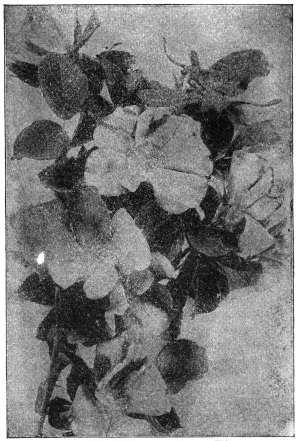 A WILD ROSE.—Nature Gave us This.
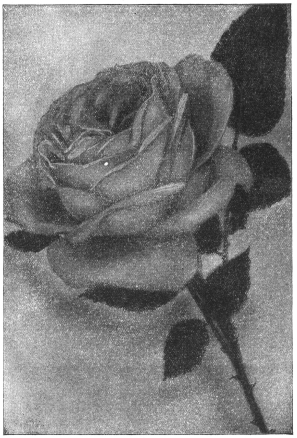 AMERICAN BEAUTY ROSE.—Good Heredity and Environment
Produced This.
AMERICAN BEAUTY ROSE.—Good Heredity and Environment
Produced This.
young men. She comes to you for your fatherly advice and counsel. You
know the records of the two young men. One is rich and rotten, the son
of a corrupt politician. The other young man has good parents, a clean
record, all the physical, mental and moral qualities of a real man, but
he is poor. Nine times out of ten you would advise your daughter to take
the fellow that is rich and rotten. You have good corn sense, good hog
sense, good cow sense and good horse sense; but you have mighty poor
son-in-law sense.”
When my audience ceased applauding, I held a book up before them and
allowed it to represent a ten-acre field to be planted in corn. I
assumed that all parts of the field were to have the same quality and
richness of soil, uniform rain-fall and sunshine, and the corn to
receive uniform cultivation. In this event the corn in all parts of the
field would have the same environment. Then I said to my audience, “If
there is nothing in heredity and you plant one-half of this field in
corn selected from nubbins and the other in corn selected from large,
shapely, full matured ears, the side of the field planted in nubbins
will produce as fine corn as the other side.”
If there is nothing in heredity, and all in environment, the offspring
from the vicious cow will be as docile and as safe as the offspring from
the gentle cow; the offspring from the scrub horse with a six-minute
record can be trained to trot as fast as the colt whose parents had a
record of a mile in less than two minutes; and the children of the
degenerate class will be as healthy and well developed, as intellectual
and moral as the children of the normal parents.
Heredity in plant life.—There is operative in every sprig of grass,
weed, vegetable, shrub, and tree two agencies—heredity and environment.
What they are and what they are to be are wholly determined by these two
agencies. In the past fifty and seventy-five years we have doubled the
size, variety and quality of our vegetables and fruits. Nature gave us
the wild rose, bearing a small bloom with five petals; nature and man
have produced the large, shapely, fragrant, beautiful rose of the yard
and garden, bearing from fifty to one hundred petals to the bloom.
Nature gave us the knotty wild strawberry; nature and man have produced
the large, luscious strawberry of the market and table. If our
cultivated and highly developed vegetables and fruits had been left to
the careless farmer, or in their wild state, with their heredity and
environment without intelligent control, a Keifer pear and an Alberta
peach would not have been produced in a million years.
Heredity in animal life.—In the last fifty and one hundred years
intelligent man, through the wise control of heredity and environment,
has produced the
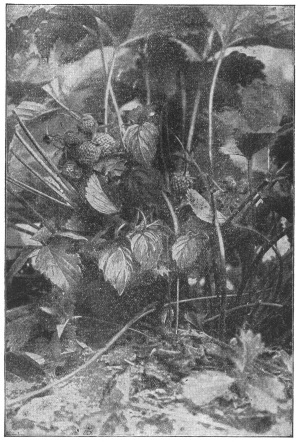 A WILD STRAWBERRY.—Nature Gave us This.
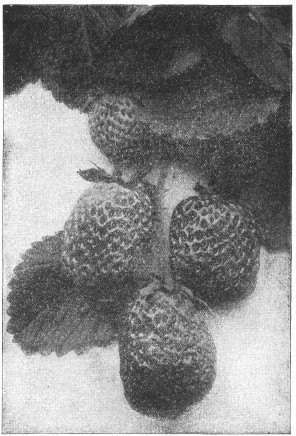 CULTIVATED STRAWBERRY.—Good Heredity and Environment
Produced This.
CULTIVATED STRAWBERRY.—Good Heredity and Environment
Produced This.
popular breeds of fine poultry; the Pointer and Setter dogs; the Poland
China, Berkshire and Duroc hogs; the Southdown and Merino sheep; the
Durham, Jersey and Holstein cattle; Percheron, Coach and Hambletonian
horses. Nature gave us the long-horned, crooked-limbed, brindle-haired
wild cow; nature and man have produced the Durham. Nature gave us the
wild horse that could trot at best a mile in six minutes and, when well
broken, was worth twelve dollars and a half; nature and man have
produced the Hambletonian that makes a mile in less than two minutes and
sells for twenty thousand. Nature gave us the razor-backed,
long-snouted, acorn-splitting Arkansas hog; nature and man have produced
the beautiful grunter of the barnyard and the performing pig of the
circus. The careless breeder or unaided nature could not have produced
these results in centuries of time. Man proudly claims the honor of
making these improvements. He maintains great stock shows and stock
journals, visits foreign countries and pays fabulous prices that he may
constantly improve his stock. He secures large appropriations from
government revenues with which to prevent the spread of hog cholera
among his hogs and Texas fever among his cattle. So great is man’s
interest in these improvements that nearly all men take one or more
agricultural, bee, poultry and stock journals and their wives take
poodle dog journals. Why this interest? Money and pleasure.
Money and pleasure more valuable than manhood.—We have seen what man
has accomplished among the vegetables, fruits and domestic animals, now
let us study his wisdom in the application of these agencies in the
human family. When we study man in relation to the world about him, his
physical, mental and moral possibilities, and from Revelation, we get a
glimpse of what the human race ought to be. In both sacred and profane
history we find some specimens of noble, ideal manhood. On the farm and
in the shop, behind the counter and at the bar, in congress and in
senate, on the platform and in the pulpit, we find some, who, by
inheritance, environment, personal effort and the grace of God, have
become examples of ideal manhood. But look at men in the mass. How few
examples of perfect manhood do you find in a crowd of ten thousand men?
Look at the enervated and stunted fathers; the nervous and sickly
mothers; the puny and weakly children; the poorly developed bodies and
dwarfed minds. Why should sixty-seven per cent. of our children be
physically or mentally defective at birth? Why should one hundred and
sixty-five children out of every thousand born in country places and two
hundred and twenty in the cities, die in their first year? Ninety-five
per cent. of the well-cared-for lower animals are perfect at birth and
ninety per cent. grow to old age and are rarely sick. Why should crime,
insanity, feeble-mindedness and epilepsy have increased three hundred
per cent. during the last twenty years? Why this remarkable improvement
among vegetables, fruits and domestic animals, and this appalling
degeneracy among men? Love of money and pleasure explains the one; man’s
fallen condition explains the other. Dollars and pleasure in one;
sacrifice, manhood and womanhood in the other.
Heredity versus environment.—If there is nothing in heredity, and all
in the environment, given the same environment, the offspring from the
vicious horse will be as easily broken and be as safe as the offspring
from the docile horse; the offspring from the horse that can make a mile
at best in six minutes can be trained to trot as fast as the offspring
whose parents could make a mile in less than two minutes.
My contention is that the same intelligence that has produced the
beautiful fragrant rose, the splendid vegetables, the luscious fruits
and our present improved varieties of domestic animals, can produce
similar improvements in the human family.
Heredity applied by the early Romans.—In the early history of Rome,
custom and law made it a special honor to be a Roman mother. She was
surrounded by examples of courage, bravery, strength, power, heroism
and purity. Special homage was shown her on the streets, at the arena,
and when viewing the marching victorious armies. Such treatment and such
environment made it possible for the Roman mother to become a real help
in making Rome the mistress of the world. Had this courtesy, gallantry,
manly attention, respect and reverence for girlhood, womanhood, wifehood
and motherhood continued, Rome might never have fallen. Have we the
gallantry, courtesy, respect and reverence for womanhood as in former
days? A quarter of a century ago it was indeed a rare thing that a man
would be so thoughtless as to smoke or swear in the presence of a woman;
now it is a very common occurrence.
Plato’s views.—Plato, a heathen philosopher, born more than two
thousand years ago, who never heard of the Bible or the Savior, made a
careful study of the laws of heredity, and for the improvement of men
suggested laws that would do honor to our day. In his Republic he
suggested that parentageable married people be prohibited from the use
of wine. Wine included all alcoholic drinks. He also suggested that the
inferior classes should be restricted in marriage and that marriage
should be encouraged among the superior classes. Under the teaching of
Plato, Lycurgus, in his reign, assuming that children were more the
property of the nation than of their own parents, sought to have all
children well born. In two hundred years that small nation is said to
have produced twenty-eight of the master minds of the world.
Genius is hereditary.—Aristotle’s father was a scholar and a
philosopher. Beecher’s father was a scholarly preacher. William Pitt’s
father at the age of twenty-seven was at the head of the English
government. Lord Bacon’s father was a great scholar and statesman.
Darwin was the product of several generations containing a number of
geniuses.
The Bach family of musicians in Germany is a fine example of musical
heredity. Among them were nineteen musicians of eminence. Fifty-seven of
their names are found in the Dictionary of Music. At family reunions
there were counted as many as two hundred and fifty church organists and
choir leaders. The genius for music appears to be as easily transmitted
as that for art or militarism. There appears to be only a very few
exceptions among the great musical geniuses.
Cæsar, Alexander, Wellington and Hannibal seem to have inherited a
genius for war. Napoleon Bonaparte’s Corsican mother, before his birth,
accompanied her husband to the field of war, exposing herself to
deprivation and danger, and being elated and thrilled by every victory.
When a child, he showed the military spirit. As a man of eighteen and
twenty he was a failure and attempted suicide. When twenty-three he was
given a chance to quell a raging mob in Paris, and crushed it in his
first effort. From that time until England chained him he conquered
everything before him.
From the days of the Crusades to the war with Spain we find the Lees
were military leaders. Cromwell and Grant appear to be exceptions to the
rule.
Max Jukes.—Vice, as well as virtue, runs in families. Max Jukes was
born in 1703. Both he and his wife were born of inferior parents. He was
a drinking man and seemed to delight in breaking law. His wife was a
common prostitute. We have identified and studied eleven hundred and
three of his descendants. One hundred and twenty-six were thieves and
murderers and spent several years in the penal institutions, ninety
female prostitutes, one hundred and forty-five drunkards; two hundred
and eighty-five were viciously diseased and four hundred had either
consumption, epilepsy, or were feeble-minded. Eleven hundred and three
were delinquents—not one a good citizen. They cost New York a million
and a quarter dollars.
Jonathan Edwards.—Jonathan Edwards was born in 1720. He and his wife
had splendid heredity. They were well educated. They were converted to
Christ in childhood. We have identified and studied thirteen hundred
and ninety-four of their descendants. We find thirteen university
presidents; one hundred and twenty-three college and university
professors; thirty-two eminent authors; ninety-six physicians; over two
hundred ministers; four hundred successful business men; one vice
president; mayors of large cities, U. S. senators and congressmen;
ministers to foreign ports; only one left a stain on the family
record—Aaron Burr who fought a duel with Alexander Hamilton.
The potency of heredity.—Suppose that the environments of these two
families could have been reversed and their heredity left the same,
could you then have written the figures after Max Jukes that we have
written after Edwards, or vice versa? No real student of sociological
conditions believes that we could. Environment certainly had much to do
with both of these families; but all students of heredity believe that
in these families heredity was as great as, or even a greater factor
than, environment. The dependent and delinquent descendants of Max Jukes
were the products of bad heredity, bad environment and the rejection of
Christ; the great and good descendants of Edwards were the products of
good heredity, good environment and the grace of God.
Bible and heredity.—In the Old and New Testament, the writers of nearly
every book appear to recognize the potency of heredity. We can refer to
only a few of them here as proof of the fact of heredity. God told
Sampson’s mother that she must drink no strong wine and eat no impure
food.
David gives a most excellent statement of the results of good heredity:
“But the mercy of the Lord is from everlasting to everlasting upon them
that fear him and his righteousness unto children’s children.” The word
fear, as applied in this case, means perfect obedience prompted by
respect, reverence and love for one in authority.
The Jews, who could trace their lineal descent to Abraham, often boasted
of their inherited superiority over other Jews and people of other
nations.
Paul, writing to Timothy, said, “When I call to remembrance the
unfeigned faith that is in thee, which dwelt first in thy grandmother
Lois, and thy mother Eunice,” etc. In this statement Paul accounts, in
part at least, for the strong faith and beautiful Christian character of
Timothy, on the basis of heredity.
David explains the sins of his life as being due, in part at least, to a
bad heredity. “I was shapen in sin and in iniquity did my mother
conceive me.”
Iniquities of fathers visited upon their children.—In Exodus 20:5, we
find a most remarkable statement of the hereditary results of obedience
to law and of disobedience. “I, the Lord thy God, am a jealous
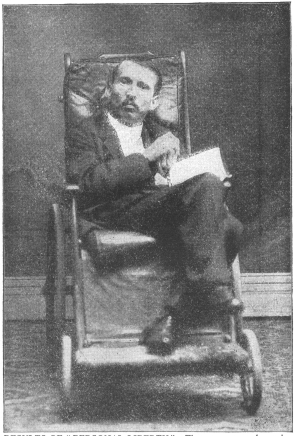 RESULTS OF “PERSONAL LIBERTY.”—The young man whose
picture appears on this page was studied by the author. His sister who
died at the age of five months was afflicted like himself. The initial
of their lives occurred during the drunken debauch of their father.
RESULTS OF “PERSONAL LIBERTY.”—The young man whose
picture appears on this page was studied by the author. His sister who
died at the age of five months was afflicted like himself. The initial
of their lives occurred during the drunken debauch of their father.
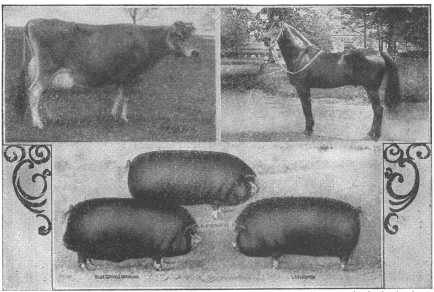 PROTECTED.—The above illustration of highly bred, highly
trained and highly protected animals, showing a cow valued at $13,000,
hogs valued at over $4,000 each and a horse at $5,000, serves as a
striking contrast to the illustration on the opposite page.
PROTECTED.—The above illustration of highly bred, highly
trained and highly protected animals, showing a cow valued at $13,000,
hogs valued at over $4,000 each and a horse at $5,000, serves as a
striking contrast to the illustration on the opposite page.
God, visiting the iniquities of the fathers upon the children unto the
third and fourth generations of them that hate me, and showing mercy to
thousands of them that love me and keep my commandments.” This is a much
misunderstood passage. God does not arbitrarily choose to force a
punishment upon an innocent child whose father ignorantly or viciously
violated law any more than he breaks the leg or neck of a man who
accidentally or with suicidal intent falls from the top of a building.
God has wisely placed all men under a variety of laws. The laws are all
planned for man’s good. If we keep all law, we develop manhood and
womanhood. By the agency of heredity we transmit to our children the
possibility of manhood and womanhood superior to that which we
inherited. If we constantly violate law, we acquire physical, mental and
moral degeneracy and transmit to our posterity defective conditions. In
this way God has planned for each succeeding generation to become
superior to the preceding one.
The statement is made that the iniquities of fathers are visited upon
their children unto the third and fourth generations, and that
“righteousness” is shown unto “thousands of them” (generations).
Why did God limit his first statement to the third and fourth
generation? Because there is no fifth generation of continuous and
unbroken iniquity. Here are two modern proofs of the truthfulness of
this ancient text.
A modern proof.—Two thousand erring girls were interrogated with
reference to the sobriety of their parents. Seventy per cent. had either
drunken fathers or drunken mothers, or both. In one state penitentiary
the author found seventy-two per cent. of the inmates had either drunken
fathers or drunken mothers, or both. Recent investigations in one of the
state reformatories for women show eighty-five per cent, had either
drunken fathers or mothers, or both. Twenty-two per cent. of the
feeble-minded, the insane and the epileptic had the initials of their
lives to take place during a drunken debauch.
Here is a husband and wife; both are habitually under the influence of
alcohol. Suppose their children follow their example and marry
companions addicted to strong drink, and the children of the next
generation follow the example of their parents and marry companions
addicted to strong drink, and this is continued, what will be the
result? There will be no fifth generation. In the first generation might
have been found a daughter in the house of shame, a son in the chain
gang of crime, a feeble-minded child, an epileptic, or one or more
alcoholics. As a result of four generations of consecutive drunkenness,
degeneracy would become so great as to result in complete sterility.
Another proof.—In every institution for the feeble-minded are to be
found inmates who have the “Hotchinson notched teeth,” “crowfoot tracts”
in the palate and throat, certain marks on the body—scientific proofs
that such are congenital syphilitics. Some ancestor, two or three
generations gone by, lived an immoral life, became infected with a
vicious disease and transmitted the degenerative influences down the
line to where it ended in complete degeneracy.
Who is responsible?—Is this a punishment from God upon innocent,
helpless children? No. God is in no sense responsible for it. Is nature?
No. Who is responsible? Men who sow their wild oats and boast of their
“personal liberty” to do as they please. Have God and nature any part in
this? Yes. God and nature in infinite interest, mercy and love for the
unborn millions who would be blighted with inconceivable degeneracy and
suffering, should they be born of such degenerate parents, say, “We have
given these descendants four generations in which to prevent further
degeneracy by marrying into pure and sober families, by reformation or
by redemption,” and since they have not availed themselves of these
restorative and redemptive means, reproduction must cease.
Morbid heredity and bad environment.—Bad environment and bad heredity
explain the presence of every convict in our penal institutions and
every inmate in the asylums. Laws and political administration that
tolerate, regulate and encourage strong drink and social immorality, the
two chief causes of degeneracy, and the parents who indulged in these
iniquities, are largely responsible for these thousands of defective and
delinquent beings who are crowding our asylums and penal institutions to
a dangerous and unsanitary overflowing.
Father, son and grand-son, uncles and cousins galore crowd these
institutions. Much of their mail is from relatives and bears the
postmark of a similar institution, showing that crime and insanity run
in families.
Man’s development originally under two agencies.—It is evident that God
originally placed man’s development under the intelligent control of
heredity and environment. If man had as wisely applied these agencies to
his own improvement as he now does to the improvement of the vegetable
and animal kingdoms, he would have developed to the highest possible
physical, mental and moral attainments.
His fall.—Man’s present condition of hereditary and acquired degeneracy
clearly reveals that somewhere in human history he has thrown himself
out of harmony with physical, mental and moral laws governing his
well-being. The record of man’s fall as given in Genesis is at least the
figure of a great fact in human history. Man’s fall involved the
violation of some law or laws vitally related to his physical, mental
and moral natures.
Need of a third agency.—The results of his fall were transmissible. In
his fallen state he was not able to use heredity and environment to
their normal capacity. His fall resulted in abnormal heredity and
environment. Without an additional agency fallen man was incapable of
recovery. Hence his need of redemption and the Redeemer. Now man has at
his command his intelligence, his will and the grace of God, by which he
may improve himself, improve his environment, and as a result of his
improved physical, mental and moral condition, he may transmit to his
posterity the possibilities of manhood and womanhood superior to what he
himself inherited. Just to the extent that man has received a good or a
bad heredity, keeps or violates law, accepts or rejects the grace of
God, just to that extent does he recover or degenerate, create a good or
a bad environment, and will transmit a good or a bad heredity to his
posterity.
Greatest blessing of parents.—What is the greatest blessing of
parentage? “Riches,” is the answer. Lots of fools think that. The
greatest blessing of parents to their children is a good heredity. What
a child is at birth he has received largely from his parents. What he
receives at birth largely determines his future.
Greatest blessing of society.—What is the greatest blessing of society
to a child? It is a good environment. Parents can form only a part of
their child’s environment. Society as a whole furnishes the environment
of a child. No individual, no class of men, no lawmaker, no
municipality, county, state or nation has the shadow of a moral right to
place by vote or official act, or permit by passive toleration a
lascivious picture, a vile book, a questionable resort, a place of vice,
a saloon or a gambling den that may lead a boy or girl to ruin. Whoever
assumes that right is an enemy to the social and moral well-being of
society. God’s greatest gift to men is salvation through His Son. Bad
heredity and environment are the only difficulties in the way of all
men’s accepting Christ. The complete effects of any one or two of these
agencies are impossible without the normal application of the other. No
one can wholly take the place of the other two, and no two can wholly
take the place of the other one. These three agencies should be ever
active in every life.
Three agencies necessary.—You might as well try to make a triangle out
of two sides as to try to produce physical, mental and moral perfection
in man by the use of environment and the grace of God, when the
individual has inherited little or no physical, mental and moral basis
for development. If a child has received ideal heredity, but is left
without educational opportunities and compelled to grow up in an immoral
atmosphere, never entering a Sunday school or church, it would be
impossible for him to develop scholarship or Christian character. If one
has good heredity and good environment and leaves the grace of God out
of his life, he is not what a man should be and will fall short of the
true object of life.
Is there a remedy?—If man’s present degeneracy had its origin in the
violation of law; if the evil physical, mental and moral effects have,
in some measure, been transmitted from one generation to succeeding
ones, until all men are more or less hereditarily degenerate; is there a
remedy, or are we the subjects of fate? Must each succeeding generation
continue to inherit a possible increase of degeneracy as we have done in
the past?
Relation of the three agencies.—Nature and man create environment. The
tendency of nature is to furnish only good environment for man. Man has
it in his power to help or to hinder nature. The more depraved man is
the more he hinders nature and produces for himself and others a bad
environment. If hereditary degeneracy could be eliminated from the
race, there would be no immoral environment. Bad environment is produced
by degenerate men. Degeneracy is both inherited and acquired. Inherited
degeneracy indulged, and acquired degeneracy are both transmissible. If
it were possible, under present conditions, for one never to violate a
law as a result of God’s grace and his own volition he could not
directly and personally transmit tendencies towards evil, and he would
transmit his inherited tendencies towards evil in a less degree than he
inherited them. Even with ideal heredity, environment and the grace of
God, one or more generations could not entirely overcome the bad effects
of all preceding generations.
The need of Christ.—Each individual is the sum total of all the
influences, good and bad, of all preceding lineal generations. The
inherited good and bad antagonize each other and are modified by
environment and the grace of God. If the good predominates, the bent of
that individual will be toward the good, and vice versa. His approach to
perfection will be determined by his heredity, his environment and by
his relation to Christ. Since all men always will be the sum total of
all the influences of the past, they will always need the Christ. There
will always be enough temptations in the world to develop the heroic in
man.
The race can be improved.—But it is reasonable that through the ideal
application of these three agencies one generation can to a very marked
degree overcome the evil effects of the past and transmit less
degeneracy than it received. If each individual would embrace the grace
of God, create for himself and others an ideal environment, this process
continued would ultimately give us a race free from the present serious
condition of physical, mental and moral degeneracy. If this conclusion
is not practical, logical and correct, then science and revelation fail
to give us a remedy for present race degeneracy. If this is the correct
solution of our physical, mental, social and moral problems, all
education, legislation, religious and personal efforts to bring about
race regeneration will continue to fail until the three-fold scientific
and scriptural gospel of good heredity, good environment and the grace
of God for every child, finds its proper place in all our personal
efforts, teaching, administration, legislation, and preaching.
Life is real.—What is life? Many theories have been offered by the
leading materialistic students of the past and present, but all have
signally failed to tell us what life is in its ultimate essence. All
attempts to discover life by aid of the scalpel, microscope and chemical
analysis have likewise failed. This class of scientists has made several
attempts to explain life as being the phenomena of matter undergoing
certain peculiar chemical changes, or due to molecular motion. They have
failed to recognize two great realms of existence, the material and the
immaterial, the visible and the invisible, the tangible and the
intangible. Life, physical, mental and spiritual, though invisible and
immaterial, is none the less real in its essence.
The materialists have tried hard to explain reproduction and heredity on
a physical basis. By this method they have failed to explain many of the
most common facts.
The germ cell.—The difference between the germ cells of the lower
animals and man is not in their structure, or their chemical elements,
but in their inherent life. Here are three germ cells. As fast as the
scientist is capable of analyzing them they may be absolutely identical
in their physical anatomy, yet one may contain the life of a rabbit,
another the life of a dog, and still another the soul of a man. The
physical anatomy does not determine whether the offspring is to be a
rabbit, a dog, or a human being. It is the resident life that determines
this. Physical organs are the mediums through which life reproduces
itself. The heredity of the offspring is determined by the many
influences brought to bear upon it before birth and upon the lives of
the ancestors.
Masculine and feminine principal.—The organic world is pregnant with
two primary and vital principles, the masculine and the feminine. Every
plant, lower animal, and man is reproduced by the union of these
principles. In the lower forms of plant and animal life these two
principles reside in the same organism. Reproduction takes place within
the parent organism by the union of these two natures. The parent
organism divides and becomes two distinct organisms. This is
reproduction by division.
Reproduction in the lower forms of life.—In the next higher forms of
plant and animal life these two principles reside in the same
individuals, but in separate organs. These organs possessing the female
nature produce seeds or eggs. The organs possessing the male nature
produce a fertilizing substance called pollen or semen. Reproduction
takes place by the fusion of the male and female cells.
In the higher animals and man these principles reside in separate
individuals. In some mysterious way the procreative cells have residing
within themselves, in rudimentary form, all the attributes of the
parents.
Sex is in the life principle.—Once sex was considered a part of the
physical organism. Now we are beginning to see that sex is vitally and
substantially related to life. When a little plant comes into the world
it is because the masculine and feminine sex principles have united on
the plane of physical life. Like begets like. The baby plant did not
possess animal life, intellectual life, or moral life for the reason
that the parent plant could not transmit a form of life it did not
possess in its masculine and feminine nature.
When the little animal comes into this world it is because the masculine
and feminine principles have united on the plane of instinctive animal
life and, among the higher classes of animals, rudimentary mental life.
Reproduction man.—Man is organized on higher planes than the rest of
the organic world. Man possesses not only the highest form of physical
life, but also mental and spiritual life. Sex in man is primarily and
substantially related to his physical, mental and spiritual life. The
sperm cell of the father is formed from his blood and possesses the
essence of his three-fold nature. The germ cell of the mother is formed
from her blood and possesses the essence of her three-fold nature. When
these two cells, masculine and feminine, unite under proper conditions,
a human being having a physical, mental and moral nature, is started
upon its endless voyage, nine months before it makes its visible
appearance in the world. When God made the body of primitive man He
“breathed into him the breath of life (Hebrew lives) and man became a
living soul,” having power of self-propagation and the power to transmit
potential procreative power from one generation to another.
Man’s relation to the past.—Each new being at the initial of life is
the sum total of all the influences, good and bad, of his ancestry back
to Adam. The child is largely the product of his parents. He is not a
duplicate of either, but the product of their blended personalities,
being influenced much by his grand-parents, less and less as his
ancestry becomes more and more remote. During embryonic and fetal
development the child will tend to unfold in all departments of its
nature according to the pattern received from its ancestors, but this
may be more or less influenced by maternal impressions. After birth the
child has two agents that will ever be active, heredity and
environment. These two agents at their best are never perfect. Hence
the child will ever need a third agent, the grace of God.
Why children in the same home differ.—Here is a family of five
children. They differ from each other quite as much as if they
represented five families. Now, if heredity does not explain this
difference, then the children, having the same environment, would be
alike. The children in the same home differ from each other for the
reason that the parents, at the creative moment, did not sustain to each
child the same combination of physical, mental and moral relations. At
the creative moment of the second child the parents were not in the same
physical, mental and moral states they were at the creative moment of
the first. They had each changed in their physical states of health,
their mental interests and in their moral and religious convictions and
experiences. For the same reason each child differs from all the others
in the family. Though they had the same environments, no two were alike.
So great is the influence of heredity that no two people can be made
alike by giving to them the same environment.
Twins.—If two persons could receive the same heredity and environment,
they would be exactly alike. The nearest approach we have to this is in
the case of twins. Nearly one-half of twins are so much alike
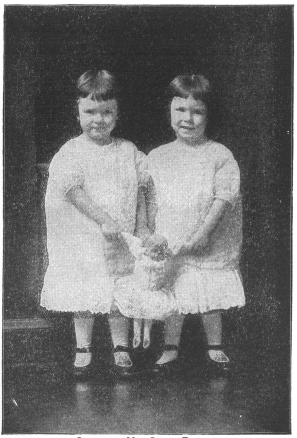 Louise and May Carter, Twins.
that it is difficult to tell them apart. Other twins resemble each other
more than children in the same home born months apart.
Why some are alike and others are not.—If the creative moment of twins
were the same, or nearly the same, the parents sustained to each the
same combination of influences. If their creative moments occurred hours
or even days apart, then there was time for one or both parents to
sustain a different relation to one, from that they sustained to the
other. This accounts for the difference between some twins. Not only do
twins resemble each other physically, but often their mental and moral
tastes and tendencies are very much alike.
Twin brothers.—I once met twin brothers sixty-seven years old. They had
been lost to each other for fourteen years. They still resembled each
other, dressed alike, wore their beards and hair alike, talked and
laughed alike. Sixty-seven years had not greatly modified their physical
and mental resemblance. Twin children usually inherit similar
perfections or imperfections. This I have noticed for a number of years.
Where I am now writing is a club-footed, rheumatic boy. His twin brother
is feeble-minded. In an adjoining state a few days ago I studied a young
man who was helpless from his arms down. His twin sister was helpless at
birth and died in childhood. These examples indicate that the
before-birth influences being the same, were the causes of these defects
in the offspring.
An objection answered.—A man said to me, “I don’t believe in heredity.”
I asked him why he did not. He replied, “I know of a drunken father who
had four sons; two were dissipated from their youth and two were
‘teetotalers.’ If the father had had anything to do with this, all would
have been drunkards.”
My reply was, “The father through the laws of heredity may have
transmitted to two of his boys tendencies toward drunkenness and to the
other two, tendencies toward sobriety. In the case of the first two, the
father might have, in his mental and moral natures, favored
intemperance, longed for alcohol, or been on a drunken debauch at the
initial of their lives. With reference to the last two, the father might
have temporarily reformed, mentally and morally, he might have been
strongly opposed to the use of strong drink at the initial of their
lives.
“Again the mother might have had very light convictions on temperance
prior to the birth of the first two and very strong mental and moral
opposition prior to the birth of the last two. Again something in the
form of environment may have led the last two to overcome their
inherited tendencies toward drink.”
Materialistic theory fails.—Materialistic philosophers admit that
heredity tends to reproduce the likeness of the parents in the child.
They try to explain this on a purely physical basis. Prof. Huxley, Mr.
Spencer and the more modern Weismann, while they have each coined some
new technical terms with which to convey their materialistic ideas,
suppose that each procreative cell, masculine and feminine, contains a
representative material something from every atom of the respective body
from which it was formed. In this way the child has a body with marked
resemblance to its parents. Since, according to their theory, all mental
and moral phenomena are due to chemical changes and molecular
disturbances in the brain, and since the child inherited a brain like
its parents, the molecular movements of the child’s brain will be like
the molecular movements in the brains of its parents; hence it will have
inherited the mental and moral characteristics of the father and mother.
Life is a unit.—It takes only a few days for the procreative cells to
be elaborated and matured. Here is a child. The initial of its life
occurred twenty years after its parents had their right arms amputated.
How could the procreative cells that formed the initial of that child’s
life have in them a material representation from the right arms of those
parents that had been amputated twenty years before the birth of the
child? Suppose that the parents had undergone a much larger mutilation
of the body, leaving them only the organs necessary to continued life
and propagation, would the child have inherited the absent parts? Yes.
Why? For the reason that sex is in the life of the individual, and not
simply in the material substance of the body. A human body may have had
some of the members removed but the physical life remains a unit. The
embryo formed by the union of a masculine and a feminine cell will have
a unit of physical life. During the nine months of gestation this unit
of embryonic physical life will be incarnated in a unit of physical
organism. Should a lobe of the brain of each parent, through which some
mental or moral attribute functions, be removed, the child would inherit
a unit of brain organism, for the reason that it inherited from the
parents a unit of mental and moral life.
Sex a resident part of life.—These illustrations show that sex is
vitally related to the physical, mental and moral life; that the
physical nature of the child is the product of the union of the
masculine and feminine principles of the physical life of the parents
represented in the procreative cells; that the mental nature of the
child is the product of the union of the masculine and feminine
principles of the mental life of the parents represented in the
procreative cells; that the spiritual nature of the child is the product
of the union of the masculine and feminine principles of the spiritual
life of the parents represented in the procreative cells. The three-fold
life of a child is the product of the blending of the three-fold life of
its parents.
Heredity explained.—The Bible tells us that “the blood is the life.”
Science cannot express this truth better. The three-fold expressions of
life are not in the blood. The blood furnishes life for every cell.
Physical, mental and moral states are influenced by the conditions of
the blood. These three natures meet and influence each other in the
blood. Jesus appealed to the will of the patient. “Wilt thou be made
whole?” “Arise, take up thy bed and walk.” “Stretch forth thy hand.”
Jesus recognized the influence of the mind, expressed in will, as well
as the spiritual expressed in faith, as a means of physical restoration.
Every successful doctor, whatever may be his medical views, recognizes
the value of a strong purpose to recover.
Effects of different mental states.—Men and animals alike lick a fresh
wound. Nature teaches them that the saliva alleviates pain and heals the
wound. If an angry person bites you, or you lick a wound after an hour
of intense anger, you have a wound with all the symptoms of poison and
it will be difficult to cure. Hundreds of cases are on record where
angry mothers nursing their babies have thereby thrown them into
convulsions or spasms. Jealousy will result in digestive disturbances.
One can grieve so much over the loss of property or some member of the
home by death as to injure the health. It is claimed that a great
chemist took the various secretions from a subject that had been
intensely angry for hours and succeeded in removing from the various
secretions more than a score of poisons. In the case of another subject
swayed by holy impulses, the kindest of feelings, the purest of love, he
removed more than a score of wholesome, nutritious ingredients without a
single poison.
Mental and moral states influence the offspring.—If right mental and
moral states will give to the saliva, secreted from the blood, curative
properties; and wrong mental and moral states will give the saliva a
poisonous nature; if right mental and moral states influence the milk
secreted by the breasts of a mother in a normal way; and wrong mental
and moral states will so influence the mother’s blood as to throw her
four-months-old nursing babe into spasms, cannot the father’s mental and
moral states influence the creative secretions from his blood, and the
mother’s mental and moral states, at the creative moment and during the
nine months of embryonic and fetal development, influence the creative
and life sustaining and life-developing secretions from her blood?
Who was to blame?—I once met a family during one of my lecture courses
and was entertained in the home over night. Their children, five in
number, all during my lecture picked at each other, scratched each
other, fought each other, fussed, quarreled and cried. As we rode in the
carriage to their home and during our visit those youngsters kept up
this same line of entertainment. After I had retired the man stepped
into my room and whispered to me that he and his wife were in great
trouble, that they had been at the point of separation for ten years and
asked me to teach them how to live happily together, and to be less
miserable. I asked him to tell me the cause of their inharmony. “Oh,
there is but one trouble between wife and me!” He spoke as if that were
quite insignificant. Finally he told me that the trouble in the home
was, “neither of us can control our tempers.” As he left my room I
realized that for once in life I had a government contract on my hands.
Then I mused: “Ten years of quarreling, ten years of disagreement, ten
years of family feuds and family strife and these parents have
transmitted more of bad disposition to their children than the children
will be able to conquer in a lifetime, or these parents will be able to
whip out of them before they are of age, chasing them around over a
three-hundred-acre farm.” Continuing my meditation I thought: “If I had
the power to make laws, I would make a law of mercy for such
unfortunate children as these. That law would provide that where parents
transmit as much unnecessary devilment to their children as these
parents have to theirs, that the children should have the legal right to
whip their daddies and mammies.”
The child not an exact duplicate of either parent.—These parents had
produced their mental and moral states in their children.
These illustrations will help you to understand the philosophy of
heredity. The two cells that unite to form the initial of every new life
are elaborated from the blood of their respective parents and each cell
has the physical, mental and moral natures of its parents in potential
form. Were it possible for a child to inherit its size, form, features,
disposition, tendencies, etc., from only one of its parents, and to grow
to maturity uninfluenced by environment and education, it would
necessarily be an exact duplicate of that parent. Because of its dual
parentage, the maternal impressions received before birth, and the ever
varying influences of environment and education, the child will be
unlike any other person that ever lived.
The child resembles both.—These cells often remain in the bodies of the
respective parents for several days before the initial of a life takes
place. It follows that the mental and moral states, as well as the
physical condition of the parents, for many days before conception takes
place, will influence the child. There is no doubt but the remote
conditions of the parents are transmitted, but not so certainly and so
fully as the existing, or recently existing, states of the parents. At
the initial moment the three natures of each of the parents will be
greatly modified in the union of the cells. If the separate natures of
the parents did not blend in the child, the child would have two mental
natures, two moral natures and two physical natures. The modification of
the inherited tendencies from each parent will depend largely upon the
relative strength of these natures in the parents. Hence, where the same
characteristic exists in each parent it will appear in the child in a
reduced, duplicated or exaggerated form.
Prenatal opportunities.—During prenatal life, the forming child in the
mother’s body is supplied with its physical, mental and moral building
material from the mother’s blood. During the first twelve months of its
postnatal life, or the period of lactation, the mother’s blood,
environment and education are the child’s sources of physical
development. During these periods the child is almost wholly pliable in
the hands of its physical sculptors and mental and moral teachers. The
prenatal existence of a child affords the parents their greatest
opportunity to train the child, “in the way it should go.”
Mother’s advantage.—From these facts we see that the mother has the
advantage of the father in influencing the forming body, the plastic
brain and the sensitive soul of the child. Owing to the double standard
of morals it is certainly a blessing to the world that this is true.
Whatever is undesirable in the father, especially in his moral life, in
a measure may be overcome by the mother. The story of Abraham’s two
sons, Isaac, the true son, and Ishmael, the son of the bond woman, is a
familiar illustration of this truth. Isaac became a good man; Ishmael
became a bad man, the founder of the Ishmaelites, “whose hand was
against every man.” Do you recall to memory a mother fallen in
character? What has become of her children? Daughters fallen and sons
worthless, often without an exception.
Suppose women all lived as men do, what would be the effect on the
coming generation? Suppose men and women were alike temperate, honest,
truthful and pure, our civilization would be as much superior to the
present as the present civilization is superior to heathenism.
The mother’s larger hereditary influence proven.—Do you recall a
drunken mother? How about the children? Dissipated and delinquent. A
young lawyer, gifted, conceited, ambitious and eager for position and
power had, according to his views, but one thing in his way to the goal
of success—money. After thinking over the surest and best methods of
getting money he decided to marry it. His first opportunity was a
wealthy feeble-minded heiress. He married her. To their marriage five
children were born. Three were positively mentally weak. The other two
were noticeably so. Of these two, the first was a natural thief and the
other a natural liar. Only one child resembled the young lawyer, the
last one.
When training should begin.—It was a saying of a Yale president that “a
child’s training should begin with its grandparents.” Another has said,
“A child’s training should begin one hundred years before it is born.”
There is more truth in those quaint sayings than many are willing to
accept. Most parents give their children no premeditated and intelligent
prenatal training, and many think that when the child has become
accountable is soon enough for its training to begin.
Children products of blind chance.—There is an idea among many that
every child comes straight from God and made to His order, and that
parents are obediently to receive them when God sends them. Let the
child be beautiful or homely, blonde or brunette, girl or boy, strong or
feeble-minded, good or bad, no matter, God gave the child. Some think
these things are all accidents, fortunes or misfortunes, or they belong
to “the unknowable.” There are no accidents. Every effect has its cause.
Nothing comes by chance alone. Unalterable and invariable law governs
everything. The law of heredity is as unerring as the law of
gravitation. Our ignorance of the law does not prevent its operation.
Robbed of their birthright.—The great mass of people are not well-born.
Aside from the degenerate criminal and the feeble-minded, universally
recognized products of heredity, most people are below what nature would
teach us they should be. They were born with mediocre capacities for
business success and intellectual attainment. Give them the earliest and
best advantages and training that this country affords and marked
improvements will be made by them, but they will not make great men in
any line of life work, for the simple reason that they cannot. It takes
some natural capacity for the highest success.
Occasionally a child of unusual gifts is born of parents much below the
average. The parents and their friends are likely to believe the gift to
be a special divine bestowment. But, if the child’s prenatal history
could be fully known this would be accounted for on the basis of
hereditary law. The unscientific farmer may occasionally raise a fine
ear of corn or a very large crop of potatoes. But the intelligent,
scientific farmer raises only the best.
Sowing wild oats.—If girls were addicted to loafing on the streets,
swearing and telling vulgar stories, smoking and drinking, gambling and
going to questionable places, we should not consider this good training
for wifehood and motherhood. No intelligent man would choose such a girl
to be the wife of his bosom, the queen of his home, the mother of his
children. He is an ardent believer in the training of girls before
marriage for wifehood and motherhood. Boys who engage in any of these
sins are as much unfitting themselves for parentage as girls would be.
“Oh, but a reformed rake makes the best husband.” If he makes the shadow
of one, it will be a miracle of grace that he does it. No “rake” can in
his own strength make a good father. If by God’s help he makes a good
husband and father, this will be done in spite of his former life, and,
not because he had been a “rake.” Sowing wild oats in youth does not
make it easier to be good in after life, but more difficult. Boys and
young men should live with a view to husbandhood and fatherhood.
Immature parents.—Experienced stock raisers will not breed inferior or
immature stock. If one or both animals to be used for breeding purposes
be young, immature, the offspring will be inferior. All leading
physiologists place man’s maturity at about twenty-four and a woman’s at
about twenty. If continence in thought and life controlled our social
relations, it would be best for the human family if marriage did not
take place until maturity. Under existing social conditions, sexual
dissipation, and its dangers, it is perhaps best, in some cases, that
they marry a few years younger. But for fifteen-and sixteen-year-old
girls and nineteen-and twenty-year-old boys to marry is a decided
physiological and psychological mistake. Children can no more parent
normal children than can pigs, colts, and kids parent normal young. A
great sociologist says that four to six per cent. more children whose
mothers married at sixteen will die in their first year than among
children whose mothers married at twenty; and that six to ten per cent.
more children whose fathers married at twenty will die in their first
year than among children whose fathers married at twenty-four.
An ideal family.—At the close of a lecture on heredity in a college
town, a gentleman invited me to take dinner at his home the next day. I
accepted his invitation. From eleven o’clock to twelve he and I sat in
front of his little cottage home chatting pleasantly. When the college
bell announced the noon hour, he turned and said, “When my two boys and
my girl return home for dinner I want you to study them as examples of
intelligently applied laws of parental preparation, prenatal training,
good environment and the Grace of God.”
A few minutes later my attention was called to the rattling of the gate.
Turning, I beheld two fine specimens of physical manhood and an equally
fine specimen of physical womanhood. On closer acquaintance I found they
were leaders in all their classes, leaders in the best circles of
society and leaders in church work.
Dinner over, the young people returned to college; dishes were cleared
away, and father, mother and I sat in front of that same cottage home;
the conversation naturally drifted to heredity and to the young people.
The father humbly but proudly said, “Professor, if wife and I should
sell all we have, including our wardrobe, we could not raise $1,500. We
have never been ambitious for broad acres of land, a palatial home or
heavy deposits in the bank. We have had just one all-controlling purpose
in our married life, and that has been to give to the world a family of
children who will honor us after we are dead, be a blessing to the world
and glorify God.” My reply was, “You have certainly erected to your
memory three splendid monuments, monuments far grander than if you had
worn out your muscle and brains in the production of sordid silver and
gold and had left to your children a round million, and they, out of
their gratitude, had erected to your memory a marble shaft piercing the
very sky.”
I said it then, I have repeated it many times since, “I wish I had the
money to pay the transportation and hotel bills of this family on my
lecture trips and at the close of a lecture on heredity, could call this
family to the platform as a living example of intelligently applied
principles of eugenics.” If the initial moment of every child born into
this world were intelligently planned for, its prenatal rights
respected, its advent warmly welcomed, its environments wisely chosen
and it were early led to accept Christ, every family would be equal to
this family, and the next generation much superior to this. Will you,
gentle reader, model your ideals after this home, teach these truths to
others, and teach them to teach these truths to still others? If you
will, then you will have done your part towards the world’s redemption.
Indications of constitutional degeneracy.—Feeble-mindedness, epilepsy,
insanity, scrofula, cancer, rheumatism and gout are the outward
indications of constitutional degeneracy and inherited tendencies which
are often transmitted from one generation to another of a deteriorating
family. These conditions in nearly every instance were due either to
strong drink or to sexual sin. In most cases consumption may be added to
the above list.
Choosing a degenerate companion.—If you and your family have a clear
record of physical, mental and moral health, you can form habits of vice
or marry into a family addicted to vice or into a family
constitutionally degenerate and hand down to your posterity hereditary
conditions and tendencies.
A clear bill of health to your children.—If you and your family have a
bad record of health, you can, by a virtuous and temperate life, strict
observance of the laws of health, and an intelligent choice of a
companion, largely overcome the effects of bad heredity and environment
in yourself and transmit a clean bill of health to your children.
Neurotics.—Don’t marry into a neurotic family. Your partner might
become insane and your children be afflicted.
Drunkards.—Don’t marry into a family where there are several drunkards
and don’t marry a person addicted to strong drink. Remember that you are
choosing the father or the mother of your children; and that choice is
final. If children could choose their parents, they would hesitate
before making such a choice.
Consumptives.—If you are suffering from any form of tubercular disease,
you should not marry. Neither should you marry one having consumption,
nor into a family where consumption is common. It is possible to
overcome all tendencies to consumption and to effect a cure in the
earliest stages.
Consumption and cancer.—For a person having consumption to marry into a
home where cancer is common would be a combination fraught with great
danger to the offspring. The children would be handicapped from birth
with frail bodies, liable to similar diseases, and most of them would
die during adolescence, or before. The worst results follow where both
companions have inherited the same disease.
A low vitality.—A parent cannot transmit to the child what he does not
possess himself. Children of immoral parents, invalid parents,
feeble-minded parents, sexually exhausted parents will necessarily
inherit impoverished vitality.
The immature.—In all countries where immature marriages are tolerated
or encouraged the children are small, wretched, unhealthy and
shortlived. This was observed in the days of Greece, in past generations
in France, to-day in India and may be observed wherever encouraged in
our country. From four to ten per cent, more children born of immature
parents will die in the first year than among children of matured
parents. Idiocy and physical imperfections; a lack of energy and courage
will be quite common among them. As a rule girls mature at twenty and
boys at twenty-four. Marriage earlier than these ages should be
considered immature.
Difference as to age.—The young man, as a rule, should be four to six
years older than his bride. Unless a man’s strength and vigor are
exceptionally well maintained, he should not become a father after he is
fifty. Sociologists claim that a larger per cent. of the children born
after their fathers were fifty become sexual offenders, dishonest and
criminals than among children whose fathers were younger.
Criminals.—Don’t marry into a family where there is a number of
criminals. Where crime is common in a family you will find many of the
outward signs of constitutional degeneracy mentioned in the first
paragraph of this chapter. Frequency of crime in a family indicates
deterioration.
Wealth should have no influence.—The choice of a companion should not
be influenced by money interests, base desires, or any other unworthy
motive. If one’s choice is influenced in one of these ways domestic
harmony and well-born children will not be possible.
Masculine women and feminine men.—Don’t marry an effeminate man. Don’t
marry a masculine woman. The masculine should predominate in man. The
feminine should predominate in woman. Where the feminine nature
predominates in the wife and the masculine nature in the husband
soul-union will be possible, domestic harmony will prevail and the
children will be well-born.
Marriage of cousins.—Don’t marry into a family where first and second
cousins have married for several generations. This custom gradually
leads to constitutional degeneracy. Should first cousins marry where
there have been no previous intermarriages, no serious defects will
likely be transmitted to the children.
Value of chastity.—True marriage is based on genuine, pure love and the
harmonious mental and temperamental adaptation. True love between the
sexes is the child of the sex life. When lascivious thinking and habits
change sexuality into sensuality lust becomes a substitute for love. If
the real cause of divorce were known it would be found in most cases to
be due to the dissipation of the vital energy, which is the basis of
love. In nearly every case man is responsible for his home’s being
wrecked. In the choice of a companion, chastity is of vital importance.
Temperaments.—Authorities recognize three distinct temperaments: the
motive, the vital and the nervous or mental. Where the motive organs,
the muscles and bones, predominate, the physical powers will be most
prominent. Where the vital organs, indicated by a heavy-set body and a
full chest, predominate, the manifestations of life will be most
prominent. Where the nervous system predominates, the mental powers will
be most prominent.
Motive temperament.—The motive temperament is indicated by bones broad
and large; muscles slim, firm and tough; the individual is tall,
angular, brow prominent, cheek-bones high, shoulders broad, chest full,
eyes and hair usually dark. Such persons are usually very pronounced in
their views; firm, ambitious, stern and severe. Two persons having very
pronounced motive temperaments should not marry. There would be two
bosses in the home and the children would be willful and unsociable.
Nervous temperament.—The nervous temperament is indicated by sharp
features, light frame, head rather large, face oval, forehead high, eyes
expressive, movements quick, neck slender and feelings usually intense.
Should parties of this temperament marry disagreements would be frequent
and the children would be delicate, weak and over precocious.
Vital temperament.—The vital temperament is indicated by a rather low,
heavy-set body, hands and feet small, neck short and thick, chest full,
shoulders broad, face and head round, hair and eyes generally light.
Persons of this temperament are, as a rule, not great students, inclined
to be impulsive, very sociable, versatile, cheerful and ardent and
liable to be fickle. Where these characteristics are very pronounced,
marriage with a person of another temperament would be advisable.
However, most persons of the vital type have a harmonious, balanced
temperament. Here likes may marry like.
Like should not marry like.—If one has a very pronounced motive
temperament he should choose a companion having a more plump and
symmetrical form, with a genial and yielding nature. This would be
conducive to domestic harmony and would give the children a favorable
heredity.
The law of compliments.—One with a pronounced nervous temperament
should select a companion having a vital temperament or one having a
moderate motive temperament. If young people were prompted by unselfish
motives and a pure chaste love, mistakes in marriage would be extremely
rare. Where choice of a companion is determined by financial interests,
sensual desire, or other selfish motives, the soul is denied its
prerogative in the selection of a mate. No man in a normal condition and
prompted by unselfish motives would select for his companion a masculine
woman, a consumptive, a neurotic or one with an excessive motive or
nervous temperament, and vice versa. The subjective minds of possible
soul-mates come naturally and easily to comprehend each other’s joys and
sorrows, longings and love. Most married people are fairly well-mated
and comparatively happy. Their adaptation to each other and their soul
oneness grew out of a natural affinity to which they unselfishly yielded
rather than from an intelligent choice based on a knowledge of the laws
of adaptation.
Mismates.—Perhaps one-half of the married are not well-mated, for
reasons already stated. Owing to the fact that so many are mismated, a
condition growing out of artificial and unnatural social, economic and
moral conditions, the advice of this chapter should be carefully
studied by young people before they make the choice of a life companion.
Atavism.—All students of natural history have occasionally observed
among plants and animals the reappearance of something that belonged to
their remote progenitors, but which did not belong to their immediate
parents. This tendency for remote ancestral characteristics to reappear
after lying dormant for one or more generations, is called atavism. This
fact is sometimes observed in the human family.
Examples.—As a rule, when one child in the home possesses some marked
morbid tendency or special gift not possessed by other members of the
family, it can be accounted for on the basis of some initial or maternal
impression. But this is not always true. A deaf mute may be born in a
home and the cause traced to some remote deaf mute ancestor.
Consumption, insanity and other diseases may disappear for one or more
generations and then reappear. This is a fact recognized by many
physicians.
Two first cousins from families remarkably free from intemperance were
ruined by intemperance. Both seemed powerless from the first indulgence
to resist the habit. One was dissipated from childhood, the other did
not begin until he was twenty and was a wreck in six brief years. Their
grandfather was a periodic drinker. The appetite had slumbered in one
generation but broke out in the next.
Love the basis of marriage.—In the choice of a life companion one
should be absolutely sure that his choice is prompted by pure and
unselfish love. If love in courtship and marriage is genuine it will
have but one idol. Selfish interests and base desires may lead one to
admire and worship more than one, but this is not love.
Chastity the basis of genuine love.—This genuine love that draws young
people into beautiful courtship, happy marriage and makes them one is
vitally related to the sex nature. Without sexuality this expression of
the affectional nature would not be possible. When this God-honored,
love-creating nature is converted into sensuality, lust, not love,
reigns in courtship and marriage.
Love tested.—The genuineness of love may be tested in several ways.
Whenever the choice is largely determined by financial interests or
social prestige the parties are drawn to each other for selfish reasons,
and not by unmixed love. If a young woman wins a companion by wearing
low-necked dresses, permitting young men to hold her hands, play with
her hair, kiss and caress her, by going with them to public dances, and
low theatrical entertainments, she makes her appeal on the plane of the
sensual. Courtship and marriage on this plane are a travesty on love. It
is not always easy for the vigorous and healthy to distinguish between
selfish interest, base desire and love. A good test would be for lovers
to cease their calls and correspondence for ten days; meanwhile they
should attend social functions and call on and accept calls from others.
If they find it impossible to admire and love some other person and
their love for each other remains intense and warm under these
conditions, they may safely conclude that their love is genuine.
The right of a child to receive good heredity.—Every child has an
absolute right to be well-born. To receive a good inheritance is worth
infinitely more than to be born in a palace and inherit millions in
money. The prenatal period of a child is more important than any other
period in its earthly life. Parents are responsible to the child, to
society and to God for what they bequeath to the child at birth. The
child well trained till its birth is fully half trained. If the child
inherits a good basis for a strong and healthy body, mind and morals, it
can make a success in life. It is true that some parents prefer leaving
the physical, mental and moral possibilities of their children to
providence or “blind chance,” to practicing a little self-denial. But it
is certainly the desire of all thoughtful parents to have their children
well-born.
Planning for the initial of a life.—The initial of every child should
be intelligently planned. Only parents who have their sexual nature
under control, or those who can and will bring it under control, can do
this. This can be done most easily by parents who in their youth were
trained to see that the primary use of the sexual energy and function is
to build up and maintain perfect manhood and womanhood through life and
for procreative purposes in the married life, and not for unrestricted
selfish pleasure.
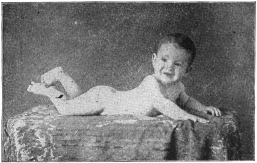 WELL BORN.—Mark Henry Woodward, age seven months; weight
eighteen pounds; clings on to a horizontal bar for a full minute; food,
breast-fed; health, never sick.
WELL BORN.—Mark Henry Woodward, age seven months; weight
eighteen pounds; clings on to a horizontal bar for a full minute; food,
breast-fed; health, never sick.
Why few children are well-born.—Where married people have been falsely
educated in the idea that marriage means unrestricted indulgence, and
under this delusion have created unnatural demand, a horde of evils will
follow. If this unfortunate class care only for a selfish pleasure, the
children will follow each other closely and will receive a poor
heredity. If they use preventive means to restrict the size of the
family, the few children born into the homes will be far more
unfortunately born. Excess in the marriage relation impoverishes the
body, mind and soul and unfits for true parentage those who practice
such excess. Every device used to prevent conception or to destroy
unborn life will work untold injury to the parents, and the occasional,
accidental and unwelcome child will receive a most unfortunate heredity.
The mental and moral states, as well as the physical condition, of the
parents, for months before and at the initial moment and during
gestation must necessarily become a part of the child.
Whatever is received into our physical, mental and moral life becomes an
essential part of ourselves and is transmissible to our offspring.
Prospective parents should not at any time engage in anything that would
be undesirable if reproduced in their children.
Intelligent preparation.—A knowledge of the laws of heredity will
enable parents largely to overcome in their children any undesirable
qualities possessed by themselves or their parents and to transmit to
their children desirable qualities in a larger degree than that
possessed by themselves.
In planning for a child, the parents should carefully study each other’s
good and bad qualities, weak and strong points, their active and latent
talents with a view to an intelligent cultivation of their good
qualities and the restraining of the bad, strengthening their weak
points and calling into activity every valuable latent capacity. In this
way they may transmit only the best to the child. Both parents should
ardently desire a child. Both should begin the preparation months before
the initial of the new life and both should continue the preparations
until the child is born. While the father’s direct hereditary influence
upon the child ceases with the inception of life, his continued training
will encourage and inspire his wife to continue her training until the
birth of the child.
Physical preparation.—Both husband and wife should be in a perfectly
healthy condition while planning for a child. The intelligent stock
breeder appreciates this statement. He knows that the offspring will be
defective if either of the parents is in a low state of vitality.
Systematic treatment and feeding will be followed until the animal is
brought to a normal condition before the initial of reproduction is
allowed. The healthy or unhealthy condition of the blood determines the
health of the body. The blood is the creative source of new life. Every
new life is affected by the physical condition of its parents’ blood. It
is a sin and a crime for parents knowingly to inflict physical weakness
upon their children. Is it not strange that men will take every
precaution to have their stock well-born and yet utterly ignore these
essential precautions in relation to their children? There are some
married people who have physical ailments that render them permanently
unfit for parentage. Such should be wise enough to refrain from becoming
parents.
An invalid mother.—When a mere boy I overheard a man say, “This is our
twelfth child in a little over fourteen years and my wife has not been
out of the bed since the birth of the first child.” I think there were
two other children born into this home. Only one of these children lived
to reach middle life. There is not an intelligent stock raiser in the
world that would allow propagation among his swine under these
conditions. This man was not brutal to his family. He was a kind husband
and a loving father, but he was ignorant and thoughtless. He was
controlled by the false teachings of “Physical necessity,” and “the
wife’s body belongs to the husband.” We must recognize that the unborn
have absolute and inalienable rights which we must not violate. No man
has a right to engage in the creative act when he or his wife is in a
physical, mental or moral condition that would, if transmitted, be
undesirable in the possible offspring.
Morbid conditions transmissible.—Since incompetency, thievishness,
drunkenness, tuberculosis, venereal poison, idiocy, insanity and
criminal degeneracy may all be transmitted from parents to children,
and to children’s children; young people before marriage should
ascertain whether any of these conditions exist in the families of the
prospective union. The father who spends his time lounging on street
corners and telling questionable anecdotes cannot parent an industrious
child. No thoughtful girl will marry an idle young man.
The society mother.—Mothers who lead in the dissipation of modern
social life, such as balls, card parties, theaters, wine suppers, seldom
have children that are well-born either physically, mentally or morally.
Their children are strongly inclined to the same dissipations.
The need of rest.—Both parents should be well rested in body for
several days before the initial of a new life takes place. If the
vitality in their blood has been much exhausted by overwork, the
creative cells will be lacking in vitality and the offspring will be
weakened in its constitution.
Thoughtfully decide upon an ideal child in body, mind and character and
try to embody this ideal in your daily life and in this way you will
transmit these ideal conditions to your child.
“Like begets like” is an invariable law. At the conception of life an
immortal being is started with a heritage of possibilities obtained from
its parents. It is bone of their bone, flesh of their flesh, mind of
their mind, soul of their soul. It cannot be otherwise than like the
parents were at the time of the conception.
Practical dietetics.—The increase in population among the very poor is
far greater than among the more prosperous classes. Their vitality is
often very low, due to lack of proper nourishment. If the charity
workers in our churches would look after this class of prospective
mothers and see that they are supplied during gestation and lactation
with wholesome and nutritious food, they would be engaged in the highest
form of Christian service, and many of these mothers would give to their
country better citizens than those which come from the homes of wealth.
The time will come when the governments will declare for international
peace and will appropriate a few hundred millions each year for the
prospective mothers whose income is not sufficient to meet their needs,
instead of appropriating their surplus funds to old soldiers. It is
important that every mother be supplied during these periods with the
best quality of nutritious food.
Effects of narcotics.—If the father is addicted to the use of tobacco
or alcoholic drinks, he should abandon the habit, if for no other
reason, because of its evil effects upon his offspring. One has only to
study the children of a few men who are heavy drinkers or tobacco users
to see the unmistakable effects of the narcotic habits of parents upon
their children. In France there are annually twenty thousand more deaths
than births. Eminent French doctors attribute part of this to the
inveterate tobacco users. They claim that this class of men are often
sterile, or their children die prematurely.
Suppressing evil tendencies.—“Like begets like.” Parents cannot
transmit to their children what they themselves do not possess in a
latent or active state. By awakening a slumbering talent and exercising
it with zeal it may be reproduced in an intensified form in the child.
By refraining from a bad habit, or ceasing to use an undesirable trait
and by cultivating a mental opposition to it, the parents may be able to
prevent, partly or wholly, its reappearance in the child. This law will
apply to any case where tobacco or whisky habit, dishonesty, bad temper,
idleness, licentiousness or any other bad trait has existed in the
parents or their immediate ancestors.
Effects of culture.—Prospective parents should read the best
literature, attend lecture courses, outline a course of study and follow
it, and try to think beyond their usual meditations. Their affection for
each other should be strong and pure. In relation to society, they
should pay especial attention to honesty, charity, friendliness and
love. Their æsthetic natures should be developed by the study and
admiration of nature and art. Bible reading, singing and prayer, good
works and spiritual devotion should form a part of their daily
programme. It will do no good to practice these things in a half-hearted
way. They must be made a part of our life if they are to influence
favorably the future child.
Primal purpose of marriage.—The primary purpose of marriage is
parentage. No greater early obligation rests upon married people than
grows out of the function of parentage. No greater early honor, reward,
or happiness comes to the married than when this God-honored duty is
faithfully performed. No greater service can be rendered our children,
society and God, than when we parent children whose bodies are sound and
healthy, minds vigorous and bright, dispositions sweet, lives grand,
noble and Christlike.
One-half trained before birth.—This chapter will be devoted to the
training of children before they are born. It is believed by some
students of eugenics that heredity is fully as potent as environment and
that a child often receives one-half its training before it is born.
Oliver Wendell Holmes often said, “A child’s training should begin with
his grand-parents.” The proverb, “Train up a child in the way he should
go and when he is old he will not depart from it,” to be proven to be
absolutely true, must include both prenatal and postnatal training of a
child. In other chapters reference is made to what children may inherit
from their grand-parents and parents. In this we shall refer to the
influence of parental conditions at the creative moment, and the mental
and moral influence of the mother during gestation.
Transmission of acquired characteristics possible.—The transmission of
fixed characteristics is accepted by all. The transmission of acquired
characteristics is quite generally accepted. The materialistic student
does not accept it, claiming that the only relation between the mother
and the child is that of nutrition. We admit that the nervous system of
the mother is not connected with the nervous system of the child, but we
insist that “the blood is the life.” The mother’s physical, mental and
moral life is in her blood. Through her blood the mother furnishes the
child not only with air, water and food, but with life. In the chapter,
Reproduction and Heredity, we explained how the blood is affected by the
transient mental states. Love and anger, joy and fear, grief and
jealousy all change the character of the blood and influence the vital
energy. The new psychology is rapidly demonstrating that one mind may
influence another independent of physical communication. By one or both
of these methods, acquired characteristics of the father and mother are
transmitted to their children.
Drs. Fowler and Cowan.—Fowler says, “All existing parental states are
stamped on the offspring.” Dr. John Cowan says, “The fundamental
principles of genius in reproduction are that through the rightly
directed wills of the father and mother, preceding and during antenatal
life, the child’s form of body, character of mind and purity of soul are
formed and established. In its plastic state during antenatal life, like
clay in the hands of the potter, it can be molded absolutely into any
form of body and soul the parents may knowingly desire.”
An example.—The origin of the Setter, Pointer, Hound or Shepherd dog
will illustrate the transmission of acquired characteristics. The
peculiar characteristics of all these dogs were once acquired. For
example, some hunter observed that his dog would “set” or “point” when
game was located by the sense of smell. This hunter encouraged his dog
in the practice of this characteristic. He knew that some of the
offspring of this dog would tend to do the same thing. By breeding with
a view of developing a variety of dogs with this characteristic we have
the Pointer dog.
The father should co-operate.—While the father’s direct hereditary
influence over his child ceases at conception, his responsibility for
what the child receives up to its birth is fully equal to the mother’s
responsibility. He can help or hinder the mother in her work of prenatal
culture. Where the husband fails to supply his wife with all that is
necessary to her health, strength, mental and moral activity, and
happiness, he becomes largely responsible for the bad effects on the
child.
The order of training.—The prenatal culture received by a child grows
out of the physical, mental and moral states and activities of the
mother during gestation. The physical organism of the child forms
first. The brain, in which the mental and moral natures are to reside,
develops last. This would indicate the periods when greatest stress
should be placed upon the physical, mental and moral training of the
child. The physical outlines of the body first become organized during
the first four or five months, then the brains and nervous system.
The mother’s preparation.—The physical condition of the child at birth,
well formed or deformed, healthy or unhealthy, strong or weak, will in
no small way be determined by the mother’s being provided with plenty of
nutritious food, pure air and water, pleasant exercise, and such
clothing as will give the body perfect freedom and comfort. The mental
and moral tendencies and capacities of the child will depend much on the
mother’s continuing the advice given in the chapter on Parental
Preparation.
Inventive genius.—During a lecture course in a western city, a young
machinist called me into his shop and showed me three inventions he had
patented and a most intricate piece of machinery that he was then
working on. He was only twenty-two years old. He and his parents had
often wondered why he was the only member of the family, on either side,
as far back as they could trace, with an inventive turn of mind. Under
my lectures the parents had solved the mystery. Ten or twelve months
prior to the birth of this young man, the father had worked on a
prospect or invention for several weeks with all the enthusiasm of
anticipated success. He laid the matter aside and the very fact of his
once being interested in an invention had seemed to fade from his
memory. The father’s intense mental interest during those weeks so
influenced his life-giving blood that he was able to transmit the
hereditary gift of inventive genius to his son.
Two girls.—I am intimately and personally acquainted with a family
where there are two girls. Prior to the birth of the first the mother
kept house, did light work, read the best literature and was systematic
in her devotion. In case of the second girl, the professional life of
the father had changed and this made it necessary for the mother to be
guest and hostess of many social functions. The parents had made a study
of the laws of heredity and in both cases tried to apply these laws. The
children are now thirteen and fifteen. They are obedient, intelligent,
and religious, but the different environments of the mother are fully
registered in the children. The first has strong business tendencies, is
an all-round student, but limited in her social gifts; the second one
takes to art, elocution, music, has a fine memory which enables her to
advance well in all her studies, and she can entertain anything from a
baby to an old man or woman.
Golden hair.—In a Missouri town a mother invited me into her husband’s
store and gave me her experience. From her early teens she had
entertained a wish that should she ever become a mother, her child might
have golden hair. When she discovered that she was to be a mother she
asked her husband to get her two pictures—one to be the picture of a
perfect boy, the other, the picture of a perfect girl, each to have
golden hair. While in St. Louis purchasing a stock of goods, he secured
the pictures desired. She placed them in her room where she could
frequently see and admire them. She called my attention to the dark hair
of her husband and self, then, proudly, to the golden hair of a
five-year-old son.
Testimony of a doctor.—At D——, Mo., an old physician told me of a
family in his practice where the wife had been married twice. She and
her second husband have black hair. The first child born to the second
marriage had red hair. The doctor had a way of accounting for the red
hair of the child to me that was not satisfactory. I said, “Doctor,
which of the two husbands was the superior?” “Oh,” he said, “there was
no comparison, the contrast was so great. The first husband was in every
sense a very superior man and the second one was very inferior.” Then I
replied, “Prior to the birth of the red-haired child the mental pictures
of the two men were constantly in the stream of mental consciousness.
The mental picture most conspicuous and most admirable was the first
husband.”
The effects of a mother’s dishonesty.—I have studied a number of
kleptomaniacs. In almost all cases, where facts could be obtained,
dishonesty was found in one or both of the parents. I studied a case in
a Kentucky town. The mother would sit up until her husband had retired.
Then she would slip a small amount of change from his pockets. This was
continued during gestation. When the girl, born under these conditions,
was eighteen years old, she could not keep from stealing money, jewelry,
and other things she desired. She was never arrested. The parents would
pay for or return what she had stolen.
The effects of a mother’s anger.—While preparing this book for the
printers, I am in a Missouri city, where I have become personally
acquainted with the following incidents: A wife, thinking she had passed
the “change of life,” was much surprised and greatly disappointed when
she found she was again to become a mother. Her love for her husband
turned to hate. The period of gestation was one of regret,
unpleasantness and anger. From birth her child was uncontrollable.
Teachers could not manage him. He was a source of danger on the
playground. Neighbors would not allow their children to visit him. When
he was fourteen he tried to kill his mother with a butcher knife. A
year later he assaulted a visiting pastor. When he was angry he would
froth at the mouth and scream as a madman.
A born criminal.—At the close of a lecture on heredity, a reliable and
aged doctor told me the following incident: “When I was a young doctor,
a father came for me to call to see a sick member of his family. His
little girl met us at the front gate, threw her arms about her father’s
legs and looked wistfully into his face. He picked her up in his arms,
carried her into the room and while I looked after the patient she
caressed and kissed her papa. The brother, some two years older, had
found his sister’s paper dolls and was tearing off their heads with a
vengeance. Looking up, he noticed the pet cat entering the room. Leaving
the mutilated and scattered dolls and seizing a long splinter from the
wood box, he caught the cat, and holding it to the floor with his left
hand, he tried to cut the cat’s head off with the splinter. Soon the dog
entered; releasing the cat, he stood by the side of the cringing dog and
was trying to cut his head off. When my services were finished, the
father followed me out to the front gate and asked me whether I had
noticed the difference in the children. I told him I had. Then he
explained that the little girl was wanted in the home and the boy was
not. I lived to see that boy sentenced for a term of years in the
penitentiary for a crime he had committed.” Many suicidal and homicidal
tendencies are received in this way.
Lasciviousness transmissible.—No morbid conditions are so fully and
generally transmitted as are the results of uncontrolled sexual desire
among married people. Most children are the result of uncontrolled
desire and their prenatal rights are not respected. This explains much
of precocious sex awakening in childhood, the stormy period of
adolescence and the fearful wreckage of virtue in youth and middle life.
We have inherited from our ancestors and are transmitting sensual
tendencies to our children. We can never solve the problems of social
vice until the initial of childhood is intelligently planned for,
prenatal rights are respected and the child given proper sex
instruction.
We are slow to learn.—“Ye shall know the truth and the truth shall make
you free.” Even the wisest and best of the human family are slow to
learn this truth, and were it not for the consequences of long practiced
errors, we should perhaps never learn some truths. We are learning
slowly that sexually exhausted fathers and mothers do not parent
superior children. This is causing thousands of thinking people and
conscientious parents to inquire for the truth that will bring freedom
from sensual slavery.
Sexuality and sensuality.—Sexuality, or the sexual instinct, is one
thing, and sensuality, or sexual perversion, is another. One is
God-given and God-honored; the other is a human product resulting from
bad heredity, a false education and a misuse of the sexual function. The
first is to be appreciated, the second to be suppressed, and, as far as
possible, eradicated.
Vitality determines results.—Man has a three-fold nature; physical,
mental and moral. In this life these natures are related and dependent.
The sexual instinct has its seat in the physical nature, but in its
functions it is closely related to the mental and moral. Whenever the
sexual life is misdirected the mental and moral natures suffer. The
sexual nature produces life—physical, mental and moral. It is by
restraining this life force, this psychic force, this vital energy,
within the body, and learning to direct it properly, that physical
health and strength are attained and maintained; that intellectual vigor
and brilliancy are realized; and that our emotional nature is developed
in its expressions of tender feelings, purest love, truest sympathy, and
passionate interest in the welfare of our fellow men. No one can have
intellectual and moral development or enjoy a high degree of
intellectual and spiritual life, if the sex function is abused. Parents
with strong, healthy sexual natures parent the most perfect children.
Young married people should understand sexology.—Thousands of young
married people have never received any instruction from books, parents
or doctors regarding correct sexual relations in the married life. Many
of these have learned from sad experience that marriage does not mean
unrestricted sexual liberty. Many who have sought the needed information
from friends and books have been confused by conflicting opinions.
The husband and wife who desire to be anything, physically, mentally or
morally, must retain in their bodies as much as possible their sexual
energy. In this is found the elasticity and strength of the muscles,
versatility of the mind, strength and vigor of the constitution, which
lend an indefinable charm to the masculine and feminine graces.
All sorts of drugs and contrivances have been used by many married
people to dodge the natural consequences of the sexual relations. Every
attempt of this kind has resulted in some form of physical, mental or
moral injury to those who have tried it, and it has strewn their pathway
with a horde of physical weaklings and moral degenerates. All preventive
and abortive methods, drugs and contrivances cannot be too severely
condemned. Legitimate indulgence in the marital relation is allowable
only when the act can be made a complete one; when, should conception
occur, it would be a welcome result. An occasional union between husband
and wife, if prompted by pure love, is not necessarily injurious or
morally wrong. But when indulged in, it creates an unnatural desire and
substitutes lust for love.
G. Campbell Morgan says, “Animalism has been for ages the curse of the
marriage relation.” Seventy-five physicians of New York City signed the
following statement: “In view of the widespread suffering from physical
diseases and moral deterioration inseparable from unchaste living, the
undersigned members of New York and vicinity unite in declaring it as
our opinion that chastity, a pure and continent life for both sexes, is
consistent with the best conditions of mental, physical and moral
health.”
The Wesleyan Methodist says, “The open and absolute assertion that every
wife has the absolute right to determine her relationship to motherhood
may make trouble, but it is the kind of trouble which must come in some
homes before wifehood becomes anything more than a form of the basest
kind of slavery.”
Dr. Winfield Scott Hall, in Reproduction and Sexual Hygiene, says,
“There is another sacrifice, if it be so called, which the husband is
called upon to make during the pregnancy of his wife; namely, to abstain
absolutely from sexual intercourse. All other animals observe this
period of continence. Nature demands that man observe it. The author
submits this question to all fair-minded men; is it not due the wife
that she be not asked to satisfy the recurring sexual desires of the
husband during the period when her life and its energies are so sacred
to the race, to society and to the family? The author submits this
question because some men are known to transgress this law of nature.”
Prof. N. N. Riddell says, “The present ethics of marriage licenses that
which degrades the affections and destroys the possibilities of harmony.
The abuse of the generative function is the chief cause of domestic
inharmony, divorce and shame, inherited lascivious tendencies and the
vices and crime which follow. Three-fourths of the race have their
origin in uncontrolled desire, while less than one-half of the remainder
are as well-born as they might have been.”
A suggestion.—The author would suggest that the reader pause one moment
before he criticises or rejects the opinions of the great and godly men.
What right has a married man to preach, teach and demand continence
among young people, his sons and daughters, if he cannot practice
self-restraint on a level with the savage and the lower animals? The
violations of the laws of sex are the chief causes of human degeneracy.
Where married people have been falsely educated in the idea that
marriage means unrestricted indulgence and under this delusion have
created unnatural demand, a horde of evils will follow. If this
unfortunate class care only for a selfish pleasure, the children will
follow each other closely and will receive a poor heredity. If they use
preventive means to restrict the size of the family, the few children
born into the home will receive an unfortunate heredity. Excess in
marriage impoverishes the body, mind and soul and unfits for true
parentage. Every device used to prevent conception or to destroy
unwelcome life will injure the parents and the occasional accidental and
unwelcome child will receive a most unfortunate heredity.
The mental and moral states, as well as the physical condition of the
parents, for months before and at the initial moment and during
gestation, must necessarily become a part of the child.
Purity, a nation’s strength.—The strength and perpetuity of a nation
consist not in its standing army, mighty navy, millions of population,
strong fortifications, inexhaustible resources of wealth, but in the
purity and strength of its manhood and womanhood. Babylon, Greece and
Rome did not fall because of a shortage of men, weakness of
fortifications, exhausted resources or lack of warships, but because of
a degenerate manhood and womanhood.
The home threatened.—Are there agencies of degeneracy operating in our
social fabric that threaten our nation’s strength and perpetuity? We
shall see. The greatest social problems of the church and state must be
solved in the home. Whatever agencies destroy the home will ultimately
destroy society, the church and the nation.
The divorce problem.—That God-ordained and God-honored institution, the
home—in its purity, strength, and influence, was never more in danger
than now. The home is an organized institution, consisting of husband,
wife and one or more children, bound by the most sacred vows, the
purest love and harmony. The home, the basis of society, the church and
the nation is in danger. Homes are being wrecked nearly as fast as they
are being built. Divorce is on the increase; marriage and births are on
the decrease. In 1870, we had one divorce to every thirty-eight
marriages. In 1900, we had one divorce to every fourteen and one-quarter
marriages. Now we are having one to every eleven marriages. Last year
Canada had only seventeen divorces. An Ohio daily gave one county in
that state the credit of one hundred and thirty-two divorces in twelve
months. Canada has better social customs, better marriage and better
divorce laws than we have. There, a girl rarely keeps company with a
young man before she is eighteen and rarely gets married until after she
is twenty. Here, she is often teased about sweethearts when she is five,
taught to avoid being an old maid when she is seven, when ten she is
making goo-goo eyes at the boys, when eleven she is passing notes to
every Tom, Dick and Harry in the schoolroom, when twelve she is
desperately in love, when thirteen she is engaged and goes buggy riding
and roams the streets at late hours with boys, when fifteen she is in
the divorce court, and six months later she has her second husband.
Social dangers.—A nation whose social customs encourage innocent,
playful, fourteen-and fifteen-year-old girls to enter society and meet
the temptations and dangers incident to matured womanhood need not be
surprised when she finds that one-half of her 300,000 erring women fell
before they were seventeen and that one-half of her divorces are among
women who married before they were seventeen. Our social customs should
be changed so as to safeguard the virtue of our boys and girls during
the stormy period of early adolescence.
New marriage laws needed.—One of the best remedies for the present
divorce evil would be a campaign of education and legislation on
courtship and marriage. Marriage needs to be elevated in the public mind
to a plane of dignity, honor and responsibility. To secure this we need
uniform state laws requiring of all candidates for marriage a fair
knowledge of heredity and prenatal culture, the duties and
responsibilities of marriage and parentage and of marital rights. For
this to be possible, all candidates for marriage should be required to
register their proposed marriage with the county clerk two months before
the license is issued, and their proposed marriage should be published
in at least one paper during this time. This would prevent clandestine
and bigamous marriages and would deprive the White Slave procurer of one
of his chief methods of securing his victims. When a proposed marriage
is registered, the state should furnish each with a book presenting in
simple language such information as is indicated above. They should be
required to give evidence of having a fair knowledge of the facts
contained in the book and to present a certificate of good physical and
mental health before the license is finally issued.
How enforced.—These rules and laws should be taught, required and
enforced in a spirit that would lead the public to see, and the
candidates for marriage to feel, that these young people are assuming
responsibilities and that the state is conferring an honor and trust
upon them far greater than a governor-elect assumes and the state
confers on him when he takes the oath of office. The home builder is a
nation builder. Such education and legislation would not only promote
domestic harmony, reduce the divorce evil, give to children a good
heredity, but it would check the growth of all forms of human degeneracy
and add to our nation’s strength and life and make for greater domestic
happiness.
Effects of bad customs.—I would not censure those who have married in
childhood. The mistake has been made. Bad customs have led many good
people to make mistakes. The custom of thrusting little girls into
society, resulting in immature marriages, should be checked.
Chief cause of homicide and suicide.—There are one and a half million
children born in the United States annually. It is estimated that there
are 250,000 abortions that come to medical attention. If this number
require medical attention then there must be 100,000 who succeed without
medical attention. One thousand prenatal murders a day. Then there must
be 100,000 attempts to destroy unwelcome life which fail. Children born
under these conditions cannot receive a good heredity. Many will be born
with suicidal and homicidal tendencies. This is no doubt the chief cause
of homicides and suicides. There were 172,000 illegal murders last year
and nearly half that number of suicides. One homicide every thirty
seconds and one suicide every seventy seconds is our criminal record.
Crime has increased 300 per cent. above the normal increase of
population in the last twenty years. Crime has increased two and
one-half times faster among children than among adults. This last is due
in part to a lack of moral training in the home and school, to the vivid
and attractive portrayal of crime in the cheap shows, and at the same
time it is largely due to the increase of abortion among mothers. The
causes of crime among adults are as follows: fifteen per cent. of our
foreign born population commit thirty-five per cent. of our crime,
drunkenness, non-enforcement of law and criminal abortion. Some leading
students of heredity believe that efforts to destroy unwelcome life is
the principal cause of crime.
A doctor’s testimony.—At the close of a lecture in St. Louis, one of
the doctors present told me of a lady in good standing in society and
the church, who came to his office and requested his services in
producing abortion. Her reason was that she had three children and her
husband’s income was not sufficient to support four children. He
suggested that if the presence of four children in the home would lead
to the death of the whole family by starvation, that she return home and
kill one of the three. She was horrified at the doctor’s suggestion that
she murder one of the children. The doctor explained that if she
followed his suggestion her health would be protected and there would be
but one guilty of murder, while, if he followed her wish, her health
would be injured and there would be two responsible for the murder of
her unborn child. “But, doctor,” she replied, “that would not be murder,
would it? I have not felt its movements.” The doctor explained to her
how life began at the moment of conception, how the little embryo was as
much a living human being as when it had become strong enough to make
its movements known. The true mother-love triumphed and she returned
home resolving to protect, love, welcome and toil for four instead of
three.
Men as guilty as women.—Ignorance concerning sex, the rights of
marriage and the double standard of marriage are responsible for this
crime which exists in the church as well as on the outside. Men are
fully as responsible for race suicide as women are.
Social and economic conditions are largely responsible for families
shrinking from an average of eight children to two in less than a
century. If these conditions were normal large families would be
commendable. A large family of fourteen children will always be more
honorable than an imitation consisting of a husband, wife and a poodle
dog.
Sensible women are convinced that a family of from four to six children
well born and well environed is wiser than double this number poorly
born and poorly environed. They will, if necessary, prefer going through
life childless to bearing defective children.
Two kinds of race suicide.—Criminal prevention and willful abortion.
This is the only form of race suicide the public recognizes. This cannot
be too severely condemned by the press, platform and pulpit. But there
is another form of “race suicide,” equally great, but largely
overlooked.
Defective children born of enslaved motherhood. Sensual men are largely
responsible for this form. Which would be the greater crime, for a
nation to pass out of existence because children are not born, or to
have a dense population of paupers, idiots, imbeciles, thieves, suicides
and homicides—the children of drunken, feeble-minded, criminal and
otherwise defective parents, born of stupid ignorance and blind chance?
Multiple child-bearing produces invalid wives and kills many loving
mothers and fills our penitentiaries and asylums with delinquents.
The rights of motherhood.—Let us instill into every heart a desire for
pure, perfect parenthood. Let the wife who must bear and rear the
children decide when she can perform this sacred duty perfectly. Let
every child be well born and “race suicide” will become a thing of the
past.
What shall be done?—What shall we do with the dependent classes? This
is one of the great problems to be solved. Taxpayers, philanthropists,
lawmakers, doctors and Christian workers are all deeply interested in a
wise adjustment of this problem because of their interest in these
classes and also because we have found our present methods inadequate.
Paupers, idiots, imbeciles, the insane and criminals appeal to our pity,
charity and love. A practical demonstration of this is found in the
millions of dollars annually appropriated from our taxes and the gifts
of charity, and from thousands of healthy, normal people whose lives are
devoted to ministering to the needs of these social unfortunates.
Many degenerates are diseased.—The degenerate criminals, imbeciles and
insane are now understood to be diseased. A very large per cent. have
inherited this condition. Some were even foredoomed to their fate.
Perhaps twenty per cent. of the inmates of our penal institutions are
serving their second, third and fourth terms. Son, father and
grandfather are to be found side by side in our prisons. The daily mail
received by the inmates of the asylums, reform schools and
penitentiaries, coming so largely from relatives in similar
institutions, proves that these conditions run in families. There are
nearly 350,000 imbeciles, insane and epileptic people in the United
States. Our asylums are overflowing with inmates. Many states have
doubled the capacity of these institutions in the last ten years and
still they are unable to accommodate all the worthy applicants.
Two causes of degeneracy.—There are two chief agencies of degeneracy,
strong drink and the violation of the laws of sex. In one state
penitentiary I found seventy-two per cent. of the inmates had a drunken
father, mother, or both. It was found in a certain reformatory for women
that seventy-five per cent. had a drunken father, mother, or both. In
one penitentiary I found that more than three out of four had venereal
disease requiring medical attention when they were admitted. Limited
investigation indicates that twenty-two per cent. of the inmates of the
asylums were conceived during a drunken debauch. Many of the inmates had
the Hotchinson notched teeth, crowfoot tracks in the palate and throat,
conclusive proof of a syphilitic ancestor.
Spitzka the great neurologist of New York, says, “The birth-rate of the
high grade and low grade imbecile is double that of the normal
population.” Not only do these classes contribute more than double their
proportion to the annual birth-rate, but they are a source of moral
corruption to society, as many of their offspring become paupers, insane
and criminals.
The solution.—With crime, imbecility and insanity increasing at the
rate of 200 to 300 per cent. every twenty years, thinking people are
beginning to see that the only reasonable solution to the problem that
confronts us is to stop the production among all undesirable classes.
This can be done by the application of laws of heredity, the enactment
of adequate laws regulating the marriage of certain classes and
depriving the hereditary degenerates of the creative function.
Protected, inspected, neglected.—Our government is not slow in the
enactment of suitable laws favorable to the protection of the forests
and the inspection of the hog, cow and horse, and in making splendid
appropriations for the improvement of different breeds, but it has made
no law to prevent the
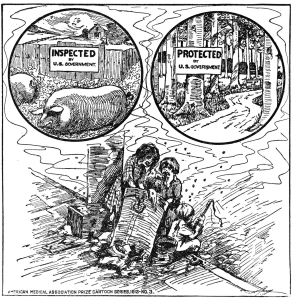 NEGLECTED!
The above chart illustrates the attitude of our government and the
commercial spirit of our age toward forests, domestic animals, mothers
and children. If our mothers and children could be given a commercial
value, based on their beauty, perfection of form, health and character,
rated in value on a par with a $2,600 chicken, a $4,600 hog, a $13,000
cow, or a $20,000 horse, the initial of every child would be
intelligently planned for, its prenatal rights would be respected, its
nativity warmly welcomed and its environments would be wisely
safe-guarded.
constantly increasing production of intellectual and moral degenerates.
Millions are willingly appropriated to aid in the invention and purchase
of deadly weapons with which the human family may be destroyed.
Thousands of the healthiest young men are called to the army and the
criminal and idiotic are left to keep up the work of propagation. All
our states maintain a Health Board, the duty of which is to prevent the
spread of smallpox, yellow fever, diphtheria, etc. We have state
officers to inspect cattle and to use measures to prevent Texas fever.
Our state fairs give large premiums to the fastest trotter, the best
Durhams, Southdowns and Poland Chinas. Mothers and children are
neglected.
Marriage of the feeble-minded.—Our laws are such that the county clerk
must grant marriage license to criminals, paupers, drunkards,
prostitutes and the feeble-minded, if they are of the proper age, or
have their parents’ consent. Where a couple of this class have secured
their legal right to marry, they hunt up a preacher who, standing before
them with civil and ecclesiastical authority, says, “Whom God hath
joined together let no man put asunder.” Such is a crime against
society, an insult to the holy estate of marriage, a curse to future
generations, and a libel on God. I don’t believe that God ever sanctions
such unions. When the states make laws prohibiting such marriages they
will hasten the millennium of marriage.
More dangerous than smallpox.—If I carelessly expose others to
smallpox; if I refuse to remove filth from my premises, dangerous to the
community’s health; if I knowingly sell diseased meat to my customers, I
shall be arrested and punished. But a man may live a fast life, acquire
a disease that will poison his wife, also his children to the third and
fourth generations; in this way he can worse than murder his wife and
children and go unwhipped and unpunished.
Effects of alcoholic fathers.—If statistics can be relied on, drunkards
produce one hundred per cent. more of the alcoholics, criminals, and
mental defectives than do the sober men. In justice to overtaxed
citizens and the demands of the coming generation we should enact a law
preventing the marriage of habitual drunkards. The periodic drunkard
should be required to remain sober for a considerable time before his
marriage and give reasonable evidence that his reformation is permanent.
Property qualification.—A property qualification, or its equivalent in
an established remunerative calling, profession or occupation, should be
required as a condition for marriage license. It is a known fact that
pauper families furnish more than their proportion of criminals and
other classes of dependents.
The victim of venereal disease.—Persons having a venereal disease, in a
mild form, should be allowed to marry only when a competent health
board, after careful examination, decides that they are entirely free
from poison, then, and then only after a reasonable time has expired
since being treated. If the applicant for marriage license has at one
time had one of the worst forms of venereal disease, he should be
forever debarred from the privilege of marriage. The need of these
restrictive and prohibitory marriage laws will be better understood and
appreciated by you when I give a few statements from the best obtainable
authority. Eighty per cent, of the children born blind is due to
gonorrhœal infection. (Education with Med. Prof.) This is nearly
always due to the uncured condition of the father. Neiser tells us that
there are over 30,000 blind persons in Germany whose blindness is due to
gonorrhœal ophthalmia. Pinnard claims that sixty to seventy per cent.
of hereditary syphilitics die at or before birth, and that those who
survive are unfit to meet the battles of life; 20,000 children die every
year in France from syphilitic conditions. Dr. Fournier states that in
his practice seventy-five per cent. of the syphilis in married women
could be traced to their husbands. Dr. Morrow puts it at seventy per
cent. A large per cent. of the surgical operations of a sexual nature
among married women is due to venereal disease contracted from their
husbands.
Sterilization a remedy.—To prevent unsuitable marriages, by law, would
in a measure bring relief, yet, the degenerate, criminals and imbeciles
would, to a considerable extent, continue their propagation. This class
cares but little for marriage. The ablest physicians of this country,
the leaders in the great purity movement, and many advanced thinkers in
other professions, are rapidly committing themselves to the opinion that
all the worst cases of hereditary degeneracy should be deprived of the
creative function. In females this operation is attended by only
one-sixth the fatalities of child-birth. In males it is attended by no
danger to life. The results would be absolutely effectual. The
feeble-minded class would be much more easily managed and the degenerate
criminal would settle down to the life of a peaceable citizen.
At first, one naturally opposes this measure as a solution to the
problem. Later, all opposition to it vanishes and it then appears to be
a most kind, benevolent and philanthropic solution of this vital
problem.
The drunkard’s home.—More of our delinquent and dependent children are
traceable to hereditary alcoholism than any other one cause save lust.
The conditions and environments of a drunkard’s home are very
unfavorable to normal hereditary influences. Seventy per cent. more of
the drunkard’s children are defective from birth than those from sober
parents.
In the average drunkard’s home, the wife is deprived of much or all that
would be conducive to the best maternal conditions, such as plenty of
nutritious food, good associations, wholesome recreation, good reading
matter, freedom, cheerfulness, and proper attention and courtesy on the
part of her husband. Instead of these conditions, she is poorly fed,
surrounded by rough associations, lives in a rented shack without
flowers or pictures, is overworked, timid, depressed and discouraged,
deprived of a thousand little comforts a maternal heart longs for, and
often tyrannized over by a rum-embruted husband.
Defective offspring from alcoholics.—Children born under these
conditions cannot receive a good heredity. The children of drunken
parents nearly always receive a bad heredity. This is especially true
when the initial of a life takes place during or immediately following a
drunken debauch. If the wives of drunkards had better environments
during periods of gestation, they could more largely overcome the bad
influences of their husbands upon their children. But, environed as
they are, they cannot prevent their own unfortunate influence over their
children, much less that of their husbands.
Intemperance and crime, lust and idiocy.—The mental and moral states of
the drunkard are not only expressed in a desire for more drink; but at
one time he is exceedingly lustful; at another time he is quite silly,
idiotic and foolish; at still another time he is angry, cruel and
dangerous. We often find all these morbid conditions strongly marked in
his children. Some inherit alcoholic, some lustful, some epileptic,
feeble-minded or insane criminal tendencies. His blood, being saturated
with alcohol, is in a low state of vitality. This is proven by the
drunkard’s inability to resist disease. The low state of vitality in the
blood of the drunkard accounts for the defectiveness of a large per
cent. of his children. More of the children of drunkards die before they
are two years old than of any other class except the venerealized.
Authorities from all civilized nations estimate that from forty to
eighty per cent. of all crime is traceable to the use of alcoholic
drink, and many of these criminals received a bad heredity from drunken
parents; twenty-two per cent. of all insanity and eighty per cent. of
epilepsy is traceable to drunken parents; seventy per cent. of all
immoral women had drunken parents.
Effects of personal liberty.—One day while campaigning a county in
Missouri for local option, I called at a home to get directions to my
next engagement to lecture. I rapped three times at the door. Three
times a voice from within said, “Come in.” Finally, I opened the door
and entered. A mother sat in a chair on the opposite side of the room
holding in her arms a nine-year-old boy. I noticed that the boy was as
helpless as a twenty-four-hour-old baby. While giving me directions she
was feeding the boy with a spoon. I remarked, “Friend, I observe that
you have in your arms an unfortunate child. I have studied many
unfortunate cases, lectured a good deal on heredity and have written a
book on heredity. If you do not object, I would like to ask you some
questions about your child.” In tones of anguish, such as only a
broken-hearted mother could utter, she said, “I guess that no poor
mother has ever had to bear a greater burden than I have. This is my
first child, on the bed is my fifth child, only six weeks old. When this
boy was four years old, during a spell of whooping cough, he got into
this condition. For five years I have cared for this boy as I would a
helpless baby. During these five years I have become a mother three
times and have buried three children who became as helpless as this one.
The three that are dead were seemingly all right at birth, but became
helpless during attacks of hives and teething. I don’t know whether we
will be able to raise the baby or not.” No pen can portray, no tongue
can tell, no imagination can conceive the heartaches of this unfortunate
mother. I asked whether she and her husband were related by blood, or
whether there had been intermarriage in the past on either side? She
replied in the negative. I asked other questions and failed to locate
the trouble. Finally, I asked, “Were there any drunkards on either side
of your family?” “On my side of our family there were no drunkards; on
the father’s side of my husband’s family one-half of the men were
drunkards; on his mother’s side most of the men were drunkards,” was her
reply. “Does your husband drink?” I enquired. With some embarrassment,
she said, “He drinks, but never gets to where he can’t attend to
business.” From other sources I found him to be a very heavy drinker.
Such men often boast that they have a right to drink if they want to,
get drunk if they want to, kill themselves if they want to. What right
did that drunken father and his drunken ancestry have to inflame their
minds and brutalize their passions and thereby burden that innocent
woman with all that sacrifice, suffering and heartache and to bring
these helpless little children into this world foredoomed to such
defectiveness? I answer, they did not have the shadow of a right to
indulge in a habit that would deprive their descendants from developing
on the earth plane.
Two more examples.—In the town of M——, Illinois, is a young lady of
twenty-six winters unbroken by a joyful spring or summer. The initial of
her life took place during the drunken debauch of her worse than
worthless drunken father. Many times a day and often several times an
hour she has spells. I have witnessed her go through many of them. The
approach of one of these spells would be first noticed by the enlarged
eyes and the exposure of the white of the eye. Then the muscles in the
eye, face, neck and body would contract and pull her face into her lap.
After remaining in that tortuous position for some minutes, the muscles
would relax and she would resume a normal one.
In that same town, just to the right of my tent, lived one of the
wealthiest citizens. Three children had been born into his home. Each
had died of epileptic fits before it was two years old. The family
physician, who had made a life study of heredity, told me that to his
own personal knowledge the initial of each child’s life took place
during or immediately following a drunken debauch of the father.
A visit to an asylum.—Not as a means of punishment, but as a means of
enlightenment and conviction, I wish every drinking man and every man
who favors the maintenance of the saloon could spend a few days in the
insane asylums of this country. Let them be taken through the wards of
the feeble-minded and the insane and at the close of the day listen for
one hour to a discussion of the causes of insanity among the inmates. In
this lecture, let them learn that twenty-two out of every one hundred
cases of insanity are due to drunkenness. Let them spend the next day in
the epileptic wards and witness from ten to twenty of those unfortunates
have epileptic fits, which usually last from thirty minutes to one hour.
At the close of this day have them attend a lecture given by an eminent
authority on epilepsy. After such an experience, I will guarantee that
every honest man, when he is convinced that twenty-two per cent. of the
insane and eighty-eight per cent. of the epileptics are the results of
drunkenness, would be converted to the prohibition of the liquor
traffic. You had just as well put the balance of that crowd in a reform
school or in some ward of the asylum without further delay or expense.
They are helpless cases.
Personal liberty versus the rights of others.—I fully appreciate the
value of personal liberty. One’s personal liberty to do right should
never be infringed upon. One’s personal liberty is circumscribed by the
welfare of others. His liberty to do as he pleases ends where the
welfare of someone else begins. You can get mad at me if you wish, grit
your teeth, clench your fist, swing your fist in a circle, vertically,
horizontally and off at a tangent; anywhere you wish, just so you don’t
strike my nose. But if you do, your personal liberty ends where my nose
begins. You have the liberty to walk up and down these aisles,
sidewalks, streets, public roads, up and down the railroad track, over
these hills and hollows, put your old number “nines” down wherever you
want to put them, but remember, when you put one of your number “nines”
down on one of my corns, your personal liberty ends where my corn
begins. Your personal liberty to drink, get drunk, inflame your mind,
brutalize your passions ends right where the welfare of your unborn
posterity begins. You have not the shadow of a right to indulge in any
bad habit that will cause your children to receive from you some form of
bad heredity. Your unborn descendants have the individual, inalienable,
absolute right to inherit from you the best physical, mental and moral
possibilities of manhood and womanhood. There is not a man but has the
paternal instinct deeply impressed upon his very nature. God placed it
there. It is to that principle of fatherhood, prospective or real, that
I make my final appeal. Boys, men, don’t entertain thoughts, indulge in
acts or form habits that you would not want to see reproduced in your
offspring.
Owing to the prevalent use of tobacco among all classes, including
doctors, teachers and ministers, many are inclined to doubt the
hereditary influence of tobacco.
Dr. Pidduck in the London Lancet says, “In no instance is a sin of the
fathers more strikingly visited on the children than in the sin of
tobacco-smoking. The enervation, the hypochondriasis, the hysteria, the
insanity, the suffering lives and early deaths of the children of
inveterate tobacco-smokers bear ample testimony to the feebleness and
unsoundness of the constitution transmitted by the victims of this
pernicious habit.”
Effects of tobacco.—The most eminent physicians of France tell us that
the rapid decline in the birth-rate of that nation is due, in part, to
the inveterate tobacco users, as shown by such a large number of this
class being at the head of childless homes.
Children of tobacco users.—Just as drunkenness may not always manifest
itself in a desire for alcohol, but may manifest itself in the form of
insanity, idiocy, epilepsy, lasciviousness or criminal tendencies; so,
in the children of the inveterate tobacco users the evil effects are
often shown in one or more morbid conditions. One has but to study the
children of a few excessive users of the weed to be convinced that they
do not possess the physical endurance and strength of the fathers. The
children of this class of fathers are usually puny, weak and nervous. It
is not an easy thing to convince a robust, healthy man that his habit is
laying the foundation for constitutional degeneracy in his children and
grandchildren.
Where both use tobacco.—Where the husband and wife both use tobacco the
injurious effects on the immediate children are very noticeable. This is
because the mother has more hereditary influence over the children than
does the father.
Tobacco and degeneracy.—You cannot always judge of the hereditary
effects of bad habits in one generation. In the first generation the
effects may not be noticeable. If the bad habits are continued for a few
generations the defective descendants multiply. Suppose that a husband
and wife are both heavy users of tobacco; that all their children follow
their examples and marry companions addicted to the use of tobacco; that
their grandchildren all follow the example of their ancestors and marry
companions who are inveterate users; and suppose this continued until
the fourth generation, who can estimate the resulting degeneracy? It is
probable that in many cases degeneracy would be complete and there would
be no fifth generation.
Fathers transmit morbid tendencies more to their sons than to their
daughters.—Objectors to acquired characteristics being transmitted
often ask why girls as well as boys do not inherit appetites for tobacco
and whisky. Many girls are just as conscious of an abnormal appetite for
stimulants as their brothers are. More women are addicted to the use of
wine and the cigarette than is generally supposed. But for the
companionship and protection of mother and a social law that would
discard them from society, more would form these habits than do.
It is a recognized fact that where one sex acquires a characteristic
that becomes fixed by continued custom, that this characteristic will be
transmitted mostly along the line of that sex. That relic of savagery,
the “double standard of morals,” temperance for woman and intemperance
for man, purity for woman and impurity for man, do right for woman and
do as you please for man, has, after centuries of practice, become to a
considerable extent constitutional in the two sexes. Hence, girls
inherit less of lasciviousness, less of tendency toward the use of
tobacco and strong drink. This double standard of morals originated
among the savage races who owned their wives and daughters. They sold,
swapped, exchanged their daughters on the marriage markets as they would
dispose of other property. A daughter’s value was largely based on her
virtue. If she had forfeited this priceless gem of womanhood she was
brutally stoned to death or forced into the most cruel servitude.
A heroic struggle.—There are thousands of brave, true men who advocate
and live the white life. Thousands more are struggling heroically to win
the laurels of a white life. Others are getting the vision and are
falling into line. Gentle reader, if you are not one of us, we extend to
you a warm welcome; if you are, we are glad of your fellowship.
Extent of birthmarks.—In other chapters I have discussed normal,
prenatal influences. In this chapter, I will discuss abnormal mental
influences of the mother, resulting in what are commonly called
birthmarks. The best statistics available on the subject indicate that
but one child in every 2,000 is marked. Personally, I am inclined to
believe that birthmarks are about twice this frequent. The laity think
that the per cent. is even larger, as each individual has seen or heard
of several cases.
Only the nervous mothers.—Perhaps not one mother in twenty could mark
her child. Only those mothers who are very susceptible to unusual mental
impressions mark their children. Nervous, gloomy, despondent, excitable
mothers are liable to do this. Practically nineteen-twentieths of the
mothers need not have a moment’s fear of marking their child. If these
facts are true, then it follows that there are many children who in
their prenatal state possessed a temperament not susceptible to abnormal
maternal impressions. Such a child, in all probability, could not be
marked, even if the mother had passed through mental states favorable to
marking her child.
The materialist puzzled.—Birthmarks cannot be explained on a
physiological or materialistic basis. Only as we recognize the supremacy
of the mental nature of man over his body can we understand these
hereditary influences. Almost all Christian doctors and scientists
recognize the fact of birthmarks. Men of these professions, who are
materialistic in their belief, treat the subject of birthmarks as a
relic of superstition. Not being able to explain them, they relegate all
birthmarks to the “unknowables,” calling them freaks or monstrosities.
A government pet.—After one of the doctors in a state insane asylum,
appointed to this position by the governor for some political favor he
had done and without any regard to his qualifications, had conducted me
through all the wards, I said, “Doctor, what emphasis do you put upon
heredity in your study and treatment of the inmates of this
institution?” “Very little,” he replied. “Do you believe that mental and
moral states of the mother have any influence over her child before it
is born?” To this question he replied, “I believe nutrition and pelvic
environment are the only prenatal relations between the child and its
mother.” I then asked him to explain some of the following cases of
birthmarks by his theory. He did not believe in birthmarks at all, and
stated that as he did not have the opportunity to investigate the pelvic
conditions of the mothers, he should not be expected to explain the
cases I gave him. I will leave the reader to judge whether that little
political pet could have explained the following cases with his theory.
Explanation.—Birthmarks can be explained only by the influences of the
mother’s mental states upon the forming child in her body. No single
mentation could possibly mark her child in a very perceptible way. It is
the constant repetition of the mental image in the mother’s mind that
finally takes expression in the physical form of the child. To
illustrate, the first conscious mentation, after an act of murder, does
not give the criminal the facial expression of a murderer. But after
days of thinking of his crime, even if there were no eye witnesses to
his crime and he were not even suspected of guilt, yet his face
gradually takes on the features of a criminal. He cannot remove that
criminal look with soap and water, or by crying or laughing. That
conscious thought of his crime oft repeated has finally taken expression
in physical form. A genuine conversion to Christ alone can remove the
criminal look. The same is true of all classes of criminals. Harmony of
mental states between husband and wife finally establishes a decided
resemblance.
Mother and child vitally one.—The physical organism of man is never
more susceptible to mental impression than during its plastic state
before birth. The mother and her child are in continuous vital
communication with each other. In a very vital sense the mother is the
architect of her child. If the mother keeps herself in a perfectly
normal state, the child will most likely be normal. Any abnormal state
the mother may pass through may have its abnormal influence upon her
child.
The effect of a constant mental repetition.—The initial mentation,
whether it be a scare, anger, sympathy, grief, desire or disgust locates
and starts the birthmarks. If this unusual initial mental image were
never repeated, the effect on the child would be hardly perceptible. If
the murderer could prevent the return of the mental picture of his
crime, the criminal look in his face would not become noticeable. It is
the constant repetition of the first mental state that finally takes
permanent form in the child’s body.
How to prevent marking a child.—How can susceptible mothers prevent
marking their children? By refusing to repeat the mental image. They
should keep their minds engaged in other matters. Banish the mental
picture every time it occurs in the stream of consciousness. In this way
birthmarks may be largely prevented.
The following cases are only a few that I have studied personally and
know to be true. I have had many friends tell me of cases known to them,
many of which would be very interesting to you, but I refrain from the
use of them in this lecture.
Frightened by a crawfish.—Rev. T. of ——, had a right thumb that was
double to the first joint. He told me that his mother, while washing
clothes at a stream, turned over a flat rock and a crawfish caught her
by the thumb with one of its big claws. In her fright she flung the
crawfish out on the bank. I studied another case that was very nearly a
duplicate of this one. These are examples of fright.
Arkansas mother.—While I was filling an engagement in the town of ——,
Ark., the pastor’s wife became the mother of a little girl whose fingers
were quite long and the joints of the fingers, hands and arms, stiff.
She was quite nervous and despondent during gestation. She told me that
one day when she was alone at home and especially gloomy and nervous,
she heard some one rap at the door and looking up she saw a man standing
at the door with deformed hands.
Frightened at a mole.—I went out eleven miles from G. C., state of ——,
to study a very sad case in the home of a cultured young couple. The
child was two years old. Its hands were turned with the palms backwards
and its arms were not over six inches long. It preferred to crawl rather
than walk. On the floor it handled itself like a mole. The mother told
me that in the early months of gestation she was greatly frightened at a
mole.
Marked by anger.—While giving a course of lectures in the city of C.,
Missouri, one day while walking down a street I noticed a four-year-old
white-headed boy with a big patch of jet-black hair on the right side of
his head. The contrast between the black and the white was very
striking. The father told me that he and his wife were undecided what
one of two possible causes was responsible for the birthmark. He said,
“One day, while my wife stood on the back porch, a negro stabbed a man
and when he saw an officer approaching he leaped over our yard fence and
ran across our back yard. Seeing that he was running into the arms of
another officer, he threw down his knife in the deep grass. The next day
he got out on bail and came to our home and asked for permission to look
for his knife. The other possible cause was, my wife and her neighbor
had fallen out. One day this lady called at our home and my wife
considered her an intruder, the old trouble was renewed and my wife
pulled her hair. This lady had very black hair. Now we do not know which
of those occurrences is responsible for the patch of black hair on the
boy.” I replied, “I know with almost absolute certainty.” He asked for
my opinion and reason. My reply was, “Had it been caused by the negro,
the patch of black hair would have been kinky. Nature is always true to
itself. I once knew a case where a mother was frightened by an angry dog
and on her child was a patch of canine hair. The fact that the hair in
the mark on the child is straight black hair shows that it was due to
your wife’s pulling the hair of her neighbor.” This is a case due to
unusual anger.
Marked by disgust.—After giving a special lecture to ladies in the city
of T——, Kan., an elderly lady, in company with a friend, sought an
interview with me. She told me the following sad personal experience:
“One summer, husband persuaded me to go with him and the children to our
county fair. Being quite nervous and easily fatigued, I requested that I
be permitted to spend the time in the carriage while he and the children
enjoyed the fair. I had been sitting in the carriage but a short time
when I noticed a crowd gathering around some object of attraction and I
decided to go and see what it was. On a table stood a four-year-old boy
wearing the false head of an old man. There was nothing grotesque or
unnatural about the head. But the contrast produced in me a feeling of
disgust. The thought was suggested to me, some one might be frightened
at that boy and mark her child, but I will not, for I am disgusted. I
wondered that others did not feel disgusted as I did. On returning to
my carriage the feeling of disgust and the mental picture of the child
remained with me. When husband and children came I related to them what
I had seen. For weeks after this event the mental picture of the child
with the head of an old man would appear in the stream of consciousness
accompanied with a feeling of disgust. After two days of parturition, a
seven-month child was removed from my body by an operation. Its head was
abnormally large and had the appearance of an old man.” Here was a case
due to disgust.
Marked by sympathy.—Ten days ago I was entertained by a family having a
very nervous temperament. The son-in-law sat in a rocking chair on the
front veranda holding his three-year-old child in his arms. The child
was helpless, emaciated and in breathing made a wheezing noise. This
condition had obtained since her birth. During the period of gestation,
a sickly, poor, wheezing, half-grown hog was kept in the yard and cared
for by the nervous mother of the child. The condition of the hog
constantly enlisted the sympathy of the mother. This was the history of
the case as told me by the child’s father. This birthmark was caused by
unusual sympathy.
An amusing case.—In most cases abnormal maternal impressions do not
result in serious injuries to children.
While lecturing at M——, Ky., I was told by a mother how she had marked
one of her children. She had listened, a few days before, to some lady
callers explaining the cause of a woman’s giving birth to twins. These
uninformed women claimed that if a prospective mother should find and
become interested in a number of twin objects in nature, such as eggs
with double yolks, twin apples, peaches, ears of corn, potatoes,
tomatoes, etc., that she would most certainly be the mother of twins. A
few days after this conversation she was gathering cucumbers. The vines
were wet and the ground soaked by frequent showers. For this reason she
was barefooted. She stooped over to remove from between two toes a small
object that had lodged between them. The object proved to be a most
perfect small twin cucumber. The mother recalled the conversation of her
friends, and this experience came up in her mind so often that she would
not have been surprised at twins. The child born later had the most
perfect twin toes.
A sad case.—While delivering a lecture on heredity in a leading Western
college my attention was called to a very intelligent face in the
audience. It was a young lady who appeared to have no hands or arms.
Later I observed tiny undeveloped hands largely concealed by very short
sleeves. At the close of the address I asked the president about her. He
informed me that she was unusually bright and that her affliction was
from birth. He arranged for me to have an interview with her. I found
that she had two and three fingers to the hand and that her hands and
arms had not grown since birth. In every other particular she was a most
attractive and perfect figure. Her mother’s explanation was that before
her birth she was one day holding her brother, then a baby, in her lap
while operating the sewing machine. The little fellow put his hand where
the needle was forced through his finger. The mother fainted. The mental
picture in the mother’s mind was that some of the baby’s fingers were
cut off. The mental impression lingered in the mother’s mind. The young
lady’s arms were about six inches long. On one hand there were two
fingers, on the other there were three fingers. Her arms and hands had
not grown any since birth. Otherwise she was normally developed.
Marked her child twice.—About the close of a lecture in one of the
Central Western states, a lady asked me to call at the Cash Store,
explaining that she wanted an hour’s interview with me. I found her to
be a lady of extremely susceptible temperament, refined and cultured,
but a bundle of nerves. She was the mother of three little nervous
children. Before calling in her oldest child, which she had marked
twice, she explained her experience. She said, “In our early marriage we
owned a cow that we were very proud of. Husband and I had often wished
that she were dehorned. One morning my husband’s brother secretly
dehorned her. The servant boy finding it out ran to the house and urged
me to go out to the barn and see what had occurred. When I rushed
suddenly upon the scene, I seized the fingers of the right hand with the
left and screamed. There were several large clear blisters on the cow’s
head. When my little girl was born the index finger of the right hand
was off at the second joint, the other three fingers were entirely
absent and several blisters had to be removed by the physician.
“During the second or third month of gestation I was told that one of
the neighbors had given birth to a child with one foot turned entirely
around. My curiosity led me to go over and see the child. When our girl
was born her left foot was turned completely around, the toes pointing
backwards. We have spent sixteen hundred dollars trying to have the foot
turned back. We have succeeded only in a small measure.” Then she said,
“I never heard of birthmarks until after my child was born. If I could
have heard your series of lectures, it would have been worth a fortune
to me. I believe this misfortune could and would have been avoided.”
The reader must not conclude that these pathetic cases are common. They
are not. The cases cited here represent fully one-half of the extreme
cases that I have personally studied during years of travel and
lecturing. They forcefully illustrate the possibilities of maternal
impressions on the forming child.
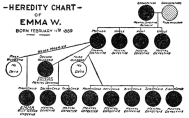 HEREDITY CHART OF EMMA W.
The burden of the feeble-minded.—The history of Emma W., at one time an
inmate of Letchworth Village, a New York institution for the
feeble-minded, should be convincing that it is bad policy to let the
feeble-minded drift in and out of the almshouse; that it is but humanity
and economy to segregate them, and to strike at the causes of mental
defect. Emma W. came to life in an almshouse, stamped with illegitimacy
and feeble-mindedness. Her family’s record reads: mother, two brothers,
and a sister feeble-minded; mother’s father feeble-minded and mother’s
mother tuberculous. When a second child was expected the mother was
induced by well-meaning people to marry the father, who was a drunken
epileptic. Two children were born. Still later the same well-meaning
people aided her to get a divorce in order to marry the father of
another child about to be born. Since then four more have been born. All
of these children are feeble-minded. Entire family, with exception of
the oldest child, is at large. The accompanying chart, taken from The
Survey, March 2, 1912, shows graphically her heredity.
Our studies at Vineland have shown that 65 per cent. of feeble-minded
people are the children of feeble-minded people; in other words, that
the condition is strongly hereditary. Therefore, if these people are
allowed to become parents, they will bring into the world another group
of people like themselves who will thus perpetuate the social waste.
The following charts show the heredity of two families. We have two
hundred like these—65 per cent. of all our inmates show such history.
The symbols used in the charts are the following: Square indicates male.
Circle indicates female. A capital letter indicates disease, habit, or
condition, as follows: A, alcoholic (habitual drunkard); B, blind; C,
criminal; D, deaf; E, epileptic; F, feeble-minded, either black letter,
or white letter on black ground (the former when sex is unknown); I,
insane; N, normal; Sx, grave sexual offender; Sy, syphilitic; T,
tuberculosis. Any of these letters may be used with no square or circle
when sex is unknown. When even the letter is omitted the vertical line
points to the fact that there was an individual of whom nothing is
known. Small black circle indicates miscarriage—time is given (in
months) when known, also cause; stillbirth is shown as a miscarriage at
nine months; b = born; d = died; m = married; inf = infancy; hand shows
which child is in the institution for feeble-minded; illeg =
illegitimate; heavy line under any symbol indicates that the person is
in some institution at the expense of society.
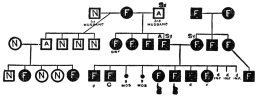 Chart I.
Chart I shows the descendants of a feeble-minded woman who was married
twice. Her first husband was normal. There were four normal children,
one of whom is alcoholic. This alcoholic son married a normal woman and
produced two feeble-minded and three normal children. This is another
instance of the defect skipping a generation, being transmitted by the
grandmother through the father.
The second marriage of this feeble-minded woman was with an alcoholic
and immoral man. The result was four feeble-minded children. One of
these became alcoholic and syphilitic and married a feeble-minded woman.
She was one of three imbecile children, born of two imbecile parents.
The result here could, of course, be nothing but defectives. There were
two stillborn, and three that died in infancy. Six others lived to be
determined feeble-minded. One of these was a criminal. Two are in the
institution at Vineland. The mother’s sister also has a feeble-minded
son.
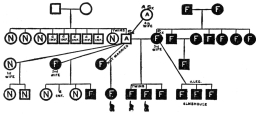 CHART II A.
Chart II (in two parts) is in some ways the most astonishing one we
have. There are in the institution at Vineland five children
representing, as we had always supposed, three entirely independent
families. We discovered, however, that they all belonged to one stock.
In Chart II, A, the central figure, the alcoholic father of three of
the children in the institution, married for his third wife a woman who
was a prostitute and a keeper of a house of ill fame, herself
feeble-minded, and with five feeble-minded brothers and sisters. One of
these sisters is the grandmother represented on Chart II, B.
On A it will be seen that this alcoholic man was four times married.
He comes from a good family but was spoiled in his bringing up, became
alcoholic and immoral—a degenerate man. His first wife, however, was a
normal woman and it is claimed that the two children were normal. For
his second wife, he took out of the poorhouse a feeble-minded woman. Her
children were: two normal, one that died young, and one feeble-minded.
He married the third time. The woman was the prostitute above referred
to. She had three illegitimate children, all feeble-minded. After their
marriage, they had three children, all of whom are feeble-minded. Two of
these are in this institution. The father then deserted this woman and
married a fourth wife, who is alcoholic and a prostitute. Of this union,
however, there are no children.
There is, moreover, very strong evidence that he is the father of the
third child in this institution by another woman, who is also
feeble-minded.
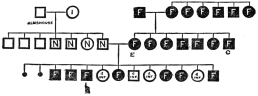 Chart II B.
Chart II, B, will be understood if we note that the mother’s mother is
a sister of the third wife of the much-married man of Chart II, A.
This sister married a feeble-minded man, and the result of that union
was seven feeble-minded children, of whom one is a criminal and one an
epileptic. Four are married. The feeble-minded epileptic woman married a
normal man, who is one of a fairly good family. His mother was insane,
the father died in an almshouse; however, we find no mental defect. As
the result of this marriage, we have seven feeble-minded children, four
others that died in infancy, and there were two miscarriages. This is
the fourth child of this strain that is in our institution. The fifth
one referred to is a half-sister of the other girl referred to on Chart
II, A.
The foregoing charts and description were taken from the article of
Henry H. Goddard, Ph.D., Director of Vineland, N. J., School for
Feeble-minded, in the March 2nd, 1912, issue of the Survey.
The agencies of improvement.—In all organic life, vegetable, animal and
man, two agencies are ever operative; heredity and environment. In plant
life these two agencies operate entirely on the physical plain. This is
perhaps true among the lower forms of animal life. But, among the higher
forms of animal life, we find very distinct manifestations of
rudimentary intelligence. Among the higher animals, experiments show
that these agencies are operative on the physical and mental plains. In
man these agencies are operative on the physical, mental and moral
plains. Among plants and animals, where these two agencies are under the
intelligent control of man, improvements are marked and rapid. Where
they are not under the control of man, progress is scarcely perceptible.
Plants and animals live in harmony with law, man appears to be largely
out of harmony with law; plants and animals keep law, man violates law.
That man is fallen and needs additional help to heredity and environment
is apparent to all who think. This help we call conversion, regeneration
or redemption. It is not the province of this chapter to advocate any
theory of religion. The purpose of this chapter is to show the relation
of these agencies in the improvement of the human race.
What one receives at birth constitutes his heredity.—This consists of a
normal or defective physical constitution, the natural bent of mind and
its rudimentary possibilities and the innate tendencies toward good or
evil. The physical, mental and moral influences one receives after birth
constitute his environment. Ideal environment tends to direct, develop
and to mature the results of good heredity and to correct the results of
bad heredity. Bad environment tends to neutralize the effects of good
heredity and to intensify the effects of bad heredity. If a child has
inherited a frail constitution, this can be overcome largely or entirely
by proper physical training, appropriate food and observing other health
laws. In such cases, heavy drugging will do but little good. If nature
is aided by intelligent parents, who have inspired their unfortunate
child with an intense interest and purpose to out-grow every defect, he
will accomplish wonders. If a child has inherited a tendency toward
tuberculosis, this can be entirely overcome by physical training, deep
breathing, nutritious food and ventilated bed rooms. The same is true of
many other physical defects.
Our mental possibilities are largely inherited.—Schools and colleges do
not produce great minds. They direct, train and develop the inherited
mental possibilities. Children of mediocrity should have every possible
encouragement and opportunity for mental improvement. They cannot
succeed without it. Their offspring will inherit improved mental
possibilities, if their parents are wisely trained in childhood.
Children who have inherited special genius will succeed in spite of
limited opportunities, but they will succeed better by having the
advantage of a good education. A practical study of the psychology of
childhood, in relation to mental heredity, would lead parents and
teachers to be more patient, sympathetic and wise in the mental training
of many children.
Heredity and moral tendencies.—Heredity is just as potential in the
moral realm as in the physical and mental. Children inherit tendencies
toward good or evil, virtue or vice. What they inherit morally is
determined by the relation of their ancestors to moral laws.
Parental responsibility.—Parents are not only responsible for the
number of children born in the home, whether few or many, close together
or far apart, but they are also largely responsible for their children’s
being born with strong or weak constitutions, brilliant or stupid minds,
good or bad tendencies. When this responsibility is more fully
understood by parents, their children will be better born. The greatest
blessing parents can bequeath to their children is not wealth, but a
good heredity. A very large part of a child’s training, good or bad, is
prenatal. Right from birth, before environment has had time to
influence the child, examples of children who are easily trained, and
cases that are trained with the greatest difficulty, are perfectly
familiar to all of us.
Environment is fully as potential in a child’s life as is heredity.—A
child may receive the most unfavorable heredity, and good environment
may lead the child to become much superior to his parents, brothers and
sisters. Again, a child may receive the very best heredity, and a bad
environment may lead him to mental neglect and moral disaster. Parents
can determine largely the heredity of the child; but they can furnish
only a small part of a child’s environment. Unknown to the parents, a
playmate, a neighbor, a servant, in a few words or a single act, may
give a child an impulse toward vice that may lead the child into years
of sin. The real cause of the child’s going wrong may ever remain
unknown to the parents.
Value of early environment.—The total of a child’s environment is
furnished by the whole of society. Fortunately, parents have largely the
control of the first years of a child’s environment. Unfortunately, most
parents have tried to safeguard the virtue of their children by keeping
them ignorant of everything pertaining to their sex natures. Just here
parents have often failed because of their false idea of good
environment. Ignorance of the sex nature is not a safeguard. Children
are often engaging in sexual sins months or years before the parents
dream of danger. Many servants employed in and about the home are impure
in mind or practice or both; often they are sex perverts. They take a
fiendish delight in teaching vice to even a small child. Parents cannot
be too careful in the selection of servants. They should have the most
positive understanding that no profanity, obscenity or vice is to be
engaged in by the servant. Sexual vice is the most common and dangerous
vice of childhood. It always leads to other forms of wrong-doing. Proper
sex instruction, given by the parents at the right time and in the right
way, is the only sane safeguard to the virtue of childhood.
Heredity, environment, Christ.—A bad environment may lead a child of
good heredity for a number of years into vice and sin; but the inherent
good tendencies often assert themselves and help the prodigal to return.
A child with a bad heredity, made and kept good by an ideal environment,
is never as strong or safe as a child of good heredity and good
environment.
Every child at birth is the sum total of all the influences, good and
bad, along the line of his lineage back to Adam. Every child has more or
less of hereditary degeneracy. All children are exposed more or less to
bad environment. All children need to accept Christ, to be transformed
by His power and freed from the domination of inherited and acquired
evil. Good heredity and good environment make it easy for children to
accept Christ and live the Christ life. Bad heredity and bad environment
make it difficult for children to accept and live the Christ life.
It is the duty of parents to know and practice the laws of heredity and
prenatal culture; to furnish the child as far as possible with a good
environment and a sane knowledge of himself; and to influence him to
accept Christ.
Each child’s duty to himself is to recognize his conscious personal
obligation to himself and to society, of mastering every inherited and
acquired weakness, of developing fully every inherent possibility, and
of accepting Christ as a necessity to the fullest attainment of the
loftiest ideals.
God’s greatest blessing, offered to every individual, is personal
redemption through faith in His Son.
These three agencies, good heredity, good environment, and redemption;
or right generation, right education and regeneration, are essential to
a perfect life.
The modern girl.—A quarter of a century ago a community knew a year
ahead when one of its young women was going to be married. In this fast
age, some parents don’t find it out until after their daughter has been
married six months or more. When the author was a boy, the engaged girl
spent her spare time piecing quilts, making feather pillows and beds,
drying apples, peaches and pumpkins, making preserves, gathering garden
seed and raising a flock of chickens. She had religious convictions. The
Bible idea of a woman is a “help meet.” She was preparing to help meet
the expenses of a home. The modern girl too often helps spend her
gentleman friend’s hard-earned money at the soda fountain, on livery
rigs and at the ten cent shows. Thousands of young men are not getting
married to-day, because they are afraid of the expense of these modern
help-eats, help-wears and help-spends.
Customs have changed.—True, times and customs have changed and much of
the work of women a quarter of a century ago is no longer profitable.
The
same is true of the work of men. But these changes do not justify a
large number of girls idling away a number of years waiting for men to
come along and marry them. Such girls make extravagant wives. They
cannot know the value of a dollar.
The independent girl.—Parents should furnish their daughter with
remunerative labor, or they should see that she is fitted for some
position that will enable her to be independent. The independent girl is
no more likely to fall than the idle girl at home. The independent girl
who gets out into the world with her brother, shoulders the same
burdens, masters the same difficulties, fights the same battles,
acquires a poise and dignity, a freedom of action and speech, a
knowledge of business and economy that give her an attractiveness that
the idle fashion-plate girl on the bargain counter of the marriage
market cannot compete with. This class of girls do not have to marry the
first chance that comes around in order to have a home.
Parents too anxious to get their girls married.—The financial burden of
supporting from two to four idle girls is no small item. Many parents
are anxious to get them married as soon as possible. The girls soon find
it out. When ten years old, such girls are making goo-goo eyes at the
boys; when eleven, they are passing notes to every Tom, Dick and Harry
in the schoolroom; when twelve, they are desperately in love; when
thirteen and fourteen, they have their mother’s consent to marry; when
fifteen, they are in the divorce courts, and three months later they
have their second husbands.
One of the St. Louis dailies, over one year ago, had a notice of two
“runaways.” One girl was twelve and the other thirteen. When overtaken
by their fathers, brought back home and locked up in a room, to prevent
a second attempt, one admitted to a reporter that up to that time she
had not learned that Santa Claus was not a real being and the other sent
for her dolls to play with.
Another case.—In one town in which I lectured I was told of a mother
who accompanied her thirteen-year-old-daughter and an eighteen-year-old
boy to the county clerk’s office and gave her consent to her daughter’s
marriage. To the clerk’s question, “Don’t you think your daughter rather
young to be married?” she replied. “Gee, I got married when I was
thirteen and my oldest daughter got married when she was fourteen.”
Didn’t she need the protection of an asylum?
A woman in Arkansas.—In Arkansas, you know what does not happen
anywhere else sometimes happens in that state. I found a woman who ran
away to get married when she was thirteen, had been married three
times, had three divorced husbands, three families of children,
aggregating twelve in number; was still a young woman and trying to get
married the fourth time. That was courtship, marriage and divorce with a
vengeance!
In this country anything can get married.—A confirmed degenerate
criminal can marry, as soon as his term expires in a reformatory, or
penitentiary. A feeble-minded person can improve a little, be returned
home, and get married. A few years later we are supporting them and
their delinquent progeny. We can never empty the reformatories,
penitentiaries and asylums until we quit producing these classes.
Immature marriages can no more produce perfect offspring than can the
mating of immature domestic animals. The girl is not mature until she is
nineteen or twenty and a boy until he is twenty-two or twenty-four.
Better customs and laws needed.—We are in need of social and legal
reform in the social relations of young people, marriage and divorce. In
England and Canada, rarely does a girl keep company with a young man as
a sweetheart before she is eighteen and rarely married before she is
nineteen or twenty. She is usually chaperoned by an older woman when she
goes out to drive, attend a lecture or to take a stroll with a young
man. In this country, little, innocent, undeveloped, irresponsible
girls are permitted to go buggy riding at night, attend cheap shows and
go on excursions unchaperoned, with young men whose reputations are not
the best. We are reaping the fearful harvest. One-half of our erring
girls fell before they were seventeen, and over one-half of our divorces
occur among women who married before they were seventeen. Our social
customs make it possible for one-half of our erring girls to fall before
they know the name of the act that involves their character and destiny.
Girls sixteen years old have not had time to develop mentally to where
they can safely choose a companion for life. If a girl, one day younger
than eighteen, should buy a pig without her father’s consent, the law
gives him the right to compel the former owner to take the pig back and
to return to him the money. The state reasons that a girl under eighteen
is not sufficiently developed in judgment to be held responsible for
buying a pig. But, according to our customs and laws, a girl can
intelligently tie herself up for life to the unfortunate appendix to the
wet end of a cigarette, or a miserable old jug-handle, and be held
responsible for her choice. In other words, we think that it takes less
judgment for a girl to choose a life partner than it does to buy a
half-grown hog.
Divorce is on the increase.—Births and marriages are on the decrease.
In 1870, we had one divorce to every thirty-eight marriages. In 1900,
we had one divorce to every fourteen and a half marriages. Now we are
having one divorce to every eleven and a quarter marriages. I noticed in
one of the Ohio dailies a few days ago that one county had one hundred
and thirty-two divorces in twelve months. All last year, Canada had only
seventeen divorces. Several counties in the United States, each had ten
times as many divorces last year, as did the entire Dominion of Canada.
Canada has more stringent marriage and divorce laws than the United
States.
It is the maternal and paternal instincts that prompt the lower animals
to pair off and mate. Their love for each other and their young is the
child of their sex nature. The desexed lower animals are devoid of the
instinct that prompts wooing and mating.
It is the promptings of the paternal and maternal natures, which are
inseparable from the normal sex nature, that lead to a beautiful and
joyful courtship, to a harmonious, happy marriage and to a family of
fair daughters and lusty sons.
Causes of wrecked homes.—“Intemperance,” “abuse,” “non-support,” or
“desertion,” reply the jury in the court room and the judge on the
bench. These are, usually, only indirect causes. The one main cause of
wrecked homes, the abuse of marital rights, is rarely mentioned in the
court room. If all married people were normal in their sex natures,
unselfish love would reign in the homes and divorce courts would be
largely a thing of the past.
Through universal ignorance of the true nature and functions of the
God-given, God-honored and sacred sanctuary of reproduction, the youth,
by mental and mechanical abuse of these functions, becomes more or less
sensual. Sexuality is slowly transformed into sensuality and love into
lust. Ignorant of the laws of life, the duties and responsibilities of
marriage and parentage, men are often prompted more by uncontrolled
desire than by unselfish love in their choice of a wife, they are
largely governed by physical attractions, or wealth. The present ethics
of marriage makes the wife submit to the sensual demands of the husband.
This view of marriage converts love into lust, prevents the harmonizing
of their differences, the proper blending of their personalities and the
two never become one.
Divorce is not the cause of wrecked homes.—Wrecked homes are the cause
of divorce. The divorce problem will be solved in the solution of the
home problems. The home problems will be largely solved when children
and youths receive proper sex instruction, when young people are
properly safeguarded in their social relations as friends and lovers,
and when they are properly educated in home-building.
Marriage a civil and Divine institution.—The sacred institution of
marriage is being trifled with. Easy to get married, and easy to get
divorced, are a nation’s shame and will quickly bring a nation’s fall.
By a system of sane education and legislation the paramount importance,
dignity, responsibility and sacredness of marriage over other
institutions would be impressed on the mind of the masses. Marriage is
both a civil and religious institution. Civil law should protect the
rights of marriage and judiciously determine who shall and who shall not
marry. The marriage ceremony should be performed, when possible, in a
church and a minister of recognized qualifications should officiate. The
church should be decorated not only with flowers and foliage, but also
the nation’s flag and colors should have prominent display. Not only
should some of the church officers be present, but also, some of the
civil officers should be present. The church and state should bear this
expense. No marriage fees should be charged or expected from rich or
poor. The parties to be married and the community would see that the
state and church are substantially interested in home and nation
building. In this way marriage would be placed on a high and dignified
basis. When a man and woman take the marriage vows, they have assumed
duties and responsibilities more vital and far greater than does a
governor or president-elect assume, when he takes the oath of office.
The primary purpose of marriage is to increase the species. In this
function they are to serve the nation by helping to furnish the next
generation of citizens. The most illiterate and poverty-stricken couple,
who faithfully do their best to raise a family of children, are of far
more value to a nation’s strength and perpetuity than a millionaire home
consisting of husband, wife and a poodle dog.
New marriage laws.—We should have uniform state laws restricting the
marriage of men and women who are in advanced stages of consumption, of
the feeble-minded, the confirmed criminal, the degenerate and the
venereally diseased. We need uniform state laws requiring a reasonable
knowledge of the laws of life, of marital rights, of heredity and
prenatal culture and of the duties and responsibilities of marriage and
parentage. To make such restrictions and education possible all
candidates for marriage should be required to register their proposed
marriage with the county clerk at least three months before the license
is granted. At the expense of the state, this proposed marriage should
be announced through at least one paper during this period. This
publicity would prevent all clandestine marriages and would rob the
white slave procurer of one of his chief methods of securing his
victims. In recent years, in nearly every community, a stranger has won
the affections of an unsuspecting girl and the confidence of her family,
married her, and in six months time it was whispered that he had another
family somewhere that he ought to be supporting. The white slaver uses
the love method very effectively. The law suggested would prevent these
impositions and crimes against society.
When the proposed marriage is registered, the state should furnish each
with a book presenting in simple language the information to which
reference was made in a preceding paragraph. At the expiration of three
months, let them give satisfactory evidence of a reasonable knowledge of
the teaching of the book.
Before the marriage license is finally granted, each should furnish the
state with a certificate of good health. This would prevent the marriage
of the physically and mentally unfit.
If properly enforced, these new marriage laws would promote domestic
harmony, prevent untold misery, stop the crime of feticide, reduce the
annual birth of defective children and increase the birth-rate of normal
children. The young man should have not less than five hundred dollars
in money or property, or he should have a fair education and a position
with adequate income to support a wife.


