SELECTIONS FROM THE PROSE WRITINGS OF JOHN HENRY CARDINAL NEWMAN
 Front cover
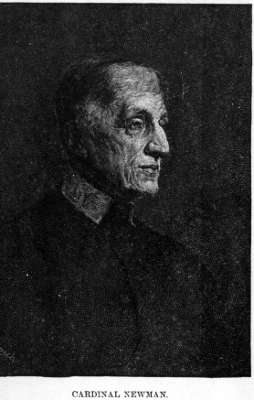 CARDINAL NEWMAN.
MAYNARD'S ENGLISH CLASSIC SERIES.—SPECIAL NUMBER
FOR THE USE OF SCHOOLS

NEW YORK
CHARLES E. MERRILL CO.
Copyright, 1906,
by
MAYNARD, MERRILL, & CO.
Whole book · 9 sections
Front cover
CARDINAL NEWMAN.
MAYNARD'S ENGLISH CLASSIC SERIES.—SPECIAL NUMBER
FOR THE USE OF SCHOOLS
NEW YORK
CHARLES E. MERRILL CO.
Copyright, 1906,
by
MAYNARD, MERRILL, & CO.
It has come to be universally admitted that Cardinal Newman fulfills his own definition of a great author: "One whose aim is to give forth what he has within him; and from his very earnestness it happens that whatever be the splendor of his diction, or the harmony of his periods, he has with him the charm of an incommunicable simplicity.
"Whatever be his subject, high or low, he treats it suitably and for its own sake.... He writes passionately because he feels keenly; forcibly, because he conceives vividly; he sees too clearly to be vague; he is too serious to be otiose; he can analyze his subject, and therefore he is rich; he embraces it as a whole and in its parts, and therefore he is consistent; he has a firm hold of it, and therefore he is luminous.
"When his imagination wells up, it overflows in ornament; when his heart is touched, it thrills along his verse. He always has the right word for the right idea, and never a word too much....
"He expresses what all feel but cannot say; and his sayings pass into proverbs among his people, and his phrases become household words, idioms of their daily speech, which is tessellated with the rich fragments of his language, as we see in foreign lands the marbles of Roman grandeur worked into the walls and pavements of modern palaces."
Newman may be said to have handled England's prose as Shakespeare handled her verse. His language was wrought up little by little to a finish and refinement, a strength and a subtlety, thrown into the form of eloquence, beyond which no English writer of prose has gone. Nor is his excellence that of mere art in form; he possesses not only skill, which he calls an exercise of talent, but power—a second name for genius—which itself implies personality and points to inspiration.
His mind was large, logical, profoundly thoughtful, imaginative, intense, sincere, and above all, spiritual; his soul was keen, delicate, sympathetic, heroic; and his life, at once severe and tender, passionate and self-controlled, alone and unlonely, stands out in its loftiness and saintliness, a strange, majestic contrast to the agitation and turmoil of "confused passions, hesitating ideals, tentative virtues, and groping philanthropies" amidst which it was lived.
Both by word and work did Newman lead forth his generation on the long pilgrimage to the shrine of Truth, and England of the nineteenth century has no surer claim to holiness and genius for her great sons than that set upon John Henry Newman.
He was born in London, 1801; studied, taught, and preached at Oxford; became the chief promoter of the Tractarian Movement of 1833; entered the Catholic Church in 1845; founded the Oratory at Birmingham, 1848; was created Cardinal by Pope Leo XIII. 1879; died at Edgbaston, 1890.
Any attempt to choose from the writings of Newman what seems most desirable for brief class studies is certain to be woefully embarrassed by the very wealth of matter; and apology for risking the choice would be due, were it not lost sight of in the desire to see a literary model so pure, varied, animated, forceful, luminous—"a thing of light and beauty"—given to our students.
What is more significant of the Life Book of the saintly Oxford Scholar than his self-written epitaph: "Ex umbris et imaginibus in veritatem"?
Newman's best essays display a delicate and flexible treatment of
language, without emphasis, without oddity, which hardly arrests the
attention at first,—the reader being absorbed in the argument or
statement,—but which, in course of time, fascinates, as a thing
miraculous in its limpid grace and suavity.
—Edmund Gosse's History of Modern English Literature.
The work of Newman reveals him as one of the great masters of graceful,
scholarly, finished prose. It is individual, it has charm, and this is
the secret of its power to interest. No writer of our time has reflected
his mind and heart in his pages as has Newman. He has light for the
intellect and warmth for the heart.
—A. J. George's Types of Literary Art.
Newman towers, with only three or four compeers, above his generation;
and now that the benignity of his great nature has passed from our
sight, its majesty is more evident year by year.
—Scudder's Modern English Poets.
The finish and urbanity of Newman's prose have been universally
commended even by those who are most strenuously opposed to his
opinions.
—H. J. Nicoll.
All the resources of a master of English style are at Newman's command:
pure diction, clear arrangement, delicate irony, gracious dignity, a
copious command of words combined with a chaste reserve in using
them.
All these qualities go to make up the charm of Newman's
style—the finest flower that the earliest system of a purely
classical education has produced.
—J. Jacobs's Literary Studies.
Newman combines a thoroughly classical training, a scholarly form, with
the incommunicable and almost inexplicable power to move audiences and
readers.
—George Saintsbury.
The pure style of Newman may be compared in its distinguishing quality
to the atmosphere. It is at once simple and subtle, vigorous and
elastic; it penetrates into every recess of its subject; it is
transparent, allowing each object it touches to display its own proper
color.
—H. E. Beeching's English Prose.
There are touching passages characteristic of Newman's writings which
give them a peculiar charm. They are those which yield momentary
glimpses of a very tender heart that has a burden of its own, unrevealed
to man.... It is, as I have heard it described, as though he suddenly
opened a book and gave you a glimpse for a moment of wonderful secrets,
and then as quickly closed it.... In Newman's Sermons, how the old truth
became new; how it came home, as he spoke, with a meaning never felt
before! He laid his finger how gently, yet how powerfully, on some inner
place in the hearer's heart, and told him things about himself he had
never known till then. Subtlest truths, which it would have taken
philosophers pages of circumlocution and big words to state, were
dropped out by the way in a sentence or two of the most transparent
Saxon. What delicacy of style, yet what strength! how simple, yet how
suggestive! how penetrating, yet how refined! how homely, yet how tender-hearted! You might come away
still not believing the tenets peculiar to the High Church System, but
you would be harder than most men if you did not feel more than ever
ashamed of coarseness, selfishness, worldliness, if you did not feel the
things of faith brought closer to the soul.... Newman's innate and
intense idealism is, perhaps, his most striking characteristic.... It is
a thought of his, always deeply felt and many times repeated, that this
visible world is but the outward shell of an invisible kingdom, a screen
which hides from our view things far greater and more wonderful than any
which we see, and that the unseen world is close to us and ever ready to
break through the shell and manifest itself.
—Shairp.
Newman's great reputation for prose and the supreme interest attaching
to his life seem to have obscured the fame he might have won as a poet.
He was in poetry, as in theology, a more masculine Keble, but with all
the real purity of Keble, with also the indispensable flavor of
earth.
—H. Walker.
The Dream of Gerontius resembles Dante more than any other poetry
written since the great Tuscan's time.
—Sir Henry Taylor.
The Dream is a rare poetic rendering into English verse of that high
ritual which from the death-bed to the Mass of Supplication encompasses
the faithful soul.... Newman has no marked affinities with English
writers of his day. He is strikingly different from Macaulay, whose
eloquence betrays the fury, as it is annealed in the fire, of the
Western Celt. To Ruskin, who deliberately built up a monument, stately
as the palace of Kubla Khan, he is a contrast, for the very reason that
he does not handle words as if they were settings in architecture or
colors in a palette; rather, he would look upon them as
transparencies which let his meaning through. He is more like De
Quincey, but again no player upon the organ for the sake of its music;
and that which is common to both is the literary tradition of the
eighteenth century enhanced by a power to which abstract and concrete
yielded in almost equal degree.... With so prompt and intense an
intellect at his call, there was no subject, outside purely technical
criticism, which Newman could not have mastered.
—Barry's Literary Lives.
It is when Newman exerts his flexible and vivid imagination in depicting
the deepest religious passion that we are most carried away by him and
feel his great genius most truly.... Whether tried by the test of
nobility, intensity, and steadfastness of his work, or by the test of
the greatness of the powers which have been consecrated to that work,
Cardinal Newman has been one of the greatest of our modern great men.
—R. H. Hutton's Life of Newman.
Newman's mind was world-wide. He was interested in everything that was
going on in science, in the highest form of politics, in literature....
Nothing was too large for him, nothing too trivial, if it threw light
upon the central question,—what man really is and what is his
destiny.
—J. A. Froude.
In Newman's sketch of the influence of Abelard on his disciples is seen
his belief in the immense power for good or ill of a dominating
personality. And he himself supplied an object-lesson in his theory.
Shairp, Froude, Church, Wilberforce, Gladstone, are only a few of those
who have borne testimony to the personal magnetism which left its mark
on the whole of thinking Oxford. "Cor ad cor loquitur," the motto chosen
by Newman on his receiving the Cardinal's hat, expressed to him
the whole reality of intercourse between man and man, and man and
God.
—Wilfrid Ward's Problems and Persons.
Newman's mind swung through a wide arc, and thoughts apparently
antagonistic often were to him supplemental each to each.... A man of
dauntless courage and profound thoughtfulness, while his intellect was
preëminently a logical one, both the heart and the moral sense
possessed with him their sacred tribunals in matters of reasoning as
well as of sentiment.... The extreme subtlety of his intelligence
opposed no hindrance to his power of exciting vehement emotion.
—A. De Vere's Literary Reminiscences.
"I gave them a king in mine anger, and took him away in my wrath."—Hosea xiii. 11.
The Israelites seem to have asked for a king
from an unthankful caprice and waywardness.
The ill conduct, indeed, of Samuel's sons was the
occasion of the sin, but "an evil heart of
unbelief," to use Scripture language, was the real cause{5}
of it. They had ever been restless and
dissatisfied, asking for flesh when they had manna,
fretful for water, impatient of the wilderness, bent
on returning to Egypt, fearing their enemies,
murmuring against Moses. They had miracles{10}
even to satiety; and then, for a change, they
wished a king like the nations. This was the
chief reason of their sinful demand. And further,
they were dazzled with the pomp and splendor
of the heathen monarchs around them, and they{15}
desired some one to fight their battles, some
visible succor to depend on, instead of having
to wait for an invisible Providence, which came in
its own way and time, by little and little, being
dispensed silently, or tardily, or (as they might{20}
consider) unsuitably. Their carnal hearts did
not love the neighborhood of heaven; and, like
the inhabitants of Gadara afterwards, they prayed
that Almighty God would depart from their
coasts.
Such were some of the feelings under which they
desired a king like the nations; and God at length
granted their request. To punish them, He gave
them a king after their own heart, Saul, the son of
Kish, a Benjamite; of whom the text speaks in{10}
these terms, "I gave them a king in Mine anger,
and took him away in My wrath."
There is, in true religion, a sameness, an absence
of hue and brilliancy, in the eyes of the natural
man; a plainness, austereness, and (what he {15}
considers) sadness. It is like the heavenly manna of
which the Israelites complained, insipid, and at
length wearisome, "like wafers made with honey."
They complained that "their soul was dried
away." "There is nothing at all," they said,{20}
"beside this manna, before our eyes.... We
remember the fish, which we did eat in Egypt
freely; the cucumbers, and the melons, and the
leeks, and the onions, and the garlick."[1]Such
were the dainty meats in which their soul{25}
delighted; and for the same reason they desired a
king. Samuel had too much of primitive
simplicity about him to please them, they felt they
were behind the world, and clamored to be put
on a level with the heathen.{30}
Saul, the king whom God gave them, had much
to recommend him to minds thus greedy of the
dust of the earth. He was brave, daring,
resolute; gifted, too, with strength of body as well
as of mind—a circumstance which seems to{5}
have attracted their admiration. He is described
in person as if one of those sons of Anak, before
whose giant-forms the spies of the Israelites in the
wilderness were as grasshoppers—"a choice
young man, and a goodly; there was not among{10}
the children of Israel a goodlier person than he:
from his shoulders and upward he was higher
than any of the people."[2] Both his virtues and
his faults were such as became an eastern monarch,
and were adapted to secure the fear and{15}
submission of his subjects. Pride, haughtiness,
obstinacy, reserve, jealousy, caprice—these, in
their way, were not unbecoming qualities in the
king after whom their imaginations roved. On
the other hand, the better parts of his character{20}
were of an excellence sufficient to engage the
affection of Samuel himself.
As to Samuel, his conduct is far above human
praise. Though injuriously treated by his countrymen,
who cast him off after he had served them{25}
faithfully till he was "old and gray-headed,"[3] and
who resolved on setting over themselves a king
against his earnest entreaties, still we find no trace
of coldness or jealousy in his behavior towards
Saul. On his first meeting with him, he addressed{30}
him in the words of loyalty—"On whom
is all the desire of Israel? is it not on thee, and
on all thy father's house?" Afterwards, when he
anointed him king, he "kissed him, and said, Is it
not because the Lord hath anointed thee to be{5}
captain over His inheritance?" When he announced
him to the people as their king, he said,
"See ye him whom the Lord hath chosen, that
there is none like him among all the people?"
And, some time after, when Saul had irrecoverably{10}
lost God's favor, we are told, "Samuel came no
more to see Saul until the day of his death:
nevertheless Samuel mourned for Saul." In the
next chapter he is even rebuked for immoderate
grief—"How long wilt thou mourn for Saul,{15}
seeing I have rejected him from reigning over
Israel?"[4] Such sorrow speaks favorably for
Saul as well as for Samuel; it is not only the grief
of a loyal subject and a zealous prophet, but,
moreover, of an attached friend; and, indeed,{20}
instances are recorded, in the first years of his
reign, of forbearance, generosity, and neglect of
self, which sufficiently account for the feelings
with which Samuel regarded him. David, under
very different circumstances, seems to have felt{25}
for him a similar affection.
The higher points of his character are brought
out in instances such as the following: The
first announcement of his elevation came upon
him suddenly, but apparently without unsettling{30}
him. He kept it secret, leaving it to Samuel, who
had made it to him, to publish it. "Saul said
unto his uncle, He" (that is, Samuel) "told us
plainly that the asses were found. But of the
matter of the kingdom, whereof Samuel spake,{5}
he told him not." Nay, it would even seem he
was averse to the dignity intended for him; for
when the Divine lot fell upon him, he hid himself,
and was not discovered by the people, without
recourse to Divine assistance. The appointment{10}
was at first unpopular. "The children of Belial
said, How shall this man save us? They despised
him, and brought him no presents, but he held his
peace." Soon the Ammonites invaded the
country beyond Jordan, with the avowed intention of{15}
subjugating it. The people sent to Saul for relief
almost in despair; and the panic spread in the
interior as well as among those whose country
was immediately threatened. The history
proceeds: "Behold, Saul came after the herd out of{20}
the field; and Saul said, What aileth the people
that they weep? and they told him the tidings
of the men of Jabesh. And the Spirit of God
came upon Saul, and his anger was kindled
greatly." His order for an immediate gathering{25}
throughout Israel was obeyed with the alacrity
with which the multitude serve the strong-minded
in times of danger. A decisive victory over the
enemy followed; then the popular cry became,
"Who is he that said, Shall Saul reign over us?{30}
bring the men, that we may put them to death.
And Saul said, There shall not a man be put to
death this day, for to-day the Lord hath wrought
salvation in Israel."[5]
Thus personally qualified, Saul was, moreover,
a prosperous king. He had been appointed to{5}
subdue the enemies of Israel, and success attended
his arms. At the end of the fourteenth chapter,
we read: "So Saul took the kingdom over Israel
and fought against all his enemies on every side,
against Moab, and against the children of{10}
Ammon, and against Edom, and against the kings of
Zobah, and against the Philistines; and
whithersoever he turned himself, he vexed them. And
he gathered an host, and smote the Amalekites,
and delivered Israel out of the hands of them that{15}
spoiled them."
Such was Saul's character and success; his
character faulty, yet not without promise; his
success in arms as great as his carnal subjects
could have desired. Yet, in spite of Samuel's{20}
private liking for him, and in spite of the good
fortune which actually attended him, we find that
from the beginning the prophet's voice is raised
both against people and king in warnings and
rebukes, which are omens of his destined{25}
destruction, according to the text, "I gave them a king in
Mine anger, and took him away in My wrath."
At the very time that Saul is publicly received as
king, Samuel protests, "Ye have this day rejected
your God, who Himself saved you out of all your {30}
adversities and your tribulations."[6] In a
subsequent assembly of the people, in which he
testified his uprightness, he says, "Is it not wheat
harvest to-day? I will call unto the Lord, and
He shall send thunder and rain; that ye may{5}
perceive and see that your wickedness is great, in asking
you a king." Again, "If ye shall still do wickedly,
ye shall be consumed, both ye and your king."[7]
And after this, on the first instance of disobedience
and at first sight no very heinous sin, the sentence{10}
of rejection is passed upon him: "Thy kingdom
shall not continue; the Lord hath sought Him a
man after His own heart."[8]
[6] 1 Sam. x. 19.
[7] Ibid. xii. 17, 25.
[8] Ibid. xiii. 14.
Here, then, a question may be raised—-Why
was Saul thus marked for vengeance from the{15}
beginning? Why these presages of misfortune,
which from the first hung over him, gathered, fell
in storm and tempest, and at length overwhelmed
him? Is his character so essentially faulty that
it must be thus distinguished for reprobation{20}
above all the anointed kings after him? Why,
while David is called a man after God's own heart,
should Saul be put aside as worthless?
This question leads us to a deeper inspection of,
his character. Now, we know, the first duty of{25}
every man is the fear of God—a reverence for His
word, a love of Him, and a desire to obey Him; and,
besides, it was peculiarly incumbent on the king of
Israel, as God's vicegerent, by virtue of his office, to
promote His glory whom his subjects had rejected.{30}
Now Saul "lacked this one thing." His
character, indeed, is obscure, and we must be cautious
while considering it; still, as Scripture is given us
for our instruction, it is surely right to make the
most of what we find there, and to form our{5}
judgment by such lights as we possess. It would
appear, then, that Saul was never under the
abiding influence of religion, or, in Scripture language,
"the fear of God," however he might be at times
moved and softened. Some men are inconsistent{10}
in their conduct, as Samson; or as Eli, in a
different way; and yet may have lived by faith,
though a weak faith. Others have sudden falls,
as David had. Others are corrupted by
prosperity, as Solomon. But as to Saul, there is no{15}
proof that he had any deep-seated religious
principle at all; rather, it is to be feared, that his
history is a lesson to us, that the "heart of unbelief"
may exist in the very sight of God, may rule a man
in spite of many natural advantages of character,{20}
in the midst of much that is virtuous, amiable,
and commendable.
Saul, it would seem, was naturally brave,
active, generous, and patient; and what nature
made him, such he remained, that is, without{25}
improvement; with virtues which had no value,
because they required no effort, and implied the
influence of no principle. On the other hand,
when we look for evidence of his faith, that is, his
practical sense of things unseen, we discover{30}
instead a deadness to all considerations not connected
with the present world. It is his habit to
treat prophet and priest with a coldness, to say
the least, which seems to argue some great internal
defect. It would not be inconsistent with the
Scripture account of him, even should the real{5}
fact be, that (with some general notions
concerning the being and providence of God) he doubted
of the divinity of the Dispensation of which he was
an instrument. The circumstance which first
introduces him to the inspired history is not in his{10}
favor. While in search of his father's asses,
which were lost, he came to the city where
Samuel was; and though Samuel was now an old
man, and from childhood known as the especial
minister and prophet of the God of Israel, Saul{15}
seems to have considered him as a mere diviner,
such as might be found among the heathen, who,
for "the fourth part of a shekel of silver," would
tell him his way.
The narrative goes on to mention, that after his{20}
leaving Samuel "God gave him another heart,"
and on meeting a company of prophets, "the
Spirit of God came upon him, and he prophesied
among them." Upon this, "all that knew him
beforetime" said, "What is this that is come unto{25}
the son of Kish: is Saul also among the prophets?
... therefore it became a proverb." From this
narrative we gather, that his carelessness and
coldness in religious matters were so notorious,
that, in the eyes of his acquaintance, there was{30}
a certain strangeness and incongruity, which at
once struck the mind, in his being associated with
a school of the prophets.
Nor have we any reason to believe, from the
after history, that the Divine gift, then first
imparted, left any religious effect upon his mind.{5}
At a later period of his life we find him suddenly
brought under the same sacred influence on his
entering the school where Samuel taught; but,
instead of softening him, its effect upon his
outward conduct did but testify the fruitlessness of{10}
Divine grace when acting upon a will obstinately
set upon evil.
The immediate occasion of his rejection was his
failing under a specific trial of his obedience, as
set before him at the very time he was anointed.{15}
He had collected with difficulty an army against
the Philistines; while waiting for Samuel to offer
the sacrifice, his people became dispirited, and
began to fall off and return home. Here he was
doubtless exposed to the temptation of taking{20}
unlawful measures to put a stop to their defection.
But when we consider that the act to which he was
persuaded was no less than that of his offering
sacrifice—he being neither priest nor prophet,
nor having any commission thus to interfere{25}
with the Mosaic ritual—it is plain "his forcing
himself" to do so (as he tenderly described his
sin) was a direct profaneness—a profaneness
which implied that he was careless about forms,
which in this world will ever be essential to{30}
things supernatural, and thought it mattered
little whether he acted in God's way or in his
own.
After this, he seems to have separated himself
from Samuel, whom he found unwilling to become
his instrument, and to have had recourse to the{5}
priesthood instead. Ahijah or Ahimelech (as he
is afterwards called), the high priest, followed his
camp; and the ark, too, in spite of the warning
conveyed by the disasters which attended the
presumptuous use of it in the time of Eli. "And{10}
Saul said unto Ahijah, Bring hither the ark of
God;" while it was brought, a tumult which was
heard in the camp of the Philistines increased.
On this interruption Saul irreverently put the ark
aside, and went out to the battle.{15}
It will be observed, that there was no professed
or intentional irreverence in Saul's conduct; he
was still on the whole the same he had ever been.
He outwardly respected the Mosaic
ritual—about this time he built his first altar to the Lord,[9]{20}
and in a certain sense seemed to acknowledge God's
authority. But nothing shows he considered that
there was any vast distinction between Israel and
the nations around them. He was indifferent, and
cared for none of these things. The chosen people{25}
desired a king like the nations, and such a one
they received.
[9] 1 Sam. xiv. 35.
After this he was commanded to "go and smite
the sinners, the Amalekites, and utterly destroy
them and their cattle." This was a judgment on{30}
them which God had long decreed, though He had
delayed it; and He now made Saul the minister
of His vengeance. But Saul performed it so far
only as fell in with his own inclination and
purposes. He smote, indeed, the Amalekites, and{5}
"destroyed all the people with the edge of the
sword"—this exploit had its glory; the best of
the flocks and herds he spared, and why? to
sacrifice therewith to the Lord. But since God
had expressly told him to destroy them, what{10}
was this but to imply, that Divine intimations had
nothing to do with such matters? what was it but
to consider that the established religion was but
a useful institution, or a splendid pageant
suitable to the dignity of monarchy, but resting on no{15}
unseen supernatural sanction? Certainly he in
no sense acted in the fear of God, with the wish
to please Him, and the conviction that he was in
His sight. One might consider it mere pride and
willfulness in him, acting in his own way because{20}
it was his own (which doubtless it was in great
measure), except that he appears to have had an
eye to the feelings and opinions of men as to his
conduct, though not to God's judgment. He
"feared the people and obeyed their voice."{25}
Again, he spared Agag, the king of the
Amalekites. Doubtless he considered Agag as "his
brother," as Ahab afterwards called Ben-hadad.
Agag was a king, and Saul observed towards him
that courtesy and clemency which earthly{30}
monarchs observe one towards another, and rightly
when no Divine command comes in the way. But
the God of Israel required a king after His own
heart, jealous of idolatry; the people had desired
a king like the nations around them.
It is remarkable, moreover, that while he spared {5}
Agag, he attempted to exterminate the Gibeonites
with the sword, who were tolerated in Israel by
virtue of an oath taken in their favor by Joshua
and "the princes of the congregation." This he
did "in his zeal to the children of Israel and{10}
Judah."[10]
[10] Josh. ix. 2; 2 Sam. xxi. 1-5.
From the time of his disobedience in the matter
of Amalek, Samuel came no more to see Saul,
whose season of probation was over. The evil
spirit exerted a more visible influence upon him;{15}
and God sent Samuel to anoint David privately,
as the future king of Israel. I need not trace
further the course of moral degradation which is
exemplified in Saul's subsequent history. Mere
natural virtue wears away, when men neglect to {20}
deepen it into religious principle. Saul appears
in his youth to be unassuming and forbearing;
in advanced life he is not only proud and gloomy
(as he ever was in a degree), but cruel, resentful,
and hard-hearted, which he was not in his youth.{25}
His injurious treatment of David is a long
history; but his conduct to Ahimelech, the high
priest, admits of being mentioned here.
Ahimelech assisted David in his escape. Saul resolved
on the death of Ahimelech and all his father's{30}
house.[11] On his guards refusing to execute his
command, Doeg, a man of Edom, one of the
nations which Saul was raised up to withstand,
undertook the atrocious deed. On that day,
eighty-five priests were slain. Afterwards Nob,{5}
the city of the priests, was smitten with the edge
of the sword, and all destroyed, "men and women,
children and sucklings, and oxen, and asses, and
sheep." That is, Saul executed more complete
vengeance on the descendants of Levi, the sacred{10}
tribe, than on the sinners, the Amalekites, who
laid wait for Israel in the way, on their going up
from Egypt.
[11] 1 Sam. xxii. 16.
Last of all, he finishes his bad history by an open
act of apostasy from the God of Israel. His last{15}
act is like his first, but more significant. He
began, as we saw, by consulting Samuel as a diviner;
this showed the direction of his mind. It steadily
persevered in its evil way—and he ends by
consulting a professed sorceress at Endor. The{20}
Philistines had assembled their hosts; Saul's
heart trembled greatly—he had no advisers or
comforters; Samuel was dead—the priests he had
himself slain with the sword. He hoped, by magic
rites, which he had formerly denounced, to{25}
foresee the issue of the approaching battle. God
meets him even in the cave of Satanic
delusions—but as an Antagonist. The reprobate king
receives, by the mouth of dead Samuel, who had
once anointed him, the news that he is to be{30}
"taken away in God's wrath"—that the Lord
would deliver Israel, with him, into the hands of
the Philistines, and that on the morrow he and his
sons should be numbered with the dead.[12]
[12] 1 Sam. xxviii. 19.
The next day "the battle went sore against him,{5}
the archers hit him; and he was sore wounded of
the archers."[13] "Anguish came upon him,"[14] and
he feared to fall into the hands of the
uncircumcised. He desired his armor-bearer to draw his
sword and thrust him through therewith. On his{10}
refusing, he fell upon his own sword, and so came
to his end.
[13] Ibid. xxxi. 3.
[14] 2 Sam. i. 9.
"Behold, I have seen a son of Jesse the Beth-lehemite, that is cunning in playing, and a mighty valiant man, and a man of war, and prudent in matters, and a comely person, and the Lord is with him."—1 Samuel xvi. 18.
Such is the account given to Saul of David, in
many respects the most favored of the ancient
Saints. David is to be accounted the most
favored, first as being the principal type of Christ,
next as being the author of great part of the book{5}
of Psalms, which have been used as the Church's
form of devotion ever since his time. Besides, he
was a chief instrument of God's providence, both
in repressing idolatry and in preparing for the
gospel; and he prophesied in an especial manner{10}
of that Saviour whom he prefigured and preceded.
Moreover, he was the chosen king of Israel, a man
after God's own heart, and blessed, not only in
himself, but in his seed after him. And, further,
to the history of his life a greater share is given of{15}
the inspired pages than to that of any other of
God's favored servants. Lastly, he displays in
his personal character that very temper of mind
in which his nation, or rather human nature
itself, is especially deficient. Pride and unbelief{20}
disgrace the history of the chosen people; the
deliberate love of this world, which was the sin of
Balaam, and the presumptuous willfulness which
is exhibited in Saul. But David is conspicuous
for an affectionate, a thankful, a loyal heart{5}
towards his God and defender, a zeal which was
as fervent and as docile as Saul's was sullen,
and as keen-sighted and as pure as Balaam's was
selfish and double-minded. Such was the son
of Jesse the Beth-lehemite; he stands midway{10}
between Abraham and his predicted seed, Judah
and the Shiloh, receiving and transmitting the
promises; a figure of the Christ, and an inspired
prophet, living in the Church even to the end of
time, in his office, his history, and his sacred{15}
writings.
Some remarks on his early life, and on his
character, as therein displayed, may profitably
engage our attention at the present time.
When Saul was finally rejected for not{20}
destroying the Amalekites, Samuel was bid go to
Bethlehem, and anoint, as future king of Israel, one
of the sons of Jesse, who should be pointed out to
him when he was come there. Samuel
accordingly went thither and held a sacrifice; when, at{25}
his command, Jesse's seven sons were brought by
their father, one by one, before the prophet; but
none of them proved to be the choice of Almighty
God. David was the youngest and out of the
way, and it seemed to Jesse as unlikely that God's{30}
choice should fall upon him, as it appeared to
Joseph's brethren and to his father, that he and
his mother and brethren should, as his dreams
foretold, bow down before him. On Samuel's
inquiring, Jesse said, "There remaineth yet the
youngest, and, behold, he keepeth the sheep."{5}
On Samuel's bidding, he was sent for. "Now
he was ruddy," the sacred historian proceeds,
"and withal of a beautiful countenance, and
goodly to look to. And the Lord said, Arise,
anoint him, for this is he." After Samuel had{10}
anointed him, "the Spirit of the Lord came upon
David from that day forward." It is added,
"But the Spirit of the Lord departed from Saul."
David's anointing was followed by no other
immediate mark of God's favor. He was tried{15}
by being sent back again, in spite of the promise,
to the care of his sheep, till an unexpected
occasion introduced him to Saul's court. The
withdrawing of the Spirit of the Lord from Saul was
followed by frequent attacks from an evil spirit, as{20}
a judgment upon him. His mind was depressed,
and a "trouble," as it is called, came upon him,
with symptoms very like those which we now
refer to derangement. His servants thought that
music, such, perhaps, as was used in the schools{25}
of the prophets, might soothe and restore him;
and David was recommended by one of them for
that purpose, in the words of the text: "Behold,
I have seen a son of Jesse the Beth-lehemite,
that is cunning in playing, and a mighty valiant{30}
man, and a man of war, and prudent in matters,
and a comely person, and the Lord is with
him."
David came in the power of that sacred
influence whom Saul had grieved and rejected.
The Spirit which inspired his tongue guided his{5}
hand also, and his sacred songs became a medicine
to Saul's diseased mind. "When the evil spirit
from God was upon Saul, ... David took an
harp, and played with his hand; so Saul was
refreshed, and was well, and the evil spirit departed{10}
from him." Thus he is first introduced to us in
that character in which he still has praise in the
Church, as "the anointed of the God of Jacob,
and the sweet psalmist of Israel."[15]
[15] 2 Sam. xxiii. 1.
Saul "loved David greatly, and he became his{15}
armor-bearer;" but the first trial of his humility
and patience was not over, while many other trials
were in store. After a while he was a second time
sent back to his sheep; and though there was war
with the Philistines, and his three eldest brethren{20}
were in the army with Saul, and he had already
essayed his strength in defending his father's
flocks from wild beasts, and was "a mighty
valiant man," yet he contentedly stayed at home
as a private person, keeping his promise of{25}
greatness to himself, till his father bade him go to his
brethren to take them a present from him, and
report how they fared. An accident, as it
appeared to the world, brought him forward. On
his arrival at the army, he heard the challenge of{30}
the Philistine champion, Goliath of Gath. I need
not relate how he was divinely urged to engage
the giant, how he killed him, and how he was, in
consequence, again raised to Saul's favor; who,
with an infirmity not inconsistent with the{5}
deranged state of his mind, seems to have altogether
forgotten him.
From this time began David's public life; but
not yet the fulfillment of the promise made to him
by Samuel. He had a second and severer trial{10}
of patience to endure for many years; the trial
of "being still" and doing nothing before God's
time, though he had (apparently) the means in his
hands of accomplishing the promise for himself.
It was to this trial that Jeroboam afterwards{15}
showed himself unequal. He, too, was promised
a kingdom, but he was tempted to seize upon it
in his own way, and so forfeited God's protection.
David's victory over Goliath so endeared him
to Saul, that he would not let him go back to his{20}
father's house. Jonathan, too, Saul's son, at once
felt for him a warm affection, which deepened into
a firm friendship. "Saul set him over the men
of war, and he was accepted in the sight of all the
people, and also in the sight of Saul's servants."[16]{25}
This prosperous fortune, however, did not long
continue. As Saul passed through the cities from
his victory over his enemies, the women of Israel
came out to meet him, singing and dancing, and
they said, "Saul hath slain his thousands, and{30}
David his ten thousands." Immediately the
jealous king was "very wroth, and the saying
displeased him"; his sullenness returned; he
feared David as a rival; and "eyed him from that
day and forward." On the morrow, as David{5}
was playing before him, as at other times, Saul
threw his javelin at him. After this, Saul
displaced him from his situation at his court, and
sent him to the war, hoping so to rid himself of
him by his falling in battle; but, by God's{10}
blessing, David returned victorious.
[16] 1 Sam. xviii. 5.
In a second war with the Philistines, David was
successful as before; and Saul, overcome with
gloomy and malevolent passions, again cast at him
with his javelin, as he played before him, with the{15}
hope of killing him.
This repeated attempt on his life drove David
from Saul's court; and for some years after, that
is, till Saul's death, he was a wanderer upon the
earth, persecuted in that country which was{20}
afterwards to be his own kingdom. Here, as in his
victory over Goliath, Almighty God purposed to
show us, that it was His hand which set David on
the throne of Israel. David conquered his enemy
by a sling and stone, in order, as he said at the{25}
time, that all ... might know "that the Lord
saveth not with sword and spear; for the battle
is the Lord's."[17] Now again, but in a different
way, His guiding providence was displayed. As
David slew Goliath without arms, so now he{30}
refrained himself and used them not, though he
possessed them. Like Abraham, he traversed
the land of promise "as a strange land,"[18] waiting
for God's good time. Nay, far more exactly, even
than to Abraham, was it given to David to act and{5}
suffer that life of faith which the Apostle describes,
and by which "the elders obtained a good report."
By faith he wandered about, "being destitute,
afflicted, evil-entreated, in deserts, and in
mountains, and in dens, and in caves of the earth."{10}
On the other hand, through the same faith, he
"subdued kingdoms, wrought righteousness,
obtained promises, waxed valiant in fight, turned to
flight the armies of the aliens."
[17] 1 Sam. xvii. 47.
[18] Heb. xi. 9.
On escaping from Saul, he first went to Samuel{15}
to ask his advice. With him he dwelt some time.
Driven thence by Saul he went to Bethlehem, his
father's city, then to Ahimelech, the high priest,
at Nob. Thence he fled, still through fear of Saul,
to Achish, the Philistine king of Gath; and{20}
finding his life in danger there, he escaped to Adullam,
where he was joined by his kindred, and put
himself at the head of an irregular band of men, such
as, in the unsettled state of the country, might be
usefully and lawfully employed against the{25}
remnant of the heathen. After this he was driven to
Hareth, to Keilah, which he rescued from the
Philistines, to the wilderness of Ziph among the
mountains, to the wilderness of Maon, to the
strongholds of Engedi, to the wilderness of Paran. After{30}
a time he again betook himself to Achish, king of
Gath, who gave him a city; and there it was that
the news was brought him of the death of Saul in
battle, which was the occasion of his elevation first
to the throne of Judah, afterwards to that of all{5}
Israel, according to the promise of God made to
him by Samuel.
It need not be denied that, during these years of
wandering, we find in David's conduct instances
of infirmity and inconsistency, and some things{10}
which, without being clearly wrong, are yet
strange and startling in so favored a servant of
God. With these we are not concerned, except
so far as a lesson may be gained from them for
ourselves. We are not at all concerned with them{15}
as regards our estimate of David's character.
That character is ascertained and sealed by the
plain word of Scripture, by the praise of Almighty
God, and is no subject for our criticism; and if we
find in it traits which we cannot fully reconcile{20}
with the approbation divinely given to him, we
must take it in faith to be what it is said to be,
and wait for the future revelations of Him who
"overcomes when He is judged." Therefore I
dismiss these matters now, when I am engaged{25}
in exhibiting the eminent obedience and
manifold virtues of David. On the whole his situation
during these years of trial was certainly that of a
witness for Almighty God, one who does good and
suffers for it, nay, suffers on rather than rid{30}
himself from suffering by any unlawful act.
Now, then, let us consider what was, as far as
we can understand, his especial grace, what is his
gift; as faith was Abraham's distinguishing virtue,
meekness the excellence of Moses, self-mastery the
gift especially conspicuous in Joseph.{5}
This question may best be answered by
considering the purpose for which he was raised up.
When Saul was disobedient, Samuel said to him,
"Thy kingdom shall not continue: the Lord hath
sought Him a man after His own heart, and the{10}
Lord hath commanded him to be captain over
His people, because thou hast not kept that which
the Lord commanded thee."[19] The office to
which first Saul and then David were called was
different from that with which other favored{15}
men before them had been entrusted. From the
time of Moses, when Israel became a nation, God
had been the king of Israel, and His chosen
servants, not delegates, but mere organs of His
will. Moses did not direct the Israelites by his{20}
own wisdom, but he spake to them, as God spake
from the pillar of the cloud. Joshua, again, was
merely a sword in the hand of God. Samuel was
but His minister and interpreter. God acted, the
Israelites "stood still and saw" His miracles, then{25}
followed. But, when they had rejected Him
from being king over them, then their chief ruler
was no longer a mere organ of His power and will,
but had a certain authority intrusted to him,
more or less independent of supernatural direction;{30}
and acted, not so much from God, as for
God, and in the place of God. David, when taken
from the sheepfolds "to feed Jacob His people and
Israel His inheritance," "fed them," in the words
of the Psalm, "with a faithful and true heart;{5}
and ruled them prudently with all his power."[20]
From this account of his office, it is obvious that
his very first duty was that of fidelity to Almighty
God in the trust committed to him. He had
power put into his hands, in a sense in which{10}
neither Moses had it nor Samuel. He was charged
with a certain office, which he was bound to
administer according to his ability, so as best to
promote the interests of Him who appointed him.
Saul had neglected his Master's honor; but{15}
David, in this an eminent type of Christ, "came
to do God's will" as a viceroy in Israel, and, as
being tried and found faithful, he is especially
called "a man after God's own heart."
[19] 1 Sam. xiii. 14.
[20] Ps. lxxviii. 71-73.
David's peculiar excellence, then, is that of{20}
fidelity to the trust committed to him; a firm,
uncompromising, single-hearted devotion to the
cause of his God, and a burning zeal for His
honor.
This characteristic virtue is especially{25}
illustrated in the early years of his life which have
engaged our attention. He was tried therein and
found faithful; before he was put in power, it
was proved whether he could obey. Till he came
to the throne, he was like Moses or Samuel, an{30}
instrument in God's hands, bid do what was told
him and nothing more;—having borne this trial
of obedience well, in which Saul had failed, then
at length he was intrusted with a sort of
discretionary power, to use in his Master's service.{5}
Observe how David was tried, and what
various high qualities of mind he displayed in
the course of the trial. First, the promise of
greatness was given him, and Samuel anointed
him. Still he stayed in the sheepfolds; and{10}
though called away by Saul for a time, yet
returned contentedly when Saul released him from
attendance. How difficult is it for such as know
they have gifts suitable to the Church's need to
refrain themselves, till God make a way for their{15}
use! and the trial would be the more severe in
David's case, in proportion to the ardor and
energy of his mind; yet he fainted not under it.
Afterwards for seven years, as the time appears
to be, he withstood the strong temptation, ever{20}
before his eyes, of acting without God's guidance,
when he had the means of doing so. Though
skillful in arms, popular with his countrymen,
successful against the enemy, the king's
son-in-law, and on the other hand grievously injured by{25}
Saul, who not only continually sought his life,
but even suggested to him a traitor's conduct
by accusing him of treason, and whose life was
several times in his hands, yet he kept his
honor pure and unimpeachable. He feared God{30}
and honored the king; and this at a time of
life especially exposed to the temptations of
ambition.
There is a resemblance between the early
history of David and that of Joseph. Both
distinguished for piety in youth, the youngest and{5}
the despised of their respective brethren, they
are raised, after a long trial to a high station,
as ministers of God's Providence. Joseph was
tempted to a degrading adultery; David was
tempted by ambition. Both were tempted to{10}
be traitors to their masters and benefactors.
Joseph's trial was brief; but his conduct under it
evidenced settled habits of virtue which he could
call to his aid at a moment's notice. A long
imprisonment followed, the consequence of his{15}
obedience, and borne with meekness and patience;
but it was no part of his temptation, because,
when once incurred, release was out of his power.
David's trial, on the other hand, lasted for years,
and grew stronger as time went on. His master,{20}
too, far from "putting all that he had into his
hand,"[21] sought his life. Continual opportunity
of avenging himself incited his passions;
self-defense, and the Divine promise, were specious
arguments to seduce his reason. Yet he mastered{25}
his heart—he was "still"; he kept his hands clean
and his lips guileless—he was loyal
throughout—and in due time inherited the promise.
Let us call to mind some of the circumstances
of his steadfastness recorded in the history.{30}
[21] Gen. xxxix. 4.
He was about twenty-three years old when he
slew the Philistine; yet, when placed over Saul's
men of war, in the first transport of his victory,
we are told he "behaved himself wisely."[22]
When fortune turned, and Saul became jealous{5}
of him, still "David behaved himself wisely in
all his ways, and the Lord was with him." How
like is this to Joseph under different circumstances!
"Wherefore when Saul saw that he behaved
himself very wisely he was afraid of him; and all{10}
Israel and Judah loved David." Again, "And
David behaved himself more wisely than all the
servants of Saul, so that his name was much set
by." Here, in shifting fortunes, is evidence of
that staid, composed frame of mind in his youth,{15}
which he himself describes in the one hundred
and thirty-first Psalm. "My heart is not haughty,
nor mine eyes lofty.... Surely I have behaved
and quieted myself, as a child that is weaned of his
mother."{20}
[22] 1 Sam. xviii. 5-30.
The same modest deportment marks his
subsequent conduct. He consistently seeks counsel
of God. When he fled from Saul he went to
Samuel; afterwards we find him following the
directions of the prophet Gad, and afterwards of{25}
Abiathar the high priest.[23] Here his character is
in full contrast to the character of Saul.
[23] Ibid. xxii. 5, 20; xxiii. 6.
Further, consider his behavior towards Saul,
when he had him in his power; it displays a most
striking and admirable union of simple faith and{30}
unblemished loyalty.
Saul, while in pursuit of him, went into a cave
in Engedi. David surprised him there, and his
companions advised to seize him, if not to take{5}
his life. They said, "Behold the day of which the
Lord said unto thee."[24] David, in order to show
Saul how entirely his life had been in his power,
arose and cut off a part of his robe privately.
After he had done it, his "heart smote him" even{10}
for this slight freedom, as if it were a disrespect
offered towards his king and father. "He said
unto his men, The Lord forbid that I should do
this thing unto my master, the Lord's anointed,
to stretch forth mine hand against him, seeing he{15}
is the anointed of the Lord." When Saul left
the cave, David followed him and cried, "My
Lord the king. And when Saul looked behind
him, David stooped with his face to the earth
and bowed himself." He hoped that he could{20}
now convince Saul of his integrity. "Wherefore
hearest thou men's words," he asked, "saying,
Behold, David seeketh thy hurt? Behold, this
day thine eyes have seen how that the Lord had
delivered thee to-day into mine hand in the cave:{25}
and some bade me kill thee.... Moreover, my
father, see, yea see the skirt of thy robe in my
hand: for in that I cut off the skirt of thy robe,
and killed thee not, know thou and see, that
there is neither evil nor transgression in mine{30}
hand, and I have not sinned against thee: yet
thou huntest my soul to take it. The Lord judge
between me and thee, and the Lord avenge me
of thee: but mine hand shall not be upon
thee.... After whom is the king of Israel come out?{5}
after whom dost thou pursue? after a dead dog,
after a flea. The Lord therefore judge ... and
see, and plead my cause, and deliver me out of
thine hand." Saul was for the time overcome;
he said, "Is this thy voice, my son David? and{10}
Saul lifted up his voice and wept." And he said,
"Thou art more righteous than I; for thou hast
rewarded me good, whereas I have rewarded thee
evil." He added, "And now, behold, I know well
that thou shalt surely be king." At another time{15}
David surprised Saul in the midst of his camp,
and his companion would have killed him; but
he said, "Destroy him not, for who can stretch
forth his hand against the Lord's anointed and
be guiltless?"[25] Then, as he stood over him, he{20}
meditated sorrowfully on his master's future
fortunes, while he himself refrained from
interfering with God's purposes. "Surely the Lord
shall smite him; or his day shall come to die; or
he shall descend into battle and perish." David{25}
retired from the enemy's camp; and when at a safe
distance, roused Saul's guards, and blamed them
for their negligent watch, which had allowed a
stranger to approach the person of their king. Saul
was moved the second time; the miserable man,{30}
as if waking from a dream which hung about
him, said, "I have sinned; return, my son David
... behold, I have played the fool, and have erred
exceedingly." He added, truth overcoming him,
"Blessed be thou, my son David; thou shalt{5}
both do great things, and also shalt still prevail."
[24] 1 Sam. xxiv. 4.
[25] 1 Sam. xxvi. 9,
How beautiful are these passages in the history
of the chosen king of Israel! How do they draw
our hearts towards him, as one whom in his
private character it must have been an extreme{10}
privilege and a great delight to know! Surely,
the blessings of the patriarchs descended in a
united flood upon "the lion of the tribe of Judah,"
the type of the true Redeemer who was to come.
He inherits the prompt faith and magnanimity{15}
of Abraham; he is simple as Isaac; he is humble
as Jacob; he has the youthful wisdom and
self-possession, the tenderness, the affectionateness,
and the firmness of Joseph. And, as his own
especial gift, he has an overflowing thankfulness,{20}
an ever-burning devotion, a zealous fidelity to
his God, a high unshaken loyalty towards his
king, an heroic bearing in all circumstances, such
as the multitude of men see to be great, but
cannot understand. Be it our blessedness, unless{25}
the wish be presumptuous, so to acquit ourselves
in troubled times; cheerful amid anxieties,
collected in dangers, generous towards enemies,
patient in pain and sorrow, subdued in good
fortune! How manifold are the ways of the{30}
Spirit, how various the graces which He imparts;
what depth and width is there in that moral truth
and virtue for which we are created! Contrast
one with another the Scripture Saints; how
different are they, yet how alike! how fitted for
their respective circumstances, yet how unearthly,{5}
how settled and composed in the faith and fear
of God! As in the Services, so in the patterns of
the Church, God has met all our needs, all our
frames of mind. "Is any afflicted? let him
pray; is any merry? let him sing Psalms."[26]{10}
Is any in joy or in sorrow? there are Saints at
hand to encourage and guide him. There is
Abraham for nobles, Job for men of wealth and
merchandise, Moses for patriots, Samuel for
rulers, Elijah for reformers, Joseph for those who{15}
rise into distinction; there is Daniel for the
forlorn, Jeremiah for the persecuted, Hannah for the
downcast, Ruth for the friendless, the
Shunamite for the matron, Caleb for the soldier, Boaz
for the farmer, Mephibosheth for the subject;{20}
but none is vouchsafed to us in more varied lights,
and with more abundant and more affecting
lessons, whether in his history or in his writings,
than he whose eulogy is contained in the words of
the text, as cunning in playing, and a mighty{25}
valiant man, and prudent in matters, and comely
in person, and favored by Almighty God. May
we be taught, as he was, to employ the gifts, in
whatever measure given us, to God's honor and
glory, and to the extension of that true and only{30}
faith which is the salvation of the soul!
[26] James v. 13.
"What are these discourses that you hold one with another, as you walk and are sad?"
I
The instruments raised up by Almighty God
for the accomplishment of His purposes are of
two kinds, equally gifted with faith and piety,
but from natural temper and talent, education,
or other circumstances, differing in the means by{5}
which they promote their sacred cause. The
first of these are men of acute and ready mind,
with accurate knowledge of human nature, and
large plans, and persuasive and attractive
bearing, genial, sociable, and popular, endued with{10}
prudence, patience, instinctive tact and decision
in conducting matters, as well as boldness and
zeal. Such in a measure we may imagine the
single-minded, the intrepid, the much-enduring
Hildebrand, who, at a time when society was{15}
forming itself anew, was the Saviour, humanly
speaking, of the City of God. Such, in an earlier age,
was the majestic Ambrose; such the
never-wearied Athanasius. These last-named
luminaries of the Church came into public life early,{20}
and thus learned how to cope with the various
tempers, views, and measures of the men they
encountered there. Athanasius was but
twenty-seven when he went with Alexander to the Nicene
Council, and the year after he was Bishop of
Alexandria. Ambrose was consecrated soon after{5}
the age of thirty.
Again, there is an instrument in the hand of
Providence, of less elaborate and splendid
workmanship, less rich in its political endowments,
so to call them, yet not less beautiful in its{10}
texture, nor less precious in its material. Such is
the retired and thoughtful student, who remains
years and years in the solitude of a college or a
monastery, chastening his soul in secret, raising
it to high thought and single-minded purpose,{15}
and when at length called into active life,
conducting himself with firmness, guilelessness, zeal
like a flaming fire, and all the sweetness of purity
and integrity. Such an one is often unsuccessful
in his own day; he is too artless to persuade, too{20}
severe to please; unskilled in the weaknesses of
human nature, unfurnished in the resources of
ready wit, negligent of men's applause,
unsuspicious, open-hearted, he does his work, and so
leaves it; and it seems to die; but in the{25}
generation after him it lives again, and on the long run
it is difficult to say which of the two classes of
men has served the cause of truth the more
effectually. Such, perhaps, was Basil, who issued
from the solitudes of Pontus to rule like a king,{30}
and minister like the lowest in the kingdom; yet
to meet little but disappointment, and to quit
life prematurely in pain and sorrow. Such was
his friend, the accomplished Gregory, however
different in other respects from him, who left his
father's roof for an heretical city, raised a church{5}
there, and was driven back into retirement by
his own people, as soon as his triumph over the
false creed was secured. Such, perhaps, St. Peter
Damiani in the middle age; such St. Anselm,
such St. Edmund. No comparison is, of course,{10}
attempted here between the religious excellence
of the two descriptions of men; each of them
serves God according to the peculiar gifts given
to him. If we might continue our instances
by way of comparison, we should say that St.{15}
Paul reminds us of the former, and Jeremiah of
the latter....
It often happens that men of very dissimilar
talents and tastes are attracted together by their
very dissimilitude. They live in intimacy for a{20}
time, perhaps a long time, till their circumstances
alter, or some sudden event comes, to try them.
Then the peculiarities of their respective minds
are brought out into action; and quarrels ensue,
which end in coolness or separation. It would{25}
not be right or true to say that this is exemplified
in the instance of the two blessed Apostles, whose
"sharp contention" is related in the Book of
Acts; for they had been united in spirit once for
all by a Divine gift; and yet their strife reminds{30}
us of what takes place in life continually. And it
so far resembled the everyday quarrels of friends,
in that it arose from difference of temper and
character in those favored servants of God.
The zealous heart of the Apostle of the Gentiles
endured not the presence of one who had swerved{5}
in his course; the indulgent spirit of Barnabas
felt that a first fault ought not to be a last trial.
Such are the two main characters which are found
in the Church,—high energy, and sweetness of
temper; far from incompatible, of course, united{10}
in Apostles, though in different relative
proportions, yet only partially combined in ordinary
Christians, and often altogether parted from each
other.
This contrast of character, leading, first, to{15}
intimacy, then to differences, is interestingly
displayed, though painfully, in one passage of the
history of Basil and Gregory: Gregory the
affectionate, the tender-hearted, the man of quick
feelings, the accomplished, the eloquent{20}
preacher,—and Basil, the man of firm resolve and hard
deeds, the high-minded ruler of Christ's flock,
the diligent laborer in the field of ecclesiastical
politics. Thus they differed; yet not as if they
had not much in common still; both had the{25}
blessing and the discomfort of a sensitive mind;
both were devoted to an ascetic life; both were
men of classical tastes; both were special
champions of the Catholic creed; both were skilled
in argument, and successful in their use of it;{30}
both were in highest place in the Church, the one
Exarch of Cæsarea, the other Patriarch of
Constantinople. I will now attempt to sketch the
history of their intimacy.
II
Basil and Gregory were both natives of
Cappadocia, but here, again, under different{5}
circumstances; Basil was born of a good family, and
with Christian ancestors: Gregory was the son of
the Bishop of Nazianzus, who had been brought
up an idolater, or rather an Hypsistarian, a
mongrel sort of religionist, part Jew, part Pagan.{10}
He was brought over to Christianity by the efforts
of his wife Nonna, and at Nazianzus admitted by
baptism into the Church. In process of time he
was made bishop of that city; but not having a
very firm hold of the faith, he was betrayed in{15}
360 into signing the Ariminian creed, which caused
him much trouble, and from which at length his
son recovered him. Cæsarea being at no
unsurmountable distance from Nazianzus, the two
friends had known each other in their own country;{20}
but their intimacy began at Athens, whither
they separately repaired for the purposes of
education. This was about A.D. 350, when each of
them was twenty-one years of age. Gregory
came to the seat of learning shortly before Basil,{25}
and thus was able to be his host and guide on his
arrival; but fame had reported Basil's merits
before he came, and he seems to have made his
way, in a place of all others most difficult to a
stranger, with a facility peculiar to himself. He
soon found himself admired and respected by
his fellow-students; but Gregory was his only
friend, and shared with him the reputation of{5}
talents and attainments. They remained at
Athens four or five years; and, at the end of the
time, made the acquaintance of Julian, since of
evil name in history as the Apostate. Gregory
thus describes in after life his early intimacy{10}
with Basil:
"Athens and letters followed on my stage;
Others may tell how I encountered them;—
How in the fear of God, and foremost found
Of those who knew a more than mortal lore;—{15}
And how, amid the venture and the rush
Of maddened youth with youth in rivalry,
My tranquil course ran like some fabled spring,
Which bubbles fresh beneath the turbid brine;
Not drawn away by those who lure to ill,{20}
But drawing dear ones to the better part.
There, too, I gained a further gift of God,
Who made me friends with one of wisdom high,
Without compeer in learning and in life.
Ask ye his name?—in sooth, 'twas Basil, since{25}
My life's great gain,—and then my fellow dear
In home, and studious search, and knowledge earned.
May I not boast how in our day we moved
A truest pair, not without name in Greece;
Had all things common, and one only soul{30}
In lodgment of a double outward frame?
Our special bond, the thought of God above,
And the high longing after holy things.
And each of us was bold to trust in each,
Unto the emptying of our deepest hearts;
And then we loved the more, for sympathy
Pleaded in each, and knit the twain in one."
The friends had been educated for rhetoricians,
and their oratorical powers were such, that they{5}
seemed to have every prize in prospect which a
secular ambition could desire. Their names were
known far and wide, their attainments
acknowledged by enemies, and they themselves personally
popular in their circle of acquaintance. It was{10}
under these circumstances that they took the
extraordinary resolution of quitting the world
together,—extraordinary the world calls it,
utterly perplexed to find that any conceivable
objects can, by any sane person, be accounted{15}
better than its own gifts and favors. They
resolved to seek baptism of the Church, and to
consecrate their gifts to the service of the Giver.
With characters of mind very different—the
one grave, the other lively; the one desponding,{20}
the other sanguine; the one with deep feelings,
the other with feelings acute and warm;—they
agreed together in holding, that the things that
are seen are not to be compared to the things that
are not seen. They quitted the world, while it{25}
entreated them to stay.
What passed when they were about to leave
Athens represents as in a figure the parting which
they and the world took of each other. When
the day of valediction arrived, their companions{30}
and equals, nay, some of their tutors, came about
them, and resisted their departure by entreaties,
arguments, and even by violence. This occasion
showed, also, their respective dispositions; for
the firm Basil persevered, and went; the
tender-hearted Gregory was softened, and stayed awhile{5}
longer. Basil, indeed, in spite of the reputation
which attended him, had, from the first, felt
disappointment with the celebrated abode of
philosophy and literature; and seems to have given up
the world from a simple conviction of its emptiness.{10}
"He," says Gregory, "according to the way of human
nature, when, on suddenly falling in with what we hoped
to be greater, we find it less than its fame, experienced
some such feeling, began to be sad, grew impatient, and
could not congratulate himself on his place of residence.{15}
He sought an object which hope had drawn for him;
and he called Athens 'hollow blessedness.'"
Gregory himself, on the contrary, looked at
things more cheerfully; as the succeeding
sentences show.{20}
"Thus Basil; but I removed the greater part of his
sorrow, meeting it with reason, and smoothing it with
reflections, and saying (what was most true) that
character is not at once understood, nor except by long time
and perfect intimacy; nor are studies estimated, by{25}
those who are submitted to them, on a brief trial and
by slight evidence. Thus I reassured him, and by
continual trials of each other, I bound myself to him."
—Orat. 43.
III
Yet Gregory had inducements of his own to{30}
leave the world, not to insist on his love of Basil's
company. His mother had devoted him to God,
both before and after his birth; and when he was
a child he had a remarkable dream, which made
a great impression upon him.
"While I was asleep," he says in one of his poems,{5}
which runs thus in prose, "a dream came to me, which
drew me readily to the desire of chastity. Two virgin
forms, in white garments, seemed to shine close to me.
Both were fair and of one age, and their ornament lay
in their want of ornament, which is a woman's beauty.{10}
No gold adorned their neck, nor jacinth; nor had they
the delicate spinning of the silkworm. Their fair robe
was bound with a girdle, and it reached down to their
ankles. Their head and face were concealed by a veil,
and their eyes were fixed on the ground. The fair glow{15}
of modesty was on both of them, as far as could be seen
under their thick covering. Their lips were closed in
silence, as the rose in its dewy leaves. When I saw
them, I rejoiced much; for I said that they were far
more than mortals. And they in turn kept kissing me,{20}
while I drew light from their lips, fondling me as a dear
son. And when I asked who and whence the women
were, the one answered, 'Purity,' the other, 'Sobriety';
'We stand by Christ, the King, and delight in the beauty
of the celestial virgins. Come, then, child, unite thy{25}
mind to our mind, thy light to our light; so shall we carry
thee aloft in all brightness through the air, and place
thee by the radiance of the immortal Trinity.'"
—Carm. p. 930.
He goes on to say, that he never lost the{30}
impression this made upon him, as "a spark of
heavenly fire," or "a taste of divine milk and
honey."
As far, then, as these descriptions go, one might
say that Gregory's abandonment of the world
arose from an early passion, as it may be called,
for a purity higher than his own nature; and
Basil's, from a profound sense of the world's
nothingness and the world's defilements. Both{5}
seem to have viewed it as a sort of penitential
exercise, as well as a means towards perfection.
When they had once resolved to devote
themselves to the service of religion, the question
arose, how they might best improve and employ{10}
the talents committed to them. Somehow, the
idea of marrying and taking orders, or taking
orders and marrying, building or improving their
parsonages, and showing forth the charities, the
humanities, and the gentilities of a family man,{15}
did not suggest itself to their minds. They fancied
that they must give up wife, children, property,
if they would be perfect; and, this being taken
for granted, that their choice lay between two
modes of life, both of which they regarded as{20}
extremes. Here, then, for a time, they were in
some perplexity. Gregory speaks of two ascetic
disciplines, that of the solitary or hermit, and that
of the secular;[27] one of which, he says, profits
a man's self, the other his neighbor. Midway,{25}
however, between these lay the Cœnobite, or
what we commonly call the monastic; removed
from the world, yet acting in a certain select
circle. And this was the rule which the friends
at length determined to adopt, withdrawing from{30}
mixed society in order to be of the greater service
to it.
[27] [Greek: azyges] and [Greek: migades].
The following is the passage in which Gregory
describes the life which was the common choice
of both of them:{5}
"Fierce was the whirlwind of my storm-toss'd mind,
Searching,'mid holiest ways, a holier still.
Long had I nerved me, in the depths to sink
Thoughts of the flesh, and then more strenuously.
Yet, while I gazed upon diviner aims,{10}
I had not wit to single out the best:
For, as is aye the wont in things of earth,
Each had its evil, each its nobleness.
I was the pilgrim of a toilsome course,
Who had o'erpast the waves, and now look'd round,{15}
With anxious eye, to track his road by land.
Then did the awful Thesbite's image rise,
His highest Carmel, and his food uncouth;
The Baptist wealthy in his solitude;
And the unencumbered sons of Jonadab.{20}
But soon I felt the love of holy books,
The spirit beaming bright in learned lore,
Which deserts could not hear, nor silence tell.
Long was the inward strife, till ended thus:—
I saw, when men lived in the fretful world,{25}
They vantaged other men, but risked the while
The calmness and the pureness of their hearts.
They who retired held an uprighter port,
And raised their eyes with quiet strength towards heaven;
Yet served self only, unfraternally.{30}
And so, 'twixt these and those, I struck my path,
To meditate with the free solitary,
Yet to live secular, and serve mankind."
"The just perisheth, and no man layeth it to heart; and men of mercy are taken away, for there is none to understand; for the just man is taken away from before the face of evil."
I
I began by directing the reader's attention to
the labors of two great bishops, who restored
the faith of Christianity where it had long been
obscured. Now, I will put before him, by way
of contrast, a scene of the overthrow of{5}
religion,—the extinction of a candlestick,—effected, too,
by champions of the same heretical creed which
Basil and Gregory successfully resisted. It will
be found in the history of the last days of the
great Augustine, Bishop of Hippo, in Africa.{10}
The truth triumphed in the East by the power of
preaching; it was extirpated in the South by the
edge of the sword.
Though it may not be given us to appropriate
the prophecies of the Apocalypse to the real{15}
events to which they belong, yet it is impossible
to read its inspired pages, and then to turn to
the dissolution of the Roman empire, without
seeing a remarkable agreement, on the whole,
between the calamities of that period and the{20}
sacred prediction. There is a plain announcement
in the inspired page, of "Woe, woe, woe, to
the inhabitants of the earth"; an announcement
of "hail and fire mingled with blood," the
conflagration of "trees and green grass," the
destruction of ships, the darkening of the sun, and the{5}
poisoning of the rivers over a third of their course.
There is a clear prophecy of revolutions on the
face of the earth and in the structure of society.
And, on the other hand, let us observe how fully
such general foretokenings are borne out, among{10}
other passages of history, in the Vandalic
conquest of Africa.
The coast of Africa, between the great desert
and the Mediterranean, was one of the most
fruitful and opulent portions of the Roman world.{15}
The eastern extremity of it was more especially
connected with the empire, containing in it
Carthage, Hippo, and other towns, celebrated as
being sees of the Christian Church, as well as
places of civil importance. In the spring of the{20}
year 428, the Vandals, Arians by creed, and
barbarians by birth and disposition, crossed the
Straits of Gibraltar, and proceeded along this
fertile district, bringing with them devastation
and captivity on every side. They abandoned{25}
themselves to the most savage cruelties and
excesses. They pillaged, ravaged, burned,
massacred all that came in their way, sparing not even
the fruit trees, which might have afforded some
poor food to the remnant of the population, who{30}
had escaped from them into caves, the recesses
of the mountains, or into vaults. Twice did this
desolating pestilence sweep over the face of the
country.
The fury of the Vandals was especially exercised
towards the memorials of religion. Churches,{5}
cemeteries, monasteries, were objects of their
fiercest hatred and most violent assaults. They
broke into the places of worship, cut to pieces all
internal decorations, and then set fire to them.
They tortured bishops and clergy with the hope of{10}
obtaining treasure. The names of some of the
victims of their ferocity are preserved. Mansuetus,
Bishop of Utica, was burnt alive; Papinianus,
Bishop of Vite, was laid upon red-hot plates of
iron. This was near upon the time when the{15}
third General Council was assembling at Ephesus,
which, from the insecure state of the roads, and
the universal misery which reigned among them,
the African bishops were prevented from
attending. The Clergy, the religious brotherhoods, the{20}
holy virgins, were scattered all over the country.
The daily sacrifice was stopped, the sacraments
could not be obtained, the festivals of the Church
passed unnoticed. At length, only three cities
remained unvisited by the general{25}
desolation,—Carthage, Hippo, and Cirtha.
II
Hippo was the see of St. Austin, then
seventy-four years of age (forty almost of which had been
passed in ministerial labors), and warned, by
the law of nature, of the approach of dissolution.
It was as if the light of prosperity and peace
were fading away from the African Church, as
sank the bodily powers of its great earthly
ornament and stay. At this time, when the terrors{5}
of the barbaric invasion spread on all sides, a
bishop wrote to him to ask whether it was allowable
for the ruler of a Church to leave the scene of his
pastoral duties in order to save his life.
Different opinions had heretofore been expressed on{10}
this question. In Augustine's own country
Tertullian had maintained that flight was unlawful,
but he was a Montanist when he so wrote. On
the other hand, Cyprian had actually fled, and
had defended his conduct when questioned by{15}
the clergy of Rome. His contemporaries,
Dionysius of Alexandria, and Gregory of Neocæsarea,
had fled also; as had Polycarp before them, and
Athanasius after them.
Athanasius also had to defend his flight, and he{20}
defended it, in a work still extant, thus: First,
he observes, it has the sanction of numerous
Scripture precedents. Thus, in the instance of
confessors under the old covenant, Jacob fled
from Esau, Moses from Pharao, David from Saul;{25}
Elias concealed himself from Achab three years,
and the sons of the prophets were hid by Abdias
in a cave from Jezebel. In like manner under
the Gospel, the disciples hid themselves for fear
of the Jews, and St. Paul was let down in a basket{30}
over the wall at Damascus. On the other hand,
no instance can be adduced of overboldness and
headstrong daring in the saints of Scripture.
But our Lord Himself is the chief exemplar of
fleeing from persecution. As a child in arms He
had to flee into Egypt. When He returned, He{5}
still shunned Judea, and retired to Nazareth.
After raising Lazarus, on the Jews seeking His
life, "He walked no more openly among them,"
but retreated to the neighborhood of the desert.
When they took up stones to cast at Him, He{10}
hid Himself; when they attempted to cast Him
down headlong, He made His way through them;
when He heard of the Baptist's death, He retired
across the lake into a desert place, apart. If it
be said that He did so, because His time was not{15}
yet come, and that when it was come, He
delivered up Himself, we must ask, in reply, how a
man can know that his time is come, so as to
have a right to act as Christ acted? And since
we do not know, we must have patience; and,{20}
till God by His own act determines the time, we
must "wander in sheepskins and goatskins,"
rather than take the matter into our own hands;
as even Saul, the persecutor, was left by David
in the hands of God, whether He would "strike{25}
him, or his day should come to die, or he should
go down to battle and perish."
If God's servants, proceeds Athanasius, have
at any time presented themselves before their
persecutors, it was at God's command: thus Elias{30}
showed himself to Achab; so did the prophet
from Juda, to Jeroboam; and St. Paul appealed
to Cæsar. Flight, so far from implying
cowardice, requires often greater courage than not to
flee. It is a greater trial of heart. Death is an
end of all trouble; he who flees is ever expecting{5}
death, and dies daily. Job's life was not to be
touched by Satan, yet was not his fortitude
shown in what he suffered? Exile is full of
miseries. The after-conduct of the saints showed
they had not fled for fear. Jacob, on his{10}
death-bed, contemned death, and blessed each of the
twelve Patriarchs; Moses returned, and
presented himself before Pharao; David was a
valiant warrior; Elias rebuked Achab and
Ochazias; Peter and Paul, who had once hid{15}
themselves, offered themselves to martyrdom at
Rome. And so acceptable was the previous
flight of these men to Almighty God, that we
read of His showing them some special favor
during it. Then it was that Jacob had the{20}
vision of Angels; Moses saw the burning bush;
David wrote his prophetic Psalms; Elias raised
the dead, and gathered the people on Mount
Carmel. How would the Gospel ever have been
preached throughout the world, if the Apostles{25}
had not fled? And, since their time, those, too,
who have become martyrs, at first fled; or, if they
advanced to meet their persecutors, it was by
some secret suggestion of the Divine Spirit. But,
above all, while these instances abundantly{30}
illustrate the rule of duty in persecution, and the
temper of mind necessary in those who observe
it, we have that duty itself declared in a plain
precept by no other than our Lord: "When they
shall persecute you in this city," He says, "flee
into another;" and "let them that are in Judea{5}
flee unto the mountains."
Thus argues the great Athanasius, living in
spirit with the saints departed, while full of
labor and care here on earth. For the
arguments on the other side, let us turn to a writer,{10}
not less vigorous in mind, but less subdued in
temper. Thus writes Tertullian on the same
subject, then a Montanist, a century and a half
earlier: Nothing happens, he says, without
God's will. Persecution is sent by Him, to put{15}
His servants to the test; to divide between good
and bad: it is a trial; what man has any right
to interfere? He who gives the prize, alone can
assign the combat. Persecution is more than
permitted, it is actually appointed by Almighty{20}
God. It does the Church much good, as leading
Christians to increased seriousness while it lasts.
It comes and goes at God's ordering. Satan
could not touch Job, except so far as God gave
permission. He could not touch the Apostles,{25}
except as far as an opening was allowed in the
words, "Satan hath desired to have you, but I
have prayed for thee," Peter, "and thou, being
once converted, confirm thy brethren." We
pray, "Lead us not into temptation, but deliver{30}
us from evil;" why, if we may deliver ourselves?
Satan is permitted access to us, either for
punishment, as in Saul's case, or for our chastisement.
Since the persecution comes from God, we may
not lawfully avoid it, nor can we avoid it. We
cannot, because He is all powerful; we must not,{5}
because He is all good. We should leave the
matter entirely to God. As to the command of
fleeing from city to city, this was temporary. It
was intended to secure the preaching of the
Gospel to the nations. While the Apostles preached{10}
to the Jews,—till they had preached to the
Gentiles,—they were to flee; but one might as
well argue, that we now are not to go "into the
way of the Gentiles," but to confine ourselves
to "the lost sheep of the house of Israel," as that{15}
we are now to "flee from city to city." Nor,
indeed, was going from city to city a flight; it was
a continued preaching; not an accident, but a
rule: whether persecuted or not, they were to go
about; and before they had gone through the{20}
cities of Israel, the Lord was to come. The
command contemplated only those very cities.
If St. Paul escaped out of "Damascus by night,
yet afterwards, against the prayers of the disciples
and the prophecy of Agabus, he went up to{25}
Jerusalem. Thus the command to flee did not last
even through the lifetime of the Apostles; and,
indeed, why should God introduce persecution,
if He bids us retire from it? This is imputing
inconsistency to His acts. If we want texts to{30}
justify our not fleeing, He says, "Whoso shall
confess Me before men, I will confess him before
My Father." "Blessed are they that suffer
persecution;" "He that shall persevere to the end,
he shall be saved;" "Be not afraid of them that
kill the body;" "Whosoever does not carry his{5}
cross and come after Me, cannot be My disciple."
How are these texts fulfilled when a man flees.
Christ, who is our pattern, did not more than
pray, "If it be possible, let this chalice pass:"
we, too, should both stay and pray as He did.{10}
And it is expressly told us, that "We also ought
to lay down our lives for the brethren." Again, it
is said, "Perfect charity casteth out fear;" he
who flees, fears; he who fears, "is not perfected
in charity." The Greek proverb is sometimes{15}
urged, "He who flees, will fight another day;"
yes, and he may flee another day, also. Again,
if bishops, priests, and deacons flee, why must
the laity stay? or must they flee also? "The
good shepherd," on the contrary, "layeth down{20}
his life for his sheep"; whereas, the bad shepherd
"seeth the wolf coming, and leaveth the sheep,
and fleeth." At no time, as Jeremiah, Ezekiel,
and Zechariah tell us, is the flock in greater
danger of being scattered than when it loses its{25}
shepherd. Tertullian ends thus: "This doctrine, my
brother, perhaps appears to you hard; nay,
intolerable. But recollect that God has said, 'He
that can take, let him take it;' that is, he who
receives it not, let him depart. He who fears to{30}
suffer cannot belong to Him who has suffered.
He who does not fear to suffer is perfect in love,
that is, of God. Many are called, few are chosen.
Not he who would walk the broad way is sought
out by God, but he who walks the narrow."
Thus the ingenious and vehement Tertullian.{5}
III
With these remarks for and against flight in
persecution, we shall be prepared to listen to
Augustine on the subject; I have said, it was
brought under his notice by a brother bishop,
with reference to the impending visitation of the{10}
barbarians. His answer happily is preserved to
us, and extracts from it shall now be set before
the reader.
"To his Holy Brothers and Fellow-bishop
Honoratus, Augustine sends Health in the Lord
"I thought the copy of my letter to our brother
Quodvultdeus, which I sent to you, would have been{15}
sufficient, dear brother, without the task you put on me
of counseling you on the proper course to pursue under
our existing dangers. It was certainly a short letter;
yet I included every question which it was necessary to
ask and answer, when I said that no persons were{20}
hindered from retiring to such fortified places as they were
able and desirous to secure; while, on the other hand, we
might not break the bonds of our ministry, by which
the love of Christ has engaged us not to desert the Church,
where we are bound to serve. The following is what I{25}
laid down in the letter I refer to: 'It remains, then,'
I say, 'that, though God's people in the place where we
are be ever so few, yet, if it does stay, we, whose ministration
is necessary to its staying, must say to the Lord,
Thou art our strong rock and place of defense.'
"But you tell me that this view is not sufficient for
you, from an apprehension lest we should be running
counter to our Lord's command and example, to flee{5}
from city to city. Yet is it conceivable that He meant
that our flocks, whom He bought with His own blood,
should be deprived of that necessary ministration
without which they cannot live? Is He a precedent for
this, who was carried in flight into Egypt by His parents{10}
when but a child, before He had formed Churches which
we can talk of His leaving? Or, when St. Paul was let
down in a basket through a window, lest the enemy
should seize him, and so escaped his hands, was the Church
of that place bereft of its necessary ministration, seeing{15}
there were other brethren stationed there to fulfill what
was necessary? Evidently it was their wish that he,
who was the direct object of the persecutors' search,
should preserve himself for the sake of the Church.
Let then, the servants of Christ, the ministers of His{20}
word and sacraments, do in such cases as He enjoined
or permitted. Let such of them, by all means, flee from
city to city, as are special objects of persecution; so
that they who are not thus attacked desert not the
Church, but give meat to those their fellow-servants,{25}
who they know cannot live without it. But in a case
when all classes—I mean bishops, clergy, and
people—are in some common danger, let not those who need the
aid of others be deserted by those whom they need. Either
let one and all remove into some fortified place, or, if{30}
any are obliged to remain, let them not be abandoned
by those who have to supply their ecclesiastical necessity,
so that they may survive in common, or suffer in common
what their Father decrees they should undergo."
Then he makes mention of the argument of a{35}
certain bishop, that "if our Lord has enjoined
upon us flight, in persecutions which may ripen
into martyrdom, much more is it necessary to
flee from barren sufferings in a barbarian and
hostile invasion," and he says, "this is true and
reasonable, in the case of such as have no{5}
ecclesiastical office to tie them"; but he continues:
"Why should men make no question about obeying
the precept of fleeing from city to city, and yet have
no dread of 'the hireling who seeth the wolf coming, and
fleeth, because he careth not for the sheep'? Why do{10}
they not try to reconcile (as they assuredly can) these
two incontrovertible declarations of our Lord, one of
which suffers and commands flight, the other arraigns
and condemns it? And what other mode is there of
reconciling them than that which I have above laid down?{15}
viz., that we, the ministers of Christ, who are under the
pressure of persecution, are then at liberty to leave our
posts, when no flock is left for us to serve; or again,
when, though there be a flock, yet there are others to
supply our necessary ministry, who have not the same{20}
reason for fleeing,—as in the case of St. Paul; or,
again, of the holy Athanasius, bishop of Alexandria,
who was especially sought after by the emperor
Constantius, while the Catholic people, who remained
together in Alexandria, were in no measure deserted by the{25}
other ministers. But when the people remain, and the
ministers flee, and the ministration is suspended, what
is that but the guilty flight of hirelings, who care not for
the sheep? For then the wolf will come,—not man, but
the devil, who is accustomed to persuade such believers{30}
to apostasy, who are bereft of the daily ministration of
the Lord's Body; and by your, not knowledge, but
ignorance of duty, the weak brother will perish, for whom
Christ died.
"Let us only consider, when matters come to an{35}
extremity of danger, and there is no longer any means
of escape, how persons flock together to the Church, of
both sexes, and all ages, begging for baptism, or
reconciliation, or even for works of penance, and one and
all of them for consolation, and the consecration and{5}
application of the sacraments. Now, if ministers are
wanting, what ruin awaits those, who depart from this
life unregenerate or unabsolved! Consider the grief
of their believing relatives, who will not have them as
partakers with themselves in the rest of eternal life;{10}
consider the anguish of the whole multitude, nay, the
cursings of some of them, at the absence of ministration
and ministers.
"It may be said, however, that the ministers of God
ought to avoid such imminent perils, in order to{15}
preserve themselves for the profit of the Church for more
tranquil times. I grant it where others are present to
supply the ecclesiastical ministry, as in the case of
Athanasius. How necessary it was to the Church, how
beneficial, that such a man should remain in the flesh, the{20}
Catholic faith bears witness, which was maintained
against the Arians by his voice and his love. But when
there is a common danger, and when there is rather
reason to apprehend lest a man should be thought to
flee, not from purpose of prudence, but from dread of{25}
dying, and when the example of flight does more harm
than the service of living does good, it is by no means
to be done. To be brief, holy David withdrew himself
from the hazard of war, lest perchance he should 'quench
the light of Israel,' at the instance of his people, not on{30}
his own motion. Otherwise, he would have occasioned
many imitators of an inactivity which they had in that
case ascribed, not to regard for the welfare of others,
but to cowardice."
Then he goes on to a further question, what is{35}
to be done in a case where all ministers are likely
to perish, unless some of them take to flight? or
when persecution is set on foot only with the view
of reaching the ministers of the Church? This
leads him to exclaim:
"O, that there may be then a quarrel between God's{5}
ministers, who are to remain, and who to flee, lest the
Church should be deserted, whether by all fleeing or all
dying! Surely there will ever be such a quarrel, where
each party burns in its own charity, yet indulges the
charity of the other. In such a difficulty, the lot seems{10}
the fairest decision, in default of others. God judges
better than man in perplexities of this sort; whether it
be His will to reward the holier among them with the
crown of martyrdom, and to spare the weak, or again,
to strengthen the latter to endure evil, removing those{15}
from life whom the Church of God can spare the better.
Should it, however, seem inexpedient to cast
lots,—a measure for which I cannot bring precedent,—at
least, let no one's flight be the cause of the Church's
losing those ministrations which, in such dangers, are{20}
so necessary and so imperative. Let no one make
himself an exception, on the plea of having some particular
grace, which gives him a claim to life, and therefore to
flight.
"It is sometimes supposed that bishops and clergy,{25}
remaining at their posts in dangers of this kind, mislead
their flocks into staying, by their example. But it is
easy for us to remove this objection or imputation, by
frankly telling them not to be misled by our remaining.
'We are remaining for your sake,' we must say, 'lest you{30}
should fail to obtain such ministration, as we know to
be necessary to your salvation in Christ. Make your
escape, and you will then set us free.' The occasion for
saying this is when there seems some real advantage in
retiring to a safer position. Should all or some make{35}
answer, 'We are in His hands from whose anger no one
can flee anywhere; whose mercy every one may find
everywhere, though he stir not, whether some necessary
tie detains him, or the uncertainty of safe escape deters
him'; most undoubtedly such persons are not to be
left destitute of Christian ministrations.{5}
"I have written these lines, dearest brother, in truth,
as I think, and in sure charity, by way of reply, since you
have consulted me; but not as dictating, if, perchance,
you may find some better view to guide you. However,
better we cannot do in these perils than pray the Lord{10}
our God to have mercy upon us."—Ep. 228.
IV
The luminous judgment, the calm faith, and
the single-minded devotion which this letter
exhibits, were fully maintained in the conduct of
the far-famed writer, in the events which{15}
followed. It was written on the first entrance of
the Vandals into Africa, about two years before
they laid siege to Hippo; and during this
interval of dreadful suspense and excitement, as well
as of actual suffering, amid the desolation of the{20}
Church around him, with the prospect of his own
personal trials, we find this unwearied teacher
carrying on his works of love by pen, and word
of mouth,—eagerly, as knowing his time was
short, but tranquilly, as if it were a season of{25}
prosperity....
His life had been for many years one of great
anxiety and discomfort, the life of one dissatisfied
with himself, and despairing of finding the truth.
Men of ordinary minds are not so circumstanced{30}
as to feel the misery of irreligion. That misery
consists in the perverted and discordant action
of the various faculties and functions of the soul,
which have lost their legitimate governing power,
and are unable to regain it, except at the hands{5}
of their Maker. Now the run of irreligious men
do not suffer in any great degree from this
disorder, and are not miserable; they have neither
great talents nor strong passions; they have not
within them the materials of rebellion in such{10}
measure as to threaten their peace. They follow
their own wishes, they yield to the bent of the
moment, they act on inclination, not on principle,
but their motive powers are neither strong nor
various enough to be troublesome. Their minds{15}
are in no sense under rule; but anarchy is not in
their case a state of confusion, but of deadness;
not unlike the internal condition as it is reported
of eastern cities and provinces at present, in
which, though the government is weak or null,{20}
the body politic goes on without any great
embarrassment or collision of its members one with
another, by the force of inveterate habit. It is
very different when the moral and intellectual
principles are vigorous, active, and developed.{25}
Then, if the governing power be feeble, all the
subordinates are in the position of rebels in arms;
and what the state of a mind is under such
circumstances, the analogy of a civil community will
suggest to us. Then we have before us the{30}
melancholy spectacle of high aspirations without
an aim, a hunger of the soul unsatisfied, and a
never ending restlessness and inward warfare of
its various faculties. Gifted minds, if not
submitted to the rightful authority of religion,
become the most unhappy and the most mischievous.{5}
They need both an object to feed upon, and the
power of self-mastery; and the love of their
Maker, and nothing but it, supplies both the one
and the other. We have seen in our own day, in
the case of a popular poet, an impressive instance{10}
of a great genius throwing off the fear of God,
seeking for happiness in the creature, roaming
unsatisfied from one object to another, breaking
his soul upon itself, and bitterly confessing and
imparting his wretchedness to all around him.{15}
I have no wish at all to compare him to St.
Augustine; indeed, if we may say it without
presumption, the very different termination of their trial
seems to indicate some great difference in their
respective modes of encountering it. The one{20}
dies of premature decay, to all appearance, a
hardened infidel; and if he is still to have a name,
will live in the mouths of men by writings at once
blasphemous and immoral: the other is a Saint
and Doctor of the Church. Each makes{25}
confessions, the one to the saints, the other to the
powers of evil. And does not the difference of
the two discover itself in some measure, even to
our eyes, in the very history of their wanderings
and pinings? At least, there is no appearance in{30}
St. Augustine's case of that dreadful haughtiness,
sullenness, love of singularity, vanity, irritability,
and misanthropy, which were too certainly the
characteristics of our own countryman.
Augustine was, as his early history shows, a man of
affectionate and tender feelings, and open and{5}
amiable temper; and, above all, he sought for some
excellence external to his own mind, instead of
concentrating all his contemplations on himself.
But let us consider what his misery was; it
was that of a mind imprisoned, solitary, and wild{10}
with spiritual thirst; and forced to betake itself
to the strongest excitements, by way of relieving
itself of the rush and violence of feelings, of which
the knowledge of the Divine Perfections was the
true and sole sustenance. He ran into excess,{15}
not from love of it, but from this fierce fever of
mind. "I sought what I might love,"[28] he says
in his Confessions, "in love with loving, and safety
I hated, and a way without snares. For within
me was a famine of that inward food, Thyself,{20}
my God; yet throughout that famine I was not
hungered, but was without any longing for
incorruptible sustenance, not because filled therewith,
but the more empty, the more I loathed it. For
this cause my soul was sickly and full of sores; it{25}
miserably cast itself forth, desiring to be scraped
by the touch of objects of sense."—iii. I.
"O foolish man that I then was," he says elsewhere,
"enduring impatiently the lot of man! So I fretted,
sighed, wept, was distracted; had neither rest nor
counsel. For I bore about a shattered and bleeding
soul, impatient of being borne by me, yet where to repose
it I found not; not in calm groves, nor in games and
music, nor in fragrant spots, nor in curious banquetings,{5}
nor in indulgence of the bed and the couch, nor, finally, in
books or poetry found it repose. All things looked ghastly,
yea, the very light. In groaning and tears alone found
I a little refreshment. But when my soul was withdrawn
from them, a huge load of misery weighed me down.{10}
To Thee, O Lord, it ought to have been raised, for Thee
to lighten; I knew it, but neither could, nor would;
the more, since when I thought of Thee, Thou wast not
to me any solid or substantial thing. For Thou wert not
Thyself, but a mere phantom, and my error was my God.{15}
If I offered to discharge my load thereon, that it might
rest, it glided through the void, and came rushing down
against me; and I had remained to myself a hapless
spot, where I could neither be, nor be from thence. For
whither should my heart flee from my heart? whither{20}
should I flee from myself? whither not follow myself?
And yet I fled out of my country; for so should mine
eyes look less for him, where they were not wont to see
him."—iv. 12.
He is speaking in this last sentence of a friend he{25}
had lost, whose death-bed was very remarkable,
and whose dear familiar name he apparently has
not courage to mention. "He had grown from a
child with me," he says, "and we had been both
schoolfellows and playfellows." Augustine had{30}
misled him into the heresy which he had adopted
himself, and when he grew to have more and more
sympathy in Augustine's pursuits, the latter united
himself to him in a closer intimacy. Scarcely had
he thus given him his heart, when God took him.{35}
"Thou tookest him," he says, "out of this life, when he
had scarce completed one whole year of my friendship,
sweet to me above all sweetness in that life of mine.
A long while, sore sick of a fever, he lay senseless in the
dews of death, and being given over, he was baptized{5}
unwitting; I, meanwhile little regarding, or presuming
that his soul would retain rather what it had received
of me than what was wrought on his unconscious body."
The Manichees, it should be observed, rejected
baptism. He proceeds:{10}
"But it proved far otherwise; for he was refreshed
and restored. Forthwith, as soon as I could speak with
him (and I could as soon as he was able, for I never left
him, and we hung but too much upon each other), I
essayed to jest with him, as though he would jest with{15}
me at that baptism, which he had received, when
utterly absent in mind and feeling, but had now understood
that he had received. But he shrunk from me, as from
an enemy; and with a wonderful and sudden freedom
bade me, if I would continue his friend, forbear such{20}
language to him. I, all astonished and amazed,
suppressed all my emotions till he should grow well, and his
health were strong enough for me to deal with him as I
would. But he was taken away from my madness, that
with Thee he might be preserved for my comfort: a few{25}
days after, in my absence, he was attacked again by
fever, and so departed."—iv. 8.
V
From distress of mind Augustine left his native
place, Thagaste, and came to Carthage, where he
became a teacher in rhetoric. Here he fell in{30}
with Faustus, an eminent Manichean bishop and
disputant, in whom, however, he was
disappointed; and the disappointment abated his
attachment to his sect, and disposed him to look
for truth elsewhere. Disgusted with the license
which prevailed among the students at Carthage,{5}
he determined to proceed to Rome, and
disregarding and eluding the entreaties of his mother,
Monica, who dreaded his removal from his own
country, he went thither. At Rome he resumed
his professions; but inconveniences as great,{10}
though of another kind, encountered him in that
city; and upon the people of Milan sending for a
rhetoric reader, he made application for the
appointment, and obtained it. To Milan then he
came, the city of St. Ambrose, in the year of our{15}
Lord 385.
Ambrose, though weak in voice, had the
reputation of eloquence; and Augustine, who seems
to have gone with introductions to him, and was
won by his kindness of manner, attended his{20}
sermons with curiosity and interest. "I listened,"
he says, "not in the frame of mind which became
me, but in order to see whether his eloquence
answered, what was reported of it: I hung on his
words attentively, but of the matter I was but an{25}
unconcerned and contemptuous hearer."—v. 23.
His impression of his style of preaching is worth
noticing: "I was delighted with the sweetness
of his discourse, more full of knowledge, yet in
manner less pleasurable and soothing, than that{30}
of Faustus." Augustine was insensibly moved:
he determined on leaving the Manichees, and
returning to the state of a catechumen in the
Catholic Church, into which he had been admitted
by his parents. He began to eye and muse upon
the great bishop of Milan more and more, and tried{5}
in vain to penetrate his secret heart, and to
ascertain the thoughts and feelings which swayed him.
He felt he did not understand him. If the
respect and intimacy of the great could make
a man happy, these advantages he perceived{10}
Ambrose to possess; yet he was not satisfied that
he was a happy man. His celibacy seemed a
drawback: what constituted his hidden life? or
was he cold at heart? or was he of a famished
and restless spirit? He felt his own malady, and{15}
longed to ask him some questions about it. But
Ambrose could not easily be spoken with. Though
accessible to all, yet that very circumstance
made it difficult for an individual, especially one
who was not of his flock, to get a private{20}
interview with him. When he was not taken up with
the Christian people who surrounded him, he
was either at his meals or engaged in private
reading. Augustine used to enter, as all persons
might, without being announced; but after{25}
staying awhile, afraid of interrupting him, he
departed again. However, he heard his expositions
of Scripture every Sunday, and gradually made
progress.
He was now in his thirtieth year, and since he{30}
was a youth of eighteen had been searching after
truth; yet he was still "in the same mire, greedy of
things present," but finding nothing stable.
"To-morrow," he said to himself, "I shall find it; it
will appear manifestly, and I shall grasp it: lo, Faustus
the Manichee will come and clear everything! O you{5}
great men, ye academics, is it true, then, that no
certainty can be attained for the ordering of life? Nay,
let us search diligently, and despair not. Lo, things in
the ecclesiastical books are not absurd to us now, which
sometimes seemed absurd, and may be otherwise taken{10}
and in a good sense. I will take my stand where, as a
child, my parents placed me, until the clear truth be
found out. But where shall it be sought, or when?
Ambrose has no leisure; we have no leisure to read;
where shall we find even the books? where, or when,{15}
procure them? Let set times be appointed, and
certain hours be ordered for the health of our soul. Great
hope has dawned; the Catholic faith teaches not what
we thought; and do we doubt to knock, that the rest
may be opened? The forenoons, indeed, our scholars {20}
take up; what do we during the rest of our time? why
not this? But if so, when pay we court to our great
friend, whose favors we need? when compose what we
may sell to scholars? when refresh ourselves, unbending
our minds from this intenseness of care?{25}
"Perish everything: dismiss we these empty
vanities; and betake ourselves to the one search for truth!
Life is a poor thing, death is uncertain; if it surprises
us, in what state shall we depart hence? and when shall
we learn what here we have neglected? and shall we not{30}
rather suffer the punishment of this negligence? What
if death itself cut off and end all care and feeling?
Then must this be ascertained. But God forbid this!
It is no vain and empty thing, that the excellent dignity
of the Christian faith has overspread the whole world.{35}
Never would such and so great things be wrought for
us by God, if with the body the soul also came to an
end. Wherefore delay then to abandon worldly hopes,
and give ourselves wholly to seek after God and the
blessed life?..."
Finding Ambrose, though kind and accessible,{5}
yet reserved, he went to an aged man named
Simplician, who, as some say, baptized St.
Ambrose, and eventually succeeded him in his
see. He opened his mind to him, and
happening in the course of his communications to{10}
mention Victorinus's translation of some Platonic
works, Simplician asked him if he knew that
person's history. It seems he was a professor of
rhetoric at Rome, was well versed in literature and
philosophy, had been tutor to many of the{15}
senators, and had received the high honor of a statue
in the Forum. Up to his old age he had
professed, and defended with his eloquence, the old
pagan worship. He was led to read the Holy
Scriptures, and was brought, in consequence, to{20}
a belief in their divinity. For a while he did not
feel the necessity of changing his profession; he
looked upon Christianity as a philosophy, he
embraced it as such, but did not propose to join
what he considered the Christian sect, or, as{25}
Christians would call it, the Catholic Church.
He let Simplician into his secret; but whenever
the latter pressed him to take the step, he was
accustomed to ask, "whether walls made a
Christian." However, such a state could not{30}
continue with a man of earnest mind: the leaven
worked; at length he unexpectedly called upon
Simplician to lead him to church. He was
admitted a catechumen, and in due time baptized,
"Rome wondering, the Church rejoicing." It
was customary at Rome for the candidates for{5}
baptism to profess their faith from a raised place
in the church, in a set form of words. An offer
was made to Victorinus, which was not unusual
in the case of bashful and timid persons, to make
his profession in private. But he preferred to{10}
make it in the ordinary way. "I was public
enough," he made answer, "in my profession of
rhetoric, and ought not to be frightened when
professing salvation." He continued the school
which he had before he became a Christian, till{15}
the edict of Julian forced him to close it. This
story went to Augustine's heart, but it did not
melt it. There was still the struggle of two wills,
the high aspiration and the habitual inertness.
His conversion took place in the summer of 386.{20}
He gives an account of the termination of the
conflict he underwent:
"At length burst forth a mighty storm, bringing
a mighty flood of tears; and to indulge it to the full
even unto cries, in solitude, I rose up from Alypius, ... {25}
who perceived from my choked voice how it was with
me. He remained where we had been sitting, in deep
astonishment. I threw myself down under a fig tree, I
know not how, and allowing my tears full vent, offered
up to Thee the acceptable sacrifice of my streaming eyes.{30}
And I cried out to this effect: 'And Thou, O Lord,
how long, how long, Lord, wilt Thou be angry?
Forever? Remember not our old sins!' for I felt that they
were my tyrants. I cried out, piteously, 'How long?
how long? to-morrow and to-morrow? why not now?{5}
why not in this very hour put an end to this my vileness?'
While I thus spoke, with tears, in the bitter contrition
of my heart, suddenly I heard a voice, as if from a house
near me, of a boy or girl chanting forth again and again,
'TAKE UP AND READ, TAKE UP AND READ!' Changing{10}
countenance at these words, I began intently to think
whether boys used them in any game, but could not
recollect that I had ever heard them. I left weeping and
rose up, considering it a divine intimation to open the
Scriptures and read what first presented itself. I had{15}
heard that Antony had come in during the reading of the
Gospel, and had taken to himself the admonition, 'Go,
sell all that thou hast,' etc., and had turned to Thee at
once, in consequence of that oracle. I had left St.
Paul's volume where Alypius was sitting, when I rose{20}
thence. I returned thither, seized it, opened, and read
in silence the following passage, which first met my eyes,
'Not in rioting and drunkenness, not in chambering and
impurities, not in contention and envy, but put ye on the
Lord Jesus Christ, and make not provision for the flesh in{25}
its concupiscences.' I had neither desire nor need to
read farther. As I finished the sentence, as though the
light of peace had been poured into my heart, all the
shadows of doubt dispersed. Thus hast Thou converted
me to Thee, so as no longer to seek either for wife or{30}
other hope of this world, standing fast in that rule of
faith in which Thou so many years before hadst revealed
me to my mother."—viii. 26-30.
The last words of this extract relate to a dream
which his mother had had some years before,{35}
concerning his conversion. On his first turning
Manichee, abhorring his opinions, she would not
for a while even eat with him, when she had this
dream, in which she had an intimation that where
she stood, there Augustine should one day be
with her. At another time she derived great{5}
comfort from the casual words of a bishop, who,
when importuned by her to converse with her
son, said at length with some impatience, "Go
thy ways, and God bless thee, for it is not possible
that the son of these tears should perish!" {10}
would be out of place, and is perhaps unnecessary,
to enter here into the affecting and well-known
history of her tender anxieties and persevering
prayers for Augustine. Suffice it to say, she saw
the accomplishment of them; she lived till {15}
Augustine became a Catholic; and she died in her way
back to Africa with him. Her last words were,
"Lay this body anywhere; let not the care of it
in any way distress you; this only I ask, that
wherever you be, you remember me at the Altar{20}
of the Lord."
"May she," says her son, in dutiful remembrance of
her words, "rest in peace with her husband, before and
after whom she never had any; whom she obeyed, with
patience bringing forth fruit unto Thee, that she might{25}
win him also unto Thee. And inspire, O Lord my God,
inspire Thy servants, my brethren,—Thy sons, my
masters,—whom, in heart, voice, and writing I serve,
that so many as read these confessions, may at Thy altar
remember Monica, Thy handmaid, with Patricius, her{30}
sometime husband, from whom Thou broughtest me into
this life; how, I know not. May they with pious affection
remember those who were my parents in this
transitory light,—my brethren under Thee, our Father,
in our Catholic Mother,—my fellow-citizens in the
eternal Jerusalem, after which Thy pilgrim people sigh
from their going forth unto their return: that so, her{5}
last request of me may in the prayers of many receive
a fulfillment, through my confessions, more abundant
than through my prayers."—ix. 37.
Introductory
I confess to a delight in reading the lives, and
dwelling on the characters and actions, of the
Saints of the first ages, such as I receive from none
besides them; and for this reason, because we
know so much more about them than about most{5}
of the Saints who come after them. People are
variously constituted; what influences one does
not influence another. There are persons of
warm imaginations, who can easily picture to
themselves what they never saw. They can at{10}
will see Angels and Saints hovering over them
when they are in church; they see their
lineaments, their features, their motions, their
gestures, their smile or their grief. They can go
home and draw what they have seen, from the{15}
vivid memory of what, while it lasted, was so
transporting. I am not one of such; I am touched
by my five senses, by what my eyes behold and
my ears hear. I am touched by what I read
about, not by what I myself create. As faith{20}
need not lead to practice, so in me mere
imagination does not lead to devotion. I gain more
from the life of our Lord in the Gospels than from
a treatise de Deo. I gain more from three verses
of St. John than from the three points of a
meditation. I like a Spanish crucifix of painted wood
more than one from Italy, which is made of gold.
I am more touched by the Seven Dolors than by
the Immaculate Conception; I am more devout{5}
to St. Gabriel than to one of Isaiah's seraphim.
I love St. Paul more than one of those first
Carmelites, his contemporaries, whose names and acts
no one ever heard of; I feel affectionately towards
the Alexandrian Dionysius, I do homage to St.{10}
George. I do not say that my way is better than
another's; but it is my way, and an allowable
way. And it is the reason why I am so specially
attached to the Saints of the third and fourth
century, because we know so much about them.{15}
This is why I feel a devout affection for St.
Chrysostom. He and the rest of them have
written autobiography on a large scale; they
have given us their own histories, their thoughts,
words, and actions, in a number of goodly folios,{20}
productions which are in themselves some of their
meritorious works....
The Ancient Saints have left behind them just
that kind of literature which more than any other
represents the abundance of the heart, which{25}
more than any other approaches to conversation;
I mean correspondence. Why is it that we feel
an interest in Cicero which we cannot feel in
Demosthenes or Plato? Plato is the very type
of soaring philosophy, and Demosthenes of{30}
forcible eloquence; Cicero is something more than
an orator and a sage; he is not a mere ideality, he
is a man and a brother; he is one of ourselves.
We do not merely believe it, or infer it, but we
have the enduring and living evidence of
it—how? In his letters. He can be studied,{5}
criticised if you will; but still dwelt upon and
sympathized with also. Now the case of the Ancient
Saints is parallel to that of Cicero. We have their
letters in a marvelous profusion. We have
above 400 letters of St. Basil's; above 200 of{10}
St. Augustine's. St. Chrysostom has left us
about 240; St. Gregory Nazianzen the same
number; Pope St. Gregory as many as 840....
A Saint's writings are to me his real "Life";
and what is called his "Life" is not the outline{15}
of an individual, but either of the auto-saint or
of a myth. Perhaps I shall be asked what I
mean by "Life." I mean a narrative which
impresses the reader with the idea of moral unity,
identity, growth, continuity, personality. When{20}
a Saint converses with me, I am conscious of the
presence of one active principle of thought, one
individual character, flowing on and into the
various matters which he discusses, and the
different transactions in which he mixes. It is{25}
what no memorials can reach, however skillfully
elaborated, however free from effort or study,
however conscientiously faithful, however
guaranteed by the veracity of the writers. Why
cannot art rival the lily or the rose? Because the {30}
colors of the flower are developed and blended
by the force of an inward life; while on the other
hand, the lights and shades of the painter are
diligently laid on from without. A magnifying
glass will show the difference. Nor will it
improve matters, though not one only, but a dozen{5}
good artists successively take part in the picture;
even if the outline is unbroken, the coloring is
muddy. Commonly, what is called "the Life,"
is little more than a collection of anecdotes brought
together from a number of independent quarters;{10}
anecdotes striking, indeed, and edifying, but
valuable in themselves rather than valuable as parts
of a biography; valuable whoever was the
subject of them, not valuable as illustrating a
particular Saint. It would be difficult to mistake{15}
for each other a paragraph of St. Ambrose, or of
St. Jerome, or of St. Augustine; it would be very
easy to mistake a chapter in the life of one holy
missionary or nun for a chapter in the life of
another.{20}
An almsgiving here, an instance of meekness
there, a severity of penance, a round of religious
duties,—all these things humble me, instruct
me, improve me; I cannot desire anything
better of their kind; but they do not necessarily{25}
coalesce into the image of a person. From such
works I do but learn to pay devotion to an
abstract and typical perfection under a certain
particular name; I do not know more of the real
Saint who bore it than before. Saints, as other{30}
men, differ from each other in this, that the
multitude of qualities which they have in
common are differently combined in each of them.
This forms one great part of their personality.
One Saint is remarkable for fortitude; not that
he has not other heroic virtues by concomitance,{5}
as it may be called, but by virtue of that one gift
in particular he has won his crown. Another is
remarkable for patient hope, another for
renunciation of the world. Such a particular virtue
may be said to give form to all the rest which are{10}
grouped round it, and are molded and modified
by means of it. Thus it is that often what is
right in one would be wrong in another; and, in
fact, the very same action is allowed or chosen
by one, and shunned by another, as being {15}
consistent or inconsistent with their respective
characters,—pretty much as in the combination of
colors, each separate tint takes a shade from
the rest, and is good or bad from its company.
The whole gives a meaning to the parts; but it{20}
is difficult to rise from the parts to the whole.
When I read St. Augustine or St. Basil, I hold
converse with a beautiful grace-illumined soul,
looking out into this world of sense, and leavening
it with itself; when I read a professed life of him,{25}
I am wandering in a labyrinth of which I cannot
find the center and heart, and am but conducted
out of doors again when I do my best to penetrate
within.
This seems to me, to tell the truth, a sort of{30}
pantheistic treatment of the Saints. I ask something
more than to stumble upon the disjecta
membra of what ought to be a living whole. I
take but a secondary interest in books which
chop up a Saint into chapters of faith, hope,
charity, and the cardinal virtues. They are too{5}
scientific to be devotional. They have their
great utility, but it is not the utility which they
profess. They do not manifest a Saint, they
mince him into spiritual lessons. They are
rightly called spiritual reading, that is just what{10}
they are, and they cannot possibly be anything
better; but they are not anything else. They
contain a series of points of meditation on
particular virtues, made easier because those points
are put under the patronage and the invocation{15}
of a Saint. With a view to learning real
devotion to him, I prefer (speaking for myself) to have
any one action or event of his life drawn out
minutely, with his own comments upon it, than
a score of virtues, or of acts of one virtue, strung{20}
together in as many sentences. Now, in the
ancient writings I have spoken of, certain
transactions are thoroughly worked out. We know all
that happened to a Saint on such or such an
occasion, all that was done by him. We have a view{25}
of his character, his tastes, his natural infirmities,
his struggles and victories over them, which in
no other way can be attained. And therefore it
is that, without quarreling with the devotion of
others, I give the preference to my own.{30}
Here another great subject opens upon us,
when I ought to be bringing these remarks to
an end; I mean the endemic perennial fidget
which possesses us about giving scandal; facts
are omitted in great histories, or glosses are put
upon memorable acts, because they are thought{5}
not edifying, whereas of all scandals such
omissions, such glosses, are the greatest. But I am
getting far more argumentative than I thought
to be when I began; so I lay my pen down, and
retire into myself. {10}
I
John of Antioch, from his sanctity and his
eloquence called Chrysostom, was approaching
sixty years of age, when he had to deliver himself
up to the imperial officers, and to leave
Constantinople for a distant exile. He had been the great{15}
preacher of the day now for nearly twenty years;
first at Antioch, then in the metropolis of the
East; and his gift of speech, as in the instance of
the two great classical orators before him, was to
be his ruin. He had made an Empress his enemy,{20}
more powerful than Antipater,—as passionate,
if not so vindictive, as Fulvia. Nor was this all;
a zealous Christian preacher offends not
individuals merely, but classes of men, and much more
so when he is pastor and ruler too, and has to{25}
punish as well as to denounce. Eudoxia, the
Empress, might be taken off suddenly,—as
indeed she was taken off a few weeks after the
Saint arrived at the place of exile, which she personally,
in spite of his entreaties, had marked out
for him; but her death did but serve to increase
the violence of the persecution directed against
him. She had done her part in it, perhaps she
might have even changed her mind in his favor;{5}
probably the agitation of a bad conscience was,
in her critical condition, the cause of her death.
She was taken out of the way; but her partisans,
who had made use of her, went on vigorously
with the evil work which she had begun. When{10}
Cucusus would not kill him, they sent him on his
travels anew, across a far wilder country than he
had already traversed, to a remote town on the
eastern coast of the Euxine; and he sank under
this fresh trial.{15}
The Euxine! that strange mysterious sea,
which typifies the abyss of outer darkness, as
the blue Mediterranean basks under the smile of
heaven in the center of civilization and religion.
The awful, yet splendid drama of man's history{20}
has mainly been carried on upon the
Mediterranean shores; while the Black Sea has ever been
on the very outskirts of the habitable world,
and the scene of wild unnatural portents; with
legends of Prometheus on the savage Caucasus,{25}
of Medea gathering witch herbs in the moist
meadows of the Phasis, and of Iphigenia
sacrificing the shipwrecked stranger in Taurica; and
then again, with the more historical, yet not more
grateful visions of barbarous tribes, Goths, Huns,{30}
Scythians, Tartars, flitting over the steppes and
wastes which encircle its inhospitable waters.
To be driven from the bright cities and sunny
clime of Italy or Greece to such a region, was
worse than death; and the luxurious Roman
actually preferred death to exile. The suicide{5}
of Gallus, under this dread doom, is well known;
Ovid, too cowardly to be desperate, drained out
the dregs of a vicious life on the cold marshes
between the Danube and the sea. I need scarcely
allude to the heroic Popes who patiently lived on{10}
in the Crimea, till a martyrdom, in which they
had not part but the suffering, released them.
But banishment was an immense evil in itself.
Cicero, even though he had liberty of person, the
choice of a home, and the prospect of a return,{15}
roamed disconsolate through the cities of Greece,
because he was debarred access to the
senate-house and forum. Chrysostom had his own
rostra, his own curia; it was the Holy Temple,
where his eloquence gained for him victories not{20}
less real, and more momentous, than the
detection and overthrow of Catiline. Great as was
his gift of oratory, it was not by the fertility of
his imagination, or the splendor of his diction
that he gained the surname of "Mouth of Gold."{25}
We shall be very wrong if we suppose that fine
expressions, or rounded periods, or figures of
speech, were the credentials by which he claimed
to be the first doctor of the East. His oratorical
power was but the instrument by which he{30}
readily, gracefully, adequately expressed—expressed
without effort and with felicity—the
keen feelings, the living ideas, the earnest
practical lessons which he had to communicate to his
hearers. He spoke, because his heart, his head,
were brimful of things to speak about. His{5}
elocution corresponded to that strength and
flexibility of limb, that quickness of eye, hand, and
foot, by which a man excels in manly games or
in mechanical skill. It would be a great mistake,
in speaking of it, to ask whether it was Attic or{10}
Asiatic, terse or flowing, when its distinctive
praise was that it was natural. His unrivaled
charm, as that of every really eloquent man, lies
in his singleness of purpose, his fixed grasp of his
aim, his noble earnestness.{15}
A bright, cheerful, gentle soul; a sensitive
heart, a temperament open to emotion and
impulse; and all this elevated, refined, transformed
by the touch of heaven,—such was St. John
Chrysostom; winning followers, riveting{20}
affections, by his sweetness, frankness, and neglect
of self. In his labors, in his preaching, he
thought of others only. "I am always in
admiration of that thrice-blessed man," says an able
critic,[29] "because he ever in all his writings puts{25}
before him as his object, to be useful to his
hearers; and as to all other matters, he either
simply put them aside, or took the least possible
notice of them. Nay, as to his seeming ignorant
of some of the thoughts of Scripture, or careless of{30}
entering into its depths, and similar defects, all
this he utterly disregarded in comparison of the
profit of his hearers."
There was as little affectation of sanctity in his
dress or living as there was effort in his eloquence.{5}
In his youth he had been one of the most austere
of men; at the age of twenty-one, renouncing
bright prospects of the world, he had devoted
himself to prayer and study of the Scriptures.
He had retired to the mountains near Antioch,{10}
his native place, and had lived among the monks.
This had been his home for six years, and he had
chosen it in order to subdue the daintiness of his
natural appetite. "Lately," he wrote to a friend
at the time,—"lately, when I had made up my{15}
mind to leave the city and betake myself to the
tabernacle of the monks, I was forever
inquiring and busying myself how I was to get a
supply of provisions; whether it would be possible
to procure fresh bread for my eating, whether{20}
I should be ordered to use the same oil for my
lamp and for my food, to undergo the hardship
of peas and beans, or of severe toil, such as
digging, carrying wood or water, and the like; in
a word, I made much account of bodily comfort." [30] {25}
Such was the nervous anxiety and fidget of mind
with which he had begun: but this rough
discipline soon effected its object, and at length, even
by preference, he took upon him mortifications
which at first were a trouble to him. For the{30}
last two years of his monastic exercise, he lived
by himself in a cave; he slept, when he did sleep,
without lying down; he exposed himself to the
extremities of cold. At length he found he was
passing the bounds of discretion, nature would{5}
bear no more; he fell ill, and returned to the
city.
A course of ascetic practice such as this would
leave its spiritual effects upon him for life. It
sank deep into him, though the surface might{10}
not show it. His duty at Constantinople was to
mix with the world; and he lived as others,
except as regards such restraints as his sacred
office and archiepiscopal station demanded of
him. He wore shoes, and an under garment;{15}
but his stomach was ever delicate, and at meals
he was obliged to have his own dish, such as it
was, to himself. However, he mixed freely with
all ranks of men; and he made friends,
affectionate friends, of young and old, men and women,{20}
rich and poor, by condescending to all of every
degree. How he was loved at Antioch, is shown
by the expedient used to transfer him thence to
Constantinople. Asterius, count of the East, had
orders to send for him, and ask his company to a{25}
church without the city. Having got him into
his carriage, he drove off with him to the first
station on the highroad to Constantinople, where
imperial officers were in readiness to convey him
thither. Thus he was brought upon the scene of{30}
those trials which have given him a name in history,
and a place in the catalogue of the Saints.
At the imperial city he was as much followed, if
not as popular, as at Antioch. "The people
flocked to him," says Sozomen, "as often as he
preached; some of them to hear what would{5}
profit them, others to make trial of him. He
carried them away, one and all, and persuaded
them to think as he did about the Divine Nature.
They hung upon his words, and could not have
enough of them; so that, when they thrust and{10}
jammed themselves together in an alarming way,
every one making an effort to get nearer to him,
and to hear him more perfectly, he took his seat
in the midst of them, and taught from the pulpit
of the Reader." [31] He was, indeed, a man to make{15}
both friends and enemies; to inspire affection,
and to kindle resentment; but his friends loved
him with a love "stronger" than "death," and
more burning than "hell"; and it was well to be
so hated, if he was so beloved.{20}
[31] Hist. viii. 5.
Here he differs, as far as I can judge, from his
brother saints and doctors of the Greek Church,
St. Basil and St. Gregory Nazianzen. They were
scholars, shy perhaps and reserved; and though
they had not given up the secular state, they were{25}
essentially monks. There is no evidence, that I
remember, to show that they attached men to
their persons. They, as well as John, had a
multitude of enemies; and were regarded, the
one with dislike, the other perhaps with contempt;{30}
but they had not, on the other hand,
warm, eager, sympathetic, indignant, agonized
friends. There is another characteristic in
Chrysostom, which perhaps gained for him this great
blessing. He had, as it would seem, a vigor,{5}
elasticity, and, what may be called, sunniness of
mind, all his own. He was ever sanguine,
seldom sad. Basil had a life-long malady, involving
continual gnawing pain and a weight of physical
dejection. He bore his burden well and{10}
gracefully, like the great Saint he was, as Job bore his;
but it was a burden like Job's. He was a calm, mild,
grave, autumnal day; St. John Chrysostom was
a day in spring-time, bright and rainy, and
glittering through its rain. Gregory was the full{15}
summer, with a long spell of pleasant stillness, its
monotony relieved by thunder and lightning.
And St. Athanasius figures to us the stern
persecuting winter, with its wild winds, its dreary
wastes, its sleep of the great mother, and the{20}
bright stars shining overhead. He and
Chrysostom have no points in common; but Gregory was
a dethroned Archbishop of Constantinople, like
Chrysostom, and, again, dethroned by his
brethren the Bishops. Like Basil, too, Chrysostom was{25}
bowed with infirmities of body; he was often ill;
he was thin and wizened; cold was a misery to
him; heat affected his head; he scarcely dare
touch wine; he was obliged to use the bath;
obliged to take exercise, or rather to be{30}
continually on the move. Whether from a nervous or
febrile complexion, he was warm in temper; or
at least, at certain times, his emotion struggled
hard with his reason. But he had that noble
spirit which complains as little as possible; which
makes the best of things; which soon recovers{5}
its equanimity, and hopes on in circumstances
when others sink down in despair....
II
Whence is this devotion to St. John
Chrysostom, which leads me to dwell upon the thought of
him, and makes me kindle at his name, when so{10}
many other great Saints, as the year brings round
their festivals, command indeed my veneration,
but exert no personal claim upon my heart?
Many holy men have died in exile, many holy
men have been successful preachers; and what{15}
more can we write upon St. Chrysostom's
monument than this, that he was eloquent and that he
suffered persecution? He is not an Athanasius,
expounding a sacred dogma with a luminousness
which is almost an inspiration; nor is he{20}
Athanasius, again, in his romantic life-long adventures,
in his sublime solitariness, in his ascendancy over
all classes of men, in his series of triumphs over
material force and civil tyranny. Nor, except
by the contrast, does he remind us of that{25}
Ambrose who kept his ground obstinately in an
imperial city, and fortified himself against the
heresy of a court by the living rampart of a
devoted population. Nor is he Gregory or Basil,
rich in the literature and philosophy of Greece,
and embellishing the Church with the spoils of
heathenism. Again, he is not an Augustine,
devoting long years to one masterpiece of thought,{5}
and laying, in successive controversies, the
foundations of theology. Nor is he a Jerome, so dead to
the world that he can imitate the point and wit
of its writers without danger to himself or
scandal to his brethren. He has not trampled upon{10}
heresy, nor smitten emperors, nor beautified the
house or the service of God, nor knit together the
portions of Christendom, nor founded a religious
order, nor built up the framework of doctrine, nor
expounded the science of the Saints; yet I love{15}
him, as I love David or St. Paul.
How am I to account for it? It has not
happened to me, as it might happen to many a man,
that I have devoted time and toil to the study of
his writings or of his history, and cry up that{20}
upon which I have made an outlay, or love what
has become familiar to me. Cases may occur
when our admiration for an author is only
admiration of our own comments on him, and when
our love of an old acquaintance is only our love{25}
of old times. For me, I have not written the
life of Chrysostom, nor translated his works, nor
studied Scripture in his exposition, nor forged
weapons of controversy out of his sayings or his
doings. Nor is his eloquence of a kind to carry{30}
any one away who has ever so little knowledge
of the oratory of Greece and Rome. It is not
force of words, nor cogency of argument, nor
harmony of composition, nor depth or richness of
thought, which constitute his power,—whence,
then, has he this influence, so mysterious, yet so{5}
strong?
I consider St. Chrysostom's charm to lie in his
intimate sympathy and compassionateness for
the whole world, not only in its strength, but in
its weakness; in the lively regard with which he{10}
views everything that comes before him, taken
in the concrete, whether as made after its own
kind or as gifted with a nature higher than its
own. Not that any religious man—above all,
not that any Saint—could possibly contrive to{15}
abstract the love of the work from the love of
its Maker, or could feel a tenderness for earth
which did not spring from devotion to heaven;
or as if he would not love everything just in that
degree in which the Creator loves it, and{20}
according to the measure of gifts which the Creator
has bestowed upon it, and preëminently for the
Creator's sake. But this is the characteristic
of all Saints; and I am speaking, not of what St.
Chrysostom had in common with others, but what{25}
he had special to himself; and this specialty, I
conceive, is the interest which he takes in all
things, not so far as God has made them alike,
but as He has made them different from each
other. I speak of the discriminating{30}
affectionateness with which he accepts every one for what is
personal in him and unlike others. I speak of his
versatile recognition of men, one by one, for the
sake of that portion of good, be it more or less,
of a lower order or a higher, which has severally
been lodged in them; his eager contemplation of{5}
the many things they do, effect, or produce, of
all their great works, as nations or as states;
nay, even as they are corrupted or disguised by
evil, so far as that evil may in imagination be
disjoined from their proper nature, or may be{10}
regarded as a mere material disorder apart from
its formal character of guilt. I speak of the
kindly spirit and the genial temper with which
he looks round at all things which this
wonderful world contains; of the graphic fidelity with{15}
which he notes them down upon the tablets of
his mind, and of the promptitude and propriety
with which he calls them up as arguments or
illustrations in the course of his teaching as the
occasion requires. Possessed though he be by{20}
the fire of Divine charity, he has not lost one
fiber, he does not miss one vibration, of the
complicated whole of human sentiment and affection;
like the miraculous bush in the desert, which, for
all the flame that wrapt it round, was not thereby{25}
consumed.
Such, in a transcendent perfection, was the
gaze, as we may reverently suppose, with which
the loving Father of all surveyed in eternity that
universe even in its minutest details which He{30}
had decreed to create such the loving pity with
which He spoke the word when the due moment
came, and began to mold the finite, as He
created it, in His infinite hands; such the watchful
solicitude with which he now keeps His
catalogue of the innumerable birds of heaven, and{5}
counts day by day the very hairs of our head and
the alternations of our breathing. Such, much
more, is the awful contemplation with which He
encompasses incessantly every one of those souls
on whom He heaps His mercies here, in order{10}
to make them the intimate associates of His own
eternity hereafter. And we too, in our measure,
are bound to imitate Him in our exact and vivid
apprehension of Himself and of His works. As to
Himself, we love Him, not simply in His nature,{15}
but in His triple personality, lest we become mere
pantheists. And so, again, we choose our patron
Saints, not for what they have in common with
each other (else there could be no room for choice
at all), but for what is peculiar to them severally.{20}
That which is my warrant, therefore, for particular
devotions at all, becomes itself my reason for
devotion to St. John Chrysostom. In him I
recognize a special pattern of that very gift of
discrimination. He may indeed be said in some sense to{25}
have a devotion of his own for every one who
comes across him,—for persons, ranks, classes,
callings, societies, considered as Divine works and
the subjects of his good offices or good will, and
therefore I have a devotion for him.{30}
It is this observant benevolence which gives to
his exposition of Scripture its chief characteristic.
He is known in ecclesiastical literature as the
expounder, above all others, of its literal sense.
Now in mystical comments the direct object which
the writer sets before him is the Divine Author{5}
Himself of the written Word. Such a writer
sees in Scripture, not so much the works of God,
as His nature and attributes; the Teacher more
than the definite teaching, or its human
instruments, with their drifts and motives, their courses{10}
of thought, their circumstances and personal
peculiarities. He loses the creature in the glory
which surrounds the Creator. The problem
before him is not what the inspired writer directly
meant, and why, but, out of the myriad of{15}
meanings present to the Infinite Being who inspired him,
which it is that is most illustrative of that Great
Being's all-holy attributes and solemn dispositions.
Thus, in the Psalter, he will drop David and Israel
and the Temple together, and will recognize {20}
nothing there but the shadows of those greater truths
which remain forever. Accordingly, the
mystical comment will be of an objective character;
whereas a writer who delights to ponder human
nature and human affairs, to analyze the{25}
workings of the mind, and to contemplate what is
subjective to it, is naturally drawn to investigate
the sense of the sacred writer himself, who was the
organ of the revelation, that is, he will investigate
the literal sense. Now, in the instance of St. {30}
Chrysostom, it so happens that literal exposition
is the historical characteristic of the school in
which he was brought up; so that if he commented
on Scripture at all, he anyhow would have
adopted that method; still, there have been
many literal expositors, but only one{5}
Chrysostom. It is St. Chrysostom who is the charm of
the method, not the method that is the charm
of St. Chrysostom.
That charm lies, as I have said, in his habit and
his power of throwing himself into the minds{10}
of others, of imagining with exactness and with
sympathy circumstances or scenes which were
not before him, and of bringing out what he has
apprehended in words as direct and vivid as the
apprehension. His page is like the table of a{15}
camera lucida, which represents to us the living
action and interaction of all that goes on around
us. That loving scrutiny, with which he follows
the Apostles as they reveal themselves to us in
their writings, he practices in various ways{20}
towards all men, living and dead, high and low,
those whom he admires and those whom he weeps
over. He writes as one who was ever looking
out with sharp but kind eyes upon the world of
men and their history; and hence he has always{25}
something to produce about them, new or old,
to the purpose of his argument, whether from
books or from the experience of life. Head and
heart were full to overflowing with a stream of
mingled "wine and milk," of rich vigorous thought{30}
and affectionate feeling. This is why his manner
of writing is so rare and special; and why, when
once a student enters into it, he will ever
recognize him, wherever he meets with extracts from
him.
Letters of Chrysostom, written in Exile
"To Olympias
"Why do you bewail me? Why beat your breast,{5}
and abandon yourself to the tyranny of despondency?
Why are you grieved because you have failed in
effecting my removal from Cucusus? Yet, as far as your own
part is concerned, you have effected it, since you have
left nothing undone in attempting it. Nor have you any{10}
reason to grieve for your ill success; perhaps it has seemed
good to God to make my race course longer that my
crown may be brighter. You ought to leap and dance and
crown yourself for this, viz., that I should be accounted
worthy of so great a matter, which far exceeds my merit.{15}
Does my present loneliness distress you? On the
contrary, what can be more pleasant than my sojourn here?
I have quiet, calm, much leisure, excellent health. To
be sure, there is no market in the city, nor anything
on sale; but this does not affect me; for all things, as if{20}
from some fountains, flow in upon me. Here is my lord,
the Bishop of the place, and my lord Dioscorus, making
it their sole business to make me comfortable. That
excellent person Patricius will tell you in what good
spirits and lightness of mind, and amid what kind{25}
attentions, I am passing my time."—Ep. 14.
The same is his report to his friends at Cæesarea,
and the same are his expressions of gratitude
and affection towards them. The following is
addressed to the President of Cappodocia:{30}
"To Carterius
"Cucusus is a place desolate in the extreme; however,
it does not annoy me so much by its desolateness as it
relieves me by its quiet and its leisure. Accordingly, I
have found a sort of harbor in this desolateness; and
have set me down to recover breath after the miseries{5}
of the journey, and have availed myself of the quiet to
dispose of what remained both of my illness and of the
other troubles which I have undergone. I say this to
your illustriousness, knowing well the joy you feel in
this rest of mine. I can never forget what you did for{10}
me in Cæsarea, in quelling those furious and senseless
tumults, and striving to the utmost, as far as your powers
extended, to place me in security. I give this out
publicly wherever I go, feeling the liveliest gratitude to you,
my most worshipful lord, for so great solicitude towards{15}
me."—Ep. 236.
"To Diogenes
"Cucusus is indeed a desolate spot, and moreover
unsafe to dwell in, from the continual danger to which
it is exposed of brigands. You, however, though away,
have turned it for me into a paradise. For, when I{20}
hear of your abundant zeal and charity in my behalf,
so genuine and warm (it does not at all escape me, far
removed as I am from you), I possess a great treasure
and untold wealth in such affection, and feel myself
to be dwelling in the safest of cities, by reason of the{25}
great gladness which bears me up, and the high
consolation which I enjoy."—Ep. 144.
Diogenes was one of the friends who sent him
supplies: he writes in answer:
"You know very well yourself that I have ever been{30}
one of your most warmly attached admirers; therefore
I beg you will not be hurt at my having returned your
presents. I have pressed out of them and have quaffed
the honor which they did me; and if I return the things
themselves, it has been from no slight or distrust of you,
but because I was in no need of them. I have done the
same in the case of many others; for many others too,
with a generosity like yours, ardent friends of mine, have{5}
made me the same offers; and the same apology has set
me right with them which I now ask you to receive. If
I am in want, I will ask these things of you with much
freedom, as if they were my own property, nay with
more, as the event will show. Receive them back, then,{10}
and keep them carefully; so that, if there is a call for
them some time hence, I may reckon on them."—Ep. 50.
As a fellow to the above, I add one of his
letters:
"To Carteria
"What are you saying? that your unintermitting{15}
ailments have hindered you from visiting me? but you
have come, you are present with me. From your very
intention I have gained all this, nor have you any need
to excuse yourself in this matter. That warm and true
charity of yours, so vigorous, so constant, suffices to{20}
make me very happy. What I have ever declared in
my letters, I now declare again, that, wherever I may be,
though I be transported to a still more desolate place
than this, you and your matters I never shall forget.
Such pledges of your warm and true charity have you{25}
stored up for me, pledges which length of time can never
obliterate nor waste; but, whether I am near you or far
away, ever do I cherish that same charity, being
assured of the loyalty and sincerity of your affection for
me, which has been my comfort hitherto."—Ep. 227.{30}
"To Olympias
"It is not a light effort," he says (Ep. 2), "but
it demands an energetic soul and a great mind to
bear separation from one whom we love in the
charity of Christ. Every one knows this who
knows what it is to love sincerely, who knows
the power of supernatural love. Take the blessed
Paul: here was a man who had stripped himself{5}
of the flesh, and who went about the world
almost with a disembodied soul, who had
exterminated from his heart every wild impulse, and
who imitated the passionless sereneness of the
immaterial intelligences, and who stood on high{10}
with the Cherubim, and shared with them in their
mystical music, and bore prisons, chains,
transportations, scourges, stoning, shipwreck, and every
form of suffering; yet he, when separated from
one soul loved by him in Christian charity, was{15}
so confounded and distracted as all at once to
rush out of that city, in which he did not find the
beloved one whom he expected. 'When I was
come to Troas,' he says, 'for the gospel of Christ,
and a door was opened to me in the Lord, I had{20}
no rest in my spirit, because I found not Titus
my brother; but bidding them farewell, I went
into Macedonia.'
"Is it Paul who says this?" he continues;
"Paul who, even when fastened in the stocks,{25}
when confined in a dungeon, when torn with
the bloody scourge, did nevertheless convert and
baptize and offer sacrifice, and was chary even
of one soul which was seeking salvation? and
now, when he has arrived at Troas, and sees the{30}
field cleansed of weeds, and ready for the sowing,
and the floor full, and ready to his hand,
suddenly he flings away the profit, though he came
thither expressly for it. 'So it was,' he answers
me, 'just so; I was possessed by a predominating
tyranny of sorrow, for Titus was away; and this{5}
so wrought upon me as to compel me to this
course.' Those who have the grace of charity
are not content to be united in soul only, they
seek for the personal presence of him they love.
"Turn once more to this scholar of charity, and{10}
you will find that so it is. 'We, brethren,' he
says, 'being bereaved of you for the time of an
hour, in sight, not in heart, have hastened the
more abundantly to see your face with great
desire. For we would have come unto you, I,{15}
Paul, indeed, once and again, but Satan hath
hindered us. For which cause, forbearing no
longer, we thought it good to remain at Athens
alone, and we sent Timothy.' What force is
there in each expression! That flame of charity{20}
living in his soul is manifested with singular
luminousness. He does not say so much as
'separated from you,' nor 'torn,' nor 'divided,'
nor 'abandoned,' but only 'bereaved'; moreover
not 'for a certain period,' but merely 'for the{25}
time of an hour'; and separated, 'not in heart,
but in presence only'; again, 'have hastened
the more abundantly to see your face.' What!
it seems charity so captivated you that you
desiderated their sight, you longed to gaze upon{30}
their earthly, fleshly countenance? 'Indeed I
did,' he answers: 'I am not ashamed to say so;
for in that seeing all the channels of the senses
meet together. I desire to see your presence;
for there is the tongue which utters sounds and
announces the secret feelings; there is the{5}
hearing which receives words, and there the eyes
which image the movements of the soul.' But
this is not all: not content with writing to them
letters, he actually sends to them Timothy, who
was with him, and who was more than any letters.{10}
And, 'We thought it good to remain alone;'
that is, when he is divided from one brother,
he says, he is left alone, though he had so many
others with him."
You may think, Gentlemen, I have been very
long in coming to the Turks, and indeed I have
been longer than I could have wished; but I
have thought it necessary, in order to your taking
a just view of them, that you should survey them{5}
first of all in their original condition. When they
first appear in history they are Huns or Tartars,
and nothing else; they are indeed in no
unimportant respects Tartars even now; but, had they
never been made something more than Tartars,{10}
they never would have had much to do with the
history of the world. In that case, they would
have had only the fortunes of Attila and Zingis;
they might have swept over the face of the earth,
and scourged the human race, powerful to destroy,{15}
helpless to construct, and in consequence
ephemeral; but this would have been all. But this has
not been all, as regards the Turks; for, in spite
of their intimate resemblance or relationship to
the Tartar tribes, in spite of their essential{20}
barbarism to this day, still they, or at least great
portions of the race, have been put under
education; they have been submitted to a slow
course of change, with a long history and a profitable
discipline and fortunes of a peculiar kind;
and thus they have gained those qualities of
mind, which alone enable a nation to wield and
to consolidate imperial power.
I have said that, when first they distinctly{5}
appear on the scene of history, they are
indistinguishable from Tartars. Mount Altai, the
high metropolis of Tartary, is surrounded by a
hilly district, rich not only in the useful, but in
the precious metals. Gold is said to abound{10}
there; but it is still more fertile in veins of iron,
which indeed is said to be the most plentiful in
the world. There have been iron works there
from time immemorial, and at the time that the
Huns descended on the Roman Empire (in the{15}
fifth century of the Christian era), we find
the Turks nothing more than a family of slaves,
employed as workers of the ore and as blacksmiths
by the dominant tribe. Suddenly in the course
of fifty years, soon after the fall of the Hunnish{20}
power in Europe, with the sudden development
peculiar to Tartars, we find these Turks spread
from East to West, and lords of a territory so
extensive, that they were connected, by relations
of peace or war, at once with the Chinese, the{25}
Persians, and the Romans. They had reached
Kamtchatka on the North, the Caspian on the
West, and perhaps even the mouth of the Indus
on the South. Here then we have an
intermediate empire of Tartars, placed between the{30}
eras of Attila and Zingis; but in this sketch it has
no place, except as belonging to Turkish history,
because it was contained within the limits of
Asia, and, though it lasted for 200 years, it only
faintly affected the political transactions of
Europe. However, it was not without some sort{5}
of influence on Christendom, for the Romans
interchanged embassies with its sovereign in the
reign of the then Greek Emperor Justin the
younger (A.D. 570), with the view of engaging
him in a warlike alliance against Persia. The{10}
account of one of these embassies remains, and
the picture it presents of the Turks is important,
because it seems clearly to identify them with
the Tartar race.
For instance, in the mission to the Tartars{15}
from the Pope, which I have already spoken of,
the friars were led between two fires, when they
approached the Khan, and they at first refused
to follow, thinking they might be countenancing
some magical rite. Now we find it recorded of{20}
this Roman embassy, that, on its arrival, it was
purified by the Turks with fire and incense. As
to incense, which seems out of place among such
barbarians, it is remarkable that it is used in
the ceremonial of the Turkish court to this day.{25}
At least Sir Charles Fellows, in his work on the
Antiquities of Asia Minor, in 1838, speaks of the
Sultan as going to the festival of Bairam with
incense-bearers before him. Again, when the
Romans were presented to the great Khan, they{30}
found him in his tent, seated on a throne, to which
wheels were attached and horses attachable, in
other words, a Tartar wagon. Moreover, they
were entertained at a banquet which lasted the
greater part of the day; and an intoxicating
liquor, not wine, which was sweet and pleasant,{5}
was freely presented to them; evidently the
Tartar koumiss.[32] The next day they had a
second entertainment in a still more splendid
tent; the hangings were of embroidered silk, and
the throne, the cups, and the vases were of gold.{10}
On the third day, the pavilion, in which they were
received, was supported on gilt columns; a couch
of massive gold was raised on four gold peacocks;
and before the entrance to the tent was what
might be called a sideboard, only that it was a{15}
sort of barricade of wagons, laden with dishes,
basins, and statues of solid silver. All these
points in the description—the silk hangings, the
gold vessels, the successively increasing splendor
of the entertainments—remind us of the courts{20}
of Zingis and Timour, 700 and 900 years
afterwards.
[32] Univ. Hist. Modern, vol. iii. p. 346.
This empire, then, of the Turks was of a Tartar
character; yet it was the first step of their
passing from barbarism to that degree of civilization{25}
which is their historical badge. And it was their
first step in civilization, not so much by what
it did in its day, as (unless it be a paradox to
say so) by its coming to an end. Indeed it so
happens, that those Turkish tribes which have{30}
changed their original character and have a place
in the history of the world, have obtained their
status and their qualifications for it, by a process
very different from that which took place in the
nations most familiar to us. What this process{5}
has been I will say presently; first, however, let
us observe that, fortunately for our purpose, we
have still specimens existing of those other
Turkish tribes, which were never submitted to
this process of education and change, and, in{10}
looking at them as they now exist, we see at this
very day the Turkish nationality in something
very like its original form, and are able to decide
for ourselves on its close approximation to the
Tartar. You may recollect I pointed out to{15}
you, Gentlemen, in the opening of these lectures,
the course which the pastoral tribes, or nomads
as they are often called, must necessarily take
in their emigrations. They were forced along
in one direction till they emerged from their{20}
mountain valleys, and descended their high
plateau at the end of Tartary, and then they had
the opportunity of turning south. If they did
not avail themselves of this opening, but went on
still westward, their next southern pass would{25}
be the defiles of the Caucasus and Circassia, to
the west of the Caspian. If they did not use this,
they would skirt the top of the Black Sea, and
so reach Europe. Thus in the emigration of the
Huns from China, you may recollect a tribe of{30}
them turned to the South as soon as they could,
and settled themselves between the high Tartar
land and the sea of Aral, while the main body
went on to the furthest West by the north of the
Black Sea. Now with this last passage into
Europe we are not here concerned, for the Turks{5}
have never introduced themselves to Europe by
means of it;[33] but with those two southward
passages which are Asiatic, viz., that to the east
of the Aral, and that to the west of the Caspian.
The Turkish tribes have all descended upon the{10}
civilized world by one or other of these two roads;
and I observe, that those which have descended
along the east of the Aral have changed their
social habits and gained political power, while
those which descended to the west of the Caspian{15}
remain pretty much what they ever were. The
former of these go among us by the general
name of Turks; the latter are the Turcomans
or Turkmans.... At the very date at which
Heraclius called the Turcomans into Georgia, at{20}
the very date when their Eastern brethren
crossed the northern border of Sogdiana, an event
of most momentous import had occurred in the
South. A new religion had arisen in Arabia.
The impostor Mahomet, announcing himself the{25}
Prophet of God, was writing the pages of that
book, and molding the faith of that people, which
was to subdue half the known world. The Turks
passed the Jaxartes southward in A.D. 626; just
four years before Mahomet had assumed the royal
dignity, and just six years after, on his death,
his followers began the conquest of the Persian
Empire. In the course of 20 years they effected
it; Sogdiana was at its very extremity, or its{5}
borderland; there the last king of Persia took
refuge from the south, while the Turks were
pouring into it from the north. There was little to
choose for the unfortunate prince between the
Turk and the Saracen; the Turks were his{10}
hereditary foe; they had been the giants and
monsters of the popular poetry; but he threw
himself into their arms. They engaged in his
service, betrayed him, murdered him, and
measured themselves with the Saracens in his stead.{15}
Thus the military strength of the north and south
of Asia, the Saracenic and the Turkish, came into
memorable conflict in the regions of which I have
said so much. The struggle was a fierce one, and
lasted many years; the Turks striving to force{20}
their way down to the ocean, the Saracens to
drive them back into their Scythian deserts.
They first fought this issue in Bactriana or
Khorasan; the Turks got the worst of the fight,
and then it was thrown back upon Sogdiana{25}
itself, and there it ended again in favor of the
Saracens. At the end of 90 years from the time
of the first Turkish descent on this fair region,
they relinquished it to their Mahometan
opponents. The conquerors found it rich, populous,{30}
and powerful; its cities, Carisme, Bokhara, and
Samarcand, were surrounded beyond their
fortifications by a suburb of fields and gardens, which
was in turn protected by exterior works; its plains
were well cultivated, and its commerce extended
from China to Europe. Its riches were{5}
proportionally great; the Saracens were able to extort
a tribute of two million gold pieces from the
inhabitants; we read, moreover, of the crown
jewels of one of the Turkish princesses; and of
the buskin of another, which she dropt in her{10}
flight from Bokhara, as being worth two
thousand pieces of gold.[34] Such had been the prosperity
of the barbarian invaders, such was its end; but
not their end, for adversity did them service, as
well as prosperity, as we shall see.{15}
[34] Gibbon.
It is usual for historians to say, that the
triumph of the South threw the Turks back again
upon their northern solitudes; and this might
easily be the case with some of the many hordes,
which were ever passing the boundary and{20}
flocking down; but it is no just account of the
historical fact, viewed as a whole. Not often indeed
do the Oriental nations present us with an
example of versatility of character; the Turks, for
instance, of this day are substantially what they{25}
were four centuries ago. We cannot conceive,
were Turkey overrun by the Russians at the
present moment, that the fanatical tribes, which
are pouring into Constantinople from Asia Minor,
would submit to the foreign yoke, take service{30}
under their conquerors, become soldiers,
custom-officers, police, men of business, attaches,
statesmen, working their way up from the ranks and
from the masses into influence and power; but,
whether from skill in the Saracens, or from {5}
far-reaching sagacity in the Turks (and it is difficult
to assign it to either cause), so it was, that a
process of this nature followed close upon the
Mahometan conquest of Sogdiana. It is to be
traced in detail to a variety of accidents. Many{10}
of the Turks probably were made slaves, and the
service to which they were subjected was no
matter of choice. Numbers had got attached to
the soil; and inheriting the blood of Persians,
White Huns, or aboriginal inhabitants for three{15}
generations, had simply unlearned the wildness
of the Tartar shepherd. Others fell victims to
the religion of their conquerors, which ultimately,
as we know, exercised a most remarkable
influence upon them. Not all at once, but as{20}
tribe descended after tribe, and generation
followed generation, they succumbed to the creed
of Mahomet; and they embraced it with the
ardor and enthusiasm which Franks and Saxons
so gloriously and meritoriously manifested in their{25}
conversion to Christianity.
Here again was a very powerful instrument
in modification of their national character. Let
me illustrate it in one particular. If there is one
peculiarity above another, proper to the savage{30}
and to the Tartar, it is that of excitability and
impetuosity on ordinary occasions; the Turks,
on the other hand, are nationally remarkable for
gravity and almost apathy of demeanor. Now
there are evidently elements in the Mahometan
creed, which would tend to change them from{5}
the one temperament to the other. Its
sternness, its coldness, its doctrine of fatalism; even
the truths which it borrowed from Revelation,
when separated from the truths it rejected, its
monotheism untempered by mediation, its severe{10}
view of the Divine attributes, of the law, and of a
sure retribution to come, wrought both a gloom
and also an improvement in the barbarian, not
very unlike the effect which some forms of
Protestantism produce among ourselves. But{15}
whatever was the mode of operation, certainly
it is to their religion that this peculiarity of the
Turks is ascribed by competent judges.
Lieutenant Wood in his journal gives us a lively
account of a peculiarity of theirs, which he{20}
unhesitatingly attributes to Islamism. "Nowhere,"
he says, "is the difference between European and
Mahometan society more strongly marked than
in the lower walks of life.... A Kasid, or
messenger, for example, will come into a public{25}
department, deliver his letters in full durbar, and
demean himself throughout the interview with
so much composure and self-possession, that an
European can hardly believe that his grade in
society is so low. After he has delivered his{30}
letters, he takes his seat among the crowd, and
answers, calmly and without hesitation, all the
questions which may be addressed to him, or
communicates the verbal instructions with which
he has been intrusted by his employer, and
which are often of more importance than the{5}
letters themselves. Indeed, all the inferior classes
possess an innate self-respect, and a natural
gravity of deportment, which differs as far from
the suppleness of a Hindustani as from the
awkward rusticity of an English clown." ... "Even{10}
children," he continues, "in Mahometan countries
have an unusual degree of gravity in their
deportment. The boy, who can but lisp his 'Peace be
with you,' has imbibed this portion of the national
character. In passing through a village, these{15}
little men will place their hands upon their
breasts, and give the usual greeting. Frequently
have I seen the children of chiefs approach their
father's durbar, and stopping short at the
threshold of the door, utter the shout of 'Salam{20}
Ali-Kum,' so as to draw all eyes upon them; but
nothing daunted, they marched boldly into the
room, and sliding down upon their knees, folded
their arms and took their seat upon the musnad
with all the gravity of grown-up persons." {25}
As Islamism has changed the demeanor of the
Turks, so doubtless it has in other ways materially
innovated on their Tartar nature. It has given
an aim to their military efforts, a political
principle, and a social bond. It has laid them under{30}
a sense of responsibility, has molded them into
consistency, and taught them a course of policy
and perseverance in it. But to treat this part
of the subject adequately to its importance would
require, Gentlemen, a research and a fullness of
discussion unsuitable to the historical sketch{5}
which I have undertaken. I have said enough
for my purpose upon this topic; and indeed
on the general question of the modification of
national character to which the Turks were at
this period subjected.{10}
Mere occupation of a rich country is not
enough for civilization, as I have granted already.
The Turks came into the pleasant plains and
valleys of Sogdiana; the Turcomans into the
well-wooded mountains and sunny slopes of Asia{15}
Minor. The Turcomans were brought out of
their dreary deserts, yet they retained their old
habits, and they remain barbarians to this day.
But why? it must be borne in mind, they neither
subjugated the inhabitants of their new country{20}
on the one hand, nor were subjugated by them
on the other. They never had direct or intimate
relations with it; they were brought into it by
the Roman Government at Constantinople as its
auxiliaries, but they never naturalized themselves{25}
there. They were like gypsies in England, except
that they were mounted freebooters instead of
pilferers and fortune tellers. It was far otherwise
with their brethren in Sogdiana; they were
there first as conquerors, then as conquered.
First they held it in possession as their prize for
90 or 100 years; they came into the usufruct and
enjoyment of it. Next, their political ascendancy{5}
over it involved, as in the case of the White Huns,
some sort of moral surrender of themselves to it.
What was the first consequence of this? that,
like the White Huns, they intermarried with the
races they found there. We know the custom{10}
of the Tartars and Turks; under such
circumstances they would avail themselves of their
national practice of polygamy to its full extent
of license. In the course of twenty years a new
generation would arise of a mixed race; and{15}
these in turn would marry into the native
population, and at the end of ninety or a hundred
years we should find the great-grandsons or the
great-great-grandsons of the wild marauders who
first crossed the Jaxartes, so different from their{20}
ancestors in features both of mind and body,
that they hardly would be recognized as deserving
the Tartar name. At the end of that period their
power came to an end, the Saracens became
masters of them and of their country, but the{25}
process of emigration southward from the
Scythian desert, which had never intermitted during
the years of their domination, continued still,
though that domination was no more.
Here it is necessary to have a clear idea of the{30}
nature of that association of the Turkish tribes
from the Volga to the Eastern Sea, to which I
have given the name of Empire: it was not so
much of a political as of a national character;
it was the power, not of a system, but of a race.
They were not one well-organized state, but a{5}
number of independent tribes, acting generally
together, acknowledging one leader or not,
according to circumstances, combining and
coöperating from the identity of object which acted
on them, and often jealous of each other and{10}
quarreling with each other on account of that
very identity. Each tribe made its way down to
the south as it could; one blocked up the way of
the other for a time; there were stoppages and
collisions, but there was a continual movement{15}
and progress. Down they came one after another,
like wolves after their prey; and as the tribes
which came first became partially civilized, and
as a mixed generation arose, these would naturally
be desirous of keeping back their less polished{20}
uncles or cousins, if they could; and would do so
successfully for a while: but cupidity is stronger
than conservatism; and so, in spite of delay and
difficulty, down they would keep coming, and
down they did come, even after and in spite of{25}
the overthrow of their Empire; crowding down
as to a new world, to get what they could, as
adventurers, ready to turn to the right or the
left, prepared to struggle on anyhow, willing to
be forced forward into countries farther still,{30}
careless what might turn up, so that they did but
get down. And this was the process which went
on (whatever were their fortunes when they
actually got down, prosperous or adverse) for
400, nay, I will say for 700 years. The
storehouse of the north was never exhausted; it{5}
sustained the never ending run upon its resources.
I was just now referring to a change in the
Turks, which I have mentioned before, and
which had as important a bearing as any other
of their changes upon their subsequent fortunes.{10}
It was a change in their physiognomy and shape,
so striking as to recommend them to their
masters for the purposes of war or of display.
Instead of bearing any longer the hideous exterior
which in the Huns frightened the Romans and{15}
Goths, they were remarkable, even as early as the
ninth century, when they had been among the
natives of Sogdiana only two hundred years,
for the beauty of their persons. An important
political event was the result: hence the{20}
introduction of the Turks into the heart of the
Saracenic empire. By this time the Caliphs had
removed from Damascus to Bagdad; Persia was
the imperial province, and into Persia they were
introduced for the reason I have mentioned,{25}
sometimes as slaves, sometimes as captives taken
in war, sometimes as mercenaries for the
Saracenic armies: at length they were enrolled as
guards to the Caliph, and even appointed to
offices in the palace, to the command of the forces,{30}
and to governorships in the provinces. The son
of the celebrated Harun al Raschid had as many
as 50,000 of these troops in Bagdad itself. And
thus slowly and silently they made their way to
the south, not with the pomp and pretense of
conquest, but by means of that ordinary{5}
inter-communion which connected one portion of the
empire of the Caliphs with another. In this
manner they were introduced even into Egypt.
This was their history for a hundred and fifty
years, and what do we suppose would be the{10}
result of this importation of barbarians into the
heart of a nourishing empire? Would they be
absorbed as slaves or settlers in the mass of the
population, or would they, like mercenaries
elsewhere, be fatal to the power that introduced{15}
them? The answer is not difficult, considering
that their very introduction argued a want of
energy and resource in the rulers whom they
served. To employ them was a confession of
weakness; the Saracenic power indeed was not{20}
very aged, but the Turkish was much younger,
and more vigorous; then too must be
considered the difference of national character
between the Turks and the Saracens. A writer of
the beginning of the present century[35] compares{25}
the Turks to the Romans; such parallels are
generally fanciful and fallacious; but, if we must
accept it in the present instance, we may
complete the picture by likening the Saracens and
Persians to the Greeks, and we know what was{30}
the result of the collision between Greece and
Rome. The Persians were poets, the Saracens
were philosophers. The mathematics, astronomy,
and botany were especial subjects of the studies of
the latter. Their observatories were celebrated,{5}
and they may be considered to have originated
the science of chemistry. The Turks, on the
other hand, though they are said to have a
literature, and though certain of their princes have
been patrons of letters, have never distinguished{10}
themselves in exercises of pure intellect; but
they have had an energy of character, a
pertinacity, a perseverance, and a political talent, in
a word, they then had the qualities of mind
necessary for ruling, in far greater measure, than{15}
the people they were serving. The Saracens,
like the Greeks, carried their arms over the
surface of the earth with an unrivaled brilliancy
and an uncheckered success; but their dominion,
like that of Greece, did not last for more than{20}
200 or 300 years. Rome grew slowly through
many centuries, and its influence lasts to this
day; the Turkish race battled with difficulties
and reverses, and made its way on amid tumult
and complication, for a good 1000 years from{25}
first to last, till at length it found itself in
possession of Constantinople, and a terror to the
whole of Europe. It has ended its career upon
the throne of Constantine; it began it as the
slave and hireling of the rulers of a great empire,{30}
of Persia and Sogdiana.
[35] Thornton.
As to Sogdiana, we have already reviewed one
season of power and then in turn of reverse which
there befell the Turks; and next a more
remarkable outbreak and its reaction mark their presence
in Persia. I have spoken of the formidable force,{5}
consisting of Turks, which formed the guard of
the Caliphs immediately after the time of Harun
al Raschid: suddenly they rebelled against
their master, burst into his apartment at the
hour of supper, murdered him, and cut his body{10}
into seven pieces. They got possession of the
symbols of imperial power, the garment and the
staff of Mahomet, and proceeded to make and
unmake Caliphs at their pleasure. In the course
of four years they had elevated, deposed, and{15}
murdered as many as three. At their wanton
caprice, they made these successors of the false
prophet the sport of their insults and their blows.
They dragged them by the feet, stripped them,
and exposed them to the burning sun, beat them{20}
with iron clubs, and left them for days without
food. At length, however, the people of Bagdad
were roused in defense of the Caliphate, and the
Turks for a time were brought under; but they
remained in the country, or rather, by the {25}
short-sighted policy of the moment, were dispersed
throughout it, and thus became in the sequel
ready-made elements of revolution for the
purposes of other traitors of their own race, who, at
a later period, as we shall presently see, descended{30}
on Persia from Turkistan.
Indeed, events were opening the way slowly,
but surely, to their ascendancy. Throughout the
whole of the tenth century, which followed, they
seem to disappear from history; but a silent
revolution was all along in progress, leading them{5}
forward to their great destiny. The empire of
the Caliphate was already dying in its
extremities, and Sogdiana was one of the first countries
to be detached from his power. The Turks were
still there, and, as in Persia, filled the ranks of the{10}
army and the offices of the government; but the
political changes which took place were not at
first to their visible advantage. What first
occurred was the revolt of the Caliph's viceroy,
who made himself a great kingdom or empire out{15}
of the provinces around, extending it from the
Jaxartes, which was the northern boundary of
Sogdiana, almost to the Indian Ocean, and
from the confines of Georgia to the mountains
of Afghanistan. The dynasty thus established{20}
lasted for four generations and for the space of
ninety years. Then the successor happened to
be a boy; and one of his servants, the governor
of Khorasan, an able and experienced man, was
forced by circumstances to rebellion against him.{25}
He was successful, and the whole power of this
great kingdom fell into his hands; now he was a
Tartar or Turk; and thus at length the Turks
suddenly appear in history, the acknowledged
masters of a southern dominion.{30}
This is the origin of the celebrated Turkish
dynasty of the Gaznevides, so called after Gazneh,
or Ghizni, or Ghuznee, the principal city, and it
lasted for two hundred years. We are not
particularly concerned in it, because it has no direct
relations with Europe; but it falls into our{5}
subject, as having been instrumental to the advance
of the Turks towards the West. Its most
distinguished monarch was Mahmood, and he
conquered Hindostan, which became eventually
the seat of the empire. In Mahmood the{10}
Gaznevide we have a prince of true Oriental splendor.
For him the title of Sultan or Soldan was invented,
which henceforth became the special badge of the
Turkish monarchs; as Khan is the title of the
sovereign of the Tartars, and Caliph of the{15}
sovereign of the Saracens. I have already described
generally the extent of his dominions: he
inherited Sogdiana, Carisme, Khorasan, and Cabul;
but, being a zealous Mussulman, he obtained the
title of Gazi, or champion, by his reduction of{20}
Hindostan, and his destruction of its idol
temples. There was no need, however, of religious
enthusiasm to stimulate him to the war: the
riches, which he amassed in the course of it, were
a recompense amply sufficient. His Indian{25}
expeditions in all amounted to twelve, and they abound
in battles and sieges of a truly Oriental cast....
We have now arrived at what may literally be
called the turning point of Turkish history. We
have seen them gradually descend from the north,{30}
and in a certain degree become acclimated in the
countries where they settled. They first appear
across the Jaxartes in the beginning of the seventh
century; they have now come to the beginning
of the eleventh. Four centuries or thereabout
have they been out of their deserts, gaining{5}
experience and educating themselves in such
measure as was necessary for playing their part in
the civilized world. First they came down into
Sogdiana and Khorasan, and the country below
it, as conquerors; they continued in it as{10}
subjects and slaves. They offered their services to
the race which had subdued them; they made
their way by means of their new masters down to
the west and the south; they laid the foundations
for their future supremacy in Persia, and{15}
gradually rose upwards through the social fabric to
which they had been admitted, till they found
themselves at length at the head of it. The
sovereign power which they had acquired in the
line of the Gaznevides, drifted off to Hindostan;{20}
but still fresh tribes of their race poured down
from the north, and filled up the gap; and while
one dynasty of Turks was established in the
peninsula, a second dynasty arose in the former
seat of their power.{25}
Now I call the era at which I have arrived the
turning point of their fortunes, because, when
they had descended down to Khorasan and the
countries below it, they might have turned to the
East or to the West, as they chose. They were{30}
at liberty to turn their forces eastward against
their kindred in Hindostan, whom they had driven
out of Ghizni and Afghanistan, or to face towards
the west, and make their way thither through the
Saracens of Persia and its neighboring countries.
It was an era which determined the history of the{5}
world....
But this era was a turning point in their
history in another and more serious respect. In
Sogdiana and Khorasan, they had become
converts to the Mahometan faith. You will not{10}
suppose I am going to praise a religious imposture,
but no Catholic need deny that it is, considered
in itself, a great improvement upon Paganism.
Paganism has no rule of right and wrong, no
supreme and immutable judge, no intelligible{15}
revelation, no fixed dogma whatever; on the
other hand, the being of one God, the fact of His
revelation, His faithfulness to His promises, the
eternity of the moral law, the certainty of future
retribution, were borrowed by Mahomet from the{20}
Church, and are steadfastly held by his followers.
The false prophet taught much which is materially
true and objectively important, whatever be its
subjective and formal value and influence in the
individuals who profess it. He stands in his{25}
creed between the religion of God and the religion
of devils, between Christianity and idolatry,
between the West and the extreme East. And
so stood the Turks, on adopting his faith, at
the date I am speaking of; they stood between{30}
Christ in the West, and Satan in the East, and
they had to make their choice; and, alas! they
were led by the circumstances of the time to
oppose themselves, not to Paganism, but to
Christianity. A happier lot indeed had befallen
poor Sultan Mahmood than befell his kindred{5}
who followed in his wake. Mahmood, a
Mahometan, went eastward and found a superstition
worse than his own, and fought against it, and
smote it; and the sandal doors which he tore
away from the idol temple and hung up at his{10}
tomb at Gazneh, almost seemed to plead for him
through centuries as the soldier and the
instrument of Heaven. The tribes which followed him,
Moslem also, faced westward, and found, not
error but truth, and fought against it as zealously,{15}
and in doing so, were simply tools of the Evil One,
and preachers of a lie, and enemies, not witnesses
of God. The one destroyed idol temples, the
other Christian shrines. The one has been saved
the woe of persecuting the Bride of the Lamb;{20}
the other is of all races the veriest brood of the
serpent which the Church has encountered since
she was set up. For 800 years did the sandal
gates remain at Mahmood's tomb, as a trophy
over idolatry; and for 800 years have Seljuk{25}
and Othman been our foe.
The year 1048 of our era is fixed by
chronologists as the date of the rise of the Turkish power,
as far as Christendom is interested in its history.[36]
Sixty-three years before this date, a Turk of high{30}
rank, of the name of Seljuk, had quarreled with
his native prince in Turkistan, crossed the
Jaxartes with his followers, and planted himself in
the territory of Sogdiana. His father had been
a chief officer in the prince's court, and was the{5}
first of his family to embrace Islamism; but
Seljuk, in spite of his creed, did not obtain permission
to advance into Sogdiana from the Saracenic
government, which at that time was in possession of
the country. After several successful encounters,{10}
however, he gained admission into the city of
Bokhara, and there he settled. As time went on, he
fully recompensed the tardy hospitality which
the Saracens had shown him; for his feud with
his own countrymen, whom he had left, took the{15}
shape of a religious enmity, and he fought against
them as pagans and infidels, with a zeal, which
was both an earnest of the devotion of his people
to the faith of Mahomet, and a training for the
exercise of it....{20}
[36] Baronius, Pagi.
For four centuries the Turks are little or hardly
heard of; then suddenly in the course of as many
tens of years, and under three Sultans, they make
the whole world resound with their deeds; and,
while they have pushed to the East through{25}
Hindostan, in the West they have hurried down
to the coasts of the Mediterranean and the
Archipelago, have taken Jerusalem, and threatened
Constantinople. In their long period of silence
they had been sowing the seeds of future{30}
conquests; in their short period of action they were
gathering the fruit of past labors and sufferings.
The Saracenic empire stood apparently as before;
but, as soon as a Turk showed himself at the head
of a military force within its territory, he found
himself surrounded by the armies of his kindred{5}
which had been so long in its pay; he was joined
by the tribes of Turcomans, to whom the Romans
in a former age had shown the passes of the
Caucasus; and he could rely on the reserve of
innumerable swarms, ever issuing out of his{10}
native desert, and following in his track. Such
was the state of Western Asia in the middle of
the eleventh century.
Alp Arslan, the second Sultan of the line of
Seljuk, is said to signify in Turkish "the{15}
courageous lion": and the Caliph gave its possessor the
Arabic appellation of Azzaddin, or "Protector of
Religion." It was the distinctive work of his
short reign to pass from humbling the Caliph to
attacking the Greek Emperor. Togrul had{20}
already invaded the Greek provinces of Asia Minor,
from Cilicia to Armenia, along a line of 600 miles,
and here it was that he had achieved his
tremendous massacres of Christians. Alp Arslan
renewed the war; he penetrated to Cæesarea in{25}
Cappadocia, attracted by the gold and pearls
which incrusted the shrine of the great St. Basil.
He then turned his arms against Armenia and
Georgia, and conquered the hardy mountaineers
of the Caucasus, who at present give such trouble{30}
to the Russians. After this he encountered,
defeated, and captured the Greek Emperor. He
began the battle with all the solemnity and
pageantry of a hero of romance. Casting away
his bow and arrows, he called for an iron mace and
scimeter; he perfumed his body with musk, as{5}
if for his burial, and dressed himself in white,
that he might be slain in his winding sheet.
After his victory, the captive Emperor of New
Rome was brought before him in a peasant's
dress; he made him kiss the ground beneath his{10}
feet, and put his foot upon his neck. Then,
raising him up, he struck or patted him three times
with his hand, and gave him his life and, on a
large ransom, his liberty.
At this time the Sultan was only forty-four{15}
years of age, and seemed to have a career of glory
still before him. Twelve hundred nobles stood
before his throne; two hundred thousand soldiers
marched under his banner. As if dissatisfied
with the South, he turned his arms against his{20}
own paternal wildernesses, with which his
family, as I have related, had a feud. New tribes
of Turks seem to have poured down, and were
wresting Sogdiana from the race of Seljuk, as
the Seljukians had wrested it from the{25}
Gaznevides. Alp had not advanced far into the
country, when he met his death from the hand of a
captive. A Carismian chief had withstood his
progress, and, being taken, was condemned to a
lingering execution. On hearing the sentence, he{30}
rushed forward upon Alp Arslan; and the Sultan,
disdaining to let his generals interfere, bent his
bow, but, missing his aim, received the dagger of
his prisoner in his breast. His death, which
followed, brings before us that grave dignity of the
Turkish character, of which we have already had{5}
an example in Mahmood. Finding his end
approaching, he has left on record a sort of dying
confession: "In my youth," he said, "I was
advised by a sage to humble myself before God,
to distrust my own strength, and never to despise{10}
the most contemptible foe. I have neglected
these lessons, and my neglect has been deservedly
punished. Yesterday, as from an eminence, I
beheld the numbers, the discipline, and the spirit
of my armies; the earth seemed to tremble under{15}
my feet, and I said in my heart, Surely thou art
the king of the world, the greatest and most
invincible of warriors. These armies are no
longer mine; and, in the confidence of my
personal strength, I now fall by the hand of an{20}
assassin." On his tomb was engraven an
inscription, conceived in a similar spirit. "O ye, who
have seen the glory of Alp Arslan exalted to the
heavens, repair to Maru, and you will behold it
buried in the dust." [37] Alp Arslan was adorned{25}
with great natural qualities both of intellect and
of soul. He was brave and liberal: just, patient,
and sincere: constant in his prayers, diligent in
his alms, and, it is added, witty in his
conversation; but his gifts availed him not.{30}
[37] Gibbon.
It often happens in the history of states and
races, in which there is found first a rise and then
a decline, that the greatest glories take place just
then when the reverse is beginning or begun.
Thus, for instance, in the history of the{5}
Ottoman Turks, to which I have not yet come,
Soliman the Magnificent is at once the last and
greatest of a series of great Sultans. So was it
as regards this house of Seljuk. Malek Shah, the
son of Alp Arslan, the third sovereign, in whom{10}
its glories ended, is represented to us in history
in colors so bright and perfect, that it is difficult
to believe we are not reading the account of some
mythical personage. He came to the throne at
the early age of seventeen; he was well-shaped,{15}
handsome, polished both in manners and in
mind; wise and courageous, pious and sincere.
He engaged himself even more in the
consolidation of his empire than in its extension. He
reformed abuses; he reduced the taxes; he{20}
repaired the highroads, bridges, and canals; he
built an imperial mosque at Bagdad; he founded
and nobly endowed a college. He patronized
learning and poetry, and he reformed the
calendar. He provided marts for commerce; he{25}
upheld the pure administration of justice, and
protected the helpless and the innocent. He
established wells and cisterns in great numbers
along the road of pilgrimage to Mecca; he fed
the pilgrims, and distributed immense sums{30}
among the poor.
He was in every respect a great prince; he
extended his conquests across Sogdiana to the
very borders of China. He subdued by his
lieutenants Syria and the Holy Land, and took
Jerusalem. He is said to have traveled round{5}
his vast dominions twelve times. So potent was
he, that he actually gave away kingdoms, and
had for feudatories great princes. He gave to
his cousin his territories in Asia Minor, and
planted him over against Constantinople, as an{10}
earnest of future conquests; and he may be said
to have finally allotted to the Turcomans the
fair regions of Western Asia, over which they
roam to this day.
All human greatness has its term; the more{15}
brilliant was this great Sultan's rise, the more
sudden was his extinction; and the earlier he
came to his power, the earlier did he lose it. He
had reigned twenty years, and was but
thirty-seven years old, when he was lifted up with pride{20}
and came to his end. He disgraced and
abandoned to an assassin his faithful vizir, at the age
of ninety-three, who for thirty years had been the
servant and benefactor of the house of Seljuk.
After obtaining from the Caliph the peculiar{25}
and almost incommunicable title of "the
commander of the faithful," unsatisfied still, he
wished to fix his own throne in Bagdad, and to
deprive his impotent superior of his few
remaining honors. He demanded the hand of the{30}
daughter of the Greek Emperor, a Christian, in
marriage. A few days, and he was no more;
he had gone out hunting, and returned
indisposed; a vein was opened, and the blood would
not flow. A burning fever took him off, only
eighteen days after the murder of his vizir, and{5}
less than ten before the day when the Caliph was
to have been removed from Bagdad.
Such is human greatness at the best, even were
it ever so innocent; but as to this poor Sultan,
there is another aspect even of his glorious deeds.{10}
If I have seemed here or elsewhere in these
Lectures to speak of him or his with interest or
admiration, only take me, Gentlemen, as giving
the external view of the Turkish history, and that
as introductory to the determination of its true{15}
significance. Historians and poets may celebrate
the exploits of Malek; but what were they in the
sight of Him who has said that whoso shall strike
against His cornerstone shall be broken; but
on whomsoever it shall fall, shall be ground to{20}
powder? Looking at this Sultan's deeds as
mere exhibitions of human power, they were
brilliant and marvelous; but there was another
judgment of them formed in the West, and other
feelings than admiration roused by them in the{25}
faith and the chivalry of Christendom.
Especially was there one, the divinely appointed
shepherd of the poor of Christ, the anxious
steward of His Church, who from his high and
ancient watch tower, in the fullness of apostolic{30}
charity, surveyed narrowly what was going on at
thousands of miles from him, and with prophetic
eye looked into the future age; and scarcely had
that enemy, who was in the event so heavily to
smite the Christian world, shown himself, when
he gave warning of the danger, and prepared{5}
himself with measures for averting it. Scarcely
had the Turk touched the shores of the
Mediterranean and the Archipelago, when the Pope
detected and denounced him before all Europe.
The heroic Pontiff, St. Gregory the Seventh, was{10}
then upon the throne of the Apostle; and though
he was engaged in one of the severest conflicts
which Pope has ever sustained, not only against
the secular power, but against bad bishops and
priests, yet at a time when his very life was not{15}
his own, and present responsibilities so urged
him, that one would fancy he had time for no
other thought, Gregory was able to turn his mind
to the consideration of a contingent danger in the
almost fabulous East. In a letter written during{20}
the reign of Malek Shah, he suggested the idea
of a crusade against the misbeliever, which later
popes carried out. He assures the Emperor of
Germany, whom he was addressing, that he had
50,000 troops ready for the holy war, whom he{25}
would fain have led in person. This was in the
year 1074.
In truth, the most melancholy accounts were
brought to Europe of the state of things in the
Holy Land. A rude Turcoman ruled in{30}
Jerusalem; his people insulted there the clergy of
every profession; they dragged the patriarch by
the hair along the pavement, and cast him into
a dungeon, in hopes of a ransom; and disturbed
from time to time the Latin Mass and office in the
Church of the Resurrection. As to the pilgrims,{5}
Asia Minor, the country through which they had
to travel in an age when the sea was not yet safe
to the voyager, was a scene of foreign incursion
and internal distraction. They arrived at
Jerusalem exhausted by their sufferings, and{10}
sometimes terminated them by death, before they
were permitted to kiss the Holy Sepulchre.
It is commonly said that the Crusades failed
in their object; that they were nothing else but
a lavish expenditure of men and treasure; and{15}
that the possession of the Holy Places by the
Turks to this day is a proof of it. Now I will not
enter here into a very intricate controversy; this
only will I say, that, if the tribes of the desert,
under the leadership of the house of Seljuk, turned{20}
their faces to the West in the middle of the
eleventh century; if in forty years they had
advanced from Khorasan to Jerusalem and the
neighborhood of Constantinople; and if in
consequence they were threatening Europe and{25}
Christianity; and if, for that reason, it was a
great object to drive them back or break them
to pieces; if it were a worthy object of the
Crusades to rescue Europe from this peril and to
reassure the anxious minds of Christian
multitudes; then were the Crusades no failure in
their issue, for this object was fully accomplished.
The Seljukian Turks were hurled back upon the
East, and then broken up, by the hosts of the{5}
Crusaders. The lieutenant of Malek Shah, who
had been established as Sultan of Roum (as Asia
Minor was called by the Turks), was driven to an
obscure town, where his dynasty lasted, indeed,
but gradually dwindled away. A similar fate {10}
attended the house of Seljuk in other parts of
the Empire, and internal quarrels increased and
perpetuated its weakness. Sudden as was its
rise, as sudden was its fall; till the terrible
Zingis, descending on the Turkish dynasties, like{15}
an avalanche, coöperated effectually with the
Crusaders and finished their work; and if
Jerusalem was not protected from other enemies,
at least Constantinople was saved, and Europe
was placed in security, for three hundred years.{20}
I think it is clear, that, if my account be only
in the main correct, the Turkish power certainly
is not a civilized, and is a barbarous power.
The barbarian lives without principle and
without aim; he does but reflect the successive{25}
outward circumstances in which he finds himself,
and he varies with them. He changes
suddenly, when their change is sudden, and is as
unlike what he was just before, as one fortune
or external condition is unlike another. He
moves when he is urged by appetite; else, he
remains in sloth and inactivity. He lives, and
he dies, and he has done nothing, but leaves the{5}
world as he found it. And what the individual
is, such is his whole generation; and as that
generation, such is the generation before and
after. No generation can say what it has been
doing; it has not made the state of things better{10}
or worse; for retrogression there is hardly room;
for progress, no sort of material. Now I shall
show that these characteristics of the barbarian
are rudimental points, as I may call them, in the
picture of the Turks, as drawn by those who{15}
have studied them. I shall principally avail
myself of the information supplied by Mr.
Thornton and M. Volney, men of name and ability,
and for various reasons preferable as authorities
to writers of the present day.{20}
"The Turks," says Mr. Thornton, who, though
not blind to their shortcomings, is certainly
favorable to them, "the Turks are of a grave
and saturnine cast ... patient of hunger and
privations, capable of enduring the hardships of{25}
war, but not much inclined to habits of
industry.... They prefer apathy and indolence to
active enjoyments; but when moved by a
powerful stimulus they sometimes indulge in pleasures
in excess." "The Turk," he says elsewhere,{30}
"stretched at his ease on the banks of the Bosphorus,
glides down the stream of existence
without reflection on the past, and without
anxiety for the future. His life is one continued
and unvaried reverie. To his imagination the
whole universe appears occupied in procuring him{5}
pleasures.... Every custom invites to repose,
and every object inspires an indolent
voluptuousness. Their delight is to recline on soft verdure
under the shade of trees, and to muse without
fixing the attention, lulled by the trickling of a{10}
fountain or the murmuring of a rivulet, and
inhaling through their pipe a gently inebriating
vapor. Such pleasures, the highest which the
rich can enjoy, are equally within the reach of
the artisan or the peasant."{15}
M. Volney corroborates this account of them:
"Their behavior," he says, "is serious, austere,
and melancholy; they rarely laugh, and the
gayety of the French appears to them a fit of
delirium. When they speak, it is with{20}
deliberation, without gestures and without passion;
they listen without interrupting you; they are
silent for whole days together, and they by no
means pique themselves on supporting
conversation. If they walk, it is always leisurely, and{25}
on business. They have no idea of our
troublesome activity, and our walks backwards and
forwards for amusement. Continually seated,
they pass whole days smoking, with their legs
crossed, their pipes in their mouths, and almost{30}
without changing their attitude." Englishmen
present as great a contrast to the Ottoman as the
French; as a late English traveler brings before
us, apropos of seeing some Turks in quarantine:
"Certainly," he says, "Englishmen are the least
able to wait, and the Turks the most so, of any{5}
people I have ever seen. To impede an
Englishman's locomotion on a journey, is equivalent to
stopping the circulation of his blood; to disturb
the repose of a Turk on his, is to reawaken him
to a painful sense of the miseries of life. The{10}
one nation at rest is as much tormented as
Prometheus, chained to his rock, with the vulture
feeding on him; the other in motion is as
uncomfortable as Ixion tied to his ever-moving wheel."[38]
[38] Formby's Visit, p. 70.
However, the barbarian, when roused to action,{15}
is a very different being from the barbarian
at rest. "The Turk," says Mr. Thornton, "is
usually placid, hypochondriac, and
unimpassioned; but, when the customary sedateness of
his temper is ruffled, his passions ... are{20}
furious and uncontrollable. The individual seems
possessed with all the ungovernable fury of a
multitude; and all ties, all attachments, all
natural and moral obligations, are forgotten or
despised, till his rage subsides." A similar{25}
remark is made by a writer of the day: "The Turk
on horseback has no resemblance to the Turk
reclining on his carpet. He there assumes a
vigor, and displays a dexterity, which few
Europeans would be capable of emulating; no{30}
horsemen surpass the Turks; and, with all the
indolence of which they are accused, no people
are more fond of the violent exercise of riding."
So was it with their ancestors, the Tartars;
now dosing on their horses or their wagons, now{5}
galloping over the plains from morning to night.
However, these successive phases of Turkish
character, as reported by travelers, have seemed
to readers as inconsistencies in their reports;
Thornton accepts the inconsistency. "The{10}
national character of the Turks," he says, "is a
composition of contradictory qualities. We find
them brave and pusillanimous; gentle and
ferocious; resolute and inconstant; active and
indolent; fastidiously abstemious, and{15}
indiscriminately indulgent. The great are alternately
haughty and humble, arrogant and cringing,
liberal and sordid." [39] What is this but to say in
one word that we find them barbarians?
[39] Bell's Geography.
According to these distinct moods or phases{20}
of character, they will leave very various
impressions of themselves on the minds of successive
beholders. A traveler finds them in their
ordinary state in repose and serenity; he is surprised
and startled to find them so different from what {25}
he imagined; he admires and extols them, and
inveighs against the prejudice which has
slandered them to the European world. He finds them
mild and patient, tender to the brute creation, as
becomes the, children of a Tartar shepherd, kind{30}
and hospitable, self-possessed and dignified, the
lowest classes sociable with each other, and the
children gamesome. It is true; they are as noble
as the lion of the desert, and as gentle and as
playful as the fireside cat. Our traveler observes{5}
all this;[40] and seems to forget that from the
humblest to the highest of the feline tribe, from
the cat to the lion, the most wanton and
tyrannical cruelty alternates with qualities more
engaging or more elevated. Other barbarous{10}
tribes also have their innocent aspects—from
the Scythians in the classical poets and historians
down to the Lewchoo islanders in the pages of
Basil Hall.
[40] Vid. Sir Charles Fellows' Asia Minor.
But whatever be the natural excellences of{15}
the Turks, progressive they are not. This Sir
Charles Fellows seems to allow: "My intimacy
with the character of the Turks," he says, "which
has led me to think so highly of their moral
excellence, has not given me the same favorable{20}
impression of the development of their mental
powers. Their refinement is of manners and
affections; there is little cultivation or activity
of mind among them." This admission implies
a great deal, and brings us to a fresh{25}
consideration. Observe, they were in the eighth century
of their political existence when Thornton and
Volney lived among them, and these authors
report of them as follows: "Their buildings,"
says Thornton, "are heavy in their proportions,{30}
bad in detail, both in taste and execution,
fantastic in decoration, and destitute of genius.
Their cities are not decorated with public
monuments, whose object is to enliven or to embellish."
Their religion forbids them every sort of {5}
painting, sculpture, or engraving; thus the fine arts
cannot exist among them. They have no music
but vocal; and know of no accompaniment
except a bass of one note like that of the bagpipe.
Their singing is in a great measure recitative,{10}
with little variation of note. They have scarcely
any notion of medicine or surgery; and they do
not allow of anatomy. As to science, the
telescope, the microscope, the electric battery, are
unknown, except as playthings. The compass {15}
is not universally employed in their navy, nor
are its common purposes thoroughly understood.
Navigation, astronomy, geography, chemistry,
are either not known, or practiced only on
antiquated and exploded principles. As to their{20}
civil and criminal codes of law, these are
unalterably fixed in the Koran....
Compare the Rome of Junius Brutus to the
Rome of Constantine, 800 years afterwards. In
each of these polities there was a continuous{25}
progression, and the end was unlike the
beginning; but the Turks, except that they have gained
the faculty of political union, are pretty much
what they were when they crossed the Jaxartes
and Oxus. Again, at the time of Togrul Beg, the{30}
Greek schism also took place; now from Michael
Cerularius, in 1054, to Anthimus, in 1853,
Patriarchs of Constantinople, eight centuries have
passed of religious deadness and insensibility: a
longer time has passed in China of a similar
political inertness: yet China has preserved at{5}
least the civilization, and Greece the ecclesiastical
science, with which they respectively passed into
their long sleep; but the Turks of this day are
still in the less than infancy of art, literature,
philosophy, and general knowledge; and we may{10}
fairly conclude that, if they have not learned
the very alphabet of science in eight hundred
years, they are not likely to set to work on it in
the nine hundredth.
It is true that in the last quarter of a century{15}
efforts have been made by the government of
Constantinople to innovate on the existing
condition of its people; and it has addressed itself
in the first instance to certain details of daily
Turkish life. We must take it for granted that it{20}
began with such changes as were easiest; if so, its
failure in these small matters suggests how little
ground there is for hope of success in other
advances more important and difficult. Every
one knows that in the details of dress, carriage,{25}
and general manners, the Turks are very
different from Europeans: so different, and so
consistently different, that the contrariety would
seem to arise from some difference of essential
principle. "This dissimilitude," says Mr.
Thornton, "which pervades the whole of their habits,
is so general, even in things of apparent
insignificance, as almost to indicate design rather than
accident...."{5}
To learn from others, you must entertain a
respect for them; no one listens to those whom
he contemns. Christian nations make progress
in secular matters, because they are aware they
have many things to learn, and do not mind from{10}
whom they learn them, so that he be able to teach.
It is true that Christianity, as well as
Mahometanism, which imitated it, has its visible polity,
and its universal rule, and its especial
prerogatives and powers and lessons, for its disciples.{15}
But, with a Divine wisdom, and contrary to its
human copyist, it has carefully guarded (if I
may use the expression) against extending its
revelations to any point which would blunt the
keenness of human research or the activity of{20}
human toil. It has taken those matters for its
field in which the human mind, left to itself,
could not profitably exercise itself, or progress,
if it would; it has confined its revelations to the
province of theology, only indirectly touching{25}
on other departments of knowledge, so far as
theological truth accidentally affects them; and
it has shown an equally remarkable care in
preventing the introduction of the spirit of caste
or race into its constitution or administration.{30}
Pure nationalism it abhors; its authoritative
documents pointedly ignore the distinction of
Jew and Gentile, and warn us that the first often
becomes the last; while its subsequent history
has illustrated this great principle, by its awful,
and absolute, and inscrutable, and irreversible{5}
passage from country to country, as its territory
and its home. Such, then, it has been in the
Divine counsels, and such, too, as realized in fact;
but man has ways of his own, and, even before
its introduction into the world, the inspired{10}
announcements, which preceded it, were distorted
by the people to whom they were given, to
minister to views of a very different kind. The
secularized Jews, relying on the supernatural
favors locally and temporally bestowed on{15}
themselves, fell into the error of supposing that a
conquest of the earth was reserved for some mighty
warrior of their own race, and that, in
compensation of the reverses which befell them, they
were to become an imperial nation.{20}
What a contrast is presented to us by these
different ideas of a universal empire! The
distinctions of race are indelible; a Jew cannot
become a Greek, or a Greek a Jew; birth is an
event of past time; according to the Judaizers,{25}
their nation, as a nation, was ever to be
dominant; and all other nations, as such, were
inferior and subject. What was the necessary
consequence? There is nothing men more pride
themselves on than birth, for this very reason,{30}
that it is irrevocable; it can neither be given to
those who have it not, nor taken away from
those who have. The Almighty can do anything
which admits of doing; He can compensate every
evil; but a Greek poet says that there is one
thing impossible to Him—to undo what is{5}
done. Without throwing the thought into a
shape which borders on the profane, we may see
in it the reason why the idea of national power
was so dear and so dangerous to the Jew. It was
his consciousness of inalienable superiority that{10}
led him to regard Roman and Greek, Syrian and
Egyptian, with ineffable arrogance and scorn.
Christians, too, are accustomed to think of those
who are not Christians as their inferiors; but the
conviction which possesses them, that they have{15}
what others have not, is obviously not open to
the temptation which nationalism presents.
According to their own faith, there is no insuperable
gulf between themselves and the rest of mankind;
there is not a being in the whole world but is{20}
invited by their religion to occupy the same
position as themselves, and, did he come, would
stand on their very level, as if he had ever been
there. Such accessions to their body they
continually receive, and they are bound under{25}
obligation of duty to promote them. They never
can pronounce of any one, now external to them,
that he will not some day be among them; they
never can pronounce of themselves that, though
they are now within, they may not some day{30}
be found outside, the Divine polity. Such are
the sentiments inculcated by Christianity, even
in the contemplation of the very superiority
which it imparts; even there it is a principle, not
of repulsion between man and man, but of good
fellowship; but as to subjects of secular{5}
knowledge, since here it does not arrogate any
superiority at all, it has in fact no tendency whatever
to center its disciple's contemplation on himself,
or to alienate him from his kind. He readily
acknowledges and defers to the superiority in{10}
art or science of those, if so be, who are
unhappily enemies to Christianity. He admits the
principle of progress on all matters of knowledge
and conduct on which the Creator has not decided
the truth already by revealing it; and he is at{15}
all times ready to learn, in those merely secular
matters, from those who can teach him best.
Thus it is that Christianity, even negatively, and
without contemplating its positive influences, is
the religion of civilization.{20}
If I were asked to describe as briefly and
popularly as I could, what a University was, I
should draw my answer from its ancient
designation of a Studium Generale, or "School of
Universal Learning." This description implies{5}
the assemblage of strangers from all parts in one
spot—from all parts; else, how will you find
professors and students for every department of
knowledge? and in one spot; else, how can there
be any school at all? Accordingly, in its simple{10}
and rudimental form, it is a school of knowledge
of every kind, consisting of teachers and learners
from every quarter. Many things are requisite
to complete and satisfy the idea embodied in this
description; but such as this a University seems{15}
to be in its essence, a place for the
communication and circulation of thought, by means of
personal intercourse, through a wide extent of
country.
Mutual education, in a large sense of the word,{20}
is one of the great and incessant occupations of
human society, carried on partly with set
purpose, and partly not. One generation forms
another; and the existing generation is ever
acting and reacting upon itself in the persons of its
individual members. Now, in this process, books,
I need scarcely say, that is, the litera scripta,
are one special instrument. It is true; and{5}
emphatically so in this age. Considering the
prodigious powers of the press, and how they are
developed at this time in the never intermitting
issue of periodicals, tracts, pamphlets, works in
series, and light literature, we must allow there{10}
never was a time which promised fairer for
dispensing with every other means of information
and instruction. What can we want more, you
will say, for the intellectual education of the
whole man, and for every man, than so exuberant{15}
and diversified and persistent a promulgation
of all kinds of knowledge? Why, you will ask,
need we go up to knowledge, when knowledge
comes down to us? The Sibyl wrote her
prophecies upon the leaves of the forest, and wasted{20}
them; but here such careless profusion might be
prudently indulged, for it can be afforded
without loss, in consequence of the almost fabulous
fecundity of the instrument which these latter
ages have invented. We have sermons in stones,{25}
and books in the running brooks; works larger
and more comprehensive than those which have
gained for ancients an immortality, issue forth
every morning, and are projected onwards to
the ends of the earth at the rate of hundreds of{30}
miles a day. Our seats are strewed, our pavements
are powdered, with swarms of little tracts;
and the very bricks of our city walls preach
wisdom, by informing us by their placards where we
can at once cheaply purchase it.
I allow all this, and much more; such{5}
certainly is our popular education, and its effects are
remarkable. Nevertheless, after all, even in this
age, whenever men are really serious about
getting what, in the language of trade, is called "a
good article," when they aim at something{10}
precise, something refined, something really
luminous, something really large, something choice,
they go to another market; they avail themselves,
in some shape or other, of the rival method, the
ancient method, of oral instruction, of present{15}
communication between man and man, of teachers
instead of learning, of the personal influence of a
master, and the humble initiation of a disciple,
and, in consequence, of great centers of
pilgrimage and throng, which such a method of {20}
education necessarily involves.
If the actions of men may be taken as any test
of their convictions, then we have reason for
saying this, viz.: that the province and the
inestimable benefit of the litera scripta is that of{25}
being a record of truth, and an authority of appeal,
and an instrument of teaching in the hands of a
teacher; but that, if we wish to become exact and
fully furnished in any branch of knowledge which
is diversified and complicated, we must consult {30}
the living man and listen to his living voice....
No book can convey the special spirit and
delicate peculiarities of its subject with that
rapidity and certainty which attend on the sympathy
of mind with mind, through the eyes, the look,
the accent, and the manner, in casual expressions{5}
thrown off at the moment, and the unstudied
turns of familiar conversation. But I am already
dwelling too long on what is but an incidental
portion of my main subject. Whatever be the
cause, the fact is undeniable. The general{10}
principles of any study you may learn by books at
home; but the detail, the color, the tone, the
air, the life which makes it live in us, you must
catch all these from those in whom it lives
already. You must imitate the student in French{15}
or German, who is not content with his
grammar, but goes to Paris or Dresden: you must
take example from the young artist, who aspires
to visit the great Masters in Florence and in
Rome. Till we have discovered some{20}
intellectual daguerreotype, which takes off the course of
thought, and the form, lineaments, and features
of truth, as completely and minutely, as the
optical instrument reproduces the sensible
object, we must come to the teachers of wisdom{25}
to learn wisdom, we must repair to the fountain,
and drink there. Portions of it may go from
thence to the ends of the earth by means of
books; but the fullness is in one place alone. It
is in such assemblages and congregations of{30}
intellect that books themselves, the masterpieces
of human genius, are written, or at least
originated.
The principle on which I have been insisting
is so obvious, and instances in point are so ready,
that I should think it tiresome to proceed with{5}
the subject, except that one or two illustrations
may serve to explain my own language about it,
which may not have done justice to the doctrine
which it has been intended to enforce.
For instance, the polished manners and{10}
high-bred bearing which are so difficult of attainment,
and so strictly personal when attained,—which
are so much admired in society, from society
are acquired. All that goes to constitute a
gentleman,—the carriage, gait, address, gestures,{15}
voice; the ease, the self-possession, the courtesy,
the power of conversing, the talent of not
offending; the lofty principle, the delicacy of thought,
the happiness of expression, the taste and
propriety, the generosity and forbearance, the{20}
candor and consideration, the openness of
hand—these qualities, some of them come by nature,
some of them may be found in any rank, some of
them are a direct precept of Christianity; but
the full assemblage of them, bound up in the{25}
unity of an individual character, do we expect
they can be learned from books? are they not
necessarily acquired, where they are to be found,
in high society? The very nature of the case
leads us to say so; you cannot fence without an{30}
antagonist, nor challenge all comers in disputation
before you have supported a thesis; and in
like manner, it stands to reason, you cannot learn
to converse till you have the world to converse
with; you cannot unlearn your natural
bashfulness, or awkwardness, or stiffness, or other{5}
besetting deformity, till you serve your time in
some school of manners. Well, and is it not so
in matter of fact? The metropolis, the court,
the great houses of the land, are the centers to
which at stated times the country comes up, as to{10}
shrines of refinement and good taste; and then
in due time the country goes back again home,
enriched with a portion of the social
accomplishments, which those very visits serve to call out
and heighten in the gracious dispensers of them.{15}
We are unable to conceive how the
"gentleman-like" can otherwise be maintained; and
maintained in this way it is....
Religious teaching itself affords us an
illustration of our subject to a certain point. It{20}
does not indeed seat itself merely in centers of
the world; this is impossible from the nature of
the case. It is intended for the many not the
few; its subject-matter is truth necessary for us,
not truth recondite and rare; but it concurs in{25}
the principle of a University so far as this, that
its great instrument, or rather organ, has ever
been that which nature prescribes in all education,
the personal presence of a teacher, or, in
theological language, Oral Tradition. It is the living{30}
voice, the breathing form, the expressive countenance,
which preaches, which catechises. Truth,
a subtle, invisible, manifold spirit, is poured into
the mind of the scholar by his eyes and ears,
through his affections, imagination, and reason;
it is poured into his mind and is sealed up there{5}
in perpetuity, by propounding and repeating it,
by questioning and requestioning, by correcting
and explaining, by progressing and then recurring
to first principles, by all those ways which are
implied in the word "catechising." In the first{10}
ages, it was a work of long time; months,
sometimes years, were devoted to the arduous task
of disabusing the mind of the incipient Christian
of its pagan errors, and of molding it upon the
Christian faith. The Scriptures indeed were at{15}
hand for the study of those who could avail
themselves of them; but St. Irenæus does not
hesitate to speak of whole races, who had been
converted to Christianity, without being able to
read them. To be unable to read or write was in{20}
those times no evidence of want of learning: the
hermits of the deserts were, in this sense of the
word, illiterate; yet the great St. Anthony,
though he knew not letters, was a match in
disputation for the learned philosophers who came{25}
to try him. Didymus again, the great
Alexandrian theologian, was blind. The ancient
discipline, called the Disciplina Arcani, involved the
same principle. The more sacred doctrines of
Revelation were not committed to books but{30}
passed on by successive tradition. The teaching
on the Blessed Trinity, and the Eucharist
appears to have been so handed down for some
hundred years; and when at length reduced to
writing, it has filled many folios, yet has not been
exhausted.{5}
But I have said more than enough in
illustration; end as I began—a University is a place
of concourse, whither students come from every
quarter for every kind of knowledge. You
cannot have the best of every kind everywhere; you{10}
must go to some great city or emporium for it.
There you have all the choicest productions
of nature and art all together, which you find
each in its own separate place elsewhere. All
the riches of the land, and of the earth, are{15}
carried up thither; there are the best markets, and
there the best workmen. It is the center of
trade, the supreme court of fashion, the umpire
of rival talents, and the standard of things rare
and precious. It is the place for seeing galleries{20}
of first-rate pictures, and for hearing wonderful
voices and performers of transcendent skill. It
is the place for great preachers, great orators,
great nobles, great statesmen. In the nature of
things, greatness and unity go together;{25}
excellence implies a center. And such, for the third
or fourth time, is a University; I hope I do not
weary out the reader by repeating it. It is the
place to which a thousand schools make
contributions; in which the intellect may safely{30}
range and speculate, sure to find its equal in
some antagonist activity, and its judge in the
tribunal of truth. It is a place where inquiry
is pushed forward, and discoveries verified and
perfected, and rashness rendered innocuous, and
error exposed, by the collision of mind with mind,{5}
and knowledge with knowledge. It is the place
where the professor becomes eloquent, and is a
missionary and a preacher, displaying his science
in its most complete and most winning form,
pouring it forth with the zeal of enthusiasm, and{10}
lighting up his own love of it in the breasts of
his hearers. It is the place where the catechist
makes good his ground as he goes, treading in the
truth day by day into the ready memory, and
wedging and tightening it into the expanding{15}
reason. It is a place which wins the admiration
of the young by its celebrity, kindles the
affections of the middle-aged by its beauty, and rivets
the fidelity of the old by its associations. It is a
seat of wisdom, a light of the world, a minister of{20}
the faith, an Alma Mater of the rising generation.
It is this and a great deal more, and demands a
somewhat better head and hand than mine to
describe it well.
It has been my desire, were I able, to bring{25}
before the reader what Athens may have been,
viewed as what we have since called a University;
and to do this, not with any purpose of writing
a panegyric on a heathen city, or of denying
its many deformities, or of concealing what was
morally base in what was intellectually great, but
just the contrary, of representing as they really{5}
were; so far, that is, as to enable him to see what
a University is, in the very constitution of society
and in its own idea, what is its nature and object,
and what its needs of aid and support external to
itself to complete that nature and to secure that{10}
object.
So now let us fancy our Scythian, or Armenian,
or African, or Italian, or Gallic student, after
tossing on the Saronic waves, which would be his
more ordinary course to Athens, at last casting{15}
anchor at Piræus. He is of any condition or rank
of life you please, and may be made to order,
from a prince to a peasant. Perhaps he is some
Cleanthes, who has been a boxer in the public
games. How did it ever cross his brain to betake{20}
himself to Athens in search of wisdom? or, if he
came thither by accident, how did the love of it
ever touch his heart? But so it was, to Athens he
came with three drachms in his girdle, and he got
his livelihood by drawing water, carrying loads,{25}
and the like servile occupations. He attached
himself, of all philosophers, to Zeno the
Stoic,—to Zeno, the most high-minded, the most haughty
of speculators; and out of his daily earnings the
poor scholar brought his master the daily sum of{30}
an obolus, in payment for attending his lectures.
Such progress did he make, that on Zeno's death
he actually was his successor in his school; and,
if my memory does not play me false, he is the
author of a hymn to the Supreme Being, which is
one of the noblest effusions of the kind in classical{5}
poetry. Yet, even when he was the head of a
school, he continued in his illiberal toil as if he
had been a monk; and, it is said, that once, when
the wind took his pallium, and blew it aside, he
was discovered to have no other garment at{10}
all—something like the German student who came up
to Heidelberg with nothing upon him but a great
coat and a pair of pistols.
Or it is another disciple of the Porch—Stoic
by nature, earlier than by profession—who is{15}
entering the city; but in what different fashion
he comes! It is no other than Marcus, Emperor
of Rome and philosopher. Professors long since
were summoned from Athens for his service, when
he was a youth, and now he comes, after his {20}
victories in the battlefield, to make his
acknowledgments at the end of life, to the city of wisdom, and
to submit himself to an initiation into the
Eleusinian mysteries.
Or it is a young man of great promise as an{25}
orator, were it not for his weakness of chest, which
renders it necessary that he should acquire the art
of speaking without over-exertion, and should
adopt a delivery sufficient for the display of his
rhetorical talents on the one hand, yet merciful{30}
to his physical resources on the other. He is
called Cicero; he will stop but a short time, and
will pass over to Asia Minor and its cities, before
he returns to continue a career which will render
his name immortal; and he will like his short
sojourn at Athens so well, that he will take good{5}
care to send his son thither at an earlier age than
he visited it himself.
But see where comes from Alexandria (for we
need not be very solicitous about anachronisms),
a young man from twenty to twenty-two, who{10}
has narrowly escaped drowning on his voyage,
and is to remain at Athens as many as eight or
ten years, yet in the course of that time will not
learn a line of Latin, thinking it enough to
become accomplished in Greek composition, and in{15}
that he will succeed. He is a grave person, and
difficult to make out; some say he is a Christian,
something or other in the Christian line his father
is for certain. His name is Gregory, he is by
country a Cappadocian, and will in time become{20}
preëminently a theologian, and one of the
principal Doctors of the Greek Church.
Or it is one Horace, a youth of low stature and
black hair, whose father has given him an
education at Rome above his rank in life, and now is{25}
sending him to finish it at Athens; he is said to
have a turn for poetry: a hero he is not, and it
were well if he knew it; but he is caught by the
enthusiasm of the hour, and goes off campaigning
with Brutus and Cassius, and will leave his shield{30}
behind him on the field of Philippi.
Or it is a mere boy of fifteen: his name
Eunapius; though the voyage was not long, sea
sickness, or confinement, or bad living on board the
vessel, threw him into a fever, and, when the
passengers landed in the evening at Piræus, he{5}
could not stand. His countrymen who
accompanied him, took him up among them and carried
him to the house of the great teacher of the day,
Proæresius, who was a friend of the captain's,
and whose fame it was which drew the{10}
enthusiastic youth to Athens. His companions
understand the sort of place they are in, and, with the
license of academic students, they break into the
philosopher's house, though he appears to have
retired for the night, and proceed to make {15}
themselves free of it, with an absence of ceremony,
which is only not impudence, because Proæresius
takes it so easily. Strange introduction for our
stranger to a seat of learning, but not out of
keeping with Athens; for what could you expect of a{20}
place where there was a mob of youths and not
even the pretense of control; where the poorer
lived any how, and got on as they could, and the
teachers themselves had no protection from the
humors and caprices of the students who filled{25}
their lecture halls? However, as to this
Eunapius, Proæresius took a fancy to the boy, and told
him curious stories about Athenian life. He
himself had come up to the University with one
Hephæstion, and they were even worse off than{30}
Cleanthes the Stoic; for they had only one cloak
between them, and nothing whatever besides,
except some old bedding; so when Proæresius
went abroad, Hephæstion lay in bed, and
practiced himself in oratory; and then Hephæstion
put on the cloak, and Proæresius crept under the{5}
coverlet. At another time there was so fierce
a feud between what would be called "town and
gown" in an English University, that the
Professors did not dare lecture in public, for fear of
ill treatment.{10}
But a freshman like Eunapius soon got
experience for himself of the ways and manners
prevalent in Athens. Such a one as he had hardly
entered the city, when he was caught hold of by
a party of the academic youth, who proceeded to{15}
practice on his awkwardness and his ignorance.
At first sight one wonders at their childishness;
but the like conduct obtained in the mediæval
Universities; and not many months have passed
away since the journals have told us of sober{20}
Englishmen, given to matter-of-fact calculations,
and to the anxieties of money making, pelting
each other with snowballs on their own sacred
territory, and defying the magistracy, when they
would interfere with their privileges of{25}
becoming boys. So I suppose we must attribute it to
something or other in human nature. Meanwhile,
there stands the newcomer, surrounded by a circle
of his new associates, who forthwith proceed to
frighten, and to banter, and to make a fool of him,{30}
to the extent of their wit. Some address him with
mock politeness, others with fierceness; and so
they conduct him in solemn procession across the
Agora to the Baths; and as they approach, they
dance about him like madmen. But this was to
be the end of his trial, for the Bath was a sort of{5}
initiation; he thereupon received the pallium, or
University gown, and was suffered by his
tormentors to depart in peace. One alone is
recorded as having been exempted from this
persecution; it was a youth graver and loftier than{10}
even St. Gregory himself: but it was not from his
force of character, but at the instance of Gregory,
that he escaped. Gregory was his bosom friend,
and was ready in Athens to shelter him when
he came. It was another Saint and Doctor; the{15}
great Basil, then, (it would appear,) as Gregory,
but a catechumen of the Church.
But to return to our freshman. His troubles
are not at an end, though he has got his gown
upon him. Where is he to lodge? whom is he{20}
to attend? He finds himself seized, before he
well knows where he is, by another party of men
or three or four parties at once, like foreign
porters at a landing, who seize on the baggage of the
perplexed stranger, and thrust half a dozen cards{25}
into his unwilling hands. Our youth is plied by
the hangers-on of professor this, or sophist that,
each of whom wishes the fame or the profit of
having a houseful. We will say that he escapes
from their hands,—but then he will have to{30}
choose for himself where he will put up; and, to
tell the truth, with all the praise I have already
given, and the praise I shall have to give, to
the city of mind, nevertheless, between ourselves,
the brick and wood which formed it, the actual
tenements, where flesh and blood had to lodge{5}
(always excepting the mansions of great men of
the place), do not seem to have been much better
than those of Greek or Turkish towns, which are
at this moment a topic of interest and ridicule
in the public prints. A lively picture has lately{10}
been set before us of Gallipoli. Take, says the
writer,[41] a multitude of the dilapidated outhouses
found in farm-yards in England, of the rickety
old wooden tenements, the cracked, shutterless
structures of planks and tiles, the sheds and stalls,{15}
which our bye lanes, or fish-markets, or
river-sides can supply; tumble them down on the
declivity of a bare bald hill; let the spaces
between house and house, thus accidentally
determined, be understood to form streets, winding of{20}
course for no reason, and with no meaning, up and
down the town; the roadway always narrow, the
breadth never uniform, the separate houses
bulging or retiring below, as circumstances may have
determined, and leaning forward till they meet{25}
overhead—and you have a good idea of
Gallipoli. I question whether this picture would
not nearly correspond to the special seat of the
Muses in ancient times. Learned writers assure
us distinctly that the houses of Athens were for{30}
the most part small and mean; that the streets
were crooked and narrow; that the upper stories
projected over the roadway; and that staircases,
balustrades, and doors that opened outwards
obstructed it—a remarkable coincidence of{5}
description. I do not doubt at all, though
history is silent, that that roadway was jolting to
carriages, and all but impassable; and that it
was traversed by drains, as freely as any Turkish
town now. Athens seems in these respects to{10}
have been below the average cities of its time.
"A stranger," says an ancient, "might doubt, on
the sudden view, if really he saw Athens."
[41] Mr. Russell's Letters in the Times newspaper (1854).
I grant all this, and much more, if you will;
but, recollect, Athens was the home of the {15}
intellectual and beautiful; not of low mechanical
contrivances and material organization. Why
stop within your lodgings counting the rents in
your wall or the holes in your tiling, when nature
and art call you away? You must put up with{20}
such a chamber, and a table, and a stool, and a
sleeping board, anywhere else in the three
continents; one place does not differ from another
indoors; your magalia in Africa, or your grottoes
in Syria are not perfection. I suppose you did {25}
not come to Athens to swarm up a ladder, or to
grope about a closet: you came to see and to
hear, what hear and see you could not elsewhere.
What food for the intellect is it possible to
procure indoors, that you stay there looking about{30}
you? do you think to read there? where are your
books? do you expect to purchase books at
Athens—you are much out in your calculations.
True it is, we at this day, who live in the
nineteenth century, have the books of Greece as a
perpetual memorial; and copies there have been,{5}
since the time that they were written; but you
need not go to Athens to procure them, nor would
you find them in Athens. Strange to say, strange
to the nineteenth century, that in the age of Plato
and Thucydides, there was not, it is said, a{10}
bookshop in the whole place: nor was the book trade
in existence till the very time of Augustus.
Libraries, I suspect, were the bright invention of
Attalus or the Ptolemies;[42] I doubt whether
Athens had a library till the reign of Hadrian.{15}
It was what the student gazed on, what he heard,
what he caught by the magic of sympathy, not
what he read, which was the education furnished
by Athens.
[42] I do not go into controversy on the subject, for which the
reader must have recourse to Lipsius, Morhof, Boeckh, Bekker, etc.; and
this of course applies to whatever historical matter I introduce, or
shall introduce.
He leaves his narrow lodging early in the{20}
morning; and not till night, if even then, will he
return. It is but a crib or kennel, in which
he sleeps when the weather is inclement or the
ground damp; in no respect a home. And he
goes out of doors, not to read the day's{25}
newspaper, or to buy the gay shilling volume, but to
imbibe the invisible atmosphere of genius, and
to learn by heart the oral traditions of taste.
Out he goes; and, leaving the tumble-down
town behind him, he mounts the Acropolis to
the right, or he turns to the Areopagus on the left.
He goes to the Parthenon to study the sculptures {5}
of Phidias; to the temple of the Dioscuri to see
the paintings of Polygnotus. We indeed take
our Sophocles or Æschylus out of our coat pocket;
but, if our sojourner at Athens would understand
how a tragic poet can write, he must betake{10}
himself to the theater on the south, and see and
hear the drama literally in action. Or let him go
westward to the Agora, and there he will hear
Lysias or Andocides pleading, or Demosthenes
haranguing. He goes farther west still, along the{15}
shade of those noble planes, which Cimon has
planted there; and he looks around him at the
statues and porticoes and vestibules, each by
itself a work of genius and skill, enough to be the
making of another city. He passes through the{20}
city gate, and then he is at the famous Ceramicus;
here are the tombs of the mighty dead; and here,
we will suppose, is Pericles himself, the most
elevated, the most thrilling of orators, converting a
funeral oration over the slain into a philosophical{25}
panegyric of the living.
Onwards he proceeds still; and now he has
come to that still more celebrated Academe,
which has bestowed its own name on Universities
down to this day; and there he sees a sight which{30}
will be graven on his memory till he dies. Many
are the beauties of the place, the groves, and the
statues, and the temple, and the stream of the
Cephissus flowing by; many are the lessons
which will be taught him day after day by teacher
or by companion; but his eye is just now arrested{5}
by one object; it is the very presence of Plato.
He does not hear a word that he says; he does
not care to hear; he asks neither for discourse
nor disputation; what he sees is a whole,
complete in itself, not to be increased by addition, and{10}
greater than anything else. It will be a point in
the history of his life; a stay for his memory to
rest on, a burning thought in his heart, a bond of
union with men of like mind, ever afterwards.
Such is the spell which the living man exerts on{15}
his fellows, for good or for evil. How nature
impels us to lean upon others, making virtue, or
genius, or name, the qualification for our doing
so! A Spaniard is said to have traveled to Italy,
simply to see Livy; he had his fill of gazing, and{20}
then went back again home. Had our young
stranger got nothing by his voyage but the sight
of the breathing and moving Plato, had he
entered no lecture room to hear, no gymnasium to
converse, he had got some measure of education,{25}
and something to tell of to his grandchildren.
But Plato is not the only sage, nor the sight of
him the only lesson to be learned in this
wonderful suburb. It is the region and the realm
of philosophy. Colleges were the inventions of{30}
many centuries later; and they imply a sort of
cloistered life, or at least a life of rule, scarcely
natural to an Athenian. It was the boast of the
philosophic statesman of Athens, that his
countrymen achieved by the mere force of nature and
the love of the noble and the great, what other{5}
people aimed at by laborious discipline; and all
who came among them were submitted to the
same method of education. We have traced our
student on his wanderings from the Acropolis to
the Sacred Way; and now he is in the region of{10}
the schools. No awful arch, no window of
many-colored lights marks the seats of learning there
or elsewhere; philosophy lives out of doors. No
close atmosphere oppresses the brain or inflames
the eyelid; no long session stiffens the limbs.{15}
Epicurus is reclining in his garden; Zeno looks
like a divinity in his porch; the restless Aristotle,
on the other side of the city, as if in antagonism
to Plato, is walking his pupils off their legs in his
Lyceum by the Ilyssus. Our student has{20}
determined on entering himself as a disciple of
Theophrastus, a teacher of marvelous popularity, who
has brought together two thousand pupils from
all parts of the world. He himself is of Lesbos;
for masters, as well as students, come hither from{25}
all regions of the earth—as befits a University.
How could Athens have collected hearers in such
numbers, unless she had selected teachers of such
power? it was the range of territory, which the
notion of a University implies, which furnished{30}
both the quantity of the one and the quality of
the other. Anaxagoras was from Ionia, Carneades
from Africa, Zeno from Cyprus, Protagoras from
Thrace, and Gorgias from Sicily. Andromachus
was a Syrian, Proæresius an Armenian, Hilarius
a Bithynian, Philiscus a Thessalian, Hadrian a{5}
Syrian. Rome is celebrated for her liberality in
civil matters; Athens was as liberal in
intellectual. There was no narrow jealousy, directed
against a Professor, because he was not an
Athenian; genius and talent were the qualifications;{10}
and to bring them to Athens, was to do homage
to it as a University. There was a brotherhood
and a citizenship of mind.
Mind came first, and was the foundation of the
academical polity; but it soon brought along with{15}
it, and gathered round itself, the gifts of fortune
and the prizes of life. As time went on, wisdom
was not always sentenced to the bare cloak of
Cleanthes; but, beginning in rags, it ended in
fine linen. The Professors became honorable{20}
and rich; and the students ranged themselves
under their names, and were proud of calling
themselves their countrymen. The University
was divided into four great nations, as the
mediæval antiquarian would style them; and in the{25}
middle of the fourth century, Proæresius was the
leader or proctor of the Attic, Hephæstion of
the Oriental, Epiphanius of the Arabic, and
Diophantus of the Pontic. Thus the Professors
were both patrons of clients, and hosts and{30}
proxeni of strangers and visitors, as well as masters
of the schools: and the Cappadocian, Syrian,
or Sicilian youth who came to one or other of
them, would be encouraged to study by his
protection, and to aspire by his example.
Even Plato, when the schools of Athens were{5}
not a hundred years old, was in circumstances
to enjoy the otium cum dignitate. He had a villa
out at Heraclea; and he left his patrimony to
his school, in whose hands it remained, not only
safe, but fructifying, a marvelous phenomenon in{10}
tumultuous Greece, for the long space of eight
hundred years. Epicurus too had the property
of the Gardens where he lectured; and these too
became the property of his sect. But in Roman
times the chairs of grammar, rhetoric, politics,{15}
and the four philosophies were handsomely
endowed by the State; some of the Professors
were themselves statesmen or high functionaries,
and brought to their favorite study senatorial
rank or Asiatic opulence.{20}
Patrons such as these can compensate to the
freshman, in whom we have interested ourselves,
for the poorness of his lodging and the turbulence
of his companions. In everything there is a
better side and a worse; in every place a{25}
disreputable set and a respectable, and the one is
hardly known at all to the other. Men come
away from the same University at this day, with
contradictory impressions and contradictory
statements, according to the society they have found{30}
there; if you believe the one, nothing goes on
there as it should be: if you believe the other,
nothing goes on as it should not. Virtue,
however, and decency are at least in the minority
everywhere, and under some sort of a cloud or
disadvantage; and this being the case, it is so{5}
much gain whenever an Herodes Atticus is found,
to throw the influence of wealth and station on
the side even of a decorous philosophy. A
consular man, and the heir of an ample fortune, this
Herod was content to devote his life to a{10}
professorship, and his fortune to the patronage of
literature. He gave the sophist Polemo about
eight thousand pounds, as the sum is calculated,
for three declamations. He built at Athens a
stadium six hundred feet long, entirely of white{15}
marble, and capable of admitting the whole
population. His theater, erected to the memory of
his wife, was made of cedar wood curiously carved.
He had two villas, one at Marathon, the place of
his birth, about ten miles from Athens, the other{20}
at Cephissia, at the distance of six; and thither
he drew to him the èlite, and at times the whole
body of the students. Long arcades, groves of
trees, clear pools for the bath, delighted and
recruited the summer visitor. Never was so{25}
brilliant a lecture room as his evening
banqueting hall; highly connected students from Rome
mixed with the sharp-witted provincial of Greece
or Asia Minor; and the flippant sciolist, and the
nondescript visitor, half philosopher, half tramp,{30}
met with a reception, courteous always, but suitable
to his deserts. Herod was noted for his
repartees; and we have instances on record of
his setting down, according to the emergency,
both the one and the other.
A higher line, though a rarer one, was that{5}
allotted to the youthful Basil. He was one of
those men who seem by a sort of fascination to
draw others around them even without wishing
it. One might have deemed that his gravity and
his reserve would have kept them at a distance;{10}
but, almost in spite of himself, he was the center
of a knot of youths, who, pagans as most of them
were, used Athens honestly for the purpose for
which they professed to seek it; and, disappointed
and displeased with the place himself, he seems{15}
nevertheless to have been the means of their
profiting by its advantages. One of these was
Sophronius, who afterwards held a high office in
the State: Eusebius was another, at that time
the bosom friend of Sophronius, and afterwards{20}
a Bishop. Celsus too is named, who afterwards
was raised to the government of Cilicia by the
Emperor Julian. Julian himself, in the sequel of
unhappy memory, was then at Athens, and known
at least to St. Gregory. Another Julian is also{25}
mentioned, who was afterwards commissioner of
the land tax. Here we have a glimpse of the better
kind of society among the students of Athens; and
it is to the credit of the parties composing it,
that such young men as Gregory and Basil, men{30}
as intimately connected with Christianity, as they
were well known in the world, should hold so high
a place in their esteem and love. When the two
saints were departing, their companions came
around them with the hope of changing their
purpose. Basil persevered; but Gregory relented,{5}
and turned back to Athens for a season.
THE SCHOOLMEN
It is most interesting to observe how the
foundations of the present intellectual greatness
of Europe were laid, and most wonderful to think
that they were ever laid at all. Let us consider{10}
how wide and how high is the platform of our
knowledge at this day, and what openings in
every direction are in progress—openings of
such promise, that, unless some convulsion of
society takes place, even what we have attained,{15}
will in future times be nothing better than a poor
beginning; and then on the other hand, let us
recollect that, seven centuries ago, putting aside
revealed truths, Europe had little more than that
poor knowledge, partial and uncertain, and at{20}
best only practical, which is conveyed to us by the
senses. Even our first principles now are beyond
the most daring conjectures then; and what has
been said so touchingly of Christian ideas as
compared with pagan, is true in its way and degree{25}
of the progress of secular knowledge also in the
seven centuries I have named.
"What sages would have died to learn,
[Is] taught by cottage dames."
Nor is this the only point in which the
revelations of science may be compared to the
supernatural revelations of Christianity. Though{5}
sacred truth was delivered once for all, and
scientific discoveries are progressive, yet there is
a great resemblance in the respective histories of
Christianity and of Science. We are accustomed
to point to the rise and spread of Christianity as{10}
a miraculous fact, and rightly so, on account of
the weakness of its instruments, and the appalling
weight and multiplicity of the obstacles which
confronted it. To clear away those obstacles
was to move mountains; yet this was done by{15}
a few poor, obscure, unbefriended men, and
their poor, obscure, unbefriended followers. No
social movement can come up to this marvel,
which is singular and archetypical, certainly;
it is a Divine work, and we soon cease to admire{20}
it in order to adore. But there is more in it
than its own greatness to contemplate; it is so
great as to be prolific of greatness. Those whom
it has created, its children who have become such
by a supernatural power, have imitated, in their{25}
own acts, the dispensation which made them
what they were; and, though they have not
carried out works simply miraculous, yet they have
done exploits sufficient to bespeak their own
unearthly origin, and the new powers which had{30}
come into the world. The revival of letters by
the energy of Christian ecclesiastics and laymen,
when everything had to be done, reminds us of
the birth of Christianity itself, as far as a work of
man can resemble a work of God.
Two characteristics, as I have already had{5}
occasion to say, are generally found to attend the
history of Science: first, its instruments have
an innate force, and can dispense with foreign
assistance in their work; and secondly, these
instruments must exist and must begin to act,{10}
before subjects are found who are to profit by
their action. In plainer language, the teacher is
strong, not in the patronage of great men, but
in the intrinsic value and attraction of what he
has to communicate; and next, he must come{15}
forward and advertise himself, before he can gain
hearers. This I have expressed before, in saying
that a great school of learning lived in demand and
supply, and that the supply must be before the
demand. Now, what is this but the very history{20}
of the preaching of the Gospel? who but the
Apostles and Evangelists went out to the ends
of the earth without patron, or friend, or other
external advantage which could insure their
success? and again, who among the multitude they{25}
enlightened would have called for their aid unless
they had gone to that multitude first, and offered
to it blessings which up to that moment it had
not heard of? They had no commission, they
had no invitation, from man; their strength lay{30}
neither in their being sent, nor in their being sent
for; but in the circumstances that they had that
with them, a Divine message, which they knew
would at once, when it was uttered, thrill through
the hearts of those to whom they spoke, and
make for themselves friends in any place,{5}
strangers and outcasts as they were when they first
came. They appealed to the secret wants and
aspirations of human nature, to its laden
conscience, its weariness, its desolateness, and its
sense of the true and the Divine; nor did they{10}
long wait for listeners and disciples, when they
announced the remedy of evils which were so real.
Something like this were the first stages of the
process by which in mediæval Christendom the
structure of our present intellectual elevation{15}
was carried forward. From Rome as from a
center, as the Apostles from Jerusalem, went
forth the missionaries of knowledge, passing to
and fro all over Europe; and, as Metropolitan
sees were the record of the presence of Apostles,{20}
so did Paris, Pavia, and Bologna, and Padua,
and Ferrara, Pisa and Naples, Vienna, Louvain,
and Oxford, rise into Universities at the voice of
the theologian or the philosopher. Moreover, as
the Apostles went through labors untold, by{25}
sea and land, in their charity to souls; so, if
robbers, shipwrecks, bad lodging, and scanty fare
are trials of zeal, such trials were encountered
without hesitation by the martyrs and confessors
of science. And as Evangelists had grounded{30}
their teaching upon the longing for happiness
natural to man, so did these securely rest their
cause on the natural thirst for knowledge: and
again as the preachers of Gospel peace had often
to bewail the ruin which persecution or
dissension had brought upon their nourishing colonies,{5}
so also did the professors of science often find or
flee the ravages of sword or pestilence in those
places, which they themselves perhaps in former
times had made the seats of religious, honorable,
and useful learning. And lastly, as kings and{10}
nobles have fortified and advanced the interests
of the Christian faith without being necessary
to it, so in like manner we may enumerate with
honor Charlemagne, Alfred, Henry the First of
England, Joan of Navarre, and many others, as{15}
patrons of the schools of learning, without being
obliged to allow that those schools could not have
progressed without such countenance.
These are some of the points of resemblance
between the propagation of Christian truth and{20}
the revival of letters; and, to return to the two
points, to which I have particularly drawn
attention, the University Professor's confidence in his
own powers, and his taking the initiative in the
exercise of them, I find both these distinctly{25}
recognized by Mr. Hallam in his history of Literature.
As to the latter point, he says, "The schools of
Charlemagne were designed to lay the basis of a
learned education, for which there was at that time
no sufficient desire"—that is, the supply was{30}
prior to the demand. As to the former: "In
the twelfth century," he says, "the impetuosity
with which men rushed to that source of what
they deemed wisdom, the great University of
Paris, did not depend upon academical privileges
or eleemosynary stipends, though these were{5}
undoubtedly very effectual in keeping it up. The
University created patrons, and was not created
by them"—that is, demand and supply were all
in all....
Bec, a poor monastery of Normandy, set up in {10}
the eleventh century by an illiterate soldier, who
sought the cloister, soon attracted scholars to its
dreary clime from Italy, and transmitted them
to England. Lanfranc, afterwards Archbishop of
Canterbury, was one of these, and he found the{15}
simple monks so necessitous, that he opened a
school of logic to all comers, in order, says William
of Malmesbury, "that he might support his needy
monastery by the pay of the students." The
same author adds, that "his reputation went into{20}
the most remote parts of the Latin world, and
Bec became a great and famous Academy of
letters." Here is an instance of a
commencement without support, without scholars, in order
to attract scholars, and in them to find support.{25}
William of Jumièges, too, bears witness to the
effect, powerful, sudden, wide spreading, and
various, of Lanfranc's advertisement of himself.
The fame of Bec and Lanfranc, he says, quickly
penetrated through the whole world; and "clerks,{30}
the sons of dukes, the most esteemed masters of
the Latin schools, powerful laymen, high nobles,
flocked to him." What words can more strikingly
attest the enthusiastic character of the movement
which he began, than to say that it carried away
with it all classes; rich as well as poor, laymen as{5}
well as ecclesiastics, those who were in that day
in the habit of despising letters, as well as those
who might wish to live by them?...
ABELARD
We can have few more apposite illustrations
of at once the strength and weakness of what{10}
may be called the University principle, of what
it can do and what it cannot, of its power to
collect students, and its impotence to preserve and
edify them, than the history of the celebrated
Abelard. His name is closely associated with{15}
the commencement of the University of Paris;
and in his popularity and in his reverses, in the
criticisms of John of Salisbury on his method,
and the protest of St. Bernard against his
teaching, we read, as in a pattern specimen, what a{20}
University professes in its essence, and what it
needs for its "integrity." It is not to be supposed,
that I am prepared to show this here, as fully as
it might be shown; but it is a subject so
pertinent to the general object of these Essays, that it{25}
may be useful to devote even a few pages to it.
The oracles of Divine Truth, as time goes on,
do but repeat the one message from above which
they have ever uttered, since the tongues of fire
attested the coming of the Paraclete; still, as
time goes on, they utter it with greater force and{5}
precision, under diverse forms, with fuller
luminousness, and a richer ministration of thought
statement, and argument. They meet the
varying wants, and encounter the special resistance
of each successive age; and, though prescient of{10}
coming errors and their remedy long before, they
cautiously reserve their new enunciation of the
old Truth, till it is imperatively demanded. And,
as it happens in kings' cabinets, that surmises
arise, and rumors spread, of what is said in{15}
council, and is in course of preparation, and secrets
perhaps get wind, true in substance or in direction,
though distorted in detail; so too, before the
Church speaks, one or other of her forward
children speaks for her, and, while he does anticipate{20}
to a certain point what she is about to say or
enjoin, he states it incorrectly, makes it error
instead of truth, and risks his own faith in the
process. Indeed, this is actually one source, or
rather concomitant, of heresy, the presence of{25}
some misshapen, huge, and grotesque foreshadow
of true statements which are to come. Speaking
under correction, I would apply this remark to
the heresy of Tertullian or of Sabellius, which may
be considered a reaction from existing errors, and{30}
an attempt, presumptuous, and therefore unsuccessful,
to meet them with those divinely
appointed correctives which the Church alone can
apply, and which she will actually apply, when
the proper moment comes. The Gnostics boasted
of their intellectual proficiency before the time{5}
of St. Irenæus, St. Athanasius, and St.
Augustine; yet, when these doctors made their
appearance, I suppose they were examples of that
knowledge, true and deep, which the Gnostics
professed. Apollinaris anticipated the work of{10}
St. Cyril and the Ephesine Council, and became
a heresiarch in consequence; and, to come down
to the present times, we may conceive that
writers, who have impatiently fallen away from
the Church, because she would not adopt their{15}
views, would have found, had they but trusted
her, and waited, that she knew how to profit by
them, though she never could have need to
borrow her enunciations from them; for their
writings contained, so to speak, truth in the ore, truth{20}
which they themselves had not the gift to
disengage from its foreign concomitants, and safely
use, which she alone could use, which she would
use in her destined hour, and which became their
stone of stumbling simply because she did not{25}
use it faster. Now, applying this principle to
the subject before us, I observe, that, supposing
Abelard to be the first master of scholastic
philosophy, as many seem to hold, we shall have still
no difficulty in condemning the author, while we{30}
honor the work. To him is only the glory of
spoiling by his own self-will what would have
been done well and surely under the teaching
and guidance of Infallible Authority.
Nothing is more certain than that some ideas
are consistent with one another, and others{5}
inconsistent; and, again, that every truth must be
consistent with every other truth—hence, that
all truths of whatever kind form into one large
body of Truth, by virtue of the consistency
between one truth and another, which is a{10}
connecting link running through them all. The science
which discovers this connection is logic; and,
as it discovers the connection when the truths are
given, so, having one truth given and the
connecting principle, it is able to go on to ascertain{15}
the other. Though all this is obvious, it was
realized and acted on in the middle age with
a distinctness unknown before; all subjects of
knowledge were viewed as parts of one vast
system, each with its own place in it, and from{20}
knowing one, another was inferred. Not indeed
always rightly inferred, because the art might
be less perfect than the science, the instrument
than the theory and aim; but I am speaking of
the principle of the scholastic method, of which{25}
Saints and Doctors were the teachers—such
I conceive it to be, and Abelard was the ill-fated
logician who had a principal share in bringing it
into operation.
Others will consider the great St. Anselm and{30}
the school of Bec, as the proper source of Scholasticism;
I am not going to discuss the question;
anyhow, Abelard, and not St. Anselm, was the
Professor at the University of Paris, and it is
of Universities that I am speaking; anyhow,
Abelard illustrates the strength and the{5}
weakness of the principle of advertising and
communicating knowledge for its own sake, which I have
called the University principle, whether he is,
or is not, the first of scholastic philosophers or
scholastic theologians. And, though I could not{10}
speak of him at all without mentioning the
subject of his teaching, yet, after all, it is of him and
of his teaching itself, that I am going to speak,
whatever that might be which he actually taught.
Since Charlemagne's time the schools of Paris{15}
had continued, with various fortunes, faithful, as
far as the age admitted, to the old learning, as
other schools elsewhere, when, in the eleventh
century, the famous school of Bec began to
develop the powers of logic in forming a new{20}
philosophy. As the inductive method rose in
Bacon, so did the logical in the mediæval
schoolmen; and Aristotle, the most comprehensive
intellect of Antiquity, as the one who had
conceived the sublime idea of mapping the whole{25}
field of knowledge, and subjecting all things to
one profound analysis, became the presiding
master in their lecture halls. It was at the end
of the eleventh century that William of
Champeaux founded the celebrated Abbey of St.{30}
Victor under the shadow of St, Geneviève, and by
the dialectic methods which he introduced into his
teaching, has a claim to have commenced the
work of forming the University out of the Schools
of Paris. For one at least, out of the two
characteristics of a University, he prepared the way;{5}
for, though the schools were not public till after
his day, so as to admit laymen as well as clerks,
and foreigners as well as natives of the place, yet
the logical principle of constructing all sciences
into one system, implied of course a recognition{10}
of all the sciences that are comprehended in it.
Of this William of Champeaux, or de Campellis,
Abelard was the pupil; he had studied the
dialectic art elsewhere, before he offered himself for
his instructions; and, in the course of two years,{15}
when as yet he had only reached the age of
twenty-two, he made such progress, as to be
capable of quarreling with his master, and
setting up a school for himself.
This school of Abelard was first situated in{20}
the royal castle of Melun; then at Corbeil, which
was nearer to Paris, and where he attracted to
himself a considerable number of hearers. His
labors had an injurious effect upon his health;
and at length he withdrew for two years to his{25}
native Britanny. Whether other causes coöperated
in this withdrawal, I think, is not known;
but, at the end of the two years, we find him
returning to Paris, and renewing his attendance
on the lectures of William, who was by this time{30}
a monk. Rhetoric was the subject of the lectures
he now heard; and after a while the pupil
repeated with greater force and success his
former treatment of his teacher. He held a
public disputation with him, got the victory,
and reduced him to silence. The school of{5}
William was deserted, and its master himself became
an instance of the vicissitudes incident to that
gladiatorial wisdom (as I may style it) which was
then eclipsing the old Benedictine method of the
Seven Arts. After a time, Abelard found his{10}
reputation sufficient to warrant him in setting
up a school himself on Mount St. Geneviève;
whence he waged incessant war against the
unwearied logician, who by this time had rallied
his forces to repel the young and ungrateful{15}
adventurer who had raised his hand against him.
Great things are done by devotion to one idea;
there is one class of geniuses, who would never
be what they are, could they grasp a second.
The calm philosophical mind, which{20}
contemplates parts without denying the whole, and the
whole without confusing the parts, is notoriously
indisposed to action; whereas single and simple
views arrest the mind, and hurry it on to carry
them out. Thus, men of one idea and nothing{25}
more, whatever their merit, must be to a certain
extent narrow-minded; and it is not wonderful
that Abelard's devotion to the new philosophy
made him undervalue the Seven Arts out of which
it had grown. He felt it impossible so to honor{30}
what was now to be added, as not to dishonor
what existed before. He would not suffer the
Arts to have their own use, since he had found a
new instrument for a new purpose. So he
opposed the reading of the Classics. The monks
had opposed them before him; but this is little{5}
to our present purpose; it was the duty of men,
who abjured the gifts of this world on the
principle of mortification, to deny themselves
literature just as they would deny themselves
particular friendships or figured music. The doctrine{10}
which Abelard introduced and represents was
founded on a different basis. He did not
recognize in the poets of antiquity any other merit
than that of furnishing an assemblage of elegant
phrases and figures; and accordingly he asks{15}
why they should not be banished from the city
of God, since Plato banished them from his own
commonwealth. The animus of this language is
clear, when we turn to the pages of John of
Salisbury and Peter of Blois, who were champions of{20}
the ancient learning. We find them complaining
that the careful "getting up," as we now call it,
"of books," was growing out of fashion. Youths
once studied critically the text of poets or
philosophers; they got them by heart; they analyzed{25}
their arguments; they noted down their fallacies;
they were closely examined in the matters which
had been brought before them in lecture; they
composed. But now, another teaching was
coming in; students were promised truth in a{30}
nutshell; they intended to get possession of the sum-total
of philosophy in less than two or three
years; and facts were apprehended, not in their
substance and details, by means of living and,
as it were, personal documents, but in dead
abstracts and tables. Such were the{5}
reclamations to which the new Logic gave occasion.
These, however, are lesser matters; we have
a graver quarrel with Abelard than that of his
undervaluing the Classics. As I have said, my
main object here is not what he taught, but why{10}
and how, and how he lived. Now it is certain
his activity was stimulated by nothing very high,
but something very earthly and sordid. I grant
there is nothing morally wrong in the mere desire
to rise in the world, though Ambition and it are{15}
twin sisters. I should not blame Abelard merely
for wishing to distinguish himself at the
University; but when he makes the ecclesiastical
state the instrument of his ambition, mixes up
spiritual matters with temporal, and aims at a{20}
bishopric through the medium of his logic, he
joins together things incompatible, and cannot
complain of being censured. It is he himself,
who tells us, unless my memory plays me false,
that the circumstance of William of Champeaux{25}
being promoted to the see of Chalons, was an
incentive to him to pursue the same path with an
eye to the same reward. Accordingly, we next
hear of his attending the theological lectures of
a certain master of William's, named Anselm, an{30}
old man, whose school was situated at Laon. This
person had a great reputation in his day; John
of Salisbury, speaking of him in the next
generation, calls him the doctor of doctors; he had been
attended by students from Italy and Germany;
but the age had advanced since he was in his{5}
prime, and Abelard was disappointed in a teacher,
who had been good enough for William. He left
Anselm, and began to lecture on the prophet
Ezekiel on his own resources.
Now came the time of his great popularity,{10}
which was more than his head could bear; which
dizzied him, took him off his legs, and whirled
him to his destruction. I spoke in my foregoing
Chapter of those three qualities of true wisdom,
which a University, absolutely and nakedly{15}
considered, apart from the safeguards which
constitute its integrity, is sure to compromise.
Wisdom, says the inspired writer, is desursum, is
pudica, is pacifica, "from above, chaste,
peaceable." We have already seen enough of Abelard's{20}
career to understand that his wisdom, instead of
being "pacifica," was ambitious and contentious.
An Apostle speaks of the tongue both as a blessing
and as a curse. It may be the beginning of a fire,
he says, a "Universitas iniquitatis"; and alas!{25}
such did it become in the mouth of the gifted
Abelard. His eloquence was wonderful; he
dazzled his contemporaries, says Fulco, "by the
brilliancy of his genius, the sweetness of his
eloquence, the ready flow of his language, and the{30}
subtlety of his knowledge." People came to
him from all quarters—from Rome, in spite of
mountains and robbers; from England, in spite
of the sea; from Flanders and Germany; from
Normandy, and the remote districts of France;
from Angers and Poitiers; from Navarre by the{5}
Pyrenees, and from Spain, besides the students
of Paris itself; and among those, who sought his
instructions now or afterwards, were the great
luminaries of the schools in the next generation.
Such were Peter of Poitiers, Peter Lombard, John{10}
of Salisbury, Arnold of Brescia, Ivo, and Geoffrey
of Auxerre. It was too much for a weak head
and heart, weak in spite of intellectual power;
for vanity will possess the head, and worldliness
the heart, of the man, however gifted, whose{15}
wisdom is not an effluence of the Eternal Light.
True wisdom is not only "pacifica," it is
"pudica"; chaste as well as peaceable. Alas for
Abelard! a second disgrace, deeper than
ambition, is his portion now. The strong man—the{20}
Samson of the schools in the wildness of his course,
the Solomon in the fascination of his
genius—shivers and falls before the temptation which
overcame that mighty pair, the most excelling
in body and in mind.{25}
In a time when Colleges were unknown, and the
young scholar was commonly thrown upon the
dubious hospitality of a great city, Abelard might
even be thought careful of his honor, that he
went to lodge with an old ecclesiastic, had not{30}
his host's niece Eloisa lived with him. A more
subtle snare was laid for him than beset the
heroic champion or the all-accomplished monarch of
Israel; for sensuality came upon him under the
guise of intellect, and it was the high mental
endowments of Eloisa, who became his pupil,{5}
speaking in her eyes, and thrilling on her tongue,
which were the intoxication and the delirium of
Abelard....
He is judged, he is punished; but he is not
reclaimed. True wisdom is not only "pacifica,"{10}
not only "pudica;" it is "desursum" too. It is
a revelation from above; it knows heresy as
little as it knows strife or license. But Abelard,
who had run the career of earthly wisdom in two
of its phases, now is destined to represent its{15}
third.
It is at the famous Abbey of St. Denis that we
find him languidly rising from his dream of sin,
and the suffering that followed. The bad dream
is cleared away; clerks come to him, and the{20}
Abbot begging him to lecture still, for love
now, as for gain before. Once more his school is
thronged by the curious and the studious; but
at length a rumor spreads, that Abelard is
exploring the way to some novel view on the{25}
subject of the Most Holy Trinity. Wherefore is
hardly clear, but about the same time the monks
drive him away from the place of refuge he had
gained. He betakes himself to a cell, and thither
his pupils follow him. "I betook myself to a{30}
certain cell," he says, "wishing to give myself to
the schools, as was my custom. Thither so great
a multitude of scholars flocked, that there was
neither room to house them, nor fruits of the
earth to feed them," such was the enthusiasm of
the student, such the attraction of the teacher,{5}
when knowledge was advertised freely, and its
market opened.
Next he is in Champagne, in a delightful
solitude near Nogent in the diocese of Troyes. Here
the same phenomenon presents itself, which is{10}
so frequent in his history. "When the scholars
knew it," he says, "they began to crowd thither
from all parts; and, leaving other cities and
strongholds, they were content to dwell in the
wilderness. For spacious houses they framed for{15}
themselves small tabernacles, and for delicate food they
put up with wild herbs. Secretly did they
whisper among themselves: 'Behold, the whole
world is gone out after him!' When, however,
my Oratory could not hold even a moderate{20}
portion of them, then they were forced to enlarge
it, and to build it up with wood and stone."
He called the place his Paraclete, because it had
been his consolation.
I do not know why I need follow his life further.{25}
I have said enough to illustrate the course of one,
who may be called the founder, or at least the first
great name, of the Parisian Schools. After the
events I have mentioned he is found in Lower
Britanny; then, being about forty-eight years of{30}
age, in the Abbey of St. Gildas; then with St.
Geneviève again. He had to sustain the fiery
eloquence of a Saint, directed against his novelties;
he had to present himself before two Councils;
he had to burn the book which had given offense
to pious ears. His last two years were spent at{5}
Clugni on his way to Rome. The home of the
weary, the hospital of the sick, the school of the
erring, the tribunal of the penitent, is the city
of St. Peter. He did not reach it; but he is
said to have retracted what had given scandal in{10}
his writings, and to have made an edifying end.
He died at the age of sixty-two, in the year of
grace 1142.
In reviewing his career, the career of so great
an intellect so miserably thrown away, we are{15}
reminded of the famous words of the dying
scholar and jurist, which are a lesson to us all,
"Heu, vitam perdidi, operosè nihil agendo." A
happier lot be ours!
Poetry, according to Aristotle, is a
representation of the ideal. Biography and history
represent individual characters and actual facts;
poetry, on the contrary, generalizing from the
phenomenon of nature and life, supplies us with{5}
pictures drawn, not after an existing pattern,
but after a creation of the mind. Fidelity is the
primary merit of biography and history; the
essence of poetry is fiction. "Poesis nihil aliud
est," says Bacon, "quam historiæ imitatio ad{10}
placitum." It delineates that perfection which
the imagination suggests, and to which as a
limit the present system of Divine Providence
actually tends. Moreover, by confining the attention
to one series of events and scene of action, it{15}
bounds and finishes off the confused luxuriance
of real nature; while, by a skillful adjustment of
circumstances, it brings into sight the connection
of cause and effect, completes the dependence of
the parts one on another, and harmonizes the{20}
proportions of the whole. It is then but the type
and model of history or biography, if we may be
allowed the comparison, bearing some resemblance
to the abstract mathematical formulæ of physics,
before they are modified by the contingencies of
atmosphere and friction. Hence, while it recreates
the imagination by the superhuman loveliness of
its views, it provides a solace for the mind broken{5}
by the disappointments and sufferings of actual
life; and becomes, moreover, the utterance of
the inward emotions of a right moral feeling,
seeking a purity and a truth which this world
will not give.{10}
It follows that the poetical mind is one full of
the eternal forms of beauty and perfection; these
are its material of thought, its instrument and
medium of observation; these color each
object to which it directs its view. It is called{15}
imaginative, or creative, from the originality and
independence of its modes of thinking, compared
with the commonplace and matter-of-fact
conceptions of ordinary minds which are fettered
down to the particular and individual. At the{20}
same time it feels a natural sympathy with
everything great and splendid in the physical and
moral world; and selecting such from the mass
of common phenomena, incorporates them, as it
were, into the substance of its own creations.{25}
From living thus in a world of its own, it speaks
the language of dignity, emotion, and refinement.
Figure is its necessary medium of communication
with man; for in the feebleness of ordinary words
to express its ideas, and in the absence of terms of{30}
abstract perfection, the adoption of metaphorical
language is the only poor means allowed it for
imparting to others its intense feelings. A metrical
garb has, in all languages, been appropriated to
poetry—it is but the outward development of
the music and harmony within. The verse, far{5}
from being a restraint on the true poet, is the
suitable index of his sense, and is adopted by his
free and deliberate choice. We shall presently
show the applicability of our doctrine to the
various departments of poetical composition;{10}
first, however, it will be right to volunteer an
explanation which may save it from much
misconception and objection. Let not our notion
be thought arbitrarily to limit the number of
poets, generally considered such. It will be{15}
found to lower particular works, or parts of
works, rather than the authors themselves;
sometimes to disparage only the vehicle in which
the poetry is conveyed. There is an ambiguity
in the word "poetry," which is taken to signify{20}
both the gift itself, and the written composition
which is the result of it. Thus there is an
apparent, but no real, contradiction in saying a poem
may be but partially poetical; in some passages
more so than in others; and sometimes not{25}
poetical at all. We only maintain, not that the
writers forfeit the name of poet who fail at times
to answer to our requisitions, but that they are
poets only so far forth, and inasmuch as they do
answer to them. We may grant, for instance,{30}
that the vulgarities of old Phœnix in the ninth
Iliad, or of the nurse of Orestes in the Choëphoræ,
are in themselves unworthy of their respective
authors, and refer them to the wantonness of
exuberant genius; and yet maintain that the
scenes in question contain much incidental poetry.{5}
Now and then the luster of the true metal catches
the eye, redeeming whatever is unseemly and
worthless in the rude ore; still the ore is not the
metal. Nay, sometimes, and not unfrequently in
Shakspeare, the introduction of unpoetical{10}
matter may be necessary for the sake of relief, or as
a vivid expression of recondite conceptions, and,
as it were, to make friends with the reader's
imagination. This necessity, however, cannot
make the additions in themselves beautiful and{15}
pleasing. Sometimes, on the other hand, while
we do not deny the incidental beauty of a poem,
we are ashamed and indignant on witnessing the
unworthy substance in which that beauty is
embedded. This remark applies strongly to the{20}
immoral compositions to which Lord Byron
devoted his last years.
Now to proceed with our proposed investigation.
1. We will notice descriptive poetry first.{25}
Empedocles wrote his physics in verse, and
Oppian his history of animals. Neither were
poets—the one was an historian of nature, the
other a sort of biographer of brutes. Yet a poet
may make natural history or philosophy the{30}
material of his composition. But under his hands
they are no longer a bare collection of facts or
principles, but are painted with a meaning,
beauty, and harmonious order not their own.
Thomson has sometimes been commended for
the novelty and minuteness of his remarks upon{5}
nature. This is not the praise of a poet, whose
office rather is to represent known phenomena in
a new connection or medium. In L'Allegro and
Il Penseroso the poetical magician invests the
commonest scenes of a country life with the hues,{10}
first of a cheerful, then of a pensive imagination.
It is the charm of the descriptive poetry of a
religious mind, that nature is viewed in a moral
connection. Ordinary writers, for instance,
compare aged men to trees in autumn—a gifted{15}
poet will in the fading trees discern the fading
men.[43] Pastoral poetry is a description of
rustics, agriculture, and cattle, softened off and
corrected from the rude health of nature. Virgil,
and much more Pope and others, have run into{20}
the fault of coloring too highly; instead of
drawing generalized and ideal forms of shepherds, they
have given us pictures of gentlemen and beaux.
Their composition may be poetry, but it is not
pastoral poetry.{25}
[43] Thus:—
"How quiet shows the woodland scene!
Each flower and tree, its duty done,
Reposing in decay serene,
Like weary men when age is won," etc.
2. The difference between poetical and
historical narrative may be illustrated by the Tales
Founded on Facts, generally of a religious
character, so common in the present day, which we
must not be thought to approve, because we use
them for our purpose. The author finds in the
circumstances of the case many particulars too{5}
trivial for public notice, or irrelevant to the main
story, or partaking perhaps too much of the
peculiarity of individual minds: these he omits.
He finds connected events separated from each
other by time or place, or a course of action{10}
distributed among a multitude of agents; he limits
the scene or duration of the tale, and dispenses
with his host of characters by condensing the
mass of incident and action in the history of a
few. He compresses long controversies into a{15}
concise argument, and exhibits characters by
dialogue, and (if such be his object) brings
prominently forward the course of Divine
Providence by a fit disposition of his materials. Thus
he selects, combines, refines, colors—in fact,{20}
poetizes. His facts are no longer actual, but
ideal; a tale founded on facts is a tale generalized
from facts. The authors of Peveril of the Peak,
and of Brambletye House, have given us their
respective descriptions of the profligate times of{25}
Charles II. Both accounts are interesting, but
for different reasons. That of the latter writer
has the fidelity of history; Walter Scott's
picture is the hideous reality, unintentionally softened
and decorated by the poetry of his own mind.{30}
Miss Edgeworth sometimes apologizes for certain
incident in her tales by stating they took place
"by one of those strange chances which occur in
life, but seem incredible when found in writing."
Such an excuse evinces a misconception of the
principle of fiction, which, being the perfection of{5}
the actual, prohibits the introduction of any such
anomalies of experience. It is by a similar
impropriety that painters sometimes introduce
unusual sunsets, or other singular phenomena of
lights and forms. Yet some of Miss Edgeworth's{10}
works contain much poetry of narrative.
Maneuvering is perfect in its way,—the plot and
characters are natural, without being too real to be
pleasing.
3. Character is made poetical by a like process.{15}
The writer draws indeed from experience; but
unnatural peculiarities are laid aside, and harsh
contrasts reconciled. If it be said the fidelity
of the imitation is often its greatest merit, we
have only to reply, that in such cases the pleasure{20}
is not poetical, but consists in the mere
recognition. All novels and tales which introduce real
characters are in the same degree unpoetical.
Portrait painting, to be poetical, should furnish
an abstract representation of an individual; the{25}
abstraction being more rigid, inasmuch as the
painting is confined to one point of time. The
artist should draw independently of the accidents
of attitude, dress, occasional feeling, and transient
action. He should depict the general spirit of{30}
his subject—as if he were copying from memory,
not from a few particular sittings. An ordinary
painter will delineate with rigid fidelity, and will
make a caricature; but the learned artist
contrives so to temper his composition, as to sink all
offensive peculiarities and hardnesses of{5}
individuality, without diminishing the striking effect of
the likeness, or acquainting the casual spectator
with the secret of his art. Miss Edgeworth's
representations of the Irish character are actual, and
not poetical—nor were they intended to be so.{10}
They are interesting, because they are faithful.
If there is poetry about them, it exists in the
personages themselves, not in her representation
of them. She is only the accurate reporter in
word of what was poetical in fact. Hence,{15}
moreover, when a deed or incident is striking in itself,
a judicious writer is led to describe it in the most
simple and colorless terms, his own being
unnecessary; for instance, if the greatness of the action
itself excites the imagination, or the depth of the{20}
suffering interests the feelings. In the usual
phrase, the circumstances are left "to speak for
themselves."
Let it not be said that our doctrine is adverse
to that individuality in the delineation of{25}
character, which is a principal charm of fiction. It is
not necessary for the ideality of a composition to
avoid those minuter shades of difference between
man and man, which give to poetry its
plausibility and life; but merely such violation of{30}
general nature, such improbabilities, wanderings, or
coarseness, as interfere with the refined and
delicate enjoyment of the imagination; which would
have the elements of beauty extracted out of
the confused multitude of ordinary actions and
habits, and combined with consistency and ease.{5}
Nor does it exclude the introduction of imperfect
or odious characters. The original conception of
a weak or guilty mind may have its intrinsic
beauty; and much more so, when it is connected
with a tale which finally adjusts whatever is{10}
reprehensible in the personages themselves.
Richard and Iago are subservient to the plot.
Moral excellence in some characters may become
even a fault. The Clytemnestra of Euripides is
so interesting, that the Divine vengeance, which{15}
is the main subject of the drama, seems almost
unjust. Lady Macbeth, on the contrary, is the
conception of one deeply learned in the poetical
art. She is polluted with the most heinous crimes,
and meets the fate she deserves. Yet there is{20}
nothing in the picture to offend the taste, and
much to feed the imagination. Romeo and
Juliet are too good for the termination to which
the plot leads; so are Ophelia and the Bride of
Lammermoor. In these cases there is something{25}
inconsistent with correct beauty, and therefore
unpoetical. We do not say the fault could be
avoided without sacrificing more than would be
gained; still it is a fault. It is scarcely possible
for a poet satisfactorily to connect innocence with{30}
ultimate unhappiness, when the notion of a future
life is excluded. Honors paid to the memory of
the dead are some alleviation of the harshness.
In his use of the doctrine of a future life, Southey
is admirable. Other writers are content to
conduct their heroes to temporal happiness;{5}
Southey refuses present comfort to his Ladurlad,
Thalaba, and Roderick, but carries them on
through suffering to another world. The death
of his hero is the termination of the action; yet
so little in two of them, at least, does this{10}
catastrophe excite sorrowful feelings, that some
readers may be startled to be reminded of the
fact. If a melancholy is thrown over the
conclusion of the Roderick, it is from the peculiarities
of the hero's previous history.{15}
4. Opinions, feelings, manners, and customs
are made poetical by the delicacy or splendor
with which they are expressed. This is seen in
the ode, elegy, sonnet, and ballad, in which a
single idea, perhaps, or familiar occurrence, is{20}
invested by the poet with pathos or dignity. The
ballad of Old Robin Gray will serve for an instance
out of a multitude; again, Lord Byron's Hebrew
Melody, beginning, "Were my bosom as false,"
etc.; or Cowper's Lines on his Mother's Picture;{25}
or Milman's Funeral Hymn in the Martyr of
Antioch; or Milton's Sonnet on his Blindness; or
Bernard Barton's Dream. As picturesque
specimens, we may name Campbell's Battle of the
Baltic; or Joanna Baillie's Chough and Crow;{30}
and for the more exalted and splendid style,
Gray's Bard; or Milton's Hymn on the Nativity;
in which facts, with which every one is familiar,
are made new by the coloring of a poetical
imagination. It must all along be observed, that
we are not adducing instances for their own sake;{5}
but in order to illustrate our general doctrine, and
to show its applicability to those compositions
which are, by universal consent, acknowledged to
be poetical.
The department of poetry we are now speaking{10}
of is of much wider extent than might at first
sight appear. It will include such moralizing and
philosophical poems as Young's Night Thoughts,
and Byron's Childe Harold. There is much bad
taste, at present, in the judgment passed on{15}
compositions of this kind. It is the fault of the day
to mistake mere eloquence for poetry; whereas,
in direct opposition to the conciseness and
simplicity of the poet, the talent of the orator consists
in making much of a single idea. "Sic dicet ille ut{20}
verset sæpe multis modis eandem et unam rem,
ut hæreat in eâdem commoreturque sententiâ."
This is the great art of Cicero himself, who,
whether he is engaged in statement, argument, or
raillery, never ceases till he has exhausted the{25}
subject; going round about it, and placing it in every
different light, yet without repetition to offend or
weary the reader. This faculty seems to consist
in the power of throwing off harmonious verses,
which, while they have a respectable portion of{30}
meaning, yet are especially intended to charm the
ear. In popular poems, common ideas are
unfolded with copiousness, and set off in polished
verse—and this is called poetry. Such is the
character of Campbell's Pleasures of Hope; it is
in his minor poems that the author's poetical{5}
genius rises to its natural elevation. In Childe
Harold, too, the writer is carried through his
Spenserian stanza with the unweariness and
equable fullness of accomplished eloquence;
opening, illustrating, and heightening one idea, before{10}
he passes on to another. His composition is an
extended funeral sermon over buried joys and
pleasures. His laments over Greece, Rome, and
the fallen in various engagements, have quite the
character of panegyrical orations; while by the{15}
very attempt to describe the celebrated buildings
and sculptures of antiquity, he seems to confess
that they are the poetical text, his the rhetorical
comment. Still it is a work of splendid talent,
though, as a whole, not of the highest poetical{20}
excellence. Juvenal is perhaps the only ancient
author who habitually substitutes declamation for
poetry.
5. The philosophy of mind may equally be made
subservient to poetry, as the philosophy of nature.{25}
It is a common fault to mistake a mere knowledge
of the heart for poetical talent. Our greatest
masters have known better—they have
subjected metaphysics to their art. In Hamlet,
Macbeth, Richard, and Othello, the philosophy of{30}
mind is but the material of the poet. These personages
are ideal; they are effects of the contact
of a given internal character with given outward
circumstances, the results of combined conditions
determining (so to say) a moral curve of original
and inimitable properties. Philosophy is{5}
exhibited in the same subserviency to poetry in
many parts of Crabbe's Tales of the Hall. In the
writings of this author there is much to offend a
refined taste; but, at least in the work in question,
there is much of a highly poetical cast. It is a{10}
representation of the action and reaction of two
minds upon each other and upon the world around
them. Two brothers of different characters and
fortunes, and strangers to each other, meet. Their
habits of mind, the formation of those habits by{15}
external circumstances, their respective media of
judgment, their points of mutual attraction and
repulsion, the mental position of each in relation
to a variety of trifling phenomena of everyday
nature and life, are beautifully developed in a{20}
series of tales molded into a connected narrative.
We are tempted to single out the fourth book,
which gives an account of the childhood and
education of the younger brother, and which for
variety of thought as well as fidelity of{25}
description is in our judgment beyond praise. The
Waverley Novels would afford us specimens of a
similar excellence. One striking peculiarity of
these tales is the author's practice of describing
a group of characters bearing the same general{30}
features of mind, and placed in the same general
circumstances; yet so contrasted with each other
in minute differences of mental constitution, that
each diverges from the common starting point into
a path peculiar to himself. The brotherhood of
villains in Kenilworth, of knights in Ivanhoe,{5}
and of enthusiasts in Old Mortality are instances
of this. This bearing of character and plot on
each other is not often found in Byron's poems.
The Corsair is intended for a remarkable
personage. We pass by the inconsistencies of his{10}
character, considered by itself. The grand fault is,
that whether it be natural or not, we are obliged
to accept the author's word for the fidelity of his
portrait. We are told, not shown, what the hero
was. There is nothing in the plot which results{15}
from his peculiar formation of mind. An
everyday bravo might equally well have satisfied the
requirements of the action. Childe Harold, again,
if he is anything, is a being professedly isolated
from the world, and uninfluenced by it. One{20}
might as well draw Tityrus's stags grazing in the
air, as a character of this kind; which yet, with
more or less alteration, passes through successive
editions in his other poems. Byron had very
little versatility or elasticity of genius; he did not{25}
know how to make poetry out of existing materials.
He declaims in his own way, and has the
upper-hand as long as he is allowed to go on; but, if
interrogated on principles of nature and good
sense, he is at once put out and brought to a{30}
stand.
Yet his conception of Sardanapalus and Myrrha
is fine and ideal, and in the style of excellence
which we have just been admiring in Shakspeare
and Scott.
These illustrations of Aristotle's doctrine may{5}
suffice.
Now let us proceed to a fresh position; which,
as before, shall first be broadly stated, then
modified and explained. How does originality
differ from the poetical talent? Without{10}
affecting the accuracy of a definition, we may call the
latter the originality of right moral feeling.
Originality may perhaps be defined the power
of abstracting for one's self, and is in thought
what strength of mind is in action. Our opinions{15}
are commonly derived from education and society.
Common minds transmit as they receive, good and
bad, true and false; minds of original talent feel a
continual propensity to investigate subjects, and
strike out views for themselves, so that even old{20}
and established truths do not escape
modification and accidental change when subjected to this
process of mental digestion. Even the style of
original writers is stamped with the peculiarities
of their minds. When originality is found apart{25}
from good sense, which more or less is frequently
the case, it shows itself in paradox and rashness
of sentiment, and eccentricity of outward conduct.
Poetry, on the other hand, cannot be separated
from its good sense, or taste, as it is called, which{30}
is one of its elements. It is originality energizing
in the world of beauty; the originality of grace,
purity, refinement, and good feeling. We do not
hesitate to say, that poetry is ultimately founded
on correct moral perception; that where there is
no sound principle in exercise there will be no{5}
poetry; and that on the whole (originality being
granted) in proportion to the standard of a writer's
moral character will his compositions vary in
poetical excellence. This position, however,
requires some explanation.{10}
Of course, then, we do not mean to imply that
a poet must necessarily display virtuous and
religious feeling; we are not speaking of the actual
material of poetry, but of its sources. A right
moral state of heart is the formal and scientific{15}
condition of a poetical mind. Nor does it follow
from our position that every poet must in fact be
a man of consistent and practical principle;
except so far as good feeling commonly produces or
results from good practice. Burns was a man of{20}
inconsistent life; still, it is known, of much really
sound principle at bottom. Thus his acknowledged
poetical talent is in no wise inconsistent with
the truth of our doctrine, which will refer the
beauty which exists in his compositions to the{25}
remains of a virtuous and diviner nature within
him. Nay, further than this, our theory holds
good, even though it be shown that a depraved
man may write a poem. As motives short of the
purest lead to actions intrinsically good, so frames{30}
of mind short of virtuous will produce a partial
and limited poetry. But even where this is
instanced, the poetry of a vicious mind will be
inconsistent and debased; that is, so far only poetry
as the traces and shadows of holy truth still
remain upon it. On the other hand, a right moral{5}
feeling places the mind in the very center of that
circle from which all the rays have their origin
and range; whereas minds otherwise placed
command but a portion of the whole circuit of poetry.
Allowing for human infirmity and the varieties of{10}
opinion, Milton, Spenser, Cowper, Wordsworth,
and Southey may be considered, as far as their
writings go, to approximate to this moral center.
The following are added as further illustrations of
our meaning. Walter Scott's center is chivalrous{15}
honor; Shakspeare exhibits the characteristics of
an unlearned and undisciplined piety; Homer the
religion of nature and conscience, at times debased
by polytheism. All these poets are religious. The
occasional irreligion of Virgil's poetry is painful{20}
to the admirers of his general taste and delicacy.
Dryden's Alexander's Feast is a magnificent
composition, and has high poetical beauties; but to a
refined judgment there is something intrinsically
unpoetical in the end to which it is devoted, the{25}
praises of revel and sensuality. It corresponds to
a process of clever reasoning erected on an untrue
foundation—the one is a fallacy, the other is out
of taste. Lord Byron's Manfred is in parts
intensely poetical; yet the delicate mind naturally{30}
shrinks from the spirit which here and there reveals
itself, and the basis on which the drama is
built. From a perusal of it we should infer,
according to the above theory, that there was right
and fine feeling in the poet's mind, but that the
central and consistent character was wanting.{5}
From the history of his life we know this to be
the fact. The connection between want of the
religious principle and want of poetical feeling is
seen in the instances of Hume and Gibbon, who
had radically unpoetical minds. Rousseau, it{10}
may be supposed, is an exception to our doctrine.
Lucretius, too, had great poetical genius; but his
work evinces that his miserable philosophy was
rather the result of a bewildered judgment than
a corrupt heart.{15}
According to the above theory, Revealed
Religion should be especially poetical—and it is so
in fact. While its disclosures have an originality
in them to engage the intellect, they have a beauty
to satisfy the moral nature. It presents us with{20}
those ideal forms of excellence in which a poetical
mind delights, and with which all grace and
harmony are associated. It brings us into a new
world—a world of overpowering interest, of the
sublimest views, and the tenderest and purest{25}
feelings. The peculiar grace of mind of the New
Testament writers is as striking as the actual effect
produced upon the hearts of those who have
imbibed their spirit. At present we are not
concerned with the practical, but the poetical nature{30}
of revealed truth. With Christians, a poetical
view of things is a duty—we are bid to color all
things with hues of faith, to see a Divine meaning
in every event, and a superhuman tendency. Even
our friends around are invested with unearthly
brightness—no longer imperfect men, but beings{5}
taken into Divine favor, stamped with His seal,
and in training for future happiness. It may be
added, that the virtues peculiarly Christian are
especially poetical—meekness, gentleness,
compassion, contentment, modesty, not to mention{10}
the devotional virtues; whereas the ruder and
more ordinary feelings are the instruments of
rhetoric more justly than of poetry—anger,
indignation, emulation, martial spirit, and love of
independence.{15}
The attributes of God, though intelligible to us
on their surface,—for from our own sense of
mercy and holiness and patience and consistency,
we have general notions of the All-merciful and
All-holy and All-patient, and of all that is proper{20}
to His Essence,—yet, for the very reason that
they are infinite, transcend our comprehension,
when they are dwelt upon, when they are followed
out, and can only be received by faith. They are
dimly shadowed out, in this very respect, by the{25}
great agents which He has created in the material
world. What is so ordinary and familiar to us
as the elements, what so simple and level to us
as their presence and operation? yet how their
character changes, and how they overmaster us,
and triumph over us, when they come upon us in
their fullness! The invisible air, how gentle is it,
and intimately ours! we breathe it momentarily,{5}
nor could we live without it; it fans our cheek,
and flows around us, and we move through it
without effort, while it obediently recedes at every
step we take, and obsequiously pursues us as we
go forward. Yet let it come in its power, and{10}
that same silent fluid, which was just now the
servant of our necessity or caprice, takes us up
on its wings with the invisible power of an Angel,
and carries us forth into the regions of space, and
flings us down headlong upon the earth. Or go{15}
to the spring, and draw thence at your pleasure,
for your cup or your pitcher, in supply of your
wants; you have a ready servant, a domestic ever
at hand, in large quantity or in small, to satisfy
your thirst, or to purify you from the dust and{20}
mire of the world. But go from home, reach the
coast; and you will see that same humble element
transformed before your eyes. You were equal to
it in its condescension, but who shall gaze
without astonishment at its vast expanse in the bosom{25}
of the ocean? who shall hear without awe the
dashing of its mighty billows along the beach?
who shall without terror feel it heaving under him,
and swelling and mounting up, and yawning wide,
till he, its very sport and mockery, is thrown to{30}
and fro, hither and thither, at the mere mercy of
a power which was just now his companion and
almost his slave? Or, again, approach the flame:
it warms you, and it enlightens you; yet approach
not too near, presume not, or it will change its
nature. That very element which is so beautiful{5}
to look at, so brilliant in its character, so graceful
in its figure, so soft and lambent in its motion,
will be found in its essence to be of a keen,
resistless nature; it tortures, it consumes, it reduces to
ashes that of which it was just before the{10}
illumination and the life. So it is with the attributes
of God; our knowledge of them serves us for our
daily welfare; they give us light and warmth and
food and guidance and succor; but go forth with
Moses upon the mount and let the Lord pass by,{15}
or with Elias stand in the desert amid the wind,
the earthquake, and the fire, and all is mystery
and darkness; all is but a whirling of the reason,
and a dazzling of the imagination, and an
overwhelming of the feelings, reminding us that we{20}
are but mortal men and He is God, and that the
outlines which Nature draws for us are not His
perfect image, nor to be pronounced inconsistent
with those further lights and depths with which it
is invested by Revelation.{25}
Say not, my brethren, that these thoughts are
too austere for this season, when we contemplate
the self-sacrificing, self-consuming charity
wherewith God our Saviour has visited us. It is for that
very reason that I dwell on them; the higher He{30}
is, and the more mysterious, so much the more
glorious and the more subduing is the history of
His humiliation. I own it, my brethren, I love
to dwell on Him as the Only-begotten Word; nor
is it any forgetfulness of His sacred humanity to
contemplate His Eternal Person. It is the very{5}
idea, that He is God, which gives a meaning to
His sufferings; what is to me a man, and nothing
more, in agony, or scourged, or crucified? there
are many holy martyrs, and their torments were
terrible. But here I see One dropping blood,{10}
gashed by the thong, and stretched upon the
Cross, and He is God. It is no tale of human woe
which I am reading here; it is the record of the
passion of the great Creator. The Word and
Wisdom of the Father, who dwelt in His bosom{15}
in bliss ineffable from all eternity, whose very
smile has shed radiance and grace over the whole
creation, whose traces I see in the starry heavens
and on the green earth, this glorious living God,
it is He who looks at me so piteously, so tenderly{20}
from the Cross. He seems to say,—I cannot
move, though I am omnipotent, for sin has bound
Me here. I had had it in mind to come on earth
among innocent creatures, more fair and lovely
than them all, with a face more radiant than the{25}
Seraphim, and a form as royal as that of
Archangels, to be their equal yet their God, to fill
them with My grace, to receive their worship, to
enjoy their company, and to prepare them for the
heaven to which I destined them; but, before I{30}
carried My purpose into effect, they sinned, and
lost their inheritance; and so I come indeed, but
come, not in that brightness in which I went forth
to create the morning stars and to fill the sons of
God with melody, but in deformity and in shame,
in sighs and tears, with blood upon My cheek, and{5}
with My limbs laid bare and rent. Gaze on Me,
O My children, if you will, for I am helpless; gaze
on your Maker, whether in contempt, or in faith
and love. Here I wait, upon the Cross, the
appointed time, the time of grace and mercy; here{10}
I wait till the end of the world, silent and
motionless, for the conversion of the sinful and the
consolation of the just; here I remain in weakness
and shame, though I am so great in heaven, till
the end, patiently expecting My full catalogue of{15}
souls, who, when time is at length over, shall be
the reward of My passion and the triumph of My
grace to all eternity.
The earth is full of the marvels of Divine power;
"Day to day uttereth speech, and night to night{20}
showeth knowledge." The tokens of
Omnipotence are all around us, in the world of matter,
and the world of man; in the dispensation of
nature, and in the dispensation of grace. To do
impossibilities, I may say, is the prerogative of{25}
Him who made all things out of nothing, who
foresees all events before they occur, and controls
all wills without compelling them. In emblem of
this His glorious attribute, He came to His
disciples in the passage I have read to you, walking
upon the sea,—the emblem or hieroglyphic
among the ancients of the impossible, to show
them that what is impossible with man is{5}
possible with God. He who could walk the waters,
could also ride triumphantly upon what is still
more fickle, unstable, tumultuous,
treacherous—the billows of human wills, human purposes,
human hearts. The bark of Peter was struggling{10}
with the waves, and made no progress; Christ
came to him walking upon them; He entered the
boat, and by entering it He sustained it. He did
not abandon Himself to it, but He brought it
near to Himself; He did not merely take refuge{15}
in it, but He made Himself the strength of it,
and the pledge and cause of a successful passage.
"Presently," another gospel says, "the ship was
at the land, whither they were going."
Such was the power of the Son of God, the{20}
Saviour of man, manifested by visible tokens in
the material world, when He came upon earth;
and such, too, it has ever since signally shown
itself to be, in the history of that mystical ark
which He then formed to float upon the ocean of{25}
human opinion. He told His chosen servants to
form an ark for the salvation of souls: He gave
them directions how to construct it,—the length,
breadth, and height, its cabins and its windows;
and the world, as it gazed upon it, forthwith{30}
began to criticise. It pronounced it framed quite
contrary to the scientific rules of shipbuilding; it
prophesied, as it still prophesies, that such a craft
was not sea-worthy; that it was not water-tight;
that it would not float; that it would go to pieces
and founder. And why it does not, who can say,{5}
except that the Lord is in it? Who can say why
so old a framework, put together nineteen
hundred years ago, should have lasted, against all
human calculation, even to this day; always
going, and never gone; ever failing, yet ever{10}
managing to explore new seas and foreign
coasts—except that He, who once said to the rowers,
"It is I, be not afraid," and to the waters,
"Peace," is still in His own ark which He has
made, to direct and to prosper her course?{15}
Time was, my brethren, when the forefathers of
our race were a savage tribe, inhabiting a wild
district beyond the limits of this quarter of the
earth. Whatever brought them thither, they had
no local attachments there or political settlement;{20}
they were a restless people, and whether urged
forward by enemies or by desire of plunder, they
left their place, and passing through the defiles of
the mountains on the frontiers of Asia, they
invaded Europe, setting out on a journey towards{25}
the farther west. Generation after generation
passed away; and still this fierce and haughty
race moved forward. On, on they went; but
travel availed them not; the change of place
could bring them no truth, or peace, or hope, or{30}
stability of heart; they could not flee from themselves.
They carried with them their superstitions
and their sins, their gods of iron and of clay,
their savage sacrifices, their lawless witchcrafts,
their hatred of their kind, and their ignorance
of their destiny. At length they buried themselves{5}
in the deep forests of Germany, and gave
themselves up to indolent repose; but they had not
found their rest; they were still heathens, making
the fair trees, the primeval work of God, and the
innocent beasts of the chase, the objects and the{10}
instruments of their idolatrous worship. And,
last of all, they crossed over the strait and made
themselves masters of this island, and gave their
very name to it; so that, whereas it had hitherto
been called Britain, the southern part, which was{15}
their main seat, obtained the name of England.
And now they had proceeded forward nearly as
far as they could go, unless they were prepared
to look across the great ocean, and anticipate the
discovery of the world which lies beyond it.{20}
What, then, was to happen to this restless race,
which had sought for happiness and peace across
the globe, and had not found it? Was it to grow
old in its place, and dwindle away, and consume
in the fever of its own heart, which admitted{25}
no remedy? or was it to become great by being
overcome, and to enjoy the only real life of man,
and rise to his only true dignity, by being
subjected to a Master's yoke? Did its Maker and
Lord see any good thing in it, of which, under{30}
His Divine nurture, profit might come to His elect,
and glory to His name? He looked upon it, and
He saw nothing there to claim any visitation of
His grace, or to merit any relaxation of the awful
penalty which its lawlessness and impiety had
incurred. It was a proud race, which feared{5}
neither God nor man—a race ambitious,
self-willed, obstinate, and hard of belief, which would
dare everything, even the eternal pit, if it was
challenged to do so. I say, there was nothing
there of a nature to reverse the destiny which{10}
His righteous decrees have assigned to those who
sin wilfully and despise Him. But the Almighty
Lover of souls looked once again; and He saw in
that poor, forlorn, and ruined nature, which He
had in the beginning filled with grace and light,{15}
He saw in it, not what merited His favor, not
what would adequately respond to His influences,
not what was a necessary instrument of His
purposes, but what would illustrate and preach abroad
His grace, if He took pity on it. He saw in it,{20}
a natural nobleness, a simplicity, a frankness of
character, a love of truth, a zeal for justice, an
indignation at wrong, an admiration of purity, a
reverence for law, a keen appreciation of the
beautifulness and majesty of order, nay, further,{25}
a tenderness and an affectionateness of heart,
which He knew would become the glorious
instruments of His high will when illuminated and
vivified by His supernatural gifts. And so He
who, did it so please Him, could raise up children{30}
to Abraham out of the very stones of the earth,
nevertheless determined in this instance in His
free mercy to unite what was beautiful in nature
with what was radiant in grace; and, as if those
poor Anglo-Saxons had been too fair to be heathen,
therefore did He rescue them from the devil's{5}
service and the devil's doom, and bring them
into the house of His holiness and the mountain
of His rest.
It is an old story and a familiar, and I need not
go through it. I need not tell you, my Brethren,{10}
how suddenly the word of truth came to our
ancestors in this island and subdued them to its
gentle rule; how the grace of God fell on them,
and, without compulsion, as the historian tells us,
the multitude became Christian; how, when all{15}
was tempestuous, and hopeless, and dark, Christ
like a vision of glory came walking to them on
the waves of the sea. Then suddenly there was
a great calm; a change came over the pagan
people in that quarter of the country where the{20}
gospel was first preached to them; and from
thence the blessed influence went forth, it was
poured out over the whole land, till one and all,
the Anglo-Saxon people, were converted by it. In
a hundred years the work was done; the idols,{25}
the sacrifices, the mummeries of paganism flitted
away and were not, and the pure doctrine and
heavenly worship of the Cross were found in their
stead. The fair form of Christianity rose up and
grew and expanded like a beautiful pageant from{30}
north to south; it was majestic, it was solemn, it
was bright, it was beautiful and pleasant, it was
soothing to the griefs, it was indulgent to the
hopes of man; it was at once a teaching and a
worship; it had a dogma, a mystery, a ritual of
its own; it had an hierarchical form. A brotherhood{5}
of holy pastors, with miter and crosier and
uplifted hand, walked forth and blessed and ruled
a joyful people. The crucifix headed the
procession, and simple monks were there with hearts in
prayer, and sweet chants resounded, and the holy{10}
Latin tongue was heard, and boys came forth in
white, swinging censers, and the fragrant cloud
arose, and mass was sung, and the Saints were
invoked; and day after day, and in the still night,
and over the woody hills and in the quiet plains,{15}
as constantly as sun and moon and stars go forth
in heaven, so regular and solemn was the stately
march of blessed services on earth, high festival,
and gorgeous procession, and soothing dirge, and
passing bell, and the familiar evening call to{20}
prayer; till he who recollected the old pagan
time, would think it all unreal that he beheld and
heard, and would conclude he did but see a vision,
so marvelously was heaven let down upon earth,
so triumphantly were chased away the fiends of{25}
darkness to their prison below.
Cant., c. ii. v. 10-12
Surge, propera, amica mea, columba mea, formosa
mea, et veni. Jam enim hiems transiit, imber abiit et
recessit. Flores apparuerunt in terrâ nostrâ.
Arise, make haste, my love, my dove, my beautiful
one, and come. For the winter is now past, the rain is
over and gone. The flowers have appeared in our land.
We have familiar experience of the order, the
constancy, the perpetual renovation of the material
world which surrounds us. Frail and transitory
as is every part of it, restless and migratory as
are its elements, never ceasing as are its changes,{5}
still it abides. It is bound together by a law of
permanence, it is set up in unity; and, though it
is ever dying, it is ever coming to life again.
Dissolution does but give birth to fresh modes of
organization, and one death is the parent of a{10}
thousand lives. Each hour, as it comes, is but
a testimony, how fleeting, yet how secure, how
certain, is the great whole. It is like an image
on the waters, which is ever the same, though
the waters ever flow. Change upon{15}
change—yet one change cries out to another, like the
alternate Seraphim, in praise and in glory
of their Maker. The sun sinks to rise again;
the day is swallowed up in the gloom of the
night, to be born out of it, as fresh as if it{20}
had never been quenched. Spring passes into
summer, and through summer and autumn into
winter, only the more surely, by its own ultimate
return, to triumph over that grave, towards which
it resolutely hastened from its first hour. We
mourn over the blossoms of May, because they{5}
are to wither; but we know, withal, that May is
one day to have its revenge upon November, by
the revolution of that solemn circle which never
stops—which teaches us in our height of hope,
ever to be sober, and in our depth of desolation,{10}
never to despair.
And forcibly as this comes home to every one
of us, not less forcible is the contrast which exists
between this material world, so vigorous, so
reproductive, amid all its changes, and the moral{15}
world, so feeble, so downward, so resourceless,
amid all its aspirations. That which ought to
come to naught, endures; that which promises a
future, disappoints and is no more. The same
sun shines in heaven from first to last, and the{20}
blue firmament, the everlasting mountains,
reflect his rays; but where is there upon earth
the champion, the hero, the law giver, the body
politic, the sovereign race, which was great three
hundred years ago, and is great now? Moralists{25}
and poets, often do they descant upon this innate
vitality of matter, this innate perishableness of
mind. Man rises to fall: he tends to dissolution
from the moment he begins to be; he lives on,
indeed, in his children, he lives on in his name,{30}
he lives not on in his own person. He is, as regards
the manifestations of his nature here below,
as a bubble that breaks, and as water poured out
upon the earth. He was young, he is old, he is
never young again. This is the lament over him,
poured forth in verse and in prose, by Christians{5}
and by heathen. The greatest work of God's
hands under the sun, he, in all the manifestations
of his complex being, is born only to die.
His bodily frame first begins to feel the power
of this constraining law, though it is the last to{10}
succumb to it. We look at the gloom of youth
with interest, yet with pity; and the more
graceful and sweet it is, with pity so much the more;
for, whatever be its excellence and its glory, soon
it begins to be deformed and dishonored by the{15}
very force of its living on. It grows into
exhaustion and collapse, till at length it crumbles
into that dust out of which it was originally
taken.
So is it, too, with our moral being, a far higher{20}
and diviner portion of our natural constitution;
it begins with life, it ends with what is worse
than the mere loss of life, with a living death.
How beautiful is the human heart, when it puts
forth its first leaves, and opens and rejoices in{25}
its spring-tide! Fair as may be the bodily form,
fairer far, in its green foliage and bright blossoms,
is natural virtue. It blooms in the young, like
some rich flower, so delicate, so fragrant, and so
dazzling. Generosity and lightness of heart and{30}
amiableness, the confiding spirit, the gentle temper,
the elastic cheerfulness, the open hand, the
pure affection, the noble aspiration, the heroic
resolve, the romantic pursuit, the love in which
self has no part,—are not these beautiful? and
are they not dressed up and set forth for{5}
admiration in their best shapes, in tales and in poems?
and ah! what a prospect of good is there! who
could believe that it is to fade! and yet, as night
follows upon day, as decrepitude follows upon
health, so surely are failure, and overthrow, and{10}
annihilation, the issue of this natural virtue, if
time only be allowed to it to run its course.
There are those who are cut off in the first
opening of this excellence, and then, if we may trust
their epitaphs, they have lived like angels; but{15}
wait awhile, let them live on, let the course of
life proceed, let the bright soul go through the
fire and water of the world's temptations and
seductions and corruptions and transformations;
and, alas for the insufficiency of nature! alas for{20}
its powerlessness to persevere, its waywardness
in disappointing its own promise! Wait till
youth has become age; and not more different
is the miniature which we have of him when a
boy, when every feature spoke of hope, put side{25}
by side of the large portrait painted to his honor,
when he is old, when his limbs are shrunk, his
eye dim, his brow furrowed, and his hair gray,
than differs the moral grace of that boyhood from
the forbidding and repulsive aspect of his soul,{30}
now that he has lived to the age of man. For
moroseness, and misanthropy, and selfishness, is
the ordinary winter of that spring.
Such is man in his own nature, and such, too,
is he in his works. The noblest efforts of his
genius, the conquests he has made, the doctrines{5}
he has originated, the nations he has civilized,
the states he has created, they outlive himself,
they outlive him by many centuries, but they
tend to an end, and that end is dissolution.
Powers of the world, sovereignties, dynasties,{10}
sooner or later come to nought; they have their
fatal hour. The Roman conqueror shed tears
over Carthage, for in the destruction of the rival
city he discerned too truly an augury of the fall
of Rome; and at length, with the weight and the{15}
responsibilities, the crimes and the glories, of
centuries upon centuries, the Imperial City fell.
Thus man and all his works are mortal; they
die, and they have no power of renovation.
But what is it, my Fathers, my Brothers, what{20}
is it that has happened in England just at this
time? Something strange is passing over this
land, by the very surprise, by the very commotion,
which it excites. Were we not near enough the
scene of action to be able to say what is going{25}
on,—were we the inhabitants of some sister planet
possessed of a more perfect mechanism than this
earth has discovered for surveying the
transactions of another globe,—and did we turn our
eyes thence towards England just at this season,{30}
we should be arrested by a political phenomenon
as wonderful as any which the astronomer notes
down from his physical field of view. It would
be the occurrence of a national commotion, almost
without parallel, more violent than has happened
here for centuries—at least in the judgments{5}
and intentions of men, if not in act and deed.
We should note it down, that soon after St.
Michael's day, 1850, a storm arose in the moral
world, so furious as to demand some great
explanation, and to rouse in us an intense desire to{10}
gain it. We should observe it increasing from
day to day, and spreading from place to place,
without remission, almost without lull, up to this
very hour, when perhaps it threatens worse still,
or at least gives no sure prospect of alleviation.{15}
Every party in the body politic undergoes its
influence,—from the Queen upon her throne,
down to the little ones in the infant or day school.
The ten thousands of the constituency, the
sum-total of Protestant sects, the aggregate of{20}
religious societies and associations, the great body
of established clergy in town and country, the bar,
even the medical profession, nay, even literary
and scientific circles, every class, every
interest, every fireside, gives tokens of this{25}
ubiquitous storm. This would be our report of it, seeing
it from the distance, and we should speculate
on the cause. What is it all about? against what
is it directed? what wonder has happened upon
earth? what prodigious, what preternatural event{30}
is adequate to the burden of so vast an effect?
We should judge rightly in our curiosity about
a phenomenon like this; it must be a portentous
event, and it is. It is an innovation, a miracle,
I may say, in the course of human events. The
physical world revolves year by year, and begins{5}
again; but the political order of things does not
renew itself, does not return; it continues, but it
proceeds; there is no retrogression. This is so
well understood by men of the day, that with
them progress is idolized as another name for{10}
good. The past never returns—it is never good;
if we are to escape existing ills, it must be by
going forward. The past is out of date; the past
is dead. As well may the dead live to us, as well
may the dead profit us, as the past return. This,{15}
then, is the cause of this national transport, this
national cry, which encompasses us. The past has
returned, the dead lives. Thrones are overturned,
and are never restored; States live and die, and
then are matter only for history. Babylon was{20}
great, and Tyre, and Egypt, and Nineveh, and
shall never be great again. The English Church
was, and the English Church was not, and the
English Church is once again. This is the
portent, worthy of a cry. It is the coming in of a{25}
Second Spring; it is a restoration in the moral
world, such as that which yearly takes place in
the physical.
Three centuries ago, and the Catholic Church,
that great creation of God's power, stood in this{30}
land in pride of place. It had the honors of near
a thousand years upon it; it was enthroned on
some twenty sees up and down the broad country;
it was based in the will of a faithful people;
it energized through ten thousand instruments of
power and influence; and it was ennobled by a{5}
host of Saints and Martyrs. The churches, one
by one, recounted and rejoiced in the line of
glorified intercessors, who were the respective
objects of their grateful homage. Canterbury
alone numbered perhaps some sixteen, from St.{10}
Augustine to St. Dunstan and St. Elphege, from
St. Anselm and St. Thomas down to St. Edmund.
York had its St. Paulinus, St. John, St. Wilfrid,
and St. William; London, its St. Erconwald;
Durham, its St. Cuthbert; Winton, its St.{15}
Swithun. Then there were St. Aidan of
Lindisfarne, and St. Hugh of Lincoln, and St.
Chad of Lichfield, and St. Thomas of
Hereford, and St. Oswald and St. Wulstan of
Worcester, and St. Osmund of Salisbury, and{20}
St. Birinus of Dorchester, and St. Richard of
Chichester. And then, too, its religious orders,
its monastic establishments, its universities,
its wide relations all over Europe, its high
prerogatives in the temporal state, its wealth, its{25}
dependencies, its popular honors,—where was
there in the whole of Christendom a more
glorious hierarchy? Mixed up with the civil
institutions, with kings and nobles, with the people,
found in every village and in every town,—it{30}
seemed destined to stand, so long as England
stood, and to outlast, it might be, England's
greatness.
But it was the high decree of heaven, that the
majesty of that presence should be blotted out.
It is a long story, my Fathers and {5}
Brothers—you know it well. I need not go through it. The
vivifying principle of truth, the shadow of St.
Peter, the grace of the Redeemer, left it. That
old Church in its day became a corpse (a
marvelous, an awful change!); and then it did but{10}
corrupt the air which once it refreshed, and
cumber the ground which once it beautified. So all
seemed to be lost; and there was a struggle for
a time, and then its priests were cast out or
martyred. There were sacrileges innumerable.{15}
Its temples were profaned or destroyed; its
revenues seized by covetous nobles, or squandered
upon the ministers of a new faith. The presence
of Catholicism was at length simply
removed,—its grace disowned,—its power despised,—its{20}
name, except as a matter of history, at length
almost unknown. It took a long time to do this
thoroughly; much time, much thought, much
labor, much expense; but at last it was done.
Oh, that miserable day, centuries before we were{25}
born! What a martyrdom to live in it and see
the fair form of Truth, moral and material,
hacked piecemeal, and every limb and organ
carried off, and burned in the fire, or cast into
the deep! But at last the work was done. Truth{30}
was disposed of, and shoveled away, and there
was a calm, a silence, a sort of peace—and such
was about the state of things when we were born
into this weary world.
My Fathers and Brothers, you have seen it on
one side, and some of us on another; but one and{5}
all of us can bear witness to the fact of the utter
contempt into which Catholicism had fallen by
the time that we were born. You, alas, know it
far better than I can know it; but it may not be
out of place, if by one or two tokens, as by the{10}
strokes of a pencil, I bear witness to you from
without, of what you can witness so much more
truly from within. No longer the Catholic
Church in the country; nay, no longer, I may
say, a Catholic community; but a few{15}
adherents of the Old Religion, moving silently
and sorrowfully about, as memorials of what had
been. The "Roman Catholics,"—not a sect,
not even an interest, as men conceived of
it,—not a body, however small, representative of the {20}
Great Communion abroad,—but a mere handful
of individuals, who might be counted, like the
pebbles and detritus of the great deluge, and
who, forsooth, merely happened to retain a creed
which, in its day indeed, was the profession of a{25}
Church. Here a set of poor Irishmen, coming and
going at harvest time, or a colony of them lodged
in a miserable quarter of the vast metropolis.
There, perhaps an elderly person, seen walking
in the streets, grave and solitary, and strange,{30}
though noble in bearing, and said to be of good
family, and a "Roman Catholic." An
old-fashioned house of gloomy appearance, closed in
with high walls, with an iron gate, and yews, and
the report attaching to it that "Roman Catholics"
lived there; but who they were, or what they did,{5}
or what was meant by calling them Roman
Catholics, no one could tell—though it had an
unpleasant sound, and told of form and
superstition. And then, perhaps, as we went to and fro,
looking with a boy's curious eyes through the{10}
great city, we might come to-day upon some
Moravian chapel, or Quaker's meeting-house, and
to-morrow on a chapel of the "Roman Catholics";
but nothing was to be gathered from it, except
that there were lights burning there, and some{15}
boys in white, swinging censers; and what it all
meant could only be learned from books, from
Protestant Histories and Sermons; and they did
not report well of the "Roman Catholics," but,
on the contrary, deposed that they had once had{20}
power and had abused it. And then, again, we
might on one occasion hear it pointedly put out
by some literary man, as the result of his careful
investigation, and as a recondite point of
information, which few knew, that there was this{25}
difference between the Roman Catholics of England
and the Roman Catholics of Ireland, that the
latter had bishops, and the former were governed
by four officials, called Vicars-Apostolic.
Such was about the sort of knowledge possessed{30}
of Christianity by the heathen of old time, who
persecuted its adherents from the face of the
earth, and then called them a gens lucifuga, a
people who shunned the light of day. Such were
Catholics in England, found in corners, and alleys,
and cellars, and the housetops, or in the recesses{5}
of the country; cut off from the populous world
around them, and dimly seen, as if through a
mist or in twilight, as ghosts flitting to and fro,
by the high Protestants, the lords of the earth.
At length so feeble did they become, so utterly{10}
contemptible, that contempt gave birth to pity;
and the more generous of their tyrants actually
began to wish to bestow on them some favor,
under the notion that their opinions were simply
too absurd ever to spread again, and that they{15}
themselves, were they but raised in civil
importance, would soon unlearn and be ashamed of
them. And thus, out of mere kindness to us,
they began to vilify our doctrines to the Protestant
world, that so our very idiotcy or our secret{20}
unbelief might be our plea for mercy.
A great change, an awful contrast, between the
time-honored Church of St. Augustine and St.
Thomas, and the poor remnant of their children
in the beginning of the nineteenth century! It{25}
was a miracle, I might say, to have pulled down
that lordly power; but there was a greater and a
truer one in store. No one could have prophesied
its fall, but still less would any one have ventured
to prophesy its rise again. The fall was{30}
wonderful; still after all it was in the order of nature;
all things come to naught: its rise again would
be a different sort of wonder, for it is in the order
of grace,—and who can hope for miracles, and
such a miracle as this? Has the whole course of
history a like to show? I must speak cautiously{5}
and according to my knowledge, but I recollect
no parallel to it. Augustine, indeed, came to
the same island to which the early missionaries
had come already; but they came to Britons, and
he to Saxons. The Arian Goths and Lombards,{10}
too, cast off their heresy in St. Augustine's age,
and joined the Church; but they had never fallen
away from her. The inspired word seems to imply
the almost impossibility of such a grace as the
renovation of those who have crucified to{15}
themselves again, and trodden under foot, the Son of
God. Who then could have dared to hope that,
out of so sacrilegious a nation as this is, a people
would have been formed again unto their Saviour?
What signs did it show that it was to be singled{20}
out from among the nations? Had it been
prophesied some fifty years ago, would not the
very notion have seemed preposterous and wild?
My Fathers, there was one of your own order,
then in the maturity of his powers and his{25}
reputation. His name is the property of this diocese;
yet is too great, too venerable, too dear to all
Catholics, to be confined to any part of England,
when it is rather a household word in the mouths
of all of us. What would have been the feelings{30}
of that venerable man, the champion of God's ark
in an evil time, could he have lived to see this
day? It is almost presumptuous for one who
knew him not, to draw pictures about him, and
his thoughts, and his friends, some of whom are
even here present; yet am I wrong in fancying{5}
that a day such as this, in which we stand, would
have seemed to him a dream, or, if he prophesied
of it, to his hearers nothing but a mockery? Say
that one time, rapt in spirit, he had reached
forward to the future, and that his mortal eye had{10}
wandered from that lowly chapel in the valley
which had been for centuries in the possession of
Catholics, to the neighboring height, then waste
and solitary. And let him say to those about
him: "I see a bleak mount, looking upon an open{15}
country, over against that huge town, to whose
inhabitants Catholicism is of so little account.
I see the ground marked out, and an ample
inclosure made; and plantations are rising there,
clothing and circling in the space.{20}
"And there on that high spot, far from the
haunts of men, yet in the very center of the island,
a large edifice, or rather pile of edifices, appears
with many fronts, and courts, and long cloisters
and corridors, and story upon story. And there{25}
it rises, under the invocation of the same sweet
and powerful name which has been our strength
and consolation in the Valley. I look more
attentively at that building, and I see it is fashioned
upon that ancient style of art which brings back{30}
the past, which had seemed to be perishing from
off the face of the earth, or to be preserved only
as a curiosity, or to be imitated only as a fancy.
I listen, and I hear the sound of voices, grave
and musical, renewing the old chant, with which
Augustine greeted Ethelbert in the free air upon{5}
the Kentish strand. It comes from a long
procession, and it winds along the cloisters. Priests
and Religious, theologians from the schools, and
canons from the Cathedral, walk in due precedence.
And then there comes a vision of well-nigh{10}
twelve mitered heads; and last I see a Prince of
the Church, in the royal dye of empire and of
martyrdom, a pledge to us from Rome of Rome's
unwearied love, a token that that goodly
company is firm in Apostolic faith and hope. And{15}
the shadow of the Saints is there; St. Benedict
is there, speaking to us by the voice of bishop
and of priest, and counting over the long ages
through which he has prayed, and studied, and
labored; there, too, is St. Dominic's white wool,{20}
which no blemish can impair, no stain can dim:
and if St. Bernard be not there, it is only that
his absence may make him be remembered more.
And the princely patriarch, St. Ignatius, too, the
St. George of the modern world, with his chivalrous{25}
lance run through his writhing foe, he, too, sheds
his blessing upon that train. And others, also,
his equals or his juniors in history, whose pictures
are above our altars, or soon shall be, the surest
proof that the Lord's arm has not waxen short,{30}
nor His mercy failed,—they, too, are looking
down from their thrones on high upon the throng.
And so that high company moves on into the holy
place; and there, with august rite and awful
sacrifice, inaugurates the great act which brings
it thither." What is that act? it is the first{5}
synod of a new Hierarchy; it is the resurrection
of the Church.
O my Fathers, my Brothers, had that revered
Bishop so spoken then, who that had heard him
but would have said that he spoke what could{10}
not be? What! those few scattered worshipers,
the Roman Catholics, to form a Church! Shall
the past be rolled back? Shall the grave open?
Shall the Saxons live again to God? Shall the
shepherds, watching their poor flocks by night,{15}
be visited by a multitude of the heavenly army,
and hear how their Lord has been new-born in
their own city? Yes; for grace can, where
nature cannot. The world grows old, but the
Church is ever young. She can, in any time, at{20}
her Lord's will, "inherit the Gentiles, and inhabit
the desolate cities." "Arise, Jerusalem, for thy
light is come, and the glory of the Lord is risen
upon thee. Behold, darkness shall cover the
earth, and a mist the people; but the Lord shall{25}
arise upon thee, and His glory shall be seen upon
thee. Lift up thine eyes round about, and see;
all these are gathered together, they come to
thee; thy sons shall come from afar, and thy
daughters shall rise up at thy side." "Arise,{30}
make haste, my love, my dove, my beautiful one,
and come. For the winter is now past, and the
rain is over and gone. The flowers have appeared
in our land ... the fig tree hath put forth her
green figs; the vines in flower yield their sweet
smell. Arise, my love, my beautiful one, and{5}
come." It is the time for thy Visitation. Arise,
Mary, and go forth in thy strength into that north
country, which once was thine own, and take
possession of a land which knows thee not. Arise,
Mother of God, and with thy thrilling voice speak{10}
to those who labor with child, and are in pain,
till the babe of grace leaps within them! Shine
on us, dear Lady, with thy bright countenance,
like the sun in his strength, O stella matutina, O
harbinger of peace, till our year is one perpetual{15}
May. From thy sweet eyes, from thy pure smile,
from thy majestic brow, let ten thousand
influences rain down, not to confound or
overwhelm, but to persuade, to win over thine enemies.
O Mary, my hope, O Mother undefiled, fulfill to{20}
us the promise of this Spring. A second temple
rises on the ruins of the old. Canterbury has
gone its way, and York is gone, and Durham is
gone, and Winchester is gone. It was sore to
part with them. We clung to the vision of past{25}
greatness, and would not believe it could come
to naught; but the Church in England has died,
and the Church lives again. Westminster and
Nottingham, Beverley and Hexham, Northampton
and Shrewsbury, if the world lasts, shall be{30}
names as musical to the ear, as stirring to the
heart, as the glories we have lost; and Saints
shall rise out of them, if God so will, and
Doctors once again shall give the law to Israel,
and Preachers call to penance and to justice, as
at the beginning.{5}
Yes, my Fathers and Brothers, and if it be
God's blessed will, not Saints alone, not Doctors
only, not Preachers only, shall be ours—but
Martyrs, too, shall re-consecrate the soil to God.
We know not what is before us, ere we win our{10}
own; we are engaged in a great, a joyful work,
but in proportion to God's grace is the fury of
His enemies. They have welcomed us as the
lion greets his prey. Perhaps they may be
familiarized in time with our appearance, but{15}
perhaps they may be irritated the more. To set
up the Church again in England is too great an
act to be done in a corner. We have had reason
to expect that such a boon would not be given
to us without a cross. It is not God's way that{20}
great blessings should descend without the sacrifice
first of great sufferings. If the truth is to be
spread to any wide extent among this people, how
can we dream, how can we hope, that trial and
trouble shall not accompany its going forth? And{25}
we have already, if it may be said without
presumption, to commence our work withal, a large
store of merits. We have no slight outfit for our
opening warfare. Can we religiously suppose that
the blood of our martyrs, three centuries ago and{30}
since, shall never receive its recompense? Those
priests, secular and regular, did they suffer for
no end? or rather, for an end which is not yet
accomplished? The long imprisonment, the fetid
dungeon, the weary suspense, the tyrannous trial,
the barbarous sentence, the savage execution, the{5}
rack, the gibbet, the knife, the caldron, the
numberless tortures of those holy victims, O my God,
are they to have no reward? Are Thy martyrs
to cry from under Thine altar for their loving
vengeance on this guilty people, and to cry in{10}
vain? Shall they lose life, and not gain a
better life for the children of those who persecuted
them? Is this Thy way, O my God, righteous
and true? Is it according to Thy promise, O
King of Saints, if I may dare talk to Thee of{15}
justice? Did not Thou Thyself pray for Thine
enemies upon the cross, and convert them? Did
not Thy first Martyr win Thy great Apostle, then
a persecutor, by his loving prayer? And in that
day of trial and desolation for England, when{20}
hearts were pierced through and through with
Mary's woe, at the crucifixion of Thy body
mystical, was not every tear that flowed, and
every drop of blood that was shed, the seeds of a
future harvest, when they who sowed in sorrow{25}
were to reap in joy?
And as that suffering of the Martyrs is not yet
recompensed, so, perchance, it is not yet
exhausted. Something, for what we know, remains
to be undergone, to complete the necessary{30}
sacrifice. May God forbid it, for this poor nation's
sake! But still could we be surprised, my Fathers
and my Brothers, if the winter even now should
not yet be quite over? Have we any right to
take it strange, if, in this English land, the
spring-time of the Church should turn out to be an{5}
English spring, an uncertain, anxious time of hope
and fear, of joy and suffering,—of bright promise
and budding hopes, yet withal, of keen blasts, and
cold showers, and sudden storms?
One thing alone I know,—that according to{10}
our need, so will be our strength. One thing I
am sure of, that the more the enemy rages against
us, so much the more will the Saints in Heaven
plead for us; the more fearful are our trials from
the world, the more present to us will be our{15}
Mother Mary, and our good Patrons and Angel
Guardians; the more malicious are the devices of
men against us, the louder cry of supplication will
ascend from the bosom of the whole Church to
God for us. We shall not be left orphans; we{20}
shall have within us the strength of the Paraclete,
promised to the Church and to every member of
it. My Fathers, my Brothers in the priesthood,
I speak from my heart when I declare my
conviction, that there is no one among you here{25}
present but, if God so willed, would readily
become a martyr for His sake. I do not say you
would wish it; I do not say that the natural will
would not pray that that chalice might pass
away; I do not speak of what you can do by any{30}
strength of yours; but in the strength of God,
in the grace of the Spirit, in the armor of justice,
by the consolations and peace of the Church, by
the blessing of the Apostles Peter and Paul, and
in the name of Christ, you would do what nature
cannot do. By the intercession of the Saints on{5}
high, by the penances and good works and the
prayers of the people of God on earth, you would
be forcibly borne up as upon the waves of the
mighty deep, and carried on out of yourselves by
the fullness of grace, whether nature wished it or{10}
no. I do not mean violently, or with unseemly
struggle, but calmly, gracefully, sweetly, joyously,
you would mount up and ride forth to the battle,
as on the rush of Angels' wings, as your fathers
did before you, and gained the prize. You, who{15}
day by day offer up the Immaculate Lamb of
God, you who hold in your hands the Incarnate
Word under the visible tokens which He has
ordained, you who again and again drain the
chalice of the Great Victim; who is to make you{20}
fear? what is to startle you? what to seduce
you? who is to stop you, whether you are to
suffer or to do, whether to lay the foundations of
the Church in tears, or to put the crown upon the
work in jubilation?{25}
My Fathers, my Brothers, one word more. It
may seem as if I were going out of my way in
thus addressing you; but I have some sort of
plea to urge in extenuation. When the English
College at Rome was set up by the solicitude of a{30}
great Pontiff in the beginning of England's sorrows,
and missionaries were trained there for
confessorship and martyrdom here, who was it that
saluted the fair Saxon youths as they passed by
him in the streets of the great city, with the
salutation, "Salvete flores martyrum"? And when{5}
the time came for each in turn to leave that
peaceful home, and to go forth to the conflict, to whom
did they betake themselves before leaving Rome,
to receive a blessing which might nerve them for
their work? They went for a Saint's blessing;{10}
they went to a calm old man, who had never
seen blood, except in penance; who had longed
indeed to die for Christ, what time the great St.
Francis opened the way to the far East, but who
had been fixed as if a sentinel in the holy city,{15}
and walked up and down for fifty years on one
beat, while his brethren were in the battle. Oh!
the fire of that heart, too great for its frail
tenement, which tormented him to be kept at home
when the whole Church was at war! and{20}
therefore came those bright-haired strangers to him,
ere they set out for the scene of their passion,
that the full zeal and love pent up in that burning
breast might find a vent, and flow over, from him
who was kept at home, upon those who were to{25}
face the foe. Therefore one by one, each in his
turn, those youthful soldiers came to the old man;
and one by one they persevered and gained the
crown and the palm,—all but one, who had not
gone, and would not go, for the salutary blessing.{30}
My Fathers, my Brothers, that old man was
my own St. Philip. Bear with me for his sake.
If I have spoken too seriously, his sweet smile
shall temper it. As he was with you three
centuries ago in Rome, when our Temple fell, so
now surely when it is rising, it is a pleasant token{5}
that he should have even set out on his travels to
you; and that, as if remembering how he
interceded for you at home, and recognizing the
relations he then formed with you, he should now be
wishing to have a name among you, and to be{10}
loved by you, and perchance to do you a service,
here in your own land.
Ep. II. S. Paul ad Cor., c. xii. v. 9
Libenter igitur gloriabor in infirmitatibus meis, ut
inhabitet in me virtus Christi.
Gladly therefore will I glory in my infirmities, that
the power of Christ may dwell in me.
All the Saints, from the beginning of history
to the end, resemble each other in this, that their
excellence is supernatural, their deeds heroic, their{15}
merits extraordinary and prevailing. They all
are choice patterns of the theological virtues;
they all are blessed with a rare and special union
with their Maker and Lord; they all lead lives of
penance; and when they leave this world, they{20}
are spared that torment, which the multitude of
holy souls are allotted, between earth and heaven,
death and eternal glory. But, with all these
various tokens of their belonging to one and the
same celestial family, they may still be divided,{25}
in their external aspect, into two classes.
There are those, on the one hand, who are so{5}
absorbed in the Divine life, that they seem, even
while they are in the flesh, to have no part in
earth or in human nature; but to think, speak,
and act under views, affections, and motives
simply supernatural. If they love others, it is{10}
simply because they love God, and because man
is the object either of His compassion, or of His
praise. If they rejoice, it is in what is unseen; if
they feel interest, it is in what is unearthly; if
they speak, it is almost with the voice of Angels;{15}
if they eat or drink, it is almost of Angels' food
alone—for it is recorded in their histories, that
for weeks they have fed on nothing else but that
Heavenly Bread which is the proper sustenance
of the soul. Such we may suppose to have been{20}
St. John; such St. Mary Magdalen; such the
hermits of the desert; such many of the holy
Virgins whose lives belong to the science of
mystical theology.
On the other hand, there are those, and of the{25}
highest order of sanctity too, as far as our eyes
can see, in whom the supernatural combines with
nature, instead of superseding it,—invigorating
it, elevating it, ennobling it; and who are not
the less men, because they are saints. They do{30}
not put away their natural endowments, but use
them to the glory of the Giver; they do not act
beside them, but through them; they do not
eclipse them by the brightness of Divine grace,
but only transfigure them. They are versed in
human knowledge; they are busy in human{5}
society; they understand the human heart; they
can throw themselves into the minds of other
men; and all this in consequence of natural gifts
and secular education. While they themselves
stand secure in the blessedness of purity and{10}
peace, they can follow in imagination the ten
thousand aberrations of pride, passion, and
remorse. The world is to them a book, to which
they are drawn for its own sake, which they read
fluently, which interests them{15}
naturally,—though, by the reason of the grace which dwells
within them, they study it and hold converse
with it for the glory of God and the salvation
of souls. Thus they have the thoughts, feelings,
frames of mind, attractions, sympathies,{20}
antipathies of other men, so far as these are not
sinful, only they have these properties of human
nature purified, sanctified, and exalted; and they
are only made more eloquent, more poetical, more
profound, more intellectual, by reason of their{25}
being more holy. In this latter class I may
perhaps without presumption place many of the early
Fathers, St. Chrysostom, St. Gregory Nazianzen,
St. Athanasius, and above all, the great Saint of
this day, St. Paul the Apostle.{30}
I think it a happy circumstance that, in this
Church, placed, as it is, under the patronage of
the great names of St. Peter and St. Paul, the
special feast days of these two Apostles (for such
we may account the 29th of June as regards St.
Peter, and to-day as regards St. Paul) should, in{5}
the first year of our assembling here, each have
fallen on a Sunday. And now that we have
arrived, through God's protecting Providence, at
the latter of these two days, the Conversion of
St. Paul, I do not like to forego the opportunity,{10}
with whatever misgivings as to my ability, of
offering to you, my brethren, at least a few
remarks upon the wonderful work of God's creative
grace mercifully presented to our inspection in
the person of this great Apostle. Most unworthy{15}
of him, I know, is the best that I can say; and even
that best I cannot duly exhibit in the space of
time allowed me on an occasion such as this;
but what is said out of devotion to him, and for
the Divine glory, will, I trust, have its use,{20}
defective though it be, and be a plea for his favorable
notice of those who say it, and be graciously
accepted by his and our Lord and Master.
Now, since I have begun by contrasting St.
Paul with St. John, and by implying that St.{25}
John lived a life more simply supernatural than
St. Paul, I may seem to you, my brethren, to be
speaking to St. Paul's disparagement; and you
may therefore ask me whether it is possible for
any Saint on earth to have a more intimate{30}
communion with the Divine Majesty than was granted
to St. Paul. You may remind me of his own
words, "I live, now not I, but Christ liveth in
me; and, that I now live in the flesh, I live in the
faith of the Son of God, who loved me, and
delivered Himself for me." And you may refer to{5}
his most astonishing ecstasies and visions; as
when he was rapt even to the third heaven, and
heard sacred words, which it "is not granted to
man to utter." You may say, he "no way came
short" of St. John in his awful initiation into the{10}
mysteries of the kingdom of heaven. Certainly
you may say so; nor am I imagining anything
contrary to you. We indeed cannot compare
Saints; but I agree with you, that St. Paul was
visited by favors, equal, in our apprehensions, to{15}
those which were granted to St. John. But then,
on the other hand, neither was St. John behind
St. Paul in these tokens of Divine love. In truth,
these tokens are some of those very things which,
in a greater or less degree, belong to all Saints{20}
whatever, as I said when I began; whereas my
question just now is, not what are those points in
which St. Paul agrees with all other Saints, but
what is his distinguished mark, how we recognize
him from others, what there is special in him;{25}
and I think his characteristic is this,—that, as I
have said, in him the fullness of Divine gifts does
not tend to destroy what is human in him, but to
spiritualize and perfect it. According to his own
words, used on another subject, but laying down,{30}
as it were, the principle on which his own character
was formed,—"We would not be
un-clothed," he says, but "clothed upon, that what
is mortal may be swallowed up by life." In him,
his human nature, his human affections, his
human gifts, were possessed and glorified by a new{5}
and heavenly life; they remained; he speaks of
them in the text, and in his humility he calls
them his infirmity. He was not stripped of
nature, but clothed with grace and the power of
Christ, and therefore he glories in his infirmity.{10}
This is the subject on which I wish to enlarge.
A heathen poet has said, Homo sum, humani
nihil a me alienum puto. "I am a man; nothing
human is without interest to me:" and the
sentiment has been widely and deservedly praised.{15}
Now this, in a fullness of meaning which a heathen
could not understand, is, I conceive, the
characteristic of this great Apostle. He is ever
speaking, to use his own words, "human things," and
"as a man," and "according to man," and{20}
"foolishly"; that is, human nature, the
common nature of the whole race of Adam, spoke in
him, acted in him, with an energetical presence,
with a sort of bodily fullness, always under the
sovereign command of Divine grace, but losing{25}
none of its real freedom and power because of
its subordination. And the consequence is, that,
having the nature of man so strong within him,
he is able to enter into human nature, and to
sympathize with it, with a gift peculiarly his own.{30}
Now the most startling instance of this is this,
—that, though his life prior to his conversion
seems to have been so conscientious and so pure,
nevertheless he does not hesitate to associate
himself with the outcast heathen, and to speak
as if he were one of them. St. Philip Neri, before{5}
he communicated, used to say, "Lord, I protest
before Thee that I am good for nothing but to
do evil." At confession he used to say, "I have
never done one good action." He often said, "I
am past hope." To a penitent he said, "Be sure{10}
of this, I am a man like my neighbors, and
nothing more." Well, I mean, that somewhat in this
way, St. Paul felt all his neighbors, all the whole
race of Adam, to be existing in himself. He
knew himself to be possessed of a nature, he was{15}
conscious of possessing a nature, which was
capable of running into all the multiplicity of
emotions, of devices, of purposes, and of sins,
into which it had actually run in the wide world
and in the multitude of men; and in that sense{20}
he bore the sins of all men, and associated
himself with them, and spoke of them and himself
as one. He, I say, a strict Pharisee (as he
describes himself), blameless according to legal
justice, conversing with all good conscience{25}
before God, serving God from his forefathers with a
pure conscience, he nevertheless elsewhere speaks
of himself as a profligate heathen outcast before
the grace of God called him. He not only counts
himself, as his birth made him, in the number of{30}
"children of wrath," but he classes himself with
the heathen as "conversing in the desires of the
flesh," "and fulfilling the will of the flesh." And
in another Epistle, he speaks of himself, at the
time he writes, as if "carnal, sold under sin";
he speaks of "sin dwelling in him," and of his{5}
"serving with the flesh the law of sin"; this, I
say, when he was an Apostle confirmed in grace.
And in like manner he speaks of concupiscence as
if it were sin; all because he vividly apprehended,
in that nature of his which grace had sanctified,{10}
what it was in its tendencies and results when
deprived of grace.
And thus I account for St. Paul's liking for
heathen writers, or what we now call the classics,
which is very remarkable. He, the Apostle of the{15}
Gentiles, was learned in Greek letters, as Moses,
the lawgiver of the Jews, his counterpart, was
learned in the wisdom of the Egyptians; and he
did not give up that learning when he had
"learned Christ." I do not think I am{20}
exaggerating in saying so, since he goes out of his way three
times to quote passages from them; once,
speaking to the heathen Athenians; another time, to
his converts at Corinth; and a third time, in a
private Apostolic exhortation to his disciple St.{25}
Titus. And it is the more remarkable, that one
of the writers whom he quotes seems to be a
writer of comedies, which had no claim to be read
for any high morality which they contain. Now
how shall we account for this? Did St. Paul{30}
delight in what was licentious? God forbid; but
he had the feeling of a guardian-angel who sees
every sin of the rebellious being committed to
him, who gazes at him and weeps. With this
difference, that he had a sympathy with sinners,
which an Angel (be it reverently said) cannot{5}
have. He was a true lover of souls. He loved
poor human nature with a passionate love, and
the literature of the Greeks was only its
expression; and he hung over it tenderly and
mournfully, wishing for its regeneration and salvation.{10}
This is how I account for his familiar
knowledge of the heathen poets. Some of the ancient
Fathers consider that the Greeks were under a
special dispensation of Providence, preparatory
to the Gospel, though not directly from heaven{15}
as the Jewish was. Now St. Paul seems, if I may
say it, to partake of this feeling; distinctly as he
teaches that the heathen are in darkness, and in
sin, and under the power of the Evil One, he will
not allow that they are beyond the eye of Divine{20}
Mercy. On the contrary, he speaks of God as
"determining their times and the limits of their
habitation," that is, going along with the
revolutions of history and the migrations of races, "in
order that they should seek Him, if haply they{25}
may feel after Him and find Him," since, he
continues, "He is not far from every one of us."
Again, when the Lycaonians would have
worshiped him, he at once places himself on their
level and reckons himself among them, and at{30}
the same time speaks of God's love of them,
heathens though they were. "Ye men," he cries,
"why do ye these things? We also are mortals,
men like unto you;" and he adds that God in
times past, though suffering all nations to walk
in their own ways, "nevertheless left not Himself{5}
without testimony, doing good from heaven,
giving rains and fruitful seasons, filling our hearts
with food and gladness." You see, he says, "our
hearts," not "your," as if he were one of those
Gentiles; and he dwells in a kindly human way{10}
over the food, and the gladness which food causes,
which the poor heathen were granted. Hence it
is that he is the Apostle who especially insists on
our all coming from one father, Adam; for he
had pleasure in thinking that all men were{15}
brethren. "God hath made," he says, "all
mankind of one"; "as in Adam all die, so in Christ
all shall be made alive." I will cite but one
more passage from the great Apostle on the same
subject, one in which he tenderly contemplates{20}
the captivity, and the anguish, and the longing,
and the deliverance of poor human nature. "The
expectation of the creature," he says, that is, of
human nature, "waiteth for the manifestation
of the sons of God. For the creature was made{25}
subject to vanity, not willingly, but by reason of
Him that made it subject, in hope; because it
shall be delivered from the servitude of
corruption into the liberty of the glory of the children
of God. For we know that every creature{30}
groaneth and travaileth in pain until now."
These are specimens of the tender affection
which the great heart of the Apostle had for all
his kind, the sons of Adam: but if he felt so much
for all races spread over the earth, what did he
feel for his own nation! O what a special{5}
mixture, bitter and sweet, of generous pride (if I may
so speak), but of piercing, overwhelming anguish,
did the thought of the race of Israel inflict upon
him! the highest of nations and the lowest, his
own dear people, whose glories were before his{10}
imagination and in his affection from his
childhood, who had the birthright and the promise,
yet who, instead of making use of them, had
madly thrown them away! Alas, alas, and he
himself had once been a partner in their madness,{15}
and was only saved from his infatuation by the
miraculous power of God! O dearest ones, O
glorious race, O miserably fallen! so great and so
abject! This is his tone in speaking of the Jews,
at once a Jeremias and a David; David in his{20}
patriotic care for them, and Jeremias in his
plaintive and resigned denunciations.
Consider his words: "I speak the truth in
Christ," he says; "I lie not, my conscience
bearing me witness in the Holy Ghost; that I have{25}
great sadness and continual sorrow in my heart."
In spite of visions and ecstasies, in spite of his
wonderful election, in spite of his manifold gifts,
in spite of the cares of his Apostolate and "the
solicitude for all the churches"—you would{30}
think he had had enough otherwise both to grieve
him and to gladden him—but no, this special
contemplation remains ever before his mind and in
his heart. I mean, the state of his own poor
people, who were in mad enmity against the
promised Saviour, who had for centuries after{5}
centuries looked forward for the Hope of Israel,
prepared the way for it, heralded it, suffered for
it, cherished and protected it, yet, when it came,
rejected it, and lost the fruit of their long patience.
"Who are Israelites," he says, mournfully{10}
lingering over their past glories, "who are Israelites, to
whom belongeth the adoption of children, and
the glory, and the testament, and the giving of
wealth, and the service of God, and the promises:
whose are the fathers, and of whom is Christ{15}
according to the flesh, who is over all things, God
blessed forever. Amen."
What a hard thing it was for him to give them
up! He pleaded for them, while they were
persecuting his Lord and himself. He reminded his{20}
Lord that he himself had also been that Lord's
persecutor, and why not try them a little longer?
"Lord," he said, "they know that I cast into
prison, and beat in every synagogue, them that
believed in Thee. And, when the blood of{25}
Stephen, Thy witness, was shed, I stood by and
consented, and kept the garments of them that
killed him." You see, his old frame of mind, the
feelings and notions under which he persecuted
his Lord, were ever distinctly before him, and he{30}
realized them as if they were still his own. "I
bear them witness," he says, "that they have a
zeal of God, but not according to knowledge."
O blind! blind! he seems to say; O that there
should be so much of good in them, so much zeal,
so much of religious purpose, so much of{5}
steadfastness, such resolve like Josias, Mathathias, or
Machabæus, to keep the whole law, and honor
Moses and the Prophets, but all spoiled, all
undone, by one fatal sin! And what is he prompted
to do? Moses, on one occasion, desired to suffer{10}
instead of his rebellious people: "Either forgive
them this trespass," he said, "or if Thou do not,
strike me out of the book." And now, when the
New Law was in course of promulgation, and the
chosen race was committing the same sin, its{15}
great Apostle desired the same: "I wished
myself," he says, speaking of the agony he had
passed through, "I wished myself to be an
anathema from Christ, for my brethren, who are
my kinsmen according to the flesh." And then,{20}
when all was in vain, when they remained
obdurate, and the high decree of God took effect, still
he would not, out of very affection for them, he
would not allow after all that they were
reprobate. He comforted himself with the thought of{25}
how many were the exceptions to so dismal a
sentence. "Hath God cast away His people?"
he asks; "God forbid. For I also am an Israelite,
of the seed of Abraham, of the tribe of Benjamin."
"All are not Israelites that are of Israel." And{30}
he dwells upon his confident anticipation of their
recovery in time to come. "They are enemies,"
he says, writing to the Romans, "for your sakes;"
that is, you have gained by their loss; "but they
are most dear for the sake of the fathers; for the
gifts and the calling of God are without{5}
repentance." "Blindness in part has happened to
Israel, until the fullness of the Gentiles should
come in; and so all Israel should be saved."
My Brethren, I have now explained to a
certain extent what I meant when I spoke of St.{10}
Paul's characteristic gift, as being a special
apprehension of human nature as a fact, and an
intimate familiarity with it as an object of
continual contemplation and affection. He made it
his own to the very full, instead of annihilating{15}
it; he sympathized with it, while he mortified it
by penance, while he sanctified it by the grace
given him. Though he had never been a heathen,
though he was no longer a Jew, yet he was a
heathen in capability, as I may say, and a Jew{20}
in the history of the past. His vivid imagination
enabled him to throw himself into the state of
heathenism, with all those tendencies which lay
dormant in his human nature carried out, and
its infirmities developed into sin. His wakeful{25}
memory enabled him to recall those past
feelings and ideas of a Jew, which in the case of
others a miraculous conversion might have
obliterated; and thus, while he was a Saint inferior
to none, he was emphatically still a man, and to{30}
his own apprehension still a sinner.
And this being so, do you not see, my brethren,
how well fitted he was for the office of an
Ecumenical Doctor, and an Apostle, not of the Jews
only, but of the Gentiles? The Almighty
sometimes works by miracle, but commonly He{5}
prepares His instruments by methods of this world;
and, as He draws souls to Him, "by the cords of
Adam," so does He select them for His use
according to their natural powers. St. John, who lay
upon His breast, whose book was the sacred heart{10}
of Jesus, and whose special philosophy was the
"scientia sanctorum," he was not chosen to be
the Doctor of the Nations. St. Peter, taught in
the mysteries of the Creed, the Arbiter of doctrine
and the Ruler of the faithful, he too was passed{15}
over in this work. To him specially was it given
to preach to the world, who knew the world; he
subdued the heart, who understood the heart. It
was his sympathy that was his means of influence;
it was his affectionateness which was his title and{20}
instrument of empire. "I became to the Jews a
Jew," he says, "that I might gain the Jews; to
them that are under the Law, as if I were under
the Law, that I might gain them that were under
the Law. To those that were without the Law,{25}
as if I were without the Law, that I might gain
them that were without the Law. To the weak
I became weak, that I might gain the weak. I
became all things to all men, that I might save
all."{30}
And now, my brethren, my time is out, before
I have well begun my subject. For how can I
be said yet to have entered upon the great
Apostle, when I have not yet touched upon his
Christian affections, and his bearing towards the
children of God? As yet I have chiefly spoken{5}
of his sympathy with human nature unassisted
and unregenerate; not of that yearning of his
heart, as it showed itself in action under the
grace of the Redeemer. But perhaps it is most
suitable on the feast of his Conversion, to stop{10}
at that point at which the day leaves him; and
perhaps too it will be permitted to me on a future
occasion to attempt, if it be not presumption, to
speak of him again.
Meanwhile, may this glorious Apostle, this{15}
sweetest of inspired writers, this most touching
and winning of teachers, may he do me some
good turn, who have ever felt a special devotion
towards him! May this great Saint, this man of
large mind, of various sympathies, of affectionate{20}
heart, have a kind thought for every one of us
here according to our respective needs! He has
carried his human thoughts and feelings with
him to his throne above; and, though he sees
the Infinite and Eternal Essence, he still{25}
remembers well that troublous, restless ocean below, of
hopes and fears, of impulses and aspirations, of
efforts and failures, which is now what it was
when he was here. Let us beg him to intercede
for us with the Majesty on high, that we too may{30}
have some portion of that tenderness, compassion,
mutual affection, love of brotherhood, abhorrence
of strife and division, in which he excelled. Let
us beg him especially, as we are bound, to bless
the most reverend Prelate, under whose
jurisdiction we here live, and whose feast day this is;{5}
that the great name of Paul may be to him a
tower of strength and fount of consolation now,and in death, and in the day of account.
Introductory Note. The sketches of Saul and David are contained in the third volume of Parochial and Plain Sermons. These discourses were delivered at Oxford before Newman's conversion to the Catholic Church.
Saul. The first king of Israel reigned from 1091 to 1051 B.C. He ruled conjointly with Samuel the prophet eighteen years, and alone, twenty-two years. Samuel had been judge of Israel twelve years when the discontented Jews demanded a king, and Saul was elected by lot.
13: 7. Manna. Miraculous food supplied to the Jews, wandering in the desert of Sin, after their exodus from Egypt. The taste of manna was that of flour mixed with honey.
13: 10. Moses. Deliverer, lawgiver, ruler, and prophet of Israel, 1447 B.C. The author of the Pentateuch is probably the greatest figure of the Old Law and the most perfect type of Christ.
14: 3. Gadara. Noted for the miracle of casting out demons, wrought there by our Lord. The inhabitants in fear besought Him to leave their coasts. Mark v. 17.
16: 24. David. The prophet and king famous as the royal psalmist. From his line sprang the Messias.
17: 4. The asses. Saul, searching for his father's asses, was met by Samuel and anointed king.
17: 14. The Ammonites and Moabites. Warlike heathen tribes probably descended from Lot. They dwelt near the Dead Sea; were very hostile to the Jews.
17: 15. The Jordan. Largest river of Palestine, especially consecrated by the baptism of Christ in its waters; is called the river of judgment. An air line from the Sea of Galilee to the Dead Sea is sixty miles, but so tortuous is the Jordan, its length is two hundred miles.
18: 12. Philistines (strangers). Gentiles beyond the Western Sea, frequently at war with the Hebrews. Samson, Saul, and David were famous for their victories over these powerful enemies.
19: 29. God's vicegerent. Representative as king. Before Saul the Jewish government was theocratic, i.e. directly from God.
20: 15. Solomon. Son and successor of David, called the wisest of men: built the temple; became exalted with pride; was punished for his sins: died probably unrepentant. A striking example of the vanity of human success unblessed by God.
20: 16. Religious principle. A fundamental truth upon which conduct is consistently built. A conviction of the intellect and hence distinguished from instinct, disposition, feeling, often the spring of men's actions.
21: 18. Shekel. A silver coin worth about fifty-seven cents.
22: 23. Sacrifice offered by Saul. Sacrilegious in Saul, as the right was limited to the priesthood of Aaron.
23: 11. Ark of God. A figure of the Christian Tabernacle; divinely ordained for the Mosaic worship; contained the covenant of God with His chosen people.
24: 13. Religion a utility. Inversion of Christ's command,—"Seek ye therefore first the kingdom of God and His justice and all these things shall be added unto you." Matthew vi. 33.
25: 8. Joshua. Successor of Moses and leader of the Jews into the Promised Land.
27: 8. The uncircumcised. Term applied to all outside the Hebrew people. Circumcision, a figure of baptism, was the sign of covenant given by God to Abraham and his descendants.
28: 6. The Psalms. One hundred and fifty inspired hymns of praise, joy, thanksgiving, and repentance, composed chiefly by David. Humanly speaking, they form the most exquisite lyric poetry extant, and in their strong, majestic beauty are most suitable to the Divine Offices of the Church.
29: 3. Balaam. An Oriental prophet of Mesopotamia, 1500 B.C. Sent for by the Moabite king to curse the Israelites.
29: 11. (a) Judah. (b) Shiloh. (a) The fourth son of Jacob and Leah. (b) The Messias.
30: 14. Anointing of David. To signify that the kingship, like the priesthood, is a sacred office, all power coming from God.
31: 6. Sacred songs. The inspired music of David was the means of restoring grace to the troubled spirit of Saul. Browning's Saul paints strikingly the character of the shepherd boy and of the distracted old king.
32: 1. Goliath of Gath. A type of the giant, Sin; also of Lucifer, overcome by the meek Christ, who is prefigured by David.
34: 6. The Apostle. St. Paul, who recounts to the Hebrews his sufferings for Christ.
36: 5. Joseph. Son of Jacob; governor of Egypt under Pharaoh.
36: 16. From Moses. A fine distinction between the theocratic and the royal government of Israel.
38: 24. The king's son-in-law. Saul in envy married his daughter Michol to David "that she might prove a stumbling-block to him."
39: 4. David and Joseph. Note the consistent and forcible parallel.
43 and 44: The patriarchs. This passage illustrates the exquisite choice of words, the perfect finish of sentence, and the wonderful beauty of thought characteristic of Newman.
Introductory Note. These Essays on the Fathers are to be found in Historical Sketches, Vol. III. They were written to illustrate the tone and mode of thought, the habits and manners of the early times of the Church.
Athens. Most of those who sought Attic wisdom were natures without control. "Basil and Gregory were spoiled for subtle, beautiful, luxurious Athens. They walked their straight and loving road to God, with the simplicity which alone could issue out of the intense purpose of their lives—the love and service of Christ their Lord."
45: 15. Hildebrand. St. Gregory VII, one of the greatest among the great Roman pontiffs. He combated the evils of the eleventh century, within and without the Church, and effected incalculable good, especially in the war of Investitures waged against Henry IV of Germany.
45: 17. City of God. The Church.
45: 18. Ambrose. Archbishop of Milan, noted for zeal in spreading the faith; remembered for his fearless
rebuke of the Emperor Theodosius. 46: 30. Pontus. Part of Cappadocia in Asia Minor; founded by Alexander the Great.
47: 28. The contention. See Acts of the Apostles xv. 39.
49: 16. Armenian creed. Similar to that of the Greek Church.
55: 17. The Thesbite. Elias, who dwelt on Carmel, as did St. John the Baptist, in most rigorous penance.
55: 18. Carmel. A mountain on the coast of Palestine, noted in sacred history.
56: 7. Heretical creed. The Arians were followers of Arius of Alexandria, who boldly denied the Divinity of Jesus Christ. The heresy was condemned by the Council of Nice, 325 A.D., but its baneful effects were widely felt for centuries.
56: 15. Apocalypse. Wonderful revelations made to St. John at Patmos concerning the Church, the final judgment, the future life.
57: 21. The Vandals. A barbarian race of Southern Germany, who in the fifth century ravaged Gaul, Spain, Italy, and Northern Africa.
59: 13. Montanists. A sect of the second century that believed in Montanus as a prophet, and in the near advent of Christ to judge the world.
60: 31. (a) The prophet. (b) Jeroboam. (a) Ahias. (b) The first king of Israel after the separation of the tribes; a man perverse and irreverent in his relations with God and subject.
59 to 70. The argument. The apology for flight in times of religious persecution, made by Athanasius, the great bishop of Alexandria, fourth century, and the cogent argument against it of Tertullian, a celebrated writer of the second century, show how circumstances, above all, Divine inspiration, justify opposite lines of action. St. Augustine's letter, written in his strong and luminous style, reconciles the two points of view.
71 to 74. The misery of irreligion. A profound analysis of the two classes of men without religion,—the one distorted, brutalized, and deadened; the other confused, wild, and hungering after what is to them indefinable, yet alone satisfying. Compare in its source, tenor, and effect the unhappiness of the "popular poet" Byron and that of Augustine.
76: 8. St. Monica. One of the greatest women of all times; a model of faith, constancy, and maternal love.
79: 23. Christianity a philosophy. Such it is accounted by many modern thinkers who, in spite of clear, full evidences of its divinity, affect to doubt or deny altogether the supernatural. These reduce the Gospels to a code of ethics, and regard Christ as merely a teacher of morality; the earnestness of Augustine would lead them by a short road to recognize and worship God in Jesus Christ.
84 to 90. The Introduction. The personal touch of these pages gives an insight into the tender, sensitive nature of Cardinal Newman. He was a man not only of intense and powerful intellect, but of delicate and affectionate heart. It is his gracious, winning appeal that renders him irresistible in influence.
90: 12. Chrysostom. "Golden mouth," from his eloquence. He is counted among the great Patristic writers.
90: 21. Antipater. Son of Herod the Great; called by Josephus "a monster of iniquity." He was put to death, 1 B.C. 90: 22. Fulvia. Wife of Marc Antony; noted for her cruelty and ambition.
92: 6. (a) Gallus. (b) Ovid. (a) Governor of Egypt under Augustus; accused of crime and oppression, and banished. (b) A celebrated Roman poet, author of Metamorphoses; exiled by Augustus for some grave offense never revealed.
97: 12. The seasons. This apt and ingenious analogy is regarded as one of Newman's more beautiful passages.
100: 30. Chrysostom's discriminating affectionateness. The reason, probably, why he has so great a hold upon the heart of posterity—love begets love.
105: 8. Cucusus. In Caucasus, east of the Black Sea and north of Persia.
108: 19. Troas. In Northwest Asia Minor. Troad contains ancient Troy.
105 to 110. The letters of Chrysostom. The charm of his genius, the sweetness of his temper under suffering, and the unselfishness of his lofty soul appear in these simple lines written on the road or in the desert of his banishment.
Introductory Note. These sketches of Turkish history form the substance of lectures delivered in Liverpool, 1853. Special interest attached to them at the time, as England was about to undertake the defense of the Turks against Russia in the Crimean War. Selections from only three are here possible.
111: 7. The Tartars. Fierce, restless tribes originally inhabiting Manchuria and Mongolia.
112: 31. (a) Attila. (b) Zingis. (a) Leader of the Huns, who
overran Southern Europe in the fifth century.
He was defeated
by Aëtius at Chalons, 451, and miraculously turned from Rome by
Pope Leo the Great. (b) Zenghis Khan, a powerful Mongol chief whose
hordes descended upon Eastern Europe in the thirteenth century.
114: 21. Timour. Known as Tamerlane, founder of a Mongol empire in Central Asia; victor over Bajazet at Angora, 1402 A.D.
116: 20. Heraclius. Emperor of Greece in the seventh century; noted for his rescue of the true Cross from the Persians, with whom he waged long wars.
116: 26. That book. The Koran or bible of the Mahometans. It is a mixture of Judaism, Nestorianism, and Mahomet's own so-called "revelations."
120: 10. Monotheism ... mediation. Belief in one God, but denial of the Redemption of fallen man by Jesus Christ, the God-Man.
120: 26. Durbar. A levee held by a dignitary in British India; also the room of reception.
Saracens. Eastern Mahometans that crossed into Turkey, Northern Africa, and Spain. The Moors are a type.
122: 14. Sogdiana. Northeast of the river Oxus; included in modern Bokhara.
123: 6. White Huns. Ancient people living near the Oxus; called white from their greater degree of civilization.
125: 23. Damascus. In Asiatic Turkey; thought to be the oldest city in the world.
126: 1. Harun al Raschid. Caliph of Bagdad; contemporaneous with Charlemagne in the eighth century.
127: 28. Ended its career. The power of the European Turks, virtually broken at Lepanto, 1571, has continued to decline, so that were it not for the jealousy of the Powers, Turkey would long since have been dismembered.
129: 24. Khorasan. North central province of Persia.
133: 25. (a) Seljuk. (b) Othman. (a) Grandfather of Togrul Beg, who founded a powerful dynasty in Central Asia. (b) Third successor of Mahomet; caliph in 644; noted for his extensive conquests and for having given his name to the Ottomans.
135: 20. Greek Emperor. Romanus Diogenes, defeated in 1071 A.D.
144: 17. (a) Thornton. (b) Volney. (a) An English writer on political economy, belonging to the nineteenth century. (b) A distinguished French author. His Travels in Egypt and Syria is a work of high reputation.
148: 12. Scythians. In ancient times the inhabitants of all North and Northeastern Europe and Asia.
149: 31. The Greek schism. Separation of the Greek Church from Rome. The schism was begun by the crafty, ambitious Photius in the ninth century, and consummated by Michael Cerularius in 1054.
154. Principle of superiority. A forcible proof that Christianity must be and is the religion of civilization. See Balmes on the Civilization of Europe.
Introductory Note. Newman's purpose in these Essays is to set forth by description and statement the nature, the work, and the peculiarities of a University; the aims with which it is established, the wants it may supply, the methods it adopts, its relation to other institutions, and its general history. The illustrations of his idea of a University first appeared in the Dublin University Gazette; later, in one volume, Office and Work of Universities. In the present form the author has exchanged the title to Historical Sketches, but has retained the pleasantly conversational tone of the original, lest, as he says, he might become more exact and solid at the price of becoming less readable, in the judgment of a day which considers that "a great book is a great evil."
159: 14. A gentleman. Dr. Newman is unconsciously painting his own portrait in this passage.
161: 17. St. Irenæus. A Christian martyr of the second century. He was a Greek by birth, a pupil of St. Polycarp, and an eminent theologian of his day.
163: 19. Its associations. Universities are both the cause and the effect of great men; and these cherish their Alma with unlimited devotion. Read Gray's Eton, Lowell's Commemoration Ode, etc., as illustrations of this point.
164: 14. (a) Saronic waves. (b) Piræus. (a) The Gulf of Ægina. (b) Commercial port of Athens.
164: 31. Obolus. A Greek coin worth about three cents. Paid by spirits to Charon for ferriage over the Styx, according to legend.
165: 23. Eleusinian mysteries. Secret rites of the goddess Ceres, celebrated at Eleusis.
166: 31. Philippi. Battle in which Antony defeated the conspirators that had slain Cæsar.
167: 9. Proæresius. Student of Athens, a native of Armenia, famous for his gigantic stature as well as for an astounding memory, displayed in the field of rhetoric.
170: 11. Gallipoli. In Turkey, at the entrance to the Dardanelles. It was the first conquest of the Turks in Europe, 1354 A.D.
173: 3. (a) Acropolis. (b) Areopagus. (a) The citadel of Athens, ornamented by groups of statuary immortal in beauty. (b) The chief tribunal, held on a hill named for Ares or Mars.
173: 5. Parthenon. The official temple of Pallas, protectress of Athens; it is the work of Phidias, under Pericles.
173: 7. Polygnotus. A Greek painter, contemporaneous with Phidias. His work is in statuesque style, few colors, form and outline exquisite.
173: 13. Agora. The commercial and political market place, located near the Acropolis. It was designed by Cimon.
173: 14. Demosthenes. The most famous orator of Greece, if not of all times. He learned philosophy of Plato, oratory of Isocrates. His Philippics are of world-wide note.
174: 6. Plato. The Divine, on whose infant lips the bees are said to have dropped their honey. He was the pupil of Socrates and the master of Aristotle; he founded the Academy, or the Platonic School of Philosophy, and wrote the Republic. Plato was a man of vast intellect, high ideals, and exceptionally pure life.
175: 17. Aristotle. Called the Stagyrite from Stagerius, his birthplace. He was preceptor to Alexander the Great and founder of the Peripatetic School, i.e. of scholasticism. Aristotle undoubtedly possessed the most comprehensive, keen, and logical intellect of antiquity, and his influence on the philosophical thought of all succeeding ages is incalculable. His work in the field of physical science was also profound and extensive.
176: 26. The fourth century. The Golden Age of Athenian art, letters, civil and military prestige; it was the age that crowned Athens Queen of Mind.
177: 12. Epicurus. Founder of a school of materialism whose maxim was, "Eat, drink, and be merry, for to-morrow we die." The Epicurean said, "indulge the passions," the Stoic, "crush them," the Peripatetic,—like the Christian of later times,—"control them." Imperial Athens, no less than other powers, fell when her sons ceased to follow the counsel of her wisest philosophers.—"Play the immortal."
183: 21. Paris, etc. The great Universities reached the zenith of excellence in the thirteenth century, the age of Pope Innocent III, St. Thomas, and Dante.
185: 10. Bec. Famous monastery founded by a poor Norman knight, Herluin. Bec drew the great Lanfranc and others to its school. Many are accustomed to regard the Renaissance as the fountain whence have issued all streams of art, literature, and science. It is only necessary to turn to any of the teeming university or monastic centers of the twelfth and thirteenth centuries to dispel this so common illusion.
186: 15. Abelard. Born in Brittany, 1079. He was a contentious, arrogant, but brilliant and fascinating rationalist. He triumphed over William of Champeaux, but was defeated in a theological contest by St. Bernard.
187: 29. Heresy of (a) Tertullian, (b) Sabellius. (a) Modified Montanism; belief in rigid asceticism, the Montanists being, according to their doctrine, "Pneumatics," the Catholics, "Psychics," i.e. men of heaven, men of earth. (b) A heresy which attempted to explain the Trinity, and which denied the Personality of Jesus Christ.
188: 28. Scholastic philosophy. A constructive system founded by Aristotle, Christianized by Boethius, amplified by St. Anselm, Albert the Great, and others, perfected as a school, in its being harmonized with theology, by St. Thomas of Aquin. Love of subtilizing and of display, and barbarity of terminology, caused its decline after the thirteenth century. Political and religious strife also accelerated decadence, until the Council of Trent restored philosophy to its true position as queen of human sciences and handmaid of Religion. The chief feature of Christian scholastic philosophy is the harmonizing of natural and supernatural truth, i.e. the unifying of philosophy and theology, or the perfect conciliation of reason with faith—distinction without opposition.
192: 10. The Seven Arts. The Trivium and Quadrivium: Grammar, Logic, Rhetoric; Music, Arithmetic, Astronomy, and Geometry,—these seven comprising the Liberal Arts.
193: 19. John of Salisbury. Noted English scholar of the twelfth century. In disfavor with Henry II, because of his defense of St. Thomas á Becket.
196: 21. Samson and Solomon. Type of bodily and of spiritual strength—strength forfeited by folly. One of Newman's striking comparisons.
199: 18. Heu, vitam.... Alas, I have wasted my life by doing nothing thoroughly.
Introductory Note. This instructive Essay on poetry forms one of the series titled Critical and Historical Essays. Cardinal Newman's own gifts and tastes for music and poetry render his appreciation of these arts keen, delicate, and true.
200 to 203. Nature and office of poetry. A profound and beautiful definition of poetry and of the poetical mind.
203: 1. (a) Iliad. (c) Choëphoræ. (a) Epic of the Fall of Troy by Homer. (b) A tragedy by Æschylus, so named from the chorus that bear offerings to the tomb of Agamemnon.
203: 26. (a) Empedocles. (b) Oppian. (a) A Sicilian; haughty, passionate; proclaimed himself a god; plunged into the crater of Mt. Etna. (b) A Greek poet of Cilicia; lived in the second century.
208: 15. The Divine vengeance. Does not the same criticism apply to Milton's Satan, a majestic spirit, punished beyond his due, and therefore worthy our admiration and pity? Compare Dante and Milton in their conception of Lucifer.
210: 17. Eloquence mistaken for poetry. A finely distinguished truth, which explains why much rhetoric, even declamation, passes in our day for poetry.
215: 16. Conditions of the poetical mind. Mark the line drawn between the sources of true poetry and the actual practices of the poet. Compare with the theory of Wordsworth, to find likenesses on this point.
Introductory Note. This and other typical addresses
are comprised in
Discourses to Mixed Congregations.
The unerring taste of
Newman employs the grave, dignified style suited to the subject-matter,
which, however, never loses the simplicity and charm we expect in him.
218: 28. The elements. Earth, air, fire, and water were believed primal elements by the ancients.
220: 27. This season. Lent, which commemorates the Sacred Passion of Christ.
221: 21. He seems to say: to the end. An illustration of Newman's sweet, impassioned eloquence. His sentences roll on like music of indefinable tenderness and beauty. What wonder if men "who came to scoff remained to pray," when the tones of that voice Matthew Arnold could not describe—for its singular sweetness—fell upon their listening souls?
Introductory Note. This discourse was written from notes of a sermon preached at Birmingham, on occasion of the installation of Dr. Ullathorne as first bishop of the see. Again it says to us, "I believe, therefore I have spoken."
222: 20. "Day to day." See Psalm xviii. 2.
222: 25. Impossibilities. Extrinsic impossibilities, that is, those things whose elements are not metaphysically opposed, one to another.
223: 1. He came. See St. Matthew xiv. 24, 27.
223: 24. That mystical ark. The Church, called the ark because prefigured by the Ark of Noe,—the House of Salvation.
224: 14. Christ in His ark. "Behold I am with you all days, even to the consummation of the world." St. Matthew xxviii. 20.
224: 17. A savage tribe. The Anglo-Saxons of Teutonic stock and sprung from the Aryan branch of the human family. 226 to 228. It was a proud race ... hierarchical form. A passage of inimitable grace and simplicity. Note the sentence-structure, the repetition of "it" in the last sentence, and other features of the consummate master.
227: 4. Too fair to be heathen. On seeing some Angles in Rome, Pope Gregory exclaimed, "They should rather be called Angels than Angles."
228: 5. A brotherhood ... below. Where in the range of English prose is to be found form wedded to sense in a more surpassingly beautiful way? Neither music, nor painting, nor poetry, can have anything more exquisite to yield, it would seem.
Other numbers of this volume equally admirable are The Second Spring, The Tree beside the Waters, and Intellect the Instrument of Religious Training.
Introductory Note. This discourse was given in St. Mary's, Oscott, on the restoration of the Catholic hierarchy to England. It furnishes an excellent specimen of the simplicity and grace of Newman's style. The climax is reached in the glory of the last pages.
229: 17. Alternate Seraphim. The angelic choirs whom St. John in vision heard crying, "Holy, Holy, Holy, Lord God Almighty." Apocalypse iv. 8.
231: 24. How beautiful.... A strong presentation of the weakness of human nature left to itself. "Without me you can do nothing," says Christ. John xv. 5.
233: 12. Roman conqueror. Scipio Africanus, victor of the Carthaginians in the Third Punic War.
235: 22. The English Church. The Catholic Church in England was virtually destroyed by Henry VIII, restored by Mary I, and officially re-destroyed by Elizabeth, who attempted, through Matthew Parker, to create new orders. The Second Spring is the resuscitation of the Church in England, 1850.
237: 11. Cumber the ground. "Why doth it (the barren fig tree) cumber the ground?" Newman's writings, like St. Augustine's, are saturated with Scripture.
240: 23. (a) St. Augustine. (b) St. Thomas. (a) Called St. Austin, sent by Gregory the Great to convert the Anglo-Saxons, 597 A.D. (b) Martyred at Canterbury by the nobles of Henry II because of his fearless defense of the rights of the Church. The Pilgrims in Chaucer's Canterbury Tales are on their way to the shrine of St. Thomas á Becket.
241: 10. Arian Goths and Lombards. Barbarians that successively conquered and occupied Italy; from the fifth to the eighth century their power was felt. They embraced the heresy of Arius instead of true Christianity.
242: 29. That building. Cathedral of Westminster, built in Gothic style.
243: 11. Prince of the Church. Cardinal Archbishop Wiseman, clad in purple as bishop; in red, as cardinal. In his person the hierarchy was restored to England.
243: 16. St. Benedict. Founder of monasticism in the West. Europe owes much of its progress in early centuries to the zeal and intelligence of the Benedictine monks,—builders of churches and schools, makers of laws, tillers of lands.
244: 15. The shepherds. They who heard from angels
the tidings of
Christ's birth in Bethlehem.
244: 22. Arise, Jerusalem.... Quotations from Isaias and the Canticle of Canticles.
245: 6. Thy visitation. Allusion to Mary's going over the hill country to visit her cousin Elisabeth. At the presence of Mary, the unborn child of Elisabeth, John the Baptist, leaped for joy and was sanctified by the grace of Christ.
247: 1. Regular and secular priests. The first are those bound by vows to observe a religious rule, as the Dominicans; the second are those under obedience to their bishop, and bound only by the vow of celibacy.
247: 18. Thy first Martyr. St. Stephen, whose death won the conversion of St. Paul. Note the beauty of the apostrophe.
248: 20. Orphans. "I will not leave you orphans." John xiv. 18.
249: 15. You ... victim. Reference to the august Sacrifice of the Mass.
249: 31. A great Pontiff. Gregory XIII, 1572-1585, established colleges for the spread of the Faith; his work was continued by Gregory XV in the Propaganda; but it was left for Pope Urban VIII to create the great missionary colleges for the six nations.
250: 13. St. Francis. Xavier, the illustrious Jesuit, who converted millions to Christ in India and Japan; he died on his way to China, in the latter part of the sixteenth century.
251: 1. St. Philip. 1515-1595. An Italian saint, contemporaneous with St. Ignatius of Loyola, who established the Society of Jesus. St. Philip Neri founded the Oratorians, a body devoted to preaching and to education.
The Second Spring. This sermon is very characteristic of Newman in its appeal to the whole man listening; he not only rivets the intelligence, but stirs the will and moves the heart by the intensity, the Vigor, and the tenderness that breathe in every word.
Introductory Note. This discourse on St. Paul, delivered in Dublin, 1857, forms one of the Sermons on Various Occasions. Paul—that godlike man who longed to be anathema from Christ if thereby he could serve the brethren—was Newman's saint by predilection; and allusions to his character and mission are frequent in the Cardinal's writings.
As these selections for study began with Saul, they may well finish with a sketch of the greater Saul—the Apostle of the Gentiles.
251: 17. Theological virtues. Faith, hope, and charity; so-called because God is their direct object and motive.
252: 19. Heavenly Bread. The Holy Eucharist. "I am the living bread which came down from heaven." St. John vi. 51. "And the bread that I will give is my flesh for the life of the world." St. John vi. 52.
254: 9. Conversion of St. Paul. Commemorated January 25.
256: 12. Heathen poet. Terence. There is much philanthropy in these latter times,—even to altruism,—but less of charity, which loves the neighbor for God's sake.
257: 5. St. Philip Neri. Lived in the sixteenth century. Founder of the Oratorians, a congregation devoted to preaching and works of charity. Newman introduced the Oratorians into England.
259: 28. Lycaonians. People of south central part of Asia Minor; evangelized by St. Paul.
262: 26. Stephen. The first Christian martyr; stoned to death by the Jews, outside the walls of Jerusalem.
263: 6. (a) Josias. (b) Mathathias. (c) Machabeus. (a) King of Juda, seventh century B.C. A great warrior and defender of the Jewish religion. (b) "Gift of God." Lived in the second century B.C. and fought bravely in defense of Juda during the bloody persecutions of Antiochus. He appointed Judas Machabeus, the most famous of his five sons, to succeed him in the struggle, (c) "The Hammer." Judas gained glorious victories over the Idumeans, Ammonites, and other heathen tribes, and the Bible immortalizes his character as that of one of the greatest of the sons of Juda. "He made Jacob glad with his works and his memory is blessed forever."
The books of the Machabees are the history of the final struggles of the Jews against their Syrian and Persian foes.
265: 2. Ecumenical Doctor. A teacher of the universal Church.
265: 31. And now my time is out. This conclusion exhibits once more the felicity of diction, the delicate rhythm of structure, the simple grace, the direct force—above all, the unconsciousness, almost disdain of producing literary effect, that everywhere characterize Newman's writings, whatever be the subject.
267: 4. Reverend Prelate. Paul Cardinal Cullen, primate of Ireland in 1850.
There were a few minor printers' errors which have been amended. For example, ascendency is now ascendancy, rebrobate is now reprobate and offically is now officially.
In the original book the line numbers ran from 1 to 30 on each page. In the Notes, the first figure represents the page number and the second number represents the line number. For example, in the third note:
13: 7. Manna. Miraculous food supplied to the Jews, wandering in the desert of Sin, after their exodus from Egypt. The taste of manna was that of flour mixed with honey.
the 13 refers to the page number and the 7 refers to the line number on that page.
Links to the end notes have been made to the nearest line number, for the convenience of the reader.